| | |
| Summary Prospectus | February 26, 2026 |
Schwab® International Core Equity Fund |
Ticker
Symbol: SICNX |
Before you invest, you may want to review the
fund’s prospectus, which contains more information about the fund and its risks. You can find the fund’s
prospectus, Statement of Additional Information (SAI), reports to shareholders and other information
about the fund online at www.schwabassetmanagement.com/prospectus. You can also obtain this information at no cost by calling 1-866-414-6349 or by sending an email request to orders@mysummaryprospectus.com. If you purchase or hold fund shares through a financial intermediary, the fund’s
prospectus, SAI, reports to shareholders and other information about the fund are available from your
financial intermediary. The fund’s prospectus and SAI, both dated
February 26, 2026, include a more detailed discussion of fund investment policies and the risks associated
with various fund investments. The prospectus and SAI are incorporated by reference into the summary
prospectus, making them legally a part of the summary prospectus. |
The fund seeks long-term capital
growth.
This table describes the fees and expenses you may pay if you buy, hold and sell
shares of the fund. You may pay other fees, such as brokerage commissions
and other fees to financial intermediaries, which are not reflected in the table and Example below.
| | | |
Shareholder
Fees (fees paid directly from your investment) | |
| | None |
| | |
Annual
Fund Operating Expenses (expenses that you pay each year as a %
of the value of your investment) |
Management Fees | 0.58 |
Distribution
(12b-1) fees | None |
Other Expenses | 0.29 |
| | |
Total annual fund operating
expenses | 0.87 |
Less expense reduction | (0.01) |
Total annual fund operating
expenses after expense
reduction(1) | 0.86 |
| | |
(1) | The
investment adviser and its affiliates have agreed to limit the total annual fund operating expenses (excluding
interest, taxes and certain non-routine expenses) of the fund to 0.86% for so long as the investment
adviser serves as the adviser to the fund. This agreement may only be amended or terminated with the
approval of the fund’s Board of Trustees. |
Example
This
example is intended to help you compare the cost of investing in the fund with the cost of investing
in other funds. The example assumes that you invest $10,000 in the fund for the time periods indicated
and then redeem all of your shares at the end of those time periods. The example also assumes that your
investment has a 5% return each year and that the fund’s operating expenses remain the same. The figures
are based on total annual fund operating expenses after any expense reduction. Your actual costs may
be higher or lower.
| | | | | | | | |
Expenses on a $10,000 Investment | | | |
| 1 Year | | 3
Years | | 5 Years | | 10 Years |
| $88 | | $274 | | $477 | | $1,061 |
Portfolio
Turnover
The fund pays transaction costs, such as commissions, when it buys and sells securities
(or “turns over” its portfolio). A higher portfolio turnover may indicate higher transaction costs
and may result in higher taxes when fund shares are held in a taxable account. These costs, which are
not reflected in the annual fund operating expenses or in the example, affect the fund’s performance.
During the most recent fiscal year, the fund’s portfolio turnover rate was 76% of the average value
of its portfolio.
Principal Investment Strategies
To pursue its investment objective, the fund invests primarily
in the stocks of publicly traded companies located in developed market countries excluding the United
States, however, the fund may also invest in stocks issued by companies
located in emerging markets. Developed market countries include, but are not limited to, Australia, Austria,
Belgium, Canada, Denmark, Finland, France, Germany, Hong Kong, Ireland, Italy, Japan, Netherlands, New
Zealand, Norway, Singapore, Spain, Sweden, Switzerland, and the United Kingdom. The fund considers any
country that is not a developed market country to be an emerging market country.
Under
normal circumstances, the fund invests at least 80% of its net assets (including, for this purpose, any
borrowings for investment purposes) in equity securities. The fund will notify its shareholders at least
60 days before changing this policy. The fund typically invests a majority of its assets in the stocks
of large-cap and mid-cap companies, but may invest a portion of its assets in small-cap companies. In
addition, the portfolio managers seek to allocate the fund’s investments across different countries
and geographic regions in an effort to manage the economic and socio-political risks associated with
investing in a single country or limited number of countries. The fund generally does not intend to hedge
its exposure to foreign currencies.
| | |
Schwab International Core Equity Fund | Summary Prospectus | 1 |
REG54300-36 00321841 |
The fund seeks to assemble a portfolio with long-term performance
that will exceed that of the MSCI EAFE®
Index (the Index). The Index includes over 600 securities listed on the stock exchanges of certain developed
market countries in Europe, Australia, Asia, and the Far East. The fund approaches risk management from
the perspective of the Index. The portfolio managers seek to keep the fund’s volatility similar to
that of the Index.
The fund uses a portfolio optimization process to assist in
constructing the portfolio. The portfolio managers use the portfolio optimization process to seek to
build a portfolio they believe will provide the optimal balance between risk and expected return, subject
to parameters such as the number of stocks desired in the portfolio, the level of portfolio turnover,
country and sector diversification, and volatility considerations.
The
fund actively selects portfolio securities. To aid its stock selection, the fund uses Schwab Equity Ratings
International®, a model that ranks stocks
of foreign companies headquartered and trading in certain foreign countries. The stocks are ranked based
on factors that Schwab believes to be indicative of stocks’ performance potential. The fund may also
use additional research as a component of its overall stock selection process. This research may incorporate
the analysis of factors including, but not limited to, valuation, balance sheet strength, future earnings
power and trading activity to identify companies expected to outperform the broader equity market. Generally,
when constructing the portfolio, the portfolio managers invest in stocks that are highly rated by Schwab
Equity Ratings International. As part of the portfolio construction process, the portfolio managers may
also purchase lower-rated stocks or stocks that are not rated by Schwab Equity Ratings International.
This investment approach under normal conditions will result in a portfolio that maintains an overall
weighting toward highly-rated stocks. For more information about Schwab Equity Ratings International,
please see the “More About Schwab’s Research” section in the prospectus.
The
fund may invest in derivatives, principally futures contracts, primarily to seek returns on the fund’s
otherwise uninvested cash assets. A futures contract is a contract to buy or sell a specific financial
instrument at a specified price at a specific future time. By using these instruments, the fund potentially
can offset the impact on its performance of keeping some assets in cash. The fund may invest in exchange-traded
funds (ETFs) and stocks of real estate investment trusts (REITs). The fund may also invest in depository
receipts evidencing ownership of shares of foreign issuers, including American Depositary Receipts (ADRs),
Global Depositary Receipts (GDRs), and European Depositary Receipts (EDRs). The fund also may lend portfolio
securities to earn additional income. Any income realized through securities lending may help fund performance.
For temporary defensive purposes during unusual economic or market conditions
or for liquidity purposes, the fund may invest up to 100% of its assets in cash, money market instruments,
repurchase agreements and other short-term obligations. The fund also may invest in these types of securities
or hold cash while looking for suitable investment opportunities. When the fund engages in such activities,
it may not achieve its investment objective.
The fund is subject to risks, any of which could cause an
investor to lose money. The fund’s principal risks include:
Market
Risk — Financial markets rise and fall in response to a variety
of factors, sometimes rapidly and unpredictably. Markets may be impacted by economic, political, regulatory,
and other conditions, including economic sanctions, tariffs, and other government actions. In addition,
the occurrence of global events, such as war, terrorism, environmental disasters, natural disasters and
epidemics, may also negatively affect the financial markets. As with any investment whose performance
is tied to these markets, the value of an investment in the fund will fluctuate, which means that an
investor could lose money over short or long periods.
Management
Risk — The fund’s investment adviser makes investment decisions
for the fund using a strategy based largely on historical information. There is no guarantee that a strategy
based on historical information will produce the desired results in the future. In addition, the portfolio
optimization process used by the fund to assist in constructing the fund’s portfolio does not assure
successful investment due to factors or events not foreseen in developing the process. The portfolio
optimization process and Schwab Equity Ratings International may not adequately take into account certain
factors or may rely on inaccurate data inputs, and may contain design flaws or faulty assumptions. As
a result, the fund may have a lower return than if it were managed using another process or strategy.
Equity Risk — The prices of equity
securities rise and fall daily. These price movements may result from factors affecting individual companies,
industries or the securities market as a whole. In addition, equity markets tend to move in cycles, which
may cause stock prices to fall over short or extended periods of time.
Market Capitalization Risk — Securities issued by
companies of different market capitalizations tend to go in and out of favor based on market and economic
conditions. During a period when securities of a particular market capitalization fall behind other types
of investments, the fund’s performance could be impacted.
Foreign
Investment Risk — The fund’s investments in securities of foreign issuers
involve certain risks that may be greater than those associated with investments in securities of U.S.
issuers. These include risks of adverse changes in foreign economic, political, regulatory and other
conditions; changes in currency exchange rates or exchange control regulations (including limitations
on currency movements and exchanges); the imposition of economic sanctions or other government restrictions;
differing accounting, auditing, financial reporting and legal standards and practices; differing securities
market structures; and higher transaction
| | |
2 | Schwab
International Core Equity Fund | Summary Prospectus |
| |
costs. These risks may negatively impact the value or liquidity of the fund’s
investments and could impair the fund’s ability to meet its investment objective or invest in accordance
with its investment strategy. There is a risk that investments in securities denominated in, and/or receiving
revenues in, foreign currencies will decline in value relative to the U.S. dollar. Foreign securities
also include American Depositary Receipts (ADRs), Global Depositary Receipts (GDRs), and European Depositary
Receipts (EDRs), which may be less liquid than the underlying shares in their primary trading market,
and GDRs, in particular, many of which are issued by companies in emerging markets, may be more volatile. To
the extent the fund’s investments in a single country or a limited number of countries represent a
large percentage of the fund’s assets, the fund’s performance may be adversely affected by the economic,
political, regulatory, and social conditions in those countries, and the fund’s price may be more volatile
than the price of a fund that is geographically diversified.
Emerging
Markets Risk — Emerging market countries may be more likely to experience
political turmoil or rapid changes in market or economic conditions than more developed countries. Emerging
market countries often have less uniformity in accounting, auditing, financial reporting and recordkeeping
requirements and greater risk associated with the custody of securities. In addition, the financial stability
of issuers (including governments) in emerging market countries may be more precarious than in developed
countries. As a result, there may be an increased risk of illiquidity and price volatility associated
with the fund’s investments in emerging market countries, which may be magnified by currency fluctuations
relative to the U.S. dollar, and, at times, it may be difficult to value such investments.
Derivatives Risk — The fund’s use of
derivative instruments involves risks different from, or possibly greater than, the risks associated
with investing directly in securities and other traditional investments. The fund’s use of derivatives
could reduce the fund’s performance, increase the fund’s volatility, and could cause the fund to
lose more than the initial amount invested. In addition, investments in derivatives may involve leverage,
which means a small percentage of assets invested in derivatives can have a disproportionately large
impact on the fund.
Exchange-Traded Fund (ETF) Risk — When the fund invests in an ETF, it will bear a proportionate share of the
ETF’s expenses. In addition, lack of liquidity in the market for an ETF’s shares can result in its
value being more volatile than the underlying portfolio of securities.
Securities Lending Risk — Securities lending involves
the risk of loss of rights in, or delay in recovery of, the loaned securities if the borrower fails to
return the security loaned or becomes insolvent.
Real
Estate Investment Trusts (REITs) Risk — The fund’s investments in REITs will
be subject to the risks associated with the direct ownership of real estate, including fluctuations in
the value of underlying properties, defaults by borrowers or tenants, changes in interest rates and risks
related to general or local economic conditions. REITs are also subject to certain additional risks,
for example, REITs are dependent upon specialized management skills and cash flows, and may have their
investments in relatively few properties, a small geographic area or a single property type. Failure
of a company to qualify as a REIT under federal tax law may have adverse consequences on the fund. In
addition, REITs have their own expenses, and the fund will bear a proportionate share of those expenses.
Liquidity Risk — The fund may be unable
to sell certain securities, such as illiquid securities, readily at a favorable time or price, or the
fund may have to sell them at a loss.
Portfolio Turnover Risk — The fund buys and sells portfolio securities actively. This may cause the
fund’s portfolio turnover rate and transaction costs to rise, which may lower the fund’s performance
and may increase the likelihood of capital gains distributions.
For
more information on the risks of investing in the fund, please see the “Fund Details” section in
the prospectus.
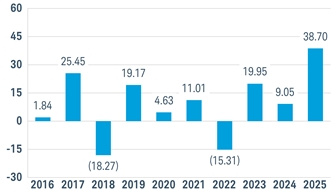
The bar chart below shows how the fund’s investment results have varied from
year to year, and the following table shows how the fund’s average annual total returns for various
periods compared to that of an index. This information provides some indication of the risks of investing
in the fund. All figures assume distributions were reinvested. Keep in mind that future performance (both
before and after taxes) may differ from past performance. For current performance information, please
see www.schwabassetmanagement.com/prospectus.
| |
Annual Total Returns (%) as of 12/31 |
| |
Best
Quarter: 17.18% Q4 2022 |
Worst
Quarter: (24.88%) Q1 2020 |
| | |
Schwab International Core Equity Fund | Summary Prospectus | 3 |
| |
| | | | | | | | | | | |
Average Annual Total Returns as of 12/31/25 | | | | | | | |
| | | | | | | | | | |
| | 1 Year | | | 5 Years | | | 10
Years |
Before taxes | 38.70% | | | 11.27% | | | 8.31% | |
After taxes on distributions | 37.16% | | | 10.54% | | | 7.74% | |
After taxes on distributions and sale | | | | | | | | |
of shares | 24.24% | | | 8.94% | | | 6.75% | |
Comparative Index (reflects no | | | | | | | | |
deduction for fees,
expenses, or
taxes) | | | | | | | | |
MSCI EAFE Index (Net)(1) | 31.22% | | | 8.92% | | | 8.18% | |
| | | | | | | | | | |
| | | | | | | | | | |
(1) | The net version of the index reflects reinvested dividends
net of withholding taxes, but reflects no deductions for expenses or other taxes. |
The after-tax figures reflect the highest individual federal income tax rates
in effect during the period and do not reflect the impact of state and local taxes. Your actual after-tax
returns depend on your individual tax situation. In addition, after-tax returns are not relevant if you
hold your fund shares through a tax-deferred arrangement, such as a 401(k) plan, an individual retirement
account (IRA) or other tax-advantaged account.
Charles Schwab Investment Management, Inc.,
dba Schwab Asset Management®
Iain
Clayton, CFA, FRM, Senior Portfolio Manager, is responsible for the day-to-day
co-management of the fund. He has managed the fund since 2015.
Wei Li, Ph.D., CFA, Senior Portfolio Manager,
is responsible for the day-to-day co-management of the fund. She has managed the fund since 2013.
Elizabeth Xie, Ph.D., CFA,
Senior Portfolio Manager, is responsible for the day-to-day co-management of the fund. She has managed
the fund since 2025.
Purchase and Sale of Fund Shares
The fund is open for business each day that the New York Stock Exchange (NYSE)
is open. If the NYSE is closed due to weather or other extenuating circumstances on a day it would typically
be open for business, or the NYSE has an unscheduled early closing on a day it has opened for business,
the fund reserves the right to treat such day as a business day and accept purchase and redemption orders
and calculate its share price as of the normally scheduled close of regular trading on the NYSE for that
day.
Investors may only invest in the fund through an account at Charles Schwab &
Co., Inc. (Schwab) or another financial intermediary. When you place orders to purchase, exchange or
redeem fund shares through an account at Schwab or another financial intermediary, you must follow Schwab’s
or the other financial intermediary’s transaction procedures.
There is no minimum initial
investment for the fund.
Dividends
and capital gains distributions received from the fund will generally be taxable as ordinary income or
capital gains, unless you are investing through an IRA, 401(k) or other tax-advantaged account (in which
case you may be taxed later, upon withdrawal of your investment from such account).
Payments to Financial Intermediaries
If
you purchase shares of the fund through a broker-dealer or other financial intermediary (such as a bank),
the fund and its related companies may pay the intermediary for the sale of fund shares and related services.
These payments may create a conflict of interest by influencing the broker-dealer or other financial
intermediary and your salesperson to recommend the fund over another investment. Ask your salesperson
or visit your financial intermediary’s website for more information.
| | |
4 | Schwab
International Core Equity Fund | Summary Prospectus |
| |