Form 10-K: 0001829126-23-004119 compared to 0001213900-22-015781
0001891791
false
FY
2022
0001891791
2022-01-01
2022-12-31
0001891791
2023-06-13
0001891791
2022-12-31
0001891791
2021-12-31
0001891791
2021-01-01
2021-12-31
0001891791
us-gaap:PreferredStockMember
2020-12-31
0001891791
us-gaap:CommonStockMember
2020-12-31
0001891791
us-gaap:AdditionalPaidInCapitalMember
2020-12-31
0001891791
us-gaap:AccumulatedOtherComprehensiveIncomeMember
2020-12-31
0001891791
us-gaap:RetainedEarningsMember
2020-12-31
0001891791
2020-12-31
0001891791
us-gaap:PreferredStockMember
2021-12-31
0001891791
us-gaap:CommonStockMember
2021-12-31
0001891791
us-gaap:AdditionalPaidInCapitalMember
2021-12-31
0001891791
us-gaap:AccumulatedOtherComprehensiveIncomeMember
2021-12-31
0001891791
us-gaap:RetainedEarningsMember
2021-12-31
0001891791
us-gaap:PreferredStockMember
2021-01-01
2021-12-31
0001891791
us-gaap:CommonStockMember
2021-01-01
2021-12-31
0001891791
us-gaap:AdditionalPaidInCapitalMember
2021-01-01
2021-12-31
0001891791
us-gaap:AccumulatedOtherComprehensiveIncomeMember
2021-01-01
2021-12-31
0001891791
us-gaap:RetainedEarningsMember
2021-01-01
2021-12-31
0001891791
us-gaap:PreferredStockMember
2022-01-01
2022-12-31
0001891791
us-gaap:CommonStockMember
2022-01-01
2022-12-31
0001891791
us-gaap:AdditionalPaidInCapitalMember
2022-01-01
2022-12-31
0001891791
us-gaap:AccumulatedOtherComprehensiveIncomeMember
2022-01-01
2022-12-31
0001891791
us-gaap:RetainedEarningsMember
2022-01-01
2022-12-31
0001891791
us-gaap:PreferredStockMember
2022-12-31
0001891791
us-gaap:CommonStockMember
2022-12-31
0001891791
us-gaap:AdditionalPaidInCapitalMember
2022-12-31
0001891791
us-gaap:AccumulatedOtherComprehensiveIncomeMember
2022-12-31
0001891791
us-gaap:RetainedEarningsMember
2022-12-31
0001891791
2020-09-01
2020-09-23
0001891791
2020-09-23
0001891791
2022-06-30
0001891791
tggi:ZXGHoldingsLimitedMember
2022-01-01
2022-12-31
0001891791
tggi:HongKongZuixianguiInternationalHoldingCoLtdMember
2022-01-01
2022-12-31
0001891791
tggi:ZuiXianGuiInternationalHoldingShenzhenLtdMember
2022-01-01
2022-12-31
0001891791
tggi:ShenzhenZuiXianGuiBreweryTechnologyLtdMember
2022-01-01
2022-12-31
0001891791
tggi:SpotUSDMember
2022-12-31
0001891791
tggi:SpotUSDMember
2021-12-31
0001891791
tggi:AverageUSDMember
2022-12-31
0001891791
tggi:AverageUSDMember
2021-12-31
0001891791
us-gaap:OfficeEquipmentMember
2022-12-31
0001891791
tggi:DistributionChannelMember
2022-12-31
0001891791
2022-06-01
2022-06-30
0001891791
country:HK
2022-01-01
2022-12-31
0001891791
country:US
2022-01-01
2022-12-31
0001891791
country:US
2021-01-01
2021-12-31
0001891791
country:VG
2022-01-01
2022-12-31
0001891791
country:VG
2021-01-01
2021-12-31
0001891791
country:HK
2021-01-01
2021-12-31
0001891791
tggi:PRCMember
2022-01-01
2022-12-31
0001891791
tggi:PRCMember
2021-01-01
2021-12-31
0001891791
country:US
2022-12-31
0001891791
country:US
2021-12-31
0001891791
country:HK
2022-12-31
0001891791
country:HK
2021-12-31
0001891791
tggi:PRCMember
2022-12-31
0001891791
tggi:PRCMember
2021-12-31
0001891791
tggi:GuizhouZuiXianGuiLiquorCoLtdMember
2022-12-31
0001891791
tggi:GuizhouZuiXianGuiLiquorCoLtdMember
2021-12-31
0001891791
tggi:ShenzhenZuiXianGuiSupplyChainCoLtdMember
2022-12-31
0001891791
tggi:ShenzhenZuiXianGuiSupplyChainCoLtdMember
2021-12-31
0001891791
tggi:ZhiyuLvMember
2022-12-31
0001891791
tggi:ZhiyuLvMember
2021-12-31
0001891791
tggi:ChenRenMember
2022-12-31
0001891791
tggi:ChenRenMember
2021-12-31
0001891791
tggi:ShareExchangeAgreementMember
2022-08-08
iso4217:USD
xbrli:shares
iso4217:USD
xbrli:shares
xbrli:pure
UNITED STATES
SECURITIES AND EXCHANGE COMMISSION
WASHINGTONWashington, D.C. 20549
FORM 10-KFORM 10-K
(Mark
One)
☒ ☒
ANNUAL REPORT UNDER SECTION 13 OR 15(d) OF THE SECURITIES EXCHANGE ACT OF 1934
For the fiscal year ended
December 31, 2021For the fiscal year ended December 31, 2022
☐☐ TRANSITION REPORT UNDER SECTION 13 OR 15(d) OF THE SECURITIES EXCHANGE ACT OF 1934
For the transition period from ____________________ to ____________________________________ to _______________
Commission File No. 000-56383Commission File No. 000-56383
Trans Global Group,
Inc. TRANS GLOBAL GROUP INC.
(Exact name of registrant as specified in its charter)
| DelawareDelaware |
|
88-029819088-0298190 |
(State or other jurisdiction of
incorporation or organization) |
|
(I.R.S. Employer
Identification No.) |
| |
|
|
|
Room 2701, Block A
Rm 2701, Block A, Zhantao Technology Building , Minzhi Street, Shenzhen 518000, Guangdong, China
Minzhi Street, Shenzhen
Guangdong Province - China
|
518000 |
| (Address of principal executive offices) |
|
(Zip Code) |
(Address of principal executive offices, including zip code)
+86
138 2338 3535
+86 138 2338 3535
(Registrant’(Registrant’s telephone number, including area code)
| N/A |
| (Former name, former address and former fiscal year, if changed since last report) |
Securities registered pursuant to Section 12(bg) of the Act:
| Title of each class |
|
Trading Symbol(s) |
|
Name of each exchange on which registered |
| Common stock |
|
TGGI |
|
OTC Market |
Indicate by check mark if the registrant is a well-known seasoned issuer, as defined in Rule 405 of the Securities Act. Yes ☐ No ☒
Yes ☐ No ☒
Indicate by check mark if the registrant is not required to file reports pursuant to Section 13 or Section 15(d) of the Act. Yes ☐ No ☒
Yes ☐ No ☒
Note
– Checking the box above will not relieve any registrant required to file reports pursuant to Section 13 or 15(d) of the Exchange
Act from their obligations under those Sections.
Indicate by check mark whether the registrant (1) has filed all reports required to be filed by Section 13 or 15(d) of the Securities Exchange Act of 1934 during the preceding 12 months (or for such shorter period that the registrant was required to file such reports), and (2) has been subject to such filing requirement for the past 90 days. Yes ☒ No ☐
Yes ☒ No ☐
Indicate by check mark whether the registrant has submitted electronically and posted on its corporate Web site, if any, every Interactive Data File required to be submitted and posted pursuant to Rule 405 of Regulation S-T (§§ 232.405 of this chapter) during the preceding 12 months (or for such shorter period that the registrant was required to submit and post such files). Yes ☒ No ☐
Yes ☒ No ☐
Indicate by check mark if disclosure of delinquent filers pursuant to Item 405 of Regulation S-K (§§229.405 of this chapter) is not contained herein, and will not be contained, to the best of registrant’’s knowledge, in definitive proxy or information statements incorporated by reference in Part III of this Form 10-K or any amendment to this Form 10-K. Yes ☒ No ☐
Yes ☒ No ☐
Indicate by check mark whether the registrant is a large accelerated filer, an accelerated filer, a non-accelerated filer, a smaller reporting company, or an emerging growth company. See the definitions of ““large accelerated filer,” “” “accelerated filer,” “” “smaller reporting company,”” and ““emerging growth company”” in Rule 12b-2 of the Exchange Act.
| Large accelerated filer ☐ |
Accelerated filer ☐☐ |
Accelerated filer |
☐ |
| Non-accelerated filer ☐Non-accelerated filer |
Smaller reporting company ☒☒ |
Smaller reporting company |
☒ |
| |
Emerging growth company ☐ |
Emerging growth company |
☒ |
If an emerging growth company, indicate by check mark if the registrant has elected not to use the extended transition period for complying with any new or revised financial accounting standards provided pursuant to Section 13(a) of the Exchange Act. Yes ☒ No ☐
Indicate by check mark whether the registrant has filed a report on and attestation to its management’’s assessment of the effectiveness of its internal control over financial reporting under Section 404(b) of the Sarbanes-Oxley Act (15 U.S.C. 7262(b)) by the registered public accounting firm that prepared or issued its audit report. Yes ☐ No ☒
Indicate
by check mark whether the registrant is a shell company (as defined in Rule
If securities are registered pursuant to Section 12(b) of the Act, indicate by check mark whether the financial statements of the registrant included in the filing reflect the correction of an error to previously issued financial statements. ☐
Indicate by check mark whether any of those error corrections are restatements that required a recovery analysis of incentive-based compensation received by any of the registrant’s executive officers during the relevant recovery period pursuant to §240.10D-1(b). ☐
Indicate by check mark whether the registrant is a shell company (as defined in Rule 12(b)-2 of the Exchange Act). Yes ☒ No ☐
Yes ☒ No ☐
The aggregate market value of the voting and non-voting common stock held by non-affiliates computed by reference to the average bid and asked price of such shares on the OTC markets as of March 18June 13, 2022, was approximately $406,078,614.2023, was approximately $14.4 million.
As of
March 18, 2022, there were 20,665,578,306 sharesIndicate the number of shares outstanding of each of the issuer’s classes of common stock, paras value $0.001 per share issued and outstanding.of latest practicable date.
DOCUMENTS INCORPORATED
BY REFERENCE
| Class |
|
Outstanding at June 13, 2023 |
| Common stock, $0.0001 par value |
|
22,131,339,996 |
List hereunder the following
documents if incorporated by reference and the Part of the Form 10-K (e.g., Part I, Part II, etc.) into which the document is incorporated:
(1) any annual report to security holders; (2) any proxy or information statement; and (3) any prospectus filed pursuant to Rule 424(b)
or (c) of the Securities Act of 1933. The listed documents should be clearly described for identification purposes (e.g., annual report
to security holders for fiscal year ended December 24, 1980). Not Applicable
Table of Contents
CAUTIONARY NOTE REGARDING FORWARD-LOOKING STATEMENTS
This Annual Report on Form 10-K (the ““Report””), including, without limitation, statements under the heading ““Management’’s Discussion and Analysis of Financial Condition and Results of Operations,”” includes forward-looking statements within the meaning of Section 27A of the Securities Act of 1933 and Section 21E of the Securities Exchange Act of 1934, as amended (the ““Exchange Act””). These forward-looking statements can be identified by the use of forward-looking terminology, including the words ““believes,” “” “estimates,”
“” “anticipates,” “” “expects,” “” “intends,” “” “plans,” “” “may,” “” “will,” “” “potential,”
“” “projects,” “” “predicts,” “” “continue,”” or ““should,”” or, in each case, their negative or other variations or comparable terminology. There can be no assurance that actual results will not materially differ from expectations. Such statements include, but are not limited to, any statements relating to our ability to consummate any acquisition or other business combination and any other statements that are not statements of current or historical facts. These statements are based on management’’s current expectations, but actual results may differ materially due to various factors, including, but not limited to:
| |
●● |
We have no current business operationsThe availability and adequacy of our cash flow to meet our requirements; |
| |
|
|
| |
● |
Economic, competitive, demographic, business and other conditions in our local and have no assets. Unless we obtain additional capital or acquire an operating company, the Company will not be ableregional markets; |
| |
|
|
| |
● |
Changes or developments in laws, regulations or taxes in our industry; |
| |
|
|
| |
● |
Actions taken or omitted to be taken by third parties including our suppliers and competitors, as well as legislative, regulatory, judicial and other governmental authorities; |
| |
|
|
| |
● |
Competition in our industry; |
| |
|
|
| |
● |
The loss of or failure to obtain any license or permit necessary or desirable in the operation of our business; |
| |
|
|
| |
● |
Changes in our business strategy, capital improvements or development plans; |
| |
|
|
| |
● |
The availability of additional capital to support capital improvements and development; and |
| |
|
|
| |
● |
Other risks identified in this report and in our other filings with the Securities and Exchange Commission or to undertake significant business activities.the SEC. |
| |
● |
The Company’s business plan contemplates that it will acquire an operating company in exchange for the majority of its common stock. If that occurs, management will determine the nature of the company that is acquired. Investors in the Company will have to rely on the business acumen of management in determining that the acquisition is in the best interest of the Company. If management lacks sufficient skill to operate successfully, the Company’s shares may lose value. |
The forward-looking statements
contained in this Report are based on our current expectations and beliefs concerning future developments and their potential effects
on us. Future developments affecting us may not be those that we have anticipated. These forward-looking statements involve a number of
risks, uncertainties (some of which are beyond our control) and other assumptions that may cause actual results or performance to
This Annual Report on Form 10-K should be read completely and with the understanding that actual future results may be materially different from those expressed or implied by thesewhat we expect. The forward-looking statements. Should oneincluded in or more of these risksthis Annual Report on Form 10-K are made as of the date or uncertainties materialize,
orof this Annual Report on Form 10-K and should anybe evaluated with consideration of our assumptions prove incorrect, actual results mayany changes occurring after the date of vary in material respects from those projected in thesethis Annual Report on Form 10-K. We will not update forward-looking statements. We undertakeeven though our situation may change in the future and we assume no obligation to update or revise any forward-looking statements, whether as a result of new information, future events or otherwise, except as may be required under applicable securities laws.
Our financial statements
are stated in United States dollars ($US) and are prepared in accordance with United States Generally Accepted Accounting Principles.
In this annual report,
unless otherwise specified, all references to “common stock” refer to the common shares in our capital stock.
As used in this annual
report, the terms “.
Use of Defined Terms
Except as otherwise indicated by the context, references in this Report to:
| |
● |
The “Company”, “we,” “” “us,” “” “our,””, ““Company” and “Trans Global” mean Trans
Global Group, Inc., unless the context clearly indicates otherwise.
” or “TGGI” are references to Trans Global Group, Inc., a Delaware Corporation; |
| |
|
|
| |
● |
“Common Stock” refer to the common stock, par value of $0.0001, of the Company; |
| |
|
|
| |
● |
“U.S. dollar”, “$”, and “US$” refers to the legal currency of the United States; |
| |
|
|
| |
● |
“Securities Act” refers to the Securities Act of 1933, as amended; and |
| |
|
|
| |
● |
“Exchange Act” refers to the Securities Exchange Act of 1934, as amended. |
PART I
ITEM 1. BUSINESS
General Background of the Company
Trans Global Group, Inc. (the ““Company””) was originally incorporated in Colorado on April 2, 1979 as Teletek, Inc. On April 9, 1993, the Company effected a merger with a newly formed wholly-owned subsidiary (formed March 17, 1993) for the primary purpose of changing its domicile to Delaware. On October 2007, the Company changed its name to Trans Global Group, Inc. The Company reincorporated to Florida from March 2014, through September 2017, and changed its name to Cannabis Consortium, Inc. in September 2017. On September 18, 2017, the Company filed with the State of Delaware to move the Company’’s State of domicile from Florida to Delaware. On September 19, 2017, the Company filed conversion documents with the State of Florida moving its domicile to Delaware. In connection with the change in domicile, the Company changed its name from Cannabis Consortium, Inc. back to Trans Global Group, Inc.
From inception through 1996, the Company was engaged in various facets of the telecommunications industry, including providing long-distance telecommunications services, consisting primarily of direct dial international long-distance telephone transmissions from the United States for commercial customers. In 1996, the Company ceased telecommunications operations.
In 2007, the Company changed management and began seeking new partners or new business ventures.
The Company acquired Ecosafe Insulation of Florida, LLC in October of 2009. Ecosafe was had entered into an agreement to acquire Ecosafe Foam from American Green Group, Inc. The Company elected to not complete that acquisition and in April 2010, acquired two other entities All Weather Insulation, Inc, which was in the business of building spray and injection foam rigs and trailers for the spray and injection foam insulation industry, and Kazore Holdings, Inc., which was in the business of providing conceptual design, custom programming, SEO, campaign management, printing, iPhone application development, email marketing, SMS text marketing and many other marketing strategies both on and off line. On February
3, 2011, the Company entered into a rescission agreement with Kazore Holdings, Inc. dba Full Spectrum Media, effective as of December
31, 2010. On March 31, 2011 the Company entered into a rescission agreement with All Weather Insulation, Inc.
On April On April 1, 2011 the Company purchased the assets and liabilities of FederaLED, LLC, which was in the business of providing cost-effective Light Emitting Diode lighting technology, with a primary focus on the government markets. By September 2017, FederaLED was no longer an active part of the Company, and the domain names were sold off in 2014.
On January 9, 2012 the Company acquired VersaGreen Energy Corporation, which was engaged in the General Construction, Renewable and Solar Energy sector.
During June 2014 the Company entered into two more Share Exchange Agreements one with International Green Building Group, Inc., and the other with Red Fox Bonding, LLC. The closing that took place with International Green Building Group, Inc. was rescinded as of December 31, 2014.
In January 2016, the Company entered into consulting agreements to provide consulting services such as strategic planning and investor relations and to oversee and manage communication and filings for the three (3) companies. In February 2016, the Company rescinded its consulting agreements citing a change in the Company’’s direction.
On February 19, 2016, the Company decided that the Company would need to reverse merge a company with audited financials in order to instill market value into the Company, and on October 5, 2016 control of the Issuer was assumed by Baron Capital Enterprise. On April 21, 2017 control of the Issuer was transferred to the then CEO Matthew Dwyer.
On September 19, 2017, International Green Group, Inc. (formerly known as Rollings.Com, Inc., a subsidiary acquired in November 3, 2010), became Cannabis Consortium, Inc. On January 18, 2017 the Company completed an assignment with Bahamas Development Corporation whereby the two companies exchanged 1,214,000 shares of Cannabis Consortium for 1,214,000 of Bahamas Development Corporation. As a result of the transaction Cannabis Consortium become majority owned by Bahamas Development Corporation. Cannabis Consortium granted the Company exclusive marketing rights to a list of named products through a master distributorship agreement.
In May In May 2018, the Company elected to expand its business development activities and pursue a new line of products which are edible sauces that can be infused with THC and/or CBD. Through 2019, the Company had two different businesses 1) is a plastic manufacturer of its device(s) which can be shipped worldwide and have numerous applications, 2) is the creation of a line of edible sauces that can be infused with CBD and/or THC giving each sauce flavor three product lines.
In November 2019, the Company and Integrated Cannabis Solutions, Inc. began discussions for the sale of certain of the Company’’s IP assets. On April 12, 2019 TGGI, IGPK, and the Seller reached an understanding whereby the attempted acquisition was unsuccessful. The final transaction did not take place and no monies exchanged hands.
The Company can currently
be defined as a “shell” company, whose sole purpose at this time is to locate and consummate a merger or acquisition with
a private entity. The Company will act a holding company, and plans to establish subsidiaries inOn September 23, 2020, Matthew Dwyer, the Company, and Chen Ren entered into that certain Stock Purchase Agreement, pursuant to which Dwyer agreed Hong Kong, and/or the Cayman Islands.
Such subsidiaries will then acquire assets orto return 200,000 shares of anSeries entity actively engaged in business which generates revenuesAA Preferred stock, par value $0.0001 per share to treasury for $150,000, and the Company agreed to issue 20,000 shares of Series B Preferred Stock, of the Company representing approximately 93% of the outstanding voting power to Chen Ren. And Matthew Dwyer resigned as sole officer of the Company (including as President, Chief Executive Officer, Secretary and Treasure) and Chen Ren was appointed as sole officer of the Company (including as President, Chief Executive Officer, Secretary and Treasure) on the same date.
On June 30, 2022, we consummated a share exchange pursuant to a Share Exchange Agreement among the Company and Southsea, the shareholder of ZXGBVI, pursuant to which we acquired all the ordinary shares of ZXGBVI in exchange for its securities. The Company has no particular acquisitions in mind and has not currently entered into any negotiations regarding such
an acquisition. The Company’s officer and director has not engaged in any preliminary contact or discussions with any representative
of any other company regarding the possibilitythe issuance to the shareholder of ZXGBVI of an acquisition or merger betweenaggregate of 1,465,761,690 shares of the Company. andAs such other company as of the date hereof.a result of the transactions contemplated by the Share Exchange, ZXGBVI became a wholly-owned subsidiary of the Company. Such reorganization was completed on August 8, 2022.
The chart below depicts the corporation structure of the Company as of the date of this Annual Report on Form 10-K:
Our major shareholders
and headquarters are located in China and we plan to acquire operating assets and businesses in China. We will face various legal and
operational risks and uncertainties related to having substantially all of our operations in China. In addition, if any of the assets
or businesses that we acquire are on the 2021 Negative List promulgated by the Ministry of Commerce of the PRC (the “MOFCOM”)
and the National Development and Reform Commission of China (“NDRC”), we may not be able to conduct our business through such
subsidiaries without being subject to restrictions imposed by the foreign investment laws and regulations of the PRC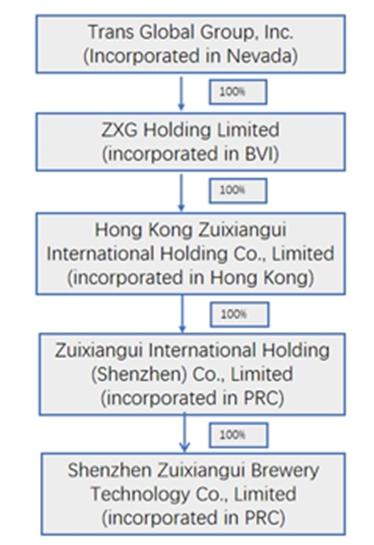
Business Overview
Trans Global Group Inc. is a US holding company incorporated in Delaware. We conduct our business through our PRC subsidiary, “Shenzhen Zui Xian Gui Brewery Technology Limited” (“ZXGSZ”), which is a wine distribution and retail sales company based in Guangdong province, China. “Zui Xian Gui 醉仙归”, the brand name was founded by Mr. Ren Chen, a famous singer and post-80s entrepreneur. He insisted on building Chinese flavored liquor and a Chinese liquor culture, building the brand with special quality and multi liquor culture, and striving to create a healthy and good wine belonging to China and the world.
We are principally engaged in the distribution of high-end liquor for the PRC markets, and international markets in the future, through online and offline channels. The products we distribute include the Zui Xian Gui International Classic, Zui Xian Gui International Premium, Zui Xian Gui International Collection, MOGU DAXIA and DangBing DeRen. Set out below is a brief introduction to the principal products we distribute:
 |
|
 |
|
 |
|
Zui Xian Gui International Classic
53%vol and 500ml |
|
Zui Xian Gui International Premium
53%vol and 500ml |
|
Zui Xian Gui International Collection
53%vol and 500ml |
| |
|
|
|
|
 |
|
 |
|
|
|
Dangbing Deren
53%vol and 500ml |
|
Mogu Daxia
53%vol and 500ml |
|
|
We sell our products through our distributors. We authorize distribution and classify the dealers according to the purchase amount. Different types of dealers enjoy different discounts. At present, the Company’s dealers are mainly individuals, and a few are legal entities. In terms of retail, we mainly focus on online sales, including online self-operated retail and e-commerce platform which formulates purchase details according to the trade mode of “purchase by sale and zero inventory”. The main purchased materials include customized finished wine, packaging accessories, etc. Our distribution policy table:
| Kind of distributor |
|
Cross the
threshold
(RMB) |
|
|
Discount
rate |
|
| First-class |
|
|
2,000,000 |
|
|
|
50 |
% |
| Second-class |
|
|
1,000,000 |
|
|
|
55 |
% |
| Third-class |
|
|
500,000 |
|
|
|
60 |
% |
| Fourth-class |
|
|
200,000 |
|
|
|
65 |
% |
| Fifth-class |
|
|
50,000 |
|
|
|
70 |
% |
Marketing Plan
We intend to encourage sales of the products we distribute through advertising, marketing and promotion, and we cooperate with certain distribution network in conducting marketing and promotional activities through selected distributors who owned the retail outlets in their local estate with a view to expanding our share and our brand of the PRC market.
The PRC government has
significant authority to exert influence on the ability of a China-based company, Currently, we have already implemented various publicity campaigns such as us, to media advertisements and other promotional activities. We will continue to strategically conduct its business, accept foreign
investments oradvertising, marketing and promotions to list on a U.S. or other foreign exchange. For example, we face risks associated with regulatory approvals of offshore offerings,
anti-monopoly regulatory actions, oversight on cybersecurity and data privacyboost sales of the products, as well as the lack of PCAOB inspection on our auditors.
Such risks could result in a material change in our operations and/or the value of our Stocks or could significantly limitour own corporate image. We will also continue to place advertisements in different media outlets to further strengthen brand awareness. We endeavour to organize various types of marketing and promotional activities by collaborating with retail distributors within our distribution network or otherwise.
We also plan on other public relation activities such as liquor tasting gatherings on a regular basis with a view to strengthening our relationship with distributors and consumers and to promote appreciation of liquor as part of the Chinese culture.
Competitive Strengths
Our Director believes that our success is attributed to, among other things, the following competitive strengths:
Well-established distribution network in the PRC
Our Director believes that one of our key competitive strengths is our well-established distribution network and channel management. In particular, our Director believes that our expertise lies in our knowledge and experience of channel management specific to the PRC domestic market.
For the year ended December 31, 2022, we transacted with 238 customers, including wholesale distributors (also known as “four-class distributors” and “five-class distributors”) who purchase our liquor products for further distribution to the end users. All of these customers had distribution agreements with or completely
hinder our ability to offer or continue to offer Stocks and/or other securities to investors and cause the value of such securities to
significantly decline or be worthless. See “Risk Factors — Risks Associated with doing business in China.”
The PRC government has
significant oversight and discretion over the conduct of our business and may intervene with or influence our operations as the government
deems appropriate to further regulatory, political and societal goals. See “Risk Factors — Risks Associated
with doing business in China — Uncertainties with respect tous during the same period. These distributors will then sell the products in their retail outlets in the PRC. All of these customers had distribution agreements with us during the same period.
Our effective marketing strategy in the PRC
Another critical competitive strength lies in our effective marketing and sales strategies. Our Director believes that our market experience enables us to provide our suppliers with timely market information such as feedback on consumer preferences so that they may develop new products to cater for the changing market needs. We have collaborated with selected retail outlets such as supermarkets and restaurants in the PRC in launching marketing and promotional activities.
Our Director believes that our effective marketing strategy and our market know-how have enhanced our relationships with both our suppliers and distributors and have enabled us to create value for our distribution network.
Governmental Regulations in Relation to the Company’s Businesses
This section summarizes the principal PRC laws, rules and regulations related to our business and operations.
Regulations relating to Anti-Monopoly and Competition
On September 11, 2020, the Anti-Monopoly Commission of the State Council issued Anti-Monopoly Compliance Guideline for Business Operators, which requires business operators to establish anti-monopoly compliance management systems under the PRC Anti-Monopoly Law to manage anti-monopoly compliance risks.
On August 17, 2021, the State Administration for Market Regulation, or the SAMR, issued a discussion draft of Provisions on the Prohibition of Unfair Competition on the Internet, under which business operators should not use data or algorithms to hijack traffic or influence users’ choices, or use technical means to illegally capture or use other business operators’ data. Furthermore, business operators are not allowed to (i) fabricate or spread misleading information to damage the reputation of competitors, or (ii) employ marketing practices such as fake reviews or use coupons or “red envelopes” to entice positive ratings.
On February 7, 2021, the Anti-Monopoly Commission of the State Council published Anti-Monopoly Guidelines for the Internet Platform Economy Sector that specified circumstances where an activity of an internet platform will be identified as monopolistic act as well as concentration filing procedures for business operators. According to the PRC Anti-Monopoly Law, if a business operator carries out a concentration in violation of the law, the relevant authority shall order the business operator to terminate the concentration, dispose of the shares or assets or transfer the business within a specified time limit, or take other measures to restore the pre-concentration status, and impose a fine of up to RMB500,000.
On October 23, 2021, the Standing Committee of the National People’s Congress issued a discussion draft of the amended Anti-Monopoly Law, which proposes to increase the fines for illegal concentration of business operators to no more than ten percent of its last year’s sales revenue if the concentration of business operator has or may have an effect of excluding or limiting competitions, or a fine of up to RMB5 million if the concentration of business operator does not have an effect of excluding or limiting competition. The draft also proposes that the relevant authority shall investigate a transaction where there is any evidence that the concentration has or may have the effect of eliminating or restricting competitions, even if such concentration does not reach the filing threshold.
Regulations Relating to Food Business Operations
We operate our business in China under a legal regime consisting of the PRC legal systemNational People’s Congress, including uncertainties regarding the enforcement
of laws, and sudden or unexpected changes in laws and regulations in China could adversely affect us and limit the legal protections available
to you and us.” The PRC government has recently published new policies that significantly affected certain industries such as the
education and internet industries, and we cannot rule out the possibility that it will in the future release regulations or policies regarding
the industry of our future PRC subsidiaries that could adversely affect our business, financial condition and results of operations. Furthermore,
the PRC government has recently indicated an intent to exert more oversight and control over overseas securities offerings and other capital
markets activities and foreign investment in China-based companies like us. Any such action, once taken by the PRC government, could significantly
limit or completely hinder our ability to offer or continue to offer securities to investors and cause the value of such securities to
significantly decline or in extreme cases, become worthless. See “Risk Factors — Risks Associated with doing
business in China — The recent state government interference into business activities on U.S. listed Chinese companies may negatively
impact our existing and future operations in China; — Uncertainties with respect to the PRC legal system, including uncertainties
regarding the enforcement of laws, and sudden or unexpected changes in laws and regulations in China could adversely affect us and limit
the legal protections available to you and us.”
We are currently not
required to obtain permission from any of the PRC authorities to and issue our common stock shares to foreign investors. We will determine
following acquisitionwhich is the country’s highest legislative body; the State Council, which is the highest authority of the executive branch of the PRC central government; and several ministries and agencies under its authority, including the Ministry of Industry and Information Technology, State Administration For Industry & Commerce, State Administration of Taxation and their respective local offices. This section summarizes the principal PRC regulations related to our business.
| Type |
|
Name |
|
Effective Date |
|
Content |
|
Updates |
| President Order 21 of 2015 |
|
Food Safety Law |
|
October 1, 2015 |
|
The Food Safety Law is the foundational law and the most important food safety law for alcoholic products in China. A great majority of wine regulations are drafted in conformity to the requirements of this law. |
|
Revised on December 29, 2018 |
| AQSIQ Order 144 of 2011 |
|
Measures for Administration of Imported/Exported Food Safety |
|
March 1, 2012 |
|
This rule oversees the safety of imported and exported food. |
|
Revised on 11/23/2018 |
| CFDA Order 16 of 2015 |
|
Measures for Administration of Food Production Licensing |
|
October 1, 2015
|
|
This rule requires all food producers in China to procure a production license. |
|
Replaced by the State Administration for Market Regulation Order 24 in 2020 |
| AQSIQ Order 27 of 2012 |
|
Administrative Provisions on Inspections and Supervisions of Labelling of Imported/Exported Pre-packaged Foods |
|
June 1, 2012
|
|
This rule provides guidelines that governs all pre-packaged foods. |
|
|
| AQSIQ Notice on December 23, 2004 |
|
Rules for Inspection on Production Licensing of Wines and Fruit Wines |
|
January 1, 2005
|
|
This rule sets forth inspection procedures on production licensing of wines and fruit wines. |
|
|
Regulations Relating to M&A Rules and Overseas Listings
On August 8, 2006, six PRC regulatory agencies, including the China Securities Regulatory Commission, or the CSRC, adopted the Regulations on Mergers of Domestic Enterprises by Foreign Investors, or the M&A Rules, which became effective on September 8, 2006 and was amended on June 22, 2009. Foreign investors shall comply with the M&A Rules when they purchase equity interests of a domestic company or subscribe the increased capital of a domestic company, thus changing the nature of the domestic company into a foreign-invested enterprise; or when the foreign investors establish a foreign-invested enterprise in the PRC, purchase the assets of any subsidiaries whether we or such subsidiaries are required to obtain permission or approval from the PRC authorities
including CSRC or Cyberspace Administration of China (the “CAC”) for any acquired operations. As we currently have no such
subsidiaries, we have not yet applied for or received any denial for any operations. However, recently, the General Office of the Central
Committee of a domestic company and operate the assets; or when the foreign investors purchase the asset of a domestic company, establish a foreign-invested enterprise by injecting such assets and operate the assets. The M&A Rules purport, among other things, to require offshore special purpose vehicles formed for overseas listing purposes through acquisitions of PRC domestic companies and controlled by PRC companies or individuals, to obtain the approval of the CSRC prior to publicly listing their securities on an overseas stock exchange.
According to the Anti-Monopoly Law which took effect as at August 1, 2008, where the concentration of business operators reaches the Communist Party of China and the General Office of the State Council jointly issued the “Opinions on Severely Cracking
Down on Illegal Securities Activities According to Law,” or the Opinions, which was made available to the public on July 6, 2021.
The Opinions emphasized the need to strengthen the administration over illegal securities activities, and the need to strengthen the supervision
over overseas listings by Chinese companies. Effective measures, such as promoting the construction of relevant regulatory systems will
be taken to deal with the risks and incidents of China-concept overseas listed companies, and cybersecurity and data privacy protection
requirements and similar matters. The Opinions and any related implementing rules to be enacted may subject us to compliance requirement
in the future. Given the current regulatory environment in the PRC, we are still subject to the uncertainty of interpretation and enforcement
of the rules and regulations in the PRC, which can change quickly with little advance notice, and any future actions of the PRC authorities.
In addition, we cannot assure you that relevant PRC government agencies would reach the same conclusion as we do or as advised by our
PRC legal counsel. If we are wrong with regards to our interpretation of the PRC laws and regulations, or if the CSRC, the CAC or other
regulatory PRC agencies later promulgate new rules requiring that we obtain their approvals to issue our common stock to foreign investors,
we may be unable to obtain a waiver of such approval requirements, if and when procedures are established to obtain such a waiver. Any
uncertainties and/or negative publicity regarding such an approval requirement could have a material adverse effect on the trading price
of our securities. See “Risk Factors—Risks associated with doing business in China – Uncertainties with respect to the
PRC legal system, including uncertainties regarding the enforcement of laws, and sudden or unexpected changes in laws and regulations
in China could adversely affect us and limit the legal protections available to you and us; – The PRC legal system is evolving,
and the resulting uncertainties could adversely affect us; – The approval of the CSRC or other PRC regulatory agencies may be required
in connection with this registration under PRC law.”
Business Objectives
of the Company
Since April 30, 2021,
current management (which includes possible participation by our majority shareholder) has determined to direct its efforts and limited
resources to pursue potential new business opportunities. The Company does not intend to limit itself to a particular industry and has
not established any particular criteria upon which it shall consider a business opportunity.
The Company’s purpose
is to seek, investigate and, if such investigation warrants, acquire an interest in business opportunities presented to it by persons
or firms who or which desire to seek the perceived advantages of an issuer who has complied with the Exchange Act. The Company will not
restrict its search to any specific business, industry, or geographical location and the Company may participate in a business venture
of virtually any kind or nature and we have not established any particular criteria upon which we consider a business opportunity. This
discussion of the proposed business herein is purposefully general and is not meant to be restrictive of the Company’s virtually
unlimited discretion to search for and enter into potential business opportunities. Management anticipates that it may be able to participate
in only one potential business venture because the Company has nominal assets and limited financial resources.
Management of the Company,
which may also include the majority shareholder of the Company (“Management”) would have substantial flexibility in identifying
and selecting a prospective new business opportunity. The Company is dependent on the judgment of its management in connection with this
process. There are many criteria that management may deem relevant. In connection with an evaluation of a prospective or potential business
opportunity, management may be expected to conduct a due diligence review. A business combination may involve a company which may be financially
unstable or in its early stages of development or growth. In evaluating a prospective business opportunity, we would consider, among other
factors, the following:
| |
● |
costs associated with pursuing a new business opportunity; |
| |
● |
the growth potential of the new business opportunity; |
| |
● |
experiences, skills and availability of additional personnel necessary to pursue a potential new business opportunity; |
| |
● |
necessary capital requirements; |
| |
● |
the competitive position of the new business opportunity; |
| |
● |
stage of business development; |
| |
● |
the market acceptance of the potential products and services; |
| |
● |
proprietary features and degree of intellectual property; and |
| |
● |
the regulatory environment that may be applicable to any prospective business opportunity. |
The foregoing criteria
are not intended to be exhaustive and there may be other criteria that Management may deem relevant. In connection with an evaluation
of a prospective or potential business opportunity, Management may be expected to conduct a due diligence review.
The time and costs required
to pursue new business opportunities, which includes negotiating and documenting relevant agreements and preparing requisite documents
for filing pursuant to applicable securities laws, can not be ascertained with any degree of certainty.
Management intends to
devote such time as it deems necessary to carry out the Company’s affairs. The exact length of time required for the pursuit of
any new potential business opportunities is uncertain. No assurance can be made that we will be successful in our efforts. We cannot project
the amount of time that our Management will devote to the Company’s plan of operation.
Prospective investors
in the Company’s common stock will not have an opportunity to evaluate the specific merits or risks of any of the one or more business
combinations that we may undertake. A business combination may involve the acquisition of or merger with a company which needs to raise
substantial additional capital by means of being a publicly trading company, while avoiding what it may deem to be adverse consequences
of undertaking a public offering itself. These include time delays, significant expense, voting control issues and compliance with various
federal and state securities laws.
The Company intends to
conduct its activities to avoid being classified as an “Investment Company” under the Investment Company Act of 1940, and
therefore avoid application of the costly and restrictive registration and other provisions of the Investment Company Act of 1940 and
the regulations promulgated thereunder.
We voluntarily filed
the Registration Statement on Form 10 to make information concerning ourselves more readily available to the public and to become eligible
for listing on the OTCQB market sponsored by OTC Markets. Management believes that being a reporting company under the Securities Exchange
Act will enhance our efforts to acquire or merge with an operating business.
As a result of our registration
with the SEC, we will be obligated to file interim and periodic reports including an annual report with audited financial statements.
This obligation will substantially increase the expenses incurred by the Company.
Any company that is merged
into or acquired by us will become subject to the same reporting requirements as we. Thus, if we successfully complete an acquisition
or merger, the acquired entity must have audited financial statements for at least the two most recent fiscal years, or if the acquired
company has been in business for less than two years, audited financial statements must be available from its inception. This requirement
limits our possible acquisitions or merger opportunities because many private companies either do not have audited financial statements
or are unable to produce audited statements without long delay and substantial expense.
The Company’s common
stock is subject to quotation on the OTC Markets Group, Inc. Pink Open Market Platform (“Pink Sheets”) under the symbol TGGI.
There is currently only a limited trading market in the Company’s shares, nor do we believe that any active trading market has existed
for approximately the last five years. There can be no assurance that there will be an active trading market for our securities following
the effective date of this Registration Statement under the Securities Exchange Act of 1934, as amended (“Exchange Act”).
In the event that an active trading market commences, there can be no assurance as to the market price of our shares of common stock,
whether the trading market will provide liquidity to investors, or whether any trading market will be sustained.
General Overview
Competition.
In identifying, evaluating,
and selecting a target business, we expect to encounter intense competition from other entities having a business objective similar to
ours. The Company will remain an insignificant participant among the firms which engage in the acquisition of business opportunities.
There are many established venture capital and equity financial concerns which have significantly greater financial and personnel resources
and technical expertise than the Company. In view of the Company’s combined extremely limited financial resources and limited management
availability, the Company will continue to be at a significant competitive disadvantage compared to the Company’s competitors. Many
of these entities are well established and have extensive experience identifying and effecting business combinations, either directly
or through affiliates. Many if not virtually most of these competitors possess far greater financial, human, and other resources compared
to our resources. While we believe that there are numerous potential target businesses that we may identify, our ability to compete in
acquiring certain of the more desirable target businesses will be limited by our limited financial and human resources. Our inherent competitive
limitations are expected by management to give others an advantage in pursuing the acquisition of a target business that we may identify
and seek to pursue. Further, any of these limitations may place us at a competitive disadvantage in successfully negotiating a business
combination. Management believes that our status as a reporting public entity with potential access to the United States public equity
markets may give us a competitive advantage over certain privately held entities having a similar business objective in acquiring a desirable
target business with growth potential on favorable terms.
If we succeed in effecting
a business combination, there will be, in all likelihood, intense competition from existing competitors of the business we acquire. In
particular, certain industries which experience rapid growth frequently attract an increasingly larger number of competitors, including
those with far greater financial, marketing, technical and other resources than the initial competitors in the industry in which we seek
to operate. The degree of competition characterizing the industry of any prospective target business cannot presently be ascertained.
We cannot assure you that, subsequent to a business combination, we will have the resources to compete effectively, especially to the
extent that the target business is in a high-growth industry.
Employees
As of March 1, 2022,
we employed a total of 0 full-time employees and 1 consultant. None of our employees are covered by a collective bargaining agreement.
The need for employees and their availability will be addressed in connection with the decision whether or not to acquire or participate
in specific business opportunities.
Conflicts of Interest.
The Company’s management
is not required to commit its full time to the Company’s affairs. As a result, pursuing new business opportunities may require a
longer period of time than if management would devote full time to the Company’s affairs. Management is not precluded from serving
as an officer or director of any other entity that is engaged in business activities similar to those of the Company. Management has not
identified and is not currently negotiating a new business opportunity for us. In the future, management may become associated or affiliated
with entities engaged in business activities similar to those we intend to conduct. In such event, management may have conflicts of interest
in determining to which entity a particular business opportunity should be presented. In the event that the Company’s management
has multiple business affiliations, our management may have legal obligations to present certain business opportunities to multiple entities.
In the event that a conflict of interest shall arise, management will consider factors such as reporting status, availability of audited
financial statements, current capitalization, and the laws of jurisdictions. If several business opportunities or operating entities approach
management with respect to a business combination, management will consider the foregoing factors as well as the preferences of the management
of the operating company. However, management will act in what we believe will be in the best interests of the shareholders of the Company.
The Company shall not enter into a transaction with a target business that is affiliated with management.
Challenges with Having
Operations in China
Trans Global Group, Inc.
is a Delaware holding company that plans to conduct substantially all of its operations and business in China through PRC based subsidiaries.
As a result, our ability to pay dividends and to service any debt we may incur overseas largely depends upon dividends paid PRC subsidiaries
to us. If any PRC subsidiary incurs debt on its own behalf, the instruments governing its debt may restrict its ability to pay dividends
to us. In addition, a PRC subsidiary is permitted to pay dividends to us only out of its retained earnings, if any, as determined in accordance
with the Accounting Standards for Business Enterprise as promulgated by the Ministry of Finance of the PRC, or the PRC GAAP.filing thresholds stipulated by the State Council, business operators shall file a declaration with the SAMR, and no concentration shall be implemented until the SAMR clears the anti-monopoly filing. Pursuant to the Notice of the General Office of the State Council on the Establishment of the Security Review System for Mergers and Acquisitions of Domestic Enterprises by Foreign Investors and the Security Review Rules issued by the General Office of the State Council on February 3, 2011 and became effective on March 3, 2011, mergers and acquisitions by foreign investors that raise “national defense and security” concerns, and mergers and acquisitions through which foreign investors may acquire de facto control over domestic enterprises that raise “national security” concerns, are subject to strict review by the PRC government authorities. On August 25, 2011, the MOFCOM issued the Provisions of the Ministry of Commerce for the Implementation of the Security Review System for Mergers and Acquisitions of Domestic Enterprises by Foreign Investors, which provides that if a foreign investor’s merger or acquisition of a domestic enterprise falls within the scope of security review specified in the Notice of the General Office of the State Council on the Establishment of the Security Review System for Mergers and Acquisitions of Domestic Enterprises by Foreign Investors, the foreign investor shall file an application with MOFCOM for security review. Whether a foreign investor’s merger or acquisition of a domestic enterprise falls within the scope of security review or not shall be determined based on the substance and actual influence of the merger or acquisition transaction. No foreign investor is allowed to substantially avoid the security review in any way, including but not limited to, holding shares on behalf of others, trust arrangements, multi-level reinvestment, leasing, loans, contractual control, or overseas transactions.
Such structure involves
unique risks to investors in our common stock. For a detailed description of the risk, see “Risk Factors”, including the risks
described under the subsections headed “Risks Related to Our Business and Industry”, “Risks associated with doing business
in China” and “Risks Related to the Market for our stock”. In particular, as we are to be a China-based company incorporated
in Delaware, we face various legal and operational risks and uncertainties related to being based in and having substantially all of our
operations in China. The PRC government has significant authority to exert influence on the ability of a China-based company, such as
us, to conduct its business, accept foreign investments or list on a U.S. or other foreign exchange. For example, we face risks associated
with regulatory approvals of offshore offerings, anti-monopoly regulatory actions, oversight on cybersecurity and data privacy, as well
as the lack of PCAOB inspection on our auditors. Such risks could result in a material change in our operations and/or the value of our
Stocks or could significantly limit or completely hinder our ability to offer or continue to offer Stocks and/or other securities to investors
and cause the value of such securities to significantly decline or be worthless. The PRC government also has significant oversight and
discretion over the conduct of our business and our operations may be affected by evolving regulatory policies as a result. The PRC government
has recently published new policies that significantly affected certain industries, and we cannot rule out the possibility that it will
in the future release regulations or policies regarding our industry that could adversely affect our business, financial condition and
results of operations. Furthermore, the PRC government has recently indicated an intent to exert more oversight and control over overseas
securities offerings and other capital markets activities and foreign investment in China-based companies like us. These risks could result
in a material change in our operations and the value of our common stocks, or could significantly limit or completely hinder our ability
to offer or continue to offer securities to investors and cause the value of such securities to significantly decline or become worthless.
You should pay special attention to the subsection headed “Risks associated with doing business in China” below.
Recent Regulatory
Developments
Draft Rules Regarding
Overseas Listing
On December
On December 24, 2021, the CSRC issued the Administrative Provisions of the State Council Regarding the Overseas Issuance and Listing of Securities by Domestic Enterprises (Draft for Comments) (the ““Draft Administrative Provisions””) and the Measures for the Overseas Issuance of Securities and Listing Record-Filings by Domestic Enterprises (Draft for Comments) (the ““Draft Filing Measures””), collectively with the
Draft Administrative Provisions, the ““Draft Rules Regarding Overseas Listing”), both of Regulations,” which are subject tocurrently published for public comments and have not taken effect yetonly. The Draft Rules Regarding Overseas Listing lay out the filing regulation arrangement for bothRegulations require that companies applying for overseas issuance, listing and post-listing capital operations, including IPO, multi-listing, spin-off listing, SPAC, refinancing, issuance for asset acquisitions, equity incentives, and changes of control and other stipulated transactions, shall be subject to statutory procedures, such as filing and information reporting requirement. Overseas issuance and listings include direct and indirect overseas listing, and clarify the determination criteria for indirect overseas issuance and listings. Where an enterprise whose principal business activity are conducted in PRC seeks to issue and list its shares in the name of an overseas enterprise based on equity, assets, income or other similar rights and interests of the relevant PRC domestic enterprise, such activities are deemed an indirect overseas issuance and listing in overseas markets.
The Draft Rules Regardingunder the Draft Overseas Listing stipulate that the Chinese-based companies, or the issuer, shall fulfill the filing proceduresRegulations. According to the Draft Overseas Listing Regulations, among other things, after making initial applications with overseas stock markets for offerings or listings, all China-based companies shall file with the CSRC within three working days
after the issuer makes an application for initial public offering and listing in a foreign exchange. The required filing materials forwith an initial public offering and listing shallthe CSRC include but not limited to:(without limitation): (i) record-filing reportreports and related undertakings; regulatory opinions,
record-, (ii) compliance certificates, filing, or approval and other documents issuedfrom by competent regulatory authoritiesthe primary regulator of relevant industriesthe applicants’ businesses (if applicable);, and(iii) security assessment opinionopinions issued by relevant regulatory authoritiesrelated departments (if applicable);, (iv) PRC legal opinion;opinions, and (v) prospectus. In addition, an issuer
who issues overseas listed securities after initial public offering shall, within three working days after the completion of the issuance,
submit required filing materials to the CSRC, including but not limited to: filing report and relevant commitment; and domestic legal
opinion. Furthermore, an overseas offering and listing isoverseas offerings and listings may be prohibited underfor such China-based companies when any of the following circumstancesapplies: (1) if the intended securities offeringofferings and listing islistings are specifically prohibited by nationalthe laws and, regulations and relevant provisionsor provision of the PRC; (2) if the intended securities offeringofferings and listinglistings may constitute a threat to, or endangersendanger national security as reviewed and determined by competent authorities under the State Council in accordance with lawlaws; (3) if there are material ownership disputes over theapplicants’ equity interests, major assets, and core technology,
etc. oftechnologies, or the issuerothers; (4) if, in the past three years, theapplicants’ domestic enterpriseenterprises or its controlling shareholders, orde actualfacto controllers have committed corruption, bribery, embezzlement, misappropriation of property, or other criminal offenses disruptive to the order of the socialist market economy, or are currently under judicial investigation for suspicion of criminal offenses, or are under investigation for suspicion of major violations; (5) if, in the past three years, any directors, supervisors, or senior executives of applicants have been subject to administrative punishments for severe violations, or are currently under judicial investigation for suspicion of criminal offenses, or are under investigation for suspicion of major violations; (6) other circumstances as prescribed by the State Council. The Draft AdministrationAdministrative Provisions defines
the legal liabilities of breaches such as failure in fulfilling filing obligations or fraudulent filing conducts, imposingfurther stipulate that a fine between RMB 1 million and RMB 10 million may be imposed if an applicant fails to fulfill the filing requirements with the CSRC or conducts an overseas offering or listing in violation of the Draft Rules Regarding Overseas Listings, and in cases of severe violations, a parallel order to suspend relevant businessbusinesses or halt operationoperations for rectification may be issued, revokeand relevant business permits or operational license. revoked.
At of the date of this
Registration Statement, the Draft Rules Regarding Overseas Listings have not been promulgated, and we have not been required to obtain
permission or filing from the PRC government authorities for any of our offerings. However, there is uncertainty in connection with whether
we are required to obtain permissions or filing from the PRC government authorities with respect of our operations and/or offering once
we have acquired our target PRC subsidiaries. In the event that the Draft Rules Regarding Overseas Listing take effect, we or any of our
subsidiaries may be subject to the filing and compliance requirements, we cannot assure you that any of us will be able to receive clearance
of such filing requirements in a timely manner, or at all. Any failure of us to fully comply with new regulatory requirements may significantly
limit or completely hinder our ability to offer our securities, cause significant disruption to our business operations, severely damage
our reputation, materially and adversely affect our financial condition and results of operations and cause our securities to significantly
decline in value or become worthless. See “Risk Factors—The approval of the CSRC or other PRC regulatory agencies may be required
under PRC law.”
Measures to Expanding
Efforts in Anti-Monopoly Enforcement
The PRC Anti-Monopoly
enforcement agencies have in recent years strengthened enforcement under the PRC Anti-Monopoly Law. In March 2018, the State Administration
for Market Regulation (the “SAMR”), was formed as a new governmental agency to take over, among other things, the Anti-Monopoly
enforcement functions from the relevant departments under the MOFCOM, the National Development Reform Committee (“NDRC”) and
the State Administration for Industry and Commerce (the “SAIC”), respectively. Since its inception, the SAMR has continued
to strengthen Anti-Monopoly enforcement. In December 2018, the SAMR issued the Notice on Anti-Monopoly Enforcement Authorization, which
grants authorities to its province-level branches to conduct Anti-Monopoly enforcement within their respective jurisdictions. In September
2020, the SAMR issued Anti-Monopoly Compliance Guideline for Operators, which requires, under the PRC Anti-Monopoly Law, operators to
establish Anti-Monopoly compliance management systems to prevent Anti-Monopoly compliance risks. On February 7, 2021, the Anti-Monopoly
Commission of the State Council officially promulgated the Anti-Monopoly Guidelines for Internet Platforms. Pursuant to an official interpretation
from the Anti-Monopoly Commission of the State Council, the Anti-Monopoly Guidelines for Internet Platforms mainly covers five aspects,
including general provisions, monopoly agreements, abusing market dominance, concentration of undertakings, and abusing of administrative
powers eliminating or restricting competition. On October 23, 2021, the SAMR released a draft amendment of Anti-Monopoly Law (the “AML”)
for public comments for the first time since the 2008 AML came into effect. This is the second round of published draft amendments to
the AML, which followed the previous set open for public consultation by the SAMR in January 2020. The draft amendments to the AML set
out new substantive rules including safe harbor for monopoly agreements, introduced “stop-the-clock” mechanism and enhanced
personal liability and monetary penalties for substantive violations.
As the Anti-Monopoly
Guidelines for Internet Platforms and the amendments to the AML are newly published, we are unable to estimate its specific impact on
our business, financial condition, results of operations and prospects and future acquisition of PRC subsidiaries. We cannot assure you
that our business operations will comply with such regulations and authorities’ requirements in all respects. Any failure or perceived
failure by us to comply such regulations and authorities’ requirements may result in governmental investigations or enforcement
actions, lawsuits or claims against us and could have an adverse effect on our business, financial condition and results of operations
upon our future acquisition of PRC subsidiaries.
Cybersecurity Measures
and Draft Regulation Regarding Cyber Data Security
On December 28, 2021,
the CAC, published the Measures for Cybersecurity Review (2021), which will come into effect on February 15, 2022 and replace the current
Measures for Cybersecurity Review (2020). The Measures for Cyber Security Review specifies that the procurement of network products and
services by operator of critical information infrastructure and the activities of data process carried out by Internet platform operator
that raise or may raise “national security” concerns are subject to strict cyber security review by Office of Cyber Security
Review established by the CAC. Before critical information infrastructure operator purchases internet products and services, it should
assess the potential risk of national security that may be caused by the use of such products and services. If such use of products and
services may give raise to national security concerns, it should apply for a cyber security review by the Cyber Security Review Office
and a report of analysis of the potential effect on national security shall be submitted when the application is made. In addition, Internet
platform operators that possess the personal data of over one million users must apply for a review by the Cyber Security Review Office,
if they plan listing of companies in foreign countries. The CAC may voluntarily conduct cyber security review if any network products
and services and activities of data process affects or may affect national security. It may take approximately 70 business days in maximum
for the general cybersecurity review upon the delivery of their applications, which may be subject to extensions for a special review.
In addition, on November
14, 2021, the Administration Regulations on Cyber Data Security (Draft for Comments) (《网络数据安全管理条例(征求意见稿)》
) (the “Draft Regulation”) was proposed by the CAC for public comments until December 13, 2021. The Draft Regulation stipulates
that data processors which process the personal information of at least one million users must apply for a cybersecurity review if they
plan listing of companies in foreign countries, and the Draft Regulation further requires the data processors that carry out the following
activities to apply for cybersecurity review in accordance with the relevant laws and regulations: (i) the merger, reorganization or division
of internet platform operators that have gathered a large number of data resources related to national security, economic development
and public interests affects or may affect national security; (ii) the listing of the data processor in Hong Kong affects or may affect
the national security; and (iii) other data processing activities that affect or may affect national security. Any failure to comply with
such requirements may subject us to, among others, suspension of services, fines, revoking relevant business permits or business licenses
and penalties. As advised by our PRC legal counsel, since the CAC is still seeking comments on the Draft Regulation from the public as
of the date of the Annual Report, the Draft Regulation (especially its operative provisions) and its anticipated adoption or effective
date are subject to further changes with substantial uncertainty.Regulations Relating to Value-added Telecommunications Services
As the Measures for Cyber
Security Review and the Draft Regulation are newly published, the exact scope of “critical information infrastructure operators”
and “data processing operators” under the draft measures and the current regulatory regime remains unclear, and the PRC government
authorities may have wide discretion in the interpretation and enforcement of these laws. Currently, the Measures for Cyber Security Review
and the Draft Regulation have not materially affected our business and operations, but in anticipation of the strengthened implementation
of cybersecurity laws and regulations and the continued expansion of our business, our future PRC subsidiary faces potential risks if
we are deemed as a critical information infrastructure operator or data processing operator under the PRC cybersecurity laws and regulations.
In such case, we must fulfill certain obligations as required under the PRC cybersecurity laws and regulations, including, among others,
storing personal information and other important data collected and produced within the PRC territory as part of our operations in China
(as we currently do in our operations), and we may be subject to lengthy cybersecurity review and other enhanced regulatory requirements
when purchasing internet products and services or conducting data processing activities. We may face challenges in addressing such enhanced
regulatory requirements and make necessary changes to our internal policies and practices in data privacy and cybersecurity matters. See
“Risk Factors — Risks Related to Our Business and Industry — We may be liable for improper
collection, use or appropriation of personal information provided by our customers.”
As of the date of this
filing of the Annual Report, we have no operating subsidiaries involved in any investigations on cybersecurity review initiated by the
CAC based on the draft measures, and we have not received any inquiry, notice, warning, sanctions in such respect or any regulatory objections
to this registration. As of the date of this registration statement, recent regulatory actions by China’s government related to
data security or anti-monopoly have not materially impacted our ability to conduct our business, accept foreign investments or list on
a U.S. or other foreign exchanges. Based on existing PRC laws and regulations, as advised by our PRC legal counsel, neither we nor our
subsidiaries are currently subject to any pre-approval requirement from the CAC to operate our business or conduct this registration,
subject to PRC government’s interpretation and implementation of the Measures for Cyber Security Review and the Draft Regulation
after it takes effect. However, we cannot assure you that relevant PRC government agencies, including the CAC, would reach the same conclusion
as we do or as advised by our PRC legal counsel.
Governmental Regulations
in Relation to the Company’s Businesses
This section set forth
a summary of the principal PRC laws and regulations relevant to our business and operations in China.
Regulations Related
to Foreign Investment
Guidance Catalogue
of Industries for Foreign Investment
Investment activities
in the PRC by foreign investors are principally governed by the Guidance Catalogue of Industries for Foreign Investment, or the Guidance
Catalog, which was promulgated and is
Pursuant to the Provisions on Administration of Foreign-Invested Telecommunications Enterprises which was promulgated by the State Council on December 11, 2001 and most recently amended from time to time by Ministry of Commerceon March 29, 2022, or MOFCOMthe FITE Regulations, and the National Development and Reform
Commission, or NDRC. The Guidance Catalog lays out the basic framework for foreign investment in China, classifying businesses into three
categories with regard to foreign investment: “encouraged,” “restricted” and “prohibited”. Industries
not listed in the catalog are generally deemed as falling into a fourth category “permitted” unless specifically restricted
by other PRC laws.
In addition, in June
2018 the MOFCOM and the NDRC promulgated the Special Management Measures (Negative List) for the Access of Foreign Investment, or the
Negative List, which became effective on July 28, 2018 and was further updated on June 30, 2019, June 23, 2020 and January 1, 2022.
Foreign Investment
Law
On March 15, 2019, the
National People’s Congress approved the Foreign Investment Law of the PRC, or the Foreign Investment Law, which came into effect
on January 1, 2020 and replaced the trio of existing laws regulating foreign investment in China, namely, the Sino-foreign Equity Joint
Venture Enterprise Law of the PRC, the Sino-foreign Cooperative Joint Venture Enterprise Law of the PRC and the Wholly Foreign-invested
Enterprise Law of the PRC, together with their implementation rules and ancillary regulations. The organization form, organization and
activities of foreign-invested enterprises shall be governed, among others, by the PRC Company Law and the PRC Partnership Enterprise
Law. Foreign-invested enterprises established before the implementation of the Foreign Investment Law may retain the original business
organization and so on within five years after the implementation of this Law.
The Foreign Investment
Law is formulated to further expand opening-up, vigorously promote foreign investment and protect the legitimate rights and interests
of foreign investors. According to the Foreign Investment Law, foreign investments are entitled to pre-entry national treatment and are
subject to negative list management system. The pre-entry national treatment means that the treatment given to foreign investors and their
investments at the stage of investment access shall not be less favorable than that of domestic investors and their investments. The negative
list management system means that the state implements special administrative measures for access of foreign investment in specific fields.
Foreign investors’
investment, earnings and other legitimate rights and interests within the territory of China shall be protected in accordance with the
law, and all national policies on supporting the development of enterprises shall equally apply to foreign-invested enterprises. Among
others, the state guarantees that foreign-invested enterprises participate in the formulation of standards in an equal manner and that
foreign-invested enterprises participate in government procurement activities through fair competition in accordance with the law. Further,
the state shall not expropriate any foreign investment except under special circumstances. In special circumstances, the state may levy
or expropriate the investment of foreign investors in accordance with the law for the needs of the public interest. The expropriation
and requisition shall be conducted in accordance with legal procedures and timely and reasonable compensation shall be given. In carrying
out business activities, foreign-invested enterprises shall comply with relevant provisions on labor protection.
The Implementation Regulations
of Foreign Investment Law of the PRC, adopted by the State Council on December 26, 2019Telecommunications Regulations of the PRC, or the Telecom Regulations, promulgated by the PRC State Council on September 25, 2000 and came into effectmost recently amended on January 1, 2020February 6, 2016, provides
implementing measures and detailed rules to ensure the effective implementation of the Foreign Investment Law.
Regulation on Information
Protection on Networks
On December 28, 2012,
SCNPC issued Decision of the Standing Committee of the National People’s Congress on Strengthening Information Protection on Networks,
pursuant to which network service providers and other enterprises and institutions shall, when gathering and using electronic personal
information of citizens in business activities, publish their collection and use rules and adhere to the principles of legality, rationality
and necessarily, explicitly state the purposes, manners and scopes of collecting and using information, and obtain the consent of those
from whom information is collected, and shall not collect and use information in violation of laws and regulations and the agreement between
both sides; and the network service providers and other enterprises and institutions and their personnel must strictly keep such information
confidential and may not divulge, alter, damage, sell, or illegally provide others with such information.telecom operators shall apply for a telecommunications business permit pursuant to the provisions of these Regulations. No organization or individual shall engage in telecommunications business without obtaining a telecommunications business permit. In addition, the ultimate foreign equity ownership in a value-added telecommunications services provider shall not exceed 50%. Moreover, for a foreign investor to acquire any equity interest in value-added telecommunication business in China, it must satisfy a number of stringent performance and operational experience requirements, including demonstrating good track records and experience in operating value-added telecommunication business overseas.
On July 16On June 19, 2013, the
Ministry of Industry and Information Technology, or the MIIT, issued the Provisions on the Protection of Personal Information of Telecommunication
and Internet User, which was effective as of September 1, 2013. The requirements under this order are stricter and wider compared to the
above decision issued by the National People’s Congress. According to the provisions, if a network service provider wishes to collect
or use personal information, it may do so only if such collection is necessary for the services it provides. Furthermore, it must disclose
to its users the purpose, method and scope of any such collection or usage, and must obtain consent from the users whose information is
being collected or used. Network service providers are also required to establish and publish their protocols relating to personal information
collection or usage, keep any collected information strictly confidential and take technological and other measures to maintain the security
of such information. Network service providers are required to cease any collection or usage of the relevant personal information and
provide services for the users to de-register the relevant user account, when a user stops using the relevant Internet service. Network
service providers are further prohibited from divulging, distorting or destroying any such personal information, or selling or providing
such personal information unlawfully to other parties. In addition, if a network service provider appoints an agent to undertake any marketing
or technical services that involve the collection or usage of personal information, the network service provider is required to supervise
and manage the protection of the information. The provisions state, in broad terms, that violators may face warnings, fines, public exposure
and, criminal liability whereas the case constitutes a crime.
On June 1, 2017, the
Cybersecurity Law of the PRC promulgated in November, 2016 by SCNPC became effective. This law also absorbed and restated the principles
and requirements mentioned in the aforesaid decision and order, and further provides that, where an individual finds any network operator
collects or uses his or her personal information in violation of the provisions of any law, regulation or the agreement of both parties,
the individual shall be entitled to request the network operator to delete his or her personal information; if the individual finds that
his or her personal information collected or stored by the network operator has any error, he or she shall be entitled to request the
network operator to make corrections, and the network operator shall take measures to do so. Pursuant to this law, the violators may be
subject to: (i) warning; (ii) confiscation of illegal gains and fines equal to one to ten times of the illegal gains; or if without illegal
gains, fines up to RMB1,000,000; or (iii) an order to shut down the website, suspend the business operation for rectification, or revoke
business license. Besides, responsible persons may be subject to fines between RMB10,000 and RMB100,000.
In October 2020, the
Standing Committee of the National People’s Congress officially released the draft for the first reading of the Personal Information
Protection Law, or the Draft Personal Information Protection Law, which provides detailed rules on handling personal information and legal
responsibilities, including but not limited to the scope of personal information and the ways of processing personal information, the
establishment of rules for processing personal information, and the individual’s rights and the processor’s obligations in
the processing of personal information. The Draft Personal Information Protection Law also strengthens the punishment for those who illegally
process personal information. As of the date of this registration statement, the Draft Personal Information Protection Law has not been
formally adopted.
As we have discussed
in “Recent Regulatory Developments-Cybersecurity Measures and Draft Regulation Regarding Cyber Data Security”, On December
28, 2021, the Cyberspace Administration of China, or the CAC, published the Cybersecurity Review Measures (2021), which will come into
effect on February 15, 2022 and replace the current Cybersecurity Review Measures (2020).The Cybersecurity Review Measures provides that
the operators of critical information infrastructure must pass a cybersecurity review when purchasing network products and services which
do or may affect national security. The Administration Regulations on Cyber Data Security (Draft for Comments) (《网络数据安全管理条例(征求意见稿)》
) was proposed by the CAC for public comments until December 13, 2021.
On June 10, 2021, the
Standing Committee of the National People’s Congress of China, or the SCNPC, promulgated the PRC Data Security Law (《中华人民共和国数据安全法》),
which has been taken effect on September 1, 2021. The PRC Data Security Law imposes data security and privacy obligations on entities
and individuals carrying out data activities, and introduces a data classification and hierarchical protection system based on the importance
of data in economic and social development, as well as the degree of harm it will cause to national security, public interests, or legitimate
rights and interests of individuals or organizations when such data is tampered with, destroyed, leaked, or illegally acquired or used.
The PRC Data Security Law also provides for a national security review procedure for data activities that may affect national security
and imposes export restrictions on certain data and information. As uncertainties remain regarding the interpretation and implementation
of these laws and regulations, we cannot assure you that we will comply with such regulations in all respects and we may be ordered to
rectify or terminate any actions that are deemed illegal by regulatory authorities. We may also become subject to fines and/or other sanctions
which may have material adverse effect on our business, operations and financial condition.
On August 20, 2021, the
Standing Committee of the National People’s Congress of China promulgated the PRC Personal Information Protection Law (《中华人民共和国个人信息保护法》),
or the PIPL, which will take effect in November 2021. In addition to other rules and principles of personal information processing, the
PIPL specifically provides rules for processing sensitive personal information. Sensitive personal information refers to personal information
that, once leaked or illegally used, could easily lead to the infringement of human dignity or harm to the personal or property safety
of an individual, including biometric recognition, religious belief, specific identity, medical and health, financial account, personal
whereabouts and other information of an individual, as well as any personal information of a minor under the age of 14. Only where there
is a specific purpose and sufficient necessity, and under circumstances where strict protection measures are taken, may personal information
processors process sensitive personal information. A personal information processor shall inform the individual of the necessity of processing
such sensitive personal information and the impact thereof on the individual’s rights and interests.
Regulations Related
to Consumer Rights Protection
The Consumer Rights and
Interests Protection Law of the PRC, or the Consumer Protection Law, promulgated by the SCNPC on October 31, 1993 and most recently amended
on October 25, 2013 (effective as of March 15, 2014), and the Online Trading Measures issued by the SAIC on January 26, 2014 (effective
as of March 15, 2014), set out the obligations of business operators and the rights and interests of the customers. For example, business
operators must guarantee the quality, function, usage, term of validity, personal or property safety requirement of the goods and services
and provide customers with authentic information about the goods and services. Consumer whose legitimate rights and interests are harmed
in the purchase of goods or receipt of services rendered through an online trading platform may seek compensation from the seller or the
service provider.
On March 15, 2021, the
SAMR promulgated the Measures for the Supervision and Administration of Online Trading, or New Online Trading Measures, which will come
into effect on May 1, 2021 and replace the above original Online Trading Measure. The New Online Trading Measures also apply to all online
commerce business conducted through information networks in general, with particular emphasis on transactions through online social networking
and online live streaming. Under the New Online Trading Measures, online trading operators shall perform relevant compliance obligations,
such as registration with the SAMR, protection of customers’ personal information and fair competition.
Additionally, the Civil
Code, which became effective on January 1, 2021 and replaced the Tort Liability Law of the PRC, provides that both internet users and
internet service providers may be liable for the wrongful acts of users who infringe the lawful rights of other parties. If an internet
user utilizes internet services to commit a tortious act, the party whose rights are infringed may request the internet service provider
to take measures, such as removing or blocking the content, or disabling the links thereto, to prevent or stop the infringement. If the
internet service provider does not take necessary measures after receiving such notice, it shall be jointly liable for any further damages
suffered by the rights holder. Furthermore, if an internet service provider fails to take necessary measures when it knows that an internet
user utilizes its internet services to infringe the lawful rights and interests of other parties, it shall be jointly liable with the
internet user for damages resulting from the infringement.
Regulations Related
to Intellectual Property Rights
Copyright
The Copyright Law of
the PRC, or the Copyright Law, which took effect on June 1, 1991 and was amended in 2001, 2010 and 2020. The latest version will come
into effect on June 1, 2021. Under the currently effective Copyright Law and its implementing regulations adopted in 2002 and amended
in 2011 and 2013, Chinese citizens, legal persons, or other organizations will, whether published or not, enjoy copyright provides that
Chinese citizens, legal persons, or other organizations shall, whether published or not, own copyright in their copyrightable works, which
include, among others, works of literature, art, natural science, social science, engineering technology and computer software. Copyright
owners enjoy certain legal rights, including right of publication, right of authorship and right of reproduction. The Copyright Law extends
copyright protection to Internet activities, products disseminated over the Internet and software products. In addition, the Copyright
Law provides for a voluntary registration system administered by the China Copyright Protection Center, or the CPCC. According to the
Copyright Law, an infringer of the copyrights shall be subject to various civil liabilities, which include ceasing infringement activities,
apologizing to the copyright owners and compensating the loss of copyright owner. Infringers of copyright may also subject to fines and/or
administrative or criminal liabilities in severe situations.
Pursuant to the Computer
Software Copyright Protection Regulations promulgated by the State Council in 1991 and amended in 2001, 2011 and 2013 respectively, Chinese
citizens, legal persons and other organizations shall enjoy copyright on software they develop, regardless of whether the software is
released publicly. Software copyright commences from the date on which the development of the software is completed. The protection period
for software copyright of a legal person or other organizations shall be 50 years, concluding on December 31 of the 50th year after the
software’s initial release. The software copyright owner may go through the registration formalities with a software registration
authority recognized by the State Council’s copyright administrative department. The software copyright owner may authorize others
to exercise that and is entitled to receive remuneration.
Trademark
Trademarks are protected
by the Trademark Law of the PRC, which was adopted in 1982 and subsequently amended in 1993, 2001, 2013 and 2019 as well as by 2015, the Ministry of Industry and Information Technology, or the MIIT, issued the Circular on Removing the Restrictions on Equity Ratio Held by Foreign Investors in Online Data Processing and Transaction Processing (Operating E-Commerce) Business, allowing foreign investors to own 100% of equity interest in an operator of “operating e-commerce” business. The latest Negative List further provides that foreign investors are allowed to hold more than 50% equity interests in a value-added telecommunications service provider engaging in e-commerce, domestic multiparty communication, storage-and-forward and call center businesses, while other requirements with respect to track record and experience provided by the FITE Regulations shall still apply and foreign investors are still prohibited from holding more than 50% of equity interest in a provider of other subcategories of value-added telecommunications services.
Regulations Relating to Intellectual Property Rights
Copyright
Copyright in the PRC, including copyrighted software, is principally protected under the Copyright Law of the PRC and related rules and regulations. Under the Copyright Law, promulgated in September 1990, implemented in June 1991, amended in October 2001, February 2010 and November 2020, and effective on June 1, 2021 the term of protection for copyrighted software is 50 years. The Regulation on the Protection of the Right to Communicate Works to the Public over Information Networks, as most recently amended on January 30, 2013, provides specific rules on fair use, statutory license, and a safe harbor for use of copyrights and copyright management technology and specifies the liabilities of various entities for violations, including copyright holders, libraries and Internet service providers.
Trademark
Registered Trademarks are protected by the PRC Trademark Law which was adopted by the Standing Committee of NPC on August 23, 1982 and most recently amended on April 23, 2019 as well as the Implementation RegulationsRegulation of the PRC Trademark Law which was adopted by the State Council in 1983on August 3, 2002 and as most recently amended on April 29, 2014. The Trademark Office under the SAICof the National Intellectual Property Administration under SAMR handles trademark registrations. The Trademark Office and grants a 10-year termterm of ten years to registered trademarks and the termwhich may be renewed for another 10consecutive ten-year periodperiods upon request by the trademark owner. A trademark registrant may license itsFor licensed use of a registered trademarks
to another party by entering intotrademark, the licensor shall file record of the licensing of the said trademark license agreements, which must be filed with the Trademark Office for its record. As with
patents, the, otherwise it may not defend against a bona fide third party. The PRC Trademark Law has adopted a “first-to-file” principle with respect to trademark registration. IfWhere a trademark applied forfor which a registration has been made is identical or similar to another trademark which has already been registered or been subject to a preliminary examination and approval for use on the same kind of or similar kinds of productscommodities or services, the application for registration of such trademark application may be rejected. Any person applying for the registration of a trademark may not injureprejudice the existing trademark rightsright first obtained by others, nor may any person register in advance a trademark that has already been used by another party and has already gained a ““sufficient degree of reputation”” through such party’’s use.
Under PRC law, any of the following acts will be deemed as an infringement to the exclusive right to use a registered trademark: (i) use of a trademark that is the same as or similar to a registered trademark for identical or similar goods without the permission of the trademark registrant; (ii) sale of any goods that have infringed the exclusive right to use any registered trademark; (iii) counterfeit or unauthorized production of the label of another’s registered trademark, or sale of any such label that is counterfeited or produced without authorization; (iv) change of any trademark of a registrant without the registrant’s consent, and selling goods bearing such replaced trademark on the market; or (v) other acts that have caused any other damage to another’s exclusive right to use a registered trademark.
Domain name
The domain names are
protected under the Administrative Measures on the Internet Domain Names, or the Domain Name Measures, which was promulgated by the MIIT
and became effective in November 2017. The MIIT is the major regulatory body responsible for the administration of the PRC internet domain
names, under supervision of which China Internet Network Information Center, or the CNNIC, is responsible for the daily administration
of CN domain names and PRC domain names. Pursuant to the Domain Name Measures, the registration of domain names adopts the “first
to file” principle and the registrant shall complete the registration via the domain name registration service institutions. In
the event of aAccording to the PRC Trademark Law, in the event of any domain name disputeof the foregoing acts, the disputed parties may lodge a complaint to the designated domain name dispute resolution institution
to trigger the domain name dispute resolution procedure in accordance with the CNNIC Measures on Resolution of the Domain Name Disputes,
file a suit to the People’s Court, or initiate an arbitration procedure.
Regulations Related
to Foreign Exchange
The principal regulations
governing foreign currency exchange in China are the Foreign Exchange Administration Regulations, promulgated by the State Council in
1996 and most recently amended in 2008. Under the PRC foreign exchange regulations, payments of current account items, such as profit
distributions and trade and service-related foreign exchange transactions, can be made in foreign currencies without prior approval from
State Administration of Foreign Exchange or SAFE by complying with certain procedural requirements. By contrast, approval from or registration
with appropriate governmental authorities is required where Renminbi is to be converted into foreign currency and remitted out of China
to pay capital expenses such as the repayment of foreign currency-denominated loans.
In November 2012, SAFE
promulgated the Circular of Further Improving and Adjusting Foreign Exchange Administration Policies on Foreign Direct Investment, or
SAFE Circular 59, which was most recently amended in 2015 and substantially amends and simplifies the current foreign exchange procedures.
Pursuant to SAFE Circular 59, the opening of various special purpose foreign exchange accounts, such as pre-establishment expenses accounts,
foreign exchange capital accounts, and guarantee accounts, the reinvestment of Renminbi proceeds derived by foreign investors in China,
and remittance of foreign exchange profits and dividends by a foreign-invested enterprise to its foreign shareholders no longer require
the approval or verification of SAFE, and multiple capital accounts for the same entity may be opened in different provinces, which was
not possible previously.
In February 2015, SAFE
promulgated the Notice on Further Simplifying and Improving the Administration of the Foreign Exchange Concerning Direct Investment, or
SAFE Circular 13, pursuant to which, instead of applying for approval regarding foreign exchange registrations of foreign direct investment
and overseas direct investment from SAFE, entities and individuals may apply for such foreign exchange registrations from qualified banks.
The qualified banks, under the supervision of SAFE, may directly review the applications and conduct the registration.
In March 2015, SAFE issued
the Circular of the State Administration of Foreign Exchange on Reforming the Administration of Foreign Exchange Settlement of Capital
of Foreign-invested Enterprises, or SAFE Circular 19. Pursuant to SAFE Circular 19, a foreign-invested enterprise may, according to its
actual business needs, settle with a bank the portion of the foreign exchange capital in its capital account for which the relevant foreign
exchange administration has confirmed monetary capital contribution rights and interests (or for which the bank has registered the injection
of the monetary capital contribution into the account). In addition, for the time being, foreign-invested enterprises are allowed to settle
100% of their foreign exchange capital on a discretionary basis. A foreign-invested enterprise shall truthfully use its capital for its
own operational purposes within the scope of business. Where an ordinary foreign-invested enterprise makes domestic equity investment
with the amount of foreign exchanges settled, the invested enterprise must first go through domestic re-investment registration and open
a corresponding account for foreign exchange settlement pending payment with the foreign exchange administration or the bank at the place
where it is registered.
In June 2016, SAFE promulgated
the Circular on Reforming and Regulating Policies on the Control over Foreign Exchange Settlement of Capital Accounts, or SAFE Circular
16, pursuant to which, in addition to foreign currency capital, enterprises registered in China may also convert their foreign debts,
as well as repatriated fund raised through overseas listing, from foreign currency to Renminbi on a discretional basis. SAFE Circular
16 also reiterates that the use of capital so converted shall follow “the principle of authenticity and self-use” within the
business scope of the enterprise. According to SAFE Circular 16, the Renminbi funds so converted shall not be used for the purposes of,
whether directly or indirectly, (i) paying expenditures beyond the business scope of the enterprises or prohibited by laws and regulations;
(ii) making securities investment or other investments (except for banks’ principal-secured products); (iii) granting loans to non-affiliated
enterprises, except as expressly permitted in the business license; and (iv) purchasing non-self-used real estate (except for the foreign-invested
real estate enterprises).
In January 2017, SAFE
promulgated the Circular on Further Improving Reform of Foreign Exchange Administration and Optimizing Genuineness and Compliance Verification,
or SAFE Circular 3, which stipulates several capital control measures with respect to the outbound remittance of profit from domestic
entities to offshore entities, including (i) under the principle of genuine transaction, banks shall check board resolutions regarding
profit distribution, the original version of tax filing records, and audited financial statements; and (ii) domestic entities shall hold
income to account for previous years’ losses before remitting the profits. Further, pursuant to SAFE Circular 3, domestic entities
shall make detailed explanations of the sources of capital and utilization arrangements, and provide board resolutions, contracts and
other proof when completing the registration procedures in connection with an outbound investment.
On October 23, 2019,
SAFE issued the Circular of the State Administration of Foreign Exchange on Further Promoting the Facilitation of Cross-border Trade and
Investment, or SAFE Circular 28, which allows non-investment foreign-invested enterprises to make domestic equity investment with their
capital funds in accordance with the law under the premise that such investment does not violate the existing special administrative measures
(negative list) for foreign investment and the project invested in China is authentic and compliant. Pursuant to SAFE Circular 28, upon
receiving the payment of consideration from a foreign investor for the equity transfer under foreign direct investment, the domestic transferor,
with relevant registration certificates, can process the formalities for account opening, fund receipt, and foreign exchange settlement
and use directly at the bank. The foreign investor’s deposit remitted from overseas or transferred from domestic accounts can be
directly used for its lawful domestic capital contribution as well as domestic and overseas payment after the transaction is concluded.
On April 10, 2020, SAFE
issued the Circular on Optimizing Administration of Foreign Exchange to Support the Development of Foreign-related Business, or SAFE Circular
8, pursuant to which, eligible enterprises are allowed to use the income under capital account, from such sources as capital funds, foreign
debt and overseas listing, for domestic payment without having to provide supporting authentication materials to the banks for every transaction
in advance, but the use of funds shall be true and compliant as well as conform to the existing administration regulations regarding use
of income under capital account. The concerned bank shall conduct spot checking in accordance with the relevant requirements.
Regulations Related
to Dividend Distribution
The principal regulations
governing the distribution of dividends paid by WFOEs include the Company Law of PRC, which applies to both PRC domestic companies and
foreign-invested companies, and the Foreign Investment Law and its implementing rules, which apply to foreign-invested companies. Under
these regulations, WFOEs in China may pay dividends only out of their accumulated profits, if any, as determined in accordance with PRC
accounting standards and regulations. In addition, a WFOE in China is required to set aside at least 10% of its after-tax profits based
on PRC accounting standards each year to its general reserves until its cumulative total reserve funds reaches 50% of its registered capital.
These reserve funds, however, may not be distributed as cash dividends.
Regulations Related
to Foreign Exchange Registration of Offshore Investment by PRC Residents
In July 2014, SAFE issued
the Circular of the State Administration of Foreign Exchange on Issues concerning Foreign Exchange Administration over the Overseas Investment
and Financing and Round-trip Investment by Domestic Residents via Special Purpose Vehicles, or SAFE Circular 37 which was most recently
amended on June 15, 2018 and has replaced the Notice on Relevant Issues Concerning Foreign Exchange Administration for Domestic Residents’
Financing and Roundtrip Investment Through Offshore Special Purpose Vehicles (known as Circular 75). SAFE Circular 37 regulates foreign
exchange matters in relation to the use of special purpose vehicles, or “SPVs,” by PRC residents or entities to seek offshore
investment and financing or conduct round trip investment in China. Under SAFE Circular 37, an SPV refers to an offshore entity established
or controlled, directly or indirectly, by PRC residents or entities for the purpose of seeking offshore financing or making offshore investment,
using legitimate domestic or offshore assets or interests, while “round trip investment” refers to the direct investment in
China by PRC residents or entities through SPVs, namely, establishing foreign-invested enterprises to obtain the ownership, control rights
and management rights. Circular 37 requires that, before making contribution into an SPV, PRC residents or entities are required to complete
foreign exchange registration with SAFE or its local branch.
In February 2015, SAFE
promulgated the SAFE Circular 13. SAFE Circular 13 has amended SAFE Circular 37 by requiring PRC residents or entities to register with
qualified banks instead of SAFE or its local branch in connection with their establishment of an SPV.
In addition, pursuant
to SAFE Circular 37, an amendment to registration or subsequent filing with qualified banks by such PRC resident is also required if there
is a material change with respect to the capital of the offshore company, such as any change of basic information (including change of
such PRC residents, change of name and operation term of the SPV), increases or decreases in investment amount, transfers or exchanges
of shares, or mergers or divisions. Failure to comply with the registration requirements as set forth in SAFE Circular 37 and SAFE Circular
13, misrepresent on or failure to disclose controllers of foreign-invested enterprises that are established by round-trip investment may
result in bans on the foreign exchange activities of the relevant onshore company, including the payment of dividends and other distributions
to its offshore parent or affiliates, and may also subject relevant PRC residents to penalties under the Foreign Exchange Administration
Regulations of the PRC.
Regulations Related
to Foreign Debt
As an offshore holding
company, we may make additional capital contributions to PRC subsidiary subject to approval from the local department of commerce and
the SAFE, with no limitation on the amount of capital contributions. We may also make loans to any PRC subsidiary subject to the approval
from SAFE or its local office and the limitation on the amount of loans.
By means of making loans,
we are subject to the relevant PRC laws and regulation relating to foreign debts. On January 8, 2003, the State Development Planning Commission,
SAFE, and Ministry of Finance, or MOF, jointly promulgated the Circular on the Interim Provisions on the Management of Foreign Debts,
or the Foreign Debts Provisions, which became effective on March 1, 2003, and was partially abolished on May 10, 2015. Pursuant to Foreign
Debts Provisions, the total amount of foreign loans received by a foreign-invested company shall not exceed the difference between the
total investment in projects as approved by the MOFCOM or its local counterpart and the amount of registered capital of such foreign-invested
company. In addition, on January 12, 2017, the People’s Bank of China, or PBOC, issued the Circular on Full-Coverage Macro-Prudent
Management of Cross-Border Financing, or the PBOC Circular 9, which sets out the statutory upper limit on the foreign debts for PRC non-financial
entities, including both foreign-invested companies and domestic-invested companies, and the macro-prudential adjustment parameter is
1. Pursuant to the PBOC Circular 9, the foreign debt upper limit for both foreign-invested companies and domestic-invested companies is
calculated as twice the net asset of such companies. As to net assets, the companies shall take the net assets value stated in their latest
audited financial statement. On March 11, 2020, the PBOC and SAFE promulgated the Circular of the People’s Bank of China and the
State Administration of Foreign Exchange on Adjusting the Macro-prudential Regulation Parameter for Full-covered Cross-border Financing,
which provides that based on the current macro economy and international balance of payments, the macro-prudential regulation parameter
as set forth in the PBOC Circular 9 is updated from 1 to 1.25.
The PBOC Circular 9 does
not supersede the Foreign Debts Provisions. It provides a one-year transitional period from January 11, 2017, for foreign-invested companies,
during which foreign-invested companies, such as our PRC subsidiary, could adopt their calculation method of foreign debt upper limit
based on either the Foreign Debts Provisions or the PBOC Circular 9. The transitional period ended on January 11, 2018. Upon its expiry,
pursuant to the PBOC Circular 9, PBOC and SAFE shall reevaluate the calculation method for foreign-invested companies and determine what
the applicable calculation method would be. As of the date of this Registration Statement, neither the PBOC nor SAFE has promulgated and
made public any further rules, regulations, notices, or circulars in this regard.
Regulations Related
to Tax
Enterprise Income
Tax
On March 16, 2007, the
SCNPC promulgated the EIT Law, which was recently amended on December 29, 2018. On December 6, 2007, the State Council enacted the Regulations
for the Implementation of the Enterprise Income Tax Law, which was amended on April 23, 2019. Under the EIT Law and relevant implementation
regulations, both resident enterprises and non-resident enterprises are subject to the enterprise income tax so long as their income is
generated within the territory of PRC. “Resident enterprises” are defined as enterprises that are established in China in
accordance with PRC laws, or that are established in accordance with the laws of foreign countries but are actually or in effect controlled
from within the PRC. “Non-resident enterprises” are defined as enterprises that are organized under the laws of foreign countries
and whose actual management is conducted outside the PRC, but have established institutions or premises in the PRC, or have no such established
institutions or premises but have income generated from inside the PRC. Under the EIT Law and relevant implementing regulations, a uniform
corporate income tax rate of 25% is applied. If non-resident enterprises have not formed permanent establishments or premises in the PRC,
or if they have formed permanent establishment or premises in the PRC but there is no actual relationship between the relevant income
derived in the PRC and the established institutions or premises set up by them, however, enterprise income tax is set at the rate of 10%
with respect to their income sourced from inside the PRC.
The EIT Law and its implementation
rules permit certain “high and new technology enterprises strongly supported by the state” that independently own core intellectual
property and meet statutory criteria, to enjoy a reduced 15% enterprise income tax rate.
According to the Administrative
Rules for the Certification of High-Tech Enterprises, effective on January 1, 2008 and amended on January 29, 2016 (effective as of January
1, 2016), for each entity accredited as High Tech Enterprise, such status is valid for three years if it meets the qualifications for
High Tech Enterprise on a continuing basis during such period.
Value-Added Tax
(“VAT”)
The Provisional Regulations
of the PRC on Value-added Tax was promulgated by the State Council on December 13, 1993, and most recently amended on November 19, 2017.
The Detailed Rules for the Implementation of the Provisional Regulations of the PRC on Value-added Tax (Revised in 2011) were promulgated
by the MOF on December 25, 1993 and were recently amended on October 28, 2011 (collectively with the VAT Regulations, the VAT Law). On
April 4, 2018, MOF and SAT jointly promulgated the Circular on Adjustment of Value-Added Tax Rates, or MOF and SAT Circular 32. On March
20, 2019, MOF, SAT and General Administration of Customs, or GAC, jointly issued a Circular on Relevant Polices for Deepening Value-added
Tax Reform, or MOF, SAT and GAC Circular 39, which became effective from April 1, 2019. According to the abovementioned laws and circulars,
all enterprises and individuals engaged in the sale of goods, the provision of processing, repair and replacement services, sales of services,
intangible assets, real property and the importation of goods within the territory of the PRC are the taxpayers of VAT. The VAT tax rates
generally applicable are simplified as 13%, 9%, 6% and 0%, and the VAT tax rate applicable to the small-scale taxpayers is 3%.
Withholding Tax
The Enterprise Income
Tax Law of the PRC provides that since January 1, 2008, an income tax rate of 10% will normally be applicable to dividends declared to
non-PRC resident investors which do not have an establishment or place of business in the PRC, or which have such establishment or place
of business but the relevant income is not effectively connected with the establishment or place of business, to the extent such dividends
are derived from sources within the PRC.
Pursuant to an Arrangement
Between the Mainland of China and the Hong Kong Special Administrative Region for the Avoidance of Double Taxation and the Prevention
of Fiscal Evasion with Respect to Taxes on Incomes, or the Double Tax Avoidance Arrangement, and other applicable PRC laws, if a Hong
Kong resident enterprise is determined by the competent PRC tax authority to have satisfied the relevant conditions and requirements under
such Double Tax Avoidance Arrangement and other applicable laws, the 10% withholding tax on the dividends the Hong Kong resident enterprise
receives from a PRC resident enterprise may be reduced to 5%. Based on the Circular on Certain Issues with Respect to the Enforcement
of Dividend Provisions in Tax Treaties, or the SAT Circular 81, issued on February 20, 2009, by the SAT, however, if the relevant PRC
tax authorities determine, in their discretion, that a company benefits from such reduced income tax rate due to a structure or arrangement
that is primarily tax-driven, such PRC tax authorities may adjust the preferential tax treatment. According to the Circular on Several
Questions regarding the “Beneficial Owner” in Tax Treaties, which was issued on February 3, 2018, by the SAT and took effect
on April 1, 2018, when determining the applicant’s status of the “beneficial owner” regarding tax treatments in connection
with dividends, interests or royalties in the tax treaties, several factors, including without limitation, whether the applicant is obligated
to pay more than 50% of his or her income in 12 months to residents in third country or region, whether the business operated by the applicant
constitutes the actual business activities, and whether the counterparty country or region to the tax treaties does not levy any tax or
grant tax exemption on relevant incomes or levy tax at an extremely low rate, will be taken into account, and it will be analyzed according
to the actual circumstances of the specific cases. This circular further provides that applicants who intend to prove his or her status
of the “beneficial owner” shall submit the relevant documents to the relevant tax bureau according to the Announcement on
Issuing the Measures for the Administration of Non-Resident Taxpayers’ Enjoyment of the Treatment under Tax Agreements.
Tax on Indirect
Transfer
On February 3, 2015,
the SAT issued the Circular on Issues of Enterprise Income Tax on Indirect Transfers of Assets by Non-PRC Resident Enterprises, or SAT
Circular 7. Pursuant to SAT Circular 7, an “indirect transfer” of assets, including equity interests in a PRC resident enterprise,
by non-PRC resident enterprises, may be re-characterized and treated as a direct transfer of PRC taxable assets, if such arrangement does
not have a reasonable commercial purpose and was established for the purpose of avoiding payment of PRC enterprise income tax. As a result,
gains derived from such indirect transfer may be subject to PRC enterprise income tax. When determining whether there is a “reasonable
commercial purpose” of the transaction arrangement, features to be taken into consideration include, inter alia, whether the main
value of the equity interest of the relevant offshore enterprise derives directly or indirectly from PRC taxable assets; whether the assets
of the relevant offshore enterprise mainly consist of direct or indirect investment in China or if its income is mainly derived from China;
and whether the offshore enterprise and its subsidiaries directly or indirectly holding PRC taxable assets have real commercial nature
which is evidenced by their actual function and risk exposure. According to SAT Circular 7, where the transferee fails to withhold any
or sufficient tax, the transferor shall declare and pay such tax to the tax authority by itself within the statutory time limit. Late
payment of applicable tax will subject the transferor to default interest. SAT Circular 7 does not apply to transactions of sale of shares
by investors through a public stock exchange where such shares were acquired on a public stock exchange. On October 17, 2017, the SAT
issued the Circular on Issues of Tax Withholding regarding Non-PRC Resident Enterprise Income Tax, or SAT Circular 37, which further elaborates
the relevant implemental rules regarding the calculation, reporting and payment obligations of the withholding tax by the non-resident
enterprises. Nonetheless, there remain uncertainties as to the interpretation and application of SAT Circular 7. SAT Circular 7 may be
determined by infringing party will be ordered to stop the infringement immediately and may be imposed a fine; the counterfeit goods will be confiscated. The infringing party may also be held liable for the right holder’s damages, which will be equal to the losses suffered by the right holder as a result of the infringement, including reasonable expenses incurred by the right holder for stopping the infringement, or the gains obtained by the infringing party if the losses are difficult to be ascertained. If both gains and losses are difficult to be ascertained, the damages may be determined by referring to the tax authorities to be applicable toamount of royalties for the license of such trademarks, which will be one to five times of the royalties in the case of any serious infringement with malicious intent. If the gains, losses and royalties are all difficult to be ascertained, the our offshore transactions or sale of our shares or those of our offshore subsidiaries
where non-resident enterprises, being the transferors, were involved.
Regulations Related
to Employment and Social Welfare
Employment
The Labor Law of the
PRC, which was promulgated on July 5, 1994, effective since January 1, 1995, and most recently amended on December 29, 2018, the Labor
Contract Law of the PRC, which was promulgated on June 29, 2007, and amended on December 28, 2012, and the Implementation Regulations
of the Labor Contract Law of the PRC, which was promulgated on September 18, 2008, are the principal regulations that govern employment
and labor matterscourt may render a judgment awarding damages no more than RMB5 million. Notwithstanding the above, if a distributor does not know that the goods it sells infringe another’s registered trademark, it will not be liable for infringement provided that the seller shall prove that the goods are lawfully obtained and identify its supplier.
Employees
As of December 31, 2022, the Company had 12 employees, all of which were on a full-time basis. All of our employees are based in the PRC. Under the abovecity of Shenzhen, where our operation is located. As required by PRC regulations, labor contracts shall be concludedwe participate in writing if labor relationships are to
be or have been established between employers and the employees. Employers are prohibited from forcing employees to work above certain
time limit and employers shall pay employees for overtime work in accordance to national regulations. In addition, wages may not be lower
than the local minimum wage. Employers must establish a system for labor safety and sanitation, strictly abide by state standards, and
provide relevant education to its employees. Employees are also required to work in safe and sanitary conditions.
Social Insurance
and Housing Fund
Under the Social Insurance
Law of the PRC that was promulgated by the SCNPC on October 28, 2010, and came into force as of July 1, 2011, and was most recently amended
on December 29, 2018 (also the effective date), together with other laws and regulations, employers are required various government statutory employee benefit plans, including social insurance funds, namely a pension contribution plan, a medical insurance plan, an unemployment insurance plan, a work-related injury insurance plan, a maternity insurance plan and a housing provident fund. We are required under PRC law to pay basic pension
insurance, unemployment insurance, basic medical insurance, employment injury insurance, maternity insurance, and other social insurance
for its employeesmake contributions to employee benefit plans at specified percentages of the salaries, bonuses and certain allowances of theour employees, up to a maximum amount specified by the local government regulations from time to time. WhenWe an employer fails to fully pay social insurance premiums, relevant social insurance collection agency
shall order ithave not made adequate employee benefit payments, and may be required to make up the contributions for any shortfall within a prescribed time limitthese plans as well as to pay late fees and fines.
We believe that we maintain a good working relationship with our employees, and may impose a late payment feewe have not experienced any major labor disputes.
Intellectual Property
Protection of our intellectual property is a strategic priority for at the rate of 0.05% per
day of the outstanding amount from the due date. If such employer still fails to make up for the shortfalls within the prescribed time
limit, the relevant administrative authorities shall impose a fine of oneour business. We rely primarily on a combination of trademark, copyright and trade secret laws to establish and protect our proprietary rights.
We currently have two registered copyrights in China as follows:
| Copyright Number |
|
Registration Date |
| 国作登字-2020-F-01147904 |
|
2021-08-01 |
| 国作登字-2020-F-00001673 |
|
2022-03-15 |
Available Information
Our Annual Reports on Form 10-K, Quarterly Reports on Form 10-Q, Current Reports on Form 8-K, and amendments to reports filed pursuant to Sections 13(a) and 15(d) of the Securities Exchange Act of 1934, to three times as amended (the outstanding amount upon such employer.
In accordance with the
Regulations on the Management of Housing Fund which“Exchange Act”), are filed with the Securities and Exchange Commission (the “SEC”). Such reports and other information filed by the Company with the SEC are available free of charge on our corporate website (http://www.fvti.show/ as soon as reasonably practicable after they are electronically filed with or furnished to the SEC. The SEC maintains an internet site that contains reports, proxy and information statements, and other information regarding issuers that file electronically with the SEC at www.sec.gov. The foregoing website addresses are provided as inactive textual references only. We periodically provide other information for investors on our corporate website. This includes press releases and other information about financial performance and information on corporate governance. The information contained on the websites referenced in this Form 10-K is not part of this report and was promulgatedis not incorporated by the State Council in 1999 and most recently amended in March 2019
(which became effective as of March 24th 2019), employers must register at the designated administrative centers and open bank accounts
for depositing employees’ housing funds. Employer and employee are also required to pay and deposit housing funds, with an amount
no less than 5% of the monthly average salary of the employee in the preceding year in full and on time.reference into this filing.
Regulations Related
to Mergers and Acquisitions and Overseas Listings
On August 8, 2006, six
PRC governmental and regulatory agencies, including MOFCOM and the CSRC, promulgated the Rules on Acquisition of Domestic Enterprises
by Foreign Investors, or the M&A Rules, governing the mergers and acquisitions of domestic enterprises by foreign investors that became
effective on September 8, 2006, and was amended on June 22, 2009. The M&A Rules, among other things, requires that offshore SPVs that
are controlled by PRC companies or individuals and that have been formed for overseas listing purposes through acquisitions of PRC domestic
interest held by such PRC companies or individuals, to obtain the approval of the CSRC prior to publicly listing their securities on an
overseas stock exchange. Furthermore, as introduced in “Recent Regulatory Developments-Draft Rules Regarding Overseas Listing”,
on December 24, 2021, the CSRC, or the CSRC, issued the Administrative Provisions of the State Council Regarding the Oversee Issuance
and Listing of Securities by Domestic Enterprises (Draft for Comments) and the Measures for the Overseas Issuance of Securities and Listing
Record-Filings by Domestic Enterprises (Draft for Comments), both of which lay out the filing regulation arrangement for both direct and
indirect overseas listing, and clarify the determination criteria for indirect overseas listing in overseas markets.
ITEM 1A. RISK FACTORS
RISK FACTORS
The statements contained in or incorporated into this Form 10 that are not historic facts are forward-looking statements that are subject to risks and uncertainties that could cause actual results to differ materially from those set forth in or implied by forward-looking statements. If any of the following risks actually occurs, our business, financial condition, or results of operations could be harmed.
Risks Related to Our Operations
Covid 19. We rely entirely on the operations of Shenzhen Zui Xian Gui Brewery Technology Ltd. (“ZXGSZ”). Any successes or failures of ZXGSZ will directly impact our financial condition and may cause your investment to be either positively or negatively impacted.
The coronavirus disease
(COVID-19)
At present, we share the same business plan as, and rely entirely upon, Shenzhen Zui Xian Gui Brewery Technology Ltd. (“ZXGSZ”). Any successes or failures of ZXGSZ will directly impact our financial condition and may cause your investment to be either positively or negatively impacted. As such, in the event that the business of operations of ZXGSZ were to fail, then our own business would, in turn, fail as well. We would be forced to either drastically alter our business strategy, or we would likely cease operations entirely, which could result in the whole or partial loss of any investments made in the Company.
We have a limited operating history that you can use to evaluate us, and the likelihood of our success must be considered in light of the problems, expenses, difficulties, complications and delays frequently encountered by a small developing company.
We were incorporated in Delaware. For the years ended December 31, 2022 and 2021, we generated $428,991 and nil, respectively, in revenues, and had net loss of $1,828,118 and $48,938, respectively. The likelihood of our success must be considered in the light of the problems, expenses, difficulties, complications and delays frequently encountered by a small company starting a new business enterprise and the highly competitive environment in which we are operating. We have a limited operating history upon which an evaluation of our future success or failure can be made. Our ability to achieve and maintain profitability and positive cash flow is dependent upon:
| |
● |
Our ability to market our products; |
| |
|
|
| |
● |
Our ability to generate revenue; |
| |
|
|
| |
● |
Our ability to obtain higher gross profit products; |
| |
|
|
| |
● |
Our ability to obtain healthier and economical products; and |
| |
|
|
| |
● |
Our ability to raise the capital necessary to continue marketing and developing our product and online platform. |
We have a history of operating losses, and continued future operating losses would have a material adverse effect on our ability to continue as a going concern.
We had net operating losses of $1.828,118 and $48,938 for the years ended December 31, 2022 and 2020, respectively. We generated a net operating income of $428,991 for the year ended December 31, 2022 as a result of the increased product sale. There can be no assurance that we will have net income in future periods. Our history of operating losses and our projections of the level of capital that will be required for our future expanded operations may impair our ability to grow our business at the level we desire. If in the future we incur operating losses or are unable to obtain the requisite amount of capital needed to fund our planned operations, it could have a material adverse effect on our business and ability to continue as a going concern.
We operate in a highly competitive industry, and our failure to compete effectively could adversely affect our market share, revenues and growth prospects.
The beverage industry in China is highly fragmented and intensely competitive. Industry participants include large scale and well-funded manufacturers and distributors, as well as smaller counterparts. We believe that the market is also highly sensitive to the introduction of new products, including the ever-growing list of alcohol beverages, which may rapidly capture a significant share of the market. We compete for sales with heavily advertised national and international brands sponsored by large food companies or distribution networks. Our competitors include China home-grown manufacturers and distributors, foreign companies with China operations, as well as product importers and distributors that carry the same categories of products as ours. We may not be able to compete effectively and our attempt to do so may require us to reduce our prices and result in lower margins. Failure to effectively compete could adversely affect our market share, revenues, and growth prospects.
Our failure to appropriately respond to changing consumer preferences and demand for new products could significantly harm our customer relationships and product sales.
Our business is particularly subject to changing consumer trends and preferences. Our continued success depends in part on our ability to anticipate and respond to these changes, and we may not be able to respond in a timely or commercially appropriate manner to these changes. If we are unable to do so, our customer relationships and product sales could be harmed significantly.
Furthermore, the beverage industry in particular is characterized by rapid and frequent changes in demand for products and new product introductions. Our failure to accurately predict these trends could negatively impact consumer opinion with respect to the products we distribute. This could harm our customer relationships and cause losses to our market share. The success of our new product offerings depends upon a number of factors, including our ability to accurately anticipate customer needs, identify the right suppliers, successfully commercialize new products in a timely manner, price our products competitively, deliver our products in sufficient volumes and in a timely manner, and differentiate our product offerings from those of our competitors.
If we do not introduce new products or make sufficient adjustments to meet the changing needs of our customers in a timely manner, some of our products could become obsolete in the view of consumers, which could have a material adverse effect on our revenues and operating results.
Competitors may enter our business sector with superior products which could affect our business adversely.
We believe that barriers to entry are low because of economies of scale, cost advantage and brand identity. Potential competitors may enter this sector with superior products. This would have an adverse effect upon our business and our results of operations. In addition, a high level of support is critical for the successful marketing and recurring sales of our products. Despite having accumulated customers from the past years, we may still need to continue to improve our marketing strategic and products, and we also need to provide effective support to future clients. If we are unable to increase customer support, with the increase in competition, our ability to sell our products to potential customers could adversely affect our brand, which would harm our reputation.
We do not have long term contractual commitments with our retail customers and some distributors, and our business may be negatively affected if we are unable to maintain those important relationships and distribute our products.
Our marketing and sales strategy depend in large part on orders, availability and performance of our retailers and distributor customers, supplemented by the sales. We will continue our efforts to reinforce and expand our distribution network by partnering with new retailers and distributors. While we have entered written agreements with most of our customers, we currently do not have, nor do we anticipate in the future that we will be able to establish, long-term contractual commitments from most major customers. In addition, we may not be able to maintain our current distribution relationships or establish and maintain successful relationships with distributors in new geographic distribution areas. Moreover, there is a possibility that we may have to incur additional costs to attract and maintain new customers. Our inability to maintain our sales network or attract additional customers would adversely affect our revenues and financial results.
Because we rely on our retailer customers and wholesale distributors for the majority of our sales that distribute our competitors’ products along with our products, we have little control in ensuring those retailers and distributors will not prefer our competitors’ products over ours, which could cause our sales to suffer.
Our ability to establish a market for our products in new geographic areas, as well as maintain and expand our existing markets, is dependent on our ability to establish and maintain successful relationships with reliable distributors and retailers positioned to serve those areas. Most of our distributors and retailers sell and distribute competing products, and our products may represent a small portion of their business. To the extent that our distributors and retailers prefer to sell our competitors’ products over our products or do not employ sufficient efforts in managing and selling our products, including re-stocking retail shelves with our products, our sales and results of operations could be adversely affected. Our ability to maintain our distribution network and attract additional distributors and retailers will depend on several factors, some of which are outside our control. Some of these factors include: the level of demand for our brands and products in a distribution area; our ability to price our products at levels competitive with those of competing products; and our ability to deliver products in the quantity and at the time ordered by distributors or retailers. If any of the above factors work negatively against us, our sales will likely decline and our results of operations will be adversely affected.
Our business plan and future growth is dependent in part on our distribution arrangements with retailers and wholesale distributors. If we are unable to effectively implement our business plan and distribution strategy, our results of operations and financial condition could be adversely affected.
We currently have sales arrangements with most of wholesale distributors and retail accounts to distribute our products directly through their venues. However, there are several risks associated with this distribution strategy. We do not have long-term agreements in place with any of these customers and thus, the arrangements are terminable at any time by these retailers or us. Accordingly, we may not be able to maintain continuing relationships with any of these accounts. A decision by any of these retailers to decrease the amount purchased from us or to cease carrying our products could have a material adverse effect on our reputation, financial condition or results of operations. In addition, our dependence on existing major retail accounts may result in pressure on us to reduce our pricing to them or allow significant product discounts. Any increase in our costs for these retailers to carry our product, reduction in price, or demand for product discounts could have a material adverse effect on our profit margin.
Management’s ability to implement our business strategy may be slower than expected and we may be unable to generate or sustain profits.
Our business plans, including developing and optimizing our online platform and offline channel, may not generate profit in the near term or may not become profitable at all, which will result in losses. We may be unable to enter into our intended markets successfully. The factors that could affect our growth strategy include our success in (a) developing our business plan, (b) obtaining new clients, (c) obtaining adequate financing on acceptable terms, and (d) adapting our internal controls and operating procedures to accommodate our future growth.
Our systems, procedures and controls may not be adequate to support the expansion of our business operations. Significant growth will place managerial demands on all aspects of our operations. Our future operating results will depend substantially upon our ability to manage changing business conditions and to implement and improve our technical, administrative and financial controls and reporting systems.
If the products we sell are not safe or otherwise fail to meet our customers’ expectations, we could lose customers, incur liability for any injuries suffered by customers using or consuming our products or otherwise experience a material impact to our brand, reputation and financial performance. We are also subject to reputational and other risks related to third-party sales on our online platforms.
Our customers count on us to provide them with safe food products. Concerns regarding the safety of food that we source from our suppliers or that we sell could cause customers to avoid purchasing certain food products from us, or to seek alternative sources of supply for all of their food needs, even if the basis for the concern is outside of our control. Any lost confidence on the part of our customers would be difficult and costly to re-establish and such products also expose us to product liability or food safety claims. As such, any issue regarding the safety of any food items we sell, regardless of the cause, could adversely affect our brand, reputation and financial performance. Whether laws related to such sales apply to us is currently unsettled and any unfavorable changes could expose us to loss of sales, reduction in transactions and deterioration of our competitive position. In addition, we may face reputational, financial and other risks, including liability, for third-party sales of goods that are controversial, counterfeit or otherwise fail to comply with applicable law. Although we impose contractual terms on sellers that are intended to prohibit sales of certain type of products, we may not be able to detect, enforce, or collect sufficient damages for breaches of such terms. Any of these events could have a material adverse impact on our business and results of operations and impede the execution of our E-Commerce growth strategy.
If we are unable to maintain brand image and product quality, or if we encounter other product issues such as product recalls, our business may suffer.
Our success depends on our ability to maintain brand reputation for our existing products and effectively build up brand image for new products and brand extensions. There can be no assurance, however, that additional expenditures on advertising and marketing will have the desired impact on our products’ brand image and on consumer preferences. Product quality issues or allegations of product contamination, even when false or unfounded, could tarnish the image of the affected brands and may cause consumers to choose other products. In addition, because of changing government regulations or their implementation, we may be required from time to time to recall products entirely or from specific markets. Product recalls could affect our profitability and could negatively affect brand image.
If we fail to maintain effective internal controls over financial reporting, we may be subject to litigation and/or costly remediation and the price of our Common Stock may be adversely affected.
Failure to establish the required internal controls or procedures over financial reporting, or any failure of those controls or procedures once established, could adversely impact our public disclosures regarding our business, financial condition or results of operations. Upon review of the required internal control over financial reporting and disclosure controls and procedures, our management and/or our auditors may identify material weaknesses and/or significant deficiencies that need to be addressed. Any actual or perceived weaknesses or conditions that need to be addressed in our internal control over financial reporting, disclosure of management’s assessment of its internal control over financial reporting or disclosure of our public accounting firm’s attestation to or report on management’s assessment of our internal control over financial reporting could adversely impact the price of our Common Stock and may lead to claims against us.
Global economic conditions may adversely affect our industry, business and results of operations.
Our overall performance depends, in part, on worldwide economic conditions which historically is cyclical in character. Key international economies continue to be impacted by a recession, characterized by falling demand for a variety of goods and services, restricted credit, going concern threats to financial institutions, major multinational companies and medium and small businesses, poor liquidity, declining asset values, reduced corporate profitability, extreme volatility in credit, equity and foreign exchange markets and bankruptcies. By way of example, the automotive aftermarket, specifically fuel saving add-ons such as light-truck tonneau covers, is typically not as affected by economic slow-down or recession as other industries or market segments. In markets where our sales occur and go into recession, these conditions affect the rate of spending and could adversely affect our customers’ ability or willingness to purchase our products, and delay prospective customers’ purchasing decisions, all of which could adversely affect our operating results. In addition, in a weakened economy, companies that have competing products may reduce prices which could also reduce our average selling prices and harm our operating results.
Failure to successfully execute our online and offline-channel strategy and the cost of our investments in our online platform and technology may materially adversely affect our gross profit, net sales and financial performance
Our business continues to increase our revenue and brand name. As a result, the portion of total consumer expenditures with retailers and wholesale stores occurring through “Zui Xian Gui Brewery醉仙归酒坊” Wechat mini-progam platforms is increasing and the pace of this increase could continue to accelerate. Our strategy, which includes investments in our online platform, technology, acquisitions and store remodels, may not adequately or effectively allow us to continue to grow our online platform transaction volume, increase comparable store sales, maintain or grow our overall market position or otherwise offset the impact on the growth of our business of a moderated pace of new store openings.
Failure to successfully execute this strategy may adversely affect our market position, gross profit, net sales and financial performance which could also result in impairment charges to intangible assets or other long-lived assets. In addition, a greater concentration of online platform sales, including increasing online liquor sales, could result in a reduction in the amount of traffic offline, which would, in turn, reduce the opportunities for offline sales of liquor merchandise that such traffic creates and could reduce our sales within offline and materially adversely affect our financial performance.
COVID-19 pandemic has adversely affectedhad, and other events (such asmay continue to have, an adverse effect on our business and our financial results.
In December 2019, a novel strain of coronavirus first emerged in China, which has and is continuing to spread throughout the world. On January 30, 2020, the World Health Organization declared the outbreak of the COVID-19 disease a “Public Health Emergency of International Concern.” On March 11, 2020, the World Health Organization characterized the outbreak as a “pandemic.” The COVID-19 outbreak has resulted in, and a significant outbreak of variations thereof or other infectious diseases could result in, a widespread health crisis that could materially and adversely affect), the economies and financial markets worldwide, and the businessoperations and financial position of any potential target business with which we consummate an initiala business combination could be materially and adversely affected. Furthermore, we may be unable to complete an initiala business combination if continued concerns relating to COVID-19 continue to restrict travel, limit the ability to have meetings with potential investors, orif the target company’’s personnel, vendors and servicesservice providers are unavailable to negotiate and consummate a transaction in a timely manner, or if COVID-19 causes a prolonged economic downturn. The extent to which COVID-19 impacts our search for an initial business combinationcombinations will depend on future developments, which are highly uncertain and cannot be predicted, including new information which may emerge concerning the severity of COVID-19 and the actions to contain COVID-19 or treat its impact, among others.
If the disruptions posed by COVID-19 or other matters of global concern continue for an extensive period of time, our ability to consummate an initiala business combination, or the operations of a target business with which we ultimately consummate an initiala business combination, may be materially adversely affected. In addition,
our ability to consummate a transaction
In addition, our ability to consummate a business combination may be dependent on ourthe ability to raise additional equity and debt financing which may be impacted by COVID-19 and other events, including as a result of increased market volatility, decreased market liquidity inand third-party financing being unavailable on terms acceptable to us or at all.
The Company has
not identified aCOVID-19 could negatively affect our internal controls over financial reporting as a portion of our workforce is required to work from home and therefore new processes, procedures, and controls could be required to respond to changes in our business environment. Further, should any key employees become ill from COVID-19 and unable to work, the attention of the management team and resources could be diverted.
The potential effects of COVID-19 could also heighten the risks we face related to each of the risk factors disclosed below. As COVID-19 and its impacts are unprecedented and continuously evolving, the potential impacts to these risk factors remain uncertain. As a result, COVID-19 may also materially adversely affect our operating and financial results in a manner that is not currently known target business. to us or that we do not currently consider may present significant risks to our operations.
The Company’s effort
in identifying a prospective target business will not be limited to a particular industryRisks Related Doing Business in China
Certain judgments obtained against us by our officers and directors may not be enforceable
We are a Nevada corporation but most of our assets are and the Company may ultimately acquire a business
in any industry management deems appropriate. The Company currently has not selected any target business on which to concentrate our search
for a business combination. While the Company intends to focus on target businesses in the United States, we are not limited to United
States entities and may consummate a business combination with a target business outside of the United States. Accordingly, therewill be located outside of the United States. Almost all is no
basis for investors in the Company’s common stock to evaluate the possible merits or risks of the target business or the particular
industry in which we may ultimately operate. To the extent we effect a business combination with a financially unstable company or an
entity in its early stage of development or growth, including entities without established records of sales or earnings, we may be affected
by numerous risks inherent in the business and operations of financially unstable and early stage or potential emerging growth companies.
In addition, toour operations are conducted in the PRC. In addition, all our officers and directors are the extent that we effectnationals and residents of a business combination withcountry other than an entity in an industry characterized by a high level of risk,
wethe United States. Almost all of their assets are located outside the United States. As a result, it may be affected by the currently unascertainable risks of that industrydifficult for you to effect service of process within the United States upon them. It may also be difficult for you to enforce in U.S. courts judgments on the civil liability provisions of the U.S. An extremely high level offederal securities laws against us risk frequently characterizes many
industries which experience rapid growthand our officers and directors, since he or she is not a resident in the United States. In addition, althoughthere is uncertainty as to whether the Company’s management will endeavor to evaluate the risks inherent
in a particular industry or target business, we cannot assure you that we will properly ascertain or assess all significant risk factors.courts of the PRC or other jurisdictions would recognize or enforce judgments of U.S. courts.
Sources of target
businesses. Regulations Relating to M&A Rules and certain other PRC regulations establish complex procedures for some acquisitions of Chinese companies by foreign investors, which could make it more difficult for us to pursue growth through acquisitions in China.
Management anticipates
that target business candidates will be brought to our attention from various unaffiliated sourcesOn August 8, 2006, six PRC regulatory agencies, including securities broker-dealers,
investment bankersthe China Securities Regulatory Commission, or the CSRC, venture capitalists, bankers, and other members of the financial community, whoadopted the Regulations on Mergers of Domestic Enterprises by Foreign Investors, or the M&A Rules, which became effective on September 8, 2006 and was amended on June 22, 2009. Foreign investors shall comply with the M&A Rules when they purchase equity interests of a domestic company or subscribe the increased capital of a domestic company, thus changing the nature of the domestic company into may present solicited or unsolicited
proposals. Management may also bring to our attention target business candidates. While we do not presently anticipate engaging the services
of professional firms that specialize in business acquisitions on any formal basis, we may engage these firms in the future, in which
event we may pay a finder’s fee or other compensation in connection with a business combination. In no event, however, will we pay
management any finder’s fee or other compensation for services rendered to us prior to or in connection with the consummationa foreign-invested enterprise; or when the foreign investors establish a foreign-invested enterprise in the PRC, purchase the assets of a business combination.
Selection of a
target business and structuring of a business combination.
In evaluating a prospective
target business, management will consider, among other factors, the following:
| ● | financial
condition and results of operation of the target company; |
| ● | experience
and skill of management and availability of additional personnel; |
| ● | stage
of development of the products, processes, or services; |
| ● | degree
of current or potential market acceptance of the products, processes, or services; |
| ● | proprietary
features and degree of intellectual property or other protection of the products, processes, or services; |
| ● | regulatory
environment of the industry; and |
| ● | costs
associated with effecting the business combination. |
These criteria are not
intended to be exhaustive. Any evaluation relating to the merits of a particular business combination will be based, to the extent relevant,
on the above factors as well as other considerations deemed relevant by our management in effecting a business combination consistent
with our business objective. In evaluating a prospective target business, we will conduct a due diligence review which will encompass,
among other things, meetings with incumbent management and inspection of facilities, as well as review of financial and other information
which will be made available to us.domestic company and operate the assets; or when the foreign investors purchase the asset of a domestic company, establish a foreign-invested enterprise by injecting such assets and operate the assets. The M&A Rules purport, among other things, to require offshore special purpose vehicles formed for overseas listing purposes through acquisitions of PRC domestic companies and controlled by PRC companies or individuals, to obtain the approval of the CSRC prior to publicly listing their securities on an overseas stock exchange.
We will endeavor to structure
a business combination so as to achieve the most favorable tax treatment to us, the target business and both companies’ shareholders.
However, there can be no assurance that the Internal Revenue Service or applicable state tax authorities will necessarily agree with the
tax treatment of any business combination we consummate.The M&A Rules discussed in the risk factor and related regulations and rules concerning mergers and acquisitions established additional procedures and requirements that could make merger and acquisition activities by foreign investors more time-consuming and complex. For example, the M&A Rules require that MOFCOM be notified in advance of any change-of-control transaction in which a foreign investor takes control of a PRC domestic enterprise, if (i) any important industry is concerned, (ii) such transaction involves factors that have or may have impact on the national economic security, or (iii) such transaction will lead to a change in control of a domestic enterprise which holds a famous trademark or PRC time-honored brand, (iv) or in circumstances where overseas companies established or controlled by PRC enterprises or residents acquire affiliated domestic companies. Mergers, acquisitions or contractual arrangements that allow one market player to take control of or to exert decisive impact on another market player must also be notified in advance to the MOFCOM when the threshold under the Provisions on Thresholds for Prior Notification of Concentrations of Undertakings issued by the State Council in August 2008 is triggered.
The time and costs required
to select and evaluate a target business and to structure and complete the business combination cannot presently be ascertained with any
degree of certainty. Any costs incurred with respect to the identification and evaluation of a prospective target business with which
a business combination is not ultimately completed will result in a loss to us.In addition, the security review rules issued by the MOFCOM that became effective in September 2011 specify that mergers and acquisitions by foreign investors that raise “national defense and security” concerns and mergers and acquisitions through which foreign investors may acquire de facto control over domestic enterprises that raise “national security” concerns are subject to strict review by the MOFCOM, and the rules prohibit any activities attempting to bypass a security review, including by structuring the transaction through a proxy or contractual control arrangement. Furthermore, according to the security review, foreign investments that would result in acquiring the actual control of assets in certain key sectors, such as critical agricultural products, energy and resources, equipment manufacturing, infrastructure, transport, cultural products and services, information technology, Internet products and services, financial services and technology sectors, are required to obtain approval from designated governmental authorities in advance.
Future acquisitions
could prove difficult to integrate, disrupt our business, dilute stockholder value and strain our resources.
In the future, acquire
additional businesses that we believe could complement or expand our business or increaseIn the future, we may grow our business by acquiring complementary businesses. Complying with the requirements of the above-mentioned regulations and other relevant rules to complete such transactions, if required, could be time-consuming, and any required approval processes, including obtaining approval from the MOFCOM or its local counterparts may delay or inhibit our ability to complete such transactions. It is unclear whether our business would be deemed to be in an industry that raises “national defense and security” or “national security” concerns. However, the MOFCOM or other government agencies may publish explanations in the future determining that our business is in an industry subject to the security review, in which case our future acquisitions in the PRC, including those by way of entering into contractual control arrangements with target entities, may be closely scrutinized or prohibited. Our ability to expand our business or maintain or expand our customer base. Whether we realize the anticipated
benefits from these acquisitions and related activities depends, in part, upon our ability to integrate the operations of the acquired
business, the performance of the underlying product and service portfolio, and the performance of the management team and other personnel
of the acquired operations. Integrating the operations of acquired businesses successfully or otherwise realizing any of the anticipated
benefits of acquisitions, including anticipated cost savings and additional revenue opportunities, involves a number of potential challenges.
The failure to meet these integration challenges could seriously harm our financial condition and results of operations. Realizing the
benefits of acquisitions depends in part on the integration of operations and personnel. These integration activities are complex and
time-consuming, and we may encounter unexpected difficulties or incur unexpected costs, including:
| ● | our
inability to achieve the operating synergies anticipated in the acquisitions; |
| ● | diversion
of management attention from ongoing business concerns to integration matters; |
| ● | difficulties
in consolidating and rationalizing IT platforms and administrative infrastructures; |
| ● | complexities
associated with managing the geographic separation of the combined businesses and consolidating multiple physical locations where management
may determine consolidation is desirable; |
| ● | difficulties
in integrating personnel from different corporate cultures while maintaining focus on providing consistent, high quality customer service; |
| ● | possible
cash flow interruption or loss of revenue as a result of change of ownership transitional matters; and |
| ● | inability
to generate sufficient revenue to offset acquisition costs. |
Acquired businesses may
have liabilities or adverse operating issues that we fail to discover through due diligence prior to the acquisition, including cyber
and other security vulnerabilities. In particular, to the extent that prior owners of any acquired businesses or properties failed to
comply with or otherwise violated applicable laws or regulations or failed to fulfill their contractual obligations to the U.S. Government
or other customers, we, as the successor owner, may be financially responsible for these violations and failures and may suffer reputational
harm or otherwise bemarket share through future acquisitions would as such be materially and adversely affected. Acquisitions also frequently result inFurthermore, according to the recording of goodwill and other intangible assets
that areM&A Rules, if a PRC entity or individual plans to merge or acquire its related PRC entity through an overseas company legitimately incorporated or controlled by such entity or individual, such a merger and acquisition will be subject to potential impairment inexamination and approval by the futureMOFCOM. There is a possibility that could harm our financial results. In additionthe PRC regulators may promulgate new rules or explanations requiring that we obtain the approval of the MOFCOM or other PRC governmental authorities for our completed or ongoing mergers and acquisitions. There is no assurance that, if we finance acquisitions
by issuing debt or equity securities, our existing stockholders may be diluted, which could affect the market price of our stock. Acquisitions
and/or the related equity financings could also impact our ability to utilize our NOL carryforwards. As a result,plan to make an acquisition, we can obtain such approval from the MOFCOM or any other relevant PRC governmental authorities for our mergers and acquisitions, and if we fail to properly
evaluate acquisitions or investments, we may not achieve the anticipated benefits of any such acquisitions, and we may incur costs in
excess of what we anticipate. Acquisitions frequently involve benefits related to integration of operations. The failure to successfully
integrate the operations or to otherwise realize any of the anticipated benefits of the acquisition could seriously harm our financial
condition and results of operations. While we believe that we have established appropriate and adequate procedures and processes to mitigate
these risks, there is no assurance that these transactions will be successful.
We also evaluate from
time to time the potential disposition of assets or business that may no longer meet our growth, return and/or strategic objectives. Divestitures
have inherent risks, including the possibility that any anticipated sale will be delayed or will not occur, the potential failure to realize
the perceived strategic or financial merits of the divestment, difficulties in the separation of operations, services, information technology,
products and personnel, unexpected costs associated with such separation, diversion of management’s attention from other business
concerns and potential post-closing claims for alleged breaches of related agreements, indemnification or other disputes. A failure to
successfully complete a disposition or to otherwise realize any of the anticipated benefits of a disposition could seriously harm our
financial condition and results of operations.
Probable lack of
business diversification.
While we may seek to
effect business combinations with more than one target business, it is more probable that we will only have the ability to effect a single
business combination, if at all. Accordingly, the prospects for our success may be entirely dependent upon the future performance of a
single business. Unlike other entities which may have the resources to complete several business combinations with entities operating
in multiple industries or multiple areas of a single industry, it is probable that we will lack the resources to diversify our operations
or benefit from the possible spreading of risks or offsetting of losses. By consummating a business combination with only a single entity,
our lack of diversification may subject us to numerous economic, competitive, and regulatory developments, any or all of which may have
a substantial adverse impact upon the particular industry in which we may operate subsequent to a business combination, and result in
our dependency upon the development or market acceptance of a single or limited number of products, processes, or services.
Limited ability
to evaluate the target business’ management.
We cannot assure you
that our assessment of the target business’ management will prove to be correct. In addition, we cannot assure you that the future
management will have the necessary skills, qualifications, or abilities to manage a public company intending to embark on a program of
business development. Furthermore, the future role of our director, if any, in the target business cannot presently be stated with any
certainty.
While it is possible
that our director will remain associated in some capacity with the Company following a business combination, it is unlikely that she will
devote her full efforts to our affairs subsequent to a business combination. Moreover, we cannot assure you that our director will have
significant experience or knowledge relating to the operations of the particular target business.
Following a business
combination, we may seek to recruit additional managers to supplement the incumbent management of the target business. We cannot assure
you that we will have the ability to recruit additional managers, or that additional managers will have the requisite skills, knowledge,
or experience necessary to enhance the incumbent management.
Our auditors have
expressed substantial doubt about our ability to continue as a going concern.
Our audited financial
statements for the years ended December 31, 2021 and 2020, were prepared using the assumption that we will continue our operations as
a going concern. Our independent accountants in their audit report have expressed substantial doubt about our ability to continue as a
going concern. Our operations are dependent on our ability to raise sufficient capital or complete business combination as a result of
which we become profitable. Our financial statements do not include any adjustments that may result from the outcome of this uncertainty.
Although we have some cash on hand, there is not enough cash on hand to fund our administrative expenses and operating expenses for the
next twelve months. Therefore, we may be unable to continue operations in the future as a going concern. If we cannot continue as a viable
entity, our shareholders may lose some or all of their investment in the Company’s shares of common stock.
The Company has
a limited operating history and limited resources.
The Company’s operations
have been limited to seeking a potential business combination and has had no revenues from operations. Investors will have no basis upon
which to evaluate the Company’s ability to achieve the Company’s business objective, which is to effect a merger, capital
stock exchange and/or acquire an operating business. The Company will not generate any revenues until, at the earliest, after the consummation
of a business combination or acquiring an operating business.
Since the Company
has not yet selected a target business with which to complete a business combination, the Company is unable to ascertain the merits or
risks associated with any particular business or even the broader target industry.
Since the Company has
not yet identified a particular industry or prospective target business, there is no basis for investors to evaluate the possible merits
or risks of the target business which the Company may ultimately acquire. If the Company completes a business combination with a financially
unstable company or an entity in its development stage, the Company may be affected by numerous risks inherent in the operations of those
entities. Although the Company’s management intends to evaluate the risks inherent in a particular industry or target business,
the Company cannot assure you that we will properly ascertain or assess all of the significant risk factors. There can be no assurance
that any prospective business combination will benefit shareholders or prove to be more favorable to shareholders than any other investment
that may be made by shareholders and investors.
Unspecified and
unascertainable risks.
There is no basis for
shareholders to evaluate the possible merits or risks of potential business combination. To the extent that the Company effects a business
combination with a financially unstable operating company or an entity that is in its early stage of development or growth, the Company
will become subject to numerous risksobtain those approvals, we may be required to suspend our acquisition and be subject to penalties. If the Company effects a business combination with an entity in a high-risk industry, the Company
will become subject to the currently unascertainable risks of that industry. Although management will endeavor to evaluate the risks inherent
in a particular business or industry, there can be no assurance that management will properly ascertain or assess all such risks that
the Company perceived at the time of the consummation of a business combination.
It is likely that
the Company’s current sole officer and director will resign upon consummation of a business combination and the Company will have
only limited ability to evaluate the management of the target business.
The Company’s ability
to successfully effect a business combination will be dependent upon the efforts of the Company’s management. The future role of
management in the target business cannot presently be ascertained. Although it is possible that our management may remain associated with
the target business following a business combination, it is likely that only the management of the target business will remain in place.
Although the Company intends to closely scrutinize the management of a target business in connection with evaluating the desirability
of effecting a business combination, the Company cannot assure you that the Company’s assessment of management will prove to be
correct.
Dependence on key
personnel.
The Company is dependent
upon the continued services of management. To the extent that Chen Ren’s services become unavailable, the Company will be required
to obtain other qualified personnel and there can be no assurance that we will be able to recruit one or more qualified persons upon acceptable
terms.
The Company’s
sole officer may allocate his time to other businesses activities, thereby causing conflicts of interest as to how much time to devote
to the Company’s affairs. This could have a negative impact on the Company’s ability to consummate a business combination
in a timely manner, if at all.
Chen Ren, the Company’s
sole officer and sole director, is not required and does not commit her full time to the Company’s affairs, which may result in
a conflict of interest in allocating her time between the Company’s business and other businesses. The Company does not intend to
have any full-time employees prior to the consummation of a business combination. Management of the Company is engaged in other business
endeavors and Chen Ren is not obligated to contribute any specific number of her hours per week to the Company’s affairs.
If management’s
other business affairs require him to devote more time to such affairs, it could limit his ability to devote time to the Company’s
affairs and could have a negative impact on the Company’s ability to consummate a business combination. Furthermore, we do not have
an employment agreement with Chen Ren.
The Company may
be unable to obtain additional financing, if and when required, to complete a business combination or to fund the operations and growth
of the business combination target, which could compel the Company to restructure a potential business combination transaction or to entirely
abandon a particular business combination.
The Company has not yet
identified any prospective target business.. If we require funds for a particular business combination, because of the size of the business
combination or otherwise, we will be required to seek additional financing, which may or may not be available a terms and conditions satisfactory
to the Company, if at all. To the extent that additional financing proves to be unavailable when and if needed to consummate a particular
business combination, we would be compelled to restructure the transaction or abandon that particular business combination and seek an
alternative target business candidate. In addition, if we consummate a business combination, we may require additional financing to fund
the operations or growth of the target business. The failure to secure additional financing could have a material adverse effect on the
continued development or growth of the target business. The Company’s officer, director or shareholders are not required to provide
any financing to us in connection with or after a business combination.
It is probable
that the Company will only be able to enter into one business combination, which will cause us to be solely dependent on such single business
and a limited number of products or services.
It is probable that the
Company will enter into a business combination with a single operating business. Accordingly, the prospects for the Company’s success
may be solely dependent upon the performance of a single operating business, or dependent upon the development or market acceptance of
a single or limited number of products or services.Any uncertainties regarding such approval requirements could have a material adverse effect on our business, results of operations and corporate structure.
In this case, the Company
will not be able to diversify the Company’s operations or benefit from the possible spreading of risks or offsetting of losses,
unlike other entities which may have the resources to complete several business combinations in different industries or different areas
of a single industry.
The Company has
limited resources and there is significant competition for business combination opportunities. Therefore, the Company may not be able
to enter into or consummate an attractive business combination.
The Company expects to
encounter intense competition from other entities having a business objective similar to the Company’s, including venture capital
funds, leveraged buyout funds and operating businesses competing for acquisitions. Many of these entities are well established and have
extensive experience in identifying and effecting business combinations directly or through affiliates. Many of these competitors possess
greater technical, human, and other resources than the Company does, and the Company’s financial resources are limited when contrasted
with those of many of these competitors. While the Company believes that there are numerous potential target businesses that we could
acquire, the Company’s ability to compete in acquiring certain sizable target businesses will be limited by the Company’s
limited financial resources and the fact that the Company will use its common stock to acquire an operating business. This inherent competitive
limitation gives others an advantage in pursuing the acquisition of certain target businesses.
Our present management
most likely will not remain after we complete a business combination.
A business combination
involving the issuance of our common stock will, in all likelihood, result in the shareholders of a private company obtaining a controlling
interest in us. Any such business combination may require our management to sell or transfer all or a portion of the Company’s common
stock held and/or have Chen Ren resign as a member of the Board of Directors. The resulting change in our control would result in a corresponding
reduction in or elimination of current management’s participation in our future affairs.
Financing requirements
to fund operations associated with reporting obligations under the Exchange Act.
The Company has no revenues
and is dependent upon the willingness of the Company’s management to fund the costs associated with the reporting obligations under
the Exchange Act, other administrative costs associated with the Company’s corporate existence and expenses related to the Company’s
business objective. The Company is not likely to generate any revenues until the consummation of a business combination, at the earliest.
The Company believes that we will have available sufficient financial resources available from its management to continue to pay accounting
and other professional fees and other miscellaneous expenses that may be required until the Company commences business operations following
a business combination.
The Company’s
CEO and majority shareholder is in a position to influence certain actions requiring shareholder vote.
Management has no present
intention to call for an annual meeting of shareholders to elect new directors prior to the consummation of a business combination. As
a result, our current director will continue in office at least until the consummation of the business combination, subject to the desires
of the majority shareholder. If there is an annual meeting of shareholders for any reason, the Company’s management has broad discretion
regarding proposals submitted to a vote by shareholders as a consequence of the majority shareholder’s significant equity interest.
Accordingly, the Company’s management will continue to exert substantial control at least until the consummation of a business combination.
Broad discretion
of management.
Any person who invests
in the Company’s common stock will do so without an opportunity to evaluate the specific merits or risks of any prospective business
combination. As a result, investors will be entirely dependent on the broad discretion and judgment of management in connection with the
selection of a prospective business combination. There can be no assurance that determinations made by the Company’s management
will permit us to achieve the Company’s business objectives.
Reporting requirements
may delay or preclude a business combination.
Sections 13 and 15(d)
of the Exchange Act require companies subject thereto to provide certain information about significant acquisitions, including certified
financial statements for the company acquired, covering one, two, or three years, depending on the relative size of the acquisition. The
time and additional costs that may be incurred by some target entities to prepare such statements may significantly delay or essentially
preclude consummation of an otherwise desirable acquisition by the Company. Acquisition prospects that do not have or are unable to obtain
the required audited statements may not be appropriate for acquisition so long as the reporting requirements of the Exchange Act are applicable.
The Company will continue
to be required to file quarterly reports on Form 10-Q and annual reports on Form 10-K, which annual report must contain the Company’s
audited financial statements. As a reporting company under the Exchange Act, following any business combination, we will be required to
file a report on Form 8-K (a so-called “Super 8-K’ wherein we provide “Form 10 information”). Audited financial
statements must be filed with the SEC within five (5) days following the closing of a business combination. While obtaining audited financial
statements is typically the responsibility of the acquired company, it is possible that a potential target company may be a non-reporting
company with unaudited financial statements. The time and costs that may be incurred by some potential target companies to prepare such
audited financial statements may significantly delay or may even preclude consummation of an otherwise desirable business combination.
Acquisition prospects that do not have or are unable to obtain the required audited statements may not be appropriate for acquisition
because we are subject to the reporting requirements of the Exchange Act.
The Investment
Company Act of 1940 creates a situation wherein we would be required to register and could be required to incur substantial additional
costs and expenses.
Although we will be subject
to regulation under the Exchange Act, management believes the Company will not be subject to regulation under the Investment Company Act
of 1940, insofar as we will not be engaged in the business of investing or trading in securities. The Company does not believe that its
anticipated principal activities will subject us to the Investment Company Act of 1940. However, in the event we engage in business combination
that result in us holding passive investment interests in a number of entities, we could be subject to regulation under the Investment
Company Act of 1940. In such event, we would be required to register as an investment company and could be expected to incur significant
registration and compliance costs.
At the time we
do any business combination, each shareholder will most likely hold a substantially lesser percentage ownership in the Company.
Our current primary plan
of operation is based upon a business combination with a private concern that, in all likelihood, would result in the Company issuing
securities to shareholders of any such private company. The issuance of our previously authorized and unissued common stock would result
in reduction in percentage of shares owned by our present and prospective shareholders and may result in a change in our control or in
our management.
General Economic
Risks.
The Company’s current
and future business objectives and plan of operation are likely dependent, in large part, on the state of the general economy and the
current Covid 19 pandemic. A continuation of a pandemic or adverse changes in economic conditions may adversely affect the Company’s
business objective and plan of operation. These conditions and other factors beyond the Company’s control include also but are not
limited to regulatory changes.
Risks associated
with doing business in China
The recent state
government interference into business activities on U.S. listed Chinese companies may negatively impact our existing and future operations
in China.
Recently, the Chinese
government announced that it would step up supervision of Chinese companies listed offshore. Under the new measures, China will improve
regulation of cross-border data flows and security, crack down on illegal activity in the securities market and punish fraudulent securities
issuance, market manipulation and insider trading. China will also check sources of funding for securities investment and control leverage
ratios. The CAC has also opened a cybersecurity probe into several U.S.-listed tech giants focusing on anti-monopoly, financial technology
regulation and more recently, with the passage of the Data Security Law, how companies collect, store, process and transfer data.
We currently do not,
and we do not plan to acquire any variable interest entities to execute our business plan or to conduct our China-based operations. However,
because following our tentative acquisition, our operations are to be conducted in China and our major shareholders will possibly be located
in China, there is always a risk that the Chinese government may in the future seek to intervene or influence operations of any company
with any level of operations in China, including its ability to offer securities to investors, list its securities on a U.S. or other
foreign exchange, conduct its business or accept foreign investment. In light of China’s recent announcements, there are risks and
uncertainties which we cannot foresee for the time being, and rules and regulations in China can change quickly with little or no advance
notice. The Chinese government may intervene or influence the Company or the subsidiaries current and future operations in China at any
time, or may exert more control over offerings conducted overseas and/or foreign investment in issuers likes ourselves.
If any or all of the
foregoing were to occur, this could lead to a material change in the Company’s operations and/or the value of its common stock and/or
significantly limit or completely hinder its ability to offer or continue to offer securities to investors and cause the value of such
securities to significantly decline or be worthless.
Uncertainties with respect
to the PRC legal system, including uncertainties regarding the enforcement of laws, and sudden or unexpected changes in laws and regulations
in China could adversely affect us and limit the legal protections available to you and us.
Our operating subsidiaries
are incorporated under and governed by the laws of the PRC. The PRC legal system is based on written statutes. Prior court decisions may
be cited for reference, but have limited precedential value. In 1979, the PRC government began to promulgate a comprehensive system of
laws and regulations governing economic matters in general, such as foreign investment, corporate organization and governance, commerce,
taxation and trade. As a significant part of our business is conducted in China, our operations are principally governed by PRC laws and
regulations. However, since the PRC legal system continues to evolve rapidly, the interpretations of many laws, regulations and rules
are not always uniform and enforcement of these laws, regulations and rules involves uncertainties, which may limit legal protections
available to us. Uncertainties due to evolving laws and regulations could also impede the ability of a China-based company, such as our
company, to obtain or maintain permits or licenses required to conduct business in China. In the absence of required permits or licenses,
governmental authorities could impose material sanctions or penalties on us. In addition, some regulatory requirements issued by certain
PRC government authorities may not be consistently applied by other PRC government authorities (including local government authorities),
thus making strict compliance with all regulatory requirements impractical, or in some circumstances impossible. For example, our PRC
subsidiary may have to resort to administrative and court proceedings to enforce the legal protection that we enjoy either by law or contract.
However, since PRC administrative and court authorities have discretion in interpreting and implementing statutory and contractual terms,
it may be more difficult to predict the outcome of administrative and court proceedings and the level of legal protection we enjoy than
in more developed legal systems. Furthermore, the PRC legal system is based in part on government policies and internal rules, some of
which are not published on a timely basis or at all and may have retroactive effect. As a result, we may not be aware of our violation
of these policies and rules until sometime after the violation. Such uncertainties, including uncertainty over the scope and effect of
our contractual, property (including intellectual property) and procedural rights, could materially and adversely affect our business
and impede our ability to continue our operations.
Furthermore, if China
adopts more stringent standards with respect to environmental protection or corporate social responsibilities, following our tentative
acquisition, we may incur increased compliance costs or become subject to additional restrictions in our operations. Intellectual property
rights and confidentiality protections in China may also not be as effective as in the United States or other countries. In addition,
we cannot predict the effects of future developments in the PRC legal system on our business operations, including the promulgation of
new laws, or changes to existing laws or the interpretation or enforcement thereof. These uncertainties could limit the legal protections
available to us and our investors, including you. Moreover, any litigation in China may be protracted and result in substantial costs
and diversion of our resources and management attention.
The PRC government has
significant oversight and discretion over the conduct of our business and may intervene or influence our operations as the government
deems appropriate to further regulatory, political and societal goals. The PRC government has recently published new policies that significantly
affected certain industries such as the education and internet industries, and we cannot rule out the possibility that it will in the
future release regulations or policies regarding our industry that could adversely affect our business, financial condition and results
of operations. Furthermore, the PRC government has recently indicated an intent to exert more oversight and control over securities offerings
and other capital markets activities that are conducted overseas and foreign investment in China-based companies. Any such intervention
in or influence on our business operations or action to exert more oversight and control over securities offerings and other capital markets
activities, once taken by the PRC government, could adversely affect the business, financial condition and results of operations and the
value of China-based companies, orChina’s political climate and economic conditions, as well as changes in government policies, laws and regulations which may be quick with little advance notice, could have a material adverse effect on our business, financial condition and results of operations.
Our business, financial condition, results of operations and prospects are subject, to a significant extent, to economic, political and legal developments in China. For example, as a result of recent proposed changes in the cybersecurity regulations in China that would require certain Chinese technology firms to undergo a cybersecurity review before being allowed to list on foreign exchanges, this may have the effect of further narrowing the list of potential businesses in China’s consumer, technology and mobility sectors that we intend to focus on for our business combination or the ability of the combined entity to list in the United States.
China’s economy differs from the economies of most developed countries in many respects, including the amount of government involvement, level of development, growth rate, control of foreign exchange and allocation of resources. While the PRC economy has experienced significant growth in the past two to three decades, growth has been uneven, both geographically and among various sectors of the economy. Demand for target services and products depends, in large part, on economic conditions in China. Any slowdown in China’s economic growth may cause our potential customers to delay or cancel their plans to purchase our services and products, which in turn could reduce our net revenues.
Although China’s economy has been transitioning from a planned economy to a more market-oriented economy since the late 1970s, the PRC government continues to play a significant role in regulating industry development by imposing industrial policies. The PRC government also exercises significant control over China’s economic growth through allocating resources, controlling the incurrence and payment of foreign currency-denominated obligations, setting monetary policy and providing preferential treatment to particular industries or companies. Changes in any of these policies, laws and regulations may be quick with little advance notice and could adversely affect the economy in China and could have a material adverse effect on our business and the value of our common stock.
The PRC government has implemented various measures to encourage foreign investment and sustainable economic growth and to guide the allocation of financial and other resources. However, we cannot assure you that the PRC government will not repeal or alter these measures or introduce new measures that will have a negative effect on us, or more specifically, we cannot assure you that the PRC government will not initiate possible governmental actions or scrutiny to us, which could substantially affect our operation and the value of our common stock may depreciate quickly. China’s social and political conditions may change and become unstable. Any sudden changes to China’s political system or the occurrence of widespread social unrest could have a material adverse effect on our business and results of operations.
Any failure or perceived failure by our PRC subsidiaries to comply with the Anti-Monopoly Guidelines for Internet Platforms Economy Sector and other PRC anti-monopoly laws and regulations may result in governmental investigations or enforcement actions, litigation or claims against us and could have an adverse effect on our business, financial condition and results of operations.
The PRC anti-monopoly enforcement agencies have strengthened enforcement under the PRC Anti-Monopoly Law in the recent years. On December 28, 2018, the SAMR issued the Notice on Anti-monopoly Enforcement Authorization, pursuant to which its province-level branches are authorized to conduct anti-monopoly enforcement within their respective jurisdictions. On September 11, 2020, the Anti-Monopoly Commission of the State Council issued Anti-monopoly Compliance Guideline for Operators, which requires operators to establish anti-monopoly compliance management systems under the PRC Anti-Monopoly Law to manage anti-monopoly compliance risks. On February 7, 2021, the Anti-Monopoly Commission of the State Council published Anti-Monopoly Guidelines for the Internet Platform Economy Sector that specified circumstances under which an activity of an internet platform will be identified as monopolistic act as well as concentration filing procedures for business operators. According to the PRC Anti-Monopoly Law, if a business operator carries out a concentration in violation of the law, the relevant authority shall order the business operator to terminate the concentration, dispose of the shares or assets or transfer the business within a specified time limit, or take other measures to restore the pre-concentration status, and impose a fine of up to RMB500,000. On March 12, 2021, the SAMR published several administrative penalty cases in connection with concentration of business operators that violated PRC Anti-Monopoly Law in the internet sector.
On October 23, 2021, the Standing Committee of the National People’s Congress issued a discussion draft of the amended Anti-Monopoly Law, which proposes to increase the fines for illegal concentration of business operators to “no more than ten percent of its last year’s sales revenue if the concentration of business operator has or may have an effect of excluding or limiting competition; or a fine of up to RMB5 million if the concentration of business operator does not have an effect of excluding or limiting competition.” The draft also proposes for the relevant authority to investigate transaction where there is evidence that the concentration has or may have the effect of eliminating or restricting competition, even if such concentration does not reach the filing threshold. On December 24, 2021, nine government agencies, including the NDRC, jointly issued the Opinions on Promoting the Healthy and Sustainable Development of Platform Economy, which provides that, among others, monopolistic agreements, abuse of dominant market position and illegal concentration of business operators in the field of platform economy will be strictly investigated and punished in accordance with the relevant laws.
At the present time, we have a relatively small scale supply chain platform operations based on our market share in our product markets and other factors. We are not an operator with a dominant market position, and our operating activity cannot constitute an anti-monopoly behavior that abuses our dominant market position. We have not entered into monopoly agreements prohibited by the Anti-Monopoly Law with competing business operators. As of the date of the prospectus, we have not received a notification from the anti-monopoly regulatory authority requiring us to file the concentration of undertakings or received any related administrative penalties. We believe that we are in compliance with the currently effective PRC anti-monopoly laws in all material aspects. Nevertheless, if the PRC regulatory authorities identify any of our activities as monopolistic under the PRC Anti-Monopoly Law or the Anti-Monopoly Guidelines for the Internet Platform Economy Sector, we may be subject to investigations and administrative penalties, and therefore materially and adversely affect our financial conditions, operations and business prospects. If we are required to take any rectifying or remedial measures or are subject to any penalties, our reputation and business operations may be materially and adversely affected.
Recent regulatory developments in China, including greater oversight and control by the CAC over data security, may subject us to additional regulatory review, and any actions by the Chinese government to exert more oversight and control over foreign investment in China-based issuers could significantly limit or completely hinder our ability to offer or continue to offer securities to investors and cause the value of such securities to significantly decline or in extreme cases, becomebe worthless.
A severe or prolonged
downturn in the global or Chinese economy could materially and adversely affect our business and our financial condition.
Although the Chinese
economy has grown steadily in the past decade, there is considerable uncertainty over the long-term effects of the expansionary monetary
and fiscal policies adopted by the People’s Bank of China and financial authorities of some of the world’s leading economies,
including the United States and China. There have been concerns over unrest and terrorist threats in the Middle East, Europe and Africa,
which have resulted in volatility in oil and other markets. There have also been concerns on the relationship among China and other Asian
countries, which may result in or intensify potential conflicts in relation to territorial disputes. Economic conditions in China are
sensitive to global economic conditions, as well as changes in domestic economic and political policies and the expected or perceived
overall economic growth rate in China. Any severe or prolonged slowdown in the global or Chinese economy may materially and adversely
affect our business, results of operations and financial condition.
We face risks related
to health epidemics such as the COVID-19 coronavirus outbreak originated in Wuhan city at the end of 2019, and other outbreaks, which
has significantly disrupted our operations and may continue to adversely affect our business, financial condition and results of operations.
Our business has been
significantly disrupted and may continue to be materially and adversely affected by health epidemics such as the COVID-19 coronavirus
outbreak originated in Wuhan city at the end of 2019 and other outbreaks affecting the PRC. Our business operations depend on China’s
overall economy and demand for our services, which could be disrupted by health epidemics. As of April 2020, the outbreak in China has
been generally stabilized, however large-scale offline activities are not yet permitted by the government in some cities as of the date
of this registration statement. A new Delta COVID-19 had been found in certain cities in PRC in the second quarter of 2021, such coronavirus
may cause another outbreak which increased the inherent risk and disruption to businesses. We expect the aforementioned negative impact
on our potential subsidiaries to gradually mitigate in the coming seasons when the outbreak becomes more stabilized in China and other
regions in the world. However, there remains much uncertainty as to what extent the impact could have on our long-term business outlook
as a prolonged outbreak could significantly affect the Chinese economy and decrease the demand for our services, which could lead to more
disruptions to our operations and adversely affect our financial condition and results of operations.
Changes in U.S.
and international trade policies, particularly with regard to China, may adversely impact our business and operating results.
The U.S. government has
recently made statements and taken certain actions that may lead to potential changes to U.S. and international trade policies, including
recently- imposed tariffs affecting certain products manufactured in China. It is unknown whether and to what extent new tariffs (or other
new laws or regulations) will be adopted, or the effect that any such actions would have on us. If any new tariffs, legislation and/or
regulations are implemented, or if existing trade agreements are renegotiated or, in particular, if the U.S. government takes retaliatory
trade actions due to the recent U.S.-China trade tension, such changes could have an adverse effect on our business, financial condition,
results of operations.
Changes in China’s
economic, political or social conditions or government policies may have a material adverse effectOn December 28, 2021, the CAC, NDRC, and several other agencies jointly issued the final version of the Revised Measures for Cybersecurity Review, or the Revised Cybersecurity Measures, which took effect on February 15, 2022 and replaced the previously issued Revised Measures for Cybersecurity Review. Under the Revised Cybersecurity Measures, an “online platform operator” in possession of personal data of more than one million users must apply for a cybersecurity review if it intends to list its securities on a foreign stock exchange. The operators of critical information infrastructure purchasing network products and services, and the online platform operators (together with the operators of critical information infrastructure, the “Operators”) carrying out data processing activities that affect or may affect national security, shall conduct a cybersecurity review, and any online platform operator who controls more than one million users’ personal information must go through a cybersecurity review by the cybersecurity review office if it seeks to be listed in a foreign country. Pursuant to the Revised Cybersecurity Measures, we don’t believe we will be subject to the cybersecurity review by the CAC, given that (i) our online platform business just start up, we possess personal information of a very small number of users (less than 100 users) in our business operations as of the date of this report, significantly less than the one million user threshold set for a data processing operator applying for listing on a foreign exchange that is required to pass such cybersecurity review; and (ii) data processed in our business does not have a bearing on our businessnational security and operations.
Our business, financial
condition, results of operations and prospects have been and will be influenced tothus shall not be classified as a significant degree by political, economic and social
conditions in China generally. The Chinese economy differs from the economies of most developed countries in many respects, including
the level of government involvement, level of development, growth rate, control of foreign exchange and allocation of resources. Although
the Chinese government has implemented measures emphasizing the utilization of market forces for economic reform, the reduction of state
ownership of productive assets, and the establishment of improved corporate governance in business enterprises, a substantial portion
of productive assets in China is still owned by the governmentcore or important data by the authorities. In addition, the Chinese government continues to play a significant role
in regulating industry development by imposing industrial policies. The Chinese government also exercises significant control over China’s
economic growth through allocating resources, controlling payment of foreign currency-denominated obligations, setting monetary policy
and providing preferential treatment to particular industries or companies.
While the Chinese economy
has experienced significant growth over past three decades, growth has been uneven, both geographically and among various sectors of the
economy. Any adverse changes in economic conditions in China, in the policies of the Chinese government or in the laws and regulations
in China could have a material adverse effect on the overall economic growth of China. Such developments could adversely affect our business
and operating results, lead to a reduction in demand for our products and adversely affect our competitive position. The Chinese government
has implemented various measures to encourage economic growth and guide the allocation of resources. Some of these measures may benefit
the overall Chinese economy, but may have a negative effect on us acquiring PRC subsidiaries. For example, our financial condition and
results of operations of PRC subsidiaries may be adversely affected by government control over capital investments or changes in tax regulations.
In addition, in the past the Chinese government has implemented certain measures, including interest rate adjustment, to control the pace
of economic growth. These measures may cause decreased economic activity in China, which may adversely affect our business and operating
results.
The PRC legal system
is a civil law system based on written statutes. Unlike the common law system, prior court decisions under the civil law system may be
cited for reference but have limited precedential value. Therefore, the Company’s susceptibility to such laws is unknown.
In 1979, the PRC government
began to promulgate a comprehensive system of laws, rules and regulations governing economic matters in general. The overall effect of
legislation over the past three decades has significantly enhanced the protections afforded to various forms of foreign investment in
China. However, China has not developed a fully integrated legal system, and recently enacted laws, rules and regulations may not sufficiently
cover all aspects of economic activities in China or may be subject to significant degrees of interpretation by PRC regulatory agencies.
In particular, because these laws, rules and regulations are relatively new, and because of the limited number of published decisions
and the nonbinding nature of such decisions, and because the laws, rules and regulations often give the relevant regulator significant
discretion in how to enforce them, the interpretation and enforcement of these laws, rules and regulations involve uncertainties and can
be inconsistent and unpredictable. In addition, the PRC legal system is based in part on government policies and internal rules, some
of which are not published on a timely basis or at all, and which may have a retroactive effect. As a result, we may not be aware of our
violation of these policies and rules until after the occurrence of the violation.
Any administrative and
court proceedings in China may be protracted, resulting in substantial costs and diversion of resources and management attention. Since
PRC administrative and court authorities have significant discretion in interpreting and implementing statutory and contractual terms,
it may be more difficult to evaluate the outcome of administrative and court proceedings and the level of legal protection we enjoy than
in more developed legal systems. These uncertainties may materially and adversely affect our business, financial condition and results
of operations.
We may be subject
to liability for placing advertisements with content that is deemed inappropriate or misleading under PRC laws.
Under PRC advertising,
pricing and anti-unfair competition laws and regulations, we are obligated to monitor our advertising and promotional content to ensure
that such content is true and accurate and in full compliance with applicable laws and regulations. For example, the PRC Pricing Law provides
that an operator is prohibited from using false or misunderstanding pricing methods to induce consumers or other operators into trading
with it. In addition, education or training advertisement are further prohibited from containing content such as guarantee for passing
of examination or the effect of education or training, recommendation and/or endorsement by scientific research institutes, academic institutions,
educational organizations, industry associations, professionals or beneficiaries using their name or image. Violation of these laws and
regulations may subject us to penalties, including fines, confiscation of our advertising income, orders to cease dissemination of the
advertisements and orders to publish an announcement correcting the misleading information. In circumstances involving serious violations
by us, PRC government authorities may force us to terminate our advertising operations.
Relevant PRC regulatory
authorities have significant discretion in interpreting and implementing the advertising, pricing and anti-unfair competition. We cannot
assure you that all the content contained in our advertisements is true and accurate as required by, and complies in all aspects with,
the advertising, pricing and anti-unfair competition laws and regulations, we also cannot assure you that we can rectify such content
which is deemed not in compliance with such laws and regulations in a timely manner or at all, especially given the uncertainty in the
interpretation of these PRC laws and regulations. If we are found to be in violation of applicable PRC advertising laws and regulations,
we may be subject to penalties and our reputation may be harmed, which may negatively affect our business, financial condition, results
of operations and prospects.
Our PRC subsidiary
may be liable for improper collection, use or appropriation of personal information provided by our customers.
According to the applicable
PRC laws and regulations in relation to cybersecurity and data security, data processing includes, in a broad sense, among others, the
collection or access, processing, transmission and related data activities. Based on applicable PRC laws and regulations, there is no
exact or clear definition of “data processing”.
The PRC Criminal Law,
as amended by its Amendment 7 (effective on February 28, 2009) and Amendment 9 (effective on November 1, 2015), prohibits institutions,
companies and their employees from selling or otherwise illegally disclosing a citizen’s personal information obtained during the
course of performing duties or providing services or obtaining such information through theft or other illegal ways. On November 7, 2016,
the Standing Committee of the PRC National People’s Congress issued the Cyber Security Law of the PRC, or Cyber Security Law (《中华人民共和国网络安全法》),
which became effective on June 1, 2017. Pursuant to the Cyber Security Law, network operators must not, without users’ consent,
collect their personal information, and may only collect users’ personal information necessary to provide their services. Providers
are also obliged to provide security maintenance for their products and services and shall comply with provisions regarding the protection
of personal information as stipulated under the relevant laws and regulations. The Civil Code of the PRC (issued by the PRC National People’s
Congress on May 28, 2020 and effective from January 1, 2021) provides main legal basis for privacy and personal information infringement
claims under the Chinese civil laws. PRC regulators, including the CAC, MIIT, and the Ministry of Public Security have been increasingly
focused on regulation in the areas of data security and data protection. The PRC regulatory requirements regarding cybersecurity are constantly
evolving. For instance, various regulatory bodies in China, including the CAC, the Ministry of Public Security and the SAMR, have enforced
data privacy and protection laws and regulations with varying and evolving standards and interpretations. On December 28, 2021, the CAC,
published the Cybersecurity Review Measures (2021), which will come into effect on February 15, 2022 and replace the current Cybersecurity
Review Measures (2020). The Cybersecurity Review Measures (2021) proposes the following key changes: (i) companies who are engaged in
data processing are also subject to the regulatory scope; (ii) the CSRC is included as one of the regulatory authorities for purposes
of jointly establishing the state cybersecurity review working mechanism; (iii) the operators (including both operators of critical information
infrastructure and relevant parties who are engaged in data processing) holding personal information of more than one million users and
seeking a listing outside China shall file for cybersecurity review with the Cybersecurity Review Office; and (iv) the risks of core data,
material data or large amounts of personal information being stolen, leaked, destroyed, damaged, illegally used or transmitted to overseas
parties and the risks of critical information infrastructure, core data, material data or large amounts of personal information being
influenced, controlled or used maliciously shall be collectively taken into consideration during the cybersecurity review process.
If our PRC subsidiaries
to be acquired are deemed to be a critical information infrastructure operator or a company that is engaged in data processing and holds
personal information of more than one million users, we could be subject to PRC cybersecurity review. As there remains significant uncertainty
in the interpretation and enforcement of relevant PRC cybersecurity laws and regulations, we cannot assure you that we would not be subject
to such cybersecurity review requirement, and if so, that we would be able to pass such review in relation to this registration. In addition,
we could become subject to enhanced cybersecurity review or investigations launched by PRC regulators in the future. Any failure or delay
in the completion of the cybersecurity review procedures or any other non-compliance with the related laws and regulations may result
in fines or other penalties, including suspension of business, website closure, removal of our app from the relevant app stores, and revocation
of prerequisite licenses, as well as reputational damage or legal proceedings or actions against us, which may have material adverse effect
on our business, financial condition or results of operations.
The PRC governmental
authorities have promulgated, among others, the Personal Information Protection Law of the People’s Republic of China(《中华人民共和国个人信息保护法》),
Data Security Law of the People’s Republic of China(《中华人民共和国数据安全法》)
and Cybersecurity Review Measures (《网络安全审查办法》) to ensure cyber security,
data and personal information protection. Recently, the CAC had further proposed the Measures for the Security Assessment for Cross-border
Transfer of Data (Exposure Draft)(《数据出境安全评估办法(征求意见稿)》)(the
“Exposure Draft”) and the Administration Regulations on Cyber Data Security (Draft for Comments) (《网络数据安全管理条例(征求意见稿)》)
(the “Draft Regulation”) for public comments, which provided guidance on the cross-border data transmission and potential
cybersecurity review scope.
Any failure to prevent
or mitigate security breaches, cyber-attacks or other unauthorized access to our systems or disclosure of our customers’ data, including
their personal information, could result in loss or misuse of such data, interruptions to our service system, diminished customer experience,
loss of customer confidence and trust, impairment of our technology infrastructure, and harm our reputation and business, resulting in
significant legal and financial exposure and potential lawsuits and could cause the value of such securities to significantly decline
or be worthless. In addition, any violation of the provisions and requirements under relevant laws and regulations with respect to cyber
security, data security and personal information protection may lead to rectifications, warnings, fines, confiscation of illegal gains,
suspension of the related business, revocation of licenses, cancellation of qualifications being entered into the relevant credit record
or even criminal liabilities.
As for the draft measures
(including the Exposure Draft and the Draft Regulation) issued by CAC recently, since the relevant government authorities are still seeking
comments on the Exposure Draft and the Draft Regulation from the public as of the date of this submission, the Exposure Draft and the
Draft Regulation (especially its operative provisions) and their anticipated adoption or effective date are subject to further changes
with substantial uncertainty. We will continue to pay close attention to the legislative and regulatory developments in data security
and comply with the latest regulatory requirements.
The approval of
the CSRC or other PRC regulatory agencies may be required under PRC law.
The Regulations on Mergers
of Domestic Enterprises by Foreign Investors, or the M&A Rules, purport to require offshore special purpose vehicles that are controlled
by PRC companies or individuals and that have been formed for the purpose of seeking a public listing on an overseas stock exchange through
acquisitions of PRC domestic companies or assets to obtain CSRC approval prior to publicly listing their securities on an overseas stock
exchange. The interpretation and application of the regulations remain unclear. If CSRC approval is required, it is uncertain how long
it will take for us to obtain such approval, and any failure to obtain or a delay in obtaining CSRC approval for this registration may
subject us to sanctions imposed by the CSRC and other PRC regulatory agencies.
As advised by our PRC
legal counsel, based on its understanding of the PRC Laws and the Company’s corporate structure up to the date of this Registration,
it is of the opinion that the Company is not required to apply for the CSRC approval prescribedWe don’t believe that we are an Operator within the meaning of the Revised Cybersecurity Measures, nor do we control more than one million users’ personal information, and as such, we should not be required to apply for a cybersecurity review under the M&A Rules in connection
with the Registration. Revised Cybersecurity Measures.
However, there remains uncertainty as to how the M&A Rules willRevised Cybersecurity Measures may be interpreted or implemented in the context
of an overseas registration which is identical or similar to the Registration, and the opinions summarized above will be subject to any
new PRC laws, rules and regulations or detailed implementations and interpretations in any form relating to overseas listing of SPVs like
the Company. We cannot assure you that relevant PRC governmentand whether the PRC regulatory agencies, including the CSRCCAC, would reachmay adopt the same conclusion as our PRC
legal counsel.
Furthermore, on July
6, 2021, the General Office of the Communist Party of China Central Committee and the General Office of the State Council jointly promulgated
the Opinions on Strictly Cracking Down on Illegal Securities Activities in Accordance with the Law, pursuant to which PRC regulators are
required to accelerate rulemaking related to overseas issuance and listing of securities, and improvement to the laws and regulations
related to data security, cross-border data flow, and management of confidential information. Numerous regulations, guidelinesnew rules and regulations related to the Revised Cybersecurity Measures. For example, there is still no clear definition of “online platform operator”. Whether the data processing activities carried out by traditional enterprises (such as food, medicine, automobile and other measures have been or are expected to be adopted under the umbrella of or in addition to the Cybersecurity Law and Data Security Law,
including (i) the draft Measures for the Security Assessment for Cross-border Transfer of Personal Information published by the CAC, in
2019, which may, upon enactment, require security review before transferring personal information out of China, and (ii)amendment to the
Cybersecurity Review Measures published in December 2021, which provides that, among others, an application for cyber security review
shall be made by an issuer who is a critical information infrastructure operator or a data processing operator as defined therein before
such issuer’s listing in a foreign country if the issuer possesses personal information of more than one million users, and that
the relevant governmental authorities in the PRC may initiate cybersecurity reviewproduction enterprises) are subject to such review and the scope of the review remain to be further clarified by the regulatory authorities in the subsequent implementation process. If any ifnew such governmental authorities determine an operator’s
cyber products or services, data processing or potential listing in a foreign country affect or may affect national security. As there
are still uncertainties regarding the interpretation and implementation of such regulatory guidance, we cannot assure youlaws, regulations, implementation measures or interpretation are adopted, we may need to that we will
be abletake further actions and invest resources to comply with such new regulatory requirements relatingrules and to our future overseas capital raising activities and our tentative PRC subsidiary
may become subject to more stringent requirements with respect to matters including data privacy, and cross-border investigation and enforcement
of legal claims.
In addition, on December
24, 2021, the CSRC issued the Administrative Provisions of the State Council Regarding the Overseas Issuance and Listing of Securities
by Domestic Enterprises (Draft for Comments) and the Measures for the Overseas Issuance of Securities and Listing Record-Filings by Domestic
Enterprises (Draft for Comments), both of which have a comment period that expires on January 23, 2022. The Draft Rules Regarding Overseas
Listing lay out the filing regulation arrangement for both direct and indirect overseas listing, and clarify the determination criteria
for indirect overseas listing in a foreign exchange. The Draft Rules Regarding Overseas Listing stipulate that the Chinese-based companies,
or the issuer, shall fulfill the filing procedures within three working days after the issuer makes an application for initial public
offering and listing in an overseas market. The required filing materials for an initial public offering and listing shall include but
not limited to: record-filing report and related undertakings; regulatory opinions, record-filing, approval and other documents issued
by competent regulatory authorities of relevant industries (if applicable); and security assessment opinion issued by relevant regulatory
authorities (if applicable); PRC legal opinion; and prospectus. In addition, an issuer who issues overseas listed securities after initial
public offering overseas shall, within three working days after the completion of the issuance, submit required filing materials to the
CSRC, including but not limited to: filing report and relevant commitment; and domestic legal opinion. Furthermore, an overseas offering
and listing is prohibited under any of the following circumstances: (1) if the intended securities offering and listing is specifically
prohibited by national laws and regulations and relevant provisions; (2) if the intended securities offering and listing may constitute
a threat to or endangers national security as reviewed and determined by competent authorities under the State Council in accordance with
law; (3) if there are material ownership disputes over the equity, major assets, and core technology, etc. of the issuer; (4) if, in the
past three years, the domestic enterprise or its controlling shareholders or actual controllers have committed corruption, bribery, embezzlement,
misappropriation of property, or other criminal offenses disruptive to the order of the socialist market economy, or are currently under
judicial investigation for suspicion of criminal offenses, or are under investigation for suspicion of major violations; (5) if, in past
three years, directors, supervisors, or senior executives have been subject to administrative punishments for severe violations, or are
currently under judicial investigation for suspicion of criminal offenses, or are under investigation for suspicion of major violations;
(6) other circumstances as prescribed by the State Council. The Draft Administration Provisions defines the legal liabilities of breaches
such as failure in fulfilling filing obligations or fraudulent filing conducts, imposing a fine between RMB 1 million and RMB 10 million,
and in cases of severe violations, a parallel order to suspend relevant business or halt operation for rectification, revoke relevant
business permits or operational license.
At of the date of this
Registration Statement, the Draft Rules Regarding Overseas Listings have not been promulgated, and we have not been required to obtain
permission or filing from the PRC government authorities for any of our offerings. However, there is uncertainty in connection with whether
we are required to obtain permissions or filing from the PRC government authorities with respect of our operations and/or offering once
we have acquired our target PRC subsidiaries. In the event that the Draft Rules Regarding Overseas Listing take effect, we or any of our
subsidiaries may be subject to the filing and compliance requirements, we cannot assure you that any of us will be able to receive clearance
of such filing requirements in a timely manner, or at all. Any failure of us to fully comply with new regulatory requirements may significantly
limit or completely hinder our ability to offer our securities, cause significant disruption to our business operations, severely damage
our reputation, materially and adversely affect our financial condition and results of operations and cause our securities to significantly
decline in value or become worthless.
Notwithstanding the foregoing,
as of the date of this registration statement, except as disclosed in the “Risk Factor” section - Risks relating to PRC laws
and regulations with respect to foreign exchange”, there are no PRC laws and regulations in force explicitly requiring that we obtain
any permission from PRC authorities to issue securities to foreign investors, and we have not received any inquiry, notice, warning, sanction
or any regulatory objection to this registration from the CSRC, the CAC or any other PRC authorities that have jurisdiction over our operations.
Our PRC legal counsel has advised us that, based on the above and its understanding of the current PRC laws and regulations, as of the
date of this registration statement, we are not required to submit an application to the CSRC, the CAC for the approval of this registration.
However, our PRC legal counsel has further advised us there remains significant uncertainty as to the enactment, interpretation and implementation
of regulatory requirements related to overseas securities registration and other capital markets activities. If it is determined in the
future that CSRC, the CAC or other approval were required for this registration, our PRC subsidiary may face sanctions by the CSRC, the
CAC or other PRC regulatory agencies. These regulatory agencies may impose fines and penalties on our operations in China via tentative
PRC subsidiaries, limit our ability to pay dividends outside of China, limit our operations in China, delay or restrict the repatriation
of the proceeds from this registration into China or take other actions that could have a material adverse effect on our business, financial
condition, results of operations and prospects, as well as the trading price of the Stocks. The CSRC, the CAC or other PRC regulatory
agencies also may take actions requiring us, or making it advisable for us, to halt this registration before settlement and delivery of
the Stocks. Consequently, if you engage in market trading or other activities in anticipation of and prior to settlement and delivery,
you do so at the risk that settlement and delivery may not occur. In addition, if the CSRC, the CAC or other regulatory agencies later
promulgate new rules requiring that our PRC subsidiary obtaining their approvals forminimize any potential negative effects on us. In addition, if the number of our online platform users increases to a this registrationlevel close to one million, we may be unable to obtain a waiver
of such approval requirements, if and when procedures are established to obtain such a waiver. Any uncertainties and/or negative publicity
regarding such an approval requirement could have a material adverse effect on our business and operating results.
Any PRC subsidiary
we acquire may be subject to additional contributions of social insurance and housing fund and late payments and fines imposed by relevant
governmental authorities. Non-compliance with labor-related laws and regulations of the PRC may have an adverse impact on our financial
condition and results of operation.
In accordance with the
PRC Social Insurance Law and the Regulations on the Administration of Housing Fund and other relevant laws and regulations, China establishes
a social insurance system and other employee benefits including basic pension insurance, basic medical insurance, work-related injury
insurance, unemployment insurance, maternity insurance, housing fund, and a handicapped employment security fund, or collectively the
Employee Benefits. An employer shall pay the Employee Benefits for its employees in accordance with the rates provided under relevant
regulations and shall withhold the social insurance and other Employee Benefits that should be assumed by the employees. For example,
an employer that has not made social insurance contributions at a rate and based on an amount prescribed by the law, or at all, may be
ordered to rectify the non-compliance and pay the required contributions within a stipulated deadline and be subject to a late fee of
up to 0.05% or 0.2% per day, as the case may be. If the employer still fails to rectify the failure to make social insurance contributions
within the stipulated deadline, it may be subject to a fine ranging from one to three times of the amount overdue.
As the interpretation
and implementation of labor-related laws and regulations are still evolving, we cannot assure you that our employment practice does not
and will not violate labor-related laws and regulations in China, which may subject us to labor disputes or government investigations.
If we are deemed to have violated relevant labor laws and regulations, we could be required to provide additional compensation to our
employees and our business, financial condition and results of operations could be materially and adversely affected.
Because our business
is conducted in RMB and the price of our Ordinary Shares is quoted in United States dollars, changes in currency conversion rates may
affect the value of the Company.
Our business, if we acquire
any PRC subsidiary, will be conducted in the PRC, our books and records will be maintained in RMB, which is the lawful currency of the
PRC, and the financial statements that we file with the SEC and provide to our shareholders are presented in United States dollar. Changes
in the exchange rate between the RMB and United States dollar affect the value of our assets and the results of our operations in United
States dollar. The value of the RMB against the United States dollar and other currencies may fluctuate and is affected by, among other
things, changes in the PRC’s political and economic conditions and perceived changes in the economy of the PRC and the United States.
Any significant revaluation of the RMB may materially and adversely affect our cash flows, revenue and financial condition.
Under the PRC Enterprise
Income Tax Law, or the EIT Law, our PRC subsidiary may be classified as a “resident enterprise” of China, which could result
in unfavorable tax consequences to us and our non-PRC shareholders.
The EIT Law and its implementing
rules provide that enterprises established outside of China whose “de facto management bodies” are located in China are considered
“resident enterprises” under PRC tax laws. The implementing rules promulgated under the EIT Law define the term “de
facto management bodies” as a management body which substantially manages, or has control over the business, personnel, finance
and assets of an enterprise. In April 2009, the State Administration of Taxation, or SAT, issued the Circular on Issues Concerning the
Identification of Chinese-Controlled Overseas Registered Enterprises as Resident Enterprises in Accordance With the Actual Standards of
Organizational Management, known as SAT Circular 82, which has been revised by the Decision of the State Administration of Taxation on
Issuing the Lists of Invalid and Abolished Tax Departmental Rules and Taxation Normative Documents on December 29, 2017 and by the Decision
of the State Council on Cancellation and Delegation of a Batch of Administrative Examination and Approval Items on November 8, 2013. Circular
82 has provided certain specific criteria for determining whether the “de facto management bodies” of a PRC-controlled enterprise
that is incorporated offshore is located in China. Although this circular only applies to offshore enterprises controlled by PRC enterprises
or PRC enterprise groups, not those controlled by PRC individuals or foreigners, the criteria set forth in the circular may reflect the
SAT’s general position on how the “de facto management body” text should be applied in determining the tax resident
status of all offshore enterprises. According to SAT Circular 82, a Chinese-controlled offshore incorporated enterprise will be regarded
as a PRC tax resident by virtue of having a “de facto management body” in China and will be subject to PRC enterprise income
tax on its worldwide income only if all of the following criteria are met: (i) the places where senior management and senior management
departments that are responsible for daily production, operation and management of the enterprise perform their duties are mainly located
within the territory of China; (ii) financial decisions (such as money borrowing, lending, financing and financial risk management) and
personnel decisions (such as appointment, dismissal, salary and wages) are made or need to be made by organizations or persons located
within the territory of China; (iii) main property, accounting books, corporate seal, the board of directors and files of the minutes
of shareholders’ meetings of the enterprise are located or preserved within the territory of China; and (iv) one half (or more)
of the directors or senior management staff having the right to vote habitually reside within the territory of China.
If our future PRC subsidiary
is deemed as a PRC “resident enterprise” by PRC tax authorities, we will be subject to PRC enterprise income tax on our worldwide
income at a uniform tax rate of 25%, although dividends distributed to us from our future PRC subsidiary may establish from time to time
could be exempt from the PRC dividend withholding tax due to our PRC “resident recipient” status. This could have a material
and adverse effect on our overall effective tax rate, our income tax expenses and our net income. Furthermore, dividends, if any, paid
to our shareholders may be decreased as a result of the decrease in distributable profits. In addition, if we were considered a PRC “resident
enterprise”, any dividends our PRC subsidiary pays to our non-PRC investors, and the gains realized from the transfer of our Ordinary
Shares may be considered income derived from sources within the PRC and be subject to PRC tax, at a rate of 10% in the case of non-PRC
enterprises or 20% in the case of non-PRC individuals (in each case, subject to the provisions of any applicable tax treaty). It is unclear
whether holders of our Ordinary Shares would be able to claim the benefits of any tax treaties between their country of tax residence
and the PRC in the event that our future PRC subsidiary is treated as a PRC resident enterprise. This could have a material and adverse
effect on the value of the price of our Ordinary Shares.would expect to prepare for the required cybersecurity review procedure and approval from the PRC government.
There are significant
uncertainties under the EIT Law relating to the withholding tax liabilities of our PRC subsidiary, and dividends payable by our PRC subsidiary
to our offshore subsidiaries may not qualify to enjoy certain treaty benefits.
Under the EIT Law and
its implementation rules, the profits of a foreign invested enterprise generated through operations, which are distributed to its immediate
holding company outside the PRC, will be subject to a withholding tax rate of 10%. Pursuant to the Arrangement between the Mainland China
and the Hong Kong Special Administrative Region for the Avoidance of Double Taxation and Tax Evasion on Income, or the Double Tax Avoidance
Arrangement, a withholding tax rate of 10% may be lowered to 5% if the PRC enterprise is at least 25% held by a Hong Kong enterprise for
at least 12 consecutive months prior to distribution of the dividends and is determined by the relevant PRC tax authority to have satisfied
other conditions and requirements under the Double Tax Avoidance Arrangement and other applicable PRC laws.
However, based on the
Circular on Certain Issues with Respect toTrading in our securities may be prohibited under the Holding Foreign Companies Accountable Act if the Enforcement of Dividend Provisions in Tax Treaties, or the SAT Circular 81, which became
effective on February 20, 2009, if the relevant PRC taxPCAOB determines that it cannot inspect or investigate completed our auditors for three consecutive years beginning in 2021, or for two consecutive years if the Accelerating Holding Foreign Companies Accountable Act or the America COMPETES Act becomes law.
In recent years, U.S. regulatory authorities determine, in their discretion, that a company benefits from such
reduced income tax rate due to a structure or arrangement that is primarily tax-driven, such PRC tax authorities may adjust the preferential
tax treatment. According to Circular on Several Issues regarding the “Beneficial Owner” in Tax Treaties, which became effective
as of April 1, 2018, when determining an applicant’s status as the “beneficial owner” regarding tax treatments in connection
with dividends, interests, or royalties in the tax treaties, several factors will be taken into account. Such factors include whether
the business operated by the applicant constitutes actual business activities, and whether the counterparty country or region to the tax
treaties does not levy any tax, grant tax exemption on relevant incomes, or levy tax at an extremely low rate. This circular further requires
any applicant who intends to be proved of being the “beneficial owner” to file relevant documents with the relevant tax authorities.
Our future PRC subsidiary will be mostly likely to be acquired via a wholly owned Hong Kong subsidiary of us. However, we cannot assure
you that our determination regarding our qualification to enjoy the preferential tax treatment will not be challenged by the relevant
PRC tax authority or we will be able to complete the necessary filings with the relevant PRC tax authority and enjoy the preferential
withholding tax rate of 5% under the Double Tax Avoidance Arrangement with respect to dividends to be paid by our PRC subsidiary to our
HK subsidiary, in which case, we would be subject to the higher withdrawing tax rate of 10% on dividends received.
Government control
in currency conversion may adversely affect our financial condition, our ability to remit dividends, and the value of your investment.
The PRC government imposes
controls on the convertibility of the Renminbi into foreign currencies and, in certain cases, the remittance of currency out of China.
Upon our acquisition of PRC subsidiaries, we will receive substantially all of our revenues in Renminbi, and our holding companies may
rely on dividend payments from our future PRC subsidiaries to fund any cash and financing requirements we may have.
Under existing PRC foreign
exchange regulations, Renminbi cannot be freely converted into any foreign currency, and conversion and remittance of foreign currencies
are subject to PRC foreign exchange regulations. It cannot be guaranteed that under a certain exchange rate, we will have sufficient foreign
exchange to meet our foreign exchange requirements. Under the current PRC foreign exchange control system, foreign exchange transactions,
including the payment of dividends, do not require advance approval from SAFE, but it is required to present documentary evidence of such
transactions and conduct such transactions at designated foreign exchange banks within China that have the licenses to carry out foreign
exchange business. Foreign exchange transactions under the capital account conducted by us, however, must be approved in advance by SAFE.
Under existing foreign
exchange regulations, we will be able to pay dividends in foreign currencies without prior approval from SAFE by complying with certain
procedural requirements. However, we cannot assure you that these foreign exchange policies regarding payment of dividends in foreign
currencies will continue in the future after we consummate our acquisition of PRC subsidiaries.
In fact, in light of
the flood of capital outflows of China in 2016 due to the weakening Renminbi, the PRC government has imposed more restrictive foreign
exchange policies and stepped up scrutiny of major outbound capital movement including overseas direct investment. More restrictions and
substantial vetting process are put in place by SAFE to regulate cross-border transactions falling under the capital account. If any of
our shareholders regulated by such policies fails to satisfy the applicable overseas direct investment filing or approval requirement
timely or at all, it may be subject to penalties from the relevant PRC authorities. The PRC government may at its discretion further restrict
access in the future to foreign currencies for current account transactions. If the foreign exchange control system prevents us from obtaining
sufficient foreign currencies to satisfy our foreign currency demands, we may not be able to pay dividends in foreign currencies to our
shareholders, including holders of the Ordinary Shares. Our capital expenditure plans and our business, operating results and financial
condition may be materially and adversely affected.
If we become directly
subject to the scrutiny, criticism and negative publicity involving U.S.-listed Chinese companies, we may have to expend significant resources
to investigate and resolve the matter which could harm our business operations, stock price and reputation.
U.S. public companies
that have substantially all of their operations in China have been the subject of intense scrutiny, criticism and negative publicity by
investors, financial commentators and regulatory agencies, such as the SEC. Much of the scrutiny, criticism and negative publicity has
centered on financial and accounting irregularities and mistakes, a lack of effective internal controls over financial accounting, inadequate
corporate governance policies or a lack of adherence thereto and, in many cases, allegations of fraud. As a result of the scrutiny, criticism
and negative publicity, the publicly traded stock of many U.S. listed Chinese companies sharply decreased in value and, in some cases,
has become virtually worthless. Many of these companies are now subject to shareholder lawsuits and SEC enforcement actions and are conducting
internal and external investigations into the allegations. It is not clear what effect this sector-wide scrutiny, criticism and negative
publicity will have on us, our business and our stock price. If we become the subject of any unfavorable allegations, whether such allegations
are proven to be true or untrue, we will have to expend significant resources to investigate such allegations and/or defend our company.
This situation will be costly and time consuming and distract our management from growing our business. If such allegations are not proven
to be groundless, we and our business operations will be severely affected.
The disclosures
in our reports and other filings with the SEC and our other public pronouncements are not subject to the scrutiny of any regulatory bodies
in the PRC.
We are regulated by the
SEC and our reports and other filings with the SEC are subject to SEC review in accordance with the rules and regulations promulgated
by the SEC under the Securities Act and the Exchange Act. Our SEC reports and other disclosures and public pronouncements are not subject
to the review or scrutiny of any PRC regulatory authority. For example, the disclosure in our SEC reports and other filings are not subject
to the review by the CSRC, a PRC regulator that is responsible for oversight of the capital markets in China. Accordingly, reader should
review our SEC reports, filings and our other public pronouncements with the understanding that no local regulator has done any review
of us, our SEC reports, other filings or any of our other public pronouncements.
Risks relating
to PRC laws and regulations with respect to foreign exchange
The Regulation on Foreign
Exchange Administration of the People’s Republic of China (the “Regulation on Foreign Exchange Administration”) was promulgated
by the State Council of the PRC and came into effect on August 5, 2008. According to Regulation on Foreign Exchange Administration, a
PRC individual that makes direct investment or trades negotiable securities or derivative products overseas shall handle the registration
formalities at the foreign exchange administrative department of the State Council. If the relevant provisions require such individual
to obtain a pre-approval from or complete a filing with the competent department, he or she shall do so before handling the registration
formalities. Where any evasion of foreign exchange control is committed, such as transferring foreign exchange within the territory of
the PRC to the overseas in violation of PRC laws and regulations or transferring capital within the territory of the PRC to the overseas
by fraudulent means, competent foreign exchange administrative authority shall order the return of the foreign exchange within a prescribed
time limit, and impose a fine of no more than 30% of the amount of foreign exchange evading government control; or if the circumstances
are serious, impose a fine of no more than 100% but no less than 30% of the amount of foreign exchange evading government control; and
if the activity constitutes a crime, the violator shall be subject to criminal liabilities according to relevant laws and regulations.
In addition, where any individual, in violation of the foreign exchange provisions, changes the designated use of foreign exchange, the
foreign exchange administrative authority shall order such individual to correct such illegal act, confiscate the illegal proceeds and
impose a fine of no more than 30% of the amount of violation; or if the circumstances are serious, it may impose a fine of no more than
100% but no less than 30% of the amount of violation.
In July 2014, SAFE promulgated
the Circular on Issues Concerning Foreign Exchange Administration Over the Overseas Investment and Financing and Roundtrip Investment
by Domestic Residents Via Special Purpose Vehicles, or Circular 37, which replaced Relevant Issues Concerning Foreign Exchange Control
on Domestic Residents’ Corporate Financing and Roundtrip Investment through Offshore Special Purpose Vehicles, or Circular 75. Circular
37 requires PRC residents to register with local branches of SAFE in connection with their direct establishment or indirect control of
an offshore entity, referred to in Circular 37 as a “special purpose vehicle” for the purpose of holding domestic or offshore
assets or interests. Circular 37 further requires amendment to a PRC resident’s registration in the event of any significant changes
with respect to the special purpose vehicle, such as an increase or decrease in the capital contributed by PRC individuals, share transfer
or exchange, merger, division or other material event On February 13, 2015, the SAFE promulgated a Notice on Further Simplifying and Improving
Foreign Exchange Administration Policy on Direct Investment, or SAFE Notice 13, which became effective on June 1, 2015. Under SAFE Notice
13, applications for foreign exchange registration of inbound foreign direct investments and outbound overseas direct investments, including
those required under SAFE Circular 37, will be filed with qualified banks instead of SAFE. The qualified banks will directly examine the
applications and accept registrations under the supervision of SAFE.
Under these regulations,
PRC residents’ failure to comply with specified registration procedures may result in restrictions being imposed on the foreign
exchange activities of the relevant PRC entity, including the payment of dividends and other distributions to its offshore parent, as
well as restrictions on capital inflows from the offshore entity to the PRC entity, including restrictions on its ability to contribute
additional capital to its PRC subsidiaries. Further, failure to comply with the SAFE registration requirements could result in penalties
under PRC law for evasion of foreign exchange regulations.
We have requested our
shareholders who are PRC individuals or PRC residents to make the necessary applications, filings, and amendments as required under PRC
laws and regulations. However, there is uncertainty concerning under what circumstances residents of other countries and regions can be
classified as a PRC resident. The PRC government authorities may interpret our beneficial owners’ status differently or their status
may change in the future. Moreover, we may not be fully informed of the identities of our beneficial owners and we cannot assure you that
all of our PRC individual or PRC resident beneficial owners will comply with PRC laws and regulations with respect to foreign exchange.
Although the current
PRC laws and regulations mainly provide for corresponding penalties for PRC individual who is actually in violation of the PRC laws and
regulations, we cannot exclude the possibility that any failure of our beneficial owners who are PRC individuals or PRC residents to make
any required registrations may subject us to fines and legal sanctions, and prevent us from being able to make distributions or pay dividends,
as a result of which our business operations and our ability to distribute profits to you could be materially adversely affected.
We may be involved
from time to time in legal proceedings and commercial or contractual disputes, which could have a material adverse effect on our business,
results of operations and financial condition.
From time to time, we
may be involved in legal proceedings and commercial disputes. Such proceedings or disputes are typically claims that arise in the ordinary
course of business, including, without limitation, commercial or contractual disputes, and other disputes with customers and suppliers,
intellectual property matters, tax matters and employment matters. There can be no assurance that such proceedings and claims, should
they arise, will not have a material adverse effect on our business, results of operations and financial condition.
The equity holders,
directors and executive officers of the subsidiaries, as well as our employees who execute other strategic initiatives may have potential
conflicts of interests with the Company.
If any of the equity
holders, directors and executive officers of the Company’s subsidiaries, as well as our employees who execute other strategic initiatives,
have a conflict of interests with the Company, they may bring an opportunity elsewhere. Thereby, the Company would lose out on the business.
Future inflation
in China may inhibit our ability to conduct business in China.
In recent years, the
Chinese economy has experienced periods of rapid expansion and highly fluctuating rates of inflation. During the past ten years, the rate
of inflation in China has been significant. These factors have led to the adoption by the Chinese government, from time to time, of various
corrective measures designed to restrict the availability of credit or regulate growth and contain inflation. High inflation may in the
future cause the Chinese government to impose controls on credit and/or prices, or to take other action, which could inhibit economic
activity in China, and thereby harm the market for our tentative PRC subsidiaries.
You may face difficulties
in effecting service of legal process, enforcing foreign judgments or bringing actions in China against us or our management named in
this Registration Statement based on foreign laws.
Following our acquisition
of PRC subsidiaries, we will conduct our business in China, and our assets will be located in China. As a result, it may be difficult
or impossible for you to bring an action against us or against our PRC management in the United States in the event that you believe that
your rights have been infringed under the U.S. federal securities laws or otherwise as it may be difficult for our shareholders to effect
service of process upon us or those persons inside China. Furthermore, China does not have treaties providing for the reciprocal recognition
and enforcement of judgments of courts with many other countries and regions. Therefore, recognition and enforcement in China of judgments
of a court in any of these non-PRC jurisdictions in relation to any matter not subject to a binding arbitration provision may be difficult
or impossible. Even if you are successful in bringing an action of this kind, the laws of China may render you unable to enforce a judgment
against our assets or the assets of our directors and officers.
Furthermore, as a matter
of law or practicality, it is generally difficult to pursue shareholder claims including securities law class actions and fraud claims
in China, which are contrarily common in the United States. For example, you may experience significant legal and practical obstacles
to obtaining necessary information for shareholder investigations or litigations outside China or with respect to foreign entities. Although
the local authorities in China may establish a regulatory cooperation mechanism with the securities regulatory authorities of another
country or region to implement cross-border supervision and administration, so far no such cooperation has been established with the United
States securities regulatory authorities. In addition, Article 177 of the PRC Securities Law which became effective in March 2020 promulgated
that no overseas securities regulator is allowed to conduct investigation or evidence collection activities directly in the PRC. Therefore,
without approval from the competent PRC securities regulators and relevant authorities, no organization or individual may provide documents
and materials relating to the securities activities to overseas entities. While detailed interpretation of or implementation rules under
Article 177 has yet to be promulgated, the inability for an overseas securities regulator to directly conduct investigation or evidence
collection activities within China may further increase the difficulties you face in protecting your interests.
We may rely on
dividends and other distributions on equity paid by our PRC subsidiaries to fund any cash and financing requirements we may have, and
any limitation on the ability of our PRC subsidiaries to make payments to us could have a material and adverse effect on our ability to
conduct our business.
We anticipate that we
will rely principally on dividends and other distributions on equity from to be acquired PRC subsidiaries for our cash requirements, including
for services of any debt we may incur.
Any PRC subsidiaries’
ability to distribute dividends is based upon their distributable earnings. Current PRC regulations permit PRC subsidiaries to pay dividends
to their respective shareholders only out of their accumulated profits, if any, determined in accordance with PRC accounting standards
and regulations. In addition, each of our PRC subsidiaries will likely be a Foreign Invested Enterprise, or FIE, and will be required
to draw 10% of its after-tax profits each year, if any, to fund a common reserve, which may stop drawing its after-tax profits if the
aggregate balance of the common reserve has already accounted for over 50 percent of its registered capital. These reserves are not distributable
as cash dividends. If PRC subsidiaries incur debt on their own behalf in the future, the instruments governing the debt may restrict their
ability to pay dividends or make other payments to us. Any limitation on the ability of PRC subsidiaries to distribute dividends or other
payments to their respective shareholders could materially and adversely limit our ability to grow, make investments or acquisitions that
could be beneficial to our business, pay dividends or otherwise fund and conduct our business.
In addition, the Enterprise
Income Tax Law and its implementation rules provide that a withholding tax rate of up to 10% will be applicable to dividends payable by
Chinese companies to non-PRC-resident enterprises unless otherwise exempted or reduced according to treaties or arrangements between the
PRC central government and governments of other countries or regions where the non-PRC resident enterprises are incorporated.
PRC regulation
of loans to and direct investment in PRC entities by offshore holding companies and governmental control of currency conversion may delay
us from using the proceeds of this offering to make loans or additional capital contributions to our PRC subsidiaries, which could materially
and adversely affect our liquidity and our ability to fund and expand our business.
Any funds we transfer
to any future PRC subsidiaries, either as a shareholder loan or as an increase in registered capital, are subject to approval by or registration
with relevant governmental authorities in China. According to the relevant PRC regulations on foreign-invested enterprises, or FIEs, in
China, capital contributions to our PRC subsidiaries are subject to the approval of or filing with the Ministry of Commerce, or MOFCOM
or its local branches and registration with a local bank authorized by the State Administration of Foreign Exchange, or SAFE. In addition,
(i) a foreign loan of less one year duration procured by our PRC subsidiaries is required to be registered with SAFE or its local branches
and (ii) a foreign loan of one year duration or more procured by our PRC subsidiaries is required to be applied to the NDRC in advance
for undergoing recordation registration formalities. Any medium or long-term loan to be provided by us to our PRC operating subsidiaries,
must be registered with the NDRC and the SAFE or its local branches. We may not be able to complete such registrations on a timely basis,
with respect to future capital contributions or foreign loans by us to our future PRC Subsidiary. If we fail to complete such registrations,
our ability to use the proceeds of this offering and to capitalize our PRC operations may be negatively affected, which could adversely
affect our liquidity and our ability to fund and expand our business.
On March 30, 2015, the
SAFE promulgated the Circular on Reforming the Management Approach Regarding the Foreign Exchange Capital Settlement of Foreign-Invested
Enterprises, or SAFE Circular 19, which took effect as of June 1, 2015. SAFE Circular 19 launched a nationwide reform of the administration
of the settlement of the foreign exchange capitals of FIEs and allows FIEs to settle their foreign exchange capital at their discretion,
but continues to prohibit FIEs from using the Renminbi fund converted from their foreign exchange capital for expenditure beyond their
business scopes, providing entrusted loans or repaying loans between nonfinancial enterprises. The SAFE issued the Circular on Reforming
and Regulating Policies on the Control over Foreign Exchange Settlement of Capital Accounts, or SAFE Circular 16, effective in June 2016.
Pursuant to SAFE Circular 16, enterprises registered in China may also convert their foreign debts from foreign currency to Renminbi on
a self-discretionary basis. SAFE Circular 16 provides an integrated standard for conversion of foreign exchange under capital account
items (including but not limited to foreign currency capital and foreign debts) on a self- discretionary basis which applies to all enterprises
registered in China. SAFE Circular 16 reiterates the principle that Renminbi converted from foreign currency-denominated capital of a
company may not be directly or indirectly used for purposes beyond its business scope or prohibited by PRC laws or regulations, while
such converted Renminbi shall not be provided as loans to its non-affiliated entities. As this circular is relatively new, there remains
uncertainty as to its interpretation and application and any other future foreign exchange related rules. Violations of these Circulars
could result in severe monetary or other penalties. SAFE Circular 19 and SAFE Circular 16 may significantly limit our ability to use Renminbi
converted from the net proceeds of this offering to fund our future PRC operating subsidiary, to invest in or acquire any other PRC companies
through our future PRC Subsidiary, which may adversely affect our business, financial condition and results of operations.
Although the audit
report included in this prospectus was issued by U.S. auditors who are currently inspected by the PCAOB, if it is later determined that
the PCAOB is unable to inspect or investigate our auditor completely, investors would be deprived of the benefits of such inspection and
our ordinary shares may be delisted or prohibited from trading.
The audit report included
in this prospectus was issued by an accounting firm that is registered with the PCAOB and can be inspected by the PCAOB. We have no intention
of dismissing such auditor in the future or of engaging any auditor not subject to regular inspection by the PCAOB. As an auditor of companies
that are registered with the SEC and publicly traded in the United States and a firm registered with the PCAOB, our auditor is required
under the laws of the United States to undergo regular inspections by the PCAOB to assess its compliance with the laws of the United States
and professional standards. If we were to engage a different auditor in the future, we would engage an auditor that is subject to full
PCAOB inspection with all materials related to the audit of our financial statements accessible to the PCAOB. There is no guarantee, however,
that any future auditor engaged by the Company would remain subject to full PCAOB inspection during the entire term of our engagement.
In such case, we will engage a new qualified and fully inspected auditor, which may result in us delaying or restating our financial statements.
The PCAOB is currently
unable to conduct inspections in China without the approval of Chinese government authorities. If it is later determined that the PCAOB
is unable to inspect or investigate our auditor completely, investors may be deprived of the benefits of such inspection. Any audit reports
not issued by auditors that are completely inspected by the PCAOB, or a lack of PCAOB inspections of audit work undertaken in China that
prevents the PCAOB from regularly evaluating our auditors’ audits and their quality control procedures, could result in a lack of assurance
that our financial statements and disclosures are adequate and accurate.
As part of a continued
regulatory focus in the United States on access to audit and other information currently protected by national law, in particular mainland
China’s, in June 2019, a bipartisan group of lawmakers introduced bills in both houses of the U.S. Congress which, if passed, would
require the SEC to maintain a list of issuers for which PCAOB is not able to inspect or investigate the audit work performed by a foreign
public accounting firm completely. The proposed Ensuring Quality Information and Transparency for Abroad-Based Listings on our Exchanges
(“EQUITABLE”) Act prescribes increased disclosure requirements for these issuers and, beginning in 2025, the delisting from
U.S. national securities exchanges such as the Nasdaq of issuers included on the SEC’s list for three consecutive years. It is unclear
if this proposed legislation will be enacted. Furthermore, there have been recent deliberations within the U.S. government regarding potentially
limiting or restricting China-based companies from accessing U.S. capital markets. On May 20, 2020, the U.S. Senate passed the Holding
Foreign Companies Accountable Acthave continued to express their concerns about challenges in their oversight of financial statement audits of U.S.-listed companies with significant operations in China. As part of a continued regulatory focus in the United States on access to audit and other information, the Holding Foreign Companies Accountable Act, (or the “HFCAA”), which, was enacted on December 18, 2020. The HFCAA includes requirements for the SEC to identify issuers whose audit work is performed by auditors that the PCAOB is unable to inspect or investigate completely because of a restriction imposed by a non-U.S. authority in the auditor’’s local jurisdiction. The U.S. House of Representatives passedHFCAA also requires that, to the HFCAA on December 2, 2020, andextent that the HFCAA
was signed intoPCAOB has been unable law on December 18, 2020. Additionally, in July 2020, the U.S. President’s Working Group on Financial Markets issued
recommendations for actions that can be taken by the executive branchto inspect an issuer’s auditor for three consecutive years since 2021, the SEC, the PCAOB or other federal agencies and department with
respect to Chinese companies listed on U.S. stock exchanges and their audit firms, in an effort to protect investors shall prohibit its securities registered in the United States from being traded on any national securities exchange or over-the-counter markets in the United States.
In response, on November 23, 2020, the SEC issued guidance highlighting certain risks (and their implications to U.S. investors) associated
with investments in China-based issuers and summarizing enhanced disclosures the SEC recommends China-based issuers make regarding such
risks. On December 2
On March 24, 2021, the SEC adopted interim final rules relating to the implementation of certain disclosure and documentation requirements of the HFCAA. We will be requiredThe interim final rule applies to comply with these rules ifregistrants that the SEC identifies us as having a “non- inspection” year (as
defined in the interim final rules) under a process to be subsequently established by the SEC. The SEC is assessing howfiled an annual report with an audit report issued by a registered public accounting firm that is located in a foreign jurisdiction that the PCAOB is unable to inspect or investigate completely because of a position taken by an authority in that jurisdiction. Consistent with the HFCAA, the interim final rule requires the submission of documentation to the SEC establishing that such a registrant is not owned or controlled by a government entity in that foreign jurisdiction and also requires disclosure in a foreign issuer’s annual report regarding the audit arrangements of, and government influence on, such registrants. On May 13, 2021, the PCAOB issued proposed PCAOB Rule 6100, Board Determinations Under the Holding Foreign Companies Accountable Act for public comment. The proposed rule provides a framework for making determinations as to whether PCAOB is unable to implement other
requirements of the HFCAA, including the listing and trading prohibition requirements described above. Under the HFCAA, our securities
may be prohibited from trading on the Nasdaq or other U.S. stock exchanges if our auditor is not inspected by the PCAOB for three consecutive
years, and this ultimately could result in our Ordinary Shares being delisted. Furthermore, on June inspect an audit firm in a foreign jurisdiction, including the timing, factors, bases, publication and revocation or modification of such determinations, and such determinations will be made on a jurisdiction-wide basis in a consistent manner applicable to all firms headquartered in the jurisdiction. In November 2021, the SEC approved PCAOB Rule 6100. On December 2, 2021, the SEC adopted amendments to final rules implementing the disclosure and submission requirements of the HFCAA.
On June 22, 2021, the U.S. Senate passed the Accelerating Holding Foreign Companies Accountable Act (“or AHFCAA”), which, if enacted,, and on February 4, 2022, the U.S. House of Representatives passed the America Creating Opportunities for Manufacturing Pre-Eminence in Technology and Economic Strength (COMPETES) Act of 2022, or the COMPETES Act. If either bill is enacted into law, it would amend the HFCAA and require the SEC to prohibit an issuer’’s securities from trading on any U.S. stock exchanges if its auditor is not subject to PCAOB inspections for two consecutive years instead of three. On September 22or complete investigations for two consecutive years instead of three. As a result, our securities may be prohibited from trading on Nasdaq or over-the-counter markets if our auditor is not inspected by the PCAOB for three consecutive years as specified in the HFCAA or two years if the AHFCAA or the COMPETES Act becomes law, and would reduce the time before our securities may be prohibited from trading or delisted.
On December 2, 2021, the PCAOB adopted a final ruleSEC issued amendments to finalize rules implementing the HFCAA, which provides
a framework for the PCAOB to use when determining, as contemplated undersubmission and disclosure requirements in the HFCAA, whether the Board. The rules apply to registrants that the SEC identifies as having filed an annual report with an audit report issued by a registered public accounting firm that is located in a foreign jurisdiction and that PCAOB is unable to inspect or investigate completely registered public accounting firms located in a foreign jurisdiction because of a position taken by one or more authoritiesan authority in that jurisdiction. On December foreign jurisdictions.
On December 16, 2021, the PCAOB issued a Determination Report which found thatannounced the PCAOB is unableHolding Foreign Companies Accountable Act determinations (the “PCAOB determinations”) relating to the PCAOB’s inability to inspect or investigate completely registered public accounting firms headquartered in: (1) mainland China of the People’s Republic of China,
because of a position taken by one or more authorities in mainland China; and (2)PRC or Hong Kong, a Special Administrative Region and dependency of the PRC, because of a position taken by one or more authorities in the PRC or Hong Kong.
ShouldThe lack of access to the PCAOB at any
time be unable to fully conduct inspection of our auditor’s work papers in China, it will make itor investigation in China prevents the PCAOB from fully evaluating audits and quality control procedures of the auditors based in China. As a result, the investors may be deprived of the benefits of such PCAOB inspections. The inability of the PCAOB to conduct inspections or investigation of auditors in China makes it more difficult to evaluate the effectiveness of our auditor’sthese accounting firms’ audit procedures or equityquality control procedures. Investors may consequently as compared to auditors outside of China that are subject to the PCAOB inspections and investigation, which could cause existing and potential investors in our stock to lose confidence in our audit procedures and reported financial information and procedures orthe quality of theour financial statements, which would adversely affect us and out securities..
Certain PRC regulations
may makeOur current auditor, Assentsure PAC, it more difficult for us toan independent registered public accounting firm pursue growth through acquisitions.
Among other things, the
M&A Rules and Anti-Monopoly Lawthat is headquartered in the Singapore, is a firm registered with the U.S. Public Company Accounting Oversight Board (the “PCAOB”), and is required by the laws of the People’s Republic of China promulgatedU.S. to undergo regular inspections by the Standing Committee of the NPC which became
effective in 2008 (“Anti-Monopoly Law”), established additional procedures and requirements that could make merger and acquisition
activities by foreign investors more time-consuming and complex. Such regulation requires, among other things, that State Administration
for Market Regulation (SAMR) be notified in advance of any change-of-control transaction in which a foreign investor acquires control
of a PRC domestic enterprise or a foreign company with substantial PRC operations, if certain thresholds under the Provisions of the State
Council on the Standard for Declaration of Concentration of Business Operators, issued by the State Council in 2008, are triggered. Moreover,
the Anti-Monopoly Law requires that transactions which involve the national security, the examination on the national security shall also
be conducted according to the relevant provisions of the State. In addition, PRC Measures for the Security Review of Foreign Investment
which became effective in January 2021 require acquisitions by foreign investors of PRC companies engaged in military-related or certain
other industries that are crucial to national security be subject to security review before consummation of any such acquisition. We may
pursue potential strategic acquisitions that are complementary to our target business and operations.
Complying with the requirements
of these regulations to complete such transactions could be time-consuming, and any required approval processes, including obtaining approval
or clearance from the MOFCOM, may delay or inhibit our ability to complete such transactions, which could affect our ability to expand
our business or maintain our market share.
We face uncertainty
with respect to indirect transfers of equity interests in PRC resident enterprises by their non-PRC holding companies.
On February 3, 2015,
the SAT issued the Public Notice Regarding Certain Corporate Income Tax Matters on Indirect Transfer of Properties by Non-Tax Resident
Enterprises, or SAT Bulletin 7. SAT Bulletin 7 extends its tax jurisdiction to transactions involving the transfer of taxable assets through
offshore transfer of a foreign intermediate holding company. In addition, SAT Bulletin 7 has introduced safe harbors for internal group
restructurings and the purchase and sale of equity through a public securities market. SAT Bulletin 7 also brings challenges to both foreign
transferor and transferee (or other person who is obligated to pay for the transfer) of taxable assets, as such persons need to determine
whether their transactions are subject to these rules and whether any withholding obligation applies.PCAOB to assess its compliance with the laws of the U.S. and professional standards. Assentsure PAC has been subject to PCAOB inspections, and is not among the PCAOB-registered public accounting firms headquartered in the PRC or Hong Kong that are subject to PCAOB’s determination on December 16, 2021 of having been unable to inspect or investigate completely.
Notwithstanding the foregoing, if it is later determined that the PCAOB is unable to inspect or investigate our auditor completely, or if there is any regulatory change or step taken by PRC regulators that does not permit Assentsure PAC to provide audit documentations located in China or Hong Kong to the PCAOB for inspection or investigation, or the PCAOB expands the scope of the Determination so that we are subject to the HFCAA, as the same may be amended, you may be deprived of the benefits of such inspection. Any audit reports not issued by auditors that are completely inspected or investigated by the PCAOB, or a lack of PCAOB inspections or investigations of audit work undertaken in China that prevents the PCAOB from regularly evaluating our auditors’ audits and their quality control procedures, could result in a lack of assurance that our financial statements and disclosures are adequate and accurate.
Under the Enterprise Income Tax Law, we may be classified as a “Resident Enterprise” of China. Such classification will likely result in unfavorable tax consequences to us and our non-PRC stockholders.
China passed an Enterprise Income Tax Law (the “EIT Law”), as most recently amended and effective on December 29, 2018, and the related Implementation Regulations, as amended and effective on April 23 2019. Under the EIT Law, an enterprise established outside of China with “de facto management bodies” within China is considered a “resident enterprise,” meaning that it can be treated in a manner similar to a Chinese enterprise for enterprise income tax purposes. The implementing rules of the EIT Law define de facto management as “substantial and overall management and control over the production and operations, personnel, accounting, and properties” of the enterprise.
On October 17On April 22, 2017,
the SAT issued the Announcement of2009, the State Administration of Taxation onof China issued the Notice Concerning Relevant Issues Concerning the WithholdingRegarding Cognizance of Non-resident Enterprise
Income Tax at Source, or SAT Bulletin 37, which came into effect on December 1, 2017. The SAT Bulletin 37Chinese Investment Controlled Enterprises Incorporated Offshore as Resident Enterprises pursuant to Criteria of de facto Management Bodies, or the Notice, further clarifiesinterpreting the practice
and procedure of the withholding of non-residentapplication of the EIT Law and its implementation to offshore entities controlled by a Chinese enterprise or group. Pursuant to the Notice, an enterprise incorporated in an offshore jurisdiction and controlled by a Chinese enterprise or group will be classified as a “non-domestically incorporated resident enterprise” if (i) its senior management in charge of daily operations reside or perform their duties mainly in China; (ii) its financial or personnel decisions are made or approved by bodies or persons in China; (iii) its substantial assets and properties, accounting books, corporate stamps, board and stockholder minutes are kept in China; and (iv) at least half of its directors with voting rights or senior management are often resident in China. A resident enterprise would be subject to an enterprise income tax. rate of 25% on its worldwide income and must pay a withholding tax at a rate of 10% when paying dividends to its non-PRC stockholders.
Where a non-residentTGGI does not have a PRC enterprise transfers taxable assets indirectly by disposing of the equity interests of an overseas holding company, whichor enterprise group as its primary controlling shareholder and is therefore not a Chinese-controlled offshore incorporated enterprise within the meaning of the Notice, so we believe the Notice is not applicable to us. However, in the absence of guidance specifically applicable to us, we have applied the guidance set forth in the Notice to evaluate the tax residence status of TGGI.
We do not believe that we meet some of the conditions outlined. As a holding company, the is an “Indirect
Transfer”,key assets and records of TGGI including the non- resident enterprise as either transferor or transferee, orresolutions and meeting minutes of our board of directors and the resolutions and meeting minutes of our shareholders, are located and maintained outside the PRC entity that directly owns the taxable assets,
may report such Indirect Transfer to the relevant tax authority. Using a “substance over form” principle,. In addition, we are not aware of any offshore holding companies with a corporate structure similar to ours that have been deemed a PRC “resident enterprise” by the PRC tax authority
may disregard the existence of the overseas holding company if it lacks a reasonable commercial purpose and was established for the purpose
of reducing, avoiding or deferringauthorities. Accordingly, we believe that TGGI should not be treated as a “resident enterprise” for PRC tax purposes if the criteria for “de facto management body” as set forth in the Notice were deemed applicable to us. However, as the tax residency status of an enterprise is subject to determination by the PRC tax authorities and uncertainties remain with respect to the interpretation of the term “de facto management body” as applicable to our offshore entities, we will continue to monitor our tax status.
If the PRC tax. As a result, gains derived from such Indirect Transfer may authorities determine that we are a “resident enterprise” for PRC enterprise income tax purposes, a number of unfavorable PRC tax consequences could follow. First, we may be subject to the enterprise income tax at a rate of 25% on our worldwide taxable income as well as PRC enterprise income tax reporting obligations. In our case, this would mean that income such as non-China source income would be subject to PRC enterprise income tax, and the transferee or other person who pays for the transfer is obligated to withhold the applicable taxes currently at a rate of
10% for the transfer of equity interests in a PRC resident enterprise. Both the transferor and the transferee at a rate of 25%. Currently, we do not have any non-China source income, so this would have minimal effect on us; however, if we develop non-China source income in the future, we could be adversely affected. Second, under the EIT Law and its implementing rules, dividends paid to us from our PRC subsidiaries would qualify as “tax-exempt income.” Finally, it is possible that future guidance issued with respect to the new “resident enterprise” classification could result in a situation in which a 10% withholding tax is imposed on dividends we pay to our non-PRC stockholders and with respect to gains derived by our non-PRC stockholders from transferring our shares. If we were treated as a “resident enterprise” by the PRC tax authorities, we would be subject to taxation in both the U.S. and China, but our PRC source income will not be taxed in the U.S. again because the U.S.-China tax treaty will avoid double taxation between these two nations.
In addition, pursuant to the Arrangement between Mainland China and the Hong Kong Special Administrative Region for the Avoidance of Double Taxation and Tax Evasion on Income, or the Double Tax Avoidance Arrangement, the 10% withholding tax rate may be reduced to 5% if a Hong Kong resident enterprise owns no less than 25% of a PRC entity. However, the 5% withholding tax rate does not automatically apply and certain requirements must be satisfied, including, without limitation, that (a) the Hong Kong entity must be the beneficial owner of the relevant dividends; and (b) the Hong Kong entity must directly hold no less than 25% share ownership in the PRC entity during the 12 consecutive months preceding its receipt of the dividends. In practice, a Hong Kong entity must obtain a tax resident certificate from the Hong Kong tax authority to apply for the 5% lower PRC withholding tax rate. As the Hong Kong tax authority will issue such a tax resident certificate on a case-by-case basis, we cannot be certain that we will be able to obtain the tax resident certificate from the relevant Hong Kong tax authority and enjoy the preferential withholding tax rate of 5% under the Double Taxation Arrangement with respect to any dividends to be paid by our WFOE, ZXGWFOE, to our Hong Kong subsidiary, ZXGHK. ZXGWFOE currently does not have any plan to declare and pay dividends, and we have not applied for the tax resident certificate from the relevant Hong Kong tax authority. ZXGHK will apply for the tax resident certificate when ZXGWFOE plans to declare and pay dividends.
Governmental control of currency conversion may affect the value of your investment.
The PRC government imposes controls on the convertibility of the RMB into foreign currencies and, in certain cases, the remittance of currency out of China. We receive substantially all of our revenues in RMB. Under our current corporate structure, our income will currently only be derived from dividend payments from our PRC subsidiaries. Shortages in the availability of foreign currency may restrict the ability of our PRC subsidiaries to remit sufficient foreign currency to pay dividends or other payments to us, or otherwise satisfy their foreign currency denominated obligations. Under existing PRC foreign exchange regulations, payments of current account items, including profit distributions, interest payments and expenditures from trade-related transactions can be made in foreign currencies without prior approval from SAFE by complying with certain procedural requirements. However, approval from appropriate government authorities is required where RMB is to be converted into foreign currency and remitted out of China to pay capital expenses such as the repayment of loans denominated in foreign currencies. The PRC government may also at its discretion restrict access in the future to foreign currencies for current account transactions. If the foreign exchange control system prevents us from obtaining sufficient foreign currency to satisfy our currency demands, we may not be able to pay dividends in foreign currencies to our security-holders.
To the extent cash or assets of our business, or of our PRC or Hong Kong subsidiaries, is in the PRC or Hong Kong, such cash or assets may not be available to fund operations or for other use outside of the PRC or Hong Kong, due to interventions in or the imposition of restrictions and limitations by the PRC government to the transfer of cash or assets.
The transfer of funds and assets among TGGI, its BVI, Hong Kong and PRC subsidiaries is subject to restrictions. The PRC government imposes controls on the conversion of the RMB into foreign currencies and the remittance of currencies out of the PRC. In addition, the PRC Enterprise Income Tax Law and its implementation rules provide that a withholding tax at a rate of 10% will be applicable to dividends payable by Chinese companies to non-PRC-resident enterprises, unless reduced under treaties or arrangements between the PRC central government and the governments of other countries or regions where the non-PRC resident enterprises are tax resident.
As of the date of this report, there are no restrictions or limitations imposed by the Hong Kong government on the transfer of capital within, into and out of Hong Kong (including funds from Hong Kong to the PRC), except for the transfer of funds involving money laundering and criminal activities. However, there is no guarantee that the Hong Kong government will not promulgate new laws or regulations that may impose such restrictions in the future.
As a result of the above, to the extent cash or assets of our business, or of our PRC or Hong Kong subsidiaries, is in the PRC or Hong Kong, such funds or assets may not be available to fund operations or for other use outside of the PRC or Hong Kong, due to interventions in or the imposition of restrictions and limitations by the PRC government to the transfer of cash or assets.
Failure to comply with the Individual Foreign Exchange Rules relating to the overseas direct investment or the engagement in the issuance or trading of securities overseas by our PRC resident stockholders may subject such stockholders to fines or other liabilities.
Our ability to conduct foreign exchange activities in the PRC may be subject to penalties
under PRC tax laws if the transferee fails to withhold the taxes and the transferor fails to pay the taxes.
We face uncertainties
as to the reporting and other implications of certain future transactions where PRC taxable assets are involved, such as offshore restructuring,
sale of the shares in our offshore subsidiaries and investments. Our company may be subject to filing obligationsthe interpretation and enforcement of the Implementation Rules of the Administrative Measures for Individual Foreign Exchange promulgated by SAFE in January 2007 (as amended and supplemented, the “Individual Foreign Exchange Rules”). Under the Individual Foreign Exchange Rules, any PRC individual seeking to make a direct investment overseas or engage in the issuance or trading of negotiable securities or derivatives overseas must make the appropriate registrations in accordance with SAFE provisions. PRC individuals who fail to make such registrations may be subject to warnings, fines or taxed if our company
is transferor in such transactions, and may be subject to withholding obligations if our company is transferee in such transactions, under
SAT Bulletin 7 and/or SAT Bulletin 37. For transfer of shares in our company by investors who are non-other liabilities.
SAFE promulgated the Notice on Relevant Issues Relating to Domestic Resident’s Investment and Financing and Roundtrip Investment through Special Purpose Vehicles, or Notice 37, in July 2014 that requires PRC residents or entities to register with SAFE or its local branch in connection with their establishment or control of an offshore entity established for the purpose of overseas investment or financing. In addition, such PRC residents or entities must update their SAFE registrations when the offshore special purpose vehicle undergoes material events relating to material change of capitalization or structure of the PRC resident itself (such as capital increase, capital reduction, share transfer or exchange, merger or spin off).
We may not be fully informed of the identities of all our beneficial owners who are PRC resident enterprises, our future
PRC subsidiaries mayresidents. For example, because the investment in or trading of our shares will happen in an overseas public or secondary market where shares are often held with brokers in brokerage accounts, it is unlikely that we will know the identity of all of our beneficial owners who are PRC residents. Furthermore, we have no control over any of our future beneficial owners and we cannot assure you that such PRC residents will be requestedable to assist incomplete the filing under SAT Bulletin 7necessary approval and/or SAT Bulletin 37 registration procedures required by the Individual Foreign Exchange Rules.
To our knowledge, our beneficial owners, who are PRC residents, have not completed the Notice 37 registration. As a result,And we may be required
to expend valuable resourcescannot guarantee that all or any of the shareholders will complete the Notice 37 registration prior to the closing of this Offering. Failure by any such shareholders or beneficial owners to comply with SAT Bulletin 7 and/or SAT BulletinNotice 37 or to request the relevant transferors from whom we
purchase taxable assets to comply with these circulars, or to establish that our company should not be taxed under these circulars, which
maycould restrict our overseas or cross-border investment activities, limit our PRC subsidiaries’ ability to make distributions or pay dividends or affect our ownership structure, which could adversely affect our business and prospects. In addition, the PRC resident shareholders who fail to complete Notice 37 registration may subject to fines less than RMB50,000.
As these foreign exchange and outbound investment related regulations are relatively new and their interpretation and implementation has been constantly evolving, it is unclear how these regulations, and any future regulation concerning offshore or cross-border investments and transactions, will be interpreted, amended and implemented by the relevant government authorities.
It is uncertain how the Individual Foreign Exchange Rules will be interpreted or enforced and whether such interpretation or enforcement will affect our ability to conduct foreign exchange transactions. Because of this uncertainty, we cannot be sure whether the failure by any of our PRC resident stockholders to make the required registration will subject our PRC subsidiaries to fines or legal sanctions on their operations, delay or restriction on repatriation of proceeds of our securities offerings into the PRC, restriction on remittance of dividends or other punitive actions that would have a material adverse effect on our financial condition andbusiness, results of operations. and financial condition.
Risks Related to Our
Common Stock You may experience difficulties in effecting service of legal process, enforcing foreign judgments or bringing actions in China against us or our management named in the report based on foreign laws.
We conduct substantially all of our operations in China, and substantially all of our assets are located in China. In addition, our current officers reside within China and are PRC nationals. As a result, it may be difficult for our shareholders to effect service of process upon us or those persons inside the PRC. In addition, the PRC does not have treaties providing for the reciprocal recognition and enforcement of judgments of courts with the Delaware and many other countries and regions. Therefore, recognition and enforcement in the PRC of judgments of a court in any of these non-PRC jurisdictions in relation to any matter not subject to a binding arbitration provision may be difficult or impossible.
Risks Related to Our Common Stock
Company isThe OTC aand Shell
Company with Penny Stock. share value
At present, the Company
is a development stage company with no revenues, nominal assets and no specific business plan or purpose. The Company’s business
plan is to seek new business opportunities or to engage in a merger or acquisition with an unidentified company. As a result, the Company
is a shell company. Rule 405 and 12b-2 of the Exchange Act defines a shell company as anOur Common Stock trades over the counter, which may deprive stockholders of the full value of their shares. Our stock is quoted via the Over-The-Counter (“OTC”) Pink Sheets under the ticker symbol “TGGI”. Therefore, our Common Stock is expected to have fewer market makers, lower trading volumes, and larger spreads between bid and asked prices than securities listed on an exchange such as the New York Stock Exchange or the NASDAQ Stock Market. These factors may result in higher price volatility and less market liquidity for our Common Stock.
Low market price
A low market price would severely limit the potential market for our Common Stock. Our Common Stock is expected to trade at a price substantially below $5.00 issuer that that has noper share, subjecting trading in the stock to certain Commission rules requiring additional disclosures by broker-dealers. These rules generally apply to any non-NASDAQ equity security that has a or nominal operations
and either (i) no or nominal assets, (ii) assets consisting solely of cashmarket price share of less and cash equivalents; or (iii) assets consisting of any amount
of cash and cash equivalents and nominal other assets. A shell issuer may also be a blank check company or a blind pool company, a company
in the developmental stage, any company that has no specific business plan or purpose, or a company that has as its business plan to merge
with or acquire an unidentified third property.
The Company’s common
stock is a “than $5.00 per share, subject to certain exceptions (a “penny stock,” as defined in Rule 3a51-1 promulgated by the SEC under the Exchange Act. The penny stock”). Such rules require a broker-dealerthe delivery, prior to a transaction inany penny stock not otherwise exempt from the rules, to deliver a standardized risk transaction, of a disclosure document that provides information about penny stocks and the nature and level of risks in the penny stock market. These disclosure rules
have the effect of reducingschedule explaining the penny stock market and the risks associated therewith and impose various sales practice requirements on broker-dealers who sell penny stocks to persons other than established customers and institutional or wealthy investors. For these types of transactions, the broker-dealer must make a special suitability determination for the purchaser and have received the level of trading activity inpurchaser’s written consent to the secondary market for a stock that becomes subject totransaction prior to the sale. The broker-dealer also must disclose the commissions payable to the broker-dealer, current bid and offer quotations for the penny stock rules. So long asand, if the common stock of broker-dealer is the sole market maker, the broker-dealer must disclose this fact and the broker-dealer’s presumed control over the market. Such information must be provided to the customer orally or in writing before or with the written confirmation of trade sent to the Company is subject tocustomer. Monthly statements must be sent disclosing recent price information for the penny stock rules, it may be more difficult to sell the Company’s
common stock.
As a shell issuer, we
lack the availability of the use of Rule 144 by security holders and the lack of liquidity in our stock.
Effect of Amended
Rule 15c2-11 on the Company’s securities.
The SEC released and
published a Final Rulemaking on Publication or Submission of Quotations without Specified Information amending Rule 15c2-11 under the
Exchange Act (“Rule 15c2-11,” the “Amended Rule 15c2-11”). To be eligible for public quotations on an ongoing
basis, Amended Rule 15c2-11’s modified the “piggyback exemption” that required that (i) the specified current information
about the company is publicly available, and (ii) the security is subject to a one-sided (i.e. a bid or offer) priced quotation, with
no more than four business days in succession without a quotation. Under Amended Rule 15c2-11, shell companies like the Company (and formerly
suspended securities) may only rely on the piggyback exemption in certain limited circumstances. The Amended Rule 15c2-11 will require,
among other requirements, that aheld in the account and information on the limited market in penny stocks. The additional burdens imposed upon broker-dealer hasdealers by a reasonable basis for believing that information about the issuer of securities is
accurate. Our security holders may find it more difficult to deposit common stock with a broker-dealer, and if deposited, more difficult
to trade the securities on the Pink Sheets. The Company intends to provide the specified current information under the Exchange Act but
there is no assurance that a broker-dealer will accept our common stock or if accepted, that the broker-dealer will rely on our disclosure
of the specified current information.
Form S-8
Shell companies are prohibited
from using Form S-8 to register securities under the Securities Act. If a company ceases to be a Shell Company, it may use Form S-8 sixty
calendar days, provided it has filed all reports and other materials required to be filed under the Exchange Act during the preceding
12 months (or for such shorter period that it has been required to file such reports and materials after the company files “Form
10 information,” which is information that a company would be required to file in a registration statement on Form 10 if it were
registering a class of securities under Section 12 of the Exchange Act. This information would normally be reported on a current report
on Form 8-K reporting the completion of a transaction that caused the company to cease being a Shell Company.
Unavailability
of Rule 144 for Resale.
Rule 144(i) “Unavailability
to Securities of Issuers with No or Nominal Operations and No or Nominal Non-Cash Assets” provides that Rule 144 is not available
for the resale of securities initially issued by an issuer that is a shell company. We have identified our company as a shell company
and, therefore, the holders of our securities may not rely on Rule 144 to have the restriction removed from their securities without registration
or until the Company is no longer identified as a shell company and has filed all requisite periodic reports under the Exchange Act for
the period of twelve (12) months.
As a result of our classification
as a shell company, our investors are not allowed to rely on the “safe harbor” provisions of Rule 144, promulgated pursuant
to the Securities Act of 1933, as amended (“Securities Act”), so as not to be considered underwriters in connection with the
sale of our securities until one year from the date that we cease to be a shell company. This will likely make it more difficult for us
to attract additional capital through subsequent unregistered offerings because purchasers of securities in such unregistered offerings
will not be able to resell their securities in reliance on Rule 144, a safe harbor on which holders of restricted securities usually rely
to resell securities.
Very Limited Liquidity
of our Common Stock. such requirements could discourage broker-dealers from effecting transactions in our Common Stock.
Our common stock occasionally
trades on the Pink Sheets and there is a very limited active market in our common stock. As a result, there is only limited liquidity
in our common stock.
No public market
for the Company’s shares may ever develop and as a result, the liquidity of any outstanding shares will be limited.
The Company’s securities
are not listed or traded on any exchange. There is no assurance, even if such shares are accepted for listing or quotation, that any market
will develop or that the Company will locate a broker interested in or qualified in handling the Company’s securities. In such event,
the ability of any shareholder to sell the Company’s shares owned by such shareholder will be limited.
Lack of market
and state blue sky laws
Lack of market and state blue sky laws
Investors may have difficulty in reselling their shares due to the lack of market or state Blue Sky laws. The holders of our shares of Common Stock and persons who desire to purchase them in any trading market that might develop in the future should be aware that there may be significant state law restrictions upon the ability of investors to resell our shares. Accordingly, even if we are successful in having the shares available for trading on the Over-The-Counter (“OTCBB”)OTC, investors should consider any secondary market for our securities to be a limited one. We intend to seek coverage and publication of information regarding our Company in an accepted publication which permits a ““manual exemption.”” This manual exemption permits a security to be distributed in a particular state without being registered if the company issuing the security has a listing for that security in a securities manual recognized by the state. However, it is not enough for the security to be listed in a recognized manual. The listing entry must contain (1) the names of issuers, officers, and directors, (2) an issuer’’s balance sheet, and (3) a profit and loss statement for either the fiscal year preceding the balance sheet or for the most recent fiscal year of operations. We may not be able to secure a listing containing all of this information. Furthermore, the manual exemption is a non-issuer exemption restricted to secondary trading transactions, making it unavailable for issuers selling newly issued securities. Most of the accepted manuals are those published in Standard and Poor’’s, Moody’’s Investor Service, Fitch’’s Investment Service, and Best’’s Insurance Reports, and many states expressly recognize these manuals. A smaller number of states declare that they ““recognize securities manuals”” but do not specify the recognized manuals. The following states do not have any provisions and therefore do not expressly recognize the manual exemption: Alabama, Georgia, Illinois, Kentucky, Louisiana, Montana, South Dakota, Tennessee, Vermont, and Wisconsin.
Accordingly, our shares of Common Stock should be considered totally illiquid, which inhibits investors’’ ability to resell their shares.
Possible classification
as a penny stock whichPenny stock regulations
We will be subject to penny stock regulations and restrictions and you may increase reporting obligations for any transaction and additional burden on any potential broker.
In the event a public
market develops for the securities of the Company following a business combination, such securities may be classified as penny stock depending
upon the market price and the manner in which they are traded. The Securities and Exchangehave difficulty selling shares of our Common Stock. The Commission has adopted Rule 15g-9bregulations which establishes
the definition of a “generally define so-called “penny stock”, for purposes relevant to the Company, as anystocks” to be an equity security that has a market price of
less than $5.00 per share or with an exercise price of less than $5.00 per share whose securities are admitted to quotation but do, subject to certain exemptions. We anticipate that our Common Stock will become a “penny stock”, and we will become subject to Rule 15g-9 under the Exchange Act, or the “Penny Stock Rule”. This rule imposes additional sales practice requirements on broker-dealers that sell such securities to persons other than established customers. For transactions covered by Rule 15g-9, a broker-dealer must make a special suitability determination for the purchaser and have received the purchaser’s written consent to the transaction prior not
trade onto sale. As a result, this rule may affect the NASDAQ Capital Market orability of broker-dealers to a nationalsell our securities exchange. and may affect the ability of purchasers to sell any of our securities in the secondary market.
For any transaction involving a penny stock, unless exempt, the rules require the delivery by the broker of a documentdelivery, prior to any transaction in a penny stock, of a disclosure schedule prepared by the Commission relating to investor, stating the risks of investment in penny stocks, the possible lack
of liquidity, commissions paid, current quotation and investors’ rights and remedies, a special suitability inquiry, regular reporting
to the investor and other requirements.the penny stock market. Disclosure is also required to be made about sales commissions payable to both the broker-dealer and the registered representative and current quotations for the securities. Finally, monthly statements are required to be sent disclosing recent price information for the penny stock held in the account and information on the limited market in penny stock.
Implications of
Being an Emerging Growth Company
As a company with less
than $2.0 billion in revenue during its last fiscal year, we qualify as an “emerging growth company” as defined in the JOBS
Act. For as long as a company is deemed to be an emerging growth company, it may take advantage of specified reduced reporting and other
regulatory requirements that are generally unavailable to other public companies. These provisions include:
A requirement to have
only two years of audited financial statements and only two years of related Management’s Discussion and Analysis included in an
initial public offering registration statement;
| ● | An
exemption to provide less than five years of selected financial data in an initial public offering registration statement; |
| ● | An
exemption from the auditor attestation requirement inWe do not anticipate that our Common Stock will qualify for exemption from the Penny Stock Rule. In the assessment ofany event, even if our internal controls over financial reporting; |
| ● | An
exemption from compliance with any new or revised financial accounting standards until they would apply to private companies; |
| ● | An
exemption from compliance with any new requirement adopted by the Public Company Accounting Oversight Board requiring mandatory audit
firm rotation or a supplement to the auditor’s report in which the auditor would be required to provide additional information
about the audit and the financial statement of the issuer; and reduced disclosure about our executive compensation arrangements |
An emerging growth company
is also exempt from Section 404(b) of Common Stock were exempt from the Sarbanes Oxley Act, which requires that the registered accounting firm shall, in the same report,
attest to and report on the assessment on the effectiveness of the internal control structure and procedures for financial reporting.
Similarly, as a Smaller Reporting Company we are exempt from Section 404(b) of the Sarbanes-Oxley Act and our independent registered public
accounting firm will not be required to formally attest to the effectiveness of our internal control over financial reporting until such
time as we cease being a Smaller Reporting Company.
As an emerging
growth company, we are exempt fromPenny Stock Rule, we would remain subject to Section 14A (a) and 15(b)(6) of the Exchange Act, which require stockholder approval of executive compensation
and golden parachutes.
Section 107 of the JOBS
Act provides that an emerging growth company can take advantage of the extended transition period provided in Section 7(a)(2)(B)gives the Commission the authority to restrict any person from participating in a distribution of penny stock, if the Commission finds that such a restriction would be in the public interest.
Rule 144 Risks
Sales of our Common Stock under Rule 144 could reduce the price of our stock. There are 13,465,761,690 issued and outstanding shares of our Common Stock held by affiliates that Rule 144 of the Securities Act for complying with new or revised accounting standards. In other wordsdefines as restricted securities.
These shares will be subject to the resale restrictions of Rule 144, should we hereinafter cease being deemed a “shell company”. In general, an emerging growth company can delay the adoptionpersons holding restricted securities, including affiliates, must hold their shares for a period of certain accounting standards until those standards would otherwise apply to private companies. We have elected to take advantageat least nine months, may not sell more than 1.0% of the benefits of this extended transitiontotal issued and outstanding shares in any 90-day period., Our financial statements may therefore not be comparable to those of companies that comply
with such new or revised accounting standards.
We would cease to be
an emerging growth company upon the earliest of:
| ● | The
first fiscal year following the fifth anniversary of the filing of this Form 10; |
| ● | The
first fiscal year after our annual gross revenues are $2 billion or more; |
| ● | The
date on which we have, during the previous three-year period, |
| ● | Issues
2 billion in non-convertible debt securities; or |
| ● | As
of the end of any fiscal year in which the market value of our common stock held |
| ● | By
non-affiliates exceeded $700 million as of the of the second quarter of that fiscal year. |
and must resell the shares in an unsolicited brokerage transaction at the market price. The availability for sale of substantial amounts of Common Stock under Rule 144 could reduce prevailing market prices for our securities.
Your percentage
of ownership in us may be diluted in the future.
No audit or compensation committee
Your percentage ownership
in
Because we do usnot mayhave be diluted in the future because of equity issuances for acquisitions, capital market transactions or otherwise, including equity
awards that we expectan audit or compensation committee, stockholders will be granted to our directors, officers and employees.
Certain provisions
in our certificate of incorporation and bylaws, as amended, and of Delaware law, may prevent or delay an acquisition of our Company, which
could decrease the trading price of our common stock.
Our certificate of incorporation,
our bylaws, as amended, and Delaware law contain provisions that are intended to deter coercive takeover practices and inadequate takeover
bids by making such practices or bids unacceptably expensive to the raider and to encourage prospective acquirers to negotiate with our
board of directors rather than to attempt a hostile takeover. These provisions include, among others:
| ● | the
inability of our stockholders to call a special meeting; |
| ● | rules
regarding how stockholders may present proposals or nominate directors for election at stockholder meetings; |
| ● | the
right of our board of directors to issue preferred stock without stockholder approval; |
| ● | a
super-majority requirement to amend our certificate of incorporation or bylaws; and |
| ● | the
ability of our directors, and not stockholders, to fill vacancies on our board of directors. |
Delaware law also imposes
some restrictions on mergers and other business combinations between us and any holder of 15%have to rely on our entire Board of Directors, none of which are independent, to perform these functions. We do not have an audit or compensation committee comprised of independent directors. Indeed, we do not have any audit or more of our outstanding common stock.
We believe these provisions
may help protect our stockholders from coercive or otherwise unfair takeover tactics by requiring potential acquirers to negotiate with
our board of directors and by providing our board of directors with more time to assess any acquisition proposal. These provisions are
not intended to make our Company immune from takeovers. In addition, although we believe these provisions collectively provide for an
opportunity to receive higher bids by requiring potential acquirers to negotiate with our board of directors, they would apply even if
the offer may be considered beneficial by some stockholders. These provisions may also frustrate or prevent any attempts by our stockholders
to replace orcompensation committee. These functions are performed by our Board of Directors as remove our current management team by making it more difficult for stockholders to replacea whole. No members of our boardBoard of directors,
which is responsible for appointing the members of our management.Directors are independent directors. Thus, there is a potential conflict in that Board members who are also part of management will participate in discussions concerning management compensation and audit issues that may affect management decisions.
Security laws exposure
We are subject to compliance with securities laws, which exposes us to potential liabilities, including potential rescission rights. We may offer to sell our shares of our Common Stock to investors pursuant to certain exemptions from the registration requirements of the Securities Act, as well as those of various state securities laws. The basis for relying on such exemptions is factual; that is, the applicability of such exemptions depends upon our conduct and that of those persons contacting prospective investors and making the offering. We may not seek any legal opinion to the effect that any such offering would be exempt from registration under any federal or state law. Instead, we may elect to relay upon the operative facts as the basis for such exemption, including information provided by investor themselves.
We do not expect
If any such offering did not qualify for such exemption, an investor would have the right to rescind its purchase of the securities if it so desired. It is possible that if an investor should seek rescission, such investor would succeed. A similar situation prevails under state law in those states where the securities may be offered without registration in reliance on the partial pre-emption from the registration or qualification provisions of such state statutes under the National Securities Markets Improvement Act of 1996. If investors were successful in seeking rescission, we would face severe financial demands that could adversely affect our business and operations. Additionally, if we did not in fact qualify for the exemptions upon which we have relied, we may become subject to significant fines and penalties imposed by the Commission and state securities agencies.
No cash dividends
Because we do not intend to pay any cash dividends foron the foreseeable future.
We have not declared
anyour Common Stock, our stockholders will not be able cash dividends. We currentlyto receive a return on their shares unless they sell them. We intend to retain any future earnings to finance the growthdevelopment and developmentexpansion of theour business and, therefore,
we. We do not anticipate that we will paypaying any cash dividends on shares of our common stockCommon Stock in the foreseeable future. Any determination toUnless we pay dividends, or stock buybacks inour stockholders will not the future will be atbe able to receive a return on their shares unless they sell them. There is no assurance that stockholders will be able the discretion of our board of directors andto sell shares of our Common Stock when desired.
We cannot assure you that a market will continue to develop for our Common Stock or what the market price of our Common Stock will be dependent upon our future
financial condition,.
There is no assurance that a more active market for our Common Stock will develop as a result of our operation of the businesses of ZXGBVI and its subsidiaries even if we are successful. If a market is not sustained, it may be difficult for you to sell your shares of Common Stock at an attractive price or at all. We cannot predict the prices at which our Common Stock will trade. It is possible that, in future quarters, our operating results of operations and capital requirements, general business conditionsmay be below the expectations of securities analysts or investors. As a result of these and other relevant factors as determined
by our board of directors. Accordingly, if you purchase shares in this offering, realization of a gain on your investment will depend
on the appreciation offactors, the price of our common stock, which may never occur. Investors seeking cash dividends in the foreseeable future
should not purchase our common stock. See “Dividend Policy.”Common Stock may decline or may never become liquid.
Our Chief Executive Officer, Mr. Chen Ren, and our major shareholder, Mr. Jiacheng Tang, collectively own a majority of our outstanding shares of common stock and could significantly influence the outcome of our corporate matters.
If securities or
industry analysts do not publish research or publish inaccurate or unfavorable research about our business, our stock price and any trading
volume could decline.
The trading market for
our securities depends in part on the research and reports that industry or financial analysts publish about us or our business. We do
not influence or control the reporting of these analysts. If one or more of the analysts who do cover us downgrade or provide a negative
outlook onMr. Chen Ren, our CEO, beneficially owns 29.7% of our outstanding shares of Common Stock, and Mr. Jiacheng Tang, our major shareholder, beneficially owns 28.6% of our outstanding shares of Common Stock. As a result, Messrs. Chen Ren and Jiacheng Tang are collectively able to exercise significant influence over all matters that require us to obtain shareholder approval, including the election of director to our board and approval of significant corporate transactions that we may consider, such as a merger or other sale of our company or our industry, or the stockits assets. This concentration of ownership in our shares by executive officers will limit other shareholders’ ability to influence corporate matters and may have the effect of delaying or preventing a of any of our competitors, the price of our common stock could decline. If onethird party from acquiring control over us.
The price of our common stock may be volatile or more of these analysts ceases coveragemay decline regardless of our company, we could lose visibility in the market, which in turn could cause the price of
our common stock to decline.
Rule 144 Risks.
Shareholders who receive
the Company’s restricted securities in a business combination (and certain of our existing shareholders) will not be able to sell
our common stock in reliance on Rule 144 without registration until one year after we have completed our initial business combination.
Rule 144 is a non-exclusive safe harbor from the definition of “underwriter” in Section 2(a)(11) of the Securities Act that
applies to restricted securities. Restricted securities are securities acquired in unregistered, private sales from the Company or from
an affiliate of the Company. Control securities are those held by an affiliate of the Company. An affiliate is a person, such as an executive
officer, a director or large shareholder, in a relationship of control with the issuer.
Accordingly, subsection
(i) to Rule 144 prohibits or limits the resale (public) of the Company’s common stock. Under Rule 144(i), one year needs to pass
from the date the Company ceased to be a shell company, files reports under the Exchange Act, and has filed the Form 10 type information
on a Form 8-K. Further, shareholders holding restricted securities may not be able to rely on Rule 144 to sell their stock untiloperating performance, and stockholders may not be able to resell their shares.
The trading price for our common stock has fluctuated since our common stock was first quoted on the OTC marketplace. The market price of our stock may fluctuate significantly in response to numerous factors, many of the Company
is current on all reports and other materials required to be filed with its filings for one year.which are beyond our control, including:
| |
● |
actual or anticipated fluctuations in our revenue and other operating results; |
| |
|
|
| |
● |
the financial projections we may provide to the public, any changes in these projections or our failure to meet these projections; |
| |
|
|
| |
● |
actions of securities analysts who initiate or maintain coverage of us, changes in financial estimates by any securities analysts who follow our company, or our failure to meet these estimates or the expectations of investors; |
| |
● |
announcements by us or our competitors of significant products, acquisitions, strategic partnerships, joint ventures, or capital commitments; |
| |
|
|
| |
● |
price and volume fluctuations in the overall stock market, including as a result of trends in the economy as a whole; |
| |
|
|
| |
● |
lawsuits threatened or filed against us; and |
| |
|
|
| |
● |
other events or factors, including those resulting from health pandemics, war or incidents of terrorism, or responses to these events. |
In addition, the stock markets have experienced extreme price and volume fluctuations that have affected and continue to affect the market prices of securities of many companies. Stock prices of many companies have fluctuated in a manner unrelated or disproportionate to the operating performance of those companies.
Future sales of substantial amounts of the shares of our Common Stock by existing shareholders could adversely affect the price of our Common Stock.
If our existing shareholders sell substantial amounts of the shares, then the market price of our Common Stock could fall. Such sales by our existing shareholders might make it more difficult for us to issue new equity or equity-related securities in the future at a time and place we deem appropriate. If any existing shareholders sell substantial amounts of shares, the prevailing market price for our shares could be adversely affected.
ITEM 1B. UNRESOLVED STAFF COMMENTS
None.Not applicable.
ITEM 2. PROPERTIES
The company owns no real
property.
The Company’s corporate
headquartersOur principal executive offices are located at Room 2701, Block A, Zhantao Technology Building, Minzhi Street, Shenzhen, Guangdong Province – China. , China. The current lease expires on August 31, 2023. The current monthly rental is RMB49,040 (approximately $7,294).
As of December 31, 2022, the Company has one operating lease agreements for office space in PRC with remaining lease terms of 8 months.
ITEM 3. LEGAL PROCEEDINGS
There are no legal proceedings material to our business or financial condition pending and, to the best of our knowledge, there are no such legal proceedings contemplated or threatened.
ITEM 4. MINE SAFETY DISCLOSURE
Not applicable.
PART II
ITEM 5. MARKET FOR COMMON EQUITY AND RELATED STOCKHOLDER MATTERS
Market Information
Our common stock is quoted on OTC Pink market operated by the OTC Markets under the symbol ““TGGI.”” There has been very limited trading in our shares of common stock. We cannot assure you that there will be an active market in the future for our common stock.
As of MarchAs of June 1813, 20222023, there were 2022,665131,578339,306996 shares of common stock, par value $0.001 per share issued and outstanding, and there were approximately 6466 holders of record of our common stock
Dividends
We have never declared or paid nor
declared anyany cash dividends on our common stock and do not anticipate paying. We anticipate that we will retain any earnings to support operations and to finance the growth and development of our business. Therefore, we do not expect to pay cash dividends in the foreseeable future. Any future determination relating to our dividend policy will be made at the discretion of our board of directors and will depend on a number of factors, including future earnings, capital requirements, financial conditions and future prospects and other factors the board of directors may deem relevant.
Securities Authorized
For
We are a holding company incorporated in the State of Delaware. We may rely on dividends from our subsidiaries in China for our cash requirements, including any payment of dividends to our shareholders. PRC regulations may restrict the ability of our PRC subsidiaries to pay dividends to us. Our subsidiaries in China are required to set aside at least 10% of after-tax profits each year, if any, to fund statutory reserve funds until the accumulative amount of such statutory reserve funds reaches 50% of its registered capital. Upon contribution to the statutory reserve funds using its post-tax profits, a PRC company may also make further contribution to the discretionary reserve funds using its post-tax profits in accordance with a resolution of the shareholders meeting. Where the shareholders or the board of directors of a PRC company violates the provisions of the preceding paragraphs to distribute profits to the shareholders before making up for the losses and contributing to the statutory reserve funds, the shareholders are required to return such distributed profits to the company.
Securities Authorized for Issuance Under Equity Compensation Plans
We currently doWe have not have
anyadopted or approved an equity compensation plans.plan. No options, warrants or other convertible securities have been granted outside of an approved equity compensation plan.
Use of ProceedsTransfer Agent and Registrar
Not applicable.The transfer agent and registrar for our common stock is Signature Stock Transfer, Inc., with an address at 16801 Addison Road, Suite #247, Addison, Texas 75001, United States, telephone number is (972) 612-4120.
Recent Sales of Unregistered
SecuritiesRecent Sales of Unregistered Securities
Within the past two years, we have issued and sold the unregistered securities set forth in the table below.
Shares Outstanding as of Second Most Recent Fiscal Year End:
Opening Balance
Date 12/
Date: December 31/2018 Common: 7, 2020
Preferred: 220,000
Common: 8,865665,578,306
| Date of Transaction |
|
Transaction type (e.g. new issuance, cancellation, shares returned to treasury) |
|
Number of Shares Issued (or cancelled) |
|
Class of Securities |
|
Value of shares issued ($/per share) at Issuance |
|
Were the shares issued at a discount to market price at the time of issuance? (Yes/No) |
|
Individual/ Entity Shares were issued to (entities must have individual with voting / investment control disclosed). |
|
Reason for share issuance (e.g. for cash or debt conversion)
-OR- Nature of Services Provided |
|
Restricted or Unrestricted as of this filing. |
|
Exemption or Registration Type. |
| 03/03/22 |
|
Conversion |
|
102,000 Series AA Preferred Stock converted to Common Stock |
|
Series AA Preferred Stock and Common Stock |
|
$ |
0 |
|
NO |
|
Chen Ren |
|
Conversion from Series AA Preferred Stock |
|
Restricted |
|
Section 4(a)(2) |
| 03/03/22 |
|
Conversion |
|
98,000 Series AA Preferred Stock converted to Common Stock |
|
Series AA Preferred Stock and Common Stock |
|
$ |
0 |
|
NO |
|
Jiacheng Tang |
|
Conversion from Series AA Preferred Stock |
|
Restricted |
|
Section 4(a)(2) |
| 08/08/22 |
|
Exchange |
|
1,465,761,690 common stock exchanged for the acquisition of ZXGBVI |
|
Common Stock |
|
$ |
0 |
|
NO |
|
Southsea Global Limited |
|
Restrict |
|
Restricted |
|
144 Exempt |
Preferred: 1,200,000
Shares Outstanding on Date of This Report:
Ending Balance:
Date 3/18/2022
Common: 20Date: December 31, 2022
Common: 22,665131,578,306339,996
Preferred: 20,000
|
(1) |
Transferred to Chen Ren on September 25, 2020. |
Purchases of Equity Securities by the Issuer and Affiliated Purchasers
None.None.
ITEM 6. [Reserved]
ITEM 7. MANAGEMENT’’S DISCUSSION AND ANALYSIS OR RESULTS OF OPERATIONS
The following discussion should be read in conjunction with our financial statements, including the notes thereto, appearing elsewhere in this Report. The following discussion contains forward-looking statements that reflect our plans, estimates and beliefs. Our actual results could differ materially from those discussed in the forward- looking statements. Factors that could cause or contribute to such differences include, but are not limited to those discussed below and elsewhere in this Report. Our audited financial statements are stated in United States Dollars and are prepared in accordance with United States Generally Accepted Accounting Principles.
Trans Global Group, Inc. (the ““Company””) was formedincorporated in the State of Delaware on December 31, 1993 as Teletek, Inc. On October, 2007, the Company changed its name to Trans Global Group, Inc., its current name. The Company’s purpose is toWe conduct our business through our PRC subsidiary, “Shenzhen Zui Xian Gui Brewery Technology Limited” (“ZXGSZ”), which is a seek, investigatewine distribution and, if such investigation
warrants, acquire an interest in business opportunities presented to itretail sales company based in Guangdong, China.
“Zui Xian Gui 醉仙归”, the brand name was founded by Mr. Ren Chen, a famous singer and post-80s entrepreneur. He insisted on building Chinese flavored liquor and a Chinese liquor culture, building the brand with special quality and multi liquor culture, and striving to create by persons ora healthy and firmsgood who or which desire to seek the perceived
advantages of an issuer who has complied with the Exchange Act. The Company will not restrict its search to any specific business, industry,
or geographical location and the Company may participatewine belonging to China and the world. We are principally engaged in a business venture of virtually any kind or nature and we have not established
any particular criteria upon which we consider a business opportunity. This discussion of the proposed business hereinthe distribution and retail of the liquor for the is purposefully
generalChina market, through online and is not meant to be restrictive of the Company’s virtually unlimited discretion to search for and enter into potential
business opportunities. Management anticipates that it may be able to participate in only one potential business venture because the Company
has nominal assets and limited financial resources.offline channels.
Results of Operations
During the years ended
December
| |
|
Year ended
December 31, |
|
|
|
|
| |
|
2022 |
|
|
2021 |
|
|
2022 vs 2021 |
|
| Revenue |
|
$ |
428,991 |
|
|
$ |
- |
|
|
$ |
428,991 |
|
| Cost of revenue |
|
|
(111,389 |
) |
|
|
- |
|
|
|
(111,389 |
) |
| Gross profit |
|
|
317,602 |
|
|
|
- |
|
|
|
317,602 |
|
| Gross profit margin |
|
|
74 |
% |
|
|
- |
% |
|
|
100 |
% |
| |
|
|
|
|
|
|
|
|
|
|
|
|
| Operating expenses |
|
|
(2,147,273 |
) |
|
|
(48,938 |
) |
|
|
(2,098,335 |
) |
| Other income, net |
|
|
3,691 |
|
|
|
- |
|
|
|
3,691 |
|
| Income tax expenses |
|
|
(2,138 |
) |
|
|
- |
|
|
|
(2,138 |
) |
| Net loss |
|
$ |
(1,828,118 |
) |
|
$ |
(48,938 |
) |
|
$ |
(1,779,180 |
) |
Revenues
Revenue was $428,991 for the year ended December 31, 2022, reflecting an increase of $428,991 from nil for the year ended December 31, 2021. The increase was due to the Company’s continued efforts to increase the sales of beverages in connection with the acquisition of ZXGBVI at June 30, 2022.
Cost of Revenues
Cost of revenue was $111,389 for the year ended December 31, 2022, reflecting an increase of $111,389 from nil for the year ended December 31, 2021. The increase was mainly due to the increase in sales of beverages in connection with the acquisition of ZXGBVI at June 30, 2022.
Gross Profit
Gross profit was $317,602 and nil for the years ended December 31, 20212022 and 2020, we generated no revenues. Our operating expenses2021, respectively. Gross profit margin increased to 100% for the same periods were comprised of operating expenses
of $48,938 and $168,104, respectively, resulting inyear ended December 31, 2022 from nil for the corresponding period in 2021 primarily due to the acquisition of ZXGBVI at June 30, 2022.
Operating Expenses
Operating expenses totalled $2,147,273 for the year ended December 31, 2022, reflecting an increase of $2,098,335 from $48,938 for the year ended December 31, 2021. The increase was primarily due to the increase in sales & marketing expenses and the professional expense incurred in 2022 in connection with the acquisition of ZXGBVI at June 30, 2022.
Net Loss
Net loss totalled $1,828,118 for the year ended December 31, 2022, reflecting an increase of $1,779,180 from the net loss of $48,938 for the year ended December 31, 2021 compared to a net loss of
$168,104 for the year ended December 31, 2020. Our operating expenses consisted of mainly professional fees for the year ended December
31, 2021 and consisted of mainly professional fee and payroll expenses for the year ended December 31, 2020. The decrease of operating
expenses was mainly due to the decrease of payroll expenses.
Our total assets as of
December 31, 2021 were $Nil.
As of December 31, 2021,
the Company had 62,049,990 shares of common stock issued and outstanding.
On January 30, 2020,
the Company exchanged 1,200,000 shares of old series AA preferred stock for 200,000 shares of new series AA preferred stock. On September
20, 2020, the Company issued 800,000,000 shares of common stock to VS Services, LLC for conversion of note and accrued interests. On September
22, 2020, the Company issued 20,000 shares of series B preferred stock to Chen Ren.
Liquidity and Capital
Resources
As for the year ended
December 31, 2021 and 2020, the Company had a negative cash flow of $48,170 and $72,000 respectively. The Company’s principal sources
and uses of funds were as follows:
For the year ended December
31, 2021, the Company used $48,170 in cash for operations as compared to $72,000 for the year ended December 31, 2020. Such decrease
was primarily due to lower net loss 31, 2021. The increase was primarily due to the professional expense incurred in year ended December 31, 2021. The net cash provided by the financing activities for the year ended
December 2022 in connection with the acquisition of ZXGBVI at June 30, 2022 and the amortization of intangible assets.
Liquidity and Capital Resources
Working Capital
| |
|
Year ended
December 31, |
|
|
|
|
| |
|
2022 |
|
|
2021 |
|
|
2022 vs 2021 |
|
| Total current assets |
|
$ |
268,495 |
|
|
$ |
- |
|
|
$ |
268,495 |
|
| Total current liabilities |
|
|
(1,196,026 |
) |
|
|
(78,170 |
) |
|
|
(1,117,856 |
) |
| Working capital |
|
$ |
(927,531 |
) |
|
$ |
(78,170 |
) |
|
$ |
(849,361 |
) |
As of December 31, 2022, we had working capital deficit of $927,531 as compared to working capital deficit of $78,170 as of December 31, 2021. The increasing in working capital deficit was mainly reflected in the accounts payable and customer advances. The Company’s net loss was $1,828,118 and $48,938 for the years ended December 31, 2022 and 2021, respectively. As a result, we depend substantially on our previous financing activities to provide us with the liquidity and capital resources we need to meet our working capital requirements and to make capital investments in connection with ongoing operations. The Company expects its current capital resources to meet our basic operating requirements for approximately twelve months.
Cash Flows
| |
|
Year ended
December 31, |
|
|
|
|
| |
|
2022 |
|
|
2021 |
|
|
2022 vs 2021 |
|
| Cash flows used in operating activities |
|
$ |
(159,200 |
) |
|
$ |
(48,170 |
) |
|
$ |
(111,030 |
) |
| Cash flows provided by investing activities |
|
|
51,222 |
|
|
|
- |
|
|
|
51,222 |
|
| Cash flows provided by financing activities |
|
|
120,358 |
|
|
|
48,170 |
|
|
|
72,188 |
|
| Effect of exchange rate changes on cash and cash equivalents |
|
|
(5,244 |
) |
|
|
- |
|
|
|
(5,244 |
) |
| Net changes in cash and cash equivalents |
|
$ |
7,136 |
|
|
$ |
- |
|
|
$ |
7,136 |
|
Cash Flow from Operating Activities
Cash flow used in operating activities for the year ended December 31, 20212022 was $48159,170200 as compared to $72the amount of $48,000170 from related partiesused in operating activities for the year ended December 31, 2020. Such decrease was a result
of less advances from the related parties. 31, 2021, reflecting an increment of $111,030. The increase in net cash provided by operating activities was mainly due to the acquisition professional fee of ZXGBVI, and customers advanced.
Cash Flow from Investing Activities
Cash flow provided by investing activities was $51,222 for the year ended December 31, 2022, compared to the cash flow provided by investing activities of nil for the year ended December 31, 2021. The increase in net cash flow used in investing activities was mainly due to the proceeds from the acquisition of ZXG Holdings Limited.
Cash Flow from Financing Activities
Cash flow provided by financing activities was $120,358 for the year ended December 31, 2022, compared to cash flow provided by financing activities of $48,170 for the year ended December 31, 2021. The increase in net cash provided by provided by financing activities was mainly due to the increase in funds advances from a director.
The Company’’s financial statements have been prepared on a going-concern basis which contemplates the realization of assets and the settlement of liabilities and commitments in the normal course of business. The Company’s liquidity and capital needs relate primarily to workingrevenues, if any, generated from our current business operations alone may not be sufficient to fund our operations or planned growth. We will likely require additional capital to continue to operate our business, and to further expand our business. Sources of additional capital and other
general corporate requirements. The Company’s operations dothrough various financing transactions or arrangements with third parties may include equity or debt financing, bank loans or revolving credit facilities. We may not currently provide cash flow. To date, the Company has funded its operations
by advances from related parties. The business will require significant amounts of capital in the near term to sustainbe successful in locating suitable financing transactions in the time period required or at all, and we may not obtain the capital we require by other means. Our inability to raise additional funds when required may have a negative impact on our operations, business development and make the investments it needs to continue operations and execute its longer-term business plan.financial results.
As of December 31, 2021
we had cash of $Nil and there were outstanding liabilities of $78,170. As of December 31, 2020, we had $Nil in cash and the outstanding
liabilities were $29,232. The working capital deficits were $78,170 and $29,232, as of December 31, 2021 and 2020, respectively. These
factors raise substantial doubt about our ability to continue as a going concern as discussedCritical accounting estimates
Our accounting policies are discussed in detail in the footnotes to our financial statements.
We will be unable to conduct its planned operations unless we obtain financing in the near term to meet the needs of our on-going operations,
generate future revenue from operations and/or obtain the necessary financing to meet our obligations and repay our liabilities arising
from normal business operations when they come due. In order to implement its business plan, management’s plan includes raising capital
by equity and/or debt financing. However, management cannot provide any assurances that the Company will be successful in accomplishing
any of its plans. If we issue equity or equity equivalents to raise additional funds, our existing stockholders will experience substantial
dilution and the new holders of securities may have rights, preferences and privileges senior to those of our existing stockholders. Management
also cannot provide any assurance that unforeseen circumstances will not increase the need for the Company to raise additional capital
on an immediate basis. There can be no assurance that we will be able to continue to raise funds if at all, or on terms acceptable to
the Company in which case the Company may be unable to continue its operations or to meet its obligations. If adequate capital is not
available when needed, we will be required to significantly modify our business model or cease operations.
Chen Ren, our Chief Executive
Officer, is financing our operations by making advances of funds to cover our expenses. The advances are repayable upon demand and the
obligations do not bear interest. We expect that Chen Ren will continue to fund our operations until he sells his interest in the Company,
and that we will continue to require additional financing to maintain our existence as a shell company for the next twelve months. Our
management is not required to fund our operations by any contract or other obligation. In the event that we undertake to complete an acquisition
that requires financing, we will likely depend on an outside source for such financing. However, we have not identified any debt included in this Annual Report on Form 10-K for the year ended December 31, 2022. However, we consider our critical accounting policies to be those related to revenue recognition.
Revenue Recognition
The Company follows the guidance of ASC 606, revenue from contracts with customers is recognized using the following five steps:
| |
1. |
Identify the contract(s) with a customer; |
| |
|
|
| |
2. |
Identify the performance obligations in the contract; |
| |
|
|
| |
3. |
Determine the transaction price; |
| |
|
|
| |
4. |
Allocate the transaction price to the performance obligations in the contract; and |
| |
|
|
| |
5. |
Recognize revenue when (or as) the entity satisfies a performance obligation. |
Under Topic 606, revenues are recognized when the promised products have been confirmed of delivery or equity
financing sources that can be relied uponservices have been transferred to the consumers in amounts that reflect the consideration the customer expects to be entitled to provide such financing.
It is unlikely that we
will be able to raise financing through a public offering of debt or equity.
On March 11, 2020 the
World Health Organization declared the novel strain of coronavirus (COVID-19) a global pandemic and recommended containments and mitigation
measures worldwide. The Company is monitoring this closely, and although operations have not been materially affected byin exchange for those services. The Company presents value added taxes (“VAT”) as reductions of revenues. The Company recognizes revenues net of value added taxes (“VAT”) and relevant charges.
We generate revenue primarily from the coronavirus
outbreaksales of beverages directly to date, the ultimate severity of the outbreak is uncertain. Operations of the Company are ongoing. Further the uncertain nature
of the spread of COVID-19 globally may impact our business operations due to the quarantine of employees, customers,agents, wholesalers and end users. We recognize product revenue at a point in time when the control of the products has been transferred to customers. The transfer of control is considered complete when products have been picked up by or delivered to our customers. We account for packaging, shipping and third-party service
providers.handling fees as a fulfillment cost.
Off-Balance Sheet ArrangementsArrangements
We do not have any off-balance sheet arrangements that have or are reasonably likely to have a current or future effect on our financial condition, changes in financial condition, revenues or expenses, results of operations, liquidity, capital expenditures or capital resources that is material to investors.
ITEM 7A. QUANTITATIVE AND QUALITATIVE DISCLOSURES ABOUT MARKET RISK
Not applicable.As a smaller reporting company, we are not required to provide the information required by this item.
ITEM 8. FINANCIAL STATEMENTS AND SUPPLEMENTARY DATA
49
The consolidated financial statements of the Company are included in this Annual Report on Form 10-K beginning on page F-1, which are incorporated herein by reference.
ITEM 9. CHANGES IN AND DISAGREEMENTS WITH ACCOUNTANTS ON ACCOUNTING AND FINANCIAL DISCLOSURE
None
ITEM 9A. CONTROLS AND PROCEDURES
Evaluation of Disclosure Control and Procedures
We conducted an evaluation under the supervision and with the participation of our management, including our Chief Executive Officer and Chief Financial Officer, of the effectiveness of the design and operation of our disclosure controls and procedures. The term “disclosure controls and procedures”, as defined in Rules 13a-15(e) and 15d-15(e) under the Securities and Exchange Act of 1934, as amended (“Exchange Act”), means controls and other procedures of a company that are designed to ensure that information required to be disclosed by the company in the reports it files or submits under the Exchange Act is recorded, processed, summarized and reported, within the time periods specified in the Securities and Exchange Commission’s rules and forms. Disclosure controls and procedures also include, without limitation, controls and procedures designed to ensure that information required to be disclosed by a company in the reports that it files or submits under the Exchange Act is accumulated and communicated to the company’s management, including its principal executive and principal financial officers, or persons performing similar functions, as appropriate, to allow timely decisions regarding required disclosure. Based on this evaluation, our Chief Executive Officer and Chief Financial Officer concluded as of December 31, 2022, that our disclosure controls and procedures were not effective.
The matters involving internal controls and procedures that our management considered to be material weakness under the standards of the Public Company Accounting Oversight Board was lack of well-established procedures to identify, approve and review related party transactions.
Material Weakness in Internal Control Over Financial Reporting
Our management is responsible for establishing and maintaining adequate internal control over financial reporting. Internal control over financial reporting is defined in Rule 13a-15(f) or 15d-15(f) promulgated under the Exchange Act as a process designed by, or under the supervision of, the Company’s principal executive and principal financial officers and effected by the board of directors (the “Board”), management and other personnel, to provide reasonable assurance regarding the reliability of financial reporting and the preparation of financial statements for external purposes in accordance with accounting principles generally accepted in the United States (“GAAP”) and includes those policies and procedures that:
REPORT OF INDEPENDENT
REGISTERED PUBLIC ACCOUNTING FIRM
In an effort to remediate the identified material weaknesses and other deficiencies and enhance our internal controls, we plan to initiate, the following series of measures in connection with identifying an operating business to acquire and when funds are available to us:
| |
● |
Apply to the maintenance of records that in reasonable detail accurately and fairly reflect the transactions and dispositions of the assets of the company |
| |
|
|
| |
● |
Provide reasonable assurance that transactions are recorded as necessary to permit preparation of financial statements in accordance with GAAP and that receipts and expenditures of the company are being made only in accordance with authorizations of management and directors of the company; and |
| |
|
|
| |
● |
Provide reasonable assurance regarding prevention or timely detection of unauthorized acquisition, use or disposition of the company’s assets that could have a material effect on the financial statements. |
Because of its inherent limitations, internal control over financial reporting may not prevent or detect misstatements. Projections of any evaluation of effectiveness to future periods are subject to the risk that controls may become inadequate because of changes in conditions, or that the degree of compliance with the policies or procedures may deteriorate. All internal control systems, no matter how well designed, have inherent limitations. Therefore, even those systems determined to be effective can provide only reasonable assurance with respect to financial statement preparation and presentation. Because of the inherent limitations of internal control, there is a risk that material misstatements may not be prevented or detected on a timely basis by internal control over financial reporting. However, these inherent limitations are known features of the financial reporting process. Therefore, it is possible to design into the process safeguards to reduce, though not eliminate, this risk.
We carried out an assessment, under the supervision and with the participation of our management, including our Chief Executive Officer and Chief Financial Officer, of the effectiveness of our internal controls over financial reporting, as defined in Rules 13a-15(e) and 15d-15(e) of the Exchange Act, as of December 31, 2022. Management based the assessment on criteria for effective internal control over financial reporting described in Internal Control - Integrated Framework issued by the Committee of Sponsoring Organizations of the Treadway Commission (2013 framework). Management’s assessment included an evaluation of the design of our internal control over financial reporting and testing of the operational effectiveness of its internal control over financial reporting. Based on this assessment, management has concluded that as of December 31, 2022, our internal control over financial reporting is not effective enough to provide reasonable assurance regarding the reliability of financial reporting and the preparation of financial statements for external purposes in accordance with U.S. generally accepted accounting principles. In an effort to remediate the identified material weaknesses and other deficiencies and enhance our internal controls, we have initiated, or plan to initiate, the following series of measures or actions:
| |
● |
We have increased our personnel resources and technical accounting expert within the accounting function and intend to hire additional accounting expert for the function due to continuously increasing of turnover. |
| |
|
|
| |
● |
We have established an audit committee to oversee accounting controls consistent with control objectives. |
This Annual Report does not include an attestation report of the Company’s registered public accounting firm regarding internal control over financial reporting. The Management’s report was not subject to attestation by the Company’s registered public accounting firm pursuant to rules of the Securities and Exchange Commission that permit the Company to provide only management’s report in this Annual Report.
Changes in Internal Control over Financial Reporting
There was no change in our internal controls over financial reporting that occurred during the five months ended December 31, 2022, which has materially affected or is reasonably likely to materially affect, our internal controls over financial reporting.
ITEM 9B. OTHER INFORMATION
None
Item 9C. Disclosure Regarding Foreign Jurisdictions that Prevent Inspections.
Not applicable.
PART III
ITEM 10. DIRECTORS, EXECUTIVE OFFICERS, AND CORPORATE GOVERNANCE
The following table sets forth information regarding our executive officers and directors as of the date of this Annual Report.
| Name |
|
Position |
|
Age |
| Executive Officers: |
|
|
|
|
| Chen Ren |
|
President, Chief Executive Officer, Secretary and Treasurer, Director |
|
36 |
Chen Ren has served as our president, chief executive officer, secretary and treasurer since September 25, 2020. Mr. Ren is the founder of Zuixiangui Liquor Industry Co. Ltd; a liquor distribution and retail company based in China. Since 2009, he has been acting as the director and CEO of the company, responsible for brand development and operation. Between May 2014 to March 2019, Mr. Ren served as the Operations Manager for Shaanxi Yinhan Culture Media Co., Ltd.; a Chinese-based company focusing on cultural communication, event management, music and film production. Mr. Ren holds a Diploma in Logistics Management Major from the Military Economics College of the Chinese People’s Liberation Army. Since January 2022, he has been a graduate student in MBA at the Universidad Católica San Antonio de Murcia. We believe Mr. Ren is well qualified to serve as director of the Company because of his experience in investment and management.
Family Relationships
There are no family relationships between any director, executive officer or significant employee.
Board of Director
Our sole director will hold office until the next annual meeting of shareholders and until his successor(s) have been duly elected and qualified. Directors are elected at the annual meetings to serve for one-year terms. Officers are elected by, and serve at the discretion of, the board of directors. Our board of directors shall hold meetings on at least a quarterly basis.
Delinquent Section 16(a) Reports
Section 16(a) of the Exchange Act requires that our executive officers and directors, and persons who own more than ten percent of a registered class of our equity securities, file reports of ownership and changes in ownership with the SEC. Executive officers, directors and greater-than-ten percent stockholders are required by SEC regulations to furnish us with all Section 16(a) forms they file. Based solely on our review of the copies of the forms received by us and written representations from certain reporting persons that they have complied with the relevant filing requirements, we believe that, during the year ended December 31, 2022, all of our executive officers, directors and greater-than-ten percent stockholders complied with all Section 16(a) filing requirements.
Director Independence
We do not have any independent directors and we are not required to maintain a majority of independent directors under the rules that apply to companies whose shares are traded on OTC Markets.
Board and Committees
The Company does not have a formal Audit Committee, Nominating Committee and Compensation Committee. As the Company’s business expands, the directors will evaluate the necessity of an Audit Committee.
Audit Committee Financial Expert
Our Sole Director has determined that we do not have a board member that qualifies as an “audit committee financial expert” as defined in Item 407(D)(5) of Regulation S-K, nor do we have a Board member that qualifies as “independent” as the term is used in Item 7(d)(3)(iv)(B) of Schedule 14A under the Securities Exchange Act of 1934, as amended, and as defined by Rule 4200(a)(14) of the FINRA Rules.
| |
1. |
An understanding of generally accepted accounting principles and financial statements; |
| |
|
|
| |
2. |
Experience applying such generally accepted accounting principles in connection with the accounting for estimates, accruals, and reserves that are generally comparable to the estimates, accruals and reserves, if any, used in the registrant’s financial statements; |
| |
|
|
| |
3. |
Experience preparing or auditing financial statements that present accounting issues that are generally comparable to those raised by the registrant’s financial statements; |
| |
|
|
| |
4. |
Experience with internal controls and procedures for financial reporting; and |
| |
|
|
| |
5. |
An understanding of audit committee functions. |
Currently, our Company does not have an audit committee or an audit committee financial expert (as defined in Item 407 of Regulation S-K) serving on its Board of Directors because given the early stage of our business development, it is costly to retain an independent Director who qualify as an audit committee financial expert. However, we expect, in the foreseeable future, to form such a committee composed of our non-employee directors. We may in the future attempt to add a qualified board member to serve as an audit committee financial expert in the future, subject to our ability to locate and compensate such a person. The audit committee’s duties will be to recommend to our Company’s Board of Directors the engagement of an independent registered public accounting firm to audit our Company’s financial statements and to review our Company’s accounting and auditing principles.
Corporate Governance
The Company promotes accountability for adherence to honest and ethical conduct; endeavors to provide full, fair, accurate, timely and understandable disclosure in reports and documents that the Company files with the Securities and Exchange Commission (the “SEC”) and in other public communications made by the Company; and strives to be compliant with applicable governmental laws, rules and regulations. The Company has not formally adopted a written code of business conduct and ethics that governs the Company’s employees, officers and Directors as the Company is not required to do so.
In lieu of an Audit Committee, the Company’s Board of Directors, is responsible for reviewing and making recommendations concerning the selection of outside auditors, reviewing the scope, results and effectiveness of the annual audit of the Company’s financial statements and other services provided by the Company’s independent public accountants. The Board of Directors, the Chief Executive Officer and the Chief Financial Officer of the Company review the Company’s internal accounting controls, practices and policies.
Code of Ethics
The Company has not adopted a code of ethics to apply to its principal executive officer, principal financial officer, principal accounting officer and controller, or persons performing similar functions.
Involvement in Certain Legal Proceedings
To our knowledge, there are no material proceedings to which any of our directors, officers or affiliates of the Company is a party adverse to the Company or has a material interest adverse to the Company.
ITEM 11. EXECUTIVE COMPENSATION
The following table summarizes the compensation of each named executive for the fiscal years ended December 31, 2022 and 2021, awarded to or earned by (i) each individual serving as our principal executive officer and principal financial officer of the Company and (ii) each individual that served as an executive officer of the Company at the end of such fiscal years who received compensation in excess of $100,000.
| Name and Principal Position |
|
Year |
|
|
Salary
($) |
|
|
All Other
Compensation
($) |
|
|
Total
($) |
|
| Chen Ren, Chief Executive Officer, Chief Executive Officer |
|
2022 |
|
|
$ |
- |
|
|
$ |
- |
|
|
$ |
- |
|
| Chen Ren, Chief Executive Officer, Chief Executive Officer |
|
2021 |
|
|
$ |
- |
|
|
$ |
- |
|
|
$ |
- |
|
Employment Agreements with Named Executive Officers
We do not have an employment or consulting agreement with any officer or Director. There are no arrangements or plans in which we provide pension, retirement or similar benefits for director or executive officer. Our Director and executive officer may receive stock options at the discretion of our Board of Director in the future. We do not have any material bonus or profit sharing plans pursuant to which cash or non-cash compensation is or may be paid to our director or executive officer, except that stock options may be granted at the discretion of our Board of Director from time to time. We have no plans or arrangements in respect of remuneration received or that may be received by our executive officer to compensate such officer in the event of termination of employment (as a result of resignation, retirement, change of control) or a change of responsibilities following a change of control.
Outstanding Equity Awards
There were no outstanding equity awards, as of December 31, 2022.
Equity Compensation Plan Information
We currently do not have an equity compensation plan.
Director Compensation
We do not pay our director any fees or other compensation for acting as directors. We have not paid any fees or other compensation to any of our directors for acting as director to date.
ITEM 12. SECURITY OWNERSHIP OF CERTAIN BENEFICIAL OWNERS AND MANAGEMENT AND RELATED STOCKHOLDER MATTERS
Set forth below is information regarding the beneficial ownership of our common stock, our only outstanding class of capital stock, as of June 13, 2023 by (i) each person whom we know owned, beneficially, more than 5% of the outstanding shares of our common stock, and (ii) all of the current directors and executive officers as a group. We believe that, except as otherwise noted below, each named beneficial owner has sole voting and investment power with respect to the shares listed. Unless otherwise indicated herein, beneficial ownership is determined in accordance with the rules of the Securities and Exchange Commission, and includes voting or investment power with respect to shares beneficially owned.
| Name and Address of Beneficial Owner |
|
Shares (2) |
|
|
Shares
Underlying
Convertible
Securities (2) |
|
|
Total
Percent of
Class (3) |
|
| Directors and Officers |
|
|
|
|
|
|
|
|
|
|
|
|
| Chen Ren (1) |
|
|
6,120,000,000 |
|
|
|
61,200,000 |
|
|
|
27.7 |
% |
| Jiacheng Tang (1) |
|
|
5,880,000,000 |
|
|
|
58,800,000 |
|
|
|
26.6 |
% |
| All executive officers and directors as a group |
|
|
12,000,000,000 |
|
|
|
120,000,000 |
|
|
|
54.2 |
% |
| |
|
|
|
|
|
|
|
|
|
|
|
|
| 5% Shareholders |
|
|
|
|
|
|
|
|
|
|
|
|
| Southsea Global Limited (1) |
|
|
1,465,761,690 |
|
|
|
146,576,169 |
|
|
|
6.6 |
% |
|
(1) |
Chen Ren: Room 2701, Block A, Zhantao Technology Building, Minzhi Street, Shenzhen 518000, China. Jiacheng Tang: BLK 2 5/F Zhenqi Jingyuan Bldg Qiaocheng East Rd Futian District, Shenzhen 518040, China. Southsea Global Limited: 7A Lechler Court, 97 High Street, Sai Ying Poon, Hong Kong. |
|
(2) |
Unless otherwise indicated, all shares are owned directly by the beneficial owner. |
|
(3) |
Based on 22,131,339,996 common shares outstanding as of June 13, 2023, and 20,000 shares of Preferred Stock outstanding, shares of common stock subject to convertible securities currently exercisable or exercisable within 60 days of June 13, 2023, are deemed outstanding for purposes of computing the percentage ownership of the person holding such convertible securities, but are not deemed outstanding for purposes of computing the percentage ownership of any other person.
Chen Ren and Jiacheng Tang hold Series B Preferred Stock. The Series B Preferred Stock is convertible at the rate of 6,000 of Common Stock. |
ITEM 13. CERTAIN RELATIONSHIPS, RELATED TRANSACTIONS AND DIRECTOR INDEPENDENCE
Due from related parties mainly consists of funds advanced to related parties. The balances are unsecured, non-interest bearing, with maturity date of December 31, 2023.
Due to related parties mainly consists of funds advanced from director for working capital purpose, the balances are unsecured, non-interest bearing and due on demand.
For more related party transactions, see Note 11 of the accompanying consolidated financial statements.
Review, Approval and Ratification of Related Party Transactions
Given our small size and limited financial resources, we have not adopted formal policies and procedures for the review, approval or ratification of transactions, such as those described above, with our executive officer(s), Director(s) and significant stockholders. We intend to establish formal policies and procedures in the future, once we have sufficient resources and have appointed additional Directors, so that such transactions will be subject to the review, approval or ratification of our Board of Directors, or an appropriate committee thereof. On a moving forward basis, our Director will continue to approve any related party transaction.
Director Independence
Our board of directors is currently composed of one member, Chen Ren, who do not qualify as an independent director in accordance with the published listing requirements of the NASDAQ Global Market. The NASDAQ independence definition includes a series of objective tests, such as that the director is not, and has not been for at least three years, one of our employees and that neither the director, nor any of his family members has engaged in various types of business dealings with us. In addition, our board of directors has not made a subjective determination as to each director that no relationships exist which, in the opinion of our board of directors, would interfere with the exercise of independent judgment in carrying out the responsibilities of a director, though such subjective determination is required by the NASDAQ rules. Had our board of directors made these determinations, our board of directors would have reviewed and discussed information provided by the directors and us with regard to each director’s business and personal activities and relationships as they may relate to us and our management.
ITEM 14. PRINCIPAL ACCOUNTANT FEES AND SERVICES
The following table presents the fees for professional audit services for the audit of our annual financial statements for the fiscal years ended December 31, 2022 and 2021 and fees billed for other services during those periods.
| |
|
Year ended
December 31, |
|
| Fee Category |
|
2022 |
|
|
2021 |
|
| Audit fees (1) |
|
$ |
105,000 |
|
|
$ |
14,500 |
|
| Audit-related fees (2) |
|
|
- |
|
|
|
- |
|
| Tax fees (3) |
|
|
- |
|
|
|
- |
|
| All other fees (4) |
|
|
- |
|
|
|
- |
|
| Total |
|
$ |
105,000 |
|
|
$ |
14,500 |
|
|
(1) |
This category consists of fees for professional services rendered by our principal independent registered public accountants for the audit of our annual financial statements, review of financial statements included in our quarterly reports and services that are normally provided by the independent registered public accounting firms in connection with statutory and regulatory filings or engagements for those fiscal years. |
|
(2) |
This category consists of fees for assurance and related services by our independent registered public accountant that are reasonably related to the performance of the audit or review of our financial statements and are not reported above under “Audit Fees.” The services for the fees disclosed under this category include consultations concerning financial accounting and reporting standards. |
|
(3) |
This category consists of fees for professional services rendered by our independent registered public accountant for tax compliance, tax advice, and tax planning. |
|
(4) |
This category consists of fees for services provided by our independent registered public accountants other than the services described above. |
All above audit services were pre-approved by the Audit Committee of the Board of Director for the fiscal years ended December 31, 2022 and 2021, which concluded that the provision of such services by Assentsure PAC was compatible with maintenance of the firm’s independence in the conduct of its audits.
PART IV
ITEM 15. EXHIBITS, FINANCIAL STATEMENT SCHEDULES
(a) Documents filed as part of this Annual Report
(1) All Financial Statements
The consolidated financial statements as listed in the accompanying “Index to Consolidated Financial Statements” are filed as part of this Annual Report on Form 10-K.
(2) Financial Statement Schedules
All financial statement schedules have been omitted, since the required information is not applicable or is not present in amounts sufficient to require submission of the schedule, or because the information required is included in the consolidated financial statements and notes thereto included in this Form 10-K.
(3) Exhibits
ITEM 16. FORM 10-K SUMMARY
None.
SIGNATURES
Pursuant to the requirements of Section 13 or 15(d) of the Securities Exchange Act of 1934, the registrant has duly caused this report to be signed on its behalf by the undersigned, thereunto duly authorized.
| Date: June 14, 2023 |
TRANS GLOBAL GROUP, INC. |
| |
|
| |
By: |
/s/ Chen Ren |
| |
|
Chen Ren |
| |
|
Chief Executive Officer |
| |
|
Chief Financial Officer |
| |
|
Director |
Trans Global Group Inc.
Consolidated Financial Statements
For the Years Ended December 31, 2022 and 2021
 |
|
Assentsure PAC
UEN – 201816648N
80 South Bridge Road #06-02
Golden Castle Building Singapore 058710
http://www.assentsure.com.sg |
REPORT OF INDEPENDENT REGISTERED PUBLIC ACCOUNTING FIRM
To the Board of Directors and Shareholders of Trans Global Group, Inc.
Opinion
on the Financial Statements
We
have audited the accompanying consolidated balance sheet of Trans Global Group, Inc (the ““Company””) as of December 31,
2022 and 2021, the related consolidated statements of income,operations and comprehensive income, shareholders’loss, stockholders’ equity (deficit), and cash
flows for the years then ended, and the related notes to the financial statements and schedule (collectively, the financial statements).
In our opinion, the financial statements present fairly, in all material respects, the financial position of the Company as of December 31,
2022 and 2021, and the results of its operations and its cash flows for the years then ended December 31,
2021, in conformity with accounting principles
generally accepted in the United States of America.
Material Uncertainty Related to Going Concern
The accompanying financial statements have been prepared assuming the Company will continue as a going concern. As disclosed in Note 3 to the financial statements, the Company incurred a net loss of $481,938828,118 for the financial year ended 31 December 31, 2021 respectively and2022, as of December 31, 20212022, the Company’’s current liabilities exceeded its current assets by $78,170 and its927,531, as of December 31, 2022, the Company’s accumulated deficit by $4,427,506 and the Company’s operating activities cash flows of negative net shareholders’ equity of $78,170
respectively$159,200. These conditions indicate the existence of a material uncertainty which may cast significant doubt on the ability of the Company to continue as a going concern and therefore they may not be able to realize their assets and discharge their liabilities in the normal course of business.
The validity of the going concern basis on which the financial statements are prepared is dependent on certain assumptions and the successful outcome of the Company’’s various efforts as disclosed in Note 3 to the financial statements. The assumptions are premised on future events, the outcome of which are inherently uncertain. Management’’s plans in regard to these matters are also described in Note 3. The financial statements do not include any adjustments that might result from the outcome of this uncertainty.
Basis for Opinion
These financial statements are the responsibility of the Company’’s management. Our responsibility is to express an opinion on the Company’’s financial statements based on our audit. We are a public accounting firm registered with the Public Company Accounting Oversight Board (United States) (““PCAOB””) and are required to be independent with respect to the Company in accordance with U.S. federal securities laws and the applicable rules and regulations of the Securities and Exchange Commission and the PCAOB.
We conducted our audit in accordance with the standards of the PCAOB. Those standards require that we plan and perform the audit to obtain reasonable assurance about whether the financial statements are free of material misstatement, whether due to error or fraud. The Company is not required to have, nor were we engaged to perform, an audit of its internal control over financial reporting. As part of our audits, we are required to obtain an understanding of internal control over financial reporting, but not for the purpose of expressing an opinion on the effectiveness of the Company’’s internal control over financial reporting. Accordingly, we express no such opinion.
Our audit included performing procedures to assess the risks of material misstatement of the financial statements, whether due to error or fraud, and performing procedures that respond to those risks. Such procedures included examining, on a test basis, evidence regarding the amounts and disclosures in the financial statements. Our audit also included evaluating the accounting principles used and significant estimates made by management, as well as evaluating the overall presentation of the financial statements. We believe that our audit provides a reasonable basis for our opinion.
Critical Audit Matter
Critical audit matters
are matters arising from the current period audit of the financial statements that were communicated or required to be communicated to
the audit committee and that: (1) relate to accounts or disclosures that are material to the financial statements and (2) involved our
especially challenging, subjective, or complex judgments. We determined that there are no critical audit matters.
/s/ Assentsure PAC/s/ Assentsure PAC
We have served as the Company’’s auditor since 2019.
SingaporeSingapore
March 25June 14, 20222023
(PCAOB ID No. 6783)(PCAOB ID No. 6783)
Trans Global Group Inc.
Balance Sheets
The accompanying notes
are an integral part of these financial statements.
Trans Global Group Inc.
Profit & Loss StatementConsolidated Balance Sheets
| |
|
|
|
|
|
|
|
|
| |
|
As of
December 31, |
|
| |
|
2022 |
|
|
2021 |
|
| |
|
|
|
|
|
|
| ASSETS |
|
|
|
|
|
|
|
|
| CURRENT ASSETS |
|
|
|
|
|
|
|
|
| Cash and cash equivalents |
|
$ |
7,136 |
|
|
$ |
- |
|
| Amount due from the related parties |
|
|
53,669 |
|
|
|
- |
|
| Prepayments and
other receivables, net |
|
|
207,690 |
|
|
|
- |
|
| TOTAL CURRENT ASSETS |
|
|
268,495 |
|
|
|
- |
|
| |
|
|
|
|
|
|
|
|
| NON-CURRENT ASSETS |
|
|
|
|
|
|
|
|
| Property, plant and equipment, net |
|
|
1,832 |
|
|
|
- |
|
| Intangible assets, net |
|
|
10,254,058 |
|
|
|
- |
|
| Right-of-Use asset |
|
|
55,206 |
|
|
|
- |
|
| TOTAL NON-CURRENT ASSETS |
|
|
10,311,096 |
|
|
|
- |
|
| |
|
|
|
|
|
|
|
|
| TOTAL ASSETS |
|
$ |
10,579,591 |
|
|
$ |
- |
|
| |
|
|
|
|
|
|
|
|
| LIABILITIES AND STOCKHOLDERS’ EQUITY (DEFICIT) |
|
|
|
|
|
|
|
|
| CURRENT LIABILITIES |
|
|
|
|
|
|
|
|
| Accounts payable |
|
$ |
406,375 |
|
|
$ |
- |
|
| Accrued liabilities and other payables |
|
|
76,869 |
|
|
|
18,000 |
|
| Contract liabilities |
|
|
470,281 |
|
|
|
- |
|
| Amount due to a director |
|
|
186,716 |
|
|
|
60,170 |
|
| Lease liability |
|
|
55,785 |
|
|
|
- |
|
| TOTAL CURRENT LIABILITIES |
|
|
1,196,026 |
|
|
|
78,170 |
|
| |
|
|
|
|
|
|
|
|
| TOTAL LIABILITIES |
|
|
1,196,026 |
|
|
|
78,170 |
|
| |
|
|
|
|
|
|
|
|
| STOCKHOLDERS’ EQUITY (DEFICIT) |
|
|
|
|
|
|
|
|
| Preferred stock, $0.0001 par value, 1,500,000 shares authorized, 20,000 and 220,000 shares issued and outstanding, December 31, 2022 and 2021, respectively |
|
|
2 |
|
|
|
22 |
|
| Common stock, $0.0001 par value, 99,995,000,000 shares authorized, 22,131,339,996 and 8,665,578,306 shares issued and outstanding as of December 31, 2022 and 2021, respectively |
|
|
2,213,134 |
|
|
|
866,558 |
|
| Additional paid-in capital |
|
|
11,943,072 |
|
|
|
215,523 |
|
| Accumulated other comprehensive loss |
|
|
(345,137 |
) |
|
|
- |
|
| Accumulated deficit |
|
|
(4,427,506 |
) |
|
|
(1,160,273 |
) |
| TOTAL STOCKHOLDERS’ EQUITY (DEFICIT) |
|
|
9,383,565 |
|
|
|
(78,170 |
) |
| |
|
|
|
|
|
|
|
|
| TOTAL LIABILITIES AND STOCKHOLDERS’ EQUITY (DEFICIT) |
|
$ |
10,579,591 |
|
|
$ |
- |
|
The accompanying
notes areSee accompanying notes to an integral part of thesethe consolidated financial statements.
Trans Global Group Inc.
Consolidated Statements of Shareholders’ EquityOperations and Comprehensive Loss
For the year ended December 31, 2021
| |
|
|
|
|
|
|
|
|
| |
|
For the
years ended
December 31, |
|
| |
|
2022 |
|
|
2021 |
|
| REVENUES |
|
$ |
428,991 |
|
|
$ |
- |
|
| COST OF REVENUES |
|
|
111,389 |
|
|
|
- |
|
| GROSS PROFIT |
|
|
317,602 |
|
|
|
- |
|
| |
|
|
|
|
|
|
|
|
| OPERATING EXPENSES |
|
|
|
|
|
|
|
|
| Sales & marketing expenses |
|
|
538,508 |
|
|
|
- |
|
| General & administrative expenses |
|
|
1,608,765 |
|
|
|
48,938 |
|
| TOTAL OPERATING EXPENSES |
|
|
2,147,273 |
|
|
|
48,938 |
|
| |
|
|
|
|
|
|
|
|
| OPERATING LOSS |
|
|
(1,829,671 |
) |
|
|
(48,938 |
) |
| |
|
|
|
|
|
|
|
|
| OTHER INCOME |
|
|
|
|
|
|
|
|
| Bank interest income |
|
|
78 |
|
|
|
- |
|
| Non-operating income |
|
|
3,613 |
|
|
|
- |
|
| TOTAL OTHER INCOME |
|
|
3,691 |
|
|
|
- |
|
| |
|
|
|
|
|
|
|
|
| |
|
|
|
|
|
|
|
|
| INCOME TAX EXPENSE |
|
|
(2,138 |
) |
|
|
- |
|
| |
|
|
|
|
|
|
|
|
| NET LOSS |
|
|
(1,828,118 |
) |
|
|
(48,938 |
) |
| |
|
|
|
|
|
|
|
|
| Other comprehensive loss |
|
|
|
|
|
|
|
|
| Foreign currency translation adjustment |
|
|
(345,137 |
) |
|
|
- |
|
| |
|
|
|
|
|
|
|
|
| COMPREHENSIVE LOSS |
|
|
(2,173,255 |
) |
|
|
(48,938 |
) |
| |
|
|
|
|
|
|
|
|
| Loss per share |
|
|
|
|
|
|
|
|
| Net loss per share- Basic and diluted |
|
$ |
(0.00 |
) |
|
|
(0.00 |
) |
| Weighted Average Number of shares outstanding |
|
|
19,271,512,314 |
|
|
|
8,665,578,306 |
|
The accompanying
notes areSee accompanying notes to an integral part of thesethe consolidated financial statements.
Trans Global Group Inc.
Statement of Cash FlowsConsolidated Statements of Stockholders’ Equity (Deficit)
| |
|
|
|
|
|
|
|
|
|
|
|
|
|
|
|
|
|
|
|
|
|
|
|
|
|
|
|
|
|
|
|
|
| |
|
Preferred Stock |
|
|
Common Stock |
|
|
Additional
Paid-in |
|
|
Accumulated
Other
Comprehensive |
|
|
Accumulated |
|
|
Total
Equity |
|
| |
|
Shares |
|
|
Amount |
|
|
Shares |
|
|
Loss |
|
|
Capital |
|
|
Loss |
|
|
Deficit |
|
|
(Deficit) |
|
| Balance as at December 31, 2020 |
|
|
220,000 |
|
|
$ |
20 |
|
|
|
8,665,578,306 |
|
|
$ |
866,558 |
|
|
$ |
215,523 |
|
|
|
- |
|
|
|
(1,111,335 |
) |
|
|
(29,232 |
) |
| Net loss |
|
|
- |
|
|
|
- |
|
|
|
- |
|
|
|
- |
|
|
|
- |
|
|
|
- |
|
|
|
(48,938 |
) |
|
|
(48,938 |
) |
| Balance as at December 31, 2021 |
|
|
220,000 |
|
|
$ |
22 |
|
|
|
8,665,578,306 |
|
|
$ |
866,558 |
|
|
$ |
215,523 |
|
|
$ |
- |
|
|
$ |
(1,160,273 |
) |
|
$ |
(78,170 |
) |
| Conversion, series AA preferred stock converted into common stock |
|
|
(200,000 |
) |
|
|
(20 |
) |
|
|
12,000,000,000 |
|
|
|
1,200,000 |
|
|
|
(215,523 |
) |
|
|
- |
|
|
|
(984,457 |
) |
|
|
- |
|
| Acquisition of ZXG Holdings |
|
|
- |
|
|
|
- |
|
|
|
1,465,761,690 |
|
|
|
146,576 |
|
|
|
11,943,072 |
|
|
|
- |
|
|
|
(454,658 |
) |
|
|
11,634,990 |
|
| Accumulated other comprehensive loss |
|
|
- |
|
|
|
- |
|
|
|
- |
|
|
|
- |
|
|
|
- |
|
|
|
(345,137 |
) |
|
|
- |
|
|
|
(345,137 |
) |
| Net loss |
|
|
- |
|
|
|
- |
|
|
|
- |
|
|
|
- |
|
|
|
- |
|
|
|
- |
|
|
|
(1,828,118 |
) |
|
|
(1,828,118 |
) |
| Balance as at December 31, 2022 |
|
|
20,000 |
|
|
$ |
2 |
|
|
|
22,131,339,996 |
|
|
$ |
2,213,134 |
|
|
$ |
11,943,072 |
|
|
$ |
(345,137 |
) |
|
$ |
(4,427,506 |
) |
|
$ |
9,383,565 |
|
The accompanying
notes areSee accompanying notes to an integral part of thesethe consolidated financial statements.
Trans Global Group, Inc.Trans Global Group Inc.
Consolidated Statements of Cash Flows
| |
|
|
|
|
|
|
|
|
| |
|
For the
years ended
December 31, |
|
| |
|
2022 |
|
|
2021 |
|
| CASH FLOWS FROM OPERATING ACTIVITIES: |
|
|
|
|
|
|
|
|
| Net loss |
|
$ |
(1,828,118 |
) |
|
$ |
(48,938 |
) |
| Adjustments to reconcile net income to net cash used in operating activities: |
|
|
|
|
|
|
|
|
| Depreciation and amortization expenses |
|
|
1,170,508 |
|
|
|
- |
|
| Non-cash lease expenses |
|
|
86,299 |
|
|
|
- |
|
| Changes in operating assets and liabilities: |
|
|
|
|
|
|
|
|
| Prepayments and other receivables |
|
|
143,196 |
|
|
|
- |
|
| Accounts payable |
|
|
64,234 |
|
|
|
768 |
|
| Accrued liabilities and other payables |
|
|
38,418 |
|
|
|
- |
|
| Contract liabilities |
|
|
247,720 |
|
|
|
- |
|
| Lease liability |
|
|
(81,457 |
) |
|
|
- |
|
| Net cash used in operating activities |
|
|
(159,200 |
) |
|
|
(48,170 |
) |
| |
|
|
|
|
|
|
|
|
| CASH FLOWS FROM INVESTING ACTIVITIES: |
|
|
|
|
|
|
|
|
| Proceeds from the acquisition of ZXG Holdings Limited |
|
|
52,523 |
|
|
|
- |
|
| Purchases of property, plant and equipment |
|
|
(1,301 |
) |
|
|
- |
|
| Net cash provided by investing activities |
|
|
51,222 |
|
|
|
- |
|
| |
|
|
|
|
|
|
|
|
| CASH FLOWS FROM FINANCING ACTIVITIES: |
|
|
|
|
|
|
|
|
| Advanced to the related parties |
|
|
(6,706 |
) |
|
|
- |
|
| Advanced from a director |
|
|
127,064 |
|
|
|
48,170 |
|
| Net cash provided by financing activities |
|
|
120,358 |
|
|
|
48,170 |
|
| |
|
|
|
|
|
|
|
|
| Effect of exchange rate changes on cash and cash equivalents |
|
|
(5,244 |
) |
|
|
- |
|
| |
|
|
|
|
|
|
|
|
| NET CHANGES IN CASH AND CASH EQUIVALENTS |
|
|
7,136 |
|
|
|
- |
|
| CASH AND CASH EQUIVALENTS, BEGINNING OF THE YEAR |
|
|
- |
|
|
|
- |
|
| CASH AND CASH EQUIVALENTS, END OF YEAR |
|
$ |
7,136 |
|
|
$ |
- |
|
| |
|
|
|
|
|
|
|
|
| SUPPLEMENTAL CASH FLOWS INFORMATION |
|
|
|
|
|
|
|
|
| Cash paid for income taxes |
|
$ |
2,138 |
|
|
$ |
- |
|
| Cash paid for interest paid |
|
$ |
- |
|
|
$ |
- |
|
| |
|
|
|
|
|
|
|
|
| NON-CASH INVESTING AND FINANCING ACTIVITIES |
|
|
|
|
|
|
|
|
| Expenses paid by the related parties on behalf of the Company |
|
$ |
169,114 |
|
|
$ |
- |
|
| Shares issued for acquisition of ZXG Holdings Limited |
|
$ |
11,597,106 |
|
|
$ |
- |
|
| Interest expense for lease liabilities |
|
$ |
998 |
|
|
|
- |
|
See accompanying notes to the consolidated financial statements
Trans Global Group, Inc.
Notes to Consolidated Financial Statements
For the Years ended December 31, 2022 and 2021
NOTE 1 - – ORGANIZATION AND OPERATIONS
Trans Global Group, Inc. (the ““Company””) was formed in the State of Delaware on December 31, 1993 as Teletek, Inc. On October, 2007, the Company changed its name to Trans Global Group, Inc., its current name. TheOn September 23, 2020, Matthew Dwyer, the Company’s purpose is to seek, investigate and, if such investigation warrants, acquire an interest
in business opportunities presented to it by persons or, and Chen Ren entered into that certain Stock Purchase Agreement, pursuant to which Dwyer agreed to return 200,000 shares of firmsSeries who or which desireAA Preferred stock, par value $0.0001 per share to seek the perceived advantages of an issuer who has
complied with the Exchange Act. The Company will not restrict its search to any specific business, industry, or geographical locationtreasury for $150,000, and the Company may participate in a business ventureagreed to issue 20,000 shares of virtually any kind or nature and we have not established any particular criteria
upon which we consider a business opportunity. This discussion of the proposed business herein is purposefully general and is not meant
to be restrictive of the Company’s virtually unlimited discretion to search for and enter into potential business opportunities.
Management anticipates that it maySeries B Preferred Stock, of the Company representing approximately 93% of the outstanding voting power to Chen Ren. And Matthew Dwyer resigned as be able to participate in only one potential business venture becausesole officer of the Company has nominal assets
and limited financial resources.
NOTE 2 - (including as President, Chief Executive Officer, Secretary and Treasure) and Chen Ren was appointed as sole officer of the Company (including as President, Chief Executive Officer, Secretary and Treasure) on the same date.
On June 30, 2022, the Company consummated a share exchange pursuant to a Share Exchange Agreement among the Company and Southsea, the shareholder of ZXGBVI, pursuant to which we acquired all the ordinary shares of ZXGBVI in exchange for the issuance to the shareholder of ZXGBVI of an aggregate of 1,465,761,690 shares of the Company. As a result of the transactions contemplated by the Share Exchange, ZXGBVI became a wholly-owned subsidiary of the Company. Such reorganization was completed on August 8, 2022.
We conduct our business through our PRC subsidiary, “Shenzhen Zui Xian Gui Brewery Technology Limited” (“ZXGSZ”), which is a wine distribution and retail sales company based in Guangdong, China.
“Zui Xian Gui 醉仙归”, the brand name was founded by Mr. Ren Chen, a famous singer and post-80s entrepreneur. He insisted on building Chinese flavored liquor and a Chinese liquor culture, building the brand with special quality and multi liquor culture, and striving to create a healthy and good wine belonging to China and the world. We are principally engaged in the distribution and retail of the liquor for the China market, through online and offline channels.
NOTE 2 – SUMMARY OF SIGNIFICANT ACCOUNTING POLICIES
Basis of presentation
The Company’s’s consolidated financial statements have been prepared in accordance with accounting principles generally accepted in the United States of America (““U.S. GAAP””). The preparation of consolidated financial statements in conformity with accounting principles generally accepted in the United States of AmericaU.S. GAAP requires management to make estimates and assumptions that affect the reported amounts of assets and liabilities and disclosure of contingent assets and liabilities at the date of the financial statements and the reported amounts of revenues and expenses during the reporting period. Actual results could differ from those estimates.
Management further acknowledges that it is solely responsible for adopting sound accounting practices, establishing and maintaining a system of internal accounting control and preventing and detecting fraud. The Company’’s system of internal accounting control is designed to assure, among other items, that 1) recorded transactions are valid; 2) valid transactions are recorded; and 3) transactions are recorded in the proper period in a timely manner to produce financial statements which present fairly the financial condition, results of operations and cash flows of the Company for the respective periods being presented.
Income Taxes
The Company follows FASB ASC Subtopic 740, Income
Taxes, for recording the provision for income taxes. Deferred tax assets and liabilities are computed based upon the difference between
the financial statement and income tax basis of assets and liabilities using the enacted marginal tax rate applicable when the related
asset or liability is expected to be realized or settled.
Basis of consolidation
The consolidated financial statements include the accounts of the Company and its subsidiaries. All intercompany accounts and transactions have been eliminated. The results of subsidiaries acquired during the respective periods are included in the consolidated statements of operations from the effective date of acquisition or up to the effective date of disposal, as appropriate. The portion of the income or loss applicable to noncontrolling interests in subsidiaries is reflected in the consolidated statements of operations.
Trans Global Group, Inc.
Notes to Consolidated Financial Statements
For the Years ended December 31, 2022 and 2021
As of December 31, 2022, details of the Company’s major subsidiaries were as follows:
| Schedule of Company’s major subsidiaries |
|
|
|
|
|
|
|
|
| Entity Name |
|
Date of
Incorporation |
|
Parent Entity |
|
Nature of
Operation |
|
Place of
Incorporation |
| ZXG Holdings Limited (“ZXGBVI”) |
|
May 16, 2022 |
|
Trans Global Group, Inc. |
|
Investment holding |
|
The British Virgin Islands (“BVI”) |
| Hong Kong Zuixiangui International Holding Co., Ltd. (“ZXGHK”) |
|
March 22, 2021 |
|
ZXG Holdings Limited |
|
Investment holding |
|
Hong Kong, PRC |
| Zui Xian Gui International Holding (Shenzhen) Ltd. (“ZXGWFOE”) |
|
September 15, 2021 |
|
Hong Kong Zuixiangui International Holding Co., Ltd. |
|
Investment holding |
|
PRC |
| Shenzhen Zui Xian Gui Brewery Technology Ltd. (“ZXGSZ”) |
|
July 24, 2019 |
|
Zui Xian Gui International Holding (Shenzhen) Ltd. |
|
Trading of beverages |
|
PRC |
Use of estimates
The preparation of financial statements in conformity with US GAAP requires management to make estimates and assumptions that affect the reported amounts of liabilities and disclosure of contingent assets and liabilities at the date of the financial statements and the reported amounts of revenues and expenses during the reporting period. The most significant estimates relate to income taxes and contingencies. The Company bases its estimates on historical experience, known or expected trends, and various other assumptions that are believed to be reasonable given the quality of information available as of the date of these financial statements. The results of these assumptions provide the basis for making estimates about the carrying amounts of assets and liabilities that are not readily apparent from other sources. Actual results could differ from these estimates.
Foreign currency translation and re-measurement
The functional currency of the Company is the Chinese Renminbi (“RMB”).
The Company, whose translates their accounts into the U.S. dollar as follows:
| |
● |
Assets and liabilities at the rate of exchange in effect at the balance sheet date |
| |
|
|
| |
● |
Equities at the historical rate |
| |
|
|
| |
● |
Revenue and expense items at the average rate of exchange prevailing during the year |
Adjustments arising from such translations are included in accumulated other comprehensive income in stockholders’ equity.
| Schedule of foreign exchange rate |
|
|
|
|
|
|
|
|
| |
|
As of and for the
years ended
December 31, |
|
| |
|
2022 |
|
|
2021 |
|
| Spot USD: RMB exchange rate |
|
$ |
6.90906 |
|
|
$ |
6.44664 |
|
| Average USD: RMB exchange rate |
|
$ |
6.72639 |
|
|
$ |
6.47166 |
|
Cash and cash equivalents
Cash equivalents consist of highly liquid investments with maturities of three months or less when purchased. Cash and cash equivalents are on deposit with financial institutions without any restrictions. As of December 31, 2022 and 2021, cash equivalents amounted to $7,136 and 0nil, respectively.
Trans Global Group, Inc.
Notes to Consolidated Financial Statements
For the Years ended December 31, 2022 and 2021
Account and other receivables
Account and other receivables are stated at the customer obligations due under normal trade terms net of allowance for doubtful accounts.
Property, plant and equipment, net
Property and equipment are carried at cost less accumulated depreciation. Depreciation is provided over their estimated useful lives, using the straight-line method. Estimated useful lives of the property and equipment are as follows:
| Schedule of estimated useful lives of property and equipment |
|
| Categories |
Estimated useful life |
| Office equipment |
5 years |
Business combination
The purchase price of an acquisition is measured as the aggregate of the fair value of the consideration transferred. The purchase price is allocated to the fair values of the tangible and intangible assets acquired and liabilities assumed. These fair value determinations require judgment and may involve the use of significant estimates and assumptions. The purchase price allocation may be provisional during a measurement period of up to one year to provide reasonable time to obtain the information necessary to identify and measure the assets acquired and liabilities assumed. Any such measurement period adjustments are recognized in the period in which the adjustment amount is determined. Transaction costs associated with the acquisition are expensed as incurred.
Intangible assets, net
Intangible assets with definite lives are stated at cost less accumulated amortization and consist mainly of distribution channel that was acquired in the acquisition of ZXGBVI.
Amortization is calculated on the straight-line basis over the following estimated useful lives:
| Schedule of estimated useful lives |
|
| Categories |
Estimated useful life |
| Distribution channel |
5 years |
Operating leases
The Company recognizes its leases in accordance with ASC 842 - Leases. Under ASC 842, operating lease right-of-use (“ROU”) assets and liabilities are recognized at commencement date based on the present value of lease payments over the lease term. ROU assets represent our right to use an underlying asset for the lease term and lease liabilities represent our obligation to make lease payments arising from the lease. The initial lease liability is equal to the future fixed minimum lease payments discounted using the Company’s incremental borrowing rate, on a secured basis. The lease term includes option renewal periods and early termination payments when it is reasonably certain that the Company will exercise those rights. The initial measurement of the ROU asset is equal to the initial lease liability plus any initial direct costs and prepayments, less any lease incentives. The Company elected the short-term lease exemption for contracts with lease terms of 12 months or less. The Company accounts for the lease and non-lease components of its leases as a single lease component. Lease expense is recognized on a straight-line basis over the lease term.
Revenue recognition
The Company follows the guidance of ASC 606, revenue from contracts with customers is recognized using the following five steps:
| |
1. |
Identify the contract(s) with a customer; |
| |
|
|
| |
2. |
Identify the performance obligations in the contract; |
| |
|
|
| |
3. |
Determine the transaction price; |
| |
|
|
| |
4. |
Allocate the transaction price to the performance obligations in the contract; and |
| |
|
|
| |
5. |
Recognize revenue when (or as) the entity satisfies a performance obligation. |
Trans Global Group, Inc.
Notes to Consolidated Financial Statements
For the Years ended December 31, 2022 and 2021
Under Topic 606, revenues are recognized when the promised products have been confirmed of delivery or services have been transferred to the consumers in amounts that reflect the consideration the customer expects to be entitled to in exchange for those services. The Company presents value added taxes (“VAT”) as reductions of revenues. The Company recognizes revenues net of value added taxes (“VAT”) and relevant charges.
We generate revenue primarily from the sales of beverages directly to agents, wholesalers and end users. We recognize product revenue at a point in time when the control of the products has been transferred to customers. The transfer of control is considered complete when products have been picked up by or delivered to our customers. We account for packaging, shipping and handling fees as a fulfillment cost.
Income taxes
The Company follows FASB ASC Subtopic 740, Income Taxes, for recording the provision for income taxes. Deferred tax assets and liabilities are computed based upon the difference between the financial statement and income tax basis of assets and liabilities using the enacted marginal tax rate applicable when the related asset or liability is expected to be realized or settled.
Deferred income tax expenses or benefits are based on the changes in the asset or liability each period. If available evidence suggests that it is more likely than not that some portion or all of the deferred tax assets will not be realized, a valuation allowance is required to reduce the deferred tax assets to the amount that is more likely than not to be realized. Future changes in such valuation allowance are included in the provision for deferred income taxes in the period of change.
Stock-based Compensationcompensation
The Company follows FASB ASC Subtopic 718, Stock Compensation, for accounting for stock-based compensation. The guidance requires that new, modified and unvested share-based payment transactions with employees, such as grants of stock options and restricted stock, be recognized in the consolidated financial statements based on their fair value at the grant date and recognized as compensation expense over their vesting periods. The Company also follows the guidance for equity instruments issued to consultants.
Basic loss per share
Basic Loss Per Share
FASB ASC Subtopic 260, Earnings Per Share, provides for the calculation of ““Basic”” and ““Diluted”” earnings per share. Basic earnings per share is computed by dividing net loss available to common shareholders by the weighted average number of common shares outstanding for the period. All potentially dilutive securities have been excluded from the computations since they would be antidilutive. However, these dilutive securities could potentially dilute earnings per share in the future.
Accounts payable
F-6
Accounts payable are stated as vendors obligations due under normal trade terms.
Contract liabilities
Contract liabilities consist mainly of advances from customers. On certain occasions, the Company may receive prepayments from downstream retailers or wholesales customers for wines prior to them taking possession of the Company’s products. The Company records these receipts as customer advances until the control of the products has been transferred the customers. As of December 31, 2022 and 2021, the Company had customer advances of $470,281 and 0nil, respectively. During the years ended December 31, 2022 and 2021, the Company recognized $235,333 and 0nil, respectively, of customer advances in the opening balance.
Cash and Cash Equivalents
Trans Global Group, Inc.
Notes to Consolidated Financial Statements
For the Years ended December 31, 2022 and 2021
Value-added taxes
Revenue is recognized net of value-added taxes (“VAT”). The VAT is based on gross sales price and VAT rates applicable to the Company is 3% for the period from the beginning of July 2019 till the end of February 2020, then changed to 1% from the beginning of 2020 till the end of December 2022. Entities that are VAT general taxpayers are allowed to offset qualified input VAT paid to suppliers against their output VAT liabilities. Net VAT balance between input VAT and output VAT is recorded as VAT payable if output VAT is larger than input VAT and is recorded as VAT recoverable if input VAT is larger than output VAT. For entities that are VAT small taxpayers, VAT rate applicable is 3% for the period from the beginning of July 2019, then during the COVID-19, the small taxpayers are allowed to enjoy the preferred tax policy, tax rate from 3% to 1% for the period from March 1, 2020 to December 31, 2022. All of the VAT returns filed by the Company’s subsidiaries in the PRC, have been and remain subject to examination by the PRC tax authorities for five years from the date of filing. VAT payables are included in accrued liabilities.
Related party transactions
Cash equivalents consist of highly liquid investments
with maturities of three months or less when purchased. Cash and cash equivalents are on deposit with financial institutions without any
restrictions. As of December 31, 2021, cash equivalents amounted to $Nil.
Transactions involving related parties cannot be presumed to be carried out on an arm’s-length basis, as the requisite conditions of competitive, free market dealings may not exist. Representations about transactions with related parties, if made, shall not imply that the related party transactions were consummated on terms equivalent to those that prevail in arm’s-length transactions unless such representations can be substantiated.
Recent Accounting Pronouncements
In March 2021, the FASB issued ASU 2021-03, “Intangibles — Goodwill and Other (Topic 350): Simplifying the Test for Goodwill Impairment,” which simplifies how an entity is required to test goodwill for impairment by eliminating step two from the goodwill impairment test. Step two of the goodwill impairment test measures a goodwill impairment loss by comparing the implied fair value of a reporting unit’s goodwill with its carrying amount. The new guidance is effective prospectively but not applicable for us for the period ending December 31, 2022. Early adoption is permitted for both interim and annual financial statements that have not yet been issued or made available for issuance as of March 30, 2021. An entity should not retroactively adopt the amendments in this update for interim financial statements already issued in the year of adoption. We are evaluating the effects, if any, of the adoption of this guidance on our financial position, results of operations and cash flows.
In June 2022, the FASB issued ASU No. 2022-03, Fair Value Measurement. The new guidance modifies disclosure requirements related to fair value measurement. The amendments in this ASU are effective for fiscal years, and interim periods within those fiscal years, beginning after December 15, 2023. Implementation on a prospective or retrospective basis varies by specific disclosure requirement. Early adoption is permitted for both interim and annual financial statements that have not yet been issued or made available for issuance.
The Company has reviewed all recently issued, but not yet effective, accounting pronouncements and does not believe the future adoption of any such pronouncements may be expected to cause a material impact on its financial condition or the results of its operations.
NOTE 3 - – GOING CONCERN
The accompanying consolidated financial statements have been prepared assuming that the Company will continue as a going concern, which contemplates continuity of operations, realization of assets, and liquidation of liabilities in the normal course of business.
As reflected in the accompanying consolidated financial statements, the Company had accumulated losses as of December 31, 2021 of $1,160,273incurred a net loss of $1,828,118 for the financial year ended 31 December 2022, as of December 31, 2022, the Company’s current liabilities exceeded its current assets by $927,531 and as of December 31, 2022, the Company’s accumulated deficit by $4,427,506 and the Company’s operating activities cash flows of negative $159,200. These conditions among others, raise substantial doubt about the Company’’s ability to continue as a going concern. The financial statements do not include adjustments that might result from the outcome of this uncertainty.
The ability of the Company to continue as a going concern is dependent on the undertaking of its shareholders to provide continuing financial support to enable the Company to meet its liabilities as and when they fall due.
NOTE 4 - STOCKHOLDERS’ EQUITY
Authorized Capital Stock
Trans Global Group, Inc.
Notes to Consolidated Financial Statements
For the Years ended December 31, 2022 and 2021
NOTE
4 – PREPAYMENTS AND OTHER RECEIVABLES, NET
Prepayments and other receivables consisted of the following as of December 31, 2022 and 2021:
| Schedule of Prepayments and other receivables |
|
|
|
|
|
|
|
|
| |
|
2022 |
|
|
2021 |
|
| Prepayments |
|
$ |
161,420 |
|
|
$ |
- |
|
| |
|
|
|
|
|
|
|
|
| Other receivables |
|
|
188,046 |
|
|
|
- |
|
| Less: Allowance for doubtful accounts |
|
|
(141,776 |
) |
|
|
- |
|
| Other receivables, net |
|
|
46,270 |
|
|
|
- |
|
| |
|
|
|
|
|
|
|
|
| Total
prepayments and other receivables, net |
|
$ |
207,690 |
|
|
$ |
- |
|
Balance of prepayments represented the advanced payments to suppliers. Balance of other receivables included deposit of office rent.
NOTE 5 – PROPERTY, PLANT AND EQUIPMENT, NET
Property, plant and equipment consisted of the following as of December 31, 2022 and 2021:
| Schedule of Property, plant and equipment |
|
|
|
|
|
|
|
|
| |
|
2022 |
|
|
2021 |
|
| Office equipment |
|
$ |
2,074 |
|
|
$ |
- |
|
| Less: Accumulated depreciations – pre-acquisition |
|
|
(14 |
) |
|
|
- |
|
| Less: Accumulated depreciations – post-acquisition |
|
|
(228 |
) |
|
|
- |
|
| Total property, plant and equipment, net |
|
$ |
1,832 |
|
|
$ |
- |
|
Depreciation expense, which was included in general and administrative expenses, for the years ended December 31, 2022 and 2021 was $228 and 0nil, respectively.
NOTE 6 – BUSINESS COMBINATION
On June 30, 2022, the Company completed the acquisition of 100% equity interest of ZXGBVI. The Company aimed to enter the service of beverage distribution and delivery market in PRC through this acquisition. The results of the acquired entities’ operations have been included in the Company’s consolidated financial statements since the date of acquisition. The purchase consideration is $11,597,106, consists of 1,465,761,690 shares of the Company’s common stock issued to ZXGBVI’s original owner fair valued at the acquisition date. There shares were issued on August 4, 2022. The Company accounted for the acquisition using the purchase method of accounting for business combination under ASC 805. The total purchase price was allocated to the tangible and identifiable intangible assets acquired and liabilities based on their estimated fair values as of the acquisition date.
The determination of fair values involves the use of significant judgment and estimates and in the case of ZXGBVI, this is with specific reference to acquired intangible asset. The judgments used to determine the estimated fair value assigned to assets acquired and liabilities assumed, as well as the intangible asset life and the expected future cash flows and related discount rate, can materially impact the Company’s consolidated financial statements. Significant inputs and assumptions used for the model included the amount and timing of expected future cash flows and discount rate. The Company utilized the assistance of a third-party valuation appraiser to determine the fair value as of the date of acquisition.
The allocation of the purchase price as of the date of acquisition is summarized as follows:
| Schedule of allocation of the purchase price |
|
|
|
|
| |
|
As of
June 30, 2022 |
|
| Cash |
|
$ |
52,523 |
|
| Prepayments and other receivables, net |
|
|
357,963 |
|
| Due from related parties |
|
|
48,616 |
|
| Property and equipment, net |
|
|
819 |
|
| Right-of-use assets |
|
|
98,458 |
|
| Total assets |
|
$ |
558,379 |
|
| |
|
|
|
|
| Accounts payable, net |
|
$ |
(354,600 |
) |
| Accrued liabilities |
|
|
(21,061 |
) |
| Customer advances |
|
|
(236,281 |
) |
| Lease liabilities |
|
|
(99,205 |
) |
| Total liabilities |
|
$ |
(711,147 |
) |
| |
|
|
|
|
| Net tangible liabilities |
|
$ |
(152,768 |
) |
| Intangible assets |
|
|
11,749,874 |
|
| Total purchase price |
|
$ |
11,597,106 |
|
| |
|
|
|
|
| Consideration in form of shares |
|
$ |
11,597,106 |
|
| Total consideration |
|
$ |
11,597,106 |
|
Trans Global Group, Inc.
Notes to Consolidated Financial Statements
For the Years ended December 31, 2022 and 2021
NOTE 7 – INTANGIBLE ASSETS, NET
Intangible assets and related accumulated amortization were as follows:
| Schedule of Intangible assets |
|
|
|
|
|
|
|
|
| |
|
2022 |
|
|
2021 |
|
| Distributor channel |
|
$ |
11,749,874 |
|
|
$ |
- |
|
| Less: Accumulated amortization |
|
|
(1,170,280 |
) |
|
|
- |
|
| Less: Effect on exchange rate |
|
|
(325,536 |
) |
|
|
|
|
| Total intangible assets, net |
|
$ |
10,254,058 |
|
|
$ |
- |
|
Amortization expense for the years ended December 31, 2022 and 2021 was $1,170,280 and 0nil, respectively, included in general administrative expenses.
The Company’s intangible assets consist of distribution channel is generally recorded in connection with acquisitions at their fair value with ZXGBVI acquisition. Intangible assets with estimable lives are amortized, generally on a straight-line basis, over their respective estimated useful lives of 5 years for distribution channel, to their estimated residual values and reviewed for impairment whenever events or changes in circumstances indicate that the carrying amount may not be recoverable.
For the year ended December 31, 2022, the Company amortized $1,170,280. No impairment loss was made against the intangible assets during the year ended December 31, 2022.
The estimated amortization expense for these intangible assets in the next four years and thereafter is as follows:
| Schedeule of future amortization costs of intangible assets |
|
|
|
|
| 2023 |
|
$ |
2,278,680 |
|
| 2024 |
|
|
2,278,680 |
|
| 2025 |
|
|
2,278,680 |
|
| 2026 |
|
|
2,278,680 |
|
| Thereafter |
|
|
1,139,338 |
|
| Total |
|
$ |
10,254,058 |
|
NOTE 8 – ACCRUED LIABILITIES AND OTHER PAYABLES
Accrued liabilities and other payables consisted of the following as of December 31, 2022 and 2021:
| Schedule of Accrued liabilities and other payables |
|
|
|
|
|
|
|
|
| |
|
2022 |
|
|
2021 |
|
| Accrued liabilities |
|
$ |
57,500 |
|
|
$ |
18,000 |
|
| Other payables |
|
|
19,369 |
|
|
|
- |
|
| Total accrued liabilities and other payables |
|
$ |
76,869 |
|
|
$ |
18,000 |
|
Balance of accrued liabilities included the audit & related expenses. And the balance of other payables included the accrual staff’s salaries & individual tax, VAT surcharge taxes, and payables to marketing fees.
NOTE 9 – ACCOUNTS PAYABLE
As of December 31, 2022 and 2021, accounts payable were $406,375 and 0nil, respectively, that were consists of the vendors’ payables.
Trans Global Group, Inc.
Notes to Consolidated Financial Statements
For the Years ended December 31, 2022 and 2021
NOTE 10 – INCOME TAXES
The Company’s primary operations are in the PRC, and in accordance with the relevant tax laws and regulations. The corporate income tax rate for each country is as follows:
United States of America
The Company is registered in the State of Delaware and is subject to United States of America tax law. The U.S. federal income tax rate is 21%.
The British Virgin Islands
Under the current laws of the British Virgin Islands, ZXG Holding Ltd. is registered as a BVI business company which governs by the International Business Companies Act of British Islands and there is no income tax charged in British Virgin Islands.
Hong Kong
Hong Kong Zuixiangui International Holding Co., Ltd. is subject to Hong Kong Profits Tax, which is charged at the statutory income rate of 16.5% on its assessable income.
People’s Republic of China
Zui Xian Gui International Holding (Shenzhen) Ltd. and Shenzhen Zui Xian Gui Brewery Technology Ltd. are operating in the People’s Republic of China (“PRC”) subject to the Corporate Income Tax governed by the Income Tax Law of the People’s Republic of China with a unified statutory income tax rate of 25%. During the period ended December 31, 2022, the operations in People’s Republic of China incurred the net loss of $510,846 which can be used to offset the carry forwards retained earnings within 5 years that started from year 2023 to year 2027.
The components of the income tax provision are as follows:
| Schedule of components of income tax provision |
|
|
|
|
|
|
|
|
| |
|
2022 |
|
|
2021 |
|
| Current: |
|
|
|
|
|
|
|
|
| United States of America |
|
$ |
- |
|
|
$ |
- |
|
| British Virgin Islands |
|
|
- |
|
|
|
- |
|
| Hong Kong |
|
|
- |
|
|
|
- |
|
| The PRC |
|
|
2,138 |
|
|
|
- |
|
| |
|
|
|
|
|
|
|
|
| Deferred |
|
|
|
|
|
|
|
|
| United States of America |
|
|
- |
|
|
|
- |
|
| British Virgin Islands |
|
|
- |
|
|
|
- |
|
| Hong Kong |
|
|
- |
|
|
|
- |
|
| The PRC |
|
|
- |
|
|
|
- |
|
| |
|
|
|
|
|
|
|
|
| Total |
|
$ |
2,138 |
|
|
$ |
- |
|
Trans Global Group, Inc.
Notes to Consolidated Financial Statements
For the Years ended December 31, 2022 and 2021
A summary of United States and foreign income (loss) before income taxes was composed of the following:
| Schedule of income tax expenses |
|
|
|
|
|
|
|
|
| |
|
2022 |
|
|
2021 |
|
| Loss attributed to PRC operations |
|
$ |
(508,708 |
) |
|
$ |
- |
|
| Loss attributed to British Virgin Islands and Hong Kong |
|
|
- |
|
|
|
- |
|
| Loss attributed to U.S. |
|
|
(1,317,272 |
) |
|
|
- |
|
| Loss before tax |
|
$ |
(1,825,980 |
) |
|
$ |
- |
|
The difference between the U.S. federal statutory income tax rate and the Company’s effective tax rate was as follows for the years ended December 31, 2022 and 2021:
| Schedule of effective tax rates |
|
|
|
|
|
|
|
|
| |
|
2022 |
|
|
2021 |
|
| U.S. federal statutory income tax rate |
|
$ |
21 |
% |
|
$ |
21 |
% |
| Change in income tax valuation allowance |
|
|
25 |
% |
|
|
- |
|
| The Company’s effective tax rate |
|
$ |
-4 |
% |
|
$ |
21 |
% |
The effective tax rate in the years presented is the result of the mix of income and loss recognized in various tax jurisdictions that apply a broad range of income tax rates.
The significant components of deferred taxes of the Company are as follows:
| Schedule of deferred taxes |
|
|
|
|
|
|
|
|
| |
|
2022 |
|
|
2021 |
|
| Deferred tax assets: |
|
|
|
|
|
|
|
|
| Net operating loss carry forwards |
|
|
|
|
|
|
|
|
| United States |
|
$ |
3,462,002 |
|
|
$ |
1,160,273 |
|
| Hong Kong |
|
|
- |
|
|
|
- |
|
| PRC |
|
|
965,504 |
|
|
|
- |
|
| Gross deferred tax assets |
|
|
4,427,506 |
|
|
|
1,160,273 |
|
| Less: valuation allowance |
|
|
(4,427,506 |
) |
|
|
(1,160,273 |
) |
| Total deferred tax assets, net |
|
$ |
- |
|
|
$ |
- |
|
Trans Global Group, Inc.
Notes to Consolidated Financial Statements
For the Years ended December 31, 2022 and 2021
NOTE 11 – RELATED PARTY TRANSACTIONS
Amount due from the related parties as of December 31, 2022 and 2021 were as follows:
| Schedule of related party transactions |
|
|
|
|
|
|
|
|
|
|
| |
|
|
|
2022 |
|
|
2021 |
|
| Guizhou Zui Xian Gui Liquor Co., Ltd. |
|
Ren Chen is the legal representative and shareholder of the Guizhou Zui Xian Gui Liquor Co., Ltd. |
|
$ |
6,402 |
|
|
$ |
- |
|
| Shenzhen Zui Xian Gui Supply Chain Co., Ltd. |
|
Ren Chen is the legal representative and shareholder of the Shenzhen Zui Xian Gui Supply Chain Co., Ltd. |
|
|
47,140 |
|
|
|
- |
|
| Zhiyu Lv |
|
Manager of the ZXGSZ |
|
|
127 |
|
|
|
- |
|
| Total amount due from the related parties |
|
|
|
$ |
53,669 |
|
|
$ |
- |
|
Amount due to the director as of December 31, 2022 and 2021 were as follows:
| |
|
|
|
2022 |
|
|
2021 |
|
| Chen Ren |
|
CEO, CFO, Director |
|
$ |
186,716 |
|
|
$ |
60,170 |
|
| Total amount due to the director |
|
|
|
$ |
186,716 |
|
|
$ |
60,170 |
|
Amount due from related party mainly consists of funds advanced to related parties as borrowings. The balances are unsecured, non-interest bearing and with maturity date of December 31. 2023.
Amount due to director mainly consists of borrowings for working capital purpose, the balances are unsecured, non-interest bearing and due on demand.
NOTE 12 – OPERATING LEASES
As of December 31, 2022, the Company has one operating lease agreements for office space in PRC with remaining lease terms of 8 months. The operating lease agreement entered with a non-related party, is for the premises in Shenzhen City, PRC from September 1, 2021 to August 31, 2023, the monthly rent expense of RMB49,040 (approximately $7,294).
The components of lease expense and supplemental cash flow information related to leases for the years ended December 31, 2022 and 2021 are as follows:
| Schedule of components of lease expense |
|
|
|
|
|
|
|
|
|
|
2022 |
|
|
2021 |
|
| Other information for the years ended |
|
|
|
|
|
|
| Cash paid for amounts included in the measurement of lease obligations |
|
$ |
86,299 |
|
|
$ |
- |
|
| Weighted average remaining lease term (in years) |
|
|
0.67 |
|
|
|
- |
|
| Weighted average discount rate |
|
|
4.75 |
% |
|
|
- |
|
Balance sheet information related to the Company’s operating leases and maturities of its lease obligations as of December 31, 2022 are as follows:
| Schedule of operating leases and maturities |
|
|
|
|
|
|
|
|
| |
|
2022 |
|
|
2021 |
|
| Right of Use Asset |
|
|
|
|
|
|
|
|
| Operating lease |
|
$ |
55,206 |
|
|
$ |
- |
|
| Total right of use asset |
|
$ |
55,206 |
|
|
$ |
- |
|
| Operating Lease Obligations |
|
|
|
|
|
|
|
|
| Current operating lease liability |
|
$ |
55,785 |
|
|
$ |
- |
|
| Total Lease Liabilities |
|
$ |
55,785 |
|
|
$ |
- |
|
Lease
liability maturities as of December 31, 2022, are as follows:
|
|
|
|
|
| 2023 |
|
$ |
58,325 |
|
| Thereafter |
|
|
- |
|
| Total lease payment |
|
|
58,325 |
|
| Less: Imputed interest |
|
|
(2,540 |
) |
| Operating lease obligations |
|
$ |
55,785 |
|
Lease expenses were $86,299 and nil for the years ended December 31, 2022 and 2021, respectively.
Trans Global Group, Inc.
Notes to Consolidated Financial Statements
For the Years ended December 31, 2022 and 2021
NOTE 13 – NET LOSS PER SHARE
Basic net loss per share is computed using the weighted average number of common shares outstanding during the periods. The dilutive effect of potential common shares outstanding is included in diluted net loss per share. Due to the Company’s net loss from its continuing operations, all potential common share issuances had anti-dilutive effect on net loss per share. The following table sets forth the computation of basic and diluted net loss per share for the years ended December 31, 2022, and 2021:
| Schedule of basic and diluted net loss per share |
|
|
|
|
|
|
|
|
| |
|
2022 |
|
|
2021 |
|
| Total net loss attributable to common shareholders |
|
$ |
2,173,255 |
|
|
$ |
48,938 |
|
| |
|
|
|
|
|
|
|
|
| Loss per share: |
|
|
|
|
|
|
|
|
| Net loss per shares – Basic and diluted: |
|
$ |
(0.00 |
) |
|
$ |
(0.00 |
) |
| Weighted average common shares outstanding – Basic and diluted |
|
|
19,271,512,314 |
|
|
|
8,665,578,306 |
|
NOTE 14 – STOCKHOLDERS’ EQUITY (DEFICIT)
Authorized Capital Stock
Common Stock
The Company is authorized to issue 12,000,000,000The Company is authorized to issue 99,995,000,000 shares of common stock with a par value of $0.00010.0001 per share. As of December 31, 2021, 8,6652022, 22,131,578,306339,996 shares were issued and outstanding.
Preferred Stock
The Company is authorized to issue 1,500,000The Company is authorized to issue 1,500,000 shares of preferred stock with a par value of $0.00010.0001 per share. As of December 31, 2021, 200,0002022, 20,000 shares of series AA preferred stock and 20,000
shares of series B preferred stock were issued and outstanding.
Capital Stock Issued
On January On January 30, 2020, the Company exchanged 1,200,000 shares of old series AA preferred stock for 200,000 shares of new series AA preferred stock. On September 20, 2020, the Company issued 800,000,000 shares of common stock to VS Services, LLC for conversion of note and accrued interests. On September 22, 2020, the Company issued 20,000 series B preferred stock to Chen Ren. On March 7, 2022, 200,000 shares of series AA preferred stock were converted into 12,000,000,000 shares of common stock.
NOTE 5 - RELATED PARTY TRANSACTIONS
None
NOTE 6 - CORRECTION OF ERRORS
The Company discovers that additional paid-in
capital had been erroneously omitted in its financial statements. The Company had understated the additional paid-in capital and accumulated
losses. A correction entry has been posted which resulted in decrease of 1,298,339 additional paid-in capital and retained earnings respectively.
NOTE 7 - SUBSEQUENT EVENTS
On March 7, 2022, 200,000 shares of series AA
preferred stock were converted into 12,000,000,000 shares of common stock.
ITEM 9. CHANGES IN
AND DISAGREEMENTS WITH ACCOUNTANTS ON ACCOUNTING AND FINANCIAL DISCLOSURE
None
ITEM 9A. CONTROLS
AND PROCEDURES
Disclosure Controls
and Procedures
Disclosure controls and
procedures are controls and other procedures designed to ensure that information required to be disclosed in our reports filed or submitted
under the Exchange Act is recorded, processed, summarized and reported within the time periods specified in the SEC’s rules and forms.
Disclosure controls and procedures include, without limitation, controls and procedures designed to ensure that information required to
be disclosed in our reports filed or submitted under the Exchange Act is accumulated and communicated to our Certifying Officer or persons
performing similar functions, as appropriate, to allow timely decisions regarding required disclosure.
We conducted an evaluation
of the effectiveness of the design and operation of our disclosure controls and procedures (as defined in Exchange Act Rules 13a-15(e)
and 15d-15(e)) as of December 31, 2021. This evaluation was carried out under the supervision and with the participation of our Chief
Executive Officer and our Chief Financial Officer. Based upon that evaluation, our Chief Executive Officer and Chief Financial Officer
concluded that, as of December 31, 2021, our disclosure controls and procedures were not effective due to the presence of material weaknesses
in internal control over financial reporting.
Material Weakness
in Internal Control Over Financial Reporting
A material weakness is
a deficiency, or a combination of deficiencies, in internal control over financial reporting, such that there is a reasonable possibility
that a material misstatement of the company’s annual or interim financial statements will not be prevented or detected on a timely basis.
Management has identified the following material weaknesses which have caused management to conclude that, as of December 31, 2021, our
disclosure controls and procedures were not effective: (i) lack of a functioning audit committee due to a lack of a majority of independent
members and a lack of a majority of outside directors on our board of directors, resulting in ineffective oversight in the establishment
and monitoring of required internal controls and procedures; (ii) inadequate segregation of duties consistent with control objectives;
and (iii) ineffective controls over period end financial disclosure and reporting processes. Because a material weakness in the Company’s
internal controls over financial reporting existed as of December 31, 2021 and has not been remediated, the Company’s disclosure controls
and procedures were not effective as of December 31, 2021.
In an effort to remediate
the identified material weaknesses and other deficiencies and enhance our internal controls, we plan to initiate, the following series
of measures in connection with identifying an operating business to acquire and when funds are available to us:
| 1. | We plan to appoint one or more outside directors to our board
of directors who would be appointed to an audit committee resulting in a fully functioning audit committee who will undertake oversight
in the establishment and monitoring of required internal controls and procedures. |
| 2. | We plan to create a position to segregate duties consistent
with control objectives and will increase our personnel resources and technical accounting expertise within the accounting function. |
| 3. | We plan to prepare written policies and procedures for accounting
and financial reporting to establish a formal process to close our books monthly on an accrual basis and account for all transactions,
including equity and debt transactions. |
We anticipate that we
will, at least partially, begin to implement these initiatives in the current fiscal year.
This Report does not
include an attestation report of our independent registered public accounting firm regarding internal control over financial reporting
and none is required.
Changes in Internal
Controls over Financial Reporting
As of the end of the
period covered by this report, there have been no changes in the internal controls over financial reporting that materially affected,
or are reasonably likely to materially affect, our internal control over financial reporting.
ITEM 9B. OTHER INFORMATION
None
Item 9C. Disclosure Regarding Foreign Jurisdictions that Prevent
Inspections.
None
PART III
ITEM 10. DIRECTORS,
EXECUTIVE OFFICERS, AND CORPORATE GOVERNANCE
Our director, executive officer and significant
employee, and their ages as of March 18, 2022, are as follows:
There are no family relationships between any
director, executive officer or significant employee.
Our sole director will hold office until the next
annual meeting of shareholders and until his successor(s) have been duly elected and qualified. Directors are elected at the annual meetings
to serve for one-year terms. Officers are elected by, and serve at the discretion of, the board of directors. Our board of directors shall
hold meetings on at least a quarterly basis.
Chen Ren has served as our president, chief executive
officer, secretary and treasurer since September 25, 2020. Mr. Ren is the founder of Zuixiangui Liquor Industry Co. Ltd; a liquor distribution
and retail company based in China. Since 2009, he has been acting as the director and CEO of the company, responsible for brand development
and operation. Between May 2014 to March 2019, Mr. Ren served as the Operations Manager for Shaanxi Yinhan Culture Media Co., Ltd.; a
Chinese-based company focusing on cultural communication, event management, music and film production. Mr. Ren holds a Diploma in Logistics
Management Major from the Military Economics College of the Chinese People’s Liberation Army. Since January 2022, he has been a
graduate student in MBA at the Universidad Católica San Antonio de Murcia. We believe Mr. Ren is well qualified to serve as director
of the Company because of his experience in investment and management.
During the past five years, none of the persons
identified above has been involved in any bankruptcy or insolvency proceeding or convicted in a criminal proceeding, excluding traffic
violations and other minor offenses.
Director Independence
We do not have any independent
directors and we are not required to maintain a majority of independent directors under the rules that apply to companies whose shares
are traded on OTC Markets.
The Board and Committees
The Company does not
have a formal Audit Committee, Nominating Committee and Compensation Committee. As the Company’s business expands, the directors
will evaluate the necessity of an Audit Committee.
Legal Proceedings
To the knowledge of our
management, there are no material proceedings to which any of our directors, officers or affiliates are a party adverse to our Company.
Code of Ethics
The Company has not adopted
a code of ethics to apply to its principal executive officer, principal financial officer, principal accounting officer and controller,
or persons performing similar functions.
ITEM 11. EXECUTIVE
COMPENSATION
The following table summarizes
the compensation of each named executive for the fiscal years ended December 31, 2021 and 2020, awarded to or earned by (i) each individual
serving as our principal executive officer and principal financial officer of the Company and (ii) each individual that served as an executive
officer of the Company at the end of such fiscal years who received compensation in excess of $100,000.
There were no bonuses paid or equity awards outstanding
as of December 31, 2021.
Resignation, Retirement, Other Termination, or Change in Control
Arrangements
We have no contract, agreement, plan or arrangement,
whether written or unwritten, that provides for payments to our directors or executive officers at, following, or in connection with the
resignation, retirement or other termination of our directors or executive officers, or a change in control of our company or a change
in our directors’ or executive officers’ responsibilities following a change in control.
On August 8, 2022, the Company exchanged 1,465,761,689 shares of common stock to Southsea Global Limited in connection with the acquisition of ZXGBVI on June 30, 2022.
NOTE 15 – SUBSEQUENT EVENT
Option Grants. No option grants have
No subsequent event which been
exercised byhad a material impact on the executive officers or directors.Company was identified through the date of issuance of the financial statements
Aggregated Option Exercises and Fiscal Year-End
Option Value.
There have been no stock options exercised by
the executive officers or directors.
Long-Term Incentive Plan (“LTIP”)
Awards.
There have been no awards made to a named executive
officers or directors.
ITEM 12. SECURITY
OWNERSHIP OF CERTAIN BENEFICIAL OWNERS AND MANAGEMENT AND RELATED STOCKHOLDER MATTERS
Set forth below is information
regarding the beneficial ownership of our common stock, our only outstanding class of capital stock, as of March 1, 2022 by (i) each person
whom we know owned, beneficially, more than 5% of the outstanding shares of our common stock, and (ii) all of the current directors and
executive officers as a group. We believe that, except as otherwise noted below, each named beneficial owner has sole voting and investment
power with respect to the shares listed. Unless otherwise indicated herein, beneficial ownership is determined in accordance with the
rules of the Securities and Exchange Commission, and includes voting or investment power with respect to shares beneficially owned.
| |
(1) |
Chen Ren: Room 2701, Block A, Zhantao Technology Building,
Minzhi Street, Shenzhen 518000, China.
Jiacheng Tang: BLK 2 5/F Zhenqi Jingyuan Bldg Qiaocheng
East Rd Futian District, Shenzhen 518040, China.
|
| (2) | Unless
otherwise indicated, all shares are owned directly by the beneficial owner. |
| (3) |
Based on 20,665,578,306 common shares outstanding
as of March 18, 2022, and 20,000 shares of Preferred Stock outstanding, shares of common stock subject to convertible securities currently
exercisable or exercisable within 60 days of March 18, 2022, are deemed outstanding for purposes of computing the percentage ownership
of the person holding such convertible securities, but are not deemed outstanding for purposes of computing the percentage ownership of
any other person.
Chen Ren and Jiacheng Tang hold Series B Preferred
Stock. The Series B Preferred Stock is convertible at the rate of 6,000 of Common Stock
|
ITEM 13. CERTAIN RELATIONSHIPS,
RELATED TRANSACTIONS AND DIRECTOR INDEPENDENCE
We have no relationships
or significant related party transactions to disclose.
ITEM 14. PRINCIPAL
ACCOUNTANT FEES AND SERVICES
The following table presents
the fees for professional audit services for the audit of our annual financial statements for the fiscal years ended December 31, 2021
and 2020 and fees billed for other services during those periods.
During the year ended
December 31, 2021 and 2020, Assentsure’s fees for the annual audit of our financial statements and periodic review of financial statements
were $14,500 and $8,500 respectively.
PART IV
ITEM 15. EXHIBITS,
FINANCIAL STATEMENT SCHEDULES
(a) The following documents
are filed as part of this Report:
(1) Financial Statements
(2) Exhibits
We hereby file as part
of this Report the exhibits listed in the attached Exhibit Index. Exhibits which are incorporated herein by reference can be retrieved
from SEC website at www.sec.gov.
ITEM 16. FORM 10-K
SUMMARY
Not applicable.
EXHIBIT INDEX
SIGNATURES
Pursuant to the requirements
of Section 13 or 15(d) of the Securities Exchange Act of 1934, the registrant has duly caused this report to be signed on its behalf by
the undersigned, thereunto duly authorized.
| Date: March 29, 2022 |
TRANS GLOBAL GROUP, INC. |
| |
|
| |
By: |
/s/Chen Ren |
| |
|
Chen Ren |
| |
|
Chief Executive Officer |
| |
|
Chief Financial Officer |
| |
|
Director |
Pursuant to the requirements of the
Securities Exchange Act of 1934, this report has been signed below by the following persons on behalf of the registrant and in the capacities
and on the dates indicated.
| Date: March 29, 2022 |
TRANS GLOBAL GROUP, INC. |
| |
|
| |
By: |
/s/Chen Ren |
| |
|
Chen Ren |
| |
|
Chief Executive Officer |
| |
|
Chief Financial Officer |
| |
|
Director |
57
EXHIBIT 31.1
CERTIFICATION PURSUANT TO
18 U.S.C. ss 1350, AS ADOPTED PURSUANT TO
SECTION 302 OF THE Exhibit
31.1
CERTIFICATION
OF THE CHIEF EXECUTIVE
OFFICER
PURSUANT TO SECTION 302 OF THE
SARBANES-OXLEY
ACT OF 2002
I,
Chen Ren, certify that:
1.
I have reviewed this annualannually report on Form 10-K of Trans Global Group, Inc.; (the “Company”) for the year ended December 31,
2022;
| 2 |
2.
Based on my knowledge, this annually report does not contain any untrue statement of a material fact or omit to state a material fact
necessary to make the statements made, in light of the circumstances under which such statements were made, not misleading with respect
to the period covered by this report; |
| 3. |
3.
Based on my knowledge, the financial statements, and other financial information included in this report, fairly present in all material
respects the financial condition, results of operations and cash flows of the registrant as of, and for, the periods presented in this
report; |
| 4. |
4.
The registrant'’s other certifying officer(s) and I are responsible for establishing and maintaining disclosure controls and procedures
(as defined in Exchange Act Rules 13a-15(e) and 15d-15(e)) and internal control over financial reporting (as defined in Exchange
Act Rules 13a-15(f) and 15d-15(f)) for the registrant and have: |
|
(a)a. |
Designed such
disclosure controls and procedures, or caused such disclosure controls and procedures to be designed under our supervision, to ensure
that material information relating to the registrant, including its consolidated subsidiaries, is made known to us by others within
those entities, particularly during the period in which this report is being prepared; |
| (b) |
|
|
| |
b. |
Designed such internal
control over financial reporting, or caused such internal control over financial reporting to be designed under our supervision, to provide reasonable assurance
regarding the reliability of financial reporting and the preparation of financial statements for external purposes in accordance
with generally accepted accounting principles;. |
| (c) |
|
|
| |
c. |
Evaluated the effectiveness
of the registrant'’s disclosure controls and procedures and presented in this report our conclusions about the effectiveness
of the disclosure controls and procedures, as of the end of the period covered by this report based on such evaluation; and |
| (d) |
|
|
| |
d. |
Disclosed in this report
any change in the registrant'’s internal control over financial reporting that occurred during the registrant'’s most recent
fiscal quarter (the registrant'’s fourth fiscal quarter in the case of an annual report) that has materially affected, or is
reasonably likely to materially affect, the registrant'’s internal control over financial reporting;
and |
| 5. | 5.
The registrant'’s other certifying officer(s) and I have disclosed, based on our most recent evaluation of internal control over financial
reporting, to the registrant'’s auditors and the audit committee of the registrant'’s board of directors (or persons performing
the equivalent functions): |
|
(a)a. |
All significant
deficiencies and material weaknesses in the design or operation of internal control over financial reporting which are reasonably
likely to adversely affect the registrant'’s ability to record, process, summarize and report financial information; and |
| (b) |
|
|
| |
b. |
Any fraud, whether or not
material, that involves management or other employees who have a significant role in the registrant'’s internal control over
financial reporting. |
Date: March
| Date: June 29, 2022
/s/14, 2023 |
TRANS GLOBAL
GROUP, INC. |
| |
|
| |
By: |
/s/
Chen Ren

Chen Ren
Chief Executive Officer
Chief Financial Officer |
| |
|
Chen Ren |
| |
|
Chief Executive Officer |
| |
|
Chief Financial Officer |
| |
|
Director |
Secretary and Director
EXHIBIT 32.1Exhibit 32.1
CERTIFICATION
PURSUANT TO
18 U.S.C. SSSECTION 1350, AS ADOPTED PURSUANT TO
AS
ADOPTED PURSUANT TO
SECTION 906
OF THE SARBANES-OXLEY ACT OF 2002
I, Chen Ren, hereby certifyIn
connection with the Quarterly Report of Trans Global Group, Inc. (the “Company”) on Form 10-K for the year ended December 31,
2022 as filed with the Securities and Exchange Commission on the date hereof (the “Report”), The undersigned hereby certifies,
pursuant to 18 U.S.C. Section§ 1350, as adopted pursuant to Section§ 906 of the Sarbanes-Oxley Act of 2002, that:, to the best of my knowledge
and belief:
| (1) | the Annual Report on Form 10-K of Trans Global Group, Inc. for the year ended
December 31, 2021 (the “Report”)
(1)
The Report fully complies with the requirements of Sectionsection 13(a) or 15(d) of the Securities Exchange Act of 1934; and |
| (2) | the
(2)
The information contained in the Report fairly presents, in all material respects, the financial condition and resultsresult of operations of
Trans Global Group, Inc. |
the Company.
| Date: MarchJune 2914, 20222023 |
/s/ ChenTRANS GLOBAL
Ren |
| |
Chen RenGROUP, INC. |
| |
|
| |
By: |
/s/
Chen Ren |
| |
|
Chen Ren |
| |
|
Chief Executive Officer |
| |
|
Chief Financial Officer |
| |
Secretary and |
Director |
A signed original of this written statement
required by Section 906, or other document authenticating, acknowledging, or otherwise adopting the signature that appears in typed form
within the electronic version of this written statement required by Section 906, has been provided to Trans Global Group, Inc. and will
be retained by Trans Global Group, Inc. and furnished to the Securities and Exchange Commission or its staff upon request.
{
"instance": {
"transglobal_10k.htm": {
"axisCustom": 0,
"axisStandard": 8,
"baseTaxonomies": {
"http://fasb.org/us-gaap/2023": 340,
"http://xbrl.sec.gov/dei/2023": 46
},
"contextCount": 68,
"dts": {
"calculationLink": {
"local": [
"tggi-20221231_cal.xml"
]
},
"definitionLink": {
"local": [
"tggi-20221231_def.xml"
]
},
"inline": {
"local": [
"transglobal_10k.htm"
]
},
"labelLink": {
"local": [
"tggi-20221231_lab.xml"
]
},
"presentationLink": {
"local": [
"tggi-20221231_pre.xml"
]
},
"schema": {
"local": [
"tggi-20221231.xsd"
],
"remote": [
"http://www.xbrl.org/2003/xbrl-instance-2003-12-31.xsd",
"http://www.xbrl.org/2003/xbrl-linkbase-2003-12-31.xsd",
"http://www.xbrl.org/2003/xl-2003-12-31.xsd",
"http://www.xbrl.org/2003/xlink-2003-12-31.xsd",
"http://www.xbrl.org/2005/xbrldt-2005.xsd",
"http://www.xbrl.org/2006/ref-2006-02-27.xsd",
"http://www.xbrl.org/lrr/role/negated-2009-12-16.xsd",
"http://www.xbrl.org/lrr/role/net-2009-12-16.xsd",
"http://www.xbrl.org/lrr/role/reference-2009-12-16.xsd",
"https://www.xbrl.org/2020/extensible-enumerations-2.0.xsd",
"https://www.xbrl.org/dtr/type/2020-01-21/types.xsd",
"https://www.xbrl.org/dtr/type/2022-03-31/types.xsd",
"https://xbrl.fasb.org/srt/2023/elts/srt-2023.xsd",
"https://xbrl.fasb.org/srt/2023/elts/srt-roles-2023.xsd",
"https://xbrl.fasb.org/srt/2023/elts/srt-types-2023.xsd",
"https://xbrl.fasb.org/us-gaap/2023/elts/us-gaap-2023.xsd",
"https://xbrl.fasb.org/us-gaap/2023/elts/us-roles-2023.xsd",
"https://xbrl.fasb.org/us-gaap/2023/elts/us-types-2023.xsd",
"https://xbrl.sec.gov/country/2023/country-2023.xsd",
"https://xbrl.sec.gov/dei/2023/dei-2023.xsd"
]
}
},
"elementCount": 365,
"entityCount": 1,
"hidden": {
"http://fasb.org/us-gaap/2023": 84,
"http://tggi/20221231": 27,
"http://xbrl.sec.gov/dei/2023": 4,
"total": 115
},
"keyCustom": 48,
"keyStandard": 206,
"memberCustom": 13,
"memberStandard": 9,
"nsprefix": "tggi",
"nsuri": "http://tggi/20221231",
"report": {
"R1": {
"firstAnchor": {
"ancestors": [
"span",
"b",
"span",
"p",
"body",
"html"
],
"baseRef": "transglobal_10k.htm",
"contextRef": "From2022-01-01to2022-12-31",
"decimals": null,
"first": true,
"lang": "en-US",
"name": "dei:DocumentType",
"reportCount": 1,
"unique": true,
"unitRef": null,
"xsiNil": "false"
},
"groupType": "document",
"isDefault": "true",
"longName": "00000001 - Document - Cover",
"menuCat": "Cover",
"order": "1",
"role": "http://tggi/role/Cover",
"shortName": "Cover",
"subGroupType": "",
"uniqueAnchor": {
"ancestors": [
"span",
"b",
"span",
"p",
"body",
"html"
],
"baseRef": "transglobal_10k.htm",
"contextRef": "From2022-01-01to2022-12-31",
"decimals": null,
"first": true,
"lang": "en-US",
"name": "dei:DocumentType",
"reportCount": 1,
"unique": true,
"unitRef": null,
"xsiNil": "false"
}
},
"R10": {
"firstAnchor": {
"ancestors": [
"body",
"html"
],
"baseRef": "transglobal_10k.htm",
"contextRef": "From2022-01-01to2022-12-31",
"decimals": null,
"first": true,
"lang": "en-US",
"name": "tggi:PrepaymentsAndOtherReceivablesTextBlock",
"reportCount": 1,
"unique": true,
"unitRef": null,
"xsiNil": "false"
},
"groupType": "disclosure",
"isDefault": "false",
"longName": "00000010 - Disclosure - PREPAYMENTS AND OTHER RECEIVABLES, NET",
"menuCat": "Notes",
"order": "10",
"role": "http://tggi/role/PrepaymentsAndOtherReceivablesNet",
"shortName": "PREPAYMENTS AND OTHER RECEIVABLES, NET",
"subGroupType": "",
"uniqueAnchor": {
"ancestors": [
"body",
"html"
],
"baseRef": "transglobal_10k.htm",
"contextRef": "From2022-01-01to2022-12-31",
"decimals": null,
"first": true,
"lang": "en-US",
"name": "tggi:PrepaymentsAndOtherReceivablesTextBlock",
"reportCount": 1,
"unique": true,
"unitRef": null,
"xsiNil": "false"
}
},
"R11": {
"firstAnchor": {
"ancestors": [
"body",
"html"
],
"baseRef": "transglobal_10k.htm",
"contextRef": "From2022-01-01to2022-12-31",
"decimals": null,
"first": true,
"lang": "en-US",
"name": "us-gaap:PropertyPlantAndEquipmentDisclosureTextBlock",
"reportCount": 1,
"unique": true,
"unitRef": null,
"xsiNil": "false"
},
"groupType": "disclosure",
"isDefault": "false",
"longName": "00000011 - Disclosure - PROPERTY, PLANT AND EQUIPMENT, NET",
"menuCat": "Notes",
"order": "11",
"role": "http://tggi/role/PropertyPlantAndEquipmentNet",
"shortName": "PROPERTY, PLANT AND EQUIPMENT, NET",
"subGroupType": "",
"uniqueAnchor": {
"ancestors": [
"body",
"html"
],
"baseRef": "transglobal_10k.htm",
"contextRef": "From2022-01-01to2022-12-31",
"decimals": null,
"first": true,
"lang": "en-US",
"name": "us-gaap:PropertyPlantAndEquipmentDisclosureTextBlock",
"reportCount": 1,
"unique": true,
"unitRef": null,
"xsiNil": "false"
}
},
"R12": {
"firstAnchor": {
"ancestors": [
"body",
"html"
],
"baseRef": "transglobal_10k.htm",
"contextRef": "From2022-01-01to2022-12-31",
"decimals": null,
"first": true,
"lang": "en-US",
"name": "us-gaap:BusinessCombinationDisclosureTextBlock",
"reportCount": 1,
"unique": true,
"unitRef": null,
"xsiNil": "false"
},
"groupType": "disclosure",
"isDefault": "false",
"longName": "00000012 - Disclosure - BUSINESS COMBINATION",
"menuCat": "Notes",
"order": "12",
"role": "http://tggi/role/BusinessCombination",
"shortName": "BUSINESS COMBINATION",
"subGroupType": "",
"uniqueAnchor": {
"ancestors": [
"body",
"html"
],
"baseRef": "transglobal_10k.htm",
"contextRef": "From2022-01-01to2022-12-31",
"decimals": null,
"first": true,
"lang": "en-US",
"name": "us-gaap:BusinessCombinationDisclosureTextBlock",
"reportCount": 1,
"unique": true,
"unitRef": null,
"xsiNil": "false"
}
},
"R13": {
"firstAnchor": {
"ancestors": [
"body",
"html"
],
"baseRef": "transglobal_10k.htm",
"contextRef": "From2022-01-01to2022-12-31",
"decimals": null,
"first": true,
"lang": "en-US",
"name": "us-gaap:IntangibleAssetsDisclosureTextBlock",
"reportCount": 1,
"unique": true,
"unitRef": null,
"xsiNil": "false"
},
"groupType": "disclosure",
"isDefault": "false",
"longName": "00000013 - Disclosure - INTANGIBLE ASSETS, NET",
"menuCat": "Notes",
"order": "13",
"role": "http://tggi/role/IntangibleAssetsNet",
"shortName": "INTANGIBLE ASSETS, NET",
"subGroupType": "",
"uniqueAnchor": {
"ancestors": [
"body",
"html"
],
"baseRef": "transglobal_10k.htm",
"contextRef": "From2022-01-01to2022-12-31",
"decimals": null,
"first": true,
"lang": "en-US",
"name": "us-gaap:IntangibleAssetsDisclosureTextBlock",
"reportCount": 1,
"unique": true,
"unitRef": null,
"xsiNil": "false"
}
},
"R14": {
"firstAnchor": {
"ancestors": [
"body",
"html"
],
"baseRef": "transglobal_10k.htm",
"contextRef": "From2022-01-01to2022-12-31",
"decimals": null,
"first": true,
"lang": "en-US",
"name": "us-gaap:AccountsPayableAccruedLiabilitiesAndOtherLiabilitiesDisclosureCurrentTextBlock",
"reportCount": 1,
"unique": true,
"unitRef": null,
"xsiNil": "false"
},
"groupType": "disclosure",
"isDefault": "false",
"longName": "00000014 - Disclosure - ACCRUED LIABILITIES AND OTHER PAYABLES",
"menuCat": "Notes",
"order": "14",
"role": "http://tggi/role/AccruedLiabilitiesAndOtherPayables",
"shortName": "ACCRUED LIABILITIES AND OTHER PAYABLES",
"subGroupType": "",
"uniqueAnchor": {
"ancestors": [
"body",
"html"
],
"baseRef": "transglobal_10k.htm",
"contextRef": "From2022-01-01to2022-12-31",
"decimals": null,
"first": true,
"lang": "en-US",
"name": "us-gaap:AccountsPayableAccruedLiabilitiesAndOtherLiabilitiesDisclosureCurrentTextBlock",
"reportCount": 1,
"unique": true,
"unitRef": null,
"xsiNil": "false"
}
},
"R15": {
"firstAnchor": {
"ancestors": [
"body",
"html"
],
"baseRef": "transglobal_10k.htm",
"contextRef": "From2022-01-01to2022-12-31",
"decimals": null,
"first": true,
"lang": "en-US",
"name": "us-gaap:AccountsPayableAndAccruedLiabilitiesDisclosureTextBlock",
"reportCount": 1,
"unique": true,
"unitRef": null,
"xsiNil": "false"
},
"groupType": "disclosure",
"isDefault": "false",
"longName": "00000015 - Disclosure - ACCOUNTS PAYABLE",
"menuCat": "Notes",
"order": "15",
"role": "http://tggi/role/AccountsPayable",
"shortName": "ACCOUNTS PAYABLE",
"subGroupType": "",
"uniqueAnchor": {
"ancestors": [
"body",
"html"
],
"baseRef": "transglobal_10k.htm",
"contextRef": "From2022-01-01to2022-12-31",
"decimals": null,
"first": true,
"lang": "en-US",
"name": "us-gaap:AccountsPayableAndAccruedLiabilitiesDisclosureTextBlock",
"reportCount": 1,
"unique": true,
"unitRef": null,
"xsiNil": "false"
}
},
"R16": {
"firstAnchor": {
"ancestors": [
"body",
"html"
],
"baseRef": "transglobal_10k.htm",
"contextRef": "From2022-01-01to2022-12-31",
"decimals": null,
"first": true,
"lang": "en-US",
"name": "us-gaap:IncomeTaxDisclosureTextBlock",
"reportCount": 1,
"unique": true,
"unitRef": null,
"xsiNil": "false"
},
"groupType": "disclosure",
"isDefault": "false",
"longName": "00000016 - Disclosure - INCOME TAXES",
"menuCat": "Notes",
"order": "16",
"role": "http://tggi/role/IncomeTaxes",
"shortName": "INCOME TAXES",
"subGroupType": "",
"uniqueAnchor": {
"ancestors": [
"body",
"html"
],
"baseRef": "transglobal_10k.htm",
"contextRef": "From2022-01-01to2022-12-31",
"decimals": null,
"first": true,
"lang": "en-US",
"name": "us-gaap:IncomeTaxDisclosureTextBlock",
"reportCount": 1,
"unique": true,
"unitRef": null,
"xsiNil": "false"
}
},
"R17": {
"firstAnchor": {
"ancestors": [
"body",
"html"
],
"baseRef": "transglobal_10k.htm",
"contextRef": "From2022-01-01to2022-12-31",
"decimals": null,
"first": true,
"lang": "en-US",
"name": "us-gaap:RelatedPartyTransactionsDisclosureTextBlock",
"reportCount": 1,
"unique": true,
"unitRef": null,
"xsiNil": "false"
},
"groupType": "disclosure",
"isDefault": "false",
"longName": "00000017 - Disclosure - RELATED PARTY TRANSACTIONS",
"menuCat": "Notes",
"order": "17",
"role": "http://tggi/role/RelatedPartyTransactions",
"shortName": "RELATED PARTY TRANSACTIONS",
"subGroupType": "",
"uniqueAnchor": {
"ancestors": [
"body",
"html"
],
"baseRef": "transglobal_10k.htm",
"contextRef": "From2022-01-01to2022-12-31",
"decimals": null,
"first": true,
"lang": "en-US",
"name": "us-gaap:RelatedPartyTransactionsDisclosureTextBlock",
"reportCount": 1,
"unique": true,
"unitRef": null,
"xsiNil": "false"
}
},
"R18": {
"firstAnchor": {
"ancestors": [
"body",
"html"
],
"baseRef": "transglobal_10k.htm",
"contextRef": "From2022-01-01to2022-12-31",
"decimals": null,
"first": true,
"lang": "en-US",
"name": "us-gaap:LesseeOperatingLeasesTextBlock",
"reportCount": 1,
"unique": true,
"unitRef": null,
"xsiNil": "false"
},
"groupType": "disclosure",
"isDefault": "false",
"longName": "00000018 - Disclosure - OPERATING LEASES",
"menuCat": "Notes",
"order": "18",
"role": "http://tggi/role/OperatingLeases",
"shortName": "OPERATING LEASES",
"subGroupType": "",
"uniqueAnchor": {
"ancestors": [
"body",
"html"
],
"baseRef": "transglobal_10k.htm",
"contextRef": "From2022-01-01to2022-12-31",
"decimals": null,
"first": true,
"lang": "en-US",
"name": "us-gaap:LesseeOperatingLeasesTextBlock",
"reportCount": 1,
"unique": true,
"unitRef": null,
"xsiNil": "false"
}
},
"R19": {
"firstAnchor": {
"ancestors": [
"body",
"html"
],
"baseRef": "transglobal_10k.htm",
"contextRef": "From2022-01-01to2022-12-31",
"decimals": null,
"first": true,
"lang": "en-US",
"name": "us-gaap:EarningsPerShareTextBlock",
"reportCount": 1,
"unique": true,
"unitRef": null,
"xsiNil": "false"
},
"groupType": "disclosure",
"isDefault": "false",
"longName": "00000019 - Disclosure - NET LOSS PER SHARE",
"menuCat": "Notes",
"order": "19",
"role": "http://tggi/role/NetLossPerShare",
"shortName": "NET LOSS PER SHARE",
"subGroupType": "",
"uniqueAnchor": {
"ancestors": [
"body",
"html"
],
"baseRef": "transglobal_10k.htm",
"contextRef": "From2022-01-01to2022-12-31",
"decimals": null,
"first": true,
"lang": "en-US",
"name": "us-gaap:EarningsPerShareTextBlock",
"reportCount": 1,
"unique": true,
"unitRef": null,
"xsiNil": "false"
}
},
"R2": {
"firstAnchor": {
"ancestors": [
"td",
"tr",
"table",
"body",
"html"
],
"baseRef": "transglobal_10k.htm",
"contextRef": "AsOf2022-12-31",
"decimals": "0",
"first": true,
"lang": null,
"name": "us-gaap:CashAndCashEquivalentsAtCarryingValue",
"reportCount": 1,
"unique": true,
"unitRef": "USD",
"xsiNil": "false"
},
"groupType": "statement",
"isDefault": "false",
"longName": "00000002 - Statement - Consolidated Balance Sheets",
"menuCat": "Statements",
"order": "2",
"role": "http://tggi/role/BalanceSheets",
"shortName": "Consolidated Balance Sheets",
"subGroupType": "",
"uniqueAnchor": {
"ancestors": [
"td",
"tr",
"table",
"body",
"html"
],
"baseRef": "transglobal_10k.htm",
"contextRef": "AsOf2022-12-31",
"decimals": "0",
"first": true,
"lang": null,
"name": "us-gaap:CashAndCashEquivalentsAtCarryingValue",
"reportCount": 1,
"unique": true,
"unitRef": "USD",
"xsiNil": "false"
}
},
"R20": {
"firstAnchor": {
"ancestors": [
"body",
"html"
],
"baseRef": "transglobal_10k.htm",
"contextRef": "From2022-01-01to2022-12-31",
"decimals": null,
"first": true,
"lang": "en-US",
"name": "us-gaap:StockholdersEquityNoteDisclosureTextBlock",
"reportCount": 1,
"unique": true,
"unitRef": null,
"xsiNil": "false"
},
"groupType": "disclosure",
"isDefault": "false",
"longName": "00000020 - Disclosure - STOCKHOLDERS\u2019 EQUITY (DEFICIT)",
"menuCat": "Notes",
"order": "20",
"role": "http://tggi/role/StockholdersEquityDeficit",
"shortName": "STOCKHOLDERS\u2019 EQUITY (DEFICIT)",
"subGroupType": "",
"uniqueAnchor": {
"ancestors": [
"body",
"html"
],
"baseRef": "transglobal_10k.htm",
"contextRef": "From2022-01-01to2022-12-31",
"decimals": null,
"first": true,
"lang": "en-US",
"name": "us-gaap:StockholdersEquityNoteDisclosureTextBlock",
"reportCount": 1,
"unique": true,
"unitRef": null,
"xsiNil": "false"
}
},
"R21": {
"firstAnchor": {
"ancestors": [
"body",
"html"
],
"baseRef": "transglobal_10k.htm",
"contextRef": "From2022-01-01to2022-12-31",
"decimals": null,
"first": true,
"lang": "en-US",
"name": "us-gaap:SubsequentEventsTextBlock",
"reportCount": 1,
"unique": true,
"unitRef": null,
"xsiNil": "false"
},
"groupType": "disclosure",
"isDefault": "false",
"longName": "00000021 - Disclosure - SUBSEQUENT EVENT",
"menuCat": "Notes",
"order": "21",
"role": "http://tggi/role/SubsequentEvent",
"shortName": "SUBSEQUENT EVENT",
"subGroupType": "",
"uniqueAnchor": {
"ancestors": [
"body",
"html"
],
"baseRef": "transglobal_10k.htm",
"contextRef": "From2022-01-01to2022-12-31",
"decimals": null,
"first": true,
"lang": "en-US",
"name": "us-gaap:SubsequentEventsTextBlock",
"reportCount": 1,
"unique": true,
"unitRef": null,
"xsiNil": "false"
}
},
"R22": {
"firstAnchor": {
"ancestors": [
"us-gaap:SignificantAccountingPoliciesTextBlock",
"body",
"html"
],
"baseRef": "transglobal_10k.htm",
"contextRef": "From2022-01-01to2022-12-31",
"decimals": null,
"first": true,
"lang": "en-US",
"name": "us-gaap:BasisOfAccountingPolicyPolicyTextBlock",
"reportCount": 1,
"unique": true,
"unitRef": null,
"xsiNil": "false"
},
"groupType": "disclosure",
"isDefault": "false",
"longName": "00000022 - Disclosure - SUMMARY OF SIGNIFICANT ACCOUNTING POLICIES (Policies)",
"menuCat": "Policies",
"order": "22",
"role": "http://tggi/role/SummaryOfSignificantAccountingPoliciesPolicies",
"shortName": "SUMMARY OF SIGNIFICANT ACCOUNTING POLICIES (Policies)",
"subGroupType": "policies",
"uniqueAnchor": {
"ancestors": [
"us-gaap:SignificantAccountingPoliciesTextBlock",
"body",
"html"
],
"baseRef": "transglobal_10k.htm",
"contextRef": "From2022-01-01to2022-12-31",
"decimals": null,
"first": true,
"lang": "en-US",
"name": "us-gaap:BasisOfAccountingPolicyPolicyTextBlock",
"reportCount": 1,
"unique": true,
"unitRef": null,
"xsiNil": "false"
}
},
"R23": {
"firstAnchor": {
"ancestors": [
"tggi:BasisOfConsolidationPolicyTextBlock",
"us-gaap:SignificantAccountingPoliciesTextBlock",
"body",
"html"
],
"baseRef": "transglobal_10k.htm",
"contextRef": "From2022-01-01to2022-12-31",
"decimals": null,
"first": true,
"lang": "en-US",
"name": "tggi:ScheduleofCompanysMajorSubsidiariesTableTextBlock",
"reportCount": 1,
"unique": true,
"unitRef": null,
"xsiNil": "false"
},
"groupType": "disclosure",
"isDefault": "false",
"longName": "00000023 - Disclosure - SUMMARY OF SIGNIFICANT ACCOUNTING POLICIES (Tables)",
"menuCat": "Tables",
"order": "23",
"role": "http://tggi/role/SummaryOfSignificantAccountingPoliciesTables",
"shortName": "SUMMARY OF SIGNIFICANT ACCOUNTING POLICIES (Tables)",
"subGroupType": "tables",
"uniqueAnchor": {
"ancestors": [
"tggi:BasisOfConsolidationPolicyTextBlock",
"us-gaap:SignificantAccountingPoliciesTextBlock",
"body",
"html"
],
"baseRef": "transglobal_10k.htm",
"contextRef": "From2022-01-01to2022-12-31",
"decimals": null,
"first": true,
"lang": "en-US",
"name": "tggi:ScheduleofCompanysMajorSubsidiariesTableTextBlock",
"reportCount": 1,
"unique": true,
"unitRef": null,
"xsiNil": "false"
}
},
"R24": {
"firstAnchor": {
"ancestors": [
"tggi:PrepaymentsAndOtherReceivablesTextBlock",
"body",
"html"
],
"baseRef": "transglobal_10k.htm",
"contextRef": "From2022-01-01to2022-12-31",
"decimals": null,
"first": true,
"lang": "en-US",
"name": "us-gaap:ScheduleOfOtherAssetsTableTextBlock",
"reportCount": 1,
"unique": true,
"unitRef": null,
"xsiNil": "false"
},
"groupType": "disclosure",
"isDefault": "false",
"longName": "00000024 - Disclosure - PREPAYMENTS AND OTHER RECEIVABLES, NET (Tables)",
"menuCat": "Tables",
"order": "24",
"role": "http://tggi/role/PrepaymentsAndOtherReceivablesNetTables",
"shortName": "PREPAYMENTS AND OTHER RECEIVABLES, NET (Tables)",
"subGroupType": "tables",
"uniqueAnchor": {
"ancestors": [
"tggi:PrepaymentsAndOtherReceivablesTextBlock",
"body",
"html"
],
"baseRef": "transglobal_10k.htm",
"contextRef": "From2022-01-01to2022-12-31",
"decimals": null,
"first": true,
"lang": "en-US",
"name": "us-gaap:ScheduleOfOtherAssetsTableTextBlock",
"reportCount": 1,
"unique": true,
"unitRef": null,
"xsiNil": "false"
}
},
"R25": {
"firstAnchor": {
"ancestors": [
"us-gaap:PropertyPlantAndEquipmentDisclosureTextBlock",
"body",
"html"
],
"baseRef": "transglobal_10k.htm",
"contextRef": "From2022-01-01to2022-12-31",
"decimals": null,
"first": true,
"lang": "en-US",
"name": "us-gaap:PropertyPlantAndEquipmentTextBlock",
"reportCount": 1,
"unique": true,
"unitRef": null,
"xsiNil": "false"
},
"groupType": "disclosure",
"isDefault": "false",
"longName": "00000025 - Disclosure - PROPERTY, PLANT AND EQUIPMENT, NET (Tables)",
"menuCat": "Tables",
"order": "25",
"role": "http://tggi/role/PropertyPlantAndEquipmentNetTables",
"shortName": "PROPERTY, PLANT AND EQUIPMENT, NET (Tables)",
"subGroupType": "tables",
"uniqueAnchor": {
"ancestors": [
"us-gaap:PropertyPlantAndEquipmentDisclosureTextBlock",
"body",
"html"
],
"baseRef": "transglobal_10k.htm",
"contextRef": "From2022-01-01to2022-12-31",
"decimals": null,
"first": true,
"lang": "en-US",
"name": "us-gaap:PropertyPlantAndEquipmentTextBlock",
"reportCount": 1,
"unique": true,
"unitRef": null,
"xsiNil": "false"
}
},
"R26": {
"firstAnchor": {
"ancestors": [
"us-gaap:BusinessCombinationDisclosureTextBlock",
"body",
"html"
],
"baseRef": "transglobal_10k.htm",
"contextRef": "From2022-01-01to2022-12-31",
"decimals": null,
"first": true,
"lang": "en-US",
"name": "us-gaap:AcceleratedShareRepurchasesTextBlock",
"reportCount": 1,
"unique": true,
"unitRef": null,
"xsiNil": "false"
},
"groupType": "disclosure",
"isDefault": "false",
"longName": "00000026 - Disclosure - BUSINESS COMBINATION (Tables)",
"menuCat": "Tables",
"order": "26",
"role": "http://tggi/role/BusinessCombinationTables",
"shortName": "BUSINESS COMBINATION (Tables)",
"subGroupType": "tables",
"uniqueAnchor": {
"ancestors": [
"us-gaap:BusinessCombinationDisclosureTextBlock",
"body",
"html"
],
"baseRef": "transglobal_10k.htm",
"contextRef": "From2022-01-01to2022-12-31",
"decimals": null,
"first": true,
"lang": "en-US",
"name": "us-gaap:AcceleratedShareRepurchasesTextBlock",
"reportCount": 1,
"unique": true,
"unitRef": null,
"xsiNil": "false"
}
},
"R27": {
"firstAnchor": {
"ancestors": [
"us-gaap:IntangibleAssetsDisclosureTextBlock",
"body",
"html"
],
"baseRef": "transglobal_10k.htm",
"contextRef": "From2022-01-01to2022-12-31",
"decimals": null,
"first": true,
"lang": "en-US",
"name": "us-gaap:ScheduleOfFiniteLivedIntangibleAssetsTableTextBlock",
"reportCount": 1,
"unique": true,
"unitRef": null,
"xsiNil": "false"
},
"groupType": "disclosure",
"isDefault": "false",
"longName": "00000027 - Disclosure - INTANGIBLE ASSETS, NET (Tables)",
"menuCat": "Tables",
"order": "27",
"role": "http://tggi/role/IntangibleAssetsNetTables",
"shortName": "INTANGIBLE ASSETS, NET (Tables)",
"subGroupType": "tables",
"uniqueAnchor": {
"ancestors": [
"us-gaap:IntangibleAssetsDisclosureTextBlock",
"body",
"html"
],
"baseRef": "transglobal_10k.htm",
"contextRef": "From2022-01-01to2022-12-31",
"decimals": null,
"first": true,
"lang": "en-US",
"name": "us-gaap:ScheduleOfFiniteLivedIntangibleAssetsTableTextBlock",
"reportCount": 1,
"unique": true,
"unitRef": null,
"xsiNil": "false"
}
},
"R28": {
"firstAnchor": {
"ancestors": [
"us-gaap:AccountsPayableAccruedLiabilitiesAndOtherLiabilitiesDisclosureCurrentTextBlock",
"body",
"html"
],
"baseRef": "transglobal_10k.htm",
"contextRef": "From2022-01-01to2022-12-31",
"decimals": null,
"first": true,
"lang": "en-US",
"name": "us-gaap:ScheduleOfAccruedLiabilitiesTableTextBlock",
"reportCount": 1,
"unique": true,
"unitRef": null,
"xsiNil": "false"
},
"groupType": "disclosure",
"isDefault": "false",
"longName": "00000028 - Disclosure - ACCRUED LIABILITIES AND OTHER PAYABLES (Tables)",
"menuCat": "Tables",
"order": "28",
"role": "http://tggi/role/AccruedLiabilitiesAndOtherPayablesTables",
"shortName": "ACCRUED LIABILITIES AND OTHER PAYABLES (Tables)",
"subGroupType": "tables",
"uniqueAnchor": {
"ancestors": [
"us-gaap:AccountsPayableAccruedLiabilitiesAndOtherLiabilitiesDisclosureCurrentTextBlock",
"body",
"html"
],
"baseRef": "transglobal_10k.htm",
"contextRef": "From2022-01-01to2022-12-31",
"decimals": null,
"first": true,
"lang": "en-US",
"name": "us-gaap:ScheduleOfAccruedLiabilitiesTableTextBlock",
"reportCount": 1,
"unique": true,
"unitRef": null,
"xsiNil": "false"
}
},
"R29": {
"firstAnchor": {
"ancestors": [
"us-gaap:IncomeTaxDisclosureTextBlock",
"body",
"html"
],
"baseRef": "transglobal_10k.htm",
"contextRef": "From2022-01-01to2022-12-31",
"decimals": null,
"first": true,
"lang": "en-US",
"name": "tggi:ScheduleOfComponentsOfIncomeTaxProvisionTableTextBlock",
"reportCount": 1,
"unique": true,
"unitRef": null,
"xsiNil": "false"
},
"groupType": "disclosure",
"isDefault": "false",
"longName": "00000029 - Disclosure - INCOME TAXES (Tables)",
"menuCat": "Tables",
"order": "29",
"role": "http://tggi/role/IncomeTaxesTables",
"shortName": "INCOME TAXES (Tables)",
"subGroupType": "tables",
"uniqueAnchor": {
"ancestors": [
"us-gaap:IncomeTaxDisclosureTextBlock",
"body",
"html"
],
"baseRef": "transglobal_10k.htm",
"contextRef": "From2022-01-01to2022-12-31",
"decimals": null,
"first": true,
"lang": "en-US",
"name": "tggi:ScheduleOfComponentsOfIncomeTaxProvisionTableTextBlock",
"reportCount": 1,
"unique": true,
"unitRef": null,
"xsiNil": "false"
}
},
"R3": {
"firstAnchor": {
"ancestors": [
"span",
"span",
"td",
"tr",
"table",
"body",
"html"
],
"baseRef": "transglobal_10k.htm",
"contextRef": "AsOf2022-12-31",
"decimals": "INF",
"first": true,
"lang": null,
"name": "us-gaap:PreferredStockParOrStatedValuePerShare",
"reportCount": 1,
"unitRef": "USDPShares",
"xsiNil": "false"
},
"groupType": "statement",
"isDefault": "false",
"longName": "00000003 - Statement - Consolidated Balance Sheets (Parenthetical)",
"menuCat": "Statements",
"order": "3",
"role": "http://tggi/role/BalanceSheetsParenthetical",
"shortName": "Consolidated Balance Sheets (Parenthetical)",
"subGroupType": "parenthetical",
"uniqueAnchor": null
},
"R30": {
"firstAnchor": {
"ancestors": [
"us-gaap:RelatedPartyTransactionsDisclosureTextBlock",
"body",
"html"
],
"baseRef": "transglobal_10k.htm",
"contextRef": "From2022-01-01to2022-12-31",
"decimals": null,
"first": true,
"lang": "en-US",
"name": "us-gaap:ScheduleOfRelatedPartyTransactionsTableTextBlock",
"reportCount": 1,
"unique": true,
"unitRef": null,
"xsiNil": "false"
},
"groupType": "disclosure",
"isDefault": "false",
"longName": "00000030 - Disclosure - RELATED PARTY TRANSACTIONS (Tables)",
"menuCat": "Tables",
"order": "30",
"role": "http://tggi/role/RelatedPartyTransactionsTables",
"shortName": "RELATED PARTY TRANSACTIONS (Tables)",
"subGroupType": "tables",
"uniqueAnchor": {
"ancestors": [
"us-gaap:RelatedPartyTransactionsDisclosureTextBlock",
"body",
"html"
],
"baseRef": "transglobal_10k.htm",
"contextRef": "From2022-01-01to2022-12-31",
"decimals": null,
"first": true,
"lang": "en-US",
"name": "us-gaap:ScheduleOfRelatedPartyTransactionsTableTextBlock",
"reportCount": 1,
"unique": true,
"unitRef": null,
"xsiNil": "false"
}
},
"R31": {
"firstAnchor": {
"ancestors": [
"us-gaap:LesseeOperatingLeasesTextBlock",
"body",
"html"
],
"baseRef": "transglobal_10k.htm",
"contextRef": "From2022-01-01to2022-12-31",
"decimals": null,
"first": true,
"lang": "en-US",
"name": "us-gaap:LeaseCostTableTextBlock",
"reportCount": 1,
"unique": true,
"unitRef": null,
"xsiNil": "false"
},
"groupType": "disclosure",
"isDefault": "false",
"longName": "00000031 - Disclosure - OPERATING LEASES (Tables)",
"menuCat": "Tables",
"order": "31",
"role": "http://tggi/role/OperatingLeasesTables",
"shortName": "OPERATING LEASES (Tables)",
"subGroupType": "tables",
"uniqueAnchor": {
"ancestors": [
"us-gaap:LesseeOperatingLeasesTextBlock",
"body",
"html"
],
"baseRef": "transglobal_10k.htm",
"contextRef": "From2022-01-01to2022-12-31",
"decimals": null,
"first": true,
"lang": "en-US",
"name": "us-gaap:LeaseCostTableTextBlock",
"reportCount": 1,
"unique": true,
"unitRef": null,
"xsiNil": "false"
}
},
"R32": {
"firstAnchor": {
"ancestors": [
"us-gaap:EarningsPerShareTextBlock",
"body",
"html"
],
"baseRef": "transglobal_10k.htm",
"contextRef": "From2022-01-01to2022-12-31",
"decimals": null,
"first": true,
"lang": "en-US",
"name": "us-gaap:ScheduleOfEarningsPerShareBasicAndDilutedTableTextBlock",
"reportCount": 1,
"unique": true,
"unitRef": null,
"xsiNil": "false"
},
"groupType": "disclosure",
"isDefault": "false",
"longName": "00000032 - Disclosure - NET LOSS PER SHARE (Tables)",
"menuCat": "Tables",
"order": "32",
"role": "http://tggi/role/NetLossPerShareTables",
"shortName": "NET LOSS PER SHARE (Tables)",
"subGroupType": "tables",
"uniqueAnchor": {
"ancestors": [
"us-gaap:EarningsPerShareTextBlock",
"body",
"html"
],
"baseRef": "transglobal_10k.htm",
"contextRef": "From2022-01-01to2022-12-31",
"decimals": null,
"first": true,
"lang": "en-US",
"name": "us-gaap:ScheduleOfEarningsPerShareBasicAndDilutedTableTextBlock",
"reportCount": 1,
"unique": true,
"unitRef": null,
"xsiNil": "false"
}
},
"R33": {
"firstAnchor": {
"ancestors": [
"span",
"span",
"p",
"us-gaap:NatureOfOperations",
"body",
"html"
],
"baseRef": "transglobal_10k.htm",
"contextRef": "From2020-09-012020-09-23",
"decimals": "INF",
"first": true,
"lang": null,
"name": "us-gaap:SaleOfStockNumberOfSharesIssuedInTransaction",
"reportCount": 1,
"unique": true,
"unitRef": "Shares",
"xsiNil": "false"
},
"groupType": "disclosure",
"isDefault": "false",
"longName": "00000033 - Disclosure - ORGANIZATION AND OPERATIONS (Details Narrative)",
"menuCat": "Details",
"order": "33",
"role": "http://tggi/role/OrganizationAndOperationsDetailsNarrative",
"shortName": "ORGANIZATION AND OPERATIONS (Details Narrative)",
"subGroupType": "details",
"uniqueAnchor": {
"ancestors": [
"span",
"span",
"p",
"us-gaap:NatureOfOperations",
"body",
"html"
],
"baseRef": "transglobal_10k.htm",
"contextRef": "From2020-09-012020-09-23",
"decimals": "INF",
"first": true,
"lang": null,
"name": "us-gaap:SaleOfStockNumberOfSharesIssuedInTransaction",
"reportCount": 1,
"unique": true,
"unitRef": "Shares",
"xsiNil": "false"
}
},
"R34": {
"firstAnchor": {
"ancestors": [
"span",
"span",
"td",
"tr",
"table",
"tggi:ScheduleofCompanysMajorSubsidiariesTableTextBlock",
"tggi:BasisOfConsolidationPolicyTextBlock",
"us-gaap:SignificantAccountingPoliciesTextBlock",
"body",
"html"
],
"baseRef": "transglobal_10k.htm",
"contextRef": "From2022-01-012022-12-31_custom_ZXGHoldingsLimitedMember",
"decimals": null,
"first": true,
"lang": "en-US",
"name": "dei:EntityIncorporationDateOfIncorporation",
"reportCount": 1,
"unique": true,
"unitRef": null,
"xsiNil": "false"
},
"groupType": "disclosure",
"isDefault": "false",
"longName": "00000034 - Disclosure - SUMMARY OF SIGNIFICANT ACCOUNTING POLICIES (Details)",
"menuCat": "Details",
"order": "34",
"role": "http://tggi/role/SummaryOfSignificantAccountingPoliciesDetails",
"shortName": "SUMMARY OF SIGNIFICANT ACCOUNTING POLICIES (Details)",
"subGroupType": "details",
"uniqueAnchor": {
"ancestors": [
"span",
"span",
"td",
"tr",
"table",
"tggi:ScheduleofCompanysMajorSubsidiariesTableTextBlock",
"tggi:BasisOfConsolidationPolicyTextBlock",
"us-gaap:SignificantAccountingPoliciesTextBlock",
"body",
"html"
],
"baseRef": "transglobal_10k.htm",
"contextRef": "From2022-01-012022-12-31_custom_ZXGHoldingsLimitedMember",
"decimals": null,
"first": true,
"lang": "en-US",
"name": "dei:EntityIncorporationDateOfIncorporation",
"reportCount": 1,
"unique": true,
"unitRef": null,
"xsiNil": "false"
}
},
"R35": {
"firstAnchor": {
"ancestors": [
"td",
"tr",
"table",
"us-gaap:ScheduleOfForeignExchangeContractsStatementOfFinancialPositionTableTextBlock",
"us-gaap:ForeignCurrencyTransactionsAndTranslationsPolicyTextBlock",
"us-gaap:SignificantAccountingPoliciesTextBlock",
"body",
"html"
],
"baseRef": "transglobal_10k.htm",
"contextRef": "AsOf2022-12-31_custom_SpotUSDMember",
"decimals": "INF",
"first": true,
"lang": null,
"name": "us-gaap:ForeignCurrencyExchangeRateTranslation1",
"reportCount": 1,
"unique": true,
"unitRef": "Pure",
"xsiNil": "false"
},
"groupType": "disclosure",
"isDefault": "false",
"longName": "00000035 - Disclosure - SUMMARY OF SIGNIFICANT ACCOUNTING POLICIES (Details 1)",
"menuCat": "Details",
"order": "35",
"role": "http://tggi/role/SummaryOfSignificantAccountingPoliciesDetails1",
"shortName": "SUMMARY OF SIGNIFICANT ACCOUNTING POLICIES (Details 1)",
"subGroupType": "details",
"uniqueAnchor": {
"ancestors": [
"td",
"tr",
"table",
"us-gaap:ScheduleOfForeignExchangeContractsStatementOfFinancialPositionTableTextBlock",
"us-gaap:ForeignCurrencyTransactionsAndTranslationsPolicyTextBlock",
"us-gaap:SignificantAccountingPoliciesTextBlock",
"body",
"html"
],
"baseRef": "transglobal_10k.htm",
"contextRef": "AsOf2022-12-31_custom_SpotUSDMember",
"decimals": "INF",
"first": true,
"lang": null,
"name": "us-gaap:ForeignCurrencyExchangeRateTranslation1",
"reportCount": 1,
"unique": true,
"unitRef": "Pure",
"xsiNil": "false"
}
},
"R36": {
"firstAnchor": {
"ancestors": [
"span",
"span",
"td",
"tr",
"table",
"tggi:PropertyPlantAndEquipmentEstimatedUsefulLivesTableTextBlock",
"us-gaap:PropertyPlantAndEquipmentPolicyTextBlock",
"us-gaap:SignificantAccountingPoliciesTextBlock",
"body",
"html"
],
"baseRef": "transglobal_10k.htm",
"contextRef": "AsOf2022-12-31_us-gaap_OfficeEquipmentMember",
"decimals": null,
"first": true,
"lang": "en-US",
"name": "us-gaap:PropertyPlantAndEquipmentUsefulLife",
"reportCount": 1,
"unique": true,
"unitRef": null,
"xsiNil": "false"
},
"groupType": "disclosure",
"isDefault": "false",
"longName": "00000036 - Disclosure - SUMMARY OF SIGNIFICANT ACCOUNTING POLICIES (Details 2)",
"menuCat": "Details",
"order": "36",
"role": "http://tggi/role/SummaryOfSignificantAccountingPoliciesDetails2",
"shortName": "SUMMARY OF SIGNIFICANT ACCOUNTING POLICIES (Details 2)",
"subGroupType": "details",
"uniqueAnchor": {
"ancestors": [
"span",
"span",
"td",
"tr",
"table",
"tggi:PropertyPlantAndEquipmentEstimatedUsefulLivesTableTextBlock",
"us-gaap:PropertyPlantAndEquipmentPolicyTextBlock",
"us-gaap:SignificantAccountingPoliciesTextBlock",
"body",
"html"
],
"baseRef": "transglobal_10k.htm",
"contextRef": "AsOf2022-12-31_us-gaap_OfficeEquipmentMember",
"decimals": null,
"first": true,
"lang": "en-US",
"name": "us-gaap:PropertyPlantAndEquipmentUsefulLife",
"reportCount": 1,
"unique": true,
"unitRef": null,
"xsiNil": "false"
}
},
"R37": {
"firstAnchor": {
"ancestors": [
"span",
"span",
"td",
"tr",
"table",
"tggi:ScheduleOfEstimatedUsefulLivesTableTextBlock",
"us-gaap:IntangibleAssetsFiniteLivedPolicy",
"us-gaap:SignificantAccountingPoliciesTextBlock",
"body",
"html"
],
"baseRef": "transglobal_10k.htm",
"contextRef": "AsOf2022-12-31_custom_DistributionChannelMember",
"decimals": null,
"first": true,
"lang": "en-US",
"name": "us-gaap:FiniteLivedIntangibleAssetUsefulLife",
"reportCount": 1,
"unique": true,
"unitRef": null,
"xsiNil": "false"
},
"groupType": "disclosure",
"isDefault": "false",
"longName": "00000037 - Disclosure - SUMMARY OF SIGNIFICANT ACCOUNTING POLICIES (Details 3)",
"menuCat": "Details",
"order": "37",
"role": "http://tggi/role/SummaryOfSignificantAccountingPoliciesDetails3",
"shortName": "SUMMARY OF SIGNIFICANT ACCOUNTING POLICIES (Details 3)",
"subGroupType": "details",
"uniqueAnchor": {
"ancestors": [
"span",
"span",
"td",
"tr",
"table",
"tggi:ScheduleOfEstimatedUsefulLivesTableTextBlock",
"us-gaap:IntangibleAssetsFiniteLivedPolicy",
"us-gaap:SignificantAccountingPoliciesTextBlock",
"body",
"html"
],
"baseRef": "transglobal_10k.htm",
"contextRef": "AsOf2022-12-31_custom_DistributionChannelMember",
"decimals": null,
"first": true,
"lang": "en-US",
"name": "us-gaap:FiniteLivedIntangibleAssetUsefulLife",
"reportCount": 1,
"unique": true,
"unitRef": null,
"xsiNil": "false"
}
},
"R38": {
"firstAnchor": {
"ancestors": [
"span",
"span",
"p",
"us-gaap:CashAndCashEquivalentsPolicyTextBlock",
"us-gaap:SignificantAccountingPoliciesTextBlock",
"body",
"html"
],
"baseRef": "transglobal_10k.htm",
"contextRef": "AsOf2022-12-31",
"decimals": "0",
"first": true,
"lang": null,
"name": "us-gaap:CashEquivalentsAtCarryingValue",
"reportCount": 1,
"unique": true,
"unitRef": "USD",
"xsiNil": "false"
},
"groupType": "disclosure",
"isDefault": "false",
"longName": "00000038 - Disclosure - SUMMARY OF SIGNIFICANT ACCOUNTING POLICIES (Details Narrative)",
"menuCat": "Details",
"order": "38",
"role": "http://tggi/role/SummaryOfSignificantAccountingPoliciesDetailsNarrative",
"shortName": "SUMMARY OF SIGNIFICANT ACCOUNTING POLICIES (Details Narrative)",
"subGroupType": "details",
"uniqueAnchor": {
"ancestors": [
"span",
"span",
"p",
"us-gaap:CashAndCashEquivalentsPolicyTextBlock",
"us-gaap:SignificantAccountingPoliciesTextBlock",
"body",
"html"
],
"baseRef": "transglobal_10k.htm",
"contextRef": "AsOf2022-12-31",
"decimals": "0",
"first": true,
"lang": null,
"name": "us-gaap:CashEquivalentsAtCarryingValue",
"reportCount": 1,
"unique": true,
"unitRef": "USD",
"xsiNil": "false"
}
},
"R39": {
"firstAnchor": {
"ancestors": [
"span",
"td",
"tr",
"table",
"body",
"html"
],
"baseRef": "transglobal_10k.htm",
"contextRef": "From2022-01-01to2022-12-31",
"decimals": "0",
"first": true,
"lang": null,
"name": "us-gaap:NetIncomeLoss",
"reportCount": 1,
"unitRef": "USD",
"xsiNil": "false"
},
"groupType": "disclosure",
"isDefault": "false",
"longName": "00000039 - Disclosure - GOING CONCERN (Details Narrative)",
"menuCat": "Details",
"order": "39",
"role": "http://tggi/role/GoingConcernDetailsNarrative",
"shortName": "GOING CONCERN (Details Narrative)",
"subGroupType": "details",
"uniqueAnchor": {
"ancestors": [
"span",
"span",
"p",
"us-gaap:SubstantialDoubtAboutGoingConcernTextBlock",
"body",
"html"
],
"baseRef": "transglobal_10k.htm",
"contextRef": "AsOf2022-12-31",
"decimals": "0",
"lang": null,
"name": "us-gaap:OtherAssetsCurrent",
"reportCount": 1,
"unique": true,
"unitRef": "USD",
"xsiNil": "false"
}
},
"R4": {
"firstAnchor": {
"ancestors": [
"td",
"tr",
"table",
"body",
"html"
],
"baseRef": "transglobal_10k.htm",
"contextRef": "From2022-01-01to2022-12-31",
"decimals": "0",
"first": true,
"lang": null,
"name": "us-gaap:Revenues",
"reportCount": 1,
"unique": true,
"unitRef": "USD",
"xsiNil": "false"
},
"groupType": "statement",
"isDefault": "false",
"longName": "00000004 - Statement - Consolidated Statements of Operations and Comprehensive Loss",
"menuCat": "Statements",
"order": "4",
"role": "http://tggi/role/StatementsOfOperationsAndComprehensiveLoss",
"shortName": "Consolidated Statements of Operations and Comprehensive Loss",
"subGroupType": "",
"uniqueAnchor": {
"ancestors": [
"td",
"tr",
"table",
"body",
"html"
],
"baseRef": "transglobal_10k.htm",
"contextRef": "From2022-01-01to2022-12-31",
"decimals": "0",
"first": true,
"lang": null,
"name": "us-gaap:Revenues",
"reportCount": 1,
"unique": true,
"unitRef": "USD",
"xsiNil": "false"
}
},
"R40": {
"firstAnchor": {
"ancestors": [
"td",
"tr",
"table",
"us-gaap:ScheduleOfOtherAssetsTableTextBlock",
"tggi:PrepaymentsAndOtherReceivablesTextBlock",
"body",
"html"
],
"baseRef": "transglobal_10k.htm",
"contextRef": "AsOf2022-12-31",
"decimals": "0",
"first": true,
"lang": null,
"name": "us-gaap:PrepaidExpenseCurrent",
"reportCount": 1,
"unique": true,
"unitRef": "USD",
"xsiNil": "false"
},
"groupType": "disclosure",
"isDefault": "false",
"longName": "00000040 - Disclosure - PREPAYMENTS AND OTHER RECEIVABLES (Details)",
"menuCat": "Details",
"order": "40",
"role": "http://tggi/role/PrepaymentsAndOtherReceivablesDetails",
"shortName": "PREPAYMENTS AND OTHER RECEIVABLES (Details)",
"subGroupType": "details",
"uniqueAnchor": {
"ancestors": [
"td",
"tr",
"table",
"us-gaap:ScheduleOfOtherAssetsTableTextBlock",
"tggi:PrepaymentsAndOtherReceivablesTextBlock",
"body",
"html"
],
"baseRef": "transglobal_10k.htm",
"contextRef": "AsOf2022-12-31",
"decimals": "0",
"first": true,
"lang": null,
"name": "us-gaap:PrepaidExpenseCurrent",
"reportCount": 1,
"unique": true,
"unitRef": "USD",
"xsiNil": "false"
}
},
"R41": {
"firstAnchor": {
"ancestors": [
"td",
"tr",
"table",
"us-gaap:PropertyPlantAndEquipmentTextBlock",
"us-gaap:PropertyPlantAndEquipmentDisclosureTextBlock",
"body",
"html"
],
"baseRef": "transglobal_10k.htm",
"contextRef": "AsOf2022-12-31",
"decimals": "0",
"first": true,
"lang": null,
"name": "us-gaap:PropertyPlantAndEquipmentGross",
"reportCount": 1,
"unique": true,
"unitRef": "USD",
"xsiNil": "false"
},
"groupType": "disclosure",
"isDefault": "false",
"longName": "00000041 - Disclosure - PROPERTY, PLANT AND EQUIPMENT (Details)",
"menuCat": "Details",
"order": "41",
"role": "http://tggi/role/PropertyPlantAndEquipmentDetails",
"shortName": "PROPERTY, PLANT AND EQUIPMENT (Details)",
"subGroupType": "details",
"uniqueAnchor": {
"ancestors": [
"td",
"tr",
"table",
"us-gaap:PropertyPlantAndEquipmentTextBlock",
"us-gaap:PropertyPlantAndEquipmentDisclosureTextBlock",
"body",
"html"
],
"baseRef": "transglobal_10k.htm",
"contextRef": "AsOf2022-12-31",
"decimals": "0",
"first": true,
"lang": null,
"name": "us-gaap:PropertyPlantAndEquipmentGross",
"reportCount": 1,
"unique": true,
"unitRef": "USD",
"xsiNil": "false"
}
},
"R42": {
"firstAnchor": {
"ancestors": [
"span",
"span",
"p",
"us-gaap:PropertyPlantAndEquipmentDisclosureTextBlock",
"body",
"html"
],
"baseRef": "transglobal_10k.htm",
"contextRef": "From2022-01-01to2022-12-31",
"decimals": "0",
"first": true,
"lang": null,
"name": "us-gaap:DepreciationAndAmortization",
"reportCount": 1,
"unique": true,
"unitRef": "USD",
"xsiNil": "false"
},
"groupType": "disclosure",
"isDefault": "false",
"longName": "00000042 - Disclosure - PROPERTY, PLANT AND EQUIPMENT, NET (Details Narrative)",
"menuCat": "Details",
"order": "42",
"role": "http://tggi/role/PropertyPlantAndEquipmentNetDetailsNarrative",
"shortName": "PROPERTY, PLANT AND EQUIPMENT, NET (Details Narrative)",
"subGroupType": "details",
"uniqueAnchor": {
"ancestors": [
"span",
"span",
"p",
"us-gaap:PropertyPlantAndEquipmentDisclosureTextBlock",
"body",
"html"
],
"baseRef": "transglobal_10k.htm",
"contextRef": "From2022-01-01to2022-12-31",
"decimals": "0",
"first": true,
"lang": null,
"name": "us-gaap:DepreciationAndAmortization",
"reportCount": 1,
"unique": true,
"unitRef": "USD",
"xsiNil": "false"
}
},
"R43": {
"firstAnchor": {
"ancestors": [
"td",
"tr",
"table",
"us-gaap:AcceleratedShareRepurchasesTextBlock",
"us-gaap:BusinessCombinationDisclosureTextBlock",
"body",
"html"
],
"baseRef": "transglobal_10k.htm",
"contextRef": "AsOf2022-06-30",
"decimals": "0",
"first": true,
"lang": null,
"name": "us-gaap:BusinessCombinationRecognizedIdentifiableAssetsAcquiredAndLiabilitiesAssumedCashAndEquivalents",
"reportCount": 1,
"unique": true,
"unitRef": "USD",
"xsiNil": "false"
},
"groupType": "disclosure",
"isDefault": "false",
"longName": "00000043 - Disclosure - BUSINESS COMBINATION (Details)",
"menuCat": "Details",
"order": "43",
"role": "http://tggi/role/BusinessCombinationDetails",
"shortName": "BUSINESS COMBINATION (Details)",
"subGroupType": "details",
"uniqueAnchor": {
"ancestors": [
"td",
"tr",
"table",
"us-gaap:AcceleratedShareRepurchasesTextBlock",
"us-gaap:BusinessCombinationDisclosureTextBlock",
"body",
"html"
],
"baseRef": "transglobal_10k.htm",
"contextRef": "AsOf2022-06-30",
"decimals": "0",
"first": true,
"lang": null,
"name": "us-gaap:BusinessCombinationRecognizedIdentifiableAssetsAcquiredAndLiabilitiesAssumedCashAndEquivalents",
"reportCount": 1,
"unique": true,
"unitRef": "USD",
"xsiNil": "false"
}
},
"R44": {
"firstAnchor": {
"ancestors": [
"span",
"p",
"us-gaap:BusinessCombinationDisclosureTextBlock",
"body",
"html"
],
"baseRef": "transglobal_10k.htm",
"contextRef": "From2022-06-012022-06-30",
"decimals": "0",
"first": true,
"lang": null,
"name": "us-gaap:BusinessCombinationConsiderationTransferred1",
"reportCount": 1,
"unique": true,
"unitRef": "USD",
"xsiNil": "false"
},
"groupType": "disclosure",
"isDefault": "false",
"longName": "00000044 - Disclosure - BUSINESS COMBINATION (Details Narrative)",
"menuCat": "Details",
"order": "44",
"role": "http://tggi/role/BusinessCombinationDetailsNarrative",
"shortName": "BUSINESS COMBINATION (Details Narrative)",
"subGroupType": "details",
"uniqueAnchor": {
"ancestors": [
"span",
"p",
"us-gaap:BusinessCombinationDisclosureTextBlock",
"body",
"html"
],
"baseRef": "transglobal_10k.htm",
"contextRef": "From2022-06-012022-06-30",
"decimals": "0",
"first": true,
"lang": null,
"name": "us-gaap:BusinessCombinationConsiderationTransferred1",
"reportCount": 1,
"unique": true,
"unitRef": "USD",
"xsiNil": "false"
}
},
"R45": {
"firstAnchor": {
"ancestors": [
"td",
"tr",
"table",
"us-gaap:ScheduleOfFiniteLivedIntangibleAssetsTableTextBlock",
"us-gaap:IntangibleAssetsDisclosureTextBlock",
"body",
"html"
],
"baseRef": "transglobal_10k.htm",
"contextRef": "AsOf2022-12-31",
"decimals": "0",
"first": true,
"lang": null,
"name": "tggi:DistributorChannel",
"reportCount": 1,
"unique": true,
"unitRef": "USD",
"xsiNil": "false"
},
"groupType": "disclosure",
"isDefault": "false",
"longName": "00000045 - Disclosure - INTANGIBLE ASSETS (Details)",
"menuCat": "Details",
"order": "45",
"role": "http://tggi/role/IntangibleAssetsDetails",
"shortName": "INTANGIBLE ASSETS (Details)",
"subGroupType": "details",
"uniqueAnchor": {
"ancestors": [
"td",
"tr",
"table",
"us-gaap:ScheduleOfFiniteLivedIntangibleAssetsTableTextBlock",
"us-gaap:IntangibleAssetsDisclosureTextBlock",
"body",
"html"
],
"baseRef": "transglobal_10k.htm",
"contextRef": "AsOf2022-12-31",
"decimals": "0",
"first": true,
"lang": null,
"name": "tggi:DistributorChannel",
"reportCount": 1,
"unique": true,
"unitRef": "USD",
"xsiNil": "false"
}
},
"R46": {
"firstAnchor": {
"ancestors": [
"td",
"tr",
"table",
"us-gaap:ScheduleofFiniteLivedIntangibleAssetsFutureAmortizationExpenseTableTextBlock",
"us-gaap:IntangibleAssetsDisclosureTextBlock",
"body",
"html"
],
"baseRef": "transglobal_10k.htm",
"contextRef": "AsOf2022-12-31",
"decimals": "0",
"first": true,
"lang": null,
"name": "us-gaap:FiniteLivedIntangibleAssetsAmortizationExpenseRollingYearTwo",
"reportCount": 1,
"unique": true,
"unitRef": "USD",
"xsiNil": "false"
},
"groupType": "disclosure",
"isDefault": "false",
"longName": "00000046 - Disclosure - INTANGIBLE ASSETS (Details 1)",
"menuCat": "Details",
"order": "46",
"role": "http://tggi/role/IntangibleAssetsDetails1",
"shortName": "INTANGIBLE ASSETS (Details 1)",
"subGroupType": "details",
"uniqueAnchor": {
"ancestors": [
"td",
"tr",
"table",
"us-gaap:ScheduleofFiniteLivedIntangibleAssetsFutureAmortizationExpenseTableTextBlock",
"us-gaap:IntangibleAssetsDisclosureTextBlock",
"body",
"html"
],
"baseRef": "transglobal_10k.htm",
"contextRef": "AsOf2022-12-31",
"decimals": "0",
"first": true,
"lang": null,
"name": "us-gaap:FiniteLivedIntangibleAssetsAmortizationExpenseRollingYearTwo",
"reportCount": 1,
"unique": true,
"unitRef": "USD",
"xsiNil": "false"
}
},
"R47": {
"firstAnchor": {
"ancestors": [
"span",
"span",
"p",
"us-gaap:IntangibleAssetsDisclosureTextBlock",
"body",
"html"
],
"baseRef": "transglobal_10k.htm",
"contextRef": "From2022-01-01to2022-12-31",
"decimals": "0",
"first": true,
"lang": null,
"name": "us-gaap:AmortizationOfIntangibleAssets",
"reportCount": 1,
"unique": true,
"unitRef": "USD",
"xsiNil": "false"
},
"groupType": "disclosure",
"isDefault": "false",
"longName": "00000047 - Disclosure - INTANGIBLE ASSETS, NET (Details Narrative)",
"menuCat": "Details",
"order": "47",
"role": "http://tggi/role/IntangibleAssetsNetDetailsNarrative",
"shortName": "INTANGIBLE ASSETS, NET (Details Narrative)",
"subGroupType": "details",
"uniqueAnchor": {
"ancestors": [
"span",
"span",
"p",
"us-gaap:IntangibleAssetsDisclosureTextBlock",
"body",
"html"
],
"baseRef": "transglobal_10k.htm",
"contextRef": "From2022-01-01to2022-12-31",
"decimals": "0",
"first": true,
"lang": null,
"name": "us-gaap:AmortizationOfIntangibleAssets",
"reportCount": 1,
"unique": true,
"unitRef": "USD",
"xsiNil": "false"
}
},
"R48": {
"firstAnchor": {
"ancestors": [
"td",
"tr",
"table",
"us-gaap:ScheduleOfAccruedLiabilitiesTableTextBlock",
"us-gaap:AccountsPayableAccruedLiabilitiesAndOtherLiabilitiesDisclosureCurrentTextBlock",
"body",
"html"
],
"baseRef": "transglobal_10k.htm",
"contextRef": "AsOf2022-12-31",
"decimals": "0",
"first": true,
"lang": null,
"name": "us-gaap:AccruedLiabilitiesCurrent",
"reportCount": 1,
"unique": true,
"unitRef": "USD",
"xsiNil": "false"
},
"groupType": "disclosure",
"isDefault": "false",
"longName": "00000048 - Disclosure - ACCRUED LIABILITIES AND OTHER PAYABLES (Details)",
"menuCat": "Details",
"order": "48",
"role": "http://tggi/role/AccruedLiabilitiesAndOtherPayablesDetails",
"shortName": "ACCRUED LIABILITIES AND OTHER PAYABLES (Details)",
"subGroupType": "details",
"uniqueAnchor": {
"ancestors": [
"td",
"tr",
"table",
"us-gaap:ScheduleOfAccruedLiabilitiesTableTextBlock",
"us-gaap:AccountsPayableAccruedLiabilitiesAndOtherLiabilitiesDisclosureCurrentTextBlock",
"body",
"html"
],
"baseRef": "transglobal_10k.htm",
"contextRef": "AsOf2022-12-31",
"decimals": "0",
"first": true,
"lang": null,
"name": "us-gaap:AccruedLiabilitiesCurrent",
"reportCount": 1,
"unique": true,
"unitRef": "USD",
"xsiNil": "false"
}
},
"R49": {
"firstAnchor": {
"ancestors": [
"td",
"tr",
"table",
"body",
"html"
],
"baseRef": "transglobal_10k.htm",
"contextRef": "AsOf2022-12-31",
"decimals": "0",
"first": true,
"lang": null,
"name": "us-gaap:AccountsPayableCurrent",
"reportCount": 1,
"unitRef": "USD",
"xsiNil": "false"
},
"groupType": "disclosure",
"isDefault": "false",
"longName": "00000049 - Disclosure - ACCOUNTS PAYABLE (Details Narrative)",
"menuCat": "Details",
"order": "49",
"role": "http://tggi/role/AccountsPayableDetailsNarrative",
"shortName": "ACCOUNTS PAYABLE (Details Narrative)",
"subGroupType": "details",
"uniqueAnchor": null
},
"R5": {
"firstAnchor": {
"ancestors": [
"span",
"td",
"tr",
"table",
"body",
"html"
],
"baseRef": "transglobal_10k.htm",
"contextRef": "AsOf2020-12-31_us-gaap_PreferredStockMember",
"decimals": "0",
"first": true,
"lang": null,
"name": "us-gaap:StockholdersEquity",
"reportCount": 1,
"unique": true,
"unitRef": "USD",
"xsiNil": "false"
},
"groupType": "statement",
"isDefault": "false",
"longName": "00000005 - Statement - Consolidated Statements of Stockholders' Equity (Deficit)",
"menuCat": "Statements",
"order": "5",
"role": "http://tggi/role/StatementsOfStockholdersEquityDeficit",
"shortName": "Consolidated Statements of Stockholders' Equity (Deficit)",
"subGroupType": "",
"uniqueAnchor": {
"ancestors": [
"span",
"td",
"tr",
"table",
"body",
"html"
],
"baseRef": "transglobal_10k.htm",
"contextRef": "AsOf2020-12-31_us-gaap_PreferredStockMember",
"decimals": "0",
"first": true,
"lang": null,
"name": "us-gaap:StockholdersEquity",
"reportCount": 1,
"unique": true,
"unitRef": "USD",
"xsiNil": "false"
}
},
"R50": {
"firstAnchor": {
"ancestors": [
"td",
"tr",
"table",
"us-gaap:ScheduleOfComponentsOfIncomeTaxExpenseBenefitTableTextBlock",
"us-gaap:IncomeTaxDisclosureTextBlock",
"body",
"html"
],
"baseRef": "transglobal_10k.htm",
"contextRef": "From2022-01-01to2022-12-31",
"decimals": "0",
"first": true,
"lang": null,
"name": "us-gaap:CurrentIncomeTaxExpenseBenefit",
"reportCount": 1,
"unitRef": "USD",
"xsiNil": "false"
},
"groupType": "disclosure",
"isDefault": "false",
"longName": "00000050 - Disclosure - INCOME TAXES (Details)",
"menuCat": "Details",
"order": "50",
"role": "http://tggi/role/IncomeTaxesDetails",
"shortName": "INCOME TAXES (Details)",
"subGroupType": "details",
"uniqueAnchor": {
"ancestors": [
"td",
"tr",
"table",
"tggi:ScheduleOfComponentsOfIncomeTaxProvisionTableTextBlock",
"us-gaap:IncomeTaxDisclosureTextBlock",
"body",
"html"
],
"baseRef": "transglobal_10k.htm",
"contextRef": "From2022-01-012022-12-31_custom_PRCMember",
"decimals": "0",
"lang": null,
"name": "us-gaap:CurrentIncomeTaxExpenseBenefit",
"reportCount": 1,
"unique": true,
"unitRef": "USD",
"xsiNil": "false"
}
},
"R51": {
"firstAnchor": {
"ancestors": [
"td",
"tr",
"table",
"us-gaap:ScheduleOfComponentsOfIncomeTaxExpenseBenefitTableTextBlock",
"us-gaap:IncomeTaxDisclosureTextBlock",
"body",
"html"
],
"baseRef": "transglobal_10k.htm",
"contextRef": "From2022-01-01to2022-12-31",
"decimals": "0",
"first": true,
"lang": null,
"name": "tggi:LossAttributedToPrcOperations",
"reportCount": 1,
"unique": true,
"unitRef": "USD",
"xsiNil": "false"
},
"groupType": "disclosure",
"isDefault": "false",
"longName": "00000051 - Disclosure - INCOME TAXES (Details 1)",
"menuCat": "Details",
"order": "51",
"role": "http://tggi/role/IncomeTaxesDetails1",
"shortName": "INCOME TAXES (Details 1)",
"subGroupType": "details",
"uniqueAnchor": {
"ancestors": [
"td",
"tr",
"table",
"us-gaap:ScheduleOfComponentsOfIncomeTaxExpenseBenefitTableTextBlock",
"us-gaap:IncomeTaxDisclosureTextBlock",
"body",
"html"
],
"baseRef": "transglobal_10k.htm",
"contextRef": "From2022-01-01to2022-12-31",
"decimals": "0",
"first": true,
"lang": null,
"name": "tggi:LossAttributedToPrcOperations",
"reportCount": 1,
"unique": true,
"unitRef": "USD",
"xsiNil": "false"
}
},
"R52": {
"firstAnchor": {
"ancestors": [
"td",
"tr",
"table",
"us-gaap:ScheduleOfEffectiveIncomeTaxRateReconciliationTableTextBlock",
"us-gaap:IncomeTaxDisclosureTextBlock",
"body",
"html"
],
"baseRef": "transglobal_10k.htm",
"contextRef": "From2022-01-01to2022-12-31",
"decimals": "INF",
"first": true,
"lang": null,
"name": "us-gaap:EffectiveIncomeTaxRateReconciliationAtFederalStatutoryIncomeTaxRate",
"reportCount": 1,
"unitRef": "Pure",
"xsiNil": "false"
},
"groupType": "disclosure",
"isDefault": "false",
"longName": "00000052 - Disclosure - INCOME TAXES (Details 2)",
"menuCat": "Details",
"order": "52",
"role": "http://tggi/role/IncomeTaxesDetails2",
"shortName": "INCOME TAXES (Details 2)",
"subGroupType": "details",
"uniqueAnchor": {
"ancestors": [
"td",
"tr",
"table",
"us-gaap:ScheduleOfEffectiveIncomeTaxRateReconciliationTableTextBlock",
"us-gaap:IncomeTaxDisclosureTextBlock",
"body",
"html"
],
"baseRef": "transglobal_10k.htm",
"contextRef": "From2022-01-01to2022-12-31",
"decimals": "INF",
"lang": null,
"name": "tggi:ChangeInIncomeTaxValuationAllowance",
"reportCount": 1,
"unique": true,
"unitRef": "Pure",
"xsiNil": "false"
}
},
"R53": {
"firstAnchor": {
"ancestors": [
"td",
"tr",
"table",
"us-gaap:SummaryOfDeferredTaxLiabilityNotRecognizedTextBlock",
"us-gaap:IncomeTaxDisclosureTextBlock",
"body",
"html"
],
"baseRef": "transglobal_10k.htm",
"contextRef": "AsOf2022-12-31",
"decimals": "0",
"first": true,
"lang": null,
"name": "us-gaap:DeferredTaxAssetsOperatingLossCarryforwards",
"reportCount": 1,
"unique": true,
"unitRef": "USD",
"xsiNil": "false"
},
"groupType": "disclosure",
"isDefault": "false",
"longName": "00000053 - Disclosure - INCOME TAXES (Details 3)",
"menuCat": "Details",
"order": "53",
"role": "http://tggi/role/IncomeTaxesDetails3",
"shortName": "INCOME TAXES (Details 3)",
"subGroupType": "details",
"uniqueAnchor": {
"ancestors": [
"td",
"tr",
"table",
"us-gaap:SummaryOfDeferredTaxLiabilityNotRecognizedTextBlock",
"us-gaap:IncomeTaxDisclosureTextBlock",
"body",
"html"
],
"baseRef": "transglobal_10k.htm",
"contextRef": "AsOf2022-12-31",
"decimals": "0",
"first": true,
"lang": null,
"name": "us-gaap:DeferredTaxAssetsOperatingLossCarryforwards",
"reportCount": 1,
"unique": true,
"unitRef": "USD",
"xsiNil": "false"
}
},
"R54": {
"firstAnchor": {
"ancestors": [
"td",
"tr",
"table",
"us-gaap:ScheduleOfEffectiveIncomeTaxRateReconciliationTableTextBlock",
"us-gaap:IncomeTaxDisclosureTextBlock",
"body",
"html"
],
"baseRef": "transglobal_10k.htm",
"contextRef": "From2022-01-01to2022-12-31",
"decimals": "INF",
"first": true,
"lang": null,
"name": "us-gaap:EffectiveIncomeTaxRateReconciliationAtFederalStatutoryIncomeTaxRate",
"reportCount": 1,
"unitRef": "Pure",
"xsiNil": "false"
},
"groupType": "disclosure",
"isDefault": "false",
"longName": "00000054 - Disclosure - INCOME TAXES (Details Narrative)",
"menuCat": "Details",
"order": "54",
"role": "http://tggi/role/IncomeTaxesDetailsNarrative",
"shortName": "INCOME TAXES (Details Narrative)",
"subGroupType": "details",
"uniqueAnchor": {
"ancestors": [
"span",
"span",
"p",
"us-gaap:IncomeTaxDisclosureTextBlock",
"body",
"html"
],
"baseRef": "transglobal_10k.htm",
"contextRef": "AsOf2022-12-31",
"decimals": "0",
"lang": null,
"name": "us-gaap:OperatingLossCarryforwards",
"reportCount": 1,
"unique": true,
"unitRef": "USD",
"xsiNil": "false"
}
},
"R55": {
"firstAnchor": {
"ancestors": [
"span",
"td",
"tr",
"table",
"body",
"html"
],
"baseRef": "transglobal_10k.htm",
"contextRef": "AsOf2022-12-31",
"decimals": "0",
"first": true,
"lang": null,
"name": "tggi:AmountDueFromRelatedParties",
"reportCount": 1,
"unitRef": "USD",
"xsiNil": "false"
},
"groupType": "disclosure",
"isDefault": "false",
"longName": "00000055 - Disclosure - RELATED PARTY TRANSACTIONS (Details)",
"menuCat": "Details",
"order": "55",
"role": "http://tggi/role/RelatedPartyTransactionsDetails",
"shortName": "RELATED PARTY TRANSACTIONS (Details)",
"subGroupType": "details",
"uniqueAnchor": {
"ancestors": [
"td",
"tr",
"table",
"us-gaap:ScheduleOfRelatedPartyTransactionsTableTextBlock",
"us-gaap:RelatedPartyTransactionsDisclosureTextBlock",
"body",
"html"
],
"baseRef": "transglobal_10k.htm",
"contextRef": "AsOf2022-12-31_custom_GuizhouZuiXianGuiLiquorCoLtdMember",
"decimals": "0",
"lang": null,
"name": "tggi:AmountDueFromRelatedParties",
"reportCount": 1,
"unique": true,
"unitRef": "USD",
"xsiNil": "false"
}
},
"R56": {
"firstAnchor": {
"ancestors": [
"td",
"tr",
"table",
"us-gaap:LeaseCostTableTextBlock",
"us-gaap:LesseeOperatingLeasesTextBlock",
"body",
"html"
],
"baseRef": "transglobal_10k.htm",
"contextRef": "From2022-01-01to2022-12-31",
"decimals": "0",
"first": true,
"lang": null,
"name": "us-gaap:OperatingLeaseLeaseIncomeLeasePayments",
"reportCount": 1,
"unique": true,
"unitRef": "USD",
"xsiNil": "false"
},
"groupType": "disclosure",
"isDefault": "false",
"longName": "00000056 - Disclosure - OPERATING LEASES (Details)",
"menuCat": "Details",
"order": "56",
"role": "http://tggi/role/OperatingLeasesDetails",
"shortName": "OPERATING LEASES (Details)",
"subGroupType": "details",
"uniqueAnchor": {
"ancestors": [
"td",
"tr",
"table",
"us-gaap:LeaseCostTableTextBlock",
"us-gaap:LesseeOperatingLeasesTextBlock",
"body",
"html"
],
"baseRef": "transglobal_10k.htm",
"contextRef": "From2022-01-01to2022-12-31",
"decimals": "0",
"first": true,
"lang": null,
"name": "us-gaap:OperatingLeaseLeaseIncomeLeasePayments",
"reportCount": 1,
"unique": true,
"unitRef": "USD",
"xsiNil": "false"
}
},
"R57": {
"firstAnchor": {
"ancestors": [
"td",
"tr",
"table",
"us-gaap:LesseeOperatingLeaseLiabilityMaturityTableTextBlock",
"us-gaap:LesseeOperatingLeasesTextBlock",
"body",
"html"
],
"baseRef": "transglobal_10k.htm",
"contextRef": "AsOf2022-12-31",
"decimals": "0",
"first": true,
"lang": null,
"name": "tggi:OperatingLease",
"reportCount": 1,
"unique": true,
"unitRef": "USD",
"xsiNil": "false"
},
"groupType": "disclosure",
"isDefault": "false",
"longName": "00000057 - Disclosure - OPERATING LEASES (Details 1)",
"menuCat": "Details",
"order": "57",
"role": "http://tggi/role/OperatingLeasesDetails1",
"shortName": "OPERATING LEASES (Details 1)",
"subGroupType": "details",
"uniqueAnchor": {
"ancestors": [
"td",
"tr",
"table",
"us-gaap:LesseeOperatingLeaseLiabilityMaturityTableTextBlock",
"us-gaap:LesseeOperatingLeasesTextBlock",
"body",
"html"
],
"baseRef": "transglobal_10k.htm",
"contextRef": "AsOf2022-12-31",
"decimals": "0",
"first": true,
"lang": null,
"name": "tggi:OperatingLease",
"reportCount": 1,
"unique": true,
"unitRef": "USD",
"xsiNil": "false"
}
},
"R58": {
"firstAnchor": {
"ancestors": [
"td",
"tr",
"table",
"us-gaap:ScheduleOfFutureMinimumRentalPaymentsForOperatingLeasesTableTextBlock",
"us-gaap:LesseeOperatingLeaseLiabilityMaturityTableTextBlock",
"us-gaap:LesseeOperatingLeasesTextBlock",
"body",
"html"
],
"baseRef": "transglobal_10k.htm",
"contextRef": "AsOf2022-12-31",
"decimals": "0",
"first": true,
"lang": null,
"name": "us-gaap:LesseeOperatingLeaseLiabilityPaymentsDueYearTwo",
"reportCount": 1,
"unique": true,
"unitRef": "USD",
"xsiNil": "false"
},
"groupType": "disclosure",
"isDefault": "false",
"longName": "00000058 - Disclosure - OPERATING LEASES (Details 2)",
"menuCat": "Details",
"order": "58",
"role": "http://tggi/role/OperatingLeasesDetails2",
"shortName": "OPERATING LEASES (Details 2)",
"subGroupType": "details",
"uniqueAnchor": {
"ancestors": [
"td",
"tr",
"table",
"us-gaap:ScheduleOfFutureMinimumRentalPaymentsForOperatingLeasesTableTextBlock",
"us-gaap:LesseeOperatingLeaseLiabilityMaturityTableTextBlock",
"us-gaap:LesseeOperatingLeasesTextBlock",
"body",
"html"
],
"baseRef": "transglobal_10k.htm",
"contextRef": "AsOf2022-12-31",
"decimals": "0",
"first": true,
"lang": null,
"name": "us-gaap:LesseeOperatingLeaseLiabilityPaymentsDueYearTwo",
"reportCount": 1,
"unique": true,
"unitRef": "USD",
"xsiNil": "false"
}
},
"R59": {
"firstAnchor": {
"ancestors": [
"span",
"span",
"p",
"us-gaap:LesseeOperatingLeasesTextBlock",
"body",
"html"
],
"baseRef": "transglobal_10k.htm",
"contextRef": "From2022-01-01to2022-12-31",
"decimals": "0",
"first": true,
"lang": null,
"name": "us-gaap:OperatingLeasesRentExpenseNet",
"reportCount": 1,
"unique": true,
"unitRef": "USD",
"xsiNil": "false"
},
"groupType": "disclosure",
"isDefault": "false",
"longName": "00000059 - Disclosure - OPERATING LEASES (Details Narrative)",
"menuCat": "Details",
"order": "59",
"role": "http://tggi/role/OperatingLeasesDetailsNarrative",
"shortName": "OPERATING LEASES (Details Narrative)",
"subGroupType": "details",
"uniqueAnchor": {
"ancestors": [
"span",
"span",
"p",
"us-gaap:LesseeOperatingLeasesTextBlock",
"body",
"html"
],
"baseRef": "transglobal_10k.htm",
"contextRef": "From2022-01-01to2022-12-31",
"decimals": "0",
"first": true,
"lang": null,
"name": "us-gaap:OperatingLeasesRentExpenseNet",
"reportCount": 1,
"unique": true,
"unitRef": "USD",
"xsiNil": "false"
}
},
"R6": {
"firstAnchor": {
"ancestors": [
"td",
"tr",
"table",
"body",
"html"
],
"baseRef": "transglobal_10k.htm",
"contextRef": "From2022-01-01to2022-12-31",
"decimals": "0",
"first": true,
"lang": null,
"name": "us-gaap:NetIncomeLossAvailableToCommonStockholdersBasic",
"reportCount": 1,
"unique": true,
"unitRef": "USD",
"xsiNil": "false"
},
"groupType": "statement",
"isDefault": "false",
"longName": "00000006 - Statement - Consolidated Statements of Cash Flows",
"menuCat": "Statements",
"order": "6",
"role": "http://tggi/role/StatementsOfCashFlows",
"shortName": "Consolidated Statements of Cash Flows",
"subGroupType": "",
"uniqueAnchor": {
"ancestors": [
"td",
"tr",
"table",
"body",
"html"
],
"baseRef": "transglobal_10k.htm",
"contextRef": "From2022-01-01to2022-12-31",
"decimals": "0",
"first": true,
"lang": null,
"name": "us-gaap:NetIncomeLossAvailableToCommonStockholdersBasic",
"reportCount": 1,
"unique": true,
"unitRef": "USD",
"xsiNil": "false"
}
},
"R60": {
"firstAnchor": {
"ancestors": [
"td",
"tr",
"table",
"us-gaap:ScheduleOfEarningsPerShareBasicAndDilutedTableTextBlock",
"us-gaap:EarningsPerShareTextBlock",
"body",
"html"
],
"baseRef": "transglobal_10k.htm",
"contextRef": "From2022-01-01to2022-12-31",
"decimals": "0",
"first": true,
"lang": null,
"name": "us-gaap:NetIncomeLossAvailableToCommonStockholdersDiluted",
"reportCount": 1,
"unique": true,
"unitRef": "USD",
"xsiNil": "false"
},
"groupType": "disclosure",
"isDefault": "false",
"longName": "00000060 - Disclosure - NET LOSS PER SHARE (Details)",
"menuCat": "Details",
"order": "60",
"role": "http://tggi/role/NetLossPerShareDetails",
"shortName": "NET LOSS PER SHARE (Details)",
"subGroupType": "details",
"uniqueAnchor": {
"ancestors": [
"td",
"tr",
"table",
"us-gaap:ScheduleOfEarningsPerShareBasicAndDilutedTableTextBlock",
"us-gaap:EarningsPerShareTextBlock",
"body",
"html"
],
"baseRef": "transglobal_10k.htm",
"contextRef": "From2022-01-01to2022-12-31",
"decimals": "0",
"first": true,
"lang": null,
"name": "us-gaap:NetIncomeLossAvailableToCommonStockholdersDiluted",
"reportCount": 1,
"unique": true,
"unitRef": "USD",
"xsiNil": "false"
}
},
"R61": {
"firstAnchor": {
"ancestors": [
"span",
"span",
"td",
"tr",
"table",
"body",
"html"
],
"baseRef": "transglobal_10k.htm",
"contextRef": "AsOf2022-12-31",
"decimals": "INF",
"first": true,
"lang": null,
"name": "us-gaap:CommonStockSharesAuthorized",
"reportCount": 1,
"unitRef": "Shares",
"xsiNil": "false"
},
"groupType": "disclosure",
"isDefault": "false",
"longName": "00000061 - Disclosure - STOCKHOLDERS\u2019 EQUITY (DEFICIT) (Details Narrative)",
"menuCat": "Details",
"order": "61",
"role": "http://tggi/role/StockholdersEquityDeficitDetailsNarrative",
"shortName": "STOCKHOLDERS\u2019 EQUITY (DEFICIT) (Details Narrative)",
"subGroupType": "details",
"uniqueAnchor": {
"ancestors": [
"span",
"span",
"p",
"us-gaap:StockholdersEquityNoteDisclosureTextBlock",
"body",
"html"
],
"baseRef": "transglobal_10k.htm",
"contextRef": "From2022-01-01to2022-12-31",
"decimals": null,
"lang": "en-US",
"name": "tggi:CommonStockDescription",
"reportCount": 1,
"unique": true,
"unitRef": null,
"xsiNil": "false"
}
},
"R7": {
"firstAnchor": {
"ancestors": [
"body",
"html"
],
"baseRef": "transglobal_10k.htm",
"contextRef": "From2022-01-01to2022-12-31",
"decimals": null,
"first": true,
"lang": "en-US",
"name": "us-gaap:NatureOfOperations",
"reportCount": 1,
"unique": true,
"unitRef": null,
"xsiNil": "false"
},
"groupType": "disclosure",
"isDefault": "false",
"longName": "00000007 - Disclosure - ORGANIZATION AND OPERATIONS",
"menuCat": "Notes",
"order": "7",
"role": "http://tggi/role/OrganizationAndOperations",
"shortName": "ORGANIZATION AND OPERATIONS",
"subGroupType": "",
"uniqueAnchor": {
"ancestors": [
"body",
"html"
],
"baseRef": "transglobal_10k.htm",
"contextRef": "From2022-01-01to2022-12-31",
"decimals": null,
"first": true,
"lang": "en-US",
"name": "us-gaap:NatureOfOperations",
"reportCount": 1,
"unique": true,
"unitRef": null,
"xsiNil": "false"
}
},
"R8": {
"firstAnchor": {
"ancestors": [
"body",
"html"
],
"baseRef": "transglobal_10k.htm",
"contextRef": "From2022-01-01to2022-12-31",
"decimals": null,
"first": true,
"lang": "en-US",
"name": "us-gaap:SignificantAccountingPoliciesTextBlock",
"reportCount": 1,
"unique": true,
"unitRef": null,
"xsiNil": "false"
},
"groupType": "disclosure",
"isDefault": "false",
"longName": "00000008 - Disclosure - SUMMARY OF SIGNIFICANT ACCOUNTING POLICIES",
"menuCat": "Notes",
"order": "8",
"role": "http://tggi/role/SummaryOfSignificantAccountingPolicies",
"shortName": "SUMMARY OF SIGNIFICANT ACCOUNTING POLICIES",
"subGroupType": "",
"uniqueAnchor": {
"ancestors": [
"body",
"html"
],
"baseRef": "transglobal_10k.htm",
"contextRef": "From2022-01-01to2022-12-31",
"decimals": null,
"first": true,
"lang": "en-US",
"name": "us-gaap:SignificantAccountingPoliciesTextBlock",
"reportCount": 1,
"unique": true,
"unitRef": null,
"xsiNil": "false"
}
},
"R9": {
"firstAnchor": {
"ancestors": [
"body",
"html"
],
"baseRef": "transglobal_10k.htm",
"contextRef": "From2022-01-01to2022-12-31",
"decimals": null,
"first": true,
"lang": "en-US",
"name": "us-gaap:SubstantialDoubtAboutGoingConcernTextBlock",
"reportCount": 1,
"unique": true,
"unitRef": null,
"xsiNil": "false"
},
"groupType": "disclosure",
"isDefault": "false",
"longName": "00000009 - Disclosure - GOING CONCERN",
"menuCat": "Notes",
"order": "9",
"role": "http://tggi/role/GoingConcern",
"shortName": "GOING CONCERN",
"subGroupType": "",
"uniqueAnchor": {
"ancestors": [
"body",
"html"
],
"baseRef": "transglobal_10k.htm",
"contextRef": "From2022-01-01to2022-12-31",
"decimals": null,
"first": true,
"lang": "en-US",
"name": "us-gaap:SubstantialDoubtAboutGoingConcernTextBlock",
"reportCount": 1,
"unique": true,
"unitRef": null,
"xsiNil": "false"
}
}
},
"segmentCount": 22,
"tag": {
"country_HK": {
"auth_ref": [],
"lang": {
"en-us": {
"role": {
"label": "HONG KONG"
}
}
},
"localname": "HK",
"nsuri": "http://xbrl.sec.gov/country/2023",
"presentation": [
"http://tggi/role/IncomeTaxesDetails",
"http://tggi/role/IncomeTaxesDetails3",
"http://tggi/role/IncomeTaxesDetailsNarrative"
],
"xbrltype": "domainItemType"
},
"country_US": {
"auth_ref": [],
"lang": {
"en-us": {
"role": {
"label": "UNITED STATES"
}
}
},
"localname": "US",
"nsuri": "http://xbrl.sec.gov/country/2023",
"presentation": [
"http://tggi/role/IncomeTaxesDetails",
"http://tggi/role/IncomeTaxesDetails3"
],
"xbrltype": "domainItemType"
},
"country_VG": {
"auth_ref": [],
"lang": {
"en-us": {
"role": {
"label": "VIRGIN ISLANDS, BRITISH"
}
}
},
"localname": "VG",
"nsuri": "http://xbrl.sec.gov/country/2023",
"presentation": [
"http://tggi/role/IncomeTaxesDetails"
],
"xbrltype": "domainItemType"
},
"dei_AmendmentDescription": {
"auth_ref": [],
"lang": {
"en-us": {
"role": {
"documentation": "Description of changes contained within amended document.",
"label": "Amendment Description"
}
}
},
"localname": "AmendmentDescription",
"nsuri": "http://xbrl.sec.gov/dei/2023",
"presentation": [
"http://tggi/role/Cover"
],
"xbrltype": "stringItemType"
},
"dei_AmendmentFlag": {
"auth_ref": [],
"lang": {
"en-us": {
"role": {
"documentation": "Boolean flag that is true when the XBRL content amends previously-filed or accepted submission.",
"label": "Amendment Flag"
}
}
},
"localname": "AmendmentFlag",
"nsuri": "http://xbrl.sec.gov/dei/2023",
"presentation": [
"http://tggi/role/Cover"
],
"xbrltype": "booleanItemType"
},
"dei_AnnualInformationForm": {
"auth_ref": [
"r484"
],
"lang": {
"en-us": {
"role": {
"documentation": "Boolean flag with value true on a form if it is an annual report containing an annual information form.",
"label": "Annual Information Form"
}
}
},
"localname": "AnnualInformationForm",
"nsuri": "http://xbrl.sec.gov/dei/2023",
"presentation": [
"http://tggi/role/Cover"
],
"xbrltype": "booleanItemType"
},
"dei_AuditedAnnualFinancialStatements": {
"auth_ref": [
"r484"
],
"lang": {
"en-us": {
"role": {
"documentation": "Boolean flag with value true on a form if it is an annual report containing audited financial statements.",
"label": "Audited Annual Financial Statements"
}
}
},
"localname": "AuditedAnnualFinancialStatements",
"nsuri": "http://xbrl.sec.gov/dei/2023",
"presentation": [
"http://tggi/role/Cover"
],
"xbrltype": "booleanItemType"
},
"dei_AuditorFirmId": {
"auth_ref": [
"r481",
"r483",
"r484"
],
"lang": {
"en-us": {
"role": {
"documentation": "PCAOB issued Audit Firm Identifier",
"label": "Auditor Firm ID"
}
}
},
"localname": "AuditorFirmId",
"nsuri": "http://xbrl.sec.gov/dei/2023",
"presentation": [
"http://tggi/role/Cover"
],
"xbrltype": "nonemptySequenceNumberItemType"
},
"dei_AuditorLocation": {
"auth_ref": [
"r481",
"r483",
"r484"
],
"lang": {
"en-us": {
"role": {
"label": "Auditor Location"
}
}
},
"localname": "AuditorLocation",
"nsuri": "http://xbrl.sec.gov/dei/2023",
"presentation": [
"http://tggi/role/Cover"
],
"xbrltype": "internationalNameItemType"
},
"dei_AuditorName": {
"auth_ref": [
"r481",
"r483",
"r484"
],
"lang": {
"en-us": {
"role": {
"label": "Auditor Name"
}
}
},
"localname": "AuditorName",
"nsuri": "http://xbrl.sec.gov/dei/2023",
"presentation": [
"http://tggi/role/Cover"
],
"xbrltype": "internationalNameItemType"
},
"dei_CityAreaCode": {
"auth_ref": [],
"lang": {
"en-us": {
"role": {
"documentation": "Area code of city",
"label": "City Area Code"
}
}
},
"localname": "CityAreaCode",
"nsuri": "http://xbrl.sec.gov/dei/2023",
"presentation": [
"http://tggi/role/Cover"
],
"xbrltype": "normalizedStringItemType"
},
"dei_CountryRegion": {
"auth_ref": [],
"lang": {
"en-us": {
"role": {
"documentation": "Region code of country",
"label": "Country Region"
}
}
},
"localname": "CountryRegion",
"nsuri": "http://xbrl.sec.gov/dei/2023",
"presentation": [
"http://tggi/role/Cover"
],
"xbrltype": "normalizedStringItemType"
},
"dei_CoverAbstract": {
"auth_ref": [],
"lang": {
"en-us": {
"role": {
"documentation": "Cover page.",
"label": "Cover [Abstract]"
}
}
},
"localname": "CoverAbstract",
"nsuri": "http://xbrl.sec.gov/dei/2023",
"xbrltype": "stringItemType"
},
"dei_CurrentFiscalYearEndDate": {
"auth_ref": [],
"lang": {
"en-us": {
"role": {
"documentation": "End date of current fiscal year in the format --MM-DD.",
"label": "Current Fiscal Year End Date"
}
}
},
"localname": "CurrentFiscalYearEndDate",
"nsuri": "http://xbrl.sec.gov/dei/2023",
"presentation": [
"http://tggi/role/Cover"
],
"xbrltype": "gMonthDayItemType"
},
"dei_DocumentAccountingStandard": {
"auth_ref": [
"r483"
],
"lang": {
"en-us": {
"role": {
"documentation": "The basis of accounting the registrant has used to prepare the financial statements included in this filing This can either be 'U.S. GAAP', 'International Financial Reporting Standards', or 'Other'.",
"label": "Document Accounting Standard"
}
}
},
"localname": "DocumentAccountingStandard",
"nsuri": "http://xbrl.sec.gov/dei/2023",
"presentation": [
"http://tggi/role/Cover"
],
"xbrltype": "accountingStandardItemType"
},
"dei_DocumentAnnualReport": {
"auth_ref": [
"r481",
"r483",
"r484"
],
"lang": {
"en-us": {
"role": {
"documentation": "Boolean flag that is true only for a form used as an annual report.",
"label": "Document Annual Report"
}
}
},
"localname": "DocumentAnnualReport",
"nsuri": "http://xbrl.sec.gov/dei/2023",
"presentation": [
"http://tggi/role/Cover"
],
"xbrltype": "booleanItemType"
},
"dei_DocumentFinStmtErrorCorrectionFlag": {
"auth_ref": [
"r481",
"r483",
"r484",
"r486"
],
"lang": {
"en-us": {
"role": {
"documentation": "Indicates whether any of the financial statement period in the filing include a restatement due to error correction.",
"label": "Document Financial Statement Error Correction [Flag]"
}
}
},
"localname": "DocumentFinStmtErrorCorrectionFlag",
"nsuri": "http://xbrl.sec.gov/dei/2023",
"presentation": [
"http://tggi/role/Cover"
],
"xbrltype": "booleanItemType"
},
"dei_DocumentFiscalPeriodFocus": {
"auth_ref": [],
"lang": {
"en-us": {
"role": {
"documentation": "Fiscal period values are FY, Q1, Q2, and Q3. 1st, 2nd and 3rd quarter 10-Q or 10-QT statements have value Q1, Q2, and Q3 respectively, with 10-K, 10-KT or other fiscal year statements having FY.",
"label": "Document Fiscal Period Focus"
}
}
},
"localname": "DocumentFiscalPeriodFocus",
"nsuri": "http://xbrl.sec.gov/dei/2023",
"presentation": [
"http://tggi/role/Cover"
],
"xbrltype": "fiscalPeriodItemType"
},
"dei_DocumentFiscalYearFocus": {
"auth_ref": [],
"lang": {
"en-us": {
"role": {
"documentation": "This is focus fiscal year of the document report in YYYY format. For a 2006 annual report, which may also provide financial information from prior periods, fiscal 2006 should be given as the fiscal year focus. Example: 2006.",
"label": "Document Fiscal Year Focus"
}
}
},
"localname": "DocumentFiscalYearFocus",
"nsuri": "http://xbrl.sec.gov/dei/2023",
"presentation": [
"http://tggi/role/Cover"
],
"xbrltype": "gYearItemType"
},
"dei_DocumentPeriodEndDate": {
"auth_ref": [],
"lang": {
"en-us": {
"role": {
"documentation": "For the EDGAR submission types of Form 8-K: the date of the report, the date of the earliest event reported; for the EDGAR submission types of Form N-1A: the filing date; for all other submission types: the end of the reporting or transition period. The format of the date is YYYY-MM-DD.",
"label": "Document Period End Date"
}
}
},
"localname": "DocumentPeriodEndDate",
"nsuri": "http://xbrl.sec.gov/dei/2023",
"presentation": [
"http://tggi/role/Cover"
],
"xbrltype": "dateItemType"
},
"dei_DocumentPeriodStartDate": {
"auth_ref": [],
"lang": {
"en-us": {
"role": {
"documentation": "The start date of the period covered in the document, in YYYY-MM-DD format.",
"label": "Document Period Start Date"
}
}
},
"localname": "DocumentPeriodStartDate",
"nsuri": "http://xbrl.sec.gov/dei/2023",
"presentation": [
"http://tggi/role/Cover"
],
"xbrltype": "dateItemType"
},
"dei_DocumentQuarterlyReport": {
"auth_ref": [
"r482"
],
"lang": {
"en-us": {
"role": {
"documentation": "Boolean flag that is true only for a form used as an quarterly report.",
"label": "Document Quarterly Report"
}
}
},
"localname": "DocumentQuarterlyReport",
"nsuri": "http://xbrl.sec.gov/dei/2023",
"presentation": [
"http://tggi/role/Cover"
],
"xbrltype": "booleanItemType"
},
"dei_DocumentRegistrationStatement": {
"auth_ref": [
"r470"
],
"lang": {
"en-us": {
"role": {
"documentation": "Boolean flag that is true only for a form used as a registration statement.",
"label": "Document Registration Statement"
}
}
},
"localname": "DocumentRegistrationStatement",
"nsuri": "http://xbrl.sec.gov/dei/2023",
"presentation": [
"http://tggi/role/Cover"
],
"xbrltype": "booleanItemType"
},
"dei_DocumentShellCompanyEventDate": {
"auth_ref": [
"r483"
],
"lang": {
"en-us": {
"role": {
"documentation": "Date of event requiring a shell company report.",
"label": "Document Shell Company Event Date"
}
}
},
"localname": "DocumentShellCompanyEventDate",
"nsuri": "http://xbrl.sec.gov/dei/2023",
"presentation": [
"http://tggi/role/Cover"
],
"xbrltype": "dateItemType"
},
"dei_DocumentShellCompanyReport": {
"auth_ref": [
"r483"
],
"lang": {
"en-us": {
"role": {
"documentation": "Boolean flag that is true for a Shell Company Report pursuant to section 13 or 15(d) of the Exchange Act.",
"label": "Document Shell Company Report"
}
}
},
"localname": "DocumentShellCompanyReport",
"nsuri": "http://xbrl.sec.gov/dei/2023",
"presentation": [
"http://tggi/role/Cover"
],
"xbrltype": "booleanItemType"
},
"dei_DocumentTransitionReport": {
"auth_ref": [
"r485"
],
"lang": {
"en-us": {
"role": {
"documentation": "Boolean flag that is true only for a form used as a transition report.",
"label": "Document Transition Report"
}
}
},
"localname": "DocumentTransitionReport",
"nsuri": "http://xbrl.sec.gov/dei/2023",
"presentation": [
"http://tggi/role/Cover"
],
"xbrltype": "booleanItemType"
},
"dei_DocumentType": {
"auth_ref": [],
"lang": {
"en-us": {
"role": {
"documentation": "The type of document being provided (such as 10-K, 10-Q, 485BPOS, etc). The document type is limited to the same value as the supporting SEC submission type, or the word 'Other'.",
"label": "Document Type"
}
}
},
"localname": "DocumentType",
"nsuri": "http://xbrl.sec.gov/dei/2023",
"presentation": [
"http://tggi/role/Cover"
],
"xbrltype": "submissionTypeItemType"
},
"dei_DocumentsIncorporatedByReferenceTextBlock": {
"auth_ref": [
"r473"
],
"lang": {
"en-us": {
"role": {
"documentation": "Documents incorporated by reference.",
"label": "Documents Incorporated by Reference [Text Block]"
}
}
},
"localname": "DocumentsIncorporatedByReferenceTextBlock",
"nsuri": "http://xbrl.sec.gov/dei/2023",
"presentation": [
"http://tggi/role/Cover"
],
"xbrltype": "textBlockItemType"
},
"dei_EntityAddressAddressLine1": {
"auth_ref": [],
"lang": {
"en-us": {
"role": {
"documentation": "Address Line 1 such as Attn, Building Name, Street Name",
"label": "Entity Address, Address Line One"
}
}
},
"localname": "EntityAddressAddressLine1",
"nsuri": "http://xbrl.sec.gov/dei/2023",
"presentation": [
"http://tggi/role/Cover"
],
"xbrltype": "normalizedStringItemType"
},
"dei_EntityAddressAddressLine2": {
"auth_ref": [],
"lang": {
"en-us": {
"role": {
"documentation": "Address Line 2 such as Street or Suite number",
"label": "Entity Address, Address Line Two"
}
}
},
"localname": "EntityAddressAddressLine2",
"nsuri": "http://xbrl.sec.gov/dei/2023",
"presentation": [
"http://tggi/role/Cover"
],
"xbrltype": "normalizedStringItemType"
},
"dei_EntityAddressAddressLine3": {
"auth_ref": [],
"lang": {
"en-us": {
"role": {
"documentation": "Address Line 3 such as an Office Park",
"label": "Entity Address, Address Line Three"
}
}
},
"localname": "EntityAddressAddressLine3",
"nsuri": "http://xbrl.sec.gov/dei/2023",
"presentation": [
"http://tggi/role/Cover"
],
"xbrltype": "normalizedStringItemType"
},
"dei_EntityAddressCityOrTown": {
"auth_ref": [],
"lang": {
"en-us": {
"role": {
"documentation": "Name of the City or Town",
"label": "Entity Address, City or Town"
}
}
},
"localname": "EntityAddressCityOrTown",
"nsuri": "http://xbrl.sec.gov/dei/2023",
"presentation": [
"http://tggi/role/Cover"
],
"xbrltype": "normalizedStringItemType"
},
"dei_EntityAddressCountry": {
"auth_ref": [],
"lang": {
"en-us": {
"role": {
"documentation": "ISO 3166-1 alpha-2 country code.",
"label": "Entity Address, Country"
}
}
},
"localname": "EntityAddressCountry",
"nsuri": "http://xbrl.sec.gov/dei/2023",
"presentation": [
"http://tggi/role/Cover"
],
"xbrltype": "countryCodeItemType"
},
"dei_EntityAddressPostalZipCode": {
"auth_ref": [],
"lang": {
"en-us": {
"role": {
"documentation": "Code for the postal or zip code",
"label": "Entity Address, Postal Zip Code"
}
}
},
"localname": "EntityAddressPostalZipCode",
"nsuri": "http://xbrl.sec.gov/dei/2023",
"presentation": [
"http://tggi/role/Cover"
],
"xbrltype": "normalizedStringItemType"
},
"dei_EntityAddressStateOrProvince": {
"auth_ref": [],
"lang": {
"en-us": {
"role": {
"documentation": "Name of the state or province.",
"label": "Entity Address, State or Province"
}
}
},
"localname": "EntityAddressStateOrProvince",
"nsuri": "http://xbrl.sec.gov/dei/2023",
"presentation": [
"http://tggi/role/Cover"
],
"xbrltype": "stateOrProvinceItemType"
},
"dei_EntityBankruptcyProceedingsReportingCurrent": {
"auth_ref": [
"r476"
],
"lang": {
"en-us": {
"role": {
"documentation": "For registrants involved in bankruptcy proceedings during the preceding five years, the value Yes indicates that the registrant has filed all documents and reports required to be filed by Section 12, 13 or 15(d) of the Securities Exchange Act of 1934 subsequent to the distribution of securities under a plan confirmed by a court; the value No indicates the registrant has not. Registrants not involved in bankruptcy proceedings during the preceding five years should not report this element.",
"label": "Entity Bankruptcy Proceedings, Reporting Current"
}
}
},
"localname": "EntityBankruptcyProceedingsReportingCurrent",
"nsuri": "http://xbrl.sec.gov/dei/2023",
"presentation": [
"http://tggi/role/Cover"
],
"xbrltype": "booleanItemType"
},
"dei_EntityCentralIndexKey": {
"auth_ref": [
"r472"
],
"lang": {
"en-us": {
"role": {
"documentation": "A unique 10-digit SEC-issued value to identify entities that have filed disclosures with the SEC. It is commonly abbreviated as CIK.",
"label": "Entity Central Index Key"
}
}
},
"localname": "EntityCentralIndexKey",
"nsuri": "http://xbrl.sec.gov/dei/2023",
"presentation": [
"http://tggi/role/Cover"
],
"xbrltype": "centralIndexKeyItemType"
},
"dei_EntityCommonStockSharesOutstanding": {
"auth_ref": [],
"lang": {
"en-us": {
"role": {
"documentation": "Indicate number of shares or other units outstanding of each of registrant's classes of capital or common stock or other ownership interests, if and as stated on cover of related periodic report. Where multiple classes or units exist define each class/interest by adding class of stock items such as Common Class A [Member], Common Class B [Member] or Partnership Interest [Member] onto the Instrument [Domain] of the Entity Listings, Instrument.",
"label": "Entity Common Stock, Shares Outstanding"
}
}
},
"localname": "EntityCommonStockSharesOutstanding",
"nsuri": "http://xbrl.sec.gov/dei/2023",
"presentation": [
"http://tggi/role/Cover"
],
"xbrltype": "sharesItemType"
},
"dei_EntityCurrentReportingStatus": {
"auth_ref": [],
"lang": {
"en-us": {
"role": {
"documentation": "Indicate 'Yes' or 'No' whether registrants (1) have filed all reports required to be filed by Section 13 or 15(d) of the Securities Exchange Act of 1934 during the preceding 12 months (or for such shorter period that registrants were required to file such reports), and (2) have been subject to such filing requirements for the past 90 days. This information should be based on the registrant's current or most recent filing containing the related disclosure.",
"label": "Entity Current Reporting Status"
}
}
},
"localname": "EntityCurrentReportingStatus",
"nsuri": "http://xbrl.sec.gov/dei/2023",
"presentation": [
"http://tggi/role/Cover"
],
"xbrltype": "yesNoItemType"
},
"dei_EntityDomain": {
"auth_ref": [],
"lang": {
"en-us": {
"role": {
"documentation": "All the names of the entities being reported upon in a document. Any legal structure used to conduct activities or to hold assets. Some examples of such structures are corporations, partnerships, limited liability companies, grantor trusts, and other trusts. This item does not include business and geographical segments which are included in the geographical or business segments domains."
}
}
},
"localname": "EntityDomain",
"nsuri": "http://xbrl.sec.gov/dei/2023",
"presentation": [
"http://tggi/role/SummaryOfSignificantAccountingPoliciesDetails"
],
"xbrltype": "domainItemType"
},
"dei_EntityEmergingGrowthCompany": {
"auth_ref": [
"r472"
],
"lang": {
"en-us": {
"role": {
"documentation": "Indicate if registrant meets the emerging growth company criteria.",
"label": "Entity Emerging Growth Company"
}
}
},
"localname": "EntityEmergingGrowthCompany",
"nsuri": "http://xbrl.sec.gov/dei/2023",
"presentation": [
"http://tggi/role/Cover"
],
"xbrltype": "booleanItemType"
},
"dei_EntityExTransitionPeriod": {
"auth_ref": [
"r490"
],
"lang": {
"en-us": {
"role": {
"documentation": "Indicate if an emerging growth company has elected not to use the extended transition period for complying with any new or revised financial accounting standards.",
"label": "Elected Not To Use the Extended Transition Period"
}
}
},
"localname": "EntityExTransitionPeriod",
"nsuri": "http://xbrl.sec.gov/dei/2023",
"presentation": [
"http://tggi/role/Cover"
],
"xbrltype": "booleanItemType"
},
"dei_EntityFileNumber": {
"auth_ref": [],
"lang": {
"en-us": {
"role": {
"documentation": "Commission file number. The field allows up to 17 characters. The prefix may contain 1-3 digits, the sequence number may contain 1-8 digits, the optional suffix may contain 1-4 characters, and the fields are separated with a hyphen.",
"label": "Entity File Number"
}
}
},
"localname": "EntityFileNumber",
"nsuri": "http://xbrl.sec.gov/dei/2023",
"presentation": [
"http://tggi/role/Cover"
],
"xbrltype": "fileNumberItemType"
},
"dei_EntityFilerCategory": {
"auth_ref": [
"r472"
],
"lang": {
"en-us": {
"role": {
"documentation": "Indicate whether the registrant is one of the following: Large Accelerated Filer, Accelerated Filer, Non-accelerated Filer. Definitions of these categories are stated in Rule 12b-2 of the Exchange Act. This information should be based on the registrant's current or most recent filing containing the related disclosure.",
"label": "Entity Filer Category"
}
}
},
"localname": "EntityFilerCategory",
"nsuri": "http://xbrl.sec.gov/dei/2023",
"presentation": [
"http://tggi/role/Cover"
],
"xbrltype": "filerCategoryItemType"
},
"dei_EntityIncorporationDateOfIncorporation": {
"auth_ref": [],
"lang": {
"en-us": {
"role": {
"documentation": "Date when an entity was incorporated",
"label": "Date of Incorporation"
}
}
},
"localname": "EntityIncorporationDateOfIncorporation",
"nsuri": "http://xbrl.sec.gov/dei/2023",
"presentation": [
"http://tggi/role/SummaryOfSignificantAccountingPoliciesDetails"
],
"xbrltype": "dateItemType"
},
"dei_EntityIncorporationStateCountryCode": {
"auth_ref": [],
"lang": {
"en-us": {
"role": {
"documentation": "Two-character EDGAR code representing the state or country of incorporation.",
"label": "Entity Incorporation, State or Country Code"
}
}
},
"localname": "EntityIncorporationStateCountryCode",
"nsuri": "http://xbrl.sec.gov/dei/2023",
"presentation": [
"http://tggi/role/Cover"
],
"xbrltype": "edgarStateCountryItemType"
},
"dei_EntityInteractiveDataCurrent": {
"auth_ref": [
"r487"
],
"lang": {
"en-us": {
"role": {
"documentation": "Boolean flag that is true when the registrant has submitted electronically every Interactive Data File required to be submitted pursuant to Rule 405 of Regulation S-T during the preceding 12 months (or for such shorter period that the registrant was required to submit such files).",
"label": "Entity Interactive Data Current"
}
}
},
"localname": "EntityInteractiveDataCurrent",
"nsuri": "http://xbrl.sec.gov/dei/2023",
"presentation": [
"http://tggi/role/Cover"
],
"xbrltype": "yesNoItemType"
},
"dei_EntityPrimarySicNumber": {
"auth_ref": [
"r484"
],
"lang": {
"en-us": {
"role": {
"documentation": "Primary Standard Industrial Classification (SIC) Number for the Entity.",
"label": "Entity Primary SIC Number"
}
}
},
"localname": "EntityPrimarySicNumber",
"nsuri": "http://xbrl.sec.gov/dei/2023",
"presentation": [
"http://tggi/role/Cover"
],
"xbrltype": "sicNumberItemType"
},
"dei_EntityPublicFloat": {
"auth_ref": [],
"crdr": "credit",
"lang": {
"en-us": {
"role": {
"documentation": "The aggregate market value of the voting and non-voting common equity held by non-affiliates computed by reference to the price at which the common equity was last sold, or the average bid and asked price of such common equity, as of the last business day of the registrant's most recently completed second fiscal quarter.",
"label": "Entity Public Float"
}
}
},
"localname": "EntityPublicFloat",
"nsuri": "http://xbrl.sec.gov/dei/2023",
"presentation": [
"http://tggi/role/Cover"
],
"xbrltype": "monetaryItemType"
},
"dei_EntityRegistrantName": {
"auth_ref": [
"r472"
],
"lang": {
"en-us": {
"role": {
"documentation": "The exact name of the entity filing the report as specified in its charter, which is required by forms filed with the SEC.",
"label": "Entity Registrant Name"
}
}
},
"localname": "EntityRegistrantName",
"nsuri": "http://xbrl.sec.gov/dei/2023",
"presentation": [
"http://tggi/role/Cover"
],
"xbrltype": "normalizedStringItemType"
},
"dei_EntityShellCompany": {
"auth_ref": [
"r472"
],
"lang": {
"en-us": {
"role": {
"documentation": "Boolean flag that is true when the registrant is a shell company as defined in Rule 12b-2 of the Exchange Act.",
"label": "Entity Shell Company"
}
}
},
"localname": "EntityShellCompany",
"nsuri": "http://xbrl.sec.gov/dei/2023",
"presentation": [
"http://tggi/role/Cover"
],
"xbrltype": "booleanItemType"
},
"dei_EntitySmallBusiness": {
"auth_ref": [
"r472"
],
"lang": {
"en-us": {
"role": {
"documentation": "Indicates that the company is a Smaller Reporting Company (SRC).",
"label": "Entity Small Business"
}
}
},
"localname": "EntitySmallBusiness",
"nsuri": "http://xbrl.sec.gov/dei/2023",
"presentation": [
"http://tggi/role/Cover"
],
"xbrltype": "booleanItemType"
},
"dei_EntityTaxIdentificationNumber": {
"auth_ref": [
"r472"
],
"lang": {
"en-us": {
"role": {
"documentation": "The Tax Identification Number (TIN), also known as an Employer Identification Number (EIN), is a unique 9-digit value assigned by the IRS.",
"label": "Entity Tax Identification Number"
}
}
},
"localname": "EntityTaxIdentificationNumber",
"nsuri": "http://xbrl.sec.gov/dei/2023",
"presentation": [
"http://tggi/role/Cover"
],
"xbrltype": "employerIdItemType"
},
"dei_EntityVoluntaryFilers": {
"auth_ref": [],
"lang": {
"en-us": {
"role": {
"documentation": "Indicate 'Yes' or 'No' if the registrant is not required to file reports pursuant to Section 13 or Section 15(d) of the Act.",
"label": "Entity Voluntary Filers"
}
}
},
"localname": "EntityVoluntaryFilers",
"nsuri": "http://xbrl.sec.gov/dei/2023",
"presentation": [
"http://tggi/role/Cover"
],
"xbrltype": "yesNoItemType"
},
"dei_EntityWellKnownSeasonedIssuer": {
"auth_ref": [
"r488"
],
"lang": {
"en-us": {
"role": {
"documentation": "Indicate 'Yes' or 'No' if the registrant is a well-known seasoned issuer, as defined in Rule 405 of the Securities Act. Is used on Form Type: 10-K, 10-Q, 8-K, 20-F, 6-K, 10-K/A, 10-Q/A, 20-F/A, 6-K/A, N-CSR, N-Q, N-1A.",
"label": "Entity Well-known Seasoned Issuer"
}
}
},
"localname": "EntityWellKnownSeasonedIssuer",
"nsuri": "http://xbrl.sec.gov/dei/2023",
"presentation": [
"http://tggi/role/Cover"
],
"xbrltype": "yesNoItemType"
},
"dei_Extension": {
"auth_ref": [],
"lang": {
"en-us": {
"role": {
"documentation": "Extension number for local phone number.",
"label": "Extension"
}
}
},
"localname": "Extension",
"nsuri": "http://xbrl.sec.gov/dei/2023",
"presentation": [
"http://tggi/role/Cover"
],
"xbrltype": "normalizedStringItemType"
},
"dei_LegalEntityAxis": {
"auth_ref": [],
"lang": {
"en-us": {
"role": {
"documentation": "The set of legal entities associated with a report.",
"label": "Legal Entity [Axis]"
}
}
},
"localname": "LegalEntityAxis",
"nsuri": "http://xbrl.sec.gov/dei/2023",
"presentation": [
"http://tggi/role/SummaryOfSignificantAccountingPoliciesDetails"
],
"xbrltype": "stringItemType"
},
"dei_LocalPhoneNumber": {
"auth_ref": [],
"lang": {
"en-us": {
"role": {
"documentation": "Local phone number for entity.",
"label": "Local Phone Number"
}
}
},
"localname": "LocalPhoneNumber",
"nsuri": "http://xbrl.sec.gov/dei/2023",
"presentation": [
"http://tggi/role/Cover"
],
"xbrltype": "normalizedStringItemType"
},
"dei_NoTradingSymbolFlag": {
"auth_ref": [],
"lang": {
"en-us": {
"role": {
"documentation": "Boolean flag that is true only for a security having no trading symbol.",
"label": "No Trading Symbol Flag"
}
}
},
"localname": "NoTradingSymbolFlag",
"nsuri": "http://xbrl.sec.gov/dei/2023",
"presentation": [
"http://tggi/role/Cover"
],
"xbrltype": "trueItemType"
},
"dei_OtherReportingStandardItemNumber": {
"auth_ref": [
"r483"
],
"lang": {
"en-us": {
"role": {
"documentation": "\"Item 17\" or \"Item 18\" specified when the basis of accounting is neither US GAAP nor IFRS.",
"label": "Other Reporting Standard Item Number"
}
}
},
"localname": "OtherReportingStandardItemNumber",
"nsuri": "http://xbrl.sec.gov/dei/2023",
"presentation": [
"http://tggi/role/Cover"
],
"xbrltype": "otherReportingStandardItemNumberItemType"
},
"dei_ParentEntityLegalName": {
"auth_ref": [],
"lang": {
"en-us": {
"role": {
"documentation": "If the entity which the financial information concerns is a subsidiary of another company, then provide to full legal name of the parent entity",
"label": "Parent Entity"
}
}
},
"localname": "ParentEntityLegalName",
"nsuri": "http://xbrl.sec.gov/dei/2023",
"presentation": [
"http://tggi/role/SummaryOfSignificantAccountingPoliciesDetails"
],
"xbrltype": "stringItemType"
},
"dei_PreCommencementIssuerTenderOffer": {
"auth_ref": [
"r477"
],
"lang": {
"en-us": {
"role": {
"documentation": "Boolean flag that is true when the Form 8-K filing is intended to satisfy the filing obligation of the registrant as pre-commencement communications pursuant to Rule 13e-4(c) under the Exchange Act.",
"label": "Pre-commencement Issuer Tender Offer"
}
}
},
"localname": "PreCommencementIssuerTenderOffer",
"nsuri": "http://xbrl.sec.gov/dei/2023",
"presentation": [
"http://tggi/role/Cover"
],
"xbrltype": "booleanItemType"
},
"dei_PreCommencementTenderOffer": {
"auth_ref": [
"r478"
],
"lang": {
"en-us": {
"role": {
"documentation": "Boolean flag that is true when the Form 8-K filing is intended to satisfy the filing obligation of the registrant as pre-commencement communications pursuant to Rule 14d-2(b) under the Exchange Act.",
"label": "Pre-commencement Tender Offer"
}
}
},
"localname": "PreCommencementTenderOffer",
"nsuri": "http://xbrl.sec.gov/dei/2023",
"presentation": [
"http://tggi/role/Cover"
],
"xbrltype": "booleanItemType"
},
"dei_Security12bTitle": {
"auth_ref": [
"r471"
],
"lang": {
"en-us": {
"role": {
"documentation": "Title of a 12(b) registered security.",
"label": "Title of 12(b) Security"
}
}
},
"localname": "Security12bTitle",
"nsuri": "http://xbrl.sec.gov/dei/2023",
"presentation": [
"http://tggi/role/Cover"
],
"xbrltype": "securityTitleItemType"
},
"dei_Security12gTitle": {
"auth_ref": [
"r475"
],
"lang": {
"en-us": {
"role": {
"documentation": "Title of a 12(g) registered security.",
"label": "Title of 12(g) Security"
}
}
},
"localname": "Security12gTitle",
"nsuri": "http://xbrl.sec.gov/dei/2023",
"presentation": [
"http://tggi/role/Cover"
],
"xbrltype": "securityTitleItemType"
},
"dei_SecurityExchangeName": {
"auth_ref": [
"r474"
],
"lang": {
"en-us": {
"role": {
"documentation": "Name of the Exchange on which a security is registered.",
"label": "Security Exchange Name"
}
}
},
"localname": "SecurityExchangeName",
"nsuri": "http://xbrl.sec.gov/dei/2023",
"presentation": [
"http://tggi/role/Cover"
],
"xbrltype": "edgarExchangeCodeItemType"
},
"dei_SecurityReportingObligation": {
"auth_ref": [
"r479"
],
"lang": {
"en-us": {
"role": {
"documentation": "15(d), indicating whether the security has a reporting obligation under that section of the Exchange Act.",
"label": "Security Reporting Obligation"
}
}
},
"localname": "SecurityReportingObligation",
"nsuri": "http://xbrl.sec.gov/dei/2023",
"presentation": [
"http://tggi/role/Cover"
],
"xbrltype": "securityReportingObligationItemType"
},
"dei_SolicitingMaterial": {
"auth_ref": [
"r480"
],
"lang": {
"en-us": {
"role": {
"documentation": "Boolean flag that is true when the Form 8-K filing is intended to satisfy the filing obligation of the registrant as soliciting material pursuant to Rule 14a-12 under the Exchange Act.",
"label": "Soliciting Material"
}
}
},
"localname": "SolicitingMaterial",
"nsuri": "http://xbrl.sec.gov/dei/2023",
"presentation": [
"http://tggi/role/Cover"
],
"xbrltype": "booleanItemType"
},
"dei_TradingSymbol": {
"auth_ref": [],
"lang": {
"en-us": {
"role": {
"documentation": "Trading symbol of an instrument as listed on an exchange.",
"label": "Trading Symbol"
}
}
},
"localname": "TradingSymbol",
"nsuri": "http://xbrl.sec.gov/dei/2023",
"presentation": [
"http://tggi/role/Cover"
],
"xbrltype": "tradingSymbolItemType"
},
"dei_WrittenCommunications": {
"auth_ref": [
"r489"
],
"lang": {
"en-us": {
"role": {
"documentation": "Boolean flag that is true when the Form 8-K filing is intended to satisfy the filing obligation of the registrant as written communications pursuant to Rule 425 under the Securities Act.",
"label": "Written Communications"
}
}
},
"localname": "WrittenCommunications",
"nsuri": "http://xbrl.sec.gov/dei/2023",
"presentation": [
"http://tggi/role/Cover"
],
"xbrltype": "booleanItemType"
},
"srt_SegmentGeographicalDomain": {
"auth_ref": [
"r194",
"r195",
"r371",
"r372",
"r373",
"r432",
"r433",
"r434",
"r435",
"r438",
"r439",
"r440",
"r441",
"r442",
"r443",
"r444",
"r445",
"r446",
"r448",
"r454",
"r461",
"r512",
"r527"
],
"localname": "SegmentGeographicalDomain",
"nsuri": "http://fasb.org/srt/2023",
"presentation": [
"http://tggi/role/IncomeTaxesDetails",
"http://tggi/role/IncomeTaxesDetails3",
"http://tggi/role/IncomeTaxesDetailsNarrative"
],
"xbrltype": "domainItemType"
},
"srt_StatementGeographicalAxis": {
"auth_ref": [
"r194",
"r195",
"r371",
"r372",
"r373",
"r432",
"r433",
"r434",
"r435",
"r437",
"r438",
"r439",
"r440",
"r441",
"r442",
"r443",
"r444",
"r445",
"r446",
"r448",
"r454",
"r461",
"r512",
"r527"
],
"lang": {
"en-us": {
"role": {
"label": "Geographical [Axis]"
}
}
},
"localname": "StatementGeographicalAxis",
"nsuri": "http://fasb.org/srt/2023",
"presentation": [
"http://tggi/role/IncomeTaxesDetails",
"http://tggi/role/IncomeTaxesDetails3",
"http://tggi/role/IncomeTaxesDetailsNarrative"
],
"xbrltype": "stringItemType"
},
"tggi_AccountsPayablePolicyTextBlock": {
"auth_ref": [],
"lang": {
"en-us": {
"role": {
"label": "AccountsPayablePolicyTextBlock",
"verboseLabel": "Accounts payable"
}
}
},
"localname": "AccountsPayablePolicyTextBlock",
"nsuri": "http://tggi/20221231",
"presentation": [
"http://tggi/role/SummaryOfSignificantAccountingPoliciesPolicies"
],
"xbrltype": "textBlockItemType"
},
"tggi_AccumulatedDepreciationDepletionAndAmortizationPropertyPlantAndEquipmentPreAcquisition": {
"auth_ref": [],
"calculation": {
"http://tggi/role/PropertyPlantAndEquipmentDetails": {
"order": 2.0,
"parentTag": "us-gaap_PropertyPlantAndEquipmentNet",
"weight": -1.0
}
},
"crdr": "credit",
"lang": {
"en-us": {
"role": {
"label": "AccumulatedDepreciationDepletionAndAmortizationPropertyPlantAndEquipmentPreAcquisition",
"negatedLabel": "Less: Accumulated depreciations \u2013 pre-acquisition"
}
}
},
"localname": "AccumulatedDepreciationDepletionAndAmortizationPropertyPlantAndEquipmentPreAcquisition",
"nsuri": "http://tggi/20221231",
"presentation": [
"http://tggi/role/PropertyPlantAndEquipmentDetails"
],
"xbrltype": "monetaryItemType"
},
"tggi_AccumulatedOtherComprehensiveLoss": {
"auth_ref": [],
"crdr": "debit",
"lang": {
"en-us": {
"role": {
"label": "AccumulatedOtherComprehensiveLoss",
"verboseLabel": "Accumulated other comprehensive loss"
}
}
},
"localname": "AccumulatedOtherComprehensiveLoss",
"nsuri": "http://tggi/20221231",
"presentation": [
"http://tggi/role/StatementsOfStockholdersEquityDeficit"
],
"xbrltype": "monetaryItemType"
},
"tggi_AcquisitionOfZxgHoldings": {
"auth_ref": [],
"crdr": "debit",
"lang": {
"en-us": {
"role": {
"label": "Acquisition of ZXG Holdings"
}
}
},
"localname": "AcquisitionOfZxgHoldings",
"nsuri": "http://tggi/20221231",
"presentation": [
"http://tggi/role/StatementsOfStockholdersEquityDeficit"
],
"xbrltype": "monetaryItemType"
},
"tggi_AcquisitionOfZxgHoldingsInShares": {
"auth_ref": [],
"lang": {
"en-us": {
"role": {
"label": "Acquisition of ZXG Holdings, shares"
}
}
},
"localname": "AcquisitionOfZxgHoldingsInShares",
"nsuri": "http://tggi/20221231",
"presentation": [
"http://tggi/role/StatementsOfStockholdersEquityDeficit"
],
"xbrltype": "sharesItemType"
},
"tggi_AggregateOfShares": {
"auth_ref": [],
"lang": {
"en-us": {
"role": {
"label": "Aggregate of shares"
}
}
},
"localname": "AggregateOfShares",
"nsuri": "http://tggi/20221231",
"presentation": [
"http://tggi/role/OrganizationAndOperationsDetailsNarrative"
],
"xbrltype": "sharesItemType"
},
"tggi_AmountDueFromRelatedParties": {
"auth_ref": [],
"calculation": {
"http://tggi/role/BalanceSheets": {
"order": 2.0,
"parentTag": "us-gaap_AssetsCurrent",
"weight": 1.0
}
},
"crdr": "debit",
"lang": {
"en-us": {
"role": {
"label": "Amount due from the related parties"
}
}
},
"localname": "AmountDueFromRelatedParties",
"nsuri": "http://tggi/20221231",
"presentation": [
"http://tggi/role/BalanceSheets",
"http://tggi/role/RelatedPartyTransactionsDetails"
],
"xbrltype": "monetaryItemType"
},
"tggi_AmountDueToDirector": {
"auth_ref": [],
"calculation": {
"http://tggi/role/BalanceSheets": {
"order": 4.0,
"parentTag": "us-gaap_LiabilitiesCurrent",
"weight": 1.0
}
},
"crdr": "credit",
"lang": {
"en-us": {
"role": {
"label": "Amount due to a director",
"verboseLabel": "Amount due to the director"
}
}
},
"localname": "AmountDueToDirector",
"nsuri": "http://tggi/20221231",
"presentation": [
"http://tggi/role/BalanceSheets",
"http://tggi/role/RelatedPartyTransactionsDetails"
],
"xbrltype": "monetaryItemType"
},
"tggi_AverageUSDMember": {
"auth_ref": [],
"lang": {
"en-us": {
"role": {
"label": "Average U S D [Member]"
}
}
},
"localname": "AverageUSDMember",
"nsuri": "http://tggi/20221231",
"presentation": [
"http://tggi/role/SummaryOfSignificantAccountingPoliciesDetails1"
],
"xbrltype": "domainItemType"
},
"tggi_BankInterestIncome": {
"auth_ref": [],
"calculation": {
"http://tggi/role/StatementsOfOperationsAndComprehensiveLoss": {
"order": 1.0,
"parentTag": "us-gaap_NonoperatingIncomeExpense",
"weight": 1.0
}
},
"crdr": "credit",
"lang": {
"en-us": {
"role": {
"label": "Bank interest income"
}
}
},
"localname": "BankInterestIncome",
"nsuri": "http://tggi/20221231",
"presentation": [
"http://tggi/role/StatementsOfOperationsAndComprehensiveLoss"
],
"xbrltype": "monetaryItemType"
},
"tggi_BasisOfConsolidationPolicyTextBlock": {
"auth_ref": [],
"lang": {
"en-us": {
"role": {
"label": "Basis of consolidation"
}
}
},
"localname": "BasisOfConsolidationPolicyTextBlock",
"nsuri": "http://tggi/20221231",
"presentation": [
"http://tggi/role/SummaryOfSignificantAccountingPoliciesPolicies"
],
"xbrltype": "textBlockItemType"
},
"tggi_BusinessCombinationRecognizedIdentifiableAssetsAcquiredAndLiabilitiesAssumedAccruedLiabilities": {
"auth_ref": [],
"crdr": "credit",
"lang": {
"en-us": {
"role": {
"label": "Accrued liabilities"
}
}
},
"localname": "BusinessCombinationRecognizedIdentifiableAssetsAcquiredAndLiabilitiesAssumedAccruedLiabilities",
"nsuri": "http://tggi/20221231",
"presentation": [
"http://tggi/role/BusinessCombinationDetails"
],
"xbrltype": "monetaryItemType"
},
"tggi_BusinessCombinationRecognizedIdentifiableAssetsAcquiredAndLiabilitiesAssumedConsiderationInFormOfShares": {
"auth_ref": [],
"crdr": "debit",
"lang": {
"en-us": {
"role": {
"label": "Consideration in form of shares"
}
}
},
"localname": "BusinessCombinationRecognizedIdentifiableAssetsAcquiredAndLiabilitiesAssumedConsiderationInFormOfShares",
"nsuri": "http://tggi/20221231",
"presentation": [
"http://tggi/role/BusinessCombinationDetails"
],
"xbrltype": "monetaryItemType"
},
"tggi_BusinessCombinationRecognizedIdentifiableAssetsAcquiredAndLiabilitiesAssumedCustomerAdvances": {
"auth_ref": [],
"crdr": "credit",
"lang": {
"en-us": {
"role": {
"label": "BusinessCombinationRecognizedIdentifiableAssetsAcquiredAndLiabilitiesAssumedCustomerAdvances",
"verboseLabel": "Customer advances"
}
}
},
"localname": "BusinessCombinationRecognizedIdentifiableAssetsAcquiredAndLiabilitiesAssumedCustomerAdvances",
"nsuri": "http://tggi/20221231",
"presentation": [
"http://tggi/role/BusinessCombinationDetails"
],
"xbrltype": "monetaryItemType"
},
"tggi_BusinessCombinationRecognizedIdentifiableAssetsAcquiredAndLiabilitiesAssumedRightofuseAssets": {
"auth_ref": [],
"crdr": "debit",
"lang": {
"en-us": {
"role": {
"label": "Right-of-use assets"
}
}
},
"localname": "BusinessCombinationRecognizedIdentifiableAssetsAcquiredAndLiabilitiesAssumedRightofuseAssets",
"nsuri": "http://tggi/20221231",
"presentation": [
"http://tggi/role/BusinessCombinationDetails"
],
"xbrltype": "monetaryItemType"
},
"tggi_BusinessCombinationRecognizedIdentifiableAssetsAcquiredAndLiabilitiesAssumedTotalConsideration": {
"auth_ref": [],
"crdr": "debit",
"lang": {
"en-us": {
"role": {
"label": "Total consideration"
}
}
},
"localname": "BusinessCombinationRecognizedIdentifiableAssetsAcquiredAndLiabilitiesAssumedTotalConsideration",
"nsuri": "http://tggi/20221231",
"presentation": [
"http://tggi/role/BusinessCombinationDetails"
],
"xbrltype": "monetaryItemType"
},
"tggi_BusinessCombinationRecognizedIdentifiableAssetsAcquiredAndLiabilitiesAssumedTotalPurchasePrice": {
"auth_ref": [],
"crdr": "debit",
"lang": {
"en-us": {
"role": {
"label": "Total purchase price"
}
}
},
"localname": "BusinessCombinationRecognizedIdentifiableAssetsAcquiredAndLiabilitiesAssumedTotalPurchasePrice",
"nsuri": "http://tggi/20221231",
"presentation": [
"http://tggi/role/BusinessCombinationDetails"
],
"xbrltype": "monetaryItemType"
},
"tggi_ChangeInIncomeTaxValuationAllowance": {
"auth_ref": [],
"lang": {
"en-us": {
"role": {
"label": "Change in income tax valuation allowance"
}
}
},
"localname": "ChangeInIncomeTaxValuationAllowance",
"nsuri": "http://tggi/20221231",
"presentation": [
"http://tggi/role/IncomeTaxesDetails2"
],
"xbrltype": "percentItemType"
},
"tggi_ChenRenMember": {
"auth_ref": [],
"lang": {
"en-us": {
"role": {
"label": "Chen Ren [Member]"
}
}
},
"localname": "ChenRenMember",
"nsuri": "http://tggi/20221231",
"presentation": [
"http://tggi/role/RelatedPartyTransactionsDetails"
],
"xbrltype": "domainItemType"
},
"tggi_CommonStockDescription": {
"auth_ref": [],
"lang": {
"en-us": {
"role": {
"documentation": "Common stock description.",
"label": "Common stock, description"
}
}
},
"localname": "CommonStockDescription",
"nsuri": "http://tggi/20221231",
"presentation": [
"http://tggi/role/StockholdersEquityDeficitDetailsNarrative"
],
"xbrltype": "stringItemType"
},
"tggi_ContractLiabilitiesPolicyTextBlock": {
"auth_ref": [],
"lang": {
"en-us": {
"role": {
"label": "ContractLiabilitiesPolicyTextBlock",
"verboseLabel": "Contract liabilities"
}
}
},
"localname": "ContractLiabilitiesPolicyTextBlock",
"nsuri": "http://tggi/20221231",
"presentation": [
"http://tggi/role/SummaryOfSignificantAccountingPoliciesPolicies"
],
"xbrltype": "textBlockItemType"
},
"tggi_CurrentOperatingLeaseLiability": {
"auth_ref": [],
"crdr": "credit",
"lang": {
"en-us": {
"role": {
"label": "Current operating lease liability"
}
}
},
"localname": "CurrentOperatingLeaseLiability",
"nsuri": "http://tggi/20221231",
"presentation": [
"http://tggi/role/OperatingLeasesDetails1"
],
"xbrltype": "monetaryItemType"
},
"tggi_CustomerAdvances": {
"auth_ref": [],
"crdr": "credit",
"lang": {
"en-us": {
"role": {
"label": "Customer advances"
}
}
},
"localname": "CustomerAdvances",
"nsuri": "http://tggi/20221231",
"presentation": [
"http://tggi/role/SummaryOfSignificantAccountingPoliciesDetailsNarrative"
],
"xbrltype": "monetaryItemType"
},
"tggi_CustomerAdvancesInOpeningBalance": {
"auth_ref": [],
"crdr": "credit",
"lang": {
"en-us": {
"role": {
"label": "Customer advances in the opening balance"
}
}
},
"localname": "CustomerAdvancesInOpeningBalance",
"nsuri": "http://tggi/20221231",
"presentation": [
"http://tggi/role/SummaryOfSignificantAccountingPoliciesDetailsNarrative"
],
"xbrltype": "monetaryItemType"
},
"tggi_DisclosureOperatingLeasesAbstract": {
"auth_ref": [],
"lang": {
"en-us": {
"role": {
"label": "Operating Leases"
}
}
},
"localname": "DisclosureOperatingLeasesAbstract",
"nsuri": "http://tggi/20221231",
"xbrltype": "stringItemType"
},
"tggi_DisclosurePrepaymentsAndOtherReceivablesNetAbstract": {
"auth_ref": [],
"lang": {
"en-us": {
"role": {
"label": "Prepayments And Other Receivables Net",
"verboseLabel": "Prepayments And Other Receivables"
}
}
},
"localname": "DisclosurePrepaymentsAndOtherReceivablesNetAbstract",
"nsuri": "http://tggi/20221231",
"xbrltype": "stringItemType"
},
"tggi_DistributionChannelMember": {
"auth_ref": [],
"lang": {
"en-us": {
"role": {
"label": "Distribution Channel [Member]"
}
}
},
"localname": "DistributionChannelMember",
"nsuri": "http://tggi/20221231",
"presentation": [
"http://tggi/role/SummaryOfSignificantAccountingPoliciesDetails3"
],
"xbrltype": "domainItemType"
},
"tggi_DistributorChannel": {
"auth_ref": [],
"calculation": {
"http://tggi/role/IntangibleAssetsDetails": {
"order": 1.0,
"parentTag": "us-gaap_FiniteLivedIntangibleAssetsNet",
"weight": 1.0
}
},
"crdr": "debit",
"lang": {
"en-us": {
"role": {
"label": "Distributor channel"
}
}
},
"localname": "DistributorChannel",
"nsuri": "http://tggi/20221231",
"presentation": [
"http://tggi/role/IntangibleAssetsDetails"
],
"xbrltype": "monetaryItemType"
},
"tggi_EffectOnExchangeRate": {
"auth_ref": [],
"calculation": {
"http://tggi/role/IntangibleAssetsDetails": {
"order": 3.0,
"parentTag": "us-gaap_FiniteLivedIntangibleAssetsNet",
"weight": 1.0
}
},
"crdr": "debit",
"lang": {
"en-us": {
"role": {
"label": "Less: Effect on exchange rate"
}
}
},
"localname": "EffectOnExchangeRate",
"nsuri": "http://tggi/20221231",
"presentation": [
"http://tggi/role/IntangibleAssetsDetails"
],
"xbrltype": "monetaryItemType"
},
"tggi_EntityAddressAddressLine4": {
"auth_ref": [],
"lang": {
"en-us": {
"role": {
"label": "Entity Address, Address Line Four"
}
}
},
"localname": "EntityAddressAddressLine4",
"nsuri": "http://tggi/20221231",
"presentation": [
"http://tggi/role/Cover"
],
"xbrltype": "normalizedStringItemType"
},
"tggi_ExchangeOfShares": {
"auth_ref": [],
"lang": {
"en-us": {
"role": {
"label": "Exchange of shares"
}
}
},
"localname": "ExchangeOfShares",
"nsuri": "http://tggi/20221231",
"presentation": [
"http://tggi/role/StockholdersEquityDeficitDetailsNarrative"
],
"xbrltype": "sharesItemType"
},
"tggi_ExpensesPaidByRelatedPartiesOnBehalfOfCompany": {
"auth_ref": [],
"crdr": "debit",
"lang": {
"en-us": {
"role": {
"label": "Expenses paid by the related parties on behalf of the Company"
}
}
},
"localname": "ExpensesPaidByRelatedPartiesOnBehalfOfCompany",
"nsuri": "http://tggi/20221231",
"presentation": [
"http://tggi/role/StatementsOfCashFlows"
],
"xbrltype": "monetaryItemType"
},
"tggi_GuizhouZuiXianGuiLiquorCoLtdMember": {
"auth_ref": [],
"lang": {
"en-us": {
"role": {
"label": "Guizhou Zui Xian Gui Liquor Co Ltd [Member]"
}
}
},
"localname": "GuizhouZuiXianGuiLiquorCoLtdMember",
"nsuri": "http://tggi/20221231",
"presentation": [
"http://tggi/role/RelatedPartyTransactionsDetails"
],
"xbrltype": "domainItemType"
},
"tggi_HongKongZuixianguiInternationalHoldingCoLtdMember": {
"auth_ref": [],
"lang": {
"en-us": {
"role": {
"label": "Hong Kong Zuixiangui International Holding Co Ltd [Member]"
}
}
},
"localname": "HongKongZuixianguiInternationalHoldingCoLtdMember",
"nsuri": "http://tggi/20221231",
"presentation": [
"http://tggi/role/SummaryOfSignificantAccountingPoliciesDetails"
],
"xbrltype": "domainItemType"
},
"tggi_InterestExpenseForLeaseLiabilities": {
"auth_ref": [],
"crdr": "debit",
"lang": {
"en-us": {
"role": {
"label": "Interest expense for lease liabilities"
}
}
},
"localname": "InterestExpenseForLeaseLiabilities",
"nsuri": "http://tggi/20221231",
"presentation": [
"http://tggi/role/StatementsOfCashFlows"
],
"xbrltype": "monetaryItemType"
},
"tggi_LossAttributedToBritishVirginIslandsAndHongKong": {
"auth_ref": [],
"crdr": "debit",
"lang": {
"en-us": {
"role": {
"label": "Loss attributed to British Virgin Islands and Hong Kong"
}
}
},
"localname": "LossAttributedToBritishVirginIslandsAndHongKong",
"nsuri": "http://tggi/20221231",
"presentation": [
"http://tggi/role/IncomeTaxesDetails1"
],
"xbrltype": "monetaryItemType"
},
"tggi_LossAttributedToPrcOperations": {
"auth_ref": [],
"crdr": "credit",
"lang": {
"en-us": {
"role": {
"label": "Loss attributed to PRC operations"
}
}
},
"localname": "LossAttributedToPrcOperations",
"nsuri": "http://tggi/20221231",
"presentation": [
"http://tggi/role/IncomeTaxesDetails1"
],
"xbrltype": "monetaryItemType"
},
"tggi_LossAttributedToU.s.": {
"auth_ref": [],
"crdr": "credit",
"lang": {
"en-us": {
"role": {
"label": "Loss attributed to U.S."
}
}
},
"localname": "LossAttributedToU.s.",
"nsuri": "http://tggi/20221231",
"presentation": [
"http://tggi/role/IncomeTaxesDetails1"
],
"xbrltype": "monetaryItemType"
},
"tggi_LossPerShareAbstract": {
"auth_ref": [],
"lang": {
"en-us": {
"role": {
"label": "Loss per share"
}
}
},
"localname": "LossPerShareAbstract",
"nsuri": "http://tggi/20221231",
"presentation": [
"http://tggi/role/StatementsOfOperationsAndComprehensiveLoss"
],
"xbrltype": "stringItemType"
},
"tggi_LossPerSharesBasicAndDiluted": {
"auth_ref": [],
"lang": {
"en-us": {
"role": {
"label": "Net loss per shares \u2013 Basic and diluted:"
}
}
},
"localname": "LossPerSharesBasicAndDiluted",
"nsuri": "http://tggi/20221231",
"presentation": [
"http://tggi/role/NetLossPerShareDetails"
],
"xbrltype": "perShareItemType"
},
"tggi_LossPerSharesBasicAndDilutedAbstract": {
"auth_ref": [],
"lang": {
"en-us": {
"role": {
"label": "Loss per share:"
}
}
},
"localname": "LossPerSharesBasicAndDilutedAbstract",
"nsuri": "http://tggi/20221231",
"presentation": [
"http://tggi/role/NetLossPerShareDetails"
],
"xbrltype": "stringItemType"
},
"tggi_NetLossPerShareBasicAndDiluted": {
"auth_ref": [],
"lang": {
"en-us": {
"role": {
"label": "Net loss per share- Basic and diluted"
}
}
},
"localname": "NetLossPerShareBasicAndDiluted",
"nsuri": "http://tggi/20221231",
"presentation": [
"http://tggi/role/StatementsOfOperationsAndComprehensiveLoss"
],
"xbrltype": "perShareItemType"
},
"tggi_OperatingLease": {
"auth_ref": [],
"crdr": "debit",
"lang": {
"en-us": {
"role": {
"label": "Operating lease"
}
}
},
"localname": "OperatingLease",
"nsuri": "http://tggi/20221231",
"presentation": [
"http://tggi/role/OperatingLeasesDetails1"
],
"xbrltype": "monetaryItemType"
},
"tggi_OperatingLeaseObligations": {
"auth_ref": [],
"crdr": "debit",
"lang": {
"en-us": {
"role": {
"label": "Operating Lease Obligations"
}
}
},
"localname": "OperatingLeaseObligations",
"nsuri": "http://tggi/20221231",
"presentation": [
"http://tggi/role/OperatingLeasesDetails1"
],
"xbrltype": "monetaryItemType"
},
"tggi_OtherReceivableNetCurrent": {
"auth_ref": [],
"calculation": {
"http://tggi/role/PrepaymentsAndOtherReceivablesDetails": {
"order": 2.0,
"parentTag": "us-gaap_PrepaidExpenseAndOtherAssets",
"weight": 1.0
}
},
"crdr": "debit",
"lang": {
"en-us": {
"role": {
"label": "OtherReceivableNetCurrent",
"totalLabel": "Other receivables, net"
}
}
},
"localname": "OtherReceivableNetCurrent",
"nsuri": "http://tggi/20221231",
"presentation": [
"http://tggi/role/PrepaymentsAndOtherReceivablesDetails"
],
"xbrltype": "monetaryItemType"
},
"tggi_PRCMember": {
"auth_ref": [],
"lang": {
"en-us": {
"role": {
"label": "P R C [Member]"
}
}
},
"localname": "PRCMember",
"nsuri": "http://tggi/20221231",
"presentation": [
"http://tggi/role/IncomeTaxesDetails",
"http://tggi/role/IncomeTaxesDetails3"
],
"xbrltype": "domainItemType"
},
"tggi_PlaceOfIncorporation": {
"auth_ref": [],
"lang": {
"en-us": {
"role": {
"label": "Place of Incorporation"
}
}
},
"localname": "PlaceOfIncorporation",
"nsuri": "http://tggi/20221231",
"presentation": [
"http://tggi/role/SummaryOfSignificantAccountingPoliciesDetails"
],
"xbrltype": "stringItemType"
},
"tggi_PrepaymentsAndOtherReceivablesTextBlock": {
"auth_ref": [],
"lang": {
"en-us": {
"role": {
"label": "PREPAYMENTS AND OTHER RECEIVABLES, NET"
}
}
},
"localname": "PrepaymentsAndOtherReceivablesTextBlock",
"nsuri": "http://tggi/20221231",
"presentation": [
"http://tggi/role/PrepaymentsAndOtherReceivablesNet"
],
"xbrltype": "textBlockItemType"
},
"tggi_PropertyPlantAndEquipmentEstimatedUsefulLivesTableTextBlock": {
"auth_ref": [],
"lang": {
"en-us": {
"role": {
"label": "Schedule of estimated useful lives of property and equipment"
}
}
},
"localname": "PropertyPlantAndEquipmentEstimatedUsefulLivesTableTextBlock",
"nsuri": "http://tggi/20221231",
"presentation": [
"http://tggi/role/SummaryOfSignificantAccountingPoliciesTables"
],
"xbrltype": "textBlockItemType"
},
"tggi_RelatedPartyTransactionsPolicyTextBlock": {
"auth_ref": [],
"lang": {
"en-us": {
"role": {
"label": "Related party transactions"
}
}
},
"localname": "RelatedPartyTransactionsPolicyTextBlock",
"nsuri": "http://tggi/20221231",
"presentation": [
"http://tggi/role/SummaryOfSignificantAccountingPoliciesPolicies"
],
"xbrltype": "textBlockItemType"
},
"tggi_ScheduleOfComponentsOfIncomeTaxProvisionTableTextBlock": {
"auth_ref": [],
"lang": {
"en-us": {
"role": {
"label": "Schedule of components of income tax provision"
}
}
},
"localname": "ScheduleOfComponentsOfIncomeTaxProvisionTableTextBlock",
"nsuri": "http://tggi/20221231",
"presentation": [
"http://tggi/role/IncomeTaxesTables"
],
"xbrltype": "textBlockItemType"
},
"tggi_ScheduleOfEstimatedUsefulLivesTableTextBlock": {
"auth_ref": [],
"lang": {
"en-us": {
"role": {
"label": "Schedule of estimated useful lives"
}
}
},
"localname": "ScheduleOfEstimatedUsefulLivesTableTextBlock",
"nsuri": "http://tggi/20221231",
"presentation": [
"http://tggi/role/SummaryOfSignificantAccountingPoliciesTables"
],
"xbrltype": "textBlockItemType"
},
"tggi_ScheduleofCompanysMajorSubsidiariesTableTextBlock": {
"auth_ref": [],
"lang": {
"en-us": {
"role": {
"label": "Schedule of Company\u2019s major subsidiaries"
}
}
},
"localname": "ScheduleofCompanysMajorSubsidiariesTableTextBlock",
"nsuri": "http://tggi/20221231",
"presentation": [
"http://tggi/role/SummaryOfSignificantAccountingPoliciesTables"
],
"xbrltype": "textBlockItemType"
},
"tggi_ShareExchangeAgreementMember": {
"auth_ref": [],
"lang": {
"en-us": {
"role": {
"label": "Share Exchange Agreement [Member]"
}
}
},
"localname": "ShareExchangeAgreementMember",
"nsuri": "http://tggi/20221231",
"presentation": [
"http://tggi/role/StockholdersEquityDeficitDetailsNarrative"
],
"xbrltype": "domainItemType"
},
"tggi_SharesIssuedForAcquisitionOfZxgHolding": {
"auth_ref": [],
"crdr": "debit",
"lang": {
"en-us": {
"role": {
"label": "Shares issued for acquisition of ZXG Holdings Limited"
}
}
},
"localname": "SharesIssuedForAcquisitionOfZxgHolding",
"nsuri": "http://tggi/20221231",
"presentation": [
"http://tggi/role/StatementsOfCashFlows"
],
"xbrltype": "monetaryItemType"
},
"tggi_ShenzhenZuiXianGuiBreweryTechnologyLtdMember": {
"auth_ref": [],
"lang": {
"en-us": {
"role": {
"label": "Shenzhen Zui Xian Gui Brewery Technology Ltd [Member]"
}
}
},
"localname": "ShenzhenZuiXianGuiBreweryTechnologyLtdMember",
"nsuri": "http://tggi/20221231",
"presentation": [
"http://tggi/role/SummaryOfSignificantAccountingPoliciesDetails"
],
"xbrltype": "domainItemType"
},
"tggi_ShenzhenZuiXianGuiSupplyChainCoLtdMember": {
"auth_ref": [],
"lang": {
"en-us": {
"role": {
"label": "Shenzhen Zui Xian Gui Supply Chain Co Ltd [Member]"
}
}
},
"localname": "ShenzhenZuiXianGuiSupplyChainCoLtdMember",
"nsuri": "http://tggi/20221231",
"presentation": [
"http://tggi/role/RelatedPartyTransactionsDetails"
],
"xbrltype": "domainItemType"
},
"tggi_SpotUSDMember": {
"auth_ref": [],
"lang": {
"en-us": {
"role": {
"label": "Spot U S D [Member]"
}
}
},
"localname": "SpotUSDMember",
"nsuri": "http://tggi/20221231",
"presentation": [
"http://tggi/role/SummaryOfSignificantAccountingPoliciesDetails1"
],
"xbrltype": "domainItemType"
},
"tggi_TotalLeaseLiabilities": {
"auth_ref": [],
"crdr": "debit",
"lang": {
"en-us": {
"role": {
"label": "Total Lease Liabilities"
}
}
},
"localname": "TotalLeaseLiabilities",
"nsuri": "http://tggi/20221231",
"presentation": [
"http://tggi/role/OperatingLeasesDetails1"
],
"xbrltype": "monetaryItemType"
},
"tggi_TotalRightOfUseAsset": {
"auth_ref": [],
"crdr": "debit",
"lang": {
"en-us": {
"role": {
"label": "Total right of use asset"
}
}
},
"localname": "TotalRightOfUseAsset",
"nsuri": "http://tggi/20221231",
"presentation": [
"http://tggi/role/OperatingLeasesDetails1"
],
"xbrltype": "monetaryItemType"
},
"tggi_ValueAddedTaxesPolicyTextBlock": {
"auth_ref": [],
"lang": {
"en-us": {
"role": {
"label": "Value-added taxes"
}
}
},
"localname": "ValueAddedTaxesPolicyTextBlock",
"nsuri": "http://tggi/20221231",
"presentation": [
"http://tggi/role/SummaryOfSignificantAccountingPoliciesPolicies"
],
"xbrltype": "textBlockItemType"
},
"tggi_WeightedAverageCommonSharesOutstandingBasicAndDiluted": {
"auth_ref": [],
"lang": {
"en-us": {
"role": {
"label": "Weighted average common shares outstanding \u2013 Basic and diluted"
}
}
},
"localname": "WeightedAverageCommonSharesOutstandingBasicAndDiluted",
"nsuri": "http://tggi/20221231",
"presentation": [
"http://tggi/role/NetLossPerShareDetails"
],
"xbrltype": "sharesItemType"
},
"tggi_WeightedAverageNumberOfSharesOutstanding": {
"auth_ref": [],
"lang": {
"en-us": {
"role": {
"label": "Weighted Average Number of shares outstanding"
}
}
},
"localname": "WeightedAverageNumberOfSharesOutstanding",
"nsuri": "http://tggi/20221231",
"presentation": [
"http://tggi/role/StatementsOfOperationsAndComprehensiveLoss"
],
"xbrltype": "sharesItemType"
},
"tggi_ZXGHoldingsLimitedMember": {
"auth_ref": [],
"lang": {
"en-us": {
"role": {
"label": "Z X G Holdings Limited [Member]"
}
}
},
"localname": "ZXGHoldingsLimitedMember",
"nsuri": "http://tggi/20221231",
"presentation": [
"http://tggi/role/SummaryOfSignificantAccountingPoliciesDetails"
],
"xbrltype": "domainItemType"
},
"tggi_ZhiyuLvMember": {
"auth_ref": [],
"lang": {
"en-us": {
"role": {
"label": "Zhiyu Lv [Member]"
}
}
},
"localname": "ZhiyuLvMember",
"nsuri": "http://tggi/20221231",
"presentation": [
"http://tggi/role/RelatedPartyTransactionsDetails"
],
"xbrltype": "domainItemType"
},
"tggi_ZuiXianGuiInternationalHoldingShenzhenLtdMember": {
"auth_ref": [],
"lang": {
"en-us": {
"role": {
"label": "Zui Xian Gui International Holding Shenzhen Ltd [Member]"
}
}
},
"localname": "ZuiXianGuiInternationalHoldingShenzhenLtdMember",
"nsuri": "http://tggi/20221231",
"presentation": [
"http://tggi/role/SummaryOfSignificantAccountingPoliciesDetails"
],
"xbrltype": "domainItemType"
},
"us-gaap_AcceleratedShareRepurchasesTextBlock": {
"auth_ref": [
"r90"
],
"lang": {
"en-us": {
"role": {
"documentation": "Tabular disclosure of accelerated share repurchase (ASR) programs. An ASR is a combination of transactions that permits an entity to purchase a targeted number of shares immediately with the final purchase price of those shares determined by an average market price over a fixed period of time. An accelerated share repurchase program is intended to combine the immediate share retirement benefits of a tender offer with the market impact and pricing benefits of a disciplined daily open market stock repurchase program. ASRs can be disclosed as part of stockholders' equity.",
"label": "Schedule of allocation of the purchase price"
}
}
},
"localname": "AcceleratedShareRepurchasesTextBlock",
"nsuri": "http://fasb.org/us-gaap/2023",
"presentation": [
"http://tggi/role/BusinessCombinationTables"
],
"xbrltype": "textBlockItemType"
},
"us-gaap_AccountingPoliciesAbstract": {
"auth_ref": [],
"lang": {
"en-us": {
"role": {
"label": "Accounting Policies [Abstract]"
}
}
},
"localname": "AccountingPoliciesAbstract",
"nsuri": "http://fasb.org/us-gaap/2023",
"xbrltype": "stringItemType"
},
"us-gaap_AccountsPayableAccruedLiabilitiesAndOtherLiabilitiesDisclosureCurrentTextBlock": {
"auth_ref": [],
"lang": {
"en-us": {
"role": {
"documentation": "The entire disclosure for accounts payable, accrued expenses, and other liabilities that are classified as current at the end of the reporting period.",
"label": "ACCRUED LIABILITIES AND OTHER PAYABLES"
}
}
},
"localname": "AccountsPayableAccruedLiabilitiesAndOtherLiabilitiesDisclosureCurrentTextBlock",
"nsuri": "http://fasb.org/us-gaap/2023",
"presentation": [
"http://tggi/role/AccruedLiabilitiesAndOtherPayables"
],
"xbrltype": "textBlockItemType"
},
"us-gaap_AccountsPayableAndAccruedLiabilitiesDisclosureTextBlock": {
"auth_ref": [
"r16"
],
"lang": {
"en-us": {
"role": {
"documentation": "The entire disclosure for accounts payable and accrued liabilities at the end of the reporting period.",
"label": "ACCOUNTS PAYABLE"
}
}
},
"localname": "AccountsPayableAndAccruedLiabilitiesDisclosureTextBlock",
"nsuri": "http://fasb.org/us-gaap/2023",
"presentation": [
"http://tggi/role/AccountsPayable"
],
"xbrltype": "textBlockItemType"
},
"us-gaap_AccountsPayableAndOtherAccruedLiabilities": {
"auth_ref": [
"r375"
],
"calculation": {
"http://tggi/role/BalanceSheets": {
"order": 2.0,
"parentTag": "us-gaap_LiabilitiesCurrent",
"weight": 1.0
}
},
"crdr": "credit",
"lang": {
"en-us": {
"role": {
"documentation": "Amount of liabilities incurred and payable to vendors for goods and services received, and accrued liabilities classified as other.",
"label": "Accrued liabilities and other payables"
}
}
},
"localname": "AccountsPayableAndOtherAccruedLiabilities",
"nsuri": "http://fasb.org/us-gaap/2023",
"presentation": [
"http://tggi/role/BalanceSheets"
],
"xbrltype": "monetaryItemType"
},
"us-gaap_AccountsPayableCurrent": {
"auth_ref": [
"r15",
"r458"
],
"calculation": {
"http://tggi/role/BalanceSheets": {
"order": 1.0,
"parentTag": "us-gaap_LiabilitiesCurrent",
"weight": 1.0
}
},
"crdr": "credit",
"lang": {
"en-us": {
"role": {
"documentation": "Carrying value as of the balance sheet date of liabilities incurred (and for which invoices have typically been received) and payable to vendors for goods and services received that are used in an entity's business. Used to reflect the current portion of the liabilities (due within one year or within the normal operating cycle if longer).",
"label": "Accounts payable"
}
}
},
"localname": "AccountsPayableCurrent",
"nsuri": "http://fasb.org/us-gaap/2023",
"presentation": [
"http://tggi/role/AccountsPayableDetailsNarrative",
"http://tggi/role/BalanceSheets"
],
"xbrltype": "monetaryItemType"
},
"us-gaap_AccruedLiabilitiesAndOtherLiabilities": {
"auth_ref": [],
"calculation": {
"http://tggi/role/AccruedLiabilitiesAndOtherPayablesDetails": {
"order": null,
"parentTag": null,
"root": true,
"weight": null
}
},
"crdr": "credit",
"lang": {
"en-us": {
"role": {
"documentation": "Amount of expenses incurred but not yet paid nor invoiced, and liabilities classified as other.",
"label": "Accrued Liabilities and Other Liabilities",
"totalLabel": "Total accrued liabilities and other payables"
}
}
},
"localname": "AccruedLiabilitiesAndOtherLiabilities",
"nsuri": "http://fasb.org/us-gaap/2023",
"presentation": [
"http://tggi/role/AccruedLiabilitiesAndOtherPayablesDetails"
],
"xbrltype": "monetaryItemType"
},
"us-gaap_AccruedLiabilitiesCurrent": {
"auth_ref": [
"r18"
],
"calculation": {
"http://tggi/role/AccruedLiabilitiesAndOtherPayablesDetails": {
"order": 1.0,
"parentTag": "us-gaap_AccruedLiabilitiesAndOtherLiabilities",
"weight": 1.0
}
},
"crdr": "credit",
"lang": {
"en-us": {
"role": {
"documentation": "Carrying value as of the balance sheet date of obligations incurred and payable, pertaining to costs that are statutory in nature, are incurred on contractual obligations, or accumulate over time and for which invoices have not yet been received or will not be rendered. Examples include taxes, interest, rent and utilities. Used to reflect the current portion of the liabilities (due within one year or within the normal operating cycle if longer).",
"label": "Accrued Liabilities, Current",
"verboseLabel": "Accrued liabilities"
}
}
},
"localname": "AccruedLiabilitiesCurrent",
"nsuri": "http://fasb.org/us-gaap/2023",
"presentation": [
"http://tggi/role/AccruedLiabilitiesAndOtherPayablesDetails"
],
"xbrltype": "monetaryItemType"
},
"us-gaap_AccumulatedDepreciationDepletionAndAmortizationPropertyPlantAndEquipment": {
"auth_ref": [
"r44",
"r122",
"r348"
],
"calculation": {
"http://tggi/role/PropertyPlantAndEquipmentDetails": {
"order": 3.0,
"parentTag": "us-gaap_PropertyPlantAndEquipmentNet",
"weight": -1.0
}
},
"crdr": "credit",
"lang": {
"en-us": {
"role": {
"documentation": "Amount of accumulated depreciation, depletion and amortization for physical assets used in the normal conduct of business to produce goods and services.",
"label": "Accumulated Depreciation, Depletion and Amortization, Property, Plant, and Equipment",
"negatedLabel": "Less: Accumulated depreciations \u2013 post-acquisition"
}
}
},
"localname": "AccumulatedDepreciationDepletionAndAmortizationPropertyPlantAndEquipment",
"nsuri": "http://fasb.org/us-gaap/2023",
"presentation": [
"http://tggi/role/PropertyPlantAndEquipmentDetails"
],
"xbrltype": "monetaryItemType"
},
"us-gaap_AccumulatedOtherComprehensiveIncomeLossNetOfTax": {
"auth_ref": [
"r23",
"r24",
"r73",
"r127",
"r344",
"r359",
"r360"
],
"calculation": {
"http://tggi/role/BalanceSheets": {
"order": 4.0,
"parentTag": "us-gaap_StockholdersEquity",
"weight": 1.0
}
},
"crdr": "credit",
"lang": {
"en-us": {
"role": {
"documentation": "Amount, after tax, of accumulated increase (decrease) in equity from transaction and other event and circumstance from nonowner source.",
"label": "Accumulated other comprehensive loss"
}
}
},
"localname": "AccumulatedOtherComprehensiveIncomeLossNetOfTax",
"nsuri": "http://fasb.org/us-gaap/2023",
"presentation": [
"http://tggi/role/BalanceSheets"
],
"xbrltype": "monetaryItemType"
},
"us-gaap_AccumulatedOtherComprehensiveIncomeMember": {
"auth_ref": [
"r5",
"r12",
"r24",
"r279",
"r282",
"r309",
"r355",
"r356",
"r494",
"r495",
"r496",
"r500",
"r501",
"r502"
],
"lang": {
"en-us": {
"role": {
"documentation": "Accumulated increase (decrease) in equity from transactions and other events and circumstances from non-owner sources, attributable to the parent. Excludes net income (loss), and accumulated changes in equity from transactions resulting from investments by owners and distributions to owners.",
"label": "AOCI Attributable to Parent [Member]"
}
}
},
"localname": "AccumulatedOtherComprehensiveIncomeMember",
"nsuri": "http://fasb.org/us-gaap/2023",
"presentation": [
"http://tggi/role/StatementsOfStockholdersEquityDeficit"
],
"xbrltype": "domainItemType"
},
"us-gaap_AdditionalPaidInCapital": {
"auth_ref": [
"r68",
"r458",
"r529"
],
"calculation": {
"http://tggi/role/BalanceSheets": {
"order": 3.0,
"parentTag": "us-gaap_StockholdersEquity",
"weight": 1.0
}
},
"crdr": "credit",
"lang": {
"en-us": {
"role": {
"documentation": "Amount of excess of issue price over par or stated value of stock and from other transaction involving stock or stockholder. Includes, but is not limited to, additional paid-in capital (APIC) for common and preferred stock.",
"label": "Additional paid-in capital"
}
}
},
"localname": "AdditionalPaidInCapital",
"nsuri": "http://fasb.org/us-gaap/2023",
"presentation": [
"http://tggi/role/BalanceSheets"
],
"xbrltype": "monetaryItemType"
},
"us-gaap_AdditionalPaidInCapitalMember": {
"auth_ref": [
"r243",
"r244",
"r245",
"r369",
"r500",
"r501",
"r502",
"r518",
"r530"
],
"lang": {
"en-us": {
"role": {
"documentation": "Excess of issue price over par or stated value of the entity's capital stock and amounts received from other transactions involving the entity's stock or stockholders.",
"label": "Additional Paid-in Capital [Member]"
}
}
},
"localname": "AdditionalPaidInCapitalMember",
"nsuri": "http://fasb.org/us-gaap/2023",
"presentation": [
"http://tggi/role/StatementsOfStockholdersEquityDeficit"
],
"xbrltype": "domainItemType"
},
"us-gaap_AdjustmentsNoncashItemsToReconcileNetIncomeLossToCashProvidedByUsedInOperatingActivitiesAbstract": {
"auth_ref": [],
"lang": {
"en-us": {
"role": {
"label": "Adjustments to reconcile net income to net cash used in operating activities:"
}
}
},
"localname": "AdjustmentsNoncashItemsToReconcileNetIncomeLossToCashProvidedByUsedInOperatingActivitiesAbstract",
"nsuri": "http://fasb.org/us-gaap/2023",
"presentation": [
"http://tggi/role/StatementsOfCashFlows"
],
"xbrltype": "stringItemType"
},
"us-gaap_AllowanceForDoubtfulAccountsPremiumsAndOtherReceivables": {
"auth_ref": [
"r505"
],
"calculation": {
"http://tggi/role/PrepaymentsAndOtherReceivablesDetails": {
"order": 2.0,
"parentTag": "tggi_OtherReceivableNetCurrent",
"weight": -1.0
}
},
"crdr": "credit",
"lang": {
"en-us": {
"role": {
"documentation": "The valuation allowance as of the balance sheet date to reduce the gross amount of receivables to estimated net realizable value, which would be presented in parentheses on the face of the balance sheet.",
"label": "Allowance for Doubtful Accounts, Premiums and Other Receivables",
"negatedLabel": "Less: Allowance for doubtful accounts"
}
}
},
"localname": "AllowanceForDoubtfulAccountsPremiumsAndOtherReceivables",
"nsuri": "http://fasb.org/us-gaap/2023",
"presentation": [
"http://tggi/role/PrepaymentsAndOtherReceivablesDetails"
],
"xbrltype": "monetaryItemType"
},
"us-gaap_AmortizationOfIntangibleAssets": {
"auth_ref": [
"r9",
"r39",
"r42"
],
"crdr": "debit",
"lang": {
"en-us": {
"role": {
"documentation": "The aggregate expense charged against earnings to allocate the cost of intangible assets (nonphysical assets not used in production) in a systematic and rational manner to the periods expected to benefit from such assets. As a noncash expense, this element is added back to net income when calculating cash provided by or used in operations using the indirect method.",
"label": "Amortization expense"
}
}
},
"localname": "AmortizationOfIntangibleAssets",
"nsuri": "http://fasb.org/us-gaap/2023",
"presentation": [
"http://tggi/role/IntangibleAssetsNetDetailsNarrative"
],
"xbrltype": "monetaryItemType"
},
"us-gaap_ArrangementsAndNonarrangementTransactionsMember": {
"auth_ref": [
"r270"
],
"lang": {
"en-us": {
"role": {
"documentation": "Collaborative arrangement and arrangement other than collaborative applicable to revenue-generating activity or operations."
}
}
},
"localname": "ArrangementsAndNonarrangementTransactionsMember",
"nsuri": "http://fasb.org/us-gaap/2023",
"presentation": [
"http://tggi/role/StockholdersEquityDeficitDetailsNarrative"
],
"xbrltype": "domainItemType"
},
"us-gaap_Assets": {
"auth_ref": [
"r96",
"r125",
"r151",
"r181",
"r187",
"r191",
"r197",
"r207",
"r208",
"r209",
"r210",
"r211",
"r212",
"r213",
"r214",
"r215",
"r272",
"r276",
"r287",
"r341",
"r394",
"r458",
"r469",
"r510",
"r511",
"r523"
],
"calculation": {
"http://tggi/role/BalanceSheets": {
"order": null,
"parentTag": null,
"root": true,
"weight": null
}
},
"crdr": "debit",
"lang": {
"en-us": {
"role": {
"documentation": "Sum of the carrying amounts as of the balance sheet date of all assets that are recognized. Assets are probable future economic benefits obtained or controlled by an entity as a result of past transactions or events.",
"label": "Assets",
"totalLabel": "TOTAL ASSETS"
}
}
},
"localname": "Assets",
"nsuri": "http://fasb.org/us-gaap/2023",
"presentation": [
"http://tggi/role/BalanceSheets"
],
"xbrltype": "monetaryItemType"
},
"us-gaap_AssetsAbstract": {
"auth_ref": [],
"lang": {
"en-us": {
"role": {
"label": "ASSETS"
}
}
},
"localname": "AssetsAbstract",
"nsuri": "http://fasb.org/us-gaap/2023",
"presentation": [
"http://tggi/role/BalanceSheets"
],
"xbrltype": "stringItemType"
},
"us-gaap_AssetsCurrent": {
"auth_ref": [
"r118",
"r130",
"r151",
"r197",
"r207",
"r208",
"r209",
"r210",
"r211",
"r212",
"r213",
"r214",
"r215",
"r272",
"r276",
"r287",
"r458",
"r510",
"r511",
"r523"
],
"calculation": {
"http://tggi/role/BalanceSheets": {
"order": 1.0,
"parentTag": "us-gaap_Assets",
"weight": 1.0
}
},
"crdr": "debit",
"lang": {
"en-us": {
"role": {
"documentation": "Sum of the carrying amounts as of the balance sheet date of all assets that are expected to be realized in cash, sold, or consumed within one year (or the normal operating cycle, if longer). Assets are probable future economic benefits obtained or controlled by an entity as a result of past transactions or events.",
"label": "Assets, Current",
"totalLabel": "TOTAL CURRENT ASSETS"
}
}
},
"localname": "AssetsCurrent",
"nsuri": "http://fasb.org/us-gaap/2023",
"presentation": [
"http://tggi/role/BalanceSheets"
],
"xbrltype": "monetaryItemType"
},
"us-gaap_AssetsCurrentAbstract": {
"auth_ref": [],
"lang": {
"en-us": {
"role": {
"label": "CURRENT ASSETS"
}
}
},
"localname": "AssetsCurrentAbstract",
"nsuri": "http://fasb.org/us-gaap/2023",
"presentation": [
"http://tggi/role/BalanceSheets"
],
"xbrltype": "stringItemType"
},
"us-gaap_AssetsNoncurrentAbstract": {
"auth_ref": [],
"lang": {
"en-us": {
"role": {
"label": "NON-CURRENT ASSETS"
}
}
},
"localname": "AssetsNoncurrentAbstract",
"nsuri": "http://fasb.org/us-gaap/2023",
"presentation": [
"http://tggi/role/BalanceSheets"
],
"xbrltype": "stringItemType"
},
"us-gaap_BasisOfAccountingPolicyPolicyTextBlock": {
"auth_ref": [],
"lang": {
"en-us": {
"role": {
"documentation": "Disclosure of accounting policy for basis of accounting, or basis of presentation, used to prepare the financial statements (for example, US Generally Accepted Accounting Principles, Other Comprehensive Basis of Accounting, IFRS).",
"label": "Basis of presentation"
}
}
},
"localname": "BasisOfAccountingPolicyPolicyTextBlock",
"nsuri": "http://fasb.org/us-gaap/2023",
"presentation": [
"http://tggi/role/SummaryOfSignificantAccountingPoliciesPolicies"
],
"xbrltype": "textBlockItemType"
},
"us-gaap_BusinessCombinationAcquiredReceivablesGrossContractualAmount": {
"auth_ref": [
"r54"
],
"crdr": "debit",
"lang": {
"en-us": {
"role": {
"documentation": "For receivables acquired in a business combination, excluding certain loans and debt securities acquired in a transfer (as defined), this element represents the gross contractual amounts receivable, by major class of receivable, such as loans, direct finance leases (as defined), and any other class of receivables.",
"label": "Business Combination, Acquired Receivables, Gross Contractual Amount",
"verboseLabel": "Prepayments and other receivables, net"
}
}
},
"localname": "BusinessCombinationAcquiredReceivablesGrossContractualAmount",
"nsuri": "http://fasb.org/us-gaap/2023",
"presentation": [
"http://tggi/role/BusinessCombinationDetails"
],
"xbrltype": "monetaryItemType"
},
"us-gaap_BusinessCombinationAndAssetAcquisitionAbstract": {
"auth_ref": [],
"lang": {
"en-us": {
"role": {
"label": "Business Combination and Asset Acquisition [Abstract]"
}
}
},
"localname": "BusinessCombinationAndAssetAcquisitionAbstract",
"nsuri": "http://fasb.org/us-gaap/2023",
"xbrltype": "stringItemType"
},
"us-gaap_BusinessCombinationConsiderationTransferred1": {
"auth_ref": [
"r1",
"r2",
"r11"
],
"crdr": "credit",
"lang": {
"en-us": {
"role": {
"documentation": "Amount of consideration transferred, consisting of acquisition-date fair value of assets transferred by the acquirer, liabilities incurred by the acquirer, and equity interest issued by the acquirer.",
"label": "Business Combination, Consideration Transferred"
}
}
},
"localname": "BusinessCombinationConsiderationTransferred1",
"nsuri": "http://fasb.org/us-gaap/2023",
"presentation": [
"http://tggi/role/BusinessCombinationDetailsNarrative"
],
"xbrltype": "monetaryItemType"
},
"us-gaap_BusinessCombinationContingentConsiderationAsset": {
"auth_ref": [
"r3",
"r57",
"r269"
],
"crdr": "debit",
"lang": {
"en-us": {
"role": {
"documentation": "Amount of asset recognized arising from contingent consideration in a business combination.",
"label": "Total assets"
}
}
},
"localname": "BusinessCombinationContingentConsiderationAsset",
"nsuri": "http://fasb.org/us-gaap/2023",
"presentation": [
"http://tggi/role/BusinessCombinationDetails"
],
"xbrltype": "monetaryItemType"
},
"us-gaap_BusinessCombinationContingentConsiderationLiability": {
"auth_ref": [
"r3",
"r56",
"r269"
],
"crdr": "credit",
"lang": {
"en-us": {
"role": {
"documentation": "Amount of liability recognized arising from contingent consideration in a business combination.",
"label": "Business Combination, Contingent Consideration, Liability",
"negatedLabel": "Total liabilities"
}
}
},
"localname": "BusinessCombinationContingentConsiderationLiability",
"nsuri": "http://fasb.org/us-gaap/2023",
"presentation": [
"http://tggi/role/BusinessCombinationDetails"
],
"xbrltype": "monetaryItemType"
},
"us-gaap_BusinessCombinationDisclosureTextBlock": {
"auth_ref": [
"r94",
"r268"
],
"lang": {
"en-us": {
"role": {
"documentation": "The entire disclosure for a business combination (or series of individually immaterial business combinations) completed during the period, including background, timing, and recognized assets and liabilities. The disclosure may include leverage buyout transactions (as applicable).",
"label": "BUSINESS COMBINATION"
}
}
},
"localname": "BusinessCombinationDisclosureTextBlock",
"nsuri": "http://fasb.org/us-gaap/2023",
"presentation": [
"http://tggi/role/BusinessCombination"
],
"xbrltype": "textBlockItemType"
},
"us-gaap_BusinessCombinationRecognizedIdentifiableAssetsAcquiredAndLiabilitiesAssumedCapitalLeaseObligation": {
"auth_ref": [
"r55"
],
"crdr": "credit",
"lang": {
"en-us": {
"role": {
"documentation": "Amount of lease obligation assumed in business combination.",
"label": "Business Combination, Recognized Identifiable Asset Acquired and Liability Assumed, Lease Obligation",
"negatedLabel": "Lease liabilities"
}
}
},
"localname": "BusinessCombinationRecognizedIdentifiableAssetsAcquiredAndLiabilitiesAssumedCapitalLeaseObligation",
"nsuri": "http://fasb.org/us-gaap/2023",
"presentation": [
"http://tggi/role/BusinessCombinationDetails"
],
"xbrltype": "monetaryItemType"
},
"us-gaap_BusinessCombinationRecognizedIdentifiableAssetsAcquiredAndLiabilitiesAssumedCashAndEquivalents": {
"auth_ref": [
"r55"
],
"crdr": "debit",
"lang": {
"en-us": {
"role": {
"documentation": "Amount of currency on hand as well as demand deposits with banks or financial institutions, acquired at the acquisition date. Includes other kinds of accounts that have the general characteristics of demand deposits. Also includes short-term, highly liquid investments that are both readily convertible to known amounts of cash and so near their maturity that they present insignificant risk of changes in value because of changes in interest rates.",
"label": "Cash"
}
}
},
"localname": "BusinessCombinationRecognizedIdentifiableAssetsAcquiredAndLiabilitiesAssumedCashAndEquivalents",
"nsuri": "http://fasb.org/us-gaap/2023",
"presentation": [
"http://tggi/role/BusinessCombinationDetails"
],
"xbrltype": "monetaryItemType"
},
"us-gaap_BusinessCombinationRecognizedIdentifiableAssetsAcquiredAndLiabilitiesAssumedCurrentAssetsReceivables": {
"auth_ref": [
"r55"
],
"crdr": "debit",
"lang": {
"en-us": {
"role": {
"documentation": "Amount due from customers or clients for goods or services, including trade receivables, that have been delivered or sold in the normal course of business, and amounts due from others, including related parties expected to be converted to cash, sold or exchanged within one year or the normal operating cycle, if longer, acquired at the acquisition date.",
"label": "Due from related parties"
}
}
},
"localname": "BusinessCombinationRecognizedIdentifiableAssetsAcquiredAndLiabilitiesAssumedCurrentAssetsReceivables",
"nsuri": "http://fasb.org/us-gaap/2023",
"presentation": [
"http://tggi/role/BusinessCombinationDetails"
],
"xbrltype": "monetaryItemType"
},
"us-gaap_BusinessCombinationRecognizedIdentifiableAssetsAcquiredAndLiabilitiesAssumedCurrentLiabilitiesAccountsPayable": {
"auth_ref": [
"r55"
],
"crdr": "credit",
"lang": {
"en-us": {
"role": {
"documentation": "Amount of liabilities incurred for goods and services received that are used in an entity's business and related party payables, assumed at the acquisition date.",
"label": "Business Combination, Recognized Identifiable Assets Acquired and Liabilities Assumed, Current Liabilities, Accounts Payable",
"negatedLabel": "Accounts payable, net"
}
}
},
"localname": "BusinessCombinationRecognizedIdentifiableAssetsAcquiredAndLiabilitiesAssumedCurrentLiabilitiesAccountsPayable",
"nsuri": "http://fasb.org/us-gaap/2023",
"presentation": [
"http://tggi/role/BusinessCombinationDetails"
],
"xbrltype": "monetaryItemType"
},
"us-gaap_BusinessCombinationRecognizedIdentifiableAssetsAcquiredAndLiabilitiesAssumedIntangibleAssetsOtherThanGoodwill": {
"auth_ref": [
"r55"
],
"crdr": "debit",
"lang": {
"en-us": {
"role": {
"documentation": "Amount of intangible assets, excluding goodwill, acquired at the acquisition date.",
"label": "Business Combination, Recognized Identifiable Assets Acquired and Liabilities Assumed, Intangible Assets, Other than Goodwill",
"negatedLabel": "Net tangible liabilities"
}
}
},
"localname": "BusinessCombinationRecognizedIdentifiableAssetsAcquiredAndLiabilitiesAssumedIntangibleAssetsOtherThanGoodwill",
"nsuri": "http://fasb.org/us-gaap/2023",
"presentation": [
"http://tggi/role/BusinessCombinationDetails"
],
"xbrltype": "monetaryItemType"
},
"us-gaap_BusinessCombinationRecognizedIdentifiableAssetsAcquiredAndLiabilitiesAssumedIntangibles": {
"auth_ref": [
"r53",
"r55"
],
"crdr": "debit",
"lang": {
"en-us": {
"role": {
"documentation": "The amount of identifiable intangible assets recognized as of the acquisition date.",
"label": "Intangible assets"
}
}
},
"localname": "BusinessCombinationRecognizedIdentifiableAssetsAcquiredAndLiabilitiesAssumedIntangibles",
"nsuri": "http://fasb.org/us-gaap/2023",
"presentation": [
"http://tggi/role/BusinessCombinationDetails"
],
"xbrltype": "monetaryItemType"
},
"us-gaap_BusinessCombinationRecognizedIdentifiableAssetsAcquiredAndLiabilitiesAssumedPropertyPlantAndEquipment": {
"auth_ref": [
"r53",
"r55"
],
"crdr": "debit",
"lang": {
"en-us": {
"role": {
"documentation": "The amount of property, plant, and equipment recognized as of the acquisition date.",
"label": "Property and equipment, net"
}
}
},
"localname": "BusinessCombinationRecognizedIdentifiableAssetsAcquiredAndLiabilitiesAssumedPropertyPlantAndEquipment",
"nsuri": "http://fasb.org/us-gaap/2023",
"presentation": [
"http://tggi/role/BusinessCombinationDetails"
],
"xbrltype": "monetaryItemType"
},
"us-gaap_BusinessCombinationsPolicy": {
"auth_ref": [
"r52"
],
"lang": {
"en-us": {
"role": {
"documentation": "Disclosure of accounting policy for completed business combinations (purchase method, acquisition method or combination of entities under common control). This accounting policy may include a general discussion of the purchase method or acquisition method of accounting (including for example, the treatment accorded contingent consideration, the identification of assets and liabilities, the purchase price allocation process, how the fair values of acquired assets and liabilities are determined) and the entity's specific application thereof. An entity that acquires another entity in a leveraged buyout transaction generally discloses the accounting policy followed by the acquiring entity in determining the basis used to value its interest in the acquired entity, and the rationale for that accounting policy.",
"label": "Business combination"
}
}
},
"localname": "BusinessCombinationsPolicy",
"nsuri": "http://fasb.org/us-gaap/2023",
"presentation": [
"http://tggi/role/SummaryOfSignificantAccountingPoliciesPolicies"
],
"xbrltype": "textBlockItemType"
},
"us-gaap_CashAndCashEquivalentsAtCarryingValue": {
"auth_ref": [
"r28",
"r120",
"r449"
],
"calculation": {
"http://tggi/role/BalanceSheets": {
"order": 1.0,
"parentTag": "us-gaap_AssetsCurrent",
"weight": 1.0
}
},
"crdr": "debit",
"lang": {
"en-us": {
"role": {
"documentation": "Amount of currency on hand as well as demand deposits with banks or financial institutions. Includes other kinds of accounts that have the general characteristics of demand deposits. Also includes short-term, highly liquid investments that are both readily convertible to known amounts of cash and so near their maturity that they present insignificant risk of changes in value because of changes in interest rates. Excludes cash and cash equivalents within disposal group and discontinued operation.",
"label": "Cash and cash equivalents"
}
}
},
"localname": "CashAndCashEquivalentsAtCarryingValue",
"nsuri": "http://fasb.org/us-gaap/2023",
"presentation": [
"http://tggi/role/BalanceSheets"
],
"xbrltype": "monetaryItemType"
},
"us-gaap_CashAndCashEquivalentsPolicyTextBlock": {
"auth_ref": [
"r29"
],
"lang": {
"en-us": {
"role": {
"documentation": "Disclosure of accounting policy for cash and cash equivalents, including the policy for determining which items are treated as cash equivalents. Other information that may be disclosed includes (1) the nature of any restrictions on the entity's use of its cash and cash equivalents, (2) whether the entity's cash and cash equivalents are insured or expose the entity to credit risk, (3) the classification of any negative balance accounts (overdrafts), and (4) the carrying basis of cash equivalents (for example, at cost) and whether the carrying amount of cash equivalents approximates fair value.",
"label": "Cash and Cash Equivalents, Policy [Policy Text Block]",
"verboseLabel": "Cash and cash equivalents"
}
}
},
"localname": "CashAndCashEquivalentsPolicyTextBlock",
"nsuri": "http://fasb.org/us-gaap/2023",
"presentation": [
"http://tggi/role/SummaryOfSignificantAccountingPoliciesPolicies"
],
"xbrltype": "textBlockItemType"
},
"us-gaap_CashCashEquivalentsRestrictedCashAndRestrictedCashEquivalents": {
"auth_ref": [
"r28",
"r80",
"r148"
],
"crdr": "debit",
"lang": {
"en-us": {
"role": {
"documentation": "Amount of cash and cash equivalents, and cash and cash equivalents restricted to withdrawal or usage. Excludes amount for disposal group and discontinued operations. Cash includes, but is not limited to, currency on hand, demand deposits with banks or financial institutions, and other accounts with general characteristics of demand deposits. Cash equivalents include, but are not limited to, short-term, highly liquid investments that are both readily convertible to known amounts of cash and so near their maturity that they present insignificant risk of changes in value because of changes in interest rates.",
"label": "Cash, Cash Equivalents, Restricted Cash, and Restricted Cash Equivalents",
"periodEndLabel": "CASH AND CASH EQUIVALENTS, END OF YEAR",
"periodStartLabel": "CASH AND CASH EQUIVALENTS, BEGINNING OF THE YEAR"
}
}
},
"localname": "CashCashEquivalentsRestrictedCashAndRestrictedCashEquivalents",
"nsuri": "http://fasb.org/us-gaap/2023",
"presentation": [
"http://tggi/role/StatementsOfCashFlows"
],
"xbrltype": "monetaryItemType"
},
"us-gaap_CashCashEquivalentsRestrictedCashAndRestrictedCashEquivalentsPeriodIncreaseDecreaseIncludingExchangeRateEffect": {
"auth_ref": [
"r4",
"r80"
],
"calculation": {
"http://tggi/role/StatementsOfCashFlows": {
"order": null,
"parentTag": null,
"root": true,
"weight": null
}
},
"crdr": "debit",
"lang": {
"en-us": {
"role": {
"documentation": "Amount of increase (decrease) in cash, cash equivalents, and cash and cash equivalents restricted to withdrawal or usage; including effect from exchange rate change. Cash includes, but is not limited to, currency on hand, demand deposits with banks or financial institutions, and other accounts with general characteristics of demand deposits. Cash equivalents include, but are not limited to, short-term, highly liquid investments that are both readily convertible to known amounts of cash and so near their maturity that they present insignificant risk of changes in value because of changes in interest rates.",
"label": "Cash, Cash Equivalents, Restricted Cash, and Restricted Cash Equivalents, Period Increase (Decrease), Including Exchange Rate Effect",
"totalLabel": "NET CHANGES IN CASH AND CASH EQUIVALENTS"
}
}
},
"localname": "CashCashEquivalentsRestrictedCashAndRestrictedCashEquivalentsPeriodIncreaseDecreaseIncludingExchangeRateEffect",
"nsuri": "http://fasb.org/us-gaap/2023",
"presentation": [
"http://tggi/role/StatementsOfCashFlows"
],
"xbrltype": "monetaryItemType"
},
"us-gaap_CashEquivalentsAtCarryingValue": {
"auth_ref": [
"r493",
"r526"
],
"crdr": "debit",
"lang": {
"en-us": {
"role": {
"documentation": "Amount of short-term, highly liquid investments that are both readily convertible to known amounts of cash and so near their maturity that they present insignificant risk of changes in value because of changes in interest rates. Excludes cash and cash equivalents within disposal group and discontinued operation.",
"label": "Cash equivalents"
}
}
},
"localname": "CashEquivalentsAtCarryingValue",
"nsuri": "http://fasb.org/us-gaap/2023",
"presentation": [
"http://tggi/role/SummaryOfSignificantAccountingPoliciesDetailsNarrative"
],
"xbrltype": "monetaryItemType"
},
"us-gaap_CashFlowNoncashInvestingAndFinancingActivitiesDisclosureAbstract": {
"auth_ref": [],
"lang": {
"en-us": {
"role": {
"label": "NON-CASH INVESTING AND FINANCING ACTIVITIES"
}
}
},
"localname": "CashFlowNoncashInvestingAndFinancingActivitiesDisclosureAbstract",
"nsuri": "http://fasb.org/us-gaap/2023",
"presentation": [
"http://tggi/role/StatementsOfCashFlows"
],
"xbrltype": "stringItemType"
},
"us-gaap_CollaborativeArrangementsAndNoncollaborativeArrangementTransactionsLineItems": {
"auth_ref": [
"r270"
],
"lang": {
"en-us": {
"role": {
"documentation": "Line items represent financial concepts included in a table. These concepts are used to disclose reportable information associated with domain members defined in one or many axes to the table.",
"label": "Collaborative Arrangement and Arrangement Other than Collaborative [Line Items]"
}
}
},
"localname": "CollaborativeArrangementsAndNoncollaborativeArrangementTransactionsLineItems",
"nsuri": "http://fasb.org/us-gaap/2023",
"presentation": [
"http://tggi/role/StockholdersEquityDeficitDetailsNarrative"
],
"xbrltype": "stringItemType"
},
"us-gaap_CommonStockMember": {
"auth_ref": [
"r459",
"r460",
"r461",
"r463",
"r464",
"r465",
"r466",
"r500",
"r501",
"r518",
"r528",
"r530"
],
"lang": {
"en-us": {
"role": {
"documentation": "Stock that is subordinate to all other stock of the issuer.",
"label": "Common Stock [Member]"
}
}
},
"localname": "CommonStockMember",
"nsuri": "http://fasb.org/us-gaap/2023",
"presentation": [
"http://tggi/role/StatementsOfStockholdersEquityDeficit"
],
"xbrltype": "domainItemType"
},
"us-gaap_CommonStockParOrStatedValuePerShare": {
"auth_ref": [
"r67"
],
"lang": {
"en-us": {
"role": {
"documentation": "Face amount or stated value per share of common stock.",
"label": "Common stock, par value (in Dollars per share)",
"verboseLabel": "Common stock, par value"
}
}
},
"localname": "CommonStockParOrStatedValuePerShare",
"nsuri": "http://fasb.org/us-gaap/2023",
"presentation": [
"http://tggi/role/BalanceSheetsParenthetical",
"http://tggi/role/StockholdersEquityDeficitDetailsNarrative"
],
"xbrltype": "perShareItemType"
},
"us-gaap_CommonStockSharesAuthorized": {
"auth_ref": [
"r67",
"r382"
],
"lang": {
"en-us": {
"role": {
"documentation": "The maximum number of common shares permitted to be issued by an entity's charter and bylaws.",
"label": "Common stock, shares authorized"
}
}
},
"localname": "CommonStockSharesAuthorized",
"nsuri": "http://fasb.org/us-gaap/2023",
"presentation": [
"http://tggi/role/BalanceSheetsParenthetical",
"http://tggi/role/StockholdersEquityDeficitDetailsNarrative"
],
"xbrltype": "sharesItemType"
},
"us-gaap_CommonStockSharesIssued": {
"auth_ref": [
"r67"
],
"lang": {
"en-us": {
"role": {
"documentation": "Total number of common shares of an entity that have been sold or granted to shareholders (includes common shares that were issued, repurchased and remain in the treasury). These shares represent capital invested by the firm's shareholders and owners, and may be all or only a portion of the number of shares authorized. Shares issued include shares outstanding and shares held in the treasury.",
"label": "Common stock, shares issued"
}
}
},
"localname": "CommonStockSharesIssued",
"nsuri": "http://fasb.org/us-gaap/2023",
"presentation": [
"http://tggi/role/BalanceSheetsParenthetical",
"http://tggi/role/StockholdersEquityDeficitDetailsNarrative"
],
"xbrltype": "sharesItemType"
},
"us-gaap_CommonStockSharesOutstanding": {
"auth_ref": [
"r13",
"r67",
"r382",
"r400",
"r530",
"r531"
],
"lang": {
"en-us": {
"role": {
"documentation": "Number of shares of common stock outstanding. Common stock represent the ownership interest in a corporation.",
"label": "Common stock, shares outstanding"
}
}
},
"localname": "CommonStockSharesOutstanding",
"nsuri": "http://fasb.org/us-gaap/2023",
"presentation": [
"http://tggi/role/BalanceSheetsParenthetical",
"http://tggi/role/StockholdersEquityDeficitDetailsNarrative"
],
"xbrltype": "sharesItemType"
},
"us-gaap_CommonStockValue": {
"auth_ref": [
"r67",
"r343",
"r458"
],
"calculation": {
"http://tggi/role/BalanceSheets": {
"order": 2.0,
"parentTag": "us-gaap_StockholdersEquity",
"weight": 1.0
}
},
"crdr": "credit",
"lang": {
"en-us": {
"role": {
"documentation": "Aggregate par or stated value of issued nonredeemable common stock (or common stock redeemable solely at the option of the issuer). This item includes treasury stock repurchased by the entity. Note: elements for number of nonredeemable common shares, par value and other disclosure concepts are in another section within stockholders' equity.",
"label": "Common stock, $0.0001 par value, 99,995,000,000 shares authorized, 22,131,339,996 and 8,665,578,306 shares issued and outstanding as of December\u00a031, 2022 and 2021, respectively"
}
}
},
"localname": "CommonStockValue",
"nsuri": "http://fasb.org/us-gaap/2023",
"presentation": [
"http://tggi/role/BalanceSheets"
],
"xbrltype": "monetaryItemType"
},
"us-gaap_CompensationRelatedCostsPolicyTextBlock": {
"auth_ref": [
"r48"
],
"lang": {
"en-us": {
"role": {
"documentation": "Disclosure of accounting policy for salaries, bonuses, incentive awards, postretirement and postemployment benefits granted to employees, including equity-based arrangements; discloses methodologies for measurement, and the bases for recognizing related assets and liabilities and recognizing and reporting compensation expense.",
"label": "Stock-based compensation"
}
}
},
"localname": "CompensationRelatedCostsPolicyTextBlock",
"nsuri": "http://fasb.org/us-gaap/2023",
"presentation": [
"http://tggi/role/SummaryOfSignificantAccountingPoliciesPolicies"
],
"xbrltype": "textBlockItemType"
},
"us-gaap_ComprehensiveIncomeNetOfTax": {
"auth_ref": [
"r25",
"r132",
"r134",
"r140",
"r337",
"r353"
],
"calculation": {
"http://tggi/role/StatementsOfOperationsAndComprehensiveLoss": {
"order": null,
"parentTag": null,
"root": true,
"weight": null
}
},
"crdr": "credit",
"lang": {
"en-us": {
"role": {
"documentation": "Amount after tax of increase (decrease) in equity from transactions and other events and circumstances from net income and other comprehensive income, attributable to parent entity. Excludes changes in equity resulting from investments by owners and distributions to owners.",
"label": "Comprehensive Income (Loss), Net of Tax, Attributable to Parent",
"totalLabel": "COMPREHENSIVE LOSS"
}
}
},
"localname": "ComprehensiveIncomeNetOfTax",
"nsuri": "http://fasb.org/us-gaap/2023",
"presentation": [
"http://tggi/role/StatementsOfOperationsAndComprehensiveLoss"
],
"xbrltype": "monetaryItemType"
},
"us-gaap_ContractWithCustomerLiability": {
"auth_ref": [
"r231",
"r232",
"r241"
],
"calculation": {
"http://tggi/role/BalanceSheets": {
"order": 3.0,
"parentTag": "us-gaap_LiabilitiesCurrent",
"weight": 1.0
}
},
"crdr": "credit",
"lang": {
"en-us": {
"role": {
"documentation": "Amount of obligation to transfer good or service to customer for which consideration has been received or is receivable.",
"label": "Contract liabilities"
}
}
},
"localname": "ContractWithCustomerLiability",
"nsuri": "http://fasb.org/us-gaap/2023",
"presentation": [
"http://tggi/role/BalanceSheets"
],
"xbrltype": "monetaryItemType"
},
"us-gaap_CostOfRevenue": {
"auth_ref": [
"r77",
"r151",
"r197",
"r207",
"r208",
"r209",
"r210",
"r211",
"r212",
"r213",
"r214",
"r215",
"r287",
"r510"
],
"calculation": {
"http://tggi/role/StatementsOfOperationsAndComprehensiveLoss": {
"order": 2.0,
"parentTag": "us-gaap_GrossProfit",
"weight": -1.0
}
},
"crdr": "debit",
"lang": {
"en-us": {
"role": {
"documentation": "The aggregate cost of goods produced and sold and services rendered during the reporting period.",
"label": "COST OF REVENUES"
}
}
},
"localname": "CostOfRevenue",
"nsuri": "http://fasb.org/us-gaap/2023",
"presentation": [
"http://tggi/role/StatementsOfOperationsAndComprehensiveLoss"
],
"xbrltype": "monetaryItemType"
},
"us-gaap_CurrentIncomeTaxExpenseBenefit": {
"auth_ref": [
"r93",
"r257",
"r263",
"r499"
],
"crdr": "debit",
"lang": {
"en-us": {
"role": {
"documentation": "Amount of current income tax expense (benefit) pertaining to taxable income (loss) from continuing operations.",
"label": "Income tax provision",
"verboseLabel": "Loss before tax"
}
}
},
"localname": "CurrentIncomeTaxExpenseBenefit",
"nsuri": "http://fasb.org/us-gaap/2023",
"presentation": [
"http://tggi/role/IncomeTaxesDetails",
"http://tggi/role/IncomeTaxesDetails1"
],
"xbrltype": "monetaryItemType"
},
"us-gaap_DeferredIncomeTaxExpenseBenefit": {
"auth_ref": [
"r9",
"r93",
"r112",
"r262",
"r263",
"r499"
],
"crdr": "debit",
"lang": {
"en-us": {
"role": {
"documentation": "Amount of deferred income tax expense (benefit) pertaining to income (loss) from continuing operations.",
"label": "Deferred income tax provision"
}
}
},
"localname": "DeferredIncomeTaxExpenseBenefit",
"nsuri": "http://fasb.org/us-gaap/2023",
"presentation": [
"http://tggi/role/IncomeTaxesDetails"
],
"xbrltype": "monetaryItemType"
},
"us-gaap_DeferredTaxAssetsNet": {
"auth_ref": [
"r513"
],
"crdr": "debit",
"lang": {
"en-us": {
"role": {
"documentation": "Amount after allocation of valuation allowances of deferred tax asset attributable to deductible temporary differences and carryforwards.",
"label": "Total deferred tax assets, net"
}
}
},
"localname": "DeferredTaxAssetsNet",
"nsuri": "http://fasb.org/us-gaap/2023",
"presentation": [
"http://tggi/role/IncomeTaxesDetails3"
],
"xbrltype": "monetaryItemType"
},
"us-gaap_DeferredTaxAssetsOperatingLossCarryforwards": {
"auth_ref": [
"r51",
"r514"
],
"crdr": "debit",
"lang": {
"en-us": {
"role": {
"documentation": "Amount before allocation of valuation allowances of deferred tax asset attributable to deductible operating loss carryforwards.",
"label": "Gross deferred tax assets"
}
}
},
"localname": "DeferredTaxAssetsOperatingLossCarryforwards",
"nsuri": "http://fasb.org/us-gaap/2023",
"presentation": [
"http://tggi/role/IncomeTaxesDetails3"
],
"xbrltype": "monetaryItemType"
},
"us-gaap_Depreciation": {
"auth_ref": [
"r9",
"r43"
],
"calculation": {
"http://tggi/role/StatementsOfCashFlows": {
"order": 2.0,
"parentTag": "us-gaap_NetCashProvidedByUsedInOperatingActivities",
"weight": 1.0
}
},
"crdr": "debit",
"lang": {
"en-us": {
"role": {
"documentation": "The amount of expense recognized in the current period that reflects the allocation of the cost of tangible assets over the assets' useful lives. Includes production and non-production related depreciation.",
"label": "Depreciation and amortization expenses"
}
}
},
"localname": "Depreciation",
"nsuri": "http://fasb.org/us-gaap/2023",
"presentation": [
"http://tggi/role/StatementsOfCashFlows"
],
"xbrltype": "monetaryItemType"
},
"us-gaap_DepreciationAndAmortization": {
"auth_ref": [
"r9",
"r43"
],
"crdr": "debit",
"lang": {
"en-us": {
"role": {
"documentation": "The current period expense charged against earnings on long-lived, physical assets not used in production, and which are not intended for resale, to allocate or recognize the cost of such assets over their useful lives; or to record the reduction in book value of an intangible asset over the benefit period of such asset; or to reflect consumption during the period of an asset that is not used in production.",
"label": "Depreciation expense"
}
}
},
"localname": "DepreciationAndAmortization",
"nsuri": "http://fasb.org/us-gaap/2023",
"presentation": [
"http://tggi/role/PropertyPlantAndEquipmentNetDetailsNarrative"
],
"xbrltype": "monetaryItemType"
},
"us-gaap_EarningsPerShareAbstract": {
"auth_ref": [],
"lang": {
"en-us": {
"role": {
"label": "Earnings Per Share [Abstract]"
}
}
},
"localname": "EarningsPerShareAbstract",
"nsuri": "http://fasb.org/us-gaap/2023",
"xbrltype": "stringItemType"
},
"us-gaap_EarningsPerSharePolicyTextBlock": {
"auth_ref": [
"r34",
"r35"
],
"lang": {
"en-us": {
"role": {
"documentation": "Disclosure of accounting policy for computing basic and diluted earnings or loss per share for each class of common stock and participating security. Addresses all significant policy factors, including any antidilutive items that have been excluded from the computation and takes into account stock dividends, splits and reverse splits that occur after the balance sheet date of the latest reporting period but before the issuance of the financial statements.",
"label": "Basic loss per share"
}
}
},
"localname": "EarningsPerSharePolicyTextBlock",
"nsuri": "http://fasb.org/us-gaap/2023",
"presentation": [
"http://tggi/role/SummaryOfSignificantAccountingPoliciesPolicies"
],
"xbrltype": "textBlockItemType"
},
"us-gaap_EarningsPerShareTextBlock": {
"auth_ref": [
"r165",
"r176",
"r177",
"r178"
],
"lang": {
"en-us": {
"role": {
"documentation": "The entire disclosure for earnings per share.",
"label": "NET LOSS PER SHARE"
}
}
},
"localname": "EarningsPerShareTextBlock",
"nsuri": "http://fasb.org/us-gaap/2023",
"presentation": [
"http://tggi/role/NetLossPerShare"
],
"xbrltype": "textBlockItemType"
},
"us-gaap_EffectOfExchangeRateOnCashCashEquivalentsRestrictedCashAndRestrictedCashEquivalents": {
"auth_ref": [
"r291"
],
"calculation": {
"http://tggi/role/StatementsOfCashFlows": {
"order": 4.0,
"parentTag": "us-gaap_CashCashEquivalentsRestrictedCashAndRestrictedCashEquivalentsPeriodIncreaseDecreaseIncludingExchangeRateEffect",
"weight": 1.0
}
},
"crdr": "debit",
"lang": {
"en-us": {
"role": {
"documentation": "Amount of increase (decrease) from effect of exchange rate changes on cash and cash equivalents, and cash and cash equivalents restricted to withdrawal or usage; held in foreign currencies. Excludes amounts for disposal group and discontinued operations. Cash includes, but is not limited to, currency on hand, demand deposits with banks or financial institutions, and other accounts with general characteristics of demand deposits. Cash equivalents include, but are not limited to, short-term, highly liquid investments that are both readily convertible to known amounts of cash and so near their maturity that they present insignificant risk of changes in value because of changes in interest rates.",
"label": "Effect of exchange rate changes on cash and cash equivalents"
}
}
},
"localname": "EffectOfExchangeRateOnCashCashEquivalentsRestrictedCashAndRestrictedCashEquivalents",
"nsuri": "http://fasb.org/us-gaap/2023",
"presentation": [
"http://tggi/role/StatementsOfCashFlows"
],
"xbrltype": "monetaryItemType"
},
"us-gaap_EffectiveIncomeTaxRateContinuingOperations": {
"auth_ref": [
"r250"
],
"lang": {
"en-us": {
"role": {
"documentation": "Percentage of current income tax expense (benefit) and deferred income tax expense (benefit) pertaining to continuing operations.",
"label": "The Company\u2019s effective tax rate"
}
}
},
"localname": "EffectiveIncomeTaxRateContinuingOperations",
"nsuri": "http://fasb.org/us-gaap/2023",
"presentation": [
"http://tggi/role/IncomeTaxesDetails2"
],
"xbrltype": "percentItemType"
},
"us-gaap_EffectiveIncomeTaxRateReconciliationAtFederalStatutoryIncomeTaxRate": {
"auth_ref": [
"r152",
"r250",
"r264"
],
"lang": {
"en-us": {
"role": {
"documentation": "Percentage of domestic federal statutory tax rate applicable to pretax income (loss).",
"label": "U.S. federal statutory income tax rate",
"verboseLabel": "Statutory income rate"
}
}
},
"localname": "EffectiveIncomeTaxRateReconciliationAtFederalStatutoryIncomeTaxRate",
"nsuri": "http://fasb.org/us-gaap/2023",
"presentation": [
"http://tggi/role/IncomeTaxesDetails2",
"http://tggi/role/IncomeTaxesDetailsNarrative"
],
"xbrltype": "percentItemType"
},
"us-gaap_EquityAbstract": {
"auth_ref": [],
"lang": {
"en-us": {
"role": {
"label": "Equity [Abstract]"
}
}
},
"localname": "EquityAbstract",
"nsuri": "http://fasb.org/us-gaap/2023",
"xbrltype": "stringItemType"
},
"us-gaap_EquityComponentDomain": {
"auth_ref": [
"r13",
"r116",
"r136",
"r137",
"r138",
"r153",
"r154",
"r155",
"r157",
"r162",
"r164",
"r180",
"r198",
"r199",
"r230",
"r243",
"r244",
"r245",
"r258",
"r259",
"r278",
"r279",
"r280",
"r281",
"r282",
"r283",
"r285",
"r292",
"r293",
"r294",
"r295",
"r296",
"r298",
"r309",
"r355",
"r356",
"r357",
"r369",
"r424"
],
"lang": {
"en-us": {
"role": {
"documentation": "Components of equity are the parts of the total Equity balance including that which is allocated to common, preferred, treasury stock, retained earnings, etc."
}
}
},
"localname": "EquityComponentDomain",
"nsuri": "http://fasb.org/us-gaap/2023",
"presentation": [
"http://tggi/role/StatementsOfStockholdersEquityDeficit"
],
"xbrltype": "domainItemType"
},
"us-gaap_FiniteLivedIntangibleAssetUsefulLife": {
"auth_ref": [],
"lang": {
"en-us": {
"role": {
"documentation": "Useful life of finite-lived intangible assets, in 'PnYnMnDTnHnMnS' format, for example, 'P1Y5M13D' represents the reported fact of one year, five months, and thirteen days.",
"label": "Finite-Lived Intangible Asset, Useful Life",
"verboseLabel": "Estimated useful lives"
}
}
},
"localname": "FiniteLivedIntangibleAssetUsefulLife",
"nsuri": "http://fasb.org/us-gaap/2023",
"presentation": [
"http://tggi/role/SummaryOfSignificantAccountingPoliciesDetails3"
],
"xbrltype": "durationItemType"
},
"us-gaap_FiniteLivedIntangibleAssetsAccumulatedAmortization": {
"auth_ref": [
"r123",
"r205"
],
"calculation": {
"http://tggi/role/IntangibleAssetsDetails": {
"order": 2.0,
"parentTag": "us-gaap_FiniteLivedIntangibleAssetsNet",
"weight": -1.0
}
},
"crdr": "credit",
"lang": {
"en-us": {
"role": {
"documentation": "Accumulated amount of amortization of assets, excluding financial assets and goodwill, lacking physical substance with a finite life.",
"label": "Finite-Lived Intangible Assets, Accumulated Amortization",
"negatedLabel": "Less: Accumulated amortization"
}
}
},
"localname": "FiniteLivedIntangibleAssetsAccumulatedAmortization",
"nsuri": "http://fasb.org/us-gaap/2023",
"presentation": [
"http://tggi/role/IntangibleAssetsDetails",
"http://tggi/role/IntangibleAssetsNetDetailsNarrative"
],
"xbrltype": "monetaryItemType"
},
"us-gaap_FiniteLivedIntangibleAssetsAmortizationExpenseRollingAfterYearFive": {
"auth_ref": [],
"crdr": "debit",
"lang": {
"en-us": {
"role": {
"documentation": "Amount of amortization expense for assets, excluding financial assets and goodwill, lacking physical substance with a finite life expected to be recognized after the fifth rolling twelve months following the latest balance sheet. For interim and annual periods when interim periods are reported on a rolling approach, from latest balance sheet date.",
"label": "Thereafter"
}
}
},
"localname": "FiniteLivedIntangibleAssetsAmortizationExpenseRollingAfterYearFive",
"nsuri": "http://fasb.org/us-gaap/2023",
"presentation": [
"http://tggi/role/IntangibleAssetsDetails1"
],
"xbrltype": "monetaryItemType"
},
"us-gaap_FiniteLivedIntangibleAssetsAmortizationExpenseRollingYearFive": {
"auth_ref": [],
"crdr": "debit",
"lang": {
"en-us": {
"role": {
"documentation": "Amount of amortization expense for assets, excluding financial assets and goodwill, lacking physical substance with a finite life expected to be recognized in the fifth rolling twelve months following the latest balance sheet. For interim and annual periods when interim periods are reported on a rolling approach, from latest balance sheet date.",
"label": "2026"
}
}
},
"localname": "FiniteLivedIntangibleAssetsAmortizationExpenseRollingYearFive",
"nsuri": "http://fasb.org/us-gaap/2023",
"presentation": [
"http://tggi/role/IntangibleAssetsDetails1"
],
"xbrltype": "monetaryItemType"
},
"us-gaap_FiniteLivedIntangibleAssetsAmortizationExpenseRollingYearFour": {
"auth_ref": [],
"crdr": "debit",
"lang": {
"en-us": {
"role": {
"documentation": "Amount of amortization expense for assets, excluding financial assets and goodwill, lacking physical substance with a finite life expected to be recognized in the fourth rolling twelve months following the latest balance sheet. For interim and annual periods when interim periods are reported on a rolling approach, from latest balance sheet date.",
"label": "2025"
}
}
},
"localname": "FiniteLivedIntangibleAssetsAmortizationExpenseRollingYearFour",
"nsuri": "http://fasb.org/us-gaap/2023",
"presentation": [
"http://tggi/role/IntangibleAssetsDetails1"
],
"xbrltype": "monetaryItemType"
},
"us-gaap_FiniteLivedIntangibleAssetsAmortizationExpenseRollingYearThree": {
"auth_ref": [],
"crdr": "debit",
"lang": {
"en-us": {
"role": {
"documentation": "Amount of amortization expense for assets, excluding financial assets and goodwill, lacking physical substance with a finite life expected to be recognized in the third rolling twelve months following the latest balance sheet. For interim and annual periods when interim periods are reported on a rolling approach, from latest balance sheet date.",
"label": "2024"
}
}
},
"localname": "FiniteLivedIntangibleAssetsAmortizationExpenseRollingYearThree",
"nsuri": "http://fasb.org/us-gaap/2023",
"presentation": [
"http://tggi/role/IntangibleAssetsDetails1"
],
"xbrltype": "monetaryItemType"
},
"us-gaap_FiniteLivedIntangibleAssetsAmortizationExpenseRollingYearTwo": {
"auth_ref": [],
"crdr": "debit",
"lang": {
"en-us": {
"role": {
"documentation": "Amount of amortization expense for assets, excluding financial assets and goodwill, lacking physical substance with a finite life expected to be recognized in the second rolling twelve months following the latest balance sheet. For interim and annual periods when interim periods are reported on a rolling approach, from latest balance sheet date.",
"label": "2023"
}
}
},
"localname": "FiniteLivedIntangibleAssetsAmortizationExpenseRollingYearTwo",
"nsuri": "http://fasb.org/us-gaap/2023",
"presentation": [
"http://tggi/role/IntangibleAssetsDetails1"
],
"xbrltype": "monetaryItemType"
},
"us-gaap_FiniteLivedIntangibleAssetsByMajorClassAxis": {
"auth_ref": [
"r203",
"r204",
"r205",
"r206",
"r323",
"r324"
],
"lang": {
"en-us": {
"role": {
"documentation": "Information by major type or class of finite-lived intangible assets.",
"label": "Finite-Lived Intangible Assets by Major Class [Axis]"
}
}
},
"localname": "FiniteLivedIntangibleAssetsByMajorClassAxis",
"nsuri": "http://fasb.org/us-gaap/2023",
"presentation": [
"http://tggi/role/SummaryOfSignificantAccountingPoliciesDetails3"
],
"xbrltype": "stringItemType"
},
"us-gaap_FiniteLivedIntangibleAssetsGross": {
"auth_ref": [
"r85",
"r324"
],
"calculation": {
"http://tggi/role/BalanceSheets": {
"order": 2.0,
"parentTag": "us-gaap_OtherAssets",
"weight": 1.0
}
},
"crdr": "debit",
"lang": {
"en-us": {
"role": {
"documentation": "Amount before amortization of assets, excluding financial assets and goodwill, lacking physical substance with a finite life.",
"label": "Intangible assets, net"
}
}
},
"localname": "FiniteLivedIntangibleAssetsGross",
"nsuri": "http://fasb.org/us-gaap/2023",
"presentation": [
"http://tggi/role/BalanceSheets"
],
"xbrltype": "monetaryItemType"
},
"us-gaap_FiniteLivedIntangibleAssetsLineItems": {
"auth_ref": [
"r323"
],
"lang": {
"en-us": {
"role": {
"documentation": "Line items represent financial concepts included in a table. These concepts are used to disclose reportable information associated with domain members defined in one or many axes to the table.",
"label": "Finite-Lived Intangible Assets [Line Items]"
}
}
},
"localname": "FiniteLivedIntangibleAssetsLineItems",
"nsuri": "http://fasb.org/us-gaap/2023",
"presentation": [
"http://tggi/role/SummaryOfSignificantAccountingPoliciesDetails3"
],
"xbrltype": "stringItemType"
},
"us-gaap_FiniteLivedIntangibleAssetsMajorClassNameDomain": {
"auth_ref": [
"r40",
"r41"
],
"lang": {
"en-us": {
"role": {
"documentation": "The major class of finite-lived intangible asset (for example, patents, trademarks, copyrights, etc.) A major class is composed of intangible assets that can be grouped together because they are similar, either by their nature or by their use in the operations of a company."
}
}
},
"localname": "FiniteLivedIntangibleAssetsMajorClassNameDomain",
"nsuri": "http://fasb.org/us-gaap/2023",
"presentation": [
"http://tggi/role/SummaryOfSignificantAccountingPoliciesDetails3"
],
"xbrltype": "domainItemType"
},
"us-gaap_FiniteLivedIntangibleAssetsNet": {
"auth_ref": [
"r85",
"r323"
],
"calculation": {
"http://tggi/role/IntangibleAssetsDetails": {
"order": null,
"parentTag": null,
"root": true,
"weight": null
}
},
"crdr": "debit",
"lang": {
"en-us": {
"role": {
"documentation": "Amount after amortization of assets, excluding financial assets and goodwill, lacking physical substance with a finite life.",
"label": "Total",
"totalLabel": "Total intangible assets, net"
}
}
},
"localname": "FiniteLivedIntangibleAssetsNet",
"nsuri": "http://fasb.org/us-gaap/2023",
"presentation": [
"http://tggi/role/IntangibleAssetsDetails",
"http://tggi/role/IntangibleAssetsDetails1"
],
"xbrltype": "monetaryItemType"
},
"us-gaap_ForeignCurrencyExchangeRateTranslation1": {
"auth_ref": [
"r299",
"r300"
],
"lang": {
"en-us": {
"role": {
"documentation": "Foreign exchange rate used to translate amounts denominated in functional currency to reporting currency.",
"label": "Foreign exchange rate"
}
}
},
"localname": "ForeignCurrencyExchangeRateTranslation1",
"nsuri": "http://fasb.org/us-gaap/2023",
"presentation": [
"http://tggi/role/SummaryOfSignificantAccountingPoliciesDetails1"
],
"xbrltype": "pureItemType"
},
"us-gaap_ForeignCurrencyTransactionsAndTranslationsPolicyTextBlock": {
"auth_ref": [
"r288"
],
"lang": {
"en-us": {
"role": {
"documentation": "Disclosure of accounting policy for (1) transactions denominated in a currency other than the reporting enterprise's functional currency, (2) translating foreign currency financial statements that are incorporated into the financial statements of the reporting enterprise by consolidation, combination, or the equity method of accounting, and (3) remeasurement of the financial statements of a foreign reporting enterprise in a hyperinflationary economy.",
"label": "Foreign currency translation and re-measurement"
}
}
},
"localname": "ForeignCurrencyTransactionsAndTranslationsPolicyTextBlock",
"nsuri": "http://fasb.org/us-gaap/2023",
"presentation": [
"http://tggi/role/SummaryOfSignificantAccountingPoliciesPolicies"
],
"xbrltype": "textBlockItemType"
},
"us-gaap_GeneralAndAdministrativeExpense": {
"auth_ref": [
"r78",
"r404"
],
"calculation": {
"http://tggi/role/StatementsOfOperationsAndComprehensiveLoss": {
"order": 2.0,
"parentTag": "us-gaap_OperatingExpenses",
"weight": 1.0
}
},
"crdr": "debit",
"lang": {
"en-us": {
"role": {
"documentation": "The aggregate total of expenses of managing and administering the affairs of an entity, including affiliates of the reporting entity, which are not directly or indirectly associated with the manufacture, sale or creation of a product or product line.",
"label": "General & administrative expenses"
}
}
},
"localname": "GeneralAndAdministrativeExpense",
"nsuri": "http://fasb.org/us-gaap/2023",
"presentation": [
"http://tggi/role/StatementsOfOperationsAndComprehensiveLoss"
],
"xbrltype": "monetaryItemType"
},
"us-gaap_GoodwillAndIntangibleAssetsDisclosureAbstract": {
"auth_ref": [],
"lang": {
"en-us": {
"role": {
"label": "Goodwill and Intangible Assets Disclosure [Abstract]"
}
}
},
"localname": "GoodwillAndIntangibleAssetsDisclosureAbstract",
"nsuri": "http://fasb.org/us-gaap/2023",
"xbrltype": "stringItemType"
},
"us-gaap_GrossProfit": {
"auth_ref": [
"r76",
"r151",
"r181",
"r186",
"r190",
"r192",
"r197",
"r207",
"r208",
"r209",
"r210",
"r211",
"r212",
"r213",
"r214",
"r215",
"r287",
"r453",
"r510"
],
"calculation": {
"http://tggi/role/StatementsOfOperationsAndComprehensiveLoss": {
"order": 1.0,
"parentTag": "us-gaap_OperatingIncomeLoss",
"weight": 1.0
}
},
"crdr": "credit",
"lang": {
"en-us": {
"role": {
"documentation": "Aggregate revenue less cost of goods and services sold or operating expenses directly attributable to the revenue generation activity.",
"label": "Gross Profit",
"totalLabel": "GROSS PROFIT"
}
}
},
"localname": "GrossProfit",
"nsuri": "http://fasb.org/us-gaap/2023",
"presentation": [
"http://tggi/role/StatementsOfOperationsAndComprehensiveLoss"
],
"xbrltype": "monetaryItemType"
},
"us-gaap_IncomeLossFromContinuingOperationsBeforeIncomeTaxesExtraordinaryItemsNoncontrollingInterest": {
"auth_ref": [
"r0",
"r74",
"r99",
"r181",
"r186",
"r190",
"r192",
"r338",
"r350",
"r453"
],
"calculation": {
"http://tggi/role/StatementsOfOperationsAndComprehensiveLoss": {
"order": 1.0,
"parentTag": "us-gaap_NetIncomeLoss",
"weight": 1.0
}
},
"crdr": "credit",
"lang": {
"en-us": {
"role": {
"documentation": "Amount of income (loss) from continuing operations, including income (loss) from equity method investments, before deduction of income tax expense (benefit), and income (loss) attributable to noncontrolling interest.",
"label": "Income (Loss) from Continuing Operations before Income Taxes, Noncontrolling Interest",
"totalLabel": "LOSS BEFORE INCOME TAX"
}
}
},
"localname": "IncomeLossFromContinuingOperationsBeforeIncomeTaxesExtraordinaryItemsNoncontrollingInterest",
"nsuri": "http://fasb.org/us-gaap/2023",
"presentation": [
"http://tggi/role/StatementsOfOperationsAndComprehensiveLoss"
],
"xbrltype": "monetaryItemType"
},
"us-gaap_IncomeStatementAbstract": {
"auth_ref": [],
"lang": {
"en-us": {
"role": {
"label": "Income Statement [Abstract]"
}
}
},
"localname": "IncomeStatementAbstract",
"nsuri": "http://fasb.org/us-gaap/2023",
"xbrltype": "stringItemType"
},
"us-gaap_IncomeTaxDisclosureAbstract": {
"auth_ref": [],
"lang": {
"en-us": {
"role": {
"label": "Income Tax Disclosure [Abstract]"
}
}
},
"localname": "IncomeTaxDisclosureAbstract",
"nsuri": "http://fasb.org/us-gaap/2023",
"xbrltype": "stringItemType"
},
"us-gaap_IncomeTaxDisclosureTextBlock": {
"auth_ref": [
"r152",
"r246",
"r251",
"r252",
"r255",
"r260",
"r265",
"r266",
"r267",
"r364"
],
"lang": {
"en-us": {
"role": {
"documentation": "The entire disclosure for income taxes. Disclosures may include net deferred tax liability or asset recognized in an enterprise's statement of financial position, net change during the year in the total valuation allowance, approximate tax effect of each type of temporary difference and carryforward that gives rise to a significant portion of deferred tax liabilities and deferred tax assets, utilization of a tax carryback, and tax uncertainties information.",
"label": "INCOME TAXES"
}
}
},
"localname": "IncomeTaxDisclosureTextBlock",
"nsuri": "http://fasb.org/us-gaap/2023",
"presentation": [
"http://tggi/role/IncomeTaxes"
],
"xbrltype": "textBlockItemType"
},
"us-gaap_IncomeTaxExpenseBenefit": {
"auth_ref": [
"r103",
"r113",
"r163",
"r164",
"r184",
"r249",
"r261",
"r354"
],
"calculation": {
"http://tggi/role/StatementsOfOperationsAndComprehensiveLoss": {
"order": 2.0,
"parentTag": "us-gaap_NetIncomeLoss",
"weight": -1.0
}
},
"crdr": "debit",
"lang": {
"en-us": {
"role": {
"documentation": "Amount of current income tax expense (benefit) and deferred income tax expense (benefit) pertaining to continuing operations.",
"label": "Income Tax Expense (Benefit)",
"negatedLabel": "INCOME TAX EXPENSE",
"verboseLabel": "Income tax provision"
}
}
},
"localname": "IncomeTaxExpenseBenefit",
"nsuri": "http://fasb.org/us-gaap/2023",
"presentation": [
"http://tggi/role/IncomeTaxesDetails",
"http://tggi/role/StatementsOfOperationsAndComprehensiveLoss"
],
"xbrltype": "monetaryItemType"
},
"us-gaap_IncomeTaxPolicyTextBlock": {
"auth_ref": [
"r135",
"r247",
"r248",
"r252",
"r253",
"r254",
"r256",
"r362"
],
"lang": {
"en-us": {
"role": {
"documentation": "Disclosure of accounting policy for income taxes, which may include its accounting policies for recognizing and measuring deferred tax assets and liabilities and related valuation allowances, recognizing investment tax credits, operating loss carryforwards, tax credit carryforwards, and other carryforwards, methodologies for determining its effective income tax rate and the characterization of interest and penalties in the financial statements.",
"label": "Income taxes"
}
}
},
"localname": "IncomeTaxPolicyTextBlock",
"nsuri": "http://fasb.org/us-gaap/2023",
"presentation": [
"http://tggi/role/SummaryOfSignificantAccountingPoliciesPolicies"
],
"xbrltype": "textBlockItemType"
},
"us-gaap_IncomeTaxesPaidNet": {
"auth_ref": [
"r30"
],
"crdr": "credit",
"lang": {
"en-us": {
"role": {
"documentation": "The amount of cash paid during the current period to foreign, federal, state, and local authorities as taxes on income, net of any cash received during the current period as refunds for the overpayment of taxes.",
"label": "Cash paid for income taxes"
}
}
},
"localname": "IncomeTaxesPaidNet",
"nsuri": "http://fasb.org/us-gaap/2023",
"presentation": [
"http://tggi/role/StatementsOfCashFlows"
],
"xbrltype": "monetaryItemType"
},
"us-gaap_IncreaseDecreaseInAccountsAndOtherReceivables": {
"auth_ref": [
"r8"
],
"calculation": {
"http://tggi/role/StatementsOfCashFlows": {
"order": 4.0,
"parentTag": "us-gaap_NetCashProvidedByUsedInOperatingActivities",
"weight": -1.0
}
},
"crdr": "credit",
"lang": {
"en-us": {
"role": {
"documentation": "The increase (decrease) during the reporting period in the amount due from customers for the credit sale of goods and services; includes accounts receivable and other types of receivables.",
"label": "Increase (Decrease) in Accounts and Other Receivables",
"negatedLabel": "Prepayments and other receivables"
}
}
},
"localname": "IncreaseDecreaseInAccountsAndOtherReceivables",
"nsuri": "http://fasb.org/us-gaap/2023",
"presentation": [
"http://tggi/role/StatementsOfCashFlows"
],
"xbrltype": "monetaryItemType"
},
"us-gaap_IncreaseDecreaseInAccountsPayable": {
"auth_ref": [
"r8"
],
"calculation": {
"http://tggi/role/StatementsOfCashFlows": {
"order": 5.0,
"parentTag": "us-gaap_NetCashProvidedByUsedInOperatingActivities",
"weight": 1.0
}
},
"crdr": "debit",
"lang": {
"en-us": {
"role": {
"documentation": "The increase (decrease) during the reporting period in the aggregate amount of liabilities incurred (and for which invoices have typically been received) and payable to vendors for goods and services received that are used in an entity's business.",
"label": "Increase (Decrease) in Accounts Payable",
"verboseLabel": "Accounts payable"
}
}
},
"localname": "IncreaseDecreaseInAccountsPayable",
"nsuri": "http://fasb.org/us-gaap/2023",
"presentation": [
"http://tggi/role/StatementsOfCashFlows"
],
"xbrltype": "monetaryItemType"
},
"us-gaap_IncreaseDecreaseInAccruedLiabilities": {
"auth_ref": [
"r8"
],
"calculation": {
"http://tggi/role/StatementsOfCashFlows": {
"order": 6.0,
"parentTag": "us-gaap_NetCashProvidedByUsedInOperatingActivities",
"weight": 1.0
}
},
"crdr": "debit",
"lang": {
"en-us": {
"role": {
"documentation": "The increase (decrease) during the reporting period in the aggregate amount of expenses incurred but not yet paid.",
"label": "Increase (Decrease) in Accrued Liabilities",
"verboseLabel": "Accrued liabilities and other payables"
}
}
},
"localname": "IncreaseDecreaseInAccruedLiabilities",
"nsuri": "http://fasb.org/us-gaap/2023",
"presentation": [
"http://tggi/role/StatementsOfCashFlows"
],
"xbrltype": "monetaryItemType"
},
"us-gaap_IncreaseDecreaseInContractWithCustomerLiability": {
"auth_ref": [
"r318",
"r497"
],
"calculation": {
"http://tggi/role/StatementsOfCashFlows": {
"order": 7.0,
"parentTag": "us-gaap_NetCashProvidedByUsedInOperatingActivities",
"weight": 1.0
}
},
"crdr": "debit",
"lang": {
"en-us": {
"role": {
"documentation": "Amount of increase (decrease) in obligation to transfer good or service to customer for which consideration has been received or is receivable.",
"label": "Increase (Decrease) in Contract with Customer, Liability",
"verboseLabel": "Contract liabilities"
}
}
},
"localname": "IncreaseDecreaseInContractWithCustomerLiability",
"nsuri": "http://fasb.org/us-gaap/2023",
"presentation": [
"http://tggi/role/StatementsOfCashFlows"
],
"xbrltype": "monetaryItemType"
},
"us-gaap_IncreaseDecreaseInOperatingCapitalAbstract": {
"auth_ref": [],
"lang": {
"en-us": {
"role": {
"label": "Changes in operating assets and liabilities:"
}
}
},
"localname": "IncreaseDecreaseInOperatingCapitalAbstract",
"nsuri": "http://fasb.org/us-gaap/2023",
"presentation": [
"http://tggi/role/StatementsOfCashFlows"
],
"xbrltype": "stringItemType"
},
"us-gaap_IncreaseDecreaseInOperatingLeaseLiability": {
"auth_ref": [
"r492",
"r497"
],
"calculation": {
"http://tggi/role/StatementsOfCashFlows": {
"order": 8.0,
"parentTag": "us-gaap_NetCashProvidedByUsedInOperatingActivities",
"weight": 1.0
}
},
"crdr": "debit",
"lang": {
"en-us": {
"role": {
"documentation": "Amount of increase (decrease) in obligation for operating lease.",
"label": "Increase (Decrease) in Operating Lease Liability",
"verboseLabel": "Lease liability"
}
}
},
"localname": "IncreaseDecreaseInOperatingLeaseLiability",
"nsuri": "http://fasb.org/us-gaap/2023",
"presentation": [
"http://tggi/role/StatementsOfCashFlows"
],
"xbrltype": "monetaryItemType"
},
"us-gaap_IntangibleAssetsDisclosureTextBlock": {
"auth_ref": [
"r202"
],
"lang": {
"en-us": {
"role": {
"documentation": "The entire disclosure for all or part of the information related to intangible assets.",
"label": "INTANGIBLE ASSETS, NET"
}
}
},
"localname": "IntangibleAssetsDisclosureTextBlock",
"nsuri": "http://fasb.org/us-gaap/2023",
"presentation": [
"http://tggi/role/IntangibleAssetsNet"
],
"xbrltype": "textBlockItemType"
},
"us-gaap_IntangibleAssetsFiniteLivedPolicy": {
"auth_ref": [
"r41",
"r319",
"r320",
"r321",
"r323",
"r451"
],
"lang": {
"en-us": {
"role": {
"documentation": "Disclosure of accounting policy for finite-lived intangible assets. This accounting policy also might address: (1) the amortization method used; (2) the useful lives of such assets; and (3) how the entity assesses and measures impairment of such assets.",
"label": "Intangible Assets, Finite-Lived, Policy [Policy Text Block]",
"verboseLabel": "Intangible assets, net"
}
}
},
"localname": "IntangibleAssetsFiniteLivedPolicy",
"nsuri": "http://fasb.org/us-gaap/2023",
"presentation": [
"http://tggi/role/SummaryOfSignificantAccountingPoliciesPolicies"
],
"xbrltype": "textBlockItemType"
},
"us-gaap_InterestPaidNet": {
"auth_ref": [
"r143",
"r146",
"r147"
],
"crdr": "credit",
"lang": {
"en-us": {
"role": {
"documentation": "Amount of cash paid for interest, excluding capitalized interest, classified as operating activity. Includes, but is not limited to, payment to settle zero-coupon bond for accreted interest of debt discount and debt instrument with insignificant coupon interest rate in relation to effective interest rate of borrowing attributable to accreted interest of debt discount.",
"label": "Cash paid for interest paid"
}
}
},
"localname": "InterestPaidNet",
"nsuri": "http://fasb.org/us-gaap/2023",
"presentation": [
"http://tggi/role/StatementsOfCashFlows"
],
"xbrltype": "monetaryItemType"
},
"us-gaap_LeaseCostTableTextBlock": {
"auth_ref": [
"r520"
],
"lang": {
"en-us": {
"role": {
"documentation": "Tabular disclosure of lessee's lease cost. Includes, but is not limited to, interest expense for finance lease, amortization of right-of-use asset for finance lease, operating lease cost, short-term lease cost, variable lease cost and sublease income.",
"label": "Schedule of components of lease expense"
}
}
},
"localname": "LeaseCostTableTextBlock",
"nsuri": "http://fasb.org/us-gaap/2023",
"presentation": [
"http://tggi/role/OperatingLeasesTables"
],
"xbrltype": "textBlockItemType"
},
"us-gaap_LesseeLeasesPolicyTextBlock": {
"auth_ref": [
"r304"
],
"lang": {
"en-us": {
"role": {
"documentation": "Disclosure of accounting policy for leasing arrangement entered into by lessee.",
"label": "Operating leases"
}
}
},
"localname": "LesseeLeasesPolicyTextBlock",
"nsuri": "http://fasb.org/us-gaap/2023",
"presentation": [
"http://tggi/role/SummaryOfSignificantAccountingPoliciesPolicies"
],
"xbrltype": "textBlockItemType"
},
"us-gaap_LesseeOperatingLeaseLiabilityMaturityTableTextBlock": {
"auth_ref": [
"r521"
],
"lang": {
"en-us": {
"role": {
"documentation": "Tabular disclosure of undiscounted cash flows of lessee's operating lease liability. Includes, but is not limited to, reconciliation of undiscounted cash flows to operating lease liability recognized in statement of financial position.",
"label": "Lessee, Operating Lease, Liability, to be Paid, Maturity [Table Text Block]"
}
}
},
"localname": "LesseeOperatingLeaseLiabilityMaturityTableTextBlock",
"nsuri": "http://fasb.org/us-gaap/2023",
"presentation": [
"http://tggi/role/OperatingLeasesTables"
],
"xbrltype": "textBlockItemType"
},
"us-gaap_LesseeOperatingLeaseLiabilityPaymentsDue": {
"auth_ref": [
"r307"
],
"crdr": "credit",
"lang": {
"en-us": {
"role": {
"documentation": "Amount of lessee's undiscounted obligation for lease payment for operating lease.",
"label": "Total lease payment"
}
}
},
"localname": "LesseeOperatingLeaseLiabilityPaymentsDue",
"nsuri": "http://fasb.org/us-gaap/2023",
"presentation": [
"http://tggi/role/OperatingLeasesDetails2"
],
"xbrltype": "monetaryItemType"
},
"us-gaap_LesseeOperatingLeaseLiabilityPaymentsDueAfterRollingYearFive": {
"auth_ref": [
"r521"
],
"crdr": "credit",
"lang": {
"en-us": {
"role": {
"documentation": "Amount of lessee's undiscounted obligation for lease payments for operating lease, due after fifth rolling twelve months following latest statement of financial position date. For interim and annual periods when interim periods are reported on rolling approach, from latest statement of financial position date.",
"label": "Lessee, Operating Lease, Liability, to be Paid, after Rolling Year Five",
"verboseLabel": "Thereafter"
}
}
},
"localname": "LesseeOperatingLeaseLiabilityPaymentsDueAfterRollingYearFive",
"nsuri": "http://fasb.org/us-gaap/2023",
"presentation": [
"http://tggi/role/OperatingLeasesDetails2"
],
"xbrltype": "monetaryItemType"
},
"us-gaap_LesseeOperatingLeaseLiabilityPaymentsDueYearTwo": {
"auth_ref": [
"r307"
],
"crdr": "credit",
"lang": {
"en-us": {
"role": {
"documentation": "Amount of lessee's undiscounted obligation for lease payment for operating lease to be paid in second fiscal year following current fiscal year. Excludes interim and annual periods when interim periods are reported from current statement of financial position date (rolling approach).",
"label": "Lessee, Operating Lease, Liability, to be Paid, Year Two",
"verboseLabel": "2023"
}
}
},
"localname": "LesseeOperatingLeaseLiabilityPaymentsDueYearTwo",
"nsuri": "http://fasb.org/us-gaap/2023",
"presentation": [
"http://tggi/role/OperatingLeasesDetails2"
],
"xbrltype": "monetaryItemType"
},
"us-gaap_LesseeOperatingLeaseLiabilityUndiscountedExcessAmount": {
"auth_ref": [
"r307"
],
"crdr": "credit",
"lang": {
"en-us": {
"role": {
"documentation": "Amount of lessee's undiscounted obligation for lease payments in excess of discounted obligation for lease payments for operating lease.",
"label": "Lessee, Operating Lease, Liability, Undiscounted Excess Amount",
"negatedLabel": "Less: Imputed interest"
}
}
},
"localname": "LesseeOperatingLeaseLiabilityUndiscountedExcessAmount",
"nsuri": "http://fasb.org/us-gaap/2023",
"presentation": [
"http://tggi/role/OperatingLeasesDetails2"
],
"xbrltype": "monetaryItemType"
},
"us-gaap_LesseeOperatingLeasesTextBlock": {
"auth_ref": [
"r301"
],
"lang": {
"en-us": {
"role": {
"documentation": "The entire disclosure for operating leases of lessee. Includes, but is not limited to, description of operating lease and maturity analysis of operating lease liability.",
"label": "OPERATING LEASES"
}
}
},
"localname": "LesseeOperatingLeasesTextBlock",
"nsuri": "http://fasb.org/us-gaap/2023",
"presentation": [
"http://tggi/role/OperatingLeases"
],
"xbrltype": "textBlockItemType"
},
"us-gaap_Liabilities": {
"auth_ref": [
"r17",
"r151",
"r197",
"r207",
"r208",
"r209",
"r210",
"r211",
"r212",
"r213",
"r214",
"r215",
"r273",
"r276",
"r277",
"r287",
"r381",
"r452",
"r469",
"r510",
"r523",
"r524"
],
"calculation": {
"http://tggi/role/BalanceSheets": {
"order": 1.0,
"parentTag": "us-gaap_LiabilitiesAndStockholdersEquity",
"weight": 1.0
}
},
"crdr": "credit",
"lang": {
"en-us": {
"role": {
"documentation": "Sum of the carrying amounts as of the balance sheet date of all liabilities that are recognized. Liabilities are probable future sacrifices of economic benefits arising from present obligations of an entity to transfer assets or provide services to other entities in the future.",
"label": "Liabilities",
"totalLabel": "TOTAL LIABILITIES"
}
}
},
"localname": "Liabilities",
"nsuri": "http://fasb.org/us-gaap/2023",
"presentation": [
"http://tggi/role/BalanceSheets"
],
"xbrltype": "monetaryItemType"
},
"us-gaap_LiabilitiesAndStockholdersEquity": {
"auth_ref": [
"r72",
"r98",
"r346",
"r458",
"r498",
"r509",
"r519"
],
"calculation": {
"http://tggi/role/BalanceSheets": {
"order": null,
"parentTag": null,
"root": true,
"weight": null
}
},
"crdr": "credit",
"lang": {
"en-us": {
"role": {
"documentation": "Amount of liabilities and equity items, including the portion of equity attributable to noncontrolling interests, if any.",
"label": "Liabilities and Equity",
"totalLabel": "TOTAL LIABILITIES AND STOCKHOLDERS\u2019 EQUITY (DEFICIT)"
}
}
},
"localname": "LiabilitiesAndStockholdersEquity",
"nsuri": "http://fasb.org/us-gaap/2023",
"presentation": [
"http://tggi/role/BalanceSheets"
],
"xbrltype": "monetaryItemType"
},
"us-gaap_LiabilitiesAndStockholdersEquityAbstract": {
"auth_ref": [],
"lang": {
"en-us": {
"role": {
"label": "LIABILITIES AND STOCKHOLDERS\u2019 EQUITY (DEFICIT)"
}
}
},
"localname": "LiabilitiesAndStockholdersEquityAbstract",
"nsuri": "http://fasb.org/us-gaap/2023",
"presentation": [
"http://tggi/role/BalanceSheets"
],
"xbrltype": "stringItemType"
},
"us-gaap_LiabilitiesCurrent": {
"auth_ref": [
"r19",
"r119",
"r151",
"r197",
"r207",
"r208",
"r209",
"r210",
"r211",
"r212",
"r213",
"r214",
"r215",
"r273",
"r276",
"r277",
"r287",
"r458",
"r510",
"r523",
"r524"
],
"calculation": {
"http://tggi/role/BalanceSheets": {
"order": 1.0,
"parentTag": "us-gaap_Liabilities",
"weight": 1.0
}
},
"crdr": "credit",
"lang": {
"en-us": {
"role": {
"documentation": "Total obligations incurred as part of normal operations that are expected to be paid during the following twelve months or within one business cycle, if longer.",
"label": "TOTAL CURRENT LIABILITIES"
}
}
},
"localname": "LiabilitiesCurrent",
"nsuri": "http://fasb.org/us-gaap/2023",
"presentation": [
"http://tggi/role/BalanceSheets"
],
"xbrltype": "monetaryItemType"
},
"us-gaap_LiabilitiesCurrentAbstract": {
"auth_ref": [],
"lang": {
"en-us": {
"role": {
"label": "CURRENT LIABILITIES"
}
}
},
"localname": "LiabilitiesCurrentAbstract",
"nsuri": "http://fasb.org/us-gaap/2023",
"presentation": [
"http://tggi/role/BalanceSheets"
],
"xbrltype": "stringItemType"
},
"us-gaap_NatureOfOperations": {
"auth_ref": [
"r104",
"r114"
],
"lang": {
"en-us": {
"role": {
"documentation": "The entire disclosure for the nature of an entity's business, major products or services, principal markets including location, and the relative importance of its operations in each business and the basis for the determination, including but not limited to, assets, revenues, or earnings. For an entity that has not commenced principal operations, disclosures about the risks and uncertainties related to the activities in which the entity is currently engaged and an understanding of what those activities are being directed toward.",
"label": "ORGANIZATION AND OPERATIONS"
}
}
},
"localname": "NatureOfOperations",
"nsuri": "http://fasb.org/us-gaap/2023",
"presentation": [
"http://tggi/role/OrganizationAndOperations"
],
"xbrltype": "textBlockItemType"
},
"us-gaap_NetCashProvidedByUsedInFinancingActivities": {
"auth_ref": [
"r145"
],
"calculation": {
"http://tggi/role/StatementsOfCashFlows": {
"order": 3.0,
"parentTag": "us-gaap_CashCashEquivalentsRestrictedCashAndRestrictedCashEquivalentsPeriodIncreaseDecreaseIncludingExchangeRateEffect",
"weight": 1.0
}
},
"crdr": "debit",
"lang": {
"en-us": {
"role": {
"documentation": "Amount of cash inflow (outflow) from financing activities, including discontinued operations. Financing activity cash flows include obtaining resources from owners and providing them with a return on, and a return of, their investment; borrowing money and repaying amounts borrowed, or settling the obligation; and obtaining and paying for other resources obtained from creditors on long-term credit.",
"label": "Net Cash Provided by (Used in) Financing Activities",
"totalLabel": "Net cash provided by financing activities"
}
}
},
"localname": "NetCashProvidedByUsedInFinancingActivities",
"nsuri": "http://fasb.org/us-gaap/2023",
"presentation": [
"http://tggi/role/StatementsOfCashFlows"
],
"xbrltype": "monetaryItemType"
},
"us-gaap_NetCashProvidedByUsedInFinancingActivitiesAbstract": {
"auth_ref": [],
"lang": {
"en-us": {
"role": {
"label": "CASH FLOWS FROM FINANCING ACTIVITIES:"
}
}
},
"localname": "NetCashProvidedByUsedInFinancingActivitiesAbstract",
"nsuri": "http://fasb.org/us-gaap/2023",
"presentation": [
"http://tggi/role/StatementsOfCashFlows"
],
"xbrltype": "stringItemType"
},
"us-gaap_NetCashProvidedByUsedInInvestingActivities": {
"auth_ref": [
"r145"
],
"calculation": {
"http://tggi/role/StatementsOfCashFlows": {
"order": 2.0,
"parentTag": "us-gaap_CashCashEquivalentsRestrictedCashAndRestrictedCashEquivalentsPeriodIncreaseDecreaseIncludingExchangeRateEffect",
"weight": 1.0
}
},
"crdr": "debit",
"lang": {
"en-us": {
"role": {
"documentation": "Amount of cash inflow (outflow) from investing activities, including discontinued operations. Investing activity cash flows include making and collecting loans and acquiring and disposing of debt or equity instruments and property, plant, and equipment and other productive assets.",
"label": "Net Cash Provided by (Used in) Investing Activities",
"totalLabel": "Net cash provided by investing activities"
}
}
},
"localname": "NetCashProvidedByUsedInInvestingActivities",
"nsuri": "http://fasb.org/us-gaap/2023",
"presentation": [
"http://tggi/role/StatementsOfCashFlows"
],
"xbrltype": "monetaryItemType"
},
"us-gaap_NetCashProvidedByUsedInInvestingActivitiesAbstract": {
"auth_ref": [],
"lang": {
"en-us": {
"role": {
"label": "CASH FLOWS FROM INVESTING ACTIVITIES:"
}
}
},
"localname": "NetCashProvidedByUsedInInvestingActivitiesAbstract",
"nsuri": "http://fasb.org/us-gaap/2023",
"presentation": [
"http://tggi/role/StatementsOfCashFlows"
],
"xbrltype": "stringItemType"
},
"us-gaap_NetCashProvidedByUsedInOperatingActivities": {
"auth_ref": [
"r80",
"r81",
"r82"
],
"calculation": {
"http://tggi/role/StatementsOfCashFlows": {
"order": 1.0,
"parentTag": "us-gaap_CashCashEquivalentsRestrictedCashAndRestrictedCashEquivalentsPeriodIncreaseDecreaseIncludingExchangeRateEffect",
"weight": 1.0
}
},
"lang": {
"en-us": {
"role": {
"documentation": "Amount of cash inflow (outflow) from operating activities, including discontinued operations. Operating activity cash flows include transactions, adjustments, and changes in value not defined as investing or financing activities.",
"label": "Net Cash Provided by (Used in) Operating Activities",
"negatedLabel": "Net Cash Provided by (Used in) Operating Activities",
"totalLabel": "Net cash used in operating activities"
}
}
},
"localname": "NetCashProvidedByUsedInOperatingActivities",
"nsuri": "http://fasb.org/us-gaap/2023",
"presentation": [
"http://tggi/role/GoingConcernDetailsNarrative",
"http://tggi/role/StatementsOfCashFlows"
],
"xbrltype": "monetaryItemType"
},
"us-gaap_NetCashProvidedByUsedInOperatingActivitiesAbstract": {
"auth_ref": [],
"lang": {
"en-us": {
"role": {
"label": "CASH FLOWS FROM OPERATING ACTIVITIES:"
}
}
},
"localname": "NetCashProvidedByUsedInOperatingActivitiesAbstract",
"nsuri": "http://fasb.org/us-gaap/2023",
"presentation": [
"http://tggi/role/StatementsOfCashFlows"
],
"xbrltype": "stringItemType"
},
"us-gaap_NetIncomeLoss": {
"auth_ref": [
"r75",
"r82",
"r100",
"r117",
"r131",
"r133",
"r138",
"r151",
"r156",
"r158",
"r159",
"r160",
"r161",
"r163",
"r164",
"r173",
"r181",
"r186",
"r190",
"r192",
"r197",
"r207",
"r208",
"r209",
"r210",
"r211",
"r212",
"r213",
"r214",
"r215",
"r286",
"r287",
"r352",
"r402",
"r422",
"r423",
"r453",
"r467",
"r510"
],
"calculation": {
"http://tggi/role/StatementsOfOperationsAndComprehensiveLoss": {
"order": 1.0,
"parentTag": "us-gaap_ComprehensiveIncomeNetOfTax",
"weight": 1.0
}
},
"crdr": "credit",
"lang": {
"en-us": {
"role": {
"documentation": "The portion of profit or loss for the period, net of income taxes, which is attributable to the parent.",
"label": "Net Income (Loss) Attributable to Parent",
"negatedLabel": "Net Income (Loss) Attributable to Parent",
"totalLabel": "NET LOSS"
}
}
},
"localname": "NetIncomeLoss",
"nsuri": "http://fasb.org/us-gaap/2023",
"presentation": [
"http://tggi/role/GoingConcernDetailsNarrative",
"http://tggi/role/StatementsOfOperationsAndComprehensiveLoss"
],
"xbrltype": "monetaryItemType"
},
"us-gaap_NetIncomeLossAvailableToCommonStockholdersBasic": {
"auth_ref": [
"r142",
"r158",
"r159",
"r160",
"r161",
"r166",
"r167",
"r174",
"r175",
"r181",
"r186",
"r190",
"r192",
"r453"
],
"calculation": {
"http://tggi/role/StatementsOfCashFlows": {
"order": 1.0,
"parentTag": "us-gaap_NetCashProvidedByUsedInOperatingActivities",
"weight": 1.0
}
},
"crdr": "credit",
"lang": {
"en-us": {
"role": {
"documentation": "Amount, after deduction of tax, noncontrolling interests, dividends on preferred stock and participating securities; of income (loss) available to common shareholders.",
"label": "Net Income (Loss) Available to Common Stockholders, Basic",
"verboseLabel": "Net loss"
}
}
},
"localname": "NetIncomeLossAvailableToCommonStockholdersBasic",
"nsuri": "http://fasb.org/us-gaap/2023",
"presentation": [
"http://tggi/role/StatementsOfCashFlows"
],
"xbrltype": "monetaryItemType"
},
"us-gaap_NetIncomeLossAvailableToCommonStockholdersDiluted": {
"auth_ref": [
"r142",
"r168",
"r169",
"r170",
"r171",
"r172",
"r174",
"r175"
],
"crdr": "credit",
"lang": {
"en-us": {
"role": {
"documentation": "Amount, after deduction of tax, noncontrolling interests, dividends on preferred stock and participating securities, and addition from assumption of issuance of common shares for dilutive potential common shares; of income (loss) available to common shareholders.",
"label": "Total net loss attributable to common shareholders"
}
}
},
"localname": "NetIncomeLossAvailableToCommonStockholdersDiluted",
"nsuri": "http://fasb.org/us-gaap/2023",
"presentation": [
"http://tggi/role/NetLossPerShareDetails"
],
"xbrltype": "monetaryItemType"
},
"us-gaap_NewAccountingPronouncementsPolicyPolicyTextBlock": {
"auth_ref": [],
"lang": {
"en-us": {
"role": {
"documentation": "Disclosure of accounting policy pertaining to new accounting pronouncements that may impact the entity's financial reporting. Includes, but is not limited to, quantification of the expected or actual impact.",
"label": "Recent Accounting Pronouncements"
}
}
},
"localname": "NewAccountingPronouncementsPolicyPolicyTextBlock",
"nsuri": "http://fasb.org/us-gaap/2023",
"presentation": [
"http://tggi/role/SummaryOfSignificantAccountingPoliciesPolicies"
],
"xbrltype": "textBlockItemType"
},
"us-gaap_NoncashOrPartNoncashAcquisitionNoncashFinancialOrEquityInstrumentConsiderationOptionsIssued1": {
"auth_ref": [
"r31",
"r32",
"r33"
],
"lang": {
"en-us": {
"role": {
"documentation": "The number of options issued as [noncash or part noncash] consideration for a business or asset acquired. Noncash is defined as transactions during a period that affect recognized assets or liabilities but that do not result in cash receipts or cash payments in the period. \"Part noncash\" refers to that portion of the transaction not resulting in cash receipts or cash payments in the period.",
"label": "Consideration of shares"
}
}
},
"localname": "NoncashOrPartNoncashAcquisitionNoncashFinancialOrEquityInstrumentConsiderationOptionsIssued1",
"nsuri": "http://fasb.org/us-gaap/2023",
"presentation": [
"http://tggi/role/BusinessCombinationDetailsNarrative"
],
"xbrltype": "sharesItemType"
},
"us-gaap_NonoperatingIncomeExpense": {
"auth_ref": [
"r79"
],
"calculation": {
"http://tggi/role/StatementsOfOperationsAndComprehensiveLoss": {
"order": 2.0,
"parentTag": "us-gaap_IncomeLossFromContinuingOperationsBeforeIncomeTaxesExtraordinaryItemsNoncontrollingInterest",
"weight": 1.0
}
},
"crdr": "credit",
"lang": {
"en-us": {
"role": {
"documentation": "The aggregate amount of income or expense from ancillary business-related activities (that is to say, excluding major activities considered part of the normal operations of the business).",
"label": "Nonoperating Income (Expense)",
"totalLabel": "TOTAL OTHER INCOME"
}
}
},
"localname": "NonoperatingIncomeExpense",
"nsuri": "http://fasb.org/us-gaap/2023",
"presentation": [
"http://tggi/role/StatementsOfOperationsAndComprehensiveLoss"
],
"xbrltype": "monetaryItemType"
},
"us-gaap_NonoperatingIncomeExpenseAbstract": {
"auth_ref": [],
"lang": {
"en-us": {
"role": {
"label": "OTHER INCOME"
}
}
},
"localname": "NonoperatingIncomeExpenseAbstract",
"nsuri": "http://fasb.org/us-gaap/2023",
"presentation": [
"http://tggi/role/StatementsOfOperationsAndComprehensiveLoss"
],
"xbrltype": "stringItemType"
},
"us-gaap_OfficeEquipmentMember": {
"auth_ref": [],
"lang": {
"en-us": {
"role": {
"documentation": "Tangible personal property used in an office setting. Examples include, but are not limited to, computers, copiers and fax machine.",
"label": "Office Equipment [Member]"
}
}
},
"localname": "OfficeEquipmentMember",
"nsuri": "http://fasb.org/us-gaap/2023",
"presentation": [
"http://tggi/role/SummaryOfSignificantAccountingPoliciesDetails2"
],
"xbrltype": "domainItemType"
},
"us-gaap_OperatingExpenses": {
"auth_ref": [],
"calculation": {
"http://tggi/role/StatementsOfOperationsAndComprehensiveLoss": {
"order": 2.0,
"parentTag": "us-gaap_OperatingIncomeLoss",
"weight": -1.0
}
},
"crdr": "debit",
"lang": {
"en-us": {
"role": {
"documentation": "Generally recurring costs associated with normal operations except for the portion of these expenses which can be clearly related to production and included in cost of sales or services. Includes selling, general and administrative expense.",
"label": "Operating Expenses",
"totalLabel": "TOTAL OPERATING EXPENSES"
}
}
},
"localname": "OperatingExpenses",
"nsuri": "http://fasb.org/us-gaap/2023",
"presentation": [
"http://tggi/role/StatementsOfOperationsAndComprehensiveLoss"
],
"xbrltype": "monetaryItemType"
},
"us-gaap_OperatingExpensesAbstract": {
"auth_ref": [],
"lang": {
"en-us": {
"role": {
"label": "OPERATING EXPENSES"
}
}
},
"localname": "OperatingExpensesAbstract",
"nsuri": "http://fasb.org/us-gaap/2023",
"presentation": [
"http://tggi/role/StatementsOfOperationsAndComprehensiveLoss"
],
"xbrltype": "stringItemType"
},
"us-gaap_OperatingIncomeLoss": {
"auth_ref": [
"r181",
"r186",
"r190",
"r192",
"r453"
],
"calculation": {
"http://tggi/role/StatementsOfOperationsAndComprehensiveLoss": {
"order": 1.0,
"parentTag": "us-gaap_IncomeLossFromContinuingOperationsBeforeIncomeTaxesExtraordinaryItemsNoncontrollingInterest",
"weight": 1.0
}
},
"crdr": "credit",
"lang": {
"en-us": {
"role": {
"documentation": "The net result for the period of deducting operating expenses from operating revenues.",
"label": "Operating Income (Loss)",
"totalLabel": "OPERATING LOSS"
}
}
},
"localname": "OperatingIncomeLoss",
"nsuri": "http://fasb.org/us-gaap/2023",
"presentation": [
"http://tggi/role/StatementsOfOperationsAndComprehensiveLoss"
],
"xbrltype": "monetaryItemType"
},
"us-gaap_OperatingLeaseLeaseIncomeLeasePayments": {
"auth_ref": [
"r179",
"r308"
],
"crdr": "credit",
"lang": {
"en-us": {
"role": {
"documentation": "Amount of operating lease income from lease payments paid and payable to lessor. Excludes variable lease payments not included in measurement of lease receivable.",
"label": "Cash paid for amounts included in the measurement of lease obligations"
}
}
},
"localname": "OperatingLeaseLeaseIncomeLeasePayments",
"nsuri": "http://fasb.org/us-gaap/2023",
"presentation": [
"http://tggi/role/OperatingLeasesDetails"
],
"xbrltype": "monetaryItemType"
},
"us-gaap_OperatingLeaseLiability": {
"auth_ref": [
"r303"
],
"crdr": "credit",
"lang": {
"en-us": {
"role": {
"documentation": "Present value of lessee's discounted obligation for lease payments from operating lease.",
"label": "Operating lease obligations"
}
}
},
"localname": "OperatingLeaseLiability",
"nsuri": "http://fasb.org/us-gaap/2023",
"presentation": [
"http://tggi/role/OperatingLeasesDetails2"
],
"xbrltype": "monetaryItemType"
},
"us-gaap_OperatingLeaseLiabilityCurrent": {
"auth_ref": [
"r303"
],
"calculation": {
"http://tggi/role/BalanceSheets": {
"order": 5.0,
"parentTag": "us-gaap_LiabilitiesCurrent",
"weight": 1.0
}
},
"crdr": "credit",
"lang": {
"en-us": {
"role": {
"documentation": "Present value of lessee's discounted obligation for lease payments from operating lease, classified as current.",
"label": "Lease liability"
}
}
},
"localname": "OperatingLeaseLiabilityCurrent",
"nsuri": "http://fasb.org/us-gaap/2023",
"presentation": [
"http://tggi/role/BalanceSheets"
],
"xbrltype": "monetaryItemType"
},
"us-gaap_OperatingLeaseRightOfUseAsset": {
"auth_ref": [
"r302"
],
"calculation": {
"http://tggi/role/BalanceSheets": {
"order": 3.0,
"parentTag": "us-gaap_OtherAssets",
"weight": 1.0
}
},
"crdr": "debit",
"lang": {
"en-us": {
"role": {
"documentation": "Amount of lessee's right to use underlying asset under operating lease.",
"label": "Right-of-Use asset"
}
}
},
"localname": "OperatingLeaseRightOfUseAsset",
"nsuri": "http://fasb.org/us-gaap/2023",
"presentation": [
"http://tggi/role/BalanceSheets"
],
"xbrltype": "monetaryItemType"
},
"us-gaap_OperatingLeaseWeightedAverageDiscountRatePercent": {
"auth_ref": [
"r306",
"r457"
],
"lang": {
"en-us": {
"role": {
"documentation": "Weighted average discount rate for operating lease calculated at point in time.",
"label": "Weighted average discount rate"
}
}
},
"localname": "OperatingLeaseWeightedAverageDiscountRatePercent",
"nsuri": "http://fasb.org/us-gaap/2023",
"presentation": [
"http://tggi/role/OperatingLeasesDetails"
],
"xbrltype": "percentItemType"
},
"us-gaap_OperatingLeaseWeightedAverageRemainingLeaseTerm1": {
"auth_ref": [
"r305",
"r457"
],
"lang": {
"en-us": {
"role": {
"documentation": "Weighted average remaining lease term for operating lease, in 'PnYnMnDTnHnMnS' format, for example, 'P1Y5M13D' represents reported fact of one year, five months, and thirteen days.",
"label": "Weighted average remaining lease term (in years)"
}
}
},
"localname": "OperatingLeaseWeightedAverageRemainingLeaseTerm1",
"nsuri": "http://fasb.org/us-gaap/2023",
"presentation": [
"http://tggi/role/OperatingLeasesDetails"
],
"xbrltype": "durationItemType"
},
"us-gaap_OperatingLeasesRentExpenseNet": {
"auth_ref": [
"r101"
],
"crdr": "debit",
"lang": {
"en-us": {
"role": {
"documentation": "Rental expense for the reporting period incurred under operating leases, including minimum and any contingent rent expense, net of related sublease income.",
"label": "Lease expense"
}
}
},
"localname": "OperatingLeasesRentExpenseNet",
"nsuri": "http://fasb.org/us-gaap/2023",
"presentation": [
"http://tggi/role/OperatingLeasesDetailsNarrative"
],
"xbrltype": "monetaryItemType"
},
"us-gaap_OperatingLossCarryforwards": {
"auth_ref": [
"r50"
],
"crdr": "debit",
"lang": {
"en-us": {
"role": {
"documentation": "Amount of operating loss carryforward, before tax effects, available to reduce future taxable income under enacted tax laws.",
"label": "Operating Loss Carryforwards",
"verboseLabel": "Net loss"
}
}
},
"localname": "OperatingLossCarryforwards",
"nsuri": "http://fasb.org/us-gaap/2023",
"presentation": [
"http://tggi/role/IncomeTaxesDetailsNarrative"
],
"xbrltype": "monetaryItemType"
},
"us-gaap_OperatingLossCarryforwardsValuationAllowance": {
"auth_ref": [
"r49"
],
"crdr": "credit",
"lang": {
"en-us": {
"role": {
"documentation": "The portion of the valuation allowance pertaining to the deferred tax asset representing potential future taxable deductions from net operating loss carryforwards for which it is more likely than not that a tax benefit will not be realized.",
"label": "Operating Loss Carryforwards, Valuation Allowance",
"negatedLabel": "Less: valuation allowance"
}
}
},
"localname": "OperatingLossCarryforwardsValuationAllowance",
"nsuri": "http://fasb.org/us-gaap/2023",
"presentation": [
"http://tggi/role/IncomeTaxesDetails3"
],
"xbrltype": "monetaryItemType"
},
"us-gaap_OrganizationConsolidationAndPresentationOfFinancialStatementsAbstract": {
"auth_ref": [],
"lang": {
"en-us": {
"role": {
"label": "Organization, Consolidation and Presentation of Financial Statements [Abstract]"
}
}
},
"localname": "OrganizationConsolidationAndPresentationOfFinancialStatementsAbstract",
"nsuri": "http://fasb.org/us-gaap/2023",
"xbrltype": "stringItemType"
},
"us-gaap_OtherAssets": {
"auth_ref": [
"r95",
"r124",
"r340",
"r469"
],
"calculation": {
"http://tggi/role/BalanceSheets": {
"order": 2.0,
"parentTag": "us-gaap_Assets",
"weight": 1.0
}
},
"crdr": "debit",
"lang": {
"en-us": {
"role": {
"documentation": "Amount of assets classified as other.",
"label": "Other Assets",
"totalLabel": "TOTAL NON-CURRENT ASSETS"
}
}
},
"localname": "OtherAssets",
"nsuri": "http://fasb.org/us-gaap/2023",
"presentation": [
"http://tggi/role/BalanceSheets"
],
"xbrltype": "monetaryItemType"
},
"us-gaap_OtherAssetsCurrent": {
"auth_ref": [
"r129",
"r458"
],
"crdr": "debit",
"lang": {
"en-us": {
"role": {
"documentation": "Amount of current assets classified as other.",
"label": "Other current assets"
}
}
},
"localname": "OtherAssetsCurrent",
"nsuri": "http://fasb.org/us-gaap/2023",
"presentation": [
"http://tggi/role/GoingConcernDetailsNarrative"
],
"xbrltype": "monetaryItemType"
},
"us-gaap_OtherComprehensiveIncomeForeignCurrencyTranslationGainLossArisingDuringPeriodTax": {
"auth_ref": [
"r6",
"r7",
"r289",
"r290",
"r297"
],
"calculation": {
"http://tggi/role/StatementsOfOperationsAndComprehensiveLoss": {
"order": 2.0,
"parentTag": "us-gaap_ComprehensiveIncomeNetOfTax",
"weight": -1.0
}
},
"crdr": "debit",
"lang": {
"en-us": {
"role": {
"documentation": "Amount of tax expense (benefit), before reclassification adjustments of gain (loss) on foreign currency translation adjustments, foreign currency transactions designated and effective as economic hedges of a net investment in a foreign entity and intra-entity foreign currency transactions that are of a long-term-investment nature.",
"label": "OCI, Foreign Currency Transaction and Translation Gain (Loss), Arising During Period, Tax",
"negatedLabel": "Foreign currency translation adjustment"
}
}
},
"localname": "OtherComprehensiveIncomeForeignCurrencyTranslationGainLossArisingDuringPeriodTax",
"nsuri": "http://fasb.org/us-gaap/2023",
"presentation": [
"http://tggi/role/StatementsOfOperationsAndComprehensiveLoss"
],
"xbrltype": "monetaryItemType"
},
"us-gaap_OtherComprehensiveIncomeLossTaxAbstract": {
"auth_ref": [],
"lang": {
"en-us": {
"role": {
"label": "Other comprehensive loss"
}
}
},
"localname": "OtherComprehensiveIncomeLossTaxAbstract",
"nsuri": "http://fasb.org/us-gaap/2023",
"presentation": [
"http://tggi/role/StatementsOfOperationsAndComprehensiveLoss"
],
"xbrltype": "stringItemType"
},
"us-gaap_OtherNoncashExpense": {
"auth_ref": [
"r82"
],
"calculation": {
"http://tggi/role/StatementsOfCashFlows": {
"order": 3.0,
"parentTag": "us-gaap_NetCashProvidedByUsedInOperatingActivities",
"weight": 1.0
}
},
"crdr": "debit",
"lang": {
"en-us": {
"role": {
"documentation": "Amount of expense or loss included in net income that result in no cash flow, classified as other.",
"label": "Non-cash lease expenses"
}
}
},
"localname": "OtherNoncashExpense",
"nsuri": "http://fasb.org/us-gaap/2023",
"presentation": [
"http://tggi/role/StatementsOfCashFlows"
],
"xbrltype": "monetaryItemType"
},
"us-gaap_OtherNonoperatingIncome": {
"auth_ref": [
"r141"
],
"calculation": {
"http://tggi/role/StatementsOfOperationsAndComprehensiveLoss": {
"order": 2.0,
"parentTag": "us-gaap_NonoperatingIncomeExpense",
"weight": 1.0
}
},
"crdr": "credit",
"lang": {
"en-us": {
"role": {
"documentation": "Amount of income related to nonoperating activities, classified as other.",
"label": "Non-operating income"
}
}
},
"localname": "OtherNonoperatingIncome",
"nsuri": "http://fasb.org/us-gaap/2023",
"presentation": [
"http://tggi/role/StatementsOfOperationsAndComprehensiveLoss"
],
"xbrltype": "monetaryItemType"
},
"us-gaap_OtherNotesPayable": {
"auth_ref": [
"r14",
"r97",
"r525"
],
"calculation": {
"http://tggi/role/AccruedLiabilitiesAndOtherPayablesDetails": {
"order": 2.0,
"parentTag": "us-gaap_AccruedLiabilitiesAndOtherLiabilities",
"weight": 1.0
}
},
"crdr": "credit",
"lang": {
"en-us": {
"role": {
"documentation": "Amount of long-term notes payable classified as other.",
"label": "Other payables"
}
}
},
"localname": "OtherNotesPayable",
"nsuri": "http://fasb.org/us-gaap/2023",
"presentation": [
"http://tggi/role/AccruedLiabilitiesAndOtherPayablesDetails"
],
"xbrltype": "monetaryItemType"
},
"us-gaap_OtherReceivablesGrossCurrent": {
"auth_ref": [
"r126"
],
"calculation": {
"http://tggi/role/PrepaymentsAndOtherReceivablesDetails": {
"order": 1.0,
"parentTag": "tggi_OtherReceivableNetCurrent",
"weight": 1.0
}
},
"crdr": "debit",
"lang": {
"en-us": {
"role": {
"documentation": "Amount, before allowance, of receivables classified as other, due within one year or the operating cycle, if longer.",
"label": "Other receivables"
}
}
},
"localname": "OtherReceivablesGrossCurrent",
"nsuri": "http://fasb.org/us-gaap/2023",
"presentation": [
"http://tggi/role/PrepaymentsAndOtherReceivablesDetails"
],
"xbrltype": "monetaryItemType"
},
"us-gaap_OtherReceivablesNetCurrent": {
"auth_ref": [],
"calculation": {
"http://tggi/role/BalanceSheets": {
"order": 3.0,
"parentTag": "us-gaap_AssetsCurrent",
"weight": 1.0
}
},
"crdr": "debit",
"lang": {
"en-us": {
"role": {
"documentation": "Amount, after allowance, of receivables classified as other, due within one year or the operating cycle, if longer.",
"label": "Prepayments and other receivables, net"
}
}
},
"localname": "OtherReceivablesNetCurrent",
"nsuri": "http://fasb.org/us-gaap/2023",
"presentation": [
"http://tggi/role/BalanceSheets"
],
"xbrltype": "monetaryItemType"
},
"us-gaap_PayablesAndAccrualsAbstract": {
"auth_ref": [],
"lang": {
"en-us": {
"role": {
"label": "Payables and Accruals [Abstract]"
}
}
},
"localname": "PayablesAndAccrualsAbstract",
"nsuri": "http://fasb.org/us-gaap/2023",
"xbrltype": "stringItemType"
},
"us-gaap_PaymentsForProceedsFromProductiveAssets": {
"auth_ref": [],
"calculation": {
"http://tggi/role/StatementsOfCashFlows": {
"order": 2.0,
"parentTag": "us-gaap_NetCashProvidedByUsedInInvestingActivities",
"weight": -1.0
}
},
"crdr": "credit",
"lang": {
"en-us": {
"role": {
"documentation": "The net cash outflow or inflow from purchases, sales and disposals of property, plant and equipment and other productive assets, including intangibles.",
"label": "Payments for (Proceeds from) Productive Assets",
"negatedLabel": "Purchases of property, plant and equipment"
}
}
},
"localname": "PaymentsForProceedsFromProductiveAssets",
"nsuri": "http://fasb.org/us-gaap/2023",
"presentation": [
"http://tggi/role/StatementsOfCashFlows"
],
"xbrltype": "monetaryItemType"
},
"us-gaap_PreferredStockMember": {
"auth_ref": [
"r459",
"r460",
"r463",
"r464",
"r465",
"r466",
"r528",
"r530"
],
"lang": {
"en-us": {
"role": {
"documentation": "Preferred shares may provide a preferential dividend to the dividend on common stock and may take precedence over common stock in the event of a liquidation. Preferred shares typically represent an ownership interest in the company.",
"label": "Preferred Stock [Member]"
}
}
},
"localname": "PreferredStockMember",
"nsuri": "http://fasb.org/us-gaap/2023",
"presentation": [
"http://tggi/role/StatementsOfStockholdersEquityDeficit"
],
"xbrltype": "domainItemType"
},
"us-gaap_PreferredStockParOrStatedValuePerShare": {
"auth_ref": [
"r66",
"r218"
],
"lang": {
"en-us": {
"role": {
"documentation": "Face amount or stated value per share of preferred stock nonredeemable or redeemable solely at the option of the issuer.",
"label": "Preferred stock, par value (in Dollars per share)",
"verboseLabel": "Preferred stock, par value"
}
}
},
"localname": "PreferredStockParOrStatedValuePerShare",
"nsuri": "http://fasb.org/us-gaap/2023",
"presentation": [
"http://tggi/role/BalanceSheetsParenthetical",
"http://tggi/role/StockholdersEquityDeficitDetailsNarrative"
],
"xbrltype": "perShareItemType"
},
"us-gaap_PreferredStockSharesAuthorized": {
"auth_ref": [
"r66",
"r382"
],
"lang": {
"en-us": {
"role": {
"documentation": "The maximum number of nonredeemable preferred shares (or preferred stock redeemable solely at the option of the issuer) permitted to be issued by an entity's charter and bylaws.",
"label": "Preferred stock, shares authorized"
}
}
},
"localname": "PreferredStockSharesAuthorized",
"nsuri": "http://fasb.org/us-gaap/2023",
"presentation": [
"http://tggi/role/BalanceSheetsParenthetical",
"http://tggi/role/StockholdersEquityDeficitDetailsNarrative"
],
"xbrltype": "sharesItemType"
},
"us-gaap_PreferredStockSharesIssued": {
"auth_ref": [
"r66",
"r218"
],
"lang": {
"en-us": {
"role": {
"documentation": "Total number of nonredeemable preferred shares (or preferred stock redeemable solely at the option of the issuer) issued to shareholders (includes related preferred shares that were issued, repurchased, and remain in the treasury). May be all or portion of the number of preferred shares authorized. Excludes preferred shares that are classified as debt.",
"label": "Preferred stock, shares issued"
}
}
},
"localname": "PreferredStockSharesIssued",
"nsuri": "http://fasb.org/us-gaap/2023",
"presentation": [
"http://tggi/role/BalanceSheetsParenthetical",
"http://tggi/role/StockholdersEquityDeficitDetailsNarrative"
],
"xbrltype": "sharesItemType"
},
"us-gaap_PreferredStockSharesOutstanding": {
"auth_ref": [
"r66",
"r382",
"r400",
"r530",
"r531"
],
"lang": {
"en-us": {
"role": {
"documentation": "Aggregate share number for all nonredeemable preferred stock (or preferred stock redeemable solely at the option of the issuer) held by stockholders. Does not include preferred shares that have been repurchased.",
"label": "Preferred stock, shares outstanding"
}
}
},
"localname": "PreferredStockSharesOutstanding",
"nsuri": "http://fasb.org/us-gaap/2023",
"presentation": [
"http://tggi/role/BalanceSheetsParenthetical",
"http://tggi/role/StockholdersEquityDeficitDetailsNarrative"
],
"xbrltype": "sharesItemType"
},
"us-gaap_PreferredStockValue": {
"auth_ref": [
"r66",
"r342",
"r458"
],
"calculation": {
"http://tggi/role/BalanceSheets": {
"order": 1.0,
"parentTag": "us-gaap_StockholdersEquity",
"weight": 1.0
}
},
"crdr": "credit",
"lang": {
"en-us": {
"role": {
"documentation": "Aggregate par or stated value of issued nonredeemable preferred stock (or preferred stock redeemable solely at the option of the issuer). This item includes treasury stock repurchased by the entity. Note: elements for number of nonredeemable preferred shares, par value and other disclosure concepts are in another section within stockholders' equity.",
"label": "Preferred stock, $0.0001 par value, 1,500,000 shares authorized, 20,000 and 220,000 shares issued and outstanding, December\u00a031, 2022 and 2021, respectively"
}
}
},
"localname": "PreferredStockValue",
"nsuri": "http://fasb.org/us-gaap/2023",
"presentation": [
"http://tggi/role/BalanceSheets"
],
"xbrltype": "monetaryItemType"
},
"us-gaap_PrepaidExpenseAndOtherAssets": {
"auth_ref": [],
"calculation": {
"http://tggi/role/PrepaymentsAndOtherReceivablesDetails": {
"order": null,
"parentTag": null,
"root": true,
"weight": null
}
},
"crdr": "debit",
"lang": {
"en-us": {
"role": {
"documentation": "Amount of asset related to consideration paid in advance for costs that provide economic benefits in future periods, and amount of other assets.",
"label": "Prepaid Expense and Other Assets",
"totalLabel": "Total prepayments and other receivables, net"
}
}
},
"localname": "PrepaidExpenseAndOtherAssets",
"nsuri": "http://fasb.org/us-gaap/2023",
"presentation": [
"http://tggi/role/PrepaymentsAndOtherReceivablesDetails"
],
"xbrltype": "monetaryItemType"
},
"us-gaap_PrepaidExpenseCurrent": {
"auth_ref": [
"r128",
"r200",
"r201",
"r450"
],
"calculation": {
"http://tggi/role/PrepaymentsAndOtherReceivablesDetails": {
"order": 1.0,
"parentTag": "us-gaap_PrepaidExpenseAndOtherAssets",
"weight": 1.0
}
},
"crdr": "debit",
"lang": {
"en-us": {
"role": {
"documentation": "Amount of asset related to consideration paid in advance for costs that provide economic benefits within a future period of one year or the normal operating cycle, if longer.",
"label": "Prepayments"
}
}
},
"localname": "PrepaidExpenseCurrent",
"nsuri": "http://fasb.org/us-gaap/2023",
"presentation": [
"http://tggi/role/PrepaymentsAndOtherReceivablesDetails"
],
"xbrltype": "monetaryItemType"
},
"us-gaap_ProceedsFromPreviousAcquisition": {
"auth_ref": [
"r491"
],
"calculation": {
"http://tggi/role/StatementsOfCashFlows": {
"order": 1.0,
"parentTag": "us-gaap_NetCashProvidedByUsedInInvestingActivities",
"weight": 1.0
}
},
"crdr": "debit",
"lang": {
"en-us": {
"role": {
"documentation": "Cash inflow representing an adjustment to the purchase price of a previous acquisition.",
"label": "Proceeds from the acquisition of ZXG Holdings Limited"
}
}
},
"localname": "ProceedsFromPreviousAcquisition",
"nsuri": "http://fasb.org/us-gaap/2023",
"presentation": [
"http://tggi/role/StatementsOfCashFlows"
],
"xbrltype": "monetaryItemType"
},
"us-gaap_ProceedsFromRelatedPartyDebt": {
"auth_ref": [
"r26"
],
"calculation": {
"http://tggi/role/StatementsOfCashFlows": {
"order": 2.0,
"parentTag": "us-gaap_NetCashProvidedByUsedInFinancingActivities",
"weight": 1.0
}
},
"crdr": "debit",
"lang": {
"en-us": {
"role": {
"documentation": "The cash inflow from a long-term borrowing made from related parties where one party can exercise control or significant influence over another party; including affiliates, owners or officers and their immediate families, pension trusts, and so forth. Alternate caption: Proceeds from Advances from Affiliates.",
"label": "Advanced from a director"
}
}
},
"localname": "ProceedsFromRelatedPartyDebt",
"nsuri": "http://fasb.org/us-gaap/2023",
"presentation": [
"http://tggi/role/StatementsOfCashFlows"
],
"xbrltype": "monetaryItemType"
},
"us-gaap_ProfitLoss": {
"auth_ref": [
"r117",
"r131",
"r133",
"r144",
"r151",
"r156",
"r163",
"r164",
"r181",
"r186",
"r190",
"r192",
"r197",
"r207",
"r208",
"r209",
"r210",
"r211",
"r212",
"r213",
"r214",
"r215",
"r271",
"r274",
"r275",
"r286",
"r287",
"r338",
"r351",
"r368",
"r402",
"r422",
"r423",
"r453",
"r455",
"r456",
"r468",
"r496",
"r510"
],
"crdr": "credit",
"lang": {
"en-us": {
"role": {
"documentation": "The consolidated profit or loss for the period, net of income taxes, including the portion attributable to the noncontrolling interest.",
"label": "Net loss"
}
}
},
"localname": "ProfitLoss",
"nsuri": "http://fasb.org/us-gaap/2023",
"presentation": [
"http://tggi/role/StatementsOfStockholdersEquityDeficit"
],
"xbrltype": "monetaryItemType"
},
"us-gaap_PropertyPlantAndEquipmentAbstract": {
"auth_ref": [],
"lang": {
"en-us": {
"role": {
"label": "Property, Plant and Equipment [Abstract]"
}
}
},
"localname": "PropertyPlantAndEquipmentAbstract",
"nsuri": "http://fasb.org/us-gaap/2023",
"xbrltype": "stringItemType"
},
"us-gaap_PropertyPlantAndEquipmentByTypeAxis": {
"auth_ref": [
"r10"
],
"lang": {
"en-us": {
"role": {
"documentation": "Information by type of long-lived, physical assets used to produce goods and services and not intended for resale.",
"label": "Long-Lived Tangible Asset [Axis]"
}
}
},
"localname": "PropertyPlantAndEquipmentByTypeAxis",
"nsuri": "http://fasb.org/us-gaap/2023",
"presentation": [
"http://tggi/role/SummaryOfSignificantAccountingPoliciesDetails2"
],
"xbrltype": "stringItemType"
},
"us-gaap_PropertyPlantAndEquipmentDisclosureTextBlock": {
"auth_ref": [
"r86",
"r107",
"r110",
"r111"
],
"lang": {
"en-us": {
"role": {
"documentation": "The entire disclosure for long-lived, physical asset used in normal conduct of business and not intended for resale. Includes, but is not limited to, work of art, historical treasure, and similar asset classified as collections.",
"label": "PROPERTY, PLANT AND EQUIPMENT, NET"
}
}
},
"localname": "PropertyPlantAndEquipmentDisclosureTextBlock",
"nsuri": "http://fasb.org/us-gaap/2023",
"presentation": [
"http://tggi/role/PropertyPlantAndEquipmentNet"
],
"xbrltype": "textBlockItemType"
},
"us-gaap_PropertyPlantAndEquipmentGross": {
"auth_ref": [
"r87",
"r121",
"r349"
],
"calculation": {
"http://tggi/role/PropertyPlantAndEquipmentDetails": {
"order": 1.0,
"parentTag": "us-gaap_PropertyPlantAndEquipmentNet",
"weight": 1.0
}
},
"crdr": "debit",
"lang": {
"en-us": {
"role": {
"documentation": "Amount before accumulated depreciation, depletion and amortization of physical assets used in the normal conduct of business and not intended for resale. Examples include, but are not limited to, land, buildings, machinery and equipment, office equipment, and furniture and fixtures.",
"label": "Office equipment"
}
}
},
"localname": "PropertyPlantAndEquipmentGross",
"nsuri": "http://fasb.org/us-gaap/2023",
"presentation": [
"http://tggi/role/PropertyPlantAndEquipmentDetails"
],
"xbrltype": "monetaryItemType"
},
"us-gaap_PropertyPlantAndEquipmentLineItems": {
"auth_ref": [],
"lang": {
"en-us": {
"role": {
"documentation": "Line items represent financial concepts included in a table. These concepts are used to disclose reportable information associated with domain members defined in one or many axes to the table.",
"label": "Property, Plant and Equipment [Line Items]"
}
}
},
"localname": "PropertyPlantAndEquipmentLineItems",
"nsuri": "http://fasb.org/us-gaap/2023",
"presentation": [
"http://tggi/role/SummaryOfSignificantAccountingPoliciesDetails2"
],
"xbrltype": "stringItemType"
},
"us-gaap_PropertyPlantAndEquipmentNet": {
"auth_ref": [
"r10",
"r339",
"r349",
"r458"
],
"calculation": {
"http://tggi/role/BalanceSheets": {
"order": 1.0,
"parentTag": "us-gaap_OtherAssets",
"weight": 1.0
},
"http://tggi/role/PropertyPlantAndEquipmentDetails": {
"order": null,
"parentTag": null,
"root": true,
"weight": null
}
},
"crdr": "debit",
"lang": {
"en-us": {
"role": {
"documentation": "Amount after accumulated depreciation, depletion and amortization of physical assets used in the normal conduct of business to produce goods and services and not intended for resale. Examples include, but are not limited to, land, buildings, machinery and equipment, office equipment, and furniture and fixtures.",
"label": "Property, plant and equipment, net",
"totalLabel": "Total property, plant and equipment, net"
}
}
},
"localname": "PropertyPlantAndEquipmentNet",
"nsuri": "http://fasb.org/us-gaap/2023",
"presentation": [
"http://tggi/role/BalanceSheets",
"http://tggi/role/PropertyPlantAndEquipmentDetails"
],
"xbrltype": "monetaryItemType"
},
"us-gaap_PropertyPlantAndEquipmentPolicyTextBlock": {
"auth_ref": [
"r10",
"r107",
"r110",
"r347"
],
"lang": {
"en-us": {
"role": {
"documentation": "Disclosure of accounting policy for long-lived, physical asset used in normal conduct of business and not intended for resale. Includes, but is not limited to, work of art, historical treasure, and similar asset classified as collections.",
"label": "Property, Plant and Equipment, Policy [Policy Text Block]",
"verboseLabel": "Property, plant and equipment, net"
}
}
},
"localname": "PropertyPlantAndEquipmentPolicyTextBlock",
"nsuri": "http://fasb.org/us-gaap/2023",
"presentation": [
"http://tggi/role/SummaryOfSignificantAccountingPoliciesPolicies"
],
"xbrltype": "textBlockItemType"
},
"us-gaap_PropertyPlantAndEquipmentTextBlock": {
"auth_ref": [
"r10"
],
"lang": {
"en-us": {
"role": {
"documentation": "Tabular disclosure of physical assets used in the normal conduct of business and not intended for resale. Includes, but is not limited to, balances by class of assets, depreciation and depletion expense and method used, including composite depreciation, and accumulated deprecation.",
"label": "Schedule of Property, plant and equipment"
}
}
},
"localname": "PropertyPlantAndEquipmentTextBlock",
"nsuri": "http://fasb.org/us-gaap/2023",
"presentation": [
"http://tggi/role/PropertyPlantAndEquipmentNetTables"
],
"xbrltype": "textBlockItemType"
},
"us-gaap_PropertyPlantAndEquipmentTypeDomain": {
"auth_ref": [
"r87"
],
"lang": {
"en-us": {
"role": {
"documentation": "Listing of long-lived, physical assets that are used in the normal conduct of business to produce goods and services and not intended for resale. Examples include land, buildings, machinery and equipment, and other types of furniture and equipment including, but not limited to, office equipment, furniture and fixtures, and computer equipment and software."
}
}
},
"localname": "PropertyPlantAndEquipmentTypeDomain",
"nsuri": "http://fasb.org/us-gaap/2023",
"presentation": [
"http://tggi/role/SummaryOfSignificantAccountingPoliciesDetails2"
],
"xbrltype": "domainItemType"
},
"us-gaap_PropertyPlantAndEquipmentUsefulLife": {
"auth_ref": [],
"lang": {
"en-us": {
"role": {
"documentation": "Useful life of long lived, physical assets used in the normal conduct of business and not intended for resale, in 'PnYnMnDTnHnMnS' format, for example, 'P1Y5M13D' represents the reported fact of one year, five months, and thirteen days. Examples include, but not limited to, land, buildings, machinery and equipment, office equipment, furniture and fixtures, and computer equipment.",
"label": "Estimated useful lives"
}
}
},
"localname": "PropertyPlantAndEquipmentUsefulLife",
"nsuri": "http://fasb.org/us-gaap/2023",
"presentation": [
"http://tggi/role/SummaryOfSignificantAccountingPoliciesDetails2"
],
"xbrltype": "durationItemType"
},
"us-gaap_ReceivablesPolicyTextBlock": {
"auth_ref": [
"r504",
"r506",
"r507",
"r508"
],
"lang": {
"en-us": {
"role": {
"documentation": "Disclosure of accounting policy for receivable. Includes, but is not limited to, accounts receivable and financing receivable.",
"label": "Account and other receivables"
}
}
},
"localname": "ReceivablesPolicyTextBlock",
"nsuri": "http://fasb.org/us-gaap/2023",
"presentation": [
"http://tggi/role/SummaryOfSignificantAccountingPoliciesPolicies"
],
"xbrltype": "textBlockItemType"
},
"us-gaap_RelatedPartyDomain": {
"auth_ref": [
"r242",
"r313",
"r314",
"r376",
"r377",
"r378",
"r379",
"r380",
"r399",
"r401",
"r431"
],
"lang": {
"en-us": {
"role": {
"documentation": "Related parties include affiliates; other entities for which investments are accounted for by the equity method by the entity; trusts for benefit of employees; and principal owners, management, and members of immediate families. It also may include other parties with which the entity may control or can significantly influence the management or operating policies of the other to an extent that one of the transacting parties might be prevented from fully pursuing its own separate interests."
}
}
},
"localname": "RelatedPartyDomain",
"nsuri": "http://fasb.org/us-gaap/2023",
"presentation": [
"http://tggi/role/RelatedPartyTransactionsDetails"
],
"xbrltype": "domainItemType"
},
"us-gaap_RelatedPartyTransactionLineItems": {
"auth_ref": [
"r405",
"r406",
"r409"
],
"lang": {
"en-us": {
"role": {
"documentation": "Line items represent financial concepts included in a table. These concepts are used to disclose reportable information associated with domain members defined in one or many axes to the table.",
"label": "Related Party Transaction [Line Items]"
}
}
},
"localname": "RelatedPartyTransactionLineItems",
"nsuri": "http://fasb.org/us-gaap/2023",
"presentation": [
"http://tggi/role/RelatedPartyTransactionsDetails"
],
"xbrltype": "stringItemType"
},
"us-gaap_RelatedPartyTransactionsAbstract": {
"auth_ref": [],
"lang": {
"en-us": {
"role": {
"label": "Related Party Transactions [Abstract]"
}
}
},
"localname": "RelatedPartyTransactionsAbstract",
"nsuri": "http://fasb.org/us-gaap/2023",
"xbrltype": "stringItemType"
},
"us-gaap_RelatedPartyTransactionsByRelatedPartyAxis": {
"auth_ref": [
"r242",
"r313",
"r314",
"r325",
"r326",
"r327",
"r328",
"r329",
"r330",
"r331",
"r332",
"r333",
"r334",
"r335",
"r336",
"r376",
"r377",
"r378",
"r379",
"r380",
"r399",
"r401",
"r431",
"r522"
],
"lang": {
"en-us": {
"role": {
"documentation": "Information by type of related party. Related parties include, but not limited to, affiliates; other entities for which investments are accounted for by the equity method by the entity; trusts for benefit of employees; and principal owners, management, and members of immediate families. It also may include other parties with which the entity may control or can significantly influence the management or operating policies of the other to an extent that one of the transacting parties might be prevented from fully pursuing its own separate interests.",
"label": "Related Party, Type [Axis]"
}
}
},
"localname": "RelatedPartyTransactionsByRelatedPartyAxis",
"nsuri": "http://fasb.org/us-gaap/2023",
"presentation": [
"http://tggi/role/RelatedPartyTransactionsDetails"
],
"xbrltype": "stringItemType"
},
"us-gaap_RelatedPartyTransactionsDisclosureTextBlock": {
"auth_ref": [
"r310",
"r311",
"r312",
"r314",
"r315",
"r365",
"r366",
"r367",
"r407",
"r408",
"r409",
"r428",
"r430"
],
"lang": {
"en-us": {
"role": {
"documentation": "The entire disclosure for related party transactions. Examples of related party transactions include transactions between (a) a parent company and its subsidiary; (b) subsidiaries of a common parent; (c) and entity and its principal owners; and (d) affiliates.",
"label": "RELATED PARTY TRANSACTIONS"
}
}
},
"localname": "RelatedPartyTransactionsDisclosureTextBlock",
"nsuri": "http://fasb.org/us-gaap/2023",
"presentation": [
"http://tggi/role/RelatedPartyTransactions"
],
"xbrltype": "textBlockItemType"
},
"us-gaap_RepaymentsOfRelatedPartyDebt": {
"auth_ref": [
"r27"
],
"calculation": {
"http://tggi/role/StatementsOfCashFlows": {
"order": 1.0,
"parentTag": "us-gaap_NetCashProvidedByUsedInFinancingActivities",
"weight": -1.0
}
},
"crdr": "credit",
"lang": {
"en-us": {
"role": {
"documentation": "The cash outflow for the payment of a long-term borrowing made from a related party where one party can exercise control or significant influence over another party; including affiliates, owners or officers and their immediate families, pension trusts, and so forth. Alternate caption: Payments for Advances from Affiliates.",
"label": "Repayments of Related Party Debt",
"negatedLabel": "Advanced to the related parties"
}
}
},
"localname": "RepaymentsOfRelatedPartyDebt",
"nsuri": "http://fasb.org/us-gaap/2023",
"presentation": [
"http://tggi/role/StatementsOfCashFlows"
],
"xbrltype": "monetaryItemType"
},
"us-gaap_RetainedEarningsAccumulatedDeficit": {
"auth_ref": [
"r69",
"r89",
"r345",
"r358",
"r360",
"r363",
"r383",
"r458"
],
"calculation": {
"http://tggi/role/BalanceSheets": {
"order": 5.0,
"parentTag": "us-gaap_StockholdersEquity",
"weight": 1.0
}
},
"crdr": "credit",
"lang": {
"en-us": {
"role": {
"documentation": "Amount of accumulated undistributed earnings (deficit).",
"label": "Accumulated deficit",
"negatedLabel": "Retained Earnings (Accumulated Deficit)"
}
}
},
"localname": "RetainedEarningsAccumulatedDeficit",
"nsuri": "http://fasb.org/us-gaap/2023",
"presentation": [
"http://tggi/role/BalanceSheets",
"http://tggi/role/GoingConcernDetailsNarrative"
],
"xbrltype": "monetaryItemType"
},
"us-gaap_RetainedEarningsMember": {
"auth_ref": [
"r116",
"r153",
"r154",
"r155",
"r157",
"r162",
"r164",
"r198",
"r199",
"r243",
"r244",
"r245",
"r258",
"r259",
"r278",
"r280",
"r281",
"r283",
"r285",
"r355",
"r357",
"r369",
"r530"
],
"lang": {
"en-us": {
"role": {
"documentation": "Accumulated undistributed earnings (deficit).",
"label": "Retained Earnings [Member]"
}
}
},
"localname": "RetainedEarningsMember",
"nsuri": "http://fasb.org/us-gaap/2023",
"presentation": [
"http://tggi/role/StatementsOfStockholdersEquityDeficit"
],
"xbrltype": "domainItemType"
},
"us-gaap_RevenueFromContractWithCustomerPolicyTextBlock": {
"auth_ref": [
"r115",
"r233",
"r234",
"r235",
"r236",
"r237",
"r238",
"r239",
"r240",
"r447"
],
"lang": {
"en-us": {
"role": {
"documentation": "Disclosure of accounting policy for revenue from contract with customer.",
"label": "Revenue recognition"
}
}
},
"localname": "RevenueFromContractWithCustomerPolicyTextBlock",
"nsuri": "http://fasb.org/us-gaap/2023",
"presentation": [
"http://tggi/role/SummaryOfSignificantAccountingPoliciesPolicies"
],
"xbrltype": "textBlockItemType"
},
"us-gaap_Revenues": {
"auth_ref": [
"r139",
"r151",
"r182",
"r183",
"r185",
"r188",
"r189",
"r193",
"r194",
"r196",
"r197",
"r207",
"r208",
"r209",
"r210",
"r211",
"r212",
"r213",
"r214",
"r215",
"r287",
"r338",
"r510"
],
"calculation": {
"http://tggi/role/StatementsOfOperationsAndComprehensiveLoss": {
"order": 1.0,
"parentTag": "us-gaap_GrossProfit",
"weight": 1.0
}
},
"crdr": "credit",
"lang": {
"en-us": {
"role": {
"documentation": "Amount of revenue recognized from goods sold, services rendered, insurance premiums, or other activities that constitute an earning process. Includes, but is not limited to, investment and interest income before deduction of interest expense when recognized as a component of revenue, and sales and trading gain (loss).",
"label": "REVENUES"
}
}
},
"localname": "Revenues",
"nsuri": "http://fasb.org/us-gaap/2023",
"presentation": [
"http://tggi/role/StatementsOfOperationsAndComprehensiveLoss"
],
"xbrltype": "monetaryItemType"
},
"us-gaap_SaleOfStockNumberOfSharesIssuedInTransaction": {
"auth_ref": [],
"lang": {
"en-us": {
"role": {
"documentation": "The number of shares issued or sold by the subsidiary or equity method investee per stock transaction.",
"label": "Number of shares sold"
}
}
},
"localname": "SaleOfStockNumberOfSharesIssuedInTransaction",
"nsuri": "http://fasb.org/us-gaap/2023",
"presentation": [
"http://tggi/role/OrganizationAndOperationsDetailsNarrative"
],
"xbrltype": "sharesItemType"
},
"us-gaap_ScheduleOfAccruedLiabilitiesTableTextBlock": {
"auth_ref": [],
"lang": {
"en-us": {
"role": {
"documentation": "Tabular disclosure of the components of accrued liabilities.",
"label": "Schedule of Accrued liabilities and other payables"
}
}
},
"localname": "ScheduleOfAccruedLiabilitiesTableTextBlock",
"nsuri": "http://fasb.org/us-gaap/2023",
"presentation": [
"http://tggi/role/AccruedLiabilitiesAndOtherPayablesTables"
],
"xbrltype": "textBlockItemType"
},
"us-gaap_ScheduleOfCollaborativeArrangementsAndNoncollaborativeArrangementTransactionsTable": {
"auth_ref": [
"r270"
],
"lang": {
"en-us": {
"role": {
"documentation": "Disclosure of information about collaborative arrangement and arrangement other than collaborative applicable to revenue-generating activity or operations.",
"label": "Collaborative Arrangement and Arrangement Other than Collaborative [Table]"
}
}
},
"localname": "ScheduleOfCollaborativeArrangementsAndNoncollaborativeArrangementTransactionsTable",
"nsuri": "http://fasb.org/us-gaap/2023",
"presentation": [
"http://tggi/role/StockholdersEquityDeficitDetailsNarrative"
],
"xbrltype": "stringItemType"
},
"us-gaap_ScheduleOfComponentsOfIncomeTaxExpenseBenefitTableTextBlock": {
"auth_ref": [
"r92"
],
"lang": {
"en-us": {
"role": {
"documentation": "Tabular disclosure of the components of income tax expense attributable to continuing operations for each year presented including, but not limited to: current tax expense (benefit), deferred tax expense (benefit), investment tax credits, government grants, the benefits of operating loss carryforwards, tax expense that results from allocating certain tax benefits either directly to contributed capital or to reduce goodwill or other noncurrent intangible assets of an acquired entity, adjustments of a deferred tax liability or asset for enacted changes in tax laws or rates or a change in the tax status of the entity, and adjustments of the beginning-of-the-year balances of a valuation allowance because of a change in circumstances that causes a change in judgment about the realizability of the related deferred tax asset in future years.",
"label": "Schedule of income tax expenses"
}
}
},
"localname": "ScheduleOfComponentsOfIncomeTaxExpenseBenefitTableTextBlock",
"nsuri": "http://fasb.org/us-gaap/2023",
"presentation": [
"http://tggi/role/IncomeTaxesTables"
],
"xbrltype": "textBlockItemType"
},
"us-gaap_ScheduleOfEarningsPerShareBasicAndDilutedTableTextBlock": {
"auth_ref": [
"r503"
],
"lang": {
"en-us": {
"role": {
"documentation": "Tabular disclosure of an entity's basic and diluted earnings per share calculations, including a reconciliation of numerators and denominators of the basic and diluted per-share computations for income from continuing operations.",
"label": "Schedule of basic and diluted net loss per share"
}
}
},
"localname": "ScheduleOfEarningsPerShareBasicAndDilutedTableTextBlock",
"nsuri": "http://fasb.org/us-gaap/2023",
"presentation": [
"http://tggi/role/NetLossPerShareTables"
],
"xbrltype": "textBlockItemType"
},
"us-gaap_ScheduleOfEffectiveIncomeTaxRateReconciliationTableTextBlock": {
"auth_ref": [
"r91"
],
"lang": {
"en-us": {
"role": {
"documentation": "Tabular disclosure of the reconciliation using percentage or dollar amounts of the reported amount of income tax expense attributable to continuing operations for the year to the amount of income tax expense that would result from applying domestic federal statutory tax rates to pretax income from continuing operations.",
"label": "Schedule of effective tax rates"
}
}
},
"localname": "ScheduleOfEffectiveIncomeTaxRateReconciliationTableTextBlock",
"nsuri": "http://fasb.org/us-gaap/2023",
"presentation": [
"http://tggi/role/IncomeTaxesTables"
],
"xbrltype": "textBlockItemType"
},
"us-gaap_ScheduleOfFiniteLivedIntangibleAssetsTable": {
"auth_ref": [
"r40",
"r41",
"r323"
],
"lang": {
"en-us": {
"role": {
"documentation": "Schedule of assets, excluding financial assets and goodwill, lacking physical substance with a finite life.",
"label": "Schedule of Finite-Lived Intangible Assets [Table]"
}
}
},
"localname": "ScheduleOfFiniteLivedIntangibleAssetsTable",
"nsuri": "http://fasb.org/us-gaap/2023",
"presentation": [
"http://tggi/role/SummaryOfSignificantAccountingPoliciesDetails3"
],
"xbrltype": "stringItemType"
},
"us-gaap_ScheduleOfFiniteLivedIntangibleAssetsTableTextBlock": {
"auth_ref": [
"r40",
"r41"
],
"lang": {
"en-us": {
"role": {
"documentation": "Tabular disclosure of assets, excluding financial assets and goodwill, lacking physical substance with a finite life, by either major class or business segment.",
"label": "Schedule of Intangible assets"
}
}
},
"localname": "ScheduleOfFiniteLivedIntangibleAssetsTableTextBlock",
"nsuri": "http://fasb.org/us-gaap/2023",
"presentation": [
"http://tggi/role/IntangibleAssetsNetTables"
],
"xbrltype": "textBlockItemType"
},
"us-gaap_ScheduleOfForeignExchangeContractsStatementOfFinancialPositionTableTextBlock": {
"auth_ref": [
"r58"
],
"lang": {
"en-us": {
"role": {
"documentation": "Tabular disclosure of the presentation of foreign exchange contracts on the statement of financial position, including the fair value amounts and location of such amounts.",
"label": "Schedule of foreign exchange rate"
}
}
},
"localname": "ScheduleOfForeignExchangeContractsStatementOfFinancialPositionTableTextBlock",
"nsuri": "http://fasb.org/us-gaap/2023",
"presentation": [
"http://tggi/role/SummaryOfSignificantAccountingPoliciesTables"
],
"xbrltype": "textBlockItemType"
},
"us-gaap_ScheduleOfFutureMinimumRentalPaymentsForOperatingLeasesTableTextBlock": {
"auth_ref": [
"r102"
],
"lang": {
"en-us": {
"role": {
"documentation": "Tabular disclosure of future minimum payments required in the aggregate and for each of the five succeeding fiscal years for operating leases having initial or remaining noncancelable lease terms in excess of one year and the total minimum rentals to be received in the future under noncancelable subleases as of the balance sheet date.",
"label": "Schedule of Future Minimum Rental Payments for Operating Leases [Table Text Block]"
}
}
},
"localname": "ScheduleOfFutureMinimumRentalPaymentsForOperatingLeasesTableTextBlock",
"nsuri": "http://fasb.org/us-gaap/2023",
"presentation": [
"http://tggi/role/OperatingLeasesTables"
],
"xbrltype": "textBlockItemType"
},
"us-gaap_ScheduleOfOtherAssetsTableTextBlock": {
"auth_ref": [],
"lang": {
"en-us": {
"role": {
"documentation": "Tabular disclosure of the carrying amounts of other assets. This disclosure includes other current assets and other noncurrent assets.",
"label": "Schedule of Prepayments and other receivables"
}
}
},
"localname": "ScheduleOfOtherAssetsTableTextBlock",
"nsuri": "http://fasb.org/us-gaap/2023",
"presentation": [
"http://tggi/role/PrepaymentsAndOtherReceivablesNetTables"
],
"xbrltype": "textBlockItemType"
},
"us-gaap_ScheduleOfPropertyPlantAndEquipmentTable": {
"auth_ref": [
"r10"
],
"lang": {
"en-us": {
"role": {
"documentation": "Disclosure of information about physical assets used in the normal conduct of business and not intended for resale. Includes, but is not limited to, balances by class of assets, depreciation and depletion expense and method used, including composite depreciation, and accumulated deprecation.",
"label": "Property, Plant and Equipment [Table]"
}
}
},
"localname": "ScheduleOfPropertyPlantAndEquipmentTable",
"nsuri": "http://fasb.org/us-gaap/2023",
"presentation": [
"http://tggi/role/SummaryOfSignificantAccountingPoliciesDetails2"
],
"xbrltype": "stringItemType"
},
"us-gaap_ScheduleOfRelatedPartyTransactionsByRelatedPartyTable": {
"auth_ref": [
"r62",
"r63",
"r405",
"r406",
"r409"
],
"lang": {
"en-us": {
"role": {
"documentation": "Schedule of quantitative and qualitative information pertaining to related party transactions. Examples of related party transactions include transactions between (a) a parent company and its subsidiary; (b) subsidiaries of a common parent; (c) and entity and its principal owners; and (d) affiliates.",
"label": "Schedule of Related Party Transactions, by Related Party [Table]"
}
}
},
"localname": "ScheduleOfRelatedPartyTransactionsByRelatedPartyTable",
"nsuri": "http://fasb.org/us-gaap/2023",
"presentation": [
"http://tggi/role/RelatedPartyTransactionsDetails"
],
"xbrltype": "stringItemType"
},
"us-gaap_ScheduleOfRelatedPartyTransactionsTableTextBlock": {
"auth_ref": [],
"lang": {
"en-us": {
"role": {
"documentation": "Tabular disclosure of related party transactions. Examples of related party transactions include, but are not limited to, transactions between (a) a parent company and its subsidiary; (b) subsidiaries of a common parent; (c) and entity and its principal owners and (d) affiliates.",
"label": "Schedule of related party transactions"
}
}
},
"localname": "ScheduleOfRelatedPartyTransactionsTableTextBlock",
"nsuri": "http://fasb.org/us-gaap/2023",
"presentation": [
"http://tggi/role/RelatedPartyTransactionsTables"
],
"xbrltype": "textBlockItemType"
},
"us-gaap_ScheduleofFiniteLivedIntangibleAssetsFutureAmortizationExpenseTableTextBlock": {
"auth_ref": [
"r41"
],
"lang": {
"en-us": {
"role": {
"documentation": "Tabular disclosure of the amount of amortization expense expected to be recorded in succeeding fiscal years for finite-lived intangible assets.",
"label": "Schedeule of future amortization costs of intangible assets"
}
}
},
"localname": "ScheduleofFiniteLivedIntangibleAssetsFutureAmortizationExpenseTableTextBlock",
"nsuri": "http://fasb.org/us-gaap/2023",
"presentation": [
"http://tggi/role/IntangibleAssetsNetTables"
],
"xbrltype": "textBlockItemType"
},
"us-gaap_SellingAndMarketingExpense": {
"auth_ref": [],
"calculation": {
"http://tggi/role/StatementsOfOperationsAndComprehensiveLoss": {
"order": 1.0,
"parentTag": "us-gaap_OperatingExpenses",
"weight": 1.0
}
},
"crdr": "debit",
"lang": {
"en-us": {
"role": {
"documentation": "The aggregate total amount of expenses directly related to the marketing or selling of products or services.",
"label": "Sales & marketing expenses"
}
}
},
"localname": "SellingAndMarketingExpense",
"nsuri": "http://fasb.org/us-gaap/2023",
"presentation": [
"http://tggi/role/StatementsOfOperationsAndComprehensiveLoss"
],
"xbrltype": "monetaryItemType"
},
"us-gaap_SharesOutstanding": {
"auth_ref": [],
"lang": {
"en-us": {
"role": {
"documentation": "Number of shares issued which are neither cancelled nor held in the treasury.",
"label": "Shares, Outstanding",
"periodEndLabel": "Ending balance, shares",
"periodStartLabel": "Beginning balance, shares"
}
}
},
"localname": "SharesOutstanding",
"nsuri": "http://fasb.org/us-gaap/2023",
"presentation": [
"http://tggi/role/StatementsOfStockholdersEquityDeficit"
],
"xbrltype": "sharesItemType"
},
"us-gaap_SignificantAccountingPoliciesTextBlock": {
"auth_ref": [
"r83",
"r149"
],
"lang": {
"en-us": {
"role": {
"documentation": "The entire disclosure for all significant accounting policies of the reporting entity.",
"label": "SUMMARY OF SIGNIFICANT ACCOUNTING POLICIES"
}
}
},
"localname": "SignificantAccountingPoliciesTextBlock",
"nsuri": "http://fasb.org/us-gaap/2023",
"presentation": [
"http://tggi/role/SummaryOfSignificantAccountingPolicies"
],
"xbrltype": "textBlockItemType"
},
"us-gaap_StatementEquityComponentsAxis": {
"auth_ref": [
"r13",
"r22",
"r116",
"r136",
"r137",
"r138",
"r153",
"r154",
"r155",
"r157",
"r162",
"r164",
"r180",
"r198",
"r199",
"r230",
"r243",
"r244",
"r245",
"r258",
"r259",
"r278",
"r279",
"r280",
"r281",
"r282",
"r283",
"r285",
"r292",
"r293",
"r294",
"r295",
"r296",
"r298",
"r309",
"r355",
"r356",
"r357",
"r369",
"r424"
],
"lang": {
"en-us": {
"role": {
"documentation": "Information by component of equity.",
"label": "Equity Components [Axis]"
}
}
},
"localname": "StatementEquityComponentsAxis",
"nsuri": "http://fasb.org/us-gaap/2023",
"presentation": [
"http://tggi/role/StatementsOfStockholdersEquityDeficit"
],
"xbrltype": "stringItemType"
},
"us-gaap_StatementLineItems": {
"auth_ref": [
"r153",
"r154",
"r155",
"r180",
"r322",
"r361",
"r370",
"r374",
"r376",
"r377",
"r378",
"r379",
"r380",
"r382",
"r385",
"r386",
"r387",
"r388",
"r389",
"r390",
"r391",
"r392",
"r393",
"r395",
"r396",
"r397",
"r398",
"r399",
"r401",
"r403",
"r404",
"r410",
"r411",
"r412",
"r413",
"r414",
"r415",
"r416",
"r417",
"r418",
"r419",
"r420",
"r421",
"r424",
"r462"
],
"lang": {
"en-us": {
"role": {
"documentation": "Line items represent financial concepts included in a table. These concepts are used to disclose reportable information associated with domain members defined in one or many axes to the table.",
"label": "Statement [Line Items]"
}
}
},
"localname": "StatementLineItems",
"nsuri": "http://fasb.org/us-gaap/2023",
"presentation": [
"http://tggi/role/IncomeTaxesDetails",
"http://tggi/role/IncomeTaxesDetails3",
"http://tggi/role/IncomeTaxesDetailsNarrative",
"http://tggi/role/StatementsOfStockholdersEquityDeficit",
"http://tggi/role/SummaryOfSignificantAccountingPoliciesDetails"
],
"xbrltype": "stringItemType"
},
"us-gaap_StatementOfCashFlowsAbstract": {
"auth_ref": [],
"lang": {
"en-us": {
"role": {
"label": "Statement of Cash Flows [Abstract]"
}
}
},
"localname": "StatementOfCashFlowsAbstract",
"nsuri": "http://fasb.org/us-gaap/2023",
"xbrltype": "stringItemType"
},
"us-gaap_StatementOfFinancialPositionAbstract": {
"auth_ref": [],
"lang": {
"en-us": {
"role": {
"label": "Statement of Financial Position [Abstract]"
}
}
},
"localname": "StatementOfFinancialPositionAbstract",
"nsuri": "http://fasb.org/us-gaap/2023",
"xbrltype": "stringItemType"
},
"us-gaap_StatementOfStockholdersEquityAbstract": {
"auth_ref": [],
"localname": "StatementOfStockholdersEquityAbstract",
"nsuri": "http://fasb.org/us-gaap/2023",
"xbrltype": "stringItemType"
},
"us-gaap_StatementTable": {
"auth_ref": [
"r153",
"r154",
"r155",
"r180",
"r322",
"r361",
"r370",
"r374",
"r376",
"r377",
"r378",
"r379",
"r380",
"r382",
"r385",
"r386",
"r387",
"r388",
"r389",
"r390",
"r391",
"r392",
"r393",
"r395",
"r396",
"r397",
"r398",
"r399",
"r401",
"r403",
"r404",
"r410",
"r411",
"r412",
"r413",
"r414",
"r415",
"r416",
"r417",
"r418",
"r419",
"r420",
"r421",
"r424",
"r462"
],
"lang": {
"en-us": {
"role": {
"documentation": "Schedule reflecting a Statement of Income, Statement of Cash Flows, Statement of Financial Position, Statement of Shareholders' Equity and Other Comprehensive Income, or other statement as needed.",
"label": "Statement [Table]"
}
}
},
"localname": "StatementTable",
"nsuri": "http://fasb.org/us-gaap/2023",
"presentation": [
"http://tggi/role/IncomeTaxesDetails",
"http://tggi/role/IncomeTaxesDetails3",
"http://tggi/role/IncomeTaxesDetailsNarrative",
"http://tggi/role/StatementsOfStockholdersEquityDeficit",
"http://tggi/role/SummaryOfSignificantAccountingPoliciesDetails"
],
"xbrltype": "stringItemType"
},
"us-gaap_StockIssuedDuringPeriodSharesConversionOfConvertibleSecurities": {
"auth_ref": [
"r13",
"r21",
"r45",
"r89",
"r216"
],
"lang": {
"en-us": {
"role": {
"documentation": "Number of shares issued during the period as a result of the conversion of convertible securities.",
"label": "Conversion, series AA preferred stock converted into common stock, shares"
}
}
},
"localname": "StockIssuedDuringPeriodSharesConversionOfConvertibleSecurities",
"nsuri": "http://fasb.org/us-gaap/2023",
"presentation": [
"http://tggi/role/StatementsOfStockholdersEquityDeficit"
],
"xbrltype": "sharesItemType"
},
"us-gaap_StockIssuedDuringPeriodValueConversionOfConvertibleSecurities": {
"auth_ref": [
"r13",
"r22",
"r89"
],
"crdr": "credit",
"lang": {
"en-us": {
"role": {
"documentation": "The gross value of stock issued during the period upon the conversion of convertible securities.",
"label": "Conversion, series AA preferred stock converted into common stock"
}
}
},
"localname": "StockIssuedDuringPeriodValueConversionOfConvertibleSecurities",
"nsuri": "http://fasb.org/us-gaap/2023",
"presentation": [
"http://tggi/role/StatementsOfStockholdersEquityDeficit"
],
"xbrltype": "monetaryItemType"
},
"us-gaap_StockholdersEquity": {
"auth_ref": [
"r67",
"r70",
"r71",
"r84",
"r384",
"r400",
"r425",
"r426",
"r458",
"r469",
"r498",
"r509",
"r519",
"r530"
],
"calculation": {
"http://tggi/role/BalanceSheets": {
"order": 2.0,
"parentTag": "us-gaap_LiabilitiesAndStockholdersEquity",
"weight": 1.0
}
},
"crdr": "credit",
"lang": {
"en-us": {
"role": {
"documentation": "Amount of equity (deficit) attributable to parent. Excludes temporary equity and equity attributable to noncontrolling interest.",
"label": "Equity, Attributable to Parent",
"periodEndLabel": "Balance as at December\u00a031, 2022",
"periodStartLabel": "Balance as at December\u00a031, 2021",
"totalLabel": "TOTAL STOCKHOLDERS\u2019 EQUITY (DEFICIT)"
}
}
},
"localname": "StockholdersEquity",
"nsuri": "http://fasb.org/us-gaap/2023",
"presentation": [
"http://tggi/role/BalanceSheets",
"http://tggi/role/StatementsOfStockholdersEquityDeficit"
],
"xbrltype": "monetaryItemType"
},
"us-gaap_StockholdersEquityAbstract": {
"auth_ref": [],
"lang": {
"en-us": {
"role": {
"label": "STOCKHOLDERS\u2019 EQUITY (DEFICIT)"
}
}
},
"localname": "StockholdersEquityAbstract",
"nsuri": "http://fasb.org/us-gaap/2023",
"presentation": [
"http://tggi/role/BalanceSheets"
],
"xbrltype": "stringItemType"
},
"us-gaap_StockholdersEquityNoteDisclosureTextBlock": {
"auth_ref": [
"r88",
"r150",
"r217",
"r219",
"r220",
"r221",
"r222",
"r223",
"r224",
"r225",
"r226",
"r227",
"r228",
"r229",
"r230",
"r284",
"r427",
"r429",
"r436"
],
"lang": {
"en-us": {
"role": {
"documentation": "The entire disclosure for equity.",
"label": "Equity [Text Block]",
"verboseLabel": "STOCKHOLDERS\u2019 EQUITY (DEFICIT)"
}
}
},
"localname": "StockholdersEquityNoteDisclosureTextBlock",
"nsuri": "http://fasb.org/us-gaap/2023",
"presentation": [
"http://tggi/role/StockholdersEquityDeficit"
],
"xbrltype": "textBlockItemType"
},
"us-gaap_SubsequentEventsAbstract": {
"auth_ref": [],
"lang": {
"en-us": {
"role": {
"label": "Subsequent Events [Abstract]"
}
}
},
"localname": "SubsequentEventsAbstract",
"nsuri": "http://fasb.org/us-gaap/2023",
"xbrltype": "stringItemType"
},
"us-gaap_SubsequentEventsTextBlock": {
"auth_ref": [
"r316",
"r317"
],
"lang": {
"en-us": {
"role": {
"documentation": "The entire disclosure for significant events or transactions that occurred after the balance sheet date through the date the financial statements were issued or the date the financial statements were available to be issued. Examples include: the sale of a capital stock issue, purchase of a business, settlement of litigation, catastrophic loss, significant foreign exchange rate changes, loans to insiders or affiliates, and transactions not in the ordinary course of business.",
"label": "SUBSEQUENT EVENT"
}
}
},
"localname": "SubsequentEventsTextBlock",
"nsuri": "http://fasb.org/us-gaap/2023",
"presentation": [
"http://tggi/role/SubsequentEvent"
],
"xbrltype": "textBlockItemType"
},
"us-gaap_SubsidiaryOrEquityMethodInvesteeNatureOfOperations": {
"auth_ref": [],
"lang": {
"en-us": {
"role": {
"documentation": "Description of the major products or services that a subsidiary or equity investee sells or provides and its principal markets, including locations of those markets.",
"label": "Nature of Operation"
}
}
},
"localname": "SubsidiaryOrEquityMethodInvesteeNatureOfOperations",
"nsuri": "http://fasb.org/us-gaap/2023",
"presentation": [
"http://tggi/role/SummaryOfSignificantAccountingPoliciesDetails"
],
"xbrltype": "stringItemType"
},
"us-gaap_SubstantialDoubtAboutGoingConcernTextBlock": {
"auth_ref": [
"r65"
],
"lang": {
"en-us": {
"role": {
"documentation": "The entire disclosure when substantial doubt is raised about the ability to continue as a going concern. Includes, but is not limited to, principal conditions or events that raised substantial doubt about the ability to continue as a going concern, management's evaluation of the significance of those conditions or events in relation to the ability to meet its obligations, and management's plans that alleviated or are intended to mitigate the conditions or events that raise substantial doubt about the ability to continue as a going concern.",
"label": "GOING CONCERN"
}
}
},
"localname": "SubstantialDoubtAboutGoingConcernTextBlock",
"nsuri": "http://fasb.org/us-gaap/2023",
"presentation": [
"http://tggi/role/GoingConcern"
],
"xbrltype": "textBlockItemType"
},
"us-gaap_SummaryOfDeferredTaxLiabilityNotRecognizedTextBlock": {
"auth_ref": [
"r64",
"r515",
"r516",
"r517"
],
"lang": {
"en-us": {
"role": {
"documentation": "Tabular disclosure of deferred tax liabilities not recognized because of the exceptions to comprehensive recognition of deferred taxes, including a description of the temporary differences, events that would cause the temporary differences to become taxable, the cumulative amounts of the temporary differences and the amounts not recognized as deferred tax liabilities or a statement that the determination of the deferred tax liabilities is not practicable.",
"label": "Schedule of deferred taxes"
}
}
},
"localname": "SummaryOfDeferredTaxLiabilityNotRecognizedTextBlock",
"nsuri": "http://fasb.org/us-gaap/2023",
"presentation": [
"http://tggi/role/IncomeTaxesTables"
],
"xbrltype": "textBlockItemType"
},
"us-gaap_SupplementalCashFlowInformationAbstract": {
"auth_ref": [],
"lang": {
"en-us": {
"role": {
"label": "SUPPLEMENTAL CASH FLOWS INFORMATION"
}
}
},
"localname": "SupplementalCashFlowInformationAbstract",
"nsuri": "http://fasb.org/us-gaap/2023",
"presentation": [
"http://tggi/role/StatementsOfCashFlows"
],
"xbrltype": "stringItemType"
},
"us-gaap_TradingActivitiesGainLossByTypeTable": {
"auth_ref": [
"r60",
"r61"
],
"lang": {
"en-us": {
"role": {
"documentation": "Schedule of gains and losses on trading activities (including both derivative and nonderivative instruments) recognized in the statement of financial performance by statement location, separately by major types of items (such as fixed income/interest rates, foreign exchange, equity, commodity, and credit).",
"label": "Trading Activities, Gain and Losses, by Type, by Income Statement Location [Table]"
}
}
},
"localname": "TradingActivitiesGainLossByTypeTable",
"nsuri": "http://fasb.org/us-gaap/2023",
"presentation": [
"http://tggi/role/SummaryOfSignificantAccountingPoliciesDetails1"
],
"xbrltype": "stringItemType"
},
"us-gaap_TradingActivityByTypeAxis": {
"auth_ref": [
"r59"
],
"lang": {
"en-us": {
"role": {
"documentation": "Information by type of trading activity.",
"label": "Trading Activity [Axis]"
}
}
},
"localname": "TradingActivityByTypeAxis",
"nsuri": "http://fasb.org/us-gaap/2023",
"presentation": [
"http://tggi/role/SummaryOfSignificantAccountingPoliciesDetails1"
],
"xbrltype": "stringItemType"
},
"us-gaap_TradingActivityByTypeDomain": {
"auth_ref": [
"r59"
],
"lang": {
"en-us": {
"role": {
"documentation": "Gains and losses on trading activities (including both derivative and nonderivative instruments) recognized in the statement of financial performance, separately by major types of items (such as fixed income/interest rates, foreign exchange, equity, commodity, and credit)."
}
}
},
"localname": "TradingActivityByTypeDomain",
"nsuri": "http://fasb.org/us-gaap/2023",
"presentation": [
"http://tggi/role/SummaryOfSignificantAccountingPoliciesDetails1"
],
"xbrltype": "domainItemType"
},
"us-gaap_TradingActivityGainsAndLossesLineItems": {
"auth_ref": [],
"lang": {
"en-us": {
"role": {
"documentation": "Line items represent financial concepts included in a table. These concepts are used to disclose reportable information associated with domain members defined in one or many axes to the table.",
"label": "Trading Activity, Gains and Losses, Net [Line Items]"
}
}
},
"localname": "TradingActivityGainsAndLossesLineItems",
"nsuri": "http://fasb.org/us-gaap/2023",
"presentation": [
"http://tggi/role/SummaryOfSignificantAccountingPoliciesDetails1"
],
"xbrltype": "stringItemType"
},
"us-gaap_TreasuryStockValue": {
"auth_ref": [
"r20",
"r46",
"r47"
],
"crdr": "debit",
"lang": {
"en-us": {
"role": {
"documentation": "The amount allocated to treasury stock. Treasury stock is common and preferred shares of an entity that were issued, repurchased by the entity, and are held in its treasury.",
"label": "Treasury stock"
}
}
},
"localname": "TreasuryStockValue",
"nsuri": "http://fasb.org/us-gaap/2023",
"presentation": [
"http://tggi/role/OrganizationAndOperationsDetailsNarrative"
],
"xbrltype": "monetaryItemType"
},
"us-gaap_TypeOfArrangementAxis": {
"auth_ref": [
"r270"
],
"lang": {
"en-us": {
"role": {
"documentation": "Information by collaborative arrangement and arrangement other than collaborative applicable to revenue-generating activity or operations.",
"label": "Collaborative Arrangement and Arrangement Other than Collaborative [Axis]"
}
}
},
"localname": "TypeOfArrangementAxis",
"nsuri": "http://fasb.org/us-gaap/2023",
"presentation": [
"http://tggi/role/StockholdersEquityDeficitDetailsNarrative"
],
"xbrltype": "stringItemType"
},
"us-gaap_UseOfEstimates": {
"auth_ref": [
"r36",
"r37",
"r38",
"r105",
"r106",
"r108",
"r109"
],
"lang": {
"en-us": {
"role": {
"documentation": "Disclosure of accounting policy for the use of estimates in the preparation of financial statements in conformity with generally accepted accounting principles.",
"label": "Use of estimates"
}
}
},
"localname": "UseOfEstimates",
"nsuri": "http://fasb.org/us-gaap/2023",
"presentation": [
"http://tggi/role/SummaryOfSignificantAccountingPoliciesPolicies"
],
"xbrltype": "textBlockItemType"
}
},
"unitCount": 4
}
},
"std_ref": {
"r0": {
"Name": "Accounting Standards Codification",
"Paragraph": "1",
"Publisher": "FASB",
"Section": "25",
"SubTopic": "20",
"Topic": "940",
"URI": "https://asc.fasb.org//1943274/2147481913/940-20-25-1",
"role": "http://fasb.org/us-gaap/role/ref/legacyRef"
},
"r1": {
"Name": "Accounting Standards Codification",
"Paragraph": "7",
"Publisher": "FASB",
"Section": "30",
"SubTopic": "30",
"Topic": "805",
"URI": "https://asc.fasb.org//1943274/2147479637/805-30-30-7",
"role": "http://fasb.org/us-gaap/role/ref/legacyRef"
},
"r10": {
"Name": "Accounting Standards Codification",
"Paragraph": "1",
"Publisher": "FASB",
"Section": "50",
"SubTopic": "10",
"Topic": "360",
"URI": "https://asc.fasb.org//1943274/2147482099/360-10-50-1",
"role": "http://fasb.org/us-gaap/role/ref/legacyRef"
},
"r100": {
"Name": "Accounting Standards Codification",
"Paragraph": "1",
"Publisher": "FASB",
"Section": "S99",
"SubTopic": "220",
"Subparagraph": "(SX 210.9-04(22))",
"Topic": "942",
"URI": "https://asc.fasb.org//1943274/2147483589/942-220-S99-1",
"role": "http://fasb.org/us-gaap/role/ref/legacyRef"
},
"r101": {
"Name": "Accounting Standards Codification",
"Paragraph": "1",
"Publisher": "FASB",
"Section": "50",
"SubTopic": "20",
"Topic": "840",
"URI": "https://asc.fasb.org//1943274/2147481501/840-20-50-1",
"role": "http://fasb.org/us-gaap/role/ref/otherTransitionRef"
},
"r102": {
"Name": "Accounting Standards Codification",
"Paragraph": "2",
"Publisher": "FASB",
"Section": "50",
"SubTopic": "20",
"Topic": "840",
"URI": "https://asc.fasb.org//1943274/2147481501/840-20-50-2",
"role": "http://fasb.org/us-gaap/role/ref/otherTransitionRef"
},
"r103": {
"Name": "Accounting Standards Codification",
"Paragraph": "2",
"Publisher": "FASB",
"Section": "45",
"SubTopic": "20",
"Subparagraph": "(a)",
"Topic": "740",
"URI": "https://asc.fasb.org//1943274/2147482659/740-20-45-2",
"role": "http://www.xbrl.org/2003/role/disclosureRef"
},
"r104": {
"Name": "Accounting Standards Codification",
"Paragraph": "1",
"Publisher": "FASB",
"Section": "50",
"SubTopic": "10",
"Subparagraph": "(a)",
"Topic": "275",
"URI": "https://asc.fasb.org//1943274/2147482861/275-10-50-1",
"role": "http://www.xbrl.org/2003/role/disclosureRef"
},
"r105": {
"Name": "Accounting Standards Codification",
"Paragraph": "1",
"Publisher": "FASB",
"Section": "50",
"SubTopic": "10",
"Subparagraph": "(b)",
"Topic": "275",
"URI": "https://asc.fasb.org//1943274/2147482861/275-10-50-1",
"role": "http://www.xbrl.org/2003/role/disclosureRef"
},
"r106": {
"Name": "Accounting Standards Codification",
"Paragraph": "1",
"Publisher": "FASB",
"Section": "50",
"SubTopic": "10",
"Subparagraph": "(c)",
"Topic": "275",
"URI": "https://asc.fasb.org//1943274/2147482861/275-10-50-1",
"role": "http://www.xbrl.org/2003/role/disclosureRef"
},
"r107": {
"Name": "Accounting Standards Codification",
"Paragraph": "1",
"Publisher": "FASB",
"Section": "50",
"SubTopic": "360",
"Subparagraph": "(d)",
"Topic": "958",
"URI": "https://asc.fasb.org//1943274/2147480321/958-360-50-1",
"role": "http://www.xbrl.org/2003/role/disclosureRef"
},
"r108": {
"Name": "Accounting Standards Codification",
"Paragraph": "11",
"Publisher": "FASB",
"Section": "50",
"SubTopic": "10",
"Topic": "275",
"URI": "https://asc.fasb.org//1943274/2147482861/275-10-50-11",
"role": "http://www.xbrl.org/2003/role/disclosureRef"
},
"r109": {
"Name": "Accounting Standards Codification",
"Paragraph": "12",
"Publisher": "FASB",
"Section": "50",
"SubTopic": "10",
"Topic": "275",
"URI": "https://asc.fasb.org//1943274/2147482861/275-10-50-12",
"role": "http://www.xbrl.org/2003/role/disclosureRef"
},
"r11": {
"Name": "Accounting Standards Codification",
"Paragraph": "1",
"Publisher": "FASB",
"Section": "50",
"SubTopic": "30",
"Subparagraph": "(b)",
"Topic": "805",
"URI": "https://asc.fasb.org//1943274/2147479581/805-30-50-1",
"role": "http://fasb.org/us-gaap/role/ref/legacyRef"
},
"r110": {
"Name": "Accounting Standards Codification",
"Paragraph": "6",
"Publisher": "FASB",
"Section": "50",
"SubTopic": "360",
"Topic": "958",
"URI": "https://asc.fasb.org//1943274/2147480321/958-360-50-6",
"role": "http://www.xbrl.org/2003/role/disclosureRef"
},
"r111": {
"Name": "Accounting Standards Codification",
"Paragraph": "7",
"Publisher": "FASB",
"Section": "50",
"SubTopic": "360",
"Topic": "958",
"URI": "https://asc.fasb.org//1943274/2147480321/958-360-50-7",
"role": "http://www.xbrl.org/2003/role/disclosureRef"
},
"r112": {
"Name": "Accounting Standards Codification",
"Paragraph": "9",
"Publisher": "FASB",
"Section": "50",
"SubTopic": "10",
"Subparagraph": "(b)",
"Topic": "740",
"URI": "https://asc.fasb.org//1943274/2147482685/740-10-50-9",
"role": "http://www.xbrl.org/2003/role/disclosureRef"
},
"r113": {
"Name": "Accounting Standards Codification",
"Paragraph": "1",
"Publisher": "FASB",
"Section": "S99",
"SubTopic": "10",
"Subparagraph": "(SX 210.4-08(h))",
"Topic": "235",
"URI": "https://asc.fasb.org//1943274/2147480678/235-10-S99-1",
"role": "http://www.xbrl.org/2003/role/disclosureRef"
},
"r114": {
"Name": "Accounting Standards Codification",
"Publisher": "FASB",
"Topic": "275",
"URI": "https://asc.fasb.org//275/tableOfContent",
"role": "http://www.xbrl.org/2003/role/disclosureRef"
},
"r115": {
"Name": "Accounting Standards Codification",
"Publisher": "FASB",
"Topic": "606",
"URI": "https://asc.fasb.org//606/tableOfContent",
"role": "http://www.xbrl.org/2003/role/disclosureRef"
},
"r116": {
"Name": "Accounting Standards Codification",
"Paragraph": "6",
"Publisher": "FASB",
"Section": "65",
"SubTopic": "10",
"Subparagraph": "(c)",
"Topic": "105",
"URI": "https://asc.fasb.org//1943274/2147479343/105-10-65-6",
"role": "http://www.xbrl.org/2003/role/disclosureRef"
},
"r117": {
"Name": "Accounting Standards Codification",
"Paragraph": "7",
"Publisher": "FASB",
"Section": "50",
"SubTopic": "20",
"Topic": "205",
"URI": "https://asc.fasb.org//1943274/2147483499/205-20-50-7",
"role": "http://www.xbrl.org/2003/role/disclosureRef"
},
"r118": {
"Name": "Accounting Standards Codification",
"Paragraph": "1",
"Publisher": "FASB",
"Section": "45",
"SubTopic": "10",
"Topic": "210",
"URI": "https://asc.fasb.org//1943274/2147483467/210-10-45-1",
"role": "http://www.xbrl.org/2003/role/disclosureRef"
},
"r119": {
"Name": "Accounting Standards Codification",
"Paragraph": "5",
"Publisher": "FASB",
"Section": "45",
"SubTopic": "10",
"Topic": "210",
"URI": "https://asc.fasb.org//1943274/2147483467/210-10-45-5",
"role": "http://www.xbrl.org/2003/role/disclosureRef"
},
"r12": {
"Name": "Accounting Standards Codification",
"Paragraph": "1A",
"Publisher": "FASB",
"Section": "50",
"SubTopic": "10",
"Subparagraph": "(c),(3)",
"Topic": "810",
"URI": "https://asc.fasb.org//1943274/2147481203/810-10-50-1A",
"role": "http://fasb.org/us-gaap/role/ref/legacyRef"
},
"r120": {
"Name": "Accounting Standards Codification",
"Paragraph": "1",
"Publisher": "FASB",
"Section": "S99",
"SubTopic": "10",
"Subparagraph": "(SX 210.5-02(1))",
"Topic": "210",
"URI": "https://asc.fasb.org//1943274/2147480566/210-10-S99-1",
"role": "http://www.xbrl.org/2003/role/disclosureRef"
},
"r121": {
"Name": "Accounting Standards Codification",
"Paragraph": "1",
"Publisher": "FASB",
"Section": "S99",
"SubTopic": "10",
"Subparagraph": "(SX 210.5-02(13))",
"Topic": "210",
"URI": "https://asc.fasb.org//1943274/2147480566/210-10-S99-1",
"role": "http://www.xbrl.org/2003/role/disclosureRef"
},
"r122": {
"Name": "Accounting Standards Codification",
"Paragraph": "1",
"Publisher": "FASB",
"Section": "S99",
"SubTopic": "10",
"Subparagraph": "(SX 210.5-02(14))",
"Topic": "210",
"URI": "https://asc.fasb.org//1943274/2147480566/210-10-S99-1",
"role": "http://www.xbrl.org/2003/role/disclosureRef"
},
"r123": {
"Name": "Accounting Standards Codification",
"Paragraph": "1",
"Publisher": "FASB",
"Section": "S99",
"SubTopic": "10",
"Subparagraph": "(SX 210.5-02(16))",
"Topic": "210",
"URI": "https://asc.fasb.org//1943274/2147480566/210-10-S99-1",
"role": "http://www.xbrl.org/2003/role/disclosureRef"
},
"r124": {
"Name": "Accounting Standards Codification",
"Paragraph": "1",
"Publisher": "FASB",
"Section": "S99",
"SubTopic": "10",
"Subparagraph": "(SX 210.5-02(17))",
"Topic": "210",
"URI": "https://asc.fasb.org//1943274/2147480566/210-10-S99-1",
"role": "http://www.xbrl.org/2003/role/disclosureRef"
},
"r125": {
"Name": "Accounting Standards Codification",
"Paragraph": "1",
"Publisher": "FASB",
"Section": "S99",
"SubTopic": "10",
"Subparagraph": "(SX 210.5-02(18))",
"Topic": "210",
"URI": "https://asc.fasb.org//1943274/2147480566/210-10-S99-1",
"role": "http://www.xbrl.org/2003/role/disclosureRef"
},
"r126": {
"Name": "Accounting Standards Codification",
"Paragraph": "1",
"Publisher": "FASB",
"Section": "S99",
"SubTopic": "10",
"Subparagraph": "(SX 210.5-02(3)(a)(4))",
"Topic": "210",
"URI": "https://asc.fasb.org//1943274/2147480566/210-10-S99-1",
"role": "http://www.xbrl.org/2003/role/disclosureRef"
},
"r127": {
"Name": "Accounting Standards Codification",
"Paragraph": "1",
"Publisher": "FASB",
"Section": "S99",
"SubTopic": "10",
"Subparagraph": "(SX 210.5-02(30)(a)(4))",
"Topic": "210",
"URI": "https://asc.fasb.org//1943274/2147480566/210-10-S99-1",
"role": "http://www.xbrl.org/2003/role/disclosureRef"
},
"r128": {
"Name": "Accounting Standards Codification",
"Paragraph": "1",
"Publisher": "FASB",
"Section": "S99",
"SubTopic": "10",
"Subparagraph": "(SX 210.5-02(7))",
"Topic": "210",
"URI": "https://asc.fasb.org//1943274/2147480566/210-10-S99-1",
"role": "http://www.xbrl.org/2003/role/disclosureRef"
},
"r129": {
"Name": "Accounting Standards Codification",
"Paragraph": "1",
"Publisher": "FASB",
"Section": "S99",
"SubTopic": "10",
"Subparagraph": "(SX 210.5-02(8))",
"Topic": "210",
"URI": "https://asc.fasb.org//1943274/2147480566/210-10-S99-1",
"role": "http://www.xbrl.org/2003/role/disclosureRef"
},
"r13": {
"Name": "Accounting Standards Codification",
"Paragraph": "2",
"Publisher": "FASB",
"Section": "50",
"SubTopic": "10",
"Topic": "505",
"URI": "https://asc.fasb.org//1943274/2147481112/505-10-50-2",
"role": "http://fasb.org/us-gaap/role/ref/legacyRef"
},
"r130": {
"Name": "Accounting Standards Codification",
"Paragraph": "1",
"Publisher": "FASB",
"Section": "S99",
"SubTopic": "10",
"Subparagraph": "(SX 210.5-02(9))",
"Topic": "210",
"URI": "https://asc.fasb.org//1943274/2147480566/210-10-S99-1",
"role": "http://www.xbrl.org/2003/role/disclosureRef"
},
"r131": {
"Name": "Accounting Standards Codification",
"Paragraph": "1A",
"Publisher": "FASB",
"Section": "45",
"SubTopic": "10",
"Subparagraph": "(a)",
"Topic": "220",
"URI": "https://asc.fasb.org//1943274/2147482790/220-10-45-1A",
"role": "http://www.xbrl.org/2003/role/disclosureRef"
},
"r132": {
"Name": "Accounting Standards Codification",
"Paragraph": "1A",
"Publisher": "FASB",
"Section": "45",
"SubTopic": "10",
"Subparagraph": "(c)",
"Topic": "220",
"URI": "https://asc.fasb.org//1943274/2147482790/220-10-45-1A",
"role": "http://www.xbrl.org/2003/role/disclosureRef"
},
"r133": {
"Name": "Accounting Standards Codification",
"Paragraph": "1B",
"Publisher": "FASB",
"Section": "45",
"SubTopic": "10",
"Subparagraph": "(a)",
"Topic": "220",
"URI": "https://asc.fasb.org//1943274/2147482790/220-10-45-1B",
"role": "http://www.xbrl.org/2003/role/disclosureRef"
},
"r134": {
"Name": "Accounting Standards Codification",
"Paragraph": "1B",
"Publisher": "FASB",
"Section": "45",
"SubTopic": "10",
"Subparagraph": "(b)",
"Topic": "220",
"URI": "https://asc.fasb.org//1943274/2147482790/220-10-45-1B",
"role": "http://www.xbrl.org/2003/role/disclosureRef"
},
"r135": {
"Name": "Accounting Standards Codification",
"Paragraph": "1",
"Publisher": "FASB",
"Section": "50",
"SubTopic": "10",
"Topic": "220",
"URI": "https://asc.fasb.org//1943274/2147482765/220-10-50-1",
"role": "http://www.xbrl.org/2003/role/disclosureRef"
},
"r136": {
"Name": "Accounting Standards Codification",
"Paragraph": "4",
"Publisher": "FASB",
"Section": "50",
"SubTopic": "10",
"Topic": "220",
"URI": "https://asc.fasb.org//1943274/2147482765/220-10-50-4",
"role": "http://www.xbrl.org/2003/role/disclosureRef"
},
"r137": {
"Name": "Accounting Standards Codification",
"Paragraph": "5",
"Publisher": "FASB",
"Section": "50",
"SubTopic": "10",
"Topic": "220",
"URI": "https://asc.fasb.org//1943274/2147482765/220-10-50-5",
"role": "http://www.xbrl.org/2003/role/disclosureRef"
},
"r138": {
"Name": "Accounting Standards Codification",
"Paragraph": "6",
"Publisher": "FASB",
"Section": "50",
"SubTopic": "10",
"Topic": "220",
"URI": "https://asc.fasb.org//1943274/2147482765/220-10-50-6",
"role": "http://www.xbrl.org/2003/role/disclosureRef"
},
"r139": {
"Name": "Accounting Standards Codification",
"Paragraph": "2",
"Publisher": "FASB",
"Section": "S99",
"SubTopic": "10",
"Subparagraph": "(SX 210.5-03(1))",
"Topic": "220",
"URI": "https://asc.fasb.org//1943274/2147483621/220-10-S99-2",
"role": "http://www.xbrl.org/2003/role/disclosureRef"
},
"r14": {
"Name": "Accounting Standards Codification",
"Paragraph": "1",
"Publisher": "FASB",
"Section": "S99",
"SubTopic": "10",
"Subparagraph": "(SX 210.5-02(22))",
"Topic": "210",
"URI": "https://asc.fasb.org//1943274/2147480566/210-10-S99-1",
"role": "http://fasb.org/us-gaap/role/ref/legacyRef"
},
"r140": {
"Name": "Accounting Standards Codification",
"Paragraph": "2",
"Publisher": "FASB",
"Section": "S99",
"SubTopic": "10",
"Subparagraph": "(SX 210.5-03(24))",
"Topic": "220",
"URI": "https://asc.fasb.org//1943274/2147483621/220-10-S99-2",
"role": "http://www.xbrl.org/2003/role/disclosureRef"
},
"r141": {
"Name": "Accounting Standards Codification",
"Paragraph": "2",
"Publisher": "FASB",
"Section": "S99",
"SubTopic": "10",
"Subparagraph": "(SX 210.5-03(7)(d))",
"Topic": "220",
"URI": "https://asc.fasb.org//1943274/2147483621/220-10-S99-2",
"role": "http://www.xbrl.org/2003/role/disclosureRef"
},
"r142": {
"Name": "Accounting Standards Codification",
"Paragraph": "5",
"Publisher": "FASB",
"Section": "S99",
"SubTopic": "10",
"Subparagraph": "(SAB Topic 6.B)",
"Topic": "220",
"URI": "https://asc.fasb.org//1943274/2147483621/220-10-S99-5",
"role": "http://www.xbrl.org/2003/role/disclosureRef"
},
"r143": {
"Name": "Accounting Standards Codification",
"Paragraph": "17",
"Publisher": "FASB",
"Section": "45",
"SubTopic": "10",
"Subparagraph": "(d)",
"Topic": "230",
"URI": "https://asc.fasb.org//1943274/2147482740/230-10-45-17",
"role": "http://www.xbrl.org/2003/role/disclosureRef"
},
"r144": {
"Name": "Accounting Standards Codification",
"Paragraph": "2",
"Publisher": "FASB",
"Section": "45",
"SubTopic": "10",
"Topic": "230",
"URI": "https://asc.fasb.org//1943274/2147482740/230-10-45-2",
"role": "http://www.xbrl.org/2003/role/disclosureRef"
},
"r145": {
"Name": "Accounting Standards Codification",
"Paragraph": "24",
"Publisher": "FASB",
"Section": "45",
"SubTopic": "10",
"Topic": "230",
"URI": "https://asc.fasb.org//1943274/2147482740/230-10-45-24",
"role": "http://www.xbrl.org/2003/role/disclosureRef"
},
"r146": {
"Name": "Accounting Standards Codification",
"Paragraph": "25",
"Publisher": "FASB",
"Section": "45",
"SubTopic": "10",
"Subparagraph": "(e)",
"Topic": "230",
"URI": "https://asc.fasb.org//1943274/2147482740/230-10-45-25",
"role": "http://www.xbrl.org/2003/role/disclosureRef"
},
"r147": {
"Name": "Accounting Standards Codification",
"Paragraph": "2",
"Publisher": "FASB",
"Section": "50",
"SubTopic": "10",
"Topic": "230",
"URI": "https://asc.fasb.org//1943274/2147482913/230-10-50-2",
"role": "http://www.xbrl.org/2003/role/disclosureRef"
},
"r148": {
"Name": "Accounting Standards Codification",
"Paragraph": "8",
"Publisher": "FASB",
"Section": "50",
"SubTopic": "10",
"Topic": "230",
"URI": "https://asc.fasb.org//1943274/2147482913/230-10-50-8",
"role": "http://www.xbrl.org/2003/role/disclosureRef"
},
"r149": {
"Name": "Accounting Standards Codification",
"Paragraph": "1",
"Publisher": "FASB",
"Section": "50",
"SubTopic": "10",
"Topic": "235",
"URI": "https://asc.fasb.org//1943274/2147483426/235-10-50-1",
"role": "http://www.xbrl.org/2003/role/disclosureRef"
},
"r15": {
"Name": "Accounting Standards Codification",
"Paragraph": "1",
"Publisher": "FASB",
"Section": "S99",
"SubTopic": "10",
"Subparagraph": "(SX 210.5-02.19(a))",
"Topic": "210",
"URI": "https://asc.fasb.org//1943274/2147480566/210-10-S99-1",
"role": "http://fasb.org/us-gaap/role/ref/legacyRef"
},
"r150": {
"Name": "Accounting Standards Codification",
"Paragraph": "1",
"Publisher": "FASB",
"Section": "S99",
"SubTopic": "10",
"Subparagraph": "(SX 210.4-08(e)(1))",
"Topic": "235",
"URI": "https://asc.fasb.org//1943274/2147480678/235-10-S99-1",
"role": "http://www.xbrl.org/2003/role/disclosureRef"
},
"r151": {
"Name": "Accounting Standards Codification",
"Paragraph": "1",
"Publisher": "FASB",
"Section": "S99",
"SubTopic": "10",
"Subparagraph": "(SX 210.4-08(g)(1)(ii))",
"Topic": "235",
"URI": "https://asc.fasb.org//1943274/2147480678/235-10-S99-1",
"role": "http://www.xbrl.org/2003/role/disclosureRef"
},
"r152": {
"Name": "Accounting Standards Codification",
"Paragraph": "1",
"Publisher": "FASB",
"Section": "S99",
"SubTopic": "10",
"Subparagraph": "(SX 210.4-08(h)(2))",
"Topic": "235",
"URI": "https://asc.fasb.org//1943274/2147480678/235-10-S99-1",
"role": "http://www.xbrl.org/2003/role/disclosureRef"
},
"r153": {
"Name": "Accounting Standards Codification",
"Paragraph": "23",
"Publisher": "FASB",
"Section": "45",
"SubTopic": "10",
"Subparagraph": "(b)",
"Topic": "250",
"URI": "https://asc.fasb.org//1943274/2147483421/250-10-45-23",
"role": "http://www.xbrl.org/2003/role/disclosureRef"
},
"r154": {
"Name": "Accounting Standards Codification",
"Paragraph": "24",
"Publisher": "FASB",
"Section": "45",
"SubTopic": "10",
"Topic": "250",
"URI": "https://asc.fasb.org//1943274/2147483421/250-10-45-24",
"role": "http://www.xbrl.org/2003/role/disclosureRef"
},
"r155": {
"Name": "Accounting Standards Codification",
"Paragraph": "5",
"Publisher": "FASB",
"Section": "45",
"SubTopic": "10",
"Subparagraph": "(b)",
"Topic": "250",
"URI": "https://asc.fasb.org//1943274/2147483421/250-10-45-5",
"role": "http://www.xbrl.org/2003/role/disclosureRef"
},
"r156": {
"Name": "Accounting Standards Codification",
"Paragraph": "1",
"Publisher": "FASB",
"Section": "50",
"SubTopic": "10",
"Subparagraph": "(b)(2)",
"Topic": "250",
"URI": "https://asc.fasb.org//1943274/2147483443/250-10-50-1",
"role": "http://www.xbrl.org/2003/role/disclosureRef"
},
"r157": {
"Name": "Accounting Standards Codification",
"Paragraph": "1",
"Publisher": "FASB",
"Section": "50",
"SubTopic": "10",
"Subparagraph": "(b)(3)",
"Topic": "250",
"URI": "https://asc.fasb.org//1943274/2147483443/250-10-50-1",
"role": "http://www.xbrl.org/2003/role/disclosureRef"
},
"r158": {
"Name": "Accounting Standards Codification",
"Paragraph": "11",
"Publisher": "FASB",
"Section": "50",
"SubTopic": "10",
"Subparagraph": "(a)",
"Topic": "250",
"URI": "https://asc.fasb.org//1943274/2147483443/250-10-50-11",
"role": "http://www.xbrl.org/2003/role/disclosureRef"
},
"r159": {
"Name": "Accounting Standards Codification",
"Paragraph": "11",
"Publisher": "FASB",
"Section": "50",
"SubTopic": "10",
"Subparagraph": "(b)",
"Topic": "250",
"URI": "https://asc.fasb.org//1943274/2147483443/250-10-50-11",
"role": "http://www.xbrl.org/2003/role/disclosureRef"
},
"r16": {
"Name": "Accounting Standards Codification",
"Paragraph": "1",
"Publisher": "FASB",
"Section": "S99",
"SubTopic": "10",
"Subparagraph": "(SX 210.5-02.19(a),20,24)",
"Topic": "210",
"URI": "https://asc.fasb.org//1943274/2147480566/210-10-S99-1",
"role": "http://fasb.org/us-gaap/role/ref/legacyRef"
},
"r160": {
"Name": "Accounting Standards Codification",
"Paragraph": "3",
"Publisher": "FASB",
"Section": "50",
"SubTopic": "10",
"Topic": "250",
"URI": "https://asc.fasb.org//1943274/2147483443/250-10-50-3",
"role": "http://www.xbrl.org/2003/role/disclosureRef"
},
"r161": {
"Name": "Accounting Standards Codification",
"Paragraph": "4",
"Publisher": "FASB",
"Section": "50",
"SubTopic": "10",
"Topic": "250",
"URI": "https://asc.fasb.org//1943274/2147483443/250-10-50-4",
"role": "http://www.xbrl.org/2003/role/disclosureRef"
},
"r162": {
"Name": "Accounting Standards Codification",
"Paragraph": "7",
"Publisher": "FASB",
"Section": "50",
"SubTopic": "10",
"Subparagraph": "(b)",
"Topic": "250",
"URI": "https://asc.fasb.org//1943274/2147483443/250-10-50-7",
"role": "http://www.xbrl.org/2003/role/disclosureRef"
},
"r163": {
"Name": "Accounting Standards Codification",
"Paragraph": "8",
"Publisher": "FASB",
"Section": "50",
"SubTopic": "10",
"Topic": "250",
"URI": "https://asc.fasb.org//1943274/2147483443/250-10-50-8",
"role": "http://www.xbrl.org/2003/role/disclosureRef"
},
"r164": {
"Name": "Accounting Standards Codification",
"Paragraph": "9",
"Publisher": "FASB",
"Section": "50",
"SubTopic": "10",
"Topic": "250",
"URI": "https://asc.fasb.org//1943274/2147483443/250-10-50-9",
"role": "http://www.xbrl.org/2003/role/disclosureRef"
},
"r165": {
"Name": "Accounting Standards Codification",
"Publisher": "FASB",
"Topic": "260",
"URI": "https://asc.fasb.org//260/tableOfContent",
"role": "http://www.xbrl.org/2003/role/disclosureRef"
},
"r166": {
"Name": "Accounting Standards Codification",
"Paragraph": "10",
"Publisher": "FASB",
"Section": "45",
"SubTopic": "10",
"Topic": "260",
"URI": "https://asc.fasb.org//1943274/2147482689/260-10-45-10",
"role": "http://www.xbrl.org/2003/role/disclosureRef"
},
"r167": {
"Name": "Accounting Standards Codification",
"Paragraph": "11",
"Publisher": "FASB",
"Section": "45",
"SubTopic": "10",
"Topic": "260",
"URI": "https://asc.fasb.org//1943274/2147482689/260-10-45-11",
"role": "http://www.xbrl.org/2003/role/disclosureRef"
},
"r168": {
"Name": "Accounting Standards Codification",
"Paragraph": "16",
"Publisher": "FASB",
"Section": "45",
"SubTopic": "10",
"Topic": "260",
"URI": "https://asc.fasb.org//1943274/2147482689/260-10-45-16",
"role": "http://www.xbrl.org/2003/role/disclosureRef"
},
"r169": {
"Name": "Accounting Standards Codification",
"Paragraph": "40",
"Publisher": "FASB",
"Section": "45",
"SubTopic": "10",
"Subparagraph": "(a)",
"Topic": "260",
"URI": "https://asc.fasb.org//1943274/2147482689/260-10-45-40",
"role": "http://www.xbrl.org/2003/role/disclosureRef"
},
"r17": {
"Name": "Accounting Standards Codification",
"Paragraph": "1",
"Publisher": "FASB",
"Section": "S99",
"SubTopic": "10",
"Subparagraph": "(SX 210.5-02.19-26)",
"Topic": "210",
"URI": "https://asc.fasb.org//1943274/2147480566/210-10-S99-1",
"role": "http://fasb.org/us-gaap/role/ref/legacyRef"
},
"r170": {
"Name": "Accounting Standards Codification",
"Paragraph": "40",
"Publisher": "FASB",
"Section": "45",
"SubTopic": "10",
"Subparagraph": "(b)(1)",
"Topic": "260",
"URI": "https://asc.fasb.org//1943274/2147482689/260-10-45-40",
"role": "http://www.xbrl.org/2003/role/disclosureRef"
},
"r171": {
"Name": "Accounting Standards Codification",
"Paragraph": "40",
"Publisher": "FASB",
"Section": "45",
"SubTopic": "10",
"Subparagraph": "(b)(2)",
"Topic": "260",
"URI": "https://asc.fasb.org//1943274/2147482689/260-10-45-40",
"role": "http://www.xbrl.org/2003/role/disclosureRef"
},
"r172": {
"Name": "Accounting Standards Codification",
"Paragraph": "40",
"Publisher": "FASB",
"Section": "45",
"SubTopic": "10",
"Subparagraph": "(b)(3)",
"Topic": "260",
"URI": "https://asc.fasb.org//1943274/2147482689/260-10-45-40",
"role": "http://www.xbrl.org/2003/role/disclosureRef"
},
"r173": {
"Name": "Accounting Standards Codification",
"Paragraph": "60B",
"Publisher": "FASB",
"Section": "45",
"SubTopic": "10",
"Subparagraph": "(a)",
"Topic": "260",
"URI": "https://asc.fasb.org//1943274/2147482689/260-10-45-60B",
"role": "http://www.xbrl.org/2003/role/disclosureRef"
},
"r174": {
"Name": "Accounting Standards Codification",
"Paragraph": "60B",
"Publisher": "FASB",
"Section": "45",
"SubTopic": "10",
"Subparagraph": "(c)",
"Topic": "260",
"URI": "https://asc.fasb.org//1943274/2147482689/260-10-45-60B",
"role": "http://www.xbrl.org/2003/role/disclosureRef"
},
"r175": {
"Name": "Accounting Standards Codification",
"Paragraph": "1",
"Publisher": "FASB",
"Section": "50",
"SubTopic": "10",
"Subparagraph": "(a)",
"Topic": "260",
"URI": "https://asc.fasb.org//1943274/2147482662/260-10-50-1",
"role": "http://www.xbrl.org/2003/role/disclosureRef"
},
"r176": {
"Name": "Accounting Standards Codification",
"Paragraph": "1",
"Publisher": "FASB",
"Section": "50",
"SubTopic": "10",
"Subparagraph": "(c)",
"Topic": "260",
"URI": "https://asc.fasb.org//1943274/2147482662/260-10-50-1",
"role": "http://www.xbrl.org/2003/role/disclosureRef"
},
"r177": {
"Name": "Accounting Standards Codification",
"Paragraph": "2",
"Publisher": "FASB",
"Section": "50",
"SubTopic": "10",
"Topic": "260",
"URI": "https://asc.fasb.org//1943274/2147482662/260-10-50-2",
"role": "http://www.xbrl.org/2003/role/disclosureRef"
},
"r178": {
"Name": "Accounting Standards Codification",
"Paragraph": "3",
"Publisher": "FASB",
"Section": "50",
"SubTopic": "10",
"Topic": "260",
"URI": "https://asc.fasb.org//1943274/2147482662/260-10-50-3",
"role": "http://www.xbrl.org/2003/role/disclosureRef"
},
"r179": {
"Name": "Accounting Standards Codification",
"Paragraph": "6A",
"Publisher": "FASB",
"Section": "50",
"SubTopic": "10",
"Topic": "270",
"URI": "https://asc.fasb.org//1943274/2147482964/270-10-50-6A",
"role": "http://www.xbrl.org/2003/role/disclosureRef"
},
"r18": {
"Name": "Accounting Standards Codification",
"Paragraph": "1",
"Publisher": "FASB",
"Section": "S99",
"SubTopic": "10",
"Subparagraph": "(SX 210.5-02.20)",
"Topic": "210",
"URI": "https://asc.fasb.org//1943274/2147480566/210-10-S99-1",
"role": "http://fasb.org/us-gaap/role/ref/legacyRef"
},
"r180": {
"Name": "Accounting Standards Codification",
"Paragraph": "1",
"Publisher": "FASB",
"Section": "45",
"SubTopic": "10",
"Topic": "272",
"URI": "https://asc.fasb.org//1943274/2147483014/272-10-45-1",
"role": "http://www.xbrl.org/2003/role/disclosureRef"
},
"r181": {
"Name": "Accounting Standards Codification",
"Paragraph": "22",
"Publisher": "FASB",
"Section": "50",
"SubTopic": "10",
"Topic": "280",
"URI": "https://asc.fasb.org//1943274/2147482810/280-10-50-22",
"role": "http://www.xbrl.org/2003/role/disclosureRef"
},
"r182": {
"Name": "Accounting Standards Codification",
"Paragraph": "22",
"Publisher": "FASB",
"Section": "50",
"SubTopic": "10",
"Subparagraph": "(a)",
"Topic": "280",
"URI": "https://asc.fasb.org//1943274/2147482810/280-10-50-22",
"role": "http://www.xbrl.org/2003/role/disclosureRef"
},
"r183": {
"Name": "Accounting Standards Codification",
"Paragraph": "22",
"Publisher": "FASB",
"Section": "50",
"SubTopic": "10",
"Subparagraph": "(b)",
"Topic": "280",
"URI": "https://asc.fasb.org//1943274/2147482810/280-10-50-22",
"role": "http://www.xbrl.org/2003/role/disclosureRef"
},
"r184": {
"Name": "Accounting Standards Codification",
"Paragraph": "22",
"Publisher": "FASB",
"Section": "50",
"SubTopic": "10",
"Subparagraph": "(h)",
"Topic": "280",
"URI": "https://asc.fasb.org//1943274/2147482810/280-10-50-22",
"role": "http://www.xbrl.org/2003/role/disclosureRef"
},
"r185": {
"Name": "Accounting Standards Codification",
"Paragraph": "30",
"Publisher": "FASB",
"Section": "50",
"SubTopic": "10",
"Subparagraph": "(a)",
"Topic": "280",
"URI": "https://asc.fasb.org//1943274/2147482810/280-10-50-30",
"role": "http://www.xbrl.org/2003/role/disclosureRef"
},
"r186": {
"Name": "Accounting Standards Codification",
"Paragraph": "30",
"Publisher": "FASB",
"Section": "50",
"SubTopic": "10",
"Subparagraph": "(b)",
"Topic": "280",
"URI": "https://asc.fasb.org//1943274/2147482810/280-10-50-30",
"role": "http://www.xbrl.org/2003/role/disclosureRef"
},
"r187": {
"Name": "Accounting Standards Codification",
"Paragraph": "30",
"Publisher": "FASB",
"Section": "50",
"SubTopic": "10",
"Subparagraph": "(c)",
"Topic": "280",
"URI": "https://asc.fasb.org//1943274/2147482810/280-10-50-30",
"role": "http://www.xbrl.org/2003/role/disclosureRef"
},
"r188": {
"Name": "Accounting Standards Codification",
"Paragraph": "32",
"Publisher": "FASB",
"Section": "50",
"SubTopic": "10",
"Subparagraph": "(a)",
"Topic": "280",
"URI": "https://asc.fasb.org//1943274/2147482810/280-10-50-32",
"role": "http://www.xbrl.org/2003/role/disclosureRef"
},
"r189": {
"Name": "Accounting Standards Codification",
"Paragraph": "32",
"Publisher": "FASB",
"Section": "50",
"SubTopic": "10",
"Subparagraph": "(b)",
"Topic": "280",
"URI": "https://asc.fasb.org//1943274/2147482810/280-10-50-32",
"role": "http://www.xbrl.org/2003/role/disclosureRef"
},
"r19": {
"Name": "Accounting Standards Codification",
"Paragraph": "1",
"Publisher": "FASB",
"Section": "S99",
"SubTopic": "10",
"Subparagraph": "(SX 210.5-02.21)",
"Topic": "210",
"URI": "https://asc.fasb.org//1943274/2147480566/210-10-S99-1",
"role": "http://fasb.org/us-gaap/role/ref/legacyRef"
},
"r190": {
"Name": "Accounting Standards Codification",
"Paragraph": "32",
"Publisher": "FASB",
"Section": "50",
"SubTopic": "10",
"Subparagraph": "(c)",
"Topic": "280",
"URI": "https://asc.fasb.org//1943274/2147482810/280-10-50-32",
"role": "http://www.xbrl.org/2003/role/disclosureRef"
},
"r191": {
"Name": "Accounting Standards Codification",
"Paragraph": "32",
"Publisher": "FASB",
"Section": "50",
"SubTopic": "10",
"Subparagraph": "(d)",
"Topic": "280",
"URI": "https://asc.fasb.org//1943274/2147482810/280-10-50-32",
"role": "http://www.xbrl.org/2003/role/disclosureRef"
},
"r192": {
"Name": "Accounting Standards Codification",
"Paragraph": "32",
"Publisher": "FASB",
"Section": "50",
"SubTopic": "10",
"Subparagraph": "(f)",
"Topic": "280",
"URI": "https://asc.fasb.org//1943274/2147482810/280-10-50-32",
"role": "http://www.xbrl.org/2003/role/disclosureRef"
},
"r193": {
"Name": "Accounting Standards Codification",
"Paragraph": "40",
"Publisher": "FASB",
"Section": "50",
"SubTopic": "10",
"Topic": "280",
"URI": "https://asc.fasb.org//1943274/2147482810/280-10-50-40",
"role": "http://www.xbrl.org/2003/role/disclosureRef"
},
"r194": {
"Name": "Accounting Standards Codification",
"Paragraph": "41",
"Publisher": "FASB",
"Section": "50",
"SubTopic": "10",
"Subparagraph": "(a)",
"Topic": "280",
"URI": "https://asc.fasb.org//1943274/2147482810/280-10-50-41",
"role": "http://www.xbrl.org/2003/role/disclosureRef"
},
"r195": {
"Name": "Accounting Standards Codification",
"Paragraph": "41",
"Publisher": "FASB",
"Section": "50",
"SubTopic": "10",
"Subparagraph": "(b)",
"Topic": "280",
"URI": "https://asc.fasb.org//1943274/2147482810/280-10-50-41",
"role": "http://www.xbrl.org/2003/role/disclosureRef"
},
"r196": {
"Name": "Accounting Standards Codification",
"Paragraph": "42",
"Publisher": "FASB",
"Section": "50",
"SubTopic": "10",
"Topic": "280",
"URI": "https://asc.fasb.org//1943274/2147482810/280-10-50-42",
"role": "http://www.xbrl.org/2003/role/disclosureRef"
},
"r197": {
"Name": "Accounting Standards Codification",
"Paragraph": "3",
"Publisher": "FASB",
"Section": "50",
"SubTopic": "10",
"Subparagraph": "(c)",
"Topic": "323",
"URI": "https://asc.fasb.org//1943274/2147481687/323-10-50-3",
"role": "http://www.xbrl.org/2003/role/disclosureRef"
},
"r198": {
"Name": "Accounting Standards Codification",
"Paragraph": "4",
"Publisher": "FASB",
"Section": "65",
"SubTopic": "10",
"Subparagraph": "(d)",
"Topic": "326",
"URI": "https://asc.fasb.org//1943274/2147479654/326-10-65-4",
"role": "http://www.xbrl.org/2003/role/disclosureRef"
},
"r199": {
"Name": "Accounting Standards Codification",
"Paragraph": "5",
"Publisher": "FASB",
"Section": "65",
"SubTopic": "10",
"Subparagraph": "(c)(2)",
"Topic": "326",
"URI": "https://asc.fasb.org//1943274/2147479654/326-10-65-5",
"role": "http://www.xbrl.org/2003/role/disclosureRef"
},
"r2": {
"Name": "Accounting Standards Codification",
"Paragraph": "8",
"Publisher": "FASB",
"Section": "30",
"SubTopic": "30",
"Topic": "805",
"URI": "https://asc.fasb.org//1943274/2147479637/805-30-30-8",
"role": "http://fasb.org/us-gaap/role/ref/legacyRef"
},
"r20": {
"Name": "Accounting Standards Codification",
"Paragraph": "1",
"Publisher": "FASB",
"Section": "S99",
"SubTopic": "10",
"Subparagraph": "(SX 210.5-02.29,30)",
"Topic": "210",
"URI": "https://asc.fasb.org//1943274/2147480566/210-10-S99-1",
"role": "http://fasb.org/us-gaap/role/ref/legacyRef"
},
"r200": {
"Name": "Accounting Standards Codification",
"Paragraph": "5",
"Publisher": "FASB",
"Section": "05",
"SubTopic": "10",
"Topic": "340",
"URI": "https://asc.fasb.org//1943274/2147482955/340-10-05-5",
"role": "http://www.xbrl.org/2003/role/disclosureRef"
},
"r201": {
"Name": "Accounting Standards Codification",
"Paragraph": "1",
"Publisher": "FASB",
"Section": "45",
"SubTopic": "10",
"Topic": "340",
"URI": "https://asc.fasb.org//1943274/2147483032/340-10-45-1",
"role": "http://www.xbrl.org/2003/role/disclosureRef"
},
"r202": {
"Name": "Accounting Standards Codification",
"Publisher": "FASB",
"SubTopic": "30",
"Topic": "350",
"URI": "https://asc.fasb.org//350-30/tableOfContent",
"role": "http://www.xbrl.org/2003/role/disclosureRef"
},
"r203": {
"Name": "Accounting Standards Codification",
"Paragraph": "1",
"Publisher": "FASB",
"Section": "50",
"SubTopic": "30",
"Subparagraph": "(a)",
"Topic": "350",
"URI": "https://asc.fasb.org//1943274/2147482665/350-30-50-1",
"role": "http://www.xbrl.org/2003/role/disclosureRef"
},
"r204": {
"Name": "Accounting Standards Codification",
"Paragraph": "1",
"Publisher": "FASB",
"Section": "50",
"SubTopic": "30",
"Subparagraph": "(d)",
"Topic": "350",
"URI": "https://asc.fasb.org//1943274/2147482665/350-30-50-1",
"role": "http://www.xbrl.org/2003/role/disclosureRef"
},
"r205": {
"Name": "Accounting Standards Codification",
"Paragraph": "2",
"Publisher": "FASB",
"Section": "50",
"SubTopic": "30",
"Subparagraph": "(a)(1)",
"Topic": "350",
"URI": "https://asc.fasb.org//1943274/2147482665/350-30-50-2",
"role": "http://www.xbrl.org/2003/role/disclosureRef"
},
"r206": {
"Name": "Accounting Standards Codification",
"Paragraph": "2",
"Publisher": "FASB",
"Section": "50",
"SubTopic": "30",
"Subparagraph": "(d)",
"Topic": "350",
"URI": "https://asc.fasb.org//1943274/2147482665/350-30-50-2",
"role": "http://www.xbrl.org/2003/role/disclosureRef"
},
"r207": {
"Name": "Accounting Standards Codification",
"Paragraph": "1A",
"Publisher": "FASB",
"Section": "S99",
"SubTopic": "10",
"Subparagraph": "(SX 210.13-01(a)(4)(i))",
"Topic": "470",
"URI": "https://asc.fasb.org//1943274/2147480097/470-10-S99-1A",
"role": "http://www.xbrl.org/2003/role/disclosureRef"
},
"r208": {
"Name": "Accounting Standards Codification",
"Paragraph": "1A",
"Publisher": "FASB",
"Section": "S99",
"SubTopic": "10",
"Subparagraph": "(SX 210.13-01(a)(4)(iii)(A))",
"Topic": "470",
"URI": "https://asc.fasb.org//1943274/2147480097/470-10-S99-1A",
"role": "http://www.xbrl.org/2003/role/disclosureRef"
},
"r209": {
"Name": "Accounting Standards Codification",
"Paragraph": "1A",
"Publisher": "FASB",
"Section": "S99",
"SubTopic": "10",
"Subparagraph": "(SX 210.13-01(a)(4)(iv))",
"Topic": "470",
"URI": "https://asc.fasb.org//1943274/2147480097/470-10-S99-1A",
"role": "http://www.xbrl.org/2003/role/disclosureRef"
},
"r21": {
"Name": "Accounting Standards Codification",
"Paragraph": "1",
"Publisher": "FASB",
"Section": "S99",
"SubTopic": "10",
"Subparagraph": "(SX 210.5-02.29-30)",
"Topic": "210",
"URI": "https://asc.fasb.org//1943274/2147480566/210-10-S99-1",
"role": "http://fasb.org/us-gaap/role/ref/legacyRef"
},
"r210": {
"Name": "Accounting Standards Codification",
"Paragraph": "1A",
"Publisher": "FASB",
"Section": "S99",
"SubTopic": "10",
"Subparagraph": "(SX 210.13-01(a)(5))",
"Topic": "470",
"URI": "https://asc.fasb.org//1943274/2147480097/470-10-S99-1A",
"role": "http://www.xbrl.org/2003/role/disclosureRef"
},
"r211": {
"Name": "Accounting Standards Codification",
"Paragraph": "1B",
"Publisher": "FASB",
"Section": "S99",
"SubTopic": "10",
"Subparagraph": "(SX 210.13-02(a)(4)(i))",
"Topic": "470",
"URI": "https://asc.fasb.org//1943274/2147480097/470-10-S99-1B",
"role": "http://www.xbrl.org/2003/role/disclosureRef"
},
"r212": {
"Name": "Accounting Standards Codification",
"Paragraph": "1B",
"Publisher": "FASB",
"Section": "S99",
"SubTopic": "10",
"Subparagraph": "(SX 210.13-02(a)(4)(iii)(A))",
"Topic": "470",
"URI": "https://asc.fasb.org//1943274/2147480097/470-10-S99-1B",
"role": "http://www.xbrl.org/2003/role/disclosureRef"
},
"r213": {
"Name": "Accounting Standards Codification",
"Paragraph": "1B",
"Publisher": "FASB",
"Section": "S99",
"SubTopic": "10",
"Subparagraph": "(SX 210.13-02(a)(4)(iii)(B))",
"Topic": "470",
"URI": "https://asc.fasb.org//1943274/2147480097/470-10-S99-1B",
"role": "http://www.xbrl.org/2003/role/disclosureRef"
},
"r214": {
"Name": "Accounting Standards Codification",
"Paragraph": "1B",
"Publisher": "FASB",
"Section": "S99",
"SubTopic": "10",
"Subparagraph": "(SX 210.13-02(a)(4)(iv))",
"Topic": "470",
"URI": "https://asc.fasb.org//1943274/2147480097/470-10-S99-1B",
"role": "http://www.xbrl.org/2003/role/disclosureRef"
},
"r215": {
"Name": "Accounting Standards Codification",
"Paragraph": "1B",
"Publisher": "FASB",
"Section": "S99",
"SubTopic": "10",
"Subparagraph": "(SX 210.13-02(a)(5))",
"Topic": "470",
"URI": "https://asc.fasb.org//1943274/2147480097/470-10-S99-1B",
"role": "http://www.xbrl.org/2003/role/disclosureRef"
},
"r216": {
"Name": "Accounting Standards Codification",
"Paragraph": "1E",
"Publisher": "FASB",
"Section": "50",
"SubTopic": "20",
"Subparagraph": "(c)",
"Topic": "470",
"URI": "https://asc.fasb.org//1943274/2147481139/470-20-50-1E",
"role": "http://www.xbrl.org/2003/role/disclosureRef"
},
"r217": {
"Name": "Accounting Standards Codification",
"Paragraph": "13",
"Publisher": "FASB",
"Section": "50",
"SubTopic": "10",
"Topic": "505",
"URI": "https://asc.fasb.org//1943274/2147481112/505-10-50-13",
"role": "http://www.xbrl.org/2003/role/disclosureRef"
},
"r218": {
"Name": "Accounting Standards Codification",
"Paragraph": "13",
"Publisher": "FASB",
"Section": "50",
"SubTopic": "10",
"Subparagraph": "(a)",
"Topic": "505",
"URI": "https://asc.fasb.org//1943274/2147481112/505-10-50-13",
"role": "http://www.xbrl.org/2003/role/disclosureRef"
},
"r219": {
"Name": "Accounting Standards Codification",
"Paragraph": "13",
"Publisher": "FASB",
"Section": "50",
"SubTopic": "10",
"Subparagraph": "(b)",
"Topic": "505",
"URI": "https://asc.fasb.org//1943274/2147481112/505-10-50-13",
"role": "http://www.xbrl.org/2003/role/disclosureRef"
},
"r22": {
"Name": "Accounting Standards Codification",
"Paragraph": "1",
"Publisher": "FASB",
"Section": "S99",
"SubTopic": "10",
"Subparagraph": "(SX 210.5-02.29-31)",
"Topic": "210",
"URI": "https://asc.fasb.org//1943274/2147480566/210-10-S99-1",
"role": "http://fasb.org/us-gaap/role/ref/legacyRef"
},
"r220": {
"Name": "Accounting Standards Codification",
"Paragraph": "13",
"Publisher": "FASB",
"Section": "50",
"SubTopic": "10",
"Subparagraph": "(g)",
"Topic": "505",
"URI": "https://asc.fasb.org//1943274/2147481112/505-10-50-13",
"role": "http://www.xbrl.org/2003/role/disclosureRef"
},
"r221": {
"Name": "Accounting Standards Codification",
"Paragraph": "13",
"Publisher": "FASB",
"Section": "50",
"SubTopic": "10",
"Subparagraph": "(h)",
"Topic": "505",
"URI": "https://asc.fasb.org//1943274/2147481112/505-10-50-13",
"role": "http://www.xbrl.org/2003/role/disclosureRef"
},
"r222": {
"Name": "Accounting Standards Codification",
"Paragraph": "13",
"Publisher": "FASB",
"Section": "50",
"SubTopic": "10",
"Subparagraph": "(i)",
"Topic": "505",
"URI": "https://asc.fasb.org//1943274/2147481112/505-10-50-13",
"role": "http://www.xbrl.org/2003/role/disclosureRef"
},
"r223": {
"Name": "Accounting Standards Codification",
"Paragraph": "14",
"Publisher": "FASB",
"Section": "50",
"SubTopic": "10",
"Subparagraph": "(a)",
"Topic": "505",
"URI": "https://asc.fasb.org//1943274/2147481112/505-10-50-14",
"role": "http://www.xbrl.org/2003/role/disclosureRef"
},
"r224": {
"Name": "Accounting Standards Codification",
"Paragraph": "14",
"Publisher": "FASB",
"Section": "50",
"SubTopic": "10",
"Subparagraph": "(b)",
"Topic": "505",
"URI": "https://asc.fasb.org//1943274/2147481112/505-10-50-14",
"role": "http://www.xbrl.org/2003/role/disclosureRef"
},
"r225": {
"Name": "Accounting Standards Codification",
"Paragraph": "14",
"Publisher": "FASB",
"Section": "50",
"SubTopic": "10",
"Subparagraph": "(c)",
"Topic": "505",
"URI": "https://asc.fasb.org//1943274/2147481112/505-10-50-14",
"role": "http://www.xbrl.org/2003/role/disclosureRef"
},
"r226": {
"Name": "Accounting Standards Codification",
"Paragraph": "16",
"Publisher": "FASB",
"Section": "50",
"SubTopic": "10",
"Subparagraph": "(b)",
"Topic": "505",
"URI": "https://asc.fasb.org//1943274/2147481112/505-10-50-16",
"role": "http://www.xbrl.org/2003/role/disclosureRef"
},
"r227": {
"Name": "Accounting Standards Codification",
"Paragraph": "18",
"Publisher": "FASB",
"Section": "50",
"SubTopic": "10",
"Subparagraph": "(a)",
"Topic": "505",
"URI": "https://asc.fasb.org//1943274/2147481112/505-10-50-18",
"role": "http://www.xbrl.org/2003/role/disclosureRef"
},
"r228": {
"Name": "Accounting Standards Codification",
"Paragraph": "18",
"Publisher": "FASB",
"Section": "50",
"SubTopic": "10",
"Subparagraph": "(b)",
"Topic": "505",
"URI": "https://asc.fasb.org//1943274/2147481112/505-10-50-18",
"role": "http://www.xbrl.org/2003/role/disclosureRef"
},
"r229": {
"Name": "Accounting Standards Codification",
"Paragraph": "18",
"Publisher": "FASB",
"Section": "50",
"SubTopic": "10",
"Subparagraph": "(d)",
"Topic": "505",
"URI": "https://asc.fasb.org//1943274/2147481112/505-10-50-18",
"role": "http://www.xbrl.org/2003/role/disclosureRef"
},
"r23": {
"Name": "Accounting Standards Codification",
"Paragraph": "14",
"Publisher": "FASB",
"Section": "45",
"SubTopic": "10",
"Topic": "220",
"URI": "https://asc.fasb.org//1943274/2147482790/220-10-45-14",
"role": "http://fasb.org/us-gaap/role/ref/legacyRef"
},
"r230": {
"Name": "Accounting Standards Codification",
"Paragraph": "1",
"Publisher": "FASB",
"Section": "S99",
"SubTopic": "10",
"Subparagraph": "(SX 210.3-04)",
"Topic": "505",
"URI": "https://asc.fasb.org//1943274/2147480008/505-10-S99-1",
"role": "http://www.xbrl.org/2003/role/disclosureRef"
},
"r231": {
"Name": "Accounting Standards Codification",
"Paragraph": "1",
"Publisher": "FASB",
"Section": "45",
"SubTopic": "10",
"Topic": "606",
"URI": "https://asc.fasb.org//1943274/2147479837/606-10-45-1",
"role": "http://www.xbrl.org/2003/role/disclosureRef"
},
"r232": {
"Name": "Accounting Standards Codification",
"Paragraph": "2",
"Publisher": "FASB",
"Section": "45",
"SubTopic": "10",
"Topic": "606",
"URI": "https://asc.fasb.org//1943274/2147479837/606-10-45-2",
"role": "http://www.xbrl.org/2003/role/disclosureRef"
},
"r233": {
"Name": "Accounting Standards Codification",
"Paragraph": "17",
"Publisher": "FASB",
"Section": "50",
"SubTopic": "10",
"Topic": "606",
"URI": "https://asc.fasb.org//1943274/2147479806/606-10-50-17",
"role": "http://www.xbrl.org/2003/role/disclosureRef"
},
"r234": {
"Name": "Accounting Standards Codification",
"Paragraph": "18",
"Publisher": "FASB",
"Section": "50",
"SubTopic": "10",
"Subparagraph": "(a)",
"Topic": "606",
"URI": "https://asc.fasb.org//1943274/2147479806/606-10-50-18",
"role": "http://www.xbrl.org/2003/role/disclosureRef"
},
"r235": {
"Name": "Accounting Standards Codification",
"Paragraph": "18",
"Publisher": "FASB",
"Section": "50",
"SubTopic": "10",
"Subparagraph": "(b)",
"Topic": "606",
"URI": "https://asc.fasb.org//1943274/2147479806/606-10-50-18",
"role": "http://www.xbrl.org/2003/role/disclosureRef"
},
"r236": {
"Name": "Accounting Standards Codification",
"Paragraph": "19",
"Publisher": "FASB",
"Section": "50",
"SubTopic": "10",
"Topic": "606",
"URI": "https://asc.fasb.org//1943274/2147479806/606-10-50-19",
"role": "http://www.xbrl.org/2003/role/disclosureRef"
},
"r237": {
"Name": "Accounting Standards Codification",
"Paragraph": "20",
"Publisher": "FASB",
"Section": "50",
"SubTopic": "10",
"Subparagraph": "(a)",
"Topic": "606",
"URI": "https://asc.fasb.org//1943274/2147479806/606-10-50-20",
"role": "http://www.xbrl.org/2003/role/disclosureRef"
},
"r238": {
"Name": "Accounting Standards Codification",
"Paragraph": "20",
"Publisher": "FASB",
"Section": "50",
"SubTopic": "10",
"Subparagraph": "(b)",
"Topic": "606",
"URI": "https://asc.fasb.org//1943274/2147479806/606-10-50-20",
"role": "http://www.xbrl.org/2003/role/disclosureRef"
},
"r239": {
"Name": "Accounting Standards Codification",
"Paragraph": "20",
"Publisher": "FASB",
"Section": "50",
"SubTopic": "10",
"Subparagraph": "(c)",
"Topic": "606",
"URI": "https://asc.fasb.org//1943274/2147479806/606-10-50-20",
"role": "http://www.xbrl.org/2003/role/disclosureRef"
},
"r24": {
"Name": "Accounting Standards Codification",
"Paragraph": "14A",
"Publisher": "FASB",
"Section": "45",
"SubTopic": "10",
"Topic": "220",
"URI": "https://asc.fasb.org//1943274/2147482790/220-10-45-14A",
"role": "http://fasb.org/us-gaap/role/ref/legacyRef"
},
"r240": {
"Name": "Accounting Standards Codification",
"Paragraph": "20",
"Publisher": "FASB",
"Section": "50",
"SubTopic": "10",
"Subparagraph": "(d)",
"Topic": "606",
"URI": "https://asc.fasb.org//1943274/2147479806/606-10-50-20",
"role": "http://www.xbrl.org/2003/role/disclosureRef"
},
"r241": {
"Name": "Accounting Standards Codification",
"Paragraph": "8",
"Publisher": "FASB",
"Section": "50",
"SubTopic": "10",
"Subparagraph": "(a)",
"Topic": "606",
"URI": "https://asc.fasb.org//1943274/2147479806/606-10-50-8",
"role": "http://www.xbrl.org/2003/role/disclosureRef"
},
"r242": {
"Name": "Accounting Standards Codification",
"Paragraph": "1",
"Publisher": "FASB",
"Section": "50",
"SubTopic": "20",
"Subparagraph": "(n)",
"Topic": "715",
"URI": "https://asc.fasb.org//1943274/2147480506/715-20-50-1",
"role": "http://www.xbrl.org/2003/role/disclosureRef"
},
"r243": {
"Name": "Accounting Standards Codification",
"Paragraph": "15",
"Publisher": "FASB",
"Section": "65",
"SubTopic": "10",
"Subparagraph": "(e)",
"Topic": "718",
"URI": "https://asc.fasb.org//1943274/2147480336/718-10-65-15",
"role": "http://www.xbrl.org/2003/role/disclosureRef"
},
"r244": {
"Name": "Accounting Standards Codification",
"Paragraph": "15",
"Publisher": "FASB",
"Section": "65",
"SubTopic": "10",
"Subparagraph": "(f)(1)",
"Topic": "718",
"URI": "https://asc.fasb.org//1943274/2147480336/718-10-65-15",
"role": "http://www.xbrl.org/2003/role/disclosureRef"
},
"r245": {
"Name": "Accounting Standards Codification",
"Paragraph": "15",
"Publisher": "FASB",
"Section": "65",
"SubTopic": "10",
"Subparagraph": "(f)(2)",
"Topic": "718",
"URI": "https://asc.fasb.org//1943274/2147480336/718-10-65-15",
"role": "http://www.xbrl.org/2003/role/disclosureRef"
},
"r246": {
"Name": "Accounting Standards Codification",
"Publisher": "FASB",
"Topic": "740",
"URI": "https://asc.fasb.org//740/tableOfContent",
"role": "http://www.xbrl.org/2003/role/disclosureRef"
},
"r247": {
"Name": "Accounting Standards Codification",
"Paragraph": "25",
"Publisher": "FASB",
"Section": "45",
"SubTopic": "10",
"Topic": "740",
"URI": "https://asc.fasb.org//1943274/2147482525/740-10-45-25",
"role": "http://www.xbrl.org/2003/role/disclosureRef"
},
"r248": {
"Name": "Accounting Standards Codification",
"Paragraph": "28",
"Publisher": "FASB",
"Section": "45",
"SubTopic": "10",
"Topic": "740",
"URI": "https://asc.fasb.org//1943274/2147482525/740-10-45-28",
"role": "http://www.xbrl.org/2003/role/disclosureRef"
},
"r249": {
"Name": "Accounting Standards Codification",
"Paragraph": "10",
"Publisher": "FASB",
"Section": "50",
"SubTopic": "10",
"Topic": "740",
"URI": "https://asc.fasb.org//1943274/2147482685/740-10-50-10",
"role": "http://www.xbrl.org/2003/role/disclosureRef"
},
"r25": {
"Name": "Accounting Standards Codification",
"Paragraph": "5",
"Publisher": "FASB",
"Section": "45",
"SubTopic": "10",
"Topic": "220",
"URI": "https://asc.fasb.org//1943274/2147482790/220-10-45-5",
"role": "http://fasb.org/us-gaap/role/ref/legacyRef"
},
"r250": {
"Name": "Accounting Standards Codification",
"Paragraph": "12",
"Publisher": "FASB",
"Section": "50",
"SubTopic": "10",
"Topic": "740",
"URI": "https://asc.fasb.org//1943274/2147482685/740-10-50-12",
"role": "http://www.xbrl.org/2003/role/disclosureRef"
},
"r251": {
"Name": "Accounting Standards Codification",
"Paragraph": "14",
"Publisher": "FASB",
"Section": "50",
"SubTopic": "10",
"Topic": "740",
"URI": "https://asc.fasb.org//1943274/2147482685/740-10-50-14",
"role": "http://www.xbrl.org/2003/role/disclosureRef"
},
"r252": {
"Name": "Accounting Standards Codification",
"Paragraph": "17",
"Publisher": "FASB",
"Section": "50",
"SubTopic": "10",
"Subparagraph": "(b)",
"Topic": "740",
"URI": "https://asc.fasb.org//1943274/2147482685/740-10-50-17",
"role": "http://www.xbrl.org/2003/role/disclosureRef"
},
"r253": {
"Name": "Accounting Standards Codification",
"Paragraph": "19",
"Publisher": "FASB",
"Section": "50",
"SubTopic": "10",
"Topic": "740",
"URI": "https://asc.fasb.org//1943274/2147482685/740-10-50-19",
"role": "http://www.xbrl.org/2003/role/disclosureRef"
},
"r254": {
"Name": "Accounting Standards Codification",
"Paragraph": "20",
"Publisher": "FASB",
"Section": "50",
"SubTopic": "10",
"Topic": "740",
"URI": "https://asc.fasb.org//1943274/2147482685/740-10-50-20",
"role": "http://www.xbrl.org/2003/role/disclosureRef"
},
"r255": {
"Name": "Accounting Standards Codification",
"Paragraph": "21",
"Publisher": "FASB",
"Section": "50",
"SubTopic": "10",
"Topic": "740",
"URI": "https://asc.fasb.org//1943274/2147482685/740-10-50-21",
"role": "http://www.xbrl.org/2003/role/disclosureRef"
},
"r256": {
"Name": "Accounting Standards Codification",
"Paragraph": "9",
"Publisher": "FASB",
"Section": "50",
"SubTopic": "10",
"Topic": "740",
"URI": "https://asc.fasb.org//1943274/2147482685/740-10-50-9",
"role": "http://www.xbrl.org/2003/role/disclosureRef"
},
"r257": {
"Name": "Accounting Standards Codification",
"Paragraph": "9",
"Publisher": "FASB",
"Section": "50",
"SubTopic": "10",
"Subparagraph": "(a)",
"Topic": "740",
"URI": "https://asc.fasb.org//1943274/2147482685/740-10-50-9",
"role": "http://www.xbrl.org/2003/role/disclosureRef"
},
"r258": {
"Name": "Accounting Standards Codification",
"Paragraph": "8",
"Publisher": "FASB",
"Section": "65",
"SubTopic": "10",
"Subparagraph": "(d)(2)",
"Topic": "740",
"URI": "https://asc.fasb.org//1943274/2147482615/740-10-65-8",
"role": "http://www.xbrl.org/2003/role/disclosureRef"
},
"r259": {
"Name": "Accounting Standards Codification",
"Paragraph": "8",
"Publisher": "FASB",
"Section": "65",
"SubTopic": "10",
"Subparagraph": "(d)(3)",
"Topic": "740",
"URI": "https://asc.fasb.org//1943274/2147482615/740-10-65-8",
"role": "http://www.xbrl.org/2003/role/disclosureRef"
},
"r26": {
"Name": "Accounting Standards Codification",
"Paragraph": "14",
"Publisher": "FASB",
"Section": "45",
"SubTopic": "10",
"Subparagraph": "(b)",
"Topic": "230",
"URI": "https://asc.fasb.org//1943274/2147482740/230-10-45-14",
"role": "http://fasb.org/us-gaap/role/ref/legacyRef"
},
"r260": {
"Name": "Accounting Standards Codification",
"Paragraph": "1",
"Publisher": "FASB",
"Section": "S99",
"SubTopic": "10",
"Subparagraph": "(SAB TOPIC 6.I.5.Q1)",
"Topic": "740",
"URI": "https://asc.fasb.org//1943274/2147479360/740-10-S99-1",
"role": "http://www.xbrl.org/2003/role/disclosureRef"
},
"r261": {
"Name": "Accounting Standards Codification",
"Paragraph": "1",
"Publisher": "FASB",
"Section": "S99",
"SubTopic": "10",
"Subparagraph": "(SAB TOPIC 6.I.7)",
"Topic": "740",
"URI": "https://asc.fasb.org//1943274/2147479360/740-10-S99-1",
"role": "http://www.xbrl.org/2003/role/disclosureRef"
},
"r262": {
"Name": "Accounting Standards Codification",
"Paragraph": "1",
"Publisher": "FASB",
"Section": "S99",
"SubTopic": "10",
"Subparagraph": "(SAB Topic 6.I.Fact.1)",
"Topic": "740",
"URI": "https://asc.fasb.org//1943274/2147479360/740-10-S99-1",
"role": "http://www.xbrl.org/2003/role/disclosureRef"
},
"r263": {
"Name": "Accounting Standards Codification",
"Paragraph": "1",
"Publisher": "FASB",
"Section": "S99",
"SubTopic": "10",
"Subparagraph": "(SAB Topic 6.I.Fact.2)",
"Topic": "740",
"URI": "https://asc.fasb.org//1943274/2147479360/740-10-S99-1",
"role": "http://www.xbrl.org/2003/role/disclosureRef"
},
"r264": {
"Name": "Accounting Standards Codification",
"Paragraph": "1",
"Publisher": "FASB",
"Section": "S99",
"SubTopic": "10",
"Subparagraph": "(SAB Topic 6.I.Fact.4)",
"Topic": "740",
"URI": "https://asc.fasb.org//1943274/2147479360/740-10-S99-1",
"role": "http://www.xbrl.org/2003/role/disclosureRef"
},
"r265": {
"Name": "Accounting Standards Codification",
"Paragraph": "2",
"Publisher": "FASB",
"Section": "S99",
"SubTopic": "10",
"Subparagraph": "(SAB Topic 11.C)",
"Topic": "740",
"URI": "https://asc.fasb.org//1943274/2147479360/740-10-S99-2",
"role": "http://www.xbrl.org/2003/role/disclosureRef"
},
"r266": {
"Name": "Accounting Standards Codification",
"Paragraph": "1",
"Publisher": "FASB",
"Section": "50",
"SubTopic": "270",
"Topic": "740",
"URI": "https://asc.fasb.org//1943274/2147482526/740-270-50-1",
"role": "http://www.xbrl.org/2003/role/disclosureRef"
},
"r267": {
"Name": "Accounting Standards Codification",
"Paragraph": "2",
"Publisher": "FASB",
"Section": "50",
"SubTopic": "30",
"Subparagraph": "(a)",
"Topic": "740",
"URI": "https://asc.fasb.org//1943274/2147482603/740-30-50-2",
"role": "http://www.xbrl.org/2003/role/disclosureRef"
},
"r268": {
"Name": "Accounting Standards Codification",
"Paragraph": "5",
"Publisher": "FASB",
"Section": "50",
"SubTopic": "20",
"Subparagraph": "(b)",
"Topic": "805",
"URI": "https://asc.fasb.org//1943274/2147479907/805-20-50-5",
"role": "http://www.xbrl.org/2003/role/disclosureRef"
},
"r269": {
"Name": "Accounting Standards Codification",
"Paragraph": "1",
"Publisher": "FASB",
"Section": "50",
"SubTopic": "30",
"Subparagraph": "(c)(1)",
"Topic": "805",
"URI": "https://asc.fasb.org//1943274/2147479581/805-30-50-1",
"role": "http://www.xbrl.org/2003/role/disclosureRef"
},
"r27": {
"Name": "Accounting Standards Codification",
"Paragraph": "15",
"Publisher": "FASB",
"Section": "45",
"SubTopic": "10",
"Subparagraph": "(b)",
"Topic": "230",
"URI": "https://asc.fasb.org//1943274/2147482740/230-10-45-15",
"role": "http://fasb.org/us-gaap/role/ref/legacyRef"
},
"r270": {
"Name": "Accounting Standards Codification",
"Paragraph": "1",
"Publisher": "FASB",
"Section": "50",
"SubTopic": "10",
"Subparagraph": "(d)",
"Topic": "808",
"URI": "https://asc.fasb.org//1943274/2147479402/808-10-50-1",
"role": "http://www.xbrl.org/2003/role/disclosureRef"
},
"r271": {
"Name": "Accounting Standards Codification",
"Paragraph": "19",
"Publisher": "FASB",
"Section": "45",
"SubTopic": "10",
"Topic": "810",
"URI": "https://asc.fasb.org//1943274/2147481231/810-10-45-19",
"role": "http://www.xbrl.org/2003/role/disclosureRef"
},
"r272": {
"Name": "Accounting Standards Codification",
"Paragraph": "25",
"Publisher": "FASB",
"Section": "45",
"SubTopic": "10",
"Subparagraph": "(a)",
"Topic": "810",
"URI": "https://asc.fasb.org//1943274/2147481231/810-10-45-25",
"role": "http://www.xbrl.org/2003/role/disclosureRef"
},
"r273": {
"Name": "Accounting Standards Codification",
"Paragraph": "25",
"Publisher": "FASB",
"Section": "45",
"SubTopic": "10",
"Subparagraph": "(b)",
"Topic": "810",
"URI": "https://asc.fasb.org//1943274/2147481231/810-10-45-25",
"role": "http://www.xbrl.org/2003/role/disclosureRef"
},
"r274": {
"Name": "Accounting Standards Codification",
"Paragraph": "1A",
"Publisher": "FASB",
"Section": "50",
"SubTopic": "10",
"Subparagraph": "(a)(1)",
"Topic": "810",
"URI": "https://asc.fasb.org//1943274/2147481203/810-10-50-1A",
"role": "http://www.xbrl.org/2003/role/disclosureRef"
},
"r275": {
"Name": "Accounting Standards Codification",
"Paragraph": "1A",
"Publisher": "FASB",
"Section": "50",
"SubTopic": "10",
"Subparagraph": "(c)(1)",
"Topic": "810",
"URI": "https://asc.fasb.org//1943274/2147481203/810-10-50-1A",
"role": "http://www.xbrl.org/2003/role/disclosureRef"
},
"r276": {
"Name": "Accounting Standards Codification",
"Paragraph": "3",
"Publisher": "FASB",
"Section": "50",
"SubTopic": "10",
"Subparagraph": "(bb)",
"Topic": "810",
"URI": "https://asc.fasb.org//1943274/2147481203/810-10-50-3",
"role": "http://www.xbrl.org/2003/role/disclosureRef"
},
"r277": {
"Name": "Accounting Standards Codification",
"Paragraph": "3",
"Publisher": "FASB",
"Section": "50",
"SubTopic": "10",
"Subparagraph": "(c)",
"Topic": "810",
"URI": "https://asc.fasb.org//1943274/2147481203/810-10-50-3",
"role": "http://www.xbrl.org/2003/role/disclosureRef"
},
"r278": {
"Name": "Accounting Standards Codification",
"Paragraph": "6",
"Publisher": "FASB",
"Section": "65",
"SubTopic": "20",
"Subparagraph": "(e)",
"Topic": "815",
"URI": "https://asc.fasb.org//1943274/2147480528/815-20-65-6",
"role": "http://www.xbrl.org/2003/role/disclosureRef"
},
"r279": {
"Name": "Accounting Standards Codification",
"Paragraph": "6",
"Publisher": "FASB",
"Section": "65",
"SubTopic": "20",
"Subparagraph": "(h)(1)",
"Topic": "815",
"URI": "https://asc.fasb.org//1943274/2147480528/815-20-65-6",
"role": "http://www.xbrl.org/2003/role/disclosureRef"
},
"r28": {
"Name": "Accounting Standards Codification",
"Paragraph": "4",
"Publisher": "FASB",
"Section": "45",
"SubTopic": "10",
"Topic": "230",
"URI": "https://asc.fasb.org//1943274/2147482740/230-10-45-4",
"role": "http://fasb.org/us-gaap/role/ref/legacyRef"
},
"r280": {
"Name": "Accounting Standards Codification",
"Paragraph": "6",
"Publisher": "FASB",
"Section": "65",
"SubTopic": "20",
"Subparagraph": "(h)(1)(i)",
"Topic": "815",
"URI": "https://asc.fasb.org//1943274/2147480528/815-20-65-6",
"role": "http://www.xbrl.org/2003/role/disclosureRef"
},
"r281": {
"Name": "Accounting Standards Codification",
"Paragraph": "6",
"Publisher": "FASB",
"Section": "65",
"SubTopic": "20",
"Subparagraph": "(h)(1)(iii)",
"Topic": "815",
"URI": "https://asc.fasb.org//1943274/2147480528/815-20-65-6",
"role": "http://www.xbrl.org/2003/role/disclosureRef"
},
"r282": {
"Name": "Accounting Standards Codification",
"Paragraph": "6",
"Publisher": "FASB",
"Section": "65",
"SubTopic": "20",
"Subparagraph": "(h)(1)(iv)",
"Topic": "815",
"URI": "https://asc.fasb.org//1943274/2147480528/815-20-65-6",
"role": "http://www.xbrl.org/2003/role/disclosureRef"
},
"r283": {
"Name": "Accounting Standards Codification",
"Paragraph": "6",
"Publisher": "FASB",
"Section": "65",
"SubTopic": "20",
"Subparagraph": "(i)(3)",
"Topic": "815",
"URI": "https://asc.fasb.org//1943274/2147480528/815-20-65-6",
"role": "http://www.xbrl.org/2003/role/disclosureRef"
},
"r284": {
"Name": "Accounting Standards Codification",
"Paragraph": "6",
"Publisher": "FASB",
"Section": "50",
"SubTopic": "40",
"Subparagraph": "(a)",
"Topic": "815",
"URI": "https://asc.fasb.org//1943274/2147480237/815-40-50-6",
"role": "http://www.xbrl.org/2003/role/disclosureRef"
},
"r285": {
"Name": "Accounting Standards Codification",
"Paragraph": "1",
"Publisher": "FASB",
"Section": "65",
"SubTopic": "40",
"Subparagraph": "(e)(3)",
"Topic": "815",
"URI": "https://asc.fasb.org//1943274/2147480175/815-40-65-1",
"role": "http://www.xbrl.org/2003/role/disclosureRef"
},
"r286": {
"Name": "Accounting Standards Codification",
"Paragraph": "1",
"Publisher": "FASB",
"Section": "65",
"SubTopic": "40",
"Subparagraph": "(f)",
"Topic": "815",
"URI": "https://asc.fasb.org//1943274/2147480175/815-40-65-1",
"role": "http://www.xbrl.org/2003/role/disclosureRef"
},
"r287": {
"Name": "Accounting Standards Codification",
"Paragraph": "28",
"Publisher": "FASB",
"Section": "50",
"SubTopic": "10",
"Subparagraph": "(f)",
"Topic": "825",
"URI": "https://asc.fasb.org//1943274/2147482907/825-10-50-28",
"role": "http://www.xbrl.org/2003/role/disclosureRef"
},
"r288": {
"Name": "Accounting Standards Codification",
"Publisher": "FASB",
"Topic": "830",
"URI": "https://asc.fasb.org//830/tableOfContent",
"role": "http://www.xbrl.org/2003/role/disclosureRef"
},
"r289": {
"Name": "Accounting Standards Codification",
"Paragraph": "9",
"Publisher": "FASB",
"Section": "45",
"SubTopic": "10",
"Topic": "830",
"URI": "https://asc.fasb.org//1943274/2147481839/830-10-45-9",
"role": "http://www.xbrl.org/2003/role/disclosureRef"
},
"r29": {
"Name": "Accounting Standards Codification",
"Paragraph": "1",
"Publisher": "FASB",
"Section": "50",
"SubTopic": "10",
"Topic": "230",
"URI": "https://asc.fasb.org//1943274/2147482913/230-10-50-1",
"role": "http://fasb.org/us-gaap/role/ref/legacyRef"
},
"r290": {
"Name": "Accounting Standards Codification",
"Paragraph": "5",
"Publisher": "FASB",
"Section": "45",
"SubTopic": "20",
"Topic": "830",
"URI": "https://asc.fasb.org//1943274/2147481956/830-20-45-5",
"role": "http://www.xbrl.org/2003/role/disclosureRef"
},
"r291": {
"Name": "Accounting Standards Codification",
"Paragraph": "1",
"Publisher": "FASB",
"Section": "45",
"SubTopic": "230",
"Topic": "830",
"URI": "https://asc.fasb.org//1943274/2147481877/830-230-45-1",
"role": "http://www.xbrl.org/2003/role/disclosureRef"
},
"r292": {
"Name": "Accounting Standards Codification",
"Paragraph": "17",
"Publisher": "FASB",
"Section": "45",
"SubTopic": "30",
"Topic": "830",
"URI": "https://asc.fasb.org//1943274/2147481694/830-30-45-17",
"role": "http://www.xbrl.org/2003/role/disclosureRef"
},
"r293": {
"Name": "Accounting Standards Codification",
"Paragraph": "20",
"Publisher": "FASB",
"Section": "45",
"SubTopic": "30",
"Subparagraph": "(a)",
"Topic": "830",
"URI": "https://asc.fasb.org//1943274/2147481694/830-30-45-20",
"role": "http://www.xbrl.org/2003/role/disclosureRef"
},
"r294": {
"Name": "Accounting Standards Codification",
"Paragraph": "20",
"Publisher": "FASB",
"Section": "45",
"SubTopic": "30",
"Subparagraph": "(b)",
"Topic": "830",
"URI": "https://asc.fasb.org//1943274/2147481694/830-30-45-20",
"role": "http://www.xbrl.org/2003/role/disclosureRef"
},
"r295": {
"Name": "Accounting Standards Codification",
"Paragraph": "20",
"Publisher": "FASB",
"Section": "45",
"SubTopic": "30",
"Subparagraph": "(c)",
"Topic": "830",
"URI": "https://asc.fasb.org//1943274/2147481694/830-30-45-20",
"role": "http://www.xbrl.org/2003/role/disclosureRef"
},
"r296": {
"Name": "Accounting Standards Codification",
"Paragraph": "20",
"Publisher": "FASB",
"Section": "45",
"SubTopic": "30",
"Subparagraph": "(d)",
"Topic": "830",
"URI": "https://asc.fasb.org//1943274/2147481694/830-30-45-20",
"role": "http://www.xbrl.org/2003/role/disclosureRef"
},
"r297": {
"Name": "Accounting Standards Codification",
"Paragraph": "21",
"Publisher": "FASB",
"Section": "45",
"SubTopic": "30",
"Topic": "830",
"URI": "https://asc.fasb.org//1943274/2147481694/830-30-45-21",
"role": "http://www.xbrl.org/2003/role/disclosureRef"
},
"r298": {
"Name": "Accounting Standards Codification",
"Paragraph": "1",
"Publisher": "FASB",
"Section": "50",
"SubTopic": "30",
"Topic": "830",
"URI": "https://asc.fasb.org//1943274/2147481674/830-30-50-1",
"role": "http://www.xbrl.org/2003/role/disclosureRef"
},
"r299": {
"Name": "Accounting Standards Codification",
"Paragraph": "2",
"Publisher": "FASB",
"Section": "50",
"SubTopic": "30",
"Topic": "830",
"URI": "https://asc.fasb.org//1943274/2147481674/830-30-50-2",
"role": "http://www.xbrl.org/2003/role/disclosureRef"
},
"r3": {
"Name": "Accounting Standards Codification",
"Paragraph": "1",
"Publisher": "FASB",
"Section": "35",
"SubTopic": "30",
"Subparagraph": "(b)",
"Topic": "805",
"URI": "https://asc.fasb.org//1943274/2147479613/805-30-35-1",
"role": "http://fasb.org/us-gaap/role/ref/legacyRef"
},
"r30": {
"Name": "Accounting Standards Codification",
"Paragraph": "2",
"Publisher": "FASB",
"Section": "50",
"SubTopic": "10",
"Topic": "230",
"URI": "https://asc.fasb.org//1943274/2147482913/230-10-50-2",
"role": "http://fasb.org/us-gaap/role/ref/legacyRef"
},
"r300": {
"Name": "Accounting Standards Codification",
"Paragraph": "1",
"Publisher": "FASB",
"Section": "S99",
"SubTopic": "30",
"Topic": "830",
"URI": "https://asc.fasb.org//1943274/2147479424/830-30-S99-1",
"role": "http://www.xbrl.org/2003/role/disclosureRef"
},
"r301": {
"Name": "Accounting Standards Codification",
"Publisher": "FASB",
"SubTopic": "20",
"Topic": "842",
"URI": "https://asc.fasb.org//842-20/tableOfContent",
"role": "http://www.xbrl.org/2003/role/disclosureRef"
},
"r302": {
"Name": "Accounting Standards Codification",
"Paragraph": "1",
"Publisher": "FASB",
"Section": "45",
"SubTopic": "20",
"Subparagraph": "(a)",
"Topic": "842",
"URI": "https://asc.fasb.org//1943274/2147479041/842-20-45-1",
"role": "http://www.xbrl.org/2003/role/disclosureRef"
},
"r303": {
"Name": "Accounting Standards Codification",
"Paragraph": "1",
"Publisher": "FASB",
"Section": "45",
"SubTopic": "20",
"Subparagraph": "(b)",
"Topic": "842",
"URI": "https://asc.fasb.org//1943274/2147479041/842-20-45-1",
"role": "http://www.xbrl.org/2003/role/disclosureRef"
},
"r304": {
"Name": "Accounting Standards Codification",
"Paragraph": "1",
"Publisher": "FASB",
"Section": "50",
"SubTopic": "20",
"Subparagraph": "(b)",
"Topic": "842",
"URI": "https://asc.fasb.org//1943274/2147478964/842-20-50-1",
"role": "http://www.xbrl.org/2003/role/disclosureRef"
},
"r305": {
"Name": "Accounting Standards Codification",
"Paragraph": "4",
"Publisher": "FASB",
"Section": "50",
"SubTopic": "20",
"Subparagraph": "(g)(3)",
"Topic": "842",
"URI": "https://asc.fasb.org//1943274/2147478964/842-20-50-4",
"role": "http://www.xbrl.org/2003/role/disclosureRef"
},
"r306": {
"Name": "Accounting Standards Codification",
"Paragraph": "4",
"Publisher": "FASB",
"Section": "50",
"SubTopic": "20",
"Subparagraph": "(g)(4)",
"Topic": "842",
"URI": "https://asc.fasb.org//1943274/2147478964/842-20-50-4",
"role": "http://www.xbrl.org/2003/role/disclosureRef"
},
"r307": {
"Name": "Accounting Standards Codification",
"Paragraph": "6",
"Publisher": "FASB",
"Section": "50",
"SubTopic": "20",
"Topic": "842",
"URI": "https://asc.fasb.org//1943274/2147478964/842-20-50-6",
"role": "http://www.xbrl.org/2003/role/disclosureRef"
},
"r308": {
"Name": "Accounting Standards Codification",
"Paragraph": "5",
"Publisher": "FASB",
"Section": "50",
"SubTopic": "30",
"Subparagraph": "(b)",
"Topic": "842",
"URI": "https://asc.fasb.org//1943274/2147479773/842-30-50-5",
"role": "http://www.xbrl.org/2003/role/disclosureRef"
},
"r309": {
"Name": "Accounting Standards Codification",
"Paragraph": "2",
"Publisher": "FASB",
"Section": "65",
"SubTopic": "10",
"Subparagraph": "(a)(3)(iii)(03)",
"Topic": "848",
"URI": "https://asc.fasb.org//1943274/2147483550/848-10-65-2",
"role": "http://www.xbrl.org/2003/role/disclosureRef"
},
"r31": {
"Name": "Accounting Standards Codification",
"Paragraph": "3",
"Publisher": "FASB",
"Section": "50",
"SubTopic": "10",
"Topic": "230",
"URI": "https://asc.fasb.org//1943274/2147482913/230-10-50-3",
"role": "http://fasb.org/us-gaap/role/ref/legacyRef"
},
"r310": {
"Name": "Accounting Standards Codification",
"Publisher": "FASB",
"Topic": "850",
"URI": "https://asc.fasb.org//850/tableOfContent",
"role": "http://www.xbrl.org/2003/role/disclosureRef"
},
"r311": {
"Name": "Accounting Standards Codification",
"Paragraph": "1",
"Publisher": "FASB",
"Section": "50",
"SubTopic": "10",
"Subparagraph": "(a)",
"Topic": "850",
"URI": "https://asc.fasb.org//1943274/2147483326/850-10-50-1",
"role": "http://www.xbrl.org/2003/role/disclosureRef"
},
"r312": {
"Name": "Accounting Standards Codification",
"Paragraph": "1",
"Publisher": "FASB",
"Section": "50",
"SubTopic": "10",
"Subparagraph": "(b)",
"Topic": "850",
"URI": "https://asc.fasb.org//1943274/2147483326/850-10-50-1",
"role": "http://www.xbrl.org/2003/role/disclosureRef"
},
"r313": {
"Name": "Accounting Standards Codification",
"Paragraph": "1",
"Publisher": "FASB",
"Section": "50",
"SubTopic": "10",
"Subparagraph": "(c)",
"Topic": "850",
"URI": "https://asc.fasb.org//1943274/2147483326/850-10-50-1",
"role": "http://www.xbrl.org/2003/role/disclosureRef"
},
"r314": {
"Name": "Accounting Standards Codification",
"Paragraph": "1",
"Publisher": "FASB",
"Section": "50",
"SubTopic": "10",
"Subparagraph": "(d)",
"Topic": "850",
"URI": "https://asc.fasb.org//1943274/2147483326/850-10-50-1",
"role": "http://www.xbrl.org/2003/role/disclosureRef"
},
"r315": {
"Name": "Accounting Standards Codification",
"Paragraph": "6",
"Publisher": "FASB",
"Section": "50",
"SubTopic": "10",
"Topic": "850",
"URI": "https://asc.fasb.org//1943274/2147483326/850-10-50-6",
"role": "http://www.xbrl.org/2003/role/disclosureRef"
},
"r316": {
"Name": "Accounting Standards Codification",
"Publisher": "FASB",
"Topic": "855",
"URI": "https://asc.fasb.org//855/tableOfContent",
"role": "http://www.xbrl.org/2003/role/disclosureRef"
},
"r317": {
"Name": "Accounting Standards Codification",
"Paragraph": "2",
"Publisher": "FASB",
"Section": "50",
"SubTopic": "10",
"Subparagraph": "(a)",
"Topic": "855",
"URI": "https://asc.fasb.org//1943274/2147483399/855-10-50-2",
"role": "http://www.xbrl.org/2003/role/disclosureRef"
},
"r318": {
"Name": "Accounting Standards Codification",
"Paragraph": "11",
"Publisher": "FASB",
"Section": "45",
"SubTopic": "310",
"Subparagraph": "(b)",
"Topic": "912",
"URI": "https://asc.fasb.org//1943274/2147482312/912-310-45-11",
"role": "http://www.xbrl.org/2003/role/disclosureRef"
},
"r319": {
"Name": "Accounting Standards Codification",
"Paragraph": "1",
"Publisher": "FASB",
"Section": "50",
"SubTopic": "350",
"Subparagraph": "(a)",
"Topic": "920",
"URI": "https://asc.fasb.org//1943274/2147483256/920-350-50-1",
"role": "http://www.xbrl.org/2003/role/disclosureRef"
},
"r32": {
"Name": "Accounting Standards Codification",
"Paragraph": "4",
"Publisher": "FASB",
"Section": "50",
"SubTopic": "10",
"Topic": "230",
"URI": "https://asc.fasb.org//1943274/2147482913/230-10-50-4",
"role": "http://fasb.org/us-gaap/role/ref/legacyRef"
},
"r320": {
"Name": "Accounting Standards Codification",
"Paragraph": "1",
"Publisher": "FASB",
"Section": "50",
"SubTopic": "350",
"Subparagraph": "(b)",
"Topic": "920",
"URI": "https://asc.fasb.org//1943274/2147483256/920-350-50-1",
"role": "http://www.xbrl.org/2003/role/disclosureRef"
},
"r321": {
"Name": "Accounting Standards Codification",
"Paragraph": "4",
"Publisher": "FASB",
"Section": "50",
"SubTopic": "350",
"Subparagraph": "(a)",
"Topic": "920",
"URI": "https://asc.fasb.org//1943274/2147483256/920-350-50-4",
"role": "http://www.xbrl.org/2003/role/disclosureRef"
},
"r322": {
"Name": "Accounting Standards Codification",
"Paragraph": "1",
"Publisher": "FASB",
"Section": "S99",
"SubTopic": "10",
"Subparagraph": "(SAB Topic 11.L)",
"Topic": "924",
"URI": "https://asc.fasb.org//1943274/2147479941/924-10-S99-1",
"role": "http://www.xbrl.org/2003/role/disclosureRef"
},
"r323": {
"Name": "Accounting Standards Codification",
"Paragraph": "5",
"Publisher": "FASB",
"Section": "50",
"SubTopic": "20",
"Topic": "926",
"URI": "https://asc.fasb.org//1943274/2147483154/926-20-50-5",
"role": "http://www.xbrl.org/2003/role/disclosureRef"
},
"r324": {
"Name": "Accounting Standards Codification",
"Paragraph": "1",
"Publisher": "FASB",
"Section": "50",
"SubTopic": "340",
"Topic": "928",
"URI": "https://asc.fasb.org//1943274/2147483147/928-340-50-1",
"role": "http://www.xbrl.org/2003/role/disclosureRef"
},
"r325": {
"Name": "Accounting Standards Codification",
"Paragraph": "15",
"Publisher": "FASB",
"Section": "50",
"SubTopic": "235",
"Subparagraph": "(a)",
"Topic": "932",
"URI": "https://asc.fasb.org//1943274/2147482274/932-235-50-15",
"role": "http://www.xbrl.org/2003/role/disclosureRef"
},
"r326": {
"Name": "Accounting Standards Codification",
"Paragraph": "15",
"Publisher": "FASB",
"Section": "50",
"SubTopic": "235",
"Subparagraph": "(b)",
"Topic": "932",
"URI": "https://asc.fasb.org//1943274/2147482274/932-235-50-15",
"role": "http://www.xbrl.org/2003/role/disclosureRef"
},
"r327": {
"Name": "Accounting Standards Codification",
"Paragraph": "20",
"Publisher": "FASB",
"Section": "50",
"SubTopic": "235",
"Subparagraph": "(a)",
"Topic": "932",
"URI": "https://asc.fasb.org//1943274/2147482274/932-235-50-20",
"role": "http://www.xbrl.org/2003/role/disclosureRef"
},
"r328": {
"Name": "Accounting Standards Codification",
"Paragraph": "20",
"Publisher": "FASB",
"Section": "50",
"SubTopic": "235",
"Subparagraph": "(b)",
"Topic": "932",
"URI": "https://asc.fasb.org//1943274/2147482274/932-235-50-20",
"role": "http://www.xbrl.org/2003/role/disclosureRef"
},
"r329": {
"Name": "Accounting Standards Codification",
"Paragraph": "28",
"Publisher": "FASB",
"Section": "50",
"SubTopic": "235",
"Subparagraph": "(a)",
"Topic": "932",
"URI": "https://asc.fasb.org//1943274/2147482274/932-235-50-28",
"role": "http://www.xbrl.org/2003/role/disclosureRef"
},
"r33": {
"Name": "Accounting Standards Codification",
"Paragraph": "5",
"Publisher": "FASB",
"Section": "50",
"SubTopic": "10",
"Topic": "230",
"URI": "https://asc.fasb.org//1943274/2147482913/230-10-50-5",
"role": "http://fasb.org/us-gaap/role/ref/legacyRef"
},
"r330": {
"Name": "Accounting Standards Codification",
"Paragraph": "28",
"Publisher": "FASB",
"Section": "50",
"SubTopic": "235",
"Subparagraph": "(b)",
"Topic": "932",
"URI": "https://asc.fasb.org//1943274/2147482274/932-235-50-28",
"role": "http://www.xbrl.org/2003/role/disclosureRef"
},
"r331": {
"Name": "Accounting Standards Codification",
"Paragraph": "33",
"Publisher": "FASB",
"Section": "50",
"SubTopic": "235",
"Subparagraph": "(a)",
"Topic": "932",
"URI": "https://asc.fasb.org//1943274/2147482274/932-235-50-33",
"role": "http://www.xbrl.org/2003/role/disclosureRef"
},
"r332": {
"Name": "Accounting Standards Codification",
"Paragraph": "33",
"Publisher": "FASB",
"Section": "50",
"SubTopic": "235",
"Subparagraph": "(b)",
"Topic": "932",
"URI": "https://asc.fasb.org//1943274/2147482274/932-235-50-33",
"role": "http://www.xbrl.org/2003/role/disclosureRef"
},
"r333": {
"Name": "Accounting Standards Codification",
"Paragraph": "35A",
"Publisher": "FASB",
"Section": "50",
"SubTopic": "235",
"Subparagraph": "(a)",
"Topic": "932",
"URI": "https://asc.fasb.org//1943274/2147482274/932-235-50-35A",
"role": "http://www.xbrl.org/2003/role/disclosureRef"
},
"r334": {
"Name": "Accounting Standards Codification",
"Paragraph": "35A",
"Publisher": "FASB",
"Section": "50",
"SubTopic": "235",
"Subparagraph": "(b)",
"Topic": "932",
"URI": "https://asc.fasb.org//1943274/2147482274/932-235-50-35A",
"role": "http://www.xbrl.org/2003/role/disclosureRef"
},
"r335": {
"Name": "Accounting Standards Codification",
"Paragraph": "8",
"Publisher": "FASB",
"Section": "50",
"SubTopic": "235",
"Subparagraph": "(c)(1)",
"Topic": "932",
"URI": "https://asc.fasb.org//1943274/2147482274/932-235-50-8",
"role": "http://www.xbrl.org/2003/role/disclosureRef"
},
"r336": {
"Name": "Accounting Standards Codification",
"Paragraph": "8",
"Publisher": "FASB",
"Section": "50",
"SubTopic": "235",
"Subparagraph": "(c)(2)",
"Topic": "932",
"URI": "https://asc.fasb.org//1943274/2147482274/932-235-50-8",
"role": "http://www.xbrl.org/2003/role/disclosureRef"
},
"r337": {
"Name": "Accounting Standards Codification",
"Paragraph": "1",
"Publisher": "FASB",
"Section": "S99",
"SubTopic": "220",
"Subparagraph": "(SX 210.9-04(26))",
"Topic": "942",
"URI": "https://asc.fasb.org//1943274/2147483589/942-220-S99-1",
"role": "http://www.xbrl.org/2003/role/disclosureRef"
},
"r338": {
"Name": "Accounting Standards Codification",
"Paragraph": "1",
"Publisher": "FASB",
"Section": "S99",
"SubTopic": "235",
"Subparagraph": "(SX 210.9-05(b)(2))",
"Topic": "942",
"URI": "https://asc.fasb.org//1943274/2147479557/942-235-S99-1",
"role": "http://www.xbrl.org/2003/role/disclosureRef"
},
"r339": {
"Name": "Accounting Standards Codification",
"Paragraph": "1",
"Publisher": "FASB",
"Section": "50",
"SubTopic": "360",
"Topic": "942",
"URI": "https://asc.fasb.org//1943274/2147480842/942-360-50-1",
"role": "http://www.xbrl.org/2003/role/disclosureRef"
},
"r34": {
"Name": "Accounting Standards Codification",
"Paragraph": "1",
"Publisher": "FASB",
"Section": "50",
"SubTopic": "10",
"Subparagraph": "(c)",
"Topic": "260",
"URI": "https://asc.fasb.org//1943274/2147482662/260-10-50-1",
"role": "http://fasb.org/us-gaap/role/ref/legacyRef"
},
"r340": {
"Name": "Accounting Standards Codification",
"Paragraph": "1",
"Publisher": "FASB",
"Section": "S99",
"SubTopic": "210",
"Subparagraph": "(SX 210.7-03(a)(10))",
"Topic": "944",
"URI": "https://asc.fasb.org//1943274/2147479440/944-210-S99-1",
"role": "http://www.xbrl.org/2003/role/disclosureRef"
},
"r341": {
"Name": "Accounting Standards Codification",
"Paragraph": "1",
"Publisher": "FASB",
"Section": "S99",
"SubTopic": "210",
"Subparagraph": "(SX 210.7-03(a)(12))",
"Topic": "944",
"URI": "https://asc.fasb.org//1943274/2147479440/944-210-S99-1",
"role": "http://www.xbrl.org/2003/role/disclosureRef"
},
"r342": {
"Name": "Accounting Standards Codification",
"Paragraph": "1",
"Publisher": "FASB",
"Section": "S99",
"SubTopic": "210",
"Subparagraph": "(SX 210.7-03(a)(21))",
"Topic": "944",
"URI": "https://asc.fasb.org//1943274/2147479440/944-210-S99-1",
"role": "http://www.xbrl.org/2003/role/disclosureRef"
},
"r343": {
"Name": "Accounting Standards Codification",
"Paragraph": "1",
"Publisher": "FASB",
"Section": "S99",
"SubTopic": "210",
"Subparagraph": "(SX 210.7-03(a)(22))",
"Topic": "944",
"URI": "https://asc.fasb.org//1943274/2147479440/944-210-S99-1",
"role": "http://www.xbrl.org/2003/role/disclosureRef"
},
"r344": {
"Name": "Accounting Standards Codification",
"Paragraph": "1",
"Publisher": "FASB",
"Section": "S99",
"SubTopic": "210",
"Subparagraph": "(SX 210.7-03(a)(23)(a)(3))",
"Topic": "944",
"URI": "https://asc.fasb.org//1943274/2147479440/944-210-S99-1",
"role": "http://www.xbrl.org/2003/role/disclosureRef"
},
"r345": {
"Name": "Accounting Standards Codification",
"Paragraph": "1",
"Publisher": "FASB",
"Section": "S99",
"SubTopic": "210",
"Subparagraph": "(SX 210.7-03(a)(23)(a)(4))",
"Topic": "944",
"URI": "https://asc.fasb.org//1943274/2147479440/944-210-S99-1",
"role": "http://www.xbrl.org/2003/role/disclosureRef"
},
"r346": {
"Name": "Accounting Standards Codification",
"Paragraph": "1",
"Publisher": "FASB",
"Section": "S99",
"SubTopic": "210",
"Subparagraph": "(SX 210.7-03(a)(25))",
"Topic": "944",
"URI": "https://asc.fasb.org//1943274/2147479440/944-210-S99-1",
"role": "http://www.xbrl.org/2003/role/disclosureRef"
},
"r347": {
"Name": "Accounting Standards Codification",
"Paragraph": "1",
"Publisher": "FASB",
"Section": "S99",
"SubTopic": "210",
"Subparagraph": "(SX 210.7-03(a)(8)(a))",
"Topic": "944",
"URI": "https://asc.fasb.org//1943274/2147479440/944-210-S99-1",
"role": "http://www.xbrl.org/2003/role/disclosureRef"
},
"r348": {
"Name": "Accounting Standards Codification",
"Paragraph": "1",
"Publisher": "FASB",
"Section": "S99",
"SubTopic": "210",
"Subparagraph": "(SX 210.7-03(a)(8)(b))",
"Topic": "944",
"URI": "https://asc.fasb.org//1943274/2147479440/944-210-S99-1",
"role": "http://www.xbrl.org/2003/role/disclosureRef"
},
"r349": {
"Name": "Accounting Standards Codification",
"Paragraph": "1",
"Publisher": "FASB",
"Section": "S99",
"SubTopic": "210",
"Subparagraph": "(SX 210.7-03(a)(8))",
"Topic": "944",
"URI": "https://asc.fasb.org//1943274/2147479440/944-210-S99-1",
"role": "http://www.xbrl.org/2003/role/disclosureRef"
},
"r35": {
"Name": "Accounting Standards Codification",
"Paragraph": "2",
"Publisher": "FASB",
"Section": "50",
"SubTopic": "10",
"Topic": "260",
"URI": "https://asc.fasb.org//1943274/2147482662/260-10-50-2",
"role": "http://fasb.org/us-gaap/role/ref/legacyRef"
},
"r350": {
"Name": "Accounting Standards Codification",
"Paragraph": "1",
"Publisher": "FASB",
"Section": "S99",
"SubTopic": "220",
"Subparagraph": "(SX 210.7-04(11))",
"Topic": "944",
"URI": "https://asc.fasb.org//1943274/2147483586/944-220-S99-1",
"role": "http://www.xbrl.org/2003/role/disclosureRef"
},
"r351": {
"Name": "Accounting Standards Codification",
"Paragraph": "1",
"Publisher": "FASB",
"Section": "S99",
"SubTopic": "220",
"Subparagraph": "(SX 210.7-04(16))",
"Topic": "944",
"URI": "https://asc.fasb.org//1943274/2147483586/944-220-S99-1",
"role": "http://www.xbrl.org/2003/role/disclosureRef"
},
"r352": {
"Name": "Accounting Standards Codification",
"Paragraph": "1",
"Publisher": "FASB",
"Section": "S99",
"SubTopic": "220",
"Subparagraph": "(SX 210.7-04(18))",
"Topic": "944",
"URI": "https://asc.fasb.org//1943274/2147483586/944-220-S99-1",
"role": "http://www.xbrl.org/2003/role/disclosureRef"
},
"r353": {
"Name": "Accounting Standards Codification",
"Paragraph": "1",
"Publisher": "FASB",
"Section": "S99",
"SubTopic": "220",
"Subparagraph": "(SX 210.7-04(22))",
"Topic": "944",
"URI": "https://asc.fasb.org//1943274/2147483586/944-220-S99-1",
"role": "http://www.xbrl.org/2003/role/disclosureRef"
},
"r354": {
"Name": "Accounting Standards Codification",
"Paragraph": "1",
"Publisher": "FASB",
"Section": "S99",
"SubTopic": "220",
"Subparagraph": "(SX 210.7-04(9))",
"Topic": "944",
"URI": "https://asc.fasb.org//1943274/2147483586/944-220-S99-1",
"role": "http://www.xbrl.org/2003/role/disclosureRef"
},
"r355": {
"Name": "Accounting Standards Codification",
"Paragraph": "2",
"Publisher": "FASB",
"Section": "65",
"SubTopic": "40",
"Subparagraph": "(e)",
"Topic": "944",
"URI": "https://asc.fasb.org//1943274/2147480016/944-40-65-2",
"role": "http://www.xbrl.org/2003/role/disclosureRef"
},
"r356": {
"Name": "Accounting Standards Codification",
"Paragraph": "2",
"Publisher": "FASB",
"Section": "65",
"SubTopic": "40",
"Subparagraph": "(f)(1)",
"Topic": "944",
"URI": "https://asc.fasb.org//1943274/2147480016/944-40-65-2",
"role": "http://www.xbrl.org/2003/role/disclosureRef"
},
"r357": {
"Name": "Accounting Standards Codification",
"Paragraph": "2",
"Publisher": "FASB",
"Section": "65",
"SubTopic": "40",
"Subparagraph": "(f)(2)",
"Topic": "944",
"URI": "https://asc.fasb.org//1943274/2147480016/944-40-65-2",
"role": "http://www.xbrl.org/2003/role/disclosureRef"
},
"r358": {
"Name": "Accounting Standards Codification",
"Paragraph": "2",
"Publisher": "FASB",
"Section": "65",
"SubTopic": "40",
"Subparagraph": "(g)(2)(i)",
"Topic": "944",
"URI": "https://asc.fasb.org//1943274/2147480016/944-40-65-2",
"role": "http://www.xbrl.org/2003/role/disclosureRef"
},
"r359": {
"Name": "Accounting Standards Codification",
"Paragraph": "2",
"Publisher": "FASB",
"Section": "65",
"SubTopic": "40",
"Subparagraph": "(g)(2)(ii)",
"Topic": "944",
"URI": "https://asc.fasb.org//1943274/2147480016/944-40-65-2",
"role": "http://www.xbrl.org/2003/role/disclosureRef"
},
"r36": {
"Name": "Accounting Standards Codification",
"Paragraph": "4",
"Publisher": "FASB",
"Section": "50",
"SubTopic": "10",
"Topic": "275",
"URI": "https://asc.fasb.org//1943274/2147482861/275-10-50-4",
"role": "http://fasb.org/us-gaap/role/ref/legacyRef"
},
"r360": {
"Name": "Accounting Standards Codification",
"Paragraph": "2",
"Publisher": "FASB",
"Section": "65",
"SubTopic": "40",
"Subparagraph": "(h)(2)",
"Topic": "944",
"URI": "https://asc.fasb.org//1943274/2147480016/944-40-65-2",
"role": "http://www.xbrl.org/2003/role/disclosureRef"
},
"r361": {
"Name": "Accounting Standards Codification",
"Paragraph": "3",
"Publisher": "FASB",
"Section": "S99",
"SubTopic": "10",
"Subparagraph": "(SX 210.6-03(d))",
"Topic": "946",
"URI": "https://asc.fasb.org//1943274/2147479886/946-10-S99-3",
"role": "http://www.xbrl.org/2003/role/disclosureRef"
},
"r362": {
"Name": "Accounting Standards Codification",
"Paragraph": "3",
"Publisher": "FASB",
"Section": "S99",
"SubTopic": "10",
"Subparagraph": "(SX 210.6-03(h)(1))",
"Topic": "946",
"URI": "https://asc.fasb.org//1943274/2147479886/946-10-S99-3",
"role": "http://www.xbrl.org/2003/role/disclosureRef"
},
"r363": {
"Name": "Accounting Standards Codification",
"Paragraph": "11",
"Publisher": "FASB",
"Section": "50",
"SubTopic": "20",
"Topic": "946",
"URI": "https://asc.fasb.org//1943274/2147480990/946-20-50-11",
"role": "http://www.xbrl.org/2003/role/disclosureRef"
},
"r364": {
"Name": "Accounting Standards Codification",
"Paragraph": "13",
"Publisher": "FASB",
"Section": "50",
"SubTopic": "20",
"Topic": "946",
"URI": "https://asc.fasb.org//1943274/2147480990/946-20-50-13",
"role": "http://www.xbrl.org/2003/role/disclosureRef"
},
"r365": {
"Name": "Accounting Standards Codification",
"Paragraph": "2",
"Publisher": "FASB",
"Section": "50",
"SubTopic": "20",
"Topic": "946",
"URI": "https://asc.fasb.org//1943274/2147480990/946-20-50-2",
"role": "http://www.xbrl.org/2003/role/disclosureRef"
},
"r366": {
"Name": "Accounting Standards Codification",
"Paragraph": "5",
"Publisher": "FASB",
"Section": "50",
"SubTopic": "20",
"Topic": "946",
"URI": "https://asc.fasb.org//1943274/2147480990/946-20-50-5",
"role": "http://www.xbrl.org/2003/role/disclosureRef"
},
"r367": {
"Name": "Accounting Standards Codification",
"Paragraph": "6",
"Publisher": "FASB",
"Section": "50",
"SubTopic": "20",
"Topic": "946",
"URI": "https://asc.fasb.org//1943274/2147480990/946-20-50-6",
"role": "http://www.xbrl.org/2003/role/disclosureRef"
},
"r368": {
"Name": "Accounting Standards Codification",
"Paragraph": "3",
"Publisher": "FASB",
"Section": "45",
"SubTopic": "205",
"Subparagraph": "(a)",
"Topic": "946",
"URI": "https://asc.fasb.org//1943274/2147480767/946-205-45-3",
"role": "http://www.xbrl.org/2003/role/disclosureRef"
},
"r369": {
"Name": "Accounting Standards Codification",
"Paragraph": "4",
"Publisher": "FASB",
"Section": "45",
"SubTopic": "205",
"Subparagraph": "(a)",
"Topic": "946",
"URI": "https://asc.fasb.org//1943274/2147480767/946-205-45-4",
"role": "http://www.xbrl.org/2003/role/disclosureRef"
},
"r37": {
"Name": "Accounting Standards Codification",
"Paragraph": "8",
"Publisher": "FASB",
"Section": "50",
"SubTopic": "10",
"Topic": "275",
"URI": "https://asc.fasb.org//1943274/2147482861/275-10-50-8",
"role": "http://fasb.org/us-gaap/role/ref/legacyRef"
},
"r370": {
"Name": "Accounting Standards Codification",
"Paragraph": "4",
"Publisher": "FASB",
"Section": "45",
"SubTopic": "210",
"Topic": "946",
"URI": "https://asc.fasb.org//1943274/2147480555/946-210-45-4",
"role": "http://www.xbrl.org/2003/role/disclosureRef"
},
"r371": {
"Name": "Accounting Standards Codification",
"Paragraph": "1",
"Publisher": "FASB",
"Section": "50",
"SubTopic": "210",
"Subparagraph": "(b)(2)",
"Topic": "946",
"URI": "https://asc.fasb.org//1943274/2147480524/946-210-50-1",
"role": "http://www.xbrl.org/2003/role/disclosureRef"
},
"r372": {
"Name": "Accounting Standards Codification",
"Paragraph": "2",
"Publisher": "FASB",
"Section": "50",
"SubTopic": "210",
"Topic": "946",
"URI": "https://asc.fasb.org//1943274/2147480524/946-210-50-2",
"role": "http://www.xbrl.org/2003/role/disclosureRef"
},
"r373": {
"Name": "Accounting Standards Codification",
"Paragraph": "6",
"Publisher": "FASB",
"Section": "50",
"SubTopic": "210",
"Subparagraph": "(a)(2)",
"Topic": "946",
"URI": "https://asc.fasb.org//1943274/2147480524/946-210-50-6",
"role": "http://www.xbrl.org/2003/role/disclosureRef"
},
"r374": {
"Name": "Accounting Standards Codification",
"Paragraph": "1",
"Publisher": "FASB",
"Section": "S99",
"SubTopic": "210",
"Subparagraph": "(SX 210.6-04(1))",
"Topic": "946",
"URI": "https://asc.fasb.org//1943274/2147479617/946-210-S99-1",
"role": "http://www.xbrl.org/2003/role/disclosureRef"
},
"r375": {
"Name": "Accounting Standards Codification",
"Paragraph": "1",
"Publisher": "FASB",
"Section": "S99",
"SubTopic": "210",
"Subparagraph": "(SX 210.6-04(10)(d))",
"Topic": "946",
"URI": "https://asc.fasb.org//1943274/2147479617/946-210-S99-1",
"role": "http://www.xbrl.org/2003/role/disclosureRef"
},
"r376": {
"Name": "Accounting Standards Codification",
"Paragraph": "1",
"Publisher": "FASB",
"Section": "S99",
"SubTopic": "210",
"Subparagraph": "(SX 210.6-04(12)(b)(1))",
"Topic": "946",
"URI": "https://asc.fasb.org//1943274/2147479617/946-210-S99-1",
"role": "http://www.xbrl.org/2003/role/disclosureRef"
},
"r377": {
"Name": "Accounting Standards Codification",
"Paragraph": "1",
"Publisher": "FASB",
"Section": "S99",
"SubTopic": "210",
"Subparagraph": "(SX 210.6-04(12)(b)(2))",
"Topic": "946",
"URI": "https://asc.fasb.org//1943274/2147479617/946-210-S99-1",
"role": "http://www.xbrl.org/2003/role/disclosureRef"
},
"r378": {
"Name": "Accounting Standards Codification",
"Paragraph": "1",
"Publisher": "FASB",
"Section": "S99",
"SubTopic": "210",
"Subparagraph": "(SX 210.6-04(12)(b)(3))",
"Topic": "946",
"URI": "https://asc.fasb.org//1943274/2147479617/946-210-S99-1",
"role": "http://www.xbrl.org/2003/role/disclosureRef"
},
"r379": {
"Name": "Accounting Standards Codification",
"Paragraph": "1",
"Publisher": "FASB",
"Section": "S99",
"SubTopic": "210",
"Subparagraph": "(SX 210.6-04(13)(a)(2))",
"Topic": "946",
"URI": "https://asc.fasb.org//1943274/2147479617/946-210-S99-1",
"role": "http://www.xbrl.org/2003/role/disclosureRef"
},
"r38": {
"Name": "Accounting Standards Codification",
"Paragraph": "9",
"Publisher": "FASB",
"Section": "50",
"SubTopic": "10",
"Topic": "275",
"URI": "https://asc.fasb.org//1943274/2147482861/275-10-50-9",
"role": "http://fasb.org/us-gaap/role/ref/legacyRef"
},
"r380": {
"Name": "Accounting Standards Codification",
"Paragraph": "1",
"Publisher": "FASB",
"Section": "S99",
"SubTopic": "210",
"Subparagraph": "(SX 210.6-04(13)(a)(3))",
"Topic": "946",
"URI": "https://asc.fasb.org//1943274/2147479617/946-210-S99-1",
"role": "http://www.xbrl.org/2003/role/disclosureRef"
},
"r381": {
"Name": "Accounting Standards Codification",
"Paragraph": "1",
"Publisher": "FASB",
"Section": "S99",
"SubTopic": "210",
"Subparagraph": "(SX 210.6-04(14))",
"Topic": "946",
"URI": "https://asc.fasb.org//1943274/2147479617/946-210-S99-1",
"role": "http://www.xbrl.org/2003/role/disclosureRef"
},
"r382": {
"Name": "Accounting Standards Codification",
"Paragraph": "1",
"Publisher": "FASB",
"Section": "S99",
"SubTopic": "210",
"Subparagraph": "(SX 210.6-04(16)(a))",
"Topic": "946",
"URI": "https://asc.fasb.org//1943274/2147479617/946-210-S99-1",
"role": "http://www.xbrl.org/2003/role/disclosureRef"
},
"r383": {
"Name": "Accounting Standards Codification",
"Paragraph": "1",
"Publisher": "FASB",
"Section": "S99",
"SubTopic": "210",
"Subparagraph": "(SX 210.6-04(17))",
"Topic": "946",
"URI": "https://asc.fasb.org//1943274/2147479617/946-210-S99-1",
"role": "http://www.xbrl.org/2003/role/disclosureRef"
},
"r384": {
"Name": "Accounting Standards Codification",
"Paragraph": "1",
"Publisher": "FASB",
"Section": "S99",
"SubTopic": "210",
"Subparagraph": "(SX 210.6-04(19))",
"Topic": "946",
"URI": "https://asc.fasb.org//1943274/2147479617/946-210-S99-1",
"role": "http://www.xbrl.org/2003/role/disclosureRef"
},
"r385": {
"Name": "Accounting Standards Codification",
"Paragraph": "1",
"Publisher": "FASB",
"Section": "S99",
"SubTopic": "210",
"Subparagraph": "(SX 210.6-04(2)(a))",
"Topic": "946",
"URI": "https://asc.fasb.org//1943274/2147479617/946-210-S99-1",
"role": "http://www.xbrl.org/2003/role/disclosureRef"
},
"r386": {
"Name": "Accounting Standards Codification",
"Paragraph": "1",
"Publisher": "FASB",
"Section": "S99",
"SubTopic": "210",
"Subparagraph": "(SX 210.6-04(2)(b))",
"Topic": "946",
"URI": "https://asc.fasb.org//1943274/2147479617/946-210-S99-1",
"role": "http://www.xbrl.org/2003/role/disclosureRef"
},
"r387": {
"Name": "Accounting Standards Codification",
"Paragraph": "1",
"Publisher": "FASB",
"Section": "S99",
"SubTopic": "210",
"Subparagraph": "(SX 210.6-04(3)(a))",
"Topic": "946",
"URI": "https://asc.fasb.org//1943274/2147479617/946-210-S99-1",
"role": "http://www.xbrl.org/2003/role/disclosureRef"
},
"r388": {
"Name": "Accounting Standards Codification",
"Paragraph": "1",
"Publisher": "FASB",
"Section": "S99",
"SubTopic": "210",
"Subparagraph": "(SX 210.6-04(3)(b))",
"Topic": "946",
"URI": "https://asc.fasb.org//1943274/2147479617/946-210-S99-1",
"role": "http://www.xbrl.org/2003/role/disclosureRef"
},
"r389": {
"Name": "Accounting Standards Codification",
"Paragraph": "1",
"Publisher": "FASB",
"Section": "S99",
"SubTopic": "210",
"Subparagraph": "(SX 210.6-04(3)(c))",
"Topic": "946",
"URI": "https://asc.fasb.org//1943274/2147479617/946-210-S99-1",
"role": "http://www.xbrl.org/2003/role/disclosureRef"
},
"r39": {
"Name": "Accounting Standards Codification",
"Paragraph": "2",
"Publisher": "FASB",
"Section": "45",
"SubTopic": "30",
"Topic": "350",
"URI": "https://asc.fasb.org//1943274/2147482686/350-30-45-2",
"role": "http://fasb.org/us-gaap/role/ref/legacyRef"
},
"r390": {
"Name": "Accounting Standards Codification",
"Paragraph": "1",
"Publisher": "FASB",
"Section": "S99",
"SubTopic": "210",
"Subparagraph": "(SX 210.6-04(6)(b))",
"Topic": "946",
"URI": "https://asc.fasb.org//1943274/2147479617/946-210-S99-1",
"role": "http://www.xbrl.org/2003/role/disclosureRef"
},
"r391": {
"Name": "Accounting Standards Codification",
"Paragraph": "1",
"Publisher": "FASB",
"Section": "S99",
"SubTopic": "210",
"Subparagraph": "(SX 210.6-04(6)(c))",
"Topic": "946",
"URI": "https://asc.fasb.org//1943274/2147479617/946-210-S99-1",
"role": "http://www.xbrl.org/2003/role/disclosureRef"
},
"r392": {
"Name": "Accounting Standards Codification",
"Paragraph": "1",
"Publisher": "FASB",
"Section": "S99",
"SubTopic": "210",
"Subparagraph": "(SX 210.6-04(6)(d))",
"Topic": "946",
"URI": "https://asc.fasb.org//1943274/2147479617/946-210-S99-1",
"role": "http://www.xbrl.org/2003/role/disclosureRef"
},
"r393": {
"Name": "Accounting Standards Codification",
"Paragraph": "1",
"Publisher": "FASB",
"Section": "S99",
"SubTopic": "210",
"Subparagraph": "(SX 210.6-04(6)(e))",
"Topic": "946",
"URI": "https://asc.fasb.org//1943274/2147479617/946-210-S99-1",
"role": "http://www.xbrl.org/2003/role/disclosureRef"
},
"r394": {
"Name": "Accounting Standards Codification",
"Paragraph": "1",
"Publisher": "FASB",
"Section": "S99",
"SubTopic": "210",
"Subparagraph": "(SX 210.6-04(8))",
"Topic": "946",
"URI": "https://asc.fasb.org//1943274/2147479617/946-210-S99-1",
"role": "http://www.xbrl.org/2003/role/disclosureRef"
},
"r395": {
"Name": "Accounting Standards Codification",
"Paragraph": "1",
"Publisher": "FASB",
"Section": "S99",
"SubTopic": "210",
"Subparagraph": "(SX 210.6-04(9)(b))",
"Topic": "946",
"URI": "https://asc.fasb.org//1943274/2147479617/946-210-S99-1",
"role": "http://www.xbrl.org/2003/role/disclosureRef"
},
"r396": {
"Name": "Accounting Standards Codification",
"Paragraph": "1",
"Publisher": "FASB",
"Section": "S99",
"SubTopic": "210",
"Subparagraph": "(SX 210.6-04(9)(c))",
"Topic": "946",
"URI": "https://asc.fasb.org//1943274/2147479617/946-210-S99-1",
"role": "http://www.xbrl.org/2003/role/disclosureRef"
},
"r397": {
"Name": "Accounting Standards Codification",
"Paragraph": "1",
"Publisher": "FASB",
"Section": "S99",
"SubTopic": "210",
"Subparagraph": "(SX 210.6-04(9)(d))",
"Topic": "946",
"URI": "https://asc.fasb.org//1943274/2147479617/946-210-S99-1",
"role": "http://www.xbrl.org/2003/role/disclosureRef"
},
"r398": {
"Name": "Accounting Standards Codification",
"Paragraph": "1",
"Publisher": "FASB",
"Section": "S99",
"SubTopic": "210",
"Subparagraph": "(SX 210.6-04(9)(e))",
"Topic": "946",
"URI": "https://asc.fasb.org//1943274/2147479617/946-210-S99-1",
"role": "http://www.xbrl.org/2003/role/disclosureRef"
},
"r399": {
"Name": "Accounting Standards Codification",
"Paragraph": "2",
"Publisher": "FASB",
"Section": "S99",
"SubTopic": "210",
"Subparagraph": "(SX 210.6-05(2))",
"Topic": "946",
"URI": "https://asc.fasb.org//1943274/2147479617/946-210-S99-2",
"role": "http://www.xbrl.org/2003/role/disclosureRef"
},
"r4": {
"Name": "Accounting Standards Codification",
"Paragraph": "1",
"Publisher": "FASB",
"Section": "45",
"SubTopic": "230",
"Topic": "830",
"URI": "https://asc.fasb.org//1943274/2147481877/830-230-45-1",
"role": "http://fasb.org/us-gaap/role/ref/legacyRef"
},
"r40": {
"Name": "Accounting Standards Codification",
"Paragraph": "1",
"Publisher": "FASB",
"Section": "50",
"SubTopic": "30",
"Subparagraph": "(a)",
"Topic": "350",
"URI": "https://asc.fasb.org//1943274/2147482665/350-30-50-1",
"role": "http://fasb.org/us-gaap/role/ref/legacyRef"
},
"r400": {
"Name": "Accounting Standards Codification",
"Paragraph": "2",
"Publisher": "FASB",
"Section": "S99",
"SubTopic": "210",
"Subparagraph": "(SX 210.6-05(4))",
"Topic": "946",
"URI": "https://asc.fasb.org//1943274/2147479617/946-210-S99-2",
"role": "http://www.xbrl.org/2003/role/disclosureRef"
},
"r401": {
"Name": "Accounting Standards Codification",
"Paragraph": "3",
"Publisher": "FASB",
"Section": "45",
"SubTopic": "220",
"Subparagraph": "(b)",
"Topic": "946",
"URI": "https://asc.fasb.org//1943274/2147483581/946-220-45-3",
"role": "http://www.xbrl.org/2003/role/disclosureRef"
},
"r402": {
"Name": "Accounting Standards Codification",
"Paragraph": "7",
"Publisher": "FASB",
"Section": "45",
"SubTopic": "220",
"Topic": "946",
"URI": "https://asc.fasb.org//1943274/2147483581/946-220-45-7",
"role": "http://www.xbrl.org/2003/role/disclosureRef"
},
"r403": {
"Name": "Accounting Standards Codification",
"Paragraph": "1",
"Publisher": "FASB",
"Section": "S99",
"SubTopic": "220",
"Subparagraph": "(SX 210.6-07(1))",
"Topic": "946",
"URI": "https://asc.fasb.org//1943274/2147483575/946-220-S99-1",
"role": "http://www.xbrl.org/2003/role/disclosureRef"
},
"r404": {
"Name": "Accounting Standards Codification",
"Paragraph": "1",
"Publisher": "FASB",
"Section": "S99",
"SubTopic": "220",
"Subparagraph": "(SX 210.6-07(2)(a))",
"Topic": "946",
"URI": "https://asc.fasb.org//1943274/2147483575/946-220-S99-1",
"role": "http://www.xbrl.org/2003/role/disclosureRef"
},
"r405": {
"Name": "Accounting Standards Codification",
"Paragraph": "1",
"Publisher": "FASB",
"Section": "S99",
"SubTopic": "220",
"Subparagraph": "(SX 210.6-07(2)(c)(2)(i))",
"Topic": "946",
"URI": "https://asc.fasb.org//1943274/2147483575/946-220-S99-1",
"role": "http://www.xbrl.org/2003/role/disclosureRef"
},
"r406": {
"Name": "Accounting Standards Codification",
"Paragraph": "1",
"Publisher": "FASB",
"Section": "S99",
"SubTopic": "220",
"Subparagraph": "(SX 210.6-07(2)(c)(2)(ii))",
"Topic": "946",
"URI": "https://asc.fasb.org//1943274/2147483575/946-220-S99-1",
"role": "http://www.xbrl.org/2003/role/disclosureRef"
},
"r407": {
"Name": "Accounting Standards Codification",
"Paragraph": "1",
"Publisher": "FASB",
"Section": "S99",
"SubTopic": "220",
"Subparagraph": "(SX 210.6-07(2)(c))",
"Topic": "946",
"URI": "https://asc.fasb.org//1943274/2147483575/946-220-S99-1",
"role": "http://www.xbrl.org/2003/role/disclosureRef"
},
"r408": {
"Name": "Accounting Standards Codification",
"Paragraph": "1",
"Publisher": "FASB",
"Section": "S99",
"SubTopic": "220",
"Subparagraph": "(SX 210.6-07(2)(e))",
"Topic": "946",
"URI": "https://asc.fasb.org//1943274/2147483575/946-220-S99-1",
"role": "http://www.xbrl.org/2003/role/disclosureRef"
},
"r409": {
"Name": "Accounting Standards Codification",
"Paragraph": "1",
"Publisher": "FASB",
"Section": "S99",
"SubTopic": "220",
"Subparagraph": "(SX 210.6-07(2)(g)(3))",
"Topic": "946",
"URI": "https://asc.fasb.org//1943274/2147483575/946-220-S99-1",
"role": "http://www.xbrl.org/2003/role/disclosureRef"
},
"r41": {
"Name": "Accounting Standards Codification",
"Paragraph": "2",
"Publisher": "FASB",
"Section": "50",
"SubTopic": "30",
"Subparagraph": "(a)",
"Topic": "350",
"URI": "https://asc.fasb.org//1943274/2147482665/350-30-50-2",
"role": "http://fasb.org/us-gaap/role/ref/legacyRef"
},
"r410": {
"Name": "Accounting Standards Codification",
"Paragraph": "1",
"Publisher": "FASB",
"Section": "S99",
"SubTopic": "220",
"Subparagraph": "(SX 210.6-07(7)(a)(1))",
"Topic": "946",
"URI": "https://asc.fasb.org//1943274/2147483575/946-220-S99-1",
"role": "http://www.xbrl.org/2003/role/disclosureRef"
},
"r411": {
"Name": "Accounting Standards Codification",
"Paragraph": "1",
"Publisher": "FASB",
"Section": "S99",
"SubTopic": "220",
"Subparagraph": "(SX 210.6-07(7)(a)(2))",
"Topic": "946",
"URI": "https://asc.fasb.org//1943274/2147483575/946-220-S99-1",
"role": "http://www.xbrl.org/2003/role/disclosureRef"
},
"r412": {
"Name": "Accounting Standards Codification",
"Paragraph": "1",
"Publisher": "FASB",
"Section": "S99",
"SubTopic": "220",
"Subparagraph": "(SX 210.6-07(7)(a)(3))",
"Topic": "946",
"URI": "https://asc.fasb.org//1943274/2147483575/946-220-S99-1",
"role": "http://www.xbrl.org/2003/role/disclosureRef"
},
"r413": {
"Name": "Accounting Standards Codification",
"Paragraph": "1",
"Publisher": "FASB",
"Section": "S99",
"SubTopic": "220",
"Subparagraph": "(SX 210.6-07(7)(a)(5))",
"Topic": "946",
"URI": "https://asc.fasb.org//1943274/2147483575/946-220-S99-1",
"role": "http://www.xbrl.org/2003/role/disclosureRef"
},
"r414": {
"Name": "Accounting Standards Codification",
"Paragraph": "1",
"Publisher": "FASB",
"Section": "S99",
"SubTopic": "220",
"Subparagraph": "(SX 210.6-07(7)(a)(6))",
"Topic": "946",
"URI": "https://asc.fasb.org//1943274/2147483575/946-220-S99-1",
"role": "http://www.xbrl.org/2003/role/disclosureRef"
},
"r415": {
"Name": "Accounting Standards Codification",
"Paragraph": "1",
"Publisher": "FASB",
"Section": "S99",
"SubTopic": "220",
"Subparagraph": "(SX 210.6-07(7)(a)(7))",
"Topic": "946",
"URI": "https://asc.fasb.org//1943274/2147483575/946-220-S99-1",
"role": "http://www.xbrl.org/2003/role/disclosureRef"
},
"r416": {
"Name": "Accounting Standards Codification",
"Paragraph": "1",
"Publisher": "FASB",
"Section": "S99",
"SubTopic": "220",
"Subparagraph": "(SX 210.6-07(7)(c)(1))",
"Topic": "946",
"URI": "https://asc.fasb.org//1943274/2147483575/946-220-S99-1",
"role": "http://www.xbrl.org/2003/role/disclosureRef"
},
"r417": {
"Name": "Accounting Standards Codification",
"Paragraph": "1",
"Publisher": "FASB",
"Section": "S99",
"SubTopic": "220",
"Subparagraph": "(SX 210.6-07(7)(c)(2))",
"Topic": "946",
"URI": "https://asc.fasb.org//1943274/2147483575/946-220-S99-1",
"role": "http://www.xbrl.org/2003/role/disclosureRef"
},
"r418": {
"Name": "Accounting Standards Codification",
"Paragraph": "1",
"Publisher": "FASB",
"Section": "S99",
"SubTopic": "220",
"Subparagraph": "(SX 210.6-07(7)(c)(3))",
"Topic": "946",
"URI": "https://asc.fasb.org//1943274/2147483575/946-220-S99-1",
"role": "http://www.xbrl.org/2003/role/disclosureRef"
},
"r419": {
"Name": "Accounting Standards Codification",
"Paragraph": "1",
"Publisher": "FASB",
"Section": "S99",
"SubTopic": "220",
"Subparagraph": "(SX 210.6-07(7)(c)(5))",
"Topic": "946",
"URI": "https://asc.fasb.org//1943274/2147483575/946-220-S99-1",
"role": "http://www.xbrl.org/2003/role/disclosureRef"
},
"r42": {
"Name": "Accounting Standards Codification",
"Paragraph": "2",
"Publisher": "FASB",
"Section": "50",
"SubTopic": "30",
"Subparagraph": "(a)(2)",
"Topic": "350",
"URI": "https://asc.fasb.org//1943274/2147482665/350-30-50-2",
"role": "http://fasb.org/us-gaap/role/ref/legacyRef"
},
"r420": {
"Name": "Accounting Standards Codification",
"Paragraph": "1",
"Publisher": "FASB",
"Section": "S99",
"SubTopic": "220",
"Subparagraph": "(SX 210.6-07(7)(c)(6))",
"Topic": "946",
"URI": "https://asc.fasb.org//1943274/2147483575/946-220-S99-1",
"role": "http://www.xbrl.org/2003/role/disclosureRef"
},
"r421": {
"Name": "Accounting Standards Codification",
"Paragraph": "1",
"Publisher": "FASB",
"Section": "S99",
"SubTopic": "220",
"Subparagraph": "(SX 210.6-07(7)(c)(7))",
"Topic": "946",
"URI": "https://asc.fasb.org//1943274/2147483575/946-220-S99-1",
"role": "http://www.xbrl.org/2003/role/disclosureRef"
},
"r422": {
"Name": "Accounting Standards Codification",
"Paragraph": "1",
"Publisher": "FASB",
"Section": "S99",
"SubTopic": "220",
"Subparagraph": "(SX 210.6-07(9))",
"Topic": "946",
"URI": "https://asc.fasb.org//1943274/2147483575/946-220-S99-1",
"role": "http://www.xbrl.org/2003/role/disclosureRef"
},
"r423": {
"Name": "Accounting Standards Codification",
"Paragraph": "3",
"Publisher": "FASB",
"Section": "S99",
"SubTopic": "220",
"Subparagraph": "(SX 210.6-09(1)(d))",
"Topic": "946",
"URI": "https://asc.fasb.org//1943274/2147483575/946-220-S99-3",
"role": "http://www.xbrl.org/2003/role/disclosureRef"
},
"r424": {
"Name": "Accounting Standards Codification",
"Paragraph": "3",
"Publisher": "FASB",
"Section": "S99",
"SubTopic": "220",
"Subparagraph": "(SX 210.6-09(4)(b))",
"Topic": "946",
"URI": "https://asc.fasb.org//1943274/2147483575/946-220-S99-3",
"role": "http://www.xbrl.org/2003/role/disclosureRef"
},
"r425": {
"Name": "Accounting Standards Codification",
"Paragraph": "3",
"Publisher": "FASB",
"Section": "S99",
"SubTopic": "220",
"Subparagraph": "(SX 210.6-09(6))",
"Topic": "946",
"URI": "https://asc.fasb.org//1943274/2147483575/946-220-S99-3",
"role": "http://www.xbrl.org/2003/role/disclosureRef"
},
"r426": {
"Name": "Accounting Standards Codification",
"Paragraph": "3",
"Publisher": "FASB",
"Section": "S99",
"SubTopic": "220",
"Subparagraph": "(SX 210.6-09(7))",
"Topic": "946",
"URI": "https://asc.fasb.org//1943274/2147483575/946-220-S99-3",
"role": "http://www.xbrl.org/2003/role/disclosureRef"
},
"r427": {
"Name": "Accounting Standards Codification",
"Paragraph": "2",
"Publisher": "FASB",
"Section": "50",
"SubTopic": "235",
"Subparagraph": "(a)",
"Topic": "946",
"URI": "https://asc.fasb.org//1943274/2147481062/946-235-50-2",
"role": "http://www.xbrl.org/2003/role/disclosureRef"
},
"r428": {
"Name": "Accounting Standards Codification",
"Paragraph": "2",
"Publisher": "FASB",
"Section": "50",
"SubTopic": "235",
"Subparagraph": "(c)",
"Topic": "946",
"URI": "https://asc.fasb.org//1943274/2147481062/946-235-50-2",
"role": "http://www.xbrl.org/2003/role/disclosureRef"
},
"r429": {
"Name": "Accounting Standards Codification",
"Paragraph": "2",
"Publisher": "FASB",
"Section": "50",
"SubTopic": "235",
"Subparagraph": "(d)",
"Topic": "946",
"URI": "https://asc.fasb.org//1943274/2147481062/946-235-50-2",
"role": "http://www.xbrl.org/2003/role/disclosureRef"
},
"r43": {
"Name": "Accounting Standards Codification",
"Paragraph": "1",
"Publisher": "FASB",
"Section": "50",
"SubTopic": "10",
"Subparagraph": "(a)",
"Topic": "360",
"URI": "https://asc.fasb.org//1943274/2147482099/360-10-50-1",
"role": "http://fasb.org/us-gaap/role/ref/legacyRef"
},
"r430": {
"Name": "Accounting Standards Codification",
"Paragraph": "2",
"Publisher": "FASB",
"Section": "50",
"SubTopic": "235",
"Subparagraph": "(e)",
"Topic": "946",
"URI": "https://asc.fasb.org//1943274/2147481062/946-235-50-2",
"role": "http://www.xbrl.org/2003/role/disclosureRef"
},
"r431": {
"Name": "Accounting Standards Codification",
"Paragraph": "1",
"Publisher": "FASB",
"Section": "45",
"SubTopic": "310",
"Subparagraph": "(d)",
"Topic": "946",
"URI": "https://asc.fasb.org//1943274/2147480833/946-310-45-1",
"role": "http://www.xbrl.org/2003/role/disclosureRef"
},
"r432": {
"Name": "Accounting Standards Codification",
"Paragraph": "1",
"Publisher": "FASB",
"Section": "S99",
"SubTopic": "320",
"Subparagraph": "(SX 210.12-12(Column C)(Footnote 5))",
"Topic": "946",
"URI": "https://asc.fasb.org//1943274/2147480032/946-320-S99-1",
"role": "http://www.xbrl.org/2003/role/disclosureRef"
},
"r433": {
"Name": "Accounting Standards Codification",
"Paragraph": "2",
"Publisher": "FASB",
"Section": "S99",
"SubTopic": "320",
"Subparagraph": "(SX 210.12-12A(Column C)(Footnote 4))",
"Topic": "946",
"URI": "https://asc.fasb.org//1943274/2147480032/946-320-S99-2",
"role": "http://www.xbrl.org/2003/role/disclosureRef"
},
"r434": {
"Name": "Accounting Standards Codification",
"Paragraph": "3",
"Publisher": "FASB",
"Section": "S99",
"SubTopic": "320",
"Subparagraph": "(SX 210.12-12B(Column C)(Footnote 2))",
"Topic": "946",
"URI": "https://asc.fasb.org//1943274/2147480032/946-320-S99-3",
"role": "http://www.xbrl.org/2003/role/disclosureRef"
},
"r435": {
"Name": "Accounting Standards Codification",
"Paragraph": "6",
"Publisher": "FASB",
"Section": "S99",
"SubTopic": "320",
"Subparagraph": "(SX 210.12-14(Column F)(Footnote 7))",
"Topic": "946",
"URI": "https://asc.fasb.org//1943274/2147480032/946-320-S99-6",
"role": "http://www.xbrl.org/2003/role/disclosureRef"
},
"r436": {
"Name": "Accounting Standards Codification",
"Paragraph": "6",
"Publisher": "FASB",
"Section": "50",
"SubTopic": "505",
"Topic": "946",
"URI": "https://asc.fasb.org//1943274/2147481004/946-505-50-6",
"role": "http://www.xbrl.org/2003/role/disclosureRef"
},
"r437": {
"Name": "Accounting Standards Codification",
"Paragraph": "1",
"Publisher": "FASB",
"Section": "S99",
"SubTopic": "310",
"Subparagraph": "(SX 210.12-29(Footnote 4))",
"Topic": "948",
"URI": "https://asc.fasb.org//1943274/2147479851/948-310-S99-1",
"role": "http://www.xbrl.org/2003/role/disclosureRef"
},
"r438": {
"Name": "Accounting Standards Codification",
"Paragraph": "1",
"Publisher": "FASB",
"Section": "S99",
"SubTopic": "360",
"Subparagraph": "(SX 210.12-28(Column B))",
"Topic": "970",
"URI": "https://asc.fasb.org//1943274/2147479438/970-360-S99-1",
"role": "http://www.xbrl.org/2003/role/disclosureRef"
},
"r439": {
"Name": "Accounting Standards Codification",
"Paragraph": "1",
"Publisher": "FASB",
"Section": "S99",
"SubTopic": "360",
"Subparagraph": "(SX 210.12-28(Column C))",
"Topic": "970",
"URI": "https://asc.fasb.org//1943274/2147479438/970-360-S99-1",
"role": "http://www.xbrl.org/2003/role/disclosureRef"
},
"r44": {
"Name": "Accounting Standards Codification",
"Paragraph": "1",
"Publisher": "FASB",
"Section": "50",
"SubTopic": "10",
"Subparagraph": "(c)",
"Topic": "360",
"URI": "https://asc.fasb.org//1943274/2147482099/360-10-50-1",
"role": "http://fasb.org/us-gaap/role/ref/legacyRef"
},
"r440": {
"Name": "Accounting Standards Codification",
"Paragraph": "1",
"Publisher": "FASB",
"Section": "S99",
"SubTopic": "360",
"Subparagraph": "(SX 210.12-28(Column D))",
"Topic": "970",
"URI": "https://asc.fasb.org//1943274/2147479438/970-360-S99-1",
"role": "http://www.xbrl.org/2003/role/disclosureRef"
},
"r441": {
"Name": "Accounting Standards Codification",
"Paragraph": "1",
"Publisher": "FASB",
"Section": "S99",
"SubTopic": "360",
"Subparagraph": "(SX 210.12-28(Column E))",
"Topic": "970",
"URI": "https://asc.fasb.org//1943274/2147479438/970-360-S99-1",
"role": "http://www.xbrl.org/2003/role/disclosureRef"
},
"r442": {
"Name": "Accounting Standards Codification",
"Paragraph": "1",
"Publisher": "FASB",
"Section": "S99",
"SubTopic": "360",
"Subparagraph": "(SX 210.12-28(Column F))",
"Topic": "970",
"URI": "https://asc.fasb.org//1943274/2147479438/970-360-S99-1",
"role": "http://www.xbrl.org/2003/role/disclosureRef"
},
"r443": {
"Name": "Accounting Standards Codification",
"Paragraph": "1",
"Publisher": "FASB",
"Section": "S99",
"SubTopic": "360",
"Subparagraph": "(SX 210.12-28(Column G))",
"Topic": "970",
"URI": "https://asc.fasb.org//1943274/2147479438/970-360-S99-1",
"role": "http://www.xbrl.org/2003/role/disclosureRef"
},
"r444": {
"Name": "Accounting Standards Codification",
"Paragraph": "1",
"Publisher": "FASB",
"Section": "S99",
"SubTopic": "360",
"Subparagraph": "(SX 210.12-28(Column H))",
"Topic": "970",
"URI": "https://asc.fasb.org//1943274/2147479438/970-360-S99-1",
"role": "http://www.xbrl.org/2003/role/disclosureRef"
},
"r445": {
"Name": "Accounting Standards Codification",
"Paragraph": "1",
"Publisher": "FASB",
"Section": "S99",
"SubTopic": "360",
"Subparagraph": "(SX 210.12-28(Column I))",
"Topic": "970",
"URI": "https://asc.fasb.org//1943274/2147479438/970-360-S99-1",
"role": "http://www.xbrl.org/2003/role/disclosureRef"
},
"r446": {
"Name": "Accounting Standards Codification",
"Paragraph": "1",
"Publisher": "FASB",
"Section": "S99",
"SubTopic": "360",
"Subparagraph": "(SX 210.12-28(Footnote 2))",
"Topic": "970",
"URI": "https://asc.fasb.org//1943274/2147479438/970-360-S99-1",
"role": "http://www.xbrl.org/2003/role/disclosureRef"
},
"r447": {
"Name": "Accounting Standards Codification",
"Paragraph": "4",
"Publisher": "FASB",
"Section": "50",
"SubTopic": "10",
"Subparagraph": "(e)",
"Topic": "235",
"URI": "https://asc.fasb.org//1943274/2147483426/235-10-50-4",
"role": "http://www.xbrl.org/2003/role/exampleRef"
},
"r448": {
"Name": "Accounting Standards Codification",
"Paragraph": "13H",
"Publisher": "FASB",
"Section": "55",
"SubTopic": "40",
"Subparagraph": "(b)",
"Topic": "944",
"URI": "https://asc.fasb.org//1943274/2147480046/944-40-55-13H",
"role": "http://www.xbrl.org/2003/role/exampleRef"
},
"r449": {
"Name": "Accounting Standards Codification",
"Paragraph": "1",
"Publisher": "FASB",
"Section": "45",
"SubTopic": "10",
"Subparagraph": "(a)",
"Topic": "210",
"URI": "https://asc.fasb.org//1943274/2147483467/210-10-45-1",
"role": "http://www.xbrl.org/2003/role/exampleRef"
},
"r45": {
"Name": "Accounting Standards Codification",
"Paragraph": "3",
"Publisher": "FASB",
"Section": "50",
"SubTopic": "10",
"Topic": "505",
"URI": "https://asc.fasb.org//1943274/2147481112/505-10-50-3",
"role": "http://fasb.org/us-gaap/role/ref/legacyRef"
},
"r450": {
"Name": "Accounting Standards Codification",
"Paragraph": "1",
"Publisher": "FASB",
"Section": "45",
"SubTopic": "10",
"Subparagraph": "(g)",
"Topic": "210",
"URI": "https://asc.fasb.org//1943274/2147483467/210-10-45-1",
"role": "http://www.xbrl.org/2003/role/exampleRef"
},
"r451": {
"Name": "Accounting Standards Codification",
"Paragraph": "4",
"Publisher": "FASB",
"Section": "50",
"SubTopic": "10",
"Subparagraph": "(c)",
"Topic": "235",
"URI": "https://asc.fasb.org//1943274/2147483426/235-10-50-4",
"role": "http://www.xbrl.org/2003/role/exampleRef"
},
"r452": {
"Name": "Accounting Standards Codification",
"Paragraph": "30",
"Publisher": "FASB",
"Section": "50",
"SubTopic": "10",
"Subparagraph": "(d)",
"Topic": "280",
"URI": "https://asc.fasb.org//1943274/2147482810/280-10-50-30",
"role": "http://www.xbrl.org/2003/role/exampleRef"
},
"r453": {
"Name": "Accounting Standards Codification",
"Paragraph": "31",
"Publisher": "FASB",
"Section": "50",
"SubTopic": "10",
"Topic": "280",
"URI": "https://asc.fasb.org//1943274/2147482810/280-10-50-31",
"role": "http://www.xbrl.org/2003/role/exampleRef"
},
"r454": {
"Name": "Accounting Standards Codification",
"Paragraph": "91",
"Publisher": "FASB",
"Section": "55",
"SubTopic": "10",
"Subparagraph": "(b)",
"Topic": "606",
"URI": "https://asc.fasb.org//1943274/2147479777/606-10-55-91",
"role": "http://www.xbrl.org/2003/role/exampleRef"
},
"r455": {
"Name": "Accounting Standards Codification",
"Paragraph": "4J",
"Publisher": "FASB",
"Section": "55",
"SubTopic": "10",
"Topic": "810",
"URI": "https://asc.fasb.org//1943274/2147481175/810-10-55-4J",
"role": "http://www.xbrl.org/2003/role/exampleRef"
},
"r456": {
"Name": "Accounting Standards Codification",
"Paragraph": "4K",
"Publisher": "FASB",
"Section": "55",
"SubTopic": "10",
"Topic": "810",
"URI": "https://asc.fasb.org//1943274/2147481175/810-10-55-4K",
"role": "http://www.xbrl.org/2003/role/exampleRef"
},
"r457": {
"Name": "Accounting Standards Codification",
"Paragraph": "53",
"Publisher": "FASB",
"Section": "55",
"SubTopic": "20",
"Topic": "842",
"URI": "https://asc.fasb.org//1943274/2147479589/842-20-55-53",
"role": "http://www.xbrl.org/2003/role/exampleRef"
},
"r458": {
"Name": "Accounting Standards Codification",
"Paragraph": "10",
"Publisher": "FASB",
"Section": "55",
"SubTopic": "10",
"Topic": "852",
"URI": "https://asc.fasb.org//1943274/2147481372/852-10-55-10",
"role": "http://www.xbrl.org/2003/role/exampleRef"
},
"r459": {
"Name": "Accounting Standards Codification",
"Paragraph": "1",
"Publisher": "FASB",
"Section": "50",
"SubTopic": "210",
"Subparagraph": "(b)(1)",
"Topic": "946",
"URI": "https://asc.fasb.org//1943274/2147480524/946-210-50-1",
"role": "http://www.xbrl.org/2003/role/exampleRef"
},
"r46": {
"Name": "Accounting Standards Codification",
"Paragraph": "1",
"Publisher": "FASB",
"Section": "45",
"SubTopic": "30",
"Topic": "505",
"URI": "https://asc.fasb.org//1943274/2147481549/505-30-45-1",
"role": "http://fasb.org/us-gaap/role/ref/legacyRef"
},
"r460": {
"Name": "Accounting Standards Codification",
"Paragraph": "6",
"Publisher": "FASB",
"Section": "50",
"SubTopic": "210",
"Subparagraph": "(a)(1)",
"Topic": "946",
"URI": "https://asc.fasb.org//1943274/2147480524/946-210-50-6",
"role": "http://www.xbrl.org/2003/role/exampleRef"
},
"r461": {
"Name": "Accounting Standards Codification",
"Paragraph": "1",
"Publisher": "FASB",
"Section": "55",
"SubTopic": "210",
"Topic": "946",
"URI": "https://asc.fasb.org//1943274/2147480493/946-210-55-1",
"role": "http://www.xbrl.org/2003/role/exampleRef"
},
"r462": {
"Name": "Accounting Standards Codification",
"Paragraph": "1",
"Publisher": "FASB",
"Section": "45",
"SubTopic": "310",
"Subparagraph": "(d)",
"Topic": "946",
"URI": "https://asc.fasb.org//1943274/2147480833/946-310-45-1",
"role": "http://www.xbrl.org/2003/role/exampleRef"
},
"r463": {
"Name": "Accounting Standards Codification",
"Paragraph": "1",
"Publisher": "FASB",
"Section": "S99",
"SubTopic": "320",
"Subparagraph": "(SX 210.12-12(Column A)(Footnote 2)(i))",
"Topic": "946",
"URI": "https://asc.fasb.org//1943274/2147480032/946-320-S99-1",
"role": "http://www.xbrl.org/2003/role/exampleRef"
},
"r464": {
"Name": "Accounting Standards Codification",
"Paragraph": "2",
"Publisher": "FASB",
"Section": "S99",
"SubTopic": "320",
"Subparagraph": "(SX 210.12-12A(Column A)(Footnote 2))",
"Topic": "946",
"URI": "https://asc.fasb.org//1943274/2147480032/946-320-S99-2",
"role": "http://www.xbrl.org/2003/role/exampleRef"
},
"r465": {
"Name": "Accounting Standards Codification",
"Paragraph": "3",
"Publisher": "FASB",
"Section": "S99",
"SubTopic": "320",
"Subparagraph": "(SX 210.12-12B(Column A)(Footnote 1)(a))",
"Topic": "946",
"URI": "https://asc.fasb.org//1943274/2147480032/946-320-S99-3",
"role": "http://www.xbrl.org/2003/role/exampleRef"
},
"r466": {
"Name": "Accounting Standards Codification",
"Paragraph": "6",
"Publisher": "FASB",
"Section": "S99",
"SubTopic": "320",
"Subparagraph": "(SX 210.12-14(Column A)(Footnote 2))",
"Topic": "946",
"URI": "https://asc.fasb.org//1943274/2147480032/946-320-S99-6",
"role": "http://www.xbrl.org/2003/role/exampleRef"
},
"r467": {
"Name": "Accounting Standards Codification",
"Paragraph": "10",
"Publisher": "FASB",
"Section": "55",
"SubTopic": "830",
"Topic": "946",
"URI": "https://asc.fasb.org//1943274/2147480167/946-830-55-10",
"role": "http://www.xbrl.org/2003/role/exampleRef"
},
"r468": {
"Name": "Accounting Standards Codification",
"Paragraph": "11",
"Publisher": "FASB",
"Section": "55",
"SubTopic": "830",
"Topic": "946",
"URI": "https://asc.fasb.org//1943274/2147480167/946-830-55-11",
"role": "http://www.xbrl.org/2003/role/exampleRef"
},
"r469": {
"Name": "Accounting Standards Codification",
"Paragraph": "12",
"Publisher": "FASB",
"Section": "55",
"SubTopic": "830",
"Topic": "946",
"URI": "https://asc.fasb.org//1943274/2147480167/946-830-55-12",
"role": "http://www.xbrl.org/2003/role/exampleRef"
},
"r47": {
"Name": "Accounting Standards Codification",
"Paragraph": "4",
"Publisher": "FASB",
"Section": "50",
"SubTopic": "30",
"Topic": "505",
"URI": "https://asc.fasb.org//1943274/2147481520/505-30-50-4",
"role": "http://fasb.org/us-gaap/role/ref/legacyRef"
},
"r470": {
"Name": "Exchange Act",
"Number": "240",
"Publisher": "SEC",
"Section": "12",
"role": "http://www.xbrl.org/2003/role/presentationRef"
},
"r471": {
"Name": "Exchange Act",
"Number": "240",
"Publisher": "SEC",
"Section": "12",
"Subsection": "b",
"role": "http://www.xbrl.org/2003/role/presentationRef"
},
"r472": {
"Name": "Exchange Act",
"Number": "240",
"Publisher": "SEC",
"Section": "12",
"Subsection": "b-2",
"role": "http://www.xbrl.org/2003/role/presentationRef"
},
"r473": {
"Name": "Exchange Act",
"Number": "240",
"Publisher": "SEC",
"Section": "12",
"Subsection": "b-23",
"role": "http://www.xbrl.org/2003/role/presentationRef"
},
"r474": {
"Name": "Exchange Act",
"Number": "240",
"Publisher": "SEC",
"Section": "12",
"Subsection": "d1-1",
"role": "http://www.xbrl.org/2003/role/presentationRef"
},
"r475": {
"Name": "Exchange Act",
"Number": "240",
"Publisher": "SEC",
"Section": "12",
"Subsection": "g",
"role": "http://www.xbrl.org/2003/role/presentationRef"
},
"r476": {
"Name": "Exchange Act",
"Number": "240",
"Publisher": "SEC",
"Section": "12, 13, 15d",
"role": "http://www.xbrl.org/2003/role/presentationRef"
},
"r477": {
"Name": "Exchange Act",
"Number": "240",
"Publisher": "SEC",
"Section": "13e",
"Subsection": "4c",
"role": "http://www.xbrl.org/2003/role/presentationRef"
},
"r478": {
"Name": "Exchange Act",
"Number": "240",
"Publisher": "SEC",
"Section": "14d",
"Subsection": "2b",
"role": "http://www.xbrl.org/2003/role/presentationRef"
},
"r479": {
"Name": "Exchange Act",
"Number": "240",
"Publisher": "SEC",
"Section": "15",
"Subsection": "d",
"role": "http://www.xbrl.org/2003/role/presentationRef"
},
"r48": {
"Name": "Accounting Standards Codification",
"Paragraph": "2",
"Publisher": "FASB",
"Section": "50",
"SubTopic": "10",
"Subparagraph": "(b),(f(1))",
"Topic": "718",
"URI": "https://asc.fasb.org//1943274/2147480429/718-10-50-2",
"role": "http://fasb.org/us-gaap/role/ref/legacyRef"
},
"r480": {
"Name": "Exchange Act",
"Number": "240",
"Publisher": "SEC",
"Section": "14a",
"Subsection": "12",
"role": "http://www.xbrl.org/2003/role/presentationRef"
},
"r481": {
"Name": "Form 10-K",
"Number": "249",
"Publisher": "SEC",
"Section": "310",
"role": "http://www.xbrl.org/2003/role/presentationRef"
},
"r482": {
"Name": "Form 10-Q",
"Number": "240",
"Publisher": "SEC",
"Section": "308",
"Subsection": "a",
"role": "http://www.xbrl.org/2003/role/presentationRef"
},
"r483": {
"Name": "Form 20-F",
"Number": "249",
"Publisher": "SEC",
"Section": "220",
"Subsection": "f",
"role": "http://www.xbrl.org/2003/role/presentationRef"
},
"r484": {
"Name": "Form 40-F",
"Number": "249",
"Publisher": "SEC",
"Section": "240",
"Subsection": "f",
"role": "http://www.xbrl.org/2003/role/presentationRef"
},
"r485": {
"Name": "Forms 10-K, 10-Q, 20-F",
"Number": "240",
"Publisher": "SEC",
"Section": "13",
"Subsection": "a-1",
"role": "http://www.xbrl.org/2003/role/presentationRef"
},
"r486": {
"Name": "Regulation S-K",
"Number": "229",
"Publisher": "SEC",
"Section": "402",
"Subsection": "w",
"role": "http://www.xbrl.org/2003/role/presentationRef"
},
"r487": {
"Name": "Regulation S-T",
"Number": "232",
"Publisher": "SEC",
"Section": "405",
"role": "http://www.xbrl.org/2003/role/presentationRef"
},
"r488": {
"Name": "Securities Act",
"Number": "230",
"Publisher": "SEC",
"Section": "405",
"role": "http://www.xbrl.org/2003/role/presentationRef"
},
"r489": {
"Name": "Securities Act",
"Number": "230",
"Publisher": "SEC",
"Section": "425",
"role": "http://www.xbrl.org/2003/role/presentationRef"
},
"r49": {
"Name": "Accounting Standards Codification",
"Paragraph": "2",
"Publisher": "FASB",
"Section": "50",
"SubTopic": "10",
"Subparagraph": "(c)",
"Topic": "740",
"URI": "https://asc.fasb.org//1943274/2147482685/740-10-50-2",
"role": "http://fasb.org/us-gaap/role/ref/legacyRef"
},
"r490": {
"Name": "Securities Act",
"Number": "7A",
"Publisher": "SEC",
"Section": "B",
"Subsection": "2",
"role": "http://www.xbrl.org/2003/role/presentationRef"
},
"r491": {
"Name": "Accounting Standards Codification",
"Paragraph": "12",
"Publisher": "FASB",
"Section": "45",
"SubTopic": "10",
"Topic": "230",
"URI": "https://asc.fasb.org//1943274/2147482740/230-10-45-12",
"role": "http://www.xbrl.org/2009/role/commonPracticeRef"
},
"r492": {
"Name": "Accounting Standards Codification",
"Paragraph": "4",
"Publisher": "FASB",
"Section": "50",
"SubTopic": "20",
"Subparagraph": "(g)(1)",
"Topic": "842",
"URI": "https://asc.fasb.org//1943274/2147478964/842-20-50-4",
"role": "http://www.xbrl.org/2009/role/commonPracticeRef"
},
"r493": {
"Name": "Accounting Standards Codification",
"Paragraph": "1",
"Publisher": "FASB",
"Section": "S99",
"SubTopic": "10",
"Subparagraph": "(SX 210.5-02(1))",
"Topic": "210",
"URI": "https://asc.fasb.org//1943274/2147480566/210-10-S99-1",
"role": "http://www.xbrl.org/2009/role/commonPracticeRef"
},
"r494": {
"Name": "Accounting Standards Codification",
"Paragraph": "4",
"Publisher": "FASB",
"Section": "50",
"SubTopic": "10",
"Topic": "220",
"URI": "https://asc.fasb.org//1943274/2147482765/220-10-50-4",
"role": "http://www.xbrl.org/2009/role/commonPracticeRef"
},
"r495": {
"Name": "Accounting Standards Codification",
"Paragraph": "5",
"Publisher": "FASB",
"Section": "50",
"SubTopic": "10",
"Topic": "220",
"URI": "https://asc.fasb.org//1943274/2147482765/220-10-50-5",
"role": "http://www.xbrl.org/2009/role/commonPracticeRef"
},
"r496": {
"Name": "Accounting Standards Codification",
"Paragraph": "6",
"Publisher": "FASB",
"Section": "50",
"SubTopic": "10",
"Topic": "220",
"URI": "https://asc.fasb.org//1943274/2147482765/220-10-50-6",
"role": "http://www.xbrl.org/2009/role/commonPracticeRef"
},
"r497": {
"Name": "Accounting Standards Codification",
"Paragraph": "28",
"Publisher": "FASB",
"Section": "45",
"SubTopic": "10",
"Subparagraph": "(a)",
"Topic": "230",
"URI": "https://asc.fasb.org//1943274/2147482740/230-10-45-28",
"role": "http://www.xbrl.org/2009/role/commonPracticeRef"
},
"r498": {
"Name": "Accounting Standards Codification",
"Paragraph": "1",
"Publisher": "FASB",
"Section": "S99",
"SubTopic": "10",
"Subparagraph": "(SX 210.4-08(g)(1)(ii))",
"Topic": "235",
"URI": "https://asc.fasb.org//1943274/2147480678/235-10-S99-1",
"role": "http://www.xbrl.org/2009/role/commonPracticeRef"
},
"r499": {
"Name": "Accounting Standards Codification",
"Paragraph": "1",
"Publisher": "FASB",
"Section": "S99",
"SubTopic": "10",
"Subparagraph": "(SX 210.4-08(h)(1)(Note 1))",
"Topic": "235",
"URI": "https://asc.fasb.org//1943274/2147480678/235-10-S99-1",
"role": "http://www.xbrl.org/2009/role/commonPracticeRef"
},
"r5": {
"Name": "Accounting Standards Codification",
"Paragraph": "10A",
"Publisher": "FASB",
"Section": "45",
"SubTopic": "10",
"Topic": "220",
"URI": "https://asc.fasb.org//1943274/2147482790/220-10-45-10A",
"role": "http://fasb.org/us-gaap/role/ref/legacyRef"
},
"r50": {
"Name": "Accounting Standards Codification",
"Paragraph": "3",
"Publisher": "FASB",
"Section": "50",
"SubTopic": "10",
"Subparagraph": "(a)",
"Topic": "740",
"URI": "https://asc.fasb.org//1943274/2147482685/740-10-50-3",
"role": "http://fasb.org/us-gaap/role/ref/legacyRef"
},
"r500": {
"Name": "Accounting Standards Codification",
"Paragraph": "23",
"Publisher": "FASB",
"Section": "45",
"SubTopic": "10",
"Subparagraph": "(b)",
"Topic": "250",
"URI": "https://asc.fasb.org//1943274/2147483421/250-10-45-23",
"role": "http://www.xbrl.org/2009/role/commonPracticeRef"
},
"r501": {
"Name": "Accounting Standards Codification",
"Paragraph": "24",
"Publisher": "FASB",
"Section": "45",
"SubTopic": "10",
"Topic": "250",
"URI": "https://asc.fasb.org//1943274/2147483421/250-10-45-24",
"role": "http://www.xbrl.org/2009/role/commonPracticeRef"
},
"r502": {
"Name": "Accounting Standards Codification",
"Paragraph": "5",
"Publisher": "FASB",
"Section": "45",
"SubTopic": "10",
"Subparagraph": "(b)",
"Topic": "250",
"URI": "https://asc.fasb.org//1943274/2147483421/250-10-45-5",
"role": "http://www.xbrl.org/2009/role/commonPracticeRef"
},
"r503": {
"Name": "Accounting Standards Codification",
"Paragraph": "1",
"Publisher": "FASB",
"Section": "50",
"SubTopic": "10",
"Subparagraph": "(a)",
"Topic": "260",
"URI": "https://asc.fasb.org//1943274/2147482662/260-10-50-1",
"role": "http://www.xbrl.org/2009/role/commonPracticeRef"
},
"r504": {
"Name": "Accounting Standards Codification",
"Paragraph": "2",
"Publisher": "FASB",
"Section": "50",
"SubTopic": "10",
"Topic": "310",
"URI": "https://asc.fasb.org//1943274/2147481962/310-10-50-2",
"role": "http://www.xbrl.org/2009/role/commonPracticeRef"
},
"r505": {
"Name": "Accounting Standards Codification",
"Paragraph": "4",
"Publisher": "FASB",
"Section": "50",
"SubTopic": "10",
"Topic": "310",
"URI": "https://asc.fasb.org//1943274/2147481962/310-10-50-4",
"role": "http://www.xbrl.org/2009/role/commonPracticeRef"
},
"r506": {
"Name": "Accounting Standards Codification",
"Paragraph": "1",
"Publisher": "FASB",
"Section": "50",
"SubTopic": "20",
"Topic": "310",
"URI": "https://asc.fasb.org//1943274/2147481569/310-20-50-1",
"role": "http://www.xbrl.org/2009/role/commonPracticeRef"
},
"r507": {
"Name": "Accounting Standards Codification",
"Paragraph": "2",
"Publisher": "FASB",
"Section": "50",
"SubTopic": "20",
"Topic": "310",
"URI": "https://asc.fasb.org//1943274/2147481569/310-20-50-2",
"role": "http://www.xbrl.org/2009/role/commonPracticeRef"
},
"r508": {
"Name": "Accounting Standards Codification",
"Paragraph": "4",
"Publisher": "FASB",
"Section": "50",
"SubTopic": "20",
"Topic": "310",
"URI": "https://asc.fasb.org//1943274/2147481569/310-20-50-4",
"role": "http://www.xbrl.org/2009/role/commonPracticeRef"
},
"r509": {
"Name": "Accounting Standards Codification",
"Paragraph": "3",
"Publisher": "FASB",
"Section": "50",
"SubTopic": "10",
"Subparagraph": "(c)",
"Topic": "323",
"URI": "https://asc.fasb.org//1943274/2147481687/323-10-50-3",
"role": "http://www.xbrl.org/2009/role/commonPracticeRef"
},
"r51": {
"Name": "Accounting Standards Codification",
"Paragraph": "8",
"Publisher": "FASB",
"Section": "50",
"SubTopic": "10",
"Topic": "740",
"URI": "https://asc.fasb.org//1943274/2147482685/740-10-50-8",
"role": "http://fasb.org/us-gaap/role/ref/legacyRef"
},
"r510": {
"Name": "Accounting Standards Codification",
"Paragraph": "1A",
"Publisher": "FASB",
"Section": "S99",
"SubTopic": "10",
"Subparagraph": "(SX 210.13-01(a)(4)(ii))",
"Topic": "470",
"URI": "https://asc.fasb.org//1943274/2147480097/470-10-S99-1A",
"role": "http://www.xbrl.org/2009/role/commonPracticeRef"
},
"r511": {
"Name": "Accounting Standards Codification",
"Paragraph": "1A",
"Publisher": "FASB",
"Section": "S99",
"SubTopic": "10",
"Subparagraph": "(SX 210.13-01(a)(4)(iii))",
"Topic": "470",
"URI": "https://asc.fasb.org//1943274/2147480097/470-10-S99-1A",
"role": "http://www.xbrl.org/2009/role/commonPracticeRef"
},
"r512": {
"Name": "Accounting Standards Codification",
"Paragraph": "5",
"Publisher": "FASB",
"Section": "50",
"SubTopic": "10",
"Topic": "606",
"URI": "https://asc.fasb.org//1943274/2147479806/606-10-50-5",
"role": "http://www.xbrl.org/2009/role/commonPracticeRef"
},
"r513": {
"Name": "Accounting Standards Codification",
"Paragraph": "2",
"Publisher": "FASB",
"Section": "50",
"SubTopic": "10",
"Topic": "740",
"URI": "https://asc.fasb.org//1943274/2147482685/740-10-50-2",
"role": "http://www.xbrl.org/2009/role/commonPracticeRef"
},
"r514": {
"Name": "Accounting Standards Codification",
"Paragraph": "6",
"Publisher": "FASB",
"Section": "50",
"SubTopic": "10",
"Topic": "740",
"URI": "https://asc.fasb.org//1943274/2147482685/740-10-50-6",
"role": "http://www.xbrl.org/2009/role/commonPracticeRef"
},
"r515": {
"Name": "Accounting Standards Codification",
"Paragraph": "2",
"Publisher": "FASB",
"Section": "50",
"SubTopic": "30",
"Subparagraph": "(b)",
"Topic": "740",
"URI": "https://asc.fasb.org//1943274/2147482603/740-30-50-2",
"role": "http://www.xbrl.org/2009/role/commonPracticeRef"
},
"r516": {
"Name": "Accounting Standards Codification",
"Paragraph": "2",
"Publisher": "FASB",
"Section": "50",
"SubTopic": "30",
"Subparagraph": "(c)",
"Topic": "740",
"URI": "https://asc.fasb.org//1943274/2147482603/740-30-50-2",
"role": "http://www.xbrl.org/2009/role/commonPracticeRef"
},
"r517": {
"Name": "Accounting Standards Codification",
"Paragraph": "2",
"Publisher": "FASB",
"Section": "50",
"SubTopic": "30",
"Subparagraph": "(d)",
"Topic": "740",
"URI": "https://asc.fasb.org//1943274/2147482603/740-30-50-2",
"role": "http://www.xbrl.org/2009/role/commonPracticeRef"
},
"r518": {
"Name": "Accounting Standards Codification",
"Paragraph": "1",
"Publisher": "FASB",
"Section": "65",
"SubTopic": "40",
"Subparagraph": "(e)(3)",
"Topic": "815",
"URI": "https://asc.fasb.org//1943274/2147480175/815-40-65-1",
"role": "http://www.xbrl.org/2009/role/commonPracticeRef"
},
"r519": {
"Name": "Accounting Standards Codification",
"Paragraph": "28",
"Publisher": "FASB",
"Section": "50",
"SubTopic": "10",
"Subparagraph": "(f)",
"Topic": "825",
"URI": "https://asc.fasb.org//1943274/2147482907/825-10-50-28",
"role": "http://www.xbrl.org/2009/role/commonPracticeRef"
},
"r52": {
"Name": "Accounting Standards Codification",
"Paragraph": "4",
"Publisher": "FASB",
"Section": "05",
"SubTopic": "10",
"Subparagraph": "(a)-(d)",
"Topic": "805",
"URI": "https://asc.fasb.org//1943274/2147479515/805-10-05-4",
"role": "http://fasb.org/us-gaap/role/ref/legacyRef"
},
"r520": {
"Name": "Accounting Standards Codification",
"Paragraph": "4",
"Publisher": "FASB",
"Section": "50",
"SubTopic": "20",
"Topic": "842",
"URI": "https://asc.fasb.org//1943274/2147478964/842-20-50-4",
"role": "http://www.xbrl.org/2009/role/commonPracticeRef"
},
"r521": {
"Name": "Accounting Standards Codification",
"Paragraph": "6",
"Publisher": "FASB",
"Section": "50",
"SubTopic": "20",
"Topic": "842",
"URI": "https://asc.fasb.org//1943274/2147478964/842-20-50-6",
"role": "http://www.xbrl.org/2009/role/commonPracticeRef"
},
"r522": {
"Name": "Accounting Standards Codification",
"Paragraph": "3",
"Publisher": "FASB",
"Section": "50",
"SubTopic": "10",
"Topic": "850",
"URI": "https://asc.fasb.org//1943274/2147483326/850-10-50-3",
"role": "http://www.xbrl.org/2009/role/commonPracticeRef"
},
"r523": {
"Name": "Accounting Standards Codification",
"Paragraph": "7",
"Publisher": "FASB",
"Section": "50",
"SubTopic": "10",
"Subparagraph": "(a)",
"Topic": "852",
"URI": "https://asc.fasb.org//1943274/2147481404/852-10-50-7",
"role": "http://www.xbrl.org/2009/role/commonPracticeRef"
},
"r524": {
"Name": "Accounting Standards Codification",
"Paragraph": "7",
"Publisher": "FASB",
"Section": "50",
"SubTopic": "10",
"Subparagraph": "(b)",
"Topic": "852",
"URI": "https://asc.fasb.org//1943274/2147481404/852-10-50-7",
"role": "http://www.xbrl.org/2009/role/commonPracticeRef"
},
"r525": {
"Name": "Accounting Standards Codification",
"Paragraph": "1",
"Publisher": "FASB",
"Section": "S99",
"SubTopic": "210",
"Subparagraph": "(SX 210.7-03(a)(16)(a)(2))",
"Topic": "944",
"URI": "https://asc.fasb.org//1943274/2147479440/944-210-S99-1",
"role": "http://www.xbrl.org/2009/role/commonPracticeRef"
},
"r526": {
"Name": "Accounting Standards Codification",
"Paragraph": "1",
"Publisher": "FASB",
"Section": "S99",
"SubTopic": "210",
"Subparagraph": "(SX 210.7-03(a)(2))",
"Topic": "944",
"URI": "https://asc.fasb.org//1943274/2147479440/944-210-S99-1",
"role": "http://www.xbrl.org/2009/role/commonPracticeRef"
},
"r527": {
"Name": "Accounting Standards Codification",
"Paragraph": "2B",
"Publisher": "FASB",
"Section": "50",
"SubTopic": "30",
"Subparagraph": "(a)",
"Topic": "944",
"URI": "https://asc.fasb.org//1943274/2147479432/944-30-50-2B",
"role": "http://www.xbrl.org/2009/role/commonPracticeRef"
},
"r528": {
"Name": "Accounting Standards Codification",
"Paragraph": "4",
"Publisher": "FASB",
"Section": "45",
"SubTopic": "205",
"Subparagraph": "(a)",
"Topic": "946",
"URI": "https://asc.fasb.org//1943274/2147480767/946-205-45-4",
"role": "http://www.xbrl.org/2009/role/commonPracticeRef"
},
"r529": {
"Name": "Accounting Standards Codification",
"Paragraph": "1",
"Publisher": "FASB",
"Section": "S99",
"SubTopic": "210",
"Subparagraph": "(SX 210.6-04(18))",
"Topic": "946",
"URI": "https://asc.fasb.org//1943274/2147479617/946-210-S99-1",
"role": "http://www.xbrl.org/2009/role/commonPracticeRef"
},
"r53": {
"Name": "Accounting Standards Codification",
"Paragraph": "37",
"Publisher": "FASB",
"Section": "55",
"SubTopic": "10",
"Topic": "805",
"URI": "https://asc.fasb.org//1943274/2147479303/805-10-55-37",
"role": "http://fasb.org/us-gaap/role/ref/legacyRef"
},
"r530": {
"Name": "Accounting Standards Codification",
"Paragraph": "3",
"Publisher": "FASB",
"Section": "S99",
"SubTopic": "220",
"Subparagraph": "(SX 210.6-09(4)(b))",
"Topic": "946",
"URI": "https://asc.fasb.org//1943274/2147483575/946-220-S99-3",
"role": "http://www.xbrl.org/2009/role/commonPracticeRef"
},
"r531": {
"Name": "Accounting Standards Codification",
"Paragraph": "3",
"Publisher": "FASB",
"Section": "S99",
"SubTopic": "220",
"Subparagraph": "(SX 210.6-09(7))",
"Topic": "946",
"URI": "https://asc.fasb.org//1943274/2147483575/946-220-S99-3",
"role": "http://www.xbrl.org/2009/role/commonPracticeRef"
},
"r54": {
"Name": "Accounting Standards Codification",
"Paragraph": "1",
"Publisher": "FASB",
"Section": "50",
"SubTopic": "20",
"Subparagraph": "(b)(2)",
"Topic": "805",
"URI": "https://asc.fasb.org//1943274/2147479907/805-20-50-1",
"role": "http://fasb.org/us-gaap/role/ref/legacyRef"
},
"r55": {
"Name": "Accounting Standards Codification",
"Paragraph": "1",
"Publisher": "FASB",
"Section": "50",
"SubTopic": "20",
"Subparagraph": "(c)",
"Topic": "805",
"URI": "https://asc.fasb.org//1943274/2147479907/805-20-50-1",
"role": "http://fasb.org/us-gaap/role/ref/legacyRef"
},
"r56": {
"Name": "Accounting Standards Codification",
"Paragraph": "6",
"Publisher": "FASB",
"Section": "25",
"SubTopic": "30",
"Topic": "805",
"URI": "https://asc.fasb.org//1943274/2147479668/805-30-25-6",
"role": "http://fasb.org/us-gaap/role/ref/legacyRef"
},
"r57": {
"Name": "Accounting Standards Codification",
"Paragraph": "7",
"Publisher": "FASB",
"Section": "25",
"SubTopic": "30",
"Topic": "805",
"URI": "https://asc.fasb.org//1943274/2147479668/805-30-25-7",
"role": "http://fasb.org/us-gaap/role/ref/legacyRef"
},
"r58": {
"Name": "Accounting Standards Codification",
"Paragraph": "4B",
"Publisher": "FASB",
"Section": "50",
"SubTopic": "10",
"Subparagraph": "(c)(1)",
"Topic": "815",
"URI": "https://asc.fasb.org//1943274/2147480434/815-10-50-4B",
"role": "http://fasb.org/us-gaap/role/ref/legacyRef"
},
"r59": {
"Name": "Accounting Standards Codification",
"Paragraph": "4F",
"Publisher": "FASB",
"Section": "50",
"SubTopic": "10",
"Subparagraph": "(a)",
"Topic": "815",
"URI": "https://asc.fasb.org//1943274/2147480434/815-10-50-4F",
"role": "http://fasb.org/us-gaap/role/ref/legacyRef"
},
"r6": {
"Name": "Accounting Standards Codification",
"Paragraph": "10A",
"Publisher": "FASB",
"Section": "45",
"SubTopic": "10",
"Subparagraph": "(a)",
"Topic": "220",
"URI": "https://asc.fasb.org//1943274/2147482790/220-10-45-10A",
"role": "http://fasb.org/us-gaap/role/ref/legacyRef"
},
"r60": {
"Name": "Accounting Standards Codification",
"Paragraph": "4F",
"Publisher": "FASB",
"Section": "50",
"SubTopic": "10",
"Subparagraph": "(a),(b)",
"Topic": "815",
"URI": "https://asc.fasb.org//1943274/2147480434/815-10-50-4F",
"role": "http://fasb.org/us-gaap/role/ref/legacyRef"
},
"r61": {
"Name": "Accounting Standards Codification",
"Paragraph": "184",
"Publisher": "FASB",
"Section": "55",
"SubTopic": "10",
"Topic": "815",
"URI": "https://asc.fasb.org//1943274/2147480401/815-10-55-184",
"role": "http://fasb.org/us-gaap/role/ref/legacyRef"
},
"r62": {
"Name": "Accounting Standards Codification",
"Paragraph": "1",
"Publisher": "FASB",
"Section": "50",
"SubTopic": "10",
"Topic": "850",
"URI": "https://asc.fasb.org//1943274/2147483326/850-10-50-1",
"role": "http://fasb.org/us-gaap/role/ref/legacyRef"
},
"r63": {
"Name": "Accounting Standards Codification",
"Paragraph": "3",
"Publisher": "FASB",
"Section": "50",
"SubTopic": "10",
"Topic": "850",
"URI": "https://asc.fasb.org//1943274/2147483326/850-10-50-3",
"role": "http://fasb.org/us-gaap/role/ref/legacyRef"
},
"r64": {
"Name": "Accounting Standards Codification",
"Paragraph": "1",
"Publisher": "FASB",
"Section": "50",
"SubTopic": "740",
"Topic": "944",
"URI": "https://asc.fasb.org//1943274/2147480135/944-740-50-1",
"role": "http://fasb.org/us-gaap/role/ref/legacyRef"
},
"r65": {
"Name": "Accounting Standards Codification",
"Publisher": "FASB",
"SubTopic": "40",
"Topic": "205",
"URI": "https://asc.fasb.org//205-40/tableOfContent",
"role": "http://fasb.org/us-gaap/role/ref/legacyRef"
},
"r66": {
"Name": "Accounting Standards Codification",
"Paragraph": "1",
"Publisher": "FASB",
"Section": "S99",
"SubTopic": "10",
"Subparagraph": "(SX 210.5-02(28))",
"Topic": "210",
"URI": "https://asc.fasb.org//1943274/2147480566/210-10-S99-1",
"role": "http://fasb.org/us-gaap/role/ref/legacyRef"
},
"r67": {
"Name": "Accounting Standards Codification",
"Paragraph": "1",
"Publisher": "FASB",
"Section": "S99",
"SubTopic": "10",
"Subparagraph": "(SX 210.5-02(29))",
"Topic": "210",
"URI": "https://asc.fasb.org//1943274/2147480566/210-10-S99-1",
"role": "http://fasb.org/us-gaap/role/ref/legacyRef"
},
"r68": {
"Name": "Accounting Standards Codification",
"Paragraph": "1",
"Publisher": "FASB",
"Section": "S99",
"SubTopic": "10",
"Subparagraph": "(SX 210.5-02(30)(a)(1))",
"Topic": "210",
"URI": "https://asc.fasb.org//1943274/2147480566/210-10-S99-1",
"role": "http://fasb.org/us-gaap/role/ref/legacyRef"
},
"r69": {
"Name": "Accounting Standards Codification",
"Paragraph": "1",
"Publisher": "FASB",
"Section": "S99",
"SubTopic": "10",
"Subparagraph": "(SX 210.5-02(30)(a)(3))",
"Topic": "210",
"URI": "https://asc.fasb.org//1943274/2147480566/210-10-S99-1",
"role": "http://fasb.org/us-gaap/role/ref/legacyRef"
},
"r7": {
"Name": "Accounting Standards Codification",
"Paragraph": "12",
"Publisher": "FASB",
"Section": "45",
"SubTopic": "10",
"Topic": "220",
"URI": "https://asc.fasb.org//1943274/2147482790/220-10-45-12",
"role": "http://fasb.org/us-gaap/role/ref/legacyRef"
},
"r70": {
"Name": "Accounting Standards Codification",
"Paragraph": "1",
"Publisher": "FASB",
"Section": "S99",
"SubTopic": "10",
"Subparagraph": "(SX 210.5-02(30))",
"Topic": "210",
"URI": "https://asc.fasb.org//1943274/2147480566/210-10-S99-1",
"role": "http://fasb.org/us-gaap/role/ref/legacyRef"
},
"r71": {
"Name": "Accounting Standards Codification",
"Paragraph": "1",
"Publisher": "FASB",
"Section": "S99",
"SubTopic": "10",
"Subparagraph": "(SX 210.5-02(31))",
"Topic": "210",
"URI": "https://asc.fasb.org//1943274/2147480566/210-10-S99-1",
"role": "http://fasb.org/us-gaap/role/ref/legacyRef"
},
"r72": {
"Name": "Accounting Standards Codification",
"Paragraph": "1",
"Publisher": "FASB",
"Section": "S99",
"SubTopic": "10",
"Subparagraph": "(SX 210.5-02(32))",
"Topic": "210",
"URI": "https://asc.fasb.org//1943274/2147480566/210-10-S99-1",
"role": "http://fasb.org/us-gaap/role/ref/legacyRef"
},
"r73": {
"Name": "Accounting Standards Codification",
"Paragraph": "11",
"Publisher": "FASB",
"Section": "45",
"SubTopic": "10",
"Topic": "220",
"URI": "https://asc.fasb.org//1943274/2147482790/220-10-45-11",
"role": "http://fasb.org/us-gaap/role/ref/legacyRef"
},
"r74": {
"Name": "Accounting Standards Codification",
"Paragraph": "2",
"Publisher": "FASB",
"Section": "S99",
"SubTopic": "10",
"Subparagraph": "(SX 210.5-03(10))",
"Topic": "220",
"URI": "https://asc.fasb.org//1943274/2147483621/220-10-S99-2",
"role": "http://fasb.org/us-gaap/role/ref/legacyRef"
},
"r75": {
"Name": "Accounting Standards Codification",
"Paragraph": "2",
"Publisher": "FASB",
"Section": "S99",
"SubTopic": "10",
"Subparagraph": "(SX 210.5-03(20))",
"Topic": "220",
"URI": "https://asc.fasb.org//1943274/2147483621/220-10-S99-2",
"role": "http://fasb.org/us-gaap/role/ref/legacyRef"
},
"r76": {
"Name": "Accounting Standards Codification",
"Paragraph": "2",
"Publisher": "FASB",
"Section": "S99",
"SubTopic": "10",
"Subparagraph": "(SX 210.5-03.1,2)",
"Topic": "220",
"URI": "https://asc.fasb.org//1943274/2147483621/220-10-S99-2",
"role": "http://fasb.org/us-gaap/role/ref/legacyRef"
},
"r77": {
"Name": "Accounting Standards Codification",
"Paragraph": "2",
"Publisher": "FASB",
"Section": "S99",
"SubTopic": "10",
"Subparagraph": "(SX 210.5-03.2)",
"Topic": "220",
"URI": "https://asc.fasb.org//1943274/2147483621/220-10-S99-2",
"role": "http://fasb.org/us-gaap/role/ref/legacyRef"
},
"r78": {
"Name": "Accounting Standards Codification",
"Paragraph": "2",
"Publisher": "FASB",
"Section": "S99",
"SubTopic": "10",
"Subparagraph": "(SX 210.5-03.4)",
"Topic": "220",
"URI": "https://asc.fasb.org//1943274/2147483621/220-10-S99-2",
"role": "http://fasb.org/us-gaap/role/ref/legacyRef"
},
"r79": {
"Name": "Accounting Standards Codification",
"Paragraph": "2",
"Publisher": "FASB",
"Section": "S99",
"SubTopic": "10",
"Subparagraph": "(SX 210.5-03.7)",
"Topic": "220",
"URI": "https://asc.fasb.org//1943274/2147483621/220-10-S99-2",
"role": "http://fasb.org/us-gaap/role/ref/legacyRef"
},
"r8": {
"Name": "Accounting Standards Codification",
"Paragraph": "28",
"Publisher": "FASB",
"Section": "45",
"SubTopic": "10",
"Subparagraph": "(a)",
"Topic": "230",
"URI": "https://asc.fasb.org//1943274/2147482740/230-10-45-28",
"role": "http://fasb.org/us-gaap/role/ref/legacyRef"
},
"r80": {
"Name": "Accounting Standards Codification",
"Paragraph": "24",
"Publisher": "FASB",
"Section": "45",
"SubTopic": "10",
"Topic": "230",
"URI": "https://asc.fasb.org//1943274/2147482740/230-10-45-24",
"role": "http://fasb.org/us-gaap/role/ref/legacyRef"
},
"r81": {
"Name": "Accounting Standards Codification",
"Paragraph": "25",
"Publisher": "FASB",
"Section": "45",
"SubTopic": "10",
"Topic": "230",
"URI": "https://asc.fasb.org//1943274/2147482740/230-10-45-25",
"role": "http://fasb.org/us-gaap/role/ref/legacyRef"
},
"r82": {
"Name": "Accounting Standards Codification",
"Paragraph": "28",
"Publisher": "FASB",
"Section": "45",
"SubTopic": "10",
"Topic": "230",
"URI": "https://asc.fasb.org//1943274/2147482740/230-10-45-28",
"role": "http://fasb.org/us-gaap/role/ref/legacyRef"
},
"r83": {
"Name": "Accounting Standards Codification",
"Publisher": "FASB",
"Topic": "235",
"URI": "https://asc.fasb.org//235/tableOfContent",
"role": "http://fasb.org/us-gaap/role/ref/legacyRef"
},
"r84": {
"Name": "Accounting Standards Codification",
"Paragraph": "2",
"Publisher": "FASB",
"Section": "S99",
"SubTopic": "10",
"Subparagraph": "(SAB Topic 4.E)",
"Topic": "310",
"URI": "https://asc.fasb.org//1943274/2147480418/310-10-S99-2",
"role": "http://fasb.org/us-gaap/role/ref/legacyRef"
},
"r85": {
"Name": "Accounting Standards Codification",
"Paragraph": "2",
"Publisher": "FASB",
"Section": "50",
"SubTopic": "30",
"Subparagraph": "(a)(1)",
"Topic": "350",
"URI": "https://asc.fasb.org//1943274/2147482665/350-30-50-2",
"role": "http://fasb.org/us-gaap/role/ref/legacyRef"
},
"r86": {
"Name": "Accounting Standards Codification",
"Publisher": "FASB",
"Topic": "360",
"URI": "https://asc.fasb.org//360/tableOfContent",
"role": "http://fasb.org/us-gaap/role/ref/legacyRef"
},
"r87": {
"Name": "Accounting Standards Codification",
"Paragraph": "1",
"Publisher": "FASB",
"Section": "50",
"SubTopic": "10",
"Subparagraph": "(b)",
"Topic": "360",
"URI": "https://asc.fasb.org//1943274/2147482099/360-10-50-1",
"role": "http://fasb.org/us-gaap/role/ref/legacyRef"
},
"r88": {
"Name": "Accounting Standards Codification",
"Publisher": "FASB",
"Topic": "505",
"URI": "https://asc.fasb.org//505/tableOfContent",
"role": "http://fasb.org/us-gaap/role/ref/legacyRef"
},
"r89": {
"Name": "Accounting Standards Codification",
"Paragraph": "1",
"Publisher": "FASB",
"Section": "S99",
"SubTopic": "10",
"Subparagraph": "(SX 210.3-04)",
"Topic": "505",
"URI": "https://asc.fasb.org//1943274/2147480008/505-10-S99-1",
"role": "http://fasb.org/us-gaap/role/ref/legacyRef"
},
"r9": {
"Name": "Accounting Standards Codification",
"Paragraph": "28",
"Publisher": "FASB",
"Section": "45",
"SubTopic": "10",
"Subparagraph": "(b)",
"Topic": "230",
"URI": "https://asc.fasb.org//1943274/2147482740/230-10-45-28",
"role": "http://fasb.org/us-gaap/role/ref/legacyRef"
},
"r90": {
"Name": "Accounting Standards Codification",
"Paragraph": "5",
"Publisher": "FASB",
"Section": "25",
"SubTopic": "30",
"Topic": "505",
"URI": "https://asc.fasb.org//1943274/2147481138/505-30-25-5",
"role": "http://fasb.org/us-gaap/role/ref/legacyRef"
},
"r91": {
"Name": "Accounting Standards Codification",
"Paragraph": "12",
"Publisher": "FASB",
"Section": "50",
"SubTopic": "10",
"Topic": "740",
"URI": "https://asc.fasb.org//1943274/2147482685/740-10-50-12",
"role": "http://fasb.org/us-gaap/role/ref/legacyRef"
},
"r92": {
"Name": "Accounting Standards Codification",
"Paragraph": "9",
"Publisher": "FASB",
"Section": "50",
"SubTopic": "10",
"Topic": "740",
"URI": "https://asc.fasb.org//1943274/2147482685/740-10-50-9",
"role": "http://fasb.org/us-gaap/role/ref/legacyRef"
},
"r93": {
"Name": "Accounting Standards Codification",
"Paragraph": "1",
"Publisher": "FASB",
"Section": "S99",
"SubTopic": "10",
"Subparagraph": "(SAB Topic 6.I.7)",
"Topic": "740",
"URI": "https://asc.fasb.org//1943274/2147479360/740-10-S99-1",
"role": "http://fasb.org/us-gaap/role/ref/legacyRef"
},
"r94": {
"Name": "Accounting Standards Codification",
"Publisher": "FASB",
"Topic": "805",
"URI": "https://asc.fasb.org//805/tableOfContent",
"role": "http://fasb.org/us-gaap/role/ref/legacyRef"
},
"r95": {
"Name": "Accounting Standards Codification",
"Paragraph": "1",
"Publisher": "FASB",
"Section": "S99",
"SubTopic": "210",
"Subparagraph": "(SX 210.9-03(10))",
"Topic": "942",
"URI": "https://asc.fasb.org//1943274/2147479853/942-210-S99-1",
"role": "http://fasb.org/us-gaap/role/ref/legacyRef"
},
"r96": {
"Name": "Accounting Standards Codification",
"Paragraph": "1",
"Publisher": "FASB",
"Section": "S99",
"SubTopic": "210",
"Subparagraph": "(SX 210.9-03(11))",
"Topic": "942",
"URI": "https://asc.fasb.org//1943274/2147479853/942-210-S99-1",
"role": "http://fasb.org/us-gaap/role/ref/legacyRef"
},
"r97": {
"Name": "Accounting Standards Codification",
"Paragraph": "1",
"Publisher": "FASB",
"Section": "S99",
"SubTopic": "210",
"Subparagraph": "(SX 210.9-03(16))",
"Topic": "942",
"URI": "https://asc.fasb.org//1943274/2147479853/942-210-S99-1",
"role": "http://fasb.org/us-gaap/role/ref/legacyRef"
},
"r98": {
"Name": "Accounting Standards Codification",
"Paragraph": "1",
"Publisher": "FASB",
"Section": "S99",
"SubTopic": "210",
"Subparagraph": "(SX 210.9-03(23))",
"Topic": "942",
"URI": "https://asc.fasb.org//1943274/2147479853/942-210-S99-1",
"role": "http://fasb.org/us-gaap/role/ref/legacyRef"
},
"r99": {
"Name": "Accounting Standards Codification",
"Paragraph": "1",
"Publisher": "FASB",
"Section": "S99",
"SubTopic": "220",
"Subparagraph": "(SX 210.9-04(15))",
"Topic": "942",
"URI": "https://asc.fasb.org//1943274/2147483589/942-220-S99-1",
"role": "http://fasb.org/us-gaap/role/ref/legacyRef"
}
},
"version": "2.2"
}