Exhibit 99.1
Filed Pursuant to Rule 433
Registration Statement Nos. 333-103545-03 & 333-190926
Subject to Completion and Modification
NAVIENT FUNDING, LLC HAS FILED A REGISTRATION STATEMENT (INCLUDING A PROSPECTUS) WITH THE SEC FOR THE OFFERING TO WHICH THIS
COMMUNICATION RELATES. BEFORE YOU INVEST, YOU SHOULD READ THE REGISTRATION STATEMENT AND THE OTHER DOCUMENTS NAVIENT FUNDING, LLC HAS FILED WITH THE SEC FOR MORE COMPLETE INFORMATION ABOUT NAVIENT FUNDING, LLC AND THIS OFFERING. YOU MAY GET THESE
DOCUMENTS FOR FREE BY VISITING EDGAR ON THE SEC WEB SITE AT WWW.SEC.GOV.
Free-Writing Prospectus
relating to the remarketing of
(up to)
$234,451,192
CLASS A-5 NOTES
SLM Student Loan Trust 2005-5
Issuing Entity
Navient Funding, LLC
Depositor
Navient Solutions, LLC
Sponsor, Servicer and Administrator
Student Loan-Backed Notes
The remarketing agent is remarketing, on behalf of SLM Student Loan Trust 2005-5, the class A-5 notes (the “class A-5 notes”). The class A-5 notes were originally
issued by the trust on June 29, 2005. If successfully remarketed on January 26, 2026, the class A-5 notes will have the following terms:
|
Class
|
Outstanding Principal
Amount
|
Interest Rate
|
Price
|
Next Reset Date
|
Legal Maturity Date
|
|||||
|
Class A-5 Notes
|
$234,451,191.58
|
SOFR Rate
plus %
|
100%
|
April 27, 2026
|
October 25, 2040
|
All existing class A-5 noteholders are hereby advised that if you want to retain your class A-5 notes you are required to submit
a hold notice prior to 12:00 p.m. (noon), New York City time, on January 21, 2026, to the remarketing agent. Otherwise your notes will be deemed to have been tendered for remarketing.
The class A-5 notes have not been approved or disapproved by the United States Securities and Exchange Commission (the “SEC”), any state securities commission or any
other regulatory authority, nor have any of the foregoing authorities passed upon or endorsed the merits of this remarketing or the accuracy or adequacy of this free-writing prospectus. Any representation to the contrary is a criminal offense.
You should consider carefully the risk factors on page 21 of this free-writing prospectus.
We are not offering the class A-5 notes in any state or other jurisdiction where the offer is prohibited.
This document constitutes a “free-writing prospectus” within the meaning of Rule 405 under the Securities Act of 1933, as amended.
The notes are asset-backed securities and are obligations of the issuing entity, which is a trust. They are not obligations of or interests in Navient Corporation,
the sponsor, the remarketing agent, the depositor, any seller of loans to the depositor, the administrator, the servicer or any of their respective affiliates.
The notes are not guaranteed or insured by the United States or any governmental agency.
The trust relies on an exclusion or exemption from the Investment Company Act of 1940 contained in Rule 3a-7 under the Investment Company Act of 1940, although there
may be additional exclusions or exemptions available to the trust. The trust was structured so as not to constitute a “covered fund” for purposes of the Volcker Rule under the Dodd-Frank Act (both as defined in this free-writing prospectus).
Remarketing Agent
Goldman Sachs & Co. LLC
January , 2026
REMARKETING TERMS SUMMARY
On January 26, 2026 (absent a Failed Remarketing, or the exercise by Navient Corporation or one of its wholly‑owned subsidiaries of its call
option), the class A-5 notes will be reset from their current terms to the following terms, which terms will be applicable until the next reset date for the class A-5 notes (definitions for certain capitalized terms may be found in the Glossary at
the end of this free-writing prospectus):
|
Original principal amount
|
$350,000,000
|
|
Current outstanding principal balance
|
$234,451,191.58
|
|
Principal amount being remarketed
|
$234,451,191.58(1)
|
|
Remarketing Terms Determination Date
|
January 13, 2026
|
|
Notice Date(2)
|
January 15, 2026
|
|
Spread Determination Date(3)
|
On or before January 21, 2026
|
|
Current Reset Date
|
January 26, 2026
|
|
All Hold Rate
|
SOFR Rate plus 0.75%
|
|
Next applicable reset date
|
April 27, 2026
|
|
Interest rate mode
|
Floating
|
|
Index
|
SOFR Rate(4)
|
|
Spread(5)
|
Plus %
|
|
Day-count basis
|
Actual/360
|
|
Weighted average remaining life
|
(6)
|
| (1) |
Subject to the receipt of timely delivered Hold Notices.
|
| (2) |
Unless an existing class A-5 noteholder submits a Hold Notice to the remarketing agent prior to 12:00 p.m. (noon), New York City time, on the Notice Date, such notes will be irrevocably deemed to
have been tendered for remarketing.
|
| (3) |
The applicable Spread may be determined at any time after 12:00 p.m. (noon), New York City time, on the Notice Date but not later than 3:00 p.m., New York City time, on January 21, 2026.
|
| (4) |
The “SOFR Rate” will be a per annum rate equal to 90-day Average SOFR for such reset period plus a tenor spread adjustment equal to 0.26161% per annum. The SOFR Rate will be reset on each reset
date in accordance with the procedures set forth under “Description of the Notes—Determination of Indices—SOFR” in this free-writing prospectus.
|
| (5) |
To be determined on the spread determination date.
|
| (6) |
The projected weighted average remaining life to the April 27, 2026 reset date of the class A-5 notes (and assuming a successful remarketing of such notes on the current reset date) under various
usual and customary prepayment scenarios is approximately 0.25 years. More information may be found under “Prepayments, Extensions, Weighted Average Remaining Life and
Expected Maturity of the Class A-5 Notes” to be included as Exhibit I to the final remarketing free-writing prospectus to be distributed to potential investors on or prior to the spread determination date.
|
The remarketing agent may be contacted as follows:
Goldman Sachs & Co. LLC
200 West Street
New York, New York 10282
Attention: Angela Li and Xomie.Sukach
Telephone: (212) 902-0089 and (212) 357-2225
Email: Angela.Li@gs.com and Xomie.Sukach@gs.com
i
INTRODUCTION
The Student Loan-Backed Notes issued by SLM Student Loan Trust 2005-5 consist of the class A-5 notes (referred to as the “reset rate notes”) and the
class A-1, class A-2, class A-3 and class A-4 notes (collectively referred to as the “floating rate class A notes”) and the class B notes (which, together with the floating rate class A notes, are referred to as the “floating rate notes” and the
floating rate notes, together with the reset rate notes, are referred to as the “notes”). As of the date of this remarketing free-writing prospectus (referred to as the “free-writing prospectus”), the class A-1 notes, the class A-2 notes, the
class A-3 notes and the class A-4 notes have been paid in full and are no longer outstanding. None of the classes of notes other than the class A-5 notes (collectively referred to as the “other notes”) are being offered under this free-writing
prospectus. Any information contained herein with respect to the other notes is provided only to present a better understanding of the class A-5 notes. The class A-5 notes were originally offered for sale pursuant to the prospectus supplement,
dated June 22, 2005 and the related prospectus, dated June 17, 2005.
Goldman Sachs & Co. LLC is serving as the remarketing agent (in such capacity, the “remarketing agent”) for the class A-5 notes.
The notes were issued on June 29, 2005 (referred to as the “closing date”), are obligations of an issuing entity known as SLM Student Loan Trust
2005-5 (referred to as the “trust”) and are secured by the assets of the trust, which consist primarily of a pool of consolidation student loans (the “trust student loans”).
Principal of and interest on the notes are payable as described herein on the 25th day of each January, April, July and October or, if such day is
not a business day, then on the next business day (each, a “distribution date”). The “initial reset date” for the class A-5 notes was January 25, 2010. A failed remarketing was declared with respect to the initial reset date and each subsequent
reset date. Pursuant to the terms of these failed remarketings, (i) the holders of the class A-5 notes were required to retain their notes, (ii) the class A-5 notes were reset to bear interest at the failed remarketing rate, which is currently an
annual rate equal to the SOFR Rate plus 0.75%, which rate remained in effect after each failed remarketing, and (iii) a three-month reset period ending on the next distribution date was established. We refer to the January 26, 2026 reset date as
the “current reset date” in this free-writing prospectus. If successfully remarketed on the current reset date, interest will accrue on the class A-5 notes at the rate specified in the summary of this free-writing prospectus and will be calculated
based on the actual number of days elapsed in each accrual period and a 360‑day year until their next reset date which will occur on April 27, 2026. Interest will accrue on the outstanding principal balance of the class A-5 notes during
three-month accrual periods and will be paid on each distribution date. The first distribution date after the current reset date is scheduled to occur on April 27, 2026. Each accrual period will begin on a distribution date and end on the day
before the next distribution date.
Investors in the class A-5 notes are strongly urged to keep in contact with the remarketing agent because notices and required information
pertaining to the remarketing of the class A-5 notes sent to the clearing agencies by the administrator or the remarketing agent, as applicable, may not be communicated in a timely manner to the related beneficial owners.
ii
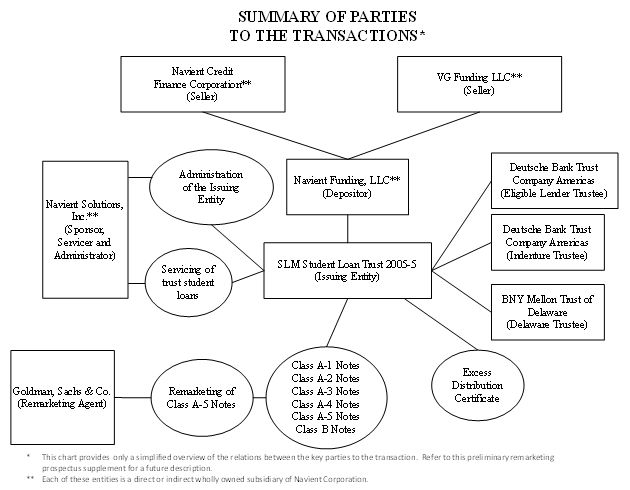
iii
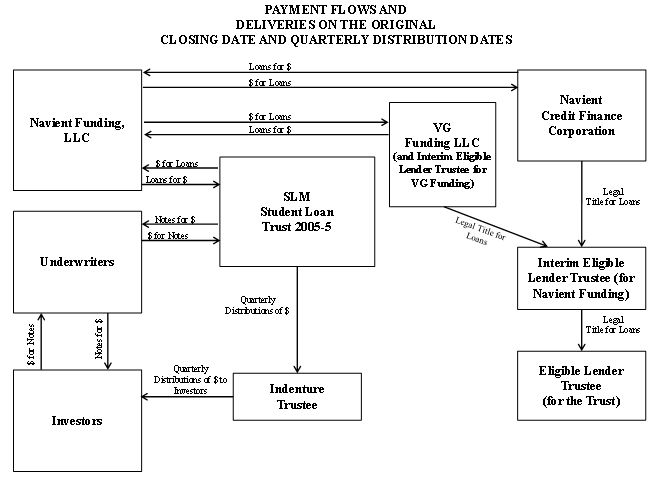
iv
TABLE OF CONTENTS
Free-Writing Prospectus
|
REMARKETING TERMS SUMMARY
|
i
|
|
INTRODUCTION
|
ii
|
|
NOTICES TO INVESTORS
|
vii
|
|
SUMMARY OF NOTE TERMS
|
1
|
|
RISK FACTORS
|
21
|
|
DEFINED TERMS
|
51
|
|
THE TRUST
|
51
|
|
USE OF PROCEEDS
|
56
|
|
AFFILIATIONS AND RELATIONS
|
56
|
|
THE DEPOSITOR
|
57
|
|
NAVIENT CORPORATION
|
58
|
|
THE SPONSOR, SERVICER, ADMINISTRATOR AND SUBSERVICERS
|
59
|
|
THE SELLERS
|
62
|
|
THE TRUST STUDENT LOAN POOL
|
63
|
|
THE COMPANIES’ STUDENT LOAN FINANCING BUSINESS
|
67
|
|
TRANSFER AGREEMENTS
|
72
|
|
SERVICING AND ADMINISTRATION
|
75
|
|
TRADING INFORMATION
|
85
|
|
DESCRIPTION OF THE NOTES
|
87
|
|
INDENTURE
|
125
|
|
CERTAIN LEGAL ASPECTS OF THE STUDENT LOANS
|
130
|
|
STATIC POOLS
|
135
|
|
PREPAYMENTS, EXTENSIONS, WEIGHTED AVERAGE REMAINING LIFE AND EXPECTED MATURITY OF THE CLASS A-5 NOTES
|
136
|
|
RECENT DEVELOPMENTS
|
137
|
|
CERTAIN U.S. FEDERAL INCOME TAX CONSIDERATIONS
|
137
|
|
STATE AND LOCAL TAX CONSEQUENCES
|
146
|
|
ERISA CONSIDERATIONS
|
146
|
|
ACCOUNTING CONSIDERATIONS
|
149
|
|
REPORTS TO NOTEHOLDERS
|
149
|
|
REMARKETING
|
150
|
|
NOTICES TO INVESTORS
|
151
|
|
LISTING INFORMATION
|
152
|
v
|
DEPOSITOR AFFIRMATIONS
|
153
|
|
CERTAIN INVESTMENT COMPANY ACT CONSIDERATIONS
|
154
|
|
RATINGS
|
154
|
|
LEGAL PROCEEDINGS
|
155
|
|
LEGAL MATTERS
|
157
|
|
GLOSSARY
|
157
|
|
ANNEX A:
|
The Trust Student Loan Pool as of November 30, 2025
|
|
APPENDIX A:
|
Federal Family Education Loan Program
|
|
APPENDIX B:
|
Global Clearance, Settlement and Tax Documentation Procedures
|
|
EXHIBIT I:
|
Prepayments, Extensions, Weighted Average Remaining Life and Expected Maturity of the Class A-5 Notes
|
vi
The class A-5 notes may not be offered or sold to persons in the United Kingdom in a transaction that results in an offer to the public within the
meaning of the securities laws of the United Kingdom.
The class A-5 notes are currently listed on the Luxembourg Stock Exchange. You should consult with Deutsche Bank Luxembourg S.A., the Luxembourg
listing agent for the class A-5 notes, for additional information regarding their status.
This free-writing prospectus is not required to contain all information that is required to be included in the final prospectus
supplement. The information in this free-writing prospectus is preliminary and is subject to completion or change. The information in this free-writing prospectus, if conveyed prior to the time of your commitment to purchase any class of notes,
supersedes any information contained in any prior free-writing prospectus relating to the notes.
NOTICES TO INVESTORS
EUROPEAN ECONOMIC AREA
THIS FREE-WRITING PROSPECTUS IS NOT A PROSPECTUS FOR THE PURPOSES OF REGULATION (EU) 2017/1129 (AS AMENDED, THE “EU PROSPECTUS
REGULATION”).
THE CLASS A-5 NOTES ARE NOT INTENDED TO BE OFFERED, SOLD OR OTHERWISE MADE AVAILABLE TO AND SHOULD NOT BE OFFERED, SOLD OR
OTHERWISE MADE AVAILABLE TO ANY EU RETAIL INVESTOR IN THE EUROPEAN ECONOMIC AREA (THE “EEA”). FOR THESE PURPOSES, AN “EU RETAIL INVESTOR” MEANS A PERSON WHO IS ONE (OR MORE) OF: (I) A RETAIL CLIENT AS DEFINED IN POINT (11) OF ARTICLE 4(1) OF
DIRECTIVE 2014/65/EU (AS AMENDED, “MIFID II”); OR (II) A CUSTOMER WITHIN THE MEANING OF DIRECTIVE (EU) 2016/97 (AS AMENDED), WHERE THAT CUSTOMER WOULD NOT QUALIFY AS A PROFESSIONAL CLIENT AS DEFINED IN POINT (10) OF ARTICLE 4(1) OF MIFID II; OR
(III) NOT A QUALIFIED INVESTOR AS DEFINED IN ARTICLE 2 OF THE EU PROSPECTUS REGULATION.
CONSEQUENTLY, NO KEY INFORMATION DOCUMENT REQUIRED BY REGULATION (EU) NO 1286/2014 (AS AMENDED, THE “EU PRIIPS REGULATION”) FOR
OFFERING OR SELLING THE CLASS A-5 NOTES OR OTHERWISE MAKING THEM AVAILABLE TO EU RETAIL INVESTORS IN THE EEA HAS BEEN PREPARED AND THEREFORE OFFERING OR SELLING THE CLASS A-5 NOTES OR OTHERWISE MAKING THEM AVAILABLE TO ANY EU RETAIL INVESTOR IN THE
EEA MAY BE UNLAWFUL UNDER THE EU PRIIPS REGULATION.
UNITED KINGDOM
THIS FREE-WRITING PROSPECTUS IS NOT A PROSPECTUS FOR THE PURPOSES OF REGULATION (EU) 2017/1129 AS IT FORMS PART OF UNITED KINGDOM
(“UK”) DOMESTIC LAW BY VIRTUE OF THE EUROPEAN UNION (WITHDRAWAL) ACT 2018 (AS AMENDED, THE “EUWA”) (AS AMENDED, THE “UK PROSPECTUS REGULATION”).
vii
THE CLASS A-5 NOTES ARE NOT INTENDED TO BE OFFERED, SOLD OR OTHERWISE MADE AVAILABLE TO AND SHOULD NOT BE OFFERED, SOLD OR
OTHERWISE MADE AVAILABLE TO ANY UK RETAIL INVESTOR IN THE UK. FOR THESE PURPOSES, A “UK RETAIL INVESTOR” MEANS A PERSON WHO IS ONE (OR MORE) OF: (I) A RETAIL CLIENT, AS DEFINED IN POINT (8) OF ARTICLE 2 OF COMMISSION DELEGATED REGULATION (EU)
2017/565 AS IT FORMS PART OF UK DOMESTIC LAW BY VIRTUE OF THE EUWA, AND AS AMENDED; OR (II) A CUSTOMER WITHIN THE MEANING OF THE PROVISIONS OF THE FINANCIAL SERVICES AND MARKETS ACT 2000 (AS AMENDED, THE “FSMA”) AND ANY RULES OR REGULATIONS MADE
UNDER THE FSMA TO IMPLEMENT DIRECTIVE (EU) 2016/97 (SUCH RULES OR REGULATIONS, AS AMENDED), WHERE THAT CUSTOMER WOULD NOT QUALIFY AS A PROFESSIONAL CLIENT, AS DEFINED IN POINT (8) OF ARTICLE 2(1) OF REGULATION (EU) NO 600/2014 AS IT FORMS PART OF
UK DOMESTIC LAW BY VIRTUE OF THE EUWA, AND AS AMENDED; OR (III) NOT A QUALIFIED INVESTOR AS DEFINED IN ARTICLE 2 OF THE UK PROSPECTUS REGULATION.
CONSEQUENTLY, NO KEY INFORMATION DOCUMENT REQUIRED BY REGULATION (EU) NO 1286/2014 AS IT FORMS PART OF UK DOMESTIC LAW BY VIRTUE
OF THE EUWA (AS AMENDED, THE “UK PRIIPS REGULATION”) FOR OFFERING OR SELLING THE CLASS A-5 NOTES OR OTHERWISE MAKING THEM AVAILABLE TO UK RETAIL INVESTORS IN THE UK HAS BEEN PREPARED AND THEREFORE OFFERING OR SELLING THE CLASS A-5 NOTES OR
OTHERWISE MAKING THEM AVAILABLE TO ANY UK RETAIL INVESTOR IN THE UK MAY BE UNLAWFUL UNDER THE UK PRIIPS REGULATION.
IN THE UK, THIS FREE-WRITING PROSPECTUS MAY ONLY BE COMMUNICATED OR CAUSED TO BE COMMUNICATED TO PERSONS WHO (A) HAVE
PROFESSIONAL EXPERIENCE IN MATTERS RELATING TO INVESTMENTS AND QUALIFY AS INVESTMENT PROFESSIONALS UNDER ARTICLE 19(5) OF THE FINANCIAL SERVICES AND MARKETS ACT 2000 (FINANCIAL PROMOTION) ORDER 2005 (AS AMENDED, THE “FINANCIAL PROMOTION ORDER”),
(B) ARE PERSONS FALLING WITHIN ARTICLE 49(2)(A) THROUGH (D) (HIGH NET WORTH COMPANIES, UNINCORPORATED ASSOCIATIONS ETC.) OF THE FINANCIAL PROMOTION ORDER OR (C) ARE PERSONS TO WHOM IT MAY OTHERWISE LAWFULLY BE COMMUNICATED OR CAUSED TO BE
COMMUNICATED (ALL SUCH PERSONS, “RELEVANT PERSONS”).
IN THE UK, THIS FREE-WRITING PROSPECTUS MUST NOT BE ACTED ON OR RELIED ON BY PERSONS WHO ARE NOT RELEVANT PERSONS. ANY INVESTMENT
OR INVESTMENT ACTIVITY TO WHICH THIS FREE-WRITING PROSPECTUS RELATES, INCLUDING THE CLASS A-5 NOTES, IS AVAILABLE IN THE UK ONLY TO RELEVANT PERSONS AND WILL BE ENGAGED IN, IN THE UK, ONLY WITH RELEVANT PERSONS. RELEVANT PERSONS SHOULD NOTE THAT
ALL, OR MOST, OF THE PROTECTIONS OFFERED BY THE UNITED KINGDOM REGULATORY SYSTEM WILL NOT APPLY TO AN INVESTMENT IN THE NOTES AND THAT COMPENSATION WILL NOT BE AVAILABLE UNDER THE UNITED KINGDOM FINANCIAL SERVICES COMPENSATION SCHEME.
WHERE APPLICABLE AND SOLELY FOR THE PURPOSES OF EACH MANUFACTURER’S PRODUCT APPROVAL PROCESS, THE TARGET MARKET ASSESSMENT IN
RESPECT OF THE NOTES HAS LED TO THE CONCLUSION THAT: (I) THE TARGET MARKET FOR THE NOTES IS ONLY ELIGIBLE COUNTERPARTIES (AS DEFINED IN THE CONDUCT OF BUSINESS SOURCEBOOK OF THE HANDBOOK OF RULES AND GUIDANCE ADOPTED BY THE UK FINANCIAL CONDUCT
AUTHORITY (“FCA”) (THE “FCA HANDBOOK”)) AND PROFESSIONAL CLIENTS (AS DEFINED IN REGULATION (EU) NO 600/2014 AS IT FORMS PART OF UK DOMESTIC LAW BY VIRTUE OF THE EUWA, AND AS AMENDED); AND (II) ALL CHANNELS FOR DISTRIBUTION OF THE NOTES TO ELIGIBLE
COUNTERPARTIES AND PROFESSIONAL CLIENTS ARE APPROPRIATE. ANY PERSON SUBSEQUENTLY OFFERING, SELLING OR RECOMMENDING ANY NOTES (A “DISTRIBUTOR”) SHOULD, WHERE APPLICABLE, TAKE INTO CONSIDERATION THE MANUFACTURERS’ TARGET MARKET ASSESSMENT; HOWEVER, A
DISTRIBUTOR THAT IS SUBJECT TO THE PRODUCT INTERVENTION AND PRODUCT GOVERNANCE SOURCEBOOK OF THE FCA HANDBOOK IS RESPONSIBLE FOR UNDERTAKING ITS OWN TARGET MARKET ASSESSMENT IN RESPECT OF THE NOTES (WHERE APPLICABLE, BY EITHER ADOPTING OR REFINING
THE MANUFACTURERS’ TARGET MARKET ASSESSMENT) AND DETERMINING APPROPRIATE DISTRIBUTION CHANNELS.
viii
EUROPEAN ECONOMIC AREA INVESTORS AND UK INVESTORS
NONE OF THE SPONSOR, THE SELLERS, THE DEPOSITOR, THE INITIAL PURCHASERS NOR ANY OTHER PERSON WILL UNDERTAKE, OR INTENDS, TO
RETAIN A MATERIAL NET ECONOMIC INTEREST IN THE SECURITIZATION CONSTITUTED BY THE ISSUANCE OF THE NOTES IN A MANNER THAT WOULD SATISFY THE REQUIREMENTS OF (A) REGULATION (EU) 2017/2402 (AS AMENDED, THE “EU SECURITIZATION REGULATION”) OR (B) THE
FRAMEWORK COMPRISING (I) THE SECURITISATION REGULATIONS 2024 (AS AMENDED, THE “SR 2024”), (II) THE SECURITISATION SOURCEBOOK OF THE HANDBOOK OF RULES AND GUIDANCE ADOPTED BY THE FINANCIAL CONDUCT AUTHORITY (“FCA”) OF THE UK (THE “SECN”), (III) THE
SECURITISATION PART OF THE RULEBOOK OF PUBLISHED POLICY OF THE PRUDENTIAL REGULATION AUTHORITY OF THE BANK OF ENGLAND (THE “PRASR”) AND (IV) RELEVANT PROVISIONS OF THE FINANCIAL SERVICES AND MARKETS ACT 2000 (AS AMENDED, THE “FSMA”) (IN EACH CASE
AS AMENDED, SUPPLEMENTED OR REPLACED FROM TIME TO TIME AND, COLLECTIVELY, THE “UK SECURITIZATION FRAMEWORK”) OR TO TAKE ANY OTHER ACTION OR REFRAIN FROM TAKING ANY ACTION PRESCRIBED BY OR CONTEMPLATED IN THE EU SECURITIZATION REGULATION OR THE UK
SECURITIZATION FRAMEWORK, OR FOR PURPOSES OF, OR IN CONNECTION WITH, COMPLIANCE BY ANY INVESTOR WITH THE DUE DILIGENCE REQUIREMENTS OF THE EU SECURITIZATION REGULATION OR THE UK SECURITIZATION FRAMEWORK OR BY ANY PERSON WITH THE REQUIREMENTS OF ANY
OTHER LAW OR REGULATION NOW OR HEREAFTER IN EFFECT IN THE EUROPEAN UNION (THE “EU”), THE EEA OR THE UK IN RELATION TO RISK RETENTION, DUE DILIGENCE AND MONITORING, CREDIT GRANTING STANDARDS, TRANSPARENCY OR ANY OTHER CONDITIONS WITH RESPECT TO
INVESTMENTS IN SECURITIZATION TRANSACTIONS.
CONSEQUENTLY, THE CLASS A-5 NOTES MAY NOT BE A SUITABLE INVESTMENT FOR ANY PERSON THAT IS NOW OR MAY IN THE FUTURE BE SUBJECT TO
ANY REQUIREMENT OF THE EU SECURITIZATION REGULATION OR THE UK SECURITIZATION FRAMEWORK. AS A RESULT, THE PRICE AND LIQUIDITY OF THE CLASS A-5 NOTES IN THE SECONDARY MARKET MAY BE ADVERSELY AFFECTED.
FOR ADDITIONAL INFORMATION REGARDING THE EU SECURITIZATION REGULATION AND THE UK SECURITIZATION FRAMEWORK, SEE “RISK FACTORS —THE
NOTES MAY NOT BE A SUITABLE INVESTMENT FOR EU AND UK INSTITUTIONAL INVESTORS SUBJECT TO THE EU OR UK DUE DILIGENCE REQUIREMENTS.”
ix
FORWARD-LOOKING STATEMENTS
Certain statements contained in or incorporated by reference in this free-writing prospectus consist of forward-looking statements relating to
future economic performance or projections and other financial items. These statements can be identified by the use of forward-looking words such as “may,” “will,” “should,” “expects,” “believes,” “anticipates,” “estimates,” or other comparable
words. Forward-looking statements are subject to a variety of risks and uncertainties that could cause actual results to differ from the projected results. Those risks and uncertainties include, among others, general economic and business
conditions, regulatory initiatives and compliance with governmental regulations, customer preferences and various other matters, many of which are beyond our control. Because we cannot predict the future, what actually happens may be very
different from what is contained in our forward-looking statements.
x
SUMMARY OF NOTE TERMS
This summary highlights selected information about the class A-5 notes. It does not contain all of the information that
you might find important in making your investment decision. It provides only an overview to aid your understanding. You should read the full description of this information appearing elsewhere in this document. We have provided
information in this free-writing prospectus with respect to the other notes in order to further the understanding by potential investors of the class A-5 notes.
ISSUING ENTITY
SLM Student Loan Trust 2005-5.
CLASS A-5 NOTES
The Reset Rate Class A-5 Student Loan‑Backed Notes that are being remarketed hereunder were originally issued by the trust on June 29, 2005 in the principal
amount of $350,000,000 and are currently outstanding in the amount of $234,451,191.58.
The “initial reset date” for the class A-5 notes was January 25, 2010. A failed remarketing was declared with respect to the initial reset date and each
subsequent reset date. Pursuant to the terms of these failed remarketings, (i) the holders of the class A-5 notes were required to retain their notes, (ii) the class A-5 notes were reset to bear interest at the failed remarketing rate, which
is an annual rate equal to the SOFR Rate plus 0.75%, which rate remained in effect after each failed remarketing, and (iii) a three-month reset period ending on the next distribution date was established. We refer to the January 26, 2026
reset date as the “current reset date” in this free-writing prospectus. The legal maturity date for the class A-5 notes is October 25, 2040.
Interest. During the reset period
following the January 26, 2026 reset date, interest will accrue on the outstanding principal balance of the class A-5 notes during each accrual period and will be paid on each distribution date.
If successfully remarketed on the January 26, 2026 reset date, the class A-5 notes, until the end of the accrual period relating to the April 27, 2026 reset
date, will bear interest at an annual rate equal to the SOFR Rate plus % based on the actual number of days elapsed in each accrual period and a 360-day year. Each accrual period during such reset period will begin on a distribution
date and will end on the day before the next distribution date. The next accrual period for the class A-5 notes will begin on January 26, 2026 and end on April 26, 2026.
For each subsequent reset period, the related currency, applicable accrual periods and applicable distribution dates will be determined on the related
remarketing terms determination date as specified under “Description of the Notes—The Reset Rate Notes” and “—Reset Periods” in this free-writing prospectus.
Principal. The class A‑1 notes, the
class A-2 notes, the class A-3 notes and the class A-4 notes, which were earlier in the sequence of principal payments, have been paid in full and are no longer outstanding.
|
|
1
As of the October 2025 distribution date, no principal payments have been made to the class A-5 notes. There may be a payment of principal on the class A-5
notes from the trust on the January 26, 2026 reset date. Payments of principal of the class A-5 notes will be made before the class B notes until retired.
Reset Date Procedures
Remarketing Terms Determination Date. Not later than eight business days prior to the related reset date, which we refer to as the remarketing terms determination date and which, for the class A-5 notes and with respect to the current reset date, is January 13, 2026,
the remarketing agent, in consultation with the administrator, will determine for the class A-5 notes, among other things, the applicable currency, the applicable interest rate mode, whether principal will be paid periodically or at the
end of the related reset period, the index, if applicable, the length of the reset period and the applicable distribution dates, the identities of any potential swap counterparties, if applicable, and the all hold rate.
See “Description of the Notes—The Reset Rate Notes” in this free-writing prospectus.
All Hold Rate. The all hold rate
for the reset rate notes will be the interest rate applicable for the reset rate notes for the next reset period if all holders of the reset rate notes choose not to tender their notes to the remarketing agent for remarketing, which for
the class A-5 notes and the current reset date occurring on January 26, 2026 is equal to an annual rate of the SOFR Rate plus 0.75%.
Tendered Notes. Absent a failed
remarketing, holders of reset rate notes denominated in U.S. Dollars in the then-current reset period and the immediately following reset period (as will be the case for the class A-5 notes assuming a successful remarketing on the January
26, 2026 reset date) that wish to sell some or all of their reset rate notes on a reset date will be able to obtain a 100% repayment of principal by tendering the applicable amount of their reset rate notes pursuant to the remarketing
process. Holders of reset rate notes denominated in a non-U.S. Dollar currency in the then-current reset period or the immediately following reset period will be deemed to have tendered their reset rate notes pursuant to the remarketing
process.
Hold Notices. In connection with the
current reset date, holders of the class A-5 notes will be given until the notice date, which is 12:00 p.m. (noon), New York City time, on the date not less than six business days prior to the related reset date, to choose whether to hold
their notes by delivering a hold notice to the remarketing agent. The notice date with respect to the class A-5 notes and the current reset date is January 21, 2026. Any class A-5 notes for which a hold notice is not timely received on
or prior to the notice date, will be deemed to be tendered and will be remarketed on the related reset date.
Spread Determination Date. Absent
receipt by the remarketing agent of hold notices from 100% of the holders of the class A-5 notes or an exercise of the related call option by Navient Corporation or one of its wholly-owned subsidiaries, the spread will be determined by
the remarketing agent at any time after the notice date but no later than 3:00 p.m., New York City time, on the date which is three business days prior to the related reset date, which we refer to as the spread determination date and
which, for the class A-5 notes and with respect to the current reset date, is any time during the period beginning after 12:00 p.m. (noon), New York City time, on January 21, 2026 and ending at 3:00 p.m., New York City time, on January
21, 2026. The spread for the current reset date will be the lowest spread to the SOFR Rate, but not less than the all hold rate (which is equal to an annual rate of the SOFR Rate plus 0.75% for the class A-5 notes), which would enable
all tendering noteholders to receive a payment equal to 100% of the outstanding principal balance of their reset rate notes. Absent a failed remarketing or an exercise of the related call option by Navient Corporation or one of its
wholly-owned subsidiaries with respect to the January 26, 2026 reset date, the class A-5 notes will be reset to bear interest until April 27, 2026, the next reset date, at an annual floating rate equal to the sum of the SOFR Rate plus
%. The SOFR Rate will be determined as specified under “Description of the Notes—The Notes—Distributions of Interest” in this free-writing prospectus.
|
|
2
Reset Date. Reset dates always occur
on a distribution date and reset periods always end on a distribution date and may not extend beyond the maturity date of the reset rate notes. The current reset date for the class A-5 notes is January 26, 2026. The next scheduled reset
date for the class A-5 notes is April 27, 2026. Holders of class A-5 notes that wish to be repaid on the current reset date will be able to obtain a 100% repayment of principal by tendering their reset rate notes pursuant to the
remarketing process. Tender is mandatory for any reset rate notes that are denominated in a non-U.S. Dollar currency during either the then-current or the immediately following reset period and all holders of such reset rate notes will
be deemed to have tendered their notes on the related reset date. If there is a failed remarketing of the reset rate notes with respect to such reset date, existing holders of such notes will not be permitted to exercise any remedies as
a result of the failure of their reset rate notes to be remarketed on such reset date.
Failed Remarketing. There will be a
failed remarketing for the class A-5 notes with respect to the January 26, 2026 reset date if:
| • |
the remarketing agent, in consultation with the administrator, cannot determine the applicable required reset terms on or before the remarketing terms determination date;
|
| • |
the remarketing agent cannot establish the required spread on the spread determination date;
|
| • |
the remarketing agent is unable to remarket some or all of the tendered reset rate notes at the spread set by the remarketing agent, or one or more committed purchasers default on their
purchase obligations and the remarketing agent chooses not to purchase such reset rate notes itself;
|
| • |
any rating agency then rating the notes has not confirmed or upgraded its then-current rating of any class of notes, if such confirmation is required; or
|
| • |
certain other conditions specified in the remarketing agreement are not satisfied.
|
See “Description of the Notes—The Reset Rate Notes—Tender of Reset Rate Notes; Remarketing
Procedures” in this free-writing prospectus.
In the event a failed remarketing is declared with respect to the class A-5 notes:
| • |
all holders of the class A-5 notes will retain their notes, including in all deemed mandatory tender situations;
|
| • |
the related interest rate for the class A-5 notes will be reset to a failed remarketing rate of the SOFR Rate plus 0.75% per annum; and
|
|
|
3
| • |
the related reset period will be set at three months.
|
Call Option. Navient Corporation,
or one of its wholly-owned subsidiaries (to whom it has the right at any time to transfer such call option), has the option to purchase the class A-5 notes in their entirety as of any reset date. If this right is exercised, the
interest rate for the reset rate notes, which we refer to as the call rate, will be (1) if no related swap agreement was in effect with respect to the reset rate notes during the previous reset period (as has been the case with respect
to the class A-5 notes and the reset period ending on January 26, 2026), the floating rate applicable for the most recent reset period during which the failed remarketing rate was not in effect, or (2) if one or more related swap
agreements were in effect with respect to the reset rate notes during the previous reset period, an annual SOFR-based interest rate equal to the weighted average of the floating rates of interest that the trust paid to the swap
counterparties hedging the currency risk and/or basis risk for the reset rate notes during the preceding reset period.
The call rate will continue to apply for each reset period while Navient Corporation, or any of its wholly-owned subsidiaries, if applicable, retains the
reset rate notes pursuant to its exercise of the call option. In either case, the next reset date for the reset rate notes will occur on the next distribution date.
The administrator will notify the Luxembourg Stock Exchange of any exercise of the call option and will cause a notice to be published in a leading newspaper
having general circulation in Luxembourg, which is expected to be Luxemburger Wort, and/or on the Luxembourg Stock Exchange’s website at http://www.bourse.lu.
See “Description of the Notes—The Reset Rate Notes” in this free-writing prospectus
for a more complete discussion of the remarketing process.
Denominations. The class A-5 notes will be available for purchase in minimum denominations of $100,000 and additional increments of $1,000 in excess thereof. The class A-5 notes
will be available only in book-entry form through The Depository Trust Company, Clearstream, Luxembourg and the Euroclear System. You will not receive a certificate representing your class A-5 notes except in very limited
circumstances.
DATES
The closing date for the original offering was June 29, 2005. We refer to this date as the closing date.
The statistical cutoff date for the original offering was May 30, 2005. We refer to this date as the statistical cutoff date.
Unless otherwise indicated, all information provided in this free-writing prospectus regarding the notes and the pool of trust student loans is presented as
of November 30, 2025. We refer to this date as the statistical disclosure date.
A distribution date for each class of notes is the 25th of each January, April, July and October. If any January 25, April 25, July 25 or October 25 is not
a business day, the distribution date will be the next business day.
Each reset date will occur on a distribution date for the class A-5 notes. The related reset period will always end on a distribution date and may not
extend beyond the maturity date of the class A-5 notes.
|
|
4
Interest and principal will be payable to holders of record as of the close of business on the record date, which is the day before the related distribution
date.
A collection period is the three-month period ending on the last day of March, June, September or December, in each case for the distribution date in the
following month.
PREPAYMENTS, EXTENSIONS, WEIGHTED AVERAGE REMAINING LIFE AND EXPECTED MATURITY OF THE CLASS A-5 NOTES
The projected weighted average remaining life to the April 27, 2026 reset date of the class A-5 notes (and assuming a successful remarketing of such notes on
the current reset date) under various usual and customary prepayment scenarios is approximately 0.25 years. More information may be found under “Prepayments, Extensions,
Weighted Average Remaining Life and Expected Maturity of the Class A-5 Notes,” to be included as Exhibit I to the final remarketing prospectus supplement to
be distributed to potential investors on or prior to the spread determination date.
THE OTHER NOTES
On the closing date, the trust also issued its class A-1, class A-2, class A-3, class A-4 and class B notes, as more specifically described below.
Floating Rate Class A Notes:
| • |
Class A-1 Student Loan-Backed Notes in the original principal amount of $672,000,000, none of which remain outstanding;
|
| • |
Class A-2 Student Loan-Backed Notes in the original principal amount of $420,000,000, none of which remain outstanding;
|
| • |
Class A-3 Student Loan-Backed Notes in the original principal amount of $420,000,000, none of which remain outstanding; and
|
| • |
Class A-4 Student Loan-Backed Notes in the original principal amount of $361,844,000, none of which remain outstanding.
|
Class B Notes:
| • |
Class B Student Loan-Backed Notes in the original principal amount of $68,779,000, and currently outstanding in the amount of $15,780,859.09.
|
We sometimes refer to:
| • |
the floating rate class A notes and the reset rate notes collectively as the class A notes;
|
| • |
the floating rate class A notes and the class B notes as the floating rate notes; and
|
| • |
the floating rate notes and the reset rate notes as the notes.
|
Interest Rates. The outstanding
floating rate notes bear interest at an annual rate equal to the sum of the SOFR Rate and the applicable spread listed in the table below:
|
Class
|
Spread
|
|
|
Class B
|
plus 0.25%
|
For all classes of notes, the administrator determines the SOFR Rate as specified under “Description
of the Notes—The Notes—Distributions of Interest” in this free-writing prospectus. For the floating rate notes, interest is calculated based on the actual
number of days elapsed in each accrual period and a 360-day year.
|
|
5
ALL NOTES
Interest Payments. Interest accrues
on the outstanding principal balance of the notes during each accrual period and is payable on the related distribution date.
An accrual period for the floating rate notes begins on a distribution date and ends on the day before the next distribution date.
An accrual period for reset rate notes that bear a fixed rate of interest will begin on the 25th day of the month of the immediately preceding
distribution date and end on the 24th day of the month of the current distribution date.
Principal Payments. Principal will
be payable or allocable on each distribution date in an amount generally equal to (a) the principal distribution amount for that distribution date plus (b) any shortfall in the payment of principal as of the preceding distribution date.
Priority of Principal Payments. We
will apply or allocate principal sequentially on each distribution date as follows:
| • |
first, the class A noteholders’ principal
distribution amount, to the class A-5 notes until their principal balance is reduced to zero; provided, that either (a) if the class A-5 notes are then denominated in a currency other than U.S. Dollars, any payments due to the
reset rate noteholders will be made to the currency swap counterparty or (b) if the class A-5 notes are then structured not to receive a payment of principal until the end of the related reset period, any payments due to the
reset rate noteholders will be allocated to the accumulation account; and
|
| • |
second, on each distribution date on and after
the stepdown date, and provided that no trigger event is in effect on such distribution date, the class B noteholders’ principal distribution amount, to the class B notes, until their principal balance is reduced to zero.
|
On each distribution date prior to the stepdown date, which occurred on the October 2011 distribution date, the class B notes were not entitled to any
payments of principal. On each distribution date on and after the stepdown date, provided that no trigger event is in effect, the class B notes will continue to be entitled to their pro rata share of principal, subject to the existence
of sufficient available funds.
The stepdown date occurred on the October 2011 distribution date.
The class A noteholders’ principal distribution amount is equal to the principal distribution amount times the class A percentage, which is equal to 100%
minus the class B percentage. The class B noteholders’ principal distribution amount is equal to the principal distribution amount times the class B percentage.
The class B percentage was 0% prior to the stepdown date and will be 0% on any distribution date when a trigger event is in effect. On each other
distribution date, the class B percentage is the percentage obtained by dividing (x) the aggregate principal balance of the class B notes, by (y) the aggregate principal balance, or U.S. Dollar equivalent, of all outstanding notes less
all amounts on deposit, exclusive of any investment earnings, in the accumulation account, in each case determined immediately prior to that distribution date.
|
|
6
A trigger event will be in effect on any distribution date if the outstanding principal balance of the notes, less amounts on deposit in the accumulation
account, exclusive of any investment earnings and after giving effect to distributions to be made on that distribution date, would exceed the adjusted pool balance for that distribution date.
See “Description of the Notes—Distributions” in this free-writing prospectus for a
more detailed description of principal payments.
Maturity Dates.
The class A-1 notes were repaid in full on the July 2009 distribution date. The class A-2 notes were repaid in full on the January 2014 distribution date.
The class A-3 notes were repaid in full on the July 2018 distribution date. The class A-4 notes were repaid in full on the July 2023 distribution date.
Each class of outstanding notes will mature no later than the date set forth in the table below for that class:
|
Class
|
Maturity Date
|
|
|
Class A-5
|
October 25, 2040
|
|
|
Class B
|
October 25, 2040
|
The actual maturity of any class of outstanding notes could occur earlier if, for example:
| • |
there are prepayments on the trust student loans;
|
| • |
the servicer exercises its option to purchase all remaining trust student loans, which will not occur until the first distribution date on which the pool balance is 10% or less of the
initial pool balance; or
|
| • |
the indenture trustee auctions all remaining trust student loans, which absent an event of default under the indenture, will not occur until the first distribution date on which the pool
balance is 10% or less of the initial pool balance.
|
The initial pool balance is equal to the sum of: (i) the pool balance as of the closing date and (ii) all amounts deposited into the supplemental purchase
account and the add‑on consolidation loan account on the closing date.
Subordination of the Class B Notes.
Payments of interest on the class B notes will be subordinate to payments of interest on the class A notes and to certain trust swap payments due to any swap counterparty, if applicable. In general, payments of principal on the class B
notes will be subordinate to the payment of both interest and principal on the class A notes, trust swap payments due to any swap counterparty, if applicable, and any deposits required to be made into any supplemental interest account
or any investment reserve account. See “Description of the Notes—The Notes— The Class B Notes—Subordination of the Class B Notes” in this free-writing
prospectus.
Security for the Notes. The notes
are secured by the assets of the trust, primarily the trust student loans.
|
|
7
Potential Future Interest Rate Cap Agreement. At any time, at the written direction of the administrator, the trust may enter into one or more interest rate cap agreements (collectively, the “potential future interest rate cap agreement”) with one or more eligible swap
counterparties (collectively, the “potential future cap counterparty”) to hedge some or all of the interest rate risk of the notes. Any payment due by the trust to a potential future cap counterparty would be payable only out of funds
available for distribution under clause (p)(1) of “Description of the Notes—Distributions—Distributions from the Collection Account” in this free-writing
prospectus. Any payments received from a potential future cap counterparty would be included in available funds. It is not anticipated that the trust would be required to make any payments to any potential future cap counterparty
under any potential future interest rate cap agreement other than an upfront payment and, in some circumstances, a termination payment. See “Description of the
Notes—Potential Future Interest Rate Cap Agreement” in this free-writing prospectus.
As of the January 26, 2026 reset date, the trust will not have entered into any potential future interest rate cap agreements.
INDENTURE TRUSTEE AND PAYING AGENT
The trust issued the notes under an indenture dated as of June 1, 2005. Under the indenture, Deutsche Bank National Trust Company acts as successor
indenture trustee for the benefit of, and to protect the interests of, the noteholders and acts as paying agent for the notes.
LUXEMBOURG PAYING AGENT
If the rules of the Luxembourg Stock Exchange require a Luxembourg paying agent, the depositor will cause one to be appointed.
ELIGIBLE LENDER TRUSTEE
Deutsche Bank Trust Company Americas, a New York banking corporation, is the successor eligible lender trustee under the trust agreement. It holds legal
title to the assets of the trust.
DELAWARE TRUSTEE
BNY Mellon Trust of Delaware, a Delaware banking corporation, is the Delaware trustee. The Delaware trustee acts in the capacities required under the
Delaware Statutory Trust Act and under the trust agreement. Its principal Delaware address is 301 Bellevue Parkway, 3rd Floor, Wilmington, Delaware 19809.
REMARKETING AGENT
The remarketing agent will be entitled to a fee on each reset date in connection with a successful remarketing of the reset rate notes from amounts on
deposit in the remarketing fee account. In connection with a successful remarketing of the class A-5 notes on the January 26, 2026 reset date, the remarketing agent will be paid a remarketing fee by the trust in an amount that will not
exceed $845,621.93. As of the October 2025 distribution date, there was $845,621.93 on deposit in the remarketing fee account. The trust will also be obligated to reimburse the remarketing agent, on a subordinated basis, for certain
out-of-pocket expenses incurred in connection with each reset date.
ADMINISTRATOR AND SPONSOR
Navient Solutions, LLC (formerly known as Navient Solutions, Inc.) is the sponsor of the trust and acts as the administrator of the trust under an
administration agreement dated as of the closing date. Navient Solutions, LLC is a Delaware limited liability company and a wholly-owned subsidiary of Navient Corporation. Subject to certain conditions, Navient Solutions, LLC may
transfer its obligations as administrator to an affiliate. We sometimes refer to Navient Solutions, LLC as Navient Solutions.
|
|
8
INFORMATION ABOUT THE TRUST
The trust is a Delaware statutory trust created under a trust agreement dated as of June 9, 2005.
The only activities of the trust that are currently permitted are acquiring, owning and managing the trust student loans and the other assets of the trust,
issuing and making payments on the notes, entering into any required swap agreements or potential future interest rate cap agreements and other related activities. See “The
Trust—General” in this free-writing prospectus.
Navient Funding, LLC (formerly known as SLM Funding LLC), as depositor, after acquiring the student loans from one of VG Funding LLC (“VG Funding”) or
Navient Credit Finance Corporation (formerly known as “SLM Education Credit Finance Corporation”) (“Navient CFC”) under separate purchase agreements, sold them to the trust on the closing date under a sale agreement (we sometimes refer
to Navient CFC and VG Funding as the “sellers”). The depositor is a limited liability company of which Navient CFC is the sole member. Chase Bank USA, National Association, as interim eligible lender trustee, initially held legal
title to the student loans for the depositor under an interim trust arrangement prior to their transfer to the trust and then as eligible lender trustee for the benefit of the trust under the trust agreement. Deutsche Bank Trust
Company Americas now serves as successor interim eligible lender trustee for the depositor and successor eligible lender trustee on behalf of the trust.
Its Assets
The assets of the trust include:
| • |
the trust student loans;
|
| • |
collections and other payments on the trust student loans;
|
| • |
funds it currently holds or will hold from time to time in its trust accounts, including a collection account; a reserve account; an accumulation account; a supplemental interest account;
an investment reserve account; an investment premium purchase account; a remarketing fee account; and if the class A-5 notes are denominated in a currency other than U.S. Dollars, a currency account;
|
| • |
its rights under the transfer and servicing agreements, including the right to require VG Funding (or Navient Solutions, LLC, as servicer, acting on its behalf), Navient CFC, the
depositor or the servicer to repurchase trust student loans from it or to substitute loans under certain conditions;
|
| • |
its rights under any swap agreement or potential future interest rate cap agreement, as applicable; and
|
| • |
its rights under the guarantee agreements with guarantors.
|
The rest of this section more fully describes the trust student loans and trust accounts.
Trust Student Loans. The trust
student loans (including the initial trust student loans, any additional trust student loans and any add-on consolidation loans) are education loans to students and parents of students made under the Federal Family Education Loan
Program, known as the FFELP. All of the trust student loans are consolidation loans.
Consolidation loans are used to combine a borrower’s or borrowers’ obligations under various federally authorized student loan programs into a single loan.
See “Appendix A—Federal Family Education Loan Program” in this free-writing prospectus.
|
|
9
The trust student loans were selected from student loans owned by Navient CFC or VG Funding, or their affiliates, based on the criteria established by the
depositor, as described in this free-writing prospectus.
Guaranty agencies described in this document guarantee all of the trust student loans. They are also reinsured by the Department of Education (which we refer
to as the Department of Education).
Initial Trust Student Loans. The
initial trust student loans had a pool balance of approximately $2,219,695,622.97 as of the closing date. On the closing date, $5,800,325.68 was deposited into the supplemental purchase account and during the supplemental purchase
period, $5,773,827.55 aggregate principal balance of trust student loans was added to the pool balance through the purchase of additional student loans using funds on deposit in the supplemental purchase account. On the closing date,
$10,000,000 was deposited into the add-on consolidation loan account and during the consolidation loan add-on period, $7,069,998.12 aggregate principal balance of trust student loans was added to the pool balance through the purchase of
add-on consolidation loans using funds on deposit in the add-on consolidation loan account. The trust student loans have a pool balance of approximately $244,613,468
as of the statistical disclosure date.
As of the statistical disclosure date, (i) the weighted average annual borrower interest rate of the trust student loans was approximately 4.04% and (ii) their
weighted average remaining term to scheduled maturity was approximately 161 months.
Special allowance payments on 0.33% of the trust student loans by principal balance (as of the statistical disclosure date) are based on the 91-day treasury
bill rate. Special allowance payments on 99.67% of the trust student loans by principal balance (as of the statistical disclosure date) are based on the 30-day SOFR index.
For more details concerning the trust student loans as of the statistical disclosure date, see “Annex A—The Trust Student Loan Pool” attached to this free-writing prospectus.
Collection Account. The administrator
established and maintains the collection account as an asset of the trust in the name of the indenture trustee. The administrator will deposit collections on the trust student loans, interest subsidy payments and special allowance
payments into the collection account, as described in this free-writing prospectus.
Reserve Account. The administrator
established and maintains the reserve account as an asset of the trust in the name of the indenture trustee. As of the October 2025 distribution date, the amount on deposit in the reserve account was $3,353,244.00. Funds in the reserve
account may be replenished on each distribution date by additional funds available after all prior required distributions have been made. See “Description of the
Notes—Distributions.”
The specified reserve account balance is the amount required to be maintained in the reserve account. The specified reserve account balance for any
distribution date will be equal to the greater of (a) 0.25% of the pool balance at the end of the related collection period and (b) $3,353,244.00. The specified reserve account balance will be subject to adjustment as described in this
free-writing prospectus. In no event will it exceed the outstanding principal balance of the notes, less all amounts then on deposit in the accumulation account (exclusive of investment earnings), if any.
|
|
10
Amounts remaining in the reserve account in excess of the specified reserve account balance on any distribution date, after the payment of amounts described
below, will be deposited into the collection account for distribution on that distribution date.
The reserve account will be available to cover any shortfalls in payments of the primary servicing fee, the administration fee, the remarketing fees, if any,
the class A noteholders’ interest distribution amount (but only up to an annual interest rate equal to the SOFR Rate plus 0.75% in the case of the class A-5 notes), the class B noteholders’ interest distribution amount, payments due to
any swap counterparty with respect to interest, if applicable, and certain swap termination payments. As of the October 2025 distribution date, amounts on deposit in the reserve account have not been required for these purposes.
In addition, the reserve account will be available:
| • |
on the related maturity date for each class of class A notes and upon termination of the trust, to cover shortfalls in payments of the class A noteholders’ principal and accrued interest
to the related class of notes; and
|
| • |
on the class B maturity date and upon termination of the trust, to cover shortfalls in payments of the class B noteholders’ principal and accrued interest, any carryover servicing fees,
any remaining swap termination payments and remarketing fees and expenses.
|
The reserve account enhances the likelihood of payment to noteholders. In certain circumstances, however, the reserve account could be depleted which could
result in shortfalls in distributions to noteholders.
On any distribution date, if the market value of the reserve account, together with amounts on deposit in any supplemental interest account, is sufficient to
pay the remaining principal and interest accrued on the notes and any carryover servicing fees, amounts on deposit in those accounts will be so applied on that distribution date. See “Description of the Notes—Credit Enhancement—Reserve Account” in this free-writing prospectus.
Capitalized Interest Account. All
funds on deposit in the capitalized interest account that was created and funded on the closing date were transferred to the collection account on the October 2006 distribution date. No additional sums were subsequently or will be
deposited into this account.
Remarketing Fee Account. The
administrator established and maintains a remarketing fee account as an asset of the trust in the name of the indenture trustee, for the benefit of the remarketing agent and the class A noteholders. On the January 2009 distribution
date, which was the distribution date one year prior to the initial reset date for the class A-5 notes, the trust began to deposit into the remarketing fee account available funds up to the related quarterly required amount. The trust
is required to make such deposits on each related distribution date until the balance on deposit in the remarketing fee account reaches the targeted level for the related reset date, prior to the payment of interest on the notes. As of
the January 26, 2026 reset date, the required amount for this account will not exceed $845,621.93. As of the October 2025 distribution date, there was $845,621.93 on deposit in the remarketing fee account.
11
Investment earnings on deposit in the remarketing fee account are withdrawn on each distribution date, deposited into the collection account and included in
available funds for that distribution date. In addition, if on any distribution date, a class A note interest shortfall would exist, or if on the maturity date for any class of class A notes, available funds would not be sufficient to
reduce the principal balance of that class to zero, the amount of that class A note interest shortfall or principal deficiency, as applicable, may be withdrawn from the remarketing fee account and used for payment of interest or principal
on the class A notes, to the extent sums are on deposit in that account. See “Description of the Notes—The Reset Rate Notes—Tender of Reset Rate Notes; Remarketing
Procedures” in this free-writing prospectus.
Accumulation Account. The
administrator will establish and maintain, in the name of the indenture trustee, an accumulation account for the benefit of the class A-5 notes whenever such notes are structured not to receive a payment of principal until the end of
the related reset period (as will be the case in any future reset period during which the class A-5 notes are reset to bear interest at a fixed rate or are denominated in a currency other than U.S. Dollars). With respect to each
related reset period, on each distribution date, the indenture trustee will deposit any payments of principal allocated to the class A-5 notes, in U.S. Dollars, into the accumulation account. All sums on deposit in the accumulation
account, including any amounts deposited into the accumulation account on the related distribution date, but exclusive of investment earnings, will be paid either:
| • |
if the class A-5 notes are then denominated in U.S. Dollars, on the next reset date, to the reset rate noteholders, after all other required distributions have been made on that reset
date; or
|
| • |
if the class A-5 notes are then denominated in a currency other than U.S. Dollars, on or about the next reset date, to the currency swap counterparty or counterparties, which will in turn
pay the applicable currency equivalent of those amounts to the trust, for payment to the reset rate noteholders on the second business day following the related reset date, after all other required distributions have been made on
that reset date.
|
Amounts on deposit in the accumulation account (exclusive of investment earnings) may be used only to pay principal on the class A-5 notes or to the currency
swap counterparty or counterparties and for no other purpose. Investment earnings on deposit in the accumulation account will be withdrawn on each distribution date, deposited into the collection account and included as a part of
available funds for that distribution date.
Amounts on deposit in the accumulation account may be invested in eligible investments that can be purchased at a price equal to par, at a discount, or at
a premium. Eligible investments may be purchased at a premium over par only if there are sufficient amounts on deposit in the investment premium purchase account described below to pay the amount of the purchase price in excess of par.
As of the October 2025 distribution date there were no amounts on deposit in the accumulation account.
|
|
12
Investment Premium Purchase Account.
When required, the administrator will establish and maintain, in the name of the indenture trustee, an investment premium purchase account related to the accumulation account. On each distribution date when funds are deposited into the
accumulation account, the indenture trustee will be required to deposit, subject to sufficient available funds, an amount generally equal to 1.0% of the amount deposited into the accumulation account into the investment premium purchase
account, together with any carryover amounts from previous distribution dates if there were insufficient available funds on any previous distribution date to make the required deposits in full.
Amounts on deposit in the investment premium purchase account may be used from time to time to pay amounts in excess of par on eligible investments purchased
with funds on deposit in the accumulation account. Amounts not used to pay such premium purchase amounts will become a part of available funds on future distribution dates pursuant to a formula set forth in the administration agreement.
As of the October 2025 distribution date there were no amounts on deposit in the investment premium purchase account.
Investment Reserve Account. When
required, the administrator will establish and maintain, in the name of the indenture trustee, an investment reserve account related to the accumulation account. On any distribution date, and to the extent of available funds, if the
ratings of any eligible investments in the accumulation account have been downgraded by one or more rating agencies, the indenture trustee will deposit into the investment reserve account an amount, if any, to be set by each applicable
rating agency in satisfaction of the rating agency condition, which amount will not exceed the amount of the unrealized loss on the related eligible investments. On each distribution date, all amounts on deposit in the investment
reserve account either will be withdrawn from the investment reserve account and deposited into the accumulation account in an amount required to offset any realized losses on eligible investments related to the accumulation account, or
will be deposited into the collection account to be included as a part of available funds on that distribution date.
As of the October 2025 distribution date there were no amounts on deposit in the investment reserve account.
Supplemental Interest Account. When
required, the administrator will establish and maintain, in the name of the indenture trustee, a supplemental interest account related to the accumulation account.
On each distribution date when amounts are deposited into or are on deposit in the accumulation account, the administrator will cause the indenture trustee,
subject to sufficient available funds, to make a deposit into the supplemental interest account. This deposit will equal the amount sufficient to pay either to the reset rate noteholders or to each swap counterparty, as applicable, the
floating rate payments due to the reset rate noteholders or the swap counterparty, as applicable, through the next distribution date at the related SOFR-based floating rate on all amounts on deposit in the accumulation account, after
giving effect to an assumed rate of investment earnings on that account.
All amounts on deposit in the supplemental interest account will be withdrawn on or before each distribution date, deposited into the collection account and
included as a part of available funds for that distribution date.
As of the October 2025 distribution date there were no amounts on deposit in the supplemental interest account.
|
|
13
ADMINISTRATION OF THE TRUST
Distributions
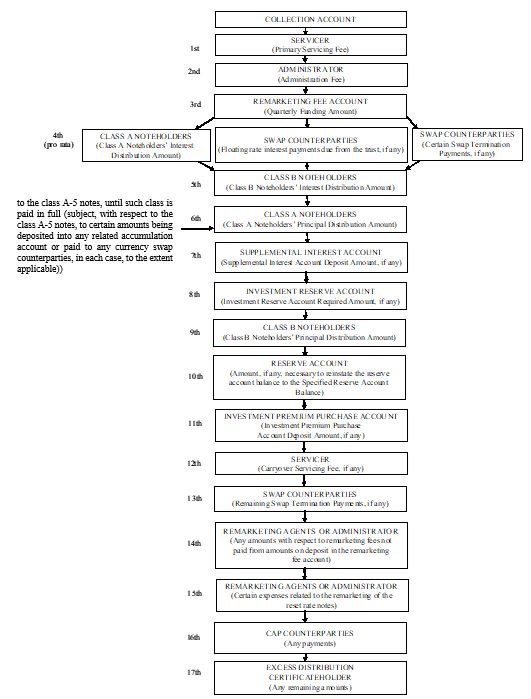
Navient Solutions, LLC, as administrator, will instruct the indenture trustee to withdraw funds on deposit in the collection account and the other
accounts, as described above. These funds will be applied on or before each applicable distribution date generally as shown in the chart on the following page. Funds on deposit in the collection account and, to the extent required, the
reserve account will be applied monthly to the payment of the primary servicing fee.
See “Description of the Notes— Distributions” in this free-writing prospectus for
a more detailed description of distributions.
|
|
14
15
Transfer of the Assets to the Trust
Under a sale agreement, the depositor sold the trust student loans to the trust, with the eligible lender trustee holding legal title to the trust student
loans.
If the depositor breaches a representation under the sale agreement regarding a trust student loan, generally the depositor will have to cure the breach,
repurchase or replace that trust student loan or reimburse the trust for losses resulting from the breach.
Each seller has similar obligations under the purchase agreements. See “Transfer and
Servicing Agreements—Purchase of Student Loans by the Depositor; Representations and Warranties of the Sellers” in this free-writing prospectus.
Servicing of the Assets
Under a servicing agreement, Navient Solutions, LLC, as servicer, is responsible for servicing, maintaining custody of and making collections on the trust
student loans. It also bills and collects payments from the guaranty agencies and the Department of Education.
The servicer manages and operates the loan servicing functions for the Navient Corporation family of companies. The servicer may enter into subservicing
agreements with respect to some or all of its servicing obligations, but these arrangements will not affect the servicer’s obligations to the trust. Under some circumstances, the servicer may transfer its obligations as servicer.
If the servicer breaches a covenant under the servicing agreement regarding a trust student loan, generally it will have to cure the breach, purchase that trust student loan or reimburse the trust for losses resulting from the breach.
See “The Trust Student Loan Pool—Insurance of Trust Student Loans; Guarantors of Trust Student Loans” in this free-writing prospectus.
Navient Solutions appointed Higher Education Loan Authority of the State of Missouri, a body politic and corporate and public instrumentality of the State of
Missouri, to act as a subservicer to service substantially all of the loan servicing functions of Navient Solutions, LLC pursuant to a subservicing agreement. We sometimes refer to Higher Education Loan Authority of the State of Missouri
as MOHELA or a subservicer. See “The Sponsor, Servicer, Administrator and Subservicers” in this free-writing prospectus.
Compensation of the Servicer
The servicer receives two separate fees: a primary servicing fee and a carryover servicing fee.
The primary servicing fee for any month is equal to 1/12th of an amount not to exceed 0.50% of the outstanding principal
amount of the trust student loans.
The primary servicing fee is payable in arrears out of available funds and amounts on deposit in the reserve account on the 25th day of each month, or if the
25th day is not a business day, then on the next business day. Fees are calculated as of the first day of the preceding calendar month. Fees include amounts from any prior monthly servicing payment dates that remain unpaid.
The carryover servicing fee is payable to the servicer on each distribution date out of available funds.
The carryover servicing fee is the sum of:
| • |
the amount of specified increases in the costs incurred by the servicer;
|
|
|
16
| • |
the amount of specified conversion, transfer and removal fees;
|
| • |
any amounts described in the first two bullets that remain unpaid from prior distribution dates; and
|
| • |
interest on any unpaid amounts.
|
See “Description of the Notes—Servicing Compensation” in this free-writing
prospectus.
TERMINATION OF THE TRUST
The trust will terminate upon:
| • |
the maturity or other liquidation of the last trust student loan and the disposition of any amount received upon its liquidation; and
|
| • |
the payment of all amounts required to be paid to the noteholders.
|
Optional Purchase
The servicer may purchase or arrange for the purchase of all remaining trust student loans on any distribution date when the pool balance is 10% or less of
the initial pool balance.
The exercise of this purchase option will result in the early retirement of the remaining notes, including an early distribution of all amounts then on
deposit in the accumulation account. The purchase price will equal the amount required to prepay in full, including all accrued and unpaid interest, the remaining trust student loans as of the end of the preceding collection period, but
will not be less than a prescribed minimum purchase amount.
This prescribed minimum purchase amount is the amount that would be sufficient to:
| • |
pay to noteholders the interest payable on the related distribution date; and
|
| • |
reduce the outstanding principal amount of each class of notes then outstanding on the related distribution date to zero, taking into account all amounts then on deposit in the
accumulation account.
|
For these purposes, if the class A-5 notes:
| • |
are then structured not to receive a payment of principal until the end of the related reset period, the outstanding principal balance of the class A-5 notes will be deemed to have been
reduced by any amounts on deposit, exclusive of any investment earnings, in the accumulation account; and/or
|
| • |
are then denominated in a non-U.S. Dollar currency, the U.S. Dollar equivalent of the then-outstanding principal balance of the class A-5 notes will be determined based upon the exchange
rate provided for in the currency swap agreement or agreements.
|
The pool balance as of the statistical disclosure date is approximately 10.88% of the initial pool balance.
Auction of Trust Assets
The indenture trustee will offer for sale all remaining trust student loans at the end of the first collection period when the pool balance is 10% or less of
the initial pool balance.
|
|
17
The trust auction date will be the third business day before the related distribution date. An auction will be consummated only if the servicer has first
waived its optional purchase right as described above. The servicer will waive its option to purchase the remaining trust student loans if it fails to notify the eligible lender trustee and the indenture trustee, in writing, that it
intends to exercise its purchase option before the indenture trustee accepts a bid to purchase the trust student loans. The depositor and its affiliates, including Navient CFC and the servicer, and unrelated third parties may offer bids
to purchase the trust student loans. The depositor or any affiliate may not submit a bid representing greater than fair market value of the trust student loans.
If at least two bids are received, the indenture trustee will solicit and re-solicit new bids from all participating bidders until only one bid remains or
the remaining bidders decline to resubmit bids. The indenture trustee will accept the highest of the remaining bids if it equals or exceeds the higher of (a) the minimum purchase amount described under “—Optional Purchase” above (plus any amounts owed to the servicer as carryover servicing fees); or (b) the fair market value of the trust student loans as of the end of the related collection
period.
If at least two bids are not received or the highest bid after the re-solicitation process does not equal or exceed the amount in the immediately preceding
paragraph, the indenture trustee will not complete the sale. The indenture trustee may, and at the direction of the depositor will be required to, consult with a financial advisor, including any of the original underwriters of the notes,
or the administrator, to determine if the fair market value of the trust student loans has been offered. See “Description of the Notes—Auction of Trust Assets” in
this free-writing prospectus.
The net proceeds of any auction sale, plus all amounts, exclusive of investment earnings, then on deposit in the accumulation account, will be used to retire
any outstanding notes on the related distribution date.
If the sale is not completed, the indenture trustee may, but will not be under any obligation to, solicit bids for sale of the trust student loans after
future collection periods upon terms similar to those described above, including the servicer’s waiver of its option to purchase remaining trust student loans.
If the trust student loans are not sold as described above, on each subsequent distribution date, if the amount on deposit in the reserve account after
giving effect to all withdrawals, except withdrawals payable to the depositor, exceeds the specified reserve account balance, the administrator will direct the indenture trustee to distribute the amount of the excess as accelerated
payments or allocations of note principal.
The indenture trustee may or may not succeed in soliciting acceptable bids for the trust student loans either on the trust auction date or on subsequent
distribution dates.
See “Description of the Notes—Auction of Trust Assets” in this free-writing
prospectus.
TAX CONSIDERATIONS
Subject to important considerations described in this free-writing prospectus:
| • |
Special tax counsel to the trust is of the opinion that the class A-5 notes will be characterized as debt for U.S. federal income tax purposes.
|
| • |
Special tax counsel to the trust is of the opinion that the trust will not be characterized as an association taxable as a corporation or a publicly traded partnership taxable as a
corporation for U.S. federal income tax purposes.
|
|
|
18
| • |
Delaware tax counsel for the trust is of the opinion that the same characterizations will apply for Delaware state income tax purposes as for U.S. federal income tax purposes and
noteholders who were not otherwise subject to Delaware taxation on income would not become subject to Delaware tax as a result of their ownership of notes.
|
By acquiring a note, you agree to treat the note as indebtedness. See “Certain U.S. Federal Income Tax Considerations” in this free writing prospectus and “U.S. Federal Income Tax
Consequences” in the original prospectus.
ERISA CONSIDERATIONS
Subject to important considerations and conditions described in this free-writing prospectus, the class A-5 notes may, in general, be purchased by or on
behalf of an employee benefit plan or other retirement arrangement, including an insurance company general account, only if:
| • |
an exemption from the prohibited transaction provisions of Section 406 of the Employee Retirement Income Security Act of 1974, as amended, and Section 4975 of the Internal Revenue Code of
1986, as amended, applies, so that the purchase or holding of the class A-5 notes will not result in a non-exempt prohibited transaction; and
|
| • |
the purchase or holding of the class A-5 notes will not cause a non-exempt violation of any substantially similar federal, state, local or foreign laws.
|
See “ERISA Considerations” in this free-writing prospectus for additional
information concerning the application of ERISA.
RATINGS
The notes are currently rated as follows:
| • |
class A-5 notes: “AA+sf” by Fitch, “Baa1 (sf)”
by Moody’s and “AA+ (sf)” by S&P.
|
| • |
class B notes: “Asf” by Fitch, “Baa1 (sf)” by
Moody’s and “AA (sf)” by S&P.
|
See “Ratings” in this free-writing prospectus.
CERTAIN INVESTMENT COMPANY ACT CONSIDERATIONS
The issuing entity will be relying on an exclusion or exemption from the definition of “investment company” under the Investment Company Act of 1940, as
amended (the “Investment Company Act”), contained in Rule 3a-7 under the Investment Company Act, although there may be additional exclusions or exemptions available to the issuing entity. The issuing entity, as structured, does not
constitute a “covered fund” for purposes of the Volcker Rule under the Dodd-Frank Act (both as defined in this free-writing prospectus). See “Certain Investment Company
Act Considerations” in this free-writing prospectus for more information.
AFFILIATIONS AND RELATIONS
Navient Funding, LLC, as depositor, is a wholly-owned subsidiary of Navient Credit Finance Corporation, a seller, and is an affiliate of Navient Solutions,
LLC, the sponsor, servicer and administrator.
|
|
19
None of the depositor, the sponsor, the issuing entity or any of their affiliates have (and have not within the past two years) entered into any business
relationship, agreement, arrangement, transaction or understanding with the initial purchasers, eligible lender trustee or indenture trustee, that would be material to an investor’s understanding of the notes and that is outside the
ordinary course of business or is on terms other than would be obtained in an arm’s length transaction with an unrelated third party.
See “Affiliations and Relations” in this free-writing prospectus.
LISTING INFORMATION
The class A-5 notes are currently listed on the Luxembourg Stock Exchange. You should consult with Deutsche Bank Luxembourg S.A., the Luxembourg listing
agent for the notes, for additional information regarding their status. You can contact the listing agent at 2 Boulevard Konrad Adenauer L-1115, Luxembourg.
So long as the class A-5 notes are listed on the Luxembourg Stock Exchange, and its rules so require, notices relating to that class of notes, including if
any of such class is delisted, will be published in a leading newspaper having general circulation in Luxembourg, which is expected to be Luxemburger Wort and/or on the Luxembourg Stock Exchange’s website at: http://www.bourse.lu.
The class A-5 notes are currently able to be cleared and settled through Clearstream, Luxembourg and Euroclear.
RISK FACTORS
Some of the factors you should consider before making an investment in the class A‑5 notes are described in this free-writing prospectus under “Risk Factors.”
IDENTIFICATION NUMBERS
The class A-5 notes have the following identification numbers:
|
CUSIP Number
|
78442G PR 1
|
|
International Securities Identification Number (ISIN)
|
US78442GPR10
|
|
European Common Code
|
022343688
|
|
|
20
RISK FACTORS
You should carefully consider the following risk factors in order to understand the structure and characteristics of the class A-5 notes and the
potential merits and risks of an investment in the class A-5 notes. Potential investors must review and become familiar with the following risk factors in deciding whether to purchase the class A-5 notes. All of these risk factors could affect
your investment in or return on the class A-5 notes.
|
General Risks
|
|||
|
Federal Financial Regulatory Legislation Or Economic Relief Legislation Could Have An Adverse Effect On Navient Corporation, Navient Solutions, LLC, The
Servicer, The Administrator, The Depositor, The Sellers And The Trust, Which Could Result In Losses Or Delays In Payments On Your Notes
|
The Dodd-Frank Wall Street Reform and Consumer Protection Act of 2010 (the “Dodd-Frank Act”) has resulted in significant new regulation in key areas of the business of Navient Corporation (formerly known as SLM Corporation), the direct parent of Navient Solutions, LLC and the indirect parent of Navient
Funding, LLC, and its affiliates and the markets in which Navient Corporation, the sponsor and their affiliates operate. Pursuant to the Dodd-Frank Act, Navient Corporation and many
of its subsidiaries are subject to regulations promulgated by the Consumer Financial Protection Bureau (the “CFPB”). The CFPB has substantial power to define the rights of consumers and the responsibilities of certain institutions,
including Navient Corporation, the sponsor and their affiliates, in connection with their education loan origination and servicing businesses. In addition, the CFPB has the authority to bring enforcement actions against student lenders
and student loan servicers for violations of federal consumer protection regulations and with respect to acts or practices that the CFPB determines to be unfair, deceptive or abusive. In one
action brought by the CFPB in December 2021, the U.S. District Court for the District of Delaware held that a securitization trust is a “covered person” under the Dodd-Frank Act because it engages in the servicing of loans, even if
through servicers and subservicers. The U.S. Court of Appeals for the Third Circuit affirmed the district court, holding that the defendant trusts are “covered persons” under the Dodd-Frank Act and subject to the CFPB’s enforcement
authority. However, a proposed settlement order was never entered by the district court, and the CFPB and the trusts filed a joint stipulation of voluntary dismissal of the case, which was dismissed with prejudice by the district court
in April 2025.
|
21
|
In addition, the CFPB filed a separate complaint in May 2024 against the National Collegiate Student Loan Trusts (“NCSL Trusts”), as well as the Pennsylvania
Higher Education Assistance Agency (“PHEAA”), the primary student loan servicer for active student loans held by the NCSL Trusts, as part of a settlement with the NCSL Trusts and PHEAA. The CFPB alleged that the defendants failed to respond
to borrower requests, failed to provide accurate information to borrowers and incorrectly denied forbearance requests. The CFPB also filed proposed final judgments, to which the NCSL Trusts and PHEAA agreed, that, once entered by the
court, would have required the NCSL Trusts and PHEAA to pay $400,000 and $1.75 million in civil penalties, respectively; to pay an additional $3 million in redress to affected borrowers, to be allocated by agreement between PHEAA and the
NCSL Trusts; and to correct outstanding requests by borrowers. The proposed orders would have also required the NCSL Trusts to modify their servicing guidelines to address the CFPB’s allegations. Following intervention by a third party
and various procedural motions, the parties ultimately agreed to the terms of a proposed settlement conditioned on the district court partially vacating or modifying the stipulated judgments previously entered by the district court. The
settlement was approved and all appeals dismissed with prejudice in January 2026, providing a final resolution to the matter.
The CFPB and state attorneys general, who have the independent authority to enforce the Dodd-Frank Act, may rely on these decisions as precedent in
investigating and bringing enforcement actions against other securitization issuers, such as the trust, in the future.
It is likely that operational expenses of Navient Corporation, the sponsor or their affiliates will increase if new or additional compliance requirements under
the Dodd-Frank Act are imposed on their operations, and their competitiveness could be significantly affected if they are subjected to supervision and regulatory standards not otherwise applicable to their competitors.
In the recent past, various borrower relief and debt forgiveness programs have been enacted by legislation and executive orders, including the Coronavirus
Aid, Relief, and Economic Security Act. While these programs have only applied to federal loans, there is no assurance that future financial regulatory legislation or economic relief legislation will not directly or indirectly affect the
trust student loans, or otherwise affect the servicer’s business.
|
|||
|
There Is Uncertainty As To How The Actions Of The Consumer Financial Protection Bureau And Other Governmental Authorities Could Impact The Sponsor’s Business
|
The CFPB has broad authority over the businesses in which the sponsor engages. This includes authority to write regulations under federal consumer financial
protection laws, such as the Truth in Lending Act and the Equal Credit Opportunity Act, and to enforce those laws against large depository institutions and certain non-depository institutions, and to examine large depository institutions
and certain non-depository institutions for compliance. Each of these laws may also be enforced by the FTC. And while the CFPB is authorized to prevent “unfair, deceptive or abusive acts or practices” through its regulatory, supervisory
and enforcement authority, the FTC has the ability to prevent “unfair or deceptive acts or practices” through its enforcement authority.
|
22
|
To assist in its enforcement, both the CFPB and the FTC maintain online complaint systems that allow consumers to log complaints with respect to various
consumer finance products. This system could inform future CFPB and FTC decisions with respect to its regulatory, enforcement or examination focus.
The sponsor is subject to the CFPB’s jurisdiction, including its enforcement authority, as an originator of consumer credit, and participates in its online
complaint system. The CFPB may therefore request reports concerning the sponsor’s organization, business conduct, markets and activities. The CFPB may also conduct on-site examinations of the sponsor’s business on a periodic basis if the
CFPB were to determine—based on, for example, consumer complaints, judicial opinions, or administrative decisions—that the sponsor was engaging in activities that pose risks to consumers.
Actions by the CFPB or other regulators or governmental authorities against the sponsor that suggest to consumers the desirability of other loan products or
services could result in reputational harm and a loss of borrowers or investors. The sponsor’s compliance costs and litigation exposure could increase materially if the CFPB or other regulators or governmental authorities enact new
regulations, change regulations that were previously adopted, modify, through supervision or enforcement, past regulatory guidance, or interpret existing regulations in a manner different or stricter than have been previously interpreted.
Other continued legal challenges to the scope of the CFPB and its structure could create uncertainty in the general regulatory environment.
|
|||
|
The Bankruptcy Of The Depositor, Navient CFC Or Any Other Seller Could Delay Or Reduce Payments On Your Notes
|
We have taken steps to assure that the voluntary or involuntary application for relief by the depositor, Navient CFC, which is the sole member of the
depositor, or any other applicable seller under the United States Bankruptcy Code or other insolvency laws will not result in consolidation of the assets and liabilities of the trust with those of the depositor, Navient CFC and the other
sellers. However, we cannot guarantee that the activities of the depositor, the sellers, the sponsor or the trust will not result in a court concluding that the trust’s assets and liabilities should be consolidated with those of the
depositor, Navient CFC or any other seller in a proceeding under any insolvency law. If a court were to reach this conclusion or a filing were made under any insolvency law by or against us, or if an attempt were made to litigate this
issue, then delays in distributions on the notes or reductions in these amounts could result.
|
23
|
Navient CFC, the other sellers of the student loans and the depositor intend that each transfer of student loans to the trust will constitute a true sale. If
such transfer constitutes a true sale, the student loans and their proceeds would no longer be considered property of the depositor, Navient CFC or the other sellers should any such seller become subject to an insolvency law.
If the depositor, Navient CFC or any other seller were to become subject to an insolvency law, and a creditor, a trustee-in-bankruptcy or the seller itself
were to take the position that the sale of student loans from the related seller to the depositor should instead be treated as a pledge of the student loans to secure a borrowing of that seller, delays in payments on the notes could occur.
In addition, if the court ruled in favor of this position, reductions in the amount of payments on the notes could result.
|
|||
|
The Bankruptcy Of The Servicer Or A Subservicer Could
Delay The Appointment Of A Successor Servicer Or
Subservicer Or Reduce Payments On Your Notes
|
In the event of a default by the servicer resulting solely from certain events of insolvency or the bankruptcy of the servicer or a subservicer, a court conservator, receiver
or liquidator (including the FDIC) may have the power to prevent any of the servicer, the trust, the indenture trustee or the noteholders, as applicable, from appointing a successor servicer or prevent the servicer from appointing a
successor subservicer or servicing the trust student loans itself, as the case may be, and delays in the collection of payments on the trust student loans may occur. It may also be difficult to find a third party to act as successor
servicer or subservicer, and the trust may have to increase the servicing fee in order to obtain such successor servicer or subservicer. Any resulting delay in the collection of payments on the affected trust student loans may delay or
reduce payments to noteholders. In addition, in the event of an insolvency or a bankruptcy of the servicer or a subservicer, a court, conservator, receiver or liquidator may permit the servicer or a subservicer, as applicable, to assign its
rights and obligations as servicer to a third party without complying with the provisions of the transaction documents.
|
24
|
The Securitization Conflicts Of Interest Rule May Affect Securitization Participants
|
On November 27, 2023, the SEC issued Rule 192 pursuant to Section 27B of the Securities Act (the “Securitization Conflicts of Interest Rule”) for the purpose
of implementing a prohibition against a securitization participant with respect to an asset-backed security from directly or indirectly entering into a transaction that would involve or result in a material conflict of interest with any
investor in such asset-backed security, subject to exceptions for risk-mitigating hedging activities, liquidity commitments and bona-fide market making activities. The Securitization Conflicts of Interest Rule became effective on February
5, 2024, and securitization participants are required to comply with the Securitization Conflicts of Interest Rule with respect to any asset-backed security, the first closing of the sale of which occurs on or after June 9, 2025. Under the
Securitization Conflicts of Interest Rule, a “securitization participant” is an underwriter, placement agent, initial purchaser or sponsor of an asset-backed security or certain affiliates or subsidiaries of any such party. Additionally,
the Securitization Conflicts of Interest Rule includes an “anti-evasion” provision that prohibits a securitization participant from engaging in any transaction or a series of related transactions that, although in technical compliance with
one of the exceptions to the rule, is part of a plan or scheme to evade the prohibitions of the rule.
There remains uncertainty regarding how the Securitization Conflicts of Interest Rule will be applied, including what penalties may result
from non-compliance. To the extent that a securitization participant violates the rule, then the resulting penalties and reputational harm may materially and adversely affect the liquidity and value of the remarketing notes and the
securitization participant’s ability to fulfill its contractual obligations under the transaction documents.
|
||
|
Risks Related To The Notes
|
|||
|
Because The Notes May Not Provide Regular Or Predictable Payments, You May Not Receive The Return On Your Investment That You Expected
|
The notes may not provide a regular or predictable schedule of payments or payment on any specific date. Accordingly, you may not receive the return on your investment that you
expected.
|
25
|
The Notes Are Not Suitable Investments For All Investors
|
The class A-5 notes are complex investments that should be considered only by investors who, either alone or with their financial, tax and legal advisors, have the expertise to
analyze the prepayment, reinvestment, default and market risk, and tax consequences of such an investment, as well as the interaction of these factors. You should not purchase the class A-5 notes unless you understand the structural,
prepayment, credit, liquidity and market risks associated with the class A-5 notes, the regulatory and enforcement risks relating to the trust student loans, the tax consequences of an investment in the class A-5 notes and the interaction
of the foregoing factors. The interaction of the factors described in this free-writing prospectus and other factors that may affect the class A-5 notes and their combined effects on the class A-5 notes are not possible to predict with
meaningful certainty and are likely to change from time to time. As a result, an investment in the class A-5 notes involves substantial risks and uncertainties and should be considered only by sophisticated institutional investors with
substantial investment experience with similar types of securities and who have conducted an appropriate analysis of the class A-5 notes. Prospective investors must be able to bear the risk of loss (including total loss) on their
investment in the class A-5 notes.
|
||
|
Illiquid Market Conditions May Occur From Time To Time
|
From time to time, the secondary market for your class A‑5 notes may be adversely affected by a deterioration of general economic conditions, periods of
general market illiquidity or by events in the global financial markets in general or in the securitization market in particular. See “Risk Factors —Current General Economic
Conditions, Or A Further Deterioration of Economic Conditions, May Increase the Risk of Loss on Your Investment” in this free-writing prospectus. For example, the failures of Silicon Valley Bank, Signature Bank, First Republic
Bank and Republic First Bank dba Republic Bank and the intervention of the Swiss National Bank resulting in the acquisition of Credit Suisse AG by UBS Group AG have resulted in significant concern regarding the health of other banking
institutions and the ability of such institutions to withstand the economic conditions posed by rapidly increasing interest rates including a decline in value of securities and loan portfolios. It is unclear what impact such bank failures
will have, for how long any associated impact may last and whether there will be additional bank failures, and as a result the liquidity and market value of the notes may be adversely affected.
Additionally, on August 1, 2023, Fitch Ratings, Inc. downgraded the U.S. government’s credit rating from AAA to AA+, citing rising debt at the federal, state,
and local levels and a steady deterioration in standards of governance (including debt ceiling negotiations that threatened the government’s ability to pay its bills). It is unclear what impact such downgrade will have, for how long any
associated impact may last and whether there will be additional downgrades, and as a result the liquidity and market value of the notes may be adversely affected.
Accordingly, you may not be able to sell your class A‑5 notes when you want to do so or you may be unable to obtain the price that you wish to receive for your
class A‑5 notes and, as a result, you may suffer a loss on your investment.
|
26
|
To the extent of a failure of a bank at which the collection account, the trust accounts or any other account under the transaction documents is maintained, such failure could
result in a delay or failure by noteholders to receive the funds held in such accounts and, unless such accounts are held as trust accounts or the FDIC applies its systemic risk exception, only $250,000 in any such account would be
federally insured. Although it is not clear at this time what impact such bank failures, any further bank failures or any receiverships, acquisitions or government seizures of banks or other financial institutions will have and for how
long any associated impact may last, the liquidity and market value of the notes may be adversely affected and investors may not be able to sell their Notes following the closing date.
|
|||
|
The Appointment Of A New Subservicer Could Result In Temporary Disruptions In Normal Servicing Activities During The Transition
|
As discussed in “—The Sponsor, Servicer, Administrator and Subservicers”,
Navient Solutions appointed MOHELA as a subservicer to perform substantially all of the loan servicing functions of Navient Solutions as servicer. Navient Solutions remains the named servicer under the servicing agreement, and the
appointment of MOHELA as a subservicer does not relieve Navient Solutions of its liability under the servicing agreement. Although MOHELA is a recognized student loan servicer, it had not previously serviced the trust student loans prior
to July 1, 2024, when it began subservicing the trust student loans on behalf of Navient Solutions.
Student loans are subject to a variety of consumer protection laws. The federal and state consumer protection laws, rules and regulations applicable to the
solicitation and advertising for, underwriting of, granting, servicing and collection of student loans, and the protection of sensitive customer data, frequently provide for administrative penalties, as well as civil (and in some cases,
criminal) liability resulting from their violation. An administrative proceeding, litigation, investigation or regulatory action relating to one or more allegations or findings of the violation of such laws by the sponsor, the servicer,
the sellers, the administrator, the trust or prior owners of the student loans, including the depositor or other affiliates of the aforementioned parties (whether by an administrative agency, a borrower or a group or class of borrowers)
could result in modifications in the servicer’s methods of doing business which could impair the servicer’s ability to service the student loans or collect on the student loans or result in the requirement that the aforementioned parties
pay damages and/or cancel the balance or other amounts owing under a student loan associated with such violations. See “Navient Corporation” in this preliminary remarketing memorandum.
|
27
|
The trust student loans are originated using standardized documentation. Thus, many borrowers may be similarly situated insofar as the provisions of their contractual
obligations are concerned. Accordingly, certain allegations of violations of the provisions of applicable federal or state consumer protection laws could potentially result in a large class of claimants asserting claims against the
sponsor, the servicer, or the trust. Moreover, that documentation includes provisions requiring arbitration before a borrower brings certain lawsuits. These provisions are intended to limit litigation against the originator and purchasers
of the student loans while complying with applicable case law.
|
|||
|
School Closures And Unlicensed Schools May Result In Losses On Your Notes
|
Some of the trust student loans are subject to the so-called “Holder-in-Due-Course” rule of the Federal Trade Commission (the “Holder Rule”) the provisions of
which are similar to those contained in the Uniform Consumer Credit Code and in state statutes and common law of many states. The effect of these laws is to subject a seller (and certain lenders and their assignees, such as the trust) in a
consumer credit transaction to all claims and defenses which the obligor in the transaction can assert against the seller of the goods or services. Some courts have held that consumers can bring affirmative claims under the Holder Rule,
while other courts have only permitted consumers to raise it as a defense. Although the exact scope of the types of claims and defenses that a consumer can assert against a holder have been subject to interpretation by the courts, the trust
as holder of the trust student loans may be subject to any claims or defenses that the student borrower may assert against its school for failure of the school to satisfy its obligations under the enrollment agreement with the student as a
result of a school closure, a school bankruptcy or otherwise. If a student borrower is successful in asserting such a claim, the student borrower may have the right to recover from the trust payments previously made on the related trust
student loan and have a defense against making further payments. In this event, to the extent available funds and credit enhancement are insufficient to cover such amounts, you may suffer a loss on your investment.
|
28
|
In addition, generally state law requires schools engaged in providing educational services in their state to be licensed by a state regulatory authority. In most states, if a
school is not licensed at the time the student signs the enrollment agreement, the enrollment agreement may be void and, as a result, the student will have a defense against repayment of the loan. To the extent that a related school became
unlicensed prior to the student signing the enrollment agreement, the related borrower may have the right to recover payments previously made on the related trust student loan and may have a defense against further payment. There is also a
possibility that a school has failed to maintain its license under applicable law since the origination of the related trust student loans, and in such event, the related borrower may be entitled to the claims or defenses with respect to
payments on its trust student loan described above. In either of these instances, to the extent available funds and credit enhancement is insufficient to cover such amounts, you may suffer a loss on your investment.
|
|||
|
The Issuing Entity Will Have Limited Assets From Which To Make Payments On The Notes, Which May Result In Losses
|
The issuing entity will not have, nor will it be permitted to have, significant assets or sources of funds other than the pool of trust student loans and the
related guarantee agreements. The issuing entity will also have a reserve account established in the issuing entity’s name.
Consequently, you must rely upon payments on the trust student loans from the borrowers and guarantors, as applicable, and, if available, amounts on deposit in
the trust accounts described above, and overcollateralization to repay your notes. If these sources of funds are unavailable or insufficient to make payments on your notes, you may experience a loss on your investment.
|
||
|
Your Notes Will Have A Degree Of Basis Risk, Which Could Compromise The Trust’s Ability To Pay Principal And Interest On Your Notes
|
There is a degree of basis risk associated with the class A-5 notes. Basis risk is the risk that shortfalls might occur because, among other things, while the
effective interest rates of the trust student loans adjust on the basis of specified indices and those of the notes adjust on the basis of a different SOFR index, different indices or, with respect to the reset rate notes at a time when
such notes are in fixed rate mode, do not adjust at all. If a shortfall were to occur, the trust’s ability to pay principal of and/or interest on your notes could be compromised. See “Annex A—The Trust Student Loan Pool—Composition of the Trust Student Loans as of the Statistical Disclosure Date” in this free-writing prospectus which specifies the percentages of trust student loans that
adjust based on 30-day SOFR or the 91-day Treasury bill rate, as applicable.
If the interest rates on the trust student loans decline or the interest rate on a class of notes increases, this could decrease the amount of collections
available to make interest and principal payments on the notes. This would increase the risk that there may not be sufficient collections to make all required payments on the notes.
|
29
|
A Change To The Interest Benchmark For The Special Allowance Payments On The Trust Student Loans May Have An Adverse Effect On Your Notes
|
In the event that SOFR is no longer available to calculate special allowance payments based on 30-day Average SOFR, on or after July 1, 2023, as applicable for certain FFELP
loans, it is possible that the Department of Education may choose a replacement rate for 30-day Average SOFR for the purpose of determining special allowance payments and, if such replacement rate is different than any potential replacement
rate selected by the administrator with respect to the trust and the trust does not subsequently enter into an amendment to adopt the same replacement rate as selected by the Department of Education, such replacement rate may worsen the
basis risk associated with the floating rate notes. See “—Your Notes Will Have A Degree Of Basis Risk, Which Could Compromise The Trust’s Ability To Pay Principal And
Interest On Your Notes,” above.
|
||
|
You May Be Unable To Reinvest Principal Payments At The Yield You Earn On The Notes
|
Asset-backed notes usually produce increased principal payments to investors when market interest rates fall below the interest rates on the collateral—student loans in this
case—and decreased principal payments when market interest rates rise above the interest rates on the collateral. As a result, you are likely to receive more money to reinvest at a time when other investments generally are producing lower
yields than the yield on the notes. Similarly, you are likely to receive less money to reinvest when other investments generally are producing higher yields than the yield on the notes.
|
||
|
Withdrawal Or Downgrade Of Ratings May Decrease The Prices Of Your Notes
|
A security rating is not a recommendation to buy, sell or hold securities. Similar ratings on different types of securities do not necessarily mean the same thing. A rating
agency may revise or withdraw its rating at any time if it believes circumstances have changed. A subsequent downgrade in the rating on your notes is likely to decrease the price a subsequent purchaser will be willing to pay for your
notes.
|
||
|
A Conflict Of Interest May Exist Between The Rating Agencies Engaged To Rate The Notes And The Transaction Parties
|
The SEC has taken the position that being paid by the sponsor, issuer or an underwriter to issue and/or maintain a credit rating on asset backed securities may create a
conflict of interest for rating agencies, and that this potential conflict is particularly acute because arrangers of asset-backed securities transactions provide repeat business to such rating agencies. Potential investors in the class
A-5 notes should make their own determinations regarding whether such a conflict of interest actually exists, whether any such potential conflict of interest impacts a rating from any retained rating agency and the weight given to any
particular rating in making an investment decision in the class A-5 notes.
|
30
|
A Further Lowering Of The Credit Rating Of The United States Of America May Adversely Affect The Market Value Of Your Notes
|
The credit rating of the United States may potentially be downgraded by one or more nationally recognized statistical rating organizations (an “NRSRO”) within the meaning of
Section 3(a)(62) of the Securities Exchange Act of 1934, as amended (the “Exchange Act”). The impact of any such potential downgrades is unknown, and depending on any lowered rating assigned, the stated reasons for a lower rating and other
factors, the liquidity, market value and regulatory characteristics of your notes could be materially and adversely affected.
|
||
|
Certain Actions Can Be Taken Without Noteholder Approval
|
The transaction documents provide that certain actions may be taken based upon receipt by the indenture trustee of a confirmation from each of the rating agencies that the
then-current ratings assigned by the rating agencies then rating the notes will not be downgraded or withdrawn by those actions. In this event, such actions may be taken without the consent of noteholders.
|
||
|
Investments May Be Subject To An Array Of EU and UK Investment Laws, Regulations, Rules And Capital Requirements And The Notes May Not Be A Suitable Investment
For Certain Investors
|
All prospective investors in the notes whose investment activities are subject to legal investment laws, regulations and rules, regulatory capital
requirements, or review by regulatory authorities should consult with their own legal, accounting and other advisors in determining whether, and to what extent, the notes will constitute legal investments for them or are subject to
investment or other restrictions, unfavorable accounting treatment, capital charges, reserve requirements or other consequences. Regulation (EU) 2017/2402 of the European Parliament and of the Council of December 12, 2017 (as amended, the
“EU Securitization Regulation”) has direct effect in member states of the European Union (the “EU”) and is expected to be implemented in other countries in the European Economic Area (the “EEA”).
Article 5 of the EU Securitization Regulation places certain conditions on investments in a “securitisation” (as defined in such regulation) (the “EU Due
Diligence Requirements”) by an “institutional investor”, defined in the EU Securitization Regulation to include insurance undertakings, reinsurance undertakings, institutions for occupational retirement provision, investment managers and
authorized entities appointed by such institutions, alternative investment fund managers that manage and/or market alternative investment funds in the EU (or, as applicable, in the EEA), management companies of undertakings for collective
investment in transferable securities (“UCITS”), internally managed UCITS, credit institutions and investment firms, each as described in more detail in the EU Securitization Regulation. The EU Due Diligence Requirements also apply to
investments by certain consolidated affiliates, wherever established or located, of entities that are subject to Regulation (EU) No 575/2013 (as amended) (such affiliates, together with all institutional investors referred to in this
paragraph, “EU Affected Investors”).
|
31
|
The framework for the regulation of securitization in the United Kingdom (the “UK”) comprises (a) the Securitisation Regulations 2024 (as amended, the “SR
2024”), (b) the securitisation sourcebook of the handbook of rules and guidance adopted by the UK Financial Conduct Authority (the “SECN”), (c) the Securitisation Part of the rulebook of published policy of the Prudential Regulation
Authority of the Bank of England (the “PRASR”) and (d) relevant provisions of the Financial Services and Markets Act 2000 (as amended, the “FSMA”) (each as further amended, supplemented or replaced and, collectively, the “UK Securitization
Regulation Framework”).
Regulations 32B to 32D (inclusive) of the SR 2024, SECN 4 and Article 5 of Chapter 2 of the PRASR, as applicable, place certain conditions on investments in a
“securitisation” (as defined in the SR 2024) (the “UK Due Diligence Requirements”) by “institutional investors”, defined in the SR 2024 to include insurance undertakings, reinsurance undertakings, trustees and managers of occupational
pension schemes, fund managers of such schemes, alternative investment fund managers that have permission under the FSMA in respect of managing alternative investment funds and that market or manage such funds in the UK, small registered UK
alternative investment fund managers, UCITS, UCITS management companies, CRR firms and FCA investment firms, each as described in more detail in the SR 2024. The UK Due Diligence Requirements also apply to investments by certain
consolidated affiliates, wherever established or located, of entities that are subject to Regulation (EU) No 575/2013, as it forms part of the domestic law of the UK by virtue of the European Union (Withdrawal) Act 2018 (as amended, the
“EUWA”) (and as amended) (such affiliates, together with all institutional investors referred to in this paragraph, “UK Affected Investors”).
|
32
|
Among other things, the EU Due Diligence Requirements and the UK Due Diligence Requirements provide that, prior to investing in a securitisation, an EU
Affected Investor or a UK Affected Investor, as applicable, is required to verify that: (a) certain credit-granting requirements are satisfied; (b) the originator, sponsor or original lender retains on an ongoing basis (or, in the case of
certain UK Affected Investors, continually retains) a material net economic interest in the securitisation which, in any event, will not be less than 5%, in accordance with the EU Securitization Regulation or the UK Securitization
Framework, as applicable, and discloses that risk retention; (c) in the case of an EU Affected Investor, the originator, sponsor or securitization special purpose entity has, where applicable, made available the information required by
Article 7 of the EU Securitization Regulation in accordance with the frequency and modalities provided for in that Article; and (d) in the case of a UK Affected Investor, the originator, sponsor or securitization special purpose entity has
made available sufficient information to enable the institutional investor independently to assess the risks of holding the securitisation position, and has committed to make further information available on an ongoing basis, as
appropriate, and including at least the information described in the SR 2024, the SECN or the PRASR, as applicable.
None of the sponsor, the sellers, the depositor, the initial purchasers, the other parties to the transaction described in this offering memorandum, nor any of
their respective affiliates, will undertake, or intends, to retain a material net economic interest in such transaction in a manner that would satisfy the requirements of the EU Securitization Regulation or the UK Securitization Framework.
In addition, no such person will undertake, or intends, in connection with such transaction, to take any other action or refrain from taking any action
prescribed or contemplated in the EU Securitization Regulation or the UK Securitization Framework, or for purposes of, or in connection with, compliance by any EU Affected Investor with the EU Due Diligence Requirements, by any UK Affected
Investor with the UK Due Diligence Requirements or by any person with the requirements of any other law or regulation now or hereafter in effect in the EU, the EEA or the UK in relation to risk retention, due diligence and monitoring,
credit granting standards, transparency or any other conditions with respect to investments in securitization transactions.
The arrangements described in “Credit Risk Retention” in this offering memorandum have not been structured with the objective of enabling or facilitating
compliance with the requirements of the EU Securitization Regulation or the UK Securitization Framework.
Consequently, the notes may not be a suitable investment for an EU Affected Investor or a UK Affected Investor. As a result, the price and liquidity of the
notes in the secondary market may be adversely affected.
|
33
|
Failure by an EU Affected Investor to comply with the EU Due Diligence Requirements or by a UK Affected Investor to comply with the UK Due Diligence
Requirements, in either case with respect to an investment in the notes, may result in the imposition of a penalty regulatory capital charge on that investment or other regulatory sanctions and/or remedial measures being imposed or taken by
such investor’s relevant regulatory authority.
Prospective investors are responsible for analyzing their own legal and regulatory position and are encouraged to consult with their own investment and legal
advisors regarding the suitability of the notes for investment and the scope and applicability of, and compliance with, the requirements of the EU Securitization Regulation and UK Securitization Framework.
|
|||
|
The Notes May Be Repaid Early Due To An Auction Sale Or The Exercise Of The
Optional Purchase Right. If This Happens, Your Yield May Be Affected And You Will Bear Reinvestment Risk
|
The notes may be repaid before you expect them to be if:
• the
servicer exercises its option to purchase all of the trust student loans; or
• the
indenture trustee successfully conducts an auction sale.
Either event would result in the early retirement of the notes outstanding on that date. If this happens, your yield on the notes may be affected. You will
bear the risk that you cannot reinvest the money you receive in comparable notes at an equal yield.
|
34
|
Uncertainty About A Change To The Benchmark For The Floating Rate Notes May Have An Adverse Effect On Your Floating Rate Notes
|
The interest rates on the class A-5 rate notes is based on a benchmark plus a spread. For all reset periods prior to the July 2023 reset period, the class A-5
notes bore interest by reference to a LIBOR-based index plus a spread. In response to the prospective cessation of US-dollar LIBOR and to address the difficulties of dealing with legacy LIBOR contracts, Congress enacted the Adjustable
Interest Rate (LIBOR) Act (the “LIBOR Act”), as part of the Consolidated Appropriations Act, 2022. The LIBOR Act provides that for any asset backed-securities backed by FFELP loans that have an adjustable rate based on three-month LIBOR
and for which no replacement index is specified in the governing documents, such as the class A-5 notes, the replacement benchmark was established as 90-day Average SOFR plus a specified tenor spread adjustment on the first London business
day after June 30, 2023. As a result, commencing with the reset period that began on July 25, 2023 and each subsequent reset period prior to a successful remarketing, the class A-5 notes will bear interest by reference to SOFR Rate. The
“SOFR Rate” will be a per annum rate equal to 90-day Average SOFR for such reset period plus the tenor spread adjustment equal to 0.26161% per annum, as specified in the LIBOR Act. The SOFR Rate will be reset on each reset date in
accordance with the procedures set forth under “Description of the Notes—Determination of Indices—SOFR” in this free-writing prospectus. The LIBOR Act also provides
for the adoption of benchmark replacements if SOFR is no longer available.
The benchmark will change in the event of a benchmark replacement following the occurrence of a benchmark transition event and its related benchmark
replacement date (as further described in this free-writing prospectus under “Description of the Notes—Determination of Indices”).
The Federal Reserve Bank of New York, or the “FRBNY”, publishes the Secured Overnight Funding Rate (“SOFR”) based on data received by it from sources other
than the sponsor, and neither the sponsor nor any other party to the transaction described in this free-writing prospectus has any control over its calculation methods, publication schedule, rate revision practices or availability of SOFR
at any time. There can be no guarantee, particularly given its relatively recent introduction, that SOFR will not be discontinued or fundamentally altered in a manner that is materially adverse to the interests of investors in the class A-5
notes. If the manner in which SOFR is calculated is changed, that change may result in a reduction in the amount of interest payable on the class A-5 notes and the trading prices of the class A-5 notes.
|
35
|
Further, as described under “Description of the Notes—Determination of Indices” in
this free-writing prospectus, in the event a benchmark transition event and its related benchmark replacement date have occurred, the benchmark replacement will depend on the availability of various benchmark rates set forth in this
free-writing prospectus. These benchmark rates may be calculated using components different from those used in the calculation of the SOFR Rate and may fluctuate differently than, and not be representative of, the SOFR Rate. In order to
compensate for these differences in the benchmark replacements, a benchmark replacement adjustment may be included in any benchmark replacement. However, we cannot provide any assurances that any benchmark replacement adjustment will be
sufficient to produce the economic equivalent of the then-current benchmark, either at the benchmark replacement date or over the life of the floating rate notes. As a result of each of the foregoing factors, we cannot provide any
assurances that the characteristics of any benchmark will be similar to the then-current benchmark that it is replacing, or that any benchmark replacement will produce the economic equivalent of the then-current benchmark that it is
replacing.
Additionally, the determination of any benchmark replacement, the calculation of the interest rate on the class A-5 notes by reference to a benchmark
replacement (including the application of any benchmark replacement adjustment), any implementation of benchmark replacement conforming changes and any other determinations, decisions or elections that may be made under the terms of the
class A-5 notes in connection with a benchmark transition event, could adversely affect the value of the class A-5 notes, the return on the class A-5 notes and the price at which class A-5 noteholders can sell such class A-5 notes.
Furthermore, the issuing entity cannot anticipate how long it will take to adopt a specific benchmark replacement, which may delay and contribute to uncertainty and volatility surrounding any benchmark transition event or benchmark
replacement.
The administrator will have discretion in certain elements of any benchmark replacement process, including determining if a benchmark transition event and its
related benchmark replacement date have occurred, determining which benchmark replacement is available and, if applicable, selecting an unadjusted benchmark replacement, determining the benchmark replacement adjustment and making benchmark
replacement conforming changes. The noteholders will not have any right to approve or disapprove of these changes and will be deemed to have agreed to waive and release any and all claims relating to any such determinations. See “Description of the Notes—Determination of Indices” in this free-writing prospectus.
|
36
|
Any of the above matters or any other significant change to the setting or existence of the SOFR Rate or any successor benchmark for the floating rate notes could affect the
amounts available to the issuing entity to meet its obligations under the floating rate notes and/or could have a material adverse effect on the value or liquidity of, and the amount payable under, the floating rate notes.
|
37
|
SOFR Is A Relatively New Reference Rate That May Be More Volatile Than Other Benchmark Or Market Rates And Its Composition And Characteristics Are Not The Same
As LIBOR
|
For reset periods that commenced before July 2023, class A-5 notes accrued interest at a floating rate based on three-month LIBOR plus a spread. Commencing
with the reset period that began on July 25, 2023 and each subsequent reset period prior to a successful remarketing, class A-5 notes accrued or will accrue interest at a floating rate based on a spread over a benchmark rate, which will be
the SOFR Rate. The SOFR Rate is based on compounded averages of SOFR, which are used to determine Compounded SOFR. For information on how the SOFR Rate and Compounded SOFR are determined, you should read “Description of the Notes—Determination of Indices” in this free-writing prospectus. The secured overnight financing rate published for any day by the FRBNY on the FRBNY’s website, or by a successor
administrator of such benchmark rate on such successor’s website, is a relatively new interest rate index, and the way that SOFR and any market-accepted adjustments to SOFR are determined may change over time.
SOFR is intended to be a broad measure of the cost of borrowing cash overnight collateralized by U.S. Treasury securities. SOFR is calculated as a
volume-weighted median of transaction-level tri-party repo data collected from The Bank of New York Mellon as well as General Collateral Finance Repo transaction data and data on bilateral Treasury repo transactions cleared through The
Fixed Income Clearing Corporation’s delivery-versus-payment service. The FRBNY notes that it obtains information from DTCC Solutions LLC, an affiliate of The Depository Trust & Clearing Corporation. The FRBNY states on its publication
page for SOFR that the use of SOFR is subject to important limitations and disclaimers, including that the FRBNY may alter the methods of calculation, publication schedule, rate revision practices or availability of SOFR at any time without
notice.
SOFR is published by the FRBNY based on data received from sources outside of the sponsor and the issuing entity’s control or direction and neither the sponsor
nor the issuing entity has control over its determination, calculation or publication. In contrast to other indices, SOFR may be subject to direct influence by activities of the FRBNY, which may directly affect prevailing SOFR rates in ways
the issuing entity is unable to predict. There can be no guarantee that SOFR will not be discontinued or fundamentally altered in a manner that is materially adverse to the interests of the holders of the class A-5 notes. If the manner in
which the SOFR calculation is changed, it may result in a reduction of the amount of interest payable on and the trading prices of the class A-5 notes.
|
38
|
The FRBNY began to publish SOFR in April 2018, and the FRBNY has also been publishing historical indicative SOFR dating back to 2014. Potential investors
should not rely on any historical changes or trends in SOFR as an indicator of future changes or trends in SOFR. Due to the emerging and developing adoption of SOFR as an interest rate index, investors who desire to obtain financing for
their class A-5 notes may have difficulty obtaining any credit or credit with satisfactory interest rates, which may result in lower leveraged yields and lower secondary market prices upon the sale of the class A-5 notes.
The composition and characteristics of SOFR are not the same as those of LIBOR. First, SOFR is a secured rate, while LIBOR is an unsecured rate. Second, SOFR
is an overnight rate, while LIBOR is a forward-looking rate that represents interbank funding over different maturities (e.g., three months). Additionally, since the initial publication of SOFR, daily changes in SOFR have, on occasion, been
more volatile than daily changes in other benchmark or market rates, such as LIBOR. Although changes in the SOFR Rate, which is determined by reference to Compounded SOFR (as defined under “Description of the Notes—Determination of Indices” in this free-writing prospectus), generally are not expected to be as volatile as changes in the daily levels of SOFR, the return on and value of the class A-5
notes may fluctuate more than floating rate debt securities that are linked to less volatile rates. As a result, there can be no assurance that SOFR will perform in the same way as LIBOR would have at any time, including, without
limitation, as a result of changes in interest and yield rates in the market, market volatility or global or regional economic, financial, political, regulatory, judicial or other events.
|
39
|
Reliance Upon Compounded SOFR, And Any Adjustments To The Methodology Used To Determine Compounded SOFR, May Adversely Affect The Class A-5 Notes
|
The FRBNY began to publish, in March 2020, backward-looking compounded averages of SOFR, which are used to determine Compounded SOFR. It is possible that there
will be limited interest in securities products based on Compounded SOFR. In addition, forward-looking Term SOFR became available for use in cash products in 2021. It is possible that there will be relatively more interest in securities
products based on Term SOFR as compared to securities products based on Compounded SOFR. As a result, you should consider whether reliance on Compounded SOFR may adversely affect the market value and yield of the class A-5 notes due to
potentially limited liquidity and resulting constraints on available hedging and financing alternatives.
Navient Solutions, LLC, as administrator, may, from time to time and in its sole discretion, make conforming changes (i.e., technical, administrative or
operational changes) without the consent of noteholders or any other party, which could change the methodology used to determine Compounded SOFR. The issuing entity can provide no assurance that the methodology to calculate Compounded SOFR
will not be adjusted as described in the prior sentence and, if so adjusted, that the resulting interest rate will yield the same or similar economic results over the term of the class A-5 notes relative to the results that would have
occurred had the interest rate been determined without any such adjustment or that the market value of the class A-5 notes will not decrease due to any such adjustment. Holders of the class A-5 notes will not have any right to approve or
disapprove of these changes and will be deemed to have agreed to waive and release any and all claims relating to any such determinations.
You should carefully consider the foregoing uncertainties prior to investing in the notes. In general, events related to SOFR and alternative reference rates
may adversely affect the liquidity, market value and yield of your class A-5 notes.
|
||
|
Negative SOFR Rates Would Reduce The Rate Of Interest On The Notes
|
Commencing with the reset period that began on July 25, 2023 and each subsequent reset period prior to a successful remarketing, the interest rate to be borne
by each class of notes is currently based on the SOFR Rate plus a spread.
Changes in SOFR will affect the rate at which the notes accrue interest and the amount of interest payments on the notes. To the extent that the SOFR Rate
decreases below 0.00% for any interest accrual period, the SOFR Rate or such interest accrual period will be deemed to be 0.00% and the rate at which each class of notes accrue interest for such interest accrual period will be deemed to be
0.00% plus the applicable spread for each such class of notes for the related interest accrual period.
|
40
|
Your Notes Are Subject To A Call Option
|
Navient Corporation, or one of its wholly-owned subsidiaries, has the option to call, in full, the class A-5 notes in respect of each reset date, even if you have delivered a
hold notice. If this option is exercised, you will receive a payment of principal equal to the outstanding principal balance of your class A-5 notes less all amounts distributed to you as a payment of principal, plus all accrued and unpaid
interest on such distribution date. However, you may not be able to reinvest the proceeds you receive in a comparable security with an equivalent yield. For additional information concerning the call option and reset periods, see “Description of the Notes—The Reset Rate Notes” in this free-writing prospectus.
|
||
|
You May Be Required To Continue To Hold Your Notes If A Failed Remarketing Occurs With Respect To A Reset Date
|
In connection with any remarketing of the class A-5 notes (including on the current reset date), if a failed remarketing is declared, your class A-5 notes will not be sold,
even if you attempted to tender them for remarketing or if the notes were mandatorily tendered with respect to such reset date. In this event you will be required to rely on a sale through the secondary market, which may not then exist for
your class A-5 notes, independent of the remarketing process.
|
||
|
If a failed remarketing is declared with respect to the January 26, 2026 reset date, the class A-5 notes will continue to bear interest until the next reset date at the failed
remarketing rate, which is currently equal to an annual rate of the SOFR Rate plus 0.75%. We cannot assure you that the failed remarketing rate will be as high as the prevailing market rate of interest for similar securities and you may
suffer a loss in yield. For additional information concerning a failed remarketing, see “Description of the Notes—The Reset Rate Notes” in this free-writing
prospectus.
|
|||
|
You May Experience Notification Delays In Connection With A Remarketing Of Your Notes
|
Holders of beneficial interests in the class A-5 notes may not receive timely notifications of the reset terms for any reset date due to procedures used by the clearing
agencies and financial intermediaries. If you do not receive a copy of the notice delivered on the related remarketing terms determination date, you will nevertheless be deemed to have tendered your class A-5 notes unless the remarketing
agent has received a hold notice from you on or prior to the related notice date.
|
41
|
Risks Relating To Student Loans
|
|||
|
You Will Bear Prepayment And Extension Risk Due To Actions Taken By Individual Borrowers And Other Variables Beyond Our Control
|
A borrower may prepay a student loan in whole or in part at any time. The rate of prepayments on the trust student loans may be influenced by a variety of
economic, social, competitive and other factors, including changes in interest rates, the availability of alternative financings (including, without limitation, refinancings offered through the Department of Education’s Direct Loan
program), regulatory changes affecting the student loan market and the general economy. Various loan consolidation or refinance programs, including those offered by affiliates of the depositor, available to eligible borrowers may increase
the likelihood of prepayments. While implementation of the policy changes and final new regulations are unknown at this time, individually or collectively, an increase in loan consolidations may cause higher than anticipated prepayment
rates on the trust student loans. Further, other current and future initiatives by Congress or future laws, executive orders or other policy statements to encourage or force consolidation, create debt forgiveness programs or establish other
policies and programs including but not limited to those proposed by several presidential campaigns could also affect prepayments on the trust student loans. In addition, the issuing entity may receive unscheduled payments due to borrower
defaults and purchases by the servicer or the depositor. Because a pool may include thousands of trust student loans, it is impossible to predict if or when or in what form any of these future actions may occur or to predict the amount and
timing of payments that will be received and paid to noteholders in any period. Consequently, the length of time that your notes are outstanding and accruing interest may be shorter than you expect.
On the other hand, borrowers of trust student loans might not choose to prepay their trust student loans or the trust student loans may be extended as a result
of grace periods, deferment periods, forbearance periods, income-driven repayment plans or repayment term or monthly payment amount modifications agreed to by the servicer in compliance with laws and regulations. This may slow the expected
timing of principal payments or lengthen the remaining term of the trust student loans and delay principal payments to you. In addition, the amount available for distribution to you will be reduced if borrowers fail to pay timely the
principal and interest due on the trust student loans. Consequently, the length of time that your notes are outstanding and accruing interest may be longer than you expect.
|
42
|
The optional purchase right of the servicer and the provision for the auction of the trust student loans, create additional uncertainty regarding the timing of
payments to noteholders.
The effect of these factors is impossible to predict. To the extent they create reinvestment risk, you will bear that risk.
|
|||
|
A Failure To Comply With Student Loan Origination And Servicing Procedures Could Jeopardize Guarantor, Interest Subsidy And Special Allowance Payments On The
Trust Student Loans That Are FFELP Loans Or Otherwise Have An Adverse Impact On The Trust Student Loans, Which May Result In Delays In Payment Or Losses On Your Notes
|
The rules under which the trust student loans were originated, including the Higher Education Act or the program rules require lenders making and servicing
student loans and the guarantors guaranteeing those loans to follow specified procedures, including due diligence procedures, to ensure that the student loans are properly made, disbursed and serviced.
Failure to follow these procedures may result in the Department of Education’s refusal to make reinsurance payments to the applicable guarantor or to make
interest subsidy payments and special allowance payments on the trust student loans that are FFELP Loans.
Loss of any loan program payments could adversely affect the amount of available funds and the issuing entity’s ability to pay principal and interest on your
notes.
In addition, to the extent related to servicing practices of Navient Solutions, LLC with respect to FFELP loans or HEAL Program loans, an adverse ruling in
litigation against Navient Solutions, LLC may have a material adverse effect on the trust student loans, and the payments on your notes may be adversely affected. See “Navient
Corporation” in this free-writing prospectus.
|
||
|
The Inability Of The Depositor Or The Servicer To Meet Its Repurchase Obligation May Result In Losses On Your Notes
|
Under some circumstances, the issuing entity has the right to require the depositor (and the depositor has the right to require the sellers) or the servicer to
purchase a trust student loan or provide the issuing entity with a substitute student loan. This right arises generally if a breach of the representations, warranties or covenants of the depositor or the servicer, as applicable, has a
material adverse effect on the issuing entity, and is not cured within the applicable cure period. We cannot guarantee to you, however, that the depositor (and, in turn, the sellers) or the servicer will have the financial resources to
make a purchase or substitution.
For example, the depositor, the sellers, and the servicer are subsidiaries of Navient Corporation and, as a result, an adverse ruling in litigation against
Navient Corporation could also give rise to an obligation of the depositor, the servicer, or a seller to purchase, repurchase, or substitute trust student loans as set forth in the related transaction documents and may have an adverse
impact on the financial ability of the depositor, the servicer, or a seller to fulfill their respective obligations to purchase, repurchase or substitute trust student loans. See “Navient Corporation” in this free-writing prospectus.
|
43
|
If the depositor, the sellers, or the servicer do not have the financial resources to make a required purchase or substitution, you will bear any resulting loss.
|
|||
|
Incentive Programs May Affect Your Notes
|
At the present time, the borrowers with respect to certain of the initial trust student loans may be eligible for various incentive programs. In addition,
under the terms of the servicing agreement, the servicer may make new incentive programs available to borrowers with trust student loans. See “The Companies’ Student Loan
Financing Business—Servicing—Incentive Programs” in this free-writing prospectus. These current or future incentive programs may affect payments on your notes.
For example, if one or more of the incentive programs which offer a principal balance reduction to borrowers are made available to borrowers with trust student
loans and a higher than anticipated number of borrowers qualify, the principal balance of the affected trust student loans may repay faster than anticipated.
Accordingly, your notes may experience faster than anticipated principal payments.
Conversely, the existence of these incentive programs may discourage a borrower from prepaying an affected trust student loan. If this were to occur, the
principal balance of your notes may be reduced over a longer period than would be the case if there were no such incentive program.
Furthermore, incentive programs may reduce the amount of funds available to make payments on your notes by reducing the principal balances and yield on the
trust student loans. In that case, you will bear the risk of any loss not covered by available credit enhancement.
|
44
|
A Servicer Default May Result In Additional Costs, Increased Servicing Fees By A Substitute Servicer Or A Diminution In Servicing Performance, Any Of Which May
Have An Adverse Effect On Your Notes
|
If a servicer default occurs, the indenture trustee or the noteholders may remove the servicer without the consent of the eligible lender trustee, as
applicable. Only the indenture trustee or such noteholders, and not the eligible lender trustee, has the ability to remove the servicer if a servicer default occurs. In the event of the removal of the servicer and the appointment of a
successor servicer, we cannot predict:
• the ability of
the successor servicer to perform the obligations and duties of the servicer under the servicing agreement; or
• the servicing
fees charged by the successor servicer.
In addition, the noteholders have the ability, with some exceptions, to waive defaults by the servicer.
Furthermore, the indenture trustee or the noteholders may experience difficulties in appointing a successor servicer and during any transition phase it is
possible that normal servicing activities could be disrupted, resulting in increased delinquencies and/or defaults on the trust student loans.
|
||
|
The Indenture Trustee May Have Difficulty Liquidating Trust Student Loans After An Event Of Default
|
If an event of default occurs under the indenture, the indenture trustee may sell the trust student loans, without the consent of the noteholders (but only in the event that
there has been a payment default on the class A notes, and in all other cases, if the purchase price received from the sale of the trust student loans is sufficient to repay all noteholders in full). However, the indenture trustee may not
be able to find a purchaser for the trust student loans in a timely manner or the market value of those loans may not be high enough to make noteholders whole.
|
||
|
You May Incur Losses Or Delays In Payments On Your Notes If Borrowers Default On The Trust Student Loans
|
If a borrower defaults on a trust student loan that is only 98% or 97% guaranteed, the related issuing entity will experience a loss of approximately 2% or 3%, as the case may
be, of the outstanding principal and accrued interest on that student loan. If defaults occur on the trust student loans and the credit enhancement described in this free-writing prospectus is insufficient, you may suffer a delay in
payment or losses on your notes.
|
||
|
If A Guarantor Of The Trust Student Loans Experiences Financial Deterioration Or Failure, You May Suffer Delays In Payment Or Losses On Your Notes
|
All of the trust student loans will be unsecured. As a result, the only security for payment of a FFELP guaranteed student loan is the guarantee provided by
the applicable guarantor. FFELP loans acquired by the issuing entity may be subject to guarantee agreements with a number of individual guarantors. A deterioration of a guarantor’s financial condition and ability to honor guarantee claims
could result in a failure of that guarantor to make guarantee payments to the eligible lender trustee in a timely manner, or at all. The financial condition of a guarantor could be adversely affected by a number of factors, including the
amount of claims made against that guarantor as a result of borrower defaults.
|
45
|
A guarantor’s financial condition and ability to honor guarantee claims with respect to FFELP loans could also be adversely affected by a number of other
factors including:
• the continued
voluntary waiver by the guarantor of the guarantee fee payable by a borrower upon disbursement of a student loan;
• the amount of
claims made against that guarantor as a result of borrower defaults;
• the amount of
claims reimbursed to that guarantor from the Department of Education, which range from 75% to 100% of the guaranteed portion of the loan, depending on the date the loan was made and the historical performance of the guarantor; and
• changes in
legislation that may reduce expenditures from the Department of Education that support federal guarantors or that may require guarantors to pay more of their reserves to the Department of Education.
If the financial condition of a guarantor deteriorates, it may fail to make guarantee payments in a timely manner, or at all. In that event, you may suffer
delays in payment or losses on your notes.
|
|||
|
The Department Of Education’s Failure To Make Reinsurance Payments May Negatively Affect The Timely Payment Of Principal And Interest On Your Notes
|
If a guarantor is unable to meet its guarantee obligations, the issuing entity may submit claims directly to the Department of Education for payment. The Department of
Education’s obligation to pay guarantee claims directly is dependent upon its determination that the guarantor is unable to meet its guarantee obligations. If the Department of Education delays in making this determination, you may suffer
a delay in the payment of principal and interest on your notes. In addition, if the Department of Education determines that the guarantor is able to meet its guarantee obligations, the Department of Education will not make guarantee
payments to the issuing entity. The Department of Education may or may not make the necessary determination that the guarantor is unable to meet its guarantee obligations. If the Department of Education determines that the guarantor is
unable to meet its guarantee obligations, it may or may not make this determination or the ultimate payment of the guarantee claims in a timely manner. This could result in delays or losses on your investment.
|
46
|
Payment Offsets By Guarantors Or The Department Of Education Could Prevent The Issuing Entity From Paying You The Full Amount Of The Principal And Interest Due
On Your Notes
|
The eligible lender trustee may use the same Department of Education lender identification number for FFELP loans of the issuing entity as it uses for other
FFELP loans it holds on behalf of other issuing entities established by the sponsor. If it does, the billings submitted by the eligible lender trustee or the servicer to the Department of Education (for items such as special allowance
payments or interest subsidy payments) and the claims submitted to the guarantors will be consolidated with the billings and claims for payments for trust student loans under other issuing entities using the same lender identification
number. Payments on those billings by the Department of Education as well as claim payments by the applicable guarantors will be made to the eligible lender trustee, or to the servicer on behalf of the eligible lender trustee, in a lump
sum. Those payments must be allocated by the administrator among the various issuing entities that reference the same lender identification number.
If the Department of Education or a guarantor determines that the eligible lender trustee owes it a liability on any trust student loan, including loans it
holds on behalf of the issuing entity for your notes or other issuing entities, the Department of Education or the applicable guarantor may seek to collect that liability by offsetting it against payments due to the eligible lender trustee
of the issuing entity. Any offsetting or shortfall of payments due to the eligible lender trustee could adversely affect the amount of available funds for any collection period and thus the issuing entity’s ability to pay you principal and
interest on your notes.
The servicing agreement for your notes contains provisions for cross-indemnification concerning those payments and offsets. Such provisions require one entity
to compensate the other or accept a lesser payment to the extent the latter has been assessed for the liability of the former. Even with cross-indemnification provisions, however, the amount of funds available to the issuing entity from
indemnification would not necessarily be adequate to compensate the issuing entity and investors in the notes for any previous reduction in the available funds.
|
||
|
The Enactment Of The Health Care And Education Reconciliation Act Of 2010 And Any Other Future Changes In Law May Adversely Affect Student Loans, The
Guarantors, The Depositor Or Navient CFC And, Accordingly, Adversely Affect Your Notes
|
On March 30, 2010, the Health Care and Education Reconciliation Act of 2010 (the “Reconciliation Act”) was enacted into law. Effective July 1, 2010, the Reconciliation Act
eliminated the FFELP. The terms of existing FFELP loans are not materially affected by the Reconciliation Act. The Higher Education Act or other relevant federal or state laws, rules and regulations may be further amended or modified in
the future in a manner, including as part of any reauthorization of the Higher Education Act, that could adversely affect the federal student loan programs as well as the student loans made under these programs and the financial condition
of the guarantors. Among other things, the level of guarantee payments may be adjusted from time to time. The elimination of FFELP and any other future changes could affect the ability of Navient CFC, the depositor or the servicer to
satisfy their obligations to purchase or substitute student loans. Future changes could also have a material adverse effect on the revenues received by the guarantors that are available to pay claims on defaulted student loans in a timely
manner. We cannot predict whether any changes will be adopted or, if adopted, what impact those changes would have on any issuing entity or the notes.
|
47
|
The Use Of Master Promissory Notes May Compromise The Indenture Trustee’s Security Interest In The Student Loans
|
For loans disbursed on or after July 1, 1999, a master promissory note evidences any student loan made to a borrower under the Federal Family Education Loan
Program. When a master promissory note is used, a borrower executes only one promissory note with each lender. Subsequent student loans from that lender are evidenced by a confirmation sent to the student. Therefore, if a lender originates
multiple student loans to the same student, all of the related student loans are evidenced by a single promissory note.
Under the Higher Education Act, each student loan made under a master promissory note may be sold independently of any other student loan made under that same
master promissory note. Each student loan is separately enforceable on the basis of an original or copy of the master promissory note.
It is possible that student loans transferred to the issuing entity may be originated under a master promissory note. If the servicer were to deliver a copy
of the master promissory note, in exchange for value, to a third-party that did not have knowledge of the indenture trustee’s lien, that third-party may also claim an interest in the student loan. It is possible that the third-party’s
interest could be prior to or on parity with the interest of the indenture trustee.
|
||
|
The Trust May Be Affected By Delayed Payments From Borrowers Called To Active Military Service
|
The Servicemembers Civil Relief Act and similar state and local laws provide payment relief to borrowers who enter active military service and to borrowers in reserve status
who are called to active duty after the origination of their trust student loans. Military operations by the United States may increase the number of citizens who are in active military service, including persons in reserve status who have
been called or may be called to active duty.
|
||
|
Certain Credit And Liquidity Enhancement Features Are Limited And If They Are Partially Or Fully Depleted, There May Be Shortfalls In Distributions To
Noteholders
|
Certain credit and liquidity enhancement features, including the reserve account, are limited in amount. In certain circumstances, if there is a shortfall in available funds,
such amounts may be partially or fully depleted. This depletion could result in shortfalls and delays in distributions to noteholders.
|
48
|
The Notes May Be Assigned Lower Ratings Than Those Described In This Free-Writing Prospectus By Different Rating Agencies
|
The sponsor, or an affiliate, paid a fee to two or more NRSROs (the “Rating Agencies”) to assign the initial credit ratings to the notes on or before the
closing date. The SEC has said that being paid by the sponsor, issuer or remarketing agent to issue or maintain a credit rating on asset-backed securities creates a conflict of interest for NRSROs, and that this conflict is particularly
acute because arrangers of asset-backed securities transactions provide repeat business to such NRSROs.
The sponsor has not requested a rating of the notes by any NRSRO other than the Rating Agencies. However, in preparing for the offering, the sponsor may have
had discussions with, and received preliminary feedback from, NSROs other than the Rating Agencies. Other NRSROs may assign their own ratings to any class or classes of notes at any time, even prior to the closing date. NRSROs have
different methodologies, criteria, models and requirements, which may result in ratings that are lower than those assigned by the Rating Agencies. Depending upon the level of the ratings assigned, what NRSROs are involved, what their
stated reasons are for assigning a lower rating, and other factors, if a NRSRO issues a lower rating, the liquidity, market value and regulatory characteristics of the particular class or classes of notes could be materially and adversely
affected. In addition, the mere possibility that such a rating could be issued may affect price levels in any secondary market that may develop.
|
||
|
Current General Economic Conditions, Or A Further Deterioration Of Economic Conditions May Reduce Payments On Your Notes
|
The ability of borrowers to repay trust student loans, and the resulting amounts available for repayment of the notes, may be significantly influenced by
economic conditions. Current general economic conditions, or a further deterioration in economic conditions in the United States or globally, such as a further increase in unemployment levels, contraction of the availability of consumer
credit or a continued increase in interest rates, may be caused by a variety of factors, including but not limited to, political gridlock on United States federal budget matters (including full or partial government shutdowns), public
health emergencies such as the global outbreak of the 2019 novel coronavirus disease (also known as “COVID-19”), trade disputes, terrorist events, wars, and other military or civil conflicts (such as the war between Russia and Ukraine, any
reductions in sovereign ratings, the military conflict between Israel and Hamas and the ongoing conflicts in the Middle East), price volatility in commodities, natural disasters and other disruptive political, social or economic events. In
addition, the United States and global economies may experience high rates of inflation, or a further increase in such rates, caused by wars, other military or civil conflicts, price volatility in commodities, economic and trading
sanctions, trade wars and tariffs, supply chain disruptions, labor market disruptions, and other disruptive political, social or economic events.
|
49
|
Any such disruption in economic activities or any such inflationary impacts may be severe or unpredictable, and could adversely affect the ability and
willingness of borrowers to meet their payment obligations under the trust student loans or of the servicer to operate its business and manage and service the trust student loans, possibly resulting in higher rates of delinquencies and
greater losses experienced by the trust with respect to the trust student loans. An increase in defaults on the trust student loans, or a decrease or delay in the amount of interest or principal received on the trust student loans, either
alone or in combination, could negatively affect the ability of the trust to generate sufficient cash flow to pay its obligations or the ability of the servicer to service the interest and principal payments due on the notes, which, in
turn, may cause losses on the notes.
An improvement in economic conditions could result in prepayments by the borrowers of their payment obligations under the trust student loans. As a result, you
may receive principal payments of your notes earlier than anticipated.
|
50
DEFINED TERMS
In later sections, we use a few terms that we define in the Glossary at the end of this free‑writing prospectus. These terms appear in bold face when they are first used and in initial capital letters in all cases.
THE TRUST
General
The SLM Student Loan Trust 2005-5 (the “trust”) is a Delaware statutory trust formed under, and is currently operating pursuant to, a trust
agreement dated as of June 9, 2005 between the depositor and the eligible lender trustee. The short-form trust agreement was amended on the closing date pursuant to an amended and restated trust agreement dated as of June 29, 2005, among the
depositor, the eligible lender trustee and the indenture trustee.
The trust has not engaged and will not engage in any activity other than:
| • |
acquiring, holding and managing the trust student loans and the other assets of the trust and related proceeds;
|
| • |
issuing the notes;
|
| • |
making payments on the notes;
|
| • |
if applicable, entering into swap agreements from time to time with respect to the reset rate notes and making the required payments set forth therein;
|
| • |
entering into any potential future interest rate cap agreements at the direction of the administrator from time to time and making the payments, including any upfront payments, required thereunder;
and
|
| • |
engaging in other activities that are necessary, suitable or convenient to accomplish, or are incidental to, the foregoing.
|
Other than issuing the notes, the trust is not permitted to borrow money or make loans to other persons. The permitted activities of the trust may
be amended only with the consent of a majority of the noteholders voting separately; however, the trust agreement may be modified without noteholder consent if an opinion of counsel is provided to the effect that such proposed revisions would not
adversely affect in any material respect the interests of any noteholder whose written consent has not been obtained.
The trust was initially capitalized with nominal equity of $100, excluding amounts that were deposited into the reserve account, the capitalized
interest account, the supplemental purchase account, the add-on consolidation loan account and the collection account by the trust on the closing date. The proceeds from the original sale of the notes were used by the eligible lender trustee to
make the initial deposits into the reserve account, the capitalized interest account, the supplemental purchase account, the add-on consolidation loan account and the collection account, and to purchase, on behalf of the trust, the initial trust
student loans. The trust purchased the initial trust student loans from the depositor under a sale agreement dated as of June 29, 2005, among the depositor, the trust and the eligible lender trustee. The depositor used the net proceeds it
received from the sale of the initial trust student loans to pay the sellers the respective purchase prices for the initial trust student loans acquired from them under the purchase agreements dated June 29, 2005.
51
The property of the trust consists of:
| • |
the pool of trust student loans, legal title to which is held by the eligible lender trustee on behalf of the trust;
|
| • |
all funds collected on trust student loans, including any special allowance payments and interest subsidy payments, on or after the applicable cutoff date;
|
| • |
all moneys and investments from time to time on deposit in the Trust Accounts;
|
| • |
if applicable, its rights under any and all swap agreements entered into from time to time with respect to the reset rate notes and the related documents;
|
| • |
if applicable, its rights under any potential future interest rate cap agreement entered into from time to time and the related documents;
|
| • |
its rights under the transfer and servicing agreements, including the right to require VG Funding (or Navient Solutions, LLC, as servicer, acting on its behalf), Navient CFC, the depositor or the
servicer to repurchase trust student loans from it or to substitute student loans under certain conditions; and
|
| • |
its rights under the guarantee agreements with guarantors.
|
The trust and its assets (other than the trust student loans) are administered by the administrator pursuant to the administration agreement. The
servicer is responsible for the servicing and administration of the trust student loans pursuant to the servicing agreement. See “Servicing and Administration” in this
free‑writing prospectus.
The trust does not and will not own any other assets. The fiscal year of the trust is a calendar year.
The notes represent indebtedness of the trust secured by its assets. The excess distribution certificate represents the beneficial ownership
interest of the trust, which is a Delaware statutory trust and a separate legal person under Delaware law. To facilitate servicing and to minimize administrative burden and expense, the servicer retains possession of the promissory notes and other
documents related to the student loans as custodian for the trust and the eligible lender trustee.
The sections “The Transfer Agreements,” “Servicing and Administration” and “Summary of Note Terms—The Notes” in this free-writing prospectus contain descriptions of the
material provisions of the transaction agreements.
52
The notes are secured by the property of the trust. The collection account, the reserve account, any accumulation account, any supplemental
interest account, any investment premium purchase account, any investment reserve account and any currency accounts will be maintained in the name of the indenture trustee for the benefit of the noteholders. The remarketing fee account will be
maintained in the name of the indenture trustee for the benefit of the remarketing agent and the class A-5 noteholders. To facilitate servicing and to minimize administrative burden and expense, the servicer will act as custodian of the promissory
notes representing the trust student loans and other related documents.
The trust’s principal offices are in New York, New York, in care of Deutsche Bank Trust Company Americas, as successor eligible lender trustee, at
its address shown below under “—Eligible Lender Trustee”.
Capitalization of the Trust
The following table illustrates the capitalization of the trust as of the October 2025 distribution date:
|
Floating Rate Class A‑1 Student Loan‑Backed Notes
|
$
|
0.00
|
||
|
Floating Rate Class A‑2 Student Loan‑Backed Notes
|
0.00
|
|||
|
Floating Rate Class A‑3 Student Loan‑Backed Notes
|
0.00
|
|||
|
Reset Rate Class A-4 Student Loan‑Backed Notes
|
0.00
|
|||
|
Floating Rate Class A‑5 Student Loan‑Backed Notes
|
234,451,191.58
|
|||
|
Floating Rate Class B Student Loan‑Backed Notes
|
15,780,859.09
|
|||
|
Initial Equity
|
100.00
|
|||
|
Total
|
$
|
250,232,150.67
|
Eligible Lender Trustee
The successor eligible lender trustee is Deutsche Bank Trust Company Americas (“DBTCA”). DBTCA is a banking corporation organized under the laws of
the State of New York. Its address is 1761 East St. Andrew Place, Santa Ana, CA 92705. DBTCA has been, and currently is, serving as eligible lender trustee for numerous securitization transactions and programs involving pools of student loan
receivables.
DBTCA has provided the information in the prior paragraph. Other than the prior paragraph, DBTCA has not participated in the preparation of, and is
not responsible for, any other information contained in this free-writing prospectus.
The initial eligible lender trustee was Chase Manhattan Bank USA, National Association until its responsibilities were assigned to The Bank of New
York Mellon Trust Company, National Association (“BNYMTC”) in 2007. Effective as of May 15, 2012, BNYMTC resigned from such capacity, and DBTCA was assigned such capacity.
53
The eligible lender trustee holds on behalf of the trust legal title to all the trust student loans acquired under the sale agreement. The eligible
lender trustee, on behalf of the trust, has entered into separate guarantee agreements with each of the guaranty agencies described in this free-writing prospectus with respect to the trust student loans. The eligible lender trustee qualifies as
an eligible lender and the holder of the trust student loans for all purposes under the Higher Education Act and the guarantee agreements. Failure of the trust student loans to be owned by an eligible lender would result in the loss of guarantor
and Department of Education payments on the trust student loans. See “Appendix A—Federal Family Education Loan Program—Eligible Lenders, Students and Educational Institutions”
in this free-writing prospectus.
The eligible lender trustee acts on behalf of the excess distribution certificateholder and represents and exercises the rights and interests of the
excess distribution certificateholder under the trust agreement. Except as specifically delegated to the administrator in the administration agreement, the eligible lender trustee will also execute and deliver all agreements required to be entered
into on behalf of the trust.
The liability of the eligible lender trustee in connection with the issuance and sale of the notes will consist solely of the express obligations
specified in the trust agreement and sale agreement. The eligible lender trustee is not personally liable for any actions or omissions that were not the result of its own bad faith, willful misconduct or negligence. The eligible lender trustee is
entitled to be indemnified by the administrator for any loss, liability or expense (including reasonable attorneys’ fees and expenses) incurred by it in connection with the performance of its duties under the indenture and the other transaction
documents (including any supplemental indenture and/or amended administration agreement). See “Description of the Notes,” “The Transfer Agreements” and “Servicing and Administration” in this free-writing prospectus. Affiliates of the depositor maintain banking
relations with the eligible lender trustee.
The eligible lender trustee may resign at any time. The administrator may also remove the eligible lender trustee if it becomes insolvent or ceases
to be eligible to continue as eligible lender trustee. In the event of such a resignation or removal, the administrator will appoint a successor. The resignation or removal of the eligible lender trustee and the appointment of a successor will
become effective only when a successor accepts its appointment. To the extent expenses incurred in connection with the replacement of the eligible lender trustee are not paid by the successor trustee, the depositor will be responsible for the
payment of such expenses.
Delaware Trustee
BNY Mellon Trust of Delaware is the Delaware trustee. The Delaware trustee acts in the capacities required for a Delaware trust under the Delaware
Statutory Trust Act. BNY Mellon Trust of Delaware is a Delaware banking corporation with its principal place of business located at 301 Bellevue Parkway, 3rd Floor, Wilmington, Delaware 19809. BNY Mellon Trust of Delaware has and is
currently serving as Delaware trustee for numerous securitization transactions and programs involving pools of student loan receivables. In the ordinary course of business, The Bank of New York Mellon is named as a defendant in or made a party to
pending and potential legal actions. In connection with its role as trustee of certain residential mortgage-backed securitization (“RMBS”) transactions, The Bank of New York Mellon has been named as a defendant in a number of legal actions brought
by RMBS investors. These lawsuits allege that the trustee had expansive duties under the governing agreements, including the duty to investigate and pursue breach of representation and warranty claims against other parties to the RMBS transactions.
While it is inherently difficult to predict the eventual outcomes of pending actions, The Bank of New York Mellon denies liability and intends to defend the litigations vigorously.
54
BNY Mellon Trust of Delaware has provided the information in the prior paragraph. Other than the prior paragraph, BNY Mellon Trust of Delaware has
not participated in the preparation of, and is not responsible for, any other information contained in this free-writing prospectus.
The liability of the Delaware trustee in connection with the issuance and sale of the notes will consist solely of the express obligations specified
in the trust agreement. The Delaware trustee will not be personally liable for any actions or omissions that were not the result of its own bad faith, willful misconduct or negligence. The Delaware trustee will be entitled to be indemnified by
the administrator (at the direction of the depositor) for any loss, liability or expense (including reasonable attorneys’ fees and expenses) incurred by it in connection with the performance of its duties under the trust agreement. See “Description of the Notes,” “The Transfer Agreements” and “Servicing and Administration” in this free-writing prospectus. The depositor and its affiliates maintain banking relations with the Delaware trustee and/or its affiliates.
The Delaware trustee may resign at any time. The administrator may also remove the Delaware trustee if it becomes insolvent or ceases to be
eligible to continue as Delaware trustee. In the event of such a resignation or removal, the administrator will appoint a successor. The resignation or removal of the Delaware trustee and the appointment of a successor will become effective only
when a successor accepts its appointment. To the extent expenses incurred in connection with the replacement of the Delaware trustee are not paid by the successor trustee, the depositor will be responsible for the payment of such expenses.
Indenture Trustee, Eligible Lender Trustee and Paying Agent
The trust issued the notes under an indenture dated as of June 1, 2005. Under the indenture, Deutsche Bank Trust Company Americas was the initial
indenture trustee for the benefit of and to protect the interests of the noteholders and acts as paying agent for the notes. Deutsche Bank National Trust Company, a national banking association, is the successor indenture trustee. Its address is
1761 E. Saint Andrew Place, Santa Ana, California 92705. Deutsche Bank National Trust Company has acted as indenture trustee on numerous asset-backed securities transactions involving pools of student loans, and has worked with its affiliate
Deutsche Bank Trust Company Americas in connection with numerous asset-backed securities transactions involving federally-insured and private credit student loans that were sponsored by Navient Solutions, LLC.
Affiliates of the depositor maintain customary banking relations on arms-length terms with the indenture trustee.
The indenture trustee acts on behalf of the noteholders and represents their interests in the exercise of their rights under the indenture.
To the extent expenses incurred in connection with the replacement of an indenture trustee are not paid by the indenture trustee that is being
replaced, the depositor will be responsible for the payment of such expenses.
The indenture trustee will not be personally liable for any actions or omissions that were not the result of its own bad faith, willful misconduct
or negligence. The indenture trustee is entitled to be indemnified by the administrator (at the direction of the trust) for any loss, liability or expense (including reasonable attorneys’ fees and expenses) incurred by it in connection with the
performance of its duties under the indenture and the other transaction documents. Upon the occurrence of an event of default, and in the event the administrator fails to reimburse the indenture trustee, the indenture trustee is entitled to
receive all such amounts owed from cashflow on the trust student loans prior to any amounts being distributed to the noteholders.
55
VG Funding LLC
VG Funding is a limited liability company whose sole member is Navient CFC. It was formed in Delaware on February 3, 2000. VG Funding is a limited
purpose, bankruptcy remote entity formed to purchase education loans, whether originated under the FFELP loan program or other private credit loan programs, for re-sale in various securitization transactions. Navient Solutions, LLC services all
loans owned by VG Funding. Deutsche Bank Trust Company Americas (as successor in interest to The Bank of New York Mellon Trust Company, National Association, formerly known as The Bank of New York Trust Company, N.A.), acts as successor interim
eligible lender trustee on behalf of VG Funding.
USE OF PROCEEDS
A successful remarketing of the class A-5 notes will not result in any proceeds to the trust. Rather all proceeds from the remarketing will be used
to purchase tendered class A-5 notes from existing class A-5 noteholders at par.
The trust used the original net proceeds from the sale of the notes to make the initial deposits to the reserve account, the supplemental purchase
account, the add-on consolidation loan account, the collection account and the capitalized interest account and to purchase the initial trust student loans from the depositor on the closing date under the sale agreement. The depositor then used
the proceeds paid to the depositor by the trust to pay to the sellers the respective purchase prices for the initial trust student loans purchased by the depositor.
AFFILIATIONS AND RELATIONS
Navient Funding, LLC, as depositor, is a wholly owned subsidiary of Navient Credit Finance Corporation, a seller, and is an affiliate of Navient
Solutions, LLC, the sponsor, servicer and administrator. Navient Solutions, LLC and Navient Credit Finance Corporation are each a wholly owned subsidiary of Navient Corporation.
None of the depositor, sponsor, the issuing entity or any of their affiliates have (and have not within the past two years) entered into any
business relationship, agreement, arrangement, transaction or understanding with the initial purchasers, eligible lender trustee or indenture trustee, that would be material to an investor’s understanding of the notes and that is outside the
ordinary course of business or is on terms other than would be obtained in an arm’s length transaction with an unrelated third party.
56
THE DEPOSITOR
Navient Funding, LLC (referred to herein as “Navient Funding”) is the depositor. Navient Credit Finance Corporation, which together with its
successors in interest we sometimes refer to as Navient CFC in this free-writing prospectus, is the sole member of Navient Funding. It became the sole member of the depositor on June 29, 2004. Prior to that date, the Student Loan Marketing
Association, which was liquidated on December 29, 2004, was the depositor’s sole member. The depositor was incorporated in Delaware as SLM Funding Corporation on July 25, 1995, was converted to a limited liability company on December 31, 2002 and
changed its name to Navient Funding, LLC on May 2, 2014.
The depositor has only limited purposes, which include purchasing student loans from Navient CFC, transferring the student loans to the trusts and
other incidental and related activities. Its principal executive offices are at 13865 Sunrise Valley Drive, Herndon, Virginia 20171. Its telephone number is (703) 810-3000.
The depositor has been created as a separate, limited-purpose subsidiary with its own limited liability company identity. The depositor’s operating
agreement contains limitations including:
| • |
restrictions on the nature of its business; and
|
| • |
a restriction on its ability to commence a voluntary case or proceeding under any insolvency law without the unanimous affirmative vote of all of its directors.
|
Among other things, the depositor will maintain its separate limited liability company identity by:
| • |
maintaining records and books of accounts separate from those of its sole member;
|
| • |
refraining from commingling its assets with the assets of its sole member; and
|
| • |
refraining from holding itself out as having agreed to pay, or being liable for, the debts of its sole member.
|
Each transaction agreement also contains “non-petition” covenants to prevent the commencement of any bankruptcy or insolvency proceedings against
the depositor and/or the issuing entity, as applicable, by any of the transaction parties or by the noteholders.
The transactions described in this free-writing prospectus were structured to assure that each transfer of the student loans by its sole member or
the sellers to the depositor and by the depositor to the trust constituted a “true sale” of the student loans. If the transfer constituted a “true sale,” the student loans and related proceeds would not be property of the sellers or the depositor
should any of them become subject to any insolvency law. Although each of the sellers, the depositor and the trust expressed its intent to treat the conveyance of the trust student loans as a sale, each of the sellers and the depositor also
granted to its transferee a backup security interest in the trust student loans. This security interest is intended to protect the interests of the noteholders if a bankruptcy court were to characterize a seller’s or the depositor’s transfer of
the loans as a borrowing by such seller or the depositor secured by a pledge of the trust student loans. In the event that a bankruptcy court did characterize the transaction as a borrowing by a seller or the depositor, that borrowing would be
secured by the trust student loans in which such seller or the depositor granted a security interest to the eligible lender trustee. Each seller and the depositor have agreed to take those actions that are necessary to maintain the security
interest granted to the eligible lender trustee, as a first priority, perfected security interest in the trust student loans, including the filing of Uniform Commercial Code financing statements, if necessary.
57
Upon the issuance of notes, the depositor received the advice of counsel that, subject to various facts, assumptions and qualifications, the
transfer of the student loans by the sellers to the depositor and by the depositor to the trust would be characterized as “true sales” and the student loans and related proceeds would not be property of the sellers or the depositor under the
insolvency laws.
Each of the sellers and the depositor also represented and warranted that each sale of trust student loans by it was a valid sale of those loans.
In addition, the depositor, the eligible lender trustee and the trust treated the conveyance of the trust student loans as a sale for all purposes other than accounting and tax purposes. The depositor and each seller will take all actions that are
required so the eligible lender trustee, will be treated as the legal owner of the trust student loans.
The depositor’s obligations after issuance of the notes included the sale of additional trust student loans to the trust to be purchased with
amounts on deposit in the supplemental purchase account and/or the delivery of certain related documents and instruments, repurchasing or substituting trust student loans in the event of certain breaches of representations or warranties made by the
depositor, providing tax-related information to the eligible lender trustee, and maintaining the indenture trustee’s first priority perfected security interest in, or the trust’s (and eligible lender trustee’s) ownership of, the assets of the
trust.
NAVIENT CORPORATION
Effective April 30, 2014, pursuant to a plan approved by its board of directors, SLM
Corporation (“Legacy SLM”), effected the strategic separation of its loan management, servicing and asset recovery business, now known as Navient Corporation (“Navient”), from its consumer banking business (referred to as “Sallie Mae Bank”).
Sallie Mae Bank continues to operate under the Sallie Mae brand.
Navient began trading on the NASDAQ under ticker symbol “NAVI” on May 1, 2014. Navient is an independent company, and Sallie Mae Bank retains a de
minimis interest in Navient. Sallie Mae Bank and Navient have entered into a separation and distribution agreement and various other agreements related to the spin-off and the post spin-off relationship of the two companies.
Navient’s education loan management business includes Legacy SLM’s portfolios of loans made under the Federal Family Education Loan Program
(“FFELP”) (other than any FFELP loans held by Sallie Mae Bank at the time of separation), other FFELP loans and private education loans that were either originated by Legacy SLM affiliates prior to the separation from Sallie Mae Bank or by Earnest
Operations LLC (“Earnest”), or acquired from affiliated or unaffiliated sellers of private education loans, other interest-earning assets, and related collection activities on those loans. The sellers, the depositor, the servicer, the
administrator and each issuing entity associated with Legacy SLM’s securitization program have remained subsidiaries of Navient.
58
Navient has been named as defendant in a number of putative class action and other cases alleging violations of various state and federal consumer
protection laws including the Telephone Consumer Protection Act, the Consumer Financial Protection Act of 2010 (CFPA), the Fair Credit Reporting Act (FCRA), the Fair Debt Collection Practices Act (FDCPA), in adversarial proceedings under the United
States Bankruptcy Code, and various state consumer protection laws. At this point in time, Navient is unable to anticipate the timing of a resolution or the impact that these legal proceedings may have on its consolidated financial position,
liquidity, results of operation or cash flows. As a result, it is not possible at this time to estimate a range of potential exposure, if any, for amounts that may be payable in connection with these matters and loss contingency accruals have not
been established. It is possible that an adverse ruling or rulings may have a material adverse impact on Navient, Navient Solutions and/or their affiliates or on the financial ability of the sponsor, the depositor, the servicer or a seller to
fulfill an obligation to purchase or repurchase trust student loans in connection with a breach of representation, warranty or covenant.
THE SPONSOR, SERVICER, ADMINISTRATOR AND SUBSERVICERS
Navient Solutions, LLC acts as a sponsor and administrator of Navient’s student loan securitization program. Navient Solutions, LLC, which together
with its successors in interest we sometimes refer to as Navient Solutions in this free-writing prospectus, is a wholly owned subsidiary of Navient and acts as the principal management company for most of Navient’s business activities. Navient
Solutions’ servicing division manages and operates the loan servicing functions for Navient and its affiliates. Navient Solutions acts as administrator for trusts sponsored by the depositor and its affiliates. As administrator, Navient Solutions
may delegate or subcontract its duties as administrator, but no delegation or subcontract will relieve Navient Solutions of its liability under the administration agreement. Effective as of December 31, 2003, Sallie Mae, Inc. merged with Sallie
Mae Servicing L.P. Sallie Mae, Inc. was the surviving entity and succeeded to all of the rights and obligations of Sallie Mae Servicing L.P. Sallie Mae, Inc. changed its name to Navient Solutions, Inc. on May 1, 2014. Effective as of January 31,
2017, Navient Solutions, Inc. became a limited liability company and changed its name to Navient Solutions, LLC. Navient Solutions is a Delaware limited liability company and its principal executive offices are at 13865 Sunrise Valley Drive,
Herndon, Virginia 20171. Its telephone number is (703) 810‑3000.
Navient Solutions is an affiliate of Navient and the depositor. For information on Navient Corporation, including recent developments, see “Navient Corporation” in this free-writing prospectus.
Navient Solutions is the named servicer for the vast majority of student loans owned by Navient and its affiliates.
Navient Solutions itself, and as the assignee of the Student Loan Marketing Association (sometimes referred to as “SLMA”), has been the sponsor of
Legacy SLM’s securitization program since it sponsored its first student loan securitization in 1995, called Sallie Mae Student Loan Trust 1995‑1.
59
Navient Solutions (in its various forms) serviced student loans for over 20 years. In July 2024, Navient Corporation transitioned its student loan
servicing to the Higher Education Loan Authority of the State of Missouri (“MOHELA”), a leading provider of student loan servicing for government and commercial enterprises with over 40 years of experience in the student loan servicing industry.
MOHELA acts as a subservicer to service substantially all of the loan servicing functions of Navient Solutions as servicer. As the named servicer, Navient Solutions may delegate or subcontract its duties as servicer, but no delegation or
subcontract will relieve Navient Solutions of its liability under the servicing agreement.
MOHELA was established in 1981 pursuant to the Higher Education Loan Authority Act, Title XI, Chapter 173, Section 173.350 to 173.445 of the
Missouri Revised Statutes, inclusive, as amended.
MOHELA is one of the largest student loan servicers in the country. MOHELA provides private student loan servicing for multiple organizations as
well as private loans that it owns. MOHELA is also a major servicer of direct loans for the U.S. Department of Education, having been awarded a servicing contract as a not for profit (NFP) servicer in September 2011. Further, MOHELA provides
student loan servicing for federal FFELP loans that it owns and for those owned by third parties.
As of December 31, 2025, MOHELA was servicing $54.6 billion in third party lender-owned FFELP loans and private loans representing 1,727,146
borrowers and $90.3 million in MOHELA-owned private loans representing 3,590 borrowers. In addition to its private and third-party lender-owned FFELP loan servicing, MOHELA was also servicing $296.1 billion in federal direct loans representing
6,327,930 borrowers and $376.9 million in FFELP loans representing 20,383 borrowers as of December 31, 2025.
Part of MOHELA’s private loan experience includes servicing private loans in its own private loan servicing program in an amount of over $90.3
million for over 3,590 borrowers as of December 31, 2025. In addition, MOHELA services private loans made by a related entity in a program that involves interest-free loans for qualifying Missouri students. That program had approximately $30.6
million in loans outstanding with 6,586 borrowers in repayment as of December 31, 2025.
MOHELA services both private loans and federal direct loans pursuant to a license of the computer servicing system of Fiserv Solutions, LLC and it
also services certain private and other loans pursuant to a license of the computer servicing system of the Pennsylvania Higher Education Assistance Agency.
In the normal course of business, MOHELA is subject to various claims, lawsuits and other actions. Most of these matters involve claims by
borrowers alleging the violation of laws in connection with servicing or collection activities as to student loans. Also in the normal course of business, it is common for MOHELA to receive information and document requests from administrative and
regulatory agencies relating to business practices, the industry in which it operates or the businesses with whom it conducts business. MOHELA believes that the claims, lawsuits and matters will not, individually or collectively, have a material
adverse effect on its business, financial condition or results of operations.
60
MOHELA’s address is 633 Spirit Drive, Chesterfield, Missouri 63005-1243. The telephone number of MOHELA is (636) 733-3700 or 1-800-6MOHELA.
MOHELA’s website address is http://www.mohela.com, where its financial statements and additional information can be found in the “About Us” section.
As of September 30, 2025, Navient Solutions and its affiliates (on behalf of Navient, Legacy SLM and SLMA) have sponsored approximately 231 student
loan securitizations involving approximately 153 FFELP student loan transactions and approximately 78 private education loan transactions.
Navient Solutions owns no loans. As a sponsor and administrator of Navient’s student loan securitization program, Navient Solutions selects
portfolios of loans from loans owned by its affiliates for sale to the trust. Navient Solutions is also chiefly responsible for structuring each transaction.
Navient is also the largest holder of loans made under the discontinued FFELP. Navient owns approximately $44.4 billion of student loans, of which
approximately $28.9 billion, or approximately 65%, are federally insured, as of September 30, 2025.
In addition to federal loan programs, which have statutory limits on annual and total borrowing, Navient Solutions and its affiliates (prior to
their separation from Sallie Mae Bank) sponsored a variety of private education loan programs and purchased loans made under such programs to bridge the gap between the cost of education and a student’s resources. Navient and its subsidiaries
(including Sallie Mae Bank when it was a part of Legacy SLM) originated such private education loans which are not federally guaranteed. Most of these higher education private education loans were made in conjunction with a FFELP Stafford loan, in
which case they were marketed to schools through the same marketing channels as FFELP loans by the same sales force. In 2004, Navient Solutions expanded its direct-to-consumer loan marketing channel with its Tuition Answer(SM) loan program where
Navient Solutions’ affiliates originated and purchased loans outside of the traditional financial aid process. Navient Solutions’ affiliates also originated and purchased alternative private education loans, which are marketed by a subsidiary of
Navient to technical and trade schools, tutorial and learning centers, and private kindergarten through secondary education schools. These loans were primarily made at schools not eligible for Title IV loans. In 2006, Navient Solutions began to
sponsor a private credit consolidation loan program under which certain Navient Solutions affiliates and their lender partners made new loans available to borrowers to combine two or more existing loans into a single loan. In 2017, Navient
Corporation acquired a majority interest in Earnest, Inc. and converted it to a limited liability company upon acquisition. Earnest LLC is currently a wholly-owned subsidiary of Navient Corporation. Founded in 2013, Earnest is based in Oakland,
California. Earnest, a wholly-owned subsidiary of Earnest LLC and an affiliate of Navient Solutions, originates private credit student loans made to refinance borrowers’ existing student loans and administers private credit student loans made by
originating banks to borrowers at eligible degree-granting institutions.
Earnest uses a number of marketing channels that contribute to its origination volume, many of which are online, including search engine
optimization (SEO), paid digital, email, direct mail and dozens of affiliate partnerships.
61
Currently, Earnest is the only Navient affiliate that originates private education loans, but other Navient affiliates retain ownership of a
significant portfolio of private education loans (both for their own accounts and indirectly through the residual ownership of the issuing entities from transactions sponsored by Navient Solutions) that were originated by Legacy SLM affiliates
(including Sallie Mae Bank) prior to the corporate separation.
THE SELLERS
Navient Credit Finance Corporation. Navient Credit Finance Corporation is a wholly-owned subsidiary of Navient. We sometimes refer to Navient
Credit Finance Corporation, together with its successors in interest, as Navient CFC. Navient CFC was formed on July 27, 1999. It changed its name to Navient Credit Finance Corporation on May 2, 2014. Navient CFC purchases Stafford Loans, SLS
Loans, PLUS Loans, consolidation loans and/or other types of federally guaranteed student loans originated by its affiliates or third parties under FFELP described in “Appendix A—Federal Family Education Loan Program” to this free-writing
prospectus. It may also purchase loans that are not originated under FFELP, including, but not limited to, Health Education Assistance Loan Program loans (referred to as “HEAL Loans”), which the Department of Education insures directly, and other
private education loans programs which are not reinsured by the federal government.
VG Funding is a limited liability company whose sole member is Navient CFC. It was formed in Delaware on February 3, 2000. VG Funding is a limited
purpose, bankruptcy remote entity formed to purchase education loans, whether originated under the FFELP loan program or other private credit loan programs, for re-sale in various securitization transactions. Navient Solutions, LLC services all
loans owned by VG Funding. Deutsche Bank Trust Company Americas (as successor in interest to The Bank of New York Mellon Trust Company, National Association, formerly known as The Bank of New York Trust Company, N.A.), acts as successor interim
eligible lender trustee on behalf of VG Funding.
Navient Solutions, LLC services all loans owned by the sellers that may be sold to the trust.
Third-Party Originators. The identity of the actual originator of any particular student loan is not material. In addition, to the extent FFELP
loans are purchased in secondary market transactions the identities of the related originators are often not available.
Further, disclosure about separate originators of particular pool asset(s) will not enhance or increase an investor’s ability to assess the risks of
these pool assets. All FFELP loans benefit from reinsurance by the U.S. Government and this guarantee is the material provision for reviewing the investor’s risk of loss of principal with respect to these assets. Unlike products without such U.S.
Government reinsurance, the credit quality of the originator will not materially affect the likelihood of FFELP loan non-payment. Moreover, the presence of reinsurance by the U.S. Government is not affected by the credit quality of the third party
originator. Therefore, no disclosure about any such third-party originator is included herein.
62
THE TRUST STUDENT LOAN POOL
General
On June 29, 2005, the closing date, the initial eligible lender trustee, on behalf of the trust, purchased the pool of initial trust student loans
from the depositor. The information about the trust student loans was originally calculated and presented as of May 30, 2005, the statistical cutoff date.
Eligible Trust Student Loans
The trust student loans were originally selected from the portfolio of student loans owned by Navient CFC, VG Funding or one of their affiliates by
employing several criteria, including requirements that each trust student loan as of the statistical cutoff date (and with respect to each additional trust student loan, as of its related subsequent cutoff date, to be specified at the time of its
sale to the trust):
| • |
was a consolidation loan guaranteed as to principal and interest by a guaranty agency under a guarantee agreement and the guaranty agency was, in turn, reinsured by the Department of Education in
accordance with the FFELP;
|
| • |
contained terms in accordance with those required by the FFELP, the guarantee agreements and other applicable requirements;
|
| • |
was fully disbursed;
|
| • |
was not more than 210 days past due;
|
| • |
did not have a borrower who was noted in the related records of the servicer as being currently involved in a bankruptcy proceeding; and
|
| • |
had special allowance payments, if any, based on the three-month commercial paper rate or the 91-day Treasury bill rate.
|
No trust student loan was, as of the applicable cutoff date, or will be, subject to any prior obligation to sell that loan to a third party.
The addition of add-on consolidation loans utilizing funds on deposit in the add-on consolidation loan account was not a sale of new loans to the
trust; rather, each such addition merely served to increase the principal balance of the applicable existing trust student loan and, in the event of a breach of any representation or warranty, the applicable seller is required to repurchase the
entire applicable trust student loan, including the portion attributable to the add-on consolidation loan.
Characteristics of the Trust Student Loans
Unless otherwise specified, all information with respect to the trust student loans presented in this free-writing prospectus or in Annex A to this
free-writing prospectus is presented as of November 30, 2025, which is the statistical disclosure date.
63
The tables contained in “Annex A – The Trust Student Loan Pool” in this
free-writing prospectus provide a description of specified characteristics of the trust student loans as of the statistical disclosure date. The aggregate outstanding principal balance of the loans in each of the tables in Annex A includes the
outstanding principal balance due from borrowers, plus accrued interest of $1,019,534 to be capitalized as of the statistical disclosure date. Percentages and dollar amounts in any table may not total 100% or whole dollars due to rounding. The
tables in Annex A also contain information concerning the total number of loans and total number of borrowers in the portfolio of trust student loans. For ease of administration, the servicer separates a consolidation loan on its system into two
separate loan segments representing subsidized and unsubsidized segments of the same loan. The tables in Annex A reflect those loan segments within the number of loans. In addition, approximately 10 borrowers have more than one trust student
loan.
For a description of the FFELP, see “Appendix A—Federal Family Education Loan
Program” in this free-writing prospectus.
Insurance of Trust Student Loans; Guarantors of Trust Student Loans
Each trust student loan is required to be guaranteed as to at least 98% of the principal and interest by one of the guaranty agencies as described
below and reinsured by the Department of Education under the Higher Education Act and must be eligible for special allowance payments and, in the case of some trust student loans, interest subsidy payments by the Department of Education.
In general, disbursed student loans are guaranteed by the applicable guarantor, and reinsured against default by the Department of Education. The
percentage of the guarantee is based upon the date of disbursement of the student loans as follows:
|
Disbursement Date
|
Percentage
Guaranteed
|
|
|
Prior to October 1, 1993
|
100%
|
|
|
On or after October 1, 1993 but before July 1, 2006
|
98%
|
See “Appendix A—Federal Family Education Loan Program—Guaranty Agencies under the
FFELP” in this free-writing prospectus.
No insurance premium is charged to a borrower or a lender in connection with a consolidation loan. However, FFELP lenders must pay a monthly rebate
fee to the Department of Education at an annualized rate of 1.05% on principal of and interest on consolidation loans disbursed on or after October 1, 1993, or at an annualized rate of 0.62% on consolidation loans for which consolidation loan
applications were received between October 1, 1998 and January 31, 1999. The trust will pay this consolidation loan rebate prior to calculating Available Funds.
64
Under the Higher Education Amendments of 1992, if the Department of Education has determined that a guaranty agency is unable to meet its insurance
obligations, a loan holder may submit claims directly to the Department of Education and the Department of Education is required to pay the full guarantee payment in accordance with guarantee claim processing standards no more stringent than those
of the guaranty agency. However, the Department of Education’s obligation to pay guarantee claims directly in this fashion is contingent upon the Department of Education making the determination referred to above. We cannot assure you that the
Department of Education would ever make such a determination with respect to a guaranty agency or, if such a determination was made, whether that determination or the ultimate payment of guarantee claims would be made in a timely manner. See “Appendix A—Federal Family Education Loan Program—Guaranty Agencies under the FFELP” in this free-writing prospectus.
The table on page A-12 of Annex A provides information with respect to the portion of the trust student loans guaranteed by each guarantor.
The eligible lender trustee has entered into a separate guarantee agreement with each of the guaranty agencies shown on the table on page A-12 of
Annex A to this free-writing prospectus, under which each of the guarantors has agreed to serve as guarantor for the specified trust student loans.
Some historical information about each guaranty agency that guarantees trust student loans comprising at least 10% of the Pool Balance as of the statistical disclosure date is provided beginning on page A-13 in Annex A. For purposes of the tables in Annex A, we refer to these guaranty agencies as the “Significant Guarantors.”
The Department of Education is required to make reinsurance payments to guarantors with respect to FFELP loans in default. This requirement is
subject to specified reductions when the guarantor’s claims rate for a fiscal year equals or exceeds certain trigger percentages of the aggregate original principal amount of FFELP loans guaranteed by that guarantor that are in repayment on the
last day of the prior fiscal year. See “Appendix A—Federal Family Education Loan Program—Guaranty Agencies under the FFELP” in this free-writing prospectus.
Each guaranty agency’s guarantee obligations with respect to any trust student loan is conditioned upon the satisfaction of all the conditions in
the applicable guarantee agreement. These conditions include, but are not limited to, the following:
| • |
the origination and servicing of the trust student loan being performed in accordance with the FFELP, the Higher Education Act, the guaranty agency’s rules and other applicable requirements;
|
| • |
the timely payment to the guaranty agency of the guarantee fee payable on the trust student loan; and
|
| • |
the timely submission to the guaranty agency of all required pre-claim delinquency status notifications and of the claim on the trust student loan.
|
Failure to comply with any of the applicable conditions, including those listed above, may result in the refusal of the guaranty agency to honor its
guarantee agreement on the trust student loan, in the denial of guarantee coverage for certain accrued interest amounts or in the loss of certain interest subsidy payments and special allowance payments.
65
Prospective investors may consult the Department of Education Data Books for further information concerning the guarantors.
Cure Period for Trust Student Loans
The sellers, the depositor or the servicer, as applicable, will be obligated to purchase, or to substitute qualified student loans for, any trust
student loan in the event of a material breach of certain representations, warranties or covenants concerning the trust student loan, following a period during which the breach may be cured. For purposes of trust student loans the cure period will
be 210 days. However, in the case of breaches that may be cured by the reinstatement of the guarantor’s guarantee of the trust student loan, the cure period will be 360 days. In each case the cure period begins on the earlier of the date on which
the breach is discovered and the date of the servicer’s receipt of the guarantor reject transmittal form with respect to the trust student loan. The purchase or substitution will be made not later than the end of the 210-day cure period or not
later than the 60th day following the end of the 360-day cure period, as applicable.
Notwithstanding the foregoing, if as of the last business day of any month the aggregate principal amount of trust student loans for which claims
have been filed with and rejected by a guarantor as a result of a breach by the depositor or the servicer or for which the servicer determines that claims cannot be filed pursuant to the Higher Education Act as a result of that breach exceeds 1% of
the Pool Balance, then the servicer or the depositor, as applicable, will be required to purchase, within 30 days of a written request by the eligible lender trustee or the indenture trustee, affected trust student loans in an aggregate principal
amount so that after the purchases the aggregate principal amount of affected trust student loans is less than 1% of the Pool Balance. The trust student loans to be purchased by the servicer or the depositor pursuant to the preceding sentence will
be based on the date of claim rejection, with the trust student loans with the earliest of these dates to be purchased first. See “Servicing and Administration—Servicer Covenants”
and “Transfer and Servicing Agreements—Sale of Student Loans to the Trust; Representations and Warranties of the Depositor” and “—Purchase of Student Loans by the Depositor; Representations and Warranties of the Sellers” in this free-writing prospectus.
Consolidation of Federal Benefit Billings and Receipts and Guarantor Claims with Other Trusts
Due to a Department of Education policy limiting the granting of new lender identification numbers, the eligible lender trustee will be allowed
under the trust agreement to permit other trusts established by the depositor to securitize student loans to use the Department of Education lender identification number applicable to the trust. In that event, the billings submitted to the
Department of Education for interest subsidy and special allowance payments on loans in the trust would be consolidated with the billings for the payments for student loans in other trusts using the same lender identification number and payments on
the billings would be made by the Department of Education in lump sum form. These lump sum payments would then be allocated on a loan-by-loan basis among the various trusts using the same lender identification number.
In addition, the sharing of the lender identification number with other trusts may result in the receipt of claim payments from guaranty agencies in
lump sum form. In that event, these payments would be allocated among the trusts in a manner similar to the allocation process for interest subsidy and special allowance payments.
66
The Department of Education regards the eligible lender trustee as the party primarily responsible to the Department of Education for any
liabilities owed to the Department of Education or guaranty agencies resulting from the eligible lender trustee’s activities in the FFELP. As a result, if the Department of Education or a guaranty agency were to determine that the eligible lender
trustee owes a liability to the Department of Education or a guaranty agency on any student loan included in a trust using the shared lender identification number, the Department of Education or that guaranty agency would be likely to collect that
liability by offset against amounts due the eligible lender trustee under the shared lender identification number, including amounts owed in connection with the trust.
In addition, other trusts using the shared lender identification number may in a given quarter incur consolidation origination fees, consolidation
loan rebate fees or floor income rebates that exceed the interest subsidy and special allowance payments payable by the Department of Education on the loans in the other trusts, resulting in the consolidated payment from the Department of Education
received by the eligible lender trustee under the lender identification number for that quarter equaling an amount that is less than the amount owed by the Department of Education on the loans in the trust for that quarter.
The servicing agreement for the trust and the servicing agreements for the other trusts established by the depositor that share the lender
identification number to be used by the trust will require any trust to indemnify the other trusts against a shortfall or an offset by the Department of Education or a guaranty agency arising from the trust student loans held by the eligible lender
trustee on the related trust’s behalf.
THE COMPANIES’ STUDENT LOAN FINANCING BUSINESS
The information provided below relates to the portfolio of loans originated by Legacy SLM entities (including Sallie Mae Bank) that were owned by
Navient and its subsidiaries at the time of its separation from Sallie Mae Bank.
Navient operates its student loan financing business through several subsidiaries, including Navient CFC. We sometimes refer to Navient and its
family of subsidiaries as the Companies (or individually as a Company if the context requires). The Companies have made and/or purchase or have purchased loans insured under several other education loan programs, including, but not limited to,
Health Education Assistance Loan Program loans (“HEAL Loans”), which the Department of Education insures directly, and other private education loan programs which are not reinsured by the federal government. The Companies also originated and/or
purchase student loans insured under various federally sponsored programs. The Companies purchase Stafford Loans, SLS Loans and PLUS Loans originated under the FFELP, all of which are insured by guarantors and reinsured by the Department of
Education. They also originated and purchase consolidation loans.
67
They purchase insured loans from various sources including:
| • |
commercial banks, thrift institutions and credit unions;
|
| • |
pension funds and insurance companies;
|
| • |
educational institutions;
|
| • |
various state and private nonprofit loan originating and secondary market agencies; and
|
| • |
various other third parties.
|
These purchases occur at various times including:
| • |
shortly after loan origination;
|
| • |
while the borrowers are still in school;
|
| • |
just before the loan’s conversion to repayment after borrowers graduate or otherwise leave school; or
|
| • |
while the loans are in repayment.
|
The purchaser directly or indirectly through the servicer, frequently provides the selling institution with operational support in the form of
either:
| • |
its automated loan administration system called PortSS® for the lender to use prior to loan sale; or
|
| • |
its loan origination and interim servicing system called ExportSS®.
|
Both PortSS and ExportSS provide the applicable Company entity and the lender with the assurance that the loans will be administered by the
servicer’s computerized servicing systems.
FFELP Loans. Substantially
all payments of principal and interest with respect to loans originated through the FFELP will be guaranteed against default, death, bankruptcy or disability of the applicable borrower, and a closing of or a false certification by such borrower’s
school, by certain federal guarantors pursuant to a guarantee agreement to be entered into between such federal guarantors specified in this free-writing prospectus (each a “Federal Guarantor” and collectively, the “Federal Guarantors”) and the
applicable eligible lender trustee (such agreements, each as amended or supplemented from time to time, the “Federal Guarantee Agreements”). See “Appendix A—Federal Family
Education Loan Program” in this free-writing prospectus.
Private Education Loans.
In addition to the FFELP loans originated under the Higher Education Act, Navient CFC and other affiliates of Navient have developed student loan programs that are not federally guaranteed for undergraduate students and/or their parents (“Private
Undergraduate Loans”), graduate students (“Private Graduate Loans”), private credit consolidation programs (“Private Consolidation Loans”), programs marketed directly to consumers (“Direct-to-Consumer Loans”), programs for students and/or their
parents at technical and trade schools, tutorial and learning centers, and private kindergarten through secondary education schools (“Career Training Loans”) and programs that provide private supplemental funding for certificate-seeking,
continuing education, undergraduate and graduate students at eligible degree-granting institutions or non-degree granting institutions (“Smart Option Student Loans”), which can be used by borrowers to supplement their FFELP loans in situations
where the FFELP loans do not cover the cost of education or to cover education at non-Title IV institutions and programs for undergraduate, graduate and health professional students (“EFG Loans”), that provide borrowers with private supplemental
funding. We sometimes refer to all such loans as private education loans in this free-writing prospectus.
68
The Companies’ private education loans are serviced by Navient Solutions and may have been funded by a former affiliate or a lender partner. These
loans are typically purchased by Navient CFC (or another affiliate).
The trust’s assets only consist of FFELP loans and amounts on deposit in the Trust Accounts.
Servicing
Prior to purchase of a loan by the applicable Company entity, the servicer or a third-party servicing agent surveys appropriate loan documents for
compliance with Department of Education and guarantor requirements. Such survey generally consists of the servicer or third-party servicing agent undertaking a review of certain documentation and information with respect to each purchase of a
portfolio of loans with an understanding of the obligations undertaken by the relevant parties with respect to the loan guarantees in an asset-backed securitization. The reviewing party bases the scope and breadth of the review on the
characteristics of the particular transaction, terms and timing of the loan and its origination and other information deemed important based on their experience in the industry and knowledge of the risks associated therein. Once acquired, loans
are serviced through the servicer or third-party servicers, in each case under contractual agreements with a Company entity.
The Department of Education and the various guarantors prescribe rules and regulations which govern the servicing of federally insured loans. These
rules and regulations include specific procedures for contacting delinquent borrowers, locating borrowers who can no longer be contacted at their documented address or telephone number, and filing claims for reimbursement on loans in default.
Payments under a guarantor’s guarantee agreement require strict adherence to these stated due diligence and collection procedures.
Regulations require that collection efforts commence within ten days of any delinquency and continue for the period of delinquency until the loan is
deemed to be in default status. During the delinquency period, the holder of the loan must diligently attempt to contact the borrower, in writing and by telephone, at specified intervals. Most FFELP loans are considered to be in default when they
become 210 days delinquent.
A guarantor may reject any claim for payment under a guarantee agreement if the specified due diligence and collection procedures required by that
guarantee agreement have not been strictly followed and documented or if the claim is not timely filed. Minor errors in due diligence may result in the imposition of interest penalties, rather than a complete loss of the guarantee. In instances in
which a claim for payment under a guarantee agreement is denied due to servicing or claim-filing errors, the guaranteed status of the affected student loans may be reinstated by following specified procedures, called “curing the defect.” Interest
penalties are commonly incurred on loans that are cured. The servicer’s recent experience has been that the significant majority of all rejected claims are cured within two years, either internally or through collection agencies.
69
The servicer’s internal procedures support compliance with existing Department of Education and guarantor regulations and reporting requirements,
and provide high quality service to borrowers. It utilizes computerized servicing systems. These systems monitor all student loans serviced by its loan servicing centers. The computerized servicing systems identify loans which require due
diligence or other servicing procedures and disseminate the necessary loan information to initiate the servicing or collection process. The computerized servicing systems enable the servicer to service a high volume of loans in a manner consistent
with industry requirements. Navient and its subsidiaries, including Navient CFC and the depositor, also require their third-party servicers to maintain operating procedures which comply with applicable Department of Education and guarantor
regulations and reporting requirements, and periodically reviews certain operations for compliance.
In addition, Company affiliates offer some borrowers loan repayment terms that do not provide for level payments over the repayment term of the
loan. For example, under Navient CFC’s graduated repayment program, some student loans provide for an “interest only” period. During this period, the borrower is required to make payment of accrued interest only. No payment of the principal of the
loan is required. At the conclusion of the interest only period, the loan must be amortized through level payments over the remaining term of the loan.
In other cases, Company affiliates offer borrowers a “graduated phased in” amortization of the principal of the loans. For these loans, a greater
portion of the principal amortization of the loan occurs in the later stages of the loan than would be the case if amortization were on a level payment basis.
Company affiliates also offer an income-driven repayment plan under which repayments are based on the borrower’s income. Under this plan, ultimate
repayment may be delayed for a period significantly longer than the originally scheduled repayment term.
Consolidation/Repayment Programs. Consolidation and repayment programs made available by the Companies to student loan borrowers and cosigners were made available to borrowers and cosigners with trust student loans. Navient and its subsidiaries participated in the
consolidation loan program for FFELP loans until 2008 and the consolidation loan lending program itself was terminated in 2010 in connection with the elimination of FFELP as an ongoing program. See “Appendix A—Federal Family Education Loan Program—Consolidation Loan Program” in this free-writing prospectus. Therefore, the transfer and servicing agreements still permit the sellers to purchase such student loans
from the trust to effect consolidations at the request of borrowers.
70
In addition, many Company affiliates offer some borrowers loan repayment terms that do not provide for level payments over the repayment term of the
loan. For example, under a typical graduated repayment program, some student loans provide for an “interest only” repayment option for a specified period of time, usually the first twenty-four (24) or forty-eight (48) months after the loan enters
repayment. During this period, the borrower is required to make payment of accrued interest only. No payment of the principal of the loan is required. At the conclusion of the interest only period, the loan must be amortized through level payments
over the remaining term of the loan. Borrowers can also request an extended repayment term based on the remaining loan balance.
In other cases, Company affiliates offer borrowers a “graduated phased in” amortization of the principal of the loans. For these loans, a greater
portion of the principal amortization of the loan occurs in the later stages of the loan than would be the case if amortization were on a level payment basis.
These companies also offer various income-driven repayment plans under which repayments are based on the borrower’s income. Under these plans,
ultimate repayment may be delayed for a period significantly longer than the originally scheduled repayment term. In addition, interest rate reduction programs may be offered to borrowers experiencing periods of financial distress.
Incentive Programs.
Navient and its subsidiaries have offered, and intend to continue to offer, various incentive programs to student loan borrowers and cosigners. Some of the programs that may apply to student loans owned by the trusts are:
| • |
Great Rewards(SM).
Under the Great Rewards(SM) program, which is available for all student loans that were disbursed prior to June 30, 2002 and enter repayment after July 1993, if a borrower makes 48 consecutive scheduled payments in a timely fashion, the
effective interest rate is reduced permanently by 2% per annum.
|
| • |
Great Returns(SM).
Under the Great Returns(SM) program, borrowers whose loans were disbursed prior to June 30, 2002 and who make 24 consecutive scheduled payments in a timely fashion get a reduction in principal equal to any amount over $250 that was paid
as part of the borrower’s origination fee to the extent that the fee does not exceed 3% of the principal amount of the loan.
|
| • |
Direct Repay/ ACH Benefit plan. Under the Direct Repay/
ACH Benefit plan, borrowers who make student loan payments electronically through automatic monthly deductions from a savings, checking or NOW account receive a 0.25% or 0.50% effective interest rate reduction as long as loan payments
continue to be successfully deducted from the borrower’s bank account.
|
| • |
Cash Back plan. Under the Cash Back plan, borrowers (i)
whose loans are with a Company lender partner, (ii) who enroll in Manage Your Loans(SM), the servicer’s on-line account manager, (iii) who agree to receive their account information by e-mail and (iv) who make their first 33 scheduled
payments on time, receive a 3.3% check or credit based upon their original loan amount.
|
| • |
Federal Student Loan Consolidation Incentive. Borrowers
with an initial consolidation loan balance of at least $10,000 who make their first 36 payments on time receive a 1.0% interest rate reduction during periods of active repayment.
|
71
| • |
On-Time Payment Interest Rate Reduction plan. Under the
On-Time Payment Interest Rate Reduction plan, borrowers who make their first 24 scheduled payments on time, sign-up for on-line loan management within 60 days from the first payment due date and continue to make payments on time, receive
a 0.5% effective interest rate reduction.
|
We cannot predict how many borrowers will participate in these programs. These incentive programs or other programs may also be made available by
the servicer to borrowers with trust student loans.
Application of any of these incentive programs could impact the yield on your notes. For example, if one or more of the incentive programs which
offer a principal balance reduction to borrowers are made available to borrowers with trust student loans and a higher than anticipated number of borrowers qualify, the principal balance of the affected trust student loans may repay faster than
anticipated. Accordingly, your notes may experience faster than anticipated principal payments.
Conversely, the existence of these incentive programs may discourage a borrower from prepaying an affected trust student loan. If this were to
occur, the principal balance of your notes may be reduced over a longer period than would be the case if there were no such incentive program.
Furthermore, incentive programs may reduce the amount of funds available to make payments on your notes by reducing the principal balances and yield
on the trust student loans. In that case, you will bear the risk of any loss not covered by available credit enhancement.
TRANSFER AGREEMENTS
General
The following is a summary of the material terms of the sale agreement under which the trust purchased student loans from the depositor, and the
purchase agreements under which the depositor acquired the student loans from the sellers. We refer to the purchase agreements and the sale agreement, collectively, as the “transfer
agreements.” The summary does not cover every detail of these agreements, and it is subject to the provisions of the transfer agreements.
Purchase of Student Loans by the Depositor; Representations and Warranties of the Sellers
On the closing date, each seller sold to the depositor (and with respect to legal title, the interim eligible lender trustee for the benefit of the
depositor), without recourse, its entire interest in the student loans and all collections received on and after the statistical cutoff date. A bill of sale in the form shown as an exhibit to the related purchase agreement was delivered in
connection with the sale of the trust student loans that described the student loan pool. The depositor applied net proceeds from the sale of the notes to purchase the student loans from the related seller.
72
Pursuant to the related transfer agreement, each seller represented and warranted to the depositor and the depositor in turn represented and
warranted to the trust, that, as of the closing date or as of the date otherwise noted:
| • |
each student loan was free and clear of all security interests and other encumbrances and no offsets, defenses or counterclaims had been asserted or threatened;
|
| • |
the information provided about the student loans was true and correct as of the original cutoff date;
|
| • |
each student loan complied in all material respects with applicable federal and state laws and applicable restrictions imposed by the FFELP or under any guarantee agreement; and
|
| • |
each student loan was guaranteed by the applicable guarantor.
|
Upon discovery of a breach of any representation or warranty that has a materially adverse effect on the depositor, the applicable seller will
repurchase the affected student loan unless the breach is cured within the applicable cure period specified in the related prospectus supplement. The purchase amount will be equal to the amount required to prepay in full that student loan including
all accrued interest. Alternatively, rather than repurchasing the trust student loan, the affected seller may, in its discretion, substitute qualified student loans for that loan. In addition, the affected seller will be obligated to reimburse the
depositor for:
| • |
the shortfall, if any, between:
|
| o |
the purchase amount of the qualified substitute student loans,
|
and
| o |
the purchase amount of the trust student loans being replaced; plus
|
| • |
any accrued interest amounts not guaranteed by, or that are required to be refunded to, a guarantor and any interest subsidy payments or special allowance payments lost as a result of the breach.
|
The repurchase or substitution and reimbursement obligations of the sellers constitute the sole remedy available to the depositor for any uncured
breach. The sellers’ repurchase or substitution and reimbursement obligations are contractual obligations that the depositor or trust may enforce against the sellers, but the breach of these obligations will not constitute an event of default
under the indenture. In cases where the obligations the trust is seeking to enforce are based on a violation of the Higher Education Act, a finding by the Department of Education that the Higher Education Act was violated may be required prior to
the trust being able to enforce the agreement.
73
Sale of Student Loans to the Trust; Representations and Warranties of the Depositor
On the closing date, the depositor and the interim eligible lender trustee, on behalf of the depositor, sold to the trust and the eligible lender
trustee, on behalf of the trust, without recourse, its entire interest in the student loans acquired by the depositor and the interim eligible lender trustee, on behalf of the depositor, from the sellers. Each student loan was listed in an exhibit
to the sale agreement. The notes were issued by the trust concurrently with that sale. The trust purchased the student loans from the depositor in exchange for the proceeds from the issuance of the notes and the issuance of the excess
distribution certificate to the depositor.
During the supplemental purchase period, the trust purchased additional trust student loans from the depositor which the depositor purchased from
one or more of the sellers.
In the sale agreement, the depositor made representations and warranties concerning the student loans to the trust for the benefit of noteholders,
including representations and warranties that were substantially the same as those made by the sellers to the depositor. See, “—Purchase
of the Student Loans by the Depositor; Representations of the Sellers” above.
Upon discovery of a breach of any representation or warranty that has a materially adverse effect on the trust, the depositor will have repurchase
or substitution and reimbursement obligations that are substantially the same as those of the sellers under the purchase agreements.
The repurchase or substitution and reimbursement obligations of the depositor will constitute the sole remedy available to the noteholders for any
uncured breach. The depositor’s repurchase or substitution and reimbursement obligations are contractual obligations that the trust may enforce against the depositor, but the breach of these obligations will not constitute an event of default under
the indenture. In cases where the obligations the trust is seeking to enforce are based on a violation of the Higher Education Act, a finding by the Department of Education that the Higher Education Act was violated may be required prior to the
trust being able to enforce the agreement.
Custodian of Promissory Notes
To assure uniform quality in servicing and to reduce administrative costs, the servicer acts as custodian of the promissory notes, in physical or
electronic form, representing the trust student loans and any other related documents. In acting as custodian, the servicer may use its own facilities or those of sub-custodians. The depositor’s and the servicer’s records reflect the sale by the
sellers of the trust student loans to the depositor and their subsequent sale by the depositor to the trust.
Payment of Notes
Upon the payment in full of all outstanding notes, the eligible lender trustee will succeed to all the rights of the indenture trustee on behalf of
the holder of the excess distribution certificate.
Termination
The obligations of the servicer, the depositor, the administrator, the eligible lender trustee, and the indenture trustee under the transfer and
servicing agreements will terminate upon:
| • |
the maturity or other liquidation of the last trust student loan and the disposition of any amount received upon liquidation of any remaining trust student loan, and
|
74
| • |
the payment to the noteholders of all amounts required to be paid to them.
|
The servicer, at its option, may repurchase or arrange for the purchase of all remaining trust student loans as of the end of any collection period
if the outstanding Pool Balance is 10% or less of the Initial Pool Balance plus accrued interest to be capitalized as of the applicable cutoff dates. The purchase price will
equal the aggregate purchase amounts for the loans as of the end of that collection period. It will not be less than the minimum purchase amount specified. These amounts will be used to retire the related notes. Upon termination of the trust, any
remaining assets of the trust, after giving effect to final distributions to the noteholders, will be transferred to the reserve account and paid as provided in this free-writing prospectus.
If the servicer or another entity fails to exercise their optional purchase right as described above, the indenture trustee may, or at the written
direction of the administrator or the holders of a majority of the outstanding amount of the notes, shall, try to auction any trust student loans remaining in the trust at the end of the collection period preceding the trust auction date specified
in this free-writing prospectus. Navient CFC, its affiliates and unrelated third parties may make bids to purchase these trust student loans on the trust auction date; however, Navient CFC or
its affiliates may offer bids only if the Pool Balance at that date is 10% or less of the Initial Pool Balance together with the aggregate initial principal balances of all trust student loans acquired during the supplemental purchase period plus
accrued interest to be capitalized as of the applicable cutoff dates.
SERVICING AND ADMINISTRATION
General
The following is a summary of the important terms of the servicing agreement under which the servicer services the trust student loans and the
administration agreement under which the administrator undertakes administrative duties for the trust and the trust student loans. This summary does not cover every detail of these agreements and it is subject to all provisions of the servicing
agreement and the administration agreement. We also refer to the transfer agreements, the servicing agreement and the administration agreement, collectively, as the “transfer and
servicing agreements.”
Accounts
The administrator has established and maintains, in the name of the indenture trustee and for the benefit of the reset rate noteholders and, with
respect to the remarketing fee account, the class A-5 noteholders, the collection account, the remarketing fee account and the reserve account.
75
Funds in the collection account, the remarketing fee account, the reserve account, any accumulation account, any supplemental interest account, any
investment premium purchase account, and any investment reserve account will be invested as provided in the indenture in eligible investments. Eligible investments are generally limited to investments acceptable to the rating agencies as being
consistent with the ratings of the notes. Subject to some conditions, eligible investments may include debt instruments or other obligations (including asset-backed securities) issued by the depositor or its affiliates, other trusts originated by
the depositor or its affiliates or third parties and repurchase obligations of those persons with respect to federally guaranteed student loans that are serviced by the servicer or an affiliate thereof. Eligible investments are limited to
obligations or debt instruments that are expected to mature not later than the business day immediately preceding the next applicable distribution date, or, with respect to the collection account only, the next monthly servicing fee payment date,
to the extent of the primary servicing fee; provided, however, that with respect to funds on deposit in any accumulation account, related eligible investments may mature no later than the business day immediately preceding the next reset date for
the reset rate notes.
The administrator will direct the related Swap Counterparties to pay all amounts denominated in a currency other than U.S. Dollars payable under any
currency swap agreement into the applicable currency account.
Servicing Procedures
Under the servicing agreement, the servicer agreed to service all the trust student loans. The servicer is required to perform all services and
duties customary to the servicing of student loans, including all collection practices. It must use the same standard of care as it uses to service similar student loans owned by Navient and its affiliates in compliance with the applicable
guarantee agreements and all other applicable federal and state laws, including the Higher Education Act.
The duties of the servicer include the following:
| • |
collecting and depositing into the collection account all payments on the trust student loans, including claiming and obtaining any program payments;
|
| • |
responding to inquiries from borrowers;
|
| • |
attempting to collect delinquent payments; and
|
| • |
sending out statements and payment coupons to borrowers.
|
In addition, the servicer will keep ongoing records on the loans and its collection activities utilizing the same standards it uses for similar
student loans owned by Navient and its affiliates in compliance with the applicable guarantee agreements and all other applicable federal and state laws, including the Higher Education Act. It will also furnish periodic statements to the indenture
trustee, the eligible lender trustee, and the noteholders as specifically required in the servicing agreement. See “—Statements to Indenture Trustee and Trust” in this
free-writing prospectus.
Modification of Trust Student Loans
Except in connection with the offering of incentive programs (the potential impact of which on the notes is described under “The Companies’ Student Loan Financing Business—Incentive Programs” in this free-writing prospectus) or as required by pursuant to the provisions of the FFELP (including repayment
provision changes that are mandatory based on changes in a borrower status, e.g., in-school, grace, deferment and forbearance), the terms of the trust student loans will generally not be modified. Any borrower incentive programs in effect on the
date of the sale of the trust student loans to the trust will continue to be offered to the related borrowers and will remain in effect for so long as the related borrower remains eligible to receive such benefits. None of the sellers, the
depositor, the servicer or the administrator will reimburse the trust for any loss of yield on a trust student loan incurred as a result of such borrower incentive programs.
76
Payments on Trust Student Loans
The servicer will deposit all payments on trust student loans and proceeds that it collects during each collection period into the related
collection account within two Business Days of receipt. The eligible lender trustee will deposit all interest subsidy payments and all special allowance payments on the trust student loans that it receives for each collection period into the
collection account within two Business Days of receipt.
A Business Day for this purpose is any day other than a Saturday, a Sunday, or a day on which banking institutions or trust companies in the City of
New York, or Wilmington, Delaware are authorized or obligated by law, regulation or executive order to remain closed.
The servicer may invest collections, pending deposit into the collection account, at its own risk and for its own benefit, and it will not segregate
these funds. The depositor and the servicer will pay the aggregate purchase amount of student loans repurchased by the sellers or purchased by the servicer to the administrator, and the administrator will deposit these amounts into the collection
account on or before the Business Day preceding each distribution date.
The servicing agreement will not require the servicer to make advances to any trust and no such advances have been made by the servicer with respect
to any trust student loans prior to their sale to the trust.
Servicer Covenants
The servicer generally, among other things, agreed in the servicing agreement that:
| • |
it will satisfy all of its obligations relating to the trust student loans, maintain in effect all qualifications required in order to service the loans and comply in all material respects with all
requirements of law if a failure to comply would have a materially adverse effect on the interests of the trust;
|
| • |
it will not permit any rescission or cancellation of a trust student loan except as ordered by a court or other government authority or as consented to by the eligible lender trustee and the
indenture trustee, except that it may write off any delinquent loan if the remaining balance of the borrower’s account is less than $50;
|
| • |
it will do nothing to impair the rights of the noteholders in the trust student loans; and
|
| • |
it will not reschedule, revise, defer or otherwise compromise payments due on any trust student loan except during any applicable interest only, deferment or forbearance periods or otherwise in
accordance with the same standards it uses for similar student loans owned by Navient and its affiliates.
|
77
Upon the discovery of a breach of any covenant that has a materially adverse effect on the interest of the trust, the servicer will purchase the
trust student loan unless the breach is cured in the same manner as that applicable to the related seller as described under “The Trust Student Loan Pool-Cure Period for Trust
Student Loans” and “Transfer Agreements—Purchase of the Student Loans by the Depositor; Representations of the Sellers” in this free-writing prospectus. However, any
breach that relates to compliance with the requirements of the Higher Education Act or the applicable guarantor but that does not affect that guarantor’s obligation to guarantee payment of a trust student loan will not be considered to have a
material adverse effect. In addition, a finding by the Department of Education that the Higher Education Act was violated or that a loan is no longer insured because of a violation of the Higher Education Act may be required prior to the trust
being able to enforce the agreement.
The purchase price will equal the unpaid principal amount of that trust student loan plus any accrued interest. The purchase price will also be
calculated using the applicable percentage that would have been insured pursuant to Section 428(b)(1)(G) of the Higher Education Act plus any interest subsidy payments or special allowance payments not paid by, or required to be refunded to, the
Department of Education for that trust student loan as a result of a breach of any covenant of the servicer. The trust’s interest in that purchased trust student loan will be assigned to the servicer or its designee. Alternatively, rather than
purchase trust student loans, the servicer may, in its sole discretion, substitute qualified, equivalent (in the aggregate as of the date of substitution) student loans for the trust student loans being substituted.
In addition, the servicer will be obligated to reimburse the trust for:
| • |
the shortfall, if any, between:
|
| o |
the purchase amount of the qualified substitute trust student loans;
|
and
| o |
the purchase amount of the trust student loans being replaced; and
|
| • |
any accrued interest amounts not guaranteed by or that are required to be refunded to a guarantor and any interest subsidy payments or special allowance payments lost as a result of a breach.
|
The purchase or substitution and reimbursement obligations of the servicer will constitute the sole remedy available to the trust for any uncured
breach. The servicer’s purchase or substitution and reimbursement obligations are contractual obligations that the trust may enforce, but the breach of these obligations will not constitute an event of default under the indenture.
Servicing Compensation
The servicer will be entitled to receive the servicing fee in an amount equal to the primary servicing fee and the carryover servicing fee as
compensation for performing the functions as servicer for the trust. The primary servicing fee is payable on each monthly servicing payment date out of Available Funds and amounts on deposit in the reserve account on that date. The carryover
servicing fee is payable to the servicer on each distribution date out of Available Funds after payment on that distribution date of clauses (a) through (k) under “—Distributions—Distributions
from the Collection Account” below. The carryover servicing fee will be subject to an increase agreed to by the administrator, the eligible lender trustee and the servicer to the extent that a demonstrable and significant increase occurs
in the costs incurred by the servicer in providing the services to be provided under the servicing agreement, whether due to changes in applicable governmental regulations, guarantor program requirements or regulations, or postal rates.
78
Evidence as to Compliance
The administration agreement provides that a firm of independent public accountants will furnish to the trust and indenture trustee an annual report
attesting to the servicer’s compliance with the terms of the administration agreement and the servicing agreement, including all statutory provisions incorporated into those agreements. The accounting firm will base this report on its examination
of various documents and records and on accounting and auditing procedures considered appropriate under the circumstances.
The administration agreement requires the servicer to deliver to the trust and indenture trustee, concurrently with the compliance report, a
certificate signed by an officer of the servicer stating that, to such officer’s knowledge, the servicer has fulfilled its obligations under the administration agreement and the servicing agreement in all material respects. If there has been a
material default, the officer’s certificate for that period will describe the default. The servicer has agreed to give the indenture trustee and the eligible lender trustee, notice of servicer defaults under the servicing agreement.
You may obtain copies of these reports and certificates by a request in writing to the indenture trustee.
Matters Regarding the Servicer
The servicing agreement provides that the servicer is an independent contractor and that, except for the services to be performed under the
servicing agreement, the servicer does not hold itself out as an agent of the trust.
The servicing agreement provides that the servicer may not resign from its obligations and duties as servicer unless its performance of these duties
is no longer legally permissible. No resignation will become effective until the indenture trustee or a successor servicer has assumed the servicer’s duties. The servicer, however, may resign as a result of any sale or transfer of substantially all
of its student loan servicing operations relating to the trust student loans if:
| • |
the successor to the servicer’s operations assumes in writing all of the obligations of the servicer;
|
| • |
the sale or transfer and the assumption comply with the requirements of the servicing agreement; and
|
| • |
the rating agencies confirm that this will not result in a downgrading or a withdrawal of the ratings then applicable to the notes.
|
79
All expenses related to the resignation or removal for cause of any servicer will be paid solely by the servicer being replaced.
The servicing agreement further provides that neither the servicer nor any of its directors, officers, employees or agents will be under any
liability to the trust or to noteholders for taking or not taking any action under the servicing agreement, or for errors in judgment. However, the servicer will not be protected against:
| • |
its obligation to purchase trust student loans from the trust as required by the servicing agreement or to pay to the trust the amount of any program payment which a guarantor or the Department of
Education refuses to pay, or requires the trust to refund, as a result of the servicer’s actions; or
|
| • |
any liability that would otherwise be imposed by reason of willful misfeasance, bad faith or negligence in the performance of the servicer’s duties or because of reckless disregard of its
obligations and duties.
|
In addition, the servicing agreement provides that the servicer is under no obligation to appear in, prosecute or defend any legal action where it
is not named as a party.
Under the circumstances specified in the servicing agreement, any entity into which the servicer may be merged or consolidated, or any entity
resulting from any merger or consolidation to which the servicer is a party, or any entity succeeding to the business of the servicer must assume the obligations of the servicer.
Servicer Default
A servicer default under the servicing agreement will consist of:
| • |
any failure by the servicer to deposit in the Trust Accounts any required payment that continues for five Business Days after the servicer receives written notice of such failure from the indenture
trustee or the eligible lender trustee;
|
| • |
any failure by the servicer to observe or perform in any material respect any other term, covenant or agreement in the servicing agreement that materially and adversely affects the rights of
noteholders and continues for 60 days after written notice of such failure is given (1) to the servicer by the indenture trustee, the eligible lender trustee, or the administrator or (2) to the servicer, the indenture trustee and the
eligible lender trustee, by holders of 50% or more of the notes;
|
| • |
the occurrence of an insolvency event involving the servicer;
|
| • |
any failure by the servicer to comply with any requirements under the Higher Education Act resulting in a loss of its eligibility as a FFELP loan servicer; or
|
| • |
any failure by the servicer to deliver any particular information, report, certification or accountants’ letter when and as required by specified sections of the servicing agreement, which
continues unremedied for fifteen (15) calendar days after the date on which such information, report, certification or accountants’ letter was required to be delivered.
|
80
An insolvency event is an event of bankruptcy, insolvency, readjustment of debt, marshalling of assets and liabilities or similar proceedings or
other actions by a person indicating its insolvency, reorganization under bankruptcy proceedings or inability to pay its obligations.
A servicer default does not include any failure of the servicer to service a student loan in accordance with the Higher Education Act so long as the
servicer is in compliance with its obligations under the servicing agreement to purchase any adversely affected trust student loans and to pay to the trust the amount of any program payments lost as a result of the servicer’s actions.
Notwithstanding the foregoing, the servicer shall not be deemed to have breached its obligations to service the applicable student loans, nor will a
servicer default be deemed to have occurred under the servicing agreement, if the servicer is rendered unable to perform such obligations, in whole or in part, by a force outside the control of the parties to the servicing agreement (including,
without limitation, acts of God, acts of war or terrorism, fires, earthquakes, hurricanes, floods and other material natural or man-made disasters). The servicer will be required to diligently resume the performance of its duties under the
servicing agreement as soon as practicable following the termination of such business interruption or, if necessary and appropriate in its reasonable judgment to enable the proper servicing of the trust student loans, to transfer servicing, either
temporarily or permanently, to another servicer.
Rights Upon Servicer Default
As long as a servicer default remains unremedied, the indenture trustee or holders of not less than 50% of the notes may terminate all the rights
and obligations of the servicer. Only the indenture trustee or the noteholders will have the ability to remove the servicer if a default occurs while the notes are outstanding. Following a termination, a successor servicer appointed by the trust
or the indenture trustee itself will succeed to all the responsibilities, duties and liabilities of the servicer under the servicing agreement and will be entitled to similar compensation arrangements. The compensation may not be greater than the
servicing compensation to the servicer under the servicing agreement, unless the compensation arrangements will not result in a downgrading or withdrawal of the ratings then applicable to the notes. If the indenture trustee is unwilling or unable
to act, it may appoint, or petition a court for the appointment of, a successor whose regular business includes the servicing of student loans. If, however, the servicer becomes a debtor in bankruptcy either voluntarily or involuntarily, and no
servicer default other than that insolvency event has occurred, the indenture trustee or the noteholders will not be able to effect the transfer without the approval of the bankruptcy trustee (or the servicer as debtor in possession) or the
bankruptcy court.
Waiver of Past Defaults
The holders of a majority of the outstanding notes in the case of any servicer default which does not adversely affect the indenture trustee or the
noteholders, on behalf of all noteholders, may waive any default by the servicer, except a default in making any required deposits to or payments from any of the Trust Accounts. Therefore, the noteholders have the ability, except as noted, to waive
defaults by the servicer which could materially and adversely affect the holder of the excess distribution certificate. No waiver will impair the noteholders’ rights as to subsequent defaults.
81
Administration Agreement
Navient Solutions, as administrator, entered into an administration agreement with the trust, the depositor, the servicer, the eligible lender
trustee and the indenture trustee. Under the administration agreement, the administrator agreed to provide various notices and to perform other administrative obligations required by the indenture, trust agreement and sale agreement. These services
include:
| • |
directing the indenture trustee to make the required distributions from the Trust Accounts on each monthly servicing payment date and each distribution date;
|
| • |
preparing, based on periodic data received from the servicer, and providing quarterly and annual distribution statements to the eligible lender trustee, and the indenture trustee and any related
U.S. federal income tax reporting information; and
|
| • |
providing the notices and performing other administrative obligations required by the indenture, the trust agreement and the sale agreement.
|
As compensation for the performance of the administrator’s obligations under the administration agreement and as reimbursement for its related
expenses, the administrator will be entitled to an administration fee in an amount equal to $25,000 per collection period payable in arrears on each distribution date.
In addition, to the extent that the trust does not have sufficient Available Funds therefor on the related reset date, the administrator will
advance the amount of certain unpaid expenses (other than remarketing fees) associated with a remarketing, including, without limitation, the fees of the rating agencies in connection with any required satisfaction of the Rating Agency Condition.
On subsequent distribution dates, the administrator will be entitled to reimbursement for those remarketing related expenses, from Available Funds on a subordinated basis, as set forth under “Distributions—Distributions From the Collection Account” below.
The administration agreement provides that Navient Solutions may assign its obligations and duties as administrator to an affiliate if the rating
agencies confirm that the assignment will not result in a downgrading or a withdrawal of the ratings then applicable to the notes.
The administrator may sub-contract any or all of its duties to a sub-administrator if the following conditions are met:
| • |
the sub-administrator assumes in writing all of the obligations of the administrator that are sub-contracted;
|
| • |
the sub-administrator covenants to comply with the requirements of the administration agreement; and
|
| • |
the rating agencies confirm that this will not result in a downgrading or a withdrawal of the ratings then applicable to the notes.
|
82
All expenses related to the resignation or removal for cause of any administrator will be paid solely by the administrator being replaced.
Administrator Default
An administrator default under the administration agreement consists of:
| • |
any failure by the administrator to deliver to the indenture trustee for deposit any required payment by the Business Day preceding any monthly servicing payment date or distribution date, if the
failure continues for five Business Days after notice or discovery;
|
| • |
any failure by the administrator to direct the indenture trustee to make any required distributions from any of the Trust Accounts on any monthly servicing payment date or any distribution date, if
the failure continues for five Business Days after notice or discovery;
|
| • |
any failure by the administrator to observe or perform in any material respect any other term, covenant or agreement in the administration agreement or a related agreement that materially and
adversely affects the rights of noteholders and continues for 60 days after written notice of the failure is given:
|
| o |
to the administrator by the indenture eligible lender trustee, or
|
| o |
to the administrator, the indenture trustee or the eligible lender trustee, as applicable, by holders of 50% or more of the notes; or
|
| • |
the occurrence of an insolvency event involving the administrator.
|
Rights Upon Administrator Default
As long as any administrator default has not been remedied, the indenture trustee or holders of not less than 50% of the outstanding notes may
terminate all the rights and obligations of the administrator. Only the indenture trustee or the noteholders may remove the administrator if an administrator default occurs while the notes are outstanding. Following the termination of the
administrator, a successor administrator appointed by the indenture trustee or the indenture trustee itself will succeed to all the responsibilities, duties and liabilities of the administrator under the administration agreement. If, however, the
administrator becomes a debtor in bankruptcy either voluntarily or involuntarily, and no other administrator default other than that insolvency event has occurred, the indenture trustee or the noteholders will not be able to effect the transfer
without the approval of the bankruptcy trustee (or the administrator as debtor in possession) or the bankruptcy court. If the indenture trustee is unwilling or unable to act, it may appoint, or petition a court for the appointment of, a successor
whose regular business includes the servicing or administration of student loans. The indenture trustee may make arrangements for compensation to be paid, which cannot be greater than the compensation to the administrator unless the compensation
arrangements will not result in a downgrading or withdrawal of the ratings then applicable to the notes.
83
Statements to Indenture Trustee and Trust
Before each distribution date, the administrator will prepare and provide a statement to the indenture trustee and the eligible lender trustee, as
of the end of the preceding collection period. The statement will include:
| • |
the amount of principal distributions for each class of notes;
|
| • |
the amount of interest distributions for each class of notes and the applicable interest rates;
|
| • |
the Pool Balance at the beginning and at the end of the preceding collection period;
|
| • |
the outstanding principal balance and the note pool factor for each class of notes for that distribution date;
|
| • |
the servicing fees, the administration fees and the amount of any carryover servicing fees for that collection period;
|
| • |
the interest rates, if available, for the next period for each class of notes or the website where those rates may be found;
|
| • |
the amount of any aggregate Realized Losses on the trust student loans for that collection period;
|
| • |
the amount of any note interest shortfall and note principal shortfall, if applicable, for each class of notes, and any changes in these amounts from the preceding statement;
|
| • |
the amount of any note interest carryover, if applicable, for each class of notes, and any changes in these amounts from the preceding statement;
|
| • |
the aggregate purchase amounts for any trust student loans repurchased by the depositor, the servicer or the sellers from the trust in that collection period;
|
| • |
the balance of trust student loans that are delinquent in each delinquency period as of the end of that collection period;
|
| • |
the balance of any reserve account after giving effect to changes in the balance on that distribution date;
|
| • |
to the extent applicable, any amount drawn upon from any reserve account with respect to such distribution date;
|
| • |
any applicable triggers or asset tests are then in effect;
|
| • |
if applicable, the amount of trust student loans added during the supplemental purchase period and the amount of any required repurchases or substitutions of trust student loans, to the extent
material, and the balance of any Trust Accounts as of both the prior and current distribution dates; and
|
84
| • |
amounts distributed to the holder of the excess distribution certificate and the uses of Available Funds to the extent not otherwise set forth above.
|
Evidence as to Compliance
The administration agreement provides that a firm of independent public accountants will furnish to the trust and indenture trustee an annual report
attesting to the administrator’s compliance with the terms of the administration agreement, including all statutory provisions incorporated in the agreement. The accounting firm will base this report on its examination of various documents and
records and on accounting and auditing procedures considered appropriate under the circumstances.
The administration agreement requires the administrator to deliver to the trust and indenture trustee, concurrently with each compliance report, a
certificate signed by an officer of the administrator stating that, to such officer’s knowledge, the administrator has fulfilled its obligations under that administration agreement. If there has been a material default the officer’s certificate
will describe the default. The administrator will agree to give the indenture trustee and eligible lender trustee, notice of administrator defaults under the administration agreement.
You may obtain copies of these reports and certificates by a request in writing to the indenture trustee.
Amendments to Transfer and Servicing Agreements
The parties to the transfer and servicing agreements may amend them without the consent of the noteholders if, in the opinion of counsel
satisfactory to the indenture trustee and eligible lender trustee, the amendment will not materially and adversely affect the interests of the noteholders whose written consent has not been obtained, or to correct any manifest error in the terms of
the related agreement as compared to the terms expressly set forth in this free-writing prospectus. The parties may also amend the transfer and servicing agreements with the consent of a majority in interest of noteholders. However, such an
amendment may not reduce the percentage of the notes required to consent to an amendment, without the consent of the holders of all of the outstanding notes.
TRADING INFORMATION
The weighted average lives of the reset rate notes generally will depend on the rate at which the principal balances of the related student loans
are paid. Payments may be in the form of scheduled amortization or prepayments. For this purpose, prepayments include borrower prepayments in full or in part, including the discharge of student loans by consolidation loans, or as a result of:
| • |
borrower default, death, disability or bankruptcy;
|
| • |
the closing of the borrower’s school;
|
| • |
the school’s false certification of borrower eligibility;
|
85
| • |
liquidation of the student loan or collection of the related guarantee payments; and
|
| • |
purchase of a student loan by the depositor or the servicer.
|
All of the student loans are prepayable at any time without penalty.
A variety of economic, social and other factors, including the factors described below, influence the rate at which student loans prepay. In general, the rate of prepayments may tend to
increase when cheaper alternative financing becomes available. However, because many student loans bear interest at a rate that is either actually or effectively floating, it is impossible to predict whether changes in prevailing interest rates
will correspond to changes in the interest rates on student loans.
On the other hand, scheduled payments on the student loans, as well as their maturities, may be extended due to applicable grace, deferment and forbearance periods, or for other reasons. The
rate of defaults resulting in losses on student loans, as well as the severity and timing of those losses, may affect the principal payments and yield on the reset rate notes.
Some of the terms of payment that the sellers offer to borrowers may extend principal payments on the reset rate notes. The sellers offer some borrowers loan payment terms which provide for an
interest only period, when no principal payments are required, or graduated, phased-in amortization of the principal, in which case a greater portion of the principal amortization of the loan occurs in the later stages of the loan’s life than
if amortization were on a level payment basis. The sellers also offer income-driven repayment plans, under which repayments are based on the borrower’s income. Under these plans, ultimate repayment may be delayed for a period significantly
longer than the original scheduled repayment term. If trust student loans have these payment terms, principal payments on the reset rate notes could be affected.
In addition, the servicing agreement provides that the servicer may offer new incentive programs or repayment programs that currently are or in the future will be made available by the
servicer, the sellers or the administrator. If these benefits are made available to borrowers of trust student loans, the effect may be faster amortization of principal of the affected trust student loans. See “The Companies’ Student Loan Financing Business—Servicing—Incentive Programs” in this free-writing prospectus.
In light of the above considerations, we cannot guarantee that principal payments will be made on the reset rate notes on any distribution date, since that will depend, in part, on the amount
of principal collected on the trust student loans during the applicable period. As an investor, you will bear any reinvestment risk resulting from a faster or slower rate of prepayment of the loans.
Pool Factors
The pool factor for the reset rate notes is be a seven-digit decimal computed by the administrator before each distribution date. Each pool factor will indicate the remaining outstanding
balance of the reset rate notes, after giving effect to distributions to be made on that distribution date, as a fraction of the initial outstanding balance of the reset rate notes. Each pool factor is initially 1.0000000. Thereafter, it will
decline to reflect reductions in the outstanding balance of the reset rate notes. Your portion of the aggregate outstanding balance of the reset rate notes will be the product of:
86
| • |
the original denomination of your note; and
|
| • |
the applicable pool factor.
|
Noteholders will receive reports on or about each distribution date concerning various matters, including the payments the trust has received on the trust student loans, the Pool Balance, the
applicable pool factor and various other items of information. See “Reports to Noteholders” in this free-writing prospectus.
General
The notes were issued under an indenture dated as of June 1, 2005. The following summary describes the important terms of the notes and the indenture. It does not cover every detail of the
notes or the indenture and is subject to all of the provisions of the notes and the indenture.
The reset rate notes will initially be represented by one or more notes, registered in the name of the nominee of The Depository Trust Company (“DTC”)
or, if provided in this free-writing prospectus, a nominee selected by the common depository for Clearstream Banking, société anonyme (known as Clearstream, Luxembourg), formerly known as Cedel Bank, société anonyme, and the Euroclear System in Europe. The reset rate notes will be available for purchase in book-entry form only or as otherwise provided in this free-writing prospectus. We have been
informed by DTC that DTC’s nominee will be Cede & Co., unless another nominee is specified in this free-writing prospectus. Accordingly, that nominee is expected to be the holder of record of the U.S. Dollar denominated notes of the reset
rate notes. Unless and until definitive notes are issued under the limited circumstances described in this free-writing prospectus, an investor in notes in book-entry form will not be entitled to receive a physical certificate representing a
note. All references in this free-writing prospectus to actions by holders of notes in book-entry form refer to actions taken by DTC, Clearstream, Luxembourg or Euroclear, as the case may be, upon instructions from its respective participating
organizations acting at the direction of the beneficial owners of the notes and all references in this free-writing prospectus to distributions, notices, reports and statements to holders of notes in book-entry form refer to distributions,
notices, reports and statements to DTC, Clearstream, Luxembourg or Euroclear or its nominee, as the registered holder of the notes.
Form and Denomination of the Notes
Book-Entry Registration
Investors in notes in book-entry form may, directly or indirectly, hold their notes through DTC in the United States or, if so provided in this remarketing prospectus, through Clearstream,
Luxembourg or Euroclear.
87
Cede & Co., as nominee for DTC, will hold one or more global notes. Unless this remarketing prospectus provides otherwise, Clearstream, Luxembourg and Euroclear will hold omnibus positions
on behalf of their participants through customers’ securities accounts in Clearstream, Luxembourg’s and Euroclear’s names on the books of their respective depositories, which in turn will hold these positions in the depositories’ names on the
books of DTC. Transfers between DTC participants will occur in accordance with DTC rules. Transfers between Clearstream, Luxembourg participants and Euroclear participants will occur in accordance with their applicable rules and operating
procedures.
Cross-market transfers between persons holding directly or indirectly through DTC, on the one hand, and directly or indirectly through Clearstream, Luxembourg participants or Euroclear
participants, on the other, will be effected at DTC in accordance with DTC rules on behalf of the relevant European international clearing system by its depository; however, cross-market transactions will require delivery of instructions to the
relevant European international clearing system by the counterparty in that system in accordance with its rules and procedures and within its established deadlines (European time). The relevant European international clearing system will, if
the transaction meets its settlement requirements, deliver instructions to its depositary to take action to effect final settlement on its behalf by delivering or receiving securities in DTC, and making or receiving payment in accordance with
normal procedures for same-day funds settlement applicable to DTC. Clearstream, Luxembourg participants and Euroclear participants may not deliver instructions directly to the depositaries.
Because of time-zone differences, credits of securities received in Clearstream, Luxembourg or Euroclear as a result of a transaction with DTC participants will be made during subsequent
securities settlement processing and dated the business day following the DTC settlement date. Credits for any transactions in the securities settled during this processing will be reported to the relevant Euroclear or Clearstream, Luxembourg
participant on that business day. Cash received in Clearstream, Luxembourg or Euroclear as a result of sales of securities by or through a Clearstream, Luxembourg participant or a Euroclear participant to a DTC participant will be received with
value on the DTC settlement date but will be available in the relevant Clearstream, Luxembourg or Euroclear cash account only as of the business day following settlement in DTC. For additional information regarding clearance and settlement
procedures for the securities, and for information on tax documentation procedures relating to the securities, see “Appendix B—Global Clearance, Settlement and Tax Documentation Procedures” in this
remarketing prospectus.
DTC is a limited purpose trust company organized under the laws of New York, a member of the Federal Reserve System, a “clearing corporation” within the meaning of the Uniform Commercial Code
and a “clearing agency” registered under Section 17A of the Securities Exchange Act of 1934, as amended (the “Exchange Act”). DTC was created to hold securities for its participating organizations and to facilitate the clearance and settlement
of securities transactions between those participants through electronic book-entries, thereby eliminating the need for physical movement of certificates. Participants include securities brokers and dealers, banks, trust companies and clearing
corporations, including Euroclear and Clearstream, Luxembourg. Indirect access to the DTC system also is available to others such as banks, brokers, dealers and trust companies that clear through or maintain a custodial relationship with a
participant, either directly or indirectly.
88
Noteholders that are not participants or indirect participants but desire to purchase, sell or otherwise transfer ownership of, or other interests in, securities held through DTC may do so only
through participants and indirect participants. Noteholders will receive all distributions of principal and interest from the indenture trustee or the trustee or eligible lender trustee, as applicable, through participants and indirect
participants. Under a book-entry format, noteholders may experience some delay in their receipt of payments, since payments will be forwarded by the trustee to DTC’s nominee. DTC will forward those payments to its participants, which will
forward them to indirect participants or noteholders. Noteholders will not be recognized by the trustee as noteholders under the indenture or trust agreement, as applicable, and noteholders will be permitted to exercise the rights of
noteholders only indirectly through DTC and its participants.
Under the rules, regulations and procedures creating DTC and affecting its operations, DTC is required to make book-entry transfers of securities among participants on whose behalf it acts with
respect to the securities and to receive and transmit principal and interest payments on the securities. Participants and indirect participants with which noteholders have accounts with respect to the securities are likewise required to make
book-entry transfers and receive and transmit payments of principal and interest on the securities on behalf of their customers. Accordingly, although noteholders will not possess securities, the DTC rules provide a mechanism by which
participants will receive payments and will be able to transfer their interests.
Because DTC can only act on behalf of participants, which in turn act on behalf of indirect participants, the ability of a noteholder to pledge securities to persons or entities that do not
participate in the DTC system, or to otherwise act with respect to the securities, may be limited since noteholders will not possess physical certificates for their securities.
DTC has advised us that it will take any action that a noteholder is permitted to take under the indenture or trust agreement, only at the direction of one or more participants to whose DTC
accounts the securities are credited. DTC may take conflicting actions on undivided interests to the extent that those actions are taken on behalf of participants whose holdings include undivided interests.
Except as required by law, neither the administrator nor the trustee for any trust will have any liability for the records relating to payments or the payments themselves, made on account of
beneficial ownership interests of the securities held by DTC’s nominee, or for maintaining, supervising or reviewing any records relating to those beneficial ownership interests.
Clearstream, Luxembourg is organized under the laws of Luxembourg as a professional depositary. Clearstream, Luxembourg holds securities for its participants and facilitates the clearance and
settlement of securities transactions between Clearstream, Luxembourg participants through electronic book-entry changes in accounts of Clearstream, Luxembourg participants. Thus, the need for physical movement of certificates is eliminated.
Transactions may be settled in Clearstream, Luxembourg in numerous currencies, including United States dollars. Clearstream, Luxembourg provides to its participants, among other things, services for safekeeping, administration, clearance and
settlement of internationally traded securities and securities lending and borrowing. Clearstream, Luxembourg interfaces with domestic markets in several countries. As a professional depositary, Clearstream, Luxembourg is subject to regulation
by the Luxembourg Monetary Institute. Clearstream, Luxembourg participants are recognized financial institutions around the world, including underwriters, securities brokers and dealers, banks, trust companies, clearing corporations and certain
other organizations. Indirect access to Clearstream, Luxembourg is also available to others, such as banks, brokers, dealers and trust companies that clear through or maintain a custodial relationship with a Clearstream, Luxembourg
participant, either directly or indirectly.
89
The Euroclear System was created in 1968 to hold securities for participants of the Euroclear System and to clear and settle transactions between Euroclear participants through simultaneous
electronic book-entry delivery against payment, thereby eliminating the need for physical movement of certificates and any risk from lack of simultaneous transfers of securities and cash. Transactions may be settled in numerous currencies,
including United States dollars. The Euroclear System includes various other services, including securities lending and borrowing and interfaces with domestic markets in several countries generally similar to the arrangements for cross-market
transfers with DTC described above. The Euroclear System is operated by Euroclear Bank, S.A./N.V.
All operations are conducted by the Euroclear operator, and all Euroclear securities clearance accounts and Euroclear cash accounts are accounts with the Euroclear operator. Euroclear
participants include banks, central banks, securities brokers and dealers and other professional financial intermediaries. Indirect access to the Euroclear System is also available to other firms that clear through or maintain a custodial
relationship with a Euroclear participant, either directly or indirectly.
Securities clearance accounts and cash accounts with the Euroclear operator are governed by the Terms and Conditions Governing Use of Euroclear and the related Operating Procedures of the
Euroclear System, and applicable Belgian law. These govern transfers of securities and cash within the Euroclear System, withdrawals of securities and cash from the Euroclear System, and receipts of payments with respect to securities in the
Euroclear System. All securities in the Euroclear System are held on a fungible basis without attribution of specific certificates to specific securities clearance accounts. The Euroclear operator acts only on behalf of Euroclear participants,
and has no record of or relationship with persons holding through Euroclear participants.
Distributions with respect to securities held through Clearstream, Luxembourg or Euroclear will be credited to the cash accounts of Clearstream, Luxembourg participants or Euroclear
participants in accordance with the relevant system’s rules and procedures, to the extent received by its depositary. These distributions will be subject to tax reporting in accordance with relevant United States tax laws and regulations. See “Certain U.S. Federal Income Tax Considerations” in this remarketing prospectus. Clearstream, Luxembourg or the Euroclear operator, as the case may be, will take any other action permitted to be taken by a
noteholder under the agreement on behalf of a Clearstream, Luxembourg participant or Euroclear participant only in accordance with its relevant rules and procedures and subject to its depositary’s ability to effect these actions on its behalf
through DTC.
Although DTC, Clearstream, Luxembourg and Euroclear have agreed to these procedures to facilitate transfers of securities among participants of DTC, Clearstream, Luxembourg and Euroclear, they
are under no obligation to perform or continue to perform these procedures. The procedures may therefore be discontinued at any time.
90
Definitive Notes
The reset rate notes will be issued as definitive notes, rather than in book-entry form to DTC or its nominee, only if one of the following events occurs:
| • |
the administrator advises the indenture trustee in writing that DTC is not willing or able to discharge its responsibilities as depository for the reset rate notes and the administrator is unable to locate a successor;
|
| • |
the administrator, at its option, elects to terminate the book-entry system through DTC; or
|
| • |
after the occurrence of an event of default, a servicer default or an administrator default, investors holding a majority of the outstanding principal balance of the reset rate notes, advise the trustee through DTC in writing that
the continuation of a book-entry system through DTC or a successor is no longer in the best interest of the holders of these reset rate notes.
|
Upon the occurrence of any event described in the bullets above, the indenture trustee will be required to notify all applicable noteholders, through DTC participants, of the availability of
definitive notes. When DTC surrenders the definitive notes, the trustee will reissue to the noteholders the corresponding notes as definitive notes upon receipt of instructions for re-registration. From then on, payments of principal and
interest on the definitive notes will be made by the trustee, in accordance with the procedures set forth in the indenture or trust agreement, directly to the holders of definitive notes in whose names the definitive notes were registered at
the close of business on the applicable record date specified in this remarketing prospectus. Payments will be made by check mailed to the address of each holder as it appears on the register maintained by the trustee.
However, the final payment on any definitive note will be made only upon presentation and surrender of that definitive note at the office or agency specified in the notice of final
distribution.
Definitive notes will be transferable and exchangeable at the offices of the trustee or of a registrar named in a notice delivered to holders of definitive notes. No service charge will be
imposed for any registration of transfer or exchange, but the trustee may require payment of a sum sufficient to cover any tax or other governmental charge that may be imposed.
The Notes
The Class A Notes
91
Distributions of Interest. Interest accrues on the outstanding principal balances of
the class A notes at their respective interest rates. Interest accrues during each applicable accrual period and is generally payable quarterly to the class A noteholders on each applicable distribution date; provided, however, that with
respect to the class A-5 notes and any reset period when such notes are denominated in a currency other than U.S. Dollars, payments of interest will be made as described under “—The Reset Rate Notes—Interest”
in this free-writing prospectus. Interest accrued as of any distribution date but not paid on that distribution date is due on the next distribution date together with an amount equal to interest on the unpaid amount at the applicable rate
per annum specified in the definition of Class A Note Interest Shortfall in the Glossary. Interest payments on the class A notes for any distribution date are generally funded from (1) Available Funds
and (2) amounts on deposit in the reserve account remaining after the distribution of the primary servicing fee and administration fee, and required deposits into the remarketing fee account for that distribution date. See “—Distributions” and “ —Credit Enhancement” below. If these sources are insufficient to pay the Class A Noteholders’ Interest Distribution Amount for that distribution date, the shortfall will be allocated pro rata to the class A noteholders, based upon the total amount of interest then due on each
class of class A notes from Available Funds.
The interest rate for the class A-5 notes for the accrual period prior to the current reset date has been equal to an annual interest rate equal to the SOFR Rate plus 0.75% calculated based on
the actual number of days elapsed in the related accrual period and a 360-day year.
The SOFR Rate is equal to the sum of 90-day Average SOFR and a tenor spread adjustment. The tenor spread adjustment was set in accordance with the LIBOR Act and is
a per annum rate equal to 0.26161%. The interest rate for the class A-5 notes for the accrual period prior to the current reset date has been equal to: (i) for each reset period prior to and including the reset period that began on April 25,
2023, an annual rate of three-month LIBOR plus 0.75% per annum, based on the actual number of days elapsed in that accrual period and a 360-day year, and (ii) for the reset period beginning on July 25, 2023, and subsequent reset periods prior
to a successful remarketing, an annual rate equal to the SOFR Rate plus 0.75% per annum, based on the actual number of days elapsed in that accrual period and a 360-day year.
If the sum of the SOFR Rate and the applicable spread for a class of floating rate notes is less than 0.00% for any interest accrual period, then the interest rate for the applicable class of
floating rate notes for such interest accrual period will be deemed to be 0.00%.
Absent a Failed Remarketing or an exercise of the related call option with respect to the January 26, 2026 reset date and until their next reset date,
the interest rate for the class A-5 notes will be equal to the sum of an annual rate of the SOFR Rate (as determined on the second business day before the beginning of that accrual period as described in this free-writing prospectus under “Description of the Notes—The Notes—Distributions of Interest”) plus % based on the actual number of days elapsed in that accrual period and a 360-day year.
Distributions of Principal. Principal payments are made or allocated to the class A
noteholders and any applicable Swap Counterparty on each distribution date in an amount generally equal to the Principal Distribution Amount times the Class A Percentage for that distribution date, until the principal balance of each class of class A notes is reduced to zero (taking into account, if applicable, funds on deposit (exclusive of investment
earnings) in any related accumulation account that, if distributed, would reduce the outstanding principal amount of the reset rate notes to zero). Principal payments on the class A notes and to any applicable Swap Counterparty are generally
funded from Available Funds and the other sources of funds available for payment described in this free-writing prospectus (subject to all prior required distributions). See “—The Class B
Notes—Subordination of the Class B Notes,” “—Distributions” and “—Credit Enhancement” in this free-writing prospectus. If these sources are insufficient to pay the Class A Noteholders’ Principal Distribution Amount for a distribution date, the shortfall will be added to the principal payable to the class A noteholders and any applicable Swap Counterparty with respect to principal on
subsequent distribution dates. Amounts on deposit in the reserve account, other than amounts in excess of the Specified Reserve Account Balance, will not be available to make principal payments on the
class A notes except at maturity of the applicable class of notes or on the final distribution upon termination of the trust.
92
Principal payments generally are applied on each distribution date in the priorities set forth under “—Distributions” below.
The class A-1 notes, the class A-2 notes, the class A-3 notes and the class A-4 notes have been paid in full and will receive no further distributions from the trust.
As of the October 2025 distribution date, there were no sums on deposit in any accumulation account relating to the class A-5 notes. There have been no payments of principal of the class A-5
notes from the trust on prior reset dates. There may be a payment of principal on the class A-5 notes from the trust on the January 26, 2026 reset date.
However, notwithstanding any other provision to the contrary, following the occurrence of an event of default and the exercise by the indenture trustee of remedies under the indenture,
principal payments on the class A notes and to each applicable Swap Counterparty will be made pro rata, without preference or priority, except that amounts on deposit in an accumulation account will be applied only to the payment of principal
of the reset rate notes.
The aggregate outstanding principal balance of each class of class A notes will be due and payable in full on its maturity date. The actual date on which the aggregate outstanding principal
and accrued interest of a class of class A notes is paid may be earlier than its maturity date, based on a variety of factors as described in “Risk Factors” in this free-writing prospectus.
The Class B Notes
Distributions of Interest. Interest accrues on the principal balance of the class B
notes at the class B note interest rate. Interest accrues during each accrual period and will be payable quarterly to the class B noteholders on each distribution date. Interest accrued as of any distribution date but not paid on that
distribution date is due on the next distribution date, together with an amount equal to interest on the unpaid amount at the class B note interest rate. Interest payments on the class B notes for any distribution date are generally funded
from Available Funds and other sources of funds available for payment described in this free-writing prospectus (subject to all prior required distributions). See “—The Class B Notes—Subordination of the
Class B Notes,” “—Distributions” and “—Credit Enhancement—Reserve Account” in this free-writing prospectus.
The annual interest rate for the class B notes with respect to each accrual period is equal to 30-day Average SOFR, plus a tenor spread adjustment of 0.11448% per
annum, plus 0.50% as determined for that accrual period as described below under “—Determination of Indices—SOFR”.
93
Distributions of Principal. Principal payments will be made to the class B noteholders
on each distribution date on and after the Stepdown Date, provided that a Trigger Event has not occurred and is not continuing, in an amount generally equal to
the Class B Noteholders’ Principal Distribution Amount for that distribution date. Principal payable on any distribution date will generally be funded from the portion of Available Funds and the other
sources of funds available for payment described in this free-writing prospectus (subject to all prior required distributions). Amounts on deposit in the reserve account (other than amounts in excess of the Specified Reserve Account Balance)
will not be available to make principal payments on the class B notes except at their maturity and on the final distribution upon termination of the trust. See “—Distributions” and “—Credit Enhancement—Reserve Account” below.
The outstanding principal balance of the class B notes will be due and payable in full on the class B maturity date to the extent of Available Funds. The actual date on which the final
distribution on the class B notes will be made may be earlier than the class B maturity date, however, based on a variety of factors as described in “Risk Factors” in this free-writing prospectus.
Subordination of the Class B Notes. On any distribution date, distributions of
interest on the class B notes will be subordinated to the payment of interest on the class A notes and amounts, if any, due to a Swap Counterparty for trust swap payments, and payment of the Class B Noteholders’ Principal Distribution Amount
will be subordinated to the payment of both interest and the applicable Class A Noteholders’ Principal Distribution Amount, if any, due to a Swap Counterparty for trust swap payments and any required deposits into any supplemental interest
account and any investment reserve account. Consequently, on any distribution date, Available Funds and amounts on deposit in the reserve account remaining after payment of the primary servicing fee, the administration fee and any required
deposits to the remarketing fee account will be applied to the payment of interest on the class A notes prior to any payment of interest on the class B notes, and no payments of the principal balance on the class B notes will be made on such
distribution date until the class A notes have received the applicable Class A Noteholders’ Principal Distribution Amount. In addition, even after the class A notes have been paid in full (or sufficient amounts are on deposit in any
accumulation account to pay the outstanding principal amount in full of the reset rate notes), the Class B Noteholders’ Principal Distribution Amount will be subordinated to the payment of any required deposits into any supplemental interest
account and any investment reserve account.
Notwithstanding the foregoing, if
(1) on any distribution date following distributions under clauses (a) through (f) under “—Distributions—Distributions from the
Collection Account” to be made on that distribution date, the outstanding principal balance of the class A notes, less amounts, other than investment earnings, on deposit in any accumulation account, would be in excess of:
| • |
the outstanding principal balance of the trust student loans plus
|
| • |
any accrued but unpaid interest on the trust student loans as of the last day of the related collection period plus
|
94
| • |
the balance of the reserve account on the distribution date following those distributions made under clauses (a) through (f) under “—Distributions—Distributions from the Collection Account”
below minus
|
| • |
the Specified Reserve Account Balance and the Supplemental Interest Account Deposit Amount for that distribution date, or
|
(2) an event of default under the indenture affecting the class A notes has occurred and is continuing,
then, until the conditions described in (1) or (2) above no longer exist, the amounts on deposit in the collection account and the reserve account will be applied on that distribution date to the payment of the Class A Noteholders’ Distribution Amount and any Supplemental Interest Account Deposit Amount before any amounts are applied to the payment of the Class B Noteholders’
Distribution Amount.
The Reset Rate Notes
General. The applicable currency and interest rate for the reset rate notes will be
reset from time to time in a currency and at an interest rate determined using the procedures described below. Currently, the class A-5 notes have been denominated in U.S. Dollars and have borne interest at a floating rate.
Interest.
Interest on the class A-5 notes, during any reset period when the class A-5 notes bear interest at a fixed rate, will accrue daily and will be computed based on:
| • |
if the class A-5 notes are denominated in U.S. Dollars, a 360-day year consisting of twelve 30-day months; or
|
| • |
if the class A-5 notes are denominated in a currency other than U.S. Dollars, generally, the Actual/Actual (ISMA) accrual method as described in “—Determination of Indices” below or another
day-count convention as set forth on the related Remarketing Terms Determination Date.
|
Interest on the class A-5 notes, during any reset period when the class A-5 notes are denominated in U.S. Dollars and bear interest at a floating rate based on SOFR (as
will be the case during the next reset period ending on April 27, 2026), will be calculated using the SOFR Rate that is determined for all accrual periods in the same manner as for the SOFR-based class A notes as described above under “Description of the Notes—The Notes—The Class A Notes.” Interest on the class A-5 notes, during any reset period when the class A-5 notes bear interest at a floating rate based on EURIBOR or another index,
will be computed as described under “—Determination of Indices” in this free-writing prospectus.
95
An accrual period during any reset period when the class A-5 notes bear interest at a floating rate, including both U.S. Dollar and non-U.S. Dollar denominated notes, will begin on a
distribution date and end on the day before the next distribution date. An accrual period during any reset period when the class A-5 notes bear a fixed rate of interest, including both U.S. Dollar and non-U.S. Dollar denominated notes, will
begin on the 25th day of the month of the immediately preceding distribution date and end on the 24th day of the month of the then-current distribution date. The accrual periods and the distribution dates for payments of interest for the class
A-5 notes may be monthly, quarterly, semi-annual or annual, as specified on the related Remarketing Terms Determination Date as described under “—Reset Periods” below. Interest and principal will be
payable or allocated, as applicable, on each applicable distribution date.
However, during any reset period when the class A-5 notes are denominated in a currency other than U.S. Dollars, if a distribution date for the class A-5 notes coincides with a reset date,
payments of interest will be made to the class A-5 noteholders on the second business day following that distribution date (which we sometimes refer to as the “special reset payment date” in this free-writing prospectus), together with
additional interest on the applicable principal balance at the related interest rate. Notwithstanding the foregoing, for any reset period when the class A-5 notes are denominated in a currency other than U.S. Dollars, following a reset date
upon which a Failed Remarketing has occurred, up to and including the reset date resulting in a successful remarketing or an exercise of the call option for the class A-5 notes (as described below),
payments of interest and principal to the class A-5 noteholders will be made on the special reset payment date without the payment of any additional interest.
Principal. In general, payments of principal will be made or allocated to the class
A-5 notes on each distribution date as described above. If, on any distribution date, principal would be payable to the class A-5 notes during any reset period when they are then structured not to receive a payment of principal until the end
of the related reset period (as will be the case, generally, but not exclusively, whenever such notes bear a fixed rate of interest), principal generally will be allocated to the class A-5 notes and deposited into the accumulation account
until the next reset date, when such amounts will be distributed to the class A-5 noteholders or to the related Swap Counterparty, as applicable, on or about that reset date. See “Additional Information
Regarding the Notes—The Reset Rate Notes—Principal” in this free-writing prospectus.
Reset Periods. The current reset date for the class A-5 notes is January 26, 2026 and,
assuming a successful remarketing on that date, the next reset date for the class A-5 notes will be April 27, 2026. We refer to these dates, together with each date thereafter on which the class A‑5 notes may be reset with respect to the
currency and/or interest rate mode, as a “reset date” and each period between the reset dates for the class A-5 notes as a “reset period.” All reset dates will occur on a distribution date, and each reset period will end on the day before a
distribution date. However, no reset period may end after October 24, 2040 which is the day before the maturity date for the class A-5 notes. Depending on the rate and timing of prepayments on the trust student loans, the class A-5 notes
may be repaid earlier than the next related reset date.
The applicable currency, interest rate and the frequency of principal payments on the class A-5 notes will be reset as of each related reset date as determined by:
| • |
the remarketing agent, in consultation with the administrator, with respect to the length of the reset period, the applicable currency (U.S. Dollars, Euros, Pounds Sterling or another currency), whether the interest rate is fixed or
floating and, if floating, the applicable interest rate index, the day-count convention, the applicable interest rate determination dates, the interval between interest rate change dates during each accrual period, whether the class A-5
notes will be structured to amortize periodically or to receive a payment of principal only at the end of the reset period, and the related All Hold Rate (if applicable); and
|
96
| • |
the remarketing agent with respect to the determination of the applicable fixed rate of interest or Spread to the chosen interest rate index, as applicable.
|
In the event that the class A-5 notes are reset to pay (or continue to pay) in a currency other than U.S. Dollars, the class A-5 notes are said to be in foreign exchange mode. In that case,
the administrator will be responsible for arranging, on behalf of the trust, the required currency swap agreement to hedge, in whole or in part, against the currency exchange risks that result from the required payment to the reset rate
noteholders in a currency other than U.S. Dollars and, together with the remarketing agent, for selecting one or more Eligible Swap Counterparties. See “—Foreign
Exchange Mode” below.
In the event that the class A-5 notes are reset to bear (or continue to bear) a fixed rate of interest, the administrator will be responsible for arranging, on behalf of the trust, the required
interest rate swap agreement to hedge the basis risk that results from the payment of a fixed rate of interest on the class A-5 notes and, together with the remarketing agent, for selecting one or more Eligible Swap Counterparties. See “—Fixed Rate Mode” below. In the event that the class A-5 notes are reset to bear (or continue to bear) a floating rate of interest, the Spread will be determined in the manner described below for each reset
period. See also “—Spread Determination Date” below.
Each reset period will be no less than three months and will always end on the day before a distribution date. Each distribution date when the reset rate noteholders will receive interest
and/or principal payments will be determined by the remarketing agent, in consultation with the administrator, on the applicable Remarketing Terms Determination Date in connection with the establishment of each reset period.
Absent a Failed Remarketing, any class A-5 noteholders that wish to be repaid on a reset date for their class A-5 notes will be able to obtain a 100% repayment of principal by tendering their
class A-5 notes pursuant to the remarketing process; provided, that tender is deemed mandatory when the class A-5 notes are denominated in a currency other than U.S. Dollars during either the then-current or the immediately following reset
period, as more fully discussed below. If there is a Failed Remarketing of the class A-5 notes, however, the class A-5 noteholders will not be permitted to exercise any remedies as a result of the failure of their class A-5 notes to be
remarketed on the related reset date.
Interest on the class A-5 notes during each reset period will accrue and be payable either:
| • |
at a floating interest rate, in which case the class A-5 notes are said to be in floating rate mode, or
|
| • |
at a fixed interest rate, in which case the class A-5 notes are said to be in fixed rate mode,
|
97
in each case as determined by the remarketing agent, in consultation with the administrator and in accordance with the remarketing agreement and the applicable remarketing agency agreement.
Remarketing Terms Determination Date. On the Remarketing Terms Determination Date,
unless notice of the exercise of the call option described below has already been given, the remarketing agent will notify the class A-5 noteholders whether tender is deemed mandatory or optional for their class A-5 notes. Additionally, in
consultation with the administrator, the remarketing agent will establish the following terms for the class A-5 notes by the Remarketing Terms Determination Date, which terms will be applicable during the upcoming reset period:
| • |
the weighted average life of the class A-5 notes under several assumed prepayment scenarios;
|
| • |
the name and contact information of the remarketing agent;
|
| • |
the next reset date and reset period;
|
| • |
the applicable minimum denomination and additional increments;
|
| • |
the interest rate mode (i.e., fixed rate or floating rate);
|
| • |
the applicable currency;
|
| • |
if in foreign exchange mode, the identities of the Eligible Swap Counterparties from which bids will be solicited;
|
| • |
if in foreign exchange mode, the applicable distribution dates on which interest and principal will be paid to the reset rate noteholders, if other than quarterly;
|
| • |
whether the class A-5 notes will be structured to amortize periodically or to receive a payment of principal only at the end of the related reset period (as will be the case, generally, but not exclusively, whenever the class A-5
notes bear a fixed rate of interest);
|
| • |
if in floating rate mode, the applicable interest rate index;
|
| • |
if in floating rate mode, the interval between interest rate change dates;
|
| • |
if in floating rate mode, the applicable interest rate determination date;
|
| • |
if in fixed rate mode, the applicable fixed rate pricing benchmark;
|
| • |
if in fixed rate mode, the identities of the Eligible Swap Counterparties from which bids will be solicited;
|
| • |
if in floating rate mode, whether there will be a swap agreement and if so the identities of the Eligible Swap Counterparties from which bids will be solicited;
|
| • |
the applicable interest rate day-count basis; and
|
98
| • |
the related All Hold Rate, if applicable.
|
Any interest rate mode other than a floating rate based on a SOFR-based rate or a commercial paper rate will require that the Rating Agency Condition be
satisfied.
The remarketing agent will communicate this information by written notice, through DTC, Euroclear and Clearstream, Luxembourg, as applicable, to the class A-5 noteholders, the indenture trustee and the rating agencies on the related Remarketing Terms Determination Date.
If the class A-5 notes are denominated in U.S. Dollars during the then-current reset period and will continue to be denominated in U.S. Dollars during the immediately following reset period (as
will be the case on the January 26, 2026 reset date), on each related Remarketing Terms Determination Date, the remarketing agent, in consultation with the administrator, will establish the related All Hold Rate. In this event, on or before
the Notice Date, the class A-5 noteholders will have the option to deliver a Hold Notice. A Hold Notice must be delivered with respect to all or any portion of
the class A-5 notes to be retained by the related class A-5 noteholder. All or any portion of such notes that are not affirmatively specified in a timely and validly delivered Hold Notice as being retained by the class A-5 noteholder will be
deemed to have been tendered. See “—Tender of Reset Rate Notes; Remarketing Procedures” below. If the class A-5 notes either are in foreign exchange mode during the then-current reset period or will be
reset into foreign exchange mode on the immediately following reset date, the class A-5 noteholders will be deemed to have tendered their class A-5 notes on the related reset date, regardless of any desire by those noteholders to retain their
ownership of any of the class A-5 notes, and no All Hold Rate will be applicable.
If applicable, the All Hold Rate will be the minimum rate of interest that will be effective for the upcoming reset period. In the event that the remarketing agent does not receive Hold
Notices with respect to all of the reset rate notes for the next applicable reset period, and the rate of interest using the Spread or fixed rate of interest established on the Spread Determination Date is
higher than the All Hold Rate, all reset rate notes for which a Hold Notice was delivered will be entitled to the higher rate of interest on those reset rate notes for the upcoming reset period. If 100% of the reset rate noteholders elect to
hold all of their reset rate notes for the next applicable reset period, the rate of interest during the upcoming reset period will be the All Hold Rate.
If the remarketing agent, in consultation with the administrator, is unable to determine the terms set forth above that are required to be established on the applicable Remarketing Terms
Determination Date, then, unless the holder of the call option chooses to exercise its call option, a Failed Remarketing will be declared on the related Spread Determination Date, all noteholders will retain their notes, the Failed Remarketing Rate will apply, and a reset period of three months will be established.
In addition, unless notice of the exercise of the call option has already been given, the administrator, not less than fifteen nor more than thirty calendar days prior to any remarketing terms
determination date, will provide the required notices as described under “—Tender of Reset Rate Notes; Remarketing Procedures” below.
99
If a failed remarketing has been declared, all reset rate notes will be deemed to have been held by the holders on the related reset date at the failed remarketing rate regardless of any desire
to tender their notes or any mandatory tender of their notes. With respect to any failed remarketing, the next reset period will be established as a three-month period.
Call Option. The class A-5 notes will be subject, as of each reset date, to a call
option, held by Navient Corporation or one of its wholly-owned subsidiaries, for 100% of the class A-5 notes exercisable at a price equal to 100% of the principal balance of the class A-5 notes, less all amounts distributed to the class A-5
noteholders as a payment of principal, plus any accrued and unpaid interest not paid by the trust on the applicable reset date. The call option may be exercised by Navient Corporation or one of its wholly-owned subsidiaries at any time prior
to the determination of the related Spread or fixed rate or the declaration of a Failed Remarketing on the related Spread Determination Date. Once notice is given, the holder of the call option may not rescind its exercise of that call
option. If the call option is exercised with respect to the class A-5 notes, the interest rate on the class A-5 notes will be the Call Rate and the applicable currency will be U.S. Dollars. In that
event, a reset period of three months will be established for the class A-5 notes, at the end of which the holder of the call option may either remarket the class A-5 notes pursuant to the remarketing procedures set forth below or retain
those notes for one or more successive three-month reset periods at the existing Call Rate.
The interest rate will continue to apply for each reset period while the holder of an exercised call option retains the class A-5 notes.
Spread Determination Date. On each Spread Determination Date, the remarketing agent
will set the applicable Spread above or below the applicable index (if the reset rate notes will be in floating rate mode during the next reset period) or the applicable fixed rate of interest (if the reset rate notes will be in fixed rate
mode during the next reset period), in either case, at a rate that, in the reasonable opinion of the remarketing agent, will enable all tendering noteholders to receive a payment equal to 100% of the outstanding principal balance of their
reset rate notes. Also, if applicable, the administrator and the remarketing agent will select from the bids received from the Eligible Swap Counterparty or Counterparties, with which the trust will enter into one or more swap agreements to
hedge basis and/or currency risks for the next related reset period. Furthermore, if the reset rate notes are to be reset to foreign exchange mode, the currency exchange rate, the Extension Rate due to the related currency Swap Counterparty and the Failed Remarketing Rate for the applicable reset period will be determined pursuant to the terms of the related currency swap agreement. If
required for the immediately following reset period, on or before the related Spread Determination Date the administrator will arrange for new or additional securities identification codes to be obtained.
In addition, on each spread determination date, the remarketing agent will send a written notice to DTC, Euroclear and Clearstream, Luxembourg, as applicable, with instructions to distribute
such notice to its related participants in accordance with DTC’s, Euroclear’s and Clearstream, Luxembourg’s respective procedures, the indenture trustee, and the rating agencies setting forth the applicable spread or fixed rate of interest, as
the case may be, any applicable currency exchange rate, and, if applicable, the identity of any swap counterparty or counterparties, including the floating rate (or rates) of interest to be due to each selected swap counterparty on each
distribution date during the upcoming reset period as well as the extension rate and failed remarketing rate, if applicable.
100
Timeline. The following chart shows a timeline of the remarketing process:
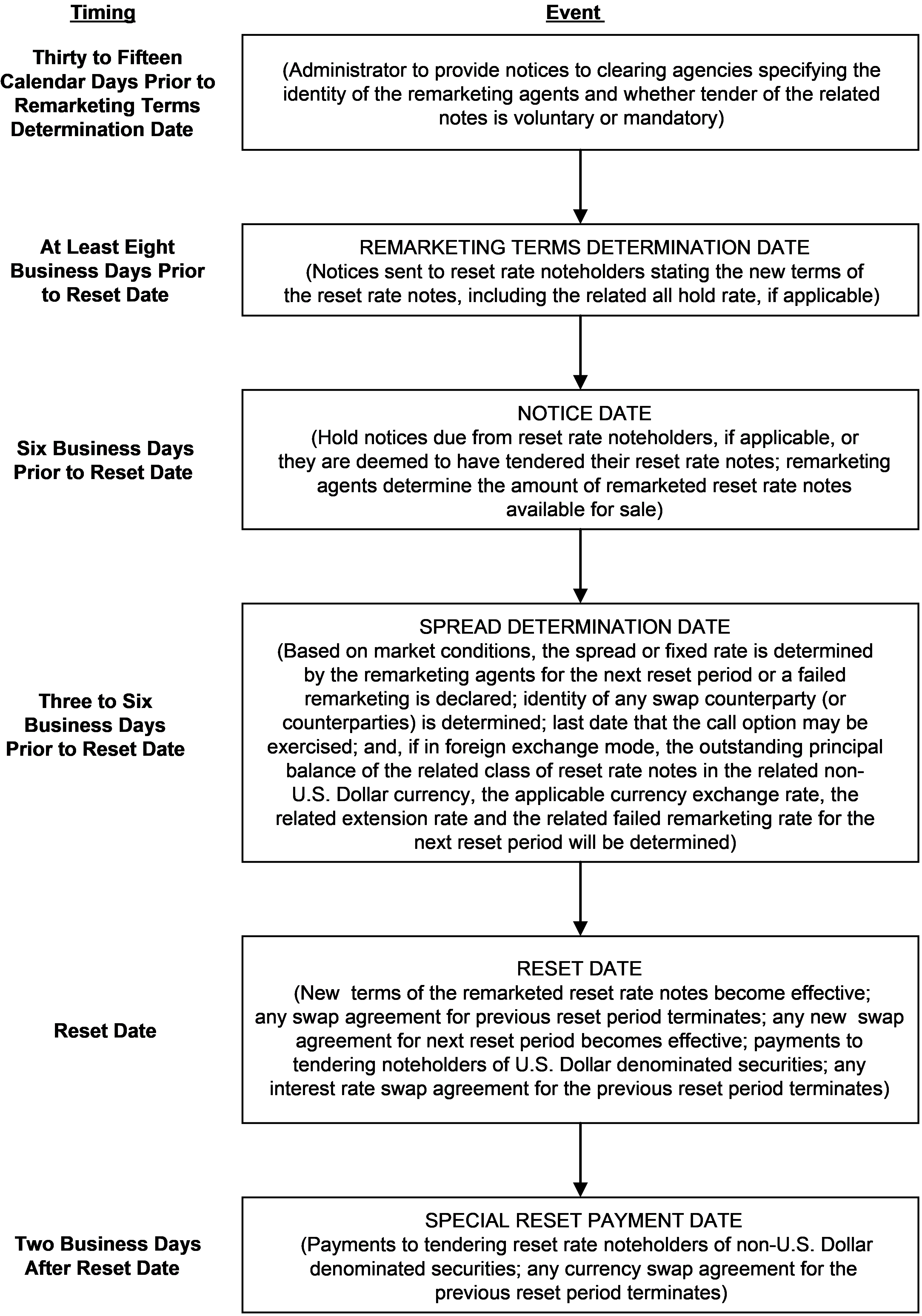
101
Failed Remarketing. There will be a failed remarketing for the class A-5 notes with
respect to the January 26, 2026 reset date if:
| • |
the remarketing agent, in consultation with the administrator, cannot determine the applicable required reset terms on or before the remarketing terms determination date;
|
| • |
the remarketing agent cannot establish the required spread on the spread determination date;
|
| • |
the remarketing agent is unable to remarket some or all of the tendered reset rate notes at the spread set by the remarketing agent, or one or more committed purchasers default on their purchase obligations and the remarketing agent
chooses not to purchase such reset rate notes itself;
|
| • |
any rating agency then rating the notes has not confirmed or upgraded its then-current rating of any class of notes, if such confirmation is required; or
|
| • |
certain other conditions specified in the remarketing agreement are not satisfied.
|
In the event a failed remarketing is declared with respect to the class A-5 notes:
| • |
all holders of the class A-5 notes will retain their notes, including in all deemed mandatory tender situations;
|
| • |
the related interest rate for the class A-5 notes will be reset to a failed remarketing rate of the SOFR Rate plus 0.75% per annum; and
|
| • |
the related reset period will be set at three months.
|
Foreign Exchange Mode. If the class A-5 notes are to be reset in foreign exchange mode
on the related reset date, the administrator, on behalf of the trust, will enter into one or more currency swap agreements with Eligible Swap Counterparties:
| • |
to facilitate the trust’s ability to pay principal and interest in the applicable currency;
|
| • |
to pay additional interest at the applicable interest rate and in the applicable currency on the class A-5 notes from and including the related reset date to, but excluding the second business day following the related reset date;
and
|
| • |
to facilitate the exchange of all secondary market trade proceeds from a successful remarketing (or proceeds from the exercise of the call option) on the applicable reset date to the applicable currency.
|
Under any currency swap agreement between the trust and one or more swap counterparties, each related swap counterparty will be obligated to pay to the trust or a paying agent on behalf of the
trust, as applicable:
| • |
on the effective date of such currency swap agreement for the related reset date, the U.S. Dollar equivalent of all secondary market trade proceeds received from purchasers of the class A-5 notes using the exchange rate established
on the effective date of such currency swap agreement;
|
102
| • |
on or before each distribution date, (1) the rate of interest on the class A-5 notes multiplied by the outstanding principal balance of the class A-5 notes denominated in the applicable currency and (2) the currency equivalent of the
U.S. Dollars such swap counterparty concurrently receives from the trust as a payment of principal allocated to the class A-5 notes, including, on the maturity date for the class A-5 notes, if a currency swap agreement is then in
effect, the remaining outstanding principal balance of the class A-5 notes, but only to the extent that the required U.S. Dollar equivalent amount is received from the trust on such date, using the exchange rate established on the
applicable effective date of the currency swap agreement;
|
| • |
with respect to a distribution date that is also a reset date, other than for distribution dates during a reset period following a reset date upon which a failed remarketing has occurred, up to and including the reset date resulting
in a successful remarketing or an exercise of the call option, additional interest at the applicable interest rate and in the applicable currency for the class A-5 notes from and including the related reset date to, but excluding, the
second business day following the related reset date; and
|
| • |
on the reset date corresponding to a successful remarketing or an exercise of the call option of the class A-5 notes, the currency equivalent of all U.S. Dollar secondary market trade proceeds or proceeds from the exercise of the
call option received as of that reset date, as applicable, using the exchange rate established on the effective date of the applicable currency swap agreement for that reset date.
|
In return, each related swap counterparty will receive from the trust:
| • |
on the effective date of such currency swap agreement for the related reset date, all secondary market trade proceeds received from purchasers of the class A-5 notes in the applicable currency;
|
| • |
on or before each distribution date, (1) an interest rate of the SOFR Rate plus or minus a spread, as determined from the bidding process described below, multiplied by that swap counterpart’s pro rata share, as applicable, of the
U.S. Dollar equivalent of the outstanding principal balance of the class A-5 notes, and (2) that swap counterpart’s pro rata share of all payments of principal in U.S. Dollars that are allocated to the class A-5 notes; provided that,
all principal payments allocated to such notes on any distribution date will be deposited into the related accumulation account and paid to each related swap counterparty on or about the next reset date (including all amounts required
to be deposited in the related accumulation account on the related reset date), but excluding all investment earnings thereon; and
|
| • |
on the reset date corresponding to a successful remarketing or an exercise of the call option of the class A-5 notes, all U.S. Dollar secondary market trade proceeds or proceeds from the exercise of the call option, as applicable,
received (1) from the remarketing agent that the remarketing agent either received directly from the purchasers of the class A-5 notes, if in U.S. Dollars; (2) from the new swap counterparty or counterparties pursuant to the related
currency swap agreements for the upcoming reset period, if in a currency other than U.S. Dollars; or (3) from the holder of the call option, as applicable.
|
103
All such currency swap agreements will terminate, generally, on the earliest to occur of:
| • |
the next succeeding related reset date resulting in a successful remarketing;
|
| • |
the purchase of all outstanding notes on a reset date, following the exercise of a call option;
|
| • |
the distribution date on which the outstanding principal balance of the class A-5 notes is reduced to zero, excluding for such purpose all amounts on deposit in the related accumulation account; or
|
| • |
the maturity date of the class A-5 notes.
|
Any applicable currency swap agreement may also terminate as a result of the optional purchase of the trust student loans by the servicer or an auction of the trust student loans by the
indenture trustee. No currency swap agreement will terminate solely due to the declaration of a Failed Remarketing.
The remarketing agent, in consultation with the administrator, in determining the counterparty or counterparties to the required currency swap agreements, will solicit bids regarding the
SOFR-based interest rate, extension rate and other terms from at least three eligible swap counterparties and will select the lowest of these bids to provide the currency swap agreements. If the lowest bidder specifies a notional amount that is
less than the outstanding principal balance of the class A-5 notes, the remarketing agent, in consultation with the administrator, may select more than one eligible swap counterparty, but only to the extent that such additional eligible swap
counterparties have provided the next lowest received bid or bids, and enter into more than one currency swap agreement to fully hedge the then outstanding principal balance of the class A-5 notes. On or before the spread determination date,
the remarketing agent, in consultation with the administrator, will select the swap counterparty or counterparties.
The terms of all currency swap agreements must satisfy the Rating Agency Condition. The inability to obtain any required currency swap agreement, either as a result of the failure to satisfy
the Rating Agency Condition or otherwise, will, in the absence of an exercise of the call option, result in the declaration of a Failed Remarketing for the class A-5 notes on the related reset date; provided that, if the remarketing agent, in
consultation with the administrator, on or before the Remarketing Terms Determination Date, determines that it is unlikely that currency swap agreements satisfying the above criteria will be obtainable on the related reset date, the class A-5
notes must be reset to U.S. Dollars on the related reset date. No new currency swap agreements will be entered into by the trust for the applicable reset period following an exercise of the call option.
104
If the class A-5 notes are either currently in foreign exchange mode or to be reset into foreign exchange mode, the class A-5 notes will be subject to a mandatory tender by the holders thereof
on the related reset date. Affected class A-5 noteholders desiring to retain some or all of their class A-5 notes will be required to repurchase their class A-5 notes through the remarketing agent. However, the class A-5 noteholders may or
may not be allocated their desired amount of reset rate notes as part of the remarketing process for the class A-5 notes. Holders of the class A‑5 notes denominated in a currency other than U.S. Dollars will receive all principal and interest
payments due from the trust as well as payment of any outstanding principal amount payable as a result of the remarketing process on or about the second business day following the reset date as a result of the required delay in payment through
Euroclear and Clearstream, Luxembourg.
If a distribution date for the class A-5 notes when such notes are denominated in a foreign currency coincides with a reset date, due to time zone differences and for purposes of making
payments through Euroclear and Clearstream, Luxembourg, all principal payments and any remaining interest payments due from the trust will be made to the class A-5 noteholders on or before the second business day following such distribution
date. We sometimes refer to such date as the special reset payment date. Under the currency swap agreement for such reset period, the class A-5 noteholders will be entitled to receive such amounts plus approximately two additional business days
of interest at the interest rate for the prior reset period in the applicable non-U.S. Dollar currency calculated from the period including the related reset date to, but excluding, the second business day following such reset date. However, if
a currency swap agreement is terminated, the trust will not pay to the class A-5 noteholders interest for those additional days. In addition, for any reset period following a reset date upon which a failed remarketing has occurred, up to and
including the reset date resulting in a successful remarketing or an exercise of the call option for class A-5 notes as described below, payments of interest and principal to the class A-5 noteholders will be made on the special reset payment
date without the payment of any additional interest.
In such event, the trust, in consultation with the administrator, will attempt to enter into a substitute currency swap agreement with similar currency exchange terms in order to obtain
sufficient funds to provide for an open market purchase of the amount of the applicable currency needed to make the required payments.
In the event no currency swap agreement is in effect on any applicable distribution date or related reset date when payments are required to be made, the trust will be obligated to engage in a
spot currency transaction to exchange U.S. Dollars at the current exchange rate for the applicable currency in order to make payments of interest and principal on the class A-5 notes in that currency.
In addition, the indenture will require that, on each reset date that involves a mandatory tender, the trust obtains a favorable opinion of counsel with respect to certain tax related matters;
however, prospective purchasers are strongly encouraged to consult with their tax advisors as to the tax consequences to them of purchasing, owning or disposing of the class A-5 notes.
Floating Rate Mode. If, following a successful remarketing, the class A-5 notes will
be denominated in U.S. Dollars and are reset to bear a floating rate of interest, then, during the corresponding reset period, the reset rate notes will bear interest at a per annum rate equal to the applicable interest rate index, plus or
minus the applicable Spread, as determined on the relevant Spread Determination Date.
105
In addition, if the remarketing agent, in consultation with the administrator, determines that it would be in the best interest of the trust based on then-current market conditions during any
reset period when the class A-5 notes bear a floating rate of interest, or if otherwise required to satisfy the Rating Agency Condition, the trust will enter into one or more interest rate swap agreements with Eligible Swap Counterparties for
the next reset period to hedge some or all of the basis risk. In exchange for providing payments to the trust at the applicable interest rate index plus the related Spread, each Swap Counterparty will be entitled to receive on each
distribution date a payment from the trust equal to the SOFR Rate plus or minus a spread, which must satisfy the Rating Agency Condition. In the selection of the Swap Counterparties and the establishment of the applicable spread to the SOFR
Rate, the remarketing agent, in consultation with the administrator, generally will use the procedures set forth under “—Foreign Exchange Mode” above.
Fixed Rate Mode. If, following a successful remarketing, the class A-5 notes will be
denominated in U.S. Dollars and are reset to bear a fixed rate of interest, then the applicable fixed rate of interest for the corresponding reset period will be determined on the Spread Determination Date by adding:
| • |
the applicable spread as determined by the remarketing agent on the Spread Determination Date; and
|
| • |
the yield to maturity on the Spread Determination Date of the applicable fixed rate pricing benchmark, selected by the remarketing agent, as having an expected weighted average life based on a scheduled maturity at the next reset
date, which would be used in accordance with customary financial practice in pricing new issues of asset-backed securities of comparable average life, provided, that the remarketing agent shall establish that fixed rate equal to the
rate that, in the reasonable opinion of the remarketing agent, will enable all of the tendered reset rate notes to be remarketed by the remarketing agent at 100% of their outstanding principal balance. However, that fixed rate of
interest will in no event be lower than the related All Hold Rate, if applicable.
|
Interest on the class A-5 notes during any reset period when they bear a fixed rate of interest and are denominated in U.S. Dollars generally will be computed on the basis of a 360-day year of
twelve 30-day months. Interest on the class A-5 notes during any reset period when they bear a fixed rate of interest and are denominated in a currency other than U.S. Dollars generally will be calculated based on the Actual/Actual (ISMA)
accrual method as described under “—Determination of Indices” below, or another day-count convention as may be established on the related Remarketing Terms Determination Date. This interest will be
payable on each distribution date at the applicable fixed rate of interest, as determined on the Spread Determination Date, during the relevant reset period.
In addition, if, following a successful remarketing, the class A-5 notes will bear a fixed rate of interest during the next related reset period, the trust will enter into one or more interest
rate swap agreements with one or more Eligible Swap Counterparties on the related reset date to facilitate the trust’s ability to pay interest at a fixed rate, and any such interest rate swap will be made as part of any required currency swap
agreement as described in “Additional Information Regarding the Notes—The Reset Rate Notes—Foreign Exchange Mode” in this free-writing prospectus. Each of these interest rate swap agreements will
terminate, generally, on the earliest to occur of:
106
| • |
the next succeeding reset date, if the class A-5 notes are then denominated in U.S. Dollars, or the next succeeding reset date resulting in a successful remarketing, if the class A-5 notes are then in foreign exchange mode;
|
| • |
the related reset date for which the call option is exercised;
|
| • |
the distribution date on which the outstanding principal balance of the class A-5 notes is reduced to zero (including as the result of the optional purchase of the remaining trust student loans by the servicer or an auction of the
trust student loans by the indenture trustee); or
|
| • |
the maturity date of the class A-5 notes.
|
No interest rate swap agreement with respect to the class A-5 notes, if such notes are then in foreign exchange mode, will terminate solely due to the declaration of a failed remarketing. Each
interest rate swap agreement must satisfy the rating agency condition. No new interest rate swap agreement will be entered into by the trust for any reset period where the call option has been exercised. The remarketing agent, in consultation
with the administrator, generally will use procedures similar to those set forth above under “—Foreign Exchange Mode” in the selection of the related swap counterparties and the establishment of the
applicable spread to the SOFR Rate.
In exchange for providing a payment equal to interest at the fixed rate due to the class A-5 notes, the related swap counterparty will be entitled to receive on each distribution date a payment
from the trust, as a trust swap payment, in an amount based on the SOFR Rate, plus or minus a spread, as determined from the bidding process described above.
Allocation of Principal to Accumulation Account. If, on any distribution date,
principal would be payable to the class A-5 notes during any reset period when such notes are then structured not to receive a payment of principal until the end of the related reset period (as will be the case, generally, but not
exclusively, whenever the class A-5 notes bear a fixed rate of interest), principal generally will be allocated to the class A-5 notes and deposited into the accumulation account. Those principal amounts will remain in the accumulation
account until the next reset date for the class A-5 notes, unless there occurs, prior to that reset date, an optional termination of the trust, an optional purchase of the remaining trust student loans by the servicer or a successful auction
of the remaining trust student loans by the indenture trustee or payment of principal on the notes is accelerated following an event of default. On such reset date, all amounts (exclusive of investment earnings) then on deposit in the
accumulation account, including any allocation of principal made on that distribution date, will be distributed to the class A-5 noteholders, as of the related record date, in reduction of principal of the class A-5 notes (or if in foreign
exchange mode, on or about that reset date to the related Swap Counterparty, in exchange for the equivalent amount of the applicable non-U.S. Dollar currency to be paid to the class A-5 noteholders on or about that reset date).
107
However, in the event that on any distribution date the amount (exclusive of investment earnings) on deposit in the accumulation account would equal the outstanding principal balance (or if in
foreign exchange mode, the U.S. Dollar equivalent thereof) of the class A-5 notes, then no additional amounts will be deposited into the accumulation account, and all amounts therein, exclusive of investment earnings, will be distributed on the
next reset date to the class A-5 noteholders (or if in foreign exchange mode, on or about that reset date to the related currency Swap Counterparty, in exchange for the equivalent amount of the applicable non-U.S. Dollar currency to be paid to
the class A-5 noteholders on or about that reset date). On that reset date the outstanding principal balance of the class A-5 notes will be reduced to zero. Amounts (exclusive of investment earnings) on deposit in the accumulation account may
be used only to pay principal on the class A-5 notes (or to make payments to the related currency Swap Counterparty, but solely in exchange for the equivalent amount of the applicable non-U.S. Dollar currency at the conversion rate set forth in
the currency swap agreement) and for no other purpose. All investment earnings on deposit in the accumulation account will be withdrawn on each distribution date and deposited into the collection account.
Whenever amounts are deposited into or are on deposit in the accumulation account, the indenture trustee, subject to sufficient available funds therefor, will deposit into the supplemental
interest account the Supplemental Interest Account Deposit Amount as described under “—Distributions” below.
Tender of Reset Rate Notes; Remarketing Procedures. On the closing date, the trust,
the administrator and the remarketing agent entered into a remarketing agreement for the remarketing of the class A-5 notes by the remarketing agent. Pursuant to the remarketing agreement, Citigroup Global Markets Inc. and Goldman Sachs
& Co. LLC each initially agreed to act as remarketing agent. The administrator, in its sole discretion, may change or remove a remarketing agent or, if at any time, there is more than one remarketing agent, designate a lead remarketing
agent for the class A-5 notes and any reset period at any time on or before the related Remarketing Terms Determination Date. The administrator exercised this right and, effective February 4, 2015, removed Citigroup Global Markets Inc. as a
remarketing agent. In addition, the administrator will appoint one or more additional remarketing agents, if necessary, for a reset date when the class A-5 notes will be remarketed in a currency other than U.S. Dollars. Furthermore, a
remarketing agent may resign at any time provided that no resignation may become effective on a date that is later than 15 business days prior to the next Remarketing Terms Determination Date.
On each Remarketing Terms Determination Date, the trust, the administrator and the remarketing agent will enter into a remarketing agency agreement that will set forth certain terms of the
remarketing for the class A-5 notes, and on the related Spread Determination Date (unless a Failed Remarketing is declared, Hold Notices relating to 100% of the class A-5 notes have been timely delivered, or the call option has been exercised
with respect to the related reset date), that remarketing agency agreement will be supplemented to include all other required terms of the related remarketing for the class A-5 notes.
108
On the reset date that commences each reset period, if the reset rate notes are not subject to mandatory tender, each reset rate note will be automatically tendered, or deemed tendered, to the
remarketing agent for remarketing by such remarketing agent on the reset date at 100% of its outstanding principal balance, unless the holder, by delivery of a hold notice, if applicable, elects not to tender its reset rate note. If the reset
rate notes are held in book-entry form, 100% of the outstanding principal balance of the reset rate notes will be paid in accordance with the standard procedures of DTC, which currently provide for payments in same-day funds or procedures of
Euroclear and Clearstream, Luxembourg which, due to time zone differences, will be required to provide for payment of principal and interest due on the related distribution date approximately two business days following the reset date, and,
with respect to each reset date, other than for any reset period following a reset date upon which a failed remarketing has occurred, up to and including the reset date resulting in a successful remarketing or an exercise of the call option,
additional interest at the applicable interest rate and in the applicable non-U.S. Dollar currency from and including the related reset date to, but excluding, the second business day following such reset date. Beneficial owners that tender
their reset rate notes through a broker, dealer, commercial bank, trust company or other institution, other than the remarketing agent, may be required to pay fees or commissions to such institution. If a beneficial owner has an account at the
remarketing agent and tenders its reset rate notes through that account, the beneficial owner will not be required to pay any fee or commission to the remarketing agent.
If applicable, the hold notice must be received by a remarketing agent during the period commencing on the remarketing terms determination date and ending on the notice date. To ensure that a
hold notice is received on a particular day, the beneficial owner must direct its broker or other designated direct or indirect participant to give the hold notice before the broker’s cut-off time for accepting instructions for that day.
Different firms may have different cutoff times for accepting instructions from their customers. Accordingly, beneficial owners should consult the brokers or other direct or indirect participants through which they own their interests in the
reset rate notes for the cut-off times for those brokers or participants. A delivered hold notice will be irrevocable, but will be subject to a mandatory tender of the reset rate notes pursuant to any exercise of the call option. If a hold
notice is not timely received for any reason by the remarketing agent on the notice date, the beneficial owner of the reset rate notes will be deemed to have elected to tender such note for remarketing by the remarketing agent. All of the reset
rate notes, whether or not tendered, will bear interest upon the same terms.
The remarketing agent will attempt, on a reasonable efforts basis, to remarket the tendered reset rate notes at a price equal to 100% of the aggregate principal balance so tendered. We cannot
assure you that the remarketing agent will be able to remarket the entire principal balance of the reset rate notes tendered in a remarketing. The obligations of the remarketing agent will be subject to conditions and termination events
customary in transactions of this type, including conditions that all of the reset rate notes subject to remarketing in fact were not called, none of the notes have been downgraded or put under review by the rating agencies, no events of
default with respect to the notes have occurred, and no material adverse change in the trust’s financial condition has occurred between the remarketing terms determination date and the reset date. If the call option is not timely exercised and
the remarketing agent is unable to remarket some or all of the tendered reset rate notes and, in its sole discretion, elects not to purchase those reset rate notes, then the remarketing agent will declare a failed remarketing, all holders will
retain their notes, the related reset period will be fixed at three months, and the related interest rate will be set at the related failed remarketing rate.
No noteholder or beneficial owner of any reset rate note will have any rights or claims against the remarketing agent as a result of the remarketing agent’s not purchasing that reset rate note.
The remarketing agent will have the option, but not the obligation, to purchase any reset rate notes tendered that it is not able to remarket.
109
The remarketing agent, in its individual or any other capacity, may buy, sell, hold and deal in the reset rate notes. The remarketing agent may exercise any vote or join in any action which any
beneficial owner of the reset rate notes may be entitled to exercise or take with like effect as if it did not act in any capacity under the remarketing agency agreement. The remarketing agent, in its individual capacity, either as principal or
agent, may also engage in or have an interest in any financial or other transaction with the trust, the depositor, the servicer or the administrator as freely as if it did not act in any capacity under the remarketing agency agreement.
The remarketing agent will be entitled to receive a fee from amounts on deposit in the remarketing fee account in connection with their services rendered for each reset date. The remarketing
agent also will be entitled to reimbursement from the trust, on a subordinated basis, or from the administrator, if there are insufficient Available Funds on the related distribution date, for certain expenses associated with each remarketing.
The fees associated with each successful remarketing and certain out-of-pocket expenses with respect to each reset date will be payable generally from amounts on deposit from time to time in the remarketing fee account. On each distribution
date that is one year or less prior to a reset date, Available Funds will be deposited into the remarketing fee account, prior to the payment of interest on any class of notes, in an amount up to the Quarterly
Funding Amount. If the amount on deposit in the remarketing fee account, after the payment of any remarketing fees therefrom, exceeds the Reset Period Target Amount, the excess will be
withdrawn on the distribution date immediately following the related reset date, deposited into the collection account and included in Available Funds for that distribution date. In addition, all investments on deposit in the remarketing fee
account will be withdrawn on the next distribution date, deposited into the collection account and included in Available Funds for that distribution date. Also, if on any distribution date a Class A Note Interest Shortfall would exist, or if
on the maturity date for any class of class A notes, Available Funds would not be sufficient to reduce the principal balance of that class to zero, the amount of the Class A Note Interest Shortfall or principal deficiency, as applicable, to the
extent sums are on deposit in the remarketing fee account, may be withdrawn from that account and used for payment of interest or principal on the class A notes.
The remarketing fee account is held by the indenture trustee for the benefit of the remarketing agent and the class A noteholders. As of the October 2025 distribution date, there was
$845,621.93 on deposit in the remarketing fee account. In connection with a successful remarketing of the class A-5 notes on the January 26, 2026 reset date, the remarketing agent will be paid a remarketing fee by the trust in an amount not to
exceed $845,621.93.
Distributions
Deposits into the Collection Account. On or
before the business day before each distribution date, the servicer and the administrator will provide the indenture trustee with certain information as to the preceding collection period, including the amount of Available Funds received from
the trust student loans and the aggregate purchase amount of the trust student loans to be purchased from the trust by the sellers, the depositor or the servicer.
Except as provided in the next paragraph, the servicer will deposit all payments on the trust student loans and all proceeds of the trust student loans collected by it during each collection
period into the collection account within two business days of receipt. Except as provided in the next paragraph, the eligible lender trustee will deposit all interest subsidy payments and all special allowance payments on the student loans
received by it for each collection period into the collection account within two business days of receipt.
110
However, for so long as no administrator default has occurred and is continuing, the servicer and the eligible lender trustee will remit the amounts referred to above that would otherwise be
deposited into the collection account to the administrator within two business days of receipt, and the administrator will remit those amounts to the collection account on or before the business day preceding each monthly servicing payment
date, together with interest calculated from the first day of the month following receipt by the administrator to but excluding the day on which the administrator remits such amounts to the collection account at a rate no less than the federal
funds rate for each day during that period less 0.20%. See “Servicing and Administration—Payments on Trust Student Loans” in this free-writing prospectus.
Distributions from the Collection Account. On each monthly servicing payment date that
is not a distribution date, the administrator will instruct the indenture trustee to pay to the servicer the primary servicing fee due for the period from and including the preceding monthly servicing payment date from amounts on deposit in
the collection account.
On or before each distribution date, the administrator will instruct the indenture trustee to make the following deposits and distributions in the amounts and in the order of priority shown
below, except as otherwise provided under “Description of the Notes—The Notes—The Class A Notes—Distributions of Principal” and “—The Notes—The Class B
Notes—Subordination of the Class B Notes” herein, to the extent of Available Funds for that distribution date and amounts transferred from the reserve account with respect to that distribution date:
(a) to the servicer, the primary servicing fee due on that distribution date;
(b) to the administrator, the administration fee due on that distribution date and all prior unpaid administration fees;
(c) to the remarketing fee account, any Quarterly Funding Amount for that distribution date;
(d) pro rata, based on amounts due and owing:
(1) to the class A noteholders (other than the reset rate noteholders if a swap agreement with respect to interest payments to be made to those noteholders is then
in effect), the Class A Noteholders’ Interest Distribution Amount, pro rata, based on the amounts payable as Class A Noteholders’ Interest Distribution Amount;
(2) if a swap agreement is then in effect for the reset rate notes with respect to interest payments to be made to those noteholders, to each applicable Swap
Counterparty, the amount of interest at the related floating rate of interest due to each applicable Swap Counterparty under the related swap agreement; and
(3) if applicable, to each Swap Counterparty, the amount of any swap termination payment due to that Swap Counterparty under the related swap agreement due solely to
a swap termination event resulting from a payment default by the trust or the insolvency of the trust;
111
(e) to the class B noteholders, the Class B Noteholders’ Interest Distribution Amount;
(f) (1) first, the Class A Noteholders’ Principal Distribution Amount, to the class A-5 noteholders, until the
principal balance of the class A-5 notes is paid in full; provided, however, that:
(A) if the reset rate notes are then denominated in U.S. Dollars and are then structured not to receive a payment of principal until the end of the related reset
period, principal payments due to the reset rate noteholders instead will be allocated to the accumulation account until amounts on deposit therein are sufficient to reduce the principal balance of that class to zero,
(B) if the reset rate notes are then denominated in a currency other than U.S. Dollars, principal payments due to the reset rate noteholders instead either will be
made to the related currency Swap Counterparty or will be allocated to the accumulation account (if that class is then structured not to receive a payment of principal until the end of the related reset period) until the U.S. Dollar equivalent
of the principal balance of such class has been distributed to the related currency Swap Counterparty or allocated to the accumulation account, and
(C) for purposes of this clause (f)(1), the outstanding principal balance of the reset rate notes or its U.S. Dollar equivalent, as applicable, will be deemed to
have been reduced by any amounts (exclusive of investment earnings) on deposit in any accumulation account,
(g) to any supplemental interest account, the Supplemental Interest Account Deposit Amount, if any, for that distribution date;
(h) to any investment reserve account, the amount, if any, required to fund that account to the applicable Investment Reserve Account
Required Amount;
(i) on each distribution date on and after the Stepdown Date, and provided that no Trigger Event is in effect on such distribution date, to the class B noteholders
until paid in full, the Class B Noteholders’ Principal Distribution Amount;
(j) to the reserve account, the amount, if any, necessary to reinstate the balance of the reserve account to the Specified Reserve Account Balance;
(k) to any investment premium purchase account, the Investment Premium Purchase Account Deposit Amount, if any, together with
any carryover shortfalls not deposited on previous distribution dates;
(l) to the servicer, the aggregate unpaid amount of the carryover servicing fee, if any;
112
(m) if applicable, to any Swap Counterparty or Swap Counterparties, pro rata, the amount of any swap termination payments due to the Swap Counterparty or Swap
Counterparties, as the case may be, not payable in clause (d)(3) above;
(n) if applicable, to the remarketing agent, any remarketing fees due and owing by the trust to the extent not paid from amounts on deposit in the remarketing fee
account;
(o) if applicable, sequentially, first to the remarketing agent for certain expenses incurred in connection with the remarketing of the reset rate notes on that
distribution date, and second to the administrator for advances made on behalf of the trust for the payment of remarketing expenses on that or prior distribution dates; and
(p) sequentially, in this order, to (1) any potential future cap counterparty under a potential future interest rate cap agreement, the amount of any payment under
such potential future interest rate cap agreement (including, without limitation, any upfront fees, termination payments or any other amounts due to such potential future cap counterparty), as applicable, and (2) the excess distribution
certificateholder, any remaining amounts after application of the preceding clauses.
Amounts that would be paid to each Swap Counterparty pursuant to clauses (d), (f) or (m) above with respect to the reset rate notes may be paid by the trust to the related Swap Counterparty on
or prior to the applicable distribution date.
In the event that a swap termination payment is owed by the trust to any Swap Counterparty and a replacement swap agreement is procured by the trust under which the replacement Swap
Counterparty makes a payment to the trust, the trust will pay that amount directly to the original Swap Counterparty to the extent that a payment is owed by the trust to that counterparty. If after making that payment, the original Swap
Counterparty is still owed a payment, then the remaining amount will be paid as set forth in clause (m) above.
Notwithstanding the foregoing, in the event the trust student loans are not sold on the trust auction date, on each subsequent distribution date on which the Pool Balance is equal to 10% or
less of the Initial Pool Balance, the administrator will direct the indenture trustee to distribute as accelerated payments of principal on the notes all amounts that otherwise would be paid to the
excess distribution certificateholder.
For a discussion of the ramifications of a termination of a swap agreement meant to hedge currency risk, see “—Distributions with Respect to the Reset Rate
Notes in Foreign Exchange Mode” below.
Distributions with Respect to the Reset Rate Notes in Foreign Exchange Mode. On each
applicable distribution date, a paying agent, acting at the direction of the administrator, will distribute all amounts on deposit in the applicable currency account to the holders of the reset rate notes if the notes are then in foreign
exchange mode. If a currency swap agreement terminates, amounts that would have otherwise been paid to the related Swap Counterparty under that currency swap agreement will be used to make payments to the reset rate notes, in an amount in
the applicable non-U.S. Dollar currency, equal to the payment that the related Swap Counterparty would have made. If this occurs, the trust will exchange U.S. Dollars for the applicable non-U.S. Dollar currency in order to make distributions
to the reset rate notes. If the then-current exchange rate of U.S. Dollars for the applicable non-U.S. Dollar currency is less favorable than under the applicable currency swap agreement or if the then-current spread to SOFR for another
applicable index or a fixed rate is less favorable than under the applicable currency swap agreement, the trust will use more U.S. Dollars to pay the reset rate noteholders than it would have paid to the related Swap Counterparty. As a
result, amounts paid pursuant to clauses (d)(1) and (f) above, as applicable, under “—Distributions from the Collection Account” above could be higher if a currency swap agreement terminates.
113
Distributions Following an Event of Default and Acceleration of the Maturity of the Notes
After the occurrence of any of the following:
| • |
an event of default under the indenture relating to the payment of principal on any class at its maturity date or to the payment of interest on any class of notes which has resulted in an acceleration of the maturity of the notes,
|
| • |
an event of default under the indenture relating to an insolvency event or a bankruptcy with respect to the trust which has resulted in an acceleration of the maturity of the notes, or
|
| • |
a liquidation of the trust assets following any event of default under the indenture,
|
the priority of the payment of the notes changes. In particular, payments on the notes on each distribution date following the acceleration of the maturity of the notes as provided above will be made in the
following order of priority:
FIRST:
| A: |
to the noteholders of the reset rate notes then denominated in U.S. Dollars and then structured not to receive a payment of principal until the end of its related reset period, the amount, if any, on deposit in the related
accumulation account for the reset rate notes (exclusive of investment earnings) in reduction of the outstanding principal balance of such reset rate notes until they are paid in full; and/or
|
| B: |
to the related currency Swap Counterparty if the reset rate notes are then in foreign exchange mode and are then structured not to receive a payment of principal until the end of their reset period, the amount, if any, on deposit in
the related accumulation account for the reset rate notes (exclusive of investment earnings) in reduction of the outstanding amount of the reset rate notes until they are paid in full;
|
SECOND: to the indenture trustee, for annual fees and any other amounts due and owing under the indenture;
THIRD: to the servicer, the primary servicing fee due on that distribution date and all prior unpaid primary servicing fees;
114
FOURTH: to the administrator, the administration fee due on that distribution date and all prior unpaid administration fees;
FIFTH: pro rata, based on amounts due and owing:
| A: |
to the class A noteholders (other than the noteholders of the reset rate notes if a swap agreement with respect to interest payments to be made to such noteholders is then in effect), the Class A Noteholders’ Interest Distribution
Amount, ratably, without preference or priority of any kind, based on the amounts due and payable as the Class A Noteholders’ Interest Distribution Amount;
|
| B: |
if a swap agreement is then in effect for the reset rate noteholders with respect to interest payments to be made to such noteholders, to each Swap Counterparty, the amount of any swap interest payments due and payable by the trust
(other than as paid to that Swap Counterparty under clause FIRST); and
|
| C: |
if any swap agreement with respect to the reset rate notes has been terminated, to the related Swap Counterparty, the amount of any swap termination payments due to such Swap Counterparty under the related swap agreement due to a
swap termination event relating to a payment default by the trust, acceleration of the notes or the insolvency of the trust;
|
SIXTH:
| A: |
if the reset rate notes are in foreign exchange mode, pro rata (1) to the class A noteholders (other than the holders of any reset rate notes then in foreign exchange mode), ratably, an amount sufficient to reduce the respective
principal balances of those class A notes to zero, and (2) to the applicable currency Swap Counterparties an amount sufficient to reduce the U.S. Dollar equivalent principal balance of the reset rate notes then in foreign exchange mode
to zero; or
|
| B: |
if the reset rate notes are then denominated in U.S. Dollars, pro rata to the class A noteholders, ratably, an amount sufficient to reduce the respective principal balances of those class A notes to zero;
|
SEVENTH: to the class B noteholders, the Class B Noteholders’ Interest Distribution Amount;
EIGHTH: to the class B noteholders, an amount sufficient to reduce the principal balance of the class B notes to zero;
NINTH: to the servicer, the aggregate unpaid amount of the carryover servicing fee, if any;
115
TENTH: to any Swap Counterparties, pro rata, the amount of any swap termination payments due to such Swap Counterparties from the trust and not payable under clause FIFTH (C);
ELEVENTH: to the remarketing agent, any due and unpaid remarketing fees payable by the trust to the extent not previously paid from amounts on deposit in the remarketing fee account;
TWELFTH: if applicable, sequentially, first to the remarketing agent for certain expenses incurred in connection with the remarketing of the reset rate notes on such distribution date, and
second to the administrator for advances made on behalf of the trust for the payment of remarketing expenses on that or prior distribution dates; and
THIRTEENTH: sequentially, in this order, to (a) any potential future cap counterparty under a potential future interest rate cap agreement, the amount of any payment under such potential
future interest rate cap agreement (including, without limitation, any upfront fees, termination payments or any other amounts due to such potential future cap counterparty), as applicable, and (b) the excess distribution certificateholder, any
remaining amounts after application of the preceding clauses.
If the trust has entered into a currency swap agreement and such currency swap agreement terminates, amounts that would have otherwise been paid to the related currency Swap Counterparty (other
than amounts payable as a termination payment thereunder) will be used to make payments to the reset rate noteholders in an amount in the applicable non-U.S. Dollar currency, equal to the payment that the related currency Swap Counterparty
would have made. If this occurs, the trust will exchange U.S. Dollars for the applicable non-U.S. Dollar currency in order to make distributions on the reset rate notes.
Credit Enhancement
Excess Interest.
On any distribution date, excess interest is equal to the amount of interest received on the trust student loans that exceeds the amount of interest due and payable on the notes.
Reserve Account.
The reserve account was created with an initial deposit by the trust on the closing date and, As of the October 2025 distribution date, it had a balance of $3,353,244.00. The reserve account
may be replenished on each distribution date, by deposit into it of the amount, if any, necessary to reinstate the balance of the reserve account to the Specified Reserve Account Balance from the amount of Available Funds remaining after
payment for that distribution date under clauses (a) through (i) under “—Distributions—Distributions from the Collection Account” above.
If the market value of securities and cash in the reserve account together with amounts on deposit in any supplemental interest account on any distribution date is sufficient to pay the
remaining principal balance of and interest accrued on the notes and any carryover servicing fee, these assets will be so applied on that distribution date.
116
If the amount on deposit in the reserve account on any distribution date after giving effect to all deposits or withdrawals from the reserve account on that distribution date is greater than
the Specified Reserve Account Balance for that distribution date, subject to certain limitations, the administrator will instruct the indenture trustee to deposit the amount of the excess into the collection account for distribution on that
distribution date.
Amounts held from time to time in the reserve account will continue to be held for the benefit of the trust. Funds will be withdrawn from cash in the reserve account on any distribution date
or, in the case of the payment of any primary servicing fee, on any monthly servicing payment date, to the extent that the amount of Available Funds on that distribution date or monthly servicing payment date is insufficient to pay any of the
items specified in clauses (a) through (c), (d)(1), (d)(2) and (e) under “—Distributions—Distributions from the Collection Account” above. These funds also will be withdrawn at maturity of a class of
notes or on the final distribution upon termination of the trust to the extent that the amount of Available Funds at that time is insufficient to pay any of the items specified in clauses (f) and (i) and, in the case of the final distribution
upon termination of the trust, clauses (l) through (o) under “—Distributions—Distributions from the Collection Account” above. These funds will be paid from the reserve account to the persons and in
the order of priority specified for distributions out of the collection account in clauses (a) through (c), (d)(1), (d)(2) and (e), clauses (f) and (i), and clauses (l) through (o), as applicable.
The reserve account is intended to enhance the likelihood of timely distributions of interest to the noteholders and to decrease the likelihood that the noteholders will experience losses. In
some circumstances, however, the reserve account could be reduced to zero. Except on the final distribution upon termination of the trust, amounts on deposit in the reserve account, other than amounts in excess of the Specified Reserve Account
Balance, will not be available to cover any carryover servicing fees. Amounts on deposit in the reserve account will be available to pay principal on the notes and accrued interest at the maturity of the notes, and to pay the carryover
servicing fee and carryover amounts on the final distribution upon termination of the trust.
Subordination of the Class B Notes.
On any distribution date, distributions of interest on the class B notes will be subordinated to the payment of interest on the class A notes and distributions of principal on the class B notes
will be subordinated to the payment of both interest and principal on all of the class A notes. See “Description of the Notes—The Notes—The Class B Notes—Subordination of the Class B Notes” in this
free-writing prospectus.
Capitalized Interest Account.
All funds on deposit in the capitalized interest account that was created and funded on the closing date were released to the excess distribution certificateholder on the distribution date that
occurred in October 2006. No additional sums have been or will be deposited into this account.
117
Potential Future Interest Rate Cap Agreement
At any time, at the direction of the administrator, the trust may enter into one or more interest rate cap agreements (collectively, the “potential future interest rate cap agreement”) with one
or more Eligible Swap Counterparties (collectively, the “potential future cap counterparty”) to hedge some or all of the interest rate risk of the notes. Any potential future interest rate cap agreement would contain customary and usual terms
for such derivative agreements. Any payment due by the trust to a potential future cap counterparty would be payable only out of funds payable under clause (p)(1) of “—Distributions—Distributions from the
Collection Account” in this free-writing prospectus. Any payments received from a potential future cap counterparty would be included in Available Funds. The trust will enter into a potential future interest rate cap agreement only
upon receipt of a written confirmation from each rating agency then rating the notes that such potential future interest rate cap agreement will not result in the downgrading of its then current rating of any class of notes. It is not
anticipated that the trust would be required to make any payments to any potential future cap counterparty under any potential future interest rate cap agreement other than an upfront payment and, in some circumstances, a termination payment.
As of the January 26, 2026 reset date, the trust will not be a party to any interest rate cap agreement.
Notice of Interest Rates
Information concerning past and current three-month LIBOR, past and current SOFR Rate, any other applicable index, and the interest rates applicable to the reset rate notes, will be available
on the administrator’s website at https://navient.com/investors/fixed-income-information/asset-backed-securities/slm-student-loan-trusts/2005 or by telephoning the administrator at (800) 321-7179 between
the hours of 9:00 a.m. and 4:00 p.m. Eastern time on any business day and will also be available through Bloomberg L.P. If any class of notes is listed on the Luxembourg Stock Exchange, the administrator will also notify the Luxembourg paying
agent, if any, and will cause the Luxembourg Stock Exchange to be notified, of the current interest rate for each class of notes listed on the exchange prior to the first day of each accrual period.
SOFR. The “90-day Average SOFR
Rate” will be determined by the administrator for each accrual period on the second U.S. Government Securities Business Day before the first day of such accrual period (the “SOFR Adjustment Date”)
as of 3:00 p.m. (New York time) on such U.S. Government Securities Business Day, at which time Compounded SOFR is published on the FRBNY’s Website (the “SOFR Determination Time”) (or, if the Benchmark
is not SOFR, the time determined by the administrator after giving effect to the Benchmark Replacement Conforming Changes) (the “Reference Time”) and, except as provided below following a determination
by the administrator that a Benchmark Transition Event and its related Benchmark Replacement Date have occurred, will mean, with respect to the class A-5 notes as of any SOFR Adjustment Date, a rate equal to Compounded SOFR on such U.S.
Government Securities Business Day; provided, that, the administrator will have the right, in its sole discretion, to make applicable SOFR Adjustment Conforming Changes.
Notwithstanding the preceding paragraph, if the administrator determines that a Benchmark Transition Event and its related Benchmark Replacement Date have occurred prior to the determination of
the then-current Benchmark, the Benchmark Replacement selected and designated by the administrator by notice in writing to the indenture trustee will replace the then-current Benchmark for all purposes relating to the floating rate notes in
respect of such Interest Determination Date and all such subsequent Interest Determination Dates.
118
In connection with the implementation of a Benchmark Replacement, the administrator will have the right to make Benchmark Replacement Conforming Changes from time to time.
Notice by the administrator of the occurrence of a Benchmark Transition Event and its related Benchmark Replacement Date, the determination of an Unadjusted Benchmark Replacement and Benchmark
Replacement Adjustment and the making of any Benchmark Replacement Conforming Changes will be included in the distribution date statement to the indenture trustee and the issuing entity as described in “Servicing
and Administration—Statements to Indenture Trustee and Issuing Entity” above. Notwithstanding anything in the transaction documents to the contrary, upon the inclusion of such information in such distribution date statement, the
relevant transaction documents will be deemed to have been amended as of the applicable Benchmark Replacement Date to reflect the new Unadjusted Benchmark Replacement, Benchmark Replacement Adjustment and/or Benchmark Replacement Conforming
Changes without further compliance with the amendment provisions of the relevant transaction documents.
Any determination, decision or election that may be made by the administrator or any other person in connection with a Benchmark Transition Event and its related Benchmark Replacement Date, a
Benchmark Replacement Conforming Change or a Benchmark Replacement as described above, including any determination with respect to administrative feasibility (whether due to technical, administrative or operational issues), a tenor, a rate or
an adjustment, or of the occurrence or non-occurrence of an event, circumstance or date and any decision to take or refrain from taking any action or any selection, will be conclusive and binding absent manifest error, may be made in such
person’s sole discretion, and, notwithstanding anything to the contrary in the transaction documents, will become effective without the consent of any other person. Notwithstanding anything to the contrary in the transaction documents, none of
the issuing entity, the indenture trustee, Navient Corporation, the administrator, the servicer, the depositor, the trustee, the eligible lender trustee or the seller will have any liability for any action or inaction taken or refrained from
being taken by it with respect to any Benchmark, Benchmark Transition Event, Benchmark Replacement, Unadjusted Benchmark Replacement, Benchmark Replacement Adjustment, Benchmark Replacement Date, Benchmark Replacement Conforming Changes or any
other matters related to or arising in connection with the foregoing, and by accepting a note or a beneficial interest therein, each noteholder will be deemed to waive and release any and all claims against the issuing entity, DBTCA or DBNTC
(in each of their respective capacities), Navient Corporation, the administrator, the servicer, the depositor, the trustee, the eligible lender trustee or the seller relating to any such determinations. For the avoidance of any doubt, none of
the Indenture Trustee, the Paying Agent or the Eligible Lender Trustee shall be responsible for determining any replacement benchmark transition event, benchmark replacement adjustment or benchmark replacement conforming changes.
The following terms are given the meanings shown below:
| • |
“Benchmark” means, initially, Compounded SOFR; provided, that if the administrator determines prior to the relevant Reference Time that a Benchmark Transition Event and its related Benchmark
Replacement Date have occurred with respect to SOFR or the then-current Benchmark, then “Benchmark” means the applicable Benchmark Replacement.
|
119
| • |
“Benchmark Replacement” means, for any Interest Determination Date after the administrator has determined that a Benchmark Transition Event and its related Benchmark Replacement Date have
occurred, the first alternative set forth in the order below that can be determined by the administrator, without obtaining the consent of any noteholders, as of the Benchmark Replacement Date;
|
(1) the sum of: (a) the alternate rate of interest that has been selected or recommended by the Relevant Governmental Body as the replacement for the then-current Benchmark for the
applicable Corresponding Tenor and (b) the Benchmark Replacement Adjustment;
(2) the sum of: (a) the ISDA Fallback Rate and (b) the Benchmark Replacement Adjustment; or
(3) the sum of: (a) the alternate rate of interest that has been selected by the administrator as the replacement for the then-current Benchmark for the applicable Corresponding Tenor giving
due consideration to any industry-accepted rate of interest as a replacement for the then-current Benchmark for U.S. dollar-denominated floating rate securities at such time and (b) the Benchmark Replacement Adjustment.
| • |
“Benchmark Replacement Adjustment” means, for any Interest Determination Date after the administrator has determined that a Benchmark Transition Event and its related Benchmark Replacement Date
have occurred, the first alternative set forth in the order below that can be determined by the administrator as of the Benchmark Replacement Date:
|
(1) the spread adjustment (which may be a positive or negative value or zero), or method for calculating or determining such spread adjustment, that has been selected or recommended by the
Relevant Governmental Body for the applicable Unadjusted Benchmark Replacement;
(2) if the applicable Unadjusted Benchmark Replacement is equivalent to the ISDA Fallback Rate, the ISDA Fallback Adjustment; or
(3) the spread adjustment (which may be a positive or negative value or zero) that has been selected by the administrator giving due consideration to any industry-accepted spread adjustment,
or method for calculating or determining such spread adjustment, for the replacement of the then-current Benchmark with the applicable Unadjusted Benchmark Replacement for U.S. dollar-denominated floating rate securities at such time.
120
| • |
“Benchmark Replacement Conforming Changes” means, in connection with any determination and calculation of the Benchmark Replacement, any technical, administrative or operational changes
(including changes to the accrual period, timing and frequency of determining rates and making payments of interest, rounding of amounts or tenors and other administrative matters) that the administrator decides in its reasonable
discretion may be appropriate to reflect the adoption of such Benchmark Replacement in a manner substantially consistent with market practice (or, if the administrator decides that adoption of any portion of such market practice is not
administratively feasible or if the administrator determines that no market practice for use of the Benchmark Replacement exists, in such other manner as the administrator determines in its reasonable discretion is reasonably
necessary).
|
| • |
“Benchmark Replacement Date” means the earliest to occur of the following events with respect to the then-current Benchmark (including the daily published component used in the calculation
thereof):
|
(1) in the case of clause (1) or (2) of the definition of “Benchmark Transition Event”, the later of (a) the date of the public statement or publication of information referenced therein and
(b) the date on which the administrator of the Benchmark permanently or indefinitely ceases to provide the Benchmark (or such component); or
(2) in the case of clause (3) of the definition of “Benchmark Transition Event,” the date of the public statement or publication of information referenced therein.
For the avoidance of doubt, if the event giving rise to the Benchmark Replacement Date occurs on the same day as, but earlier than, the Reference Time in respect of any determination, the
Benchmark Replacement Date will be deemed to have occurred prior to the Reference Time for such determination.
| • |
“Benchmark Transition Event” means the occurrence of one or more of the following events with respect to the then-current Benchmark (including the daily published component used in the
calculation thereof):
|
(1) a public statement or publication of information by or on behalf of the administrator of the Benchmark (or such component) announcing that such administrator has ceased or will cease to
provide the Benchmark (or such component), permanently or indefinitely, provided that, at the time of such statement or publication, there is no successor administrator that will continue to provide the Benchmark (or such component); or
(2) a public statement or publication of information by the regulatory supervisor for the administrator of the Benchmark (or such component), the central bank for the currency of the
Benchmark (or such component), an insolvency official with jurisdiction over the administrator for the Benchmark (or such component), a resolution authority with jurisdiction over the administrator for the Benchmark (or such component) or a
court or an entity with similar insolvency or resolution authority over the administrator for the Benchmark, which states that the administrator of the Benchmark (or such component) has ceased or will cease to provide the Benchmark (or such
component) permanently or indefinitely, provided that, at the time of such statement or publication, there is no successor administrator that will continue to provide the Benchmark (or such component); or
121
(3) a public statement or publication of information by the regulatory supervisor for the administrator of the Benchmark announcing that the Benchmark is no longer representative.
| • |
“Compounded SOFR” with respect to any U.S. Government Securities Business Day, means:
|
(1) the applicable compounded average of SOFR for the Corresponding Tenor of 90 days as published on such U.S. Government Securities Business Day at the SOFR Determination Time; or
(2) if the rate specified in (1) above does not so appear, the applicable compounded average of SOFR for the Corresponding Tenor as published in respect of the first preceding U.S.
Government Securities Business Day for which such rate appeared on the FRBNY’s Website.
The specific Compounded SOFR rate is referred to by its tenor. For example, “90-day Average SOFR” refers to the compounded average SOFR over a rolling 90-calendar day period as published on the
FRBNY’s Website.
| • |
“Corresponding Tenor” means, with respect to a Benchmark Replacement, a tenor (including overnight) having approximately the same length (disregarding any business day adjustment) as the
applicable tenor for the then-current Benchmark.
|
| • |
“FRBNY” means the Federal Reserve Bank of New York.
|
| • |
“FRBNY’s Website” means the website of the FRBNY, currently at https://apps.newyorkfed.org/markets/autorates/sofr-avg-ind or at such other page as may replace such page on the FRBNY’s website.
|
| • |
“Interest Determination Date” means, for each accrual period, the second Business Day before the beginning of that accrual period.
|
| • |
“ISDA Definitions” means the 2006 ISDA Definitions published by the International Swaps and Derivatives Association, Inc. or any successor thereto, as amended or supplemented from time to time,
or any successor definitional booklet for interest rate derivatives published from time to time.
|
| • |
“ISDA Fallback Adjustment” means the spread adjustment (which may be a positive or negative value or zero) that would apply for derivatives transactions referencing the ISDA Definitions to be
determined upon the occurrence of an index cessation event with respect to the Benchmark.
|
122
| • |
“ISDA Fallback Rate” means the rate that would apply for derivatives transactions referencing the ISDA Definitions to be effective upon the occurrence of an index cessation date with respect to
the Benchmark for the applicable tenor excluding the applicable ISDA Fallback Adjustment.
|
| • |
“Relevant Governmental Body” means the Federal Reserve Board and/or the FRBNY, or a committee officially endorsed or convened by the Federal Reserve Board and/or the FRBNY or any successor
thereto.
|
| • |
“SOFR” means, with respect to any date of determination, the secured overnight financing rate for the applicable tenor published on such date by the Federal Reserve Bank of New York, as the
administrator of the Benchmark (or any successor administrator of the benchmark rate) on the website of the Federal Reserve Bank of New York, or any successor source.
|
| • |
“SOFR Adjustment Conforming Changes” means, with respect to any SOFR Rate, any technical, administrative or operational changes (including changes to the accrual period, timing and frequency of
determining rates and making payments of interest, rounding of amounts or tenors, and other administrative matters) that the administrator decides, from time to time, may be appropriate to adjust such SOFR rate in a manner substantially
consistent with or conforming to market practice (or, if the administrator decides that adoption of any portion of such market practice is not administratively feasible or if the administrator determines that no market practice exists,
in such other manner as the administrator determines is reasonably necessary).
|
| • |
“Unadjusted Benchmark Replacement” means the Benchmark Replacement excluding the Benchmark Replacement Adjustment.
|
| • |
“U.S. Government Securities Business Day” means any day except for a Saturday, a Sunday or a day on which the Securities Industry and Financial Markets Association recommends that the fixed
income departments of its members be closed for the entire day for purposes of trading in U.S. government securities.
|
Optional Purchase
The servicer may purchase or arrange for the purchase of all remaining trust student loans on any distribution date on or after the first distribution date when the Pool Balance is 10% or less
of the Initial Pool Balance.
The exercise of this purchase option will result in the early retirement of the remaining notes, including an early distribution of all amounts then on deposit in any accumulation account. The
purchase price will equal the amount required to prepay in full, including all accrued and unpaid interest, the remaining trust student loans as of the end of the preceding collection period, but not less than a prescribed minimum purchase
amount.
This prescribed minimum purchase amount is the amount that would be sufficient to:
123
| • |
pay to noteholders the interest payable on the related distribution date; and
|
| • |
reduce the outstanding principal amount of each class of notes then outstanding on the related distribution date to zero, taking into account all amounts then on deposit in any accumulation account.
|
For these purposes, if the reset rate notes:
| • |
are then structured not to receive a payment of principal until the end of the related reset period, the outstanding principal balance of the reset rate notes will be deemed to have been reduced by any amounts on deposit, exclusive
of any investment earnings, in the related accumulation account; and/or
|
| • |
are then denominated in a non-U.S. Dollar currency, the U.S. Dollar equivalent of the then-outstanding principal balance of the reset rate notes will be determined based upon the exchange rate provided for in the related currency
swap agreement or agreements.
|
Auction of Trust Assets
The indenture trustee will offer for sale all remaining trust student loans at the end of the first collection period when the Pool Balance is 10% or less of the Initial Pool Balance.
The trust auction date will be the third business day before the related distribution date. An auction will be consummated only if the servicer has first waived its optional right to purchase
all of the remaining trust student loans. The servicer will waive its option to purchase all of the remaining trust student loans if it fails to notify the eligible lender trustee and the indenture trustee, in writing, that it intends to
exercise its purchase option before the indenture trustee accepts a bid to purchase the trust student loans. The depositor and its affiliates, including Navient CFC and the servicer, and unrelated third parties may offer bids to purchase the
trust student loans. The depositor or any affiliate may not submit a bid representing greater than fair market value of the trust student loans.
If at least two bids are received, the indenture trustee will solicit and re-solicit new bids from all participating bidders until only one bid remains or the remaining bidders decline to
resubmit bids. The indenture trustee will accept the highest of the remaining bids if it equals or exceeds the higher of:
| • |
the minimum purchase amount described under “—Optional Purchase” above (plus any amounts owed to the servicer as carryover servicing fees); or
|
| • |
the fair market value of the trust student loans as of the end of the related collection period.
|
If at least two bids are not received or the highest bid after the re-solicitation process does not equal or exceed that amount, the indenture trustee will not complete the sale. The indenture
trustee may, and at the direction and at the sole cost and expense of the depositor will be required to, consult with a financial advisor, including any of the original underwriters of the notes, or the administrator, to determine if the fair
market value of the trust student loans has been offered.
124
The net proceeds of any auction sale will be used to retire any outstanding notes on the related distribution date.
If the sale is not completed, the indenture trustee may, but will not be under any obligation to, solicit bids for sale of the trust student loans after future collection periods upon terms
similar to those described above, including the servicer’s waiver of its option to purchase all of the remaining trust student loans. The indenture trustee may or may not succeed in soliciting acceptable bids for the trust student loans either
on the trust auction date or subsequently.
If the trust student loans are not sold as described above, on each subsequent distribution date, if the amount on deposit in the reserve account after giving effect to all withdrawals, except
withdrawals payable to the depositor, exceeds the specified reserve account balance, the administrator will direct the indenture trustee to distribute the amount of the excess as accelerated payments of note principal.
The reset rate notes were issued under and secured by an indenture entered into by the trust, the indenture trustee and the eligible lender trustee.
Modification of Indenture
Without the consent of any noteholders but with prior notice to the rating agencies then rating the notes, the trust and the indenture trustee, may enter into one or more indentures
supplemental hereto for any of the following purposes:
| • |
to correct or amplify the description of any property at any time subject to the lien of the indenture, or better to assure, convey and confirm unto the indenture trustee any property subject or required to be subjected to the lien
of the indenture, or to subject to the lien of the indenture any additional property;
|
| • |
to evidence the succession of another person to the trust, and the assumption by any such successor of the covenants of the trust in the indenture and in the notes;
|
| • |
to add to the covenants of the trust for the benefit of the noteholders or to surrender any right or power herein conferred upon the trust;
|
| • |
to convey, transfer, assign, mortgage or pledge any additional property to the indenture trustee;
|
| • |
to cure any ambiguity, to correct or supplement any provision in the indenture which may be inconsistent with any other provision of the indenture; provided that such action shall not materially adversely affect the interests of the
noteholders; or
|
| • |
to modify, eliminate or add to the provisions of the indenture to such extent as shall be necessary to effect the qualification of this indenture under the Trust Indenture Act or under any similar federal statute later enacted and to
add to the indenture such other provisions as may be expressly required by the Trust Indenture Act.
|
125
The trust and the indenture trustee may also enter into supplemental indentures, without the consent of noteholders, for the purpose of adding, changing or eliminating any provisions of the
indenture or of modifying the rights of noteholders, so long as such action will not, in the opinion of counsel satisfactory to the indenture trustee, adversely affect in any material respect the interest of any noteholder.
With the consent of the holders of a majority of the notes, the indenture trustee and trust, may execute a supplemental indenture to add, change or eliminate any provisions of the indenture or
to modify the rights of such noteholders. However, without the consent of the holder of each affected note, no supplemental indenture will:
| • |
change the date of payment of any installment of principal of or interest on any note, or reduce the principal amount thereof, the interest rate thereon or the redemption price with respect thereto, change the provisions of the
indenture relating to the application of collections on, or the proceeds of the sale of, the trust estate to payment of principal of or interest on the notes, or change any place of payment where, or the coin or currency in which, any
note or the interest thereon is payable or impair the right to institute suit for the enforcement of the provisions of the indenture requiring the application of funds available therefor to the payment of any such amount due on the
notes on or after the respective due dates thereof (or, in the case of redemption, on or after the redemption date);
|
| • |
reduce the percentage of the outstanding amount of the notes, the consent of the noteholders of which is required for any such supplemental indenture, or the consent of the noteholders of which is required for any waiver of
compliance with certain provisions of the indenture or certain defaults thereunder and their consequences provided for in the indenture;
|
| • |
modify or alter the provisions of the proviso to the definition of the term “Outstanding”;
|
| • |
reduce the percentage of outstanding notes whose holders must consent to any supplemental indenture;
|
| • |
reduce the percentage of outstanding notes whose holders must consent to a sale or liquidation of the trust student loans if the proceeds of the sale would be insufficient to pay the principal amount and accrued interest on the
notes;
|
| • |
modify the provisions of the indenture which specify the applicable percentages of principal amount of notes necessary to take specified actions except to increase these percentages or to specify additional provisions;
|
| • |
modify any of the provisions of the indenture to affect the calculation of interest or principal due on any note on any distribution date or to affect the rights of the noteholders to the benefit of any provisions for the mandatory
redemption of the notes; or
|
| • |
permit the creation of any lien ranking prior or equal to the lien of the indenture on any of the collateral for that series or, except as otherwise permitted or contemplated in that indenture, terminate the lien of the indenture on
any collateral or deprive the holder of any note of the security afforded by that lien.
|
126
In addition, the trust and the indenture trustee may enter into supplemental indentures with the consent of all affected noteholders for the purpose of adding any provisions to, or changing in
any manner or eliminating any of the provisions of, the indenture or of modifying in any manner the rights of the affected noteholders, so long as such action will not, as determined in an opinion of counsel of the trust delivered to the
indenture trustee, adversely affect in any material respect the interest of any noteholder whose consent has not been obtained.
Events of Default; Rights Upon Event of Default
An “event of default” under the indenture will consist of the following:
| • |
a default for five Business Days or more in the payment of any interest on any note after it is due and payable;
|
| • |
a default in the payment of the principal of any note at maturity;
|
| • |
a default in the performance of any covenant or agreement of the trust in the indenture, or a material breach of any representation or warranty made by the trust in the indenture or in any certificate, if the default or breach has a
material adverse effect on the holders of the notes and is not cured within 30 days after notice by the indenture trustee or by holders of at least 25% in principal amount of the outstanding notes; or
|
| • |
the occurrence of an insolvency event involving the trust.
|
The amount of principal required to be distributed to holders of the notes on any distribution date will generally be limited to amounts available after payment of interest and all other prior
obligations of the trust. Therefore, the failure to pay principal on the class A-5 notes generally will not result in the occurrence of any event of default until the final scheduled distribution date for the class A-5 notes.
If an event of default occurs and is continuing, the indenture trustee or holders of a majority of the outstanding notes, may declare the principal of those notes to be immediately due and
payable. This declaration may, under certain circumstances, be rescinded by the holders of a majority of the outstanding notes.
If the notes have been declared to be due and payable following an event of default, the indenture trustee may, in its discretion,
| • |
exercise remedies as a secured party against the trust student loans and other assets of the trust that are subject to the lien of the indenture;
|
| • |
sell the trust student loans and other assets of the trust; or
|
| • |
elect to have the eligible lender trustee, maintain ownership of the trust student loans and continue to apply collections on them as if there had been no declaration of acceleration.
|
127
However, the indenture trustee may not sell the trust student loans and other properties following an event of default, other than a default in the payment of any principal at maturity or a
default for five days or more in the payment of any interest, unless:
| • |
the holders of all the outstanding notes consent to the sale;
|
| • |
the proceeds of the sale are sufficient to pay in full the principal and accrued interest on the outstanding notes, at the date of the sale; or
|
| • |
the indenture trustee determines that the collections would not be sufficient on an ongoing basis to make all payments on the notes as the payments would have become due if the notes had not been declared due and payable, and the
indenture trustee obtains the consent of the holders of 66 2/3% of the outstanding notes.
|
Subject to the provisions of the indenture relating to the duties of the indenture trustee, if an event of default occurs and is continuing, the indenture trustee will be under no obligation to
exercise any of its rights or powers at the request or direction of any of the holders of the notes, if the indenture trustee reasonably believes it will not be adequately indemnified against the costs, expenses and liabilities which it might
incur in complying with their request. Subject to the provisions for indemnification and limitations contained in the indenture, the holders of a majority of the outstanding notes of a given series will have the right to direct the time,
method and place of conducting any proceeding or any remedy available to the indenture trustee and may, in certain cases, waive any default, except a default in the payment of principal or interest or a default under a covenant or provision of
the indenture that cannot be modified without the waiver or consent of all the holders of outstanding notes.
No holder of notes will have the right to institute any proceeding with respect to the indenture, unless:
| • |
the holder previously has given to the indenture trustee written notice of a continuing event of default;
|
| • |
the holders of not less than 25% of the outstanding notes, have requested in writing that the indenture trustee institute a proceeding in its own name as indenture trustee;
|
| • |
the holder or holders have offered the indenture trustee reasonable indemnity;
|
| • |
the indenture trustee has for 60 days after receipt of notice failed to institute the proceeding; and
|
| • |
no direction inconsistent with the written request has been given to the indenture trustee during the 60-day period by the holders of a majority of the outstanding notes.
|
In addition, the indenture trustee and the noteholders will covenant that they will not at any time institute against the trust any bankruptcy, reorganization or other proceeding under any
federal or state bankruptcy or similar law.
128
The indenture trustee, the sellers, the depositor, the administrator, the servicer, the eligible lender trustee, in its individual capacity, the noteholders and their owners, beneficiaries,
agents, officers, directors, employees, successors and assigns will not be liable for the payment of the principal of or interest on the notes or for the agreements of the trust contained in the indenture.
Certain Covenants
The indenture provides that the trust may not consolidate with or merge into any other entity, unless:
| • |
the entity formed by or surviving the consolidation or merger is organized under the laws of the United States, any state or the District of Columbia;
|
| • |
the surviving entity expressly assumes the trust’s obligation to make due and punctual payments on the notes and the performance or observance of every agreement and covenant of the trust under the indenture;
|
| • |
no default will occur and be continuing immediately after the merger or consolidation;
|
| • |
the trust has been advised that the ratings then applicable to the notes would not be reduced or withdrawn as a result of the merger or consolidation;
|
| • |
any action that is necessary to maintain the lien and security interest created by the indenture shall have been taken; and
|
| • |
the trust has received opinions of federal and Delaware tax counsel that the consolidation or merger would have no material adverse U.S. federal or Delaware state tax consequences to the trust or to any holder of the notes.
|
The trust will not:
| • |
except as expressly permitted by the indenture, the transfer and servicing agreements or other related documents, sell, transfer, exchange or otherwise dispose of any of the assets of that trust;
|
| • |
claim any credit on or make any deduction from the principal and interest payable on notes of the series, other than amounts withheld under the Internal Revenue Code or applicable state law, or assert any claim against any present or
former holder of notes because of the payment of taxes levied or assessed upon the trust;
|
| • |
except as contemplated by the indenture and the related documents, dissolve or liquidate in whole or in part;
|
| • |
permit the validity or effectiveness of the indenture to be impaired or permit any person to be released from any covenants or obligations under the indenture, except as expressly permitted by the indenture; or
|
| • |
permit any lien, charge or other encumbrance to be created on the assets of the trust, except as expressly permitted by the indenture and the related documents.
|
129
The trust may not engage in any activity other than as specified under “Formation of the Trust—The Trust” in this free-writing prospectus. In addition,
no trust will incur, assume or guarantee any indebtedness other than indebtedness evidenced by the notes and the indenture, except as permitted by the indenture and the related documents.
Indenture Trustee’s Annual Report
The indenture trustee is required to mail all noteholders a brief annual report relating to, among other things, any changes in its eligibility and qualification to continue as the indenture
trustee under the indenture, any amounts advanced by it under the indenture, the amount, interest rate and maturity date of indebtedness owing by the trust to the indenture trustee in its individual capacity, the property and funds physically
held by the indenture trustee as such and any action taken by it that materially affects the notes and that has not been previously reported.
Satisfaction and Discharge of Indenture
The indenture will be satisfied and discharged when the indenture trustee has received for cancellation all of the notes or, with certain limitations, when the indenture trustee receives funds
sufficient for the payment in full of all of the notes.
List Of Noteholders
Holders of the notes evidencing at least 25% of the outstanding notes may, by written request to the indenture trustee, obtain a list of all noteholders for communicating directly with other
noteholders regarding any of their rights under the indenture or under the notes. The indenture trustee may elect not to give the noteholders access to the list if it agrees to mail the desired communication or proxy, for and at the expense of
the requesting noteholders, to all noteholders. Three or more noteholders or one or more holders of notes evidencing at least 25% of the notes balance may, by written request to the eligible lender trustee, obtain access to the list of all
noteholders for the purpose of communicating with other noteholders regarding any of their rights under the trust agreement or under the notes.
Transfer of Student Loans
The sellers intended that the transfer of the student loans by them to the depositor would constitute valid sales and assignments of those loans, which sales were perfected automatically
without the filing of any financing statements under the Uniform Commercial Code. We intended that the transfer of the student loans by the depositor to the eligible lender trustee, on behalf of the trust would also constitute a valid sale and
assignment of those loans, which sale was perfected automatically without the filing of any financing statements. Nevertheless, if the transfer of the student loans by the sellers to the depositor, or the transfer of those loans by us to the
eligible lender trustee is deemed to be an assignment of collateral as security for a debt, then a security interest in the student loans to secure repayment of the debt may be perfected by the filing of a notice of the security interest in the
manner provided by the applicable Uniform Commercial Code, or the UCC as it is commonly known, for perfection of security interests in accounts.
130
Accordingly:
| • |
A financing statement or statements covering the student loans naming each related seller, as seller/debtor, was filed under the UCC to protect the interest of the depositor in the event that the transfer by such seller is deemed to
be an assignment of collateral as security; and
|
| • |
A financing statement or statements covering the trust student loans naming the depositor, as seller/debtor, was also filed under the UCC to protect the interest of the eligible lender trustee, in the event that the transfer by the
depositor is deemed to be an assignment of collateral as security.
|
If the transfer of the student loans is deemed to be an assignment as security for the benefit of the depositor or a trust, there are limited circumstances under the UCC in which prior or
subsequent transferees of student loans could have an interest in the student loans with priority over the eligible lender trustee’s interest. A tax or other government lien on property of a seller or us arising before the time a student loan
comes into existence may also have priority over the interest of the depositor or the eligible lender trustee in the student loan. Under the purchase agreements and sale agreement, however, each seller or the depositor, as applicable, warranted
that it has transferred the student loans to the depositor or the eligible lender trustee free and clear of the lien of any third-party. In addition, each seller and the depositor covenanted that it will not sell, pledge, assign, transfer or
grant any lien on any student loan held by a trust or any interest in that loan other than to the depositor or the eligible lender trustee. The administrator is required to maintain the perfected security interest status by filing all
requisite continuation statements.
Under the servicing agreement, the servicer, as custodian, has custody of the promissory notes evidencing the student loans. Although the records of the sellers, the depositor and the servicer
are marked to indicate the sale and although, the sellers and the depositor caused UCC financing statements to be filed with the appropriate authorities, the student loans are not physically segregated, stamped or otherwise marked to indicate
that the student loans have been sold to the depositor and to the eligible lender trustee.
Consumer Protection Laws
Numerous federal and state consumer protection laws and related regulations impose substantial requirements upon lenders and servicers involved in consumer finance. Also, some state laws
impose finance charge ceilings and other restrictions on consumer transactions and require contract disclosures in addition to those required under federal law. These requirements impose specific statutory liabilities upon lenders who fail to
comply with their provisions. The requirements generally do not apply to federally sponsored student loans. The depositor or the trust, however, may be liable for violations of consumer protection laws that apply to the student loans, either as
assignee from the sellers or the depositor or as the party directly responsible for obligations arising after the transfer. For a discussion of the trust’s rights if the student loans were not originated or serviced in compliance in all
material respects with applicable laws, see “Transfer Agreements—Sale of Student Loans to the Trust; Representations and Warranties of the Depositor” and “Servicing and Administration—Servicer Covenants”
in this free-writing prospectus.
131
Loan Origination And Servicing Procedures Applicable To Student Loans
The Higher Education Act, including the implementing regulations, imposes specific requirements, guidelines and procedures for originating and servicing federally sponsored student loans.
Generally, those procedures require that (1) completed loan applications be processed, (2) a determination of whether an applicant is an eligible borrower under applicable standards be made, including a review of a financial need analysis, (3)
the borrower’s responsibilities under the loan be explained to him or her, (4) the promissory note evidencing the loan be executed by the borrower and (5) the loan proceeds be disbursed in a specified manner by the lender. After the loan is
made, the lender must establish repayment terms with the borrower, properly administer deferments and forbearances and credit the borrower for payments made on the loan. If a borrower becomes delinquent in repaying a loan, a lender or its
servicing agent must perform collection procedures, primarily telephone calls and demand letters, which vary depending upon the length of time a loan is delinquent.
The servicer performs collection and servicing procedures on behalf of the trust. In performing these functions, the servicer is required to service and collect loans in the same manner as
substantially similar loans owned by the sellers and their affiliates. Failure of the servicer to follow these procedures or failure of the originator of the loan to follow procedures relating to the origination of the student loans could
result in adverse consequences. Any failure could result in the Department of Education’s refusal to make reinsurance payments to the guarantors or to make interest subsidy payments or special allowance payments to the eligible lender trustee.
Student Loans Generally Not Subject To Discharge In Bankruptcy
FFELP loans made for qualified education expenses are generally not dischargeable by a borrower in bankruptcy under the United States Bankruptcy Code, unless excepting this debt from discharge
will impose an undue hardship on the debtor and the debtor’s dependents.
Dodd-Frank Act—Potential Applicability and Orderly Liquidation Authority Provisions
General. The Dodd-Frank Act which gives the FDIC authority to act as
receiver of certain bank holding companies, financial companies and their respective subsidiaries (other than an insured depository institution) in specific situations under its Orderly Liquidation Authority (the “OLA”) provisions. The
proceedings, standards, powers of the receiver and many other substantive provisions of the OLA differ from those of the United States Bankruptcy Code in several respects. To the extent those differences may affect Navient, the sponsor and
their affiliates, they are discussed in this section below. In addition, because the OLA provisions of the Dodd-Frank Act remain subject to clarification through FDIC regulations and have yet to be applied by the FDIC in any receivership, it
is unclear what impact these provisions will have on any particular company, including Navient, the sponsor, the depositor, the sellers, any issuing entity, the servicer, the administrator, or any of their respective creditors.
132
Potential Applicability to Navient, the Sponsor and their Affiliates.
The Dodd-Frank Act creates uncertainty as to whether certain companies may be subject to liquidation in a receivership under the OLA in addition to bankruptcy proceedings under the United States Bankruptcy Code. For a company to become
subject to the OLA, the Secretary of the Treasury (in consultation with the President of the United States) must determine, among other things, that such company is in default or danger of default (that is, such company is or is likely to be
in bankruptcy, has incurred losses that will deplete all or substantially all of its capital, is insolvent, or is unable to pay its obligations when due), that the company’s failure and its resolution under the United States Bankruptcy Code
“would have serious adverse effects on financial stability in the United States,” that an OLA proceeding would mitigate these adverse effects, and that no viable private sector alternative is available to prevent the default of the company.
If the OLA is determined to apply to Navient or the sponsor as a covered financial company, then the issuing entity, the depositor, Navient CFC, the servicer or the administrator as a “covered
subsidiary” of Navient or the sponsor could also be determined to be a “covered financial company.” For an issuing entity, the depositor, Navient CFC, the servicer or the administrator to be subject to receivership under the OLA as a “covered
financial company” (1) the FDIC would have to be appointed as receiver for Navient or the sponsor, as applicable, under the OLA as described above, (2) the FDIC and the Secretary of the Treasury would have to jointly determine that (a) such
covered subsidiary is in default or in danger of default (that is, such company is likely to be in bankruptcy, has incurred losses that will deplete all or substantially all of its capital, is insolvent, or is unable to pay its obligations when
due), (b) appointment of the FDIC as receiver of such covered subsidiary would avoid or mitigate serious adverse effects on the financial stability or economic conditions of the United States, and (c) such appointment would facilitate the
orderly liquidation of Navient or the sponsor, as applicable. To mitigate the likelihood that an issuing entity, the depositor, Navient CFC, the servicer or the administrator would be subject to the OLA, no issuing entity indents to issue
non-investment grade debt and the depositor, Navient CFC, the servicer and the administrator will not issue any debt. Moreover, each issuing entity will own a relatively small amount of the student loans originated by Navient CFC and serviced
by the servicer, and each issuing entity, the depositor, Navient CFC, the servicer or the administrator either is or will be structured as a separate legal entity from the sponsor and the other issuing entities sponsored by the sponsor.
Notwithstanding the foregoing, because of the novelty of the Dodd-Frank Act and the OLA provisions, the uncertainty surrounding how the Secretary of the Treasury’s determination will be made and the fact that such determination would be made in
the future under potentially different circumstances, no assurance can be given that the OLA provisions would not apply to Navient, the sponsor or their covered subsidiaries or, if it were to apply, that the timing and amounts of payments to
the noteholders would not be less favorable than under the United States Bankruptcy Code.
FDIC’s Repudiation Power Under the OLA. Under the OLA, if the FDIC
were appointed receiver of Navient, the sponsor or a covered subsidiary, including the applicable issuing entity or the depositor, the FDIC would have various powers, including the power to repudiate any contract to which Navient, the sponsor
or such covered subsidiary was a party, if the FDIC determined that performance of the contract was burdensome to the estate and that repudiation would promote the orderly administration of Navient’s, the sponsor’s or such covered
subsidiary’s affairs, as applicable.
133
In January 2011, the Acting General Counsel of the FDIC issued an advisory opinion (the “January 2011 Opinion”) confirming, among other things, its intended application of the FDIC’s
repudiation power under OLA. In the January 2011 Opinion, the Acting General Counsel stated that nothing in the Dodd-Frank Act changes the existing law governing the separate existence of separate entities under other applicable law. As a
result, the Acting General Counsel was of the opinion that the FDIC as receiver for a covered financial company (as defined in the Dodd-Frank Act), which could include Navient, the sponsor or their covered subsidiaries (including the applicable
issuing entity or the depositor), cannot repudiate a contract or lease unless it has been appointed as receiver for that entity or the separate existence of that entity may be disregarded under other applicable law. In addition, the Acting
General Counsel was of the opinion that until such time as the FDIC Board of Directors adopts a regulation further addressing the application of Section 210(c) of the Dodd-Frank Act, which relates to contracts that are entered into prior to the
appointment of a receiver, if the FDIC were to become receiver for a covered financial company, which could include Navient, the sponsor or their covered subsidiaries (including the applicable issuing entity or the depositor), the FDIC will
not, in the exercise of its authority under Section 210(c) of the Dodd-Frank Act, reclaim, recover or recharacterize as property of that covered financial company or the receivership any asset transferred by that covered financial company prior
to the end of the applicable transition period of a regulation, provided that such transfer satisfies the conditions for the exclusion of such assets from the property of the estate of that covered financial company under the United States
Bankruptcy Code. Although the January 2011 Opinion does not bind the FDIC or its Board of Directors, or any court or any other governmental entity, and could be modified or withdrawn in the future, it also states that the Acting General
Counsel would recommend that the FDIC Board of Directors incorporate a transition period of 90 days for any provisions in any further regulations affecting the statutory power to disaffirm or repudiate contracts. To date, the FDIC has not
proposed or adopted any regulations addressing these issues.
The January 2011 Opinion also states that the FDIC anticipates recommending consideration of future regulations related to the Dodd-Frank Act. To the extent any future regulations or
subsequent FDIC actions or court rulings in an OLA proceeding involving Navient, the sponsor or their covered subsidiaries (including the applicable issuing entity or the depositor), are contrary to the January 2011 Opinion, payment or
distributions of principal of and interest on the notes issued by the applicable issuing entity could be delayed and/or reduced. We have structured the transfers of student loans under the purchase agreements and sale agreements with the
intent that they would be characterized as legal true sales under applicable state law and that the student loans would not be included in the related transferor’s bankruptcy estate under the United States Bankruptcy Code. If the transfers are
so characterized in a FDIC OLA receivership, based on the January 2011 Opinion and other applicable law, the FDIC would not be able to recover the transferred student loans using its repudiation power. However, if the FDIC were to successfully
assert that the transfers of student loans were not legal true sales and should instead be characterized as a grant of a security interest to secure a loan, and if the FDIC repudiated those loans, the purchasers of the student loans or the
noteholders, as applicable, would have a claim for their “actual direct compensatory damages,” which claim would be no less than the initial principal balance of the loan plus interest accrued to the date the FDIC was appointed receiver.
In addition, to the extent that the value of the collateral securing the loan exceeds such amount, the purchaser or the noteholders, as applicable, would also have a claim for any interest that
accrued after such appointment at least through the date of repudiation or disaffirmance. In addition, noteholders could suffer delays in payments on their notes even if the FDIC was unsuccessful in challenging that the transfers were not
legal true sales or if it ultimately did not repudiate a legal true sale.
134
Also assuming that the FDIC were appointed receiver of Navient, the sponsor or a covered subsidiary, including the applicable issuing entity or the depositor, under the OLA, the FDIC’s
repudiation power would extend to continuing obligations of the applicable entity or entities under receivership, as applicable, including any obligation to repurchase student loans for a breach of representation or warranty as well as, with
respect to the servicer, its obligation to service the student loans. If the FDIC were to exercise this repudiation power, noteholders would not be able to compel the sponsor or any applicable covered subsidiary to repurchase student loans for
a breach of representation and warranty and instead would have a claim for damages in the sponsor’s, or that covered subsidiary’s, receivership, as applicable, and thus would suffer delays and may suffer losses of payments on their notes.
Noteholders would also be prevented from replacing the servicer during the stay. In addition, if the FDIC were to repudiate the sponsor’s obligations as servicer, there may be disruptions in servicing as a result of a transfer of servicing to
a third party and noteholders may suffer delays or losses of payments on their notes. In addition, there are other statutory provisions enforceable by the FDIC under which, if the FDIC takes action, payments or distributions of principal and
interest on the notes issued by the applicable issuing entity would be delayed and may be reduced.
In addition, under the OLA, none of the parties to the purchase agreements, sale agreement, servicing agreement, administration agreement or the indenture could exercise any right or power to
terminate, accelerate, or declare a default under those contracts, or otherwise affect the sponsor’s or a covered subsidiary’s rights under those contracts without the FDIC’s consent for 90 days after the receiver is appointed. For at least
the same period, and possibly longer, the FDIC’s consent would also be needed for any attempt to obtain possession of or exercise control over any property of Navient, the sponsor or of a covered subsidiary. The requirement to obtain the
FDIC’s consent before taking these actions relating to a covered financial company’s or covered subsidiary’s contracts or property is comparable to the “automatic stay” under the United States Bankruptcy Code.
If an issuing entity were to become subject to the OLA, the FDIC may repudiate the debt of such issuing entity. In such an event, the noteholders would have a secured claim in the receivership
of such issuing entity for “actual direct compensatory damages” as described above, but delays in payments on such series of notes would occur and possible reductions in the amount of those payments could occur. In addition, for a period of at
least 90 days after a receiver was appointed, noteholders would be stayed from accelerating the debt or exercising any remedies under the indenture.
Information concerning the static pool data of previous similar loan securitizations of the sponsor can be found by clicking on the link for this transaction, labeled “2005-5 (Remarketing),” on the sponsor’s website at https://www.navient.com/about/investors/debtasset/slmsltrusts/staticpoolindex/default.asp. This webpage presents the static pool data
of the sponsor’s previous securitizations involving similar assets in the form of published charts. The information presented with respect to pools that were established prior to January 1, 2006 is not to be deemed a part of this free-writing
prospectus, the final remarketing prospectus or the related registration statement. We caution you that this pool of trust student loans may not perform in a similar manner to student loans in other trusts.
135
PREPAYMENTS, EXTENSIONS, WEIGHTED AVERAGE REMAINING LIFE AND EXPECTED MATURITY OF THE CLASS A-5 NOTES
The rate of payment of principal of the class A-5 notes and the yield on the class A-5 notes will be affected by prepayments on the trust student loans that may occur as described below.
Therefore, payments on the class A-5 notes could occur significantly earlier than expected. Consequently, the actual maturity of the class A-5 notes could be significantly earlier, the weighted average life of the class A-5 notes could be
significantly shorter, and periodic balances could be significantly lower, than expected. Each trust student loan is prepayable in whole or in part, without penalty, by the borrowers at any time, or as a result of a borrower’s default, death,
disability or bankruptcy and subsequent liquidation or collection of guarantee payments with respect thereto. The rate of such prepayments cannot be predicted and may be influenced by a variety of economic, social, competitive and other
factors, including as described below. In general, the rate of prepayments may tend to increase to the extent that alternative financing becomes available on more favorable terms or at interest rates significantly below the interest rates
applicable to the trust student loans. Prepayments could increase as a result of certain borrower benefit programs, among other factors. In addition, the depositor is obligated to repurchase any trust student loan (or substitute an eligible
student loan) as a result of a breach of any of its representations and warranties relating to trust student loans contained in the sale agreement, and the servicer is obligated to purchase any trust student loan pursuant to the servicing
agreement as a result of a breach of certain covenants with respect to such trust student loan, in each case where such breach materially adversely affects the interests of the trust in that trust student loan and is not cured within the
applicable cure period. See “Transfer and Servicing Agreements—Purchase of Student Loans by the Depositor; Representations and Warranties of the Sellers” and “Servicing
and Administration—Servicer Covenants” in this free-writing prospectus. See also “Summary of Note Terms—Termination of the Trust” in this free-writing prospectus regarding (i) the servicer’s
option to purchase the outstanding notes when the aggregate outstanding principal balance of the notes, prior to taking into account any distributions to be made on such distribution date, is 10% or less of the initial aggregate principal
balance of the notes and (ii) the indenture trustee’s option to auction the trust student loans when the Pool Balance is less than 10% of the initial Pool Balance.
On the other hand, the rate of principal payments and the yield on the notes will be affected by scheduled payments with respect to, and maturities and average lives of, the trust student
loans. These may be lengthened as a result of, among other things, grace periods, deferment periods, forbearance periods, income-driven repayment plans or repayment term or monthly payment amount modifications agreed to by the servicer.
Therefore, payments on the class A-5 notes could occur significantly later than expected. Consequently, the actual maturity and the weighted average life of the class A-5 notes could be significantly longer than expected and periodic balances
could be significantly higher than expected. The rate of payment of principal of the class A-5 notes and the yield on the class A-5 notes may also be affected by the rate of defaults resulting in losses on defaulted trust student loans which
have been liquidated, by the severity of those losses and by the timing of those losses, which may affect the ability of the guarantors to make timely guarantee payments with respect thereto. In addition, the maturity of certain of the trust
student loans could extend beyond the legal maturity date for the class A-5 notes.
136
The rate of prepayments on the trust student loans cannot be predicted due to a variety of factors, some of which are described above, and any reinvestment risks resulting from a faster or
slower incidence of prepayment on trust student loans will be borne entirely by the noteholders. Such reinvestment risks may include the risk that interest rates and the relevant spreads above particular interest rate indices are lower at the
time noteholders receive payments from the trust than such interest rates and such spreads would otherwise have been if such prepayments had not been made or had such prepayments been made at a different time.
The projected weighted average remaining life to the April 27, 2026 reset date of the class A-5 notes (and assuming a successful remarketing of such notes on the current reset date) under
various usual and customary prepayment scenarios is approximately 0.25 years. More information may be found under “Prepayments, Extensions, Weighted Average Remaining Life and Expected Maturity of the Class
A-5 Notes,” to be included as Exhibit I to the final remarketing prospectus supplement to be distributed to potential investors on or prior to the spread determination date.
Pursuant to an omnibus amendment dated as of September 15, 2015, the Servicing Agreement, the Administration Agreement and the Indenture were amended to give the Servicer the right to purchase
any trust student loan so long as the outstanding pool balance is greater than 10% of the initial pool balance, provided that the cumulative aggregate principal balance of all such purchased trust student loans does not exceed 10% of the
initial pool balance. In addition, the trust entered into a revolving credit agreement dated as of September 15, 2015 with Navient Corporation, under which Navient Corporation has the option to loan funds to the trust under certain
circumstances.
The following discussion summarizes certain U.S. federal income tax consequences to a U.S. holder, whose functional currency is the U.S. Dollar, pertaining to certain aspects of the reset rate
notes. For a summary of additional tax consequences, holders of the reset rate notes should refer to “Appendix B—Global Clearance, Settlement and Tax Documentation Procedures—U.S. Federal Income Tax
Documentation Requirements” in this free-writing prospectus.
This discussion is general in nature and does not address all aspects of U.S. federal income taxation. Nor does it address issues that may be relevant to a particular U.S. holder subject to
special treatment under U.S. federal income tax laws (such as tax-exempt organizations, partnerships or pass-through entities, persons holding the reset rate notes as part of a hedging, integrated, conversion or constructive sale transaction or
a straddle, persons that are members of an “expanded group” or a “modified expanded group” within the meaning of Treasury Regulations Section 1.385-1 of which the issuer is also treated as a member, financial institutions, brokers, dealers in
securities or currencies, traders that elect to mark-to-market their securities, corporations subject to the corporate alternative minimum tax on adjusted financial statement income, and accrual method taxpayers subject to special tax
accounting rules as a result of their use of financial statements pursuant to Section 451(b) of the Code). In addition, this discussion does not consider the effect of any alternative minimum taxes, the Medicare tax on net investment income or
foreign, state, local or other tax laws, or any U.S. tax considerations other than U.S. federal income tax considerations (e.g., estate or gift tax) that may be applicable to particular U.S. holders. Furthermore, this summary assumes that U.S.
holders hold the reset rate notes as “capital assets” (generally, property held for investment) within the meaning of section 1221 of the Internal Revenue Code of 1986, as amended (the “Code”). This summary also assumes that, with respect to
the reset rate notes reflected on the books of a qualified business unit of a U.S. holder, such qualified business unit is a U.S. resident.
137
This summary is based on the Code and applicable Treasury regulations, rulings, administrative pronouncements and judicial decisions thereunder as of the date hereof, all of which are subject
to change or differing interpretations at any time with possible retroactive effect. The terms of the reset rate notes are unusual and there are no rulings or cases that address the treatment of instruments similar to the reset rate notes.
Moreover, the administrator does not intend to request rulings as to the U.S. federal income tax treatment of the reset rate notes. Thus, there can be no assurance that the U.S. federal income tax consequences of the reset rate notes described
below will be sustained if the relevant transactions are examined by the Internal Revenue Service (the “IRS”) or by a court if the IRS proposes to disallow such treatment.
Unless otherwise indicated herein, it is assumed that any holder is a U.S. person, and, except as set forth below, this discussion does not address the tax consequences of holding a reset rate
note to any holder who is not a U.S. person. As used herein, “U.S. holder” means a beneficial owner of a reset rate note that is for U.S. federal income tax purposes:
| • |
a citizen or individual resident of the United States;
|
| • |
a corporation (including an entity treated as such) organized in or under the laws of the United States, any state thereof or the District of Columbia;
|
| • |
an estate the income of which is includible in gross income for U.S. federal income tax purposes, regardless of its source; or
|
| • |
a trust whose administration is subject to the primary supervision of a U.S. court and which has one or more U.S. persons who have the authority to control all substantial decisions of the trust.
|
To the extent provided in Treasury regulations, some trusts in existence on August 20, 1996, and treated as U.S. persons before that date, that elect to continue to be treated as U.S. persons,
will be U.S. persons and not foreign persons.
The U.S. federal income tax treatment of a partner in a partnership (including any entity or arrangement treated as a partnership for U.S. federal income tax purposes) that holds a note will
depend, among other things, upon whether or not the partner is a U.S. person. Partners and partnerships should consult their tax advisors as to the particular U.S. federal income tax consequences applicable to them.
For purposes of this discussion, references to the trust, the notes and related terms, parties and documents refer, unless described differently in this remarketing prospectus, to the trust and
the notes and related terms, parties and documents applicable to the trust. References to a holder of a note generally are deemed to refer to the beneficial owner of the note.
138
EACH HOLDER OF A RESET RATE NOTE IS URGED TO CONSULT SUCH HOLDER’S TAX ADVISOR REGARDING THE POTENTIAL U.S. FEDERAL INCOME TAX CONSEQUENCES (AND ANY FOREIGN, STATE OR LOCAL TAX CONSEQUENCES) OF
HOLDING AND DISPOSING OF THE RESET RATE NOTES IN LIGHT OF THE HOLDER’S PARTICULAR CIRCUMSTANCES.
Tax Characterization of the Trust
Morgan, Lewis & Bockius LLP, as special tax counsel to the trust will deliver its opinion to the trust that the trust will not be an association taxable as a corporation or a publicly
traded partnership taxable as a corporation for U.S. federal income tax purposes. This opinion will be based on the assumption that the terms of the trust agreement and related documents will be complied with and that the transfer restrictions
described in “Appendix B-Global Clearance, Settlement and Tax Documentation Procedures-Secondary Market Trading” will be compiled with. It should be noted that this transaction is not the subject of, or squarely on point with, any Treasury
regulation, revenue ruling or judicial decision, and that legal opinions are not binding on the Internal Revenue Service, so no assurance can be given that this characterization of the trust will prevail.
Tax Consequences to Holders of Notes in General
Treatment of the Notes as Indebtedness. Except as otherwise described in this
remarketing prospectus, Morgan, Lewis & Bockius LLP, as special tax counsel to the trust, will deliver an opinion that the class A-5 notes will be characterized as debt for U.S. federal income tax purposes. The depositor will agree, and
the noteholders will agree by their purchase of the notes, to treat the notes as debt for purposes of United States federal, state and local income and franchise taxes and for purposes of any other tax measured in whole or in part by income.
Again, it should be noted that this transaction is not the subject of, or squarely on point with, any Treasury regulation, revenue ruling or judicial decision, and that legal opinions are not binding on the Internal Revenue Service, so no
assurance can be given that this characterization of the notes will prevail. The consequences of the notes being treated as debt for U.S. federal income tax purposes are described below. Treatment of the notes as equity interests could have
adverse tax consequences to certain holders. For example, all or a portion of the income accrued by tax-exempt entities, including pension funds, would be “unrelated business taxable income,” income to foreign holders might be subject to U.S.
federal income tax and U.S. federal income tax return filing and withholding requirements, and individual holders might be subject to limitations on their ability to deduct their shares of trust expenses, including losses. Noteholders are
strongly encouraged to consult with their own tax advisors regarding the possibility that the notes could be treated as equity interests.
Stated Interest. Stated interest on the notes will be taxable as ordinary income for
U.S. federal income tax purposes when received or accrued in accordance with the method of tax accounting of the holder of the notes.
Original Issue Discount. Stated interest other than qualified stated interest must be
accrued under the rules applicable to original issue discount (“OID”). Qualified stated interest must be unconditionally payable at least annually. Unless otherwise stated herein, the discussion below assumes that all payments on the notes
are denominated in U.S. Dollars, and that the interest formula for the notes meets the requirements for “qualified stated interest” under Treasury regulations relating to OID, except as described below.
139
A note is treated as issued with OID if the excess of the note’s “stated redemption price at maturity” (which generally includes all payments on a note other than payments of “qualified stated
interest”) over its issue price equals or exceeds a de minimis amount equal to one-fourth of 1 percent of the note’s stated redemption price at maturity multiplied by the number of years to its
maturity, based on the anticipated weighted average life of the notes, calculated using the “prepayment assumption,” if any, used in pricing the notes and weighing each payment by reference to the number of full years elapsed from the closing
date prior to the anticipated date of such payment. Generally, the issue price of a note should be the first price at which a substantial amount of the notes is sold to persons other than placement agents, underwriters, brokers or wholesalers.
The stated redemption price at maturity of a note of a series is generally equal to all payments on a note other than payments of “qualified stated interest.” Assuming that interest is qualified stated interest, the stated redemption price is
generally expected to equal the principal amount of the note. Any de minimis OID must be included as income as principal payments are received on the notes in the proportion that such payment bears to
the original principal balance of the note. The treatment of the resulting gain is subject to the general rules discussed under “—Sale or Other Taxable Disposition” below.
If the notes are treated as issued with OID, a holder will be required to include OID in income before the receipt of cash attributable to such income using a constant yield method. The amount
of OID generally includible in income is the sum of the daily portions of OID with respect to a note for each day during the taxable year or portion of the taxable year in which the holder holds the note. Special provisions apply to debt
instruments on which payments may be accelerated due to prepayments of other obligations securing those debt instruments. Under these provisions, the computation of OID on such debt instruments must be determined by taking into account both the
prepayment assumption, if any, used in pricing the debt instrument and the actual prepayment experience. As a result of these special provisions, the amount of OID on the notes issued with OID that will accrue in any given accrual period may
either increase or decrease depending upon the actual prepayment rate.
Holders of the notes are strongly encouraged to consult with their own tax advisors regarding the impact of the OID rules in the event that notes are issued with OID. In the event a holder
purchases a note issued with OID at an acquisition premium—that is, at a price in excess of its “adjusted issue price” but less than its stated redemption price—the amount includible in income in each taxable year as OID is reduced by that
portion of the excess properly allocable to such year. The adjusted issue price of a note is the sum of its issue price plus prior accruals of OID, reduced by the total payments made with respect to the note in all prior periods, other than
“qualified stated interest” payments. Acquisition premium is allocated on a pro rata basis to each accrual of OID, so that the holder is allowed to reduce each accrual of OID by a constant fraction.
Market Discount. The notes, whether or not issued with OID, may be subject to the
“market discount rules” of Section 1276 of the Code. In general, these rules apply if the holder purchases the note at a market discount—that is, a discount from its stated redemption price at maturity or, if the notes were issued with OID,
adjusted issue price —that exceeds a de minimis amount specified in the Code. If the holder acquires the note at a market discount and (a) recognizes gain upon a disposition, or (b) receives payments
that do not constitute qualified stated interest, the lesser of (1) such gain or payment or (2) the accrued market discount that has not previously been included in income, will be taxed as ordinary interest income.
140
Generally, market discount accrues in the ratio of stated interest allocable to the relevant period to the sum of the interest for such period plus the remaining interest as of the end of such
period, computed taking into account the prepayment assumption, if any, or in the case of a note issued with OID, in the ratio of OID accrued for the relevant period to the sum of OID accrued for that period plus the remaining OID as of the end
of such period. A holder may elect, however, to determine accrued market discount under the constant yield method, computed taking into account the prepayment assumption, if any. The treatment of the resulting gain is subject to the general
rules discussed under “—Sale or Other Taxable Disposition” below.
Limitations imposed by the Code which are intended to match deductions with the taxation of income may defer deductions for interest on indebtedness incurred or continued, or short-sale
expenses incurred, to purchase or carry a note with accrued market discount. A holder may elect to include market discount in gross income as it accrues. If it makes this election, the holder will not be required to defer deductions. Any
such election will apply to all debt instruments acquired by the holder on or after the first day of the first taxable year to which such election applies. The adjusted basis of a note subject to such election will be increased to reflect
market discount included in gross income, thereby reducing any gain or increasing any loss on a sale or taxable disposition.
Amortizable Bond Premium. In general, if a holder purchases a note at a premium—that
is, an amount in excess of the amount payable at maturity—the holder will be considered to have purchased the note with “amortizable bond premium” equal to the amount of such excess. A holder may elect to amortize such bond premium as an
offset to interest income and not as a separate deduction item as it accrues under a constant yield method, or one of the other methods described above under “—Market Discount” over the remaining term
of the note, using the prepayment assumption, if any. A holder’s tax basis in the note will be reduced by the amount of the amortized bond premium. Any such election shall apply to all debt instruments, other than instruments the interest
on which is excludible from gross income, held by the holder at the beginning of the first taxable year for which the election applies or thereafter acquired and is irrevocable without the consent of the IRS. Bond premium on a note held by a
holder who does not elect to amortize the premium will decrease the gain or increase the loss otherwise recognized on the disposition of the note.
Election to Treat all Interest as OID. A holder may elect to include in gross income
all interest with respect to the notes, including stated interest, OID, de minimis OID, market discount, de minimis market discount, and unstated interest,
as adjusted by any amortizable bond premium or acquisition premium, using the constant yield method described under “—Original Issue Discount.” This election will generally apply only to the specific
note for which it was made. It may not be revoked without the consent of the IRS. Holders are strongly encouraged to consult with their own tax advisors before making this election.
141
Sale or Other Taxable Disposition. If a holder of a note sells the note, the holder
will recognize gain or loss in an amount equal to the difference between the amount realized on the sale and the holder’s adjusted tax basis in the note. The adjusted tax basis will equal the holder’s cost for the note, increased by any
market discount, OID and gain previously included by the holder in income with respect to the note, and decreased by the amount of any bond premium previously amortized and by the amount of principal payments previously received by the
noteholder with respect to the note. Any such gain or loss will be capital gain or loss if the note was held as a capital asset, except for gain representing accrued interest, accrued market discount not previously included in income and in
the event of a prepayment or redemption, any not yet accrued OID. Capital gains or losses will be long-term capital gains or losses if the note was held for more than one year. Capital losses generally may be used only to offset capital
gains.
Waivers and Amendments. The indenture may permit noteholders to waive an event of
default or rescind an acceleration of the notes in some circumstances upon a vote of the requisite percentage of the holders. Any such waiver or rescission, or any amendment of the terms of the notes, could be treated for U.S. federal income
tax purposes as a constructive exchange by a holder of the notes for new notes, upon which gain or loss might be recognized.
Tax Consequences to Foreign Investors. The following information describes the
material U.S. federal income tax treatment of investors in the notes that are foreign persons. The term “foreign person” means any person other than a U.S. person, as defined above, or partnership (or entity or arrangement treated as a
partnership for U.S. federal income tax purposes). The IRS has issued regulations which set forth procedures to be followed by a foreign person in establishing foreign status for certain purposes. Prospective investors are strongly encouraged
to consult with their tax advisors concerning the requirements imposed by the regulations and their effect on the holding of the notes.
Interest paid or accrued to a foreign person that is not effectively connected with the conduct of a trade or business within the United States by the foreign person will generally be
considered “portfolio interest” and generally will not be subject to U.S. federal income tax and withholding tax, as long as the foreign person:
| • |
is not actually or constructively a “10 percent shareholder” of Navient, Navient Credit Finance Corporation, the depositor or the trust, or a “controlled foreign corporation” with respect to which Navient, Navient Credit Finance
Corporation, the depositor or the trust is a “related person” within the meaning of the Code, and
|
| • |
provides an appropriate statement, signed under penalties of perjury, certifying that the holder is a foreign person and providing that foreign person’s name and address. For beneficial owners that are individuals or entities treated
as corporations, this certification may be made on Form W-8BEN or Form W-8BEN-E. If the information provided in this statement changes, the foreign person must report that change within 30 days of such change. The statement generally
must be provided in the year a payment occurs or in any of the three preceding years.
|
If this interest were not portfolio interest, then it would be subject to U.S. federal income and withholding tax at a current rate of 30% unless reduced or eliminated pursuant to an applicable
income tax treaty. For a description of certain documentation requirements pertaining to such withholding tax, see “Appendix B—Global Clearance, Settlement and Tax Documentation Procedures—U.S. Federal Income
Tax Documentation Requirements” in this remarketing prospectus.
142
Any capital gain realized on the sale or other taxable disposition of a note by a foreign person will be exempt from U.S. federal income and withholding tax, provided that:
| • |
the gain is not effectively connected with the conduct of a trade or business in the United States by the foreign person, and
|
| • |
in the case of an individual foreign person, the foreign person is not present in the United States for 183 days or more in the taxable year and certain other requirements are met.
|
If the interest, gain or income on a note held by a foreign person is effectively connected with the conduct of a trade or business in the United States by the foreign person, the
holder—although exempt from the withholding tax previously discussed if a duly executed Form W-8ECI is furnished—generally will be subject to U.S. federal income tax on the interest, gain or income at regular U.S. federal income tax rates. In
addition, if the foreign person is a foreign corporation, it may be subject to a branch profits tax equal to 30% of its “effectively connected earnings and profits” within the meaning of the Code for the taxable year, as adjusted for certain
items, unless it qualifies for a lower rate under an applicable tax treaty.
The Code also imposes a Medicare related surtax of 3.8 percent on the “net investment income” of certain United States individuals, trusts and estates. Among other items, net investment income
generally includes interest on debt obligations like the notes and net gain attributable to the disposition of debt instruments like the notes to the extent that such gain otherwise would be included in taxable income.
Information Reporting and Backup Withholding. The indenture trustee will be required
to report annually to the IRS, and to each noteholder, the amount of interest (including OID, if any, which will be provided to the indenture trustee by the administrator) paid on, or the proceeds from the sale or other taxable disposition
of, the notes and the amount withheld for U.S. federal income taxes, if any, for each calendar year, except as to exempt recipients—generally, corporations, tax-exempt organizations, qualified pension and profit-sharing trusts, individual
retirement accounts, or nonresident aliens who provide certification as to their status. Each noteholder other than one who is not subject to the reporting requirements will be required to provide, under penalties of perjury, a certificate
containing its name, address, correct federal taxpayer identification number, which includes a U.S. social security number, and a statement that the holder is not subject to backup withholding. Should a non-exempt noteholder fail to provide
the required certification or should the IRS notify the indenture trustee or the issuing entity that the holder has provided an incorrect federal taxpayer identification number or is otherwise subject to backup withholding, the indenture
trustee or the issuing entity will be required to withhold at a prescribed rate from the interest otherwise payable to the noteholder, or the proceeds from the sale or other taxable disposition of the notes, and remit the withheld amounts to
the IRS as a credit against the holder’s U.S. federal income tax liability.
143
Foreign Account Tax Compliance Act. Under the Foreign Account Tax Compliance Act of
2010 (“FATCA”), a 30% withholding tax will be imposed on certain payments (which include interest in respect of notes) made to a foreign entity if such entity fails to satisfy certain disclosure and reporting rules. FATCA generally requires
that (i) in the case of a foreign financial institution (defined broadly to include a hedge fund, a private equity fund, a mutual fund, a securitization vehicle or other investment vehicle), the entity identify and provide information in
respect of financial accounts with such entity held (directly or indirectly) by U.S. persons and U.S.-owned foreign entities and (ii) in the case of a non-financial foreign entity, the entity identify and provide information in respect of
substantial U.S. owners of such entity.
FATCA generally will apply to the notes offered hereby. Furthermore, under the terms of the notes, holders are required to provide the indenture trustee with FATCA-related information,
including appropriate IRS forms, and the indenture trustee has the right to withhold interest payable on the notes if any holder fails to provide the required documentation or to the extent any FATCA or other withholding tax is otherwise
applicable. Investors in the notes that are foreign persons are strongly encouraged to consult with their own tax advisors regarding the application and impact of FATCA.
Special Tax Consequences to Holders of Reset Rate Notes
The following discussion summarizes certain U.S. federal income tax consequences to a holder pertaining to the reset procedure for setting the interest rate, currency and other terms of a class
of reset rate notes.
In General. As a general matter, notes that are subject to reset and remarketing
provisions are not treated as repurchased and reissued or modified at the time of such reset. Unlike more typical reset rate notes, reset rate notes that are denominated in a currency other than U.S. dollars (“foreign exchange reset rate
notes”) are subject to a mandatory tender on the subsequent reset date and other unusual remarketing terms facilitated by the related currency swap agreements, both of which are indicative of treatment as newly issued instruments upon such
reset date. Accordingly, although not free from doubt, the remarketing of foreign exchange reset rate notes pursuant to the reset procedures will constitute a retirement and reissuance of such notes under applicable Treasury regulations. In
contrast, reset rate notes denominated in U.S. dollars (“U.S. dollar reset rate notes”) will be subject to more typical reset procedures unless they are reset and remarketed into a currency other than U.S. dollars. Thus, subject to the
discussion under “—Possible Alternative Treatment of the Reset Rate Notes” below, a non-tendering holder of a U.S. dollar reset rate note will not realize gain or loss if the note continues to be
denominated in U.S. dollars, and such note will be deemed to remain outstanding until the note is reset into a currency other than U.S. dollars or until some other termination event (e.g., the call
option is exercised, the stated maturity date is reached or the principal balance of the notes is reduced to zero). Although not free from doubt, in the event a U.S. dollar reset rate note is reset into a currency other than U.S. dollars (an
event triggering a mandatory tender by all existing holders), the note will be treated as retired and reissued upon such reset.
Regardless of whether they constitute U.S. dollar reset rate notes or foreign exchange reset rate notes, under applicable Treasury regulations, solely for purposes of determining OID thereon,
the reset rate notes will be treated as maturing on each reset date for their principal balance on such date and reissued on the reset date for the principal balance resulting from the reset procedures.
144
If a failed remarketing occurs, for U.S. federal income tax purposes, the reset rate notes will be deemed to remain outstanding until a reset date on which they are subject to mandatory tender
(i.e., in the case of the U.S. dollar reset rate notes, they are successfully remarketed into a currency other than U.S. dollars, or in the case of the foreign exchange reset rate notes, until the
subsequent reset date on which a successful remarketing occurs), or until some other termination event (e.g., the call option is exercised, the stated maturity date is reached or the principal balance of
the notes is reduced to zero).
If the call option is exercised, the reset rate notes will be considered retired for U.S. federal income tax purposes. As a result, the subsequent resale of the reset rate notes to holders
unrelated to the issuer will be considered a new issuance of the reset rate notes. The issue price, OID, if any, holding period and other tax-related characteristics of the reset rate notes will accordingly be redetermined on the premise that
the reset rate notes will be newly issued on the date on which the reset rate notes are resold.
Tax Accounting for Holders of the Reset Rate Notes. For a discussion of the U.S.
federal income tax accounting treatment of the U.S. dollar reset rate notes, holders of such notes should refer to “—Tax Consequences to Holders of Notes in General” above. The tax accounting treatment
described in those sections assumes that the conclusions in the discussion under “—Special Tax Consequences to Holders of Reset Rate Notes—In General” above are correct but is subject to the discussion
under the heading “—Possible Alternative Treatment of the Reset Rate Notes” below.
Possible Alternative Treatment of the Reset Rate Notes. There can be no assurance
that the IRS will agree with the above conclusions as to the expected treatment of the reset rate notes, and it is possible that the IRS could assert another treatment and that such treatment could be sustained by the IRS or a court in a
final determination. Contrary to the treatment for U.S. dollar reset rate notes discussed under the heading “—Special Tax Consequences to Holders of Reset Rate Notes—In General” above, it might be
contended that a remarketing of U.S. dollar reset rate notes that continue to be denominated in U.S. dollars pursuant to such remarketing will result in the material modification of such notes and will give rise to a new indebtedness for U.S.
federal income tax purposes. Given the open-ended nature of the reset mechanism, the possibility that U.S. dollar reset rate notes that continue to be denominated in U.S. dollars upon a reset may be deemed to mature and be reissued on the
applicable reset date is somewhat greater than if the reset procedures were merely a device to reset interest rates on a regular basis. Alternatively, even if the reset mechanism did not cause a deemed reissuance of such U.S. dollar reset
rate notes, such notes could be treated as bearing contingent interest under applicable Treasury regulations. Under such regulations, the amount treated as taxable interest to a holder of a reset rate note in each accrual period would be a
hypothetical amount based upon the issuer’s current borrowing costs for comparable, noncontingent debt instruments (the “noncontingent bond method”), and a holder of a reset rate note might be required to include interest in income in excess
of actual cash payments received for certain taxable periods. In addition, if the reset rate notes were treated as contingent payment obligations, any gain upon their sale or exchange would be treated as ordinary income, any loss would be an
ordinary loss to the extent of the holder’s prior ordinary income inclusions with respect to the reset rate notes, and the balance remaining after such ordinary loss is taken into account would be treated as a capital loss.
145
It might also be contended that U.S. dollar reset rate notes that are reset to a currency other than U.S. dollars or foreign exchange reset rate notes that are successfully remarketed should
not be treated as maturing on the reset date, and instead should be treated as maturing on their stated maturity date or over their weighted average life for U.S. federal income tax purposes. Even if such reset rate notes were not so treated,
applicable Treasury regulations generally treat reset rate notes as maturing on the reset date for purposes of calculating OID. Such regulations probably would apply to the reset rate notes, although a different result cannot be precluded given
the unusual features of the reset rate notes. In the event that U.S. dollar reset rate notes that are reset to a currency other than U.S. dollars or foreign exchange reset rate notes that are successfully remarketed were not treated as maturing
on the reset date (e.g., such reset rate notes were treated as maturing on their stated maturity date or over their weighted average life for U.S. federal income tax purposes), it might also follow that
such reset rate notes should be treated as bearing contingent interest. It is not entirely clear how such an instrument would be treated for tax accounting purposes. Treasury regulations governing the treatment of contingent payment debt
instruments providing for payments denominated in or by reference to a non-U.S. dollar currency may apply to the reset rate notes under this alternative characterization. The rules set forth in these regulations are complex and their potential
application to the reset rate notes is not clear. Holders are strongly encouraged to consult with their own tax advisors regarding the tax treatment of the reset rate notes if the reset rate notes were recharacterized in the manner described
in this paragraph.
The above discussion does not address the tax treatment of the trust, the notes, or the holders of the notes of any series under any state or local tax laws. The activities of the servicer in
servicing and collecting the trust student loans will take place at each of the locations at which the servicer’s operations are conducted and, therefore, different tax regimes apply to the trust and the holders of the notes. Prospective
investors are urged to consult with their own tax advisors regarding the state and local tax treatment of the trust as well as any state and local tax consequences to them of purchasing, owning and disposing of the notes.
* * *
The federal and state tax discussions described above may not be applicable depending upon each holder’s particular tax situation. Prospective purchasers
are strongly encouraged to consult with their own tax advisors as to the tax consequences to them of purchasing, owning or disposing of notes, including the tax consequences under state, local, foreign and other tax laws and the possible
effects of changes in federal or other tax laws.
The Employee Retirement Income Security Act of 1974, as amended (“ERISA”) and Section 4975 of the Code impose certain restrictions on:
| • |
employee benefit plans as defined in Section 3(3) of ERISA that are subject to Title I of ERISA;
|
146
| • |
certain other retirement plans and arrangements described in Section 4975 of the Code, including:
|
1. individual retirement accounts and annuities (“IRAs”), and
2. Keogh plans;
| • |
collective investment funds and separate accounts and, as applicable, insurance company general accounts in which those plans, accounts or arrangements are invested that are subject to the fiduciary responsibility provisions of ERISA
and Section 4975 of the Code;
|
| • |
any other entity whose assets are deemed to be “plan assets” as a result of any of the above plans, arrangements, funds or accounts investing in such entity; and
|
| • |
persons who are fiduciaries with respect to plans in connection with the investment of plan assets.
|
The term “Plans” includes the plans and arrangements listed above.
Some employee benefit plans, such as governmental plans described in Section 3(32) of ERISA, and certain church plans described in Section 3(33) of ERISA, are not subject to the prohibited
transaction provisions of ERISA and Section 4975 of the Code. However, these plans may be subject to the provisions of any other applicable federal or state law, materially similar to the provisions of ERISA and Section 4975 of the Code
described in this free-writing prospectus. Moreover, if a plan is not subject to ERISA requirements but is qualified and exempt from taxation under Sections 401(a) and 501(a) of the Code, the prohibited transaction rules in Section 503 of the
Code will apply.
ERISA generally imposes on Plan fiduciaries certain general fiduciary requirements, including those of investment prudence and diversification and the requirement that the Plan’s investments be
made in accordance with the documents governing the Plan. In addition, Section 406 of ERISA and Section 4975 of the Code prohibit a broad range of transactions involving assets of a Plan and persons who are called (“Parties in Interest”) under
ERISA and “Disqualified Persons” under the Code “Parties in Interest” who have certain specified relationships to the Plan unless a statutory, regulatory or administrative exemption is available. The trust, the depositor, the remarketing
agent, the trustee, or the eligible lender trustee, as applicable, the indenture trustee, the servicer, the administrator, any provider of credit support, a swap provider, a cap provider, the auction agent or any of their affiliates may be
considered to be or may become Parties in Interest with respect to certain Plans. Some Parties in Interest that participate in a prohibited transaction may be subject to an excise tax imposed under Section 4975 of the Code or a penalty imposed
under Section 502(i) of ERISA, unless a statutory or administrative exemption is available. These prohibited transactions generally are set forth in Section 406 of ERISA and Section 4975 of the Code. In addition, because these parties may
receive certain benefits from the sales of the notes, the purchase of the notes using Plan assets with respect to which any of them or any of their affiliated entities has investment authority or renders investment advice for a fee should not
be made if it could be deemed a violation of the prohibited transaction rules of ERISA and the Code for which no exemption is available.
147
Under regulations issued by the Department of Labor called the “Plan Asset Regulations,” if a Plan makes an “equity” investment in an entity, the underlying assets and properties of that entity
will be deemed for purposes of ERISA to be assets of the investing Plan unless exceptions in the regulation apply. The Plan Asset Regulations define an “equity interest” as any interest in an entity other than an instrument that is treated as
indebtedness under applicable local law and which has no substantial equity features. If the class A-5 notes are treated as debt for purposes of the Plan Asset Regulations, the student loans and the other assets of the trust should not be
deemed to be assets of an investing Plan. If, however, the class A-5 notes were treated as “equity” for purposes of the Plan Asset Regulations, a Plan purchasing the class A-5 notes could be treated as holding the student loans and the other
assets of the trust.
Although there is little guidance on this, the notes denominated as debt should be treated as debt and not as equity interests for purposes of the Plan Asset Regulations. However, without
regard to this characterization of the class A-5 notes, prohibited transactions under Section 406 of ERISA and Section 4975 of the Code may arise if a note is acquired by a Plan with respect to which any of the trust, the depositor, the
remarketing agent, the eligible lender trustee, as applicable, the indenture trustee or certain of their affiliates is a Party in Interest unless the transactions are subject to one or more statutory or administrative exemptions.
Included among the administrative exemptions are the following exemptions:
| • |
Prohibited Transaction Class Exemption (“PTCE”) 96‑23, which exempts certain transactions effected on behalf of a Plan by an “in‑house asset manager”;
|
| • |
PTCE 90‑1, which exempts certain transactions between insurance company separate accounts and Parties in Interest;
|
| • |
PTCE 91‑38, which exempts certain transactions between bank collective investment funds and Parties in Interest;
|
| • |
PTCE 95‑60, which exempts certain transactions between insurance company general accounts and Parties in Interest; or
|
| • |
PTCE 84‑14, which exempts certain transactions effected on behalf of a Plan by a “qualified professional asset manager.”
|
There is also a statutory exemption that may be available under Section 408(b)(17) of ERISA and Section 4975(d)(20) of the Code to a party in interest that is a service provider to a Plan
investing in the class A-5 notes for adequate consideration, provided such service provider is not (i) the fiduciary with respect to the Plan’s assets used to acquire the class A-5 notes or an affiliate
of such fiduciary or (ii) an affiliate of the employer sponsoring the Plan. Adequate consideration means fair market value as determined in good faith by the applicable Plan fiduciary pursuant to regulations to be promulgated by the Department
of Labor.
These administrative and statutory exemptions may not apply with respect to any particular Plan’s investment in notes and, even if an exemption were deemed to apply, it might not apply to all
prohibited transactions that may occur in connection with the investment. Accordingly, before making an investment in the notes, investing Plans should determine whether the trust, the depositor, the remarketing agent, the eligible lender
trustee, as applicable, the indenture trustee, the servicer, the administrator, any provider of credit support, a swap provider, a cap provider or any of their affiliates is a Party in Interest for that Plan and, if so, whether the transaction
is eligible for one or more statutory, regulatory or administrative exemptions.
148
Each purchaser that is acquiring its interest in the class A-5 notes by, for or with the assets of a benefit plan, shall be deemed to represent that: (1) In the case of a Plan, such acquisition
or holding of the class A-5 notes will not constitute or otherwise result in a non‑exempt prohibited transaction in violation of Section 406 of ERISA and/or Section 4975 of the Code which is not covered by a class or other applicable exemption;
and (2) in the case of a benefit plan subject to a federal, state, local or foreign law substantially similar to Section 406 of ERISA and/or Section 4975 of the Code, the acquisition or holding of the note will not constitute or otherwise
result in a non‑exempt violation of such substantially similar law. Any transfer found to have been made in violation of such deemed representations shall be null and void and of no effect.
* * *
A Plan fiduciary considering the purchase of the class A-5 notes is strongly encouraged to consult with its tax and/or legal advisors regarding whether
the assets of the trust would be considered Plan assets, the possibility of exemptive relief from the prohibited transaction rules and other related issues and their potential consequences. Each Plan fiduciary also should determine whether,
under the fiduciary standards of investment prudence and diversification, an investment in the notes is appropriate for the Plan, also considering the overall investment policy of the Plan and the composition of the Plan’s investment portfolio,
as well as whether the investment is permitted under the Plan’s governing instruments.
Various factors may influence the accounting treatment applicable to an investor’s acquisition and holding of asset-backed securities. Accounting standards, and the application and
interpretation of such standards, are subject to change from time to time. Before making an investment in the notes, potential investors are strongly encouraged to consult their own accountants for advice as to the appropriate accounting
treatment for their class of notes.
Quarterly and annual reports concerning the trust will be delivered to noteholders. These periodic unaudited reports will contain information concerning the trust student loans. They will be
sent only to Cede & Co., as nominee of DTC. The administrator will not send reports directly to the beneficial holders of the notes. However, these reports may be viewed at sponsor’s website:
https://www.navient.com/about/investors/debtasset/navientsltrusts. The reports will not constitute financial statements prepared in accordance with generally accepted accounting principles. These reports will be available at the office of the
Luxembourg paying agent, if any, or Luxembourg listing agent. The next such quarterly distribution report is expected to be available on or about January 26, 2026.
149
So long as it is required to do so, the trust will cause the administrator to file with the SEC all periodic reports required under the Exchange Act. The reports concerning the trust are
required to be delivered to the holders of the notes. These reports include (but are not limited to):
| • |
Reports on Form 8-K (Current Report), following the occurrence of events specified in Form 8-K requiring disclosure, which are required to be filed within the time-frame specified in Form 8-K related to the type of event;
|
| • |
Reports on Form 10-D (Asset-Backed Issuer Distribution Report), containing the distribution and pool performance information required on Form 10-D, which are required to be filed 15 days following the distribution date; and
|
| • |
Report on Form 10-K (Annual Report), containing the items specified in Form 10-K with respect to a fiscal year and the items required pursuant to Items 1122 and 1123 of Regulation AB under the Securities Act.
|
The trust has a Central Index Key assigned by the SEC to the trust. Reports filed with respect to the trust with the SEC will be available under the trust’s Central Index Key, which is a
serial company number assigned to the file number of the depositor.
The remarketing for the class A-5 notes by the remarketing agent is being done in accordance with the terms of the remarketing agreement, dated as of June 29, 2005, among the trust, the
administrator, Citigroup Global Markets Inc. and Goldman Sachs & Co. LLC, and the related remarketing agency agreement, dated as of January 13, 2026 and the supplemental remarketing agency agreement, to be dated as of the Spread
Determination Date, each among the trust, the administrator and Goldman Sachs & Co. LLC, as the remarketing agent. The remarketing agent is offering the class A-5 notes on a best efforts basis and, while a remarketing agent may choose to
purchase any or all of the class A-5 notes that have been tendered by the holders thereof, no remarketing agent is under any obligation to purchase any of the class A-5 notes. The administrator, in its sole discretion, may change or remove the
remarketing agent or, at any time there is more than one remarketing agent, designate a lead remarketing agent for the reset rate notes for any reset period at any time on or before the related Remarketing Terms Determination Date. The
administrator exercised this right and, effective February 4, 2015, removed Citigroup Global Markets Inc. as a remarketing agent. Furthermore, a remarketing agent may resign at any time provided that no resignation may become effective on a
date that is later than 15 business days prior to a Remarketing Terms Determination Date. Unless all tendered class A-5 notes are sold pursuant to the remarketing (or the call option is exercised), a Failed Remarketing will be declared and all
existing class A-5 noteholders will retain their notes.
150
One or more of the remarketing agents or their affiliates (collectively, the “Remarketing Agent Entities”) may provide asset management, financing and financial advisory services and products
to, among others, the issuing entity and their respective affiliates, other parties to the transactions described herein, including issuers or obligors of assets held by the issuing entity, and funds or other persons managed, advised or
controlled by such persons, and may purchase, hold, sell and otherwise transact in, both for their respective accounts or for the account of their respective clients, on a principal or agency basis, securities, instruments or other investments
issued or owed by any of the foregoing persons. Remarketing Agent Entities are expected to derive fees or other revenues from such activities, which may directly or indirectly be at the expense of the issuing entity or the holders of the notes
and may be motivated to act in a manner that will enhance such relationships, facilitate additional business development or otherwise enable it to obtain additional business or generate additional revenue or profits, whether for itself or other
Remarketing Agent Entities. As a result of any such transactions, arrangements, activities and relationships, one or more of the Remarketing Agent Entities may have interests adverse to those of the issuing entity and the holders of the notes,
including, without limitation, as a result of hedging or other transactions that may confer an economic benefit to one or more Remarketing Agent Entities as a result of, or under circumstances that coincide with, losses on the notes or assets
owned by the issuing entity.
(a) it has not offered, sold or otherwise made available and will not offer, sell or otherwise make available any class A-5 notes to any EU retail investor in the European Economic Area
(the “EEA”), for the purposes of which:
(i) the expression “EU retail investor” means a person who is one (or more) of the following: (A) a retail client as defined in point (11) of Article 4(1) of
Directive 2014/65/EU (as amended, “MiFID II”); or (B) a customer within the meaning of Directive (EU) 2016/97 (as amended), where that customer would not qualify as a professional client as defined in point (10) of Article 4(1) of MiFID II; or
(C) not a qualified investor as defined in Article 2 of Regulation (EU) 2017/1129 (as amended, the “EU Prospectus Regulation”); and
(ii) the expression “offer” includes the communication in any form and by any means of sufficient information on the terms of the offer and the class A-5 notes to be
offered so as to enable an investor to decide to purchase or subscribe for the class A-5 notes;
(b) it has not offered, sold or otherwise made available and will not offer, sell or otherwise make available any class A-5 notes to any UK retail investor in the United Kingdom (the
“UK”), for the purposes of which:
(i) the expression “UK retail investor” means a person who is one (or more) of the following: (i) a retail client, as defined in point (8) of Article 2 of
Commission Delegated Regulation (EU) 2017/565 as it forms part of UK domestic law by virtue of the European Union (Withdrawal) Act 2018 (as amended, the “EUWA”), and as amended; or (ii) a customer within the meaning of the provisions of the
Financial Services and Markets Act 2000 (as amended, the “FSMA”) and any rules or regulations made under the FSMA to implement Directive (EU) 2016/97 (such rules or regulations, as amended), where that customer would not qualify as a
professional client, as defined in point (8) of Article 2(1) of Regulation (EU) No 600/2014 as it forms part of UK domestic law by virtue of the EUWA, and as amended; or (iii) not a qualified investor as defined in Article 2 of Regulation (EU)
2017/1129 as it forms part of UK domestic law by virtue of the EUWA (as amended, the “UK Prospectus Regulation”); and
151
(ii) the expression “offer” includes the communication in any form and by any means of sufficient information on the terms of the offer and the class A-5 notes to
be offered so as to enable an investor to decide to purchase or subscribe for the class A-5 notes.
(c) it has only communicated or caused to be communicated and will only communicate or cause to be communicated an invitation or inducement to engage in investment activity (within the
meaning of Section 21 of the FSMA) received by it in connection with the issue or sale of any class A-5 notes in circumstances in which Section 21(1) of the FSMA does not apply to the issuing entity, the trust or the depositor; and
(d) it has complied and will comply with all applicable provisions of the FSMA with respect to anything done by it in relation to any class A-5 notes in, from or otherwise involving the
UK.
No action has been or will be taken by the depositor or the remarketing agent that would permit a public offering of the class A-5 notes in any country or jurisdiction other than the United
States, where action for that purpose is required. Accordingly, the class A-5 notes may not be offered or sold, directly or indirectly, and neither this free-writing prospectus nor any term sheet, circular, prospectus (including any
free-writing prospectus or supplement thereto), form of application, advertisement or other material may be distributed in or from or published in any country or jurisdiction, except under circumstances that will result in compliance with any
applicable laws and regulations. Persons into whose hands all or any part of such documents (including any free-writing prospectus or supplement thereto) come are required by the depositor and the remarketing agent to comply with all
applicable laws and regulations in each country or jurisdiction in which they purchase, sell or deliver class A-5 notes or have in their possession or distribute such documents, in all cases at their own expense.
The class A-5 notes are currently listed on the Luxembourg Stock Exchange. You should consult with Deutsche Bank Luxembourg S.A., the Luxembourg listing agent for the class A-5 notes at 2
Boulevard Konrad Adenauer, L 1115 Luxembourg, phone number (352) 421.22.639 for additional information regarding their status. In connection with the listing application, the certificate of formation and limited liability company operating
agreement of the depositor, as well as a legal notice relating to the issuance of the notes together with copies of the indenture, the trust agreement, the form of the class A-5 notes, the administration agreement, the servicing agreement, and
the other basic documents were deposited with the Trade and Companies Register (Régistre de Commerce et des Sociétés) in Luxembourg where copies of those documents may be obtained upon request. Copies of the indenture, the trust agreement, the
form of the class A-5 notes, the administration agreement, the servicing agreement, and the other basic documents are available at the offices of the Luxembourg paying agent, if any, or the Luxembourg listing agent. Trading of the class A-5
notes may be effected on the Luxembourg Stock Exchange. So long as any class of notes is listed on the Luxembourg Stock Exchange’s Euro MTF Market, and its rules so require, notices will also be published in a leading newspaper having general
circulation in Luxembourg (which is expected to be Luxemburger Wort) and/or on the Luxembourg Stock Exchange’s website at http://www.bourse.lu. The Luxembourg
Stock Exchange will also be advised if the class A-5 notes are delisted.
152
The class A-5 notes are currently able to be cleared and settled through Clearstream, Luxembourg and Euroclear.
The class A-5 notes are listed on the Luxembourg Stock Exchange and definitive notes have been issued. We will appoint a Luxembourg paying and transfer agent if required to do so by the
Luxembourg Stock Exchange.
As long as the class A-5 notes are listed on the Luxembourg Stock Exchange, quarterly distribution reports and annual servicing and administration reports concerning the trust and its
activities will be available at the office of the Luxembourg paying agent, if any, or the Luxembourg listing agent. The next such quarterly distribution report is expected to be available on or about January 26, 2026.
The depositor confirms that there has been no material adverse change in the assets of the trust since November 30, 2025, which is the statistical disclosure date and the date of the
information with respect to the assets of the trust set forth in this free-writing prospectus.
The notes, the indenture and the administration agreement are governed by the laws of the State of New York. The trust agreement is governed by the laws of the State of Delaware.
As of the date of this free-writing prospectus, none of the trust, the eligible lender trustee or the indenture trustee is involved in any litigation or arbitration proceeding relating to the
issuance of the notes. The depositor is not aware of any proceedings relating to the issuance of the notes, whether pending or threatened.
The depositor has taken all reasonable care to confirm that the information contained in this free-writing prospectus is true and accurate in all material respects. In relation to the
depositor, the trust, Navient Solutions, LLC or the reset rate notes, the depositor accepts full responsibility for the accuracy of the information contained in this free-writing prospectus. Having made all reasonable inquiries, the depositor
confirms that, to the best of its knowledge, there have not been omitted material facts the omission of which would make misleading any statements of fact or opinion contained in this free-writing prospectus.
The depositor confirms that there has been no material adverse change in the assets of the trust since November 30, 2025, which is the statistical cutoff date, and the date of the information
with respect to the assets of the trust set forth in this free-writing prospectus.
153
CERTAIN INVESTMENT COMPANY ACT CONSIDERATIONS
The issuing entity will be relying on an exclusion or exemption from the definition of “investment company” under the Investment Company Act contained in Rule 3a-7 under the Investment Company
Act, although there may be additional exclusions or exemptions available to the issuing entity. The issuing entity, as structured, does not constitute a “covered fund” for purposes of the regulations adopted to implement Section 619 of the
Dodd-Frank Act (such statutory provision together with such implementing regulations, the “Volcker Rule”). The Volcker Rule generally prohibits “banking entities” (which is broadly defined to include U.S. banks and bank holding companies and
many non-U.S. banking entities, together with their respective subsidiaries and other affiliates) from (i) engaging in proprietary trading, (ii) acquiring or retaining an ownership interest in or sponsoring a “covered fund” and (iii) entering
into certain relationships with such funds. The Volcker Rule became effective on July 21, 2012, and final regulations implementing the Volcker Rule were adopted on December 10, 2013 and became effective on April 1, 2014. Conformance with the
Volcker Rule and its implementing regulations was required by July 21, 2015, although certain covered funds in existence prior to December 31, 2013 were granted an extended conformance date of July 21, 2017. Under the Volcker Rule, “covered
fund” includes any issuer that would be an “investment company” but for the exclusions contained in Section 3(c)(1) and Section 3(c)(7) of the Investment Company Act. Therefore, unless jointly determined otherwise by specified federal
regulators, an issuer that may rely on an exclusion or exemption from the definition of “investment company” under the Investment Company Act other than Section 3(c)(1) or Section 3(c)(7) generally will not be a covered fund. The general
effects of the Volcker Rule remain uncertain. Any prospective investor in the certificates, including a U.S. or foreign bank or a subsidiary or other affiliate thereof, should consult its own legal advisors regarding such matters and other
effects of the Volcker Rule.
The class A-5 notes are currently rated “AA+sf” by Fitch, “Baa1 (sf)” by Moody’s and “AA+ (sf)” by S&P. The class B notes are currently rated “Asf” by Fitch, “Baa1 (sf)” by Moody’s and “AA
(sf)” by S&P. The inclusion of an “sf” or “(sf)” in the rating is an identifier recently implemented for structured finance product ratings by the applicable rating agency.
A rating addresses only the likelihood of the timely payment of stated interest and the payment of principal at final maturity, and does not address the timing or likelihood of principal
distributions prior to final maturity. A rating is not a recommendation to buy, sell or hold securities and may be subject to revision or withdrawal at any time by the assigning rating agency. Each rating agency will monitor its ratings under
its normal surveillance process. The sponsor has agreed to provide ongoing information about the notes and the trust student loans to each rating agency. A rating action taken by one rating agency may not necessarily be taken by another
rating agency.
154
LEGAL PROCEEDINGS
Deutsche Bank National Trust Company (“DBNTC”) and Deutsche Bank Trust Company Americas (“DBTCA”) have been sued by investors in civil litigation concerning their
role as trustees of certain residential mortgage-backed securities (“RMBS”) trusts.
In 2014 and 2015, several investors sued several trustees of residential mortgage-backed securities (“RMBS”) trusts, including Deutsche Bank National Trust Company (“DBNTC”), concerning the
trustees’ administration of RMBS trusts. These cases generally alleged that the RMBS trustees failed to perform purported duties, as trustees for private-label RMBS trusts, to enforce breaches of representations and warranties as to mortgage
loans held by the trusts and to enforce breaches by servicers of their mortgage loan servicing obligations for the trusts. Investors have sued DBNTC in nine of these cases. DBNTC has settled two cases brought by
funds managed by Blackrock Advisors, LLC, PIMCO-Advisors, L.P. and others; settled two cases brought by Royal Park Investments SA/NV; obtained summary judgment in one case, brought by certain special purpose entities including Phoenix Light SF
Limited; and obtained a dismissal in one case, brought by the Western and Southern Life Insurance Company and five related entities. In addition, the three cases described below remain active.
On November 7, 2014, the National Credit Union Administration Board (“NCUA”), as an investor in 121 RMBS trusts, filed a complaint in the U.S. District Court for the Southern District of New
York against DBNTC as trustee of those trusts, alleging violations of the U.S. Trust Indenture Act of 1939 (“TIA”) and the New York Streit Act (“Streit Act”) for DBNTC’s alleged failure to perform certain purported
statutory and contractual duties. On March 5, 2015, NCUA amended its complaint to assert claims as an investor in 97 of the 121 RMBS trusts that were the subject of its first complaint. The amended complaint alleged violations of the TIA and
Streit Act, as well as breach of contract, breach of fiduciary duty, breach of the covenant of good faith, negligence, gross negligence and negligent misrepresentation. NCUA’s complaint alleged that the trusts at issue suffered total realized
collateral losses of U.S. $17.2 billion, but the complaint did not include a demand for money damages in a sum certain. On May 1, 2015, DBNTC filed a motion to dismiss the amended complaint. On July 31, 2018, the court issued an order that,
among other things, denied DBNTC’s motion to dismiss without prejudice to its renewal. On August 31, 2018, NCUA filed a letter informing the court that it intended to: (i) drop all of its claims as to 60 of the 97 trusts at issue; (ii) drop
its claims as to certain, but not all, certificates for 3 additional trusts; and (iii) move for leave to file an amended complaint bringing claims as to the remaining 37 trusts at issue. On October 5, 2018, NCUA filed a motion for leave to
file a second amended complaint that asserted claims as to only 37 of the 97 trusts that were originally at issue, and added new claims for a declaratory judgment and breach of contract arising out of the payment from trust funds of DBNTC’s
legal fees and expenses in NCUA’s action and in other actions brought by investors against DBNTC for alleged breaches of its duties as an RMBS trustee. On November 5, 2018, DBNTC filed a motion to stay NCUA’s new claims relating to payment
from trust funds of DBNTC’s legal fees and expenses and all related discovery. On October 15, 2019, the court: (i) granted in part NCUA’s motion for leave to file a second amended complaint; and (ii) granted DBNTC’s motion to stay NCUA’s new
claims relating to payment from trust funds of DBNTC’s legal fees and expenses and all related discovery. The court permitted NCUA to file a second amended complaint asserting claims for: (i) breach of contract arising out of DBNTC’s alleged
failure to perform certain purported statutory and contractual duties; and (ii) declaratory judgment and breach of contract arising out of the payment from trust funds of DBNTC’s legal fees and expenses. The court denied NCUA’s request to
assert additional claims for: (i) negligence and gross negligence; and (ii) breach of fiduciary duty. On October 21, 2019, NCUA filed a second amended complaint. On November 15, 2019, DBNTC filed an answer to the second amended complaint.
On June 11, 2021, NCUA filed a third amended complaint, the substance of which was unchanged from the second amended complaint. On July 1, 2021, DBNTC filed an answer to the third amended complaint. On October 5, 2021, NCUA filed a fourth
amended complaint, the substance of which was unchanged from the third amended complaint. On October 25, 2021, DBNTC filed an answer to the fourth amended complaint. On February 4, 2022, the parties filed a stipulation in which NCUA agreed to
voluntarily dismiss with prejudice all claims as to 19 trusts. On February 28, 2022, both parties filed motions for partial summary judgment. On August 15, 2025, the court granted in part and denied in part both motions, and on October 9,
2025, the court entered the parties’ stipulation dismissing certain additional claims based on the summary judgment decision. Discovery is ongoing.
155
On December 23, 2015, Commerzbank AG (“Commerzbank”), as an investor in 50 RMBS trusts, filed a complaint in the U.S. District Court for the Southern District of New York against DBNTC as
trustee of the trusts, asserting claims for violations of the TIA and New York’s Streit Act, breach of contract, breach of fiduciary duty, negligence, and breach of the covenant of good faith, based on DBNTC’s alleged failure to perform its
duties as trustee for the trusts. Commerzbank alleges that DBNTC caused it to suffer “hundreds of millions of dollars in losses,” but the complaint does not include a demand for money damages in a sum certain. On April 29, 2016, Commerzbank
filed an amended complaint. The amended complaint asserts the same claims as did the original complaint, and, like the original complaint, alleges that DBNTC caused Commerzbank to suffer “hundreds of millions of dollars in losses,” but does
not include a demand for money damages in a sum certain. On May 27, 2016, DBNTC filed a motion to dismiss the amended complaint. On February 10, 2017, the court granted in part and denied in part DBNTC’s motion to dismiss. The court granted
the motion to dismiss with respect to Commerzbank’s claim for breach of the covenant of good faith and claim under the Streit Act, dismissing those claims with prejudice. The court also granted the motion to dismiss with respect to
Commerzbank’s claim under the TIA as to the 46 trusts at issue governed by pooling and servicing agreements, dismissing that claim with prejudice as to those 46 trusts. The court also granted the motion to dismiss, without prejudice, with
respect to Commerzbank’s breach of contract claim as to ten trusts whose governing agreements limit the right to file suit under the governing agreements to certain specified parties, including the registered holder of a certificate issued by
the trust. The court held that, although Commerzbank has not received authorization from the registered holder of the certificates at issue to file suit, it may still obtain that authorization from the registered holder. The court denied the
remainder of the motion to dismiss. Therefore, with the exception of the claims relating to the ten trusts for which Commerzbank has not received authorization to file suit, Commerzbank’s claims for breach of contract, breach of fiduciary
duty, and negligence will proceed. Commerzbank’s claim under the TIA as to the four trusts governed by agreements other than pooling and servicing agreements will also proceed. On May 1, 2017, DBNTC filed an answer to the amended complaint.
On November 30, 2017, Commerzbank filed a second amended complaint that names Deutsche Bank Trust Company Americas (“DBTCA”) as a defendant in addition to DBNTC. DBTCA serves as trustee for 1 of the 50 trusts at issue. DBNTC serves as trustee
for the other 49 trusts at issue. Commerzbank’s second amended complaint brings claims for violation of the TIA; breach of contract; breach of fiduciary duty; negligence; violation of the Streit Act; and breach of the covenant of good faith.
However, in the second amended complaint, Commerzbank acknowledges that the court previously dismissed its TIA claims for the trusts governed by pooling and servicing agreements, as well as its Streit Act claims and claims for breach of the
covenant of good faith, and Commerzbank only includes these claims to preserve any rights on appeal. The second amended complaint alleges that DBNTC and DBTCA caused Commerzbank to suffer “hundreds of millions of dollars in losses,” but the
complaint does not include a demand for money damages in a sum certain. On January 29, 2018, DBNTC and DBTCA filed an answer to the second amended complaint. On December 7, 2018, DBNTC and DBTCA filed a motion for summary judgment. Also on
December 7, 2018, Commerzbank, jointly with the Phoenix Light plaintiffs, filed a motion for partial summary judgment. On February 8, 2022, the court issued an order in which it granted in part DBNTC and DBTCA’s motion for summary judgment and
denied plaintiffs’ motion for partial summary judgment. As a result of that order, many of plaintiffs’ claims and theories were dismissed with prejudice. On September 26, 2024, DBNTC and DBTCA filed a motion for summary judgment, which has
been fully briefed.
On December 30, 2015, IKB International, S.A. in Liquidation and IKB Deutsche Industriebank A.G. (collectively, “IKB”), as an investor in 37 RMBS trusts, filed a summons with
notice in the Supreme Court of the State of New York, New York County, against DBNTC and DBTCA as trustees of the trusts. On May 27, 2016, IKB served its complaint asserting claims for breach of contract, breach of fiduciary duty, breach of
duty to avoid conflicts of interest, violation of the Streit Act, violation of the TIA, violation of Regulation AB, and violation of Section 9 of the Uniform Commercial Code. IKB alleges that DBNTC and DBTCA are liable for over U.S. $268
million in damages. On October 5, 2016, DBNTC and DBTCA, together with several other trustees defending lawsuits by IKB, filed a joint motion to dismiss. On January 6, 2017, IKB filed a notice of discontinuance, voluntarily dismissing with
prejudice all claims as to three trusts. On June 20, 2017, the parties filed a stipulation, voluntarily dismissing with prejudice all claims as to four additional trusts. On January 27, 2021, the court granted in
part and denied in part DBNTC and DBTCA’s motion to dismiss. The court granted the motion to dismiss with respect to IKB’s claims for violations of the Streit Act, Regulation AB, and Section 9 of the Uniform Commercial Code, as well as certain
aspects of IKB’s claims for breach of contract, breach of fiduciary duty, and violation of the TIA. The court denied the remainder of the motion to dismiss. IKB’s remaining claims for breach of contract, breach of
fiduciary duty, breach of duty to avoid conflicts of interest, and violation of the TIA will proceed. On May 10, 2021, DBNTC and DBTCA filed a notice of appeal with the New York Supreme Court Appellate Division,
First Department, regarding certain aspects of the court’s order on the motion to dismiss. On May 20, 2021, IKB filed a notice of cross appeal with respect to other aspects of that order. On August 30, 2022, the
New York Supreme Court, Appellate Division, First Department affirmed in part and reversed in part the court’s order on the motion to dismiss. After DBNTC and DBTCA appealed the First Department’s decision, on June 15, 2023, the New York Court
of Appeals reversed the First Department’s decision in part, dismissing certain additional contract claims, as well as IKB’s claims for breach of fiduciary duty and breach of duty to avoid conflicts of interest. On June 2, 2021, IKB filed a
motion for re-argument regarding certain aspects of the court’s order on the motion to dismiss, which the court denied on August 3, 2021. On May 13, 2021, DBNTC and DBTCA filed an answer to the complaint. On
October 28, 2021, the parties filed a stipulation, voluntarily dismissing with prejudice all claims as to seven additional trusts. On December 29, 2021, the parties filed a stipulation, voluntarily dismissing with
prejudice all claims as to one additional trust. On April 22, 2022, the parties filed a stipulation, voluntarily dismissing with prejudice all claims as to 17 certificates at issue, including all claims as to 5
trusts. On February 28, 2023, the parties filed a stipulation, voluntarily dismissing with prejudice all claims as to two trusts, leaving 15 trusts at issue. On November 21, 2023, the parties filed a stipulation,
voluntarily dismissing with prejudice all claims as to three trusts, leaving 12 trusts at issue. On November 14, 2024, DBNTC and DBTCA filed a motion for summary judgment. Also on November 14, 2024, IKB filed a motion for partial summary
judgment. On August 11, 2025, the court granted in part and denied in part certain aspects of both motions. On October 20, 2025, the court resolved the remainder of both motions and dismissed certain additional claims. All parties have filed
notices of appeal with respect to certain aspects of the court’s summary judgment orders.
156
It is DBNTC’s belief that it has no pending legal proceedings (including, based on DBNTC’s current evaluation, the litigation disclosed in the foregoing paragraphs) that would materially affect
its ability to perform its duties as Indenture Trustee and Eligible Lender Trustee under the indenture and trust agreement for this transaction.
On the closing date, a Vice President and Deputy General Counsel of Navient Solutions, LLC, acting as counsel to Navient CFC, VG Funding, the servicer, the administrator and the depositor, and
McKee Nelson LLP, New York, New York, as special counsel to Navient CFC, VG Funding, the trust, the servicer, the administrator and the depositor, gave opinions on specified legal matters for Navient CFC, VG Funding, the trust, the depositor,
the servicer and the administrator. Shearman & Sterling LLP gave opinions on specified federal income tax matters for the trust. Richards, Layton & Finger, P.A., as Delaware counsel for the trust, gave opinions on specified legal
matters for the trust, including specified Delaware state income tax matters.
If there is a successful remarketing of the class A-5 notes on the January 26, 2026 reset date, the General Counsel of Navient Corporation, or any Deputy General Counsel or Associate General
Counsel of Navient Solutions, LLC, acting as counsel to the sellers, the servicer, the administrator and the depositor, and Cadwalader, Wickersham & Taft LLP, as special counsel to the sellers, the trust, the servicer, the administrator,
the sponsor and the depositor, will give opinions on additional specified legal matters regarding the remarketing. Morgan, Lewis & Bockius LLP will give opinions on specified federal income tax matters for the trust. Morgan, Lewis &
Bockius LLP is advising the remarketing agent on legal matters regarding the remarketing and Richards, Layton & Finger, P.A. is acting as Delaware counsel for the trust.
“Act” means the Securities Act of 1933, as amended.
“Adjusted Pool Balance” means, for any distribution date,
| • |
if the Pool Balance as of the last day of the related collection period is greater than 40% of the Initial Pool Balance, then the Adjusted Pool Balance shall be the sum of that Pool Balance and the Specified Reserve Account Balance
for that distribution date, or
|
157
| • |
if the Pool Balance as of the last day of the related collection period is less than or equal to 40% of the Initial Pool Balance, then the Adjusted Pool Balance shall be that Pool Balance.
|
“All Hold Rate” means, if the class A-5 notes are denominated in U.S. Dollars during the then-current reset period and the immediately following reset
period, the applicable index plus or minus the related Spread (if that class is in floating rate mode) or the applicable fixed rate, which may be expressed as the fixed rate pricing benchmark plus or minus a spread (if that class is in fixed
rate mode), that the remarketing agent, in consultation with the administrator, determine will be effective, unless the call option is exercised, in the event that 100% of the holders of the class A-5 notes choose to hold their class A-5 notes
for the upcoming reset period. The All-Hold Rate shall be a rate that the remarketing agent, in consultation with the administrator, and in their good faith determination, believe would result in the remarketing of the entire class of class A-5
notes at a price equal to 100% of the outstanding principal balance thereof.
“Available Funds” means, as to a distribution date or any related monthly servicing payment date, the sum of the following amounts received with respect
to the related collection period or, in the case of a monthly servicing payment date, the applicable portion of these amounts:
| • |
all collections on the trust student loans, including any guarantee payments received on the trust student loans, but net of:
|
(1) any collections in respect of principal on the trust student loans applied by the trust to repurchase guaranteed loans from the guarantors under the guarantee
agreements, and
(2) amounts required by the Higher Education Act to be paid to the Department of Education or to be repaid to borrowers, whether or not in the form of a principal
reduction of the applicable trust student loan, on the trust student loans for that collection period, including consolidation loan rebate fees;
| • |
any interest subsidy payments and special allowance payments received by the servicer or the eligible lender trustee with respect to the trust student loans during that collection period;
|
| • |
all proceeds of the liquidation of defaulted trust student loans which were liquidated during that collection period in accordance with the servicer’s customary servicing procedures, net of expenses incurred by the servicer related
to their liquidation and any amounts required by law to be remitted to the borrower on the liquidated student loans, and all recoveries on liquidated student loans which were written off in prior collection periods or during that
collection period;
|
| • |
the aggregate purchase amounts received during that collection period for those trust student loans repurchased by the depositor or purchased by the servicer or for trust student loans sold to another eligible lender pursuant to the
servicing agreement;
|
| • |
the aggregate purchase amounts received during that collection period for those trust student loans purchased by the sellers;
|
158
| • |
the aggregate amounts, if any, received from the sellers, the depositor or the servicer as the case may be, as reimbursement of non-guaranteed interest amounts, or lost interest subsidy payments and special allowance payments, on the
trust student loans pursuant to the sale agreement or the servicing agreement;
|
| • |
amounts received by the trust pursuant to the servicing agreement during that collection period as to yield or principal adjustments;
|
| • |
any interest remitted by the administrator to the collection account prior to that distribution date or monthly servicing date;
|
| • |
investment earnings for that distribution date earned on amounts on deposit in each Trust Account (other than any accumulation account and any currency account);
|
| • |
investment earnings actually received by the trust for that distribution date earned on amounts on deposit in any accumulation account;
|
| • |
amounts transferred from the remarketing fee account in excess of the Reset Period Target Amount for that distribution date;
|
| • |
amounts transferred from any investment premium purchase account in excess of the amount required to be on deposit therein pursuant to the formula set forth in the administration agreement;
|
| • |
all amounts on deposit in any investment reserve account not transferred to the accumulation account to offset realized losses on eligible investments as of that distribution date;
|
| • |
all amounts on deposit in any supplemental interest account;
|
| • |
amounts transferred from the reserve account in excess of the Specified Reserve Account Balance as of that distribution date;
|
| • |
all amounts received by the trust from any potential future cap counterparty, or otherwise under any potential future interest rate cap agreement, for deposit into the collection account for that distribution date; and
|
| • |
all amounts received by the trust from any Swap Counterparty for deposit into the collection account, but only to the extent paid in U.S. Dollars, for that distribution date;
|
provided that if on any distribution date there would not be sufficient funds, after application of Available Funds, as defined above, and application of amounts available from the reserve account, to pay any of
the items specified in clauses (a) through (e) under “Description of the Notes—Distributions—Distributions from the Collection Account” in this free-writing prospectus (but excluding clause (e), and
including clauses (f) and (g), in the event that a condition exists as described in either (1) or (2) under “Description of the Notes—The Notes—The Class B Notes—Subordination of the Class B Notes” in
this free-writing prospectus), then Available Funds for that distribution date will include, in addition to Available Funds as defined above, amounts on deposit in the collection account, or amounts held by the administrator, or which the
administrator reasonably estimates to be held by the administrator, for deposit into the collection account which would have constituted Available Funds for the distribution date succeeding that distribution date, up to the amount necessary to
pay those items, and Available Funds for the succeeding distribution date will be adjusted accordingly.
159
“Call Rate” means, if the call option has been exercised with respect to the class A-5 notes, the rate of interest that is either:
| • |
if the class A-5 notes did not have at least one related swap agreement in effect during the previous reset period, the floating rate applicable for the most recent reset period during which the Failed Remarketing Rate was not in
effect; or
|
| • |
if the class A-5 notes had one or more swap agreements in effect during the previous reset period, the weighted average of the floating rates of interest that were due to the related Swap Counterparties from the trust during the
previous reset period.
|
The Call Rate will continue to apply for each reset period while the holder of the call option retains the class A-5 notes.
“Class A Note Interest Shortfall” means, for any distribution date, the excess of:
| • |
the Class A Noteholders’ Interest Distribution Amount on the preceding distribution date, over
|
| • |
the amount of interest actually distributed to the class A noteholders on that preceding distribution date,
|
plus interest on the amount of that excess, to the extent permitted by law, at the interest rate applicable for each related class of notes from that preceding distribution date to the current distribution date.
“Class A Note Principal Shortfall” means, as of the close of any distribution date, the excess of:
| • |
the Class A Noteholders’ Principal Distribution Amount on that distribution date, over
|
| • |
the amount of principal actually distributed or allocated to the class A noteholders or deposited into the accumulation account on that distribution date.
|
“Class A Noteholders’ Distribution Amount” means, for any distribution date, the sum of the Class A Noteholders’ Interest Distribution Amount and the
Class A Noteholders’ Principal Distribution Amount for that distribution date.
“Class A Noteholders’ Interest Distribution Amount” means, for any distribution date, the sum of:
| • |
the amount of interest accrued at the class A note interest rates for the related accrual period on the aggregate outstanding principal balances of all classes of class A notes on the immediately preceding distribution date, after
giving effect to all principal distributions to class A noteholders on that preceding distribution date; and
|
160
| • |
the Class A Note Interest Shortfall for that distribution date.
|
“Class A Noteholders’ Principal Distribution Amount” means, for any distribution date, the Principal Distribution Amount times the Class A Percentage for
that distribution date, plus any Class A Note Principal Shortfall as of the close of business on the preceding distribution date; provided that the Class A Noteholders’ Principal Distribution Amount will
not exceed the outstanding principal balance of the class A notes, less all amounts, other than investment earnings, on deposit in the accumulation account.
In addition, on the maturity date for any class of class A notes, the principal required to be distributed to the related noteholders will include the amount required to reduce the outstanding
principal balance of that class to zero.
“Class A Percentage” means 100% minus the Class B Percentage.
“Class B Note Interest Shortfall” means, for any distribution date, the excess of:
| • |
the Class B Noteholders’ Interest Distribution Amount on the preceding distribution date, over
|
| • |
the amount of interest actually distributed to the class B noteholders on that preceding distribution date,
|
plus interest on the amount of that excess, to the extent permitted by law, at the class B note interest rate from that preceding distribution date to the current distribution date.
“Class B Note Principal Shortfall” means, as of the close of any distribution date, the excess of:
| • |
the Class B Noteholders’ Principal Distribution Amount on that distribution date, over
|
| • |
the amount of principal actually distributed to the class B noteholders on that distribution date.
|
“Class B Noteholders’ Distribution Amount” means, for any distribution date, the sum of the Class B Noteholders’ Interest Distribution Amount and the
Class B Noteholders’ Principal Distribution Amount for that distribution date.
“Class B Noteholders’ Interest Distribution Amount” means, for any distribution date, the sum of:
| • |
the amount of interest accrued at the class B note rate for the related accrual period on the outstanding principal balance of the class B notes on the immediately preceding distribution date, after giving effect to all principal
distributions to class B noteholders on that preceding distribution date, and
|
161
| • |
the Class B Note Interest Shortfall for that distribution date.
|
“Class B Noteholders’ Principal Distribution Amount” means, for any distribution date, the Principal Distribution Amount times the Class B Percentage for
that distribution date, plus any Class B Note Principal Shortfall as of the close of business on the preceding distribution date; provided that the Class B Noteholders’ Principal Distribution Amount will not exceed the principal balance of the
class B notes.
In addition, on the class B maturity date, the principal required to be distributed to the class B noteholders will include the amount required to reduce the outstanding principal balance of
the class B notes to zero.
“Class B Percentage” with respect to any distribution date, means:
| • |
prior to the Stepdown Date or with respect to any distribution date on which a Trigger Event is in effect, zero; and
|
| • |
on and after the Stepdown Date and provided that no Trigger Event is in effect, a fraction expressed as a percentage, the numerator of which is the aggregate principal balance of the class B notes immediately prior to that
distribution date and the denominator of which is the aggregate principal balance of all outstanding notes, less all amounts (other than investment earnings) on deposit in the accumulation account, immediately prior to that distribution
date.
|
“Clearstream, Luxembourg” means Clearstream Banking, société anonyme (formerly known as Cedelbank, société anonyme), or any successor thereto.
“Code” means The Internal Revenue Code of 1986, as amended, and the Treasury Regulations promulgated thereunder.
“Department of Education” means the United States Department of Education.
“DTC” means The Depository Trust Company, or any successor thereto.
“Eligible Swap Counterparty” means an entity, which may be an affiliate of a remarketing agent, engaged in the business of entering into derivative
instrument contracts that satisfies the Rating Agency Condition.
“Euroclear” means the Euroclear System in Europe, or any successor thereto.
“European Clearing Systems” means, collectively, Clearstream, Luxembourg and Euroclear.
“Extension Rate” means, for each distribution date following a Failed Remarketing with respect to the class A-5 notes if such notes are then in foreign
exchange mode, the rate of interest payable to the related currency Swap Counterparty, generally not to exceed the SOFR Rate plus 0.75%, unless the remarketing agent, in consultation with the administrator, determine that market conditions or
some other benefit to the trust requires a higher rate; provided that in each case the Rating Agency Condition is satisfied.
162
“Failed Remarketing” means, with respect to any reset date for the reset rate notes, the situation where:
| • |
the remarketing agent, in consultation with the administrator, cannot establish one or more of the terms required to be set on the Remarketing Terms Determination Date,
|
| • |
the remarketing agent are unable to establish the related Spread or fixed rate on the Spread Determination Date,
|
| • |
the remarketing agent are unable to remarket some or all of the tendered reset rate notes at the Spread or fixed rate established on the Spread Determination Date, or committed purchasers default on their purchase obligations, and
the remarketing agent, in their sole discretion, elect not to purchase those class A-5 notes themselves,
|
| • |
the remarketing agent, in consultation with the administrator, are unable to obtain one or more swap agreements meeting the required criteria, if applicable,
|
| • |
certain conditions specified in the remarketing agreement are not satisfied, or
|
| • |
any applicable Rating Agency Condition has not been satisfied.
|
“Failed Remarketing Rate” means, for any reset period when the class A-5 notes are then denominated in U.S. Dollars, the SOFR Rate plus 0.75%; and when
the reset rate notes are in foreign exchange mode during a reset period, such rate as will be determined on the related Spread Determination Date pursuant to the terms of the related currency swap agreement.
“Hold Notice” means a written statement (or an oral statement confirmed in writing, which may be by e-mail) from a holder of class A-5 notes denominated
in U.S. Dollars during the then-current and immediately following reset periods, delivered to a remarketing agent that the holder desires to hold some or all of its class A-5 notes for the upcoming reset period and affirmatively agrees to
receive a rate of interest of not less than the applicable All Hold Rate during that reset period.
“Initial Pool Balance” means the sum of the Pool Balance of the initial trust student loans as of the closing date and all amounts deposited into the
supplemental purchase account and the add-on consolidation loan account on the closing date.
“Investment Premium Purchase Account Deposit Amount” means, with respect to each distribution date when funds are deposited into an accumulation account,
an amount generally equal to 1.0% of the amount deposited into such accumulation account.
“Investment Reserve Account Required Amount” means, with respect to each distribution date, immediately following the date when the ratings of any
eligible investment in an accumulation account have been downgraded by one or more rating agencies, an amount (to the extent funds are available), to be set by each applicable rating agency in satisfaction of the Rating Agency Condition (that
amount not to exceed the amount of the unrealized loss on the related eligible investments).
163
“Notice Date” means, for the reset rate notes, 12:00 p.m. (noon), New York City time, on the sixth business day prior to the applicable reset date.
“Pool Balance” means, for any date, the aggregate principal balance of the trust student loans on that date, including accrued interest that is expected
to be capitalized, as such balance has been reduced through such date by:
| • |
all payments received by the trust through that date from borrowers, the guaranty agencies and the Department of Education;
|
| • |
all amounts received by the trust through that date from repurchases of the trust student loans by any of the sellers, the depositor or the servicer;
|
| • |
all liquidation proceeds and Realized Losses on the trust student loans liquidated through that date;
|
| • |
the amount of any adjustments to balances of the trust student loans that the servicer makes under the servicing agreement through that date; and
|
| • |
the amount by which guarantor reimbursements of principal on defaulted trust student loans through that date are reduced from 100% to 98%, or other applicable percentage, as required by the risk sharing provisions of the Higher
Education Act.
|
“Principal Distribution Amount” means:
| • |
as to the initial distribution date, the amount by which the aggregate outstanding principal amount of the notes exceeds the Adjusted Pool Balance for that distribution date, and
|
| • |
as to each subsequent distribution date, the amount by which the Adjusted Pool Balance for the preceding distribution date exceeds the Adjusted Pool Balance for that distribution date.
|
“Quarterly Funding Amount” means, with respect to the reset rate notes and for any distribution date that is: (1) more than one year before the next
reset date, zero, and (2) one year or less before the next reset date, an amount to be deposited in the remarketing fee account so that the amount therein in respect of the reset rate notes equals the Quarterly
Required Amount; provided, however, that if on any distribution date that is not a reset date, the amount on deposit in the remarketing fee account in respect of the reset rate notes is greater than the Quarterly Required Amount, the
excess will be transferred to the collection account and included in Available Funds for that distribution date.
“Quarterly Required Amount” means, for the reset rate notes, (1) on any reset date, the Reset Period Target Amount or (2) on a distribution date that is
one year or less before the next reset date (x) the Reset Period Target Amount multiplied by (y) 5 minus the number of distribution dates remaining until the next reset date for the reset rate notes (excluding the current distribution date and
including the next reset date), divided by (z) 5.
164
“Rating Agency Condition” means the written confirmation or reaffirmation, as the case may be, from each rating agency then rating the notes that any
intended action will not result in the downgrading of its then-current rating of any class of notes.
“Realized Loss” means the excess of the principal balance, including any interest that had been or had been expected to be capitalized, of any liquidated
student loan over liquidation proceeds for a student loan to the extent allocable to principal, including any interest that had been or had been expected to be capitalized.
“Remarketing Terms Determination Date” means, for the reset rate notes, not later than 3:00 p.m., New York City time, on the eighth business day prior to
the applicable reset date.
“Reset Period Target Amount” means for the reset rate notes and for any distribution date that is: (1) more than one year before the next reset date,
zero, and (2) one year or less before the next reset date, the highest remarketing fee payable to the remarketing agent for the reset rate notes (not to exceed 0.35% of the maximum principal balance of the reset rate notes that could be
remarketed) on the next reset date as determined by the administrator based on the assumed weighted average life of the reset rate notes and the maximum remarketing fee set forth on a schedule attached to the remarketing agreement, as that
schedule may be amended from time to time.
“SEC” means the United States Securities and Exchange Commission.
“Secretary” means the Secretary of the Department of Education.
“Securities Act” means the United States Securities Act of 1933, as amended.
“Significant Guarantor” means any guaranty agency that guarantees trust student loans comprising at least 10% of the Pool Balance of the trust student
loans by outstanding principal balance as of the statistical disclosure date.
“Specified Reserve Account Balance” means, for any distribution date, the greater of:
(a) 0.25% of the Pool Balance as of the close of business on the last day of the related collection period; and
(b) $3,353,244.00;
provided that in no event will that balance exceed the aggregate outstanding principal balance of the notes. For these purposes, if the reset rate notes are not then structured to receive a payment of principal
until the end of the related reset period, the outstanding principal balance of the reset rate notes (or their U.S. Dollar equivalent, if applicable) will be reduced by any amounts (exclusive of investment earnings) on deposit in the
accumulation account.
165
“Spread” means the percentage determined by the remarketing agent with respect to the reset rate notes if, following a successful remarketing, they are
reset to bear a floating rate of interest, in excess of or below the applicable interest rate index that will be applicable to the reset rate notes during the upcoming reset period, so as to result in a rate that, in the reasonable opinion of
the remarketing agent, will enable all of the class A-5 notes tendered for remarketing to be purchased at a price equal to 100% the outstanding principal balance thereof, as described under “Description of the
Notes—The Reset Rate Notes—Tender of Reset Rate Notes; Remarketing Procedures” in this free-writing prospectus.
“Spread Determination Date” means, for the reset rate notes, any time after the Notice Date but no later than 3:00 p.m., New York City time, on the third
business day prior to the related reset date.
“Stepdown Date” means the earlier to occur of (1) the October 2011 distribution date or (2) the first date on which no class A notes remain outstanding.
For this purpose, the outstanding principal balance of the reset rate notes will be deemed reduced by any amounts (other than investment earnings) on deposit in the accumulation account.
“Supplemental Interest Account Deposit Amount” means, with respect to any distribution date during a reset period when the reset rate notes are then
structured not to receive a payment of principal until the end of the related reset period, the lesser of:
| • |
the product of:
|
(1) the difference between (a) the weighted average of the SOFR Rate (as determined on the SOFR Adjustment Date related to that distribution date) that will be
payable by the trust to any Swap Counterparties on the next distribution date and (b) an assumed rate of investment earnings that satisfies the Rating Agency Condition,
(2) the amount on deposit in the accumulation account immediately after that distribution date, and
(3) the actual number of days from that distribution date to the next reset date, divided by 360; and
| • |
an amount that satisfies the Rating Agency Condition.
|
“Swap Counterparty” means each Eligible Swap Counterparty with which the trust has entered, or will later enter, into an interest rate or currency swap
agreement to hedge in part basis and/or currency risks associated with the reset rate notes.
“Trigger Event” means, on any distribution date while any of the class A notes are outstanding, that the outstanding principal balance of the notes, less
any amounts (exclusive of investment earnings) on deposit in any accumulation account, after giving effect to distributions to be made on that distribution date, would exceed the Adjusted Pool Balance as of the end of the related collection
period.
166
“Trust Accounts” means, collectively, the collection account, the reserve account, the capitalized interest account, the supplemental purchase account,
the add-on consolidation loan account, the accumulation account, any supplemental interest account, any investment premium purchase account, any investment reserve account and any currency accounts.
“UCC” means the Uniform Commercial Code as in effect in the applicable state or jurisdiction.
“United States Bankruptcy Code” means the U.S. Bankruptcy Code, Title 11 of the United States Code, as amended from time to time.
“U.S. Person” has the meaning assigned to the term “U.S. person” in Rule 902(k) of Regulation S.
167
ANNEX A
THE TRUST STUDENT LOAN POOL
The trust student loans owned by the trust were originally selected from a portfolio of consolidation student loans owned by SLM ECFC, VG Funding or one of their affiliates by employing several
criteria, including requirements that each trust student loan as of the original statistical cutoff date (and with respect to each additional trust student loan as of its related subsequent cutoff date):
| • |
was a consolidation loan guaranteed as to principal and interest by a guaranty agency under a guarantee agreement and the guaranty agency was, in turn, reinsured by the Department of Education in accordance with the FFELP;
|
| • |
contained terms in accordance with those required by the FFELP, the guarantee agreements and other applicable requirements;
|
| • |
was fully disbursed;
|
| • |
was not more than 210 days past due;
|
| • |
did not have a borrower who was noted in the related records of the servicer as being currently involved in a bankruptcy proceeding; and
|
| • |
had special allowance payments, if any, based on the three-month commercial paper rate or the 91-day Treasury bill rate.
|
No trust student loan as of the applicable cutoff date was subject to any prior obligation to sell that loan to a third party.
Unless otherwise specified, all information with respect to the trust student loans is presented as of November 30, 2025, which is the statistical disclosure date.
The following tables provide a description of specified characteristics of the trust student loans as of the statistical disclosure date. The aggregate outstanding principal balance of the
loans in each of the following tables includes the principal balance due from borrowers, plus accrued interest of $1,019,534 to be capitalized as of the statistical disclosure date. Percentages and dollar amounts in
any table may not total 100% or whole dollars due to rounding. The following tables also contain information concerning the total number of loans and total number of borrowers in the portfolio of trust student loans. For ease of
administration, the servicer separates a consolidation loan on its system into two separate loan segments representing subsidized and unsubsidized segments of the same loan. The following tables reflect those loan segments within the number of
loans. In addition, 9 borrowers have more than one trust student loan.
A-1
The distribution by weighted average interest rate applicable to the trust student loans on any date following the statistical disclosure date may vary significantly from that in the following
tables as a result of variations in the effective rates of interest applicable to the trust student loans and in rates of principal reduction. Moreover, the information below about the weighted average remaining term to maturity of the trust
student loans as of the statistical disclosure date may vary significantly from the actual term to maturity of any of the trust student loans as a result of prepayments or the granting of deferment and forbearance periods.
The following tables also contain information concerning the total number of loans and the total number of borrowers in the portfolio of initial trust student loans.
Percentages and dollar amounts in any table may not total 100% of the initial trust student loan balance, as applicable, due to rounding.
COMPOSITION OF THE TRUST STUDENT LOANS
AS OF THE STATISTICAL DISCLOSURE DATE
|
Aggregate Outstanding Principal Balance
|
$
|
244,613,468
|
||
|
Aggregate Outstanding Principal Balance – Treasury Bill
|
$
|
809,630
|
||
|
Percentage of Aggregate Outstanding Principal Balance – Treasury Bill
|
0.33
|
%
|
||
|
Aggregate Outstanding Principal Balance – 30-day SOFR
|
$
|
243,803,838
|
||
|
Percentage of Aggregate Outstanding Principal Balance – 30-day SOFR
|
99.67
|
%
|
||
|
Number of Borrowers
|
8,971
|
|||
|
Average Outstanding Principal Balance Per Borrower
|
$
|
27,267
|
||
|
Number of Loans
|
15,670
|
|||
|
Average Outstanding Principal Balance Per Loan – Treasury Bill
|
$
|
44,979
|
||
|
Average Outstanding Principal Balance Per Loan – 30-day SOFR
|
$
|
15,577
|
||
|
Weighted Average Remaining Term to Scheduled Maturity
|
161 months
|
|||
|
Weighted Average Annual Interest Rate
|
4.04
|
%
|
||
We determined the weighted average remaining term to maturity shown in the table from the statistical disclosure date to the stated maturity date of the applicable trust student loan without
giving effect to any deferment or forbearance periods that may be granted in the future. See Appendix A to the free-writing prospectus.
The weighted average annual borrower interest rate shown in the table is exclusive of special allowance payments. The weighted average spread for special allowance payments to the 91-day
Treasury bill rate was 3.13% as of the statistical disclosure date.
The weighted average spread for special allowance payments to the 30-day SOFR rate was 2.64% as of the statistical disclosure date. See “Special Allowance Payments” in Appendix A to the free-writing prospectus.
For these purposes, the 91-day Treasury bill rate is the weighted average per annum discount rate, expressed on a bond equivalent basis and applied on a daily basis, for direct obligations of
the United States with a maturity of thirteen weeks, as reported by the U.S. Department of the Treasury.
A-2
DISTRIBUTION OF THE TRUST STUDENT LOANS
BY BORROWER INTEREST RATES AS OF THE STATISTICAL
DISCLOSURE DATE
|
Interest Rates
|
Number
of Loans
|
Aggregate
Outstanding
Principal Balance
|
Percent of Pool
by Outstanding
Principal Balance
|
|||||||||
|
Less than or equal to 3.00%
|
2,797
|
$
|
36,385,454
|
14.9
|
%
|
|||||||
|
3.01% to 3.50%
|
5,211
|
57,984,159
|
23.7
|
|||||||||
|
3.51% to 4.00%
|
3,414
|
54,610,886
|
22.3
|
|||||||||
|
4.01% to 4.50%
|
3,001
|
54,844,559
|
22.4
|
|||||||||
|
4.51% to 5.00%
|
483
|
12,391,448
|
5.1
|
|||||||||
|
5.01% to 5.50%
|
223
|
6,664,964
|
2.7
|
|||||||||
|
5.51% to 6.00%
|
137
|
4,849,228
|
2.0
|
|||||||||
|
6.01% to 6.50%
|
105
|
3,108,521
|
1.3
|
|||||||||
|
6.51% to 7.00%
|
94
|
4,308,241
|
1.8
|
|||||||||
|
7.01% to 7.50%
|
68
|
2,844,091
|
1.2
|
|||||||||
|
7.51% to 8.00%
|
74
|
2,992,701
|
1.2
|
|||||||||
|
8.01% to 8.50%
|
56
|
3,381,919
|
1.4
|
|||||||||
|
Equal to or greater than 8.51%
|
7
|
247,296
|
0.1
|
|||||||||
|
Total
|
15,670
|
$
|
244,613,468
|
100.0 | % | |||||||
We determined the interest rates shown in the table above using the interest rates applicable to the trust student loans as of the statistical disclosure date. Because trust student loans with
different interest rates are likely to be repaid at different rates, this information is not likely to remain applicable to the trust student loans after the statistical disclosure date. See Appendix A to the free-writing prospectus and “The Student Loan Pools – SLM Corporation’s Student Loan Financing Business” in the prospectus.
A-3
DISTRIBUTION OF THE TRUST STUDENT LOANS BY
OUTSTANDING PRINCIPAL BALANCE PER BORROWER
AS OF THE STATISTICAL DISCLOSURE DATE
|
Range of Outstanding
Principal Balance
|
Number of
Borrowers
|
Aggregate
Outstanding
Principal Balance
|
Percent of Pool
by Outstanding
Principal Balance
|
||||||||||
|
Less than $5,000.00
|
1,811
|
$
|
4,303,612
|
1.8
|
%
|
||||||||
|
$5,000.00-$ 9,999.99
|
1,499
|
11,094,495
|
4.5
|
||||||||||
|
$10,000.00-$14,999.99
|
1,204
|
14,906,243
|
6.1
|
||||||||||
|
$15,000.00-$19,999.99
|
806
|
14,021,759
|
5.7
|
||||||||||
|
$20,000.00-$24,999.99
|
635
|
14,122,709
|
5.8
|
||||||||||
|
$25,000.00-$29,999.99
|
528
|
14,462,405
|
5.9
|
||||||||||
|
$30,000.00-$34,999.99
|
425
|
13,771,496
|
5.6
|
||||||||||
|
$35,000.00-$39,999.99
|
288
|
10,742,182
|
4.4
|
||||||||||
|
$40,000.00-$44,999.99
|
228
|
9,658,909
|
3.9
|
||||||||||
|
$45,000.00-$49,999.99
|
210
|
9,928,878
|
4.1
|
||||||||||
|
$50,000.00-$54,999.99
|
173
|
9,036,891
|
3.7
|
||||||||||
|
$55,000.00-$59,999.99
|
140
|
8,032,255
|
3.3
|
||||||||||
|
$60,000.00-$64,999.99
|
124
|
7,732,363
|
3.2
|
||||||||||
|
$65,000.00-$69,999.99
|
90
|
6,068,802
|
2.5
|
||||||||||
|
$70,000.00-$74,999.99
|
87
|
6,295,223
|
2.6
|
||||||||||
|
$75,000.00-$79,999.99
|
83
|
6,429,121
|
2.6
|
||||||||||
|
$80,000.00-$84,999.99
|
59
|
4,875,285
|
2.0
|
||||||||||
|
$85,000.00-$89,999.99
|
78
|
6,824,659
|
2.8
|
||||||||||
|
$90,000.00-$94,999.99
|
42
|
3,877,093
|
1.6
|
||||||||||
|
$95,000.00-$99,999.99
|
61
|
5,945,035
|
2.4
|
||||||||||
|
$100,000.00 and above
|
400
|
62,484,055
|
25.5
|
||||||||||
|
Total
|
8,971
|
$
|
244,613,468
|
100.0
|
%
|
||||||||
DISTRIBUTION OF THE TRUST STUDENT LOANS
BY DELINQUENCY STATUS AS OF THE
STATISTICAL DISCLOSURE DATE
|
Number of Days Delinquent
|
Number
of Loans
|
Aggregate
Outstanding
Principal Balance
|
Percent of Pool
by Outstanding
Principal Balance
|
|||||||||
|
0-30 days
|
14,341
|
$
|
217,175,893
|
88.8
|
%
|
|||||||
|
31-60 days
|
371
|
7,120,364
|
2.9
|
|||||||||
|
61-90 days
|
271
|
5,127,122
|
2.1
|
|||||||||
|
91-120 days
|
141
|
3,050,879
|
1.2
|
|||||||||
|
121-150 days
|
101
|
2,340,078
|
1.0
|
|||||||||
|
151-180 days
|
79
|
2,378,444
|
1.0
|
|||||||||
|
181-210 days
|
71
|
1,274,258
|
0.5
|
|||||||||
|
Greater than 210 days
|
295
|
6,146,432
|
2.5
|
|||||||||
|
Total
|
15,670
|
$
|
244,613,468
|
100.0
|
%
|
|||||||
A-4
DISTRIBUTION OF THE TRUST STUDENT LOANS
BY REMAINING TERM TO SCHEDULED MATURITY
AS OF THE STATISTICAL DISCLOSURE DATE
|
Number of Months
Remaining to
Scheduled Maturity
|
Number
of Loans
|
Aggregate
Outstanding
Principal Balance
|
Percent of Pool
by Outstanding
Principal Balance
|
|||||||||
|
0 to 3
|
199
|
$
|
47,471
|
*
|
||||||||
|
4 to 12
|
640
|
478,971
|
0.2
|
%
|
||||||||
|
13 to 24
|
875
|
1,532,292
|
0.6
|
|||||||||
|
25 to 36
|
712
|
2,299,860
|
0.9
|
|||||||||
|
37 to 48
|
643
|
2,769,344
|
1.1
|
|||||||||
|
49 to 60
|
1,972
|
10,242,341
|
4.2
|
|||||||||
|
61 to 72
|
924
|
6,497,500
|
2.7
|
|||||||||
|
73 to 84
|
737
|
6,311,385
|
2.6
|
|||||||||
|
85 to 96
|
646
|
6,236,005
|
2.5
|
|||||||||
|
97 to 108
|
525
|
6,161,328
|
2.5
|
|||||||||
|
109 to 120
|
1,916
|
28,901,078
|
11.8
|
|||||||||
|
121 to 132
|
1,127
|
21,623,568
|
8.8
|
|||||||||
|
133 to 144
|
871
|
17,507,874
|
7.2
|
|||||||||
|
145 to 156
|
854
|
21,004,875
|
8.6
|
|||||||||
|
157 to 168
|
660
|
18,063,848
|
7.4
|
|||||||||
|
169 to 180
|
619
|
18,869,974
|
7.7
|
|||||||||
|
181 to 192
|
404
|
13,780,008
|
5.6
|
|||||||||
|
193 to 204
|
295
|
9,815,231
|
4.0
|
|||||||||
|
205 to 216
|
228
|
8,131,082
|
3.3
|
|||||||||
|
217 to 228
|
168
|
6,773,514
|
2.8
|
|||||||||
|
229 to 240
|
133
|
6,121,807
|
2.5
|
|||||||||
|
241 to 252
|
101
|
4,175,483
|
1.7
|
|||||||||
|
253 to 264
|
56
|
2,610,349
|
1.1
|
|||||||||
|
265 to 276
|
57
|
3,156,599
|
1.3
|
|||||||||
|
277 to 288
|
66
|
3,360,446
|
1.4
|
|||||||||
|
289 to 300
|
79
|
4,375,257
|
1.8
|
|||||||||
|
301 to 312
|
83
|
6,160,368
|
2.5
|
|||||||||
|
313 to 324
|
13
|
1,114,732
|
0.5
|
|||||||||
|
325 to 336
|
9
|
978,511
|
0.4
|
|||||||||
|
337 to 348
|
25
|
1,720,318
|
0.7
|
|||||||||
|
349 to 360
|
18
|
2,629,503
|
1.1
|
|||||||||
|
361 and above
|
15
|
1,162,546
|
0.5
|
|||||||||
|
Total
|
15,670
|
$
|
244,613,468
|
100.0
|
%
|
|||||||
|
*
|
Represents a percentage greater than 0% but less than 0.05%.
|
| * |
Represents a percentage greater than 0% but less than 0.05%.
|
We have determined the number of months remaining to scheduled maturity shown in the table from the statistical disclosure date to the stated maturity date of the applicable trust student loan
without giving effect to any deferment or forbearance periods that may be granted in the future. See Appendix A to the free-writing prospectus and “The Student Loan Pools – SLM Corporation’s Student Loan
Financing Business” in the prospectus.
A-5
DISTRIBUTION OF THE TRUST STUDENT LOANS
BY CURRENT BORROWER PAYMENT STATUS
AS OF THE STATISTICAL DISCLOSURE DATE
|
Current Borrower Payment Status
|
Number
of Loans
|
Aggregate
Outstanding
Principal Balance
|
Percent of Pool
by Outstanding
Principal Balance
|
|||||||||
|
Deferment
|
422
|
$
|
8,601,551
|
3.5
|
%
|
|||||||
|
Forbearance
|
1,042
|
22,476,287
|
9.2
|
|||||||||
|
Repayment
|
||||||||||||
|
First year in repayment
|
118
|
5,432,689
|
2.2
|
|||||||||
|
Second year in repayment
|
164
|
6,399,796
|
2.6
|
|||||||||
|
Third year in repayment
|
183
|
6,262,246
|
2.6
|
|||||||||
|
More than 3 years in repayment
|
13,741
|
195,440,900
|
79.9
|
|||||||||
|
Total
|
15,670
|
$
|
244,613,468
|
100.0
|
%
|
|||||||
Current borrower payment status refers to the status of the borrower of each trust student loan as of the statistical disclosure date. The borrower:
| • |
may have temporarily ceased repaying the loan through a deferment or a forbearance period (this category includes the Coronavirus Disaster
Forbearance Program); or
|
| • |
may be currently required to repay the loan – repayment.
|
See Appendix A to the free-writing prospectus and “The Student Loan Pools – SLM Corporation’s Student Loan Financing Business” in the prospectus.
The weighted average number of months in repayment for all trust student loans currently in repayment is approximately 150.3 calculated as the term to maturity at the commencement of repayment
less the number of months remaining to scheduled maturity as of the statistical disclosure date.
A-6
SCHEDULED WEIGHTED AVERAGE REMAINING MONTHS IN
STATUS OF THE TRUST STUDENT LOANS BY
CURRENT BORROWER PAYMENT STATUS AS OF THE
STATISTICAL DISCLOSURE DATE
|
Scheduled Months in Status Remaining
|
||||||
|
Current Borrower Payment Status
|
Deferment
|
Forbearance
|
Repayment
|
|||
|
Deferment
|
14.5
|
-
|
191.8
|
|||
|
Forbearance
|
-
|
17.4
|
191.8
|
|||
|
Repayment
|
-
|
-
|
153.6
|
|||
We have determined the scheduled weighted average remaining months in status shown in the previous table without giving effect to any deferment or forbearance periods that may be
granted in the future. Of the $8,601,551 aggregate outstanding principal balance of the trust student loans in deferment as of the statistical disclosure date, $4,779,836 or approximately
55.6% of such loans are to borrowers who had not graduated as of that date. We expect that a significant portion of these loans could qualify for additional deferments or forbearances at the end of their current
deferment periods as the related borrowers continue their education beyond their current degree programs. As a result, the overall duration of any applicable deferment and forbearance periods as well as the likelihood of future deferment and
forbearance periods within this pool of trust student loans is likely to be higher than in other pools of student loans without similar numbers of in-school consolidation loans. See Appendix A to the free-writing prospectus.
GEOGRAPHIC DISTRIBUTION OF THE TRUST STUDENT LOANS
AS OF THE STATISTICAL DISCLOSURE DATE
|
State
|
Number
of Loans
|
Aggregate Outstanding
Principal Balance
|
Percent of Pool
by Outstanding
Principal Balance
|
|||||||||
|
Alabama
|
169
|
$
|
2,425,118
|
1.0
|
%
|
|||||||
|
Alaska
|
16
|
329,778
|
0.1
|
|||||||||
|
Arizona
|
297
|
5,986,252
|
2.4
|
|||||||||
|
Arkansas
|
115
|
1,281,817
|
0.5
|
|||||||||
|
California
|
1,431
|
22,967,990
|
9.4
|
|||||||||
|
Colorado
|
274
|
4,131,089
|
1.7
|
|||||||||
|
Connecticut
|
279
|
4,624,277
|
1.9
|
|||||||||
|
Delaware
|
51
|
1,111,079
|
0.5
|
|||||||||
|
District of Columbia
|
59
|
858,699
|
0.4
|
|||||||||
|
Florida
|
1,254
|
20,142,074
|
8.2
|
|||||||||
|
Georgia
|
514
|
9,830,700
|
4.0
|
|||||||||
|
Hawaii
|
72
|
770,122
|
0.3
|
|||||||||
|
Idaho
|
88
|
1,583,113
|
0.6
|
|||||||||
|
Illinois
|
533
|
8,109,540
|
3.3
|
|||||||||
|
Indiana
|
576
|
7,658,377
|
3.1
|
|||||||||
|
Iowa
|
71
|
1,197,977
|
0.5
|
|||||||||
|
Kansas
|
294
|
3,684,102
|
1.5
|
|||||||||
|
Kentucky
|
135
|
1,581,569
|
0.6
|
|||||||||
|
Louisiana
|
556
|
10,203,648
|
4.2
|
|||||||||
|
Maine
|
43
|
341,075
|
0.1
|
|||||||||
|
Maryland
|
394
|
6,545,405
|
2.7
|
|||||||||
|
Massachusetts
|
410
|
6,526,610
|
2.7
|
|||||||||
|
Michigan
|
315
|
5,187,596
|
2.1
|
|||||||||
|
Minnesota
|
188
|
2,878,220
|
1.2
|
|||||||||
A-7
|
State
|
Number
of Loans
|
Aggregate Outstanding
Principal Balance
|
Percent of Pool
by Outstanding
Principal Balance
|
|||||||||
|
Mississippi
|
154
|
2,395,478
|
1.0
|
|||||||||
|
Missouri
|
307
|
4,555,391
|
1.9
|
|||||||||
|
Montana
|
21
|
230,608
|
0.1
|
|||||||||
|
Nebraska
|
41
|
476,167
|
0.2
|
|||||||||
|
Nevada
|
113
|
1,354,450
|
0.6
|
|||||||||
|
New Hampshire
|
84
|
767,566
|
0.3
|
|||||||||
|
New Jersey
|
507
|
7,548,616
|
3.1
|
|||||||||
|
New Mexico
|
60
|
1,337,824
|
0.5
|
|||||||||
|
New York
|
1,109
|
16,271,553
|
6.7
|
|||||||||
|
North Carolina
|
351
|
5,277,656
|
2.2
|
|||||||||
|
North Dakota
|
7
|
109,753
|
*
|
|||||||||
|
Ohio
|
481
|
6,852,797
|
2.8
|
|||||||||
|
Oklahoma
|
293
|
4,963,733
|
2.0
|
|||||||||
|
Oregon
|
197
|
3,079,861
|
1.3
|
|||||||||
|
Pennsylvania
|
541
|
8,710,162
|
3.6
|
|||||||||
|
Rhode Island
|
53
|
558,093
|
0.2
|
|||||||||
|
South Carolina
|
182
|
4,063,781
|
1.7
|
|||||||||
|
South Dakota
|
13
|
215,642
|
0.1
|
|||||||||
|
Tennessee
|
269
|
3,787,221
|
1.5
|
|||||||||
|
Texas
|
1,533
|
23,561,448
|
9.6
|
|||||||||
|
Utah
|
49
|
720,655
|
0.3
|
|||||||||
|
Vermont
|
28
|
462,972
|
0.2
|
|||||||||
|
Virginia
|
431
|
6,895,874
|
2.8
|
|||||||||
|
Washington
|
377
|
4,685,707
|
1.9
|
|||||||||
|
West Virginia
|
79
|
1,200,683
|
0.5
|
|||||||||
|
Wisconsin
|
112
|
1,701,352
|
0.7
|
|||||||||
|
Wyoming
|
11
|
156,967
|
0.1
|
|||||||||
|
Other
|
133
|
2,715,235
|
1.1
|
|||||||||
|
Total
|
15,670
|
$
|
244,613,468
|
100.0
|
%
|
|||||||
| * |
Represents a percentage greater than 0% but less than 0.05%.
|
We have based the geographic distribution shown in the table on the billing addresses of the borrowers of the trust student loans shown on the servicer’s records as of the statistical
disclosure date.
Each of the trust student loans provides or will provide for the amortization of its outstanding principal balance over a series of regular payments. Except as described below, each regular
payment consists of an installment of interest which is calculated on the basis of the outstanding principal balance of the trust student loan. The amount received is applied first to interest accrued to the date of payment and the balance of
the payment, if any, is applied to reduce the unpaid principal balance. Accordingly, if a borrower pays a regular installment before its scheduled due date, the portion of the payment allocable to interest for the period since the preceding
payment was made will be less than it would have been had the payment been made as scheduled, and the portion of the payment applied to reduce the unpaid principal balance will be correspondingly greater. Conversely, if a borrower pays a
monthly installment after its scheduled due date, the portion of the payment allocable to interest for the period since the preceding payment was made will be greater than it would have been had the payment been made as scheduled, and the
portion of the payment applied to reduce the unpaid principal balance will be correspondingly less.
A-8
In either case, subject to any applicable deferment periods or forbearance periods, and except as provided below, the borrower pays a regular installment until the final scheduled payment date,
at which time the amount of the final installment is increased or decreased as necessary to repay the then outstanding principal balance of that trust student loan.
The servicer makes available to borrowers of student loans it holds (including the trust student loans) payment terms that may result in the lengthening of the remaining term of the student
loans. For example, not all of the loans sold to the trust provide for level payments throughout the repayment term of the loans. Some student loans provide for interest only payments to be made for a designated portion of the term of the
loans, with amortization of the principal of the loans occurring only when payments increase in the latter stage of the term of the loans. Other loans provide for a graduated phase in of the amortization of principal with a greater portion of
principal amortization being required in the latter stages than would be the case if amortization were on a level payment basis. The servicer also offers an income-sensitive repayment plan, under which repayments are based on the borrower’s
income. Under that plan, ultimate repayment may be delayed up to five years. Borrowers under trust student loans will continue to be eligible for the graduated payment and income-sensitive repayment plans. These programs are applicable to
the trust student loans and may be offered by the servicer to related borrowers at its discretion.
The following table provides certain information about trust student loans subject to the repayment terms described in the preceding paragraphs.
DISTRIBUTION OF THE TRUST STUDENT LOANS BY REPAYMENT
TERMS AS OF THE STATISTICAL DISCLOSURE DATE
|
Loan Repayment Terms
|
Number
of Loans
|
Aggregate Outstanding
Principal Balance
|
Percent of Pool
by Outstanding
Principal Balance
|
|||||||||
|
Level Repayment
|
7,359
|
$
|
89,545,154
|
36.6
|
%
|
|||||||
|
Other Repayment Options(1)
|
6,288
|
101,075,308
|
41.3
|
|||||||||
|
Income-driven Repayment(2)
|
2,023
|
53,993,006
|
22.1
|
|||||||||
|
Total
|
15,670
|
$
|
244,613,468
|
100.0
|
%
|
|||||||
| (1) |
Includes, among others, graduated repayment and interest-only period loans.
|
| (2) |
Includes income sensitive and income based repayment.
|
With respect to interest-only loans, as of the statistical disclosure date, there are 56 loans with an aggregate outstanding principal balance of $2,271,741
currently in an interest-only period. These interest-only loans represent approximately 0.9% of the aggregate outstanding principal balance of the trust student loans. Interest-only periods range up to 48 months in overall length.
The servicer may in the future offer repayment terms similar to those described above to borrowers of trust student loans who are not entitled to these repayment terms as of the statistical
disclosure date. If repayment terms are offered to and accepted by those borrowers, the weighted average life of the securities could be lengthened.
A-9
DISTRIBUTION OF THE TRUST STUDENT LOANS BY LOAN
TYPE AS OF THE STATISTICAL DISCLOSURE DATE
|
Loan Type
|
Number
of Loans
|
Aggregate Outstanding
Principal Balance
|
Percent of Pool
by Outstanding
Principal Balance
|
|||||||||
|
Subsidized
|
7,456
|
$
|
99,354,207
|
40.6
|
%
|
|||||||
|
Unsubsidized
|
8,214
|
145,259,261
|
59.4
|
|||||||||
|
Total
|
15,670
|
$
|
244,613,468
|
100.0
|
%
|
|||||||
The following table provides information about the trust student loans regarding date of disbursement.
DISTRIBUTION OF THE TRUST STUDENT LOANS
BY DATE OF DISBURSEMENT AS OF
THE STATISTICAL DISCLOSURE DATE
|
Disbursement Date
|
Number
of Loans
|
Aggregate Outstanding
Principal Balance
|
Percent of Pool
by Outstanding
Principal Balance
|
|||||||||
|
September 30, 1993 and earlier
|
6
|
$
|
164,165
|
0.1
|
%
|
|||||||
|
October 1, 1993 through June 30, 2006
|
15,664
|
244,449,303
|
99.9
|
|||||||||
|
July 1, 2006 and later
|
0
|
0
|
0.0
|
|||||||||
|
Total
|
15,670
|
$
|
244,613,468
|
100.0
|
%
|
|||||||
Guaranty Agencies for the Trust Student Loans. The eligible lender trustee has
entered into a separate guarantee agreement with each of the guaranty agencies listed below, under which each of the guarantors has agreed to serve as guarantor for specified trust student loans.
A-10
The following table provides information with respect to the portion of the trust student loans guaranteed by each guarantor.
DISTRIBUTION OF THE TRUST STUDENT LOANS
BY GUARANTY AGENCY AS OF
THE STATISTICAL DISCLOSURE DATE
|
Name of Guaranty Agency
|
Number
of Loans
|
Aggregate
Outstanding
Principal Balance
|
Percent of Pool
by Outstanding
Principal Balance
|
|||||||||
|
American Student Assistance
|
652
|
$
|
7,970,263
|
3.3
|
%
|
|||||||
|
Educational Credit Management Corporation
|
1,324
|
16,781,783
|
6.9
|
|||||||||
|
Florida Off Of Student Fin'l Assistance
|
332
|
3,949,561
|
1.6
|
|||||||||
|
Great Lakes Higher Education Corporation
|
7,308
|
130,839,067
|
53.5
|
|||||||||
|
Kentucky Higher Educ. Asst. Auth.
|
400
|
5,286,310
|
2.2
|
|||||||||
|
Michigan Guaranty Agency
|
165
|
2,711,941
|
1.1
|
|||||||||
|
Oklahoma Guaranteed Stud Loan Prog
|
280
|
4,464,018
|
1.8
|
|||||||||
|
Pennsylvania Higher Education Assistance Agency
|
1,602
|
22,662,628
|
9.3
|
|||||||||
|
Texas Guaranteed Student Loan Corp
|
3,607
|
49,947,895
|
20.4
|
|||||||||
|
Total
|
15,670
|
$
|
244,613,468
|
100.0
|
%
|
|||||||
A-11
SIGNIFICANT GUARANTOR INFORMATION
The information shown for the Significant Guarantors relates to all student loans, including but not limited to initial trust student loans, guaranteed by the Significant Guarantors.
We obtained the following information from various sources, including from the related Significant Guarantor and/or from the Department of Education. None of the depositor,
the sellers, the servicer, their affiliates or the remarketing agent has audited or independently verified this information for accuracy or completeness.
ASCENDIUM EDUCATION SOLUTIONS, INC.
Ascendium Education Solutions, Inc. f/k/a Great Lakes Higher Education Guaranty Corporation (“Ascendium”) is a Wisconsin nonstock, nonprofit corporation, the sole member of which is Ascendium
Education Group, Inc. f/k/a Great Lakes Higher Education Corporation (“Ascendium Education Group”). Ascendium’s predecessor organization, Ascendium Education Group, was organized as a Wisconsin nonstock, nonprofit corporation and began
guaranteeing student loans under the Higher Education Act in 1967. Ascendium is the designated guaranty agency under the Higher Education Act for Wisconsin, Arkansas, Iowa, Minnesota, Montana, North Dakota, Ohio, South Dakota, Puerto Rico and
the Virgin Islands. On January 1, 2002, Ascendium Education Group (and Ascendium directly and through its support services agreement with Ascendium Education Group), outsourced certain aspects of its student loan program guaranty support
operations to Great Lakes Educational Loan Services, Inc. (“GLELSI”). Ascendium continues as the “guaranty agency” as defined in Section 435(j) of the Higher Education Act and continues its default aversion, claim purchase and compliance,
collection support and federal reporting responsibilities as well as custody and responsibility for all revenues, expenses and assets related to that status. The primary operations center for Ascendium Education Group and its affiliates
(including Ascendium) is in Madison, Wisconsin, which includes operational staff offices for guaranty functions. Ascendium also maintain offices in; Eagan, Minnesota; Aberdeen, South Dakota; and Indianapolis, Indiana. Ascendium will provide a
copy of Ascendium Education Group’s most recent consolidated financial statements on receipt of a written request directed to 2501 International Lane, Madison, Wisconsin 53704, Attention: Chief Financial Officer.
United Student Aid Funds, Inc. (“USAF”) was organized as a private, nonprofit corporation under the General Corporation Law of the State of Delaware in 1960. USAF (i) maintained facilities for
the provision of guarantee services with respect to approved education loans made to or for the benefit of eligible students attending approved educational institutions; (ii) guaranteed education loans made pursuant to certain loan programs
under the Higher Education Act, as well as loans made under certain private loan programs; and (iii) served as the designated guarantor for education-loan programs under the Higher Education Act of 1965, as amended (“the Act”) in Arizona,
Hawaii and certain Pacific Islands, Indiana, Kansas, Maryland, Mississippi, Nevada and Wyoming.
USAF was the sole member of the Northwest Education Loan Association (“NELA”), a guarantor serving the states of Washington, Idaho and the Northwest. Ascendium Education Group became a member
of USAF effective January 1, 2017.
A-12
Effective as of December 31, 2018, NELA was dissolved, with its remaining assets going to its sole member, USAF. Immediately thereafter, USAF was merged into Ascendium. Thus, the portfolios
previously held by USAF and NELA are now held by Ascendium.
The information in the following tables has been provided to the Issuer from reports provided by or to the United States Department of Education and has not been verified by the Issuer,
Ascendium, or the initial purchasers. No representation is made by the Issuer, Ascendium, or the initial purchasers as to the accuracy or completeness of this information. Prospective investors may consult the United States Department of
Education Data Books and Web sites http://www2.ed.gov/finaid/prof/resources/data/opeloanvol.html and http://www.fp.ed.gov/pubs.html for further information concerning Ascendium or any other guaranty agency.
Guaranty Volume. Pursuant to the SAFRA Act, part of the Health Care and Education
Reconciliation Act of 2010, Ascendium, the former USAF, and the former NELA ceased issuing new loan guarantees on June 30, 2010. The most recent year for which the United States Department of Education has issued guaranty volume information
is 2009. Ascendium issued $7.0 billion in new loan guarantees in that year.
Reserve Ratio. The reserve ratios for Ascendium, the former USAF and the former NELA
are as follows:
The Ascendium Portfolio*
Following are Ascendium’s reserve fund levels as calculated in accordance with 34 CFR 682.410(a)(10) for federal fiscal years 2015 through 2019:
|
Federal Fiscal Year
|
Federal Guaranty Reserve
Fund Level1
|
|
2015
|
1.05%
|
|
2016
|
1.37%
|
|
2017
|
1.80%
|
|
2018
|
2.21%
|
|
2019
|
0.64%
|
1 In accordance with Section 428(c)(9) of the Higher Education Act, does not include loans transferred from the former
Higher Education Assistance Foundation, Northstar Guarantee Inc., Ohio Student Aid Commission, Puerto Rico Higher Education Assistance Corporation, Student Loan Guarantee Foundation of Arkansas, Student Loans of North Dakota, Montana Guaranteed
Student Loan Program, or designated states of Arizona, Hawaii, Idaho, Indiana, Kansas, Maryland, Mississippi, Nevada, Washington, Wyoming, and certain Pacific Trust Territories. (The minimum reserve fund ratio under the Higher Education Act is
0.25 %.)
* The percentages for 2015-2018 include only the Ascendium portfolio; the percentage for 2019 include the combined portfolios of Ascendium, USAF and NELA.
A-13
The United States Department of Education’s website at http://www.fp.ed.gov/pubs.html has posted reserve ratios for Ascendium for federal years 2015, 2016, 2017, 2018 and 2019 of
0.608%, 0.827%, 1.000%, 1.480% and 0.49% respectively. Ascendium believes the Department of Education has not calculated the reserve ratio in accordance with the Act and the correct ratio should be 1.05%, 1.37%, 1.80%, 2.21%, and 0.64%
respectively, as shown above and as explained in the following footnote. On November 17, 2006, the United States Department of Education advised Ascendium that beginning in Federal Fiscal Year 2006 it will publish reserve ratios that include
loan loss provision and deferred revenues. Ascendium believes this change more closely approximates the statutory calculation. According to the United States Department of Education, available cash reserves may not always be an accurate
barometer of a guarantor’s financial health.
The Former USAF Portfolio Now Held by Ascendium
Following are USAF’s reserve fund levels as calculated in accordance with 34 CFR 682.410(a)(10) for federal fiscal years 2014 through 2018:
|
Federal Fiscal Year
|
Federal Guaranty Reserve
Fund Level1
|
|
2014
|
0.277%
|
|
2015
|
0.251%
|
|
2016
|
0.308%
|
|
2017
|
0.350%
|
|
2018
|
0.363%
|
The Former NELA Portfolio Now Held by Ascendium
Following are NELA’s reserve fund levels as calculated in accordance with 34 CFR 682.410(a)(10) for federal fiscal years 2014 through 2018:
|
Federal Fiscal Year
|
Federal Guaranty Reserve
Fund Level1
|
|
2014
|
0.377%
|
|
2015
|
0.295%
|
|
2016
|
0.373%
|
|
2017
|
0.430%
|
|
2018
|
0.460%
|
Claims Rate. The claims rate for Ascendium, USAF and NELA are as follows:
The Ascendium Portfolio*
For five federal fiscal years, Ascendium’s claims rate has not exceeded 5%, and, as a result, the highest allowable reinsurance has been paid on all Ascendium’s claims. The actual claims rates
for federal fiscal years 2015 through 2019 are as follows:
|
Federal Fiscal Year
|
Claims Rate
|
|
2015
|
0.96%
|
|
2016
|
1.00%
|
|
2017
|
0.35%
|
| 2018 | 0.35% |
|
2019
|
2.00%
|
A-14
The Former USAF Portfolio Now Held by Ascendium
For five federal fiscal years, USAF’s claims rate has not exceeded 5%, and, as a result, the highest allowable reinsurance has been paid on all USAF’s claims. The actual claims rates for
federal fiscal years 2014 through 2018 are as follows:
|
Federal Fiscal Year
|
Claims Rate
|
|
2014
|
4.73%
|
|
2015
|
4.71%
|
|
2016
|
0.60%
|
|
2017
|
0.67%
|
|
2018
|
2.15%
|
As a result of various statutory and regulatory changes over the past several years, historical rates may not be an accurate indicator of current delinquency or default trends or future claims
rates.
The Former NELA Portfolio Now Held by Ascendium
For five federal fiscal years, NELA’s claims rate has not exceeded 5%, and, as a result, the highest allowable reinsurance has been paid on all NELA’s claims. The actual claims rates for
federal fiscal years 2014 through 2018 are as follows:
|
Federal Fiscal Year
|
Claims Rate
|
|
2014
|
1.37%
|
|
2015
|
0.60%
|
|
2016
|
1.31%
|
|
2017
|
0.63%
|
|
2018
|
1.52%
|
NEW YORK STATE HIGHER EDUCATION SERVICES CORPORATION
New York State Higher Education Services Corporation (“HESC”) was organized in 1975 as an agency of the State of New York, pursuant to an act of the New York legislature, to expand educational
opportunities for students. HESC administers the New York Tuition Assistance Program and a variety of state scholarships in addition to acting as a guarantee agency under the Federal Family Education Loan Program (FFELP). HESC is the
designated guarantee agency for the State of New York, and guarantees all types of FFELP loans.
As a result of the 3/30/2010 enactment of the Health Care and Education Reconciliation Act of 2010 (HCERA) (HR4872), the FFELP was eliminated effective 7/1/2010. No new (first disbursed)
Stafford, PLUS or consolidation loans may be disbursed through the FFELP after 6/30/2010. Existing FFELP loans will continue to be eligible for program benefits. Beginning 7/1/2010, all new Stafford, PLUS and consolidation loans will be made
under the U. S. Department of Education’s Direct Loan Program.
A-15
For the FFELP, HESC will continue to have the responsibility for providing collection assistance to lenders for delinquent loans, paying lender claims for loans in default, and collection
activities on loans after purchase by HESC. In addition to the FFELP, HESC continues to perform residual administrative activities of the State guaranteed loan program in which no new loans have been guaranteed since 1984.
HESC has a Federal Student Loan Reserve Fund (the “Federal Fund”) and an Agency Operating Fund to account for FFELP activity. The Federal Fund assets, and earnings on those assets, are
restricted in use and are considered property of the Department of Education. The Agency Operating Fund is considered property of HESC, and its assets and earnings may be used generally for guarantee agency and other student financial aid
related activities.
As of September 30, 2017, HESC had total FFELP assets of approximately $160 million (including balances for both the Federal Fund and the Agency Operating Fund) and had a total of
approximately $12.1 billion in original principal amount of loans outstanding.
Guarantee Volume. As a result of HCERA, HESC has not guaranteed any loans in the last
five federal fiscal years ended September 30.
Reserve Ratio. A guarantee agency’s reserve ratio is determined by dividing its
Federal Fund Balance by the original principal amount of loans outstanding. HESC’s reserve ratio for five federal fiscal years ending September 30 is as follows:
|
Reserve Ratio as of Close of
Federal Fiscal Year
|
||||||||||||||||||||
|
Guarantor
|
2013
|
2014
|
2015
|
2016
|
2017
|
|||||||||||||||
|
New York State Higher Education Services Corporation
|
0.31
|
%
|
0.29
|
%
|
0.32
|
%
|
0.45
|
%
|
0.60
|
%
|
||||||||||
Recovery Rates. The Department of Education calculates a guaranty agency’s recovery
rate by dividing the amount recovered from borrowers during a federal fiscal year by the guaranty agency’s outstanding default loan portfolio (beginning inventory) at the end of the prior federal fiscal year. HESC’s recovery rate for five
federal fiscal years ending September 30 provided below uses the Department of Education’s calculation method:
|
Recovery Rate
Federal Fiscal Year
|
||||||||||||||||||||
|
Guarantor
|
2013
|
2014
|
2015
|
2016
|
2017
|
|||||||||||||||
|
New York State Higher Education Services Corporation
|
25.56
|
%
|
22.74
|
%
|
21.86
|
%
|
24.86
|
%
|
25.42
|
%
|
||||||||||
Claims Rate. A guaranty agency’s claims rate is determined by dividing the amount of
federal reinsurance claims paid by the Department of Education during a federal fiscal year by the original principal amount of loans in repayment at the end of the prior federal fiscal year. HESC’s claims rate for five federal fiscal years
ending September 30 is as follows:
A-16
|
Claims Rate
Federal Fiscal Year
|
||||||||||||||||||||
|
Guarantor
|
2013
|
2014
|
2015
|
2016
|
2017
|
|||||||||||||||
|
New York State Higher Education Services Corporation
|
1.51
|
%
|
1.52
|
%
|
0.93
|
%
|
0.62
|
%
|
0.78
|
%
|
||||||||||
HESC is headquartered at 99 Washington Avenue, Albany, New York 12255. Its most recent annual report is available on its web site.
A-17
APPENDIX A
Federal Family Education Loan Program
On March 30, 2010, the President of the United States signed into law the Health Care and Education Reconciliation Act of 2010 (“HCERA”) which terminated as of July 1, 2010 the Federal Family
Education Loan Program (“FFELP”), under Title IV of the Higher Education Act. This appendix presents a summary of the program prior to its termination date. The new law does not alter or affect the terms and conditions of existing education
loans made under the FFELP prior to July 1, 2010.
This appendix and the free-writing prospectus describe or summarize the material provisions of Title IV of the Higher Education Act, the FFELP and related statutes and regulations. They,
however, are not complete and are qualified in their entirety by reference to each actual statute and regulation. Both the Higher Education Act and the related regulations have been the subject of extensive amendments over the years. We cannot
predict whether future amendments or modifications might materially change any of the programs described in this appendix or the statutes and regulations that implement them.
General
The FFELP provided for loans to students who were enrolled in eligible institutions, or to parents of dependent students who were enrolled in eligible institutions, to finance their educational
costs. As further described below, payment of principal and interest on the education loans is insured by a state or not for profit guaranty agency against:
| • |
default of the borrower;
|
| • |
the death, bankruptcy or permanent, total disability of the borrower;
|
| • |
closing of the borrower’s school prior to the end of the academic period;
|
| • |
false certification of the borrower’s eligibility for the loan by the school; and
|
| • |
an unpaid school refund.
|
Claims are paid from federal assets, known as “federal student loan reserve funds,” which are maintained and administered by state and not-for-profit guaranty agencies. In addition, the
holders of education loans are entitled to receive interest subsidy payments and special allowance payments from the United States Department of Education (which we refer to as the Department of Education) on eligible education loans.
Special allowance payments raise the yield to education loan lenders when the statutory borrower interest rate is below an indexed market value. Subject to certain conditions, a program of
federal reinsurance under the Higher Education Act entitles guaranty agencies to reimbursement from the Department of Education for between 75% and 100% of the amount of each guarantee payment.
Appendix A-1
Four types of education loans were authorized under the Higher Education Act:
| • |
Subsidized Stafford Loans to students who demonstrated requisite financial need;
|
| • |
Unsubsidized Stafford Loans to students who either did not demonstrate financial need or require additional loans to supplement their Subsidized Stafford Loans;
|
| • |
Parent Loans for Undergraduate Students, known as “PLUS Loans,” to parents of dependent students whose estimated costs of attending school exceeded other available financial aid; and
|
| • |
Consolidation Loans, which consolidated into a single loan a borrower’s obligations under various federally authorized education loan programs.
|
Before July 1, 1994, the Higher Education Act also authorized loans called “Supplemental Loans to Students” or “SLS Loans” to independent students and, under some circumstances, dependent
undergraduate students, to supplement their Subsidized Stafford Loans. The Unsubsidized Stafford Loan program replaced the SLS program.
Legislative Matters
The federal education loan programs are subject to frequent statutory and regulatory changes. The most significant change to the FFELP was with the enactment of the HCERA, which terminated the
FFELP as of July 1, 2010.
On December 23, 2011, the President of the United States signed the Consolidated Appropriations Act of 2012 into law. This law includes changes that permit FFELP lenders or beneficial holders
to change the index on which the special allowance payments are calculated for FFELP loans first disbursed on or after January 1, 2000. The law allows owners of FFELP loans to elect to change the applicable index from the three-month
commercial paper rate to the one-month LIBOR index. Such elections must have been made by April 1, 2012. Unless otherwise stated in this free-writing prospectus, such election was made with respect to the trust student loans underlying your
notes.
In response to the prospective cessation of US-dollar LIBOR and to address the difficulties of dealing with legacy LIBOR contracts, Congress enacted the LIBOR Act as part of the Consolidate
Appropriations Act, 2022. The LIBOR Act amended Section 438(b)(2)(I) of the Higher Education to change the applicable index on which the special allowance payments are calculated for applicable FFELP loans from one-month LIBOR to 30-day
Average SOFR plus a tenor spread adjustment of 0.11448% per annum, effective as of July 1, 2023.
Eligible Lenders, Students and Educational Institutions
Lenders who were eligible to make loans under the FFELP generally included banks, savings and loan associations, credit unions, pension funds and, under some conditions, schools and guaranty
agencies. FFELP loans were required to be made to, or on behalf of, a “qualified student.” A “qualified student” is an individual who:
Appendix A-2
| • |
is a United States citizen, national or permanent resident;
|
| • |
has been accepted for enrollment or is enrolled and is maintaining satisfactory academic progress at a participating educational institution;
|
| • |
is carrying at least one-half of the normal full-time academic workload for the course of study the student is pursuing; and
|
| • |
meets the financial need requirements for the particular loan program.
|
Eligible schools include institutions of higher education, including proprietary institutions, meeting the standards provided in the Higher Education Act. For a school to participate in the
program, the Department of Education had to approve its eligibility under standards established by regulation.
Financial Need Analysis
Subject to program limits and conditions, education loans generally were made in amounts sufficient to cover the student’s estimated costs of attending school, including tuition and fees,
books, supplies, room and board, transportation and miscellaneous personal expenses as determined by the institution. Generally, each loan applicant (and parents in the case of a dependent child) underwent a financial need analysis.
Special Allowance Payments
The Higher Education Act provides for quarterly special allowance payments to be made by the Department of Education to holders of education loans to the extent necessary to ensure that they
receive at least specified market interest rates of return. The rates for special allowance payments depend on formulas that vary according to the type of loan, the date the loan was made and the type of funds, tax-exempt or taxable, used to
finance the loan. The Department of Education makes a special allowance payment for each calendar quarter, generally within 45 to 60 days after the receipt of a bill from the lender.
The special allowance payment equals the average unpaid principal balance, including interest which has been capitalized, of all eligible loans held by a holder during the quarterly period
multiplied by the special allowance percentage.
For education loans disbursed before January 1, 2000, the special allowance percentage is computed by:
(1) determining the average of the bond equivalent rates of 91-day Treasury bills
auctioned for that quarter;
(2) subtracting the applicable borrower interest rate;
(3) adding the applicable special allowance margin described in the table below; and
Appendix A-3
(4) dividing the resultant percentage by 4.
If the result is negative, the special allowance payment is zero.
|
Date of First Disbursement
|
Special Allowance Margin
|
|
|
Before 10/17/86
|
3.50%
|
|
|
From 10/17/86 through 09/30/92
|
3.25%
|
|
|
From 10/01/92 through 06/30/95
|
3.10%
|
|
|
From 07/01/95 through 06/30/98
|
||
|
3.10% for Stafford Loans that are in Repayment and all other loans
|
||
|
From 07/01/98 through 12/31/99
|
||
|
2.80% for Stafford Loans that are in Repayment and Forbearance
|
||
|
3.10% for PLUS, SLS and Consolidation Loans
|
For education loans disbursed after January 1, 2000, the special allowance percentage is computed by:
(1) determining the average of the bond equivalent rates of 3-month commercial paper
(financial) rates or one-month London Inter-Bank Offered Rates (LIBOR) (or, from and after July 1, 2023, the 30-day Average SOFR Rate), as applicable, quoted for that quarter;
(2) subtracting the applicable borrower interest rate;
(3) adding the applicable special allowance margin described in the table below; and
(4) dividing the resultant percentage by 4.
If the result is negative, the special allowance payment is zero.
|
Date of First Disbursement
|
Special Allowance Margin
|
|
|
From 01/01/00 through 09/30/07
|
||
|
2.34% for Stafford Loans that are in Repayment and Forbearance
|
||
|
2.64% for PLUS and Consolidation Loans
|
||
|
From 10/01/07 and after
|
1.19% for Stafford Loans that are In-School, Grace or Deferment
|
|
|
1.79% for Stafford Loans that are in Repayment and PLUS
|
||
|
2.09% for Consolidation Loans
|
Appendix A-4
For education loans disbursed on or after April 1, 2006, lenders are required to pay the Department of Education any interest paid by borrowers on education loans that exceeds the special
allowance support levels applicable to such loans.
Special allowance payments are available on variable rate PLUS Loans and SLS Loans only if the variable rate, which is reset annually, exceeds the applicable maximum borrower rate. The variable
rate is based on the weekly average one-year constant maturity Treasury yield for loans made before July 1, 1998 and based on the 91-day Treasury bill for loans made on or after July 1, 1998. The maximum borrower rate for these loans is
between 9% and 12%. Effective July 1, 2006, this limitation on special allowance payments for PLUS Loans made on and after January 1, 2000 was repealed.
Fees
Origination Fee. An origination fee was required to be paid to the Department of
Education for all Stafford and PLUS Loans originated in the FFELP. An origination fee was not required to be paid on a Consolidation Loan. A 3% origination fee was required to be deducted from the amount of each PLUS Loan.
An origination fee may have been, but was not required to be, deducted from the amount of a Stafford Loan according to the following table:
|
Date of First Disbursement
|
Maximum Origination Fee
|
|
Before 07/01/06
|
3.0%
|
|
From 07/01/06 through 06/30/07
|
2.0%
|
|
From 07/01/07 through 06/30/08
|
1.5%
|
|
From 07/01/08 through 06/30/09
|
1.0%
|
|
From 07/01/09 through 06/30/10
|
0.5%
|
|
From 07/01/10 and after
|
0.0%
|
Federal Default Fee. A federal default fee up to 1% (previously called an insurance
premium) may have been, but was not required to be, deducted from the amount of a Stafford or PLUS Loan. A federal default fee was not deducted from the amount of a Consolidation Loan.
Lender Loan Fee. A lender loan fee was required to be paid to the Department of
Education on the amount of each loan disbursement of all FFELP loans. For loans disbursed from October 1, 1993 to September 30, 2007, the fee was 0.50% of the loan amount. The fee increased to 1% of the loan amount for loans disbursed on or
after October 1, 2007.
Loan Rebate Fee. A loan rebate fee of 1.05% is paid annually on the unpaid principal
and interest of each Consolidation Loan disbursed on or after October 1, 1993. This fee was reduced to 0.62% for loans made from October 1, 1998 to January 31, 1999.
Stafford Loan Program
For Stafford Loans, the Higher Education Act provided for:
| • |
federal reimbursement of Stafford Loans made by eligible lenders to qualified students;
|
Appendix A-5
| • |
federal interest subsidy payments on Subsidized Stafford Loans paid by the Department of Education to holders of the loans in lieu of the borrowers’ making interest payments during in-school, grace and deferment periods or, in
certain cases, during enrollment in an income-based repayment plan; and
|
| • |
special allowance payments representing an additional subsidy paid by the Department of Education to the holders of eligible Stafford Loans.
|
We refer to all three types of assistance as “federal assistance.”
Interest. The borrower’s interest rate on a Stafford Loan can be fixed or variable.
Stafford Loan interest rates are presented below.
|
Trigger Date
|
Borrower Rate
|
Maximum
Borrower Rate
|
Interest Rate Margin
|
|||
|
Before 10/01/81
|
7%
|
N/A
|
N/A
|
|||
|
From 01/01/81 through 09/12/83
|
9%
|
N/A
|
N/A
|
|||
|
From 09/13/83 through 06/30/88
|
8%
|
N/A
|
N/A
|
|||
|
From 07/01/88 through 09/30/92
|
8% for 48 months; thereafter, 91-day Treasury + Interest Rate Margin
|
8% for 48 months,
then 10%
|
3.25% for loans made before 7/23/92 and for loans made on or before 10/1/92 to new student borrowers; 3.10% for loans made after 7/23/92
and before 7/1/94 to borrowers with outstanding FFELP loans
|
|||
|
From 10/01/92 through 06/30/94
|
91-day Treasury + Interest Rate Margin
|
9%
|
3.10%
|
|||
|
From 07/01/94 through 06/30/95
|
91-day Treasury + Interest Rate Margin
|
8.25%
|
3.10%
|
|||
|
From 07/01/95 through 06/30/98
|
91-day Treasury + Interest Rate Margin
|
8.25%
|
2.50% (In-School, Grace
or Deferment);
3.10% (Repayment)
|
|||
|
From 07/01/98 through 06/30/06
|
91-day Treasury + Interest Rate Margin
|
8.25%
|
1.70% (In-School, Grace or Deferment); 2.30% (Repayment)
|
|||
|
From 07/01/06 through 06/30/08
|
6.8%
|
N/A
|
N/A
|
|||
|
From 07/01/08 through 06/30/09
|
6.0% for undergraduate subsidized loans; and 6.8% for unsubsidized loans and graduate subsidized loans
|
6.0%, 6.8%
|
N/A
|
|||
|
From 07/01/09 through 06/30/10
|
5.6% for undergraduate subsidized loans;
and 6.8% for unsubsidized loans and graduate loans
|
5.6%, 6.8%
|
N/A
|
The rate for variable rate Stafford Loans applicable for any 12-month period beginning on July 1 and ending on June 30 is determined on the preceding June 1 and is equal to the lesser of:
| • |
the applicable maximum borrower rate
|
and
| • |
the sum of
|
Appendix A-6
| • |
the bond equivalent rate of 91-day Treasury bills auctioned at the final auction held before that June 1,
|
and
| • |
the applicable interest rate margin.
|
Interest Subsidy Payments. The Department of Education is responsible for paying
interest on Subsidized Stafford Loans:
| • |
while the borrower is a qualified student,
|
| • |
during the grace period,
|
| • |
during prescribed deferment periods, and
|
| • |
in certain cases, during a borrower’s enrollment in an income-based repayment plan.
|
The Department of Education makes quarterly interest subsidy payments to the owner of a Subsidized Stafford Loan in an amount equal to the interest that accrues on the unpaid balance of that
loan before repayment begins or during any deferment periods. The Department of Education also makes quarterly interest subsidy payments to the owner of a Subsidized Stafford Loan in an amount equal to the unpaid interest payable during up to
three consecutive calendar years of a period of financial hardship during enrollment in an income-based repayment plan. The Higher Education Act provides that the owner of an eligible Subsidized Stafford Loan has a contractual right against
the United States to receive interest subsidy and special allowance payments. However, receipt of interest subsidy and special allowance payments is conditioned on compliance with the requirements of the Higher Education Act, including the
following:
| • |
satisfaction of need criteria, and
|
| • |
continued eligibility of the loan for federal insurance or reinsurance.
|
If the loan is not held by an eligible lender in accordance with the requirements of the Higher Education Act and the applicable guarantee agreement, the loan may lose its eligibility for
federal assistance.
Lenders generally receive interest subsidy payments within 45 days to 60 days after the submission of the applicable data for any given calendar quarter to the Department of Education. However,
there can be no assurance that payments will, in fact, be received from the Department of Education within that period.
Loan Limits. The Higher Education Act generally required that lenders disburse
education loans in at least two equal disbursements. The Higher Education Act limited the amount a student could borrow in any academic year. The following chart shows current and historic loan limits.
Appendix A-7
|
Dependent Students
|
Independent Students
|
|||||||||||||||||||||||||||
|
Borrower’s Academic Level
|
Subsidized
and
Unsubsidized
on or after
10/1/93
|
Subsidized
and
Unsubsidized
on or after
7/1/07
|
Subsidized
and
Unsubsidized
on or after
7/1/08
|
Additional
Unsubsidized
only on
or after
7/1/94
|
Additional
Unsubsidized
only on
or after
7/1/07
|
Additional
Unsubsidized
only on
or after
7/1/08
|
Maximum
Annual
Total
Amount
|
|||||||||||||||||||||
|
Undergraduate (per year):
|
||||||||||||||||||||||||||||
|
1st year
|
$
|
2,625
|
$
|
3,500
|
$
|
5,500
|
$
|
4,000
|
$
|
4,000
|
$
|
4,000
|
$
|
9,500
|
||||||||||||||
|
2nd year
|
$
|
3,500
|
$
|
4,500
|
$
|
6,500
|
$
|
4,000
|
$
|
4,000
|
$
|
4,000
|
$
|
10,500
|
||||||||||||||
|
3rd year and above
|
$
|
5,500
|
$
|
5,500
|
$
|
7,500
|
$
|
5,000
|
$
|
5,000
|
$
|
5,000
|
$
|
12,500
|
||||||||||||||
|
Graduate (per year)
|
$
|
8,500
|
$
|
8,500
|
$
|
8,500
|
$
|
10,000
|
$
|
12,000
|
$
|
12,000
|
$
|
20,500
|
||||||||||||||
|
Aggregate Limit:
|
||||||||||||||||||||||||||||
|
Undergraduate
|
$
|
23,000
|
$
|
23,000
|
$
|
31,000
|
$
|
23,000
|
$
|
23,000
|
$
|
26,500
|
$
|
57,500
|
||||||||||||||
|
Graduate (including undergraduate)
|
$
|
65,500
|
$
|
65,500
|
$
|
65,500
|
$
|
73,000
|
$
|
73,000
|
$
|
73,000
|
$
|
138,500
|
||||||||||||||
For the purposes of the table above:
| • |
The loan limits include both FFELP and Federal Direct Lending Program (FDLP) loans.
|
| • |
The amounts in the final column represent the combined maximum loan amount per year for Subsidized and Unsubsidized Stafford Loans. Accordingly, the maximum amount that a student may borrow under an Unsubsidized Stafford Loan is the
difference between the combined maximum loan amount and the amount the student received in the form of a Subsidized Stafford Loan.
|
| • |
Independent undergraduate students, graduate students and professional students were permitted to borrow the additional amounts shown in the third and fourth columns. Dependent undergraduate students were also permitted to receive
these additional loan amounts if their parents were unable to provide the family contribution amount and could not qualify for a PLUS Loan.
|
| • |
Students attending certain medical schools were eligible for $38,500 annually and $189,000 in the aggregate.
|
| • |
The annual loan limits were sometimes reduced when the student was enrolled in a program of less than one academic year or has less than a full academic year remaining in his program.
|
Repayment. Repayment of principal on a Stafford Loan does not begin while the
borrower remains a qualified student, but only after a 6-month grace period. In general, each loan must be scheduled for repayment over a period of not more than 10 years after repayment begins. New borrowers on or after October 7, 1998 who
accumulated FFELP loans totaling more than $30,000 in principal and unpaid interest are entitled to extend repayment for up to 25 years, subject to minimum repayment amounts. Consolidation Loan borrowers may be scheduled for repayment up to
30 years depending on the borrower’s indebtedness. Outlined in the table below are the maximum repayment periods available based on the outstanding FFELP indebtedness.
Appendix A-8
|
Outstanding FFELP Indebtedness
|
Maximum Repayment Period
|
|
|
$7,500-$9,999
|
12 Years
|
|
|
$10,000-$19,999
|
15 Years
|
|
|
$20,000-$30,000
|
20 Years
|
|
|
$30,001-$59,999
|
25 Years
|
|
|
$60,000 or more
|
30 Years
|
| Note: |
Maximum repayment period excludes authorized periods of deferment and forbearance.
|
In addition to the outstanding FFELP indebtedness requirements described above, the Higher Education Act currently requires minimum annual payments of $600, unless the borrower and the lender
agree to lower payments, except that negative amortization is not allowed. The Higher Education Act and related regulations require lenders to offer a choice among standard, graduated, income-driven and extended repayment schedules, if
applicable, to all borrowers entering repayment. The 2007 legislation introduced an income-based repayment plan on July 1, 2009 that a student borrower may elect during a period of partial financial hardship and have annual payments that do
not exceed 15% of the amount by which adjusted gross income exceeds 150% of the poverty line. The Secretary repays or cancels any outstanding principal and interest under certain criteria after 25 years.
Grace Periods, Deferment Periods and Forbearance Periods. After the borrower stops
pursuing at least a half-time course of study, he generally must begin to repay principal of a Stafford Loan following the grace period. However, no principal repayments need be made, subject to some conditions, during deferment and
forbearance periods.
For borrowers whose first loans are disbursed on or after July 1, 1993, repayment of principal may be deferred while the borrower returns to school at least half-time. Additional deferments
are available, when the borrower is:
| • |
enrolled in an approved graduate fellowship program or rehabilitation program;
|
| • |
seeking, but unable to find, full-time employment, subject to a maximum deferment of three years; or
|
| • |
having an economic hardship, as defined in the Higher Education Act, subject to a maximum deferment of three years; or
|
| • |
serving on active duty during a war or other military operation or national emergency, or performing qualifying National Guard duty during a war or other military operation or national emergency, subject, to a maximum deferment
period of three years, and effective July 1, 2006 on loans made on or after July 1, 2001.
|
The Higher Education Act also permits, and in some cases requires, “forbearance” periods from loan collection in some circumstances. Interest that accrues during a forbearance period is never
subsidized. When a borrower ends forbearance and enters repayment, the account is considered current. When a borrower exits grace, deferment or forbearance, any interest that has not been subsidized is generally capitalized and added to the
outstanding principal amount.
Appendix A-9
PLUS and SLS Loan Programs
The Higher Education Act authorized PLUS Loans to be made to parents of eligible dependent students and graduate and professional students and originally authorized SLS Loans to be made to the
categories of students later served by the Unsubsidized Stafford Loan program. Borrowers who had no adverse credit history or who were able to secure an endorser without an adverse credit history were eligible for PLUS Loans, as well as some
borrowers with extenuating circumstances. The basic provisions applicable to PLUS and SLS Loans are similar to those of Stafford Loans for federal insurance and reinsurance. However, interest subsidy payments are not available under the PLUS
and SLS programs and, in some instances, special allowance payments are more restricted.
Loan Limits. PLUS and SLS Loans disbursed before July 1, 1993 were limited to $4,000
per academic year with a maximum aggregate amount of $20,000. The annual loan limits for SLS Loans disbursed on or after July 1, 1993 range from $4,000 for first and second year undergraduate borrowers to $10,000 for graduate borrowers, with
a maximum aggregate amount of $23,000 for undergraduate borrowers and $73,000 for graduate and professional borrowers.
The annual and aggregate amounts of PLUS Loans first disbursed on or after July 1, 1993 were limited only to the difference between the cost of the student’s education and other financial aid
received, including scholarship, grants and other education loans.
Interest. The interest rates for PLUS Loans and SLS Loans are presented in the chart
below.
For PLUS or SLS Loans that bear interest based on a variable rate, the rate is set annually for 12-month periods, from July 1 through June 30, on the preceding June 1 and is equal to the lesser
of:
| • |
the applicable maximum borrower rate
|
and
| • |
the sum of:
|
| • |
the applicable 1-year Index or the bond equivalent rate of 91-day Treasury bills, as applicable,
|
and
| • |
the applicable interest rate margin.
|
Under current law, PLUS Loans with a first disbursement on or after July 1, 2006 will return to a fixed annual interest rate of 8.5%.
Until July 1, 2001, the 1-year index was the bond equivalent rate of 52-week Treasury bills auctioned at the final auction held prior to each June 1. Beginning July 1, 2001, the 1-year index is
the weekly average 1-year constant maturity Treasury, as published by the Board of Governors of the Federal Reserve System, for the last calendar week ending on or before the June 26 immediately preceding the July 1 reset date.
Appendix A-10
|
Trigger Date
|
Borrower Rate
|
Maximum
Borrower
Rate
|
Interest
Rate
Margin
|
|||
|
Before 10/01/81
|
9%
|
N/A
|
N/A
|
|||
|
From 10/01/81 through 10/30/82
|
14%
|
N/A
|
N/A
|
|||
|
From 11/01/82 through 06/30/87
|
12%
|
N/A
|
N/A
|
|||
|
From 07/01/87 through 09/30/92
|
1-year Index + Interest Rate Margin
|
12%
|
3.25%
|
|||
|
From 10/01/92 through 06/30/94
|
1-year Index + Interest Rate Margin
|
PLUS 10%,
SLS 11%
|
3.10%
|
|||
|
From 07/01/94 through 06/30/98
|
1-year Index + Interest Rate Margin
|
9%
|
3.10%
|
|||
|
From 07/01/98 through 06/30/06
|
91-day Treasury + Interest Rate Margin
|
9%
|
3.10%
|
|||
|
From 07/01/06
|
8.5%
|
8.5%
|
N/A
|
A holder of a PLUS or SLS Loan is eligible to receive special allowance payments during any quarter if:
| • |
the borrower rate is set at the maximum borrower rate and
|
| • |
the sum of the average of the bond equivalent rates of 91-day Treasury bills auctioned during that quarter and the applicable interest rate margin exceeds the maximum borrower rate.
|
Effective July 1, 2006, this limitation on special allowance payments for PLUS Loans made on or after January 1, 2000 was repealed.
Repayment; Deferments. Borrowers begin to repay principal on their PLUS and SLS Loans
no later than 60 days after the final disbursement, unless they use deferment available for the in-school period and the six-month post enrollment period. Deferment and forbearance provisions, maximum loan repayment periods, repayment plans
and minimum payment amounts for PLUS and SLS loans are generally the same as those for Stafford Loans.
Consolidation Loan Program
The enactment of HCERA ended new originations under the FFELP consolidation program, effective July 1, 2010. Previously, the Higher Education Act authorized a program under which borrowers
could consolidate one or more of their education loans into a single Consolidation Loan that is insured and reinsured on a basis similar to Stafford and PLUS Loans. Consolidation Loans were made in an amount sufficient to pay outstanding
principal, unpaid interest, late charges and collection costs on all federally reinsured education loans incurred under the FFELP that the borrower selects for consolidation, as well as loans made under various other federal education loan
programs and loans made by different lenders. In general, a borrower’s eligibility to consolidate federal education loans ends upon receipt of a Consolidation Loan. With the end of new FFELP originations, borrowers with multiple loans,
including FFELP loans, may only consolidate their loans under the FDLP.
Appendix A-11
Consolidation Loans made on or after July 1, 1994 had no minimum loan amount. Consolidation Loans for which an application was received on or after January 1, 1993 but before July 1, 1994 were
available only to borrowers who had aggregate outstanding education loan balances of at least $7,500. For applications received before January 1, 1993, Consolidation Loans were available only to borrowers who had aggregate outstanding
education loan balances of at least $5,000.
To obtain a FFELP Consolidation Loan, the borrower was required to be either in repayment status or in a grace period before repayment begins. For applications received on or after January 1,
1993, delinquent or defaulted borrowers were eligible to obtain Consolidation Loans if they re entered repayment through loan consolidation. Prior to July 1, 2006, married couples who agreed to be jointly and severally liable could apply for
one Consolidation Loan. In some cases, borrowers could enter repayment status while still in school and thereby become eligible to obtain a Consolidation Loan.
Consolidation Loans bear interest at a fixed rate equal to the greater of the weighted average of the interest rates on the unpaid principal balances of the consolidated loans rounded up to the
nearest whole percent and 9% for loans originated before July 1, 1994. For Consolidation Loans made on or after July 1, 1994 and for which applications were received before November 13, 1997, the weighted average interest rate is rounded up to
the nearest whole percent. Consolidation Loans made on or after July 1, 1994 for which applications were received on or after November 13, 1997 through September 30, 1998 bear interest at the annual variable rate applicable to Stafford Loans
subject to a cap of 8.25%. Consolidation Loans for which the application is received on or after October 1, 1998 bear interest at a fixed rate equal to the lesser of (i) the weighted average interest rate of the loans being consolidated rounded
up to the nearest one-eighth of one percent or (ii) 8.25%.
The 1998 reauthorization maintained interest rates for borrowers of Federal Direct Consolidation Loans whose applications were received prior to February 1, 1999 at 7.46%, which rates are
adjusted annually based on a formula equal to the 91 day Treasury bill rate plus 2.3%. The borrower interest rates on Federal Direct Consolidation Loans for borrowers whose applications were received on or after February 1, 1999 and before
July 1, 2006 is a fixed rate equal to the lesser of the weighted average of the interest rates of the loans consolidated, adjusted up to the nearest one eighth of one percent, and 8.25%. This is the same rate that the 1998 legislation set on
FFELP Consolidation Loans for borrowers whose applications were received on or after October 1, 1998 and before July 1, 2006. The 1998 legislation, as modified by the 1999 act and in 2002, set the special allowance payment rate for FFELP
Consolidation Loans at the three month commercial paper (financial) rate plus 2.64% for loans disbursed on or after January 1, 2000 and before July 1, 2006. Public Law 112 74, dated December 23, 2011, allowed FFELP lenders to make an election
to permanently change the index for special allowance payment calculations on all FFELP loans in the lender’s portfolio (with certain exceptions) disbursed after January 1, 2000 from the three month commercial paper (financial) rate to the one
month LIBOR index, commencing with the special allowance payment calculations for the calendar quarter beginning on April 1, 2012. The LIBOR Act amended Section 438(b)(2)(I) of the Higher Education to change the applicable index on which the
special allowance payments are calculated for applicable FFELP loans from one-month LIBOR to 30-day Average SOFR plus a tenor spread adjustment of 0.11448% per annum, effective as of July 1, 2023. Lenders of FFELP Consolidation Loans pay a
reinsurance fee to the Department of Education. All other guarantee fees may be passed on to the borrower.
Appendix A-12
Interest on Consolidation Loans accrues and, for applications received before January 1, 1993, is paid without interest subsidy by the Department of Education. For Consolidation Loans for which
applications were received between January 1, 1993 and August 10, 1993, all interest of the borrower is paid during all deferment periods. Consolidation Loans for which applications were received on or after August 10, 1993 are subsidized only
if all of the underlying loans being consolidated were Subsidized Stafford Loans. In the case of Consolidation Loans made on or after November 13, 1997, the portion of a Consolidation Loan that is comprised of Subsidized Stafford Loans retains
subsidy benefits during deferment periods.
No insurance premium was charged to a borrower or a lender in connection with a Consolidation Loan. However, FFELP lenders were required to pay an origination fee to the Department of Education
of 0.50% on principal of Consolidation Loans disbursed and a monthly rebate fee to the Department of Education at an annualized rate of 1.05% on principal of and interest on Consolidation Loans disbursed on or after October 1, 1993, or at an
annualized rate of 0.62% for Consolidation Loan applications received between October 1, 1998 and January 31, 1999. The rate for special allowance payments for Consolidation Loans is determined in the same manner as for other FFELP loans.
A borrower must begin to repay his Consolidation Loan within 60 days after his consolidated loans have been disbursed. For applications received on or after January 1, 1993, repayment schedule
options include graduated or income driven repayment plans. Loans are repaid over periods determined by the sum of the Consolidation Loan and the amount of the borrower’s other eligible education loans outstanding. The lender may, at its
option, include graduated and income driven repayment plans in connection with education loans for which the applications were received before that date. The maximum maturity schedule is 30 years for indebtedness of $60,000 or more.
Guaranty Agencies under the FFELP
Under the FFELP, guaranty agencies guarantee loans made by eligible lending institutions, paying claims from “federal student loan reserve funds.” These loans are guaranteed as to 100% of
principal and accrued interest against death or discharge. The guaranty agency also pays 100% of the unpaid principal and accrued interest on PLUS Loans, where the student on whose behalf the loan was borrowed dies.
FFELP loans are also insured against default, with the percent insured dependent on the date of the related loan’s disbursement. For loans made prior to October 1, 1993, lenders are insured
against default for 100% of principal and accrued interest. For loans disbursed from October 1, 1993 through June 30, 2006, lenders are insured against default for 98% of principal and accrued interest. For loans disbursed on or after July 1,
2006, lenders are insured against default for 97% of principal and accrued interest.
The Department of Education reinsures guaranty agencies for amounts paid to lenders on loans that are discharged or defaulted. The reimbursement rate on discharged loans is for 100% of the
amount paid to the holder. The reimbursement rate for defaulted loans decreases as a guaranty agency’s default rate increases. The first trigger for a lower reinsurance rate is when the amount of defaulted loan reimbursements exceeds 5% of
the amount of all loans guaranteed by the agency in repayment status at the beginning of the federal fiscal year. The second trigger is when the amount of defaults exceeds 9% of the loans in repayment. Guaranty agency reinsurance rates are
presented in the table below.
Appendix A-13
|
Claims Paid Date
|
Maximum
|
5% Trigger
|
9% Trigger
|
|||
|
Before October 1, 1993
|
100%
|
90%
|
80%
|
|||
|
October 1, 1993 — September 30, 1998
|
98%
|
88%
|
78%
|
|||
|
On or after October 1, 1998
|
95%
|
85%
|
75%
|
After the Department of Education reimburses a guaranty agency for a default claim, the guaranty agency attempts to collect the loan from the borrower. However, the Department of Education
requires that the defaulted loans be assigned to it when the guaranty agency is not successful. A guaranty agency also refers defaulted loans to the Department of Education to “offset” any federal income tax refunds or other federal
reimbursement that may be due the borrowers. Some states have similar offset programs.
To be eligible for federal reinsurance, FFELP loans must meet the requirements of the Higher Education Act and the regulations issued thereunder. Generally, these regulations require that
lenders determine whether the applicant is an eligible borrower attending an eligible institution, explain to borrowers their responsibilities under the loan, ensure that the promissory notes evidencing the loan are executed by the borrower,
and disburse the loan proceeds as required. After the loan is made, the lender must establish repayment terms with the borrower, properly administer deferments and forbearances, credit the borrower for payments made, and report the loan’s
status to credit reporting agencies. If a borrower becomes delinquent in repaying a loan, a lender must perform collection procedures that vary depending upon the length of time a loan is delinquent. The collection procedures consist of
telephone calls, demand letters, skiptracing procedures and requesting assistance from the guaranty agency.
A lender may submit a default claim to the guaranty agency after the related education loan has been delinquent for at least 270 days. The guaranty agency must review and pay the claim within
90 days after the lender filed it. The guaranty agency will pay the lender interest accrued on the loan for up to 450 days after delinquency. The guaranty agency must file a reimbursement claim with the Secretary within 30 days after the
guaranty agency paid the lender for the default claim. Following payment of claims, the guaranty agency endeavors to collect the loan. Guaranty agencies also must meet statutory and regulatory requirements for collecting loans.
Education Loan Discharges
FFELP loans are not generally dischargeable in bankruptcy. Under the United States Bankruptcy Code, before an education loan may be discharged, the borrower must demonstrate that repaying it
would cause the borrower or his family undue hardship. When a FFELP borrower files for bankruptcy, collection of the loan is suspended during the time of the proceeding. If the borrower files under the “wage earner” provisions of the United
States Bankruptcy Code or files a petition for discharge on the grounds of undue hardship, then the lender transfers the loan to the guaranty agency which guaranteed that loan and that agency then participates in the bankruptcy proceeding.
When the proceeding is complete, unless there was a finding of undue hardship, the loan is transferred back to the lender and collection resumes.
Appendix A-14
Education loans are discharged if the borrower dies or becomes totally and permanently disabled. If a school closes while a student is enrolled, or within 120 days after the student withdrew,
loans made for that enrollment period are discharged. If a school falsely certifies that a borrower is eligible for the loan, the loan may be discharged, and if a school fails to make a refund to which a student is entitled, the loan is
discharged to the extent of the unpaid refund. Effective July 1, 2006, a loan is also eligible for discharge if it is determined that the borrower’s eligibility for the loan was falsely certified as a result of a crime of identity theft.
Rehabilitation of Defaulted Loans
The Department of Education is authorized to enter into agreements with a guaranty agency under which such guaranty agency may sell defaulted loans that are eligible for rehabilitation to an
eligible lender. For a loan to be eligible for rehabilitation the related guaranty agency must have received reasonable and affordable payments originally for 12 months which was reduced to 9 payments in 10 months effective July 1, 2006, and
then the borrower may request that the loan be rehabilitated. Because monthly payments are usually greater after rehabilitation, not all borrowers opt for rehabilitation. Upon rehabilitation, a borrower is again eligible for all the benefits
under the Higher Education Act for which he or she is not eligible as a borrower on a defaulted loan, such as new federal aid, and the negative credit record is expunged. No education loan may be rehabilitated more than once.
The July 1, 2009 technical corrections made to the Higher Education Act under H.R. 1777, Public Law 111-39 provide authority, between July 1, 2009 through September 30, 2011, for a guaranty
agency to assign a defaulted loan to the Department of Education depending on market conditions.
The Bipartisan Budget Act of 2013 reduced the charge that a guaranty agency may assess to a borrower to defray the collection cost for assisting a borrower with the rehabilitation of a
defaulted FFELP loan. The change was effective for loans sold by a guaranty agency to an eligible lender on or after July 1, 2014.
Guarantor Funding
In addition to administering the federal reserve funds, from which claims are paid, guaranty agencies are charged with responsibility for maintaining records on all loans which they have
insured (“account maintenance”), assisting lenders to prevent default by delinquent borrowers (“default aversion”), post-default loan administration and collections and program awareness and oversight. These activities are funded by revenues
from the following statutorily prescribed sources plus earnings on investments.
|
Source
|
Basis
|
|
|
Insurance Premium
|
Up to 1% of the principal amount guaranteed, withheld from the proceeds of each loan disbursement
|
|
|
Loan Processing and Issuance Fee
|
0.40% of the principal amount guaranteed, paid by the Department of Education
|
Appendix A-15
| Source |
Basis
|
|
|
Account Maintenance Fee
|
Originally 0.10%, which was reduced to 0.06% on October 1, 2007, of the original principal amount of loans outstanding, paid by the Department of Education
|
|
|
Default Aversion Fee
|
1% of the outstanding amount of loans submitted by a lender for default aversion assistance, minus 1% of the unpaid principal and interest paid on default claims, which is paid once per loan by transfers out of the Student Loan
Reserve Fund
|
|
|
Collection Retention Fee
|
16% of the amount collected on loans on which reinsurance has been paid (10% or 18.5% of the amount collected for a defaulted loan that is purchased by a lender for consolidation or rehabilitation, respectively), withheld from gross
receipts
|
The Higher Education Act requires guaranty agencies to establish two funds: a Federal Student Loan Reserve Fund and an Agency Operating Fund. The Federal Student Loan Reserve Fund contains the
payments received from the Department of Education and insurance premiums. The fund is federal property and its assets may be used only to pay Default Aversion Fees. Collection fees on defaulted loans are deposited into the Agency Operating
Fund. The Agency Operating Fund is the guaranty agency’s property and is not subject to strict limitations on its use.
Department of Education Oversight
If the Department of Education determines that a guaranty agency is unable to meet its insurance obligations, the holders of loans insured by that guaranty agency may submit claims directly to
the Department of Education and the Department of Education is required to pay the full reimbursement amounts due, in accordance with claim processing standards no more stringent than those applied by the affected guaranty agency. However, the
Department of Education’s obligation to pay guarantee claims directly in this fashion is contingent upon the Department of Education determining a guaranty agency is unable to meet its obligations. While there have been situations where the
Department of Education has made such determinations regarding affected guaranty agencies, there can be no assurances as to whether the Department of Education must make such determinations in the future or whether payments of reimbursement
amounts would be made in a timely manner.
Appendix A-16
APPENDIX B
Global Clearance, Settlement and
Tax Documentation Procedures
Except in some limited circumstances, the notes offered under this free-writing prospectus will be available only in book-entry form as “Global Securities.” Investors in the Global Securities
may hold them through DTC or, if applicable, Clearstream, Luxembourg or Euroclear. The Global Securities are tradable as home market instruments in both the European and U.S. domestic markets. Initial settlement and all secondary trades will
settle in same-day funds.
Secondary market trading between investors holding Global Securities through Clearstream, Luxembourg and Euroclear will be conducted in the ordinary way in accordance with their normal rules
and operating procedures and in accordance with conventional Eurobond practice.
Secondary market trading between investors holding Global Securities through DTC will be conducted according to the rules and procedures applicable to U.S. corporate debt obligations.
Secondary cross-market trading between Clearstream, Luxembourg or Euroclear and DTC participants holding Securities will be effected on a delivery-against-payment basis through the depositaries
of Clearstream, Luxembourg and Euroclear and as participants in DTC.
Non-U.S. holders of Global Securities will be exempt from U.S. withholding taxes, provided that the holders meet specific requirements and deliver appropriate U.S. tax documents to the
securities clearing organizations or their participants.
Initial Settlement
All U.S. Dollar denominated Global Securities will be held in book-entry form by DTC in the name of Cede & Co., as nominee of DTC. Investors’ interests in the U.S. Dollar denominated
Global Securities will be represented through financial institutions acting on their behalf as direct and indirect participants in DTC. As a result, Clearstream, Luxembourg and Euroclear will hold positions in U.S. Dollar denominated Global
Securities on behalf of their participants through their respective depositaries, which in turn will hold positions in accounts as participants of DTC.
All non-U.S. Dollar denominated Global Securities will be held in book-entry form by a common depositary for Clearstream, Luxembourg and Euroclear in the name of a nominee to be selected by the
common depositary. Investors’ interests in the non-U.S. Dollar denominated Global Securities will be represented through financial institutions acting on their behalf as direct and indirect participants in Clearstream, Luxembourg or
Euroclear. As a result, DTC will hold positions in the non-U.S. Dollar denominated Global Securities on behalf of its participants through its depositaries, which in turn will hold positions in accounts as participants of Clearstream,
Luxembourg or Euroclear.
Appendix B-1
Investors electing to hold their Global Securities through DTC will follow the settlement practices applicable to U.S. corporate debt obligations. Investor securities custody accounts will be
credited with their holdings against payment in same-day funds on the settlement date.
Investors electing to hold their Global Securities through Clearstream, Luxembourg or Euroclear accounts will follow the settlement procedures applicable to conventional Eurobonds, except that
there will be no temporary global security and no “lock-up” or restricted period. Global Securities will be credited to the securities custody accounts on the settlement date against payment in same-day funds.
Secondary Market Trading
Since the purchase determines the place of delivery, it is important to establish at the time of the trade where both the purchaser’s and the depositor’s accounts are located to ensure that
settlement can be made on the desired value date.
Trading between DTC participants. Secondary market trading between DTC participants
will be settled using the procedures applicable to U.S. corporate debt issues in same-day funds.
Trading between Clearstream, Luxembourg and/or Euroclear participants. Secondary
market trading between Clearstream, Luxembourg participants and/or Euroclear participants will be settled using the procedures applicable to conventional Eurobonds in same-day funds.
Trading between DTC seller and Clearstream, Luxembourg or Euroclear purchaser. When
Global Securities are to be transferred from the account of a DTC participant to the account of a Clearstream, Luxembourg participant or a Euroclear participant, the purchaser will send instructions to Clearstream, Luxembourg or Euroclear
through a participant at least one Business Day before settlement. Clearstream, Luxembourg or Euroclear will instruct the applicable depositary to receive the Global Securities against payment. Payment will include interest accrued on the
Global Securities from and including the last coupon payment date to and excluding the settlement date. Payment will then be made by the respective depositary to the DTC participant’s account against delivery of the Global Securities.
Securities. After settlement has been completed, the Global Securities will be
credited to the applicable clearing system and by the clearing system, in accordance with its usual procedures, to the Clearstream, Luxembourg participant’s or Euroclear participant’s account. The Global Securities credit will appear the next
day (European time) and the cash debit will be back-valued to, and the interest on the Global Securities will accrue from, the value date, which would be the preceding day when settlement occurred in New York. If settlement is not completed
on the intended value date so that the trade fails, the Clearstream, Luxembourg or Euroclear cash debit will be valued instead as of the actual settlement date.
Clearstream, Luxembourg participants and Euroclear participants will need to make available to the clearing systems the funds necessary to process same-day funds settlement. The most direct
means of doing so is to preposition funds for settlement, either from cash on hand or existing lines of credit, as they would for any settlement occurring within Clearstream, Luxembourg or Euroclear. Under this approach, they may take on credit
exposure to Clearstream, Luxembourg or Euroclear until the Global Securities are credited to their accounts one day later.
Appendix B-2
As an alternative, if Clearstream, Luxembourg or Euroclear has extended a line of credit to them, participants can elect not to preposition funds and allow that credit line to be drawn upon to
finance settlement. Under this procedure, Clearstream, Luxembourg participants or Euroclear participants purchasing Global Securities would incur overdraft charges for one day, assuming they cleared the overdraft when the Global Securities were
credited to their accounts. However, interest on the Global Securities would accrue from the value date. Therefore, in many cases the investment income on the Global Securities earned during that one-day period may substantially reduce or
offset the amount of the overdraft charges, although this result will depend on each participant’s particular cost of funds.
Since the settlement is taking place during New York business hours, DTC participants can employ their usual procedures for sending Global Securities to the applicable depositary for the
benefit of Clearstream, Luxembourg participants or Euroclear participants. The sale proceeds will be available to the DTC seller on the settlement date. Thus, to the DTC participant a cross-market transaction will settle no differently than a
trade between two DTC participants.
Trading between Clearstream, Luxembourg or Euroclear seller and DTC purchaser. Due to
time zone differences in their favor, Clearstream, Luxembourg and Euroclear participants may employ their customary procedures for transactions in which Global Securities are to be transferred by the respective clearing system, through the
respective depositary, to a DTC participant. The depositor will send instructions to Clearstream, Luxembourg or Euroclear through a participant at least one Business Day before settlement. In this case, Clearstream, Luxembourg or Euroclear
will instruct the applicable depositary to deliver the securities to the DTC participant’s account against payment. Payment will include interest accrued on the Global Securities from and including the last coupon payment date to and
excluding the settlement date. The payment will then be reflected in the account of the Clearstream, Luxembourg participant or Euroclear participant the following day, and receipt of the cash proceeds in the Clearstream, Luxembourg or
Euroclear participant’s account would be back-valued to the value date, which would be the preceding day, when settlement occurred in New York. Should the Clearstream, Luxembourg or Euroclear participant have a line of credit with its
clearing system and elect to be in debit in anticipation of receipt of the sale proceeds in its account, the back-valuation will extinguish any overdraft charges incurred over that one-day period. If settlement is not completed on the
intended value date so that the trade fails, receipt of the cash proceeds in the Clearstream, Luxembourg or Euroclear participant’s account would instead be valued as of the actual settlement date.
Finally, day traders that use Clearstream, Luxembourg or Euroclear and that purchase Global Securities from DTC Participants for delivery to Clearstream, Luxembourg participants or Euroclear
participants should note that these trades would automatically fail on the sale side unless affirmative action is taken. At least three techniques should be readily available to eliminate this potential problem:
| • |
borrowing through Clearstream, Luxembourg or Euroclear for one day until the purchase side of the day trade is reflected in their Clearstream, Luxembourg or Euroclear accounts, in accordance with the clearing system’s customary
procedures;
|
| • |
borrowing the Global Securities in the U.S. from a DTC participant no later than one day before settlement, which would give the Global Securities sufficient time to be reflected in their Clearstream, Luxembourg or Euroclear account
in order to settle the sale side of the trade; or
|
Appendix B-3
| • |
staggering the value dates for the buy and sell sides of the trade so that the value date for the purchase from the DTC participant is at least one day before the value date for the sale to the Clearstream, Luxembourg participant or
Euroclear participant.
|
Because the Notes will be held through DTC (or Clearstream, Luxembourg or Euroclear, as applicable), it is possible that book-entry transfers of beneficial interests in the notes could be
effected without the knowledge of the trustee or registrar, as applicable, making it more difficult to monitor compliance with the transfer restrictions.
U.S. Federal Income Tax Documentation Requirements
A holder of Global Securities may be subject to U.S. withholding tax (currently at 30%), or U.S. backup withholding tax (currently at 24%), as appropriate, on payments of interest, including
original issue discount, on registered debt issued by U.S. persons, unless:
| • |
each clearing system, bank or other financial institution that holds customers’ securities in the ordinary course of its trade or business in the chain of intermediaries between the beneficial owner and the U.S. entity required to
withhold tax complies with applicable certification requirements, and
|
| • |
that holder takes one of the following steps to obtain an exemption or reduced tax rate:
|
1. Exemption for non-U.S. person—Form W-8BEN or Form W-8BEN-E. Non-U.S. persons that are beneficial owners can obtain a complete exemption from the withholding tax. To
obtain this exemption, they are generally required to file a signed Form W-8BEN (Certificate of Foreign Status of Beneficial Owner for United States Tax Withholding and Reporting (Individuals)) or Form W-8BEN-E (Certificate of Status of
Beneficial Owner for United States Tax Withholding and Reporting (Entities)).
2. Exemption for non-U.S. persons with effectively connected income—Form W-8ECI. A non-U.S. person, including a non-U.S. corporation or partnership, for which the income
is effectively connected with its conduct of a trade or business in the United States, can obtain an exemption from the withholding tax with respect to the notes by filing Form W-8ECI (Certificate of Foreign Person’s Claim That Income Is
Effectively Connected with the Conduct of a Trade or Business in the United States).
3. Exemption or reduced rate for non-U.S. persons resident in treaty countries — Form W-8BEN or Form W-8BEN-E. Non-U.S. persons that are beneficial owners residing in a
country that has a tax treaty with the United States can obtain an exemption or reduced tax rate, depending on the treaty terms, by filing Form W-8BEN or Form W-8BEN-E.
4. Exemption for U.S. persons—Form W-9. U.S. persons can obtain a complete exemption from the withholding tax by filing Form W-9 (Request for Taxpayer Identification
Number and Certification) certifying that they are not subject to U.S. backup withholding tax.
Appendix B-4
If the information shown on the applicable certification changes, new certification must be filed within 30 days of the change.
U.S. Federal Income Tax Reporting Procedure. The Global Securityholder or his agent
files by submitting the appropriate form to the person through which he holds. This is the clearing agency, in the case of persons holding directly on the books of the clearing agency. Form W-8BEN, Form W-8BEN-E, and Form W-8ECI are generally
effective from the date the form is signed to the last day of the third succeeding calendar year unless a change in circumstances makes any information on the form incorrect.
For these purposes, a U.S. person is:
| • |
a citizen or individual resident of the United States,
|
| • |
a corporation or partnership, including an entity treated as such for U.S. federal income tax purposes, organized in or under the laws of the United States or any state thereof or the District of Columbia,
|
| • |
an estate the income of which is includible in gross income for U.S. federal income tax purposes, regardless of its source, or
|
| • |
a trust whose administration is subject to the primary supervision of a U.S. court and which has one or more U.S. persons who have the authority to control all substantial decisions of the trust.
|
To the extent provided in Treasury regulations, some trusts in existence on August 20, 1996, and treated as U.S. persons before that date, that elect to continue to be treated as U.S. persons,
will be U.S. persons and not foreign persons.
This discussion does not deal with all aspects of U.S. federal income tax withholding that may be relevant to foreign holders of the Global Securities. Investors are advised to consult their
own tax advisors for specific tax advice concerning their holding and disposing of the Global Securities.
Appendix B-5
EXHIBIT I
PREPAYMENTS, EXTENSIONS, WEIGHTED REMAINING AVERAGE LIFE AND EXPECTED MATURITY OF THE CLASS A-5 NOTES
[to be included as Exhibit I to the final remarketing prospectus supplement to be distributed to potential investors on or prior to the spread determination date]
PRINCIPAL OFFICES
ISSUING ENTITY
SLM STUDENT LOAN TRUST 2005-5
c/o Deutsche Bank Trust Company Americas
1761 East St. Andrew Place
Santa Ana, CA 92705
DEPOSITOR
NAVIENT FUNDING, LLC
13865 Sunrise Valley Drive
Herndon, Virginia 20171
SPONSOR, SERVICER AND ADMINISTRATOR
NAVIENT SOLUTIONS, LLC
13865 Sunrise Valley Drive
Herndon, Virginia 20171
|
ELIGIBLE LENDER TRUSTEE
DEUTSCHE BANK TRUST COMPANY AMERICAS
c/o DEUTSCHE BANK NATIONAL TRUST COMPANY
1761 East St. Andrew Place
Santa Ana, CA 92705
|
DELAWARE TRUSTEE
BNY MELLON TRUST OF DELAWARE
301 Bellevue Parkway,
3rd Floor
Wilmington, Delaware 19809
|
INDENTURE TRUSTEE AND PAYING AGENT
DEUTSCHE BANK NATIONAL TRUST COMPANY
1761 E. Saint Andrew Place
Santa Ana, California 92705
|
LUXEMBOURG LISTING AGENT
DEUTSCHE BANK LUXEMBOURG S.A.
2 Boulevard Konrad Adenauer
L-1115 Luxembourg
LEGAL ADVISORS TO THE DEPOSITOR, THE TRUST, THE SERVICER AND THE ADMINISTRATOR
|
MORGAN, LEWIS & BOCKIUS LLP
1111 Pennsylvania Avenue, N.W.
Washington, D.C. 20004-2541
|
RICHARDS, LAYTON & FINGER, P.A.
920 N. King Street
Wilmington, Delaware 19801
|
LEGAL ADVISOR TO THE REMARKETING AGENT
CADWALADER, WICKERSHAM & TAFT LLP
700 Sixth Street, N.W.
Washington, D.C. 20001
INDEPENDENT PUBLIC ACCOUNTANTS
KPMG LLP
1676 International Drive, Suite 1200
McLean, Virginia 22102
(up to)
$234,451,192
CLASS A-5 NOTES
SLM STUDENT LOAN TRUST 2005-5
Issuing Entity
NAVIENT FUNDING, LLC
Depositor
NAVIENT SOLUTIONS, LLC
Sponsor, Servicer and Administrator
FREE-WRITING PROSPECTUS
Remarketing Agent
Goldman Sachs & Co. LLC
January , 2026