Summary Prospectus
February 27, 2026
PBD
Invesco Global Clean Energy ETF
NYSE Arca, Inc.

Before you invest, you may wish to review the Fund’s Prospectus, which contains more information about the Fund and its risks. You can find the Fund’s Prospectus, reports to shareholders, and other information about the Fund online at www.invesco.com/etfprospectus. You can also get this information at no cost by calling Invesco Distributors, Inc. at (800) 983-0903 or by sending an e-mail request to etfinfo@invesco.com. The Fund’s Prospectus and Statement of Additional Information, both dated February 27, 2026 (as each may be amended or supplemented), are incorporated by reference into this Summary Prospectus.
Investment Objective
The Invesco Global Clean Energy ETF (the “Fund”) seeks to track the investment results (before fees and expenses) of the WilderHill New Energy Global Innovation Index (the “Underlying Index”).
Fund Fees and Expenses
This table describes the fees and expenses that you may pay if you buy, hold, and sell shares of the Fund (“Shares”). You may pay other fees, such as brokerage commissions and other fees to financial intermediaries, which are not reflected in the table and example below.
Annual Fund Operating Expenses (expenses that you pay each year as a percentage of the
value of your investment)
Management Fees
0.75
%
Other Expenses
None
Total Annual Fund Operating Expenses
0.75
Example. This example is intended to help you compare the cost of investing in the Fund with the cost of investing in other funds.
The example assumes that you invest $10,000 in the Fund for the time periods indicated and then sell all of your Shares at the end of those periods. The example also assumes that your investment has a 5% return each year and that the Fund's operating expenses remain the same. This example does not include brokerage commissions that investors may pay to buy and sell Shares. Although your actual costs may be higher or lower, your costs, based on these assumptions, would be:
1 Year
3 Years
5 Years
10 Years
$77
$240
$417
$930
Portfolio Turnover. The Fund pays transaction costs, such as commissions, when it purchases and sells securities (or “turns over” its portfolio). A higher portfolio turnover rate will cause the Fund to incur additional transaction costs and may result in higher taxes when Shares are held in a taxable account. These costs, which are not reflected in Total Annual Fund Operating Expenses or in the example, may affect the Fund's performance. During the most recent fiscal year, the Fund's portfolio turnover rate was 49% of the average value of its portfolio.
Principal Investment Strategies
The Fund generally will invest at least 90% of its total assets in the securities that comprise the Underlying Index, as well as American depositary receipts (“ADRs”) and global depositary receipts (“GDRs”) that represent securities in the Underlying Index.
Strictly in accordance with its guidelines and mandated procedures, WilderHill New Energy Finance LLC (the “Index Provider”) compiles and maintains the Underlying Index, which is comprised of securities of
companies that are located in developed and emerging markets throughout the world and that are engaged in the business of the advancement of cleaner energy and conservation, as selected by the Index Provider.
The Underlying Index is comprised primarily of companies whose technologies focus on the generation and use of cleaner energy, conservation, decarbonization and efficiency, and the advancement of renewable energy in general, as determined by the Index Provider. The Underlying Index includes companies in wind, solar, biofuels, hydro, wave, tidal, geothermal and other relevant renewable energy businesses and those involved in energy conversion, storage, conservation, efficiency, materials relating to those activities, carbon and greenhouse gas reduction, pollution control, emerging hydrogen and fuel cells.
As of December 31, 2025, the Underlying Index was comprised of 109 securities with market capitalizations ranging from $157.1 million to $79.6 billion based in the following countries: Austria, Belgium, Canada, Chile, China, Denmark, Finland, France, Germany, Ireland, Israel, Italy, Japan, the Netherlands, New Zealand, Norway, South Korea, Spain, Sweden, Switzerland, Taiwan, the United Kingdom (“UK”), and the United States.
The Fund employs a “full replication” methodology in seeking to track the Underlying Index, meaning that the Fund generally invests in all of the securities comprising the Underlying Index in proportion to their weightings in the Underlying Index.
Concentration Policy. The Fund will concentrate its investments (i.e., invest 25% or more of the value of its total assets) in securities of issuers in any one industry or group of industries only to the extent that the Underlying Index reflects a concentration in that industry or group of industries. The Fund will not otherwise concentrate its investments in securities of issuers in any one industry or group of industries. As of October 31, 2025, the Fund had significant exposure to the clean energy-related industry and the industrials sector. The Fund’s portfolio holdings, and the extent to which it concentrates its investments, are likely to change over time.
Principal Risks of Investing in the Fund
The following summarizes the principal risks of investing in the Fund.
The Shares will change in value, and you could lose money by investing in the Fund. The Fund may not achieve its investment objective.
Market Risk. Securities in the Underlying Index are subject to market fluctuations. You should anticipate that the value of the Shares will decline, more or less, in correlation with any decline in value of the securities in the Underlying Index. Additionally, natural or environmental disasters, widespread disease or other public health issues, war, military conflicts, acts of terrorism, economic crises or other events could result in increased premiums or discounts to the Fund’s net asset value (“NAV”). Certain changes in the U.S. economy in particular, such as when the U.S. economy weakens or when its financial markets decline, may have a material adverse effect on global financial markets as a whole, and on the securities to which the Underlying Index has exposure. Increasingly strained relations between
1     Invesco Global Clean Energy ETF     
invesco.com/ETFs
P-PBD-SUMPRO-1
the U.S. and foreign countries, including as a result of economic sanctions and tariffs, may also adversely affect U.S. issuers, as well as non-U.S. issuers.
During a general downturn in the financial markets, multiple asset classes may decline in value. When markets perform well, there can be no assurance that specific investments held by the Underlying Index will rise in value.
Index Risk. Unlike many investment companies, the Fund does not utilize an investing strategy that seeks returns in excess of its Underlying Index. Therefore, the Fund would not necessarily buy or sell a security unless that security is added to or removed from, respectively, its Underlying Index, even if that security generally is underperforming. Additionally, the Fund generally rebalances its portfolio in accordance with its Underlying Index, and, therefore, any changes to its Underlying Index’s rebalance schedule will typically result in corresponding changes to the Fund’s rebalance schedule.
ESG Investing Strategy Risk. The stocks of companies with favorable ESG attributes may underperform the stock market as a whole. As a result, the Fund may underperform other funds that do not screen companies based on ESG attributes. The criteria used to select companies for investment may result in the Fund investing in securities, industries or sectors that underperform the market as a whole or underperform other funds screened for ESG standards.
Industry Concentration Risk. In following its methodology, the Underlying Index will be concentrated to a significant degree in securities of issuers operating in a single industry or industry group. As a result, the Fund will also concentrate its investments in such industries or industry groups to approximately the same extent. By concentrating its investments in an industry or industry group, the Fund faces more risks than if it were diversified broadly over numerous industries or industry groups. Such industry-based risks, any of which may adversely affect the companies in which the Fund invests, may include, but are not limited to, the following: general economic conditions or cyclical market patterns that could negatively affect supply and demand in a particular industry; competition for resources; adverse labor relations; political or world events; obsolescence of technologies; and increased competition or new product introductions that may affect the profitability or viability of companies in an industry. In addition, at times, such industry or industry group may be out of favor and underperform other industries or the market as a whole.
Clean Energy Industry Risk. The risks of investing in the clean energy industry include the risks of focusing investments in the water, energy and environmental sectors, and adverse developments in these sectors may significantly affect the value of the Shares. Securities of companies in the clean energy industry are subject to swift price and supply fluctuations caused by events relating to international politics, the success of project development and tax and other governmental regulatory policies. Weak demand for the companies’ products or services or for clean energy products and services in general, may adversely affect the Fund’s performance. Obsolescence of existing technology, short product cycles, falling prices and profits, the supply of, and demand for, oil and gas, the price of oil and gas, competition from new market entrants and general economic conditions can significantly affect the clean energy industry. The clean energy industry is an emerging growth industry, and therefore shares of such companies may be more volatile and, historically, have been more volatile than shares of companies operating in other, more established industries. In addition, certain methods used to value companies involved in the alternative power and power technology sectors, particularly those companies that have not yet traded profitably, have not been in widespread use for a significant period of time. As a result, the use of these valuation methods may serve to increase further the volatility of certain alternative power and power technology company share prices.
Industrials Sector Risk. Changes in government regulation, world events and economic conditions may adversely affect companies
in the industrials sector. In addition, these companies are at risk for environmental and product liability damage claims. Industrial companies also may be adversely affected by commodity price volatility, changes in exchange rates, imposition of import controls, increased competition, depletion of resources, technological developments, labor relations and changes in the supply of and demand for their specific products or services or for industrials sector products in general.
Equity Risk. Equity risk is the risk that the value of equity securities, including common stocks, may fall due to both changes in general economic conditions that impact the market as a whole, as well as factors that directly relate to a specific company or its industry. Such general economic conditions include changes in interest rates, periods of market turbulence or instability, or general and prolonged periods of economic decline and cyclical change. It is possible that a drop in the stock market may depress the price of most or all of the common stocks that the Fund holds. In addition, equity risk includes the risk that investor sentiment toward one or more industries will become negative, resulting in those investors exiting their investments in those industries, which could cause a reduction in the value of companies in those industries more broadly. Equity risk also includes the risk of large-capitalization companies, which may adapt more slowly to new competitive challenges or may be more mature and subject to more limited growth potential, and consequently may underperform other segments of the equity market or the market as a whole. The value of a company's common stock may fall solely because of factors, such as an increase in production costs, that negatively impact other companies in the same region, industry or sector of the market. A company's common stock also may decline significantly in price over a short period of time due to factors specific to that company, including decisions made by its management or lower demand for the company's products or services. For example, an adverse event, such as an unfavorable earnings report or the failure to make anticipated dividend payments, may depress the value of common stock.
Foreign Investment Risk. Investments in the securities of non-U.S. issuers involve risks beyond those associated with investments in U.S. securities. Foreign securities may have relatively low market liquidity, greater market volatility, decreased publicly available information and less reliable financial information about issuers, and inconsistent and potentially less stringent accounting, auditing and financial reporting requirements and standards of practice, including recordkeeping standards, comparable to those applicable to domestic issuers. Foreign securities also are subject to the risks of possible seizure, expropriation, nationalization, political or social instability, changes in economic or taxation policies or other adverse political or economic developments (in which the Fund could lose its entire investment in a certain market) and the difficulty of enforcing obligations in other countries, including the possible adoption of foreign governmental restrictions such as exchange controls. Investments in foreign securities also may be subject to dividend withholding or confiscatory taxes, currency blockage and/or transfer restrictions and higher transactional costs. To the extent the Fund invests in securities denominated in foreign currencies, fluctuations in the value of the U.S. dollar relative to the values of other currencies may adversely affect investments in foreign securities and may negatively impact the Fund’s returns. Foreign companies generally may be subject to less stringent regulations than U.S. companies, including financial reporting requirements and auditing and accounting controls, and may therefore be more susceptible to fraud or corruption. There may be less public information available about foreign companies than U.S. companies, making it difficult to evaluate those foreign companies.
From time to time, certain companies in which the Fund invests may operate in, or have dealings with, countries subject to sanctions or embargoes imposed by the U.S. government and the United Nations and/or in countries the U.S. government identified as state sponsors of terrorism. One or more of these companies may be subject to constraints under U.S. law or regulations that could negatively affect the company’s performance. Additionally, one or more of these companies could suffer damage to its
2     Invesco Global Clean Energy ETF     
invesco.com/ETFs

reputation if the market identifies it as a company that invests or deals with countries that the U.S. government identifies as state sponsors of terrorism or is subject to sanctions.
Emerging Markets Investment Risk. Investments in the securities of issuers in emerging market countries involve risks often not associated with investments in the securities of issuers in developed countries. Securities in emerging markets may be subject to greater price fluctuations than securities in more developed markets. Companies in emerging market countries generally may be subject to less stringent regulatory, disclosure, financial reporting, accounting, auditing and recordkeeping standards than companies in more developed countries. In addition, information about such companies may be less available and reliable. Emerging markets usually are subject to greater market volatility, political, social and economic instability, uncertainty regarding the existence of trading markets and more governmental limitations on foreign investment than are more developed markets. Securities law in many emerging market countries is relatively new and unsettled. Therefore, laws regarding foreign investment in emerging market securities, securities regulation, title to securities, and shareholder rights may change quickly and unpredictably, and the ability to bring and enforce actions, or to obtain information needed to pursue or enforce such actions, may be limited. In addition, the enforcement of systems of taxation at federal, regional and local levels in emerging market countries may be inconsistent and subject to sudden change. Investments in emerging market securities may be subject to additional transaction costs, delays in settlement procedures, unexpected market closures, and lack of timely information. In addition, lack of relevant data and reliable public information, including financial information, about securities in emerging markets may contribute to incorrect weightings and data and computational errors when the Index Provider selects securities for inclusion in the Underlying Index or rebalances the Underlying Index.
Small- and Mid-Capitalization Companies Risk. Investing in securities of small- and mid-capitalization companies involves greater risk than customarily is associated with investing in larger, more established companies. Stocks of small- and mid-capitalization companies tend to be more vulnerable to changing market conditions, may have little or no operating history or track record of success, and may have more limited product lines and markets, less experienced management and fewer financial resources than larger companies. These companies’ securities may be more volatile and less liquid than those of more established companies. They may be more sensitive to changes in a company’s earnings expectations and may experience more abrupt and erratic price movements. Smaller companies’ securities often trade in lower volumes and in many instances, are traded over-the-counter or on a regional securities exchange, where the frequency and volume of trading is substantially less than is typical for securities of larger companies traded on national securities exchanges. Therefore, the securities of smaller companies may be subject to wider price fluctuations and it might be harder for the Fund to dispose of its holdings at an acceptable price when it wants to sell them. Since small- and mid-capitalization companies typically reinvest a high proportion of their earnings in their business, they may not pay dividends for some time, particularly if they are newer companies. It may take a substantial period of time to realize a gain on an investment in a small- or mid-capitalization company, if any gain is realized at all.
ADR and GDR Risk. ADRs are certificates that evidence ownership of shares of a foreign issuer and are alternatives to purchasing the underlying foreign securities directly in their national markets and currencies. GDRs are certificates issued by an international bank that generally are traded and denominated in the currencies of countries other than the home country of the issuer of the underlying shares. ADRs and GDRs may be subject to certain of the risks associated with direct investments in the securities of foreign companies, such as currency, political, economic and market risks, because their values depend on the performance of the non-dollar denominated underlying foreign securities. Moreover, ADRs and GDRs may not track the price of the underlying foreign securities on which they are
based, and their value may change materially at times when U.S. markets are not open for trading.
Currency Risk. Because the Fund's NAV is determined in U.S. dollars, the Fund's NAV could decline if the currency of a non-U.S. market in which the Fund invests depreciates against the U.S. dollar. Generally, an increase in the value of the U.S. dollar against a foreign currency will reduce the value of a security denominated in that foreign currency, thereby decreasing the Fund's overall NAV. Exchange rates may be volatile and may change quickly and unpredictably in response to both global economic developments and economic conditions, causing an adverse impact on the Fund. As a result, investors have the potential for losses regardless of the length of time they intend to hold Shares.
Geographic Concentration Risk. The Fund may from time to time have a substantial amount of its assets invested in securities of issuers located in a single country or a limited number of countries. Adverse economic, political or social conditions in those countries or regions may therefore have a significant negative impact on the Fund’s investment performance. For example, a natural or other disaster could occur in a country or geographic region in which the Fund invests, which could affect the economy or particular business operations of companies in that specific country or geographic region and adversely impact the Fund’s investments in the affected region.
Asia Pacific Investment Risk. The level of development of the economies of countries in the Asia Pacific region varies greatly. Furthermore, since the economies of the countries in the region are largely intertwined, if an economic recession is experienced by any of these countries, it will likely adversely impact the economic performance of other countries in the region. Certain economies in the region may be adversely affected by increased competition, high inflation rates, undeveloped financial services sectors, currency fluctuations or restrictions, political and social instability and increased economic volatility. Due to heavy reliance on international trade, a decrease in demand (due to recession or otherwise in the United States, Europe or Asia) would adversely affect economic performance in the region.
China Investment Risk. Investments in companies located or operating in Greater China (normally considered to be the geographical area that includes mainland China, Hong Kong, Macau and Taiwan) involve risks and considerations not typically associated with investments in the U.S. and other Western nations, such as greater government control over the economy; political, legal and regulatory uncertainty; nationalization, expropriation, or confiscation of property; lack of willingness or ability of the Chinese government to support the economies and markets of the Greater China region; lack of publicly available information and difficulty in obtaining information necessary for audits of, investigations into and/or litigation against Chinese companies, as well as in obtaining and/or enforcing judgments; limited legal remedies for shareholders; alteration or discontinuation of economic reforms; complex geopolitical tensions, military conflicts and the risk of war, either internal or with other countries; assertions of human rights violations by certain nations; public health emergencies resulting in market closures, travel restrictions, quarantines or other interventions; inflation, currency fluctuations and fluctuations in inflation and interest rates that may have negative effects on the economy and securities markets of Greater China; and Greater China’s dependency on the economies of other Asian countries, many of which are developing countries. Events in any one country or region within Greater China may impact the other countries or regions or Greater China as a whole. Export growth continues to be a major driver of China’s rapid economic growth. As a result, a reduction in spending on Chinese products and services, the institution of additional tariffs, sanctions, capital controls, embargoes, trade wars, or other trade barriers (or the threat thereof), including as a result of trade tensions between China and the United States, or a downturn in any of the economies of China’s
3     Invesco Global Clean Energy ETF     
invesco.com/ETFs

key trading partners may have an adverse impact on the Chinese economy. In addition, actions by the U.S. government, such as delisting of certain Chinese companies from U.S. securities exchanges or otherwise restricting their operations in the U.S., may negatively impact the value of such securities held by the Fund. Further, health events may cause uncertainty and volatility in the Chinese economy, especially in the consumer discretionary (leisure, retail, gaming, tourism), industrials, and commodities sectors. Additionally, the Public Company Accounting Oversight Board (“PCAOB”) has historically had difficulties in inspecting audit work papers and practices of PCAOB-registered accounting firms in China with respect to their audit work of U.S. reporting companies. These difficulties may impose significant additional risks concerning the reliability of the audits and of the information about the Chinese securities or the potential delisting of a U.S.-listed Chinese issuer due to an inability to inspect the issuer’s accounting firm.
Investments in Chinese companies may be made through a special structure known as a variable interest entity (“VIE”) that is designed to provide foreign investors, such as the Fund, with exposure to Chinese companies that operate in certain sectors in which China restricts or prohibits foreign investments. Investments in VIEs may pose additional risks because the investment is made through an intermediary shell company that has entered into service and other contracts with the underlying Chinese operating company in order to provide investors with exposure to the operating company, but does not represent equity ownership in the operating company. The value of the shell company is derived from its ability to consolidate the VIE into its financials pursuant to contractual arrangements that allow the shell company to exert a degree of control over, and obtain economic benefits arising from, the VIE without formal legal ownership. The contractual arrangements between the shell company and the operating company may not be as effective in providing operational control as direct equity ownership, and a foreign investor’s (such as the Fund’s) rights may be limited, including by actions of the Chinese government which could determine that the underlying contractual arrangements are invalid. While VIEs are a longstanding industry practice and are well known by Chinese officials and regulators, the structure historically has not been formally recognized under Chinese law. However, effective March 31, 2023, the China Securities Regulatory Commission (“CSRC”) released new rules and implementing guidelines that permit the use of VIE structures, provided they abide by Chinese laws and register with the CSRC. The rules, however, may cause Chinese companies to undergo greater scrutiny and may make the process to create VIEs more difficult and costly. Further, while the rules and implementing guidelines do not prohibit the use of VIE structures, this does not serve as a formal endorsement by the Chinese government. There is a risk that the Chinese government may cease to tolerate VIEs at any time, and any guidance or further rulemaking prohibiting or restricting these structures by the Chinese government, generally or with respect to specific industries, would likely cause impacted VIE-structured holding(s) to suffer significant, detrimental, and possibly permanent losses, and in turn, adversely affect the Fund’s returns and net asset value. The future of the VIE structure generally and with respect to certain industries remains uncertain.
Issuer-Specific Changes Risk. The performance of the Fund depends on the performance of individual securities to which the Fund has exposure. The value of an individual security or particular type of security may be more volatile than the market as a whole and may perform worse than the market as a whole, causing the value of the Fund’s securities to decline.
Valuation Risk. The price the Fund could receive upon the sale of a portfolio investment may differ from the Fund’s valuation of the investment, particularly for investments that trade in thin or volatile markets or that are valued using a fair valuation methodology. Financial information related to
securities of non-U.S. issuers may be less reliable than information related to securities of U.S. issuers, which may make it difficult to obtain a current price for a non-U.S. security held by the Fund. When market quotations are not readily available for Fund investments, those investments are fair valued by the Adviser. There are multiple methods that can be used to fair value a portfolio investment and such methods may involve more subjectivity than the use of market quotations. The value established for an investment through fair valuation may be different from what would be produced if the investment had been valued using market quotations. In addition, there is no assurance that the Fund could sell a portfolio investment at any time for the value ascribed to it for purposes of calculating the Fund’s net asset value, and it is possible that the Fund could incur a loss because an investment is sold at a discount to its ascribed value. The ability to value investments may also be impacted by technological issues and/or errors by pricing services or other third-party service providers.
Valuation Time Risk. Because foreign exchanges may be open on days when the Fund does not price its Shares, the value of the non-U.S. securities in the Fund’s portfolio may change on days when investors will not be able to purchase or sell the Fund’s Shares. As a result, trading spreads and the resulting premium or discount on the Fund’s Shares may widen, and, therefore, increase the difference between the market price of the Fund’s Shares and the NAV of such Shares.
Non-Correlation Risk. The Fund's return may not match the return of the Underlying Index for a number of reasons. For example, the Fund incurs operating expenses not applicable to the Underlying Index, and incurs costs in buying and selling securities, especially when rebalancing the Fund's securities holdings to reflect changes in the Underlying Index. In addition, the performance of the Fund and the Underlying Index may vary due to asset valuation differences and differences between the Fund's portfolio and the Underlying Index resulting from legal restrictions, costs or liquidity constraints.
Authorized Participant Concentration Risk. Only authorized participants (“APs”) may engage in creation or redemption transactions directly with the Fund. The Fund has a limited number of institutions that may act as APs and such APs have no obligation to submit creation or redemption orders. Consequently, there is no assurance that APs will establish or maintain an active trading market for the Shares. This risk may be heightened to the extent that securities held by the Fund are traded outside a collateralized settlement system. In that case, APs may be required to post collateral on certain trades on an agency basis (i.e., on behalf of other market participants), which only a limited number of APs may be able to do. In addition, to the extent that APs exit the business or are unable to proceed with creation and/or redemption orders with respect to the Fund and no other AP is able to step forward to create or redeem Creation Units (as defined below), this may result in a significantly diminished trading market for Shares, and Shares may be more likely to trade at a premium or discount to the Fund's NAV and to face trading halts and/or delisting. Additionally, to the extent that the Fund holds non-U.S. securities, such securities may have lower trading volumes or could experience extended market closures or trading halts. To the extent that the Fund invests in non-U.S. securities, it may face increased risks that APs may not be able to effectively create or redeem Creation Units, or that the Shares may be halted and/or delisted.
Market Trading Risk. The Fund faces numerous market trading risks, including the potential lack of an active market for the Shares, losses from trading in secondary markets, periods of high volatility, and disruption in the creation/redemption process of the Fund. In stressed market conditions, the market for Shares may become less liquid in response to deteriorating liquidity in the markets for the Fund’s portfolio holdings, which may cause a variance in the market price of Shares and their underlying NAV. In addition, an exchange or market may issue trading halts on specific securities or financial instruments. As a result, the ability to trade certain securities or financial instruments may be restricted, which may disrupt the Fund’s creation/redemption process, potentially affect the price at which Shares
4     Invesco Global Clean Energy ETF     
invesco.com/ETFs

trade in the secondary market, and/or result in the Fund being unable to trade certain securities or financial instruments at all. In these circumstances, the Fund may be unable to rebalance its portfolio, may be unable to accurately price its investments and/or may incur substantial trading losses. Any of these factors may lead to the Shares trading at a premium or discount to the Fund's NAV.
Operational Risk. The Fund is exposed to operational risks arising from a number of factors, including, but not limited to, human error, processing and communication errors, errors of the Fund’s service providers, counterparties or other third-parties, failed or inadequate processes and technology or systems failures. The Fund and its investment adviser, Invesco Capital Management LLC (the “Adviser”), seek to reduce these operational risks through controls and procedures. However, these measures do not address every possible risk and may be inadequate to address these risks.
Shares May Trade at Prices Different than NAV. Shares trade on a stock exchange at prices at, above or below the Fund’s most recent NAV. The Fund’s NAV is calculated at the end of each business day and fluctuates with changes in the market value of the Fund’s holdings. The trading price of the Shares fluctuates continuously throughout trading hours on the exchange, based on both the relative market supply of, and demand for, the Shares and the underlying value of the Fund’s portfolio holdings. As a result, the trading prices of the Shares may deviate from the Fund’s NAV. ANY OF THESE FACTORS, AMONG OTHERS, MAY LEAD TO THE SHARES TRADING AT A PREMIUM OR DISCOUNT TO NAV.
Performance
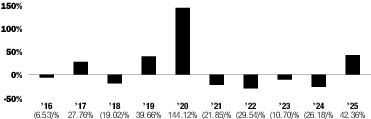
The bar chart below shows how the Fund has performed. The table below the bar chart shows the Fund’s average annual total returns (before and after taxes). The bar chart and table provide an indication of the risks of investing in the Fund by showing how the Fund’s total returns have varied from year to year and by showing how the Fund’s average annual total returns compared with a broad measure of market performance and an additional index with characteristics relevant to the Fund. The Fund's performance reflects fee waivers, if any, absent which performance would have been lower. Although the information shown in the bar chart and the table gives you some idea of the risks involved in investing in the Fund, the Fund’s past performance (before and after taxes) is not necessarily indicative of how the Fund will perform in the future.
Updated performance information is available online at www.invesco.com/ETFs.
Annual Total Returns—Calendar Years
 
Period Ended
Returns
Best Quarter
December 31, 2020
58.89%
Worst Quarter
June 30, 2022
-21.15%

Average Annual Total Returns (for the periods ended December 31, 2025)
 
Inception
Date
1
Year
5
Years
10
Years
Return Before Taxes
6/13/2007
42.36
%
-12.37
%
5.47
%
Return After Taxes on Distributions
40.92
-12.99
4.83
Return After Taxes on Distributions and Sale of Fund
Shares
25.28
-8.93
4.15
WilderHill New Energy Global Innovation Index
(reflects no deduction for fees, expenses or taxes)
42.81
-12.34
5.53
MSCI EAFE® Index (Net) (reflects reinvested
dividends net of withholding taxes, but reflects no
deduction for fees, expenses or other taxes)
31.22
8.92
8.18
After-tax returns in the above table are calculated using the historical highest individual federal marginal income tax rates and do not reflect the impact of state and local taxes. Actual after-tax returns depend on an investor's tax situation and may differ from those shown, and after-tax returns shown are not relevant to investors who hold Shares through tax-advantaged arrangements, such as 401(k) plans or individual retirement accounts.
Management of the Fund
Investment Adviser. Invesco Capital Management LLC (the “Adviser”).
Portfolio Managers
The following individuals are responsible jointly and primarily for the day-to-day management of the Fund’s portfolio:
Name
Title with Adviser/Trust
Date Began
Managing
the Fund
Peter Hubbard
Portfolio Manager of the Adviser; Vice
President of the Trust
June 2007
Pratik Doshi, CFA
Portfolio Manager of the Adviser
February 2020
Michael Jeanette
Portfolio Manager of the Adviser
February 2015
Tony Seisser
Portfolio Manager of the Adviser
February 2015
Purchase and Sale of Shares
The Fund issues and redeems Shares at NAV only with APs and only in large blocks of 50,000 Shares (each block of Shares is called a “Creation Unit”) or multiples thereof (“Creation Unit Aggregations”), generally in exchange for the deposit or delivery of a basket of securities. However, the Fund also reserves the right to permit or require Creation Units to be issued in exchange for cash. Except when aggregated in Creation Units, the Shares are not redeemable securities of the Fund.
Individual Shares may only be bought and sold in the secondary market (i.e., on a national securities exchange) through a broker or dealer at a market price. Because the Shares trade at market prices rather than NAV, Shares may trade at a price greater than NAV (at a premium), at NAV, or less than NAV (at a discount). An investor may incur costs attributable to the difference between the highest price a buyer is willing to pay to purchase Shares (bid) and the lowest price a seller is willing to accept for Shares (ask) when buying or selling Shares in the secondary market (the “bid-ask spread”).
Recent information, including information on the Fund’s NAV, market price, premiums and discounts, and bid-ask spreads, is available online at www.invesco.com/ETFs.
Tax Information
The Fund’s distributions generally are taxed as ordinary income, capital gains or some combination of both, unless you are investing through a tax-advantaged arrangement, such as a 401(k) plan or an individual retirement account, in which case your distributions may be taxed as ordinary income when withdrawn from such account.
5     Invesco Global Clean Energy ETF     
invesco.com/ETFs

Payments to Broker-Dealers and Other Financial Intermediaries
If you purchase Shares of the Fund through a broker-dealer or other financial intermediary (such as a bank), the Fund’s distributor or its related companies may pay the intermediary for certain Fund-related activities, including those that are designed to make the intermediary more knowledgeable about exchange-traded products, such as the Fund, as well
as for marketing, education or other initiatives related to the sale or promotion of Shares. These payments may create a conflict of interest by influencing the broker-dealer or other intermediary and your salesperson or financial adviser to recommend the Fund over another investment. Ask your salesperson or financial adviser or visit your financial intermediary’s website for more information.
6     Invesco Global Clean Energy ETF     
invesco.com/ETFs