As filed with the U.S. Securities and Exchange Commission on September 7, 2022
Registration Nos. 333-
and 333-
SECURITIES AND EXCHANGE COMMISSION
WASHINGTON, D.C. 20549
FORM SF-1
REGISTRATION STATEMENT
UNDER
THE SECURITIES ACT OF 1933
| KANSAS GAS SERVICE, A DIVISION OF ONE GAS, INC. |
KANSAS GAS SERVICE SECURITIZATION I, L.L.C. | |
| (Exact name of registrant, sponsor and depositor as specified in its charter) |
(Exact name of registrant and issuing entity as specified in its charter) |
| Oklahoma | Delaware | |
| (State or other jurisdiction of incorporation or organization) |
(State or other jurisdiction of incorporation or organization) |
| 001-36108 | ||
| (Commission File Number) |
| 0001587732 | 0001944984 | |
| (Central Index Key Number) | (Central Index Key Number) |
| 46-3561936 | 88-3970012 | |
| (I.R.S. Employer Identification Number) |
(I.R.S. Employer Identification Number) |
| 15 East Fifth Street Tulsa, Oklahoma 74103 (918) 947-7000 (Address, including zip code, and telephone number, including area code, of depositors principal executive offices) |
15 East Fifth Street, Suite 2662 Tulsa, Oklahoma 74103 (918) 947-7095 (Address, including zip code, and telephone number, including area code, of issuing entitys principal executive offices) |
Joseph L. McCormick
Senior Vice President, General Counsel and Assistant Secretary
ONE Gas, Inc.
15 East Fifth Street
Tulsa, Oklahoma 74103
(918) 947-7000
(Name, address, including zip code, and telephone number, including area code, of agent for service)
With Copies to:
| Timothy S. Taylor Jonathan D. Bobinger Jamie L. Yarbrough Baker Botts L.L.P. 910 Louisiana Street Houston, Texas 77002-4995 (713) 229-1234 |
Michael F. Fitzpatrick, Jr. Adam R. OBrian Hunton Andrews Kurth LLP 200 Park Avenue New York, NY 10166 (212) 309-1071 |
Approximate date of commencement of proposed sale to the public:
As soon as practicable after the effective date of this Registration Statement.
If this Form is filed to register additional securities for an offering pursuant to Rule 462(b) under the Securities Act of 1933, please check the following box and list the Securities Act registration statement number of the earlier effective registration statement for the same offering. ☐
If this Form is a post-effective amendment filed pursuant to Rule 462(c) under the Securities Act of 1933, check the following box and list the Securities Act registration statement number of the earlier effective registration statement for the same offering. ☐
If this Form is a post-effective amendment filed pursuant to Rule 462(d) under the Securities Act of 1933, check the following box and list the Securities Act registration statement number of the earlier effective registration statement for the same offering. ☐
The Registrants hereby amend this Registration Statement on such date or dates as may be necessary to delay its effective date until the Registrants shall file a further amendment which specifically states that this Registration Statement shall thereafter become effective in accordance with Section 8(a) of the Securities Act of 1933, or until this Registration Statement shall become effective on such date as the Securities and Exchange Commission, acting pursuant to said Section 8(a), may determine.
The information in this prospectus is not complete and may be changed. These securities may not be sold until the registration statement filed with the Securities and Exchange Commission is effective. This prospectus is not an offer to sell nor does it seek an offer to buy these securities in any jurisdiction where the offer or sale is not permitted.
Subject to completion, dated September 7, 2022
PRELIMINARY PROSPECTUS
$336,000,000 Series 2022-A Senior Secured Securitized Utility Tariff Bonds
Kansas Gas Service, a division of ONE Gas, Inc.
Sponsor, Depositor and Initial Servicer
Central Index Key Number: 0001587732
Kansas Gas Service Securitization I, L.L.C.
Issuing Entity
Central Index Key Number: 0001944984
| Tranche | Expected weighted average life (years) |
Principal amount offered* |
Scheduled final payment date |
Final maturity date |
Interest rate |
Initial price public |
Underwriting discounts and commissions |
Proceeds to issuing entity (before expenses) |
CUSIP |
ISIN |
||||||||||||||||||||||||||||||
| A |
$ | % | % | % | $ | |||||||||||||||||||||||||||||||||||
|
|
|
|
||||||||||||||||||||||||||||||||||||||
| * | Principal amount is approximate and subject to change. |
The total initial price to the public is $ . The total amount of the underwriting discounts and commissions is $ . The total amount of proceeds to the issuing entity before deduction of expenses (estimated to be $ ) is $ . The distribution frequency is semi-annually. The first scheduled payment date is , 2023.
Investing in the Series 2022-A Senior Secured Securitized Utility Tariff Bonds involves risks. Please read Risk Factors beginning on page 18 to read about factors you should consider before buying the securitized utility tariff bonds.
Kansas Gas Service, a division of ONE Gas, Inc. (KGS), as depositor, is offering up to $336,000,000 aggregate principal amount of Series 2022-A Senior Secured Securitized Utility Tariff Bonds (the securitized utility tariff bonds) to be issued by Kansas Gas Service Securitization I, L.L.C., a Delaware limited liability company (the issuing entity or us) and wholly owned subsidiary of KGS. KGS is the seller, the initial servicer and the sponsor with regard to the securitized utility tariff bonds. The securitized utility tariff bonds are senior secured obligations of the issuing entity and will be secured by the securitized utility tariff property (the securitized utility tariff property) consisting of the right to impose and collect securitized utility tariff charges (the securitized utility tariff charge) paid by all existing and future retail customers located within KGSs service area. Securitized utility tariff charges are required to be adjusted at least semi-annually, and more frequently as necessary, to correct any under-collection or over-collection of securitized utility tariff charges during the preceding 6 months and to ensure the projected recovery of amounts sufficient to provide all payments of debt service and other required amounts and charges in connection with the securitized utility tariff bonds. The primary forms of credit enhancement for the securitized utility tariff bonds will be provided by such statutory true-up mechanism, as well as by general, excess funds and capital subaccounts held under the indenture governing the securitized utility tariff bonds.
Each securitized utility tariff bond will be entitled to interest on and of each year, beginning on , 2023. The first scheduled payment date is , 2023. Interest will accrue from the date of issuance and must be paid by the purchaser of the securitized utility tariff bonds if the securitized utility tariff bonds are delivered after that date. On each payment date, scheduled principal payments shall be paid sequentially in accordance with the expected sinking fund schedule in this prospectus, but only to the extent funds are available in the collection account after payment of certain fees and expenses and after payment of interest.
The securitized utility tariff bonds represent obligations only of the issuing entity, Kansas Gas Service Securitization I, L.L.C., and are secured only by the assets of the issuing entity, consisting principally of the securitized utility tariff property and related assets to support its obligations under the securitized utility tariff bonds. Please read Description of the Securitized Utility Tariff BondsThe Security for the Securitized Utility Tariff Bonds, and Description of the Securitized Utility Tariff Property in this prospectus. The securitized utility tariff property includes the right to impose, bill, charge, collect and receive securitized utility tariff charges from KGSs retail customers in amounts sufficient to make payments on the securitized utility tariff bonds, as described further in this prospectus. KGS and its affiliates, other than the issuing entity, are not liable for any payments on the securitized utility tariff bonds. The securitized utility tariff bonds are not a debt or obligation of the State of Kansas or any of its political subdivisions, agencies or instrumentalities and are not a charge on its or any of its political subdivisions, agencies or instrumentalities full faith and credit or taxing power.
All matters relating to the structuring and pricing of the securitized utility tariff bonds have been considered by KGS and the State Corporation Commission of the State of Kansas, acting through its designated representatives.
Neither the U.S. Securities and Exchange Commission nor any state securities commission has approved or disapproved of these securities or determined if this prospectus is truthful or complete. Any representation to the contrary is a criminal offense.
The underwriters expect to deliver the securitized utility tariff bonds through the book-entry facilities of The Depository Trust Company for the accounts of its participants including Clearstream Banking, S.A. and Euroclear Banks SA/NV, as operator of the Euroclear System against payment on or about , 2022. There currently is no secondary market for the securitized utility tariff bonds, and we cannot assure you that one will develop.
J.P. Morgan
Structuring agent and joint bookrunner
The date of this prospectus is , 2022.
i
ii
| Page | ||||
| 114 | ||||
| 116 | ||||
| 116 | ||||
| The Servicer Will Indemnify Us, Other Entities and the Kansas Commission in Limited Circumstances |
118 | |||
| The Servicer Will Provide Statements to Us, the Kansas Commission and the Trustee |
118 | |||
| The Servicer Will Provide Assessments Concerning Compliance with the Servicing Agreement |
119 | |||
| 120 | ||||
| 121 | ||||
| 121 | ||||
| 122 | ||||
| The Replacement of KGS as Servicer with a Successor Servicer |
122 | |||
| 122 | ||||
| 123 | ||||
| 124 | ||||
| 128 | ||||
| 129 | ||||
| The Underwriters Sales Price for the Securitized Utility Tariff Bonds |
129 | |||
| No Assurance as to Resale Price or Resale Liquidity for the Securitized Utility Tariff Bonds |
129 | |||
| 129 | ||||
| AFFILIATIONS AND CERTAIN RELATIONSHIPS AND RELATED TRANSACTIONS |
131 | |||
| 132 | ||||
| 132 | ||||
| Income Tax Status of the Securitized Utility Tariff Bonds and Us as Issuing Entity |
133 | |||
| 133 | ||||
| 134 | ||||
| 137 | ||||
| 138 | ||||
| 138 | ||||
| 139 | ||||
| 139 | ||||
| 140 | ||||
| 141 | ||||
| 142 | ||||
| 143 | ||||
| 144 | ||||
| 145 | ||||
| 146 | ||||
| 147 | ||||
iii
| Page | ||||
| 148 | ||||
| 148 | ||||
| 151 | ||||
| 152 | ||||
| 153 | ||||
| 154 | ||||
| 155 | ||||
This prospectus is part of a registration statement filed with the Securities and Exchange Commission or SEC. This prospectus provides information about us, the securitized utility tariff bonds and Kansas Gas Service, a division of ONE Gas, Inc., as depositor, sponsor and initial servicer. This prospectus describes the terms of the securitized utility tariff bonds offered hereby. You should carefully review this prospectus, any free writing prospectus the issuing entity files with the SEC, and the information, if any, contained in the documents referenced in this prospectus under the heading Where You Can Find More Information.
References in this prospectus to the terms we, us, our or the issuing entity mean Kansas Gas Service Securitization I, L.L.C. References to KGS, the sponsor, the initial servicer, the depositor or the seller mean Kansas Gas Service, a division of ONE Gas, Inc. References to ONE Gas means ONE Gas, Inc., an Oklahoma corporation. KGS is a division of ONE Gas. References to the securitized utility tariff bonds or the bonds mean our Series 2022-A Senior Secured Securitized Utility Tariff Bonds offered pursuant to this prospectus. References to the servicer refer to KGS and any successor servicer under the servicing agreement referred to in this prospectus. References to the Securitization Act mean the Utility Financing and Securitization Act, established by the Kansas Legislature, which provides for the securitization of qualified extraordinary costs (such as fuel costs incurred during extreme weather events) by issuing securitized utility tariff bonds. The Securitization Act is codified at K.S.A. § 66-1,240 66-1,253. Unless the context otherwise requires, the term retail customer means an end-use customer who purchases natural gas for consumption from KGS. We also refer to the State Corporation Commission of the State of Kansas as the Kansas commission. You can find a glossary of some of the other defined terms we use in this prospectus on page 155 of this prospectus.
We have included cross-references to sections in this prospectus where you can find further related discussions. You can also find references to key topics in the table of contents.
You should rely only on the information contained in this prospectus. Neither we nor any underwriter, agent, dealer, salesperson, the Kansas commission or KGS has authorized anyone else to provide you with any different information. Neither we nor any underwriter, agent, dealer, salesperson, the Kansas commission or KGS take any responsibility for, nor provide any assurance as to the reliability of, any different information that others may give you. If anyone provides you with different or inconsistent information, you should not rely on it. We are not offering to sell the securitized utility tariff bonds in any jurisdiction where the offer or sale is not permitted. The information in this prospectus is current only as of the date of this prospectus.
We expect to deliver the securitized utility tariff bonds against payment for the securitized utility tariff bonds on or about the date specified in the last paragraph of the cover page of this prospectus, which will be the business day following the date of pricing of the securitized utility tariff bonds. Since trades in the secondary market generally settle in two business days, purchasers who wish to trade securitized utility tariff bonds on the date of pricing or the succeeding business days will be required, by virtue of the fact that the securitized utility tariff bonds initially will settle in T + , to specify alternative settlement arrangements to prevent a failed settlement.
iv
CAUTIONARY STATEMENT REGARDING FORWARD-LOOKING INFORMATION
Certain statements included in this prospectus are forward-looking statements within the meaning of Section 27A of the Securities Act and Section 21E of the Exchange Act. The forward-looking statements relate to our ability to pay principal and interest on the securitized utility tariff bonds when scheduled to be paid, the ability of our servicer to collect securitized utility tariff charges, the value of the securitized utility tariff property, the outcome of regulatory, administrative and legal proceedings, market conditions and other matters. The following discussion is intended to identify important factors that could cause future outcomes to differ materially from those set forth in the forward-looking statements.
Forward-looking statements include the items identified in the preceding paragraph, the information concerning possible or assumed future remittances of securitized utility tariff charges and other statements contained in this prospectus identified by words such as anticipate, estimate, expect, project, intend, plan, believe, should, goal, forecast, guidance, could, may, continue, might, potential, scheduled, likely, and other words and terms of similar meaning.
One should not place undue reliance on forward-looking statements, which are applicable only as of the date of this prospectus. Known and unknown risks, uncertainties and other factors may cause our actual results, performance or achievements to be materially different from any future results, performance or achievements expressed or implied by forward-looking statements. Those factors may affect the value of the securitized utility tariff bonds. In addition to any assumptions and other factors referred to specifically in connection with the forward-looking statements, factors that could cause our actual results to differ materially from those contemplated in any forward-looking statement include, but are not limited to, those set forth below:
| | the length and severity of a pandemic or other health crisis, such as the outbreak of the Coronavirus Disease 2019 (COVID-19) or variants thereof, including the impact to us and KGSs operations, customers, contractors, vendors and employees, and the measures that international, federal, state and local governments, agencies, law enforcement and/or health authorities implement to address it, |
| | competition from alternative forms of energy, including, but not limited to, electricity, solar power, wind power, geothermal energy and biofuels, |
| | broader use of alternative energy sources by KGSs retail customers, |
| | possible loss of local distribution company franchises or other adverse effects caused by the actions of municipalities, |
| | advances in technology, including technologies that increase efficiency or that improve electricitys competitive position relative to natural gas, |
| | the ability of KGSs customers to continue paying their utility bills, |
| | economic conditions in KGSs service area, including the economys effects on its retail customers, |
| | terrorist attacks, cyberattacks, or other malicious acts that may damage or disrupt operating or information technology systems, |
| | acts of nature and the potential effects of threatened or actual terrorism and war, |
| | the accuracy of the servicers estimates of growth in KGSs retail customer base, and |
| | the accuracy of the servicers forecast of retail customers and/or the payment of securitized utility tariff charges. |
v
These factors are not necessarily all of the important factors that could cause actual results to differ materially from those expressed in any of our forward-looking statements. Other factors could also have material adverse effects on our future results. These and other risks are described in greater detail under the caption Risk Factors in this prospectus. All forward-looking statements attributable to us and KGS or to persons acting on our behalf are expressly qualified in their entirety by these factors. Any such forward-looking statement speaks only as of the date on which such statement is made, and other than as required under securities laws, we undertake no obligation to update these statements whether as a result of new information, subsequent events or change in circumstances, expectations or otherwise.
vi
The following section is only a summary of selected information and does not provide you with all the information you will need to make your investment decision. There is more detailed information in this prospectus. To understand all of the terms of the offering of the securitized utility tariff bonds, carefully read this entire prospectus. You should carefully consider the Risk Factors beginning on page 18 of this prospectus before you invest in the securitized utility tariff bonds.
| Securities offered: |
$336,000,000 Series 2022-A Senior Secured Securitized Utility Tariff Bonds, scheduled to pay principal semi-annually and sequentially in accordance with the expected amortization schedule. Only the securitized utility tariff bonds are being offered through this prospectus. |
| Tranche | Principal amount* |
|||
| A |
$ | |||
|
|
||||
| * | Principal amount is approximate and subject to change |
| Issuing entity and capital structure: |
Kansas Gas Service Securitization I, L.L.C. is a direct, wholly owned subsidiary of KGS and a limited liability company formed under Delaware law. We were formed solely to purchase and own the securitized utility tariff property, to issue the securitized utility tariff bonds, and to perform activities incidental thereto. Please read Kansas Gas Service Securitization I, L.L.C., The Issuing Entity in this prospectus. |
| In addition to the securitized utility tariff property, our assets will include a capital investment by KGS (and not from the proceeds of the sale of the securitized utility tariff bonds) which will not be less than 0.50% of the original principal amount of the securitized utility tariff bonds (to be held in the capital subaccount). We will also have an excess funds subaccount to retain, until the next payment date, any amounts collected and remaining after all scheduled payments on the securitized utility tariff bonds have been timely made. |
| Issuing entitys address: |
15 East Fifth Street, Suite 2662, Tulsa, Oklahoma 74103 |
| Issuing entitys telephone number: |
(918) 947-7095 |
| Depositor, seller, initial servicer and sponsor: |
KGS is a regulated natural gas utility that provides natural gas distribution to approximately 72 percent of the natural gas distribution customers in Kansas. ONE Gas, Inc. is incorporated under the laws of the state of Oklahoma and is a 100-percent regulated natural gas distribution utility. KGS, acting as the initial servicer, and any successor servicer, referred to in this prospectus as the servicer, will service the securitized utility tariff property securing the securitized utility tariff bonds under a servicing agreement with us. Please read the section entitled The Depositor, Seller, Initial Servicer and Sponsor in this |
1
| prospectus. Neither KGS nor any other affiliate (other than us) is an obligor on the securitized utility tariff bonds. |
| KGSs address: |
15 East Fifth Street, Tulsa, Oklahoma 74103 |
| KGSs phone number: |
(918) 947-7000 |
| Trustee: |
U.S. Bank Trust Company, National Association. Please read The Trustee in this prospectus for a description of the trustees duties and responsibilities under the indenture. |
| Purpose of transaction: |
This issuance of the securitized utility tariff bonds will enable KGS to recover certain qualified extraordinary costs related to Winter Storm Uri. Please read KGSs Financing Order in this prospectus. |
| Transaction overview: |
In February 2021, Kansas experienced sub-zero temperatures brought by Winter Storm Uri, which led to a significant increase in demand for electricity and natural gas. Sub-zero temperatures and increased demand for electricity and natural gas caused by the winter storm placed significant stress on utilities, including KGS. Jurisdictional natural gas utilities were ordered to do everything necessary to ensure that natural gas service continued to be provided to their customers in Kansas, and by June 30, 2021, KGS had incurred and deferred approximately $390 million of qualified extraordinary costs related to the winter event. |
| The Securitization Act permits utilities to utilize a financing mechanism through which it can recover qualified extraordinary costs (as defined in the Securitization Act) resulting from such storms by issuing securitized utility tariff bonds. Under the Securitization Act and the financing order, KGS customers will pay securitized utility tariff charges, which are nonbypassable charges included in their monthly charges. These charges will fund payments of principal and interest on the securitized utility tariff bonds. Unless the context infers otherwise, references in this prospectus to the financing order are to the financing order issued by the Kansas commission in KGSs Docket No. 22-KGSG-466-TAR on August 18, 2022. |
| On August 18, the Kansas commission approved KGSs application, as modified by the Kansas commissions financing order. Accordingly, the Kansas commission: (1) authorized, subject to the terms of the financing order, the issuance of securitized utility tariff bonds in an aggregate amount not to exceed the qualified extraordinary costs less the portion of these costs attributable to the sales for resale customer class and financing costs; (2) approved the creation of securitized utility tariff property consisting of the right to impose and collect securitized utility tariff charges in an amount to be calculated as provided in the financing order; (3) approved the form of tariff, as approved in the financing order, to implement the securitized utility tariff charges; (4) approved the securitization of qualified extraordinary costs, including upfront financing costs and ongoing financing cost estimates (subject to review of the Kansas commissions designated representatives); and (5) approved the review of the |
2
| structure of the proposed securitization financing through a pre-issuance review and ultimate issuance advice letter process. |
| The primary transactions underlying the issuance and sale of the securitized utility tariff bonds are as follows: |
| | KGS will transfer and sell the securitized utility tariff property to us in exchange for the net proceeds from the sale of the securitized utility tariff bonds, |
| | we will sell the securitized utility tariff bonds, which will be secured primarily by the securitized utility tariff property, to the underwriters named in this prospectus, and |
| | KGS will act as the initial servicer of the securitized utility tariff property. |
| The securitized utility tariff bonds are not obligations of the trustee, our managers, KGS or of any of their affiliates other than us. The securitized utility tariff bonds are also not debt or obligations of the State of Kansas, the Kansas commission or any other public subdivision, agency or instrumentality of the State of Kansas. |
3
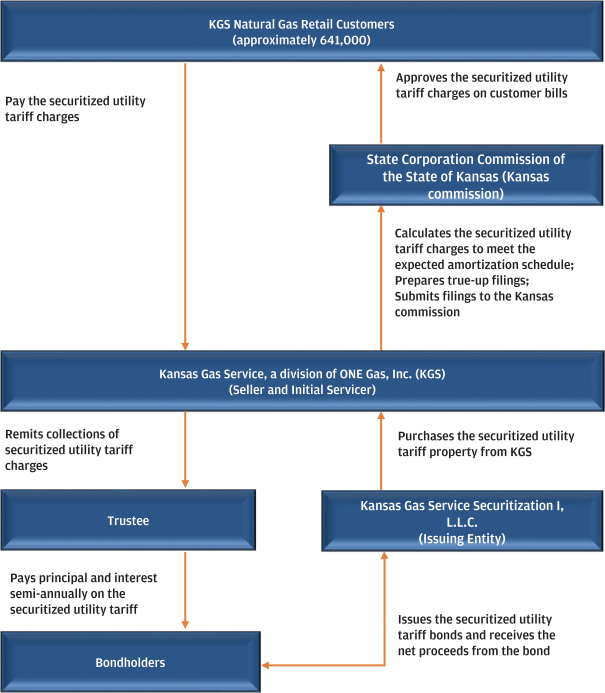
Parties to transaction and responsibilities
The following chart represents a general summary of the parties to the transactions underlying the offering of the securitized utility tariff bonds, their roles and their various relationships to the other parties:
4
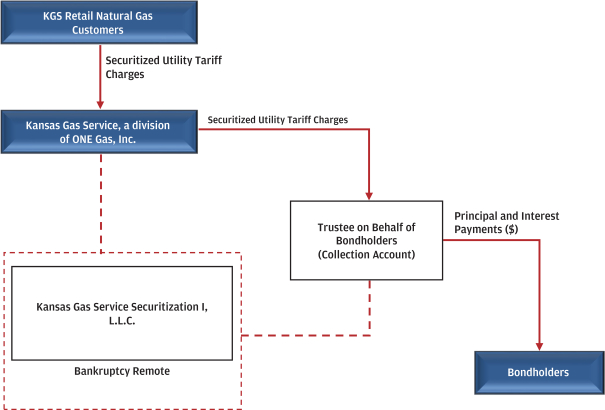
Flow of funds
The following chart represents a general summary of the flow of funds:
| The security for the securitized utility tariff bonds: |
The securitized utility tariff bonds will be secured by the collateral pledged pursuant to the indenture. The principal asset of the trust estate will be the securitized utility tariff property. The Securitization Act and financing order provide for the creation and establishment of the securitized utility tariff property, which is a present contract right in favor of KGS, its transferees and other financing parties, to impose, bill, charge, collect and receive securitized utility tariff charges from KGSs existing and future retail customers, as well as to obtain periodic adjustments to such charges as provided in the financing order. In addition, the securitized utility tariff property consists of all revenues, collections, claims, rights to payments, payments, money or proceeds arising from the aforementioned rights and interests. |
| The indentures trust estate will also consist of: |
| | our rights under the sale agreement pursuant to which we will acquire the securitized utility tariff property, under an administration agreement and under the bill of sale delivered by KGS pursuant to the sale agreement, |
5
| | our rights under the servicing agreement and any subservicing, agency, intercreditor or collection agreements executed in connection with the servicing agreement, |
| | the collection account for the securitized utility tariff bonds and all subaccounts of the collection account, |
| | all rights to compel the servicer to file for and obtain periodic adjustments to the securitized utility tariff charges in accordance with the Securitization Act and the financing order, |
| | all present and future claims, demands, causes and choses in action in respect of any or all of the foregoing, |
| | all accounts, chattel paper, deposit accounts, documents, general intangibles, goods, instruments, investment property, letters of credit, letters-of-credit rights, money, commercial tort claims and supporting obligations related to the foregoing, other than any cash released to us by the trustee on any payment date to be distributed to KGS as a return of its invested capital in us, and |
| | all payments on or under and all proceeds in respect of any or all of the foregoing. |
| The subaccounts consist of a capital subaccount, which will be funded at closing in the amount of 0.50% of the initial aggregate principal amount of the securitized utility tariff bonds, a general subaccount, into which the servicer will deposit all securitized utility tariff charge collections, and an excess funds subaccount, into which we will transfer any amounts collected and remaining on a payment date after all payments to securitized utility tariff bondholders and other parties have been made. Amounts on deposit in each of these subaccounts will be available to make payments on the securitized utility tariff bonds on each payment date. For a description of the securitized utility tariff property, please read Description of the Securitized Utility Tariff Property in this prospectus. |
| For a description of the securitized utility tariff bonds, please read Description of the Securitized Utility Tariff Bonds in this prospectus. |
| The securitized utility tariff property: |
In general terms, all of the rights and interests of KGS that are transferred to us pursuant to the sale agreement are referred to in this prospectus as the securitized utility tariff property. The securitized utility tariff property includes the right to impose, bill, charge, collect and receive securitized utility tariff charges in amounts sufficient to pay principal and interest and ongoing financing costs in connection with the securitized utility tariff bonds, to obtain periodic adjustments to such charges as provided in the financing order and all revenues, collections, claims, rights to payments, payments, money or proceeds arising from the foregoing rights and interests. Securitized utility tariff charges are payable by KGSs retail customers. |
6
| The securitized utility tariff property is the principal collateral securing the securitized utility tariff bonds. Securitized utility tariff charges authorized in a financing order are irrevocable and not subject to reduction, impairment, or adjustment by further action of the Kansas commission, except for semi-annual and interim true-up adjustments to correct over-collections or under-collections and to provide for the expected recovery of amounts sufficient to timely provide payments of scheduled debt service and ongoing financing costs in connection with the securitized utility tariff bonds. See KGSs Financing OrderTrue-Ups. All revenues and collections resulting from securitized utility tariff charges are part of the securitized utility tariff property. |
| We will purchase the securitized utility tariff property from KGS to support the issuance of the securitized utility tariff bonds. KGS, as the initial servicer, will bill and collect the securitized utility tariff charges from current and future retail customers. KGS will include the securitized utility tariff charges in its bills to its customers and is required to show the securitized utility tariff charges as a separate line item. |
| State and Kansas commission pledges: |
The State of Kansas has pledged in the Securitization Act that it will not alter the provisions of the part of the Securitization Act which authorizes the Kansas commission to create a present contract right by the issuance of a financing order, to create securitized utility tariff charges, and to make the securitized utility tariff charges imposed by a financing order irrevocable, binding and nonbypassable charges, taking or permitting any action that impairs or would impair the value of the securitized utility tariff property or the security for the securitized utility tariff bonds or revises the qualified extraordinary costs (as defined in the Securitization Act) for which recovery is authorized, or, except for adjustments discussed in KGSs Financing OrderTrue-ups and The Servicing AgreementSecuritized Utility Tariff Charge Adjustment Process in this prospectus, reducing, altering or impairing the securitized utility tariff charges that are to be imposed, billed, charged, collected and remitted for the benefit of the securitized utility tariff bondholders until the principal, interest and premium, if any, and any other charges incurred and contracts to be performed in connection with the securitized utility tariff bonds have been paid and performed in full. However, nothing will preclude limitation or alteration if and when full compensation is made for the full protection of the securitized utility tariff charges collected pursuant to the financing order and the full protection of the securitized utility tariff bondholders and any assignee or financing party. Please read Risk FactorsRisks Associated with Potential Judicial, Legislative or Regulatory Actions and The Securitization ActKGS May Securitize Qualified Extraordinary Costs and Related Upfront and Ongoing Financing Costs in this prospectus. |
| The Kansas commission has jurisdiction over KGS pursuant to K.S.A. § 66-1,200 et seq. The State of Kansas and its agencies, including the Kansas commission, have pledged that the State of Kansas and its agencies shall not |
7
| (i) alter the statute that authorizes the creation of the securitized utility tariff property and the securitized utility tariff charges imposed by the financing order, which are irrevocable, binding or nonbypassable charges for all existing and future retail customers within the service area of the public utility, (ii) take any action that would impair the value of the securitized utility tariff property or the security for the securitized utility tariff bonds, (iii) impair the rights and remedies of bondholders, assignees and financing parties in any way, or (iv) except for changes expressly allowed by law pursuant to the adjustment mechanism, reduce, alter, or impair the securitized utility tariff charges to be imposed, billed, charged, collected and remitted until the securitized utility tariff bonds have been paid and performed in full. Please read Risk FactorsRisks Associated with Potential Judicial, Legislative or Regulatory Actions and KGSs Financing OrderState and Commission Pledges in the prospectus. |
| True-up mechanism for payment of scheduled principal and interest: |
Securitized utility tariff charges are required to be adjusted semi-annually to: |
| | correct any under-collection or over-collection of securitized utility tariff charges during the preceding 6 months, and |
| | ensure the expected recovery of amounts sufficient to timely provide all payments of debt service and other required amounts and charges in connection with the securitized utility tariff bonds. |
| In addition to semi-annual true-up adjustments, additional true-up adjustments may be made more frequently at any time during the term of the securitized utility tariff bonds to correct any under- or over-collection in order to assure timely payment of the securitized utility tariff bonds as scheduled. |
| In addition, with regard to the per-retail customer charge, if the customer count for a particular class of retail customers declines by more than 10% from that identified in KGSs 2020 Annual Report filed with the Kansas commission, then the allocation factors for each class of retail customers will be recalculated using the most recent 12-month customer count for each customer class in the next regular true-up. |
| Please read The Securitized Utility Tariff Charges, KGSs Financing Order and The Servicing AgreementSecuritized Utility Tariff Charge Adjustment Process in this prospectus. |
| Nonbypassable securitized utility tariff charges: |
The nonbypassable securitized utility tariff charges are applied to all existing and future retail customers receiving natural gas service from KGS or its successors or assignees under Kansas commission-approved rate schedules or under special contracts, even if a retail customer elects to purchase natural gas from an alternative natural gas supplier following a fundamental change in regulation of public utilities in Kansas; provided, however, if a customer disconnects from KGSs gas distribution system and switches to alternative |
8
| sources of energy that meet all of its energy needs, such customer will no longer be a retail customer and will not be subject to paying securitized utility tariff charges. Please read The Securitized Utility Tariff Charges, KGSs Financing Order and The Servicing AgreementSecuritized Utility Tariff Charge Adjustment Process in this prospectus. |
| Initial securitized utility tariff charge as a percentage of customers total gas bill: |
KGS estimates that on an annualized basis the initial securitized utility tariff charges would represent approximately % of the total bill received by an average residential Customer based on rates as of August 2022. |
| Payment dates: |
Interest on the securitized utility tariff bonds is payable semi-annually on and . Interest will be calculated on a 30/360 basis. The first scheduled interest and principal payment date is , 2023. |
| Interest payments: |
Interest is due on each payment date. Interest will accrue with respect to the securitized utility tariff bonds from the date we issue the securitized utility tariff bonds at the interest rate specified in the table below. |
| Tranche | Interest Rate | |||
| A |
% | |||
|
|
||||
| If any payment date is not a business day, payments scheduled to be made on such date may be made on the next succeeding business day and no interest shall accrue upon such payment during the intervening period. |
| On each payment date, we will pay interest on the securitized utility tariff bonds equal to the following amounts: |
| | if there has been a payment default, any interest payable but unpaid on any prior payment dates, together with interest on such unpaid interest, if any, and |
| | accrued interest on the principal balance of the securitized utility tariff bonds from the close of business on the preceding payment date, or the date of the original issuance of the securitized utility tariff bonds, as applicable, after giving effect to all payments of principal made on the preceding payment date, if any. |
| We will pay interest on the securitized utility tariff bonds before we pay the principal of the securitized utility tariff bonds. Please read Description of the Securitized Utility Tariff BondsPayments of Interest and Principal on the Securitized Utility Tariff Bonds in this prospectus. We will calculate interest on the basis of a 360-day year of twelve 30-day months. |
9
| Principal payments and record dates and payment sources: |
On each payment date for the securitized utility tariff bonds, referred to in this prospectus as a payment date, we will pay amounts of principal and interest then due or scheduled to be paid on the securitized utility tariff bonds from amounts available in the collection account and the related subaccounts held by the trustee. We will make these payments to the holders of record of the securitized utility tariff bonds on each record date, referred to in this prospectus as a record date. These available amounts, which will include the applicable securitized utility tariff charges collected by the servicer and remitted to the trustee since the last payment date, are described in greater detail under Description of the Securitized Utility Tariff BondsThe Collection Account for the Securitized Utility Tariff Bonds. The trustee will pay the principal of securitized utility tariff bonds in the amounts and on the payment dates specified in the expected amortization schedule described in this prospectus, but only to the extent securitized utility tariff charge collections received from the servicer and amounts available from trust accounts held by the trustee are sufficient to make principal payments after payment of amounts having a higher priority of payment. Please read Description of the Securitized Utility Tariff BondsHow Funds in the Collection Account Will Be Allocated. |
| Failure to pay a scheduled principal payment on any payment date or the entire outstanding amount of the securitized utility tariff bonds by the scheduled final payment date will not result in a default. The failure to pay the entire outstanding principal balance of the securitized utility tariff bonds will result in a default only if such payment has not been made by the final maturity date. |
| If there is a shortfall in the amounts available to make principal payments on the securitized utility tariff bonds that are due and payable, on or after the final maturity date or upon an acceleration following an event of default, the trustee will distribute principal from the collection account based on the principal amount then due and payable on the payment date. |
| Weighted average life: |
|
Tranche |
|
Expected weighted average life |
| |||
| A |
||||||||
|
|
||||||||
| Scheduled final payment date and final maturity date: |
The scheduled final payment date and the final maturity date of the securitized utility tariff bonds are as set forth in the table below. |
| Tranche | Scheduled final payment date |
Final maturity date |
||||||||
| A |
||||||||||
|
| ||||||||||
| Optional redemption: |
None. Non-call for the life of the securitized utility tariff bonds. |
10
| Mandatory redemption: |
None. We are not required to redeem the securitized utility tariff bonds at any time prior to maturity. |
| Priority of payments: |
On each payment date for the securitized utility tariff bonds, the trustee will allocate or pay all amounts on deposit in the general subaccount of the collection account in the following order of priority: |
| 1. | payment of the trustees fees, plus expenses and any outstanding indemnity amounts not to exceed $200,000 in any 12-month period, provided, however, that such cap shall be disregarded and inapplicable upon the acceleration of the securitized utility tariff bonds following the occurrence of an event of default, |
| 2. | payment of the servicing fee relating to the securitized utility tariff bonds with respect to such payment date, plus any unpaid servicing fees relating to the securitized utility tariff bonds from prior payment dates, |
| 3. | payment of the due and unpaid administration fee, which will be a fixed amount specified in the administration agreement between us and KGS, and the due and unpaid fees of our independent manager, which will be in an amount specified in an agreement between us and our independent manager, |
| 4. | payment of all of our other ordinary periodic operating expenses relating to the securitized utility tariff bonds for such payment date, such as accounting and audit fees, rating agency fees, legal fees and certain reimbursable costs of the servicer under the servicing agreement, |
| 5. | payment of the interest then due on the securitized utility tariff bonds, including any past-due interest, |
| 6. | payment of the principal due to be paid on the securitized utility tariff bonds at final maturity or acceleration upon an event of default, |
| 7. | payment of the principal then scheduled to be paid on the securitized utility tariff bonds in accordance with the expected sinking fund schedule, including any previously unpaid scheduled principal, |
| 8. | payment of any of our remaining unpaid operating expenses and any remaining amounts owed pursuant to the basic documents, including all remaining amounts owed to the trustee, |
| 9. | replenishment of the amount, if any, by which the initial balance of the capital subaccount of the securitized utility tariff bonds exceeds the amount in the capital subaccount as of such payment date, |
| 10. | the return on the invested capital then due and payable, which shall be the sum of the rate of return payable to KGS on its capital contribution which has been deposited into the capital subaccount, equal to KGSs cost of capital, which is currently 8.6012%, plus any return on the invested capital not paid on any prior payment date shall be paid to KGS, |
11
| 11. | allocation of the remainder, if any, to the excess funds subaccount of the securitized utility tariff bonds, and |
| 12. | after the securitized utility tariff bonds have been paid in full and discharged, and all of the other foregoing amounts have been paid in full, the balance, together with all amounts in the capital subaccount and the excess funds subaccount of the securitized utility tariff bonds, released to us free and clear of the lien of the indenture, which funds, less an amount equal to the initial deposit into the capital subaccount plus any unpaid return on invested capital, will be distributed to KGS and credited to KGSs customers in the form of a credit to their natural gas bills. |
| The amount of the servicers fee referred to in clause 2 above will be 0.05% of the aggregate initial principal amount of the securitized utility tariff bonds (for so long as KGS is the servicer) on an annualized basis. The priority of distributions for the collected securitized utility tariff charges, as well as available amounts in the subaccounts, are described in more detail under Description of the Securitized Utility Tariff BondsHow Funds in the Collection Account Will Be Allocated. |
| Credit enhancement: |
The primary forms of credit enhancement are the true-up process and the capital subaccount. |
| True-up Process. Securitized utility tariff charges are required to be adjusted at least semi-annually to: |
| | Correct any under-collection or over-collection of securitized utility tariff charges during the preceding 6 months, and |
| | ensure the expected recovery of amounts sufficient to timely provide all payments of debt service and other required amounts and charges in connection with the securitized utility tariff bonds. |
| The servicer may also make interim true-up adjustments more frequently under certain circumstances. Please read KGSs Financing OrderTrue-Ups. |
| Collection account. Under the indenture, the trustee will hold a collection account for the securitized utility tariff bonds, divided into various subaccounts. The primary subaccounts for credit enhancement purposes are: |
| | the general subaccountthe trustee will deposit into the general subaccount all securitized utility tariff charge collections remitted to it by the servicer with respect to the securitized utility tariff bonds and investment earnings on amounts in the general subaccount; |
| | the capital subaccountKGS will deposit an amount equal to 0.50% of the original principal amount of the securitized utility tariff bonds into the capital subaccount on the date of issuance of the securitized utility tariff bonds; and |
| | the excess funds subaccountany excess amount of collected securitized utility tariff charges held after the payment on a payment date of scheduled |
12
| principal, interest and ongoing financing costs, and investment earnings on amounts in the excess funds subaccount of securitized utility tariff bonds will be held in the excess funds subaccount. |
| Each of these subaccounts for the securitized utility tariff bonds will be available to make payments on the securitized utility tariff bonds on each payment date. In addition, other subaccounts may be used, including an over-collateralization subaccount or other subaccount if necessary to obtain certain tax treatment, desired ratings or otherwise increase the tangible and quantifiable benefits of the securitization. KGS may implement such subaccounts only with the agreement of the Kansas commissions designated representatives. |
| Additional credit enhancements. In addition, KGS may provide for other various forms of credit enhancement, including letters of credit, reserve accounts, surety bonds, and other mechanisms designed to promote the credit quality of marketability of the securitized utility tariff bonds. Any decision for additional credit enhancements is required to be made in conjunction with the Kansas commission acting through its designated representatives. |
| Reports to holders of securitized utility tariff bonds: |
Pursuant to the indenture, the trustee shall make available electronically on its reporting website to each securitized utility tariff bondholder and the Kansas commission a statement provided and prepared by the servicer containing information concerning, among other things, us and the collateral for the securitized utility tariff bonds. Unless and until the securitized utility tariff bonds are issued in definitive certificated form, the reports for the securitized utility tariff bonds will be provided to The Depository Trust Company. The reports will be available to beneficial owners of the securitized utility tariff bonds on the reporting website of the trustee or upon written request to the trustee or the servicer. These reports will not be examined and reported upon by an independent public accountant. In addition, no independent public accountant will provide an opinion thereon. Furthermore, if required by the Trust Indenture Act, the trustee will be required to mail a brief annual report to all holders of securitized utility tariff bonds containing information concerning the trustee. Please read Description of the Securitized Utility Tariff BondsReports to Holders of the Securitized Utility Tariff Bonds and The Trustee Must Provide an Annual Report to All Securitized Utility Tariff Bondholders. |
| Servicing compensation: |
We will pay the servicer on each payment date the servicing fee with respect to the securitized utility tariff bonds. As long as KGS or any affiliated entity acts as servicer, this fee will be 0.05% of the initial principal amount of the securitized utility tariff bonds on an annualized basis, plus reimbursement for its out-of-pocket costs for external accounting and legal services. If a successor servicer is appointed, the servicing fee will be negotiated by the successor servicer and the trustee, but will not, unless the Kansas commission consents, exceed 0.60% of the initial principal amount of the securitized utility tariff bonds on an annualized basis. In no event will the trustee be liable for any servicing fee in its individual capacity. |
13
| Federal income tax status: |
Baker Botts L.L.P. expects to issue an opinion, that, for U.S. federal income tax purposes (i) the issuance of the securitized utility tariff bonds will be a qualifying securitization within the meaning of Revenue Procedure 2005-62, 2005-2 CB 507 (Revenue Procedure 2005-62), (ii) we will not be treated as a taxable entity separate and apart from our sole member, ONE Gas, and (iii) based on Revenue Procedure 2005-62, the securitized utility tariff bonds will constitute indebtedness of ONE Gas. Each beneficial owner of a securitized utility tariff bond, by acquiring a beneficial interest, agrees to treat such securitized utility tariff bond as indebtedness of our sole member secured by the collateral for federal (and, to the extent applicable, state) income tax purposes unless otherwise required by appropriate taxing authorities. Please read Material U.S. Federal Income Tax Consequences in this prospectus. |
| Kansas state income tax status: |
In the opinion of Triplett Woolf Garretson, LLC, counsel to us and KGS, interest paid on the securitized utility tariff bonds generally will be taxed for Kansas income tax purposes consistently with its taxation for U.S. federal income tax purposes and (assuming that the securitized utility tariff bonds will be treated as debt obligations of ONE Gas for U.S. federal income tax purposes) such interest received by a person who is not otherwise subject to corporate or personal income tax in the state of Kansas will not be subject to tax in Kansas. Triplett Woolf Garretson, LLC expects to issue an opinion, that, for Kansas income tax purposes (1) we will not be treated as a taxable entity separate and apart from ONE Gas, and (2) the securitized utility tariff bonds will constitute indebtedness of ONE Gas, assuming, in each case, that such treatment applies for U.S. federal income tax purposes. Please read Material U.S. Federal Income Tax Consequences and Material Kansas Income Tax Consequences in this prospectus. |
| ERISA considerations: |
Employee benefit plans or other arrangements that are subject to ERISA or Section 4975 of the Internal Revenue Code and investors acting on behalf of, or using assets of, such plans or arrangements may acquire the securitized utility tariff bonds subject to specified conditions. The acquisition, holding or disposition of the securitized utility tariff bonds could be treated as a direct or indirect prohibited transaction under ERISA and/or Section 4975 of the Internal Revenue Code. Accordingly, by purchasing and holding the securitized utility tariff bonds, each investor that is or is acting on behalf of, or using assets of, such an employee benefit plan or arrangement subject to ERISA and/or Section 4975 of the Internal Revenue Code will be deemed to certify by virtue of its acquisition of any securitized utility tariff bonds that the acquisition, holding and subsequent disposition of the securitized utility tariff bonds will not constitute or result in a non-exempt prohibited transaction under ERISA or Section 4975 of the Internal Revenue Code or, in the case of a plan subject to applicable similar law, a non-exempt violation of applicable similar law. For further information, please read ERISA Considerations in this prospectus. |
14
| Credit ratings: |
The securitized utility tariff bonds are expected to receive credit ratings from two nationally recognized rating agencies. See Ratings for the Securitized Utility Tariff Bonds in this prospectus. |
| Use of proceeds: |
Upon the issuance and sale of the securitized utility tariff bonds, we will use the net proceeds to pay to KGS the purchase price of KGSs rights under the financing order, which are securitized utility tariff property. |
| The net proceeds from the sale of the securitized utility tariff property (after payment of upfront financing costs) will be used by KGS to recover, finance or refinance the qualified extraordinary costs of KGS as approved by the Kansas commission. KGSs qualified extraordinary costs are currently estimated to be approximately $328 million and are related to Winter Storm Uri. Please read Use of Proceeds in the prospectus. |
| 1940 Act registration: |
We expect to rely on an exclusion from the definition of investment company under the 1940 Act contained in Rule 3a-7 under the 1940 Act, although there may be additional exclusions or exemptions available to us. We are being structured so as not to constitute a covered fund for purposes of the Volcker Rule under the Dodd-Frank Act |
| Risk retention: |
The securitized utility tariff bonds are not subject to the 5% risk retention requirements imposed by Section 15G of the Exchange Act due to the exemption provided in Rule 19(b)(8) of the risk retention regulations in 17 C.F.R. Part 246 of the Exchange Act or Regulation RR. For information regarding the requirements of the EU Securitization Regulation as to risk retention and other matters, please read Risk FactorsOther Risks Associated with an Investment in the Securitized Utility Tariff BondsRegulatory provisions affecting certain investors could adversely affect the liquidity and the regulatory treatment of investments in the securitized utility tariff bonds in this prospectus. |
| Minimum denomination: |
$2,000, or integral multiples of $1,000 in excess thereof, except for one bond which may be of a smaller denomination. |
| Expected settlement: |
, 2022, settling flat. DTC, Clearstream and Euroclear. |
| Risk factors: |
You should consider carefully the risk factors beginning on page 18 of this prospectus before you invest in the securitized utility tariff bonds. |
15
Summary of risk factors
Set forth below is a summary of the material risk factors which you should consider before deciding whether to invest in the securitized utility tariff bonds. These risks can affect the timing or ultimate payment of the securitized utility tariff bonds and the value of your investment in the securitized utility tariff bonds.
| | You may experience material payment delays or incur a loss on your investment in the securitized utility tariff bonds because the source of funds for payment is limited. |
Risks associated with potential judicial, legislative or regulatory actions
| | We and KGS are not obligated to indemnify you for changes in law. |
| | Future judicial action could reduce the value of your investment in the securitized utility tariff bonds. |
| | Future state action could reduce the value of your investment in the securitized utility tariff bonds. |
| | The Kansas commission might attempt to take actions that could reduce the value of your investment in the securitized utility tariff bonds. |
| | The servicer may not fulfill its obligations to act on behalf of the securitized utility tariff bondholders to protect bondholders from actions by the Kansas commission or the State of Kansas, or the servicer may be unsuccessful in any such attempt. |
| | Deregulation or restructuring of the natural gas utility market in Kansas might reduce collections of securitized utility tariff charges and the value of your investment in the securitized utility tariff bonds. |
| | A municipal entity may seek to acquire portions of KGSs gas system and avoid payment of the securitized utility tariff charges. |
Servicing risks
| | Your investment in the securitized utility tariff bonds depends on KGS or its successor or assignee, acting as servicer of the securitized utility tariff property. |
| | Inaccurate customer count forecasting or unanticipated delinquencies or write-offs might reduce scheduled payments on the securitized utility tariff bonds. |
| | If we have to replace KGS as the servicer, we may experience difficulties finding and using a replacement servicer. |
| | Changes to billing and collection practices might reduce the value of your investment in the securitized utility tariff bonds. |
| | Limits on rights to terminate service might make it more difficult to collect the securitized utility tariff charges. |
Weather-related damage and other natural disaster risks
| | Storm-related damage or damage from other natural disasters to KGSs system could impair payments on the securitized utility tariff bonds. |
16
Risks to natural gas industry
| | Natural gas is subject to competition from alternative energy sources and future technological change might make alternative energy sources more attractive. |
| | Increases in natural gas prices could prompt customers to switch to alternative energy sources and negatively impact the collection of securitized utility tariff charges. |
| | Political, institutional and societal sentiment toward climate change and related policies could prompt customers to switch to alternative energy sources and negatively impact the collection of securitized utility tariff charges. |
Risks associated with the unusual nature of the securitized utility tariff property
| | Future adjustments to the securitized utility tariff charges by customer class might result in insufficient collection. |
| | Foreclosure of the trustees lien on the securitized utility tariff property might not be practical, and acceleration of the securitized utility tariff bonds before maturity might have little practical effect. |
Risks associated with potential bankruptcy proceedings of the seller or the servicer
| | The servicer will commingle the securitized utility tariff charges with other revenues it collects, which might obstruct access to the securitized utility tariff charges in case of the servicers bankruptcy and reduce the value of your investment in the securitized utility tariff bonds. |
| | The bankruptcy of ONE Gas might result in losses or delays in payments on the securitized utility tariff bonds. |
| | The sale of the securitized utility tariff property might be construed as a financing and not a sale in a case of ONE Gass bankruptcy which might delay or limit payments on the securitized utility tariff bonds. |
| | If the servicer enters bankruptcy proceedings, the remittance of certain securitized utility tariff charges by the servicer prior to the date of bankruptcy might constitute preferences, which means these funds might be unavailable to pay amounts owed on the securitized utility tariff bonds. |
| | Claims against KGS might be limited in the event of a bankruptcy of ONE Gas. |
| | The bankruptcy of ONE Gas might limit the remedies available to the trustee. |
Other risks associated with an investment in the securitized utility tariff bonds
| | KGSs indemnification obligations under the sale agreement and the servicing agreement are limited and might not be sufficient to protect your investment in the securitized utility tariff bonds. |
| | Credit ratings do not indicate the expected rate of payment of principal on the securitized utility tariff bonds. |
| | A reduction of ONE Gass credit ratings might affect the market value of the securitized utility tariff bonds. |
| | The absence of a secondary market for the securitized utility tariff bonds might limit your ability to resell the securitized utility tariff bonds. |
| | You might receive principal payments for the securitized utility tariff bonds later than you expect. |
17
| | KGS may cause the issuance, by another subsidiary or affiliated entity, of additional securitized utility tariff bonds secured by additional securitized utility tariff property that includes a nonbypassable charge on retail customers. |
| | KGSs operations are subject to risks beyond its control, including cyber-security intrusions, terrorist attacks or other catastrophic events, which could limit KGSs operations and ability to service the securitized utility tariff property. |
| | If the investment of collected securitized utility tariff charges and other funds held by the trustee in the collection account results in investment losses or the investments become illiquid, you may receive payment of principal and interest on the securitized utility tariff bonds later than you expect. |
| | Regulatory provisions affecting certain investors could adversely affect the liquidity and the regulatory treatment of investments in the securitized utility tariff bonds. |
Please carefully consider all the information we have included or incorporated by reference in this prospectus, including the risks described below and in Cautionary Statement Regarding Forward-Looking Information, before deciding whether to invest in the securitized utility tariff bonds.
You may experience material payment delays or incur a loss on your investment in the securitized utility tariff bonds because the source of funds for payment is limited.
The only source of funds for payment of the securitized utility tariff bonds will be our assets, which consist of:
| | the securitized utility tariff property securing the securitized utility tariff bonds, including the right to impose, bill, charge, collect and receive securitized utility tariff charges; |
| | the funds on deposit in the accounts held by the trustee; and |
| | our rights under various contracts we describe in this prospectus. |
The securitized utility tariff bonds are not a charge on the full faith and credit or taxing power of the State of Kansas or any governmental agency or instrumentality, nor will the securitized utility tariff bonds be insured or guaranteed by KGS, including in its capacity as the sponsor, depositor, seller or initial servicer, or any of their respective affiliates (other than us), the trustee or any other person or entity. The securitized utility tariff bonds will be nonrecourse obligations, secured only by the collateral. Delays in payment on the securitized utility tariff bonds might result in a reduction in the market value of the securitized utility tariff bonds and, therefore, the value of your investment in the securitized utility tariff bonds. Thus, you must rely for payment of the securitized utility tariff bonds solely upon the collections of the securitized utility tariff charges, and funds on deposit in the accounts held by the trustee. Our organizational documents restrict our right to acquire other assets unrelated to the transactions described in this prospectus. Please read Kansas Gas Service Securitization I, L.L.C., The Issuing Entity in this prospectus.
RISKS ASSOCIATED WITH POTENTIAL JUDICIAL, LEGISLATIVE OR REGULATORY ACTIONS
We and KGS are not obligated to indemnify you for changes in law.
Neither we nor KGS, nor any affiliate, successor or assignee, will indemnify you for any changes in the law, including any federal preemption or repeal or amendment of the Securitization Act, that might affect the value of the securitized utility tariff bonds. KGS will agree in the sale agreement to institute any legal or
18
administrative action or proceeding as may be reasonably necessary to block or overturn any attempts to cause a repeal, modification or amendment of the Securitization Act that would be materially adverse to us, the trustee or the securitized utility tariff bondholders. However, we cannot assure you that KGS would be able to take this action or that any such action would be successful. Although KGS or any successor assignee might be required to indemnify us if legal action based on the law in effect at the time of the issuance of the securitized utility tariff bonds invalidates the securitized utility tariff property, such indemnification obligations do not apply for any changes in law after the date the securitized utility tariff bonds are issued, whether such changes in law are effected by means of any legislative enactment, any constitutional amendment or any final and non-appealable judicial decision. Please read The Sale AgreementKGSs Covenants in this prospectus.
Future judicial action could reduce the value of your investment in the securitized utility tariff bonds.
The securitized utility tariff property is the creation of the Securitization Act and the financing order that has been issued by the Kansas commission to KGS pursuant to the Securitization Act. The Securitization Act was enacted in April 2021. There is uncertainty associated with investing in bonds payable from an asset that depends for its existence on legislation because there is limited judicial or regulatory experience implementing and interpreting the legislation. The Securitization Act or any financing order or any provisions thereof might be directly contested in courts or otherwise become the subject of litigation. Because the securitized utility tariff property is a creation of the Securitization Act and the financing order, any judicial determination affecting the validity of or interpreting the Securitization Act or the financing order, the securitized utility tariff property or our ability to make payments on the securitized utility tariff bonds might have an adverse effect on the value of the securitized utility tariff bonds or cause a delay in the recovery of your investment. As of the date of this prospectus, no such litigation has arisen; however, we cannot assure you that a lawsuit challenging the validity of the Securitization Act or any financing order will not be filed in the future or that, if filed, such lawsuit will not be successful. If an invalidation of any relevant underlying legislative provision or any financing order provision were to result from such litigation, you might lose some or all of your investment or might experience delays in recovering your investment. Please read The Securitization ActConstitutional Matters in this prospectus.
Other states have passed laws with financing provisions similar to some provisions of the Securitization Act, and some of these laws have been challenged by judicial actions or utility commission proceedings. To date, none of these challenges has succeeded, but future judicial challenges might be made. An unfavorable decision regarding another states law would not automatically invalidate the Securitization Act or the financing order, but it might provoke a challenge to the Securitization Act or the financing order, establish a legal precedent for a successful challenge to the Securitization Act or the financing order or heighten awareness of the political and other risks of the securitized utility tariff bonds, and in that way may limit the liquidity and value of the securitized utility tariff bonds. Therefore, legal activity in other states may indirectly affect the value of your investment in the securitized utility tariff bonds.
Future state action could reduce the value of your investment in the securitized utility tariff bonds.
Despite the States pledge and the Kansas commissions pledge in the Securitization Act and the financing order, respectively, not to take or permit certain actions that would impair the value of the securitized utility tariff property or the securitized utility tariff charges, the Kansas legislature might attempt to repeal or amend the Securitization Act in a manner that limits or alters the securitized utility tariff property so as to reduce its value. For a description of the States pledge, please read The Securitization ActKGS May Securitize Qualified
19
Extraordinary Costs and Related Upfront and Ongoing Financing Costs in this prospectus. As of the date of this prospectus, we are not aware of any pending legislation in the Kansas legislature that would affect any provisions of the Securitization Act.
It might be possible for the Kansas legislature to repeal or amend the Securitization Act notwithstanding the States pledge if the legislature acts in order to serve a significant and legitimate public purpose, such as protecting the public health and safety, or responding to a national or regional catastrophe or emergency affecting KGSs service area, or if such action or inaction otherwise is in the valid exercise of the States police power. Similarly, it might be possible for the Kansas commission to repeal or amend the financing order notwithstanding the Kansas commissions pledge if it acts in order to serve a significant and legitimate public purpose. Any such action, as well as the costly and time-consuming litigation that likely would ensue, might adversely affect the price and liquidity, the dates of payment of interest and principal and the weighted average lives of the securitized utility tariff bonds. Moreover, the outcome of any litigation cannot be predicted. Accordingly, you might incur a loss on or delay in recovery of your investment in the securitized utility tariff bonds.
Except as described in The Sale AgreementKGSs Obligation to Indemnify Us and the Trustee and to Take Legal Action in this prospectus, neither we, KGS, nor any of its successors, assignees or affiliates will indemnify you for any change in law, including any amendment or repeal of the Securitization Act, that might affect the value of the securitized utility tariff bonds.
If an action of the Kansas legislature or the Kansas commission adversely affecting the securitized utility tariff property or the ability to collect securitized utility tariff charges were considered a taking under the United States or Kansas Constitutions, the State of Kansas might be obligated to pay compensation in an amount equal to the estimated value of the securitized utility tariff property at the time of the taking. However, even in that event, there is no assurance that any amount provided as compensation would be sufficient for you to recover fully your investment in the securitized utility tariff bonds or to offset interest lost pending such recovery.
Nothing in the States or Kansas commissions pledge precludes any limitation or alteration of the Securitization Act or the financing order if full compensation is made by law for the full protection of the securitized utility tariff charges collected pursuant to the financing order and of the securitized utility tariff bondholders. It is unclear what full compensation and full protection would be afforded to the securitized utility tariff bondholders by the State of Kansas or the Kansas commission if such limitation or alteration were attempted.
Unlike the citizens of some other states, the citizens of the State of Kansas currently do not have the constitutional right to adopt or revise state laws by initiative or referendum. Thus, absent an amendment to the Kansas Constitution, the Securitization Act cannot be amended or repealed by direct action of the electorate of the State of Kansas.
The enforcement of any rights against the State of Kansas or the Kansas commission under their respective pledges may be subject to the exercise of judicial discretion in appropriate cases and to the limitations on legal remedies against state and local governmental entities in Kansas. These limitations might include, for example, the necessity to exhaust administrative remedies prior to bringing suit in a court, or limitations on type and locations of courts in which the State of Kansas or the Kansas commission may be sued, or limitations on awards or collection of damages.
The Kansas commission might attempt to take actions that could reduce the value of your investment in the securitized utility tariff bonds.
The Securitization Act provides that for a financing order issued to create securitized utility tariff property, the financing order must provide that the financing order is irrevocable and that the Kansas commission may not
20
directly or indirectly, by any subsequent action, amend, modify or terminate a financing order or reduce, impair, postpone, terminate or otherwise adjust the securitized utility tariff charges authorized under a financing order, except for the true-up adjustments to the securitized utility tariff charges. In addition, the Kansas commission had pledged in the financing order that it will not amend, modify, or rescind the financing order by any subsequent action or reduce, impair, postpone, terminate, or otherwise adjust the securitized utility tariff charges. However, the Kansas commission retains the power to adopt, revise or rescind rules or regulations affecting KGS or a successor utility. The Kansas commission also retains the power to interpret the financing order granted to KGS, and in that capacity might be called upon to rule on the meanings of provisions of the financing order that might need further elaboration. Any new or amended regulations or orders from the Kansas commission might adversely affect the ability of the servicer to disconnect customers for nonpayment, assess late fees, impose deposit requirements or collect the securitized utility tariff charges in full and on a timely basis, which may negatively impact the rating of the securitized utility tariff bonds or their price and, accordingly, the amortization of the securitized utility tariff bonds and their weighted average lives.
The servicer is required to file with the Kansas commission, on our behalf, certain periodic true-up adjustments of the securitized utility tariff charges. The Kansas commission has 30 days after the date of a true-up adjustment filing to confirm the mathematical accuracy of the servicers adjustment and to confirm that there are no clerical errors. Any true-up adjustment filed with the Kansas commission will take effect on its proposed effective date, which shall not be less than 30 days after filing. Please read KGSs Financing OrderTrue-Ups and Adjustments to Allocation of Securitized Utility Tariff Charges in this prospectus. True-up adjustment procedures may be challenged in the future. Challenges to or delays in the true-up process might adversely affect the market perception and valuation of the securitized utility tariff bonds. Also, any litigation might materially delay securitized utility tariff charge collections due to delayed implementation of true-up adjustments and might result in missing payments or payment delays and lengthened weighted average life of the securitized utility tariff bonds.
Deregulation or restructuring in the natural gas utility market in Kansas may result in increased competition and material delays or reductions in collecting securitized utility tariff charges that could materially adversely affect investments in the securitized utility tariff bonds.
Future deregulation of the natural gas utility market in Kansas could change how natural gas services are provided to customers and allow new competitive market entrants to provide retail natural gas service, provide metering services, provide billing services or collect payments (including the securitized utility tariff charges) from customers. We cannot predict if or when it will be subject to changes in legislation or regulation, nor can it predict the impact of these changes. Poor performance, inaction, failure to abide by contractual obligations, commingling of funds, lack of creditworthiness, insolvency or other unforeseen problems with respect to any service provider could result in material delays or reductions in calculating and collecting securitized utility tariff charges and therefore material delays or reductions of payments of principal and interest on the securitized utility tariff bonds and could materially reduce the value of your investment in the securitized utility tariff bonds.
The servicer may not fulfill its obligations to act on behalf of the securitized utility tariff bondholders to protect bondholders from actions by the Kansas commission or the State of Kansas, or the servicer may be unsuccessful in any such attempt.
The servicer will agree in the servicing agreement to take any action or proceeding reasonably necessary to compel performance by the Kansas commission and the State of Kansas of any of their obligations or duties under the securitization provisions of the Securitization Act or the financing order, including any actions
21
reasonably necessary to block or overturn any attempts to cause a repeal, or modification of, or supplement to the securitization provisions of the Securitization Act or the financing order or the rights of bondholders in the securitized utility tariff property by executive action, legislative enactment, constitutional amendment or other means that would be adverse to the bondholders. The servicer, however, may not be able to take those actions for a number of reasons, including due to legal or regulatory restrictions, financial constraints and practical difficulties in successfully challenging any such legislative enactment or constitutional amendment. Additionally, any action the servicer is able to take may not be successful. Any such failure to perform its obligations or to successfully compel performance by the Kansas commission or the State of Kansas could negatively affect bondholders rights and result in a loss of their investment in the securitized utility tariff bonds.
A municipal entity may seek to acquire portions of KGSs gas distribution facilities and avoid payment of the securitized utility tariff charges.
Kansas law authorizes municipalities to seek to acquire portions of a utilitys gas distribution facilities through voluntary transactions or the power of expropriation for use as part of municipally owned utility systems. There can be no assurance that one or more municipalities will not seek to acquire some or all of KGSs gas distribution facilities while the securitized utility tariff bonds remain outstanding. The Securitization Act specifies that securitized utility tariff charges approved by a financing order shall be collected by a utility as well as its successors or assignees. In the servicing agreement, KGS has covenanted to assert in an appropriate forum that any municipality that acquires any portion of KGSs gas distribution facilities by expropriation, including upon the expiration of any franchise agreement, must be treated as a successor to KGS under the Securitization Act and the financing order. However, the involved municipality might assert that it should not be treated as a successor to KGS for these purposes and that its distribution customers are not responsible for payment of securitized utility tariff charges. In any case, we cannot assure you that the securitized utility tariff charges will be collected from customers of municipally owned utilities who were formerly customers of KGS and that such an occurrence might not affect the timing or receipt of payments with respect to the securitized utility tariff bonds.
Your investment in the securitized utility tariff bonds depends on KGS or its successor or assignee, acting as servicer of the securitized utility tariff property.
KGS, as initial servicer, will be responsible for, among other things, calculating, billing and collecting the securitized utility tariff charges from its customers, submitting requests to the Kansas commission to adjust these charges, monitoring the collateral for the securitized utility tariff bonds and taking certain actions in the event of non-payment by a customer. The trustees receipt of collections in respect of the securitized utility tariff charges, which will be used to make payments on the securitized utility tariff bonds, will depend in part on the skill and diligence of the servicer in performing these functions. The systems that the servicer has in place for securitized utility tariff charge billings and collections, together with the regulations of the Kansas commission governing utilities such as KGS might, in particular circumstances, cause the servicer to experience difficulty in performing these functions in a timely and completely accurate manner. If the servicer fails to make securitized utility tariff charge collections for any reason, then the servicers payments to the trustee in respect of the securitized utility tariff charges might be delayed or reduced. In that event, our payments on the securitized utility tariff bonds might be delayed or reduced.
22
Inaccurate customer count forecasting or unanticipated delinquencies or write-offs might reduce scheduled payments on the securitized utility tariff bonds.
The securitized utility tariff charges are generally assessed based on forecasted customer counts for each customer class. The amount and the rate of securitized utility tariff charge collections will depend on the actual number of customers and the amount of securitized utility tariff charge collections and write-offs for each customer class. The securitized utility tariff charges are calculated by the servicer according to the methodology approved in the financing order, which includes the allocation of cost responsibility among customer classes. If the servicer inaccurately forecasts customer counts (including forecasts within each customer class) or underestimates customer delinquency or write-off data when setting or adjusting the securitized utility tariff charges, there could be a shortfall or material delay in securitized utility tariff charge collections, which might result in missed or delayed payments of principal and interest and lengthened weighted average lives of the securitized utility tariff bonds. Please read KGSs Financing OrderTrue-Ups and Adjustments to Allocation of Securitized Utility Tariff Charges in this prospectus.
The servicers use of inaccurate delinquency or write-off rates might also result from, among other things, unexpected deterioration of the economy or the occurrence of a natural disaster or extreme weather, an act of terrorism, cyberattack or other catastrophic event or the unanticipated declaration of a moratorium on terminating natural gas service to customers in the event of such occurrences, any of which would cause greater delinquencies or write-offs than expected or force KGS to grant additional payment relief to more customers, or any other change in law that makes it more difficult for KGS to terminate service to nonpaying customers or that requires KGS to apply more lenient credit standards in accepting customers. For example, under its emergency powers, the State legislature or the Kansas commission could impose a moratorium on the payment of consumer bills.
If we have to replace KGS as the servicer, we may experience difficulties finding and using a replacement servicer.
If KGS ceases to service the securitized utility tariff property, it might be difficult to find a successor servicer. Under the financing order, the annual servicing fee payable to a successor servicer is capped and the payment of compensation in excess of the cap is dependent upon Kansas commission approval. Also, any successor servicer might have less experience and ability than KGS and might experience difficulties in collecting securitized utility tariff charges and determining appropriate adjustments to the securitized utility tariff charges and billing and/or payment arrangements may change, resulting in delays or disruptions in collections. A successor servicer might charge fees that, while permitted under the financing order, are substantially higher than the fees paid to KGS as the initial servicer. Although a true-up adjustment may be required to allow for the increase in fees, there could be a gap between the incurrence of those fees and the implementation of the true-up adjustment to adjust for the increase that might adversely affect distributions from the collection account. In the event of the commencement of a case by or against the servicer under the Bankruptcy Code or similar laws, we and the trustee might be prevented from effecting a transfer of servicing due to operation of the Bankruptcy Code. Any of these factors and others might delay the timing of payments and may reduce the value of your investment. Please read The Servicing Agreement in this prospectus.
Changes to billing and collection practices might reduce the value of your investment in the securitized utility tariff bonds.
The financing order specifies the methodology for determining the amount of the securitized utility tariff charges we may impose. The servicer may not change this methodology without approval from the Kansas commission. However, the servicer may set its own billing and collection arrangements with its customers,
23
provided that these arrangements comply with the Kansas commissions customer safeguards. For example, to recover part of an outstanding bill, the servicer may agree to extend a customers payment schedule or to write-off the remaining unpaid portion of the bill, including the securitized utility tariff charges. Also, the servicer may change billing and collection practices, which might adversely impact the timing and amount of customer payments and might reduce securitized utility tariff charge collections, thereby limiting our ability to make scheduled payments on the securitized utility tariff bonds. Separately, the Kansas commission might require changes to these practices. Any changes in billing and collection practices regulations might make it more difficult for the servicer to collect the securitized utility tariff charges and adversely affect the value of your investment in the securitized utility tariff bonds. Please read The Depositor, Seller, Initial Servicer and SponsorForecasting Natural Gas Customers, Billing Process and Collection, Termination of Service and Write-Off Policy in this prospectus.
Consumer protection measures may limit the ability of KGS to collect all charges owed by consumers, including the securitized utility tariff charges. In addition, the State legislature or the Kansas commission may take actions in response to pandemics, natural disasters, adverse weather events or any other situation which may adversely affect the timing of securitized utility tariff charge collections. Any such action could result in a shortfall or material delay in securitized utility tariff charge collections, which in turn might result in missed or delayed payments of principal and interest, lengthened weighted average life of the securitized utility tariff bonds and downgrade of the credit ratings on the securitized utility tariff bonds.
In addition, COVID-19 or any future pandemic may impact the ability of KGS to maintain operations at the same level as it was able prior to the pandemic. For instance, a large portion of KGSs workforce, including employees of their contractors, may be unable to perform their job functions effectively due to illness, family illness, quarantine requirements, social distancing, telework requirements and other impacts of the COVID-19 or any future pandemic. Such potential impacts may limit the ability of KGS to service the securitized utility tariff charges.
Limits on rights to terminate service might make it more difficult to collect the securitized utility tariff charges.
If KGS, as the servicer, is billing customers for securitized utility tariff charges, it may terminate service to the customer for non-payment of securitized utility tariff charges pursuant to the applicable rules of the Kansas commission. Nonetheless, the rules and regulations of the Kansas commission, which may change from time to time, regulate and control the right to disconnect service. For example, gas utilities generally may not terminate service to a customer (i) on a holiday or weekend day or (ii) during certain extreme weather conditions. To the extent these customers do not pay for their gas service, KGS will not be able to collect securitized utility tariff charges from these customers.
In addition, KGS may be limited in the future in its ability to terminate service or collect securitized utility tariff charges. The Kansas commission, in response to a federal mandate or otherwise, could impose restrictions on the rates KGS charges to provide its services, including the inability to implement approved rates, or delay actions with respect to KGSs base rate case and filings.
WEATHER-RELATED DAMAGE AND OTHER NATURAL DISASTER RISKS
Storm-related damage or damage from other natural disasters to KGSs operations could impair payment on the securitized utility tariff bonds.
KGSs operations were impacted by Winter Storm Uri and might be impacted by tornadoes, thunderstorms, ice storms, windstorms, flooding, earthquakes, prolonged droughts and the occurrence of wildfires, among other events. There could be longer-lasting weather-related adverse effects on residential and commercial
24
development and economic activity in KGSs service area, which could reduce the customer count and cause the securitized utility tariff charges to be greater than expected as a percentage of base rates of remaining customers. Legislative action adverse to the securitized utility tariff bondholders might be taken in response, and such legislation, if challenged as violative of the State pledge, might be defended on the basis of public necessity.
Natural gas is subject to competition from alternative energy sources and technological change might make alternative energy sources more attractive in the future.
The use of natural gas as an energy source is subject to competition from other energy sources including distributed electricity, private generation, solar energy producers, propane dealers, other renewable energy providers and from other sources of energy for power generation, such as coal or nuclear energy. The most significant product competition occurs between natural gas and electricity in the residential and small commercial markets. Natural gas competes with electricity for water and space heating, cooking, clothes drying and other general energy needs. Although currently natural gas is relatively more efficient than electricity and cheaper than electricity on a per unit basis, and switching energy sources entails significant upfront costs, changes in the competitive position of natural gas relative to electricity and other energy products have the potential to cause a decline in the number of KGSs customers. A decline in KGSs customers receiving natural gas by means of KGSs distribution facilities would cause the securitized utility tariff charges to the remaining customers to increase, and thereby increase the risk of nonpayment by customers.
Technological developments and/or tax or other economic incentives might result in the introduction of economically attractive, more efficient, more environmentally-friendly and/or more cost-effective alternatives to purchasing natural gas through KGSs distribution facilities for increasing numbers of customers. This might reduce the number of customers receiving natural gas by means of KGSs distribution facilities, thereby causing securitized utility tariff charges to the remaining customers to increase. This, in turn, could adversely impact the billing and collection of securitized utility tariff charges, thereby increasing the risk of nonpayment by customers.
Increases in notional natural gas prices could prompt KGS customers to switch to alternative sources to meet all their energy requirements, which could adversely affect the billing and collection of securitized utility tariff charges.
KGSs customers are subject to risks associated with changes in the notional price of natural gas. Increases in natural gas prices, possibly together with decreases in the relative costs of electricity, propane or other alternative sources of energy, might prompt KGSs customers to switch to such alternative sources to meet their energy requirements and disconnect from KGSs gas distribution system. This could reduce KGSs customer count, resulting in higher securitized utility tariff charges for KGSs remaining customers. This, in turn, could adversely impact the billing and collection of securitized utility tariff charges, thereby increasing the risk of nonpayment by customers.
Political, institutional, and societal sentiment toward climate change and climate change-related policies such as carbon neutral could prompt KGS customers to switch to alternative sources to meet all their energy requirements, which could adversely affect the billing and collection of securitized utility tariff charges.
International, federal, regional and/or state legislative and/or regulatory initiatives may attempt to regulate greenhouse gas emissions, including carbon dioxide and methane, as a response to the threat of climate
25
change. The regulation of methane from oil and gas facilities, including systems to transport and distribute natural gas, has been subject to uncertainty in recent years; in September 2020, the Trump Administration revised prior regulations, rescinding certain methane standards and removing the transmission and storage segments from the source category for certain regulations. However, on January 20, 2021, President Biden signed an executive order calling for the suspension, revision, or rescission of the September 2020 rule and the establishment of new standards applicable to existing oil and gas operations, including the transmission and storage segments, in keeping with President Bidens announcement that climate change will be a focus of his administration. Laws or regulations related to climate change could impose costs tied to carbon emissions, operational requirements or restrictions, or additional charges to fund energy efficiency activities. They could also provide a cost advantage to alternative energy sources, impose costs or restrictions on end users of natural gas, or result in other costs or requirements, such as costs associated with the adoption of new infrastructure and technology to respond to new mandates.
Relatedly, an increased political and societal focus on climate change could also adversely impact the reputation of fossil fuel products or services. The occurrence of the foregoing events could put upward pressure on the cost of natural gas relative to other energy sources, reduce the demand for natural gas or cause fuel switching to other energy sources, and impact the competitive position of natural gas and the ability to serve new or existing customers. In addition, changes in societal sentiment towards natural gas as an energy source may influence some energy consumers to switch from natural gas to other energy sources. Any or all of these items might prompt KGSs customers to switch to alternative sources to meet their energy requirements and disconnect from KGSs gas distribution system. This could reduce KGSs customer count, resulting in higher securitized utility tariff charges for KGSs remaining customers. This, in turn, could adversely impact the billing and collection of securitized utility tariff charges, thereby increasing the risk of nonpayment by customers.
RISKS ASSOCIATED WITH THE UNUSUAL NATURE OF THE SECURITIZED UTILITY TARIFF PROPERTY
Future adjustments to securitized utility tariff charges by customer class might result in insufficient collection.
The customers who pay the securitized utility tariff charges are divided into customer classes. Securitized utility tariff charges will be allocated among customer classes and assessed in accordance with the customer billing mechanism specified in the financing order. The true-up adjustment methodology approved in the financing order is cross collateralized across customer classes and requires that any delinquencies or under-collections in one customer class will be taken into account in the application of the true-up mechanism to adjust the securitized utility tariff charges for all customers, not just the class of customers from which the delinquency or under-collection arose. Nonetheless, if enough customers in a class fail to pay securitized utility tariff charges or cease to be customers, the servicer might have to substantially increase the securitized utility tariff charges for the remaining customers in that customer class and for other customer classes as well. These increases could lead to further unanticipated failures by the remaining customers to pay securitized utility tariff charges, thereby increasing the risk of a shortfall in funds to pay interest and principal on the securitized utility tariff bonds.
Foreclosure of the trustees lien on the securitized utility tariff property might not be practical, and acceleration of the securitized utility tariff bonds before maturity might have little practical effect.
Under the Securitization Act and the indenture, the trustee or the securitized utility tariff bondholders have the right to foreclose or otherwise enforce the lien on the securitized utility tariff property securing the securitized
26
utility tariff bonds. However, in the event of foreclosure, there is likely to be a limited market, if any, for the securitized utility tariff property. Therefore, foreclosure might not be a realistic or practical remedy. Moreover, although principal of the securitized utility tariff bonds will be due and payable upon acceleration of the securitized utility tariff bonds before maturity, securitized utility tariff charges likely would not be accelerated and the nature of our business will result in the principal of the securitized utility tariff bonds being paid as funds become available.
RISKS ASSOCIATED WITH POTENTIAL BANKRUPTCY PROCEEDINGS OF THE SELLER OR THE SERVICER
For a detailed discussion of the following bankruptcy risks, please read How a Bankruptcy May Affect Your Investment in this prospectus.
The servicer will commingle the securitized utility tariff charges with other revenues it collects, which might obstruct access to the securitized utility tariff charges in case of the servicers bankruptcy and reduce the value of your investment in the securitized utility tariff bonds.
The servicer will remit estimated collection payments (the daily remittance) on the securitized utility tariff charges to the trustee for deposit to the general subaccount of the collection account as soon as reasonably practicable, but in no event later than two servicer business days following such date. The servicer will not segregate the securitized utility tariff charges from the other funds it collects from customers or its general funds. The securitized utility tariff charges will be segregated only when the servicer pays them to the trustee.
Despite this requirement, the servicer might fail to remit the full amount of the securitized utility tariff charges to the trustee or might fail to do so on a timely basis. This failure, whether voluntary or involuntary, might materially reduce the amount of securitized utility tariff charge collections available to make payments on the securitized utility tariff bonds.
The Securitization Act provides that the priority of a security interest perfected in securitized utility tariff property is not impaired by the commingling of the funds arising from securitized utility tariff charges with any other funds of the servicer. In a bankruptcy of the servicer, however, a bankruptcy court might rule that federal bankruptcy law does not recognize our right to collections of the securitized utility tariff charges that are commingled with other funds of the servicer as of the date of bankruptcy. If so, the collections of the securitized utility tariff charges held by the servicer as of the date of bankruptcy would not be available to pay amounts owed on the securitized utility tariff bonds. In this case, we would have only a general unsecured claim against the servicer for those amounts. This decision could cause material delays in payments of principal or interest, or losses, on the securitized utility tariff bonds and could materially reduce the value of your investment in the securitized utility tariff bonds. Please read How a Bankruptcy May Affect Your Investment in this prospectus.
The bankruptcy of ONE Gas might result in losses or delays in payments on the securitized utility tariff bonds.
The Securitization Act and the financing order provide that as a matter of Kansas state law:
| | the rights and interests of a selling utility under a financing order, including the right to impose, bill, charge, collect and receive securitized utility tariff charges, are contract rights of the seller, |
| | the seller may make a present transfer of its rights under a financing order, including the right to impose, bill, charge, collect and receive future securitized utility tariff charges that customers do not yet owe, |
| | the securitized utility tariff property constitutes a present contract right, even though the imposition and collection of securitized utility tariff charges depend on further acts that have not yet occurred, and |
27
| | a transfer of the securitized utility tariff property from the seller, or its affiliate, to us, under an agreement that expressly states the transfer is a sale or other absolute transfer, is a true sale of the securitized utility tariff property and not a pledge of the securitized utility tariff property to secure a financing by the seller. |
Please read The Securitization Act in this prospectus. These provisions are important to maintaining payments on the securitized utility tariff bonds in accordance with their terms during any bankruptcy of ONE Gas. In addition, the transaction has been structured with the objective of keeping us legally separate from ONE Gas and its affiliates in the event of a bankruptcy of ONE Gas or any such affiliates.
A bankruptcy court generally follows state property law on issues such as those addressed by the state law provisions described above. However, a bankruptcy court does not follow state law if it determines that the state law is contrary to a paramount federal bankruptcy policy or interest. If a bankruptcy court in a ONE Gas bankruptcy refused to enforce one or more of the state property law provisions described above, the effect of this decision on you as a beneficial owner of the securitized utility tariff bonds might be similar to the treatment you would receive in a ONE Gas bankruptcy if the securitized utility tariff bonds had been issued directly by KGS (a division of ONE Gas). A decision by the bankruptcy court that, despite our separateness from KGS, our assets and liabilities and those of KGS should be substantively consolidated would have a similar effect on you as a bondholder.
We have taken steps together with KGS, as the seller, to reduce the risk that in the event the seller or an affiliate of the seller were to become the debtor in a bankruptcy case, a court would order that our assets and liabilities be substantively consolidated with those of ONE Gas or an affiliate. Nonetheless, these steps might not be completely effective, and thus if ONE Gas or an affiliate were to become a debtor in a bankruptcy case, a court might order that our assets and liabilities be substantively consolidated with those of ONE Gas or such affiliate. This might cause material delays in payment of, or losses on, the securitized utility tariff bonds and might materially reduce the value of your investment in the securitized utility tariff bonds. For example:
| | without permission from the bankruptcy court, the trustee might be prevented from taking actions against KGS or recovering or using funds on your behalf or replacing KGS as the servicer; |
| | the bankruptcy court might order the trustee to exchange the securitized utility tariff property for other property of lower value; |
| | tax or other government liens on KGSs property might have priority over the trustees lien and might be paid from collected securitized utility tariff charges before payments on the securitized utility tariff bonds; |
| | the trustees lien might not be properly perfected in the collected securitized utility tariff charges prior to or as of the date of ONE Gass bankruptcy, with the result that the securitized utility tariff bonds would represent only general unsecured claims against ONE Gas; |
| | the bankruptcy court might rule that neither our property interest nor the trustees lien extends to securitized utility tariff charges in respect of natural gas consumed after the commencement of ONE Gass bankruptcy case, with the result that the securitized utility tariff bonds would represent only general unsecured claims against ONE Gas; |
| | we and KGS might be relieved of any obligation to make any payments on the securitized utility tariff bonds during the pendency of the bankruptcy case and might be relieved of any obligation to pay interest accruing after the commencement of the bankruptcy case; |
| | KGS might be able to alter the terms of the securitized utility tariff bonds as part of ONE Gass plan of reorganization; |
28
| | the bankruptcy court might rule that the securitized utility tariff charges should be used to pay, or that we should be charged for, a portion of the cost of providing natural gas service; |
| | the bankruptcy court might rule that the remedy provisions of the sale agreement are unenforceable, leaving us with an unsecured claim for actual damages against KGS that may be difficult to prove or, if proven, to collect in full; |
| | if the servicer defaults or enters bankruptcy proceedings, it might be difficult to find a successor servicer and payments on the securitized utility tariff bonds might be suspended; |
| | the mere fact of a servicer or seller bankruptcy proceeding might have an adverse effect on the resale market for the securitized utility tariff bonds and on the value of the securitized utility tariff bonds; or |
| | the servicer will commingle the securitized utility tariff charges with other revenues it collects, which might obstruct access to the securitized utility tariff charges in case of the bankruptcy of the servicer and reduce the value of your investment in the securitized utility tariff bonds. |
Please read How a Bankruptcy May Affect Your Investment.
The sale of the securitized utility tariff property might be construed as a financing and not a sale in a case of ONE Gass bankruptcy which might delay or limit payments on the securitized utility tariff bonds.
The Securitization Act provides that the characterization of a transfer of securitized utility tariff property as a sale or other absolute transfer will not be affected or impaired by treatment of the transfer as a financing for federal or state tax purposes or financial reporting purposes. We, KGS and ONE Gas will treat the transaction as a sale under applicable law, although for financial reporting and federal and state tax purposes the transaction is intended to be treated as a financing. In the event of a bankruptcy of ONE Gas, a party in interest in the bankruptcy might assert that the sale of the securitized utility tariff property to us was a financing transaction and not a sale or other absolute transfer and that the treatment of the transaction for financial reporting and tax purposes as a financing and not a sale lends weight to that position. If a court were to characterize the transaction as a financing, we expect that we would, on behalf of ourselves and the trustee, be treated as a secured creditor of ONE Gas in the bankruptcy proceedings, although a court might determine that we only have an unsecured claim against ONE Gas. See The servicer will commingle the securitized utility tariff charges with other revenues it collects, which might obstruct access to the securitized utility tariff charges in case of the servicers bankruptcy and reduce the value of your investment in the securitized utility tariff bonds above. Even if we had a security interest in the securitized utility tariff property, we might not have access to the related securitized utility tariff charge collections during the bankruptcy and would be subject to the risks of a secured creditor in a bankruptcy case, including the possible bankruptcy risks described in the immediately preceding risk factor. As a result, repayment of the securitized utility tariff bonds might be significantly delayed and a plan of reorganization in the bankruptcy might permanently modify the amount and timing of payments to us of the securitized utility tariff charge collections and therefore the amount and timing of funds available to us to pay securitized utility tariff bondholders.
If the servicer enters bankruptcy proceedings, the remittance of certain securitized utility tariff charges by the servicer prior to the date of bankruptcy might constitute preferences, which means these funds might be unavailable to pay amounts owed on the securitized utility tariff bonds.
In the event of a bankruptcy of the servicer, a party in interest might take the position that the remittance of funds prior to bankruptcy of the servicer, pursuant to the servicing agreement, constitutes a preference under
29
bankruptcy law if the remittance of those funds was deemed to be paid on account of a preexisting debt. If a court were to hold that the remittance of funds constitutes a preference, any such remittance within 90 days of the filing of the bankruptcy petition could be avoidable, and the funds could be required to be returned to the bankruptcy estate of the servicer. To the extent that securitized utility tariff charges have been commingled with the general funds of the servicer, the risk that a court would hold that a remittance of funds was a preference would increase. Also, if we are considered to be an insider of the servicer, any such remittance made within one year of the filing of the bankruptcy petition could be avoidable as well if the court were to hold that such remittance constitutes a preference. In either case, we or the trustee would merely be an unsecured creditor of the servicer. If any funds were required to be returned to the bankruptcy estate of the servicer, we would expect that the amount of any future securitized utility tariff charges would be increased through the true-up mechanism to recover such amount, though this would not eliminate the risk of payment delays or losses on your investment in the securitized utility tariff bonds.
Claims against KGS might be limited in the event of a bankruptcy of the seller.
If the seller were to become a debtor in a bankruptcy case, claims, including indemnity claims, by us against the seller under the sale agreement and the other documents executed in connection with the sale agreement could be unsecured claims and would be disposed of in the bankruptcy case. In addition, the bankruptcy court might estimate any contingent claims that we have against the seller and, if it determines that the contingency giving rise to these claims is unlikely to occur, estimate the claims at a lower amount. A party in interest in the bankruptcy of ONE Gas might challenge the enforceability of the indemnity provisions in the sale agreement. If a court were to hold that the indemnity provisions were unenforceable, we would be left with a claim for actual damages against the seller based on breach of contract principles, which would be subject to estimation and/or calculation by the court. We cannot give any assurance as to the result if any of the above-described actions or claims were made. Furthermore, we cannot give any assurance as to what percentage of their claims, if any, unsecured creditors would receive in any bankruptcy proceeding involving ONE Gas.
The bankruptcy of ONE Gas might limit the remedies available to the trustee.
Upon an event of default for the securitized utility tariff bonds under the indenture, the Securitization Act permits the trustee to enforce the security interest in the securitized utility tariff property in accordance with the terms of the indenture. In this capacity, the trustee is permitted to request the Kansas commission or a court of appropriate jurisdiction for an order of sequestration and payment to all securitized utility tariff bondholders of all revenues arising with respect to the related securitized utility tariff property. There can be no assurance, however, that the Kansas commission or such court would issue this order after a ONE Gas bankruptcy in light of the automatic stay provisions of Section 362 of the United States Bankruptcy Code. In that event, the trustee would be required to seek an order from the bankruptcy court lifting the automatic stay to permit this action by the Kansas court, and an order requiring an accounting and segregation of the revenues arising from the securitized utility tariff property. There can be no assurance that a court would grant either order.
OTHER RISKS ASSOCIATED WITH AN INVESTMENT IN THE SECURITIZED UTILITY TARIFF BONDS
KGSs indemnification obligations under the sale agreement and the servicing agreement are limited and might not be sufficient to protect your investment in the securitized utility tariff bonds.
KGS is obligated under the sale agreement to indemnify us and the trustee, for itself and on behalf of the securitized utility tariff bondholders, only in specified circumstances and will not be obligated to repurchase
30
any securitized utility tariff property in the event of a breach of any of its representations, warranties or covenants regarding the securitized utility tariff property. Similarly, KGS is obligated under the servicing agreement to indemnify us and the trustee, for itself and on behalf of the securitized utility tariff bondholders only in specified circumstances. Please read The Sale Agreement and The Servicing Agreement in this prospectus.
Neither the trustee nor the securitized utility tariff bondholders will have the right to accelerate payments on the securitized utility tariff bonds as a result of a breach under the sale agreement or servicing agreement, absent an event of default under the indenture governing the securitized utility tariff bonds as described in Description of the Securitized Utility Tariff BondsWhat Constitutes an Event of Default on the Securitized Utility Tariff Bonds. Furthermore, KGS might not have sufficient funds available to satisfy its indemnification obligations under these agreements, and the amount of any indemnification paid by KGS might not be sufficient for you to recover all of your investment in the securitized utility tariff bonds. In addition, if KGS becomes obligated to indemnify securitized utility tariff bondholders, the ratings on the securitized utility tariff bonds will likely be downgraded as a result of the circumstances causing the breach and the fact that securitized utility tariff bondholders will be unsecured creditors of KGS with respect to any of these indemnification amounts. KGS will not indemnify any person for any loss, damages, liability, obligation, claim, action, suit or payment resulting solely from a downgrade in the ratings on the securitized utility tariff bonds, or for any consequential damages, including any loss of market value of the securitized utility tariff bonds resulting from a default or a downgrade of the ratings of the securitized utility tariff bonds. Please read The Sale AgreementKGSs Representations and Warranties and KGSs Obligation to Indemnify Us and the Trustee and to Take Legal Action in this prospectus.
Credit ratings do not indicate the expected rate of payment of principal on the securitized utility tariff bonds.
We expect that the securitized utility tariff bonds will receive credit ratings from two nationally recognized statistical rating organizations (NRSRO). A rating is not a recommendation to buy, sell or hold the securitized utility tariff bonds.
The ratings merely analyze the probability that we will repay the total principal amount of the securitized utility tariff bonds at the final maturity date (which is later than the scheduled final payment date) and will make timely interest payments. The ratings are not an indication that the rating agencies believe that principal payments are likely to be paid on time according to the expected sinking fund schedule.
Under Rule 17g-5 of the Exchange Act, NRSROs providing KGS, as the sponsor, with the requisite certification will have access to all information posted on a website by KGS for the purpose of determining the initial rating and monitoring the rating after the closing date in respect of the securitized utility tariff bonds. As a result, an NRSRO other than an NRSRO hired by KGS (the hired NRSRO) may issue ratings on the securitized utility tariff bonds (Unsolicited Ratings), which may be lower, and could be significantly lower, than the ratings assigned by the hired NRSROs. The Unsolicited Ratings may be issued prior to, or after, the issuance date of the securitized utility tariff bonds. Issuance of any Unsolicited Rating will not affect the issuance of the securitized utility tariff bonds. Issuance of an Unsolicited Rating lower than the ratings assigned by the hired NRSRO on the securitized utility tariff bonds might adversely affect the value of the securitized utility tariff bonds and, for regulated entities, could affect the status of the securitized utility tariff bonds as a legal investment or the capital treatment of the securitized utility tariff bonds. Investors in the securitized utility tariff bonds should consult with their legal counsel regarding the effect of the issuance of a rating by a non-hired NRSRO that is lower than the rating of a hired NRSRO. None of KGS, us, the underwriters or any of their affiliates will have any obligation to inform you of any Unsolicited Ratings assigned after the date of this prospectus. In addition, if we
31
or KGS fail to make available to a non-hired NRSRO any information provided to any hired rating agency for the purpose of assigning or monitoring the ratings on the securitized utility tariff bonds, a hired NRSRO could withdraw its ratings on the securitized utility tariff bonds, which could adversely affect the market value of the securitized utility tariff bonds and/or limit your ability to resell the securitized utility tariff bonds.
ONE Gass credit ratings might affect the market value of the securitized utility tariff bonds.
Although neither ONE Gas nor KGS is an obligor on the securitized utility tariff bonds, a downgrading of the credit ratings on the debt of ONE Gas might have an adverse effect on the market value of the securitized utility tariff bonds. Credit ratings may change at any time. A NRSRO has the authority to revise or withdraw its rating based solely upon its own judgment.
The absence of a secondary market for the securitized utility tariff bonds might limit your ability to resell the securitized utility tariff bonds.
The underwriters for the securitized utility tariff bonds might assist in resales of the securitized utility tariff bonds, but they are not required to do so. A secondary market for the securitized utility tariff bonds might not develop. If a secondary market does develop, it might not continue or it might not be sufficiently liquid to allow you to resell any of the securitized utility tariff bonds. We do not anticipate that the securitized utility tariff bonds will be listed on any securities exchange. Please read Plan of Distribution in this prospectus.
You might receive principal payments for the securitized utility tariff bonds later than you expect.
The amount and the rate of collection of the securitized utility tariff charges for the securitized utility tariff bonds, together with the related securitized utility tariff charge adjustments, will generally determine whether there is a delay in the scheduled repayments for the securitized utility tariff bond principal. If the servicer collects the securitized utility tariff charges at a slower rate than expected, it might have to request adjustments of the securitized utility tariff charges. If those adjustments are not timely and accurate, you might experience a delay in payments of principal and interest and a decrease in the value of your investment in the securitized utility tariff bonds. Please read Description of the Securitized Utility Tariff Bonds in this prospectus.
KGS may cause the issuance, by another subsidiary or affiliated entity, of additional securitized utility tariff bonds secured by additional securitized utility tariff property that includes a nonbypassable charge on retail customers.
Any new issuance of securitized utility tariff bonds by another subsidiary or affiliated entity of KGS may include terms and provisions that would be unique to that particular issuance. In the event a retail customer does not pay in full all amounts owed under any bill, including securitized utility tariff charges, KGS, as servicer, is required to allocate any resulting shortfalls in securitized utility tariff charges ratably based on the amounts of securitized utility tariff charges owed in respect of the securitized utility tariff bonds, and amounts owed in respect of other securitized utility tariff bonds. However, if a dispute arises with respect to the allocation of such securitized utility tariff charges or other delays occur on account of the administrative burdens of making such allocation, we cannot assure you that any issuance of other securitized utility tariff bonds by another subsidiary or affiliated entity of KGS would not cause reductions or delays in payment of principal and interest on the securitized utility tariff bonds.
32
KGSs operations are subject to risks beyond its control, including cyber-security intrusions, terrorist attacks or other catastrophic events, which could limit KGSs operations and ability to service the securitized utility tariff property.
KGS operates in an industry that requires the use of sophisticated information technology systems and network infrastructure, which control an interconnected system of distribution and transmission systems shared with third parties. Due to increased technology advances, KGS and its affiliates have become more reliant on technology to effectively operate its business, including to help run their financial and operations organizations in part to integrate data and reporting activities across KGS and its affiliates. A successful physical or cyber-security intrusion may occur despite KGSs security measures or those of its affiliates or the third parties it works with. Despite the implementation of security measures, all assets and systems are potentially vulnerable to disability, failures, or unauthorized access due to physical or cyber-security intrusions caused by human error, bugs, terrorist attacks, or other malicious acts. If KGSs or its affiliates assets or systems (including those it shares with third parties or otherwise uses) were to fail, be physically damaged, or be breached, and were not recovered in a timely manner, KGS may be unable to perform critical business functions, including the distribution of natural gas and the metering and billing of customers, all of which could materially affect KGSs ability to bill and collect securitized utility tariff charges or otherwise service the securitized utility tariff property.
If the investment of collected securitized utility tariff charges and other funds held by the trustee in the collection account results in investment losses or the investments become illiquid, you may receive payment of principal and interest on the securitized utility tariff bonds later than you expect.
Funds held by the trustee in the collection account will be invested in eligible investments at the written direction of the servicer. Eligible investments include commercial paper, money market funds and repurchase obligations with respect to United States treasuries, among other items. Although the eligible investments as defined in the indenture governing the securitized utility tariff bonds have traditionally been viewed as highly liquid with a low probability of loss, illiquidity and losses have been experienced by investors in certain eligible investments as a result of disruptions in the financial markets in recent years. If investment losses or illiquidity is experienced, you might experience a delay in payments of principal and interest on the securitized utility tariff bonds and a decrease in the value of your investment in the securitized utility tariff bonds.
Regulatory provisions affecting certain investors could adversely affect the liquidity and the regulatory treatment of investments in the securitized utility tariff bonds.
European Union (EU) legislation comprising Regulation (EU) 2017/2402 (as amended, the EU Securitization Regulation) and certain related regulatory technical standards, implementing technical standards and official guidance (together, the European Securitization Rules) imposes certain restrictions and obligations with regard to securitizations (as such term is defined for purposes of the EU Securitization Regulation). The European Securitization Rules are in force throughout the EU (and are expected also to be implemented in the non-EU member states of the European Economic Area).
Pursuant to the European Securitization Rules, EU Institutional Investors investing in a securitisation (as so defined) must, amongst other things, verify that (a) certain credit-granting requirements are satisfied, (b) the originator, sponsor or original lender retains on an ongoing basis a material net economic interest which, in any event, shall not be less than 5%, determined in accordance with Article 6 of the EU Securitization Regulation, and discloses that risk retention, (c) the originator, sponsor or relevant securitization special purpose entity has, where applicable, made available information as required by Article 7 of the EU Securitization Regulation
33
and (d) they have carried out a due-diligence assessment that enables the EU Institutional Investors to assess the risks involved, considering at least (i) the risk characteristics of the securitisation position and the underlying exposures and (ii) all the structural features of the securitization that can materially impact the performance of the securitisation position. EU Institutional Investors include: (a) insurance undertakings and reinsurance undertakings as defined in Directive 2009/138/EC, as amended; (b) institutions for occupational retirement provision falling within the scope of Directive (EU) 2016/2341 (subject to certain exceptions), and certain investment managers and authorized entities appointed by such institutions; (c) alternative investment fund managers as defined in Directive 2011/61/EU which manage and/or market alternative investment funds in the EU; (d) certain internally managed investment companies authorized in accordance with Directive 2009/65/EC, and managing companies as defined in that Directive; (e) credit institutions as defined in Regulation (EU) No 575/2013 (CRR) (and certain consolidated affiliates thereof); and (f) investment firms as defined in CRR (and certain consolidated affiliates thereof).
With respect to the United Kingdom (UK), relevant UK-established or UK-regulated persons (as described below) are subject to the restrictions and obligations of the EU Securitization Regulation as it forms part of UK domestic law by operation of the European Union (Withdrawal) Act 2018 (as amended, the EUWA), and as amended by the Securitisation (Amendment) (EU Exit) Regulations 2019, and as further amended from time to time, the UK Securitization Regulation. The UK Securitization Regulation, together with (a) all applicable binding technical standards made under the UK Securitization Regulation, (b) any EU regulatory technical standards or implementing technical standards relating to the EU Securitization Regulation (including such regulatory technical standards or implementing technical standards that are applicable pursuant to any transitional provisions of the EU Securitization Regulation) forming part of UK domestic law by operation of the EUWA, (c) all relevant guidance, policy statements or directions relating to the application of the UK Securitization Regulation (or any binding technical standards) published by the Financial Conduct Authority (the FCA) and/or the Prudential Regulation Authority (the PRA) (or their successors), (d) any guidelines relating to the application of the EU Securitization Regulation that are applicable in the UK, (e) any other transitional, saving or other provision relevant to the UK Securitization Regulation by virtue of the operation of the EUWA and (f) any other applicable laws, acts, statutory instruments, rules, guidance or policy statements published or enacted relating to the UK Securitization Regulation, in each case, as may be further amended, supplemented or replaced, from time to time, are referred to in this prospectus as the UK Securitization Rules.
Article 5 of the UK Securitization Regulation places certain conditions on investments in a securitisation (as defined in the UK Securitization Regulation) by a UK Institutional Investor. UK Institutional Investors include: (a) an insurance undertaking as defined in section 417(1) of the Financial Services And Markets Act 2000 (as amended, the FSMA); (b) a reinsurance undertaking as defined in section 417(1) of the FSMA; (c) an occupational pension scheme as defined in section 1(1) of the Pension Schemes Act 1993 that has its main administration in the UK, or a fund manager of such a scheme appointed under section 34(2) of the Pensions Act 1995 that, in respect of activity undertaken pursuant to that appointment, is authorized for the purposes of section 31 of the FSMA; (d) an alternative investment fund manager as defined in regulation 4(1) of the Alternative Investment Fund Managers Regulation 2013 that markets or manages alternative investments funds (as defined in regulation 3 of the Alternative Investment Fund Managers Regulation 2013) in the UK; (e) a management company as defined in section 237(2) of the FSMA; (f) an undertaking for collective investment in transferable securities as defined by section 236A of the FSMA, which is an authorized open ended investment company as defined in section 237(3) of the FSMA; and (g) a CRR firm as defined in Regulation (EU) No 575/2013, as it forms part of UK domestic law by virtue of the EUWA (and certain consolidated affiliates thereof).
Prior to investing in (or otherwise holding an exposure to) a securitisation position (as defined in the UK Securitization Regulation), a UK Institutional Investor, other than the originator, sponsor or original lender
34
(each as defined in the UK Securitization Regulation), must, among other things: (a) verify that, where the originator or original lender is established in a third country (i.e. not within the UK), the originator or original lender grants all the credits giving rise to the underlying exposures on the basis of sound and well-defined criteria and clearly established processes for approving, amending, renewing and financing those credits and has effective systems in place to apply those criteria and processes to ensure that credit granting is based on a thorough assessment of the obligors creditworthiness; (b) verify that, if established in the third country (i.e. not within the UK), the originator, sponsor or original lender retains on an ongoing basis a material net economic interest that, in any event, shall not be less than 5%, determined in accordance with Article 6 of the UK Securitization Regulation, and discloses the risk retention to the affected investors; (c) verify that, where established in a third country (i.e. not within the UK), the originator, sponsor or relevant securitization special purpose entity, where applicable, made available information that is substantially the same as that which it would have made available under Article 7 of the UK Securitization Regulation (which sets out certain transparency requirements) if it had been established in the UK and has done so with such frequency and modalities as are substantially the same as those with which it would have made information available if it had been established in the UK; and (d) carry out a due-diligence assessment that enables the UK Institutional Investors to assess the risks involved, considering at least (i) the risk characteristics of the securitisation position and the underlying exposures and (ii) all the structural features of the securitization that can materially impact the performance of the securitisation position.
We and KGS do not believe that the securitized utility tariff bonds fall within the definition of a securitization for purposes of the EU Securitization Regulation or the UK Securitization Regulation as there is no tranching of credit risk associated with exposures under the transactions described in this prospectus. Therefore, we and KGS believe such transactions are not subject to the European Securitization Rules or the UK Securitization Rules. As such, neither we nor KGS, nor any other party to the transactions described in this prospectus, intend, or are required under the transaction documents, to retain a material net economic interest in respect of such transactions, or to take, or to refrain from taking, any other action, in a manner prescribed or contemplated by the European Securitization Rules or the UK Securitization Rules. In particular, no such Person undertakes to take, or to refrain from taking, any action for purposes of compliance by any investor (or any other Person) with any requirement of the European Securitization Rules or the UK Securitization Rules to which such investor (or other Person) may be subject at any time.
However, if a competent authority were to take a contrary view and determine that the transactions described in this prospectus do constitute a securitization for purposes of the EU Securitization Regulation or the UK Securitization Regulation, then any failure by an EU Institutional Investor or a UK Institutional Investor (as applicable) to comply with any applicable European Securitization Rules or UK Securitization Rules (as applicable) with respect to an investment in the securitized utility tariff bonds may result in the imposition of a penalty regulatory capital charge on that investment or of other regulatory sanctions and remedial measures.
Consequently, the securitized utility tariff bonds may not be a suitable investment for EU Institutional Investors or UK Institutional Investors. As a result, the price and liquidity of the securitized utility tariff bonds in the secondary market may be adversely affected.
Prospective investors are responsible for analyzing their own legal and regulatory position and are advised to consult with their own advisors and any relevant regulator or other authority regarding the scope, applicability and compliance requirements of the European Securitization Rules and the UK Securitization Rules, and the suitability of the securitized utility tariff bonds for investment. Neither we nor KGS, nor any other party to the transactions described in this prospectus, make any representation as to any such matter, or have any liability to any investor (or any other Person) for any non-compliance by any such Person with the European Securitization Rules, the UK Securitization Rules or any other applicable legal, regulatory or other requirements.
35
REVIEW OF SECURITIZED UTILITY TARIFF PROPERTY
Pursuant to the rules of the SEC, KGS, as sponsor, has performed, as described below, a review of the securitized utility tariff property underlying the securitized utility tariff bonds. As required by these rules, the review was designed and effected to provide reasonable assurance that disclosure regarding the securitized utility tariff property is accurate in all material respects. KGS did not engage a third party in conducting its review.
The securitized utility tariff bonds will be secured under the indenture by the indentures trust estate. The principal asset of the indentures trust estate is the securitized utility tariff property. The securitized utility tariff property is a present contract right authorized and created pursuant to the securitization provisions of the Securitization Act and an irrevocable financing order. The securitized utility tariff property includes the irrevocable right to impose, bill, charge, collect and receive nonbypassable securitized utility tariff charges in amounts sufficient to timely pay scheduled principal and interest and ongoing financing costs in connection with the securitized utility tariff bonds. The securitized utility tariff charges are nonbypassable charges that will be paid by all existing and future retail customers receiving natural gas service from KGS or its successors or assignees under the rate schedules or special contracts approved by the Kansas commission, even if a retail customer elects to purchase natural gas from an alternative natural gas supplier following a fundamental change in regulation of public utilities in Kansas; provided, however, if a customer disconnects from KGSs gas distribution system and switches to alternative sources of energy that meet all of its energy needs, such customer will no longer be a retail customer and will not be subject to paying securitized utility tariff charges. During the twelve months ended December 31, 2021, approximately 78.7% of KGSs total gas deliveries were to residential retail sales customers and approximately 21.3% were to non-residential retail sales customers.
The securitized utility tariff property is not a static pool of receivables or assets. Securitized utility tariff charges authorized in the financing order are irrevocable and not subject to reduction, impairment, or adjustment by further action of the Kansas commission except that securitized utility tariff charges are subject to semi-annual and other interim true-up adjustments to correct any over-collections or under-collections of securitized utility tariff charges during the previous 6 months and to ensure the expected recovery of amounts sufficient to timely provide all payments of debt service and other required amounts and charges in connection with the securitized utility tariff bonds. All revenues and collections resulting from securitized utility tariff charges provided for in the financing order are part of the securitized utility tariff property. The securitized utility tariff charges will be calculated on a fixed monthly charge per retail customer. The securitized utility tariff property is described in more detail under Description of the Securitized Utility Tariff Property in this prospectus.
In the financing order, the Kansas commission, among other things:
| | orders that KGS, as servicer, shall impose and collect from all KGS retail customers the securitized utility tariff charges that are nonbypassable in an amount calculated as provided in the financing order, |
| | orders that upon the transfer of the securitized utility tariff property to us by KGS, we shall be the owner of the rights to the securitized utility tariff property and that KGS as servicer is merely the collection agent for us, and |
| | pledges that it will act under the financing order as expressly authorized by the securitization provisions of the Securitization Act to ensure the projected recovery of securitized utility tariff charge revenues are sufficient to provide timely payment of the scheduled principal of and interest on the securitized utility tariff bonds. |
Please read The Securitization Act and KGSs Financing Order in this prospectus for more information.
36
The characteristics of securitized utility tariff property are unlike the characteristics of assets underlying mortgage and other commercial asset securitizations because securitized utility tariff property is a creature of statute and state regulatory commission proceedings. Because the nature and characteristics of the securitized utility tariff property and many elements of the securitized utility tariff bond securitization are set forth and constrained by the securitization provisions of the Securitization Act, KGS, as sponsor, does not select the assets to be securitized in ways common to many securitizations. Moreover, the securitized utility tariff bonds do not contain origination or underwriting elements similar to typical mortgage or other loan transactions involved in other forms of asset-backed securities. The securitization provisions of the Securitization Act and the Kansas commission require the imposition on, and collection of securitized utility tariff charges from, existing and future retail customers receiving natural gas service from KGS or it successors or assignees under Kansas commission-approved rate schedules or under special contracts, even if a retail customer elects to purchase natural gas from an alternative natural gas supplier following a fundamental change in regulation of public utilities in Kansas subject to certain exceptions discussed elsewhere in this prospectus. Since the securitized utility tariff charges are assessed against all such customers and the true-up adjustment mechanism adjusts for the impact of customer defaults, the collectability of the securitized utility tariff charges is not ultimately dependent upon the credit quality of particular KGS customers, as would be the case in the absence of the true-up adjustment mechanism.
The review by KGS of the securitized utility tariff property underlying the securitized utility tariff bonds has involved a number of discrete steps and elements as described in more detail below. First, KGS has analyzed and applied the securitization provisions of the Securitization Acts requirements for securitization of qualified extraordinary costs in seeking approval of the Kansas commission for the issuance of the financing order and in its application for a financing order with respect to the characteristics of the securitized utility tariff property to be created pursuant to the financing order. KGS worked with its counsel and its structuring agent in preparing the application for a financing order and with the Kansas commission on the terms of the financing order. Moreover, KGS worked with its counsel, its structuring agent and counsel to the underwriters in preparing the legal agreements that provide for the terms of the securitized utility tariff bonds and the security for the securitized utility tariff bonds. KGS has analyzed economic issues and practical issues for the scheduled payment of the securitized utility tariff bonds in terms of impacts of economic factors, potentials for disruptions due to weather or catastrophic events and its own forecasts for customer growth as well as the historic accuracy of its prior forecasts.
In light of the unique nature of the securitized utility tariff property, KGS has taken (or prior to the offering of the securitized utility tariff bonds, will take) the following actions in connection with its review of the securitized utility tariff property and the preparation of the disclosure for inclusion in this prospectus describing the securitized utility tariff property, the securitized utility tariff bonds and the proposed securitization:
| | reviewed the securitization provisions of the Securitization Act, the rules and regulations of the Kansas commission as they relate to the securitized utility tariff property in connection with the preparation and filing of the application with the Kansas commission for the approval of the financing order in order to confirm that the application and proposed financing order satisfied applicable statutory and regulatory requirements; |
| | actively participated in the proceeding before the Kansas commission relating to the approval of the requested financing order; |
| | compared the financing order, as issued by the Kansas commission, to the securitization provisions of the Securitization Act and the rules and regulations of the Kansas commission as they relate to the securitized utility tariff property to confirm that the financing order met such requirements; |
37
| | compared the proposed terms of the securitized utility tariff bonds to the applicable requirements in the securitization provisions of the Securitization Act, the financing order and the regulations of the Kansas commission to confirm that they met such requirements; |
| | prepared and reviewed the agreements to be entered into in connection with the issuance of the securitized utility tariff bonds and compared such agreements to the applicable requirements in the securitization provisions of the Securitization Act, the financing order and the regulations of the Kansas commission to confirm that they met such requirements; |
| | reviewed the disclosure in this prospectus regarding the securitization provisions of the Securitization Act, the financing order and the agreements to be entered into in connection with the issuance of the securitized utility tariff bonds, and compared such descriptions to the relevant securitization provisions of the Securitization Act, the financing order and such agreements to confirm the accuracy of such descriptions; |
| | consulted with legal counsel to assess if there is a basis upon which the securitized utility tariff bondholders (or the trustee acting on their behalf) could successfully challenge the constitutionality of any legislative action by the State of Kansas (including the Kansas commission) that could repeal or amend the securitization provisions of the Securitization Act that could substantially impair the value of the securitized utility tariff property, or substantially reduce, alter or impair the securitized utility tariff charges; |
| | reviewed the process and procedures in place for it, as servicer, to perform its obligations under the servicing agreement, including without limitation, billing and collecting the securitized utility tariff charges to be provided for under the securitized utility tariff property, forecasting securitized utility tariff charge revenues, preparing and filing applications for true-up adjustments to the securitized utility tariff charges and enforcing credit standards; |
| | reviewed the methodology and procedure of the true-up mechanism for adjusting securitized utility tariff charge levels to meet the scheduled payments on the securitized utility tariff bonds; and |
| | with the assistance of its structuring agent and the underwriters, prepared financial models in order to set the initial securitized utility tariff charges to be provided for under the securitized utility tariff property at a level sufficient to pay on a timely basis scheduled principal and interest on the securitized utility tariff bonds. |
In connection with the preparation of such models, KGS:
| | reviewed (i) the historical natural gas usage and retail customer growth within KGSs retail customer base and (ii) forecasts of expected sales and retail customer growth; and |
| | analyzed the sensitivity of the weighted average life of the securitized utility tariff bonds in relation to variances in actual retail customer count from forecasted levels and in relation to the true-up mechanism in order to assess the probability that the weighted average life of the securitized utility tariff bonds may be extended as a result of such variances, and in the context of the operation of the true-up mechanism for adjustment of securitized utility tariff charges to address under- or over-collections in light of scheduled payments on the securitized utility tariff bonds. |
As a result of this review, KGS has concluded that:
| | the securitized utility tariff property, the financing order and the agreements to be entered into in connection with the issuance of the securitized utility tariff bonds meet in all material respects the applicable statutory and regulatory requirements; |
| | the disclosure in this prospectus regarding the securitization provisions of the Securitization Act, the financing order and the agreements to be entered into in connection with the issuance of the securitized utility tariff bonds is as of its date, accurate in all material respects; |
38
| | the servicer has adequate processes and procedures in place to perform its obligations under the servicing agreement; |
| | securitized utility tariff charge revenues, as adjusted from time to time as provided in the securitization provisions of the Securitization Act and the financing order, are expected to be sufficient to pay on a timely basis scheduled principal and interest on the securitized utility tariff bonds; and |
| | the design and scope of KGSs review of the securitized utility tariff property as described above is effective to provide reasonable assurance that the disclosure regarding the securitized utility tariff property in this prospectus is accurate in all material respects. |
39
DESCRIPTION OF THE SECURITIZED UTILITY TARIFF PROPERTY
Creation of Securitized Utility Tariff Property; Financing Order
The Securitization Act defines securitized utility tariff property as, All rights and interests of a public utility, its successor or assignee under a financing order, including the right to impose, bill, charge, collect and receive securitized utility tariff charges authorized under the financing order and to obtain periodic adjustments to such charges authorized under this section and as provided in the financing order; and all revenues, collections, claims, rights to payments, payments, money or proceeds arising from the rights and interests specified in the financing order, regardless of whether such revenues, collections, claims, rights to payment, payments, money or proceeds are imposed, billed, received, collected or maintained together with or commingled with other revenues, collections, rights to payment, payments, money or proceeds. The securitized utility tariff bonds will be secured by the securitized utility tariff property, as well as the other collateral described under Description of the Securitized Utility Tariff BondsThe Security for the Securitized Utility Tariff Bonds.
In addition to the right to impose, bill, charge, collect and receive securitized utility tariff charges, the financing order:
| | Authorizes the transfer of the securitized utility tariff property to us and the issuance of securitized utility tariff bonds; |
| | Establishes procedures for periodic true-up adjustments to securitized utility tariff charges in the event of over-collection or under-collection; and |
| | Provides and pledges that after the earlier of the transfer of the securitized utility tariff property to an assignee or the issuance of securitized utility tariff bonds authorized by the financing order, the financing order is irrevocable and may not be amended, modified, or terminated by any subsequent action of the Kansas commission (except for the true-up mechanism adopted by the Kansas commission or in connection with a refinancing, retiring or refunding of securitized utility tariff bonds). |
A form of issuance advice letter and a form of tariff (called the Winter Event Securitized Cost Recovery Rider or WESCR) are attached to the financing order. We will complete and file both documents with the Kansas commission immediately after the pricing of the securitized utility tariff bonds. The issuance advice letter confirms to the Kansas commission the interest rate and expected sinking fund schedule for the securitized utility tariff bonds and sets forth the actual dollar amount of the initial securitized utility tariff charges as described below under KGSs Financing OrderIssuance Advice Letter. The Kansas commissions review of the issuance advice letter will be limited to determining that the final structuring, terms and pricing of the securitized utility tariff bonds are consistent with the criteria established in the financing order and that the mathematical calculations are accurate.
Tariff; Securitized Utility Tariff Charges
The tariff establishes the initial securitized utility tariff charges. It also implements the procedures for periodic adjustments to the securitized utility tariff charges, the payment of securitized utility tariff charges and the semi-annual procedures allowing KGS as servicer to reconcile the amount of securitized utility tariff charge remittances with the periodic payment requirement.
The securitized utility tariff charges will be payable by all existing or future retail customers receiving natural gas service from KGS or its successors or assignees under Kansas commission-approved rate schedules or under special contracts, even if a retail customer elects to purchase natural gas from an alternative natural gas supplier following a fundamental change in regulation of public utilities in Kansas.
40
For purposes of billing securitized utility tariff charges, each customer will be designated as a customer belonging to one of the securitized utility tariff charge customer classes set forth below. Under the terms of the financing order, KGS will allocate the securitized utility tariff charges among the securitized utility tariff charge customer classes based on the percentage of the total estimated February 2021 sales volumes, as follows:
Securitized Utility Tariff Charge Customer Classes
| Customer Class | Estimate of February 2021 Usage (Mcf) |
Allocation Percentage |
||||||
| Residential |
7,812,228 | 78.953% | ||||||
| General ServiceSmall |
870,171 | 8.794% | ||||||
| General ServiceLarge |
1,037,545 | 10.486% | ||||||
| General ServiceTransport Eligible |
170,496 | 1.723% | ||||||
| Small Generator Service |
3,224 | 0.033% | ||||||
| Irrigation Sales |
1,122 | 0.011% | ||||||
| KGS Supply |
0 | 0.000% | ||||||
|
|
|
|||||||
| TOTAL |
9,894,787 | 100.000% | ||||||
|
|
||||||||
| * | Columns may not add due to rounding. |
The nonbypassable charge applicable to each securitized utility tariff charge customer class for any period will be determined based on the allocation percentage of such class, the amount necessary to make payments on the securitized utility tariff bonds for the related period, and as set forth in the Winter Event Securitized Cost Recovery Rider, contained in the form of tariff, attached to the financing order as Appendix B. Securitized utility tariff charges will be calculated on a fixed monthly charge per customer, which will be adjusted semi-annually pursuant to the true-up adjustment methodology approved in the financing order. The per-customer charge will initially be calculated using the customer count reported in the most recent KGS Annual Report filed with the Kansas commission and will be updated semi-annually. The true-up adjustment methodology approved in the financing order is cross collateralized across customer classes and requires that any delinquencies or under-collections in one customer class will be taken into account in the application of the true-up mechanism to adjust the securitized utility tariff charges for all customers, not just the class of customers from which the delinquency or under-collection arose.
The securitized utility tariff charges will be reflected as a separate line item on customers bills and identified as Winter Event Securitized Cost. These securitized utility tariff charges will be adjusted semi-annually, or more frequently under certain circumstances, by the servicer in accordance with its filings with the Kansas commission.
KGS estimates that on an annualized basis the initial securitized utility tariff charges would represent approximately % of the total bill received by an average residential Customer based on rates as of August 2022.
Billing and Collection Terms and Conditions
Generally, bills are rendered monthly to all customers and are payable within 18 days from mailing for residential customers and within 12 days of mailing for nonresidential customers. Billing will begin with the first cycle of the month following the issuance of the securitized utility tariff bonds. Customers are billed in established cycles, with the total number of days between meter readings generally ranging from 26 to 36 days. KGS has some residential and general service customers that require manual billing due to more complex billing arrangements that are dictated by contractual terms. These customers were formerly served by another gas utility (Southern Star Central or SSC) and are billed the rate that SSC charged. SSC covers the difference between that rate and what such customers would have been charged under KGS tariffs.
41
KGS, as the initial servicer of the securitized utility tariff bonds will bill and collect the securitized utility tariff charges as described in the servicing agreement, and remit those amounts to the trustee on our behalf. We are a Delaware limited liability company subsidiary special purpose entity created by KGS to facilitate the securitization. The servicer will perform these functions for us in accordance with the servicing agreement by and between KGS, as the initial servicer, and us. If the servicer defaults on its obligations under the servicing agreement, the trustee may appoint a successor servicer, subject to the terms and conditions of the servicing agreement.
The securitized utility tariff bonds will be issued pursuant to an indenture and series supplement administered by the trustee. The indenture will include provisions for a collection account and subaccounts for the collection and administration of the securitized utility tariff charges and payment or funding of the principal and interest on the securitized utility tariff bonds and other costs. We will establish a collection account as a trust account to be held by the trustee as collateral for the payment of the scheduled principal, interest, and other costs approved in the financing order. The collection account will include the general subaccount, the capital subaccount, and the excess funds subaccount, and may include other subaccounts. The servicer will remit securitized utility tariff charges to the trustee, which will deposit such remittances into a general subaccount. Upon issuance of the securitized utility tariff bonds, KGS will make a capital contribution to us and we will deposit such contribution into a capital subaccount. The capital subaccount will serve as collateral to for timely payments of principal and interest on the securitized utility tariff bonds. An excess funds subaccount will hold any securitized utility tariff charge remittances and investment earnings on the collection account (other than earnings attributable to the capital subaccount and released under the terms of the Indenture) in excess of the amounts needed to pay principal and interest on the securitized utility tariff bonds and to pay ongoing costs related to the securitized utility tariff bonds (including replenishing the capital subaccount). Any balance in or allocated to the excess funds subaccount on a true-up adjustment date will be subtracted from the payments to be made on the next payment date for purposes of the true-up adjustment. The servicer is required to make semi-annual adjustments to the securitized utility tariff charges to correct any under-collection or over-collection of securitized utility tariff charges during the preceding six months and ensure the expected recovery of amounts sufficient to timely provide all payments of debt service and other required amounts and charges in connection with the securitized utility tariff bonds. If remitted securitized utility tariff charges are insufficient to make payments of principal and interest on the securitized utility tariff bonds and other components of the periodic payment requirement, then the excess funds subaccount, and the capital subaccount will be drawn down, in that order, to make those payments. The servicer may perform periodic true-ups as necessary to ensure that the amount collected from securitized utility tariff charges is sufficient to service the securitized utility tariff bonds.
The obligation to pay securitized utility tariff charges is not subject to any right of set-off, counterclaim or surcharge in connection with the bankruptcy or insolvency of ONE Gas or any other entity. Securitized utility tariff charges are nonbypassable in accordance with the provisions set forth in the Securitization Act and the financing order.
42
In April 2021, the Kansas Legislature established the Securitization Act (a Kansas senate substitute for House Bill 2072 (Volume 40 - Issue 16 - April 22, 2021), as codified at K.S.A. §§ 66-1,240 - 66-1,253), providing for a financing mechanism through which certain utilities can use securitization financing to recover qualified extraordinary costs (as defined in the Securitization Act) resulting from Winter Storm Uri, by issuing securitized utility tariff bonds. Securitized utility tariff bonds must be approved in a financing order issued by the Kansas commission. A Kansas utility subject to the jurisdiction of the Kansas commission must apply to the Kansas commission in order to obtain a financing order under the Securitization Act to authorize the issuance of securitized utility tariff bonds.
In February 2021, Kansas experienced sub-zero temperatures brought by Winter Storm Uri, which led to a significant increase in demand for electricity and natural gas. On February 14, 2021, a State of Disaster Emergency was issued by Kansas Governor Kelly due to expected prolonged low temperatures and the strain on natural gas and utility providers; at the time, wholesale natural gas prices were reflecting increases from 10 to 100 times their normal rates. On February 15, 2021, the Kansas commission issued an Emergency Order in Docket No. 21-GIMX-303-MIS (Docket 21-303), directing jurisdictional natural gas utilities to take all reasonably feasible, lawful, and appropriate actions to ensure adequate transportation of natural gas to interconnected, non-jurisdictional Kansas utilities. Jurisdictional natural gas utilities were ordered to do everything necessary to ensure that natural gas service continued to be provided to their customers in Kansas. The Kansas commission authorized every jurisdictional natural gas distribution utility to defer extraordinary costs incurred during the Winter Event to a regulatory asset account. By June 30, 2021, KGS had incurred and deferred approximately $390 million of qualified extraordinary costs related to the winter storm event. On March 31, 2022, KGS applied for a financing order under the Securitization Act, which was issued by the Kansas commission on August 18, 2022.
Under the Securitization Act and the financing order, KGS customers will pay securitized utility tariff charges, which are nonbypassable charges included in their monthly charges. Securitized utility tariff charges will fund payments of principal and interest on the securitized utility tariff bonds, together with related financing costs. Securitized utility tariff charges will be collected by KGS, as initial servicer, or its successor, as provided for in the financing order. Securitized utility tariff charges are required to be adjusted at least semi-annually, and more frequently as necessary, to ensure the projected recovery of amounts sufficient to provide timely payment of the scheduled principal, interest and other required amounts in connection with the securitized utility tariff bonds during the preceding six-month period.
KGS May Securitize Qualified Extraordinary Costs and Related Upfront and Ongoing Financing Costs
KGS May Issue Securitized Utility Tariff Bonds to Recover KGSs Qualified Extraordinary Costs.
Under the Securitization Act, the Kansas commission may issue financing orders approving the issuance of securitized utility tariff bonds to recover certain costs of a gas utility, including qualified extraordinary costs and related upfront and ongoing financing costs. A utility, its successors or a third-party assignee of a utility may issue securitized utility tariff bonds. The Securitization Act requires the proceeds of the securitized utility tariff bonds to be used for the purposes of recovering or financing qualified extraordinary costs and related upfront and ongoing costs, as determined by the Kansas commission. Securitized utility tariff bonds are secured by and payable from securitized utility tariff property, which includes the right to impose, bill, charge, collect
43
and receive securitized utility tariff charges, to obtain periodic adjustments to such charges as provided in the financing order and all revenues, collections, claims, rights to payments, payments, money or proceeds arising from the foregoing rights and interests. Under the financing order, the securitized utility tariff bonds may have a legal maximum maturity of 32 years from the issuance date of the bonds.
Securitized utility tariff charges and related financing costs will be allocated to KGS retail customer classes based on the class percentage of the total estimated February 2021 sales volumes after removing 0.067% of the qualified extraordinary costs to be securitized to account for the Sales for Resale customer class, which constitute wholesale transactions (not retail service). Securitized utility tariff charges can be imposed only when and to the extent that securitized utility tariff bonds are issued.
The Securitization Act contains a number of provisions designed to facilitate the securitization of qualified extraordinary costs and related upfront and ongoing financing costs.
Creation of Securitized Utility Tariff Property.
The Securitization Act and financing order provide for the creation and establishment of the securitized utility tariff property, which is a present contract right in favor of KGS, its transferees and other financing parties, to impose, bill, charge, collect and receive securitized utility tariff charges from KGSs existing and future retail customers, as well as to obtain periodic adjustments to such charges as provided in the financing order.
A Financing Order is Irrevocable.
A financing order, once effective, together with the securitized utility tariff charges authorized in such financing order, is irrevocable and not subject to amendment or modification by the Kansas commission, except for adjustments pursuant to the Securitization Act in order to correct over-collections or under-collections and to ensure the projected recovery of amounts sufficient to provide timely payment of debt service and all other upfront and ongoing financing costs in connection with the related securitized utility tariff bonds. Although a financing order is irrevocable, the Securitization Act allows for KGS (or any assignee) to apply for one or more new financing orders to provide for retiring and refunding securitized utility tariff bonds upon a showing that statutory criteria are met.
State and Commission Pledges.
The State of Kansas and its agencies, including the Kansas commission, have pledged and agreed with bondholders that, pursuant to the Securitization Act, the state and its agencies will not: (a) alter the statute that authorizes the Kansas commission to create an irrevocable contract right or chose in action by the issuance of a financing order, to create securitized utility tariff property and to make the securitized utility tariff charges imposed by a financing order irrevocable, binding or nonbypassable charges for all existing and future retail customers within the service area of the public utility; (b) take any action that would impair the value of securitized utility tariff property or the security for the securitized utility tariff bonds, or revises the Securitized Utility Tariff Costs (as defined in the Securitization Act) for which recovery is authorized; (c) impair the rights and remedies of the securitized utility tariff bondholders, assignees and other financing parties in any way; or (d) except for changes made pursuant to the true-up adjustment mechanism expressly allowed by law, reduce, alter, or impair the securitized utility tariff charges to be imposed, billed, charged, collected, and remitted for the benefit of the securitized utility tariff bondholders, any assignee, and any other financing parties, until any and all principal, interest, premium, financing costs and other fees, expenses or charges incurred and any contracts to be performed in connection with the related securitized utility tariff bonds have been paid and performed in full.
44
The Kansas commission has jurisdiction over KGS and its application for a financing order to recover qualified extraordinary costs and related financing costs pursuant to K.S.A. § 66-1,241(b).
To date, no federal or Kansas cases addressing the repeal or amendment of the Securitization Act or securitization provisions analogous to those contained in the Securitization Act have been decided. There have been cases in which courts have applied the Contract Clause of the United States Constitution and the Contract Clause of the Kansas Constitution to strike down legislation regarding similar matters, such as legislation reducing or eliminating taxes, public charges or other sources of revenues servicing other types of bonds issued by public instrumentalities or private issuers, or otherwise substantially impairing or eliminating the security for bonds or other indebtedness. Based upon this case law, Baker Botts L.L.P., as counsel to KGS and us, expects to deliver an opinion, prior to the closing of the offering of the securitized utility tariff bonds described in this prospectus, to the effect that the State pledge described above unambiguously indicates the States intent to be bound with the securitized utility tariff bondholders and, subject to all of the qualifications, limitations and assumptions set forth in its opinion, supports the conclusion that the State pledge constitutes a binding contractual relationship between the State and the securitized utility tariff bondholders for purposes of the Federal Contract Clause and, with regard to the Kansas Constitution, Husch Blackwell LLP, as Kansas counsel to KGS and us, will deliver such opinion for purposes of the Kansas Contract Clause. Subject to all of the qualifications, limitations and assumptions set forth in each respective opinion, including that any impairment of the contract be substantial, the opinion of Baker Botts L.L.P. and Husch Blackwell LLP, respectively, are each expected to state that a reviewing court of competent jurisdiction would hold that the State of Kansas could not constitutionally repeal or amend the Securitization Act or take any other action contravening the State pledge and creating an impairment (without, as the Securitization Act requires, providing full compensation by law for the full protection of the securitized utility tariff charges to be collected pursuant to the financing order and full protection of the securitized utility tariff bondholders), unless such court would determine that such impairment clearly is a reasonable and necessary exercise of the State of Kansas sovereign powers based upon reasonable conditions and of a character reasonable and appropriate to the emergency or other significant and legitimate public purpose justifying such action.
Baker Botts L.L.P. and Husch Blackwell LLP, subject to all of the qualifications, limitations and assumptions (including the assumption that any impairment would be substantial) set forth in each firms respective opinion, are also expected to state in their respective opinions that a Kansas state court reviewing an appeal of Kansas commission action of a legislative character would conclude that the Kansas commission pledge (i) for purposes of the opinion of Baker Botts L.L.P., creates a binding contractual obligation of the State of Kansas for purposes of the Federal Contract Clause (and, for purposes of the opinion of Husch Blackwell LLP, the Kansas Contract Clause), and (ii) provides a basis upon which the securitized utility tariff bondholders could challenge successfully on appeal any such action by the Kansas commission of a legislative character, including the rescission or amendment of the financing order, that such court determines violates the Kansas commission pledge in a manner that substantially reduces, limits or impairs the value of the securitized utility tariff property including the securitized utility tariff charges, prior to the time that the securitized utility tariff bondholders are fully paid and discharged, unless there is a judicial finding that the Kansas commission action clearly is exercised for a public end and is reasonably necessary to the accomplishment of that public end so as not to be arbitrary, capricious or an abuse of authority.
In addition, any action of the Kansas legislature adversely affecting the securitized utility tariff property or the ability to collect securitized utility tariff charges may be considered a taking under the United States or Kansas Constitutions. Baker Botts L.L.P. has advised us that it is not aware of any federal, and Husch Blackwell LLP has advised us that it is not aware of any Kansas, court cases addressing the applicability of the Takings
45
Clause of the United States or Kansas Constitution respectively in a situation analogous to that which would be involved in an amendment or repeal of the Securitization Act. It is possible that a court would decline even to apply a Takings Clause analysis to a claim based on an amendment or repeal of the Securitization Act, since, for example, a court might determine that a Contract Clause analysis rather than a Takings Clause analysis should be applied. Assuming a Takings Clause analysis were applied under the United States Constitution or the Kansas Constitution, Baker Botts L.L.P. and Husch Blackwell LLP respectively expect to render an opinion, prior to the closing of the offering of the securitized utility tariff bonds described in this prospectus, to the effect that, under the existing case law of the respective courts each opinion is covering, a reviewing court of competent jurisdiction would hold, subject to all of the qualifications, limitations and assumptions set forth in each respective opinion, if it concludes that the securitized utility tariff property is protected by the Takings Clause of the United States Constitution (or the Takings Clause of the Kansas Constitution with respect to the opinion of Husch Blackwell LLP), that the State would be required to pay just compensation to the securitized utility tariff bondholders, as determined by such court, if the Kansas legislature repealed or amended the Securitization Act or took any other action contravening the State pledge, if the court determines doing so constituted a permanent appropriation of a substantial property interest of the securitized utility tariff bondholders in the securitized utility tariff property and deprived the securitized utility tariff bondholders of their reasonable expectations arising from their investments in the securitized utility tariff bonds. In examining whether action of the Kansas legislature amounts to a regulatory taking, both federal and state courts will consider the character of the governmental action, the economic impact of the governmental action on the securitized utility tariff bondholders, and the extent to which the governmental action interferes with distinct investment-backed expectations. There is no assurance, however, that, even if a court were to award just compensation, it would be sufficient for you to recover fully your investment in the securitized utility tariff bonds.
In connection with the foregoing, Baker Botts L.L.P. has advised us that issues relating to the Contract and Takings Clause of the United States Constitution, and Husch Blackwell LLP has advised us that issues relating to the Contract and Takings Clause of the Kansas Constitution, are essentially decided on a case-by-case basis and that the courts determinations, in most cases, appear to be strongly influenced by the facts and circumstances of the particular case, and has further advised us that there are no reported controlling judicial precedents that are directly on point. The opinions described above will be subject to the qualifications included in them. The degree of impairment necessary to meet the standards for relief under a Takings Clause analysis or Contract Clause analysis could be substantially in excess of what a securitized utility tariff bondholder would consider material.
In addition, Baker Botts L.L.P. expects to render an opinion, prior to the closing of the offering of the securitized utility tariff bonds described in this prospectus, to the effect that under existing case law, a reviewing court of competent jurisdiction would hold that the Securitization Act is constitutional in all material respects under the United States Constitution and, subject to all of the qualifications, limitations and assumptions set forth in its opinion, that the State pledge does not constitute an impermissible attempt to contract away the police power of the State of Kansas, and will not be disregarded under the reserved powers doctrine, and Husch Blackwell LLP expects to render an opinion, prior to the closing of the offering of the securitized utility tariff bonds described in this prospectus, to the effect that under existing case law, a reviewing court of competent jurisdiction would hold that the Securitization Act is constitutional in all material respects under the Kansas Constitution.
We and KGS will file a copy of each of the Baker Botts L.L.P. and Husch Blackwell LLP opinions as exhibits to an amendment to the registration statement of which this prospectus is a part, or to one of our periodic filings with the SEC.
For a discussion of risks associated with potential judicial, legislation or regulatory actions, please read Risk FactorsRisks Associated with Potential Judicial, Legislative or Regulatory Actions.
46
The Kansas Commission May Adjust Securitized Utility Tariff Charges
The Securitization Act authorizes the Kansas commission to provide, and the Kansas commission has provided, in the financing order, that securitized utility tariff charges be adjusted at least semi-annually. These true-up adjustments are designed to:
| | Correct any over-collections or under-collections during the preceding six months, and |
| | Ensure the expected recovery of amounts sufficient to timely provide all payments of debt service and other required amounts and charges in connection with the securitized utility tariff bonds. |
Securitized Utility Tariff Charges are Nonbypassable
The Securitization Act provides that the securitized utility tariff charges are nonbypassable subject to the terms of the financing order. Under the financing order, nonbypassable means KGS is required to collect and must remit, consistent with the financing order, the nonbypassable securitized utility tariff charges that are applied to all existing and future retail customers within the KGSs service area, as such service area exists on the date of the financing order, and as such service area may be expanded or acquired as provided for in the financing order. If a customer disconnects from KGSs gas distribution system and switches to alternative sources of energy that meet all of its energy needs, such customer will no longer be a retail customer and will not be subject to paying securitized utility tariff charges. Retail customers who become transportation customers when securitized utility tariff charges are being recovered are required to pay a settlement fee prior to becoming a transportation customer. The settlement fee owed by the customer is to be based on the estimated present value of the expected charges the customer would have paid as a retail customer over the remaining period in which the securitized utility tariff charge is being recovered. The settlement fee will be credited to KGSs other retail customers once per year.
The Securitization Act Protects Securitized Utility Tariff Bondholders Security Interest on Securitized Utility Tariff Property
The Securitization Act provides that a valid and enforceable security interest in securitized utility tariff property will attach only after the issuance of a financing order, the execution and delivery of a security agreement in connection with the issuance of the securitized utility tariff bonds and the receipt of value for the securitized utility tariff bonds. The security interest attaches automatically at the time when all of the foregoing conditions have been met.
Upon perfection by filing a financing statement, under K.S.A. § 66-1,245(d), the security interest will be a perfected security interest in the securitized utility tariff property and will have priority in the order of perfection and take precedence over all claims of lien creditors and all competing security interests and other claims other than any security interest previously perfected. The servicer pledges in the servicing agreement to file all necessary continuation statements.
The Securitization Act (K.S.A. §§ 66-1,245(e) and (f)) provides that priority of transfers of and security interests in securitized utility tariff property will not be impaired by:
| | The commingling of funds arising from securitized utility tariff charges with other funds; or |
| | Any later change in the securitized utility tariff charges pursuant to the true-up adjustment mechanism. |
Furthermore, any other security interest that may apply to those funds will be terminated when they are transferred to a segregated account for an assignee or a financing party.
47
The Securitization Act Characterizes the Transfer of Securitized Utility Tariff Property as a True Sale
The Securitization Act (K.S.A. §66-1,246(a)) provides that any sale, assignment or other transfer of securitized utility tariff property is a true sale and is not a pledge or secured transaction relating to, the sellers right, title, and interest in, to, and under the securitized utility tariff property if the documents governing the transaction expressly state that the transaction is a sale or other absolute transfer other than for federal and state income tax purposes. The Securitization Act (K.S.A. §66-1,246(a)) provides that for all purposes other than federal and state income tax purposes, the parties characterization of a transaction as a sale of an interest in securitized utility tariff property is conclusive that the transaction is a true sale and that ownership has passed to the party characterized as the purchaser, regardless of whether the purchaser has possession of any documents evidencing or pertaining to such interest in securitized utility tariff property.
48
Background. In mid-February 2021, Kansas experienced sub-zero temperatures brought by Winter Storm Uri, which led to a significant increase in demand for electricity and natural gas. On February 14, 2021, a State of Disaster Emergency was issued by Kansas Governor Kelly due to expected prolonged low temperatures and the strain on natural gas and utility providers; at the time, wholesale natural gas prices were reflecting increases from 10 to 100 times their normal rates. On February 15, 2021, pursuant to K.S.A. § 77-536(a), the Kansas commission issued an Emergency Order in Docket No. 21-GIMX-303-MIS (Docket 21-303), directing jurisdictional natural gas utilities to take all reasonably feasible, lawful, and appropriate actions to ensure adequate transportation of natural gas to interconnected, non-jurisdictional Kansas utilities. Jurisdictional natural gas utilities were ordered to do everything necessary to ensure that natural gas service continued to be provided to their customers in Kansas. The Kansas commission authorized every jurisdictional natural gas distribution utility to defer extraordinary costs incurred during the winter event to a regulatory asset account.
In April 2021, the Kansas Legislature established the Utility Financing and Securitization Act (referred to in this prospectus as the Securitization Act), providing for a financing mechanism though which certain utilities can use securitization financing to recover qualified extraordinary costs (as defined in the Securitization Act) resulting from Winter Storm Uri, by issuing securitized utility tariff bonds. Securitized utility tariff bonds must be approved in a financing order issued by the Kansas commission. This provision of Kansas law, the Securitization Acta Kansas senate substitute for House Bill 2072 (Volume 40 - Issue 16 - April 22, 2021)is codified at K.S.A. §§ 66-1,240 - 66-1,253. A Kansas utility subject to the jurisdiction of the Kansas commission must apply to the Kansas commission in order for a financing order under the Securitization Act to authorize the issuance of securitized utility tariff bonds.
By June 30, 2021, KGS had incurred and deferred approximately $390 million of costs related to the winter event. On March 31, 2022, KGS applied for a financing order under the Securitization Act. Under the Securitization Act and the financing order, KGS customers will pay securitized utility tariff charges, which are nonbypassable charges included in their monthly charges. Securitized utility tariff charges will fund payments of principal and interest on the securitized utility tariff bonds, together with related financing costs. Securitized utility tariff charges will be collected by KGS, as initial servicer, or its successor, as provided for in the financing order. Securitized utility tariff charges are required to be adjusted at least semi-annually, and more frequently as necessary, to ensure the projected recovery of amounts sufficient to provide timely payment of the scheduled principal, interest and other required amounts in connection with the securitized utility tariff bonds during the preceding six-month period.
On August 18, 2022, the Kansas commission issued its final order determining that KGS is entitled, pursuant to the Securitization Act, to finance, through the issuance of securitized utility tariff bonds in one or more tranches with an estimated aggregate principal amount equal to $336.0 million (the qualified extraordinary costs and related financing costs). The financing order also: (1) authorizes the issuance of securitized utility tariff bonds in an aggregate amount not to exceed the qualified extraordinary costs less the portion of such costs attributable to the Sales for Resale customer class; (3) approves the structure of the proposed securitization financing through an issuance advice letter process; (4) approves the creation of the securitized utility tariff property consisting of the right to impose and collect securitized utility tariff charges in an amount to be calculated as provided in the financing order; and (5) approves the form of tariff, as provided in the financing order, to implement securitized utility tariff charges. The financing order became final and nonappealable on September 2, 2022.
KGS has filed the financing order with the SEC as an exhibit to the registration statement of which this prospectus forms a part.
49
Issuance of Securitized Utility Tariff Bonds. The financing order authorizes KGS to cause us to issue securitized utility tariff bonds in an estimated aggregate principal amount of $336.0 million. Securitized utility tariff bonds are limited to a term of not longer than 32 years and are secured by or payable from securitized utility tariff property. The net proceeds from the sale of the securitized utility tariff bonds must be used to directly or indirectly to recover, finance or refinance qualified extraordinary costs.
Collection of Securitized Utility Tariff Charges. The financing order authorizes KGS to collect securitized utility tariff charges from its customers in an amount sufficient to provide for recovery of KGSs qualified extraordinary costs and upfront and ongoing financing costs, which include principal and interest and certain ongoing fees and expenses associated with the securitized utility tariff bonds.
There is no cap on the level of securitized utility tariff charges that may be imposed on customers to pay on a timely basis scheduled principal and interest on the securitized utility tariff bonds. There is also no limit on how long securitized utility tariff charges may be imposed; pursuant to the financing order, the charges will be imposed until the securitized utility tariff bonds and all related financing costs have been paid in full.
Issuance Advice Letter. Following the determination of the final terms of the securitized utility tariff bonds and prior to their issuance, KGS is required to submit an issuance advice letter to the Kansas commission no later than the end of the first day after the pricing of the securitized utility tariff bonds. The issuance advice letter will:
| | Demonstrate compliance with the provisions of the financing order; |
| | Indicate the final structure of the securitized utility tariff bonds; |
| | Provide the dollar amount of the initial securitized utility tariff charges and other information specific to the securitized utility tariff bonds; |
| | Provide the best available estimate of total ongoing financing costs; |
| | Report the initial securitized utility tariff charges and other information specific to the securitized utility tariff bonds to be issued, as the Kansas commission requires; |
| | Require KGS to update the benefit analysis to verify that the final structure of the securitization satisfies the statutory financial tests; |
| | Certify to the Kansas commission that the structure and pricing of the securitized utility tariff bonds results in the lowest securitized utility tariff charges consistent with market conditions at the time that the securitized utility tariff bonds are priced utilizing the lowest cost standard; and |
| | Specify the scheduled final maturity of the securitized utility tariff bond tranches and the legal maturity for the securitized utility tariff bond tranches. |
The initial securitized utility tariff charges and the final terms of the securitized utility tariff bonds set forth in the issuance advice letter shall become effective on the date of issuance of the securitized utility tariff bonds (which shall not occur prior to the fifth business day after pricing) unless prior to noon on the fourth business day after pricing the Kansas commission issues a disapproval letter finding that the proposed issuance advice letter does not comply with the Securitization Act and the financing order.
Form of Tariff: Winter Event Securitized Cost Rider (WESCR). KGS is required, prior to the issuance of any securitized utility tariff charges, to complete and file rate schedules in the form of tariff attached to the financing order. The WESCR establishes the initial securitized utility tariff charges. The WESCR also implements the procedures for periodic adjustments to the securitized utility tariff charges.
50
True-Ups. The financing order provides that securitized utility tariff charges will be reviewed and adjusted semi-annually to:
| | Correct any over-collections or under-collections during the preceding six months; and |
| | Ensure the expected recovery of amounts sufficient to timely provide all payments of debt service and other required amounts and charges in connection with the securitized utility tariff bonds. |
Amounts remaining unpaid after final legal maturity of the securitized utility tariff bonds may be recovered but only to the extent that the securitized utility tariff charges are attributable to services rendered prior to the final legal maturity of the securitized utility tariff bonds.
In addition to semi-annual true-up adjustments, true-up adjustments may be made by the servicer more frequently at any time during the term of the securitized utility tariff bonds to correct any under-collection or over-collection to ensure timely payment of securitized utility tariff bonds as scheduled. In the event an interim true-up is necessary, the interim true-up adjustment should be filed by the fifteenth day of the current month for implementation in the first billing cycle of the following month. In no event would such interim true-up adjustments occur more frequently than every six months; provided, however, that for quarterly true-up adjustments for any securitized utility tariff bonds remaining outstanding during the year immediately preceding the scheduled final payment date for the securitized utility tariff bonds, interim true-up adjustments in no event would occur more frequently than every three months.
Any delinquencies or under-collections in one customer class will be taken into account in the true-up mechanism to adjust the securitized utility tariff charges for all customers of KGS, not just the class of customers from which the delinquency or under-collection arose.
The financing order requires the servicer to make true-up adjustment filings with the Kansas commission. True-up adjustment filings must set forth the servicers calculation of the true-up adjustment to the securitized utility tariff charges. The Kansas commission has 30 days after the date of a true-up adjustment filing to confirm the mathematical accuracy of the servicers adjustment and to confirm that there are no clerical errors. Any true-up adjustment filed with the Kansas commission should be effective on its proposed effective date, which shall be not less than 30 days after filing. Any necessary corrections to the true-up adjustment, due to mathematical or clerical errors in the calculation of such adjustment or otherwise, must be made in future true-up adjustment filings.
The financing order provides that upon issuance of securitized utility tariff bonds, the financing order and the securitized utility tariff charges authorized by the financing order become irrevocable and not subject to reduction, impairment, or adjustment by further act of the Kansas commission, except for any true-up adjustments made in accordance with the true-up adjustment mechanism in the financing order; provided, however, that such irrevocability shall not preclude the Kansas commission from extending the deadline for the issuance of securitized utility tariff bonds if requested to do so by KGS.
For more discussion of the true-up mechanism, see The Servicing AgreementSecuritized Utility Tariff Charge Adjustment Process in this prospectus.
State and Commission Pledges. The State of Kansas and its agencies, including the Kansas commission, have pledged and agreed with bondholders that, pursuant to the Securitization Act, the state and its agencies will not: (a) alter the statute that authorizes the Kansas commission to create an irrevocable contract right or chose in action by the issuance of a financing order, to create securitized utility tariff property and to make the securitized utility tariff charges imposed by a financing order irrevocable, binding or nonbypassable charges for all existing and future retail customers within the service area of the public utility; (b) take any action that
51
would impair the value of securitized utility tariff property or the security for the securitized utility tariff bonds, or revises the Securitized Utility Tariff Costs (as defined in the Securitization Act) for which recovery is authorized; (c) impair the rights and remedies of the securitized utility tariff bondholders, assignees and other financing parties in any way; or (d) except for changes made pursuant to the true-up adjustment mechanism expressly allowed by law, reduce, alter, or impair the securitized utility tariff charges to be imposed, billed, charged, collected, and remitted for the benefit of the securitized utility tariff bondholders, any assignee, and any other financing parties, until any and all principal, interest, premium, financing costs and other fees, expenses or charges incurred and any contracts to be performed in connection with the related securitized utility tariff bonds have been paid and performed in full.
The Kansas commission has jurisdiction over KGS and its application for a financing order to recover qualified extraordinary costs and related financing costs pursuant to K.S.A. § 66-1,241(b).
The Securitization Act and financing order provides that securitized utility tariff property (whether associated with a single bond series covering the entire qualified extraordinary costs or with one of multiple bond series covering only a portion of the qualified extraordinary costs) constitutes a present property right for purposes of contracts concerning the sale or pledge of property and the property will continue to exist until securitized utility tariff bonds issued pursuant to the financing order have been paid in full and all financing costs and other costs of such securitized utility tariff bonds have been recovered in full. In addition, the interests of an assignee or pledgee in securitized utility tariff property (as well as the revenues and collections arising from the property) are not subject to setoff, counterclaim, surcharge, or defense by the utility or any other person or in connection with the bankruptcy of the utility or any other entity. The State of Kansas has pledged in the Securitization Act that it will not alter the provisions of the part of the Securitization Act which authorizes the Kansas commission to create a present contract right by the issuance of a financing order, to create securitized utility tariff property, and to make the securitized utility tariff charges imposed by a financing order irrevocable, binding and nonbypassable charges, take or permit any action that would impair the value of the securitized utility tariff property, or, except for adjustments discussed in True-ups and The Servicing AgreementSecuritized Utility Tariff Charge Adjustment Process, reduce, alter or impair the securitized utility tariff charges to be imposed, collected and remitted to bondholders until the principal, interest and premium, if any, and any other charges incurred and contracts to be performed in connection with the securitized utility tariff bonds have been paid and performed in full. However, nothing will preclude limitation or alteration if and when full compensation is made for the full protection of the securitized utility tariff charges collected pursuant to the financing order and the full protection of the bondholders and any assignee or financing party. Please read Risk FactorsRisks Associated with Potential Judicial, Legislative or Regulatory Actions.
Adjustments to Allocation of Securitized Utility Tariff Charges. The financing order provides that KGS will allocate securitized utility tariff charges to its retail customer classes based on each customer classes percentage of the total estimated February 2021 sales volumes (initial percentages). The initial percentages will remain in effect throughout the life of the securitized utility tariff bonds. However, customer classes are cross-collateralized in the true-up adjustment mechanism, that is, projected revenue shortfalls in one customer class are remedied by adjustments to the securitized utility tariff charges for each customer class, not only the customer class with the projected revenue shortfalls. Please read Additional Other Similar Bonds.
Any delinquencies or under-collections in one customer class will be taken into account in the true-up mechanism to adjust the securitized utility tariff charge for all customers of KGS, not just the class of customers from which the delinquency or under-collection arose.
Servicing Agreement. In the financing order, the Kansas commission authorized KGS, as the initial servicer, to enter into the servicing agreement which is described under The Servicing Agreement in this prospectus.
52
Additional Other Similar Bonds. KGS, upon receipt of an additional financing order, may finance qualified extraordinary costs through the issuance of additional securitized utility tariff bonds issued by another subsidiary or affiliated entity of KGS pursuant to a separate financing order and secured by separate securitized utility tariff property.
Binding on Successors. The financing order, along with the securitized utility tariff charges authorized in the financing order, is binding on:
| | KGS; |
| | Any successor to KGS; |
| | Any other entity responsible for billing and collecting securitized utility tariff charges on behalf of us; and |
| | Any successor to the Kansas commission. |
53
THE DEPOSITOR, SELLER, INITIAL SERVICER AND SPONSOR
Background Information. KGS is a division of ONE Gas, Inc., an Oklahoma corporation. KGS serves residential, commercial and transportation customers in Kansas, with the largest markets being in Kansas City, Wichita and Topeka, and distributes natural gas to approximately 72 percent of the natural gas distribution customers in Kansas. KGS, as a regulated utility, is subject to the regulations and oversight of various state and local regulatory authorities in Kansas, including the Kansas commission. Generally, KGS, acting as the initial servicer, and any successor servicer, referred to in this prospectus as the servicer, will service the securitized utility tariff property securing the securitized utility tariff bonds under a servicing agreement with us. Neither KGS nor any other affiliate (other than us) is an obligor on the securitized utility tariff bonds.
Municipalization. Kansas law authorizes municipalities to seek to acquire portions of a utilitys natural gas distribution facilities through voluntary transactions or the power of expropriation for use as part of municipally owned utility systems. The Securitization Act specifies that securitized utility tariff charges approved by a financing order shall be collected by a utility as well as its successors or assignees. In the servicing agreement, KGS has covenanted to assert in an appropriate forum that any municipality that acquires any portion of KGSs natural gas distribution facilities by expropriation, including upon the expiration of any franchise agreement, must be treated as a successor to KGS under the Securitization Act and the financing order. However, the involved municipality might assert that it should not be treated as a successor to KGS for these purposes and that its distribution customers are not responsible for payment of securitized utility tariff charges. Please read Risk FactorsRisks Associated with Potential Judicial, Legislative or Regulatory ActionsA municipal entity may seek to acquire portions of KGSs gas distribution facilities and avoid payment of the securitized utility tariff charges in this prospectus.
Service Area. KGS is the largest natural gas distributor in Kansas. As of December 31, 2021, KGS supplied natural gas service to approximately 647,000 customers, of which approximately 641,000 retail customers will be subject to the securitized utility tariff charges. As of December 31, 2021, KGS had 11,700 miles of distribution pipelines and 1,500 miles of transmission pipeline, had monthly fixed service charges that comprise 55% of the total net margin on natural gas service, had 100% weather normalization and had 4,722 average annual heating degree days (normal). Below is a map of KGSs service area (darker blue areas).
Executive Offices. KGSs principal executive offices are located at 15 East Fifth Street, Tulsa, Oklahoma 74103. The phone number at this address is (918) 947-7000.
Where to Find Information About KGS. KGS is a division of ONE Gas. ONE Gas is required to file periodic reports with the SEC. These SEC filings are available to the public over the internet at the SECs website at www.sec.gov. ONE Gas maintains a website at www.onegas.com/investors/, where it posts its SEC filings. Except as specifically provided in this prospectus, no other information contained on that website constitutes part of this prospectus.
54
Servicing Experience. On August 25, 2022, The Oklahoma Development Finance Authority (ODFA), a public trust and instrumentality of the State of Oklahoma, issued $1,354,200,000 initial principal amount of its Ratepayer-Backed Bonds (Oklahoma Natural Gas Company) Series 2022 (Federally Taxable) (the ODFA ONG Bonds), for the purpose of allowing Oklahoma Natural Gas Company (ONG), a Division of ONE Gas, to recover certain costs it incurred as a result of Winter Storm Uri, under and pursuant to Oklahomas February 2021 Regulated Utility Consumer Protection Act. ONG is a division of ONE Gas separate and apart from KGS. In connection with the issuance of the ODFA ONG Bonds, ONG entered into a Servicing Agreement with ODFA with servicing standards that were substantially similar to those set forth in KGSs servicing agreement with us. The initial scheduled payment date on the ODFA ONG Bonds is May 1, 2023.
KGSs Customer Base and Natural Gas Consumption
The following tables show the natural gas usage billed to customers, natural gas billed revenues and number of customers by residential and commercial/industrial customer types for the five preceding years and the six months ended June 30, 2022, within Kansas. There can be no assurances that the retail natural gas sales, retail natural gas revenues and number of retail customers or the composition of any of the foregoing will remain at or near the levels reflected in the following tables.
Natural Gas Sales Volumes (as Measured by MMcf)*
| Customer type |
2017 | 2018 | 2019 | 2020 | 2021 | Six months ended June 30, 2022 |
||||||||||||||||||||||||||||||||||||||||||
| Residential |
36,936 | 79.4% | 44,909 | 78.9% | 45,884 | 79.1% | 42,206 | 80.1% | 39,968 | 78.7% | 26,382 | 76.0% | ||||||||||||||||||||||||||||||||||||
| Non-residential |
9,601 | 20.6% | 12,028 | 21.1% | 12,113 | 20.9% | 10,463 | 19.9% | 10,809 | 21.3% | 8,348 | 24.0% | ||||||||||||||||||||||||||||||||||||
|
|
|
|||||||||||||||||||||||||||||||||||||||||||||||
| Total |
46,537 | 100.0% | 56,937 | 100.0% | 57,997 | 100.0% | 52,669 | 100.0% | 50,777 | 100.0% | 34,730 | 100.0% | ||||||||||||||||||||||||||||||||||||
|
|
||||||||||||||||||||||||||||||||||||||||||||||||
| * | Columns may not add due to rounding. |
Total Natural Gas Sales Revenues by Customer Type (in $000s)*
| Customer type |
2017 | 2018 | 2019 | 2020 | 2021 | Six months June 30, 2022 |
||||||||||||||||||||||||||||||||||||||||||
| Residential |
$ | 414,517 | 81.1% | $ | 435,297 | 80.0% | $ | 446,543 | 81.1% | $ | 421,780 | 82.3% | $ | 476,434 | 80.9% | $ | 370,678 | 77.6% | ||||||||||||||||||||||||||||||
| Non-residential |
96,618 | 18.9% | 108,716 | 20.0% | 103,932 | 18.9% | 90,722 | 17.7% | 112,469 | 19.1% | 107,138 | 22.4% | ||||||||||||||||||||||||||||||||||||
|
|
|
|||||||||||||||||||||||||||||||||||||||||||||||
| Total |
$ | 511,136 | 100.0% | $ | 544,013 | 100.0% | $ | 550,476 | 100.0% | $ | 512,501 | 100.0% | $ | 588,903 | 100.0% | $ | 477,817 | 100.0% | ||||||||||||||||||||||||||||||
|
|
||||||||||||||||||||||||||||||||||||||||||||||||
| * | Columns may not add due to rounding. |
Average Number of Customers by Customer Type *
| Customer type |
2017 | 2018 | 2019 | 2020 | 2021 | Six months June 30, 2022 |
||||||||||||||||||||||||||||||||||||||||||
| Residential |
582,341 | 92.1% | 583,583 | 92.1% | 584,157 | 92.2% | 589,076 | 92.2% | 591,118 | 92.2% | 595,559 | 92.1% | ||||||||||||||||||||||||||||||||||||
| Non-residential |
49,974 | 7.9% | 49,840 | 7.9% | 49,707 | 7.8% | 49,835 | 7.8% | 50,127 | 7.8% | 50,900 | 7.9% | ||||||||||||||||||||||||||||||||||||
|
|
|
|||||||||||||||||||||||||||||||||||||||||||||||
| Total |
632,315 | 100.0% | 633,423 | 100.0% | 633,864 | 100.0% | 638,911 | 100.0% | 641,245 | 100.0% | 646,459 | 100.0% | ||||||||||||||||||||||||||||||||||||
|
|
||||||||||||||||||||||||||||||||||||||||||||||||
| * | Columns may not add due to rounding. |
55
Credit Policy
KGS is required to service all applicants in its service area, subject to certain exceptions enumerated by the Kansas commission. KGSs current business practice is to gather and enter residential and non-residential customer information into the ONE Gas Customer Service System. The ONE Gas Customer Service System is searched for matching bad debt that can be collected via payment in full or payment arrangement before service is established. New customers may also be assessed a deposit based on deposit guidelines, and existing customers may be billed a deposit based on Kansas commission regulations and internal guidelines. A deposit is generally assessed if a customer has been late numerous times and has been disconnected for non-payment in the last 12 months.
Billing Process
KGS bills its customers on average every 30 days. For the six months ended June 30, 2022, KGS generated a daily average of 32,479 bills. Customers are considered delinquent if payment is not received by the due date. For accounts with potential billing error exceptions, reports are generated for manual review. This review examines accounts that have abnormally high or low bills, potential meter-reading errors, possible meter malfunctions and/or unbilled accounts.
Collection, Termination of Service and Write-off Policy
KGS customers have a variety of payment options, including autopay, website/phone, online banking, mailing in checks, and third parties, including kiosks and pay stations. Payment information is tallied at the end of each business day and transmitted to KGS for posting. Funds are transferred daily to a designated KGS bank account.
For residential accounts, payment of bills is due 18 business days after mailing and a 10-day disconnect notice is issued if a balance remains due three business days after the regular bill due date. When service is disconnected for non-payment, a final bill is issued after ten business days, and payment is due 18 business days thereafter. A post-disconnect final letter is issued two business days after the final bill to residential accounts with a balance of $49 or greater. After final bill reminder notices and telephone calls, unpaid final bills are written off 49-55 days after the final bill due date (approximately 85 days after service disconnection for residential accounts).
For nonresidential accounts, payment of bills is due 12 business days after mailing and a 10-day disconnect notice is issued if a balance remains due three business days after the regular bill due date. When service is disconnected for non-payment, a final bill is issued after 10 business days, and payment is due 12 business days thereafter. After final bill reminder notices and telephone calls, unpaid final bills are written off 49-55 days after the final bill due date (approximately 77 days after service disconnection for nonresidential accounts).
Following the write-off of residential and nonresidential accounts, they are turned over to a third-party collection agency.
KGS may change its credit, billing, collections and disconnection of service policies and procedures from time to time. It is expected that any such changes would be designed to enhance KGSs ability to bill and collect customer charges on a timely basis.
In the event a customer orders a disconnection and a reconnection at the same premises within a period of 12 months, KGS will collect, as a reconnection charge, the sum of the minimum bills as would have occurred during the period of disconnection, but in no event less than the reconnection charge provided for in KGSs applicable tariff.
56
Alternatives to Gas as An Energy Source for KGS Customers
Natural gas is an important source of fuel for customers in Kansas as an efficient, cost-competitive alternative to electricity. In 2021, the Kansas Legislature passed SB 24 the Kansas Energy Choice Act (codified at K.S.A. §66-1,288) preventing a municipality from imposing any ordinance, resolution, code, rule, provision, standard, permit, plan, or any other binding action that prohibits, discriminates against, restricts, limits, impairs, or has a similar effect on an end-use customers use of a utility service, defined as the retail provision of natural gas or propane. Based on an analysis by the American Gas Association (AGA), a natural gas home requires about one-quarter less total energy on a full fuel-cycle basis than is required for a comparable all-electric home for those appliances. In addition, natural gas is cheaper on a per unit basis. According to the Department of Energy through April 2022, U.S. representative average unit cost for residential gas is $4.54 per million British thermal units (MMBtu) versus $14.97 per MMBtu for electricity. On a MMBtu basis this represents more than a 3 to 1 cost advantage for natural gas over electricity. Using 2021 rates, KGSs analysis indicates that it maintains a significant cost advantage of 3.7 times compared to electricity in Kansas. Switching energy sources also entails significant upfront costs. Households that use natural gas for heating, cooking and clothes drying save an average of $1,041 per year compared to homes using electricity for those applications, an 18% increase since the publication of the 2021 AGA Playbook. Given the high switching costs and significant cost advantage compared to electricity, KGS expects that the risk of customers switching from gas to alternative energy sources is low.
Additional Natural Gas Utility Considerations
An objective of KGSs supply-sourcing strategy is to provide value to its customers through reliable, competitively priced and flexible natural gas supply and transportation from multiple production areas and suppliers. This strategy is designed to mitigate the impact on KGSs supply from physical interruption, financial difficulties of a single supplier, natural disasters and other unforeseen force majeure events, as well as to ensure that adequate supply is available to meet the variations of customer demand.
KGS does not anticipate problems with securing natural gas supply to satisfy customer demand; however, if supply shortages were to occur, KGS has curtailment provisions in KGSs tariffs that allow KGS to reduce or discontinue natural gas service to large industrial users and to request that residential and commercial customers reduce their natural gas requirements to an amount essential for public health and safety. In addition, during times of critical supply disruptions, curtailments of deliveries to customers with firm contracts may be made by KGS in accordance with guidelines established by appropriate federal, state and local regulatory agencies.
Weather Rules
Kansas statutory requirements and the rules and regulations of the Kansas commission, which may change from time to time, regulate and control the right to disconnect service. The Kansas commission enforces specific weather rules on KGS in extreme weather conditions. A natural gas utility must not disconnect service for a residential customer on a day when the temperature is predicted to fall below 35 degrees Fahrenheit within the following 48 hours, according to the applicable local National Weather Service forecast. To the extent these customers do not pay for their natural gas service, KGS will not be able to collect securitized utility tariff charges from these customers. Weather moratoriums prohibit KGS from disconnecting a customer for a short period of time during a weather event, typically a few days.
57
Forecasting Natural Gas Customers
For all classes, including residential and small commercial, KGS forecasts natural gas customers based on trend and reasonable expectations of future growth. Past data for residential and commercial customers shows trends to be at a consistent rate of increase for KGSs service area. Historically, the number of KGSs larger industrial customers has not changed significantly and KGS does not usually forecast any industrial customer growth unless there is a known customer coming into its service area.
Once per year (typically in the fourth quarter), KGS completes a five-year forecast of customers where the models are completely re-estimated and where large individual customers are evaluated. The output of this exercise is the customer count and sales forecast that underlies KGSs annual five-year business plan. This forecast is typically the first step in a multi-stage planning process that determines customer growth, average volume usage, and revenue.
Annual Forecast Variance
The following table sets forth information related to annual forecast variance for customer counts by customer type (residential or commercial/industrial) for the past five years and the six months ended June 30, 2022. Variances between actual customer counts and forecasted customer counts can be caused by a number of factors such as: the timing of completion of new housing development (i.e., when meter connected), delinquent customers not disconnected due to COVID-19 moratoriums during 2020 and 2021, the timing of completion of KGS capital projects; abnormal weather conditions (i.e., colder or warmer than normal) impacting the timing of when a customer reconnects or disconnects service, and the overall economy.
Annual Forecast Variance for Customer Count by Customer Type
| 2017 | 2018 | 2019 | 2020 | 2021 | Six months June 30, |
|||||||||||||||||||
| Residential |
||||||||||||||||||||||||
| Forecast |
581,601 | 582,956 | 584,576 | 585,200 | 586,294 | 594,858 | ||||||||||||||||||
| Actual |
582,341 | 583,583 | 584,157 | 589,076 | 591,118 | 595,559 | ||||||||||||||||||
|
|
|
|||||||||||||||||||||||
| Variance (%) |
0.13% | 0.11% | (0.07)% | 0.66% | 0.82% | 0.12% | ||||||||||||||||||
| Non-residential |
||||||||||||||||||||||||
| Forecast |
50,153 | 49,881 | 49,878 | 49,650 | 49,863 | 50,357 | ||||||||||||||||||
| Actual |
49,974 | 49,840 | 49,707 | 49,835 | 50,127 | 50,900 | ||||||||||||||||||
|
|
|
|||||||||||||||||||||||
| Variance (%) |
(0.36)% | (0.08)% | (0.34)% | 0.37% | 0.53% | 1.08% | ||||||||||||||||||
| Total |
||||||||||||||||||||||||
| Forecast |
631,754 | 632,837 | 634,454 | 634,850 | 636,157 | 645,215 | ||||||||||||||||||
| Actual |
632,315 | 633,423 | 633,864 | 638,911 | 641,245 | 646,459 | ||||||||||||||||||
|
|
|
|||||||||||||||||||||||
| Variance (%) |
0.09% | 0.09% | (0.09)% | 0.64% | 0.80% | 0.19% | ||||||||||||||||||
|
|
||||||||||||||||||||||||
Write-off and Delinquency Experience
The following tables set forth information relating to the total billed revenues and write-off experience for the past five years. Such historical information is presented because KGSs actual experience with respect to write-offs and delinquencies may be indicative of its future experience, which will affect the timing of securitized
58
utility tariff charge collections. KGS does not expect, but there can be no certainty, that the delinquency or write-off experience with respect to securitized utility tariff charge collections will differ substantially from the rates indicated. Write-off and delinquency data is affected by factors such as the overall economy, weather and changes in collection practices. The net write-off and delinquency experience is expected, but there can be no certainty, to be similar to KGSs previous experience.
The following table sets forth information relating to KGSs average days sales outstanding for all customers in its service area for the past five years and the six months ended June 30, 2022. Average days sales outstanding is a measure of the average number of days that KGS takes to collect its revenue.
Annual Average Days Sales Outstanding1
| 2017 | 2018 | 2019 | 2020 | 2021 | Six months June 30, |
|||||||||||||||||||
| Average Days |
42.3 | 37.1 | 31.3 | 36.3 | 32.7 | 34.6 | ||||||||||||||||||
|
|
||||||||||||||||||||||||
| 1 | Days sales outstanding figures calculated using booked residential and commercial sales revenues (i.e., excludes unbilled revenues) and represents averages for the period presented. |
The following table shows gross and net write-offs for natural gas as a percentage of revenues for the past five years and the six months ended June 30, 2022.
Write-offs as a Percentage of Revenues (in $000s)1, 2
| 2017 | 2018 | 2019 | 2020 | 2021 | Six months June 30, |
|||||||||||||||||||
| Residential |
||||||||||||||||||||||||
| Residential Gross Write-offs |
$ | 6,850 | $ | 9,291 | $ | 8,986 | $ | 5,783 | $ | 6,367 | $ | 2,419 | ||||||||||||
| Residential Net Write-offs |
$ | 2,697 | $ | 3,777 | $ | 3,522 | $ | 2,484 | $ | 2,341 | $ | 651 | ||||||||||||
| Residential Revenue |
$ | 414,517 | $ | 435,297 | $ | 446,543 | $ | 421,780 | $ | 476,434 | $ | 370,678 | ||||||||||||
|
|
|
|||||||||||||||||||||||
| Gross Write-offs (% of Revenue) |
1.65% | 2.13% | 2.01% | 1.37% | 1.34% | 0.65% | ||||||||||||||||||
|
|
|
|||||||||||||||||||||||
| Net Write-offs (% of Revenue) |
0.65% | 0.87% | 0.79% | 0.59% | 0.49% | 0.18% | ||||||||||||||||||
| Non-Residential |
||||||||||||||||||||||||
| Non-Residential Gross Write-offs |
$ | 319 | $ | 345 | $ | 282 | $ | 317 | $ | 357 | $ | 218 | ||||||||||||
| Non-Residential Net Write-offs |
$ | 105 | $ | 119 | $ | 95 | $ | 156 | $ | 149 | $ | 72 | ||||||||||||
| Non-Residential Revenue |
$ | 96,618 | $ | 108,716 | $ | 103,932 | $ | 90,722 | $ | 112,469 | $ | 107,138 | ||||||||||||
|
|
|
|||||||||||||||||||||||
| Gross Write-offs (% of Revenue) |
0.33% | 0.32% | 0.27% | 0.35% | 0.32% | 0.20% | ||||||||||||||||||
|
|
|
|||||||||||||||||||||||
| Net Write-offs (% of Revenue) |
0.11% | 0.11% | 0.09% | 0.17% | 0.13% | 0.07% | ||||||||||||||||||
| Total |
||||||||||||||||||||||||
| Total Gross Write-offs |
$ | 7,170 | $ | 9,636 | $ | 9,268 | $ | 6,100 | $ | 6,724 | $ | 2,637 | ||||||||||||
| Total Net Write-offs |
$ | 2,803 | $ | 3,897 | $ | 3,617 | $ | 2,640 | $ | 2,490 | $ | 723 | ||||||||||||
| Total Revenue |
$ | 511,136 | $ | 544,013 | $ | 550,476 | $ | 512,501 | $ | 588,903 | $ | 477,817 | ||||||||||||
|
|
|
|||||||||||||||||||||||
| Gross Write-Off (%) |
1.40% | 1.77% | 1.68% | 1.19% | 1.14% | 0.55% | ||||||||||||||||||
|
|
|
|||||||||||||||||||||||
| Net Write-offs (% of Revenue) |
0.55% | 0.72% | 0.66% | 0.52% | 0.42% | 0.15% | ||||||||||||||||||
|
|
||||||||||||||||||||||||
| 1 | Revenues include taxes. |
| 2 | Totals may not add due to rounding. |
59
Delinquencies
The following tables set forth information relating to the delinquency experience of KGS for residential and non-residential accounts for the five preceding calendar years and the six months ended June 30, 2022.
Average Delinquencies as a Percentage of Revenues for the Period Shown (Residential)1
| 2017 | 2018 | 2019 | 2020 | 2021 | Six months June 30, |
|||||||||||||||||||
| 31 - 60 days past due |
0.40% | 0.46% | 0.37% | 0.39% | 0.35% | 0.56% | ||||||||||||||||||
| 61 - 90 days past due |
0.25% | 0.24% | 0.26% | 0.25% | 0.20% | 0.37% | ||||||||||||||||||
| 90+ days past due |
0.40% | 0.47% | 0.42% | 0.65% | 0.45% | 0.35% | ||||||||||||||||||
|
|
|
|||||||||||||||||||||||
| Total |
1.04% | 1.17% | 1.05% | 1.29% | 1.00% | 1.28% | ||||||||||||||||||
|
|
||||||||||||||||||||||||
Average Delinquencies as a Percentage of Revenues for the Period Shown (non-Residential)1
| 2017 | 2018 | 2019 | 2020 | 2021 | Six months June 30, |
|||||||||||||||||||
| 31 - 60 days past due |
0.05% | 0.05% | 0.07% | 0.14% | 0.15% | 0.13% | ||||||||||||||||||
| 61 - 90 days past due |
0.02% | 0.02% | 0.02% | 0.06% | 0.05% | 0.07% | ||||||||||||||||||
| 90+ days past due |
0.03% | 0.04% | 0.05% | 0.14% | 0.11% | 0.06% | ||||||||||||||||||
|
|
|
|||||||||||||||||||||||
| Total |
0.09% | 0.10% | 0.14% | 0.35% | 0.31% | 0.26% | ||||||||||||||||||
|
|
||||||||||||||||||||||||
Average Delinquencies as a Percentage of Revenues for the Period Shown (Total)1
| 2017 | 2018 | 2019 | 2020 | 2021 | Six months June 30, |
|||||||||||||||||||
| 31 - 60 days past due |
0.34% | 0.38% | 0.31% | 0.35% | 0.31% | 0.47% | ||||||||||||||||||
| 61 - 90 days past due |
0.20% | 0.20% | 0.21% | 0.22% | 0.17% | 0.30% | ||||||||||||||||||
| 90+ days past due |
0.33% | 0.38% | 0.35% | 0.56% | 0.39% | 0.29% | ||||||||||||||||||
|
|
|
|||||||||||||||||||||||
| Total |
0.87% | 0.96% | 0.88% | 1.12% | 0.87% | 1.05% | ||||||||||||||||||
|
|
||||||||||||||||||||||||
Note: Data for years 2017 2021 represents average past due amounts as of quarter end for each calendar year, shown as a percentage of revenues for the full calendar year. Data for June 30, 2022 represents past due amounts as of June 30, 2022, shown as a percentage of revenues for the six months ended June 30, 2022. Totals may not be exact due to rounding.
| 1 | Delinquency calculations are based on arrears, revenue, and write-off data provided by KGS. |
60
KANSAS GAS SERVICE SECURITIZATION I, L.L.C., THE ISSUING ENTITY
We are a special purpose limited liability company formed under the Delaware Limited Liability Company Act pursuant to a limited liability company agreement executed by our sole member, KGS, and the filing of a certificate of formation with the Secretary of State of Delaware. We were formed on August 30, 2022.
We have been organized as a wholly owned special purpose limited liability company subsidiary of KGS for the limited purposes described under Restricted Purposes below. At the time of the issuance of the securitized utility tariff bonds, our assets will consist primarily of the securitized utility tariff property and the other collateral held under the indenture and the series supplement for the securitized utility tariff bonds.
Our limited liability agreement will be amended and restated prior to the issuance date and references in this prospectus to the LLC Agreement mean our amended and restated limited liability company agreement. The LLC Agreement restricts us as the issuing entity from engaging in activities other than those described in this section. Other than purchasing the securitized utility tariff property and issuing the securitized utility tariff bonds, we have no business operations, but we will pay our sole member KGS for its out-of-pocket expenses incurred by it in connection with its services to us in accordance with the LLC Agreement. Selected provisions of the LLC Agreement, a copy of which has been filed as an exhibit to the registration statement of which this prospectus is a part, are summarized below. On the date of issuance of the securitized utility tariff bonds, our capital will be equal to 0.50% of the initial aggregate principal amount of the securitized utility tariff bonds issued on the issuance date or such other amount as may allow the securitized utility tariff bonds to achieve the desired security rating and treat the securitized utility tariff bonds as debt under applicable guidance issued by the Internal Revenue Service, which we also refer to as the IRS.
As of the date of this prospectus, we have not carried on any business activities and have no operating history. Our fiscal year end is December 31.
Our assets will consist of:
| | the securitized utility tariff property, |
| | our rights under the sale agreement, under the administration agreement and under the bill of sale delivered by KGS under the sale agreement, |
| | our rights under the servicing agreement and any subservicing, agency, administration, intercreditor or collection agreements executed in connection with the servicing agreement, |
| | the collection account and all subaccounts of the collection account, |
| | all present and future claims, demands, causes and choses in action in respect of any or all of the foregoing, and |
| | all payments on or under and all proceeds in respect of any of the foregoing. |
The indenture provides that the securitized utility tariff property, as well as our other assets, will be pledged by us to the trustee to secure our obligations in respect of the securitized utility tariff bonds. Pursuant to the indenture, the collected securitized utility tariff charges remitted to the trustee by the servicer must be used to pay principal of and interest on the securitized utility tariff bonds and our other obligations specified in the indenture.
61
We have been created for the sole purpose of:
| | financing, purchasing, owning, administering, managing and servicing the securitized utility tariff property and the other collateral, including the collateral for the securitized utility tariff bonds, |
| | authorizing, executing, issuing, delivering and registering the securitized utility tariff bonds, |
| | making payment on the securitized utility tariff bonds, |
| | distributing amounts released to us, |
| | managing, selling, assigning, pledging, collecting amounts due on, or otherwise dealing in securitized utility tariff property (including the securitized utility tariff charges) and the other collateral, including the collateral for the securitized utility tariff bonds and related assets, |
| | negotiating, executing, assuming and performing our obligations under the basic documents, |
| | pledging our interest in the securitized utility tariff property (including the securitized utility tariff charges) and the other collateral, including the collateral for the securitized utility tariff bonds to a trustee under the indenture and one or more series supplements in order to secure the securitized utility tariff bonds, and |
| | performing activities that are necessary, suitable or convenient to accomplish these purposes. |
The LLC Agreement and the indenture do not permit us to engage in any activities not directly related to these purposes, including issuing securities (other than the securitized utility tariff bonds), borrowing money or making loans to other persons. The list of permitted activities set forth in the LLC Agreement may not be altered, amended or repealed without the affirmative vote of a majority of our managers, which vote must include the affirmative vote of our independent manager. The LLC Agreement and the indenture will prohibit us from issuing any securitized utility tariff bonds (as such term is defined in the Securitization Act) other than the securitized utility tariff bonds being offered pursuant to this prospectus.
On the issuance date for the securitized utility tariff bonds, KGS will sell the securitized utility tariff property to us pursuant to the sale agreement between us and KGS. KGS will service such securitized utility tariff property pursuant to the servicing agreement between us and KGS related to the securitized utility tariff bonds. KGS will provide certain administrative services to us pursuant to the administration agreement between us and KGS.
Pursuant to the LLC Agreement, our business will be managed initially by three or more managers (with such number being increased or decreased from time to time in the sole and absolute discretion of KGS as permitted by the LLC Agreement), with one being an independent manager, in each case appointed from time to time by KGS or, in the event KGS transfers its interest in us, by the owner or owners of us. Following the issuance of the securitized utility tariff bonds, we will have at least one independent manager, who, among other things, is an individual who (1) has prior experience as an independent director, independent manager or independent member for special-purpose entities, (2) is employed by a nationally recognized company that provides professional independent managers and other corporate services in the ordinary course of its business, (3) is duly appointed as an independent manager and (4) is not and has not been for at least five years from the date of his or her appointment, and while serving as an independent manager will not be, any of the following:
| | a member, partner, or equity holder, manager, director, officer, agent, consultant, attorney, accountant, advisor or employee of us, ONE Gas or any of their respective equity holders or affiliates (other than as an |
62
| independent manager or special member of the Company or similar role for a special purpose bankruptcy remote entity); provided, that the indirect or beneficial ownership of stock of ONE Gas or its affiliates through a mutual fund or similar diversified investment vehicle with respect to which the owner does not have discretion or control over the investments held by such diversified investment vehicle shall not preclude such owner from being an independent manager; |
| | a creditor, supplier or service provider (including provider of professional services) to us, ONE Gas or any of their respective equity holders or affiliates (other than a nationally-recognized company that routinely provides professional independent managers and other corporate services to us, ONE Gas or any of their affiliates in the ordinary course of its business); |
| | a family member of any of the foregoing; or |
| | a person who controls (whether directly, indirectly or otherwise) any of the foregoing. |
A natural person who otherwise satisfies the foregoing requirements and satisfies the first requirement listed above by reason of being the independent manager or director of a special purpose entity affiliated with us shall be qualified to serve as an independent manager of us, provided that such fees that such individual earns in any given year constitute in the aggregate less than five percent of such individuals annual income for the year.
KGS, as our sole member, will appoint the independent manager. None of our managers or officers has been involved in any legal proceedings which are specified in Item 401(f) of the SECs Regulation S-K. None of our managers or officers beneficially own any equity interest in us.
The following is a list of our managers and executive officers as of the date of this prospectus:
| Name | Age | Background | ||
| Robert S. McAnnally (Manager) |
58 | President, Chief Executive Officer and Director of ONE Gas since June 2021; Senior Vice President and Chief Operating Officer of ONE Gas from July 2020 to June 2021; Senior Vice President, Operations of ONE Gas from March 2015 to July 2020 | ||
| Caron A. Lawhorn (Manager) |
61 | Senior Vice President and Chief Financial Officer of ONE Gas since March 2019; Senior Vice President, Commercial of ONE Gas from October 2013 to March 2019 | ||
|
| ||||
Manager Fees and Limitation on Liabilities
We will not compensate our managers, other than the independent manager, for their services on behalf of us. We will pay the annual fees of the independent manager from our revenues and will reimburse the independent manager for reasonable out-of-pocket expenses. These expenses include the reasonable compensation, expenses and disbursements of the agents, representatives, experts and counsel that the independent manager may employ in connection with the exercise and performance of his or her rights and duties under the LLC Agreement.
The LLC Agreement provides that to the extent permitted by law, the managers will not be personally liable for any of our debts, obligations or liabilities. The LLC Agreement further provides that, except as described below, to the fullest extent permitted by law, we will indemnify the managers against any liability incurred in connection with their services as managers for us if they acted in good faith and in a manner which they reasonably believed to be in or not opposed to our best interests. With respect to a criminal action, the managers will be indemnified unless they had reasonable cause to believe their conduct was unlawful. We will
63
not indemnify any manager for any judgment, penalty, fine or other expense directly caused by such managers fraud, gross negligence or willful misconduct. In addition, unless ordered by a court, we will not indemnify the managers if a final adjudication establishes that their acts or omissions involved intentional misconduct, fraud or a knowing violation of the law and were material to the cause of action. We will pay any indemnification amounts owed to the managers out of funds in the accounts held under the indenture for the securitized utility tariff bonds, subject to the priority of payments described under Security for the Securitized Utility Tariff BondsHow Funds in the Collection Account will be Allocated in this prospectus.
We are a Separate and Distinct Legal Entity from KGS
The LLC Agreement provides that we may not file a voluntary petition for relief under the Bankruptcy Code, without the affirmative vote of KGS, our sole member, and the affirmative vote of all of our managers, including the independent manager. KGS has agreed that it will not cause us to file a voluntary petition for relief under the Bankruptcy Code. This does not guarantee, however, that we will not become a debtor under the Bankruptcy Code. The LLC Agreement requires us, except for financial reporting purposes (to the extent required by generally accepted accounting principles) and for federal income tax purposes, and, to the extent consistent with applicable state law, state income and franchise tax purposes, to maintain our existence separate from ONE Gas including:
| | taking all necessary steps to continue our identity as a separate legal entity, |
| | making it apparent to third persons that we are an entity with assets and liabilities distinct from those of ONE Gas, affiliates of ONE Gas, the managers or any other Person, and |
| | making it apparent to third persons that, except for federal and certain other tax purposes, we are not a division of ONE Gas or any of its affiliated entities or any other Person. |
Our principal place of business is 15 East Fifth Street, Suite 2662, Tulsa, Oklahoma 74103, and our telephone number at such address is (918) 947-7095.
KGS will, pursuant to an administration agreement between KGS and us, provide administrative services to us, including services relating to the preparation of financial statements, required filings with the SEC, any tax returns we might be required to file under applicable law, qualifications to do business, and minutes of our managers meetings. We will pay KGS a fixed fee of $ per annum, payable in installments of $50,000 on each payment date for performing these services, plus we will reimburse KGS for all costs and expenses for services performed by unaffiliated third parties and actually incurred by KGS in performing such services.
64
THE SECURITIZED UTILITY TARIFF CHARGES
KGS will be the initial servicer of the securitized utility tariff bonds. Billing will begin with the first billing cycle of the month following the issuance of the securitized utility tariff bonds. In the event an interim true-up is necessary, the interim true-up adjustment should be filed by the fifteenth day of the current month for implementation in the first billing cycle of the following month. Securitized utility tariff charges will be calculated on a fixed monthly charge per customer, pursuant to the method described in the Winter Event Securitized Cost Recovery Rider. The fixed monthly per-customer securitized utility tariff charge will be adjusted semi-annually pursuant to the true-up adjustment mechanism. The per-customer charge initially will be calculated using the customer count reported in the most recent KGS Annual Report and will be updated semi-annually. If the customer count for a particular class declines by more than ten percent from that identified in the 2020 Annual Report, then the allocation factors will be recalculated using the most recent 12-month weather normalized volume for each customer class. The securitized utility tariff charges shall be collected over the expected life of the securitized utility tariff bonds. However, securitized utility tariff charges shall be collected until all of the securitized utility tariff bonds and related ongoing financing costs are paid in full.
The initial securitized utility tariff charges listed in the table below will be imposed on KGSs customers in each securitized utility tariff charge customer class at the applicable rate for the class determined pursuant to the financing order. These securitized utility tariff charges may be adjusted semi-annually, or more frequently under certain circumstances, by the servicer in accordance with its filings with the Kansas commission. Please read KGSs Financing Order in this prospectus.
Initial Securitized Utility Tariff Charges
Each customer will be designated as a customer belonging to a securitized utility tariff charge customer class. Under the terms of the financing order, KGS will allocate the securitized utility tariff charges among the securitized utility tariff charge customer classes based on the percentage of the total estimated February 2021 sales volumes, as shown in the table below.
| Customer Class | Estimate of February 2021 Usage (Mcf) |
Allocation Percentage | ||||||
| Residential |
7,812,228 | 78.953% | ||||||
| General ServiceSmall |
870,171 | 8.794% | ||||||
| General ServiceLarge |
1,037,545 | 10.486% | ||||||
| General ServiceTransport Eligible |
170,496 | 1.723% | ||||||
| Small Generator Service |
3,224 | 0.033% | ||||||
| Irrigation Sales |
1,122 | 0.011% | ||||||
| KGS Supply |
0 | 0.000% | ||||||
|
|
|
|||||||
| TOTAL |
9,894,787 | 100.000% | ||||||
|
|
||||||||
| * | Columns may not add due to rounding. |
65
DESCRIPTION OF THE SECURITIZED UTILITY TARIFF BONDS
We have summarized selected provisions of the indenture and the securitized utility tariff bonds below. This summary is subject to the terms and provisions of the indenture and the series supplement for the securitized utility tariff bonds, forms of which we have filed with the SEC as an exhibit to the registration statement of which this prospectus forms a part. You should carefully read the summary below and the terms and provisions of the indenture that may be important to you before investing in the securitized utility tariff bonds. Please read Where You Can Find More Information in this prospectus.
The securitized utility tariff bonds are not a debt, liability or other obligation of the State of Kansas, the Kansas commission or of any other political subdivision, governmental agency, authority or instrumentality of the State of Kansas and do not represent an interest in or legal obligation of KGS or any of its affiliates other than us. None of ONE Gas, KGS or any of their affiliates will guarantee or insure the securitized utility tariff bonds. The financing order authorizing the issuance of the securitized utility tariff bonds does not constitute a pledge of the full faith and credit of the State of Kansas, the Kansas commission or of any other political subdivision of the State. The issuance of the securitized utility tariff bonds under the Securitization Act will not directly, indirectly or contingently obligate the State of Kansas, the Kansas commission or any other political subdivision of the State to levy or to pledge any form of taxation for the securitized utility tariff bonds or to make any appropriation for their payment.
We will issue the securitized utility tariff bonds and secure their payment under an indenture that we will enter into with the trustee. We will issue the securitized utility tariff bonds in minimum denominations of $2,000 and in integral multiples of $1,000 in excess thereof, except that we may issue one bond in a smaller denomination. The initial principal amount, scheduled final payment date, final maturity date and interest rate for the securitized utility tariff bonds are stated in the table below. In no event shall the scheduled final payment date for the securitized utility tariff bonds exceed years from the date of issuance of the securitized utility tariff bonds. The legal final maturity of the securitized utility tariff bonds shall not exceed years from the date of issuance of the securitized utility tariff bonds.
| Tranche | Expected Weighted Average Life (Years) |
Principal Amount Offered |
Scheduled Final Payment Date |
Final Maturity Date |
Interest Rate |
|||||||||||||||
| A |
$ | % | ||||||||||||||||||
|
|
||||||||||||||||||||
The scheduled final payment date for the securitized utility tariff bonds is the date when the outstanding principal balance will be reduced to zero if we make payments according to the expected amortization schedule. The final maturity date for the securitized utility tariff bonds is the date when we are required to pay the entire remaining unpaid principal balance, if any, of all outstanding securitized utility tariff bonds. The failure to pay principal by the final maturity date is an event of default for the securitized utility tariff bonds, but the failure to pay principal by the scheduled final payment date will not be an event of default. Please read Payments of Interest and Principal on the Securitized Utility Tariff Bonds and What Constitutes an Event of Default on the Securitized Utility Tariff Bonds in this prospectus.
Payments of Interest and Principal on the Securitized Utility Tariff Bonds
Interest will accrue on the principal balance of the securitized utility tariff bonds at the interest rate of %. Beginning , 2023, we will make payments on the securitized utility tariff bonds semi-annually on and of each year, or, if that day is not a business day, the following business day
66
(each, a payment date). Interest payments on the securitized utility tariff bonds will be made from collections of the securitized utility tariff charges, including amounts available in the excess funds subaccount and, if necessary, the amounts available in the capital subaccount.
On each payment date, we will pay interest on the securitized utility tariff bonds equal to the following amounts:
| | any interest payable but unpaid on any prior payment date, together with interest on such unpaid interest, if any, and |
| | accrued interest on the principal balance of the securitized utility tariff bonds from the close of business on the preceding payment date, or the date of the original issuance of the securitized utility tariff bonds, after giving effect to all payments of principal made on the preceding payment date, if any. |
We will pay interest on the securitized utility tariff bonds before we pay principal on the securitized utility tariff bonds. We will calculate the interest on the securitized utility tariff bonds on the basis of a 360-day year consisting of twelve 30-day months.
The failure to pay accrued interest on the securitized utility tariff bonds on any payment date (even if the failure is caused by a shortfall in securitized utility tariff charges received) will result in an event of default of securitized utility tariff bonds unless such failure is cured within five business days. If interest is not paid within that five-day period, we will pay such defaulted interest (plus interest on such defaulted interest at the applicable interest rate to the extent lawful) to the persons who are holders of securitized utility tariff bonds on a special record date (as defined in the indenture). The special record date will be at least fifteen business days prior to the date on which the trustee is to make a special payment (a special payment date). We will fix any special record date and special payment date and, at least 10 days before such special record date, we will mail to each affected securitized utility tariff bondholder a notice that states the special record date, the special payment date and the amount of defaulted interest (plus interest on such defaulted interest) to be paid. An event of default will automatically trigger an event of default under the securitized utility tariff bonds. See What Constitutes an Event of Default on the Securitized Utility Tariff Bonds below.
On any payment date with respect to the securitized utility tariff bonds, we generally will pay principal of securitized utility tariff bonds only until the outstanding principal balance has been reduced to the principal balance specified for that payment date in the expected amortization schedule, but only to the extent funds are available. Accordingly, principal may be paid later, but generally not sooner, than reflected in the expected amortization schedule, except in the case of an acceleration. Please read Risk FactorsOther Risks Associated with an Investment in the Securitized Utility Tariff Bonds and Weighted Average Life and Yield Considerations for the Securitized Utility Tariff Bonds in this prospectus.
The trustee will retain in the excess funds subaccount for payment on later payment dates any collections of securitized utility tariff charges in excess of amounts payable as:
| | fees and expenses of the servicer (including the servicing fee), the independent manager and the trustee, |
| | payments of interest and principal on the securitized utility tariff bonds, |
| | allocations to the capital subaccount, and |
| | investment earnings on amounts in the capital subaccount released to us. |
If the trustee receives insufficient collections of securitized utility tariff charges for the securitized utility tariff bonds for any payment date, and amounts in the collection account (and the applicable subaccounts of that collection account) are not sufficient to make up the shortfall, principal may be paid later than expected, as described in this prospectus. The failure to make a scheduled payment of principal on the securitized utility
67
tariff bonds because there are not sufficient funds in the collection account does not constitute a default or an event of default under the indenture, except for the failure to make the scheduled payment of principal due upon the final maturity of the securitized utility tariff bonds.
The trustee will pay on each payment date to the holders of securitized utility tariff bonds, to the extent of available funds in the collection account, all payments of principal and interest then due on such securitized utility tariff bonds (other than special payments as defined in the indenture). The trustee will make each such payment to the securitized utility tariff bondholders, other than the final payment, on the applicable payment date. If the securitized utility tariff bonds are ever issued in definitive certificated form, however, the final payment with respect to the securitized utility tariff bonds will be made only upon presentation and surrender of such securitized utility tariff bond at the office or agency of the trustee specified in the notice given by the trustee with respect to such final payment. The trustee will mail notice of the final payment to the securitized utility tariff bondholders no later than five days prior to the final payment date, specifying that such final payment will be payable only upon presentation and surrender of such securitized utility tariff bond and the place where such securitized utility tariff bond may be presented and surrendered for payment.
The securitized utility tariff bonds will originally be issued in book-entry form, and we do not expect that the securitized utility tariff bonds will be issued in definitive certificated form. At the time, if any, we issue the securitized utility tariff bonds in the form of definitive certificated securitized utility tariff bonds and not to The Depository Trust Company (DTC) or its nominee, the trustee will make payments as described below under Definitive Certificated Securitized Utility Tariff Bonds.
On each payment date, the amount to be paid as principal on the securitized utility tariff bonds will equal without duplication:
| | the unpaid principal amount due on the final maturity date, plus |
| | the unpaid principal amount due upon acceleration following an event of default, plus |
| | the unpaid and previously scheduled payments of principal, plus |
| | the principal scheduled to be paid on that payment date; |
but only to the extent funds are available in the collection account (including all applicable subaccounts) after payment of certain of our fees and expenses and after payment of interest as described in the section above.
However, we will not pay principal of the securitized utility tariff bonds on any payment date if making the payment would reduce the principal balance to an amount lower than the amount specified in the expected amortization schedule below on that payment date. Any excess funds remaining in the collection account after payment of principal, interest, applicable fees and expenses and payments to the applicable subaccounts of the collection account will be retained in the excess funds subaccount until applied on a subsequent payment date.
The entire unpaid principal amount of the securitized utility tariff bonds will be due and payable:
| | on the final maturity date, and |
| | if an event of default under the indenture occurs and is continuing and the trustee or the holders of a majority in principal amount of the securitized utility tariff bonds have declared the securitized utility tariff bonds to be immediately due and payable. |
If there is a shortfall in the amounts available to make principal payments on the securitized utility tariff bonds that are due and payable on the final maturity date or upon an acceleration following an event of default under the indenture, the trustee will distribute principal from the collection account based on the principal amount then due and payable on the payment date; and if there is a shortfall in the remaining amounts available to
68
make principal payments on the securitized utility tariff bonds that are scheduled to be paid, the trustee will distribute principal from the collection account based on the principal amount then scheduled to be paid on the payment date.
However, the nature of our business will result in payment of principal upon an acceleration of the securitized utility tariff bonds being made only as funds become available. Please read Risk Factors Risks Associated with the Unusual Nature of the Securitized Utility Tariff Property and You may experience material payment delays or incur a loss on your investment in the securitized utility tariff bonds because the source of funds for payment is limited.
If any special payment date or other date specified herein for distribution of any payments to holders of securitized utility tariff bonds is not a business day, payments scheduled to be made on such special payment date or other date may be made on the next succeeding business day, and no interest will accrue upon such payment during the intervening period. Business day means any day other than a Saturday, a Sunday or a day on which banking institutions in New York, New York, Chicago, lllinois or Tulsa, Oklahoma, are, or DTC is, required or authorized by law or executive order to remain closed.
Neither we nor KGS makes any representation or warranty that any amounts actually collected arising from securitized utility tariff charges will in fact be sufficient to meet payment obligations on the securitized utility tariff bonds or that assumptions made in calculating securitized utility tariff charges will in fact be realized.
The expected amortization schedule below sets forth the principal balance that is scheduled to remain outstanding on each payment date for the securitized utility tariff bonds from the issuance date to the scheduled final payment date. Similarly, the expected sinking fund schedule below sets forth the corresponding principal payment that is scheduled to be made on each payment date for the securitized utility tariff bonds from the issuance date to the scheduled final payment date. In establishing these schedules, we have made the assumptions specified in the bullet points under the weighted average life sensitivity table below under Weighted Average Life and Yield Considerations for the Securitized Utility Tariff Bonds, among other assumptions.
69
Expected Amortization Schedule
Outstanding Principal Balance*
| Payment Date | Tranche A Amount |
|||
| Initial Principal Amount |
||||
|
|
||||
| * | Preliminary, subject to change. Totals may not add up due to rounding. |
On each payment date, the trustee will make principal payments to the extent the principal balance of the securitized utility tariff bonds exceeds the amount indicated for that payment date in the table above and to the extent of funds available in the collection account after payment of certain of our fees and expenses and after payment of interest. If sufficient funds are available on each payment date, principal payments will be in the amounts indicated for each payment date in the expected sinking fund schedule below.
70
Expected Sinking Fund Schedule*
| Date | Tranche A | |||
| Total Payments |
$ | |||
|
|
||||
| * | Preliminary, subject to change. Totals may not add up due to rounding. |
We cannot assure you that principal payments will be made or that the principal balance of the securitized utility tariff bonds will be reduced at the rates indicated in the schedules above. Principal payments and the actual reduction in principal balances may occur more slowly. Principal payments and the actual reduction of principal balances will not occur more quickly than indicated in the above schedules, except that the total outstanding principal balance of and interest accrued on the securitized utility tariff bonds may be accelerated upon an event of default under the indenture. The securitized utility tariff bonds will not be in default if principal is not paid as specified in the schedules above unless the principal is not paid in full on or before the final maturity date.
Redemption of the Securitized Utility Tariff Bonds
There are no redemption rights associated with the securitized utility tariff bonds.
Securitized Utility Tariff Bonds Will Be Issued in Book-Entry Form
The securitized utility tariff bonds will be available to investors only in the form of book-entry securitized utility tariff bonds. You may hold your bonds through DTC in the United States, Clearstream Banking, Luxembourg, S.A., referred to as Clearstream, or Euroclear in Europe. You may hold the securitized utility tariff bonds
71
directly with one of these systems if you are a participant in the system or indirectly through organizations that are participants.
The Role of DTC, Clearstream and Euroclear.
Cede & Co., as nominee for DTC, will hold the global bond or bonds representing the securitized utility tariff bonds. Clearstream and Euroclear will hold omnibus positions on behalf of the Clearstream customers and Euroclear participants, respectively, through customers securities accounts in Clearstreams and Euroclears names on the books of their respective depositaries. These depositaries will, in turn, hold these positions in customers securities accounts in the depositaries names on the books of DTC.
The Function of DTC. DTC, the worlds largest securities depository, is a limited-purpose trust company organized under the New York Banking Law, a banking organization within the meaning of the New York Banking Law, a member of the Federal Reserve System, a clearing corporation within the meaning of the New York Uniform Commercial Code, and a clearing agency registered pursuant to the provisions of Section 17A of the Exchange Act. DTC holds and provides asset servicing for over 3.5 million issues of U.S. and non-U.S. equity issues, corporate and municipal debt issues, and money market instruments (from over 100 countries) that DTCs participants (Direct Participants) deposit with DTC. DTC also facilitates the post-trade settlement among Direct Participants of sales and other securities transactions in deposited securities, through electronic computerized book-entry transfers and pledges between Direct Participants accounts, thereby eliminating the need for physical movement of securities certificates. Direct Participants include both U.S. and non-U.S. securities brokers and dealers, banks, trust companies, clearing corporations, and certain other organizations. DTC is a wholly owned subsidiary of The Depository Trust & Clearing Corporation (DTCC). DTCC is the holding company for DTC, National Securities Clearing Corporation and Fixed Income Clearing Corporation, all of which are registered clearing agencies. DTCC is owned by the users of its regulated subsidiaries. Access to the DTC system is also available to others such as both U.S. and non-U.S. securities brokers and dealers, banks, trust companies, and clearing corporations that clear through or maintain a custodial relationship with a Direct Participant, either directly or indirectly (Indirect Participants). The DTC Rules applicable to its participants are on file with the SEC. More information about DTC can be found at www.dtcc.com and www.dtc.org. The contents of such websites do not constitute a part of the registration statement of which this prospectus forms a part.
The Function of Clearstream. Clearstream is incorporated under the laws of Luxembourg. Clearstream holds securities for its customers and facilitates the clearance and settlement of securities transactions between Clearstream customers through electronic book-entry changes in accounts of Clearstream customers, thereby eliminating the need for physical movement of securities. Transactions may be settled by Clearstream in any of various currencies, including United States dollars. Clearstream provides to its customers, among other things, services for safekeeping, administration, clearance and settlement of internationally traded securities and securities lending and borrowing. Clearstream also deals with domestic securities markets in various countries through established depositary and custodial relationships. Clearstream is registered as a bank in Luxembourg and therefore is subject to regulation by the Luxembourg Commission de Surveillance du Secteur Financier, which supervises Luxembourg banks. Clearstreams customers are world-wide financial institutions including underwriters, securities brokers and dealers, banks, trust companies and clearing corporations, among others, and may include the underwriters of the securitized utility tariff bonds. Clearstreams U.S. customers are limited to securities brokers and dealers and banks. Clearstream has customers located in various countries. Indirect access to Clearstream is also available to other institutions that clear through or maintain a custodial relationship with an account holder of Clearstream. Clearstream has established an electronic bridge with Euroclear to facilitate settlement of trades between Clearstream and Euroclear.
The Function of Euroclear. The Euroclear System (Euroclear) was created in 1968 in Brussels. Euroclear holds securities and book-entry interests in securities for Euroclear participants and facilitates the clearance
72
and settlement of securities transactions between Euroclear participants, and between Euroclear participants and participants of certain other securities intermediaries through simultaneous electronic book-entry delivery against payment, thereby eliminating the need for physical movement of securities and any risk from lack of simultaneous transfers of securities and cash. Such transactions may be settled in any of various currencies, including United States dollars. Euroclear includes various other services, including, among other things, safekeeping, administration, clearance and settlement, securities lending and borrowing and interfaces with domestic markets in several countries generally similar to the arrangements for cross-market transfers with DTC described below. Euroclear is operated by Euroclear Bank SA/NV. Euroclear participants include central banks and other banks, securities brokers and dealers and other professional financial intermediaries and may include the underwriters of the securitized utility tariff bonds. Indirect access to Euroclear is also available to other firms that clear through or maintain a custodial relationship with a Euroclear participant, either directly or indirectly.
Terms and Conditions of Euroclear. Securities clearance accounts and cash accounts with Euroclear are governed by the Terms and Conditions Governing Use of Euroclear and the related Operating Procedures of Euroclear, and applicable Belgian law (collectively, the Terms and Conditions). These Terms and Conditions govern transfers of securities and cash within Euroclear, withdrawals of securities and cash from Euroclear and receipts of payments with respect to securities in Euroclear. All securities in Euroclear are held on a fungible basis without attribution of specific securities to specific securities clearance accounts. Euroclear acts under the Terms and Conditions only on behalf of Euroclear participants and has no record of or relationship with persons holding through Euroclear participants.
The Rules for Transfers Among DTC, Clearstream or Euroclear Participants. Transfers between DTC participants will occur in accordance with DTC rules. Transfers between Clearstream customers or Euroclear participants will occur in the ordinary way in accordance with their applicable rules and operating procedures and will be settled using procedures applicable to conventional securities held in registered form.
Cross-market transfers between persons holding directly or indirectly through DTC, on the one hand, and directly or indirectly through Clearstream customers or Euroclear participants, on the other, will be effected through DTC in accordance with DTC rules on behalf of the relevant European international clearing system by its depositary; however, those cross-market transactions will require delivery of instructions to the relevant European international clearing system by the counterparty in that system in accordance with its rules and procedures and within its established deadlines, which will be based on European time. The relevant European international clearing system will, if the transaction meets its settlement requirements, deliver instructions to its depositary to take action to effect final settlement on its behalf by delivering or receiving securitized utility tariff bonds in DTC and making or receiving payment in accordance with normal procedures for same-day funds settlement applicable to DTC. Clearstream customers and Euroclear participants may not deliver instructions directly to Clearstreams and Euroclears depositaries.
Because of time-zone differences, credits of securities in Clearstream or Euroclear as a result of a transaction with a participant will be made during the subsequent securities settlement processing, dated the business day following the DTC settlement date, and those credits or any transactions in those securities settled during that processing will be reported to the relevant Clearstream customer or Euroclear participant on that business day. Cash received in Clearstream or Euroclear as a result of sales of securities by or through a Clearstream customer or a Euroclear participant to a DTC participant will be received with value on the DTC settlement date but will be available in the relevant Clearstream or Euroclear cash account only as of the business day following settlement in DTC.
DTC will be the Holder of the Securitized Utility Tariff Bonds. Securitized utility tariff bondholders that are not Direct Participants or Indirect Participants but desire to purchase, sell or otherwise transfer ownership of, or
73
other interest in, securitized utility tariff bonds may do so only through Direct Participants and Indirect Participants. In addition, securitized utility tariff bondholders will receive all distributions of principal of and interest on the securitized utility tariff bonds from the trustee through the participants, who in turn will receive them from DTC. Under a book-entry format, securitized utility tariff bondholders may experience some delay in their receipt of payments because payments will be remitted by the trustee to Cede & Co., as nominee for DTC. DTC will forward those payments to its Direct Participants, who thereafter will forward them to Indirect Participants or securitized utility tariff bondholders. It is anticipated that the only bondholder will be Cede & Co., as nominee of DTC. The trustee will not recognize securitized utility tariff bondholders as bondholders, as that term is used in the indenture, and securitized utility tariff bondholders will be permitted to exercise the rights of bondholders only indirectly through the participants, who in turn will exercise the rights of securitized utility tariff bondholders through DTC.
Under the rules, regulations and procedures creating and affecting DTC and its operations, DTC is required to make book-entry transfers of book-entry certificates among participants on whose behalf it acts with respect to the securitized utility tariff bonds and is required to receive and transmit distributions of principal and interest on the securitized utility tariff bonds. Direct Participants and Indirect Participants with whom securitized utility tariff bondholders have accounts with respect to the securitized utility tariff bonds similarly are required to make book-entry transfers and receive and transmit those payments on behalf of their respective securitized utility tariff bondholders. Accordingly, although holders of securitized utility tariff bonds will not possess securitized utility tariff bonds, securitized utility tariff bondholders will receive payments and will be able to transfer their interests.
Because DTC can act only on behalf of participants, who in turn act on behalf of indirect participants and certain banks, the ability of a securitized utility tariff bondholder to pledge securitized utility tariff bonds to persons or entities that do not participate in the DTC system, or otherwise take actions in respect of those bonds, may be limited due to the lack of a physical certificate for those securitized utility tariff bonds.
DTC has advised us that it will take any action permitted to be taken by a securitized utility tariff bondholder under the indenture only at the direction of one or more participants to whose account with DTC the securitized utility tariff bonds are credited. Additionally, DTC has advised us that it will take those actions with respect to specified percentages of the collateral amount only at the direction of and on behalf of participants whose holdings include interests that satisfy those specified percentages. DTC may take conflicting actions with respect to other interests to the extent that those actions are taken on behalf of participants whose holdings include those interests.
Except as required by law, none of any underwriter, the servicer, KGS, the trustee, us or any other party will have any liability for any aspect of the records relating to or payments made on account of beneficial interests in the certificates held by Cede & Co., as nominee for DTC, or for maintaining, supervising or reviewing any records relating to such beneficial interests.
How Securitized Utility Tariff Bond Payments will be Credited by Clearstream and Euroclear. Distributions with respect to securitized utility tariff bonds held through Clearstream or Euroclear will be credited to the cash accounts of Clearstream customers or Euroclear participants in accordance with the relevant systems rules and procedures, to the extent received by its depositary. Those distributions will be subject to tax reporting in accordance with relevant U.S. tax laws and regulations. Please read Material U.S. Federal Income Tax Consequences in this prospectus. Clearstream or the Euroclear operator, as the case may be, will take any other action permitted to be taken by a securitized utility tariff bondholder under the indenture on behalf of a Clearstream customer or Euroclear participant only in accordance with its relevant rules and procedures and subject to its depositarys ability to effect those actions on its behalf through DTC.
74
Although DTC, Clearstream and Euroclear have agreed to the foregoing procedures in order to facilitate transfers of the securitized utility tariff bonds among participants of DTC, Clearstream and Euroclear, they are under no obligation to perform or continue to perform those procedures, and those procedures may be discontinued at any time.
Definitive Certificated Securitized Utility Tariff Bonds
The Circumstances that will Result in the Issuance of Definitive Certificated Securitized Utility Tariff Bonds. The securitized utility tariff bonds will be issued in fully registered, certificated form to beneficial owners of securitized utility tariff bonds or other intermediaries, rather than to DTC or its nominee, only under the circumstances provided in the indenture, which includes any event where:
| | we advise the trustee in writing that DTC is no longer willing or able to properly discharge its responsibilities under any letter of representation executed by us in favor of DTC, and we are unable to locate a qualified successor, |
| | we, at our option, advise the trustee in writing that we elect to terminate the book-entry system through DTC, or |
| | after the occurrence of an event of default under the indenture, securitized utility tariff bondholders representing at least a majority of the outstanding principal balance of the securitized utility tariff bonds maintained in book-entry form advise us, the trustee and DTC through the financial intermediaries and the DTC participants in writing that the continuation of a book-entry system through DTC, or a successor to DTC, is no longer in the securitized utility tariff bondholders best interest. |
The Delivery of Definitive Certificated Securitized Utility Tariff Bonds. Upon the occurrence of any event described in the immediately preceding paragraph (unless otherwise specified), we will be required to notify DTC, the trustee, and all affected beneficial owners of securitized utility tariff bonds in writing of the occurrence of the event and of the availability through DTC of definitive certificated securitized utility tariff bonds to such owners of securitized utility tariff bonds. Upon surrender by DTC to the trustee of the global bond or bonds in the possession of DTC that had represented the applicable securitized utility tariff bonds and receipt of instructions for re-registration, the trustee will authenticate and deliver definitive certificated securitized utility tariff bonds to the beneficial owners, and the trustee will recognize the holders of the definitive certificate securitized utility tariff bonds as bondholders under the indenture.
The Payment Mechanism for Definitive Certificated Securitized Utility Tariff Bonds. Payments of principal of, and interest on, definitive certificated securitized utility tariff bonds will be made by the trustee, as paying agent, in accordance with the procedures set forth in the indenture. These payments will be made directly to holders of definitive certificated securitized utility tariff bonds in whose names the definitive certificated securitized utility tariff bonds were registered at the close of business on the related record date. The trustee will make the final payment for the securitized utility tariff bonds, however, only upon presentation and surrender of the securitized utility tariff bonds at the office or agency of the trustee specified in the notice given by the trustee of the final payment. The trustee will mail notice of the final payment to the securitized utility tariff bondholders no later than five days prior to the final payment date, specifying the date set for the final payment and the amount of the payment.
The Transfer or Exchange of Definitive Certificated Securitized Utility Tariff Bonds. Definitive certificated securitized utility tariff bonds will be transferable and exchangeable at the offices of the transfer agent and registrar, which will initially be U.S. Bank Trust Company, National Association. No service charge will be imposed for any registration of transfer or exchange, but we and the transfer agent and registrar may require payment of a sum sufficient to cover any tax or other governmental charge imposed in connection with the transfer or exchange.
75
Registration and Transfer of the Securitized Utility Tariff Bonds
We will only issue the securitized utility tariff bonds in definitive form under limited circumstances as described above, which will be transferable and exchangeable as described above under Definitive Certificated Securitized Utility Tariff Bonds. There will be no service charge for any registration or transfer of the securitized utility tariff bonds, but the trustee may require the owner to pay a sum sufficient to cover any tax or other governmental charge.
We will issue the securitized utility tariff bonds in the minimum initial denominations and integral multiples set forth in this prospectus.
The trustee will make payments of interest and principal on each payment date to the securitized utility tariff bondholders in whose names the securitized utility tariff bonds were registered on the applicable record date.
The Security for the Securitized Utility Tariff Bonds
To secure the payment of principal, premium, if any, and interest on, and any other amounts owed in respect of, the securitized utility tariff bonds pursuant to the indenture, we will grant to the trustee for the benefit of the securitized utility tariff bondholders a security interest in all of our right, title and interest, whether now owned or later acquired, in and to the following collateral, which collectively constitutes the trust estate under the indenture:
| | the securitized utility tariff property, |
| | the securitized utility tariff charges related to the securitized utility tariff property, |
| | our rights under the sale agreement, |
| | our rights under the bill of sale delivered by KGS pursuant to the sale agreement, |
| | our rights under the servicing agreement and any subservicing, agency, intercreditor or collection agreements executed in connection with the servicing agreement, |
| | our rights under the administration agreement, |
| | our rights in the collection account and all subaccounts of the collection account, including the general subaccount, the capital subaccount and the excess funds subaccount and all cash, instruments, investment property or other assets credited to or deposited in the collection account or any subaccount of the collection account from time to time or purchased with funds from the collection account, and all financial assets and securities entitlements carried therein or credited thereto, |
| | all rights to compel the servicer to file for and obtain periodic adjustments to the securitized utility tariff charges in accordance with the Securitization Act and the financing order, |
| | all of our other property related to the securitized utility tariff bonds, other than any cash released to us by the trustee semi-annually from earnings on the capital subaccount, |
| | all present and future claims, demands, causes and choses in action in respect of any or all of the foregoing, and |
| | all payments on or under and all proceeds in respect of any or all of the foregoing, including all proceeds of the conversion, voluntary or involuntary, into cash or other liquid property of any or all of the foregoing, all cash proceeds, accounts, accounts receivable, general intangibles, notes, drafts, acceptances, chattel paper, checks, deposit accounts, insurance proceeds, condemnation awards, payment intangibles, letter-of-credit |
76
| rights, investment property, commercial tort claims, documents, rights to payment of any and every kind, and other forms of obligations and receivables, instruments and other property which at any time constitute all or part of or are included in the proceeds of any of the foregoing. |
The security interest does not extend to:
| | cash that has been released pursuant to the terms of the indenture, |
| | amounts deposited with us for payment of costs of issuance with respect to the securitized utility tariff bonds (together with any interest earnings thereon), and |
| | proceeds from the sale of the securitized utility tariff bonds that are required to pay the purchase price for the securitized utility tariff property, paid pursuant to the sale agreement, and the costs of the issuance of the securitized utility tariff bonds. |
K.S.A. §66-1,245 of the Securitization Act provides that a valid and enforceable security interest in securitized utility tariff property will attach and be perfected by the means set forth in K.S.A. §66-1,245. Specifically, K.S.A. §66-1,245 provides that a valid and enforceable security interest in securitized utility tariff property may be created only after the issuance of a financing order, the execution and delivery of a security agreement in connection with issuance of financing instruments such as the securitized utility tariff bonds and the receipt of value for the instruments. The security interest attaches automatically when all of the foregoing conditions are met. Upon perfection by filing a financing statement under K.S.A. §66-1,245 of the Securitization Act and otherwise in accordance with the Kansas UCC, the security interest will be a continuously perfected security interest in the securitized utility tariff property and all proceeds of the property, whether accrued or not, and will have priority in the order of time of perfection and take precedence over any subsequent lien creditor.
The Collection Account for the Securitized Utility Tariff Bonds
Under the indenture, we will establish a collection account with the trustee or at another eligible institution for the securitized utility tariff bonds. The collection account will be under the sole dominion and exclusive control of the trustee. Funds received from collections of the applicable securitized utility tariff charges will be deposited into the collection account. The collection account for the securitized utility tariff bonds will be divided into the following subaccounts, which need not be separate bank accounts:
| | the general subaccount, |
| | the capital subaccount, and |
| | the excess funds subaccount. |
For administrative purposes, the subaccounts may be established by the trustee as separate accounts that will be recognized individually as subaccounts and collectively as the collection account. Unless otherwise provided in the indenture, amounts in the collection account for the securitized utility tariff bonds not allocated to any other subaccount by the servicer will be allocated to the general subaccount. Unless the context indicates otherwise, references in this prospectus to the collection account for the securitized utility tariff bonds include all of the subaccounts contained therein. All monies deposited from time to time in the collection account, all deposits therein pursuant to the indenture, and all investments made in eligible investments with these monies will be held by the trustee in the collection account as part of the collateral. The following institutions are eligible institutions for the establishment of the collection account:
| | the corporate trust department of the trustee so long as the trustee has either a short-term credit rating from Moodys and Fitch of at least P-1 and F-1, respectively or a long-term credit rating from Moodys and Fitch of at least A2 and A, respectively, or |
77
| | a depository institution organized under the laws of the United States of America or any state or the District of Columbia or domestic branch of a foreign bank whose deposits are insured by the Federal Deposit Insurance Corporation, (i) which has either (A) a long-term unsecured debt rating of A2 or higher by Moodys and A or higher by Fitch, or (B) a short-term issuer rating of P-1 or higher by Moodys and F1 or higher by Fitch, or any other long-term, short-term or certificate of deposit rating acceptable to Moodys and Fitch and (ii) whose deposits are insured by the FDIC. |
provided, however, that if an eligible institution then being utilized for any purposes under the indenture or the series supplement no longer meets the definition of eligible institution, then the issuing entity shall replace such eligible institution within sixty (60) days of such eligible institution no longer meeting the definition of eligible institution.
If so qualified under clause (i)(A) above, the trustee may be considered an eligible institution for purposes of establishing and maintaining the collection account.
Appropriate Investments for Funds in the Collection Account. So long as no default or event of default has occurred and is continuing, all or a portion of the funds in the collection account for the securitized utility tariff bonds must be invested by the trustee in accordance with the written direction of the servicer in any of the following, each of which is referred to as an eligible investment:
| 1. | direct obligations of, and obligations fully and unconditionally guaranteed as to timely payment by, the United States of America, |
| 2. | demand deposits, time deposits or certificates of deposit of any depository institution or trust company incorporated under the laws of the United States of America or any state thereof, or any domestic branch of a foreign bank, and subject to supervision and examination by federal or state banking authorities, so long as the commercial paper or other short-term unsecured debt obligations of such depository institution are, at the time of deposit, rated not less than P-1 and F-1 or their equivalents by each of Moodys and Fitch, or such lower rating as will not result in the downgrading or withdrawal of the ratings of the securitized utility tariff bonds, |
| 3. | commercial paper (including commercial paper of the trustee, acting in its commercial capacity, and other commercial paper issued by KGS or any of its affiliates) having, at the time of investment or contractual commitment to invest, a rating of least P-1 and F1 or their equivalents by each of Moodys and Fitch or such lower rating as not result in the downgrading or withdrawal of the ratings of the securitized utility tariff bonds, |
| 4. | investments in money market funds having a rating from Moodys and, if Fitch provides a rating thereon, Fitch, of AAA and AAA, respectively, including funds for which the trustee or any of its affiliates act as investment manager or advisor, |
| 5. | repurchase obligations with respect to any security that is a direct obligation of, or fully guaranteed by, the United States of America or its agencies or instrumentalities, entered into with Eligible Institutions, |
| 6. | repurchase obligations with respect to any security or whole loan entered into with an Eligible Institution or with a registered broker-dealer acting as principal and that meets certain ratings criteria, or |
| 7. | any other investment permitted by each of the rating agencies. |
Notwithstanding the foregoing: (a) no investments which mature in 30 days or more will be eligible investments unless the issuer thereof has either a short-term unsecured debt rating of at least P-1 from Moodys or a long-term unsecured debt rating of at least A1 from Moodys and has at least a debt rating of F1+ or AA- from Fitch; (b) no investments described in clauses (2) through (4) above which have maturities of more than 30 days but less than or equal to 3 months will be eligible investments unless the issuer thereof has a long-term
78
unsecured debt rating of at least A1 from Moodys and a short-term unsecured debt rating of at least P-1 from Moodys; and (c) no investments described in clauses (2) through (4) above which have maturities of more than 3 months will be eligible investments unless the issuer thereof has a long-term unsecured debt rating of at least A1 from Moodys and a short-term unsecured debt rating of at least P-1 from Moodys.
Remittances to the Collection Account. On each remittance date, the servicer will remit all collected securitized utility tariff charges, any indemnity amounts and any other proceeds of the trust estate securing the securitized utility tariff bonds to the trustee for deposit in the collection account. Indemnity amount means any amount paid by the servicer or KGS to the trustee, for the trustee or on behalf of the securitized utility tariff bondholders, in respect of indemnification obligations pursuant to the servicing agreement or the sale agreement. Please read The Servicing Agreement and The Sale Agreement in this prospectus.
General Subaccount. Collected securitized utility tariff charges and any indemnity amounts remitted to the trustee will be deposited into the general subaccount. On each payment date, the trustee will allocate amounts in the general subaccount among the other subaccounts as described under How Funds in the Collection Account Will Be Allocated. Amounts in the general subaccount will be invested in the eligible investments described above.
Capital Subaccount. Upon the issuance of the securitized utility tariff bonds, KGS will make a capital contribution to us in an amount not to be less than 0.50% of the original principal amount of the securitized utility tariff bonds, and such payment shall not come from the proceeds of the sale of the securitized utility tariff bonds. We will pay this amount to the trustee for deposit into the capital subaccount which will be invested in eligible investments by the trustee in accordance with the written direction of the servicer. The trustee will draw on amounts in the capital subaccount to the extent that, in allocating funds in accordance with clauses 1 through 8 in How Funds in the Collection Account Will Be Allocated, below, amounts on deposit in the general subaccount and, the excess funds subaccount are insufficient to make scheduled payments on the securitized utility tariff bonds and payments of fees and expenses specified in clauses 1 through 8. The trustee will allocate collected securitized utility tariff charges available on any payment date that are not necessary to pay amounts described in clauses 1 through 8 in How Funds in the Collection Account Will Be Allocated, below, to the capital subaccount in an amount sufficient to replenish any amounts drawn from the capital subaccount (other than distributed investment earnings on the capital subaccount) and any shortfall of investment earnings on the capital subaccount. On each payment date, any excess investment earnings on the capital subaccount above the allowed rate of return shall be allocated to the excess funds subaccount.
Excess Funds Subaccount. The trustee will allocate collected securitized utility tariff charges available on any payment date that are not necessary to pay clauses 1 through 10 in How Funds in the Collection Account Will Be Allocated, below, to the excess funds subaccount. The trustee will invest amounts in the excess funds subaccount in eligible investments in accordance with the written direction of the servicer. On each payment date, the trustee will draw on the excess funds subaccount in allocating funds in accordance with clauses 1 through 10 in How Funds in the Collection Account Will Be Allocated, below, to the extent that amounts on deposit in the general subaccount are insufficient to make scheduled payments on the securitized utility tariff bonds and payments of fees and expenses specified in clauses 1 through 10.
79
How Funds in the Collection Account Will Be Allocated
Amounts remitted by the servicer to the trustee with respect to the securitized utility tariff bonds, including any amounts received by us relating to the indemnification obligations payable by the seller pursuant to the sale agreement or the servicer pursuant to the servicing agreement and all investment earnings on amounts in the general subaccount of the collection account will be deposited into the general subaccount. Investment earnings on amounts in the capital subaccount (other than excess investment earnings that are allocated to the excess funds subaccount) and the excess funds subaccount will be deposited into the capital subaccount and the excess funds subaccount, respectively.
On each payment date for the securitized utility tariff bonds, the trustee will allocate or pay all amounts on deposit in the general subaccount of the collection account for the securitized utility tariff bonds in the following priority:
| 1. | payment of the trustees fees, plus expenses and any outstanding indemnity amounts not to exceed $200,000 in any 12-month period, provided, however, that such cap shall be disregarded and inapplicable upon the acceleration of the securitized utility tariff bonds following the occurrence of an event of default, |
| 2. | payment of the servicing fee relating to the securitized utility tariff bonds with respect to such payment date, plus any unpaid servicing fees relating to the securitized utility tariff bonds from prior payment dates, |
| 3. | payment of the due and unpaid administration fee, which will be a fixed amount specified in the administration agreement between us and KGS, and the due and unpaid fees of our independent manager, which will be in an amount specified in an agreement between us and our independent manager, |
| 4. | payment of all of our other ordinary periodic operating expenses relating to the securitized utility tariff bonds for such payment date, such as accounting and audit fees, rating agency fees, legal fees and certain reimbursable costs of the servicer under the servicing agreement, |
| 5. | payment of the interest then due on the securitized utility tariff bonds, including any past due interest, |
| 6. | payment of the principal due to be paid on the securitized utility tariff bonds at final maturity or acceleration upon an event of default, |
| 7. | payment of the principal then scheduled to be paid on the securitized utility tariff bonds, including any previously unpaid scheduled principal, |
| 8. | payment of any of our remaining unpaid operating expenses and any remaining amounts owed pursuant to the basic documents relating to the securitized utility tariff bonds, including all remaining amounts owed to the trustee, |
| 9. | replenishment of the amount, if any, by which the initial balance of the capital subaccount exceeds the amount in the capital subaccount as of such payment date, |
| 10. | the return on the invested capital then due and payable, which shall be the sum of the rate of return payable to KGS on its capital contribution which has been deposited into the capital subaccount, equal to the KGSs cost of capital, which is currently 8.6012%, plus any return on the invested capital not paid on any prior payment date shall be paid to KGS, |
| 11. | allocation of the remainder, if any, to the excess funds subaccount, and |
| 12. | after the securitized utility tariff bonds have been paid in full and discharged, and all of the other foregoing amounts have been paid in full, the balance, together with all amounts in the capital subaccount |
80
| and the excess funds subaccount of the securitized utility tariff bonds, released to us free and clear of the lien of the indenture, which funds, less an amount equal to the initial deposit into the capital subaccount plus any unpaid return on invested capital, will be distributed to KGS and credited to KGSs customers in the form of a credit to their natural gas bills. |
The amount of the annual servicers fee referred to in clause 2 above shall be 0.05% of the initial principal amount of the securitized utility tariff bonds. The amount of the annual administration fee referred to in clause 3 above shall be fixed at $ .
Interest means, for any payment date for the securitized utility tariff bonds, the sum, without duplication, of:
| | an amount equal to the interest accrued at the interest rate from the prior payment date or, with respect to the first payment date, the amount of interest accrued since the issuance date, |
| | any unpaid interest plus, to the fullest extent permitted by law, any interest accrued on this unpaid interest, and |
| | if the securitized utility tariff bonds have been declared due and payable, all accrued and unpaid interest thereon. |
Principal means, with respect to any payment date, the sum, without duplication, of:
| | the amount of principal due as a result of the occurrence and continuance of an event of default and acceleration of the securitized utility tariff bonds, |
| | the amount of principal due on the final maturity date, |
| | any unpaid and previously scheduled payments of principal and overdue payments of principal, and |
| | the amount of principal scheduled to be paid on such payment date in accordance with the expected sinking fund schedule. |
If on any payment date funds in the general subaccount are insufficient to make the allocations or payments contemplated by clauses 1 through 9 of the first paragraph of this subsection with respect to the securitized utility tariff bonds, the trustee will draw from amounts on deposit in the following subaccounts in the following order up to the amount of the shortfall:
| 1. | from the excess funds subaccount for allocations and payments contemplated in clauses 1 through 9, and |
| 2. | from the capital subaccount for allocations and payments contemplated by clauses 1 through 8. |
How Funds in the Subaccounts Will Be Used upon Repayment of the Securitized Utility Tariff Bonds
Upon the payment in full of all securitized utility tariff bonds authorized in the financing order and the discharge of all obligations, including financing costs, all remaining amounts in the collection account (including investment earnings) shall be released by the trustee to us for distribution to KGS. With regard to the remaining amounts in the collection account (excluding amounts in the capital subaccount), within thirty (30) days after the payment of all obligations (including the final financing costs) payable from those funds, KGS shall notify the Kansas commission of the amount of such funds available for crediting to the benefit of customers. With regard to the amounts in the capital subaccount of the collection account, all such funds shall be released to us for distribution to, and retention by, KGS. Until such funds are returned by us to KGS, KGS may earn a rate of return on its capital investment in us equal to KGSs cost of capital, which is currently 8.6012%. Such rate of
81
return shall be paid by us by means of periodic distributions that are funded first by the income earned through investment by the trustee in eligible investments, and second by any deficiency being collected through the true-up adjustments. Any actual earnings in excess of that rate will instead be credited to customers.
Reports to Holders of the Securitized Utility Tariff Bonds
On or before each payment date, the trustee shall make available electronically on its reporting website to each of the holders of securitized utility tariff bonds and the Kansas commission a statement provided and prepared by the servicer. This statement will include, to the extent applicable, the following information, as well as any other information so specified in the series supplement, as to the securitized utility tariff bonds with respect to that payment date or the period since the previous payment date, as applicable:
| | the amount of the payment to holders of securitized utility tariff bonds allocable to principal, |
| | the amount of the payment to holders of securitized utility tariff bonds allocable to interest, |
| | the aggregate outstanding amount of the securitized utility tariff bonds, before and after giving effect to any payments allocated to principal reported above, |
| | the difference, if any between the aggregate outstanding amount specified immediately above and the outstanding amount specified in the sinking fund schedule, |
| | any other transfers and payments to be made on such payment date, including amounts paid to the trustee and to the servicer, and |
| | the amounts on deposit in the capital subaccount and the excess funds subaccount, after giving effect to the foregoing payments. |
We will, to the extent permitted by and consistent with our obligations under applicable law, cause to be posted on the website associated with KGS:
| | the final prospectus for the securitized utility tariff bonds, |
| | a statement reporting the balances in the collection account and in each subaccount as of all payment dates and as of the end of the year, |
| | the semi-annual servicers certificate as required to be submitted pursuant to the servicing agreement, |
| | the monthly servicers certificate as required to be submitted pursuant to the servicing agreement, |
| | the text (or a link to the website where a reader can find the text) of each filing of a true-up adjustment and the results of each such filing, |
| | any change in the long-term or short-term credit ratings of the servicer assigned by the rating agencies, |
| | any material legislative enactment or regulatory order or rule directly relevant to the securitized utility tariff bonds, and |
| | any reports and other information that we are required to file with the SEC under the Exchange Act. |
We and the Trustee May Modify the Indenture
Modifications of the Indenture That Do Not Require Consent of Securitized Utility Tariff Bondholders. Without the consent of any of the holders of the outstanding securitized utility tariff bonds but with prior notice to the
82
rating agencies and, with respect to amendments that would increase ongoing financing costs, with the consent or deemed consent of the Kansas commission (other than with respect to the series supplement establishing the securitized utility tariff bonds), we and the trustee may execute a supplemental indenture for any of the following purposes:
| | to correct or amplify the description of the collateral, or to better assure, convey and confirm unto the trustee the collateral, or to subject additional property to the lien of the indenture, |
| | to evidence the succession, in compliance with the applicable provisions of the indenture, of another entity to us, and the assumption by any applicable successor of our covenants contained in the indenture and in the securitized utility tariff bonds, |
| | to add to our covenants, for the benefit of the securitized utility tariff bondholders, or to surrender any right or power therein conferred upon us, |
| | to convey, transfer, assign, mortgage or pledge any property to or with the trustee, |
| | to cure any ambiguity, to correct or supplement any provision of the indenture or series supplement which may be inconsistent with any other provision of the indenture or series supplement, to make any other provisions with respect to matters or questions arising under the indenture or series supplement; provided, however, that: |
| | this action shall not adversely affect in any material respect the interests of any securitized utility tariff bondholder, and |
| | the rating agency condition shall have been satisfied with respect thereto, |
| | to evidence and provide for the acceptance of the appointment under the indenture by a successor trustee with respect to the securitized utility tariff bonds and to add to or change any of the provisions of the indenture as shall be necessary to facilitate the administration of the trust estate under the indenture by more than one trustee, pursuant to the requirements specified in the indenture, |
| | to qualify the securitized utility tariff bonds for registration with a clearing agency, |
| | to modify, eliminate or add to the provisions of the indenture to the extent necessary to effect the qualification of the indenture under the Trust Indenture Act and to add to the indenture any other provisions as may be expressly required by the Trust Indenture Act, |
| | to satisfy any rating agency requirements, or |
| | to authorize the appointment of any fiduciary for the securitized utility tariff bonds required or advisable with the listing on any stock exchange and otherwise amend the indenture to incorporate changes requested or required by any governmental authority, stock exchange authority or fiduciary for the securitized utility tariff bonds in connection with such listing. |
Additional Modifications to the Indenture that do not Require the Consent of Securitized Utility Tariff Bondholders. We and the trustee may also, without the consent of any of the securitized utility tariff bondholders but, with respect to amendments that would increase ongoing financing costs, with the consent or deemed consent of the Kansas commission, execute one or more other agreements supplemental to the indenture as long as:
| | the supplemental agreement does not adversely affect in any material respect the interests of any securitized utility tariff bondholder, and |
| | the rating agency condition shall have been satisfied with respect thereto. |
83
Any such amendment that may have the effect of increasing ongoing financing costs may be provided by us to the Kansas commission, along with a statement as to the possible effect of the amendment on the ongoing financing costs, and such amendment shall become effective on the later of (i) the date proposed by the parties to the amendment or (ii) 31 days after such submission to the Kansas commission, unless such commission issues an order disapproving the amendment within a 30-day period.
Modifications to the Indenture that Require the Approval of the Securitized Utility Tariff Bondholders. We and the trustee also may, with the consent of the holders of a majority of the outstanding amount of the securitized utility tariff bonds to be affected by the supplemental indenture and, with respect to amendments that would increase ongoing financing costs, with the consent or deemed consent of the Kansas commission, execute a supplemental indenture to add any provisions to, or change in any manner or eliminate any of the provisions of, the indenture or modify in any manner the rights of the securitized utility tariff bondholders under the indenture. Any such amendment that may have the effect of increasing ongoing financing costs shall be provided by us to the Kansas commission, along with a statement as to the possible effect of the amendment on the ongoing financing costs, and such amendment shall become effective on the later of (i) the date proposed by the parties to the amendment or (ii) 31 days after such submission to the Kansas commission, unless such commission issues an order disapproving the amendment within a 30-day period. Under no circumstance may the supplemental indenture without the consent of the securitized utility tariff bondholders affected thereby:
| | change the date of payment of any installment of principal of or premium, if any, or interest on the securitized utility tariff bonds, or reduce the principal amount thereof, the bond rate or interest rate thereon or the premium, if any, with respect thereto, |
| | change the provisions of the indenture and the series supplement relating to the application of collections on, or the proceeds of the sale of, the collateral to payment of principal of or premium, if any, or interest on the securitized utility tariff bonds, or change any place of payment where, or the coin or currency in which, any securitized utility tariff bond or any interest thereon is payable, |
| | reduce the percentage of the aggregate amount of the outstanding securitized utility tariff bonds, the consent of the securitized utility tariff bondholders of which is required for any supplemental indenture, or the consent of the securitized utility tariff bondholders of which is required for any waiver of compliance with those certain provisions of the indenture specified therein or of certain defaults specified therein and their consequences provided for in the indenture, |
| | reduce the percentage of the outstanding amount of the securitized utility tariff bonds required to direct the trustee to direct us to sell or liquidate the collateral, |
| | modify any provision of the section of the indenture relating to the consent of securitized utility tariff bondholders with respect to supplemental indentures or any provision of the other basic documents similarly specifying the rights of the securitized utility tariff bondholders to consent to modification thereof, except to increase any percentage specified therein or to provide that those provisions of the indenture or the basic documents specified in the indenture cannot be modified or waived without the consent of each outstanding securitized utility tariff bondholder affected thereby, |
| | modify any of the provisions of the indenture in a manner as to affect the calculation of the amount of any payment of interest, principal or premium, if any, due on any securitized utility tariff bond on any payment date (including the calculation of any of the individual components of such calculation) or change the expected sinking fund schedule or final maturity date of the securitized utility tariff bonds, |
| | decrease the required capital amount, |
84
| | permit the creation of any lien ranking prior to or on a parity with the lien of the indenture with respect to any of the collateral for the securitized utility tariff bonds or, except as otherwise permitted or contemplated in the indenture, terminate the lien of the indenture on any property at any time subject thereto or deprive the holder of any securitized utility tariff bond of the security provided by the lien of the indenture, |
| | cause any material adverse U.S. federal income tax consequence to us, KGS, the managers, the trustee or the then-existing securitized utility tariff bondholders, or |
| | impair the right to institute suit for the enforcement of the provisions of the indenture regarding payment or application of funds. |
Enforcement of the Sale Agreement, the Administration Agreement and the Servicing Agreement. The indenture provides that we will take all lawful actions to enforce our rights under the sale agreement, the administration agreement, the servicing agreement and other basic documents. The indenture also provides that we will take all lawful actions to compel or secure the performance and observance by KGS, the administrator and the servicer of their respective obligations to us under or in connection with the sale agreement, the administration agreement, the servicing agreement, and other basic documents. So long as no event of default occurs and is continuing, we may exercise any and all rights, remedies, powers and privileges lawfully available to us under or in connection with the sale agreement, the administration agreement, the servicing agreement and other basic documents; provided that such action shall not adversely affect the interests of the securitized utility tariff bondholders in any material respect. However, if we or the servicer propose to amend, modify, waive, supplement, terminate or surrender in any material respect, or agree to any material amendment, modification, supplement, termination, waiver or surrender of, the process for adjusting the securitized utility tariff charges, we must notify the trustee, the securitized utility tariff bondholders and, when required, the Kansas commission in writing of such proposal (or, if pursuant to a request by us, the trustee shall notify the holders of securitized utility tariff bonds of such proposal). In addition, the trustee may consent to this proposal only with the written consent of the holders of a majority of the principal amount of the outstanding securitized utility tariff bonds and only if the rating agency condition is satisfied. In addition, any proposed amendment of the indenture, the sale agreement or the servicing agreement that would increase ongoing financing costs requires the prior written consent or deemed consent of the Kansas commission.
If an event of default occurs and is continuing, the trustee may, and, at the written direction of the holders of a majority of the outstanding amount of the securitized utility tariff bonds or of the Kansas commission, shall exercise all of our rights, remedies, powers, privileges and claims against KGS, the administrator and servicer, under or in connection with the sale agreement, administration agreement and servicing agreement, and any right of ours to take this action shall be suspended.
Modifications to the Sale Agreement, the Administration Agreement and the Servicing Agreement. The sale agreement, the administration agreement and the servicing agreement, may be amended, so long as the rating agency condition is satisfied in connection therewith, at any time and from time to time, without the consent of the securitized utility tariff bondholders but with the acknowledgement of the trustee and, with respect to amendments that would increase ongoing financing costs, with the consent or deemed consent of the Kansas commission. The trustee shall provide such consent upon receiving evidence of satisfaction of the rating agency condition and evidence that the amendment is in accordance with the terms of the agreement being amended. Furthermore, any amendment to any such agreement that may have the effect of increasing ongoing financing costs shall be provided by us to the Kansas commission, along with a statement as to the possible effect of the amendment on the ongoing financing costs. The amendment shall become effective on the later of (i) the date proposed by the parties to the amendment or (ii) 31 days after such submission to the Kansas commission unless such commission issues an order disapproving the amendment within a 30-day period.
85
Notification of the Rating Agencies, the Kansas Commission, the Trustee and the Securitized Utility Tariff Bondholders of Any Modification.
If we, KGS or the servicer or any other party to the applicable agreement:
| | proposes to amend, modify, waive, supplement, terminate or surrender, or agree to any other amendment, modification, waiver, supplement, termination or surrender of, the terms of the sale agreement or the servicing agreement, or |
| | waives timely performance or observance by KGS or the servicer under the sale agreement or the servicing agreement, |
in each case in a way which would materially and adversely affect the interests of securitized utility tariff bondholders, we must first notify the rating agencies of the proposed action and must promptly notify the trustee, the Kansas commission and the securitized utility tariff bondholders in writing of the proposed action and whether the rating agency condition has been satisfied with respect thereto (or, if pursuant to a request by us, the trustee shall notify the securitized utility tariff bondholders on our behalf). The trustee will consent to this proposed amendment, modification, supplement or waiver only if the rating agency condition is satisfied and only with the written consent of the holders of a majority of the outstanding principal amount of the securitized utility tariff bonds and, if such action would increase ongoing financing costs, the consent of the Kansas commission.
What Constitutes an Event of Default on the Securitized Utility Tariff Bonds
An event of default with respect to the securitized utility tariff bonds is defined in the indenture as being:
| 1. | a default in the payment of any interest on any securitized utility tariff bond when the same becomes due and payable and the continuation of this default for five business days, |
| 2. | a default in the payment of the then unpaid principal of the securitized utility tariff bonds on the final maturity date, |
| 3. | a default in the observance or performance of any of our covenants or agreements made in the indenture, other than those specifically dealt with in clause 1 or 2 above, or any of our representations or warranties made in the indenture or the series supplement or in any certificate or other writing delivered pursuant to the indenture or in connection with the indenture proving to have been incorrect in any material respect as of the time when made, and if such default continues or is not cured for a period of 30 days after the earlier of (a) written notice of the default is given to us by the trustee or to us and the trustee by the holders of at least 25% of the outstanding principal amount of the securitized utility tariff bonds or (b) the date we have actual notice of the default, |
| 4. | the filing of a decree or order for relief by a court having jurisdiction in the premises in respect of us or any substantial part of the collateral in an involuntary case or proceeding under any applicable U.S. federal or state bankruptcy, insolvency or other similar law now or hereafter in effect, or appointing a receiver, liquidator, assignee, custodian, trustee, sequestrator or similar official of us or for any substantial part of the collateral, or ordering the winding-up or liquidation of our affairs, and such decree or order remains unstayed and in effect for a period of 90 consecutive days, |
| 5. | the commencement by us of a voluntary case under any applicable U.S. federal or state bankruptcy, insolvency or other similar law now or hereafter in effect, or the consent by us to the entry of an order for relief in an involuntary case or proceeding under any such law, or the consent by us to the appointment or taking possession by a receiver, liquidator, assignee, custodian, trustee, sequestrator or similar official of |
86
| us or our property for any substantial part of the collateral, or the making by us of any general assignment for the benefit of creditors, or the failure by us generally to pay our debts as such debts become due, or the taking of action by us in furtherance of any of the foregoing, or |
| 6. | any act or failure to act by the State of Kansas or any of its agencies (including the Kansas commission), officers or employees that violates or is not in accordance with the pledge of the State of Kansas in K.S.A. §66-1,252 of the Securitization Act or the pledge of the Kansas commission in the financing order including, without limitation, the failure of the Kansas commission to implement the true-up mechanism. |
Remedies Available Following an Event of Default. If an event of default with respect to the securitized utility tariff bonds, other than event number 6 above, occurs and is continuing, the trustee or holders holding not less than a majority in principal amount of the securitized utility tariff bonds may declare the unpaid principal balance of securitized utility tariff bonds, together with accrued interest, to be immediately due and payable. This declaration may, under the circumstances specified therein, be rescinded by the holders of a majority in principal amount of the securitized utility tariff bonds. The nature of our business will result in payment of principal upon such a declaration being made as funds become available. Please read Risk FactorsRisks Associated with the Unusual Nature of the Securitized Utility Tariff PropertyForeclosure of the trustees lien on the securitized utility tariff property might not be practical, and acceleration of the securitized utility tariff bonds before maturity might have little practical effect and You may experience material payment delays or incur a loss on your investment in the securitized utility tariff bonds because the source of funds for payment is limited.
In addition to acceleration of the securitized utility tariff bonds described above, the trustee may exercise one or more of the following remedies upon an event of default (other than event number 6 above):
| 1. | the trustee may institute proceedings in its own name and as trustee of an express trust for the collection of all amounts then payable on the securitized utility tariff bonds or under the indenture with respect to the securitized utility tariff bonds, whether by declaration of acceleration or otherwise, and, subject to the limitations on recovery set forth in the indenture, enforce any judgment obtained, and collect from us moneys adjudged due, upon the securitized utility tariff bonds, |
| 2. | the trustee may institute proceedings from time to time for the complete or partial foreclosure of the indenture with respect to the collateral securing the securitized utility tariff bonds, |
| 3. | the trustee may exercise any remedies of a secured party under the Kansas UCC or the Securitization Act or any other applicable law and take any other appropriate action to protect and enforce the rights and remedies of the trustee and the holders of securitized utility tariff bonds, |
| 4. | at the written direction of the holders of a majority in the principal amount of the securitized utility tariff bonds, the trustee may either sell all or a portion of the collateral securing the securitized utility tariff bonds or rights or interest therein, at one or more public or private sales called and conducted in any manner permitted by applicable law provided that certain conditions set forth in the indenture are met, or elect that we maintain possession of all or a portion of the collateral securing the securitized utility tariff bonds pursuant to the terms of the indenture and continue to apply the securitized utility tariff charges as if there had been no declaration of acceleration, and |
| 5. | the trustee may exercise all of our rights, remedies, powers, privileges and claims against the seller, administrator and the servicer under or in connection with the administration agreement, the sale agreement or the servicing agreement. |
87
If event of default number 6 above occurs, the trustee may to the extent allowed by applicable law institute or participate in proceedings necessary to compel performance of or to enforce the pledge of either the State of Kansas or the Kansas commission and to collect any monetary damages incurred by the securitized utility tariff bondholders or the trustee as a result of such event of default. This is the only remedy the trustee may exercise if this event of default has occurred.
When the Trustee Can Sell the Collateral. If the securitized utility tariff bonds have been declared to be due and payable following an event of default, the trustee may, at the written direction of the holders of a majority in principal amount of the securitized utility tariff bonds, either:
| | subject to the paragraph immediately below, sell the collateral securing the securitized utility tariff bonds, |
| | elect to have us maintain possession of the collateral securing the securitized utility tariff bonds, or |
| | take such other remedial action as the trustee, at the written direction of the holders of a majority in principal amount of the securitized utility tariff bonds then outstanding and declared to have been due and payable, may direct and continue to apply distributions on the collateral securing the securitized utility tariff bonds as if there had been no declaration of acceleration. |
The trustee is prohibited from selling the collateral securing the securitized utility tariff bonds following an event of default unless the final payment date of the securitized utility tariff bonds has occurred or the securitized utility tariff bonds have been declared due and payable and:
| | the holders of 100% of the principal amount of the securitized utility tariff bonds consent to the sale, |
| | the proceeds of the sale or liquidation are sufficient to pay in full the principal of and premium, if any, and accrued interest on the outstanding securitized utility tariff bonds and all financing costs, including all fees, expenses and indemnities due and owing to the trustee, or |
| | the trustee determines that funds provided by the collateral securing the securitized utility tariff bonds would not be sufficient on an ongoing basis to make all payments on the securitized utility tariff bonds as these payments would have become due if the securitized utility tariff bonds had not been declared due and payable, and the trustee obtains the written consent of the holders of at least two-thirds of the aggregate outstanding principal amount of the securitized utility tariff bonds. |
Right of Securitized Utility Tariff Bondholders to Direct Proceedings. Subject to the provisions for indemnification and the limitations contained in the indenture, the holders of a majority in principal amount of the outstanding securitized utility tariff bonds will have the right to direct the time, method and place of conducting any proceeding or any remedy available to the trustee or exercising any trust or power conferred on the trustee; provided that, among other things:
| | this direction does not conflict with any rule of applicable law or with the indenture or the series supplement and shall not involve the trustee in any personal liability or expense, |
| | any direction to the trustee to sell or liquidate any of the collateral securing the securitized utility tariff bonds shall be by the holders of the securitized utility tariff bonds representing not less than 100% of the outstanding securitized utility tariff bonds, |
| | so long as the conditions specified in the indenture have been satisfied and the trustee elects to retain the collateral securing the securitized utility tariff bonds pursuant to the indenture and elects not to sell or liquidate that collateral, any direction to the trustee to sell or liquidate the collateral securing the securitized utility tariff bonds or any portion thereof by the holders representing not less than 100% of the outstanding amount of the securitized utility tariff bonds, shall be of no force and effect, and |
88
| | the trustee may take any other action deemed proper by the trustee that is not inconsistent with this direction. |
However, in case an event of default occurs and is continuing, the trustee will be under no obligation to exercise any of the rights or powers under the indenture at the request or direction of any of the holders of the securitized utility tariff bonds if:
| | it reasonably believes it will not be indemnified to its satisfaction against any cost, expense or liabilities, or |
| | it determines that this action might materially adversely affect the rights of any securitized utility tariff bondholder not consenting to such action. |
Waiver of Default. Prior to acceleration of the maturity of the securitized utility tariff bonds, the holders of a majority in principal amount of the securitized utility tariff bonds may, subject to certain conditions specified in the indenture, waive any default with respect to the securitized utility tariff bonds. However, they may not waive a default in the payment of principal of or premium, if any, or interest on any of the securitized utility tariff bonds or a default in respect of a covenant or provision of the indenture that cannot be modified without the waiver or consent of all of the holders of the outstanding securitized utility tariff bonds.
Limitation of Proceedings. Under the indenture, no securitized utility tariff bondholder will have the right to institute any proceeding, judicial or otherwise, or to avail itself of the right to foreclose on the securitized utility tariff property or otherwise enforce the lien in the securitized utility tariff property pursuant to K.S.A. §66-1,245 of the Securitization Act, unless:
| | the holder previously has given to the trustee written notice of a continuing event of default, |
| | the holders of a majority in principal amount of the outstanding securitized utility tariff bonds have made written request of the trustee to institute the proceeding in its own name as trustee, |
| | the holder or holders have offered the trustee indemnity satisfactory to the trustee against the costs, expenses and liabilities to be incurred in complying with the request, |
| | the trustee for 60 days after its receipt of the notice, request and offer of indemnity has failed to institute the proceeding, and |
| | no direction inconsistent with this written request has been given to the trustee during the 60-day period referred to above by the holders of a majority in principal amount of the outstanding securitized utility tariff bonds. |
In addition, each of the trustee, the securitized utility tariff bondholders and the servicer will covenant that it will not, prior to the date that is one year and one day after the termination of the indenture, acquiesce, petition or otherwise invoke or cause us or any manager to invoke against us or against our managers or our member or members any bankruptcy, reorganization or other proceeding under any federal or state bankruptcy or similar law. By purchasing securitized utility tariff bonds, each securitized utility tariff bondholder will be deemed to have made this covenant.
Consolidation, Merger or Sale of Assets. We will keep in effect our existence, rights and franchises as a limited liability company under Delaware law, provided that we may consolidate with, merge into or convert into another entity or sell substantially all of our assets to another entity if:
| | the entity formed by or surviving the consolidation, merger or conversion or to whom substantially all of our assets are sold is organized under the laws of the United States or any state thereof and expressly assumes |
89
| by a supplemental indenture the due and punctual payment of the principal of and premium, if any, and interest on all outstanding securitized utility tariff bonds and the performance of our obligations under the indenture, |
| | the entity formed by or surviving the consolidation, merger or conversion or to whom substantially all of our assets are sold expressly assumes all obligations and succeeds to all of our rights under the sale agreement, the administration agreement, the servicing agreement and any other basic document specified in the indenture to which we are a party (or under which we have rights) pursuant to an assignment and assumption agreement executed and delivered to the trustee, |
| | no default or event of default will have occurred and be continuing immediately after giving effect to the merger, consolidation, conversion or sale, |
| | prior notice will have been given to the rating agencies and the rating agency condition will have been satisfied with respect to the merger, consolidation, conversion or sale, |
| | we have received an opinion of independent counsel to the effect that the merger, consolidation, conversion or sale, will have no material adverse tax consequence to us or any securitized utility tariff bondholder, complies with the indenture and all conditions precedent therein provided relating to the merger, consolidation, conversion or sale, and will result in the trustee maintaining a continuing valid first priority perfected security interest in the collateral, |
| | none of the securitized utility tariff property, the financing order or our rights under the Securitization Act or the financing order are impaired thereby, and |
| | any action that is necessary to maintain the lien and security interest created by the indenture has been taken. |
Additional Covenants. We will from time to time execute and deliver all documents, make all filings and take any other action necessary or advisable to, among other things, maintain and preserve the lien of the indenture and the priority thereof. We will not, among other things:
| | permit the validity or effectiveness of the indenture or other basic documents to be impaired or the lien to be amended, hypothecated, subordinated, terminated or discharged, |
| | permit any person to be released from any covenants or obligations with respect to the securitized utility tariff bonds except as expressly permitted by the indenture, |
| | permit any lien, charge, claim, security interest, mortgage or other encumbrance, other than the lien of the indenture, to be created on or extend to or otherwise arise upon or burden the collateral or any part thereof or any interest therein or the proceeds thereof (other than tax liens arising by operation of law with respect to amounts not yet due), |
| | permit the lien of the indenture not to constitute a valid first priority perfected security interest in the collateral securing the securitized utility tariff bonds, |
| | except as expressly permitted by the indenture, the series supplement, or other basic documents, sell, transfer, convey, exchange or otherwise dispose of any of our properties or assets, including those included in the collateral securing the securitized utility tariff bonds unless in accordance with the indenture, |
| | claim any credit on, or make any deduction from the principal or premium, if any, or interest payable in respect of, the securitized utility tariff bonds, other than amounts properly withheld from such payments under the Internal Revenue Code of 1986, the Treasury regulations promulgated thereunder or other tax laws or assert any claim against any present or former securitized utility tariff bondholder because of the |
90
| payment of taxes levied or assessed upon any part of the collateral securing the securitized utility tariff bonds, |
| | terminate our existence, dissolve or liquidate in whole or in part, except as otherwise permitted by the indenture, |
| | change our name, identity or structure or the location of our chief executive office or state of formation, unless, at least ten business days prior to the effective date of any such change, we deliver to the trustee, with copies to the rating agencies, such documents, instruments or agreements, executed by us, as are necessary to reflect such change and to continue the perfection of the security interest of the indenture, |
| | take any action which is the subject of a rating agency condition without satisfying the rating agency condition, |
| | elect to be classified as an association taxable as a corporation for federal income tax purposes or otherwise take any action inconsistent with our treatment for federal income tax purposes as a disregarded entity not separate from our sole owner, |
| | except to the extent permitted by applicable law, voluntarily suspend or terminate our filing obligations with the SEC as described in the indenture, or |
| | issue any debt obligations other than securitized utility tariff bonds permitted by the indenture. |
We may not engage in any business other than financing, purchasing, owning, administering, managing and servicing securitized utility tariff property and the assets in the collateral securing the securitized utility tariff bonds and the issuance of securitized utility tariff bonds in the manner contemplated by the financing order and the indenture and other basic documents and activities incidental thereto.
We may not issue, incur, assume, guarantee or otherwise become liable, directly or indirectly, for any indebtedness except for the securitized utility tariff bonds permitted by the indenture and any other indebtedness expressly permitted by or arising under the basic documents. Also, we may not guarantee or otherwise become contingently liable in connection with the obligations, stocks or dividends of, or own, purchase, repurchase or acquire, or agree contingently to acquire, any stock, obligations, assets or securities of, or any other interest in, or make any capital contribution to, any other person, except as otherwise contemplated by the indenture, the sale agreement, or the servicing agreement. We may not, except as contemplated by the indenture, the sale agreement, the servicing agreement and related documents (or as contemplated by an additional financing order issued by the Kansas commission to KGS), including our limited liability company agreement, make any loan or advance or credit to any person. We will not make any expenditure for capital assets or lease any capital asset other than the securitized utility tariff property purchased from KGS pursuant to, and in accordance with, the sale agreement. We may not make any payments, distributions or dividends to any member in respect of its membership interest except in accordance with the indenture.
The servicer will deliver to the trustee the annual accountants report, compliance certificates and reports regarding distributions and other statements required by the servicing agreement. Please read The Servicing Agreement in this prospectus.
Access to the List of Securitized Utility Tariff Bondholders
Any securitized utility tariff bondholder, or group of securitized utility tariff bondholders, owning at least ten percent of the outstanding amount of the securitized utility tariff bonds may, by written request to the trustee, obtain access to the list of all securitized utility tariff bondholders maintained by the trustee for the purpose of
91
communicating with other securitized utility tariff bondholders with respect to their rights under the indenture or the securitized utility tariff bonds; provided, that the trustee gives prior written notice to us of such request.
We Must File an Annual Compliance Statement
We will deliver to the trustee, the Kansas commission and each rating agency not later than March 31 of each year (commencing with March 31, 2024), an officers certificate stating, as to the responsible officer signing such officers certificate, that:
| | a review of our activities during the preceding twelve months ended December 31 (or, in the case of the first such officers certificate, since the date of the indenture) and of performance under the indenture has been made; and |
| | to the best of such responsible officers knowledge, based on such review, we have in all material respects complied with all conditions and covenants under the indenture throughout such period, or, if there has been a default in the compliance of any such condition or covenant, specifying each such default known to the responsible officer and the nature and status thereof. |
The Trustee Must Provide an Annual Report to All Securitized Utility Tariff Bondholders
If required by the Trust Indenture Act, the trustee will be required to mail each year to all securitized utility tariff bondholders a brief report. This report may state, in accordance with the requirements of the Trust Indenture Act, among other items:
| | the trustees eligibility and qualification to continue as the trustee under the indenture, |
| | any amounts advanced by it under the indenture, |
| | the amount, interest rate and maturity date of specific indebtedness owed by us to the trustee in the trustees individual capacity, |
| | the property and funds physically held by the trustee, and |
| | any action taken by it that materially affects the securitized utility tariff bonds and that has not been previously reported. |
What Will Trigger Satisfaction and Discharge of the Indenture
The indenture will cease to be of further effect with respect to the securitized utility tariff bonds, and the trustee, on our reasonable written demand and at our expense, will execute instruments acknowledging satisfaction and discharge of the indenture with respect to the securitized utility tariff bonds, when:
| | either all securitized utility tariff bonds which have already been authenticated or delivered, with certain exceptions set forth in the indenture, have been delivered to the trustee for cancellation or either scheduled final payment date has occurred with respect to all securitized utility tariff bonds that have not been delivered to the trustee for cancellation or the securitized utility tariff bonds will be due and payable on their respective scheduled final payment dates within one year, and we have irrevocably deposited in trust with the trustee cash or U.S. government obligations specified in the indenture, in an amount sufficient to make payments of principal of and premium, if any, and interest on the securitized utility tariff bonds not theretofore delivered to the trustee for cancellation, ongoing financing costs and all other sums payable to us pursuant to the indenture with respect to the securitized utility tariff bonds when scheduled to be paid and to discharge the entire indebtedness on those securitized utility tariff bonds not previously delivered to the trustee when due, |
92
| | we have paid or caused to be paid all other sums payable by us under the indenture with respect to the securitized utility tariff bonds, and |
| | we have delivered to the trustee an officers certificate, an opinion of external counsel, and if required by the Trust Indenture Act or the trustee, a certificate from a firm of independent certified public accountants, each stating that there has been compliance with the conditions precedent in the indenture or relating to the satisfaction and discharge of the indenture with respect to the securitized utility tariff bonds. |
Our Legal Defeasance and Covenant Defeasance Options
We may, at any time, terminate:
| | all of our obligations under the indenture with respect to the securitized utility tariff bonds, or |
| | our obligations to comply with some of the covenants in the indenture, including some of the covenants described under Our Covenants. |
The legal defeasance option is our right to terminate at any time our obligations under the indenture with respect to the securitized utility tariff bonds. The covenant defeasance option is our right at any time to terminate our obligations to comply with some of the covenants in the indenture. We may exercise the legal defeasance option with respect to the securitized utility tariff bonds notwithstanding our prior exercise of the covenant defeasance option. If we exercise the legal defeasance option, the securitized utility tariff bonds will be entitled to payment only from the funds or other obligations set aside under the indenture for payment thereof on the scheduled final payment date therefor as described below. The securitized utility tariff bonds will not be subject to payment through acceleration prior to the scheduled final payment date. If we exercise the covenant defeasance option, the final payment of the securitized utility tariff bonds may not be accelerated because of an event of default relating to a default in the observance or performance of our covenants or as described in What Constitutes an Event of Default on the Securitized Utility Tariff Bonds above.
We may exercise the legal defeasance option or the covenant defeasance option with respect to securitized utility tariff bonds only if:
| | we have irrevocably deposited or caused to be irrevocably deposited in trust with the trustee cash or U.S. government obligations specified in the indenture that through the scheduled payments of principal and interest in respect thereof in accordance with their terms are in an amount sufficient to pay principal, interest and premium, if any, on the securitized utility tariff bonds not theretofore delivered to the trustee for cancellation and ongoing financing costs and all other sums payable under the indenture by us with respect to the securitized utility tariff bonds when scheduled to be paid and to discharge the entire indebtedness on the securitized utility tariff bonds when due, |
| | we deliver to the trustee a certificate from a nationally recognized firm of independent registered public accountants expressing its opinion that the payments of principal of and interest on the deposited U.S. government obligations when due and without reinvestment plus any cash deposited in the defeasance subaccount will provide cash at times and in sufficient amounts to pay in respect of the securitized utility tariff bonds principal in accordance with the expected sinking fund schedule therefor, interest when due and ongoing financing costs and all other sums payable by us under the indenture with respect to the securitized utility tariff bonds, |
| | in the case of the legal defeasance option, 95 days pass after the deposit is made and during the 95-day period no default relating to events of our bankruptcy, insolvency, receivership or liquidation occurs and is continuing at the end of the period, |
93
| | no default has occurred and is continuing on the day of this deposit and after giving effect thereto, |
| | in the case of an exercise of the legal defeasance option, we shall have delivered to the trustee an opinion of external counsel stating that we have received from, or there has been published by, the Internal Revenue Service a ruling, or since the date of execution of the indenture, there has been a change in the applicable federal income tax law, and in either case confirming that the holders of the securitized utility tariff bonds will not recognize income, gain or loss for U.S. federal income tax purposes as a result of such legal defeasance and will be subject to U.S. federal income tax on the same amounts, in the same manner and at the same times as would have been the case if the legal defeasance had not occurred, |
| | in the case of an exercise of the covenant defeasance option, we shall have delivered to the trustee an opinion of external counsel to the effect that the holders of the securitized utility tariff bonds will not recognize income, gain or loss for U.S. federal income tax purposes as a result of such covenant defeasance and will be subject to U.S. federal income tax on the same amounts, in the same manner and at the same times as would have been the case if the covenant defeasance had not occurred, |
| | we deliver to the trustee a certificate of one of our officers and an opinion of counsel, each stating that all conditions precedent to the legal defeasance option or the covenant defeasance option, as applicable, have been complied with as required by the indenture, |
| | we deliver to the trustee an opinion of external counsel to the effect that (a) in a case under the Bankruptcy Code in which KGS (or any of its affiliates, other than us) is the debtor, the court would hold that the deposited cash or U.S. government obligations would not be in the bankruptcy estate of KGS (or any of its affiliates, other than us, that deposited the moneys or U.S. government obligations); and (b) in the event KGS (or any of its affiliates, other than us, that deposited the moneys or U.S. government obligations), were to be a debtor in a case under the Bankruptcy Code, the court would not disregard the separate legal existence of KGS (or any of its affiliates, other than us, that deposited the moneys or U.S. government obligations) and us so as to order substantive consolidation under the Bankruptcy Code of our assets and liabilities with the assets and liabilities of KGS or such other affiliate, and |
| | each rating agency has notified us and the trustee that the exercise of the proposed defeasance option will not result in a downgrade or withdrawal of the then current rating of any then outstanding securitized utility tariff bonds. |
No recourse may be taken directly or indirectly, by the holders of the securitized utility tariff bonds with respect to our obligations on the securitized utility tariff bonds, under the indenture or the series supplement or any certificate or other writing delivered in connection therewith, against (1) us, other than from the securitized utility tariff bond collateral, (2) any owner of a beneficial interest in us (including KGS) or (3) any shareholder, partner, owner, beneficiary, agent, officer, director or employee of the trustee, the managers or any owner of a beneficial interest in us (including KGS) in its individual capacity, or of any successor or assign or any of them in their respective individual or corporate capacities, except as any such person may have expressly agreed in writing.
Notwithstanding any provision of the indenture or the series supplement to the contrary, securitized utility tariff bondholders shall look only to the securitized utility tariff bond collateral with respect to any amounts due to the securitized utility tariff bondholders under the indenture and the securitized utility tariff bonds, and, in the event such collateral is insufficient to pay in full the amounts owed on the securitized utility tariff bonds, shall have no recourse against us in respect of such insufficiency. Each bondholder by accepting a securitized utility tariff bond specifically confirms the nonrecourse nature of these obligations, and waives and releases all such liability. The waiver and release are part of consideration for issuance of securitized utility tariff bonds.
94
The indenture will be governed by the laws of the State of New York, without reference to its conflict of law provisions (except as otherwise noted in the indenture), provided that the creation, attachment and perfection of any liens created in the securitized utility tariff property or other assets of the trust estate, as well as all rights and remedies of the trustee and the holders with respect to the securitized utility tariff property, shall be governed by the laws of the State of Kansas.
95
U.S. Bank Trust Company, National Association, a national banking association (U.S. Bank Trust Co.), will be the trustee, and will act as the paying agent and registrar for the securitized utility tariff bonds. U.S. Bank National Association (U.S. Bank N.A.) made a strategic decision to reposition its corporate trust business by transferring substantially all of its corporate trust business to its affiliate, U.S. Bank Trust Co., a non-depository trust company (U.S. Bank N.A. and U.S. Bank Trust Co. are collectively referred to herein as U.S. Bank.). Upon U.S. Bank Trust Co.s succession to the business of U.S. Bank N.A., it became a wholly owned subsidiary of U.S. Bank N.A. The trustee will maintain the accounts of the issuing entity in the name of the trustee at U.S. Bank N.A.
U.S. Bancorp, with total assets exceeding $591 billion as of June 30, 2022, is the parent company of U.S. Bank N.A., the fifth largest commercial bank in the United States. As of June 30, 2022, U.S. Bancorp operated over 2,600 branch offices in 26 states. A network of specialized U.S. Bancorp offices across the nation provides a comprehensive line of banking, brokerage, insurance, investment, mortgage, trust and payment services products to consumers, businesses, and institutions.
U.S. Bank has one of the largest corporate trust businesses in the country with office locations in 48 Domestic and 2 international cities. The Indenture will be administered from U.S. Banks corporate trust office located at 190 South LaSalle Street, 7th Floor, Chicago, Illinois 60603.
U.S. Bank has provided corporate trust services since 1924. As of June 30, 2022, U.S. Bank was acting as trustee with respect to over 122,000 issuances of securities with an aggregate outstanding principal balance of over $5.5 trillion. This portfolio includes corporate and municipal bonds, mortgage-backed and asset-backed securities and collateralized debt obligations.
The trustee shall make each monthly statement available to the bondholders via the trustees internet website at https://pivot.usbank.com. Bondholders with questions may direct them to the trustees bondholder services group at (800) 934-6802.
U.S. Bank serves or has served as trustee, paying agent and registrar on several issues of utility rate-payer backed securities.
U.S. Bank N.A. and other large financial institutions have been sued in their capacity as trustee or successor trustee for certain residential mortgage-backed securities (RMBS) trusts. The complaints, primarily filed by investors or investor groups against U.S. Bank N.A. and similar institutions, allege the trustees caused losses to investors as a result of alleged failures by the sponsors, mortgage loan sellers and servicers to comply with the governing agreements for these RMBS trusts. Plaintiffs generally assert causes of action based upon the trustees purported failures to enforce repurchase obligations of mortgage loan sellers for alleged breaches of representations and warranties, notify securityholders of purported events of default allegedly caused by breaches of servicing standards by mortgage loan servicers and abide by a heightened standard of care following alleged events of default.
U.S. Bank N.A. denies liability and believes that it has performed its obligations under the RMBS trusts in good faith, that its actions were not the cause of losses to investors, that it has meritorious defenses, and it has contested and intends to continue contesting the plaintiffs claims vigorously. However, U.S. Bank N.A. cannot assure you as to the outcome of any of the litigation, or the possible impact of these litigations on the trustee or the RMBS trusts.
On March 9, 2018, a law firm purporting to represent fifteen Delaware statutory trusts (the DST) that issued securities backed by student loans (the Student Loans) filed a lawsuit in the Delaware Court of Chancery against U.S. Bank N.A. in its capacities as indenture trustee and successor special servicer, and three other
96
institutions in their respective transaction capacities, with respect to the DSTs and the Student Loans. This lawsuit is captioned The National Collegiate Student Loan Master Trust I, et al. v. U.S. Bank National Association, et al., C.A. No. 2018-0167-JRS (Del. Ch.) (the NCMSLT Action). The complaint, as amended on June 15, 2018, alleged that the DSTs have been harmed as a result of purported misconduct or omissions by the defendants concerning administration of the trusts and special servicing of the Student Loans. Since the filing of the NCMSLT Action, certain Student Loan borrowers have made assertions against U.S. Bank N.A. concerning special servicing that appear to be based on certain allegations made on behalf of the DSTs in the NCMSLT Action.
U.S. Bank N.A. has filed a motion seeking dismissal of the operative complaint in its entirety with prejudice pursuant to Chancery Court Rules 12(b)(1) and 12(b)(6) or, in the alternative, a stay of the case while other prior filed disputes involving the DSTs and the Student Loans are litigated. On November 7, 2018, the Court ruled that the case should be stayed in its entirety pending resolution of the first-filed cases. On January 21, 2020, the Court entered an order consolidating for pretrial purposes the NCMSLT Action and three other lawsuits pending in the Delaware Court of Chancery concerning the DSTs and the Student Loans, which remains pending.
U.S. Bank N.A. denies liability in the NCMSLT Action and believes it has performed its obligations as indenture trustee and special servicer in good faith and in compliance in all material respects with the terms of the agreements governing the DSTs and that it has meritorious defenses. It has contested and intends to continue contesting the plaintiffs claims vigorously.
The trustee may resign at any time upon 30 days notice by so notifying us. The holders of a majority in principal amount of the securitized utility tariff bonds then outstanding may remove the trustee by so notifying the trustee and us in writing (upon 30 days written notice) and may appoint a successor trustee. We will remove the trustee by written notice if the trustee ceases to be eligible to continue in this capacity under the indenture, the trustee becomes a debtor in a bankruptcy proceeding or is adjudged insolvent, a receiver, administrator or other public officer takes charge of the trustee or its property or the trustee becomes incapable of acting. If the trustee gives notice of resignation or is removed or a vacancy exists in the office of trustee for any reason, we will be obligated promptly to appoint a successor trustee eligible under the indenture. We are responsible, initially, for payment of the expenses associated with any such removal or resignation, but any such expenses will be treated as an operating expense and paid out of the general subaccount on a payment date in accordance with the priority of payments set forth in Description Of The Securitized Utility Tariff BondsHow Funds in the Collection Account Will Be Allocated in this prospectus. No resignation or removal of the trustee will become effective until acceptance of the appointment by a successor trustee. The trustee shall at all times satisfy the requirements of certain provisions of the Trust Indenture Act, as amended, and the Investment Company Act of 1940, as amended, and have a combined capital and surplus of at least $50 million and a long-term debt rating from Fitch in one of its generic rating categories that specifies investment grade. If the trustee consolidates with, merges or converts into, or transfers all or substantially all of its corporate trust business or assets to, another entity, the resulting, surviving or transferee entity shall without any further action be the successor trustee; provided, however, that if such successor trustee is not eligible under the indenture, the successor trustee will be replaced in accordance with the terms of the indenture. We and our affiliates may, from time to time, maintain various banking, investment banking and trust relationships with the trustee and its affiliates. Please read The Sale Agreement and The Servicing Agreement in this prospectus for further information.
The trustee shall not be liable for any action it takes or omits to take in good faith that it believes to be authorized or within its rights or powers, provided that its conduct does not constitute willful misconduct, negligence or bad faith. The trustee shall not be deemed to have notice or knowledge of any default or event of default (other than a payment default) unless a responsible officer of the trustee has actual knowledge thereof
97
or the trustee has received written notice thereof pursuant to the indenture. We have agreed to indemnify the trustee and its officers, directors, employees and agents against any and all cost, damage, liability, tax or expense (including reasonable attorneys fees and expenses) incurred by it in connection with the administration and enforcement of the indenture (including the enforcement of the indemnification obligations therein), the series supplement and the other basic documents and the performance of its duties under the indenture, the series supplement and the other basic documents, provided that we are not required to pay any expense or indemnify against any loss, liability or expense incurred by the trustee through the trustees own willful misconduct, negligence or bad faith. Please read Prospectus Summary of TermsPriority of Payments and Description of the Securitized Utility Tariff BondsHow Funds in the Collection Account Will Be Allocated in this prospectus for further information.
We, KGS and our respective affiliates may from time to time enter into normal banking and trustee relationships with U.S. Bank Trust Company, National Association and its affiliates. U.S. Bank Trust Company, National Association and its affiliates, among other relationships, are (i) lenders under the ONE Gas revolving credit facility, (ii) the trustee and paying agent under the indentures governing various ONE Gas debt securities and (iii) placement agents under the ONE Gas commercial paper program. No relationships currently exist between KGS, us and our respective affiliates, on the one hand, and U.S. Bank Trust Company, National Association and its affiliates, on the other hand, that would be outside the ordinary course of business or on terms other than would be obtained in an arms length transaction with an unrelated third party.
98
WEIGHTED AVERAGE LIFE AND YIELD CONSIDERATIONS FOR THE SECURITIZED UTILITY TARIFF BONDS
The rate of principal payments, the amount of each interest payment and the actual final payment date of the securitized utility tariff bonds and the weighted average life thereof will depend primarily on the timing of receipt of collected securitized utility tariff charges by the trustee and the true-up mechanism. The aggregate amount of collected securitized utility tariff charges and the rate of principal amortization on the securitized utility tariff bonds will depend, in part, on the number of customers and the rate of delinquencies and write-offs. The securitized utility tariff charges are required to be adjusted from time to time based in part on the actual rate of collected securitized utility tariff charges. However, we can give no assurance that the servicer will be able to forecast accurately the actual number of customers and the rate of delinquencies and write-offs or implement adjustments to the securitized utility tariff charges that will cause collected securitized utility tariff charges to be received at any particular rate. Please read Risk FactorsServicing Risks, Other Risks Associated with an Investment in the Securitized Utility Tariff Bonds and KGSs Financing OrderTrue-Ups in this prospectus.
If the servicer receives securitized utility tariff charges at a slower rate than expected, the securitized utility tariff bonds may be retired later than expected. Except in the event of the acceleration of the final payment date of the securitized utility tariff bonds after an event of default, however, the securitized utility tariff bonds will not be paid at a rate faster than that contemplated in the expected amortization schedule of the securitized utility tariff bonds even if the receipt of collected securitized utility tariff charges is accelerated. Instead, receipts in excess of the amounts necessary to amortize the securitized utility tariff bonds in accordance with the applicable expected amortization schedule, to pay interest and related fees and expenses and to fund subaccounts of the collection account will be allocated to the excess funds subaccount. Acceleration of the final maturity date after an event of default in accordance with the terms thereof will result in payment of principal earlier than the related scheduled final payment date. A payment on a date that is earlier than forecast might result in a shorter weighted average life, and a payment on a date that is later than forecast might result in a longer weighted average life. In addition, if a larger portion of the delayed payments on the securitized utility tariff bonds is received in later years, the securitized utility tariff bonds may have a longer weighted average life.
Weighted Average Life Sensitivity
Weighted average life refers to the average amount of time from the date of issuance of a security until each dollar of principal of the security has been repaid to the investor. The rate of principal payments on the securitized utility tariff bonds, the aggregate amount of each interest payment on the securitized utility tariff bonds and the actual final payment date of the securitized utility tariff bonds will depend on the timing of the servicers receipt of securitized utility tariff charges from KGSs customers. Changes in the expected weighted average life of the securitized utility tariff bonds in relation to variances in actual customer counts from forecast levels are shown below.
| Expected Weighted Average Life (Years) |
-5% ( Standard Deviations From Mean) |
-15% ( Standard Deviations From Mean) |
||||||||||||||||||
| Tranche | Weighted Average Life |
Change (Days) | Weighted Average Life |
Change (Days) | ||||||||||||||||
| A |
||||||||||||||||||||
|
|
||||||||||||||||||||
For the purposes of preparing the chart above, the following assumptions, among others, have been made: (i) the forecast error is constant over the life of the securitized utility tariff bonds and is equal to an
99
overestimate of customer counts of 5% ( standard deviations from the mean) or 15% ( standard deviations from the mean) as stated in the chart above, (ii) the servicer makes timely and accurate filings to true-up the securitized utility tariff charges semi-annually, (iii) customers remit all securitized utility tariff charges 30 days after such charges are billed, (iv) the securitized utility tariff bonds are issued on , 2022, (v) there is no acceleration of the final maturity date of the securitized utility tariff bonds, and (vi) operating expenses are equal to projections. There can be no assurance that the weighted average lives of the securitized utility tariff bonds will be as shown above.
100
ESTIMATED ANNUAL FEES AND EXPENSES
Estimated initial annual fees and expenses payable from the securitized utility tariff charges are shown below. For the priorities in application of funds under the indenture and the series supplement, please refer to The Security for the Securitized Utility Tariff BondsHow Funds in the Collection Account Will Be Allocated in this prospectus.
As set forth in the table below, we are obligated to pay fees to the trustee, KGS, as servicer, KGS, as administrator and our independent manager. We are also obligated to pay KGS an annual return on its invested capital. The following table illustrates these arrangements:
| Recipient | Source of payment | Estimated fees and expenses payable | ||
| Trustee |
Securitized utility tariff charges and investment earnings | $12,000 per annum, plus certain additional expenses and indemnities, if applicable | ||
| Servicer |
Securitized utility tariff charges and investment earnings | $168,000 per annum (so long as KGS is servicer), payable in installments on each payment date, plus reimbursable expenses | ||
| Administrator |
Securitized utility tariff charges and investment earnings | $ per annum (so long as KGS is servicer), payable in installments on each payment date, plus reimbursable expenses | ||
| Independent manager |
Securitized utility tariff charges and investment earnings | $3,500 per annum | ||
| KGS return on invested capital |
Securitized utility tariff charges and investment earnings | $144,500 per annum | ||
|
| ||||
Pursuant to the financing order, KGSs return on the invested capital (KGSs capital contribution which has been deposited into the capital subaccount) is equal to the KGSs cost of capital, which is currently 8.6012%.
If KGS or any of its affiliates is not the servicer, an amount agreed upon by the successor servicer and the trustee, provided, that the fee will not, unless the Kansas commission consents, exceed 0.60% of the initial principal amount of the securitized utility tariff bonds on an annualized basis.
The securitized utility tariff charges will also be used by the trustee for the payment of our other financing costs and expenses relating to the securitized utility tariff bonds, such as accounting and audit fees, rating agency fees and legal fees.
101
The following summary describes particular material terms and provisions of the sale agreement pursuant to which we will purchase the securitized utility tariff property from KGS. We have filed the form of the sale agreement with the SEC as an exhibit to the registration statement of which this prospectus forms a part, and we urge you to read such document in its entirety.
KGSs Sale and Assignment of the Securitized Utility Tariff Property
In connection with the issuance of the securitized utility tariff bonds, KGS, as the seller, will offer and sell the securitized utility tariff property to us pursuant to the terms and conditions of the sale agreement. The sale of the securitized utility tariff property to us by KGS will be financed through the corresponding issuance of the securitized utility tariff bonds. Pursuant to the sale agreement, KGS will sell and assign to us concurrently with the issuance and sale of the securitized utility tariff bonds to the underwriters, without recourse, except as expressly provided therein, its rights and interests in and to the financing order. The securitized utility tariff property will represent all rights and interests of KGS under the financing order that are sold and transferred to us pursuant to the sale agreement and the related bill of sale, including the right to impose, bill, charge, collect and receive the securitized utility tariff charges authorized in the financing order with respect to the securitized utility tariff bonds, to obtain periodic adjustments to such charges as provided in the financing order and all revenues, collections, claims, rights to payments, payments, money or proceeds arising from the foregoing rights and interests. The securitized utility tariff property does not include the rights of KGS to earn and receive a rate of return on its invested capital in us, to receive administration and servicer fees or to use KGSs proceeds from the sale of the securitized utility tariff property to us. We will apply the net proceeds that we receive from the sale of the securitized utility tariff bonds to the purchase of the securitized utility tariff property.
As provided by the Securitization Act, our purchase of the securitized utility tariff property from KGS will be pursuant to the sale agreement, which will expressly provide that such transfer is a sale, will be a true sale, and is not a secured transaction, and all title and ownership to the securitized utility tariff property will pass to us. Under the Securitization Act, such sale will constitute a true sale under state law whether or not:
| | we have any recourse against KGS (except that any such recourse cannot arise from the inability or failure of one or more of KGSs customers to timely pay all or a portion of the securitized utility tariff charge), |
| | KGS retains any equity interest in the securitized utility tariff property under state law, |
| | KGS acts as a collector of the securitized utility tariff charges, or |
| | KGS treats the transfer as a financing for tax, financial reporting or other purposes. |
The Securitization Act provides that a valid and enforceable security interest in securitized utility tariff property will attach only after the issuance of a financing order, the execution and delivery of a security agreement in connection with the issuance of the securitized utility tariff bonds and the receipt of value for the securitized utility tariff bonds. The security interest attaches automatically at the time when all of the foregoing conditions have been met.
Upon the issuance of a financing order, the execution and delivery of the related sale agreement and bill of sale and the filing of a financing statement under the Securitization Act, our purchase of the securitized utility tariff property from KGS will be perfected as against all third persons, including subsequent judicial or other lien creditors.
102
The records and computer systems of KGS will reflect the sale and assignment of KGSs rights and interests under the financing order to us. However, we expect that the securitized utility tariff bonds will be reflected as debt on KGSs financial statements. In addition, we anticipate that the securitized utility tariff bonds will be treated as debt of KGS for federal income tax purposes. Please read Material U.S. Federal Income Tax Consequences.
Conditions to the Sale of the Securitized Utility Tariff Property
KGSs obligation to sell, and our obligation to purchase, the securitized utility tariff property on the issuance date, are both subject to and conditioned upon the satisfaction or waiver of each of the following conditions:
| | on or prior to the issuance date, KGS must deliver to us a duly executed bill of sale identifying the securitized utility tariff property to be conveyed on that date; |
| | as of the issuance date, the representations and warranties of KGS in the sale agreement must be true and correct in all material respects and no material breach by KGS of its covenants in the sale agreement shall exist, and no default by the servicer shall have occurred and be continuing under the servicing agreement, as certified by KGS; |
| | as of the issuance date, we must have sufficient funds available to pay the purchase price for the securitized utility tariff property to be conveyed, all conditions to the issuance of the securitized utility tariff bonds to purchase the securitized utility tariff property set forth in the indenture must have been satisfied or waived, and KGS is not insolvent and will not have been made insolvent by the sale of the securitized utility tariff property and KGS is not aware of any pending insolvency with respect to itself; |
| | on or prior to the issuance date, KGS must have taken all action required under the Securitization Act, the financing order and other applicable law for us to have ownership of the securitized utility tariff property, free and clear of all liens other than liens created by us pursuant to the indenture; and we or the servicer, on our behalf, must have taken any action required for us to grant the trustee a first priority perfected security interest in the collateral securing the securitized utility tariff bonds and maintain such security interest as of the issuance date (including all actions required under the Securitization Act, the financing order and the Kansas UCC); |
| | KGS must deliver to each rating agency and to us any opinion of counsel requested by the ratings agencies; |
| | KGS must deliver to the trustee and to us an officers certificate confirming the satisfaction of each of these conditions as relevant; and |
| | we have received the purchase price in funds immediately available on the issuance date. |
KGSs Representations and Warranties
In the sale agreement, KGS will make representations and warranties to us, as of the issuance date, to the effect, among other things, that:
| 1. | subject to clause 9 below (assumptions used in calculating the securitized utility tariff charges as of the applicable issuance date), all written information, as amended or supplemented from time to time, provided by KGS to us with respect to the securitized utility tariff property (including the financing order and the issuance advice letter) is correct in all material respects and does not omit any material facts required to be included therein and all historical data for the purpose of calculating the initial securitized utility tariff charges in the issuance advice letter and the assumptions used for such calculations are reasonable and such calculations were made in good faith; |
103
| 2. | it is the intention of the parties to the sale agreement that, other than for specified tax purposes, the sale, transfer, assignment, setting over and conveyance of the securitized utility tariff property contemplated by the sale agreement constitutes a sale or other absolute transfer of all right, title and interest of KGS in and to the securitized utility tariff property transferred to us; upon execution and delivery of the sale agreement and the related bill of sale and payment of the purchase price, KGS will have no right, title or interest in, to or under the securitized utility tariff property; and that the securitized utility tariff property would not be a part of the estate of KGS, as debtor, in the event of the filing of a bankruptcy petition by or against KGS under any bankruptcy law; no portion of the securitized utility tariff property has been sold, transferred, assigned, pledged or otherwise conveyed by KGS to any person other than us, and, to KGSs knowledge, no security arrangement, financing statement or equivalent security or lien instrument listing KGS, as debtor, and all or a portion of the securitized utility tariff property, as collateral, is on file or of record in Kansas or Delaware, except such as may have been filed or recorded in favor of us or the trustee in connection with the basic documents; |
| 3. | a. KGS is the sole owner of the rights and interests under the financing order being sold to us on the |
| issuance | date, |
| b. | on the issuance date, immediately upon the sale under the sale agreement, the securitized utility tariff property will have been validly sold, assigned, transferred set over and conveyed to us free and clear of all liens (except for any lien created by us under the basic documents in favor of the securitized utility tariff bondholders and in accordance with the Securitization Act), and |
| c. | all actions or filings (including filings with the Kansas Secretary of State in accordance with the rules prescribed under the Securitization Act) necessary in any jurisdiction to give us a perfected ownership interest (subject to any lien created by us under the basic documents in favor of the securitized utility tariff bondholders and in accordance with the Securitization Act) in the securitized utility tariff property and to grant to the trustee a first priority perfected security interest in the securitized utility tariff property, free and clear of all liens of KGS or anyone else (except for any lien created by us under the basic documents in favor of the securitized utility tariff bondholders and in accordance with the Securitization Act) have been taken or made; |
| 4. | the financing order has been issued by the Kansas commission in accordance with the Securitization Act, the financing order and the process by which it was issued comply with all applicable laws, rules and regulations of the State of Kansas and the federal laws of the United States, and the financing order is final, non-appealable and in full force and effect; |
| 5. | as of the date of issuance of the securitized utility tariff bonds, the securitized utility tariff bonds will be entitled to the protections provided by the Securitization Act and the financing order, the issuance advice letter and the securitized utility tariff charges authorized therein will have become irrevocable and not subject to reduction, impairment or adjustment by further action of the Kansas commission, except for changes made pursuant to the adjustment mechanism authorized under the Securitization Act. The issuance advice letter and the form of tariff have been filed in accordance with the financing order. The initial securitized utility tariff charges and the final terms of the securitized utility tariff bonds set forth in the issuance advice letter have become effective. No other approval, authorization, consent, order or other action of, or filing with any governmental authority is required in connection with the creation of the securitized utility tariff property, except those that have been obtained or made; |
| 6. | a. under the Securitization Act, the State of Kansas has pledged that it will not alter the provisions |
of the part of the Securitization Act which authorizes the Kansas commission to create an irrevocable contract right or chose in action by the issuance of a financing order, to create securitized utility tariff property, and to make the securitized utility tariff charges imposed by a financing order irrevocable,
104
binding and nonbypassable charges, take or permit any action that would impair the value of the securitized utility tariff property or the security for the securitized utility tariff bonds or revise the securitized utility tariff costs for which recovery is authorized, impair the rights and remedies of the bondholders, assignees and other financing parties in any way, or except for changes made pursuant to the adjustment mechanism authorized under the Securitization Act, reduce, alter or impair the related securitized utility tariff charges until the principal, interest and premium, and any other charges incurred and contracts to be performed in connection with the securitized utility tariff bonds, have been paid and performed in full,
| b. | under the laws of the State of Kansas and the federal laws of the United States, a reviewing court of competent jurisdiction would hold that (x) the State of Kansas could not constitutionally take any action of a legislative character, including the repeal or amendment of the Securitization Act, which would substantially limit, alter or impair the securitized utility tariff property or other rights vested in the securitized utility tariff bondholders pursuant to the financing order, or substantially limit, alter, impair or reduce the value or amount of the securitized utility tariff property, unless that action is a reasonable and necessary exercise of the State of Kansass sovereign powers based on reasonable conditions and of a character reasonable and appropriate to the emergency or other significant and legitimate public purpose justifying that action, and, (y) under the takings clauses of the Kansas and United States Constitutions, if the court concludes that the securitized utility tariff property is protected by the takings clauses, the State of Kansas could not repeal or amend the Securitization Act or take any other action in contravention of its pledge referred to in subsection (a) above without paying just compensation to the securitized utility tariff bondholders, as determined by a court of competent jurisdiction, if doing so would constitute a permanent appropriation of a substantial property interest of the securitized utility tariff bondholders in the securitized utility tariff property and deprive the securitized utility tariff bondholders of their reasonable expectations arising from their investments in the securitized utility tariff bonds or substantially reduce, limit or impair the value of the securitized utility tariff property or the securitized utility tariff charges, prior to the time that the securitized utility tariff bonds are fully paid and discharged; however, there is no assurance that, even if a court were to award just compensation, it would be sufficient to pay the full amount of principal and interest on the securitized utility tariff bonds, and |
| c. | under the laws of the State of Kansas and the United States Constitution, a Kansas state court reviewing an appeal of Kansas commission action of a legislative character would conclude that the Kansas commission pledge (i) creates a binding contractual obligation of the State of Kansas for purposes of the contract clauses of the United States and Kansas Constitutions, and (ii) the Kansas commission could not take any action of a legislative character, including the rescission or amendment of the financing order, which violates the Kansas commission pledge in a manner that substantially reduces, limits or impairs the value of the securitized utility tariff property or the securitized utility tariff charges, prior to the time that the securitized utility tariff bonds are paid in full and discharged, unless the Kansas commission action clearly is exercised for a public end and is reasonably necessary to the accomplishment of that public end so as not to be arbitrary, capricious or an abuse of authority. There is no assurance, however, that even if a court were to award just compensation it would be sufficient to pay the full amount of principal and interest on the securitized utility tariff bonds; |
| 7. | there is no order by any court providing for the revocation, alteration, limitation or other impairment of the Securitization Act, the financing order or issuance advice letter, the securitized utility tariff property or the securitized utility tariff charges or any rights arising under any of them or that seeks to enjoin the performance of any obligations under the financing order; |
105
| 8. | under the laws of the State of Kansas and the federal laws of the United States in effect on the issuance date, no other approval, authorization, consent, order or other action of, or filing with any court, federal or state regulatory body, administrative agency or governmental instrumentality is required in connection with the creation or transfer of KGSs rights and interests related to the securitized utility tariff bonds under the financing order and our purchase of the securitized utility tariff property from KGS, except those that have been obtained or made; |
| 9. | based on information available to KGS on the issuance date, the assumptions used in calculating the securitized utility tariff charges in the issuance advice letter are reasonable and made in good faith; however, notwithstanding the foregoing, KGS makes no representation or warranty, express or implied, that billed securitized utility tariff charges will be actually collected from customers, or that amounts actually collected arising from the securitized utility tariff charges will in fact be sufficient to meet the payment obligations on the securitized utility tariff bonds or that the assumptions used in calculating such securitized utility tariff charges will in fact be realized; |
| 10. | a. upon the effectiveness of the financing order, the transfer of KGSs rights and interests related to |
the securitized utility tariff bonds under the financing order and our purchase of the securitized utility tariff property from KGS pursuant to the sale agreement, the securitized utility tariff property will constitute a present contract right vested in us,
| b. | upon the effectiveness of the financing order, the issuance advice letter and the tariff, the transfer of KGSs rights and interests under the financing order and our purchase of the securitized utility tariff property from KGS pursuant to the sale agreement, the securitized utility tariff property will include, without limitation: |
| (1) | the right to impose, bill, charge, collect and receive the securitized utility tariff charges, including the right to receive securitized utility tariff charges in amounts and at times sufficient to pay principal and interest on the securitized utility tariff bonds, |
| (2) | all rights and interest of KGS under the financing order, except the rights of KGS to earn and receive a rate of return on its invested capital in us, to receive administration and servicer fees or to use KGSs proceeds from the sale of the securitized utility tariff property to us, |
| (3) | the rights to file for periodic adjustments of the securitized utility tariff charges as provided in the financing order, and |
| (4) | all revenues, collections, claims, rights to payments, payments, money, or proceeds arising from the rights and interests resulting from the securitized utility tariff charges. |
| c. | upon the effectiveness of the issuance advice letter and the form of tariff, the transfer of KGSs rights and interests under the financing order and our purchase of the securitized utility tariff property from KGS on the issuance date pursuant to the sale agreement, the securitized utility tariff property will not be subject to any lien created by a previous indenture; |
| 11. | ONE Gas is a corporation duly organized and in good standing under the laws of the State of Oklahoma, with corporate power and authority to own its properties and conduct its business as currently owned or conducted; |
| 12. | KGS has the power and authority to obtain the financing order and to execute and deliver the sale agreement and to carry out its terms, to own the securitized utility tariff property under the financing order related to the securitized utility tariff bonds, and to sell and assign the securitized utility tariff property under the financing order to us, and the execution, delivery and performance of the sale agreement have been duly authorized by KGS by all necessary corporate action; |
106
| 13. | the sale agreement constitutes a legal, valid and binding obligation of KGS, enforceable against KGS in accordance with its terms, subject to customary exceptions relating to bankruptcy, creditors rights and equitable principles; |
| 14. | the consummation of the transactions contemplated by the sale agreement and the fulfillment of the terms thereof do not (a) conflict with or result in any breach of any of the terms and provisions of, or constitute (with or without notice or lapse of time) a default under, the organizational documents of ONE Gas, or any indenture, mortgage, credit agreement or other agreement or instrument to which KGS is a party or by which it or its properties is bound; (b) result in the creation or imposition of any lien upon any of KGSs properties pursuant to the terms of any such indenture or agreement or other instrument (except for any lien created by us under the basic documents in favor of the securitized utility tariff bondholders and in accordance with the Securitization Act) or (c) violate any existing law or any existing order, rule or regulation applicable to KGS of any court or of any federal or state regulatory body, administrative agency or governmental instrumentality having jurisdiction over KGS or its properties; |
| 15. | except for continuation filings under the Kansas UCC and other filings under the Securitization Act and the Kansas UCC, no approval, authorization, consent, order or other action of, or filing with, any court, federal or state regulatory body, administrative agency or governmental instrumentality is required under any applicable law, rule or regulation in connection with the execution and delivery by KGS of the sale agreement, the performance by KGS of the transactions contemplated by the sale agreement or the fulfillment by KGS of the terms of the sale agreement, except those that have previously been obtained or made and those that KGS, in its capacity as servicer under the servicing agreement, is required to make in the future pursuant to the servicing agreement; |
| 16. | except as disclosed in this prospectus, there are no proceedings pending, and to KGSs knowledge, (a) there are no proceedings threatened and (b) there are no investigations pending or threatened before any court, federal or state regulatory body, administrative agency or governmental instrumentality having jurisdiction over KGS or its properties involving or related to KGS or us or, to KGSs knowledge, to any other person: |
| a. | asserting the invalidity of the sale agreement, any of the other basic documents, the securitized utility tariff bonds, the Securitization Act or the financing order, |
| b. | seeking to prevent the issuance of the securitized utility tariff bonds or the consummation of the transactions contemplated by the sale agreement or any of the other basic documents, |
| c. | seeking any determination or ruling that could reasonably be expected to materially and adversely affect the performance by KGS of its obligations under, or the validity or enforceability of, the sale agreement or any of the other basic documents or the securitized utility tariff bonds, or |
| d. | challenging KGSs treatment of the securitized utility tariff bonds as debt of KGS for federal or state income, gross receipts or franchise tax purposes; |
| 17. | after giving effect to the sale of the securitized utility tariff property under the sale agreement, KGS: |
| a. | is solvent and expects to remain solvent, |
| b. | is adequately capitalized to conduct its business and affairs considering its size and the nature of its business and intended purposes, |
| c. | is not engaged and does not expect to engage in a business for which its remaining property represents an unreasonably small portion of its capital, |
107
| d. | reasonably believes that it will be able to pay its debts as they become due, and |
| e. | is able to pay its debts as they become due and does not intend to incur, or believes that it will incur, indebtedness that it will not be able to repay at its maturity; |
| 18. | KGS is duly qualified to do business as a foreign corporation in good standing, and has obtained all necessary licenses and approvals, in all jurisdictions in which the ownership or lease of property or the conduct of its business requires such qualifications, licenses or approvals (except where the failure to so qualify or obtain such licenses and approvals would not be reasonably likely to have a material adverse effect on KGSs business, operations, assets, revenues or properties); |
| 19. | Apart from amending the Constitution of the State of Kansas, the citizens of the State of Kansas currently do not have the constitutional right to adopt or revise state laws by initiative or referendum; and |
| 20. | KGS is not aware of any judgment or tax lien filings against us or KGS that would result in a lien on the securitized utility tariff property. |
The representations and warranties made by KGS survive the sale of the securitized utility tariff property to us and the pledge thereof on the issuance date to the trustee. Any change in the law occurring after the issuance date that renders any of the representations and warranties untrue does not constitute a breach under the sale agreement.
KGS makes no representation or warranty, express or implied, as to the solvency of any customer on any issuance date or as to the future solvency of any customer.
In the sale agreement, KGS will make the following covenants:
| 1. | subject to its rights to assign its rights and obligations under the sale agreement, so long as any of the securitized utility tariff bonds are outstanding, KGS will (i) keep in full force and effect its existence and remain in good standing under the laws of the state of its organization, and will obtain and preserve its qualification to do business in each jurisdiction in which such qualification is or will be necessary to protect the validity and enforceability of the sale agreement and each other instrument or agreement to which KGS is a party necessary to the proper administration of the sale agreement and the transactions contemplated by the sale agreement and (ii) continue to operate its natural gas delivery system to provide service to its customers; |
| 2. | except for the conveyances under the sale agreement or any lien under the basic documents pursuant to K.S.A. §66-1,245 of the Securitization Act for our benefit, the securitized utility tariff bondholders and the trustee, KGS may not sell, pledge, assign or transfer to any other person, or grant, create, incur, assume or suffer to exist any lien on, any of the securitized utility tariff property, whether then existing or thereafter created, or any interest therein. KGS may not at any time assert any lien against or with respect to the securitized utility tariff property, and KGS shall defend the right, title and interest of us and of the trustee, as our assignee, in, to and under the securitized utility tariff property against all claims of third parties claiming through or under KGS; |
| 3. | in the event that KGS receives collections in respect of the securitized utility tariff charges or the proceeds thereof other than in its capacity as the servicer, KGS agrees to pay to the servicer, on our behalf, all payments (other than penalty amounts the Kansas commission ordered in Commission Docket No. 21-KGSG-332-GIG on March 3, 2022) received by it in respect thereof as soon as practicable after receipt thereof; prior to such remittance to KGS by us, we agree that such amounts are held by it in trust for us and the trustee; |
108
| 4. | KGS will notify us and the trustee promptly after becoming aware of any lien on any of the securitized utility tariff property, other than the conveyances under the sale agreement, any lien created in favor of the securitized utility tariff bondholders or any lien created by us under the indenture; |
| 5. | KGS agrees to comply with its organizational or governing documents and all laws, treaties, rules, regulations and determinations of any court or federal or state regulatory body, administrative agency or governmental instrumentality applicable to it, except to the extent that failure to so comply would not materially adversely affect our or the trustees interests in the securitized utility tariff property or under the basic documents or KGSs performance of its obligations under the sale agreement or under any of the other basic documents; |
| 6. | so long as any of the securitized utility tariff bonds are outstanding, KGS: |
| a. | will treat the securitized utility tariff bonds as our debt and not debt of KGS, except for financial reporting or tax purposes; |
| b. | will disclose in its financial statements that it is not the owner of the securitized utility tariff property and that our assets are not available to pay creditors of KGS or its affiliates (other than us); |
| c. | will not own or purchase any of the securitized utility tariff bonds; and |
| d. | will disclose the effects of all transactions between us and KGS in accordance with generally accepted accounting principles; |
| 7. | so long as any of the securitized utility tariff bonds are outstanding: |
| a. | in all proceedings relating directly or indirectly to the securitized utility tariff property, KGS will affirmatively certify and confirm that it has sold all of its rights and interests in and to the securitized utility tariff property to us (other than for financial reporting or tax purposes), and will not make any statement or reference in respect of the securitized utility tariff property that is inconsistent with our ownership (other than for financial reporting or tax purposes), |
| b. | KGS will not take any action in respect of the securitized utility tariff property except solely in its capacity as servicer thereof pursuant to the servicing agreement or as contemplated by the basic documents, and |
| c. | neither we nor KGS will take any action, file any tax return, or make any election inconsistent with the treatment of us, for purposes of federal taxes and, to the extent consistent with applicable state, local and other tax law, for purposes of state, local and other taxes, as a disregarded entity that is not separate from KGS (or, if relevant, from another sole owner of us) |
| 8. | KGS agrees that, upon the sale by KGS of all of its rights and interests related to the securitized utility tariff property to us pursuant to the sale agreement to the fullest extent permitted by law, including applicable Kansas commission regulations and the Securitization Act, we shall have all of the rights originally held by KGS with respect to the securitized utility tariff property, including the right (subject to the terms of the servicing agreement) to exercise any and all rights and remedies to collect any amounts payable by any customer in respect of the securitized utility tariff property, notwithstanding any objection or direction to the contrary by KGS (and KGS agrees not to make any such objection or to take any such contrary action) and any payment to the servicer by any person responsible for remitting securitized utility tariff charges to the servicer under the terms of the financing order or the Securitization Act or the rate schedules in the form of tariff shall discharge such persons obligations in respect of the securitized utility tariff property to the extent of such payment, notwithstanding any objection or direction to the contrary by KGS; |
109
| 9. | KGS will execute and file such filings, and cause to be executed and filed such filings in such manner and in such places as may be required by law fully to preserve, maintain and protect our and the trustees interests in the securitized utility tariff property, including all filings required under the Securitization Act and the Kansas UCC relating to the transfer of the ownership of the rights and interests under the financing order by KGS to us and the pledge of the securitized utility tariff property by us to the trustee. KGS will deliver (or cause to be delivered) to us and the trustee file-stamped copies of, or filing receipts for, any document filed as provided above, as soon as available following such filing; |
| 10. | KGS will institute any action or proceeding reasonably necessary to compel performance by the Kansas commission or the State of Kansas of any of their obligations or duties under the Securitization Act, the financing order or the issuance advice letter relating to the transfer of the rights and interests under the financing order by KGS to us, and shall notify the trustee of the institution of any such action. KGS agrees to take such legal or administrative actions, including defending against or instituting and pursuing legal actions and appearing or testifying at hearings or similar proceedings, in each case as may be reasonably necessary: |
| a. | to protect us and the securitized utility tariff bondholders from claims, state actions or other actions or proceedings of third parties which, if successfully pursued, would result in a breach of any representation described above under the caption KGSs Representations and Warranties; or |
| b. | so long as KGS is also the servicer, to block or overturn any attempts to cause a repeal of, modification of or supplement to the Securitization Act, the financing order, the issuance advice letter or the rights of holders of securitized utility tariff bonds by legislative enactment (including any action of the Kansas commission of a legislative character) or constitutional amendment that would be materially adverse to us, the trustee or the securitized utility tariff bondholders. The costs of any such actions or proceedings would be reimbursed by us to KGS from amounts on deposit in the collection account as an operating expense in accordance with the terms of the indenture. KGSs obligations pursuant to this covenant survive and continue notwithstanding that the payment of operating expenses pursuant to the indenture may be delayed. |
| 11. | so long as any of the securitized utility tariff bonds are outstanding, KGS will pay all material taxes, assessments and governmental charges imposed upon it or any of its properties or assets or with respect to any of its franchises, businesses, income or property before any penalty accrues thereon if the failure to pay any such taxes, assessments and governmental charges would, after any applicable grace periods, notices or other similar requirements, result in a lien on the securitized utility tariff property; provided that no such tax need be paid if KGS or any of its affiliates is contesting the same in good faith by appropriate proceedings promptly instituted and diligently conducted and if KGS or such affiliate has established appropriate reserves as shall be required in conformity with generally accepted accounting principles; |
| 12. | KGS will comply with all filing requirements imposed upon it in its capacity as seller of the securitized utility tariff property under the financing order, including making any post-closing filings; |
| 13. | even if the sale agreement or the indenture providing for the securitized utility tariff bonds is terminated, KGS will not, prior to the date that is one year and one day after the termination of the indenture, petition or otherwise invoke or cause the process of any court or federal or state regulatory body, administrative agency or governmental instrumentality for the purpose of commencing or sustaining an involuntary case against us under any federal or state bankruptcy, insolvency or similar law or appointing a receiver, liquidator, assignee, trustee, custodian, sequestrator or other similar official of ours, or any substantial part of the property of ours or ordering the winding up or liquidation of our affairs. We will also agree in |
110
| the sale agreement not to petition or otherwise induce or cause KGS to invoke such a process for the same period of time; |
| 14. | KGS agrees not to withdraw the filing of the issuance advice letter with the Kansas commission; |
| 15. | KGS agrees to make all reasonable efforts to keep each rate schedule relating to the securitized utility tariff charges in full force and effect at all times; |
| 16. | Promptly after obtaining knowledge thereof, in the event of a breach in any material respect (without regard to any materiality qualifier contained in such representation, warranty or covenant) of any of KGSs representations, warranties or covenants contained in the sale agreement, KGS shall promptly notify us, the trustee and the rating agencies of such breach. For the avoidance of doubt, any breach which would adversely affect scheduled payments on the securitized utility tariff bonds will be deemed to be a material breach; |
| 17. | KGS shall use the proceeds of the sale of the securitized utility tariff property in accordance with the financing order and the Securitization Act; and |
| 18. | Upon the reasonable request of us, KGS shall execute and deliver such further instruments and do such further acts as may be reasonably necessary to carry out more effectually the provisions and purposes of the sale agreement. |
KGSs Obligation to Indemnify Us and the Trustee and to Take Legal Action
Under the sale agreement, KGS is obligated to indemnify us and the trustee, for itself and on behalf of the securitized utility tariff bondholders and related parties specified therein, against:
| 1. | any and all taxes, other than any taxes imposed on the securitized utility tariff bondholders solely as a result of their ownership of the securitized utility tariff bonds, that may at any time be imposed on or asserted against any of those persons under existing law as of the issuance date as a result of the sale and assignment of KGSs rights and interests under the financing order by KGS to us, the acquisition or holding of the securitized utility tariff property by us or the issuance and sale by us of the securitized utility tariff bonds, including any sales, gross receipts, tangible personal property, privilege, franchise or license taxes, but excluding any taxes imposed as a result of a failure of that person to properly withhold or remit taxes imposed with respect to payments on any securitized utility tariff bond, in the event and to the extent such taxes are not recoverable as financing costs, it being understood that the securitized utility tariff bondholders will be entitled to enforce their rights against KGS solely through a cause of action brought for their benefit by the trustee in accordance with the terms of the indenture; and |
| 2. | any and all liabilities, obligations, claims, actions, suits or payments of any kind whatsoever that may be imposed on or asserted against any such person, which may include, without limitation, an amount equal to principal and interest on the securitized utility tariff bonds as a measure of KGSs indemnification obligations, together with any reasonable costs and expenses incurred by that person, in each case as a result of KGSs breach of any of its representations, warranties or covenants contained in the sale agreement. |
However, KGS is not required to indemnify the trustee or related parties against any liability, obligation, claim, action, suit or payment incurred by them through their own willful misconduct, negligence or bad faith. KGS is not required to indemnify a party for any amount paid or payable by such party in the settlement of any action,
111
proceeding or investigation without the prior written consent of KGS which consent shall not be unreasonably withheld.
These indemnification obligations will rank equally in right of payment with other general unsecured obligations of KGS. The indemnities described above will survive the resignation or removal of the trustee and the termination of the sale agreement and include reasonable fees and expenses of investigation and litigation (including reasonable attorneys fees and expenses). The representations and warranties described above under the caption KGSs Representations and Warranties are made under existing law as in effect as of the date of issuance of the securitized utility tariff bonds. KGS will not indemnify any party for any changes of law after the issuance of the securitized utility tariff bonds or for any liability resulting solely from a downgrade in the ratings on the securitized utility tariff bonds.
KGSs Limited Obligation to Undertake Legal Action. As described in clause 10 above under KGSs Covenants, the sale agreement will require KGS to institute any action or proceeding reasonably necessary to compel performance by the Kansas commission or the State of Kansas of any of their obligations or duties under the Securitization Act, the financing order or the issuance advice letter with respect to the securitized utility tariff property. Except for the foregoing and subject to KGSs further covenant to fully preserve, maintain and protect our interests in the securitized utility tariff property, KGS will not be under any obligation to appear in, prosecute or defend any legal action that is not incidental to its obligations under the sale agreement and that in its opinion may involve it in any expense or liability.
The sale agreement will provide that any person which succeeds by merger, conversion, consolidation, sale or other similar transaction to all or substantially all of the natural gas utility business in the state of Kansas of KGS will be the successor to KGS with respect to KGSs ongoing obligations under the sale agreement without the execution or filing of any document or any further act by any of the parties to the sale agreement. The sale agreement will further require that:
| | immediately after giving effect to any transaction referred to in this paragraph, no representation, warranty or covenant made in the sale agreement will have been breached in any material respect, and no servicer default, and no event that, after notice or lapse of time, or both, would become a servicer default will have occurred and be continuing, |
| | the rating agencies specified in the sale agreement will have received prior written notice of the transaction, and |
| | officers certificates and opinions of counsel specified in the sale agreement will have been delivered to us and the trustee. |
The sale agreement may be amended in writing by the parties thereto, if notice of the amendment is provided by us to each rating agency and the rating agency condition has been satisfied, with the consent of the trustee and, with respect to amendments that would increase ongoing financing costs, the consent or deemed consent of the Kansas commission.
112
The following summary describes the material terms and provisions of the servicing agreement pursuant to which the servicer will undertake to service the securitized utility tariff property. We have filed the form of the servicing agreement with the SEC as an exhibit to the registration statement of which this prospectus forms a part, and we urge you to read such document in its entirety.
General. The servicer, as our agent, will manage, service, and administer in respect of the securitized utility tariff property. The servicers duties will include:
| | calculating customer counts, consumption, billing the securitized utility tariff charges, collecting such amounts from retail customers and remitting all collections in respect of the securitized utility tariff property, |
| | responding to inquiries by retail customers, the Kansas commission or any other governmental authority with respect to the securitized utility tariff property or the securitized utility tariff charges, |
| | investigating and handling delinquencies (and furnishing reports with respect to such delinquencies to us) processing and depositing collections and making periodic remittances, |
| | furnishing required periodic and current reports to us, the trustee, the Kansas commission and the rating agencies, |
| | making all filings with the Kansas commission and taking all other actions necessary to perfect our ownership interests in and the trustees first priority lien on the securitized utility tariff property and other portions of the collateral, |
| | selling, as our agent, defaulted or written off accounts in accordance with the servicers usual and customary practices, |
| | taking all necessary action in connection with true-up adjustments to the securitized utility tariff charges as described below, and |
| | performing such other duties as may be specified under the financing order to be performed by it. |
Please read KGSs Financing Order in this prospectus. The servicer is required to notify us, the trustee and the rating agencies in writing of any laws, orders, directions or Kansas commission regulations promulgated after the execution of the servicing agreement that have a material adverse effect on the servicers ability to perform its duties under the servicing agreement. The servicer is also authorized to execute and deliver documents and to make filings and participate in proceedings on our behalf.
In the servicing agreement, the servicer will agree, among other things, that, in servicing the securitized utility tariff property, except where the failure to comply with any of the following would not materially adversely affect our or the trustees respective interests in the securitized utility tariff property:
| | it will manage, service, administer, bill, charge, collect, receive and remit collections in respect of the securitized utility tariff property with reasonable care and in material compliance with applicable requirements of law, including all applicable Kansas commission regulations and guidelines, using the same degree of care and diligence that the servicer exercises with respect to similar assets for its own account and, if applicable, for others, |
113
| | it will follow standards, policies and procedures in performing its duties as servicer that are customary in the natural gas distribution industry, |
| | it will calculate the securitized utility tariff charges in compliance with the Securitization Act, the financing order and any applicable tariffs, |
| | it will use all reasonable efforts consistent with its customary servicing procedures, to enforce, and maintain rights in respect of, the securitized utility tariff property and to impose, bill, charge, collect, receive and remit the securitized utility tariff charges, |
| | comply with all requirements of law, including all applicable Kansas commission regulations and guidelines, applicable to and binding on it relating to the securitized utility tariff property, |
| | file all reports with the Kansas commission required by the financing order, |
| | file and maintain the effectiveness of UCC financing statements in Kansas with respect to the property transferred under the sale agreement, and |
| | take such other action on behalf of us to ensure that the lien of the trustee on the collateral remains perfected and of first priority. |
The duties of the servicer set forth in the servicing agreement are qualified by any Kansas commission regulations or orders in effect at the time those duties are to be performed.
Servicer Obligation to Undertake Legal Action. The servicer is required, subject to applicable law, to negotiate for the retention of legal counsel and such other experts as may be needed to institute and maintain any action or proceeding on behalf of and in the name of the issuing entity necessary to compel performance by the Kansas commission or the State of Kansas or any other state agency of any of their obligations or duties under the Securitization Act or the financing order, and the servicer agrees to assist us and our legal counsel in taking such legal or administrative actions, including defending against or instituting and pursuing legal actions and appearing or testifying at hearings or similar proceedings, as may be reasonably necessary to attempt to block or overturn any attempts to cause a repeal of, modification of or supplement to the Securitization Act or the financing order, or the rights of holders of securitized utility tariff property by legislative enactment, constitutional amendment or other means that would be adverse to bondholders.
Remittances to the Trustee. The servicer will remit securitized utility tariff charges to the trustee as soon as reasonably practicable to the general subaccount of the collection account, but in no event later than two servicer business days following such date.
Securitized Utility Tariff Charge Adjustment Process
Semi-Annual True-Ups. Among other things, the servicing agreement will require the servicer to file true-up adjustment requests at least semi-annually to correct any under-collections or over-collections during the preceding six months and to ensure the expected recovery of amounts sufficient to provide timely payment of principal and interest on the securitized utility tariff bonds and all other financing costs. For more information on the true-up process, please read KGSs Financing OrderTrue-Ups. These adjustment requests are to be based on actual collected securitized utility tariff charges and updated assumptions by the servicer as to projected future usage during the next period, expected delinquencies and write-offs and future payments and expenses relating to the securitized utility tariff property and the securitized utility tariff bonds. The servicer agrees to calculate these adjustments to:
| | correct any under-collections or over-collections during the preceding six months; and |
114
| | ensure the expected recovery of amounts sufficient to timely provide all payments of the scheduled principal of and interest on the securitized utility tariff bonds and all other financing costs during the subsequent 12-month period (or, in the case of certain quarterly true-up adjustments, the period ending on the next securitized utility tariff bond payment date), consistent with the methodology described in the financing order. |
The servicer will agree to file adjustment requests on each calculation date for us as specified in the servicing agreement. In accordance with the financing order, the Kansas commission has 30 days from the servicers filing to approve the adjustments. Any adjustment to the allocation of securitized utility tariff charges will become effective on the proposed effective date, which cannot be less than 30 days of filing. Any adjustments to the securitized utility tariff charges will be made in future true-up adjustment filings.
Interim True-Ups. In addition to semi-annual true-up adjustments, true-up adjustments may be made by the servicer more frequently at any time during the term of the securitized utility tariff bonds to correct any under-collection to ensure timely payment of securitized utility tariff bonds as scheduled. In the event an interim true-up is necessary, the interim true-up adjustment should be filed by the fifteenth day of the current month for implementation in the first billing cycle of the following month. In no event would such interim true-up adjustments occur more frequently than every three months if quarterly securitized utility tariff bond payments are required or every six months if semi-annual bond payments are required; provided, however, that quarterly true-up adjustments for any securitized utility tariff bonds remaining outstanding during the year immediately preceding scheduled final maturity of securitized utility tariff bonds.
Remittances to collection account
The servicer will remit estimated collection payments (the daily remittance) on the securitized utility tariff charges to the trustee for deposit to the general subaccount of the collection account as soon as reasonably practicable, but in no event later than two servicer business days following such date. For a description of the allocation of the deposits, please read Description of the Securitized Utility Tariff BondsHow Funds in the Collection Account will be Allocated. Until securitized utility tariff charge collections are remitted to the collection account, the servicer will not be required to segregate them from its general funds. Please read Risk FactorsRisks Associated with Potential Bankruptcy Proceedings of the Seller or the Servicer in this prospectus. Prior to, or concurrently with each such remittance to the general subaccount of the collection account, the servicer shall provide written notice to the trustee and, upon request, to us of such remittance. The servicer shall also, promptly upon receipt, remit to the collection account any other proceeds of the trust estate that it may receive from time to time. In the servicing agreement, the servicer will agree and acknowledge that it holds all securitized utility tariff charge payments or any other proceeds for the trust estate received by it for the benefit of the trustee and the securitized utility tariff bondholders and that all such amounts will be remitted by the servicer without any surcharge, fee, offset, charge or other deduction. The servicer shall not make any claim to reduce its obligation to remit all securitized utility tariff charge payments collected by it in accordance with the servicing agreement. Unless otherwise directed to do so by us, the servicer shall be responsible for selecting eligible investments in which the funds in the collection account shall be invested pursuant to the indenture.
The servicer shall, on each servicer business day, calculate the daily remittance by estimating the securitized utility tariff charges based on the daily billed amounts and the average days sales outstanding. No less than semi-annually, but in no event more than 60 days after each payment date, the servicer shall calculate the amount of actual securitized utility tariff charges for the immediately preceding reconciliation period as compared to the estimated securitized utility tariff charges forwarded to the collection account in respect of such period. If a shortfall exists, the servicer shall make a supplemental remittance to the general subaccount
115
of the collection account within 10 days, and if an excess exists, the servicer will reduce the daily remittance to the trustee.
No less often than semi-annually, the servicer will reconcile remittances of estimated payments arising from securitized utility tariff charges with actual securitized utility tariff charge payments received by the servicer to more accurately reflect the amount of billed securitized utility tariff charges that should have been remitted, based on the amounts actually received. So long as the servicer faithfully makes all daily remittances based on weighted average days outstanding, as provided for in the servicing agreement, no actual or deemed investment earnings shall be payable in respect of such over-remittances or under-remittances.
Although the servicer will remit estimated payments arising from the securitized utility tariff charges to the trustee, the servicer is not obligated to make any payments on the securitized utility tariff bonds. In the case of any shortfall, KGS will, first, allocate that shortfall ratably based on the amount owed to KGS or other parties (including those amounts associated with the securitized utility tariff bonds and similar securitization charges) and the amount owed for other fees and charges, other than late charges, and second, late fees and charges may be allocated to KGS. The portion owed in respect of securitized utility tariff charges may be further allocated ratably between us, as issuing entity of the securitized utility tariff bonds, and other affiliates of KGS who have issued securitized utility tariff bonds under the securitization provisions of the Securitization Act, as such bonds may be issued in the future.
The servicer will be entitled to receive an aggregate annual servicing fee for all of the securitized utility tariff bonds outstanding in an amount equal to:
| | 0.05% of the aggregate initial principal amount of the securitized utility tariff bonds plus reimbursable expenses for so long as the KGS or an affiliate is the servicer, or |
| | If KGS or any of its affiliates is not the servicer, an amount agreed upon by the successor servicer and the trustee, provided that the annual servicing fee shall not exceed 0.60% of the aggregate initial principal amount of the securitized utility tariff bonds unless the Kansas commission has approved the appointment of the successor servicer or the Kansas commission does not act to approve or disapprove such appointment on or before the date which is 45 days after notice of the proposed appointment of the successor servicer. |
The servicing fee shall be paid semi-annually, with half of the servicing fee being paid on each payment date, except for the amount to be paid on the first payment date in which case the servicing fee then due will be calculated based on the number of days that the servicing agreement has been in effect. In addition, the servicer shall be entitled to be reimbursed by us for filing fees and other expenses for attorneys, accountings, and other professional services incurred to meet our obligations under the basic documents. The servicing fee for the securitized utility tariff bonds will be subject to the priority of payments as described under Description of the Securitized Utility Tariff BondsHow Funds in the Collection Account Will Be Allocated in this prospectus. The servicing fee for the securitized utility tariff bonds will be paid prior to the payment of or provision for any amounts in respect of interest on and principal of the securitized utility tariff bonds.
KGSs Representations and Warranties as Servicer
In the servicing agreement, the servicer will represent and warrant to us and the Kansas commission (for the benefit of customers), as of the issuance date of the securitized utility tariff bonds or as of such other dates as expressly provided below, among other things, that:
| | the servicer is duly organized, validly existing and is in good standing under the laws of the state of its organization (which is Oklahoma, when KGS is the servicer), with the requisite power and authority to own its |
116
| properties, to conduct its business as such properties are currently owned and such business is presently conducted by it, to service the securitized utility tariff property and hold the records related to the securitized utility tariff property, and to execute, deliver and carry out the terms of the servicing agreement, |
| | the servicer is duly qualified to do business and is in good standing, and has obtained all necessary licenses and approvals, in all jurisdictions in the ownership or lease of property or the conduct of its business (including the servicing of the securitized utility tariff property as required by the servicing agreement) requires such qualifications, licenses or approvals (except where a failure to qualify would not be reasonably likely to have a material adverse effect on the servicers business, operations, assets, revenues or properties or to its servicing of the securitized utility tariff property), |
| | the servicers execution, delivery and performance of the terms of the servicing agreement have been duly authorized by all necessary action on the part of the servicer under its organizational or governing documents and laws, |
| | the servicing agreement constitutes a legal, valid and binding obligation of the servicer, enforceable against the servicer in accordance with its terms, subject to customary exceptions relating to insolvency, reorganization, moratorium, fraudulent transfer and certain equitable principles (regardless of whether considered in a proceeding in equity or at law), |
| | the consummation of the transactions contemplated by the servicing agreement do not conflict with, or result in any breach of, or constitute a default under the servicers organizational documents, or any indenture or other agreement or instrument to which the servicer is a party or by which it or any of its property is bound, result in the creation or imposition of any lien upon the servicers properties (other than any lien that may be granted under the basic documents) or violate any law or any existing order, rule or regulation applicable to the servicer, |
| | there are no proceedings or investigations pending or, to the servicers knowledge, threatened against the servicer before any court, federal or state regulatory body, administrative agency or other governmental instrumentality having jurisdiction over the servicer or its properties, seeking to prevent the issuance of the securitized utility tariff bonds or the consummation of the transactions contemplated by the servicing agreement or any other underlying agreement, seeking any determination or ruling that might materially and adversely affect the performance by the servicer of its obligations under, or the validity or enforceability against the servicer of, the servicing agreement, relating to the servicer and that might materially and adversely affect the treatment of the securitized utility tariff bonds for federal or state income, gross receipts or franchise tax purposes, |
| | no governmental approvals, authorizations, consents, orders or other actions or filings with any governmental authority are required for the servicer to execute, deliver and perform its obligations under the servicing agreement except those that have previously been obtained or made, those that are required to be made by the servicer in the future and those that the servicer may need to file in the future to continue the effectiveness of any financing statements, and |
| | each report and certificate delivered in connection with any filing made with the Kansas commission by the servicer on our behalf with respect to the securitized utility tariff charges or true-up adjustments will constitute a representation and warranty by the servicer that such report or certificate, as the case may be, is true and correct in all material respects, and to the extent that such report is based upon or contains assumptions, forecasts or other predictions of future events, the representation and warranty of the servicer with respect thereto will be limited to the representation and warranty that such assumptions, forecasts or other predictions of future events are reasonable based upon historical performance and the facts known to the servicer on the date such report or certificate is delivered. |
117
The servicer is not responsible for any ruling, action or delay of the Kansas commission, except those caused by the servicers failure to file required applications in a timely and correct manner or other breach of its duties under the servicing agreement. The servicer also is not liable for the calculation of the securitized utility tariff charges and adjustments, including any inaccuracy in the assumptions made in the calculation, so long as the servicer has acted in good faith and has not acted in a grossly negligent manner.
The Servicer Will Indemnify Us, Other Entities and the Kansas Commission in Limited Circumstances
Under the servicing agreement, the servicer shall indemnify for, and defend and hold harmless, us, the trustee (for itself and for the benefit of the securitized utility tariff bondholders), the independent manager and each of their respective trustees, officers, directors, employees and agents for such persons from and against any and all reasonable costs, reasonable expenses, obligations, payments, claims, losses, damages and liabilities of any kind whatsoever imposed on, incurred by or asserted against any such person as a result of:
| | the servicers willful misconduct, bad faith or negligence in the performance of, or reckless disregard of, its duties or observance of its covenants under the servicing agreement, |
| | the servicers material breach of any of its representations or warranties that results in a servicer default under the servicing agreement, |
| | litigation and related expenses relating to the servicers status and obligations as servicer (other than any proceedings the servicer is required to institute under the servicing agreement), and |
| | the costs and expenses (including legal costs and expenses) of enforcing the indemnification obligations of the servicer. |
The servicer will not be liable to any such party, however, for any reasonable costs, reasonable expenses, obligations, payments, claims, losses, damages and liabilities of any kind whatsoever, resulting from the willful misconduct, bad faith or gross negligence of the party seeking indemnification.
The servicer will also credit its retail customers to the extent there are higher securitized utility tariff charges, including higher servicing fees payable to a successor servicer, because of the servicers negligence, recklessness, willful misconduct or termination of the servicing agreement for cause, provided that any such credit shall not impact the securitized utility tariff charges or the securitized utility tariff property.
Limitation on Liability of Servicer and Others
Except as expressly provided in the servicing agreement, neither the servicer, nor any of its directors, officers, employees and agents will be liable to us or any other person for any action taken or for refraining from taking any action pursuant to the servicing agreement or for good faith errors in judgment. However, the servicer and any such person shall not be protected against any liability that would otherwise be imposed by reason of negligence, recklessness or willful misconduct in the performance of duties or by reason of reckless disregard of obligations and duties under the servicing agreement. The servicer and any of its directors, officers, employees or agents may rely in good faith on the advice of counsel or on any document, prima facie properly executed and submitted by any person respecting any matters under the servicing agreement. In addition, the servicing agreement will provide that the servicer is under no obligation to appear in, prosecute, or defend any legal action, except as provided in the servicing agreement.
The Servicer Will Provide Statements to Us, the Kansas Commission and the Trustee
Not later than five business days prior to each payment date or special payment date, the servicer will deliver a written report to us, the Kansas commission and the trustee, which shall include all of the following
118
information, to the extent applicable and including any other information as so specified in the series supplement, as to the securitized utility tariff bonds with respect to such payment date or special payment date or the period since the previous payment date, as appliable:
| | the securitized utility tariff bond balance and the projected securitized utility tariff bond balance as of the immediately preceding payment date, |
| | the amount on deposit in the capital subaccount and the excess funds subaccount and the amount required to be on deposit in the capital subaccount as of the immediately preceding payment date, |
| | the amount of the payment to securitized utility tariff bondholders allocable to principal, if any, |
| | the amount of the payment to securitized utility tariff bondholders allocable to interest, |
| | the aggregate outstanding amount of the securitized utility tariff bonds, before and after giving effect to any payments allocated to principal reported as above, |
| | the difference, if any, between the aggregate outstanding amount provided above and the outstanding amount specified in the expected amortization schedule, |
| | any other transfers and payments to be made on such payment date or special payment date, including amounts paid to the trustee or to the servicer, and |
| | the servicers projection of the amount on deposit in the excess funds subaccount for the payment date immediately preceding the next succeeding adjustment date. |
The Servicer Will Provide Assessments Concerning Compliance with the Servicing Agreement
The servicing agreement will provide that the servicer will furnish annually to us, the Kansas commission, the trustee and the rating agencies, on or before March 31 of each year, or, if earlier, on the date on which the annual report on Form 10-K of ONE Gas is required to be filed, a report on its assessment of compliance with specified servicing criteria as required by Item 1122(a) of Regulation AB of the SEC, during the preceding 12 months ended December 31 (or preceding period since the closing date of the issuance of the securitized utility tariff bonds in the case of the first statement), together with a certificate by an officer of the servicer certifying the statements set forth therein.
The servicing agreement will provide that a firm of independent certified public accountants will furnish to us, the Kansas commission, the trustee and the rating agencies, on or before March 31 of each year, beginning March 31, 2023, or, if earlier, on the date on which ONE Gass annual report on Form 10-K is required to be filed, a statement as to compliance by the servicer during the preceding twelve months ended December 31, or the relevant portion thereof, with procedures relating to the servicing of securitized utility tariff property. This report, which is referred to in this prospectus as the annual accountants report, will state that the accounting firm has performed certain procedures, agreed between the servicer and such accountants, in connection with the servicers compliance with its obligations under the sale agreement during the preceding calendar year, identifying the results of the procedures and including any exceptions to the procedures relating to the servicing of the securitized utility tariff property. The servicing agreement also will provide for delivery to us, the Kansas commission and the trustee, on or before March 31 of each year, beginning March 31, 2023, a certificate signed by an officer of the servicer. This certificate will state that to the best of such officers knowledge, the servicer has fulfilled its obligations under the servicing agreement for the preceding calendar year, or the relevant portion thereof, or, if there has been a default in the fulfillment of any relevant obligation, stating that there has been a default and describing each default. The servicer has agreed to give us, each rating agency and the trustee written notice of any servicer default under the servicing agreement.
119
Matters Regarding KGS as the Servicer
KGS shall not resign from its obligation and duties as servicer under the servicing agreement except upon a determination that its performance of its duties shall no longer be permissible under the applicable requirements of law. Notice of such determination permitting such resignation will be communicated to us, the Kansas commission, the trustee and each rating agency at the earliest practicable time, and any such determination shall be evidenced by an opinion of counsel to such effect. No such resignation shall become effective until a successor servicer has been approved by the Kansas commission and has assumed the servicing obligations and duties of the servicer in accordance with the servicing agreement.
The obligations to continue to provide service and to collect and account for securitized utility tariff charges will be binding upon the servicer, any successor and any other entity that provides natural gas distribution services to a person that is a Kansas retail customer of KGS or any successor so long as the securitized utility tariff charges have not been fully collected and posted. Under the servicing agreement, any person:
| | into which the servicer may be merged, converted or consolidated and that is a permitted successor, |
| | that may result from any merger, conversion or consolidation to which the servicer shall be a party and that is a permitted successor, |
| | that may succeed to the properties and assets of the servicer substantially as a whole and that is a permitted successor or |
| | that otherwise is a permitted successor, |
shall be the successor to the servicer under the servicing agreement without further act on the part of the parties under that agreement, provided however, that certain conditions are met and that such person executed an agreement of assumption to perform all of the obligations of the servicer. These conditions include the following:
| | immediately after giving effect to such transaction referred to above, no representation or warranty made by the servicer in the servicing agreement shall have been breached and no servicer default and no event that, after notice or lapse of time, or both, would become a servicer default, will have occurred and be continuing, |
| | an officers certificate and opinions of counsel from external counsel will have been delivered to us, the Kansas commission and the trustee stating that the transaction referred to above and such agreement of assumption referred to above complies with the servicing agreement and all conditions to transfer under the servicing agreement, |
| | the servicer shall have delivered to us, the Kansas commission, the trustee and the ratings agencies an opinion of counsel from external counsel of the servicer either stating that (i) in the opinion of such counsel, all filings to be made by the servicer, including filings with the Kansas commission pursuant to the Securitization Act and the Kansas UCC, have been executed and filed and are in full force and effect that are necessary to fully preserve, perfect and maintain the our priority interests and the liens of the trustee in the securitized utility tariff property and reciting the details of such filings or (ii) in the opinion of such counsel, no such action shall be necessary to preserve and protect such interests. |
| | the servicer has delivered to us, the Kansas commission, the trustee and the rating agencies a no material adverse tax change opinion of independent tax counsel regarding such transfer, and |
| | prior written notice will have been received by the rating agencies. |
The servicing agreement will permit the servicer to appoint any person to perform any or all of its obligations under the servicing agreement. However, unless the appointed person is an affiliate of KGS, the appointment
120
must satisfy the rating agency condition. In all cases where an agent is appointed, the servicer will remain obligated and liable under the servicing agreement.
Events Constituting a Default by the Servicer
Servicer defaults under the servicing agreement will include, among other things:
| | any failure by the servicer to remit to the collection account, on our behalf, any remittance required to be remitted pursuant to the servicing agreement that continues unremedied for five servicer business days after written notice of such failure is received by the servicer from us or from the trustee or after discovery of such failure by an officer of the servicer, |
| | any failure by the servicer to duly observe or perform its obligations to make securitized utility tariff charge adjustment filings in the time and manner set forth in the servicing agreement, which failure continues unremedied for a period of five servicer business days, |
| | any failure on the part of the servicer or, so long as the servicer is KGS or an affiliate thereof, any failure on the part of KGS, as the case may be, duly to observe or to perform, in any material respect, any covenant or agreement of the servicer set forth in the servicing agreement or any other basic document to which it is a party, which failure materially and adversely affects the holders and continues unremedied for 30 days after written notice of this failure has been given to the servicer by us, the Kansas commission or the trustee or after discovery of this failure by a responsible officer of the servicer, as the case may be, |
| | any representation or warranty made by the servicer in the servicing agreement or any other basic document proves to have been incorrect in a material respect when made, which has a material adverse effect on holders and which continues unremedied for 60 days after written notice of this failure, requiring the same to be remedied, has been given to the servicer by us or the trustee or such failure is discovered by a responsible officer of the servicer, as the case may be, or |
| | certain events of bankruptcy, insolvency or liquidation of the servicer. |
The Trustees Rights if the Servicer Defaults
In the event a servicer default under the servicing agreement remains unremedied, the trustee, upon the instruction of the holders of a majority of the outstanding principal amount of the securitized utility tariff bonds, shall, by written notice to the servicer, terminate all the rights and obligations of the servicer under the servicing agreement, other than the servicers indemnification obligation and obligation to continue performing its functions as servicer until a successor servicer is appointed. Under the servicing agreement, the servicers indemnity obligations to us, the trustee and the independent manager will survive its replacement as servicer. After the termination of the responsibilities and rights of the predecessor servicer as described above, the trustee will appoint a successor servicer who will succeed to all the rights and duties of the servicer under the servicing agreement and will be entitled to similar compensation arrangements. The predecessor servicer shall, on an ongoing basis, cooperate with us and successor servicer and provide whatever information is, and take whatever actions are, reasonably necessary to assist the successor servicer in performing its obligations hereunder.
In addition, when a servicer defaults, the bondholders of the securitized utility tariff bonds (subject to the provisions of the indenture) and the trustee as beneficiary of any lien permitted by the Securitization Act will be entitled to apply to the Kansas commission or a court of appropriate jurisdiction for an order of sequestration and payment of revenues arising from the applicable securitized utility tariff property. Upon a servicer default based upon the commencement of a case by or against the servicer under the bankruptcy or insolvency laws,
121
the trustee may be prevented from effecting a transfer of servicing. Please read Risk FactorsRisks Associated with Potential Bankruptcy Proceedings of the Seller or the Servicer and How a Bankruptcy May Affect Your Investment in this prospectus. The trustee may appoint, at the written direction of the securitized utility tariff bondholders evidencing a majority in principal amount of the then outstanding securitized utility tariff bonds, or petition a court of competent jurisdiction for the appointment of, a successor servicer which satisfies criteria specified by the rating agencies rating the securitized utility tariff bonds.
The trustee, with the written consent of the securitized utility tariff bondholders evidencing a majority in principal amount of the then outstanding securitized utility tariff bonds, may waive in writing any default by the servicer in the performance of its obligations under the servicing agreement and its consequences, except a default in making any required deposits to the collection account in accordance with the servicing agreement. The servicing agreement provides that no waiver will impair the securitized utility tariff bondholders rights relating to subsequent defaults.
The Replacement of KGS as Servicer with a Successor Servicer
Upon the event of default by the servicer under the servicing agreement relating to the servicers performance of its servicing functions with respect to the securitized utility tariff charges, KGS may be replaced as the servicer under the terms of the servicing agreement with our prior written consent (which we shall not unreasonably withhold). If the servicing fee of the successor servicer exceeds the applicable maximum servicing fee of 0.60% of the aggregate initial principal amount of the securitized utility tariff bonds, the successor servicer shall not begin providing service until (i) the Kansas commission approves the appointment of such successor servicer or (ii) the Kansas commission does not act to either approve or disapprove the appointment of the successor servicer within forty-five (45) days after notice of appointment of the successor servicer is provided to the Kansas commission. Additionally, no entity may replace KGS as the servicer if the replacement would cause any of the then-current credit ratings of the securitized utility tariff bonds to be suspended, withdrawn, or downgraded. To the extent a higher servicing fee is caused by the appointment of a successor servicer not affiliated with KGS due to the negligence, recklessness, willful misconduct or termination of the servicing agreement for cause of KGS or an affiliate of KGS, the servicing agreement provides that KGS shall bear the increased portion, and not its customers.
The Obligations of a Successor Servicer
Pursuant to the provisions of the servicing agreement, if for any reason a third party assumes or succeeds to the role of the servicer under the servicing agreement, the servicing agreement will require the predecessor servicer to cooperate with us, the trustee and the successor servicer in terminating the predecessor servicers rights and responsibilities under the servicing agreement, including the transfer to the successor servicer of all documentation pertaining to the securitized utility tariff property and all cash amounts then held by the predecessor servicer for remittance or subsequently acquired by the predecessor servicer. The servicing agreement will provide that the predecessor servicer will be liable for all reasonable costs and expenses incurred in transferring servicing responsibilities to the successor servicer in the event the successor servicer is appointed as a result of a servicer default. In all other cases, those costs and expenses will be paid by the party incurring them. A successor servicer may resign only if it is prohibited from serving as servicer pursuant to the servicing agreement by applicable law. The predecessor servicer is obligated, on an ongoing basis, to cooperate with us and the successor servicer and provide whatever information is, and take whatever actions are, reasonably necessary to assist the successor servicer in performing its obligations under the servicing agreement.
122
The servicing agreement may be amended in writing by the parties thereto, provided that the rating agency condition has been satisfied, the trustee has consented and, with respect to amendments that would increase ongoing financing costs, the prior approval of the Kansas commission. An amendment is subject to the objection of the Kansas commission within a 30-day period and subject to the conditions set forth in the servicing agreement. We will notify the rating agencies promptly after the execution of any such amendment.
123
HOW A BANKRUPTCY MAY AFFECT YOUR INVESTMENT
Challenge to True Sale Treatment. KGS will represent and warrant that the transfer of the securitized utility tariff property in accordance with the sale agreement constitutes a true and valid sale and assignment of the securitized utility tariff property by KGS to us. It will be a condition of closing for the sale of the securitized utility tariff property pursuant to the sale agreement that KGS will take the appropriate actions under the Securitization Act, including filing a notice of transfer of an interest in the securitized utility tariff property, to perfect this sale. The Securitization Act provides that a transfer of securitized utility tariff property by a utility to an assignee which the parties have in the governing documentation expressly stated to be a sale or other absolute transfer, in a transaction approved in a financing order, shall be treated as an absolute transfer of all the transferors right, title and interest, as a true sale under applicable creditors rights principles, and not as a pledge or other financing, of the relevant securitized utility tariff property. The sale agreement provides that we and KGS will treat such a transaction as a sale under applicable law. However, we expect that the securitized utility tariff bonds will be reflected as debt on ONE Gass consolidated financial statements. In addition, we anticipate that the securitized utility tariff bonds will be treated as debt of ONE Gas for federal income tax purposes. See The Securitization ActKGS May Securitize Qualified Extraordinary Costs and Related Upfront and Ongoing Financing Costs and Material U.S. Federal Income Tax Consequences. In the event of a bankruptcy of a party to the sale agreement, if a party in interest in the bankruptcy were to take the position that the transfer of the securitized utility tariff property to us pursuant to that sale agreement was a financing transaction and not a true sale under applicable creditors rights principles, there can be no assurance that a court would not adopt this position. Even if a court did not ultimately recharacterize the transaction as a financing transaction, the mere commencement of a bankruptcy of ONE Gas and the attendant possible uncertainty surrounding the treatment of the transaction could result in delays in payments on the securitized utility tariff bonds.
In that regard, we note that the bankruptcy court in In re: LTV Steel Company, Inc., et al., 274 B.R. 278 (Bankr. N. D. Oh. 2001) issued an interim order that observed that a debtor, LTV Steel Company, which had previously entered into securitization arrangements with respect both to its inventory and its accounts receivable may have at least some equitable interest in the inventory and receivables, and that this interest is property of the Debtors estate... sufficient to support the entry of an interim order permitting the debtor to use proceeds of the property sold in the securitization. 274 B.R. at 285. The court based its decision in large part on its view of the equities of the case.
LTV and the securitization investors subsequently settled their dispute over the terms of the interim order and the bankruptcy court entered a final order in which the parties admitted and the court found that the pre-petition transactions constituted true sales. The court did not otherwise overrule its earlier ruling. The LTV memorandum opinion serves as an example of the pervasive equity powers of bankruptcy courts and the importance that such courts may ascribe to the goal of reorganization, particularly where the assets sold are integral to the ongoing operation of the debtors business.
Even if no creditor challenges the sale of securitized utility tariff property to us as a true sale, a bankruptcy filing by ONE Gas could trigger a bankruptcy filing by the issuing entity with similar negative consequences for bondholders. In a recent bankruptcy case, In re General Growth Properties, Inc., 406 B.R. 171 (Bankr. S.D.N.Y. 2009), General Growth Properties, Inc. filed for bankruptcy protection, along with many of its direct and indirect subsidiaries. Those subsidiaries included many entities that had been organized as special purpose vehicles. The bankruptcy court upheld the validity of the filings of these special purpose subsidiaries as bankruptcy debtors and allowed the subsidiaries, over the objections of their own creditors, to use the creditors cash collateral to fund loans to the parent debtor, General Growth Properties, Inc., for its general corporate purposes. The creditors received court-determined adequate protection in the form of current
124
interest payments and replacement liens to mitigate any diminution in value resulting from the use of the cash collateral, but the opinion serves as a reminder that bankruptcy courts may subordinate legal rights of creditors to the interests of facilitation of the reorganization of a debtor.
We and KGS have attempted to mitigate the impact of a possible recharacterization of a sale of securitized utility tariff property as a financing transaction under applicable creditors rights principles. This does not, however, eliminate the risk of payment delays or losses and other adverse effects caused by a ONE Gas bankruptcy. Further, if, for any reason, a securitized utility tariff property notice is not filed under the Securitization Act or we fail to otherwise perfect our interest in the securitized utility tariff property, and the transfer is thereafter deemed not to constitute a true sale, we would be an unsecured creditor of KGS.
The Securitization Act provides that the creation, granting, perfection and enforcement of liens and security interests in the securitized utility tariff property are governed by the Securitization Act and not by the Kansas UCC (except, as to perfection, with respect to the filing of financing statements in places specified in the Kansas UCC and to conformity of the form of financing statements with provisions of the Kansas UCC). Under the Securitization Act, a valid and enforceable consensual security interest in the securitized utility tariff property may be created only by the execution and delivery of a security agreement with a securitized utility tariff bondholder or a trustee or agent for the holder that refers to the specific financing order that created the securitized utility tariff property. The Securitization Act provides that the security interest attaches automatically from the time value is received for the securitized utility tariff bonds. The Securitization Act provides that upon perfection through the filing of notice with the Kansas Secretary of State pursuant to rules established by the Secretary of State of Kansas, the security interest shall be a continuously perfected lien and security interest in the securitized utility tariff property, with priority in the order of filing and take precedence over any subsequent judicial or other lien creditor. The Securitization Act provides that the security interest will be perfected as of the date of filing.
None of this, however, eliminates the risk of payment delays, losses and other adverse effects caused by a ONE Gas bankruptcy. Further, if, for any reason, a securitized utility tariff property notice is not filed under the Securitization Act or we fail to otherwise perfect our interest in the securitized utility tariff property sold pursuant to the sale agreement, and the transfer is thereafter deemed not to constitute a true sale, we would be an unsecured creditor of KGS.
Consolidation of ONE Gas and Us. If ONE Gas were to become a debtor in a bankruptcy case, a party in interest might attempt to substantively consolidate the assets and liabilities of KGS and us. We and KGS have taken steps to attempt to minimize this risk. Please read Kansas Gas Service Securitization I, L.L.C., The Issuing Entity in this prospectus. However, no assurance can be given that if ONE Gas were to become a debtor in a bankruptcy case, a court would not order that our assets and liabilities be substantively consolidated with those of KGS. Substantive consolidation would result in payment of the claims of the beneficial owners of the securitized utility tariff bonds to be subject to substantial delay and potentially to adjustment in timing and/or amount.
Status of Securitized Utility Tariff Property as Current Property. KGS will represent in the sale agreement, and the Securitization Act provides, that the securitized utility tariff property sold pursuant to the sale agreement constitutes a present contract right. Nevertheless, no assurance can be given that, in the event of a bankruptcy of ONE Gas, a court would not rule that the securitized utility tariff property comes into existence only as KGSs customers use natural gas.
If a court were to accept the argument that the securitized utility tariff property comes into existence only as KGSs customers use natural gas, no assurance can be given that a security interest in favor of the bondholders of the securitized utility tariff bonds would attach to the securitized utility tariff charges in respect of natural
125
gas consumed after the commencement of the bankruptcy case or that the securitized utility tariff property has been sold to us. If it were determined that the securitized utility tariff property had not been sold to us, and the security interest in favor of the securitized utility tariff bondholders did not attach to the securitized utility tariff charges in respect of natural gas consumed after the commencement of the bankruptcy case, then we would have an unsecured claim against KGS. If so, there would be delays and/or reductions in payments on the securitized utility tariff bonds. Whether or not a court determined that securitized utility tariff property had been sold to us pursuant to the sale agreement, no assurances can be given that a court would not rule that any securitized utility tariff charges relating to natural gas consumed after the commencement of the bankruptcy could not be transferred to us or the trustee.
In addition, in the event of a bankruptcy of ONE Gas, a party in interest in the bankruptcy could assert that we should pay, or that we should be charged for, a portion of KGSs costs associated with the natural gas, consumption of which gave rise to the Securitized Utility Tariff Charge receipts used to make payments on the securitized utility tariff bonds.
Regardless of whether ONE Gas is the debtor in a bankruptcy case, if a court were to accept the argument that the securitized utility tariff property sold pursuant to the sale agreement comes into existence only as customers use natural gas, a tax or government lien or other nonconsensual lien on property of KGS arising before the securitized utility tariff property came into existence could have priority over our interest in the securitized utility tariff property. Adjustments to the securitized utility tariff charges may be available to mitigate this exposure, although there may be delays in implementing these adjustments.
Estimation of Claims; Challenges to Indemnity Claims. If ONE Gas were to become a debtor in a bankruptcy case, claims, including indemnity claims, by us or the trustee against KGS as seller under the sale agreement and the other documents executed in connection therewith could be unsecured claims and would be subject to being discharged in the bankruptcy case. In addition, a party in interest in the bankruptcy may request that the bankruptcy court estimate any contingent claims that we or the trustee have against KGS. That party may then take the position that these claims should be estimated at zero or at a low amount because the contingency giving rise to these claims is unlikely to occur. If a court were to hold that the indemnity provisions were unenforceable, we would be left with a claim for actual damages against KGS based on breach of contract principles. The actual amount of these damages would be subject to estimation and/or calculation by the court.
No assurances can be given as to the result of any of the above-described actions or claims. Furthermore, no assurance can be given as to what percentage of their claims, if any, unsecured creditors would receive in any bankruptcy proceeding involving ONE Gas.
Enforcement of Rights By the Trustee. Upon an event of default under the indenture, the Securitization Act permits the trustee to enforce the security interest in the securitized utility tariff property sold pursuant to the sale agreement in accordance with the terms of the indenture. In this capacity, the trustee is permitted to request the Kansas commission or the 10th Judicial District, District Court of Johnson County, Kansas to order the sequestration and payment to holders of the securitized utility tariff bonds of all revenues arising from the securitized utility tariff charges. There can be no assurance, however, that the Kansas commission or a court would issue such an order, including if seller is a debtor in bankruptcy in light of the automatic stay provisions of Section 362 of the United States Bankruptcy Code. In that event, the trustee may under the indenture seek an order from the bankruptcy court lifting the automatic stay with respect to this action by the Kansas commission or a court and an order requiring an accounting and segregation of the revenues arising from the securitized utility tariff property sold pursuant to the sale agreement. There can be no assurance that a court would grant either order.
Bankruptcy of the Servicer. The servicer is entitled to commingle the securitized utility tariff charges that it receives with its own funds until each date on which the servicer is required to remit funds to the trustee as
126
specified in the servicing agreement. The Securitization Act provides that the relative priority of a lien created under the Securitization Act is not defeated or adversely affected by the commingling of securitized utility tariff charges arising with respect to the securitized utility tariff property with funds of the natural gas utility. In the event of a bankruptcy of the servicer, a party in interest in the bankruptcy might assert, and a court might rule, that the securitized utility tariff charges commingled by the servicer with its own funds and held by the servicer, prior to and as of the date of bankruptcy were property of the servicer as of that date, and are therefore property of the servicers bankruptcy estate, rather than our property. If the court so rules, then the court could rule that the trustee has only a general unsecured claim against the servicer for the amount of commingled securitized utility tariff charges held as of that date and could not recover the commingled securitized utility tariff charges held as of the date of the bankruptcy.
However the court rules on the ownership of the commingled securitized utility tariff charges, the automatic stay arising upon the bankruptcy of the servicer could delay the trustee from receiving the commingled securitized utility tariff charges held by the servicer as of the date of the bankruptcy until the court grants relief from the stay. A court ruling on any request for relief from the stay could be delayed pending the courts resolution of whether the commingled securitized utility tariff charges are our property or are property of the servicer, including resolution of any tracing of proceeds issues.
The servicing agreement will provide that the trustee, as our assignee, together with the other persons specified therein, may vote to appoint a successor servicer that satisfies the rating agency condition. The servicing agreement will also provide that the trustee, together with the other persons specified therein, may petition the Kansas commission or a court of competent jurisdiction to appoint a successor servicer that meets this criterion. However, the automatic stay in effect during a servicer bankruptcy might delay or prevent a successor servicers replacement of the servicer. Even if a successor servicer may be appointed and may replace the servicer, a successor may be difficult to obtain and may not be capable of performing all of the duties that KGS as servicer was capable of performing. Furthermore, should the servicer enter into bankruptcy, it may be permitted to stop acting as the servicer.
Bankruptcy of ONE Gas. KGS is not required to segregate the securitized utility tariff charges it collects from its general funds. The Securitization Act provides that our rights to the securitized utility tariff property are not affected by the commingling of these funds with other funds. In a bankruptcy of ONE Gas, however, a bankruptcy court might rule that federal bankruptcy law takes precedence over the Securitization Act and does not recognize our right to receive the collected securitized utility tariff charges that are commingled with other funds of KGS prior to or as of the date of bankruptcy, including securitized utility tariff charges associated with another series of securitized utility tariff bonds. If so, the collected securitized utility tariff charges held by KGS as of the date of bankruptcy would not be available to us to pay amounts owed on the securitized utility tariff bonds. In this case, we would have only a general unsecured claim against KGS for those amounts.
In addition, the bankruptcy of ONE Gas may cause a delay in or prohibition of enforcement of various rights against KGS, including rights to require payments by KGS, rights to require KGS to comply with financial provisions of the Securitization Act or other state laws, rights to terminate contracts with KGS and rights that are conditioned on the bankruptcy, insolvency or financial condition of KGS. Such a bankruptcy also may give rise to potential preference claims related to certain payments by KGS.
Other risks relating to bankruptcy may be found in Risk FactorsRisks Associated with Potential Bankruptcy Proceedings of the Seller or the Servicer.
127
Upon the issuance of the securitized utility tariff bonds, we will use the net proceeds from the sale of the securitized utility tariff bonds to pay to KGS the purchase price of KGSs rights under the financing order, which are securitized utility tariff property.
KGS will use the net proceeds from the sale of the securitized utility tariff property (after payment of upfront financing costs) to recover, finance or refinance the qualified extraordinary costs of KGS as approved by the Kansas commission. KGSs qualified extraordinary costs are currently estimated to be approximately $328 million and are related to Winter Storm Uri.
128
Subject to the terms and conditions in the underwriting agreement among us, KGS and the underwriters, for whom J.P. Morgan Securities LLC and are acting as representatives, we have agreed to sell to the underwriters, and the underwriters have severally agreed to purchase, the principal amount of the securitized utility tariff bonds listed opposite each underwriters name below:
| Underwriter | Tranche A | |||
| J.P. Morgan Securities LLC |
$ | |||
|
|
|
|
| |
|
|
|
|
| |
|
|
|
|
| |
| $ | ||||
|
|
||||
Under the underwriting agreement, the underwriters will take and pay for all of the securitized utility tariff bonds we offer, if any is taken. If an underwriter defaults, the underwriting agreement provides that the purchase commitments of the non-defaulting underwriters may be increased or the underwriting agreement may be terminated.
The Underwriters Sales Price for the Securitized Utility Tariff Bonds
The securitized utility tariff bonds sold by the underwriters to the public will be initially offered at the prices to the public set forth on the cover of this prospectus. The underwriters propose initially to offer the securitized utility tariff bonds to dealers at such prices, less a selling concession not to exceed the percentage listed below. The underwriters may allow, and dealers may reallow, a discount not to exceed the percentage listed below.
| Selling Concession |
Reallowance Discount |
|||||||
| Tranche A |
% | % | ||||||
|
|
||||||||
After the initial public offering, the public offering prices, selling concessions and reallowance discounts may change.
No Assurance as to Resale Price or Resale Liquidity for the Securitized Utility Tariff Bonds
The securitized utility tariff bonds are a new issue of securities with no established trading market. They will not be listed on any securities exchange. The underwriters have advised us that they intend to make a market in the securitized utility tariff bonds, but they are not obligated to do so and may discontinue market making at any time without notice. We cannot assure you that a liquid trading market will develop for the securitized utility tariff bonds.
Various Types of Underwriter Transactions that May Affect the Price of the Securitized Utility Tariff Bonds
The underwriters may engage in overallotment transactions, stabilizing transactions, syndicate covering transactions and penalty bids with respect to the securitized utility tariff bonds in accordance with Regulation M under the Exchange Act. Overallotment transactions involve syndicate sales in excess of the offering size, which create a syndicate short position. Stabilizing transactions are bids to purchase the securitized utility tariff bonds, which are permitted, so long as the stabilizing bids do not exceed a specific maximum price. Syndicate covering transactions involve purchases of the securitized utility tariff bonds in the open market after the
129
distribution has been completed in order to cover syndicate short positions. Penalty bids permit the underwriters to reclaim a selling concession from a syndicate member when the securitized utility tariff bonds originally sold by the syndicate member are purchased in a syndicate covering transaction. These overallotment transactions, stabilizing transactions, syndicate covering transactions and penalty bids may cause the prices of the securitized utility tariff bonds to be higher than they would otherwise be. Neither we, KGS, the trustee, our managers nor any of the underwriters represent that the underwriters will engage in any of these transactions or that these transactions, if commenced, will not be discontinued without notice at any time.
Certain of the underwriters and their affiliates have in the past provided, and may in the future from time to time provide, investment banking and general financing and banking services to KGS and its affiliates for which they have in the past received, and in the future may receive, customary fees. In addition, each underwriter may from time to time take positions in the securitized utility tariff bonds.
We estimate that the registrants total expenses of the offering will be $ .
We and KGS have agreed to indemnify the underwriters against some liabilities, including liabilities under the Securities Act of 1933, or to contribute to payments the underwriters may be required to make in respect of those liabilities.
The underwriters are offering the securitized utility tariff bonds, subject to prior sale, when, as and if issued to and accepted by them, subject to approval of legal matters, including the validity of the securitized utility tariff bonds and other conditions contained in the underwriting agreement, such as receipt of ratings confirmations, officers certificates and legal opinions. The underwriters reserve the right to withdraw, cancel or modify offers to the public and to reject offers in whole or in part.
We expect to deliver the securitized utility tariff bonds against payment for the securitized utility tariff bonds on or about the date specified in the last paragraph of the cover page of this prospectus, which will be the business day following the date of pricing of the securitized utility tariff bonds. Since trades in the secondary market generally settle in two business days, purchasers who wish to trade securitized utility tariff bonds on the date of pricing or the succeeding business days will be required, by virtue of the fact that the securitized utility tariff bonds initially will settle in T + , to specify alternative settlement arrangements to prevent a failed settlement.
130
AFFILIATIONS AND CERTAIN RELATIONSHIPS AND RELATED TRANSACTIONS
We are a wholly-owned subsidiary of KGS. KGS is a division of ONE Gas. Each of the sponsor, the initial servicer and the depositor may maintain other banking relationships in the ordinary course with U.S. Bank Trust Company National Association, the trustee.
131
MATERIAL U.S. FEDERAL INCOME TAX CONSEQUENCES
The following is a general discussion of the anticipated material U.S. federal income tax consequences of the purchase, ownership and disposition of the securitized utility tariff bonds. Except as specifically provided below with respect to non-U.S. holders (as defined below), this discussion does not address the tax consequences to persons other than initial purchasers who are U.S. holders (as defined below) that acquire securitized utility tariff bonds at original issue for cash equal to the issue price of those bonds and hold their securitized utility tariff bonds as capital assets within the meaning of Section 1221 of the Internal Revenue Code, and it does not address all of the tax consequences relevant to investors that are subject to special treatment under the United States federal income tax laws (e.g., life insurance companies, tax-exempt organizations, financial institutions, dealers in securities, S corporations, taxpayers subject to the alternative minimum tax provisions of the Internal Revenue Code, broker-dealers and persons who hold the securitized utility tariff bonds as part of a hedge, straddle, synthetic security or other integrated investment, risk reduction or constructive sale transaction). This discussion also does not address U.S. federal taxes other than income tax or the consequences to holders of the securitized utility tariff bonds under state, local or foreign tax laws. Please read Material Kansas Income Tax Considerations in this prospectus.
This summary is based on current provisions of the Internal Revenue Code, the Treasury Regulations promulgated and proposed thereunder, judicial decisions and published administrative rulings and pronouncements of the IRS and interpretations thereof. All of these authorities and interpretations are subject to change, and any change may apply retroactively and affect the accuracy of the opinions, statements and conclusions set forth in this discussion. We have not, and do not intend to seek, any ruling from the IRS with respect to the statements made and conclusions reached in this summary.
U.S. Holder and Non-U.S. Holder Defined
A U.S. holder means a beneficial owner of a securitized utility tariff bond that, for U.S. federal income tax purposes, is (i) a citizen or individual resident of the United States, (ii) a corporation (including an entity treated as a corporation for U.S. federal income tax purposes) created or organized in or under the laws of the United States, any state thereof or the District of Columbia, (iii) an estate, the income of which is includible in gross income for U.S. federal income tax purposes regardless of its source, or (iv) a trust, if (A) a court in the United States is able to exercise primary supervision over the administration of the trust and one or more United States persons have the authority to control all substantial decisions of the trust, or (B) it has a valid election in place to be treated as a United States person. A non-U.S. holder means a beneficial owner of a securitized utility tariff bond that is not a U.S. holder but does not include (i) an entity or arrangement treated as a partnership for U.S. federal income tax purposes, (ii) a former citizen of the United States or (iii) a former resident of the United States.
If an entity or arrangement treated as a partnership for U.S. federal income tax purposes is a holder of a securitized utility tariff bond, the U.S. federal income tax treatment of a partner will generally depend on the status of the partner and the activities of the partnership. Partners are encouraged to consult their tax advisors about the particular U.S. federal income tax consequences applicable to them. Similarly, former citizens and former residents of the United States are encouraged to consult their tax advisors about the particular U.S. federal income tax consequences that may be applicable to them.
ALL PROSPECTIVE INVESTORS ARE ENCOURAGED TO CONSULT THEIR TAX ADVISERS REGARDING THE U.S. FEDERAL INCOME TAX CONSEQUENCES OF PURCHASING, OWNING AND DISPOSING OF SECURITIZED UTILITY
132
TARIFF BONDS IN LIGHT OF THEIR PARTICULAR CIRCUMSTANCES, AS WELL AS THE EFFECT OF ANY FOREIGN, STATE, LOCAL OR OTHER LAWS.
Income Tax Status of the Securitized Utility Tariff Bonds and Us as Issuing Entity
Based upon guidance from the IRS and certain representations from us, including a representation by us that we will not make, or allow there to be made, any election to the contrary, Baker Botts L.L.P. expects to render its opinion that for U.S. federal income tax purposes (i) the issuance of the securitized utility tariff bonds will be a qualifying securitization within the meaning of Revenue Procedure 2005-62, (ii) we will not be treated as a taxable entity separate and apart from our sole member, ONE Gas, and (iii) based on Revenue Procedure 2005-62, the securitized utility tariff bonds will constitute indebtedness of ONE Gas.
Tax Consequences to U.S. Holders
Payments of Interest. Interest on the securitized utility tariff bonds will be taxable as ordinary interest income when received or accrued by U.S. holders, depending upon their method of accounting. This discussion assumes that the securitized utility tariff bonds will not be considered to be issued with original issue discount (OID). OID is generally defined as any excess of the stated price the U.S. holder will receive upon redemption of the bond at the bonds maturity, less the price the U.S. holder pays to purchase the bond, if this difference is equal to or greater than a de minimis amount. If the securitized utility tariff bonds are issued with OID, prospective U.S. holders will be so informed in the related prospectus and should thereafter consult their tax adviser to determine the federal, state, local and foreign income and any other tax consequences.
Sale or Other Taxable Disposition of the Securitized Utility Tariff Bonds.
If there is a sale, exchange, redemption, retirement or other taxable disposition of a securitized utility tariff bond, a U.S. holder generally will recognize taxable gain or loss equal to the difference between (a) the amount of cash and the fair market value of any other property received (other than amounts attributable to, and taxable as, accrued stated interest) and (b) the holders adjusted tax basis in the securitized utility tariff bond. A U.S. holders adjusted tax basis in a securitized utility tariff bond generally will equal its cost, reduced by any payments reflecting principal previously received with respect to the bond. Gain or loss generally will be capital gain or loss if the securitized utility tariff bond is held as a capital asset and will be long-term capital gain or loss if the securitized utility tariff bond was held for more than one year at the time of disposition. If a U.S. holder sells a securitized utility tariff bond between interest payment dates, a portion of the amount received will reflect interest that has accrued on the securitized utility tariff bond but that has not yet been paid by the sale date and, to the extent that amount has not already been included in the U.S. holders income, it will be treated as ordinary interest income and not as capital gain.
3.8% Tax on Net Investment Income
Certain U.S. holders will be subject to an additional 3.8% tax on all or a portion of their net investment income, which may include the interest payments and any taxable gain realized with respect to a securitized utility tariff bond subject to certain limitations and exceptions. U.S. holders are encouraged to consult their tax advisors with respect to this tax.
Information Reporting and Backup Withholding
Payments of stated interest and the proceeds of a disposition of securitized utility tariff bonds may be reported to the IRS. These information reporting requirements do not apply with respect to certain exempt U.S. holders, such as corporations, that have certified to that status as required.
133
Backup withholding (currently at a rate of 24%) may apply to payments of the foregoing amounts, unless a U.S. holder provides the applicable withholding agent with its taxpayer identification number, certified under penalties of perjury, as well as certain other information, or otherwise establishes an exemption from backup withholding. Backup withholding will also apply if a U.S. holder is notified by the IRS that the U.S. holder is subject to backup withholding because of its failure to report payment of interest and dividends properly, or if the U.S. holder otherwise fails to comply with the applicable backup withholding rules.
Backup withholding is not an additional tax. Any amounts withheld under the backup withholding rules will be allowed as a credit against a U.S. holders U.S. federal income tax liability, if any, and may entitle a U.S. holder to a refund, provided the required information is timely furnished to the IRS.
Tax Consequences to Non-U.S. Holders
Withholding Tax on Interest Payments
Subject to the discussion below (see Reporting and Backup Withholding and The Foreign Account Tax Compliance Act), payments of interest income on the securitized utility tariff bonds to a non-U.S. holder generally will be exempt from U.S. federal income and withholding tax under the portfolio interest exemption if the interest is not effectively connected with the non-U.S. holders U.S. trade or business, the non-U.S. holder properly certifies as to its non-U.S. status, as described below, and the non-U.S. holder:
| | does not actually or constructively own 10% or more of the total combined voting power of all classes of ONE Gas stock that are entitled to vote; |
| | is not a bank whose receipt of interest is in connection with an extension of credit made pursuant to a loan agreement entered into in the ordinary course of business; and |
| | is not a controlled foreign corporation for U.S. federal income tax purposes that is related to us or ONE Gas actually or constructively. |
The portfolio interest exemption applies only if the non-U.S. holder appropriately certifies as to its non-U.S. status to the applicable withholding agent and that withholding agent does not have actual knowledge or reason to know that the non-U.S. holder in fact a United States person. A holder generally can meet this certification requirement by providing a properly executed IRS Form W-8BEN or W-8BEN-E, as applicable (or appropriate substitute or successor form) to the applicable withholding agent. If the non-U.S. holder holds the securitized utility tariff bonds through a financial institution or other agent acting on its behalf, it may be required to provide appropriate certifications to its agent. The agent then generally will be required to provide appropriate certifications to the applicable withholding agent, either directly or through other intermediaries.
If the non-U.S. holder cannot satisfy the requirements described above, payments of interest made to the non-U.S. holder will be subject to U.S. federal withholding tax, currently at a 30% rate, unless (1) it provides the applicable withholding agent with a properly executed IRS Form W-8BEN or W-8BEN-E, as applicable (or appropriate substitute or successor form) claiming an exemption from (or a reduction of) withholding under an applicable income tax treaty or (2) the payments of interest are effectively connected with its conduct of a trade or business in the United States and it meets the certification requirements described below (see Income or Gain Effectively Connected with a U.S. Trade or Business).
Disposition of the Securitized Utility Tariff Bonds
Subject to the discussion below (see Reporting and Backup Withholding and The Foreign Account Tax Compliance Act), a non-U.S. holder generally will not be subject to United States federal income or withholding
134
tax on gain realized on the sale, redemption, exchange, retirement or other taxable disposition of securitized utility tariff bonds, unless:
| | the gain is effectively connected with the conduct by the non-U.S. holder of a trade or business in the United States (and, if required by an applicable income tax treaty, is attributable to a permanent establishment maintained by the non-U.S. holder in the United States); or |
| | the non-U.S. holder is an individual who is present in the United States for 183 days or more during the taxable year and certain other requirements are met. |
If you are a non-U.S. holder described in the first bullet point above, you generally will be subject to U.S. federal income tax as described below (see Income or Gain Effectively Connected with a U.S. Trade or Business). If you are a non-U.S. holder described in the second bullet point above, you generally will be subject to U.S. federal income tax at a 30% rate (or a lower applicable income tax treaty rate) on the gain derived from the sale, redemption, exchange, retirement or other taxable disposition, which may be offset by certain U.S.-source capital losses, unless an applicable income tax treaty provides otherwise.
To the extent any portion of the amount realized on the sale, redemption, exchange, retirement or other taxable disposition of the securitized utility tariff bonds is attributable to accrued but unpaid interest on the securitized utility tariff bond, this amount will generally be taxed in the same manner as described above in Interest Payments.
Income or Gain Effectively Connected with a U.S. Trade or Business
If any interest on the securitized utility tariff bonds or gain from a sale, redemption, exchange, retirement or other taxable disposition of the securitized utility tariff bonds is effectively connected with a U.S. trade or business conducted by a non-U.S. holder, then the non-U.S. holder generally will be subject to U.S. federal income tax on such interest or gain on a net income basis in the same manner as a U.S. holder (unless an applicable income tax treaty provides otherwise). If interest on the securitized utility tariff bonds or gain from a sale, redemption, exchange, retirement or other taxable disposition is effectively connected income, the U.S. federal withholding tax described will generally not apply (assuming appropriate certification is provided) unless an applicable income tax treaty provides otherwise. A non-U.S. holder generally can meet the certification requirements by providing a properly executed IRS Form W-8ECI (or other applicable form) to the applicable withholding agent. In addition, if the non-U.S. holder is a corporation for U.S. federal income tax purposes, that portion of its earnings and profits that is attributable to such effectively connected income or gain, subject to certain adjustments, may be subject to a branch profits tax at a 30% rate (or a lower applicable income tax treaty rate).
Reporting and Backup Withholding
Payments to a non-U.S. holder of interest on a securitized utility tariff bond, and amounts withheld from such payments, if any, generally will be required to be reported to the IRS and may also be made available to the tax authorities of the country in which a non-U.S. holder is a tax resident under the provisions of an applicable income tax treaty or agreement. Backup withholding generally will not apply to payments of interest to a non-U.S. holder if the certification described in Withholding Tax on Interest Payments above is provided by the non-U.S. holder, or the non-U.S. holder otherwise establishes an exemption.
Proceeds from a disposition of a securitized utility tariff bond effected by the U.S. office of a U.S. or non-U.S. broker will be subject to information reporting requirements and backup withholding unless a non-U.S. holder properly certifies, under penalties of perjury, as to its non-U.S. status and certain other conditions are met, or an exemption is otherwise established. Information reporting and backup withholding generally will not apply
135
to any proceeds from a disposition of a securitized utility tariff bond effected outside the United States by a non-U.S. office of a broker, unless such broker has certain connections to the United States, in which case information reporting, but not backup withholding, may apply unless certain other conditions are met, or an exemption is otherwise established.
Backup withholding is not an additional tax. Any amounts withheld under the backup withholding rules will be allowed as a credit against a non-U.S. holders U.S. federal income tax liability, if any, and may entitle a non-U.S. holder to a refund, provided the required information is timely furnished to the IRS.
The Foreign Account Tax Compliance Act
The Foreign Account Tax Compliance Act (FATCA) generally imposes a U.S. federal withholding tax (separate and apart from, but without duplication of, the withholding tax described above) at a rate of 30% on payments of U.S. source interest on, and the gross proceeds from a disposition of, certain debt obligations paid to certain non-U.S. entities, including certain foreign financial institutions and investment funds (including, in some instances, where such an entity is acting as an intermediary), unless such non-U.S. entity complies with certain withholding and reporting requirements. Pursuant to proposed U.S. Treasury Regulations (upon which taxpayers are permitted to rely until they are revoked or final U.S. Treasury Regulations are issued), this withholding tax generally will not apply to the gross proceeds from a sale or other disposition of instruments, such as the securitized utility tariff bonds, that produce U.S. source interest. Foreign financial institutions located in jurisdictions that have an intergovernmental agreement with the United States with respect to these rules may be subject to different rules. Under certain circumstances, a beneficial owner of a securitized utility tariff bond may be eligible for a refund or credit of such taxes. Prospective purchasers are encouraged to consult their tax advisors regarding the application of FATCA in their particular circumstances.
The preceding discussion of certain U.S. federal income tax consequences is for general information only and is not tax advice. Each prospective investor should consult its own tax advisor regarding the particular U.S. federal, state, local and non-U.S. tax consequences of acquiring, owning and disposing of the securitized utility tariff bonds, including the consequences of any proposed change in applicable laws.
136
MATERIAL KANSAS INCOME TAX CONSEQUENCES
Assuming that the securitized utility tariff bonds will be treated as debt obligations of ONE Gas for U.S. federal income tax purposes, interest paid on the securitized utility tariff bonds generally will be taxed for Kansas income tax purposes consistently with its taxation for U.S. federal income tax purposes and such interest received by an entity or person not otherwise subject to Kansas corporate or individual income tax will not be subject to Kansas income tax. Triplett Woolf Garretson, LLC expects to issue an opinion, that, for Kansas income tax purposes (1) we will not be treated as a taxable entity separate and apart from ONE Gas and (2) the securitized utility tariff bonds will constitute indebtedness of ONE Gas, assuming, in each case, that such treatment applies for U.S. federal income tax purposes. These opinions are not binding on any taxing authority or any court, and there can be no assurance that contrary positions may not be taken by any taxing authority.
This discussion is based on current provisions of the Kansas tax statutes and regulations, judicial decisions and administrative interpretations and rulings. All of these authorities and interpretations are subject to change, and any change may apply retroactively and affect the accuracy of the opinions set forth in this discussion.
The discussion under Material Kansas Income Tax Consequences is for general information only and may not be applicable depending upon a bondholders particular situation. It is recommended that prospective bondholders consult their own tax advisors with respect to the tax consequences to them of the acquisition, ownership and disposition of the securitized utility tariff bonds, including the tax consequences under federal, state, local, non-U.S. and other tax laws and the effects of changes in such laws. Please read Material U.S. Federal Income Tax Consequences.
137
The Employee Retirement Income Security Act of 1974, known as ERISA, and Section 4975 of the Internal Revenue Code impose certain requirements on employee benefit plans and other arrangements subject to ERISA or Section 4975 of the Internal Revenue Code. ERISA and the Internal Revenue Code also impose certain requirements on fiduciaries of such plans in connection with the investment of the assets of the plans. For purposes of this discussion, plans include employee benefit plans and other plans and arrangements that are subject to ERISA or Section 4975 of the Code that provide retirement income, including individual retirement accounts and annuities and Keogh plans, as well as some collective investment funds and insurance company general or separate accounts in which the assets of those plans, accounts or arrangements are invested. A fiduciary of an investing plan is any person who in connection with the assets of the plan:
| | has discretionary authority or control over the management or disposition of assets, or |
| | provides investment advice for a fee. |
Some plans, such as governmental plans, and certain church plans, and the fiduciaries of those plans, are not subject to ERISA requirements or Section 4975 of the Code. Accordingly, assets of these plans may be invested in the securitized utility tariff bonds without regard to the ERISA considerations described below, subject to the provisions of other applicable federal, state and local law that is similar to the provisions of Title I of ERISA and Section 4975 of the Code (applicable similar law). In addition, any such plan may be subject to other provisions of federal law, including, for example, a plan which is qualified and exempt from taxation under Sections 401(a) and 501(a) of the Internal Revenue Code, which is subject to the prohibited transaction rules in Section 503 of the Internal Revenue Code.
ERISA imposes certain general fiduciary requirements on fiduciaries, including:
| | investment prudence and diversification, and |
| | the investment of the assets of the plan in accordance with the documents governing the plan. |
Section 406 of ERISA and Section 4975 of the Internal Revenue Code also prohibit a broad range of transactions involving the assets of a plan and persons who have certain specified relationships to the plan, referred to as parties in interest, as defined under ERISA or disqualified persons as defined under Section 4975 of the Internal Revenue Code unless a statutory or administrative exemption is available. The types of transactions that are prohibited include but are not limited to:
| | sales, exchanges or leases of property; |
| | loans or other extensions of credit; and |
| | the furnishing of goods or services. |
Certain persons that participate in a prohibited transaction may be subject to an excise tax under Section 4975 of the Internal Revenue Code or a penalty imposed under Section 502(i) of ERISA, unless a statutory or administrative exemption is available. In addition, the persons involved in the prohibited transaction may have to cancel or unwind the transaction and a fiduciary of the plan may have to pay an amount to the plan for any losses realized by the plan or profits realized by these persons. In addition, individual retirement accounts involved in the prohibited transaction may be disqualified which would result in adverse tax consequences to the owner of the account.
138
Regulation of Assets Included in a Plan
A fiduciarys investment of the assets of a plan in the securitized utility tariff bonds may cause our assets to be deemed assets of the plan. United States Department of Labor regulations at 29 C.F.R. Section 2510.3-101, as modified by Section 3(42) of ERISA (collectively, the plan asset regulations), provide that the assets of an entity will be deemed to be assets of a plan that purchases an interest in the entity if the interest that is purchased by the plan is an equity interest, equity participation by benefit plan investors is significant within the meaning of the plan asset regulations and none of the other exceptions contained in the plan asset regulations applies. An equity interest is defined in the plan asset regulations as an interest in an entity other than an instrument which is treated as indebtedness under applicable local law and which has no substantial equity features. Although there is no authority directly on point, it is anticipated that the securitized utility tariff bonds will be treated as indebtedness under local law without any substantial equity features.
If the securitized utility tariff bonds were deemed to be equity interests in us and none of the exceptions contained in the plan asset regulations were applicable, then our assets would be considered to be assets of any plans that acquire the securitized utility tariff bonds. The extent to which the securitized utility tariff bonds are owned by benefit plan investors will not be monitored. If our assets were deemed to constitute plan assets pursuant to the plan asset regulations, transactions we might enter into, or may have entered into in the ordinary course of business, might constitute non-exempt prohibited transactions under ERISA and or Section 4975 of the Internal Revenue Code.
In addition, the acquisition, holding or disposition of the securitized utility tariff bonds by or on behalf of a plan could give rise to a prohibited transaction if we or the trustee, KGS, any other servicer, any underwriter or certain of their affiliates is or becomes a party in interest or disqualified person with respect to an investing plan. Each purchaser of the securitized utility tariff bonds will be deemed to have represented and warranted by virtue of its acquisition of any securitized utility tariff bonds that its acquisition, holding and disposition of the securitized utility tariff bonds will not result in a non-exempt prohibited transaction under ERISA, Section 4975 of the Internal Revenue Code or, in the case of a plan subject to applicable similar law, a non-exempt violation of applicable similar law.
Before acquiring any securitized utility tariff bonds by or on behalf of a plan or a plan subject to applicable similar law, you should consider whether the acquisition, holding and disposition of securitized utility tariff bonds might constitute or result in a prohibited transaction under ERISA, Section 4975 of the Internal Revenue Code or a violation of applicable similar law and, if so, whether one or more prohibited transaction exemptions or similar law exemptions, as the case may be, might apply to the acquisition, holding and disposition of the securitized utility tariff bonds.
Prohibited Transaction Exemptions
If you are a fiduciary of a plan, before acquiring any securitized utility tariff bonds, you should consider the availability of one of the Department of Labors prohibited transaction class exemptions, referred to as PTCEs, or one of the statutory exemptions provided by ERISA or Section 4975 of the Internal Revenue Code, which include:
| | PTCE 75-1, which exempts certain transactions between a plan and certain broker-dealers, reporting dealers and banks; |
| | PTCE 84-14, which exempts certain transactions effected on behalf of a plan by a qualified professional asset manager; |
| | PTCE 90-1, which exempts certain transactions between insurance company separate accounts and parties in interest; |
139
| | PTCE 91-38, which exempts certain transactions between bank collective investment funds and parties in interest; |
| | PTCE 95-60, which exempts certain transactions between insurance company general accounts and parties in interest; |
| | PTCE 96-23, which exempts certain transactions effected on behalf of a plan by an in-house asset manager; and |
| | the statutory service provider exemption provided by Section 408(b)(17) of ERISA and Section 4975(d)(20) of the Internal Revenue Code, which exempts certain transactions between plans and parties in interest that are not fiduciaries with respect to the transaction. |
We cannot provide any assurance that any of these class exemptions or statutory exemptions will apply with respect to any particular investment in the securitized utility tariff bonds by, or on behalf of, a plan or, even if it were deemed to apply, that any exemption would apply to all transactions that may occur in connection with the investment. Even if one of these class exemptions or statutory exemptions were deemed to apply, securitized utility tariff bonds may not be purchased with assets of any plan if we or the trustee, KGS, any other servicer, any underwriter or any of their affiliates:
| | has investment discretion over the assets of the plan used to purchase the securitized utility tariff bonds; or |
| | has authority or responsibility to give, or regularly gives, investment advice regarding the assets of the plan used to purchase the securitized utility tariff bonds, for a fee and under an agreement or understanding that the advice will serve as a primary basis for investment decisions for the assets of the plan, and will be based on the particular investment needs of the plan. |
The sale of the securitized utility tariff bonds to a plan or a plan subject to similar law will not constitute a representation by us or the trustee, KGS, any other servicer, any underwriter or any of their affiliates that such an investment meets all relevant legal requirements relating to investments by such plans generally or by any particular plan, or that such an investment is appropriate for such plans generally or for a particular plan.
If you are a fiduciary which proposes to purchase the securitized utility tariff bonds on behalf of or with assets of a plan subject to ERISA or a plan subject to similar law, you should consider your general fiduciary obligations under ERISA, or applicable similar law, and you should consult with your legal counsel as to the potential applicability of ERISA, the Internal Revenue Code and applicable similar law to any investment and the availability of any prohibited transaction exemption under ERISA or Section 4975 of the Code, or, in the case of a plan subject to similar law, any exemption from a violation of similar law, in connection with any investment.
This summary is based on current provisions of ERISA, the Internal Revenue Code, the regulations thereunder and other related guidance. All of these authorities and interpretations are subject to change, and any change may apply retroactively and affect the accuracy of the opinions, statements and conclusions set forth in this discussion.
140
RATINGS FOR THE SECURITIZED UTILITY TARIFF BONDS
We expect that the securitized utility tariff bonds will receive credit ratings from two NRSROs. A security rating is not a recommendation to buy, sell or hold securities and may be subject to revision or withdrawal at any time by the assigning NRSRO. Each rating should be evaluated independently of any other rating. No person or entity is obligated to maintain the rating on the securitized utility tariff bonds and, accordingly, we can give no assurance that the ratings assigned to the securitized utility tariff bonds upon initial issuance will not be lowered or withdrawn by a NRSRO at any time thereafter. If a rating of the securitized utility tariff bonds is lowered or withdrawn, the liquidity of the securitized utility tariff bonds may be adversely affected. In general, ratings address credit risk and do not represent any assessment of any particular rate of principal payments on the securitized utility tariff bonds other than the payment in full of the securitized utility tariff bonds by the final maturity date, as well as the timely payment of interest.
Under Rule 17g-5 under the Exchange Act, NRSROs providing the sponsor with the requisite certification will have access to all information posted on a website by the sponsor for the purpose of determining the initial rating and monitoring the rating after the securitized utility tariff bonds issuance date. As a result, an NRSRO other than the NRSROs hired by the sponsor may issue Unsolicited Ratings, which may be lower, and could be significantly lower, than the ratings assigned by the hired NRSROs. The Unsolicited Ratings may be issued prior to, or after, the securitized utility tariff bonds issuance date. Issuance of any Unsolicited Rating will not affect the issuance of the securitized utility tariff bonds. Issuance of an Unsolicited Rating lower than the ratings assigned by the hired NRSROs on the securitized utility tariff bonds might adversely affect the value of the securitized utility tariff bonds and, for regulated entities, could affect the status of the securitized utility tariff bonds as a legal investment or the capital treatment of the securitized utility tariff bonds. Investors in the securitized utility tariff bonds should consult with their legal counsel regarding the effect of the issuance of a rating by a non-hired NRSRO that is lower than the rating of a hired NRSRO.
A portion of the fees paid by KGS to a NRSRO that is hired to assign a rating on the securitized utility tariff bonds is contingent upon the issuance of the securitized utility tariff bonds. In addition to the fees paid by KGS to a NRSRO at closing, KGS will pay a fee to the NRSRO for ongoing surveillance for so long as the securitized utility tariff bonds are outstanding. However, no NRSRO is under any obligation to continue to monitor or provide a rating on the securitized utility tariff bonds.
142
WHERE YOU CAN FIND MORE INFORMATION
To the extent that we are required by law to file such reports and information with the SEC under the Exchange Act, we will file annual and current reports and other information with the SEC. We are incorporating by reference any future filings we or the sponsor, but solely in its capacity as our sponsor, make with the SEC under Sections 13(a), 13(c), 14 or 15(d) of the Exchange Act prior to the termination of the offering of the securitized utility tariff bonds, excluding any information that is furnished to, and not filed with, the SEC. These reports will be filed under our own name as issuing entity. Under the indenture, we may voluntarily suspend or terminate our filing obligations as the issuing entity with the SEC, to the extent permitted by applicable law.
This prospectus is part of a registration statement we and KGS have filed with the SEC relating to the securitized utility tariff bonds. This prospectus describes the material terms of some of the documents we have filed as exhibits to the registration statement. However, this prospectus does not contain all of the information contained in the registration statement and the exhibits. Any statements contained in this prospectus concerning the provisions of any document filed as an exhibit to the registration statement or otherwise filed with the SEC are qualified in their entirety by reference to the respective exhibit.
Information filed with the SEC can be inspected at the SECs Internet site located at http://www.sec.gov. You may also obtain a copy of our filings with the SEC at no cost, by writing to or telephoning us at the following address:
Kansas Gas Service Securitization I, L.L.C.
15 East Fifth Street, Suite 2662
Tulsa, Oklahoma 74103
(918) 947-7095
Our SEC Securities Act file number is 333- and 333- .
We or KGS as depositor will also file with the SEC all of the periodic reports we or the depositor are required to file under the Exchange Act and the rules, regulations or orders of the SEC thereunder; however, neither we nor KGS as depositor intend to file any such reports relating to the securitized utility tariff bonds following completion of the reporting period required by Rule 15d-1 or Regulation 15D under the Exchange Act, unless required by law. Unless specifically stated in the report, the reports and any information included in the report will neither be examined nor reported on by an independent public accountant. A more detailed description of the information to be included in these periodic reports, please read Description of the Securitized Utility Tariff BondsWebsite.
143
The SEC allows us to incorporate by reference into this prospectus information we or the depositor file with the SEC. This means we can disclose important information to you by referring you to the documents containing the information. The information we incorporate by reference is considered to be part of this prospectus, unless we update or supersede that information with information that we or the depositor file subsequently that is incorporated by reference into this prospectus. We are incorporating into this prospectus any future distribution report on Form 10-D, current report on Form 8-K or any amendment to any such report which we or KGS, solely in its capacity as our depositor, make with the SEC until the offering of the securitized utility tariff bonds is completed. These reports will be filed under our own name as issuing entity. Any statement contained in this prospectus or in a document incorporated or deemed to be incorporated by reference in this prospectus will be deemed to be modified or superseded for purposes of this prospectus to the extent that a statement contained in this prospectus or in any separately filed document which also is or is deemed to be incorporated by reference herein modifies or supersedes that statement. Any statement so modified or superseded will not be deemed, except as so modified or superseded, to constitute part of this prospectus.
144
INVESTMENT COMPANY ACT OF 1940 AND VOLCKER RULE MATTERS
We expect to rely on an exclusion from the definition of investment company under the Investment Company Act of 1940, as amended (the 1940 Act), contained in Rule 3a-7 promulgated under the 1940 Act, although there may be additional exclusions or exemptions available to us. As a result of such exclusion, we will not be subject to regulation as an investment company under the 1940 Act.
In addition, we are being structured so as not to constitute a covered fund for purposes of the Volcker Rule, under the Dodd-Frank Wall Street Reform and Consumer Protection Act (the Dodd-Frank Act). As part of the Dodd-Frank Act, federal law prohibits a banking entity, which is broadly defined to include banks, bank holding companies and affiliates thereof, from engaging in proprietary trading or holding ownership interests in certain private funds. The definition of covered fund in the regulations adopted to implement the Volcker Rule includes (generally) any entity that would be an investment company under the 1940 Act but for the exclusion provided under Sections 3(c)(1) or 3(c)(7) thereunder. Because we expect to rely on Rule 3a-7 under the 1940 Act, we expect to not be considered a covered fund within the meaning of the Volcker Rule regulations.
145
This offering of the securitized utility tariff bonds is a public utility securitization exempt from the risk retention requirements imposed by Section 15G of the Exchange Act due to the exemption provided in Rule 19(b)(8) of Regulation RR.
For information regarding the requirements of the EU Securitization Regulation as to risk retention and other matters, please read Risk FactorsOther Risks Associated with an Investment in the Securitized Utility Tariff BondsRegulatory provisions affecting certain investors could adversely affect the liquidity and the regulatory treatment of investments in the securitized utility tariff bonds in this prospectus.
146
Certain legal matters relating to us and the issuance of the securitized utility tariff bonds will be passed upon for KGS and us by Baker Botts L.L.P., Houston, Texas, special counsel to KGS, and Richards, Layton & Finger, P.A., Wilmington, Delaware. Certain other legal matters relating to the issuance of the securitized utility tariff bonds will be passed on by Anderson & Byrd, LLP, Ottawa, Kansas, and by Hunton Andrews Kurth LLP, New York, New York, counsel to the underwriters. Certain legal matters relating to the federal income tax consequences of the issuance of the securitized utility tariff bonds will be passed upon for us by Baker Botts L.L.P.
147
OFFERING RESTRICTIONS IN CERTAIN JURISDICTIONS
NOTICE TO RESIDENTS OF THE EUROPEAN ECONOMIC AREA
THE SECURITIZED UTILITY TARIFF BONDS ARE NOT INTENDED TO BE OFFERED, SOLD OR OTHERWISE MADE AVAILABLE TO, AND SHOULD NOT BE OFFERED, SOLD OR OTHERWISE MADE AVAILABLE TO, ANY RETAIL INVESTOR IN THE EUROPEAN ECONOMIC AREA (EEA). FOR THESE PURPOSES, THE EXPRESSION RETAIL INVESTOR MEANS A PERSON WHO IS ONE (OR MORE) OF THE FOLLOWING: (1) A RETAIL CLIENT AS DEFINED IN POINT (11) OF ARTICLE 4(1) OF DIRECTIVE 2014/65/EU (AS AMENDED, MIFID II); (2) A CUSTOMER WITHIN THE MEANING OF DIRECTIVE (EU) 2016/97 (AS AMENDED), WHERE THAT CUSTOMER WOULD NOT QUALIFY AS A PROFESSIONAL CLIENT AS DEFINED IN POINT (10) OF ARTICLE 4(1) OF MIFID II; OR (3) NOT A QUALIFIED INVESTOR (QUALIFIED INVESTOR) WITHIN THE MEANING OF DIRECTIVE 2003/71/EC (AS AMENDED OR SUPERSEDED, THE PROSPECTUS DIRECTIVE). CONSEQUENTLY NO KEY INFORMATION DOCUMENT REQUIRED BY REGULATION (EU) NO 1286/2014 (AS AMENDED, THE PRIIPS REGULATION) FOR OFFERING OR SELLING THE SECURITIZED UTILITY TARIFF BONDS OR OTHERWISE MAKING THEM AVAILABLE TO RETAIL INVESTORS IN THE EEA HAS BEEN PREPARED; AND THEREFORE OFFERING OR SELLING THE SECURITIZED UTILITY TARIFF BONDS OR OTHERWISE MAKING THEM AVAILABLE TO ANY RETAIL INVESTOR IN THE EEA MAY BE UNLAWFUL UNDER THE PRIIPS REGULATION.
THIS PROSPECTUS IS NOT A PROSPECTUS FOR PURPOSES OF THE PROSPECTUS DIRECTIVE. THIS PROSPECTUS HAS BEEN PREPARED ON THE BASIS THAT ANY OFFER OF SECURITIZED UTILITY TARIFF BONDS IN ANY MEMBER STATE OF THE EEA WHICH HAS IMPLEMENTED THE PROSPECTUS DIRECTIVE (EACH, A RELEVANT MEMBER STATE) WILL BE MADE ONLY TO A QUALIFIED INVESTOR. ACCORDINGLY, ANY PERSON MAKING OR INTENDING TO MAKE AN OFFER IN THAT RELEVANT MEMBER STATE OF SECURITIZED UTILITY TARIFF BONDS WHICH ARE THE SUBJECT OF THE OFFERING CONTEMPLATED IN THIS PROSPECTUS MAY DO SO ONLY WITH RESPECT TO QUALIFIED INVESTORS. NEITHER WE NOR ANY UNDERWRITER HAS AUTHORIZED, NOR DO WE OR THEY AUTHORIZE, THE MAKING OF ANY OFFER SECURITIZED UTILITY TARIFF BONDS OTHER THAN TO QUALIFIED INVESTORS.
ANY DISTRIBUTOR SUBJECT TO MIFID II THAT IS OFFERING, SELLING OR RECOMMENDING THE SECURITIZED UTILITY TARIFF BONDS IS RESPONSIBLE FOR UNDERTAKING ITS OWN TARGET MARKET ASSESSMENT IN RESPECT OF THE SECURITIZED UTILITY TARIFF BONDS AND DETERMINING ITS OWN DISTRIBUTION CHANNELS FOR THE PURPOSES OF THE MIFID II PRODUCT GOVERNANCE RULES UNDER COMMISSION DELEGATED DIRECTIVE (EU) 2017/593 (AS AMENDED, THE DELEGATED DIRECTIVE). NEITHER WE NOR ANY UNDERWRITER MAKES ANY REPRESENTATIONS OR WARRANTIES AS TO A DISTRIBUTORS COMPLIANCE WITH THE DELEGATED DIRECTIVE.
EACH UNDERWRITER HAS REPRESENTED AND AGREED THAT IT HAS NOT OFFERED, SOLD OR OTHERWISE MADE AVAILABLE, AND WILL NOT OFFER, SELL OR OTHERWISE MAKE AVAILABLE, ANY SECURITIZED UTILITY TARIFF BONDS WHICH ARE THE SUBJECT OF THE OFFERING CONTEMPLATED BY THIS PROSPECTUS TO ANY RETAIL INVESTOR (AS DEFINED ABOVE) IN THE EEA. FOR THIS PURPOSE, THE EXPRESSION OFFER INCLUDES THE COMMUNICATION IN ANY FORM AND BY ANY MEANS OF SUFFICIENT INFORMATION ON THE TERMS OF THE OFFER AND THE SECURITIZED UTILITY TARIFF BONDS SO AS TO ENABLE AN INVESTOR TO DECIDE TO PURCHASE OR SUBSCRIBE FOR THE SECURITIZED UTILITY TARIFF BONDS.
148
NOTICE TO RESIDENTS OF UNITED KINGDOM
IN THE UNITED KINGDOM, THIS PROSPECTUS IS BEING COMMUNICATED ONLY TO, AND IS DIRECTED ONLY AT, (1) PERSONS WHICH HAVE PROFESSIONAL EXPERIENCE IN MATTERS RELATING TO INVESTMENTS AND WHICH FALL WITHIN ARTICLE 19(5) OF THE FINANCIAL SERVICES AND MARKETS ACT 2000 (FINANCIAL PROMOTION) ORDER 2005 (AS AMENDED, THE ORDER); (2) PERSONS WHICH FALL WITHIN ARTICLE 49(2)(A) TO (D) OF THE ORDER; OR (3) PERSONS TO WHICH IT MAY OTHERWISE LAWFULLY BE COMMUNICATED OR DIRECTED (EACH SUCH PERSON, A RELEVANT PERSON). ANY INVESTMENT OR INVESTMENT ACTIVITY TO WHICH THIS PROSPECTUS RELATES, INCLUDING THE SECURITIZED UTILITY TARIFF BONDS, IS AVAILABLE ONLY TO RELEVANT PERSONS AND WILL BE ENGAGED IN ONLY WITH RELEVANT PERSONS. THIS PROSPECTUS MUST NOT BE ACTED ON OR RELIED ON BY ANY PERSON WHICH IS NOT A RELEVANT PERSON.
EACH OF THE UNDERWRITERS HAS REPRESENTED AND AGREED THAT (I) IT HAS ONLY COMMUNICATED OR CAUSED TO BE COMMUNICATED AND WILL ONLY COMMUNICATE OR CAUSE TO BE COMMUNICATED AN INVITATION OR INDUCEMENT TO ENGAGE IN INVESTMENT ACTIVITY (WITHIN THE MEANING OF SECTION 21 OF THE FINANCIAL SERVICES AND MARKETS ACT 2000, AS AMENDED (THE FSMA)) RECEIVED BY IT IN CONNECTION WITH THE ISSUE OR SALE OF THE SECURITIZED UTILITY TARIFF BONDS IN CIRCUMSTANCES IN WHICH SECTION 21(1) OF THE FSMA DOES NOT APPLY TO THE ISSUING ENTITY; AND (II) IT HAS COMPLIED AND WILL COMPLY WITH ALL APPLICABLE PROVISIONS OF THE FSMA WITH RESPECT TO ANYTHING DONE BY IT IN RELATION TO THE SECURITIZED UTILITY TARIFF BONDS IN, FROM OR OTHERWISE INVOLVING THE UNITED KINGDOM.
149
NOTICE TO RESIDENTS OF CANADA
THE BONDS MAY BE SOLD IN CANADA ONLY TO PURCHASERS PURCHASING, OR DEEMED TO BE PURCHASING, AS PRINCIPAL THAT ARE ACCREDITED INVESTORS, AS DEFINED IN NATIONAL INSTRUMENT 45-106 PROSPECTUS EXEMPTIONS OR SUBSECTION 73.3(1) OF THE SECURITIES ACT (ONTARIO), AND ARE PERMITTED CLIENTS, AS DEFINED IN NATIONAL INSTRUMENT 31-103 REGISTRATION REQUIREMENTS, EXEMPTIONS AND ONGOING REGISTRANT OBLIGATIONS. ANY RESALE OF THE SECURITIZED UTILITY TARIFF BONDS MUST BE MADE IN ACCORDANCE WITH AN EXEMPTION FROM, OR IN A TRANSACTION NOT SUBJECT TO, THE PROSPECTUS REQUIREMENTS OF APPLICABLE SECURITIES LAWS.
SECURITIES LEGISLATION IN CERTAIN PROVINCES OR TERRITORIES OF CANADA MAY PROVIDE A PURCHASER WITH REMEDIES FOR RESCISSION OR DAMAGES IF THIS PROSPECTUS (INCLUDING ANY AMENDMENT THERETO) CONTAINS A MISREPRESENTATION, PROVIDED THAT THE REMEDIES FOR RESCISSION OR DAMAGES ARE EXERCISED BY THE PURCHASER WITHIN THE TIME LIMIT PRESCRIBED BY THE SECURITIES LEGISLATION OF THE PURCHASERS PROVINCE OR TERRITORY. THE PURCHASER SHOULD REFER TO ANY APPLICABLE PROVISIONS OF THE SECURITIES LEGISLATION OF THE PURCHASERS PROVINCE OR TERRITORY FOR PARTICULARS OF THESE RIGHTS OR CONSULT WITH A LEGAL ADVISOR.
PURSUANT TO SECTION 3A.3 OF NATIONAL INSTRUMENT 33-105 UNDERWRITING CONFLICTS (NI 33-105), THE UNDERWRITERS ARE NOT REQUIRED TO COMPLY WITH THE DISCLOSURE REQUIREMENTS OF NI 33-105 REGARDING UNDERWRITER CONFLICTS OF INTEREST IN CONNECTION WITH THIS OFFERING.
150
NOTICE TO PROSPECTIVE INVESTORS IN SWITZERLAND
THIS PROSPECTUS IS NOT INTENDED TO CONSTITUTE AN OFFER OR A SOLICITATION TO PURCHASE OR INVEST IN THE SECURITIZED UTILITY TARIFF BONDS. THE SECURITIZED UTILITY TARIFF BONDS MAY NOT BE PUBLICLY OFFERED, DIRECTLY OR INDIRECTLY, IN SWITZERLAND WITHIN THE MEANING OF THE SWISS FINANCIAL SERVICES ACT (FINSA) AND NO APPLICATION HAS OR WILL BE MADE TO ADMIT THE SECURITIZED UTILITY TARIFF BONDS TO TRADING ON ANY TRADING VENUE (EXCHANGE OR MULTILATERAL TRADING FACILITY) IN SWITZERLAND. NEITHER THIS PROSPECTUS NOR ANY OTHER OFFERING OR MARKETING MATERIAL RELATING TO THE SECURITIZED UTILITY TARIFF BONDS CONSTITUTES A PROSPECTUS PURSUANT TO (I) THE FINSA OR (II) THE LISTING RULES OF THE SIX SWISS EXCHANGE AG OR ANY OTHER REGULATED TRADING VENUE IN SWITZERLAND AND NEITHER THIS PROSPECTUS NOR ANY OTHER OFFERING OR MARKETING MATERIAL RELATING TO THE SECURITIZED UTILITY TARIFF BONDS MAY BE PUBLICLY DISTRIBUTED OR OTHERWISE MADE PUBLICLY AVAILABLE IN SWITZERLAND. THIS PROSPECTUS WILL NOT BE REVIEWED NOR APPROVED BY A REVIEWING BODY FOR PROSPECTUSES (PRÜFSTELLE).
NONE OF THIS PROSPECTUS OR ANY OTHER OFFERING OR MARKETING MATERIAL RELATING TO THE OFFERING, THE ISSUING ENTITY OR THE SECURITIZED UTILITY TARIFF BONDS HAVE BEEN OR WILL BE FILED WITH OR APPROVED BY ANY SWISS REGULATORY AUTHORITY. IN PARTICULAR, THIS PROSPECTUS WILL NOT BE FILED WITH, AND THE OFFER OF THE SECURITIZED UTILITY TARIFF BONDS WILL NOT BE SUPERVISED BY, THE SWISS FINANCIAL MARKET SUPERVISORY AUTHORITY (FINMA), AND THE OFFER OF SECURITIZED UTILITY TARIFF BONDS HAS NOT BEEN AND WILL NOT BE AUTHORIZED UNDER THE SWISS FEDERAL ACT ON COLLECTIVE INVESTMENT SCHEMES (CISA). ACCORDINGLY, INVESTORS DO NOT HAVE THE BENEFIT OF THE SPECIFIC INVESTOR PROTECTION PROVIDED UNDER THE CISA.
THIS PROSPECTUS DOES NOT CONSTITUTE INVESTMENT ADVICE. IT MAY ONLY BE USED BY THOSE PERSONS TO WHOM IT HAS BEEN HANDED OUT IN CONNECTION WITH THE SECURITIZED UTILITY TARIFF BONDS AND MAY NEITHER BE COPIED NOR DIRECTLY OR INDIRECTLY DISTRIBUTED OR MADE AVAILABLE TO OTHER PERSONS.
151
NOTICE TO PROSPECTIVE INVESTORS IN HONG KONG
THE CONTENTS OF THIS PROSPECTUS HAVE NOT BEEN REVIEWED BY ANY REGULATORY AUTHORITY IN HONG KONG. YOU ARE ADVISED TO EXERCISE CAUTION IN RELATION TO THE SECURITIZED UTILITY TARIFF BONDS. IF YOU ARE IN ANY DOUBT ABOUT ANY OF THE CONTENTS OF THIS PROSPECTUS, YOU SHOULD OBTAIN INDEPENDENT PROFESSIONAL ADVICE.
THIS PROSPECTUS HAS NOT BEEN OR WILL NOT BE REGISTERED AS A PROSPECTUS (AS DEFINED IN THE COMPANIES (WINDING UP AND MISCELLANEOUS PROVISIONS) ORDINANCE (CAP. 32) OF HONG KONG (C(WUMP)O)) IN HONG KONG NOR HAS IT BEEN APPROVED BY THE SECURITIES AND FUTURES COMMISSION OF HONG KONG PURSUANT TO THE SECURITIES AND FUTURES ORDINANCE (CAP. 571) OF HONG KONG (SFO).
ACCORDINGLY: (I) THE SECURITIZED UTILITY TARIFF BONDS MAY NOT BE OFFERED OR SOLD IN HONG KONG BY MEANS OF ANY DOCUMENT, OTHER THAN (A) TO PROFESSIONAL INVESTORS AS DEFINED IN THE SFO AND ANY RULES MADE UNDER THE SFO, OR (B) IN OTHER CIRCUMSTANCES WHICH DO NOT RESULT IN THE DOCUMENT BEING A PROSPECTUS AS DEFINED IN THE C(WUMP)O OR WHICH DO NOT CONSTITUTE AN OFFER TO THE PUBLIC WITHIN THE MEANING OF THE C(WUMP)O; AND (II) NO PERSON MAY ISSUE OR HAVE IN ITS POSSESSION FOR THE PURPOSES OF ISSUE, WHETHER IN HONG KONG OR ELSEWHERE, ANY ADVERTISEMENT, INVITATION OR DOCUMENT RELATING TO THE SECURITIZED UTILITY TARIFF BONDS, WHICH IS DIRECTED AT, OR THE CONTENTS OF WHICH ARE LIKELY TO BE ACCESSED OR READ BY, THE PUBLIC OF HONG KONG (EXCEPT IF PERMITTED TO DO SO UNDER THE SECURITIES LAWS OF HONG KONG) OTHER THAN WITH RESPECT TO securitized utility tariff bonds WHICH ARE OR ARE INTENDED TO BE DISPOSED OF ONLY TO PERSONS OUTSIDE HONG KONG OR ONLY TO PROFESSIONAL INVESTORS AS DEFINED IN THE SFO AND ANY RULES MADE UNDER THE SFO.
152
NOTICE TO PROSPECTIVE INVESTORS IN JAPAN
THE SECURITIZED UTILITY TARIFF BONDS HAVE NOT BEEN AND WILL NOT BE REGISTERED UNDER THE FINANCIAL INSTRUMENTS AND EXCHANGE ACT OF JAPAN (ACT NO. 25 OF 1948, AS AMENDED, THE FIEA). NEITHER THE SECURITIZED UTILITY TARIFF BONDS NOR ANY INTEREST THEREIN MAY BE OFFERED OR SOLD, DIRECTLY OR INDIRECTLY, IN JAPAN OR TO, OR FOR THE BENEFIT OF, ANY RESIDENT OF JAPAN (AS DEFINED UNDER ITEM 5, PARAGRAPH 1, ARTICLE 6 OF THE FOREIGN EXCHANGE AND FOREIGN TRADE ACT (ACT NO. 228 OF 1949, AS AMENDED)), OR TO OTHERS FOR RE-OFFERING OR RESALE, DIRECTLY OR INDIRECTLY, IN JAPAN OR TO, OR FOR THE BENEFIT OF, ANY RESIDENT OF JAPAN, EXCEPT PURSUANT TO AN EXEMPTION FROM THE REGISTRATION REQUIREMENTS OF, AND OTHERWISE IN COMPLIANCE WITH, THE FIEA AND ANY OTHER APPLICABLE LAWS, REGULATIONS AND MINISTERIAL GUIDELINES OF JAPAN.
THE PRIMARY OFFERING OF THE SECURITIZED UTILITY TARIFF BONDS AND THE SOLICITATION OF AN OFFER FOR ACQUISITION THEREOF HAVE NOT BEEN AND WILL NOT BE REGISTERED UNDER PARAGRAPH 1, ARTICLE 4 OF THE FIEA. AS IT IS A PRIMARY OFFERING, IN JAPAN, THE SECURITIZED UTILITY TARIFF BONDS MAY ONLY BE OFFERED, SOLD, RESOLD OR OTHERWISE TRANSFERRED, DIRECTLY OR INDIRECTLY TO, OR FOR THE BENEFIT OF CERTAIN QUALIFIED INSTITUTIONAL INVESTORS AS DEFINED IN THE FIEA (QIIS) IN RELIANCE ON THE QIIS-ONLY PRIVATE PLACEMENT EXEMPTION AS SET FORTH IN ITEM 2(I), PARAGRAPH 3, ARTICLE 2 OF THE FIEA. A QII WHO PURCHASED OR OTHERWISE OBTAINED THE SECURITIZED UTILITY TARIFF BONDS CANNOT RESELL OR OTHERWISE TRANSFER THE SECURITIZED UTILITY TARIFF BONDS IN JAPAN TO ANY PERSON EXCEPT ANOTHER QII.
153
NOTICE TO PROSPECTIVE INVESTORS IN TAIWAN
THE OFFER OF THE SECURITIZED UTILITY TARIFF BONDS HAS NOT BEEN AND WILL NOT BE REGISTERED OR FILED WITH, OR APPROVED BY, THE FINANCIAL SUPERVISORY COMMISSION OF TAIWAN AND/OR OTHER REGULATORY AUTHORITY OF TAIWAN PURSUANT TO RELEVANT SECURITIES LAWS AND REGULATIONS, AND THE SECURITIZED UTILITY TARIFF BONDS MAY NOT BE OFFERED, ISSUED OR SOLD IN TAIWAN THROUGH A PUBLIC OFFERING OR IN CIRCUMSTANCES WHICH CONSTITUTE AN OFFER WITHIN THE MEANING OF THE SECURITIES AND EXCHANGE ACT OF TAIWAN THAT REQUIRES THE REGISTRATION OR FILING WITH OR APPROVAL OF THE FINANCIAL SUPERVISORY COMMISSION OF TAIWAN. THE SECURITIZED UTILITY TARIFF BONDS MAY BE MADE AVAILABLE OUTSIDE TAIWAN FOR PURCHASE BY INVESTORS RESIDING IN TAIWAN (EITHER DIRECTLY OR THROUGH PROPERLY LICENSED TAIWAN INTERMEDIARIES), BUT MAY NOT BE OFFERED OR SOLD IN TAIWAN EXCEPT TO QUALIFIED INVESTORS VIA A TAIWAN LICENSED INTERMEDIARY, TO THE EXTENT PERMITTED UNDER APPLICABLE LAWS AND REGULATIONS. ANY SUBSCRIPTIONS OF SECURITIZED UTILITY TARIFF BONDS SHALL ONLY BECOME EFFECTIVE UPON ACCEPTANCE BY THE ISSUING ENTITY OR THE RELEVANT DEALER OUTSIDE TAIWAN AND SHALL BE DEEMED A CONTRACT ENTERED INTO IN THE JURISDICTION OF INCORPORATION OF THE ISSUING ENTITY OR RELEVANT DEALER, AS THE CASE MAY BE, UNLESS OTHERWISE SPECIFIED IN THE SUBSCRIPTION DOCUMENTS RELATING TO THE SECURITIZED UTILITY TARIFF BONDS SIGNED BY THE INVESTORS.
154
The following definitions are used in this prospectus:
1940 Act means the Investment Company Act of 1940, as amended.
Adjustment request with regard to the securitized utility tariff charges means a request filed by the servicer with the Kansas commission requesting modifications to the securitized utility tariff charges.
Applicable similar law means, with regard to ERISA considerations, other applicable federal, state and local law that is similar to the provisions of Title I of ERISA and Section 4975 of the Internal Revenue Code.
Bankruptcy Code means Title 11 of the United States Code, as amended.
Basic documents means the administration agreement, the sale agreement, the servicing agreement, the indenture, the series supplement, the bill of sale given by KGS, as the seller, to us, the notes evidencing the securitized utility tariff bonds, and our Certificate of Formation and Limited Liability Company Agreement, in each case, as amended to the date of this prospectus.
Business day means any day other than a Saturday, a Sunday or a day on which banking institutions in New York, New York, Chicago, Illinois or Tulsa, Oklahoma, are, or DTC is, required or authorized by law or executive order to remain closed.
Capital subaccount means that subaccount of the collection account into which the seller will contribute capital in an amount equal to 0.50% of the initial principal amount of the securitized utility tariff bonds.
Clearstream means Clearstream Banking, Luxembourg, S.A.
Collection account means the one or more segregated trust accounts relating to the securitized utility tariff bonds designated the collection account and held by the trustee under the indenture. The collection account shall initially be divided into subaccounts, which need not be separate accounts: a general subaccount, a capital subaccount and an excess funds subaccount, as specified in the series supplement.
COVID-19 means Coronavirus Disease 2019.
Customer has the meaning given to such term in the financing order and generally means any existing or future customer (including individuals, corporations, other businesses, and federal, state and local governmental entities) receiving transportation or distribution service from KGS or its successors or assignees (other than customers in KGSs Sales for Resale customer class) under Kansas commission-approved rate schedules or under special contracts.
Daily remittance means the estimated collection payments on the securitized utility tariff charges to be remitted by the servicer to the trustee for deposit to the general subaccount of the collection account as soon as reasonably practicable, but in no event later than two servicer business days following such date.
Depositor means KGS.
Direct Participants means DTCs participants.
Dodd-Frank Act means the Dodd-Frank Wall Street Reform and Consumer Protection Act.
DTC means The Depository Trust Company, New York, New York, and its nominee holder, Cede & Co.
DTCC means The Depository Trust & Clearing Corporation.
EEA means the European Economic Area.
155
ERISA means the Employee Retirement Income Security Act of 1974, as amended.
EU means the European Union.
EU Securitization Regulation means EU legislation comprising Regulation (EU) 2017/2402.
Euroclear means the Euroclear System.
European Securitization Rules means the EU Securitization Regulation together with certain related regulatory technical standards, implementing technical standards and official guidance.
Excess funds subaccount means that subaccount of the collection account into which funds collected by the servicer in excess of amounts necessary to make the payments specified on a given payment date.
Exchange Act means the Securities Exchange Act of 1934, as amended.
FATCA means the Foreign Account Tax Compliance Act.
Financing order means the order issued by the Kansas commission on August 18, 2022 to KGS in KGSs Docket No. 22-KGSG-466-TAR which, among other things, governs the amount of the securitized utility tariff bonds that may be issued and terms for collections of the securitized utility tariff charges.
Fitch means Fitch Ratings, Inc. or any successor in interest. References to Fitch are effective so long as Fitch is a rating agency.
General subaccount means that subaccount that will hold funds held in the collection account that are not held in the other subaccounts of the collection account.
Hired NRSRO means the NRSRO hired by KGS.
Indenture means the indenture to be entered into between us and the trustee, providing for the issuance of the securitized utility tariff bonds, as the same may be amended and supplemented from time to time by one or more indentures supplemental thereto.
Indirect Participants means participants accessing the DTC system, including both U.S. and non-U.S. securities brokers and dealers, banks, trust companies, and clearing corporations that clear through or maintain a custodial relationship with a Direct Participant, either directly or indirectly.
Internal Revenue Code means the Internal Revenue Code of 1986, as amended.
IRS means the Internal Revenue Service of the United States.
Issuance date means the date the securitized utility tariff bonds are issued and sold to the underwriters.
Issuing entity means Kansas Gas Service Securitization I. L.L.C.
Kansas commission means the State Corporation Commission of the State of Kansas.
Kansas UCC means the Kansas Uniform Commercial Code, Chapter 84 Kansas Revised Statutes.
Moodys means Moodys Investors Service, Inc. or any successor in interest. References to Moodys are effective so long as Moodys is a rating agency.
Nonbypassable refers to the right of the servicer to collect the securitized utility tariff charges from all existing and future retail customers of KGS, subject to certain limitations specified in the financing order.
NRSRO means a nationally recognized statistical rating organization.
156
ODFA means The Oklahoma Development Finance Authority, a public trust and instrumentality of the State of Oklahoma.
ODFA ONG Bonds means $1,354,200,000 initial principal amount of ODFAs Ratepayer-Backed Bonds (Oklahoma Natural Gas Company) Series 2022 (Federally Taxable) issued in August 2022.
OID means original issue discount.
ONG means Oklahoma Natural Gas Company, a Division of ONE Gas, Inc.
Payment date means the date or dates on which interest and principal are to be payable on the securitized utility tariff bonds.
Plan asset regulations means United States Department of Labor regulations at 29 C.F.R. Section 2510.3-101, as modified by Section 3(42) of ERISA.
Qualified extraordinary costs means costs that KGS incurred before, on or after the effective date of the Securitization Act of an extraordinary nature that would cause extreme customer rate impacts if recovered through customary rate-making, including, but not limited to, purchases of gas supplies, transportation costs, fuel and power costs, including carrying charges incurred during anomalous weather events.
Rating agencies means Moodys and Fitch. If no such organization (or successor) is any longer in existence, rating agency shall be a NRSRO or other comparable person designated by us, notice of which designation shall be given to the trustee and the servicer.
Rating agency condition means, with respect to any action, at least ten business days prior written notification to each rating agency of such action, and written confirmation from Moodys to the servicer, the trustee and us that such action will not result in a suspension, reduction or withdrawal of the then current rating by such rating agency of the securitized utility tariff bonds and that prior to the taking of the proposed action no other rating agency shall have provided written notice to us that such action has resulted or would result in the suspension, reduction or withdrawal of the then current rating the securitized utility tariff bonds; provided, that, if within such ten business day period, any rating agency has neither replied to such notification nor responded in a manner that indicates that such rating agency is reviewing and considering the notification, then (i) we shall be required to confirm that such rating agency has received the rating agency condition request, and if it has, promptly request the related rating agency condition confirmation and (ii) if the rating agency neither replies to such notification nor responds in a manner that indicates it is reviewing and considering the notification within five business days following such second request, the applicable rating agency condition requirement shall not be deemed to apply to such rating agency. For the purposes of this definition, any confirmation, request, acknowledgment or approval that is required to be in writing may be in the form of electronic mail or a press release (which may contain a general waiver of a rating agencys right to review or consent).
Record date means the date or dates with respect to each payment date on which it is determined the person in whose name each securitized utility tariff bond is registered will be paid on the respective payment date.
Regulation AB means the rules of the SEC promulgated under Subpart 229.1100Asset Backed Securities (Regulation AB), 17 C.F.R. §§229.1100-229.1123, as such may be amended from time to time.
Retail customer means an end-use customer who purchases natural gas for consumption from KGS.
Revenue Procedure 2005-62 means Revenue Procedure 2005-62, 2005-2 CB 507.
Sale agreement means the sale agreement to be entered into between us and KGS, pursuant to which KGS sells and we purchase the securitized utility tariff property.
157
SEC means the U.S. Securities and Exchange Commission.
Securitization Act means K.S.A. §§ 66-1,240 - 66-1,253, the Utility Financing and Securitization Act, a Kansas senate substitute for House Bill 2072 (Volume 40 - Issue 16 - April 22, 2021).
Securitized utility tariff bonds means the Series 2022-A Senior Secured Securitized Utility Tariff Bonds offered pursuant to this prospectus.
Securitized utility tariff charges means the amounts authorized by the Kansas commission in the financing order to provide a source of revenue solely to repay, finance or refinance the securitized utility tariff bonds and financing costs and that are nonbypassable charges imposed on, and part of all retail customer bills, including bills to special contract customers as provided in K.S.A. § 66-1,241, and amendments thereto, collected by KGS or its successors or assignees, or a collection agent, in full, separate and apart from KGSs base rates.
Securitized utility tariff property means all of KGSs rights and interest under the financing order (including, without limitation, rights to impose, bill, charge, collect and receive the securitized utility tariff charges approved in the financing order), except the rights of KGS to earn and receive a rate of return on its invested capital in us, to receive administration and servicer fees, or to use KGSs proceeds from the sale of the securitized utility tariff property to us.
Seller means KGS.
Servicer means KGS, acting as the initial servicer, and any successor or assignee servicer, which will service the securitized utility tariff property under the servicing agreement.
Servicing agreement means the servicing agreement to be entered into between us and KGS, as the same may be amended and supplemented from time to time, pursuant to which KGS, as the initial servicer, undertakes to service the securitized utility tariff property.
Sponsor means KGS.
Terms and Conditions with regard to Euroclear means the Terms and Conditions Governing Use of Euroclear and the related Operating Procedures of Euroclear, and applicable Belgian law.
Treasury Regulations means proposed or issued regulations promulgated from time to time under the Internal Revenue Code.
True-up mechanism means a provision required by the financing order whereby the servicer will apply to the Kansas commission for adjustments to the securitized utility tariff charges based on actual collected securitized utility tariff charges and updated assumptions by the servicer as to future collections of securitized utility tariff charges.
Trust Indenture Act means the Trust Indenture Act of 1939, as amended.
Trustee means U.S. Bank Trust Company, National Association.
Unsolicited Ratings means ratings on the securitized utility tariff bonds issued by an NRSRO other than the hired NRSRO.
158
$336,000,000 Series 2022-A Senior Secured
Securitized Utility Tariff Bonds
Kansas Gas Service,
a division of ONE Gas, Inc.
Sponsor, Depositor and Initial Servicer
Kansas Gas Service Securitization I, L.L.C.
Issuing Entity
Sole Structuring Agent and Joint Bookrunner
J.P. Morgan
Through and including , 2023 (the 90th day after the date of this prospectus), all dealers that effect transactions in these securities, whether or not participating in this offering, may be required to deliver a prospectus. This is in addition to a dealers obligation to deliver a prospectus when acting as an underwriter and when offering an unsold allotment or subscription.
Part II
Information not Required in Prospectus
Item 12. Other Expenses of Issuance and Distribution
The following table sets forth the various expenses expected to be incurred by the registrants in connection with the issuance and distribution of the securities being registered by this prospectus, other than underwriting discounts and commissions. All amounts are estimated except the Securities and Exchange Commission registration fee.
| Securities and Exchange Commission registration fee |
$ | 31,147.20 | ||
| Printing expenses* |
||||
| Trustee fees and expenses* |
||||
| Legal fees and expenses* |
||||
| Accounting fees and expenses* |
||||
| Rating Agencies fees and expenses* |
||||
| Underwriter fees and expenses* |
||||
| Miscellaneous fees and expenses* |
||||
| Total* |
$ | |||
|
|
||||
| * | To be filed by amendment. |
Item 13. Indemnification of Directors and Officers
KANSAS GAS SERVICE SECURITIZATION I, L.L.C.
Section 18-108 of the Delaware Limited Liability Company Act provides that subject to such standards and restrictions, if any, as are set forth in its limited liability company agreement, a limited liability company may and has the power to indemnify and hold harmless any member, manager, or other person from and against any and all claims and demands whatsoever. The LLC Agreement provides that we shall, to the fullest extent permitted by law, indemnify any person who was or is a party or is threatened to be made a party to any threatened, pending or completed action, suit or proceeding, whether civil, criminal, administrative or investigative (other than an action by or in the right of the Issuing Entity) by reason of the fact that he or she is or was a director, manager, officer, employee or agent of us, or is or was serving at the request of us as a manager, director, officer, employee or agent of another company, partnership, joint venture, trust or other enterprise, against any and all losses, liabilities, expenses (including attorneys fees), judgments, fines and amounts paid in settlement in connection with such action, suit or proceeding or in enforcing such persons right to indemnification hereunder, in each case, actually and reasonably incurred by such person, if such person acted in good faith and in a manner reasonably believed to be in or not opposed to the best interests of us, and, with respect to any criminal action or proceeding, had no reasonable cause to believe such conduct was unlawful; provided that such person shall not be entitled to indemnification if such judgment, penalty, fine or other expense was directly caused by such persons fraud, gross negligence or willful misconduct. The LLC Agreement provides that expenses incurred in defending or investigating a threatened or pending action, suit or proceeding may be paid by us in advance of the final disposition of such action, suit or proceeding upon receipt of an undertaking by or on behalf of the manager, director, officer, employee or agent to repay such amount if it shall ultimately be determined that he or she is not entitled to be indemnified by us as authorized in the LLC Agreement.
II-1
ONE GAS, INC.
Kansas Gas Service is a division of ONE Gas, Inc., an Oklahoma corporation. ONE Gas is empowered by Section 1031 of the Oklahoma General Corporation Act, subject to the procedures and limitations stated therein, to indemnify any person against expenses (including attorneys fees), judgments, fines and amounts paid in settlement actually and reasonably incurred by him in connection with any threatened, pending or completed action, suit or proceeding (whether civil, criminal, administrative or investigative) in which such person is made or threatened to be made a party by reason of his being or having been a director, officer, employee or agent of ONE Gas or is or was serving at its request as a director, officer, employee or agent of another corporation, partnership, joint venture, trust or other enterprise, if he acted in good faith and in a manner he reasonably believed to be in or not opposed to the best interests of ONE Gas, and with respect to any criminal action or proceeding, had no reasonable cause to believe his conduct was unlawful. However, in an action by or in the right of ONE Gas, Section 1031 prohibits indemnification if such person is adjudged to be liable to ONE Gas, unless and only to the extent such indemnification is allowed by a court of competent jurisdiction. The statute provides that indemnification pursuant to its provisions is not exclusive of other rights of indemnification to which a person may be entitled under any bylaw, agreement, vote of shareholders, or disinterested directors, or otherwise.
The certificate of incorporation of ONE Gas provides that a director of ONE Gas shall not be personally liable to ONE Gas or its shareholders for monetary damages for breach of fiduciary duty as a director, except for liability for (i) any breach of the directors duty of loyalty to ONE Gas or its shareholders, (ii) acts or omissions not in good faith or which involve intentional misconduct or a knowing violation of law, (iii) payment of unlawful dividends or unlawful stock purchases or redemptions pursuant to Section 1053 of the Oklahoma General Corporation Act or (iv) any transaction from which the director derived an improper personal benefit.
Article VIII of the by-laws of ONE Gas provides that directors and officers of ONE Gas shall be indemnified by ONE Gas to the fullest extent permitted by the Oklahoma General Corporation Act, including the advance of related expenses. Pursuant to Article VIII of the by-laws of ONE Gas, upon authorization and determination (i) by the board of directors by a majority vote of directors who were not parties to the action, suit, or proceeding involved, even though less than a quorum; (ii) by a committee of directors designated by a majority vote of directors, even though less than a quorum; (iii) if there are no such directors, or if such directors so direct, by independent counsel in a written opinion; or (iv) by the shareholders, ONE Gas is obligated to indemnify any person who incurs liability by reason of the fact that he is or was a director, officer, employee or agent of ONE Gas, or is or was serving at its request as a director, officer, employee or agent of another corporation, partnership, limited liability company, joint venture, trust or other enterprise, or as a member of any committee or similar body, if he acted in good faith and in a manner he reasonably believed to be in or not opposed to the best interests of ONE Gas, and with respect to any criminal action or proceeding, had no reasonable cause to believe his conduct was unlawful. However, in an action by or in the right of ONE Gas, no indemnification will be made if such person shall be adjudged to be liable to ONE Gas, unless such indemnification is allowed by a court of competent jurisdiction.
ONE Gas has entered into indemnification agreements, the form of which has been previously approved by the board of directors of ONE Gas, with each of its directors and executive officers. These indemnification agreements provide that ONE Gas is obligated to indemnify the specified director or executive officer to the fullest extent permitted by law. The agreements provide that, upon request by a director or executive officer, ONE Gas is obligated to advance expenses for defense of a claim made against the director or executive officer. The obligation of ONE Gas to indemnify the director or executive officer is subject to applicable law and may be subject to the determination by independent counsel or another reviewing party selected by the board of directors that the director or executive officer is entitled to indemnification. The agreements also provide for partial indemnification if a portion of a claim for indemnification is not allowed by the agreements.
II-2
ONE Gas provides liability insurance for its directors and officers which provides for coverage against loss from claims made against officers and directors in their capacity as such, including, subject to certain exceptions, liabilities under the federal securities laws.
It is recognized that the above-summarized provisions of the by-laws of ONE Gas, the indemnification agreements and the applicable provisions of the Oklahoma General Corporation Act are qualified by the actual terms of such by-laws, agreement and act and may be sufficiently broad to indemnify officers, directors and controlling persons of ONE Gas against liabilities arising under such act.
Item 14. Exhibits
List of Exhibits
| EXHIBIT NO. |
DESCRIPTION OF EXHIBIT | |
| 1.1 | Form of Underwriting Agreement* | |
| 3.1 | Certificate of Formation of Kansas Gas Service Securitization I, L.L.C. | |
| 3.2 | Limited Liability Company Agreement of Kansas Gas Service Securitization I, L.L.C. | |
| 3.3 | Form of Amended and Restated Limited Liability Company Agreement of Kansas Gas Service Securitization I, L.L.C.** | |
| 4.1 | Form of Indenture between Kansas Gas Service Securitization I, L.L.C. and the Trustee (including the forms of the securitized utility tariff bonds and form of Series Supplement)** | |
| 5.1 | Opinion of Baker Botts L.L.P. with respect to legality** | |
| 8.1 | Opinion of Baker Botts L.L.P. with respect to federal tax matters** | |
| 10.1 | Form of Securitized Utility Tariff Property Servicing Agreement between Kansas Gas Service Securitization I, L.L.C. and Kansas Gas Service, a division of ONE Gas, Inc., as Servicer** | |
| 10.2 | Form of Securitized Utility Tariff Property Purchase and Sale Agreement between Kansas Gas Service Securitization I, L.L.C. and Kansas Gas Service, a division of ONE Gas, Inc., as Seller** | |
| 10.3 | Form of Administration Agreement between Kansas Gas Service Securitization I, L.L.C. and Kansas Gas Service, a division of ONE Gas, Inc., as Administrator** | |
| 10.4 | Form of Services and Indemnity Agreement by and among , the independent manager of Kansas Gas Service Securitization I, L.L.C. and Kansas Gas Service, a division of ONE Gas, Inc.** | |
| 23.1 | Consent of Baker Botts L.L.P. (included as part of its opinions filed as Exhibit 5.1 and 8.1)** | |
| 24.1 | Power of Attorney of Kansas Gas Service Securitization I, L.L.C. (included on signature page to this Registration Statement) | |
| 24.2 | Power of Attorney of Kansas Gas Service, a Division of ONE Gas, Inc. (included on signature page to this Registration Statement) | |
| 25.1 | Form T-1 Statement of Eligibility under the Trust Indenture Act of 1939 of U.S. Bank Trust Company, National Association** | |
| 99.1 | Financing Order | |
| 99.2 | Form of Opinion of Baker Botts L.L.P. with respect to U.S. constitutional matters** | |
| 99.3 | Form of Opinion of Husch Blackwell LLP with respect to Kansas constitutional matters** | |
| 99.3 | Consent of Manager Nominee** | |
| 107 | Filing Fee Table | |
|
| ||
| * | To be filed by an exhibit to a Current Report on Form 8-K pursuant to Item 601 of Regulation S-K. |
| ** | To be filed by amendment. |
II-3
Item 15. Undertakings
The undersigned registrants hereby undertake that, for purposes of determining any liability under the Securities Act of 1933, each filing of the registrants annual report pursuant to Section 13(a) or 15(d) of the Securities Exchange Act of 1934 that is incorporated by reference in the registration statement shall be deemed to be a new registration statement relating to the securities offered therein, and the offering of such securities at that time shall be deemed to be the initial bona fide offering thereof.
Insofar as indemnification for liabilities arising under the Securities Act of 1933 may be permitted to directors, officers and controlling persons of the registrants pursuant to the foregoing provisions, or otherwise, each registrant has been advised that in the opinion of the Securities and Exchange Commission such indemnification is against public policy as expressed in the Securities Act of 1933 and is, therefore, unenforceable. In the event that a claim for indemnification against such liabilities (other than the payment by a registrant of expenses incurred or paid by a director, officer or controlling person of such registrant in the successful defense of any action, suit or proceeding) is asserted by such director, officer or controlling person in connection with the securities being registered, each registrant will, unless in the opinion of its counsel the matter has been settled by controlling precedent, submit to a court of appropriate jurisdiction the question whether such indemnification by it is against public policy as expressed in the Securities Act of 1933 and will be governed by the final adjudication of such issue.
The undersigned registrants hereby undertake that:
(1) For purposes of determining any liability under the Securities Act of 1933, the information omitted from the form of prospectus filed as part of this registration statement in reliance upon Rule 430A and contained in a form of prospectus filed by the registrant pursuant to Rule 424(b)(1) or (4) or 497(h) under the Securities Act shall be deemed to be part of this registration statement as of the time it was declared effective.
(2) For the purpose of determining any liability under the Securities Act of 1933, each post-effective amendment that contains a form of prospectus shall be deemed to be a new registration statement relating to the securities offered therein, and the offering of such securities at that time shall be deemed to be the initial bona fide offering thereof.
II-4
SIGNATURES
Pursuant to the requirements of the Securities Act of 1933, the registrant certifies that it has reasonable grounds to believe that it meets all the requirements for filing on Form SF-1 and has duly caused this registration statement to be signed on its behalf by the undersigned, thereunto duly authorized, in the city of Tulsa, State of Oklahoma, on the 7th day of September, 2022.
| ONE Gas, Inc. |
| /s/ Caron A. Lawhorn Caron A. Lawhorn |
| Senior Vice President and Chief Financial Officer (Principal Financial Officer) |
Each of the persons whose signatures appear below constitute and appoint Caron A. Lawhorn, Joseph L. McCormick and Brian K. Shore, and each of them, his or her true and lawful attorneys-in-fact and agents with full and several power of substitution, for him or her and his or her name, place and stead, in any and all capacities, to sign any and all amendments (including post-effective amendments) and supplements to this Registration Statement, and to file the same, with all exhibits thereto, and all documents in connection therewith, with the Securities and Exchange Commission, granting unto said attorneys-in-fact and agents, and each of them full power and authority to do and perform each and every act and thing requisite and necessary to be done in and about the premises, as fully to all intents and purposes as he/she might or could do in person, hereby ratifying and confirming all that said attorneys-in-fact and agents or any of them, or their substitutes, may lawfully do or cause to be done.
Pursuant to the requirements of the Securities Act of 1933, this registration statement has been signed by the following persons in the capacities and on the dates indicated.
| Signature | Title | Date | ||
| /s/ Robert S. McAnnally Robert S. McAnnally |
President, Chief Executive Officer and Director (Principal Executive Officer) |
September 7, 2022 | ||
| /s/ Caron A. Lawhorn Caron A. Lawhorn |
Senior Vice President and Chief Financial Officer (Principal Financial Officer) |
September 7, 2022 | ||
| /s/ Jeffrey J. Husen Jeffrey J. Husen |
Vice President, Chief Accounting Officer and Controller (Principal Accounting Officer) |
September 7, 2022 | ||
| /s/ John W. Gibson John W. Gibson |
Chairman of the Board | September 7, 2022 | ||
| /s/ Robert B. Evans Robert B. Evans |
Director | September 7, 2022 | ||
| /s/ Tracy E. Hart Tracy E. Hart |
Director | September 7, 2022 | ||
|
| ||||
II-5
| Signature | Title | Date | ||
| /s/ Michael G. Hutchinson Michael G. Hutchinson |
Director | September 7, 2022 | ||
| /s/ Pattye L. Moore Pattye L. Moore |
Director | September 7, 2022 | ||
| /s/ Eduardo A. Rodriguez Eduardo A. Rodriguez |
Director | September 7, 2022 | ||
| /s/ Douglas H. Yaeger Douglas H. Yaeger |
Director | September 7, 2022 | ||
|
| ||||
II-6
SIGNATURES
Pursuant to the requirements of the Securities Act of 1933, the registrant certifies that it has reasonable grounds to believe that it meets all the requirements for filing on Form SF-1 and has duly caused this registration statement to be signed on its behalf by the undersigned, thereunto duly authorized, in the city of Tulsa, Oklahoma, on the 7th day of September, 2022.
| KANSAS GAS SERVICE SECURITIZATION I., L.L.C. | ||
| By: | /s/ Caron A. Lawhorn | |
| Caron A. Lawhorn Manager | ||
Each of the persons whose signatures appear below constitute and appoint Caron A. Lawhorn, Joseph L. McCormick and Brian K. Shore, and each of them, his or her true and lawful attorneys-in-fact and agents with full and several power of substitution, for him or her and his or her name, place and stead, in any and all capacities, to sign any and all amendments (including post-effective amendments) and supplements to this Registration Statement, and to file the same, with all exhibits thereto, and all documents in connection therewith, with the Securities and Exchange Commission, granting unto said attorneys-in-fact and agents, and each of them full power and authority to do and perform each and every act and thing requisite and necessary to be done in and about the premises, as fully to all intents and purposes as he/she might or could do in person, hereby ratifying and confirming all that said attorneys-in-fact and agents or any of them, or their substitutes, may lawfully do or cause to be done.
Pursuant to the requirements of the Securities Act of 1933, this registration statement has been signed by the following person in the capacity and on the date indicated.
| Signature | Title | Date | ||
| Managers: | ||||
| /s/ Robert S. McAnnally Robert S. McAnnally |
Manager | September 7, 2022 | ||
| /s/ Caron A. Lawhorn Caron A. Lawhorn |
Manager | September 7, 2022 | ||
|
|
|
| ||
II-7
Exhibit 3.1
STATE OF DELAWARE
CERTIFICATE OF FORMATION
OF
KANSAS GAS SERVICE SECURITIZATION I, L.L.C.
The undersigned authorized person, desiring to form a limited liability company pursuant to the Limited Liability Company Act of the State of Delaware, hereby certifies as follows:
1. The name of the limited liability company is Kansas Gas Service Securitization I, L.L.C. (the Company).
2. The Registered Office of the Company in the State of Delaware is located at 1209 Orange Street, Corporation Trust Center, in the City of Wilmington, Zip Code 19801. The name of the Registered Agent at such address upon whom process against the Company may be served is The Corporation Trust Company.
IN WITNESS WHEREOF, the undersigned has executed this Certificate of Formation as of August 30, 2022.
| By: | /s/ Brian K. Shore | |
| Authorized Person | ||
| Name: | Brian K. Shore | |
| Print or Type | ||
Exhibit 3.2
LIMITED LIABILITY COMPANY AGREEMENT
OF
KANSAS GAS SERVICE SECURITIZATION I, L.L.C.
Effective as of August 30, 2022
TABLE OF CONTENTS
| Page | ||||||
| ARTICLE I DEFINITIONS |
1 | |||||
| ARTICLE II FORMATION OF THE COMPANY |
3 | |||||
| 2.1 |
Formation | 3 | ||||
| 2.2 |
Name | 3 | ||||
| 2.3 |
Place of Business | 3 | ||||
| 2.4 |
Registered Office and Registered Agent | 3 | ||||
| 2.5 |
Term | 3 | ||||
| 2.6 |
Business Purpose | 3 | ||||
| ARTICLE III INITIAL MEMBER |
4 | |||||
| ARTICLE IV CAPITAL OF THE COMPANY |
5 | |||||
| 4.1 |
Common Shares and Initial Contributions | 5 | ||||
| 4.2 |
Additional Contributions | 5 | ||||
| 4.3 |
Interest | 5 | ||||
| ARTICLE V RIGHTS AND OBLIGATIONS OF THE MEMBER |
5 | |||||
| 5.1 |
Limitation of Members Responsibility, Liability | 5 | ||||
| 5.2 |
Return of Distributions | 5 | ||||
| ARTICLE VI ACTS OF THE MEMBER |
6 | |||||
| 6.1 |
Action by the Member With a Meeting | 6 | ||||
| 6.2 |
Action by the Member Without a Meeting | 6 | ||||
| 6.3 |
Waiver of Notice | 6 | ||||
| 6.4 |
Special Prohibitions and Limitations | 6 | ||||
| 6.5 |
Amendments to be Adopted Solely by the Managers | 6 | ||||
| 6.6 |
Amendments | 7 | ||||
| ARTICLE VII RIGHTS AND DUTIES OF MANAGERS |
7 | |||||
| 7.1 |
Management | 7 | ||||
| 7.2 |
Number and Qualifications | 7 | ||||
| 7.3 |
Powers of the Managers | 7 | ||||
| 7.4 |
Initial Managers | 7 | ||||
| 7.5 |
Place of Meetings | 7 | ||||
| 7.6 |
Meetings of Managers | 8 | ||||
| 7.7 |
Quorum | 8 | ||||
| 7.8 |
Attendance and Waiver of Notice | 8 | ||||
| 7.9 |
Action by Managers Without a Meeting | 8 | ||||
| 7.10 |
Compensation of Managers | 8 | ||||
| 7.11 |
Committees | 8 | ||||
| 7.12 |
Liability of Managers | 9 | ||||
| ARTICLE VIII INDEMNIFICATION |
9 | |||||
| 8.1 |
Indemnification | 9 | ||||
| 8.2 |
Advancement or Reimbursement of Expenses | 9 | ||||
-i-
| 8.3 |
Nonexclusivity and Survival of Indemnification | 10 | ||||
| 8.4 |
Insurance | 10 | ||||
| ARTICLE IX ALLOCATIONS AND DISTRIBUTIONS |
10 | |||||
| 9.1 |
Allocations | 10 | ||||
| 9.2 |
Distributions | 10 | ||||
| ARTICLE X ACCOUNTING PERIOD, RECORDS AND REPORTS |
10 | |||||
| 10.1 |
Accounting Period | 10 | ||||
| 10.2 |
Records, Audits and Reports | 10 | ||||
| ARTICLE XI TAX MATTERS |
11 | |||||
| 11.1 |
Tax Returns and Elections | 11 | ||||
| 11.2 |
State, Local or Foreign Income Taxes | 11 | ||||
| ARTICLE XII RESTRICTIONS ON TRANSFERABILITY |
11 | |||||
| ARTICLE XIII DISSOLUTION AND TERMINATION |
11 | |||||
| 13.1 |
Dissolution | 11 | ||||
| 13.2 |
Effect of Dissolution | 12 | ||||
| 13.3 |
Winding Up, Liquidating and Distribution of Assets | 12 | ||||
| 13.4 |
Certificate of Cancellation | 12 | ||||
| 13.5 |
Return of Contribution | 12 | ||||
| ARTICLE XIV MISCELLANEOUS PROVISIONS |
13 | |||||
| 14.1 |
Notices | 13 | ||||
| 14.2 |
Books of Account and Records | 13 | ||||
| 14.3 |
Application of Delaware Law | 13 | ||||
| 14.4 |
Waiver of Action for Partition | 13 | ||||
| 14.5 |
Execution of Additional Instruments | 13 | ||||
| 14.6 |
Headings | 13 | ||||
| 14.7 |
Waivers | 13 | ||||
| 14.8 |
Rights and Remedies Cumulative | 13 | ||||
| 14.9 |
Severability | 14 | ||||
| 14.10 |
Heirs, Successors and Assigns | 14 | ||||
| 14.11 |
Creditors | 14 | ||||
| 14.12 |
Counterparts | 14 | ||||
-ii-
LIMITED LIABILITY COMPANY AGREEMENT
This Limited Liability Company Agreement (this Agreement) is made and executed to be effective as of August 30, 2022, by Kansas Gas Service, a Division of ONE Gas, Inc. (KGS), as the sole member.
WHEREAS, a certificate of formation of Kansas Gas Service Securitization I, L.L.C. (the Company), has been filed with the Secretary of State of the State of Delaware; and
WHEREAS, it is desired that the orderly management of the affairs of the Company be provided for.
ARTICLE I
DEFINITIONS
The following terms used in this Agreement shall have the following meanings (unless otherwise expressly provided herein):
Agreement shall mean this Limited Liability Company Agreement as originally executed and as it may be amended from time to time hereafter.
Capital Contribution shall mean any contribution to the capital of the Company in cash or property by the Member whenever made.
Certificate of Formation shall mean the Certificate of Formation of the Company filed with and endorsed by the Secretary of State of the State of Delaware, as such certificate may be amended from time to time hereafter.
Code shall mean the Internal Revenue Code of 1986, as amended, or corresponding provisions of subsequent superseding federal revenue laws.
Common Interest shall have the meaning given such term in Section 4.1.
Common Share shall mean an undivided portion of all of the rights, duties, obligations and ownership interests in the Company.
Delaware Act shall mean the Delaware Limited Liability Company Act (6 Del. C. §§18-101, et seq.), as the same may be amended from time to time hereafter.
Entity shall mean any foreign or domestic general partnership, limited partnership, limited liability company, corporation, joint enterprise, trust, business trust, employee benefit plan, cooperative or association.
Financing Order shall mean and include the financing order issued on August 18, 2022 by the Kansas Commission in Docket No. 22-KGSG-466-TAR.
Fiscal Year shall mean the Companys fiscal year, which shall be determined by the Managers in accordance with Section 706(b) of the Code.
Governmental Authority shall mean any court or any federal or state regulatory body, administrative agency or governmental instrumentality.
Kansas Commission shall mean the State Corporation Commission of the State of Kansas or any successor entity thereto.
Manager shall mean any of the managers of the Company duly appointed or elected to serve in such capacity under Delaware law and this Agreement.
Member shall mean each Person who executes a counterpart of this Agreement as a Member and each Person who may hereafter become a Member pursuant to Article XII; but shall not include any Member that ceases to be a Member.
Person shall mean any individual or Entity, and any heir, executor, administrator, legal representative, successor or assign of such Person where the context so admits.
Securitization Act means the Utility Financing and Securitization Act, as codified in K.S.A. §§66-1,240 66-1,253.
Securitized Utility Tariff Bonds shall have the meaning given such term in Section 2.6.
Securitized Utility Tariff Property shall mean the rights and interests of KGS or its successor under the Financing Order, once those rights are first transferred to the Company or pledged in connection with the issuance of the Securitized Utility Tariff Bonds, including the right to impose, collect and receive through the Securitized Utility Tariff Charges (as defined in the Financing Order) payable by all existing and future Retail Customers (as defined in the Financing Order) of KGS, an amount sufficient to cover the qualified extraordinary costs of KGS and upfront financing costs and ongoing financing costs, in each case, as authorized in the Financing Order, the right to receive Securitized Utility Tariff Charges in amounts and at times sufficient to pay principal and interest and make other deposits in connection with the Securitized Utility Tariff Bonds and all revenues and collections resulting from the Securitized Utility Tariff Charges.
Treasury Regulations shall mean regulations, including proposed or temporary regulations, promulgated under the Code. References herein to specific provisions of proposed or temporary regulations shall include analogous provisions of final Treasury Regulations or other successor Treasury Regulations.
-2-
ARTICLE II
FORMATION OF THE COMPANY
2.1 Formation. On August 30, 2022, the Certificate of Formation of the Company was filed with the Secretary of State of the State of Delaware pursuant to the Delaware Act. Brian K. Shore, as an authorized person within the meaning of the LLC Act, has caused a certificate of formation of the Company to be executed and filed in the office of the Secretary of State of the State of Delaware on August 30, 2022 (such execution and filing being hereby ratified and approved in all respects). Upon the filing of the Certificate of Formation with the Secretary of State of the State of Delaware, his powers as an authorized person ceased, and the Member thereupon became the designated authorized person and shall continue as the designated authorized person within the meaning of the LLC Act. The existence of the Company as a separate legal entity shall continue until the cancellation of the Certificate of Formation of the Company as provided in the LLC Act.
2.2 Name. The name of the Company is Kansas Gas Service Securitization I, L.L.C. If the Company shall conduct business in any jurisdiction other than the State of Delaware, it shall register the Company or its trade name with the appropriate authorities in such state in order to have the legal existence of the Company recognized.
2.3 Place of Business. The Company may locate its places of business and registered office at any place or places as the Managers may from time to time deem advisable.
2.4 Registered Office and Registered Agent. The Companys registered office shall be at the office of its registered agent at 1209 Orange Street, Wilmington, Delaware 19801, and the name of its initial registered agent at such address shall be The Corporation Trust Company.
2.5 Term. The term of the Company and this Agreement shall continue until the earliest of (a) such time as all of the Companys assets have been sold or otherwise disposed of or (b) such time as the Companys existence has been terminated as otherwise provided herein or in the Delaware Act.
2.6 Business Purpose. The nature of the business or purpose to be conducted or promoted by the Company is to engage exclusively in the following business and financial activities:
(a) to authorize, issue, sell and deliver a series of securitized utility tariff bonds (as defined in the Securitization Act) (the Securitized Utility Tariff Bonds) and, in connection therewith, to enter into any agreement or document providing for the authorization, issuance, sale and delivery of the Securitized Utility Tariff Bonds;
(b) to purchase, acquire, own, hold, administer, service, and enter into agreements for the servicing of, finance, manage, sell, assign, pledge, collect amounts due on and otherwise deal with the Securitized Utility Tariff Property and other assets to be acquired in connection therewith and any proceeds or rights associated therewith;
-3-
(c) to negotiate, authorize, execute, deliver, assume the obligations under, and perform its duties under, any agreement, instrument or document relating to the activities set forth in clauses (a) and (b) above; provided, that each party to any such agreement under which material obligations are imposed upon the Company shall covenant that it shall not, prior to the date which is one year and one day after the termination of the indenture governing the Securitized Utility Tariff Bonds and the payment in full of the Securitized Utility Tariff Bonds and any other amounts owed under such indenture, acquiesce, petition or otherwise invoke or cause the Company to invoke the process of any court or Governmental Authority for the purpose of commencing or sustaining a case against the Company under any federal or state bankruptcy, insolvency or similar law or appointing a receiver, liquidator, assignee, trustee, custodian, sequestrator or other similar official of the Company or any substantial part of the property of the Company; or ordering the winding up or liquidation of the affairs of the Company; and provided, further, that the Company shall be permitted to incur additional indebtedness or other liabilities payable to service providers and trade creditors in the ordinary course of business in connection with the foregoing activities;
(d) to invest proceeds from the Securitized Utility Tariff Property and its other assets and any capital and income of the Company in accordance with the applicable agreements or instruments entered into in connection with the issuance of the Securitized Utility Tariff Bonds or as otherwise determined by the Managers and not inconsistent with this Section or such applicable agreements or instruments;
(e) to do such other things and carry on any other activities which the Managers determine to be necessary, convenient or incidental to any of the foregoing purposes, and have and exercise all of the powers and rights conferred upon limited liability companies formed pursuant to the Delaware Act that are related or incidental to any of the foregoing; and
(f) to enter into and perform all agreements or instruments entered into in connection with the issuance of the Securitized Utility Tariff Bonds and all documents, certificates or financing statements contemplated thereby or related thereto, all without any further act, vote or approval of the Member, any Manager or other Person notwithstanding any other provision of this Agreement, the Delaware Act or applicable law, rule or regulation. The foregoing authorization shall not be deemed a restriction on the powers of the Member or any Manager to enter into other agreements on behalf of the Company.
ARTICLE III
INITIAL MEMBER
The name and place of business of the initial Member are as follows:
Kansas Gas Service
a Division of ONE Gas, Inc.
15 East Fifth Street
Tulsa, Oklahoma 74103
-4-
The initial Member was admitted as the sole member of the Company upon its execution of a counterpart signature page to this Agreement.
ARTICLE IV
CAPITAL OF THE COMPANY
4.1 Common Shares and Initial Contributions.
(a) A class of equity interests denominated the Common Shares is hereby designated as the sole class of equity interests of the Company. Each issued and outstanding Common Share shall at any time represent that undivided portion of all of the rights, duties, obligations and ownership interests in the Company in proportion to the total number of Common Shares outstanding at such time.
(b) The Company will issue to the initial Member 1,000 Common Shares (together, the Common Interest) upon payment of $1,000 to the Company from the Initial Member, which shall be deemed to be the initial Capital Contribution of the initial Member. Upon receipt of such initial Capital Contribution and execution of this Agreement by the Member, such Common Shares shall be validly issued and outstanding, fully paid and nonassessable.
4.2 Additional Contributions. The Member shall not be required to make additional Capital Contributions unless, and except on such terms as, the Managers and the Member unanimously agree.
4.3 Interest. No interest shall be paid by the Company on Capital Contributions.
ARTICLE V
RIGHTS AND OBLIGATIONS OF THE MEMBER
5.1 Limitation of Members Responsibility, Liability. The Member shall not perform any act on behalf of the Company, incur any expense, obligation or indebtedness of any nature on behalf of the Company, or in any manner participate in the management of the Company or receive or be credited with any amounts, except as specifically contemplated hereunder. The Member shall not be personally liable for any amount in excess of its Capital Contribution, and shall not be liable for any of the debts or losses of the Company, except to the extent that a liability of the Company is founded upon or results from an unauthorized act or activity of the Member. In addition, the Members liability shall be limited as set forth in the Delaware Act and other applicable law hereafter in effect.
5.2 Return of Distributions. In accordance with Section 18-607 of the Delaware Act, the Member will be obligated to return any distribution from the Company only as provided by applicable law.
-5-
ARTICLE VI
ACTS OF THE MEMBER
6.1 Action by the Member at a Meeting. The Member may act by voting the Common Interest at a meeting, which may be called by the Member or any Manager, and which may be held at any place designated by the Member. If a Manager calls such a meeting, written notice shall be given to the Member not less than 10 and not more than 60 days before the date of the meeting. At all meetings of the Member, the Member may vote in person or by proxy executed in writing by the Member or by a duly authorized attorney in fact. Such proxy shall be filed with the Managers of the Company before or at the time of the meeting. No proxy shall be valid after 11 months from the date of its execution, unless otherwise provided in the proxy.
6.2 Action by the Member Without a Meeting. Action required or permitted to be taken at a meeting of the Member may be taken without a meeting if the action is evidenced by one or more written consents describing the action taken, signed by the Member and delivered to the Managers of the Company for inclusion in the minutes or for filing with the Company records.
6.3 Waiver of Notice. When any notice is required to be given to the Member, a waiver thereof in writing signed by the Person entitled to such notice, whether before, at or after the time stated therein, shall be equivalent to the giving of such notice.
6.4 Special Prohibitions and Limitations. Without the prior approval of the Member, the Company shall not (i) sell, exchange or otherwise dispose of all or substantially all of the assets of the Company outside the ordinary course of business of the Company, (ii) merge, consolidate or combine with any other Person, or (iii) issue additional Common Shares.
6.5 Amendments to Be Adopted Solely by the Managers. The Managers, without the consent at the time of the Member, may amend any provision of this Agreement and execute, swear to, acknowledge, deliver, file and record whatever documents may be required in connection therewith, to reflect:
(a) a change in the name of the Company or the location of the principal place of business of the Company;
(b) a change that is necessary or advisable in the opinion of the Managers to qualify the Company as a company in which members have limited liability under the laws of any state or other jurisdiction or to ensure that the Company will not be treated as an association taxable as a corporation for federal income tax purposes;
(c) a change that (i) in the sole discretion of the Managers does not adversely affect the Member in any material respect, (ii) is necessary or desirable to satisfy any requirements, conditions or guidelines contained in any opinion, directive, order, ruling or regulation of any Governmental Authority or contained in any federal or state statute or (iii) is required or contemplated by this Agreement;
-6-
(d) a change in any provision of this Agreement that requires any action to be taken by or on behalf of the Company or the Member pursuant to the requirements of Delaware law if the provisions of Delaware law are amended, modified or revoked so that the taking of such action is no longer required; provided that this Section 6.5(d) shall be applicable only if such changes are not materially adverse to the Member; or
(e) any other amendments similar to the foregoing.
The Member hereby appoints each Manager as its attorney in fact to execute any amendment permitted by this Section 6.5.
6.6 Amendments. A proposed amendment to this Agreement (other than one permitted by Section 6.5) shall be effective upon its adoption by the Member.
ARTICLE VII
RIGHTS AND DUTIES OF MANAGERS
7.1 Management. The powers of the Company shall be exercised by or under the authority of, and the business and affairs of the Company shall be managed under, its Managers. In addition to the powers and authorities expressly conferred by this Agreement upon the Managers, the Managers may exercise all such powers of the Company and do all such lawful acts and things as are not directed or required to be exercised or done by the Member by the Delaware Act, the Certificate of Formation or this Agreement. In accordance with and pursuant to the provisions of Section 18-407 of the Delaware Act, the Managers may delegate to one or more other persons their rights and powers to manage and control the business and affairs of the Company, provided that any such delegation may not authorize any action that would violate or reasonably be expected to violate the limited business purpose of the Company specified in Section 2.6.
7.2 Number and Qualifications. The number of Managers of the Company shall initially be two; but the number of Managers may be changed by the Member. Managers need not be residents of the State of Delaware or Members of the Company. The Managers, in their discretion, may elect a chairman of the Managers who shall preside at any meetings of the Managers.
7.3 Powers of the Managers. Without limiting the generality of Section 7.1, the Managers shall have power and authority, acting in concert in accordance with this Agreement, to cause the Company to do and perform all acts as may be necessary or appropriate to the conduct of the Companys business.
7.4 Initial Managers. The initial Managers shall be Robert S. McAnnally and Caron A. Lawhorn. The Member shall have the right to take action pursuant to Section 6.1 or Section 6.2 to designate one or more Managers and to remove, replace or fill any vacancy occurring for any reason of any Manager.
7.5 Place of Meetings. All meetings of the Managers or committees thereof may be held either within or without the State of Delaware. Any Manager may participate in a meeting by means of conference telephone or similar equipment, and participation by such means shall constitute presence in person at the meeting.
-7-
7.6 Meetings of Managers. Meetings of the Managers may be called by any Manager on two days notice to each Manager, either personally or by mail, telephone or telegram.
7.7 Quorum. At all meetings of the Managers, the presence of a majority of the Managers shall be necessary and sufficient to constitute a quorum for the transaction of business unless a greater number is required by law. The act of a majority of the Managers present at a meeting at which a quorum is present shall be the act of the Managers, except as otherwise provided by law, the Certificate of Formation or this Agreement. If a quorum shall not be present at any meeting of the Managers, the Managers present at the meeting may adjourn the meeting from time to time, without notice other than announcement at the meeting, until a quorum shall be present.
7.8 Attendance and Waiver of Notice. Attendance of a Manager at any meeting shall constitute a waiver of notice of such meeting, except where a Manager attends a meeting for the express purpose of objecting to the transaction of any business on the ground that the meeting is not lawfully called or convened. Neither the business to be transacted at, nor the purpose of, any regular or special meeting of the Managers need be specified in the notice or waiver of notice of such meeting.
7.9 Action by Managers Without a Meeting. Action required or permitted to be taken at a meeting of Managers may be taken without a meeting if the action is evidenced by one or more written consents describing the action taken, signed by a majority of the Managers and included in the Company minutes or records. Action taken under this Section is effective when a majority of the Managers have signed the consent, unless the consent specifies a different effective date. The record date for determining Managers entitled to take action without a meeting shall be the date the first Manager signs a written consent.
7.10 Compensation of Managers. Managers, as such, shall not receive any stated salary for their services, but shall receive such compensation for their services as may be from time to time approved by the Member, provided that nothing contained in this Agreement shall preclude any Manager from serving the Company in any other capacity and receiving compensation for service. In addition, a fixed sum and expenses of attendance, if any, may be allowed for attendance at each meeting of the Managers.
7.11 Committees. The Managers may, by resolution, designate from among the Managers one or more committees, each of which shall be comprised of one or more Managers, and may designate one or more of the Managers as alternate members of any committee, who may, subject to any limitations imposed by the Managers, replace absent or disqualified Managers at any meeting of that committee. Such committee shall have and may exercise all of the authority of the Managers, subject to the limitations set forth in this Agreement and under the Delaware Act.
-8-
7.12 Liability of Managers. A Manager shall not be liable under any judgment, decree or order of a court, or in any other manner, for any debt, obligation or liability of the Company by reason of his acting as a Manager. A Manager shall not be personally liable to the Company or the Member for monetary damages for breach of fiduciary duty as a Manager, except for liability for any acts or omissions that involve intentional misconduct, fraud or a knowing violation of law or for a distribution in violation of Delaware law as a result of the willful or grossly negligent act or omission of the Manager. If the laws of the State of Delaware are amended after the date of this Agreement to authorize action further eliminating or limiting the personal liability of Managers, then the liability of a Manager, in addition to the limitation on personal liability provided herein, shall be limited to the fullest extent permitted by the amended laws of the State of Delaware. Any repeal or modification of this Section 7.12 by the Member shall be prospective only, and shall not adversely affect any limitation on the personal liability of a Manager existing at the time of such repeal or modification or thereafter arising as a result of acts or omissions prior to the time of such repeal or modification.
ARTICLE VIII
INDEMNIFICATION
8.1 Indemnification. Each Person who at any time shall be, or shall have been, a Member or Manager, or any Person who, while a Member, Manager or agent of the Company, is or was serving at the request of the Company as a director, member, manager, officer, partner, venturer, proprietor, trustee, employee, agent or similar functionary of an Entity, shall be entitled to indemnification by the Company as and to the fullest extent permitted by the provisions of Delaware law or any successor statutory provisions, as from time to time amended. The foregoing right of indemnification shall not be deemed exclusive of any other rights to which one to be indemnified may be entitled as a matter of law or under this Agreement, any other agreement, by vote of the Member or disinterested Managers or otherwise, both as to any action in an official capacity and as to action in another capacity while holding such office. Any repeal of this Section 8.1 shall be prospective only, and shall not adversely affect any right of indemnification existing at the time of such repeal or modification or thereafter arising as a result of acts or omissions prior to the time of such repeal or modification. Any Person entitled to indemnification in accordance with this Section 8.1 shall hereinafter be referred to as an Indemnitee. If any provision or provisions of this Agreement relating to indemnification shall be held to be invalid, illegal or unenforceable for any reason whatsoever, the validity, legality and enforceability of the remaining provisions shall not in any way be affected or impaired thereby; and, to the fullest extent possible, the provisions of this Agreement shall be construed so as to give effect to the intent manifested by the provision held invalid, illegal or unenforceable, including, without limitation, by allowing indemnification by vote of the Member or Managers or the disinterested minority thereof.
8.2 Advancement or Reimbursement of Expenses. The Company may pay in advance or reimburse expenses actually or reasonably incurred or anticipated by an Indemnitee in connection with an appearance as a witness or other participation in a proceeding whether or not such Indemnitee is a named defendant or a respondent in the proceeding.
-9-
8.3 Nonexclusivity and Survival of Indemnification. The indemnification and advancement of expenses provided by, or granted pursuant to, the other subsections of this Article VIII shall not be deemed exclusive of any other rights to which one seeking indemnification and advancement of expenses may be entitled under this Agreement, any other agreement, by vote of the disinterested Member or Managers or otherwise, both as to action in an official capacity and as to action in any other capacity while holding such office, it being the policy of the Company that, if the Managers and the Member unanimously approve, indemnification specified in this Article VIII shall be made to the fullest extent permitted by law. The provisions of this Article VIII shall not be deemed to preclude the indemnification of any Person who is not specified in this Article VIII but whom the Company has the power or obligation to indemnify under the provisions of the Delaware Act or otherwise.
8.4 Insurance. The Company may purchase and maintain insurance on behalf of any Person who is or was a Member, Manager or agent of the Company, or is or was serving at the request of the Company as a director, member, manager, officer, partner, venturer, proprietor, trustee, employee, agent or similar functionary of an Entity against any liability asserted against and incurred by such Person in any such capacity or arising out of such Persons status as such, whether or not the Company would have the power or the obligation to indemnify such Person against such liability under the provisions of this Article VIII.
ARTICLE IX
ALLOCATIONS AND DISTRIBUTIONS
9.1 Allocations. Except as may otherwise be unanimously agreed by the Managers with the consent of the Member, all items of income, gain, loss, deduction, and credit of the Company shall be allocated to the Member in respect of its Common Interest.
9.2 Distributions. The Member shall be entitled to receive, out of the assets of the Company legally available therefor, when, as and if declared by unanimous vote of the Managers, distributions payable in cash in such amounts, if any, as the Managers shall declare. Notwithstanding any provision to the contrary contained in this Agreement, the Company shall not be required to make a distribution to the Member on account of its interest in the Company if such distribution would violate Sections 18-607 or 18-804 of the Delaware Act or any other applicable law or any agreement or instrument entered into by the Company in connection with the issuance of the Securitized Utility Tariff Bonds.
ARTICLE X
ACCOUNTING PERIOD, RECORDS AND REPORTS
10.1 Accounting Period. The Companys accounting period shall be the Fiscal Year.
10.2 Records, Audits and Reports. At the expense of the Company, the Managers shall maintain records and accounts of all operations and expenditures of the Company.
-10-
ARTICLE XI
TAX MATTERS
11.1 Tax Returns and Elections. The Managers or their designees shall cause the preparation and timely filing of all tax returns required to be filed by the Company pursuant to the Code and all other tax returns that the Managers or their designees deem necessary and are required to be filed by the Company. Copies of such returns, or pertinent information therefrom, shall be furnished to the Member as promptly as practicable after filing.
11.2 State, Local or Foreign Income Taxes. In the event state or foreign income taxes are applicable, any references to federal income taxes or to income taxes contained herein shall refer to federal, state, local and foreign income taxes. References to the Code or Treasury Regulations shall be deemed to refer to corresponding provisions that may become applicable under state, local or foreign income tax statutes and regulations.
ARTICLE XII
RESTRICTIONS ON TRANSFERABILITY
The Common Interest constitutes personal property and shall be freely transferable and assignable in whole but not in part upon registration of such transfer and assignment on the books of the Company in accordance with the procedures established for such purpose by the Managers. Upon registration of the transfer and assignment of the Common Interest on the books of the Company, and without any further action of any Person, the transferee/assignee shall be admitted as a member and become the sole Member of the Company and shall have the rights and powers, and be subject to the restrictions and liabilities, of the Member under this Agreement and the Delaware Act, and following such admission, the transferor/assignor shall cease to be the Member, each as of the date of such registration. Notwithstanding the foregoing, the Common Interest may not be transferred unless any conditions thereto specified in agreements or instruments entered into by the Company in connection with the issuance of the Securitized Utility Tariff Bonds are satisfied.
ARTICLE XIII
DISSOLUTION AND TERMINATION
13.1 Dissolution. The Company shall dissolve upon the occurrence of any of the following events:
(i) when all of the Companys assets have been sold or otherwise disposed of;
(ii) if the Member so elects by vote or in writing; or
(iii) as otherwise provided under Delaware law.
-11-
13.2 Effect of Dissolution. Upon the occurrence of any of the events specified in this Article effecting the dissolution of the Company, the Company shall cease to carry on its business, except insofar as may be necessary for the winding up of its business, but its separate existence shall continue until a Certificate of Cancellation has been issued by the Secretary of State of the State of Delaware.
13.3 Winding Up, Liquidating and Distribution of Assets.
(a) Upon dissolution, an accounting shall be made of the accounts of the Company and of the Companys assets, liabilities and operations, from the date of the last previous accounting until the date of dissolution. The Managers shall immediately proceed to wind up the affairs of the Company.
(b) If the Company is dissolved and its affairs are to be wound up, the Managers shall (i) sell or otherwise liquidate all of the Companys assets as promptly as practicable (except to the extent the Managers may determine to distribute any assets in kind to the Member), (ii) allocate any income or loss resulting from such sales to the Member in accordance with this Agreement, (iii) satisfy (whether by payment or making reasonable provision for payment thereof) all liabilities to creditors in the order of priority as provided by law, (iv) discharge all liabilities of the Member (other than liabilities to the Member or for Capital Contributions to the extent unpaid in breach of an obligation to do so), including all costs relating to the dissolution, winding up and liquidation and distribution of assets, (v) discharge any liabilities of the Company to the Member other than on account of their interests in Company capital or profits and (vi) distribute the remaining assets to the Member, either in cash or in kind, as determined by the Managers.
(c) Notwithstanding anything to the contrary in this Agreement, upon a liquidation of the Company no Member shall have any obligation to make any contribution to the capital of the Company other than any Capital Contributions such Member agreed to make in accordance with this Agreement.
(d) Upon (i) completion of the winding up, liquidation and distribution of the assets, and (ii) the filing of a Certificate of Cancellation as provided in Section 13.4, the Company shall terminate.
(e) The Managers shall comply with any applicable requirements of applicable law pertaining to the winding up of the affairs of the Company and the final distribution of its assets.
13.4 Certificate of Cancellation. When all debts, liabilities and obligations have been paid and discharged or adequate provisions have been made therefor and all of the remaining property and assets have been distributed to the Member, a Certificate of Cancellation shall be executed and filed with the Secretary of State of the State of Delaware, which Certificate shall set forth the information required by the Delaware Act.
13.5 Return of Contribution. Except as provided by law, upon dissolution, the Member shall look solely to the assets of the Company for the return of its Capital Contribution.
-12-
ARTICLE XIV
MISCELLANEOUS PROVISIONS
14.1 Notices. Any notice, demand or communication required or permitted to be given by any provision of this Agreement shall be deemed to have been sufficiently given or served for all purposes if delivered personally to the party or to an executive officer of the party to whom the same is directed or if sent by registered or certified mail, postage and charges prepaid, addressed to the Members and/or Companys address, as appropriate, which is set forth in this Agreement. If mailed, any such notice shall be deemed to be delivered two calendar days after being deposited in the United States mail with postage thereon prepaid, addressed and sent as aforesaid.
14.2 Books of Account and Records. Proper and complete records and books of account in which shall be entered fully and accurately all transactions and other matters relating to the Companys business in such detail and completeness as is customary and usual for businesses of the type engaged in by the Company shall be kept or shall be caused to be kept by the Company. The books and records of the Company shall at all times be maintained at the principal place of business of the Company and shall be open to the reasonable inspection and examination of the Member or its duly authorized representatives during reasonable business hours.
14.3 Application of Delaware Law. This Agreement, and the application of interpretation hereof, shall be governed exclusively by its terms and by the laws of the State of Delaware, and specifically the Delaware Act.
14.4 Waiver of Action for Partition. The Member irrevocably waives, during the term of the Company, any right that the Member may have to maintain any action for partition with respect to the property of the Company.
14.5 Execution of Additional Instruments. The Member hereby agrees to execute such other and further statements of interest and holdings, designations, powers of attorney and other instruments necessary to comply with any laws, rules or regulations.
14.6 Headings. The headings in this Agreement are inserted for convenience only and are in no way intended to describe, interpret, define or limit the scope, extent or intent of this Agreement or any provision hereof.
14.7 Waivers. No waiver of any right under this Agreement shall be effective unless evidenced in writing and executed by the Person entitled to the benefits thereof. The failure of any party to seek redress for violation of or to insist upon the strict performance of any covenant or condition of this Agreement shall not prevent another act or omission, which would have originally constituted a violation, from having the effect of an original violation.
14.8 Rights and Remedies Cumulative. The rights and remedies provided by this Agreement are cumulative and the use of any one right or remedy by any party shall not preclude or waive the right to use any or all other rights or remedies. Said rights and remedies are given in addition to any other rights the parties may have by law, statute, ordinance or otherwise.
-13-
14.9 Severability. If any provision of this Agreement or the application thereof to any person or circumstance shall be invalid, illegal or unenforceable to any extent, the remainder of this Agreement and the application thereof shall not be affected and shall be enforceable to the fullest extent permitted by law.
14.10 Heirs, Successors and Assigns. Each and all of the covenants, terms, provisions and agreements herein contained shall be binding upon and inure to the benefit of the parties hereto and, to the extent permitted by this Agreement, their respective heirs, legal representatives, successors and assigns.
14.11 Creditors. None of the provisions of this Agreement shall be for the benefit of or enforceable by any creditors of the Company.
14.12 Counterparts. This Agreement may be executed in counterparts, each of which shall be deemed an original but all of which shall constitute one and the same instrument.
EXECUTED to be effective as of the date first above written.
| KANSAS GAS SERVICE, a Division of ONE Gas, Inc. | ||
| By: | /s/ Caron A. Lawhorn | |
| Name: Caron A. Lawhorn | ||
| Title: Senior Vice President and Chief Financial Officer | ||
-14-
Exhibit 99.1
| Docket No. 22-KGSG-466-TAR | Financing Order | Page i |
THE STATE CORPORATION COMMISSION
OF THE STATE OF KANSAS
| Before Commissioners: | Dwight D. Keen, Chair | |
| Susan K. Duffy | ||
| Andrew J. French |
| In The Matter of The Application of Kansas Gas Service, a Division of ONE Gas, Inc. For the Recovery of Qualified Extraordinary Costs and Issuance of a Financing Order. |
) ) ) ) ) |
Docket No. 22-KGSG-466-TAR |
TABLE OF CONTENTS
| FINANCING ORDER |
1 | |||
| I. Discussion and Statutory Overview |
7 | |||
| II. Description of Proposed Transaction |
14 | |||
| III. Findings of Fact |
22 | |||
| A. IDENTIFICATION AND PROCEDURE |
22 | |||
| 1. Identification of Applicant and Application |
22 | |||
| 2. Procedural History |
24 | |||
| B. QUALIFIED EXTRAORDINARY COSTS AND AMOUNT TO BE SECURITIZED |
25 | |||
| 1. Ideantification and Amounts |
25 | |||
| 2. Balance to be Securitized |
26 | |||
| 3. Issuance Advice Letter |
26 | |||
| 4. Benefits to Customers |
30 | |||
| C. STRUCTURE OF THE PROPOSED SECURITIZATION |
32 | |||
| 1. Special Purpose Entity |
32 | |||
| 2. Credit Enhancement and Arrangements to Reduce Interest Rate Risk or Enhance Marketability |
36 | |||
| 3. Securitized Utility Tariff Property |
37 | |||
| 4. Servicer and the Servicing Agreement |
38 | |||
| 5. Securitized Utility Tariff Bonds |
40 | |||
| 6. Security for Securitized Utility Tariff Bonds |
42 | |||
| a. The General Sub-account |
42 | |||
| b. The Capital Sub-account |
43 | |||
| c. The Excess Funds Sub-account |
45 | |||
| d. Other Sub-accounts |
45 | |||
| 7. General Provisions |
46 | |||
| 8. Securitized Utility Tariff ChargesImposition and Collection, Nonbypassability, Settlement Fee |
47 | |||
| 9. Allocation of Qualified Extraordinary Costs and Ongoing Financing Costs among Sales Customer Classes |
50 | |||
| 10. True-Up of Securitized Utility Tariff Charges |
52 | |||
| 11. Interim True-Up |
53 | |||
| Docket No. 22-KGSG-466-TAR | Financing Order | Page ii |
| 12. Additional True-Up Provisions |
54 | |||
| 13. Lowest Bond Charges |
54 | |||
| D. USE OF PROCEEDS |
57 | |||
| E. METHOD OF TRACING FUNDS |
57 | |||
| F. RECONCILIATION PLAN |
57 | |||
| G. CUSTOMER COMMUNICATIONS PLAN |
58 | |||
| H. STATE PLEDGE |
58 | |||
| IV. Conclusions of Law |
59 | |||
| V. Ordering Paragraphs |
68 | |||
| A. APPROVAL |
68 | |||
| B. SECURITIZED UTILITY TARIFF CHARGES |
71 | |||
| C. SECURITIZED UTILITY TARIFF BONDS |
74 | |||
| D. SERVICING AND ADMINISTRATION |
78 | |||
| E. STRUCTURE OF THE SECURITIZATION |
80 | |||
| F. USE OF PROCEEDS |
81 | |||
| G. MISCELLANEOUS PROVISIONS |
81 | |||
| Appendix A | Form of Issuance Advice Letter | |
| Appendix B | Form of Tariff (Winter Event Securitized Cost Recovery Rider) | |
| Appendix C | Form of True-Up Letter | |
| Appendix D | Form of Securitized Utility Tariff Property Servicing Agreement | |
| Appendix E | Form of Securitized Utility Tariff Property Purchase and Sale Agreement | |
| Appendix F | Customer Communications Plan | |
| Appendix G | Form of Administration Agreement | |
| Appendix H | Form of Indenture | |
| Appendix I | Form of Amended and Restated Limited Liability Company Agreement of the SPE | |
| Appendix J | Glossary of Terms | |
THE STATE CORPORATION COMMISSION
OF THE STATE OF KANSAS
| Before Commissioners: | Dwight D. Keen, Chair | |
| Susan K. Duffy | ||
| Andrew J. French |
| In The Matter of The Application of Kansas Gas Service, a Division of ONE Gas, Inc. For the Recovery of Qualified Extraordinary Costs and Issuance of a Financing Order. |
) ) ) ) ) |
Docket No. 22-KGSG-466-TAR |
FINANCING ORDER
This Financing Order addresses the Application of Kansas Gas Service, a Division of ONE Gas, Inc. (Kansas Gas Service or the Company and ONE Gas, respectively), under the Utility Financing and Securitization Act1 (the Act): (1) to securitize the Companys Qualified Extraordinary Costs2 which are currently estimated to be $328,043,946, and which will be finalized and set forth in the Issuance Advice Letter; (2) for approval of the proposed securitization financing structure; and (3) for approval of the creation of Securitized Utility Tariff Property3 consisting of the right to impose and collect Securitized Utility Tariff Charges4 sufficient to repay, finance or refinance Securitized Utility Tariff Bonds, including Upfront Financing Costs and Ongoing Financing Costs.5
| 1 | K.S.A. §§ 66-1,24066-1,253 |
| 2 | K.S.A. § 66-1,240(b)(21) defines Securitized Utility Tariff Costs as either Energy Transition Costs or Qualified Extraordinary Costs. |
| 3 | K.S.A. § 66-1,240(b)(22). |
| 4 | K.S.A. § 66-1,240(b)(20). |
| 5 | K.S.A. § 66-1,240(b)(19)(B). |
| Docket No. 22-KGSG-466-TAR | Financing Order | Page 2 |
The Commission approves Kansas Gas Services Application, as modified by this Financing Order. The Commission also finds that the securitization approved in this Financing Order meets all applicable requirements of the Act. Accordingly, the Commission: (1) authorizes, subject to the terms of this Financing Order, the issuance of Securitized Utility Tariff Bonds in an aggregate amount not to exceed the Qualified Extraordinary Costs less the portion of these costs attributable to the Sales for Resale customer class and Financing Costs; (2) approves the creation of Securitized Utility Tariff Property consisting of the right to impose and collect Securitized Utility Tariff Charges in an amount to be calculated as provided in this Financing Order; (3) approves the form of tariff, as provided in this Financing Order, to implement those Securitized Utility Tariff Charges, (4) approves the securitization of Qualified Extraordinary Costs, including Upfront Financing Costs and Ongoing Financing Cost estimates (subject to review of the Designated Representative); and (5) approves the review of the structure of the proposed securitization financing through a pre-issuance review and ultimate Issuance Advice Letter process.
In order to approve the securitization, the Commission must make certain findings, among them: (1) that the Securitized Utility Tariff Charges will be just and reasonable; (2) that the issuance of Securitized Utility Tariff Bonds and the imposition and collection of a Securitized Utility Tariff Charge are expected to provide net quantifiable rate benefits to customers as compared to the traditional methods of financing and recovering Securitized Utility Tariff Costs from customers or would avoid or mitigate rate impacts to customers; and (3) that the structuring, pricing and Financing Costs of the Securitized Utility Tariff Bonds are expected to result in the lowest Securitized Utility Tariff Charges, consistent with market conditions at the time the Securitized Utility Tariff Bonds are priced and the terms of the Financing Order.6 Based on the evidence submitted by Kansas Gas Service, the Commission Staff and CURB, the Commission finds that the proposed securitization warrants such findings.
| 6 | See K.S.A. §§ 66-1,241(d) and (e)(5). For purposes of this Order, the Commission has concluded the term customer as reflected in this particular statutory provision has the same meaning as Retail Customer, as hereinafter defined in the Glossary. |
| Docket No. 22-KGSG-466-TAR | Financing Order | Page 3 |
Considering the magnitude of the benefits provided, the Commission declines to determine a particular number for each benefit conferred by the securitization. Accordingly, in quantifying the benefit to Retail Customers as a result of this securitization, the Commission refers to the ranges of benefits calculated under Kansas Gas Services proposed securitization structure presented in Kansas Gas Service Witness Mark Smiths testimony, and confirmed by Staff witness Justin Grady.
Based on the evidence submitted by Kansas Gas Service and Commission Staff, the Commission finds that as a result of the securitization approved by this Financing Order, Customers in Kansas Gas Services service area will realize benefits currently estimated to be a range of approximately $35 million to $46 million on a present value basis, depending on the securitization or conventional financing options to be compared.7 The Commission concludes that the benefits for Customers set forth in Kansas Gas Service and Commission Staffs evidence are indicative of the benefits that Customers will realize from the securitization approved in this Financing Order; however, the pre-issuance review and Issuance Advice Letter will require Kansas Gas Service to update the benefit analysis (subject to review of the Designated Representative) to verify that the final structure of the securitization satisfies the statutory financial tests.
| 7 | See K.S.A. §§ 66-1,240 - 66-1,253; Derived information in Rebuttal and Responsive Testimony of Mark W. Smith filed July 1, 2022, page 11. |
| Docket No. 22-KGSG-466-TAR | Financing Order | Page 4 |
Kansas Gas Service provided a description of the proposed transaction structure in its Application, as supported by the testimony and accompanying exhibits. The proposed transaction structure does not contain every relevant detail and, in certain places, uses only approximations of certain costs and requirements. The final transaction structure will depend, in part, upon the considerations of the nationally recognized credit rating agencies that rate the Securitized Utility Tariff Bonds and, in part, upon the market conditions that exist at the time the Securitized Utility Tariff Bonds are taken to the market.
While the Commission recognizes the need for some degree of flexibility with regard to the final details of the securitization transaction approved in this Financing Order, its primary focus is on the statutory requirements that must be met prior to issuing a Financing Order. By statute, the Commission must adopt the following findings of fact, in accordance with K.S.A. § 66-1,240(e):
| a) | The amount of Securitized Utility Tariff Costs to be financed using Securitized Utility Tariff Bonds;8 |
| b) | An approved customer billing mechanism for Securitized Utility Tariff Charges, including a specific methodology for allocating the necessary Securitized Utility Tariff Charges among the different customer classes;9 |
| c) | A finding that the proposed issuance of Securitized Utility Tariff Bonds and the imposition and collection of a Securitized Utility Tariff Charge are expected to provide net quantifiable rate benefits to customers as compared to the traditional methods of financing and recovering Securitized Utility Tariff Costs from customers or would avoid or mitigate rate impacts to customers.10 |
| 8 | K.S.A. § 66-1,241(e)(1). |
| 9 | K.S.A. § 66-1,241(e)(2)(A). |
| 10 | K.S.A. § 66-1,241(e)(3). |
| Docket No. 22-KGSG-466-TAR | Financing Order | Page 5 |
| d) | An approved plan for the public utility, by means other than on the monthly bill, to provide information regarding the benefits of securitization obtained for customers through the Financing Order;11 |
| e) | A finding that the structuring, pricing and financing costs of the Securitized Utility Tariff Bonds are expected to result in the lowest Securitized Utility Tariff Charges, consistent with market conditions at the time the Securitized Utility Tariff Bonds are priced and the terms of the Financing Order;12 |
| f) | A requirement that, for so long as the Securitized Utility Tariff Bonds are outstanding and until all financing costs have been paid in full, the imposition and collection of Securitized Utility Tariff Charges authorized under a Financing Order shall be nonbypassable13; |
| g) | An Adjustment Mechanism;14 |
| h) | A description of the securitized utility tariff property that is, or shall be, created in favor of a public utility, or its successors and assignees, and that shall be used to pay and secure the payment of Securitized Utility Tariff Bonds and all financing costs authorized in the Financing Order;15 |
| i) | A statement specifying the degree of flexibility to be afforded to the public utility in establishing the terms and conditions of the Securitized Utility Tariff Bonds, including, but not limited to, repayment schedules, expected interest rates and other financing costs;16 |
| j) | Authorization for the applicant public utility to finance Securitized Utility Tariff Costs through the issuance of one or more series of Securitized Utility Tariff Bonds17 |
| k) | A requirement that, after the final terms of an issuance of Securitized Utility Tariff Bonds have been established and before the issuance of Securitized Utility Tariff Bonds, the public utility determines the resulting initial Securitized Utility Tariff Charge is in accordance with the Financing Order and that such initial Securitized Utility Tariff Charge be final and effective upon the issuance of such Securitized Utility Tariff Bonds without further Commission action so long as the Securitized Utility Tariff Charge is consistent with the Financing Order;18 |
| 11 | K.S.A. § 66-1,241(e)(4). |
| 12 | K.S.A. § 66-1,241(e)(5). |
| 13 | K.S.A. § 66-1,241(e)(6). |
| 14 | K.S.A. § 66-1,241(e)(7). |
| 15 | K.S.A. § 66-1,241(e)(8). |
| 16 | K.S.A. § 66-1,241(e)(9). |
| 17 | K.S.A. § 66-1,241(e)(10). |
| 18 | K.S.A. § 66-1,241(e)(11). |
| Docket No. 22-KGSG-466-TAR | Financing Order | Page 6 |
| l) | A method of tracing funds collected as Securitized Utility Tariff Charges, or other proceeds of securitized utility tariff property, demonstrating that such method shall be deemed the method of tracing such funds and determining the identifiable cash proceeds of any securitized utility tariff property subject to a Financing Order under applicable law;19 |
| m) | A statement specifying a future rate-making process to reconcile any differences between the actual Securitized Utility Tariff Costs financed by Securitized Utility Tariff Bonds and the final Securitized Utility Tariff Costs incurred by the utility or assignee provided that any such reconciliation shall not affect the amount of Securitized Utility Tariff Bonds or the associated security tariff charges paid by customers;20 |
| n) | A procedure that allows the public utility to earn a return, at the cost of capital authorized from time to time by the Commission in the public utilitys rate proceedings, on any moneys advanced by the public utility to fund reserves, if any, or capital accounts established under the terms of any Indenture, Ancillary Agreement or other financing documents pertaining to the Securitized Utility Tariff Bonds;21 |
| o) | A date, not earlier than one year after the date that the Financing Order is no longer subject to appeal, when the authority to issue Securitized Utility Tariff Bonds granted in such Financing Order shall expire;22 and |
| p) | Any other conditions that the Commission deems appropriate and that are consistent with this section.23 |
The Commission finds that Kansas Gas Services Application, testimony, and accompanying exhibits, which the Commission has reviewed and evaluated, provides support for findings on each of these requirements. The findings themselves and the basis for each are set out in this Financing Order.
| 19 | K.S.A. § 66-1,241(e)(12). |
| 20 | K.S.A. 66-1,241(e)(13). |
| 21 | K.S.A. 66-1,241(e)(14). |
| 22 | K.S.A. 66-1,241(e)(17). |
| 23 | K.S.A. 66-1,241(e)(18). |
| Docket No. 22-KGSG-466-TAR | Financing Order | Page 7 |
Finally, the Commission has established certain criteria in this Financing Order that must be met in order for the approvals and authorizations granted in this Financing Order to become effective. The authority and approval granted in this Financing Order is effective only upon Kansas Gas Service filing with the Commission an Issuance Advice Letter, in the form as set forth in Appendix A hereto, demonstrating compliance with the provisions of this Financing Order. If market conditions make it desirable to issue the Securitized Utility Tariff Bonds in more than one series, then the authority and approval granted in this Financing Order is effective as to each issuance upon, but only upon, Kansas Gas Service filing with the Commission a separate Issuance Advice Letter for that issuance demonstrating compliance of that issuance with the provisions of the Financing Order.
I. Discussion and Statutory Overview
In mid-February 2021, Kansas experienced sub-zero temperatures brought by Winter Storm Uri (the Winter Event), which led to a significant increase in demand for electricity and natural gas. On February 14, 2021, Governor Laura Kelly declared a State of Disaster Emergency due to expected prolonged low temperatures and the strain on natural gas and utility providers; at the time, wholesale natural gas prices were reflecting increases from 10 to 100 times their normal rates.
On February 15, 2021, pursuant to K.S.A. § 77-536(a), the State Corporation Commission of the State of Kansas (Commission) issued an Emergency Order in Docket No. 21-GIMX-303-MIS (Docket 21-303), directing jurisdictional natural gas utilities to take all reasonably feasible, lawful, and appropriate actions to ensure adequate transportation of natural gas to interconnected,
| Docket No. 22-KGSG-466-TAR | Financing Order | Page 8 |
non-jurisdictional Kansas utilities.24 Jurisdictional natural gas utilities were ordered to do everything necessary to ensure that natural gas service continued to be provided to their customers in Kansas.25 The Commission authorized every jurisdictional natural gas distribution utility to defer extraordinary costs incurred during the Winter Event to a regulatory asset account.26 By June 30, 2021, Kansas Gas Service Company had incurred and deferred approximately $390 million of costs related to the Winter Event.27
The Act was enacted, in part, in response to the extraordinary costs experienced by Kansas Gas Service and other gas utilities due to the Winter Event. The Act refers to these costs as Qualified Extraordinary Costs, and defines them to include,
costs the public utility has incurred before, on or after the effective date of this act of an extraordinary nature that would cause extreme customer rate impacts if recovered through customary rate-making, including, but not limited to, purchases of gas supplies, transportation costs, fuel and power costs, including carrying charges incurred during anomalous weather events.28
The Commission further identified possible costs to be deferred including, but,
not limited to the cost of procuring and transporting natural gas supplies for jurisdictional utility customers, costs associated with jurisdictional utilities coordinating and assisting non-jurisdictional utilities with the transportation of gas supplies, and any other reasonable costs necessary to ensure stability and reliability of natural gas and electric service. These deferred costs may also include carrying costs at the utilitys weighted average cost of capital.29
| 24 | Emergency Order, 2l-GIMX-303-MIS (21-303 Docket), p. 2, ¶3 (Feb. 15, 2021) (Emergency Order). |
| 25 | Id. |
| 26 | Id. at ¶4. |
| 27 | See Direct Testimony of Janet L. Buchanan, 21-332 Docket, p. 7, ll. 19 20, (Jul. 30, 2021). |
| 28 | K.S.A. § 66-1,240(b)(18). |
| 29 | Emergency Order, Page 2, paragraph 4. |
| Docket No. 22-KGSG-466-TAR | Financing Order | Page 9 |
As shown in the testimony and exhibits filed in support of its Application, Kansas Gas Service incurred costs as a result of the Winter Event that meet the definition of Qualified Extraordinary Costs and should be included in the costs to be recovered by Kansas Gas Service.
To securitize a utilitys Qualified Extraordinary Costs, the Commission may authorize the issuance of securities known as Securitized Utility Tariff Bonds. Securitized Utility Tariff Bonds are evidence of indebtedness or ownership that are issued under a Financing Order, are limited to a term of no longer than 32 years, and are secured by or payable from Securitized Utility Tariff Property.30 The net proceeds from the sale of the Securitized Utility Tariff Bonds must be used to directly or indirectly recover, finance or refinance Commission-approved Qualified Extraordinary Costs.31 If Securitized Utility Tariff Bonds are approved and issued, Retail Customers (including bills to special contract customers) must pay the principal, interest, and related charges of the Securitized Utility Tariff Bonds through Securitized Utility Tariff Charges.32 Securitized Utility Tariff Charges are Nonbypassable charges that will be paid by all existing or future Retail Customers receiving natural gas service from the public utility or its successors or assignees under Commission-approved rate schedules or under special contracts, even if a Retail Customer elects to purchase natural gas from an alternative natural gas supplier following a fundamental change in regulation of public utilities in Kansas.33 Securitized Utility Tariff Charges are to be billed, collected and remitted by Kansas Gas Service as Servicer, or a successor Servicer, in full, separate and apart from Kansas Gas Services base rates.34
| 30 | K.S.A. § 66-1,240(b)(19)(A). |
| 31 | Id. |
| 32 | K.S.A. § 66-1,240(b)(20). |
| 33 | Id. |
| 34 | Id. |
| Docket No. 22-KGSG-466-TAR | Financing Order | Page 10 |
The rights to impose, collect, and receive Securitized Utility Tariff Charges (including all other rights of a utility under the Financing Order) are only contract rights until such rights (which may relate to all or, if more than one series of Securitized Utility Tariff Bonds are issued due to market conditions, a portion of the Qualified Extraordinary Costs) are first transferred to an assignee or pledged in connection with the issuance of Securitized Utility Tariff Bonds.35 Upon the transfer or pledge of those rights, they become Securitized Utility Tariff Property and, as such, are afforded certain statutory protections to ensure that the charges are available for the payment of principal and interest on the bonds and other related costs.36
This Financing Order includes a mandatory semi-annual formula-based rate Adjustment Mechanism requiring that Securitized Utility Tariff Charges be reviewed by the Servicer and adjusted at least semi-annually, to correct any overcollections or under-collections during the preceding six months and to ensure the expected recovery of amounts sufficient to timely provide all payments of debt service and other required amounts and charges in connection with the Securitized Utility Tariff Bonds.37 In addition to the required semi-annual reviews, the Servicer may implement more frequent reviews at any time to ensure that the amount of the Securitized Utility Tariff Charges matches the funding requirements approved in this Financing Order. Kansas Gas Service, as Servicer, or a Substitute Servicer, may modify the Adjustment Mechanism in the event it finds that the Adjustment Mechanism will not provide Securitized Utility Tariff Charges sufficient to meet the funding requirements for its next two scheduled principal and interest payments and related Ongoing Financing Costs. These provisions will help to ensure that the amount of Securitized Utility Tariff Charges paid by Retail Customers is equal to, but does not exceed, the amount necessary to cover the costs of this securitization. The Financing Order also reflects other statutory benefits and assurances that are necessary for securitization.
| 35 | K.S.A. § 66-1,246(c). |
| 36 | See K.S.A. § 66-1,246. |
| 37 | K.S.A. § 66-1,240(b)(2). |
| Docket No. 22-KGSG-466-TAR | Financing Order | Page 11 |
The Commission may adopt a Financing Order only if it finds that the proposed issuance of Securitized Utility Tariff Bonds and the imposition and collection of Securitized Utility Tariff Charges are expected to provide net quantifiable rate benefits to customers when compared to the costs that would result from the Application of the traditional method of financing and recovering the Securitized Utility Tariff Costs with respect to Qualified Extraordinary Costs or that would avoid or mitigate rate impacts to customers.38 To make that determination, the Commission must review a comparison between the net present value of the costs to customers that are estimated to result from the issuance of Securitized Utility Tariff Bonds and the costs that would result from the Application of traditional methods of financing and recovery of such Qualified Extraordinary Costs, which Kansas Gas Service has included in its Application.39
Economic benefits depend upon a favorable financial marketone in which Securitized Utility Tariff Bonds may be sold at an interest rate lower than the carrying costs of the assets being securitized. The precise interest rate at which Securitized Utility Tariff Bonds can be sold in a future market, however, is not yet known. Nevertheless, benefits can be calculated based upon certain known facts (e.g., the amount of assets to be securitized and the cost of the alternative to securitization) and assumptions (e.g., the interest rate of the Securitized Utility Tariff Bonds, the term of the Securitized Utility Tariff Bonds). By analyzing the proposed securitization based upon those facts and assumptions, a determination can be made as to whether net quantifiable benefits result. To ensure that benefits are realized, an Issuance Advice Letter must be presented to the Commission after pricing of the Securitized Utility Tariff Bonds demonstrating that the actual structure and costs of the Securitized Utility Tariff Bonds will provide net quantifiable benefits to customers.
| 38 | K.S.A. § 66-1,241(d)(2). |
| 39 | See K.S.A. § 66-1,241(c)(9)(B). |
| Docket No. 22-KGSG-466-TAR | Financing Order | Page 12 |
Kansas Gas Services financial analysis, as confirmed by Commission Staff, shows that securitizing the Qualified Extraordinary Costs will produce an economic benefit to Retail Customers currently estimated to be a range of approximately $35 million to $46 million on a present value basis, depending on the securitization or conventional financing options to be compared.40 Before the Securitized Utility Tariff Bonds may be issued, Kansas Gas Service must submit to the Commission an Issuance Advice Letter that indicates the final structure of the Securitized Utility Tariff Bonds and provides the best available estimate of total Ongoing Financing Costs.41 An example Form of Issuance Advice Letter is attached to this Financing Order as Appendix A.
The State of Kansas and its agencies, including the Commission, have pledged and agreed that the state and its agencies shall not:
| | Alter the statute that authorizes the Commission to create an irrevocable contract right or chose in action by the issuance of a Financing Order, to create Securitized Utility Tariff Property and to make the Securitized Utility Tariff Charges imposed by a Financing Order irrevocable, binding or nonbypassable charges for all existing and future retail customers within the service area of the public utility; |
| | Take any action that would impair the value of Securitized Utility Tariff Property or the security for the Security Utility Tariff Bonds, or revises the Securitized Utility Tariff Costs for which recovery is authorized; |
| 40 | See K.S.A. §§ 66-1,24066-1,253; Derived information in Rebuttal and Responsive Testimony of Mark W. Smith filed July 1, 2022, page 11. |
| 41 | K.S.A. § 66-1,241(h)(4). |
| Docket No. 22-KGSG-466-TAR | Financing Order | Page 13 |
| | Impair the rights and remedies of the bondholders, assignees and other financing parties in any way; or |
| | Except for changes made pursuant to the Adjustment Mechanism expressly allowed by law, reduce, alter, or impair the Securitized Utility Tariff Charges to be imposed, billed, charged, collected, and remitted for the benefit of the bondholders, any assignee, and any other financing parties, until any and all principal, interest, premium, financing costs and other fees, expenses or charges incurred and any contracts to be performed in connection with the related Securitized Utility Tariff Bonds have been paid and performed in full.42 |
Notwithstanding that the imposition and collection of Securitized Utility Tariff Charges depends on Kansas Gas Service performing its servicing functions relating to the collection of Securitized Utility Tariff Charges and on the number of future natural gas customers, Securitized Utility Tariff Property (whether associated with a single bond series covering the entire Qualified Extraordinary Costs or with one of multiple bond series covering only a portion of the Qualified Extraordinary Costs) constitutes a present property right for purposes of contracts concerning the sale or pledge of property and the property will continue to exist until Securitized Utility Tariff Bonds issued pursuant to the Financing Order have been paid in full and all Financing Costs and other costs of such Securitized Utility Tariff Bonds have been recovered in full.43 In addition, the interests of an assignee or pledgee in Securitized Utility Tariff Property (as well as the revenues and collections arising from the property) are not subject to setoff, counterclaim, surcharge, or defense by the utility or any other person or in connection with the bankruptcy of the utility or any other entity.44
| 42 | K.S.A. § 66-1,252(a). |
| 43 | K.S.A. §§ 66-1,244(a)-(b). |
| 44 | K.S.A. § 66-1,244(e). |
| Docket No. 22-KGSG-466-TAR | Financing Order | Page 14 |
The Commission may, at the request of a utility, adopt a Financing Order providing refinancing, retiring or refunding of Securitized Utility Tariff Bonds issued pursuant to this Financing Order if the Commission finds that the subsequent Financing Order satisfies all of the criteria for a Financing Order under the Act.45 This Financing Order does not preclude Kansas Gas Service from filing a request for a Financing Order to retire or refund Securitized Utility Tariff Bonds approved in this Financing Order upon a showing that the statutory criteria are met.46
To facilitate compliance and consistency with applicable statutory provisions, this Financing Order adopts the definitions in K.S.A § 66-1,240. In addition, capitalized terms not defined in the Act are defined in The Glossary, attached to this Financing Order as Appendix J.
II. Description of Proposed Transaction
A description of the transaction proposed by Kansas Gas Service is contained in its Application and the filing package submitted as part of the Application. A brief summary of the proposed transaction is provided in this section. A more detailed description is included in the Findings of Fact, Section C, titled Structure of the Proposed Securitization, attached appendices, and in the Application itself. In general, the proposal consists of the following framework:
| a) | The Qualified Extraordinary Costs will be updated, trued-up, verified, and allocated among Kansas Gas Services Retail Customers; |
| b) | Kansas Gas Service will form a wholly owned, subsidiary, Delaware Special Purpose Entity LLC (the SPE), referred to in the Act as an Assignee;47 |
| c) | The SPE will be designed to be a bankruptcy-remote limited purpose entity;48 |
| 45 | K.S.A. § 66-1,241(i). |
| 46 | Id. |
| 47 | Assignee means a corporation, limited liability company, general partnership, limited partnership, public authority, trust, financing entity or other entity to which a public utility assigns, sells or transfers, other than as security, all, or a portion of its interest in, or right to, securitized utility tariff property. K.S.A. §66-1,240(b)(4). |
| 48 | See Direct Testimony of Charles N. Atkins II, p. 8. |
| Docket No. 22-KGSG-466-TAR | Financing Order | Page 15 |
| d) | This Financing Order will establish the mechanism for the creation of Securitized Utility Tariff Property;49 |
| e) | Kansas Gas Service will transfer, via a true sale, its rights in Securitized Utility Tariff Property to the SPE, rendering this Financing Order irrevocable; |
| f) | The SPE will issue Securitized Utility Tariff Bonds to investors; |
| g) | The proceeds from the Securitized Utility Tariff Bonds will be used, directly or indirectly to recover, finance or refinance Kansas Gas Services Qualified Extraordinary Costs and Financing Costs; |
| h) | The Securitized Utility Tariff Bonds and Financing Costs will be secured by or payable from the Securitized Utility Tariff Property transferred to the SPE; |
| i) | Kansas Gas Service will act as a collection agent or servicer for the SPE and the SPEs right to collect and receive Securitized Utility Tariff Charges; |
| j) | Kansas Gas Service will, on at least a semi-annual basis, apply an Adjustment Mechanism to the Securitized Utility Tariff Charges to ensure the timely and complete payment of the Securitized Utility Tariff Bonds and all other Financing Costs. |
To facilitate the proposed securitization, Kansas Gas Service will form a Delaware limited liability subsidiary special purpose entity (the SPE) to which will be transferred the rights to impose, collect, and receive Securitized Utility Tariff Charges along with the other rights arising pursuant to this Financing Order. Upon transfer (in connection with the issuance of the Securitized Utility Tariff Bonds), the rights to impose, collect, and receive Securitized Utility Tariff Charges along with the other rights arising pursuant to this Financing Order will become Securitized Utility
| 49 | Securitized Utility Tariff Property includes: |
| (A) | All rights and interests of a public utility, its successor or assignee under a financing order, including the right to impose, bill, charge, collect and receive securitized utility tariff charges authorized under the financing order and to obtain periodic adjustments to such charges authorized under this section and as provided in the financing order; and |
| (B) | all revenues, collections, claims, rights to payments, payments, money or proceeds arising from the rights and interests specified in the financing order, regardless of whether such revenues, collections, claims, rights to payment, payments, money or proceeds are imposed, billed, received, collected or maintained together with or commingled with other revenues, collections, rights to payment, payments, money or proceeds. K.S.A. § 1240(b)(22). |
| Docket No. 22-KGSG-466-TAR | Financing Order | Page 16 |
Tariff Property as provided by K.S.A. § 66-1,244. The SPE will issue the Securitized Utility Tariff Bonds and will transfer the net proceeds from the sale of the Securitized Utility Tariff Bonds to Kansas Gas Service in consideration for the transfer of the Securitized Utility Tariff Property. The SPE will be organized and managed in a manner designed to achieve the objective of maintaining the SPE as a bankruptcy-remote special purpose entity that will not be affected by any bankruptcy or insolvency of ONE Gas, Kansas Gas Service, any other division, their affiliates, or respective successors. In addition, the SPE will have at least one independent manager whose approval will be required for certain actions or changes by the SPE. A form of the Amended and Restated Limited Liability Company Agreement of the SPE (SPE LLC Agreement) is attached to this Financing Order as Appendix I.
The Securitized Utility Tariff Bonds will be issued pursuant to an Indenture and a series supplement, which will be administered by an Indenture Trustee. The Securitized Utility Tariff Bonds will be secured by and payable solely out of the corresponding Securitized Utility Tariff Property created pursuant to this Financing Order and any collateral described in Kansas Gas Services Application. Such collateral will be pledged to the Indenture Trustee for the benefit of the holders of the Securitized Utility Tariff Bonds and to secure payment of the principal, interest, and related charges for the Securitized Utility Tariff Bonds. A form of the Indenture (including a form of series supplement as an exhibit thereto) (the Indenture) is attached to this Financing Order as Appendix H.
The Servicer of the Securitized Utility Tariff Bonds will bill and collect the Securitized Utility Tariff Charges and remit those amounts to the Indenture Trustee on behalf of the SPE. The Servicer will be responsible for filing any required or permitted true ups of the Securitized Utility Tariff Charges. The Servicer will perform these functions for the SPE pursuant to the Securitized
| Docket No. 22-KGSG-466-TAR | Financing Order | Page 17 |
Utility Tariff Property Servicing Agreement (the Servicing Agreement) by and between Kansas Gas Service, as the initial servicer, and the SPE. If the Servicer defaults on its obligations under the Servicing Agreement, the Indenture Trustee may appoint a successor Servicer. Kansas Gas Service will act as the initial Servicer for the Securitized Utility Tariff Bonds and will collect fees as described in the Servicing Agreement. A form of the Servicing Agreement is attached to this Financing Order as Appendix D.
The Servicing Agreement prohibits the initial Servicers ability to resign as Servicer unless (i) it is unlawful for the initial Servicer to continue in such a capacity, or (ii) the Commission consents and the credit rating agencies confirm that the resignation would not impact the ratings on the Securitized Utility Tariff Bonds. Resignation of the initial Servicer cannot become effective until the successor Servicer has fully assumed all obligations to continue servicing the Securitized Utility Tariff Bonds without interruption. The Servicer may be terminated from its responsibilities in certain cases upon a majority vote of bondholders.
Kansas Gas Service requested approval of Securitized Utility Tariff Charges sufficient to recover the principal and interest on the Securitized Utility Tariff Bonds as described in this Financing Order and Attachment 2, Schedule B of Appendix A, Form of Issuance Advice Letter, attached hereto. Securitized Utility Tariff Charges will be calculated to ensure the collection of an amount sufficient to service the principal, interest, and related charges for the Securitized Utility Tariff Bonds and in a manner that allocates this amount to the various classes of Retail Customers as provided in this Financing Order or as otherwise ordered by the Commission.
| Docket No. 22-KGSG-466-TAR | Financing Order | Page 18 |
The Securitized Utility Tariff Charges will be calculated on a fixed monthly charge per Retail Customer, pursuant to the method described in the Winter Event Securitized Cost Recovery Rider (WESCR), a pro forma copy of which is contained in Appendix B, Form of Tariff. The fixed monthly per-Retail Customer Securitized Utility Tariff Charge will be adjusted semi-annually pursuant to the Adjustment Mechanism described in this Financing Order. The per-Retail Customer charge initially will be calculated using the customer count reported in the most recent Kansas Gas Service Annual Report and will be updated semi-annually. Additionally, if the customer count for a particular class declines by more than ten percent (10%) from that identified in the 2020 Annual Report, then the allocation factors will be recalculated using the most recent 12-month weather normalized volume for each customer class.
The Securitized Utility Tariff Charges shall be collected over the expected life of the Securitized Utility Tariff Bonds. However, Securitized Utility Tariff Charges shall be collected only until all of the Securitized Utility Tariff Bonds and related Ongoing Financing Costs are paid in full. The scheduled final maturity date of the bonds shall be determined by Kansas Gas Service subject to review of the Designated Representative. The Issuance Advice Letter shall specify both the scheduled final maturity of the Securitized Utility Tariff Bond tranches and the legal maturity for the Securitized Utility Tariff Bond tranches. The legal maturity is expected to be longer than the scheduled final maturity, based upon rating agency and market considerations, but in no event shall the final legal maturity exceed 32 years from the issuance date of the Securitized Utility Tariff Bonds, as described in K.S.A.§ 66-1,240(b)(19)(A). Amounts remaining unpaid after final legal maturity of the last Securitized Utility Tariff Bond tranche may be recovered but only to the extent that the charges are attributable to services rendered prior to the final legal maturity of the last Securitized Utility Tariff Bond tranche.
The Securitized Utility Tariff Charge will become effective on the day after the Securitized Utility Tariff Bonds are issued. As required by the Act, this charge will be a separate line item on the Retail Customers bill. Billing will begin with the first billing cycle of the month following bond issuance.
| Docket No. 22-KGSG-466-TAR | Financing Order | Page 19 |
An Adjustment Mechanism, as described in K.S.A. § 66-1,240(b)(2) and as authorized by the Commission in this Financing Order, shall be used to make necessary corrections to: (a) adjust for the overcollection or under-collection of Securitized Utility Tariff Charges, or (b) to ensure the timely and complete payment of the Securitized Utility Tariff Bonds, other Financing Costs, and other amounts due in connection with the Securitized Utility Tariff Bonds. In addition to the semi-annual true-up required by K.S.A. § 66-1,241(g), periodic true-ups may be performed as necessary to ensure that the amount collected from Securitized Utility Tariff Charges is sufficient to service the Securitized Utility Tariff Bonds. The methodology for making true-up adjustments under the Adjustment Mechanism and the circumstances under which any such adjustment shall be made are described in the pro-forma WESCR, attached to this Financing Order as Appendix B.
The Financial Plan Settlement approved by the Commission in Docket No. 21-KGSG-332-GIG includes several elements which Kansas Gas Service was required to incorporate into its Application. At the time of the Financial Plan Settlement, Kansas Gas Service had prudently incurred Qualified Extraordinary Costs totaling $366,158,817.50 Kansas Gas Service has updated and verified the Qualified Extraordinary Costs as part of this proceeding.51 The updated Qualified Extraordinary Costs are:
| QUALIFIED EXTRAORDINARY COST DESCRIPTION |
AMOUNT | |||
| Gas Costs |
$ | 304,536,321 | ||
| O&M |
$ | 210,388 | ||
| Financing Fees - Term Loan |
$ | 4,525,260 | ||
| Financing Fees - Notes Offering |
$ | 2,396,444 | ||
| Legal/Consulting |
$ | 2,595,333 | ||
| Carrying Costs through February 2023 |
$ | 14,000,333 | ||
|
|
|
|||
| Total Qualified Extraordinary Costs |
$ | 328,264,080 | 52 | |
|
|
|
|||
| 50 | See Settlement, Exhibit A, p. 6, ¶10. |
| 51 | See Page 49 of Updated and Supplemental Direct Testimony of Janet L. Buchanan, June 3, 2022, and page 8 of the Rebuttal and Responsive Testimony of Janet L. Buchanan, July 1, 2022. |
| 52 | Note, this table includes $220,133 associated with Sales for Resale customers. Therefore, the amount to be securitized will be $328,043,946 as discussed in Kansas Gas Service witness Janet Buchanans Rebuttal and Responsive testimony. |
| Docket No. 22-KGSG-466-TAR | Financing Order | Page 20 |
Kansas Gas Service was permitted to recover carrying charges on the Qualified Extraordinary Costs, at a rate of 2.0% compounded monthly, between the time the Qualified Extraordinary Costs were incurred until the Securitized Utility Tariff Bonds are issued and Kansas Gas Service begins to charge customers a Securitized Utility Tariff Charge.53
The Financial Plan Settlement deferred certain determinations to this proceeding. Notwithstanding the Acts requirements, this proceeding determined the term of the Securitized Utility Tariff Bonds, and how Securitized Utility Tariff Charges will be recovered from Kansas Gas Services Retail Customers.54 Unless otherwise prohibited by law, Securitized Utility Tariff Charges will not be charged to Transportation Customers, as defined in The Glossary.55 Furthermore and pursuant to the Financial Plan Settlement, unless otherwise prohibited by law, Retail Customers who become Transportation Customers during the period Securitized Utility Tariff Charges are being recovered shall be required to pay a settlement fee prior to becoming a Transportation Customer.56 The settlement fee owed by the customer shall be based on the present value of the expected charges the customer would have paid as a Retail Customer over the
| 53 | See Settlement, Exhibit A, p. 7, ¶12. |
| 54 | See Settlement, Exhibit A, p. 7, ¶13. For purpose of the Settlement, sales customers are the same as Retail Customers. |
| 55 | See Settlement, Exhibit A, p. 8, ¶17. |
| 56 | See Settlement, Exhibit A, pp. 8 9, ¶19 (The settlement fee owed by the customer shall be based on the present value of the expected charges the customer would have paid as a Retail Customer over the remaining period in which the Securitized Utility Tariff Charge is being recovered. This settlement fee will be credited to Kansas Gas Services other Retail Customers once a year through the COGR/ACA.). |
| Docket No. 22-KGSG-466-TAR | Financing Order | Page 21 |
remaining period in which the Securitized Utility Tariff Charge is being recovered.57 The charges shall use a discount rate equal to the weighted average remaining rate of the securitization bonds at the time of such settlement, as recommended in Staff witness Gradys testimony. This settlement fee will be credited to Kansas Gas Services other Retail Customers once a year through its Cost of Gas Rider (COGR) tariff and associated Annual Cost Adjustment (ACA) (collectively, COGR/ACA).58
As agreed to in the Financial Plan Settlement, the Qualified Extraordinary Costs do not reflect approximately $15 million associated with a disputed Macquarie invoice. At the time Kansas Gas Service filed its Application this invoice remained disputed. As such, the disputed invoice and its gas costs will not be included in Qualified Extraordinary Costs to be securitized.59
Kansas Gas Services Application contains a method of tracing funds collected as Securitized Utility Tariff Charges. The Securitized Utility Tariff Charges collected from customers will be placed on a separate line on customers bills, allowing the Company to assign the Securitized Utility Tariff Charges a specific code, by customer class, in its billing system. This code will allow the Company to trace proceeds from the Securitized Utility Tariff Charges.
Kansas Gas Services Application also contains a reconciliation proposal. As contemplated by the Financial Plan Settlement, this proposal considers both the deferred tax liability associated with Qualified Extraordinary Cost recoveries, as well as the corresponding and offsetting deferred tax asset associated with the net operating loss carry-forward created by the Qualified Extraordinary Costs.60
| 57 | Id. |
| 58 | Id. |
| 59 | See Settlement., Exhibit A, p. 7 8, ¶14. |
| 60 | See Settlement., Exhibit A, p. 8, ¶15. |
| Docket No. 22-KGSG-466-TAR | Financing Order | Page 22 |
III. Findings of Fact
A. Identification and Procedure
| 1. | Identification of Applicant and Application |
| 1. | Kansas Gas Service is a natural gas public utility which owns and operates for compensation an extensive natural gas distribution network to provide service in this state. Kansas Gas Service is a division of ONE Gas, Inc. |
| 2. | On February 15, 2021, in Docket No. 21-GIMX-303-MIS, the Commission issued an Emergency Order.61 Sub-zero temperatures and increased demand for electricity and natural gas caused by the Winter Event placed significant stress on utilities. Wholesale natural gas prices increased 10 to 100 times higher than normal. |
| 3. | The Commission ordered jurisdictional utilities to do everything necessary to ensure natural gas and electricity continued to be provided to customers in Kansas.62 The Commission authorized every jurisdictional electric and natural gas utility to defer extraordinary costs related to the Winter Event to a regulatory asset account.63 Concurrent with this decision, the Commission directed Kansas Gas Service to develop a plan to minimize the Winter Events financial impact on Kansas Gas Services customers.64 For perspective, by June 30, 2021, Kansas Gas Service had incurred and deferred approximately $390 million of costs related to the Weather Event.65 |
| 61 | Emergency Order, Docket No. 21-GIMX-303-MIS, p. 1, ¶1 (Feb. 15, 2021) (Emergency Order). |
| 62 | See id. at p. 2, ¶3. |
| 63 | See id. at p. 2, ¶4. |
| 64 | Emergency Order, Docket No. 21-GIMX-303-MIS, p. 3, ¶5 (Feb. 15, 2021). |
| 65 | See Direct Testimony of Janet L. Buchanan, Docket No. 21-KGSG-332-GIG, p. 7, ll. 19 20, (Jul. 30, 2021). |
| Docket No. 22-KGSG-466-TAR | Financing Order | Page 23 |
| 4. | On July 30, 2021, Kansas Gas Service submitted its plan to minimize the financial impact of the Winter Event on customers.66 Supported by testimony from five witnesses,67 Kansas Gas Service proposed to apply for a Financing Order in a separate docket. Kansas Gas Service would seek authorization to issue Securitized Utility Tariff Bonds to finance the Winter Events Qualified Extraordinary Costs.68 After including additional carrying costs, legal and consulting fees, and other expenses, the estimated cost to be securitized totaled over $450 million.69 |
| 5. | On November 19, 2021, Kansas Gas Service, Commission Staff (Staff), the Citizens Utility Ratepayer Board (CURB) and the Natural Gas Transportation Customer Coalition (NGTCC) submitted a Joint Motion to Approve Settlement Agreement (Financial Plan Settlement).7071 |
| 66 | Kansas Gas Service Company, a Division of ONE Gas, Inc. Plan to Minimize the Financial Effects of the 2021 Winter Weather Event, Docket No. 21-KGSG-332-GIG (Jul. 30, 2021). |
| 67 | Janet L. Buchanan, Mark W. Smith, Sean C. Postlethwait, Bernadette M. Johnson and Matt L. Robbins. |
| 68 | Plan To Minimize the Financial Effects Of The 2021 Winter Weather Event, Docket No. 21-KGSG-332-GIG, p. 1 (Jul. 30, 2021). |
| 69 | See id. at p. 37, ¶65. |
| 70 | Joint Motion to Approve Settlement Agreement, Docket No. 21-KGSG-332-GIG (Nov. 19, 2021) (Settlement). Note: Certain parties to the Financial Plan Settlement took no position on either the amount or prudence of the Qualified Extraordinary Costs and reserved their rights to object in any Commission docket or proceeding, or any other type of action in any court or agency, to any proposal that would seek to charge natural gas transportation customers for any of the Qualified Extraordinary Costs set forth in the Financial Plan Settlement. |
| 71 | Note: Symmetry Energy Solutions, LLC agreed to and has officially withdrawn its opposition to the Financial Plan Settlement, provided the Commission does not reject or make material modification to a settlement reached regarding transportation penalties. See Symmetry Energy Solutions, LLCs Motion To Withdraw Its Opposition To The Nonunanimous Settlement Agreement On The Financial Plan, Docket No. 21-KGSG-332-KGS, p. 1, ¶¶1-3 (Jan. 20, 2022). |
| Docket No. 22-KGSG-466-TAR | Financing Order | Page 24 |
| 6. | On February 8, 2022, in Docket No. 21-KGSG-332-GIG, the Commission approved the Financial Plan Settlement.72 The Commission emphasized: (1) it was in the public interest for Kansas Gas Service to incur extraordinary costs during the Winter Event,73 (2) it is in the public interest to recover these costs,74 and (3) the plan implemented by this Application will result in just and reasonable rates.75 |
| 2. | Procedural History |
| 7. | On March 31, 2022, in Docket No. 22-KGSG-466-TAR, Kansas Gas Service filed an Application for Financing Order for the recovery of Securitized Utility Tariff Costs (i.e., Qualified Extraordinary Costs)76 and Financing Costs incurred because of the Winter Event. Kansas Gas Service provided a general description of the proposed transaction structure in its Application and in the testimony and exhibits submitted in support of its Application. |
| 8. | The following parties intervened in this proceeding and were granted party status: |
CURB
| 72 | Order Approving Unanimous Settlement Agreement on Kansas Gas Services Financial Plan, Docket No. 21-KGSG-332-GIG, p. 10, Ordering Clause (A) (Feb. 8, 2022). |
| 73 | Order Approving Unanimous Settlement Agreement on Kansas Gas Services Financial Plan, Docket No. 21-KGSG-332-GIG, p. 9, ¶19 (Feb. 8, 2022). |
| 74 | Order Approving Unanimous Settlement Agreement on Kansas Gas Services Financial Plan, Docket No. 21-KGSG-332-GIG, pp. 7 8, ¶17 (Feb. 8, 2022). |
| 75 | Order Approving Unanimous Settlement Agreement on Kansas Gas Services Financial Plan, Docket No. 21-KGSG-332-GIG, pp. 7 8, ¶17 (Feb. 8, 2022). |
| 76 | Pursuant to the Act, and relevant for this Application, Securitized Utility Tariff Costs means Qualified Extraordinary Costs. K.S.A. 66-1,240(b)(21). As such, Kansas Gas Services Application refers to these terms collectively as Qualified Extraordinary Costs. |
| Docket No. 22-KGSG-466-TAR | Financing Order | Page 25 |
| 9. | Kansas Gas Services Application in this proceeding is consistent with the Financial Plan Settlement approved by the Commission in Docket No. 21-KGSG-332-GIG.77 |
| 10. | No party opposes Kansas Gas Services Application in this docket for a Financing Order. |
B. Qualified Extraordinary Costs and Amount to be Securitized
| 1. | Identification and Amounts |
| 11. | Qualified Extraordinary Costs are defined in the Act to include costs the public utility has incurred before, on or after the effective date of this act of an extraordinary nature that would cause extreme customer rate impacts if recovered through customary rate-making, including, but not limited to, purchases of gas supplies, transportation costs, fuel and power costs, including carrying charges incurred during anomalous weather events.78 The Commission has further identified deferred costs including, but, not limited to the cost of procuring and transporting natural gas supplies for jurisdictional utility customers, costs associated with jurisdictional utilities coordinating and assisting non-jurisdictional utilities with the transportation of gas supplies, and any other reasonable costs necessary to ensure stability and reliability of natural gas and electric service.79 |
| 77 | Order Approving Unanimous Settlement Agreement on Kansas Gas Services Financial Plan, Docket No. 21-KGSG-332-GIG (Feb. 8, 2022). |
| 78 | K.S.A. § 66-1,240(b)(18). |
| 79 | Emergency Order, Page 2, paragraph 4. |
| Docket No. 22-KGSG-466-TAR | Financing Order | Page 26 |
| 2. | Balance to be Securitized |
| 12. | Kansas Gas Service should be authorized to cause Securitized Utility Tariff Bonds to be issued in an aggregate principal amount not to exceed the Qualified Extraordinary Costs (less the amount attributable to the Sales for Resale customer class) plus any incurred Upfront Financing Costs. Pursuant to this Financing Order, Kansas Gas Service will be responsible for costs of issuance, which may be paid out of proceeds of the Securitized Utility Tariff Bonds. It is appropriate to recover operations and maintenance, financing fees associated with the term loan and notes offering, legal and consulting fees, and additional Financing Costs identified in this proceeding directly through Securitized Utility Tariff Charges. |
| 13. | The proposed recovery of costs described in Finding of Fact 12 through issuance of Securitized Utility Tariff Bonds as provided in this Financing Order should be approved because Retail Customers will receive net quantifiable rate benefits under this securitization when compared to the costs that would result from the Application of the traditional method of financing and recovering the Securitized Utility Tariff Costs with respect to Qualified Extraordinary Costs or that would avoid or mitigate rate impacts to Retail Customers. |
| 3. | Pre-Issuance Review Process |
| 14. | As the actual structure and pricing of the Securitized Utility Tariff Bonds will not be known at the time this Financing Order is issued, the Act provides for the Commission to provide additional provisions related to the Issuance Advice Letter process as the commission considers appropriate. The Commission finds a pre-issuance review process is necessary |
| Docket No. 22-KGSG-466-TAR | Financing Order | Page 27 |
| to approve the Financing Order and to meet the requirement that the financing can be expected to result in the lowest securitized utility tariff charges, consistent with market conditions at the time the securitized utilities bonds are priced. As such, following the approval of the Financing Order, Kansas Gas Service shall subject to the review of the Designated Representative of the Commission Staff, including its legal and investment banking advisors, who shall have all authority to review and observe all facets of the process undertaken by Kansas Gas Service to place the Securitized Utility Tariff Bonds to market so the Commissions Designated Representative can be prepared, if requested, to provide the Commission with an opinion on the reasonableness of the pricing, terms, and conditions of the Securitized Utility Tariff Bonds on an expedited basis. The Designated Representative shall have the authority to review, confer, and consult with Kansas Gas Service regarding the proposals of Kansas Gas Service, including but not limited to, the structuring, marketing, and pricing of the Securitized Utility Tariff Bonds to achieve the Acts statutory requirements. Any costs incurred by Designated Representative in connection with its review would be treated as a financing cost of the securitized utility tariff bonds and shall be included in the securitized utility tariff charge or as otherwise required by the Act. |
| 15. | The Designated Representative will have all authority to review, confer, and consult with Kansas Gas Service and its underwriters on all facets of the securitization process, including but not limited to all material terms of the Securitized Bonds and other items it determines appropriate to perform its role, which may include, without limitation, (1) the underwriter and syndication group sizes, selection process, review and criteria, participants, allocations, and economics; (2) the structure of the Securitized Bonds and |
| Docket No. 22-KGSG-466-TAR | Financing Order | Page 28 |
| compliance with the requirements; (3) the marketing process, including the Securitized Bonds credit rating agency application, the underwriters preparation, marketing, and syndication of the Securitized Bonds; (4) the pricing of the Securitized Bonds and certifications provided by the issuer and underwriter(s); (5) all associated Securitized Bond costs (including Bond Issuance Costs and other Financing Costs), servicing and administrative fees; (6) maturities; (7) reporting templates; (8) the amount of equity contribution to the related SPE; (9) overcollateralization and other credit enhancements; and (10) the initial calculation of the related Fixed Recovery Charges. Whenever this Finance Order provides the Designated Representative will review and observe any matter, that means that the Designated Representatives review includes, and it has all of the authority to, review, confer, consult with Kansas Gas Service and its underwriters regarding the matter or proposal being reviewed, including the provision of substantive input and advice as needed without further explanation or expansion at each reference. Kansas Gas Service shall endeavor in good faith to provide as much notice as possible to the Commissions Designated Representative, including its legal and investment banking advisors, when meeting with investors or ratings agencies on the Securitized Utility Tariff Bonds. Kansas Gas Service shall provide this notice to the Commissions Designated Representative through email, unless the Designated Representative requests otherwise. The Commission recognizes meetings with investors or ratings agencies may occur with very little or no notice. Provided Kansas Gas Service operates in good faith to inform the Designated Representative of such meetings, Kansas Gas Service shall not be required to wait for the Designated Representative prior to meeting with investors or ratings agencies. The Designated Representative, including its legal and investment banking advisors, shall be allowed to listen in on meetings with investors or ratings agencies, but shall not be allowed to speak or otherwise take an active role in such meetings. |
| Docket No. 22-KGSG-466-TAR | Financing Order | Page 29 |
| 16. | Kansas Gas Service shall file with the Commission no later than the end of the first business day after the pricing date for that series of Securitized Utility Tariff Bonds, an Issuance Advice Letter. The Issuance Advice Letter for the Securitized Utility Tariff Bonds will report the actual dollar amount of the initial Securitized Utility Tariff Charges and other information specific to the Securitized Utility Tariff Bonds. All amounts that require computation will be computed using the mathematical formulas contained in the form of the Issuance Advice Letter in Appendix A to this Financing Order and the WESCR. The initial Securitized Utility Tariff Charges and the final terms of the Securitized Utility Tariff Bonds set forth in the Issuance Advice Letter shall become effective on the date of issuance of the Securitized Utility Tariff Bonds unless prior to noon on the fourth business day after pricing the Commission issues a Disapproval Letter pursuant to K.S.A. § 66-1,241(h)(4), finding that the proposed issuance does not comply with the requirements of the Act and this Financing Order. |
| 17. | Kansas Gas Service will submit a draft Issuance Advice Letter to Commission Staff and the Designated Representative for review as explained in the review process outlined above not later than two weeks prior to the expected date of commencement of the marketing of the Securitized Utility Tariff Bonds. Commission Staff will provide Kansas Gas Service comments and recommendations regarding the adequacy of the information provided in a timely manner. |
| Docket No. 22-KGSG-466-TAR | Financing Order | Page 30 |
| 18. | The Issuance Advice Letter for the Securitized Utility Tariff Bonds shall be filed with the Commission not later than the end of the first day after the pricing of the Securitized Utility Tariff Bonds. Commission Staff may request such revisions of the Issuance Advice Letter as may be necessary to assure the accuracy of the calculations and that the requirements of the Act and of this Financing Order have been met. Kansas Gas Service may proceed with the issuance of the Securitized Utility Tariff Bonds unless, prior to noon on the fourth business day after the Commission receives the Issuance Advice Letter, the Commission issues a disapproval letter directing that the Securitized Utility Tariff Bonds as proposed shall not be issued and the basis for that disapproval. |
| 19. | The completion and filing of the pre-issuance review and Issuance Advice Letter in the form of the Issuance Advice Letter attached as Appendix A to this Financing Order is necessary to ensure that any securitization actually undertaken by Kansas Gas Service complies with the terms of this Financing Order and the requirements of the Act. |
| 4. | Benefits to Customers |
| 20. | K.S.A. § 66-1,241 directs the Commission to ensure that securitization provides net quantifiable rate benefits to customers when compared to the costs that would result from the Application of the traditional method of financing and recovering the Securitized Utility Tariff Costs with respect to Qualified Extraordinary Costs or that would avoid or mitigate rate impacts to customers. As Transportation Customers and Sales for Resale Customers will not be subject to the Securitized Utility Tariff Costs, this Financing Order address only net quantifiable rate benefits to Retail Customers. An analysis that compares the net present value of the costs to Retail Customers that are estimated to result from the |
| Docket No. 22-KGSG-466-TAR | Financing Order | Page 31 |
| issuance of Securitized Utility Tariff Bonds and the costs that would result from the Application of traditional methods of financing and recovery of such Qualified Extraordinary Costs, which Kansas Gas Service has included in its Application, is an appropriate economic analysis to demonstrate whether securitization provides economic benefits to Retail Customers. Likewise, a net present value analysis demonstrates whether securitizing Kansas Gas Services Qualified Extraordinary Costs provides net quantifiable rate benefits or avoids or mitigates rate impacts to Kansas Gas Services Retail Customers. |
| 21. | The financial analysis presented by Kansas Gas Service, as confirmed by Staff witness Grady, indicates that securitization of the Qualified Extraordinary Costs plus Financing Costs as requested by Kansas Gas Service is expected to result in approximately $45.70 million of net quantifiable rate benefits to Retail Customers if the Securitized Utility Tariff Bonds are issued at a weighted average interest rate of 5.003% allowed by this Financing Order and with a ten-year expected life. Using the projected weighted-average interest rate of 4.817% and a seven-year expected life, the benefits of securitization would be approximately $35.31 million. These estimates assume that actual Ongoing Financing Costs will be as shown on Appendix C to this Financing Order. The benefits for Customers set forth in Kansas Gas Services evidence are fully indicative of the benefits Customers will realize from the securitization approved in this Financing Order; however, the actual benefit to Retail Customers will depend upon market conditions on the date of pricing of the Securitized Utility Tariff Bonds and the actual scheduled maturity of the Securitized Utility Tariff Bonds. |
| Docket No. 22-KGSG-466-TAR | Financing Order | Page 32 |
| 22. | K.S.A. § 66-1,241(e)(13) requires that the Financing Order contain a statement to ensure that a future rate-making process to reconcile any differences between the actual Securitized Utility Tariff Costs financed by Securitized Utility Tariff Bonds and the final Securitized Utility Tariff Costs incurred by Kansas Gas Service or its assignee shall not affect the amount of Securitized Utility Tariff Bonds or the associated Securitized Utility Tariff Charges paid by customers. The Commission finds that this requirement, as reflected in Ordering Paragraph 32 , provides customers with additional assurance that rate impacts to Retail Customers will be mitigated or avoided. |
C. Structure of the Proposed Securitization
| 1. | Special Purpose Entity |
| 23. | For purposes of this securitization, Kansas Gas Service will form a Delaware limited liability company special purpose subsidiary (the SPE) with Kansas Gas Service as its sole member. The SPE will be formed for the limited purpose of acquiring Securitized Utility Tariff Property, issuing Securitized Utility Tariff Bonds in one or more tranches or classes, and performing other activities relating thereto or otherwise authorized by this Financing Order. The SPE will not be permitted to engage in any other activities and will have no assets other than Securitized Utility Tariff Property and related assets to support its obligations under the Securitized Utility Tariff Bonds. Obligations relating to the Securitized Utility Tariff Bonds will be the SPEs only significant liabilities. These restrictions on the activities of the SPE and restrictions on the ability of ONE Gas or Kansas Gas Service to take action on the SPEs behalf are imposed to achieve the objective that the SPE will be bankruptcy remote and not affected by a bankruptcy of ONE Gas or Kansas Gas Service. |
| Docket No. 22-KGSG-466-TAR | Financing Order | Page 33 |
| 24. | The SPE will be managed by a board of managers with rights and duties set forth in its organizational documents. As long as the Securitized Utility Tariff Bonds remain outstanding, the SPE will have at least one independent manager with no organizational affiliation with Kansas Gas Service other than possibly acting as an independent manager for one or more other bankruptcy-remote subsidiaries of ONE Gas, Kansas Gas Service, or their affiliates. |
| 25. | The SPE will not be permitted to amend the provisions of its limited liability agreement or other organizational documents that relate to bankruptcy-remoteness of the SPE without the consent of the independent manager. Similarly, the SPE will not be permitted to institute bankruptcy or insolvency proceedings or to consent to the institution of bankruptcy or insolvency proceedings against it, or to dissolve, liquidate, consolidate, convert, or merge without the consent of the independent manager. Other restrictions to facilitate bankruptcy-remoteness may also be included in the organizational documents of the SPE as required by the credit rating agencies. The Commission agrees that these restrictions to ensure that the SPE is bankruptcy-remote are reasonable and required. |
| 26. | Per credit rating agency and any requirements of the Internal Revenue Service (IRS), Kansas Gas Service will transfer to the SPE an amount required to capitalize the SPE adequately (the SPE Capitalization Level) for deposit into the capital sub-account. The SPE Capitalization Level is expected to be 0.5% of the initial principal amount of the Securitized Utility Tariff Bonds to be issued by the SPE or such greater amount as might be needed to meet IRS or credit rating agency requirements. The actual SPE Capitalization Level will depend on any IRS and credit rating agency requirements. Moreover, the Commission confirms that the SPE will be an Assignee as defined in K.S.A. § 66-1,240(b)(4), when ownership of the Securitized Utility Tariff Property is transferred to such SPE and such SPE may issue Securitize Utility Tariff Bonds in accordance with this Financing Order. |
| Docket No. 22-KGSG-466-TAR | Financing Order | Page 34 |
| 27. | When Kansas Gas Service transfers its rights to the SPE under an agreement that expressly states that the transfer is a sale or other absolute transfer in accordance with the true-sale provisions of K.S.A. § 66-1,246, then that transfer will be a true sale of an interest in Securitized Utility Tariff Property and not a secured transaction or other financing arrangement and title, legal and equitable, to the Securitized Utility Tariff Property will pass to the SPE. The transfer of an interest in Securitized Utility Tariff Property to an assignee will be perfected against all parties having claims of any kind in tort, contract or otherwise against the person granting the security interest and regardless of whether the parties have notice of the security interest, and a security interest in the Securitized Utility Tariff Property shall be perfected against all claims of lien creditors and shall have priority over all competing security interests and other claims other than any security interest previously perfected in accordance with the Act. The priority of a lien and security interest perfected should not be impaired by any later change in the Securitized Utility Tariff Charges pursuant to the Adjustment Mechanism or by the commingling of funds arising from Securitized Utility Tariff Charges with other funds, and any other security interest that may apply to those funds will be terminated when they are transferred to a segregated account for an assignee or a Financing Party. |
| 28. | The SPE will issue the Securitized Utility Tariff Bonds in one or more tranches, in an aggregate amount not to exceed the principal amount approved by this Financing Order and will pledge to the Indenture Trustee, as collateral for payment of the Securitized Utility Tariff Bonds, the Securitized Utility Tariff Property, including the SPEs right to receive the Securitized Utility Tariff Charges when collected, as described in Kansas Gas Services Application. |
| Docket No. 22-KGSG-466-TAR | Financing Order | Page 35 |
| 29. | The scheduled final maturity of the last tranche of Securitized Utility Tariff Bonds will not exceed ten years, provided, however, that if a longer term is required to achieve the best possible credit rating and lowest resulting Securitized Utility Tariff Charges, such term may be modified in consultation with and subject to the review rights of the Designated Representative. The legal final maturity is anticipated to be two years outside of the final scheduled maturity date. |
| 30. | Concurrent with the issuance of any of the Securitized Utility Tariff Bonds, Kansas Gas Service will transfer to the SPE the Securitized Utility Tariff Property approved in this Financing Order. This transfer will be structured so that it will qualify as a true sale within the meaning of K.S.A. § 66-1,256(a). By virtue of the transfer, the SPE will acquire all of the right, title, and interest of Kansas Gas Service in the Securitized Utility Tariff Property arising under this Financing Order. |
| 31. | The use and proposed structure of the SPE and the limitations related to its organization and management are necessary to minimize risks related to the proposed securitization transactions and to minimize the Securitized Utility Tariff Charges. Therefore, the use and proposed structure of the SPE should be approved. |
| Docket No. 22-KGSG-466-TAR | Financing Order | Page 36 |
| 2. | Credit Enhancement and Arrangements to Reduce Interest Rate Risk or Enhance Marketability |
| 32. | The primary forms of credit enhancements are the true-up process established with the Adjustment Mechanism and the capital sub-account. Kansas Gas Service requested approval to use additional forms of credit enhancement (e.g., letters of credit, additional amounts of overcollateralization or reserve accounts) and other mechanisms designed to promote the credit quality and marketability of the Securitized Utility Tariff Bonds. In connection with implementing any such other credit enhancement, the Company may enter into one or more Ancillary Agreements. |
| 33. | Kansas Gas Service also asked that the costs of any credit enhancements as well as the costs of arrangements to enhance marketability be included in the amount of Qualified Extraordinary Costs to be securitized. Kansas Gas Service should be permitted to recover the ongoing costs of credit enhancements and arrangements to enhance marketability, provided that the Commissions Designated Representative and Kansas Gas Service agree in advance that such enhancements and arrangements provide benefits greater than their tangible and intangible costs. This finding does not apply to the collection account or its sub-accounts approved in this Financing Order. |
| 34. | Kansas Gas Services proposed use of credit enhancements and arrangements to enhance marketability is reasonable and should be approved, provided that Kansas Gas Service certifies that the enhancements or arrangements provide benefits greater than their cost and that such certifications are agreed with by the Commissions Designated Representative. |
| Docket No. 22-KGSG-466-TAR | Financing Order | Page 37 |
| 3. | Securitized Utility Tariff Property |
| 35. | Under K.S.A. § 66-1,246(c), the rights to impose, collect, and receive Securitized Utility Tariff Charges (including all other rights of a utility under the Financing Order) are only contract rights until such rights are first transferred to an assignee or pledged in connection with the issuance of Securitized Utility Tariff Bonds, at which time they will become Securitized Utility Tariff Property. That transfer will be a true sale of an interest in Securitized Utility Tariff Property and not a secured transaction or other financing arrangement and title, legal and equitable, to the Securitized Utility Tariff Property will pass to the SPE. |
| 36. | The rights to impose, collect, and receive the Securitized Utility Tariff Charges approved in this Financing Order along with the other rights arising pursuant to this Financing Order will become Securitized Utility Tariff Property upon the transfer of such rights by Kansas Gas Service to the SPE pursuant to K.S.A. § 66-1,246(c). The rights to impose, collect and receive Securitized Utility Tariff Charges along with the other rights arising pursuant to this Financing Order as they relate to any portion of the Qualified Extraordinary Costs that remains unsecuritized shall remain with Kansas Gas Service and shall not become Securitized Utility Tariff Property until transferred to the SPE in connection with a subsequent issuance of Securitized Utility Tariff Bonds. |
| 37. | Securitized Utility Tariff Property and all other collateral will be held and administered by the Indenture Trustee pursuant to the Indenture, as described in Kansas Gas Services Application and the testimony of Mr. Charles Atkins. This proposal will help ensure the lowest bond charges. |
| Docket No. 22-KGSG-466-TAR | Financing Order | Page 38 |
| 38. | Under K.S.A. §§ 66-1,244(a)-(b), Securitized Utility Tariff Property constitutes a present property right for purposes of contracts concerning the sale or pledge of property and the property will continue to exist until Securitized Utility Tariff Bonds issued pursuant to the Financing Order have been paid in full and all Financing Costs and other costs of such Securitized Utility Tariff Bonds have been recovered in full. |
| 4. | Servicer and the Servicing Agreement |
| 39. | Kansas Gas Service will execute a Servicing Agreement with the SPE. The entity responsible for carrying out the servicing obligations under any Servicing Agreement is the Servicer. Kansas Gas Service will be the initial Servicer but may be succeeded as Servicer by another entity under certain circumstances detailed in the Servicing Agreement, a form of which is attached hereto as Appendix D, and as hereby incorporated into this Financing Order, approved, and authorized by the Commission. |
| 40. | Pursuant to the Servicing Agreement, the Servicer will be required, among other things, to bill and collect the applicable Securitized Utility Tariff Charges for the benefit and account of the SPE, to make the periodic true-up adjustments of Securitized Utility Tariff Charges as required or allowed by this Financing Order, and to account for and remit the applicable Securitized Utility Tariff Charges to, or for the account of the SPE, in accordance with the remittance procedures contained in the Servicing Agreement without any charge, deduction or surcharge of any kind (other than the servicing fee specified in the Servicing Agreement). |
| Docket No. 22-KGSG-466-TAR | Financing Order | Page 39 |
| 41. | Under the terms of the Servicing Agreement, if the Servicer fails to perform its servicing obligations in any material respect it shall be considered a default under the Servicing Agreement and the Indenture Trustee, acting under the Indenture to be entered into in connection with the issuance of the Securitized Utility Tariff Bonds, or the Indenture Trustees designee, may, or, upon the instruction of the requisite percentage of holders of the outstanding amount of Securitized Utility Tariff Bonds shall, appoint an alternate party to replace the defaulting Servicer (the Replacement Servicer), in which case the Replacement Servicer will perform the obligations of the Servicer under the Servicing Agreement. The obligations of the Servicer under the Servicing Agreement and the circumstances under which an alternate Servicer may be appointed will be more fully described in the Servicing Agreement. The rights of the SPE under the Servicing Agreement will be included in the collateral pledged to the Indenture Trustee under the Indenture for the benefit of holders of the Securitized Utility Tariff Bonds. |
| 42. | The Servicing Agreement shall include a provision that Kansas Gas Service shall indemnify the Commission (for the benefit of Customers) in connection with any increase in servicing fees that become payable as a result of a default resulting from Kansas Gas Services willful misconduct, bad faith, or negligence in performance of its duties or observance of its covenants under the Servicing Agreement. The indemnity will be enforced by the Commission but will not be enforceable by any Customers. |
| 43. | The proposed Servicing Agreement and servicing obligations of the Servicer are reasonable, will reduced risk associated with the proposed securitization and will, therefore, result in lower bond charges and greater benefits to customers and should be approved. Kansas Gas Service has represented that in order to obtain the necessary true sale and bankruptcy opinions, the SPE must pay a servicing fee to Kansas Gas Service that is set at a level that constitutes fair and adequate consideration sufficient to obtain the true |
| Docket No. 22-KGSG-466-TAR | Financing Order | Page 40 |
| sale and bankruptcy opinions required for the Securitization. Kansas Gas Service proposes to charge an annual servicing fee of 0.05 percent of the presumed initial principal Securitized Utility Tariff Bonds, plus out-of-pocket expenses (e.g., legal, accounting fees), to cover Kansas Gas Services incremental costs and expenses in servicing the Bonds and should be approved. The servicing and administration fees proposed by Kansas Gas Service shall be reviewed by the Designated Representative as part of the pre-issuance review process If the incremental cost to Kansas Gas Service to perform its servicing and administrative services under the Servicing Agreement and the Administration Agreement, a form of which is attached as Appendix D and Appendix G to this Financing Order, respectively, is less than what the Company is paid for those services, then that difference in cost (the associated profit margin earned by the Company as servicer and administrator) shall be tracked by Kansas Gas Service and included in a regulatory liability account to be addressed in Kansas Gas Services next general rate case. |
| 5. | Securitized Utility Tariff Bonds |
| 44. | Securitized Utility Tariff Bonds will be issued in in one or more tranches. The legal final maturity date of any tranche of the Securitized Utility Tariff Bonds will not exceed 32 years from the date of issuance, as required by the Act. It is not expected that the scheduled final maturity of the Securitized Bonds will exceed ten years, provided, however, that if a longer term is required to achieve the best possible credit rating and lowest resulting Securitized Utility Tariff Charges, such term may be modified in consultation with and subject to review rights of the Designated Representative. The legal final maturity date of each tranche and amounts in each tranche is anticipated to be two years outside of the final |
| Docket No. 22-KGSG-466-TAR | Financing Order | Page 41 |
| scheduled maturity date. The legal final maturity will be finally determined by Kansas Gas Service, and subject to the Designated Representatives review, consistent with market conditions and indications of the rating agencies, at the time the Securitized Utility Tariff Bonds are priced, but subject to ultimate Commission review through the Issuance Advice Letter process. Kansas Gas Service will retain sole discretion regarding whether or when to assign, sell, or otherwise transfer any rights concerning Securitized Utility Tariff Property arising under this Financing Order, or to cause the issuance of any Securitized Utility Tariff Bonds authorized in this Financing Order, subject to the right of the Commission to find that the proposed issuance does not comply with the requirements of the Act and this Financing Order. The SPE will issue the Securitized Utility Tariff Bonds on or after the fifth business day after pricing of the Securitized Utility Tariff Bonds unless, prior to noon on the fourth business day following pricing of the Securitized Utility Tariff Bonds, the Commission issues a Disapproval Letter finding that the proposed issuance does not comply with the requirements of the Act or this Financing Order. |
| 45. | The Commission finds that the proposed structure is in the public interest and should be used. The proposed structure as subject to the pre-issuance review process is reasonable and should be approved, provided that the structure may be modified based upon rating agency and market considerations, as long as the final Issuance Advice Letter demonstrates that all of the statutory financial requirements are met. This restriction is necessary to ensure that the stated economic benefits to customers materialize. |
| Docket No. 22-KGSG-466-TAR | Financing Order | Page 42 |
| 6. | Security for Securitized Utility Tariff Bonds |
| 46. | The payment of the Securitized Utility Tariff Bonds and related charges authorized by this Financing Order is to be secured by the Securitized Utility Tariff Property created by this Financing Order. The Securitized Utility Tariff Bonds will be issued pursuant to an Indenture and series supplement administered by the Indenture Trustee. The Indenture will include provisions for a collection account and sub-accounts for the collection and administration of the Securitized Utility Tariff Charges and payment or funding of the principal and interest on the Securitized Utility Tariff Bonds and other costs, including fees and expenses, in connection with the Securitized Utility Tariff Bonds, as described in Kansas Gas Services Application. Pursuant to the Indenture, the SPE will establish a collection account as a trust account to be held by the Indenture Trustee as collateral for the payment of the scheduled principal, interest, and other costs approved in this Financing Order related to the Securitized Utility Tariff Bonds in full and on a timely basis. The collection account will include the general sub-account, the capital sub-account, and the excess funds sub-account, and may include other sub-accounts. |
| 7. | The General Sub-account |
| 47. | The Indenture Trustee will deposit the Securitized Utility Tariff Charge remittances that the Servicer remits to the Indenture Trustee for the account of the SPE into the general sub-account. The Indenture Trustee will on a periodic basis allocate or use all amounts in this sub-account to pay expenses of SPE, to pay principal and interest on the Securitized Utility Tariff Bonds, and to meet the funding requirements of the other sub-accounts. The funds in the general sub-account will be invested by the Indenture Trustee in short-term high-quality investments, and such funds (including, to the extent necessary, investment earnings) will be applied by the Indenture Trustee to pay principal and interest on the Securitized Utility Tariff Bonds and all other components of the Periodic Payment Requirement (as defined in Finding of Fact 68), and otherwise in accordance with the terms of the Indenture. |
| Docket No. 22-KGSG-466-TAR | Financing Order | Page 43 |
| 8. | The Capital Sub-account |
| 48. | When the Securitized Utility Tariff Bonds are issued, Kansas Gas Service will make a capital contribution to the SPE for that series, which the SPE will deposit into the capital sub-account. The amount of the capital contribution is expected to be not less than 0.5% of the original principal amount of the Securitized Utility Tariff Bonds, although the actual amount will depend on tax and rating agency requirements. The capital sub-account will serve as collateral to ensure timely payment of principal and interest on the Securitized Utility Tariff Bonds and all other components of the Periodic Payment Requirement (as defined in Finding of Fact 68). Any funds drawn from the capital sub-account to pay these amounts due to a shortfall in the Securitized Utility Tariff Charge remittances will be replenished through future Securitized Utility Tariff Charge remittances. |
| 49. | The funds in capital sub-account will be invested by the Indenture Trustee in short-term high-quality investments, and such funds (including investment earnings) will be available to be used by the Indenture Trustee to pay principal and interest on the Securitized Utility Tariff Bonds and all other components of the Periodic Payment Requirement (as defined in Finding of Fact 68). Kansas Gas Service will be authorized to receive an annual return on the capital contribution at Kansas Gas Services cost of capital, which is currently 8.6%. |
| Docket No. 22-KGSG-466-TAR | Financing Order | Page 44 |
| The required revenue, if any, to provide an annual return on any such additional capital at Kansas Gas Services weighted average cost of capital (WACC) is an Ongoing Financing Cost. Upon payment of the principal amount of all Securitized Utility Tariff Bonds and the discharge of all obligations that may be paid by use of Securitized Utility Tariff Charges, all principal amounts in the capital sub-account, will be released to the SPE for payment to Kansas Gas Service. Customers shall receive the benefit of the investment earnings on this Capital Sub-account as earnings will be transferred to the Excess Funds Subaccount in accordance with the provisions of the Indenture, with the funds in this Subaccount being taken into account in the semi-annual true-up Adjustment Mechanism process. |
The capital sub-account, funded by a capital contribution by Kansas Gas Service of an amount equal to 0.5% of the initial principal balance of the Securitized Utility Tariff Bonds, will serve as a credit enhancement of the transaction. To ensure that Retail Customers receive the appropriate benefit from the securitization approved in this Financing Order, the proceeds from the sale of the Securitized Utility Tariff Bonds should not be applied towards this capital contribution. Because Kansas Gas Service funds the capital sub-account, Kansas Gas Service should receive its authorized WACC as a return on the capital sub-account. If Kansas Gas Service is required to make a capital contribution in excess of 0.5% of the original Securitized Utility Tariff Bonds, Kansas Gas Service should receive the WACC return on any such additional capital contribution, from time to time, and should receive a return of all capital contributions after all Securitized Utility Tariff Bonds have been paid. So long as no event of default under the Indenture has occurred and is continuing, and the Periodic Payment Requirement is satisfied, such return on amounts in the capital sub-account shall be released to Kansas Gas Service.
| Docket No. 22-KGSG-466-TAR | Financing Order | Page 45 |
| 9. | The Excess Funds Sub-account |
| 50. | The excess funds sub-account will hold any Securitized Utility Tariff Charge remittances and investment earnings on the collection account (other than earnings attributable to the capital sub-account and released under the terms of the Indenture) in excess of the amounts needed to pay current principal and interest on the Securitized Utility Tariff Bonds and to pay Ongoing Financing Costs related to the Securitized Utility Tariff Bonds (including, but not limited to, replenishing the capital sub-account). Any balance in or allocated to the excess funds sub-account on a true-up adjustment date will be subtracted from the Periodic Payment Requirement for purposes of the true-up adjustment. The funds in this sub-account will be invested by the Indenture Trustee in short-term high-quality investments, and such funds (including investment earnings thereon) will be available to be used by the Indenture Trustee to pay principal and interest on the Securitized Utility Tariff Bonds and other Ongoing Financing Costs relating to the Securitized Utility Tariff Bonds. |
| 10. | Other Sub-accounts |
| 51. | Other credit enhancements in the form of sub-accounts may be used for the transaction provided that the Commissions Designated Representative and Kansas Gas Service agree in advance that such enhancements provide benefits greater than their tangible and intangible costs. If the Commissions Designated Representative and Kansas Gas Service subsequently agree that use of an over-collateralization sub-account or other sub-account is necessary to obtain such tax treatment or AAA ratings or will otherwise increase the tangible and quantifiable benefits of the securitization, Kansas Gas Service may implement such sub-accounts in order to reduce Securitized Utility Tariff Charges. |
| Docket No. 22-KGSG-466-TAR | Financing Order | Page 46 |
| 11. | General Provisions |
| 52. | The collection account and the sub-accounts described above are intended to provide for full and timely payment of scheduled principal and interest on the Securitized Utility Tariff Bonds and all other components of the Periodic Payment Requirement (as defined in Finding of Fact 68). If the amount of Securitized Utility Tariff Charges remitted to the general sub-account is insufficient to make all scheduled payments of principal and interest on the Securitized Utility Tariff Bonds and to make payment on all of the other components of the Periodic Payment Requirement, the excess funds sub-account, and the capital sub-account will be drawn down, in that order, to make those payments. Any deficiency in the capital sub-account due to such withdrawals must be replenished on a periodic basis through the Adjustment Mechanism. In addition to the foregoing, there may be such additional accounts and sub-accounts as are necessary to segregate amounts received from various sources, or to be used for specified purposes. Such accounts will be administered and used as set forth in the Servicing Agreement and the Indenture. Upon the maturity of the Securitized Utility Tariff Bonds and the discharge of all obligations in respect thereof, remaining amounts in the collection account, other than amounts that were in the capital sub-account, will be released to the SPE and equivalent amounts will be credited by Kansas Gas Service to Retail Customers. The Indenture Trustee will distribute to Kanas Gas Service the final balance of the sub-accounts. |
| Docket No. 22-KGSG-466-TAR | Financing Order | Page 47 |
| 53. | The use of a collection account and its sub-accounts in the manner proposed by Kansas Gas Service is reasonable, will lower risks associated with the securitization and thus lower the costs to Retail Customers, and should, therefore, be approved. |
| 12. | Securitized Utility Tariff ChargesImposition and Collection, Nonbypassability, Settlement Fee |
| 54. | Kansas Gas Service seeks authorization to impose on and collect from Retail Customers Securitized Utility Tariff Charges in an amount sufficient to provide for the timely payment of principal and interest on the Securitized Utility Tariff Bonds and Financing Costs related to the Securitized Utility Tariff Bonds. |
| 55. | Securitized Utility Tariff Charges are Nonbypassable charges that will be paid by all existing and/or future Retail Customers receiving natural gas service from the public utility or its successors or assignees under Commission-approved rate schedules or under special contracts, even if a Retail Customer elects to purchase natural gas from an alternative natural gas supplier following a fundamental change in regulation of public utilities in Kansas. The Nonbypassable Securitized Utility Tariff Charges are applicable to existing and/or future Retail Customers located within Kansas Gas Services service area, as such service area exists on the date of this Financing Order, and, as this Financing Order so provides, at the discretion of Kansas Gas Service, as such service area may be expanded or acquired. |
| Docket No. 22-KGSG-466-TAR | Financing Order | Page 48 |
| 56. | Securitized Utility Tariff Charges will be calculated on a fixed monthly charge per Retail Customer, pursuant to the method described in the WESCR, a pro forma copy of which is contained in Appendix B. The fixed monthly per-Retail Customer Securitized Utility Tariff Charge will be adjusted semi-annually pursuant to the Adjustment Mechanism described below. The per-Retail Customer charge initially will be calculated using the Retail Customer count reported in the most recent Kansas Gas Service Annual Report and will be updated semi-annually. Additionally, if the customer count for a particular class declines by more than ten percent (10%) from that identified in the 2020 Annual Report, then the allocation factors will be recalculated using the most recent 12-month weather normalized volume for each customer class. |
| 57. | Securitized Utility Tariff Charges will be identified as a separate line item on bills presented to customers. Billing will begin with the first billing cycle of the month following bond issuance. |
| 58. | The Securitized Utility Tariff Bonds will have a scheduled maturity of no longer than ten years, provided, however, that if a longer term is required to achieve the best possible credit rating and lowest resulting Securitized Utility Tariff Charges, such term may be modified subject to review rights of the Designated Representative. The Securitized Utility Tariff Bonds may be issued in one or more tranches of varying duration and maturity, subject to the review of the Designated Representative. The legal final maturity of any tranche of the Securitized Utility Tariff Bonds may be longer than the scheduled final maturity of such tranche, based upon rating agency and market considerations, but in no event shall the final legal maturity of any tranche exceed 32 years, as required by the Act. |
| Docket No. 22-KGSG-466-TAR | Financing Order | Page 49 |
| 59. | Kansas Gas Service, acting as Servicer, and any subsequent Servicer, will collect Securitized Utility Tariff Charges from all existing and future Retail Customers located within Kansas Gas Services service area, as such service area exists on the date of this Financing Order. Kansas Gas Service should be granted the opportunity, but not the obligation, to collect Securitized Utility Tariff Charges from all existing and future Retail Customers located in any such service area as may be expanded or acquired in the future. Unless otherwise prohibited by law, Securitized Utility Tariff Charges will not be charged to Transportation Customers. In accordance with the Settlement in Docket No. 21-KGSG-332-GIG, Retail Customers who become Transportation Customers during the period Securitized Utility Tariff Charges are being recovered shall be required to pay a settlement fee prior to becoming a Transportation Customer. The settlement fee owed by the Retail Customer shall be based on the estimated present value of the expected charges the customer would have paid as a Retail Customer over the remaining period in which the Securitized Utility Tariff Charge is being recovered. The charges shall use a discount rate described in this Order. This settlement fee will be credited to Kansas Gas Services other Retail Customer once a year through its COGR/ACA. |
| 60. | Kansas Gas Services proposal related to imposition and collection of Securitized Utility Tariff Charges, the Nonbypassability of such charges, and the imposition of a settlement fee on Retail Customers that become Transportation Customers is reasonable and is necessary to ensure collection of Securitized Utility Tariff Charges sufficient to support recovery of the Qualified Extraordinary Costs plus Financing Costs should be approved. It is reasonable to approve Kansas Gas Services Form of Tariff, attached hereto as Exhibit B (WESCR) in this Financing Order and require that these tariff provisions be filed before any Securitized Utility Tariff Bonds are issued pursuant to this Financing Order. |
| Docket No. 22-KGSG-466-TAR | Financing Order | Page 50 |
| 13. | Allocation of Qualified Extraordinary Costs and Ongoing Financing Costs among Retail Customer Classes |
| 61. | Kansas Gas Service proposed that a single allocation percentage be developed for each Securitized Utility Tariff Charge class and that such percentages be set forth in the WESCR. |
| 62. | Kansas Gas Service proposes to allocate Securitized Utility Tariff Charges to its Retail Customer classes based on each customer classes percentage of the total estimated February 2021 sales volumes. The proposed allocation method is as follows: |
| Customer Class |
Estimate of February 2021 Usage (Mcf) |
Allocation % |
||||||
| Residential |
7,812,228 | 78.953 | % | |||||
| General Service - Small |
870,171 | 8.794 | % | |||||
| General Service - Large |
1,037,545 | 10.486 | % | |||||
| General Service - Transport Eligible |
170,496 | 1.723 | % | |||||
| Small Generator Service |
3,224 | 0.033 | % | |||||
| Irrigation Sales |
1,122 | 0.011 | % | |||||
| Kansas Gas Supply |
| 0.000 | % | |||||
|
|
|
|
|
|||||
| 9,894,787 | 100.000 | % | ||||||
|
|
|
|
|
|||||
Kansas Gas Service must not impose this charge on its Sales for Resale customer class as these are wholesale transactions that do not constitute retail service.
| Docket No. 22-KGSG-466-TAR | Financing Order | Page 51 |
| 63. | The Servicer is responsible for assessing and collecting Securitized Utility Tariff Charge. The procedures for assessing, collecting, and remitting Securitized Utility Tariff Charges are detailed in the Servicing Agreement, attached to this Financing Order as Appendix D. Securitized Utility Tariff Charges received by the Servicer shall be remitted to the Indenture Trustee each business day based on estimated amounts collected, with cash held no more than two business days prior to remittance. The Indenture Trustee shall hold Securitized Utility Tariff Charge amounts received from the Servicer until the next payment date. In the event that an entity not the Servicer (e.g., a third-party energy provider or collection agent) assesses or collects Securitized Utility Tariff Charges, such entity is bound to the requirements of this Financing Order for any such assessment, collection, or remittance of Securitized Utility Tariff Charges. |
| 64. | The methodology for allocating Securitized Utility Tariff Charges and developing the initial percentages as described above is reasonable and appropriate and should be approved. |
| 65. | Except for Retail Customers outside of Kansas Gas Services service area as it exists on the date of this Financing Order which are subsequently acquired by Kansas Gas Service, customers will be assigned to the Securitized Utility Tariff Charge classes listed in the WESCR based on the definitions and procedures described in the WESCR. Customers outside of Kansas Gas Services service area as it exists on the date of this Financing Order may become subject to Securitized Utility Tariff Charges at the time Kansas Gas Service files an application to expand its service area. As long as the Securitized Utility Tariff Charges are being collected, any application to expand or acquire service area by Kansas Gas Service will detail whether customers located within the expanded or acquired service area will be assessed Securitized Utility Tariff Charges. |
| Docket No. 22-KGSG-466-TAR | Financing Order | Page 52 |
| 66. | The initial percentages will remain in effect throughout the life of the Securitized Utility Tariff Bonds. Notwithstanding the above, the customer classes are cross-collateralized in the Adjustment Mechanism, meaning that projected revenue shortfalls in one customer class are remedied by adjustments to the Securitized Utility Tariff Charges for each customer class, not only the customer class with the projected revenue shortfalls. |
| 67. | The method of calculating percentages as set forth in Kansas Gas Services Application and the WESCR complies with the requirements of the Act and should be approved. |
| 14. | True-Up of Securitized Utility Tariff Charges |
| 68. | Pursuant to K.S.A. § 66-1,240(b)(2), the Servicer of the Securitized Utility Tariff Bonds will make semi-annual adjustments to the Securitized Utility Tariff Charges to: |
| (a) | correct any under-collection or over-collection of Securitized Utility Tariff Charges during the preceding 6 months; and |
| (b) | ensure the expected recovery of amounts sufficient to timely provide all payments of debt service and other required amounts and charges in connection with the Securitized Utility Tariff Bonds. |
Such amounts are referred to as the Periodic Payment Requirement and the amounts necessary to be billed to collect such Periodic Payment Requirement are referred to as the Periodic Billing Requirement. The Servicer will make true-up adjustment filings with the Commission utilizing the Adjustment Mechanism at least semi-annually.
| Docket No. 22-KGSG-466-TAR | Financing Order | Page 53 |
| 69. | True-up filings will be based on the cumulative differences, regardless of the reason, between scheduled principal and interest payments and Ongoing Financing Costs on the Securitized Utility Tariff Bonds and the amount of Securitized Utility Tariff Charge remittances to the Indenture Trustee. The Adjustment Mechanism is cross-collateralized across customer classes, meaning that any projected under-collection in one customer class requires an adjustment of charges for that customer class as well as of the other customer classes. True-up procedures are necessary to ensure full recovery of amounts sufficient to meet the Periodic Payment Requirements over the expected life of the Securitized Utility Tariff Bonds. |
| 70. | The Servicer will make true-up adjustments utilizing the Adjustment Mechanism described in the Servicing Agreement, attached hereto as Appendix D. |
| 15. | Interim True-Up |
| 71. | In addition to semi-annual true-up adjustments, true-up adjustments may be made by the Servicer more frequently at any time during the term of the Securitized Utility Tariff Bonds to correct any under-collection or over-collection, as provided for in this Financing Order, in order to assure timely payment of Securitized Utility Tariff Bonds as scheduled. |
| 72. | In the event an interim true-up is necessary, the interim true-up adjustment should be filed by the fifteenth day of the current month for implementation in the first billing cycle of the following month. In no event would such interim true-up adjustments occur more frequently than every three months if quarterly Securitized Utility Tariff Bond payments are required or every six months if semi-annual bond payments are required; provided, however, that quarterly true-up adjustments for any Securitized Utility Tariff Bonds remaining outstanding during the year immediately preceding scheduled final maturity of the last tranche of Securitized Utility Tariff Bonds. |
| Docket No. 22-KGSG-466-TAR | Financing Order | Page 54 |
| 16. | Additional True-Up Provisions |
| 73. | The Adjustment Mechanism filing will set forth the Servicers calculation of the Adjustment Mechanism to the Securitized Utility Tariff Charges. The Commission will have 30 days after the date of an Adjustment Mechanism filing in which to confirm the mathematical accuracy of the Servicers adjustment and to confirm that there are no clerical errors. Any Adjustment Mechanism filed with the Commission should be effective on its proposed effective date, which shall be not less than 30 days after filing. Any necessary corrections to the Adjustment Mechanism, due to mathematical or clerical errors in the calculation of such adjustment or otherwise, will be made in future Adjustment Mechanism filings. |
| 74. | The true-up procedures contained in the WESCR are reasonable and will reduce risks related to the Securitized Utility Tariff Bonds, resulting in lower bond charges and greater benefits to Retail Customers and should be approved. |
| 75. | The broad-based nature of the Adjustment Mechanism and the pledge of the State of Kansas, along with the bankruptcy remoteness of the SPE and the collection account, will serve to minimize credit risk and support the highest ratings. |
| Docket No. 22-KGSG-466-TAR | Financing Order | Page 55 |
| 17. | Lowest Bond Charges |
| 76. | Kansas Gas Service has proposed a transaction structure that is expected to include (but is not limited to): |
| (a) | the use of the SPE as issuer of the Securitized Utility Tariff Bonds, limiting the risks to bondholders of any adverse impact resulting from a bankruptcy proceeding of its parent or any affiliate; |
| (b) | the right to impose and collect Securitized Utility Tariff Charges that are Nonbypassable and which must be trued-up at least semi-annually, but may be trued-up more frequently under certain circumstances, in order to assure the timely payment of the debt service and other ongoing transaction costs; |
| (c) | additional collateral in the form of a collection account which includes a capital sub-account funded in cash in an amount not less than 0.5% of the original principal amount of the Securitized Utility Tariff Bonds and other sub-accounts resulting in greater certainty of timely payment of interest and principal to investors and that are consistent with the IRS requirements that must be met to receive the desired federal income tax treatment for the Securitized Utility Tariff Bond transaction; |
| (d) | protection of bondholders against potential defaults by a Servicer that is responsible for billing and collecting the Securitized Utility Tariff Charges from existing or future Retail Customers located within Kansas Gas Services service area as it exists on the date of this Financing Order, and, at Kansas Gas Services discretion, from existing or future Retail Customers located within service areas Kansas Gas Service expands into or acquires after the date of this Financing Order; |
| Docket No. 22-KGSG-466-TAR | Financing Order | Page 56 |
| (e) | the Securitized Utility Tariff Bonds will be marketed using proven underwriting and marketing processes including Designated Representative and advisor review through which market conditions and investors preferences, with regard to the timing of the issuance, the terms and conditions, scheduled and legal final maturities, and other aspects of the structuring and pricing will be determined, evaluated, and factored into the structuring and pricing of the Securitized Utility Tariff Bonds; and |
| (f) | furnishing timely information to the Commissions Designated Representative and its advisors, to allow the Commission, through the pre-issuance review and Issuance Advice Letter process, to ensure that the structuring, marketing and pricing of the Securitized Utility Tariff Bonds result in the lowest bond charges consistent with market conditions at the time the Securitized Utility Tariff Bonds are priced and the terms of this Financing Order. |
| 77. | Kansas Gas Services proposed transaction structure, coupled with the review of the Designated Representative and its advisors, is necessary to enable the Securitized Utility Tariff Bonds to obtain the highest possible bond credit rating, ensures that the structuring and pricing of the Securitized Utility Tariff Bonds will result in the lowest bond charges consistent with market conditions and the terms of this Financing Order, ensures the greatest benefit to customers consistent with market conditions and the terms of this Financing Order, and protects the competitiveness of the gas market. |
| Docket No. 22-KGSG-466-TAR | Financing Order | Page 57 |
D. Use of Proceeds
| 78. | Upon the issuance of Securitized Utility Tariff Bonds, the SPE will use the net proceeds from the sale of the Securitized Utility Tariff Bonds (after payment of transaction costs) to pay to Kansas Gas Service the purchase price of the Securitized Utility Tariff Property. |
| 79. | The net proceeds from the sale of the Securitized Utility Tariff Property (after payment of transaction costs) will be applied to recover Kansas Gas Services Qualified Extraordinary Costs incurred because of the Winter Event. |
E. Method of Tracing Funds
| 80. | Kansas Gas Services Application also contains a method of tracing funds collected as Securitized Utility Tariff Charges. The Securitized Utility Tariff Charges collected from customers will be placed on a separate line on customers bills, allowing the Company to assign the Securitized Utility Tariff Charges a specific code, by customer class, in its billing system. This code will allow the Company to trace proceeds from the Securitized Utility Tariff Charges. |
F. Reconciliation Plan
| 81. | Kansas Gas Services Application contains a reconciliation proposal. As contemplated by the Financial Plan Settlement, this proposal considers both the deferred tax liability associated with Qualified Extraordinary Cost recoveries, as well as the corresponding and offsetting deferred tax asset associated with the net operating loss carry-forward created by the Qualified Extraordinary Costs. If the incremental cost to Kansas Gas Service to |
| Docket No. 22-KGSG-466-TAR | Financing Order | Page 58 |
| perform its servicing and administrative services under the Servicing Agreement and the Administration Agreement, respectively, is less than what the Company is paid for those services, then that difference in cost (the associated profit margin earned by the Company as servicer and administrator) shall be tracked by Kansas Gas Service and included in a regulatory liability account to be addressed in Kansas Gas Services next general rate case. |
G. Customer Communications Plan
| 82. | Kansas Gas Service shall provide information regarding the benefits of securitization to customers as set forth in the Customer Communications Plan, attached hereto as Appendix F. |
H. State Pledge
| 83. | Pursuant to K.S.A. § 66-1,252(a), the State of Kansas and its agencies, including the Commission, have pledged and agreed with bondholders, the owners of the Securitized Utility Tariff Property and other financing parties that the state and its agencies shall not: |
| (a) | Alter the statute that authorizes the Commission to create an irrevocable contract right or chose in action by the issuance of a Financing Order, to create securitized utility tariff property and to make the Securitized Utility Tariff Charges imposed by a Financing Order irrevocable, binding or Nonbypassable charges for all existing and future Retail Customers within the service area of the public utility; |
| Docket No. 22-KGSG-466-TAR | Financing Order | Page 59 |
| (b) | Take any action that would impair the value of Securitized Utility Tariff Property or the security for the Security Utility Tariff Bonds, or revises the Securitized Utility Tariff Costs for which recovery is authorized; impair the rights and remedies of the bondholders, assignees and other financing parties in any way; or, |
| (c) | Except for changes made pursuant to the Adjustment Mechanism expressly allowed by law, reduce, alter, or impair the Securitized Utility Tariff Charges to be imposed, billed, charged, collected, and remitted for the benefit of the bondholders, any assignee, and any other financing parties, until any and all principal, interest, premium, Financing Costs and other fees, expenses or charges incurred and any contracts to be performed in connection with the related Securitized Utility Tariff Bonds have been paid and performed in full. |
IV. Conclusions of Law
| 84. | Kansas Gas Service is a natural gas public utility, as defined in K.S.A. § 66-1.200. |
| 85. | Kansas Gas Service is entitled to file an Application for a Financing Order under K.S.A. § 66-1,241(b). |
| 86. | The Commission has jurisdiction and authority over Kansas Gas Services Application pursuant to K.S.A. § 66-1,241(b). |
| 87. | The Commission has authority to issue this Financing Order under K.S.A. § 66-1,241(d). |
| Docket No. 22-KGSG-466-TAR | Financing Order | Page 60 |
| 88. | Kansas Gas Services Application is in the public interest and complies with Commission rules. |
| 89. | K.S.A. § 66-1,241 allows a public utility to securitize its Qualified Extraordinary Costs. |
| 90. | The SPE will be an assignee as defined in K.S.A. § 66-1,240(b)(4) when an interest in Securitized Utility Tariff Property is transferred, other than as security, to the SPE. |
| 91. | The holders of the Securitized Utility Tariff Bonds and the Indenture Trustee will each be a Financing Party as defined in K.S.A. § 66-1,240(b)(12). |
| 92. | The securitization approved in this Financing Order satisfies the requirement of K.S.A. § 66-1,241(d)(2) mandating that the proposed issuance of Securitized Utility Tariff Bonds and the imposition and collection of Securitized Utility Tariff Charges are expected to provide net quantifiable rate benefits to Retail Customers as compared to the traditional methods of financing and recovering Securitized Utility Tariff Costs from Retail Customers or would avoid or mitigate rate impacts to customers. An analysis that compares the net present value of the costs to Retail Customers that are estimated to result from the issuance of Securitized Utility Tariff Bonds and the costs that would result from the Application of traditional methods of financing and recovery of such Qualified Extraordinary Costs, which Kansas Gas Service has included in its Application, is an appropriate economic analysis to demonstrate whether securitization provides the requisite benefits to customers. |
| Docket No. 22-KGSG-466-TAR | Financing Order | Page 61 |
| 93. | The SPEs issuance of the Securitized Utility Tariff Bonds approved in this Financing Order in compliance with the criteria established by this Financing Order satisfies the requirement of K.S.A. § 66-1,241(e)(5) that the structuring, pricing and Financing Costs of the Securitized Utility Tariff Bonds are expected to result in the lowest Securitized Utility Tariff Charges, consistent with market conditions at the time the Securitized Utility Tariff Bonds are priced and the terms of the Financing Order. |
| 94. | This Financing Order adequately details the amount to be recovered and the period over which Kansas Gas Service will be permitted to recover Nonbypassable Securitized Utility Tariff Charges in accordance with the requirements of K.S.A. §§ 66-1,241(e)(1), (6). |
| 95. | The payment of a Securitized Utility Tariff Charge may not be avoided by any existing or future Retail Customer, including special contract customers, located within Kansas Gas Services service area, as such service area existed on the date of this Financing Order, or, if the Financing Order so provides, as such service area may be expanded, even if the customer elects to purchase natural gas from a supplier other than Kansas Gas Service, or its successors or assignees, or receives natural gas service from another natural gas service utility operating in the same service area. Kansas Gas Service shall have the option, but not the obligation, to impose Securitized Utility Tariff Charges on existing or future Retail Customers in service areas expanded or acquired following the issuance of this Financing Order. |
| 96. | The method approved in this Financing Order for collecting and allocating the Securitized Utility Tariff Charges satisfies the requirements of K.S.A. § 66-1,241(e)(2)(A). |
| 97. | The Customer Communications Plan approved in this Financing Order for providing information regarding the benefits of securitization obtained for customers through this Financing Order satisfies the requirements of K.S.A. § 66-1,241(e)(4). |
| Docket No. 22-KGSG-466-TAR | Financing Order | Page 62 |
| 98. | As provided in K.S.A. § 66-1,241(h)(1), this Financing Order, together with the Securitized Utility Tariff Charges authorized by this Financing Order, is irrevocable and not subject to reduction, impairment, or adjustment by further act of the Commission, except for true-up adjustments made in accordance with the Adjustment Mechanism approved in this Financing Order; provided, however, that such irrevocability shall not preclude the Commission from extending the deadline for issuance of Securitized Utility Tariff Bonds if requested to do so by Kansas Gas Service. |
| 99. | As provided in K.S.A. § 66-1,246(c), the rights and interests of Kansas Gas Service or its successor under this Financing Order, including the right to impose, collect and receive the Securitized Utility Tariff Charges authorized in this Financing Order, are assignable and shall become Securitized Utility Tariff Property when they are first transferred to the SPE. |
| 100. | The rights, interests and property conveyed to the SPE in a Securitized Utility Tariff Property Purchase and Sale Agreement (the Sale Agreement), a form of which is attached hereto as Appendix E, and the related Bill of Sale, including the irrevocable right to impose, collect and receive Securitized Utility Tariff Charges and the revenues and collections from Securitized Utility Tariff Charges are Securitized Utility Tariff Property within the meaning of K.S.A. § 66-1,240(22), and all revenues and collections resulting from the Securitized Utility Tariff Charges will constitute proceeds only of the Securitized Utility Tariff Property arising from this Financing Order. |
| 101. | Upon the transfer by Kansas Gas Service of the Securitized Utility Tariff Property to the SPE, the SPE will have all of the rights, title and interest of Kansas Gas Service in the portion of the Securitized Utility Tariff Property arising under this Financing Order that is related to the amount of Securitized Utility Tariff Bonds the SPE issues, including the right to impose, collect and receive the Securitized Utility Tariff Charges authorized by the Financing Order. |
| Docket No. 22-KGSG-466-TAR | Financing Order | Page 63 |
| 102. | The Securitized Utility Tariff Bonds issued pursuant to this Financing Order will be Securitized Utility Tariff Bonds within the meaning of K.S.A. § 66-1,240(19)(A), and the Securitized Utility Tariff Bonds and holders thereof are entitled to all of the protections provided under the Act. |
| 103. | The Securitized Utility Tariff Charges paid by the Retail Customers to the Servicer as Securitized Utility Tariff Charges pursuant to this Financing Order are Securitized Utility Tariff Charges as defined in K.S.A. § 66-1,240(b)(20) |
| 104. | The terms customer and sales customers in the Kansas Utility Securitization Act means Retail Customers, as defined in The Glossary. Transportation Customers and Sales for Resale Customer, as both are defined in the Glossary are excluded from the Securitized Utility Tariff Charges. |
| 105. | As provided in K.S.A. § 66-1,244(e), the interests of an assignee, the holders of Securitized Utility Tariff Bonds, and the Indenture Trustee in Securitized Utility Tariff Property and in the revenues and collections arising from that property are not subject to setoff, counterclaim, surcharge, or defense by Kansas Gas Service or any other person or in connection with the reorganization, bankruptcy or other insolvency of Kansas Gas Service or any other entity. |
| Docket No. 22-KGSG-466-TAR | Financing Order | Page 64 |
| 106. | The Adjustment Mechanism approved in this Financing Order to true-up the Securitized Utility Tariff Charges satisfies the requirements of the Act. |
| 107. | If and when Kansas Gas Service transfers to the SPE the right to impose, collect, and receive Securitized Utility Tariff Charges and to issue Securitized Utility Tariff Bonds, the Servicer will be able to recover the Securitized Utility Tariff Charges associated with such Securitized Utility Tariff Property only for the benefit of the SPE and the holders of the Securitized Utility Tariff Bonds in accordance with the Servicing Agreement. |
| 108. | As provided in K.S.A. § 66-1,241(e)(12), this Financing Order contains a method of tracing funds collected as Securitized Utility Tariff Charges, or other proceeds of Securitized Utility Tariff Property, demonstrating that such method shall be deemed the method of tracing such funds and determining the identifiable cash proceeds of any Securitized Utility Tariff Property subject to a Financing Order under applicable law. |
| 109. | As provided in K.S.A. § 66-1,241(e)(13), this Financing Order contains a statement specifying a future rate-making process to reconcile any differences between the actual Securitized Utility Tariff Costs financed by Securitized Utility Tariff Bonds and the final Securitized Utility Tariff Costs incurred by Kansas Gas Service or assignee provided that any such reconciliation shall not affect the amount of Securitized Utility Tariff Bonds or the associated Securitized Utility Tariff Charges paid by Retail Customers. |
| Docket No. 22-KGSG-466-TAR | Financing Order | Page 65 |
| 110. | If and when Kansas Gas Service transfers its rights under this Financing Order to the SPE under an agreement that expressly states that the transfer is a sale or other absolute transfer in accordance with the true-sale provisions of K.S.A. § 66-1,246, then, pursuant to that statutory provision, that transfer will be a true sale of an interest in Securitized Utility Tariff Property and not a secured transaction or other financing arrangement and title, legal and equitable, to the Securitized Utility Tariff Property will pass to the SPE. As provided by K.S.A. § 66-1,246(b), this true sale shall apply regardless of whether the purchaser has any recourse against the seller, or any other term of the parties agreement, including the Kansas Gas Services retention of an equity interest in the SPE, Kansas Gas Services role as the Servicer, or the treatment of the transfer as a financing for tax, financial reporting, or other purposes. |
| 111. | As provided in K.S.A. §§ 66-1,245(d) and (e) the transfer of an interest in Securitized Utility Tariff Property to an assignee will be perfected against all parties having claims of any kind in tort, contract or otherwise against the person granting the security interest and regardless of whether the parties have notice of the security interest. Without limitation, upon such filing, a security interest in the Securitized Utility Tariff Property shall be perfected against all claims of lien creditors and shall have priority over all competing security interests and other claims other than any security interest previously perfected in accordance with the Act. |
| 112. | As provided in K.S.A. §§ 66-1,245(e) and (f), the priority of a lien and security interest perfected in accordance with K.S.A. § 66-1,245(d) will not be impaired by any later change in the Securitized Utility Tariff Charges pursuant to the Adjustment Mechanism or by the commingling of funds arising from Securitized Utility Tariff Charges with other funds, and any other security interest that may apply to those funds will be terminated when they are transferred to a segregated account for an assignee or a Financing Party. |
| Docket No. 22-KGSG-466-TAR | Financing Order | Page 66 |
| 113. | As provided in K.S.A. § 66-1,245(e), if Securitized Utility Tariff Property is transferred to an assignee, any proceeds of the Securitized Utility Tariff Property will be treated as held in trust for the assignee. |
| 114. | As provided in K.S.A. § 66-1,245(g), if a default occurs under Securitized Utility Tariff Bonds that are secured by a security interest in Securitized Utility Tariff Property, the financing parties or their representatives may exercise the rights and remedies available to a secured party under the code, including the rights and remedies available under K.S.A. Chapter 84, Part 6, Article 9, and amendments thereto, as if they were secured parties with a perfected and prior lien under the code. The Commission may also order amounts arising from Securitized Utility Tariff Charges be transferred to a separate account for the financing parties benefit, to which their lien and security interest shall apply. On Application by or on behalf of the financing parties, the district court of the county where the public utilitys headquarters is located shall order the sequestration and payment to such financing parties of revenues arising from the Securitized Utility Tariff Charges. |
| 115. | As provided by K.S.A. § 66-1,250, the Securitized Utility Tariff Bonds authorized by this Financing Order are not a debt or obligation of the State of Kansas and are not a charge on its full faith and credit or taxing power. |
| 116. | Pursuant to K.S.A. § 66-1,252(a), the State of Kansas and its agencies, including the Commission, have pledged and agreed with bondholders, the owners of the Securitized Utility Tariff Property and other financing parties that the state and its agencies shall not: |
| Docket No. 22-KGSG-466-TAR | Financing Order | Page 67 |
| 117. | Alter the statute that authorizes the Commission to create an irrevocable contract right or chose in action by the issuance of a Financing Order, to create securitized utility tariff property and to make the Securitized Utility Tariff Charges imposed by a Financing Order irrevocable, binding or Nonbypassable charges for all existing and future Retail Customers within the service area of the public utility; |
| 118. | Take any action that would impair the value of Securitized Utility Tariff Property or the security for the Security Utility Tariff Bonds, or revises the Securitized Utility Tariff Costs for which recovery is authorized; impair the rights and remedies of the bondholders, assignees and other financing parties in any way; or, |
| 119. | Except for changes made pursuant to the Adjustment Mechanism expressly allowed by law, reduce, alter, or impair the Securitized Utility Tariff Charges to be imposed, billed, charged, collected, and remitted for the benefit of the bondholders, any assignee, and any other financing parties, until any and all principal, interest, premium, Financing Costs and other fees, expenses or charges incurred and any contracts to be performed in connection with the related Securitized Utility Tariff Bonds have been paid and performed in full. |
| 120. | This Financing Order will remain in full force and effect and unabated notwithstanding the bankruptcy or insolvency of ONE Gas, or Kansas Gas Service, or their successors or assignees. |
| 121. | Kansas Gas Service retains sole discretion regarding whether or when to assign, sell, or otherwise transfer the rights and interests created by this Financing Order or any interest therein, or to cause the issuance of any Securitized Utility Tariff Bonds authorized by this Financing Order, subject to the Commissions authority through the Issuance Advice Letter process to find that the proposed issuance does not comply with the requirements of the Act and this Financing Order. The pre-issuance review process, with the review, consultation and collaboration of the Designated Representative and its advisors is necessary to comply with the lowest cost standard provided by the Act. |
| Docket No. 22-KGSG-466-TAR | Financing Order | Page 68 |
| 122. | This Financing Order meets the requirements for a Financing Order under the Act. |
V. Ordering Paragraphs
THEREFORE, THE COMMISSION ORDERS:
A. Approval
| 123. | Approval of Application. The Application of Kansas Gas Service for the issuance of a Financing Order under the Act, is approved, as provided in this Financing Order. Kansas Gas Services Application and accompanying testimony and schedules are incorporated into the record pursuant to this Financing Order. The form of the Servicing Agreement, Sales Agreement, Administration Agreement, Indenture, and SPE LLC Agreement discussed herein and attached hereto are approved, subject to the review of the Designated Representative of the Commission, including its legal and investment banking advisors during the Pre-Issuance Review process discussed in paragraph 14. |
| 124. | Authority to Securitize. Kansas Gas Service is authorized in accordance with this Financing Order to securitize and to cause the issuance of Securitized Utility Tariff Bonds in one or more tranches with an aggregate principal amount estimated to be $328,043,946 (the Qualified Extraordinary Costs and Financing Costs), with said estimated amount being finalized in the Issuance Advice Letter. |
| Docket No. 22-KGSG-466-TAR | Financing Order | Page 69 |
| 125. | Imposition of Securitized Utility Tariff Charges. Kansas Gas Service shall impose on, and the Servicer shall collect from, all Retail Customers and other entities which, under the terms of this Financing Order or the WESCR are required to pay Securitized Utility Tariff Charges as provided in this Financing Order, Securitized Utility Tariff Charges in an amount sufficient to provide for the timely payment of scheduled principal and interest on the Securitized Utility Tariff Bonds and Ongoing Financing Costs related to the Securitized Utility Tariff Bonds. |
| 126. | Provision of Information. Kansas Gas Service shall take all necessary steps to ensure that the Commission or its Designated Representative is provided sufficient and timely information to allow the Commission or its Designated Representative to fully participate in and exercise its decision-making authority concerning the proposed securitization as provided in this Financing Order. Kansas Gas Service shall collaborate, confer, and consult with the Designated Representative of the Commission, including its legal and investment banking advisors, to review and observe all facets of the structuring, marketing, and pricing of the securitization bonds following approval of the Financing Order. The Designated Representatives review shall be conducted with a goal of achieving the lowest cost standard as provided in the Act, and shall reflect the input and collaboration of the Designated Representative of steps necessary to ensure the statutory objective is achieved and minimize risk the Issuance Advice Letter is rejected. |
| Docket No. 22-KGSG-466-TAR | Financing Order | Page 70 |
| 127. | Issuance Advice Letter. Kansas Gas Service shall submit a draft Issuance Advice Letter to Commission Staff for review not later than three weeks prior to the expected date of commencement of marketing of the Securitized Utility Tariff Bonds. Not later than the end of the first day after pricing of the Securitized Utility Tariff Bonds and prior to issuance of the Securitized Utility Tariff Bonds, Kansas Gas Service, in consultation with the Commission acting through its Designated Representative, shall file with the Commission an Issuance Advice Letter in substantially the form of the Issuance Advice Letter attached as Appendix A to this Financing Order. The Issuance Advice Letter shall be completed, shall evidence the actual dollar amount of the initial Securitized Utility Tariff Charges and other information specific to the Securitized Utility Tariff Bonds to be issued, and shall certify to the Commission that the structure and pricing of the Securitized Utility Tariff Bonds results in the lowest bond charges consistent with market conditions at the time that the Securitized Utility Tariff Bonds are priced utilizing the lowest cost standard, and the terms set out in this Financing Order. All amounts that require computation shall be computed using the mathematical formulas contained in the Form Issuance Advice Letter in Appendix A to this Financing Order and the Form of Tariff (WESCR) attached as Appendix B to this Financing Order. Electronic spreadsheets with the formulas supporting the schedules contained in the Issuance Advice Letter shall be included with such letter. The Commissions review of the Issuance Advice Letter shall be limited to the arithmetic accuracy of the calculations and to compliance with the Act, this Financing Order, and the requirements contained in the Issuance Advice Letter. The initial Securitized Utility Tariff Charges and the final terms of the Securitized Utility Tariff Bonds set forth in the Issuance Advice Letter shall become effective on the date of issuance of the Securitized Utility Tariff Bonds (which shall not occur prior to the fifth business day after pricing) unless prior to noon on the fourth business day after pricing the Commission issues a Disapproval Letter finding that the proposed Issuance Advice Letter does not comply with the Act and this Financing Order. |
| Docket No. 22-KGSG-466-TAR | Financing Order | Page 71 |
| 128. | Approval of Tariff. The Form of Tariff (WESCR) attached as Appendix B to this Financing Order is approved. Prior to the issuance of any Securitized Utility Tariff Bonds under this Financing Order, Kansas Gas Service shall file a tariff that conforms to the Form of Tariff (WESCR) attached to this Financing Order. |
| 129. | Customer Communications Plan. The Customer Communications Plan attached as Appendix F to this Financing Order is approved. Kansas Gas Service shall provide information regarding the benefits of securitization obtained for customers through this Financing Order as set forth in the Customer Communications Plan attached as Appendix F to this Financing Order. |
B. Securitized Utility Tariff Charges
| 130. | Imposition and Collection. Kansas Gas Service is authorized to impose on, and the Servicer shall collect from, all Retail Customers and other entities which, under the terms of this Financing Order or the WESCR are required to pay Securitized Utility Tariff Charges as provided in this Financing Order, Securitized Utility Tariff Charges in an amount sufficient to provide for the payment of principal and interest on the Securitized Utility Tariff Bonds and Ongoing Financing Costs related to the Securitized Utility Tariff Bonds as approved in this Financing Order. Security Utility Tariff Charges will be a separate line item on customers bills. |
| 131. | SPEs Rights and Remedies. Upon the transfer by Kansas Gas Service of the Securitized Utility Tariff Property to the SPE, the SPE shall have all of the rights, title, and interest of Kansas Gas Service with respect to such Securitized Utility Tariff Property, including, without limitation, the right to exercise any and all rights and remedies with respect thereto. |
| Docket No. 22-KGSG-466-TAR | Financing Order | Page 72 |
| 132. | Collection Period. The Securitized Utility Tariff Charges shall be designed to be collected over the scheduled life of the Securitized Utility Tariff Bonds. However, to the extent that any amounts are not recovered at the end of this period, Kansas Gas Service may continue to recover Securitized Utility Tariff Charges over a period ending not more than 32 years from the date of issuance of the Securitized Utility Tariff Bonds. Amounts remaining unpaid after this 32-year period may be recovered but only to the extent that the charges are attributable to services rendered during the 32-year period. |
| 133. | Allocation. Kansas Gas Service shall allocate the Securitized Utility Tariff Charges among Retail Customer classes in the manner described in this Financing Order and the WESCR. The Securitized Utility Tariff Charges will be calculated on a fixed monthly charge per Retail Customer, pursuant to the method described in the WESCR. The fixed monthly per-customer Securitized Utility Tariff Charge will be adjusted semi-annually pursuant to the Adjustment Mechanism described in this Financing Order. The per-customer charge initially will be calculated using the Retail Customer count reported in the most recent Kansas Gas Service Annual Report and will be updated semi-annually. Additionally, if the customer count for a particular class declines by more than ten percent (10%) from that identified in the 2020 Annual Report, then the allocation factors will be recalculated using the most recent 12-month weather normalized volume for each customer class. |
| Docket No. 22-KGSG-466-TAR | Financing Order | Page 73 |
| 134. | Nonbypassability. The payment of a Securitized Utility Tariff Charge may not be avoided by any existing or future Retail Customer, including special contract customers, located within Kansas Gas Services service area, as such service area existed on the date of this Financing Order, or as such service area may be expanded, even if the customer elects to purchase natural gas from a supplier other than Kansas Gas Service, or its successors or assignees, or receives natural gas service from another natural gas service utility operating in the same service area. Kansas Gas Service shall have the option, but not the obligation, to impose Securitized Utility Tariff Charges discussed in this Financing Order on existing or future Retail Customers in service areas expanded or acquired following the issuance of this Financing Order. Retail Customers who become Transportation Customers during the period Securitized Utility Tariff Charges are being recovered shall be required to pay a settlement fee prior to becoming a Transportation Customer. The settlement fee owed by the customer shall be based on the present value of the expected Securitized Utility Tariff Charges the customer would have paid as a Retail Customer over the remaining period in which the Securitized Utility Tariff Charge is being recovered. The settlement fee shall use a discount rate equal to the weighted average cost of securitization. This settlement fee will be credited to Kansas Gas Services other Retail Customers once a year through its COGR/ACA. |
| 135. | True-Ups. True-ups of the Securitized Utility Tariff Charges shall be undertaken and conducted in accordance with the Adjustment Mechanism as described in the Form of True-Up attached to this Financing Order as Appendix C. The Servicer shall file true-ups in a compliance docket, to be determined by the Commission, and shall give notice of the filing to all parties in this docket. |
| 136. | Semi-Annual True-Ups. The Servicer of the Securitized Utility Tariff Bonds shall make semi-annual adjustments to the Securitized Utility Tariff Charges to correct any under-collection or over-collection of Securitized Utility Tariff Charges during the preceding six (6) months, and ensure the expected recovery of amounts sufficient to timely provide all payments of scheduled debt service and other required amounts and charges in connection with the Securitized Utility Tariff Bonds. |
| Docket No. 22-KGSG-466-TAR | Financing Order | Page 74 |
| 137. | Interim True-Ups. The Servicer of the Securitized Utility Tariff Bonds may make interim adjustments to the Securitized Utility Tariff Charges at any time to correct any projected under-collection of Securitized Utility Tariff Charges to assure timely payment of Securitized Utility Tariff Bonds as scheduled, or as otherwise provided for in this Financing Order, as described in this Financing Order or in the WESCR. |
C. Securitized Utility Tariff Bonds
| 138. | Issuance. Kansas Gas Service is authorized, through the SPE, to issue the Securitized Utility Tariff Bonds as specified in this Financing Order. The Qualified Extraordinary Costs and Ongoing Financing Costs described in the Form Issuance Advice Letter attached to this Financing Order as Appendix A may be recovered directly through the Securitized Utility Tariff Charges. The Securitized Utility Tariff Bonds shall be denominated in U.S. Dollars. |
| 139. | Ongoing Financing Costs. Kansas Gas Service may recover its incurred and Ongoing Financing Costs through its Securitized Utility Tariff Charges. The amount of Ongoing Financing Costs is subject to updating in the Issuance Advice Letter to reflect a change in the size of the bond issuance and any decision to issue the Securitized Utility Tariff Bonds in more than one series and other information available at the time of submission of the |
| Docket No. 22-KGSG-466-TAR | Financing Order | Page 75 |
| Issuance Advice Letter. As provided in Ordering Paragraph 26, a Servicer other than Kansas Gas Service may collect a higher servicing fee than that set forth in Appendix A to this Financing Order if such higher fee is approved by the Commission and the Indenture Trustee. Ongoing Financing Costs (along with Upfront Financing Costs) shall be reviewed by the Designated Representative and its advisors as part of the pre-issuance review process. |
| 140. | Refinancing. Kansas Gas Service or any assignee may apply for one or more new Financing Orders to retire or refund Securitized Utility Tariff Bonds approved in this Financing Order upon a showing that the statutory criteria are met. |
| 141. | Collateral. All Securitized Utility Tariff Property and other collateral shall be held and administered by the Indenture Trustee pursuant to the Indenture as described in Kansas Gas Services Application. The Indenture Trustee shall establish a collection account under the Indenture as described in Findings of Fact 45. |
| 142. | Distribution Following Repayment. Following repayment of the Securitized Utility Tariff Bonds and all other related amounts authorized in this Financing Order, by the Indenture Trustee shall distribute funds remaining in the general sub-account and the excess funds sub-account to Kansas Gas Service, and equivalent amounts will be credited to Retail Customers in the form of a credit to their natural gas bills. Monies remaining in the Kansas Gas Service-funded capital sub-account along with the authorized return, will be returned to the Company through the SPE without any equivalent credit to customers bills, because the capital sub-account was funded at issuance with the Companys own funds. |
| Docket No. 22-KGSG-466-TAR | Financing Order | Page 76 |
| 143. | Funding of Capital Sub-account. The capital contribution by Kansas Gas Service to the SPE to be deposited into the capital sub-account shall, be funded by Kansas Gas Service and not from the proceeds of the sale of the Securitized Utility Tariff Bonds. Upon payment of all of the principal amount of all Securitized Utility Tariff Bonds and the discharge of all obligations in respect thereof, all amounts in the capital sub-account and any amounts required to replenish the capital sub-account to the level of Kansas Gas Services capital contribution and any unpaid authorized return on all capital contributions, shall be released to the SPE for payment to Kansas Gas Service. Customers shall receive the benefit of the investment earnings on this Capital Sub-account as earnings will be transferred to the Excess Funds Subaccount in accordance with the provisions of the Indenture, with the funds in this Subaccount being taken into account in the semi-annual true-up Adjustment Mechanism process. Investment earnings in this sub-account and authorized return on capital contributions in excess of 0.5% of the original principal amount of the Securitized Utility Tariff Bonds, if any, may be released earlier in accordance with the terms of this Financing Order and the Indenture. |
| 144. | Credit Enhancement. Kansas Gas Service may provide for various forms of credit enhancement including letters of credit, reserve accounts, overcollateralization account, surety bonds, and other mechanisms designed to promote the credit quality or marketability of the Securitized Utility Tariff Bonds to the extent not prohibited by this Financing Order. The decision to use such arrangements to enhance credit or promote marketability shall be made in conjunction with the Commission acting through its Designated Representative. Kansas Gas Service may not enter into an interest-rate swap, currency hedge, or other hedging arrangement. Kansas Gas Service shall not be required to enter any arrangements |
| Docket No. 22-KGSG-466-TAR | Financing Order | Page 77 |
| to promote credit quality or marketability unless all related costs and liabilities can be included in its Ongoing Financing Costs. Kansas Gas Service and the Commissions Designated Representative shall evaluate the relative benefits of the arrangements in the same way that benefits are quantified under the quantifiable benefits test. This ordering paragraph does not apply to the collection account or its sub-accounts approved in this Financing Order. |
| 145. | Life of Bonds. The scheduled maturity of the bonds is not anticipated to exceed 10 years unless required to meet the lowest cost standard as discussed in this Financing Order. The legal final maturity of any tranche of the Securitized Utility Tariff Bonds authorized by this Financing Order shall not exceed 32 years, as provided in the Act. |
| 146. | Commission Participation in Bond Issuance. Kansas Gas Service shall collaborate and consult with a Designated Representative of the Commission Staff, including its legal and investment banking advisors, on all facets the structuring, marketing and pricing of the securitization bonds following approval of the Financing Order. The pre-issuance review shall be conducted with a goal of achieving the lowest cost standard as provided in the Act, and shall reflect the review of the Designated Representative regarding the steps necessary to ensure the statutory objective is achieved and minimize risk the Issuance Advice Letter is rejected. For the avoidance of doubt, such process should begin prior to the commencement of the underwriter selection process and conclude following the Commissions review of the final issuance advice letter, allowing the Designated Representative the opportunity to review and observe all facets of the pre-issuance review process. |
| Docket No. 22-KGSG-466-TAR | Financing Order | Page 78 |
| 147. | Use of SPE. Kansas Gas Service shall use the SPE, as proposed in its Application and described in this Financing Order, in conjunction with the issuance of any Securitized Utility Tariff Bonds authorized under this Financing Order. The SPE shall be funded with an amount of capital that is sufficient for the SPE to carry out its intended functions and to avoid the possibility that Kansas Gas Service would have to extend funds to the SPE in a manner that could jeopardize the bankruptcy remoteness of the SPE. |
D. Servicing and Administration
| 148. | Servicing Agreement. The Commission authorizes Kansas Gas Service to enter into a Servicing Agreement with the SPE and to perform the services described in the Servicing Agreement as approved in this Financing Order as the Servicer. Without limiting the foregoing, in its capacity as initial Servicer of the Securitized Utility Tariff Property, Kansas Gas Service is authorized to calculate, bill and collect for the account of SPE, the Securitized Utility Tariff Charges initially authorized in this Financing Order, as adjusted from time to time to meet the Periodic Payment Requirements as provided in this Financing Order; and to make such filings and take such other actions as are required or permitted by this Financing Order in connection with the periodic true-ups described in this Financing Order. The Servicer shall be entitled to collect servicing fees in accordance with the provisions of the Servicing Agreement, provided that the annual servicing fee payable to Kansas Gas Service while it is serving as Servicer (or to any other Servicer affiliated with Kansas Gas Service) shall not at any time exceed 0.05% of the original principal amount of the Securitized Utility Tariff Bonds. The Servicing Agreement shall include a provision that Kansas Gas Service shall indemnify the Commission (for the benefit of Retail |
| Docket No. 22-KGSG-466-TAR | Financing Order | Page 79 |
| Customers) in connection with any increase in servicing fees that become payable as a result of a default resulting from Kansas Gas Services willful misconduct, bad faith, or negligence in performance of its duties or observance of its covenants under the Servicing Agreement. The indemnity will be enforced by the Commission but will not be enforceable by any Retail Customer. If the incremental cost to Kansas Gas Service to perform its servicing and administrative services under the Servicing Agreement and the Administration Agreement respectively, is less than what the Company is paid for those services, then that difference in cost (the associated profit margin earned by the Company as servicer and administrator) shall be tracked by Kansas Gas Service and included in a regulatory liability account to be addressed in Kansas Gas Services next general rate case. |
| 149. | Administration Agreement. The Commission authorizes Kansas Gas Service to enter into the Administration Agreement with the SPE to perform the administrative services set forth in the form of Administration Agreement attached hereto as Appendix G. The fee charged by Kansas Gas Service as administrator under the Administration Agreement shall not exceed $100,000 per annum plus reimbursable third-party costs. |
| 150. | Replacement of Kansas Gas Service as Servicer. Upon the occurrence of an event of default under the Servicing Agreement relating to Kansas Gas Services performance of its servicing functions with respect to the Securitized Utility Tariff Charges, a successor Servicer subject to the Designated Representatives review, acting on behalf of the bond holders, and approved by the Commission, will replace Kansas Gas Service. The Financing Parties may also replace Kansas Gas Service as the Servicer in accordance with the terms of the Servicing Agreement. No entity may replace Kansas Gas Service as the Servicer in any of its servicing or administrative functions with respect to the Securitized Utility Tariff Charges and the Securitized Utility Tariff Property authorized by this Financing Order, if the replacement would cause any of the then current credit ratings of the Securitized Utility Tariff Bonds to be suspended, withdrawn or downgraded. |
| Docket No. 22-KGSG-466-TAR | Financing Order | Page 80 |
| 151. | Amendment of Agreements. The parties to the Servicing Agreement, the Indenture, and the Sale Agreement may amend the terms of such agreements; provided, however, that no amendment to any such agreement shall increase the Ongoing Financing Costs or result in less favorable terms for Retail Customers without the approval of the Commission. Any amendment that does not increase the Ongoing Financing Costs or result in less favorable terms for Retail Customers shall be effective without prior Commission approval. Any amendment to any such agreement that may have the effect of increasing Ongoing Financing Costs shall be provided by Kansas Gas Service to the Commission along with a statement as to the possible effect of the amendment on the Ongoing Financing Costs. The amendment shall become effective on the later of the date proposed by the parties to the amendment or 31 days after such submission to the Commission unless the Commission issues an order disapproving the amendment within a 30-day period. |
| 152. | Collection Terms. The Servicer shall remit collections of the Securitized Utility Tariff Charges to the SPE or the Indenture Trustee for the SPEs account in accordance with the terms of the Servicing Agreement. |
| Docket No. 22-KGSG-466-TAR | Financing Order | Page 81 |
E. Structure of the Securitization
| 153. | Structure. Kansas Gas Service shall endeavor to structure the securitization consistent with the findings of fact made in this Financing Order and in a manner that achieves the lowest cost for the Securitized Bonds consistent with market conditions at the time of the issuance. The Commission provides Kansas Gas Service with the flexibility to modify the proposed structure based upon rating agency and market considerations, and the final structure shall satisfy the customer benefit requirements as reviewed and collaborated on with the Designated Representative throughout the pre-issuance review process and ultimately demonstrated by the final Issuance Advice Letter. |
F. Use of Proceeds
| 154. | Use of Proceeds. Upon the issuance of Securitized Utility Tariff Bonds, the SPE will use the net proceeds from the sale of the Securitized Utility Tariff Bonds (after payment of transaction costs) to pay to Kansas Gas Service the purchase price of the Securitized Utility Tariff Property. The net proceeds from the sale of the Securitized Utility Tariff Property (after payment of transaction costs) will be applied to recover Kansas Gas Services Qualified Extraordinary Costs and Financing Costs as approved by this Financing Order and specified in the final Issuance Advice Letter. |
G. Miscellaneous Provisions
| 155. | Method of Tracing Funds. The Securitized Utility Tariff Charges collected from Retail Customers will be placed on a separate line on customers bills, allowing Kansas Gas Service to assign the Securitized Utility Tariff Charges a specific code, by customer class, in its billing system. This code will allow Kansas Gas Service to trace proceeds from the Securitized Utility Tariff Charges. |
| Docket No. 22-KGSG-466-TAR | Financing Order | Page 82 |
| 156. | Reconciliation of Securitized Utility Tariff Costs. Because not all Securitized Utility Tariff Costs or offsets to the costs to be securitized are known at this time or at the time the Securitized Utility Tariff Bonds are issued, a future rate-making process using the existing COGR/ACA mechanism will reconcile any differences between the actual Securitized Utility Tariff Costs financed by Securitized Utility Tariff Bonds and the final Securitized Utility Tariff Costs incurred by Kansas Gas Service or its assignee. The reconciliation process will also consider both the deferred tax liability associated with recovery of Qualified Extraordinary Costs, as well as the corresponding and offsetting deferred tax asset associated with the net operating loss carryforward created by the Qualified Extraordinary Costs. The reconciliation shall not affect the amount of Securitized Utility Tariff Bonds or the associated Securitized Utility Tariff Charges paid by customers. |
| 157. | Penalties. Kansas Gas Service filed a Motion for Limited Waiver on May 28, 2021, in Commission Docket No. 21-KGSG-332-GIG, to address violations of tariff provisions during the Operational Flow Order and Period of Curtailment issued by the Company during the Winter Event. On March 3, 2022, the Commission issued an order approving a unanimous settlement agreement related to Kansas Gas Services Motion for Limited Waiver. Penalty amounts collected by Kansas Gas Service will reduce or offset the Qualified Extraordinary Costs to be recovered from Kansas Gas Services Retail Customers. To the extent Kansas Gas Service receives payments prior to issuing the Securitized Utility Tariff Bonds, Kansas Gas Service will reduce the Qualified Extraordinary Costs to be securitized by the dollar amount of penalties collected, up to $52,446,581. If amounts are collected after the Securitized Utility Tariff Bonds are issued, Kansas Gas Service will credit the dollar amount of penalties collected through the COGR/ACA mechanism. |
| Docket No. 22-KGSG-466-TAR | Financing Order | Page 83 |
| 158. | Irrevocability. Upon issuance of Securitized Utility Tariff Bonds or transfer of the Securitized Utility Tariff Property to the SPE, whichever occurs first, this Financing Order and the Securitized Utility Tariff Charges authorized by the Financing Order become irrevocable and not subject to reduction, impairment, or adjustment by further act of the Commission, except for any true-up adjustments made in accordance with the Adjustment Mechanism as approved in this Financing Order; provided, however, that such irrevocability shall not preclude the Commission from extending the deadline for the issuance of Securitized Utility Tariff Bonds if requested to do so by Kansas Gas Service. |
| 159. | Pledge of the Commission. The Commission affirms the pledge of state set forth in K.S.A. § 66-1,252 and shall not take or permit any of the following actions that would impair the value of the Securitized Utility Tariff Property authorized by this Financing Order, unless otherwise permitted by the statute: |
| (a) | Alter the statute that authorizes the Commission to create an irrevocable contract right or chose in action by the issuance of a Financing Order, to create securitized utility tariff property and to make the Securitized Utility Tariff Charges imposed by a Financing Order irrevocable, binding or Nonbypassable charges for all existing and future Retail Customers within the service area of the public utility; |
| (b) | Take any action that would impair the value of Securitized Utility Tariff Property or the security for the Security Utility Tariff Bonds, or revises the Securitized Utility Tariff Costs for which recovery is authorized; impair the rights and remedies of the bondholders, assignees and other financing parties in any way; or, |
| Docket No. 22-KGSG-466-TAR | Financing Order | Page 84 |
| (c) | Except for changes made pursuant to the Adjustment Mechanism expressly allowed by law, reduce, alter, or impair the Securitized Utility Tariff Charges to be imposed, billed, charged, collected, and remitted for the benefit of the bondholders, any assignee, and any other financing parties, until any and all principal, interest, premium, Financing Costs and other fees, expenses or charges incurred and any contracts to be performed in connection with the related Securitized Utility Tariff Bonds have been paid and performed in full. |
| 160. | Continuing Issuance Right. Kansas Gas Service has the continuing irrevocable right to cause the issuance of Securitized Utility Tariff Bonds in accordance with this Financing Order for a period commencing with the date of this Financing Order and extending 24 months following the later of (i) the date on which this Financing Order becomes final and no longer subject to any appeal; or (ii) the date on which any other regulatory approvals necessary to issue the Securitized Utility Tariff Bonds are obtained and no longer subject to any appeal. If at any time during the effective period of this Financing Order there is a severe disruption in the financial markets of the United States, the effective period shall automatically be extended to a date which is not less than 90 days after the date such disruption ends. |
| Docket No. 22-KGSG-466-TAR | Financing Order | Page 85 |
| 161. | Internal Revenue Service Private Letter or Other Rulings. Kansas Gas Service is not required by this Financing Order to obtain a ruling from the IRS; however, if it elects to do so, then upon receipt, Kansas Gas Service shall promptly deliver to the Commission a copy of each private letter or other ruling issued by the IRS with respect to the proposed transaction, the Securitized Utility Tariff Bonds, or any other matter related thereto. Kansas Gas Service shall also include a copy of every such ruling by the IRS it has received as an attachment to each Issuance Advice Letter required to be filed by this Financing Order. Kansas Gas Service may cause Securitized Utility Tariff Bonds to be issued without a private letter ruling if it obtains an opinion of tax counsel sufficient to support the issuance of the Securitized Utility Tariff Bonds. |
| 162. | Binding on Successors. This Financing Order, together with the Securitized Utility Tariff Charges authorized in it, shall be binding on Kansas Gas Service and any successor to Kansas Gas Service. This Financing Order is also binding on any other entity responsible for billing and collecting Securitized Utility Tariff Charges on behalf of the SPE, and any successor to the Commission. In this paragraph, a successor means any entity that succeeds by any means whatsoever to any interest or obligation of its predecessor, including by way of bankruptcy, reorganization or other insolvency proceeding, merger, consolidation, conversion, assignment, pledge or other security, by operation of law or otherwise. |
| 163. | Flexibility. Subject to compliance with the requirements of this Financing Order (including Designated Representative review), Kansas Gas Service and the SPE shall be afforded flexibility in establishing the terms and conditions of the Securitized Utility Tariff Bonds, including the final structure of the SPE, repayment schedules, term, payment dates, collateral, credit enhancement, required debt service, reserves, interest rates, use of original issue discount, other Financing Costs, and the ability of Kansas Gas Service, at its option, to cause one or more series of Securitized Utility Tariff Bonds to be issued or to create more than one SPE for purposes of issuing such Securitized Utility Tariff Bonds. The final terms and conditions of the Securitized Utility Tariff Bonds will be provided to the Commission through the Issuance Advice Letter process, as described in Ordering Paragraph 5. |
| Docket No. 22-KGSG-466-TAR | Financing Order | Page 86 |
| 164. | Effectiveness of Order. This Financing Order is effective upon issuance. Notwithstanding the foregoing, no Securitized Utility Tariff Property shall be created hereunder, and Kansas Gas Service shall not be authorized to impose, collect, and receive Securitized Utility Tariff Charges, until Kansas Gas Services rights and interests under this Financing Order with respect to such Securitized Utility Tariff Property have been transferred to the SPE or another assignee or pledged in connection with the issuance of the Securitized Utility Tariff Bonds. |
| 165. | Regulatory Approvals. All regulatory approvals within the jurisdiction of the Commission that are necessary for the securitization of the Securitized Utility Tariff Charges associated with the Qualified Extraordinary Costs and Financing Costs, including Upfront Financing Costs and Ongoing Financing Costs, and all related transactions contemplated in the Application, are granted. |
| 166. | Payment of Commissions Costs for Professional Services. In accordance with K.S.A. § 66-1,241(h)(5), all expenses incurred by the Commission for financial advisors, counsel, or other professional services acquired for the purpose of evaluating Kansas Gas Services application and proposed transaction, the Financing Order, and the closing of the transaction shall be included as part of the Upfront Financing Costs and/or Ongoing Financing Costs as applicable of the Securitized Utility Tariff Bonds and shall be included in the Securitized Utility Tariff Charge. |
| Docket No. 22-KGSG-466-TAR | Financing Order | Page 87 |
| 167. | Effect. This Financing Order constitutes a legal Financing Order for Kansas Gas Service under the Act. The Commission finds this Financing Order complies with the provisions of the Act. A Financing Order gives rise to rights, interests, obligations, and duties as expressed in the Act. It is the Commissions express intent to give rise to those rights, interests, obligations, and duties by issuing this Financing Order. Kansas Gas Service, as the initial Servicer, and any Replacement Servicer are directed to take all actions as are required to effectuate the transactions approved in this Financing Order, subject to compliance with the criteria established in this Financing Order. |
| 168. | Further Commission Action. The Commission guarantees that it will act pursuant to this Financing Order as expressly authorized by the Act to ensure that expected Securitized Utility Tariff Charge revenues are sufficient to pay on a timely basis scheduled principal and interest on the Securitized Utility Tariff Bonds issued pursuant to this Financing Order and other costs, including fees and expenses, in connection with the Securitized Utility Tariff Bonds. |
| 169. | All Other Motions Denied. All motions, requests for entry of specific findings of fact and conclusions of law, and any other requests for general or specific relief not expressly granted herein, are denied for want of merit. |
| Docket No. 22-KGSG-466-TAR | Financing Order | Page 88 |
BY THE COMMISSION IT IS SO ORDERED.
Keen, Chair; Duffy, Commissioner; French, Commissioner
Dated: August 18, 2022
| /s/ Lynn M. Retz |
| Lynn M. Retz |
| Executive Director |
APPENDIX A FORM OF ISSUANCE ADVICE LETTER
APPENDIX A
FORM OF ISSUANCE ADVICE LETTER
[SUBMITTED FOR INFORMATION ONLY PURPOSES]
______DAY, _________ __, 202_
THE STATE CORPORATION COMMISSION OF THE STATE OF KANSAS
[insert address]
SUBJECT: ISSUANCE ADVICE LETTER FOR SECURITIZED UTILITY TARIFF BONDS
Pursuant to the Financing Order adopted on the _____ day of _____, 202_ in In The Matter of The Application of Kansas Gas Service, a Division of ONE Gas, Inc. For the Recovery of Qualified Extraordinary Costs and Issuance of a Financing Order (the Financing Order), KANSAS GAS SERVICE, A DIVISION OF ONE GAS, INC. (the Utility or the Applicant) submits, no later than the end of the first business day after the pricing date for that series of Securitized Utility Tariff Bonds, this Issuance Advice Letter to report certain terms and information related to the Securitized Utility Tariff Bonds Series _____, Tranches _________. Any capitalized terms not defined in this letter shall have the meanings ascribed to them in the Financing Order or the Utility Financing and Securitization Act, K.S.A. §§ 66-1,240 - 66-1,253 (the Act).
PURPOSE
This filing includes the following information:
| (1) | The total principal amount and calculation of Securitized Utility Tariff Bonds issued (Authorized Amount); |
| (2) | The final terms and structure of the Securitized Utility Tariff Bonds, including a description of any credit enhancement, the final estimated Securitized Utility Tariff bond issuance costs and the final estimates of ongoing financing costs for the first year following issuance; |
| (3) | A calculation of projected customer savings relative to conventional methods of financing resulting from the issuance of the Securitized Utility Tariff Bonds; and |
| (4) | The amount of initial Securitized Utility Tariff Bond Charges. |
APPENDIX A FORM OF ISSUANCE ADVICE LETTER
| 1. | PRINCIPAL AMOUNT OF SECURITIZED UTILITY TARIFF BONDS ISSUED (AUTHORIZED AMOUNT) |
The total amount of Qualified Extraordinary Costs, other costs approved by the State Corporation Commission of the State of Kansas (the Commission), issuance costs being financed (the Authorized Amount) is presented in Attachment 1.
| 2. | DESCRIPTION OF FINAL TERMS OF BONDS |
Set forth below is a summary of the final terms of the Securitized Utility Tariff Bond Issuance.
Securitized Utility Tariff Bond Title and Series: ______
Trustee: ________________
Closing Date: _________ __, 202_
Bond Ratings: [S&P ___; Moodys ___; Fitch ___]
Amount Issued (Authorized Amount): $_____________
Securitized Utility Tariff Bond Issuance Costs: See Attachment 1, Schedule B.
Securitized Utility Tariff Bond Ongoing Financing Costs: See Attachment 2, Schedule B.
| Tranche |
Coupon Rate |
Scheduled Final Maturity |
Legal Final Maturity | |||
| _____% | __/__/____ | __/__/____ | ||||
| _____% | __/__/____ | __/__/____ | ||||
| _____% | __/__/____ | __/__/____ |
| Effective Annual Weighted Average Interest Rate of the Securitized Utility Tariff Bonds: |
_____% | |
| Weighted Average Life of Series: |
__ years | |
| Call provisions (including premium, if any): |
||
| Expected Sinking Fund Schedule: |
Attachment 2, Schedule A | |
| Payments to Bondholders: |
Semiannually Beginning _________ __, ____ |
APPENDIX A FORM OF ISSUANCE ADVICE LETTER
| 3. | CALCULATION OF PROJECTED SAVINGS |
The weighted average interest rate of the Securitized Utility Tariff Bonds (excluding costs of issuance and ongoing financing costs) is less than [____]%, accordingly, the proposed structuring, expected pricing, and financing costs of the Securitized Utility Tariff Bonds are reasonably expected to result in substantial revenue requirement savings as compared to conventional methods of financing. The net present value of the savings, which will avoid or mitigate rate impacts as compared to conventional methods of financing the qualified costs, is estimated to be $_________ (see Attachment 2, Schedule C), based on an effective annual weighted average interest rate of __% for the Ratepayer-Backed Bonds.
| 4. | INITIAL SECURITIZED UTILITY TARIFF BOND CHARGE |
Applicant will recover the Qualified Extraordinary Costs through a fixed monthly Securitized Utility Tariff Charge per customer. The table below provides the monthly fixed charge for each customer class. The fixed monthly charge is calculated assuming securitization of the Qualified Extraordinary Costs over the life of the Securitized Utility Tariff Bonds using the carrying charges through February 2023 (approximately $______ million) and the customer count from the Utilitys 2020 Annual Report.
| Securitized Utility Tariff Charge |
XX Year Recovery | |||||||||||||||
| Class |
2020 Annual Report Customer Count |
Allocation % | Annual $ Allocated to Class |
Monthly Fixed Charge |
||||||||||||
| Residential |
589,076 | 78.953 | % | $ | _____ | |||||||||||
| General Service - Small |
36,902 | 8.794 | % | $ | _____ | |||||||||||
| General Service - Large |
11,527 | 10.486 | % | $ | _____ | |||||||||||
| General Service - Transport Eligible |
502 | 1.723 | % | $ | _____ | |||||||||||
| Small Generator Service |
690 | 0.033 | % | $ | _____ | |||||||||||
| Irrigation Sales |
197 | 0.011 | % | $ | _____ | |||||||||||
| Kansas Gas Supply |
| 0.000 | % | $ | _____ | |||||||||||
Based on the foregoing, the initial Securitized Utility Tariff Charges calculated for each Securitized Utility Tariff Customer Class are detailed in Attachment 3.
EFFECTIVE DATE
[In accordance with the Financing Order, the first billing of the Securitized Utility Tariff Charge would begin with the first billing cycle of the month following issuance of the Securitized Utility Tariff Bonds.]
APPENDIX A FORM OF ISSUANCE ADVICE LETTER
AUTHORIZED OFFICER
The undersigned are officers of Applicant and authorized to deliver this Issuance Advice Letter on behalf of Applicant.
| Respectfully submitted, |
| KANSAS GAS SERVICE, A DIVISION OF ONE GAS, INC. |
| By: _________________________________ |
| Name: _______________________________ |
| Title: ________________________________ |
APPENDIX A FORM OF ISSUANCE ADVICE LETTER
ATTACHMENT 1
SCHEDULE A
CALCULATION OF AUTHORIZED AMOUNT
| A. | Qualified Extraordinary Costs and other costs authorized in Docket No. 22-KGSG-______-TAR (including any adjustment to carrying costs) | |||
| B. | Estimated issuance costs for the Securitized Utility Tariff Bonds (Attachment 1, Schedule B) | |||
| TOTAL AUTHORIZED AMOUNT | ||||
APPENDIX A FORM OF ISSUANCE ADVICE LETTER
ATTACHMENT 1
SCHEDULE B
ESTIMATED ISSUANCE COSTS
| Issuance Costs | ||||
| Legal |
$ | 1,300,000 | ||
| Underwriting Fee |
$ | 1,312,176 | ||
| Issuer/Underwriter Legal Fees |
$ | 2,900,000 | ||
| Trustee Payment and Legal Fees |
$ | 50,000 | ||
| Rating Agency Fees |
$ | 750,000 | ||
| Servicer Set-Up Fees |
$ | 500,000 | ||
| Accountants/Auditors Fees |
$ | 250,000 | ||
| Printing/Filing/SEC Registration |
$ | 100,000 | ||
| SPV Set-Up Fee |
$ | 100,000 | ||
| Commissions Financial Advisor Fee |
$ | 500,000 | ||
| Total Estimated Issuance Costs |
$ | 7,762,176 | ||
|
|
|
|||
| Issuance Costs as a % of Issuance Amount |
2.37 | % | ||
|
|
|
|||
Note: Any difference between the estimated issuance costs financed for, and the actual issuance costs incurred by the Utility will be resolved, if estimates are more or less than actual, pursuant to the Financing Order issued in this proceeding.
APPENDIX A FORM OF ISSUANCE ADVICE LETTER
ATTACHMENT 2
SCHEDULE A
BOND FUNDING REQUIREMENT INFORMATION
EXPECTED SINKING FUND SCHEDULE
| SERIES ______, TRANCHE ___ |
||||||||||||||||
| Payment Date |
Principal Balance |
Interest | Principal | Total Payment | ||||||||||||
| $ | $ | $ | $ | |||||||||||||
| SERIES ______, TRANCHE ___ |
||||||||||||||||
| Payment Date |
Principal Balance |
Interest | Principal | Total Payment | ||||||||||||
| $ | $ | $ | $ | |||||||||||||
| SERIES ______, TRANCHE ___ |
||||||||||||||||
| Payment Date |
Principal Balance |
Interest | Principal | Total Payment | ||||||||||||
| $ | $ | $ | $ | |||||||||||||
APPENDIX A FORM OF ISSUANCE ADVICE LETTER
ATTACHMENT 2
SCHEDULE B
ESTIMATED ONGOING FINANCING COSTS
| Itemized Annual Ongoing Financing Costs |
||||
| Servicing Fees |
$ | 164,022 | ||
| Administration Fees |
$ | 100,000 | ||
| Accounting Fees |
$ | 65,609 | ||
| Legal Fees |
$ | 32,804 | ||
| Rating Agency Surveillance |
$ | 60,000 | ||
| Trustee Fees |
$ | 15,000 | ||
| Independent Director Fees |
$ | 5,000 | ||
| Total Ongoing Financing Costs |
$ | 442,435 | ||
| Ongoing Financing Costs as % of Issuance Amount |
0.13 | % | ||
Note: The amounts shown for each category of ongoing Financing Costs in this attachment are the expected costs for the first year of the Securitized Utility Tariff Bonds. Securitized Utility Tariff Charges will be adjusted at least semi-annually to reflect the actual ongoing Financing Costs through the true-up process described in the Financing Order, except that the servicing fee is fixed as long as the Utility (or any affiliate) is servicer.
APPENDIX A FORM OF ISSUANCE ADVICE LETTER
ATTACHMENT 2
SCHEDULE C
BENEFITS VERSUS CONVENTIONAL FINANCING
| Conventional Financing |
Securitized Utility Tariff Bond Financing |
Savings/(Cost) of Securitized Utility Tariff Bond Financing |
||||||||||
| Present Value |
$ | $ | $ | |||||||||
The present value discount factor shall be the rate needed to discount future debt service payments on the Securitized Utility Tariff Bonds to the net proceeds of Securitized Utility Tariff Bonds, including accrued interest, DSRS and any contingency retained by the trustee.
APPENDIX A FORM OF ISSUANCE ADVICE LETTER
ATTACHMENT 3
SCHEDULE A
INITIAL ALLOCATION OF COSTS TO CUSTOMER CLASSES
| Customer Class |
Estimate of February Usage (Mcf) |
Allocation % |
||||||
| Residential |
7,812,228 | 78.953 | % | |||||
| General Service - Small |
870,171 | 8.794 | % | |||||
| General Service - Large |
1,037,545 | 10.486 | % | |||||
| General Service - Transport Eligible |
170,496 | 1.723 | % | |||||
| Small Generator Service |
3,224 | 0.033 | % | |||||
| Irrigation Sales |
1,122 | 0.011 | % | |||||
| Kansas Gas Supply |
| 0.000 | % | |||||
|
|
|
|
|
|||||
| Total |
9,894,787 | 100.000 | % | |||||
|
|
|
|
|
|||||
APPENDIX A FORM OF ISSUANCE ADVICE LETTER
ATTACHMENT 3
SCHEDULE B
DESCRIPTION OF COST RECOVERY MECHANISM
The Qualified Extraordinary Costs will be recovered through a fixed monthly (per customer) Securitized Utility Tariff Charge on gas sales service customer bills. The Winter Event Securitized Cost Recovery Rider (WESCR) shall govern the calculation of the Securitized Utility Tariff Charge. The Securitized Utility Tariff Charge will appear as a separate line item on gas sales service customers bill as Winter Event Securitized Cost. The Qualified Extraordinary Costs will be allocated to customer classes as shown in Attachment 3, Schedule A. The fixed, per-customer charge will then be calculated using the customer count reported in the most recent KGS Annual Report which is provided to the Commission annually. This customer count will be updated semi-annually for use in the mandatory Adjustment Mechanism. The Securitized Utility Tariff Charge will be adjusted semi-annually through the Adjustment Mechanism. If the customer count for a particular class declines by more than ten percent (10%) from that identified in the 2020 Annual Report, then the allocation factors will be recalculated using the most recent 12-month weather normalized volume for each customer class.
APPENDIX B - FORM OF TARIFF
(WINTER EVENT SECURITIZED COST RECOVERY RIDER)
| THE STATE CORPORATION COMMISSION OF KANSAS | Index 49.1 | |
| Kansas Gas Service, a Division of ONE Gas, Inc. | SCHEDULE WESCR | |
| All Rate Areas | Initial Sheet | |
| No supplement or separate understanding shall modify the tariff as shown herein. | Sheet 1 of 3 | |
Winter Event Securitized Cost Recovery Rider
Applicability
This rider is applicable to all service provided under sales rate schedules RS, GSS, GSL, GSTE, SGS, KGSSD, and GIS beginning with the first billing cycle following the issuance of securitized bonds pursuant to a Financing Order issued in Docket No. 22-KGSG-466-TAR. Service is subject to the Definitions and Conditions section below.
Net Monthly Charge
| 1. | The Winter Event Securitized Cost Recovery Rider (WESCR) shall be applied as a fixed monthly charge calculated as described below for recovery of extraordinary costs incurred related to Winter Storm Uri (Winter Event). |
| 2. | All WESCR fixed monthly charges shall be calculated to the nearest $0.01 per customer. All charges set forth in the rate schedule under which the customer takes service shall also apply. |
| 3. | Initial Charge: The initial WESCR shall be determined as follows: |
| a. | The initial 12 months of principal, interest and servicing costs (adjusted for forecasted write-offs and late payments) for the Securitized Utility Tariff Bonds shall be allocated to the sales rate schedules as follows: |
| Rate Schedule |
Estimate of February 2021 Usage (Mcf) |
Allocation % |
||||||
| Residential |
7,812,228 | 78.953 | % | |||||
| General Service - Small |
870,171 | 8.794 | % | |||||
| General Service - Large |
1,037,545 | 10.486 | % | |||||
| General Service - Transport Eligible |
170,496 | 1.723 | % | |||||
| Small Generator Service |
3,224 | 0.033 | % | |||||
| Irrigation Sales |
1,122 | 0.011 | % | |||||
| Kansas Gas Supply |
0 | 0.000 | % | |||||
|
|
|
|
|
|||||
| Total |
9,894,787 | 100.00 | % | |||||
|
|
|
|
|
|||||
| b. | The allocated principal, interest, servicing costs shall then be divided by the forecasted annual customer count for each rate schedule to calculate a monthly charge per customer. |
| Issued: |
|
22-KGSG-466 -TAR | ||
| Effective: |
| |||
| By: |
| |||
| Janet L. Buchanan, Director Regulatory Affairs |
APPENDIX B - FORM OF TARIFF
(WINTER EVENT SECURITIZED COST RECOVERY RIDER)
| THE STATE CORPORATION COMMISSION OF KANSAS | Index 49.2 | |
| Kansas Gas Service, a Division of ONE Gas, Inc. | SCHEDULE WESCR | |
| All Rate Areas | Initial Sheet | |
| No supplement or separate understanding shall modify the tariff as shown herein. | Sheet 2 of 3 | |
Winter Event Securitized Cost Recovery Rider
| 4. | WESCR Adjustment Mechanism: No less often than every six months, the Company shall adjust the WESCR charge for the over- or under-collections and to ensure the timely and complete payment of Securitized Utility Tariff Bonds and other financing costs. The WESCR shall be calculated for each rate class in the following manner: |
| WESCR = | (WESCR Adjustment Mechanism Revenue Requirement * Allocation % by Class) / Forecasted Customer Count by Class |
Where:
WESCR Adjustment Mechanism Revenue Requirement =
Cumulative (Over)/Under Collections for Prior Remittance Period
+ Estimated Current Remittance Period (Over)/Under Collections
+ Projected Remittance Period Revenue Requirement
Where:
Cumulative (Over)/Under Collections for Prior Remittance Period = Prior Remittance Period Revenue Requirement + Prior Remittance Period Actual Cash Receipt Transfers and Interest Income + Cash in Excess Funds
Estimated Current Remittance Period (Over)/Under Collections = Current Remittance Period Revenue Requirement + Current Remittance Period Cash Receipts + Current Remittance Period Interest Income + Forecasted Current Remittance Period Cash Receipts + Forecasted Current Remittance Period Interest Income
Projected Remittance Period Revenue Requirement = Forecasted Revenue Requirement for the remittance period
Where:
Revenue Requirement = Securitized Utility Tariff Bond Principal + Interest + Servicing Costs + Other Ongoing Costs + Replenishments to Capital Subaccounts if Needed
Forecasted Current Remittance Period Cash Receipts = Σ(Current Period WESCR by Class * Forecasted Customer Count by Class) + Forecasted Write-offs and Late payments
| a. | For the Prior Remittance Period, the actual Revenue Requirement and Remittances are used to determine the over- or under- recovery for that period. |
| Issued: |
|
22-KGSG-466 -TAR | ||
| Effective: |
| |||
| By: |
| |||
| Janet L. Buchanan, Director Regulatory Affairs |
APPENDIX B - FORM OF TARIFF
(WINTER EVENT SECURITIZED COST RECOVERY RIDER)
| THE STATE CORPORATION COMMISSION OF KANSAS | Index 49.3 | |
| Kansas Gas Service, a Division of ONE Gas, Inc. | SCHEDULE WESCR | |
| All Rate Areas | Initial Sheet | |
| No supplement or separate understanding shall modify the tariff as shown herein. | Sheet 3 of 3 | |
Winter Event Securitized Cost Recovery Rider
| b. | For the Current Remittance Period, the actual Revenue Requirement and Remittances for three months are compared to determine the over- or under-recovery for first three months of the period. For the remaining three months of the period, forecasted information for the Revenue Requirement and Remittances are used to determine the remaining over- or under-recovery. The actual and the forecasted over- or under-recovery are added together. |
| c. | For the Projected Remittance Period the forecasted Revenue Requirement is provided. |
| d. | The WESCR Adjustment Mechanism Revenue Requirement is allocated to rate schedules according to the allocation factors listed in Section 3(a) of this rate schedule. |
| 5. | If the current customer count for any rate schedule identified in Section 3(a) declines by more than 10% from the customer count identified in the 2020 Annual Report, then the allocation in Section 3(a) will be recalculated using the most recent 12-month weather normalized volume. |
| 6. | Settlement Fee: A customer served under a sales rate schedule who switches to service under transportation rate schedule during the period in which the WESCR charge is being recovered will be required to pay a Settlement Fee. The Settlement Fee shall be based on the present value of the expected charges the customer would have paid under its sales rate schedule over the remaining period the WESCR charge is being recovered. This is required pursuant to the Commissions February 8, 2022, Order in Docket No. 21-KGSG-332-GIV. Any Settlement Fees collected will be credited through the Cost of Gas Rider on an annual basis. |
Definitions and Conditions
| 1. | The WESCR is designed to recover Qualified Extraordinary Costs as set out in K.S.A. 66-1,240 et seq. |
| 2. | The WESCR shall be a separate line item on the customers bill. |
| 3. | The WESCR shall be subject to taxes and franchise fees as set out in the General Terms and Conditions for Gas Service Section 4.05.04. |
| 4. | Notwithstanding the requirements of The General Terms and Conditions for Gas Service Section 4.01.02, payments will first be applied to the WESCR. |
| 5. | At least 30 days prior to when the proposed updated charges begin billing, the Company shall file a report with the Commission, at least semi-annually, detailing the calculations of the adjustment mechanism for deriving the charges authorized by this rider to be applied during the subsequent Remittance Period. The Commissions review is limited to determining if any mathematical or clerical errors are present in the application of the adjustment mechanism. |
| Issued: |
|
22-KGSG-466 -TAR | ||
| Effective: |
| |||
| By: |
| |||
| Janet L. Buchanan, Director Regulatory Affairs |
APPENDIX B - FORM OF TARIFF
(WINTER EVENT SECURITIZED COST RECOVERY RIDER)
| THE STATE CORPORATION COMMISSION OF KANSAS | Index 49.4 | |
| Kansas Gas Service, a Division of ONE Gas, Inc. | SCHEDULE WESCR | |
| All Rate Areas | Initial Sheet | |
| No supplement or separate understanding shall modify the tariff as shown herein. | Sheet 4 of 3 | |
Winter Event Securitized Cost Recovery Rider
| 6. | The WESCR shall remain in effect until the Securitized Utility Tariff Bonds approved in the Financing Order issued in Docket No. 22-KGSG-466-TAR have been paid in full. After the bonds have been paid in full, any over-recovery will be credited to customers in a form of a credit to their natural gas bills. |
| Issued: |
|
22-KGSG-466 -TAR | ||
| Effective: |
| |||
| By: |
| |||
| Janet L. Buchanan, Director Regulatory Affairs |
APPENDIX C FORM OF TRUE-UP LETTER
APPENDIX C
FORM OF TRUE-UP LETTER
[KGS Letterhead]
Date: ____________, 202_
[[Address]]
| Re: | In The Matter of The Application of Kansas Gas Service, a Division of ONE Gas, Inc. For the Recovery of Qualified Extraordinary Costs and Issuance of a Financing Order, Docket No. 22-KGSG-____-TAR |
Dear___________:
Pursuant to the Financing Order adopted on the _____ day of _____, 202_ in In The Matter of The Application of Kansas Gas Service, a Division of ONE Gas, Inc. For the Recovery of Qualified Extraordinary Costs and Issuance of a Financing Order, Docket No. 22-KGSG-____-TAR (Financing Application) (the Financing Order), Kansas Gas Service (the Utility), as Servicer of the Securitized Utility Tariff Bonds, or any successor Servicer on behalf of bond trustee as assignee of the Utility shall apply [semi-annually] for a mandatory periodic adjustment to the Securitized Utility Tariff Charges. Any capitalized terms not defined herein shall have the meanings ascribed thereto in the Financing Order or the Utility Financing and Securitization Act, K.S.A. §§ 66-1,24066-1,253 (the Act).
Each semi-annual true-up adjustment shall be filed with the Commission not less than [30] days prior to the first billing cycle of the month in which the revised Securitized Utility Tariff Charges, calculated under the Winter Event Securitized Cost Recovery Rider (WESCR), will be in effect. The Commission staff will have [30] days after the date of the true-up adjustment filing in which to confirm the mathematical and clerical accuracy of the servicers adjustment. However, any mathematical or clerical correction not made prior to the effective date of the Securitized Utility Tariff Charges (WESCR Charges) will be made in future true-up adjustment filings and will not delay the effectiveness of the Securitized Utility Tariff Charges (WESCR Charges).
Using the formula approved by the Commission in the Financing Order, this filing modifies the variables used in the WESCR calculation and provides the resulting modified Securitized Utility Tariff Charges (or WESCR Charges). Exhibits 1, 2 and 3 show the resulting values of the Securitized Utility Tariff Charges for each Securitized Utility Tariff Charges Customer Class, as calculated in accordance with the Financing Order. The assumptions underlying the current Securitized Utility Tariff Charges were filed by the Utility in an [Issuance Advice]/True-up Letter dated ________.
APPENDIX C FORM OF TRUE-UP LETTER
| Respectfully submitted, | ||
| [Utility] | ||
| By: |
| |
| Name: |
| |
| Title: |
| |
Exhibits
APPENDIX C FORM OF TRUE-UP LETTER
EXHIBIT 1
CALCULATION OF SECURITIZED UTILITY TARIFF CHARGES
| Estimated Ongoing Financing Costs | ||||
| Itemized Annual Ongoing Financing Costs |
||||
| Servicing Fees |
$ | 164,022 | ||
| Administration Fees |
$ | 100,000 | ||
| Accounting Fees |
$ | 65,609 | ||
| Legal Fees |
$ | 32,804 | ||
| Rating Agency Surveillance |
$ | 60,000 | ||
| Trustee Fees |
$ | 15,000 | ||
| Independent Director Fees |
$ | 5,000 | ||
| Total Ongoing Financing Costs |
$ | 442,435 | ||
| Ongoing Financing Costs as % of Issuance Amount |
0.13 | % | ||
KGS will recover the Qualified Extraordinary Costs through a fixed monthly Securitized Utility Tariff Charge per customer. The table below provides the monthly fixed charge for each customer class. The fixed monthly charge is calculated assuming securitization of the Qualified Extraordinary Costs over the life of the Bonds using the carrying charges through February 2023 (approximately $336million) and the customer count from the 2020 KGS Annual Report.
| Securitized Utility Tariff Charge | XX Year Recovery | |||||||||||||||
| Class |
2020 Annual Report Customer Count |
Allocation% | Annual $ Allocated to Class |
Monthly Fixed Charge |
||||||||||||
| Residential |
589,076 | 78.953 | % | $ | _____ | |||||||||||
| General Service - Small |
36,902 | 8.794 | % | $ | _____ | |||||||||||
| General Service - Large |
11,527 | 10.486 | % | $ | _____ | |||||||||||
| General Service - Transport Eligible |
502 | 1.723 | % | $ | _____ | |||||||||||
| Small Generator Service |
690 | 0.033 | % | $ | _____ | |||||||||||
| Irrigation Sales |
197 | 0.011 | % | $ | _____ | |||||||||||
| Kansas Gas Supply |
| 0.000 | % | $ | _____ | |||||||||||
APPENDIX C FORM OF TRUE-UP LETTER
EXHIBIT 2
WESCR CALCULATIONS
| Kansas Gas Service | ||||||||
| Winter Event Securitized Charge Rider (WESCR) True-up Mechanism | ||||||||
| for the Period ___________ through ______________ | ||||||||
| Line # | Description | Calculation of True-up |
Projected Revenue Requirement to be Billed and Collected |
Revenue Requirement for WESCR Charge |
||||||||||||
| (a) | (b) | (c) =(a)+(b) | ||||||||||||||
| 1 | True-up for Prior Remittance Period Beginning _______ and Ending ______: |
|||||||||||||||
| 2 | Prior Remittance Period Revenue Requirement | |||||||||||||||
| 3 | Principal | |||||||||||||||
| 4 | Interest | |||||||||||||||
| 5 | Servicing Costs | |||||||||||||||
| 6 | Other Ongoing Costs | |||||||||||||||
|
|
|
|||||||||||||||
| 7 | Total Prior Remittance Period Revenue Requirement |
$ | | |||||||||||||
|
|
|
|||||||||||||||
| 8 | Prior Remittance Period Actual Cash Receipt Transfers and Interest Income |
|||||||||||||||
| 9 | Cash Receipts Transferred to the SPE | |||||||||||||||
| 10 | Interest Income on Subaccounts at the SPE | |||||||||||||||
APPENDIX C FORM OF TRUE-UP LETTER
| 11 | Total Cash Receipt Transfers and Interest Income |
$ | | |||||||||||||
|
|
|
|||||||||||||||
| 12 | (Over)/Under Collections of Prior Remittance Period Requirements (Line 7+11) |
$ | | |||||||||||||
|
|
|
|||||||||||||||
| 13 | Cash in Excess Funds Subaccount at SPE | |||||||||||||||
|
|
|
|||||||||||||||
| 14 | Cumulative (Over)/Under Collections for Prior Remittance Period (Line 12+13) |
$ | | $ | | |||||||||||
|
|
|
|||||||||||||||
| 15 | ||||||||||||||||
| 16 | ||||||||||||||||
| 17 | Current Remittance Period Beginning ______and Ending______: |
|||||||||||||||
| 18 | Current Remittance Period Revenue Requirement |
|||||||||||||||
| 19 | Principal | |||||||||||||||
| 20 | Interest | |||||||||||||||
| 21 | Servicing Costs | |||||||||||||||
| 22 | Other Ongoing Costs | |||||||||||||||
|
|
|
|||||||||||||||
| 23 | Total Current Remittance Period Revenue |
$ | | |||||||||||||
|
|
|
|||||||||||||||
| 24 | ||||||||||||||||
| 25 | Current Remittance Period Cash Receipt Transfers and Interest income |
|||||||||||||||
| 26 | Cash Receipts Transferred to the SPE | |||||||||||||||
| 27 | Interest Income on Subaccounts at the SPE | |||||||||||||||
|
|
|
|
|
|||||||||||||
| 28 | Total Cash Receipt Transfers and Interest Income |
$ | | $ | | |||||||||||
|
|
|
|
|
|||||||||||||
| 29 | Estimated Current Remittance Period (Over)/Under Collection (Line 23+28) |
$ | | $ | | $ | | |||||||||
| 30 | ||||||||||||||||
| 31 | ||||||||||||||||
| 32 | Projected Remittance Period Beginning ______ and Ending______: |
|||||||||||||||
| 33 | Projected Remittance Period Revenue Requirement |
|||||||||||||||
| 34 | Principal | |||||||||||||||
| 35 | Interest |
APPENDIX C FORM OF TRUE-UP LETTER
| 36 | Servicing Costs |
|||||||||||||
| 37 | Other Ongoing Costs |
|||||||||||||
|
|
|
|||||||||||||
| 38 | Total Projected Remittance Period Revenue |
$ | | $ | | |||||||||
|
|
|
|||||||||||||
| 39 | ||||||||||||||
|
|
|
|||||||||||||
| 40 | Total WESCR Adjustment Mechanism Revenue Requirements (Line 14+29+38) |
$ | | |||||||||||
| 41 | ||||||||||||||
| 42 | ||||||||||||||
| 43 |
| 44 | Customer Class |
Forecasted 6- Month Customer Count |
Allocation Factor |
Projected Revenue Requirement Allocated to Customer Class |
WESCR Charge | |||||||||||
| 45 | Residential |
78.953 | % | $ | | |||||||||||
| 46 | General Service - Small |
8.794 | % | $ | | |||||||||||
| 47 | General Service - Large |
10.486 | % | $ | | |||||||||||
| 48 | General Service - Transport Eligible |
1.723 | % | $ | | |||||||||||
| 49 | Small Generator Service |
0.033 | % | $ | | |||||||||||
| 50 | Irrigation Sales |
0.011 | % | $ | | |||||||||||
| 51 | Kansas Gas Supply |
0.000 | % | $ | | |||||||||||
EXHIBIT 3
WESCR FOR PAYMENT PERIOD
| Customer Class | Charge | |
| Residential General Service - Small General Service - Large General Service - Transport Eligible Small Generator Service Irrigation Sales Kansas Gas Supply |
||
APPENDIX J GLOSSARY OF TERMS
APPENDIX J
GLOSSARY OF TERMS
| Adjustment Mechanism | Has the meaning set forth in the Act.1 | |
| Ancillary Agreement | Has the meaning set forth in the Act.2 | |
| Assignee | Has the meaning set forth in the Act.3 | |
| Cost of Capital | Kansas Gas Services weighed average cost of capital authorized from time to time by the Commission in Kansas Gas Services rate proceedings. | |
| Customer | As set out in Schedule GTC1 of the General Terms and Conditions of the Commission-approved tariff of Kansas Gas Service, A Division of ONE Gas, Inc, Section 1.11, including its sub-parts not repeated here, An end-user of natural gas for which Company has approved an application for service supplied under Companys Tariffs, and who receives Retail Service as set out in Schedule GTC2 of the General Terms and Conditions of the Commission-approved tariff of Kansas Gas Service, A Division of ONE Gas, Inc., Section 2.11, in relevant part, The utility service furnished under a retail rate schedule is for the sole use of customer. Except as provided in this Financing Order, Customer includes any current or future Retail Customer receiving natural gas service from Kansas Gas Service. | |
| Designated Representative | A representative from Commission Staff, who may be advised by financial and legal advisors contracted with the Commission to review and observe all facets of the process undertaken by the public utility to place the Securitized Utility Tariff Bonds to market so the Commissions representative can be prepared, if requested, to provide the Commission with an opinion on the reasonable ness of the pricing, terms and conditions of Securitized Utility Tariff Bonds on an expedited basis.4 | |
| Financing Costs | Has the meaning set forth in the Act.5 | |
| 1 | K.S.A. § 66-1,240(b)(2). |
| 2 | K.S.A. § 66-1240(b)(3). |
| 3 | K.S.A § 66-1,240(b)(4). |
| 4 | K.S.A. § 66-1,241(h)(4). |
| 5 | K.S.A. § 66-1,240(b)(10). |
APPENDIX J GLOSSARY OF TERMS
| Financing Order | Has the meaning set forth in the Act.6 | |
| Financing Party | Has the meaning set forth in the Act.7 | |
| Issuance Advice Letter | Document setting out the terms for the issuance of the Securitized Utility Tariff Bonds submitted to the Commission to demonstrate Kansas Gas Services compliance with this Financing Order as described in the Act. | |
| Nonbypassable | Has the meaning set forth in the Act.8 | |
| Ongoing Financing Costs | Any Financing Costs, as defined in the Act, incurred after the issuance of the Securitized Utility Tariff Bonds. | |
| Periodic Payment Requirement | Semi-annual adjustments made to the Securitized Utility Tariff Bonds by the Servicer of the Securitized Utility Tariff Bonds pursuant to the Adjustment Mechanism described in the Act. | |
| Qualified Extraordinary Costs | Has the meaning set forth in the Act.9 | |
| Sales for Resale | A customer who, by contract between Kansas Gas Service and customer and approved by the Commission, is permitted to purchase utility service from Kansas Gas Service for resale outside of Kansas Gas Services certificated areas. Resale shall be under rates filed with the Commission and only when Kansas Gas Services existing facilities, as determined by Kansas Gas Service, have adequate pressure and capacity to provide such resale service without jeopardizing service to Kansas Gas Services other customers.10 | |
| Retail Customer | An end-use customer who purchases natural gas or electricity for consumption. | |
| Securitized Utility Tariff Bonds | Has the meaning set forth in the Act.11 | |
| 6 | K.S.A. § 66-1,240(b)(11). |
| 7 | K.S.A § 66-1,240(b)(12). |
| 8 | K.S.A § 66-1,240(b)(15). |
| 9 | K.S.A. § 66-1,240(b)(18). |
| 10 | Kansas Gas Service, General Terms and Conditions, (2017) https://www.kansasgasservice.com/media/KGS/Tariffs/GTC2.pdf (last visited May 31, 2022). |
| 11 | K.S.A. § 66-1,240(b)(19)(A). |
APPENDIX J GLOSSARY OF TERMS
| Securitized Utility Tariff Charges | Has the meaning set forth in the Act.12 | |
| Securitized Utility Tariff Costs | Has the meaning set forth in the Act.13 | |
| Securitized Utility Tariff Property | Has the meaning set forth in the Act.14 | |
| Servicer | The entity responsible for performing the servicing obligations under any Servicing Agreement. | |
| Servicing Agreement | Document detailing the servicing obligations. See Appendix D. | |
| Special Purpose Entity (SPE) | A wholly owned, subsidiary, which is a Delaware LLC that is bankruptcy-remote, with Kansas Gas Service as its sole member, formed for the limited purposed of acquiring Securitized Utility Tariff Property and issuing Securitized Utility Tariff Bonds in one or more tranches or classes, and performing other activities relating thereto or otherwise authorized by the Financing Order. The Special Purpose Entity will not be permitted to engage in any other activities and will have no assets other than Securitized Utility Tariff Property and related assets to support its obligations under the Securitized Utility Tariff Bonds. Obligations relating to the Securitized Utility Tariff Bonds will be the Special Purpose Entitys only significant liabilities. The Special Purpose Entity will act as an Assignee as defined in the Act. | |
| Substitute Servicer | Any subsequent Servicer, taking the place of the original Servicer. | |
| Transportation Customers | Customers who elect to receive Transportation Service, as set out in Schedule GTC1 of the General Terms and Conditions of the Commission-approved tariff of Kansas Gas Service, A Division of ONE Gas, Inc, Section 1.26.02, and maintain a contractual right to have natural gas transported by Kansas Gas Service on demand, and who are not pursuant to the terms of the Financing Order, responsible for paying Securitized Utility Tariff Charges. | |
| 12 | K.S.A. § 66-1,240(b)(20). |
| 13 | K.S.A. § 66-1,240(b)(21). |
| 14 | K.S.A. § 66-1,240(b)(22)(A)-(B). |
APPENDIX J GLOSSARY OF TERMS
| Upfront Financing Costs | Financing Costs, as defined in the Act, incurred by Kansas Gas Service, the Commission, and third parties in applying for a Financing Order and obtaining the issuance of the Securitized Utility Tariff Bonds. |
Exhibit 107
Calculation of Filing Fee Tables
Form SF-1
(Form Type)
Kansas Gas Service Securitization I, L.L.C.
(Exact Name of Registrant as Specified in its Charter)
Table 1: Newly Registered Securities
| Security Type |
Security Class Title |
Fee Calculation Rule |
Amount Registered |
Proposed Maximum Price Per Unit |
Maximum Aggregate Offering Price |
Fee Rate | Amount of Registration | |||||||||
|
Fees to Be Paid |
Debt | Series A Senior Secured Storm Recovery Bonds |
Rule 457(o) | $336,000,000 | 100% | $336,000,000 | .0000927 | $31,147.20 | ||||||||
| Total Offering Amounts | $336,000,000 | $31,147.20 | ||||||||||||||
| Total Fees Previously Paid | | |||||||||||||||
| Total Fee Offsets | | |||||||||||||||
| Net Fee Due | $31,147.20 | |||||||||||||||
1