AN OFFERING STATEMENT PURSUANT TO REGULATION A RELATING TO THESE SECURITIES HAS BEEN FILED WITH THE SECURITIES AND EXCHANGE COMMISSION. INFORMATION CONTAINED IN THIS PRELIMINARY OFFERING CIRCULAR IS SUBJECT TO COMPLETION OR AMENDMENT. THESE SECURITIES MAY NOT BE SOLD NOR MAY OFFERS TO BUY BE ACCEPTED BEFORE THE OFFERING STATEMENT FILED WITH THE COMMISSION IS QUALIFIED. THIS PRELIMINARY OFFERING CIRCULAR SHALL NOT CONSTITUTE AN OFFER TO SELL OR THE SOLICITATION OF AN OFFER TO BUY NOR MAY THERE BE ANY SALES OF THESE SECURITIES IN ANY STATE IN WHICH SUCH OFFER, SOLICITATION OR SALE WOULD BE UNLAWFUL BEFORE REGISTRATION OR QUALIFICATION UNDER THE LAWS OF ANY SUCH STATE. WE MAY ELECT TO SATISFY OUR OBLIGATION TO DELIVER A FINAL OFFERING CIRCULAR BY SENDING YOU A NOTICE WITHIN TWO BUSINESS DAYS AFTER THE COMPLETION OF OUR SALE TO YOU THAT CONTAINS THE URL WHERE THE FINAL OFFERING CIRCULAR OR THE OFFERING STATEMENT IN WHICH SUCH FINAL OFFERING CIRCULAR WAS FILED MAY BE OBTAINED.
FORM 1-A
Regulation A Offering Statement
Part II – Offering Circular
NV REIT LLC
c/o Neighborhood Ventures, Inc.
5227 N. 7th Street
Phoenix, AZ 85014
602-714-1555
https://neighborhood.ventures
December 2, 2022
This Offering Circular Follows the Form 1-A Disclosure Format
NV REIT LLC, a Delaware limited liability company we refer to as the “Company,” “we,” “us,” or “our,” was formed to acquire interests in real estate assets in the United States. The Company intends to qualify as a real estate investment trust, or “REIT,” for federal income tax purposes.
The Company is seeking to raise up to $75,000,000 of capital by offering to the public non-voting limited liability company interests designated as “Class A Investor Shares” in what we refer to as the “Offering.” You can read a complete description of these securities in “Securities Being Offered.” We refer to individuals and entities that purchase Class A Investor Shares as “Investors.”
The minimum amount of the Offering will be $500,000, meaning that we will begin to deploy the capital raised from Investors as soon as we receive that amount. The maximum amount of the Offering is $75,000,000.
The Offering will begin as soon as our offering statement is “qualified” by the SEC. The Offering will end upon the earlier of (1) the date we have sold $75,000,000 of Class A Investor Shares (i.e., all the securities we are offering), (ii) a date determined by the Company; (iii) December 31, 2023, if we have not yet raised $500,000; or (iv) the date the Offering is required to terminate by law.
Initially, the Class A Investor Shares will be sold for $100.00 each, with a minimum initial investment of 10 Class A Investor Shares (i.e., $1,000). We may periodically raise or lower the price of the Class A Investor Shares during this offering to reflect the value of the Company’s assets. For more information, see “Securities Being Offered – Price of Class A Investor Shares.”
We are selling these securities directly to the public at our website, https://neighborhood.ventures. We are not using a placement agent, or a broker and we are not paying commissions to anyone. All the money we raise goes directly to the Company.
Investing in our Class A Investor Shares is speculative and involves substantial risks, including the risk that you could lose all your money. Before investing, you should carefully review “Risks of Investing.”
THE UNITED STATES SECURITIES AND EXCHANGE COMMISSION DOES NOT PASS UPON THE MERITS OF OR GIVE ITS APPROVAL TO ANY SECURITIES OFFERED OR THE TERM OF THE OFFERING. NOR DOES IT PASS UPON THE ACCURACY OR COMPLETENESS OF ANY OFFERING CIRCULAR OR OTHER SELLING LITERATURE. THESE SECURITIES ARE OFFERED PURSUANT TO AN EXEMPTION FROM REGISTRATION WITH THE COMMISSION; HOWEVER, THE COMMISSION HAS NOT MADE AN INDEPENDENT DETERMINATION THAT THE SECURITIES OFFERED HEREUNDER ARE EXEMPT FROM REGISTRATION.
GENERALLY, NO SALE MAY BE MADE TO YOU IN THIS OFFERING IF THE AGGREGATE PURCHASE PRICE YOU PAY IS MORE THAN 10% OF THE GREATER OF YOUR ANNUAL INCOME OR NET WORTH. DIFFERENT RULES APPLY TO ACCREDITED INVESTORS AND NON-NATURAL PERSONS. BEFORE MAKING ANY REPRESENTATION THAT YOUR INVESTMENT DOES NOT EXCEED APPLICABLE THRESHOLDS, WE ENCOURAGE YOU TO REVIEW RULE 251(d)(2)(i)(C) OF REGULATION A. FOR GENERAL INFORMATION ON INVESTING, WE ENCOURAGE YOU TO REFER TO WWW.INVESTOR.GOV. FOR MORE INFORMATION, SEE “Limits on How Much Non-Accredited Investors Can Invest.”
NEITHER THE SECURITIES AND EXCHANGE COMMISSION NOR ANY STATE SECURITIES COMMISSION HAS APPROVED OR DISAPPROVED OF THESE SECURITIES OR PASSED UPON THE ADEQUACY OR ACCURACY OF THIS OFFERING CIRCULAR. ANY REPRESENTATION TO THE CONTRARY IS A CRIMINAL OFFENSE.
NORTH AMERICAN SECURITIES ADMINISTRATORS ASSOCIATION UNIFORM LEGEND:
YOU SHOULD MAKE YOUR OWN DECISION WHETHER THIS OFFERING MEETS YOUR INVESTMENT OBJECTIVES AND RISK TOLERANCE LEVEL. NO FEDERAL OR STATE SECURITIES COMMISSION HAS APPROVED, DISAPPROVED, ENDORSED, OR RECOMMENDED THIS OFFERING. NO INDEPENDENT PERSON HAS CONFIRMED THE ACCURACY OR TRUTHFULNESS OF THIS DISCLOSURE, NOR WHETHER IT IS COMPLETE. ANY REPRESENTATION TO THE CONTRARY IS ILLEGAL.
THESE SECURITIES ARE SUBJECT TO RESTRICTIONS ON TRANSFERABILITY AND RESALE AND MAY NOT BE TRANSFERRED OR RESOLD EXCEPT AS PERMITTED UNDER THE ACT AND APPLICABLE STATE SECURITIES LAWS, PURSUANT TO REGISTRATION OR EXEMPTION THEREFROM. YOU SHOULD BE AWARE THAT YOU WILL BE REQUIRED TO BEAR THE FINANCIAL RISKS OF THIS INVESTMENT FOR AN INDEFINITE PERIOD OF TIME.
Table of Contents
i
ii
iii
iv
v
A WARNING ABOUT FORWARD-LOOKING STATEMENTS
The term “forward-looking statements” means any statements, including financial projections, that relate to events or conditions in the future. Often, forward-looking statements include words like “we anticipate,” “we believe,” “we expect,” “we intend,” “we plan to,” “this might,” or “we will.” The statement “We believe interest rates will rise” is an example of a forward-looking statement.
Because we are talking about a new business, many of the statements in this Offering Circular are forward-looking statements.
Forward-looking statements are, by their nature, subject to uncertainties and assumptions. The statement “We believe interest rates will rise” is not like the statement “We believe the sun will rise in the East tomorrow.” It is impossible for us to know exactly what is going to happen in the future, or even to anticipate all the things that could happen. Our business could be subject to many unanticipated events, including all the things we talk about in “Risks of Investing.”
Consequently, the actual result of investing in the Company could (and almost certainly will) differ from those anticipated or implied in any forward-looking statement, and the differences could be both material and adverse. We do not undertake any obligation to revise, or publicly release the results of any revision to, any forward-looking statements, except as required by applicable law.
GIVEN THE RISKS AND UNCERTAINTIES, PLEASE DO NOT PLACE UNDUE RELIANCE ON ANY FORWARD-LOOKING STATEMENTS.
vi
BUYING CLASS A INVESTOR SHARES IS SPECULATIVE AND INVOLVES SIGNIFICANT RISK, INCLUDING THE RISK THAT YOU COULD LOSE SOME OR ALL OF YOUR MONEY. THIS SECTION DESCRIBES WHAT WE BELIEVE ARE THE MOST SIGNIFICANT RISK FACTORS AFFECTING THE FUND AND ITS INVESTORS. THE ORDER IN WHICH THESE FACTORS ARE DISCUSSED IS NOT INTENDED TO SUGGEST THAT SOME FACTORS ARE MORE IMPORTANT THAN OTHERS.
You Might Lose Your Money: When you buy a certificate of deposit from a bank, the Federal government (through the FDIC) guaranties you will get your money back. Buying Class A Investor Shares is not like that at all. The ability of the Company to make distributions depends on several factors, including some beyond our control. Nobody guarantees that you will receive payments and you might lose some or all your money.
Limited Participation in Management: Investors will not have a right to vote or otherwise participate in managing the Company. For example, Investors will have no voice in selecting the projects in which the Company invests, deciding on the terms of the investment, or deciding when a project should be sold. Only those willing to give complete control to our management team should consider an investment in the Company.
Risks From COVID-19: As a result of the COVID-19 pandemic, the United States is currently experiencing one of the strangest economic recoveries in history. On the one hand, various interventions by federal, state, and local governments have provided many consumers and businesses with significant cash, leading to near-record levels of employment and corporate profits. On the other hand, the same interventions have led, or at least contributed, to levels of inflation not seen for 40 years. While we believe the Company is well-positioned to enter the market and take advantage of the opportunities created by the pandemic, neither we nor anyone else knows for certain what the real estate landscape will look like in the future.
Risks Associated With Weather: Most regions of the United States have sometimes experienced hurricanes, floods, tornadoes, and other severe weather, including other catastrophic events (such as large uncontrolled wildfires) that result from severe weather conditions. If such events shall continue to occur in the future, they could materially damage one or more of our investment properties. While we plan to obtain insurance that may cover such damage, no assurance can be given that such insurance will always be available, will be available at acceptable cost, or that the policy limits will be enough to cover all damage that may be suffered. Uninsured damage could have a material and adverse effect on the value of an investment in the Company.
Risks Due to Climate Change: The climate is rapidly changing whether we like it or not. Not only has climate change led to an increase in extreme weather events, but other adverse events such as droughts and wildfires that are associated with climate change are becoming more prevalent. This not only makes living in the most impacted areas less desirable, but it also means that the economic and policy responses to climate change may lead to macro-level changes in society that may be hard to predict. While we believe the Company’s approach will position it to navigate an ever-changing world, nobody (not even us) can see the future with any certainty or what other impacts climate change will have on the Company’s business.
Page 1
Risks Associated with Inflation: As of the date of this Offering Circular, the United States along with the rest of the world is experiencing unusually high levels of inflation likely due to a combination of government stimulus during the COVID pandemic, supply chain disruptions, and Russian’s invasion of Ukraine. While many experts believe that such inflationary effects are likely to subside in the near future and will only impact a handful of industries in the long term (if any), it is possible that inflation could continue or even increase in the future. Although this may impact the real value of the returns you receive on your investment, we believe that commercial real estate can be a valuable hedge against inflation in a way that few other asset classes can claim. This is because the price of goods is highly correlated with increased property values which in turn helps fight off some of the negative aspects of core inflation.
Risks Associated with Increasing Interest Rates: Interest rates have risen significantly over the last six months. Traditionally, increases in interest rates have been associated with decreases in the value of real estate because the higher interest rates go the less buyers can afford to buy. When interest rates rise it can take some time for the market to adjust, i.e., for buyers and sellers to become acclimated to the new conditions so they can reach agreement on price. Today the market is somewhat unsteady. If the unsteadiness continues it could have a negative effect on our business.
Our Track Record Does not Guaranty Future Performance: The section of this Offering Circular captioned “Past Performance: Our Track Record So Far” illustrates the performance of certain affiliates of the Manager. However, there is no guaranty that the Company will continue to do well or as well as its affiliates have done in the past. As surely as night follows day, economic conditions will change, and we might not be able to adapt. In any case, the Company stands on its own.
Speculative Nature of Real Estate Investing: Real estate can be risky and unpredictable. For example, many experienced, informed people lost money when the real estate market declined in 2007-8. Time has shown that the real estate market goes down without warning, sometimes resulting in significant losses. Some of the risks of investing in real estate include changing laws, including environmental laws; floods, fires, and other Acts of God, some of which can be uninsurable; changes in national or local economic conditions; changes in government policies, including changes in interest rates established by the Federal Reserve; and international crises. You should invest in real estate in general, and in the Company in particular, only if you can afford to lose your investment and are willing to live with the ups and downs of the real estate industry.
Arbitrary Pricing: The initial price of our Class A Investor Shares was determined arbitrarily by the Manager and was not determined by an independent appraisal of the Fund’s value and bears no relationship to traditional measures of value such as EBITDA (earnings before interest, taxes, depreciation, and amortization), cash flow, revenue, or book value.
Page 2
Property Values Could Decrease: The value of the property in which we invest could decline, perhaps significantly. Factors that could cause the value of property to decline include, but are not limited to:
| ● | The continuing effect of the COVID-19 pandemic |
| ● | Changes in interest rates |
| ● | Competition from existing properties and new construction |
| ● | Changes in national or local economic conditions |
| ● | Changes in zoning |
| ● | Environmental contamination or liabilities |
| ● | Changes in local market conditions |
| ● | Fires, floods, and other casualties |
| ● | Uninsured losses |
| ● | Undisclosed defects in property |
| ● | Incomplete or inaccurate due diligence |
| ● | Regulatory changes |
| ● | Other events outside the Company’s control |
Indefinite Holding Period: The Company plans to hold its real estate for a long time, possibly 10 years or more. Although theoretically you will have the right to sell your Class A Investor Shares to a third party and/or have them redeemed by the Company, there is no guaranty you will be successful doing so. Hence, you should view the Class A Investor Shares as a very long term investment with a limited chance for liquidity. You should not invest funds that you might need in the short term
Competition for Projects: To achieve satisfactory returns for our Investors, the Manager must identify projects that satisfy our investment selection criteria and that can be acquired at reasonable prices. There is no guaranty that the Manager will be able to do so. The real estate industry is highly competitive and fragmented. The Manager, directly or through affiliates, will compete with other real estate developers for the most promising projects, and some of those other real estate developers could have substantially greater resources, allowing them to move more quickly, pay more, or have greater access to the best projects. The result could be that the Company winds up investing in projects of lower quality, or where the owner of the project (an affiliate of the Manager) paid too much as a result of intense competition.
Page 3
Entitlement Risks: The Company might invest in projects before some or all of the necessary zoning approvals are obtained. Securing zoning approval can take a long time and be very expensive, and even after a long and expensive process there is no guaranty that approval will be given. If approvals cannot be obtained the value of the real estate could go down and Investors could lose some or all of their money.
Governmental Regulation: In addition to zoning approval, any development project will require the approval of numerous government authorities regulating such matters as density levels, the installation of utility services such as water and waste disposal, and the dedication of acreage for open space, parks, schools, and other community purposes. Governmental authorities have imposed impact fees as a means of defraying the cost of providing certain governmental services to developing areas and the amount of these fees has increased significantly during recent years. Many state laws require the use of specific construction materials which reduce the need for energy consuming heating and cooling systems. Local governments also, at times, declare moratoriums on the issuance of building permits and impose other restrictions in areas where sewage treatment facilities and other public facilities do not reach minimum standards. All of these regulations will impose costs and risks on our Projects.
Lack of Representations and Warranties from Sellers. The Company might invest in projects where the seller of the real estate made limited or no representations and warranties concerning the condition of the real estate, the status of leases, the presence of hazardous materials or hazardous substances, the status of governmental approvals and entitlements, and other important matters. If we fail to discover defects through our own due diligence review but discover them only after the project has bene acquired and the Company has made its investment, we may have little or no recourse against the sellers.
Incomplete Due Diligence: The Manager or an affiliate of the Manager will perform “due diligence” on each project, meaning we will review available information about the project, its current zoning, the surrounding community, and other information we believe is relevant. As a practical matter, however, it is simply impossible to review all of the information about a given piece of real estate (or about anything) and there is no assurance that all of the information we have reviewed is accurate. For example, sometimes important information is hidden or unavailable, or a third party might have an incentive to conceal information or provide inaccurate information, or we might not think of all the relevant information, or we might not be able to verify all the information we review. It is also possible that we will reach inaccurate conclusions about the information we have reviewed. Due diligence is as much an art as it is a science, and there is a risk that, especially with the benefit of hindsight, our due diligence will turn out to have been incomplete or inadequate.
Pricing of Assets: The success of the Company and its ability to make distributions to Investors depends on the Manager’s ability to gauge the value of real estate assets. Although the Manager and its principals are experienced real estate investors and will rely on various objective criteria to select properties for investment, including, in all or almost all cases, third-party appraisals, ultimately the value of these assets is as much an art as a science, and there is no guaranty that the Company and its advisors will be successful.
Page 4
Americans with Disabilities Act: Under the Americans with Disabilities Act (the “ADA”), public accommodations must meet certain federal requirements related to access and use by disabled persons. Some (although not all) of the projects in which the Company invests will be “public accommodations,” and complying with the ADA and other similar laws will make those projects more expensive to build and maintain than they would have been otherwise. Furthermore, it is possible that the ADA could be extended by law or regulation, requiring existing projects to be retrofitted at great expense.
Difficulty Attracting Buyers and Tenants: Some of the projects in which the Company invests could involve the construction of houses, with the expectation that the houses will be sold once construction is complete. Other projects will involve the construction of multifamily apartment communities, with the expectation that the apartments will be leased to tenants once construction is complete. In either situation, the projects will be built on “spec,” meaning that we will not have a buyer for the house or tenants for the apartments at the time construction begins. Depending on market conditions, we might experience difficulty finding a buyer or tenants, with adverse effects on the profitability of the project.
Non-Paying Tenants: In rental projects, some tenants might simply refuse to pay rent. Others might experience financial difficulties that make it impossible to pay rent. Although we would ultimately have the legal right to evict a nonpaying tenant and recover our damages, eviction proceedings can be long and expensive and in the COVID-19 era, there have sometimes been eviction moratoriums imposed by various governments which would prevent us from using the courts to evict a nonpaying tenant. Moreover, if a tenant is unable to pay rent, it is unlikely we could recover the damages due to us.
Lower Than Expected Occupancy Levels and/or Rents: There is no guaranty that our projects will achieve or sustain the occupancy or rent levels anticipated by our financial models. For example, a deterioration in general economic conditions caused by COVID-19 could put downward pressure on rents and occupancy levels in residential properties or prevent us from raising rents in the future. Similarly, the pandemic has called into question the need for and the value of office space, possibly creating downward pressure on commercial valuations. Competition, especially from newer buildings with greater amenities, could have the same effect.
Construction Risks: Most or all of the projects in which the Company invests will involve substantial renovation of existing properties or construction of new properties. No matter how carefully we plan, the construction process is notorious for cost overruns and delays. If the construction of a project ended up costing significantly more than we had budgeted, or took significantly longer to complete than forecast, or were done improperly, the profitability or even the viability of the project could suffer.
Page 5
Supply Chain Interruptions: Our ability to timely and efficiently complete construction of our projects and in turn deliver financial returns to our Investors relies in large part upon our ability to have access to affordable building materials on a consistent and timely basis. Since the onset of COVID-19, however, the construction industry as a whole has regularly faced significant disruptions to its supply chains as a result of labor market and production chain disruptions which have sometimes caused shortages in the supply of building materials or unprecedented increases in the price of acquiring such materials. Should such a situation occur in the future, we may not be able to complete construction of our projects in a timely manner if we are able to at all. Obviously, that would have a significant negative effect on the Company’s bottom line, and in turn the returns we provide our Investors.
Environmental Risks: The Manager or its affiliates will conduct typical environmental testing on each project to determine the existence of significant environmental hazards. However, it is impossible to be certain of all the ways that a given piece of real estate has been used, raising the possibility that environmental hazards could exist despite our environmental investigations. Under federal and state laws, moreover, a current or previous owner or operator of real estate may be required to remediate any hazardous conditions without regard to whether the owner knew about or caused the contamination. Similarly, the owner of real estate could become subject to common law claims by third parties based on damages and costs resulting from environmental contamination. The cost of investigating and remediating environmental contamination can be substantial, even catastrophic. The existence of an environmental hazard could therefore present direct or indirect risks to the Company.
Lack of Diversification: Some of the projects in which the Company invests will probably be concentrated around Phoenix because that’s where our Manager are located. Therefore, the Company’s portfolio of real estate assets will be relatively undiversified geographically. Portfolio theory suggests that greater diversification reduces risk, and therefore investors considering an investment in the Company should also consider investments that would, in effect, lead to a better-diversified total portfolio.
Small Offering Minimum: Although the Company hopes to raise as much as $75,000,000 from the Offering, it will begin deploying capital (that is, investing in projects) from the first $500,000. If the Company raised only a small amount from the Offering – say, $500,000, just to use an example – its business plans would be severely curtailed, creating greater risks for Investors.
Inability to Implement Liquidity Transactions: We will typically aim to invest in projects that can be liquidated (i.e., sold) within approximately five years. However, there is no guarantee that we will be able to successfully pursue a liquidity event with respect to any of our projects. Market conditions may delay or even prevent the Manager from pursuing liquidity events. If we do not or cannot liquidate our real estate portfolio, or if we experience delays due to market conditions, this could delay Investors’ ability to receive a return of their investment indefinitely and may even result in losses.
Page 6
Need for Additional Capital: The real estate industry is capital-intensive, and the inability to obtain financing could limit our growth. We may need to raise more money in the future so we can continue to acquire and operate projects. In addition, we might need to raise money to make capital improvements required by law or by market conditions, or for other purposes. There is no guarantee that funding will be available to us when we need it, or on terms that are not adverse to your interests. If we cannot raise additional funding when needed, our operations and prospects could be negatively affected.
Risk of Dilution: If we raise additional capital in the future by issuing equity interests in the Company, your ownership interest would be diluted.
Future Securities Could Have Superior Rights: The Company might issue securities in the future that have rights superior to the rights associated with the Class A Investor Shares. For example, the holders of those securities could have the right to receive distributions before any distributions are made to Investors, or distributions that are higher, dollar for dollar, than the distributions paid to the holders of the Class A Investor Shares, or the right to receive all their money back on a liquidation of the Fund before the holders of the Class A Investor Shares receive anything.
SEC Regulation and Oversight: This Offering of unregistered securities is being conducted pursuant to Regulation A. Regulation A allows the offer and sale of unregistered securities (that is, securities that have not been fully registered with the SEC under section 5 of the Act) if, and only if, specific requirements are met. We are confident that this Offering satisfies the requirements of Regulation A. However, the SEC oversees all Regulation A offerings; as such, the SEC has the authority to suspend (temporarily or permanently) any Regulation A offering if it suspects or determines that there have been material violations of Regulation A’s requirements. Were that to happen, the Company’s ability to raise additional capital (under either Regulation A or other provisions of the federal securities laws) could be substantially impaired or even precluded completely.
Long Term Investment: The Company plans to continue operating for at least 10 years. Furthermore, the Company currently expects that when and if assets are sold during that 10 year period, the proceeds will be reinvested in additional assets rather than distributed to Investors. Hence, prospective Investors should view the Company as a very long term investment.
Risks Associated with Leverage: We intend to borrow money to finance most or all of the projects in which the Company investors. While debt financing can improve returns in a good market, it carries significant risks in a bad market, and therefore increases our vulnerability to downturns in the real estate market or in economic conditions generally. There is no guaranty that we will generate sufficient cash flow to meet our debt service obligations, and we may be unable to repay, refinance or extend our debt when due. We may also give our lender(s) security interests in our assets as collateral for our debt obligations. If we are unable to meet our debt service obligations, those assets could be foreclosed upon, which could negatively affect our ability to generate cash flows to fund distributions to Investors. We may also be required to sell assets to repay debt and may be forced to sell at times that are unfavorable to the Company, which would likewise negatively affect our ability to operate successfully.
Uninsured Losses: The Manager or an affiliate of the Manager will try to ensure that each project carries adequate insurance coverage against foreseeable risks. However, there can be no assurance that our insurance will be adequate, and insurance against some risks, like the risk of earthquakes, floods, droughts, and/or wildfires might be unavailable altogether or available at commercially unreasonable rates or in amounts that are less than the full market value or replacement cost of the underlying properties. Hence, it is possible that a project would suffer an uninsured loss, resulting in a loss to the Company and Investors.
Page 7
Liability for Personal Injury: As the owner of rental real estate, the Company will face significant potential liability for personal injury claims (e.g., “slip and fall” injuries). Although the Company expects to carry insurance against potential liability in amounts, we believe are adequate, it is possible that the Company could suffer a liability in excess of its insurance company.
Broad Investment Strategy: The Manager has broad discretion to choose projects. An Investor might prefer a more focused strategy.
Loss of Uninsured Bank Deposits: Any cash the Company has on hand from time to time will likely be held in regular bank accounts. While the FDIC insures deposits up to a specified amount, it is possible that the amount of cash in the Company’s account would exceed the FDIC limits, resulting in a loss if the bank failed.
Potential Liability to Return Distributions: Under some circumstances, Investors who received distributions from the Company could be required to return some or all of those distributions. However, Investors generally will not be liable for the debts and obligations of the Company beyond the amount they paid for the Class A Investor Shares.
Limited Liability of Manager: Under the Company’s Limited Liability Company Agreement, the grounds for which an Investor may sue the Manager is very limited. For example, the Limited Liability Company Agreement waives all fiduciary obligations of the Manager. This means that except in rare circumstances, you will not be able to sue the Manager even if the Manager makes mistakes and those mistakes cost you money.
Reliance on Management: The success of the Company depends almost exclusively on the abilities of its current management team. If any of these individuals resigned, died, or became ill, the Company and its Investors could suffer.
Conflicts of Interest: The interests of the Manager could conflict with the interests of Investors in a number of important ways, including these:
| ● | The interests of Investors might be better-served if our management team devoted its full attention to the business of the Company. Instead, our team will manage a number of different projects. |
| ● | The Manager and its affiliates might not invest significant equity in the Company or in the projects in which the Company invests. If they do not, their economic interests could be in conflict with the interests of Investors. |
| ● | Members of our management team have business interests wholly unrelated to the Company and its affiliates, all of which require a commitment of time. |
| ● | It is possible that our Manager will be involved with real estate projects that are competitive with the Company’s project, directly or indirectly. |
| ● | You might want the Company to distribute more money, while the Company might prefer to reinvest it back into the business. |
| ● | You might wish a property would be sold so you can realize a profit from your investment, while management might want to continue operating the property. |
| ● | The Manager will not participate in the profits of the Company. Instead, all of its compensation will be in the form of fees. In this sense the interests of the Manager are not aligned with, and could conflict with, the interests of Investors. |
| ● | The fees to be paid by the Company to the Manager and its affiliates were established by the Manager and were not negotiated at arm’s length. |
| ● | The lawyers who prepared the Limited Liability Company Agreement, the Investment Agreement, and this Offering Circular represent us, not you. You must hire your own lawyer (at your own expense) if you want your interests to be represented. |
Page 8
Waiver of Jury Trials: Our Investment Agreement and our LLC Agreement both require that each Investor waive the right to a trial by jury in the event of a dispute. Instead, all such disputes will be tried before a judge or arbitrator. This provision could be unfavorable to an Investor to the extent a judge or an arbitrator would be less likely than a jury to find in favor of the Investor. However, this limitation does not apply to claims arising under the Federal securities laws. In addition, it is possible that a judge would find this provision unenforceable and grant a jury trial to an Investor.
Forum Selection: Our Investment Agreement and our LLC Agreement both provide that any dispute arising from the purchase of Class A Investor Shares will be handled solely in the state or federal courts located in Wilmington, Delaware. This provision could be unfavorable to an Investor to the extent a court in a different jurisdiction would be more likely to find in favor of an Investor or be more geographically convenient to an Investor. It is possible that a judge would find this provision unenforceable and allow an Investor to file a lawsuit in a different jurisdiction.
Limitation on Rights in LLC Agreement: The Company’s Limited Liability Company Agreement limits your rights in several important ways, including these:
| ● | The LLC Agreement significantly curtails your right to bring legal claims against management. |
| ● | The LLC Agreement limits your right to obtain information about the Company and to inspect its books and records. |
| ● | Investors can remove the Manager only in very limited circumstances, even if you think the Manager is doing a bad job. |
| ● | The Manager is allowed to amend the LLC Agreement in certain respects without your consent. |
| ● | The LLC Agreement restricts your right to sell or otherwise transfer your Class A Investor Shares. |
| ● | The LLC Agreement gives the Manager the right to buy back your Class A Investor Shares without your consent if the Manager determines that (i) the Company would otherwise become subject to the Employee Retirement Income Security Act of 1974 (after referred to as “ERISA”), or (ii) you have engaged in certain misconduct. |
| ● | The LLC Agreement provides that all disputes will be conducted in Wilmington, Delaware. |
Limitations on Rights in Investment Agreement: To purchase a Class A Investor Shares, you are required to sign our Investment Agreement. The Investment Agreement would limit your rights in several important ways if you believe you have claims against us arising from the purchase of your Class A Investor Shares:
| ● | Any claims arising from your purchase of Class A Investor Shares, or the Investment Agreement must be brought in the state or federal courts located in Wilmington, Delaware, which might not be convenient to you. |
| ● | You would not be entitled to a jury trial. |
Page 9
| ● | You would not be entitled to recover any lost profits or special, consequential, or punitive damages. |
| ● | If you lost your claim against us, you would be required to pay our expenses, including reasonable attorneys’ fees. If you won, we would be required to pay yours. |
Limits on Transferability: There are several obstacles to selling or otherwise transferring your Class A Investor Shares:
| ● | There will be no established market for your Class A Investor Shares, meaning you could have difficulty finding a buyer. |
| ● | Under the Limited Liability Company Agreement, the Class A Investor Shares may not be transferred in some circumstances. |
| ● | If you want to sell your Class A Investor Shares, you must first offer it to the Manager. |
| ● | Under the Limited Liability Company Agreement, the Class A Investor Shares may not be transferred if the Manager determines that the transfer could jeopardize the status of the Fund as a REIT. |
| ● | To qualify as a REIT, the Limited Liability Company Agreement limits the amount of the Fund that any one person may own, which may restrict your ability to sell Class A Investor Shares to others who have invested in the Fund. |
Taking all that into account, you should plan to own your Class A Investor Shares indefinitely.
Risk of Failure to Comply with Securities Laws: Affiliates of the Company have previously sold securities relying on the exemption under Rule 506(c) of Regulation D issued by the Securities and Exchange Commission, and the Company has previously made another offering under Regulation A for Class A Investor Shares. In all cases, we have relied on the advice of securities lawyers and believe we qualify for the exemption. If we did not qualify, we could be liable to penalties imposed by the federal government and state regulators, as well as to lawsuits from investors.
Reduced Disclosure Requirements Under the JOBS Act: The Class A Investor Shares are being offered pursuant to Tier 2 of Regulation A issued by the SEC, as amended pursuant to the Jumpstart Our Business Startups Act of 2012 (known as the “JOBS Act”). Regulation A does not require us to provide you with all of the information that would be required in a registration statement in connection with an initial public offering (IPO) of securities. As a Regulation A issuer, we are also not subject to the same level of ongoing reporting obligations as a typical public reporting company, including, but not limited to, many of the disclosure requirements applicable to public reporting companies under the Securities Exchange Act of 1934.
Page 10
We Are Not Subject to the Corporate Governance Requirements that Apply to Companies Listed on a National Exchange: Companies whose securities are listed on a national stock exchange (for example, the New York Stock Exchange) are generally subject to a number of rules about corporate governance that are intended to protect investors. For example, the major U.S. stock exchanges require listed companies to have an audit committee made up entirely of independent members of the board of directors (i.e., directors with no material outside relationships with the company or management), which is responsible for monitoring the Company’s compliance with the law. As of the date of this Offering Statement, neither the Class A Investor Shares nor any other securities of the Company are listed on a national exchange, and it is likely that our securities will never be listed on a national exchange. Accordingly, you may not have the same protections afforded to stockholders of companies that are subject to all of the corporate governance requirements of a national exchange.
Regulation As An Investment Company: If the Company were treated as an “investment company” under the Investment Company Act of 1940, we would be required to comply with a number of special rules and regulations and incur significant cost doing so. In addition, if it were determined that the Company had operated as an investment company without registering as such, we could be subject to significant penalties and, among other things, any contracts the Company had entered into could be rendered unenforceable. As described in “Investment Company Act Limitations.” We intend to conduct our business so that we are not treated as an investment company. However, we might not be successful.
Failure to Satisfy Conditions of REIT; Taxes on REITs: The Company has made an election to be taxed as a real estate investment trust, or “REIT,” under Sections 856 through 860 of the Internal Revenue Code (the “Code”) for purposes of federal income taxes. To qualify as a REIT, the Company must satisfy a number of criteria, both now and on an ongoing basis. Should the Company fail to satisfy any of these criteria, even inadvertently, it could become subject to penalty taxes and/or lose its REIT status altogether, which would make the Company subject to federal income tax and thereby reduce the returns to investors substantially. Further, even if it maintains its REIT status, the Company could be subject to various taxes in some situations. While the Company relies on guidance from tax advisors and operate its business accordingly, there is no guaranty that it will be able to avoid taxes and maintain its qualification as a REIT.
REIT Requirements Could Restrict Actions: REITs are subject to a 100% tax on income from “prohibited transactions,” which include sales of assets that constitute inventory or other property held for sale in the ordinary course of a business, other than foreclosure property. This 100% tax could impact our desire to sell assets and other investments at otherwise opportune times if we believe such sales could be considered a prohibited transaction.
Page 11
Required Distributions: As a REIT, we generally must distribute 90% of our annual taxable income to our investors. From time to time, we might generate taxable income greater than our net income for financial reporting purposes from, among other things, amortization of capitalized purchase premiums, or our taxable income might be greater than our cash flow available for distribution to our stockholders. If we do not have other funds available in these situations, we might be unable to distribute 90% of our taxable income as required by the REIT rules. In that case, we would need to borrow funds, sell a portion of our investments, potentially at disadvantageous prices, or find another alternative source of funds. These alternatives could increase our costs or reduce our equity and reduce amounts to invest in real estate assets and other investments. Moreover, the distributions received by our stockholders in such an event could constitute a return of capital for federal income tax purposes, as the distributions would be in excess of our earnings and profits.
Federal and State Income Taxes as a REIT: Even if the Company qualifies and maintains its qualification as a REIT, it may be subject to federal income taxes and related state taxes. For example, if we have net income from a “prohibited transaction,” such income will be subject to a 100% tax. The Company may not be able to make sufficient distributions to avoid excise taxes applicable to REITs. The Company may also decide to retain income it earns from the sale or other disposition of its property and pay income tax directly on such income. In that event, the Company’s investors will be treated as if they earned that income and paid the tax on it directly. However, shareholders that are tax-exempt would have no benefit from their deemed payment of such tax liability. The Company may also be subject to state and local taxes on its income or property. Any federal or state taxes paid by the Company will reduce the Company’s operating cash flow and cash available for distributions.
FIRPTA Tax on Non-U.S. Sellers: A non-U.S. Investor who sells Class A Investor Shares for a gain would generally be subject to tax under the Foreign Investment in Real Property Tax Act (FIRPTA) if the Fund does not qualify as a “domestically controlled REIT,” meaning a REIT in which less than 50% of the value of the outstanding shares are owned by non-U.S. persons. We intend to qualify as a domestically controlled REIT, but there can be no assurance we will always do so.
Breaches of Security: It is possible that our systems would be “hacked,” leading to the theft or disclosure of confidential information you have provided to us. Because techniques used to obtain unauthorized access or to sabotage systems change frequently and generally are not recognized until they are launched, we and our vendors may be unable to anticipate these techniques or to implement adequate defensive measures.
The
Foregoing Are Not Necessarily The Only Risks Of Investing
Please Consult With Your Professional Advisors
Page 12
The Company was formed to invest in multifamily real estate projects in and around metropolitan areas. We expect to invest approximately 75% of the Company’s portfolio in stabilized multifamily real estate with stable cash flows and approximately 25% in a combination of existing multifamily projects where we believe we can add significant value (often referred to as “value-add” opportunities) and ground-up multifamily projects.
The Company is managed by Neighborhood Ventures, Inc., a Delaware corporation, which we refer to as the “Manager.” The LLC Agreement generally gives the Manager exclusive control over all aspects of the Company’s business. Other members of the Company, including Investors who purchase Class A Investor Shares in the Offering, generally have no right to participate in the management of the Company.
There is only one exception to this rule: the owners of the Class A Investor Shares may, in some situations, remove the Manager for cause. For more information, see “Summary of our LLC Agreement and Authorizing Resolution – Management.”
The Company is governed by a Limited Liability Company Agreement dated September 9, 2022 (the “LLC Agreement”). A copy of the LLC Agreement is attached as Exhibit 1A-2B.
The Company intends to invest in the following types of multifamily projects:
| ● | Projects that are stabilized and produce positive cash flow – typically turn-key properties (“Type A Projects”); and |
| ● | Existing projects where we believe we can add significant value and ground-up projects – typically properties in need of development and construction (together, “Type B Projects”). |
The Company plans to invest approximately 75% of its capital in Type A Projects and 25% in Type B Projects.
We plan to acquire 10 - 15 Type A Projects and hold them for 10 years or more. We intend to acquire projects that will yield an annual cash-on-cash return of between 5% and 7% and appreciate in value by approximately 4% per year.
Page 13
In contrast, we expect to hold Type B Projects for only two to three years and to yield an overall internal rate of return of approximately 15% over that period.
The Company’s overall strategy is:
| ● | Identify properties that are producing strong cashflow in the Company’s target markets; |
| ● | Purchase and maintain properties while increasing rents to match the market rates and optimize cash flow; and |
| ● | Participate in value-add and ground-up projects with strong projected internal rates of return. |
The Company might also purchase, build, or invest in other kinds of properties, beyond multifamily properties, so long as such properties are generating positive cash flow or can be made to generate positive cash flow once built and stabilized.
When the Company identifies a property they are interested in acquiring, the Manager reviews all financials available. These financials include all current leases, tenant rolls, income and expenses. The Manager partners with appropriate inspectors and walks the property. Together, they determine the physical condition of the property, and attain a property valuation. The Company examines the property’s history of leases, renovations, repairs, the overall condition of the property, and reviews the environmental impact potential renovations may have in the area.
The Company compares the property to other similar properties in the market to determine potential value growth. Other features the Company examines when evaluating a potential property is the walkability of the property/neighborhood, the property’s proximity to shopping, employment centers, the quality of its school districts, and the crime rates within its neighborhoods.
Once the Manager has completed the due diligence process listed above, we secure the necessary financing to purchase the property and act as signor on behalf of the Company.
Geographically, we intend to focus on core and core+ areas that are walkable, near employment centers, and public transportation. Downtown areas are prime locations for such investments. These features can attract our target tenant demographic.
The multifamily market consists of three building sizes: small, medium, and large. Small buildings, ranging from 4 - 50 units, are usually purchased by individual buyers. Large buildings typically consist of at least 200 units and are often purchased by institutional buyers. We plan to invest in medium buildings ranging from 50 - 200 units. This market is typically too expensive for an individuals and too small for institutions.
Page 14
Projects will be located in the Mountain West region and the Sunbelt states, AZ, NV, UT, CO, ID, TX, GA, FL, NC, SC, TN, LA, AL, MS. Target areas are popular migration states due to relative affordability compared to other popular areas such as New York, Illinois, and California.
We expect to borrow money to buy and/or renovate projects. For Type A projects we expect a loan-to-value ratio of approximately 55% to 65%, and for Type B projects a loan-to-value-as-completed ratio of approximately 65% to 75%.
The National Multifamily Housing Council and National Apartment Association shared that the United States would need approximately 4.3 million new apartments by 2035 to meet the rising demand for housing. One contributing factor in the current supply/demand imbalance was the 2008 recession, which significantly slowed new building projects.1
Another more recent and significant factor is the move to remote work as a result of the Covid-19 pandemic. The workforce gained the ability to move to different areas while continuing to access employment opportunities from population hubs such as New York, Chicago, and Los Angeles. This sparked massive migration patterns to states that offer a higher quality of life with a lower cost of living.
Millennials, the largest generation in U.S. history, are driving multifamily occupancy retention by prioritizing flexible luxury lifestyles over settling down and beginning families. According to Apartment List’s 2022 Millennial Homeownership Report, one in four millennials (or approximately 18 million people) indicated that they planned to be “forever renters.”2
Inflation and rising interest rates minimize competition from smaller companies in the multifamily market. Housing shortages will continue to drive multifamily demand and high occupancy rates, even as rents rise, making it a stable asset for investors as noted by 3rd party expert ABI Multifamily.
| 1 | https://www.globest.com/2022/07/28/the-us-will-need-more-than-4m-new-apartments-by-2035/ |
| 2 | https://www.apartmentlist.com/research/millennial-homeownership-2022 |
Page 15
We compete with many other entities engaged in real estate investment activities. These included individuals, corporations, banks, insurance company investment accounts, other REITs, private real estate funds, and other entities engaged in real estate investment activities. This market is competitive and rapidly changing. We expect competition to persist and intensify in the future, which could harm our ability to increase the volume raised on our platform.
Competition could result in reduced fees, reduced volume, or the failure to achieve/maintain acceptance in a widespread market. We may experience new competition in the future from more established companies that may possess substantial financial resources, established distribution channels, and large, existing customer bases. If any of these companies or any major financial institution decided to enter the online investment business, acquire on of our existing competitors or form a strategic alliance with one of our competitors, our ability to compete effectively could be significantly compromised, and our operating results could be harmed.
Most of our current or potential competitors have significantly more financial, marketing, technical, and other resources than we do. They may be able to devote greater resources to the development, promotion, sale, and support of their platforms and distribution channels. Larger real estate programs may enjoy significant competitive advantages that result from, among other things, a lower cost of capital and enhanced operating efficiencies. In addition, the number of entities and the amount of funds competing for suitable properties may increase. Any such increase would result in increased demand for these assets and therefore increased prices paid for them. If we pay higher prices for properties and other investments, our profitability will be reduced, and you may experience a lower return on your investment.
Our potential competitors may also have more extensive customer bases, broader customer relationships than we have, greater brand recognition, and longer operating histories. These competitors may be better able to develop new products, and respond quickly to new technologies, and to undertake more extensive marketing campaigns. The online real estate investing industry is driven by constant innovation. If the Company is unable to compete with such companies and meet the need for innovation, the demand could stagnate or substantially decline.
The Multifamily real estate market is prone to certain risks within the current market. These risks include an increased cost of building materials, supply chain demands, labor shortages, rising interest rates, and an increasing supply of Multifamily housing.
Our strengths include a management team with decades of experience, which created an expansive network that fuels the deal pipeline. The Company also has an in-house construction team which minimizes the need to compete for labor. The Company has direct access to the head of multiple suppliers which allows our team to have priority selection on supplies.
The Company also plans to expand its portfolio of offerings in regards to project types and locations. Potential projects may include building ground-up Multifamily projects and purchasing properties with higher unit quantities. The Company may take this opportunity to expand its deal pipeline across the Mountain West, and Sunbelt Markets.
Page 16
Allocation of Projects Among the Company and Other Entities
The Manager might form other entities in the future with investment criteria and goals similar to those of the Company. Having done so, the Manager might identify a project appropriate for both the Company and the new entity. To decide the best fit, and whether the Company or the other entity purchases the project, the Manager would consider the following factors, among others:
| ● | Geographic Markets: If we already have a number of properties in Y market for Company A, we may instead put the “New Property” located in Y market into Company B. |
| ● | Risk: We will balance the weight of each company’s portfolio with high risk/reward and low risk/consistent return properties. |
| ● | Type of property: If Company A has more commercial buildings than Company B, we may put the next commercial building in Company B. |
| ● | Size of the Property: If Company A has larger buildings than Company B, we may choose to add a larger building, or multiple smaller buildings, to Company B. |
| ● | Quality of the property: If Company A has a balanced range of high/mid quality properties, we may choose to add a high or mid quality property to Company B for balance. |
| ● | Potential Return: If Company A has a larger proportion of potential high return properties, we may choose to add the upcoming potential high return property to Company B. |
If, in the end, a new project makes equal sense in either the Company or another entity controlled by the Manager, it is also possible that multiple portfolios will invest.
We will begin deploying the capital we raise in this Offering once we have raised at least $500,000. We intend to operate the Company in perpetuity.
Page 17
PAST PERFORMANCE: OUR TRACK RECORD SO FAR
The Manager was launched in 2017. Over the last five years, the Manager or its affiliates have acted as the sponsor of or made investments in 13 real estate investment opportunities, each of which we refer to as a “Program.” In the aggregate, the Programs have raised approximately $21,340,000 from approximately 2066 investors and purchase property with an aggregate price of approximately $45,240,000. None of the Programs has:
| ● | Been registered under the Securities Act of 1933; |
| ● | Been required to report under section 15(d) of the Securities Exchange Act of 1934; or |
| ● | Had a class of equity securities registered under section 12(g) of the Securities Exchange Act of 1934. |
All the Programs had investment objectives similar to those of the Company, in the sense that all involved real estate, and all involved residential property (single-family homes, multifamily properties, etc.).
Four of the Programs have completed the full project lifecycle, from raising funds, renovations, stabilization, and then sale. Each of these Programs paid a 12% preferred annual return to investors.
One Program is being stabilized, and four Programs are generating cash flow and paying distributions to investors.
The four most recent Programs are in the renovation phase.
Other than the impacts of the factors discussed in “Risks of Investing,” there have been no major adverse business developments or conditions experienced by any of these Programs that would be material to purchasers of the Class A Investor Shares.
Page 18
Exhibit 1A-15.2 sets forth a series of tables we refer to together as the “Prior Performance Tables,” which provide more detailed information about Programs. There are six separate tables:
| Table Number | Description | Programs Covered | ||
| Table I | This table summarizes the experience of the Manager raising and investing capital. | Programs the offering of which closed in the last three years. | ||
| Table II | This table summarizes the compensation paid to the Manager and its affiliates by the Programs. | Programs the offering of which closed in the last three years. | ||
| Table III | This table summarizes the operating results of the Programs. | Programs the offering of which closed in the last five years. | ||
| Table IV | This table summarizes the results of completed Programs. | Programs that have completed operations (no longer hold properties) in the last five years. | ||
| Table V | This stable summarizes sales of property by Programs. | Programs that have sold property within the last three years. | ||
| Table VI | This stable summarizes purchases of property by Programs. | Programs that have purchased property within the last three years. |
The information presented in the Prior Performance Tables is as of June 30, 2022.
Page 19
The Company intends to be treated as a Real Estate Investment Trust, or “REIT.”
A REIT is just a tax concept: an entity that is treated as a corporation for Federal income tax purposes and satisfies an extensive list of requirements listed in section 856 of the Internal Revenue Code. These requirements include:
| ● | The kinds of assets it owns |
| ● | The kind of income it generates |
| ● | Who owns it |
| ● | How much of its income it distributes to its owners |
A REIT is not a function of securities laws. Thus, many REITs have “gone public” by offering their securities in offerings that are registered under the Securities Act of 1933, while many other REITs are still private. Some “public” REITs have registered their shares on a national securities exchange, allowing the shares to be publicly traded, while the shares of other “public” REITs are traded privately. There are very large REITs and very small REITs, and everything in between. Some REITs invest in one class of real estate assets, others invest in completely different classes of real estate assets (e.g., only mortgages), and still others invest in multiple classes of real estate assets. The only thing all these companies have in common, being REITs, is that they all satisfy the requirement in section 856 of the Code.
Why go through the headache of satisfying all those rules to become a REIT? Just taxes:
| ● | If the Company were a regular limited liability company, not a REIT, then the income of the Company would be reported to Investors on Form K-1. Transferring the information from Form K-1 to his or her own personal tax return can be difficult and time-consuming. |
| ● | Conversely, if the Company were a corporation and did not qualify as a REIT, it would be subject to tax on its income at the corporate level, and investors would then be subject to tax again when the Company distributed its income, resulting in two levels of tax on the same income. |
| ● | As a REIT, the Company will not itself be subject to tax, and Investors will receive only a simple Form 1099 to report their income from the Company. |
If you are interested, you can read much more detailed information about the tax treatment of REITs in “Federal Income Tax Consequences.”
The Company is a limited liability for purposes of state law but has elected to be treated as a corporation for federal income tax purposes. That’s what allows the Company to be treated as a REIT.
Page 20
When Investors buy Class A Investor Shares, they are buying an interest in NV REIT LLC, which is a Delaware limited liability company that has made an election to be taxed as a corporation (and as a REIT) for Federal income tax purposes. We refer to that entity as the “Company.”
Apart from Investors, the only other owner of the Company today is Neighborhood Ventures, Inc., a Delaware corporation, which we refer to as the “Manager.” The Manager controls all the aspects of the Company’s business and operations, including investment decisions (that is, deciding which properties to buy and sell and when to buy and sell them).
Of course, the Company could admit additional members in the future.
Page 21
| Name | Position | Age | Term of Office | Approximate Hours Per Week If Not Full Time | ||||
| Jamison Manwaring | CEO/Co-Founder* | 42 | Indefinite | Full Time | ||||
| John Kobierowski | President of Real Estate/Co-Founder* | 54 | Indefinite | Full Time |
| * | Mr. Manwaring and Mr. Kobierowski are officers of the Manager. |
| Name | Position | Age | Term of Office | Approximate Hours Per Week If Not Full Time | ||||
| Heidi Butler | Operations Associate | 26 | At Will | Full Time* | ||||
| Heather Andrews | Investor Relations Associate | 41 | At Will | Full Time* | ||||
| Dimitry Beaubrun | Controller | 29 | At Will | Full Time* | ||||
| Danny Parra | Construction Manager | 52 | At Will | Full Time* | ||||
| Colby Butler | Lead Programmer | 25 | At Will | Full Time* | ||||
| Amanda Schwicht | Marketing Analyst | 27 | At Will | Full Time* |
| * | Employees are employed by the Manager rather than by the Company directly. |
Jamison Manwaring
Jamison Manwaring is the Co-founder, Managing Partner, and CEO of Neighborhood Ventures. He graduated from the University of Utah with a BS in Finance, and in 2020 he was selected as Phoenix Business Journal’s 40 under 40.
Jamison’s previous work experience includes being a technology analyst at Goldman Sachs, where he participated in over a dozen software IPO’s including Tableau, Alarm.com, and LifeLock. After which, he served as the Vice President of Investor Relations at LifeLock and assisted the company in its successful sale to Symantec in February of 2017.
Page 22
John Kobierowski
John Kobierowski is the Co-founder, Managing Partner, and President of Real Estate at Neighborhood Ventures. He is also the CEO/President of ABI Multifamily and the owner of The Grid Works co-workspace in Uptown Phoenix. In 2020 he became a contributing member of the Forbes Real Estate Council.
John graduated from Arizona State University with a BS in Liberal Arts with a minor in Business focused on Engineer and Architecture. Over the course of his career, he has personally closed over 1,400 multifamily transactions, developed over 800 condominium units, and owned over 1,000 apartment units, homes, and condominiums.
Dimitry Beaubrun
Dimitry has spent the last 10 years as an Accounting and Finance professional for real estate investment firms nationwide including BAM Companies in the Midwest and Arizona Investment Management. So far in his career, he has accounted for over $1 billion of real estate activity and development and is now the Financial Controller at Neighborhood Ventures.
Dimitry obtained his Bachelor of Science in Business Administration with a Cognate in Finance and is currently working on obtaining his MBA in Accounting from Liberty University.
Heidi Butler
Before joining Neighborhood Ventures, Heidi was a Keynote Speaker in a national conference about improving education in our public schools. She studied finance for 2 years at Brigham Young University–Idaho and is currently a student at Arizona State University majoring in Corporate Accounting.
During her time at Neighborhood Ventures Heidi has developed several departments and is now focused on overseeing accounting and operations within the company.
Heather Andrews
Prior to joining the Neighborhood Ventures team Heather studied Art History at ASU and worked as a Research Assistant and Project Manager for an ASU Professor and Multimedia Artist. For the last 20 years, Heather built a career as a Household Manager & Executive Nanny for high-net-worth families primarily, based in New York City.
Within Neighborhood Ventures, Heather handles communications with investors to ensure a consistent standard of high-quality service. She has a deep understanding of investor needs and quickly collaborates with other members of the team for any elevated issues.
Page 23
Danny Parra
Danny began construction with a remodeling company. During his time there, he ran the customer service department and later transitioned into the superintendent for that developer. He took the next 10 years to build his career as an independent contractor.
Since joining Neighborhood Ventures in 2018, he has taken the lead and has successfully renovated 10 of our projects. His drive and focus as a construction project manager have made him stand out as a core member of our tenured team.
Colby Butler
As the Tech Operations Analyst, Colby oversees and manages the rollout of our software programs. He manages all technical aspects within the company. His focus is to ensure a seamless experience for investors. He makes real-time adjustments to the coding so technical issues can be addressed and resolved. Colby has studied Computer Science and Web Coding and Designing at Brigham Young University of Idaho and in Phoenix, AZ.
Amanda Schwicht
Prior to Neighborhood Ventures, Amanda managed a variety of businesses. Her focus was on creating strategies to drive revenue and overall profitability. She handled multiple underperforming locations, tasked with creating sustainability and success in each store. She did so by creating training programs based on each person’s performance and supporting them as they worked with their clients.
At Neighborhood Ventures, she manages media production, output, and marketing analysis. She researches the current/upcoming trends in the market and adjusts the content/marketing to address the key interests of our current/potential investors.
Mr. Manwaring and Mr. Kobierowski own 96% of Neighborhood Ventures, Inc., the Manager.
Heidi Butler is the niece in law to Co-Founder, Jamison Manwaring, via Colby Butler, her spouse.
Colby Butler is the nephew of Co-Founder, Jamison Manwaring.
Within the last five years, no Executive Officer or Significant Employee of the Company, no partnership of which an Executive Officer or Significant Employee was a general partner, and no corporation or other business association of which an Executive Officer or Significant Employee was an executive officer, has been engaged in any criminal, bankruptcy, or any similar legal proceedings.
Neither the Company itself, nor any of the Manager, or any of their respective employees, officers, directors, managers, or members is, to the knowledge of the Company currently engaged in any material legal proceedings.
Neither the Company itself, nor any of the Manager, or any of their respective employees, officers, directors, managers, or members is, to the knowledge of the Company, currently the subject of any investigation or proceedings by any governmental authorities.
Page 24
The people who run the Company make money from the Company in (only) three ways:
| ● | They receive fees |
| ● | They invest alongside Investors and receive the same distributions as Investors |
| ● | They receive the Promoted Interest |
All three forms of compensation are discussed below.
The Company itself does not have any employees or payroll. For example, Mr. Manwaring does not receive any salary, bonuses, or other compensation directly from the Company. Instead, all his compensation is paid from the fees paid to the Manager and from the Promoted Interest.
|
Type of Fee |
Description and Amount | |
| Reimbursement | The Manager will be entitled to reimbursement of all expenses paid in connection with the formation of the Company and this Offering. | |
|
Asset Management
|
The Manager will charge the Company an annual asset management fee equal to 2% of the aggregate capital accounts of Investors, paid monthly.
Estimate: The amount of the asset management fee will depend on how much capital is raised in the Offering. If the Company raised and deployed $10,000,000 in the Offering, the Manager would receive $200,000 per year. If the Company raised $50,000,000 in the Offering, the Manager would receive $1,000,000 per year. If the Company raised $75,000,000 in the Offering, the Manager would receive $1,500,000 per year. However, we cannot make a reasonable estimate at this time. | |
| Acquisition of Property |
Where the Company owns property directly or is the sole owner of an entity that owns property, the Manager will receive an acquisition fee equal to 2% of the total purchase price of each property.
Estimate: The amount of the acquisition fee will depend on the purchase price of assets by the Company. We cannot make a reasonable estimate today. | |
|
Disposition of Property |
Where the Company owns property directly or is the sole owner of an entity that owns property, the Manager will receive a disposition fee equal to 0.5% of the total sale price of each property.
Where property is owned by an entity in which there is another financial partner – a joint venture – the Manager might be entitled to a similar disposition fee to the extent negotiated with the financial partners in such joint venture (which could be higher than the 0.5% disposition fee for direct investment). However, the Company’s share of the fee will not exceed 0.5% of the Company’s share of the total sale price.
Estimate: The amount of the disposition fee will depend on the selling price of assets by the Company and any joint ventures and, in the case of joint ventures, the terms our Manager negotiates with joint venture partners. We cannot make a reasonable estimate today. |
Page 25
The Manager (and possibly the Manager’s other affiliates) might purchase Class A Investor Shares. If so, they will be entitled to the same distributions as other Investors.
As described in “Securities Being Offered – Distributions,” the Manager is entitled to receive 20% of all distributions after Investors have received a 6% annual, non-compounded return on their invested capital and, in the case of distributions from capital transactions, a return of their capital.
How much money the Manager ultimately receives as a Promoted Interest therefore depends on a number of factors, including:
| ● | How much capital is raised in the Offering; |
| ● | The investment returns the Company is able to achieve; |
| ● | When those returns are achieved (the Company might not achieve the same return every year); |
| ● | When the Company distributes money to Investors; and |
| ● | The amount of expenses the Company incurs. |
No less than once per year, the Company will provide Investors with a detailed statement showing:
| ● | The fees paid to the Manager and its affiliates; and |
| ● | Any transactions between the Company and the Manager or its affiliates. |
In each case, the detailed statement will describe the services performed and the amount of compensation paid.
Page 26
The compensation described in this section was calculated using the accrual method of accounting.
The stages of the Company’s organization, development, and operation, and the compensation paid by the Company to the Manager and its affiliates during each stage, are as follows:
|
Stage |
Compensation | |
| Organization |
● Organization & Offering Expense Reimbursement ● Asset Management Fee | |
| Acquisition |
● Organization & Offering Expense Reimbursement ● Asset Management Fee ● Acquisition Fee | |
| Operation |
● Asset Management Fee ● Promoted Interest ● Disposition Fee ● Returns from Co-Investment | |
| Liquidation |
● Returns from Co-Investment ● Promoted Interest ● Disposition Fee |
Page 27
SECURITY OWNERSHIP OF MANAGEMENT
The limited liability company interests in the Company are denominated by 20,000,000 “Shares,” consisting of 1,000,000 “Common Shares” and 19,000,000 “Investor Shares.” The Manager has the authority to divide the 19,000,000 Investor Shares into one or more “classes,” by adopting one or more authorizing resolutions. The Manager adopted the Authorizing Resolution to create 750,000 Class A Investor Shares.
As of the date of this Offering Circular, the Manager owns 100% of the Common Shares.
Page 28
Under the LLC Agreement, the Manager has full control over all aspects of the business of the Company. Investors will not be entitled to vote on any matter involving the Company or the Company, except that the owners of the Class A Investor Shares may, in some situations, remove the Manager for cause. For more information, see “Summary of Our LLC Agreement and Authorizing Resolution – Management.”
Page 29
TRANSACTIONS WITH RELATED PARTIES
The Company has entered into the following transactions with related parties:
| ● | The Company expects to pay ABI Multifamily a 3-5% commission on the gross sales price of each real estate transaction. John Kobierowski is the co-founder and Senior Managing Partner of ABI Multifamily. |
| ● | The Company expects to pay Effortless VR LLC a 20-30% commission on any short-term rental income. The Manager is a significant shareholder of Effortless VR LLC. |
| ● | Currently, property management is handled by an outside third party which is paid 5-15% of rents collected. At some point the Manager may bring these services in-house to optimize operations and improve customer service. |
| ● | A Management Services Agreement with the Manager. |
If the Company enters into transactions with related parties in the future, we will file a Supplement to the Offering Circular. Any compensation paid by the Company to a related party shall be (i) fair to the Company, and (ii) consistent with the transaction that would be paid to an unrelated party.
By “related party” we mean:
| ● | Any Director, executive officer, or significant employee of the Company or the Manager; |
| ● | Any person who has been nominated as a Director; |
| ● | Any person who owns more than 10% of the voting power of the Company; and |
| ● | An immediate family member of any of the foregoing. |
Page 30
We are offering to the public up to $75,000,000 of our Class A Investor Shares, which represent limited liability company interests in the Company. All of the rights and obligations associated with the Class A Investor Shares are set forth in:
| ● | The LLC Agreement, which is attached as Exhibit 1A-2B; |
| ● | The Authorizing Resolution, which is attached as Exhibit 1A-2C. |
Price of Class A Investor Shares
Initially, we will offer the Class A Investor Shares at $100 per Class A Investor Share. During the term of this Offering, we may increase or decrease the price per Class A Investor Share to reflect changes in the value of our assets and the amount of our liabilities, which will be determined by the Manager in its sole and absolute discretion.
To determine the price of the Class A Investor Shares, the Manager would:
| ● | First, the Manager would determine the fair market value of the Company’s assets, using appraisals and/or such other methods as the Manager may determine, including its own judgment. |
| ● | Second, the Manager would determine the amount of all the Company’s liabilities, including hypothetical sales commissions and other transactions costs that would be incurred if the Company sold all its assets. |
| ● | Third, the Manager would subtract the liabilities and expenses from the value of the assets. The result is the “Net Asset Value.” |
| ● | Fourth, the Manager would calculate the amount that would be distributed with respect to each Class A Investor Share if the Net Asset Value were distributed in accordance with the LLC Agreement. |
Changes in the price of the Class A Investor Shares will be reflected in an amendment or supplement to this Offering Statement. At this time, the Manager cannot reasonably estimate when or how often it will amend the Offering price. Such amendments will depend upon numerous factors, including, but not limited to, (i) the amount of capital raised in this Offering, (ii) our ability to effectively deploy the capital we raise, (iii) the timing of actual asset acquisitions and dispositions by the Company, and (iv) the value of assets acquired or disposed of by the Company.
Page 31
Owners of the Class A Investor Shares – that is, Investors – will have no right to vote or otherwise participate in the management of the Company. Instead, the Company is managed by the Manager exclusively. However, under certain circumstances Investors have the right to remove the Manager for “cause.”
Distributions will be governed by the Company’s LLC Agreement and by the Authorizing Resolution.
We divide distributions into two categories:
| ● | Distributions of ordinary operating cash flow (for example, net income from the rental of a property, after expenses); and |
| ● | Distributions of the net proceeds from “capital transactions” like sales or refinancing of properties (“net proceeds” means the gross proceeds of the capital transaction, reduced by the expenses of the transaction, including repayment of debt). |
Distributions of ordinary operating cash flow will be in the following order of priority:
| ● | Step One: First, Investors will receive all the operating cash flow until they have received a 6% cumulative, non-compounded annual return on their invested capital. We refer to this as the “Preferred Return” of Investors. |
| ● | Step Two: Second, any remaining operating cash flow will be distributed 80% to the Investors on a pro rata basis, and 20% to the owner of the Common Shares. |
Distributions of the net proceeds from capital transactions will be made in the following order or priority:
| ● | Step One: First, Investors will receive all the net proceeds until they have received their entire Preferred Return. |
| ● | Step Two: Second, Investors will receive any remaining net proceeds to return an allocable portion of the capital they invested. |
| ● | Step Three: Third, any remaining net proceeds will be distributed 80% to the Investors on a pro rata basis, and 20% to the owner of the Common Shares. |
We expect to make distributions of ordinary operating cash flow on at least an annual basis, i.e., once per year. Distributions of the net proceeds from capital transactions will be made, if at all, upon the occurrence of a capital transaction. We expect to reinvest most, if not all, net proceeds from capital transactions for the foreseeable future.
Page 32
How We Decide How Much To Distribute
To decide how much to distribute, we start with our revenues, which may include rental income, and then subtract our actual expenses, which may include items such as management fees (including fees to the Manager), bank fees, appraisal costs, insurance, commissions, marketing costs, taxes, legal and accounting fees, travel expenses, and fees paid to third parties. Finally, depending on the circumstances at the time, we decide how much should be held in reserve against future contingencies. The amount we distribute is therefore our revenue, minus our expenses, minus the reserve amount.
In some situations, we might be required by law to withhold taxes and/or other amounts from distributions made to Investors. The amount we withhold will still be treated as part of the distribution. For example, if we distribute $100 to you and are required to withhold $10 in taxes, for our purposes you will be treated as having received a distribution of $100 even though only $90 was deposited in your bank account.
We can only distribute as much money as we have. There is no guaranty that we will have enough money, after paying expenses, to distribute anything to Investors.
Investors may freely transfer their Class A Investor Shares, but only after providing the Manager with written assurance that (i) the transfer is not required to be registered under the Securities Act of 1933, (ii) the transferor or the transferee will reimburse the Company for expenses incurred in connection with the transfer, and (iii) the transfer will not compromise the Company’s election to be taxed as a REIT for purposes of Federal income taxation.
An Investor who wants to sell Class A Investor Shares must first offer them to the Manager, who will have a “first right of refusal” to buy them.
Page 33
The Manager may require an Investor to sell his, her, or its Class A Investor Shares back to the Company:
| ● | If the Investor is an entity governed by the Employee Retirement Income Security Act of 1974, Code section 4975, or any similar Federal, State, or local law, and the Manager determines that all or any portion of the assets of the Company would, in the absence of the redemption, more likely than not be treated as “plan assets” or otherwise become subject to such laws. |
| ● | If the Manager determines that the redemption would be beneficial in allowing the Company to retain its status as a REIT. |
| ● | If the Manager determines that (i) such Investor made a material misrepresentation to the Company; (ii) legal or regulatory proceedings are commenced or threatened against the Company or any of its members arising from or relating to the Investor’s interest in the Company; (iii) the Manager believes that such Investor’s ownership has caused or will cause the Company to violate any law or regulation; (iv) such Investor has violated any of his, her, or its obligations to the Company or to the other Members; or (ii) such Investor is engaged in, or has engaged in conduct (including but not limited to criminal conduct) that (A) brings the Company, or threatens to bring the Company, into disrepute, or (B) is adverse and fundamentally unfair to the interests of the Company or the other Members. |
If an Investor’s Class A Investor Shares are purchased in this manner, the price will be equal to 90% of the amount such Investor would have received with respect to such Class A Investor Shares had the Net Asset Value been distributed in complete liquidation of the Company.
The purchase price will be paid by wire transfer or other immediately available funds.
The Authorizing Resolution that establishes the Class A Investor Shares gives Investors a limited right of liquidity by giving an Investor who has owned his, her, or its Class A Investor Shares for at least one (1) year the right to request that the Company purchase, or arrange for the purchase of, all or a portion of their Class A Investor Shares, but only after the Company has been qualified by the SEC for at least one year. To request that the Company purchase or arrange for the purchase shares, Investors must submit a written request to the Company specifying the number of shares the Investor desires to sell. If the request is received by the fifteenth (15th) day of a calendar month, the Company will use commercially reasonable efforts to arrange for the purchase (or notify the Investor that the Company cannot accommodate the request) by the end of such month; if the request is received by the Company after the fifteenth (15th) day of a month, the Company will use commercially reasonable efforts to arrange for the purchase (or notify the Investor that the Company cannot accommodate the request) by the end of the following month.
Page 34
If the Company is not able to purchase or arrange for the purchase an Investor’s shares and so notifies the Investor within the time limits described above, the Investor may either rescind the request or maintain the request on a month-to-month basis until satisfied or rescinded. Investors have the right to withdraw a purchase request in writing at any time prior to the closing of the sale, provided that if an investor withdraws the request, any subsequent request will be treated as a new request.
This limited right of liquidity is subject to important limitations:
| ● | The Company is not required to purchase or arrange for the purchase of shares if the Company determines, in its sole discretion, that it does not have sufficient cash to do so or that doing so would be adverse to the interests of the Company or its other Stockholders. |
| ● | The Company is not required to borrow money or dispose of assets. |
| ● | During any given calendar year (i) the Company shall not be obligated to purchase or arrange for the purchase of more than 25% of an Investor’s total shares of Class A Investor Shares (although it may choose to do so in its sole discretion), and (ii) the Company shall not be obligated to purchase or arrange for the purchase of more than 5% of the total number of shares of Class A Investor Shares issued and outstanding (although it may choose to do so in its sole discretion). |
| ● | The Delaware Limited Liability Company Act may limit the Company’s ability to repurchase shares. Under Section 18-607 of the Delaware Limited Liability Company Act, Delaware limited liability companies are generally prohibited from making distributions that would result in the company’s liabilities exceeding the fair value of its assets. |
If more than one Investor requests that the Company purchase its Class A Investor Shares, the Company will consider the requests in the order received.
The purchase price of Class A Investor Shares repurchased pursuant to the limited right of liquidity will be the amount the Investor would have received with respect to such Class A Investor Shares had the Net Asset Value been distributed in complete liquidation of the Company, subject to a discount calculated as follows:
| If the Investor Has owned His, Her, or Its Class A Investor Shares For: | The Discount Shall Be: | |||
| More than one year but not more than two years. | 10 | % | ||
| More than two years but not more than three years. | 8 | % | ||
| More than three years. | 6 | % | ||
Each purchase of Class A Investor Shares shall also be subject to a transaction fee of One Hundred Ninety-Five Dollars ($195.00).
Page 35
LIMIT ON AMOUNT A NON-ACCREDITED INVESTOR CAN INVEST
As long as you’re at least 18 years old, you can invest in this Offering. But if you’re not an “accredited” investor, the amount you can invest is limited by law.
Under 17 CFR §230.501, a regulation issued by the Securities and Exchange Commission, the term “accredited investor” means:
| ● | A natural person who has individual net worth, or joint net worth with the person’s spouse, that exceeds $1 million at the time of the purchase, excluding the value of the primary residence of such person; |
| ● | A natural person with income exceeding $200,000 in each of the two most recent years or joint income with a spouse exceeding $300,000 for those years and a reasonable expectation of the same income level in the current year; |
| ● | A trust with assets in excess of $5 million, not formed for the specific purpose of acquiring the securities offered, whose purchase is directed by a sophisticated person; |
| ● | A business in which all the equity owners are accredited investors; |
| ● | An employee benefit plan, within the meaning of the Employee Retirement Income Security Act, if a bank, insurance company, or registered investment adviser makes the investment decisions, or if the plan has total assets in excess of $5 million; |
| ● | A bank, insurance company, registered investment company, business development company, or small business investment company; |
| ● | A charitable organization, corporation, or partnership, not formed for the specific purpose of acquiring the securities offered, with total assets exceeding $5 million; and |
| ● | A director, executive officer, or general partner of the company selling the securities, or any director, executive officer, or general partner of a general partner of that issuer. |
If you fall within any of those categories, then you can invest as much as you want. If you don’t fall within any of those categories, then the most you can invest in this Offering is the greater of:
| ● | 10% of your annual income; or |
| ● | 10% of your net worth. |
These limits are imposed by law, not by us.
When you go to our website, https://neighborhood.ventures, we will ask whether you are an accredited investor. If you aren’t, then we’ll ask for your annual income and net worth.
Page 36
We are offering up to $75,000,000 of our Class A Investor Shares in the Offering. We will begin deploying the proceeds of the Offering (that is, we will begin to invest in properties) as soon as we begin raising capital.
Only the Company itself is selling securities in this Offering. No securities are being sold by or on behalf of any existing owner of the Company.
Anyone 18 or older can buy Class A Investor Shares, regardless of income or net worth. If you are not an “accredited investor” the law limits how much you can invest. See “Limit on Amount a Non-Accredited Investor Can Invest.”
The Offering will begin soon after our offering statement is “qualified” by the SEC, but no earlier than January 1, 2023. The Offering will end upon the earlier of (1) the date we have sold $75,000,000 of Class A Investor Shares (i.e., all the securities we are offering), (ii) a date determined by the Company; (iii) December 31, 2023, if we have not yet raised $500,000; or (iv) the date the Offering is required to terminate by law.
The minimum initial investment is 10 Class A Investor Shares, or $1,000.
The Class A Investor Shares will be offered by the Company itself through https://neighborhood.ventures, which we refer to as the “Site.” Purchases and sales of our Class A Investor Shares made through our Site will not be subject to any sales commissions or fees.
To buy Class A Investor Shares, visit the Site and register, locate the Offering, and follow the instructions. We will ask for certain information about you, including:
| ● | Your name and address |
| ● | Your social security number (for tax reporting purposes) |
| ● | Whether you are an “accredited investor” |
| ● | If you are not an accredited investor, your income and net worth |
Page 37
We will also ask you to sign our Investment Agreement, a copy of which is attached as Exhibit 1A-6A.
You will pay for your Class A Investor Shares using one of the options described on the Site.
The information you submit, including your signed Investment Agreement, is called your “subscription.” We will review your subscription and decide whether to accept it. We have the right to accept or reject subscriptions in our sole discretion, for any reason or for no reason.
Once we have accepted your subscription, we will notify you by email and the investment process will be complete. We will also notify you by email if we do not accept your subscription, although we might not explain why. We reserve the right to reject any subscription in whole or in part for any reason. If we reject your subscription, we will return all your money without interest or deduction.
Your Class A Investor Shares will be issued in electronic form only. We will not issue you a paper certificate representing your Class A Investor Shares.
When you invest through our Site, your money will be held in an escrow account with a third-party financial institution that will serve as the escrow agent. Your investment will be held only until we review your subscription and decide whether to accept it. If we decide to reject your subscription for any reason, we will return your funds to you without interest or deduction.
After the Offering has been “qualified” by the SEC, we intend to advertise the Offering using the Site and through other means, including public advertisements and audio-visual materials, in each case only as we authorize. Although these materials will not contain information that conflicts with the information in this Offering Circular and will be prepared with a view to presenting a balanced discussion of risk and reward with respect to the Class A Investor Shares, our advertising materials will not give a complete understanding of this Offering, the Fund, or the Class A Investor Shares and are not to be considered part of this Offering Circular. The Offering is made only by means of this Offering Circular and prospective Investors must read and rely on the information provided in this Offering Circular in connection with their decision to invest in the Class A Investor Shares.
Supplements and Amendments to Offering Circular
From time to time, we will supplement or amend this Offering Circular during the term of the Offering to reflect changes or additions to the information presented, as required by SEC rules.
Among other things, while the Offering is being conducted, we will file a “sticker supplement” pursuant to Rule 253(g) of SEC Regulation A for each project in which we intend to invest, at such time as we determine that there is a reasonable probability that we will invest. The supplement will describe the project and will disclose all compensation and fees paid to the Manager or its affiliates in connection with the acquisition.
At least once every three months, we will consolidate all such sticker supplements into a “post-qualification amendment” to this Offering Circular. Where appropriate, the post-qualification amendment will also include or incorporate by reference audited financial statements meeting the requirements of Rule 3-14 of Regulation S-X for properties acquired during the distribution period.
We will also file, after the end of the distribution period, a current report on Form 1-U containing the financial statements and any additional information required by Rule 3-14 of Regulation S-X (as applicable), to reflect each commitment (i.e., the signing of a binding purchase agreement) to purchase a property made after the end of the distribution period involving the use of 10% or more (on a cumulative basis) of the net proceeds of the Offering, and we will provide the information contained in such report to Investors at least once each quarter after the distribution period ends.
Page 38
We expect that the principal costs of the Offering will be (i) legal and accounting costs, and (ii) marketing costs, i.e., the costs associated with marketing the Offering itself. We expect the legal accounting costs to be about $250,000, no matter how much money we raise. The marketing costs, on the other hand, will vary depending on the size of the Offering: the more money we spend marketing the Offering, the more money we expect to raise. Roughly speaking, we expect to spend about 10% of the money raised on marketing. Thus, if we raise $5,000,000 in the Offering, we expect to spend about $500,000 on marketing, while if we raise $75,000,000 in the Offering, we expect to spend about $7,500,000 on marketing.
After paying these costs, all of the proceeds of the Offering, no matter how much we raise, will be used to invest in real estate projects and to pay the Company’s normal operating costs, including fees to the Manager and its affiliates.
We are not paying commissions to underwriters, brokers, or anybody else for selling or distributing the Class A Investor Shares. Because we are not paying any commissions, more of your money can go to work for you.
Page 39
SUMMARY OF OUR LLC AGREEMENT AND AUTHORIZING RESOLUTION
The Company as a whole is governed by an agreement captioned the “Limited Liability Company Agreement” dated September 9, 2022, which we refer to as the “LLC Agreement.”
The Class A Investor Shares being offered in this Offering were created when the Manager adopted a resolution pursuant to section 3.2 of the LLC Agreement. We refer to this as the “Authorizing Resolution.”
The following summarizes some of the key provisions of the LLC Agreement and the Authorizing Resolution. This summary is qualified in its entirety by the LLC Agreement itself, which is included as Exhibit 1A-2B, and by the Authorizing Resolution itself, which is included as Exhibit 1A-2C.
The Company was formed in Delaware on September 7, 2022, pursuant to the Delaware Limited Liability Company Act.
Under the LLC Agreement, ownership interests in the Company are referred to as “Shares,” while the owners are referred to as “Members.”
The interests in the Company are denominated by 20,000,000 “Shares,” consisting of 1,000,000 “Common Shares” and 19,000,000 “Investor Shares.” The Manager may further divide the 19,000,000 Investor Shares into one or more classes, by adopting one or more authorizing resolutions. Anyone owning Investor Shares is referred to in the LLC Agreement as an “Investor Member.”
The Manager adopted the Authorizing Resolution to create the Class A Investor Shares. Any Investor who buys Class A Investor Shares in the Offering will be an “Investor Member” under the LLC Agreement.
All the Common Shares of the Company are owned by the Manager. The Class A Investor Shares will be owned by Investors. By adopting other authorizing resolutions, the Manager may create, offer, and sell other classes of Investor Shares in the future, which could have rights superior to the rights of the Class A Investor Shares.
Page 40
The Manager has complete discretion over all aspects of the business conducted by the Company. For example, the Manager may (i) admit new members to the Company; (ii) enter into contracts on behalf of the Company; (iii) borrow money; (iv) acquire and dispose of assets; (v) determine the timing and amount of distributions to Members; (vi) create new classes of limited liability company interests; (vii) determine the information to be provided to the Members; (viii) grant liens and other encumbrances on the assets of the Company; (ix) and dissolve the Company.
Investors who purchase Class A Investor Shares will not have any right to vote on any issue other than certain amendments to the LLC Agreement, or to remove the Manager.
The Manager can only be removed for “cause” under a procedure set forth in section 5.6 of the LLC Agreement.
The term “cause” includes:
| ● | An uncured breach of the LLC Agreement or the Management Agreement by the Manager; or |
| ● | The bankruptcy of the Manager; or |
| ● | Certain misconduct on the part of the Manager, if the individual responsible for the misconduct is not terminated. |
A vote to remove the Manager for cause must be approved by Investor Members owning at least 75% of the outstanding Investor Shares. Whether “cause” exists would then be decided in arbitration proceedings conducted under the rules of the American Arbitration Association.
Exculpation and Indemnification of Manager
The LLC Agreement protects the Manager, its affiliates, their members, managers, officers, employees, and agents, and the officers, employees, and agents of the Company from lawsuits brought by Investors or other parties. For example, it provides that such persons will not be responsible to Investors or the Company for mistakes, errors in judgment, or other acts or omissions (failures to act) as long as the act or omission was not the result of fraud or willful misconduct by such persons. This limitation of liability is referred to as “exculpation.” The LLC Agreement also provides that these persons do not owe any fiduciary duties to the Company or its owners.
Page 41
The LLC Agreement also requires the Company to indemnify (reimburse) the directors, officers and employees of the Company and their affiliates from losses, liabilities, and expenses they incur in performing their duties, provided that they (i) acted in good faith and in a manner believed to be in, or not opposed to, the best interests of the Company and, with respect to any criminal proceeding, had no reasonable cause to believe his conduct was unlawful, and (ii) the challenged conduct did not constitute fraud or willful misconduct, in either case as determined by a final, non-appealable order of a court of competent jurisdiction. For example, if a third party sued the Manager on a matter related to the Company’s business, the Company would be required to indemnify the Manager for any losses or expenses it incurs in connection with the lawsuit, including attorneys’ fees, judgments, etc. However, this indemnification is not available where a court or other juridical or governmental body determines that the person to be indemnified is not entitled to indemnification under the standard described in the preceding sentence.
Notwithstanding the foregoing, no exculpation or indemnification is permitted to the extent such exculpation or indemnification would be inconsistent with the requirements of federal or state securities laws or other applicable law.
The detailed rules for exculpation and indemnification are set forth in section 6 of the LLC Agreement.
Obligation to Contribute Capital
Once an Investor pays for his, her, or its Class A Investor Shares, he, she, or it will not be required to make any further contributions to the Company. However, if an Investor has wrongfully received a distribution, he, she, or it might have to pay it back.
No Investor will be personally liable for any of the debts or obligations of the Company.
The manner in which the Company will distribute its available cash is described in “Securities Being Offered – Distributions.”.
Transfers and First Right of Refusal
In general, Investors may freely transfer their Class A Investor Shares. However, the Manager may prohibit a transfer that the Manager determines would jeopardize the status of the Company as a REIT.
If an Investor wants to sell Class A Investor Shares, the Investor must first offer the Class A Investor Shares to the Manager.
Page 42
If an Investor who is a human being (as opposed to an Investor that is a legal entity) should die or become incapacitated, the Investor or his, her or its successors will continue to own the Investor’s Class A Investor Shares.
Fees to Manager and Affiliates
The Company will pay certain management fees and other fees to the Manager, as summarized in “Compensation of Management.”
The Manager may cause the Company to redeem (purchase) the Class A Investor Shares owned by an Investor in some circumstances (in effect kicking the Investor out of the deal) as described in “Securities Being Offering – Mandatory Redemptions.”
If the Manager wants to sell the business conducted by the Company, it may affect the transaction as a sale of the assets owned by the Company or as a sale of all the Interests in the Company. In the latter case, Investors will be required to sell their Class A Investor Shares as directed by the Manager, receiving the same amount they would have received had the transaction been structured as a sale of assets.
All documents, including all tax-related documents, will be transmitted by the Company to Investors via electronic delivery.
The Manager may amend the LLC Agreement unilaterally (that is, without the consent of anyone else) for a variety of purposes, including to:
| ● | Cure ambiguities or inconsistencies in the LLC Agreement; |
| ● | Add to its own obligations or responsibilities; |
| ● | Change the name of the Company; |
| ● | Ensure that the Company (including the Company) satisfies applicable laws, including tax and securities laws; and |
| ● | Ensure that the Company is eligible to be treated as a REIT. |
An amendment that has, or could reasonably be expected to have, an adverse effect on Investors, requires the consent of the Manager and Investors holding a majority of the Class A Investor Shares.
An amendment that would require an Investor to make additional capital contributions or impose personal liability on an Investor requires the consent of the Manager and each affected Investor.
Page 43
Within 120 days after the end of each fiscal year of the Company, we will provide Investors with (i) a statement showing in reasonable detail the computation of the distributions made by the Company, (ii) audited financial statements of the Company, (iii) a statement of the income and expenses of the Company, and (iv) a description of the Company’s investments, and a valuation of the investments performed in good faith by the Manager.
In addition, each year the Company will provide Investors with a detailed statement showing:
| ● | The fees paid to the Manager and its affiliates; and |
| ● | Any transactions between the Company and the Manager or its affiliates. |
In each case, the detailed statement will describe the services performed and the amount of compensation paid.
Within 60 days after the end of the first three fiscal quarters of each fiscal year, we will also provide to Investors a report containing, among other items, an overview of the Company’s investments, unaudited financial statements, a summary of the distributions made during the quarter, and a statement of such Investor’s capital account.
As a “tier 2” issuer under Regulation A, the Company may also be required to provide investors with additional information on an ongoing basis, including annual audited financial statements, annual reports filed on SEC Form 1-K, semiannual reports filed on SEC Form 1-SA, special financial reports filed on SEC Form 1-K, and current reports on SEC Form 1-U. If, however, our Class A Investor Shares are held “of record” by fewer than 300 persons, these reporting obligations could be terminated.
A Member’s right to see additional information or inspect the books and records of the Company is limited by the LLC Agreement.
The LLC Agreement will be governed by the internal laws of Delaware. If disputes arise, they will be litigated in Delaware courts or the Federal courts located in or most geographically convenient to Wilmington, Delaware.
This “choice of forum” provision will not apply to the extent prohibited by the Securities Act of 1933 or the Securities Exchange Act of 1934.
Page 44
Summary of Management AGREEMENT
Neighborhood Ventures, Inc., a Delaware corporation, is designated as the “manager” of the Company under the LLC Agreement. Under section 5.1.2 of the LLC Agreement, the Manager has:
[F]ull and complete authority, power, and discretion to manage and control the business, affairs, and properties of the Company, to make all decisions regarding those matters, to execute any contracts or other instruments on behalf of the Company, and to perform any and all other acts or activities customary or incidental to the management of the Company’s business.
The Company and the Manager have entered into an agreement captioned “Management Services Agreement” and dated November 10, 2022 (the “Management Agreement”).
The duties of the Manager fall within the following categories:
| ● | General Management Services |
| ● | Investment Management |
| ● | Capital Formation |
| ● | Asset Management |
| ● | Accounting and Administrative |
| ● | Member Services |
| ● | Miscellaneous Services |
Specific responsibilities of the Manager include:
| ● | Conducting this Offering |
| ● | Establishing investment guidelines, policies, and procedures |
| ● | Overseeing and conducting due diligence |
| ● | Arranging for financing from banks and other financial institutions |
| ● | Reviewing joint venture opportunities |
| ● | Keeping and maintaining the books and records of the Company |
| ● | Managing the Company’s portfolio of assets |
Page 45
| ● | Managing the administrative and back-office functions of the Company |
| ● | Collecting, maintaining, and distributing information |
| ● | Determining the improvements to be made to properties owned by the Company |
| ● | Maintaining appropriate technology systems |
| ● | Making, changing, and revoking tax elections including making an election be treated as a REIT and to be treated as a corporation for tax purposes |
| ● | Complying with SEC requirements |
| ● | Managing distributions and payments to Investors; |
| ● | Handling redemption requests from Investors |
| ● | Engaging property managers, contractors, attorneys, accountants, and other third parties |
| ● | Entering contracts and other agreements |
The compensation of the Manager is described in “Compensation of Management.”
Page 46
Summary of Investment Agreement
To purchase Class A Investor Shares, an Investor must sign our Investment Agreement. This section summarizes some of the principal terms of the Investment Agreement. A copy of the Investment Agreement is attached as Exhibit 1A-6A.
Designation of Class A Investor Shares
The Investment Agreement designates how many Class A Investor Shares you are purchasing, and the purchase price. It also provides that once you sign the Investment Agreement, you have no right to cancel your investment.
In the Investment Agreement, you make a number of promises to us. For example:
| ● | You promise that all the information you have given us is accurate. |
| ● | You promise that you understand the risks of buying Class A Investor Shares. |
| ● | You promise that you are buying your Class A Investor Shares for purposes of investment. |
| ● | You promise that you have the legal power to invest. |
| ● | You make a number of promises relating to anti-terrorism and anti-money laundering laws. |
| ● | You make promises as to whether you are an “accredited investor.” |
| ● | You promise that nobody has made any oral or written statements or representations to you that are inconsistent with the information in the Investment Agreement and this Offering Circular. |
| ● | If you are an entity (not an individual), you promise that you have not provided any information about the Company or its business to any actual or prospective investor, except written information that the Company has approved in writing in advance. |
The Investment Agreement will be governed by the internal laws of Delaware. If disputes arise, they will be litigated in Delaware courts or the Federal courts located in or most geographically convenient to Wilmington, Delaware.
This “choice of forum” provision will not apply to the extent prohibited by the Securities Act of 1933 or the Securities Exchange Act of 1934.
Waiver of Jury Trial and Limit on Damages
The Investment Agreement requires you to waive your right to a jury trial in the event of a dispute, meaning that your claims would be heard by a judge rather than by a jury. The Investment Agreement also requires you to waive all damages other than so-called “direct” damages. For example, you waive your right to recover lost profits, special, consequential, or punitive damages.
However, neither of these limitations applies to claims arising under the federal securities laws.
Page 47
FEDERAL INCOME TAX CONSEQUENCES
The following summarizes some of the Federal income tax consequences of the Company and Investors. This summary is based on the Internal Revenue Code (the “Code”), regulations issued by the Internal Revenue Service (“Regulations”), and administrative rulings and court decisions, all as they exist today. The tax laws, and therefore the Federal income tax consequences of acquiring Class A Investor Shares, could change in the future.
This is only a summary, applicable to a generic Investor. Your personal situation could differ. We encourage you to consult with your own tax advisor before investing.
Federal Income Taxation of the Company
We intend to elect to be taxed as a “real estate investment trust,” or “REIT,” beginning with our first taxable year.
Assuming that we qualify as a REIT, the Company itself will generally not be subject to federal income taxes on net income that is currently distributed to shareholders. The Company will, however, be subject to federal income tax as follows:
| ● | We will be taxed at regular corporate tax rates on any undistributed REIT taxable income, including undistributed net capital gains. |
| ● | A REIT may generally be subject to the “alternative minimum tax.” |
| ● | If we have (i) net income from the sale or other disposition of “foreclosure property” which is held primarily for sale to customers in the ordinary course of business or (ii) other non-qualifying income from foreclosure property, we will be subject to tax at the highest corporate rate on such income. |
| ● | If the Company has net income from “prohibited transactions” (which are, in general, certain sales or other dispositions of property held primarily for sale to customers in the ordinary course of business other than foreclosure property), such income will be subject to a tax of 100% of the net income from such prohibited transactions. |
| ● | If we are able to maintain our qualification as a REIT despite any failure to satisfy either the 75%- or 95%-income test (discussed below), we will be subject to a 100% tax on an amount equal to (a) the gross income attributable to the greater of the amount by which the Company fails the 75% or 95% of income test multiplied by (b) a specified fraction. |
| ● | If we maintain our qualification as a REIT, despite any failure to satisfy the REIT asset tests (discussed below), then we will have to pay a tax equal to the greater of $50,000 or the highest marginal corporate tax rate multiplied by the net income generated by the qualifying assets. |
| ● | A REIT will be subject to a 4.0% excise tax if it fails to make certain minimum distributions each calendar year. |
| ● | A 35% tax will be imposed on the excess inclusions allocable to disqualified entities that hold interests in the REIT. |
Page 48
| ● | If a REIT acquires any asset from a C corporation (i.e., generally a corporation subject to full corporate-level tax) in a carryover basis transaction (or if a REIT such as the Company holds assets beginning on the first day of the first taxable year for which the Company qualifies as a REIT) and the REIT subsequently recognizes gain on the disposition of such asset during the 10-year period (the Recognition Period) beginning on the date on which the asset was acquired by the REIT (or the REIT first qualified as a REIT), then the excess of: (a) the fair market value of the assets as of the beginning of the applicable Recognition Period, over (b) the REIT’s adjusted basis in such assets as of the beginning of such Recognition Period will be subject to tax at the highest regular corporate rate, pursuant to guidelines issued by the Service (the Built-In Gain Rules). |
| ● | A REIT will be subject to a tax equal to 100% of re-determined rents, re-determined deductions, and excess interest between a REIT and its taxable REIT subsidiary. |
| ● | A REIT will be subject to the personal holding company tax, if the REIT qualifies as a personal holding company and has undistributed personal holding company income. |
If we failed to satisfy one or more of the technical requirements described below, we might nevertheless be entitled to be treated as a REIT under certain “relief” provisions. Otherwise, we would be subject to tax on our taxable income at regular corporate rates, with no deduction allowed for distributions to shareholders. The resulting corporate income tax liability would significantly reduce the cash available for distribution to Investors.
Requirements for Qualifying as a REIT
To qualify as a REIT, we must elect to be treated as a REIT and meet certain requirements related to our organization, income, assets, and distributions. Each set of requirements is discussed in turn below.
The Code defines a REIT as a corporation, trust, or association:
| ● | Managed by one or more trustees or directors; |
| ● | The beneficial ownership of which is evidenced by transferable shares, or by transferable certificates of beneficial ownership; |
| ● | Which (but for sections 856 through 859 of the Code) would be taxable as a domestic corporation; |
| ● | Which is neither a financial institution nor an insurance company within the meaning of the applicable provisions of the Code; |
| ● | The beneficial ownership of which is held by at least 100 persons; |
| ● | During the last half of each taxable year, is not closely held, i.e., not more than 50% of the value of its outstanding stock is owned, directly or indirectly, by or for five or fewer “individuals,” as defined in the Code to include certain entities; |
| ● | Files an election or continues such election to be taxed as a REIT on its return for each taxable year; |
| ● | Uses the calendar year as its taxable year; and |
| ● | Meets other tests described below, including with respect to the nature of its assets and income and the amount of its distributions. |
Page 49
To maintain qualification as a REIT, on an annual basis we must meet the following two gross income requirements:
| ● | At least 75% of our gross income for the taxable year must be derived from, among other things, rents from real property (with some exceptions), interest on obligations secured by mortgages, and certain gains on the sales of property. |
| ● | In addition to deriving 75% of our gross income from, among other things, the sources listed above, at least 95% of the REIT’s gross income for the taxable year must be derived from the above-described qualifying income, or from dividends, interest or gains from the sale or disposition of stock or other securities that are not dealer property. |
To satisfy the gross income requirements any “rents from real property” received must meet the following conditions:
| ● | The amount of rent must not be based in whole or in part on the income or profits of any person, but can be based on a fixed percentage of receipts or sales; |
| ● | The rent cannot be from a tenant of which we and our affiliates own 10% or more of (i) the total combined voting power of all classes of voting stock, or total value of shares of all classes of stock, if a corporate tenant, or (ii) the interests in the assets or net profits of an entity, if not a corporate tenant; |
| ● | The rent cannot be attributable to personal property unless it is leased in connection with real property and the rent attributable to such personal property is less than or equal to 15% of the total rent received for the taxable year attributable to both the real and personal property leased under such lease; and |
| ● | The rent cannot be attributable to services furnished or rendered in connection with the rental of real property, unless such services are customarily provided in connection with the rental of real property, whether or not such charges are separately stated. |
We do not anticipate deriving rent attributable to personal property leased in connection with real property that exceeds 15% of the total rent attributable to such lease.
We may provide certain services with respect to our properties. We believe that these services will only be of the type that are usually or customarily rendered in connection with the rental of space for occupancy and that are not otherwise rendered to the tenants. Therefore, we believe that the provision of such customary services will not cause rents received with respect to our properties to fail to qualify as “rents from real property.” Non-customary services and services rendered primarily for the tenants’ convenience will be provided by an independent contractor or a taxable REIT subsidiary to avoid jeopardizing the qualification of rent as “rents from real property.”
Except for amounts received with respect to certain investments of cash reserves, we anticipate that substantially all of our gross income will be derived from sources that will allow us to satisfy the income tests described above; however, we can make no assurance in this regard.
Page 50
At the close of each quarter of the taxable year, we must also satisfy the following four tests related to the nature and diversification of our assets:
| ● | At least 75% of the value of our total assets must be represented by real estate assets, cash, and cash items (including receivables) and government securities; |
| ● | No more than 25% of the value of our total assets can be represented by securities (other than those securities includible in the 75% asset test); |
| ● | No more than 20% of the value of our total assets can be represented by securities of one or more taxable REIT subsidiaries; and |
| ● | With the exception of taxable REIT subsidiaries and those securities includible under the 75% asset test, we may not own: |
| ○ | Securities of any one issuer whose value exceeds 5% of the value of our total assets; |
| ○ | More than 10% of any one issuer’s outstanding voting securities; and |
| ○ | More than 10% of the value of the outstanding securities of any one issuer. |
Annual Distribution Requirements
To qualify as a REIT, we must meet the following annual distribution requirements:
| ● | We must distribute (other than capital gain distributions) to our beneficiaries an amount at least equal to the sum of: (i) 90% of the REIT taxable income (computed without regard to the dividends-paid deduction and by excluding our net capital gain), and (ii) 90% of the net income, if any, from foreclosure property in excess of the excise tax on net income from foreclosure property, minus the sum of certain items of non-cash income. |
| ● | We must distribute during each calendar year at least the combined sum of 85% of our ordinary income for that year; 95% of our capital gain net income for that year; and any undistributed taxable income from prior periods. |
| ● | We may not dispose of any asset that is subject to the Built-In Gain Rules during the 10-year period beginning on the date on which we acquired the asset. |
We expect that our REIT taxable income will be less than our cash flow due to the allowance of depreciation and other non-cash charges in computing REIT taxable income. Accordingly, we anticipate that we generally will have sufficient cash or liquid assets to enable us to satisfy the 90% distribution requirement. It is possible, however, that we may not have sufficient cash or other liquid assets to meet the 90% distribution requirement or to distribute such greater amounts as may be necessary to avoid income and excise tax. In such an event, we may find it necessary to borrow funds to pay the required distribution or, if possible, pay taxable stock dividends in order to meet the distribution requirement.
How Income is Reported To Investors
Each Investor will receive a Form 1099 from the Company each year, and will transfer the information onto his, her, or its personal tax return. Investors will not receive a Form K-1 from the Company.
Page 51
Distributions to Investors other than “capital gain dividends” will be treated as taxable dividends up to the amount of the Company’s current or accumulated earnings and profits. To the extent that we make a distribution in excess of our positive current or accumulated earnings and profits, the distribution will be treated first as a tax-free return of capital, up to an Investor’s tax “basis” in his, her, or its Class A Investor Shares, then as capital gain.
Dividends that we declare in October, November, or December of any year payable to stockholders of record on a specified date in any such month are treated as both paid by us and received by Investors on December 31 of that year, provided that we actually pay the dividends during January of the following calendar year.
Dividends from the Company will not be treated as “qualifying dividends,” which are eligible for lower tax rates (generally the same tax rates that apply to long term capital gains).
“Capital gain dividends” will be reported as long-term capital gains on the tax returns of Investors (to the extent that they do not exceed our actual net capital gain for the taxable year), without regard to how long an Investor has owned his, her, or its Class A Investor Shares.
Because the Company will be taxed as a corporation, and not as a partnership, Investors may not report on their own income tax returns any tax losses incurred by the Company.
Higher-income taxpayers are subject to an additional 3.8% tax on net “investment income.” Income Investors receive from the Company will be included as “investment income” for these purposes.
Tax on Sale of Class A Investor Shares
An Investor who sells Class A Investor Shares generally will realize capital gain or loss equal to the difference between the selling price and his, her, or its adjusted tax “basis” in the Class A Investor Shares. If the Investor has owned the Class A Investor Shares for at least one year, any gain would generally be treated as long term capital gain.
Taxable distributions from the Company will not be treated as “passive activity income” under Code section 469 and may not be offset against losses from passive activities.
We might be required to withhold federal income tax from distributions under certain circumstances, e.g., where an Investor has failed to provide us with a valid taxpayer identification number.
Each Investor must either report Company items on his tax return consistent with the treatment on the information return of the Company or file a statement with his tax return identifying and explaining the inconsistency. Otherwise, the IRS may treat such inconsistency as a computational error and re-compute and assess the tax without the usual procedural protections applicable to federal income tax deficiency proceedings.
The Manager will serve as the “tax matters partner” of the Company and will generally control all proceedings with the IRS.
The Code imposes interest and a variety of potential penalties on underpayments of tax.
The foregoing discussion addresses only selected issues involving federal income taxes and does not address the impact of other taxes on an investment in the Company, including federal estate, gift, or generation-skipping taxes, or state and local income or inheritance taxes. Prospective Investors should consult their own tax advisors with respect to such matters.
Page 52
Before the Offering is qualified by the SEC, we might engage in what is commonly referred to as “testing the waters” under 17 CFR §230.255. For example, we might ask for expressions of interest via the Site.
In accordance with the SEC’s rules, all of our communications with potential investors will:
| ● | State that no money or other consideration is being solicited, and if sent in response, will not be accepted; |
| ● | State that no offer to buy the securities can be accepted and no part of the purchase price can be received until the offering statement is qualified, and any such offer may be withdrawn or revoked, without obligation or commitment of any kind, at any time before notice of its acceptance given after the qualification date; |
| ● | State that a person’s indication of interest involves no obligation or commitment of any kind; and |
| ● | Either: |
| ○ | State from whom a copy of the most recent version of the Preliminary Offering Circular may be obtained, including a phone number and address of such person; |
| ○ | Provide the URL where such Preliminary Offering Circular, or the offering statement in which such Preliminary Offering Circular was filed, may be obtained; or |
| ○ | Include a complete copy of the Preliminary Offering Circular. |
A copy of any such communications will be filed with the SEC.
Page 53
The Company was created on September 7, 2022. The Company has not conducted any business and therefore has no operating results.
Liquidity and Capital Resources
The Company is seeking to raise up to $75,000,000 of capital in this Offering by selling Class A Investor Shares to Investors.
The Company does not currently have any capital commitments. We expect to deploy almost all of the capital we raise in the Offering in making real estate investments, as described in “Use of Proceeds.” Should we need more capital for any reason, we could either sell more Class A Investor Shares or sell other classes of securities. In selling Class A Investor Shares or other securities, we might be constrained by the securities laws. For example, we are not allowed to sell more than $75,000,000 of securities using Regulation A during any period of 12 months.
Having raised capital in the Offering, the Company will operate in the manner described in “Our Company and Business.”
Whether we raise $75,000,000 in the Offering or something less, we believe the proceeds of the Offering will satisfy our cash requirements. If we raise less than $75,000,000, we will simply make fewer investments. Although we might decide to raise more capital, we know of no reason why we would need to.
We believe the trend greatly favor’s the Company’s investment strategy. The millennial generation overwhelmingly prefers apartment living, fueling the rising demand for more multifamily housing. They are the largest generation in U.S. history and have expressed the least urgency to purchase single-family homes. A report by the Motley Fool Service showed 58% of the millennial population were renters at 30; a sizeable difference from the 52% of Gen X and 49% of Baby Boomers who were renters at that age. 3
Furthermore, Apartmentslist.com has surveyed millennials from 2018 to the present whether they intend to buy a home in their lifetime. In 2018 13% said they would not and planned on renting their whole life, this number has significantly increased in the past years, and now 25% of millennials say they will be forever renters. 4
Research from MoveBuddha showed that the top 10 major metro areas in Q1 and Q2 of 2022 for population growth (ratio of people moving in vs. moving out) are primarily located in the Sunbelt region. Ranked in order are Charlotte, NC (1.82 to 1); Dallas TX (1.7); Austin, TX (1.49); Denver CO (1.38); San Antonio TX (1.24); Houston TX (1.23); Miami FL (1.21); Phoenix AZ (1.19); Las Vegas NV (1.18) and Atlanta GA (1.17). Each of these cities is within the Company’s geographic focus and investment strategy. 5
| 3 | https://www.statista.com/statistics/797321/us-population-by-generation/#:~:text=Millennials%20were%20the%20largest%20generation,the%20population%20for%20many%20years |
| 4 | https://www.apartmentlist.com/research/millennial-homeownership-2022 |
| 5 | https://phoenixagentmagazine.com/2022/09/27/phoenix-named-one-of-the-most-popular-cities-to-move-to-during-the-first-half-of-2022/?utm_source=emailoctopus&utm_medium=email&utm_campaign=09.29%20%20PHX%20-%20TJI |
Page 54
NV REIT, LLC
A DELAWARE LIMITED LIABILITY COMPANY
FINANCIAL STATEMENT AND
INDEPENDENT AUDITOR’S REPORT
September 7, 2022 (INCEPTION)
F-1
NV REIT, LLC
TABLE OF CONTENTS
| Page | ||
| INDEPENDENT AUDITOR’S REPORT | F-3 | |
| BALANCE SHEET | F-5 | |
| NOTES TO THE FINANCIAL STATEMENT | F-6 - F-10 |
F-2
To the Managing Member of
NV REIT LLC
Newark, Delaware
Opinion
We have audited the accompanying financial statement of NV REIT LLC (the “Company”) which comprise the balance sheet as of September 7, 2022 (inception), and the related notes to the financial statement.
In our opinion, the financial statement referred to above presents fairly, in all material respects, the financial position of the Company as of September 7, 2022 (inception) in accordance with accounting principles generally accepted in the United States of America.
Basis for Opinion
We conducted our audit in accordance with auditing standards generally accepted in the United States of America (GAAS). Our responsibilities under those standards are further described in the Auditor’s Responsibilities for the Audit of the Financial Statement section of our report. We are required to be independent of the Company and to meet our other ethical responsibilities in accordance with the relevant ethical requirements relating to our audits. We believe that the audit evidence we have obtained is sufficient and appropriate to provide a basis for our audit opinion.
Substantial Doubt About the Company’s Ability to Continue as a Going Concern
The accompanying financial statement has been prepared assuming that the Company will continue as a going concern. As described in Note 3 to the financial statement, the Company has not commenced planned principal operations and has not generated revenues or profits. These factors, among others, raise substantial doubt about the Company’s ability to continue as a going concern. Management’s plans in regard to these matters are also described in Note 3. The financial statement does not include any adjustments that might result from the outcome of this uncertainty. Our opinion is not modified with respect to this matter.
Responsibilities of Management for the Financial Statement
Management is responsible for the preparation and fair presentation of the financial statement in accordance with accounting principles generally accepted in the United States of America, and for the design, implementation, and maintenance of internal control relevant to the preparation and fair presentation of the financial statement that is free from material misstatement, whether due to fraud or error.
Artesian CPA, LLC
1624 Market Street, Suite 202 | Denver, CO 80202
p: 877.968.3330 f: 720.634.0905
info@ArtesianCPA.com | www.ArtesianCPA.com
F-3
In preparing the financial statement, management is required to evaluate whether there are conditions or events, considered in the aggregate, that raise substantial doubt about the Company’s ability to continue as a going concern within one year after the date that the financial statement is available to be issued.
Auditor’s Responsibilities for the Audit of the Financial Statement
Our objectives are to obtain reasonable assurance about whether the financial statement as a whole is free from material misstatement, whether due to fraud or error, and to issue an auditor’s report that includes our opinion. Reasonable assurance is a high level of assurance but is not absolute assurance and therefore is not a guarantee that an audit conducted in accordance with generally accepted auditing standards will always detect a material misstatement when it exists. The risk of not detecting a material misstatement resulting from fraud is higher than for one resulting from error, as fraud may involve collusion, forgery, intentional omissions, misrepresentations, or the override of internal control. Misstatements, including omissions, are considered material if there is a substantial likelihood that, individually or in the aggregate, they would influence the judgment made by a reasonable user based on the financial statement.
In performing an audit in accordance with generally accepted auditing standards, we:
| ● | Exercise professional judgment and maintain professional skepticism throughout the audit. |
| ● | Identify and assess the risks of material misstatement of the financial statement, whether due to fraud or error, and design and perform audit procedures responsive to those risks. Such procedures include examining, on a test basis, evidence regarding the amounts and disclosures in the financial statement. |
| ● | Obtain an understanding of internal control relevant to the audit in order to design audit procedures that are appropriate in the circumstances, but not for the purpose of expressing an opinion on the effectiveness of the Company’s internal control. Accordingly, no such opinion is expressed. |
| ● | Evaluate the appropriateness of accounting policies used and the reasonableness of significant accounting estimates made by management, as well as evaluate the overall presentation of the financial statement. |
| ● | Conclude whether, in our judgment, there are conditions or events, considered in the aggregate, that raise substantial doubt about the Company’s ability to continue as a going concern for a reasonable period of time. |
We are required to communicate with those charged with governance regarding, among other matters, the planned scope and timing of the audit, significant audit findings, and certain internal control related matters that we identified during the audit.
| /s/ Artesian CPA, LLC | |
| Denver, Colorado | |
| November 15, 2022 |
Artesian CPA, LLC
1624 Market Street, Suite 202 | Denver, CO 80202
p: 877.968.3330 f: 720.634.0905
info@ArtesianCPA.com | www.ArtesianCPA.com
F-4
BALANCE SHEET
AS OF SEPTEMBER 7, 2022 (INCEPTION)
| ASSETS | ||||
| Current Assets: | ||||
| Cash and cash equivalents | $ | - | ||
| Total Current Assets | - | |||
| TOTAL ASSETS | $ | - | ||
| LIABILITIES AND MEMBER’S EQUITY | ||||
| Liabilities | $ | - | ||
| Member’s Equity | - | |||
| TOTAL LIABILITIES AND MEMBER’S EQUITY | $ | - |
See accompanying Independent Auditor’s Report
and accompanying notes, which are an integral
part of this financial statement.
F-5
NOTES TO FINANCIAL STATEMENT
AS OF SEPTEMBER 7, 2022 (INCEPTION)
NOTE 1: NATURE OF OPERATIONS
NV REIT, LLC (the “Company”) is a Delaware limited liability company formed on September 7, 2022 under the laws of Delaware. The Company was formed to invest in real estate projects using crowdfunding to expand the audience to potential non-accredited investors. The projects are mostly in and around primary cities. The primary focus will be to invest in stabilized multifamily real estate.
As of September 7, 2022 (inception), the Company has not yet commenced operations. Once the Company commences its planned principal operations, it will incur significant additional expenses. The Company is dependent upon additional capital resources for the commencement of its planned principal operations and is subject to significant risks and uncertainties, including failing to secure funding to commence the Company’s planned operations or failing to profitably operate the business.
NOTE 2: SUMMARY OF SIGNIFICANT ACCOUNTING POLICIES
Basis of Presentation
The accounting and reporting policies of the Company conform to accounting principles generally accepted in the United States of America (GAAP). The Company has adopted a calendar year as its fiscal year.
Use of Estimates
The preparation of the financial statement in conformity with US GAAP requires management to make estimates and assumptions that affect the reported amounts of assets and liabilities, and disclosures of contingent assets and liabilities at the date of the financial statement and the reported amounts of revenues and expenses during the reporting period. Actual results could differ significantly from those estimates.
Cash Equivalents and Concentration of Cash Balance
The Company considers all highly liquid securities with an original maturity of less than three months to be cash equivalents. The Company’s cash and cash equivalents in bank deposit accounts, at times, may exceed federally insured limits.
Deferred Offering Costs
The Company complies with the requirements of FASB ASC 340-10-S99-1 with regards to offering costs. Prior to the completion of an offering, offering costs are capitalized. The deferred offering costs are charged to members’ equity upon the completion of an offering or to expense if the offering is not completed.
See accompanying Independent Auditor’s Report
F-6
NV REIT, LLC
NOTES TO FINANCIAL STATEMENT
AS OF SEPTEMBER 7, 2022 (INCEPTION)
Fair Value of Financial Instruments
Financial Accounting Standards Board (“FASB”) guidance specifies a hierarchy of valuation techniques based on whether the inputs to those valuation techniques are observable or unobservable. Observable inputs reflect market data obtained from independent sources, while unobservable inputs reflect market assumptions. The hierarchy gives the highest priority to unadjusted quoted prices in active markets for identical assets or liabilities (Level 1 measurement) and the lowest priority to unobservable inputs (Level 3 measurement). The three levels of the fair value hierarchy are as follows:
Level 1 - Unadjusted quoted prices in active markets for identical assets or liabilities that the reporting entity has the ability to access at the measurement date. Level 1 primarily consists of financial instruments whose value is based on quoted market prices such as exchange-traded instruments and listed equities.
Level 2 - Inputs other than quoted prices included within Level 1 that are observable for the asset or liability, either directly or indirectly (e.g., quoted prices of similar assets or liabilities in active markets, or quoted prices for identical or similar assets or liabilities in markets that are not active).
Level 3 - Unobservable inputs for the asset or liability. Financial instruments are considered Level 3 when their fair values are determined using pricing models, discounted cash flows or similar techniques and at least one significant model assumption or input is unobservable.
The carrying amounts reported in the balance sheet approximates their fair value.
Organizational Costs
In accordance with Financial Accounting Standards Board (FASB) Accounting Standards Codification (ASC) 720, organizational costs, including accounting fees, legal fees, and costs of incorporation, are expensed as incurred.
Income Taxes
The Company is a limited liability company. The Company intends to file an election to be taxed as a REIT.
The Company complies with FASB ASC 740 for accounting for uncertainty in income taxes recognized in a company’s financial statement, which prescribes a recognition threshold and measurement process for financial statement recognition and measurement of a tax position taken or expected to be taken in a tax return. For those benefits to be recognized, a tax position must be more-likely-than-not to be sustained upon examination by taxing authorities. FASB ASC 740 also provides guidance on derecognition, classification, interest and penalties, accounting in interim periods, disclosure and transition. Based on the Company’s evaluation, it has been concluded that there are no significant uncertain tax positions requiring recognition in the Company’s financial statement. The Company believes that its income tax positions would be sustained on audit and does not anticipate any adjustments that would result in a material change to its financial position.
The Company may in the future become subject to federal, state and local income taxation though it has not been since its inception. The Company is not presently subject to any income tax audit in any taxing jurisdiction.
See accompanying Independent Auditor’s Report
F-7
NV REIT, LLC
NOTES TO FINANCIAL STATEMENT
AS OF SEPTEMBER 7, 2022 (INCEPTION)
NOTE 3: GOING CONCERN
The accompanying balance sheet has been prepared on a going concern basis, which contemplates the realization of assets and the satisfaction of liabilities in the normal course of business. The Company is a business that has not commenced planned principal operations, plans to incur significant costs in pursuit of its capital financing plans, and has not generated any revenues or profits as of September 7, 2022 (inception). These factors, among others, raise substantial doubt about the ability of the Company to continue as a going concern for a reasonable period of time. The Company’s ability to continue as a going concern in the next twelve months is dependent upon its ability to obtain capital financing from investors sufficient to meet current and future obligations and deploy such capital to produce profitable operating results. No assurance can be given that the Company will be successful in these efforts. The balance sheet does not include any adjustments relating to the recoverability and classification of recorded asset amounts or the amounts and classification of liabilities that might be necessary should the Company be unable to continue as a going concern.
NOTE 4: MEMBER’S EQUITY
The Company is managed by Neighborhood Venture Inc., a Delaware corporation and managing member of the Company (“Neighborhood Venture” or the “Manager”). The Manager shall have full and complete authority, power and discretion to manage and control the business, affairs and properties of the Company, to make all decisions regarding those matters, to execute any contracts or other instruments on behalf of the Company, and to perform any and all other acts or activities customary or incidental to the management of the Company’s business.
The limited liability company interests of the Company are denominated by 20,000,000 shares, consisting of 1,000,000 common shares and 19,000,000 investor shares. Of the investor shares, 750,000 have been designated as Class A investor shares. Class A investor shares do not have voting rights. The Manager owns all of the common shares. The Manager has not contributed any capital to the Company. Each investor member will contribute to the capital of the Company the amount specified in their respective investment agreement.
Distributions of ordinary operating cash flow will be in the following order of priority:
| ● | First, investors will receive all the operating cash flow until they have received a 6% cumulative, non-compounded annual return on their invested capital (“Preferred Return”) | |
| ● | Second, any remaining operating cash flow will be distributed 80% to the investors on a pro rata basis, and 20% to the owner of the common shares. |
Distributions of the net proceeds from capital transactions will be made in the following order or priority:
| ● | First, investors will receive all the net proceeds until they have received their entire Preferred Return. | |
| ● | Second, investors will receive any remaining net proceeds to return an allocable portion of the capital they invested. | |
| ● | Third, any remaining net proceeds will be distributed 80% to the investors on a pro rata basis, and 20% to the owner of the common shares. |
The Manager has the authority to divide the investor shares into one or more classes by adopting one or more authorizing resolutions. The Manager may establish, with respect to each class of investor shares, its voting powers, conversion rights or obligations, redemption rights or obligations, preferences as to distributions, and other matters.
See accompanying Independent Auditor’s Report
F-8
NV REIT, LLC
NOTES TO FINANCIAL STATEMENT
AS OF SEPTEMBER 7, 2022 (INCEPTION)
The Manager may, at any time, cause the Company to purchase all of any portion of the investor shares owned by a member the Manager determines that all or any portion of the assets of the Company would, in the absence of such purchase, more likely than not be treated as “plan assets”. Furthermore, the Manager may, at any time, cause the Company to purchase all or any portion of the investor shares owned by a member if the Manager determines that such purchase would be beneficial in allowing the Company to retain its status as a REIT. The Manager may cause the Company to purchase investor shares for other bona fide business reasons.
Unless otherwise agreed in writing between the selling investor member and the Company, the price of Class A investor shares purchased and sold shall be ninety percent 90% of the value of such Class A investor shares as determined by the Company in its reasonable discretion.
The Manager may, in its sole discretion, make and pay distributions to members, subject to the terms of any authorizing resolutions on preferred shares. There is no guaranty that the Company will be able to make any distributions, even to return capital to investors. In determining the amount and timing of distributions, the Manager may take into account the following items of income and expense, including net rental income from properties owned by the Company, net proceeds from the sale or refinancing of property, debt service on indebtedness of the Company, capital expenditures of the Company, fees paid to the Manager and its affiliates, fees paid to third parties and all of the operating expenses of the Company.
The Manager may, but shall not be required to, lend money to the Company in the Manager’s sole discretion.
The debts, obligations, and liabilities of the Company, whether arising in contract, tort, or otherwise, are solely the debts, obligations, and liabilities of the Company, and no member of the Company is obligated personally for any such debt, obligation, or liability.
NOTE 5: RELATED PARTY TRANSACTIONS
The Manager shall have full and complete authority, power and discretion to manage and control the business, affairs and properties of the Company, to make all decisions regarding those matters, to execute any contracts or other instruments on behalf of the Company, and to perform any and all other acts or activities customary or incidental to the management of the Company’s business. The Company and the Manager intend to enter into a management services agreement setting forth some of the duties and responsibilities of the Manager. However, that agreement shall not limit the powers of the Manager.
The Company may retain the Manager whereby the Manager will receive fees and expense reimbursements for services relating to the Company’s offering, investment management, and management of properties.
The Manager will be entitled to annual asset management fee equal to 2% of the aggregate capital accounts of the members.
See accompanying Independent Auditor’s Report
F-9
NV REIT, LLC
NOTES TO FINANCIAL STATEMENT
AS OF SEPTEMBER 7, 2022 (INCEPTION)
Where the Company owns property directly or is the sole owner of an entity that owns property, the Manager will receive an acquisition fee equal to 2% of the total purchase price of each property.
Where the Company owns property directly or is the sole owner of an entity that owns property, the Manager will receive a disposition fee equal to 0.5% of the total sale price of each property.
The Manager is entitled to receive 20% of all distributions after investors have received a 6% annual, non-compounded return on their invested capital and, in the case of distributions from capital transactions, a return of their capital.
Costs and expenses incurred by the Manager on behalf of the Company or its subsidiaries shall be reimbursed in cash monthly to the Manager within five business days of receipt by the Company from the Manager of a statement of such costs and expenses. Cost and expense reimbursement to the Manager shall be subject to adjustment at the end of each calendar year in connection with the annual audit of the Company.
The Company also expects the following transactions with related parties:
| ● | The Company expects to pay ABI Multifamily a 3-5% commission on the gross sales price of each real estate transaction. John Kobierowski, a related party to the Company, is the co-founder and Senior Managing Partner of ABI Multifamily. |
| ● | The Company expects to pay Effortless VR LLC a 20-30% commission on any short-term rental income. The Manager is a significant shareholder of Effortless VR LLC. |
| ● | Currently, property management is handled by an outside third party which is paid 5-15% of rents collected. The Manager may perform these services for fees in the future. |
NOTE 6: RECENT ACCOUNTING PRONOUNCEMENTS
In May 2014, the FASB issued ASU 2014-09, Revenue from Contracts with Customers (Topic 606). This ASU supersedes the previous revenue recognition requirements in ASC Topic 605—Revenue Recognition and most industry-specific guidance throughout the ASC. The core principle within this ASU is to recognize revenues when promised goods or services are transferred to customers in an amount that reflects the consideration expected to be received for those goods or services. In August 2015, the FASB issued ASU 2015-14, Revenue from Contracts with Customers, which deferred the effective date for ASU 2014-09 by one year to fiscal years beginning after December 15, 2017, while providing the option to early adopt for fiscal years beginning after December 15, 2016. Transition methods under ASU 2014-09 must be through either (i) retrospective application to each prior reporting period presented, or (ii) retrospective application with a cumulative effect adjustment at the date of initial application. The Company adopted this new standard effective at its inception date.
In February 2016, the FASB issued ASU 2016-02, Leases (Topic 842). This ASU requires a lessee to recognize a right-of-use asset and a lease liability under most operating leases in its balance sheet. The ASU is effective for annual and interim periods beginning after December 15, 2021, including interim periods within those fiscal years. Early adoption is permitted. We are continuing to evaluate the impact of this new standard on our financial reporting and disclosures.
Management does not believe that any other recently issued, but not yet effective, accounting standards could have a material effect on the accompanying financial statement. As new accounting pronouncements are issued, we will adopt those that are applicable under the circumstances.
NOTE 7: SUBSEQUENT EVENTS
Management has evaluated all subsequent events through November 15, 2022, the date the financial statement was available to be issued. There are no material events requiring disclosure or adjustment to the financial statement.
See accompanying Independent Auditor’s Report
F-10
| 1940 Act | The Investment Company Act of 1940. | |
| ADA | Americans with Disabilities Act of 1990. | |
| Authorizing Resolution | The Authorizing Resolution adopted by the Manager on September 9, 2022, creating the Class A Investor Shares. | |
| Class A Investor Shares | The limited liability company interests in the Company that are being offered to the public in the Offering. | |
| Code | The Internal Revenue Code of 1986, as amended (i.e., the Federal tax code). | |
| Common Shares | The limited liability company interests in the Company owned by the Manager. | |
| Company | NV REIT LLC, a limited liability company formed under the laws of Delaware. | |
| Investor | Anyone who purchases Class A Investor Shares in the Offering. | |
| LLC Agreement | The agreement by and among the Company and all of its members captioned “Limited Liability Company Agreement” and dated September 9, 2022. | |
| Manager | Neighborhood Ventures, Inc., a Delaware corporation. | |
| Management Agreement | The agreement between the Company and the Manager captioned “Management Services Agreement” and dated November 10, 2022. | |
| Members | The owners of the Company. Under the Delaware Limited Liability Company Act, the owners of a limited liability company are referred to as “members.” | |
| Net Asset Value | The aggregate fair market value of all the Company’s assets, as determined in the sole discretion of the Manager, minus all the liabilities of the Company and all the hypothetical commissions and other expenses that would be incurred upon the sale of all the Company’s assets. | |
| Offering | The offering of Class A Investor Shares to the public, pursuant to this Offering Circular. | |
| Offering Circular | The Offering Circular you are reading right now, which includes information about the Company, the Company, and the Offering. | |
| Preferred Return | A cumulative, non-compounded return of 6% per year. | |
| Program | An offering conducted by Neighborhood Ventures, Inc. or one of its affiliates that involved raising money from investors and investing in real estate. | |
| Promoted Interest | The right of the holder of Common Shares to receive a share of the distributions after Investors receive the Preferred Return. | |
| Regulations | Regulations issued under the Code by the Internal Revenue Service. | |
| REIT | Real Estate Investment Trust, as defined in section 856 of the Code. | |
| Shares | The limited liability company interests in the Company, which are divided into two classes: Common Shares and Investor Shares. | |
| Site | The Internet site located at https://neighborhood.ventures. |
Page 55
FORM 1-A
Regulation A Offering Statement
Part III – Exhibits
NV REIT LLC
c/o Neighborhood Ventures, Inc.
5227 N. 7th Street
Phoenix, AZ 85014
602-714-1555
https://neighborhood.ventures
December 2, 2022
The following Exhibits are filed as part of this Offering Statement:
| Exhibit 1A-2A | Certificate of Formation | |
| Exhibit 1A-2B | LLC Agreement | |
| Exhibit 1A-2C | Authorizing Resolution | |
| Exhibit 1A-6A | Investment Agreement | |
| Exhibit 1A-6B | Management Agreement | |
| Exhibit 1A-11 | Consent of Independent Auditor | |
| Exhibit 1A-12 | Legal opinion of Lex Nova Law LLC | |
| Exhibit 1A-15.2 | Prior Performance Tables |
Page 56
SIGNATURES
Pursuant to the requirements of Regulation A, the issuer certifies that it has reasonable grounds to believe that it meets all the requirements for filing on Form 1-A and has duly caused this offering statement to be signed on its behalf by the undersigned, thereunto duly authorized, in the City of Phoenix, State of Arizona, on December 2, 2022.
| NV REIT LLC | ||
| By: | Neighborhood Ventures, Inc., as Manager | |
| By | /s/ Jamison Manwaring | |
| Jamison Manwaring, Chief Executive Officer | ||
This offering statement has been signed by the following persons in the capacities and on the dates indicated.
| /s/ John Kobierowski |
John Kobierowski
President of Real Estate and Co-Founder of Neighborhood Ventures, Inc
December 2, 2022
| /s/ Jamison Manwaring |
Jamison Manwaring
Co-Founder and Chief Executive Officer of Neighborhood Ventures, Inc
December 2, 2022
Page 57
Exhibit 2(a)
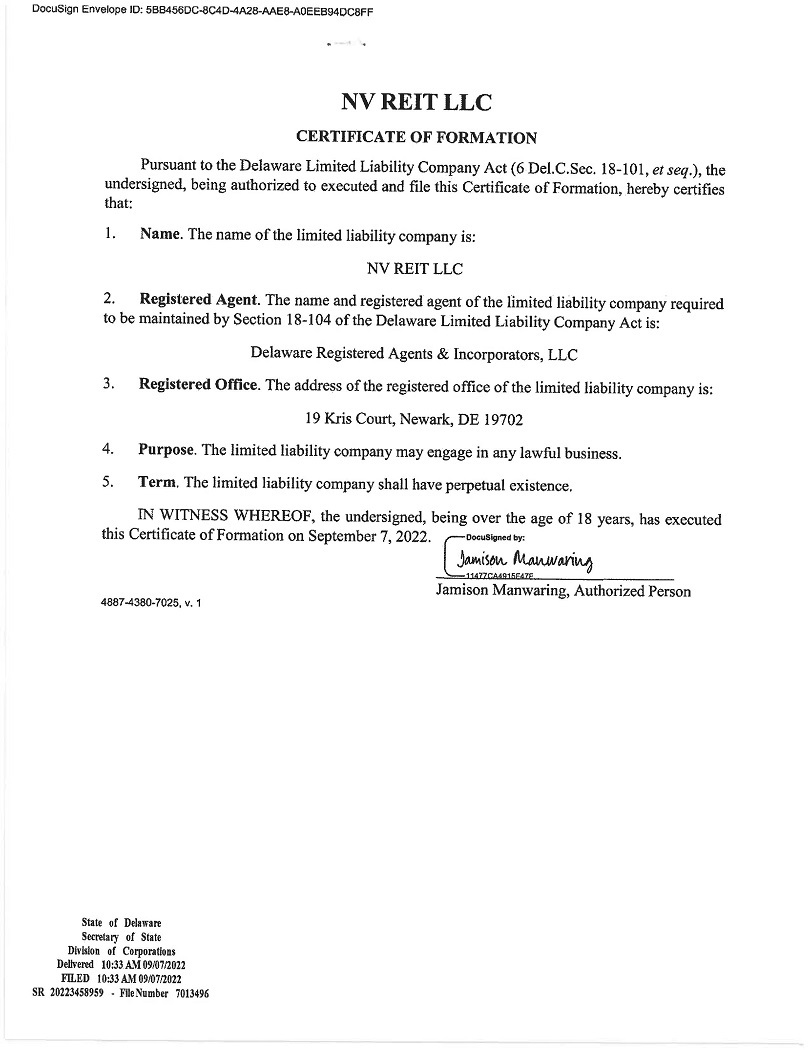
Exhibit 2(b)
NV REIT LLC
LIMITED LIABILITY COMPANY AGREEMENT
This is an Agreement, entered into effective on September 9, 2022, by and among NV REIT LLC, a Delaware limited liability company (the “Company”), Neighborhood Venture Inc., an Delaware corporation (“Neighborhood Venture”), and the persons admitted to the Company as members by the Manager following the date of this Agreement (“Investor Members”). Neighborhood Venture and the Investor Members are sometimes referred to as “Members” in this Agreement.
Background
I. The Company was formed on September 7, 2022.
II. The Company intends to elect to be treated as a corporation for Federal and State tax purposes.
III. The Company intends to elect to be treated as a “real estate investment trust” (a “REIT”) for Federal and State tax purposes.
IV. The Members own all of the limited liability company interests of the Company and wish to set forth their understandings concerning the ownership and operation of the Company in this Agreement, which they intend to be the “limited liability company agreement” of the Company within the meaning of 6 Del. C. §18-101(7).
NOW, THEREFORE, acknowledging the receipt of adequate consideration and intending to be legally bound, the parties agree as follows:
1. ARTICLE ONE: CONTINUATION OF LIMITED LIABILITY COMPANY
1.1. Continuation of Limited Liability Company. The Company has been formed in accordance with and pursuant to the Delaware Limited Liability Company Act (the “Act”) for the purpose set for the below. The rights and obligations of the Members to one another and to third parties shall be governed by the Act except that, in accordance with 6 Del. C. 18-1101(b), conflicts between provisions of the Act and provisions in this Agreement shall be resolved in favor of the provisions in this Agreement except where the provisions of the Act may not be varied by contract as a matter of law.
1.2. Name. The name of the Company shall be “NV REIT LLC” and all of its business shall be conducted under that name or such other name(s) as may be designated by the Manager.
P a g e | 1
1.3. Purpose. The purpose of the Company shall be to invest in real estate projects, as described more fully in the Offering Statement of the Company qualified by the Securities and Exchange Commission, as such Offering Statement is amended from time to time (the “Offering Statement”), and engage in any other business in which limited liability companies may legally engage under the Act. In carrying on its business, the Company may enter into contracts, incur indebtedness, sell, lease, or encumber any or all of its property, engage the services of others, enter into joint ventures, and take any other actions the Manager deems advisable.
1.4. Fiscal Year. The fiscal and taxable year of the Company shall be the calendar year, or such other period as the Manager determines.
2. ARTICLE TWO: CONTRIBUTIONS AND LOANS
2.1. Initial Contributions. The Manager has not contributed any capital to the Company. Each Investor Member will contribute to the capital of the Company the amount specified in his, her, or its Investment Agreement. The capital contributions of Members are referred to in this Agreement as “Capital Contributions.”
2.2. Other Required Contributions. No Member shall be obligated to contribute any capital to the Company beyond the Capital Contributions described in section 2.1. Without limitation, no such Member shall, upon dissolution of the Company or otherwise, be required to restore any deficit in such Member’s capital account.
2.3. Loans.
2.3.1. In General. The Manager or its affiliates may, but shall not be required to, lend money to the Company in the Manager’s sole discretion. No other Member may lend money to the Company without the prior written consent of the Manager. Subject to applicable state laws regarding maximum allowable rates of interest, loans made by any Member to the Company (“Member Loans”) shall bear interest at the higher of (i) the prime rate of interest designated in the Wall Street Journal on any date within ten (10) days of the date of the loan, plus four (4) percentage points; or (ii) the minimum rate necessary to avoid “imputed interest” under section 7872 or other applicable provisions of the Internal Revenue Code of 1986, as amended (the “Code”). Such loans shall be payable on demand and shall be evidenced by one or more promissory notes.
2.3.2. Repayment of Loans. After payment of (i) current and past-due debt service on liabilities of the Company other than Member Loans, and (ii) all operating expenses of the Company, the Company shall pay the current and past-due debt service on any outstanding Member Loans before distributing any amount to any Member pursuant to Article Four. Such loans shall be repaid pro rata, paying all past-due interest first, then all past-due principal, then all current interest, and then all current principal.
P a g e | 2
2.4. Other Provisions on Capital Contributions. Except as otherwise provided in this Agreement or by law:
2.4.1. No Member shall be required to contribute any additional capital to the Company;
2.4.2. No Member may withdraw any part of his, her, or its capital from the Company;
2.4.3. No Member shall be required to make any loans to the Company;
2.4.4. Loans by a Member to the Company shall not be considered a contribution of capital, shall not increase the capital account of the lending Member, and shall not result in the adjustment of the number of Shares owned by a Member, and the repayment of such loans by the Company shall not decrease the capital accounts of the Members making the loans;
2.4.5. No interest shall be paid on any initial or additional capital contributed to the Company by any Member;
2.4.6. Under any circumstance requiring a return of all or any portion of a capital contribution, no Member shall have the right to receive property other than cash; and
2.4.7. No Member shall be liable to any other Member for the return of his, her, or its capital.
2.5. No Third Party Beneficiaries. Any obligation or right of the Members to contribute capital under the terms of this Agreement does not confer any rights or benefits to or upon any person who is not a party to this Agreement.
3. ARTICLE THREE: SHARES AND CAPITAL ACCOUNTS
3.1. Limited Liability Company Interests. The limited liability company interests of the Company shall be denominated by Twenty Million (20,000,000) “Shares,” consisting of One Million (1,000,000) “Common Shares” and Nineteen Million (19,000,000) “Investor Shares.” Neighborhood Venture owns all of the Common Shares while Investor Members will own all the Investor Shares.
3.2. Classes of Investor Shares. The Manager may divide the Investor Shares into one or more classes. The number of Shares of each such class of Investor Shares, and the rights and preferences of each such class, shall be as set forth in the resolution or resolutions of the Manager creating such class, referencing this section 3.2 (each, an “Authorizing Resolution”). Without limitation, the Manager may establish, with respect to each class of Investor Shares, its voting powers, conversion rights or obligations, redemption rights or obligations, preferences as to distributions, and other matters. The Authorizing Resolution providing for issuance of any class of Investor Shares may provide that such class shall be superior or rank equally or be junior to the Investor Shares of any other class except to the extent prohibited by the terms of the Authorizing Resolution establishing another class.
P a g e | 3
3.3. Share Splits and Consolidations. The Manager may at any time increase or decrease the authorized and/or outstanding number of Shares of any class or series, including Common Shares, provided that any increase or decrease in the number of Shares outstanding shall be made pro rata with respect to all Members owning the outstanding Shares of such class or series. The Manager shall promptly notify all of the Members of any such transaction.
3.4. Certificates. The Shares of the Company shall not be evidenced by written certificates unless the Manager determines otherwise. If the Manager determines to issues certificates representing Shares, the certificates shall be subject to such rules and restrictions as the Manager may determine.
3.5. Registry of Shares. The Company shall keep or cause to be kept on behalf of the Company a register of the Members of the Company. The Company may, but shall not be required to, appoint a transfer agent registered with the Securities and Exchange as such.
3.6. REIT Considerations. The Manager may accept or reject subscriptions to acquire Shares for any reason, in the sole discretion of the Manager. Without limiting the preceding sentence, the Manager may reject a subscription to acquire Shares if the Manager determines that accepting the subscription could jeopardize the Company’s qualification as a REIT.
4. ARTICLE FOUR: DISTRIBUTIONS
4.1. In General. The Manager may, in its sole discretion, make and pay distributions of cash or other assets of the Company to the Members.
4.2. Special Rules Governing Distributions. Except as otherwise provided in this Agreement or in an Authorizing Resolution establishing a class of Investor Shares (i) any distributions of the Company not expressly payable to the holders of a class of Investor Shares shall be payable to the holders of the Common Shares, (ii) any distributions made to the holders of any class of Investor Shares as a group shall be divided pro rata among such holders based on their respective ownership of the Shares of such class, and (iii) no Member shall have any right to distributions except as may be authorized by the Manager.
4.3. Items Taken Into Account. In determining the amount and timing of distributions, the Manager may take into account the following items of income and expense, among others:
4.3.1. The net rental income from properties owned by the Company;
4.3.2. The net proceeds from the sale or refinancing of property;
4.3.3. Cash distributions from, and capital contributions to, entities in which the Company owns an interest;
4.3.4. Debt service on indebtedness of the Company;
4.3.5. Capital expenditures of the Company;
P a g e | 4
4.3.6. Amounts added to and released from reserve accounts established by the Manager in its sole discretion;
4.3.7. Fees paid to the Manager and its affiliates;
4.3.8. Fees paid to third parties; and
4.3.9. All of the other operating expenses of the Company.
4.4. REIT Distributions. During any period while the Company has in effect an election to be treated as a REIT, the Company shall make at least the minimum distributions required to maintain such election in effect.
4.5. Tax Withholding. To the extent the Company is required to pay over any amount to any federal, state, local or foreign governmental authority with respect to distributions or allocations to any Member, the amount withheld shall be deemed to be a distribution in the amount of the withholding to that Member. If the amount paid over was not withheld from an actual distribution (i) the Company shall be entitled to withhold such amounts from subsequent distributions, and (ii) if no such subsequent distributions are anticipated for six (6) months, the Member shall , at the request of the Company, promptly reimburse the Company for the amount paid over.
4.6. Manner of Distribution. All distributions to the Members will be made as Automated Clearing House (ACH) deposits into an account designated by each Member. If a Member does not authorize the Company to make such ACH distributions into a designated Member account, distributions to such Member will be made by check and mailed to such Member after deduction by the Company from each check of a Fifty Dollar ($50) processing fee.
4.7. Other Rules Governing Distributions. No distribution prohibited by 6 Del. C. §18-607 or not specifically authorized under this Agreement shall be made by the Company to any Member in his or its capacity as a Member. A Member who receives a distribution prohibited by 6 Del. C. §18-607 shall be liable as provided therein.
P a g e | 5
5. ARTICLE FIVE: MANAGEMENT
5.1. Management by Manager.
5.1.1. In General. The business and affairs of the Company shall be directed, managed, and controlled by Neighborhood Venture as the “manager” within the meaning of 6 Del. C. §18-101(12). In that capacity Neighborhood Venture is referred to as the “Manager” in this Agreement.
5.1.2. Powers of Manager; Management Agreement. The Manager shall have full and complete authority, power and discretion to manage and control the business, affairs and properties of the Company, to make all decisions regarding those matters, to execute any contracts or other instruments on behalf of the Company, and to perform any and all other acts or activities customary or incidental to the management of the Company’s business. The Company and the Manager have entered into agreement captioned “Management Services Agreement” setting forth some of the duties and responsibilities of the Manager. However, that agreement shall not limit the powers of the Manager under this Agreement.
5.1.3. REIT Compliance. Without limiting the generality of section 5.1.2, the Manager shall be deemed to have the authority of a “trustee or director” under section 856(a)(1) of the Code and Treas. Reg. §1.856-1(b)(1).
5.1.4. Examples of Manager’s Authority. Without limiting the grant of authority set forth in section 5.1.2, the Manager shall have the power to (i) create classes of Investor Shares with such terms and conditions as the Manager may determine in its sole discretion; (ii) issue Shares to any person for such consideration as the Manager maybe determine in its sole discretion, and admit such persons to the Company as Investor Members; (iii) engage the services of third parties to perform services on behalf of the Company; (iv) enter into one or more joint ventures; (v) purchase, lease, sell, or otherwise dispose of real estate and other assets, in the ordinary course of business or otherwise; (vi) enter into leases and any other contracts of any kind; (vii) incur indebtedness on behalf of the Company, whether to banks or other lenders; (viii) determine the amount of the Company’s Available Cash and the timing and amount of distributions to Members; (ix) determine the information to be provided to the Members; (x) grant mortgage, liens, and other encumbrances on the Company’s assets; (xi) make all elections under the Code and the provisions of State and local tax laws, including but not limited the election to be treated as a real estate investment trust; (xii) file and settle lawsuits on behalf of the Company; (xiii) file a petition in bankruptcy; (xiv) discontinue the business of the Company; and (xv) dissolve the Company.
P a g e | 6
5.1.5. Restrictions on Members. Except as expressly provided otherwise in this Agreement, Members who are not also the Manager shall not be entitled to participate in the management or control of the Company, nor shall any such Member hold himself out as having such authority. Unless authorized to do so by the Manager, no attorney-in-fact, employee or other agent of the Company shall have any power or authority to bind the Company in any way, to pledge its credit or to render it liable pecuniarily for any purpose. No Member shall have any power or authority to bind the Company unless the Member has been authorized by the Manager in writing to act as an agent of the Company in accordance with the previous sentence.
5.1.6. Authorizing Resolutions. Notwithstanding the foregoing provisions of this section 5.1, an Authorizing Resolution may limit the authority of the Manager and/or confer voting rights on Investor Members.
5.1.7. Reliance by Third Parties. Anyone dealing with the Company shall be entitled to assume that the Manager and any officer authorized by the Manager to act on behalf of and in the name of the Company has full power and authority to encumber, sell or otherwise use in any manner any and all assets of the Company and to enter into any contracts on behalf of the Company, and shall be entitled to deal with the Manager or any officer as if it were the Company’s sole party in interest, both legally and beneficially. No Member shall assert, vis-à-vis a third party, that such third party should not have relied on the apparent authority of the Manager or any officer authorized by the Manager to act on behalf of and in the name of the Company, nor shall anyone dealing with the Manager or any of its officers or representatives be obligated to investigate the authority of such person in a given instance.
5.2. Standard of Care. The Manager shall conduct the Company’s business using its business judgment.
5.3. Time Commitment. The Manager shall devote such time to the business and affairs of the Company as the Manager may determine in its sole and absolute discretion.
5.4. Reimbursement of Formation Expenses. The Company shall reimburse the Manager and its affiliates, without interest, for the actual out-of-pocket expenses they incur in connection with the formation of the Company and the Manager, the offering of Investor Shares, and the admission of investors in the Company, including, without limitation, travel, legal, accounting, filing, advertising, and all other expenses incurred in connection with the offer and sale of interests in the Company.
5.5. Compensation of Manager and its Affiliates. The Manager and its affiliates shall be entitled to the compensation described in the Offering Statement, as changed from time to time.
P a g e | 7
5.6. Removal of Manager.
5.6.1. In General. The Manager may be removed by the affirmative vote of Investor Members holding seventy five percent (75%) of the total number of Investor Shares then issued and outstanding (a “Super Majority Vote”), but only if the Investor Members have “cause” to remove the Manager, as defined in section 5.6.3 and follow the procedure set forth in section 5.6.2.
5.6.2. Procedure.
(a) Notice and Response. An Investor Member who wishes to remove the Manager and believes there is “cause” for doing so within the meaning of section 5.6.3 shall notify the Manager, referencing this section 5.6 and setting forth in detail the reasons for his, her, or its belief. Within thirty (30) days after receiving such a notice, the Manager shall respond by acknowledging the receipt of the notice and (i) stating that the Manager does not believe there is merit in the Investor Member’s allegations, (ii) explaining why the Manager does not believe “cause” exists for removal, or (iii) stating that while “cause” may exist for removal, the Manager does not believe removal would be in the best interest in the Fund. If the Manager fails to respond, the Manager shall be deemed to have stated that it does not believe there is merit in the Investor Member’s allegations. In the event the Investor Member communicates with any third party concerning his request for removal, including any other Investor Member but not including his, her, or its own legal counsel, he, she, or it shall include a copy of the Manager’s response. The failure of the Manager to include in its response any defense, facts, or arguments shall not preclude the Manager from including such defense, facts, or arguments in subsequent communications or proceedings.
(b) Vote. After following the procedure described in section 5.6.2(a), Investor Members owning at least twenty five percent (25%) of the Investor Shares then issued and outstanding (the “Dissident Members”) may call for a vote of the Investor Members. The Manager and a single representative chosen by the Dissident Members shall cooperate in sending to all Investor Members a package of materials bearing on whether “cause” exists under section 5.6.3 and whether it is in the best interest of the Company to remove the Manager, and a vote shall be taken by electronic means, with responses due within thirty (30) days. The failure of the Manager or the Dissident Members to include in this package any defense, facts, or arguments shall not preclude them from including such defense, facts, or arguments in subsequent communications or proceedings.
P a g e | 8
(c) Arbitration. In the event of a Super Majority Vote to remove the Manager within the thirty (30) day period described in section 5.6.2(b), then the question as to whether “cause” exists to remove the Manager shall be referred to a single arbitrator in arbitration proceedings held in Wilmington, Delaware in conformance with the then-current rules and procedures of the American Arbitration Association. The removal of the Manager shall not become effective until the arbitrator determines that “cause” exists; the decision of the arbitrator shall be binding and non-appealable. In the event there is no Super Majority Vote to remove the Manager within the thirty (30) day period described in section 5.6.2(b), then the Manager shall not be removed and no subsequent proceeding to remove the Manager shall be held with respect to substantially similar grounds.
5.6.3. Cause Defined. For purposes of this section 5.6, “cause” shall be deemed to exist if any only if:
(a) Uncured Breach. The Manager breaches any material provision of this Agreement or the Management Agreement and the breach continues for more than (30) days after the Manager has received written notice, or, in the case of a breach that cannot be cured within thirty (30) days, the Manager fails to begin curing the breach within thirty (30) days or the breach remains uncured for ninety (90) days; or
(b) Bankruptcy. The Manager makes a general assignment for the benefit of its creditors; or is adjudicated a bankrupt; or files a voluntary petition in bankruptcy; or files a petition or answer seeking reorganization or an arrangement with creditors, or to take advantage of any insolvency, readjustment of loan, dissolution or liquidation law or statute; or an order, judgment, or decree is entered without the Manager’s consent appointing a receiver, trustee or liquidator for the Manager; or
(c) Bad Acts. The Manager engages in willful misconduct or acts with reckless disregard to its obligations, in each case causing material harm to the Company, or engages in bad faith in activities that are beneficial to itself and cause material harm to the Company, and the individual responsible for such actions is not terminated within thirty (30) days after the Manager becomes aware of such actions.
5.6.4. No Effect on Common Share Ownership. The removal of the Manager shall not affect the interests of the Manager in the Common Shares.
5.7. Compliance with Investment Company Act. The Manager shall use commercially reasonable efforts to ensure that the Company is not treated as an “investment company” within the meaning of the Investment Company Act of 1940. Without limiting the generality of the preceding sentence, the Manager shall use commercially reasonable efforts to ensure that the Company satisfies the safe harbor set forth in 17 CFR §270.3a-1.
P a g e | 9
6. ARTICLE SIX: OTHER BUSINESSES; INDEMNIFICATION; CONFIDENTIALITY
6.1. Other Businesses. Each Member and Manager may engage in any business whatsoever, including a business that is competitive with the business of the Company, and the other Members shall have no interest in such businesses and no claims on account of such businesses, whether such claims arise under the doctrine of “corporate opportunity,” an alleged fiduciary obligation owed to the Company or its members, or otherwise. Without limiting the preceding sentence, the Members acknowledge that the Manager and/or its affiliates intend to sponsor, manage, invest in, and otherwise be associated with other entities and business investing in the same assets class(es) as the Company, some of which could be competitive with the Company. No Member shall have any claim against the Manager or its affiliates on account of such other entities or businesses.
6.2. Exculpation and Indemnification
6.2.1. Exculpation.
(a) Covered Persons. As used in this section 6.2, the term “Covered Person” means (i) the Manager and its affiliates, (ii) the members, managers, officers, employees, and agents of the Manager and its affiliates, and (iii) the officers, employees, and agents of the Company, including a Representative, each acting within the scope of his, her, or its authority.
(b) Standard of Care. No Covered Person shall be liable to the Company for any loss, damage or claim incurred by reason of any action taken or omitted to be taken by such Covered Person, including actions take or omitted to be taken under the Management Agreement, in the good-faith business judgment of such Covered Person, so long as such action or omission does not constitute fraud or willful misconduct by such Covered Person.
(c) Good Faith Reliance. A Covered Person shall be fully protected in relying in good faith upon the records of the Company and upon such information, opinions, reports, or statements (including financial statements and information) of the following persons: (i) another Covered Person; (ii) any attorney, independent accountant, appraiser, or other expert or professional employed or engaged by or on behalf of the Company; or (iii) any other person selected in good faith by or on behalf of the Company, in each case as to matters that such relying Covered Person reasonably believes to be within such other person’s professional or expert competence. The preceding sentence shall in no way limit any person’s right to rely on information to the extent provided in the Act.
P a g e | 10
6.2.2. Liabilities and Duties of Covered Persons.
(a) Limitation of Liability. This Agreement is not intended to, and does not, create or impose any fiduciary duty on any Covered Person. Furthermore, each Member and the Company hereby waives any and all fiduciary duties that, absent such waiver, may be implied by applicable law, and in doing so, acknowledges and agrees that the duties and obligation of each Covered Person to each other and to the Company are only as expressly set forth in this Agreement. The provisions of this Agreement, to the extent that they restrict the duties and liabilities of a Covered Person otherwise existing at law or in equity, are agreed by the Members to replace such other duties and liabilities of such Covered Person.
(b) Duties. Whenever a Covered Person is permitted or required to make a decision, the Covered Person shall be entitled to consider only such interests and factors as such Covered Person desires, including its own interests, and shall have no duty or obligation to give any consideration to any interest of or factors affecting the Company or any other person. Whenever in this Agreement a Covered Person is permitted or required to make a decision in such Covered Person’s “good faith,” the Covered Person shall act under such express standard and shall not be subject to any other or different standard imposed by this Agreement or any other applicable law.
6.2.3. Indemnification.
(a) Indemnification. To the fullest extent permitted by the Act, as the same now exists or may hereafter be amended, substituted or replaced (but, in the case of any such amendment, substitution or replacement only to the extent that such amendment, substitution or replacement permits the Company to provide broader indemnification rights than the Act permitted the Company to provide prior to such amendment, substitution or replacement), the Company shall indemnify, hold harmless, defend, pay and reimburse any Covered Person against any and all losses, claims, damages, judgments, fines or liabilities, including reasonable legal fees or other expenses incurred in investigating or defending against such losses, claims, damages, judgments, fines or liabilities, and any amounts expended in settlement of any claims (collectively, “Losses”) to which such Covered Person may become subject by reason of any act or omission or alleged act or omission performed or omitted to be performed by such Covered Person on behalf of the Company in connection with the business of the Company, including pursuant to the Management Agreement; provided, that (i) such Covered Person acted in good faith and in a manner believed by such Covered Person to be in, or not opposed to, the best interests of the Company and, with respect to any criminal proceeding, had no reasonable cause to believe his conduct was unlawful, and (ii) such Covered Person’s conduct did not constitute fraud or willful misconduct, in either case as determined by a final, nonappealable order of a court of competent jurisdiction. In connection with the foregoing, the termination of any action, suit or proceeding by judgment, order, settlement, conviction, or upon a plea of nolo contendere or its equivalent, shall not, of itself, create a presumption that the Covered Person did not act in good faith or, with respect to any criminal proceeding, had reasonable cause to believe that such Covered Person’s conduct was unlawful, or that the Covered Person’s conduct constituted fraud or willful misconduct.
P a g e | 11
(b) Reimbursement. The Company shall promptly reimburse (and/or advance to the extent reasonably required) each Covered Person for reasonable legal or other expenses (as incurred) of such Covered Person in connection with investigating, preparing to defend or defending any claim, lawsuit or other proceeding relating to any Losses for which such Covered Person may be indemnified pursuant to this section 6.2.3; provided, that if it is finally judicially determined that such Covered Person is not entitled to the indemnification provided by this section 6.2.3, then such Covered Person shall promptly reimburse the Company for any reimbursed or advanced expenses.
(c) Entitlement to Indemnity. The indemnification provided by this section 6.2.3 shall not be deemed exclusive of any other rights to indemnification to which those seeking indemnification may be entitled under any agreement or otherwise. The provisions of this section 6.2.3 shall continue to afford protection to each Covered Person regardless whether such Covered Person remains in the position or capacity pursuant to which such Covered Person became entitled to indemnification under this section 6.2.3 and shall inure to the benefit of the executors, administrators, and legal representative of such Covered Person.
(d) Insurance. To the extent available on commercially reasonable terms, the Company may purchase, at its expense, insurance to cover Losses covered by the foregoing indemnification provisions and to otherwise cover Losses for any breach or alleged breach by any Covered Person of such Covered Person’s duties in such amount and with such deductibles as the Manager may determine; provided, that the failure to obtain such insurance shall not affect the right to indemnification of any Covered Person under the indemnification provisions contained herein, including the right to be reimbursed or advanced expenses or otherwise indemnified for Losses hereunder. If any Covered Person recovers any amounts in respect of any Losses from any insurance coverage, then such Covered Person shall, to the extent that such recovery is duplicative, reimburse the Company for any amounts previously paid to such Covered Person by the Company in respect of such Losses.
(e) Funding of Indemnification Obligation. Any indemnification by the Company pursuant to this section 6.2.3 shall be provided out of and to the extent of Company assets only, and no Member shall have personal liability on account thereof or shall be required to make additional capital contributions to help satisfy such indemnification obligation.
(f) Savings Clause. If this section 6.2.3 or any portion hereof shall be invalidated on any ground by any court of competent jurisdiction, then the Company shall nevertheless indemnify and hold harmless each Covered Person pursuant to this section 6.2.3 to the fullest extent permitted by any applicable portion of this section 6.3 that shall not have been invalidated and to the fullest extent permitted by applicable law.
P a g e | 12
6.2.4. Amendment. The provisions of this section 6.2 shall be a contract between the Company, on the one hand, and each Covered Person who served in such capacity at any time while this section is in effect, on the other hand, pursuant to which the Company and each such Covered Person intend to be legally bound. No amendment, modification or repeal of this section that adversely affects the rights of a Covered Person to indemnification for Losses incurred or relating to a state of facts existing prior to such amendment, modification or repeal shall apply in such a way as to eliminate or reduce such Covered Person’s entitlement to indemnification for such Losses without the Covered Person’s prior written consent.
6.2.5. Survival. The provisions of this section 6.2 shall survive the dissolution, liquidation, winding up, and termination of the Company.
6.3. Confidentiality. For as long as he, she, or it owns an interest in the Company and at all times thereafter, no Investor Member shall divulge to any person or entity, or use for his or its own benefit or the benefit of any person, any information of the Company of a confidential or proprietary nature, including, but not limited to (i) financial information; (ii) designs, drawings, plans, and specifications; (iii) the business methods, systems, or practices used by the Company; and (iii) the identity of the Company’s Members, customers, or suppliers. The foregoing shall not apply to information that is in the public domain or that an Investor Member is required to disclose by legal process.
7. ARTICLE SEVEN: BANK ACCOUNTS; BOOKS OF ACCOUNT
7.1. Bank Accounts. Funds of the Company may be deposited in accounts at banks or other institutions selected by the Manager. Withdrawals from any such account or accounts shall be made in the Company’s name upon the signature of such persons as the Manager may designate. Funds in any such account shall not be commingled with the funds of any Member.
7.2. Books and Records of Account. The Company shall keep at its principal offices books and records of account of the Company which shall reflect a full and accurate record of each transaction of the Company.
7.3. Annual Financial Statements and Reports. Within a reasonable period after the close of each fiscal year, the Company shall furnish to each Member with respect to such fiscal year (i) a statement showing in reasonable detail the computation of the amount distributed under section 4.1, and the manner in which it was distributed (ii) a balance sheet of the Company, (iii) a statement of income and expenses, and (iv) such additional information as may be required by law. The financial statements of the Company need not be audited by an independent certified public accounting firm unless the Manager so elects or the law so requires.
P a g e | 13
7.4. Right of Inspection.
7.4.1. In General. If a Member wishes additional information or to inspect the books and records of the Company for a bona fide purpose, the following procedure shall be followed: (i) such Member shall notify the Manager, setting forth in reasonable detail the information requested and the reason for the request; (ii) within sixty (60) days after such a request, the Manager shall respond to the request by either providing the information requested or scheduling a date (not more than 90 days after the initial request) for the Member to inspect the Company’s records; (iii) any inspection of the Company’s records shall be at the sole cost and expense of the requesting Member; and (iv) the requesting Member shall reimburse the Company for any reasonable costs incurred by the Company in responding to the Member’s request and making information available to the Member.
7.4.2. Bona Fide Purpose. The Manager shall not be required to respond to a request for information or to inspect the books and records of the Company if the Manager believes such request is made to harass the Company or the Manager, to seek confidential information about the Company, or for any other purpose other than a bona fide purpose.
7.4.3. Representative. An inspection of the Company’s books and records may be conducted by an authorized representative of a Member, provided such authorized representative is an attorney or a licensed certified public accountant and is reasonably satisfactory to the Manager.
7.4.4. Restrictions. The following restrictions shall apply to any request for information or to inspect the books and records of the Company:
(a) No Member shall have a right to a list of the Investor Members or any information regarding the Investor Members.
(b) Before providing additional information or allowing a Member to inspect the Company’s records, the Manager may require such Member to execute a confidentiality agreement satisfactory to the Manager.
(c) No Member shall have the right to any trade secrets of the Company or any other information the Manager deems highly sensitive and confidential.
(d) No Member may review the books and records of the Company more than once during any twelve (12) month period.
(e) Any review of the Company’s books and records shall be scheduled in a manner to minimize disruption to the Company’s business.
(f) A representative of the Company may be present at any inspection of the Company’s books and records.
(g) If more than one Member has asked to review the Company’s books and records, the Manager may require the requesting Members to consolidate their request and appoint a single representative to conduct such review on behalf of all requested Members.
(h) The Manager may impose additional reasonable restrictions for the purpose of protecting the Company and the Members.
P a g e | 14
8. ARTICLE EIGHT: TRANSFERS OF SHARES
8.1.1. In General. Except as provided in section 8.1.2, section 8.1.3, section 8.1.4, section 8.1.5, or the terms of an Authorizing Resolution, Investor Shares may generally be transferred without the consent of the Company or the Manager.
8.1.2. REIT Restrictions on Transfer. Notwithstanding section 8.1.1, no transfer of Investor Shares will be permitted if the transfer could, by itself or in conjunction with other pending or anticipated transfers, jeopardize the status of the Company as a REIT, in the sole discretion of the Manager. An Investor Member seeking to transfer Investor Shares, by sale, gift, or otherwise, shall notify the Company no less than thirty (30) days before the proposed transfer, specifying the number of Investor Shares and the identify of the proposed transferee. The Company shall, within twenty (20) days, notify the Investor Member that (i) the proposed transfer is permitted, (ii) the proposed transfer is not permitted because it would jeopardize the status of the Company as a REIT, or (iii) the Manager requires additional information to make a determination. The Manager may require the Investor Member to reimburse the Company for any reasonable expenses the Company incurs with the transfer, including attorneys’ fees.
8.1.3. First Right of Refusal.
(a) In General. In the event an Investor Member (the “Selling Member”) receives an offer from a third party to acquire all or a portion of his, her, or its Investor Shares (the “Transfer Shares”), then he, she, or it shall notify the Manager, specifying the Investor Shares to be purchased, the purchase price, the approximate closing date, the form of consideration, and such other terms and conditions of the proposed transaction that have been agreed with the proposed purchaser (the “Sales Notice”). Within thirty (30) days after receipt of the Sales Notice the Manager shall notify the Selling Member whether the Manager (or a person designated by the Manager) elects to purchase the entire Transfer Shares on the terms set forth in the Sales Notice.
(b) Special Rules. The following rules shall apply for purposes of this section:
(1) If the Manager elects not to purchase the Transfer Shares, or fails to respond to the Sales Notice within the thirty (30) day period described above, the Selling Member may proceed with the sale to the proposed purchaser, subject to section 8.1.2.
(2) If the Manager elects to purchase the Transfer Shares, it shall do so within thirty (30) days.
(3) If the Manager elects not to purchase the Transfer Shares, or fails to respond to the Sales Notice within the thirty (30) day period described above, and the Selling Member and the purchaser subsequently agree to a reduction of the purchase price, a change in the consideration from cash or readily tradeable securities to deferred payment obligations or nontradeable securities, or any other material change to the terms set forth in the Sales Notice, such agreement between the Selling Member and the purchaser shall be treated as a new offer and shall again be subject to this section.
P a g e | 15
(4) If the Manager elects to purchase the Transfer Shares in accordance with this section, such election shall have the same binding effect as the then-current agreement between the Selling Member and the proposed purchaser. Thus, for example, if the Selling Member and the purchaser have entered into a non-binding letter of intent but have not entered into a binding definitive agreement, the election of the Manager shall have the effect of a non-binding letter of intent with the Selling Member. Conversely, if the Selling Member and the purchaser have entered into a binding definitive agreement, the election of the Manager shall have the effect of a binding definitive agreement. If the Selling Member and the Manager are deemed by this subsection to have entered into only a non-binding letter of intent, neither shall be bound to consummate a transaction if they are unable to agree to the terms of a binding agreement.
8.1.4. Rights of Assignee. Until and unless a person who is a transferee of Investor Shares is admitted to the Company as an Investor Member pursuant to section 8.1.6 below, such transferee shall be entitled only to the allocations and distributions with respect to the Transferred Shares in accordance with this Agreement and, to the fullest extent permitted by applicable law, including but not limited to 6 Del. C. §18-702(b), shall not have any non-economic rights of a Member of the Company, including, without limitation, the right to require any information on account of the Company’s business, inspect the Company’s books, or vote on Company matters.
8.1.5. Conditions of Transfer. A transfer of Investor Shares shall be effective only if:
(a) The transferor has notified the Manager of the proposed transfer at least thirty (30) business days in advance, describing the terms and conditions of the proposed transfer and any other information reasonably requested by the Manager;
(b) The transferee has executed a copy of this Agreement, agreeing to be bound by all of its terms and conditions;
(c) A fully executed and acknowledged written transfer agreement between the Transferor and the transferee has been filed with the Company;
(d) All costs and expenses incurred by the Company in connection with the transfer are paid by the transferor to the Company, without regard to whether the proposed transfer is consummated; and
P a g e | 16
(e) The Manager determines, and such determination is confirmed by an opinion of counsel satisfactory to the Manager stating, that (i) the transfer does not violate the Securities Act of 1933 or any applicable state securities laws, (ii) the transfer will not require the Company or the Manager to register as an investment company under the Investment Company Act of 1940, (iii) the transfer will not require the Manager or any affiliate that is not registered under the Investment Advisers Act of 1940 to register as an investment adviser, (iv) the transfer would not pose a material risk that (A) all or any portion of the assets of the Company would constitute “plan assets” under ERISA, (B) the Company would be subject to the provisions of ERISA, section 4975 of the Code or any applicable similar law, or (C) the Manager would become a fiduciary pursuant to ERISA or the applicable provisions of any similar law or otherwise, and (v) the transfer will not violate the applicable laws of any state or the applicable rules and regulations of any governmental authority; provided, that the delivery of such opinion may be waived, in whole or in part, at the sole discretion of the Manager.
8.1.6. Admission of Transferee. Any permitted transferee of Shares shall be admitted to the Company as a Member on the date agreed by the transferor, the transferee, and the Manager.
8.1.7. Exempt Transfers. The following transactions shall be exempt from the provisions of section 8.1:
(a) A transfer to or for the benefit of any spouse, child or grandchild of an Investor Member, or to a trust for their exclusive benefit;
(b) Any transfer pursuant to an effective registration statement filed by the Company under the Securities Act of 1933, as amended; and
(c) The sale of all or substantially all of the interests of the Company (including pursuant to a merger or consolidation);
provided, however, that in the case of a transfer pursuant to section 8.1.7(a), (i) the transferred Shares shall remain subject to this Agreement, (ii) the transferee shall, as a condition to such transfer, deliver to the Company a written instrument confirming that such transferee shall be bound by all of the terms and conditions of this Agreement, and (iii) the transferred Shares shall not thereafter be transferred further in reliance on section 8.1.7(a).
8.1.8. Application to Certain Entities. In the case of an Investor Member that is a Special Purpose Entity, the restrictions set forth in section 8.1 shall apply to indirect transfers of interests in the Company by transfers of interests in such entity (whether by transfer of an existing interest or the issuance of new interests), as well as to direct transfers. A “Special Purpose Entity” means (i) an entity formed or availed of principally for the purpose of acquiring or holding an interest in the Company, and (ii) any entity if the purchase price of its interest in the Company represents at least seventy percent (70%) of its capital.
8.1.9. Other Transfers Void. Transfers in contravention of this section shall be null, void and of no force or effect whatsoever, and the Members agree that any such transfer may and should be enjoined.
P a g e | 17
8.2. Death, Insolvency, Etc. Neither the death, disability, bankruptcy, or insolvency of a Member, nor the occurrence of any other voluntary or involuntary event with respect to a Member, shall give the Company or any Member the right to purchase such Member’s Shares, nor give the Member himself (or his heirs, assigns, or representatives) the right to sell such Shares to the Company or any other Member. Instead, such Member or his heirs, assigns, or legal representatives shall remain a Member subject to the terms and conditions of this Agreement.
8.3. Incorporation. If the Manager determines that the business of the Company should be conducted in a corporation rather than in a limited liability company, whether for tax or other reasons, each Member shall cooperate in transferring the business to a newly-formed corporation and shall execute such agreements as the Manager may reasonably determine are necessary or appropriate, consistent with the terms of the this Agreement. In such event each Member shall receive stock in the newly-formed corporation equivalent to his or its Shares.
8.4. Drag-Along Right. In the event the Manager approves a sale or other disposition of all of the interests in the Company, then, upon notice of the sale or other disposition, each Member shall execute such documents or instruments as may be requested by the Manager to effectuate such sale or other disposition and shall otherwise cooperate with the Manager. The following rules shall apply to any such sale or other disposition: (i) each Investor Member shall represent that he, she, or it owns his or its Shares free and clear of all liens and other encumbrances, that he, she, or it has the power to enter into the transaction, and whether he, she, or it is a U.S. person, but shall not be required to make any other representations or warranties; (ii) each Investor Member shall grant to the Manager a power of attorney to act on behalf of such Investor Member in connection with such sale or other disposition; and (iii) each Investor Member shall receive, as consideration for such sale or other disposition, the same amount he, she, or it would have received had all or substantially all of the assets of the Company been sold and the net proceeds distributed in liquidation of the Company.
8.5. Waiver of Appraisal Rights. Each Member hereby waives any contractual appraisal rights such Member may otherwise have pursuant to 6 Del. C. §18-210 or otherwise, as well as any “dissenter’s rights.”
8.6. Mandatory Redemptions.
8.6.1. Based on ERISA Considerations. The Manager may, at any time, cause the Company to purchase all or any portion of the Investor Shares owned by a Member whose assets are governed by Title I of the Employee Retirement Income Security Act of 1974, Code section 4975, or any similar Federal, State, or local law, if the Manager determines that all or any portion of the assets of the Company would, in the absence of such purchase, more likely than not be treated as “plan assets” or otherwise become subject to such laws.
8.6.2. Based on REIT Considerations. The Manager may, at any time, cause the Company to purchase all or any portion of the Investor Shares owned by a Member if the Manager determines that such purchase would be beneficial in allowing the Company to retain its status as a REIT. In making such determination, the Manager need not conclude that such purchase is absolutely necessary for the Company to retain its status as a REIT or that the Company could not retain its status as a REIT in any other way.
P a g e | 18
8.6.3. Based on Other Bona Fide Business Reasons. The Manager may, at any time, cause the Company to purchase all of the Investor Shares owned by a Member if the Manager determines that (i) such Member made a material misrepresentation to the Company; (ii) legal or regulatory proceedings are commenced or threatened against the Company or any of its members arising from or relating to the Member’s interest in the Company; (iii) the Manager believes that such Member’s ownership has caused or will cause the Company to violate any law or regulation; (iv) such Member has violated any of his, her, or its obligations to the Company or to the other Members; or (ii) such Member is engaged in, or has engaged in conduct (including but not limited to criminal conduct) that (A) brings the Company, or threatens to bring the Company, into disrepute, or (B) is adverse and fundamentally unfair to the interests of the Company or the other Members.
8.6.4. Purchase Price and Payment. Unless otherwise agreed in writing between the selling Investor Member and the Company, the price of Class A Investor Shares purchased and sold pursuant to this section 8.6 shall be ninety percent (90%) of the amount such Investor would have received with respect to such Class A Investor Shares had the Net Asset Value been distributed in complete liquidation of the Company. The purchase price shall be paid by wire transfer or other immediately-available funds at closing, which shall be held within sixty (60) days following written notice from the Manager.
8.7. Net Asset Value.
8.7.1. In General. The “Net Asset Value” of the Company means the aggregate, net amount that would be available for distribution to the Members if all the assets of the Company were sold for their fair market value and all the liabilities, obligations, and expenses of the Company paid and satisfied. The Manager shall calculate the Net Asset Value from time to time in its sole discretion, but no less than as of the last day of each fiscal year.
8.7.2. Manner of Calculation. The Manager may calculate the fair market value of the Company’s assets using any method or combination of methods the Manager may determine in its sole discretion, including but not limited to (i) methods using the capitalization rates of comparable assets (typically used for stabilized, income-producing assets); (ii) methods using the sales or offering prices of comparable assets; (iii) estimates obtained from appraisers, real estate brokers, or other qualified persons; (iv) recent offerings of the Company’s securities; and (v) other methods the Manager deems appropriate in the circumstances, including the purchase price and/or book value of assets. In the absence of actual fraud, the Manager’s determination of the fair market value of the Company’s assets shall be final and not subject to dispute.
9. ARTICLE NINE: DISSOLUTION AND LIQUIDATION
9.1. Dissolution. The Company shall be dissolved upon the first to occur of (i) the determination of the Manager to dissolve, or (ii) the date six (6) months following the sale of all or substantially all of the assets of the Company. The Members hereby waive the right to seek a judicial decree of dissolution pursuant to 6 Del. C. §18-802.
P a g e | 19
9.2. Liquidation.
9.2.1. Generally. If the Company is dissolved, the Company’s assets shall be liquidated and no further business shall be conducted by the Company except for such action as shall be necessary to wind-up its affairs and distribute its assets to the Members pursuant to the provisions of this Article Nine. Upon such dissolution, the Manager shall have full authority to wind-up the affairs of the Company and to make final distribution as provided herein.
9.2.2. Distribution of Assets. After liquidation of the Company, the assets of the Company shall be distributed as set forth in Article Four.
9.2.3. Distributions In Kind. The assets of the Company shall be liquidated as promptly as possible so as to permit distributions in cash, but such liquidation shall be made in an orderly manner so as to avoid undue losses attendant upon liquidation. In the event that in the Manager’ opinion complete liquidation of the assets of the Company within a reasonable period of time proves impractical, assets of the Company other than cash may be distributed to the Members in kind but only after all cash and cash-equivalents have first been distributed and after the Pre-Distribution Adjustment.
9.2.4. Statement of Account. Each Member shall be furnished with a statement prepared by the Company’s accountants, which shall set forth the assets and liabilities of the Company as of the date of complete liquidation, and the capital account of each Member immediately prior to any distribution in liquidation.
10. ARTICLE TEN: POWER OF ATTORNEY
10.1. In General. The Manager shall at all times during the term of the Company have a special and limited power of attorney as the attorney-in-fact for each Investor Member, with power and authority to act in the name and on behalf of each such Investor Member, to execute, acknowledge, and swear to in the execution, acknowledgement and filing of documents which are not inconsistent with the provisions of this Agreement and which may include, by way of illustration but not by limitation, the following:
10.1.1. This Agreement and any amendment of this Agreement authorized under section 11.1;
10.1.2. Any other instrument or document that may be required to be filed by the Company under the laws of any state or by any governmental agency or which the Manager shall deem it advisable to file;
10.1.3. Any instrument or document that may be required to effect the continuation of the Company, the admission of new Members, or the dissolution and termination of the Company; and
10.1.4. Any and all other instruments as the Manager may deem necessary or desirable to effect the purposes of this Agreement and carry out fully its provisions.
P a g e | 20
10.2. Terms of Power of Attorney. The special and limited power of attorney of the Manager (i) is a special power of attorney coupled with the interest of the Manager in the Company, and its assets, is irrevocable, shall survive the death, incapacity, termination or dissolution of the granting Investor Member, and is limited to those matters herein set forth; (ii) may be exercised by the Manger by an through one or more of the officers of the Manager for each of the Investor Members by the signature of the Manager acting as attorney-in-fact for all of the Investor Members, together with a list of all Investor Members executing such instrument by their attorney-in-fact or by such other method as may be required or requested in connection with the recording or filing of any instrument or other document so executed; and (iii) shall survive an assignment by an Investor Member of all or any portion of his, her or its Class A Interest except that, where the assignee of the Class A Interest owned by the Investor Member has been approved by the Manager for admission to the Company, the special power of attorney shall survive such assignment for the sole purpose of enabling the Manager to execute, acknowledge and file any instrument or document necessary to effect such substitution.
10.3. Notice to Investor Members. The Manager shall promptly furnish to each Investor Member a copy of any amendment to this Agreement executed by the Manger pursuant to a power of attorney from such Investor Member.
11. ARTICLE ELEVEN: AMENDMENTS
11.1. Amendments Not Requiring Consent. The Manager may amend this Agreement without the consent of any Member to effect:
11.1.1. The correction of typographical errors;
11.1.2. A change in the name of the Company, the location of the principal place of business of the Company, the registered agent of the Company or the registered office of the Company;
11.1.3. The admission, substitution, withdrawal, or removal of Members in accordance with this Agreement;
11.1.4. An amendment the Manager determines to be necessary or appropriate for the Company to qualify as a REIT;
11.1.5. An amendment that cures ambiguities or inconsistencies in this Agreement;
11.1.6. An amendment that adds to its own obligations or responsibilities;
11.1.7. A change in the fiscal year or taxable year of the Company and any other changes that the Manager determines to be necessary or appropriate as a result of a change in the fiscal year or taxable year of the Company;
11.1.8. A change the Manager determines to be necessary or appropriate to prevent the Company from being treated as an “investment company” within the meaning of the Investment Company Act of 1940;
P a g e | 21
11.1.9. A change to facilitate the trading of Shares, including changes required by law or by the rules of a securities exchange;
11.1.10. A change the Manager determines to be necessary or appropriate to satisfy any requirements or guidelines contained in any opinion, directive, order, ruling, or regulation of any federal or state agency or judicial authority or contained in any Federal or State statute, including but not limited to “no-action letters” issued by the Securities and Exchange Commission;
11.1.11. A change that the Manager determines to be necessary or appropriate to prevent the Company from being subject to the Employee Retirement Income Security Act of 1974;
11.1.12. A change the Manager determines to be necessary or appropriate to reflect an investment by the Company in any corporation, partnership, joint venture, limited liability company or other entity;
11.1.13. An amendment that conforms to the Offering Statement;
11.1.14. Any amendments expressly permitted in this Agreement to be made by the Manager acting alone; or
11.1.15. Any other amendment that does not have, and could not reasonably be expected to have, an adverse effect on the Investor Members.
11.2. Amendments Requiring Majority Consent. Any amendment that has, or could reasonably be expected to have, an adverse effect on the Investor Members, other than amendments described in section 11.3, shall require the consent of the Manager and Investor Members holding a majority of the Investor Shares or, if an amendment affects only one class of Investor Shares, then the Investor Members holding a majority of the Investor Shares of that Series.
11.3. Amendments Requiring Unanimous Consent. The following amendments shall require the consent of the Manager and each affected Member:
11.3.1. An amendment deleting or modifying any of the amendments already listed in this section 11.3;
11.3.2. An amendment that would require any Investor Member to make additional Capital Contributions; and
11.3.3. An amendment that would impose personal liability on any Investor Member.
P a g e | 22
11.4. Procedure for Obtaining Consent. If the Manager proposes to make an amendment to this Agreement that requires the consent of Investor Members, the Manager shall notify each affected Investor Member (who may be all Investor Members, or only Investor Members holding a given class of Investor Shares) in writing, specifying the proposed amendment and the reason(s) why the Manager believe the amendment is in the best interest of the Company. At the written request of Investor Members holding at least Twenty Percent (20%) of the Investor Shares entitled to vote on the amendment, the Manager shall hold an in-person or electronic meeting (e.g., a webinar) to explain and discuss the amendment. Voting may be through paper or electronic ballots. If the Manager proposes an amendment that is not approved by the Investor Members within ninety (90) days from proposal, the Manager shall not again propose that amendment for at least six (6) months.
12. ARTICLE TWELVE: MISCELLANEOUS
12.1. Notices. Any notice or document required or permitted to be given under this Agreement may be given by a party or by its legal counsel and shall be deemed to be given (i) one day after being deposited with an overnight delivery service (unless the recipient demonstrates that the package was not delivered to the specified address), or (ii) on the date transmitted by electronic mail (unless the recipient demonstrates that such electronic mail was not received into the recipient’s Inbox), to the principal business address of the Company, if to the Company or the Manager, to the email address of an Investor Member provided by such Investor Member, or such other address or addresses as the parties may designate from time to time by notice satisfactory under this section.
12.2. Electronic Delivery. Each Member hereby agrees that all communications with the Company, including all tax forms, shall be via electronic delivery.
12.3. Governing Law.
12.3.1. In General. This Agreement shall be governed by the internal laws of Delaware without giving effect to the principles of conflicts of laws. Each Member hereby (i) consents to the personal jurisdiction of the Delaware courts or the Federal courts located in or most geographically convenient to Wilmington, Delaware, (ii) agrees that all disputes arising from this Agreement shall be prosecuted in such courts, except as provided in section 5.6.2, (iii) agrees that any such court shall have in personam jurisdiction over such Member, (iv) consents to service of process by notice sent by regular mail to the address on file with the Company and/or by any means authorized by Delaware law, and (v) if such Member is not otherwise subject to service of process in Delaware, agrees to appoint and maintain an agent in Delaware to accept service, and to notify the Company of the name and address of such agent.
12.3.2. Exception. The exclusive forum selection provisions in section 12.3.1 shall not apply to the extent prohibited by the Securities Act of 1933 or the Securities Exchange Act of 1934.
P a g e | 23
12.4. Waiver of Jury Trial. EACH MEMBER ACKNOWLEDGES AND AGREES THAT ANY CONTROVERSY THAT MAY ARISE UNDER THIS AGREEMENT IS LIKELY TO INVOLVE COMPLICATED AND DIFFICULT ISSUES AND, THEREFORE, EACH MEMBER IRREVOCABLY AND UNCONDITIONALLY WAIVES ANY RIGHT IT MAY HAVE TO A TRIAL BY JURY IN RESPECT OF ANY LEGAL ACTION ARISING OUT OF OR RELATING TO THIS AGREEMENT. However, the foregoing waiver of trial by jury does not apply to claims arising under the Federal securities laws.
12.5. Signatures. This Agreement may be signed (i) in counterparts, each of which shall be deemed to be a fully-executed original; and (ii) electronically, e.g., via DocuSign. An original signature transmitted by facsimile or email shall be deemed to be original for purposes of this Agreement.
12.6. No Third Party Beneficiaries. Except as otherwise specifically provided in this Agreement, this Agreement is made for the sole benefit of the parties. No other persons shall have any rights or remedies by reason of this Agreement against any of the parties or shall be considered to be third party beneficiaries of this Agreement in any way.
12.7. Binding Effect. This Agreement shall inure to the benefit of the respective heirs, legal representatives and permitted assigns of each party, and shall be binding upon the heirs, legal representatives, successors and assigns of each party.
12.8. Titles and Captions. All article, section and paragraph titles and captions contained in this Agreement are for convenience only and are not deemed a part of the context hereof.
12.9. Pronouns and Plurals. All pronouns and any variations thereof are deemed to refer to the masculine, feminine, neuter, singular or plural as the identity of the person or persons may require.
12.10. Execution by Investor Members. It is anticipated that this Agreement will be executed by Investor Members through the execution of a separate Investment Agreement.
12.11. Legal Representation. The Company and the Manager have been represented by Lex Nova Law LLC in connection with the preparation of this Agreement. Each Investor Member (i) represents that such Member has not been represented by Lex Nova Law LLC in connection with the preparation of this Agreement, (ii) agrees that Lex Nova Law LLC may represent the Company and/or the Manager in the event of a dispute involving such Investor Member, and (iii) acknowledges that such Investor Member has been advised to seek separate counsel in connection with this Agreement.
12.12. Days. Any period of days mandated under this Agreement shall be determined by reference to calendar days, not business days, except that any payments, notices, or other performance falling due on a Saturday, Sunday, or federal government holiday shall be considered timely if paid, given, or performed on the next succeeding business day.
P a g e | 24
12.13. Relationship to Investment Agreement. In the case of an Investor Member, this Agreement governs such Investor Member’s ownership of Investor Shares and the operation of the Company, while the Investment Agreement governs such Investor Member’s purchase of Investor Shares. In the event of a conflict between the two agreements, this Agreement shall control.
12.14. Entire Agreement. This Agreement constitutes the entire agreement among the parties with respect to its subject matter and supersedes all prior agreements and understandings.
IN WITNESS WHEREOF, the parties have executed this Agreement as of the date first written above.
| NV REIT LLC | ||
| By: | Neighborhood Venture Inc., As Manager | |
| By | ||
| Jamison Manwaring, Manager | ||
|
NEIGHBORHOOD VENTURE INC. | ||
| By | ||
| Jamison Manwaring, Manager | ||
P a g e | 25
Exhibit 2(c)
NV REIT LLC
AUTHORIZING RESOLUTION
Class A Investor Shares
The undersigned, being the Manager of NV REIT LLC, a Delaware limited liability company (the “Company”), hereby adopts the following as an “Authorizing Resolution” pursuant to section 3.2 of the Limited Liability Company Agreement dated September 9, 2022 (the “LLC Agreement”):
1. Definitions. Capitalized terms that are not otherwise defined in this Authorizing Resolution shall have the meanings given to them in the LLC Agreement.
2. Authorization of Class. The Company shall have the authority to issue up to Seven Hundred Fifty Thousand (750,000) Investor Shares designated as “Class A Investor Shares,” having no par value, with the rights, preferences, powers, privileges and restrictions, qualifications, and limitations set forth in this Authorizing Resolution.
3. Distributions.
3.1. Definitions. The following definitions shall apply for purposes of this section 3:
3.1.1. “Capital Contribution” means (i) for a Holder who acquired his, her, or its Class A Investor Shares directly from the Company, the amount paid for such Class A Investor Shares; and (ii) for a Holder who acquired his, her, or its Class A Investor Shares from another person, the amount paid by the person who originally purchased such Class A Investor Shares from the Company.
3.1.2. “Capital Transaction” means any sale, refinancing, or other transaction involving one or more Properties that is customarily considered as capital.
3.1.3. “Holder” means an Investor Member who owns Class A Investor Shares.
3.1.4. “Investor Preferred Return” means a cumulative, non-compounded return of six percent (6%) per year on the Unreturned Investment of a Holder.
3.1.5. “Net Capital Proceeds” means the proceeds from any Capital Transaction minus (i) the expenses the Company incurs with respect to the Capital Transaction, (ii) any repayments of debt made in connection with the Capital Transaction, (iii) brokerage commissions, and (iv) other costs customarily taken into account in calculating net proceeds, and after establishing such reserves against future needs as the Manager shall determine.
3.1.6. “Operating Cash Flow” means the cash flow from the operations of the Company taking into account all revenue and all expense (including but not limited to debt service and the fees and charges payable to the Manager and its affiliates), and after establishing such reserves against future needs as the Manager shall determine.
P a g e | 1
3.1.7. “Property” means a property owned by the Company, directly or through another entity.
3.1.8. “Unreturned Investment” means (i) for a Holder who acquired his, her, or its Class A Investor Shares directly from the Company, the Capital Contribution of such Holder reduced by the aggregate amount of any distributions received pursuant to section 3.3.2; and (ii) for a Holder who acquired his, her, or its Class A Investor Shares from another person, the Capital Contribution of such Holder reduced by the aggregate amount of any distributions received pursuant to section 3.3.2 by any previous owner of such Class A Investor Shares.
3.2. Distributions of Operating Cash Flow. Within thirty (30) days after the end of each calendar month, or at such other intervals as the Manager shall determine, the Company shall distribute its Operating Cash Flow as follows:
3.2.1. First, any Operating Cash Flow shall be distributed to the Holders until each Holder has received his, her, or its Investor Preferred Return for the current year and all prior years.
3.2.2. Second, any remaining Operating Cash Flow shall be distributed:
(a) Eighty percent (80%) to the Holders; and
(b) Twenty (20%) to the holders of the Common Shares.
3.3. Distributions of Net Capital Proceeds. Within thirty (30) days after the end of each calendar year, or at such other more frequent intervals as the Manager shall determine, the Company shall distribute its Net Capital Proceeds as follows:
3.3.1. First, such Net Capital Proceeds shall be distributed to the Holders until each Holder has received his, her, or its Investor Preferred Return for the current year and all prior years.
3.3.2. Second, any remaining Net Capital Proceeds shall be distributed to the Holders until each Holder has received a full return of his, her, or its Unreturned Investment.
3.3.3. Third, any remaining Net Capital Proceeds shall be distributed:
(a) Eighty percent (80%) to the Holders; and
(b) Twenty (20%) to the holders of the Common Shares.
3.4. Distributions Among Holders. Unless otherwise indicated, any distributions to be made to the Holders as a group, or to the holders of Common Shares as a group, shall be made pro rata based on the number of Shares owned. However, the Manager, in its sole discretion, may adjust the amount distributed to each Holder if the Class A Investor Shares owned by such Holder were not outstanding during the entire period to which the distribution relates.
3.5. Reinvestments. Notwithstanding section 3.1.5 and section 3.1.6, neither Operating Cash Flow nor Net Capital Proceeds shall include any amounts the Manager elects to reinvest in new or existing Properties.
P a g e | 2
3.6. Like-Kind Exchanges. A transaction described in section 1031 shall not be treated as a Capital Transaction. Following such a transaction, the replacement property shall be treated as the Property for which it was exchanged.
3.7. Calculations. All calculations required by this section 3 shall be made by an accounting firm selected by the Manager, and, in the absence of fraud, its calculation shall be final and not subject to dispute.
4. Price. Initially, the Class A Investor Shares shall be offered to the public for One Hundred Dollars ($100.00) for each Class A Investor Share. The price may be increased or decreased by the Manager based on changes in the Net Asset Value.
5. Manner of Offering. Initially, the Class A Investor Shares shall be offered to the public in an offering under Tier 2 of Regulation A issued by the Securities and Exchange Commission. However, Class A Investor Shares may also be offered and sold publicly or privately in other offerings as determined by the Manager.
6. Amendment of Rights. The Company shall not amend, alter or repeal the preferences, special rights, or other powers of the Class A Investor Shares so as to affect adversely the Class A Investor Shares vis-à-vis the Common Shares without the consent of the holders of a majority of the then-outstanding Class A Investor Shares.
7. Right to Request Purchase of Shares.
7.1. In General. An Investor who has owned his, her, or its Class A Investor Shares for at least one (1) year may, by giving notice to the Company, request that the Company purchase, or arrange for the purchase of, all or any number of the Class A Investor Shares owned by such Investor. If such notice does not otherwise provide, it shall be deemed to be a request for the sale of all, but not less than all, of the Class A Investor Shares owned by such Investor. If such notice is received by the fifteenth (15th) day of a calendar month, the Company shall use commercially reasonable efforts to arrange for such purchase by the end of such month; if such notice is after the fifteenth (15th) day of a month, the Company shall use commercially reasonable efforts to arrange for such purchase by the end of the following month.
7.2. Limitations. In seeking to accommodate a request made pursuant to section 7.1, the Company shall not be required to (i) purchase the Shares for its own account, (ii) borrow money or dispose of assets to fund such purchase, (iii) purchase or arrange for the purchase of more than twenty-five percent (25%) of an Investor’s Shares, (iv) purchase or arrange for the purchase of more than five percent (5%) of the Class A Investor Shares then issued and outstanding, or (v) take any other action that would, in the sole discretion of the Company, be adverse to the interests of the Company or its other Members.
7.3. Legal Limitation. The Company shall not be obligated to seek to arrange for the purchase of Shares that the Company would not legally be permitted to redeem under Delaware law.
7.4. Priority. The Company shall consider requests made pursuant to section 7.1 in the order in which such requests are received.
P a g e | 3
7.5. Failure to Purchase. If the Company is unable to purchase or arrange for the purchase of Class A Investor Shares as provided in this section by the dates specified in section 7.1, the Investor may either rescind his, her, or its request or maintain the request for the following month.
7.6. Price. Unless otherwise agreed in writing between the selling Investor and the buyer, the price of Class A Investor Shares purchased and sold pursuant to this section 7 shall be the amount the Investor would have received with respect to such Class A Investor Shares had the Net Asset Value been distributed in complete liquidation of the Company, less the following discount:
If the Investor Has owned His, Her, or Its Class A Investor Shares For: | The Discount Shall Be: | |||
| More than one year but not more than two years. | 10 | % | ||
| More than two years but not more than three years. | 8 | % | ||
| More than three years. | 6 | % | ||
7.7. Transaction Fee. Each purchase of Class A Investor Shares shall be subject to a transaction fee of One Hundred Ninety-Five Dollars ($195.00).
7.8. Development of Redemption Plan. The Company may, but shall not be required to, develop a written plan for the redemption of Shares containing such rules, requirements, and restrictions as the Company may determine in its sole discretion.
8. Other Classes. The Company may issue one or more series of Investor Shares with rights superior to those of the Class A Investor Shares provided that shares of such series may not be owned by any Affiliated Person. Without limiting the preceding sentence, the Company may issue a series of Investor Shares whose holders have the right to receive distributions before any distributions are made to the holders of the Class A Investor Shares. For these purposes, the term “Affiliated Person” means the Manager, Jamison Manwaring, John Kobierowski, and any person who would be treated as related to any of such persons under section 267(b) or section 707(b) of the Internal Revenue Code of 1986.
9. Preemptive Rights. Holders of the Class A Investor Shares shall have no preemptive rights or other rights to subscribe or purchase additional securities of the Company.
10. Voting Rights. The Class A Investor Shares shall have no voting rights.
DATED: November 9, 2022
| NEIGHBORHOOD VENTURE INC | ||
| By | ||
| Jamison Manwaring, Manager | ||
Page | 4
Exhibit 6(a)
NV REIT LLC
INVESTMENT AGREEMENT
This is an Investment Agreement, entered into by and between NV REIT LLC, a Delaware limited liability company (the “Company”) and the purchaser identified on the Investment Questionnaire attached (“Purchaser”).
Background
I. The Company is offering limited liability company interests pursuant to an Offering Statement under Regulation A qualified by the Securities and Exchange Commission (the “Disclosure Document”).
II. The Company and its members are parties to an agreement captioned “Limited Liability Company Agreement” dated September 9, 2022, which they intend to be the sole “limited liability company agreement” of the Company within the meaning of 6 Del. C. §18-101(7) (the “LLC Agreement”).
NOW, THEREFORE, acknowledging the receipt of adequate consideration and intending to be legally bound, the parties hereby agree as follows:
1. Defined Terms. Capitalized terms that are not otherwise defined in this Investment Agreement have the meanings given to them in the Disclosure Document. The Company is sometimes referred to using words like “we” and “our,” and Purchaser is sometimes referred to using words like “you,” “your,” and “its.”
2. Purchase of Shares.
2.1. In General. Subject to the terms and conditions of this Investment Agreement, the Company hereby agrees to sell to Purchaser, and Purchaser hereby agrees to purchase from the Company, a limited liability company interest (referred to in the Disclosure Document as “Class A Investor Shares”) for the amount set forth on the Investment Questionnaire (the “Shares”).
2.2. Reduction for Oversubscription. If the Company receives subscriptions from qualified investors for more than the amount we are trying to raise, we may reduce your subscription and therefore the amount of your Shares. We will notify you promptly if this happens.
3. No Right to Cancel. You do not have the right to cancel your subscription or change your mind. Once you sign this Investment Agreement, you are obligated to purchase the Shares, even if the amount is reduced pursuant to section 2.2.
4. Our Right to Reject Investment. In contrast, we have the right to reject your subscription for any reason or for no reason, in our sole discretion. If we reject your subscription, any money you have given us will be returned to you.
5. Your Shares. You will not receive a paper certificate representing your Shares. Instead, your Shares will be available electronically.
P a g e | 1
6. Your Promises. You promise that:
6.1. Accuracy of Information. All of the information you have given to us, whether in this Investment Agreement or otherwise, is accurate and we may rely on it. If any of the information you have given to us changes before we accept your subscription, you will notify us immediately. If any of the information you have given to us is inaccurate and we are damaged (harmed) as a result, you will indemnify us, meaning you will pay any damages.
6.2. Review of Information. You have read all of the information in the Disclosure Document, including all the exhibits. Without limiting that statement, you have reviewed and understand the LLC Agreement and the Authorizing Resolution.
6.3. Risks. You understand all the risks of investing, including the risk that you could lose all your money. Without limiting that statement, you have reviewed and understand all the risks listed under “Risks of Investing” in the Disclosure Document.
6.4. Escrow Account. You understand that your money might first be held in an escrow account in one or more FDIC-insured banks. If any of these banks became insolvent and the FDIC insurance is insufficient, your money could be lost.
6.5. No Representations. Nobody has made any promises or representations to you, except the information in the Disclosure Document. Nobody has guaranteed any financial outcome of your investment.
6.6. Opportunity to Ask Questions. You have had the opportunity to ask questions about the Company and the investment. All your questions have been answered to your satisfaction.
6.7. Your Legal Power to Sign and Invest. You have the legal power to sign this Investment Agreement and purchase the Shares.
6.8. No Government Approval. You understand that no state or federal authority has reviewed this Investment Agreement or the Shares or made any finding relating to the value or fairness of the investment.
6.9. No Transfer. You understand that under the terms of the LLC Agreement, the Shares may not be transferred without our consent. Also, securities laws limit transfer of the Shares. Finally, there is currently no market for the Shares, meaning it might be hard to find a buyer. As a result, you should be prepared to hold the Shares indefinitely.
6.10. No Advice. We have not provided you with any investment, financial, or tax advice. Instead, we have advised you to consult with your own legal and financial advisors and tax experts.
6.11. Tax Treatment. We have not promised you any particular tax outcome from buying or holding the Shares.
6.12. Past Performance. You understand that even if we have been successful with other projects, we might not be successful with this project.
6.13. Acting on Your Own Behalf. You are acting on your own behalf in purchasing the Shares, not on behalf of anyone else.
P a g e | 2
6.14. Investment Purpose. You are purchasing the Shares solely as an investment, not with an intent to re-sell or “distribute” any part of it.
6.15. Anti-Money Laundering Laws. Your investment will not, by itself, cause the Company to be in violation of any “anti-money laundering” laws, including, without limitation, the United States Bank Secrecy Act, the United States Money Laundering Control Act of 1986, and the United States International Money Laundering Abatement and Anti-Terrorist Financing Act of 2001.
6.16. Additional Information. At our request, you will provide further documentation verifying the source of the money used to purchase the Shares.
6.17. Disclosure. You understand that we may release confidential information about you to government authorities if we determine, in our sole discretion after consultation with our lawyer, that releasing such information is in the best interest of the Company or if we are required to do so by such government authorities.
6.18. Additional Documents. You will execute any additional documents we request if we reasonably believe those documents are necessary or appropriate and explain why.
6.19. No Violations. Your purchase of the Shares will not violate any law or conflict with any contract to which you are a party.
6.20. Enforceability. This Investment Agreement is enforceable against you in accordance with its terms.
6.21. No Inconsistent Statements. No person has made any oral or written statements or representations to you that are inconsistent with the information in this Investment Agreement and the Disclosure Document.
6.22. Financial Forecasts. You understand that any financial forecasts or projections are based on estimates and assumptions we believe to be reasonable but are highly speculative. Given the industry, our actual results may vary from any forecasts or projections.
6.23. Notification. If you discover at any time that any of the promises in this section 6 are untrue, you will notify us right away.
6.24. Non-U.S. Purchasers. If you are neither a citizen or a resident (green card) of the United States, then (i) the offer and sale of the Shares is lawful in the country of your residence, and (ii) the Company is not required to register or file any reports or documents with the country of your residence.
P a g e | 3
6.25. Promises Relating to Cryptocurrency. If Purchaser paid for the Shares in whole or in part with cryptocurrency (the “Tendered Crypto”), then:
6.25.1. Amount of Investment. Purchaser understands that the Tendered Crypto will not be held by the Company, but instead will converted into U.S. dollars by a reputable third party chosen by the Company, with the net proceeds (denominated in U.S. dollars, and after subtracting fees paid to the third party) paid to the Company. The purchase price of the Shares (and, for purposes of the LLC Agreement, Purchaser’s “Capital Contribution”) will be equal to the amount of such net proceeds paid to the Company, denominated in U.S. dollars, and not the nominal value of the Tendered Crypto.
6.25.2. Tax Basis. Purchaser’s “basis” in the Tendered Crypto, as defined in section 1012 of the Internal Revenue Code of 1986, as amended (the “Code”), is set forth on the Investment Questionnaire. Purchaser will (i) provide any additional information we request to verify Purchaser’s basis, including but not limited to records of Purchaser’s purchase of the Tendered Crypto, (ii) fully cooperate in any audit or examination by the Internal Revenue Service relating to Purchaser’s basis in the Tendered Crypto, and (iii) indemnify us for any damages we incur (including attorneys’ fees) if the stated basis is incorrect.
6.25.3. Special Allocation of Gain. Purchaser understands that when the Tendered Crypto is converted to U.S. dollars, the Company will immediately recognize a taxable gain or loss equal to the difference, if any, between the conversion price and your tax basis. Purchaser further understands that, under section 704(c) of the Code, the Company will allocate this gain or loss to Purchaser, to be reported on Purchaser’s tax return.
6.25.4. Fluctuation in Price. Purchaser understands that while the Company will try to convert the Tendered Crypto into U.S. dollars within two (2) business days after receipt, the conversion could be delayed for reasons beyond our control. Purchaser also understands that the cryptocurrency markets are volatile, unpredictable, and inefficient. Hence, the price at which the Tendered Crypto is converted to U.S. dollars might be lower (or higher) than Purchaser expects when signing this Investment Agreement. We do not have any obligation to maximize the conversion price, whether by delaying (or accelerating) the conversion, using a different currency converter, or otherwise.
6.25.5. Regulatory Issues. Purchaser will provide any information we request concerning the Tendered Crypto to (i) comply with the requirements of the Financial Crimes Enforcement Network within the U.S. Department of the Treasury (FinCEN) or other governmental agencies, or (ii) for other legitimate purposes.
6.26. Additional Promises by Individuals. If you are a natural person (not an entity), you also promise that:
6.26.1. Knowledge. You have enough knowledge, skill, and experience in business, financial, and investment matters to evaluate the merits and risks of the investment.
6.26.2. Financial Wherewithal. You can afford this investment, even if you lose your money. You don’t rely on this money for your current needs, like rent or utilities.
P a g e | 4
6.26.3. Anti-Terrorism and Money Laundering Laws. None of the money used to purchase the Shares was derived from or related to any activity that is illegal under United States law, and you are not on any list of “Specially Designated Nationals” or known or suspected terrorists that has been generated by the Office of Foreign Assets Control of the United States Department of Treasury (“OFAC”), nor are you a citizen or resident of any country that is subject to embargo or trade sanctions enforced by OFAC.
6.27. Entity Investors. If Purchaser is a legal entity, like a corporation, partnership, or limited liability company, Purchaser also promises that:
6.27.1. Good Standing. Purchaser is validly existing and in good standing under the laws of the jurisdiction where it was organized and has full corporate power and authority to conduct its business as presently conducted and as proposed to be conducted.
6.27.2. Other Jurisdictions. Purchaser is qualified to do business in every other jurisdiction where the failure to qualify would have a material adverse effect on Purchaser.
6.27.3. Authorization. The execution and delivery by Purchaser of this Investment Agreement, Purchaser’s performance of its obligations hereunder, the consummation by Purchaser of the transactions contemplated hereby, and the purchase of the Shares, have been duly authorized by all necessary corporate, partnership or company action.
6.27.4. Investment Company. Purchaser is not an “investment company” within the meaning of the Investment Company Act of 1940.
6.27.5. Information to Investors. Purchaser has not provided any information concerning the Company or its business to any actual or prospective investor, except the Disclosure Document, this Investment Agreement, and other written information that the Company has approved in writing in advance.
6.27.6. Anti-Terrorism and Money Laundering Laws. To the best of Purchaser’s knowledge based upon appropriate diligence and investigation, none of the money used to purchase the Shares was derived from or related to any activity that is illegal under United States law. Purchaser has received representations from each of its owners such that it has formed a reasonable belief that it knows the true identity of each of the ultimate investors in Purchaser. To the best of Purchaser’s knowledge, none of its ultimate investors is on any list of “Specially Designated Nationals” or known or suspected terrorists that has been generated by the Office of Foreign Assets Control of the United States Department of Treasury (“OFAC”), nor is any such ultimate investor a citizen or resident of any country that is subject to embargo or trade sanctions enforced by OFAC.
7. Confidentiality. The information we have provided to you about the Company, including the information in the Disclosure Document, is confidential. You will not reveal such information to anyone or use such information for your own benefit, except to purchase the Shares.
8. Re-Purchase of Shares. If we decide that you provided us with inaccurate information or have otherwise violated your obligations, or if required by any applicable law or regulation related to terrorism, money laundering, and similar activities, we may (but shall not be required to) repurchase your Shares for an amount equal to the amount you paid for them.
P a g e | 5
9. Governing Law.
9.1. In General. This Investment Agreement shall be governed by the internal laws of Delaware without giving effect to the principles of conflicts of laws. You hereby (i) consent to the personal jurisdiction of the Delaware courts or the Federal courts located in or most geographically convenient to Wilmington, Delaware, (ii) agree that all disputes arising from this Investment Agreement shall be prosecuted in such courts, (iii) agree that any such court shall have in personam jurisdiction over you, (iv) consent to service of process by notice sent in accordance with section 12 and/or by any means authorized by Delaware law, and (v) if you are not otherwise subject to service of process in Delaware, agree to appoint and maintain an agent in Delaware to accept service, and to notify the Company of the name and address of such agent.
9.2. Exception. The exclusive forum selection provisions in section 9.1 shall not apply to claims arising under the Federal securities laws.
10. Execution of LLC Agreement. If we accept your subscription, then your execution of this Investment Agreement will also serve as your signature on the LLC Agreement, just as if you had signed a paper copy of the LLC Agreement in blue ink.
11. Consent to Electronic Delivery. You agree that we may deliver all notices, tax reports and other documents and information to you by email or another electronic delivery method we choose. You agree to tell us right away if you change your email address or home mailing address so we can send information to the new address.
12. Notices. All notices between us will be electronic. You will contact us by email at ________________. We will contact you by email at the email address you provided on the Investment Questionnaire. Either of us may change our email address by notifying the other (by email). Any notice will be considered to have been received on the day it was sent by email, unless the recipient can demonstrate that a problem occurred with delivery. You should designate our email address as a “safe sender” so our emails do not get trapped in your spam filter.
13. Limitations on Damages. WE WILL NOT BE LIABLE TO YOU FOR ANY LOST PROFITS OR SPECIAL, CONSEQUENTIAL, OR PUNITIVE DAMAGES, EVEN IF YOU TELL US YOU MIGHT INCUR THOSE DAMAGES. This means that at most, you can sue us for the amount of your investment. You can’t sue us for anything else. However, the foregoing limitation of damages does not apply to claims arising under the Federal securities laws.
14. Waiver of Jury Rights. IN ANY DISPUTE WITH US, YOU AGREE TO WAIVE YOUR RIGHT TO A TRIAL BY JURY. This means that any dispute will be heard by an arbitrator or a judge, not a jury. However, the foregoing waiver of trial by jury does not apply to claims arising under the Federal securities laws.
15. Effect of Acceptance. Even when we accept your subscription by counter-signing below, you will not acquire the Shares until and unless we have closed on the Offering, as described in the Disclosure Document.
16. Miscellaneous Provisions.
16.1. No Transfer. You may not transfer your rights or obligations.
16.2. Headings. The headings used in this Investment Agreement (e.g., the word “Headings” in this paragraph), are used only for convenience and have no legal significance.
16.3. No Other Agreements. This Investment Agreement and the documents it refers to (including the LLC Agreement) are the only agreements between us.
16.4. Relationship with LLC Agreement. This Investment Agreement governs Purchaser’s purchase of the Shares, while the LLC Agreement governs Purchaser’s ownership of the Shares and the operation of the Company. In the event of a conflict between the two agreements, the LLC Agreement shall control.
16.5. Electronic Signature. You will sign this Investment Agreement electronically, rather than physically.
P a g e | 6
INVESTMENT QUESTIONNAIRE
Name of Purchaser |
_______________________________
|
Number of Class A Investor Shares |
_______________________________
|
Investment Amount |
$______________________________
|
Social Security Number (If You Are an Individual)
Or
Employer Identification Number (If You Are an Entity) |
_______________________________
_______________________________ |
Jurisdiction of Formation (If You Are an Entity) |
_______________________________ |
Mailing Address |
_______________________________ Street 1 _______________________________ Street 2 _______________________________ City _______________________________ State and Zip Code _______________________________ Country |
Email Address
|
________________________________ |
| Phone Number | ________________________________ |
P a g e | 7
SIGNATURE PAGE
IN WITNESS WHEREOF, the undersigned has executed this Investment Agreement and the LLC Agreement effective on the date first written above.
| Signature | |
| Name and Title (For Entities Only) |
ACCEPTED:
NV REIT LLC
| By: | Neighborhood Venture INC | |
| As Manager | ||
| By | ||
| Jamison Manwaring, Manager |
P a g e | 8
Exhibit 6(b)
MANAGEMENT SERVICES AGREEMENT
This is an Agreement, entered into as of November ___, 2022, by and between NV REIT LLC, a Delaware limited liability company (the “Company”), and Neighborhood Venture Inc., a Delaware corporation (the “Manager”).
Background
The Company intends to qualify as a “real estate investment trust” under section 856 of the Internal Revenue Code of 1986, as amended, and wishes to engage the Manager to perform certain services.
NOW, THEREFORE, intending to be legally bound and acknowledging the receipt of adequate consideration, the parties hereto agree as follows:
1. Definitions. Capitalized terms not otherwise defined in this Agreement shall have the following meanings:
1.1. “Affiliate” means, with respect to a Person, any other Person that directly or indirectly controls, is controlled by, or is under common control with, that Person. For purposes of this definition, “control” of a Person means the possession, directly or indirectly, of the power to direct or cause the direction of the management and policies of that Person, whether by contract, through the ownership of voting securities, or otherwise.
1.2. “Agreement” means this Management Services Agreement, as amended from time to time.
1.3. “Business Day” means a day on which the banks are opened for business in New York City.
1.4. “Certificate of Formation” means the Certificate of Formation of the Company, as amended.
1.5. “Code” means the Internal Revenue Code of 1986, as amended.
1.6. “Effective Date” means the date of this Agreement.
1.7. “Governing Instruments” means the Certificate of Formation, the LLC Agreement, and any “Authorizing Resolution” adopted under the LLC Agreement.
1.8. “LLC Agreement” means the Limited Liability Company Agreement of the Company dated November ___, 2022, as amended.
1.9. “Management Fee” means the fee described in section 5.
1.10. “Member” means a Person who is an “Investor Member” of the Company within the meaning of the LLC Agreement.
1.11. “Person” means any individual or legal entity, including a corporation, partnership, joint venture, limited liability company, estate, or trust.
P a g e | 1
1.12. “Portfolio” means a portfolio of Property.
1.13. “Property” means a mortgage or other real estate asset acquired by the Company.
1.14. “REIT” means a “real estate investment trust” as defined in section 856 of the Code.
2. Duties of the Manager.
2.1. In General. Pursuant to section 5.1.2 of the LLC Agreement, the Manager shall have full and complete authority, power and discretion to manage and control the business, affairs and properties of the Company, to make all decisions regarding those matters, to execute any contracts or other instruments on behalf of the Company, and to perform any and all other acts or activities customary or incidental to the management of the business conducted by the Company. The provisions of this section 2 set forth certain specific duties of the Manager, but shall not be deemed to restrict the authority of the Manager pursuant to the LLC Agreement.
2.2. Investment Management. The Manager shall:
2.2.1. Develop, design, oversee, implement, and periodically review the Company’s investment strategy and guidelines;
2.2.2. Serve as the Company’s investment and financial manager;
2.2.3. Review joint ventures and other relationships with third parties;
2.2.4. Seek out and review market research and economic and statistical data in connection with the Company’s investments and investment objectives and policies;
2.2.5. Oversee and conduct due diligence processes related to prospective investments;
2.2.6. Prepare reports regarding prospective investments that include recommendations and supporting documentation necessary for the Manager’s investment committee to evaluate the proposed investments;
2.2.7. Evaluate potential asset dispositions, sales, or liquidity transactions;
2.2.8. Structure and negotiate the terms and conditions of transactions pursuant to which the assets of the Company may be sold;
2.2.9. Identify and evaluate potential financing and refinancing sources;
2.2.10. Negotiate the terms of, arrange, and execute financing agreements;
2.2.11. Manage relationships between the Company and its lenders;
2.2.12. Monitor and oversee the service of the Company’s financing facilities; and
2.2.13. Negotiate and execute approved investments and other transactions.
P a g e | 2
2.3. Capital Formation. The Manager shall manage and supervise one or more offerings of interests in the Company, including for each offering (i) selecting the appropriate type of offering; (ii) designing the instrument to be acquired by investors in the offering; (iii) preparing, with the assistance of counsel, the appropriate offering documents and other materials, including but not limited to disclosure materials and subscription agreements; (iv) preparing marketing materials related to the offering; (v) selecting one or more distribution channels for the offering; (vi) reviewing subscriptions from prospective investors; (vii) complying with the laws that apply to the offering, including securities laws; (viii) selecting escrow agents, transfer agents, and other third parties; and (ix) performing all other services required to conduct and complete the offering.
2.4. Asset Management. The Manager shall:
2.4.1. Engage the services of such consultants, accountants, lenders, technical managers, attorneys, corporate fiduciaries, escrow agents, depositaries, custodians, transfer agents, agents for collection, insurers, insurance agents, developers, construction companies and other third parties the Manager believes necessary or appropriate for the conduct of the business of the Company;
2.4.2. Monitor the value of the investments of the Company;
2.4.3. Monitor and evaluate the performance of the investments of the Company;
2.4.4. Formulate and oversee the implementation of strategies for the administration, promotion, management, operation, maintenance, improvement, financing and refinancing, marketing, leasing and disposition of investments on an overall portfolio basis; and
2.4.5. Coordinate and manage relationships between the Company and any joint venture partners.
2.5. Accounting and Administrative. The Manager shall:
2.5.1. Maintain the books and records of the Company;
2.5.2. Manage, perform, and/or supervise the various administrative functions necessary for the day-to-day operations of the Company;
2.5.3. Provide or arrange for administrative services, legal services, office space, office furnishings, personnel and other overhead items necessary and incidental to the Company’s business and operations;
2.5.4. Collect, maintain, and distribute information as required by law;
P a g e | 3
2.5.5. Oversee tax and compliance services and risk management services and coordinate with appropriate third parties, including independent accountants and other consultants, on related tax matters;
2.5.6. Maintain appropriate technology systems for the operations of the Company;
2.5.7. Make, change, and revoke such tax elections on behalf of the Company as the Manager deems appropriate, including, without limitation, (i) making an election be treated as a REIT or to revoke such status, and (ii) making an election to be classified as an association taxable as a corporation for U.S. federal income tax purposes;
2.5.8. Comply with the requirements of all governmental agencies, including the Securities and Exchange Commission; and
2.5.9. Oversee all reporting, record keeping, internal controls and similar matters in a manner to allow the Company to comply with applicable law.
2.6. Member Services. The Manager shall (i) manage and coordinate distributions and payments to Members; (ii) manage and coordinate communications with Members; (iii) distribute reports, updates, and other information to Members; (iv) handle redemption requests from Members; and (v) provide services in the nature of investor relations.
2.7. Miscellaneous Services. In addition to the services enumerated above, the Manager shall perform such services on behalf of the Company as it deems necessary or advisable in its capacity as the sole manager of the Company.
2.8. Restrictions on Manager. The Manager shall refrain from any action which would (i) adversely affect the status of the Company or, if applicable, any subsidiary of the Company, as a REIT; (ii) violate any material law, rule or regulation of any governmental body or agency having jurisdiction over the Company or any such subsidiary; or (iii) not be permitted by the Governing Instruments.
2.9. Engagement of Third Parties.
2.9.1. In General. The Manager may retain, for and on behalf of the Company, the services of third parties (including Affiliates of the Manager), including, without limitation, accountants, legal counsel, appraisers, insurers, brokers, dealers, transfer agents, registrars, developers, investment banks, financial advisors, banks and other lenders and others as the Manager deems reasonably necessary or advisable in connection with the management and operations of the Company. The costs and expenses related to the retention of third parties shall be the sole cost and expense of the Company except to the extent the third party is retained to perform obligations of the Manager or the costs and expenses are not reimbursable pursuant to section 7.1.
P a g e | 4
2.9.2. Affiliates. The Manager shall have the right to cause any of its services under this Agreement to be rendered by the Manager’s employees or Affiliates of the Manager. The Company shall pay or reimburse the Manager or its Affiliates (subject to the foregoing approval) for the reasonable and actually incurred cost and expense of performing such services by the Affiliate, including, without limitation, back office support services specifically requested by the Company if the costs and expenses of such Affiliate would have been reimbursable under this Agreement if such Affiliate were an unaffiliated third party, or if such service had been performed by the Manager itself.
3. Other Activities of the Manager. Nothing in this Agreement shall prevent the Manager or its Affiliates, officers, directors or employees, from providing services similar to those it provides for the Company to other businesses, including but not limited to other REITs. The Company acknowledges that the Manager will not be performing services on behalf of the Company on a full-time basis but will instead devote such time to the business of the Company as the Manager determines in its sole discretion. Further, the Company acknowledges that the advice given to the Company by the Manager could be different than the advice given by the Manager to other persons, depending on the circumstances. The Company shall be entitled to equitable – but not preferential – treatment in receiving information, recommendations, and any other services.
4. Bank Accounts. The Manager shall establish and maintain one or more bank accounts in the name of the Company or any subsidiary of the Company, and shall collect and deposit into any such account or accounts, and disburse funds from any such account or accounts in a manner consistent with this Agreement, including, without limitation, the payment of fees to the Manager. The Manager shall not comingle with funds of the Company with those of any other Person, including the Manager or any of its Affiliates.
5. Compensation of the Manager.
5.1. Asset Management Fee. The Manager will be entitled to annual asset management fee equal to two percent (2%) of the aggregate capital accounts of the Members.
5.2. Acquisition Fee. Where the Company owns property directly or is the sole owner of an entity that owns property, the Manager will receive an acquisition fee equal to two percent (2%) of the total purchase price of each property.
5.3. Disposition Fee. Where the Company owns property directly or is the sole owner of an entity that owns property, the Manager will receive a disposition fee equal to one-half of a percent (0.5%) of the total sale price of each property.
6. Expenses of the Manager and the Company.
6.1. Expenses of the Manager. The Manager shall be responsible for the following expenses:
6.1.1. Employment expenses of the personnel employed by the Manager, including, without limitation, salaries (base and bonuses), wages, payroll taxes, and the cost of benefit plans; and
P a g e | 5
6.1.2. Rent, telephone, utilities, office furniture, equipment, machinery and other office, internal and overhead expenses of the Manager required for the Company’s day-to-day operations, including, bookkeeping, clerical and back-office services provided by the Manager, provided, however, that the Company shall pay for supplies applicable to operations (paper, software, presentation materials, etc.).
6.2. Expenses of the Company. The Company shall pay all of the costs and expenses of the Company and the Manager incurred solely on behalf of the Company or any subsidiary or in connection with this Agreement, other than those expenses that are specifically the responsibility of the Manager pursuant to section 6.1. Without limiting the generality of the foregoing, the following costs and expenses of the Company or any subsidiary of the Company shall be paid by the Company:
6.2.1. Costs and expenses associated with the formation of the Company, the Manager, and their Affiliates;
6.2.2. Costs and expenses associated with the capital raising activities of the Company and its subsidiaries, including, without limitation, the costs and expenses of the preparation of the Company’s registration statements and marketing costs;
6.2.3. Costs and expenses of the Company in connection with the acquisition, disposition, financing, hedging, administration and ownership of the Company’s or any subsidiary’s investment assets, including legal fees, accounting fees, consulting fees, trustee fees, appraisal fees, insurance premiums, commitment fees, brokerage fees, guaranty fees, ad valorem taxes, costs of foreclosure, property management, maintenance, repair and improvement of property and premiums for insurance on property owned by the Company or any subsidiary of the Company;
6.2.4. Costs and expenses associated with the establishment and maintenance of any credit facilities, warehouse loans and other indebtedness of the Company and its subsidiaries, including commitment fees, legal fees, closing and other costs;
6.2.5. Taxes and license fees applicable to the Company or any subsidiary of the Company, including interest and penalties;
6.2.6. Fees paid to and expenses of third-party advisors and independent contractors, consultants, managers and other agents engaged by the Company or any subsidiary of the Company or by the Manager for the account of the Company or any subsidiary of the Company;
6.2.7. Insurance costs incurred by the Company or any subsidiary of the Company including, but not limited to, insurance paid for by the Company to insure the Manager for liabilities as a result of being the manager for the Company;
6.2.8. Custodian, transfer agent, and registrar fees and charges incurred by the Company;
P a g e | 6
6.2.9. Third-party legal, accounting and auditing fees and expenses and other similar services relating to the Company’s or any subsidiary’s operations including, without limitation, all quarterly and annual audit or tax fees and expenses;
6.2.10. Legal, expert, and other fees and expenses relating to any actions, proceedings, lawsuits, demands, causes of action and claims, whether actual or threatened, made by or against the Company, or which the Company is authorized or obligated to pay under applicable law or its Governing Instruments;
6.2.11. Any judgment or settlement of pending or threatened proceedings (whether civil, criminal or otherwise) against the Company or any subsidiary of the Company, or which the Company is obligated to pay under applicable law or its Governing Instruments;
6.2.12. Travel and related expenses of the Manager incurred in connection with the business of the Company, including, without limitation, travel and expenses incurred in connection with the purchase, financing, refinancing, sale or other disposition of Property or other investments of the Company;
6.2.13. The expenses of organizing, modifying, or dissolving the Company or any subsidiary of the Company, costs preparatory to entering into a business or activity, and costs of winding up or disposing of a business or activity of the Company or its subsidiaries;
6.2.14. The expenses relating to distributions to Member;
6.2.15. The expenses of third parties relating to communications to Members;
6.2.16. The cost of complying with the reporting and other requirements of governmental bodies or agencies, including the cost of preparing and distributing reports to Members;
6.2.17. The expenses relating to any office or office facilities maintained by the Company or any subsidiary of the Company (exclusive of the office of the Manager and/or Affiliates of the Manager), including, without limitation, rent, telephone, utilities, office furniture, and equipment;
6.2.18. Costs and expenses related to the design and maintenance of the Company’s website or sites and associated with any computer software or hardware that is used solely for the Company; and
6.2.19. All other expenses of the Company or any subsidiary of the Company that are not the responsibility of the Manager under section 6.1.
6.3. Expense Reimbursement to the Manager. Costs and expenses incurred by the Manager on behalf of the Company or its subsidiaries shall be reimbursed in cash monthly to the Manager within five (5) Business Days of receipt by the Company from the Manager of a statement of such costs and expenses. Cost and expense reimbursement to the Manager shall be subject to adjustment at the end of each calendar year in connection with the annual audit of the Company.
P a g e | 7
7. Term and Termination.
7.1. In General. This Agreement shall remain in effect for as long as the Manager remains the manager of the Company pursuant to the LLC Agreement.
7.2. Payments upon Termination. Following any termination of this Agreement, the Company shall pay to the Manager not later than five (5) Business Days after the effective date of such termination (i) all reimbursable costs and expenses permitted under the Agreement (to the extent not previously reimbursed to the Manager), if any, as of the date of the effectiveness of such termination of this Agreement; and (ii) all Management Fees accrued through the date of termination.
7.3. Action upon Termination. In connection with any termination of this Agreement, the Manager shall promptly:
7.3.1. Terminate its activities on behalf of the Company;
7.3.2. Pay over to the Company or any subsidiary of the Company all money collected and held for the account of the Company or any subsidiary of the Company by the Manager pursuant to this Agreement;
7.3.3. Deliver to the Company an accounting, including a statement showing all payments collected by it and a statement of all money held by it, covering the period following the date of the last accounting furnished with respect to the Company or any subsidiary of the Company;
7.3.4. Deliver to the Company all property and documents of the Company or any subsidiary of the Company then in the custody of the Manager;
7.3.5. Assign to the Company any authorized agreements the Manager executed in its name on behalf of the Company (and obtain the counter-parties’ consent thereto); and
7.3.6. Assign to the Company all proprietary information with respect to the Company, including, without limitation, software, models, intellectual property, licenses, trade names and trademarks.
7.4. Termination of Manager’s Obligations. Upon any termination of this Agreement, the Manager shall have no further obligations or responsibilities on behalf of the Company.
7.5. Survival of Obligations. The termination of this Agreement shall not affect the rights or obligations of the parties as in effective immediately before termination, or relieve either party for a breach of this Agreement before termination.
8. Assignment. Neither the Manager nor the Company may assign its duties or obligations under this Agreement without the prior written consent of the other party.
P a g e | 8
9. Representations, Warranties and Covenants of Manager. The Manager hereby represents and warrants to the Company as follows:
9.1. Due Formation. The Manager is duly organized, validly existing, and in good standing under the laws of Delaware, has the power to own its assets and to transact the business in which it is now engaged and is duly qualified to do business and is in good standing under the laws of each jurisdiction where its ownership or lease of property or the conduct of its business requires such qualification, except for failures to be so qualified, authorized or licensed that could not in the aggregate have a material adverse effect on the business operations, assets or financial condition of the Manager and its subsidiaries, taken as a whole. The Manager does not do business under any fictitious business name.
9.2. Power and Authority. The Manager has the power and authority to execute, deliver and perform this Agreement and all obligations required under this Agreement and has taken all necessary corporate action to authorize this Agreement on the terms and conditions hereof and the execution, delivery and performance of this Agreement and all obligations required under this Agreement. Except as shall have been obtained, no consent of any other person including, without limitation, stockholders and creditors of the Manager, and no license, permit, approval or authorization of, exemption by, notice or report to, or registration, filing or declaration with, any governmental authority is required by the Manager in connection with this Agreement or the execution, delivery, performance, validity or enforceability of this Agreement and all obligations required under this Agreement. This Agreement has been and each instrument or document required under this Agreement will be executed and delivered by a duly authorized officer of the Manager, and this Agreement constitutes, and each instrument or document required under this Agreement when executed and delivered under this Agreement will constitute, the legally valid and binding obligation of the Manager enforceable against the Manager in accordance with its terms.
9.3. Execution, Delivery and Performance. The execution, delivery and performance of this Agreement and the documents or instruments required under this Agreement will not violate any provision of any existing law or regulation binding on the Manager, or any order, judgment, award or decree of any court, arbitrator or governmental authority binding on the Manager, or the governing instruments of, or any securities issued by, the Manager or of any mortgage, indenture, lease, contract or other agreement, instrument or undertaking to which the Manager is a party or by which the Manager or any of its assets may be bound, the violation of which would have a material adverse effect on the business operations, assets or financial condition of the Manager and its subsidiaries, taken as a whole, and will not result in, or require, the creation or imposition of any lien on any of its property, assets or revenues pursuant to the provisions of any such mortgage indenture, lease, contract or other agreement, instrument or undertaking.
P a g e | 9
9.4. No Limitations. The personnel of the Manager providing services to the Company on the Manager’s behalf pursuant to this Agreement will be free of legal and contractual impediments to their provision of services pursuant to the terms of this Agreement.
10. Miscellaneous.
10.1. Notices. Any notice or document required or permitted to be given under this Agreement may be given by a party or by its legal counsel and shall be deemed to be given ((i) one day after being deposited with an overnight delivery service (unless the recipient demonstrates that the package was not delivered to the specified address), or (ii) on the date transmitted by electronic mail (unless the recipient demonstrates that such electronic mail was not received into the recipient’s inbox), to the following addresses or such other address or addresses as the parties may designate from time to time by notice satisfactory under this section:
|
Company |
NV REIT LLC 5227 N. 7th Street Phoenix, AZ 85014 602-714-1555 https://neighborhood.ventures |
||
| Manager |
Neighborhood Venture Inc. 5227 N. 7th Street Phoenix, AZ 85014 602-714-1555 https://neighborhood.ventures |
10.2. Binding Nature of Agreement: Successors and Assigns. This Agreement shall be binding upon and inure to the benefit of the parties hereto and their respective heirs, personal representatives, successors and assigns as provided in this Agreement.
10.3. Entire Agreement. This Agreement contains the entire agreement and understanding between the Manager and the Company with respect to the subject matter of this Agreement, and supersedes all prior and contemporaneous agreements, understandings, inducements and conditions, express or implied, oral or written, of any nature whatsoever.
10.4. Governing Law. This Agreement shall be governed by the internal laws of Delaware without giving effect to the principles of conflicts of laws. Each party hereby (i) consents to the personal jurisdiction of the Delaware courts or the Federal courts located in or most geographically convenient to Wilmington, Delaware, (ii) agrees that all disputes arising from this Agreement shall be prosecuted in such courts, (iii) agrees that any such court shall have in personam jurisdiction over such party, (iv) consents to service of process by notice sent by regular mail to the address set forth on file with the Company and/or by any means authorized by Delaware law, and (v) if such party is not otherwise subject to service of process in Delaware, agrees to appoint and maintain an agent in Delaware to accept service, and to notify the other party of the name and address of such agent.
10.5. Waiver of Jury Trial. Each party acknowledges and agrees that any controversy that may arise under this Agreement is likely to involve complicated and difficult issues and, therefore, each party irrevocably and unconditionally waives any right it may have to a trial by jury in respect of any legal action arising out of or relating to this Agreement.
P a g e | 10
10.6. No Waiver; Cumulative Remedies. No failure to exercise and no delay in exercising, on the part of any party hereto, any right, remedy, power or privilege hereunder shall operate as a waiver thereof; nor shall any single or partial exercise of any right, remedy, power or privilege hereunder preclude any other or further exercise thereof or the exercise of any other right, remedy, power or privilege. Except as otherwise provided in this Agreement, the rights, remedies, powers and privileges herein provided are cumulative and not exclusive of any rights, remedies, powers and privileges provided by law. No waiver of any provision hereunder shall be effective unless it is in writing and is signed by the party asserted to have granted such waiver.
10.7. Headings. The headings of the sections of this Agreement have been inserted for convenience of reference only and shall not be deemed part of this Agreement.
10.8. Counterparts. This Agreement may be executed in any number of counterparts, each of which shall be deemed to be an original as against any party whose signature appears thereon, and all of which shall together constitute one and the same instrument. This Agreement shall become binding when one or more counterparts of this Agreement, individually or taken together, shall bear the signatures of all of the parties reflected hereon as the signatories.
10.9. Severability. Any provision of this Agreement that is prohibited or unenforceable in any jurisdiction shall, as to such jurisdiction, be ineffective to the extent of such prohibition or unenforceability without invalidating the remaining provisions hereof, and any such prohibition or unenforceability in any jurisdiction shall not invalidate or render unenforceable such provision in any other jurisdiction, provided that each party can obtain substantially all of the benefits anticipated by this Agreement.
10.10. Gender. Words used herein regardless of the number and gender specifically used shall be deemed and construed to include any other number, singular or plural, and any other gender, masculine, feminine or neuter, as the context requires.
10.11. Attorneys’ Fees. Should any action or other proceeding be necessary to enforce any of the provisions of this Agreement or the various transactions contemplated hereby, the prevailing party will be entitled to recover its actual reasonable attorneys’ fees and expenses from the non-prevailing party.
10.12. Amendments. No amendment, modification, or waiver of any provision of this Agreement shall be binding unless in writing and signed by the party against whom the operation of such amendment, modification, or waiver is sought to be enforced. The consent or approval of the Company’s stockholders shall not be required in connection with any amendment, modification or waiver.
10.13. Force Majeure. Neither party shall be entitled to recover damages or terminate this Agreement by virtue of any delay or default in performance by the other party (other than a delay or default in the payment of money) if such delay or default is caused by Acts of God, government restrictions (including the denial or cancellation of any export or other necessary license), wars, insurrections and/or any other cause beyond the reasonable control of the party whose performance is affected; provided that the party experiencing the difficulty shall give the other prompt written notice following the occurrence of the cause relied upon, explaining the cause and its effect in reasonable detail. Dates by which performance obligations are scheduled to be met will be extended for a period of time equal to the time lost due to any delay so caused.
P a g e | 11
IN WITNESS WHEREOF, the parties hereto have executed this Agreement as of the date first written above.
| NV REIT LLC | ||
| By: |
Neighborhood Venture Inc. | |
| As Manager | ||
| By | ||
| Jamison Manwaring, CEO | ||
| NEIGHBORHOOD VENTURE INC. | ||
| By | ||
| Jamison Manwaring, CEO | ||
Page | 12
Exhibit 11
CONSENT OF INDEPENDENT AUDITOR
We consent to the use in the Offering Circular constituting a part of this Offering Statement on Form 1-A, as it may be amended, of our Independent Auditor’s Report dated November 15, 2022 relating to the balance sheet of NV REIT, LLC as of September 7, 2022 (inception) and the related notes to the financial statement.
/s/ Artesian CPA, LLC
Denver, CO
November 15, 2022
Artesian CPA, LLC
1624 Market Street, Suite 202 | Denver, CO 80202
p: 877.968.3330 f: 720.634.0905
info@ArtesianCPA.com | www.ArtesianCPA.com
Exhibit 12
| 10 E. Stow Rd. Ste 250 Marlton, NJ 08053 (856) 382-8550 www.lexnovalaw.com |  |
Markley S. Roderick, Esquire Direct Dial (856) 382-8402 mroderick@lexnovalaw.com |
LIMITED LIABILITY COMPANY
November 14, 2022
NV REIT LLC
5227 N. 7th Street
Phoenix, AZ 85014
Ladies and Gentlemen:
We have acted as counsel to NV REIT LLC, a Delaware limited liability company (the “Company”), in connection with the Offering Statement on Form 1-A (the “Offering Statement”) being filed by the Company with the Securities and Exchange Commission under the Securities Act of 1933, as amended (the “Securities Act”), and Regulation A thereunder. The Offering Statement relates to the issuance and sale by the Company of up to $75,000,000 of limited liability company interests designated as “Class A Investor Shares” of the Company (the “Shares”).
We have examined such documents and such matters of fact and law that we have deemed necessary for the purpose of rendering the opinion set forth herein. As to questions of fact material to this opinion, we have relied on certificates or comparable documents of public officials and of officers and representatives of the Company. In rendering the opinion expressed below, we have assumed without verification the genuineness of all signatures, the legal capacity of natural persons, the authenticity of all documents submitted to us as originals, the conformity to the originals of all documents submitted to us as copies and the authenticity of the originals of such copies.
Based on the foregoing, and subject to the qualifications, assumptions and limitations stated herein, we are of the opinion that the Shares have been duly authorized and, when the Shares have been duly issued and delivered against payment therefore in accordance with the terms of the Purchase and Investment Agreement, the Shares will be validly issued, and purchasers of the Shares will have no obligation to make payments to the Company or its creditors (other than the purchase price for the Shares) or contributions to the Company or its creditors solely by reason of the purchasers’ ownership of the Shares.
We do not express any opinion herein concerning any law other than Delaware Limited Liability Company Act as in effect on the date of this letter.
We hereby consent to the filing of this opinion letter as Exhibit 1A-12 to the Offering Circular included in the Offering Statement. In giving this consent, we do not hereby admit that we are in the category of persons whose consent is required under Section 7 of the Securities Act.
| Very truly yours, | ||
| LEX NOVA LAW LLC | ||
| By: | /s/ Markley S. Roderick | |
| Markley S. Roderick | ||
Exhibit 15.2
Table I. Experience Raising Funds
Offerings Closed Within the Last Three Years
| Venture at Villa Hermosa | Venture at Mountain View | Venture on Williams | ||||||||||
| Project One | Project Two | Project Three | ||||||||||
| Date Offering Closed | 9/24/2020 | 4/2/2021 | 5/4/2021 | |||||||||
| Duration of Offering in Months |
| 9 | 7 | 3 | ||||||||
| Months to Invest 90% of Amount Raised | 9 | 6 | 1 | |||||||||
| Amount Offered | $ | 1,000,000 | $ | 1,000,000 | $ | 1,100,000 | ||||||
| Amount Raised | $ | 1,000,000 | $ | 1,000,000 | $ | 1,083,000 | ||||||
| Deductions | ||||||||||||
| Selling commissions retained by affiliates | $ | 0 | $ | 0 | $ | 0 | ||||||
| Organizational and Offering Expenses | $ | 39,286 | $ | 48,859 | $ | 16,489 | ||||||
| Reserves | $ | 113,000 | $ | 115,000 | $ | 115,000 | ||||||
| Amount Available for Investment | $ | 0 | $ | 0 | $ | 0 | ||||||
| Acquisition Cost | ||||||||||||
| Purchase Price of Real Estate | $ | 2,450,000 | $ | 2,730,000 | $ | 3,000,000 | ||||||
| Cost of Renovations and Improvements | $ | 560,000 | $ | 362,000 | $ | 715,000 | ||||||
| Acqusition Fees** | $ | 60,000 | $ | 60,000 | $ | 66,000 | ||||||
| Debt | $ | 1,837,500 | $ | 2,052,000 | $ | 2,134,000 | ||||||
| Percent Leverage | 75 | % | 75 | % | 71 | % | ||||||
| Venture on 19th | Venture on Elden | Venture on Broadway | ||||||||||
| Project Four | Project Five | Project Six | ||||||||||
| Date Offering Closed | 4/27/2021 | 6/8/2021 | 12/14/2021 | |||||||||
| Duration of Offering in Months | 2 | 3 | 8 | |||||||||
| Months to Invest 90% of Amount Raised | 1 | 1 | 2 | |||||||||
| Amount Offered | $ | 1,400,000 | $ | 1,500,000 | $ | 1,000,000 | ||||||
| Amount Raised | $ | 1,400,000 | $ | 1,500,000 | $ | 1,000,000 | ||||||
| Deductions | ||||||||||||
| Selling commissions retained by affiliates | $ | 0 | $ | 0 | $ | 0 | ||||||
| Organizational and Offering Expenses | $ | 76,926 | $ | 974 | $ | 85,799 | ||||||
| Reserves | $ | 110,000 | $ | 30,000 | $ | 145,000 | ||||||
| Amount Available for Investment | $ | 0 | $ | 0 | $ | 0 | ||||||
| Acquisition Cost | ||||||||||||
| Purchase Price of Real Estate | $ | 4,500,000 | $ | 3,200,000 | $ | 1,560,000 | ||||||
| Cost of Renovations and Improvements | $ | 160,200 | $ | 560,000 | * | $ | 950,000 | * | ||||
| Acqusition Fees | $ | 84,000 | $ | 90,000 | $ | 60,000 | ||||||
| Debt | $ | 2,850,000 | $ | 2,200,000 | $ | 798,391 | ||||||
| Percent Leverage | 63 | % | 69 | % | 51 | % | ||||||
| * | Properties are currently under renovation, value provided is projected total cost |
| Venture on Country Club | Venture on Central | Venture at Route 66 | ||||||||||
| Project Seven | Project Eight | Project Nine | ||||||||||
| Date Offering Closed | 12/10/2021 | 3/28/2022 | 4/8/2022 | |||||||||
| Duration of Offering in Months | 6 | 1 | 1 | |||||||||
| Months to Invest 90% of Amount Raised | 5 | 1 | 1 | |||||||||
| Amount Offered | $ | 3,500,000 | $ | 1,525,000 | $ | 1,600,000 | ||||||
| Amount Raised | $ | 3,500,000 | $ | 1,525,000 | $ | 1,600,000 | ||||||
| Deductions | ||||||||||||
| Selling commissions retained by affiliates | $ | 0 | $ | 0 | $ | 0 | ||||||
| Organizational and Offering Expenses | $ | 237,525 | $ | 67,467 | $ | 66,879 | ||||||
| Reserves | $ | 500,000 | $ | 270,000 | $ | 80,000 | ||||||
| Amount Available for Investment | $ | 0 | $ | 0 | $ | 0 | ||||||
| Acquisition Cost | ||||||||||||
| Purchase Price of Real Estate | $ | 13,200,000 | $ | 5,000,000 | $ | 2,950,000 | ||||||
| Cost of Renovations and Improvements | $ | 1,580,000 | $ | 660,000 | * | $ | 528,000 | * | ||||
| Acqusition Fees | $ | 446,713 | $ | 158,967 | $ | 162,880 | ||||||
| Debt | $ | 10,400,000 | $ | 3,875,000 | $ | 1,750,000 | ||||||
| Percent Leverage | 79 | % | 78 | % | 59 | % | ||||||
| Venture on 12th Place | ||||
| Project Ten | ||||
| Date Offering Closed | 9/13/2022 | |||
| Duration of Offering in Months | 4 | |||
| Months to Invest 90% of Amount Raised | 3 | |||
| Amount Offered | $ | 2,000,000 | ||
| Amount Raised | $ | 2,000,000 | ||
| Deductions | ||||
| Selling commissions retained by affiliates | $ | 139,444 | ||
| Organizational and Offering Expenses | $ | 0 | ||
| Reserves | $ | 340,000 | ||
| Amount Available for Investment | $ | 0 | ||
| Acquisition Cost | ||||
| Purchase Price of Real Estate | $ | 6,650,000 | ||
| Cost of Renovations and Improvements | $ | 1,350,000 | * | |
| Acqusition Fees | $ | 259,444 | ||
| Debt | $ | 4,975,000 | ||
| Percent Leverage | 75 | % | ||
| * | Properties are currently under renovation, value provided is projected total cost |
2
Table II. Compensation to Sponsor During Last Three Years
| Venture at Villa Hermosa | Venture at Mountain View | Venture on Williams | ||||||||||
| Project One | Project Two | Project Three | ||||||||||
| Date Offering Closed | 9/24/2020 | 4/2/2021 | 5/4/2021 | |||||||||
| Amount Raised | $ | 1,000,000 | $ | 1,000,000 | $ | 1,100,000 | ||||||
| Fees Paid to Sponsor from Offering Proceeds | ||||||||||||
| Acquisition Fees | $ | 60,000 | $ | 60,000 | $ | 66,000 | ||||||
| Real Estate Commissions | $ | 0 | $ | 0 | $ | 0 | ||||||
| Reimbursement of Expenses | $ | 0 | $ | 0 | $ | 0 | ||||||
| Other | $ | 0 | $ | 0 | $ | 0 | ||||||
| Fees Paid to Sponsor from Operations | ||||||||||||
| Property Management Fees | - | - | - | |||||||||
| Partnership Management Fees | - | - | - | |||||||||
| Distributions of “Promoted Interest” | - | - | - | |||||||||
| Reimbursement of Expenses | - | - | - | |||||||||
| Leasing Commissions | - | - | - | |||||||||
| Other | - | - | - | |||||||||
| Gross Sales and Refinancings of Property | - | - | - | |||||||||
| Fees Paid to Sponsor from Sales and Refinancings | - | - | - | |||||||||
| Commissions | - | - | - | |||||||||
| Disposition Fees | $ | 30,000 | $ | 30,000 | $ | 33,000 | ||||||
| Distributions of “Promoted Interest” | $ | 307,981 | $ | 0 | $ | 0 | ||||||
| Other | ||||||||||||
| Venture on 19th | Venture on Elden | Venture on Broadway | ||||||||||
| Project Four | Project Five | Project Six | ||||||||||
| Date Offering Closed | 4/27/2021 | 6/8/2021 | 12/14/2021 | |||||||||
| Amount Raised | $ | 1,400,000 | $ | 1,500,000 | $ | 1,000,000 | ||||||
| Fees Paid to Sponsor from Offering Proceeds | ||||||||||||
| Acquisition Fees | $ | 84,000 | $ | 90,000 | $ | 60,000 | ||||||
| Real Estate Commissions | $ | 0 | $ | 0 | $ | 0 | ||||||
| Reimbursement of Expenses | $ | 0 | $ | 0 | $ | 0 | ||||||
| Other | $ | 0 | $ | 0 | $ | 0 | ||||||
| Fees Paid to Sponsor from Operations | ||||||||||||
| Property Management Fees | - | - | - | |||||||||
| Partnership Management Fees | - | - | - | |||||||||
| Distributions of “Promoted Interest” | - | - | - | |||||||||
| Reimbursement of Expenses | - | - | - | |||||||||
| Leasing Commissions | - | - | - | |||||||||
| Other | - | - | - | |||||||||
| Gross Sales and Refinancings of Property | - | - | - | |||||||||
| Fees Paid to Sponsor from Sales and Refinancings | - | - | - | |||||||||
| Commissions | - | - | - | |||||||||
| Disposition Fees | $ | 42,000.00 | $ | 45,000.00 | $ | 30,000.00 | ||||||
| Distributions of “Promoted Interest” | - | - | - | |||||||||
| Other | ||||||||||||
3
| Venture on Country Club | Venture on Central | Venture at Route 66 | ||||||||||
| Project Seven | Project Eight | Project Nine | ||||||||||
| Date Offering Closed | 12/10/2021 | 3/28/2022 | 4/8/2022 | |||||||||
| Amount Raised | $ | 3,500,000 | $ | 1,525,000 | $ | 1,600,000 | ||||||
| Fees Paid to Sponsor from Offering Proceeds | ||||||||||||
| Acquisition Fees | $ | 210,000 | $ | 91,500 | $ | 96,000 | ||||||
| Real Estate Commissions | $ | 0 | $ | 0 | $ | 0 | ||||||
| Reimbursement of Expenses | $ | 0 | $ | 0 | $ | 0 | ||||||
| Other | $ | 0 | $ | 0 | $ | 0 | ||||||
| Fees Paid to Sponsor from Operations | ||||||||||||
| Property Management Fees | - | - | - | |||||||||
| Partnership Management Fees | - | - | - | |||||||||
| Distributions of “Promoted Interest” | - | - | - | |||||||||
| Reimbursement of Expenses | - | - | - | |||||||||
| Leasing Commissions | - | - | - | |||||||||
| Other | - | - | - | |||||||||
| Gross Sales and Refinancings of Property | - | - | - | |||||||||
| Fees Paid to Sponsor from Sales and Refinancings | - | - | - | |||||||||
| Commissions | - | - | - | |||||||||
| Disposition Fees | $ | 105,000.00 | $ | 45,750.00 | $ | 48,000.00 | ||||||
| Distributions of “Promoted Interest” | - | - | - | |||||||||
| Other | ||||||||||||
| Venture on 12th Place | ||||
| Project Ten | ||||
| Date Offering Closed | 9/13/2022 | |||
| Amount Raised | $ | 2,000,000 | ||
| Fees Paid to Sponsor from Offering Proceeds | ||||
| Acquisition Fees | $ | 120,000 | ||
| Real Estate Commissions | $ | 0 | ||
| Reimbursement of Expenses | $ | 0 | ||
| Other | $ | 0 | ||
| Fees Paid to Sponsor from Operations | ||||
| Property Management Fees | - | |||
| Partnership Management Fees | - | |||
| Distributions of “Promoted Interest” | - | |||
| Reimbursement of Expenses | - | |||
| Leasing Commissions | - | |||
| Other | - | |||
| Gross Sales and Refinancings of Property | - | |||
| Fees Paid to Sponsor from Sales and Refinancings | - | |||
| Commissions | - | |||
| Disposition Fees | $ | 60,000.00 | ||
| Distributions of “Promoted Interest” | - | |||
| Other | ||||
4
Table III. Operating Results
| Venture on Wilson | Venture on Marlette | |||||||
| Operating Results for 2018 | Project One | Project Two | ||||||
| Gross Operating Income | $ | 24,136 | $ | - | ||||
| Tax Deductions | $ | - | $ | - | ||||
| Taxable Income from operations | $ | - | $ | - | ||||
| Net Cash From Operations | $ | (355 | ) | $ | (14.00 | ) | ||
| Gains from Sales of Property | $ | - | $ | - | ||||
| Net Cash From Property Sales | $ | - | $ | - | ||||
| Net Cash from Refinancing of Property | $ | - | $ | - | ||||
| Distributions to Investors Per $10,000 Invested | $ | - | $ | - | ||||
| Return of Capital | $ | - | $ | - | ||||
| From Operations | $ | - | $ | - | ||||
| From Sales | $ | - | $ | - | ||||
| From Refinancings | $ | - | $ | - | ||||
| Venture on Wilson | Venture on Marlette | Venture on 66th | ||||||||||
| Operating Results for 2019 | Project One | Project Two | Project Three | |||||||||
| Gross Operating Income | $ | 87,723 | $ | 4,275 | $ | 24,415 | ||||||
| Tax Deductions | $ | - | $ | - | $ | - | ||||||
| Taxable Income from operations | $ | 36,039 | $ | - | $ | 3,155 | ||||||
| Net Cash From Operations | $ | 36,039 | $ | (11,571 | ) | $ | 3,155 | |||||
| Gains from Sales of Property | $ | - | $ | - | $ | - | ||||||
| Net Cash From Property Sales | $ | - | $ | - | $ | - | ||||||
| Net Cash from Refinancing of Property | $ | - | $ | - | $ | - | ||||||
| Distributions to Investors Per $10,000 Invested | $ | 50 | $ | - | $ | - | ||||||
| Return of Capital | $ | - | $ | - | $ | - | ||||||
| From Operations | $ | 50 | $ | - | $ | - | ||||||
| From Sales | $ | - | $ | - | $ | - | ||||||
| From Refinancings | $ | - | $ | - | $ | - | ||||||
| Venture on Wilson | Venture on Marlette | Venture on 66th | ||||||||||
| Operating Results for 2020 | Project One | Project Two | Project Three | |||||||||
| Gross Operating Income | $ | 149,322 | $ | 28,883 | $ | 179,372 | ||||||
| Tax Deductions | $ | 123,245 | $ | 34,927 | $ | - | ||||||
| Taxable Income from operations | $ | 89,069 | $ | - | $ | 87,881 | ||||||
| Net Cash From Operations | $ | 89,069 | $ | (7,075 | ) | $ | 87,881 | |||||
| Gains from Sales of Property | $ | - | $ | - | $ | 417,171 | ||||||
| Net Cash From Property Sales | $ | - | $ | - | $ | 307,827 | ||||||
| Net Cash from Refinancing of Property | $ | 126 | $ | 77,205 | $ | 48,282 | ||||||
| Distributions to Investors Per $10,000 Invested | $ | 600 | $ | - | $ | 12,074 | ||||||
| Return of Capital | $ | - | $ | - | $ | 10,000 | ||||||
| From Operations | $ | 600 | $ | - | $ | - | ||||||
| From Sales | $ | - | $ | - | $ | 2,074 | ||||||
| From Refinancings | $ | - | $ | - | $ | - | ||||||
| Venture at Villa Hermosa | Venture at Mountain View | |||||||
| Operating Results for 2020 | Project Four | Project Five | ||||||
| Gross Operating Income | $ | 77,998 | $ | 21,969 | ||||
| Tax Deductions | $ | 115,213 | $ | 3,499 | ||||
| Taxable Income from operations | $ | 51,146 | $ | 13,701 | ||||
| Net Cash From Operations | $ | 51,146 | $ | 13,701 | ||||
| Gains from Sales of Property | $ | - | $ | - | ||||
| Net Cash From Property Sales | $ | - | $ | - | ||||
| Net Cash from Refinancing of Property | $ | - | $ | - | ||||
| Distributions to Investors Per $10,000 Invested | $ | - | $ | - | ||||
| Return of Capital | $ | - | $ | - | ||||
| From Operations | $ | - | $ | - | ||||
| From Sales | $ | - | $ | - | ||||
| From Refinancings | $ | - | $ | - | ||||
5
| Venture on Wilson | Venture on Marlette | Venture at Villa Hermosa | ||||||||||
| Operating Results for 2021 | Project One | Project Two | Project Four | |||||||||
| Gross Operating Income | $ | 51,393 | $ | 71,637 | $ | 181,565 | ||||||
| Tax Deductions | $ | - | $ | - | $ | 77,637 | ||||||
| Taxable Income from operations | $ | - | $ | 32,835 | $ | 102,875 | ||||||
| Net Cash From Operations | $ | (17,754 | ) | $ | 32,835 | $ | 102,875 | |||||
| Gains from Sales of Property | $ | 406,242 | $ | 1,180,528 | $ | 472,639 | ||||||
| Net Cash From Property Sales | $ | 236,613 | $ | 131,671 | $ | 307,981 | ||||||
| Net Cash from Refinancing of Property | $ | - | $ | - | $ | 1,650 | ||||||
| Distributions to Investors Per $10,000 Invested | $ | 14,680 | $ | 13,313 | $ | 12,234 | ||||||
| Return of Capital | $ | 10,000 | $ | 10,000 | $ | 10,000 | ||||||
| From Operations | $ | 150 | $ | 150 | $ | - | ||||||
| From Sales | $ | 4,530 | $ | 3,163 | $ | 2,234 | ||||||
| From Refinancings | $ | - | $ | - | $ | - | ||||||
| Amount Remaining Invested | 100 | % | 100 | % | 100 | % | ||||||
| Venture at Mountain View | Venture on Williams | Venture on 19th | ||||||||||
| Operating Results for 2021 | Project Five | Project Six | Project Seven | |||||||||
| Gross Operating Income | $ | 191,954 | $ | 157,047 | $ | 249,815 | ||||||
| Tax Deductions | $ | 97,887 | $ | 74,251 | $ | - | ||||||
| Taxable Income from operations | $ | 100,120 | $ | 101,284 | $ | 135,013 | ||||||
| Net Cash From Operations | $ | 100,120 | $ | 101,284 | $ | 135,013 | ||||||
| Gains from Sales of Property | $ | - | $ | - | $ | - | ||||||
| Net Cash From Property Sales | $ | - | $ | - | $ | - | ||||||
| Net Cash from Refinancing of Property | $ | - | $ | - | $ | - | ||||||
| Distributions to Investors Per $10,000 Invested | $ | 600 | $ | - | $ | 300 | ||||||
| Return of Capital | $ | - | $ | - | $ | - | ||||||
| From Operations | $ | 600 | $ | - | $ | 300 | ||||||
| From Sales | $ | - | $ | - | $ | - | ||||||
| From Refinancings | $ | - | $ | - | $ | - | ||||||
| Amount Remaining Invested | 100 | % | 100 | % | 100 | % | ||||||
| Venture on Elden | Venture on Broadway | Venture on Country Club | ||||||||||
| Operating Results for 2021 | Project Eight | Project Nine | Project Ten | |||||||||
| Gross Operating Income | $ | 72,607 | $ | 32,655 | $ | 54,900 | ||||||
| Tax Deductions | $ | - | $ | - | $ | 217,692 | ||||||
| Taxable Income from operations | $ | 40,877 | $ | - | $ | - | ||||||
| Net Cash From Operations | $ | 40,877 | $ | (16,260 | ) | $ | (94,987 | ) | ||||
| Gains from Sales of Property | $ | - | $ | - | $ | - | ||||||
| Net Cash From Property Sales | $ | - | $ | - | $ | - | ||||||
| Net Cash from Refinancing of Property | $ | - | $ | - | $ | - | ||||||
| Distributions to Investors Per $10,000 Invested | $ | - | $ | - | $ | 50 | ||||||
| Return of Capital | $ | - | $ | - | $ | - | ||||||
| From Operations | $ | - | $ | - | $ | 50 | ||||||
| From Sales | $ | - | $ | - | $ | - | ||||||
| From Refinancings | $ | - | $ | - | $ | - | ||||||
| Amount Remaining Invested | 100 | % | 100 | % | 100 | % | ||||||
6
Table IV. Completed Programs
Programs that Have Completed Operations Within the Last Five Years
| Venture on Wilson | Venture on Marlette | |||||||
| Date Offering Closed | 5/31/2018 | 12/21/2018 | ||||||
| Amount Offered and Raised | $ | 500,000 | $ | 597,000 | ||||
| Cost of Real Estate Purchased | $ | 1,200,000 | $ | 1,600,000 | ||||
| Cost of Renovations | $ | 267,000 | $ | 946,000 | ||||
| Date Property Was Sold | 4/13/2021 | 4/20/2021 | ||||||
| Net Proceeds of Sale | $ | 2,100,000 | $ | 3,562,000 | ||||
| Total Distributions to Investors Per $10,000 Invested* | $ | 13,819 | $ | 13,013 | ||||
| IRR To Investors Over Life of Program | 12 | % | 12 | % | ||||
| * | These are projections under the assumption that said investor invested on offering close date |
| Venture on 66th | Venture at Villa Hermosa | |||||||
| Date Offering Closed | 7/2/2019 | 9/4/2020 | ||||||
| Amount Offered and Raised | $ | 550,000 | $ | 1,000,000 | ||||
| Cost of Real Estate Purchased | $ | 1,025,000 | $ | 2,450,000 | ||||
| Cost of Renovations | $ | 300,000 | $ | 560,000 | ||||
| Date Property Was Sold | 12/31/2020 | 10/21/2021 | ||||||
| Net Proceeds of Sale | $ | 2,100,000 | $ | 3,920,000 | ||||
| Total Distributions to Investors Per $10,000 Invested* | $ | 11,855 | $ | 11,364 | ||||
| IRR To Investors Over Life of Program | 12 | % | 12 | % | ||||
| * | These are projections under the assumption that said investor invested on offering close date |
7
Table V. Sales of Property Within Last Three Years
| Venture on Wilson | Venture on Marlette | Venture on 66th | Venture at Villa Hermosa | |||||||||||
| Date Property Purchased | 7/20/2018 | 1/4/2019 | 6/21/2019 | 3/16/2020 | ||||||||||
| Date Property Sold | 4/13/2021 | 4/20/2021 | 7/2/2019 | 10/21/2021 | ||||||||||
| Sold to Related Party | Yes* | No | No | No | ||||||||||
| Total Cost of Property, Including Improvements | $ | 1,467,000 | $ | 2,546,000 | $ | 1,325,000 | $3,010,000 | |||||||
| Gross Selling Price of Property | $ | 2,100,000 | $ | 3,562,000 | $ | 2,100,000 | $3,920,000 | |||||||
| Net Proceeds After Costs | $ | 236,613 | $ | 131,671 | $ | 307,827 | $307,981 | |||||||
| Original Mortgage Financing | $ | 992,200 | $ | 1,350,000 | $ | 830,000 | $2,325,000 | |||||||
| Mortgage Balance At Time of Sale | $ | 1,050,000 | $ | 1,525,541 | $ | 1,000,000 | $2,283,392 | |||||||
| Mortgage Taken Back by Seller | $ | - | $ | - | $ | - | $ | - | ||||||
| * | Venture on Wilson was sold to the Interior Designer for Neighborhood Ventures |
8
Table VI. Purchases of Property Within Last Three Years
| Venture at Villa Hermosa | Venture at Mountain View | Venture on Williams | ||||||||||
| Project One | Project Two | Project Three | ||||||||||
| Date Property Purchased | 3/16/2020 | 12/11/2020 | 4/9/2021 | |||||||||
| Type of Property | MultiFamily | MultiFamily | MultiFamily | |||||||||
| Gross Leaseable Square Feet | ||||||||||||
| Total Cost of Property, Including Improvements | $ | 3,010,000 | $ | 3,095,000 | $ | 3,714,500 | ||||||
| Mortgage Financing | $ | 1,837,500 | $ | 2,052,000 | $ | 2,134,000 | ||||||
| Venture on 19th | Venture on Elden | Venture on Broadway | ||||||||||
| Project Four | Project Five | Project Six | ||||||||||
| Date Property Purchased | 5/21/2021 | 4/30/2021 | 7/1/2021 | |||||||||
| Type of Property | MultiFamily | MultiFamily | Retail | |||||||||
| Gross Leaseable Square Feet | ||||||||||||
| Total Cost of Property, Including Improvements | $ | 4,661,500 | $ | 3,776,000 | $ | 2,960,000 | ||||||
| Mortgage Financing | $ | 2,850,000 | $ | 2,200,000 | $ | 798,391 | ||||||
| Venture on Country Club | Venture on Central | Venture at Route 66 | ||||||||||
| Project Seven | Project Eight | Project Nine | ||||||||||
| Date Property Purchased | 8/12/2021 | 4/22/2022 | 5/18/2022 | |||||||||
| Type of Property | MultiFamily | MultiFamily | MultiFamily | |||||||||
| Gross Leaseable Square Feet | ||||||||||||
| Total Cost of Property, Including Improvements | $ | 4,825,000 | $ | 5,660,000 | $ | 3,478,000 | ||||||
| Mortgage Financing | $ | 10,400,000 | $ | 3,875,000 | $ | 1,750,000 | ||||||
| Venture on 12th Place | ||||
| Project Ten | ||||
| Date Property Purchased | 7/29/2022 | |||
| Type of Property | MultiFamily | |||
| Gross Leaseable Square Feet | ||||
| Total Cost of Property, Including Improvements | $ | 8,000,000 | ||
| Mortgage Financing | $ | 4,975,000 | ||
9