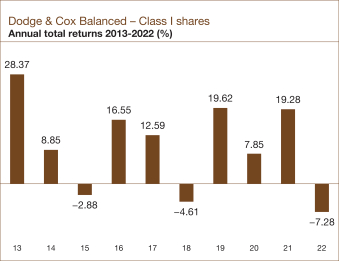
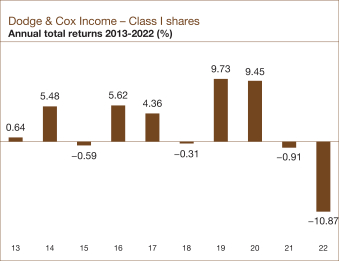
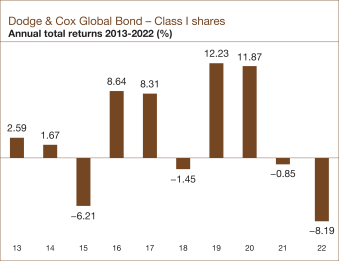
false 2023-04-27 2022-12-31 485BPOS 0000029440 18.32 7.08 24.80 7.16 31.68 7.22 40.55 4.47 10.43 21.27 Dodge & Cox Stock – Class I Annual total returns 2013-2022 (%) 12.65 23.85 6.02 20.75 5.80 6.95 21.51 33.17 8.05 17.09 Dodge & Cox Global Stock – Class I Annual total returns 2013-2022 (%) 6.78 23.94 26.31 22.78 11.35 0.07 11.02 17.98 8.26 2.10 Dodge & Cox International Stock – Class I Annual total returns 2013-2022 (%) 14.91 Dodge & Cox Emerging Markets Stock Fund Annual total returns Inception - 2022 (%) 28.37 7.28 8.85 2.88 16.55 12.59 4.61 19.62 7.85 19.28 Dodge & Cox Balanced Fund - Class I shares Annual total returns 2013-2022 (%) 0.91 10.87 0.64 5.48 0.59 5.62 4.36 0.31 9.73 9.45 Dodge & Cox Income - Class I Shares Annual total returns 2013-2022 (%) 1.45 12.23 11.87 0.85 8.19 6.21 1.67 8.64 8.31 2.59 Dodge & Cox Global Bond – Class I Shares Annual total returns 2013-2022 (%) 0000029440 2023-05-01 2023-05-01 0000029440 docf:S000011202Member 2023-05-01 2023-05-01 0000029440 docf:S000011202Member docf:C000030875Member 2023-05-01 2023-05-01 0000029440 docf:S000011202Member docf:C000030875Member rr:AfterTaxesOnDistributionsAndSalesMember 2023-05-01 2023-05-01 0000029440 docf:S000011202Member docf:C000030875Member rr:AfterTaxesOnDistributionsMember 2023-05-01 2023-05-01 0000029440 docf:S000011202Member docf:C000235734Member 2023-05-01 2023-05-01 0000029440 docf:S000011202Member docf:Russell1000ValueIndexMember 2023-05-01 2023-05-01 0000029440 docf:S000011202Member docf:SP500IndexMember 2023-05-01 2023-05-01 0000029440 docf:S000011203Member 2023-05-01 2023-05-01 0000029440 docf:S000011203Member docf:C000030876Member 2023-05-01 2023-05-01 0000029440 docf:S000011203Member docf:C000030876Member rr:AfterTaxesOnDistributionsAndSalesMember 2023-05-01 2023-05-01 0000029440 docf:S000011203Member docf:C000030876Member rr:AfterTaxesOnDistributionsMember 2023-05-01 2023-05-01 0000029440 docf:S000011203Member docf:C000235735Member 2023-05-01 2023-05-01 0000029440 docf:S000011203Member docf:MSCIEAFEEuropeAustralasiaFarEastIndexMember 2023-05-01 2023-05-01 0000029440 docf:S000011204Member 2023-05-01 2023-05-01 0000029440 docf:S000011204Member docf:BloombergUsAggregateBondIndexMember 2023-05-01 2023-05-01 0000029440 docf:S000011204Member docf:C000030877Member 2023-05-01 2023-05-01 0000029440 docf:S000011204Member docf:C000030877Member rr:AfterTaxesOnDistributionsAndSalesMember 2023-05-01 2023-05-01 0000029440 docf:S000011204Member docf:C000030877Member rr:AfterTaxesOnDistributionsMember 2023-05-01 2023-05-01 0000029440 docf:S000011204Member docf:C000235736Member 2023-05-01 2023-05-01 0000029440 docf:S000011204Member docf:CombinedIndexMember 2023-05-01 2023-05-01 0000029440 docf:S000011204Member docf:SP500IndexMember 2023-05-01 2023-05-01 0000029440 docf:S000011205Member 2023-05-01 2023-05-01 0000029440 docf:S000011205Member docf:BloombergUsAggregateBondIndexMember 2023-05-01 2023-05-01 0000029440 docf:S000011205Member docf:C000030878Member 2023-05-01 2023-05-01 0000029440 docf:S000011205Member docf:C000030878Member rr:AfterTaxesOnDistributionsAndSalesMember 2023-05-01 2023-05-01 0000029440 docf:S000011205Member docf:C000030878Member rr:AfterTaxesOnDistributionsMember 2023-05-01 2023-05-01 0000029440 docf:S000011205Member docf:C000235737Member 2023-05-01 2023-05-01 0000029440 docf:S000022057Member 2023-05-01 2023-05-01 0000029440 docf:S000022057Member docf:C000063339Member 2023-05-01 2023-05-01 0000029440 docf:S000022057Member docf:C000063339Member rr:AfterTaxesOnDistributionsAndSalesMember 2023-05-01 2023-05-01 0000029440 docf:S000022057Member docf:C000063339Member rr:AfterTaxesOnDistributionsMember 2023-05-01 2023-05-01 0000029440 docf:S000022057Member docf:C000235738Member 2023-05-01 2023-05-01 0000029440 docf:S000022057Member docf:MSCIACWIIndexNetMember 2023-05-01 2023-05-01 0000029440 docf:S000022057Member docf:MSCIWorldIndexNetMember 2023-05-01 2023-05-01 0000029440 docf:S000045260Member 2023-05-01 2023-05-01 0000029440 docf:BloombergGlobalAggregateBondIndexUSDHedgedMember docf:S000045260Member 2023-05-01 2023-05-01 0000029440 docf:S000045260Member docf:C000140963Member 2023-05-01 2023-05-01 0000029440 docf:S000045260Member docf:C000140963Member rr:AfterTaxesOnDistributionsAndSalesMember 2023-05-01 2023-05-01 0000029440 docf:S000045260Member docf:C000140963Member rr:AfterTaxesOnDistributionsMember 2023-05-01 2023-05-01 0000029440 docf:S000045260Member docf:C000235739Member 2023-05-01 2023-05-01 0000029440 docf:S000069725Member 2023-05-01 2023-05-01 0000029440 docf:S000069725Member docf:C000222467Member 2023-05-01 2023-05-01 0000029440 rr:AfterTaxesOnDistributionsAndSalesMember docf:S000069725Member docf:C000222467Member 2023-05-01 2023-05-01 0000029440 docf:S000069725Member rr:AfterTaxesOnDistributionsMember docf:C000222467Member 2023-05-01 2023-05-01 0000029440 docf:S000069725Member docf:MSCIEMIndexMember 2023-05-01 2023-05-01 xbrli:pure iso4217:USD
Registration Nos. 2‑11522
811‑173
SECURITIES AND EXCHANGE COMMISSION
Washington, D.C. 20549
FORM N-1A
REGISTRATION STATEMENT
UNDER
|
|
|
| THE SECURITIES ACT OF 1933 |
|
☒ |
| Pre‑Effective Amendment No. |
|
☐ |
| Post-Effective Amendment No. 109 |
|
☒ |
REGISTRATION STATEMENT
UNDER
THE INVESTMENT COMPANY ACT OF 1940
DODGE & COX FUNDS
(Exact Name of Registrant as Specified in Charter)
555 California Street, 40th Floor,
San Francisco, CA 94104
(Address of Principal Executive Office)
Registrant’s Telephone Number including Area Code: (415) 981‑1710
Roberta R. W. Kameda, Esq., 555 California Street, 40th Floor, San Francisco, CA 94104
(Name and Address of Agent for Service)
It is proposed that this filing will become effective (check appropriate box):
| |
☐ |
immediately upon filing pursuant to paragraph (b) |
| |
☒ |
on May 1, 2023 pursuant to paragraph (b) |
| |
☐ |
60 days after filing pursuant to paragraph (a)(1) |
| |
☐ |
on pursuant to paragraph (a)(1) |
| |
☐ |
75 days after filing pursuant to paragraph (a)(2) |
| |
☐ |
on pursuant to paragraph (a)(2) of Rule 485 |
If appropriate, check the following box:
| |
☐ |
This post-effective amendment designates a new effective date of a previously filed post-effective amendment. |
|
|
|
|
|
|
| Prospectus |
|
2023 |
|
|
May 1, 2023 |
| |
|
|
Stock Fund
Established 1965 | Class I (DODGX) | Class X (DOXGX)
Global Stock Fund
Established 2008 | Class I (DODWX) | Class X (DOXWX)
International Stock Fund
Established 2001 | Class I (DODFX) | Class X (DOXFX)
Emerging Markets Stock Fund
Established 2021 | DODEX
Balanced Fund
Established 1931 | Class I (DODBX) | Class X (DOXBX)
Income Fund
Established 1989 | Class I (DODIX) | Class X (DOXIX)
Global Bond Fund
Established 2014 | Class I (DODLX) | Class X (DOXLX)
The Securities and Exchange Commission (“SEC”) has not approved or disapproved these securities or passed upon the accuracy or adequacy of this prospectus. Any representation to the contrary is a criminal offense.
5/23

Printed on recycled paper
Table of Contents
|
|
|
|
|
Fund Summaries |
| 1 |
|
|
| 4 |
|
|
| 8 |
|
|
| 11 |
|
|
| 15 |
|
|
| 19 |
|
|
| 23 |
|
|
| 27 |
|
|
| 28 |
|
|
| 33 |
|
|
| 33 |
|
|
| 33 |
|
|
| 39 |
|
|
| 48 |
|
|
| 49 |
|
|
| 51 |
|
|
| 54 |
|
|
| 54 |
|
|
| 55 |
|
|
| 55 |
|
|
| 56 |
|
|
| 56 |
|
|
| 57 |
|
|
| 59 |
|
|
| 66 |
|
|
| 67 |
|
|
Mutual fund shares are not deposits or obligations of, or guaranteed by, any depository institution. Shares are not insured by the FDIC, Federal Reserve, or any other government agency, and are subject to investment risks, including possible loss of your investment.
Dodge & Cox Stock Fund
Investment Objectives
The Fund seeks long-term growth of principal and income. A secondary objective is to achieve a reasonable current income.
Fees and Expenses
This table describes the fees and expenses that you may pay if you buy, hold, and sell shares of the Fund. You may pay other fees, such as brokerage commissions and other fees to financial intermediaries, which are not reflected in the tables and examples below.
|
|
|
|
|
|
|
|
|
| Shareholder Fees (fees paid directly from your investment) |
|
Dodge & Cox
Stock – Class I |
|
|
Dodge & Cox
Stock – Class X |
|
| Sales charge (load) imposed on purchases |
|
|
None |
|
|
|
None |
|
| Deferred sales charge (load) |
|
|
None |
|
|
|
None |
|
| Sales charge (load) imposed on reinvested distributions |
|
|
None |
|
|
|
None |
|
| Redemption fee |
|
|
None |
|
|
|
None |
|
| Exchange fee |
|
|
None |
|
|
|
None |
|
|
|
|
|
|
|
|
|
|
| Annual Fund Operating Expenses (expenses that you pay each year as a
percentage of the value of your investment) |
|
Dodge & Cox
Stock – Class I |
|
|
Dodge & Cox
Stock – Class X |
|
| Management fees* |
|
|
0.50 |
% |
|
|
0.45 |
% |
| Distribution and/or service (12b-1) fees |
|
|
None |
|
|
|
None |
|
| Other expenses (custody, accounting, legal, etc.) |
|
|
0.01 |
% |
|
|
0.01 |
% |
|
|
|
|
|
|
|
|
|
| Total Annual Fund Operating Expenses |
|
|
0.51 |
% |
|
|
0.46 |
%** |
| Expense reimbursement |
|
|
None |
|
|
|
0.05 |
%** |
|
|
|
|
|
|
|
|
|
| Net Expenses |
|
|
0.51 |
% |
|
|
0.41 |
%** |
| * |
|
Management fees include investment advisory fee expenses of 0.40% for each class; and administrative services fee expenses of 0.10% for Class I shares and 0.05% for Class X shares. |
| ** |
|
Dodge & Cox has contractually agreed to reimburse the Fund for all ordinary expenses to the extent necessary to maintain Total Annual Fund Operating Expenses of Class X at 0.41% until April 30, 2024. This agreement cannot be terminated prior to April 30, 2024 other than by resolution of the Fund’s Board of Trustees. For purposes of the foregoing, ordinary expenses shall not include nonrecurring shareholder account fees, fees on portfolio transactions such as exchange fees, dividends and interest on short positions, fees and expenses of pooled investment vehicles that are held by the Fund, interest, taxes, brokerage fees and commissions, other expenditures which are capitalized in accordance with generally accepted accounting principles, and other non-routine expenses or extraordinary expenses not incurred in the ordinary course of the Fund’s business, such as litigation expenses. The term of the agreement renews annually unless terminated with 30 days’ written notice by either party prior to the end of the term. The agreement does not permit Dodge & Cox to recoup any fees waived or payments made to the Fund for a prior year. |
Example: This example is intended to help you compare the cost of investing in the Fund with the cost of investing in other mutual funds.
The example assumes that:
| ∎ |
|
You invest $10,000 in Class I shares and/or Class X shares of the Fund for the time periods indicated and then redeem all of your shares of the Fund’s Class I shares and/or the Fund’s Class X shares at the end of those time periods; |
| ∎ |
|
Your investment has a 5% return each year; |
| ∎ |
|
The Fund’s operating expenses remain the same; and |
| ∎ |
|
The Class X expense reimbursement agreement is effective until April 30, 2024, and there is no expense reimbursement agreement after that time. |
Although your actual costs may be higher or lower, based on these assumptions your costs would be:
|
|
|
|
|
|
|
|
|
|
|
|
|
|
|
|
|
| |
|
1 Year |
|
|
3 Years |
|
|
5 Years |
|
|
10 Years |
|
| Dodge & Cox Stock – Class I |
|
$ |
52 |
|
|
$ |
164 |
|
|
$ |
285 |
|
|
$ |
640 |
|
| Dodge & Cox Stock – Class X |
|
$ |
42 |
|
|
$ |
143 |
|
|
$ |
253 |
|
|
$ |
574 |
|
Portfolio Turnover
The Fund incurs transaction costs, such as commissions, when Dodge & Cox buys and sells securities (or “turns over” the portfolio). A higher portfolio turnover rate may indicate higher transaction costs and may result in higher taxes when Fund shares are held in a taxable account. These transaction costs, which are not reflected in annual Fund operating expenses or in the example, affect the Fund’s performance. During the most recent fiscal year, the Fund’s portfolio turnover rate was 16% of the average value of its portfolio.
Principal Investment Strategies
The Fund invests primarily in a diversified portfolio of equity securities. Under normal circumstances, the Fund will invest at least 80% of its total assets in equity securities, including common stocks, depositary receipts evidencing ownership of common stocks, certain preferred stocks, securities convertible into common stocks, and securities that carry the right to buy common stocks (e.g., rights and warrants). The Fund may invest up to 20% of its total assets in U.S. dollar-denominated securities of non-U.S. issuers traded in the United States that are not in the S&P 500 Index. The Fund may use equity options or total return swaps referencing single stocks or stock indices to create or hedge equity exposure. The Fund may also use futures referencing stock indices such as the S&P 500 Index to equitize, or create equity market exposure, approximately equal to some or all of its cash and cash equivalents, receivables, and similar non-equity assets, or to hedge against a general downturn in the equity markets.
The Fund typically invests in medium-to-large well-established companies based on standards of the applicable market. In selecting investments, the Fund typically invests in companies that, in Dodge & Cox’s opinion, appear to be temporarily undervalued by the stock market but have a favorable outlook for long-term profit growth. The Fund focuses on the underlying financial condition and prospects of individual companies, including future earnings, cash flow, and dividends. Various other factors, including financial strength, economic condition, competitive advantage, quality of the business franchise, financially material environmental, social, and governance (ESG) issues, and the reputation, experience, and competence of a company’s management are weighed against valuation in selecting individual securities. The Fund also considers the economic and political stability of the country where the issuer is located and the protections provided to shareholders.
|
|
|
|
|
DODGE & COX FUNDS ∎ PAGE 1 |
Principal Risks of Investing
You could lose money by investing in the Fund, and the Fund could underperform other investments. You should expect the Fund’s share price and total return to fluctuate within a wide range. The Fund’s performance could be hurt by:
| ∎ |
|
Equity risk. Equity securities can be volatile and may decline in value because of changes in the actual or perceived financial condition of their issuers or other events affecting their issuers. |
| ∎ |
|
Market risk. Investment prices may increase or decrease, sometimes suddenly and unpredictably, due to general market conditions. Local, regional or global events such as war, acts of terrorism, the spread of infectious illness or other public health issue, recessions, inflation, or other events could also have a significant impact on the Fund and its investments and potentially increase the risks described herein. |
| ∎ |
|
Manager risk. Dodge & Cox’s opinion about the intrinsic worth or creditworthiness of a company or security may be incorrect or the market may continue to undervalue the company or security. Depending on market conditions, Dodge & Cox’s investing style may perform better or worse than portfolios with a different investment style. Dodge & Cox may not make timely purchases or sales of securities for the Fund. The Fund may underperform the broad market, relevant indices, or other funds with similar objectives and investment strategies. |
| ∎ |
|
Liquidity risk. The Fund may not be able to purchase or sell a security in a timely manner or at desired prices or achieve its desired weighting in a security. |
| ∎ |
|
Derivatives risk. Investing with derivatives, such as equity index futures, equity options, and total return swaps, involves risks additional to and possibly greater than those associated with investing directly in securities. The value of a derivative may not correlate to the value of the underlying instrument to the extent expected. A derivative can create leverage because it can result in exposure to an amount of a security, index, or other underlying investment (a “notional amount”) that is substantially larger than the derivative position’s market value. Often, the upfront payment required to enter into a derivative is much smaller than the potential for loss, which for certain types of derivatives, including the sale of call options, may be unlimited. The Fund may not be able to close a derivatives position at an advantageous time or price. As a result, the Fund may be required to continue making required margin and settlement payments and, if the Fund has insufficient cash on hand to meet such requirements, it may have to sell securities from its portfolio at a time when it may be disadvantageous to do so. For over-the-counter derivatives transactions, the counterparty may be unable or unwilling to make required payments and deliveries, especially during times of financial market distress. Derivatives also can create operational and legal risk. Changes in regulation relating to a mutual fund’s use of derivatives and related instruments may make derivatives more costly, limit the availability of derivatives, or otherwise adversely affect the value or performance of derivatives and the Fund. |
An investment in the Fund is not a deposit of a bank and is not insured or guaranteed by the Federal Deposit Insurance Corporation or any other government agency.
Performance Information
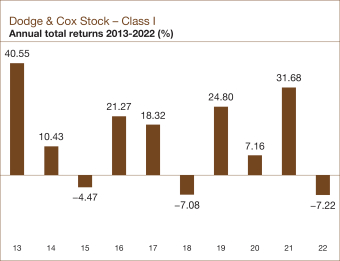
The following bar chart and table are intended to help you understand the risks of investing in the Fund. The bar chart shows changes in the Fund’s Class I shares’ returns from year to year. The table shows how the average annual total returns of the Fund’s Class I shares and Class X shares compare to those of a primary and secondary broad-based securities market index. The Fund’s primary benchmark is the S&P 500 Index, which consists of large cap equity securities and is generally considered representative of the U.S. stock market as a whole. The Fund’s secondary benchmark is the Russell 1000 Value Index, which measures the performance of the large capitalization value segment of the U.S. equity universe.
The Fund’s past performance (before and after taxes) does not necessarily indicate how the Fund will perform in the future. Visit the Fund’s website at dodgeandcox.com or call 800-621-3979 for current performance figures.
Highest/Lowest quarterly results for the Fund’s Class I shares during the time period were:
Highest: 20.87% (quarter ended December 31, 2020)
Lowest: –29.16% (quarter ended March 31, 2020)
Average Annual Total Returns for the Periods Ended 12/31/2022
|
|
|
|
|
|
|
|
|
|
|
|
|
| Dodge & Cox Stock – Class I |
|
1 Year |
|
|
5 Years |
|
|
10 Years |
|
| Return before taxes |
|
|
–7.22 |
% |
|
|
–8.72 |
% |
|
|
12.44 |
% |
| Return after taxes on distributions |
|
|
–8.39 |
|
|
|
6.91 |
|
|
|
10.86 |
|
| Return after taxes on distributions and sale of Fund shares |
|
|
–3.46 |
|
|
|
6.56 |
|
|
|
9.98 |
|
| Dodge & Cox Stock – Class X* |
|
|
|
|
|
|
|
|
|
| Return before taxes |
|
|
–7.15 |
|
|
|
8.74 |
|
|
|
12.45 |
|
| S&P 500 Index (reflects no deduction for expenses or taxes) |
|
|
–18.11 |
|
|
|
9.42 |
|
|
|
12.56 |
|
| Russell 1000 Value Index (reflects no deduction for expenses or taxes) |
|
|
–7.54 |
|
|
|
6.67 |
|
|
|
10.29 |
|
| * |
|
The Fund’s Class X shares launched on May 1, 2022. In the table above, Class X returns for periods prior to its launch are calculated using performance of the Fund’s Class I shares. |
|
|
|
| PAGE 2 ∎ DODGE & COX FUNDS |
|
|
The after-tax returns shown above are for the Fund’s Class I shares. The after-tax returns for the Fund’s Class X shares will vary. After-tax returns are calculated using the historical highest individual federal marginal income tax rates, but do not reflect the impact of state or local taxes. Actual after-tax returns may differ depending on
your individual circumstances. After-tax return figures do not apply to you if you hold your Fund shares through a tax-deferred arrangement such as a 401(k) plan or an individual retirement account.
Fund Management
Dodge & Cox serves as investment manager to the Stock Fund. The Fund is managed by Dodge & Cox’s U.S. Equity Investment Committee (“USEIC”), which consists of the following seven members:
|
|
|
|
|
| Committee Member |
|
Primary Titles with Investment Manager |
|
Years managing
the Fund/
Years with
Dodge & Cox |
| David C. Hoeft |
|
Senior Vice President, Director, Chief Investment Officer, and member of Global Equity Investment Committee (“GEIC”), Emerging Markets Equity Investment Committee (“EMEIC”), and Balanced Fund Investment Committee (“BFIC”) |
|
21/30 |
| Steven C. Voorhis |
|
Senior Vice President, Director of Research, and member of GEIC |
|
17/27 |
| Philippe Barret, Jr. |
|
Senior Vice President and Director (since 2022), Research Analyst, and member of BFIC |
|
10/19 |
| Kathleen G. McCarthy |
|
Vice President and Research Analyst |
|
7/16 |
| Karol Marcin |
|
Vice President, Research Analyst, and member of GEIC |
|
5/23 |
| Benjamin V. Garosi |
|
Vice President and Research Analyst, and member of BFIC |
|
4/14 |
| Karim Fakhry |
|
Vice President and Research Analyst |
|
2/18 |
Other Important Information About Fund Shares
For important information about purchase and sale of Fund shares, tax information, and payments to financial intermediaries please turn to the “Summary of Other Important Information About Fund Shares” section on page 27 of this prospectus.
|
|
|
|
|
DODGE & COX FUNDS ∎ PAGE 3 |
Dodge & Cox Global Stock Fund
Investment Objective
The Fund seeks long-term growth of principal and income.
Fees and Expenses
This table describes the fees and expenses that you may pay if you buy, hold, and sell shares of the Fund. You may pay other fees, such as brokerage commissions and other fees to financial intermediaries, which are not reflected in the tables and examples below.
|
|
|
|
|
|
|
|
|
| Shareholder Fees (fees paid directly from your investment) |
|
Dodge & Cox Global
Stock – Class I |
|
|
Dodge & Cox Global
Stock – Class X |
|
| Sales charge (load) imposed on purchases |
|
|
None |
|
|
|
None |
|
| Deferred sales charge (load) |
|
|
None |
|
|
|
None |
|
| Sales charge (load) imposed on reinvested distributions |
|
|
None |
|
|
|
None |
|
| Redemption fee |
|
|
None |
|
|
|
None |
|
| Exchange fee |
|
|
None |
|
|
|
None |
|
|
|
|
|
|
|
|
|
|
| Annual Fund Operating Expenses (expenses that you pay each year as a
percentage of the value of
your investment) |
|
Dodge & Cox Global
Stock – Class I |
|
|
Dodge & Cox Global
Stock – Class X |
|
| Management fees* |
|
|
0.60 |
% |
|
|
0.55 |
% |
| Distribution and/or service (12b‑1) fees |
|
|
None |
|
|
|
None |
|
| Other expenses (custody, accounting, legal, etc.) |
|
|
0.02 |
% |
|
|
0.02 |
% |
|
|
|
|
|
|
|
|
|
| Total Annual Fund Operating Expenses |
|
|
0.62 |
% |
|
|
0.57 |
%** |
| Expense Reimbursement |
|
|
None |
|
|
|
0.05 |
%** |
|
|
|
|
|
|
|
|
|
| Net Expenses |
|
|
0.62 |
% |
|
|
0.52 |
%** |
| * |
|
Management fees include investment advisory fee expenses of 0.50% for each class; and administrative services fee expenses of 0.10% for the Fund’s Class I shares and 0.05% for the Fund’s Class X shares. |
| ** |
|
Dodge & Cox has contractually agreed to reimburse the Fund for all ordinary expenses to the extent necessary to maintain Total Annual Fund Operating Expenses of the Fund’s Class X at 0.52% until April 30, 2024. This agreement cannot be terminated prior to April 30, 2024 other than by resolution of the Fund’s Board of Trustees. For purposes of the foregoing, ordinary expenses shall not include nonrecurring shareholder account fees, fees on portfolio transactions such as exchange fees, dividends and interest on short positions, fees and expenses of pooled investment vehicles that are held by the Fund, interest, taxes, brokerage fees and commissions, other expenditures which are capitalized in accordance with generally accepted accounting principles, and other non-routine expenses or extraordinary expenses not incurred in the ordinary course of the Fund’s business, such as litigation expenses. The term of the agreement renews annually unless terminated with 30 days’ written notice by either party prior to the end of the term. The agreement does not permit Dodge & Cox to recoup any fees waived or payments made to the Fund for a prior year. |
Example: This example is intended to help you compare the cost of investing in the Fund with the cost of investing in other mutual funds.
The example assumes that:
| ∎ |
|
You invest $10,000 in Class I and/or Class X shares of the Fund for the time periods indicated and then redeem all of your shares of the Fund’s Class I and/or the Fund’s Class X at the end of those time periods; |
| ∎ |
|
Your investment has a 5% return each year; |
| ∎ |
|
The Fund’s operating expenses remain the same; and |
| ∎ |
|
The Class X expense reimbursement agreement is effective until April 30, 2024, and there is no expense reimbursement agreement after that time. |
Although your actual costs may be higher or lower, based on these assumptions your costs would be:
|
|
|
|
|
|
|
|
|
|
|
|
|
|
|
|
|
| |
|
1 Year |
|
|
3 Years |
|
|
5 Years |
|
|
10 Years |
|
| Dodge & Cox Global Stock – Class I |
|
$ |
63 |
|
|
$ |
199 |
|
|
$ |
346 |
|
|
$ |
774 |
|
| Dodge & Cox Global Stock – Class X |
|
$ |
53 |
|
|
$ |
178 |
|
|
$ |
313 |
|
|
$ |
709 |
|
Portfolio Turnover
The Fund incurs transaction costs, such as commissions, when Dodge & Cox buys and sells securities (or “turns over” the portfolio). A higher portfolio turnover rate may indicate higher transaction costs and may result in higher taxes when Fund shares are held in a taxable account. These transaction costs, which are not reflected in annual Fund operating expenses or in the example, affect the Fund’s performance. During the most recent fiscal year, the Fund’s portfolio turnover rate was 25% of the average value of its portfolio.
Principal Investment Strategies
The Fund invests primarily in a diversified portfolio of equity securities issued by companies from at least three different countries, which may include emerging market countries. The Fund is not required to allocate its investments in set percentages in particular countries and may invest in emerging markets without limit. Under normal circumstances, the Fund will invest at least 40% of its total assets in securities of non-U.S. companies and at least 80% of its total assets in equity securities, including common stocks, depositary receipts evidencing ownership of common stocks, certain preferred stocks, securities convertible into common stocks, and securities that carry the right to buy common stocks (e.g., rights and warrants). The Fund may enter into currency forward contracts, currency swaps, or currency futures contracts to hedge direct and/or indirect currency exposure or currency risk. The Fund may use equity options or total return swaps referencing single stocks or stock indices to create or hedge equity exposure. The Fund may also use futures referencing stock indices to equitize, or create equity market exposure, approximately equal to some or all of its cash and cash equivalents, receivables, and similar non-equity assets, or to hedge against a general downturn in the equity markets.
The Fund typically invests in medium-to-large well-established companies based on standards of the applicable market. In selecting investments, the Fund typically invests in companies that, in Dodge & Cox’s opinion, appear to be temporarily undervalued by the stock market but have a favorable outlook for long-term profit growth. The Fund also focuses on the underlying financial condition and prospects of individual companies, including future earnings, cash flow, and dividends. Various other factors, including financial strength, economic condition, competitive advantage, quality of the
|
|
|
| PAGE 4 ∎ DODGE & COX FUNDS |
|
|
business franchise, financially material environmental, social, and governance (ESG) issues, and the reputation, experience, and competence of a company’s management are weighed against valuation in selecting individual securities. The Fund also considers the economic and political stability of the country where the issuer is located and the protections provided to shareholders.
Principal Risks of Investing
You could lose money by investing in the Fund, and the Fund could underperform other investments. You should expect the Fund’s share price and total return to fluctuate within a wide range. The Fund’s performance could be hurt by:
| ∎ |
|
Equity risk. Equity securities can be volatile and may decline in value because of changes in the actual or perceived financial condition of their issuers or other events affecting their issuers. |
| ∎ |
|
Market risk. Investment prices may increase or decrease, sometimes suddenly and unpredictably, due to general market conditions. Local, regional or global events such as war, acts of terrorism, the spread of infectious illness or other public health issue, recessions, inflation, or other events could also have a significant impact on the Fund and its investments and potentially increase the risks described herein. |
| ∎ |
|
Manager risk. Dodge & Cox’s opinion about the intrinsic worth or creditworthiness of a company or security may be incorrect or the market may continue to undervalue the company or security. Depending on market conditions, Dodge & Cox’s investing style may perform better or worse than portfolios with a different investment style. Dodge & Cox may not make timely purchases or sales of securities for the Fund. The Fund may underperform the broad market, relevant indices, or other funds with similar objectives and investment strategies. |
| ∎ |
|
Non-U.S. investment risk. Securities of non-U.S. issuers (including ADRs, ADSs, GDRs and other securities that represent interests in a non-U.S. issuer’s securities) may be more volatile, harder to value, and have lower overall liquidity than U.S. securities. Non-U.S. issuers may be subject to political, economic, or market instability, or unfavorable government action in their local jurisdictions or economic sanctions or other restrictions imposed by U.S. or foreign regulators. There may be less information publicly available about non-U.S. issuers and their securities, and those issuers may be subject to lower levels of government regulation and oversight. Non-U.S. stock markets may decline due to conditions specific to an individual country, including unfavorable economic conditions relative to the United States. The Fund generally holds non-U.S. securities and cash in foreign banks and securities depositories, which may be recently organized or new to the foreign custody business and may be subject to only limited or no regulatory oversight. There may be increased risk of delayed transaction settlement. These risks may be higher when investing in emerging and frontier markets. Certain of these elevated risks may also apply to securities of U.S. issuers with significant non-U.S. operations. |
| ∎ |
|
Emerging markets risk. Emerging market securities may present issuer, market, currency, liquidity, volatility, valuation, legal, political, and other risks different from, and potentially greater than, the risks of investing in securities of issuers in more developed markets. Emerging markets may have less established |
| |
|
legal, accounting, and financial reporting systems than those in more developed markets, which may reduce the scope or quality of financial information available to investors. In addition, companies in emerging markets may be subject to less stringent standards on disclosure, accounting and financial reporting, and recordkeeping, which may affect the Fund’s ability to evaluate potential and current investments. Governments in emerging market countries may be less stable and more likely to take extra-legal action with respect to companies, industries, assets, or foreign ownership than those in more developed markets. Moreover, investor protection regimes may be more limited in emerging markets. For example, it may be more difficult for shareholders to bring derivative litigation or for U.S. regulators to bring enforcement actions against issuers in emerging markets. Emerging market securities may also be more volatile, more difficult to value, and have lower overall liquidity than securities economically tied to U.S. or developed non-U.S. markets. |
| ∎ |
|
Non-U.S. currency risk. Non-U.S. currencies may decline relative to the U.S. dollar, which reduces the unhedged value of securities denominated in or otherwise exposed to those currencies. Dodge & Cox may not hedge or may not be successful in hedging the Fund’s currency exposure and may not be able to determine accurately the extent to which a security or its issuer is exposed to currency risk. |
| ∎ |
|
Liquidity risk. The Fund may not be able to purchase or sell a security in a timely manner or at desired prices or achieve its desired weighting in a security. |
| ∎ |
|
Derivatives risk. Investing with derivatives, such as currency forward contracts, currency swaps, equity options, equity index futures and total return swaps, involves risks additional to and possibly greater than those associated with investing directly in securities. The value of a derivative may not correlate to the value of the underlying instrument to the extent expected. A derivative can create leverage because it can result in exposure to an amount of a security, index, or other underlying investment (a “notional amount”) that is substantially larger than the derivative position’s market value. Often, the upfront payment required to enter into a derivative is much smaller than the potential for loss, which for certain types of derivatives may be unlimited. The Fund may not be able to close a derivatives position at an advantageous time or price. As a result, the Fund may be required to continue making required margin and settlement payments and, if the Fund has insufficient cash on hand to meet such requirements, it may have to sell securities from its portfolio at a time when it may be disadvantageous to do so. For over-the-counter derivatives transactions, the counterparty may be unable or unwilling to make required payments and deliveries, especially during times of financial market distress. Derivatives also can create operational and legal risk. Changes in regulation relating to a mutual fund’s use of derivatives and related instruments may make derivatives more costly, limit the availability of derivatives, or otherwise adversely affect the value or performance of derivatives and the Fund. |
| ∎ |
|
Geographic risk. From time to time the Fund may invest a substantial amount of its assets in issuers located in a single country or a limited number of countries. If the Fund focuses its investments in this manner, risks relating to economic, political |
|
|
|
|
|
DODGE & COX FUNDS ∎ PAGE 5 |
| |
|
and social conditions in those countries will have a significant impact on its investment performance. The Fund’s investment performance may be more volatile if it focuses its investments in certain countries, especially emerging market or frontier market countries. |
An investment in the Fund is not a deposit of a bank and is not insured or guaranteed by the Federal Deposit Insurance Corporation or any other government agency.
Performance Information
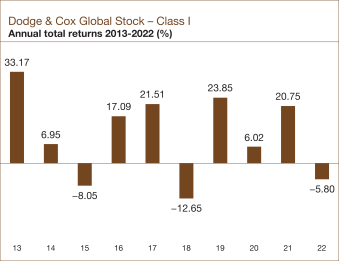
The following bar chart and table are intended to help you understand the risks of investing in the Fund. The bar chart shows changes in the Fund’s Class I shares’ returns from year to year. The table shows how the average annual total returns of the Fund’s Class I shares and Class X shares compare to those of a broad measure of market performance.
The Fund’s past performance (before and after taxes) does not necessarily indicate how the Fund will perform in the future. Visit the Fund’s website at dodgeandcox.com or call 800-621-3979 for current performance figures.
Highest/Lowest quarterly results for the Fund’s Class I shares during the time period were:
Highest: 24.08% (quarter ended December 31, 2020)
Lowest: –31.00% (quarter ended March 31, 2020)
Average Annual Total Returns for the Periods Ended 12/31/2022
|
|
|
|
|
|
|
|
|
|
|
|
|
Dodge & Cox
Global Stock – Class I |
|
1 Year |
|
|
5 Years |
|
|
10 Years |
|
| Return before taxes |
|
|
–5.80 |
% |
|
|
5.46 |
% |
|
|
9.29 |
% |
| Return after taxes on distributions |
|
|
–7.30 |
|
|
|
3.81 |
|
|
|
7.99 |
|
| Return after taxes on distributions and sale of Fund shares |
|
|
–2.17 |
|
|
|
4.18 |
|
|
|
7.48 |
|
| Dodge & Cox Global Stock – Class X* |
|
|
|
|
|
|
|
|
|
| Return before taxes |
|
|
–5.74 |
|
|
|
5.48 |
|
|
|
9.30 |
|
| MSCI ACWI Index (Net)** (reflects no deduction for expenses or taxes) |
|
|
–18.36 |
|
|
|
5.23 |
|
|
|
7.98 |
|
| MSCI World Index (Net)** (reflects no deduction for expenses or taxes) |
|
|
–18.14 |
|
|
|
6.14 |
|
|
|
8.85 |
|
| * |
|
The Fund’s Class X shares launched on May 1, 2022. In the table above, Class X returns for periods prior to its launch are calculated using performance of the Fund’s Class I shares. |
| ** |
|
MSCI ACWI Index (Net) and MSCI World (Net) returns are calculated applying dividend withholding rates applicable to non-resident persons who do not benefit from double taxation treaties. Withholding rates applicable to the Fund may be lower. |
The after-tax returns shown above are for the Fund’s Class I shares. The after-tax returns of the Fund’s Class X shares will vary. After-tax returns are calculated using the historical highest individual federal marginal income tax rates, but do not reflect the impact of state or local taxes. Actual after-tax returns may differ depending on your individual circumstances. After-tax return figures do not apply to you if you hold your Fund shares through a tax-deferred arrangement such as a 401(k) plan or an individual retirement account.
|
|
|
| PAGE 6 ∎ DODGE & COX FUNDS |
|
|
Fund Management
Dodge & Cox serves as investment manager to the Global Stock Fund. The Fund is managed by Dodge & Cox’s Global Equity Investment Committee (“GEIC”), which consists of the following six members:
|
|
|
|
|
| Committee Member |
|
Primary Titles with Investment Manager |
|
Years managing
the Fund/
Years with
Dodge & Cox |
| David C. Hoeft |
|
Senior Vice President, Director, Chief Investment Officer, and member of U.S. Equity Investment Committee (“USEIC”), Emerging Markets Equity Investment Committee (“EMEIC”), and Balanced Fund Investment Committee (“BFIC”) |
|
7/30 |
| Steven C. Voorhis |
|
Senior Vice President, Director of Research, and member of USEIC |
|
15/27 |
| Roger G. Kuo |
|
President (since 2022), Director, Research Analyst, and member of International Equity Investment Committee (“IEIC”) |
|
13/25 |
| Karol Marcin |
|
Vice President, Research Analyst, and member of USEIC |
|
15/23 |
| Lily S. Beischer |
|
Vice President and Research Analyst |
|
15/22 |
| Raymond J. Mertens |
|
Senior Vice President and Director (since 2022), Research Analyst, and member of IEIC |
|
2/20 |
Other Important Information About Fund Shares
For important information about purchase and sale of Fund shares, tax information, and payments to financial intermediaries please turn to the “Summary of Other Important Information About Fund Shares” section on page 27 of this prospectus.
|
|
|
|
|
DODGE & COX FUNDS ∎ PAGE 7 |
Dodge & Cox International Stock Fund
Investment Objective
The Fund seeks long-term growth of principal and income.
Fees and Expenses
This table describes the fees and expenses that you may pay if you buy, hold, and sell shares of the Fund. You may pay other fees, such as brokerage commissions and other fees to financial intermediaries, which are not reflected in the tables and examples below.
|
|
|
|
|
|
|
|
|
| Shareholder Fees (fees paid directly from your investment) |
|
Dodge & Cox
International
Stock – Class I |
|
|
Dodge & Cox
International
Stock – Class X |
|
| Sales charge (load) imposed on purchases |
|
|
None |
|
|
|
None |
|
| Deferred sales charge (load) |
|
|
None |
|
|
|
None |
|
| Sales charge (load) imposed on reinvested distributions |
|
|
None |
|
|
|
None |
|
| Redemption fee |
|
|
None |
|
|
|
None |
|
| Exchange fee |
|
|
None |
|
|
|
None |
|
|
|
|
|
|
|
|
|
|
| Annual Fund Operating Expenses (expenses that you pay each year as a
percentage of the value of your investment) |
|
Dodge & Cox
International
Stock – Class I |
|
|
Dodge & Cox
International
Stock – Class X |
|
| Management fees* |
|
|
0.60 |
% |
|
|
0.55 |
% |
| Distribution and/or service (12b-1) fees |
|
|
None |
|
|
|
None |
|
| Other expenses (custody, accounting, legal, etc.) |
|
|
0.02 |
% |
|
|
0.02 |
% |
|
|
|
|
|
|
|
|
|
| Total Annual Fund Operating Expenses |
|
|
0.62 |
% |
|
|
0.57 |
%** |
| Expense reimbursement |
|
|
None |
|
|
|
0.05 |
%** |
|
|
|
|
|
|
|
|
|
| Net Expenses |
|
|
0.62 |
% |
|
|
0.52 |
%** |
| * |
|
Management fees include investment advisory fee expenses of 0.50% for each class; and administrative services fee expenses of 0.10% for the Fund’s Class I shares and 0.05% for the Fund’s Class X shares. |
| ** |
|
Dodge & Cox has contractually agreed to reimburse the Fund for all ordinary expenses to the extent necessary to maintain Total Annual Fund Operating Expenses of the Fund’s Class X shares at 0.52% until April 30, 2024. This agreement cannot be terminated prior to April 30, 2024 other than by resolution of the Fund’s Board of Trustees. For purposes of the foregoing, ordinary expenses shall not include nonrecurring shareholder account fees, fees on portfolio transactions such as exchange fees, dividends and interest on short positions, fees and expenses of pooled investment vehicles that are held by the Fund, interest, taxes, brokerage fees and commissions, other expenditures which are capitalized in accordance with generally accepted accounting principles, and other non-routine expenses or extraordinary expenses not incurred in the ordinary course of the Fund’s business, such as litigation expenses. The term of the agreement renews annually unless terminated with 30 days’ written notice by either party prior to the end of the term. The agreement does not permit Dodge & Cox to recoup any fees waived or payments made to the Fund for a prior year. |
Example: This example is intended to help you compare the cost of investing in the Fund with the cost of investing in other mutual funds.
The example assumes that:
| ∎ |
|
You invest $10,000 in Class I shares and/or Class X shares of the Fund for the time periods indicated and then redeem all of your shares the Fund’s Class I shares and/or the Fund’s Class X shares at the end of those time periods; |
| ∎ |
|
Your investment has a 5% return each year; |
| ∎ |
|
The Fund’s operating expenses remain the same; and |
| ∎ |
|
The Class X expense reimbursement agreement is effective until April 30, 2024, and there is no expense reimbursement agreement after that time. |
Although your actual costs may be higher or lower, based on these assumptions your costs would be:
|
|
|
|
|
|
|
|
|
|
|
|
|
|
|
|
|
| |
|
1 Year |
|
|
3 Years |
|
|
5 Years |
|
|
10 Years |
|
| Dodge & Cox International Stock – Class I |
|
$ |
63 |
|
|
$ |
199 |
|
|
$ |
346 |
|
|
$ |
774 |
|
| Dodge & Cox International Stock – Class X |
|
$ |
53 |
|
|
$ |
178 |
|
|
$ |
313 |
|
|
$ |
709 |
|
Portfolio Turnover
The Fund incurs transaction costs, such as commissions, when Dodge & Cox buys and sells securities (or “turns over” the portfolio). A higher portfolio turnover rate may indicate higher transaction costs and may result in higher taxes when Fund shares are held in a taxable account. These transaction costs, which are not reflected in annual Fund operating expenses or in the example, affect the Fund’s performance. During the most recent fiscal year, the Fund’s portfolio turnover rate was 12% of the average value of its portfolio.
Principal Investment Strategies
The Fund invests primarily in a diversified portfolio of equity securities issued by non-U.S. companies from at least three different countries, which may include emerging market countries. The Fund is not required to allocate its investments in set percentages in particular countries and may invest in emerging markets without limit. Under normal circumstances, the Fund will invest at least 80% of its total assets in equity securities of non-U.S. companies, including common stocks, depositary receipts evidencing ownership of common stocks, certain preferred stocks, securities convertible into common stocks, and securities that carry the right to buy common stocks (e.g., rights and warrants). The Fund may enter into currency forward contracts, currency swaps, or currency futures contracts to hedge direct and/or indirect currency exposure or currency risk. The Fund may use equity options or total return swaps referencing single stocks or stock indices to create or hedge equity exposure. The Fund may also use futures referencing stock indices to equitize, or create equity market exposure, approximately equal to some or all of its cash and cash equivalents, receivables, and similar non-equity assets, or to hedge against a general downturn in the equity markets.
The Fund typically invests in medium-to-large well-established companies based on standards of the applicable market. In selecting investments, the Fund typically invests in companies that, in Dodge & Cox’s opinion, appear to be temporarily undervalued by the stock market but have a favorable outlook for long-term profit growth. The Fund also focuses on the underlying financial condition and prospects of individual companies, including future earnings, cash flow, and dividends. Various other factors, including financial strength, economic condition, competitive advantage, quality of the business franchise, financially material environmental, social, and governance (ESG) issues, and the reputation, experience, and competence of a company’s management are weighed against valuation in selecting individual securities. The Fund also considers the economic and political stability of the country where the issuer is located and the protections provided to shareholders.
|
|
|
| PAGE 8 ∎ DODGE & COX FUNDS |
|
|
Principal Risks of Investing
You could lose money by investing in the Fund, and the Fund could underperform other investments. You should expect the Fund’s share price and total return to fluctuate within a wide range. The Fund’s performance could be hurt by:
| ∎ |
|
Equity risk. Equity securities can be volatile and may decline in value because of changes in the actual or perceived financial condition of their issuers or other events affecting their issuers. |
| ∎ |
|
Market risk. Investment prices may increase or decrease, sometimes suddenly and unpredictably, due to general market conditions. Local, regional or global events such as war, acts of terrorism, the spread of infectious illness or other public health issue, recessions, inflation, or other events could also have a significant impact on the Fund and its investments and potentially increase the risks described herein. |
| ∎ |
|
Manager risk. Dodge & Cox’s opinion about the intrinsic worth or creditworthiness of a company or security may be incorrect or the market may continue to undervalue the company or security. Depending on market conditions, Dodge & Cox’s investing style may perform better or worse than portfolios with a different investment style. Dodge & Cox may not make timely purchases or sales of securities for the Fund. The Fund may underperform the broad market, relevant indices, or other funds with similar objectives and investment strategies. |
| ∎ |
|
Non-U.S. investment risk. Securities of non-U.S. issuers (including ADRs, ADSs, GDRs and other securities that represent interests in a non-U.S. issuer’s securities) may be more volatile, harder to value, and have lower overall liquidity than U.S. securities. Non-U.S. issuers may be subject to political, economic, or market instability, or unfavorable government action in their local jurisdictions or economic sanctions or other restrictions imposed by U.S. or foreign regulators. There may be less information publicly available about non-U.S. issuers and their securities, and those issuers may be subject to lower levels of government regulation and oversight. Non-U.S. stock markets may decline due to conditions specific to an individual country, including unfavorable economic conditions relative to the United States. The Fund generally holds non-U.S. securities and cash in foreign banks and securities depositories, which may be recently organized or new to the foreign custody business and may be subject to only limited or no regulatory oversight. There may be increased risk of delayed transaction settlement. These risks may be higher when investing in emerging and frontier markets. Certain of these elevated risks may also apply to securities of U.S. issuers with significant non-U.S. operations. |
| ∎ |
|
Emerging markets risk. Emerging market securities may present issuer, market, currency, liquidity, volatility, valuation, legal, political, and other risks different from, and potentially greater than, the risks of investing in securities of issuers in more developed markets. Emerging markets may have less established legal, accounting, and financial reporting systems than those in more developed markets, which may reduce the scope or quality of financial information available to investors. In addition, companies in emerging markets may be subject to less stringent standards on disclosure, accounting and financial reporting, and recordkeeping, which may affect the Fund’s ability to evaluate potential and current investments. Governments in emerging |
| |
market countries may be less stable and more likely to take extra-legal action with respect to companies, industries, assets, or foreign ownership than those in more developed markets. Moreover, investor protection regimes may be more limited in emerging markets. For example, it may be more difficult for shareholders to bring derivative litigation or for U.S. regulators to bring enforcement actions against issuers in emerging markets. Emerging market securities may also be more volatile, more difficult to value, and have lower overall liquidity than securities economically tied to U.S. or developed non-U.S. markets. |
| ∎ |
|
Non-U.S. currency risk. Non-U.S. currencies may decline relative to the U.S. dollar, which reduces the unhedged value of securities denominated in or otherwise exposed to those currencies. Dodge & Cox may not hedge or may not be successful in hedging the Fund’s currency exposure and may not be able to determine accurately the extent to which a security or its issuer is exposed to currency risk. |
| ∎ |
|
Liquidity risk. The Fund may not be able to purchase or sell a security in a timely manner or at desired prices or achieve its desired weighting in a security. |
| ∎ |
|
Derivatives risk. Investing with derivatives, such as currency forward contracts, currency swaps, and equity options, equity index futures and total return swaps, involves risks additional to and possibly greater than those associated with investing directly in securities. The value of a derivative may not correlate to the value of the underlying instrument to the extent expected. A derivative can create leverage because it can result in exposure to an amount of a security, index, or other underlying investment (a “notional amount”) that is substantially larger than the derivative position’s market value. Often, the upfront payment required to enter into a derivative is much smaller than the potential for loss, which for certain types of derivatives may be unlimited. The Fund may not be able to close a derivatives position at an advantageous time or price. As a result, the Fund may be required to continue making required margin and settlement payments and, if the Fund has insufficient cash on hand to meet such requirements, it may have to sell securities from its portfolio at a time when it may be disadvantageous to do so. For over-the-counter derivatives transactions, the counterparty may be unable or unwilling to make required payments and deliveries, especially during times of financial market distress. Derivatives also can create operational and legal risk. Changes in regulation relating to a mutual fund’s use of derivatives and related instruments may make derivatives more costly, limit the availability of derivatives, or otherwise adversely affect the value or performance of derivatives and the Fund. |
| ∎ |
|
Geographic risk. From time to time the Fund may invest a substantial amount of its assets in issuers located in a single country or a limited number of countries. If the Fund focuses its investments in this manner, risks relating to economic, political and social conditions in those countries will have a significant impact on its investment performance. The Fund’s investment performance may be more volatile if it focuses its investments in certain countries, especially emerging market or frontier market countries. |
An investment in the Fund is not a deposit of a bank and is not insured or guaranteed by the Federal Deposit Insurance Corporation or any other government agency.
|
|
|
|
|
DODGE & COX FUNDS ∎ PAGE 9 |
Performance Information
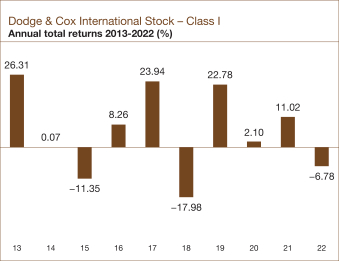
The following bar chart and table are intended to help you understand the risks of investing in the Fund. The bar chart shows changes in the Fund’s Class I shares’ returns from year to year. The table shows how the average annual total returns of the Fund’s Class I shares and Class X shares compare to those of a broad measure of market performance.
The Fund’s past performance (before and after taxes) does not necessarily indicate how the Fund will perform in the future. Visit the Fund’s website at dodgeandcox.com or call 800-621-3979 for current performance figures.
Highest/Lowest quarterly results for the Fund’s Class I shares during the time period were:
Highest: 24.69% (quarter ended December 31, 2020)
Lowest: –30.50% (quarter ended March 31, 2020)
Average Annual Total Returns for the Periods Ended 12/31/2022
|
|
|
|
|
|
|
|
|
|
|
|
|
| Dodge & Cox International Stock – Class I |
|
1 Year |
|
|
5 Years |
|
|
10 Years |
|
| Return before taxes |
|
|
–6.78 |
% |
|
|
1.25 |
% |
|
|
4.81 |
% |
| Return after taxes on distributions |
|
|
–7.15 |
|
|
|
0.75 |
|
|
|
4.33 |
|
| Return after taxes on distributions and sale of Fund shares |
|
|
–3.55 |
|
|
|
1.06 |
|
|
|
3.91 |
|
| Dodge & Cox International Stock – Class X* |
|
|
|
|
|
|
|
|
|
| Return before taxes |
|
|
–6.72 |
|
|
|
1.26 |
|
|
|
4.82 |
|
| MSCI EAFE (Europe, Australasia, Far East) Index (Net)** (reflects no deduction for expenses or taxes) |
|
|
–14.45 |
|
|
|
1.54 |
|
|
|
4.67 |
|
| * |
|
The Fund’s Class X shares launched on May 1, 2022. In the table above, Class X returns for periods prior to its launch are calculated using performance of the Fund’s Class I shares. |
| ** |
|
MSCI Index (Net) returns are calculated applying dividend withholding rates applicable to non-resident persons who do not benefit from double taxation treaties. Withholding rates applicable to the Fund may be lower. |
The after-tax returns shown above are for the Fund’s Class I shares. The after-tax returns for the Fund’s Class X shares will vary. After-tax returns are calculated using the historical highest individual federal marginal income tax rates, but do not reflect the impact of state or local taxes. Actual after-tax returns may differ depending on your individual circumstances. After-tax return figures do not apply to you if you hold your Fund shares through a tax-deferred arrangement such as a 401(k) plan or an individual retirement account.
Fund Management
Dodge & Cox serves as investment manager to the International Stock Fund. The Fund is managed by Dodge & Cox’s International Equity Investment Committee (“IEIC”), which consists of the following six members:
|
|
|
|
|
| Committee Member |
|
Primary Titles with Investment Manager |
|
Years managing
the Fund/
Years with
Dodge & Cox |
| Roger G. Kuo |
|
President (since 2022), Director, Research Analyst, and member of Global Equity Investment Committee (“GEIC”) |
|
17/25 |
| Mario C. DiPrisco |
|
Vice President, Research Analyst, and member of Emerging Markets Equity Investment Committee (“EMEIC”) |
|
19/25 |
| Keiko Horkan |
|
Vice President and Research Analyst |
|
16/23 |
| Englebert T. Bangayan |
|
Vice President and Research Analyst |
|
8/21 |
| Raymond J. Mertens |
|
Senior Vice President and Director (since 2022), Research Analyst, and member of GEIC |
|
5/20 |
| Paritosh Somani |
|
Vice President and Research Analyst |
|
2/16 |
Other Important Information About Fund Shares
For important information about purchase and sale of Fund shares, tax information, and payments to financial intermediaries please turn to the “Summary of Other Important Information About Fund Shares” section on page 27 of this prospectus.
|
|
|
| PAGE 10 ∎ DODGE & COX FUNDS |
|
|
Dodge & Cox Emerging Markets Stock Fund
Investment Objectives
The Fund seeks long-term growth of principal and income.
Fees and Expenses
This table describes the fees and expenses that you may pay if you buy, hold, and sell shares of the Fund. You may pay other fees, such as brokerage commissions and other fees to financial intermediaries, which are not reflected in the tables and examples below.
|
|
|
|
|
| Shareholder Fees (fees paid directly from your investment) |
|
|
|
| Sales charge (load) imposed on purchases |
|
|
None |
|
| Deferred sales charge (load) |
|
|
None |
|
| Sales charge (load) imposed on reinvested distributions |
|
|
None |
|
| Redemption fee |
|
|
None |
|
| Exchange fee |
|
|
None |
|
|
|
|
|
|
| Annual Fund Operating Expenses (expenses that you pay each year as a percentage of the value of your investment) |
|
| Management fees* |
|
|
0.60 |
% |
| Distribution and/or service (12b-1) fees |
|
|
None |
|
| Other expenses (custody, accounting, legal, etc.)** |
|
|
0.64 |
% |
|
|
|
|
|
| Total Annual Fund Operating Expenses*** |
|
|
1.24 |
% |
| Expense Reimbursement*** |
|
|
0.54 |
% |
|
|
|
|
|
| Net Expenses*** |
|
|
0.70 |
% |
| * |
|
Management fees include investment advisory fee expenses of 0.55%; and administrative services fee expenses of 0.05%. |
| ** |
|
Other expenses have been restated to reflect expenses expected to be incurred during the current fiscal year. |
| *** |
|
Dodge & Cox has contractually agreed to reimburse the Fund for all ordinary expenses to the extent necessary to maintain Total Annual Fund Operating Expenses at 0.70% until April 30, 2024. This agreement cannot be terminated prior to April 30, 2024 other than by resolution of the Fund’s Board of Trustees. For purposes of the foregoing, ordinary expenses shall not include nonrecurring shareholder account fees, fees on portfolio transactions such as exchange fees, dividends and interest on short positions, fees and expenses of pooled investment vehicles that are held by the Fund, interest, taxes, brokerage fees and commissions, other expenditures which are capitalized in accordance with generally accepted accounting principles, and other non-routine expenses or extraordinary expenses not incurred in the ordinary course of the Fund’s business, such as litigation expenses. The term of the agreement renews annually unless terminated with 30 days’ written notice by either party prior to the end of the term. The agreement does not permit Dodge & Cox to recoup any fees waived or payments made to the Fund for a prior year. |
Example: This example is intended to help you compare the cost of investing in the Fund with the cost of investing in other mutual funds.
The example assumes that:
| ∎ |
|
You invest $10,000 in the Fund for the time periods indicated and then redeem all of your shares at the end of those time periods; |
| ∎ |
|
Your investment has a 5% return each year; |
| ∎ |
|
The Fund’s operating expenses remain the same; and |
| ∎ |
|
The Fund’s expense reimbursement agreement is effective until April 30, 2024, and there is no expense reimbursement agreement after that time. |
Although your actual costs may be higher or lower, based on these assumptions your costs would be:
|
|
|
|
|
|
|
|
|
|
|
|
|
|
|
| 1 Year |
|
|
3 Years |
|
|
5 Years |
|
|
10 Years |
|
| $ |
72 |
|
|
$ |
340 |
|
|
$ |
629 |
|
|
$ |
1,452 |
|
Portfolio Turnover
The Fund incurs transaction costs, such as commissions, when Dodge & Cox buys and sells securities (or “turns over” the portfolio). A higher portfolio turnover rate may indicate higher transaction costs and may result in higher taxes when Fund shares are held in a taxable account. These transaction costs, which are not reflected in annual Fund operating expenses or in the example, affect the Fund’s performance. During the most recent fiscal year, the Fund’s portfolio turnover rate was 33% of the average value of its portfolio.
Principal Investment Strategies
The Fund invests primarily in a diversified portfolio of emerging markets equity securities issued by companies from at least three different countries. The Fund is not required to allocate its investments in set percentages in particular countries. Under normal circumstances, the Fund will invest at least 80% of its total assets in equity securities of emerging market issuers. Equity securities may include common stocks, depositary receipts evidencing ownership of common stocks, certain preferred stocks, and securities convertible into common stocks, and securities that carry the right to buy common stocks (e.g., rights and warrants). Derivative transactions that have economic characteristics similar to such equity securities are included in the Fund’s 80% investment policy. Emerging market issuers include those located in emerging market countries and those determined by Dodge & Cox to have significant economic exposure to emerging market countries. For purposes of its 80% investment policy, Dodge & Cox will consider all countries that are not part of the MSCI Developed Market Indexes (including both emerging markets and frontier markets countries) to be emerging market countries. In determining whether an issuer is located in or has significant economic exposure to an emerging market country, Dodge & Cox will consider the issuer’s country of organization, the location of its management, the country of its primary listing, its reporting currency, and whether the issuer has significant assets in, or derives significant revenues or profits from, emerging market countries. The Fund may use derivatives, such as futures, options, and swaps either to create exposure to equity securities or to hedge against exposure created by its other investments. The Fund may gain exposure to emerging market issuers by investing in exchange-traded funds (“ETFs”). The Fund may use currency forward contracts, currency swaps, or currency futures contracts to hedge direct and/or indirect currency exposure or currency risk.
The Fund may invest in companies of any size, including large-, medium-, and small-cap companies. In selecting investments, the Fund typically invests in companies that, in Dodge & Cox’s opinion, appear to be temporarily undervalued by the stock market but have a favorable outlook for long-term profit growth. Dodge & Cox relies on fundamental research to select investments for the Fund’s portfolio, supplemented by financial screening models that help identify companies from within the Fund’s investment universe for
|
|
|
|
|
DODGE & COX FUNDS ∎ PAGE 11 |
further consideration by research analysts. The Fund focuses on the underlying financial condition and prospects of individual companies, including future earnings, cash flow, and dividends. Various other factors, including financial strength, economic condition, competitive advantage, quality of the business franchise, financially material environmental, social, and governance (ESG) issues, and the reputation, experience, and competence of a company’s management are weighed against valuation in selecting individual securities. The Fund also considers the economic and political stability of the country where the issuer is located and the protections provided to shareholders.
Principal Risks of Investing
You could lose money by investing in the Fund, and the Fund could underperform other investments. You should expect the Fund’s share price and total return to fluctuate within a wide range. The Fund’s performance could be hurt by:
| ∎ |
|
Equity risk. Equity securities can be volatile and may decline in value because of changes in the actual or perceived financial condition of their issuers or other events affecting their issuers. |
| ∎ |
|
Market risk. Investment prices may increase or decrease, sometimes suddenly and unpredictably, due to general market conditions. Local, regional or global events such as war, acts of terrorism, the spread of infectious illness or other public health issue, recessions, inflation, or other events could also have a significant impact on the Fund and its investments and potentially increase the risks described herein. |
| ∎ |
|
Manager risk. Dodge & Cox’s opinion about the intrinsic worth or creditworthiness of a company or security may be incorrect or the market may continue to undervalue the company or security. Depending on market conditions, Dodge & Cox’s investing style may perform better or worse than portfolios managed with a different investment style. Dodge & Cox may not make timely purchases or sales of securities for the Fund. The Fund may underperform the broad market, relevant indices, or other funds with similar objectives and investment strategies. Financial models used by the Fund to help identify potential investments may not adequately account for all relevant factors, may rely on inaccurate data inputs or assumptions or may contain design flaws which could negatively impact the Fund’s performance. |
| ∎ |
|
Emerging markets risk. Emerging market securities may present issuer, market, currency, liquidity, volatility, valuation, legal, political, and other risks different from, and potentially greater than, the risks of investing in securities of issuers in more developed markets. Emerging markets may have less established legal, accounting, and financial reporting systems than those in more developed markets, which may reduce the scope or quality of financial information available to investors. In addition, companies in emerging markets may be subject to less stringent standards on disclosure, accounting and financial reporting, and recordkeeping, which may affect the Fund’s ability to evaluate potential and current investments. Governments in emerging market countries may be less stable and more likely to take extra-legal action with respect to companies, industries, assets, or foreign ownership than those in more developed markets. Moreover, investor protection regimes may be more limited in emerging markets. For example, it may be more difficult for |
| |
|
shareholders to bring derivative litigation or for U.S. regulators to bring enforcement actions against issuers in emerging markets. Because the Fund focuses its investments in emerging market securities, it may have a limited ability to mitigate losses in an environment that is adverse to emerging market securities in general. Emerging market securities may also be more volatile, more difficult to value, and have lower overall liquidity than securities economically tied to U.S. or developed non-U.S. markets. |
| ∎ |
|
Frontier markets risk. Frontier markets generally have smaller economies and less mature capital markets than emerging markets. As a result, the risks associated with investing in emerging market countries are magnified in frontier markets. Frontier markets are more susceptible to abrupt changes in currency value, have less mature settlement practices, and can have lower trading volumes that can lead to more price volatility and lower liquidity. |
| ∎ |
|
Non-U.S. investment risk. Securities of non-U.S. issuers (including ADRs, ADSs, GDRs and other securities that represent interests in a non-U.S. issuer’s securities) may be more volatile, harder to value, and have lower overall liquidity than U.S. securities. Non-U.S. issuers may be subject to political, economic, or market instability, or unfavorable government action in their local jurisdictions or economic sanctions or other restrictions imposed by U.S. or foreign regulators. There may be less information publicly available about non-U.S. issuers and their securities, and those issuers may be subject to lower levels of government regulation and oversight. Non-U.S. stock markets may decline due to conditions specific to an individual country, including unfavorable economic conditions relative to the United States. The Fund generally holds non-U.S. securities and cash in foreign banks and securities depositories, which may be recently organized or new to the foreign custody business and may be subject to only limited or no regulatory oversight. There may be increased risk of delayed transaction settlement. These risks may be higher when investing in emerging and frontier markets. Certain of these elevated risks may also apply to securities of U.S. issuers with significant non-U.S. operations. |
| ∎ |
|
Non-U.S. currency risk. Non-U.S. currencies may decline relative to the U.S. dollar, which reduces the unhedged value of securities denominated in or otherwise exposed to those currencies. Dodge & Cox may not hedge or may not be successful in hedging the Fund’s currency exposure. Dodge & Cox may not be able to determine accurately the extent to which a security or its issuer is exposed to currency risk. Emerging and frontier market currencies may be more volatile than currencies of more developed countries. |
| ∎ |
|
China investment risk. Investments in Chinese securities may be more vulnerable to political and economic risks than investments in securities from other countries. The Chinese government has historically exercised substantial control over China’s economy and financial markets. Although economic reforms have recently liberalized trade policy and reduced government control, changes in these policies could adversely affect Chinese companies or investments in those companies. Changes in government policy could also substantially affect the value of China’s currency relative to the U.S. dollar. The Chinese economy is highly |
|
|
|
| PAGE 12 ∎ DODGE & COX FUNDS |
|
|
| |
|
dependent on exporting products and services and could experience a significant slowdown if there is a reduction in global demand for Chinese exports or as the result of trade tensions with the United States or other key trading partners. The Fund may obtain exposure to a Chinese company by investing in legal structures known as variable interest entities (“VIEs”) that offer economic exposure to, but not an equity ownership in, a Chinese company. Intervention by the Chinese government with respect to VIE structures could significantly affect the value of a VIE investment and could negatively impact Fund performance; and due to different legal standards in China, the Fund may be unable to enforce its rights with respect to holdings in Chinese securities. In addition, strained international relations, including purchasing restrictions, sanctions, tariffs or cyberattacks on the Chinese government or Chinese companies may impact China’s economy and Chinese issuers of securities in which the Fund invests. Separately, information about the Chinese securities in which the Fund invests may be less reliable or complete; and Chinese companies with securities listed on U.S. exchanges may be delisted if they do not meet U.S. accounting standards and auditor oversight requirements, which could significantly decrease the liquidity and value of the securities. |
| ∎ |
|
Geographic risk. From time to time the Fund may invest a substantial amount of its assets in issuers located in a single country or a limited number of countries. If the Fund focuses its investments in this manner, risks relating to economic, political and social conditions in those countries will have a significant impact on its investment performance. The Fund’s investment performance may be more volatile if it focuses its investments in certain countries, especially emerging market or frontier market countries. |
| ∎ |
|
Liquidity risk. The Fund may not be able to purchase or sell a security in a timely manner or at desired prices or achieve its desired weighting in a security. Liquidity risk may be greater in emerging and frontier markets than in more developed markets. |
| ∎ |
|
Small-cap Securities risk. Small cap companies may be more volatile and subject to greater short term risk than larger, more established companies. They are likely to be less liquid than companies with larger market capitalizations, which could affect the overall liquidity of the Fund’s portfolio. In addition, smaller companies may have more limited product lines or markets, be less financially secure, and depend on a more limited management group than larger companies. It may be difficult to evaluate the potential for long-term growth of smaller companies. |
| ∎ |
|
Derivatives risk. Investing with derivatives, such as equity futures, options, and swaps; and currency forwards, swaps, and futures, involves risks additional to and possibly greater than those associated with investing directly in securities. The value of a derivative may not correlate to the value of the underlying instrument to the extent expected. A derivative can create leverage because it can result in exposure to an amount of a security, index, or other underlying investment (a “notional amount”) that is substantially larger than the derivative position’s market value. Often, the upfront payment required to enter into a derivative is much smaller than the potential for loss, which for certain types of derivatives may be unlimited. The Fund may not be able to close a derivatives position at an advantageous time or price. As a result, the Fund may be required to continue making required margin and settlement payments and, if the Fund has |
| |
|
insufficient cash on hand to meet such requirements, it may have to sell securities from its portfolio at a time when it may be disadvantageous to do so. For over-the-counter derivatives transactions, the counterparty may be unable or unwilling to make required payments and deliveries, especially during times of financial market distress. Derivatives also can create operational and legal risk. Changes in regulation relating to a mutual fund’s use of derivatives and related instruments may make derivatives more costly, limit the availability of derivatives, or otherwise adversely affect the value or performance of derivatives and the Fund. |
| ∎ |
|
Large shareholder risk. Ownership of shares of the Fund may be concentrated in one or a few large investors. Such investors may redeem shares in large quantities or on a frequent basis. Redemptions by a large investor may affect the performance of the Fund, may increase realized capital gains, may accelerate the realization of taxable income to shareholders and may increase transaction costs. These transactions potentially limit the use of any capital loss carry-forwards and certain other losses to offset future realized capital gains (if any). Such transactions may also increase the Fund’s expenses. In addition, the Fund may be delayed in investing new cash after a large shareholder purchase, and under such circumstances may be required to maintain a larger cash position than it ordinarily would. |
An investment in the Fund is not a deposit of a bank and is not insured or guaranteed by the Federal Deposit Insurance Corporation or any other government agency.
Performance Information
The following bar chart and table are intended to help you understand the risks of investing in the Fund. The bar chart shows changes in the Fund’s returns from year to year. The table shows how the Fund’s average annual total returns compare to those of a broad measure of market performance.
The Fund’s past performance (before and after taxes) does not necessarily indicate how the Fund will perform in the future.
Visit the Fund’s website at dodgeandcox.com or call 800‑621‑3979 for current performance figures.
Highest/Lowest quarterly results during the time period were:
Highest: 13.92% (quarter ended December 31, 2022)
Lowest: –11.70% (quarter ended September 30, 2022)
|
|
|
|
|
DODGE & COX FUNDS ∎ PAGE 13 |
Average Annual Total Returns for the Periods Ended 12/31/2022
|
|
|
|
|
|
|
|
|
| Dodge & Cox Emerging Markets Stock Fund |
|
1 Year |
|
|
Since
Inception (May 11, 2021) |
|
| Return before taxes |
|
|
–14.91 |
% |
|
|
–14.94 |
% |
| Return after taxes on distributions |
|
|
-15.16 |
|
|
|
-15.25 |
|
| Return after taxes on distributions and sale of Fund shares |
|
|
-8.42 |
|
|
|
-11.12 |
|
| MSCI EM Index (Net)* (reflects no deduction for expenses or taxes) |
|
|
–20.09 |
|
|
|
–15.93 |
|
| * |
|
MSCI EM Index (Net) returns are calculated applying dividend withholding rates applicable to non-resident persons who do not benefit from double taxation treaties. Withholding rates applicable to the Fund may be lower. |
After-tax returns are calculated using the historical highest individual federal marginal income tax rates, but do not reflect the impact of state or local taxes. Actual after-tax returns may differ depending on your individual circumstances. After-tax return figures do not apply to you if you hold your Fund shares through a tax-deferred arrangement such as a 401(k) plan or an individual retirement account.
Fund Management
Dodge & Cox serves as investment manager to the Emerging Markets Stock Fund. The Fund is managed by Dodge & Cox’s Emerging Markets Equity Investment Committee (“EMEIC”), which consists of the following five members:
|
|
|
|
|
| Committee Member |
|
Primary Titles with Investment Manager |
|
Years managing
the Fund/
Years with
Dodge & Cox |
| David C. Hoeft |
|
Senior Vice President, Director, Chief Investment Officer, and member of USEIC, Global Equity Investment Committee (“GEIC”) and Balanced Fund Investment Committee (“BFIC”) |
|
1/30 |
| Mario C. DiPrisco |
|
Vice President, Research Analyst, and member of IEIC |
|
2/25 |
| Sophie Chen |
|
Vice President and Research Analyst |
|
2/12 |
| Rameez Dossa |
|
Vice President and Research Analyst |
|
2/11 |
| Robert S. Turley |
|
Vice President and Research Analyst, and member of BFIC |
|
2/11 |
Other Important Information About Fund Shares
For important information about purchase and sale of Fund shares, and tax information please turn to the “Summary of Other Important Information About Fund Shares” section on page 27 of this prospectus.
|
|
|
| PAGE 14 ∎ DODGE & COX FUNDS |
|
|
Dodge & Cox Balanced Fund
Investment Objectives
The Fund seeks regular income, conservation of principal, and an opportunity for long-term growth of principal and income.
Fees and Expenses
This table describes the fees and expenses that you may pay if you buy, hold, and sell shares of the Fund. You may pay other fees, such as brokerage commissions and other fees to financial intermediaries, which are not reflected in the tables and examples below.
|
|
|
|
|
|
|
|
|
| Shareholder Fees (fees paid directly from your investment) |
|
Dodge & Cox
Balanced – Class I |
|
|
Dodge & Cox
Balanced – Class X |
|
| Sales charge (load) imposed on purchases |
|
|
None |
|
|
|
None |
|
| Deferred sales charge (load) |
|
|
None |
|
|
|
None |
|
| Sales charge (load) imposed on reinvested distributions |
|
|
None |
|
|
|
None |
|
| Redemption fee |
|
|
None |
|
|
|
None |
|
| Exchange fee |
|
|
None |
|
|
|
None |
|
|
|
|
|
|
|
|
|
|
| Annual Fund Operating Expenses (expenses that you pay each year as a
percentage of the value of your
investment) |
|
Dodge & Cox
Balanced – Class I |
|
|
Dodge & Cox
Balanced – Class X |
|
| Management fees* |
|
|
0.50 |
% |
|
|
0.45 |
% |
| Distribution and/or service (12b-1) fees |
|
|
None |
|
|
|
None |
|
| Other expenses (custody, accounting, legal, etc.) |
|
|
0.02 |
% |
|
|
0.02 |
% |
|
|
|
|
|
|
|
|
|
| Total Annual Fund Operating Expenses |
|
|
0.52 |
% |
|
|
0.47 |
%** |
| Expense reimbursement |
|
|
None |
|
|
|
0.05 |
%** |
|
|
|
|
|
|
|
|
|
| Net Expenses |
|
|
0.52 |
% |
|
|
0.42 |
%** |
| * |
|
Management fees include investment advisory fee expenses of 0.40% for each class of the Fund; and administrative services fee expenses of 0.10% for the Fund’s Class I shares and 0.05% for the Fund’s Class X shares. |
| ** |
|
Dodge & Cox has contractually agreed to reimburse the Fund for all ordinary expenses to the extent necessary to maintain Total Annual Fund Operating Expenses of the Fund’s Class X shares at 0.42% until April 30, 2024. This agreement cannot be terminated prior to April 30, 2024 other than by resolution of the Fund’s Board of Trustees. For purposes of the foregoing, ordinary expenses shall not include nonrecurring shareholder account fees, fees on portfolio transactions such as exchange fees, dividends and interest on short positions, fees and expenses of pooled investment vehicles that are held by the Fund, interest, taxes, brokerage fees and commissions, other expenditures which are capitalized in accordance with generally accepted accounting principles, and other non-routine expenses or extraordinary expenses not incurred in the ordinary course of the Fund’s business, such as litigation expenses. The term of the agreement renews annually unless terminated with 30 days’ written notice by either party prior to the end of the term. The agreement does not permit Dodge & Cox to recoup any fees waived or payments made to the Fund for a prior year. |
Example: This example is intended to help you compare the cost of investing in the Fund with the cost of investing in other mutual funds.
The example assumes that:
| ∎ |
|
You invest $10,000 in Class I shares and/or Class X shares of the Fund for the time periods indicated and then redeem all of your shares of the Fund’s Class I shares and/or the Fund’s Class X shares at the end of those time periods; |
| ∎ |
|
Your investment has a 5% return each year; |
| ∎ |
|
The Fund’s operating expenses remain the same; and |
| ∎ |
|
The Class X expense reimbursement agreement is effective until April 30, 2024, and there is no expense reimbursement agreement after that time. |
Although your actual costs may be higher or lower, based on these assumptions your costs would be:
|
|
|
|
|
|
|
|
|
|
|
|
|
|
|
|
|
| |
|
1 Year |
|
|
3 Years |
|
|
5 Years |
|
|
10 Years |
|
| Dodge & Cox Balanced – Class I |
|
$ |
53 |
|
|
$ |
167 |
|
|
$ |
291 |
|
|
$ |
653 |
|
| Dodge & Cox Balanced – Class X |
|
$ |
43 |
|
|
$ |
146 |
|
|
$ |
258 |
|
|
$ |
587 |
|
Portfolio Turnover
The Fund incurs transaction costs, such as commissions, when Dodge & Cox buys and sells securities (or “turns over” the portfolio). A higher portfolio turnover rate may indicate higher transaction costs and may result in higher taxes when Fund shares are held in a taxable account. These transaction costs, which are not reflected in annual Fund operating expenses or in the example, affect the Fund’s performance. During the most recent fiscal year, the Fund’s portfolio turnover rate was 59% of the average value of its portfolio.
Principal Investment Strategies
The Fund invests in a diversified portfolio of equity securities and debt securities. Under normal circumstances no less than 25% and no more than 75% of the Fund’s total assets will be invested in equity securities and no less than 25% of the Fund’s total assets will be invested in fixed income investments. The Fund may invest up to 30% of its total assets in equity or debt securities of non-U.S. issuers that are not in the S&P 500 Index, but no more than 10% of the Fund’s total assets may be invested in non-U.S. dollar-denominated securities. Asset allocation between equity and debt securities is based on Dodge & Cox’s assessment of the potential risks and returns for each asset class over a three- to five-year horizon. Factors used to estimate the range of potential returns include: future earnings growth, the outlook for the economy, inflation and interest rate trends, and current valuations relative to historical ranges.
Equity securities in which the Fund may invest include common stocks, depositary receipts evidencing ownership of common stocks, certain preferred stocks, securities convertible into common stocks, and securities that carry the right to buy common stocks (e.g., rights and warrants). The Fund’s equity investments are typically in medium-to-large well-established companies based on standards of the applicable market. In selecting equity investments, the Fund typically invests in companies that, in Dodge & Cox’s opinion, appear to be temporarily undervalued by the stock market but have a favorable outlook for long-term growth. The Fund focuses on the underlying financial condition and prospects of individual companies, including future earnings, cash flow, and dividends. Various other factors, including financial strength, economic condition, competitive advantage, quality of the business franchise, financially material environmental, social, and governance (ESG) issues, and the reputation, experience, and competence of a company’s management are weighed against valuation in selecting individual securities. The Fund also considers the economic and political stability of the country where the issuer is located and the protections provided to shareholders.
|
|
|
|
|
DODGE & COX FUNDS ∎ PAGE 15 |
Fixed income investments in which the Fund may invest include government and government-related obligations, mortgage- and asset-backed securities, corporate and municipal bonds, collateralized mortgage obligations, and may include other fixed and floating rate instruments, including certain preferred stock, and cash equivalents such as short-term debt securities. The proportion of Fund assets invested in various classes of fixed income investments is determined based on Dodge & Cox’s appraisal of the economy, the relative yields of investments in the various market sectors, the investment prospects for issuers, and other factors. In selecting debt securities, Dodge & Cox considers many factors, including yield, credit quality, liquidity, covenants, call risk, duration, structure, and capital appreciation potential, as well as financially material ESG issues. A maximum of 10% of the Fund’s total assets may be invested in debt securities rated below investment grade, commonly referred to as high-yield or “junk” bonds; provided no more than 5% of the Fund’s total assets may be invested in securities rated below B3 or B- by Moody’s, S&P, or Fitch. “Investment-grade” means (i) securities rated Baa3 or higher by Moody’s Investors Service (“Moody’s”), or BBB- or higher by Standard & Poor’s Global Ratings (“S&P”) or Fitch Ratings (“Fitch”), or equivalently rated by any nationally recognized statistical rating organization (“NRSRO”), or (ii) unrated securities if deemed to be of investment-grade quality by Dodge & Cox.
The Fund invests in hybrid securities, including preferred stock, which may be classified as equity or debt depending on the specific structure and features of each security.
The Fund may use equity options or total return swaps referencing single stocks or stock indices to create or hedge equity exposure. The Fund may also use futures referencing stock indices to create broad equity market exposure, or to hedge against a general downturn in the equity markets. The Fund may also invest in interest rate derivatives, such as U.S. Treasury futures, for a variety of purposes, including, but not limited to, managing the Fund’s duration or adjusting the Fund’s exposure to debt securities with different maturities. The Fund may enter into currency forward contracts, currency swaps, or currency futures contracts to hedge direct and/or indirect currency exposure or currency risk.
Principal Risks of Investing
You could lose money by investing in the Fund, and the Fund could underperform other investments. You should expect the Fund’s share price and total return to fluctuate within a wide range. The Fund’s performance could be hurt by:
| ∎ |
|
Equity risk. Equity securities can be volatile and may decline in value because of changes in the actual or perceived financial condition of their issuers or other events affecting their issuers. |
| ∎ |
|
Market risk. Investment prices may increase or decrease, sometimes suddenly and unpredictably, due to general market conditions. Local, regional or global events such as war, acts of terrorism, the spread of infectious illness or other public health issue, recessions, inflation, or other events could also have a significant impact on the Fund and its investments and potentially increase the risks described herein. |
| ∎ |
|
Asset allocation risk. The assumptions and theses on which Dodge & Cox bases its allocation of assets may be wrong. The Fund’s balance between equity and debt securities limits its |
| |
|
potential for capital appreciation relative to an all-stock fund and contributes to greater volatility relative to an all-bond fund. |
| ∎ |
|
Manager risk. Dodge & Cox’s opinion about the intrinsic worth or creditworthiness of a company or security may be incorrect or the market may continue to undervalue the company or security. Depending on market conditions, Dodge & Cox’s investing style may perform better or worse than portfolios with a different investment style. Dodge & Cox may not make timely purchases or sales of securities for the Fund. The Fund may underperform the broad market, relevant indices, or other funds with similar objectives and investment strategies. |
| ∎ |
|
Interest rate risk. Debt security prices may decline due to rising interest rates. The price of debt securities with longer maturities is typically affected more by rising interest rates than the price of debt securities with shorter maturities. |
| ∎ |
|
Credit risk. An issuer or guarantor of a debt security may be unable or unwilling to make scheduled payments of interest and principal. Actual or perceived deterioration in an issuer’s or guarantor’s financial condition may affect a security’s value. |
| ∎ |
|
Below investment-grade securities risk. Debt securities rated below investment-grade, also known as high-yield or “junk” bonds generally have greater credit risk, more price volatility, and less liquidity than investment-grade securities. |
| ∎ |
|
Mortgage- and asset-backed securities risk. Mortgage- and certain asset-backed securities permit early repayment of principal based on prepayment of the underlying assets; changes in the rate of repayment affect the price and volatility of an investment. If prepayments occur more quickly than expected, the Fund receives lower interest payments than it expects. If prepayments occur more slowly than expected, it delays the return of principal to the Fund. Securities issued by certain U.S. government sponsored entities (“GSEs”) are not issued or guaranteed by the U.S. Treasury; there is no assurance the U.S. government will provide support in the event a GSE issuer cannot meet its obligations. |
| ∎ |
|
Liquidity risk. The Fund may not be able to purchase or sell a security in a timely manner or at desired prices or achieve its desired weighting in a security. Liquidity risk may result from the lack of an active market or a reduced number and capacity of traditional market participants to make a market in fixed income securities, and may be magnified during times of market stress or under circumstances that cause increased supply in the market due to unusually high selling activity. |
| ∎ |
|
Derivatives risk. Investing with derivatives, such as currency forward contracts, equity options, total return swaps and equity index futures and Treasury futures, involves risks additional to and possibly greater than those associated with investing directly in securities. The value of a derivative may not correlate to the value of the underlying instrument to the extent expected. A derivative can create leverage because it can result in exposure to an amount of a security, index, or other underlying investment (a “notional amount”) that is substantially larger than the derivative position’s market value. Often, the upfront payment required to enter into a derivative is much smaller than the potential for loss, which for certain types of derivatives may be unlimited. The Fund may not be able to close a derivatives position at an advantageous time or price. As a result, the Fund |
|
|
|
| PAGE 16 ∎ DODGE & COX FUNDS |
|
|
| |
|
may be required to continue making required margin and settlement payments and, if the Fund has insufficient cash on hand to meet such requirements, it may have to sell securities from its portfolio at a time when it may be disadvantageous to do so. For over-the-counter derivatives transactions, the counterparty may be unable or unwilling to make required payments and deliveries, especially during times of financial market distress. Derivatives also can create operational and legal risk. Changes in regulation relating to a mutual fund’s use of derivatives and related instruments may make derivatives more costly, limit the availability of derivatives, or otherwise adversely affect the value or performance of derivatives and the Fund. |
| ∎ |
|
Non-U.S. investment risk. Securities of non-U.S. issuers (including ADRs and other securities that represent interests in a non-U.S. issuer’s securities) may be more volatile, harder to value, and have lower overall liquidity than U.S. securities. Non-U.S. issuers may be subject to political, economic, or market instability or unfavorable government action in their local jurisdictions or economic sanctions or other restrictions imposed by U.S. or foreign regulators. There may be less information publicly available about non-U.S. issuers and their securities, and those issuers may be subject to lower levels of government regulation and oversight. These risks may be higher when investing in emerging market issuers. Certain of these elevated risks may also apply to securities of U.S. issuers with significant non-U.S. operations. |
| ∎ |
|
Non-U.S. currency risk. Non-U.S. currencies may decline relative to the U.S. dollar, which reduces the unhedged value of securities denominated in or otherwise exposed to those currencies. Dodge & Cox may not hedge or may not be successful in hedging the Fund’s currency exposure. Dodge & Cox may not be able to determine accurately the extent to which a security or its issuer is exposed to currency risk. Emerging and frontier market currencies may be more volatile than currencies of more developed countries. |
| ∎ |
|
Call risk. If interest rates fall, issuers of callable bonds may repay securities with higher interest rates before maturity. This could cause the Fund to lose potential price appreciation and reinvest the proceeds in securities with lower interest rates or more credit risk. |
| ∎ |
|
Sovereign and government-related debt risk. An issuer of sovereign debt or the governmental authorities that control the repayment of the debt may be unable or unwilling to repay principal or interest when due. In the event of a default by a governmental entity on a sovereign debt obligation, there may be few or no effective legal remedies for collecting on such debt. |
| ∎ |
|
Hybrid securities risk. Hybrid securities are typically subordinated to an issuer’s senior debt instruments; therefore, they are subject to greater credit risk than those senior debt instruments. Many hybrid securities are subject to provisions permitting their issuers to skip or defer distributions under specified circumstances. Hybrid securities may have limited or no voting rights and may have substantially lower overall liquidity than other securities. Certain types of hybrid securities, such as non-cumulative perpetual preferred stock, are issued predominantly by companies in the financial services industry and thus may present increased risk during times of financial upheaval, which may affect financial services companies more than other types of issuers. |
An investment in the Fund is not a deposit of a bank and is not insured or guaranteed by the Federal Deposit Insurance Corporation or any other government agency.
Performance Information
The following bar chart and table are intended to help you understand the risks of investing in the Fund. The bar chart shows changes in the Fund’s Class I shares’ returns from year to year. The table shows how the average annual total returns of the Fund’s Class I shares and Class X shares compare with different broad measures of market performance.
The Fund’s past performance (before and after taxes) does not necessarily indicate how the Fund will perform in the future. Visit the Fund’s website at dodgeandcox.com or call 800-621-3979 for current performance figures.
Highest/Lowest quarterly results for the Fund’s Class I shares during the time period were:
Highest: 15.53% (quarter ended June 30, 2020)
Lowest: –21.01% (quarter ended March 31, 2020)
Average Annual Total Returns for the Periods Ended 12/31/2022
|
|
|
|
|
|
|
|
|
|
|
|
|
| Dodge & Cox Balanced – Class I |
|
1 Year |
|
|
5 Years |
|
|
10 Years |
|
| Return before taxes |
|
|
–7.28 |
% |
|
|
6.36 |
% |
|
|
9.26 |
% |
| Return after taxes on distributions |
|
|
–9.16 |
|
|
|
4.06 |
|
|
|
7.33 |
|
| Return after taxes on distributions and sale of Fund shares |
|
|
–3.14 |
|
|
|
4.66 |
|
|
|
7.15 |
|
| Dodge & Cox Balanced – Class X* |
|
|
|
|
|
|
|
|
|
| Return before taxes |
|
|
–7.18 |
|
|
|
6.38 |
|
|
|
9.27 |
|
| S&P 500 Index (reflects no deduction for expenses or taxes) |
|
|
–18.11 |
|
|
|
9.42 |
|
|
|
12.56 |
|
| Bloomberg U.S. Aggregate Bond Index (reflects no deduction for expenses or taxes) |
|
|
–13.01 |
|
|
|
0.02 |
|
|
|
1.06 |
|
| Combined Index** (60% S&P 500 & 40% Bloomberg U.S. Aggregate Bond Index) (reflects no deduction for expenses or taxes) |
|
|
–15.79 |
|
|
|
5.96 |
|
|
|
8.09 |
|
| * |
|
The Fund’s Class X shares launched on May 1, 2022. In the table above, Class X returns for periods prior to its launch are calculated using performance of the Fund’s Class I shares. |
|
|
|
|
|
DODGE & COX FUNDS ∎ PAGE 17 |
| ** |
|
The Combined Index is a composite blend of 60% of the S&P 500 Index and 40% of the Bloomberg U.S. Aggregate Bond Index and represents a broad measure of the U.S. stock and bond markets, including market sectors in which the Fund may invest. |
The after-tax returns shown above are for the Fund’s Class I shares. The after-tax returns of the Fund’s Class X shares will vary. After-tax returns are calculated using the historical highest individual
federal marginal income tax rates, but do not reflect the impact of state or local taxes. Actual after-tax returns may differ depending on your individual circumstances. After-tax return figures do not apply to you if you hold your Fund shares through a tax-deferred arrangement such as a 401(k) plan or an individual retirement account.
Fund Management
Dodge & Cox serves as investment manager to the Balanced Fund. The Fund is managed by Dodge & Cox’s Balanced Fund Investment Committee (“BFIC”), which consists of the following seven members:
|
|
|
|
|
| Committee Member |
|
Primary Titles with Investment Manager |
|
Years managing
the Fund/
Years with
Dodge & Cox* |
| David C. Hoeft |
|
Senior Vice President, Director, Chief Investment Officer, and member of U.S. Equity Investment Committee (“USEIC”), Global Equity Investment Committee (“GEIC”), and Emerging Markets Equity Investment Committee (“EMEIC”) |
|
21/30 |
| Lucinda I. Johns |
|
Senior Vice President and Director (since 2022), Associate Director of Fixed Income, Research Analyst, and member of U.S. Fixed Income Investment Committee (“USFIIC”) and Global Fixed Income Investment Committee (“GFIIC”) |
|
11/21 |
| Philippe Barret, Jr. |
|
Senior Vice President and Director (since 2022), Research Analyst, and member of USEIC |
|
10/20 |
| Benjamin V. Garosi |
|
Vice President, Research Analyst, and member of USEIC |
|
4/14 |
| Matthew B. Schefer |
|
Vice President, Research Analyst, and member of GFIIC |
|
1/15 |
| Robert S. Turley |
|
Vice President, Research Analyst, and member of EMEIC |
|
1/11 |
| Thomas Y. Powers |
|
Vice President and Research Analyst |
|
1/7 |
| * |
|
Prior to May 1, 2022, the Fund was jointly managed by Dodge & Cox’s U.S. Equity Investment Committee (“USEIC”) and U.S. Fixed Income Investment Committee (“USFIIC”). Mr. Hoeft, Mr. Barret, and Mr. Garosi have been members of the USEIC for 21, 10, and 4 years, respectively. Ms. Johns has been a member of the USFIIC for 11 years. |
Other Important Information About Fund Shares
For important information about purchase and sale of Fund shares, tax information, and payments to financial intermediaries please turn to the “Summary of Other Important Information About Fund Shares” section on page 27 of this prospectus.
|
|
|
| PAGE 18 ∎ DODGE & COX FUNDS |
|
|
Dodge & Cox Income Fund
Investment Objectives
The Fund seeks a high and stable rate of current income, consistent with long-term preservation of capital. A secondary objective is to take advantage of opportunities to realize capital appreciation.
Fees and Expenses
This table describes the fees and expenses that you may pay if you buy, hold, and sell shares of the Fund. You may pay other fees, such as brokerage commissions and other fees to financial intermediaries, which are not reflected in the tables and examples below.
|
|
|
|
|
|
|
|
|
| Shareholder Fees (fees paid directly from your investment) |
|
Dodge & Cox
Income – Class I |
|
|
Dodge & Cox
Income – Class X |
|
| Sales charge (load) imposed on purchases |
|
|
None |
|
|
|
None |
|
| Deferred sales charge (load) |
|
|
None |
|
|
|
None |
|
| Sales charge (load) imposed on reinvested distributions |
|
|
None |
|
|
|
None |
|
| Redemption fee |
|
|
None |
|
|
|
None |
|
| Exchange fee |
|
|
None |
|
|
|
None |
|
|
|
|
|
|
|
|
|
|
| Annual Fund Operating Expenses (expenses that you pay each year as a
percentage Of the value of your investment) |
|
Dodge & Cox
Income – Class I |
|
|
Dodge & Cox
Income – Class X |
|
| Management fees* |
|
|
0.40 |
% |
|
|
0.35 |
% |
| Distribution and/or service (12b-1) fees |
|
|
None |
|
|
|
None |
|
| Other expenses (custody, accounting, legal, etc.) |
|
|
0.01 |
% |
|
|
0.01 |
% |
|
|
|
|
|
|
|
|
|
| Total Annual Fund Operating Expenses |
|
|
0.41 |
% |
|
|
0.36 |
%** |
| Expense Reimbursement |
|
|
None |
|
|
|
0.03 |
%** |
|
|
|
|
|
|
|
|
|
| Net Expenses |
|
|
0.41 |
% |
|
|
0.33 |
%** |
| * |
|
Management fees include investment advisory fee expenses of 0.30% for each class of the Fund; and administrative services fee expenses of 0.10% for the Fund’s Class I shares and 0.05% for the Fund’s Class X shares. |
| ** |
|
Dodge & Cox has contractually agreed to reimburse the Fund for all ordinary expenses to the extent necessary to maintain Total Annual Fund Operating Expenses of the Fund’s Class X shares at 0.33% until April 30, 2024. This agreement cannot be terminated prior to April 30, 2024 other than by resolution of the Fund’s Board of Trustees. For purposes of the foregoing, ordinary expenses shall not include nonrecurring shareholder account fees, fees on portfolio transactions such as exchange fees, dividends and interest on short positions, fees and expenses of pooled investment vehicles that are held by the Fund, interest, taxes, brokerage fees and commissions, other expenditures which are capitalized in accordance with generally accepted accounting principles, and other non-routine expenses or extraordinary expenses not incurred in the ordinary course of the Fund’s business, such as litigation expenses. The term of the agreement renews annually unless terminated with 30 days’ written notice by either party prior to the end of the term. The agreement does not permit Dodge & Cox to recoup any fees waived or payments made to the Fund for a prior year. |
Example: This example is intended to help you compare the cost of investing in the Fund with the cost of investing in other mutual funds.
The example assumes that:
| ∎ |
|
You invest $10,000 in Class I shares and/or Class X shares of the Fund for the time periods indicated and then redeem all of your shares of the Fund’s Class I and/or the Fund’s Class X shares at the end of those time periods; |
| ∎ |
|
Your investment has a 5% return each year; |
| ∎ |
|
The Fund’s operating expenses remain the same; and |
| ∎ |
|
The Class X expense reimbursement agreement is effective until April 30, 2024, and there is no expense reimbursement agreement after that time. |
Although your actual costs may be higher or lower, based on these assumptions your costs would be:
|
|
|
|
|
|
|
|
|
|
|
|
|
|
|
|
|
| |
|
1 Year |
|
|
3 Years |
|
|
5 Years |
|
|
10 Years |
|
| Dodge & Cox Income – Class I |
|
$ |
42 |
|
|
$ |
132 |
|
|
$ |
230 |
|
|
$ |
518 |
|
| Dodge & Cox Income – Class X |
|
$ |
34 |
|
|
$ |
113 |
|
|
$ |
199 |
|
|
$ |
453 |
|
Portfolio Turnover
The Fund incurs transaction costs when Dodge & Cox buys and sells securities (or “turns over” the portfolio). A higher portfolio turnover rate may indicate higher transaction costs and may result in higher taxes when Fund shares are held in a taxable account. These transaction costs, which are not reflected in annual Fund operating expenses or in the example, affect the Fund’s performance. During the most recent fiscal year, the Fund’s portfolio turnover rate was 118% of the average value of its portfolio.
Principal Investment Strategies
The Fund invests in a diversified portfolio of bonds and other debt securities. Under normal circumstances, the Fund will invest at least 80% of its total assets in (1) investment-grade debt securities and (2) cash equivalents. “Investment grade” means (i) securities rated Baa3 or higher by Moody’s Investors Service (“Moody’s”), or BBB- or higher by Standard & Poor’s Global Ratings (“S&P”) or Fitch Ratings (“Fitch”), or equivalently rated by any nationally recognized statistical rating organization (“NRSRO”), or, (ii) if unrated, deemed to be of similar quality by Dodge & Cox. The Fund may invest up to 30% of its total assets in U.S. dollar-denominated securities of non-U.S. issuers, including emerging market issuers.
Debt securities in which the Fund invests include obligations issued or guaranteed by the U.S. government, its agencies or government sponsored entities (“GSEs”), mortgage- and asset-backed securities, corporate and municipal bonds, collateralized mortgage obligations, and may include other fixed and floating rate instruments including certain preferred securities. The Fund may invest up to 20% of its total assets in debt securities rated below investment grade, commonly referred to as high-yield or “junk” bonds; provided no more than 5% of the Fund’s total assets may be invested in securities rated below B3 or B- by Moody’s, S&P, or Fitch. The Fund may also invest in interest rate derivatives, such as U.S. Treasury futures, for a variety of purposes, including, but not limited to, managing the Fund’s duration or adjusting the Fund’s exposure to debt securities with different maturities.
The proportions of Fund assets invested in various classes of debt securities will be revised in light of Dodge & Cox’s appraisal of the economy, the relative yields of securities in the various market sectors, the investment prospects for issuers, and other factors. In selecting securities, Dodge & Cox considers many factors, including yield, credit quality, liquidity, covenants, call risk, duration, structure, and capital appreciation potential, as well as financially material environmental, social, and governance (ESG) issues.
|
|
|
|
|
DODGE & COX FUNDS ∎ PAGE 19 |
Principal Risks of Investing
You could lose money by investing in the Fund, and the Fund could underperform other investments. You should expect the Fund’s share price and total return to fluctuate. The Fund’s performance could be hurt by:
| ∎ |
|
Interest rate risk. Debt security prices may decline due to rising interest rates. The price of debt securities with longer maturities is typically affected more by rising interest rates than the price of debt securities with shorter maturities. |
| ∎ |
|
Credit risk. An issuer or guarantor of a debt security may be unable or unwilling to make scheduled payments of interest and principal. Actual or perceived deterioration in an issuer’s or guarantor’s financial condition may affect a security’s value. |
| ∎ |
|
Below investment-grade securities risk. Debt securities rated below investment grade, also known as high-yield or “junk” bonds, generally have greater credit risk, more price volatility, and less liquidity than investment-grade securities. |
| ∎ |
|
Mortgage- and asset-backed securities risk. Mortgage- and certain asset-backed securities permit early repayment of principal based on prepayment of the underlying assets; changes in the rate of repayment affect the price and volatility of an investment. If prepayments occur more quickly than expected, the Fund receives lower interest payments than it expects. If prepayments occur more slowly than expected, it delays the return of principal to the Fund. Securities issued by certain GSEs are not issued or guaranteed by the U.S. Treasury; there is no assurance the U.S. government will provide support in the event a GSE issuer cannot meet its obligations. |
| ∎ |
|
To-Be-Announced transaction risk. TBA mortgage-backed securities transactions involve an agreement under which the buyer agrees to purchase a pool of mortgage-backed securities for a fixed price with payment and delivery at a scheduled future date, typically between 30 and 60 days in the future. During the settlement period of a TBA transaction, the buyer is at risk for any decline in the value of the securities to be delivered, while the seller is at risk that the value of the securities may increase. In order to maintain TBA exposure past the scheduled settlement date, a buyer must “roll” the transaction by selling its original position and simultaneously purchasing a similar new one with a settlement date further in the future. Each time the Fund rolls a TBA position (typically every 30-60 days), it incurs transaction costs, which are borne by the Fund and its shareholders, and reduces the total return of the Fund. Maintaining TBA exposure will increase a fund’s portfolio turnover rate. |
| ∎ |
|
Non-U.S. investment risk. Securities of non-U.S. issuers may be more volatile, harder to value, and have lower overall liquidity than U.S. securities. Non-U.S. issuers may be subject to political, economic, or market instability, or unfavorable government action in their local jurisdictions or economic sanctions or other restrictions imposed by U.S. or foreign regulators. There may be less information publicly available about non-U.S. issuers and their securities, and those issuers may be subject to lower levels of government regulation and oversight. Non-U.S. securities may decline in value due to conditions specific to an individual country, including unfavorable economic conditions relative to the United States. There may be increased risk of delayed transaction settlement. These risks may be higher when investing in emerging |
| |
|
market issuers. Certain of these elevated risks may also apply to securities of U.S. issuers with significant non-U.S. operations. |
| ∎ |
|
Liquidity risk. The Fund may not be able to purchase or sell a security in a timely manner or at desired prices or achieve its desired weighting in a security. Liquidity risk may result from the lack of an active market or a reduced number and capacity of traditional market participants to make a market in fixed income securities, and may be magnified during times of market stress or under circumstances that cause increased supply in the market due to unusually high selling activity. |
| ∎ |
|
Derivatives risk. Investing with derivatives, such as interest rate swaps and futures, involves risks additional to and possibly greater than those associated with investing directly in securities. The value of a derivative may not correlate to the value of the underlying instrument to the extent expected. A derivative can create leverage because it can result in exposure to an amount of a security, index, or other underlying investment (a “notional amount”) that is substantially larger than the derivative position’s market value. Often, the upfront payment required to enter into a derivative is much smaller than the potential for loss, which for certain types of derivatives may be unlimited. The Fund may not be able to close a derivatives position at an advantageous time or price. As a result, the Fund may be required to continue making required margin and settlement payments and, if the Fund has insufficient cash on hand to meet such requirements, it may have to sell securities from its portfolio at a time when it may be disadvantageous to do so. For over-the-counter derivatives transactions, the counterparty may be unable or unwilling to make required payments and deliveries, especially during times of financial market distress. Derivatives also can create operational and legal risk. Changes in regulation relating to a mutual fund’s use of derivatives and related instruments may make derivatives more costly, limit the availability of derivatives, or otherwise adversely affect the value or performance of derivatives and the Fund. |
| ∎ |
|
Call risk. If interest rates fall, issuers of callable bonds may repay securities with higher interest rates before maturity. This could cause the Fund to lose potential price appreciation and reinvest the proceeds in securities with lower interest rates or more credit risk. |
| ∎ |
|
Sovereign and government-related debt risk. An issuer of sovereign debt or the governmental authorities that control the repayment of the debt may be unable or unwilling to repay principal or interest when due. In the event of a default by a governmental entity on a sovereign debt obligation, there may be few or no effective legal remedies for collecting on such debt. |
| ∎ |
|
Manager risk. Dodge & Cox’s opinion about the intrinsic worth or creditworthiness of a company or security may be incorrect or the market may continue to undervalue a company or security. Depending on the market conditions, Dodge & Cox’s investing style may perform better or worse than portfolios with a different investment style. Dodge & Cox may not make timely purchases or sales of securities for the Fund. The Fund may underperform the broad market, relevant indices, or other funds with similar objectives and investment strategies. |
| ∎ |
|
Market risk. Investment prices may increase or decrease, sometimes suddenly and unpredictably, due to general market |
|
|
|
| PAGE 20 ∎ DODGE & COX FUNDS |
|
|
| |
conditions. Local, regional or global events such as war, acts of terrorism, the spread of infectious illness or other public health issue, recessions, inflation, or other events could also have a significant impact on the Fund and its investments and potentially increase the risks described above. |
| ∎ |
|
Hybrid securities risk. Hybrid securities are typically subordinated to an issuer’s senior debt instruments; therefore, they are subject to greater credit risk than those senior debt instruments. Many hybrid securities are subject to provisions permitting their issuers to skip or defer distributions under specified circumstances. Hybrid securities may have limited or no voting rights and may have substantially lower overall liquidity than other securities. Certain types of hybrid securities, such as non-cumulative perpetual preferred stock, are issued predominantly by companies in the financial services industry and thus may present increased risk during times of financial upheaval, which may affect financial services companies more than other types of issuers. |
An investment in the Fund is not a deposit of a bank and is not insured or guaranteed by the Federal Deposit Insurance Corporation or any other government agency.
Performance Information
The following bar chart and table are intended to help you understand the risks of investing in the Fund. The bar chart shows changes in the Fund’s Class I shares’ returns from year to year. The table shows how the average annual total returns of the Fund’s Class I shares and Class X shares compare to those of a broad measure of market performance.
The Fund’s past performance (before and after taxes) does not necessarily indicate how the Fund will perform in the future. Visit the Fund’s website at dodgeandcox.com or call 800-621-3979 for current performance figures.
Highest/Lowest quarterly results for the Fund’s Class I shares during the time period were:
Highest: 5.98% (quarter ended June 30, 2020)
Lowest: –5.20% (quarter ended March 31, 2022)
Average Annual Total Returns for the Periods Ended 12/31/2022
|
|
|
|
|
|
|
|
|
|
|
|
|
| Dodge & Cox Income – Class I |
|
1 Year |
|
|
5 Years |
|
|
10 Years |
|
| Return before taxes |
|
|
–10.87 |
% |
|
|
1.12 |
% |
|
|
2.09 |
% |
| Return after taxes on distributions |
|
|
–11.87 |
|
|
|
-0.24 |
|
|
|
0.73 |
|
| Return after taxes on distributions and sale of Fund shares |
|
|
–6.43 |
|
|
|
0.37 |
|
|
|
1.05 |
|
| Dodge & Cox Income – Class X* |
|
|
|
|
|
|
|
|
|
| Return before taxes |
|
|
–10.77 |
|
|
|
1.15 |
|
|
|
2.10 |
|
| Bloomberg U.S. Aggregate Bond Index (reflects no deduction for expenses or taxes) |
|
|
–13.01 |
|
|
|
0.02 |
|
|
|
1.06 |
|
| * |
|
The Fund’s Class X shares launched on May 1, 2022. In the table above, Class X returns for periods prior to its launch are calculated using performance of the Fund’s Class I shares. |
The after-tax returns shown above are for the Fund’s Class I shares. The after-tax returns the Fund’s Class X shares will vary. After-tax returns are calculated using the historical highest individual federal marginal income tax rates, but do not reflect the impact of state or local taxes. Actual after-tax returns may differ depending on your individual circumstances. After-tax return figures do not apply to you if you hold your Fund shares through a tax-deferred arrangement such as a 401(k) plan or an individual retirement account.
|
|
|
|
|
DODGE & COX FUNDS ∎ PAGE 21 |
Fund Management
Dodge & Cox serves as investment manager to the Income Fund. The Fund is managed by Dodge & Cox’s U.S. Fixed Income Investment Committee (“USFIIC”), which consists of the following eight members:
|
|
|
|
|
| Committee Member |
|
Primary Title with Investment Manager |
|
Years managing
the Fund/
Years with
Dodge & Cox |
| Dana M. Emery |
|
Chief Executive Officer, Chair, Director, and member of Global Fixed Income Investment Committee (“GFIIC”) |
|
34/40 |
| Thomas S. Dugan* |
|
Senior Vice President, Director, Director of Fixed Income, and member of GFIIC |
|
29/29 |
| James H. Dignan |
|
Vice President, Research Analyst, and member of GFIIC |
|
21/24 |
| Anthony J. Brekke |
|
Vice President, and Research Analyst |
|
15/20 |
| Adam S. Rubinson |
|
Vice President, Research Analyst, and member of GFIIC |
|
13/21 |
| Lucinda I. Johns |
|
Senior Vice President and Director (since 2022), Associate Director of Fixed Income, Research Analyst, and member of Balanced Fund Investment Committee (“BFIC”) and GFIIC |
|
11/21 |
| Nils M. Reuter |
|
Vice President, Research Analyst, and Trader |
|
5/20 |
| Michael Kiedel |
|
Vice President and Research Analyst |
|
5/15 |
| * |
|
Mr. Dugan will leave the Committee effective December 31, 2023. |
Other Important Information About Fund Shares
For important information about purchase and sale of Fund shares, tax information, and payments to financial intermediaries please turn to the “Summary of Other Important Information About Fund Shares” section on page 27 of this prospectus.
|
|
|
| PAGE 22 ∎ DODGE & COX FUNDS |
|
|
Dodge & Cox Global Bond Fund
Investment Objectives
The Fund seeks a high rate of total return consistent with long-term preservation of capital.
Fees and Expenses
This table describes the fees and expenses that you may pay if you buy, hold, and sell shares of the Fund. You may pay other fees, such as brokerage commissions and other fees to financial intermediaries, which are not reflected in the tables and examples below.
|
|
|
|
|
|
|
|
|
| Shareholder Fees (fees paid directly from your
investment) |
|
Dodge & Cox Global
Bond – Class I |
|
|
Dodge & Cox Global
Bond – Class X |
|
| Sales charge (load) imposed on purchases |
|
|
None |
|
|
|
None |
|
| Deferred sales charge (load) |
|
|
None |
|
|
|
None |
|
| Sales charge (load) imposed on reinvested distributions |
|
|
None |
|
|
|
None |
|
| Redemption fee |
|
|
None |
|
|
|
None |
|
| Exchange fee |
|
|
None |
|
|
|
None |
|
|
|
|
|
|
|
|
|
|
| Annual Fund Operating Expenses (expenses that you pay each year as a
percentage of the value of your
investment |
|
Dodge & Cox Global
Bond – Class I |
|
|
Dodge & Cox Global
Bond – Class X |
|
| Management fees* |
|
|
0.45 |
%* |
|
|
0.40 |
% |
| Distribution and/or service (12b-1) fees |
|
|
None |
|
|
|
None |
|
| Other expenses (custody, accounting, legal, etc.) |
|
|
0.07 |
%** |
|
|
0.07 |
% |
|
|
|
|
|
|
|
|
|
| Total Annual Fund Operating Expenses*** |
|
|
0.52 |
% |
|
|
0.47 |
% |
| Expense Reimbursement*** |
|
|
0.07 |
% |
|
|
0.10 |
% |
|
|
|
|
|
|
|
|
|
| Net Expenses*** |
|
|
0.45 |
% |
|
|
0.37 |
% |
| * |
|
Management fees include investment advisory fee expenses of 0.35% for each class; and administrative services fee expenses of 0.10% for the Fund’s Class I shares and 0.05% for the Fund’s Class X shares. |
| ** |
|
The “Other expenses” of the Fund’s Class I shares have been restated to reflect expenses expected to be incurred during the current fiscal year. |
| *** |
|
Dodge & Cox has contractually agreed to reimburse the Fund for all ordinary expenses to the extent necessary to maintain Total Annual Fund Operating Expenses of (i) the Class I shares at 0.45% and (ii) the Class X shares at 0.37% until April 30, 2024. These agreements cannot be terminated prior to April 30, 2024 other than by resolution of the Fund’s Board of Trustees. For purposes of the foregoing, ordinary expenses shall not include nonrecurring shareholder account fees, fees on portfolio transactions such as exchange fees, dividends and interest on short positions, fees and expenses of pooled investment vehicles that are held by the Fund, interest, taxes, brokerage fees and commissions, other expenditures which are capitalized in accordance with generally accepted accounting principles, and other non-routine expenses or extraordinary expenses not incurred in the ordinary course of the Fund’s business, such as litigation expenses. The term of the agreement renews annually unless terminated with 30 days’ written notice by either party prior to the end of the term. The agreement does not permit Dodge & Cox to recoup any fees waived or payments made to the Fund for a prior year. |
Example: This example is intended to help you compare the cost of investing in the Fund with the cost of investing in other mutual funds.
The example assumes that:
| ∎ |
|
You invest $10,000 in Class I shares and/or Class X shares of the Fund for the time periods indicated and then redeem all of your shares of the Fund’s Class I shares and/or the Fund’s Class X shares at the end of those time periods; |
| ∎ |
|
Your investment has a 5% return each year; |
| ∎ |
|
The Fund’s operating expenses remain the same; and |
| ∎ |
|
The Fund’s expense reimbursement agreement is effective until April 30, 2024, and there is no expense reimbursement agreement after that time. |
Although your actual costs may be higher or lower, based on these assumptions your costs would be:
|
|
|
|
|
|
|
|
|
|
|
|
|
|
|
|
|
| |
|
1 Year |
|
|
3 Years |
|
|
5 Years |
|
|
10 Years |
|
| Dodge & Cox Global Bond – Class I |
|
$ |
46 |
|
|
$ |
160 |
|
|
$ |
284 |
|
|
$ |
646 |
|
| Dodge & Cox Global Bond – Class X |
|
$ |
38 |
|
|
$ |
141 |
|
|
$ |
253 |
|
|
$ |
582 |
|
Portfolio Turnover
The Fund incurs transaction costs when Dodge & Cox buys and sells securities (or “turns over” the portfolio). A higher portfolio turnover rate may indicate higher transaction costs and may result in higher taxes when Fund shares are held in a taxable account. These transaction costs, which are not reflected in annual Fund operating expenses or in the example, affect the Fund’s performance. During the most recent fiscal year, the Fund’s portfolio turnover rate was 92% of the average value of its portfolio.
Principal Investment Strategies
The Fund invests in a diversified portfolio of bonds and other debt instruments of issuers from at least three different countries, which may include emerging market countries. The Fund is not required to allocate its investments in set percentages to particular countries and may invest in emerging markets without limit. Under normal circumstances, the Fund invests at least 40% of its total assets in securities of non-U.S. issuers and at least 80% of its total assets in debt instruments, which may, in each case, be represented by derivatives such as forward contracts, futures contracts, or swap agreements. Debt instruments in which the Fund may invest include, but are not limited to, government and government-related obligations, mortgage- and asset-backed securities, corporate and municipal bonds, collateralized mortgage obligations, inflation-linked securities and other fixed and floating rate instruments, including certain preferred securities. The Fund invests in both U.S. dollar-denominated and non-U.S. dollar-denominated debt instruments across all sectors.
A majority of the Fund is invested in investment-grade debt instruments (instruments rated Baa3 or higher by Moody’s Investors Service (“Moody’s”), BBB- or higher by Standard & Poor’s Global Ratings (“S&P”) or Fitch Ratings (“Fitch”), or equivalently rated by any nationally recognized statistical rating organization (“NRSRO”), or, if unrated, deemed to be of investment-grade quality by Dodge & Cox). Up to 35% of the Fund’s total assets may be invested in debt securities rated below investment grade, commonly referred to as high-yield or “junk” bonds.
|
|
|
|
|
DODGE & COX FUNDS ∎ PAGE 23 |
The Fund may buy or sell non-U.S. currencies and may enter into various currency or interest rate-related transactions involving derivative instruments, including forward contracts, futures contracts, and swap agreements. The Fund may use derivatives to seek to minimize the impact of losses to one or more of its investments (as a “hedging technique”) or to implement its investment strategy. For example, the Fund may invest in derivative instruments that create exposure to a specific security or market sector as a substitute for a direct investment in the security or sector itself or to benefit from changes in the relative values of selected currencies. The Fund may use interest rate derivatives for a variety of purposes, including, but not limited to, managing the Fund’s duration or adjusting the Fund’s exposure to debt securities with different maturities.
In selecting securities, Dodge & Cox considers many factors, including, without limitation, yield, credit quality, liquidity, covenants, call risk, duration, structure, and capital appreciation potential, as well as financially material environmental, social, and governance (ESG) issues. For all securities that are denominated in a foreign currency, Dodge & Cox analyzes whether to accept or hedge the associated interest rate and currency risks. Dodge & Cox considers, among other things, a country’s economic outlook and political stability, the protections provided to foreign investors, relative interest rates, exchange rates, a country’s monetary and fiscal policies, its debt stock, and its ability to meet its funding needs.
The Fund may purchase or sell holdings for a variety of reasons such as to alter sector, geographic, or currency exposure or to shift the overall portfolio’s risk profile. The proportions of the Fund’s assets held in various debt instruments will be revised in light of Dodge & Cox’s appraisal of the global economy, the relative yields of securities in the various market sectors and countries, the potential for a currency’s appreciation, the investment prospects for issuers, the countries’ domestic and political conditions, and other factors.
Principal Risks of Investing
You could lose money by investing in the Fund, and the Fund could underperform other investments. You should expect the Fund’s share price and total return to fluctuate within a wide range. The Fund’s performance could be hurt by:
| ∎ |
|
Interest rate risk. Debt security prices may decline due to rising interest rates. The price of debt securities with longer maturities is typically affected more by rising interest rates than the price of debt securities with shorter maturities. |
| ∎ |
|
Credit risk. An issuer or guarantor of a debt security may be unable or unwilling to make scheduled payments of interest and principal. Actual or perceived deterioration in an issuer’s or guarantor’s financial condition may affect a security’s value. |
| ∎ |
|
Below investment-grade securities risk. Debt securities rated below investment grade, also known as high-yield or “junk” bonds generally have greater credit risk, more price volatility, and less liquidity than investment-grade securities. |
| ∎ |
|
Non-U.S. investment risk. Securities of non-U.S. issuers may be more volatile, harder to value, and have lower overall liquidity than U.S. securities. Non-U.S. issuers may be subject to political, economic, or market instability, or unfavorable government action in their local jurisdictions or economic sanctions or other |
| |
|
restrictions imposed by U.S. or foreign regulators. There may be less information publicly available about non-U.S. issuers and their securities and those issuers may be subject to lower levels of government regulation and oversight. Non-U.S. securities may decline in value due to conditions specific to an individual country, including unfavorable economic conditions relative to the United States. There may be increased risk of delayed transaction settlement. These risks may be higher when investing in emerging market issuers. Certain of these elevated risks may also apply to securities of U.S. issuers with significant non-U.S. operations. |
| ∎ |
|
Emerging markets risk. Emerging market securities may present issuer, market, currency, liquidity, volatility, valuation, legal, political, and other risks different from, and potentially greater than, the risks of investing in securities of issuers in more developed markets. |
| ∎ |
|
Non-U.S. currency risk. Non-U.S. currencies may decline relative to the U.S. dollar, which reduces the unhedged value of investments denominated in or otherwise exposed to those currencies. Dodge & Cox may not hedge or may not be successful in hedging the Fund’s currency exposure and may not be able to determine accurately the extent to which a security or its issuer is exposed to currency risk. |
| ∎ |
|
Sovereign and government-related debt risk. An issuer of sovereign debt or the governmental authorities that control the repayment of the debt may be unable or unwilling to repay principal or interest when due. In the event of a default by a governmental entity on a sovereign debt obligation, there may be few or no effective legal remedies for collecting on such debt. |
| ∎ |
|
Derivatives risk. Investing with derivatives, such as currency forward contracts, interest rate swaps, and futures contracts involves risks additional to and possibly greater than those associated with investing directly in securities. The value of a derivative may not correlate to the value of the underlying instrument to the extent expected. A derivative can create leverage because it can result in exposure to an amount of a security, index, or other underlying investment (a “notional amount”) that is substantially larger than the derivative position’s market value. Often, the upfront payment required to enter into a derivative is much smaller than the potential for loss, which for certain types of derivatives may be unlimited. The Fund may not be able to close a derivatives position at an advantageous time or price. As a result, the Fund may be required to continue making required margin and settlement payments and, if the Fund has insufficient cash on hand to meet such requirements, it may have to sell securities from its portfolio at a time when it may be disadvantageous to do so. For over-the-counter derivatives transactions, the counterparty may be unable or unwilling to make required payments and deliveries, especially during times of financial market distress. Derivatives also can create operational and legal risk. Changes in regulation relating to a mutual fund’s use of derivatives and related instruments may make derivatives more costly, limit the availability of derivatives, or otherwise adversely affect the value or performance of derivatives and the Fund. |
| ∎ |
|
Liquidity risk. The Fund may not be able to purchase or sell a security in a timely manner or at desired prices or achieve its desired weighting in a security. Liquidity risk may result from the lack of an active market or a reduced number and capacity of |
|
|
|
| PAGE 24 ∎ DODGE & COX FUNDS |
|
|
| |
|
traditional market participants to make a market in fixed income securities and may be magnified during times of market stress or under circumstances that cause increased supply in the market due to unusually high selling activity. |
| ∎ |
|
Mortgage- and asset-backed securities risk. Mortgage- and certain asset-backed securities permit early repayment of principal based on prepayment of the underlying assets; changes in the rate of repayment affect the price and volatility of an investment. If prepayments occur more quickly than expected, the Fund receives lower interest payments than it expects. If prepayments occur more slowly than expected, it delays the return of principal to the Fund. Securities issued by certain U.S. government-sponsored entities (“GSEs”) are not issued or guaranteed by the U.S. Treasury; there is no assurance the U.S. government will provide support in the event a GSE issuer cannot meet its obligations. |
| ∎ |
|
To-Be-Announced transaction risk. TBA mortgage-backed securities transactions involve an agreement under which the buyer agrees to purchase a pool of mortgage-backed securities for a fixed price with payment and delivery at a scheduled future date, typically between 30 and 60 days in the future. During the settlement period of a TBA transaction, the buyer is at risk for any decline in the value of the securities to be delivered, while the seller is at risk that the value of the securities may increase. In order to maintain TBA exposure past the scheduled settlement date, a buyer must “roll” the transaction by selling its original position and simultaneously purchasing a similar new one with a settlement date further in the future. Each time the Fund rolls a TBA position (typically every 30-60 days), it incurs transaction costs, which are borne by the Fund and its shareholders, and reduces the total return of the Fund. Maintaining TBA exposure will increase a Fund’s portfolio turnover rate. |
| ∎ |
|
Call risk. If interest rates fall, issuers of callable bonds may repay securities with higher interest rates before maturity. This could cause the Fund to lose potential price appreciation and reinvest the proceeds in securities with lower interest rates or more credit risk. |
| ∎ |
|
Manager risk. Dodge & Cox’s opinion about the intrinsic worth or creditworthiness of a company or security may be incorrect or the market may continue to undervalue the company or security. Depending on the market conditions, Dodge & Cox’s investing style may perform better or worse than portfolios with a different investment style. Dodge & Cox may not make timely purchases or sales of securities for the Fund. The Fund may underperform the broad market, relevant indices, or other funds with similar objectives and investment strategies. |
| ∎ |
|
Market risk. Investment prices may increase or decrease, sometimes suddenly and unpredictably, due to general market conditions. Local, regional or global events such as war, acts of terrorism, the spread of infectious illness or other public health issue, recessions, inflation, or other events could also have a significant impact on the Fund and its investments and potentially increase the risks described above. |
| ∎ |
|
Geographic risk. From time to time the Fund may invest a substantial amount of its assets in issuers located in a single country or a limited number of countries. If the Fund focuses its investments in this manner, risks relating to economic, political |
| |
|
and social conditions in those countries will have a significant impact on its investment performance. The Fund’s investment performance may be more volatile if it focuses its investments in certain countries, especially emerging market or frontier market countries. |
| ∎ |
|
Hybrid securities risk. Hybrid securities are typically subordinated to an issuer’s senior debt instruments; therefore, they are subject to greater credit risk than those senior debt instruments. Many hybrid securities are subject to provisions permitting their issuers to skip or defer distributions under specified circumstances. Hybrid securities may have limited or no voting rights and may have substantially lower overall liquidity than other securities. Certain types of hybrid securities, such as non-cumulative perpetual preferred stock, are issued predominantly by companies in the financial services industry and thus may present increased risk during times of financial upheaval, which may affect financial services companies more than other types of issuers. |
An investment in the Fund is not a deposit of a bank and is not insured or guaranteed by the Federal Deposit Insurance Corporation or any other government agency.
Performance Information
The following bar chart and table are intended to help you understand the risks of investing in the Fund. The bar chart shows changes in the Fund’s Class I shares’ returns from year to year. The table shows how the average annual total returns of the Fund’s Class I shares and the Fund’s Class X shares compare to those of a broad measure of market performance. The Fund’s shares have benefited since inception from an expense reimbursement agreement. Without the expense reimbursement, the Fund’s shares returns would have been lower.
Dodge & Cox Global Bond Fund, L.L.C., a private fund managed and funded by Dodge & Cox (the “Private Fund”), was reorganized into the Fund and the Fund commenced operations on May 1, 2014. The Private Fund was organized as Delaware limited liability company and was treated as a disregarded entity under the Internal Revenue Code of 1986, as amended (the “Code”). The Private Fund commenced operations on December 5, 2012, and had an investment objective, policies, and strategies that were, in all material respects, the same as those of the Fund, and was managed in a manner that, in all material respects, complied with the investment guidelines and restrictions of the Fund. However, the Private Fund was not registered as an investment company under the Investment Company Act of 1940 (the “1940 Act”), and therefore was not subject to certain investment limitations, diversification requirements, liquidity requirements, and other restrictions imposed by the 1940 Act and the Code, which, if applicable, may have adversely affected its performance. The Fund’s performance for periods prior to the commencement of operations on May 1, 2014, is that of the Private Fund. The performance of the Private Fund has not been restated because the net total operating expense ratio of the Private Fund and the Fund (after the application of the expense reimbursement agreement) are the same. The 2012 and 2013 audited financial statements of the Private Fund are available from the Electronic Data Gathering, Analysis, and Retrieval (EDGAR) database on the SEC’s website (sec.gov), or by calling the Fund at 800-621-3979.
|
|
|
|
|
DODGE & COX FUNDS ∎ PAGE 25 |
The Fund’s past performance (before and after taxes) does not necessarily indicate how the Fund will perform in the future. Visit the Fund’s website at dodgeandcox.com or call 800-621-3979 for current performance figures.
Highest/Lowest quarterly results for the Fund’s Class I shares during the time period were:
Highest: 11.42% (quarter ended June 30, 2020)
Lowest: –7.66% (quarter ended March 31, 2020)
Average Annual Total Returns for the Periods Ended 12/31/2022
|
|
|
|
|
|
|
|
|
|
|
|
|
| Dodge & Cox Global Bond – Class I |
|
1 Year |
|
|
5 Years |
|
|
10 Years |
|
| Return before taxes |
|
|
–8.19 |
% |
|
|
2.41 |
% |
|
|
2.63 |
% |
| Return after taxes on distributions |
|
|
–10.03 |
|
|
|
0.81 |
|
|
|
1.59 |
|
| Return after taxes on distributions and sale of Fund shares |
|
|
–4.86 |
|
|
|
1.20 |
|
|
|
1.60 |
|
| Dodge & Cox Global Bond – Class X* |
|
|
|
|
|
|
|
|
|
| Return before taxes |
|
|
–8.23 |
|
|
|
2.40 |
|
|
|
2.63 |
|
| Bloomberg Global Aggregate Bond Index (USD hedged) (reflects no deduction for expenses or taxes) |
|
|
–11.22 |
|
|
|
0.36 |
|
|
|
1.70 |
|
| * |
|
The Fund’s Class X shares launched on May 1, 2022. In the table above, Class X returns for periods prior to its launch are calculated using performance of the Fund’s Class I shares. |
The after-tax returns shown above are for the Fund’s Class I shares. The after-tax returns of the Fund’s Class X shares will vary. After-tax returns are calculated using the historical highest individual federal marginal income tax rates, but do not reflect the impact of state or local taxes. Actual after-tax returns may differ depending on your individual circumstances. After-tax return figures do not apply to you if you hold your Fund shares through a tax-deferred arrangement such as a 401(k) plan or an individual retirement account.
Fund Management
Dodge & Cox serves as investment manager to the Global Bond Fund. The Fund is managed by Dodge & Cox’s Global Fixed Income Investment Committee (“GFIIC”), which consists of the following seven members:
|
|
|
|
|
| Committee Member |
|
Primary Titles with Investment Manager |
|
Years managing
the Fund/
Years with
Dodge & Cox |
| Dana M. Emery |
|
Chief Executive Officer, Chair, Director, and member of U.S. Fixed Income Investment Committee (“USFIIC”) |
|
9/40 |
| James H. Dignan |
|
Vice President, Research Analyst, and member of USFIIC |
|
9/24 |
| Adam S. Rubinson |
|
Vice President, Research Analyst, and member of USFIIC |
|
9/21 |
| Lucinda I. Johns |
|
Senior Vice President and Director (since 2022), Associate Director of Fixed Income, Research Analyst, and member of Balanced Fund Investment Committee (“BFIC”) and USFIIC |
|
9/21 |
| Matthew B. Schefer |
|
Vice President, Research Analyst, and member of BFIC |
|
5/15 |
| Jose F. Ursua |
|
Vice President and Macro Research Analyst |
|
3/8 |
| Mimi Yang* |
|
Vice President and Macro Research Analyst |
|
0/9 |
| * |
|
Ms. Yang was appointed to the GFIIC effective May 1, 2023. |
Other Important Information About Fund Shares
For important information about purchase and sale of Fund shares, tax information, and payments to financial intermediaries please turn to the “Summary of Other Important Information About Fund Shares” section on page 27 of this prospectus.
|
|
|
| PAGE 26 ∎ DODGE & COX FUNDS |
|
|
Summary of Other Important Information About Fund Shares
Purchase and Sale of Fund Shares
The minimum initial investment for each class of shares of a Fund is $2,500 ($1,000 for Individual Retirement Accounts (“IRAs”)) and the minimum subsequent investment is $100. The Funds, in their sole discretion, reserve the right to modify or waive minimum investment amounts for certain financial intermediaries that submit orders on behalf of their customers under specific circumstances. For example, the Funds may waive or lower the minimum investment amount for certain financial intermediaries that use the Funds as part of an asset allocation program, certain retirement plans, and accounts that hold the Funds in omnibus name. Financial intermediaries may impose their own minimum investment amounts.
You may withdraw (redeem) any part of your account by selling shares. The sale price of your shares will be the Fund’s next-determined net asset value after SS&C GIDS (the “Transfer Agent”) or an authorized agent or sub-agent receives all required documents in good order. You may sell shares as described below:
| ∎ |
|
Online: Visit the Dodge & Cox Funds’ website at dodgeandcox.com, click on “Log In” log into your account and submit your request online. |
| ∎ |
|
Mail: Visit Dodge & Cox Funds’ website at dodgeandcox.com and click on “Resources” then “Forms & Guides.” Download and complete the Redemption Request Form for a non-IRA and/or the IRA Distribution Request Form for an IRA. Mail the completed form(s) to “Dodge & Cox Funds, P.O. Box 219502, Kansas City, MO 64121-9502” to process your request(s). |
| ∎ |
|
Phone: You may call Client Services at 800-621-3979 during business hours to place redemption or distribution requests for either a non-IRA or an IRA. |
Available Share Classes
Each class of a Fund’s shares represent an interest in the same Fund with the same investment objectives and investment policies. No class has sales charges or makes distribution payments. However, different classes are designed for different types of investors and have different eligibility requirements and expense structures due to differing shareholder servicing arrangements. Investments in Class X shares that are determined to be ineligible may be either denied, cancelled, invested in Class I shares, or converted to Class I shares, at the sole discretion of the Funds. Please refer to the “Share Classes and Distribution” section of this Prospectus for additional information.
Class I. Class I shares are available to all types of investors, including individuals and institutions. Class I shares may be purchased directly from Dodge & Cox or through a financial intermediary.
Class X. Class X shares are available only to certain defined contribution employee retirement benefit plans, such as 401(k), 403(b), employee stock ownership, money purchase pension, profit sharing, stock bonus, target benefit, and thrift or savings plans and other defined contribution plans approved by the Funds. Class X shares are not available to retail investors, defined benefit plans, traditional and Roth IRAs, Coverdell Education Savings Accounts, 529 plans, SEPs, SAR-SEPs, SIMPLE IRAs or individual 403(b) plans. Class X shares may be purchased and sold only through the
administrator or recordkeeper of an eligible defined contribution employee retirement benefit plan.
Investing Through a Financial Intermediary
If you purchase shares of a Fund through a financial intermediary, such as a broker/dealer, financial institution, investment adviser, or employee benefit plan, rather than directly from the Transfer Agent, your intermediary may impose different or additional conditions than the Funds on purchases, sales, and exchanges of Fund shares. These differences could include initial and subsequent investment minimums, exchange policies, differences in available Funds or share classes, cut-off times for investments, and trading restrictions. Your intermediary could impose additional account and/or transaction fees. You should consult your intermediary directly for information regarding any such conditions or fees. If you purchase shares of a Fund through an intermediary, you must place subsequent orders to sell or exchange those shares through the same intermediary.
Tax Information
Each Fund will distribute substantially all of its income and capital gains to its shareholders every year. You will be taxed on dividends you receive from a Fund as ordinary income and/or capital gains unless you hold your Fund shares in a tax-deferred retirement account, such as an IRA, in which case you will generally be taxed only upon withdrawal of monies from the retirement account or are otherwise tax exempt.
Payments to Financial Intermediaries
With respect to Class I shares of a Fund purchased through an employee retirement benefit plan, Dodge & Cox may make payments to the recordkeeper, broker/dealer, bank, or other financial institution or organization (each a “Financial Intermediary”) that provides shareholder recordkeeping or other administrative services to the plan as compensation for those services. No such payments are made with respect to the Emerging Markets Stock Fund or the Class X shares of any Fund. These payments may create a conflict of interest by influencing your Financial Intermediary to make available a Fund over other mutual funds or investments. You should ask your Financial Intermediary about differing and divergent interests and how it is compensated for administering your Fund investment.
|
|
|
|
|
DODGE & COX FUNDS ∎ PAGE 27 |
Investment Objectives, Principal Investment Strategies, Related Risks, and Disclosure of Portfolio Holdings
This section takes a closer look at the investment objectives and certain risks of investing in the Dodge & Cox Funds (each a “Fund” and, collectively, the “Funds”). This section also provides information regarding the Funds’ disclosure of portfolio holdings.
Dodge & Cox Investment Management Approach
Fundamental bottom-up research, a long-term investment horizon, and rigorous valuation discipline are central to Dodge & Cox’s investment philosophy. Investment decisions are made by a team of seasoned investment professionals based on key fundamental factors that we believe determine investment value over the long term. Our investment analysts operate within a team-based structure intended to foster communication and collaboration, and each investment idea is subject to committee review for both its merits as a specific investment and its role in the overall portfolio. Our approach stresses an evaluation of risk relative to opportunity and we seek investments that we believe are undervalued by the market.
Equity Investing
Dodge & Cox’s equity investment strategy is to build a portfolio of individual securities that we believe are undervalued given their long-term prospects. Individual company research drives the selection of equity securities for the Funds’ portfolios. Our team of global research analysts, organized by industry, conducts detailed primary research, which provides us the necessary perspective about industry dynamics to assess company fundamentals and compare valuations. We identify investment opportunities by analyzing the long-term fundamentals of a business, including prospective earnings, cash flow, and dividends over a three-to-five year period. We focus our research efforts on factors — such as franchise strength, competitive dynamics, growth opportunities, and management quality — that we believe ultimately determine business success. When evaluating investment opportunities, Dodge & Cox also considers environmental, social, and/or corporate governance (ESG) factors, such as pollution and climate change risk, labor relations, and shareholder rights, that we believe are likely to have a financially material impact on an issuer’s current or future valuation (though ESG considerations are not necessarily determinative with respect to any particular investment decision). The Funds typically invest in medium-to-large well-established companies (except for the Emerging Markets Stock Fund, which may invest in large-, medium-, or small-cap companies). It is the general practice of the Funds to invest in equity securities that have liquid secondary markets. Particularly when investing in securities of non-U.S. issuers, Dodge & Cox considers the economic and political stability of the country where the issuer is located and the protections provided to shareholders. We consider the sale of a holding when we believe the price of a company’s equity securities reflects more optimistic expectations about the company’s prospects than our own expectations, when our assessment of a company’s long-term fundamentals grows negative, or when we identify more attractive opportunities elsewhere.
Fixed Income Investing
Dodge & Cox’s fixed income investment strategy is to construct and manage a portfolio of securities selected through bottom-up fundamental analysis and with an emphasis on valuation. By combining fundamental research with a long-term investment horizon, we seek to uncover and act upon inefficiencies in the relative valuations of individual securities. Our credit research focuses on the factors that can influence an individual issuer’s creditworthiness and any downside protection that exists. At the security level, our analysis emphasizes the terms and conditions and structural characteristics of each instrument. We also consider economic trends and special circumstances that may affect an industry or a specific issuer or issue, as well as environmental, social, and governance (ESG) issues, such as pollution and climate change risk, labor relations, and bondholder rights, that we believe are likely to have a financially material impact on the current or future valuation of an issuer’s securities or on its ability to satisfy its debt obligations (though ESG considerations are not necessarily determinative with respect to any particular investment decision). While considering factors such as yield, credit quality, liquidity, call risk, duration, structure, covenants, and capital appreciation potential, we seek to construct a fixed income portfolio that will generate a relatively high, sustainable income stream without assuming undue levels of risk.
Particularly when investing outside the United States, Dodge & Cox considers a country’s financial strength and the rights of foreign creditors. In particular, we evaluate a country’s economic outlook and political stability, its monetary and fiscal policies, its debt stock, its regulatory framework, including its insolvency regime, and its ability to meet its funding needs. For securities denominated in or otherwise exposed to foreign currency, we consider relative interest rates and exchange rates in deciding whether to accept or hedge those risks.
Dodge & Cox normally invests in an array of debt securities with short, intermediate, and long maturities in varying proportions. The average maturity at any given time of the debt securities in the Funds depends, in part, on Dodge & Cox’s assessment of the factors described above and Dodge & Cox’s expectation regarding the future level of inflation and interest rates.
Yields on a debt security depend on a variety of factors, including the general conditions of the money and debt securities markets, the size of a particular offering, the terms and conditions of the obligation (e.g., maturity, coupon, and call features), and the credit rating of the issue. Debt securities with longer maturities or lower credit ratings tend to have higher yields and are generally subject to greater price volatility due to their higher interest rate and credit risks. No specific yield on shares of a Fund can be guaranteed.
Dodge & Cox Stock Fund (“SF”)
Investment Objective: The Fund seeks long-term growth of principal and income. A secondary objective is to achieve a reasonable current income. The Fund’s investment objective may not be changed without shareholder approval.
|
|
|
| PAGE 28 ∎ DODGE & COX FUNDS |
|
|
The Fund seeks to achieve its objective by investing primarily in a diversified portfolio of equity securities. Under normal circumstances, the Fund will invest at least 80% of its total assets in equity securities, including common stocks, depositary receipts evidencing ownership of common stocks, certain preferred stocks, and securities convertible into common stocks, and securities that carry the right to buy common stocks (e.g., rights and warrants). The investment policies of the Fund as described above may be changed without shareholder approval; however, these investment policies will not be changed without 60 days’ prior notice to shareholders. The Fund may invest up to 20% of its total assets in U.S. dollar-denominated securities of non-U.S. issuers traded in the United States that are not in the S&P 500 Index.
The Fund may enter into currency forward contracts, currency swaps, or currency futures contracts to hedge direct and/or indirect currency exposure or currency risk. The Fund may use options or total return swaps referencing single stocks or stock indices, such as the S&P 500 Index, to create or hedge equity exposure. The Fund may use futures referencing stock indices to equitize, or create equity market exposure, approximately equal to some or all of its cash and cash equivalents, receivables, and similar non-equity assets, or to hedge against a general downturn in the equity markets.
While the Fund’s long-term intent is to maintain a fully invested equity fund, the Fund may hold moderate reserves in cash and/or short-term debt securities as Dodge & Cox deems advisable. For temporary, defensive purposes, the Fund may invest, without limitation, in cash and cash equivalents, such as short-term debt instruments. As a result of taking such a defensive position, the Fund may not achieve its investment objectives.
In an attempt to minimize unforeseen risks in holding the securities of any single issuer, the Fund seeks to provide investment diversification. Although there is no restriction on the number of changes in the Fund’s security holdings, purchases generally are made with a view to holding for the long term and not for short-term trading purposes. (The Fund’s portfolio turnover rates for the fiscal years ended December 31, 2022, 2021, and 2020 were 16%, 10%, and 21%, respectively.) However, during rapidly changing economic, market, and political conditions, portfolio turnover may be higher than in a more stable period. A higher turnover rate might result in increased transaction expenses and the realization of capital gains and losses, some of which may be short-term capital gains taxed as ordinary income (see Federal Income Taxes).
Further information about specific investments is provided under Additional Information on Investments.
Dodge & Cox Global Stock Fund (“GSF”)
Investment Objective: The Fund seeks long-term growth of principal and income. The Fund’s investment objective may not be changed without shareholder approval.
The Fund seeks to achieve its objective by investing primarily in a diversified portfolio of equity securities from at least three different countries, which may include emerging market countries. The Fund is not required to allocate its investments in set percentages in particular countries and may invest in emerging markets without limit. Under normal circumstances, the Fund will invest at least 40% of its total assets in securities of non-U.S.
companies and at least 80% of its total assets in equity securities, including common stocks, depositary receipts evidencing ownership of common stocks, certain preferred stocks, securities convertible into common stocks, and securities that carry the right to buy common stocks (e.g., rights and warrants). The investment policies of the Fund as described above may be changed without shareholder approval; however, these investment policies will not be changed without 60 days’ prior notice to shareholders.
The Fund may enter into currency forward contracts, currency swaps, or currency futures contracts to hedge direct and/or indirect currency exposure or currency risk. The Fund may hedge currency risk using “proxy” currencies (i.e., currencies that are correlated with, but not the same as the currency of the instrument being hedged). The Fund may use options or total return swaps referencing single stocks or stock indices to create or hedge equity exposure. The Fund may use futures referencing stock indices to equitize, or create equity market exposure, approximately equal to some or all of its cash and cash equivalents, receivables, and similar non-equity assets, or to hedge against a general downturn in the equity markets.
While the Fund’s long-term intent is to maintain a fully invested equity fund, the Fund may hold moderate reserves in cash or short-term debt securities as Dodge & Cox deems advisable. For temporary, defensive purposes, the Fund may invest, without limitation, in cash and cash equivalents, such as short-term debt instruments. As a result of taking such a defensive position, the Fund may not achieve its investment objectives.
In an attempt to minimize unforeseen risks in holding the securities of any single issuer, the Fund seeks to provide investment diversification. Although there is no restriction on the number of changes in the Fund’s security holdings, purchases generally are made with a view to holding for the long term and not for short-term trading purposes. (The Fund’s portfolio turnover rates for the fiscal years ended December 31, 2022, 2021, and 2020 were 25%, 24%, and 34%, respectively.) However, during rapidly changing economic, market, and political conditions, portfolio turnover may be higher than in a more stable period. A higher turnover rate might result in increased transaction expenses and the realization of capital gains and losses, some of which may be short-term capital gains taxed as ordinary income (see Federal Income Taxes).
Further information about specific investments is provided under Additional Information on Investments.
Dodge & Cox International Stock Fund (“ISF”)
Investment Objective: The Fund seeks long-term growth of principal and income. The Fund’s investment objective may not be changed without shareholder approval.
The Fund seeks to achieve its objective by investing primarily in a diversified portfolio of equity securities issued by non-U.S. companies from at least three different countries, which may include emerging market countries. The Fund is not required to allocate its investments in set percentages in particular countries and may invest in emerging markets without limit. Under normal circumstances, the Fund will invest at least 80% of its total assets in equity securities of non-U.S. companies, including common stocks, depositary receipts evidencing ownership of common stocks, certain preferred stocks, securities convertible into common
|
|
|
|
|
DODGE & COX FUNDS ∎ PAGE 29 |
stocks, and securities that carry the right to buy common stocks (e.g., rights and warrants). The investment policies of the Fund as described above may be changed without shareholder approval; however, these investment policies will not be changed without 60 days’ prior notice to shareholders.
The Fund may enter into currency forward contracts, currency swaps, or currency futures contracts to hedge direct and/or indirect currency exposure or currency risk. The Fund may hedge currency risk using “proxy” currencies (i.e., currencies that are correlated with, but not the same as the currency of the instrument being hedged). The Fund may use options or total return swaps referencing single stocks or stock indices to create or hedge equity exposure. The Fund may use futures referencing stock indices to equitize, or create equity market exposure, approximately equal to some or all of its cash and cash equivalents, receivables, and similar non-equity assets, or to hedge against a general downturn in the equity markets.
While the Fund’s long-term intent is to maintain a fully invested equity fund, the Fund may hold moderate reserves in cash or short-term debt securities as Dodge & Cox deems advisable. For temporary, defensive purposes, the Fund may invest, without limitation, in cash and cash equivalents, such as short-term debt instruments. As a result of taking such a defensive position, the Fund may not achieve its investment objectives.
In an attempt to minimize unforeseen risks in holding the securities of any single issuer, the Fund seeks to provide investment diversification. Although there is no restriction on the number of changes in security holdings, purchases generally are made with a view to holding for the long term and not for short-term trading purposes. (The Fund’s portfolio turnover rates for the fiscal years ended December 31, 2022, 2021, and 2020 were 12%, 18%, and 20%, respectively.) However, during rapidly changing economic, market, and political conditions, portfolio turnover may be higher than in a more stable period.
A higher turnover rate might result in increased transaction expenses and the realization of capital gains and losses, some of which may be short-term capital gains taxed as ordinary income (see Federal Income Taxes).
Further information about specific investments is provided under Additional Information on Investments.
Dodge & Cox Emerging Markets Stock Fund (“EMSF”)
Investment Objective: The Fund seeks long-term growth of principal and income. The Fund’s investment objective may not be changed without shareholder approval.
The Fund invests primarily in a diversified portfolio of emerging markets equity securities issued by companies from at least three different countries. The Fund is not required to allocate its investments in set percentages in particular countries. Under normal circumstances, the Fund will invest at least 80% of its total assets in equity securities of emerging market issuers. This investment policy of the Fund may be changed without shareholder approval; however, this investment policy will not be changed without 60 days’ prior notice to shareholders. Equity securities may include common stocks, depositary receipts evidencing ownership of common stocks, certain preferred stocks and securities convertible into common stocks, and securities that carry the right
to buy common stocks (e.g., rights and warrants). Derivative transactions that have economic characteristics similar to such equity securities are included in the Fund’s 80% investment policy. The Fund may gain exposure to emerging market issuers by investing in exchange-traded funds (“ETFs”).
Emerging market issuers include those located in emerging market countries and those determined by Dodge & Cox to have significant economic exposure to emerging market countries. For purposes of its 80% investment policy, Dodge & Cox will consider all countries that are not part of the MSCI Developed Market Indexes (including both emerging markets and frontier markets countries) to be emerging market countries. The term “frontier markets countries” encompasses those countries that are at an earlier stage of economic, political, or financial development, even by emerging market standards. In determining whether an issuer is located in or has significant economic exposure to an emerging market country, Dodge & Cox will consider the issuer’s country of organization, the location of its management, the country of its primary listing, its reporting currency, and whether the issuer has significant assets in, or derives significant revenues or profits from, emerging market countries. The Fund may use derivatives, such as futures, options, and swaps either to create exposure to equity securities or to hedge against exposure created by its other investments. The Fund may use currency forward contracts, currency swaps, or currency futures contracts to hedge direct and/or indirect currency exposure or currency risk. The Fund may hedge currency risk using “proxy” currencies (i.e., currencies that are correlated with, but not the same as the currency of the instrument being hedged).
While the Fund’s long-term intent is to maintain a fully invested equity fund, the Fund may hold moderate reserves in cash or short-term debt securities as Dodge & Cox deems advisable. The Fund may purchase equity index futures contracts, referencing U.S. and/or non-U.S. stock indices, to equitize, or create equity market exposure approximately equal to, some or all of its cash and cash equivalents, receivables, and similar non-equity assets, such as cash, cash equivalents, unrealized gains on derivatives, and receivables. For temporary, defensive purposes, the Fund may invest, without limitation, in cash and cash equivalents, such as short-term debt instruments. As a result of taking such a defensive position, the Fund may not achieve its investment objectives.
In an attempt to minimize unforeseen risks in holding the securities of any single issuer, the Fund seeks to provide investment diversification. Although there is no restriction on the number of changes in security holdings, purchases generally are made with a view to holding for the long term and not for short-term trading purposes. (The Fund’s portfolio turnover rates for the fiscal year ended December 31, 2022 and for the period from May 11, 2021 (commencement of operations) to December 31, 2021 were 33% and 7%, respectively). However, during rapidly changing economic, market, and political conditions, portfolio turnover may be higher than in a more stable period.
A higher turnover rate might result in increased transaction expenses and the realization of capital gains and losses, some of which may be short-term capital gains taxed as ordinary income. Further information about specific investments is provided under Additional Information on Investments.
|
|
|
| PAGE 30 ∎ DODGE & COX FUNDS |
|
|
Dodge & Cox Balanced Fund (“BF”)
Investment Objective: The Fund seeks regular income, conservation of principal, and an opportunity for long-term growth of principal and income. The Fund’s investment objective may not be changed without shareholder approval.
The Fund invests in a diversified portfolio of equity securities and debt securities. Under normal circumstances, the Fund will invest no less than 25% and no more than 75% of its total assets in equity securities and no less than 25% of the Fund’s total assets will be invested in fixed income investments. The investment policies of the Fund as described above may be changed without shareholder approval; however, these investment policies will not be changed without 60 days’ prior notice to shareholders. Asset allocation between equity and debt securities is based on the Fund’s assessment of the potential risks and returns for each asset class over a three- to five-year horizon. Factors used to estimate the range of potential returns include: future earnings growth, the outlook for the economy, inflation and interest rate trends, and current valuations relative to historical ranges. The Fund may invest up to 30% of its total assets in equity or debt securities of non-U.S. issuers that are not in the S&P 500 Index, but no more than 10% of the Fund’s total assets may be invested in non-U.S. dollar-denominated securities.
Equity securities in which the Fund may invest include common stocks, depositary receipts evidencing ownership of common stocks, certain preferred stocks, securities convertible into common stocks, and securities that carry the right to buy common stocks (e.g., rights and warrants). The Fund may use options or total return swaps referencing single stocks or stock indices, such as the S&P 500 Index, to create or hedge equity exposure. The Fund may also use futures referencing stock indices to create equity market exposure, or to hedge against a general downturn in the equity markets.
Fixed income investments in which the Fund may invest include, but are not limited to, obligations issued or guaranteed by the U.S. government, its agencies, or GSEs, mortgage- and asset-backed securities, corporate and municipal bonds, collateralized mortgage obligations, inflation-linked securities, other fixed and floating rate instruments, including certain preferred securities, and cash equivalents such as short-term debt securities. The Fund invests the debt portion of its assets primarily in debt securities issued or guaranteed by the U.S. government, its agencies or GSEs, and other investment-grade debt securities (securities rated Baa3 or higher by Moody’s, BBB- or higher by S&P or Fitch, or equivalently rated by any NRSRO or, if unrated, are deemed to be of investment-grade quality by Dodge & Cox). A maximum of 10% of the Fund’s total assets may be invested in debt securities rated below investment grade, commonly referred to as high-yield or “junk” bonds; provided no more than 5% of the Fund’s total assets may be invested in securities rated below B3 or B- by Moody’s, S&P, or Fitch. The Fund may invest in exchange-traded funds as a means to temporarily gain exposure to a portion of the bond market while awaiting the purchase of securities or to more efficiently gain exposure to a particular asset class. Such investment will be considered an investment in debt securities by the Fund.
The Fund invests in hybrid securities, including preferred securities and capital securities such as contingent convertible
bonds. These securities may be classified as equity or fixed income depending on the specific structure and features of each security.
The Fund may enter into currency forward contracts, currency swaps, or currency futures contracts to hedge direct and/or indirect currency exposure or currency risk. The Fund may hedge currency risk using “proxy” currencies (i.e., currencies that are correlated with, but not the same as the currency of the instrument being hedged). The Fund may invest in interest rate derivatives such as U.S. Treasury futures and swap agreements for a variety of purposes, including, but not limited to, managing the Fund’s duration or adjusting the Fund’s exposure to debt securities with different maturities. In addition, the Fund may invest in credit default swaps to increase or decrease credit exposure to a particular issuer, group of issuers, or index.
In seeking to achieve the objectives of the Fund, Dodge & Cox may purchase securities on a when-issued basis and purchase or sell securities for delayed delivery. The Fund may hold moderate reserves in cash or short-term debt securities and for temporary, defensive purposes, may invest without limitation in cash and cash equivalents such as short-term debt instruments. As a result of taking such a defensive position, the Fund may not achieve its investment objectives.
In an attempt to minimize unforeseen risks in holding the securities of any single issuer, the Fund seeks to provide investment diversification. Although there is no restriction on the number of changes in the Fund’s security holdings, purchases generally are made with a view to holding for the long term and not for short-term trading purposes. (The Fund’s portfolio turnover rates for the fiscal years ended December 31, 2022, 2021, and 2020 were 59%, 49%, and 54%, respectively.) However, during rapidly changing economic, market, and political conditions, portfolio turnover may be higher than in a more stable period. A higher turnover rate might result in increased transaction expenses and the realization of capital gains and losses, some of which may be short-term capital gains taxed as ordinary income (see Federal Income Taxes).
Further information about specific investments is provided under Additional Information on Investments.
Dodge & Cox Income Fund (“IF”)
Investment Objective: The Fund seeks a high and stable rate of current income, consistent with long-term preservation of capital. A secondary objective is to take advantage of opportunities to realize capital appreciation. The Fund’s investment objective may not be changed without shareholder approval.
The Fund seeks to achieve its objectives by investing in a diversified portfolio of debt securities. Under normal circumstances, the Fund will invest at least 80% of its total assets in (1) investment-grade debt securities and (2) cash equivalents. “Investment grade” means (i) securities rated Baa3 or higher by Moody’s, or BBB- or higher by S&P or Fitch, or equivalently rated by any NRSRO, or, (ii) if unrated, deemed to be of similar quality by Dodge & Cox. The investment policies of the Fund as described above may be changed without shareholder approval; however, these investment policies will not be changed without 60 days’ prior notice to shareholders. Debt securities in which the Fund may invest include, but are not limited to, obligations issued or guaranteed by the U.S. government, its agencies, or GSEs, mortgage- and asset-backed
|
|
|
|
|
DODGE & COX FUNDS ∎ PAGE 31 |
securities, corporate and municipal bonds, collateralized mortgage obligations, inflation-linked securities, and other fixed and floating rate instruments, including certain preferred securities. The Fund may invest up to 30% of its total assets in U.S. dollar-denominated securities of non-U.S. issuers, including emerging market issuers.
The Fund may also invest in securities not mentioned above, including hybrid securities such as convertible securities. Up to 20% of the Fund’s total assets may be invested in debt securities rated below investment grade, commonly referred to as high-yield or “junk” bonds; provided no more than 5% of the Fund’s total assets may be invested in securities rated below B3 or B- by Moody’s, S&P, or Fitch. In addition, up to 5% of the Fund’s total assets may be invested in non-U.S. dollar-denominated securities. The Fund may invest in exchange-traded funds as a means to temporarily gain exposure to a portion of the bond market while awaiting the purchase of securities or to more efficiently gain exposure to a particular asset class. Such investment will be considered an investment in debt securities by the Fund.
The Fund seeks relative price appreciation by selecting securities Dodge & Cox believes to be undervalued based on research and fundamental analysis and by making gradual adjustments in the average duration of the Fund’s portfolio.
The Fund may invest in interest rate derivatives, such as U.S. Treasury futures contracts and swap agreements, for a variety of purposes, including, but not limited to, managing the Fund’s duration or adjusting the Fund’s exposure to debt securities with different maturities. The Fund may enter into currency forward contracts, currency swaps, or currency futures contracts to hedge direct and/or indirect currency exposure or currency risk. Under normal circumstances, the Fund intends to hedge the direct currency exposure of its non-U.S. dollar-denominated investments with currency derivatives, such as forward contracts, futures contracts, and swap contracts. The Fund may invest in credit default swaps to increase or decrease credit exposure to a particular issuer, group of issuers, or index.
In seeking to achieve the objectives of the Fund, Dodge & Cox may purchase securities on a when-issued basis and purchase or sell securities for delayed delivery. The Fund may hold moderate reserves in cash or short-term debt securities and, for temporary, defensive purposes, may invest without limitation in cash and cash equivalents, such as short-term debt instruments. As a result of taking such a defensive position, the Fund may not achieve its investment objectives.
Although there is no restriction on the number of changes in the Fund’s security holdings, purchases generally are made with a view to holding for the long term and not for short-term trading purposes. (The Fund’s portfolio turnover rates for the fiscal years ended December 31, 2022, 2021, and 2020 were 118%, 91%, and 94%, respectively.) However, during rapidly changing economic, market, and political conditions, portfolio turnover may be higher than in a more stable period. A higher turnover rate might result in increased transaction expenses and the realization of capital gains and losses, some of which may be short-term capital gains taxed as ordinary income (see Federal Income Taxes).
Further information about specific investments is provided under Additional Information on Investments.
Dodge & Cox Global Bond Fund (“GBF”)
Investment Objective: The Fund seeks a high rate of total return consistent with long-term preservation of capital.
The Fund seeks to achieve its investment objective by investing in a diversified portfolio of bonds and other debt instruments of issuers from at least three different countries, which may include emerging market countries. The Fund is not required to allocate its investments in set percentages to particular countries and may invest in emerging markets without limit. Under normal circumstances, the Fund invests at least 40% of its total assets in securities of non-U.S. issuers and at least 80% of its total assets in debt instruments, which may, in each case, be represented by derivatives such as forwards contracts, futures contracts, or swap agreements. The investment policies of the Fund as described above may be changed without shareholder approval; however, these investment policies will not be changed without 60 days’ prior notice to shareholders.
Debt instruments in which the Fund may invest include, but are not limited to, government and government-related obligations, mortgage- and asset-backed securities, corporate and municipal bonds, collateralized mortgage obligations, inflation-linked securities, and other fixed and floating rate instruments, including certain preferred securities. The Fund invests in both U.S. dollar-denominated and non-U.S. dollar-denominated debt instruments across all sectors. The majority of the Fund is invested in investment-grade debt instruments (instruments rated Baa3 or higher by Moody’s, BBB- or higher by S&P or Fitch, or equivalently rated by any NRSRO, or, if unrated, deemed to be of investment-grade quality by Dodge & Cox). Up to 35% of the Fund’s total assets may be invested in below investment-grade debt securities, commonly referred to as high-yield or “junk” bonds. The Fund may also invest in securities not mentioned above, including hybrid securities such as convertible securities. The Fund may invest in exchange-traded funds as a means to temporarily gain exposure to a portion of the bond market while awaiting the purchase of securities or to more efficiently gain exposure to a particular asset class. Such investment will be considered an investment in debt securities by the Fund.
The Fund may purchase or sell holdings for a variety of reasons, such as to alter sector, geographic, or currency exposure or to shift the overall portfolio’s risk profile. In seeking to achieve the objective of the Fund, Dodge & Cox may purchase securities on a when-issued basis and purchase or sell securities for delayed delivery. The Fund may hold moderate reserves in cash or short-term debt securities and for temporary, defensive purposes, may invest without limitation in cash and cash equivalents, such as short-term debt instruments. As a result of taking such a defensive position, the Fund may not achieve its investment objectives.
The Fund may buy or sell foreign currencies and enter into various currency- or interest rate-related transactions involving derivative instruments, including forwards, futures, swaps, and options. The Fund may hedge currency risk using “proxy” currencies (i.e., currencies that are correlated with, but not the same as the currency of the instrument being hedged). The Fund may use derivatives either to hedge or seek to reduce risks relating to other investments or to create exposure to interest rates, securities, or currencies as a substitute for direct investment. The Fund may
|
|
|
| PAGE 32 ∎ DODGE & COX FUNDS |
|
|
use interest rate derivatives for a variety of purposes, including, but not limited to, managing the Fund’s duration or adjusting the Fund’s exposure to debt securities with different maturities. In addition, the Fund may invest in credit default swaps to increase or decrease credit exposure to an issuer, group of issuers, or index. The Fund’s use of derivatives is related to the implementation of its overall primary investment strategy. The Fund does not invest primarily in derivatives and is not intended to be a vehicle through which shareholders can invest in, or otherwise seek exposure to, derivatives.
Although there is no restriction on the number of changes in the Fund’s security holdings, purchases generally are made with a view to holding for the long term and not for short-term trading purposes. (The Fund’s portfolio turnover rates for the fiscal years ended December 31, 2022, 2021, and 2020 were 92%, 136%, and 112%, respectively.) However, during rapidly changing economic, market, and political conditions, portfolio turnover may be higher than in a more stable period. A higher turnover rate might result in increased transaction expenses and the realization of capital gains and losses, some of which may be short-term capital gains taxed as ordinary income (see Federal Income Taxes).
Further information about specific investments is provided under Additional Information on Investments.
Investment Restrictions
The Funds are subject to additional investment restrictions which are described in the Statement of Additional Information (“SAI”).
The percentage limitations included in this prospectus and SAI apply at the time of purchase of a security. So, for example, if a Fund exceeds a limit as a result of market fluctuations or the sale of other securities, it will not be required to dispose of any securities.
Disclosure of Portfolio Holdings
A complete description of the Funds’ policies and procedures with respect to the disclosure of the Funds’ portfolio securities is available in the SAI).
The Funds provide a complete list of their holdings on a quarterly basis by filing the lists with the SEC on Form N-CSR (as of the end of the second and fourth quarters) and on Part F of Form N‑PORT (as of the end of the first and third quarters). Shareholders may view the Funds’ Form N-CSR and Part F of Form N-PORT on the SEC’s website at sec.gov. A list of the Funds’ quarter-end holdings is also available at dodgeandcox.com on or about the 15th day following each quarter end and remains available on the website until the list is updated for the subsequent quarter.
Additional Information on Investments
The following table identifies investments and investment practices that are likely to be used by the Funds in seeking to achieve their objectives. The table highlights the differences and similarities among the Funds in their use of these techniques and other investment practices and investment instruments. Principal investments for each Fund are indicated with a solid bullet (•), while additional investments are marked with a hollow bullet (¡). This is not a complete list of every investment type that a Fund may use and a Fund may use an investment type even if it is not marked below. Information about these investments is provided below; more information about these and other investments and investment practices that the Funds may use is provided in the SAI.
|
|
|
|
|
|
|
|
|
|
|
|
|
|
|
| Investment or Practice |
|
SF |
|
GSF |
|
ISF |
|
EMSF |
|
BF |
|
IF |
|
GBF |
| Asset-Backed Securities |
|
|
|
|
|
|
|
|
|
● |
|
● |
|
● |
| Cash Equivalents |
|
¡ |
|
¡ |
|
¡ |
|
¡ |
|
¡ |
|
¡ |
|
¡ |
| Corporate Bonds |
|
|
|
|
|
|
|
|
|
● |
|
● |
|
● |
| Depositary Receipts |
|
¡ |
|
● |
|
● |
|
● |
|
¡ |
|
¡ |
|
¡ |
| Derivatives |
|
● |
|
● |
|
● |
|
● |
|
● |
|
● |
|
● |
| Credit Derivatives |
|
|
|
|
|
|
|
|
|
¡ |
|
¡ |
|
¡ |
| Credit Default Swaps |
|
|
|
|
|
|
|
|
|
¡ |
|
¡ |
|
¡ |
| Bond Total Return Swaps |
|
|
|
|
|
|
|
|
|
¡ |
|
¡ |
|
¡ |
| Currency Derivatives |
|
¡ |
|
● |
|
● |
|
● |
|
● |
|
¡ |
|
● |
| Currency Forwards, Swaps, and Futures |
|
¡ |
|
● |
|
● |
|
● |
|
● |
|
¡ |
|
● |
| Cross-Currency Swaps |
|
|
|
|
|
|
|
¡ |
|
|
|
|
|
¡ |
| Currency Options |
|
|
|
|
|
|
|
¡ |
|
|
|
|
|
¡ |
| Equity Derivatives |
|
● |
|
● |
|
● |
|
● |
|
● |
|
|
|
|
| Equity Index Futures |
|
● |
|
● |
|
● |
|
● |
|
● |
|
|
|
|
| Equity Options |
|
¡ |
|
¡ |
|
¡ |
|
¡ |
|
¡ |
|
|
|
|
| Equity Total Return Swaps |
|
¡ |
|
● |
|
● |
|
● |
|
¡ |
|
|
|
|
| Interest Rate Derivatives |
|
|
|
|
|
|
|
|
|
● |
|
● |
|
● |
|
|
|
|
|
DODGE & COX FUNDS ∎ PAGE 33 |
|
|
|
|
|
|
|
|
|
|
|
|
|
|
|
| Investment or Practice |
|
SF |
|
GSF |
|
ISF |
|
EMSF |
|
BF |
|
IF |
|
GBF |
| Equity Securities |
|
● |
|
● |
|
● |
|
● |
|
● |
|
|
|
|
| Common Stocks |
|
● |
|
● |
|
● |
|
● |
|
● |
|
|
|
|
| Standby Commitment Agreements |
|
¡ |
|
¡ |
|
¡ |
|
¡ |
|
¡ |
|
|
|
|
| Exchange-Traded Funds |
|
|
|
|
|
|
|
● |
|
¡ |
|
¡ |
|
¡ |
| Hybrid Securities |
|
¡ |
|
¡ |
|
¡ |
|
¡ |
|
● |
|
● |
|
● |
| Preferred Stock |
|
¡ |
|
¡ |
|
¡ |
|
|
|
● |
|
● |
|
● |
| Warrants |
|
¡ |
|
¡ |
|
¡ |
|
¡ |
|
¡ |
|
|
|
|
| Capital Securities |
|
|
|
|
|
|
|
|
|
¡ |
|
¡ |
|
¡ |
| Convertible Securities |
|
|
|
|
|
|
|
|
|
¡ |
|
¡ |
|
¡ |
| Contingent Convertible Bonds |
|
|
|
|
|
|
|
|
|
¡ |
|
¡ |
|
¡ |
| Mortgage-Backed Securities |
|
|
|
|
|
|
|
|
|
● |
|
● |
|
● |
| Collateralized Mortgage Obligations |
|
|
|
|
|
|
|
|
|
● |
|
● |
|
● |
| Mortgage Pass-Through Securities |
|
|
|
|
|
|
|
|
|
● |
|
● |
|
● |
| To-Be-Announced Securities |
|
|
|
|
|
|
|
|
|
¡ |
|
● |
|
● |
| Municipal Bonds |
|
|
|
|
|
|
|
|
|
¡ |
|
¡ |
|
¡ |
| Non-U.S. Securities |
|
¡ |
|
● |
|
● |
|
● |
|
● |
|
● |
|
● |
| Private Placement Securities |
|
¡ |
|
¡ |
|
¡ |
|
¡ |
|
● |
|
● |
|
● |
| Securities Lending |
|
¡ |
|
¡ |
|
¡ |
|
¡ |
|
|
|
|
|
|
| Sovereign and Government-Related Debt |
|
¡ |
|
|
|
|
|
|
|
● |
|
● |
|
● |
| Structured Securities |
|
¡ |
|
¡ |
|
¡ |
|
¡ |
|
¡ |
|
¡ |
|
¡ |
| U.S. Government Obligations |
|
¡ |
|
¡ |
|
¡ |
|
¡ |
|
● |
|
● |
|
● |
| When-Issued Securities |
|
¡ |
|
¡ |
|
¡ |
|
¡ |
|
¡ |
|
¡ |
|
¡ |
Asset-Backed Securities. Asset-backed securities (“ABS”) are bonds issued through special purpose vehicles and backed by pools of loans or other receivables. ABS are created from many types of assets, including home equity loans, auto loans, student loans, and credit card receivables. The credit quality of an ABS security depends on the quality and performance of its underlying assets and/or the level of any credit support provided to its structure.
Cash Equivalents. Cash equivalents are short-dated instruments that are readily convertible into cash. They may include bank obligations, commercial paper, money market funds, and repurchase agreements. Bank obligations include certificates of deposit and bankers’ acceptances. Commercial paper is a short-term promissory note issued by a corporation, which may have a floating or variable rate. Repurchase agreements are transactions under which a Fund purchases a security from a bank or securities dealer and agrees to resell the security to that bank or securities dealer on a specified future date at the same price, plus a specified interest rate.
Corporate Bonds. Corporate bonds are debt securities issued by corporations and similar entities, including real estate investment trusts or limited partnerships. Corporate bonds pay a specified amount of interest, usually at regular intervals, and repay the amount of their principal investment, usually at maturity.
Depositary Receipts. Depositary receipts, including American Depositary Receipts, Global Depositary Receipts, European
Depositary Receipts, Global Depositary Notes, and similar instruments are certificates evidencing ownership of securities of a foreign issuer. The certificates are issued by depositary banks and the underlying securities are held in trust by a custodian bank or similar institution. Depositary receipts may be purchased on securities exchanges or directly from dealers.
Credit Default Swaps. Credit default swaps can be used to manage the credit risk associated with an investment or to increase credit exposure without investing directly in the underlying security or securities. Credit derivatives are swap agreements based on the credit risk of one or more referenced issuers of debt. In a single-name credit default swap, one party (the “buyer” of credit protection) pays the other party (the “seller” of credit protection) an upfront amount and/or a periodic stream of payments over the term of the contract or until the occurrence of a “credit event,” such as the bankruptcy of an issuer referenced in the contract. If a credit event occurs, the seller pays the buyer the “par value” (full notional value) of the credit default swap in exchange for an equal face amount of the referenced issuer’s debt securities. If the credit default swap is cash settled, the seller is required to make a payment equal to the difference between the par value and the market value of such securities. An index credit default swap refers to a published list of issuers, each representing a pro-rata portion of the total notional amount. If a credit event occurs with respect to any issuer, the parties settle only the portion of the trade related to that issuer, and the trade continues with respect to the remaining names.
|
|
|
| PAGE 34 ∎ DODGE & COX FUNDS |
|
|
Bond Total Return Swaps. A total return swap is a contract that can create long or short economic exposure to an underlying security, or to a basket or index of securities. Under such a contract, one party agrees to make payments to another based on the total return of a notional amount of the security or securities underlying such contract (including income and capital gains) during a specified period, in return for periodic payments based on the application of a fixed or variable interest rate to the same notional amount. The purchaser of a long total return swap is paid the amount of any increase in value and pays the amount of any decrease in value, while the purchaser of a short total return swap is paid the amount of any decrease and pays the amount of any increase. Total return swaps may be written on many different kinds of underlying reference assets, and may include different indices for various kinds of fixed income securities (e.g., U.S. investment grade bonds, high-yield bonds, or emerging market bonds).
Currency Derivatives. Currency derivatives can be used to manage non-U.S. currency exposure, to hedge non-U.S. interest rate risk, or to take long or short positions with respect to currencies or non-U.S. interest rates. A Fund may use currency derivatives to lock in the U.S. dollar purchase price of a non-U.S. dollar-denominated security or to hedge other types of exposure to non-U.S. currencies. A Fund may hedge a currency by entering into a transaction in an instrument that is denominated in a currency other than the currency being hedged (a “cross-hedge”) if Dodge & Cox believes that there is a correlation between the currency in which the cross-hedge is denominated and the currency being hedged. Currency derivatives may be used in anticipation of an increase or decrease of the value of one currency relative to another. The Funds may also exchange currencies on a “spot” basis. The Global Bond Fund may take long or short positions in currencies regardless of whether those positions are intended to hedge exposure created by other investments.
Currency Forwards, Swaps and Futures. Currency forward contracts (a “proxy” or “cross-hedge”) are agreements under which one party agrees to make, and the other party agrees to accept, delivery of a specified currency amount at a specified future time and price. FX forwards are individually negotiated and privately traded. Although some FX forwards by their terms call for actual delivery or acceptance of currency, in many cases the contracts are settled with a cash payment representing the difference in value between two amounts of different currencies. A currency swap (or “FX swap”) is a transaction under which the parties agree to buy and sell identical amounts of two currencies on two different dates. This is typically arranged as a spot currency transaction (or short-dated currency forward contract) that will be reversed at a set future date through an offsetting currency forward transaction.
Currency futures contracts are agreements that are economically similar to currency forward contracts, but are standardized, traded through a national (or foreign) exchange, and cleared through an affiliate of the exchange.
Cross-Currency Swaps. A cross-currency swap is an interest rate swap in which each party makes payments in a different currency. Typically, upon initiation of a cross-currency swap, the two parties exchange principal amounts of the specified currencies. During the life of the swap, each party makes payments to the other in a specified currency based on applying a specified rate to the
principal amount. At the maturity of the swap, the parties reverse the initial exchange of the principal amounts in the two currencies.
Currency Options. Currency options provide the holder the right to buy or sell a currency at a fixed price on a future date. The buyer of a put option on a currency has the right to sell the currency at the exercise price, while the buyer of a call option on a currency has the right to purchase the currency at the exercise price. Currency options may be traded over-the-counter, with negotiated strike prices, expiration dates, and other terms, or on exchanges, subject to standardized terms. Currency options are influenced by all of the risk factors inherent in currency and foreign exchange investments generally, and may be more volatile than their underlying currencies.
Equity Derivatives. Equity derivatives can be used to create or hedge exposure to individual equity securities or baskets or indices of equity securities. The Fund may use equity derivatives to gain exposure to a security or index that it cannot or does not wish to purchase directly or hedge against the risk of a security or index declining in value. The Fund may hedge such risks with respect to securities that it owns directly or those to which it is exposed indirectly through its ownership of other securities. The Fund may use equity derivatives to express a view with respect to a security’s current and potential future valuation.
Equity Index Futures. Equity index futures contracts can be used to create or hedge exposure to a broad equity market by referencing a stock index such as the S&P 500. The purchaser of an equity index future buys the right to receive a payment corresponding to any increase in the value of referenced index as of a specified future date and incurs the obligation to make a payment corresponding to any decrease in the value of referenced index as of such date. A Fund may use long equity index futures to create exposure to equity securities, including to equitize cash and cash equivalents, receivables, and similar non-equity assets (e.g., cash and receivables) in an equity portfolio. A Fund may use short equity index futures to seek to protect the value of its portfolio against an overall decline in the market. Futures contracts are standardized, traded through an exchange, and cleared through an affiliate of the exchange.
Equity Options. Equity options may include call options or put options that reference single securities or security indices (each an “underlier”). The buyer of a put option purchases the right (but not the obligation) to sell the referenced security at the strike price or to receive a payment equal to the profit from buying at the market price and selling at the strike price. The buyer of a call option purchases the right (but not the obligation) to buy the referenced security at the strike price or to receive a payment equal to the profit from buying at the strike price and selling at the market price. Option buyers are not at risk for loss beyond the amount of the option purchase price. If a Fund sells a put option, it risks the entire value of the underlier (if its value drops to zero). If a Fund sells a call option, it has theoretically unlimited liability (for any increase to the value of the underlier). An equity option may be used to hedge the risk that a security or equity index declines in value, or to create long or short exposure to its underlier. Options with “caps” and/or “floors” can also be used to limit potential gains or losses.
Equity Total Return Swaps. An equity total return swap is a contract that can create long or short economic exposure to an
|
|
|
|
|
DODGE & COX FUNDS ∎ PAGE 35 |
underlying equity security, or to a basket or index of securities. Under such a contract, one party agrees to make payments to another based on the total return of a notional amount of the security or securities underlying such contract (including dividends and changes in market value) during a specified period, in return for an upfront or periodic payments based on the application of a fixed or variable interest rate to the same notional amount. The purchaser of a long total return swap is paid the amount of any increase in value and pays the amount of any decrease in value, while the purchaser of a short total return swap is paid the amount of any decrease and pays the amount of any increase.
Interest Rate Derivatives: Interest Rate Futures and Interest Rate Swaps. Interest rate futures contracts include agreements under which one party agrees to make, and the other party agrees to accept, delivery of a specified interest-bearing security, at a specified future time and price. Interest rate derivatives also include futures contracts that relate to a particular referenced interest rate (e.g., SOFR) and futures contracts on U.S. or non-U.S. government debt (e.g., Treasury or Bund futures contracts). Interest rate futures are standardized, traded through a national (or foreign) exchange and cleared through an affiliate of the exchange. Interest rate swaps are transactions under which each party agrees to make payments to the other based on applying a different interest rate to the same notional amount. One of the rates may be fixed and the other floating, or both rates may be floating. Some interest rate swaps are traded on swap execution facilities, while others are traded directly with dealer counterparties. Some interest rate swaps are cleared through central counterparties. A Fund may enter into interest rate futures or swaps for a variety of purposes in connection with the management of the interest rate exposure of its portfolio, including adjusting portfolio duration, hedging against possible increases or decreases in rates, or increasing or decreasing exposure to interest rates.
Equity Securities. Equity securities represent ownership shares in a company, and include securities that convey an interest in, may be converted into or give holders a right to purchase or otherwise acquire such ownership shares in a company.
Common Stocks. Common stocks represent shares of ownership in a company. After other company obligations are satisfied, common stock holders participate in company profits on a pro-rata basis; profits may be paid out in dividends or reinvested in the company to help it grow. Increases and decreases in earnings are usually reflected in a company’s stock price, so common stocks generally have the greatest appreciation and depreciation potential of all corporate securities. Ownership of common stock of a non-U.S. company may be represented by depositary receipts (which represent an interest in non-U.S. securities held by a custodian bank).
Standby Commitment Agreements. A standby commitment agreement obligates one party, for a set period of time, to purchase a certain amount of a security that may be issued and sold to that party at a predetermined price at the option of the issuer or its underwriter. The purchasing party receives a commitment fee in exchange for its promise to purchase the security, whether or not it is eventually required to purchase the security. The value of the securities when they are issued may be more or less than the predetermined price.
Exchange-Traded Funds. An exchange-traded fund (“ETF”) is a fund that is comprised of a basket of securities that is traded on an exchange. Investing in an ETF is subject to the same primary risks as investing directly in the underlying securities in the basket. In addition, ETFs are subject to certain unique risks including, but not limited to, the risk that: (i) the market price of the ETF’s shares may trade at a discount or premium to their net asset value; (ii) an active trading market for an ETF’s shares may not develop or be maintained; and (iii) trading of an ETF’s shares may be halted by the listing exchange. Shareholders of a Fund that invests in ETFs will bear indirectly expenses of the ETF because such expenses impact the net asset value of the shares of the ETFs, which impacts the net asset value of the Fund.
Hybrid Securities. Hybrid securities have characteristics that differ from both common stocks and senior debt securities, typically ranking senior to common stock and subordinate to senior debt in an issuer’s capital structure. Hybrid securities may have features such as deferrable and/or non-cumulative interest payments, long-dated maturity or no maturity, reduced or no acceleration rights, and may be subject to principal reduction without default under certain circumstances. Types of hybrid securities include, without limitation, preferred stocks, warrants, capital securities, convertible securities, and contingent convertible bonds. Hybrid securities may be classified as equity or debt based on their specific structures and features.
Preferred Stock. Preferred stocks are securities that are typically subordinated to an issuer’s senior debt, but senior to the issuer’s common stock. There are a variety of different types of preferred stock with different features, and we may classify preferred stocks as equity or debt based on their specific structures. Preferred stock may be structured as a long-dated or perpetual bond that distributes income on a regular basis. Issuers may be permitted to skip (“non-cumulative” preferred stock) or defer (“cumulative” preferred stock) distributions. Preferred stock may be convertible into common stock and may contain call or maturity extension features.
Warrants. Warrants permit a holder to buy a stated number of shares of common stock at a specified price anytime during the life of the warrants (generally two or more years). They can be highly volatile and may have no voting rights, pay no dividends, and have no rights with respect to the assets of the entity issuing them.
Capital Securities. Capital securities may be issued in the form of preferred securities or subordinated debt securities. Capital securities may be long-dated or perpetual (i.e., have no maturity) and typically distribute income on a monthly, quarterly or semi-annual basis. Issuers are permitted to defer income payments (which may or may not accumulate for future payment). Capital securities may contain call or maturity extension features.
Convertible Securities. Convertible securities are preferred stock or debt securities that are convertible into common stock at a specified price during a specified period of time or upon the occurrence of a specified event. Traditionally, convertible securities have paid dividends or interest at rates higher than common stock dividend rates but lower than nonconvertible securities. They generally participate in the appreciation or depreciation of the underlying stock into which they are convertible, but to a lesser degree.
|
|
|
| PAGE 36 ∎ DODGE & COX FUNDS |
|
|
Contingent Convertible Bonds. Contingent convertible bonds are deeply subordinated debt securities issued by non-U.S. financial institutions for the purpose of meeting regulatory capital requirements. These bonds are typically perpetual and have discretionary, non-cumulative interest payments. Interest payments may be suspended at the discretion of management, at the direction of the issuer’s regulator or as a result of falling below certain capital thresholds. In addition, contingent convertible bonds may be converted to equity securities or be written down in principal value if the issuer falls below prescribed capital levels.
Mortgage-Backed Securities. Mortgage-backed securities (“MBS”) are a type of ABS secured by mortgage loans.
Collateralized Mortgage Obligations. Collateralized mortgage obligations (“CMOs”) are a type of MBS backed by U.S. government agency- or GSE-guaranteed mortgage pass-through securities. They may be issued by U.S. government agencies, GSEs, or private issuers. CMOs are typically issued in multiple classes, or “tranches,” of bonds, each with a different level of seniority and credit risk. Each tranche is traded and valued separately. Payments of interest and principal rely on payments made in respect of the underlying mortgage pass-through securities. Typically, all payments received are applied first to pay interest on the various tranches, starting with the most senior, and then to pay down principal on the various tranches, again starting with the most senior. No principal payments are made on a tranche until the entire principal of the more senior tranches has been repaid.
Mortgage Pass-Through Securities. Mortgage pass-through securities represent ownership in “pools” of mortgage loans and are called “pass-throughs” because principal and interest payments are passed through to security holders monthly. These securities may be issued and guaranteed by an agency of the U.S. government or GSE, or by a private entity. Security holders receive payments based on scheduled payments of interest and principal and unscheduled prepayments of principal on the underlying mortgage loans. The market value of these securities depends, in part, on expectations about the rate at which the underlying loans will be prepaid or default.
To-Be-Announced (“TBA”) Securities. TBA mortgage-backed securities are purchased on a delayed delivery basis, under which the buyer commits to purchase a pool of mortgage-backed securities for a fixed price with payment and delivery at a scheduled future date beyond the customary settlement period. At the time of the transaction, the seller does not identify the securities to be delivered, but rather agrees to deliver securities meeting certain specifications for term, program, and coupon. During the settlement period of a TBA transaction, the buyer is at risk for any decline in the value of the securities to be delivered, while the seller is at risk that the value of the securities may increase. TBA positions may be extended through “dollar-roll” transactions in which the original buyer sells its original position and simultaneously commits to purchase substantially similar securities at a settlement date further in the future.
Municipal Bonds. Municipal bonds are debt obligations issued by states, municipalities, and other political subdivisions, agencies, authorities, and instrumentalities of states and multi-state agencies or authorities, the interest on which may be exempt from federal
and/or state income tax. Municipal bonds include securities from a variety of sectors.
Non-U.S. Securities. Each Fund may invest in U.S. dollar-denominated securities of non-U.S. issuers traded in the United States. Some Funds may also invest in foreign currency-denominated securities of non-U.S. issuers. For purposes of this prospectus, non-U.S. (or foreign) issuers are generally determined by reference to a particular issuer’s country of risk, but the Funds may make a different designation in certain circumstances.
Private Placement Securities. The Funds may invest in securities issued in private placements, including 144A securities. Such securities are subject to legal or contractual restrictions on resale and may include equity or debt securities of U.S. and non-U.S. issuers that are issued without registration with the SEC, including offerings outside the United States. Private placement or restricted securities often have lower overall liquidity than registered securities traded on established secondary markets and may be considered illiquid.
Securities Lending. To generate additional income, the Funds may lend their portfolio securities to certain counterparties, including brokers, dealers, and other financial institutions provided that a number of conditions are satisfied, including that each loan is fully collateralized. When a Fund lends portfolio securities, its investment performance will continue to reflect changes in the value of the securities loaned, and the Fund will also receive a fee or interest on the collateral. Securities lending involves the risk of loss of rights in the collateral or delay in recovery of the collateral if the borrower fails to return the security loaned or becomes insolvent. These risks could be greater for loans of non-U.S. securities. A Fund may pay lending fees to a party arranging the loan. Cash collateral received by a Fund in securities lending transactions may be invested in short-term liquid fixed income instruments or in money market or short-term mutual funds, or similar investment vehicles. A Fund bears the risk of such investments.
Sovereign and Government-Related Debt. Sovereign debt includes securities issued or guaranteed by a foreign sovereign government or its agencies, authorities, or political subdivisions. Government-related debt includes securities issued by non-U.S. regional or local governmental entities or government-controlled entities. In the event an issuer of sovereign debt or government-related debt is unable or unwilling to make scheduled payments of interest or principal, holders may be asked to participate in a restructuring of the debt and to extend further credit to the issuer.
Sovereign and Government-Related Debt includes inflation-linked bonds. Inflation-linked bonds are debt securities, the principal value of which is periodically adjusted according to the rate of inflation. The actual (inflation-adjusted) interest rate on these bonds is fixed at issuance at a rate generally lower than typical bonds. Over the life of an inflation-linked bond, however, interest will be paid based on a principal value which is adjusted for inflation as measured by changes in a reference index. Inflation-linked bonds issued by a foreign government are generally adjusted to reflect an inflation index calculated by that government. If the value of the inflation index falls, the principal value of inflation-linked bonds that are related to that index will be adjusted downward, and consequently the interest payable on such bonds (calculated with respect to a smaller principal amount) will be reduced. Repayment
|
|
|
|
|
DODGE & COX FUNDS ∎ PAGE 37 |
of the originally issued principal amount of certain inflation-linked bonds upon maturity is guaranteed by the issuer; however, the current market value of the bonds is not guaranteed and will fluctuate. To the extent a Fund invests in other inflation-linked securities that do not provide a similar guarantee, the bond repaid at maturity may be less than the original principal. While inflation-linked securities are expected to be protected from long-term inflationary trends, short-term increases in inflation may have an adverse effect on the value of those securities.
Structured Securities. Structured securities are securities whose value is determined by reference to changes in the value of specific currencies, securities, interest rates, commodities, indices or other financial indicators (the “Reference”). Investments in structured securities may provide exposure to certain securities or markets in situations where regulatory or other restrictions prevent direct investments in such issuers or markets. Structured securities may be positively or negatively indexed, so that appreciation of the Reference may produce an increase or decrease in the interest rate or value of the security at maturity. In addition, changes in the value of the security at maturity may be a multiple of changes in the value of the Reference, effectively leveraging the Fund’s investments so that small changes in the value of the Reference may result in disproportionate gains or losses to the Fund. Consequently, structured securities may present a greater degree of market risk than many types of securities and may be more volatile, less liquid and more difficult to price accurately than less complex securities. Structured securities are also subject to the risk that the issuer of the structured securities may fail to perform its contractual obligations. Structured securities may include equity- or credit-linked notes.
U.S. Government Obligations. A portion of each Fund may be invested in obligations issued or guaranteed by the U.S. government, its agencies, or GSEs. Some obligations purchased by the Funds are backed by the full faith and credit of the U.S. government and are guaranteed as to both principal and interest by the U.S. Treasury. Examples of these include direct obligations of the U.S. Treasury, such as U.S. Treasury bills, notes, and bonds, and indirect obligations of the U.S. Treasury, such as obligations of Government National Mortgage Association, the Small Business Administration, the Maritime Administration, the Farmers Home Administration, and the Department of Veterans Affairs.
While the obligations of many of the agencies of the U.S. government are not direct obligations of the U.S. Treasury, they are generally backed indirectly by the U.S. government. Some of the agencies are indirectly backed by their right to borrow from the U.S. government, such as the Federal Financing Bank and the U.S. Postal Service. Other agencies and GSEs have historically been supported solely by the credit of the agency or GSE itself, but are given additional support due to the U.S. Treasury’s authority to purchase their outstanding debt obligations. GSEs include, among others, the Federal National Mortgage Association (“Fannie Mae”), Federal Home Loan Mortgage Corporation (“Freddie Mac”), the Federal Home Loan Banks, and the Federal Farm Credit Banks.
In September 2008, the U.S. Treasury placed Fannie Mae and Freddie Mac into conservatorship and has since increased its support of these two GSEs through substantial capital commitments and enhanced liquidity measures, which include a line of credit. The U.S. Treasury also extended a line of credit to the Federal Home Loan Banks. No assurance can be given that the U.S. government will provide continued support to GSEs, and these entities’ securities are neither issued nor guaranteed by the U.S. Treasury. The Federal Housing Finance Agency (“FHFA”) and the previous U.S. presidential administration made public statements regarding plans to consider ending the conservatorships of Fannie Mae and Freddie Mac. In the event that Fannie Mae and Freddie Mac are taken out of conservatorship, it is unclear how the capital structure of Fannie Mae and Freddie Mac would be constructed and what effects, if any, there may be on their creditworthiness and guarantees of certain mortgage-backed securities. Should Fannie Mae’s or Freddie Mac’s conservatorship end, there could be an adverse impact on the value of their securities, which could have an adverse impact on a Fund’s performance.
When-Issued Securities. When-issued securities are securities that have been authorized, but not yet issued. When-issued securities are purchased at a specific price for settlement on a future date in order to secure what is considered an advantageous price or yield at the time of entering into the transaction. A fund that purchases a when-issued security assumes all the rights and risks of ownership, including the risks of price and yield fluctuations and the risk that the security will not be issued as anticipated.
|
|
|
| PAGE 38 ∎ DODGE & COX FUNDS |
|
|
Investment Risks
Investors should recognize that investing in securities presents certain risks that cannot be avoided. There is no assurance that the investment objectives of any Fund will be achieved. The following table summarizes some of the risks involved in investing in each of the Funds and highlights certain differences and similarities among the Funds in their exposure to various types of risks. Principal risks of each Fund are indicated with a solid bullet (•), while additional risks are marked with a hollow bullet (¡).
The table below is not a complete list of every risk involved in investing in the Funds and a Fund may have exposure to a risk factor even if it is not marked below. Investing in securities creates indirect exposure to the various business risks to which their issuers are subject, which may include sector-, industry-, or region-specific risks. Investments in equity securities may create indirect exposure to interest rate, credit, and currency risk. Securities of non-U.S. issuers are exposed to currency risk, even if they are denominated in U.S. dollars. Debt and equity investments in commodity-related issuers create exposure to commodity risks, which may include unpredictable changes in value, supply and demand, and government regulation. There is more information about these and other risks in the SAI.
|
|
|
|
|
|
|
|
|
|
|
|
|
|
|
| Risk |
|
SF |
|
GSF |
|
ISF |
|
EMSF |
|
BF |
|
IF |
|
GBF |
| Asset Allocation Risk |
|
|
|
|
|
|
|
|
|
• |
|
|
|
|
| Below Investment-Grade Securities Risk |
|
|
|
|
|
|
|
|
|
• |
|
• |
|
• |
| Call Risk |
|
|
|
|
|
|
|
|
|
¡ |
|
¡ |
|
¡ |
| China Investment Risk |
|
|
|
¡ |
|
¡ |
|
• |
|
¡ |
|
¡ |
|
¡ |
| Counterparty Risk |
|
¡ |
|
¡ |
|
¡ |
|
¡ |
|
¡ |
|
¡ |
|
¡ |
| Credit Risk |
|
|
|
|
|
|
|
|
|
• |
|
• |
|
• |
| Derivatives Risk |
|
• |
|
• |
|
• |
|
• |
|
• |
|
• |
|
• |
| Emerging Markets Risk |
|
¡ |
|
• |
|
• |
|
• |
|
¡ |
|
• |
|
• |
| Equity Risk |
|
• |
|
• |
|
• |
|
• |
|
• |
|
|
|
|
| Frontier Market Risk |
|
|
|
¡ |
|
¡ |
|
• |
|
|
|
|
|
¡ |
| Geographic Risk |
|
|
|
• |
|
• |
|
• |
|
|
|
|
|
• |
| Hybrid Securities Risk |
|
¡ |
|
¡ |
|
¡ |
|
¡ |
|
• |
|
• |
|
• |
| Interest Rate Risk |
|
|
|
|
|
|
|
|
|
• |
|
• |
|
• |
| Large Shareholder Risk |
|
¡ |
|
¡ |
|
¡ |
|
• |
|
¡ |
|
¡ |
|
¡ |
| Leverage Risk |
|
¡ |
|
¡ |
|
¡ |
|
¡ |
|
¡ |
|
¡ |
|
¡ |
| Liquidity Risk |
|
• |
|
• |
|
• |
|
• |
|
• |
|
• |
|
• |
| Manager Risk |
|
• |
|
• |
|
• |
|
• |
|
• |
|
• |
|
• |
| Market Risk |
|
• |
|
• |
|
• |
|
• |
|
• |
|
• |
|
• |
| Mortgage- and Asset-Backed Securities Risk |
|
|
|
|
|
|
|
|
|
• |
|
• |
|
• |
| Non-U.S. Currency Risk |
|
¡ |
|
• |
|
• |
|
• |
|
• |
|
¡ |
|
• |
| Non-U.S. Investment Risk |
|
• |
|
• |
|
• |
|
• |
|
• |
|
• |
|
• |
| Regulatory Risk |
|
¡ |
|
¡ |
|
¡ |
|
¡ |
|
¡ |
|
¡ |
|
¡ |
| Securities Lending Risk |
|
¡ |
|
¡ |
|
¡ |
|
¡ |
|
¡ |
|
|
|
|
| Small-Cap Security Risk |
|
|
|
|
|
|
|
• |
|
|
|
|
|
|
| Sovereign and Government-Related Debt Risk |
|
|
|
|
|
|
|
|
|
• |
|
• |
|
• |
| TBA Transactions Risk |
|
|
|
|
|
|
|
|
|
¡ |
|
• |
|
• |
| U.S. Municipal Bond Risk |
|
|
|
|
|
|
|
|
|
¡ |
|
¡ |
|
¡ |
Asset Allocation Risk. Dodge & Cox’s determination of a Fund’s broad asset allocation mix will affect that Fund’s performance. Dodge & Cox’s evaluations and assumptions regarding asset classes may not successfully achieve the Fund’s investment objective in view of actual market movements. A Fund’s balance between equity and debt securities could limit its potential for capital appreciation relative to an all-stock fund and contributes to greater volatility relative to an all-bond fund.
Below Investment-Grade Securities Risk. Debt securities rated below investment grade, also known as “high-yield” or “junk” bonds, have speculative characteristics and may be more volatile than investment-grade debt securities. Below investment-grade securities are often issued by smaller, less creditworthy companies or by highly levered (indebted) companies, which are generally less able than more financially stable companies to make scheduled payments of interest and principal. These securities typically yield a
|
|
|
|
|
DODGE & COX FUNDS ∎ PAGE 39 |
higher level of current income than higher-rated securities, but generally have greater credit and call risk, more price volatility, and less liquidity. An economic downturn, rising interest rates, or negative developments with respect to an issuer may affect the price and/or liquidity of a below investment-grade security more than an investment-grade security, and may reduce a Fund’s ability to sell these securities at an advantageous time or price. A security downgraded below investment-grade may lose significant market value even if no default occurs.
A Fund’s high yield bonds may include distressed bonds, which may present a high risk of default or be in default at the time they are purchased. Distressed securities are speculative and involve even greater risks than other high-yield bonds, including the risk that interest payments may not be made on a current basis, or that principal will not be repaid in full. A Fund could incur significant expenses to the extent it is required to negotiate new terms with the issuer of a distressed bond or seek recovery upon a default in respect of a distressed bond. In any reorganization or liquidation proceeding related to a defaulted security, a Fund could lose its entire investment or could be required to accept cash or securities with a value substantially less than its original investment.
The below investment-grade securities in which a Fund invests are not typically listed on any exchange and the secondary market (if any) for such securities may have lower overall liquidity than other securities, which may cause transactions in below investment-grade securities to be more costly. A lack of publicly available information, irregular trading activity, and wide bid-ask spreads, among other factors, may make these securities more difficult to sell at an advantageous time or price than other types of investments. These factors may affect the value a Fund may realize in selling below investment-grade securities, which could result in losses to a Fund.
An explanation of Moody’s, Fitch’s, and S&P’s rating categories is included in Appendix A to the SAI.
Call Risk. Issuers of callable bonds are permitted to redeem them before their full maturities. Buying a callable bond exposes a Fund to economic risks similar to selling call options. Issuers may call outstanding securities before their maturity for a number of reasons, including decreases in prevailing interest rates or improvements to the issuer’s credit profile. If an issuer calls a security in which a Fund is invested, that Fund could lose potential price appreciation and be forced to reinvest the proceeds in securities that bear a lower interest rate or more credit risk.
China Investment Risk. Investments in Chinese securities may be more vulnerable to political and economic risks than investments in securities from other countries. The Chinese government has historically exercised substantial control over China’s economy and financial markets. Although economic reforms have recently liberalized trade policy and reduced government control, changes in these policies could adversely affect Chinese companies or investments in those companies. Changes in government policy could also substantially affect the value of China’s currency relative to the U.S. dollar. Investments in Chinese companies may become subject to additional restrictions as the result of changes in U.S. or Chinese government policies. A Fund may obtain exposure to a Chinese company by investing in legal structures known as variable interest entities (“VIEs”) that offer
economic exposure to, but not an equity ownership in a Chinese company. Intervention by the Chinese government with respect to VIE structures could significantly affect the value of a VIE investment and could negatively impact Fund performance. The Chinese economy is highly dependent on exporting products and services and could experience a significant slowdown if there is a reduction in global demand for Chinese exports or as the result of trade tensions with the United States or other key trading partners. In addition, China is alleged to have participated in state-sponsored cyber attacks against foreign companies and foreign governments. Actual and threatened responses to such activity and strained international relation, including purchasing restrictions, sanctions, tariffs or cyberattacks on the Chinese government or Chinese companies may impact China’s economy and Chinese issuers of securities in which the Fund invests. As a result of different legal standards, the Fund faces the risk of being unable to enforce its rights with respect to holdings in Chinese securities and the information about the Chinese securities in which the Fund invests may be less reliable or complete. Chinese companies with securities listed on U.S. exchanges may be delisted if they do not meet U.S. accounting standards and auditor oversight requirements, which could significantly decrease the liquidity and value of the securities.
Counterparty Risk. Non-cleared derivatives, such as currency forward contracts and currency swaps, and other principal (i.e., non-exchange traded) transactions are subject to the risk that a counterparty may not make payments or deliveries when required to do so. Deterioration in the actual or perceived creditworthiness of a counterparty may affect the value of a derivative or other transaction with that counterparty. A number of broker-dealers and other financial institutions have experienced extreme financial difficulty in the past, sometimes resulting in bankruptcy. Counterparties may become subject to special resolution regimes in the United States and other jurisdictions, which may affect a fund’s ability to terminate and exercise remedies in respect of derivative positions. Although we monitor the creditworthiness of our counterparties, there can be no assurance that a Fund’s derivative counterparties will not experience financial difficulties, possibly resulting in losses to that Fund. Cleared derivatives are subject to the risk that the central clearing counterparty does not perform, which could occur in the event of large or widespread member defaults.
Credit Risk. The value of a debt security may decline if the market believes it is less likely that the issuer will make all payments of interest and principal as required. This could occur because of actual or perceived deterioration (whether by market participants, rating agencies, pricing services, or otherwise) in the issuer’s or a guarantor’s financial condition, or in the case of asset-backed securities, the likelihood that the loans backing a security will be repaid in full. A Fund could lose money if the issuer or guarantor of a debt security becomes bankrupt or subject to a special resolution regime, or is otherwise unable or unwilling to make timely interest and/or principal payments, or honor its obligations. Securities are subject to varying degrees of credit risk, which may be reflected by their ratings; however, such ratings may overestimate or underestimate the likelihood of default and may not accurately reflect the true credit risk of a security. The credit risk associated
|
|
|
| PAGE 40 ∎ DODGE & COX FUNDS |
|
|
with corporate debt securities may change as the result of an event such as a large dividend payment, leveraged buyout, debt restructuring, merger, or recapitalization; such events are unpredictable and may benefit shareholders or new creditors at the expense of existing debt holders. Credit risk is likely to increase during periods of economic uncertainty or downturns. Credit risk associated with non-U.S. dollar denominated securities may increase if the value of an issuer’s home currency declines relative to the U.S. dollar. If a debt security owned by a Fund ceases to be rated or is downgraded below a permitted threshold, the Fund may (but is not required to) sell the security.
Derivatives Risk. Derivatives are financial instruments, including futures contracts, forward contracts, options, and swaps, the values of which are based on the value of one or more underlying assets, such as stocks, market indices, and currencies. Derivatives involve risks different from, and possibly greater than, the risks associated with investing directly in the underlying assets and other more traditional investments. The market value of derivatives may be more volatile than that of other investments and can be affected by changes in interest rates or other market developments. The use of derivatives may accelerate the velocity of possible losses. Each type of derivative instrument may have its own special risks, including the risk of mispricing or improper valuation and the possibility that a derivative may not correlate perfectly or as expected with its underlying security, index, or currency. For example, the return on a total return swap may not be identical to the return on its referenced security. As another example, a hedging trade taking a short position on an index may be more or less correlated to a Fund’s holdings than expected. Derivatives often create leverage because they create exposure to an amount of a security, index, or currency (a “notional amount”) that is substantially larger than the market value of the derivative. Often, the upfront payment required to enter into a derivative is much smaller than the potential for loss (which, for certain types of derivatives, may be unlimited). A derivative may be subject to liquidity risk, especially during times of financial market distress; and certain types of derivatives may be terminated or modified only with the consent of the derivative counterparty. Derivatives typically require a Fund to post margin to secure outstanding exposure, which may cause the Fund to forego other investment opportunities. If a Fund has insufficient cash to meet daily variation margin or payment requirements, it may have to sell securities from its portfolio at a time when it may be disadvantageous to do so. Derivatives are subject to Counterparty Risk, as described above. Derivatives also can create operational and legal risk. The use of derivatives may cause a Fund’s investment returns to be impacted by the performance of securities the Fund does not own.
Derivatives are specialized instruments that may require investment techniques and risk analyses different from those associated with securities. The successful use of derivatives will often depend on the ability to accurately forecast movements in the market relating to the underlying instrument, Although the use of derivatives is intended to enhance the Fund’s performance, it may instead reduce returns and increase volatility, or have a different effect than Dodge & Cox anticipates, especially in unusual or extreme market conditions. Suitable derivatives transactions may not be available in all circumstances and there can be no assurance
that a particular derivative position will be available or used by Dodge & Cox or that, if used, such strategies will be successful. Use of derivatives may increase the amount and change the timing of taxes payable by shareholders.
When a derivative is used for hedging purposes, any gains generated by the derivative will generally be substantially offset by losses on the hedged investment and vice versa. Furthermore, while hedging is intended to mitigate possible losses due to specific risks, if a derivative used for hedging purposes does not correlate as expected with the risk(s) and/or asset(s) it is hedging or otherwise does not perform as expected, a Fund could experience no benefit from the hedge or lose more than it would have without seeking to hedge, especially under extreme market conditions. A Fund must also pay transaction costs associated with investing in derivatives which may further reduce potential gains or increase potential losses.
Future regulation of derivatives and related instruments by the U.S. and non-U.S. governments may make derivatives more costly, limit availability, or otherwise adversely affect the value or performance of derivatives and the Fund. Such future regulation may limit a Fund’s ability to employ certain strategies using derivatives and certain other instruments and/or adversely affect its performance, efficiency in implementing its strategy, liquidity, and/or ability to pursue its investment objectives. It may increase a Fund’s costs of doing business, which could adversely affect the Fund’s performance.
Emerging Markets Risk. Non-U.S. Investment Risk (described below) may be particularly high to the extent a Fund invests in emerging market securities. Emerging market securities may present issuer, market, currency, liquidity, legal, political, and other risks different from, and potentially greater than, the risks of investing in securities and instruments tied to U.S. or developed non-U.S. issuers. Emerging markets may have less established legal, accounting and financial reporting systems than those in more developed markets, which may reduce the scope or quality of financial information available to investors. Companies in emerging markets are not subject to uniform standards with respect to disclosure, accounting and financial reporting, and recordkeeping. These differences may affect the Fund’s ability to evaluate potential and current investments. Governments in emerging market countries may be less stable and more likely to take extra-legal action with respect to companies, industries, assets, or foreign ownership than those in more developed markets. Moreover, investor protection regimes may be more limited in emerging markets. For example, it may be more difficult for shareholders to bring derivative litigation or for U.S. regulators to bring enforcement actions against issuers in emerging markets.
The economies of emerging markets may be dependent on relatively few industries and thus affected more severely by local or global changes. To the extent a Fund invests in emerging market securities that are economically tied to a particular region, country or group of countries, that Fund may be more sensitive to adverse political or social events affecting that region, country or group of countries. Economic, business, political, or social instability may affect emerging market securities differently, and often more severely, than developed market securities. If a Fund focuses its investments in emerging market securities, it may have a limited
|
|
|
|
|
DODGE & COX FUNDS ∎ PAGE 41 |
ability to mitigate losses in an environment that is adverse to emerging market securities in general. Emerging market securities may also be more volatile, more difficult to value, and have lower overall liquidity than securities economically tied to U.S. or developed non-U.S. issuers.
Equity Risk. Equity securities represent an ownership interest in an issuer rather than a right to receive a specified future payment. This makes equity securities more sensitive than debt securities to changes in an issuer’s earnings and overall financial condition; as a result, equity securities are generally more volatile than debt securities. Equity securities may lose value as a result of changes relating to the issuers of those securities, such as management performance, financial leverage, or changes in the actual or anticipated earnings of a company, or as a result of actual or perceived market conditions that are not specific to an issuer. Even when the securities markets are generally performing strongly, there can be no assurance that equity securities held by a Fund will increase in value. Because the rights of all of a company’s creditors are senior to those of holders of equity securities, shareholders are least likely to receive any value if an issuer files for bankruptcy.
Frontier Markets Risk. Frontier markets are at an even earlier stage of development than those considered “emerging”, and generally have smaller economies and less mature capital markets than emerging markets. As a result, the risks associated with investing in emerging market countries are magnified in frontier markets. Frontier markets are more susceptible to abrupt changes in currency value, have less mature settlement practices, and can have lower trading volumes that can lead to more price volatility and lower liquidity
Geographic Risk. From time to time a Fund may invest a substantial amount of its assets in issuers located in a single non-U.S. country or a limited number of countries. If a Fund focuses its investments in this manner, risks relating to economic, political and social conditions in those countries will have a significant impact on its investment performance. A Fund’s investment performance may be more volatile if it focuses its investments in certain countries, especially emerging market and frontier market countries.
Hybrid Securities Risk. Hybrid securities are typically subordinated to an issuer’s senior debt instruments; therefore, they are subject to greater credit risk than those senior debt instruments. Many hybrid securities are subject to provisions permitting their issuers to skip or defer distributions under specified circumstances. Hybrid securities may have limited or no voting rights and may have substantially lower overall liquidity than other securities. Certain types of hybrid securities, such as non-cumulative perpetual preferred stock, are issued predominantly by companies in the financial services industry and thus may present increased risk during times of financial upheaval, which may affect financial services companies more than other types of issuers.
Interest Rate Risk. Debt securities that pay interest based on a fixed rate are subject to the risk that they will decline in value if interest rates rise. Changes in interest rates or yields may occur suddenly and unexpectedly, and may be caused by a wide variety of factors, including central bank monetary policies, changing inflation or real growth rates, general economic conditions, increased bond issuances, and reduced market demand for low yielding investments. A Fund may lose money as a result of such
movements. The longer the remaining maturity of a debt security, the more its value is likely to be affected by changes in interest rates. Debt securities with longer durations tend to be more sensitive to changes in interest rates, usually making them more volatile than securities with shorter durations. The values of equity and other non-debt securities may also decline due to fluctuations in interest rates. A Fund may choose not to or be unable to hedge itself fully against changes in interest rates. If a Fund uses derivatives to hedge against changes in interest rates, those hedges may not work as intended and may decrease in value if interest rates move differently than anticipated. Interest rates are currently at relatively low levels in many developed countries, including the United States. In addition, certain countries have experienced negative interest rates on certain fixed income instruments. Thus, a Fund faces a heightened level of risk associated with rising interest rates.
Non-fixed rate instruments (i.e., variable and floating rate securities) generally are less sensitive to interest rate changes but may decline in value if their interest rates do not rise as much or as quickly as interest rates in general. Conversely, non-fixed-rate instruments will not generally increase in value if interest rates decline. If a Fund holds variable or floating rate securities, a decrease in market interest rates may adversely affect the income received from such securities.
Large Shareholder Risk. A Fund may experience adverse effects to the extent certain large shareholders purchase or redeem large amounts of shares of the Fund. Large shareholder redemptions, which may occur rapidly or unexpectedly, may cause a Fund to sell portfolio securities at times when it would not otherwise do so, which may negatively impact the Fund’s net asset value and liquidity. Similarly, large Fund share purchases may adversely affect a Fund’s performance to the extent that the Fund is not able to promptly invest new cash or otherwise maintains a larger cash position than it ordinarily would. These transactions may also accelerate the realization of taxable income to shareholders if such sales of investments resulted in gains, and may also increase transaction costs. In addition, a large redemption could result in a Fund’s current expenses being allocated over a smaller asset base, leading to an increase in the Fund’s expense ratio.
Leverage Risk. Each Fund could be exposed to leverage risk through its investments in leverage-creating derivatives, such as currency forwards, options, total return swaps, or futures. Adverse changes in the value or level of the underlying currency, security, reference rate or index could result in a loss substantially greater than the amount invested in the derivative itself. Certain derivatives have the potential for unlimited loss, regardless of the size of the initial investment. When a Fund uses derivatives that create leverage, investments in the Fund will tend to be more volatile, resulting in larger gains or losses in response to market changes. Under relevant SEC rules regarding derivatives risk management by investment companies, the Funds manage leverage risk by using value-at-risk-based limits or by limiting derivatives exposure.
Liquidity Risk. Liquidity risk exists when particular investments are difficult to purchase or sell, which could result in a Fund being unable to buy or sell an investment at an advantageous time or price. As a result, a Fund could be forced to hold a security that is declining in value or forego other investment opportunities. An
|
|
|
| PAGE 42 ∎ DODGE & COX FUNDS |
|
|
illiquid instrument is harder to value because there may be little or no market data available based on purchases or sales of the instrument.
Liquidity risk may result from the lack of an active market or a reduced number and capacity of traditional market participants to make a market in a particular investment. A Fund may also experience liquidity risk to the extent it invests in private placement securities, securities of issuers with smaller market capitalizations, or securities with substantial market and/or credit risk. The liquidity of an issuer’s securities may decrease if its credit rating falls, it experiences sudden unexpected cash outflows, or some other event causes counterparties to avoid trading with or lending to the issuer. Liquidity risk is greater for below investment-grade securities and restricted securities, especially in difficult market conditions. Over the past three decades, bond markets have grown more quickly than dealer capacity to engage in fixed income trading. In addition, recent regulatory changes applicable to financial intermediaries that make markets in debt securities have restricted or made it less desirable for those financial intermediaries to hold large inventories of debt securities with lower overall liquidity. Because market makers provide stability to a market through their intermediary services, a reduction in dealer inventory may lead to decreased liquidity and increased volatility in the fixed income markets. Additional legislative or regulatory actions to address perceived liquidity or other issues in the debt securities markets could alter or impair a Fund’s ability to pursue its investment objectives or use certain investment strategies and techniques. Liquidity risk may intensify during periods of economic uncertainty. Debt securities with longer durations may face heightened liquidity risk.
Unusually high redemption requests or other unusual market conditions may make it difficult for a Fund to honor redemption requests within the permitted period. Meeting such requests could require a Fund to sell securities at reduced prices or under unfavorable conditions which could result in significant dilution of remaining shareholders’ interests in the Fund. Other market participants may be attempting to liquidate holdings at the same time as a Fund, which could increase supply in the market and contribute to liquidity risk.
Manager Risk. Dodge & Cox’s opinion about the intrinsic worth or creditworthiness of a company, security, or other investment may be incorrect or the market may continue to undervalue the company, security, or other investment. Dodge & Cox may not make timely purchases or sales of securities for a Fund; and each Fund’s investment objective may not be achieved. Each Fund’s performance could differ significantly from its comparative index, or other funds with similar objectives and investment strategies. Depending on market conditions, Dodge & Cox’s investing style may perform better or worse than portfolios with a different investment style.
Dodge & Cox uses financial and other models as part of its investment research, portfolio management, and trading processes. Such models may not adequately account for all relevant factors, may rely on inaccurate data inputs or assumptions or may contain design flaws. The models depend on accurate market data inputs. If inaccurate market data is entered into a model, the resulting information will be incorrect. Any such issues could have a negative
effect on Dodge & Cox’s investment selection process, or could prevent Dodge & Cox from considering the full range of potential investments, which could negatively impact a Fund’s performance.
Dodge & Cox applies investment ideas, including target allocations, to all eligible client portfolios within a particular strategy, including funds and separately managed account clients. This means Dodge & Cox may seek to buy or sell very large amounts of particular securities. As a result, certain investment opportunities that might be available to a smaller fund may not be available to the Funds. A Fund may not be able to take significant positions in limited investment opportunities or add significantly to existing positions. In addition, a Fund may not be able to quickly dispose of certain securities holdings.
The Funds are subject to various operational risks, including risks associated with the calculation of net asset value. In particular, errors or systems failures and other technological issues may adversely impact a Fund’s calculation of its net asset value, and such net asset value calculation issues could result in inaccurately calculated net asset values, delays in net asset value calculation and/or the inability to calculate net asset value for some period. The Funds may be unable to recover any losses associated with such failures.
Market Risk. The market price of a security or other investment may increase or decrease, sometimes suddenly and unpredictably. Investments may decline in value because of factors affecting markets generally, such as real or perceived challenges to the economy, national or international political events, public health emergencies, such as the spread of infectious illness or disease, natural disasters, changes in interest or currency rates, adverse changes to credit markets, or general adverse investment sentiment. In recent years, governmental authorities and regulators have enacted significant fiscal and monetary policy initiatives designed to support economies and financial markets, which may present heightened risks to markets and the Funds’ investments, including risks presented by high inflation, changes in interest rates, and in some cases, negative yields on certain financial instruments. Risks may currently be heightened as certain of these policies are discontinued or reversed.
The U.S. government’s inability at times to agree on a long-term budget and deficit reduction plan, has in the past resulted, and may in the future result, in a government shutdown, which could have an adverse effect on a Fund’s investments and operations. Additional and/or prolonged government shutdowns may affect investor and consumer confidence and may adversely impact financial markets and the broader economy, perhaps suddenly and to a significant degree.
The prices of investments may reflect factors affecting one or more industries, such as the price of specific commodities or consumer trends, or factors affecting particular issuers. During a general downturn in the markets, multiple asset classes may decline in value simultaneously. Market disruptions may prevent a Fund from implementing investment decisions in a timely manner. Fluctuations in the value of the Fund’s investments will cause that Fund’s share price to fluctuate. An investment in a Fund, therefore, may be more suitable for long-term investors who can bear the risk of short- and long-term fluctuations in a Fund’s share price.
|
|
|
|
|
DODGE & COX FUNDS ∎ PAGE 43 |
Although it is not a principal investment strategy of any Fund to focus on a specific sector, Dodge & Cox’s research-oriented, bottom-up approach towards security selection may at times result in significant exposure to one or more sectors, such as financials or health care, potentially in excess of 25% of the Fund’s total assets. To the extent that a Fund has significant exposure to a particular sector, its share value may fluctuate in response to events disproportionately affecting that sector. Examples of such events include, but are not limited to, changes in economic or business conditions, new government regulations, and the availability of basic resources or supplies.
Many countries have experienced outbreaks of infectious illnesses in recent decades, including swine flu, avian influenza, SARS and, more recently, COVID-19. The global outbreak of COVID-19 in 2020 resulted in various substantial disruptions, including travel and border restrictions, quarantines, supply chain disruptions, lower consumer demand and general market uncertainty. The effects of COVID-19 have and may continue to adversely affect the global economy, financial markets and the economies of certain nations and individual issuers, any of which may negatively impact a Fund and its holdings. The extent and duration of such effects are difficult to determine. Similar consequences could arise as a result of the spread of other infectious diseases.
Mortgage- and Asset-Backed Securities Risk. Mortgage- and other asset-backed securities are subject to various risks, including prepayment risk, extension risk, interest rate risk, and credit risk. Prepayment risk is the risk that principal will be repaid earlier than expected, which means the security will pay less interest over its life. A Fund may have to reinvest early repayments of principal in securities that bear a lower rate of interest or more credit risk. Prepayments are more likely at times when interest rates decline. Extension risk is the risk that principal will be repaid later than expected, which delays the return of principal to a Fund and may prevent a Fund from investing in securities that bear a higher rate of interest or less credit risk. Delayed repayment of principal may increase the duration and volatility of a security. Extension risk is more likely at times when interest rates rise. Mortgage- and other asset-backed securities can be highly sensitive to rising interest rates, such that even small movements can cause a Fund to lose value. Mortgage- and other asset-backed securities are subject to credit risk (as described above). Credit risk is greater for mortgage- and other asset-backed securities that are not directly or indirectly guaranteed by a U.S. government-sponsored enterprise (“GSE”) (such as Fannie Mae, Freddie Mac, the Federal Home Loan Banks, and the Federal Farm Credit Banks). However, GSEs are not guaranteed by the U.S. Treasury and in the event that a GSE cannot meet its obligations, there can be no assurance that the U.S. government will provide support. Certain purchases of agency or GSE-guaranteed mortgage-backed securities are forward transactions (called “to-be-announced” or “TBA” transactions) that can settle a month or more after the trade date. If the counterparty to a TBA transaction does not perform its obligation to deliver the specified mortgage-backed securities, a Fund could be required to replace those securities at a higher price.
To the extent a Fund invests in asset-backed securities that use the London Interbank Offer Rate (“LIBOR”) as the reference rate
or benchmark, the full impact of the expected transition away from LIBOR is not certain. There remains uncertainty regarding the future use of LIBOR and the nature of any replacement or alternative rate. Certain debt securities and other instruments that reference LIBOR in which the Funds invest contain fallback provisions that could result in their reference rate becoming fixed at the last published LIBOR rate (effectively transforming to a fixed rate). Furthermore, it is more difficult for issuers of asset-backed securities (or other securities issued by special purpose vehicles) to amend the terms of their securities to address the transition risk due to their structure. In March 2022, the U.S. federal government enacted legislation to establish a process for replacing LIBOR in certain existing contracts that do not already provide for the use of a clearly defined or practicable replacement benchmark rate as described in the legislation, Generally speaking, for contracts that do not contain a fallback provision as described in the legislation, a benchmark replacement recommended by the Federal Reserve Board will effectively automatically replace the USD LIBOR benchmark in the contract after June 30, 2023. The recommended benchmark replacement will be based on the Secured Overnight Financing Rate (SOFR).
Non-U.S. Currency Risk. Non-U.S. currencies may decline relative to the U.S. dollar and affect a Fund’s investments in non-U.S. currencies, in securities that are denominated in non-U.S. currencies, in securities of issuers that are exposed to non-U.S. currencies, or in derivatives that provide exposure to non-U.S. currencies. When a given currency depreciates against the U.S. dollar, the value of securities denominated in that currency typically declines. A U.S. dollar-denominated depositary receipt is exposed to currency risk if the security underlying it is denominated in a non-U.S. currency. Currency depreciation may affect the value of U.S. securities if their issuers have exposure to non-U.S. currencies and non-U.S. issuers may similarly be exposed to currencies other than those in which their securities are denominated and the country in which they are subject to risk or domiciled. Dodge & Cox may not be able to accurately estimate an issuer’s non-U.S. currency exposure and may not hedge or may not be successful in hedging a Fund’s currency exposure. A Fund bears transaction charges for currency exchange and currency hedging activities.
Non-U.S. Investment Risk. Non-U.S. securities (including ADRs and other securities that represent interests in non-U.S. issuer’s securities) involve some special risks such as exposure to potentially adverse foreign political and economic developments; market instability; nationalization and exchange controls; potentially lower liquidity and higher volatility; possible problems arising from accounting, disclosure, settlement, and regulatory practices that differ from U.S. standards; foreign taxes that could reduce returns; higher transaction costs and foreign brokerage and custodian fees; inability to vote proxies, exercise shareholder or bondholder rights, pursue legal remedies, and obtain judgments with respect to foreign investments in foreign courts; possible insolvency of a sub-custodian or securities depository; and fluctuations in foreign exchange rates that decrease the investment’s value (although favorable changes can increase its value). Issuers of depositary receipts may discontinue issuing new depositary receipts and withdraw existing depositary receipts at any time, which may result in costs and delays in the distribution of the underlying assets to the
|
|
|
| PAGE 44 ∎ DODGE & COX FUNDS |
|
|
Fund and may negatively impact the Fund’s performance. Non-U.S. stock markets may decline due to conditions unique to an individual country or within a region, including unfavorable economic conditions relative to the United States or political and social instability or unrest. Non-U.S. investments may become subject to economic sanctions or other government restrictions by domestic or foreign regulators, which could negatively impact the value or liquidity of those investments. There may be increased risk of delayed settlement of portfolio transactions or loss of certificates of portfolio securities. A Fund’s non-U.S. securities and cash will generally be held in foreign banks and securities depositories, which may be recently organized or new to the foreign custody business and may be subject to only limited or no regulatory oversight.
Governments in certain foreign countries participate to a significant degree, through ownership or regulation, in their respective economies. Action by such a government could have a significant effect on the market price of securities issued in its country. These risks may be higher when investing in emerging market issuers. Certain of these risks also apply to securities of U.S. issuers with significant non-U.S. operations. Global economies and financial markets are becoming increasingly interconnected, which increases the possibilities that conditions in one country or region may adversely affect issuers in a different country or region.
Regulatory Risk. New laws and regulations promulgated by governments and regulatory authorities may affect the value of securities issued by specific companies, in specific industries or sectors, or in all securities issued in the affected country. In times of political or economic stress or market turmoil, governments and regulators may intervene directly in markets and take actions that may adversely affect certain industries, securities, or specific companies. Government and/or regulatory intervention may reduce the value of debt and equity securities issued by affected companies and may also severely limit a Fund’s ability to trade those securities.
Securities Lending Risk. Securities lending activities create the risk that loaned securities may not be returned in a timely manner or at all and/or the risk of a loss of rights in collateral held against a securities loan in the event of a borrower or lending agent default. These risks may be greater for loans of non-U.S. securities. Additionally, losses could result if a Fund reinvests cash collateral received in connection with loaned securities in investments that decline in value, default, or do not perform as well as expected.
Small-Cap Security Risk. Small cap companies may be more volatile and subject to greater short term risk than larger, more established companies. They are likely to be less liquid than companies with larger market capitalizations, which could affect the overall liquidity of the Fund’s portfolio. In addition, smaller companies may have more limited product lines or markets, be less financially secure, and depend on a more limited management group than larger companies. It may be difficult to evaluate the potential for long-term growth of smaller companies.
Sovereign and Government-Related Debt Risk. An investment in sovereign or other government-related debt involves risk, including special risks not present in other types of debt obligations. The issuer of the sovereign debt or the governmental authorities that control the repayment of the debt may be unable or
unwilling to repay principal or interest when due. This may result from political or social factors, the general economic environment of a country, levels of foreign debt, or foreign currency exchange rates. Holders of sovereign or other government-related debt may be asked to participate in the rescheduling of such debt and to extend further loans to governmental or government-related entities. To the extent a Fund invests in sovereign or other government-related debt, that Fund may be exposed to the direct or indirect consequences of political, social, and economic changes in various countries, as well as to changes in local tax, insolvency, or other regulatory regimes. A Fund may have limited legal recourse in the event of a default with respect to certain sovereign debt obligations. For example, bankruptcy, moratorium, and other similar laws applicable to issuers of sovereign debt may be substantially different from those applicable to corporate debt issuers.
With respect to inflation-linked debt securities, there can be no assurance that an inflation index will accurately measure the real rate of inflation in the prices of goods and services. In addition, there can be no assurance that the rate of inflation in a non-U.S. country will be correlated with the rate of inflation in the United States. While inflation-linked bonds are expected to be protected from long-term inflationary trends, short-term increases in inflation may have an adverse effect on the value of those securities. If interest rates rise due to reasons other than inflation (i.e., due to changes in currency exchange rates), investors in inflation-linked bonds may not be protected to the extent that the increase is not reflected in the applicable inflation measure. Repayment of the originally issued principal amount of certain inflation-linked bonds upon maturity is guaranteed by the issuer; however, the current market value of the bonds is not guaranteed and will fluctuate. To the extent a Fund invests in other inflation-linked debt securities that do not provide a similar guarantee, the bond repaid at maturity may be less than the original principal.
To-Be-Announced Transaction Risk. TBA mortgage-backed securities transactions involve an agreement under which the buyer agrees to purchase a pool of mortgage-backed securities for a fixed price with payment and delivery at a scheduled future date, typically between 30 and 60 days in the future. During the settlement period of a TBA transaction, the buyer is at risk for any decline in the value of the securities to be delivered, while the seller is at risk that the value of the securities may increase. In order to maintain TBA exposure past the scheduled settlement date, a buyer must “roll” the transaction by selling its original position and simultaneously purchasing a similar new one with a settlement date further in the future. Each time a Fund rolls a TBA position (typically every 30-60 days), it incurs transaction costs, which are borne by the Fund and its shareholders, and reduces the total return of the Fund. Maintaining TBA exposure will increase a fund’s portfolio turnover rate.
U.S. Municipal Bond Risk. Like other bonds, U.S. municipal bonds are subject to credit risk, interest rate risk, liquidity risk, and call risk. However, the obligations of some municipal issuers may not be enforceable through the exercise of traditional creditors’ rights. The reorganization under federal bankruptcy laws of a municipal bond issuer may result in the bonds being cancelled without payment or repaid only in part, or in delays in collecting principal and interest. In the event of a default in the payment of
|
|
|
|
|
DODGE & COX FUNDS ∎ PAGE 45 |
interest and/or repayment of principal, a Fund may enforce its rights by taking possession of, and managing, the assets securing the issuer’s obligations on such securities. These actions may increase a Fund’s operating expenses. In addition, lawmakers may seek to extend the time for payment of principal or interest, or both, or to impose other constraints upon enforcement of such obligations. State or federal regulation with respect to a specific sector could impact the revenue stream for a given subset of the market. U.S. municipal bonds may have lower overall liquidity than other types of bonds, and there may be less publicly available and timely information about the financial condition of municipal issuers than for issuers of other securities. Therefore, the investment performance of a Fund investing in U.S. municipal bonds may be more dependent on the analytical abilities of Dodge & Cox than if the Fund held other types of investments, such as stocks or other
types of bonds. The market for U.S. municipal bonds also tends to be less well-developed or liquid than many other securities markets, which may adversely affect a Fund’s ability to value U.S. municipal bonds or sell such bonds at attractive prices.
Some U.S. municipal bonds are tax-exempt, which means that income from those bonds is non-taxable. A significant restructuring of U.S. federal income tax rates or even serious discussion on the topic in Congress could cause municipal bond prices to fall. The demand for tax-exempt municipal bonds is strongly influenced by the value of tax-exempt income to investors. Lower income tax rates could reduce the advantage of owning tax-exempt municipal bonds. In the case of a default enforcement action where a Fund gains ownership of an income-producing asset, any income derived from the Fund’s ownership or operation of such an asset may not be tax-exempt.
|
|
|
| PAGE 46 ∎ DODGE & COX FUNDS |
|
|
Share Classes and Distribution
Available Share Classes
Each of the Dodge & Cox Stock Fund, Dodge & Cox Global Stock Fund, Dodge & Cox International Stock Fund, Dodge & Cox Balanced Fund, Dodge & Cox Income Fund, and Dodge & Cox Global Bond Fund offers two classes of shares: Class I shares and Class X shares. The Dodge & Cox Emerging Markets Stock Fund offers a single share class. All of the Funds and each of their share classes are offered on a no-load basis and have no sales charges or 12b-1 distribution fees. Each class of a Fund’s shares represent an interest in the same Fund with the same investment objectives and investment policies. However, different classes are designed for different types of investors and have different eligibility requirements and expense structures due to differing shareholder servicing arrangements.
Class I. Class I shares are available to all types of investors, including individuals and institutions. Class I shares may be purchased directly from Dodge & Cox or through a financial intermediary. You may incur brokerage commissions and other charges when buying or selling Class I shares through financial intermediaries.
Class X. Class X shares are available only to certain defined contribution employee retirement benefit plans, such as 401(k),
403(b), employee stock ownership, money purchase pension, profit sharing, stock bonus, target benefit, and thrift or savings plans and other defined contribution plans approved by the Funds. Class X shares are not available to retail investors, defined benefit plans, traditional and Roth IRAs, Coverdell Education Savings Accounts, 529 plans, SEPs, SAR-SEPs, SIMPLE IRAs or individual 403(b) plans. Class X shares may be purchased and sold only through the administrator or recordkeeper of an eligible defined contribution employee retirement benefit plan. Plan administrators may purchase Class X shares directly from the Fund’s Transfer Agent or through a financial intermediary.
Distribution of Fund Shares. Foreside Fund Services, LLC, a wholly owned subsidiary of Foreside Financial Group, LLC (d/b/a ACA Group) (“Foreside”) a member of the Financial Industry Regulatory Authority (“FINRA”), is the Trust’s principal underwriter and acts as the Trust’s distributor in connection with the offering of Fund shares. Foreside may enter into agreements with banks, broker-dealers, or other financial intermediaries through which investors may purchase or redeem shares. The Statement of Additional Information provides additional information about Foreside and its distribution agreement with the Trust.
|
|
|
|
|
DODGE & COX FUNDS ∎ PAGE 47 |
Pricing of Fund Shares
The share price (net asset value per share or NAV) for a Fund, or each of its share classes, as applicable, is calculated each day by dividing the net assets attributable to a Fund or class (i.e., total assets minus total liabilities) by the number of shares outstanding of that Fund or class. The NAV is normally calculated as of the scheduled close of trading on the New York Stock Exchange (“NYSE”), generally 4 p.m. ET, each day that the NYSE is open for business. When you purchase or sell shares of a Fund, your transactions will be priced at the NAV that is next calculated after a Fund or its authorized agent receives your request in good order. If a purchase or sale request is received on any day after NAV has been calculated (or on a day when NAV is not calculated), it will be priced at the next business day’s NAV. The Funds cannot accept orders that request a particular day or price for a transaction or any other special conditions.
If the NYSE is unexpectedly closed due to weather or other extenuating circumstances on a day it would normally be open for business, or if the NYSE has an unscheduled early closing, the Funds reserve the right to either (i) advance the time as of which the NAV is calculated and, therefore, also the time by which purchase and redemption orders must be received in order to receive that day’s NAV or (ii) accept purchase and redemption orders until, and calculate NAV as of, the normally scheduled close of regular trading on the NYSE for that day. The days and times at which transactions and shares are priced, and until which orders are accepted, may also be changed in the event of an emergency or otherwise as permitted by applicable regulations.
For purposes of determining the NAV, security transactions and the price of shares are normally recorded one business day after the trade date. For purposes of calculating the NAV, portfolio holdings for which market quotations are readily available are valued at market value. Listed securities, for example, are generally valued using the official quoted close price or the last sale on the exchange that is determined to be the primary market for the security. Other portfolio holdings, such as debt securities, certain preferred stocks, structured investments, and derivatives traded over-the-counter, are valued using prices received from independent pricing services which utilize recent transaction data, dealer quotes, pricing models, and other inputs to arrive at market-based valuations. Pricing models may consider quoted prices for similar investments, interest rates, cash flows (including prepayment speeds), and credit risk. Exchange-traded derivatives are generally valued at the settlement price determined by the relevant exchange and centrally cleared derivatives are generally valued at the price determined by the relevant clearing house. Short-term securities with less than 60 days to maturity may be valued at amortized cost if amortized cost approximates current value. Mutual funds are valued at their respective net asset values, which are calculated using procedures described in their prospectuses. Security values are not discounted based on the size of the Fund’s position and may differ from the value a Fund receives upon the sale of the securities.
If market quotations are not readily available or if normal valuation procedures produce valuations that are deemed unreliable or inappropriate under the circumstances existing at the time, the investment will be valued at fair value as determined in good faith by the Funds‘ valuation designee. The Board of Trustees has appointed Dodge & Cox, the Funds’ investment manager, as valuation designee to make fair value determinations in accordance with the Dodge & Cox Funds Valuation Policies (“Valuation Policies”), subject to Board oversight. Dodge & Cox has established a Pricing Committee that is comprised of representatives from Treasury, Legal, Compliance, and Operations. Dodge & Cox, acting through its Pricing Committee, is responsible for implementing the Valuation Policies, including determining the fair value of securities and other investments when necessary. The Pricing Committee considers relevant indications of value that are reasonably available to it in determining the fair value assigned to a particular security, such as the value of similar financial instruments, trading volumes, contractual restrictions on disposition, related corporate actions, and changes in economic conditions. In doing so, the Pricing Committee employs various methods for calibrating fair valuation approaches, including a regular review of key inputs and assumptions, back-testing, and review of any related market activity.
As trading in securities on most foreign exchanges is normally completed before the close of the NYSE, the value of non-U.S. securities can change by the time the Fund calculates its NAV. To address these changes, the valuation designee may utilize adjustment factors provided by an independent pricing service to systematically value non-U.S. securities at fair value. These adjustment factors are based on statistical analyses of subsequent movements and changes in U.S. markets and financial instruments trading in U.S. markets that represent foreign securities or baskets of securities. Some securities are listed on foreign exchanges that are open on days (such as U.S. holidays) when the Funds do not calculate their NAVs. This could affect the value of a Fund’s portfolio investments on days when you cannot buy or sell shares.
Valuing securities through a fair value determination involves greater reliance on judgment than valuation of securities based on readily available market quotations. In some instances, lack of information and uncertainty as to the significance of information may lead to a conclusion that a prior valuation is the best indication of a security’s value. When fair value pricing is employed, the prices of securities used by the valuation designee to calculate a Fund’s NAV may differ from quoted or published prices for the same securities.
The per share NAV of one class of a Fund’s shares may be different from the per share NAV of another class of shares of the same Fund as a result of the different daily expense accruals applicable to each class of shares.
|
|
|
| PAGE 48 ∎ DODGE & COX FUNDS |
|
|
How to Purchase Shares
Shares of the Funds may be purchased directly from the Funds’ Transfer Agent or through a financial intermediary. Certain privileges or services described below are only available if you purchase shares from the Transfer Agent and may not be available for Class X shares. If you buy Fund shares through a financial intermediary, you may be charged a service fee. Please refer to the materials provided by your intermediary for more information.
|
|
|
|
|
|
|
|
|
|
|
To Open and Maintain an Account |
|
To Add to an Account |
| |
|
|
|
Minimum Investment* $2,500 (regular account) $1,000 (IRA) |
|
Minimum Investment* $100 |
| By Web dodgeandcox.com |
|
|
|
Current shareholders can visit the Funds’ website and log in to open additional accounts or to exchange shares from an existing Dodge & Cox Fund account to a new account with the same registration. You can also roll assets over or transfer a lump sum from a non-Dodge & Cox Funds traditional or Roth IRA, or a qualified pension or profit-sharing plan. New shareholders may click Investing and visit the “Investing with Us” section of the Funds’ website to open an account. |
|
Current shareholders can visit the Funds’ website and log in to make subsequent investments directly from your pre-established bank account or exchange from another Dodge & Cox Fund account with the same registration. |
| By Phone 800‑621‑3979 Client Services: Monday–Friday 8 a.m.–7:30 p.m. ET Automated System: 7 days a week 24 hours a day |
|
|
|
Current shareholders may call Client Services or use the automated phone system to open an additional account from a pre-established bank account or by exchanging shares from an existing Dodge & Cox Fund account into a new account with the same registration. New shareholders may not open an account by telephone. |
|
Current shareholders may call Client Services or use the automated phone system to make subsequent investments directly from a pre‑established bank account or to exchange from another Dodge & Cox Fund account with the same registration. |
| By Wire Wire to: State Street Bank
and Trust Company Boston, MA ABA 0110 0002 8 Deposit DDA 9905‑351‑4 FFC Dodge & Cox (Fund Name) Fund Fund # / Account # Account Registration |
|
|
|
Prior to making an initial investment by wire, a completed Account Application or IRA Application must have been received by the Fund. Once an account number has been assigned, call 800-621-3979 to notify the Fund of your incoming wire transaction. |
|
Call Client Services at 800-621-3979 during business hours to notify the Funds of your incoming wire transaction. |
| * |
|
The Funds reserve the right to waive minimum investment amounts for certain financial intermediaries. Financial intermediaries may impose their own minimum investment amounts. |
|
|
|
|
|
DODGE & COX FUNDS ∎ PAGE 49 |
How to Purchase Shares (continued)
|
|
|
|
|
|
|
|
|
|
|
To Open and Maintain an Account |
|
To Add to an Account |
| By Mail Regular Mail: Dodge & Cox Funds P.O. Box 219502 Kansas City, MO 64121-9502 Express, Certified or
Registered Mail: Dodge & Cox Funds 430 W 7th Street Suite 219502 Kansas City, MO 64105-1407 |
|
|
|
You may open an account by sending the Transfer Agent a completed and signed Account Application or IRA Application along with a check for investment. To transfer or rollover from another eligible retirement plan, complete and send the Transfer Agent an IRA Transfer of Assets Form. Call 800-621-3979 or visit the Funds’ website at dodgeandcox.com to obtain the appropriate forms. |
|
Mail your check to the Transfer Agent along with an Invest-By-Mail form detached from your quarterly statement. |
| |
|
|
Make all checks payable to Dodge & Cox Funds. All checks must be made in U.S. dollars and drawn on U.S. banks. Important note: The Funds will not accept third party checks (checks not made payable to Dodge & Cox Funds), traveler’s checks, starter checks, or money orders. |
| Automatically |
|
|
|
The Funds offer ways to invest automatically or to periodically rebalance investments. Call Client Services at 800-621-3979 or visit the Funds’ website at dodgeandcox.com to initiate automatic trading. You may also download the Account Options Form or IRA Options Form to establish this service. See Automatic Investment Plan and Automatic Periodic Rebalancing. |
Please note that even if a purchase request was delivered to a post office box or reported as delivered by an expedited shipping service, it is not deemed received until it is scanned by the processing team at the Transfer Agent’s office. Only bank accounts held at domestic financial institutions that are Automated Clearing House (“ACH”) members may be used for telephone or internet transactions. The option to purchase shares by telephone or through the Funds’ website will become effective approximately 15 business days after the Account Application or Account Options form is received by the Transfer Agent. Telephone conversations may be recorded or monitored for verification, recordkeeping, and quality-assurance purposes.
Purchase of Class X Shares. Class X shares may be purchased and sold only through the administrator or recordkeeper of an eligible defined contribution employee retirement benefit plan. The plan administrator or recordkeeper will be responsible for relaying purchase instructions and forwarding any necessary documentation to the Funds’ Transfer Agent. If you attempt to purchase Class X shares of a Fund, but are not an eligible investor (but your request is otherwise in good order), your funds may be invested in Class I shares of the same Fund. Eligible defined contribution employee retirement benefit plans should contact their plan administrator or recordkeeper for more information about purchasing Class X shares.
Important Information About Purchases. Federal anti-terrorism and anti-money laundering law requires all financial institutions, including the Funds, to obtain, verify, and record information that identifies each person who opens an account, and to determine whether such person’s name appears on government lists of known or suspected terrorists and terrorist organizations. The Funds must obtain personal information, including name, date of birth (for individuals), address, and social security or tax identification number, and must verify your identity. You may be required to provide supporting documentation, such as a copy of a drivers’ license or passport. Additional information regarding beneficial ownership and control persons must be provided for certain types of legal entities. If the Funds cannot verify your identity, the USA PATRIOT Act prohibits opening your account.
If you fail to furnish your correct and certified Social Security or Taxpayer Identification Number, a Fund may be required to withhold federal income tax (backup withholding) from dividends, capital gain distributions, and redemptions.
All purchase requests are subject to acceptance by a Fund. All purchases will be invested in full and fractional shares, and you will receive a confirmation statement. If your payment is not received by the third business day after an order is placed or you pay with a check or ACH transfer that does not clear, your purchase may be canceled. You will be responsible for any losses or expenses (including a $20 fee) incurred by a Fund or the Transfer Agent, and a Fund can redeem shares you own in this or another identically registered Dodge & Cox Fund account as reimbursement. The Funds and their agents have the right to reject or cancel any purchase, exchange, or redemption due to nonpayment.
The Funds and their agents reserve the right to cancel or rescind any pending purchase or exchange (for example, if an account has been restricted due to excessive trading or fraud); to freeze any account, temporarily suspend services on the account, and/or stop payment upon notice of the death of an account owner, when notice has been received of a dispute between the registered or beneficial account owners, or when there is reason to believe a fraudulent transaction may have occurred; to otherwise modify the conditions of purchase and any services at any time; or to act on instructions believed to be genuine.
Notice to Non-U.S. Individual Shareholders: The Funds and their shares are only registered in the United States and do not offer their shares for sale outside of the United States. Any current shareholder that has a resident address outside of the United States will be restricted from purchasing additional Fund shares.
|
|
|
| PAGE 50 ∎ DODGE & COX FUNDS |
|
|
How to Redeem or Exchange Shares
You may withdraw any part of your account by selling shares. The sale price of your shares will be the Fund’s NAV next determined after the Transfer Agent or an authorized agent receives all required documents in good order. Good order means that the request includes:
| ∎ |
|
Fund name and account number; |
| ∎ |
|
Amount of the transaction in dollars or shares; (if redemption is requested by internet or mail, the amount of the transaction may be stated in percentage terms); |
| ∎ |
|
Signatures of all owners exactly as registered on the account (for written requests); |
| ∎ |
|
Medallion Signature Guarantee, if required (see Medallion Signature Guarantees); |
| ∎ |
|
Any certificates you are holding for the account; and |
| ∎ |
|
Any supporting legal documentation that may be required. |
| ∎ |
|
Note: for corporate/institutional accounts only, the required signature(s) must be either (1) Medallion-guaranteed and clearly indicate the capacity of the signer to act for the corporation or institution or (2) that of an authorized signatory named on a certified corporate resolution dated within the last six months (or a certified corporate resolution and letter of indemnity) that accompanies the request or is on file with the Transfer Agent. |
Shares of the Funds purchased through the Transfer Agent may be sold as described below. If you purchased shares through a financial intermediary, you generally must sell or exchange shares through the same intermediary. Please refer to the materials provided by your intermediary for more information.
|
|
|
|
|
|
|
|
|
|
|
Account Type |
| By Web dodgeandcox.com |
|
|
|
All Accounts (Except employee retirement benefit plans, corporate, and certain institutional accounts) Visit the Funds’ website at dodgeandcox.com and log in to place a sell order. You may exchange shares from a Fund to open an account in another Fund or to add to an existing account with an identical registration. |
| By Mail Regular Mail: Dodge & Cox Funds P.O. Box 219502 Kansas City, MO 64121-9502 Express, Certified or Registered Mail: Dodge & Cox Funds 430 W 7th Street Suite 219502 Kansas City, MO 64105-1407 |
|
|
|
All Accounts Complete and mail in the Redemption Request Form for a taxable account or an IRA Distribution Request Form for an IRA, to sell shares. These forms can be obtained on the Funds’ website or by calling Client Services at 800-621-3979. Current shareholders may exchange shares into a new account with the same registration by providing written instructions. To exchange shares into an account with a different registration (including a different name, address, or taxpayer identification number, you must provide the Transfer Agent with written instructions that include the Medallion guaranteed signature of all current account owners. See Medallion Signature Guarantees and Change in Account Registration and Transfer of Shares. |
| By Phone 800-621-3979 Client Services Monday–Friday 8 a.m.–7:30 p.m. ET Automated System 7 days a week 24 hours a day |
|
|
|
Client Services: You may call Client Services during business hours to speak with a representative to sell or exchange shares. You can exchange shares from a Fund to open an account in another Fund or to add to an existing account with an identical registration. This includes exchanges from retirement to taxable accounts. Automated Phone System: All accounts (except IRAs, retirement plans, corporate, and certain institutional accounts) may utilize the automated phone system at any time to sell shares using the self-service options. All accounts including IRAs (except certain retirement plans, corporate, and certain institutional accounts) may utilize the automated phone system at any time to exchange shares from a Fund to open an account in another Fund or to add to an existing account with identical registration. |
| Telephone conversations may be recorded or monitored for verification, recordkeeping, and quality-assurance purposes. |
| Automatically |
|
|
|
The Funds offer ways to sell shares automatically or to periodically rebalance investments. Call Client Services at 800-621-3979 or visit the Funds’ website at dodgeandcox.com to initiate automatic trading. You may also request or download the Account Options Form or IRA Distribution Request Form to establish this service. See Automatic Redemption Plan and Automatic Periodic Rebalancing. |
|
|
|
|
|
DODGE & COX FUNDS ∎ PAGE 51 |
Redemption Payments May Be Made By Check, Wire, or ACH
By Check Checks will be made payable to you and will be sent to your address of record. If the proceeds of a redemption are requested to be sent to an address other than the address of record or if the address of record has been changed within 15 days of the redemption request, the request must be in writing with your signature(s) Medallion guaranteed. No interest will accrue on amounts represented by uncashed checks.
By Wire The Fund will wire redemption proceeds only to the bank account designated on the Account Application or in written instructions — with Medallion signature guarantee — received with the redemption order.
By ACH Redemption proceeds can be sent to your bank account by ACH transfer. You can elect this option by completing the appropriate section of the Account Application. There is a $100 minimum per ACH transfer.
Medallion Signature Guarantees You will need to have your signature Medallion guaranteed to perform certain transactions, such as:
| ∎ |
|
Sending redemption proceeds to any person, address, or bank account not on record; or |
| ∎ |
|
Transferring redemption proceeds to a Dodge & Cox Fund account with a different registration (name/ownership) from yours. |
A Medallion Signature Guarantee may be obtained from a domestic bank or trust company, broker, dealer, clearing agency, savings association, or other financial institution which participates in a Medallion program recognized by the Securities Transfer Association. Signature guarantees from financial institutions which do not participate in a Medallion program will not be accepted. A notary public cannot provide Medallion Signature Guarantees.
IRAs Redemption requests for Traditional IRAs must include instructions regarding federal income tax withholding. Unless you have elected otherwise, your redemptions will be subject to income tax withholding. State withholding may also apply.
Important Information About Redemptions Under certain circumstances, the Transfer Agent may require additional documents, including stock powers with signatures Medallion guaranteed, trust instruments, death certificates, appointments as executor, and certificates of corporate authority. If certificates have been issued for any of the shares to be redeemed, such certificates must be delivered to the Transfer Agent. For any questions regarding documentation or signature requirements for trusts, estates, corporations, etc., please call Client Services (800-621-3979).
If, subsequent to placing a redemption order, market fluctuations cause the value of your account to fall below the requested redemption amount, your entire account may be redeemed. The Funds reserve the right to redeem shares in any account, including those in the name of an intermediary, and send the proceeds to the registered owner if the account value falls below the minimum initial investment amount. The Fund or its agent may, but is not required to, make reasonable efforts to notify the registered owner if the account falls below the minimum to provide the owner the option to contribute additional funds to meet the required minimum. In addition, the Fund reserves the right to: (1) redeem all or a portion of the shares in an account to meet a legal obligation, including tax withholding, tax lien, garnishment
order, or other obligation imposed on your account by a court or government agency, (2) redeem shares, close an account, or suspend account privileges, features, or services in the case of threatening conduct or harassment, and (3) redeem shares, close an account, freeze an account, or suspend account privileges or features if we believe that doing so may prevent fraud, financial exploitation, or abuse.
Redemption payments are made as soon as practicable, generally within two business days, but under normal circumstances no later than the seventh day after the effective date for redemption, or within such shorter period as may legally be required. If shares are redeemed within two weeks of purchase, a Fund may delay payment of the redemption proceeds until your purchase check or ACH purchase has cleared, which may take up to 15 days. Any redemption where payment has not cleared by the 15th day may be cancelled. There is no such delay when shares being redeemed were purchased by wiring Federal funds.
Under normal conditions, the Funds expect to meet shareholder redemptions by monitoring each Fund’s portfolio and redemption activities and by holding a reserve of highly liquid assets, such as cash or cash equivalents. In periods of unusually high redemptions, during stressed market conditions, or for other temporary or emergency purposes, a Fund may use additional methods to meet shareholder redemptions. These methods include, but are not limited to, selling securities or otherwise liquidating investments, drawing on a credit facility, participating in an interfund lending facility, and making payment with Fund securities or other Fund assets rather than in cash (as discussed under “Redemptions-in-kind” below).
The Funds may suspend your redemption right or postpone payment at times when the NYSE is closed, trading on the NYSE is restricted, or under any emergency or other circumstances as determined by the SEC.
The Transfer Agent may place a temporary hold on a pending transaction if it believes the transaction is fraudulent or that a senior citizen or shareholder with mental or physical impairment is being financially exploited.
Exchanging Shares of One Dodge & Cox Fund for Another. An exchange of shares of one class of a Dodge & Cox Fund for shares of the same class of another Dodge & Cox Fund is treated as a redemption and a purchase; therefore, you may realize a taxable gain or loss.
There is a $100 minimum for all exchanges. If a new account is being opened by exchange, the minimum investment requirements must be met. After the exchange, the account from which the exchange is made must have a remaining balance of at least $2,500 ($1,000 for an IRA) in order to remain open. The Funds reserve the right to terminate or materially modify the exchange privilege upon 60 days’ advance notice to shareholders.
Exchanging Share of One Class for Another Class in the Same Dodge & Cox Fund. Eligible defined contribution employee benefit plans, subject to the discretion of the Fund, may exchange existing Class I shares for Class X shares of the same Fund at each class’s net asset value by contacting the Funds’ Transfer Agent or the financial intermediary through which shares were purchased. Such an exchange is not treated as a sale and purchase and is generally expected to be a nontaxable event. If you exchange an
|
|
|
| PAGE 52 ∎ DODGE & COX FUNDS |
|
|
investment in Class I shares for Class X shares, the transaction will be based on the respective net asset values of each class. Consequently, an exchange may provide you with more shares or fewer shares than you originally owned, depending on the net asset value of each class on that day, although the total dollar value will be the same.
Investments in Class X shares that are determined to be ineligible may be either denied, cancelled, invested in Class I shares, or converted to Class I shares, at the sole discretion of the Funds.
Telephone and Internet Transactions. By using telephone or internet purchase, redemption, and/or exchange options, you agree to hold the Funds, Dodge & Cox, the Transfer Agent, and each of their respective directors, trustees, officers, employees, and agents harmless from any losses, expenses, costs, or liability (including attorney fees) which may be incurred in connection with the exercise of these privileges. Generally, all shareholders are automatically eligible to use these options. However, you may elect to decline these options. Although the Funds have adopted reasonable procedures to confirm that the instructions received are genuine, permitting telephone and internet redemptions in your account may increase the risk of losses due to unauthorized or fraudulent instructions. In addition, interruptions in service may mean that you will be unable to effect a redemption by telephone or internet when desired. For any questions regarding telephone or internet transactions please call Client Services (800-621-3979).
If you are unable to reach a Fund by telephone or via the internet because of technical difficulties, market conditions, or a natural disaster, you have the option to make purchase, redemption, and exchange requests by regular or express mail. You may experience delays in exercising telephone redemption privileges, including during periods of abnormal market activity or high call volume. During periods of volatile economic or market conditions, you may want to consider transmitting redemption orders by internet or overnight courier.
If an account has multiple owners, a Fund may rely on the instructions of any one account owner. You should note that purchase and sales orders will not be canceled or modified once received in good order.
In-Kind Transactions
The Funds reserve the right, if conditions exist which make cash payments undesirable, to honor any request for redemption by making payment in whole or in part in readily marketable securities chosen by a Fund and valued as they are for purposes of computing a Fund’s net asset value or NAV (a “redemption in kind”). Such conditions may include, but are not limited to, circumstances under which raising cash to meet a redemption request could dilute the interests of the Fund’s remaining shareholders or compromise the Fund’s ability to raise enough cash to meet foreseeable redemption requests by other shareholders. If payment is made in securities, a shareholder may incur transaction expenses in converting these securities to cash. In addition, if a Fund effects a redemption in kind, the redeeming shareholder will bear market, liquidity, and other risks associated with such securities. Each of the Stock Fund, the Global Stock Fund, the International Stock Fund, the Emerging Markets Stock Fund, and the Balanced Fund
may also effect redemptions in kind in an effort to manage cash and portfolio positions and/or to offset certain of the liquidity-related risks that arise from significant redemption activity. This practice may reduce the need for those Funds to maintain significant cash reserves or to sell portfolio holdings to meet redemption requests and thus may enable such Funds to reduce cash drag, transaction costs and capital gains. Dodge & Cox believes that this practice may benefit the applicable Funds and their shareholders, including by reducing capital gain distributions to their shareholders. Shareholders who redeem their shares in kind may sell some or all of the securities they receive from the applicable Funds. There is a risk that this activity could negatively impact the market value of those securities and, in turn, the NAV of such Funds. Dodge & Cox believes that the benefits described above outweigh the risk of potential negative NAV impact.
Some shareholders may be paid in whole or in part in securities (which may differ among shareholders), while other shareholders may be paid entirely in cash, even with respect to redemptions on the same date. Shareholders paid in whole or in part in securities will receive a basket of securities that corresponds generally pro rata to the Fund’s portfolio holdings. With respect to the Stock Fund, the Global Stock Fund, the International Stock Fund, the Emerging Markets Stock Fund, and the Balanced Fund, shareholders will receive either a pro rata basket or a “Redemption Basket” valued as they are for purposes of computing a Fund’s NAV. A list of the designated securities and approximate weightings of the securities comprising the Redemption Basket will be made available at dodgeandcox.com periodically and upon request. The Redemption Basket includes only securities that have been disclosed in the Fund’s latest quarter-end holdings disclosure. Dodge & Cox may in its discretion omit a security or adjust the weighting of a security included in the published Redemption Basket when processing a redemption in kind due to circumstances such as, but not limited to, changes in the applicable Fund’s investment strategy and portfolio holdings, the existence of material non-public information about the security, corporate actions, the fact that a security is using fair value pricing, or other circumstances, as may be determined by Dodge & Cox. There may be practical limitations on a Fund’s ability to effectuate redemptions in kind, and it may not be possible for a Fund to exercise its right to redeem shares in kind under certain circumstances. The Funds are not obligated to honor requests for a redemption in kind.
Dodge & Cox may, at its discretion and subject to certain conditions, permit purchases of shares of a Fund through the exchange of other securities that are eligible for purchase by the Fund. Any securities exchanged must (i) meet the investment objective, policies and limitations of the Fund; (ii) have a readily ascertainable market value; (iii) be liquid; (iv) not be subject to restrictions on resale; and (v) have a market value that meets certain minimum thresholds. Securities accepted by a Fund will be valued in the same manner as the Fund values its assets. Certain clients of Dodge & Cox, including the Funds, whose assets would be eligible for purchase by one or more of the Funds may purchase shares of a Fund with such assets.
The Funds have elected to be governed by Rule 18f-1 under the Investment Company Act, as a result of which a Fund is obligated to redeem shares, with respect to any one shareholder of
|
|
|
|
|
DODGE & COX FUNDS ∎ PAGE 53 |
record during any 90-day period, solely in cash up to the lesser of $250,000 or 1% of the net asset value of the Fund at the beginning of the period.
Transactions Through Financial Intermediaries
You may purchase or sell Fund shares through a financial intermediary, who may charge you a fee for this service and may require different minimum initial and subsequent investments than the Funds. Your intermediary may impose different or additional conditions than the Funds on purchases, redemptions, and exchanges of Fund shares. Class X shares may only be purchased through eligible defined contribution employee benefit plan administrators or recordkeepers. Financial intermediaries may impose other charges or restrictions different from those applicable to shareholders who invest in the Funds directly. In addition, a broker may charge a commission to its customers on transactions in Fund shares, provided the broker acts solely on an agency basis for its customer and does not receive any distribution-related payment in connection with the transaction. Shareholders who are customers of financial intermediaries or participants in programs serviced by them should contact the financial intermediaries for additional information. A financial intermediary may be the shareholder of record of your shares. The Funds, Dodge & Cox, the Transfer Agent, and each of their respective directors, trustees, officers, employees, and agents are not responsible for the failure of any Financial Intermediary to carry out its obligations to its customers.
Payments to Certain Employee Benefit Plan Financial Intermediaries. Dodge & Cox, at its expense without additional cost to the Funds or their shareholders, may provide additional compensation to certain employee benefit plan financial intermediaries with respect to Class I shares of the Dodge & Cox Stock Fund, Dodge & Cox Global Stock Fund, Dodge & Cox International Stock Fund, Dodge & Cox Balanced Fund, Dodge & Cox Income Fund, and Dodge & Cox Global Bond Fund. Dodge & Cox does not make such payments with respect to the Dodge & Cox Emerging Markets Stock Fund or the Class X shares of any other Fund. These payments may be made, at the discretion of Dodge & Cox, for shareholder recordkeeping or other administrative services provided to eligible defined contribution employee benefit plans holding the Funds, either directly or indirectly. The level of payments made to such a qualifying employee benefit plan financial intermediary in any given year may be up to 0.10% of the market value of the Class I shares of the Stock, Global Stock, International Stock, and Balanced Fund accounts and up to 0.08% of the market value of the Class I shares of the Income and Global Bond Fund accounts serviced by the financial intermediary. A number of factors will be considered in determining whether compensation should be paid to a financial intermediary, including the qualifying financial intermediary’s willingness to enter into an administrative service agreement (or equivalent), the recordkeeping, reporting, or other services to be provided, and the quality of the relationship with such Funds. Dodge & Cox makes these payments with respect to eligible Funds and share classes to help defray the costs incurred by qualifying financial intermediaries in connection with efforts to maintain employee benefit plan accounts for participants in a cost-
efficient manner; however, Dodge & Cox does not audit the financial intermediaries to verify the extent or nature of services provided. Dodge & Cox will, on a periodic basis, determine the advisability of continuing these payments. These payments may be more or less than the payments received by financial intermediaries with respect to other mutual funds and may influence your financial intermediary to make available a Fund over other mutual funds. You should ask your financial intermediary about these differing and divergent interests and how it is compensated for administering your Fund investment.
In addition to the payments described above, Dodge & Cox may also make payments to third parties for, among other things, data and other information, such as underlying customer information with respect to omnibus accounts or other industry information.
Excessive Trading Limitations
The Funds are intended for long-term investment purposes and not for market timing or excessive short-term trading (“excessive trading”). The Funds’ Board of Trustees has approved policies and procedures designed to detect and deter excessive trading in the Funds.
Although there is no generally applied standard in the marketplace as to what level of trading activity is excessive, a Fund may consider that you have violated the excessive trading policy if it determines that you have entered into a series of transactions indicative of an excessive trading pattern or strategy. Certain types of transactions, such as the reinvestment of dividends, shares purchased or sold pursuant to an automatic investment plan or automatic rebalancing program, or scheduled retirement plan contributions or distributions, are exempt from the excessive trading policy. A Fund may waive the application of excessive trading policies and procedures in other circumstances if it determines that their application is not necessary to protect the Fund from the effects of short-term trading.
Excessive trading may present risks to you and to a Fund in which you are a shareholder, including negative impact on the Fund’s performance, dilution in the value of its shares, interference with the efficient management of the Fund’s portfolio, losses on the sale of investments if securities are sold at unfavorable prices, increased taxable gains to remaining shareholders resulting from the need to sell securities to meet redemption requests, and increased brokerage and administrative costs. These risks may be greater to the extent a Fund invests in non-U.S. securities, which are believed to be more susceptible to pricing inefficiencies and time zone arbitrage. Time zone arbitrage may occur because of time zone differences between the foreign markets on which the Funds’ non-U.S. portfolio securities trade and the time as of which the Funds’ NAV is calculated. Arbitrageurs who are successful may dilute the interests of other shareholders by trading shares at prices that do not fully reflect their fair value. The Funds have pricing and valuation procedures that are intended to reduce the potential for dilution and other adverse effects that can result from pricing inefficiencies. Although the Funds’ excessive trading policy and pricing and valuation procedures are designed to prevent time zone arbitrage, there can be no assurances that such policies and
|
|
|
| PAGE 54 ∎ DODGE & COX FUNDS |
|
|
procedures will be completely effective. See Pricing of Fund Shares.
Trade Activity Monitoring The Funds monitor selected trades on a daily basis. Trade activity monitoring may include: reviewing accounts where a purchase and sale occurs within a short period of time; reviewing transaction amount thresholds; and making comparisons against the Funds’ “known offenders” database, which contains information about investors who have violated the excessive trading policy in the past. If the Funds determine that an investor has engaged in excessive trading, the Funds may temporarily or permanently restrict the account from subsequent purchases (including purchases by exchange). In determining whether to take such actions, the Funds seek to act in a manner that is consistent with the best interests of Fund shareholders. The Funds may consider the trading history of accounts under common ownership or control for the purpose of enforcing the excessive trading policy. If a Fund believes that trading activity that appears excessive may be for legitimate purposes, the Fund may permit the investor to justify the activity. Transactions placed through the same financial intermediary on an omnibus basis may be deemed part of a group for the purpose of this policy and may be rejected in whole or in part by a Fund.
The Funds or an authorized agent or sub-agent may reject any purchase order (including exchange purchases) by any investor or group of investors indefinitely, with or without prior notice to the investor, for any reason, including, in particular, purchases that they believe are attributable to excessive traders or are otherwise excessive or potentially disruptive to a Fund. Such purchase orders may be revoked or cancelled by a Fund on the next business day after receipt of the order.
The application of the Funds’ excessive trading policy involves judgments that are inherently subjective and involve some selectivity in their application. Other purchases and sales of Fund shares may have adverse effects on the management of a Fund’s portfolio and its performance. Due to the complexity and subjectivity involved in identifying excessive trading and the volume of Fund shareholder transactions, there can be no guarantee that the Funds will be able to identify violations of the excessive trading policy or to reduce or eliminate all detrimental effects of excessive trading.
Financial Intermediaries The Funds expect that each financial intermediary will enforce either the Funds’ or its own excessive trading policy. As a general matter, the Funds do not directly monitor the trading activity of beneficial owners of the Funds’ shares who hold those shares through third-party 401(k) and other group retirement plans and other omnibus arrangements maintained by financial intermediaries. Although the Funds have entered into information sharing agreements with financial intermediaries, which give the Funds the ability to request information regarding the trading activity of beneficial owners and to prohibit further purchases by beneficial owners who violate the Funds’ excessive trading policy, the ability of the Funds to monitor, detect, and curtail excessive trading through financial intermediaries’ accounts may be limited, and there is no guarantee that the Funds will be able to identify shareholders who may have violated the Funds’ excessive trading policy. Depending on the portion of Fund shares held through such financial intermediaries, excessive trading through
financial intermediaries could adversely affect Fund shareholders. Fund shareholders who invest through Financial Intermediaries should contact the financial intermediary regarding its excessive trading policies, which may impose different standards and consequences for excessive trading.
Other Transaction Information
Change in Account Registration and Transfer of Shares Changes in account registrations, such as changing the name(s) on your account or transferring shares to another person or legal entity, must be submitted in writing, or online in the case of a gift of shares, and may require a Medallion signature guarantee. To transfer shares using the online Gifting Center, visit the Funds’ website at dodgeandcox.com and log in to your account.” If, subsequent to making a transfer request, market fluctuations cause the value of your account to fall below the requested transfer amount, your entire account will be transferred. Please call Client Services at 800-621-3979 or visit the Funds’ website at dodgeandcox.com and request or download the Change of Ownership Form, the Gift of Shares Form, or the Inheritance Form to effect this change.
Escheatment of Abandoned Property
A Fund may be required to escheat (transfer to the state) your assets if they are deemed abandoned under a state’s unclaimed or abandoned property law. The following section provides a general summary of U.S. states’ unclaimed or abandoned property information.
Abandoned Property State unclaimed or abandoned property laws generally apply to both:
| ∎ |
|
Unclaimed securities, including shares of the Fund; and |
| ∎ |
|
Uncashed dividends or other distributions from the Fund. |
In the event that uncashed dividends or other distributions are deemed abandoned, the amounts of such dividends or distributions will be required to be reported and remitted to the applicable state. The state is typically permitted to sell or liquidate the shares at the prevailing market price, but is required to reimburse the amount of the proceeds to the shareholder if they later reclaim the property. In the event that you seek to reclaim escheated shares after they have been liquidated by the state, you may only be able to recover the value of the shares at the time of escheatment, foregoing any appreciation that may have been realized in the interim. The escheatment of shares to the state may also result in automatic withholding and tax penalties to you if the shares were held in a tax-deferred account such as an IRA. You should consult your tax adviser for advice about the particular tax consequences associated with the escheatment of your shares.
The rules for determining when a security or security distribution is required to be reported and delivered to the state vary by state and may depend on the type of account in which the security is held. Some states require escheatment if you have had no contact with the Fund within a specified time period (generally, three or five years). Other states require escheatment only if mailings sent to you are returned as undeliverable by the United
|
|
|
|
|
DODGE & COX FUNDS ∎ PAGE 55 |
States Postal Service. Other states may apply different rules. States may change their rules or their interpretation of such rules from time to time.
Please check your state’s unclaimed or abandoned property department website for specific information.
Escheatment Prevention. In order to prevent your assets from being deemed abandoned and escheated to a state, we recommend that you promptly cash any checks you receive from the Funds and maintain regular contact with the Funds. Additionally, please notify us of any name or address changes immediately. It is also important to keep your beneficiary designations current. You may initiate contact in writing, by accessing your account through the Funds’ secure website at dodgeandcox.com, by calling into Client Services at 800-621-3979 and completing the automated security verification process, or by speaking to a Client Service representative and passing the security verification process. Please note that certain states do not deem automatic transactions to be evidence of contact under their escheatment laws. The Funds may attempt to notify you by mail if you are at risk of escheatment due to inactivity. Please open all correspondence from the Funds and respond, if requested.
Income Dividends and Capital Gain Distributions
Income dividends and capital gain distributions are reinvested in additional Fund shares in your account unless you elect another option. The advantage of reinvesting arises from compounding; that is, you receive income dividends and capital gain distributions on an increasing number of shares. Income dividends and capital gains distributions not reinvested are paid by check or transmitted to your bank account electronically using the ACH network.
Important tax note: A Fund’s income dividends and capital gains distributions, whether received in cash or reinvested in additional shares of the Fund, may be subject to federal and state income tax.
Income Dividends. Each of the Dodge & Cox Stock, Balanced, Income, and Global Bond Funds normally pays dividends of substantially all of its income (if any) quarterly in March, June, September, and December, but may pay less frequently. Each of the Dodge & Cox Global Stock Fund, International Stock Fund, and Emerging Markets Stock Fund normally pays dividends (if any) annually in December.
Capital Gain Distributions If a Fund has net capital gains for the period January through October, those gains are generally paid in December. If a Fund has additional net capital gains for the period November through December, those additional gains are generally paid in March (for the Stock, Balanced, Income, and Global Bond Funds) or December (for the Global Stock, International Stock, and Emerging Markets Stock Funds) of the following year. A Fund may make more frequent distributions, if necessary, to comply with provisions of the Code.
Buying a Distribution: Unless you are investing through a tax-deferred retirement account (such as an IRA or 401(k) plan), it may not be to your advantage to buy shares of a Fund shortly before the Fund makes a distribution. This is known as “buying a distribution.” Buying a distribution can cost you money in
taxes as you will receive, in the form of a taxable distribution, a portion of the money you just invested. To avoid buying a distribution, check the Fund’s distribution schedule (which can be found at dodgeandcox.com or by calling 800-621-3979) before you invest.
Federal Income Taxes
The following information is meant as a general summary for U.S. taxpayers. Please see the SAI for additional information. You should consult your own tax adviser for advice about the particular federal, state, and local or foreign tax consequences to you of investing in a Fund.
Taxes and Income Dividends and Capital Gains Distributions Each Fund will distribute substantially all of its income and capital gains to its shareholders every year.
In general, if your Fund shares are held in a taxable account, you will be taxed on dividends you receive from a Fund, regardless of whether they are paid to you in cash or reinvested in additional Fund shares. If a Fund declares a dividend in October, November, or December but pays it in January, you may be taxed on the dividend as if you received it in the previous year.
Under current law, a portion of the income dividends paid to you by a Fund may be qualified dividends subject to a maximum tax rate of either 15% or 20%, depending on whether your income exceeds certain threshold amounts. In general, income dividends from domestic corporations and qualified foreign corporations will be permitted this favored federal tax treatment. Income dividends from interest earned by a Fund on debt securities and dividends received from unqualified foreign corporations will continue to be taxed at the higher ordinary income tax rates. Distributions of qualified dividends will be eligible for these reduced rates of taxation only if you own your shares for at least 61 days during the 121-day period beginning 60 days before the ex-dividend date of any dividend.
Fund distributions of short-term capital gains are taxable to you as ordinary income. Fund distributions of long-term capital gains are taxable as long-term capital gains no matter how long you have owned your shares. Long-term capital gain distributions are currently generally taxed at a maximum rate of either 15% or 20%, depending on whether your income exceeds certain threshold amounts.
An additional 3.8% Medicare tax is imposed on certain net investment income (including ordinary dividends and capital gain distributions received from a Fund and net gains from redemptions or other taxable dispositions of Fund shares) of U.S. individuals, estates, and trusts to the extent that such person’s “modified adjusted gross income” (in the case of an individual) or “adjusted gross income” (in the case of an estate or trust) exceeds certain threshold amounts.
If you hold your Fund shares in a tax-deferred retirement account, such as an IRA, you generally will not have to pay tax on dividends until they are distributed from the account. These accounts are subject to complex tax rules, and you should consult your tax adviser about investment through a tax-deferred account.
|
|
|
| PAGE 56 ∎ DODGE & COX FUNDS |
|
|
Each Fund you invest in will send you a tax report each year. The report will tell you which dividends must be treated as taxable ordinary income, qualified dividends, or long-term capital gains.
Part of Dodge & Cox Stock, Global Stock, International Stock, Balanced, and Emerging Markets Stock Funds’ income dividends may be eligible for the 50% deduction for dividends received by corporations. Foreign taxes paid by Dodge & Cox Global Stock Fund, International Stock Fund, and Emerging Markets Stock Fund, on its investments may, subject to certain limitations, be passed through to you as a foreign tax credit, assuming the Fund satisfies certain requirements. State taxation of distributions to shareholders varies from state to state.
As with all mutual funds, a Fund may be required to withhold U.S. federal income tax (currently at a rate of 24%) on all taxable distributions payable to you if you fail to provide a Fund with your correct taxpayer identification number or to make required certifications, or if you or a Fund have been notified by the IRS that you are subject to backup withholding. Backup withholding is not an additional tax, but is a method by which the IRS ensures that it will collect taxes otherwise due. Any amounts withheld may be credited against your U.S. federal income tax liability.
Cost Basis and Taxes on Sales (Redemptions) and Exchanges If your shares are held in a taxable account, you will generally have a taxable capital gain or loss if you sell your Fund shares or exchange them for shares of a different Fund. The amount of the gain or loss and the rate of tax will depend primarily upon how much you paid for the shares (your “cost basis”), how much you sold them for, and how long you held them.
Your total cost basis is generally the original amount paid for Fund shares, plus the value of reinvested dividends and capital gains distributions. If you acquire Fund shares on or after January 1, 2012, generally referred to as “covered shares,” and subsequently sell or exchange those shares, the Fund is required to report cost basis information to you and to the IRS. Unless you specify an alternate cost basis method, the Funds will default to the average cost method when calculating cost basis. If you hold Fund shares in an account held by a broker/dealer, financial institution, or investment adviser, that firm may select a different default method. In those cases, please contact the firm holding your account to obtain information with respect to the cost basis calculation methods available for your account.
Additional information about cost basis reporting is available at dodgeandcox.com/taxcenter.
Foreign Shareholders Shareholders other than U.S. persons may be subject to a different U.S. federal income tax treatment, including withholding tax at the rate of 30% on amounts treated as ordinary dividends from a Fund, as discussed in more detail in the SAI.
Fund Organization and Management
Fund Organization Dodge & Cox Funds, a Delaware statutory trust (the “Trust”), is a family of seven no-load mutual funds. Dodge & Cox Balanced Fund was established in 1931; Dodge & Cox Stock Fund in 1965; Dodge & Cox Income Fund in 1989; Dodge & Cox International Stock Fund in 2001; Dodge & Cox Global Stock Fund in 2008; Dodge & Cox Global Bond Fund in
2014; and Dodge & Cox Emerging Markets Stock Fund in 2021. On May 1, 2022, the then-outstanding shares of the Dodge & Cox Balanced Fund, Dodge & Cox Stock Fund, Dodge & Cox Income Fund, Dodge & Cox International Stock Fund, Dodge & Cox Global Stock Fund, and Dodge & Cox Global Bond Fund were redesignated as Class I shares, and Class X shares of those Funds were concurrently designated and established. The Dodge & Cox Emerging Markets Stock Fund has not designated any classes for its shares.
Investment Manager Dodge & Cox, a California corporation, has served as investment manager to the Funds and their predecessors since inception. Dodge & Cox acts as the Funds’ investment advisor and also provides the Funds with administrative and shareholder services. Dodge & Cox is one of the oldest professional investment management firms in the United States, having acted continuously as investment managers since 1930. Dodge & Cox is located at 555 California Street, 40th Floor, San Francisco, California 94104.
Dodge & Cox’s activities are devoted to investment research and the supervision of investment accounts for individuals and institutions. Dodge & Cox Stock Fund and Dodge & Cox Balanced Fund each pay Dodge & Cox an investment advisory fee which is payable monthly at the annual rate of 0.40% of the average daily net asset value of the Fund. Dodge & Cox Global Stock Fund and Dodge & Cox International Stock Fund each pay Dodge & Cox an investment advisory fee which is payable monthly at the annual rate of 0.50% of the average daily net asset value of the Fund. Dodge & Cox Emerging Markets Stock Fund pays Dodge & Cox an investment advisory fee which is payable monthly at the annual rate of 0.55% of the average daily net asset value of the Fund. Dodge & Cox Income Fund pays Dodge & Cox an investment advisory fee which is payable monthly at the annual rate of 0.30% of the average daily net asset value of the Fund. Dodge & Cox Global Bond Fund pays Dodge & Cox an investment advisory fee which is payable monthly at the annual rate of 0.35% of the average daily net asset value of the Fund.
Dodge & Cox Stock Fund, Dodge & Cox Global Stock Fund, Dodge & Cox International Stock Fund, Dodge & Cox Balanced Fund, Dodge & Cox Income Fund, and Dodge & Cox Global Bond Fund each pay Dodge & Cox a fee for administrative and shareholder services which is payable monthly at the annual rate of 0.10% of the average daily net asset value of the Class I shares and 0.05% of the average daily net asset value of the Class X shares. Dodge & Cox Emerging Markets Stock Fund pays Dodge & Cox a fee for administrative and shareholder services which is payable monthly at the annual rate of 0.05% of the average daily net asset value of the Fund.
Until April 30, 2024, Dodge & Cox has contractually agreed to reimburse the Dodge & Cox Stock Fund for all ordinary expenses of the Class X Shares to the extent necessary to maintain the ratio of total annual operating expenses of the Class X shares to average net assets of the Class X shares at 0.41%. Until April 30, 2024, Dodge & Cox has contractually agreed to reimburse the Dodge & Cox Global Stock Fund for all ordinary expenses of the Class X Shares to the extent necessary to maintain the ratio of total annual operating expenses of the Class X shares to average net assets of the Class X shares at 0.52%. Until April 30, 2024, Dodge & Cox has
|
|
|
|
|
DODGE & COX FUNDS ∎ PAGE 57 |
contractually agreed to reimburse the Dodge & Cox International Stock Fund for all ordinary expenses of the Class X Shares to the extent necessary to maintain the ratio of total annual operating expenses of the Class X shares to average net assets of the Class X shares at 0.52%. Until April 30, 2024, Dodge & Cox has contractually agreed to reimburse the Dodge & Cox Balanced Fund for all ordinary expenses of the Class X Shares to the extent necessary to maintain the ratio of total annual operating expenses of the Class X shares to average net assets of the Class X shares at 0.42%. Until April 30, 2024, Dodge & Cox has contractually agreed to reimburse the Dodge & Cox Income Fund for all ordinary expenses of the Class X Shares to the extent necessary to maintain the ratio of total annual operating expenses of the Class X shares to average net assets of the Class X shares at 0.33%. Until April 30, 2024, Dodge & Cox has contractually agreed to reimburse the Dodge & Cox Global Bond Fund for all ordinary expenses of the Class I Shares to the extent necessary to maintain the ratio of total annual operating expenses of the Class I shares to average net assets of the Class I shares at 0.45% and all ordinary expenses of the Class X shares to the extent necessary to maintain the ratio of total annual operating expenses of the Class X shares to average net assets of the Class X shares at 0.37%. An expense reimbursement agreement has been in effect since the Global Bond Fund’s inception, without which returns for the Fund would have been lower. Until April 30, 2024, Dodge & Cox has contractually agreed to reimburse the Dodge & Cox Emerging Markets Stock Fund for all ordinary expenses to the extent necessary to maintain the ratio of total operating expenses to average net assets at 0.70%. An expense reimbursement agreement has been in effect since the Emerging Markets Stock Fund’s inception, without which returns for the Fund would have been lower. Each reimbursement agreement is renewable annually thereafter and is subject to termination upon 30 days’ written notice by either party prior to the end of the term.
For purposes of the foregoing expense reimbursement arrangements, ordinary expenses shall not include nonrecurring shareholder account fees, fees on portfolio transactions such as exchange fees, dividends and interest on short positions, fees and expenses of pooled investment vehicles that are held by the Fund, interest, taxes, brokerage fees and commissions, other expenditures which are capitalized in accordance with generally accepted accounting principles, and other non-routine expenses or extraordinary expenses not incurred in the ordinary course of the Fund’s business, such as litigation expenses.
A discussion regarding the basis for the Board of Trustees approving the Funds’ Investment Management Agreements is available in each Fund’s Annual Report, which covers the 12-month period ending December 31 each year.
The Board of Trustees’ primary responsibility is oversight of the management of each Fund for the benefit of its shareholders, not day-to-day management. The Board authorizes the Trust to enter into service agreements with Dodge & Cox and other service providers in order to provide necessary or desirable services on
behalf of the Trust and the Funds. Shareholders are not parties to or third-party beneficiaries of such service agreements. Neither this prospectus nor a Fund’s summary prospectus, the SAI, any documents filed as exhibits to the Trust’s registration statement, nor any other communications, disclosure documents or regulatory filings from or on behalf of the Trust or a Fund creates a contract between or among any shareholder of a Fund, on the one hand, and the Trust, a Fund, a service provider to the Trust or a Fund, and/or the Trustees or officers of the Trust, on the other hand. The Board of Trustees (or the Trust and its officers, service providers or other delegates acting under authority of the Board) may amend or use a new prospectus, summary prospectus, or SAI with respect to a Fund or the Trust, and/or amend, file and/or issue any other communications, disclosure documents, or regulatory filings, and may amend or enter into any contracts to which the Trust or a Fund is a party, and interpret or amend the investment objective(s), policies, restrictions, and contractual provisions applicable to any Fund, without shareholder input or approval, except in circumstances in which shareholder approval is specifically required by law (such as changes to fundamental investment restrictions) or where a shareholder approval requirement is specifically disclosed in the Trust’s then-current prospectus or SAI.
Wholly-Owned Subsidiaries The Dodge & Cox Global Stock Fund, Dodge & Cox International Stock Fund, and Dodge & Cox Global Bond Fund may invest in the Dodge & Cox Global Stock Fund Cayman, Ltd., Dodge & Cox International Stock Fund Cayman, Ltd., and Dodge & Cox Global Bond Fund Cayman, Ltd., respectively, each of which is a wholly owned subsidiary of the respective Fund organized under the laws of the Cayman Islands (each a “Cayman Subsidiary”). Each Fund may invest in its Cayman Subsidiary to gain exposure to non-U.S. registered securities. Each Cayman Subsidiary has entered into a separate Investment Management Agreement with Dodge & Cox for the management and administration of the Cayman Subsidiary’s portfolio. Dodge & Cox is not compensated by a Cayman Subsidiary for the services it provides to the Cayman Subsidiary. As described above, Dodge & Cox receives a management fee from each Fund based on the average daily net assets of the Fund, which includes any amounts invested in a Cayman Subsidiary. The Dodge & Cox Global Stock Fund, Dodge & Cox International Stock Fund, and Dodge & Cox Global Bond Fund each bear the operating expenses of the relevant Cayman Subsidiary.
Principal Underwriter. Foreside Fund Services, LLC, a wholly owned subsidiary of Foreside Financial Group, LLC (d/b/a ACA Group) (“Foreside”) a member of the Financial Industry Regulatory Authority (“FINRA”), is the Trust’s principal underwriter and acts as the Trust’s distributor in connection with the offering of Fund shares. Foreside may enter into agreements with banks, broker-dealers, or other financial intermediaries through which investors may purchase or redeem shares. The SAI provides additional information about Foreside and its distribution agreement with the Trust.
|
|
|
| PAGE 58 ∎ DODGE & COX FUNDS |
|
|
Investment Committees
U.S. Equity Investment Committee
The Dodge & Cox Stock Fund’s investments are managed by Dodge & Cox’s U.S. Equity Investment Committee (“USEIC”), and in general no single USEIC member is primarily responsible for making investment recommendations for the Stock Fund. USEIC consists of the following seven members:
|
|
|
|
|
|
|
| Committee Member |
|
Position(s) with Funds |
|
Business Experience During the Past Five Years |
|
Years with
Dodge & Cox |
| David C. Hoeft |
|
Vice President |
|
Senior Vice President and Director of Dodge & Cox; Chief Investment Officer (since 2021), Associate Director of Research (until 2019), and member of U.S. Equity Investment Committee (“USEIC”), GEIC, and EMEIC (since January 2022) |
|
30 |
| Steven C. Voorhis |
|
Vice President |
|
Senior Vice President of Dodge & Cox; Director of Research (since April 2021); Associate Director of Research (2019-2021), Research Analyst, and member of USEIC and GEIC |
|
27 |
| Philippe Barret, Jr. |
|
Vice President |
|
Senior Vice President and Director of Dodge & Cox (since 2022); Research Analyst and member of USEIC and BFIC (since May 2022) |
|
19 |
| Kathleen G. McCarthy |
|
Vice President |
|
Vice President of Dodge & Cox; Research Analyst and member of USEIC |
|
16 |
| Karol Marcin |
|
Vice President |
|
Vice President of Dodge & Cox; Research Analyst and member of USEIC (since 2018) and GEIC |
|
23 |
| Benjamin V. Garosi |
|
Vice President |
|
Vice President of Dodge & Cox; Research Analyst and member of USEIC (since 2019) and BFIC (since May 2022) |
|
14 |
| Karim Fakhry |
|
Vice President |
|
Vice President of Dodge & Cox; Research Analyst and member of USEIC (since 2021) |
|
18 |
|
|
|
|
|
DODGE & COX FUNDS ∎ PAGE 59 |
Global Equity Investment Committee
The Dodge & Cox Global Stock Fund’s investments are managed by Dodge & Cox’s Global Equity Investment Committee (“GEIC”), and in general no single GEIC member is primarily responsible for making investment recommendations for the Fund. GEIC consists of the following six members:
|
|
|
|
|
|
|
| Committee Member |
|
Position(s) with Funds |
|
Business Experience During the Past Five Years |
|
Years with
Dodge & Cox |
| David C. Hoeft |
|
Vice President |
|
Senior Vice President and Director of Dodge & Cox; Chief Investment Officer (since 2022), Associate Director of Research (until 2019), and member of USEIC, GEIC, and EMEIC (since 2022) |
|
30 |
| Roger G. Kuo |
|
Senior Vice President |
|
President (since 2022) and Director (since 2016) of Dodge & Cox; Research Analyst and member of GEIC and IEIC |
|
25 |
| Steven C. Voorhis |
|
Vice President |
|
Senior Vice President of Dodge & Cox; Director of Research (since April 2021); Associate Director of Research (2019-2021), Research Analyst, and member of USEIC and GEIC |
|
27 |
| Karol Marcin |
|
Vice President |
|
Vice President of Dodge & Cox; Research Analyst and member of USEIC (since 2018) and GEIC |
|
23 |
| Lily S. Beischer |
|
Vice President |
|
Vice President of Dodge & Cox; Research Analyst and member of GEIC |
|
22 |
| Raymond J. Mertens |
|
Vice President |
|
Senior Vice President and Director (since 2022) of Dodge & Cox; Research Analyst and member of GEIC and IEIC |
|
20 |
|
|
|
| PAGE 60 ∎ DODGE & COX FUNDS |
|
|
International Equity Investment Committee
The Dodge & Cox International Stock Fund’s investments are managed by Dodge & Cox’s International Equity Investment Committee (“IEIC”), and in general no single IEIC member is primarily responsible for making investment recommendations for the Fund. IEIC consists of the following six members:
|
|
|
|
|
|
|
| Committee Member |
|
Position(s) with Funds |
|
Business Experience During the Past Five Years |
|
Years with
Dodge & Cox |
| Roger G. Kuo |
|
Senior Vice President |
|
President (since 2022) and Director of Dodge & Cox; Research Analyst and member of GEIC and IEIC |
|
25 |
| Mario C. DiPrisco |
|
Vice President |
|
Vice President of Dodge & Cox; Research Analyst and member of IEIC and EMEIC |
|
25 |
| Keiko Horkan |
|
Vice President |
|
Vice President of Dodge & Cox; Research Analyst and member of IEIC |
|
23 |
| Englebert T. Bangayan |
|
Vice President |
|
Vice President of Dodge & Cox; Research Analyst and member of IEIC |
|
21 |
| Raymond J. Mertens |
|
Vice President |
|
Senior Vice President and Director (since 2022) of Dodge & Cox; Research Analyst and member of IEIC (since 2018) and GEIC (since 2021) |
|
20 |
| Paritosh Somani |
|
Vice President |
|
Vice President of Dodge & Cox; Research Analyst and member of IEIC (since 2021) |
|
16 |
|
|
|
|
|
DODGE & COX FUNDS ∎ PAGE 61 |
Emerging Markets Equity Investment Committee
The Dodge & Cox Emerging Markets Stock Fund’s investments are managed by Dodge & Cox’s Emerging Markets Equity Investment Committee (“EMEIC”), and in general no single EMEIC member is primarily responsible for making investment recommendations for the Fund. EMEIC consists of the following five members:
|
|
|
|
|
|
|
| Committee Member |
|
Position(s) with Funds |
|
Business Experience During the Past Five Years |
|
Years with
Dodge & Cox |
| David C. Hoeft |
|
Vice President |
|
Senior Vice President and Director of Dodge & Cox; Chief Investment Officer (since 2022), Associate Director of Research (until 2019), and member of USEIC, GEIC, and BFIC (since May 2022) |
|
30 |
| Mario C. DiPrisco |
|
Vice President |
|
Vice President of Dodge & Cox; Research Analyst and member of International Equity Investment Committee (“IEIC”) |
|
25 |
| Sophie Chen |
|
Vice President |
|
Vice President of Dodge & Cox; Research Analyst |
|
12 |
| Rameez Dossa |
|
Vice President |
|
Vice President of Dodge & Cox; Research Analyst |
|
11 |
| Robert S. Turley |
|
Vice President |
|
Vice President of Dodge & Cox; Research Analyst and member of BFIC (since May 2022) |
|
11 |
|
|
|
| PAGE 62 ∎ DODGE & COX FUNDS |
|
|
Balanced Fund Investment Committee
The Dodge & Cox Balanced Fund’s investments are managed by Dodge & Cox’s Balanced Fund Investment Committee (“BFIC”), and in general no single BFIC member *is primarily responsible for making investment recommendations for the Fund. BFIC consists of the following seven members:
|
|
|
|
|
|
|
| Committee Member |
|
Position(s) with Funds |
|
Business Experience During the Past Five Years |
|
Years with
Dodge & Cox |
| David C. Hoeft |
|
Vice President |
|
Senior Vice President and Director of Dodge & Cox; Chief Investment Officer (since 2022), Associate Director of Research (until 2019), and member of USEIC, and GEIC |
|
30 |
| Lucinda I. Johns |
|
Vice President |
|
Senior Vice President and Director (since 2022) of Dodge & Cox; Associate Director of Fixed Income (since 2020), Research Analyst, and member of USFIIC and GFIIC |
|
21 |
| Phillipe Barret, Jr. |
|
Vice President |
|
Senior Vice President and Director (since 2022) of Dodge & Cox; Research Analyst, and member of and BFIC (since May 2022) |
|
20 |
| Benjamin V. Garosi |
|
Vice President |
|
Vice President of Dodge & Cox; Research Analyst, and member of USEIC |
|
14 |
| Matthew B. Schefer |
|
Vice President |
|
Vice President of Dodge & Cox; Research Analyst, and member of GFIIC (since 2018) |
|
15 |
| Robert S. Turley |
|
Vice President |
|
Vice President of Dodge & Cox; Research Analyst |
|
11 |
| Thomas Y. Powers |
|
Vice President |
|
Vice President of Dodge & Cox; Research Analyst |
|
7 |
|
|
|
|
|
DODGE & COX FUNDS ∎ PAGE 63 |
U.S. Fixed Income Investment Committee
The Dodge & Cox Income Fund’s investments are managed by Dodge & Cox’s U.S. Fixed Income Investment Committee (“USFIIC”), and in general no single USFIIC member is primarily responsible for making investment recommendations for the Income Fund. USFIIC consists of the following eight members:
|
|
|
|
|
|
|
| Committee Member |
|
Position(s) with Funds |
|
Business Experience During the Past Five Years |
|
Years with
Dodge & Cox |
| Dana M. Emery |
|
Chair, President and Trustee |
|
Chair (since 2022), Chief Executive Officer, and Director of Dodge & Cox; Co-Director of Fixed Income (until 2020), and member of USFIIC and GFIIC |
|
40 |
| Thomas S. Dugan* |
|
Vice President |
|
Senior Vice President and Director of Dodge & Cox; Director of Fixed Income (since 2020), Co-Director of Fixed Income (2019- 2020), Associate Director of Fixed Income (until 2019), and member of USFIIC and GFIIC |
|
29 |
| James H. Dignan |
|
Vice President |
|
Vice President of Dodge & Cox; Research Analyst, and member of USFIIC and GFIIC |
|
24 |
| Anthony J. Brekke |
|
Vice President |
|
Vice President of Dodge & Cox; Research Analyst, and member of USFIIC |
|
20 |
| Adam S. Rubinson |
|
Vice President |
|
Vice President of Dodge & Cox; Research Analyst, and member of USFIIC and GFIIC |
|
21 |
| Lucinda I. Johns |
|
Vice President |
|
Senior Vice President and Director (since 2022) of Dodge & Cox; Associate Director of Fixed Income (since 2020), Research Analyst, and member of BFIC (since May 2022), USFIIC, and GFIIC |
|
21 |
| Nils M. Reuter |
|
Vice President |
|
Vice President of Dodge & Cox; Research Analyst, Trader, and member of USFIIC (since 2018) |
|
20 |
| Michael Kiedel |
|
Vice President |
|
Vice President of Dodge & Cox; Research Analyst and member of USFIIC (since 2018) |
|
15 |
| * |
|
Mr. Dugan will leave the Committee effective December 31, 2023. |
|
|
|
| PAGE 64 ∎ DODGE & COX FUNDS |
|
|
Global Fixed Income Investment Committee
The Dodge & Cox Global Bond Fund’s investments are managed by Dodge & Cox’s Global Fixed Income Investment Committee (“GFIIC”), and in general no single GFIIC member is primarily responsible for making investment recommendations for the Fund. The GFIIC consists of the following seven members:
|
|
|
|
|
|
|
| Committee Member |
|
Position(s) with Funds |
|
Business Experience During the Past Five Years |
|
Years with
Dodge & Cox |
| Dana M. Emery |
|
Chair, President and Trustee |
|
Chair (since 2022), Chief Executive Officer, and Director of Dodge & Cox; Co-Director of Fixed Income (until 2020), and member of USFIIC and GFIIC |
|
40 |
| James H. Dignan |
|
Vice President |
|
Vice President of Dodge & Cox; Research Analyst, and member of USFIIC and GFIIC |
|
24 |
| Adam S. Rubinson |
|
Vice President |
|
Vice President of Dodge & Cox; Research Analyst, and member of USFIIC and GFIIC |
|
21 |
| Lucinda I. Johns |
|
Vice President |
|
Senior Vice President and Director (since 2022) of Dodge & Cox; Associate Director of Fixed Income (since 2020), Research Analyst, and member of BFIC (since May 2022), USFIIC, and GFIIC |
|
21 |
| Matthew B. Schefer |
|
Vice President |
|
Vice President of Dodge & Cox; Research Analyst, and member of BFIC (since May 2022) and GFIIC (since 2018) |
|
15 |
| Jose F. Ursua |
|
Vice President |
|
Vice President of Dodge & Cox; Macro Research Analyst, and member of GFIIC (since 2020) |
|
8 |
| Mimi Yang |
|
Vice President |
|
Vice President and Macro Research Analyst and member of GFIIC (since May 2023) |
|
9 |
The SAI provides additional information about the Dodge & Cox investment committee members’ compensation, other accounts managed by the members, and the members’ ownership of the Funds.
|
|
|
|
|
DODGE & COX FUNDS ∎ PAGE 65 |
Investment Information and Shareholder Services
|
|
|
| Statements and Reports |
|
As a shareholder of the Fund, you will receive the following statements and reports: |
| Confirmation Statement |
|
Sent each time you buy, sell, or exchange shares; confirms the trade date and the amount of your transaction, except purchases through the Automatic Investment Plan and dividend and capital gain distributions, which will be confirmed only on your account statement. |
| Account Statement |
|
Mailed quarterly; shows the market value of your account at the close of the statement period, as well as distributions, purchases, sales, and exchanges for the current calendar year. You should contact Client Services immediately regarding any errors or discrepancies on the statement confirming your transaction(s). The statement will be deemed correct if we do not hear from you within 90 days. |
| Fund Financial Reports |
|
Published in February and August. We have discontinued mailing paper copies of the Funds’ financial reports as permitted by new regulations adopted by the SEC, unless you specifically request paper copies from Dodge & Cox Funds. The reports will remain available to you on the Dodge & Cox Funds website (dodgeandcox.com), and you will be notified by mail each time a report is posted and provided with a link to access the report. If you wish to continue receiving paper copies of all future shareholder reports, please contact us at 800-621-3979. Reports will be provided to you free of charge. |
| Tax Statements |
|
Generally mailed annually by January 31st; reports previous year’s dividend distributions, proceeds from the sale of shares, and distributions from IRAs. |
The Funds offer you the following services: (call Client Services at 800-621-3979, write, or visit the Funds’ website at dodgeandcox.com for forms and additional information.)
Electronic Delivery of Reports and Prospectus Your Fund reports and the Funds’ prospectus can be delivered to you electronically, if you prefer. If you are a registered user of dodgeandcox.com, you can consent to the electronic delivery of Fund reports by logging on and changing your preferences. You can revoke your electronic consent at any time.
Web Access Information on the Funds is available at dodgeandcox.com. On the site you can:
| ∎ |
|
View your account balances and recent transactions; |
| ∎ |
|
View or download your account statements, confirmation statements, and tax forms; |
| ∎ |
|
Purchase, redeem, and exchange Fund shares; |
| ∎ |
|
Learn more about Dodge & Cox’s approach to investing; |
| ∎ |
|
Review the objectives, strategies, characteristics, and risks of the Funds; |
| ∎ |
|
View the Funds’ daily NAVs and performance; |
| ∎ |
|
Download or order the Funds’ prospectus and Account Applications, shareholder reports, IRA information, and other forms; and |
| ∎ |
|
Sign up for electronic delivery of the Funds’ prospectus, shareholder reports, proxy materials, account statements, and tax forms. |
Telephone Services The Funds provide toll-free access (800‑621‑3979) to Fund and account information 24 hours a day, 7 days a week. The system provides total returns, share prices, and price changes for the Funds and gives your account balances and history (e.g., last transaction, latest dividend distribution). For certain account types, you can purchase, redeem, and exchange Fund shares.
Automatic Investment Plan You may make regular monthly, quarterly, semi-annual, or annual investments of $100 or more through automatic deductions from your bank account.
Automatic Redemption Plan If you own $10,000 or more of a Fund’s shares, you may receive regular monthly, quarterly, semi-annual, or annual payments of $50 or more. Shares will be redeemed automatically at NAV to make the withdrawal payments.
Automatic Periodic Rebalancing You may set a preferred Fund allocation online indicating the percent of your account to invest in each available Fund and the frequency with which to rebalance the account. Select a periodic schedule of quarterly, semi-annual, or annual rebalancing.
Individual Retirement Account (IRA) If you have earned income or are entitled to certain distributions from eligible retirement plans, you may make or authorize contributions to your own Individual Retirement Account. The Funds have traditional IRA and Roth IRA Plans available for shareholders of the Funds.
Important Note: The services described above may not be available for accounts held by financial intermediaries or through certain retirement plans. If you are investing in such a manner, you should contact your plan administrator/trustee or financial intermediary about what services they offer and with questions about your account.
|
|
|
| PAGE 66 ∎ DODGE & COX FUNDS |
|
|
Financial Highlights
The financial highlights table is intended to help you understand each Fund’s financial performance for the past five years (or, if shorter, the period of the Fund’s operations). The then-outstanding shares of each Fund (except the Dodge & Cox Emerging Markets Stock Fund) were redesignated as Class I shares as of May 1, 2022. The total returns in the table represent the rate that an investor would have earned (or lost) on an investment in the Fund (before taxes, and assuming reinvestment of all dividends and distributions). This information has been audited by PricewaterhouseCoopers LLP, whose report, along with each Fund’s financial statements, are included in the Annual Report, which is available upon request and on the Funds’ website at dodgeandcox.com.
|
|
|
|
|
|
|
|
|
|
|
|
|
|
|
|
|
|
|
|
|
| Dodge & Cox Stock Fund |
|
Year Ended December 31, |
|
| |
2022 |
|
|
2021 |
|
|
2020 |
|
|
2019 |
|
|
2018 |
|
| Class I |
|
|
|
|
|
|
|
|
|
|
|
|
|
|
|
|
|
|
|
|
| Net asset value, beginning of year |
|
|
$245.26 |
|
|
|
$192.56 |
|
|
|
$193.76 |
|
|
|
$172.81 |
|
|
|
$203.61 |
|
| Income from investment operations: |
|
|
|
|
|
|
|
|
|
|
|
|
|
|
|
|
|
|
|
|
| Net investment income |
|
|
3.24 |
|
|
|
2.90 |
|
|
|
3.41 |
(a) |
|
|
3.65 |
|
|
|
2.90 |
|
| Net realized and unrealized gain (loss) |
|
|
(20.99 |
) |
|
|
57.69 |
|
|
|
8.60 |
|
|
|
37.98 |
|
|
|
(16.96 |
) |
|
|
|
|
|
| Total from investment operations |
|
|
(17.75 |
) |
|
|
60.59 |
|
|
|
12.01 |
|
|
|
41.63 |
|
|
|
(14.06 |
) |
|
|
|
|
|
| Distributions to shareholders from: |
|
|
|
|
|
|
|
|
|
|
|
|
|
|
|
|
|
|
|
|
| Net investment income |
|
|
(3.08 |
) |
|
|
(3.07 |
) |
|
|
(3.36 |
) |
|
|
(3.65 |
) |
|
|
(2.90 |
) |
| Net realized gain |
|
|
(8.72 |
) |
|
|
(4.82 |
) |
|
|
(9.85 |
) |
|
|
(17.03 |
) |
|
|
(13.84 |
) |
|
|
|
|
|
| Total distributions |
|
|
(11.80 |
) |
|
|
(7.89 |
) |
|
|
(13.21 |
) |
|
|
(20.68 |
) |
|
|
(16.74 |
) |
|
|
|
|
|
| Net asset value, end of year |
|
|
$215.71 |
|
|
|
$245.26 |
|
|
|
$192.56 |
|
|
|
$193.76 |
|
|
|
$172.81 |
|
|
|
|
|
|
| Total return |
|
|
(7.22 |
)% |
|
|
31.68 |
% |
|
|
7.16 |
% |
|
|
24.80 |
% |
|
|
(7.08 |
)% |
| Ratios/supplemental data: |
|
|
|
|
|
|
|
|
|
|
|
|
|
|
|
|
|
|
|
|
| Net assets, end of year (millions) |
|
|
$67,386 |
|
|
|
$96,695 |
|
|
|
$70,674 |
|
|
|
$74,585 |
|
|
|
$63,005 |
|
| Ratio of expenses to average net assets |
|
|
0.51 |
% |
|
|
0.52 |
% |
|
|
0.52 |
% |
|
|
0.52 |
% |
|
|
0.52 |
% |
| Ratio of net investment income to average net assets |
|
|
1.43 |
% |
|
|
1.25 |
% |
|
|
1.98 |
%(a) |
|
|
1.93 |
% |
|
|
1.41 |
% |
| Portfolio turnover rate |
|
|
16 |
% |
|
|
10 |
% |
|
|
21 |
% |
|
|
17 |
% |
|
|
20 |
% |
|
|
|
|
|
|
| Class X(b) |
|
|
|
|
|
|
|
|
|
|
|
|
|
|
|
|
|
|
|
|
| Net asset value, beginning of year |
|
|
$227.09 |
|
|
|
|
|
|
|
|
|
|
|
|
|
|
|
|
|
| Income from investment operations: |
|
|
|
|
|
|
|
|
|
|
|
|
|
|
|
|
|
|
|
|
| Net investment income |
|
|
2.15 |
|
|
|
|
|
|
|
|
|
|
|
|
|
|
|
|
|
| Net realized and unrealized gain (loss) |
|
|
(3.81 |
) |
|
|
|
|
|
|
|
|
|
|
|
|
|
|
|
|
|
|
|
|
|
|
|
|
|
|
|
|
|
|
|
|
|
|
|
|
|
| Total from investment operations |
|
|
(1.66 |
) |
|
|
|
|
|
|
|
|
|
|
|
|
|
|
|
|
|
|
|
|
|
|
|
|
|
|
|
|
|
|
|
|
|
|
|
|
|
| Distributions to shareholders from: |
|
|
|
|
|
|
|
|
|
|
|
|
|
|
|
|
|
|
|
|
| Net investment income |
|
|
(2.45 |
) |
|
|
|
|
|
|
|
|
|
|
|
|
|
|
|
|
| Net realized gain |
|
|
(7.25 |
) |
|
|
|
|
|
|
|
|
|
|
|
|
|
|
|
|
|
|
|
|
|
|
|
|
|
|
|
|
|
|
|
|
|
|
|
|
|
| Total distributions |
|
|
(9.70 |
) |
|
|
|
|
|
|
|
|
|
|
|
|
|
|
|
|
|
|
|
|
|
|
|
|
|
|
|
|
|
|
|
|
|
|
|
|
|
| Net asset value, end of year |
|
|
$215.73 |
|
|
|
|
|
|
|
|
|
|
|
|
|
|
|
|
|
|
|
|
|
|
|
|
|
|
|
|
|
|
|
|
|
|
|
|
|
|
| Total return |
|
|
(0.61 |
)% |
|
|
|
|
|
|
|
|
|
|
|
|
|
|
|
|
| Ratios/supplemental data: |
|
|
|
|
|
|
|
|
|
|
|
|
|
|
|
|
|
|
|
|
| Net assets, end of period (millions) |
|
|
$20,998 |
|
|
|
|
|
|
|
|
|
|
|
|
|
|
|
|
|
| Ratio of expenses to average net assets |
|
|
0.41 |
%(c) |
|
|
|
|
|
|
|
|
|
|
|
|
|
|
|
|
| Ratio of expenses to average net assets, before reimbursement by investment manager |
|
|
0.46 |
%(c) |
|
|
|
|
|
|
|
|
|
|
|
|
|
|
|
|
| Ratio of net investment income to average net assets |
|
|
1.45 |
%(c) |
|
|
|
|
|
|
|
|
|
|
|
|
|
|
|
|
| Portfolio turnover rate |
|
|
16 |
% |
|
|
|
|
|
|
|
|
|
|
|
|
|
|
|
|
| (a) |
|
Net investment income per share includes significant amounts received for EU reclaims related to prior years, which amounted to approximately $0.20 per share. Excluding such amounts, the ratio of net investment income to average net assets would have been 1.87%. |
| (b) |
|
From 5/2/2022 (commencement of operations) to 12/31/2022 |
|
|
|
|
|
DODGE & COX FUNDS ∎ PAGE 67 |
|
|
|
|
|
|
|
|
|
|
|
|
|
|
|
|
|
|
|
|
|
| Dodge & Cox Global Stock Fund |
|
Year Ended December 31, |
|
| |
2022 |
|
|
2021 |
|
|
2020 |
|
|
2019 |
|
|
2018 |
|
| Class I |
|
|
|
|
|
|
|
|
|
|
|
|
|
|
|
|
|
|
|
|
| Net asset value, beginning of year |
|
|
$14.44 |
|
|
|
$13.30 |
|
|
|
$12.71 |
|
|
|
$11.03 |
|
|
|
$13.86 |
|
| Income from investment operations: |
|
|
|
|
|
|
|
|
|
|
|
|
|
|
|
|
|
|
|
|
| Net investment income |
|
|
0.24 |
|
|
|
0.23 |
|
|
|
0.17 |
(a) |
|
|
0.27 |
|
|
|
0.21 |
|
| Net realized and unrealized gain (loss) |
|
|
(1.10 |
) |
|
|
2.46 |
|
|
|
0.59 |
|
|
|
2.35 |
|
|
|
(1.96 |
) |
|
|
|
|
|
| Total from investment operations |
|
|
(0.86 |
) |
|
|
2.69 |
|
|
|
0.76 |
|
|
|
2.62 |
|
|
|
(1.75 |
) |
|
|
|
|
|
| Distributions to shareholders from: |
|
|
|
|
|
|
|
|
|
|
|
|
|
|
|
|
|
|
|
|
| Net investment income |
|
|
(0.21 |
) |
|
|
(0.27 |
) |
|
|
(0.17 |
) |
|
|
(0.34 |
) |
|
|
(0.25 |
) |
| Net realized gain |
|
|
(0.76 |
) |
|
|
(1.28 |
) |
|
|
— |
|
|
|
(0.60 |
) |
|
|
(0.83 |
) |
|
|
|
|
|
| Total distributions |
|
|
(0.97 |
) |
|
|
(1.55 |
) |
|
|
(0.17 |
) |
|
|
(0.94 |
) |
|
|
(1.08 |
) |
|
|
|
|
|
| Net asset value, end of year |
|
|
$12.61 |
|
|
|
$14.44 |
|
|
|
$13.30 |
|
|
|
$12.71 |
|
|
|
$11.03 |
|
|
|
|
|
|
| Total return |
|
|
(5.80 |
)% |
|
|
20.75 |
% |
|
|
6.02 |
% |
|
|
23.85 |
% |
|
|
(12.65 |
)% |
| Ratios/supplemental data: |
|
|
|
|
|
|
|
|
|
|
|
|
|
|
|
|
|
|
|
|
| Net assets, end of year (millions) |
|
|
$9,681 |
|
|
|
$10,487 |
|
|
|
$10,384 |
|
|
|
$10,296 |
|
|
|
$8,614 |
|
| Ratio of expenses to average net assets |
|
|
0.62 |
% |
|
|
0.62 |
% |
|
|
0.62 |
% |
|
|
0.62 |
% |
|
|
0.62 |
% |
| Ratio of net investment income to average net assets |
|
|
1.72 |
% |
|
|
1.34 |
% |
|
|
1.57 |
%(a) |
|
|
2.13 |
% |
|
|
1.52 |
% |
| Portfolio turnover rate |
|
|
25 |
% |
|
|
24 |
% |
|
|
34 |
% |
|
|
22 |
% |
|
|
31 |
% |
|
|
|
|
|
|
| Class X(b) |
|
|
|
|
|
|
|
|
|
|
|
|
|
|
|
|
|
|
|
|
| Net asset value, beginning of year |
|
|
$13.83 |
|
|
|
|
|
|
|
|
|
|
|
|
|
|
|
|
|
| Income from investment operations: |
|
|
|
|
|
|
|
|
|
|
|
|
|
|
|
|
|
|
|
|
| Net investment income |
|
|
0.08 |
|
|
|
|
|
|
|
|
|
|
|
|
|
|
|
|
|
| Net realized and unrealized gain (loss) |
|
|
(0.32 |
) |
|
|
|
|
|
|
|
|
|
|
|
|
|
|
|
|
|
|
|
|
|
|
|
|
|
|
|
|
|
|
|
|
|
|
|
|
|
| Total from investment operations |
|
|
(0.24 |
) |
|
|
|
|
|
|
|
|
|
|
|
|
|
|
|
|
|
|
|
|
|
|
|
|
|
|
|
|
|
|
|
|
|
|
|
|
|
| Distributions to shareholders from: |
|
|
|
|
|
|
|
|
|
|
|
|
|
|
|
|
|
|
|
|
| Net investment income |
|
|
(0.22 |
) |
|
|
|
|
|
|
|
|
|
|
|
|
|
|
|
|
| Net realized gain |
|
|
(0.76 |
) |
|
|
|
|
|
|
|
|
|
|
|
|
|
|
|
|
|
|
|
|
|
|
|
|
|
|
|
|
|
|
|
|
|
|
|
|
|
| Total distributions |
|
|
(0.98 |
) |
|
|
|
|
|
|
|
|
|
|
|
|
|
|
|
|
|
|
|
|
|
|
|
|
|
|
|
|
|
|
|
|
|
|
|
|
|
| Net asset value, end of year |
|
|
$12.61 |
|
|
|
|
|
|
|
|
|
|
|
|
|
|
|
|
|
|
|
|
|
|
|
|
|
|
|
|
|
|
|
|
|
|
|
|
|
|
| Total return |
|
|
(1.58 |
)% |
|
|
|
|
|
|
|
|
|
|
|
|
|
|
|
|
| Ratios/supplemental data: |
|
|
|
|
|
|
|
|
|
|
|
|
|
|
|
|
|
|
|
|
| Net assets, end of period (millions) |
|
|
$390 |
|
|
|
|
|
|
|
|
|
|
|
|
|
|
|
|
|
| Ratio of expenses to average net assets |
|
|
0.52 |
%(c) |
|
|
|
|
|
|
|
|
|
|
|
|
|
|
|
|
| Ratio of expenses to average net assets, before reimbursement by investment manager |
|
|
0.57 |
%(c) |
|
|
|
|
|
|
|
|
|
|
|
|
|
|
|
|
| Ratio of net investment income to average net assets |
|
|
1.02 |
%(c) |
|
|
|
|
|
|
|
|
|
|
|
|
|
|
|
|
| Portfolio turnover rate |
|
|
25 |
% |
|
|
|
|
|
|
|
|
|
|
|
|
|
|
|
|
| (a) |
|
Net investment income per share includes significant amounts received for EU reclaims related to prior years, which amounted to approximately $0.01 per share. Excluding such amounts, the ratio of net investment income to average net assets would have been 1.47%. |
| (b) |
|
From 5/2/2022 (commencement of operations) to 12/31/2022 |
|
|
|
| PAGE 68 ∎ DODGE & COX FUNDS |
|
|
|
|
|
|
|
|
|
|
|
|
|
|
|
|
|
|
|
|
|
|
|
| Dodge & Cox International Stock Fund |
|
Year Ended December 31, |
|
| |
2022 |
|
|
2021 |
|
|
2020 |
|
|
2019 |
|
|
2018 |
|
| Class I |
|
|
|
|
|
|
|
|
|
|
|
|
|
|
|
|
|
|
|
|
| Net asset value, beginning of year |
|
|
$47.29 |
|
|
|
$43.70 |
|
|
|
$43.60 |
|
|
|
$36.91 |
|
|
|
$46.32 |
|
| Income from investment operations: |
|
|
|
|
|
|
|
|
|
|
|
|
|
|
|
|
|
|
|
|
| Net investment income |
|
|
1.16 |
|
|
|
1.04 |
(a) |
|
|
0.95 |
(b) |
|
|
1.25 |
|
|
|
1.01 |
|
| Net realized and unrealized gain (loss) |
|
|
(4.38 |
) |
|
|
3.73 |
|
|
|
(0.04 |
) |
|
|
7.15 |
|
|
|
(9.34 |
) |
|
|
|
|
|
| Total from investment operations |
|
|
(3.22 |
) |
|
|
4.77 |
|
|
|
0.91 |
|
|
|
8.40 |
|
|
|
(8.33 |
) |
|
|
|
|
|
| Distributions to shareholders from: |
|
|
|
|
|
|
|
|
|
|
|
|
|
|
|
|
|
|
|
|
| Net investment income |
|
|
(0.96 |
) |
|
|
(1.18 |
) |
|
|
(0.81 |
) |
|
|
(1.71 |
) |
|
|
(1.08 |
) |
| Net realized gain |
|
|
— |
|
|
|
— |
|
|
|
— |
|
|
|
— |
|
|
|
— |
|
|
|
|
|
|
| Total distributions |
|
|
(0.96 |
) |
|
|
(1.18 |
) |
|
|
(0.81 |
) |
|
|
(1.71 |
) |
|
|
(1.08 |
) |
|
|
|
|
|
| Net asset value, end of year |
|
|
$43.11 |
|
|
|
$47.29 |
|
|
|
$43.70 |
|
|
|
$43.60 |
|
|
|
$36.91 |
|
|
|
|
|
|
| Total return |
|
|
(6.78 |
)% |
|
|
11.02 |
% |
|
|
2.10 |
%(b) |
|
|
22.78 |
% |
|
|
(17.98 |
)% |
| Ratios/supplemental data: |
|
|
|
|
|
|
|
|
|
|
|
|
|
|
|
|
|
|
|
|
| Net assets, end of year (millions) |
|
|
$37,508 |
|
|
|
$44,085 |
|
|
|
$40,789 |
|
|
|
$50,228 |
|
|
|
$48,108 |
|
| Ratio of expenses to average net assets |
|
|
0.62 |
% |
|
|
0.62 |
% |
|
|
0.63 |
% |
|
|
0.63 |
% |
|
|
0.63 |
% |
| Ratio of net investment income to average net assets |
|
|
2.68 |
% |
|
|
2.15 |
%(a) |
|
|
2.39 |
%(b) |
|
|
2.85 |
% |
|
|
2.17 |
% |
| Portfolio turnover rate |
|
|
12 |
% |
|
|
18 |
% |
|
|
20 |
% |
|
|
15 |
% |
|
|
17 |
% |
|
|
|
|
|
|
| Class X(c) |
|
|
|
|
|
|
|
|
|
|
|
|
|
|
|
|
|
|
|
|
| Net asset value, beginning of year |
|
|
$44.59 |
|
|
|
|
|
|
|
|
|
|
|
|
|
|
|
|
|
| Income from investment operations: |
|
|
|
|
|
|
|
|
|
|
|
|
|
|
|
|
|
|
|
|
| Net investment income |
|
|
0.23 |
|
|
|
|
|
|
|
|
|
|
|
|
|
|
|
|
|
| Net realized and unrealized gain (loss) |
|
|
(0.72 |
) |
|
|
|
|
|
|
|
|
|
|
|
|
|
|
|
|
|
|
|
|
|
|
|
|
|
|
|
|
|
|
|
|
|
|
|
|
|
| Total from investment operations |
|
|
(0.49 |
) |
|
|
|
|
|
|
|
|
|
|
|
|
|
|
|
|
|
|
|
|
|
|
|
|
|
|
|
|
|
|
|
|
|
|
|
|
|
| Distributions to shareholders from: |
|
|
|
|
|
|
|
|
|
|
|
|
|
|
|
|
|
|
|
|
| Net investment income |
|
|
(0.99 |
) |
|
|
|
|
|
|
|
|
|
|
|
|
|
|
|
|
| Net realized gain |
|
|
— |
|
|
|
|
|
|
|
|
|
|
|
|
|
|
|
|
|
|
|
|
|
|
|
|
|
|
|
|
|
|
|
|
|
|
|
|
|
|
| Total distributions |
|
|
(0.99 |
) |
|
|
|
|
|
|
|
|
|
|
|
|
|
|
|
|
|
|
|
|
|
|
|
|
|
|
|
|
|
|
|
|
|
|
|
|
|
| Net asset value, end of year |
|
|
$43.11 |
|
|
|
|
|
|
|
|
|
|
|
|
|
|
|
|
|
|
|
|
|
|
|
|
|
|
|
|
|
|
|
|
|
|
|
|
|
|
| Total return |
|
|
(1.07 |
)% |
|
|
|
|
|
|
|
|
|
|
|
|
|
|
|
|
| Ratios/supplemental data: |
|
|
|
|
|
|
|
|
|
|
|
|
|
|
|
|
|
|
|
|
| Net assets, end of period (millions) |
|
|
$3,769 |
|
|
|
|
|
|
|
|
|
|
|
|
|
|
|
|
|
| Ratio of expenses to average net assets |
|
|
0.52 |
%(d) |
|
|
|
|
|
|
|
|
|
|
|
|
|
|
|
|
| Ratio of expenses to average net assets, before reimbursement by investment manager |
|
|
0.57 |
%(d) |
|
|
|
|
|
|
|
|
|
|
|
|
|
|
|
|
| Ratio of net investment income to average net assets |
|
|
1.66 |
%(d) |
|
|
|
|
|
|
|
|
|
|
|
|
|
|
|
|
| Portfolio turnover rate |
|
|
12 |
% |
|
|
|
|
|
|
|
|
|
|
|
|
|
|
|
|
| (a) |
|
Net investment income per share includes significant amounts received for EU reclaims related to prior years, which amounted to approximately $0.13 per share. Excluding such amounts, the ratio of net investment income to average net assets would have been 1.87%. |
| (b) |
|
Net investment income per share includes significant amounts received for EU reclaims related to prior years, which amounted to approximately $0.28 per share. Excluding such amounts, the ratio of net investment income to average net assets would have been 1.73% and total return would have been approximately 1.55%. |
| (c) |
|
From 5/2/2022 (commencement of operations) to 12/31/2022 |
|
|
|
|
|
DODGE & COX FUNDS ∎ PAGE 69 |
|
|
|
|
|
|
|
|
|
| Dodge & Cox Emerging Markets Stock Fund |
|
Year Ended
December 31, 2022 |
|
|
Period from
May 11, 2021 (Inception)
to December 31, 2021 |
|
| Net asset value, beginning of year |
|
|
$8.89 |
|
|
|
$10.00 |
|
| Income from investment operations: |
|
|
|
|
|
|
|
|
| Net investment income |
|
|
0.14 |
|
|
|
0.07 |
|
| Net realized and unrealized gain (loss) |
|
|
(1.47 |
) |
|
|
(1.06 |
) |
|
|
|
|
|
| Total from investment operations |
|
|
(1.33 |
) |
|
|
(0.99 |
) |
|
|
|
|
|
| Distributions to shareholders from: |
|
|
|
|
|
|
|
|
| Net investment income |
|
|
(0.14 |
) |
|
|
(0.12 |
) |
| Net realized gain |
|
|
— |
|
|
|
— |
|
|
|
|
|
|
| Total distributions |
|
|
(0.14 |
) |
|
|
(0.12 |
) |
|
|
|
|
|
| Net asset value, end of year |
|
|
$7.42 |
|
|
|
$8.89 |
|
|
|
|
|
|
| Total return |
|
|
(14.91 |
)% |
|
|
(9.82 |
)% |
| Ratios/supplemental data: |
|
|
|
|
|
|
|
|
| Net assets, end of year (millions) |
|
|
$173 |
|
|
|
$161 |
|
| Ratio of expenses to average net assets |
|
|
0.70 |
% |
|
|
0.70 |
%(a) |
| Ratio of expenses to average net assets, before reimbursement by investment manager |
|
|
1.25 |
% |
|
|
1.52 |
%(a) |
| Ratio of net investment income to average net assets |
|
|
2.22 |
% |
|
|
1.61 |
%(a) |
| Portfolio turnover rate |
|
|
33 |
% |
|
|
7 |
% |
|
|
|
| PAGE 70 ∎ DODGE & COX FUNDS |
|
|
|
|
|
|
|
|
|
|
|
|
|
|
|
|
|
|
|
|
|
|
|
| Dodge & Cox Balanced Fund |
|
Year Ended December 31, |
|
| |
2022 |
|
|
2021 |
|
|
2020 |
|
|
2019 |
|
|
2018 |
|
| Class I |
|
|
|
|
|
|
|
|
|
|
|
|
|
|
|
|
|
|
|
|
| Net asset value, beginning of year |
|
|
$109.41 |
|
|
|
$101.78 |
|
|
|
$101.60 |
|
|
|
$93.27 |
|
|
|
$107.00 |
|
| Income from investment operations: |
|
|
|
|
|
|
|
|
|
|
|
|
|
|
|
|
|
|
|
|
| Net investment income |
|
|
1.90 |
|
|
|
1.74 |
|
|
|
2.19 |
(a) |
|
|
2.48 |
|
|
|
2.20 |
|
| Net realized and unrealized gain (loss) |
|
|
(9.86 |
) |
|
|
17.51 |
|
|
|
5.03 |
|
|
|
15.35 |
|
|
|
(7.00 |
) |
|
|
|
|
|
| Total from investment operations |
|
|
(7.96 |
) |
|
|
19.25 |
|
|
|
7.22 |
|
|
|
17.83 |
|
|
|
(4.80 |
) |
|
|
|
|
|
| Distributions to shareholders from: |
|
|
|
|
|
|
|
|
|
|
|
|
|
|
|
|
|
|
|
|
| Net investment income |
|
|
(1.91 |
) |
|
|
(1.75 |
) |
|
|
(2.22 |
) |
|
|
(2.46 |
) |
|
|
(2.01 |
) |
| Net realized gain |
|
|
(6.19 |
) |
|
|
(9.87 |
) |
|
|
(4.82 |
) |
|
|
(7.04 |
) |
|
|
(6.92 |
) |
|
|
|
|
|
| Total distributions |
|
|
(8.10 |
) |
|
|
(11.62 |
) |
|
|
(7.04 |
) |
|
|
(9.50 |
) |
|
|
(8.93 |
) |
|
|
|
|
|
| Net asset value, end of year |
|
|
$93.35 |
|
|
|
$109.41 |
|
|
|
$101.78 |
|
|
|
$101.60 |
|
|
|
$93.27 |
|
|
|
|
|
|
| Total return |
|
|
(7.28 |
)% |
|
|
19.28 |
% |
|
|
7.85 |
% |
|
|
19.62 |
% |
|
|
(4.61 |
)% |
| Ratios/supplemental data: |
|
|
|
|
|
|
|
|
|
|
|
|
|
|
|
|
|
|
|
|
| Net assets, end of year (millions) |
|
|
$12,810 |
|
|
|
$15,320 |
|
|
|
$14,110 |
|
|
|
$15,747 |
|
|
|
$14,181 |
|
| Ratio of expenses to average net assets |
|
|
0.52 |
% |
|
|
0.52 |
% |
|
|
0.53 |
% |
|
|
0.53 |
% |
|
|
0.53 |
% |
| Ratio of net investment income to average net assets |
|
|
2.03 |
% |
|
|
1.51 |
% |
|
|
2.29 |
%(a) |
|
|
2.46 |
% |
|
|
2.06 |
% |
| Portfolio turnover rate |
|
|
59 |
% |
|
|
49 |
% |
|
|
54 |
% |
|
|
35 |
% |
|
|
24 |
% |
| Portfolio turnover rate excluding TBA rolls(b) |
|
|
41 |
% |
|
|
31 |
% |
|
|
50 |
% |
|
|
32 |
% |
|
|
24 |
% |
|
|
|
|
|
|
| Class X(c) |
|
|
|
|
|
|
|
|
|
|
|
|
|
|
|
|
|
|
|
|
| Net asset value, beginning of year |
|
|
$101.25 |
|
|
|
|
|
|
|
|
|
|
|
|
|
|
|
|
|
| Income from investment operations: |
|
|
|
|
|
|
|
|
|
|
|
|
|
|
|
|
|
|
|
|
| Net investment income |
|
|
1.43 |
|
|
|
|
|
|
|
|
|
|
|
|
|
|
|
|
|
| Net realized and unrealized gain (loss) |
|
|
(2.32 |
) |
|
|
|
|
|
|
|
|
|
|
|
|
|
|
|
|
|
|
|
|
|
|
|
|
|
|
|
|
|
|
|
|
|
|
|
|
|
| Total from investment operations |
|
|
(0.89 |
) |
|
|
|
|
|
|
|
|
|
|
|
|
|
|
|
|
|
|
|
|
|
|
|
|
|
|
|
|
|
|
|
|
|
|
|
|
|
| Distributions to shareholders from: |
|
|
|
|
|
|
|
|
|
|
|
|
|
|
|
|
|
|
|
|
| Net investment income |
|
|
(1.54 |
) |
|
|
|
|
|
|
|
|
|
|
|
|
|
|
|
|
| Net realized gain |
|
|
(5.45 |
) |
|
|
|
|
|
|
|
|
|
|
|
|
|
|
|
|
|
|
|
|
|
|
|
|
|
|
|
|
|
|
|
|
|
|
|
|
|
| Total distributions |
|
|
(6.99 |
) |
|
|
|
|
|
|
|
|
|
|
|
|
|
|
|
|
|
|
|
|
|
|
|
|
|
|
|
|
|
|
|
|
|
|
|
|
|
| Net asset value, end of year |
|
|
$93.37 |
|
|
|
|
|
|
|
|
|
|
|
|
|
|
|
|
|
|
|
|
|
|
|
|
|
|
|
|
|
|
|
|
|
|
|
|
|
|
| Total return |
|
|
(0.78 |
)% |
|
|
|
|
|
|
|
|
|
|
|
|
|
|
|
|
| Ratios/supplemental data: |
|
|
|
|
|
|
|
|
|
|
|
|
|
|
|
|
|
|
|
|
| Net assets, end of period (millions) |
|
|
$700 |
|
|
|
|
|
|
|
|
|
|
|
|
|
|
|
|
|
| Ratio of expenses to average net assets |
|
|
0.41 |
%(d) |
|
|
|
|
|
|
|
|
|
|
|
|
|
|
|
|
| Ratio of expenses to average net assets, before reimbursement by investment manager |
|
|
0.47 |
%(d) |
|
|
|
|
|
|
|
|
|
|
|
|
|
|
|
|
| Ratio of net investment income to average net assets |
|
|
2.42 |
%(d) |
|
|
|
|
|
|
|
|
|
|
|
|
|
|
|
|
| Portfolio turnover rate |
|
|
59 |
% |
|
|
|
|
|
|
|
|
|
|
|
|
|
|
|
|
| Portfolio turnover rate excluding TBA rolls(b) |
|
|
41 |
% |
|
|
|
|
|
|
|
|
|
|
|
|
|
|
|
|
| (a) |
|
Net investment income per share includes significant amounts received for EU reclaims related to prior years, which amounted to approximately $0.11 per share. Excluding such amounts, the ratio of net investment income to average net assets would have been 2.17%. |
| (b) |
|
See Note 1 regarding To‑Be‑Announced securities. |
| (c) |
|
From 5/2/2022 (commencement of operations) to 12/31/2022 |
|
|
|
|
|
DODGE & COX FUNDS ∎ PAGE 71 |
|
|
|
|
|
|
|
|
|
|
|
|
|
|
|
|
|
|
|
|
|
| Dodge & Cox Income Fund |
|
Year Ended December 31, |
|
| |
2022 |
|
|
2021 |
|
|
2020 |
|
|
2019 |
|
|
2018 |
|
| Class I |
|
|
|
|
|
|
|
|
|
|
|
|
|
|
|
|
|
|
|
|
| Net asset value, beginning of year |
|
|
$14.06 |
|
|
|
$14.65 |
|
|
|
$14.03 |
|
|
|
$13.26 |
|
|
|
$13.76 |
|
| Income from investment operations: |
|
|
|
|
|
|
|
|
|
|
|
|
|
|
|
|
|
|
|
|
| Net investment income |
|
|
0.34 |
|
|
|
0.27 |
|
|
|
0.35 |
|
|
|
0.44 |
|
|
|
0.41 |
|
| Net realized and unrealized gain (loss) |
|
|
(1.87 |
) |
|
|
(0.40 |
) |
|
|
0.96 |
|
|
|
0.84 |
|
|
|
(0.45 |
) |
|
|
|
|
|
| Total from investment operations |
|
|
(1.53 |
) |
|
|
(0.13 |
) |
|
|
1.31 |
|
|
|
1.28 |
|
|
|
(0.04 |
) |
|
|
|
|
|
| Distributions to shareholders from: |
|
|
|
|
|
|
|
|
|
|
|
|
|
|
|
|
|
|
|
|
| Net investment income |
|
|
(0.34 |
) |
|
|
(0.27 |
) |
|
|
(0.36 |
) |
|
|
(0.43 |
) |
|
|
(0.40 |
) |
| Net realized gain |
|
|
— |
|
|
|
(0.19 |
) |
|
|
(0.33 |
) |
|
|
(0.08 |
) |
|
|
(0.06 |
) |
|
|
|
|
|
| Total distributions |
|
|
(0.34 |
) |
|
|
(0.46 |
) |
|
|
(0.69 |
) |
|
|
(0.51 |
) |
|
|
(0.46 |
) |
|
|
|
|
|
| Net asset value, end of year |
|
|
$12.19 |
|
|
|
$14.06 |
|
|
|
$14.65 |
|
|
|
$14.03 |
|
|
|
$13.26 |
|
|
|
|
|
|
| Total return |
|
|
(10.87 |
)% |
|
|
(0.91 |
)% |
|
|
9.45 |
% |
|
|
9.73 |
% |
|
|
(0.31 |
)% |
| Ratios/supplemental data: |
|
|
|
|
|
|
|
|
|
|
|
|
|
|
|
|
|
|
|
|
| Net assets, end of year (millions) |
|
|
$53,542 |
|
|
|
$71,838 |
|
|
|
$69,127 |
|
|
|
$63,546 |
|
|
|
$54,314 |
|
| Ratio of expenses to average net assets |
|
|
0.41 |
% |
|
|
0.42 |
% |
|
|
0.42 |
% |
|
|
0.42 |
% |
|
|
0.42 |
% |
| Ratio of net investment income to average net assets |
|
|
2.70 |
% |
|
|
1.87 |
% |
|
|
2.43 |
% |
|
|
3.12 |
% |
|
|
3.02 |
% |
| Portfolio turnover rate |
|
|
118 |
% |
|
|
91 |
% |
|
|
94 |
% |
|
|
49 |
% |
|
|
37 |
% |
| Portfolio turnover rate excluding TBA rolls(a) |
|
|
34 |
% |
|
|
28 |
% |
|
|
77 |
% |
|
|
46 |
% |
|
|
37 |
% |
|
|
|
|
|
|
| Class X(b) |
|
|
|
|
|
|
|
|
|
|
|
|
|
|
|
|
|
|
|
|
| Net asset value, beginning of year |
|
|
$12.83 |
|
|
|
|
|
|
|
|
|
|
|
|
|
|
|
|
|
| Income from investment operations: |
|
|
|
|
|
|
|
|
|
|
|
|
|
|
|
|
|
|
|
|
| Net investment income |
|
|
0.25 |
|
|
|
|
|
|
|
|
|
|
|
|
|
|
|
|
|
| Net realized and unrealized gain (loss) |
|
|
(0.60 |
) |
|
|
|
|
|
|
|
|
|
|
|
|
|
|
|
|
|
|
|
|
|
|
|
|
|
|
|
|
|
|
|
|
|
|
|
|
|
| Total from investment operations |
|
|
(0.35 |
) |
|
|
|
|
|
|
|
|
|
|
|
|
|
|
|
|
|
|
|
|
|
|
|
|
|
|
|
|
|
|
|
|
|
|
|
|
|
| Distributions to shareholders from: |
|
|
|
|
|
|
|
|
|
|
|
|
|
|
|
|
|
|
|
|
| Net investment income |
|
|
(0.28 |
) |
|
|
|
|
|
|
|
|
|
|
|
|
|
|
|
|
| Net realized gain |
|
|
— |
|
|
|
|
|
|
|
|
|
|
|
|
|
|
|
|
|
|
|
|
|
|
|
|
|
|
|
|
|
|
|
|
|
|
|
|
|
|
| Total distributions |
|
|
(0.28 |
) |
|
|
|
|
|
|
|
|
|
|
|
|
|
|
|
|
|
|
|
|
|
|
|
|
|
|
|
|
|
|
|
|
|
|
|
|
|
| Net asset value, end of year |
|
|
$12.20 |
|
|
|
|
|
|
|
|
|
|
|
|
|
|
|
|
|
|
|
|
|
|
|
|
|
|
|
|
|
|
|
|
|
|
|
|
|
|
| Total return |
|
|
(2.72 |
)% |
|
|
|
|
|
|
|
|
|
|
|
|
|
|
|
|
| Ratios/supplemental data: |
|
|
|
|
|
|
|
|
|
|
|
|
|
|
|
|
|
|
|
|
| Net assets, end of period (millions) |
|
|
$4,523 |
|
|
|
|
|
|
|
|
|
|
|
|
|
|
|
|
|
| Ratio of expenses to average net assets |
|
|
0.33 |
%(c) |
|
|
|
|
|
|
|
|
|
|
|
|
|
|
|
|
| Ratio of expenses to average net assets, before reimbursement by investment manager |
|
|
0.36 |
%(c) |
|
|
|
|
|
|
|
|
|
|
|
|
|
|
|
|
| Ratio of net investment income to average net assets |
|
|
3.53 |
%(c) |
|
|
|
|
|
|
|
|
|
|
|
|
|
|
|
|
| Portfolio turnover rate |
|
|
118 |
% |
|
|
|
|
|
|
|
|
|
|
|
|
|
|
|
|
| Portfolio turnover rate excluding TBA rolls(a) |
|
|
34 |
% |
|
|
|
|
|
|
|
|
|
|
|
|
|
|
|
|
| (a) |
|
See Note 1 regarding To‑Be‑Announced securities. |
| (b) |
|
From 5/2/2022 (commencement of operations) to 12/31/2022 |
|
|
|
| PAGE 72 ∎ DODGE & COX FUNDS |
|
|
|
|
|
|
|
|
|
|
|
|
|
|
|
|
|
|
|
|
|
|
|
| Dodge & Cox Global Bond Fund |
|
Year Ended December 31, |
|
| |
2022 |
|
|
2021 |
|
|
2020 |
|
|
2019 |
|
|
2018 |
|
| Class I |
|
|
|
|
|
|
|
|
|
|
|
|
|
|
|
|
|
|
|
|
| Net asset value, beginning of year |
|
|
$11.54 |
|
|
|
$12.09 |
|
|
|
$11.10 |
|
|
|
$10.23 |
|
|
|
$10.92 |
|
| Income from investment operations: |
|
|
|
|
|
|
|
|
|
|
|
|
|
|
|
|
|
|
|
|
| Net investment income |
|
|
0.40 |
|
|
|
0.28 |
|
|
|
0.29 |
|
|
|
0.38 |
|
|
|
0.40 |
|
| Net realized and unrealized gain (loss) |
|
|
(1.35 |
) |
|
|
(0.38 |
) |
|
|
1.02 |
|
|
|
0.87 |
|
|
|
(0.56 |
) |
|
|
|
|
|
| Total from investment operations |
|
|
(0.95 |
) |
|
|
(0.10 |
) |
|
|
1.31 |
|
|
|
1.25 |
|
|
|
(0.16 |
) |
|
|
|
|
|
| Distributions to shareholders from: |
|
|
|
|
|
|
|
|
|
|
|
|
|
|
|
|
|
|
|
|
| Net investment income |
|
|
(0.51 |
) |
|
|
(0.29 |
) |
|
|
(0.27 |
) |
|
|
(0.38 |
) |
|
|
(0.43 |
) |
| Net realized gain |
|
|
— |
|
|
|
(0.16 |
) |
|
|
(0.05 |
) |
|
|
— |
|
|
|
(0.10 |
) |
|
|
|
|
|
| Total distributions |
|
|
(0.51 |
) |
|
|
(0.45 |
) |
|
|
(0.32 |
) |
|
|
(0.38 |
) |
|
|
(0.53 |
) |
|
|
|
|
|
| Net asset value, end of year |
|
|
$10.08 |
|
|
|
$11.54 |
|
|
|
$12.09 |
|
|
|
$11.10 |
|
|
|
$10.23 |
|
|
|
|
|
|
| Total return |
|
|
(8.19 |
)% |
|
|
(0.85 |
)% |
|
|
11.87 |
% |
|
|
12.23 |
% |
|
|
(1.45 |
)% |
| Ratios/supplemental data: |
|
|
|
|
|
|
|
|
|
|
|
|
|
|
|
|
|
|
|
|
| Net assets, end of year (millions) |
|
|
$1,509 |
|
|
|
$1,991 |
|
|
|
$981 |
|
|
|
$435 |
|
|
|
$226 |
|
| Ratio of expenses to average net assets |
|
|
0.45 |
% |
|
|
0.45 |
% |
|
|
0.45 |
% |
|
|
0.45 |
% |
|
|
0.45 |
% |
| Ratio of expenses to average net assets, before reimbursement by investment manager |
|
|
0.55 |
% |
|
|
0.60 |
% |
|
|
0.69 |
% |
|
|
0.83 |
% |
|
|
0.92 |
% |
| Ratio of net investment income to average net assets |
|
|
3.97 |
% |
|
|
2.82 |
% |
|
|
3.23 |
% |
|
|
4.21 |
% |
|
|
4.15 |
% |
| Portfolio turnover rate |
|
|
92 |
% |
|
|
136 |
% |
|
|
112 |
% |
|
|
60 |
% |
|
|
55 |
% |
| Portfolio turnover rate excluding TBA rolls(a) |
|
|
40 |
% |
|
|
40 |
% |
|
|
90 |
% |
|
|
59 |
% |
|
|
55 |
% |
|
|
|
|
|
|
| Class X(b) |
|
|
|
|
|
|
|
|
|
|
|
|
|
|
|
|
|
|
|
|
| Net asset value, beginning of year |
|
|
$10.52 |
|
|
|
|
|
|
|
|
|
|
|
|
|
|
|
|
|
| Income from investment operations: |
|
|
|
|
|
|
|
|
|
|
|
|
|
|
|
|
|
|
|
|
| Net investment income |
|
|
0.26 |
|
|
|
|
|
|
|
|
|
|
|
|
|
|
|
|
|
| Net realized and unrealized gain (loss) |
|
|
(0.24 |
) |
|
|
|
|
|
|
|
|
|
|
|
|
|
|
|
|
|
|
|
|
|
|
|
|
|
|
|
|
|
|
|
|
|
|
|
|
|
| Total from investment operations |
|
|
0.02 |
|
|
|
|
|
|
|
|
|
|
|
|
|
|
|
|
|
|
|
|
|
|
|
|
|
|
|
|
|
|
|
|
|
|
|
|
|
|
| Distributions to shareholders from: |
|
|
|
|
|
|
|
|
|
|
|
|
|
|
|
|
|
|
|
|
| Net investment income |
|
|
(0.47 |
) |
|
|
|
|
|
|
|
|
|
|
|
|
|
|
|
|
| Net realized gain |
|
|
— |
|
|
|
|
|
|
|
|
|
|
|
|
|
|
|
|
|
|
|
|
|
|
|
|
|
|
|
|
|
|
|
|
|
|
|
|
|
|
| Total distributions |
|
|
(0.47 |
) |
|
|
|
|
|
|
|
|
|
|
|
|
|
|
|
|
|
|
|
|
|
|
|
|
|
|
|
|
|
|
|
|
|
|
|
|
|
| Net asset value, end of year |
|
|
$10.07 |
|
|
|
|
|
|
|
|
|
|
|
|
|
|
|
|
|
|
|
|
|
|
|
|
|
|
|
|
|
|
|
|
|
|
|
|
|
|
| Total return |
|
|
0.21 |
% |
|
|
|
|
|
|
|
|
|
|
|
|
|
|
|
|
| Ratios/supplemental data: |
|
|
|
|
|
|
|
|
|
|
|
|
|
|
|
|
|
|
|
|
| Net assets, end of period (millions) |
|
|
$51 |
|
|
|
|
|
|
|
|
|
|
|
|
|
|
|
|
|
| Ratio of expenses to average net assets |
|
|
0.37 |
%(c) |
|
|
|
|
|
|
|
|
|
|
|
|
|
|
|
|
| Ratio of expenses to average net assets, before reimbursement by investment manager |
|
|
0.47 |
%(c) |
|
|
|
|
|
|
|
|
|
|
|
|
|
|
|
|
| Ratio of net investment income to average net assets |
|
|
4.75 |
%(c) |
|
|
|
|
|
|
|
|
|
|
|
|
|
|
|
|
| Portfolio turnover rate |
|
|
92 |
% |
|
|
|
|
|
|
|
|
|
|
|
|
|
|
|
|
| Portfolio turnover rate excluding TBA rolls(a) |
|
|
40 |
% |
|
|
|
|
|
|
|
|
|
|
|
|
|
|
|
|
| (a) |
|
See Note 1 regarding To‑Be‑Announced securities. |
| (b) |
|
From 5/2/2022 (commencement of operations) to 12/31/2022 |
|
|
|
|
|
DODGE & COX FUNDS ∎ PAGE 73 |
Notes
|
|
|
| PAGE 74 ∎ DODGE & COX FUNDS |
|
|
For More Information
For investors who want more information about the Funds, the following documents are available free upon request:
Annual/Semi-Annual Reports
Additional information about the Funds’ investments is available in the Funds’ annual and semi-annual reports to shareholders. In each Fund’s annual report, you will find a discussion of the market conditions and investment strategies that significantly affected the Fund’s performance during its last fiscal year.
Statement of Additional Information (SAI)
The SAI provides more detailed information about the Funds and is incorporated by reference into (and thus is legally a part of) this prospectus.
You can get free copies of a Fund’s annual and semi-annual reports and the SAI, request other information, and discuss your questions about the Funds by contacting the Funds at:
Dodge & Cox Funds
P.O. Box 219502
Kansas City, MO 64121-9502
Telephone: 800-621-3979
Internet: dodgeandcox.com
Reports and other information about the Funds (including the SAI) are available in the EDGAR database on the SEC’s website at www.sec.gov. You can also receive copies of this information, for a duplicating fee, by electronic request at the following e-mail address: publicinfo@sec.gov.
Funds’ Investment Company Act file no. 811-173
|
|
|
|
|

|
|
Statement of Additional Information |
|
May 1, 2023 |
Link to Prospectus
|
|
|
| Dodge & Cox Stock Fund Dodge & Cox Stock – I (DODGX) Dodge & Cox Stock – X (DOXGX) Dodge & Cox Global Stock Fund Dodge & Cox Global Stock – I (DODWX) Dodge & Cox Global Stock – X (DOXWX) Dodge & Cox International Stock Fund Dodge & Cox International Stock – I (DODFX) Dodge & Cox International Stock – X (DOXFX) Dodge & Cox Emerging Markets Stock Fund Dodge & Cox Emerging Markets Stock (DODEX) Dodge & Cox Balanced Fund Dodge & Cox Balanced – I (DODBX) Dodge & Cox Balanced – X (DOXBX) Dodge & Cox Income Fund Dodge & Cox Income – I (DODIX) Dodge & Cox Income – X (DOXIX) Dodge & Cox Global Bond Fund Dodge & Cox Global Bond – I (DODLX) Dodge & Cox Global Bond – X (DOXLX) |
|
Dodge & Cox Funds P.O. Box 219502 Kansas City, MO 64121-9502 (800) 621-3979 dodgeandcox.com |
This Statement of Additional Information (“SAI”) pertains to the Dodge & Cox Funds (the “Trust”), a family of seven no-load mutual funds: Dodge & Cox Stock Fund, Dodge & Cox Global Stock Fund, Dodge & Cox International Stock Fund, Dodge & Cox Emerging Markets Stock Fund, Dodge & Cox Balanced Fund, Dodge & Cox Income Fund, and Dodge & Cox Global Bond Fund (each a “Fund” and, collectively, the “Funds”). Each Fund is a series of the Trust.
This SAI is not the Funds’ Prospectus, but provides additional information which should be read in conjunction with the Prospectus dated May 1, 2023, which is incorporated by reference into this SAI. The Funds’ Prospectus and most recent Annual Report may be obtained at no charge by writing, visiting our website, or contacting the Funds at the address, website, or telephone number shown above. This SAI contains additional and more detailed information about the Funds’ operations and activities than the Prospectus.
Table of Contents
1
Classification, Investment Restrictions, and Risks
Classification
The Funds are open-end management investment companies. The Investment Company Act of 1940, as amended (“1940 Act”), classifies investment companies as either diversified or non-diversified. Each of the Funds is a diversified series of the Trust.
Investment Restrictions
Each Fund has adopted fundamental and non-fundamental restrictions. The following fundamental restrictions cannot be changed without the approval of the holders of a majority of a Fund’s outstanding shares. The 1940 Act defines a majority as the lesser of (1) 67% or more of the voting shares present at a meeting if the holders of more than 50% of the outstanding voting shares are present or represented by proxy, or (2) more than 50% of the outstanding voting shares of a Fund. As applicable, each Fund may not:
| 1. |
Underwrite securities of other issuers, except as permitted under, or to the extent not prohibited by, the 1940 Act, and rules thereunder as interpreted or modified by regulatory authority having jurisdiction from time to time, and any applicable exemptive relief. |
| 2. |
Invest in a security if, as a result of such investment, more than 25% of its total assets would be invested in the securities of issuers in any particular industry, except that the restriction does not apply to securities issued or guaranteed by the U.S. government, its agencies or Government Sponsored Enterprises (“GSE”) (or repurchase agreements with respect thereto). |
| 3. |
Purchase or sell real estate unless acquired as a result of ownership of securities or other instruments, although a Fund may invest in marketable securities secured by real estate or interests therein or issued by companies or investment trusts that invest or deal in real estate or interests therein. |
| 4. |
Purchase or sell physical commodities unless acquired as a result of ownership of securities or other instruments. This restriction shall not prohibit a Fund, subject to restrictions described in the Prospectus and elsewhere in this SAI, each as may be amended from time to time, from purchasing, selling or entering into financial derivative or commodity contracts (such as futures contracts or options on futures contracts, or transactions related to currencies), subject to compliance with any applicable provisions of the federal securities or commodities laws. |
| 5. |
Borrow money or issue senior securities except as permitted under, or to the extent not prohibited by, the 1940 Act, and rules thereunder, as interpreted or modified by regulatory authority having jurisdiction from time to time, and any applicable exemptive relief. |
| 6. |
Make loans to other persons, except as permitted under, or to the extent not prohibited by, the 1940 Act, and rules thereunder, as interpreted or modified by regulatory authority having jurisdiction from time to time, and any applicable exemptive relief. |
| 7. |
With respect to 75% of the Fund’s total assets, purchase the securities of any issuer, except securities issued or guaranteed by the U.S. government or any of its agencies or instrumentalities or securities issued by other investment companies, if, as a result (i) more than 5% of the Fund’s total assets would be invested in securities of that issuer, or (ii) the Fund would hold more than 10% of the outstanding voting securities of that issuer. |
The following non-fundamental restriction may be changed by the Board of Trustees without shareholder approval. Each Fund may not:
| 1. |
Purchase any security if as a result a Fund would then have more than 15% of its net assets invested in securities that are illiquid. |
The percentage limitations included in the investment restrictions and elsewhere in this SAI and the Prospectus apply at the time of purchase of a security. So, for example, if a Fund exceeds a limit as a result of market fluctuations or the sale of other securities, it will not be required to dispose of any securities. Industry classifications for the Funds are based on classifications maintained and developed by third parties. Application of these standards may involve the exercise of discretion by Dodge & Cox. Dodge & Cox reserves the right to change industry classifications or to apply a different recognized standard as it deems appropriate and without seeking shareholder approval. With respect to the Global Bond Fund, each non-U.S. government is considered to be an industry. Currency positions are not considered to be an investment in a non-U.S. government for industry concentration purposes.
Characteristics and Risks of Securities and Investment Techniques
Each Fund may not be suitable or appropriate for all investors. Each Fund’s share price will fluctuate with market, economic, and currency conditions, and your investment may be worth more or less when redeemed than when purchased. The Funds should not be relied upon as a complete investment program, nor used to play short-term swings in the equity, debt, or currency markets. The Funds are not money market funds and are not appropriate investments for those whose primary objective is principal stability. A Fund’s assets (and therefore, an investment in the Fund) will be subject to all of the risks of investing in the financial markets. All investment entails risk. Although a Fund may seek to reduce risk by investing in a diversified portfolio, such diversification does not eliminate all risk.
2
In seeking to meet its investment objective(s), each Fund will invest in securities or instruments whose investment characteristics are consistent with the Fund’s investment program, but there is no assurance or guarantee that a Fund will achieve its objective(s). The principal investments and investment practices and risks of each Fund are described in its Prospectus; the following provides additional information with respect to certain of those and other investments and investment practices in which the Funds may engage and risks to which the Funds may be exposed.
Foreign Investments and Non-U.S. Exposure
A Fund may invest in the securities of issuers that are subject to risk in, organized in, based in, and/or have their primary listing on non-U.S. markets. In addition, investments in the securities of U.S. companies may create indirect exposure to non-U.S. markets if the issuers of those securities are exposed to non-U.S. markets – for example, if an issuer does business in or relies on suppliers from non-U.S. markets. The political, economic, social, and regulatory structures of certain foreign countries, especially developing or emerging countries, including frontier market countries (e.g., many of the countries of Southeast Asia, Latin America, Eastern Europe, Africa, and the Middle East), may be less stable than those in the United States. Investment in and exposure to foreign developed countries may also involve risks not typically associated with investments in the United States.
Political and Economic Factors. Foreign economies may differ favorably or unfavorably from the United States’ economy in such matters as the pace and sources of economic growth, rates of inflation, exchange rate regimes or currency volatility, endowments of natural resources, openness to trade and foreign investment, external accounts position, and institutions, among other factors. A foreign economy (at the national or regional level) may be less stable than that of the United States because of institutional weaknesses or economic dislocations. Both in developed and developing countries, crises have ensued from time to time, which have had a negative impact on investor positions. These episodes include the COVID-19 pandemic, as well as instances of default, restructuring, economic pressures introduced by significant commodity price declines, or severe devaluations of foreign currencies with respect to the U.S. dollar, all of which can have the potential to severely erode the value of investments abroad. European Union (“EU”) member countries that use the Euro as their currency (so-called Eurozone countries) lack the ability to implement an independent monetary policy and may be significantly affected by requirements that limit their fiscal options.
Governments in certain foreign countries continue to participate to a significant degree, through ownership interest or regulation, in their respective economies. Action by these governments could have a significant effect on market prices of securities and payment of dividends, interest, and/or principal. The economies of many foreign countries are heavily dependent upon international trade and are accordingly affected by protective trade barriers and the economic conditions of their trading partners. The enactment by a trading partner of protectionist trade legislation could have a significant adverse effect upon the securities markets of such countries.
Additionally, investing in foreign securities may impose greater social, economic, and political risks, including risk of adverse political developments, nationalization, military unrest, social instability, war or terrorism, confiscation without fair compensation, expropriation or confiscatory taxation, limitations in the movement of funds and other assets between different countries, and social instability or diplomatic developments, any of which could adversely affect a Fund’s investments in foreign securities. Even stable systems may experience periods of disruption or improbable reversals of policy. Certain countries have in the past failed to recognize property rights and have at times nationalized and expropriated the assets, or ignored internationally accepted standards of due process against, private companies. A country may take these and other retaliatory actions against a specific private company, and there may not be legal recourse against these actions, which could result in substantial losses for a Fund.
Investment and Repatriation Restrictions. Foreign investment in the securities markets of certain foreign countries is restricted or controlled in varying degrees. These restrictions may limit or preclude investment in certain such countries and may increase the cost and expenses of a Fund. Investments by foreign investors may be subject to a variety of restrictions. These restrictions may take the form of prior governmental approval, limits on the amount or type of securities held by foreigners, and limits on the types of companies in which foreigners may invest. Additional or different restrictions may be imposed at any time by countries in which a Fund invests. In addition, the repatriation of both investment income and capital from some foreign countries is restricted and controlled under certain regulations, including in some cases the need to obtain certain government consents. For example, in 2019, the government of Argentina imposed capital controls which effectively prevented foreign investors from being able to convert local currency to foreign currency at the official exchange rate. Local currency instead had to be repatriated in a parallel foreign exchange market at a more punitive rate. With respect to any one country, there is no guarantee that some future economic or political crisis will not lead to price controls, forced mergers of companies, expropriation, or creation of government monopolies to the possible detriment of the Fund’s investments.
3
Currency Fluctuations. The Dodge & Cox Global Stock Fund, Dodge & Cox International Stock Fund, Dodge & Cox Emerging Markets Stock Fund, Dodge & Cox Balanced Fund, Dodge & Cox Income Fund, and Dodge & Cox Global Bond Fund may invest directly in securities denominated in foreign currencies. These Funds and the Dodge & Cox Stock Fund may also invest in U.S. dollar-denominated securities of non-U.S. issuers. Some such securities, such as depositary receipts are based on underlying securities which may be denominated in foreign currencies. All of the Funds may be exposed indirectly to foreign currencies through their investment in U.S. and/or non-U.S. issuers exposed to such currencies. A change in the value of a currency in which a security is denominated against the U.S. dollar will result in a corresponding change in the U.S. dollar value of that security and such a change may also affect the value and income of the securities of issuers who are exposed to that currency. Generally, when a given currency appreciates against the dollar (the dollar weakens), the value of securities denominated in (or otherwise exposed to) that currency will rise. When a given currency depreciates against the dollar (the dollar strengthens), the value of securities denominated in (or otherwise exposed to) that currency will decline. There may be no significant foreign exchange market for some currencies and it may, as a result, be difficult for the Funds to engage in foreign currency transactions intended to hedge the value of the Funds’ interests in securities denominated in or exposed to such currencies or to implement a currency investment strategy.
Dodge & Cox may or may not attempt to insulate a Fund’s investment returns from the influence of currency fluctuations on the value of its portfolio investments denominated in or otherwise exposed to foreign currencies. Dodge & Cox may (but is not required to) use currency derivatives to seek to limit some or all of the negative effect on a Fund’s investment returns that may result from changes in the relative values of selected currencies. However, there is no guarantee that this strategy will be successful. The use of derivatives to hedge currency exposure is discussed further under “Derivatives – Currency Derivatives.”
Market Characteristics. A Fund may purchase foreign securities on U.S. securities exchanges, on local foreign securities exchanges, or in over-the-counter (“OTC”) markets. The OTC market includes securities of foreign issuers quoted through the OTC Bulletin Board Service (“OTCBB”). The OTCBB provides real-time quotations for securities of foreign issuers, including ADRs convertible into such securities, which are registered with the United States Securities and Exchange Commission (“SEC”) under Section 12 of the Securities Exchange Act of 1934. The OTC market also includes “pink sheet” securities (“Pink Sheets”) published by OTC Markets Group Inc., a quotation medium for unregistered securities of domestic and foreign issuers, including unregistered ADRs (as defined below) convertible into such securities. OTC Markets Group is not registered with the SEC as a stock exchange, nor does the SEC regulate its activities. OTC Markets Group is not required to provide real-time quotations and does not require companies whose securities are quoted on its systems to meet any listing requirements. With the exception of a few foreign issuers, the companies quoted in the Pink Sheets tend to be thinly traded and have lower overall liquidity than securities traded on an exchange. Many of these companies do not file periodic reports or audited financial statements with the SEC. For these reasons, companies quoted in the Pink Sheets can involve greater risk. Investments in certain markets may be made through ADRs (as defined below) traded in the United States or on foreign exchanges.
Foreign securities markets may not be as developed or efficient as, and may be more volatile than, those in the United States. Most foreign markets have substantially less volume than U.S. markets and securities purchased in foreign markets may have lower overall liquidity and be subject to more rapid and erratic price movements than securities of comparable U.S. entities. Securities purchased in foreign markets may trade at price/earnings multiples higher than comparable United States securities and such levels may not be sustainable. Commissions or spreads on foreign securities exchanges are generally higher or wider, respectively, than commissions or spreads on U.S. securities exchanges. While there are an increasing number of overseas securities markets that have adopted a system of negotiated rates, a number are still subject to an established schedule of minimum commission rates. There may be less government supervision and regulation of foreign securities exchanges, brokers, and listed companies than in the United States. Settlement practices for transactions in foreign markets may differ from those in United States markets. Such differences may include longer settlement periods than those that are customary in the United States and practices, such as delivery of securities prior to receipt of payment, which could increase the likelihood of a “failed settlement.” Failed settlements can result in losses to a Fund.
Information and Supervision. There may be less publicly available information about foreign companies comparable to the reports and ratings that are published about securities issuers in the United States. Foreign companies are generally subject to different (and possibly less rigorous) accounting, auditing and financial reporting standards, practices, and requirements than those applicable to United States companies, which may reduce the scope or quality of financial information available to investors. It may be more difficult to keep currently informed of corporate actions of foreign companies which could affect the prices of portfolio securities.
Foreign Taxes. Taxation of dividends, distributions, coupons, and capital gains received by non-resident securities owners such as the Funds, varies among foreign countries, and, in some cases, is comparatively high. The dividends and capital gains realized on certain of a Fund’s foreign portfolio securities may be subject to foreign withholding taxes, stamp duties, and transaction taxes. In addition, developing or emerging countries typically have less well-defined tax laws and procedures, and such laws may permit retroactive taxation so that a Fund could in the future become subject to local tax
4
liabilities it could not have reasonably anticipated in conducting its investment activities or valuing its interests. Evolving tax law and lack of historical precedent may create uncertainty regarding whether a Fund’s dividend income or capital gains are subject to taxation by foreign jurisdictions, or whether an incurred tax may be reclaimed. All of these factors may reduce the net amount of income available for distribution to a Fund’s shareholders.
Foreign Ownership Reporting. Foreign companies may require disclosure of substantial holdings of the company’s securities at lower thresholds than a domestic issuer would impose, and may require issuer consent for holdings over prescribed thresholds. These requirements could result in the Fund’s position in a foreign issuer being disclosed to the issuer and potentially to market participants.
Economic Sanctions Risk. Foreign countries, companies, or individuals may become subject to economic sanctions or other government restrictions, which may negatively impact the value or liquidity of a fund’s investments, and could impair a Fund’s ability to meet its investment objective or invest in accordance with its investment strategy. In addition, sanctions and similar measures could result in downgrades in credit ratings of the sanctioned country or companies located in or economically exposed to the sanctioned country or company, devaluation of the sanctioned country’s currency, and increased market volatility and disruption in the sanctioned country and throughout the world. A Fund may be prohibited from investing in securities issued by companies subject to such restrictions, and sanctions or other similar measures could significantly delay or prevent the settlement of securities transactions. For example, in 2020, the U.S. government imposed sanctions generally prohibiting U.S. investors from directly or indirectly purchasing or otherwise gaining exposure to certain securities identified as having ties to China’s military and related industries. In 2022, because of ongoing regional armed conflict in Europe, many countries around the world, including the United States, imposed sanctions on Russia. Such sanctions have included, among others, freezing the assets of particular entities and persons, and banning Russia from global payment systems that facilitate cross-border payments. These sanctions and similar measures could result in Russia taking counter measures or retaliatory actions, which may further impair the value and liquidity of Russian securities. Moreover, disruptions caused by Russian military action or other actions (including cyberattacks and espionage) or resulting actual and threatened responses to such activity, including cyberattacks on the Russian government, Russian companies, or Russian individuals, including politicians, may impact Russia’s economy and Russian issuers of instruments in which the Funds invest. These and potential similar future sanctions may limit the potential universe of securities in which a Fund may invest, may require a Fund to freeze or divest its existing investments in a company that becomes subject to such restrictions, and may negatively impact investment performance of a Fund.
Frontier Markets. Frontier markets are those at an even earlier stage of economic development than markets classified as “emerging”, and generally have smaller economies and less mature capital markets than emerging markets. As a result, the risks associated with investing in emerging market countries are magnified in frontier markets. Frontier markets are more susceptible to abrupt changes in currency values, have less mature settlement practices, and can have lower trading volumes that can lead to more price volatility and lower liquidity.
Other. With respect to certain foreign countries, especially developing and emerging countries, there is the possibility of adverse changes in investment or currency exchange control regulations, civil war, expropriation or confiscatory taxation, limitations on the removal of funds or other assets of a Fund, the absence of developed legal structures governing private or foreign investment or allowing for judicial redress for injury to private property, political or social instability, or diplomatic developments which could affect investments by U.S. persons in those countries. Certain foreign economies and governments may be more susceptible to corruption; a corruption scandal could have a significant negative effect on the value of investments in an affected country. The legal systems of other countries, particularly in emerging markets, may differ from that of the United States. Some such countries may lack or be in the relatively early development of legal structures and protections governing private and foreign investments, and the rule of law may be less entrenched than it is in the United States. It may be more difficult in such countries for investors, particularly foreign investors, to enforce their rights against issuers of securities. Moreover, it may be more difficult for shareholders to bring derivative litigation or for U.S. regulators to bring enforcement actions against issuers in emerging markets. To the extent a Fund invests in emerging markets securities that are economically tied to a particular region, country, or group of countries, that Fund will be more sensitive to adverse political or social events affecting that region, country, or group of countries. Economic, business, political, or social instability may affect emerging markets securities differently, and often more severely, than developed market securities. A Fund that focuses its investments in emerging markets securities may have a limited ability to mitigate losses in an environment that is adverse to emerging markets securities in general.
Depositary Receipts. A Fund may invest in the securities of foreign issuers through the purchase of American Depositary Receipts, Global Depositary Receipts, European Depositary Receipts, Global Depositary Notes, and similar instruments (collectively, depositary receipts). Depositary receipts are certificates evidencing ownership of securities of a foreign issuer and may be denominated in a currency other than that of the underlying securities. These certificates are issued by depositary banks, and the underlying shares are held in trust by a custodian bank or similar financial institution in the issuer’s home country. Depositary receipts may be purchased and sold in OTC markets or on securities exchanges. A Fund may
5
make arrangements through a broker/dealer to purchase a foreign security on the issuer’s primary securities exchange and convert the security to a U.S. dollar-denominated ADR. ADRs may be sponsored or unsponsored. A sponsored depositary receipts is issued by a depositary which has an exclusive relationship with the issuer of the underlying security. An unsponsored depositary receipts may be issued by any number of depositaries. Under the terms of most sponsored arrangements, depositaries agree to distribute notices of shareholder meetings and voting instructions, and to provide shareholder communications and other information to the depositary receipts holders at the request of the issuer of the deposited securities. The depositary of an unsponsored depositary receipts, on the other hand, is under no obligation to distribute shareholder communications received from the issuer of the deposited securities or to pass through voting rights to depositary receipts holders in respect of the deposited securities. The Funds may invest in either type of depositary receipts.
Depositary receipts are subject to the risks to which the underlying securities are exposed, which includes currency risk to the extent the underlying securities are denominated in a foreign currency (see the discussion of “Non-U.S. currency risk” above). A Fund may therefore be subject to direct non-U.S. currency risk through the purchase of a depositary receipts even if the depositary receipts itself is denominated in U.S. dollars. In addition, the issuers of Depositary Receipts may discontinue issuing new Depositary Receipts and withdraw existing Depositary Receipts at any time, which may result in costs and delays in the distribution of the underlying assets to the Fund and may negatively impact the Fund’s performance. For purposes of applying a Fund’s investment restrictions, the issuer of the security underlying a depositary receipt will be considered the issuer of the depositary receipts.
Dollar-Denominated Debt of Non-U.S. Issuers. A Fund may purchase debt securities issued by a non-U.S. entity, but denominated in U.S. dollars. Dollar-denominated debt of foreign issuers is subject to risks common to all types of debt, such as credit risk, interest rate risk, and liquidity risk. A non-U.S. issuer making debt payments in U.S. dollars is exposed to the risk that the value of its domestic currency or other currencies to which it is exposed will decline relative to the U.S. dollar, which may affect the value of its securities. An additional risk is the possibility that a foreign government might enact measures to limit the flow of foreign currencies, including U.S. dollars, across its borders.
Investment Funds. The Funds may invest in investment funds which have been authorized by the governments of certain countries specifically to permit foreign investment in securities of companies listed and traded on the stock exchanges in these respective countries. A Fund’s investment in such a fund is subject to the provisions of the 1940 Act. If a Fund invests in such investment funds, the Fund’s shareholders will bear not only their proportionate share of the expenses of the Fund (including operating expenses and the fees of the investment manager), but also will bear indirectly similar expenses of the underlying investment funds. In addition, the securities of these investment funds may trade at a premium over their net asset value per share.
Regulation S Securities and Fund Subsidiaries. Certain Funds may invest, through a wholly-owned subsidiary organized under the laws of the Cayman Islands (each a “Cayman Subsidiary”), in securities of U.S. and non-U.S. issuers that are issued outside the United States without registration with the SEC pursuant to Regulation S under the Securities Act of 1933, as amended. Because Regulation S Securities are subject to legal or contractual restrictions on resale, these securities may be less liquid and be more difficult to price accurately. Although Regulation S Securities may be resold in privately negotiated transactions, the price realized from these sales could be less than the price paid by a Fund. Additionally, companies whose securities are not publicly traded may not be subject to the disclosure and other investor protection requirements that would be applicable if their securities were publicly traded in the United States.
Cayman Subsidiaries have been established for the Dodge & Cox Global Stock Fund, the Dodge & Cox International Stock Fund, the Dodge & Cox Global Bond Fund, and may be established for other Funds. Each Fund’s Cayman Subsidiary is overseen by its own directors; the sole shareholder of such a subsidiary is the related Fund. Such subsidiaries are neither investment companies registered under the 1940 Act nor subject to the investor protections prescribed thereunder. Changes in the laws of the United States and/or the Cayman Islands could result in the inability of a Fund and/or its Cayman Subsidiary to operate as described above.
Investments in the European Market. The Economic and Monetary Union (“EMU”) of the EU is comprised of the EU members that have adopted the euro currency. By adopting the euro as its currency, a member state relinquishes control of its own monetary policies. As a result, European countries are significantly affected by fiscal and monetary policies implemented by the EMU and European Central Bank. The euro currency may not fully reflect the strengths and weaknesses of the various economies that comprise the EMU and Europe generally.
It is possible that one or more EMU member countries could abandon the euro and return to a national currency and/or that the euro will cease to exist as a single currency in its current form. The effects of such an abandonment or a country’s forced expulsion from the euro on that country, the rest of the EMU, and global markets are impossible to predict, but are likely to be negative. The exit of any country out of the euro may have a destabilizing effect on other EMU countries and their economies and a negative effect on the global economy as a whole. Such an exit by one country may also increase the possibility that additional countries may exit the euro should they face similar financial difficulties. In addition, in the event of one or more countries’ exit from the euro, it may be difficult to value investments denominated in euros or in a replacement currency.
6
The impact of the United Kingdom’s departure from the European Union, and the potential departure of one or more countries from the European Union, has and may have significant political and financial consequences for global markets. It is not presently possible to determine the full extent of the impact of these developments, however, they could result in losses to the Funds, as there may be negative effects on the value of the Funds’ investments and/or on Funds’ ability to enter into certain transactions or value certain investments, and these developments may make it more difficult for Funds to exit certain investments at an advantageous time or price. Such events could result from, among other things, increased uncertainty and volatility in the United Kingdom, the EU and other financial markets; fluctuations in asset values; fluctuations in exchange rates; decreased liquidity of investments located, traded or listed within the United Kingdom, the EU or elsewhere; changes in the willingness or ability of financial and other counterparties to enter into transactions or the price and terms on which other counterparties are willing to transact; and/or changes in legal and regulatory regimes to which Fund investments are or become subject. Such events may also destabilize some or all of the other EU member countries and/or the Eurozone. Any of these events, as well as an exit or expulsion of an EU member state other than the United Kingdom from the EU, could negatively impact Fund returns.
Investments in China. A Fund may invest in China A-shares of certain Chinese companies listed and traded on the Shanghai Stock Exchange (“SSE”) through the Shanghai-Hong Kong Stock Connect Program and the Shenzhen-Hong Kong Stock Connect Program (“Stock Connect”). Stock Connect is a securities trading and clearing program developed by the Stock Exchange of Hong Kong, the SSE and the China Securities Depository and Clearing Corporation Limited. It facilitates investment by non-Chinese investors, via brokers in Hong Kong, in the People’s Republic of China (“PRC”), which, for purposes of this disclosure excludes Hong Kong, Macau, and Taiwan. Investors through Stock Connect are subject to Chinese regulations and SSE listing rules, among others. These could include limitations on trading or suspension of trading.
In addition, Stock Connect is subject to market-wide aggregate and daily quota limitations on purchases and a Fund may experience delays in transacting via Stock Connect. Once the daily quota is reached, the remaining orders for that day are rejected. China A-Shares obtained on Stock Connect may be sold, purchased or otherwise transferred only through Stock Connect. Further, an investor cannot purchase and sell the same security on the same trading day, which may limit a Fund’s ability to invest in China A-shares through Stock Connect and to enter into or exit trades during times when it is advantageous to do so on the same trading day. Because Stock Connect trades are routed through Hong Kong brokers and the Hong Kong Stock Exchange, Stock Connect is affected by trading holidays in either the PRC or Hong Kong, and as a result there may be trading days in the PRC when Stock Connect investors will not be able to trade. This could lead to instances where the prices of Stock Connect fluctuate at times when the Fund is unable to add to or exit its position.
While certain aspects of the Stock Connect trading process are subject to Hong Kong law, PRC rules applicable to share ownership will apply. Stock Connect investors enjoy the rights and benefits of equities purchased through Stock Connect but the nominee structure under Stock Connect requires that China A-Shares be held through the Hong Kong Securities Clearing Company (“HKSCC”), as nominee for investors. A Fund’s ownership of China A-Shares will be reflected on the custodian’s records but the Fund itself will have only beneficial rights in such China A-Shares, and the mechanisms that beneficial owners may use to enforce their rights are untested. For instance, courts in China have limited experience in applying the concept of beneficial ownership and the law surrounding beneficial ownership will continue to evolve. A Fund may not be able to participate in corporate actions affecting Stock Connect securities due to time constraints or other operational reasons. Similarly, a Fund will not be able to vote in shareholders’ meetings except through HKSCC and will not be able to attend shareholders’ meetings. Taken together with Stock Connect’s omnibus clearing structure, this structure may expose the Fund to the credit risk of its custodian or to greater risk of expropriation.
The trading, settlement and information technology systems required to operate Stock Connect are relatively new and are continuing to evolve. Thus, China A-Shares traded through Stock Connect are subject to risks associated with Stock Connect’s legal and technical framework. A failure by relevant Stock Connect systems to function properly could result in a disruption in the trading of China A-Shares. Further developments are likely and there can be no assurance as to whether or how such developments may restrict or affect a Fund’s investments or returns.
In addition to the risks of investing through Stock Connect, significant portions of the Chinese securities markets may become rapidly illiquid, as the Chinese regulatory authorities and Chinese issuers have the ability to suspend the trading of equity securities, and have shown a willingness to exercise that option in response to market volatility and other events. The liquidity of Chinese securities may shrink or disappear suddenly and without warning as a result of adverse economic, market or political events, or adverse investor perceptions, whether or not accurate. The liquidity of a suspended security may be significantly impaired, and may be more difficult to value accurately.
Only certain China A-Shares are eligible to be accessed through Stock Connect. Such securities may lose their eligibility at any time, in which case they could be sold but could no longer be purchased through Stock Connect. Stock Connect is subject to regulations by both Hong Kong and PRC, and regulators in both jurisdictions may suspend Stock Connect trading. Stock Connect transactions are not covered by investor protection programs of either the Hong Kong, Shanghai or Shenzhen Stock Exchanges, although any default by a Hong Kong broker should be subject to established Hong Kong law.
7
Stock Connect trades are either subject to certain pre-trade requirements or must be placed in special segregated accounts that allow brokers to comply with these pre-trade requirements by confirming that the selling shareholder has sufficient Stock Connect securities to complete the sale. If a Fund does not utilize a special segregated account, that Fund will not be able to sell the shares on any trading day where it fails to comply with the pre-trade checks. In addition, these pre-trade requirements may, as a practical matter, limit the number of brokers that a Fund may use to execute trades. While a Fund may use special segregate accounts in lieu of the pre-trade check, many market participants have yet to fully implement systems to complete trades involving securities in such accounts in a timely manner. Market practice with respect to special segregated accounts in continuing to evolve.
A fund may obtain exposure to companies based or operated in China by investing through legal structures known as variable interest entities (“VIEs”). Because of Chinese governmental restrictions on non-Chinese ownership of companies in certain industries in China, certain Chinese companies have used VIEs to facilitate foreign investment without distributing direct ownership of companies based or operated in China. In such cases, the Chinese operating company establishes an offshore company, and the offshore company enters into contractual arrangements with the Chinese company. These contractual arrangements are intended to give the offshore company the ability to exercise power over and obtain economic rights from the Chinese company. Shares of the offshore company, in turn, are listed and traded on exchanges outside of China and are available to non-Chinese investors, such as a fund. This arrangement allows non-Chinese investors in the offshore company to obtain economic exposure to the Chinese company without direct equity ownership in the Chinese company.
Although VIEs are a longstanding industry practice and well known to officials and regulators in China, VIEs are not formally recognized under Chinese law. There is a risk that China may cease to tolerate VIEs at any time or impose new restrictions on the structure, in each case either generally or with respect to specific industries, sectors, or companies. Investments involving a VIE may also pose additional risks because such investments are made through a company whose interests in the underlying Chinese company are established through contract rather than through equity ownership. For example, in the event of a dispute, the offshore company’s contractual claims with respect to the Chinese company may be deemed unenforceable in China, thus limiting (or eliminating) the remedies and rights available to the offshore company and its investors. Such legal uncertainty may also be exploited against the interests of the offshore company and its investors. Further, the interests of the equity owners of the Chinese company may conflict with the interests of the investors of the offshore company, and the fiduciary duties of the officers and directors of the Chinese company may differ from, or conflict with, the fiduciary duties of the officers and directors of the offshore company. The VIE structure generally restricts a fund’s ability to influence the Chinese company through proxy voting and other means and may restrict the ability of an issuer to pay dividends to shareholders from the Chinese company’s earnings. VIE structures also could face delisting or other ramifications for failure to meet the requirements of the SEC, the Public Company Accounting Oversight Board or other United States regulators. If these risks materialize, the value of investments in VIEs could be adversely affected and a fund could incur significant losses with no recourse available.
In addition, China is alleged to have participated in state-sponsored cyber attacks against foreign companies and foreign governments. Actual and threatened responses to such activity and strained international relations, including purchasing restrictions, sanctions, tariffs or cyberattacks on the Chinese government or Chinese companies may impact China’s economy and Chinese issuers of securities in which the Fund invests. As a result of different legal standards, the Fund faces the risk of being unable to enforce its rights with respect to holdings in Chinese securities. In addition, information about the Chinese securities in which the Fund invests may be less reliable or complete. Chinese companies with securities listed on U.S. exchanges may be delisted if they do not meet U.S. accounting standards and auditor oversight requirements, which could significantly decrease the liquidity and value of the securities.
Environmental, Social, and Governance (ESG) Factors
As an active manager, Dodge & Cox seeks to invest in companies with the potential to create long-term value for Fund shareholders. Dodge & Cox considers relevant ESG factors, along with many other factors, as part of its research-intensive investment decision-making process to determine whether ESG factors are likely to have a financially material impact on a company’s or issuer’s risk/reward profile by affecting a company’s current or future valuation or an issuer’s ability to satisfy its debt obligations.
Dodge & Cox analyzes ESG information in a manner consistent with the specific style, investment process, and guidelines for each of the Funds. While relevant ESG factors are considered as part of that investment process, such factors may not be determinative in any particular investment decision. As relevant ESG factors are different for each investment considered for a Fund, and the evaluation of these factors and risks does not lend itself to explicit rules or metrics, a company’s ESG issues are assessed in the context of its particular industry, domicile, and history. ESG factors that may be considered include, but are not limited to, the following: (i) environmental factors such as emissions, pollution, contamination; management of environmental risks; raw material sourcing; and supply chain management; (ii) social factors such as community relations; customer satisfaction; product safety; employee and union relations; human health impacts; safety practices; and data security and privacy; and (iii) governance factors such as board structure; capital allocation; company bylaws and articles; management incentive structures; and shareholder and bondholder rights. An ESG risk is an
8
event or condition related to environmental, social, or governance factors that, if it occurs, could cause an actual or a potential financially material negative impact on the value of an investment. As part of its broader risk assessment for Fund investments, Dodge & Cox considers potential financially material ESG risks to help determine their possible impact on the performance of the investment and the Fund. Any such impacts are weighed against valuation in determining whether to invest (or continue to invest) in particular issuers. Dodge & Cox does not apply exclusionary ESG screens in its investment process for the Funds; a Fund may invest in a company with financially material ESG-related risk(s) if Dodge & Cox believes that the company is making progress on those issues or if we conclude that it is still a compelling investment because of other considerations, like an attractive valuation. ESG factors remain relevant to Dodge & Cox’s ongoing evaluation of Fund investments. Dodge & Cox may engage on ESG issues with the board and management teams of companies in which the Funds invest, especially when a particular issue is significant to an investment thesis. In particular, we aim to address issues when we believe our perspective has the potential to benefit the long-term outcome of the investment. With respect to ESG issues, we most often engage on governance factors, but if we view an environmental or social issue as financially material, we may share our views on those issues as well.
Data used to identify ESG risks and opportunities may be provided by a number of third-party sources and is often based on backward-looking analysis. The data may not be accurate and may not adequately address financially material ESG factors. The analysis is dependent on companies disclosing relevant data, and the availability of this data can be limited. In addition, ESG data disclosure and standards can vary across companies, data providers, industries and regions and may change over time.
Because Dodge & Cox considers financially material ESG factors among many other factors in its investment decision-making, and focuses its ESG analysis primarily on the effect those factors may have on a company’s long-term value, a Fund is likely to select different investments and perform differently than funds with ESG-focused strategies. U.S. and foreign government policies, including tax incentives and subsidies, which may change without notice, may affect the long-term impact of ESG factors and related risks. In addition, Dodge & Cox’s determinations are inherently subjective and investors’ views may differ as to what constitutes an ESG risk or opportunity. There is no guarantee that Dodge & Cox’s views, security selection criteria, or investment judgment will reflect the beliefs or values of any particular investor. A Fund’s use of ESG factors in its investment process may be changed without shareholder approval.
Investing in Debt Obligations
The Funds may invest in debt securities in furtherance of their objectives. Yields on short, intermediate, and long-term securities are dependent on a variety of factors, including the general conditions of the money and bond markets, the size of a particular offering, the maturity of the obligation, and the credit quality and rating of the issue. Debt securities with longer maturities tend to have higher yields and are generally subject to potentially greater capital appreciation and depreciation than obligations with shorter maturities and lower yields. The market prices of debt securities usually vary, depending upon available yields. An increase in interest rates will generally reduce the value of portfolio investments, and a decline in interest rates will generally increase the value of portfolio investments.
Market interest rates can be unpredictable and sometimes volatile. Inflation (both past and expected), real economic growth, market risk sentiment, and central bank policies are but a few factors that contribute to this volatility and uncertainty. Interest rates remain low by historical standards. If interest rates rise substantially from current levels, debt investors could suffer negative returns, especially measured over shorter time horizons. Future increases in interest rates could also result in less liquidity and greater volatility of debt securities.
The ability of a Fund to achieve its investment objective(s) depends on the continuing ability of the issuers of the debt securities in which a Fund invests to make payments of interest and principal when due. Since investors generally perceive that there are greater risks associated with investment in lower-rated securities, the yields from such securities normally exceed those obtainable from higher-rated securities. However, the price of lower-rated securities generally will fluctuate more widely than the price of higher-rated securities. Lower-rated investments have a higher risk of default—that is, the nonpayment of interest and principal by the issuer—than higher-rated investments. After purchase by a Fund, a debt security may cease to be rated or its rating may be reduced below the minimum required for purchase by a Fund. Neither event will require a Fund to sell such a security (though Dodge & Cox will consider such an event in deciding whether a Fund should continue to hold the security). To the extent that the ratings given by Moody’s Investor Service (“Moody’s”), Standard & Poor’s Global Ratings Group (“S&P”), or Fitch Ratings (“Fitch”) or another nationally recognized statistical ratings organization (“NRSRO”) may change as a result of changes in such organizations or their rating systems, the Funds will attempt to use comparable ratings as standards for investments in accordance with the investment policies contained in the Prospectus.
Event-Linked Exposure
Certain Funds may obtain event-linked exposure by investing in “event-linked bonds” or “event-linked swaps,” or by implementing “event-linked strategies.” Event-linked exposure results in gains that typically are contingent on the non-occurrence of a specific “trigger” event, such as a hurricane, earthquake, or other physical or weather-related phenomena. Some event-linked bonds are commonly referred to as “catastrophe bonds.” They may be issued by government agencies,
9
insurance companies, reinsurers, special purpose corporations or other on-shore or off-shore entities (such special purpose entities are created to accomplish a narrow and well-defined objective, such as the issuance of a note in connection with a reinsurance transaction). If a trigger event causes losses exceeding a specific amount in the geographic region and time period specified in a bond, a Fund investing in the bond may lose a portion or all of its principal invested in the bond. If no trigger event occurs, a Fund will recover its principal plus interest. For some event-linked bonds, the trigger event or losses may be based on company-wide losses, index-portfolio losses, industry indices, or readings of scientific instruments rather than specified actual losses. Often the event-linked bonds provide for extensions of maturity that are mandatory, or optional at the discretion of the issuer, in order to process and audit loss claims in those cases where a trigger event has, or possibly has, occurred. An extension of maturity may increase volatility. In addition to the specified trigger events, event-linked bonds also may expose a Fund to certain unanticipated risks including but not limited to issuer risk, credit risk, counterparty risk, adverse regulatory or jurisdictional interpretations, and adverse tax consequences.
Event-linked bonds are a relatively new type of financial instrument. As such, there is no significant trading history of these securities, and there can be no assurance that a liquid market in these instruments will develop. Lack of a liquid market may impose the risk of higher transaction costs and the possibility that a Fund may be forced to liquidate positions when it would not be advantageous to do so. Event-linked bonds are typically rated, and a Fund will only invest in catastrophe bonds that meet the credit quality requirements for a Fund.
Trust Preferred Securities
Certain Funds may invest in trust preferred securities. Trust preferred securities have the characteristics of both subordinated debt and preferred securities. Generally, trust preferred securities are issued by a trust that is wholly-owned by a financial institution or other corporate entity, typically a bank holding company. The financial institution creates the trust and owns the trust’s common securities. The trust uses the sale proceeds of its common securities to purchase subordinated debt issued by the financial institution. The financial institution uses the proceeds from the subordinated debt sale to increase its capital while the trust receives periodic interest payments from the financial institution for holding the subordinated debt. The trust uses the funds received to make dividend payments to the holders of the trust preferred securities. The primary advantage of this structure is that the trust preferred securities are treated by the financial institution as debt securities for tax purposes and as equity for the calculation of capital requirements.
Trust preferred securities typically bear a market rate coupon comparable to interest rates available on debt of a similarly rated issuer. Typical characteristics include long-term maturities, early redemption by the issuer, periodic fixed or variable interest payments, and maturities at face value. Holders of trust preferred securities have limited voting rights to control the activities of the trust and no voting rights with respect to the financial institution. The market value of trust preferred securities may be more volatile than those of conventional debt securities. Trust preferred securities may be issued in reliance on Rule 144A under the Securities Act of 1933 and subject to restrictions on resale. There can be no assurance as to the liquidity of trust preferred securities and the ability of holders, such as a Fund, to sell their holdings. In identifying the risks of the trust preferred securities, the Funds will look to the condition of the financial institution as the trust typically has no business operations other than to issue the trust preferred securities. If the financial institution defaults on interest payments to the trust, the trust will not be able to make dividend payments to holders of its securities, such as a Fund.
As a result of trust preferred securities being phased out of Tier I and Tier II capital of banking organizations, a Fund’s ability to invest in trust preferred securities may be limited. This may impact a Fund’s ability to achieve its investment objective.
Exchange-Traded Notes
Exchange-traded notes (“ETNs”) are senior, unsecured, unsubordinated debt securities whose returns are linked to the performance of a particular market benchmark or strategy minus applicable fees. ETNs are traded on an exchange (e.g., the New York Stock Exchange (“NYSE”)) during normal trading hours. However, investors can also hold the ETN until maturity. At maturity, the issuer pays to the investor a cash amount equal to the principal amount, subject to the day’s market benchmark or strategy factor.
ETNs do not make periodic coupon payments or provide principal protection. ETNs are subject to credit risk and the value of the ETN may drop due to a downgrade in the issuer’s credit rating, despite the underlying market benchmark or strategy remaining unchanged. The value of an ETN may also be influenced by time to maturity, level of supply and demand for the ETN, volatility and lack of liquidity in underlying assets, changes in the applicable interest rates, changes in the issuer’s credit rating, and economic, legal, political, or geographic events that affect the referenced underlying asset. When a Fund invests in ETNs it will bear its proportionate share of any fees and expenses borne by the ETN. A Fund’s decision to sell its ETN holdings may be limited by the availability of a secondary market. In addition, although an ETN may be listed on an exchange, the issuer may not be required to maintain the listing and there can be no assurance that a secondary market will exist for an ETN.
ETNs are also subject to tax risk. No assurance can be given that the Internal Revenue Service (“IRS”) will accept, or a court will uphold, how a Fund characterizes and treats ETNs for tax purposes. The timing and character of income and gains derived by a Fund from investments in ETNs may be affected by future legislation.
An ETN that is tied to a specific market benchmark or strategy may not be able to replicate and maintain exactly the composition and relative weighting of securities, commodities or other components in the applicable market benchmark or strategy. Some ETNs that use leverage can, at times, be relatively illiquid and, thus, they may be difficult to purchase or sell at a fair price. Leveraged ETNs are subject to the same risk as other instruments that use leverage in any form.
10
The market value of ETN shares may differ from their market benchmark or strategy. This difference in price may be due to the fact that the supply and demand in the market for ETN shares at any point in time is not always identical to the supply and demand in the market for the securities, commodities or other components underlying the market benchmark or strategy that the ETN seeks to track. As a result, there may be times when an ETN share trades at a premium or discount to its market benchmark or strategy.
Infrastructure Investments
Infrastructure entities include companies in the infrastructure business and infrastructure projects and assets representing a broad range of businesses, types of projects and assets. The risks that may be applicable to an infrastructure entity vary based on the type of business, project or asset, its location, the developmental stage of a project and an investor’s level of control over the management or operation of the entity.
Infrastructure entities are typically subject to significant government regulations and other regulatory and political risks, including expropriation; political violence or unrest, including war, sabotage or terrorism; and unanticipated regulatory changes by a government or the failure of a government to comply with international treaties and agreements. Additionally, an infrastructure entity may do business with state-owned suppliers or customers that may be unable or unwilling to fulfill their contractual obligations. Changing public perception and sentiment may also influence a government’s level of support or involvement with an infrastructure entity.
Companies engaged in infrastructure development and construction and infrastructure projects or assets that have not been completed will be subject to construction risks, including construction delays; delays in obtaining permits and regulatory approvals; unforeseen expenses resulting from budget and cost overruns; inexperienced contractors and contractor errors; and problems related to project design and plans. Due to the numerous risks associated with construction and the often incomplete or unreliable data about projected revenues and income for a project, investing in the construction of an infrastructure project involves significant risks. The ability to obtain initial or additional financing for an infrastructure project is often directly tied to its stage of development and the availability of operational data. A project that is complete and operational is more likely to obtain financing than a project at an earlier stage of development. Additionally, an infrastructure entity may not be able to obtain needed additional financing, particularly during periods of turmoil in the capital markets. The cost of compliance with international standards for project finance may increase the cost of obtaining capital or financing for a project. Alternatively, an investment in debt securities of infrastructure entities may also be subject to prepayment risk if lower-cost financing becomes available.
Infrastructure projects or assets may also be subject to operational risks, including the project manager’s ability to manage the project; unexpected maintenance costs; government interference with the operation of an infrastructure project or asset; obsolescence of project; and the early exit of a project’s equity investors. Additionally, the operator of an infrastructure project or asset may not be able to pass along the full amount of any cost increases to customers.
An infrastructure entity may be organized under a legal regime that may provide investors with limited recourse against the entity’s assets, the sponsor or other non-project assets and there may be restrictions on the ability to sell or transfer assets. Financing for infrastructure projects and assets is often secured by cash flows, underlying contracts, and project assets. An investor may have limited options and there may be significant costs associated with foreclosing upon any assets that secure repayment of a financing.
Hybrid Securities
Each Fund may invest in hybrid securities, which have characteristics that differ from common equity and senior debt obligations. Generally, hybrid securities rank subordinate to senior debt but senior to common stock in an issuer’s capital structure. Types of hybrid securities include, without limitation, preferred stock, convertible securities, warrants, and capital securities. Hybrid securities are subject to many of the same risks that apply to equity and debt securities, but also have unique risk characteristics that depend on the type of hybrid security.
Whereas common stock constitutes a direct ownership interest in a company and has no fixed return, and ordinary bonds typically have mandatory interest payments and a fixed maturity (and can be accelerated to become immediately due and payable if scheduled interest or principal payments are not made), hybrid securities lack many of the preceding features. Hybrid securities may be treated as a class of equity (e.g., preferred stock) or debt (e.g., subordinate debt securities) on an issuer’s balance sheet. Hybrids may include features such as deferrable and/or non-cumulative coupon or dividend payments, a long-dated maturity date (or no maturity date), reduced or non-existent acceleration rights, and loss absorption provisions.
Preferred stock typically has a specified dividend and ranks after an issuer’s debt obligations but before common stocks in its claim on income for dividend payments and on assets should the company become subject to reorganization or liquidation. Preferred stock may be perpetual (i.e., have no maturity date), non-cumulative, or have a long-dated maturity. The Funds classify some types of preferred stock as equity and other types of preferred stock as debt. The Funds retain discretion to alter the methodology used to classify preferred stock as either equity or debt or to make exceptions to the methodology if the facts and circumstances suggest a different classification would be more appropriate.
11
The Funds may also invest in debt or preferred equity securities convertible into or exchangeable for equity securities. Convertible securities may pay dividends or interest at rates higher than common stock dividend rates. Convertibles generally participate in the appreciation or depreciation of the underlying common stock into which they are convertible, but to a lesser degree than the common stock itself.
Warrants are a form of convertible security that allow the holder to buy a stated number of shares of common stock at a specified price any time during the life of the warrants (generally two or more years). They can be highly volatile and may have no voting rights, pay no dividends, and have no rights with respect to the assets of the entity issuing them.
Capital securities may be issued in the form of preferred securities or subordinated debt securities. Typically, they are subordinated to an issuer’s senior debt, but senior to the issuer’s common stock. Capital securities may be long-dated or perpetual and typically distribute income on a monthly, quarterly or semi-annual basis. Issuers may be permitted to defer income payments (which may or may not accumulate for future payment). Capital securities may contain call or maturity extension features. Loss absorption is a common feature of hybrid securities issued by financial institutions to meet regulatory capital requirements. Some hybrids may contain provisions that acknowledge the potential for it to absorb losses under certain circumstances by providing for a partial or complete reduction in principal upon the occurrence of a specified regulatory action or a reduction in the issuer’s capital levels below a specified threshold. The downward adjustment to principal may occur automatically and without the need for a bankruptcy proceeding. For example, contingent convertible bonds (“CoCos”) are a type of hybrid security typically issued by non-U.S. financial institutions for the purpose of meeting regulatory capital requirements. CoCos are typically perpetual and have discretionary, non-cumulative interest payments. Interest payments may be suspended at the discretion of management, at the direction of the issuer’s regulator, or as a result of falling below certain capital thresholds. In addition, contingent convertible bonds may be converted to equity or be written down in principal value if the issuer falls below prescribed capital levels.
Dividend Paying Investments
A Fund’s investments in dividend-paying securities could cause the Fund to underperform other funds that invest in similar asset classes but employ a different investment style. Securities that pay dividends, as a group, can fall out of favor with the market, causing such securities to underperform securities that do not pay dividends. Depending upon market conditions and political and legislative responses to such conditions, dividend-paying securities that meet a Fund’s investment criteria may not be widely available and/or may be highly concentrated in only a few market sectors. For example, in response to the outbreak of the COVID-19 pandemic, the U.S. Government passed the Coronavirus Aid, Relief and Economic Security Act in March 2020, which established loan programs for certain issuers impacted by COVID-19. Among other conditions, borrowers under these loan programs are generally restricted from paying dividends. The adoption of new legislation could further limit or restrict the ability of issuers to pay dividends. In addition, issuers that have paid regular dividends or distributions to shareholders may not continue to do so at the same level or at all in the future. A sharp rise in interest rates or an economic downturn could cause an issuer to abruptly reduce or eliminate its dividend. As a result, a Fund’s current income may be affected negatively.
Small-Cap Securities
The Emerging Markets Stock Fund may invest in equity securities issued by small-cap companies. Investments in small-cap companies may be more volatile and subject to greater risk than larger, more established companies. Small-cap companies are likely to be less liquid than companies with larger market capitalizations, which could affect the overall liquidity of that Fund’s portfolio. Securities of small-cap companies may also be more thinly traded and may have to be sold at a discount from current market prices or in small lots over an extended period of time. Because of the lack of sufficient market liquidity, the Fund may incur losses because it could be required to effect sales at a disadvantageous time and only then at a substantial drop in price. In addition, smaller companies may have limited product lines or markets, be less financially secure, and depend on a more limited management group than larger companies. It may also be difficult to evaluate the potential for long-term growth of small-cap companies. Small-cap companies may face intense competition, including competition from companies with greater financial resources, more extensive development, manufacturing, marketing, and other capabilities. In addition, transaction costs for investments in small-cap companies are often higher than those of larger companies.
U.S. Government Obligations
A portion of each Fund may be invested in obligations issued or guaranteed by the U.S. government, its agencies, or GSEs. Some of the obligations purchased by a Fund are backed by the full faith and credit of the U.S. government and are guaranteed as to both principal and interest by the U.S. Treasury. Examples of these include direct obligations of the U.S. Treasury, such as U.S. Treasury bills, notes and bonds, and indirect obligations of the U.S. Treasury, such as obligations of the Government National Mortgage Association, the Small Business Administration, the Maritime Administration, the Farmers Home Administration and the Department of Veterans Affairs.
12
While the obligations of many of the agencies of the U.S. government are not direct obligations of the U.S. Treasury, they are generally backed indirectly by the U.S. government. Some of the agencies are indirectly backed by their right to borrow from the U.S. government, such as the Federal Financing Bank and the U.S. Postal Service. Other agencies and GSEs have historically been supported solely by the credit of the agency or GSE itself, but are given additional support due to the U.S. Treasury’s authority to purchase their outstanding debt obligations. GSEs include, among others, the Federal Home Loan Banks, the Federal Farm Credit Banks, Fannie Mae, and Freddie Mac. In September 2008, the U.S. Treasury placed Fannie Mae and Freddie Mac into conservatorship and has since increased its support of these two GSEs through substantial capital commitments and enhanced liquidity measures, which include a line of credit. The U.S. Treasury also extended a line of credit to the Federal Home Loan Banks. No assurance can be given that the U.S. government will provide continued support to GSEs, and these entities’ securities are neither issued nor guaranteed by the U.S. Treasury. The Federal Housing Finance Agency (“FHFA”) has made public statements regarding the possibility of ending the conservatorships of Fannie Mae and Freddie Mac. In the event that Fannie Mae and Freddie Mac are taken out of conservatorship, it is unclear how the capital structure of Fannie Mae and Freddie Mac would be constructed and what effects, if any, there may be on their creditworthiness and guarantees of certain mortgage-backed securities. Should Fannie Mae’s and Freddie Mac’s conservatorship end, there could be an adverse impact on the value of their securities, which could have an adverse impact on a Fund’s performance.
Credit Risk Transfers
The Funds may invest in credit risk transfer securities, which are a type of mortgage-related security that transfers the credit risk related to certain types of mortgage-backed securities to the owner of the credit risk transfer. Credit risk transfers are commonly issued by GSEs, such as Fannie Mae or Freddie Mac, but may also be issued by private entities such as banks or other financial institutions.
Credit risk transfers issued by GSEs are unguaranteed and unsecured fixed or floating rate general obligations and are typically issued at par and have stated final maturities. In addition, GSE credit risk transfers are structured so that: (i) interest is paid directly by the issuing GSE; and (ii) principal is paid by the issuing GSE in accordance with the principal payments and default performance of a pool of residential mortgage loans acquired by the GSE. In this regard, holders of GSE credit risk transfers receive compensation for providing credit protection to the GSE and, when a specified level of losses on the underlying mortgage loans occurs, the principal balance and certain payments owed to the holders of such GSE credit risk transfers may be reduced. The issuing GSE selects the pool of mortgage loans based on that GSE’s eligibility criteria, and the performance of the credit risk transfers will be directly affected by the selection of such underlying mortgage loans.
The risks associated with an investment in GSE credit risk transfers will be different than the risks associated with an investment in mortgage-backed securities issued by GSEs, because some or all of the mortgage default or credit risk associated with the underlying mortgage loans in credit risk transfers is transferred to investors. GSE credit risk transfers are not directly linked to or backed by their applicable underlying mortgage loans. Thus, although the payment of principal and interest on such securities is tied to the performance of the pool of underlying mortgage loans, in no circumstances will the actual cash flow from the underlying mortgage loans be paid or otherwise made available to the holders of the securities. As a result, if a GSE fails to pay principal or interest on its credit risk transfers or goes through a bankruptcy, insolvency or similar proceeding, holders of such credit risk transfers will have no direct recourse to the underlying mortgage loans and will instead generally receive recovery on par with other unsecured holders in such a scenario.
In addition, holders of GSE credit risk transfers may receive a return of principal prior to the stated maturity date reflecting prepayment on the underlying mortgage loans and in any other circumstances that may be set forth in the applicable loan agreement. GSE credit risk transfers are issued in multiple tranches, which are allocated certain principal repayments and credit losses that correspond with the seniority of the particular tranche. Each tranche will have credit exposure to the underlying mortgage loans and the yield to maturity will be directly related to the amount and timing of certain defined credit events on the underlying mortgage loans, any prepayments by borrowers and any removals of a mortgage loan from the pool of underlying mortgage loans. Because credit risk exposure is allocated in accordance with the seniority of the particular tranche, principal losses will be first allocated to the most junior or subordinate tranches, thus making the most subordinate tranches subject to increased sensitivity to dramatic housing downturns. In addition, many credit risk transfers have collateral performance triggers (such as those based on credit enhancement, delinquencies or defaults) that could shut off principal payments to subordinate tranches.
Credit risk transfers issued by private entities are structured similarly to those issued by GSEs, and are generally subject to the same types of risks, including credit, prepayment, extension, interest rate and market risks.
Municipal Bonds
Municipal bonds are debt obligations issued by states, municipalities, and other political subdivisions, agencies, authorities, and instrumentalities of states and multi-state agencies or authorities (collectively, municipalities), the interest on which may be exempt from federal and/or state income tax. Municipal bonds include securities from a variety of sectors, each of which has unique risks. Municipal bonds include, but are not limited to, general obligation bonds, limited obligation bonds, and revenue bonds.
13
General obligation bonds are secured by the issuer’s pledge of its full faith, credit, and taxing power for the payment of principal and interest. Limited obligation bonds are payable only from the revenues derived from a particular facility or class of facilities or, in some cases, from the proceeds of a special excise or other specific revenue source. Revenue or special tax bonds are payable only from the revenues derived from a particular facility or class of facilities or, in some cases, from the proceeds of a special excise or other tax, but not from general tax revenues. Revenue bonds involve the credit risk of the underlying project or enterprise (or its corporate user) rather than the credit risk of the issuing municipality.
Like other debt securities, municipal bonds are subject to credit risk, interest rate risk and call risk. Obligations of issuers of municipal bonds are generally subject to the provisions of bankruptcy, insolvency, and other laws affecting the rights and remedies of creditors. However, the obligations of certain issuers may not be enforceable through the exercise of traditional creditors’ rights. The reorganization under the federal bankruptcy laws of a municipal bond issuer or payment obligor bonds may result in, among other things, the municipal bonds being cancelled without repayment, repaid only in part or delays in collecting principal and interest. In addition, lawmakers may seek to extend the time for payment of principal or interest, or both, or to impose other constraints upon enforcement of such obligations. Litigation and natural disasters, as well as adverse economic, business, legal, or political developments may introduce uncertainties in the market for municipal bonds or materially affect the credit risk of particular bonds.
Municipal bonds may have lower overall liquidity than other types of bonds, and there may be less publicly available information about the financial condition of municipal issuers than for issuers of other securities. Therefore, the investment performance of a Fund investing in municipal bonds may be more dependent on the analytical abilities of Dodge & Cox than if the Fund held other types of investments, such as stocks or corporate bonds. The market for municipal bonds also tends to be less well-developed or liquid than many other securities markets, which may adversely affect a Fund’s ability to value municipal bonds or sell such bonds at attractive prices.
Some U.S. municipal bonds are tax-exempt, which means that income from those bonds is non-taxable. A significant restructuring of U.S. federal income tax rates or even serious discussion on the topic in Congress could cause municipal bond prices to fall. The demand for municipal bonds is strongly influenced by the value of tax-exempt income to investors. Lower income tax rates could reduce the advantage of owning municipal bonds. In the event of a default in the payment of interest and/or repayment of principal, a Fund may enforce its rights by taking possession of, and managing, the assets securing the issuer’s obligations on such securities. These actions may increase a Fund’s operating expenses, and any income derived from the Fund’s ownership or operation of such assets may not be tax-exempt.
Covered Bonds
Covered bonds are debt securities issued by banks and are secured by collateral, typically mortgages. In the event of a default, if the underlying collateral is insufficient to repay amounts owing in respect of the bonds, bondholders also have an unsecured claim against the issuing bank. The value of a covered bond is affected by factors similar to other types of mortgage-backed securities, as well as to the credit risk of its issuer.
Inflation-Linked Bonds
Inflation-linked bonds are debt securities the principal value of which is periodically adjusted according to the rate of inflation. The actual (inflation-adjusted) interest rate on these bonds is fixed at issuance at a rate generally lower than typical bonds. Over the life of an inflation-linked bond, however, interest will be paid based on a principal value which is adjusted for inflation as measured by changes in a reference index. For example, the reference index for U.S. Treasury inflation-linked bonds is the Consumer Price Index (“CPI”). The CPI is calculated monthly by the U.S. Bureau of Labor Statistics. The CPI is a measurement of changes in the cost of living, made up of components such as housing, food, transportation and energy. Generally, the securities will pay interest on a periodic basis, equal to a fixed percentage of the inflation-adjusted principal amount.
If the value of the reference index falls, the principal value of inflation-linked bonds will be adjusted downward, and consequently the interest payable on these securities (calculated with respect to a smaller principal amount) will be reduced. The value of inflation-linked bonds is expected to change in response to changes in real interest rates. Real interest rates in turn are tied to the relationship between nominal interest rates and the rate of inflation. Therefore, if inflation were to rise at a faster rate than nominal interest rates, real interest rates might decline, leading to an increase in value of inflation-linked bonds. In contrast, if nominal interest rates increased at a faster rate than inflation, real interest rates might rise, leading to a decrease in value of inflation-linked bonds.
The U.S. Treasury began issuing inflation-linked bonds (commonly referred to as “TIPS” or “Treasury Inflation-Protected Securities”) in 1997. There can be no assurance that the U.S. Treasury or any other issuer will issue any particular amount of inflation-linked bonds.
Repayment of the originally issued principal amount upon maturity is guaranteed by the issuer in the case of TIPS. However, the current market value of the bonds is not guaranteed and will fluctuate. A Fund may also invest in other inflation-related debt securities, which may or may not provide a similar guarantee. If such a guarantee of principal is not provided, the adjusted principal value of the bond repaid at maturity may be less than the original principal. There can be no assurance that a reference index, including the CPI, will accurately measure the real rate of inflation in the prices of goods and services in any particular country.
14
Any increase in the principal amount of an inflation-linked bond is taxable as ordinary income, even though investors do not receive their principal until maturity.
Zero Coupon, Deferred Interest, and Pay-in-Kind Securities
Zero coupon and deferred interest securities are debt securities that are issued at a price lower than their face value and do not make interest payments during the life of the bonds. Such securities usually trade at a deep discount from their face or par value. Pay-in-kind (“PIK”) securities may be debt obligations or preferred shares that allow the issuer to pay interest or dividends on such obligations either in cash or in the form of additional securities. PIK securities can be either senior or subordinated debt and generally trade flat (i.e., without accrued interest). The trading price of PIK debt securities generally reflects the market value of the underlying debt plus an amount representing accrued interest since the last interest payment. Zero coupon bonds, deferred interest bonds, and PIK securities are designed to give issuers flexibility in managing cash flow. These types of securities are subject to greater fluctuations in market value in response to changing interest rates than debt obligations of comparable maturities and credit quality that make current distributions of interest.
Below-Investment Grade Bonds
A Fund may invest in bonds rated below investment grade, also commonly referred to as “high-yield” or “junk” bonds. Below-investment grade bonds are regarded as predominantly speculative with respect to the issuer’s continuing ability to meet principal and interest payments and may be more volatile than other types of debt securities. Such bonds may be issued by smaller, less creditworthy issuers or by more highly levered (indebted) issuers, which may be less able than more highly rated companies to make scheduled principal and interest payments. Because investment in lower rated bonds involves greater investment risk, to the extent a Fund invests in such bonds, achievement of its investment objective(s) will be more dependent on Dodge & Cox’s credit analysis than would be the case if a Fund was investing in higher-rated bonds. Below-investment grade bonds may be more susceptible to real or perceived adverse economic conditions than investment-grade bonds. An actual or anticipated economic downturn or individual corporate developments could adversely affect the market for these securities and reduce a Fund’s ability to sell these securities at an advantageous time or price. An economic downturn could also cause a decline in high-yield bond prices by reducing the ability of highly leveraged issuers to make principal and interest payments on their debt securities. A below-investment grade bond may lose significant market value prior to or even in the absence of a default. Issuers of below-investment grade bonds may have the right to “call” or redeem the issue prior to maturity, which could result in a Fund’s having to reinvest the proceeds in other securities that may pay lower interest rates.
The secondary trading market for below-investment grade bonds may have lower overall liquidity than the market for investment-grade bonds, which can adversely affect the ability of a Fund to dispose of its portfolio securities. Consequently, transactions in below-investment grade bonds may involve greater costs than transactions in more actively traded securities. A lack of publicly available information, irregular trading activity and wide bid/ask spreads, among other factors, may make below-investment grade bonds more difficult than other types of securities to sell at an advantageous time or price. Bonds for which there is only a “thin” market can be more difficult to value inasmuch as objective pricing data may be less available and judgment may play a greater role in the valuation process.
A Fund’s below-investment grade bonds could include distressed bonds, which may present a high risk of default or be in default at the time they are purchased. Distressed securities are highly speculative and involve risks additional to those associated with investing in other below-investment grade bonds, including a heightened risk that interest payments may not be made on a current basis, or that principal will not be repaid in full. A Fund could incur significant expenses to the extent it is required to negotiate new terms with the issuer of a distressed bond or seek recovery upon a default in respect of a distressed bond. In any reorganization or liquidation proceeding related to a defaulted security, a Fund could lose its entire investment or could be required to accept cash or securities with a value substantially less than its original investment.
Restricted Securities
Each Fund may invest in restricted securities (including privately placed debt and preferred equity securities) and other securities without readily available market quotations. Restricted securities may be sold only in privately negotiated transactions or in a subsequent public offering with respect to which a registration statement is in effect under the Securities Act of 1933. Where registration is required to sell a restricted security, a Fund may be obligated to pay all or a part of the registration expenses and a considerable period may elapse between the time of the decision to sell and the time the Fund is permitted to sell. If, during such a period, adverse market conditions were to develop, a Fund might obtain a less favorable price than prevailed when it decided to sell. Restricted securities may need to be priced at fair value as determined in good faith under the supervision of the Trust’s Board of Trustees. Restricted securities may have lower overall liquidity than those without restrictions on transferability.
15
Illiquid Investments
Liquidity risk is the risk that securities or other investments may be difficult or impossible to sell at the times, in the amounts, or at the prices desired by a Fund. Securities or other investments may be or become illiquid because of the absence of an active trading market or distress in a trading market. The liquidity of an investment can change quickly, particularly under stressed market circumstances. If an investment is or becomes illiquid or less liquid, a Fund may not be able to sell that investment promptly at the value at which it is carried. A Fund that seeks to sell an illiquid or less liquid investment quickly may receive distressed prices or incur higher transaction costs. In addition, lack of liquidity may make it difficult to determine an accurate market value for an investment. Investments are considered illiquid if a Fund does not expect it could sell a reasonably anticipated trade size of the investment within seven calendar days or less without significantly affecting the market value of the investment.
Liquidity risk is heightened when a Fund is required to raise cash quickly. For example, unusually high redemption requests, including redemption requests from large shareholders or redemptions in stressed market conditions may make it difficult for a Fund to sell investments in sufficient time to allow it to meet redemption requests within typical settlement periods. Even an investment that is not considered “illiquid” may create liquidity risk if a Fund needs to sell the investment on short notice or in stressed market conditions. Redemption requests could cause a Fund to sell less liquid investments at reduced prices in order to meet its redemption obligations.
Investments are considered illiquid if a Fund does not expect it could sell a reasonable portion of the investment in seven calendar days or less without significantly affecting the market value of the investment. Investments may be illiquid because of, among other factors, the absence of a trading market or distress in a trading market. Such conditions may adversely impact a Fund’s ability to value the investments or dispose of them promptly at the value at which they are carried. Investing in illiquid securities or continuing to hold securities that have become illiquid pose risks of potential delays in resale. Limitations on or delays in resale may have an adverse impact on the marketability of portfolio securities, and it may be difficult for a Fund to dispose of illiquid investments promptly or to sell the securities underlying the investments for the value at which they are carried, if at all, or at any price within the desired time frame. In addition, a Fund may receive distressed prices and incur higher transaction costs with respect to illiquid securities.
The Funds have a liquidity risk management program designed to assess and manage the Funds’ liquidity risk. The program has been approved by the Funds’ Board, which has also approved the appointment of an interdepartmental Liquidity Risk Committee of Dodge & Cox employees as the program administrator. The Liquidity Risk Committee is responsible for oversight of the Funds’ liquidity risk management efforts, including classifying the liquidity of each Fund investment, ensuring each Fund holds no more than 15% of its net asset value in illiquid investments, ensuring that each Fund holds enough liquid assets to meet reasonably foreseeable redemption requests. The Liquidity Risk Committee provides regular reports to the Fund Board regarding the effectiveness and operation of the liquidity risk management program.
Real Estate Investment Trust (REIT) Investments
A Fund may purchase equity or debt securities issued by REITs and securities of foreign issuers with a similar structure to domestic REITs. A REIT is a company that primarily owns, operates, and sometimes finances income-producing real estate properties. To qualify as a REIT, a company must meet certain requirements imposed by the Internal Revenue Code of 1986, as amended (the “Code”). If met, REITs are exempted from paying federal (and often state) taxes on income distributed to shareholders. Most REITs are structured as an Umbrella Partnership (“UPREIT”), wherein the REIT is the general partner and majority owner of the Operating Limited Partnership (“LP”). Equity shares of most REITs are traded on major stock exchanges. REIT debt securities are typically issued by the Operating LP and are included in major indices. The value and performance of REIT securities depend upon the underlying real estate-related assets. The Funds’ investments in REITs are therefore subject to certain risks related to the skill of management and the real estate industry in general. These risks include, among others: changes in general and local economic conditions; possible declines in the value of real estate; the possible lack of availability of money for loans to purchase real estate; possible constraints in available cash flow to cover operating expenses, principal, interest and shareholder dividends; overbuilding in particular areas; prolonged vacancies in rental properties; property taxes; changes in tax laws relating to dividends and laws related to the use of real estate in certain areas; costs resulting from the clean-up of, and liability to, third parties resulting from, environmental problems; the costs associated with damage to real estate resulting from floods, earthquakes, terrorist attacks or other material disasters that may not be covered by insurance; and limitations on, and variations in, rents and changes in interest rates.
Limited Partnership Investments
The Funds may purchase debt securities issued by master limited partnerships (“MLPs”) or limited partnerships (“LPs”). An MLP is a business enterprise structured as a publicly-traded state law limited partnership, limited liability corporation, or state law trust. MLP debt securities may be issued by an MLP directly or by an operating subsidiary of the MLP. An LP is similar, except that its equity is not traded publicly. The MLP structure is common in the U.S. midstream energy industry, which focuses on energy infrastructure (e.g., oil and gas pipelines and storage).
16
The risks associated with MLP and LP debt are very similar to those associated with other types of corporate debt, including credit risk, interest rate risk, and liquidity risk, as well as any risks associated with the business operations of the issuer.
Structured Investments
A Fund may invest in structured securities, including participation notes, structured notes, and other privately negotiated securities, the interest or value of which may be linked to equity or fixed income securities; equity or fixed income indices; or other reference instruments. A structured security may provide exposure to the differential performance of two assets or markets, and may be used to hedge against exposure to specific risks associated with a particular issuer or the underlying assets of a particular issuer. Issuers of structured securities may include corporations and banks. A Fund may invest in special purpose entities organized and operated solely for the purpose of issuing structured securities that restructure the investment characteristics or risks of other securities or assets. These entities are typically organized by investment banking firms, which receive fees in connection with establishing each entity and arranging for the placement of its securities. This type of restructuring often involves the deposit with or purchase by an entity, such as a corporation or trust, of specified instruments and the issuance by that entity of one or more classes of securities backed by, or representing interests in, the underlying specified instruments. Such underlying instruments may include equity or debt securities and/or derivative instruments that create synthetic exposure to an interest rate, an equity or debt security, an index, or another financial instrument. The foregoing instruments are collectively referred to as “structured investments.”
Unless a structured investment includes some form of credit enhancement, such as a guarantee by a third party, its credit risk will generally be at least as great as that of its underlying instruments (including, to the extent its underlying instruments include over-the-counter derivatives, the credit risk of the counterparty to those derivatives); the extent of the payments made with respect to certain structured investments depends on the extent of the cash flow on the underlying instruments. Structured investments are also subject to the creditworthiness of the issuer of the structured investment, and the value of a structured investment may decline if its issuer’s creditworthiness deteriorates. Some structured investment vehicles permit cash flows and credit risk to be apportioned among multiple levels or “tranches” of securities with different investment characteristics such as varying maturities, payment priorities, or interest rate provisions. A Fund could purchase senior or subordinated structured investments. Subordinated structured investments typically have higher yields and present greater risks than unsubordinated structured investments. Purchasing subordinated structured investments may have an economic effect similar to borrowing against the related securities.
A structured investment may be positively, negatively, or both positively and negatively indexed; that is, its value may increase or decrease if the value of its reference assets increases. Similarly, its value may increase or decrease if the value of the reference asset decreases. Further, the rate of return on a structured investment may be determined by applying a multiplier to the performance or differential performance of its reference assets. Application of a multiplier involves leverage which serves to magnify the potential for gain and the risk of loss. In addition, caps (or floors) can be placed on the amount of appreciation (or loss) with regard to the reference asset or differential in performance of the reference asset.
Structured investments are complex and involve many of the same risks as those presented by derivatives, including the risk that the performance of a structured investment may not correlate with that of its reference assets to the extent expected. Structured investments are potentially more volatile and carry liquidity risk since the instruments are often “customized” to meet the portfolio needs of a particular investor, and therefore, the number of investors that are willing and able to buy such instruments in the secondary market is likely to be small. In some cases, the only buyer for a structured investment will be the dealer that organized the instrument, and that dealer will typically have no obligation to repurchase the structured investment. Because structured investments may be more volatile and have lower overall liquidity than less complex securities, they may be more difficult to accurately price. Structured investments may also entail significant risks that are not associated with their underlying assets. The legal and/or regulatory treatment of structured investments may be unclear and may differ from that of its underlying instruments.
Certain issuers of structured investments may be deemed to be “investment companies” as defined in the 1940 Act. As a result, the Funds’ investment in these structured investments may be limited by the restrictions contained in the 1940 Act. Structured investments are typically sold in private placement transactions, and there currently is no active trading market for structured investments. To the extent such investments are illiquid, they will be subject to the Funds’ restrictions on investments in illiquid securities.
Mortgage Pass-Through Securities
Mortgage pass-through securities may be guaranteed by an agency of the U.S. government or GSE, or may be issued by a private entity. These securities represent ownership in “pools” of mortgage loans and are called “pass throughs” because principal and interest payments from the underlying loans are passed through to security holders monthly. The security holder may also receive unscheduled principal payments representing prepayments of the underlying mortgage loans. When a Fund reinvests the principal and interest payments, it may receive a rate of interest which is either higher or lower than the rate on the existing mortgage.
17
During periods of declining interest rates there is increased likelihood that mortgage securities may be prepaid more quickly than assumed rates. Such prepayments are likely be reinvested at lower rates than the mortgage loans, reducing portfolio returns. On the other hand, if the mortgage pass-throughs were purchased at a discount, then such prepayments of principal could benefit the portfolio.
Conversely, in a rising interest rate environment, mortgage securities may prepay at a rate slower than expected. In this case, the current cash flow of the bond generally decreases. A slower prepayment rate effectively lengthens the period for which the mortgage pass through will be outstanding and may adversely affect its price and volatility.
Collateralized Mortgage Obligations
Collateralized mortgage obligations (“CMOs”) are private entity- or U.S. government agency- or GSE-issued multi-class bonds that are collateralized by U.S. government agency- or GSE-guaranteed mortgage pass-through securities. A CMO is created when the issuer purchases a collection of mortgage pass-through securities (collateral) and places these securities in a trust, which is administered by an independent trustee. Next, the issuer typically issues multiple classes, or “tranches” of bonds, the debt service of which is provided by the principal and interest payments from the collateral in the trust.
Each of these tranches is valued and traded separately based on its distinct cash flow characteristics. A real estate mortgage investment conduit (“REMIC”) is a CMO that qualifies for special federal income tax treatment under the Code and invests in certain mortgages principally secured by interests in real property and other permitted investments.
Although the mortgage pass-through collateral typically generates monthly payments of principal and interest, CMO bonds may have monthly, quarterly or semiannual payments of principal and interest, depending on the issuer. Payments received from the collateral are reinvested in short-term debt securities by the trustee between CMO payment dates. On the CMO payment dates, the principal and interest payments received from the collateral plus reinvestment income, are applied first to pay interest on the bonds and then to repay principal. In the simplest form, the bonds are retired sequentially; the first payments of principal are applied to retire the first tranche, while all other tranches receive interest only. Only after the first tranche is retired do principal payments commence on the second tranche. The process continues in this sequence until all tranches are retired.
At issuance, each CMO tranche has a stated final maturity date. The stated final maturity date is the date by which the bonds would be completely retired assuming standard amortization of principal but no prepayments of principal on the underlying collateral. However, since it is likely that the collateral will have some amount of principal prepayments, the CMO bonds are actually valued on the basis of an assumed prepayment rate. The assumed prepayment rate is used in the calculation of the securities’ weighted-average life, a measure of the securities’ cash flow characteristics. Dodge & Cox will purchase the tranche with the weighted-average life and cash flow characteristics that it believes will contribute to achieving the objectives of a Fund.
CMOs are subject to all of the risks relating to the underlying mortgage pass-through securities; the structure of a CMO magnifies those risks. In a falling interest rate environment, the mortgage securities may be prepaid faster than the assumed rate. In this scenario, the prepayments of principal will generally be reinvested at a rate which is lower than the rate that the security holder is currently receiving. Conversely, in a rising interest rate environment, the mortgage collateral may be prepaid at a rate which is slower than the assumed rates. In this case, the current cash flow of the bond generally decreases. A reduced prepayment rate effectively lengthens the average life of the security and may adversely affect the price and volatility of the security.
To-Be-Announced (“TBA”) Securities and Dollar Rolls
Funds that invest in mortgage-backed securities may choose to purchase or sell certain mortgage-backed securities on a delayed delivery or forward commitment basis through the to-be-announced (“TBA”) market. With TBA transactions, a Fund enters into a commitment to either purchase or sell mortgage-backed securities with specified characteristics for a fixed price, with payment and delivery at a scheduled future date beyond the customary settlement period for mortgage-backed securities. These transactions are considered TBA because the buyer commits to buy a pool of mortgages that have yet to be specifically identified, but which will meet certain specified criteria with respect to term, program, and coupon. Although TBA securities must meet industry-accepted “good delivery” standards, there can be no assurance that a security purchased on a forward commitment basis will ultimately be issued or delivered by the counterparty. During the settlement period, a purchasing Fund will bear the risk of any decline in the value of the security to be delivered (while a selling Fund would bear the risk that the position it sells increases in value). For either purchase or sale transactions, a Fund may choose to effectively extend the settlement of a TBA position through a “dollar roll” transaction in which it sells its current TBA position to a dealer while simultaneously agreeing to buy a TBA position with similar characteristics except for a later settlement date. Since TBA securities are typically short-dated, TBA positions are typically rolled every 30-60 days, which increases a Fund’s portfolio turnover rate. A Fund incurs transaction costs and may generate taxable income each time a TBA position is rolled.
18
Because they create future payment obligations, TBA and dollar roll transactions are included under the SEC’s rule on investment company derivatives risk management. In addition, recently finalized rules of the Financial Industry Regulatory Authority include mandatory margin requirements that will require the Funds to post collateral in connection with their TBA transactions when they become effective. The required collateralization of TBA trades reduces the risk of non-payment in the event of a counterparty default, but increases operational complexity and may increase the cost of TBA transactions to the Funds.
Interest-Only (“IO”) and Inverse Interest-Only (“Inverse IO”) Mortgage-Backed Securities
IO securities are part of a sub-set of CMOs that split apart interest and principal payments from their underlying mortgages to fund payments to separate classes of securities. IO securities receive all of the interest payments from the pool of mortgages backing the securities. Another class of securities (principal-only or “PO” securities) will receive the principal payments from the same pool. The yield to maturity of IO securities is particularly sensitive to prepayment risk, since the interest payments made in respect of a pool of mortgages diminish proportionately as the principal amounts of those mortgages are repaid.
Inverse-IO securities are also funded by interest payments from a pool of mortgages; however, in an inverse floating structure, the relative payments between the Inverse-IO and floater (i.e., the class funded primarily by principal payments) security classes are adjusted based on the current level of a floating interest rate, such as the London InterBank Offered Rate (“LIBOR”). If the floating rate increases, payments on the Inverse-IO class are reduced (to the benefit of the floater class), and if the floating rate decreases, payments on the Inverse-IO class are increased (at the expense of the floater class).
When-Issued, Forward-Commitment, and Delayed-Delivery Transactions
When-issued, forward-commitment, and delayed-delivery transactions involve a commitment to purchase or sell specific securities at a predetermined price or yield in which payment and delivery take place after the customary settlement period for that type of security.
Under the SEC’s rule on investment company derivatives risk management, a Fund may choose to treat such positions as derivatives subject to the requirements of the SEC’s derivatives risk management rule or as “senior securities” subject to an asset coverage regime. The value of these types of securities is reflected in a Fund’s net asset value as of the purchase date; but no income accrues to a Fund from these securities prior to their delivery to the Fund. A Fund may renegotiate a when-issued, forward-commitment or delayed-delivery transaction and may sell the securities prior to their original settlement date, which may result in a gain or loss to the Fund. The purchase of securities in these types of transactions increases a Fund’s overall investment exposure and involves a risk of loss if the value of the securities declines prior to settlement. A purchasing Fund assumes the rights and risks of ownership, including the risks of price and yield fluctuations and the risk that the security will not be issued as anticipated. The sale of securities in this type of transaction involves a risk of loss if the value of the securities increases prior to settlement or if the other party to the transaction fails to pay for the securities.
Standby Commitment Agreements
A standby commitment agreement obligates one party, for a set period of time, to purchase a certain amount of a security that may be issued and sold to that party at the option of the issuer or its underwriter at a predetermined price. The purchasing party receives a commitment fee in exchange for its promise to purchase the security, whether or not it is eventually required to purchase the security. The value of the securities when they are issued may be more or less than the predetermined price. Under the SEC’s rule on investment company derivatives risk management, a Fund may choose to treat such positions as derivatives subject to the requirements of the SEC’s derivatives risk management rule or as “senior securities” subject to an asset coverage regime.
Variable and Floating Rate Securities
These securities have interest rates that are reset at periodic intervals, usually by reference to some interest rate index or market interest rate. Some of these securities are backed by pools of mortgage loans. Although the rate adjustment feature of these securities may act as a buffer to reduce sharp changes in their value, they are still subject to changes in value based on changes in market interest rates or changes in the issuer’s creditworthiness. Because the interest rate is reset only periodically, changes in the interest rate on these securities may lag behind changes in prevailing market interest rates. Also, some of these securities (or the underlying mortgages) are subject to caps or floors that limit the maximum change in the interest rate during a specified period or over the life of the security.
Bank Loans
The Funds may invest in bank loans of any seniority. Investing in bank loans involves risks that are additional to and different from those relating to bonds and other types of debt securities.
19
There is less publicly available, reliable information about most bank loans than is the case for many other types of debt instruments. In certain circumstances, these loans may not be deemed to be securities and bank loans are not subject to many of the rules governing the securities markets, including disclosure requirements. As a result, bank loan investors may not have the protection of the anti-fraud provisions of the federal securities laws, and must rely instead on the contractual provisions in the loan agreement and applicable common-law fraud protections. Traditionally, borrowers under bank loans make non-public information available to their lenders. However, as the universe of bank loan market participants has expanded beyond traditional lenders to include dealers, funds, and other investors who are active in the public securities markets, some participants choose not to receive such non-public information and make investment decisions based solely on public information about the borrower. If a Fund purchases a bank loan and elects not to receive non-public information with respect to the loan, it may forego information that would be relevant to its investment decisions.
An economic downturn generally leads to a higher non-payment rate for bank loans, and a loan may lose significant value before a default occurs. Moreover, any specific collateral used to secure a loan may decline in value or become illiquid, which would adversely affect the loan’s value. In the event of the bankruptcy of a borrower, a Fund could experience delays or limitations with respect to its ability to realize the benefits of the collateral securing a loan. No active trading market may exist for certain loans, which may impair the ability of a Fund to realize full value in the event of the need to sell a loan and which may make it difficult to value loans. Adverse market conditions may impair the liquidity of some actively traded loans. To the extent that a secondary market does exist for certain loans, the market may be subject to irregular trading activity and wide bid/ask spreads, which may result in limited liquidity and pricing transparency. In addition, loans may be subject to restrictions on sales or assignment and generally are subject to extended settlement periods that may be longer than seven days.
A Fund may not be able to unilaterally enforce all rights and remedies under a bank loan and with regard to any associated collateral. If a bank loan is acquired through a participation, a Fund generally will have no right to enforce compliance by the borrower with the terms of the loan agreement, and the Fund may not directly benefit from the collateral supporting the debt obligation in which it has purchased the participation. As a result, the Fund will be exposed to the credit risk of both the borrower and the institution selling the participation.
The Fund may invest in second-lien loans, which are subordinated to claims of senior secured creditors. Because second-lien loans are subordinated or unsecured and thus lower in priority of payment to senior loans, they are typically lower rated and subject to the additional risk that the cash flow of the borrower and property securing the loan or debt, if any, may be insufficient to meet scheduled payments after giving effect to the senior secured obligations of the borrower. Second-lien loans generally have greater price volatility than senior loans and may have lower overall liquidity.
Obligations of foreign banks involve somewhat different investment risks than those affecting obligations of United States banks, including the possibilities that their liquidity could be impaired because of future political and economic developments, that their obligations may be less marketable than comparable obligations of United States banks, that a foreign jurisdiction might impose withholding taxes on interest income payable on those obligations, that foreign deposits may be seized or nationalized, that foreign governmental restrictions such as exchange controls may be adopted which might adversely affect the payment of principal and interest on those obligations and that the selection of those obligations may be more difficult because there may be less publicly available information concerning foreign banks or the accounting, auditing and financial reporting standards, practices and requirements applicable to foreign banks may differ from those applicable to United States banks. Foreign banks are not generally subject to examination by any United States Government agency or instrumentality.
Investment Companies and ETFs
The Funds can purchase the securities of other investment companies, including money market funds and exchange-traded funds (“ETFs”), to the extent permitted by the 1940 Act. If a Fund invests in such investment companies, the Fund’s shareholders will bear not only their proportionate share of the expenses of the Fund (including operating expenses and the fees of the investment manager), but also will bear indirectly similar expenses of the underlying investment companies because such expenses will impact the net asset value of the shares of the underlying investment company. In addition, the securities of certain investment companies may trade at a premium over their net asset value. If a Fund invests in securities of another Dodge & Cox Fund, Dodge & Cox will waive its investment management fees associated with the investment.
A Fund may purchase ETF shares to obtain exposure to all or a portion of the stock or bond market. An investment in an ETF generally presents the same primary risks as an investment in a conventional stock, bond or balanced mutual fund (i.e., one that is not exchange-traded) that has the same investment objective, strategies and policies. The price of an ETF can fluctuate within a wide range, and a Fund could lose money investing in an ETF if the prices of the securities owned by the ETF decline. In addition, ETFs are subject to certain risks that do not apply to conventional mutual funds including, but not limited to, the risk that: (i) the market price of the ETF’s shares may trade at a discount or premium to their net asset value; (ii) an active trading market for an ETF’s shares may not develop or be maintained; and (iii) trading of an ETF’s shares may be halted if the listing exchange’s officials deem such action appropriate, the shares are de-listed from the exchange or the activation of market-wide “circuit breakers” (which are tied to large decreases in stock prices) halts stock trading generally. The Funds will not “look through” an investment company (other than another Dodge & Cox Fund) to track the specific characteristics of each underlying security in the investment company’s portfolio; however, the Fund would consider the general characteristics of securities primarily comprising the investment company to determine whether such an investment would be consistent with a Fund’s investment objective and strategy. For example, an investment in a bond ETF would be deemed an investment in debt securities and an investment in an ETF comprised primarily of securities
20
issued by U.S. issuers would be considered an investment in a U.S. security although some underlying securities could be issued by non-U.S. issuers. When selecting among ETFs for investment, Dodge & Cox will invest in the ETF(s) that it believes most suitable for implementing its investment strategy for a Fund rather than seeking to invest in the ETF with the lowest operating expense ratio. Accordingly, there could be an ETF with a similar investment objective or strategy with a lower expense ratio than the one selected by Dodge & Cox.
Derivatives
CFTC
For Funds that may utilize futures contracts, forward contracts, and certain swap agreements, Dodge & Cox has filed a notice with the National Futures Association claiming an exclusion from the definition of the term “commodity pool operator” under the Commodity Exchange Act, and the rules of the Commodity Futures Trading Commission (“CFTC”) promulgated thereunder, with respect to the Funds. Accordingly, none of the Funds are subject to registration or regulation as a commodity pool operator. The Funds are not intended to be and should not be used as vehicles to invest in commodities markets.
Regulation of Derivatives
In the view of the SEC, certain derivative instruments requiring future payments or deliveries, including futures contracts, currency forwards, swap agreements and options contracts involve the creation of a “senior security” as such term is defined in the 1940 Act. Under the SEC rule related to the use of derivatives, short sales, reverse repurchase agreements and certain other transactions by registered investment companies. Funds must trade derivatives and other transactions that create future payment or delivery obligations (except reverse repurchase agreements and similar financing transactions) subject to a value-at-risk (“VaR”) leverage limit and certain other derivatives risk management program and reporting requirements or subject to a “limited derivatives users” exception which imposes a limit on notional derivatives exposure. A Fund is permitted to invest in a security on a when-issued or forward-settling basis, or with a non-standard settlement cycle, and the transaction will be deemed not to involve a senior security, provided that (i) the Fund intends to physically settle the transaction and (ii) the transaction will settle within 35 days of its trade date (the “Delayed-Settlement Securities Provision”). A Fund may otherwise engage in such transactions that do not meet the conditions of the Delayed-Settlement Securities Provision so long as the Fund treats any such transaction as a derivatives transaction for purposes of compliance with the rule. Furthermore, under the rule, a Fund will be permitted to enter into an unfunded commitment agreement if the Fund reasonably believes, at the time it enters into such agreement, that it will have sufficient cash and cash equivalents to meet its obligations with respect to all such agreements as they come due. These requirements may limit the ability of the Fund to use derivatives, short sales, reverse repurchase agreements and similar financing transactions, and other relevant transactions, as part of its investment strategies. These requirements may increase the cost of the Fund’s investments and cost of doing business, which could adversely affect the Fund’s performance.
The futures, options and swaps markets are subject to comprehensive statutes, regulations, and margin requirements. In addition, the SEC, CFTC and the exchanges are authorized to take extraordinary actions in the event of a market emergency, including, for example, the implementation or reduction of speculative position limits, the implementation of higher margin requirements, the establishment of daily price limits and the suspension of trading. Changes in regulation relating to a mutual fund’s use of derivatives and related instruments, including the final rule referenced above, could potentially limit or impact the Funds’ ability to invest in derivatives, limit the Funds’ ability to employ certain strategies that use derivatives and adversely affect the value or performance of derivatives and the Funds.
Futures
A futures contract is an agreement providing for the purchase or sale at a specified future time and price of a specified quantity of a referenced asset, such as a security, interest rate, currency, or index level. Futures contracts are standardized, are traded through a national (or foreign) exchange, and are cleared through an affiliate of the exchange.
Some futures contracts provide for physical settlement through actual delivery or receipt of the underlying asset, while others provide for cash settlement based on the difference in the price of the reference financial instrument on the last day of the contract relative to the price at which the contract was entered into. In practice, even futures contracts that are physically settled by their terms are typically cash settled or closed out prior to their maturity dates. Closing out a futures contract may be effected by entering into an offsetting transaction. If a Fund enters into an offsetting sale transaction at a price that exceeds the purchase price of the original transaction, the Fund will realize a gain, and if the offsetting sale price is less than the original transaction’s purchase price, the Fund will realize a loss.
Funds access the futures markets through one or more clearing brokers (each known as a “futures commission merchant” or “FCM”) that submits the Funds’ trades to the relevant clearing facilities, holds margin required by the exchange and clearing facilities and transmits payments between the Funds and the relevant clearing facilities. When a Fund purchases or sells a futures contract, the Fund must deposit a specified amount of liquid assets (“initial margin”) in a segregated account with its FCM. The minimum amount of initial margin required for a particular futures contract is set by the exchange on which the contract is traded and may be modified during the term of the contract. Initial margin is in the nature of a performance bond or good faith deposit on the futures contract that is returned to a Fund upon termination of
21
the contract, assuming all contractual obligations have been satisfied. Futures contracts are customarily purchased and sold on initial margin that may range upward from less than 5% of the notional value of the contract being traded. Because futures contracts can be used to create long or short exposure to an amount of an underlying asset (the “notional amount”) through the upfront payment of a smaller amount of initial margin, they create leverage in a Fund.
Each day a Fund with open futures positions receives or pays cash, called “variation margin,” equal to the daily increase or decrease in value of each futures contract through its FCM. This process is known as “marking to market.” Variation margin does not represent a borrowing or loan by the Fund but is instead a settlement of the amount that would be owed or owing if the futures contract expired or was closed out on that day. In computing its net asset value, the Fund will mark to market its open futures positions.
FCMs hold all customer margin in a commingled segregated account. A Fund could lose margin payments posted to its FCM if the FCM fails to segregate and maintain customer margin in accordance with regulatory requirements or if the FCM becomes insolvent or subject to bankruptcy proceedings and there is a shortfall in the commingled account. In that event, a Fund may be entitled to the return of its margin only in proportion to the amount owed to the FCM’s other customers.
Swaps
A swap transaction is an agreement obligating two counterparties to make a series of payments on one or more future dates based upon applying changes in specified prices or rates (e.g., interest rates or currency exchange rates) over some period of time to a specified “notional” amount. The notional amount is used to calculate the payment stream, but is generally not exchanged. Swap payments are typically determined on a “net” basis (i.e., by netting payments due from each counterparty to the other on a payment date to determine a single amount payable by one counterparty to the other). For example, a total return swap is a contract in which one party agrees to make periodic payments to another party during a specified period based on to the total return of a notional amount of a security or basket or index of securities in return for an upfront or periodic payments based on applying a fixed or floating interest rate to the same notional amount of securities. Swaps can be used to gain long or short exposure to an asset without owning it or taking physical custody of it. Swaps can also be used to hedge against exposure to specific risks associated with a particular issuer or the underlying assets of a particular issuer in which the Fund invests (for example, to reduce the currency risk or duration risk associated with one or more securities). Swaps can create leverage because they allow a Fund to gain exposure to some or all the risks associated with a notional amount of an asset without purchasing the asset. A Fund may be able to enter into a swap without making any upfront payment or by making a small upfront payment or posting a small amount of initial margin.
Traditionally, swap transactions were entered into under bilateral agreements in which at least one counterparty was a dealer (typically a broker-dealer or a large commercial or investment bank). Counterparties would enter into an individually negotiated master agreement (usually based on a market-standard form published by the International Swaps and Derivatives Association (“ISDA”)) covering all swap transactions between the two counterparties and document each trade entered into under the master agreement on a supplemental “confirmation”, which might also be negotiated. Collateral (margin) terms (if any) were also negotiated under the master agreement; collateral posted by a counterparty to a Fund was held by the Fund directly, while collateral posted by a Fund in respect of a transaction was held in a segregated custodial account for the counterparty’s benefit. Entering into a swap bilaterally rather than on an exchange is known as entering an “over-the-counter” swap.
Swaps entered into on a bilateral basis are subject to counterparty credit risk (i.e., the risk a counterparty will not make required payments) and to dispute risk (i.e., the risk that two counterparties will disagree on the amount of a payment to be made, the value of a transaction, or the proper interpretation of a contractual term). Under regulations recently enacted in the United States, the EU, and many other jurisdictions, most types of bilateral swaps are required to be secured by the exchange of margin between the parties to the swap in order to reduce credit risk.
Over the past decade, regulatory changes and market pressure to increase liquidity and decrease credit risk in the swaps markets have contributed to the development of swap execution facilities similar to exchanges and to swap clearing facilities on which a central clearing counterparty is interposed between the two swap counterparties, more like the structure of the futures market. Swap execution and clearing facilities are only available for certain types of liquid swaps with standardized terms, based on regulatory mandates and market demand. The CFTC has mandated that certain types of swaps be traded on swap execution facilities and/or cleared, while other types of swaps may be (but are not required to be) traded on swap execution facilities and/or cleared. Some types of swaps may be entered into through swap execution facilities, but not cleared, and some may be cleared, but are not offered for trading on any swap execution facility. If a swap is cleared, a Fund (through its FCM) and its counterparty each submit the transaction to a central clearing facility. Initial and daily margin for a cleared swap is determined by the clearing facility and transferred from and to a Fund through its FCM (as in the futures market). Clearing reduces the risk of a particular counterparty’s default, but may create systemic risk in the event of a clearing facility failure. A default or failure by the clearing facility or an FCM may expose the Fund to losses, increase its costs, or prevent the Fund from entering or exiting swap positions, accessing collateral or margin, or fully implementing its investment strategies.
It is likely that in the future the CFTC and other regulators will require additional types of swap transactions to be executed through swap trading facilities and/or cleared through central clearing facilities.
22
If a Fund wishes to terminate its exposure to a cleared swap, it must enter into an off-setting transaction. An over-the-counter swap may be terminated by negotiating a price with a Fund’s counterparty, based on the swap’s market value, or by entering into an off-setting transaction with the same counterparty. Over-the-counter swaps may be assigned from one dealer counterparty to another at a Fund’s request, contingent on the consent of both dealer counterparties (a “novation”). If both the original and proposed new dealer counterparty agree to a novation, they will agree on a price to be paid by one dealer to the other based on the market value of the swap.
Interest Rate Derivatives
Interest Rate Futures. An interest rate futures contract involves an obligation to purchase or sell an asset (or make payments based upon changes in the level of a specified interest rate) at a specified future time and price (or level). The underlying asset could be a specified interest rate (e.g., SOFR) or a particular government bond, including U.S. or non-U.S. government debt.
A Fund may enter into interest rate futures contracts for a variety of purposes in connection with the management of the interest rate exposure of its portfolio. A Fund’s use of such contracts may include, but is not limited to, the following:
| |
• |
|
Adjusting the overall interest rate exposure, or “duration,” of the portfolio; |
| |
• |
|
Changing the exposure of the portfolio to different parts of the yield curve; |
| |
• |
|
Offsetting the impact of special situations that impact specific securities (e.g., tender offers); |
| |
• |
|
Maintaining portfolio interest rate exposure as large contributions or withdrawals occur. |
If a Fund anticipates that interest rates for a portfolio investment with a particular maturity or a specified reference rate for a particular term will rise, the Fund may sell an interest rate or Treasury futures contract to hedge against the decline in the value of the investment. Conversely, if a Fund anticipates that interest rates will fall, the Fund may purchase an interest rate or Treasury futures contract to increase the Fund’s exposure to interest rates.
A Fund is not required to enter into such transactions and there is no assurance that the Fund will use such strategies or that the Fund will be successful in managing interest rate exposure if such strategies are used. Dodge & Cox could be incorrect in its expectations as to the direction or extent of interest rate movements or the time span within which the movements take place.
Interest Rate Swaps. Interest rate swaps involve the exchange by two counterparties of periodic payments calculated by reference to specified interest rates applied to a notional amount (most commonly an exchange of payments based on a floating interest rate against payments based on a fixed interest rate). Most commonly-used fixed-to-floating interest rate swaps are required to be executed through a swap execution facility and cleared through a central clearing facility. Certain other types of interest rate swaps are required to be cleared (but not required to be executed on a swap execution facility). Some more exotic types of interest rate swaps are traded over-the counter.
Interest Rate Floors, Caps, and Collars. The purchase of an interest rate cap entitles the purchaser, to the extent that a specified index exceeds a predetermined interest rate, to receive payment of interest on a notional principal amount from the party selling such interest rate cap. The purchase of an interest rate floor entitles the purchaser, to the extent that a specified index falls below a predetermined interest rate, to receive payments of interest on a notional principal amount from the party selling the interest rate floor. An interest rate collar is the combination of a cap and a floor that preserves a certain return within a predetermined range of interest rates.
Currency Derivatives
A Fund may use currency derivatives for a variety of risk management and investment purposes in connection with the management of its foreign currency exposure, including the following:
A Fund may enter into a currency derivative in connection with its purchase or sale of a security denominated in a non-U.S. currency in order to “lock in” the U.S. dollar price of the security and avoid possible losses resulting from a change in the relevant foreign exchange rate between the trade date and settlement date for the security.
A Fund might enter into a currency derivative to hedge its non-U.S. currency exposure against possible changes in foreign exchange rates. Such exposure could be created by non-U.S. dollar-denominated securities or by depositary receipts backed by non-U.S. dollar denominated securities. A Fund may also be exposed indirectly to currency risk through investments in securities of issuers exposed to non-U.S. currencies as a result of their business activities or through their investment in non-U.S. companies. In certain cases, a Fund might hedge non-U.S. currency exposure by entering a currency derivative for a currency that is related to or is a proxy for the currency to which the Fund is actually exposed. For example, a Fund may hedge a currency by entering into a transaction in an instrument that is denominated in a currency other than the currency being hedged, sometimes known as a “cross-hedge,” if Dodge & Cox believes that there is a correlation between the currency in which the cross-hedge is denominated and the currency being hedged.
The Dodge & Cox Global Bond Fund may also take long or short speculative positions in a currency even if the Fund is not otherwise exposed to that currency. This allows the Fund to create exposure to changes in the relative value of a currency without the need to purchase bonds or other securities denominated in that currency.
23
Predicting currency movements is difficult and estimates of a Fund’s non-U.S. currency exposure (particularly indirect exposure) may not be precise. One risk of using currency derivatives to try to protect against the price volatility of other portfolio investments is that changes in currency exchange rates or in the value of the derivatives used may not correlate to the extent expected with changes in the price of the investments they are intended to protect. The degree of correlation may be distorted by the fact that the foreign currency derivatives market may be dominated by speculative traders seeking to profit from changes in exchange rates. Additionally, though the use of currency derivatives for hedging purposes is intended to reduce the risk of loss due to the decline in the value of the hedged currency, it also reduces the potential for gain that might result from an increase in the value of such currency. Dodge & Cox may choose not to hedge against some or all of a Fund’s direct and/or indirect currency exposure and its attempts to hedge may be unsuccessful. If Dodge & Cox is incorrect in its predictions of currency movements or the effect such movements are likely to have on the value of Fund investments, a Fund’s currency hedges could cause it to lose money.
Currency Futures. The sale of a foreign currency futures contract creates an obligation by the seller to deliver the amount of currency called for in the contract at a specified future time for a specified price. The purchase of a foreign currency futures contract creates an obligation by the buyer to take delivery of an amount of currency at a specified future time at a specified price.
Currency Forwards. A foreign currency forward contract (commonly known as a “currency or FX forward”) involves an obligation to purchase or sell a specific currency at a future date at a price set at the time of the contract. Currency forwards are traded bilaterally (or “over-the-counter”). Currency forwards typically specify “physical settlement” at maturity, but in practice, they are most often closed by entering an off-setting transaction or by “cash settling” — making a cash payment equal to the difference between the relevant exchange rate on the original trade date and the maturity date, applied to the notional amount. Some types of currency forwards, known as “non-deliverable forwards” or “NDFs” are always cash settled by their terms. NDFs are used to invest in currencies that cannot be delivered or are difficult to deliver offshore.
Currency Swaps. A currency swap (or “FX swap”) is a simultaneous purchase and sale of identical amounts of one currency for another with two different value dates. A currency swap is typically arranged as a spot currency transaction (or short-dated currency forward) that will be reversed at a set date with an offsetting forward transaction. Currency swaps are traded bilaterally. Currency swaps are economically very similar to currency forwards and are used for similar purposes.
Cross-Currency Swaps. A cross-currency swap is an interest rate swap (see “Interest Rate Swaps,” below) in which the relevant interest rates are applied to notional amounts denominated in different currencies and the cash flows are in corresponding different currencies. Cross-currency swaps are also traded bilaterally. Upon initiation of a cross-currency swap, the two counterparties agree to make an initial exchange of principal amounts in one currency for another currency. During the life of the swap, each party makes payments (in the currency of the principal amount received) to the other. At the maturity of the swap, the parties make a final exchange of the initial principal amounts, reversing the initial exchange at the same spot rate.
Currency Options. A currency option is an agreement that, in exchange for payment of an upfront premium or fee, gives the option holder (the buyer) the right but not the obligation to purchase (a “call option”) or sell (a “put option”) the underlying asset (or settle for cash an amount based on the actual value of the referenced currency) at a specified price (the exercise price) on a future date or during a period of time. Certain currency options, subject to standardized terms, are traded on U.S. or foreign exchanges and cleared, while others are traded over-the-counter. Over-the-counter options differ from exchange-traded options in that they are bilateral contracts with negotiated strike prices, maturities, and other terms negotiated between buyer and seller. Currency options are considered swaps for certain purposes under CFTC and SEC regulations. Currency options are influenced by all of the risk factors inherent in currency and foreign exchange investments generally, and may be more volatile than their underlying currencies.
Credit Derivatives.
Credit derivatives can be used to create long or short exposure to individual bonds or issuers or baskets or indices of bonds or issuers and may be used either in lieu of investing in bonds directly or as a way of hedging against the risk of loss in respect of other assets in a Fund’s portfolio. Purchasing credit derivatives is not the same as purchasing bonds – for example, a Fund with exposure to a bond through a derivative will not have the right to participate in creditor voting. Credit derivatives can create leverage by creating exposure to an amount (the “notional amount”) of a reference security or issuer, basket of securities or issuers, or index of securities or issuers through payment of a small or no upfront payment. The application of laws and regulations relating to the purchase and sale of securities to credit derivatives may be unclear.
Credit Default Swaps. Credit default swaps involve the purchase by one counterparty (the “buyer”) of credit protection from the other counterparty (the “seller”) in respect of a specified notional amount of the debt of a specified issuer (a “reference entity”) or index of issuers. The buyer makes periodic payments to the seller over the term of the contract in return for the right if a specified “credit event” occurs during the term either to sell debt of the reference entity to the seller at its full par value (“physical settlement”) or to receive a payment equal to the difference between par and the market value of the
24
reference entity’s debt applied to the notional amount (“cash settlement”). For most credit default swaps, the market value for purposes of calculating a cash settlement payment is determined through a market-wide auction process. Generally, credit events include a failure by the reference entity to make a scheduled debt payment or bankruptcy of the reference entity; in some cases, credit events also include the acceleration of a reference entity’s debt or certain types of debt restructurings. Credit default swaps referencing certain standardized indices are required to be traded on swap execution facilities and cleared; those referencing single entities are typically traded bilaterally.
Credit default swaps referring to a single issuer may be used to create or hedge against exposure to that issuer’s debt. Credit default swaps referring to indices of issuers can be used either to create long or short exposure to the credit markets generally or as a proxy for specific debt holdings. Credit default swaps do not replicate the return of a bond. The payments made by a buyer of credit protection are not intended to replicate the income payments that a bondholder would receive, and the payments received by a buyer of credit protection following the occurrence of a credit event may be based on a value that is more or less than the amount a seller of a bond may have received in an individually negotiated sale
A Fund may be either the buyer or seller in a credit default swap transaction. If a Fund is a seller and no credit event occurs, the Fund will receive periodic fixed payments through the term of the contract. If a credit event occurs, the Fund is likely to suffer a loss as a result of its settlement obligation. If a Fund is the buyer, it will make periodic fixed payments through the term of the contract, and if no credit event occurs, the Fund will not receive any payments. If a credit event occurs, a Fund that has bought credit protection would receive a payment equal to the full par amount of a debt obligation that may have little or no value. The value of a credit default swap fluctuates based on the market’s assessment of the likelihood that a credit event will occur in respect of a reference entity. The value to a buyer will increase and decrease along with the likelihood of a credit event; for a seller, the value will correlate inversely to the likelihood of a credit event. If a credit default swap is terminated or closed out before its maturity date, one party will make a payment to the other reflecting the change in value that has occurred during the term of the trade. Credit default swaps involve different (and in some cases, greater) risks than if a Fund had invested in the reference obligation directly since, in addition to general market risks, credit default swaps are subject to counterparty credit risk. There is also a risk that disputes may occur within the swaps market as to whether a credit event has occurred or the amount of payment due. Such disputes could result in litigation or other delays, and the outcome could be adverse for the buyer or seller.
Bond Total Return Swaps. A total return swap referencing a bond is a contract that can create long or short economic exposure to an underlying fixed income security or basket or index of fixed income securities. Under such a contract, one party agrees to make payments to another based on the total return of a notional amount of the security or securities underlying such contract (including income payments and changes in market value) during a specified period, in return for periodic payments from the other party based on the application of a fixed or variable interest rate to the same notional amount. A Fund holding a bond total return swap does not have the same rights as a bondholder of the referenced issuer and will not be able to participate in creditor voting. In the event of a corporate action such as a tender offer, merger, or spinoff, a Fund holding a total return swap does not have the right to choose among various options that may be available to bondholders, and the dealer counterparty to a total return swap will typically have the right to calculate the impact of any such event on the value of the total return swap.
Equity Derivatives
Equity derivatives can be used to create long or short exposure to individual securities or to baskets or indices of securities and may be used either in lieu of investing in their underlying reference assets or as a way of hedging against the risk of loss in respect of other assets in a Fund’s portfolio. Purchasing equity derivatives is not the same as purchasing the equity security or securities underlying a derivative – for example, a Fund with exposure to a common stock through an equity derivative will not have the right to participate in shareholder voting. Equity derivatives can create leverage by creating exposure to an amount (the “notional amount”) of a reference security, basket of securities, or index through payment of a small or no upfront payment. The application of laws and regulations relating to the purchase and sale of securities to equity derivatives may be unclear.
Equity Index Futures. An equity index futures contract creates exposure to a specified equity securities index, such as the S&P 500 or the EURO STOXX 50® Index. If the value of the index increases during the term of the futures contract, the purchaser will receive payments, and if it decreases, the purchaser must make payments, in each case based on the amount of the change in value. A Fund may enter into equity index futures for the purpose of “equitizing” its non-equity assets, such as cash, cash equivalents, unrealized gains on derivatives, and receivables. This investment strategy involves purchasing equity index futures in a notional amount approximately equal to some or all of a Fund’s non-equity assets in order to more closely approximate the return of a fully-invested fund. Typically, the initial margin required in respect of an equity index futures contract is a small percentage of the contract’s notional amount. Equity index futures are traded on and cleared through a futures exchange. A Fund may purchase equity index futures referring to U.S. or non-U.S. securities indices, depending on the type of equity exposure it intends to create.
25
A Fund may use short equity index futures to hedge the equity exposure of its investment portfolio with regard to market risk, as distinguished from stock-specific risk. By establishing such a short position, a Fund may seek to protect the value of its portfolio against an overall decline in the market for securities – it will receive payments equal to the amount by which the referenced index loses value which may help offset losses on the Fund’s portfolio securities. To the extent that these hedging strategies are successful, a Fund will be affected to a lesser degree by adverse overall market price movements, unrelated to the merits of specific portfolio securities, than would otherwise be the case. However, to the extent the referenced index for such a trade increases in value, a Fund would be required to make payments equal to the amount of such increase, which could reduce the gains that the Fund would otherwise realize on its portfolio. In addition, if a hedging strategy is not successful, because the value of the index does not correlate to the value of the securities being hedged (i.e., the index increases in value while the securities being hedged decrease in value), a Fund could lose more than it would have without the hedging trade.
Equity Options. Equity options may include call options or put options that reference single securities or security indices such as the S&P 500 (each an “underlier”). The buyer of a put option purchases the right (but not the obligation) to sell the referenced security or index at the strike price or to receive a payment equal to the profit from buying at the market price and selling at the strike price. The buyer of a call option purchases the right (but not the obligation) to buy the referenced security or index at the strike price or to receive a payment equal to the profit from buying at the strike price and selling at the market price. Option buyers are not at risk for loss beyond the amount of the option purchase price. If a Fund sells a put option, it risks the entire value of the underlier (if its value drops to zero). If a Fund sells a call option, it has theoretically unlimited liability (for any increase to the value of the underlier). An equity option may be used to hedge the risk that a security or equity index declines in value, or to create long or short exposure to its underlier.
Options are flexible investment instruments that can be used to create long or short exposure to a security or security index above or below a specified threshold, For example, a Fund could express a view that a security is unlikely to increase in value above a certain threshold by selling a put option obligating it to sell a security to the buyer at a price above the current market price – in this case, the Fund receives a current payment in exchange for giving up the benefit of any increase in the value of the security above the strike price, but can still realize any increase in the value of the security up to that strike price. Options can also be used for hedging purposes – for example, buying a put option referencing a broad stock market index like the S&P 500 may offer protection against a general downturn in the equity markets because the option will increase in value as the price of the index declines. However, if a Fund’s portfolio suffers greater losses than the index (or if the Fund’s portfolio suffers losses during a period where the index increases in value), this type of hedge may be ineffective. Options with “caps” and/or “floors”, which set a limit on the amount that the buyer may receive or that the seller may have to pay, can also be used to limit potential gains or losses. Options may be traded on and cleared through an exchange or purchased over-the-counter from a broker-dealer.
Equity Total Return Swaps. An equity total return swap is a contract that can create long or short economic exposure to an underlying equity security, or to a basket or index of securities. Under such a contract, one party agrees to make payments to another based on the total return of a notional amount of the security or securities underlying such contract (including dividends and changes in market value) during a specified period, in return for an upfront or periodic payments from the other party based on the application of a fixed or variable interest rate to the same notional amount. A Fund could also use a total return swap to hedge against risks created by investments made by one of the companies it owns (e.g., to mitigate against a decline in the value of one or more of the interests of a conglomerate). A Fund holding an equity total return swap does not have the same rights as a shareholder of the referenced issuer and will not be able to participate in shareholder voting. In the event of a corporate action such as a tender offer, merger, or spinoff, a Fund holding an equity total return swap does not have the right to choose among various options that may be available to shareholders, and the dealer counterparty to a total return swap will typically have the right to calculate the impact of any such event on the value of the total return swap.
Short Term Investments
Each Fund may hold a portion of its assets in cash and short-term debt securities, including repurchase agreements, commercial paper, and bank obligations. In addition, each Fund may invest in shares of U.S. dollar-denominated money market funds. For temporary, defensive purposes, a Fund may invest without limitation in such securities. This reserve position provides flexibility in meeting redemptions, expenses, and the timing of new investments and serves as a short-term defense during periods of unusual market volatility. The Dodge & Cox Global Stock Fund, Dodge & Cox International Stock Fund, Dodge & Cox Emerging Markets Stock Fund, Dodge & Cox Balanced Fund, Dodge & Cox Income Fund, and Dodge & Cox Global Bond Fund may also hold bank time deposits and short-term debt securities denominated in U.S. or non-U.S. currencies.
Bank Obligations
Bank obligations include certificates of deposit, bankers’ acceptances, and other short-term debt obligations. Certificates of deposit are short-term obligations of commercial banks. A bankers’ acceptance is a time draft drawn on a commercial bank by a borrower, usually in connection with international commercial transactions. Certificates of deposit may have fixed or variable rates. A Fund may invest in U.S. banks, foreign branches of U.S. banks, U.S. branches of foreign banks, and foreign branches of foreign banks.
26
Short-Term Corporate Debt Securities
Short-term corporate debt securities are outstanding non-convertible corporate debt securities (such as bonds and debentures) which have one year or less remaining to maturity. Corporate notes may have fixed, variable, or floating rates.
Commercial Paper
Commercial paper is short-term promissory notes issued by corporations primarily to finance short-term credit needs. Commercial paper may have floating or variable rates.
Repurchase Agreements
Each Fund may enter into a repurchase agreement through which it may from time to time purchase securities (each an “underlying security”) from a bank or securities dealer. Any such dealer or bank must be a member of the Federal Reserve System, approved by Dodge & Cox, and, at the time a Fund enters into the repurchase agreement, have a credit rating with respect to its short-term debt of at least A1 by S&P, F1 by Fitch, P1 by Moody’s, or the equivalent rating as determined by Dodge & Cox. As part of the transaction, the bank or securities dealer agrees to repurchase the underlying security on a specific future date at the same price, plus a specified amount of interest. Repurchase agreements are generally for a short period of time, often less than a week. A Fund will only enter into repurchase agreements where (i) the underlying securities are issued by the U.S. government, its agencies and GSEs, (ii) the market value of the underlying security, including interest accrued, will be at all times greater than the value of the repurchase agreement, and (iii) payment for the underlying security is made only upon physical delivery or evidence of book-entry transfer to the account of the custodian or a bank acting as agent. A Fund maintains custody of the underlying obligations prior to their repurchase, either through its regular custodian or through a special “tri-party” custodian or sub-custodian that maintains separate accounts for both the Fund and its counterparty. In the event of a bankruptcy or other default of a seller of a repurchase agreement, a Fund could experience both delays in liquidating the underlying security and losses, including: (a) possible decline in the value of the underlying security during the period which the Fund seeks to enforce its rights thereto; (b) possible subnormal levels of income and lack of access to income during this period; and (c) expenses of enforcing its rights.
Reverse Repurchase Agreements
Reverse repurchase agreements are identical to repurchase agreements except that rather than buying securities for cash subject to their repurchase by the seller, a Fund may sell portfolio assets concurrently with an agreement by the Fund to repurchase the same assets at a later date at a fixed price. During the reverse repurchase agreement period, the Fund continues to receive principal and interest payments on these securities. It is possible that changing government regulation may significantly limit the use of reverse repurchase agreements by mutual funds. Reverse repurchase agreements involve the risk that the market value of the securities a Fund is obligated to repurchase under a transaction may decline below the repurchase price. In the event the buyer of securities under a reverse repurchase agreement files for bankruptcy or becomes insolvent, the Fund’s use of the proceeds of the agreement may be restricted pending a determination by the other party, or its trustee or receiver, whether to enforce the Fund’s obligation to repurchase the securities. In addition, the use of these types of investments may have a leveraging effect if a Fund uses the proceeds to make investments in other securities. Under the SEC derivatives risk management rule for registered investment companies, funds may choose to treat reverse repurchase agreements either as derivatives subject to the new rule, or as “senior securities” subject to an asset coverage regime..
Borrowing Money and Lending of Portfolio Securities
The Funds may borrow money to the extent permitted under the 1940 Act, as such may be interpreted or modified by regulatory authorities having jurisdiction from time to time. Current regulations permit a Fund to borrow from a bank in an amount up to one-third of the Fund’s total assets (including the amount borrowed), and to borrow additional amounts up to 5% of the Fund’s total assets for temporary purposes.
Borrowing will tend to exaggerate the effect on net asset value of any increase or decrease in the market value of a Fund’s portfolio. Money borrowed will be subject to interest costs that may or may not be recovered by earnings on the securities purchased. A Fund also may be required to maintain minimum average balances in connection with a borrowing or to pay a commitment or other fee to maintain a line of credit; either of these requirements would increase the cost of borrowing over the stated interest rate.
It is possible that changing government regulations could significantly limit or impact the Funds’ ability to borrow money or lend portfolio securities.
27
Interfund Borrowing and Lending
The SEC has granted an exemption permitting the Funds to participate in an interfund lending program. This program allows the Funds to borrow money from and lend money to each other for temporary or emergency purposes. The program is subject to a number of conditions, including, among other things, the requirements that: (1) a Fund will borrow money through the program only when the costs are equal to or lower than the cost of available bank loans, and will lend through the program only when the returns are higher than those available from an investment in eligible repurchase agreements; (2) an interfund loan may not exceed seven days (or such longer period as may be permitted by the SEC); and (3) a Fund’s interfund loans to any one Fund may not exceed 5% of the lending Fund’s net assets. A Fund may have to borrow from a bank at a higher interest rate if an interfund loan is not available. The foregoing conditions may be modified pursuant to additional relief granted by the SEC. The Trust’s Board of Trustees is responsible for overseeing the interfund lending program. Any delay in repayment to a lending Fund could result in a lost investment opportunity or additional borrowing costs.
Lending of Portfolio Securities
Each Fund has reserved the right to lend its securities to qualified broker/dealers, banks or other financial institutions. By lending its portfolio securities, a Fund would attempt to increase its income by receiving a fixed fee or a percentage of the collateral, in addition to continuing to receive the interest or dividends on the securities loaned. The terms, structure and the aggregate amount of such loans must be consistent with the 1940 Act. The borrower would be required to secure any such loan with collateral in cash or cash equivalents maintained on a current basis in an amount at least equal to the total market value and accrued interest of the securities loaned by the Fund. This collateral must be valued, or “marked to market” daily. Borrowers would be required to furnish additional collateral to a Fund as necessary to fully cover their obligations.
With respect to loans that are collateralized by cash, a Fund may reinvest that cash in short-term investments and pay the borrower a pre-negotiated “rebate” from any return earned on the investment. Investing the collateral subjects it to the risk of market depreciation, and a Fund is responsible for any loss that may result from its investment of collateral.
For the duration of any securities loan, a Fund will continue to receive the equivalent of the interest, dividends or other distributions paid by the issuer on the loaned securities. A Fund will not have the right to vote its loaned securities during the period of the loan, but the Fund may attempt to recall a loaned security in anticipation of a material vote if it desires to do so, but may be unable to obtain the return of its security in time to participate in a vote. A Fund will have the right to terminate a loan at any time and recall the loaned securities within the normal and customary settlement time for securities transactions, but is subject to the risk that loaned securities may not be returned in a timely manner or at all.
Securities lending involves certain risks. A Fund may lose money on its investment of cash collateral, resulting in a loss of principal, or may fail to earn sufficient income on its investment to cover the fee or rebate it has agreed to pay the borrower. A Fund may incur losses in connection with its securities lending activities that exceed the value of the interest income and fees received in connection with such transactions. Securities lending subjects a Fund to the risk of loss resulting from problems in the settlement and accounting process, and to additional credit, counterparty and market risk. These risks could be greater with respect to non-U.S. securities. Engaging in securities lending while reinvesting collateral received in connection therewith could have a leveraging effect, which could intensify the other risks associated with investments in a Fund. In addition, a Fund bears the risk that the price of the securities on loan will increase while they are on loan, or that the price of the collateral held will decline in value during the period of the loan, and that the counterparty will fail to provide, or will delay in providing, additional collateral. A Fund also bears the risk that a borrower may fail to return securities in a timely manner or at all, either because the borrower fails financially or for other reasons. If a borrower of securities fails financially, a Fund may also lose its rights in the collateral. A Fund could experience delays and costs in recovering loaned securities or in gaining access to and liquidating the collateral, which could result in actual financial loss and which could interfere with portfolio management decisions or the exercise of ownership rights in the loaned securities. If a Fund is not able to recover the loaned securities, the Fund may sell the collateral and purchase replacement securities in the market. However, a Fund will incur transaction costs on the purchase of replacement securities. These events could trigger adverse tax consequences for a Fund. In determining whether to lend securities to a particular borrower, and throughout the period of the loan, the creditworthiness of the borrower will be considered and monitored. The Funds will only lend securities to firms deemed to be of good standing, and where the consideration that can be earned currently from securities loans of this type is deemed to justify the attendant risk. It is intended that the value of securities loaned by a Fund will not exceed one-third of the value of the Fund’s total assets (including the loan collateral).
Additional Risks
Commodities Investment Risk. While none of the Funds may invest in commodities directly, all of the Funds may invest in either debt or equity securities (or both) issued by commodity-related issuers. Investing in securities of commodity-related issuers may subject a Fund to greater volatility than investments in other securities. The commodities markets have experienced periods of extreme volatility. Such market conditions may result in rapid and substantial decreases or increases in the value of the securities of commodity-related issuers and to the value of a Fund holding such securities. Commodities markets may fluctuate widely based on many factors, many of which are outside the control of the commodity-related issuers. Commodities markets are subject to temporary distortions and disruptions due to lack of liquidity, participation by speculators in the market, government regulation, and other factors. Fluctuations in the commodities markets may impact the price of securities exposed indirectly to commodity risk, including securities issued by governments in countries where the economy depends heavily on commodities and in the securities of issuers located in or exposed to such countries.
28
Cybersecurity Risk. As the use of technology and the frequency of cyber attacks in the market has become more prevalent, the Funds have become potentially more susceptible to operational and information security risks resulting from breaches in cybersecurity that may lead to financial losses. A breach in cybersecurity refers to both intentional and unintentional events that may, among other things, cause a Fund to lose proprietary information, suffer data corruption and/or destruction or lose operational capacity, or otherwise disrupt normal business operations. This in turn could adversely affect a Fund and its shareholders by, among other things, interfering with the processing of shareholder transactions; impeding a Fund’s ability to calculate its net asset value; causing the release or misuse of confidential Fund information or private shareholder information (which may violate privacy and other laws, including those related to identity theft). A cyber attack may cause financial losses by impeding trading, causing reputational damage, and subjecting a Fund to regulatory penalties, fines, reimbursement or other compensation costs. Additional compliance costs could be associated with corrective measures, and/or cybersecurity risk management. Cybersecurity breaches may involve unauthorized access to a Fund’s digital information systems (e.g., through “hacking” or malicious software coding), but may also result from outside attacks such as denial-of-service attacks (i.e., efforts to make network services unavailable to intended users). In addition, cybersecurity breaches involving a Fund’s third-party service providers (e.g., the Funds’ custodian and transfer agent), trading counterparties or issuers in which a Fund invests can also subject a Fund to many of the same risks associated with direct cybersecurity breaches. Moreover, cybersecurity breaches involving trading counterparties or issuers in which a Fund invests could adversely impact such counterparties or issuers and cause a Fund’s investment to lose value. Although Dodge & Cox has established business continuity plans and risk management systems designed to reduce the risks associated with cybersecurity, there are inherent limitations in these plans and systems, including that certain risks may not have been identified, in large part because different or unknown threats may emerge in the future. As such, there is no guarantee that such efforts will succeed, especially because the Funds do not directly control the cybersecurity systems of issuers in which a Fund may invest, trading counterparties or third-party service providers to the Funds. There is also a risk that cybersecurity breaches may not be detected. There can be no assurance that the Funds will not suffer losses relating to cyber attacks on the Funds or its service providers.
Regulatory Risk. Financial entities, such as investment companies and investment advisers, are generally subject to extensive government regulation and intervention. Government regulation and/or intervention may change the rules to which a Fund is subject, affect the expenses incurred directly by the Fund and the value of its investments, and limit and/or preclude a Fund’s ability to achieve its investment objective. Government regulation may change frequently and may have significant adverse consequences. Moreover, government regulation may have unpredictable and unintended effects. Since the enactment of the Dodd-Frank Act, the Funds have become subject to a more complex regulatory framework, and may incur additional costs to comply with new requirements as well as to monitor for compliance in the future. In addition, new regulations applicable to, and changing business practices of, financial intermediaries that make markets in debt securities may result in those financial intermediaries restricting their market-making activities for certain debt securities, which may reduce the liquidity and increase the volatility for such debt securities.
LIBOR is an average interest rate, determined by the ICE Benchmark Administration that banks charge one another for the use of short-term money. The terms of many investments, financings and other transactions in the United States and globally have been historically tied to LIBOR, which functions as a reference rate or benchmark for various commercial and financial contracts. Certain LIBORs (e.g., all EUR and CHF LIBOR settings, the Spot Next/Overnight, 1 week, 2 month and 12 month JPY and GBP LIBOR settings, and the 1 week and 2 months US dollar LIBOR settings) ceased publication on December 31, 2021. However, publication of certain other LIBORs (e.g., the overnight, 1 month, 3 month, 6 month, and 12 months US dollar LIBOR settings) will continue through at least June 30, 2023. In some instances, regulators may restrict new use of LIBORs prior to the actual cessation date. The Funds may continue to hold or invest in instruments that reference LIBOR. There remains some uncertainty regarding the future use of LIBOR and the nature of any replacement or alternative rate, and any potential effects of the phasing out of LIBOR on a Fund or on certain instruments in which a Fund invests can be difficult to ascertain. Some bonds and other instruments that reference LIBOR contain fallback provisions lacking a transition to an alternative rate in the case of LIBOR’s cessation. For these contracts, federal legislation was proposed in 2021 (The Adjustable Interest Rate Act of 2021) and passed in early 2022, allowing these contracts to transition to a replacement rate selected by the Board of Governors of the Federal Reserve System (based on the Secured Overnight Financing Rate (SOFR) plus a spread adjustment). This bill also provides protections against liability as a result of such a transition. The transition process may involve, among other things, an increase in price volatility or illiquidity of instruments that currently rely on LIBOR, a reduction in the value of certain instruments held by a Fund, and a reduction in the effectiveness of related Fund transactions such as hedges. Any such effects, as well as other unforeseen effects, could have an adverse impact on a Fund’s performance. Alteration of the terms of a debt instrument or a modification of the terms of other types of contracts to replace LIBOR with a new reference rate could result in a taxable exchange and the realization of income and gain/loss for U.S. federal income tax purposes. The IRS has issued final regulations regarding the tax consequences of the transition from interbank offered rates (IBOR) to a new reference rate in debt instruments and non-debt contracts. Under the final regulations, alteration or modification of the terms of a debt instrument to replace an operative rate that uses a discontinued IBOR with a qualified rate (as defined in the final regulations) including true-up payments equalizing the fair market value of contracts before and after such IBOR transition, to add a qualified rate as a fallback rate to a contract whose operative rate uses a discontinued IBOR or to replace a fallback rate that uses a discontinued IBOR with a qualified rate would not be taxable. The IRS may provide additional guidance with potential retroactive effect.
29
Political, Social and Economic Uncertainty Risk. Social, political, economic and other conditions and events (such as natural disasters, epidemics and pandemics, terrorism, conflicts and social unrest) that occur from time to time will create uncertainty and may have significant impacts on issuers, industries, governments and other systems, including the financial markets, to which a Fund and the issuers in which it invests are exposed. As global systems, economies and financial markets are increasingly interconnected, events that once had only local impact are now more likely to have regional or even global effects. Events that occur in one country, region or financial market will, more frequently, impact issuers in other countries, regions or markets, including in established markets such as the United States. These impacts can be exacerbated by failures of governments and societies to adequately respond to an emerging event or threat.
Uncertainty can result in or coincide with: increased volatility in the global financial markets, including those related to equity and debt securities, loans, credit, derivatives and currency; a decrease in the reliability of market prices and difficulty in valuing assets; greater fluctuations in currency exchange rates; increased risk of default (by both government and private issuers); further social, economic, and political instability; nationalization of private enterprises; greater governmental involvement in the economy or in social factors that impact the economy; greater, less or different governmental regulation and supervision of the securities markets and market participants and increased, decreased or different processes for and approaches to monitoring markets and enforcing rules and regulations by governments or self-regulatory organizations; limited, or limitations on the, activities of investors in such markets; controls or restrictions on foreign investment, capital controls and limitations on repatriation of invested capital; inability to purchase and sell assets or otherwise settle transactions (i.e., a market freeze); unavailability of currency hedging techniques; substantial, and in some periods extremely high, rates of inflation, which can last many years and have substantial negative effects on markets as well as the economy as a whole; recessions; and difficulties in obtaining and/or enforcing legal judgments.
For example, in early 2020, a novel coronavirus (SARS-CoV-2) and related respiratory disease (COVID-19) spread rapidly across the world, including to the United States. The coronavirus outbreak resulted in, among other consequences, the closing of borders, the imposition of travel restrictions, enhanced health screenings, the need for accelerated acute healthcare service preparation and delivery, disruptions and delays in healthcare services, quarantines and “shelter at home” orders, restrictions on gatherings of people, event and service cancellations, business closures, disruptions to supply chains and customer activity, lower consumer demand, as well as general heightened uncertainty. The impact of COVID-19, and other infectious illness outbreaks, epidemics or pandemics that may arise in the future, could adversely affect the economies of many nations or the entire global economy, the financial well-being and performance of individual issuers, borrowers and sectors and the health of the markets generally in potentially significant and unforeseen ways. In addition, the impact of infectious illnesses, such as COVID-19, in emerging market countries may be greater due to generally less established healthcare systems. This crisis or other public health crises may exacerbate other pre-existing political, social and economic risks in certain countries or globally. In addition, U.S. and global markets recently have experienced increased volatility, including as a result of the recent failures of certain U.S. and non-U.S. banks, which could be harmful to the Funds and issuers in which they invest. For example, if a bank in which a Fund or issuer has an account fails, any cash or other assets in bank accounts may be temporarily inaccessible or permanently lost by the Fund or issuer. If a bank that provides a subscription line credit facility, asset-based facility, other credit facility and/or other services to an issuer fails, the issuer could be unable to draw funds under its credit facilities or obtain replacement credit facilities or other services from other lending institutions with similar terms. Even if banks used by issuers in which a Fund invests remain solvent, continued volatility in the banking sector could cause or intensify an economic recession, increase the costs of banking services or result in the issuers being unable to obtain or refinance indebtedness at all or on as favorable terms as could otherwise have been obtained. Conditions in the banking sector are evolving, and the scope of any potential impacts to the Funds and issuers, both from market conditions and also potential legislative or regulatory responses, are uncertain. Continued market volatility and uncertainty and/or a downturn in market and economic and financial conditions, as a result of developments in the banking industry or otherwise (including as a result of delayed access to cash or credit facilities), could have an adverse impact on the Funds and issuers in which they invest.
Although it is impossible to predict the precise nature and consequences of these events, or of any political or policy decisions and regulatory changes occasioned by emerging events or uncertainty on applicable laws or regulations that impact a Fund’s investments, it is clear that these types of events will impact the Funds and the issuers in which each invests. The government response to these events, including emergency health measures, welfare benefit programs, fiscal stimulus, industry support programs, and measures that impact interest rates, among other responses, is also a factor that may impact the financial markets and the value of a Fund’s holdings. The issuers in which a Fund invests could be significantly impacted by emerging events and uncertainty of this type. A Fund will also be negatively affected if the operations and effectiveness of Dodge & Cox or their key service providers are compromised or if necessary or beneficial systems and processes are disrupted.
Dilution Risk. The per share value of a Fund may be diluted by unusually large redemption requests. In the case of a redemption request that is larger than the Fund’s available cash, a Fund may need to sell holdings in order to pay redemption proceeds. If a Fund is not able to sell holdings at a favorable price, such a redemption request may reduce the Fund’s per share value. These risks may be greater during periods of market stress, during which liquidity may be compromised.
Participation on Creditor, Bondholder, or Shareholder Committees. A Fund may from time to time participate on committees formed by creditors, bondholders, or shareholders, and in connection with such committees may enter into agreements or take other actions to enforce the Funds’ rights or protect the value of assets held in the Funds. Such participation may subject a Fund to expenses such as legal fees and may make a Fund an “insider” of the issuer for purposes of the federal securities laws, and therefore may restrict such Fund’s ability to trade in or acquire additional positions in a particular security when it might otherwise desire to do so. Participation by a Fund on such committees also may expose the Fund to potential liabilities under the federal bankruptcy laws or other laws governing the rights of creditors and debtors.
Financial Model Risk. Dodge & Cox uses financial models as part of its investment research and analysis, to help identify and evaluate investment opportunities and prospects for Fund holdings. Financial models may not adequately take into account certain factors, may contain design flaws or faulty assumptions, and may rely on incomplete or inaccurate data. Any such issues could prevent Dodge & Cox from considering the full range of potential investments or from evaluating accurately the prospects for such investments. Financial models depend on a plethora of assumptions, and Dodge & Cox may have limited visibility with respect to the assumptions used in financial models provided by third parties. There can be no assurance that the models used by Dodge & Cox will remain viable, due to various factors, which may include the quality of the data input into the models and the assumptions underlying the models, which to varying degrees involve the exercise of judgment, as well as the possibility of errors in constructing or using the models. In addition, the effectiveness of models may diminish over time, including as a result of market changes and changes in the behavior of market participants. Models
30
require continual monitoring and enhancements and there is no guarantee that such enhancements will be successful. The successful implementation of financial models can be negatively impacted by software or hardware malfunctions, viruses, glitches, connectivity loss, system crashes, or various other technical errors. Such errors may be difficult to detect and Dodge & Cox may not immediately or ever detect certain errors, which may have an increasing impact on a model’s performance over time. Financial models rely on accurate market data inputs. If inaccurate market data is entered into a model, the resulting outputs will be incorrect. Models used by Dodge & Cox to evaluate securities may include certain assumptions concerning the interplay of market factors. The markets or the prices of individual securities may be affected by factors not foreseen in developing such models. In addition, when relying on data provided by third parties, Dodge & Cox may have less insight into the quality of the data.
Portfolio Turnover: The portfolio turnover rate of each Fund for fiscal year 2021 and fiscal year 2022 was:
|
|
|
|
|
|
|
|
|
| |
|
2021 |
|
|
2022 |
|
| Dodge & Cox Stock Fund |
|
|
10 |
% |
|
|
16 |
% |
| Dodge & Cox Global Stock Fund |
|
|
24 |
% |
|
|
25 |
% |
| Dodge & Cox International Stock Fund |
|
|
18 |
% |
|
|
12 |
% |
| Dodge & Cox Emerging Markets Stock Fund |
|
|
7 |
%* |
|
|
33 |
% |
| Dodge & Cox Balanced Fund |
|
|
49 |
% |
|
|
59 |
% |
| Dodge & Cox Income Fund |
|
|
91 |
% |
|
|
118 |
% |
| Dodge & Cox Global Bond Fund |
|
|
136 |
% |
|
|
92 |
% |
| * |
This figure represents the Fund’s portfolio turnover rate from inception on May 11, 2021 through the Fund’s first fiscal year end on Dec. 31, 2021. |
Portfolio turnover was higher in certain Funds for the most recent fiscal year than in the prior fiscal year. The portfolio turnover rates of the Dodge & Cox Income Fund and the Dodge & Cox Global Bond Fund have been higher in recent fiscal years than historical levels primarily due to each Fund’s investments in To-Be-Announced (“TBA”) mortgage securities. Excluding TBA roll transactions, the portfolio turnover rates in 2021 and 2022 would have respectively been 28% and 34% for the Income Fund and 40% and 40% for the Global Bond Fund. The portfolio turnover rate of each Fund will vary from year to year as well as within a year depending on the amount of trading activity the relevant Fund’s investment committee deems appropriate in seeking to achieve the Fund’s investment objective, consistent with the Fund’s investment strategies described in the Prospectus and this SAI.
Disclosure of Fund Holdings
The Funds provide a complete list of their holdings on a quarterly basis by filing the lists with the SEC on Form N-CSR (as of the end of the second and fourth quarters) and on Part F of Form N-PORT (as of the end of the first and third quarters). Disclosures of the Funds’ complete portfolio holdings as of quarter-end will be made publicly available on Form N-CSR within 75 days after the end of the applicable quarter and on Part F of Form N-PORT within 60 days after the end of the quarter. Shareholders may view the Funds’ Forms N-CSR and N-PORT on the SEC’s website at sec.gov. A list of the Funds’ quarter-end holdings is also available at dodgeandcox.com and upon request on or about 15 days following each quarter end and remains available on the website until the list is updated in the subsequent quarter.
Occasionally, certain third parties—including the Funds’ service providers, independent rating and ranking organizations, intermediaries that distribute the Funds’ shares, institutional investors and others—request information about the Funds’ portfolio holdings. The Board of Trustees has approved policies and procedures relating to disclosure of the Funds’ portfolio holdings, which include measures for the protection of non-public portfolio holdings information, and which are designed to protect the interests of shareholders and address potential conflicts of interest that could arise between the interests of a Fund’s shareholders, on the one hand, and those of Dodge & Cox, on the other. The Funds’ policy is to disclose portfolio holdings to third parties only if legally required to do so or when the Funds believe there is a legitimate business purpose for the Funds to disclose the information and the recipient is subject to a duty of confidentiality, including a duty not to use the information to engage in any trading of the Funds’ holdings or Fund shares on the basis of nonpublic information. This duty of confidentiality may exist under law or may be imposed by contract. Confidentiality agreements must be consistent with the policies adopted by the Board of Trustees and in form and substance acceptable to Dodge & Cox’s Legal Department and the Funds’ Chief Compliance Officer. In situations where the Funds’ policies and procedures require a confidentiality agreement, persons and entities unwilling to execute an acceptable confidentiality agreement may only receive portfolio holdings information that has otherwise been publicly disclosed.
“Portfolio holdings” means the individual securities or other instruments held by a Fund. This includes equity and fixed income securities, such as stocks and bonds, and derivative contracts, such as futures, options and swaps. “Portfolio holdings” does not include information that is derived from (but does not include) individual portfolio holdings, such as, but not limited to, how a Fund’s portfolio is allocated among various industries, sectors, countries, credit quality ratings and/or maturities, as well as financial characteristics about a Fund’s portfolio such as alpha, beta, R-squared, information ratio, Sharpe ratio, earnings and price-based ratios, duration, maturity, yield-to-worst and/or portfolio turnover.
31
The Funds may provide, at any time, portfolio holdings information to their service providers, such as the Funds’ investment manager, transfer agent, custodian/fund accounting agent, financial printer, pricing services, class action monitoring services, auditors, counsel, and proxy voting services, as well as to state, federal, and foreign regulators and government agencies, and as otherwise required by law or judicial process. The Funds may also provide portfolio holdings information at any time to providers of securities reference data or characteristics or in connection with Dodge & Cox’s use of accounting, reporting, and portfolio analytics tools in its performance of investment management and administrative services to the Funds. Government entities and such providers are generally subject to duties of confidentiality, including a duty not to trade on non-public information, imposed by law and/or contract. Any new arrangements to disclose non-public portfolio holdings must be approved by a senior officer of the Trust.
From time to time, officers of the Funds or Dodge & Cox may express their views orally or in writing on one or more of the Funds’ portfolio securities or may state that the Funds have recently purchased or sold one or more securities. Such views and statements may be made to members of the press, shareholders in the Funds, persons considering investing in the Funds or representatives of such shareholders or potential shareholders, such as fiduciaries of a 401(k) plan or a trust and their advisers and rating and ranking organizations. The nature and content of the views and statements provided to each of these persons may differ. The securities subject to these views and statements may be ones that were purchased or sold since the Funds’ most recent quarter-end and therefore may not be reflected on the list of the Funds’ most recent quarter-end portfolio holdings disclosed on its website.
Additionally, when purchasing and selling its securities through broker-dealers, requesting bids or offers on securities, obtaining price quotations on securities, as well as in connection with litigation involving the Funds’ portfolio securities, the Funds may disclose one or more of their securities. The Funds have not entered into formal nondisclosure agreements in connection with these situations; however, the Funds would not continue to conduct business with a person who Dodge & Cox believed was misusing the disclosed information.
The Funds’ Board of Trustees and Dodge & Cox’s Legal Department may, on a case-by-case basis, impose additional restrictions on the dissemination of the Funds’ portfolio information beyond those described herein.
Dodge & Cox provides investment advice to clients other than the Funds that have investment objectives that may be substantially similar to those of the Funds. These clients also may have portfolios consisting of holdings substantially similar to those of the Funds and generally have access to current portfolio holding information for their accounts. These clients do not owe Dodge & Cox or the Funds a duty of confidentiality with respect to disclosure of their portfolio holdings.
Dodge & Cox’s portfolio holdings policy requires any violations of the policy that affect the Funds be reported to the Funds’ Chief Compliance Officer. If the Funds’ Chief Compliance Officer, in the exercise of her duties, deems that a violation constitutes a “Material Compliance Matter” within the meaning of Rule 38a-1 under the 1940 Act, she is required to report the violation to the Funds’ Board of Trustees.
32
Management of the Funds
Trustees and Officers
Each Dodge & Cox Fund is governed by the Board of Trustees of the Trust, which meets regularly to review a wide variety of matters affecting the Funds. The Trustees’ primary responsibility is oversight of the management of each Fund for the benefit of its shareholders, not day-to-day management. The Trustees set broad policies for the Funds; monitor Fund operations, service providers, regulatory compliance, performance, and costs; and nominate and select new Trustees. The Trustees also elect the Funds’ Officers and are responsible for performing various duties imposed on them by the 1940 Act, the laws of Delaware, and other laws. Dodge & Cox manages the day-to-day operations of the Funds under the direction of the Board of Trustees. The Board met seven times during the fiscal year ended December 31, 2022.
Charles F. Pohl, an “interested” Trustee, served as Chair of the Board of Trustees until his retirement. Mr. Pohl retired from Dodge & Cox on June 30, 2022, but continues to serve as a Trustee of the Funds. Upon Mr. Pohl’s retirement from Dodge & Cox, Dana M. Emery became Chair of the Board of Trustees of the Trust. The Independent Trustees of the Funds have designated a Lead Independent Trustee, who functions as a spokesperson and principal point of contact for the Independent Trustees. The Lead Independent Trustee is responsible for coordinating the activities of the Independent Trustees, including calling and presiding at regular executive sessions of the Independent Trustees, developing the agenda of each Board meeting together with the Chair, and representing the Independent Trustees in discussions with Dodge & Cox management. Gary Roughead currently serves as Lead Independent Trustee. The Funds’ Board has determined that its leadership and committee structure is appropriate because it sets the proper tone for the relationship between the Funds, on the one hand, and Dodge & Cox and the Funds’ other principal service providers, on the other, and facilitates the exercise of the Board’s independent judgment in evaluating and managing the relationships. In addition, the structure efficiently allocates responsibility among committees and the full Board.
Like other mutual funds, each of the Dodge & Cox Funds is subject to a variety of risks, including, among others, investment, valuation, compliance, and operational risks. Dodge & Cox and other service providers have primary responsibility for the Funds’ risk management on a day-to-day basis as part of their overall responsibilities. Dodge & Cox is also primarily responsible for managing investment risk and its own operational risks as part of its day-to-day investment management responsibilities. Dodge & Cox and the Funds’ Chief Compliance Officer (who reports directly to the Board’s Independent Trustees) assist the Board in overseeing the significant investment policies of the Funds and monitor the various compliance policies and procedures approved by the Board as part of its oversight responsibilities.
In discharging its oversight responsibilities, the Board of Trustees considers risk management issues throughout the year by reviewing regular reports prepared by Dodge & Cox and the Funds’ Chief Compliance Officer, as well as special written reports or presentations provided on a variety of relevant issues, as needed. For example, Dodge & Cox reports to the Board quarterly on the investment performance of the Funds, the financial performance of the Funds, and overall market and economic conditions. Dodge & Cox also provides regular updates on legal and regulatory developments that may affect the Funds. The Funds’ Chief Compliance Officer provides regular presentations to the Board at its quarterly meetings. The Funds’ Chief Compliance Officer also provides an annual report to the Board concerning, among other things, (i) any material compliance matters relating to the Funds, Dodge & Cox, and the Funds’ other key service providers; (ii) various risks identified as part of the Funds’ compliance program assessments; and (iii) any material recommended changes to policies and procedures. The Funds’ Chief Compliance Officer also meets regularly in executive session with the Independent Trustees and communicates any significant compliance-related issues and regulatory developments to the Audit and Compliance Committee between Board meetings.
In addressing issues regarding the Funds’ risk management between meetings, representatives of Dodge & Cox communicate with the Lead Independent Trustee and/or the Chairperson of the Audit and Compliance Committee and other Independent Trustees. As appropriate, the Trustees confer among themselves, or with Dodge & Cox, the Funds’ Chief Compliance Officer, and independent legal counsel, to identify and review risk management issues that may be placed on the full Board’s agenda.
The Board also relies on its committees to administer the Board’s oversight function. The Audit and Compliance Committee, which is composed of all Independent Trustees, oversees management of financial and compliance risks and controls. The Audit and Compliance Committee assists the Board at various times throughout the year in reviewing with Dodge & Cox and the Funds’ independent auditors matters relating to financial accounting and reporting, systems of internal controls, and the Funds’ annual audit process. The Valuation Committee reviews and makes recommendations concerning the fair valuation of portfolio securities and the Funds’ valuation policies in general. These and the Board’s other committees present reports to the Board that may prompt further discussion of issues concerning the oversight of the Funds’ risk management. The Board may also discuss particular risks that are not addressed in the committee process.
All of the Trustees bring to the Board a wealth of executive leadership experience. The Board and its Nominating and Governance Committees select Independent Trustees with a view toward constituting a Board that, as a body, possesses the qualifications, skills, attributes, and experience to appropriately oversee the actions of the Funds’ service providers, decide upon matters of general policy, and represent the long-term interests of Fund shareholders. In doing so, they consider the qualifications, skills, attributes, and experience of the current Board members of the Funds, with a view toward maintaining a Board that is diverse in viewpoint, experience, education, and skills.
33
The Funds seek Independent Trustees who have high ethical standards and the highest levels of integrity and commitment, who have inquiring and independent minds, mature judgment, good communication skills, and other complementary personal qualifications and skills that enable them to function effectively in the context of the Funds’ Board and committee structure and who have the ability and willingness to dedicate sufficient time to effectively fulfill their duties and responsibilities. The business acumen, experience, and objective thinking of the Trustees are considered invaluable assets for Dodge & Cox management and the Funds.
The Independent Trustees collectively have a significant record of accomplishments in governance, business, not-for-profit organizations, government and military service, academia, law, accounting, or other professions. Although no single list could identify all the experience upon which the Funds’ Independent Trustees draw in connection with their service, the table below summarizes key experience for each Independent Trustee. These references to the qualifications, attributes, and skills of the Trustees are pursuant to the disclosure requirements of the SEC, and shall not be deemed to impose any greater responsibility or liability on any Trustee or the Board as a whole. Notwithstanding the qualifications listed below, none of the Independent Trustees is considered an “expert” within the meaning of the federal securities laws with respect to information in the Funds’ registration statement.
Interested Trustees have similar qualifications, skills, and attributes as the Independent Trustees. Interested Trustees are current or former senior executive officers of Dodge & Cox. This current or former management role with the Funds’ investment adviser also permits them to make a significant contribution to the Funds’ Board.
The Trustees and Officers of the Funds are listed below. The address for each Trustee and Officer, unless otherwise noted, is c/o Dodge & Cox, 555 California Street, 40th Floor, San Francisco, CA 94104. Each Trustee and Officer oversees all seven portfolios in the Dodge & Cox Funds Complex and serves for an indefinite term.
Independent Trustees
(The term “Independent Trustee” refers to a Trustee who is not an “interested person” of the Funds within the meaning of the 1940 Act.)
|
|
|
|
|
| Name, (Age), Position with the Trust,
and Year of Election or Appointment as
Trustee |
|
Principal Occupation(s) During the Past Five Years and Other Relevant Experience |
|
Directorships of Public Companies
and Other Investment Companies
During the Past Five Years |
| Luis Borgen (52) Trustee since 2022 |
|
Mr. Borgen is currently an independent member of the Board of Directors of Synopsys, Carter’s, and Eastern Bankshares. From 2019 to April 2022, he served as Chief Financial Officer (CFO) of athenahealth and played a key role in the company’s sale to Hellman & Friedman and Bain Capital. Over the preceding decade, he served as CFO of various publicly-traded companies, including DaVita and DAVIDsTEA. Earlier in his career, he spent 13 years in increasingly senior finance roles at Staples, culminating as Senior Vice President and CFO for the U.S. Retail business. Mr. Borgen began his career in the U.S. Air Force, where he attained the rank of Captain. |
|
Current Director of Synopsys, Inc. (semiconductor technology); Carter’s Inc. (omni channel retailer); and Eastern Bankshares Inc. (regional bank). |
|
|
|
| Caroline M. Hoxby (56) Trustee since 2017 |
|
Ms. Hoxby has been a Professor of Economics at Stanford University since 2007 and a Director of the Economics of Education Program for the National Bureau of Economic Research since 2001. She is also a Senior Fellow of the Hoover Institution and the Stanford Institute for Economic Policy Research. |
|
None |
|
|
|
| Thomas A. Larsen (73) Trustee since 2002 |
|
Mr. Larsen most recently served as Senior Counsel of the law firm of Arnold & Porter until 2018, prior to which he was a Partner. He previously was a Director of Howard, Rice, Nemerovski, Canady, Falk & Rabkin (a law firm) from 1977 to 2011, where he also served as Chair of the Real Estate and Private Client Services Groups. Mr. Larsen previously worked in the Office of the General Counsel of the Environmental Protection Agency. Mr. Larsen has served in leadership positions on advisory and trustee boards for many charitable, educational, and nonprofit organizations, as well as a private company. |
|
None |
34
|
|
|
|
|
| Ann Mather (63) Trustee since 2011 |
|
Ms. Mather has served as the Chief Financial Officer or in other executive financial management positions with numerous public and private companies, including Polo Ralph Lauren, Buena Vista International, Inc., and, most recently, Pixar Animation Studios where she was CFO from 1999 to 2004. Ms. Mather has also served on a variety of public and private company boards, including as chair of the audit committee for several public company boards. |
|
Current Director of Alphabet Inc. (previously Google Inc.) (internet information services); Netflix, Inc. (internet television); Blend (software company); and Bumble (online dating) |
|
|
|
| Gabriela Franco Parcella (54) Trustee since 2020 |
|
Ms. Parcella is President (since 2020) and previously Executive Managing Partner (2018-2019) of the private equity real estate firm Merlone Geier Partners, which she joined in 2018. Previously, she was Chairman, President & CEO of Mellon Capital, serving in those roles over the last seven years of her 20-year tenure at the firm. Ms. Parcella also serves as an Independent Director and Chair of the Nominating and Corporate Governance Committee of Terreno Realty Corporation and as a trustee on the boards of several educational and non-profit organizations. |
|
None |
|
|
|
| Shawn Purvis (49) Trustee since 2022 |
|
Ms. Purvis is President and CEO of QinetiQ US (since 2022), part of QinetiQ Group plc. Previously, Ms. Purvis served in senior leadership roles over the course of a decade at Northrop Grumman (2012-2022), culminating as Corporate Vice President and President of Enterprise Services. Earlier in her career, she held management roles at SAIC and Lockheed Martin. |
|
None |
|
|
|
| Gary Roughead (71) Trustee since 2013 |
|
Admiral Roughead (Ret.) has served since 2012 as the Robert and Marion Oster Distinguished Military Fellow at the Hoover Institution at Stanford University. Admiral Roughead is a member of the Arctic Security Initiative (Chair), Task Force on Energy Policy, Military History Working Group, and Foreign Policy Working Group at the Hoover Institution. From 1973 to 2011, Admiral Roughead served in the U.S. Navy. From 2007 to 2011, Admiral Roughead was the Chief of Naval Operations. During that period, Admiral Roughead was a Senior Officer in the U.S. Navy, Naval Advisor to the President and Secretary of Defense and a Member of the Joint Chiefs of Staff. |
|
Current Director, Northrop Grumman Corp. (global security); and Maersk Line, Limited (shipping and transportation) |
|
|
|
| Mark E. Smith (71) Trustee since 2014 |
|
Mr. Smith served as a consultant from 2012 to 2013 at Brown Brothers Harriman, an investment management company, and at Loomis Sayles & Company, L.P., an investment manager. Prior to 2012, Mr. Smith served as Executive Vice President, Managing Director-Fixed Income at Loomis Sayles & Company, L.P. |
|
None |
Interested Trustees
(Each Interested Trustee is a current or former employee of Dodge & Cox in an executive position and is an “interested person” of the Trust as defined in the 1940 Act.)
35
|
|
|
|
|
| Name, (Age), Position with the Trust,
and Year of Election or Appointment as
Trustee |
|
Principal Occupation(s) During the Past Five Years and Other Relevant Experience |
|
Directorships of Public Companies
and Other Investment Companies
During the Past Five Years |
| Charles F. Pohl (64) Trustee (since 2014) |
|
Chair and Director of Dodge & Cox (until 2022); Chief Investment Officer (until 2022) and member of U.S. Equity Investment Committee (USEIC) and Emerging Markets Equity Investment Committee (EMEIC) (until 2022); member of Global Equity Investment Committee (GEIC) (until May 2021), International Equity Investment Committee (IEIC) (until 2021), and; U.S. Fixed Income Investment Committee (USFIIC) (until 2019). |
|
None |
|
|
|
| Dana M. Emery (61) Chair (since 2022) President (since 2014) Trustee (since 1993*) |
|
Chair (since 2022), Chief Executive Officer, and Director of Dodge & Cox; President (until 2022); Co-Director of Fixed Income (until 2020), Director of Fixed Income (until 2019); member of USFIIC and Global Fixed Income Investment Committee (GFIIC). Ms. Emery joined Dodge & Cox in 1983. |
|
None |
| * |
From 1993 until 1998, Ms. Emery served in a similar capacity with one of the Trust’s predecessors, Dodge & Cox Income Fund. |
Officers
|
|
|
|
|
| Name and (Age) |
|
Position(s) with the Trust (Year of Election or Appointment) |
|
Principal Occupation(s) During the Past Five Years |
| Roger G. Kuo (51) |
|
Senior Vice President (since 2022) |
|
President (since 2022); Senior Vice President (until 2022) and Director (since 2016) of Dodge & Cox; Research Analyst and member of IEIC and GEIC |
|
|
|
| Englebert T. Bangayan (44) |
|
Vice President (since 2015) |
|
Vice President of Dodge & Cox; Research Analyst and member of IEIC |
|
|
|
| Philippe Barret, Jr. (46) |
|
Vice President (since 2013) |
|
Senior Vice President and Director of Dodge & Cox (since 2022); Research Analyst and member of USEIC and BFIC (since May 2022) |
|
|
|
| Lily S. Beischer (53) |
|
Vice President (since 2008) |
|
Vice President of Dodge & Cox; Research Analyst and member of GEIC |
|
|
|
| Anthony J. Brekke (48) |
|
Vice President (since 2008) |
|
Vice President of Dodge & Cox; Credit Analyst, and member of USFIIC |
|
|
|
| Sophie Chen (39) |
|
Vice President (since 2021) |
|
Vice President (since 2016) of Dodge & Cox; Research Analyst and member of EMEIC (since January 2021) |
|
|
|
| James H. Dignan (53) |
|
Vice President (since 2008) |
|
Vice President of Dodge & Cox; Structured Product Analyst, and member of USFIIC and GFIIC |
|
|
|
| Mario C. DiPrisco (47) |
|
Vice President (since 2008) |
|
Vice President of Dodge & Cox; Research Analyst and member of IEIC and EMEIC (since January 2021) |
|
|
|
| Rameez Dossa (39) |
|
Vice President (since 2021) |
|
Vice President (since 2017) of Dodge & Cox; Research Analyst and member of EMEIC (since January 2021) |
|
|
|
| Thomas S. Dugan (58) |
|
Vice President (since 2008) |
|
Senior Vice President and Director of Dodge & Cox; Director of Fixed Income (since 2020), Co-Director of Fixed Income (until 2020), Associate Director of Fixed Income (until 2019), and member of USFIIC and GFIIC (until May 2023) |
|
|
|
| Karim A. Fakhry (45) |
|
Vice President (since 2021) |
|
Vice President of Dodge & Cox; Research Analyst and member of USEIC (since January 2021) |
|
|
|
| Benjamin V. Garosi (43) |
|
Vice President (since 2019) |
|
Vice President of Dodge & Cox; Research Analyst and member of USEIC (since 2019) and BFIC (since May 2022) |
|
|
|
| Emily J. Han (42) |
|
Vice President (since 2022) |
|
Vice President (since 2017) of Dodge & Cox; Portfolio Strategy Analyst |
|
|
|
| David C. Hoeft (55) |
|
Vice President (since 2008) |
|
Senior Vice President and Director of Dodge & Cox; Chief Investment Officer (since 2022), Associate Director of Research (until 2019), and member of USEIC, GEIC, EMEIC (since 2022) and BFIC(since May 2022) |
36
|
|
|
|
|
| Keiko Horkan (52) |
|
Vice President (since 2008) |
|
Vice President of Dodge & Cox, Research Analyst, and member of IEIC |
|
|
|
| Lucinda I. Johns (49) |
|
Vice President (since 2012) |
|
Senior Vice President and Director of Dodge & Cox (since 2022); Associate Director of Fixed Income (since 2020), Research Analyst, and member of USFIIC, GFIIC, and BFIC (since May 2022) |
|
|
|
| Michael Kiedel (47) |
|
Vice President (since 2018) |
|
Vice President of Dodge & Cox; Credit Analyst and member of USFIIC (since 2018) |
|
|
|
| Karol Marcin (50) |
|
Vice President (since 2008) |
|
Vice President of Dodge & Cox; Research Analyst and member of USEIC (since 2018) and GEIC |
|
|
|
| Kathleen G. McCarthy (43) |
|
Vice President (since 2016) |
|
Vice President of Dodge & Cox; Research Analyst and member of USEIC (since 2016) |
|
|
|
| Raymond J. Mertens, Jr. (50) |
|
Vice President (since 2014) |
|
Senior Vice President and Director of Dodge & Cox (since 2022); Research Analyst and member of IEIC (since 2018) and GEIC (since January 2021 and from 2014-2018) |
|
|
|
| Thomas Y. Powers (34) |
|
Vice President (since 2022) |
|
Vice President of Dodge & Cox (since 2020); Portfolio Strategy & Macro Analyst and member of BFIC (since May 2022) |
|
|
|
| Nils M. Reuter (43) |
|
Vice President (since 2018) |
|
Vice President of Dodge & Cox; Structured Products Analyst and member of USFIIC (since 2018) |
|
|
|
| Adam S. Rubinson (56) |
|
Vice President (since 2010) |
|
Vice President of Dodge & Cox; Credit Analyst, and member of USFIIC and GFIIC |
|
|
|
| Matthew B. Schefer (38) |
|
Vice President (since 2018) |
|
Vice President of Dodge & Cox; Credit Analyst and member of GFIIC (since 2018) and BFIC (since May 2022) |
|
|
|
| Paritosh Somani (44) |
|
Vice President (since 2021) |
|
Vice President of Dodge & Cox; Research Analyst and member of IEIC (since January 2021) |
|
|
|
| Robert S. Turley (43) |
|
Vice President (since 2021) |
|
Vice President (since 2016) of Dodge & Cox; Portfolio Strategy Analyst and member of EMEIC (since 2021) and BFIC (since May 2022) |
|
|
|
| Jose F. Ursua (42) |
|
Vice President (since 2020) |
|
Vice President (since 2017) of Dodge & Cox; Macro Analyst and member of GFIIC (since 2020) |
|
|
|
| Steven C. Voorhis (53) |
|
Vice President (since 2008) |
|
Senior Vice President (since 2022) of Dodge & Cox; Director of Research (since 2021), Associate Director of Research (2019-2021), and member of USEIC, GEIC, and PCIC |
|
|
|
| Samir Amso (44) |
|
Assistant Vice President (since 2022) |
|
Vice President (since 2018) of Dodge & Cox; Credit Trader and Analyst of Dodge & Cox |
|
|
|
| Terrill C. Armstrong (50) |
|
Assistant Vice President (since 2015) |
|
Vice President (since 2018) of Dodge & Cox; Client Portfolio Manager |
|
|
|
| Matthew A. Beck (50) |
|
Assistant Vice President (since 2009) |
|
Vice President of Dodge & Cox; Client Portfolio Manager |
|
|
|
| Deepak Begari (45) |
|
Assistant Vice President (since 2023) |
|
Trading Strategy Analyst of Dodge & Cox |
|
|
|
| Luis Silva Behrens (35) |
|
Assistant Vice President (since 2023) |
|
Credit Trader and Analyst of Dodge & Cox |
|
|
|
| Carl Bindoo (48) |
|
Assistant Treasurer (since 2022) Assistant Vice President (since 2015) |
|
Vice President (since 2016) of Dodge & Cox; Head of Investment Operations |
|
|
|
| Damon T. Blechen (46) |
|
Assistant Vice President (since 2013) |
|
Vice President of Dodge & Cox; Credit Trader and Analyst |
37
|
|
|
|
|
| Philip A. Cantu (48) |
|
Assistant Vice President (since 2022) |
|
Vice President (since 2022); Chief Information Security Officer (since 2019); Chief Information Security Officer at CSAA Insurance Group (until 2019) |
|
|
|
| Justin A. Carr (33) |
|
Assistant Vice President (since 2023) |
|
Derivatives Trader and Analyst of Dodge & Cox |
|
|
|
| Steven H. Cassriel (61) |
|
Assistant Vice President (since 2001) |
|
Vice President of Dodge & Cox; Client Portfolio Manager |
|
|
|
| Paul V. Cecconi (36) |
|
Assistant Vice President (since 2020) |
|
Client Portfolio Manager (since 2019) of Dodge & Cox; Vice President and Client Advisor at Bessemer Trust (until 2019) |
|
|
|
| Alexander J. Chartz (35) |
|
Assistant Vice President (since 2014) |
|
Vice President (since 2020) of Dodge & Cox; Client Portfolio Manager |
|
|
|
| Hsin Chau (47) |
|
Assistant Vice President (since 2016) and Assistant Secretary (since 2022) |
|
Vice President of Dodge & Cox; Senior Counsel |
|
|
|
| Alan H. Chung (42) |
|
Assistant Vice President (since 2023) |
|
Client Portfolio Manager of Dodge & Cox |
|
|
|
| Jessica W. Corr (34) |
|
Assistant Vice President (since 2023) |
|
Credit Trader and Analyst of Dodge & Cox |
|
|
|
| Shane E. Cox (36) |
|
Assistant Vice President (since 2019) |
|
Vice President (since 2021) of Dodge & Cox; Rates Trader and Analyst (since 2016) of Dodge & Cox |
|
|
|
| Robert T. Curran (47) |
|
Assistant Vice President (since 2013) |
|
Vice President of Dodge & Cox; Head of Shareholder Services |
|
|
|
| Deirdre A. Curry (56) |
|
Assistant Vice President (since 2011) |
|
Vice President of Dodge & Cox; Client Portfolio Manager |
|
|
|
| Darin S. Dagle (49) |
|
Assistant Vice President (since 2021) |
|
Vice President of Dodge & Cox (since 2021) Trade Operations Manager (since 2021); Trade Settlements Manager (until 2021) of Dodge & Cox |
|
|
|
| Shawn G. Dahlem (57) |
|
Assistant Vice President (since 2009) |
|
Vice President of Dodge & Cox; Client Portfolio Manager and member of PCIC |
|
|
|
| Emma G. Dawley (27) |
|
Assistant Vice President (since 2020) |
|
Client Portfolio & Business Analyst of Dodge & Cox |
|
|
|
| David J. Edwards (61) |
|
Assistant Vice President (since 2001) |
|
Vice President of Dodge & Cox; Client Portfolio Manager |
|
|
|
| Kathryn O. Fast (49) |
|
Assistant Vice President (since 2009) |
|
Vice President of Dodge & Cox; Director of Client Service - Fixed Income (since January 2021), Associate Director of Client Service – Fixed Income (2018-January 2021); Client Portfolio Manager |
|
|
|
| Allen C. Feldman (37) |
|
Assistant Vice President (since 2013) |
|
Vice President (since 2016) of Dodge & Cox; Structured Products Trader and Analyst |
|
|
|
| Margaret Geddes (52) |
|
Assistant Vice President (since 2023) |
|
Senior Legal Specialist of Dodge & Cox |
|
|
|
| Kevin P. Glowalla (36) |
|
Assistant Vice President (since 2019) |
|
Vice President (since 2019) of Dodge & Cox; Research Analyst |
|
|
|
| Steven T. Gorski (53) |
|
Assistant Vice President (since 2001) |
|
Vice President of Dodge & Cox; Director of Client Service (since 2016) and Client Portfolio Manager |
|
|
|
| Amy R. Grandstaff (35) |
|
Assistant Vice President (since 2013) |
|
Vice President (since 2018) of Dodge & Cox; Head of Business Insights (since January 2021), Client Relationship Associate (until January 2021) |
38
|
|
|
|
|
| Lawrence Y. Gu (32) |
|
Assistant Vice President (since 2019) |
|
Vice President (since 2022); Client Portfolio Manager (since 2018) of Dodge & Cox and member of PCIC (since April 2021); Harvard Business School MBA Program (2016-2018); Research Associate at Dodge & Cox (2012-2016) |
|
|
|
| Glen S. Guymon (53) |
|
Assistant Vice President (since 2009) |
|
Vice President of Dodge & Cox; Senior Counsel |
|
|
|
| Nicholas J. Hart (32) |
|
Assistant Vice President (since 2021) |
|
Municipals Trader and Analyst (since 2016) of Dodge & Cox; Associate Analyst at Moody’s Investors Service (2013-2016) |
|
|
|
| Rose Hauer (60) |
|
Assistant Vice President (since 2022) |
|
Broker Dealer Compliance Officer (since 2021) of Dodge & Cox; Compliance Director at Charles Schwab (until 2021) |
|
|
|
| Matthew A. Hauselt (31) |
|
Assistant Vice President (since 2017) |
|
Client Relationship Associate of Dodge & Cox |
|
|
|
| William J. Hughes (48) |
|
Assistant Vice President (since 2020) |
|
Vice President of Dodge & Cox (since 2021) Derivatives Trader and Analyst of Dodge & Cox |
|
|
|
| Matt B. Hyland (32) |
|
Assistant Vice President (since 2017) |
|
Shareholder Services Relationship Manager of Dodge & Cox |
|
|
|
| John N. Iannuccillo (54) |
|
Assistant Vice President (since 2010) |
|
Vice President of Dodge & Cox; Research Analyst |
|
|
|
| Charis N. Ji (33) |
|
Assistant Vice President (since 2020) |
|
Research Analyst (since 2019) of Dodge & Cox; Harvard University MBA Program (2017-2019) |
|
|
|
| Kevin D. Johnson (61) |
|
Assistant Vice President (since 2001) |
|
Vice President of Dodge & Cox; Client Portfolio Manager |
|
|
|
| Erin E. Kennedy (49) |
|
Assistant Vice President (since 2018) and Assistant Secretary (since 2022) |
|
Vice President (since 2017) of Dodge & Cox; Senior Counsel |
|
|
|
| Michael J. Kroman (44) |
|
Assistant Vice President (since 2021) |
|
Shareholder Services Associate (since 2021); Intermediary Relationship Associate (since 2019) of Dodge & Cox; Client Relations Manager at Franklin Templeton (2016-2019) |
|
|
|
| Nam H. Le (40) |
|
Assistant Vice President and Assistant Treasurer (since 2022) |
|
Vice President (since 2020) of Dodge & Cox; Mutual Fund Accounting & Financial Reporting Manager - 40 Act Funds |
|
|
|
| Nate Liao (34) |
|
Assistant Vice President (since 2019) |
|
Research Analyst (since 2018) of Dodge & Cox; University of Chicago Booth School of Business MBA Program (2016-2018) |
|
|
|
| Nicholas V. Lockwood (44) |
|
Assistant Vice President (since 2012) |
|
Vice President of Dodge & Cox; Rates & Municipals Trader and Analyst |
|
|
|
| Sonia F. Lurie (35) |
|
Assistant Vice President (since 2021) |
|
Vice President (since 2022); Equity Operations & Proxy Manager of Dodge & Cox |
|
|
|
| Jacek Machnowski (42) |
|
Assistant Vice President (since 2022) |
|
Shareholder Services Associate (since 2020) of Dodge & Cox; Client Administration Manager at Wells Fargo Bank (until 2020) |
|
|
|
| Timothy N. Mahoney (34) |
|
Assistant Vice President (since 2017) |
|
Funds Client Service Associate of Dodge & Cox |
|
|
|
| Andy Mansour (31) |
|
Assistant Vice President (since 2023) |
|
Intermediary Services Associate of Dodge & Cox |
|
|
|
| Richard M. Marino (51) |
|
Assistant Vice President (since 2018) |
|
Digital Services Manager of Dodge & Cox |
|
|
|
| Hallie W. Marshall (44) |
|
Assistant Vice President (since 2012) |
|
Vice President of Dodge & Cox; Equity General Manager (since January 2021), Associate Director of Client Service – Equity (2018-January 2021); |
39
|
|
|
|
|
| Shivana Mistry (27) |
|
Assistant Vice President (since 2022) |
|
Fund Data Management Specialist (since 2021) of Dodge & Cox; Senior Client Associate at First Republic Private Wealth Management (until 2021) |
|
|
|
| Chad R. Musolf (45) |
|
Assistant Vice President (since 2016) |
|
Vice President (since 2020) of Dodge & Cox; Client Portfolio Manager |
|
|
|
| Molly K. Myers (48) |
|
Assistant Vice President (since 2013) |
|
Vice President (since 2016) of Dodge & Cox; Client Portfolio Manager and member of PCIC (since 2018) |
|
|
|
| Masato Nakagawa (42) |
|
Assistant Vice President (since 2013) |
|
Vice President (since 2016) of Dodge & Cox; Structured Products Analyst and Trader |
|
|
|
| Amanda L. Nelson (51) |
|
Assistant Vice President (since 2010) |
|
Vice President of Dodge & Cox; Research Analyst |
|
|
|
| Ria T. Nickens (52) |
|
Assistant Vice President (since 2002) |
|
Vice President of Dodge & Cox; Client Portfolio Manager |
|
|
|
| Stephanie D. Notowich (57) |
|
Assistant Vice President (since 2005) |
|
Vice President of Dodge & Cox; Client Portfolio Manager |
|
|
|
| Arun R. Palakurthy (42) |
|
Assistant Vice President (since 2011) |
|
Vice President of Dodge & Cox; Research Analyst |
|
|
|
| Raja Patnaik (37) |
|
Assistant Vice President (since 2020) |
|
Vice President (since 2022); Portfolio Strategy Analyst (since 2019) of Dodge & Cox; Associate at Cornerstone Research (2016-2018) |
|
|
|
| Alex Pekker (43) |
|
Assistant Vice President (since 2022) |
|
Liability Hedging Solutions Strategist and Client Portfolio Manager (since 2021) of Dodge & Cox; Managing Director at Cambridge Associates (until 2021) |
|
|
|
| Colin L. Pating (28) |
|
Assistant Vice President (since 2023) |
|
Research Analyst of Dodge & Cox |
|
|
|
| E. Saul Pena (45) |
|
Assistant Vice President (since 2012) |
|
Vice President of Dodge & Cox; Research Analyst and Head of Fixed Income Trading |
|
|
|
| Christopher Perez (31) |
|
Assistant Vice President (since 2022) |
|
Research Analyst (since 2021) of Dodge & Cox |
|
|
|
| Salil A. Phadnis (38) |
|
Assistant Vice President (since 2014) |
|
Vice President (since 2017) of Dodge & Cox; Research Analyst |
|
|
|
| Caitlyn C. Phan (38) |
|
Assistant Vice President (since 2023) |
|
Client Portfolio Analyst of Dodge & Cox |
|
|
|
| Neha N. Pyle (47) |
|
Assistant Vice President (since 2016) |
|
Shareholder Services Relationship Manager (since 2021); Shareholder Services Associate (since 2016) of Dodge & Cox |
|
|
|
| John Ratzesberger (48) |
|
Assistant Vice President (since 2020) |
|
Vice President of Dodge & Cox (since 2021); Investment Operations Manager (since 2019) of Dodge & Cox; Global Head of Investment Operations at T. Rowe Price Group, Inc. (until 2019) |
|
|
|
| Rosemarie C. Schembri (47) |
|
Assistant Vice President (since 2015) |
|
Vice President (since 2016) of Dodge & Cox; Associate Chief Compliance Officer |
|
|
|
| Stephen Scott (48) |
|
Assistant Vice President (since 2022) |
|
Chief Financial Officer and Treasurer (since 2021) of Dodge & Cox |
|
|
|
| Claudia Silva (36) |
|
Assistant Vice President (since 2023) |
|
Client Relationship Associate of Dodge & Cox |
|
|
|
| Dustin B. Seely (37) |
|
Assistant Vice President (since 2017) |
|
Vice President (since 2021) of Dodge & Cox Structured Products Trader and Analyst (since 2016) of Dodge & Cox; Senior Associate at Prudential (2012-2016) |
|
|
|
| Tara E. Shamia (46) |
|
Assistant Vice President (since 2005) |
|
Vice President of Dodge & Cox; Client Portfolio Manager |
40
|
|
|
|
|
| Dennis E. Shiraev (33) |
|
Assistant Vice President (since 2020) |
|
Research Analyst (since 2019) of Dodge & Cox; Stanford University MBA and J.D. Programs (2015-2019) |
|
|
|
| Varinia T. Siefker (43) |
|
Assistant Vice President (since 2014) |
|
Vice President (since 2019) of Dodge & Cox; Intermediary Relationship Manager |
|
|
|
| Douglas M. Silverman (40) |
|
Assistant Vice President (since 2016) |
|
Vice President (since 2022); Head of Client Reporting and Internal Client Services (since 2021) of Dodge & Cox; Client Relationship Associate (2015-2021) |
|
|
|
| Victoria H. Sims (32) |
|
Assistant Vice President (since 2017) |
|
Vice President (since 2022); ESG Integration Analyst (since 2021); Business Insights Analyst & Client Relationship Associate (2016-2021) of Dodge & Cox; Associate Consultant at Ramboll Environ (2015-2016) |
|
|
|
| Alka Singal (43) |
|
Assistant Vice President (since 2017) |
|
Vice President (since 2020) of Dodge & Cox; Client Portfolio Manager (since 2017); Executive Vice President at PIMCO (2007-2016) |
|
|
|
| Kristina M. Sormark (42) |
|
Assistant Vice President (since 2023) |
|
Vice President (since 2018) of Dodge & Cox; Credit Trader and Analyst |
|
|
|
| Savvy S. Soun (50) |
|
Assistant Vice President (since 2013) |
|
Vice President of Dodge & Cox; Equity Trading Manager |
|
|
|
| David H. Strasburg (43) |
|
Assistant Vice President (since 2019) |
|
Vice President (since 2018) of Dodge & Cox; Research Analyst |
|
|
|
| Dorothy Tam (41) |
|
Assistant Vice President (since 2023) |
|
Shareholder Services Associate of Dodge & Cox |
|
|
|
| Ryan Utsumi (44) |
|
Assistant Vice President (since 2015) |
|
Vice President (since 2018) of Dodge & Cox; Client Portfolio Manager |
|
|
|
| Eric R. Warner (61) |
|
Assistant Vice President (since 2006) |
|
Vice President of Dodge & Cox; Director of Private Client Group, Client Portfolio Manager and member of PCIC |
|
|
|
| Taylor A. Warrington (28) |
|
Assistant Vice President (since 2023) |
|
Client Relationship Associate of Dodge & Cox |
|
|
|
| Tae Yamaura (50) |
|
Assistant Vice President (since 2012) |
|
Vice President of Dodge & Cox; Research Analyst |
|
|
|
| Mimi Yang (36) |
|
Assistant Vice President (since 2017) |
|
Vice President (since 2020) of Dodge & Cox; Macro Analyst, and member of GFIIC (since May 2023) |
|
|
|
| Jake Zhang (34) |
|
Assistant Vice President (since 2022) |
|
Portfolio Strategy Analyst (since 2021) of Dodge & Cox; Client Portfolio Analyst (until 2021) |
|
|
|
| Kevin W. Zhao (33) |
|
Assistant Vice President (since 2023) |
|
Client Relationship Associate of Dodge & Cox |
|
|
|
| Daniel Zhu (32) |
|
Assistant Vice President (since 2021) |
|
Research Analyst (since 2020) of Dodge & Cox; University of Pennsylvania MBA Program (2018-2020); Research Associate at Dodge & Cox (2014-2018) |
|
|
|
| Roberta R.W. Kameda (62) |
|
Vice President (since 2019), Chief Legal Officer (since 2019), and Secretary (since 2017) |
|
Vice President of Dodge & Cox; Secretary (since 2018) and General Counsel |
|
|
|
| William W. Strickland (61) |
|
Vice President (since 2018), Assistant Treasurer, and Assistant Secretary (since 2017) |
|
Senior Vice President (since 2022) of Dodge & Cox; Chief Operating Officer, Assistant Secretary, and Assistant Treasurer (since 2017); President of T. Rowe Price Services (2011-2016) |
|
|
|
| Shelly Chu (50) |
|
Vice President (since 2021), Treasurer (since 2021) |
|
Vice President (since 2020) of Dodge & Cox; 40 Act Funds Treasurer (since 2021); Financial Oversight and Control Analyst (2017-2021); Head of Fund Administration at RS Investments (2014-2016); Treasurer of RS Funds (2014-2016); Chief Financial Officer of RS Funds Distributor, LLC (2014-2016). |
41
|
|
|
|
|
| Katherine M. Primas (48) |
|
Vice President (since 2019) and Chief Compliance Officer (since 2010) |
|
Vice President of Dodge & Cox; Chief Compliance Officer |
The Board of Trustees has the five standing committees listed below:
|
|
|
|
|
|
|
| |
|
Functions |
|
Members |
|
Number of Meetings Held
During the Last Fiscal Year |
| Audit and Compliance Committee |
|
Oversee the accounting and financial reporting processes of the Trust and each of its series and its internal controls and, as the Committee deems appropriate, inquire into the internal controls of certain third-party service providers; oversee the quality and integrity of the Funds’ financial statements and the independent audit thereof; oversee, or, as appropriate, assist Board of Trustees’ oversight of, the Funds’ compliance with legal and regulatory requirements that relate to the Funds’ accounting and financial reporting, internal controls and independent audits; approve prior to appointment the engagement of the Funds’ independent auditors and, in connection therewith, to review and evaluate the qualifications, independence and performance of the Funds’ independent auditors; and act as a liaison between the Funds’ independent auditors and Chief Compliance Officer and the Board. |
|
Luis BorgenLuis Borgen Caroline M. Hoxby Thomas A. Larsen Ann Mather Gabriela Franco Parcella (Chair) Shawn Purvis Gary Roughead Mark E. Smith |
|
2 |
|
|
|
|
| Contract Review Committee |
|
Consider the renewal of the Investment Management Agreements between the Funds and Dodge & Cox pursuant to Section 15(c) of the 1940 Act, and such other material contracts as the Board and Committee deem appropriate. |
|
Luis Borgen Caroline M. Hoxby Thomas A. Larsen Ann Mather Gabriela Franco Parcella Shawn Purvis Gary Roughead Mark E. Smith (Chair) |
|
2 |
|
|
|
|
| Governance Committee |
|
Nominate proposed members of committees of the Board; evaluate and recommend to the Board the compensation of Trustees and Trustee expense reimbursement policies; evaluate the performance of the Board as deemed necessary. |
|
Luis Borgen Caroline M. Hoxby Thomas A. Larsen (Chair) Ann Mather Gabriela Franco Parcella Shawn Purvis Gary Roughead Mark E. Smith |
|
4 |
|
|
|
|
| Nominating Committee |
|
Determine such standards or qualifications for nominees to serve as Trustees, if any, as the Committee deems appropriate; identify possible candidates to become members of the Board in the event that a Trustee position is vacated or created and/or in contemplation of a shareholders’ meeting at which one or more Trustees is to be elected; and consider and evaluate such candidates and recommend Trustee nominees for the Board’s approval. |
|
Luis Borgen Caroline M. Hoxby Thomas A. Larsen Ann Mather (Chair) Gabriela Franco Parcella Gary Roughead Shawn Purvis Mark E. Smith |
|
2 |
|
|
|
|
| Valuation Committee |
|
Review and approve the Funds’ valuation policies; provide oversight for pricing of securities and calculation of net asset value; review “fair valuations” and determinations of liquidity of the Funds’ securities. |
|
Luis Borgen Caroline M. Hoxby (Chair) Thomas A. Larsen Ann Mather Gabriela Franco Parcella Shawn Purvis Gary Roughead Mark E. Smith |
|
2 |
42
Trustees and Officers of the Trust affiliated with Dodge & Cox hold a controlling interest in Dodge & Cox. As of March 31, 2023, the Officers and Trustees of the Trust owned less than 1% of the outstanding shares of Dodge & Cox Stock Fund, Dodge & Cox International Stock Fund, Dodge & Cox Balanced Fund, and Dodge & Cox Income Fund. As of March 31, 2023, the Officers and Trustees of the Trust owned 1.1% of the outstanding shares of Dodge & Cox Global Stock Fund, 36.2% of the outstanding shares of Dodge & Cox Emerging Markets Stock Fund, and 3.4% of the outstanding shares of Dodge & Cox Global Bond Fund.
The following table shows the dollar range of any equity securities beneficially owned by the Trustees in any of the Funds in the Dodge & Cox Funds Complex as of December 31, 2022.
|
|
|
|
|
|
|
| Name of Trustee |
|
Dollar Range of Equity Securities in the Funds |
|
|
|
Aggregate Dollar Range of
Equity Securities in all
Registered Investment
Companies Overseen by
Trustee in Family of
Investment Companies |
| Interested Trustees |
|
|
|
|
|
|
|
|
|
|
| Charles F. Pohl |
|
Dodge & Cox Stock Fund – Class I |
|
Over $100,000 |
|
Over $100,000 |
|
|
Dodge & Cox Global Stock Fund – Class I |
|
Over $100,000 |
|
|
|
|
Dodge & Cox International Stock Fund – Class I |
|
Over $100,000 |
|
|
|
|
Dodge & Cox Emerging Markets Stock Fund |
|
Over $100,000 |
|
|
|
|
Dodge & Cox Balanced Fund – Class I |
|
$1-$10,000 |
|
|
|
|
Dodge & Cox Income Fund – Class I |
|
$1-$10,000 |
|
|
|
|
Dodge & Cox Global Bond Fund – Class I |
|
Over $100,000 |
|
|
|
|
|
|
| Dana M. Emery |
|
Dodge & Cox Stock Fund – Class I |
|
Over $100,000 |
|
Over $100,000 |
|
|
Dodge & Cox Global Stock Fund – Class I |
|
Over $100,000 |
|
|
|
|
Dodge & Cox International Stock Fund – Class I |
|
Over $100,000 |
|
|
|
|
Dodge & Cox Emerging Markets Stock Fund |
|
Over $100,000 |
|
|
|
|
Dodge & Cox Balanced Fund – Class I |
|
Over $100,000 |
|
|
|
|
Dodge & Cox Income Fund – Class I |
|
Over $100,000 |
|
|
|
|
Dodge & Cox Global Bond Fund – Class I |
|
Over $100,000 |
|
|
|
|
|
|
| Independent Trustees |
|
|
|
|
|
|
|
|
|
|
| Luis Borgen* |
|
Dodge & Cox Stock Fund |
|
none |
|
none |
|
|
Dodge & Cox Global Stock Fund |
|
none |
|
|
|
|
Dodge & Cox International Stock Fund |
|
none |
|
|
|
|
Dodge & Cox Emerging Markets Stock Fund |
|
none |
|
|
|
|
Dodge & Cox Balanced Fund |
|
none |
|
|
|
|
Dodge & Cox Income Fund |
|
none |
|
|
|
|
Dodge & Cox Global Bond Fund |
|
none |
|
|
|
|
|
|
| Caroline M. Hoxby |
|
Dodge & Cox Stock Fund – Class I |
|
Over $100,000 |
|
Over $100,000 |
|
|
Dodge & Cox Global Stock Fund – Class I |
|
Over $100,000 |
|
|
|
|
Dodge & Cox International Stock Fund |
|
none |
|
|
|
|
Dodge & Cox Emerging Markets Stock Fund |
|
none |
|
|
|
|
Dodge & Cox Balanced Fund |
|
none |
|
|
|
|
Dodge & Cox Income Fund |
|
none |
|
|
|
|
Dodge & Cox Global Bond Fund |
|
none |
|
|
|
|
|
|
| Thomas A. Larsen |
|
Dodge & Cox Stock Fund – Class I |
|
Over $100,000 |
|
Over $100,000 |
|
|
Dodge & Cox Global Stock Fund – Class I |
|
Over $100,000 |
|
|
|
|
Dodge & Cox International Stock Fund – Class I |
|
$10,001-$50,000 |
|
|
|
|
Dodge & Cox Emerging Markets Stock Fund |
|
Over $100,000 |
|
|
|
|
Dodge & Cox Balanced Fund |
|
none |
|
|
|
|
Dodge & Cox Income Fund – Class I |
|
$1-$10,000 |
|
|
|
|
Dodge & Cox Global Bond Fund – Class I |
|
$1-$10,000 |
|
|
|
|
|
|
| Ann Mather |
|
Dodge & Cox Stock Fund |
|
none |
|
Over $100,000 |
|
|
Dodge & Cox Global Stock Fund – Class I |
|
Over $100,000 |
|
|
|
|
Dodge & Cox International Stock Fund |
|
none |
|
|
|
|
Dodge & Cox Emerging Markets Stock Fund |
|
none |
|
|
|
|
Dodge & Cox Balanced Fund |
|
none |
|
|
|
|
Dodge & Cox Income Fund |
|
none |
|
|
|
|
Dodge & Cox Global Bond Fund |
|
none |
|
|
43
|
|
|
|
|
|
|
| Gabriela Franco Parcella |
|
Dodge & Cox Stock Fund – Class I |
|
Over $100,000 |
|
Over $100,000 |
|
|
Dodge & Cox Global Stock Fund |
|
none |
|
|
|
|
Dodge & Cox International Stock Fund – Class I |
|
Over $100,000 |
|
|
|
|
Dodge & Cox Emerging Markets Stock Fund |
|
$10,001-$50,000 |
|
|
|
|
Dodge & Cox Balanced Fund |
|
none |
|
|
|
|
Dodge & Cox Income Fund – Class I |
|
$10,001-$50,000 |
|
|
|
|
Dodge & Cox Global Bond Fund – Class I |
|
$10,001-$50,000 |
|
|
|
|
|
|
| Gary Roughead |
|
Dodge & Cox Stock Fund – Class I |
|
Over $100,000 |
|
Over $100,000 |
|
|
Dodge & Cox Global Stock Fund – Class I |
|
Over $100,000 |
|
|
|
|
Dodge & Cox International Stock Fund – Class I |
|
$50,001-$100,000 |
|
|
|
|
Dodge & Cox Emerging Markets Stock Fund |
|
none |
|
|
|
|
Dodge & Cox Balanced Fund – Class I |
|
$50,001-$100,000 |
|
|
|
|
Dodge & Cox Income Fund – Class I |
|
Over $100,000 |
|
|
|
|
Dodge & Cox Global Bond Fund – Class I |
|
$50,001-$100,000 |
|
|
|
|
|
|
| Mark E. Smith |
|
Dodge & Cox Stock Fund – Class I |
|
Over $100,000 |
|
Over $100,000 |
|
|
Dodge & Cox Global Stock Fund |
|
none |
|
|
|
|
Dodge & Cox International Stock Fund |
|
none |
|
|
|
|
Dodge & Cox Emerging Markets Stock Fund |
|
none |
|
|
|
|
Dodge & Cox Balanced Fund – Class I |
|
Over $100,000 |
|
|
|
|
Dodge & Cox Income Fund |
|
none |
|
|
|
|
Dodge & Cox Global Bond Fund |
|
none |
|
|
|
|
|
|
| Shawn Purvis** |
|
Dodge & Cox Stock Fund |
|
none |
|
none |
|
|
Dodge & Cox Global Stock Fund |
|
none |
|
|
|
|
Dodge & Cox International Stock Fund |
|
none |
|
|
|
|
Dodge & Cox Emerging Markets Stock Fund |
|
none |
|
|
|
|
Dodge & Cox Balanced Fund |
|
none |
|
|
|
|
Dodge & Cox Income Fund |
|
none |
|
|
|
|
Dodge & Cox Global Bond Fund |
|
none |
|
|
| * |
Mr. Borgen began serving as Trustee effective August 31, 2022. |
| ** |
Ms. Purvis began serving as Trustee effective November 15, 2022. |
The following table shows compensation paid by the Trust to Independent Trustees for the year ended December 31, 2022. The Trust does not pay any other remuneration to its Officers or Trustees, and has no bonus, profit-sharing, pension, or retirement plan.
|
|
|
|
|
|
|
|
|
| Independent Trustee |
|
Total Per Fund
Compensation paid to Trustees |
|
|
Total Compensation from the Dodge & Cox
Funds Complex paid to Trustees |
|
| Luis Borgen* |
|
$ |
15,996 |
|
|
$ |
111,970 |
|
| Caroline M. Hoxby |
|
$ |
50,000 |
|
|
$ |
350,000 |
|
| Thomas A. Larsen |
|
$ |
50,000 |
|
|
$ |
350,000 |
|
| Ann Mather |
|
$ |
48,571 |
|
|
$ |
340,000 |
|
| Robert B. Morris** |
|
$ |
47,857 |
|
|
$ |
335,000 |
|
| Gabriela Franco Parcella |
|
$ |
51,429 |
|
|
$ |
360,000 |
|
| Shawn Purvis*** |
|
$ |
5,982 |
|
|
$ |
41,875 |
|
| Gary Roughead |
|
$ |
51,429 |
|
|
$ |
360,000 |
|
| Mark E. Smith |
|
$ |
50,000 |
|
|
$ |
350,000 |
|
| John B. Taylor** |
|
$ |
47,857 |
|
|
$ |
335,000 |
|
| * |
Mr. Borgen began serving as Trustee effective August 31, 2022. |
| ** |
Messrs. Morris and Taylor retired from the Board of Trustees on December 31, 2022. |
| *** |
Ms. Purvis began serving as Trustee effective November 15, 2022. |
Code of Ethics
The Funds and Dodge & Cox have adopted a Code of Ethics under Rule 17j-1 of the 1940 Act. Dodge & Cox employees with access to information (access persons) about the purchase or sale of securities in a Fund’s portfolio may engage in personal securities transactions, including securities purchased or held by the Funds. However, the Code of Ethics requires, among other provisions, that access persons obtain approval before executing certain personal trades. The Code of Ethics is designed to place the interests of the Funds’ shareholders before the interests of the people who manage the Funds. The Code of Ethics is on file with the SEC.
44
Proxy Voting Policies and Procedures
Dodge & Cox Funds Proxy Voting Policies and Procedures are attached to this SAI as Appendix B. Information regarding how the Funds voted proxies relating to portfolio securities during the most recent 12-month period ended June 30 is available (1) without charge, upon request, by calling 800-621-3979; or on the Funds’ website at dodgeandcox.com, and (2) on the SEC’s website at sec.gov.
Principal Holders of Securities
On March 31, 2023, the following shareholders were shown in the Trust’s records as owning of record or beneficially more than 5% of any class of a Fund’s shares. The disclosures below may include both the owner of record and the beneficial owner for some shares of a Fund. Except as listed below, the Trust does not know of any other person who owns of record or beneficially 5% or more of any class of a Fund’s shares:
|
|
|
|
|
|
|
| Dodge & Cox Stock Fund |
|
|
|
|
|
|
|
|
|
|
| Class |
|
Name/Address |
|
Percentage of Class |
|
Ownership Type |
|
|
|
|
| Dodge & Cox Stock - Class I |
|
National Financial Services, 499 Washington Boulevard, Jersey City, NJ 07310 |
|
23.80% |
|
Of record |
|
|
|
|
|
|
The Charles Schwab Corporation, 211 Main Street, San Francisco, CA 94105 |
|
13.75% |
|
Of record |
|
|
|
|
|
|
Edward D Jones & Co 12555 Manchester Rd Saint Louis, MO 63131-371 |
|
5.30% |
|
Of record |
|
|
|
|
| Dodge & Cox Stock - Class X |
|
National Financial Services, 499 Washington Boulevard, Jersey City, NJ 07310 |
|
23.86% |
|
Of record |
|
|
|
|
|
|
Bank of America, N.A. P.O. Box 843869 Dallas, TX 75284-3869 |
|
15.69% |
|
Of record |
|
|
|
|
|
|
Vanguard Fiduciary Trust Co. P.O. Box 2600 Valley Forge, PA 19482-2600 |
|
6.01% |
|
Of record |
|
|
|
|
|
|
MAC & CO. 500 Grant Street Room 151-1010 Pittsburgh, PA 15219-2502 |
|
5.20% |
|
Of record |
|
|
|
|
|
|
Empower Trust 8525 E Orchard Rd 2T2 Greenwood Vlg., CO 80111-5002 |
|
5.09% |
|
Of record |
|
|
|
|
| Dodge & Cox Global Stock Fund |
|
|
|
|
|
|
|
|
|
|
| Dodge & Cox Global Stock – Class I |
|
National Financial Services, 499 Washington Boulevard, Jersey City, NJ 07310 |
|
25.33% |
|
Of record |
|
|
|
|
|
|
The Charles Schwab Corporation, 211 Main Street, San Francisco, CA 94105 |
|
14.29% |
|
Of record |
|
|
|
|
|
|
SEI Private Trust Company One Freedom Valley Drive, Oaks, PA 19456 |
|
10.71% |
|
Of record |
|
|
|
|
|
|
CAPINCO C/O US Bank N.A., P.O. Box 1787 Milwaukee, WI 53201 |
|
6.61% |
|
Of record |
45
|
|
|
|
|
|
|
| Dodge & Cox Global Stock – Class X |
|
TIAA, 211 N. Broadway STE 1000 Saint Louis, MO 63102-2748 |
|
44.91% |
|
Of record |
|
|
|
|
|
|
MAC & CO. 500 Grant St. Room 151-1010 Pittsburgh, PA 15219-2502 |
|
20.28% |
|
Of record |
|
|
|
|
|
|
MAC & CO. 500 Grant St. Room 151-1010 Pittsburgh, PA 15219-2502 |
|
19.78% |
|
Of record |
|
|
|
|
|
|
National Financial Services, 499 Washington Boulevard, Jersey City, NJ 07310 |
|
10.87% |
|
Of record |
|
|
|
|
| Dodge & Cox International Stock Fund |
|
|
|
|
|
|
|
|
|
|
| Dodge & Cox International Stock – Class I |
|
National Financial Services, 499 Washington Boulevard, Jersey City, NJ 07310 |
|
22.35% |
|
Of record |
|
|
|
|
|
|
The Charles Schwab Corporation, 211 Main Street, San Francisco, CA 94105 |
|
15.07% |
|
Of record |
|
|
|
|
| Dodge & Cox International Stock – Class X |
|
National Financial Services, 499 Washington Boulevard, Jersey City, NJ 07310 |
|
29.61% |
|
Of record |
|
|
|
|
|
|
The Northern Trust Co. PO Box 92994 Chicago, IL 60675-0001 |
|
6.70% |
|
Of record |
|
|
|
|
|
|
Empower Trust 8515 E, Orchard Rd 2t2 Greenwood Village, CO 80111-5002 |
|
6.27% |
|
Of record |
|
|
|
|
|
|
Merrill Lynch Pierce Fenner & Smith, Inc. 4800 Deer Lake Dr. E. Jacksonville, FL 32246-6484 |
|
5.96% |
|
Of record |
|
|
|
|
|
|
Empower Trust Company FBO Edward Jones 8515 E Orchard Rd. Greenwood, CO 80111-5002 |
|
5.15% |
|
Of record |
|
|
|
|
|
|
The Charles Schwab Corporation, 211 Main Street, San Francisco, CA 94105 |
|
5.13% |
|
Of record |
|
|
|
|
| Dodge & Cox Emerging Markets Stock Fund |
|
|
|
|
|
|
|
|
|
|
| Dodge & Cox Emerging Markets Stock |
|
The Charles Schwab Corporation, 211 Main Street, San Francisco, CA 94105 |
|
46.79% |
|
Of record |
|
|
|
|
|
|
Charles F. Pohl 555 California St. 40th Floor San Francisco, CA 94104 |
|
19.49% |
|
Beneficial |
46
|
|
|
|
|
|
|
|
|
National Financial Services, 499 Washington Boulevard, Jersey City, NJ 07310 |
|
8.43% |
|
Of record |
|
|
|
|
|
|
Dodge & Cox 555 California St. 40th Floor San Francisco, CA 94104 |
|
6.05% |
|
Of record |
|
|
|
|
|
|
Dana M. and Robert L. Emery 555 California St. 40th Floor San Francisco, CA 94104 |
|
5.60% |
|
Beneficial |
|
|
|
|
| Dodge & Cox Balanced Fund |
|
|
|
|
|
|
|
|
|
|
| Dodge & Cox Balanced – Class I |
|
National Financial Services, 499 Washington Boulevard, Jersey City, NJ 07310 |
|
17.64% |
|
Of record |
|
|
|
|
|
|
The Charles Schwab Corporation, 211 Main Street, San Francisco, CA 94105 |
|
17.32% |
|
Of record |
|
|
|
|
| Dodge & Cox Balanced – Class X |
|
National Financial Services, 499 Washington Boulevard, Jersey City, NJ 07310 |
|
34.34% |
|
Of record |
|
|
|
|
|
|
T. Rowe Price 4515 Painters Mill Rd. Owings Mills, MD 21117-4903 |
|
22.51% |
|
Of record |
|
|
|
|
|
|
Empower Trust 8525 E. Orchard Rd. Greenwood Village, CO 80111-5002 |
|
10.80% |
|
Of record |
|
|
|
|
| Dodge & Cox Income Fund |
|
|
|
|
|
|
|
|
|
|
| Dodge & Cox Income – Class I |
|
National Financial Services, 499 Washington Boulevard, Jersey City, NJ 07310 |
|
17.32% |
|
Of record |
|
|
|
|
|
|
The Charles Schwab Corporation, 211 Main Street, San Francisco, CA 94105 |
|
15.31% |
|
Of record |
|
|
|
|
|
|
Pershing, LLC 1 Pershing Plz Jersey City, NJ 07399-0002 |
|
6.97% |
|
Of record |
|
|
|
|
| Dodge & Cox Income – Class X |
|
National Financial Services, 499 Washington Boulevard, Jersey City, NJ 07310 |
|
37.91% |
|
Of record |
|
|
|
|
|
|
The Charles Schwab Corporation, 211 Main Street, San Francisco, CA 94105 |
|
10.42% |
|
Of record |
|
|
|
|
|
|
Vanguard Fiduciary Trust, Co. PO Box 2600 Valley Forge PA 19482-2600 |
|
7.65% |
|
Of record |
47
|
|
|
|
|
|
|
|
|
Empower Trust Company FBO Edward Jones 8515 E. Orchard Rd. Greenwood, CO 80111-5002 |
|
5.15% |
|
Of record |
|
|
|
|
|
|
Merrill Lynch Pierce Fenner & Smith, Inc. 4800 Deer Lake Dr. E. Jacksonville, FL 32246-6484 |
|
5.09% |
|
Of record |
|
|
|
|
| Dodge & Cox Global Bond Fund |
|
|
|
|
|
|
|
|
|
|
| Dodge & Cox Global Bond – Class I |
|
The Charles Schwab Corporation, 211 Main Street, San Francisco, CA 94105 |
|
28.87% |
|
Of record |
|
|
|
|
|
|
National Financial Services, 499 Washington Boulevard, Jersey City, NJ 07310 |
|
20.47% |
|
Of record |
|
|
|
|
|
|
TD Ameritrade, Inc., P.O. Box 2226, Omaha, NE 68103 |
|
9.22% |
|
Of record |
|
|
|
|
|
|
Pershing, LLC. 1 Pershing Plz. Jersey City, NJ 07399-0002 |
|
6.69% |
|
Of record |
|
|
|
|
| Dodge & Cox Global Bond – Class X |
|
TIAA-CREF Trust, Co Cust/TTEE 211 N Broadway Ste. 1000 Saint Louis, MO 63102-2748 |
|
29.64% |
|
Of record |
|
|
|
|
|
|
State Street Bank and Trust Co. 1 Heritage Dr. Quincy, MA 02171-2105 |
|
24.85% |
|
Of record |
|
|
|
|
|
|
The Charles Schwab Corporation, 211 Main Street, San Francisco, CA 94105 |
|
18.59% |
|
Of record |
|
|
|
|
|
|
PIMS/Prudential Retirement 717 Mulberry, St. Des Moines, IA 50309-3872 |
|
9.45% |
|
Of record |
|
|
|
|
|
|
VOYA Institutional Trust Co. One Orange Way B3N Windsor, CT 06095-4773 |
|
5.82% |
|
Of record |
Investment Manager
Dodge & Cox, 555 California Street, 40th Floor, San Francisco, CA 94104, a California corporation, is employed by the Trust as manager and investment adviser of the Funds, subject to the direction of the Board of Trustees. Dodge & Cox is one of the oldest professional investment management firms in the United States, having acted continuously as investment managers since 1930, and has served as manager and investment adviser for the Funds since each Fund’s inception.
Dodge & Cox is not engaged in the brokerage business nor in the business of dealing in or selling securities. Its activities are devoted to investment research and the supervision of investment accounts for individuals, trustees, corporations, pension and profit-sharing funds, public entities, and charitable institutions.
48
The Dodge & Cox Stock Fund, and Balanced Fund each pay Dodge & Cox an investment advisory fee which is payable monthly at the annual rate of 0.40% of the average daily net asset value of the Fund. The Dodge & Cox Global Stock Fund, and International Stock Fund, each pay Dodge & Cox an investment advisory fee which is payable monthly at the annual rate of 0.50% of the average daily net asset value of the Fund. The Dodge & Cox Emerging Markets Stock Fund pays Dodge & Cox an investment advisory fee which is payable monthly at the annual rate of 0.55%. The Dodge & Cox Global Bond Fund pays Dodge & Cox an investment advisory fee which is payable monthly at the annual rate of 0.35%. The Dodge & Cox Income Fund pays Dodge & Cox an investment advisory fee which is payable monthly at the annual rate of 0.30% of the average daily net asset value of the Fund in excess of $100 million. Each class of each Fund is subject to the same investment advisory fee.
The Investment Advisory Agreements with the Dodge & Cox Stock Fund and Income Fund provide that Dodge & Cox will waive its fee for any calendar year to the extent that such fee plus all other ordinary operating expenses paid by the Fund exceeds 0.75% and 1%, respectively, of the average daily net asset value of the Fund. No waiver of management fee was required for the last three years under such agreements.
Investment management fees received (net of expense reimbursements) by Dodge & Cox from the Funds for the last three years were as follows:
|
|
|
|
|
|
|
|
|
|
|
|
|
| |
|
2022* |
|
|
2021* |
|
|
2020* |
|
| Dodge & Cox Stock Fund |
|
$ |
398,274,665 |
|
|
$ |
437,921,089 |
|
|
$ |
316,719,878 |
|
| Dodge & Cox Global Stock Fund |
|
$ |
55,095,375 |
|
|
$ |
66,549,259 |
|
|
$ |
52,960,894 |
|
| Dodge & Cox International Stock Fund |
|
$ |
225,054,831 |
|
|
$ |
263,443,649 |
|
|
$ |
234,914,279 |
|
| Dodge & Cox Emerging Markets Stock Fund |
|
$ |
916,574 |
|
|
$ |
498,639 |
|
|
|
N/A |
|
| Dodge & Cox Balanced Fund |
|
$ |
61,723,054 |
|
|
$ |
76,398,402 |
|
|
$ |
67,868,233 |
|
| Dodge & Cox Income Fund |
|
$ |
209,676,535 |
|
|
$ |
282,373,870 |
|
|
$ |
261,218,580 |
|
| Dodge & Cox Global Bond Fund |
|
$ |
6,658,814 |
** |
|
$ |
7,076,805 |
** |
|
$ |
2,924,574 |
** |
| * |
Prior to May 1, 2022, the effective date of the Funds’ current Investment Advisory Agreement, management fees provided in this table included both investment advisory fees and administrative and shareholder services fees, which were paid by the Funds to Dodge & Cox pursuant to the then-current Investment Management Agreements, under which Dodge and Cox provided both investment advisory and administrative and shareholder service. |
| ** |
See Expense Reimbursement table below. |
The contracts may be terminated at any time without penalty upon 60 days written notice by action of the Trustees, shareholders, or by Dodge & Cox. The contracts will terminate automatically should there be an assignment thereof. In addition to Dodge & Cox’s fees, each Fund pays other direct expenses, including any custodial, accounting, legal, insurance and audit fees; costs of preparing and printing prospectuses and reports sent to shareholders; registration fees and expenses; proxy and shareholder meeting expenses; membership dues for trade associations; legal expenses for Independent Legal Counsel to the Independent Trustees of the Trust; and Trustee fees and expenses. Dodge & Cox furnishes personnel and other facilities necessary for the operation of the Funds for which it receives no additional compensation. Dodge & Cox supervises the operations of the Funds and directs the investment and reinvestment of its assets and furnishes all executive personnel and office space required.
Dodge & Cox serves as investment manager of each Subsidiary. Pursuant to the Investment Management Agreement between each Subsidiary and Dodge & Cox, Dodge & Cox does not receive compensation from the Subsidiary for the portfolio management and administrative services it provides to a Subsidiary. The direct expenses of a Subsidiary, including transfer agent, custodial, accounting, legal, insurance and audit fees, organizational expenses, and taxes and governmental fees, are borne by the relevant Fund. Each Investment Management Agreement between the Subsidiary and Dodge & Cox may be terminated at any time without penalty upon 60 days written notice by action of the Subsidiary’s directors or by Dodge & Cox, and will terminate automatically should there be an assignment thereof.
Administrative and Shareholder Services Fees
Dodge & Cox also provides administrative services to the Funds pursuant to an Administrative and Shareholder Services Agreement (“Administrative and Shareholder Services Agreement”) between Dodge & Cox and each Fund. Under the Administrative and Shareholder Services Agreements, Dodge & Cox provides various services, including but not limited to, oversight, administrative and technology, investment operations, shareholder communications, tax accounting, compliance, legal and regulatory services, and the furnishing of personnel and other facilities necessary for the operations of the Funds. Dodge & Cox is also responsible under the Administrative and Shareholder Services Agreement for the payment of the Funds’ transfer agency fees. For providing services under the Administrative and Shareholder Services Agreements, Dodge & Cox receives fees as set forth below:
49
|
|
|
|
|
| Fund |
|
Rate |
|
| Dodge & Cox Stock Fund |
|
|
|
|
| Dodge & Cox Stock - Class I |
|
|
0.10 |
% |
| Dodge & Cox Stock - Class X |
|
|
0.05 |
% |
|
|
|
|
|
| Dodge & Cox Global Stock Fund |
|
|
|
|
| Dodge & Cox Global Stock - Class I |
|
|
0.10 |
% |
| Dodge & Cox Global Stock - Class X |
|
|
0.05 |
% |
|
|
|
|
|
| Dodge & Cox International Stock Fund |
|
|
|
|
| Dodge & Cox International Stock - Class I |
|
|
0.10 |
% |
| Dodge & Cox International Stock - Class X |
|
|
0.05 |
% |
|
|
|
|
|
| Dodge & Cox Emerging Markets Stock Fund |
|
|
|
|
| Dodge & Cox Emerging Markets Stock Fund |
|
|
0.05 |
% |
|
|
|
|
|
| Dodge & Cox Balanced Fund |
|
|
|
|
| Dodge & Cox Balanced - Class I |
|
|
0.10 |
% |
| Dodge & Cox Balanced - Class X |
|
|
0.05 |
% |
|
|
|
|
|
| Dodge & Cox Income Fund |
|
|
|
|
| Dodge & Cox Income - Class I |
|
|
0.10 |
% |
| Dodge & Cox Income - Class X |
|
|
0.05 |
% |
|
|
|
|
|
| Dodge & Cox Global Bond Fund |
|
|
|
|
| Dodge & Cox Global Bond - Class I |
|
|
0.10 |
% |
| Dodge & Cox Global Bond - Class X |
|
|
0.05 |
% |
Administrative and shareholder services fees received (net of expense reimbursements) by Dodge & Cox from the Funds for the last three years were as follows:
|
|
|
|
|
|
|
|
|
|
|
|
|
| Fund |
|
2022* |
|
|
2021* |
|
|
2020* |
|
| Dodge & Cox Stock Fund |
|
|
|
|
|
|
|
|
|
|
|
|
| Dodge & Cox Stock - Class I |
|
$ |
52,812,517 |
|
|
|
N/A |
|
|
|
N/A |
|
| Dodge & Cox Stock - Class X |
|
$ |
0 |
|
|
|
N/A |
|
|
|
N/A |
|
| Dodge & Cox Global Stock Fund |
|
|
|
|
|
|
|
|
|
|
|
|
| Dodge & Cox Global Stock - Class I |
|
$ |
6,659,715 |
|
|
|
N/A |
|
|
|
N/A |
|
| Dodge & Cox Global Stock - Class X |
|
$ |
0 |
|
|
|
N/A |
|
|
|
N/A |
|
| Dodge & Cox International Stock Fund |
|
|
|
|
|
|
|
|
|
|
|
|
| Dodge & Cox International Stock - Class I |
|
$ |
26,337,998 |
|
|
|
N/A |
|
|
|
N/A |
|
| Dodge & Cox International Stock - Class X |
|
$ |
25,156 |
|
|
|
N/A |
|
|
|
N/A |
|
| Dodge & Cox Emerging Markets Stock Fund |
|
|
|
|
|
|
|
|
|
|
|
|
| Dodge & Cox Emerging Markets Stock Fund |
|
$ |
0 |
|
|
|
N/A |
|
|
|
N/A |
|
| Dodge & Cox Balanced Fund |
|
|
|
|
|
|
|
|
|
|
|
|
| Dodge & Cox Balanced - Class I |
|
$ |
9,023,464 |
|
|
|
N/A |
|
|
|
N/A |
|
| Dodge & Cox Balanced - Class X |
|
$ |
0 |
|
|
|
N/A |
|
|
|
N/A |
|
| Dodge & Cox Income Fund |
|
|
|
|
|
|
|
|
|
|
|
|
| Dodge & Cox Income - Class I |
|
$ |
38,676,324 |
|
|
|
N/A |
|
|
|
N/A |
|
| Dodge & Cox Income - Class X |
|
$ |
317,798 |
|
|
|
N/A |
|
|
|
N/A |
|
| Dodge & Cox Global Bond Fund |
|
|
|
|
|
|
|
|
|
|
|
|
| Dodge & Cox Global Bond - Class I |
|
$ |
1,086,806 |
|
|
|
N/A |
|
|
|
N/A |
|
| Dodge & Cox Global Bond - Class X |
|
$ |
2,442 |
|
|
|
N/A |
|
|
|
N/A |
|
| * |
Prior to May 1, 2022, administrative and shareholder services fees were included in management fees paid by the Funds to Dodge & Cox pursuant to the then-current Investment Management Agreements, under which Dodge and Cox provided both investment advisory and administrative and shareholder services. |
50
Expense Reimbursement
Until April 30, 2024, Dodge & Cox has contractually agreed to reimburse the Dodge & Cox Stock Fund for all ordinary expenses to the extent necessary to maintain the total annual operating expenses of the Class X shares of the Fund at 0.41% of the average daily net assets of the Class X shares; the Dodge & Cox Balanced Fund for all ordinary expenses to the extent necessary to maintain the total annual operating expenses of the Class X shares of each such Fund at 0.42% of the average daily net assets of the Class X shares of the Fund; and the Dodge & Cox Global Stock Fund and the Dodge & Cox International Stock Fund for all ordinary expenses to the extent necessary to maintain the total annual operating expenses of the Class X shares of each such Fund at 0.52% of the average daily net assets of the Class X shares; and the Dodge & Cox Income Fund for all ordinary expenses to the extent necessary to maintain the total annual operating expenses of the Class X shares at 0.33% of the average daily net assets of the Class X shares; and the Dodge & Cox Global Bond Fund for all ordinary expenses to the extent necessary to maintain the total annual operating expenses of the Class I shares at 0.45% and of the Class X shares at 0.37% of the average daily net assets of the Class I shares and the Class X shares respectively; and the Dodge & Cox Emerging Markets Stock Fund for all ordinary expenses to the extent necessary to maintain its total annual fund operating expenses at 0.70% of the average daily net asset value of the Fund. For purposes of the foregoing expense reimbursement arrangements, ordinary expenses shall not include nonrecurring shareholder account fees, fees on portfolio transactions such as exchange fees, dividends and interest on short positions, fees and expenses of pooled investment vehicles that are held by the Fund, interest, taxes, brokerage fees and commissions, other expenditures which are capitalized in accordance with generally accepted accounting principles, and other non-routine expenses or extraordinary expenses not incurred in the ordinary course of the Fund’s business, such as litigation expenses.
The expense reimbursement agreement with respect to each Fund is renewable annually thereafter and is subject to termination upon 30 days’ written notice by Dodge & Cox or any Fund with respect to its expense reimbursement agreement prior to the end of the term.
Administrative and shareholder services fees and/or other ordinary Fund expenses reimbursed and/or waived by Dodge & Cox for the last three years, under the then-effective expense reimbursement agreement(s), were as follows:
|
|
|
|
|
|
|
|
|
|
|
|
|
| |
|
2022 |
|
|
2021 |
|
|
2020 |
|
| Dodge & Cox Stock Fund |
|
|
|
|
|
|
|
|
|
|
|
|
| Dodge & Cox Stock - Class I |
|
|
N/A |
|
|
|
N/A |
|
|
|
N/A |
|
| Dodge & Cox Stock - Class X |
|
$ |
3,260,159 |
|
|
|
N/A |
|
|
|
N/A |
|
| Dodge & Cox Global Stock Fund |
|
|
|
|
|
|
|
|
|
|
|
|
| Dodge & Cox Global Stock - Class I |
|
|
N/A |
|
|
|
N/A |
|
|
|
N/A |
|
| Dodge & Cox Global Stock - Class X |
|
$ |
62,165 |
|
|
|
N/A |
|
|
|
N/A |
|
| Dodge & Cox International Stock Fund |
|
|
|
|
|
|
|
|
|
|
|
|
| Dodge & Cox International Stock - Class I |
|
|
N/A |
|
|
|
N/A |
|
|
|
N/A |
|
| Dodge & Cox International Stock - Class X |
|
$ |
513,090 |
|
|
|
N/A |
|
|
|
N/A |
|
| Dodge & Cox Emerging Markets Stock Fund |
|
|
|
|
|
|
|
|
|
|
|
|
| Dodge & Cox Emerging Markets Stock Fund |
|
$ |
887,216 |
|
|
$ |
688,484 |
|
|
|
N/A |
|
| Dodge & Cox Balanced Fund |
|
|
|
|
|
|
|
|
|
|
|
|
| Dodge & Cox Balanced - Class I |
|
|
N/A |
|
|
|
N/A |
|
|
|
N/A |
|
| Dodge & Cox Balanced - Class X |
|
$ |
95,387 |
|
|
|
N/A |
|
|
|
N/A |
|
| Dodge & Cox Income Fund |
|
|
|
|
|
|
|
|
|
|
|
|
| Dodge & Cox Income - Class I |
|
|
N/A |
|
|
|
N/A |
|
|
|
N/A |
|
| Dodge & Cox Income - Class X |
|
$ |
401,305 |
|
|
|
N/A |
|
|
|
N/A |
|
| Dodge & Cox Global Bond Fund |
|
|
|
|
|
|
|
|
|
|
|
|
| Dodge & Cox Global Bond - Class I |
|
$ |
1,788,535 |
* |
|
$ |
2,355,251 |
* |
|
$ |
1,531,854 |
* |
| Dodge & Cox Global Bond - Class X |
|
$ |
11,597 |
|
|
|
N/A |
|
|
|
N/A |
|
| * |
Expense reimbursements totals for the Global Bond Fund - Class I, respectively include $312,415, $786,313, and $317,565 for calendar years 2022 (prior to May, 1, 2022), 2021, and 2020, which represent the amounts reimbursed to the Fund during relevant periods in relation to the then-current expense cap and the then-current management fee. Prior to May 1, 2022, administrative and shareholder services fees were included in management fees paid by the Funds to Dodge & Cox pursuant to the then-current Investment Management Agreements, under which Dodge and Cox provided both investment advisory and administrative and shareholder services. |
51
As described in the Funds’ Prospectus, the Dodge & Cox Stock Fund’s investments are managed by Dodge & Cox’s U.S. Equity Investment Committee (“USEIC”), and no one USEIC member is primarily responsible for making investment recommendations for the Fund. The Dodge & Cox Global Stock Fund’s investments are managed by Dodge & Cox’s Global Equity Investment Committee (“GEIC”), and no one GEIC member is primarily responsible for making investment recommendations for the Fund. The Dodge & Cox International Stock Fund’s investments are managed by Dodge & Cox’s International Equity Investment Committee (“IEIC”), and no one IEIC member is primarily responsible for making investment recommendations for the Fund. The Dodge & Cox Emerging Markets Stock Fund’s investments are managed by Dodge & Cox’s Emerging Markets Equity Investment Committee (“EMEIC”), and no one EMEIC member is primarily responsible for making investment recommendations for the Fund. The Dodge & Cox Balanced Fund’s investments are managed by Dodge & Cox’s Balanced Fund Investment Committee (“BFIC”), and no one BFIC member is primarily responsible for making investment recommendations for the Fund. The Dodge & Cox Income Fund’s investments are managed by Dodge & Cox’s U.S. Fixed Income Investment Committee (“USFIIC”), and no one USFIIC member is primarily responsible for making investment recommendations for the Fund. The Dodge & Cox Global Bond Fund’s investments are managed by Dodge & Cox’s Global Fixed Income Investment Committee (“GFIIC”), and no one GFIIC member is primarily responsible for making investment recommendations for the Fund. The research work of Dodge & Cox is organized for comprehensive and continuous appraisal of the economy and of various industries and companies. Supplemental research facilities are used to obtain additional coverage of business and financial developments affecting comparative security values.
52
Other Accounts Managed by Investment Committee Members
The investment committee members may also be responsible for the day-to-day management of other accounts, as indicated by the following table. None of these accounts has an advisory fee based on the performance of the account.
Dodge & Cox Stock Fund (number of accounts and total assets are as of December 31, 2022 unless otherwise indicated)
|
|
|
|
|
|
|
|
|
|
|
|
|
| |
|
Registered Investment
Companies |
|
|
Other Pooled
Investment
Vehicles |
|
|
Other Accounts
(Dodge & Cox
Separately
Managed Accounts) |
|
| USEIC Members |
|
| David C. Hoeft |
|
|
|
|
|
|
|
|
|
|
|
|
| Number of Other Accounts Managed |
|
|
4 |
|
|
|
3 |
|
|
|
0 |
|
| Total Assets in Other Accounts Managed |
|
$ |
23,984,472,796 |
|
|
$ |
8,085,845,718 |
|
|
$ |
0 |
|
|
|
|
|
|
|
|
|
|
|
|
|
|
| Steven C. Voorhis |
|
|
|
|
|
|
|
|
|
|
|
|
| Number of Other Accounts Managed |
|
|
2 |
|
|
|
2 |
|
|
|
0 |
|
| Total Assets in Other Accounts Managed |
|
$ |
10,301,158,712 |
|
|
$ |
8,063,931,008 |
|
|
$ |
0 |
|
|
|
|
|
|
|
|
|
|
|
|
|
|
| Philippe Barret, Jr. |
|
|
|
|
|
|
|
|
|
|
|
|
| Number of Other Accounts Managed |
|
|
2 |
|
|
|
1 |
|
|
|
0 |
|
| Total Assets in Other Accounts Managed |
|
$ |
13,740,735,809 |
|
|
$ |
3,874,989,874 |
|
|
$ |
0 |
|
|
|
|
|
|
|
|
|
|
|
|
|
|
| Kathleen G. McCarthy |
|
|
|
|
|
|
|
|
|
|
|
|
| Number of Other Accounts Managed |
|
|
1 |
|
|
|
1 |
|
|
|
0 |
|
| Total Assets in Other Accounts Managed |
|
$ |
230,480,905 |
|
|
$ |
3,874,989,874 |
|
|
$ |
0 |
|
|
|
|
|
|
|
|
|
|
|
|
|
|
| Karol Marcin |
|
|
|
|
|
|
|
|
|
|
|
|
| Number of Other Accounts Managed |
|
|
2 |
|
|
|
2 |
|
|
|
0 |
|
| Total Assets in Other Accounts Managed |
|
$ |
10,301,158,712 |
|
|
$ |
8,063,931,008 |
|
|
$ |
0 |
|
|
|
|
|
|
|
|
|
|
|
|
|
|
| Benjamin V. Garosi |
|
|
|
|
|
|
|
|
|
|
|
|
| Number of Other Accounts Managed |
|
|
2 |
|
|
|
1 |
|
|
|
0 |
|
| Total Assets in Other Accounts Managed |
|
$ |
13,740,735,809 |
|
|
$ |
3,874,989,874 |
|
|
$ |
0 |
|
|
|
|
|
|
|
|
|
|
|
|
|
|
| Karim Fakhry |
|
|
|
|
|
|
|
|
|
|
|
|
| Number of Other Accounts Managed |
|
|
1 |
|
|
|
1 |
|
|
|
0 |
|
| Total Assets in Other Accounts Managed |
|
$ |
230,480,905 |
|
|
$ |
3,874,989,874 |
|
|
$ |
0 |
|
Dodge & Cox Global Stock Fund (number of accounts and total assets are as of December 31, 2022 unless otherwise indicated)
|
|
|
|
|
|
|
|
|
|
|
|
|
| |
|
Registered Investment
Companies |
|
|
Other Pooled
Investment
Vehicles |
|
|
Other Accounts
(Dodge & Cox
Separately
Managed Accounts) |
|
| GEIC Members |
|
|
|
|
|
|
|
|
|
|
|
|
| David C. Hoeft |
|
|
|
|
|
|
|
|
|
|
|
|
| Number of Other Accounts Managed |
|
|
4 |
|
|
|
3 |
|
|
|
0 |
|
| Total Assets in Other Accounts Managed |
|
$ |
102,298,557,423 |
|
|
$ |
8,085,845,718 |
|
|
$ |
0 |
|
|
|
|
|
|
|
|
|
|
|
|
|
|
| Roger G. Kuo |
|
|
|
|
|
|
|
|
|
|
|
|
| Number of Other Accounts Managed |
|
|
2 |
|
|
|
1 |
|
|
|
0 |
|
| Total Assets in Other Accounts Managed |
|
$ |
43,001,857,036 |
|
|
$ |
4,188,941,134 |
|
|
$ |
0 |
|
|
|
|
|
|
|
|
|
|
|
|
|
|
| Steven C. Voorhis |
|
|
|
|
|
|
|
|
|
|
|
|
| Number of Other Accounts Managed |
|
|
2 |
|
|
|
2 |
|
|
|
0 |
|
| Total Assets in Other Accounts Managed |
|
$ |
88,615,243,339 |
|
|
$ |
8,063,931,008 |
|
|
$ |
0 |
|
|
|
|
|
|
|
|
|
|
|
|
|
|
| Karol Marcin |
|
|
|
|
|
|
|
|
|
|
|
|
| Number of Other Accounts Managed |
|
|
2 |
|
|
|
2 |
|
|
|
0 |
|
| Total Assets in Other Accounts Managed |
|
$ |
88,615,243,339 |
|
|
$ |
8,063,931,008 |
|
|
$ |
0 |
|
|
|
|
|
|
|
|
|
|
|
|
|
|
| Lily S. Beischer |
|
|
|
|
|
|
|
|
|
|
|
|
| Number of Other Accounts Managed |
|
|
0 |
|
|
|
1 |
|
|
|
0 |
|
| Total Assets in Other Accounts Managed |
|
$ |
0 |
|
|
$ |
4,188,941,134 |
|
|
$ |
0 |
|
|
|
|
|
|
|
|
|
|
|
|
|
|
| Raymond J. Mertens |
|
|
|
|
|
|
|
|
|
|
|
|
| Number of Other Accounts Managed |
|
|
2 |
|
|
|
1 |
|
|
|
0 |
|
| Total Assets in Other Accounts Managed |
|
$ |
43,001,857,036 |
|
|
$ |
4,188,941,134 |
|
|
$ |
0 |
|
53
Dodge & Cox International Stock Fund (number of accounts and total assets are as of December 31, 2022 unless otherwise indicated)
|
|
|
|
|
|
|
|
|
|
|
|
|
| |
|
Registered Investment
Companies |
|
|
Other Pooled
Investment
Vehicles |
|
|
Other Accounts
(Dodge & Cox Separately
Managed Accounts) |
|
| IEIC Members |
|
| Roger G. Kuo |
|
|
|
|
|
|
|
|
|
|
|
|
| Number of Other Accounts Managed |
|
|
2 |
|
|
|
1 |
|
|
|
0 |
|
| Total Assets in Other Accounts Managed |
|
$ |
11,795,549,491 |
|
|
$ |
4,188,941,134 |
|
|
$ |
0 |
|
|
|
|
|
|
|
|
|
|
|
|
|
|
| Mario C. DiPrisco |
|
|
|
|
|
|
|
|
|
|
|
|
| Number of Other Accounts Managed |
|
|
2 |
|
|
|
1 |
|
|
|
3 |
|
| Total Assets in Other Accounts Managed |
|
$ |
1,897,930,864 |
|
|
$ |
21,914,710 |
|
|
$ |
916,697,174 |
|
|
|
|
|
|
|
|
|
|
|
|
|
|
| Keiko Horkan |
|
|
|
|
|
|
|
|
|
|
|
|
| Number of Other Accounts Managed |
|
|
1 |
|
|
|
0 |
|
|
|
0 |
|
| Total Assets in Other Accounts Managed |
|
$ |
1,724,871,684 |
|
|
$ |
0 |
|
|
$ |
0 |
|
|
|
|
|
|
|
|
|
|
|
|
|
|
| Englebert T. Bangayan |
|
|
|
|
|
|
|
|
|
|
|
|
| Number of Other Accounts Managed |
|
|
1 |
|
|
|
0 |
|
|
|
0 |
|
| Total Assets in Other Accounts Managed |
|
$ |
1,724,871,684 |
|
|
$ |
0 |
|
|
$ |
0 |
|
|
|
|
|
|
|
|
|
|
|
|
|
|
| Raymond J. Mertens |
|
|
|
|
|
|
|
|
|
|
|
|
| Number of Other Accounts Managed |
|
|
2 |
|
|
|
1 |
|
|
|
0 |
|
| Total Assets in Other Accounts Managed |
|
$ |
11,795,549,491 |
|
|
$ |
4,188,941,134 |
|
|
$ |
0 |
|
|
|
|
|
|
|
|
|
|
|
|
|
|
| Paritosh Somani |
|
|
|
|
|
|
|
|
|
|
|
|
| Number of Other Accounts Managed |
|
|
1 |
|
|
|
0 |
|
|
|
0 |
|
| Total Assets in Other Accounts Managed |
|
$ |
1,724,871,684 |
|
|
$ |
0 |
|
|
$ |
0 |
|
|
|
|
|
|
|
|
|
|
|
|
|
|
Dodge & Cox Emerging Markets Stock Fund (number of accounts and total assets are as of December 31, 2022 unless otherwise indicated)
|
|
|
|
|
|
|
|
|
|
|
|
|
| |
|
Registered Investment
Companies |
|
|
Other Pooled
Investment
Vehicles |
|
|
Other Accounts
(Dodge & Cox Separately
Managed Accounts) |
|
| EMEIC Members |
|
|
|
|
|
|
|
|
|
|
|
|
| David C. Hoeft |
|
|
|
|
|
|
|
|
|
|
|
|
| Number of Other Accounts Managed |
|
|
4 |
|
|
|
3 |
|
|
|
0 |
|
| Total Assets in Other Accounts Managed |
|
$ |
112,196,176,050 |
|
|
$ |
8,085,845,718 |
|
|
$ |
0 |
|
|
|
|
|
|
|
|
|
|
|
|
|
|
| Mario C. DiPrisco |
|
|
|
|
|
|
|
|
|
|
|
|
| Number of Other Accounts Managed |
|
|
2 |
|
|
|
1 |
|
|
|
3 |
|
| Total Assets in Other Accounts Managed |
|
$ |
43,001,857,036 |
|
|
$ |
21,914,710 |
|
|
$ |
916,697,174 |
|
|
|
|
|
|
|
|
|
|
|
|
|
|
| Sophie Chen |
|
|
|
|
|
|
|
|
|
|
|
|
| Number of Other Accounts Managed |
|
|
0 |
|
|
|
1 |
|
|
|
0 |
|
| Total Assets in Other Accounts Managed |
|
$ |
0 |
|
|
$ |
21,914,710 |
|
|
$ |
0 |
|
|
|
|
|
|
|
|
|
|
|
|
|
|
| Rameez Dossa |
|
|
|
|
|
|
|
|
|
|
|
|
| Number of Other Accounts Managed |
|
|
0 |
|
|
|
1 |
|
|
|
0 |
|
| Total Assets in Other Accounts Managed |
|
$ |
0 |
|
|
$ |
21,914,710 |
|
|
$ |
0 |
|
|
|
|
|
|
|
|
|
|
|
|
|
|
| Robert S. Turley |
|
|
|
|
|
|
|
|
|
|
|
|
| Number of Other Accounts Managed |
|
|
1 |
|
|
|
1 |
|
|
|
0 |
|
| Total Assets in Other Accounts Managed |
|
$ |
13,510,254,904 |
|
|
$ |
21,914,710 |
|
|
$ |
0 |
|
|
|
|
|
|
|
|
|
|
|
|
|
|
Dodge & Cox Balanced Fund (number of accounts and total assets are as of December 31, 2022 unless otherwise indicated)
54
|
|
|
|
|
|
|
|
|
|
|
|
|
| |
|
Registered Investment
Companies |
|
|
Other Pooled
Investment Vehicles |
|
|
Other Accounts
(Dodge & Cox Separately
Managed Accounts) |
|
| BFIC Members |
|
|
|
|
|
|
|
|
|
|
|
|
| Philippe Barret Jr. |
|
|
|
|
|
|
|
|
|
|
|
|
| Number of Other Accounts Managed |
|
|
2 |
|
|
|
1 |
|
|
|
0 |
|
| Total Assets in Other Accounts Managed |
|
$ |
88,615,243,339 |
|
|
$ |
3,874,989,874 |
|
|
$ |
0 |
|
|
|
|
|
|
|
|
|
|
|
|
|
|
| Benjamin V. Garosi |
|
|
|
|
|
|
|
|
|
|
|
|
| Number of Other Accounts Managed |
|
|
2 |
|
|
|
1 |
|
|
|
0 |
|
| Total Assets in Other Accounts Managed |
|
$ |
88,615,243,339 |
|
|
$ |
3,874,989,874 |
|
|
$ |
0 |
|
|
|
|
|
|
|
|
|
|
|
|
|
|
| David C. Hoeft |
|
|
|
|
|
|
|
|
|
|
|
|
| Number of Other Accounts Managed |
|
|
4 |
|
|
|
3 |
|
|
|
0 |
|
| Total Assets in Other Accounts Managed |
|
$ |
98,858,980,326 |
|
|
$ |
8,085,845,718 |
|
|
$ |
0 |
|
|
|
|
|
|
|
|
|
|
|
|
|
|
| Lucinda I. Johns |
|
|
|
|
|
|
|
|
|
|
|
|
| Number of Other Accounts Managed |
|
|
3 |
|
|
|
1 |
|
|
|
0 |
|
| Total Assets in Other Accounts Managed |
|
$ |
59,970,376,499 |
|
|
$ |
384,259,190 |
|
|
$ |
0 |
|
|
|
|
|
|
|
|
|
|
|
|
|
|
| Thomas Y. Powers |
|
|
|
|
|
|
|
|
|
|
|
|
| Number of Other Accounts Managed |
|
|
0 |
|
|
|
0 |
|
|
|
0 |
|
| Total Assets in Other Accounts Managed |
|
$ |
0 |
|
|
$ |
0 |
|
|
$ |
0 |
|
|
|
|
|
|
|
|
|
|
|
|
|
|
| Matthew B. Schefer |
|
|
|
|
|
|
|
|
|
|
|
|
| Number of Other Accounts Managed |
|
|
1 |
|
|
|
1 |
|
|
|
0 |
|
| Total Assets in Other Accounts Managed |
|
$ |
1,560,034,293 |
|
|
$ |
384,259,190 |
|
|
$ |
0 |
|
|
|
|
|
|
|
|
|
|
|
|
|
|
| Robert S. Turley |
|
|
|
|
|
|
|
|
|
|
|
|
| Number of Other Accounts Managed |
|
|
1 |
|
|
|
1 |
|
|
|
0 |
|
| Total Assets in Other Accounts Managed |
|
$ |
173,059,180 |
|
|
$ |
21,914,710 |
|
|
$ |
0 |
|
|
|
|
|
|
|
|
|
|
|
|
|
|
Dodge & Cox Income Fund (number of accounts and total assets are as of December 31, 2022 unless otherwise indicated)
|
|
|
|
|
|
|
|
|
|
|
|
|
| |
|
Registered Investment
Companies |
|
|
Other Pooled
Investment Vehicles |
|
|
Other Accounts
(Dodge & Cox Separately
Managed Accounts) |
|
| USFIIC Members |
|
|
|
|
|
|
|
|
|
|
|
|
| Dana M. Emery |
|
|
|
|
|
|
|
|
|
|
|
|
| Number of Other Accounts Managed |
|
|
2 |
|
|
|
1 |
|
|
|
0 |
|
| Total Assets in Other Accounts Managed |
|
$ |
1,905,589,917 |
|
|
$ |
384,259,190 |
|
|
$ |
0 |
|
|
|
|
|
|
|
|
|
|
|
|
|
|
| Thomas S. Dugan |
|
|
|
|
|
|
|
|
|
|
|
|
| Number of Other Accounts Managed |
|
|
2 |
|
|
|
1 |
|
|
|
0 |
|
| Total Assets in Other Accounts Managed |
|
$ |
1,905,589,917 |
|
|
$ |
384,259,190 |
|
|
$ |
0 |
|
|
|
|
|
|
|
|
|
|
|
|
|
|
| James H. Dignan |
|
|
|
|
|
|
|
|
|
|
|
|
| Number of Other Accounts Managed |
|
|
2 |
|
|
|
1 |
|
|
|
0 |
|
| Total Assets in Other Accounts Managed |
|
$ |
1,905,589,917 |
|
|
$ |
384,259,190 |
|
|
$ |
0 |
|
|
|
|
|
|
|
|
|
|
|
|
|
|
| Anthony J. Brekke |
|
|
|
|
|
|
|
|
|
|
|
|
| Number of Other Accounts Managed |
|
|
1 |
|
|
|
0 |
|
|
|
0 |
|
| Total Assets in Other Accounts Managed |
|
$ |
345,555,624 |
|
|
$ |
0 |
|
|
$ |
0 |
|
|
|
|
|
|
|
|
|
|
|
|
|
|
| Adam S. Rubinson |
|
|
|
|
|
|
|
|
|
|
|
|
| Number of Other Accounts Managed |
|
|
2 |
|
|
|
1 |
|
|
|
0 |
|
| Total Assets in Other Accounts Managed |
|
$ |
1,905,589,917 |
|
|
$ |
384,259,190 |
|
|
$ |
0 |
|
|
|
|
|
|
|
|
|
|
|
|
|
|
| Lucinda I. Johns |
|
|
|
|
|
|
|
|
|
|
|
|
| Number of Other Accounts Managed |
|
|
3 |
|
|
|
1 |
|
|
|
0 |
|
| Total Assets in Other Accounts Managed |
|
$ |
15,415,844,821 |
|
|
$ |
384,259,190 |
|
|
$ |
0 |
|
|
|
|
|
|
|
|
|
|
|
|
|
|
| Michael Kiedel |
|
|
|
|
|
|
|
|
|
|
|
|
| Number of Other Accounts Managed |
|
|
1 |
|
|
|
0 |
|
|
|
0 |
|
| Total Assets in Other Accounts Managed |
|
$ |
345,555,624 |
|
|
$ |
0 |
|
|
$ |
0 |
|
|
|
|
|
|
|
|
|
|
|
|
|
|
| Nils M. Reuter |
|
|
|
|
|
|
|
|
|
|
|
|
| Number of Other Accounts Managed |
|
|
1 |
|
|
|
0 |
|
|
|
0 |
|
| Total Assets in Other Accounts Managed |
|
$ |
345,555,624 |
|
|
$ |
0 |
|
|
$ |
0 |
|
|
|
|
|
|
|
|
|
|
|
|
|
|
55
Dodge & Cox Global Bond Fund (number of accounts and total assets are as of December 31, 2022 unless otherwise indicated)
|
|
|
|
|
|
|
|
|
|
|
|
|
| |
|
Registered Investment
Companies |
|
|
Other Pooled
Investment Vehicles |
|
|
Other Accounts
(Dodge & Cox Separately
Managed Accounts) |
|
| GFIIC Members |
|
|
|
|
|
|
|
|
|
|
|
|
| Dana M. Emery |
|
|
|
|
|
|
|
|
|
|
|
|
| Number of Other Accounts Managed |
|
|
2 |
|
|
|
1 |
|
|
|
0 |
|
| Total Assets in Other Accounts Managed |
|
$ |
58,410,342,206 |
|
|
$ |
384,259,190 |
|
|
$ |
0 |
|
|
|
|
|
|
|
|
|
|
|
|
|
|
| Thomas S. Dugan |
|
|
|
|
|
|
|
|
|
|
|
|
| Number of Other Accounts Managed |
|
|
2 |
|
|
|
1 |
|
|
|
0 |
|
| Total Assets in Other Accounts Managed |
|
$ |
58,410,342,206 |
|
|
$ |
384,259,190 |
|
|
$ |
0 |
|
|
|
|
|
|
|
|
|
|
|
|
|
|
| James H. Dignan |
|
|
|
|
|
|
|
|
|
|
|
|
| Number of Other Accounts Managed |
|
|
2 |
|
|
|
1 |
|
|
|
0 |
|
| Total Assets in Other Accounts Managed |
|
$ |
58,410,342,206 |
|
|
$ |
384,259,190 |
|
|
$ |
0 |
|
|
|
|
|
|
|
|
|
|
|
|
|
|
| Adam S. Rubinson |
|
|
|
|
|
|
|
|
|
|
|
|
| Number of Other Accounts Managed |
|
|
2 |
|
|
|
1 |
|
|
|
0 |
|
| Total Assets in Other Accounts Managed |
|
$ |
58,410,342,206 |
|
|
$ |
384,259,190 |
|
|
$ |
0 |
|
|
|
|
|
|
|
|
|
|
|
|
|
|
| Lucinda I. Johns |
|
|
|
|
|
|
|
|
|
|
|
|
| Number of Other Accounts Managed |
|
|
3 |
|
|
|
1 |
|
|
|
0 |
|
| Total Assets in Other Accounts Managed |
|
$ |
71,920,597,110 |
|
|
$ |
384,259,190 |
|
|
$ |
0 |
|
|
|
|
|
|
|
|
|
|
|
|
|
|
| Matthew B. Schefer |
|
|
|
|
|
|
|
|
|
|
|
|
| Number of Other Accounts Managed |
|
|
1 |
|
|
|
1 |
|
|
|
0 |
|
| Total Assets in Other Accounts Managed |
|
$ |
13,510,254,904 |
|
|
$ |
384,259,190 |
|
|
$ |
0 |
|
|
|
|
|
|
|
|
|
|
|
|
|
|
| Jose F. Ursua |
|
|
|
|
|
|
|
|
|
|
|
|
| Number of Other Accounts Managed |
|
|
0 |
|
|
|
1 |
|
|
|
0 |
|
| Total Assets in Other Accounts Managed |
|
$ |
0 |
|
|
$ |
384,259,190 |
|
|
$ |
0 |
|
|
|
|
|
|
|
|
|
|
|
|
|
|
| Mimi Yang* |
|
|
|
|
|
|
|
|
|
|
|
|
| Number of Other Accounts Managed |
|
|
0 |
|
|
|
0 |
|
|
|
0 |
|
| Total Assets in Other Accounts Managed |
|
$ |
0 |
|
|
$ |
0 |
|
|
$ |
0 |
|
|
|
|
|
|
|
|
|
|
|
|
|
|
| * |
Ms. Yang was appointed to the GFIIC effective May 1, 2023. |
Potential Conflicts of Interest
Potential conflicts of interest may arise in connection with the management of multiple accounts, including potential conflicts of interest related to the knowledge and timing of the Funds’ trades, investment opportunities, broker selection, and Fund investments. Because of their roles at Dodge & Cox, investment committee members, separate account client portfolio managers, and research analysts may be privy to the size, timing and possible market impact of a Fund’s trades. It is possible that investment committee members could use this information to the advantage of other accounts they manage and to the possible detriment of a Fund. It is possible that an investment opportunity may be suitable for both a Fund and other accounts managed by investment committee members or a Dodge & Cox proprietary account, but may not be available in sufficient quantities for both the Fund and the other accounts to participate fully. Similarly, there may be limited opportunity to sell an investment held by a Fund and another account. Dodge & Cox has adopted procedures for allocating portfolio transactions and investment opportunities across multiple client accounts on a fair and equitable basis over time. With respect to securities transactions for the Funds, Dodge & Cox determines which broker to use to execute each order, consistent with its duty to seek best execution of the transaction. However, with respect to its other accounts, Dodge & Cox may be limited by the client with respect to the selection of brokers or may be instructed to direct trades through a particular broker. In these cases, Dodge & Cox may place separate, non-simultaneous transactions for a Fund and another account which may temporarily affect the market price of the security or the execution of the transaction, or both, to the detriment of a Fund or the other account. Additionally, members of investment committees or their relatives may invest in a Fund and a conflict may arise where they may have an incentive to treat the Fund that they invest in preferentially as compared to other accounts.
Conflicts of interest may also arise in cases where Dodge & Cox clients with different strategies (including Funds with different strategies) invest in different parts of an issuer’s capital structure, such as when one client owns debt obligations of an issuer and another client owns equity in the same issuer. For example, if an issuer in which different clients own different classes of securities encounters financial problems, decisions over the terms of any workout will raise conflicts of interest (such as conflicts over proposed waivers and amendments to debt covenants). A debt holder may be better served by a liquidation of the issuer in which it may be paid in full, whereas an equity holder might prefer a reorganization that holds the potential to create value for the equity holders.
The Funds may invest in various publicly traded or restricted securities that are also owned by Dodge & Cox or its employees. Dodge & Cox is not obligated to purchase or sell for the Funds any security which Dodge & Cox or its employees purchase or sell for their own account(s) or for the account of any other client. Dodge & Cox may give advice and take action with respect to any of its clients or for its own account which differs from or is inconsistent with the timing or nature of action(s) taken for the Funds.
56
Transactions in a specific security may not be recommended or effected for all client accounts for which such transaction will be recommended or effected at the same time or at the same price. Dodge & Cox employees may invest in the same securities that Dodge & Cox purchases for the Funds to the extent permitted by the Dodge & Cox Code of Ethics. The Code of Ethics requires preclearance of personal securities transactions and reduces conflicts of interest by restricting the type and timing of employee trades. Dodge & Cox research analysts are sometimes invited to events hosted by company management in conjunction with performing their research responsibilities, which could provide an incentive for them to favor those companies over other investments. Acceptance of any gifts and entertainment is subject to restrictions set forth in Dodge & Cox’s Code of Ethics.
Although in some cases Dodge & Cox may refrain from taking certain actions or making investments on behalf of clients/Funds because of conflicts (potentially disadvantaging those on whose behalf the actions are not taken or investments not made), in other cases Dodge & Cox may take actions or make investments on behalf of some clients/Funds that have the potential to disadvantage other clients/Funds. Any of the foregoing conflicts of interest will be reviewed on a case-by-case basis. Any review will take into consideration the interests of the relevant clients/Funds, the circumstances giving rise to the conflict, and applicable laws. Clients (and investors in Funds) should be aware that conflicts will not necessarily be resolved in favor of their interests, and Dodge & Cox will attempt to resolve such matters fairly, but even fair resolution may be resolved in favor of other clients, including Funds, which pay Dodge & Cox higher fees. The resolution of any actual or potential conflict of interest may result in Dodge & Cox’s making investment decisions for clients/Funds or groups of clients/Funds on less favorable terms than it would have absent the conflict.
Compensation
Compensation of Dodge & Cox Funds’ investment committee members includes a base salary, cash bonus, and a package of employee benefits which are generally available to all salaried employees. Compensation is structured to emphasize the success of Dodge & Cox rather than that of any one individual. Dodge & Cox does not have any “incentive compensation” or “deferred compensation” programs. Compensation is not linked to the distribution of Fund shares or to the performance of any account or Fund. All investment committee members also participate in equity ownership of Dodge & Cox. Each element of compensation is detailed below:
Base Salary. Each investment committee member is paid a fixed base salary which is intended to be competitive in light of each member’s experience and responsibilities.
Bonus. Bonus payments are based on a number of factors including the profitability of Dodge & Cox and the member’s long-term contributions to the firm. Dodge & Cox’s principles emphasize teamwork and a focus on client needs, and bonuses are structured to emphasize those principles. All full-time employees of Dodge & Cox participate in the annual bonus program. Bonuses are not linked to the volume of assets managed or to measurements of relative or absolute investment returns.
Equity Ownership. All but one of the investment committee members are shareholders of Dodge & Cox, which is a private, employee-owned S-corporation. A shareholder’s equity interest in Dodge & Cox provides pass-through income of Dodge & Cox’s profits and annual cash distributions based on each shareholder’s proportionate interest. Shareholder distributions are generally determined based on considerations of Dodge & Cox’s working capital requirements, net income generated each year, and estimated tax liabilities associated with the pass-through of Dodge & Cox’s income. Dodge & Cox’s shares are issued and redeemed at book value and may be held only by active employees of the company. Changes in share ownership are controlled by Dodge & Cox’s Board of Directors, whose decisions regarding share ownership are based on each member’s long-term contributions to the firm. Shareholders also may receive a benefit from the appreciation of the book value of their shares, which may be realized when shares are repurchased by Dodge & Cox from the shareholder.
Employee Benefit Program. Investment committee members participate in benefit plans and programs available generally to all employees, which includes a qualified, defined-contribution profit sharing plan funded at the maximum allowable amount. The above information regarding compensation of investment committee members is current as of December 31, 2022.
Ownership of Securities
The following table indicates the dollar range of securities of each Dodge & Cox Fund beneficially owned by the Fund’s investment committee members as of December 31, 2022, unless otherwise indicated.
Aggregate Dollar Range of Securities in the Fund
|
|
|
|
|
| |
|
Dodge & Cox
Stock Fund |
|
| U.S. Equity Investment Committee |
|
|
|
|
| David C. Hoeft |
|
|
G |
|
| Steven C. Voorhis |
|
|
G |
|
| Philippe Barret, Jr. |
|
|
G |
|
| Kathleen G. McCarthy |
|
|
G |
|
57
|
|
|
|
|
| |
|
Dodge & Cox
Stock Fund |
|
| Karol Marcin |
|
|
G |
|
| Benjamin V. Garosi |
|
|
G |
|
| Karim Fakhry |
|
|
G |
|
|
|
|
|
|
| |
|
Dodge & Cox
Global Stock Fund |
|
| Global Equity Investment Committee |
|
|
|
|
| David C. Hoeft |
|
|
G |
|
| Roger G. Kuo |
|
|
G |
|
| Steven C. Voorhis |
|
|
G |
|
| Karol Marcin |
|
|
G |
|
| Lily S. Beischer |
|
|
G |
|
| Raymond J. Mertens |
|
|
G |
|
|
|
|
|
|
| |
|
Dodge & Cox
International
Stock Fund |
|
| International Equity Investment Committee |
|
|
|
|
| Roger G. Kuo |
|
|
G |
|
| Mario C. DiPrisco |
|
|
G |
|
| Keiko Horkan |
|
|
G |
|
| Englebert T. Bangayan |
|
|
G |
|
| Raymond J. Mertens |
|
|
G |
|
| Paritosh Somani |
|
|
G |
|
|
|
|
|
|
| |
|
Dodge & Cox
Emerging Markets
Stock Fund |
|
| Emerging Markets Equity Investment Committee |
|
|
|
|
| David C. Hoeft |
|
|
G |
|
| Mario C. DiPrisco |
|
|
G |
|
| Sophie Chen |
|
|
G |
|
| Rameez Dossa |
|
|
G |
|
| Robert S. Turley |
|
|
E |
|
|
|
|
|
|
| |
|
Dodge & Cox
Balanced Fund |
|
| Balanced Investment Committee |
|
|
|
|
| Philippe Barret, Jr. |
|
|
G |
|
| Benjamin V. Garosi |
|
|
G |
|
| David C. Hoeft |
|
|
G |
|
| Lucinda I. Johns |
|
|
G |
|
| Thomas Y. Powers |
|
|
G |
|
| Matthew B. Schefer |
|
|
G |
|
| Robert S. Turley |
|
|
G |
|
|
|
|
|
|
| |
|
Dodge & Cox
Income Fund |
|
| U.S. Fixed Income Investment Committee |
|
|
|
|
| Dana M. Emery |
|
|
G |
|
| Thomas S. Dugan |
|
|
G |
|
| James H. Dignan |
|
|
G |
|
| Anthony J. Brekke |
|
|
G |
|
| Adam S. Rubinson |
|
|
G |
|
| Lucinda I. Johns |
|
|
G |
|
| Michael Kiedel |
|
|
G |
|
| Nils M. Reuter |
|
|
G |
|
58
|
|
|
|
|
| |
|
Dodge & Cox
Global Bond Fund |
|
| Global Fixed Income Investment Committee |
|
|
|
|
| Dana M. Emery |
|
|
G |
|
| James H. Dignan |
|
|
G |
|
| Adam S. Rubinson |
|
|
G |
|
| Lucinda I. Johns |
|
|
G |
|
| Matthew B. Schefer |
|
|
G |
|
| Jose F. Ursua* |
|
|
G |
|
| Mimi Yang |
|
|
F |
|
RANGES: A—NONE; B—$1-$10,000; C—$10,001-$50,000; D—$50,001-$100,000;
E—$100,001-$500,000; F—$500,001-$1,000,000; G—MORE THAN $1,000,000.
Dodge & Cox’s profit sharing plan is 85% invested in shares of the Funds. As of December 31, 2022, the profit sharing plan held $227,353,748 in the Funds.
*Securities holdings are as of 1/31/2023.
Other Service Providers
Custodian and Transfer Agent
State Street Bank and Trust Company, One Lincoln Street, Boston, Massachusetts 02111, at its offices of its branches and agencies throughout the world, acts as custodian of all cash and securities of the Funds and serves as fund accounting agent for the Funds. As Foreign Custody Manager for the Funds, the bank selects and monitors foreign sub-custodian banks, selects and evaluates non-compulsory foreign depositaries, and furnishes information relevant to the selection of compulsory depositaries. SS&C GIDS P.O. Box 219502, Kansas City, MO 64121-9502 acts as transfer and dividend disbursing agent for the Funds.
Principal Underwriter
Foreside Fund Services, LLC, a wholly owned subsidiary of Foreside Financial Group, LLC (d/b/a ACA Group) (“Foreside”), a wholly owned subsidiary of Foreside Distributors, LLC, is a member of the Financial Industry Regulatory Authority (“FINRA”) and is located at Three Canal Plaza, Third Floor, Portland, Maine 04101. Foreside serves as the Funds’ principal underwriter under a Distribution Agreement with the Trust (the “Distribution Agreement”). Dodge & Cox is responsible for paying any fees and expenses incurred by the Trust under the Distribution Agreement, and the Funds are not responsible for covering any such fees or expenses. Unless otherwise terminated, the Distribution Agreement will continue in effect for an initial period of two years, and thereafter for successive annual periods if, as to each Fund, such continuance is approved at least annually by (i) the vote of a majority of those members of the Board who are not parties to the Distribution Agreement or interested persons (as defined in the 1940 Act) of any such party, cast at a meeting called for the purpose of voting on such approval and (ii) by a vote of the Board or vote of a majority of the outstanding voting securities of such Fund. Under the terms of the Distribution Agreement, Foreside acts as the agent of the Trust in connection with the continuous offering of shares of the Funds, and Foreside has no obligation to sell any specific quantity of Fund shares. Foreside continually distributes shares of the Funds on a best efforts basis. Foreside is not affiliated with Dodge & Cox. Foreside and its officers have no role in determining the investment policies or which securities are to be purchased or sold by the Trust. The Funds do not pay any brokerage commissions to Foreside.
Independent Registered Public Accounting Firm
PricewaterhouseCoopers LLP, 405 Howard Street, Suite 600, San Francisco, CA 94105, is the Independent Registered Public Accounting Firm to the Funds, subject to annual appointment by the Board of Trustees. PricewaterhouseCoopers LLP conducts an annual audit of the Funds’ annual financial statements, and performs tax and accounting advisory services.
Independent Legal Counsel to the Independent Trustees
Ropes & Gray LLP, Three Embarcadero Center, Suite 2200, San Francisco, CA 94111, currently serves as Independent Legal Counsel to the Independent Trustees. A determination with respect to the independence of the Independent Legal Counsel is made at least annually by the Independent Trustees, as prescribed by the 1940 Act and the rules promulgated thereunder.
Legal Counsel to the Funds
Dechert LLP, 1900 K Street, NW, Washington, DC 20006, currently serves as legal counsel to the Funds.
59
Brokerage Allocation and Other Practices
The Investment Management Agreements provide that Dodge & Cox is responsible for selecting members of securities exchanges, brokers and dealers (collectively, “brokers”) for the execution of a Fund’s portfolio transactions and, when applicable, the negotiation of commissions. All decisions and placements are made in accordance with the following principles:
| 1. |
Dodge & Cox’s objective in selecting brokers and effecting portfolio transactions in securities is to seek best execution with respect to portfolio transactions. In deciding what constitutes best execution, the determinative factor is not simply quantitative, e.g., the lowest possible transaction cost, but also whether the transaction represents the best qualitative execution. The determination of what may constitute best execution of a securities transaction by a broker involves a number of considerations, including without limitation, the overall direct net economic result to a Fund (involving both price paid or received and any commissions and other costs paid), the efficiency with which the transaction is effected, the ability to effect the transaction at all where a large block is involved and to search for and obtain liquidity to minimize market impact, availability of the broker to stand ready to execute possibly difficult transactions, and the financial strength and stability of the broker. Because determining best execution involves qualitative judgments on a variety of factors, Dodge & Cox does not use a single basis of measurement that can be applied to all trades. Rather, Dodge & Cox views best execution as a process that should be evaluated over time as part of an overall relationship with a broker rather than on a trade-by-trade basis. Therefore, Dodge & Cox focuses on establishing the appropriate level of oversight, checks and balances, and documentation of best execution processes. |
| 2. |
Factors used to select brokers and/or electronic trading platforms to execute equity transactions include, but are not limited to, Dodge & Cox’s knowledge of negotiated commission rates; the nature of the security being traded; the size and type of the transaction; research and brokerage services provided by the broker; the nature and character of the markets for the security to be purchased or sold; the desired timing of the trade; the activity existing and expected in the market for the particular security; confidentiality; the execution, clearance, and settlement capabilities as well as the reputation and perceived operational/financial soundness of the broker; Dodge & Cox’s knowledge of actual or apparent operational problems of any broker; the broker’s historical transaction and execution services; and the reasonableness of spreads or commissions. Dodge & Cox does not select brokers solely on the basis of purported or “posted” commissions, nor does it always seek in advance competitive bidding for the most favorable commission applicable to any particular portfolio transaction. Although Dodge & Cox generally seeks competitive commissions, it will not necessarily select a broker based on the lowest commission charged in a given transaction. Dodge & Cox may not pay the lowest available commission when it believes that a broker charging a higher commission offers greater liquidity or improved price or execution; Dodge & Cox may also select a broker in recognition of research and/or brokerage services provided or expected to be provided. |
When effecting a debt securities transaction in the secondary market, Dodge & Cox generally will select brokers who are deemed likely to provide best execution for the specific transaction based on certain factors. These factors may include, but are not limited to, access to offerings; market familiarity; integrity (ability to maintain confidentiality); history of competitive pricing; trade settlement capability; expertise; financial condition (credit risk); and reliability and willingness to commit capital.
| 3. |
Transactions on stock exchanges involve the payment of brokerage commissions. In transactions on stock exchanges in the United States and overseas, these commissions are negotiated. Equity securities will ordinarily be purchased in the primary markets, whether over-the-counter or listed; however, listed securities may be purchased in the over-the-counter market if such market provides best execution and liquidity. In underwritten offerings, the price includes a disclosed selling concession. In addition to placing and executing orders through traditional broker-dealers, Dodge & Cox utilizes electronic trading platforms to seek best execution. Dodge & Cox may at times use algorithmic trading tools to execute trades on various electronic communications and crossing networks. |
For debt securities, it is expected that purchases and sales will ordinarily be transacted with the issuer, the issuer’s underwriter, or with a primary market maker acting as principal on a net basis, with no brokerage commission being paid by the Fund. However, the price of the securities generally includes compensation which is not disclosed separately. Transactions placed through dealers who are serving as primary market makers reflect the spread between the bid and ask prices.
| 4. |
Dodge & Cox is authorized to allocate brokerage business to brokers who have provided brokerage and research services, as such services are defined in Section 28(e) of the Securities Exchange Act of 1934 (1934 Act), for a Fund and/or other accounts, if any, for which Dodge & Cox exercises investment discretion (as defined in Section 3(a)(35) of the 1934 Act) and, as to transactions as to which fixed minimum commission rates are not applicable (sometimes referred to as “soft dollar” arrangements). Such allocation may cause a Fund to pay a commission for effecting a securities transaction in excess of the amount another broker would have charged for effecting that transaction, if |
60
| |
Dodge & Cox determines in good faith that such amount of commission is reasonable in relation to the value of the brokerage and research services provided by such broker, viewed in terms of either that particular transaction or with Dodge & Cox’s overall responsibilities with respect to a Fund and the other accounts, if any, as to which it exercises investment discretion. In reaching such determination, Dodge & Cox is not required to place or attempt to place a specific cash (i.e., “hard dollar”) value on the research or execution services of a broker or on the portion of any commission reflecting brokerage or research services. In demonstrating that such determinations were made in good faith, Dodge & Cox will be prepared to show that all commissions were allocated and paid for purposes contemplated by a Fund’s brokerage policy; that commissions were paid only for products or services which provide lawful and appropriate assistance to Dodge & Cox in the performance of its investment decision-making responsibilities; and that the commissions paid were within a reasonable range. |
The determination that commissions are within a reasonable range will be based on any available information as to the level of commissions known to be charged by other brokers on comparable transactions, and will also take into account a Fund’s policies that (i) obtaining a low commission is deemed secondary to obtaining a favorable securities price, since it is recognized that usually it is more beneficial to a Fund to obtain a favorable price than to pay the lowest commission; and (ii) the quality, comprehensiveness and frequency of research services which are provided to Dodge & Cox are useful to Dodge & Cox in performing its advisory services under its Investment Management Agreement with a Fund. Research services provided by brokers to Dodge & Cox are considered to be in addition to, and not in lieu of, services required to be performed by Dodge & Cox under its Investment Management Agreement. Research furnished by brokers through whom a Fund effects securities transactions may be used by Dodge & Cox for any of its accounts, and not all such research may be used by Dodge & Cox for the Funds.
The research services received by Dodge & Cox may be produced by the brokers effecting the trade (“proprietary research”), or by a third party broker that is not involved in effecting the trade (“third party research”). Research services received by Dodge & Cox include, without limitation, information on the economy, industries, groups of securities, and individual companies; statistical information and databases; accounting and tax law interpretations; political developments; legal and regulatory developments affecting portfolio securities; pricing and appraisal services; industry consultants; issuer disclosure services; credit, risk measurement, and performance analysis; and analysis of corporate responsibility issues. Research services may also include providing opportunities to meet with company executives, which allows Dodge & Cox analysts to gather information about a specific company, industry, or sector and to directly evaluate the strengths and weaknesses of an issuer’s management team.
The receipt of investment research and information and related services permits Dodge & Cox to supplement its own research and analysis and makes available to Dodge & Cox the views and information of individuals and research staffs of other firms, including persons having special expertise on certain companies, industries, areas of the economy, market factors, or other areas.
Research services are subject to internal analysis before being incorporated into Dodge & Cox’s investment process.
Dodge & Cox may use brokerage commissions to acquire research and related services from third party vendors and brokers through commission-sharing arrangements (CSAs). CSAs are agreements between an investment adviser and a broker in which the executing broker allocates a portion of brokerage commissions to a “commission pool,” which can be used to acquire third party research from another broker. Dodge & Cox may also use “step-outs” or similar transactions with brokers. In a step-out arrangement, the investment adviser executes a trade through one broker but instructs that broker to step-out all or a portion of the trade to a second broker that provides research and/or brokerage services to Dodge & Cox. This second broker will clear and settle, and receive commissions for, the stepped-out portion of the trade.
Dodge & Cox may also use hard dollars out of its own assets to pay for third party research.
| 5. |
Purchases and sales of portfolio securities within the United States other than on a securities exchange will be executed with primary market makers acting as principal except where, in the judgment of Dodge & Cox, better prices and execution may be obtained on a commission basis or from other sources. |
Insofar as known to management, no Trustee or officer of the Trust, nor Dodge & Cox or any person affiliated with any of them, has any material direct or indirect interest in any broker employed by or on behalf of a Fund. There is no fixed method used in determining which brokers receive which order or how many orders.
Periodically Dodge & Cox reviews the current commission rates and discusses the execution capabilities and the services provided by the various brokers Dodge & Cox is utilizing in the execution of orders. Research services furnished by the brokers through whom Dodge & Cox effects security transactions for a Fund may be used in servicing some or all of Dodge & Cox’s accounts, however, all such services may not be used by Dodge & Cox in connection with a Fund. Aggregate brokerage commissions, excluding underwriting concessions, paid by Dodge & Cox Stock Fund, Global Stock Fund, International Stock Fund, Emerging Markets Stock Fund, Balanced Fund, and Income Fund during the last three years were as follows:
61
|
|
|
|
|
|
|
|
|
|
|
|
|
| |
|
2022 |
|
|
2021 |
|
|
2020 |
|
| Dodge & Cox Stock Fund |
|
$ |
6,807,528 |
|
|
$ |
6,290,244 |
|
|
$ |
8,275,838 |
|
| Dodge & Cox Global Stock Fund |
|
$ |
1,606,663 |
|
|
$ |
2,036,558 |
|
|
$ |
2,376,053 |
|
| Dodge & Cox International Stock Fund |
|
$ |
5,134,528 |
|
|
$ |
7,661,658 |
|
|
$ |
12,135,084 |
|
| Dodge & Cox Emerging Markets Stock Fund |
|
$ |
131,841 |
|
|
$ |
191,362 |
|
|
|
N/A |
|
| Dodge & Cox Balanced Fund |
|
$ |
1,621,248 |
|
|
$ |
1,561,740 |
|
|
$ |
1,761,081 |
|
| Dodge & Cox Income Fund |
|
$ |
16,580 |
|
|
$ |
0 |
|
|
$ |
61,681 |
|
Changes to brokerage commissions paid by the Funds are attributable to a number of factors, including changes in assets under management, cash flows, portfolio turnover, and the proportion of shares traded electronically or in ADR form. It is not possible to identify a single factor as the primary cause.
In 2022, Dodge & Cox Stock Fund, Global Stock Fund, International Stock Fund, Emerging Markets Stock Fund, and Balanced Fund paid brokerage commissions of $6,543,286, $1,564,840, $4,933,000, $128,249, and $1,549,194, respectively, from aggregate portfolio transactions of $24,935,728,831, $4,945,032,643, $9,964,549,303, $124,015,071, and $4,956,531,832, respectively, to brokers that provided research services.
As of December 31, 2022, Dodge & Cox Funds* held the following securities of their regular broker-dealers or parent entities:
|
|
|
|
|
|
|
| |
|
Name |
|
Value |
|
| Dodge & Cox Stock Fund |
|
Charles Schwab Corp. |
|
$ |
4,297,423,270 |
|
|
|
Wells Fargo & Co. |
|
$ |
3,270,400,917 |
|
|
|
Bank of New York Mellon Corp. |
|
$ |
1,684,222,884 |
|
|
|
Goldman Sachs Group, Inc. |
|
$ |
1,442,717,938 |
|
|
|
State Street Corp. |
|
$ |
1,209,867,047 |
|
|
|
Bank of America Corp. |
|
$ |
856,599,120 |
|
|
|
UBS Group AG |
|
$ |
666,160,536 |
|
|
|
|
|
|
|
|
| Dodge & Cox Global Stock Fund |
|
Charles Schwab Corp. |
|
$ |
249,205,506 |
|
|
|
UBS Group AG |
|
$ |
196,705,390 |
|
|
|
Standard Chartered PLC |
|
$ |
183,285,835 |
|
|
|
Wells Fargo & Co. |
|
$ |
171,096,387 |
|
|
|
Bank of New York Mellon Corp. |
|
$ |
154,868,144 |
|
|
|
Barclays PLC |
|
$ |
126,020,135 |
|
|
|
Credit Suisse Group AG |
|
$ |
37,390,314 |
|
|
|
|
|
|
|
|
| Dodge & Cox International Stock Fund |
|
UBS Group AG |
|
$ |
1,583,034,525 |
|
|
|
Barclays PLC |
|
$ |
864,925,355 |
|
|
|
Standard Chartered PLC |
|
$ |
772,739,074 |
|
|
|
Prudential PLC |
|
$ |
552,090,119 |
|
|
|
Credit Suisse Group AG |
|
$ |
210,024,805 |
|
|
|
|
|
|
|
|
| Dodge & Cox Emerging Markets Stock Fund |
|
Macquarie Capital |
|
$ |
135,057 |
|
|
|
|
|
|
|
|
| Dodge & Cox Balanced Fund |
|
Charles Schwab Corp. |
|
$ |
346,669,662 |
|
|
|
Wells Fargo & Co. |
|
$ |
324,631,270 |
|
|
|
Bank of America Corp. |
|
$ |
249,437,528 |
|
|
|
Bank of New York Mellon Corp. |
|
$ |
202,600,416 |
|
|
|
Goldman Sachs Group, Inc. |
|
$ |
174,029,973 |
|
|
|
Citigroup, Inc. |
|
$ |
166,158,344 |
|
|
|
JPMorgan Chase & Co. |
|
$ |
146,008,111 |
|
|
|
UBS Group AG |
|
$ |
141,807,985 |
|
|
|
State Street Corp |
|
$ |
133,389,372 |
|
|
|
Barclays PLC |
|
$ |
23,558,091 |
|
|
|
|
|
|
|
|
| Dodge & Cox Income Fund |
|
JPMorgan Chase & Co. |
|
$ |
1,043,315,920 |
|
|
|
Bank of America Corp. |
|
$ |
713,502,995 |
|
|
|
Wells Fargo & Co. |
|
$ |
588,972,959 |
|
|
|
Goldman Sachs Group, Inc. |
|
$ |
496,562,174 |
|
|
|
Barclays PLC |
|
$ |
457,284,602 |
|
|
|
|
|
|
|
|
| Dodge & Cox Global Bond Fund |
|
JPMorgan Chase & Co. |
|
$ |
27,187,160 |
|
|
|
Bank of America Corp. |
|
$ |
21,086,040 |
|
|
|
Barclays PLC |
|
$ |
15,934,798 |
|
|
|
|
|
|
|
|
62
It may frequently develop that the same investment decision is made for more than one Fund or account managed by Dodge & Cox. Simultaneous transactions may often occur when the same security is suitable for the investment objective of more than one account. When two or more accounts are simultaneously engaged in the purchase or sale of the same security, the transactions are averaged as to price and allocated as to amount in accordance with a formula equitable to each account. It is recognized that in some cases this system could have a detrimental effect on the price or availability of the security as far as a Fund is concerned. In other cases, however, it is believed that the ability of a Fund to participate in volume transactions may produce better executions for the Fund.
Capital Stock
The Trust was organized as a Delaware statutory trust in 1998. The Trust’s Declaration of Trust grants authority to the Board of Trustees to create, classify, and/or re-designate shares of beneficial interest in separate series and classes. As of the date of this SAI, each of the seven Dodge & Cox Funds is a series of the Trust. On May 1, 2022, the then-outstanding shares of the Dodge & Cox Stock Fund, Dodge & Cox Global Stock Fund, Dodge & Cox International Stock Fund, Dodge & Cox Balanced Fund, Dodge & Cox Income Fund, and Dodge & Cox Global Bond Fund were redesignated as Class I shares of the respective Funds, and each of those Funds concurrently designated and established Class X shares. The Funds’ share classes are shown below:
|
|
|
| Dodge & Cox Stock Fund |
|
Dodge & Cox Stock – Class I |
|
|
Dodge & Cox Stock – Class X |
|
|
| Dodge & Cox Global Stock Fund |
|
Dodge & Cox Global Stock – Class I |
|
|
Dodge & Cox Global Stock – Class X |
|
|
| Dodge & Cox International Stock Fund |
|
Dodge & Cox International Stock – Class I |
|
|
Dodge & Cox International Stock – Class X |
|
|
| Dodge & Cox Emerging Markets Stock Fund |
|
Dodge & Cox Emerging Markets Stock |
|
|
| Dodge & Cox Balanced Fund |
|
Dodge & Cox Balanced – Class I |
|
|
Dodge & Cox Balanced – Class X |
|
|
| Dodge & Cox Income Fund |
|
Dodge & Cox Income – Class I |
|
|
Dodge & Cox Income – Class X |
|
|
| Dodge & Cox Global Bond |
|
Dodge & Cox Global Bond – Class I |
|
|
Dodge & Cox Global Bond – Class X |
Each class of each Fund may be purchased at net asset value without sales charge by eligible investors.
Each share evidences a beneficial ownership interest in a Fund, and there is no limit to the number of shares that may be issued. All shares of a Fund have the same rights as to redemption, dividends, and in liquidation. On any matter submitted to a vote of shareholders, all shares will be voted separately by the individual Funds except when (i) required under the 1940 Act, shares will be voted in the aggregate, and (ii) the Board of Trustees has determined that a matter affects more than one Fund, then shareholders of all affected Funds will be entitled to vote. In addition, the Board of Trustees may determine that a matter affects only the interests of one or more share classes of a Fund, in which case, such a matter will be voted on only by holders of the affected class of shares. All shares issued are fully paid and non-assessable, are transferable, and are redeemable at net asset value upon demand of the shareholder. Shares have no preemptive or conversion rights. The Trust is not required to hold annual meetings of shareholders. Three of the Funds existed with a different legal form before they were reorganized as series of the Trust in 1998 following shareholder votes. Dodge & Cox Balanced Fund was established in 1931; Dodge & Cox Stock Fund in 1965; Dodge & Cox Income Fund in 1989; Dodge & Cox International Stock Fund in 2001; Dodge & Cox Global Stock Fund in 2008; Dodge & Cox Global Bond Fund in 2014; and Dodge & Cox Emerging Markets Stock Fund in 2021.
63
Purchase, Redemption, and Pricing of Shares
The procedures for purchasing and redeeming shares of a Fund are described in the Funds’ Prospectus, which is incorporated herein by reference.
Net Asset Value Per Share
The purchase and redemption price of the shares of a Fund, or any class thereof, is equal to the net asset value per share (“NAV”) or share price of such Fund or class. In accordance with procedures approved by the Trustees, the NAV per share of each class of each Fund is calculated by subtracting the total liabilities (including accrued expenses and dividends payable) attributable to a Fund or class from the total assets (the market value of the securities a Fund holds plus cash and other assets, including income accrued but not yet received) of such Fund or class and dividing the result by the total number of shares outstanding of such Fund or class. With respect to the Funds’ investments that do not have readily available market quotations, the Trustees have designated Dodge & Cox as the valuation designee to perform fair valuations pursuant to the Rule 2a-5 under the 1940 Act. The NAV is normally calculated as of the scheduled close of trading on the NYSE, generally 4 p.m. Eastern Time, each day that the NYSE is open for business. The NYSE is closed on the following days: New Year’s Day, Martin Luther King, Jr. Day, Presidents’ Day, Good Friday, Memorial Day, Juneteenth National Independence Day, Independence Day, Labor Day, Thanksgiving Day, and Christmas Day.
If the NYSE is unexpectedly closed due to weather or other extenuating circumstances on a day it would normally be open for business or if the NYSE has an unscheduled early closing, the Funds reserve the right to (i) advance the time as of which the NAV is calculated and, therefore, also the time by which purchase and redemption orders must be received in order to receive that day’s NAV or (ii) accept purchase and redemption orders until, and calculate NAV as of, the normally scheduled close of regular trading on the NYSE for that day. The Funds generally do not accept purchase and redemption orders (or calculate their NAV) on days that the NYSE is closed for business (scheduled or unscheduled). However, on any day that the NYSE is closed when it would normally be open for business, a Fund may determine to accept purchase and redemption orders until (and calculate its NAV as of) the normally scheduled close of regular trading on the NYSE or such other time that the Fund may determine. The days and times at which transactions and shares are priced, and until which orders are accepted, may also be changed when (a) the NYSE is closed, other than customary weekend and holiday closings, (b) trading on the NYSE is restricted, (c) an emergency exists as a result of which disposal by a Fund of securities owned by it is not reasonably practicable or it is not reasonably practicable to fairly determine the value of the Funds’ net assets, or (d) a governmental body having jurisdiction over a Fund may by order permit such a suspension for the protection of a Fund’s shareholders; provided that applicable rules and regulations of the SEC (or any succeeding governmental authority) shall govern as to whether the conditions prescribed in (b), (c), or (d) exist.
Trading on foreign exchanges and over-the-counter markets is normally completed well before the close of business of the NYSE on each day that the NYSE is open. Trading in non-U.S. securities generally, or in a particular country or countries, may not take place on every NYSE business day. Furthermore, trading takes place in various foreign markets on days that are not business days for the NYSE and on which the NAV of a Fund or any class is not calculated. Thus, the calculation of the NAV of a Fund or any class does not take place contemporaneously with the determination of the prices of many of the portfolio securities used in the calculation and, if events affecting the value of these foreign securities occur and would have a material effect on NAV of a Fund or any class, the securities are valued at fair value.
Assets (including investments) and liabilities initially valued in currencies other than the U.S. dollar are converted to the U.S. dollar using prevailing exchange rates. Currency forward contracts are valued based on the prevailing forward exchange rates of the underlying currencies. As a result, the net assets of a Fund or any class may be affected by changes in the value of currencies in relation to the U.S. dollar.
Each Fund’s liabilities are allocated among its classes. The total of such liabilities allocated to a class plus any other expenses specially allocated to that class are then deducted from the class’s proportionate interest in the Fund’s assets, and the resulting amount for each class is divided by the number of shares of that class outstanding to produce the class’s NAV per share.
Purchases-In-Kind
Dodge & Cox may, at its discretion, permit you to purchase shares of a Fund through the exchange of other securities you own. Any securities exchanged (i) must meet the investment objective, policies and limitations of the Fund; (ii) must have a readily ascertainable market value; (iii) must be liquid; (iv) must not be subject to restrictions on resale; and (v) the market value of any securities exchanged, plus any cash, must be at least $100 million ($25 million with respect only to the Dodge & Cox Income Fund); Dodge & Cox reserves the right to make exceptions to this minimum at its discretion. In addition, certain clients of Dodge & Cox, including the Funds, whose assets would be eligible for purchase by one or more of the Funds may purchase shares of a Fund with such assets. Dodge & Cox has unlimited discretion to accept or reject any securities submitted for exchange. Fund shares purchased in exchange for securities generally may not be redeemed or exchanged until the transfer has settled. The basis of the exchange will depend upon the net asset value of the shares purchased and securities exchanged. Securities accepted by the Fund will be valued in the same manner as the Fund values its assets, and such value will include any interest accrued on the securities prior to their delivery to the Fund. The securities become the property of the Fund as of the date of the exchange, at which time any interest, dividends, subscription, or other rights that are attached to the securities also become the property of the Fund.
64
Redemptions In Kind
The Funds reserve the right, if conditions exist which make cash payments undesirable, to honor any request for redemption by making payment in whole or in part in readily marketable securities chosen by a Fund and valued as they are for purposes of computing a Fund’s NAV (a “redemption-in-kind”). Such conditions may include, but are not limited to, circumstances under which raising cash to meet a redemption request could dilute the interests of the Fund’s remaining shareholders or compromise the Fund’s ability to raise enough cash to meet foreseeable redemption requests by other shareholders. If payment is made in securities, a shareholder may incur transaction expenses in converting these securities to cash. In addition, if a Fund effects a redemption in kind, the redeeming shareholder will bear market, liquidity, and other risks associated with such securities. Each of the Stock Fund, the Global Stock Fund, the International Stock Fund, the Emerging Markets Stock Fund, and the Balanced Fund may also effect redemptions in kind in an effort to manage cash positions and/or to offset certain of the liquidity-related risks that arise from significant redemption activity. This practice may reduce the need for the Stock Fund, the Global Stock Fund, the International Stock Fund, the Emerging Markets Stock Fund, and the Balanced Fund to maintain significant cash reserves and to sell portfolio holdings to meet redemption requests and thus may enable such Funds to reduce cash drag, transaction costs and capital gains. Dodge & Cox believes that this practice may benefit the applicable Funds and their shareholders, including the possibility of reducing the amount of capital gain distributions to their shareholders. Shareholders who redeem their shares in kind may sell some or all of the securities they receive from the applicable Funds. There is a risk that this activity could negatively impact the market value of those securities and, in turn, the NAV of such Funds. Dodge & Cox believes that the benefits described above outweigh the risk of potential negative NAV impact.
Some shareholders may be paid in whole or in part in securities (which may differ among shareholders), while other shareholders may be paid entirely in cash even with respect to redemptions on the same date. Shareholders paid in whole or in part in securities will receive a basket of securities that corresponds generally pro rata to the Fund’s portfolio holdings. With respect to the Stock Fund, the Global Stock Fund, the International Stock Fund, the Emerging Markets Stock Fund, and the Balanced Fund, shareholders will receive either a pro rata basket or a “Redemption Basket” valued as they are for purposes of computing a Fund’s NAV. A list of the designated securities and approximate weightings of the securities comprising the Redemption Basket will be made available at dodgeandcox.com periodically and upon request. The Redemption Basket includes only securities that have been disclosed in the Fund’s latest quarter-end holdings disclosure. Dodge & Cox may in its discretion omit a security or adjust the weighting of a security included in the published Redemption Basket when processing a redemption in kind due to circumstances such as, but not limited to, changes in the applicable Fund’s investment strategy and portfolio holdings, the existence of material non-public information about the security, corporate actions, the fact that a security is using fair value pricing, or other circumstances, as may be determined by Dodge & Cox.
There may be practical limitations on a Fund’s ability to effectuate redemptions in-kind, and it may not be possible for a Fund to exercise its right to redeem a shareholder in-kind under certain circumstances. The Funds are not obligated to honor requests for a redemption in kind.
The Funds have elected to be governed by Rule 18f-1 under the 1940 Act, as a result of which a Fund is obligated to redeem shares, with respect to any one shareholder during any 90-day period, solely in cash up to the lesser of $250,000 or 1% of the net asset value of the Fund at the beginning of the period.
Exchanges
Shareholders may exchange shares of one class of a Fund for shares of the same class of another Fund at each class’s NAV. Such an exchange is treated as a redemption and purchase, and shareholders may realize a taxable gain or loss on such transaction.
In addition, eligible defined contribution employee benefit plans, subject to the discretion of the Fund, may exchange Class I shares of a Fund for Class X shares of the same Fund at each class’s NAV. Such an exchange is not treated as a redemption and purchase. Investments in Class X shares that are determined to be ineligible may be either denied, cancelled, invested in Class I shares, or converted to Class I shares, at the sole discretion of the Funds.
65
Taxation of the Funds
Set forth below is a discussion of certain U.S. federal income tax issues concerning the Funds and the purchase, ownership, and disposition of Fund shares. This discussion does not purport to be complete or to deal with all aspects of federal income taxation that may be relevant to shareholders in light of their particular circumstances. This discussion is based upon present provisions of the Internal Revenue Code of 1986, as amended (the “Code”), the regulations promulgated thereunder, and judicial and administrative authorities, all of which are subject to change, which change may be retroactive. You should consult your own tax adviser with regard to the federal tax consequences of the purchase, ownership, or disposition of Fund shares, as well as the tax consequences arising under the laws of any state, foreign country, or other taxing jurisdiction.
Each Fund intends to qualify each year as a regulated investment company under Subchapter M of the Code. Accordingly, each Fund must, among other things, (a) derive in each taxable year at least 90% of its gross income from dividends, interest, payments with respect to certain securities loans, and gains from the sale or other disposition of stock, securities or foreign currencies, net income from certain publicly traded partnerships or other income derived with respect to its business of investing in such stock, securities or currencies; and (b) diversify its holdings so that, at the end of each fiscal quarter, (i) at least 50% of the value of the Fund’s total assets is represented by cash and cash items, U.S. Government securities, the securities of other regulated investment companies and other securities, with such other securities limited, in respect of any one issuer, to an amount not greater than 5% of the value of the Fund’s total assets and 10% of the outstanding voting securities of such issuer, and (ii) not more than 25% of the value of its total assets is invested in the securities of any one issuer (other than U.S. Government securities and the securities of other regulated investment companies), or in two or more controlled issuers in the same or similar or related trades or businesses, or in certain publicly traded partnerships. As a regulated investment company, each Fund generally is not subject to U.S. federal income tax on income and gains that it distributes to shareholders, if at least 90% of each Fund’s investment company taxable income (which includes, among other items, dividends, interest, and the excess of any net short-term capital gains over net long-term capital losses) and any net tax-exempt income for the taxable year is distributed. Each Fund intends to distribute substantially all of such income.
If, in any taxable year, a Fund fails to qualify as a regulated investment company under the Code or fails to meet the distribution requirement, it would be taxed in the same manner as an ordinary corporation and distributions to its shareholders would not be deductible by the Fund in computing its taxable income. In addition, the Fund’s distributions, to the extent derived from the Fund’s current or accumulated earnings and profits, would constitute dividends which are generally taxable to shareholders as ordinary income, even if those distributions are attributable (wholly or partly) to net long-term capital gains. If a Fund fails to qualify as a regulated investment company in any year, it must pay out its earnings and profits accumulated in that year in order to qualify again as a regulated investment company. Amounts not distributed on a timely basis in accordance with a calendar year distribution requirement are subject to a nondeductible 4% excise tax at the Fund level. To avoid the tax, each Fund must generally distribute during each calendar year an amount at least equal to the sum of (1) 98% of its ordinary income (not taking into account any capital gains or losses) for the calendar year, (2) 98.2% of its capital gains in excess of its capital losses (adjusted for certain ordinary losses) for a one-year period generally ending on October 31 of the calendar year, and (3) all ordinary income and capital gains for previous years that were not distributed or taxed to the Fund during such years. To avoid application of the excise tax, each Fund intends to make distributions in accordance with the calendar year distribution requirement. Certain deferrals, elections and adjustments may apply in computing a Fund’s taxable income and net gains and in calculating the required distribution under the excise tax.
You need to be aware of the possible tax consequences when:
| |
• |
|
You sell Fund shares, including an exchange from one Fund to another. |
| |
• |
|
A Fund makes a distribution to your account. |
Taxes on Sales of Shares and Fund Redemptions
If your shares are held in a taxable account, you will generally have a taxable capital gain or loss if you sell your Fund shares or exchange them for shares of a different Fund. The amount of the gain or loss and the rate of tax will depend primarily upon how much you paid for the shares (your “cost basis”), how much you sold them for, and how long you held them. Your total cost basis is generally the original amount paid for shares in a Fund, plus the value of reinvested dividends and capital gains distributions.
A shareholder who redeems shares of the Funds in-kind generally will recognize a gain or a loss equal to the difference between the market value of the securities and other assets received by the shareholder in redemption of its shares at the time of the redemption and the shareholder’s basis in the Fund shares redeemed. Any capital gain or loss realized upon a shareholder’s redemption of Fund shares is generally treated as long-term capital gain or loss if the Fund shares have been held for more than one year and as short-term capital gain or loss if the shares have been held for one year or less. Persons redeeming Fund shares in-kind should consult their own tax advisors with respect to the tax treatment of any redemption transaction.
66
At the time you sell shares from a Fund, you should inform the Fund of your cost selection for tax reporting purposes, or you should specify in advance a standing cost basis method for your account. For tax reporting purposes, the cost basis of shares that you sell must be determined using a method acceptable to the IRS. Such methods include (but are not limited to) the “first in first out” (FIFO) method and the “average cost” method. Unless you specify an alternate cost basis method, the Funds will default to the average cost method when calculating cost basis.
“Covered shares” are generally Fund shares that are acquired on or after January 1, 2012. If you sell or exchange covered shares within a taxable account, the Funds will report the gross proceeds, cost basis, and holding period of the shares sold on Form 1099-B by February 15th. The Funds will also report this information to the IRS. “Non-covered shares” generally are those Fund shares acquired prior to January 1, 2012, or shares transferred into your account without corresponding cost basis information. If you sell or exchange non-covered shares from a taxable account, the Funds will report the gross proceeds to you and to the IRS on Form 1099-B. If the Funds have average cost basis information for the non-covered shares sold, the information will be reported to you on a separate statement mailed along with Form 1099-B. The information on the separate statement is not reported to the IRS. Additional information about cost basis reporting is available at dodgeandcox.com/costbasis.
Any loss realized on a sale or exchange of Fund shares will be disallowed to the extent the shares disposed of are replaced (including through reinvestment of dividends) within a period of 61 days, beginning 30 days before and ending 30 days after the shares are disposed of. In such a case the basis of the acquired shares will be adjusted to reflect the disallowed loss. If you hold Fund shares for six months or less and during that period receive a distribution taxable to you as long-term capital gain, any loss realized on the sale of such shares during such six-month period would be a long-term capital loss to the extent of such distribution.
To help you maintain accurate records, the Funds will send you a confirmation immediately following each transaction (except for systematic purchases) and quarterly and year-end statements detailing all transactions in your account during the period.
Taxes on Fund Distributions
The following summary does not apply to retirement accounts, such as IRAs, which are tax-deferred until shareholders withdraw money from them.
Distributions of investment company taxable income are taxable to you, whether paid in cash or reinvested in Fund shares. Dividends paid by a Fund to a corporate shareholder, to the extent such dividends are attributable to dividends received by the Fund from U.S. corporations, may, subject to limitation, be eligible for the dividends received deduction. Corporate holders of a Dodge & Cox Fund may be able to take such a deduction.
A portion of the dividends paid to you by a Fund may be qualified dividends subject to a lower maximum tax rate (depending on whether the individual’s income exceeds certain threshold amounts). In general, income dividends from domestic corporations and qualified foreign corporations will be permitted this favored federal tax treatment. Distributions of qualified dividends will be eligible for these reduced rates of taxation only if you own your shares for at least 61 days during the 121-day period beginning 60 days before the ex-dividend date of any dividend (or in the case of certain preferred stocks, at least 91 days during the 181-day period beginning 90 days before the ex-dividend date of any dividend). Dividends from interest earned by a Fund on debt securities and dividends received from unqualified foreign corporations will continue to be taxed at the higher ordinary income tax rates.
Individuals (and certain other non-corporate entities) are generally eligible for a 20% deduction with respect to taxable ordinary REIT dividends and certain taxable income from MLPs. Applicable Treasury Regulations allow a Fund to pass through to its shareholders such taxable ordinary REIT dividends. Accordingly, individual (and certain other non-corporate) shareholders of a Fund that have received such taxable ordinary REIT dividends may be able to take advantage of this 20% deduction with respect to any such amounts passed before 2026. However, the regulations do not provide a mechanism for a Fund to pass through to its shareholders income from MLPs that would be eligible for such deduction if received directly by the shareholders.
Certain distributions reported by a Fund as Section 163(j) interest dividends may be treated as interest income by shareholders for purposes of the tax rules applicable to interest expense limitations under Code section 163(j). Such treatment by the shareholder is generally subject to holding period requirements and other potential limitations, although the holding period requirements are generally not applicable to dividends declared by money market funds and certain other funds that declare dividends daily and pay such dividends on a monthly or more frequent basis. The amount that a Fund is eligible to report as a Section 163(j) dividend for a tax year is generally limited to the excess of the Fund’s business interest income over the sum of the Fund’s (i) business interest expense and (ii) other deductions properly allocable to the Fund’s business interest income. If a Fund retains any net capital gain, the Fund may designate the retained amount as undistributed capital gains in a notice to its shareholders who (i) if subject to U.S. federal income tax on long-term capital gains, will be required to include in income for federal income tax purposes, as long-term capital gain, their shares of that undistributed amount, and (ii) will be entitled to credit their proportionate shares of the tax paid by the Fund against their U.S. federal income tax liabilities, if any, and to claim refunds to the extent the credit exceeds those liabilities. For U.S. federal income tax purposes, the tax basis of shares owned by a shareholder of the Fund will be increased by the amount of any such undistributed net capital gain included in the shareholder’s gross income and decreased by the federal income tax paid by the Fund on that amount of net capital gain.
67
The excess of net long-term capital gains over net short-term capital losses realized, distributed and properly reported by a Fund, whether paid in cash or reinvested in Fund shares, will generally be taxable to you as long-term gain, regardless of how long you have held Fund shares. Distributions of net capital gains from assets held by a Fund for one year or less will be taxed as ordinary income.
A portion of a Fund’s distributions may be treated as a return of capital to you for federal income tax purposes. In such a case, the return of capital would not be currently taxable, but would instead reduce your tax basis in your Fund shares, which would generally result in an increase in any taxable gain, or a reduction in any taxable loss, on the subsequent sale of your shares. The Funds may also allocate a portion of undistributed earnings to redeeming shareholders in order to reduce required distributive amounts applicable to remaining shareholders.
In February, you will be sent Form 1099-DIV indicating the tax status of any distributions paid to you during the prior year. This information will also be reported to the IRS. You will generally be taxed on distributions you receive from a Fund. If a Fund declares a dividend in October, November or December but pays it in January, you may be taxed on the dividend as if you received it in the previous year.
Net Capital Loss Carryforwards
For federal income tax purposes, a Fund is generally permitted to carry forward a net capital loss in any taxable year to offset its own capital gains, if any. Any such loss carryforwards will retain their character as short-term or long-term. These amounts are available to be carried forward to offset future capital gains to the extent permitted by the Code and applicable tax regulations. In the event that a Fund were to experience an ownership change as defined under the Code, the capital loss carryforwards and other favorable tax attributes of the Fund, if any, may be subject to limitation.
Pass-Through of Foreign Tax Payments
The Funds may be subject to foreign withholding taxes on income from certain foreign securities. This, in turn, could reduce each Fund’s income dividends paid to you. If more than 50% of a Fund’s total assets at the end of a taxable year is invested in foreign securities and the Fund distributes at least 90% of its investment company taxable income, the Fund may elect to pass through to you your pro rata share of foreign taxes paid by the Fund. If this election is made, you will be required to include in gross income (in addition to taxable dividends actually received) your pro rata share of the foreign taxes paid by the Fund, and will be entitled either to deduct your pro rata share of foreign income and similar taxes in computing your taxable income or to use it as a foreign tax credit against your U.S. federal income tax liability, subject to limitations. No deduction for foreign taxes may be claimed by individuals who do not itemize deductions, but such shareholders may be eligible to claim the foreign tax credit. No credit may be claimed by you with respect to Fund shares that you have held less than 16 days during the 31-day period beginning 15 days before the ex-dividend date of any dividend. You will be notified within 60 days after the close of each Fund’s taxable year whether the foreign taxes paid by the Fund will “pass through” for that year. Under certain circumstances, a Fund may make an investment or take other actions intended to permit the pass-through of foreign tax payments to eligible shareholders; however, tax considerations do not form part of any Fund’s primary investment strategies and no Fund is required to consider the tax consequences of its investments to any particular shareholder or group of shareholders.
Generally, a credit for foreign taxes is subject to the limitation that it may not exceed your U.S. tax attributable to your foreign source taxable income. For this purpose, if the pass-through election is made for a Fund, the source of the Fund’s income flows through to you. Gains from the sale of securities may be treated as derived from U.S. sources and certain currency fluctuation gains, including fluctuations gains from foreign currency denominated debt securities, and receivables and payables, may be treated as ordinary income derived from U.S. sources. The limitation on foreign tax credit is applied separately to foreign source passive income (as defined for purposes of the foreign tax credit), including the foreign source passive income passed through by the Funds. You may be unable to claim a credit for the full amount of your proportionate share of the foreign taxes paid by the Funds. In addition, non-U.S. shareholders may be subject to U.S. federal withholding tax on deemed income resulting from the pass-through election but may not be able to claim a U.S. tax credit or deduction with respect to such taxes. If a Fund is not eligible to make the election to “pass through” to you its foreign taxes, the foreign income taxes it pays generally will reduce investment company taxable income, and the distributions by the Fund will be treated as United States source income.
The foregoing is only a general description of the foreign tax credit. Because application of the credit depends on the particular circumstances of each shareholder, shareholders are advised to consult their own tax advisers.
Effect of Foreign Currency Gains and Losses on Distributions
Under the Code, gains or losses attributable to fluctuations in foreign currency exchange rates that occur between the time a Fund accrues income or other receivables or accrues expenses or other liabilities denominated in a foreign currency and the time the Fund actually collects such receivables or pays such liabilities generally are treated as ordinary income or ordinary loss. Similarly, on disposition of some investments, including debt securities and certain forward contracts denominated in a foreign currency, gains or losses attributable to fluctuations in the value of foreign currency between the date of acquisition of the security or contract and the date of disposition also are treated as ordinary gain or loss. (The Funds may elect to treat gains and losses on the disposition of certain foreign currency forward contracts as capital gains and losses.) These ordinary gains and losses generally may increase or decrease the amount of a Fund’s net investment income
68
to be distributed to you as ordinary income. For example, fluctuations in exchange rates may increase the amount of income that a Fund must distribute in order to qualify for treatment as a regulated investment company and to prevent application of an excise tax on undistributed income. Alternatively, fluctuations in exchange rates may decrease or eliminate income available for distribution. If foreign currency ordinary losses exceed other net investment income during a taxable year, a Fund would not be able to make ordinary dividend distributions, or distributions made before the losses were realized would be recharacterized as a return of capital to you for federal income tax purposes, rather than as an ordinary dividend, reducing your basis in your Fund shares.
Federal Tax Treatment of Foreign Currency Transactions and Futures
The Funds may enter into certain foreign currency forward transactions that may be designated as Section 1256 contracts or straddles or futures contracts which may be treated as Section 1256 contracts. Transactions that are considered Section 1256 contracts will be deemed to have been closed at the end of each Fund’s fiscal year and any gains or losses will be recognized for tax purposes at that time. Such gains or losses from the normal closing or settlement of such transactions will be characterized as 60% long-term capital gain or loss and 40% short-term capital gain or loss regardless of the holding period of the instrument (ordinary income or loss for foreign exchange contracts). Each Fund will be required to distribute net gains on such transactions to shareholders even though it may not have closed the transaction or received cash to pay such distributions.
Certain foreign currency transactions that offset a foreign dollar-denominated bond or currency position may be considered straddles for tax purposes, in which case a loss on any position in a straddle will be subject to deferral to the extent of unrealized gain in an offsetting position. The holding period of the securities or certain currency positions comprising the straddle will be deemed not to begin until the straddle is terminated.
In order for each Fund to continue to qualify as a regulated investment company, at least 90% of its gross income for a taxable year must be derived from qualifying income, i.e., dividends, interest, income derived from loans of securities, and gains from the sale of securities or currencies. Tax regulations could be issued limiting the extent that net gains realized from foreign exchange forward contracts on currencies or certain other foreign currency gains are qualifying income for purposes of the 90% requirement.
Transactions in Swaps and Other Derivatives
Generally, hedging transactions and certain other derivatives transactions, including options, futures and forward contracts undertaken by a Fund, may result in “straddles” for U.S. federal income tax purposes. In some cases, the straddle rules also could apply in connection with swap agreements. The straddle rules may affect the timing and character of gains (or losses) realized by a Fund. In addition, losses realized by a Fund on positions that are part of a straddle may be deferred under the straddle rules, rather than being taken into account in calculating the taxable income for the taxable year in which such losses are realized. Because only a few regulations implementing the straddle rules have been promulgated, the tax consequences of transactions in options, futures, forward contracts, swap agreements, and certain other derivatives to a Fund are not entirely clear. The transactions may increase the amount of short-term capital gain realized by a Fund which is taxed as ordinary income when distributed to shareholders.
A Fund may make one or more of the elections available under the Code which are applicable to straddles. If a Fund makes any of the elections, the amount, character and timing of the recognition of gains or losses from the affected straddle positions will be determined under rules that vary according to the election(s) made. The rules applicable under certain of the elections operate to accelerate the recognition of gains or losses from the affected straddle positions.
Because application of the straddle rules may affect the character of gains or losses, defer losses and/or accelerate the recognition of gains or losses from the affected straddle positions, the amount which must be distributed to shareholders, and which will be taxed to shareholders as ordinary income or long-term capital gain, may be increased or decreased substantially as compared to a fund that did not engage in such derivatives transactions.
Rules governing the tax aspects of swap agreements are in a developing stage and are not entirely clear in certain respects. Accordingly, while the Funds intend to account for such transactions in a manner they deem to be appropriate, the IRS might not accept such treatment. If it did not, the status of a Fund as a regulated investment company might be affected.
Certain requirements that must be met under the Code in order for a Fund to qualify as a regulated investment company, including the qualifying income and diversification requirements applicable to a Fund’s assets, may limit the extent to which a Fund will be able to engage in transactions in options, futures contracts, forward contracts, swap agreements, and certain other derivatives.
In addition, the use of swaps or other derivatives could adversely affect the character (capital gain vs. ordinary income) of the income recognized by the Funds for federal income tax purposes, as well as the amount and timing of such recognition, as compared to a direct investment in underlying securities, and could result in a Fund’s recognition of income prior to the receipt of any corresponding cash. As a result of the use of swaps and derivatives, a larger portion of the Fund’s distributions may be treated as ordinary income than would have been the case if the Fund did not enter into such swaps or derivatives. The tax treatment of swap agreements and other derivatives may also be affected by future legislation or Treasury Regulations and/or guidance issued by the IRS that could affect the character, timing and/or amount of the Fund’s taxable income or gains and distributions made by the Fund.
69
PFIC Securities
A Dodge & Cox Fund, other than the Income Fund, may invest in securities of foreign entities that could be deemed for tax purposes to be passive foreign investment companies (“PFICs”). In general, a foreign corporation is classified as a PFIC if at least one-half of its assets constitute investment-type assets, or 75% or more of its gross income is investment-type income. The Fund intends to mark-to-market these securities and recognize any realized or unrealized gains at the end of its fiscal year. Deductions for losses are allowable only to the extent of any current or previously recognized gains. These gains (reduced by allowable losses) are treated as ordinary income that the Fund may be required to distribute, even though it has not sold the securities. There can be no assurance that a Fund will be able to identify all investments that may be classified as PFICs or that it will be able to make the mark-to-market election with respect to all PFICs. In such an event tax and interest charges may be imposed on the Fund with respect to gains and/or certain distributions with respect to securities of such PFIC. Dividends paid by PFICs will not be eligible to be treated as qualified dividend income.
Constructive Sales
Under certain circumstances, the Fund may recognize gain from a constructive sale of an “appreciated financial position” it holds if it enters into a short sale, forward contract or other transaction that substantially reduces the risk of loss with respect to the appreciated position. In that event, the Fund would be treated as if it had sold and immediately repurchased the property and would be taxed on any gain (but not loss) from the constructive sale. The character of gain from a constructive sale would depend upon the Fund’s holding period in the property. Loss from a constructive sale would be recognized when the property was subsequently disposed of, and its character would depend on the Fund’s holding period and the application of various loss deferral provisions of the Code. Constructive sale treatment does not apply to transactions if such transaction is closed before the end of the 30th day after the close of the Fund’s taxable year and the Fund holds the appreciated financial position throughout the 60-day period beginning with the day such transaction was closed if certain other conditions are met.
Market Discount
If a Fund purchases a debt security at a price lower than the stated redemption price of such debt security, the excess of the stated redemption price over the purchase price is “market discount.” If the amount of market discount is more than a de minimis amount, a portion of such market discount must be included as ordinary income (not capital gain) by the Fund in each taxable year in which the Fund owns an interest in such debt security and receives a principal payment on it. In particular, a Fund will be required to allocate that principal payment first to the portion of the market discount on the debt security that has accrued but has not previously been includable in income. In general, the amount of market discount that must be included for each period is equal to the lesser of (i) the amount of market discount accruing during such period (plus any accrued market discount for prior periods not previously taken into account) or (ii) the amount of the principal payment with respect to such period. Generally, market discount accrues on a daily basis for each day the debt security is held by a Fund at a constant rate over the time remaining to the debt security’s maturity or, at the election of a Fund, at a constant yield to maturity which takes into account the semi-annual compounding of interest. Gain realized on the disposition of a market discount obligation must be recognized as ordinary interest income (not capital gain) to the extent of the “accrued market discount.”
Original Issue Discount
Certain debt securities acquired by a Fund may be treated as debt securities that were originally issued at a discount. Very generally, original issue discount is defined as the difference between the price at which a security was issued and its stated redemption price at maturity. Although no cash income on account of such discount is actually received by a Fund, original issue discount that accrues on a debt security in a given year generally is treated for federal income tax purposes as interest and, therefore, such income would be subject to the distribution requirements applicable to regulated investment companies. Some debt securities may be purchased by a Fund at a discount that exceeds the original issue discount on such debt securities, if any. This additional discount represents market discount for federal income tax purposes (see above).
Tax Effect of Buying Shares Before a Capital Gain or Income Distribution
If you buy shares shortly before or on the “record date” for a Fund distribution—the date that establishes you as the person to receive the upcoming distribution—you will receive, in the form of a taxable distribution, a portion of the money you just invested. Therefore, you may wish to find out a Fund’s record date before investing. Of course, a Fund’s share price may, at any time, reflect undistributed capital gains or income. Unless a Fund incurs offsetting losses, these amounts will eventually be distributed as a taxable distribution.
Backup Withholding on Dividends, Capital Gain Distributions, and Redemptions
Each Fund generally will be required to withhold federal income tax (“backup withholding”) from dividends paid (other than exempt-interest dividends), capital gain distributions, and redemption proceeds otherwise payable to you if (1) you fail to furnish the Fund with your correct taxpayer identification number or social security number, (2) the IRS notifies you or the Fund that you have failed to report properly certain interest and dividend income to the IRS and to respond to notices to that effect, or (3) when required to do so, you fail to certify that you are not subject to backup withholding. Any amounts withheld may be credited against your federal income tax liability.
70
Other Taxation
Distributions may be subject to state, local and foreign taxes, depending on each shareholder’s particular situation. Non-U.S. shareholders may be subject to U.S. tax rules that differ significantly from those summarized above, including the likelihood that ordinary income dividends to them would be subject to withholding of a U.S. tax at a rate of 30% (or a lower treaty rate, if applicable) and that such non-U.S. shareholders may be subject to U.S. estate tax.
Actual or deemed distributions of the Fund’s net capital gains to a non-U.S. shareholder, and gains realized by a non-U.S. shareholder upon the sale / redemption of Fund shares, will not be subject to federal withholding tax and generally will not be subject to U.S. federal income tax unless the distributions or gains, as the case may be, are effectively connected with a U.S. trade or business of the non-U.S. shareholder and, if an income tax treaty applies, are attributable to a permanent establishment maintained by the non-U.S. shareholder in the United States or, in the vase of an individual non-U.S. shareholder, the shareholder is present in the United States for 183 days or more during the year of the sale or capital gain dividend and certain other conditions are met.
Properly reported dividends received by a nonresident alien or foreign entity are generally exempt from U.S. federal withholding tax when they (i) are paid in respect of a Fund’s “qualified net interest income” (generally, the Fund’s U.S. source interest income, reduced by expenses that are allocable to such income), or (ii) are paid in connection with a Fund’s “qualified short-term capital gains” (generally, the excess of the Fund’s net short-term capital gain over the Fund’s long-term capital loss for such taxable year). However, depending on the circumstances, a Fund may report all, some or none of the Fund’s potentially eligible dividends as such qualified net interest income or as qualified short-term capital gains, and a portion of the Fund’s distributions (e.g. interest from non-U.S. sources or any foreign currency gains) would be ineligible for this potential exemption from withholding.
The Funds are required to withhold U.S. tax (at a 30% rate) on payments of taxable dividends paid to certain non-U.S. entities that fail to comply (or be deemed compliant) with extensive reporting and withholding requirements designed to inform the U.S. Department of the Treasury of U.S.-owned foreign investment accounts. Shareholders may be requested to provide additional information to the Funds to enable the Funds to determine whether withholding is required.
An additional 3.8% Medicare tax is imposed on certain net investment income (including ordinary dividends and capital gain distributions received from the Funds and net gains from redemptions or other taxable disposition of fund shares) of U.S. individuals, estates, and trusts, to the extent that such person’s “modified adjusted gross income” (in the case of an individual) or “adjusted gross income” (in the case of an estate or trust) exceeds certain threshold amounts.
The discussion above and in the Funds’ Prospectus regarding the federal income tax consequences of investing in a Fund have been prepared by Dodge & Cox and do not purport to be complete descriptions of all tax implications of an investment in a Fund. You are advised to consult with your own tax adviser concerning the application of federal, state and local taxes to an investment in a Fund. The Trust’s legal counsel has expressed no opinion in respect thereof.
Financial Statements
Please refer to the Dodge & Cox Stock, Global Stock, International Stock, Emerging Markets Stock, Balanced, Income, and Global Bond Funds’ Financial Statements consisting of the financial statements of each Fund and the notes thereto, and the report of the Independent Registered Public Accounting Firm contained in each Fund’s 2022 Annual Report to Shareholders. The Financial Statements and the report of the Independent Registered Public Accounting Firm (but no other material from the Annual Report) are incorporated herein by reference. Additional copies of the Annual Report may be obtained from a Fund at no charge by writing, visiting the Funds’ website at dodgeandcox.com, or telephoning the Fund (800-621-3979).
71
Appendices
Appendix A: Ratings
A debt obligation rating by Moody’s, Fitch, or S&P reflects their current assessment of the creditworthiness of an obligor with respect to a specific obligation. The purpose of the rating systems is to provide investors with a simple system of gradation by which the relative investment qualities of bonds may be noted. A rating is not a recommendation as to investment value, inasmuch as it does not comment as to market price or suitability for a particular investor.
The ratings are based on current information furnished by the issuer or from other sources that the rating agencies deem reliable. The ratings are based on the opinion and judgment of the rating agencies and may prove to be inaccurate. The ratings may be changed, suspended, or withdrawn as a result of changes in, or unavailability of, such information, or for other circumstances.
Unless a modifier is included, all references in this SAI and the Funds’ Prospectus to a rating classification incorporate the full range of modifiers for the classification. For example, a reference to Moody’s “Baa” or S&P’s “BBB” quality rating incorporates Baa1 to Baa3 and BBB+ to BBB-, respectively.
The following is a description of the characteristics of ratings as recently published by Moody’s, Fitch and S&P.
Ratings by Moody’s (Moody’s Investors Service)
Moody’s Global Rating Scales
Global Long-Term Rating Scale
|
|
|
| Aaa |
|
Obligations rated Aaa are judged to be of the highest quality, subject to the lowest level of credit risk. |
|
|
| Aa |
|
Obligations rated Aa are judged to be of high quality and are subject to very low credit risk. |
|
|
| A |
|
Obligations rated A are judged to be upper-medium grade and are subject to low credit risk. |
|
|
| Baa |
|
Obligations rated Baa are judged to be medium-grade and subject to moderate credit risk, and as such may possess certain speculative characteristics. |
|
|
| Ba |
|
Obligations rated Ba are judged to be speculative and are subject to substantial credit risk. |
|
|
| B |
|
Obligations rated B are considered speculative and are subject to high credit risk. |
|
|
| Caa |
|
Obligations rated Caa are judged to be speculative of poor standing and are subject to very high credit risk. |
|
|
| Ca |
|
Obligations rated Ca are highly speculative and are likely in, or very near, default, with some prospect of recovery of principal and interest. |
|
|
| C |
|
Obligations rated C are the lowest rated and are typically in default, with little prospect for recovery of principal or interest. |
Note: Moody’s appends numerical modifiers 1, 2, and 3 to each generic rating classification from Aa through Caa. The modifier 1 indicates that the obligation ranks in the higher end of its generic rating category; the modifier 2 indicates a mid-range ranking; and the modifier 3 indicates a ranking in the lower end of that generic rating category. Additionally, a “(hyb)” indicator is appended to all ratings of hybrid securities issued by banks, insurers, finance companies, and securities firms.*
| * |
By their terms, hybrid securities allow for the omission of scheduled dividends, interest, or principal payments, which can potentially result in impairment if such an omission occurs. Hybrid securities may also be subject to contractually allowable write-downs of principal that could result in impairment. Together with the hybrid indicator, the long-term obligation rating assigned to a hybrid security is an expression of the relative credit risk associated with that security. |
Global Short-Term Rating Scale
|
|
|
| P-1 |
|
Ratings of Prime-1 reflect a superior ability to repay short-term obligations. |
|
|
| P-2 |
|
Ratings of Prime-2 reflect a strong ability to repay short-term obligations. |
|
|
| P-3 |
|
Ratings of Prime-3 reflect an acceptable ability to repay short-term obligations. |
|
|
| NP |
|
Issuers (or supporting institutions) rated Not Prime do not fall within any of the Prime rating categories. |
72
Ratings by Fitch (Fitch Ratings)
Long-Term Ratings Scale — Issuer Default Ratings
Rated entities in a number of sectors, including financial and non-financial corporations, sovereigns, insurance companies and certain sectors within public finance, are generally assigned Issuer Default Ratings (IDRs). IDRs are also assigned to certain entities or enterprises in global infrastructure, project finance and public finance. IDRs opine on an entity’s relative vulnerability to default (including by way of a distressed debt exchange) on financial obligations. The threshold default risk addressed by the IDR is generally that of the financial obligations whose non-payment would best reflect the uncured failure of that entity. As such, IDRs also address relative vulnerability to bankruptcy, administrative receivership or similar concepts.
In aggregate, IDRs provide an ordinal ranking of issuers based on the agency’s view of their relative vulnerability to default, rather than a prediction of a specific percentage likelihood of default.
|
|
|
| AAA |
|
Highest credit quality. ‘AAA’ ratings denote the lowest expectation of default risk. They are assigned only in cases of exceptionally strong capacity for payment of financial commitments. This capacity is highly unlikely to be adversely affected by foreseeable events. |
|
|
| AA |
|
Very high credit quality. ‘AA’ ratings denote expectations of very low default risk. They indicate very strong capacity for payment of financial commitments. This capacity is not significantly vulnerable to foreseeable events. |
|
|
| A |
|
High credit quality. ‘A’ ratings denote expectations of low default risk. The capacity for payment of financial commitments is considered strong. This capacity may, nevertheless, be more vulnerable to adverse business or economic conditions than is the case for higher ratings. |
|
|
| BBB |
|
Good credit quality. ‘BBB’ ratings indicate that expectations of default risk are currently low. The capacity for payment of financial commitments is considered adequate but adverse business or economic conditions are more likely to impair this capacity. |
|
|
| BB |
|
Speculative. ‘BB’ ratings indicate an elevated vulnerability to default risk, particularly in the event of adverse changes in business or economic conditions over time; however, business or financial flexibility exists which supports the servicing of financial commitments. |
|
|
| B |
|
Highly speculative. ‘B’ ratings indicate that material default risk is present, but a limited margin of safety remains. Financial commitments are currently being met; however, capacity for continued payment is vulnerable to deterioration in the business and economic environment. |
|
|
| CCC |
|
Substantial credit risk. Default is a real possibility. |
|
|
| CC |
|
Very high levels of credit risk. Default of some kind seems probable. |
|
|
| C |
|
Near default. A default or default-like process has begun, or the issuer is in standstill, or for a closed funding vehicle, payment capacity is irrevocably impaired. Conditions that are indicative of a ‘C’ category rating for an issuer include: a. the issuer has entered into a grace or cure period following non-payment of a material financial obligation; b. the issuer has entered into a temporary negotiated waiver or standstill agreement following a payment default on a material financial obligation; c. the formal announcement by the issuer or their agent of a distressed debt exchange; d. a closed financing vehicle where payment capacity is irrevocably impaired such that it is not expected to pay interest and/or principal in full during the life of the transaction, but where no payment default is imminent. |
|
|
| RD |
|
Restricted default. ‘RD’ ratings indicate an issuer that in Fitch’s opinion has experienced: • an uncured payment default or distressed debt exchange on a bond, loan or other material financial obligation, but: • has not entered into bankruptcy filings, administration, receivership, liquidation, or other formal winding-up procedure, and • has not otherwise ceased operating. This would include: • the selective payment default on a specific class or currency of debt; • the uncured expiry of any applicable grace period, cure period or default forbearance period following a payment default on a bank loan, capital markets security or other material financial obligation; • the extension of multiple waivers or forbearance periods upon a payment default on one or more material financial obligations, either in series or in parallel; ordinary execution of a distressed debt exchange on one or more material financial obligations. |
| D |
|
Default. ‘D’ ratings indicate an issuer that in Fitch’s opinion has entered into bankruptcy filings, administration, receivership, liquidation or other formal winding-up procedure, or which has otherwise ceased business. |
Default ratings are not assigned prospectively to entities or their obligations; within this context, non-payment on an instrument that contains a deferral feature or grace period will generally not be considered a default until after the expiration of the deferral or grace period, unless a default is otherwise driven by bankruptcy or other similar circumstance, or by a distressed debt exchange.
In all cases, the assignment of a default rating reflects the agency’s opinion as to the most appropriate rating category consistent with the rest of its universe of ratings and may differ from the definition of default under the terms of an issuer’s financial obligations or local commercial practice.
73
Ratings of Structured Finance, Public Finance, and Global Infrastructure Obligations – Long-Term Rating Scales
Ratings of public finance obligations and ratings of infrastructure and project finance obligations on the long-term scale, including the financial obligations of sovereigns, consider the obligations’ relative vulnerability to default. These ratings are assigned to an individual security, instrument or tranche in a transaction. In some cases, considerations of recoveries can have an influence on obligation ratings in infrastructure and project finance. In limited cases in U.S. public finance, where Chapter 9 of the Bankruptcy Code provides reliably superior prospects for ultimate recovery to local government obligations that benefit from a statutory lien on revenues, Fitch reflects this in a security rating with limited notching above the IDR. Recovery expectations can also be reflected in a security rating in the U.S. during the pendency of a bankruptcy proceeding under the Code if there is sufficient visibility on potential recovery prospects.
|
|
|
| AAA |
|
Highest credit quality. ‘AAA’ ratings denote the lowest expectation of default risk. They are assigned only in cases of exceptionally strong capacity for payment of financial commitments. This capacity is highly unlikely to be adversely affected by foreseeable events. |
|
|
| AA |
|
Very high credit quality. ‘AA’ ratings denote expectations of very low default risk. They indicate very strong capacity for payment of financial commitments. This capacity is not significantly vulnerable to foreseeable events. |
|
|
| A |
|
High credit quality. ‘A’ ratings denote expectations of low default risk. The capacity for payment of financial commitments is considered strong. This capacity may, nevertheless, be more vulnerable to adverse business or economic conditions than is the case for higher ratings. |
|
|
| BBB |
|
Good credit quality. ‘BBB’ ratings indicate that expectations of default risk are currently low. The capacity for payment of financial commitments is considered adequate but adverse business or economic conditions are more likely to impair this capacity. |
|
|
| BB |
|
Speculative. ‘BB’ ratings indicate an elevated vulnerability to default risk, particularly in the event of adverse changes in business or economic conditions over time. |
|
|
| B |
|
Highly speculative. ‘B’ ratings indicate that material default risk is present, but a limited margin of safety remains. Financial commitments are currently being met; however, capacity for continued payment is vulnerable to deterioration in the business and economic environment. |
|
|
| CCC |
|
Substantial credit risk. Default is a real possibility. |
|
|
| CC |
|
Very high levels of credit risk. Default of some kind appears probable. |
|
|
| C |
|
Exceptionally high levels of credit risk. Default appears imminent or inevitable. |
|
|
| D |
|
Default. Indicates a default. Default generally is defined as one of the following: • Failure to make payment of principal and/or interest under the contractual terms of the rated obligation; • bankruptcy filings, administration, receivership, liquidation or other winding-up or cessation of the business of an issuer/obligor where payment default on an obligation is a virtual certainty; or • distressed exchange of an obligation, where creditors were offered securities with diminished structural or economic terms compared with the existing obligation to avoid a probable payment default. |
Structured Finance Defaults. Imminent default, categorized under ‘C’, typically refers to the occasion where a payment default has been intimated by the issuer and is all but inevitable. This may, for example, be where an issuer has missed a scheduled payment but (as is typical) has a grace period during which it may cure the payment default. Another alternative would be where an issuer has formally announced a distressed debt exchange, but the date of the exchange still lies several days or weeks in the immediate future. Additionally, in structured finance transactions, where analysis indicates that an instrument is irrevocably impaired such that it is not expected to pay interest and/or principal in full in accordance with the terms of the obligation’s documentation during the life of the transaction, but where no payment default in accordance with the terms of the documentation is imminent, the obligation will typically be rated in the ‘C’ category.
Structured Finance Writedowns. Where an instrument has experienced an involuntary and, in the agency’s opinion, irreversible write-down of principal (i.e. other than through amortization, and resulting in a loss to the investor), a credit rating of ‘D’ will be assigned to the instrument. Where the agency believes the write-down may prove to be temporary (and the loss may be written up again in future if and when performance improves), then a credit rating of ‘C’ will typically be assigned. Should the write-down then later be reversed, the credit rating will be raised to an appropriate level for that instrument. Should the write-down later be deemed as irreversible, the credit rating will be lowered to ‘D’.
Note: In the case of structured finance, while the ratings do not address the loss severity given default of the rated liability, loss severity assumptions on the underlying assets are nonetheless typically included as part of the analysis. Loss severity assumptions are used to derive pool cash flows available to service the rated liability.
The suffix ‘sf’ denotes an issue that is a structured finance transaction.
Enhanced Equipment Trust Certificates (EETCs) are corporate-structured hybrid debt securities that airlines typically use to finance aircraft equipment. Due to the hybrid characteristics of these bonds, Fitch’s rating approach incorporates elements of both the structured finance and corporate rating methodologies. Although rated as asset-backed securities, unlike other structured finance ratings, EETC ratings involve a measure of recovery given default akin to ratings of financial obligations in corporate finance, as described above.
74
Short-Term Ratings Scale
A short-term issuer or obligation rating is based in all cases on the short-term vulnerability to default of the rated entity and relates to the capacity to meet financial obligations in accordance with the documentation governing the relevant obligation. Short-term deposit ratings may be adjusted for loss severity. Short-Term Ratings are assigned to obligations whose initial maturity is viewed as “short term” based on market convention. Typically, this means up to 13 months for corporate, sovereign, and structured obligations and up to 36 months for obligations in U.S. public finance markets.
|
|
|
| F1 |
|
Highest short-term credit quality. Indicates the strongest intrinsic capacity for timely payment of financial commitments; may have an added “+” to denote any exceptionally strong credit feature. |
|
|
| F2 |
|
Good short-term credit quality. Good intrinsic capacity for timely payment of financial commitments. |
|
|
| F3 |
|
Fair short-term credit quality. The intrinsic capacity for timely payment of financial commitments is adequate. |
|
|
| B |
|
Speculative short-term credit quality. Minimal capacity for timely payment of financial commitments, plus heightened vulnerability to near term adverse changes in financial and economic conditions. |
|
|
| C |
|
High short-term default risk. Default is a real possibility. |
|
|
| RD |
|
Restricted default. Indicates an entity that has defaulted on one or more of its financial commitments, although it continues to meet other financial obligations. Typically applicable to entity ratings only. |
|
|
| D |
|
Default. Indicates a broad-based default event for an entity, or the default of a short-term obligation. |
Ratings by S&P (Standard & Poor’s Global Ratings)
Issue Credit Ratings
An S&P Global Ratings issue credit rating is a forward-looking opinion about the creditworthiness of an obligor with respect to a specific financial obligation, a specific class of financial obligations, or a specific financial program (including ratings on medium-term note programs and commercial paper programs). It takes into consideration the creditworthiness of guarantors, insurers, or other forms of credit enhancement on the obligation and takes into account the currency in which the obligation is denominated. The opinion reflects S&P Global Ratings’ view of the obligor’s capacity and willingness to meet its financial commitments as they come due, and this opinion may assess terms, such as collateral security and subordination, which could affect ultimate payment in the event of default.
Issue credit ratings can be either long-term or short-term. Short-term issue credit ratings are generally assigned to those obligations considered short-term in the relevant market, typically with an original maturity of no more than 365 days. Short-term issue credit ratings are also used to indicate the creditworthiness of an obligor with respect to put features on long-term obligations. We would typically assign a long-term issue credit rating to an obligation with an original maturity of greater than 365 days. However, the ratings we assign to certain instruments may diverge from these guidelines based on market practices. Medium-term notes are assigned long-term ratings.
Long-Term Issue Credit Ratings
Issue credit ratings are based, in varying degrees, on S&P’s analysis of the following considerations: the likelihood of payment—the capacity and willingness of the obligor to meet its financial commitment on an obligation in accordance with the terms of the obligation; the nature and provisions of the financial obligation, and the promise S&P imputes; the protection afforded by, and relative position of, the financial obligation in the event of a bankruptcy, reorganization, or other arrangement under the laws of bankruptcy and other laws affecting creditors’ rights.
Issue ratings are an assessment of default risk, but may incorporate an assessment of relative seniority or ultimate recovery in the event of default. Junior obligations are typically rated lower than senior obligations, to reflect lower priority in bankruptcy, as noted above. (Such differentiation may apply when an entity has both senior and subordinated obligations, secured and unsecured obligations, or operating company and holding company obligations.)
|
|
|
| AAA |
|
An obligation rated ‘AAA’ has the highest rating assigned by S&P. The obligor’s capacity to meet its financial commitments on the obligation is extremely strong. |
|
|
| AA |
|
An obligation rated ‘AA’ differs from the highest-rated obligations only to a small degree. The obligor’s capacity to meet its financial commitments on the obligation is very strong. |
|
|
| A |
|
An obligation rated ‘A’ is somewhat more susceptible to the adverse effects of changes in circumstances and economic conditions than obligations in higher-rated categories. However, the obligor’s capacity to meet its financial commitments on the obligation is still strong. |
75
|
|
|
| BBB |
|
An obligation rated ‘BBB’ exhibits adequate protection parameters. However, adverse economic conditions or changing circumstances are more likely to weaken the obligor’s capacity to meet its financial commitments on the obligation. |
|
|
| BB, |
|
B, CCC, CC, and C Obligations rated ‘BB’, ‘B’, ‘CCC’, ‘CC’, and ‘C’ are regarded as having significant speculative characteristics. ‘BB’ indicates the least degree of speculation and ‘C’ the highest. While such obligations will likely have some quality and protective characteristics, these may be outweighed by large uncertainties or major exposure to adverse conditions. |
|
|
| BB |
|
An obligation rated ‘BB’ is less vulnerable to nonpayment than other speculative issues. However, it faces major ongoing uncertainties or exposure to adverse business, financial, or economic conditions that could lead to the obligor’s inadequate capacity to meet its financial commitments on the obligation. |
|
|
| B |
|
An obligation rated ‘B’ is more vulnerable to nonpayment than obligations rated ‘BB’, but the obligor currently has the capacity to meet its financial commitments on the obligation. Adverse business, financial, or economic conditions will likely impair the obligor’s capacity or willingness to meet its financial commitments on the obligation. |
|
|
| CCC |
|
An obligation rated ‘CCC’ is currently vulnerable to nonpayment, and is dependent upon favorable business, financial, and economic conditions for the obligor to meet its financial commitments on the obligation. In the event of adverse business, financial, or economic conditions, the obligor is not likely to have the capacity to meet its financial commitment on the obligation. |
|
|
| CC |
|
An obligation rated ‘CC’ is currently highly vulnerable to nonpayment. The ‘CC’ rating is used when a default has not yet occurred, but S&P expects default to be a virtual certainty, regardless of the anticipated time to default. |
|
|
| C |
|
An obligation rated ‘C’ is currently highly vulnerable to nonpayment, and the obligation is expected to have lower relative seniority or lower ultimate recovery compared with obligations that are rated higher. |
|
|
| D |
|
An obligation rated ‘D’ is in default or in breach of an imputed promise. For non-hybrid capital instruments, the ‘D’ rating category is used when payments on an obligation are not made on the date due, unless S&P Global Ratings believes that such payments will be made within five business days in the absence of a stated grace period or within the earlier of the stated grace period or 30 calendar days. The ‘D’ rating also will be used upon the filing of a bankruptcy petition or the taking of similar action and where default on an obligation is a virtual certainty, for example due to automatic stay provisions. A rating on an obligation is lowered to ‘D’ if it is subject to a distressed debt restructuring. |
Note: Ratings from ‘AA’ to ‘CCC’ may be modified by the addition of a plus (+) or minus (-) sign to show relative standing within the major rating categories.
Short-Term Issue Credit Ratings
|
|
|
| A-1 |
|
A short-term obligation rated ‘A-1’ is rated in the highest category by S&P Global Ratings. The obligor’s capacity to meet its financial commitments on the obligation is strong. Within this category, certain obligations are designated with a plus sign (+). This indicates that the obligor’s capacity to meet its financial commitments on these obligations is extremely strong. |
|
|
| A-2 |
|
A short-term obligation rated ‘A-2’ is somewhat more susceptible to the adverse effects of changes in circumstances and economic conditions than obligations in higher rating categories. However, the obligor’s capacity to meet its financial commitments on the obligation is satisfactory. |
|
|
| A-3 |
|
A short-term obligation rated ‘A-3’ exhibits adequate protection parameters. However, adverse economic conditions or changing circumstances are more likely to weaken an obligor’s capacity to meet its financial commitments on the obligation. |
|
|
| B |
|
A short-term obligation rated ‘B’ is regarded as vulnerable and has significant speculative characteristics. The obligor currently has the capacity to meet its financial commitments; however, it faces major ongoing uncertainties that could lead to the obligor’s inadequate capacity to meet its financial commitments. |
|
|
| C |
|
A short-term obligation rated ‘C’ is currently vulnerable to nonpayment and is dependent upon favorable business, financial, and economic conditions for the obligor to meet its financial commitments on the obligation. |
|
|
| D |
|
A short-term obligation rated ‘D’ is in default or in breach of an imputed promise. For non-hybrid capital instruments, the ‘D’ rating category is used when payments on an obligation are not made on the date due, unless S&P Global Ratings believes that such payments will be made within any stated grace period. However, any stated grace period longer than five business days will be treated as five business days. The ‘D’ rating also will be used upon the filing of a bankruptcy petition or the taking of a similar action and where default on an obligation is a virtual certainty, for example due to automatic stay provisions. A rating on an obligation is lowered to ‘D’ if it is subject to a distressed debt restructuring. |
Appendix B: Proxy Voting Policies and Procedures
Dodge & Cox Funds
Proxy Voting Policies and Procedures
76
The Dodge & Cox Funds have authorized Dodge & Cox to vote proxies on behalf of the Dodge & Cox Funds pursuant to the following Dodge & Cox Proxy Voting Policies and Procedures. To the extent issues are not covered by the Dodge & Cox Proxy Voting Policies and Procedures, the Dodge & Cox Funds have authorized Dodge & Cox to vote proxies in its absolute discretion after taking into consideration the best interests of the Dodge & Cox Funds and their shareholders.
The following Proxy Voting Policies and Procedures (“Policies and Procedures”) have been adopted by Dodge & Cox, a California corporation (“Dodge & Cox”), an investment adviser registered with the U.S. Securities and Exchange Commission (“SEC”) under the Investment Advisers Act of 1940, as amended (“Advisers Act”). Dodge & Cox’s clients include Dodge & Cox Funds (the “Trust”), an investment company registered with the SEC under the Investment Company Act of 1940, as amended (“1940 Act”), consisting of seven series (Dodge & Cox Stock Fund, Dodge & Cox Global Stock Fund, Dodge & Cox International Stock Fund, Dodge & Cox Balanced Fund, Dodge & Cox Income Fund, Dodge & Cox Global Bond Fund, and Dodge & Cox Emerging Markets Stock Fund collectively, the “Funds”), Dodge & Cox Worldwide Funds plc, a UCITS umbrella fund registered in Ireland and consisting of four sub-funds (Dodge & Cox Worldwide Funds plc – Global Stock Fund, Dodge & Cox Worldwide Funds plc – U.S. Stock Fund, Dodge & Cox Worldwide Funds plc – Global Bond Fund, and Dodge & Cox Worldwide Funds plc – Emerging Markets Stock Fund), as well as individuals, corporations, and pension plans subject to the Employee Retirement Income Security Act of 1974 (“ERISA”).
These Policies and Procedures are adopted to ensure compliance by Dodge & Cox with Rule 206(4)-6 under the Advisers Act, Rule 30b1-4 and Form N-1A under the 1940 Act, and other applicable fiduciary obligations under rules and regulations of the SEC and interpretations of its staff. Dodge & Cox follows these Policies and Procedures for each of its clients as required under the Advisers Act and other applicable laws, unless expressly directed by a client in writing to refrain from voting that client’s proxies (or as otherwise agreed with Dodge & Cox). To the extent issues are not covered by the Policies and Procedures, Dodge & Cox will vote proxies in its absolute discretion after taking into consideration the best interests of its clients (i.e., the common interest that all clients share in seeing the value of a common investment increase over time. Clients may have differing political or social interests, but their best economic interest is generally uniform.).
General Policy
Dodge & Cox maintains a policy of voting proxies in a way which, in Dodge & Cox’s opinion, best serves the interest of its clients in their capacity as shareholders of a company. Dodge & Cox believes that this is consistent with SEC and U.S. Department of Labor guidelines, which state that an investment manager’s primary responsibility as a fiduciary is to vote in the best interest of its clients. As an investment manager, Dodge & Cox is primarily concerned with maximizing the value of its clients’ investment portfolios. Dodge & Cox typically votes in support of company management, but votes against proposals that Dodge & Cox believes would negatively impact the long-term value of its clients’ shares of a company.
When we evaluate how to vote proxies, we consider many factors, including financially material environmental, social, and governance (ESG) factors. We view ESG factors as financially material when they are likely to affect the long term value of a company. Financially material ESG factors can differ for each company. In our analysis, we seek to understand how a company makes decisions, balances the interests of its stakeholders, and manages key risks. In doing so, we pay particular attention to governance structure and practices, as well as risks and opportunities associated with environmental and social factors, when applicable. In general, we believe governance factors have the potential to be financially material for every company, whereas financial materiality for environmental and social factors can vary by company, industry, and region.
In those instances in which Dodge & Cox has been given full discretion with regard to proxies, Dodge & Cox votes based on the principle of maximizing shareholder value, as described above.
Proxy Decision-Making Process
All proxies are reviewed by Dodge & Cox’s designated Proxy Officer or delegate. Proxies are also reviewed by a Global Industry Analyst when deemed appropriate by the Proxy Officer or delegate. A delegate may include a third party vendor hired to implement the Dodge & Cox Proxy Voting Policy. The Proxy Officer or delegate votes the proxies according to these guidelines and consults the Proxy Policy Committee (which generally consists of the Proxy Officer, Global Industry Analysts, a subset of the firm’s investment committees, and members of the Legal, and Compliance Departments) when necessary. When an issue is not clearly covered by these guidelines, and when deemed appropriate by the Proxy Officer or delegate, the proposal may be referred to one or more members of the Proxy Policy Committee for review, who then decide on an appropriate vote or may recommend further review by the relevant investment committee.
Dodge & Cox has retained the services of an outside proxy administrator to administer proxy voting and reporting for Dodge & Cox’s clients. Dodge & Cox votes each proxy while the proxy administrator ensures that the decisions are implemented for each client. Additionally, Dodge & Cox has retained the services of two outside proxy research firms to provide Dodge & Cox with research relating to proxy issues and to make proxy voting recommendations. The Proxy Officer or delegate is responsible for: (i) voting the proxies of clients subject to these Policies and Procedures; (ii) overseeing the outside proxy administrator; (iii) implementing these Policies and Procedures; (iv) consulting with Global Industry Analysts when deemed appropriate for the relevant portfolio security (and the Proxy Policy Committee if necessary); and (v) maintaining proxy voting records.
77
Limitations Relating To Proxy Voting
While Dodge & Cox uses reasonable efforts to vote proxies, in certain circumstances it may be impractical or impossible to do so. For example, when a client has loaned securities to a third party, such securities are not readily available for proxy voting and Dodge & Cox will not recall those securities to vote them absent exceptional circumstances. Securities lending programs may also prevent voting for clients who have lent securities in certain markets where split voting (different vote recommendations for one meeting for the same beneficial owner) is not allowed. Dodge & Cox may also be prohibited from voting certain shares or may be required to vote in proportion to other shareholders under applicable U.S. or non-U.S. regulatory requirements or company governance provisions.
Corporate governance standards, disclosure requirements, and voting mechanics vary greatly among non-U.S. markets in which the Funds may invest. Dodge & Cox will cast votes in a manner believed to be consistent with these Policies and Procedures, while taking into account differing practices by market. Some non-U.S. markets require that securities be “blocked” or registered to vote at a company’s meeting. Absent an issue of compelling importance, Dodge & Cox will generally not subject the Dodge & Cox Funds to the loss of liquidity imposed by these requirements. Additionally, Dodge & Cox may not be able to vote proxies in connection with certain holdings of non-U.S. securities if Dodge & Cox does not receive information about the meeting in time to vote the proxies or does not meet the requirements necessary to vote the securities. The costs of voting (e.g., custodian fees, vote agency fees, information gathering) in non-U.S. markets may be substantially higher than for U.S. holdings. As such, Dodge & Cox may limit its voting of non-U.S. holdings in instances where the issues presented are unlikely to have a material impact on shareholder value.
Proxy Voting Guidelines
PLEASE NOTE: The examples below are provided to give a general indication as to how Dodge & Cox will vote proxies on certain issues. These examples do not address all potential voting issues or the intricacies that may surround individual proxy votes, and actual proxy votes may differ from the guidelines presented here. Governance practices and market standards not outlined below may be taken into consideration as well. It is also important to note that the proxy voting policies described herein may at times be inconsistent with our investment decisions.
Dodge & Cox considers the reputation, experience, and competence of a company’s management and board when it researches and evaluates the merits of investing in a particular security. Dodge & Cox will typically vote in accordance with management on the items below and other routine issues when adequate information on the proposal is provided. When in the view of Dodge & Cox, adequate information is not provided, Dodge & Cox will generally choose to abstain or vote against such proposals. Dodge & Cox will typically vote against shareholder proposals that require a company to pay a dividend, as the decision to return excess cash is best made by a company’s management.
| |
A. |
Approval of Auditors (unless a change is not satisfactorily explained) and Compensation in Line with Prevailing Practice. |
| |
B. |
Change Date and Place of Annual Meeting (if not associated with a takeover). |
| |
C. |
Change in Company Name. |
| |
D. |
Approval of Financial Statements. |
| |
E. |
Payment or Distribution of Dividends. |
| |
F. |
Other Business (domestic companies). |
| |
G. |
Other Business (non-U.S. companies). |
Dodge & Cox will typically vote against other business proposals in non-U.S. markets, as it is usually difficult to determine whether the items raised under other business would be beneficial to shareholders.
| |
H. |
Amend Bylaws / Articles of Association to Bring in Line with Changes in Local Laws & Regulations. |
Dodge & Cox will generally support the amending of an issuer’s bylaws / articles of association to bring them in line with local laws and regulations, however, Dodge & Cox will vote against proposals that Dodge & Cox believes would negatively impact the long-term value of its clients’ shares of a company.
| |
I. |
Related Party Transactions. |
Dodge & Cox will review related party transactions on a case-by-case basis.
| II. |
Capitalization / Reorganization |
| |
A. |
Issuance of Securities to Meet Ongoing Corporate Needs. |
| |
C. |
Share Repurchase Authorization. |
| |
D. |
Cancel Treasury Shares (in connection with a Share Repurchase Program). |
78
Dodge & Cox considers the reputation, experience, and competence of a company’s management and Board when it researches and evaluates the merits of investing in a particular security. In general, Dodge & Cox will typically vote in accordance with management on the above-referenced and similar issues.
| |
E. |
Issuance of Blank Check Preferred. |
Dodge & Cox supports management’s ability to raise capital to meet ongoing business needs. However, the ability to issue large blocks of securities for any purpose without shareholder approval can be detrimental to shareholder value. A company can issue and place large blocks of stock in “friendly” hands to thwart or deter an unwanted takeover. Dodge & Cox typically supports provisions where a company expressly states that the securities would not be used as a takeover defense or carry special voting rights.
Dodge & Cox generally supports management’s decision to reincorporate in another location for reasons other than to prevent takeover attempts.
| |
A. |
Compensation, Stock Option, Employee Stock Purchase Plans, and Savings Plans that are Generally in Line with Prevailing Practice. |
Dodge & Cox typically supports measures that enable companies to attract and retain key employees and directors. Dodge & Cox reviews each compensation plan to evaluate whether the plan overly dilutes shareholder value. Dodge & Cox uses two independent proxy research firms that provide research on proxy issues as a source to help determine the dilutive effects of each plan. Dodge & Cox favors plans that reward long-term performance and align management and shareholders’ interests.
| |
B. |
Golden Parachutes / Severance Agreements. |
Provisions for “golden parachutes” and severance agreements are evaluated on a case-by-case basis using internal standards. Dodge & Cox generally supports golden parachutes when it believes that they will enable the company to attract and retain key executives.
| |
C. |
Claw-Back of Incentive Compensation. |
Dodge & Cox typically votes against shareholder claw-back proposals where the company has an existing claw-back policy. Proposals will be reviewed on a case-by-case basis where the company has not previously adopted a claw-back policy. In evaluating claw-back shareholder proposals, Dodge & Cox will consider whether the company has a history of financial restatements, material financial problems, and any other factors deemed relevant.
| |
D. |
Advisory Votes on Compensation. |
Dodge & Cox typically supports management’s discretion to set compensation for executive officers and will generally vote in favor of the compensation practices of the companies in which it invests so long as Dodge & Cox believes that the plans align management and shareholders’ interests. Dodge & Cox may vote against compensation practices of companies where those practices are believed to cause a material misalignment of pay and performance. Dodge & Cox prefers clear key performance indicators (KPI’s) with limited discretion included in compensation targets. When deemed material, Dodge & Cox may support the inclusion of ESG factors in compensation plans.
| |
E. |
Frequency of Advisory Votes on Compensation. |
Dodge & Cox will typically vote to have the advisory vote on compensation appear on a company’s proxy annually.
| |
F. |
Limit Services of Compensation Consultant. |
Dodge & Cox will typically vote against shareholder proposals that seek to limit the services of compensation consultants to strictly performing compensation-related consulting. Such a proposal limits the issuer’s ability to retain consulting services that it believes would be necessary or beneficial to the firm.
| |
A. |
Election of Directors in Uncontested Elections. |
Dodge & Cox considers the reputation, experience, and competence of a company’s management and board when it researches and evaluates the merits of investing in a particular security. Dodge & Cox typically votes in accordance with management’s recommendation in uncontested elections of directors. However, Dodge & Cox will typically vote against the election of a director if insufficient information is provided on the proposed director, and may consider voting against a proposed director if Dodge & Cox has other governance concerns such as corruption or risk oversight failure. Dodge & Cox also expects directors to attend at least 75% of scheduled board and applicable committee meetings and will typically vote against their re-election if they fail to meet these thresholds of meeting attendance absent extenuating circumstances.
79
| |
B. |
Election of Directors in Contested Elections. |
When evaluating the director nominees in a contested election, Dodge & Cox takes a case-by-case approach, taking into account, among other things, the qualifications of director nominees and the long-term financial performance of the company.
| |
C. |
Indemnification and Exculpation of Officers and Directors in Line with Prevailing Practice. |
When reviewing U.S. indemnification and exculpation proposals, Dodge & Cox will consider prevailing practice. When reviewing non-U.S. indemnification and exculpation proposals, Dodge & Cox will consider using Delaware law as a benchmark for evaluating appropriate levels of indemnification and exculpation for officers and directors.
There is no optimal size or composition of inside and outside directors that fits every company. Dodge & Cox considers the composition, reputation, and experience of a company’s board in the process of reviewing the merits of investing in a particular company’s shares. Dodge & Cox prefers that the number of directors cannot be altered without shareholder approval; allowing management to increase or decrease the size of the board can be used as an anti-takeover defense. Dodge & Cox also prefers that companies have a majority of independent directors as defined by the rules of the exchange where the company is listed, and for companies to have compensation, audit, and nominating committees composed entirely of independent directors. Dodge & Cox may vote against a director who is not independent and sits as a member of the compensation, audit, or nominating committee. Dodge & Cox will also take into consideration local market standards of governance best practices when voting on director nominees. Dodge & Cox will typically vote in favor of the establishment of a nominating committee for the board of directors and other board committees we believe will improve governance.
| |
E. |
Independent Chairman (Separate Chairman / Chief Executive Officer). |
Dodge & Cox considers the reputation, experience, and competence of a company’s management and board when it researches and evaluates the merits of investing in a particular security. Directors and management of companies are generally in the best position to determine an efficient, functional structure for the board of directors and splitting the positions of Chairman and Chief Executive Officer may not be in the best interests of the company or its shareholders. When the positions of Chairman and Chief Executive Officer are combined, Dodge & Cox prefers that the company has a lead independent director. Dodge & Cox typically will vote in accordance with company management on the above issue.
| |
F. |
Directors’ Term in Office / Length of Service / Mandatory Retirement Age. |
Dodge & Cox will typically support the board’s discretion to set board tenure and limits. Dodge & Cox believes that shareholder-imposed restrictions on a director’s tenure, such as a mandatory retirement age or length of service limits, could harm shareholder interests by forcing experienced and knowledgeable directors off the board and will generally vote against any such restrictions.
Dodge & Cox will generally support non-binding shareholder proposals that encourage companies to adopt a succession plan for senior management, if the company does not currently have a succession plan in place.
| |
H. |
Shareholders’ Ability to Remove and Approve Directors. |
Dodge & Cox believes that fair and democratic access to the board is an important factor in increasing the accountability of the board of directors to shareholders. Thus, Dodge & Cox would generally support proposals whereby nominations of directors by a shareholder would be included in the proxy statement and ballot. Dodge & Cox would vote against proposals restricting the shareholders’ ability to remove a director, as it could serve to entrench management. Dodge & Cox does not support proposals giving continuing directors the right to fill vacant board seats without shareholder approval.
| |
I. |
Majority of Votes to Elect Directors. |
Dodge & Cox will generally support shareholder proposals to require a majority vote standard for the election of directors provided it does not conflict with the law where the company is incorporated.
| |
J. |
Classified Boards / Annual Elections. |
Dodge & Cox does not support classified boards because this makes a change in board control more difficult to effect, and hence may reduce the accountability of the board to shareholders. We support proposals that enable annual director elections and proposals to declassify a board. Dodge & Cox may vote against directors of a board’s nomination and governance committee where a classified board is in place without proper sunset provisions or structure rationale.
80
Dodge & Cox will typically vote against proposals to establish cumulative voting, as cumulative voting does not align voting interest with economic interest in a company. Nevertheless, Dodge & Cox may utilize cumulative voting where this practice is already in place.
| |
L. |
Directors and Named Executive Officers (NEOs) Required to Own Specified Amount of Company Stock. |
Dodge & Cox typically does not support proposals requiring directors to own a specific amount of a company’s shares, as it could prove onerous to qualified individuals who could otherwise contribute significantly to the company. Nevertheless, Dodge & Cox does believe that director and NEO stock ownership can align their interests with those of shareholders.
| |
M. |
Include Shareholders’ Nominations of Directors in Proxy. |
Dodge & Cox generally supports including shareholders’ nominations of directors in the proxy statement and ballot as it serves to increase the accountability of the board to shareholders. Dodge & Cox will generally consider the proposed requirements for minimum length and percentage of ownership, as well as other governance provisions at the company, when determining how to vote on proxy access proposals. Dodge & Cox will generally support proxy access proposals that include an ownership level and holding period of at least three percent for three years. Dodge & Cox will evaluate proposals with lower ownership thresholds and / or shorter holding periods on a case-by-case basis. Dodge & Cox believes that fair and democratic access to the board is an important part of increasing accountability.
| |
N. |
Retirement Benefits for Non-Employee Directors. |
Dodge & Cox typically does not support shareholder proposals that seek to eliminate retirement benefits for non-employee directors. Dodge & Cox believes such proposals could hinder companies from attracting and retaining qualified board members.
| |
O. |
Director Compensation. |
Dodge & Cox typically does not support shareholder proposals that seek to pay directors partially or solely in stock. Dodge & Cox believes that the Compensation Committee or full board is best qualified to design compensation packages that will attract, motivate, and retain capable directors.
| V. |
Anti-Takeover / Business Combinations |
Generally, Dodge & Cox does not support provisions that Dodge & Cox believes negatively impact the value of the shares by deterring an unwanted tender or takeover offer. Toward that end, Dodge & Cox generally supports the right of shareholders to vote on issues pertaining to business combinations, restructurings, and changes in capitalization. Dodge & Cox does, however, support those policies that grant management time in which to respond to an unsolicited offer and that discourage two-tier offers.
| |
A. |
Opt-Out of State Law Business Combination Provisions. |
Dodge & Cox generally supports shareholder proposals to “opt-out” of certain state laws designed to deter unwanted takeovers. The corporation can continue to receive the many benefits of incorporation in a particular state, while the “opt-out” removes anti-takeover provisions that may detract from shareholder value.
While Dodge & Cox would support a Fair Price provision concerned only with preventing two-tier offers, many Fair Price provisions also give the board sole discretion in determining the “fair price” of its securities. This determination can be overridden only by a supermajority vote of the shareholders. Dodge & Cox believes that this is in conflict with Dodge & Cox’s policy of preserving shareholder value.
| |
C. |
Shareholder Rights Proposals / Poison Pills. |
Generally, Dodge & Cox supports management’s decision to implement shareholders rights programs so long as they are put to a shareholder ratification vote within 12 months of adoption or have a two to three year sunset provision, as they do not seem to deter or prevent takeovers, but instead provide the board time to pursue alternatives often resulting in better value for shareholders. Dodge & Cox may vote against a shareholder rights program if local law provides safeguards that allow a company to adequately assess a takeover offer. Dodge & Cox generally supports shareholder proposals requesting that the company submit existing or future shareholders rights programs to a shareholder vote (although it may vote against a proposal when a company has adopted a meaningful alternative to the shareholder proposal). When considering proposals to ratify shareholders rights programs, Dodge & Cox will generally consider the following criteria, among other factors:
81
| |
• |
|
20% trigger or higher “flip-in” or “flip-over”; |
| |
• |
|
Two- to three-year sunset provision; |
| |
• |
|
No “dead-hand”, “slow-hand”, “no-hand” or similar features that limits the ability of a future board to redeem the pill; |
| |
• |
|
Shareholder redemption feature—if the board refuses to redeem the pill 90 days after an offer is announced, ten percent of the shares may call a special meeting or seek a written consent to vote on rescinding the pill. |
Dodge & Cox does not support the payment of “greenmail,” the situation in which a potential bidder is paid a premium as a condition of not pursuing a takeover of or restructuring of the company, since one shareholder profits at the expense of the others.
| |
E. |
Mergers, Acquisitions, and Spin-offs. |
Dodge & Cox considers each proposal concerning a merger, acquisition or spin-off on a case-by-case basis. Dodge & Cox will generally support these types of corporate restructurings where it believes that they would maximize long-term shareholder value. When Dodge & Cox is in favor of a merger, acquisition or spinoff, Dodge & Cox will typically support a proposal to adjourn the meeting when votes for a merger or acquisition are insufficient, as this gives management additional opportunities to present shareholders with information about its proposals.
| |
F. |
Material Amendments to Bylaws. |
Dodge & Cox expects shareholders to be given the opportunity to vote on all material bylaw amendments. We recognize that some bylaw amendments are non- material and it may be overly burdensome and not in the best interest of shareholders to require that these types of amendments be approved by shareholders. Dodge & Cox generally opposes proposals giving the board of directors exclusive authority to amend the bylaws of the company without seeking shareholder consent.
Since there exists the possibility that certain shareholders may be subject to undue pressure to vote in favor of management, Dodge & Cox believes that the voting process is better served by confidentiality.
| |
B. |
Right to Call Meetings. |
Dodge & Cox generally supports proposals that give shareholders the ability to call special meetings and vote on issues outside of the company’s annual meeting. Limiting the forum in which shareholders are able to vote on proposals could adversely affect shareholder value. Dodge & Cox will generally support shareholder proposals that seek to allow stockholders owning 10 percent or more of the outstanding shares of the company’s common stock to call a special meeting and will consider proposals with thresholds lower than 10 percent on a case-by-case basis.
| |
C. |
Shareholder Action by Written Consent. |
Dodge & Cox typically supports the right of shareholders to take action by written consent because it facilitates broader corporate governance but will generally consider the minimum consent threshold as well as other governance rights shareholders may have at the company when determining how to vote.
Dodge & Cox does not support supermajority voting provisions with respect to corporate governance issues. By vesting a minority with veto power over shareholder decisions, a supermajority provision could deter tender offers and hence adversely affect shareholder value.
| |
E. |
Omission of “Irrelevant” Proxy Issues. |
Dodge & Cox has made it a policy not to get involved in determining what is appropriate for a company to include or exclude in its proxy statements, as there are very specific rules laid out by the SEC governing this issue. Dodge & Cox considers the proxy process to be a very important part of corporate governance, and would consider any effort to limit this shareholder forum as an effort to reduce the accountability of management. Dodge & Cox defers to the SEC rules on this matter.
82
Dodge & Cox is generally opposed to dual-class capitalization structures that provide disparate voting rights to different groups of shareholders with similar economic investments. As such, all things equal, Dodge & Cox will generally oppose the creation of separate classes with different voting rights. However, for an existing dual class structure, Dodge & Cox may consider management’s record with respect to management, governance, and whether a reasonable sunset provision is in place, and will review proposals to eliminate a dual class structure on a case-by-case basis.
| |
G. |
Electronic Communications to Shareholders. |
Dodge & Cox will typically support proposals that allow companies to provide electronic communications/notices to shareholders in lieu of paper notices, provided that the company complies with local laws for disseminating information to shareholders.
| |
H. |
Hybrid and Virtual-Only Meetings. |
Dodge & Cox will typically support proposals allowing for the convening of hybrid shareholder meetings (meaning those that include both an in-person and “virtual” meetings). Dodge & Cox is generally opposed to virtual only shareholder meetings. Virtual-only meetings may hinder meaningful exchanges between management and shareholders, enable management to avoid uncomfortable questions, and increase the likelihood of marginalizing certain shareholders. Dodge & Cox typically supports virtual-only meetings in situations where it may be unsafe for a large group to gather.
Dodge & Cox typically supports management’s discretion to select a specific jurisdiction as the exclusive venue for shareholder lawsuits.
| VII. |
Social / Environmental |
Dodge & Cox believes management is generally in the best position to make decisions regarding a company’s strategy and business operations, including those relating to financially material environmental and social factors. We view factors as financially material when they are likely to affect the long-term value of a company. To the extent not addressed elsewhere in these Policies and Procedures, Dodge & Cox will review management and shareholder proposals regarding social and environmental issues on a case-by-case basis and will consider supporting proposals that address financially material issues that it believes will protect and/or enhance the long-term value of the company. Financially material ESG factors can differ for each company. In general, we believe governance factors have the potential to be financially material for every company, whereas financial materiality for environmental and social factors can vary by company, industry, and region.
To read more about Dodge & Cox’s approach to environmental, social and governance (“ESG”) integration, please see Dodge & Cox’s ESG Policy.
As stewards of our clients’ capital, our job is to assess how the companies we invest in manage their businesses. Dodge & Cox recognizes that societal and regulatory expectations around how companies manage ESG risks continue to evolve. Therefore, Dodge & Cox expects management and the board to regularly evaluate ESG risks and opportunities to identify those that could have a financially material impact on their business. When an ESG factor has been identified as financially material by the company, we expect clear reporting and oversight function by management and the board.
| |
B. |
Disclosure of Material Metrics. |
Dodge & Cox expects companies to disclose financially material ESG risks and opportunities. Dodge & Cox may support shareholder proposals requesting information or data that enables us to better assess the financial materiality of ESG risks to the company relating to social and environmental issues such as climate change, energy transition, and human capital. When reviewing shareholder proposals requesting additional ESG disclosure, Dodge & Cox will typically vote against proposals that we deem overly prescriptive.
| |
C. |
Climate Change and Energy Transition. |
We recognize that many companies will face increasing risks related to climate change and the transition to a lower carbon economy (“the energy transition”) in the coming decades, in particular for companies that emit high levels of greenhouse gases. These risks may include transition risks, such as risks related to policy and legal changes, technology substitutions, changing consumer preferences, and reputational implications, as well as physical risks, such as sea level rise, wildfires, and more extreme weather events. As with any transition, there will also be opportunities for companies, such as the development of new technology. When we deem that a company has financially material climate-related risks or opportunities, we will expect that company to have a climate strategy and will typically vote in favor of well-developed and meaningful management climate-related proposals.
Dodge & Cox evaluates shareholder climate-related proposals on a case-by-case basis to determine whether the proposal is likely to be financially material to the company. Dodge & Cox will typically vote in favor of climate-related shareholder proposals when they are focused on disclosure of data and information and will typically vote against shareholder climate-related proposals when they dictates a company’s strategy rather than leaving the strategy up to management and the board.
83
| |
D. |
Diversity, Equity and Inclusion (DEI). |
Dodge & Cox recognizes that diversity, equity, and inclusiveness in the workplace can contribute to a company’s long-term value. When evaluating a company’s board, management team, and workforce, we may look at diversity of background, relevant experience, and personal characteristics. As such, Dodge & Cox will typically support proposals that request information and data on DEI metrics such as Equal Employment Opportunity (EEO-1) reports. We believe management is in the best position to determine board and company composition and will typically vote against shareholder proposals that mandate specific board and employee characteristics.
| VIII. |
Mutual Fund Proxies |
| |
A. |
Election of Trustees / Directors. |
Dodge & Cox will typically vote in support of proposed nominees in uncontested elections.
| |
B. |
Investment Advisory Agreement. |
Dodge & Cox votes on investment advisory agreements on a case-by-case basis.
| |
C. |
Fundamental Investment Restrictions. |
Dodge & Cox votes on amendments to a fund’s fundamental investment restrictions on a case-by-case basis.
| |
D. |
Distribution Agreements. |
Dodge & Cox votes on distribution agreements on a case-by-case basis.
Conflicts of Interest
Dodge & Cox is sensitive to conflicts of interest that may arise in the proxy decision-making process. For example, conflicts of interest may arise when: (i) proxy votes regarding non-routine matters are solicited by an issuer who has an institutional separate account relationship with Dodge & Cox; (ii) a proponent of a proxy proposal has a significant business relationship with Dodge & Cox (e.g., an employee group for which Dodge & Cox manages money); (iii) Dodge & Cox has business relationships with participants in proxy contests, corporate directors or director candidates; (iv) a Dodge & Cox employee has a personal interest in the outcome of a particular matter before shareholders (e.g., a Dodge & Cox executive has a relative who serves as a director of a company); or (v) a member of the Dodge & Cox Funds Board of Trustees is a director of a public company held by the Funds. Dodge & Cox is committed to resolving all such and similar conflicts in its clients’ best interests. Dodge & Cox has developed these Policies and Procedures to serve the best interests of its clients and will generally vote pursuant to these Policies and Procedures when conflicts of interest arise. When there are proxy voting proposals that give rise to material conflicts of interest and such proposals are not addressed by these Policies and Procedures, the Proxy Officer or delegate may escalate the issue to the Proxy Policy Committee who will consult Dodge & Cox’s Chief Compliance Officer (CCO) and senior management. The Proxy Policy Committee, CCO, and senior management may consult with an independent consultant or counsel to resolve material conflicts of interest. Possible resolutions of such conflicts may include: (i) voting in accordance with the guidance of an independent consultant or counsel; (ii) erecting information barriers around the person or persons making voting decisions; (iii) designating a person or committee to vote that has no knowledge of any relationship between Dodge & Cox and the issuer, its officers or directors, director candidates, or proxy proponents; (iv) voting in proportion to other shareholders; or (v) voting in other ways that are consistent with Dodge & Cox’s obligation to vote in its clients’ best interests. When Dodge & Cox-managed separate accounts, funds or other collective investment vehicles are shareholders of Dodge & Cox Funds, Dodge & Cox will, where possible, vote client proxies relating to the Dodge & Cox Funds by voting the shares in the same proportion as the votes of other shareholders in the relevant Funds (so called “echo voting”).
Proxy Voting Recordkeeping
Dodge & Cox maintains records of the following items: (i) these Policies and Procedures; (ii) proxy statements or proxy meeting information received regarding client securities (unless such statements are available on the SEC’s Electronic Data Gathering, Analysis, and Retrieval (EDGAR) system); (iii) records of votes Dodge & Cox cast on behalf of clients, which may be maintained by a third party service provider if the service provider undertakes to provide copies of those records promptly upon request; (iv) records of written requests for proxy voting information and Dodge & Cox’s responses to such requests (whether a client’s request was oral or in writing); and (v) any documents prepared by Dodge & Cox that were material to making a decision on how to vote or that memorialized the basis for the decision. Additionally, Dodge & Cox will maintain any documentation related to an identified material conflict of interest.
Dodge & Cox or its agent will maintain these records in an easily accessible place for at least six years from the end of the fiscal year during which the last entry was made on such record. For the first two years, Dodge & Cox or its agent will store such records at its principal office.
84
Review of Policies and Procedures
These Policies and Procedures will be subject to periodic review as deemed appropriate by Dodge & Cox.
How to Obtain Dodge & Cox Funds Proxy Voting Record
Information regarding how Dodge & Cox, on behalf of the Dodge & Cox Funds, voted proxies relating to the Dodge & Cox Funds’ portfolio securities for the 12 months ending June 30 is available on the Dodge & Cox Funds website at dodgeandcox.com and on the SEC’s website at www.sec.gov.
85
DODGE & COX FUNDS
PART C – OTHER INFORMATION
| Item 29. |
PERSONS CONTROLLED BY OR UNDER COMMON CONTROL WITH REGISTRANT |
The Dodge & Cox Global Stock Fund, a separate series of the Registrant, wholly owns and controls Dodge & Cox Global Stock Fund Cayman, Ltd. (“GSF Subsidiary”), an exempt company organized under the laws of the Cayman Islands. The GSF Subsidiary’s financial statements will be included, on a consolidated basis, in the Dodge & Cox Global Stock Fund’s annual and semi-annual reports to shareholders.
The Dodge & Cox International Stock Fund, a separate series of the Registrant, wholly owns and controls Dodge & Cox International Stock Fund Cayman, Ltd. (“ISF Subsidiary”), an exempt company organized under the laws of the Cayman Islands. The ISF Subsidiary’s financial statements will be included, on a consolidated basis, in the Dodge & Cox International Stock Fund’s annual and semi-annual reports to shareholders.
The Dodge & Cox Global Bond Fund, a separate series of the Registrant, wholly owns and controls Dodge & Cox Global Bond Fund, Cayman, Ltd. (“GBF Subsidiary”), an exempt company organized under the laws of the Cayman Islands. The GBF Subsidiary’s financial statements will be included, on a consolidated basis, in the Dodge & Cox Global Bond Fund’s annual and semi-annual reports to shareholders.
Section 10.02 of the Trust Instrument provides for indemnification of Trustees of the Registrant.
Insofar as indemnification for liabilities arising under the Securities Act of 1933 may be permitted to Trustees, officers and controlling persons of the Registrant pursuant to the foregoing provision, or otherwise, the Registrant has been advised that in the opinion of the Securities and Exchange Commission such indemnification is against public policy as expressed in the Act and is, therefore, unenforceable. In the event that a claim for indemnification against such liabilities (other than the payment by the Registrant of expenses incurred or paid by a Trustee, officer or controlling person of the Registrant in the successful defense of any action, suit or proceeding) is asserted by such Trustees, officers or controlling person in connection with the securities being registered, the Registrant will, unless in the opinion of its counsel the matter has been settled by controlling precedent, submit to a court of appropriate jurisdiction the question whether such indemnification by it is against public policy as expressed in the Act and will be governed by the final adjudication of such issue.
Registrant and Dodge & Cox maintain officers’ and directors’ liability insurance in the amount of $150,000,000 with no deductible for the Trust’s officers and trustees and $1,000,000 deductible for the joint insured entities. An additional “Side A Excess” policy in the amount of $55,000,000 covers additional liabilities of the independent trustees of the Trust.
| Item 31. |
BUSINESS AND OTHER CONNECTIONS OF THE INVESTMENT ADVISER |
Dodge & Cox serves as the investment adviser and provides administrative and shareholder services to the Registrant. Dodge & Cox also serves as investment adviser to other pooled investment vehicles and institutional and individual separate accounts. It has no other business activities. Business backgrounds of the principal executive officers and directors of the adviser who also hold positions with the Registrant are included under “Management of the Fund – Officers and Trustees” in Part B of the Registration Statement.
| Item 32. |
PRINCIPAL UNDERWRITERS |
| (a) |
Foreside Fund Services, LLC, a wholly owned subsidiary of Foreside Financial Group, LLC (d/b/a ACA Group) (the “Distributor”) serves as principal underwriter for the following investment companies registered under the Investment Company Act of 1940, as amended: |
| 2. |
ABS Long/Short Strategies Fund |
| 4. |
Adaptive Core ETF, Series of Collaborative Investment Series Trust |
| 6. |
AFA Multi-Manager Credit Fund |
| 8. |
AIM ETF Products Trust |
| 9. |
Alexis Practical Tactical ETF, Series of Listed Funds Trust |
| 10. |
Alpha Intelligent – Large Cap Growth ETF, Series of Listed Funds Trust |
| 11. |
Alpha Intelligent – Large Cap Value ETF, Series of Listed Funds Trust |
| 12. |
AlphaCentric Prime Meridian Income Fund |
| 13. |
American Century ETF Trust |
| 15. |
Applied Finance Core Fund, Series of World Funds Trust |
| 16. |
Applied Finance Explorer Fund, Series of World Funds Trust |
| 17. |
Applied Finance Select Fund, Series of World Funds Trust |
| 20. |
ASYMmetric ETFs Trust |
| 21. |
B.A.D. ETF, Series of Listed Funds Trust |
| 23. |
Bluestone Community Development Fund |
| 25. |
Bramshill Multi-Strategy Income Fund, Series of Investment Managers Series Trust |
| 26. |
Bridgeway Funds, Inc. |
| 27. |
Brinker Capital Destinations Trust |
| 28. |
Brookfield Real Assets Income Fund Inc. |
| 30. |
Calamos Convertible and High Income Fund |
| 31. |
Calamos Convertible Opportunities and Income Fund |
| 32. |
Calamos Dynamic Convertible and Income Fund |
| 34. |
Calamos Global Dynamic Income Fund |
| 35. |
Calamos Global Total Return Fund |
| 36. |
Calamos Strategic Total Return Fund |
| 37. |
Carlyle Tactical Private Credit Fund |
| 38. |
Cboe Vest Bitcoin Strategy Managed Volatility Fund, Series of World Funds Trust |
| 39. |
Cboe Vest S&P 500® Dividend Aristocrats Target Income Fund, Series of World Funds Trust |
| 40. |
Cboe Vest US Large Cap 10% Buffer Strategies Fund, Series of World Funds Trust |
| 41. |
Cboe Vest US Large Cap 10% Buffer VI Fund, Series of World Funds Trust |
| 42. |
Cboe Vest US Large Cap 20% Buffer Strategies Fund, Series of World Funds Trust |
| 43. |
Cboe Vest US Large Cap 20% Buffer VI Fund, Series of World Funds Trust |
| 44. |
Center Coast Brookfield MLP & Energy Infrastructure Fund |
| 45. |
Clifford Capital Focused Small Cap Value Fund, Series of World Funds Trust |
| 46. |
Clifford Capital International Value Fund, Series of World Funds Trust |
| 47. |
Clifford Capital Partners Fund, Series of World Funds Trust |
| 48. |
Cliffwater Corporate Lending Fund |
| 49. |
Cliffwater Enhanced Lending Fund |
| 50. |
Cohen & Steers Infrastructure Fund, Inc. |
| 51. |
Convergence Long/Short Equity ETF, Series of Trust for Professional Managers |
| 52. |
CornerCap Small-Cap Value Fund, Series of Managed Portfolio Series |
| 53. |
CrossingBridge Pre-Merger SPAC ETF, Series of Trust for Professional Managers |
| 54. |
Curasset Capital Management Core Bond Fund, Series of World Funds Trust |
| 55. |
Curasset Capital Management Limited Term Income Fund, Series of World Funds Trust |
| 56. |
Davis Fundamental ETF Trust |
| 57. |
Defiance Daily Short Digitizing the Economy ETF, Series of ETF Series Solutions |
| 58. |
Defiance Hotel, Airline, and Cruise ETF, Series of ETF Series Solutions |
| 59. |
Defiance Next Gen Connectivity ETF, Series of ETF Series Solutions |
| 60. |
Defiance Next Gen H2 ETF, Series of ETF Series Solutions |
| 61. |
Defiance Quantum ETF, Series of ETF Series Solutions |
| 62. |
Direxion Shares ETF Trust |
| 63. |
Dividend Performers ETF, Series of Listed Funds Trust |
| 66. |
DoubleLine Opportunistic Credit Fund |
| 67. |
DoubleLine Yield Opportunities Fund |
| 68. |
Eaton Vance NextShares Trust |
| 69. |
Eaton Vance NextShares Trust II |
| 71. |
Ellington Income Opportunities Fund |
| 72. |
ETF Opportunities Trust |
| 73. |
Evanston Alternative Opportunities Fund |
| 74. |
Exchange Listed Funds Trust |
| 75. |
Fiera Capital Series Trust |
| 79. |
Forum Real Estate Income Fund |
| 80. |
Goose Hollow Tactical Allocation ETF, Series of Collaborative Investment Series Trust |
| 81. |
Grayscale Future of Finance ETF, Series of ETF Series Solutions |
| 82. |
Grizzle Growth ETF, Series of Listed Funds Trust |
| 83. |
Guinness Atkinson Funds |
| 85. |
Horizon Kinetics Blockchain Development ETF, Series of Listed Funds Trust |
| 86. |
Horizon Kinetics Energy and Remediation ETF, Series of Listed Funds Trust |
| 87. |
Horizon Kinetics Inflation Beneficiaries ETF, Series of Listed Funds Trust |
| 88. |
Horizon Kinetics Medical ETF, Series of Listed Funds Trust |
| 89. |
Horizon Kinetics SPAC Active ETF, Series of Listed Funds Trust |
| 92. |
Ironwood Institutional Multi-Strategy Fund LLC |
| 93. |
Ironwood Multi-Strategy Fund LLC |
| 94. |
John Hancock Exchange-Traded Fund Trust |
| 95. |
Kelly Strategic ETF Trust |
| 96. |
LDR Real Estate Value-Opportunity Fund, Series of World Funds Trust |
| 97. |
LifeGoal Conservative Wealth Builder ETF, Series of Northern Lights Fund Trust II |
| 98. |
LifeGoal Home Down Payment ETF, Series of Northern Lights Fund Trust II |
| 99. |
LifeGoal Wealth Builder ETF, Series of Northern Lights Fund Trust II |
| 100. |
Mairs & Power Balanced Fund, Series of Trust for Professional Managers |
| 101. |
Mairs & Power Growth Fund, Series of Trust for Professional Managers |
| 102. |
Mairs & Power Minnesota Municipal Bond ETF, Series of Trust for Professional Managers |
| 103. |
Mairs & Power Small Cap Fund, Series of Trust for Professional Managers |
| 104. |
Manor Investment Funds |
| 105. |
Merk Stagflation ETF, Series of Listed Funds Trust |
| 106. |
Milliman Variable Insurance Trust |
| 107. |
Mindful Conservative ETF, Series of Collaborative Investment Series Trust |
| 108. |
Moerus Worldwide Value Fund, Series of Northern Lights Fund Trust IV |
| 109. |
Mohr Growth ETF, Series of Collaborative Investment Series Trust |
| 110. |
Mohr Sector Navigator ETF, Series of Collaborative Investment Series Trust |
| 111. |
Morgan Creek-Exos Active SPAC Arbitrage ETF, Series of Listed Funds Trust |
| 112. |
Morgan Stanley ETF Trust |
| 113. |
Morningstar Funds Trust |
| 114. |
OTG Latin American Fund, Series of World Funds Trust |
| 115. |
Overlay Shares Core Bond ETF, Series of Listed Funds Trust |
| 116. |
Overlay Shares Foreign Equity ETF, Series of Listed Funds Trust |
| 117. |
Overlay Shares Hedged Large Cap Equity ETF, Series of Listed Funds Trust |
| 118. |
Overlay Shares Large Cap Equity ETF, Series of Listed Funds Trust |
| 119. |
Overlay Shares Municipal Bond ETF, Series of Listed Funds Trust |
| 120. |
Overlay Shares Short Term Bond ETF, Series of Listed Funds Trust |
| 121. |
Overlay Shares Small Cap Equity ETF, Series of Listed Funds Trust |
| 122. |
Palmer Square Opportunistic Income Fund |
| 123. |
Partners Group Private Income Opportunities, LLC |
| 124. |
Performance Trust Mutual Funds, Series of Trust for Professional Managers |
| 125. |
Perkins Discovery Fund, Series of World Funds Trust |
| 126. |
Philotimo Focused Growth and Income Fund, Series of World Funds Trust |
| 127. |
Plan Investment Fund, Inc. |
| 128. |
PMC Funds, Series of Trust for Professional Managers |
| 129. |
Point Bridge America First ETF, Series of ETF Series Solutions |
| 130. |
Preferred-Plus ETF, Series of Listed Funds Trust |
| 132. |
Quaker Investment Trust |
| 133. |
Rareview Dynamic Fixed Income ETF, Series of Collaborative Investment Series Trust |
| 134. |
Rareview Inflation/Deflation ETF, Series of Collaborative Investment Series Trust |
| 135. |
Rareview Systematic Equity ETF, Series of Collaborative Investment Series Trust |
| 136. |
Rareview Tax Advantaged Income ETF, Series of Collaborative Investment Series Trust |
| 137. |
Renaissance Capital Greenwich Funds |
| 138. |
Revere Sector Opportunity ETF, Series of Collaborative Investment Series Trust |
| 139. |
Reynolds Funds, Inc. |
| 140. |
RiverNorth Enhanced Pre-Merger SPAC ETF, Series of Listed Funds Trust |
| 141. |
RiverNorth Patriot ETF, Series of Listed Funds Trust |
| 143. |
Robinson Opportunistic Income Fund, Series of Investment Managers Series Trust |
| 144. |
Robinson Tax Advantaged Income Fund, Series of Investment Managers Series Trust |
| 145. |
Roundhill Ball Metaverse ETF, Series of Listed Funds Trust |
| 146. |
Roundhill BIG Bank ETF, Series of Listed Funds Trust |
| 147. |
Roundhill Cannabis ETF, Series of Listed Funds Trust |
| 148. |
Roundhill IO Digital Infrastructure ETF, Series of Listed Funds Trust |
| 149. |
Roundhill MEME ETF, Series of Listed Funds Trust |
| 150. |
Roundhill Sports Betting & iGaming ETF, Series of Listed Funds Trust |
| 151. |
Roundhill Video Games ETF, Series of Listed Funds Trust |
| 152. |
Rule One Fund, Series of World Funds Trust |
| 153. |
Securian AM Real Asset Income Fund, Series of Investment Managers Series Trust |
| 156. |
Sound Shore Fund, Inc. |
| 158. |
Spear Alpha ETF, Series of Listed Funds Trust |
| 159. |
STF Tactical Growth & Income ETF, Series of Listed Funds Trust |
| 160. |
STF Tactical Growth ETF, Series of Listed Funds Trust |
| 162. |
Swan Hedged Equity US Large Cap ETF, Series of Listed Funds Trust |
| 164. |
Teucrium Agricultural Strategy No K-1 ETF, Series of Listed Funds Trust |
| 165. |
The Community Development Fund |
| 166. |
The Finite Solar Finance Fund |
| 167. |
The Private Shares Fund |
| 168. |
The SPAC and New Issue ETF, Series of Collaborative Investment Series Trust |
| 170. |
Third Avenue Variable Series Trust |
| 173. |
TIFF Investment Program |
| 174. |
Timothy Plan High Dividend Stock Enhanced ETF, Series of The Timothy Plan |
| 175. |
Timothy Plan High Dividend Stock ETF, Series of The Timothy Plan |
| 176. |
Timothy Plan International ETF, Series of The Timothy Plan |
| 177. |
Timothy Plan Market Neutral ETF, Series of The Timothy Plan |
| 178. |
Timothy Plan US Large/Mid Cap Core ETF, Series of The Timothy Plan |
| 179. |
Timothy Plan US Large/Mid Core Enhanced ETF, Series of The Timothy Plan |
| 180. |
Timothy Plan US Small Cap Core ETF, Series of The Timothy Plan |
| 182. |
Touchstone ETF Trust |
| 183. |
TrueShares Eagle Global Renewable Energy Income ETF, Series of Listed Funds Trust |
| 184. |
TrueShares ESG Active Opportunities ETF, Series of Listed Funds Trust |
| 185. |
TrueShares Low Volatility Equity Income ETF, Series of Listed Funds Trust |
| 186. |
TrueShares Structured Outcome (April) ETF, Series of Listed Funds Trust |
| 187. |
TrueShares Structured Outcome (August) ETF, Series of Listed Funds Trust |
| 188. |
TrueShares Structured Outcome (December) ETF, Series of Listed Funds Trust |
| 189. |
TrueShares Structured Outcome (February) ETF, Series of Listed Funds Trust |
| 190. |
TrueShares Structured Outcome (January) ETF, Series of Listed Funds Trust |
| 191. |
TrueShares Structured Outcome (July) ETF, Series of Listed Funds Trust |
| 192. |
TrueShares Structured Outcome (June) ETF, Series of Listed Funds Trust |
| 193. |
TrueShares Structured Outcome (March) ETF, Series of Listed Funds Trust |
| 194. |
TrueShares Structured Outcome (May) ETF, Listed Funds Trust |
| 195. |
TrueShares Structured Outcome (November) ETF, Series of Listed Funds Trust |
| 196. |
TrueShares Structured Outcome (October) ETF, Series of Listed Funds Trust |
| 197. |
TrueShares Structured Outcome (September) ETF, Series of Listed Funds Trust |
| 198. |
TrueShares Technology, AI & Deep Learning ETF, Series of Listed Funds Trust |
| 199. |
U.S. Global Investors Funds |
| 200. |
Union Street Partners Value Fund, Series of World Funds Trust |
| 201. |
Variant Alternative Income Fund |
| 203. |
VictoryShares Developed Enhanced Volatility Wtd ETF, Series of Victory Portfolios II |
| 204. |
VictoryShares Dividend Accelerator ETF, Series of Victory Portfolios II |
| 205. |
VictoryShares Emerging Markets Value Momentum ETF, Series of Victory Portfolios II |
| 206. |
VictoryShares International High Div Volatility Wtd ETF, Series of Victory Portfolios II |
| 207. |
VictoryShares International Value Momentum ETF, Series of Victory Portfolios II |
| 208. |
VictoryShares International Volatility Wtd ETF, Series of Victory Portfolios II |
| 209. |
VictoryShares NASDAQ Next 50 ETF, Series of Victory Portfolios II |
| 210. |
VictoryShares Protect America ETF, Series of Victory Portfolios II |
| 211. |
VictoryShares Top Veteran Employers ETF, Series of Victory Portfolios II |
| 212. |
VictoryShares US 500 Enhanced Volatility Wtd ETF, Series of Victory Portfolios II |
| 213. |
VictoryShares US 500 Volatility Wtd ETF, Series of Victory Portfolios II |
| 214. |
VictoryShares US Discovery Enhanced Volatility Wtd ETF, Series of Victory Portfolios II |
| 215. |
VictoryShares US EQ Income Enhanced Volatility Wtd ETF, Series of Victory Portfolios II |
| 216. |
VictoryShares US Large Cap High Div Volatility Wtd ETF, Series of Victory Portfolios II |
| 217. |
VictoryShares US Multi-Factor Minimum Volatility ETF, Series of Victory Portfolios II |
| 218. |
VictoryShares US Small Cap High Div Volatility Wtd ETF, Series of Victory Portfolios II |
| 219. |
VictoryShares US Small Cap Volatility Wtd ETF, Series of Victory Portfolios II |
| 220. |
VictoryShares US Small Mid Cap Value Momentum ETF, Series of Victory Portfolios II |
| 221. |
VictoryShares US Value Momentum ETF, Series of Victory Portfolios II |
| 222. |
VictoryShares USAA Core Intermediate-Term Bond ETF, Series of Victory Portfolios II |
| 223. |
VictoryShares USAA Core Short-Term Bond ETF, Series of Victory Portfolios II |
| 224. |
VictoryShares WestEnd US Sector ETF, Series of Victory Portfolios II |
| 226. |
West Loop Realty Fund, Series of Investment Managers Series Trust |
| 227. |
WisdomTree Digital Trust |
| 229. |
WST Investment Trust |
| 230. |
XAI Octagon Floating Rate & Alternative Income Term Trust |
| (b) |
The following are the Officers and Manager of the Distributor, the Registrant’s underwriter. The Distributor’s main business address is Three Canal Plaza, Suite 100, Portland, Maine 04101. |
|
|
|
|
|
|
|
| Name |
|
Address |
|
Position with Underwriter |
|
Position with Registrant |
| Teresa Cowan |
|
111 E. Kilbourn Ave, Suite 2200, Milwaukee, WI 53202 |
|
President/Manager |
|
None |
|
|
|
|
| Chris Lanza |
|
Three Canal Plaza, Suite 100, Portland, ME 04101 |
|
Vice President |
|
None |
|
|
|
|
| Kate Macchia |
|
Three Canal Plaza, Suite 100, Portland, ME 04101 |
|
Vice President |
|
None |
|
|
|
|
| Nanette K. Chern |
|
Three Canal Plaza, Suite 100, Portland, ME 04101 |
|
Vice President and Chief Compliance Officer |
|
None |
|
|
|
|
| Kelly B. Whetstone |
|
Three Canal Plaza, Suite 100, Portland, ME 04101 |
|
Secretary |
|
None |
|
|
|
|
| Susan L. LaFond |
|
111 E. Kilbourn Ave, Suite 2200, Milwaukee, WI 53202 |
|
Treasurer |
|
None |
| Item 33. |
LOCATION OF ACCOUNTS AND RECORDS |
Previously filed on Form N-CEN
| Item 34. |
MANAGEMENT SERVICES |
Not Applicable
Registrant hereby undertakes to furnish to each person, to whom Registrant’s Prospectus is delivered, a copy of the most recent Annual Report to Shareholders of the relevant portfolio upon request and without charge.
SIGNATURES
Pursuant to the requirements of the Securities Act of 1933 and the Investment Company Act of 1940, the Registrant has duly caused this amendment to the Registration Statement to be signed on its behalf by the undersigned, thereunto duly authorized in the City of San Francisco and State of California on the 27th day of April 2023.
|
|
|
| DODGE & COX FUNDS |
|
|
| *By: |
|
/s/ Dana M. Emery |
|
|
Dana M. Emery |
|
|
Chair and President (Principal Executive Officer) |
|
|
| *By: |
|
/s/ Roberta R. W. Kameda |
|
|
Roberta R.W. Kameda as attorney-in-fact** |
Dodge & Cox Funds is organized under an Amended and Restated Trust Instrument dated February 25, 2014. A Restated Certificate of Trust of the Dodge & Cox Funds was filed with the Secretary of State of Delaware on September 8, 2014 and May 1, 2022. The obligations of the Registrant hereunder are not binding upon any of the Trustees, shareholders, nominees, officers, agents or employees of the Registrant personally, but bind only the trust property of the Registrant as provided in the Trust Instrument of the Registrant. The execution of this Amendment to the Registration Statement has been authorized by the Trustees of the Registrant and this Amendment to the Registration Statement has been signed by an authorized officer of the Registrant, acting as such, and neither such authorization by such Trustees nor such execution by such officer shall be deemed to have been made by any of them personally, but shall bind only the trust property of the Registrant as provided in its Declaration of Trust.
Pursuant to the requirements of the Securities Act of 1933, this amendment to the Registration Statement has been signed below by the following persons in the capacities and on the date indicated.
|
|
|
|
|
| Signature |
|
Title |
|
Date |
|
|
|
| /s/ Dana M. Emery |
|
Chair, President and Trustee |
|
April 27, 2023 |
| Dana M. Emery* |
|
(Principal Executive Officer) |
|
|
|
|
|
| /s/ Shelly Chu |
|
Treasurer |
|
April 27, 2023 |
| Shelly Chu* |
|
(Principal Financial and |
|
|
|
|
Accounting Officer) |
|
|
|
|
|
| /s/ Luis Borgen |
|
Trustee |
|
April 27, 2023 |
| Luis Borgen* |
|
|
|
|
|
|
|
| /s/ Caroline M. Hoxby |
|
Trustee |
|
April 27, 2023 |
| Caroline M. Hoxby* |
|
|
|
|
|
|
|
| /s/ Thomas A. Larsen |
|
Trustee |
|
April 27, 2023 |
| Thomas A. Larsen* |
|
|
|
|
|
|
|
| /s/ Ann Mather |
|
Trustee |
|
April 27, 2023 |
| Ann Mather* |
|
|
|
|
|
|
|
| /s/ Gabriela Franco Parcella |
|
Trustee |
|
April 27, 2023 |
| Gabriela Franco Parcella* |
|
|
|
|
|
|
|
| /s/ Charles F. Pohl |
|
Trustee |
|
April 27, 2023 |
| Charles F. Pohl* |
|
|
|
|
|
|
|
| /s/ Shawn N. Purvis |
|
Trustee |
|
April 27, 2023 |
| Shawn N. Purvis* |
|
|
|
|
|
|
|
| /s/ Gary Roughead |
|
Trustee |
|
April 27, 2023 |
| Gary Roughead* |
|
|
|
|
|
|
|
| /s/ Mark E. Smith |
|
Trustee |
|
April 27, 2023 |
| Mark E. Smith* |
|
|
|
|
|
|
|
| *By: |
|
/s/ Roberta R. W. Kameda |
|
|
Roberta R. W. Kameda |
|
|
Secretary as attorney-in-fact** |
|
|
| ** |
|
Powers of Attorney previously filed or filed herewith |
DODGE & COX FUNDS
INDEX TO EXHIBITS
May 1, 2023
Dodge & Cox Funds
555 California Street, 40th Floor
San Francisco, CA 94104
RE:
Dodge & Cox Funds Expense Reimbursement Agreement
Dear Sirs and Madam:
This will confirm the Expense Reimbursement Agreement (the “Agreement”) between Dodge & Cox (“Adviser”) and each
series of the Dodge & Cox Funds listed on Schedule A hereto (each a “Fund”). It is understood and agreed that for ease of administration, a single Agreement is being executed to confirm the expense reimbursement arrangements
between Dodge & Cox and each Fund. The parties agree that this Agreement shall be treated as a separate Agreement with respect to each Fund so listed as if Dodge & Cox and that Fund had executed a separate agreement with respect to
each such Fund, and this Agreement shall be construed accordingly.
1. X Share Class Expense Reimbursement.
Adviser undertakes to reimburse a portion of the Fund’s ordinary expenses and/or to waive a portion of its fees under the Investment Advisory Agreement or the Administrative and Shareholder Services Agreements between Adviser and the Fund to
the extent that the total ordinary expenses of the X share class would otherwise exceed the percent of the average daily net assets of the X share class set forth with respect to the Fund on Schedule A (the “Expense Cap”). For purposes of
the foregoing Expense Cap, ordinary expenses shall not include nonrecurring shareholder account fees, fees on portfolio transactions such as exchange fees, dividends and interest on short positions, fees and expenses of pooled investment vehicles
that are held by the Fund, interest expenses and other fees and expenses related to any borrowings, taxes, brokerage fees and commissions and other costs and expenses relating to the acquisition and disposition of Fund investments, other
expenditures which are capitalized in accordance with generally accepted accounting principles and other non-routine expenses or extraordinary expenses not incurred in the ordinary course of the Fund’s
business, such as litigation expenses. Any reduction in fees otherwise payable by the Fund to Dodge & Cox shall be calculated monthly by annualizing the operating expenses of the X share class for the month as of the last day of such month.
Adviser shall not be permitted to recoup the amount of any fees waived or payments made to the Fund other than to the extent the total amount of such fee waivers and payments made during a year exceeds the amount needed to limit the total expenses
of the X share class for that year to the Expense Cap.
2. Global Bond Fund I Share Class Expense Reimbursement.
Solely with respect to the Global Bond Fund, Adviser undertakes to reimburse a portion of the Fund’s ordinary expenses and/or to waive a portion of its fees under the Investment Advisory Agreement or the Administrative and Shareholder Services
Agreements between Adviser and the Fund to the extent that the total ordinary expenses of the I share class would otherwise exceed the percent of the average daily net assets of the I share class set forth with respect to the Fund on Schedule A (the
“Expense Cap”). For purposes of the foregoing Expense Cap, ordinary
expenses shall not include nonrecurring shareholder account fees, fees on portfolio transactions such as exchange fees, dividends and interest on short positions, fees and expenses of pooled
investment vehicles that are held by the Fund, interest expenses and other fees and expenses related to any borrowings, taxes, brokerage fees and commissions and other costs and expenses relating to the acquisition and disposition of Fund
investments, other expenditures which are capitalized in accordance with generally accepted accounting principles and other non-routine expenses or extraordinary expenses not incurred in the ordinary course of
the Fund’s business, such as litigation expenses. Any reduction in fees otherwise payable by the Fund to Dodge & Cox shall be calculated monthly by annualizing the operating expenses of the I share class for the month as of the last
day of such month. Adviser shall not be permitted to recoup the amount of any fees waived or payments made to the Fund other than to the extent the total amount of such fee waivers and payments made during a year exceeds the amount needed to limit
the total expenses of the I share class for that year to the Expense Cap.
3. Emerging Markets Stock Fund Expense Reimbursement.
Solely with respect to the Emerging Markets Stock Fund, Adviser undertakes to reimburse a portion of the Fund’s ordinary expenses and/or to waive a portion of its fees under the Investment Advisory Agreement or the Administrative and
Shareholder Services Agreements between Adviser and the Fund to the extent that the total ordinary expenses of the Fund would otherwise exceed the percent of the average daily net assets of the Fund as set forth on Schedule A (the “Expense
Cap”). For purposes of the foregoing Expense Cap, ordinary expenses shall not include nonrecurring shareholder account fees, fees on portfolio transactions such as exchange fees, dividends and interest on short positions, fees and expenses of
pooled investment vehicles that are held by the Fund, interest expenses and other fees and expenses related to any borrowings, taxes, brokerage fees and commissions and other costs and expenses relating to the acquisition and disposition of Fund
investments, other expenditures which are capitalized in accordance with generally accepted accounting principles and other non-routine expenses or extraordinary expenses not incurred in the ordinary course of
the Fund’s business, such as litigation expenses. Any reduction in fees otherwise payable by the Fund to Dodge & Cox shall be calculated monthly by annualizing the operating expenses of the Fund for the month as of the last day of such
month. Adviser shall not be permitted to recoup the amount of any fees waived or payments made to the Fund other than to the extent the total amount of such fee waivers and payments made during a year exceeds the amount needed to limit the total
expenses of the Fund for that year to the Expense Cap.
4. Term and Termination. This agreement shall become effective on the date
above written and shall have an initial term ending on April 30, 2024 and may not be terminated prior to the end of such initial term except by a resolution of the Fund’s Board of Trustees. Thereafter, this agreement shall automatically
renew for one-year terms unless Adviser provides written notice to the Fund at the above address of the termination of this agreement, which notice shall be received by the Fund at least 30 days prior to the
end of the then-current term. In addition, this agreement will terminate automatically in the event of the termination of the Investment Advisory Agreement or the Administrative and Shareholder Services Agreement between Adviser and the Fund.
5. Governing Law. This agreement shall be governed by, and construed in accordance with, the laws of the State of Delaware, provided
that nothing herein shall be construed in a manner inconsistent with the Investment Company Act of 1940, the Investment Advisers Act of 1940, or rules, orders or interpretations of the Securities and Exchange Commission or its staff thereunder.
2
6. Severability. If any one or more of the provisions of this agreement shall be held to
be invalid, illegal or unenforceable, the validity, legality or enforceability of the remaining provisions shall not be affected thereby.
7. Limitation. It is expressly agreed that the obligations of the Fund hereunder shall not be binding upon any of the Trustees,
shareholders, nominees, officers, agents or employees of the Fund personally, but shall bind only the property of the Fund. This agreement has been signed and delivered by an officer of the Fund, acting as such, and such execution and delivery by
such officer shall not be deemed to have been made by any Trustee or officer individually or to impose any liability on any of them personally, but shall bind only the property of the Fund, as provided in the Fund’s Certificate of Trust dated
February 13, 1998, as amended from time to time.
If the foregoing is in accordance with your understanding of the agreement between
us, please indicate your approval by signing and returning a copy of this letter to Adviser at the address above.
|
|
|
| Sincerely, |
|
| DODGE & COX |
|
|
| By: |
|
/s/ Dana M. Emery |
|
|
Dana M. Emery |
|
|
Chair and Chief Executive Officer |
|
|
|
| Agreed to: |
|
| DODGE & COX FUNDS |
|
|
| By: |
|
/s/ Dana M. Emery |
|
|
Dana M. Emery |
|
|
Chair and President |
3
Schedule A
Dated May 1, 2023
The Expense Cap with
respect to each Fund or Share Class, as applicable, is set forth below:
|
|
|
|
|
| Fund |
|
Annual Rate % |
|
| Dodge & Cox Stock Fund – X Share Class |
|
|
0.41 |
% |
| Dodge & Cox Global Stock Fund – X Share Class |
|
|
0.52 |
% |
| Dodge & Cox International Stock Fund – X Share Class |
|
|
0.52 |
% |
| Dodge & Cox Emerging Markets Stock Fund |
|
|
0.70 |
% |
| Dodge & Cox Balanced Fund – X Share Class |
|
|
0.42 |
% |
| Dodge & Cox Income Fund – X Share Class |
|
|
0.33 |
%1 |
| Dodge & Cox Global Bond Fund – I Share Class |
|
|
0.45 |
% |
| Dodge & Cox Global Bond Fund – X Share Class |
|
|
0.37 |
% |
| 1 |
You agree to waive your rights to compensation under the Agreement, for any calendar year, to the extent that
the compensation plus all other expenses of the Fund exceeds 1.00% of the Fund’s average daily net assets. |
4
CONSENT OF INDEPENDENT REGISTERED PUBLIC ACCOUNTING FIRM
We hereby consent to the incorporation by reference in this Registration Statement on Form N-1A of Dodge &
Cox Funds of our report dated February 17, 2023, relating to the financial statements and financial highlights, which appears in Dodge & Cox Stock Fund, Dodge & Cox Global Stock Fund, Dodge & Cox International Stock
Fund, Dodge & Cox Emerging Markets Stock Fund, Dodge & Cox Balanced Fund, Dodge & Cox Income Fund, and Dodge & Cox Global Bond Fund’s Annual Report on Form N-CSR for
the year ended December 31, 2022. We also consent to the references to us under the headings “Financial Statements”, “Independent Registered Public Accounting Firm” and “Financial Highlights” in such Registration
Statement.
/s/PricewaterhouseCoopers LLP
San Francisco,
California
April 27, 2023
DODGE & COX FUNDS
(a Delaware Statutory Trust)
POWER
OF ATTORNEY
KNOW ALL PERSONS BY THESE PRESENTS, that each of the undersigned constitutes and appoints Dana M. Emery, David C. Hoeft,
Roger G. Kuo, Thomas S. Dugan, William W. Strickland, Philippe Barret, Jr., Lucinda I. Johns, Raymond J. Mertens and Roberta R.W. Kameda, and each of them, his/her true and lawful
attorneys-in-fact and agents with full power of substitution and resubstitution for him/her in his/her name, place and stead, in any and all capacities, to sign all
registration statements, exemptive applications, no-action letter requests, proxy statements, any amendments or supplements thereto, and other regulatory filings made applicable to the Dodge & Cox
Funds and any and all amendments thereto, and to file the same, with all exhibits thereto, and other documents in connection therewith, with the Securities and Exchange Commission, any state securities regulator, any self-regulatory organization or
other governmental or official body (including, without limitation, agencies, commissions and authorities) and any other regulatory authority having jurisdiction over the offer and sale of shares of the Dodge & Cox Funds granting unto said attorneys-in-fact and agents full power and authority to do and perform each and every act and thing requisite or necessary to be done, as fully to all intents and purposes as
he/she might or could do in person, hereby ratifying and confirming all acts that said attorneys-in-fact and agents, or any of them, or his/her substitute or
substitutes, may lawfully do or cause to be done by virtue hereof. This Power of Attorney may be executed in multiple counterparts, each of which shall be deemed an original, but which taken together shall constitute one instrument. Each counterpart
may be executed in written form, by facsimile or by other means using electronic or digital technology, whether it is a computer-generated signature, an electronic copy of the party’s true ink signature, or otherwise.
|
|
|
|
|
| Signature |
|
|
|
Date |
|
|
|
| /s/ Dana M. Emery |
|
|
|
March 2, 2023 |
| Dana M. Emery, Chair, President & Trustee |
|
|
|
|
|
|
|
|
|
|
|
|
| /s/ Charles F. Pohl |
|
|
|
March 2, 2023 |
| Charles F. Pohl, Trustee |
|
|
|
|
|
|
|
|
|
|
|
|
| /s/ Caroline M. Hoxby |
|
|
|
March 2, 2023 |
| Caroline M. Hoxby, Trustee |
|
|
|
|
|
|
|
|
|
|
|
|
| /s/ Thomas A. Larsen |
|
|
|
March 2, 2023 |
| Thomas A. Larsen, Trustee |
|
|
|
|
1
|
|
|
|
|
|
|
|
| /s/ Ann Mather |
|
|
|
March 2, 2023 |
| Ann Mather, Trustee |
|
|
|
|
|
|
|
|
|
|
|
|
| /s/ Gabriela Franco Parcella |
|
|
|
March 2, 2023 |
| Gabriela Franco Parcella, Trustee |
|
|
|
|
|
|
|
|
|
|
|
|
| /s/ Mark E. Smith |
|
|
|
March 2, 2023 |
| Mark E. Smith, Trustee |
|
|
|
|
|
|
|
|
|
|
|
|
| /s/ Gary Roughead |
|
|
|
March 2, 2023 |
| Admiral Gary Roughead, Trustee |
|
|
|
|
|
|
|
|
|
|
|
|
| /s/ Luis Borgen |
|
|
|
March 2, 2023 |
| Luis Borgen, Trustee |
|
|
|
|
|
|
|
|
|
|
|
|
| /s/ Shawn N. Purvis |
|
|
|
March 2, 2023 |
| Shawn N. Purvis, Trustee |
|
|
|
|
|
|
|
|
|
|
|
|
| /s/ Shelly Chu |
|
|
|
March 2, 2023 |
| Shelly Chu, Treasurer |
|
|
|
|
2
|
|
|
|
|
| DODGE & COX |
|
INVESTMENT MANAGERS |
|
SAN FRANCISCO |
DODGE & COX GROUP CODE
OF ETHICS
Revised March 2, 2023
TABLE OF CONTENTS
|
|
|
| PART 1—APPLICABILITY |
|
| PART 2—STATEMENT OF PRINCIPLES AND STANDARDS OF BUSINESS
CONDUCT |
| 2.1 |
|
Compliance with Applicable Law. |
| 2.2 |
|
Whistleblowing/Reporting Fraudulent, Illegal or Unethical Activity. |
| 2.3 |
|
Anti-Money Laundering Policy. |
| 2.4 |
|
Involvement in Criminal Matters or Investment-Related Civil Proceedings. |
| 2.5 |
|
Confidentiality. |
| 2.6 |
|
Consequences of Non-Compliance. |
|
| PART 3—PERSONAL TRADING POLICY |
| 3.1 |
|
Who and What Is Covered by the Personal Trading Policy and How Does It Work? |
| 3.2 |
|
Required Certifications and Disclosures. |
| 3.3 |
|
Prior Approval (“Pre-Clearance”) of Securities Transactions. |
| 3.4 |
|
Trading Restrictions. |
| 3.5 |
|
Prohibited Transactions. |
|
| PART 4—CONFLICTS OF INTEREST |
| 4.1 |
|
Conflicts Among Client Interests. |
| 4.2 |
|
Competing with Client Trades. |
| 4.3 |
|
Gifts and Business Entertainment. |
| 4.4 |
|
Political and Charitable Contributions. |
| 4.5 |
|
Service on a Board of Directors and Other Outside Activities. |
| 4.6 |
|
Other Potential Conflicts. |
|
| PART 5—POLICY STATEMENT ON INSIDER TRADING |
| 5.1 |
|
Insider Trading and Securities Fraud Enforcement Act. |
| 5.2 |
|
Who May Be an Insider. |
| 5.3 |
|
What is Inside Information? |
| 5.4 |
|
What to Do if you Receive Inside Information. |
| 5.5 |
|
Funds Advised by Dodge & Cox. |
|
| PART 6—CONTINUING RESPONSIBILITIES AND COMPLIANCE EDUCATION
PROGRAM |
| 6.1 |
|
Ongoing Roles and Responsibilities. |
| 6.2 |
|
Compliance Education Requirements. |
|
| ANNEX A—DEFINITIONS |
| ANNEX B—CODE COMPLIANCE OFFICERS AND PRE-CLEARANCE OFFICERS |
| ANNEX C—SUMMARY OF RULES FOR PERSONAL TRADING |
|
|
|
|
|
| DODGE & COX |
|
INVESTMENT MANAGERS |
|
SAN FRANCISCO |
PART 1—APPLICABILITY
Dodge & Cox and Dodge & Cox Funds (the “Dodge & Cox Funds” or the “Funds”) (collectively, the
“Dodge & Cox Group”) have adopted this Code of Ethics (the “Code”).1 The Code applies to all Access Persons, except that Independent Fund Trustees and Temporary
Workers are exempt from portions of the Code as described below:
| |
• |
|
Independent Fund Trustees, while considered Access Persons of the Dodge & Cox Funds, generally do not
have access to current information regarding the purchase and sale of Securities. Therefore, Independent Fund Trustees are exempt from the requirements under the Code except for Part 2, Parts 3.5(a) and 3.5(b), Part 5 and Part 6.1. In addition, if
an Independent Fund Trustee executes a Securities Transaction in a Personal Account knowing that the Reportable Security in question was purchased or sold or under consideration for purchase or sale by a Fund during the 15-day period before or after
the Securities Transaction, the Independent Fund Trustee must notify the Funds’ Chief Compliance Officer and will be required to make a quarterly certification with respect to his or her Personal Accounts for the quarter in question.
|
| |
• |
|
Temporary Workers, while generally considered Access Persons, are exempt from Part 4.3 (Gifts and Business
Entertainment), Part 4.4 (Political and Charitable Contributions), Part 4.5(c) (Outside Business Activity), and Part 4.6(a) (Referrals/Brokerage – requirement to report an Immediate Family member employed by a brokerage firm).
|
Additionally, Dodge & Cox Access Persons who are registered representatives of the Funds’ principal
underwriter are subject to additional obligations as outlined in the Compliance Bulletin 55A.
PART 2—STATEMENT OF PRINCIPLES AND STANDARDS OF
BUSINESS CONDUCT
The nature of our business places Access Persons in a fiduciary position. We must accept certain limitations as to
our freedom of action with regard to personal financial matters. As an Access Person you must adhere to the following fiduciary principles:
| |
1) |
You have a duty at all times to place the interests of clients first; |
| |
2) |
You must avoid taking inappropriate advantage of your positions; |
| |
3) |
You must keep confidential all information concerning the identity of investment holdings and client
information; |
| |
4) |
You must follow all procedures intended to maintain the independence of the firm’s investment
decision-making process; |
| 1 |
This document was adopted to comply with U.S. Securities and Exchange Commission rules under the Investment
Company Act of 1940, the Investment Advisers Act of 1940, the Insider Trading and Securities Fraud Enforcement Act of 1988, industry practice and recommendations of the ICI Blue Ribbon Committee, and the CFA Institute and Investment Counsel
Association of America. |
1
|
|
|
|
|
| DODGE & COX |
|
INVESTMENT MANAGERS |
|
SAN FRANCISCO |
| |
5) |
You must conduct all personal Securities Transactions in such a manner as to avoid any actual or potential
conflict of interest or any abuse of an employee’s position of trust and responsibility and in compliance with this Code, including all disclosure, certification and pre-clearance requirements; and |
| |
6) |
Dodge & Cox Group’s reputation for honesty and integrity must be preserved.
|
Common conflicts of interest and policies intended to avoid those conflicts are discussed in more detail in Part 4
below. However, it is impossible to anticipate every circumstance which could, in fact or in theory, cause a conflict of interest between any Access Person and the clients of Dodge & Cox. If there is any doubt in your mind as to whether or
not a situation creates a possible conflict of interest, you should consult a Code Compliance Officer (listed in Annex B hereto) or the Chief Compliance Officer. Any information received in this connection will be held in strict confidence.
| 2.1 |
Compliance with Applicable Law. |
You are required to comply with applicable law, including securities laws. You are expected to comply with the spirit, as well as the letter,
of the law; if you are unsure as to how the law may apply, you should discuss with Legal. Accordingly, Access Persons are not permitted, in connection with the purchase or sale, directly or indirectly, of a security held or to be acquired by any
account managed by Dodge & Cox, including the Dodge & Cox Funds (such account, a “Client Account”):
| |
1) |
To appropriate for personal gain an investment opportunity that should be provided to a client; or
|
| |
2) |
To engage in any act, practice or course of conduct which operates or would operate as a fraud or deceit upon
the client; to make any untrue statement of a material fact or omit a material fact, in a manner that makes a communication with a client misleading; or to engage in any manipulative practice with respect to a client; or |
| |
3) |
To engage in any manipulative practice with respect to securities, whether trading for a Dodge & Cox
client or for your own account, including price manipulation, which encompasses, but is not limited to, the intentional creation or spreading of false information intended to affect securities prices. |
An Access Person’s oral and written statements, including those made to clients, prospective clients, their representatives, or other
media, should be professional, accurate and balanced.
In addition, privacy requirements, anti-money laundering requirements, and other
laws and regulations imposed on investment companies and registered investment advisers are applicable to Access Persons. These requirements are covered in compliance bulletins in the Compliance Manual.
2
|
|
|
|
|
| DODGE & COX |
|
INVESTMENT MANAGERS |
|
SAN FRANCISCO |
| 2.2 |
Whistleblowing/Reporting Fraudulent, Illegal or Unethical Activity. |
If you suspect that fraudulent, illegal, or other unethical activity (including violations of the Code of Ethics) is occurring at
Dodge & Cox, you should report the activity to your supervisor immediately. Supervisors who are notified of any such activity must immediately report it to a Code Compliance Officer. Anyone who does not feel comfortable reporting this
activity to the relevant supervisor may instead contact a Code Compliance Officer. No Dodge & Cox employee shall take any disciplinary or retaliatory action against any individual for acting in good faith, reporting, or causing to be
reported, violations of the Code or fraudulent, illegal, or unethical activity occurring at Dodge & Cox (or for assisting in an authorized investigation of such activity), whether such reporting is internal or involves any federal
government agency, as described below. This prohibition against disciplinary action does not extend to disciplinary action for self-reported violations. In addition, compliance is required with Dodge & Cox’s Anti-Corruption Policy
(Compliance Bulletin 4), including the obligation to report internally any violation of the Anti-Corruption Policy.
Dodge & Cox has established
the following telephone and email hotlines for reporting of fraudulent, illegal or unethical activities:
|
|
|
|
|
| Telephone: |
|
415-274-9730 |
|
|
|
|
|
| Email: |
|
Whistleblowers@dodgeandcox.com |
|
|
See also the Dodge & Cox Funds “Whistleblowing” Procedures for Submitting Accounting Concerns (Compliance
Bulletin 44).
Notwithstanding the foregoing, nothing in this Code of Ethics or any employment agreement with Dodge & Cox
prohibits you from reporting possible violations of federal law or regulation to any governmental agency or entity, including but not limited to the Department of Justice, the SEC at the Office of the Whistleblower, Congress or any agency Inspector
General, or making other disclosures protected under the whistleblower provisions of federal law or regulation. You do not need the prior authorization of Dodge & Cox to make such reports or disclosures and you are not required to notify
the firm if you make such reports or disclosures.
SEC Office of the Whistleblower Telephone: (202) 551-4790
| 2.3 |
Anti-Money Laundering Policy. |
You may not engage in any money laundering activity or facilitate any money laundering activity through the use of any Client Account. Any
situations giving rise to a suspicion that attempted money laundering may be occurring in any account must be reported immediately to the Access Person’s supervisor. Supervisors who are notified of such a suspicion of money laundering activity
must immediately report it in writing to the Anti-Money Laundering Compliance Officer or a Code Compliance Officer. Please see the Dodge & Cox Funds Anti-Money Laundering Program (Compliance Bulletin 28) for further information.
3
|
|
|
|
|
| DODGE & COX |
|
INVESTMENT MANAGERS |
|
SAN FRANCISCO |
| 2.4 |
Involvement in Criminal Matters or Investment-Related Civil Proceedings. |
You must notify the Compliance Department, as soon as reasonably practical, if you are arrested, arraigned, indicted, or plead no contest to
any criminal offense (other than minor traffic or similar violations), or if you are named as a defendant in any investment-related civil proceedings or any administrative or disciplinary action. Access Persons who hold FINRA registrations are
subject to additional notification and disclosure obligations as outlined in the Compliance Bulletin 55A.
It is a basic fiduciary premise that information concerning the identity of security holdings and financial circumstances of clients is
confidential.
Dodge & Cox (and all Access Persons) must keep all information about clients (including former clients) in strict
confidence, including the client’s identity (unless the client consents), the client’s financial circumstances, the client’s security holdings and any material non-public information regarding a client. Advice furnished to any client
by Dodge & Cox, along with information about Securities Transactions under consideration or Dodge & Cox trading strategies is also considered confidential. Confidential information may be disclosed only to the extent required to
effectuate transactions for the Client or for another legitimate business purpose. Dodge & Cox may seek the protection of a formal non-disclosure agreement before disclosing client confidential information to any third party, even for a
legitimate business person. See the Compliance Bulletin regarding Client Confidentiality (Compliance Bulletin 10) and the Dodge & Cox and Dodge & Cox Funds Policy Statement on Privacy Issues and Compliance with Regulations S-P and
S-AM (Compliance Bulletin 38).
Rules governing the timing of Dodge & Cox’s disclosure of Fund or portfolio holdings to
clients, consultants, or prospective clients upon request are covered by the Policy Regarding Disclosure of Portfolio Holdings and Other Information (Compliance Bulletin 20).
| 2.6 |
Consequences of Non-Compliance. |
Compliance with the letter and intent of the Code is essential. Any violation of the Code, including engaging in a prohibited Securities
Transaction or failing to pre-clear Securities Transactions or to file required reports, may result in disciplinary action, and, when appropriate, termination of employment.
However, not every violation of the Code is necessarily a violation of the law. Isolated or inadvertent violations of the Code not resulting
in a violation of law will be referred to a Code Compliance Officer and the Chief Compliance Officer and/or management personnel, and disciplinary action commensurate with the violation, if warranted, will be imposed. A pattern of violations which
individually do not violate the law or the Code, but which taken together demonstrate a lack of respect for the law and/or the Dodge & Cox Group’s Code, may result in the imposition of sanctions, which may include termination of
employment. A violation of the Code resulting in a material violation of the law will be severely sanctioned, with disciplinary action that may include, but not necessarily be limited to, disgorgement of profits, termination of employment, or
referral of the matter to the appropriate regulatory agency for civil and/or criminal investigation.
4
|
|
|
|
|
| DODGE & COX |
|
INVESTMENT MANAGERS |
|
SAN FRANCISCO |
PART 3—PERSONAL TRADING POLICY
See Annex A for Definitions.
You are encouraged
to choose investments for your Personal Accounts in keeping with a long-term investment horizon. Dodge & Cox strongly discourages short-term trading. You should manage your personal investments in such a manner that overseeing those
investments does not distract you from your job responsibilities.
This section describes the firm’s policies relating to personal
investing and trading. First, it identifies people and accounts that are covered by the Code. Second, it explains certain disclosure and periodic certification requirements relating to Reportable Accounts. Third, it sets forth the types of
investments for which you must obtain prior approval (“pre-clearance”). Finally, it describes transactions and practices that are prohibited or restricted under certain circumstances because they create an apparent or actual conflict of
interest.
| 3.1 |
Who and What Is Covered by the Personal Trading Policy and How Does It Work? |
The Personal Trading Policy covers all Access Persons and all of your Personal Accounts and Securities Transactions, including Personal
Accounts in which you have a Beneficial Interest and any direct or indirect influence or control. Accounts and Securities Transaction by or for the account of your spouse or any other Immediate Family member who has lived in your home for six or
more months out of a recent twelve-month period are covered by and subject to the Code. Personal Accounts and Securities Transactions in which you have any Beneficial Interest are also subject to the Code, including disclosure, reporting and
pre-clearance requirements. For example, if you invest in a corporation or other entity that invests in Reportable Securities, that entity’s Securities Transactions are considered yours if you control the entity or have or share control
over its investments. Similarly, Securities Transactions of a trust or foundation of which you are a trustee, settlor, or beneficiary are considered yours if you have investment control of its assets. If it is not clear whether a particular
account or Securities Transaction is covered, please ask a Code Compliance Officer for guidance.
Certain Personal Accounts and
Reportable Securities, as described below, are not subject to all of the requirements of the Personal Trading Policy. However, unless you are certain that an account or transaction is exempt, you should discuss your situation with a Code Compliance
Officer or assume it is required to be disclosed and pre-cleared.
| 3.2 |
Required Certifications and Disclosures. |
In order to monitor compliance with the Code and various regulatory requirements, the Compliance Department must receive periodic information
about all Reportable Accounts, holdings in Reportable Securities, and reportable Securities Transactions. Therefore, Access Persons are required to provide to the Compliance Department, within 30 days after quarter end,
5
|
|
|
|
|
| DODGE & COX |
|
INVESTMENT MANAGERS |
|
SAN FRANCISCO |
copies of confirmations of all reportable Securities Transactions and/or copies of statements for all
Reportable Accounts for that quarter. This requirement can be satisfied if your broker provides electronic trade confirmations and statements directly to Dodge & Cox. Statements from employer retirement accounts (other than Dodge &
Cox) or stock option plans that hold Reportable Securities must also be provided.
If you have an account over which an independent
professional money manager exercises sole discretion, you must disclose the existence of this account. An independent professional money manager is a money manager who does not have a personal relationship with you and is not an Immediate Family
member. In addition, you must not have any direct or indirect influence or control over the account, including:
| |
• |
|
Suggesting the manager make any purchase or sale of an investment in the account; |
| |
• |
|
Directing, or otherwise instructing, the manager to make any purchase or sale of an investment in the account; or
|
| |
• |
|
Consulting with the manager as to the particular allocation of investments to be made in the account (beyond
establishing and updating investment guidelines for the account). |
Before concluding that a Personal Account is managed
by an independent professional money manager, you will need to submit a Schedule B: Professionally Managed Account Request Form (found on the Compliance SharePoint site) to a Code Compliance Officer along with the appropriate supporting
documentation (e.g., a copy of the managed account agreement) for approval. If approved, you must arrange for quarterly statements to be submitted to the Compliance Department, but you do not need to pre-clear or make certifications (as described in
(a) and (b) below) with respect to Securities Transactions in this account. Thereafter, you must certify on an annual basis that you did not exercise any direct or indirect influence or control over the account. Exercising such influence
or control over an account that you have received approval to treat as an independently managed account would be a violation of the Code.
For the avoidance of doubt, Access Persons must file a Schedule B and receive approval prior to opening an account managed by a robo-advisor,
including those that only invest in ETFs, if the Access Person would like to request that such account be treated as a professionally managed account.
All Securities Transactions and holdings information will be maintained in confidence, except to the extent necessary to implement and enforce
the provisions of the Code or to comply with applicable law or requests for information from government agencies.
| (a) |
Disclosure and Certification of Reportable Accounts and Holdings. |
Within ten (10) days of joining the firm or otherwise becoming an Access Person, you must provide the Compliance Department with
information about your current Reportable Accounts and holdings in Reportable Securities, including for each Reportable Account a recent
6
|
|
|
|
|
| DODGE & COX |
|
INVESTMENT MANAGERS |
|
SAN FRANCISCO |
brokerage or custodian statement issued by a broker/dealer or bank reflecting holdings in Reportable
Securities as of your start date (or the date you became an Access Person). Initial holdings reports must be current as of a date no more than 45 days prior to the date you became an access person and must include any holdings of the
Dodge & Cox Funds.
In addition, the Code requires all Access Persons and their immediate family members to enroll all Reportable
Accounts in automated broker feeds where available. To comply with this aspect of the Code, Access Persons and their Immediate Family members are required to provide consent when requested to relevant broker dealers and intermediaries.
Thereafter, any new Reportable Account opened is subject to prompt disclosure; individuals with FINRA registrations have additional
pre-approval requirements for new Reportable Accounts as indicated in Compliance Bulletin 55A. All Access Persons, within ten (10) days of opening a new Reportable Account with a registered broker/dealer or a bank, and prior to commencing
trading in the account, must:
| |
• |
|
Notify the Compliance Department, in writing, by completing Schedule A (a link to the form is on the home page of
the Dodge & Cox SharePoint site); |
| |
• |
|
Notify the institution with which the account is opened of your association with Dodge & Cox and request
that the institution send to the attention of the Compliance Department at Dodge & Cox, duplicate copies of trade confirmations and statements for all Securities Transactions (the Compliance Department will provide assistance with this
process). |
For any account or security that becomes a Reportable Account or Reportable Security (for example, the
account of a new spouse or domestic partner), you must also comply within ten (10) days with the conditions above.
All new brokerage
accounts must be opened with one of the following brokers:
|
|
|
|
|
| DST(D&C Funds) |
|
Goldman Sachs |
|
TD Ameritrade |
| Charles Schwab |
|
Interactive Brokers |
|
Vanguard |
| E*Trade |
|
JPMorgan (JPMorgan Chase) |
|
Wells Fargo Investments |
| Fidelity |
|
Merrill Lynch |
|
|
Exceptions to the above may be granted in limited circumstances and require the Access Person to complete a
Broker Exception Form found on the Compliance SharePoint site and submit the form to Compliance before opening the account.
Peer-to-Peer payment platforms that allow securities trading (such as Cash app) are not approved brokers.
7
|
|
|
|
|
| DODGE & COX |
|
INVESTMENT MANAGERS |
|
SAN FRANCISCO |
You must complete an initial Code of Ethics certification in the Code of Ethics System no
later than ten (10) days after becoming an Access Person, confirming that you have disclosed all Reportable Accounts and holdings in Reportable Securities. Thereafter, you must certify through the Code of Ethics System no later than thirty
(30) days after the end of each quarter that all Reportable Accounts covered under the Code have been reported and enrolled for automated broker-feed reporting, as applicable. Additionally, you must certify no later than thirty (30) days
after the end of each year that all holdings in Reportable Securities covered under the Code have been reported and are current as of a date no more than 45 days prior to report being submitted. It is your responsibility to ensure that the
information contained in your certifications is complete and accurate.
| (b) |
Disclosure and Certification of Reportable Transactions. |
You are required to separately report and certify your reportable Securities Transactions within thirty (30) calendar days after the end
of each calendar quarter. Such information is typically contained in a brokerage account statement or is received in an electronic format from the broker. Each Access Person is responsible for ensuring that all reportable Securities Transactions are
included in the quarterly certification of transactions.
Transactions effected pursuant to an automatic investment plan (including
dividend reinvestments) or corporate actions that are applicable to all similar security holders (including stock splits, stock dividends, mergers, and tender offers) are not required to be reported on your quarterly transaction report.
| 3.3 |
Prior Approval (“Pre-Clearance”) of Securities Transactions. |
The pre-clearance process and related restrictions seek to prevent insider trading and other types of prohibited transactions and improper
trading behavior described in the Code, reduce conflicts of interest and ensure that our clients have first access to our investment ideas. Pre-clearance requirements do not apply to any Personal Account managed by Dodge & Cox.
| (a) |
What Securities Transactions Need to Be Pre-Cleared? |
Generally speaking, all Securities Transactions in Reportable Securities must be pre-cleared and reported, except for those specifically
mentioned in item 3.3(b) below and exempt securities specifically mentioned in Annex A. A non-exhaustive list of security types requiring pre-clearance and reporting are listed below:
| |
• |
|
Real Estate Investment Trusts (REITs) |
| |
• |
|
Partnerships (excluding real estate partnerships formed for the sole purpose of purchasing residential real
estate) |
| |
• |
|
Gifts of securities in all security types that require pre-clearance |
| |
• |
|
Employer stock options prior to being exercised |
8
|
|
|
|
|
| DODGE & COX |
|
INVESTMENT MANAGERS |
|
SAN FRANCISCO |
| |
• |
|
Discretionary sales of securities in an employer-sponsored retirement plan or an employee stock ownership plan in
all Reportable Security types that require pre-clearance |
| |
• |
|
Initial investment in microfinance or other lending cooperatives such as Kiva, Lending Club, or similar ventures
|
| |
• |
|
“Initial coin offerings” or “tokens” (collectively, “digital tokens”) and
cryptocurrencies other than those listed in Schedule D. A link to the Schedule D is located on SharePoint. |
| |
• |
|
Purchase or sale of investments in structured notes or buffered coupons that are linked to an Index
|
| |
• |
|
Purchases, sales, and gifts of exchange traded funds (ETFs) that track a single security (Single-Stock ETFs).
|
| (b) |
What Securities Transactions Are Not Required to Be Pre-Cleared but Must Be Reported on a Transaction
Report? |
| |
• |
|
Purchases, sales, and gifts of ETFs2 |
| |
• |
|
Purchases, sales, and gifts of broad-based index futures, forwards, and options (including futures and options on
ETFs that invest in broad-based indices) |
| |
• |
|
Purchases, sales, and gifts of Dodge & Cox Funds (including UGMA/UTMA account Securities Transactions)
|
| |
• |
|
Gifts of Reportable Securities received by an Access Person |
| |
• |
|
Margin Calls—sales out of a brokerage account as a result of a bona fide margin call, provided that
withdrawal of collateral by the Access Person within the ten (10) days prior to the margin call was not a contributing factor to the margin call |
| (c) |
How Do I Pre-Clear a Trade and How Long Does Pre-Clearance Last? |
All trades in Reportable Securities with the exception of Securities mentioned in item 3.3(b) above and partnerships, private
placements/limited offerings, lending cooperatives, and cryptocurrencies/digital tokens must be submitted through the Code of Ethics System. A link to the Code of Ethics System is on the home page of the Dodge & Cox SharePoint site.
In the case of partnerships and private placements/limited offerings, you must complete Schedule C: Checklist for Investments in
Partnerships and Securities Issued in Private Placements. In the case of lending cooperatives and cryptocurrencies/digital tokens, you must complete Schedule D: Checklist for Investments in Lending Cooperatives and Transactions in
Cryptocurrencies and Digital Tokens. Links to Schedules C and D are on the SharePoint site.
| 2 |
Except for Single-Stock ETFs. |
9
|
|
|
|
|
| DODGE & COX |
|
INVESTMENT MANAGERS |
|
SAN FRANCISCO |
With the exception of gifts and certain limit orders as described below, pre- clearance
expires on the same day it is obtained (the approval is valid until the U.S. markets close). However, trades in Reportable Securities listed on Asian or European stock exchanges may be executed within one business day after pre-clearance is
obtained. If you have not executed your Securities Transaction within this period, you must submit your pre-clearance request again. A pre-clearance request may be extended in special circumstances.
| 3.4 |
Trading Restrictions. |
This section provides guidance as to certain types of Securities Transactions for which you may not receive approval. However, the Compliance
Department may deny any personal trade request that may create a conflict of interest, possible diversion of corporate opportunity, or an appearance of impropriety.
Requests to purchase securities will generally be denied if: (a) the Reportable Security is under active consideration; (b) the
Reportable Security has been on the buy list for less than seven (7) days; or (c) there is an open order for the Reportable Security on the trading desk.
Requests to sell a Reportable Security will generally be denied if the Reportable Security is held by one or more of the Dodge & Cox
Funds (a “Widely Held Security”). Access Persons may execute one de minimis sale transaction3 per Widely Held Security in any calendar month, so long as the Reportable Security is not on
the Restricted List4 and there are no other conflicts. De minimis trading will be monitored for patterns suggesting inappropriate intent. If Dodge & Cox is selling a position in a
Reportable Security, Access Persons will also be permitted to sell once Dodge & Cox’s order is complete. If Dodge & Cox is trimming a position, Access Persons will be permitted to reduce their personal positions by up to 25%
during the 90-day period following the completion date of the trim. Additionally, an Access Person may be permitted to sell a Widely Held Security after presenting the rationale for sale to all appropriate investment committees and receiving
unanimous approval to sell from such committees.
If you or an Immediate Family member living in your household have a significant
position in stock of a public company received as part of a current or former compensation package, you may be permitted to sell shares of the company for diversification purposes, even if the company is a Widely Held Security. Such situations must
be approved by a Code Compliance Officer and a Pre-Clearance Officer prior to execution and there should be no other conflicts for the Reportable Security.
| 3 |
A “de minimis” sale transaction is a sale of 500 shares or $50,000 in a single day, whichever is
less. |
| 4 |
The Restricted List is maintained by the Compliance Department and includes any security in which
Dodge & Cox is restricted from trading because it possesses material non-public information. |
10
|
|
|
|
|
| DODGE & COX |
|
INVESTMENT MANAGERS |
|
SAN FRANCISCO |
Subject to pre-clearance, Access Persons may generally gift securities to a recognized “501(c)(3)” charity. The pre-clearance
request for a gift must be submitted before the order is submitted to the broker.
Charitable accounts and donor-advised funds over which
an Access Person cannot exercise investment discretion are not considered Reportable Accounts and are not subject to pre-clearance requirements.
| (d) |
Limit Orders and “Good ‘Til Canceled” Orders. |
Same-day limit, stop, and stop-limit orders are permitted. You are, however, prohibited from placing a good ‘til canceled (GTC)
limit order for securities with a market capitalization above $3 Billion and for Widely Held Securities.
Except as described below, you cannot engage in short-term securities trading at a profit. Short-term trading is defined as the purchase and sale (or the sale
and subsequent repurchase) of the same (or an equivalent) Reportable Security within sixty (60) calendar days at a profit, using the last in, first out (LIFO) methodology. If you violate this restriction, you may be required to disgorge all
profits from these short-term trading Securities Transactions to a charity approved by Dodge & Cox. The short-term trading restriction does not apply to securities exempt from the Code’s pre-clearance requirements. Automatic investment
plans, automatic withdrawal plans, and professionally managed accounts are not subject to this short-term trading restriction. Gifts of securities to charitable organizations are not subject to the short-term trading restriction. The exercise of
employer stock options to purchase employer stock and the subsequent sale are not subject to the short-term trading restriction. Additionally, investments in options contracts (to the extent such investments are permitted) will generally be exempt
from the short-term trading restriction.
While your investments in Dodge & Cox Fund shares are not subject to the 60- day
short-term trading restriction, they are subject to the Funds’ policies against excessive trading, applicable to all Dodge & Cox Fund shareholders as disclosed in the Fund’s current prospectus.
You are permitted to engage in short-term trades that result in a loss provided that all other provisions of the Code are satisfied. In
addition, you may be permitted to engage in short-term trades designed to realize gains or losses for tax purposes (i.e., double ups). Double ups are an investing strategy that allow a person to realize a gain or loss on a specific
investment. Double ups are required to realize gains or losses on Widely Held Securities. The de minimis sale criteria does not apply to double ups of Widely Held Securities. For all other investments, you must double up to realize a gain.
| |
• |
|
To realize a gain: You must double up. When pre-clearing the buy transaction, you must indicate that the purchase
is for tax purposes and you intend to sell the shares to realize a gain. The pre-clearance request for the sale transaction should be submitted immediately after the buy. Both the buy and the sale transaction should be completed on the same day when
realizing a gain. |
11
|
|
|
|
|
| DODGE & COX |
|
INVESTMENT MANAGERS |
|
SAN FRANCISCO |
| |
• |
|
To realize a loss: When pre-clearing the buy transaction, you must indicate that the purchase is for tax purposes
and that you intend to sell after 31 days. When pre-clearing the sale transaction, you must indicate that the sale is to realize a loss for tax purposes. The date of the corresponding buy transaction should also be noted. |
After the transactions, your final holdings should be the same as, or very close to your original holdings and should not be less than the
original holding. All other provisions of the Code must also be satisfied, including applicable pre-clearance requirements.
| (f) |
Interests in Partnerships and Private Placements/Limited Offerings5. |
You cannot acquire limited partnership interests or private
placements unless you obtain prior approval from a Pre-Clearance Officer and Code Compliance Officer following submission of a Schedule C. Limited partnerships or limited liability companies formed for the sole purpose of purchasing residential real
estate do not require pre-approval and are not required to be reported. Once the investment is approved, additional capital contributions are not required to be pre-cleared or reported unless there has been a material change in the nature of the
business or you are being asked to approve a specific investment. You do not have to pre-clear sales of these investments, however, complete sales (i.e. selling out of the position) must be reported to Compliance on a timely basis. Under normal
circumstances, investments with short-term investment horizons are discouraged.
| (g) |
Lending Cooperatives, Cryptocurrencies, and Digital Tokens |
You cannot acquire interests in lending cooperatives, cryptocurrencies (other than those listed in Schedule D), or digital tokens unless you
obtain prior approval from a Pre-Clearance Officer and Code Compliance Officer following submission of a Schedule D. Once an investment in a lending cooperative, cryptocurrency, or digital token is approved, additional purchases in the same lending
cooperative, cryptocurrency, or digital token are not required to be pre-cleared or reported. Sales of cryptocurrencies (other than those listed in Schedule D) and digital tokens, however, require prior approval and submission of a Schedule D.6 Approval for sales of digital tokens that have not been registered under applicable securities laws will only be granted if the Access Person can demonstrate that the digital token is exempt from
registration. Cryptocurrencies that require preclearance are subject to the short-term trading restrictions.
| 5 |
An offering that is exempt from registration under the Securities Act of 1933 pursuant to Section 4(2) or
Section 4(6) or pursuant to Rule 504, 505 or 506 under the Securities Act of 1933. |
| 6 |
The SEC has concluded that digital tokens that were issued for the purpose of raising funds for projects may be
deemed to be securities that must be registered with the SEC or eligible for an exemption from registration. The UK Financial Conduct Authority has reached similar conclusions, and state securities laws may also be implicated. The sale of such
digital tokens that have not been registered may be a violation of securities laws. |
12
|
|
|
|
|
| DODGE & COX |
|
INVESTMENT MANAGERS |
|
SAN FRANCISCO |
You are prohibited from selling any Reportable Security that you do not own or otherwise engaging in “short-selling” activities.
| (i) |
Forwards, Futures, Options, Rights, and Warrants. |
Investing in forward contracts, futures contracts, options, rights, and warrants is not permitted, other than the following:
| |
• |
|
You are permitted to enter into, acquire, or sell currency forwards and futures contracts and U.S. Treasury
forwards and futures contracts. |
| |
• |
|
You are also permitted to purchase and sell futures, forwards and options that track a broad-based index
(including futures, forwards and options on ETFs that track broad-based indices). |
| |
• |
|
For any rights or warrants received as part of a corporate action, you are permitted to exercise or sell the
rights or warrants, subject to pre-clearance rules. |
| 3.5 |
Prohibited Transactions. |
The Code prohibits the following types of practices:
| (a) |
Front-running: Trading Ahead of a Fund or Client. |
You may not front-run any trade of a Fund or Client Account. The term “front-run” means trading on the basis of non-public
information regarding a contemplated Securities Transaction by a Fund or client, whether or not your trade and the Fund’s or client’s trade take place in the same market. Thus, you may not (i) purchase a Reportable Security if you
intend, or know of the Dodge & Cox Group’s intention, to purchase that Reportable Security or a related Reportable Security on behalf of a Fund or client or (ii) sell a Reportable Security if you intend, or know the
Dodge & Cox Group’s intention, to sell that Reportable Security or a related Reportable Security on behalf of a Fund or client. In addition to other penalties that might apply, you will be required to disgorge any profits on
front-running Securities Transactions to the Dodge & Cox Group for the benefit of the affected Funds or other clients or, to the extent that the Funds or other clients were not materially affected, to a charity approved by Dodge &
Cox.
| (b) |
Scalping or Trading Parallel to a Fund or Client Account. |
You may not purchase a Reportable Security with the intention of recommending that the Reportable Security be purchased for a Fund or Client
Account in a manner that results in a profit for you. You may not buy a Reportable Security if you know that the same or a related Reportable Security is being bought by a Fund or Client Account, or sell a Reportable Security if you know that a Fund
or Client Account is selling the same or a related Reportable Security.
13
|
|
|
|
|
| DODGE & COX |
|
INVESTMENT MANAGERS |
|
SAN FRANCISCO |
| (c) |
Securities Sold in an Initial Public Offering. |
You may not buy Reportable Securities in any initial public offering or a secondary offering by an issuer.
Participation in investment clubs is generally not permitted.
| (e) |
Large Positions in Registered Investment Companies. |
You may not own five percent or more (aggregating all Personal Accounts) of the outstanding voting securities of any registered investment
company, including the Dodge & Cox Funds. This prohibition does not apply to money market funds or to pre-approved positions in the Dodge & Cox Funds or the Dodge & Cox Worldwide Funds.
PART 4—CONFLICTS OF INTEREST
As a
fiduciary, Dodge & Cox has an affirmative duty of care, loyalty, honesty, and good faith to act in the best interests of its clients. Compliance with this duty can be achieved by trying to avoid conflicts of interest and by fully disclosing
all material facts concerning any conflict that does arise with respect to any client. In addition, Dodge & Cox encourages Access Persons to try to avoid situations that have even the appearance of conflict or impropriety.
As a general matter, you should never knowingly engage in any investment or other activity—whether or not specified in this Code—in
which you have a financial interest adverse to the Dodge & Cox Group or Client Accounts, or which has the appearance of creating a conflict of interest with the Dodge & Cox Group or Client Accounts or a financial benefit due to
your relationship with the Dodge & Cox Group.
| 4.1 |
Conflicts among Client Interests. |
Conflicts of interest may arise where Dodge & Cox or Access Persons have reason to favor the interests of one client over another
client (e.g., funds in which an Access Person has invested, Client Accounts that pay higher fees or accounts of family or close friends). The Code specifically prohibits inappropriate favoritism of one client over another client that would
constitute a breach of fiduciary duty.
| 4.2 |
Competing with Client Trades. |
The Code prohibits Access Persons from using knowledge about pending or currently considered Securities Transactions for Client Accounts to
profit personally, directly or indirectly, as a result of such Securities Transactions, including by purchasing or selling such Reportable Securities. The policies and procedures described in Part 3 – Personal Trading are intended to help avoid
these types of conflicts.
14
|
|
|
|
|
| DODGE & COX |
|
INVESTMENT MANAGERS |
|
SAN FRANCISCO |
If you are a research analyst or portfolio manager, you are required to disclose if you or
any Immediate Family member sharing the same household has a Beneficial Interest in a Reportable Security that you are recommending for purchase or sale by a Fund or Client Account. This disclosure must be in writing and made before or
simultaneously with your recommendation (disclosures are required in all research reports and presentation decks delivered to sector and investment committees). In addition to the disclosure of Beneficial Interest, the Code prohibits investment
personnel from recommending, implementing, or considering any Securities Transaction for a client without having disclosed any other material business or personal relationship, or other material interest in the issuer or its affiliates, to a Code
Compliance Officer. If the disclosed interest is deemed to present a material conflict, the investment personnel may not participate in any decision-making process regarding the Reportable Securities of that issuer. If you are unsure whether a
relationship constitutes a conflict, you should err on the side of raising it for consideration. A research analyst with a material conflict based on his or her interest in an issuer may not cover that issuer.
A portfolio manager or a research analyst may not fail to timely recommend a Suitable
Security7 to, or purchase or sell a Suitable Security for, a Fund or client in order to avoid an actual or apparent conflict with a personal Securities Transaction in that Security. Before
purchasing any Suitable Security, a portfolio manager or research analyst has an affirmative duty to provide to Dodge & Cox any material, public information in his or her possession that comes from the company about the Suitable Security.
If an investment opportunity is brought to an Access Person in his/her capacity as an employee or Temporary Worker of Dodge &
Cox, he or she must consult with Compliance before entering into the Securities Transaction to confirm that the Dodge & Cox Group does not wish to take advantage of the opportunity.
| 4.3 |
Gifts and Business Entertainment. |
A conflict of interest may arise when the personal interests of Access Persons interfere or could potentially interfere with their
responsibilities to Dodge & Cox and its clients. The overriding principle is that Access Persons should not accept or solicit anything of value that is intended or designed to cause, or would be reasonably judged to have the likely effect
of causing, such Access Person to act in a manner that is inconsistent with the best interest of Dodge & Cox clients. Similarly, Access Persons should not directly (or indirectly) offer (or pay for) gifts, favors, entertainment, or anything
of value that could be viewed as excessive or aimed at influencing decision-making or making a client or potential client (including a U.S. or foreign government official) feel obligated to the firm. Gifts and business entertainment, given or
received, must not be preconditioned on the achievement of a sales target. Additionally, you
| 7 |
A “Suitable Security” is a security that is eligible for purchase or sale by Client Accounts or
Funds. |
15
|
|
|
|
|
| DODGE & COX |
|
INVESTMENT MANAGERS |
|
SAN FRANCISCO |
may not give or receive cash8 or cash equivalent9 gifts. This section should be construed in accordance with, and all actions taken pursuant refer to, Dodge & Cox’s Anti-Corruption Policy, the U.S. Foreign Corrupt Practices Act, and
the UK Bribery Act 2010. If you have any questions as to the application of the gift and business entertainment policy, including any question about the propriety of giving or keeping a gift or attending an event, please see a member of the Legal or
Compliance Department named in the Annex.
Any Access Person who receives a non-perishable gift worth more than a nominal value ($175 or more) in connection with his or her employment
at or work with Dodge & Cox from any broker/dealer, consultant, bank, corporation, or other supplier of goods or services to Dodge & Cox or Client Accounts or from any client of Dodge & Cox or from a client’s estate,
shall promptly turn over the gift to the Compliance Department. The value of all gifts received by an Access Person from a single source over the course of a calendar year must be aggregated. Therefore, even gifts valued at less than $175 should be
turned over to the Compliance Department if the aggregate value of all gifts received by an Access Person from the same source exceeds $175 per year. Promotional or company logo items valued at less than $50 are not subject to the $175 limit.
Perishable gifts shall be placed in a communal area to be shared with the firm. Individuals holding FINRA registrations are subject to different requirements for gifts valued at $100 or more and should refer to Compliance Bulletin 55A.
Similarly, no Access Person may give or offer any gift that exceeds the above limits, directly or indirectly, to a single person or entity
named above, including government officials and employees of state-owned enterprises as defined in Dodge & Cox’s Anti-Corruption Policy. Gifts of tickets to sporting and other events are discussed separately below.
Regardless of the value of the gift, you may not give a gift in direct exchange or as an inducement for business or some other improper
benefit or advantage from the recipient. This applies regardless of whether the intended recipient is a private individual or entity, or whether it is a government official, government agency, or state-owned enterprise.
The gift policy does not apply to personal gifts that Access Persons may receive from or give to friends or family who happen to work in the
financial services business, provided the gift is based on your personal relationship and is not made in connection with the Access Person’s employment at or work with Dodge & Cox. Additionally, the gift policy does not apply to
bereavement gifts or gifts in connection with infrequent life events (i.e. wedding or congratulatory gifts for the birth of a child) that are customary and reasonable.
Please see a member of the Legal or Compliance Department named in the Annex if you have any question about keeping a gift you receive or
giving a gift.
| 8 |
“Cash” is defined as currency or coin of the United States or another country or cryptocurrency.
|
| 9 |
“Cash equivalent” is defined as traveler’s checks, bank checks, money orders, cashier’s
checks, gift cards and gift certificates that can be exchanged for cash or used to pay bills. |
16
|
|
|
|
|
| DODGE & COX |
|
INVESTMENT MANAGERS |
|
SAN FRANCISCO |
| (c) |
Business Entertainment. |
The term “business entertainment” means entertainment in the
form of any social event, hospitality event, charitable event, sporting event, entertainment event, meal, leisure activity, or event of like nature or purpose, as well as any transportation and/or lodging accompanying or related to such activity or
event provided to or received from any broker/dealer, consultant, bank, corporation, client of Dodge & Cox or from a client’s estate, government officials/employees of state-owned enterprises (as defined in Dodge & Cox’s
Anti-Corruption Policy) or other supplier of goods or services to Dodge & Cox or Client Accounts. If the host providing access to the entertainment is not present either in person or virtually, the event is a gift and subject to the gift
policy detailed above. “Lavish or extensive” business entertainment, while not bound by a specific dollar limit, includes entertainment that would likely cause an Access Person to feel compelled to act in a manner inconsistent with the
best interest of Dodge & Cox and its clients. Business entertainment valued at over $1000 per person per event must be pre-cleared, except that entertainment available to all attendees at a conference will not require pre-clearance.
Access persons are required to pre-clear through the Code of Ethics System business entertainment greater than $1000 per person per event. If you are
unsure if the value of the business entertainment being offered exceeds $1000, please see a member of the Legal or Compliance Department named in the Annex.
Individuals holding FINRA registrations are subject to additional requirements and should refer to Compliance Bulletin 55A.
You may not accept any lavish or extensive business entertainment from any broker/dealer, consultant, bank, corporation, client of
Dodge & Cox or from a client’s estate, government officials/employees of state-owned enterprises (as defined in Dodge & Cox’s Anti-Corruption Policy) or other supplier of goods or services to Dodge & Cox or
Client Accounts. Similarly, you may not give or offer any lavish or extensive business entertainment to the persons or entities named above. In addition, you may not allow any of the persons or entities named above to pay for the costs of any
personal guests you bring to a business entertainment event without preclearing prior to attending. Otherwise, you must pay for your personal guest’s portion of the entertainment. Transportation that is incidental to a business entertainment
event may be accepted, but should not be lavish or extensive and must be reasonable under the circumstances. Complimentary airfare and lodging may not be accepted without preclearance through the Compliance SharePoint site.
Regardless of the value of the entertainment, you may not entertain someone for an improper benefit or to gain an unfair advantage from the
recipient. This applies regardless of whether the intended recipient is a private individual or entity, or whether it is a government official, government agency, or state-owned enterprise. In addition, entertainment activity must be consistent with
good business practices and Dodge & Cox’s Mission and Values Statements. All business entertainment must be in accordance with this policy as well as Dodge & Cox’s Anti-Corruption Policy.
From time to time, Access Persons are offered complimentary tickets to sporting and other events, primarily by broker/dealers or vendors with
whom Dodge & Cox does business. Complimentary tickets that do not constitute “lavish or extensive” business entertainment may be
17
|
|
|
|
|
| DODGE & COX |
|
INVESTMENT MANAGERS |
|
SAN FRANCISCO |
accepted if a representative of the offering broker/dealer, service provider or vendor is also in attendance.
Access persons are required to pre-clear the acceptance of complimentary tickets through the Compliance SharePoint site. The giving of complimentary tickets to sporting and other events by Access Persons must also be in accordance with the
Dodge & Cox Anti-Corruption Policy.
Access persons are required to pre-clear through the Code of Ethics System business entertainment greater
than $1000 per person per event.
Access Persons should be sensitive to the appearance of impropriety with respect to the giving or
receiving of any gift or business entertainment. If you have any questions as to the application of the gift and business entertainment policy, including any question about the propriety of keeping a gift you receive or attending an event, please
see a member of the Legal or Compliance Department named in the Annex.
| 4.4 |
Political and Charitable Contributions. |
Because Dodge & Cox provides and seeks to provide investment management services to government entities, the Code prohibits Access
Persons from making political contributions for the purpose of obtaining or retaining advisory contracts with government entities. Additionally, all political and charitable contributions must be in accordance with Dodge & Cox’s
Anti-Corruption Policy and Dodge & Cox’s Political Contributions/“Pay-to-Play” Policy.
| 4.5 |
Service on a Board of Directors and Other Outside Activities. |
(a) Access Persons are prohibited from serving on the board of directors or advisory board of any public or private company, except for boards of charitable
organizations or other non-profit organizations. You are required to immediately notify Compliance if you are asked to serve on the Board of a charitable or non-profit organization. If you have direct responsibility for directing the investments of
the funds of a charitable or non-profit organization (for example, if you have signing authority on a brokerage account), the investment account will be considered a Reportable Account and the pre-clearance and reporting requirements will apply to
such account. If the investment committee decides to invest in Widely Held Securities, you are required to notify Compliance immediately. If the investment committee decides to invest in the Dodge & Cox Funds, you must recuse yourself from
any decisions regarding the Dodge & Cox Funds. Appointment as a fiduciary for a relative is exempt from this requirement, although such appointment should be promptly reported. Please contact Compliance if you are unsure if an activity
needs to be disclosed.
(b) Access Persons must notify a Code Compliance Officer if any member of their Immediate Family serves as a director or officer
of any publicly held company. Additionally, if the Access Person or a member of his/her Immediate Family is a director or serves on the advisory board of any for-profit, privately held company, a Code Compliance Officer must be notified immediately
if the employee becomes aware that the company will go public or will be acquired within the next 12 months.
18
|
|
|
|
|
| DODGE & COX |
|
INVESTMENT MANAGERS |
|
SAN FRANCISCO |
(c) Outside business activity by Access Persons (other than Temporary Workers deemed Access Persons) must be
approved by Compliance, Legal, and the Access Person’s manager prior to commencement. Individuals who hold FINRA registrations are subject to additional requirements including pre-approval as indicated in Compliance Bulletin 55A. Outside
business activity is generally considered any employment, consultant, or contract position for which remuneration is received. No outside business activity by Access Persons should interfere with core job responsibilities at Dodge & Cox.
| 4.6 |
Other Potential Conflicts. |
(a) Referrals/Brokerage—Access Persons are to act in the best interests of Dodge & Cox’s clients regarding execution and other costs paid by
clients for brokerage services. Access Persons are to strictly adhere to the firm’s policies and procedures regarding brokerage (including allocation, best execution, soft dollars, prohibitions regarding use of brokerage commissions to finance
mutual fund distribution, and directed brokerage). Access persons are required to promptly disclose employment of any Immediate Family members by any brokerage firm.
(b) Vendors and Suppliers—Access Persons must disclose any personal investment or other interests in vendors or suppliers with respect to which the
person negotiates or makes decisions on behalf of the firm. Access Persons with such interests are generally prohibited from negotiating or making decisions regarding Dodge & Cox’s business with those companies.
(c) No Transactions with Clients—Access Persons are not permitted to knowingly sell to or purchase from a client any security, except securities issued
by the client provided that such securities are purchased in compliance with the Code.
(d) An Access Person may not place orders for Securities
Transactions for any account other than a Client Account (or a Personal Account). If a circumstance should arise under which an individual believes that an exception should be made (e.g., in the case of an ill or elderly relative), he/she should
(i) get written approval from a Code Compliance Officer before placing an order, and (ii) pre-clear and report the Securities Transaction under our standard reporting procedures. Dodge & Cox trading facilities may only be used to
place orders on behalf of Client Accounts.
PART 5—POLICY STATEMENT ON INSIDER TRADING
The use of inside information to trade in securities, including shares of funds advised by Dodge & Cox, or to benefit in any way is
strictly forbidden. Dodge & Cox prohibits Access Persons from trading while in possession of inside information for their own benefit or for the benefit of others, or from relaying inside information to others in breach of a duty. This
policy applies to every Access Person and covers trading in Client Accounts and in Personal Accounts.
Insider trading is a form of
securities fraud, violates securities laws, and is subject to both civil and criminal penalties. The Insider Trading and Securities Fraud Enforcement Act of 1988 (ITSFEA) substantially increased the civil and criminal penalties for trading on
material non-public information and broadened the scope of responsibility for preventing insider trading.
19
|
|
|
|
|
| DODGE & COX |
|
INVESTMENT MANAGERS |
|
SAN FRANCISCO |
| 5.1 |
Insider Trading and Securities Fraud Enforcement Act. |
ITSFEA requires that Dodge & Cox establish and enforce a written policy on insider trading. The law also creates the concept of
“controlling person” liability, which means that unless Dodge & Cox establishes and enforces a policy to prohibit insider trading, Dodge & Cox and its controlling persons may be responsible and liable for any insider
trading violations of its employees, officers, and/or directors.
Securities laws do not specifically define who is an insider or what
constitutes insider trading; instead, these principles have developed through case law. Because conduct will be judged by regulators or courts with the benefit of hindsight, in practice the burden will be on the individual and Dodge & Cox
to show that the law was not violated.
Insider trading generally refers to the use of inside information to trade in securities or the
communication of this information to others. The law prohibits:
| |
• |
|
Trading in securities (both equity and fixed income) by an insider in possession of material non-public
information; |
| |
• |
|
Communicating material non-public information to others in breach of a duty to keep it confidential (i.e.,
tipping); |
| |
• |
|
Trading by a non-insider who has received the inside information from an insider in violation of the
insider’s fiduciary duty to keep the information confidential (i.e., trading on a tip); |
| |
• |
|
Trading or tipping by a non-insider who uses or communicates the inside information in violation of a duty to
keep it confidential (i.e., misappropriating the information). |
| 5.2 |
Who May be an Insider. |
The concept of the insider is very broad. An insider includes employees, officers, and directors of a company. Also included are persons
associated with the company through a special relationship involving the conduct of the company’s affairs and who receive information solely for the company’s purposes. These “temporary insiders,” including attorneys,
consultants, accountants, and financial printers, take on a duty of trust and confidence to the company. Note that it is possible to receive inside information from a person who is not himself or herself an insider, but who is passing along
information obtained from an insider. The prohibitions under this Code prohibit trading while aware of material information believed to be non-public, regardless of the source.
| 5.3 |
What is Inside Information? |
Inside information is broadly defined as information that is material and non-public. Material information is information that a reasonable
investor would consider important in making an investment decision or that is reasonably likely to have a substantial impact on the price of a company’s securities when made public. Information is considered to be non-public until it has been
disseminated to investors generally. The stock exchanges require that
20
|
|
|
|
|
| DODGE & COX |
|
INVESTMENT MANAGERS |
|
SAN FRANCISCO |
companies disclose information to: the national news and business news wire services (Dow Jones and Reuters);
the national services (Associated Press); and The New York Times and The Wall Street Journal. See also Rule 10(e) (Regulation FD) of the Exchange Act, which defines “public disclosure” as filing or furnishing a Form 8-K, or disseminating
information through another method (or combination of methods) of disclosure that is reasonably designed to provide broad, non-exclusionary distribution of the information to the public. In addition, information appearing in local newspapers,
brokerage reports, and SEC documents is generally considered to be public.
| 5.4 |
What to do if You Receive Inside Information. |
Before trading for yourself or others, including for Client Accounts, in the securities of a company about which you may have inside
information, ask yourself the following questions:
| |
• |
|
Is the information non-public? To whom has this information been provided? Has the information been effectively
communicated to the marketplace? (For example, published in Reuters, The Wall Street Journal, Bloomberg, CNBC or other publications and broad reach, non-exclusionary news sites.) |
| |
• |
|
Is the information material? Is this information that an investor would consider important in making his or her
investment decisions? Is this information that would affect the market price of the securities if generally disclosed? Remember that materiality will be judged in hindsight and that it may be difficult to isolate the cause of a subsequent increase
or decrease to the value of a security. If you have any doubt, you should assume non-public information is material unless the Legal Department determines otherwise. |
If, after consideration of these questions, you believe that the information may be material and non-public, or if you have questions as to
whether the information is material and non-public, you must immediately report the matter to the Legal Department (the General Counsel or her designee). Until Legal has made a determination, you should not purchase or sell the securities on behalf
of yourself or others, including Client Accounts. Do not communicate the information inside or outside the Dodge & Cox Group, other than to the Legal Department. Once the Legal Department has reviewed the issue and consulted, as
appropriate, with the Chairman or CEO/President and the Chief Compliance Officer (or her designee), the prohibitions against trading and communication noted above either will be continued or will be lifted.
In the event the information in your possession is determined by the Legal Department to be material non-public information, you should not
communicate that information to anyone, including persons within the Dodge & Cox Group, except to the extent permitted by the Legal Department. You should be careful to ensure that the material non-public information is secure. Files
containing the information should be sealed and access to computer files containing material non-public information should be restricted to the extent practicable.
The Compliance Department maintains a Restricted List of securities for which the firm has obtained material non-public information and may be
restricted from trading. The Restricted List is linked to the Code of Ethics System and is automatically screened prior to the pre-approval, placement, or execution of a securities trade.
21
|
|
|
|
|
| DODGE & COX |
|
INVESTMENT MANAGERS |
|
SAN FRANCISCO |
If necessary to limit or contain the flow of material non-public information to those with a
“need to know”, Dodge & Cox may institute an “Ethical Wall” (i.e., physical and organizational barriers to keep certain information segregated). These barriers may involve appointment of back-up portfolio managers and
restricting access to information. Dodge & Cox will maintain documentation of actions taken pursuant to an “Ethical Wall.”
| 5.5 |
Funds Advised by Dodge & Cox. |
Access Persons may come into possession of material non-public information relating to the Dodge & Cox Funds and other funds advised
by Dodge & Cox (a “D&C Advised Fund”). Consistent with securities laws, this policy statement also prohibits an Access Person from benefitting from his or her possession of material non-public information about a D&C
Advised Fund to the detriment of the Fund’s shareholders by purchasing or redeeming shares of a D&C Advised Fund based on such material non-public information. Information regarding a D&C Advised Fund is likely to be considered material
if it relates to a significant mispricing of the Fund’s shares or the Fund’s inability to meet redemptions.
If an Access Person
is unsure whether information in his or her possession regarding a D&C Advised Fund is material non-public information, the Access Person should consult with the Legal Department prior to purchasing or redeeming shares of the D&C Advised
Fund on behalf of themselves or others, including Client Accounts.
PART 6—CONTINUING RESPONSIBILITIES AND COMPLIANCE EDUCATION PROGRAM
| 6.1 |
Ongoing Roles and Responsibilities |
Compliance shall keep a record of any waivers given, including the reasons for each exception and a description of any potentially conflicting
Fund or client Securities Transactions.
Compliance shall also ensure that Access Persons certify (within the Code of Ethics System or, in
the case of Independent Fund Trustees, in response to their annual questionnaire) receipt of a copy of the Code. Compliance shall preserve the records of waivers and other relevant records for the period required by applicable regulations.
The Board of Trustees, including a majority of the Independent Fund Trustees, of Dodge & Cox Funds shall approve the Code annually
and approve any material changes to the Code within six (6) months based on a certification from Dodge & Cox that it has adopted procedures reasonably necessary to prevent Access Persons from violating the Code.
The Chief Compliance Officer shall submit a written report to Dodge & Cox Funds Board of Trustees and the Board of Dodge &
Cox on issues raised under the Code that:
a) Describes issues that arose during the previous quarter under the Code or related procedures
applicable to the Dodge & Cox Group, including, but not limited to, information about material Code or procedure violations and sanctions imposed in response to those material violations; and
22
|
|
|
|
|
| DODGE & COX |
|
INVESTMENT MANAGERS |
|
SAN FRANCISCO |
b) Certifies annually to Dodge & Cox Funds’ Board that the Dodge & Cox
Group has adopted procedures reasonably necessary to prevent its Access Persons from violating its Code of Ethics.
The Chief Compliance
Officer (or her designee) will conduct adequate reviews and audits to monitor compliance with the reporting, pre-clearance, prohibited Securities Transactions and other requirements of the Code.
Senior management will receive periodic reports of personal trading activity to monitor compliance with pre-clearance requirements.
The Chief Compliance Officer will report to senior management regarding the annual review of the Code, including material violations.
Compliance shall keep a copy of all required records in a readily accessible place as required by law and specified in Dodge &
Cox’s Recordkeeping Policies and Procedures (Compliance Bulletin 61).
| 6.2 |
Compliance Education Requirements |
As part of the Dodge & Cox Group’s ongoing compliance education program, it has implemented the following procedures:
| |
a) |
Review for New Access Persons. |
Compliance shall identify and inform all Access Persons who are required to report under the Code. Within ten (10) days of becoming an
Access Person the Access Persons will meet with a member of the Compliance Department to review key compliance procedures, including the Code. The Access Person will be given a copy of the Code and will be required to read it and acknowledge
compliance with the Code via the Code of Ethics System.
Any revisions of this Code will be distributed to all Access Persons.
Once a year, senior management of Dodge & Cox, the Chief Compliance Officer and General Counsel will review the Code
with all Access Persons and will hold an in-service session on the Code and related compliance matters. Additionally, all Access Persons are required to re-certify on an annual basis that they have reviewed, understand, and are in compliance with
the Code.
23
|
|
|
|
|
| DODGE & COX |
|
INVESTMENT MANAGERS |
|
SAN FRANCISCO |
ANNEX A—DEFINITIONS
Access Persons include: (i) all officers, directors, trustees and employees of Dodge & Cox or the Dodge & Cox
Funds, (ii) all resident retired officers who have access to information about investments of a Fund or Client Account, and (iii) certain independent contractors of Dodge & Cox who have access to information about investments of a
Fund or Client Account (designated as Temporary Workers by Compliance).
Beneficial Interest means the opportunity to directly or
indirectly, through any contract, arrangement, understanding, relationship, or otherwise, profit or share in any profit derived from a Securities Transaction in the subject Reportable Securities. An Access Person is deemed to have a Beneficial
Interest in Reportable Securities owned by members of his or her Immediate Family sharing the same household. Common examples of Beneficial Interest include joint accounts, spousal accounts, UGMA/UTMA accounts, 401(K) and other retirement accounts,
employee stock ownership plans, partnerships, trusts and controlling interests in corporations or any account in which the Access Person has investment discretion. Dodge & Cox considers that persons share the same household for purposes of
determining Beneficial Interest only if those persons reside together for six or more months of a recent twelve-month period. Any uncertainty as to whether an Access Person has a Beneficial Interest in a Reportable Security should be brought to the
attention of the Compliance Department. Such questions will be resolved by reference to the principles set forth in the definition of “beneficial owner” found in Rules 16a-1(a)(2) and (5) promulgated under the Securities Exchange Act
of 1934.
Client Account means any Reportable Securities account or portfolio managed or directed by Dodge & Cox including
the Dodge & Cox Funds.
Immediate Family of an Access Person means any of the following persons: child, stepchild,
grandchild, parent, stepparent, grandparent, spouse, registered domestic partner, sibling, mother-in-law, father-in-law, son-in-law, daughter-in-law, brother-in-law, and sister-in-law, and shall include adoptive relationships.
Independent Fund Trustee means a Trustee of the Dodge & Cox Funds who is not an “interested person” of the Funds
under the Investment Company Act of 1940.
Non-Dodge & Cox Open-End Funds means registered open-end investment companies
(e.g., mutual funds) not advised by Dodge & Cox.
Personal Account means any account or portfolio that may contain
Reportable Securities in which an Access Person has a Beneficial Interest. This includes any Reportable Securities account over which the Access Person has any direct or indirect influence or control for his/her own benefit or for the benefit of
his/her spouse or others, as well as any account of the Access Person’s Immediate Family sharing the same household for six or more months out of a recent twelve-month period, whether or not the Access Person has any influence or control over
such account. It also includes retirement, pension, deferred compensation, or similar Accounts.
Reportable Account means a
Personal Account for which Securities Transactions are required to be reported under the Code, including non-discretionary accounts. Charitable accounts and donor- advised funds over which an Access Person cannot exercise investment discretion are
not considered Reportable Accounts and are not subject to pre-clearance requirements.
|
|
|
|
|
| DODGE & COX |
|
INVESTMENT MANAGERS |
|
SAN FRANCISCO |
Reportable Security/Securities include (but are not necessarily limited to) the
following:
| |
• |
|
Futures and forward contracts |
| |
• |
|
Bonds (including general obligation bonds and other municipal securities) |
| |
• |
|
Evidence of indebtedness |
| |
• |
|
Certificate of interest or participation in any profit-sharing agreement |
| |
• |
|
Collateral-trust certificate |
| |
• |
|
Pre-organization certificate or subscription |
| |
• |
|
Voting-trust certificate |
| |
• |
|
Certificate of deposit for a security |
| |
• |
|
Fractional undivided interest in oil, gas or other mineral rights |
| |
• |
|
Put, call, straddle, and other options |
| |
• |
|
Privilege on any security including a certificate of deposit |
| |
• |
|
Any group or index of securities including any interest therein or based on the value thereof
|
| |
• |
|
Any interest or instrument commonly known as a “security” |
| |
• |
|
Certificate of interest or participation in, temporary or interim certificate for, receipt for, guarantee of, or
warrant or right to subscribe to or purchase, any of the foregoing |
| |
• |
|
Limited Partnership (excluding partnerships formed for the sole purpose of purchasing residential real estate)
|
| |
• |
|
Real Estate Investment Trusts (REITs) |
| |
• |
|
Cryptocurrencies (other than those listed in Schedule D) and so-called “initial coin offerings” or
“tokens” (collectively, “digital tokens”) |
Reportable Security/Securities does not include the
following:
| |
• |
|
Direct obligations of the U.S. government |
| |
• |
|
Money market instruments—bankers’ acceptances, bank certificates of deposit, commercial paper,
repurchase agreements and other high quality short-term debt instruments |
| |
• |
|
Shares of money market funds |
| |
• |
|
Shares of non-Dodge & Cox open-end funds |
| |
• |
|
Shares issued by unit investment trusts that are invested exclusively in one or more non-Dodge & Cox
open-end mutual funds |
| |
• |
|
Currency and U.S. treasury instruments and any derivative contract thereof |
| |
• |
|
Certain cyptocurrency investments listed in Schedule D |
|
|
|
|
|
| DODGE & COX |
|
INVESTMENT MANAGERS |
|
SAN FRANCISCO |
Securities Transaction(s) is defined as the purchase sale or gift of any Reportable
Security, including those of private companies. A gift of a Reportable Security to a charitable organization or to an individual must be pre-cleared before the order is submitted to the broker and reported. Similarly, the receipt of
Reportable Securities by gift or otherwise must be reported. A purchase, redemption or exchange of shares of Dodge & Cox Funds is also deemed to be a Securities Transaction.
Temporary Worker means an independent contractor working with Dodge & Cox who has been determined by Compliance to be an
Access Person. All onsite Temporary Workers will generally be considered Access Persons.
U.S. Government Security means any
security issued or guaranteed as to principal or interest by the United States or by a person controlled or supervised by and acting as an instrumentality of the Government of the United States pursuant to authority granted by the Congress of the
United States or any certificate of deposit for any of the foregoing.
Widely Held Security/Securities means any Reportable
Security that is held in the Dodge & Cox Funds, with the exception of securities that are not subject to pre-clearance and reporting (e.g. direct obligations of the U.S. government, money market funds, and non-Dodge & Cox open-end
mutual funds).
|
|
|
|
|
| DODGE & COX |
|
INVESTMENT MANAGERS |
|
SAN FRANCISCO |
ANNEX B
DODGE & COX CODE COMPLIANCE OFFICERS
Roberta R.W. Kameda
Katherine M.
Primas
Liz A. Rosenthal
Rosemarie C. Schembri
Sue K. Tam
In their absence:
Hsin Chau
Glen S. Guymon
Erin E.
Kennedy
DODGE & COX PRE-CLEARANCE OFFICERS
Philippe Barret, Jr.
Anthony J.
Brekke
Hsin Chau
Mario C.
DiPrisco
Thomas S. Dugan
Dana
M. Emery
Glen S. Guymon
David
C. Hoeft
Roberta R.W. Kameda
Li Y.Kao
Roger Kuo
Erin E. Kennedy
Megan A.
O’Keeffe
Katherine M. Primas
Liz A. Rosenthal
Rosemarie C.
Schembri
Sue K. Tam
Robert S.
Turley
Steven C. Voorhis
DODGE & COX LEGAL DEPARTMENT
Hsin Chau
Glen S. Guymon
Roberta R.W. Kameda
Erin E.
Kennedy
Ken G. Linton
Jonathan Massey
|
|
|
|
|
| DODGE & COX |
|
INVESTMENT MANAGERS |
|
SAN FRANCISCO |
DODGE & COX COMPLIANCE DEPARTMENT
Ian M. Boehme
Rose Hauer
Mayuko Hideshima
Li Y. Kao
Kitty Lau
Megan A. O’Keeffe
Katherine M. Primas
Liz A.
Rosenthal
Rosemarie C. Schembri
Sue K. Tam
Janice Yip
|
|
|
|
|
| DODGE & COX |
|
INVESTMENT MANAGERS |
|
SAN FRANCISCO |
ANNEX C
SUMMARY OF RULES
FOR
EMPLOYEE PERSONAL TRADING
|
|
|
| You Must Pre-clear* and Report: |
| • Common stock, regardless of market cap
• Voluntary Corporate Actions and Tender Offers
• Municipal bonds
• Preferred stocks
• Agency bonds
• Corporate bonds
• Convertible bonds
• Initial investments in private placements/Limited
offerings
• Real Estate Investment Trusts (REITs)
• Voluntary Sales from an Employee Stock Purchase Plan
(ESPP)
• Single-Stock ETFs |
|
• Exercise of options from employee stock ownership
plan
• Initial investments in partnerships
• Gifts of Reportable Securities (excluding ETFs)
• Employee-initiated trades in reportable securities in
an employer-sponsored retirement plan
• Digital tokens and initial investments in
cryptocurrencies (other
than those listed in Schedule
D) • Purchase or sale of
investments in structured notes or
buffered coupons that are linked to an Index |
| * |
With the exception of permitted good ‘til canceled (GTC) orders, pre-clearance expires the same day it is
obtained (U.S. market close is the cut off). If applicable, you must indicate in the “User Comment” field of your preclearance request that you wish to place a GTC order. Trades in securities listed on foreign exchanges may be executed
within one business day after pre-clearance is obtained. |
|
|
|
| You Do Not Need to Pre-clear**: |
| • Trade activity in the Dodge & Cox Funds
• Dividend reinvestments
• Automatic investment plans, systematic withdrawal
plans (incl. investments made in employer retirement
plans)
• Securities received as a gift
• Securities acquired through an Employee Stock Purchase
Plan
(ESPP) • Closed end funds
• Non-voluntary tender offers or corporate actions
|
|
• Transactions in non-discretionary accounts
• Distributions of stock from private placements/
limited offerings
• Sales of private placement/limited offering holdings
• Pro-rata distributions
• ETFs (other than Single-Stock ETFs)
• Broad-based index futures, forwards and options (and
ETFs that
track a broad-based index) |
| **See |
the Code of Ethics for Reporting Requirements. |
|
|
|
|
|
| DODGE & COX |
|
INVESTMENT MANAGERS |
|
SAN FRANCISCO |
|
|
|
| You Do Not Need to Report or Pre-clear: |
|
|
|
• Employer-sponsored retirement plans, if your account
does not hold Reportable Securities, and does not have
an activated brokerage
window • Currency forwards, currency futures or U.S.
Treasury
futures or forwards • Direct obligations of the U.S.
government (i.e., U.S.
Treasuries) |
|
• Non-Dodge & Cox open-end mutual funds
• CDs/Money market funds
• Limited partnerships or limited liability companies
formed for the sole purpose of purchasing residential
real estate
• Certain cryptocurrency investments listed in Schedule
D
|
|
|
|
| Good ‘Til Canceled Orders: |
| |
• |
|
Not allowed for securities with a market cap above $3 billion or Widely Held Securities |
| |
• |
|
You must identify in your request that the trade is a GTC limit order |
| |
• |
|
You are responsible for ensuring that the security does not become a Widely Held Security after the order has
been placed. If the security becomes a Widely Held Security and trades occur that were not pre-cleared same day, you will be in violation of the Code. |
|
|
|
| • Short-selling • Futures,
Forwards, and Options (except broad- based
index futures, forwards and options; currency forwards,
currency futures or U.S. Treasury futures or forwards) |
|
• Investment clubs • Short-term
trading (60 days) at a gain (for securities
that require pre-clearance)
• Initial Public Offerings (IPOs) |
|
|
|
| Accounts That Must Be Reported: |
|
|
|
| • You have a beneficial interest
• Family members living within the same household (for 6
months or more of a recent 12-month period)
• You are trustee or have investment discretion or can
exercise
direct or indirect influence or control |
|
• 529 Plans (where a D&C Fund is an option)
• Employee retirement plans that hold Reportable
Securities or have an active brokerage window
• Any reportable accounts of your spouse or domestic
partner within
ten days of your wedding or other
qualifying event |
New brokerage accounts must be with one of the following brokers:
|
|
|
|
|
| • DST(D&C Funds)
• Charles Schwab
• E*Trade
• Fidelity |
|
• Goldman Sachs • Interactive
Brokers • JP Morgan (JP Morgan Chase)
• Merrill Lynch |
|
• TD Ameritrade • Vanguard
• Wells Fargo Investments |
v3.23.1
| X |
- DefinitionBoolean flag that is true when the XBRL content amends previously-filed or accepted submission.
| Name: |
dei_AmendmentFlag |
| Namespace Prefix: |
dei_ |
| Data Type: |
xbrli:booleanItemType |
| Balance Type: |
na |
| Period Type: |
duration |
|
| X |
- DefinitionThe date the document was made available and submitted, in YYYY-MM-DD format. The date of submission, date of acceptance by the recipient, and the document effective date are all potentially different.
| Name: |
dei_DocumentCreationDate |
| Namespace Prefix: |
dei_ |
| Data Type: |
xbrli:dateItemType |
| Balance Type: |
na |
| Period Type: |
duration |
|
| X |
- DefinitionThe date when a document, upon receipt and acceptance, becomes officially effective, in YYYY-MM-DD format. Usually it is a system-assigned date time value, but it may be declared by the submitter in some cases.
| Name: |
dei_DocumentEffectiveDate |
| Namespace Prefix: |
dei_ |
| Data Type: |
xbrli:dateItemType |
| Balance Type: |
na |
| Period Type: |
duration |
|
| X |
- DefinitionFor the EDGAR submission types of Form 8-K: the date of the report, the date of the earliest event reported; for the EDGAR submission types of Form N-1A: the filing date; for all other submission types: the end of the reporting or transition period. The format of the date is YYYY-MM-DD.
| Name: |
dei_DocumentPeriodEndDate |
| Namespace Prefix: |
dei_ |
| Data Type: |
xbrli:dateItemType |
| Balance Type: |
na |
| Period Type: |
duration |
|
| X |
- DefinitionThe type of document being provided (such as 10-K, 10-Q, 485BPOS, etc). The document type is limited to the same value as the supporting SEC submission type, or the word 'Other'.
| Name: |
dei_DocumentType |
| Namespace Prefix: |
dei_ |
| Data Type: |
dei:submissionTypeItemType |
| Balance Type: |
na |
| Period Type: |
duration |
|
| X |
- DefinitionA unique 10-digit SEC-issued value to identify entities that have filed disclosures with the SEC. It is commonly abbreviated as CIK. Reference 1: http://www.xbrl.org/2003/role/presentationRef
-Publisher SEC
-Name Regulation 12B
-Number 240
-Section 12
-Subsection b-2
| Name: |
dei_EntityCentralIndexKey |
| Namespace Prefix: |
dei_ |
| Data Type: |
dei:centralIndexKeyItemType |
| Balance Type: |
na |
| Period Type: |
duration |
|
| X |
- DefinitionOne of: N-1A (Mutual Fund), N-1 (Open-End Separate Account with No Variable Annuities), N-2 (Closed-End Investment Company), N-3 (Separate Account Registered as Open-End Management Investment Company), N-4 (Variable Annuity UIT Separate Account), N-5 (Small Business Investment Company), N-6 (Variable Life UIT Separate Account), S-1 or S-3 (Face Amount Certificate Company), S-6 (UIT, Non-Insurance Product). Reference 1: http://www.xbrl.org/2003/role/presentationRef
-Publisher SEC
-Name Regulation S-T
-Number 232
-Section 313
| Name: |
dei_EntityInvCompanyType |
| Namespace Prefix: |
dei_ |
| Data Type: |
dei:invCompanyType |
| Balance Type: |
na |
| Period Type: |
duration |
|
| X |
- DefinitionThe exact name of the entity filing the report as specified in its charter, which is required by forms filed with the SEC. Reference 1: http://www.xbrl.org/2003/role/presentationRef
-Publisher SEC
-Name Regulation 12B
-Number 240
-Section 12
-Subsection b-2
| Name: |
dei_EntityRegistrantName |
| Namespace Prefix: |
dei_ |
| Data Type: |
xbrli:normalizedStringItemType |
| Balance Type: |
na |
| Period Type: |
duration |
|
| X |
- DefinitionThe date of the prospectus. Reference 1: http://www.xbrl.org/2003/role/presentationRef
-Publisher SEC
-Name Form
-Number N-1A
-Chapter A
-Section 1
-Subsection a
-Paragraph 3
| Name: |
rr_ProspectusDate |
| Namespace Prefix: |
rr_ |
| Data Type: |
xbrli:dateItemType |
| Balance Type: |
na |
| Period Type: |
duration |
|
| X |
- References
+ Details
| Name: |
rr_RiskReturnAbstract |
| Namespace Prefix: |
rr_ |
| Data Type: |
xbrli:stringItemType |
| Balance Type: |
na |
| Period Type: |
duration |
|
v3.23.1
| Label |
Element |
Value |
| Dodge & Cox Stock Fund |
|
|
|
| Risk/Return: |
rr_RiskReturnAbstract |
|
|
| Risk/Return [Heading] |
rr_RiskReturnHeading |
Dodge & Cox Stock Fund
|
|
| Objective [Heading] |
rr_ObjectiveHeading |
Investment Objectives
|
|
| Objective, Primary [Text Block] |
rr_ObjectivePrimaryTextBlock |
The Fund seeks long-term growth of principal and income.
|
|
| Objective, Secondary [Text Block] |
rr_ObjectiveSecondaryTextBlock |
A secondary objective is to achieve a reasonable current income.
|
|
| Expense [Heading] |
rr_ExpenseHeading |
Fees and Expenses
|
|
| Expense Narrative [Text Block] |
rr_ExpenseNarrativeTextBlock |
This table describes the fees and expenses that you may pay if you buy, hold, and sell shares of the Fund. You may pay other fees, such as brokerage commissions and other fees to financial intermediaries, which are not reflected in the tables and examples below.
|
|
| Shareholder Fees Caption [Text] |
rr_ShareholderFeesCaption |
Shareholder Fees (fees paid directly from your investment)
|
|
| Operating Expenses Caption [Text] |
rr_OperatingExpensesCaption |
Annual Fund Operating Expenses (expenses that you pay each year as apercentage of the value of your investment)
|
|
| Fee Waiver or Reimbursement over Assets, Date of Termination |
rr_FeeWaiverOrReimbursementOverAssetsDateOfTermination |
April 30, 2024
|
|
| Portfolio Turnover [Heading] |
rr_PortfolioTurnoverHeading |
Portfolio Turnover
|
|
| Portfolio Turnover [Text Block] |
rr_PortfolioTurnoverTextBlock |
The Fund incurs transaction costs, such as commissions, when Dodge & Cox buys and sells securities (or “turns over” the portfolio). A higher portfolio turnover rate may indicate higher transaction costs and may result in higher taxes when Fund shares are held in a taxable account. These transaction costs, which are not reflected in annual Fund operating expenses or in the example, affect the Fund’s performance. During the most recent fiscal year, the Fund’s portfolio turnover rate was 16% of the average value of its portfolio.
|
|
| Portfolio Turnover, Rate |
rr_PortfolioTurnoverRate |
16.00%
|
|
| Expense Example [Heading] |
rr_ExpenseExampleHeading |
Example:
|
|
| Expense Example Narrative [Text Block] |
rr_ExpenseExampleNarrativeTextBlock |
This example is intended to help you compare the cost of investing in the Fund with the cost of investing in other mutual funds. The example assumes that:
| ∎ |
|
You invest $10,000 in Class I shares and/or Class X shares of the Fund for the time periods indicated and then redeem all of your shares of the Fund’s Class I shares and/or the Fund’s Class X shares at the end of those time periods; |
| ∎ |
|
Your investment has a 5% return each year; |
| ∎ |
|
The Fund’s operating expenses remain the same; and |
| ∎ |
|
The Class X expense reimbursement agreement is effective until April 30, 2024, and there is no expense reimbursement agreement after that time. | Although your actual costs may be higher or lower, based on these assumptions your costs would be:
|
|
| Strategy [Heading] |
rr_StrategyHeading |
Principal Investment Strategies
|
|
| Strategy Narrative [Text Block] |
rr_StrategyNarrativeTextBlock |
The Fund invests primarily in a diversified portfolio of equity securities. Under normal circumstances, the Fund will invest at least 80% of its total assets in equity securities, including common stocks, depositary receipts evidencing ownership of common stocks, certain preferred stocks, securities convertible into common stocks, and securities that carry the right to buy common stocks (e.g., rights and warrants). The Fund may invest up to 20% of its total assets in U.S. dollar-denominated securities of non-U.S. issuers traded in the United States that are not in the S&P 500 Index. The Fund may use equity options or total return swaps referencing single stocks or stock indices to create or hedge equity exposure. The Fund may also use futures referencing stock indices such as the S&P 500 Index to equitize, or create equity market exposure, approximately equal to some or all of its cash and cash equivalents, receivables, and similar non-equity assets, or to hedge against a general downturn in the equity markets. The Fund typically invests in medium-to-large well-established companies based on standards of the applicable market. In selecting investments, the Fund typically invests in companies that, in Dodge & Cox’s opinion, appear to be temporarily undervalued by the stock market but have a favorable outlook for long-term profit growth. The Fund focuses on the underlying financial condition and prospects of individual companies, including future earnings, cash flow, and dividends. Various other factors, including financial strength, economic condition, competitive advantage, quality of the business franchise, financially material environmental, social, and governance (ESG) issues, and the reputation, experience, and competence of a company’s management are weighed against valuation in selecting individual securities. The Fund also considers the economic and political stability of the country where the issuer is located and the protections provided to shareholders.
|
|
| Risk [Heading] |
rr_RiskHeading |
Principal Risks of Investing
|
|
| Risk Narrative [Text Block] |
rr_RiskNarrativeTextBlock |
You could lose money by investing in the Fund, and the Fund could underperform other investments. You should expect the Fund’s share price and total return to fluctuate within a wide range. The Fund’s performance could be hurt by:
| ∎ |
|
Equity risk. Equity securities can be volatile and may decline in value because of changes in the actual or perceived financial condition of their issuers or other events affecting their issuers. |
| ∎ |
|
Market risk. Investment prices may increase or decrease, sometimes suddenly and unpredictably, due to general market conditions. Local, regional or global events such as war, acts of terrorism, the spread of infectious illness or other public health issue, recessions, inflation, or other events could also have a significant impact on the Fund and its investments and potentially increase the risks described herein. |
| ∎ |
|
Manager risk. Dodge & Cox’s opinion about the intrinsic worth or creditworthiness of a company or security may be incorrect or the market may continue to undervalue the company or security. Depending on market conditions, Dodge & Cox’s investing style may perform better or worse than portfolios with a different investment style. Dodge & Cox may not make timely purchases or sales of securities for the Fund. The Fund may underperform the broad market, relevant indices, or other funds with similar objectives and investment strategies. |
| ∎ |
|
Liquidity risk. The Fund may not be able to purchase or sell a security in a timely manner or at desired prices or achieve its desired weighting in a security. |
| ∎ |
|
Derivatives risk. Investing with derivatives, such as equity index futures, equity options, and total return swaps, involves risks additional to and possibly greater than those associated with investing directly in securities. The value of a derivative may not correlate to the value of the underlying instrument to the extent expected. A derivative can create leverage because it can result in exposure to an amount of a security, index, or other underlying investment (a “notional amount”) that is substantially larger than the derivative position’s market value. Often, the upfront payment required to enter into a derivative is much smaller than the potential for loss, which for certain types of derivatives, including the sale of call options, may be unlimited. The Fund may not be able to close a derivatives position at an advantageous time or price. As a result, the Fund may be required to continue making required margin and settlement payments and, if the Fund has insufficient cash on hand to meet such requirements, it may have to sell securities from its portfolio at a time when it may be disadvantageous to do so. For over-the-counter derivatives transactions, the counterparty may be unable or unwilling to make required payments and deliveries, especially during times of financial market distress. Derivatives also can create operational and legal risk. Changes in regulation relating to a mutual fund’s use of derivatives and related instruments may make derivatives more costly, limit the availability of derivatives, or otherwise adversely affect the value or performance of derivatives and the Fund. | An investment in the Fund is not a deposit of a bank and is not insured or guaranteed by the Federal Deposit Insurance Corporation or any other government agency.
|
|
| Risk Lose Money [Text] |
rr_RiskLoseMoney |
You could lose money by investing in the Fund, and the Fund could underperform other investments.
|
|
| Risk Not Insured Depository Institution [Text] |
rr_RiskNotInsuredDepositoryInstitution |
An investment in the Fund is not a deposit of a bank and is not insured or guaranteed by the Federal Deposit Insurance Corporation or any other government agency.
|
|
| Bar Chart and Performance Table [Heading] |
rr_BarChartAndPerformanceTableHeading |
Performance Information
|
|
| Performance Narrative [Text Block] |
rr_PerformanceNarrativeTextBlock |
The following bar chart and table are intended to help you understand the risks of investing in the Fund. The bar chart shows changes in the Fund’s Class I shares’ returns from year to year. The table shows how the average annual total returns of the Fund’s Class I shares and Class X shares compare to those of a primary and secondary broad-based securities market index. The Fund’s primary benchmark is the S&P 500 Index, which consists of large cap equity securities and is generally considered representative of the U.S. stock market as a whole. The Fund’s secondary benchmark is the Russell 1000 Value Index, which measures the performance of the large capitalization value segment of the U.S. equity universe. The Fund’s past performance (before and after taxes) does not necessarily indicate how the Fund will perform in the future. Visit the Fund’s website at dodgeandcox.com or call 800-621-3979 for current performance figures.
|
|
| Performance Information Illustrates Variability of Returns [Text] |
rr_PerformanceInformationIllustratesVariabilityOfReturns |
The bar chart shows changes in the Fund’s Class I shares’ returns from year to year. The table shows how the average annual total returns of the Fund’s Class I shares and Class X shares compare to those of a primary and secondary broad-based securities market index.
|
|
| Performance Additional Market Index [Text] |
rr_PerformanceAdditionalMarketIndex |
The Fund’s primary benchmark is the S&P 500 Index, which consists of large cap equity securities and is generally considered representative of the U.S. stock market as a whole. The Fund’s secondary benchmark is the Russell 1000 Value Index, which measures the performance of the large capitalization value segment of the U.S. equity universe.
|
|
| Performance Availability Phone [Text] |
rr_PerformanceAvailabilityPhone |
800-621-3979
|
|
| Performance Availability Website Address [Text] |
rr_PerformanceAvailabilityWebSiteAddress |
dodgeandcox.com
|
|
| Performance Past Does Not Indicate Future [Text] |
rr_PerformancePastDoesNotIndicateFuture |
The Fund’s past performance (before and after taxes) does not necessarily indicate how the Fund will perform in the future.
|
|
| Bar Chart [Heading] |
rr_BarChartHeading |
Dodge & Cox Stock – Class I Annual total returns 2013-2022 (%)
|
|
| Bar Chart Closing [Text Block] |
rr_BarChartClosingTextBlock |
Highest/Lowest quarterly results for the Fund’s Class I shares during the time period were: Highest: 20.87% (quarter ended December 31, 2020) Lowest: –29.16% (quarter ended March 31, 2020)
|
|
| Performance Table Heading |
rr_PerformanceTableHeading |
Average Annual Total Returns for the Periods Ended 12/31/2022
|
|
| Performance Table Uses Highest Federal Rate |
rr_PerformanceTableUsesHighestFederalRate |
After-tax returns are calculated using the historical highest individual federal marginal income tax rates, but do not reflect the impact of state or local taxes.
|
|
| Performance Table Not Relevant to Tax Deferred |
rr_PerformanceTableNotRelevantToTaxDeferred |
After-tax return figures do not apply to you if you hold your Fund shares through a tax-deferred arrangement such as a 401(k) plan or an individual retirement account.
|
|
| Performance Table One Class of after Tax Shown [Text] |
rr_PerformanceTableOneClassOfAfterTaxShown |
The after-tax returns shown above are for the Fund’s Class I shares. The after-tax returns for the Fund’s Class X shares will vary.
|
|
| Performance Table Narrative |
rr_PerformanceTableNarrativeTextBlock |
The after-tax returns shown above are for the Fund’s Class I shares. The after-tax returns for the Fund’s Class X shares will vary. After-tax returns are calculated using the historical highest individual federal marginal income tax rates, but do not reflect the impact of state or local taxes. Actual after-tax returns may differ depending on your individual circumstances. After-tax return figures do not apply to you if you hold your Fund shares through a tax-deferred arrangement such as a 401(k) plan or an individual retirement account.
|
|
| Dodge & Cox Stock Fund | Dodge & Cox Stock – Class I |
|
|
|
| Risk/Return: |
rr_RiskReturnAbstract |
|
|
| Sales charge (load) imposed on purchases |
rr_MaximumSalesChargeImposedOnPurchasesOverOfferingPrice |
none
|
|
| Deferred sales charge (load) |
rr_MaximumDeferredSalesChargeOverOther |
none
|
|
| Sales charge (load) imposed on reinvested distributions |
rr_MaximumSalesChargeOnReinvestedDividendsAndDistributionsOverOther |
none
|
|
| Redemption fee |
rr_RedemptionFeeOverRedemption |
none
|
|
| Exchange fee |
rr_ExchangeFeeOverRedemption |
none
|
|
| Management fees |
rr_ManagementFeesOverAssets |
0.50%
|
[1] |
| Distribution and/or service (12b-1) fees |
rr_DistributionAndService12b1FeesOverAssets |
none
|
|
| Other expenses (custody, accounting, legal, etc.) |
rr_OtherExpensesOverAssets |
0.01%
|
|
| Total Annual Fund Operating Expenses |
rr_ExpensesOverAssets |
0.51%
|
|
| Expense Reimbursement |
rr_FeeWaiverOrReimbursementOverAssets |
none
|
|
| Net Expenses |
rr_NetExpensesOverAssets |
0.51%
|
|
| 1 Year |
rr_ExpenseExampleYear01 |
$ 52
|
|
| 3 Years |
rr_ExpenseExampleYear03 |
164
|
|
| 5 Years |
rr_ExpenseExampleYear05 |
285
|
|
| 10 Years |
rr_ExpenseExampleYear10 |
$ 640
|
|
| 2013 |
rr_AnnualReturn2013 |
40.55%
|
|
| 2014 |
rr_AnnualReturn2014 |
10.43%
|
|
| 2015 |
rr_AnnualReturn2015 |
(4.47%)
|
|
| 2016 |
rr_AnnualReturn2016 |
21.27%
|
|
| 2017 |
rr_AnnualReturn2017 |
18.32%
|
|
| 2018 |
rr_AnnualReturn2018 |
(7.08%)
|
|
| 2019 |
rr_AnnualReturn2019 |
24.80%
|
|
| 2020 |
rr_AnnualReturn2020 |
7.16%
|
|
| 2021 |
rr_AnnualReturn2021 |
31.68%
|
|
| 2022 |
rr_AnnualReturn2022 |
(7.22%)
|
|
| Highest Quarterly Return, Label |
rr_HighestQuarterlyReturnLabel |
Highest:
|
|
| Highest Quarterly Return, Date |
rr_BarChartHighestQuarterlyReturnDate |
Dec. 31, 2020
|
|
| Highest Quarterly Return |
rr_BarChartHighestQuarterlyReturn |
20.87%
|
|
| Lowest Quarterly Return, Label |
rr_LowestQuarterlyReturnLabel |
Lowest:
|
|
| Lowest Quarterly Return, Date |
rr_BarChartLowestQuarterlyReturnDate |
Mar. 31, 2020
|
|
| Lowest Quarterly Return |
rr_BarChartLowestQuarterlyReturn |
(29.16%)
|
|
| 1 Year |
rr_AverageAnnualReturnYear01 |
(7.22%)
|
|
| 5 Years |
rr_AverageAnnualReturnYear05 |
(8.72%)
|
|
| 10 Years |
rr_AverageAnnualReturnYear10 |
12.44%
|
|
| Dodge & Cox Stock Fund | Dodge & Cox Stock – Class X |
|
|
|
| Risk/Return: |
rr_RiskReturnAbstract |
|
|
| Sales charge (load) imposed on purchases |
rr_MaximumSalesChargeImposedOnPurchasesOverOfferingPrice |
none
|
|
| Deferred sales charge (load) |
rr_MaximumDeferredSalesChargeOverOther |
none
|
|
| Sales charge (load) imposed on reinvested distributions |
rr_MaximumSalesChargeOnReinvestedDividendsAndDistributionsOverOther |
none
|
|
| Redemption fee |
rr_RedemptionFeeOverRedemption |
none
|
|
| Exchange fee |
rr_ExchangeFeeOverRedemption |
none
|
|
| Management fees |
rr_ManagementFeesOverAssets |
0.45%
|
[1] |
| Distribution and/or service (12b-1) fees |
rr_DistributionAndService12b1FeesOverAssets |
none
|
|
| Other expenses (custody, accounting, legal, etc.) |
rr_OtherExpensesOverAssets |
0.01%
|
|
| Total Annual Fund Operating Expenses |
rr_ExpensesOverAssets |
0.46%
|
[2] |
| Expense Reimbursement |
rr_FeeWaiverOrReimbursementOverAssets |
0.05%
|
[2] |
| Net Expenses |
rr_NetExpensesOverAssets |
0.41%
|
[2] |
| 1 Year |
rr_ExpenseExampleYear01 |
$ 42
|
|
| 3 Years |
rr_ExpenseExampleYear03 |
143
|
|
| 5 Years |
rr_ExpenseExampleYear05 |
253
|
|
| 10 Years |
rr_ExpenseExampleYear10 |
$ 574
|
|
| 1 Year |
rr_AverageAnnualReturnYear01 |
(7.15%)
|
[3] |
| 5 Years |
rr_AverageAnnualReturnYear05 |
8.74%
|
[3] |
| 10 Years |
rr_AverageAnnualReturnYear10 |
12.45%
|
[3] |
| Dodge & Cox Stock Fund | Return after taxes on distributions | Dodge & Cox Stock – Class I |
|
|
|
| Risk/Return: |
rr_RiskReturnAbstract |
|
|
| 1 Year |
rr_AverageAnnualReturnYear01 |
(8.39%)
|
|
| 5 Years |
rr_AverageAnnualReturnYear05 |
6.91%
|
|
| 10 Years |
rr_AverageAnnualReturnYear10 |
10.86%
|
|
| Dodge & Cox Stock Fund | Return after taxes on distributions and sale of Fund shares | Dodge & Cox Stock – Class I |
|
|
|
| Risk/Return: |
rr_RiskReturnAbstract |
|
|
| 1 Year |
rr_AverageAnnualReturnYear01 |
(3.46%)
|
|
| 5 Years |
rr_AverageAnnualReturnYear05 |
6.56%
|
|
| 10 Years |
rr_AverageAnnualReturnYear10 |
9.98%
|
|
| Dodge & Cox Stock Fund | S&P 500 Index (reflects no deduction for expenses or taxes) |
|
|
|
| Risk/Return: |
rr_RiskReturnAbstract |
|
|
| 1 Year |
rr_AverageAnnualReturnYear01 |
(18.11%)
|
|
| 5 Years |
rr_AverageAnnualReturnYear05 |
9.42%
|
|
| 10 Years |
rr_AverageAnnualReturnYear10 |
12.56%
|
|
| Dodge & Cox Stock Fund | Russell 1000 Value Index (reflects no deduction for expenses or taxes) |
|
|
|
| Risk/Return: |
rr_RiskReturnAbstract |
|
|
| 1 Year |
rr_AverageAnnualReturnYear01 |
(7.54%)
|
|
| 5 Years |
rr_AverageAnnualReturnYear05 |
6.67%
|
|
| 10 Years |
rr_AverageAnnualReturnYear10 |
10.29%
|
|
|
|
| X |
- DefinitionIf the Fund has annual returns for at least one calendar year, provide a bar chart showing the Fund's annual total returns for each of the last 10 calendar years (or for the life of the Fund if less than 10 years), but only for periods subsequent to the effective date of the Fund's registration statement. Present the corresponding numerical return adjacent to each bar. If the Fund's fiscal year is other than a calendar year, include the year-to-date return information as of the end of the most recent quarter in a footnote to the bar chart. Following the bar chart, disclose the Fund's highest and lowest return for a quarter during the 10 years or other period of the bar chart. When a Multiple Class Fund offers more than one Class in the prospectus, provide annual total returns in the bar chart for only one of those Classes. The Fund can select which Class to include (e.g., the oldest Class, the Class with the greatest net assets). Reference 1: http://www.xbrl.org/2003/role/presentationRef
-Publisher SEC
-Name Form
-Number N-1A
-Chapter A
-Section 4
-Subsection b
-Paragraph 2
-Subparagraph ii
| Name: |
rr_AnnualReturn2013 |
| Namespace Prefix: |
rr_ |
| Data Type: |
xbrli:pureItemType |
| Balance Type: |
na |
| Period Type: |
duration |
|
| X |
- DefinitionIf the Fund has annual returns for at least one calendar year, provide a bar chart showing the Fund's annual total returns for each of the last 10 calendar years (or for the life of the Fund if less than 10 years), but only for periods subsequent to the effective date of the Fund's registration statement. Present the corresponding numerical return adjacent to each bar. If the Fund's fiscal year is other than a calendar year, include the year-to-date return information as of the end of the most recent quarter in a footnote to the bar chart. Following the bar chart, disclose the Fund's highest and lowest return for a quarter during the 10 years or other period of the bar chart. When a Multiple Class Fund offers more than one Class in the prospectus, provide annual total returns in the bar chart for only one of those Classes. The Fund can select which Class to include (e.g., the oldest Class, the Class with the greatest net assets). Reference 1: http://www.xbrl.org/2003/role/presentationRef
-Publisher SEC
-Name Form
-Number N-1A
-Chapter A
-Section 4
-Subsection b
-Paragraph 2
-Subparagraph ii
| Name: |
rr_AnnualReturn2014 |
| Namespace Prefix: |
rr_ |
| Data Type: |
xbrli:pureItemType |
| Balance Type: |
na |
| Period Type: |
duration |
|
| X |
- DefinitionIf the Fund has annual returns for at least one calendar year, provide a bar chart showing the Fund's annual total returns for each of the last 10 calendar years (or for the life of the Fund if less than 10 years), but only for periods subsequent to the effective date of the Fund's registration statement. Present the corresponding numerical return adjacent to each bar. If the Fund's fiscal year is other than a calendar year, include the year-to-date return information as of the end of the most recent quarter in a footnote to the bar chart. Following the bar chart, disclose the Fund's highest and lowest return for a quarter during the 10 years or other period of the bar chart. When a Multiple Class Fund offers more than one Class in the prospectus, provide annual total returns in the bar chart for only one of those Classes. The Fund can select which Class to include (e.g., the oldest Class, the Class with the greatest net assets). Reference 1: http://www.xbrl.org/2003/role/presentationRef
-Publisher SEC
-Name Form
-Number N-1A
-Chapter A
-Section 4
-Subsection b
-Paragraph 2
-Subparagraph ii
| Name: |
rr_AnnualReturn2015 |
| Namespace Prefix: |
rr_ |
| Data Type: |
xbrli:pureItemType |
| Balance Type: |
na |
| Period Type: |
duration |
|
| X |
- DefinitionIf the Fund has annual returns for at least one calendar year, provide a bar chart showing the Fund's annual total returns for each of the last 10 calendar years (or for the life of the Fund if less than 10 years), but only for periods subsequent to the effective date of the Fund's registration statement. Present the corresponding numerical return adjacent to each bar. If the Fund's fiscal year is other than a calendar year, include the year-to-date return information as of the end of the most recent quarter in a footnote to the bar chart. Following the bar chart, disclose the Fund's highest and lowest return for a quarter during the 10 years or other period of the bar chart. When a Multiple Class Fund offers more than one Class in the prospectus, provide annual total returns in the bar chart for only one of those Classes. The Fund can select which Class to include (e.g., the oldest Class, the Class with the greatest net assets). Reference 1: http://www.xbrl.org/2003/role/presentationRef
-Publisher SEC
-Name Form
-Number N-1A
-Chapter A
-Section 4
-Subsection b
-Paragraph 2
-Subparagraph ii
| Name: |
rr_AnnualReturn2016 |
| Namespace Prefix: |
rr_ |
| Data Type: |
xbrli:pureItemType |
| Balance Type: |
na |
| Period Type: |
duration |
|
| X |
- DefinitionIf the Fund has annual returns for at least one calendar year, provide a bar chart showing the Fund's annual total returns for each of the last 10 calendar years (or for the life of the Fund if less than 10 years), but only for periods subsequent to the effective date of the Fund's registration statement. Present the corresponding numerical return adjacent to each bar. If the Fund's fiscal year is other than a calendar year, include the year-to-date return information as of the end of the most recent quarter in a footnote to the bar chart. Following the bar chart, disclose the Fund's highest and lowest return for a quarter during the 10 years or other period of the bar chart. When a Multiple Class Fund offers more than one Class in the prospectus, provide annual total returns in the bar chart for only one of those Classes. The Fund can select which Class to include (e.g., the oldest Class, the Class with the greatest net assets). Reference 1: http://www.xbrl.org/2003/role/presentationRef
-Publisher SEC
-Name Form
-Number N-1A
-Chapter A
-Section 4
-Subsection b
-Paragraph 2
-Subparagraph ii
| Name: |
rr_AnnualReturn2017 |
| Namespace Prefix: |
rr_ |
| Data Type: |
xbrli:pureItemType |
| Balance Type: |
na |
| Period Type: |
duration |
|
| X |
- DefinitionIf the Fund has annual returns for at least one calendar year, provide a bar chart showing the Fund's annual total returns for each of the last 10 calendar years (or for the life of the Fund if less than 10 years), but only for periods subsequent to the effective date of the Fund's registration statement. Present the corresponding numerical return adjacent to each bar. If the Fund's fiscal year is other than a calendar year, include the year-to-date return information as of the end of the most recent quarter in a footnote to the bar chart. Following the bar chart, disclose the Fund's highest and lowest return for a quarter during the 10 years or other period of the bar chart. When a Multiple Class Fund offers more than one Class in the prospectus, provide annual total returns in the bar chart for only one of those Classes. The Fund can select which Class to include (e.g., the oldest Class, the Class with the greatest net assets). Reference 1: http://www.xbrl.org/2003/role/presentationRef
-Publisher SEC
-Name Form
-Number N-1A
-Chapter A
-Section 4
-Subsection b
-Paragraph 2
-Subparagraph ii
| Name: |
rr_AnnualReturn2018 |
| Namespace Prefix: |
rr_ |
| Data Type: |
xbrli:pureItemType |
| Balance Type: |
na |
| Period Type: |
duration |
|
| X |
- DefinitionIf the Fund has annual returns for at least one calendar year, provide a bar chart showing the Fund's annual total returns for each of the last 10 calendar years (or for the life of the Fund if less than 10 years), but only for periods subsequent to the effective date of the Fund's registration statement. Present the corresponding numerical return adjacent to each bar. If the Fund's fiscal year is other than a calendar year, include the year-to-date return information as of the end of the most recent quarter in a footnote to the bar chart. Following the bar chart, disclose the Fund's highest and lowest return for a quarter during the 10 years or other period of the bar chart. When a Multiple Class Fund offers more than one Class in the prospectus, provide annual total returns in the bar chart for only one of those Classes. The Fund can select which Class to include (e.g., the oldest Class, the Class with the greatest net assets). Reference 1: http://www.xbrl.org/2003/role/presentationRef
-Publisher SEC
-Name Form
-Number N-1A
-Chapter A
-Section 4
-Subsection b
-Paragraph 2
-Subparagraph ii
| Name: |
rr_AnnualReturn2019 |
| Namespace Prefix: |
rr_ |
| Data Type: |
xbrli:pureItemType |
| Balance Type: |
na |
| Period Type: |
duration |
|
| X |
- DefinitionIf the Fund has annual returns for at least one calendar year, provide a bar chart showing the Fund's annual total returns for each of the last 10 calendar years (or for the life of the Fund if less than 10 years), but only for periods subsequent to the effective date of the Fund's registration statement. Present the corresponding numerical return adjacent to each bar. If the Fund's fiscal year is other than a calendar year, include the year-to-date return information as of the end of the most recent quarter in a footnote to the bar chart. Following the bar chart, disclose the Fund's highest and lowest return for a quarter during the 10 years or other period of the bar chart. When a Multiple Class Fund offers more than one Class in the prospectus, provide annual total returns in the bar chart for only one of those Classes. The Fund can select which Class to include (e.g., the oldest Class, the Class with the greatest net assets). Reference 1: http://www.xbrl.org/2003/role/presentationRef
-Publisher SEC
-Name Form
-Number N-1A
-Chapter A
-Section 4
-Subsection b
-Paragraph 2
-Subparagraph ii
| Name: |
rr_AnnualReturn2020 |
| Namespace Prefix: |
rr_ |
| Data Type: |
xbrli:pureItemType |
| Balance Type: |
na |
| Period Type: |
duration |
|
| X |
- DefinitionIf the Fund has annual returns for at least one calendar year, provide a bar chart showing the Fund's annual total returns for each of the last 10 calendar years (or for the life of the Fund if less than 10 years), but only for periods subsequent to the effective date of the Fund's registration statement. Present the corresponding numerical return adjacent to each bar. If the Fund's fiscal year is other than a calendar year, include the year-to-date return information as of the end of the most recent quarter in a footnote to the bar chart. Following the bar chart, disclose the Fund's highest and lowest return for a quarter during the 10 years or other period of the bar chart. When a Multiple Class Fund offers more than one Class in the prospectus, provide annual total returns in the bar chart for only one of those Classes. The Fund can select which Class to include (e.g., the oldest Class, the Class with the greatest net assets). Reference 1: http://www.xbrl.org/2003/role/presentationRef
-Publisher SEC
-Name Form
-Number N-1A
-Chapter A
-Section 4
-Subsection b
-Paragraph 2
-Subparagraph ii
| Name: |
rr_AnnualReturn2021 |
| Namespace Prefix: |
rr_ |
| Data Type: |
xbrli:pureItemType |
| Balance Type: |
na |
| Period Type: |
duration |
|
| X |
- DefinitionIf the Fund has annual returns for at least one calendar year, provide a bar chart showing the Fund's annual total returns for each of the last 10 calendar years (or for the life of the Fund if less than 10 years), but only for periods subsequent to the effective date of the Fund's registration statement. Present the corresponding numerical return adjacent to each bar. If the Fund's fiscal year is other than a calendar year, include the year-to-date return information as of the end of the most recent quarter in a footnote to the bar chart. Following the bar chart, disclose the Fund's highest and lowest return for a quarter during the 10 years or other period of the bar chart. When a Multiple Class Fund offers more than one Class in the prospectus, provide annual total returns in the bar chart for only one of those Classes. The Fund can select which Class to include (e.g., the oldest Class, the Class with the greatest net assets). Reference 1: http://www.xbrl.org/2003/role/presentationRef
-Publisher SEC
-Name Form
-Number N-1A
-Chapter A
-Section 4
-Subsection b
-Paragraph 2
-Subparagraph ii
| Name: |
rr_AnnualReturn2022 |
| Namespace Prefix: |
rr_ |
| Data Type: |
xbrli:pureItemType |
| Balance Type: |
na |
| Period Type: |
duration |
|
| X |
- Definition
+ ReferencesReference 1: http://www.xbrl.org/2003/role/presentationRef
-Publisher SEC
-Name Form
-Number N-1A
-Chapter A
-Section 4
-Subsection b
-Paragraph 2
-Subparagraph iii
-Clause 1
-Exhibit 2
| Name: |
rr_AverageAnnualReturnYear01 |
| Namespace Prefix: |
rr_ |
| Data Type: |
xbrli:pureItemType |
| Balance Type: |
na |
| Period Type: |
duration |
|
| X |
- Definition
+ ReferencesReference 1: http://www.xbrl.org/2003/role/presentationRef
-Publisher SEC
-Name Form
-Number N-1A
-Chapter A
-Section 4
-Subsection b
-Paragraph 2
-Subparagraph iii
-Clause 1
-Exhibit 2
| Name: |
rr_AverageAnnualReturnYear05 |
| Namespace Prefix: |
rr_ |
| Data Type: |
xbrli:pureItemType |
| Balance Type: |
na |
| Period Type: |
duration |
|
| X |
- Definition
+ ReferencesReference 1: http://www.xbrl.org/2003/role/presentationRef
-Publisher SEC
-Name Form
-Number N-1A
-Chapter A
-Section 4
-Subsection b
-Paragraph 2
-Subparagraph iii
-Clause 1
-Exhibit 2
| Name: |
rr_AverageAnnualReturnYear10 |
| Namespace Prefix: |
rr_ |
| Data Type: |
xbrli:pureItemType |
| Balance Type: |
na |
| Period Type: |
duration |
|
| X |
- DefinitionIf the Fund has annual returns for at least one calendar year, provide a bar chart showing the Fund's annual total returns for each of the last 10 calendar years (or for the life of the Fund if less than 10 years), but only for periods subsequent to the effective date of the Fund's registration statement. Present the corresponding numerical return adjacent to each bar. If the Fund's fiscal year is other than a calendar year, include the year-to-date return information as of the end of the most recent quarter in a footnote to the bar chart. Following the bar chart, disclose the Fund's highest and lowest return for a quarter during the 10 years or other period of the bar chart. Reference 1: http://www.xbrl.org/2003/role/presentationRef
-Publisher SEC
-Name Form
-Number N-1A
-Chapter A
-Section 4
-Subsection b
-Paragraph 2
-Subparagraph ii
| Name: |
rr_BarChartClosingTextBlock |
| Namespace Prefix: |
rr_ |
| Data Type: |
dtr-types:textBlockItemType |
| Balance Type: |
na |
| Period Type: |
duration |
|
| X |
- DefinitionRisk/Return Bar Chart and Table. Reference 1: http://www.xbrl.org/2003/role/presentationRef
-Publisher SEC
-Name Form
-Number N-1A
-Chapter A
-Section 4
-Subsection b
-Paragraph 2
| Name: |
rr_BarChartHeading |
| Namespace Prefix: |
rr_ |
| Data Type: |
xbrli:stringItemType |
| Balance Type: |
na |
| Period Type: |
duration |
|
| X |
- DefinitionIf the Fund has annual returns for at least one calendar year, provide a bar chart showing the Fund's annual total returns for each of the last 10 calendar years (or for the life of the Fund if less than 10 years), but only for periods subsequent to the effective date of the Fund's registration statement. Present the corresponding numerical return adjacent to each bar. If the Fund's fiscal year is other than a calendar year, include the year-to-date return information as of the end of the most recent quarter in a footnote to the bar chart. Following the bar chart, disclose the Fund's highest and lowest return for a quarter during the 10 years or other period of the bar chart. Reference 1: http://www.xbrl.org/2003/role/presentationRef
-Publisher SEC
-Name Form
-Number N-1A
-Chapter A
-Section 4
-Subsection b
-Paragraph 2
-Subparagraph ii
| Name: |
rr_BarChartHighestQuarterlyReturn |
| Namespace Prefix: |
rr_ |
| Data Type: |
xbrli:pureItemType |
| Balance Type: |
na |
| Period Type: |
duration |
|
| X |
- DefinitionIf the Fund has annual returns for at least one calendar year, provide a bar chart showing the Fund's annual total returns for each of the last 10 calendar years (or for the life of the Fund if less than 10 years), but only for periods subsequent to the effective date of the Fund's registration statement. Present the corresponding numerical return adjacent to each bar. If the Fund's fiscal year is other than a calendar year, include the year-to-date return information as of the end of the most recent quarter in a footnote to the bar chart. Following the bar chart, disclose the Fund's highest and lowest return for a quarter during the 10 years or other period of the bar chart. Reference 1: http://www.xbrl.org/2003/role/presentationRef
-Publisher SEC
-Name Form
-Number N-1A
-Chapter A
-Section 4
-Subsection b
-Paragraph 2
-Subparagraph ii
| Name: |
rr_BarChartHighestQuarterlyReturnDate |
| Namespace Prefix: |
rr_ |
| Data Type: |
xbrli:dateItemType |
| Balance Type: |
na |
| Period Type: |
duration |
|
| X |
- DefinitionIf the Fund has annual returns for at least one calendar year, provide a bar chart showing the Fund's annual total returns for each of the last 10 calendar years (or for the life of the Fund if less than 10 years), but only for periods subsequent to the effective date of the Fund's registration statement. Present the corresponding numerical return adjacent to each bar. If the Fund's fiscal year is other than a calendar year, include the year-to-date return information as of the end of the most recent quarter in a footnote to the bar chart. Following the bar chart, disclose the Fund's highest and lowest return for a quarter during the 10 years or other period of the bar chart. Reference 1: http://www.xbrl.org/2003/role/presentationRef
-Publisher SEC
-Name Form
-Number N-1A
-Chapter A
-Section 4
-Subsection b
-Paragraph 2
-Subparagraph ii
| Name: |
rr_BarChartLowestQuarterlyReturn |
| Namespace Prefix: |
rr_ |
| Data Type: |
xbrli:pureItemType |
| Balance Type: |
na |
| Period Type: |
duration |
|
| X |
- DefinitionIf the Fund has annual returns for at least one calendar year, provide a bar chart showing the Fund's annual total returns for each of the last 10 calendar years (or for the life of the Fund if less than 10 years), but only for periods subsequent to the effective date of the Fund's registration statement. Present the corresponding numerical return adjacent to each bar. If the Fund's fiscal year is other than a calendar year, include the year-to-date return information as of the end of the most recent quarter in a footnote to the bar chart. Following the bar chart, disclose the Fund's highest and lowest return for a quarter during the 10 years or other period of the bar chart. Reference 1: http://www.xbrl.org/2003/role/presentationRef
-Publisher SEC
-Name Form
-Number N-1A
-Chapter A
-Section 4
-Subsection b
-Paragraph 2
-Subparagraph ii
| Name: |
rr_BarChartLowestQuarterlyReturnDate |
| Namespace Prefix: |
rr_ |
| Data Type: |
xbrli:dateItemType |
| Balance Type: |
na |
| Period Type: |
duration |
|
| X |
- DefinitionDistribution [and/or Service] (12b-1) Fees" include all distribution or other expenses incurred during the most recent fiscal year under a plan adopted pursuant to rule 12b-1 [17 CFR 270.12b-1]. Under an appropriate caption or a subcaption of "Other Expenses," disclose the amount of any distribution or similar expenses deducted from the Fund's assets other than pursuant to a rule 12b-1 plan. Reference 1: http://www.xbrl.org/2003/role/presentationRef
-Publisher SEC
-Name Form
-Number N-1A
-Chapter A
-Section 3
-Subsection table
-Paragraph 1
-Subparagraph 9
| Name: |
rr_DistributionAndService12b1FeesOverAssets |
| Namespace Prefix: |
rr_ |
| Data Type: |
rr:NonNegativePure4Type |
| Balance Type: |
na |
| Period Type: |
duration |
|
| X |
- DefinitionExchange Fee includes the maximum fee charged for any exchange or transfer of interest from the Fund to another fund. The Fund may include in a footnote to the table, if applicable, a tabular presentation of the range of exchange fees or a narrative explanation of the fees. Reference 1: http://www.xbrl.org/2003/role/presentationRef
-Publisher SEC
-Name Form
-Number N-1A
-Chapter A
-Section 3
-Subsection instructions
-Paragraph 2
-Subparagraph c
| Name: |
rr_ExchangeFeeOverRedemption |
| Namespace Prefix: |
rr_ |
| Data Type: |
rr:NonNegativePure4Type |
| Balance Type: |
na |
| Period Type: |
duration |
|
| X |
- DefinitionHeading for Expense Example. Reference 1: http://www.xbrl.org/2003/role/presentationRef
-Publisher SEC
-Name Form
-Number N-1A
-Chapter A
-Section 3
-Subsection instructions
-Paragraph 4
| Name: |
rr_ExpenseExampleHeading |
| Namespace Prefix: |
rr_ |
| Data Type: |
xbrli:stringItemType |
| Balance Type: |
na |
| Period Type: |
duration |
|
| X |
- DefinitionThe Example is intended to help you compare the cost of investing in the Fund with the cost of investing in other mutual funds. Reference 1: http://www.xbrl.org/2003/role/presentationRef
-Publisher SEC
-Name Form
-Number N-1A
-Chapter A
-Section 3
-Subsection example
-Paragraph 1
-Subparagraph 1
| Name: |
rr_ExpenseExampleNarrativeTextBlock |
| Namespace Prefix: |
rr_ |
| Data Type: |
dtr-types:textBlockItemType |
| Balance Type: |
na |
| Period Type: |
duration |
|
| X |
- DefinitionThe Example assumes that you invest $10,000 in the Fund for the time periods indicated and then you redeem all of your shares at the end of those periods. The Example also assumes that your investment has a 5% return per year and that the Fund's operating expenses remained the same. Although your actual costs may be higher or lower. Reference 1: http://www.xbrl.org/2003/role/presentationRef
-Publisher SEC
-Name Form
-Number N-1A
-Chapter A
-Section 3
-Subsection instructions
-Paragraph 4
| Name: |
rr_ExpenseExampleYear01 |
| Namespace Prefix: |
rr_ |
| Data Type: |
rr:NonNegativeMonetaryType |
| Balance Type: |
na |
| Period Type: |
duration |
|
| X |
- DefinitionThe Example assumes that you invest $10,000 in the Fund for the time periods indicated and then you redeem all of your shares at the end of those periods. The Example also assumes that your investment has a 5% return per year and that the Fund's operating expenses remained the same. Although your actual costs may be higher or lower. Reference 1: http://www.xbrl.org/2003/role/presentationRef
-Publisher SEC
-Name Form
-Number N-1A
-Chapter A
-Section 3
-Subsection example
-Paragraph 1
-Subparagraph 2
| Name: |
rr_ExpenseExampleYear03 |
| Namespace Prefix: |
rr_ |
| Data Type: |
rr:NonNegativeMonetaryType |
| Balance Type: |
na |
| Period Type: |
duration |
|
| X |
- DefinitionThe Example assumes that you invest $10,000 in the Fund for the time periods indicated and then you redeem all of your shares at the end of those periods. The Example also assumes that your investment has a 5% return per year and that the Fund's operating expenses remained the same. Although your actual costs may be higher or lower. Reference 1: http://www.xbrl.org/2003/role/presentationRef
-Publisher SEC
-Name Form
-Number N-1A
-Chapter A
-Section 3
-Subsection example
-Paragraph 1
-Subparagraph 2
| Name: |
rr_ExpenseExampleYear05 |
| Namespace Prefix: |
rr_ |
| Data Type: |
rr:NonNegativeMonetaryType |
| Balance Type: |
na |
| Period Type: |
duration |
|
| X |
- DefinitionThe Example assumes that you invest $10,000 in the Fund for the time periods indicated and then you redeem all of your shares at the end of those periods. The Example also assumes that your investment has a 5% return per year and that the Fund's operating expenses remained the same. Although your actual costs may be higher or lower. Reference 1: http://www.xbrl.org/2003/role/presentationRef
-Publisher SEC
-Name Form
-Number N-1A
-Chapter A
-Section 3
-Subsection example
-Paragraph 1
-Subparagraph 2
| Name: |
rr_ExpenseExampleYear10 |
| Namespace Prefix: |
rr_ |
| Data Type: |
rr:NonNegativeMonetaryType |
| Balance Type: |
na |
| Period Type: |
duration |
|
| X |
- DefinitionRisk/Return Summary Fee Table Includes the following information, in plain English under rule 421(d) under the Securities Act, after Item 2 Fees and expenses of the Fund This table describes the fees and expenses that you may pay if you buy and hold shared of the Fund. You may qualify for sales charge discounts if you and your family invest, or agree to invest in the future, at least $[_____] in [name of fund family] funds. Shareholder Fees (fees paid directly from your investment) Example This Example is intended to help you compare the cost of investing in the Fund with the cost of investing in other mutual funds. The Example assumes that you invest $10,000 in the Fund for the time periods indicated and then you redeem all of your shares at the end of those periods. The Example also assumes that your investment has a 5% return per year and that the Fund's operating expenses remained the same. Although your actual costs may be higher or lower, based on these assumptions your costs would be You would pay the following expenses if you did not redeem your shares The Example does not reflect sales charges (loads) on reinvested dividends [and other distributions]. If these sales charges (loads) were included, your costs would be higher. Portfolio Turnover The Fund pays transaction costs, such as commissions, when it buys and sells securities (or "turns over" its portfolio). A higher portfolio turnover may indicate higher transaction costs. These costs, which are not reflected in annual fund operating expenses or in the example, affect the Fund's performance. During the most recent fiscal year, the Fund's portfolio turnover rate was __% of the average value of its whole portfolio. Instructions. A.3.instructions.6 New Funds. For purposes of this Item, a "New Fund" is a Fund that does not include in Form N-1A financial statements reporting operating results or that includes financial statements for the Fund's initial fiscal year reporting operating results for a period of 6 months or less. The following Instructions apply to New Funds. Reference 1: http://www.xbrl.org/2003/role/presentationRef
-Publisher SEC
-Name Form
-Number N-1A
-Chapter A
-Section 3
-Subsection instructions
-Paragraph 1
-Subparagraph d
| Name: |
rr_ExpenseHeading |
| Namespace Prefix: |
rr_ |
| Data Type: |
xbrli:stringItemType |
| Balance Type: |
na |
| Period Type: |
duration |
|
| X |
- DefinitionThis table describes the fees and expenses that you may pay if you buy, hold, and sell shares of the Fund. You may pay other fees, such as brokerage commissions and other fees to financial intermediaries, which are not reflected in the tables and examples below. You may qualify for sales charge discounts if you and your family invest, or agree to invest in the future, at least $[ ] in [name of fund family] funds. More information about these and other discounts is available from your financial intermediary and in [identify section heading and page number] of the Fund's prospectus and [identify section heading and page number] of the Fund's statement of additional information Reference 1: http://www.xbrl.org/2003/role/presentationRef
-Publisher SEC
-Name Form
-Number N-1A
-Chapter A
-Section 3
-Subsection instructions
-Paragraph 1
-Subparagraph b
| Name: |
rr_ExpenseNarrativeTextBlock |
| Namespace Prefix: |
rr_ |
| Data Type: |
dtr-types:textBlockItemType |
| Balance Type: |
na |
| Period Type: |
duration |
|
| X |
- DefinitionTotal Annual Fund Operating Expenses. If the Fund is a Feeder Fund, reflect the aggregate expenses of the Feeder Fund and the Master Fund in a single fee table using the captions provided. In a footnote to the fee table, state that the table and Example reflect the expenses of both the Feeder and Master Funds. If the prospectus offers more than one Class of a Multiple Class Fund or more than one Feeder Fund that invests in the same Master Fund, provide a separate response for each Class or Feeder Fund. Base the percentages of "Annual Fund Operating Expenses" on amounts incurred during the Fund's most recent fiscal year, but include in expenses amounts that would have been incurred absent expense reimbursement or fee waiver arrangements. If the Fund has changed its fiscal year and, as a result, the most recent fiscal year is less than three months, use the fiscal year prior to the most recent fiscal year as the basis for determining "Annual Fund Operating Expenses." Reference 1: http://www.xbrl.org/2003/role/presentationRef
-Publisher SEC
-Name Form
-Number N-1A
-Chapter A
-Section 3
-Subsection instructions
-Paragraph 3
-Subparagraph d
| Name: |
rr_ExpensesOverAssets |
| Namespace Prefix: |
rr_ |
| Data Type: |
rr:NonNegativePure4Type |
| Balance Type: |
na |
| Period Type: |
duration |
|
| X |
- DefinitionTotal Annual Fund Operating Expenses. If there were expense reimbursement or fee waiver arrangements that reduced any Fund operating expenses and will continue to reduce them for no less than one year from the effective date of the Fund's registration statement, a Fund may add two captions to the table one caption showing the amount of the expense reimbursement or fee waiver, and a second caption showing the Fund's net expenses after subtracting the fee reimbursement or expense waiver from the total fund operating expenses. The Fund should place these additional captions directly below the "Total Annual Fund Operating Expenses" caption of the table and should use appropriate descriptive captions, such as "Fee Waiver [and/or Expense Reimbursement]" and "Total Annual Fund Operating Expenses After Fee Waiver [and/or Expense Reimbursement]," respectively. If the Fund provides this disclosure, also disclose the period for which the expense reimbursement or fee waiver arrangement is expected to continue, and briefly describe who can terminate the arrangement and under what circumstances. Reference 1: http://www.xbrl.org/2003/role/presentationRef
-Publisher SEC
-Name Form
-Number N-1A
-Chapter A
-Section 3
-Subsection table
-Paragraph 1
-Subparagraph 11
| Name: |
rr_FeeWaiverOrReimbursementOverAssets |
| Namespace Prefix: |
rr_ |
| Data Type: |
rr:NonPositivePure4Type |
| Balance Type: |
na |
| Period Type: |
duration |
|
| X |
- DefinitionThis element represents the date of expected termination of any expense reimbursement or fee waiver arrangements that reduce any Fund operating expenses (SEC Form N-1A 2006-09-14 A.3.table.1.11 Total Annual Fund Operating Expenses A.3.instructions.3.e). Reference 1: http://www.xbrl.org/2003/role/presentationRef
-Publisher SEC
-Name Form
-Number N-1A
-Chapter A
-Section 3
-Subsection instructions
-Paragraph 3
-Subparagraph e
| Name: |
rr_FeeWaiverOrReimbursementOverAssetsDateOfTermination |
| Namespace Prefix: |
rr_ |
| Data Type: |
xbrli:stringItemType |
| Balance Type: |
na |
| Period Type: |
duration |
|
| X |
- DefinitionIf the Fund has annual returns for at least one calendar year, provide a bar chart showing the Fund's annual total returns for each of the last 10 calendar years (or for the life of the Fund if less than 10 years), but only for periods subsequent to the effective date of the Fund's registration statement. Present the corresponding numerical return adjacent to each bar. If the Fund's fiscal year is other than a calendar year, include the year-to-date return information as of the end of the most recent quarter in a footnote to the bar chart. Following the bar chart, disclose the Fund's highest and lowest return for a quarter during the 10 years or other period of the bar chart. Reference 1: http://www.xbrl.org/2003/role/presentationRef
-Publisher SEC
-Name Form
-Number N-1A
-Chapter A
-Section 4
-Subsection b
-Paragraph 2
-Subparagraph ii
| Name: |
rr_HighestQuarterlyReturnLabel |
| Namespace Prefix: |
rr_ |
| Data Type: |
xbrli:stringItemType |
| Balance Type: |
na |
| Period Type: |
duration |
|
| X |
- DefinitionIf the Fund has annual returns for at least one calendar year, provide a bar chart showing the Fund's annual total returns for each of the last 10 calendar years (or for the life of the Fund if less than 10 years), but only for periods subsequent to the effective date of the Fund's registration statement. Present the corresponding numerical return adjacent to each bar. If the Fund's fiscal year is other than a calendar year, include the year-to-date return information as of the end of the most recent quarter in a footnote to the bar chart. Following the bar chart, disclose the Fund's highest and lowest return for a quarter during the 10 years or other period of the bar chart. Reference 1: http://www.xbrl.org/2003/role/presentationRef
-Publisher SEC
-Name Form
-Number N-1A
-Chapter A
-Section 4
-Subsection b
-Paragraph 2
-Subparagraph ii
| Name: |
rr_LowestQuarterlyReturnLabel |
| Namespace Prefix: |
rr_ |
| Data Type: |
xbrli:stringItemType |
| Balance Type: |
na |
| Period Type: |
duration |
|
| X |
- DefinitionManagement Fees include investment advisory fees (including any fees based on the Fund's performance), any other management fees payable to the investment adviser or its affiliates, and administrative fees payable to the investment adviser or its affiliates that are not included as "Other Expenses." Reference 1: http://www.xbrl.org/2003/role/presentationRef
-Publisher SEC
-Name Form
-Number N-1A
-Chapter A
-Section 3
-Subsection instructions
-Paragraph 3
-Subparagraph a
| Name: |
rr_ManagementFeesOverAssets |
| Namespace Prefix: |
rr_ |
| Data Type: |
rr:NonNegativePure4Type |
| Balance Type: |
na |
| Period Type: |
duration |
|
| X |
- DefinitionMaximum Deferred Sales Charge (Load) (as a percentage of ____) "Maximum Deferred Sales Charge (Load)" includes the maximum total deferred sales charge (load) payable upon redemption, in installments, or both, expressed as a percentage of the amount or amounts stated in response to Item 7(a), except that, for a sales charge (load) based on net asset value at the time of purchase, show the sales charge (load) as a percentage of the offering price at the time of purchase. A Fund may include in a footnote to the table, if applicable, a tabular presentation showing the amount of deferred sales charges (loads) over time or a narrative explanation of the sales charges (loads) (e.g., __% in the first year after purchase, declining to __% in the __ year and eliminated thereafter). If more than one type of sales charge (load) is imposed (e.g., a deferred sales charge (load) and a front-end sales charge (load)), the first caption in the table should read "Maximum Sales Charge (Load)" and show the maximum cumulative percentage. Show the percentage amounts and the terms of each sales charge (load) comprising that figure on separate lines below. Reference 1: http://www.xbrl.org/2003/role/presentationRef
-Publisher SEC
-Name Form
-Number N-1A
-Chapter A
-Section 3
-Subsection instructions
-Paragraph 2
-Subparagraph a
-Clause i
| Name: |
rr_MaximumDeferredSalesChargeOverOther |
| Namespace Prefix: |
rr_ |
| Data Type: |
rr:NonNegativePure4Type |
| Balance Type: |
na |
| Period Type: |
duration |
|
| X |
- DefinitionMaximum Deferred Sales Charge (Load) (as a percentage of ____) A.3.instructions.2.a.i "Maximum Deferred Sales Charge (Load)" includes the maximum total deferred sales charge (load) payable upon redemption, in installments, or both, expressed as a percentage of the amount or amounts stated in response to Item 7(a), except that, for a sales charge (load) based on net asset value at the time of purchase, show the sales charge (load) as a percentage of the offering price at the time of purchase. A Fund may include in a footnote to the table, if applicable, a tabular presentation showing the amount of deferred sales charges (loads) over time or a narrative explanation of the sales charges (loads) (e.g., __% in the first year after purchase, declining to __% in the __ year and eliminated thereafter). A.3.instructions.2.a.ii If more than one type of sales charge (load) is imposed (e.g., a deferred sales charge (load) and a front-end sales charge (load)), the first caption in the table should read "Maximum Sales Charge (Load)" and show the maximum cumulative percentage. Show the percentage amounts and the terms of each sales charge (load) comprising that figure on separate lines below. Reference 1: http://www.xbrl.org/2003/role/presentationRef
-Publisher SEC
-Name Form
-Number N-1A
-Chapter A
-Section 3
-Subsection table
-Paragraph 1
-Subparagraph 1
| Name: |
rr_MaximumSalesChargeImposedOnPurchasesOverOfferingPrice |
| Namespace Prefix: |
rr_ |
| Data Type: |
rr:NonNegativePure4Type |
| Balance Type: |
na |
| Period Type: |
duration |
|
| X |
- DefinitionMaximum Sales Charge (Load) Imposed on Reinvested Dividends[and other Distributions] (as a percentage of ____) Reference 1: http://www.xbrl.org/2003/role/presentationRef
-Publisher SEC
-Name Form
-Number N-1A
-Chapter A
-Section 3
-Subsection table
-Paragraph 1
-Subparagraph 3
| Name: |
rr_MaximumSalesChargeOnReinvestedDividendsAndDistributionsOverOther |
| Namespace Prefix: |
rr_ |
| Data Type: |
rr:NonNegativePure4Type |
| Balance Type: |
na |
| Period Type: |
duration |
|
| X |
- DefinitionTotal Annual Fund Operating Expenses. Reference 1: http://www.xbrl.org/2003/role/presentationRef
-Publisher SEC
-Name Form
-Number N-1A
-Chapter A
-Section 3
-Subsection table
-Paragraph 1
-Subparagraph 11
| Name: |
rr_NetExpensesOverAssets |
| Namespace Prefix: |
rr_ |
| Data Type: |
rr:NonNegativePure4Type |
| Balance Type: |
na |
| Period Type: |
duration |
|
| X |
- DefinitionInvestment Objectives/Goals. Disclose the Fund's investment objectives or goals. A Fund also may identify its type or category (e.g., that it is a Money Market Fund or a balanced fund). Reference 1: http://www.xbrl.org/2003/role/presentationRef
-Publisher SEC
-Name Form
-Number N-1A
-Chapter A
-Section 2
-Subsection a
| Name: |
rr_ObjectiveHeading |
| Namespace Prefix: |
rr_ |
| Data Type: |
xbrli:stringItemType |
| Balance Type: |
na |
| Period Type: |
duration |
|
| X |
- DefinitionInvestment Objectives/Goals. Disclose the Fund's investment objectives or goals. A Fund also may identify its type or category (e.g., that it is a Money Market Fund or a balanced fund). Reference 1: http://www.xbrl.org/2003/role/presentationRef
-Publisher SEC
-Name Form
-Number N-1A
-Chapter A
-Section 2
-Subsection a
| Name: |
rr_ObjectivePrimaryTextBlock |
| Namespace Prefix: |
rr_ |
| Data Type: |
dtr-types:textBlockItemType |
| Balance Type: |
na |
| Period Type: |
duration |
|
| X |
- DefinitionInvestment Objectives/Goals. Disclose the Fund's investment objectives or goals. A Fund also may identify its type or category (e.g., that it is a Money Market Fund or a balanced fund). Reference 1: http://www.xbrl.org/2003/role/presentationRef
-Publisher SEC
-Name Form
-Number N-1A
-Chapter A
-Section 2
-Subsection a
| Name: |
rr_ObjectiveSecondaryTextBlock |
| Namespace Prefix: |
rr_ |
| Data Type: |
dtr-types:textBlockItemType |
| Balance Type: |
na |
| Period Type: |
duration |
|
| X |
- DefinitionAnnual Fund Operating Expenses (ongoing expenses that you pay each year as a percentage of the value of your investment) Reference 1: http://www.xbrl.org/2003/role/presentationRef
-Publisher SEC
-Name Form
-Number N-1A
-Chapter A
-Section 3
-Subsection table
-Paragraph 1
-Subparagraph 7
| Name: |
rr_OperatingExpensesCaption |
| Namespace Prefix: |
rr_ |
| Data Type: |
xbrli:stringItemType |
| Balance Type: |
na |
| Period Type: |
duration |
|
| X |
- Definition"Other Expenses" include all expenses not otherwise disclosed in the table that are deducted from the Fund's assets or charged to all shareholder accounts. The amount of expenses deducted from the Fund's assets are the amounts shown as expenses in the Fund's statement of operations (including increases resulting from complying with paragraph 2(g) of rule 6-07 of Regulation S-X [17 CFR 210.6-07]). "Other Expenses" do not include extraordinary expenses as determined under generally accepted accounting principles (see Accounting Principles Board Opinion No. 30). If extraordinary expenses were incurred that materially affected the Fund's "Other Expenses," disclose in a footnote to the table what "Other Expenses" would have been had the extraordinary expenses been included. Reference 1: http://www.xbrl.org/2003/role/presentationRef
-Publisher SEC
-Name Form
-Number N-1A
-Chapter A
-Section 3
-Subsection instructions
-Paragraph 3
-Subparagraph c
-Clause i
| Name: |
rr_OtherExpensesOverAssets |
| Namespace Prefix: |
rr_ |
| Data Type: |
rr:NonNegativePure4Type |
| Balance Type: |
na |
| Period Type: |
duration |
|
| X |
- DefinitionRisk/Return Bar Chart and Table. Reference 1: http://www.xbrl.org/2003/role/presentationRef
-Publisher SEC
-Name Form
-Number N-1A
-Chapter A
-Section 4
-Subsection b
-Paragraph 2
| Name: |
rr_PerformanceNarrativeTextBlock |
| Namespace Prefix: |
rr_ |
| Data Type: |
dtr-types:textBlockItemType |
| Balance Type: |
na |
| Period Type: |
duration |
|
| X |
- DefinitionIf the Fund has annual returns for at least one calendar year, provide a table showing the Fund's (A) average annual total return; (B) average annual total return (after taxes on distributions); and (C) average annual total return (after taxes on distributions and redemption). A Money Market Fund should show only the returns described in clause (A) of the preceding sentence. All returns should be shown for 1-, 5-, and 10- calendar year periods ending on the date of the most recently completed calendar year (or for the life of the Fund, if shorter), but only for periods subsequent to the effective date of the Fund's registration statement. The table also should show the returns of an appropriate broad-based securities market index as defined in Instruction 5 to Item 22(b)(7) for the same periods. A Fund that has been in existence for more than 10 years also may include returns for the life of the Fund. A Money Market Fund may provide the Fund's 7-day yield ending on the date of the most recent calendar year or disclose a toll-free (or collect) telephone number that investors can use to obtain the Fund's current 7-day yield. For a Fund (other than a Money Market Fund or a Fund described in General Instruction C.3.(d)(iii)), provide the information in the following table with the specified captions AVERAGE ANNUAL TOTAL RETURNS (For the periods ended December 31, _____). For a Fund that provides annual total returns for only one calendar year or for a Fund that does not include the bar chart because it does not have annual returns for a full calendar year, modify, as appropriate, the narrative explanation required by paragraph (c)(2)(i) (e.g., by stating that the information gives some indication of the risks of an investment in the Fund by comparing the Fund's performance with a broad measure of market performance). Reference 1: http://www.xbrl.org/2003/role/presentationRef
-Publisher SEC
-Name Form
-Number N-1A
-Chapter A
-Section 4
-Subsection b
-Paragraph 2
-Subparagraph iv
| Name: |
rr_PerformanceTableNarrativeTextBlock |
| Namespace Prefix: |
rr_ |
| Data Type: |
dtr-types:textBlockItemType |
| Balance Type: |
na |
| Period Type: |
duration |
|
| X |
- DefinitionDisclose the portfolio turnover rate provided in response to Item 14(a) for the most recent fiscal year (or for such shorter period as the Fund has been in operation). Disclose the period for which the information is provided if less than a full fiscal year. A Fund that is a Money Market Fund may omit the portfolio turnover information required by this Item. Reference 1: http://www.xbrl.org/2003/role/presentationRef
-Publisher SEC
-Name Form
-Number N-1A
-Chapter A
-Section 3
-Subsection instructions
-Paragraph 5
| Name: |
rr_PortfolioTurnoverHeading |
| Namespace Prefix: |
rr_ |
| Data Type: |
xbrli:stringItemType |
| Balance Type: |
na |
| Period Type: |
duration |
|
| X |
- DefinitionThis element represents the rate of portfolio turnover presented as a percentage (SEC Form N-1A 2006-09-14 A.3.example.3 Portfolio Turnover A.3.instructions.5 Portfolio Turnover). Reference 1: http://www.xbrl.org/2003/role/presentationRef
-Publisher SEC
-Name Form
-Number N-1A
-Chapter A
-Section 3
-Subsection example
-Paragraph 3
| Name: |
rr_PortfolioTurnoverRate |
| Namespace Prefix: |
rr_ |
| Data Type: |
xbrli:pureItemType |
| Balance Type: |
na |
| Period Type: |
duration |
|
| X |
- DefinitionDisclose the portfolio turnover rate provided in response to Item 14(a) for the most recent fiscal year (or for such shorter period as the Fund has been in operation). Disclose the period for which the information is provided if less than a full fiscal year. A Fund that is a Money Market Fund may omit the portfolio turnover information required by this Item. Reference 1: http://www.xbrl.org/2003/role/presentationRef
-Publisher SEC
-Name Form
-Number N-1A
-Chapter A
-Section 3
-Subsection example
-Paragraph 3
| Name: |
rr_PortfolioTurnoverTextBlock |
| Namespace Prefix: |
rr_ |
| Data Type: |
dtr-types:textBlockItemType |
| Balance Type: |
na |
| Period Type: |
duration |
|
| X |
- Definition"Redemption Fee" (as a percentage of amount redeemed, if applicable) If the Fund is an Exchange-Traded Fund and issues or redeems shares in creation units of not less than 25,000 shares each, exclude any fees charged for the purchase and redemption of the Fund's creation units. "Redemption Fee" includes a fee charged for any redemption of the Fund's shares, but does not include a deferred sales charge (load) imposed upon redemption. Reference 1: http://www.xbrl.org/2003/role/presentationRef
-Publisher SEC
-Name Form
-Number N-1A
-Chapter A
-Section 3
-Subsection instructions
-Paragraph 2
-Subparagraph b
| Name: |
rr_RedemptionFeeOverRedemption |
| Namespace Prefix: |
rr_ |
| Data Type: |
rr:NonPositivePure4Type |
| Balance Type: |
na |
| Period Type: |
duration |
|
| X |
- DefinitionNarrative Risk Disclosure. Reference 1: http://www.xbrl.org/2003/role/presentationRef
-Publisher SEC
-Name Form
-Number N-1A
-Chapter A
-Section 4
-Subsection b
-Paragraph 1
| Name: |
rr_RiskHeading |
| Namespace Prefix: |
rr_ |
| Data Type: |
xbrli:stringItemType |
| Balance Type: |
na |
| Period Type: |
duration |
|
| X |
- DefinitionSummarize the principal risks of investing in the Fund, including the risks to which the Fund's portfolio as a whole is subject and the circumstances reasonably likely to affect adversely the Fund's net asset value, yield, and total return. Unless the Fund is a Money Market Fund, disclose that loss of money is a risk of investing in the Fund. If the Fund is a Money Market Fund, include the following statement: "You could lose money by investing in the Fund." Reference 1: http://www.xbrl.org/2003/role/presentationRef
-Publisher SEC
-Name Form
-Number N-1A
-Chapter A
-Section 4
-Subsection b
-Paragraph 1
-Subparagraph i
Reference 2: http://www.xbrl.org/2003/role/presentationRef
-Publisher SEC
-Name Form
-Number N-1A
-Chapter A
-Section 4
-Subsection b
-Paragraph 1
-Subparagraph ii
-Clause A
Reference 3: http://www.xbrl.org/2003/role/presentationRef
-Publisher SEC
-Name Form
-Number N-1A
-Chapter A
-Section 4
-Subsection b
-Paragraph 1
-Subparagraph ii
-Clause B
Reference 4: http://www.xbrl.org/2003/role/presentationRef
-Publisher SEC
-Name Form
-Number N-1A
-Chapter A
-Section 4
-Subsection b
-Paragraph 1
-Subparagraph ii
-Clause C
| Name: |
rr_RiskLoseMoney |
| Namespace Prefix: |
rr_ |
| Data Type: |
xbrli:stringItemType |
| Balance Type: |
na |
| Period Type: |
duration |
|
| X |
- DefinitionNarrative Risk Disclosure. A Fund may, in responding to this Item, describe the types of investors for whom the Fund is intended or the types of investment goals that may be consistent with an investment in the Fund. Reference 1: http://www.xbrl.org/2003/role/presentationRef
-Publisher SEC
-Name Form
-Number N-1A
-Chapter A
-Section 4
-Subsection b
-Paragraph 1
-Subparagraph i
-Clause instruction
| Name: |
rr_RiskNarrativeTextBlock |
| Namespace Prefix: |
rr_ |
| Data Type: |
dtr-types:textBlockItemType |
| Balance Type: |
na |
| Period Type: |
duration |
|
| X |
- DefinitionIf the Fund is advised by or sold through an insured depository institution, state that "An investment in the Fund is not a deposit of the bank and is not insured or guaranteed by the Federal Deposit Insurance Corporation or any other government agency." Reference 1: http://www.xbrl.org/2003/role/presentationRef
-Publisher SEC
-Name Form
-Number N-1A
-Chapter A
-Section 4
-Subsection b
-Paragraph 1
-Subparagraph iii
| Name: |
rr_RiskNotInsuredDepositoryInstitution |
| Namespace Prefix: |
rr_ |
| Data Type: |
xbrli:stringItemType |
| Balance Type: |
na |
| Period Type: |
duration |
|
| X |
- References
+ Details
| Name: |
rr_RiskReturnAbstract |
| Namespace Prefix: |
rr_ |
| Data Type: |
xbrli:stringItemType |
| Balance Type: |
na |
| Period Type: |
duration |
|
| X |
- DefinitionRisk/Return Summary Investment Objectives/Goals Include the following information, in plain English under rule 421(d) under the Securities Act, in the order and subject matter indicated Reference 1: http://www.xbrl.org/2003/role/presentationRef
-Publisher SEC
-Name Form
-Number N-1A
-Chapter A
-Section 2
| Name: |
rr_RiskReturnHeading |
| Namespace Prefix: |
rr_ |
| Data Type: |
xbrli:stringItemType |
| Balance Type: |
na |
| Period Type: |
duration |
|
| X |
- DefinitionShareholder Fees (fees paid directly from your investment). Reference 1: http://www.xbrl.org/2003/role/presentationRef
-Publisher SEC
-Name Form
-Number N-1A
-Chapter A
-Section 3
-Subsection table
-Paragraph 1
| Name: |
rr_ShareholderFeesCaption |
| Namespace Prefix: |
rr_ |
| Data Type: |
xbrli:stringItemType |
| Balance Type: |
na |
| Period Type: |
duration |
|
| X |
- DefinitionPrincipal investment strategies of the Fund. Summarize how the Fund intends to achieve its investment objectives by identifying the Fund's principal investment strategies (including the type or types of securities in which the Fund invests or will invest principally) and any policy to concentrate in securities of issuers in a particular industry or group of industries. Reference 1: http://www.xbrl.org/2003/role/presentationRef
-Publisher SEC
-Name Form
-Number N-1A
-Chapter A
-Section 4
-Subsection a
| Name: |
rr_StrategyHeading |
| Namespace Prefix: |
rr_ |
| Data Type: |
xbrli:stringItemType |
| Balance Type: |
na |
| Period Type: |
duration |
|
| X |
- DefinitionPrincipal investment strategies of the Fund. Summarize how the Fund intends to achieve its investment objectives by identifying the Fund's principal investment strategies (including the type or types of securities in which the Fund invests or will invest principally) and any policy to concentrate in securities of issuers in a particular industry or group of industries. Reference 1: http://www.xbrl.org/2003/role/presentationRef
-Publisher SEC
-Name Form
-Number N-1A
-Chapter A
-Section 4
-Subsection a
| Name: |
rr_StrategyNarrativeTextBlock |
| Namespace Prefix: |
rr_ |
| Data Type: |
dtr-types:textBlockItemType |
| Balance Type: |
na |
| Period Type: |
duration |
|
| X |
- Details
| Name: |
dei_LegalEntityAxis=docf_S000011202Member |
| Namespace Prefix: |
|
| Data Type: |
na |
| Balance Type: |
|
| Period Type: |
|
|
| X |
- Details
| Name: |
rr_ProspectusShareClassAxis=docf_C000030875Member |
| Namespace Prefix: |
|
| Data Type: |
na |
| Balance Type: |
|
| Period Type: |
|
|
| X |
- Details
| Name: |
rr_ProspectusShareClassAxis=docf_C000235734Member |
| Namespace Prefix: |
|
| Data Type: |
na |
| Balance Type: |
|
| Period Type: |
|
|
v3.23.1
| Label |
Element |
Value |
| Dodge & Cox Global Stock Fund |
|
|
|
| Risk/Return: |
rr_RiskReturnAbstract |
|
|
| Risk/Return [Heading] |
rr_RiskReturnHeading |
Dodge & Cox Global Stock Fund
|
|
| Objective [Heading] |
rr_ObjectiveHeading |
Investment Objective
|
|
| Objective, Primary [Text Block] |
rr_ObjectivePrimaryTextBlock |
The Fund seeks long-term growth of principal and income.
|
|
| Expense [Heading] |
rr_ExpenseHeading |
Fees and Expenses
|
|
| Expense Narrative [Text Block] |
rr_ExpenseNarrativeTextBlock |
This table describes the fees and expenses that you may pay if you buy, hold, and sell shares of the Fund. You may pay other fees, such as brokerage commissions and other fees to financial intermediaries, which are not reflected in the tables and examples below.
|
|
| Shareholder Fees Caption [Text] |
rr_ShareholderFeesCaption |
Shareholder Fees (fees paid directly from your investment)
|
|
| Operating Expenses Caption [Text] |
rr_OperatingExpensesCaption |
Annual Fund Operating Expenses (expenses that you pay each year as apercentage of the value ofyour investment)
|
|
| Fee Waiver or Reimbursement over Assets, Date of Termination |
rr_FeeWaiverOrReimbursementOverAssetsDateOfTermination |
April 30, 2024
|
|
| Portfolio Turnover [Heading] |
rr_PortfolioTurnoverHeading |
Portfolio Turnover
|
|
| Portfolio Turnover [Text Block] |
rr_PortfolioTurnoverTextBlock |
The Fund incurs transaction costs, such as commissions, when Dodge & Cox buys and sells securities (or “turns over” the portfolio). A higher portfolio turnover rate may indicate higher transaction costs and may result in higher taxes when Fund shares are held in a taxable account. These transaction costs, which are not reflected in annual Fund operating expenses or in the example, affect the Fund’s performance. During the most recent fiscal year, the Fund’s portfolio turnover rate was 25% of the average value of its portfolio.
|
|
| Portfolio Turnover, Rate |
rr_PortfolioTurnoverRate |
25.00%
|
|
| Expense Example [Heading] |
rr_ExpenseExampleHeading |
Example:
|
|
| Expense Example Narrative [Text Block] |
rr_ExpenseExampleNarrativeTextBlock |
This example is intended to help you compare the cost of investing in the Fund with the cost of investing in other mutual funds. The example assumes that:
| ∎ |
|
You invest $10,000 in Class I and/or Class X shares of the Fund for the time periods indicated and then redeem all of your shares of the Fund’s Class I and/or the Fund’s Class X at the end of those time periods; |
| ∎ |
|
Your investment has a 5% return each year; |
| ∎ |
|
The Fund’s operating expenses remain the same; and |
| ∎ |
|
The Class X expense reimbursement agreement is effective until April 30, 2024, and there is no expense reimbursement agreement after that time. | Although your actual costs may be higher or lower, based on these assumptions your costs would be:
|
|
| Strategy [Heading] |
rr_StrategyHeading |
Principal Investment Strategies
|
|
| Strategy Narrative [Text Block] |
rr_StrategyNarrativeTextBlock |
The Fund invests primarily in a diversified portfolio of equity securities issued by companies from at least three different countries, which may include emerging market countries. The Fund is not required to allocate its investments in set percentages in particular countries and may invest in emerging markets without limit. Under normal circumstances, the Fund will invest at least 40% of its total assets in securities of non-U.S. companies and at least 80% of its total assets in equity securities, including common stocks, depositary receipts evidencing ownership of common stocks, certain preferred stocks, securities convertible into common stocks, and securities that carry the right to buy common stocks (e.g., rights and warrants). The Fund may enter into currency forward contracts, currency swaps, or currency futures contracts to hedge direct and/or indirect currency exposure or currency risk. The Fund may use equity options or total return swaps referencing single stocks or stock indices to create or hedge equity exposure. The Fund may also use futures referencing stock indices to equitize, or create equity market exposure, approximately equal to some or all of its cash and cash equivalents, receivables, and similar non-equity assets, or to hedge against a general downturn in the equity markets. The Fund typically invests in medium-to-large well-established companies based on standards of the applicable market. In selecting investments, the Fund typically invests in companies that, in Dodge & Cox’s opinion, appear to be temporarily undervalued by the stock market but have a favorable outlook for long-term profit growth. The Fund also focuses on the underlying financial condition and prospects of individual companies, including future earnings, cash flow, and dividends. Various other factors, including financial strength, economic condition, competitive advantage, quality of the business franchise, financially material environmental, social, and governance (ESG) issues, and the reputation, experience, and competence of a company’s management are weighed against valuation in selecting individual securities. The Fund also considers the economic and political stability of the country where the issuer is located and the protections provided to shareholders.
|
|
| Risk [Heading] |
rr_RiskHeading |
Principal Risks of Investing
|
|
| Risk Narrative [Text Block] |
rr_RiskNarrativeTextBlock |
You could lose money by investing in the Fund, and the Fund could underperform other investments. You should expect the Fund’s share price and total return to fluctuate within a wide range. The Fund’s performance could be hurt by:
| ∎ |
|
Equity risk. Equity securities can be volatile and may decline in value because of changes in the actual or perceived financial condition of their issuers or other events affecting their issuers. |
| ∎ |
|
Market risk. Investment prices may increase or decrease, sometimes suddenly and unpredictably, due to general market conditions. Local, regional or global events such as war, acts of terrorism, the spread of infectious illness or other public health issue, recessions, inflation, or other events could also have a significant impact on the Fund and its investments and potentially increase the risks described herein. |
| ∎ |
|
Manager risk. Dodge & Cox’s opinion about the intrinsic worth or creditworthiness of a company or security may be incorrect or the market may continue to undervalue the company or security. Depending on market conditions, Dodge & Cox’s investing style may perform better or worse than portfolios with a different investment style. Dodge & Cox may not make timely purchases or sales of securities for the Fund. The Fund may underperform the broad market, relevant indices, or other funds with similar objectives and investment strategies. |
| ∎ |
|
Non-U.S. investment risk. Securities of non-U.S. issuers (including ADRs, ADSs, GDRs and other securities that represent interests in a non-U.S. issuer’s securities) may be more volatile, harder to value, and have lower overall liquidity than U.S. securities. Non-U.S. issuers may be subject to political, economic, or market instability, or unfavorable government action in their local jurisdictions or economic sanctions or other restrictions imposed by U.S. or foreign regulators. There may be less information publicly available about non-U.S. issuers and their securities, and those issuers may be subject to lower levels of government regulation and oversight. Non-U.S. stock markets may decline due to conditions specific to an individual country, including unfavorable economic conditions relative to the United States. The Fund generally holds non-U.S. securities and cash in foreign banks and securities depositories, which may be recently organized or new to the foreign custody business and may be subject to only limited or no regulatory oversight. There may be increased risk of delayed transaction settlement. These risks may be higher when investing in emerging and frontier markets. Certain of these elevated risks may also apply to securities of U.S. issuers with significant non-U.S. operations. |
| ∎ |
|
Emerging markets risk. Emerging market securities may present issuer, market, currency, liquidity, volatility, valuation, legal, political, and other risks different from, and potentially greater than, the risks of investing in securities of issuers in more developed markets. Emerging markets may have less established |
| |
|
legal, accounting, and financial reporting systems than those in more developed markets, which may reduce the scope or quality of financial information available to investors. In addition, companies in emerging markets may be subject to less stringent standards on disclosure, accounting and financial reporting, and recordkeeping, which may affect the Fund’s ability to evaluate potential and current investments. Governments in emerging market countries may be less stable and more likely to take extra-legal action with respect to companies, industries, assets, or foreign ownership than those in more developed markets. Moreover, investor protection regimes may be more limited in emerging markets. For example, it may be more difficult for shareholders to bring derivative litigation or for U.S. regulators to bring enforcement actions against issuers in emerging markets. Emerging market securities may also be more volatile, more difficult to value, and have lower overall liquidity than securities economically tied to U.S. or developed non-U.S. markets. |
| ∎ |
|
Non-U.S. currency risk. Non-U.S. currencies may decline relative to the U.S. dollar, which reduces the unhedged value of securities denominated in or otherwise exposed to those currencies. Dodge & Cox may not hedge or may not be successful in hedging the Fund’s currency exposure and may not be able to determine accurately the extent to which a security or its issuer is exposed to currency risk. |
| ∎ |
|
Liquidity risk. The Fund may not be able to purchase or sell a security in a timely manner or at desired prices or achieve its desired weighting in a security. |
| ∎ |
|
Derivatives risk. Investing with derivatives, such as currency forward contracts, currency swaps, equity options, equity index futures and total return swaps, involves risks additional to and possibly greater than those associated with investing directly in securities. The value of a derivative may not correlate to the value of the underlying instrument to the extent expected. A derivative can create leverage because it can result in exposure to an amount of a security, index, or other underlying investment (a “notional amount”) that is substantially larger than the derivative position’s market value. Often, the upfront payment required to enter into a derivative is much smaller than the potential for loss, which for certain types of derivatives may be unlimited. The Fund may not be able to close a derivatives position at an advantageous time or price. As a result, the Fund may be required to continue making required margin and settlement payments and, if the Fund has insufficient cash on hand to meet such requirements, it may have to sell securities from its portfolio at a time when it may be disadvantageous to do so. For over-the-counter derivatives transactions, the counterparty may be unable or unwilling to make required payments and deliveries, especially during times of financial market distress. Derivatives also can create operational and legal risk. Changes in regulation relating to a mutual fund’s use of derivatives and related instruments may make derivatives more costly, limit the availability of derivatives, or otherwise adversely affect the value or performance of derivatives and the Fund. |
| ∎ |
|
Geographic risk. From time to time the Fund may invest a substantial amount of its assets in issuers located in a single country or a limited number of countries. If the Fund focuses its investments in this manner, risks relating to economic, political |
| |
|
and social conditions in those countries will have a significant impact on its investment performance. The Fund’s investment performance may be more volatile if it focuses its investments in certain countries, especially emerging market or frontier market countries. | An investment in the Fund is not a deposit of a bank and is not insured or guaranteed by the Federal Deposit Insurance Corporation or any other government agency.
|
|
| Risk Lose Money [Text] |
rr_RiskLoseMoney |
You could lose money by investing in the Fund, and the Fund could underperform other investments.
|
|
| Risk Not Insured Depository Institution [Text] |
rr_RiskNotInsuredDepositoryInstitution |
An investment in the Fund is not a deposit of a bank and is not insured or guaranteed by the Federal Deposit Insurance Corporation or any other government agency.
|
|
| Bar Chart and Performance Table [Heading] |
rr_BarChartAndPerformanceTableHeading |
Performance Information
|
|
| Performance Narrative [Text Block] |
rr_PerformanceNarrativeTextBlock |
The following bar chart and table are intended to help you understand the risks of investing in the Fund. The bar chart shows changes in the Fund’s Class I shares’ returns from year to year. The table shows how the average annual total returns of the Fund’s Class I shares and Class X shares compare to those of a broad measure of market performance. The Fund’s past performance (before and after taxes) does not necessarily indicate how the Fund will perform in the future. Visit the Fund’s website at dodgeandcox.com or call 800-621-3979 for current performance figures.
|
|
| Performance Information Illustrates Variability of Returns [Text] |
rr_PerformanceInformationIllustratesVariabilityOfReturns |
The bar chart shows changes in the Fund’s Class I shares’ returns from year to year. The table shows how the average annual total returns of the Fund’s Class I shares and Class X shares compare to those of a broad measure of market performance.
|
|
| Performance Availability Phone [Text] |
rr_PerformanceAvailabilityPhone |
800-621-3979
|
|
| Performance Availability Website Address [Text] |
rr_PerformanceAvailabilityWebSiteAddress |
dodgeandcox.com
|
|
| Performance Past Does Not Indicate Future [Text] |
rr_PerformancePastDoesNotIndicateFuture |
The Fund’s past performance (before and after taxes) does not necessarily indicate how the Fund will perform in the future.
|
|
| Bar Chart [Heading] |
rr_BarChartHeading |
Dodge & Cox Global Stock – Class I Annual total returns 2013-2022 (%)
|
|
| Bar Chart Closing [Text Block] |
rr_BarChartClosingTextBlock |
Highest/Lowest quarterly results for the Fund’s Class I shares during the time period were: Highest: 24.08% (quarter ended December 31, 2020) Lowest: –31.00% (quarter ended March 31, 2020)
|
|
| Performance Table Heading |
rr_PerformanceTableHeading |
Average Annual Total Returns for the Periods Ended 12/31/2022
|
|
| Performance Table Uses Highest Federal Rate |
rr_PerformanceTableUsesHighestFederalRate |
After-tax returns are calculated using the historical highest individual federal marginal income tax rates, but do not reflect the impact of state or local taxes.
|
|
| Performance Table Not Relevant to Tax Deferred |
rr_PerformanceTableNotRelevantToTaxDeferred |
After-tax return figures do not apply to you if you hold your Fund shares through a tax-deferred arrangement such as a 401(k) plan or an individual retirement account.
|
|
| Performance Table One Class of after Tax Shown [Text] |
rr_PerformanceTableOneClassOfAfterTaxShown |
The after-tax returns shown above are for the Fund’s Class I shares. The after-tax returns of the Fund’s Class X shares will vary.
|
|
| Performance Table Narrative |
rr_PerformanceTableNarrativeTextBlock |
The after-tax returns shown above are for the Fund’s Class I shares. The after-tax returns of the Fund’s Class X shares will vary. After-tax returns are calculated using the historical highest individual federal marginal income tax rates, but do not reflect the impact of state or local taxes. Actual after-tax returns may differ depending on your individual circumstances. After-tax return figures do not apply to you if you hold your Fund shares through a tax-deferred arrangement such as a 401(k) plan or an individual retirement account.
|
|
| Dodge & Cox Global Stock Fund | Dodge & Cox Global Stock – Class I |
|
|
|
| Risk/Return: |
rr_RiskReturnAbstract |
|
|
| Sales charge (load) imposed on purchases |
rr_MaximumSalesChargeImposedOnPurchasesOverOfferingPrice |
none
|
|
| Deferred sales charge (load) |
rr_MaximumDeferredSalesChargeOverOther |
none
|
|
| Sales charge (load) imposed on reinvested distributions |
rr_MaximumSalesChargeOnReinvestedDividendsAndDistributionsOverOther |
none
|
|
| Redemption fee |
rr_RedemptionFeeOverRedemption |
none
|
|
| Exchange fee |
rr_ExchangeFeeOverRedemption |
none
|
|
| Management fees |
rr_ManagementFeesOverAssets |
0.60%
|
[1] |
| Distribution and/or service (12b-1) fees |
rr_DistributionAndService12b1FeesOverAssets |
none
|
|
| Other expenses (custody, accounting, legal, etc.) |
rr_OtherExpensesOverAssets |
0.02%
|
|
| Total Annual Fund Operating Expenses |
rr_ExpensesOverAssets |
0.62%
|
|
| Expense Reimbursement |
rr_FeeWaiverOrReimbursementOverAssets |
none
|
|
| Net Expenses |
rr_NetExpensesOverAssets |
0.62%
|
|
| 1 Year |
rr_ExpenseExampleYear01 |
$ 63
|
|
| 3 Years |
rr_ExpenseExampleYear03 |
199
|
|
| 5 Years |
rr_ExpenseExampleYear05 |
346
|
|
| 10 Years |
rr_ExpenseExampleYear10 |
$ 774
|
|
| 2013 |
rr_AnnualReturn2013 |
33.17%
|
|
| 2014 |
rr_AnnualReturn2014 |
6.95%
|
|
| 2015 |
rr_AnnualReturn2015 |
(8.05%)
|
|
| 2016 |
rr_AnnualReturn2016 |
17.09%
|
|
| 2017 |
rr_AnnualReturn2017 |
21.51%
|
|
| 2018 |
rr_AnnualReturn2018 |
(12.65%)
|
|
| 2019 |
rr_AnnualReturn2019 |
23.85%
|
|
| 2020 |
rr_AnnualReturn2020 |
6.02%
|
|
| 2021 |
rr_AnnualReturn2021 |
20.75%
|
|
| 2022 |
rr_AnnualReturn2022 |
(5.80%)
|
|
| Highest Quarterly Return, Label |
rr_HighestQuarterlyReturnLabel |
Highest:
|
|
| Highest Quarterly Return, Date |
rr_BarChartHighestQuarterlyReturnDate |
Dec. 31, 2020
|
|
| Highest Quarterly Return |
rr_BarChartHighestQuarterlyReturn |
24.08%
|
|
| Lowest Quarterly Return, Label |
rr_LowestQuarterlyReturnLabel |
Lowest:
|
|
| Lowest Quarterly Return, Date |
rr_BarChartLowestQuarterlyReturnDate |
Mar. 31, 2020
|
|
| Lowest Quarterly Return |
rr_BarChartLowestQuarterlyReturn |
(31.00%)
|
|
| 1 Year |
rr_AverageAnnualReturnYear01 |
(5.80%)
|
|
| 5 Years |
rr_AverageAnnualReturnYear05 |
5.46%
|
|
| 10 Years |
rr_AverageAnnualReturnYear10 |
9.29%
|
|
| Dodge & Cox Global Stock Fund | Dodge & Cox Global Stock – Class X |
|
|
|
| Risk/Return: |
rr_RiskReturnAbstract |
|
|
| Sales charge (load) imposed on purchases |
rr_MaximumSalesChargeImposedOnPurchasesOverOfferingPrice |
none
|
|
| Deferred sales charge (load) |
rr_MaximumDeferredSalesChargeOverOther |
none
|
|
| Sales charge (load) imposed on reinvested distributions |
rr_MaximumSalesChargeOnReinvestedDividendsAndDistributionsOverOther |
none
|
|
| Redemption fee |
rr_RedemptionFeeOverRedemption |
none
|
|
| Exchange fee |
rr_ExchangeFeeOverRedemption |
none
|
|
| Management fees |
rr_ManagementFeesOverAssets |
0.55%
|
[1] |
| Distribution and/or service (12b-1) fees |
rr_DistributionAndService12b1FeesOverAssets |
none
|
|
| Other expenses (custody, accounting, legal, etc.) |
rr_OtherExpensesOverAssets |
0.02%
|
|
| Total Annual Fund Operating Expenses |
rr_ExpensesOverAssets |
0.57%
|
[2] |
| Expense Reimbursement |
rr_FeeWaiverOrReimbursementOverAssets |
0.05%
|
[2] |
| Net Expenses |
rr_NetExpensesOverAssets |
0.52%
|
[2] |
| 1 Year |
rr_ExpenseExampleYear01 |
$ 53
|
|
| 3 Years |
rr_ExpenseExampleYear03 |
178
|
|
| 5 Years |
rr_ExpenseExampleYear05 |
313
|
|
| 10 Years |
rr_ExpenseExampleYear10 |
$ 709
|
|
| 1 Year |
rr_AverageAnnualReturnYear01 |
(5.74%)
|
[3] |
| 5 Years |
rr_AverageAnnualReturnYear05 |
5.48%
|
[3] |
| 10 Years |
rr_AverageAnnualReturnYear10 |
9.30%
|
[3] |
| Dodge & Cox Global Stock Fund | Return after taxes on distributions | Dodge & Cox Global Stock – Class I |
|
|
|
| Risk/Return: |
rr_RiskReturnAbstract |
|
|
| 1 Year |
rr_AverageAnnualReturnYear01 |
(7.30%)
|
|
| 5 Years |
rr_AverageAnnualReturnYear05 |
3.81%
|
|
| 10 Years |
rr_AverageAnnualReturnYear10 |
7.99%
|
|
| Dodge & Cox Global Stock Fund | Return after taxes on distributions and sale of Fund shares | Dodge & Cox Global Stock – Class I |
|
|
|
| Risk/Return: |
rr_RiskReturnAbstract |
|
|
| 1 Year |
rr_AverageAnnualReturnYear01 |
(2.17%)
|
|
| 5 Years |
rr_AverageAnnualReturnYear05 |
4.18%
|
|
| 10 Years |
rr_AverageAnnualReturnYear10 |
7.48%
|
|
| Dodge & Cox Global Stock Fund | MSCI ACWI Index (Net) (reflects no deduction for expenses or taxes) |
|
|
|
| Risk/Return: |
rr_RiskReturnAbstract |
|
|
| 1 Year |
rr_AverageAnnualReturnYear01 |
(18.36%)
|
[4] |
| 5 Years |
rr_AverageAnnualReturnYear05 |
5.23%
|
[4] |
| 10 Years |
rr_AverageAnnualReturnYear10 |
7.98%
|
[4] |
| Dodge & Cox Global Stock Fund | MSCI World Index (Net) (reflects no deduction for expenses or taxes) |
|
|
|
| Risk/Return: |
rr_RiskReturnAbstract |
|
|
| 1 Year |
rr_AverageAnnualReturnYear01 |
(18.14%)
|
[4] |
| 5 Years |
rr_AverageAnnualReturnYear05 |
6.14%
|
[4] |
| 10 Years |
rr_AverageAnnualReturnYear10 |
8.85%
|
[4] |
|
|
| X |
- DefinitionIf the Fund has annual returns for at least one calendar year, provide a bar chart showing the Fund's annual total returns for each of the last 10 calendar years (or for the life of the Fund if less than 10 years), but only for periods subsequent to the effective date of the Fund's registration statement. Present the corresponding numerical return adjacent to each bar. If the Fund's fiscal year is other than a calendar year, include the year-to-date return information as of the end of the most recent quarter in a footnote to the bar chart. Following the bar chart, disclose the Fund's highest and lowest return for a quarter during the 10 years or other period of the bar chart. When a Multiple Class Fund offers more than one Class in the prospectus, provide annual total returns in the bar chart for only one of those Classes. The Fund can select which Class to include (e.g., the oldest Class, the Class with the greatest net assets). Reference 1: http://www.xbrl.org/2003/role/presentationRef
-Publisher SEC
-Name Form
-Number N-1A
-Chapter A
-Section 4
-Subsection b
-Paragraph 2
-Subparagraph ii
| Name: |
rr_AnnualReturn2013 |
| Namespace Prefix: |
rr_ |
| Data Type: |
xbrli:pureItemType |
| Balance Type: |
na |
| Period Type: |
duration |
|
| X |
- DefinitionIf the Fund has annual returns for at least one calendar year, provide a bar chart showing the Fund's annual total returns for each of the last 10 calendar years (or for the life of the Fund if less than 10 years), but only for periods subsequent to the effective date of the Fund's registration statement. Present the corresponding numerical return adjacent to each bar. If the Fund's fiscal year is other than a calendar year, include the year-to-date return information as of the end of the most recent quarter in a footnote to the bar chart. Following the bar chart, disclose the Fund's highest and lowest return for a quarter during the 10 years or other period of the bar chart. When a Multiple Class Fund offers more than one Class in the prospectus, provide annual total returns in the bar chart for only one of those Classes. The Fund can select which Class to include (e.g., the oldest Class, the Class with the greatest net assets). Reference 1: http://www.xbrl.org/2003/role/presentationRef
-Publisher SEC
-Name Form
-Number N-1A
-Chapter A
-Section 4
-Subsection b
-Paragraph 2
-Subparagraph ii
| Name: |
rr_AnnualReturn2014 |
| Namespace Prefix: |
rr_ |
| Data Type: |
xbrli:pureItemType |
| Balance Type: |
na |
| Period Type: |
duration |
|
| X |
- DefinitionIf the Fund has annual returns for at least one calendar year, provide a bar chart showing the Fund's annual total returns for each of the last 10 calendar years (or for the life of the Fund if less than 10 years), but only for periods subsequent to the effective date of the Fund's registration statement. Present the corresponding numerical return adjacent to each bar. If the Fund's fiscal year is other than a calendar year, include the year-to-date return information as of the end of the most recent quarter in a footnote to the bar chart. Following the bar chart, disclose the Fund's highest and lowest return for a quarter during the 10 years or other period of the bar chart. When a Multiple Class Fund offers more than one Class in the prospectus, provide annual total returns in the bar chart for only one of those Classes. The Fund can select which Class to include (e.g., the oldest Class, the Class with the greatest net assets). Reference 1: http://www.xbrl.org/2003/role/presentationRef
-Publisher SEC
-Name Form
-Number N-1A
-Chapter A
-Section 4
-Subsection b
-Paragraph 2
-Subparagraph ii
| Name: |
rr_AnnualReturn2015 |
| Namespace Prefix: |
rr_ |
| Data Type: |
xbrli:pureItemType |
| Balance Type: |
na |
| Period Type: |
duration |
|
| X |
- DefinitionIf the Fund has annual returns for at least one calendar year, provide a bar chart showing the Fund's annual total returns for each of the last 10 calendar years (or for the life of the Fund if less than 10 years), but only for periods subsequent to the effective date of the Fund's registration statement. Present the corresponding numerical return adjacent to each bar. If the Fund's fiscal year is other than a calendar year, include the year-to-date return information as of the end of the most recent quarter in a footnote to the bar chart. Following the bar chart, disclose the Fund's highest and lowest return for a quarter during the 10 years or other period of the bar chart. When a Multiple Class Fund offers more than one Class in the prospectus, provide annual total returns in the bar chart for only one of those Classes. The Fund can select which Class to include (e.g., the oldest Class, the Class with the greatest net assets). Reference 1: http://www.xbrl.org/2003/role/presentationRef
-Publisher SEC
-Name Form
-Number N-1A
-Chapter A
-Section 4
-Subsection b
-Paragraph 2
-Subparagraph ii
| Name: |
rr_AnnualReturn2016 |
| Namespace Prefix: |
rr_ |
| Data Type: |
xbrli:pureItemType |
| Balance Type: |
na |
| Period Type: |
duration |
|
| X |
- DefinitionIf the Fund has annual returns for at least one calendar year, provide a bar chart showing the Fund's annual total returns for each of the last 10 calendar years (or for the life of the Fund if less than 10 years), but only for periods subsequent to the effective date of the Fund's registration statement. Present the corresponding numerical return adjacent to each bar. If the Fund's fiscal year is other than a calendar year, include the year-to-date return information as of the end of the most recent quarter in a footnote to the bar chart. Following the bar chart, disclose the Fund's highest and lowest return for a quarter during the 10 years or other period of the bar chart. When a Multiple Class Fund offers more than one Class in the prospectus, provide annual total returns in the bar chart for only one of those Classes. The Fund can select which Class to include (e.g., the oldest Class, the Class with the greatest net assets). Reference 1: http://www.xbrl.org/2003/role/presentationRef
-Publisher SEC
-Name Form
-Number N-1A
-Chapter A
-Section 4
-Subsection b
-Paragraph 2
-Subparagraph ii
| Name: |
rr_AnnualReturn2017 |
| Namespace Prefix: |
rr_ |
| Data Type: |
xbrli:pureItemType |
| Balance Type: |
na |
| Period Type: |
duration |
|
| X |
- DefinitionIf the Fund has annual returns for at least one calendar year, provide a bar chart showing the Fund's annual total returns for each of the last 10 calendar years (or for the life of the Fund if less than 10 years), but only for periods subsequent to the effective date of the Fund's registration statement. Present the corresponding numerical return adjacent to each bar. If the Fund's fiscal year is other than a calendar year, include the year-to-date return information as of the end of the most recent quarter in a footnote to the bar chart. Following the bar chart, disclose the Fund's highest and lowest return for a quarter during the 10 years or other period of the bar chart. When a Multiple Class Fund offers more than one Class in the prospectus, provide annual total returns in the bar chart for only one of those Classes. The Fund can select which Class to include (e.g., the oldest Class, the Class with the greatest net assets). Reference 1: http://www.xbrl.org/2003/role/presentationRef
-Publisher SEC
-Name Form
-Number N-1A
-Chapter A
-Section 4
-Subsection b
-Paragraph 2
-Subparagraph ii
| Name: |
rr_AnnualReturn2018 |
| Namespace Prefix: |
rr_ |
| Data Type: |
xbrli:pureItemType |
| Balance Type: |
na |
| Period Type: |
duration |
|
| X |
- DefinitionIf the Fund has annual returns for at least one calendar year, provide a bar chart showing the Fund's annual total returns for each of the last 10 calendar years (or for the life of the Fund if less than 10 years), but only for periods subsequent to the effective date of the Fund's registration statement. Present the corresponding numerical return adjacent to each bar. If the Fund's fiscal year is other than a calendar year, include the year-to-date return information as of the end of the most recent quarter in a footnote to the bar chart. Following the bar chart, disclose the Fund's highest and lowest return for a quarter during the 10 years or other period of the bar chart. When a Multiple Class Fund offers more than one Class in the prospectus, provide annual total returns in the bar chart for only one of those Classes. The Fund can select which Class to include (e.g., the oldest Class, the Class with the greatest net assets). Reference 1: http://www.xbrl.org/2003/role/presentationRef
-Publisher SEC
-Name Form
-Number N-1A
-Chapter A
-Section 4
-Subsection b
-Paragraph 2
-Subparagraph ii
| Name: |
rr_AnnualReturn2019 |
| Namespace Prefix: |
rr_ |
| Data Type: |
xbrli:pureItemType |
| Balance Type: |
na |
| Period Type: |
duration |
|
| X |
- DefinitionIf the Fund has annual returns for at least one calendar year, provide a bar chart showing the Fund's annual total returns for each of the last 10 calendar years (or for the life of the Fund if less than 10 years), but only for periods subsequent to the effective date of the Fund's registration statement. Present the corresponding numerical return adjacent to each bar. If the Fund's fiscal year is other than a calendar year, include the year-to-date return information as of the end of the most recent quarter in a footnote to the bar chart. Following the bar chart, disclose the Fund's highest and lowest return for a quarter during the 10 years or other period of the bar chart. When a Multiple Class Fund offers more than one Class in the prospectus, provide annual total returns in the bar chart for only one of those Classes. The Fund can select which Class to include (e.g., the oldest Class, the Class with the greatest net assets). Reference 1: http://www.xbrl.org/2003/role/presentationRef
-Publisher SEC
-Name Form
-Number N-1A
-Chapter A
-Section 4
-Subsection b
-Paragraph 2
-Subparagraph ii
| Name: |
rr_AnnualReturn2020 |
| Namespace Prefix: |
rr_ |
| Data Type: |
xbrli:pureItemType |
| Balance Type: |
na |
| Period Type: |
duration |
|
| X |
- DefinitionIf the Fund has annual returns for at least one calendar year, provide a bar chart showing the Fund's annual total returns for each of the last 10 calendar years (or for the life of the Fund if less than 10 years), but only for periods subsequent to the effective date of the Fund's registration statement. Present the corresponding numerical return adjacent to each bar. If the Fund's fiscal year is other than a calendar year, include the year-to-date return information as of the end of the most recent quarter in a footnote to the bar chart. Following the bar chart, disclose the Fund's highest and lowest return for a quarter during the 10 years or other period of the bar chart. When a Multiple Class Fund offers more than one Class in the prospectus, provide annual total returns in the bar chart for only one of those Classes. The Fund can select which Class to include (e.g., the oldest Class, the Class with the greatest net assets). Reference 1: http://www.xbrl.org/2003/role/presentationRef
-Publisher SEC
-Name Form
-Number N-1A
-Chapter A
-Section 4
-Subsection b
-Paragraph 2
-Subparagraph ii
| Name: |
rr_AnnualReturn2021 |
| Namespace Prefix: |
rr_ |
| Data Type: |
xbrli:pureItemType |
| Balance Type: |
na |
| Period Type: |
duration |
|
| X |
- DefinitionIf the Fund has annual returns for at least one calendar year, provide a bar chart showing the Fund's annual total returns for each of the last 10 calendar years (or for the life of the Fund if less than 10 years), but only for periods subsequent to the effective date of the Fund's registration statement. Present the corresponding numerical return adjacent to each bar. If the Fund's fiscal year is other than a calendar year, include the year-to-date return information as of the end of the most recent quarter in a footnote to the bar chart. Following the bar chart, disclose the Fund's highest and lowest return for a quarter during the 10 years or other period of the bar chart. When a Multiple Class Fund offers more than one Class in the prospectus, provide annual total returns in the bar chart for only one of those Classes. The Fund can select which Class to include (e.g., the oldest Class, the Class with the greatest net assets). Reference 1: http://www.xbrl.org/2003/role/presentationRef
-Publisher SEC
-Name Form
-Number N-1A
-Chapter A
-Section 4
-Subsection b
-Paragraph 2
-Subparagraph ii
| Name: |
rr_AnnualReturn2022 |
| Namespace Prefix: |
rr_ |
| Data Type: |
xbrli:pureItemType |
| Balance Type: |
na |
| Period Type: |
duration |
|
| X |
- Definition
+ ReferencesReference 1: http://www.xbrl.org/2003/role/presentationRef
-Publisher SEC
-Name Form
-Number N-1A
-Chapter A
-Section 4
-Subsection b
-Paragraph 2
-Subparagraph iii
-Clause 1
-Exhibit 2
| Name: |
rr_AverageAnnualReturnYear01 |
| Namespace Prefix: |
rr_ |
| Data Type: |
xbrli:pureItemType |
| Balance Type: |
na |
| Period Type: |
duration |
|
| X |
- Definition
+ ReferencesReference 1: http://www.xbrl.org/2003/role/presentationRef
-Publisher SEC
-Name Form
-Number N-1A
-Chapter A
-Section 4
-Subsection b
-Paragraph 2
-Subparagraph iii
-Clause 1
-Exhibit 2
| Name: |
rr_AverageAnnualReturnYear05 |
| Namespace Prefix: |
rr_ |
| Data Type: |
xbrli:pureItemType |
| Balance Type: |
na |
| Period Type: |
duration |
|
| X |
- Definition
+ ReferencesReference 1: http://www.xbrl.org/2003/role/presentationRef
-Publisher SEC
-Name Form
-Number N-1A
-Chapter A
-Section 4
-Subsection b
-Paragraph 2
-Subparagraph iii
-Clause 1
-Exhibit 2
| Name: |
rr_AverageAnnualReturnYear10 |
| Namespace Prefix: |
rr_ |
| Data Type: |
xbrli:pureItemType |
| Balance Type: |
na |
| Period Type: |
duration |
|
| X |
- DefinitionIf the Fund has annual returns for at least one calendar year, provide a bar chart showing the Fund's annual total returns for each of the last 10 calendar years (or for the life of the Fund if less than 10 years), but only for periods subsequent to the effective date of the Fund's registration statement. Present the corresponding numerical return adjacent to each bar. If the Fund's fiscal year is other than a calendar year, include the year-to-date return information as of the end of the most recent quarter in a footnote to the bar chart. Following the bar chart, disclose the Fund's highest and lowest return for a quarter during the 10 years or other period of the bar chart. Reference 1: http://www.xbrl.org/2003/role/presentationRef
-Publisher SEC
-Name Form
-Number N-1A
-Chapter A
-Section 4
-Subsection b
-Paragraph 2
-Subparagraph ii
| Name: |
rr_BarChartClosingTextBlock |
| Namespace Prefix: |
rr_ |
| Data Type: |
dtr-types:textBlockItemType |
| Balance Type: |
na |
| Period Type: |
duration |
|
| X |
- DefinitionRisk/Return Bar Chart and Table. Reference 1: http://www.xbrl.org/2003/role/presentationRef
-Publisher SEC
-Name Form
-Number N-1A
-Chapter A
-Section 4
-Subsection b
-Paragraph 2
| Name: |
rr_BarChartHeading |
| Namespace Prefix: |
rr_ |
| Data Type: |
xbrli:stringItemType |
| Balance Type: |
na |
| Period Type: |
duration |
|
| X |
- DefinitionIf the Fund has annual returns for at least one calendar year, provide a bar chart showing the Fund's annual total returns for each of the last 10 calendar years (or for the life of the Fund if less than 10 years), but only for periods subsequent to the effective date of the Fund's registration statement. Present the corresponding numerical return adjacent to each bar. If the Fund's fiscal year is other than a calendar year, include the year-to-date return information as of the end of the most recent quarter in a footnote to the bar chart. Following the bar chart, disclose the Fund's highest and lowest return for a quarter during the 10 years or other period of the bar chart. Reference 1: http://www.xbrl.org/2003/role/presentationRef
-Publisher SEC
-Name Form
-Number N-1A
-Chapter A
-Section 4
-Subsection b
-Paragraph 2
-Subparagraph ii
| Name: |
rr_BarChartHighestQuarterlyReturn |
| Namespace Prefix: |
rr_ |
| Data Type: |
xbrli:pureItemType |
| Balance Type: |
na |
| Period Type: |
duration |
|
| X |
- DefinitionIf the Fund has annual returns for at least one calendar year, provide a bar chart showing the Fund's annual total returns for each of the last 10 calendar years (or for the life of the Fund if less than 10 years), but only for periods subsequent to the effective date of the Fund's registration statement. Present the corresponding numerical return adjacent to each bar. If the Fund's fiscal year is other than a calendar year, include the year-to-date return information as of the end of the most recent quarter in a footnote to the bar chart. Following the bar chart, disclose the Fund's highest and lowest return for a quarter during the 10 years or other period of the bar chart. Reference 1: http://www.xbrl.org/2003/role/presentationRef
-Publisher SEC
-Name Form
-Number N-1A
-Chapter A
-Section 4
-Subsection b
-Paragraph 2
-Subparagraph ii
| Name: |
rr_BarChartHighestQuarterlyReturnDate |
| Namespace Prefix: |
rr_ |
| Data Type: |
xbrli:dateItemType |
| Balance Type: |
na |
| Period Type: |
duration |
|
| X |
- DefinitionIf the Fund has annual returns for at least one calendar year, provide a bar chart showing the Fund's annual total returns for each of the last 10 calendar years (or for the life of the Fund if less than 10 years), but only for periods subsequent to the effective date of the Fund's registration statement. Present the corresponding numerical return adjacent to each bar. If the Fund's fiscal year is other than a calendar year, include the year-to-date return information as of the end of the most recent quarter in a footnote to the bar chart. Following the bar chart, disclose the Fund's highest and lowest return for a quarter during the 10 years or other period of the bar chart. Reference 1: http://www.xbrl.org/2003/role/presentationRef
-Publisher SEC
-Name Form
-Number N-1A
-Chapter A
-Section 4
-Subsection b
-Paragraph 2
-Subparagraph ii
| Name: |
rr_BarChartLowestQuarterlyReturn |
| Namespace Prefix: |
rr_ |
| Data Type: |
xbrli:pureItemType |
| Balance Type: |
na |
| Period Type: |
duration |
|
| X |
- DefinitionIf the Fund has annual returns for at least one calendar year, provide a bar chart showing the Fund's annual total returns for each of the last 10 calendar years (or for the life of the Fund if less than 10 years), but only for periods subsequent to the effective date of the Fund's registration statement. Present the corresponding numerical return adjacent to each bar. If the Fund's fiscal year is other than a calendar year, include the year-to-date return information as of the end of the most recent quarter in a footnote to the bar chart. Following the bar chart, disclose the Fund's highest and lowest return for a quarter during the 10 years or other period of the bar chart. Reference 1: http://www.xbrl.org/2003/role/presentationRef
-Publisher SEC
-Name Form
-Number N-1A
-Chapter A
-Section 4
-Subsection b
-Paragraph 2
-Subparagraph ii
| Name: |
rr_BarChartLowestQuarterlyReturnDate |
| Namespace Prefix: |
rr_ |
| Data Type: |
xbrli:dateItemType |
| Balance Type: |
na |
| Period Type: |
duration |
|
| X |
- DefinitionDistribution [and/or Service] (12b-1) Fees" include all distribution or other expenses incurred during the most recent fiscal year under a plan adopted pursuant to rule 12b-1 [17 CFR 270.12b-1]. Under an appropriate caption or a subcaption of "Other Expenses," disclose the amount of any distribution or similar expenses deducted from the Fund's assets other than pursuant to a rule 12b-1 plan. Reference 1: http://www.xbrl.org/2003/role/presentationRef
-Publisher SEC
-Name Form
-Number N-1A
-Chapter A
-Section 3
-Subsection table
-Paragraph 1
-Subparagraph 9
| Name: |
rr_DistributionAndService12b1FeesOverAssets |
| Namespace Prefix: |
rr_ |
| Data Type: |
rr:NonNegativePure4Type |
| Balance Type: |
na |
| Period Type: |
duration |
|
| X |
- DefinitionExchange Fee includes the maximum fee charged for any exchange or transfer of interest from the Fund to another fund. The Fund may include in a footnote to the table, if applicable, a tabular presentation of the range of exchange fees or a narrative explanation of the fees. Reference 1: http://www.xbrl.org/2003/role/presentationRef
-Publisher SEC
-Name Form
-Number N-1A
-Chapter A
-Section 3
-Subsection instructions
-Paragraph 2
-Subparagraph c
| Name: |
rr_ExchangeFeeOverRedemption |
| Namespace Prefix: |
rr_ |
| Data Type: |
rr:NonNegativePure4Type |
| Balance Type: |
na |
| Period Type: |
duration |
|
| X |
- DefinitionHeading for Expense Example. Reference 1: http://www.xbrl.org/2003/role/presentationRef
-Publisher SEC
-Name Form
-Number N-1A
-Chapter A
-Section 3
-Subsection instructions
-Paragraph 4
| Name: |
rr_ExpenseExampleHeading |
| Namespace Prefix: |
rr_ |
| Data Type: |
xbrli:stringItemType |
| Balance Type: |
na |
| Period Type: |
duration |
|
| X |
- DefinitionThe Example is intended to help you compare the cost of investing in the Fund with the cost of investing in other mutual funds. Reference 1: http://www.xbrl.org/2003/role/presentationRef
-Publisher SEC
-Name Form
-Number N-1A
-Chapter A
-Section 3
-Subsection example
-Paragraph 1
-Subparagraph 1
| Name: |
rr_ExpenseExampleNarrativeTextBlock |
| Namespace Prefix: |
rr_ |
| Data Type: |
dtr-types:textBlockItemType |
| Balance Type: |
na |
| Period Type: |
duration |
|
| X |
- DefinitionThe Example assumes that you invest $10,000 in the Fund for the time periods indicated and then you redeem all of your shares at the end of those periods. The Example also assumes that your investment has a 5% return per year and that the Fund's operating expenses remained the same. Although your actual costs may be higher or lower. Reference 1: http://www.xbrl.org/2003/role/presentationRef
-Publisher SEC
-Name Form
-Number N-1A
-Chapter A
-Section 3
-Subsection instructions
-Paragraph 4
| Name: |
rr_ExpenseExampleYear01 |
| Namespace Prefix: |
rr_ |
| Data Type: |
rr:NonNegativeMonetaryType |
| Balance Type: |
na |
| Period Type: |
duration |
|
| X |
- DefinitionThe Example assumes that you invest $10,000 in the Fund for the time periods indicated and then you redeem all of your shares at the end of those periods. The Example also assumes that your investment has a 5% return per year and that the Fund's operating expenses remained the same. Although your actual costs may be higher or lower. Reference 1: http://www.xbrl.org/2003/role/presentationRef
-Publisher SEC
-Name Form
-Number N-1A
-Chapter A
-Section 3
-Subsection example
-Paragraph 1
-Subparagraph 2
| Name: |
rr_ExpenseExampleYear03 |
| Namespace Prefix: |
rr_ |
| Data Type: |
rr:NonNegativeMonetaryType |
| Balance Type: |
na |
| Period Type: |
duration |
|
| X |
- DefinitionThe Example assumes that you invest $10,000 in the Fund for the time periods indicated and then you redeem all of your shares at the end of those periods. The Example also assumes that your investment has a 5% return per year and that the Fund's operating expenses remained the same. Although your actual costs may be higher or lower. Reference 1: http://www.xbrl.org/2003/role/presentationRef
-Publisher SEC
-Name Form
-Number N-1A
-Chapter A
-Section 3
-Subsection example
-Paragraph 1
-Subparagraph 2
| Name: |
rr_ExpenseExampleYear05 |
| Namespace Prefix: |
rr_ |
| Data Type: |
rr:NonNegativeMonetaryType |
| Balance Type: |
na |
| Period Type: |
duration |
|
| X |
- DefinitionThe Example assumes that you invest $10,000 in the Fund for the time periods indicated and then you redeem all of your shares at the end of those periods. The Example also assumes that your investment has a 5% return per year and that the Fund's operating expenses remained the same. Although your actual costs may be higher or lower. Reference 1: http://www.xbrl.org/2003/role/presentationRef
-Publisher SEC
-Name Form
-Number N-1A
-Chapter A
-Section 3
-Subsection example
-Paragraph 1
-Subparagraph 2
| Name: |
rr_ExpenseExampleYear10 |
| Namespace Prefix: |
rr_ |
| Data Type: |
rr:NonNegativeMonetaryType |
| Balance Type: |
na |
| Period Type: |
duration |
|
| X |
- DefinitionRisk/Return Summary Fee Table Includes the following information, in plain English under rule 421(d) under the Securities Act, after Item 2 Fees and expenses of the Fund This table describes the fees and expenses that you may pay if you buy and hold shared of the Fund. You may qualify for sales charge discounts if you and your family invest, or agree to invest in the future, at least $[_____] in [name of fund family] funds. Shareholder Fees (fees paid directly from your investment) Example This Example is intended to help you compare the cost of investing in the Fund with the cost of investing in other mutual funds. The Example assumes that you invest $10,000 in the Fund for the time periods indicated and then you redeem all of your shares at the end of those periods. The Example also assumes that your investment has a 5% return per year and that the Fund's operating expenses remained the same. Although your actual costs may be higher or lower, based on these assumptions your costs would be You would pay the following expenses if you did not redeem your shares The Example does not reflect sales charges (loads) on reinvested dividends [and other distributions]. If these sales charges (loads) were included, your costs would be higher. Portfolio Turnover The Fund pays transaction costs, such as commissions, when it buys and sells securities (or "turns over" its portfolio). A higher portfolio turnover may indicate higher transaction costs. These costs, which are not reflected in annual fund operating expenses or in the example, affect the Fund's performance. During the most recent fiscal year, the Fund's portfolio turnover rate was __% of the average value of its whole portfolio. Instructions. A.3.instructions.6 New Funds. For purposes of this Item, a "New Fund" is a Fund that does not include in Form N-1A financial statements reporting operating results or that includes financial statements for the Fund's initial fiscal year reporting operating results for a period of 6 months or less. The following Instructions apply to New Funds. Reference 1: http://www.xbrl.org/2003/role/presentationRef
-Publisher SEC
-Name Form
-Number N-1A
-Chapter A
-Section 3
-Subsection instructions
-Paragraph 1
-Subparagraph d
| Name: |
rr_ExpenseHeading |
| Namespace Prefix: |
rr_ |
| Data Type: |
xbrli:stringItemType |
| Balance Type: |
na |
| Period Type: |
duration |
|
| X |
- DefinitionThis table describes the fees and expenses that you may pay if you buy, hold, and sell shares of the Fund. You may pay other fees, such as brokerage commissions and other fees to financial intermediaries, which are not reflected in the tables and examples below. You may qualify for sales charge discounts if you and your family invest, or agree to invest in the future, at least $[ ] in [name of fund family] funds. More information about these and other discounts is available from your financial intermediary and in [identify section heading and page number] of the Fund's prospectus and [identify section heading and page number] of the Fund's statement of additional information Reference 1: http://www.xbrl.org/2003/role/presentationRef
-Publisher SEC
-Name Form
-Number N-1A
-Chapter A
-Section 3
-Subsection instructions
-Paragraph 1
-Subparagraph b
| Name: |
rr_ExpenseNarrativeTextBlock |
| Namespace Prefix: |
rr_ |
| Data Type: |
dtr-types:textBlockItemType |
| Balance Type: |
na |
| Period Type: |
duration |
|
| X |
- DefinitionTotal Annual Fund Operating Expenses. If the Fund is a Feeder Fund, reflect the aggregate expenses of the Feeder Fund and the Master Fund in a single fee table using the captions provided. In a footnote to the fee table, state that the table and Example reflect the expenses of both the Feeder and Master Funds. If the prospectus offers more than one Class of a Multiple Class Fund or more than one Feeder Fund that invests in the same Master Fund, provide a separate response for each Class or Feeder Fund. Base the percentages of "Annual Fund Operating Expenses" on amounts incurred during the Fund's most recent fiscal year, but include in expenses amounts that would have been incurred absent expense reimbursement or fee waiver arrangements. If the Fund has changed its fiscal year and, as a result, the most recent fiscal year is less than three months, use the fiscal year prior to the most recent fiscal year as the basis for determining "Annual Fund Operating Expenses." Reference 1: http://www.xbrl.org/2003/role/presentationRef
-Publisher SEC
-Name Form
-Number N-1A
-Chapter A
-Section 3
-Subsection instructions
-Paragraph 3
-Subparagraph d
| Name: |
rr_ExpensesOverAssets |
| Namespace Prefix: |
rr_ |
| Data Type: |
rr:NonNegativePure4Type |
| Balance Type: |
na |
| Period Type: |
duration |
|
| X |
- DefinitionTotal Annual Fund Operating Expenses. If there were expense reimbursement or fee waiver arrangements that reduced any Fund operating expenses and will continue to reduce them for no less than one year from the effective date of the Fund's registration statement, a Fund may add two captions to the table one caption showing the amount of the expense reimbursement or fee waiver, and a second caption showing the Fund's net expenses after subtracting the fee reimbursement or expense waiver from the total fund operating expenses. The Fund should place these additional captions directly below the "Total Annual Fund Operating Expenses" caption of the table and should use appropriate descriptive captions, such as "Fee Waiver [and/or Expense Reimbursement]" and "Total Annual Fund Operating Expenses After Fee Waiver [and/or Expense Reimbursement]," respectively. If the Fund provides this disclosure, also disclose the period for which the expense reimbursement or fee waiver arrangement is expected to continue, and briefly describe who can terminate the arrangement and under what circumstances. Reference 1: http://www.xbrl.org/2003/role/presentationRef
-Publisher SEC
-Name Form
-Number N-1A
-Chapter A
-Section 3
-Subsection table
-Paragraph 1
-Subparagraph 11
| Name: |
rr_FeeWaiverOrReimbursementOverAssets |
| Namespace Prefix: |
rr_ |
| Data Type: |
rr:NonPositivePure4Type |
| Balance Type: |
na |
| Period Type: |
duration |
|
| X |
- DefinitionThis element represents the date of expected termination of any expense reimbursement or fee waiver arrangements that reduce any Fund operating expenses (SEC Form N-1A 2006-09-14 A.3.table.1.11 Total Annual Fund Operating Expenses A.3.instructions.3.e). Reference 1: http://www.xbrl.org/2003/role/presentationRef
-Publisher SEC
-Name Form
-Number N-1A
-Chapter A
-Section 3
-Subsection instructions
-Paragraph 3
-Subparagraph e
| Name: |
rr_FeeWaiverOrReimbursementOverAssetsDateOfTermination |
| Namespace Prefix: |
rr_ |
| Data Type: |
xbrli:stringItemType |
| Balance Type: |
na |
| Period Type: |
duration |
|
| X |
- DefinitionIf the Fund has annual returns for at least one calendar year, provide a bar chart showing the Fund's annual total returns for each of the last 10 calendar years (or for the life of the Fund if less than 10 years), but only for periods subsequent to the effective date of the Fund's registration statement. Present the corresponding numerical return adjacent to each bar. If the Fund's fiscal year is other than a calendar year, include the year-to-date return information as of the end of the most recent quarter in a footnote to the bar chart. Following the bar chart, disclose the Fund's highest and lowest return for a quarter during the 10 years or other period of the bar chart. Reference 1: http://www.xbrl.org/2003/role/presentationRef
-Publisher SEC
-Name Form
-Number N-1A
-Chapter A
-Section 4
-Subsection b
-Paragraph 2
-Subparagraph ii
| Name: |
rr_HighestQuarterlyReturnLabel |
| Namespace Prefix: |
rr_ |
| Data Type: |
xbrli:stringItemType |
| Balance Type: |
na |
| Period Type: |
duration |
|
| X |
- DefinitionIf the Fund has annual returns for at least one calendar year, provide a bar chart showing the Fund's annual total returns for each of the last 10 calendar years (or for the life of the Fund if less than 10 years), but only for periods subsequent to the effective date of the Fund's registration statement. Present the corresponding numerical return adjacent to each bar. If the Fund's fiscal year is other than a calendar year, include the year-to-date return information as of the end of the most recent quarter in a footnote to the bar chart. Following the bar chart, disclose the Fund's highest and lowest return for a quarter during the 10 years or other period of the bar chart. Reference 1: http://www.xbrl.org/2003/role/presentationRef
-Publisher SEC
-Name Form
-Number N-1A
-Chapter A
-Section 4
-Subsection b
-Paragraph 2
-Subparagraph ii
| Name: |
rr_LowestQuarterlyReturnLabel |
| Namespace Prefix: |
rr_ |
| Data Type: |
xbrli:stringItemType |
| Balance Type: |
na |
| Period Type: |
duration |
|
| X |
- DefinitionManagement Fees include investment advisory fees (including any fees based on the Fund's performance), any other management fees payable to the investment adviser or its affiliates, and administrative fees payable to the investment adviser or its affiliates that are not included as "Other Expenses." Reference 1: http://www.xbrl.org/2003/role/presentationRef
-Publisher SEC
-Name Form
-Number N-1A
-Chapter A
-Section 3
-Subsection instructions
-Paragraph 3
-Subparagraph a
| Name: |
rr_ManagementFeesOverAssets |
| Namespace Prefix: |
rr_ |
| Data Type: |
rr:NonNegativePure4Type |
| Balance Type: |
na |
| Period Type: |
duration |
|
| X |
- DefinitionMaximum Deferred Sales Charge (Load) (as a percentage of ____) "Maximum Deferred Sales Charge (Load)" includes the maximum total deferred sales charge (load) payable upon redemption, in installments, or both, expressed as a percentage of the amount or amounts stated in response to Item 7(a), except that, for a sales charge (load) based on net asset value at the time of purchase, show the sales charge (load) as a percentage of the offering price at the time of purchase. A Fund may include in a footnote to the table, if applicable, a tabular presentation showing the amount of deferred sales charges (loads) over time or a narrative explanation of the sales charges (loads) (e.g., __% in the first year after purchase, declining to __% in the __ year and eliminated thereafter). If more than one type of sales charge (load) is imposed (e.g., a deferred sales charge (load) and a front-end sales charge (load)), the first caption in the table should read "Maximum Sales Charge (Load)" and show the maximum cumulative percentage. Show the percentage amounts and the terms of each sales charge (load) comprising that figure on separate lines below. Reference 1: http://www.xbrl.org/2003/role/presentationRef
-Publisher SEC
-Name Form
-Number N-1A
-Chapter A
-Section 3
-Subsection instructions
-Paragraph 2
-Subparagraph a
-Clause i
| Name: |
rr_MaximumDeferredSalesChargeOverOther |
| Namespace Prefix: |
rr_ |
| Data Type: |
rr:NonNegativePure4Type |
| Balance Type: |
na |
| Period Type: |
duration |
|
| X |
- DefinitionMaximum Deferred Sales Charge (Load) (as a percentage of ____) A.3.instructions.2.a.i "Maximum Deferred Sales Charge (Load)" includes the maximum total deferred sales charge (load) payable upon redemption, in installments, or both, expressed as a percentage of the amount or amounts stated in response to Item 7(a), except that, for a sales charge (load) based on net asset value at the time of purchase, show the sales charge (load) as a percentage of the offering price at the time of purchase. A Fund may include in a footnote to the table, if applicable, a tabular presentation showing the amount of deferred sales charges (loads) over time or a narrative explanation of the sales charges (loads) (e.g., __% in the first year after purchase, declining to __% in the __ year and eliminated thereafter). A.3.instructions.2.a.ii If more than one type of sales charge (load) is imposed (e.g., a deferred sales charge (load) and a front-end sales charge (load)), the first caption in the table should read "Maximum Sales Charge (Load)" and show the maximum cumulative percentage. Show the percentage amounts and the terms of each sales charge (load) comprising that figure on separate lines below. Reference 1: http://www.xbrl.org/2003/role/presentationRef
-Publisher SEC
-Name Form
-Number N-1A
-Chapter A
-Section 3
-Subsection table
-Paragraph 1
-Subparagraph 1
| Name: |
rr_MaximumSalesChargeImposedOnPurchasesOverOfferingPrice |
| Namespace Prefix: |
rr_ |
| Data Type: |
rr:NonNegativePure4Type |
| Balance Type: |
na |
| Period Type: |
duration |
|
| X |
- DefinitionMaximum Sales Charge (Load) Imposed on Reinvested Dividends[and other Distributions] (as a percentage of ____) Reference 1: http://www.xbrl.org/2003/role/presentationRef
-Publisher SEC
-Name Form
-Number N-1A
-Chapter A
-Section 3
-Subsection table
-Paragraph 1
-Subparagraph 3
| Name: |
rr_MaximumSalesChargeOnReinvestedDividendsAndDistributionsOverOther |
| Namespace Prefix: |
rr_ |
| Data Type: |
rr:NonNegativePure4Type |
| Balance Type: |
na |
| Period Type: |
duration |
|
| X |
- DefinitionTotal Annual Fund Operating Expenses. Reference 1: http://www.xbrl.org/2003/role/presentationRef
-Publisher SEC
-Name Form
-Number N-1A
-Chapter A
-Section 3
-Subsection table
-Paragraph 1
-Subparagraph 11
| Name: |
rr_NetExpensesOverAssets |
| Namespace Prefix: |
rr_ |
| Data Type: |
rr:NonNegativePure4Type |
| Balance Type: |
na |
| Period Type: |
duration |
|
| X |
- DefinitionInvestment Objectives/Goals. Disclose the Fund's investment objectives or goals. A Fund also may identify its type or category (e.g., that it is a Money Market Fund or a balanced fund). Reference 1: http://www.xbrl.org/2003/role/presentationRef
-Publisher SEC
-Name Form
-Number N-1A
-Chapter A
-Section 2
-Subsection a
| Name: |
rr_ObjectiveHeading |
| Namespace Prefix: |
rr_ |
| Data Type: |
xbrli:stringItemType |
| Balance Type: |
na |
| Period Type: |
duration |
|
| X |
- DefinitionInvestment Objectives/Goals. Disclose the Fund's investment objectives or goals. A Fund also may identify its type or category (e.g., that it is a Money Market Fund or a balanced fund). Reference 1: http://www.xbrl.org/2003/role/presentationRef
-Publisher SEC
-Name Form
-Number N-1A
-Chapter A
-Section 2
-Subsection a
| Name: |
rr_ObjectivePrimaryTextBlock |
| Namespace Prefix: |
rr_ |
| Data Type: |
dtr-types:textBlockItemType |
| Balance Type: |
na |
| Period Type: |
duration |
|
| X |
- DefinitionAnnual Fund Operating Expenses (ongoing expenses that you pay each year as a percentage of the value of your investment) Reference 1: http://www.xbrl.org/2003/role/presentationRef
-Publisher SEC
-Name Form
-Number N-1A
-Chapter A
-Section 3
-Subsection table
-Paragraph 1
-Subparagraph 7
| Name: |
rr_OperatingExpensesCaption |
| Namespace Prefix: |
rr_ |
| Data Type: |
xbrli:stringItemType |
| Balance Type: |
na |
| Period Type: |
duration |
|
| X |
- Definition"Other Expenses" include all expenses not otherwise disclosed in the table that are deducted from the Fund's assets or charged to all shareholder accounts. The amount of expenses deducted from the Fund's assets are the amounts shown as expenses in the Fund's statement of operations (including increases resulting from complying with paragraph 2(g) of rule 6-07 of Regulation S-X [17 CFR 210.6-07]). "Other Expenses" do not include extraordinary expenses as determined under generally accepted accounting principles (see Accounting Principles Board Opinion No. 30). If extraordinary expenses were incurred that materially affected the Fund's "Other Expenses," disclose in a footnote to the table what "Other Expenses" would have been had the extraordinary expenses been included. Reference 1: http://www.xbrl.org/2003/role/presentationRef
-Publisher SEC
-Name Form
-Number N-1A
-Chapter A
-Section 3
-Subsection instructions
-Paragraph 3
-Subparagraph c
-Clause i
| Name: |
rr_OtherExpensesOverAssets |
| Namespace Prefix: |
rr_ |
| Data Type: |
rr:NonNegativePure4Type |
| Balance Type: |
na |
| Period Type: |
duration |
|
| X |
- DefinitionRisk/Return Bar Chart and Table. Reference 1: http://www.xbrl.org/2003/role/presentationRef
-Publisher SEC
-Name Form
-Number N-1A
-Chapter A
-Section 4
-Subsection b
-Paragraph 2
| Name: |
rr_PerformanceNarrativeTextBlock |
| Namespace Prefix: |
rr_ |
| Data Type: |
dtr-types:textBlockItemType |
| Balance Type: |
na |
| Period Type: |
duration |
|
| X |
- DefinitionIf the Fund has annual returns for at least one calendar year, provide a table showing the Fund's (A) average annual total return; (B) average annual total return (after taxes on distributions); and (C) average annual total return (after taxes on distributions and redemption). A Money Market Fund should show only the returns described in clause (A) of the preceding sentence. All returns should be shown for 1-, 5-, and 10- calendar year periods ending on the date of the most recently completed calendar year (or for the life of the Fund, if shorter), but only for periods subsequent to the effective date of the Fund's registration statement. The table also should show the returns of an appropriate broad-based securities market index as defined in Instruction 5 to Item 22(b)(7) for the same periods. A Fund that has been in existence for more than 10 years also may include returns for the life of the Fund. A Money Market Fund may provide the Fund's 7-day yield ending on the date of the most recent calendar year or disclose a toll-free (or collect) telephone number that investors can use to obtain the Fund's current 7-day yield. For a Fund (other than a Money Market Fund or a Fund described in General Instruction C.3.(d)(iii)), provide the information in the following table with the specified captions AVERAGE ANNUAL TOTAL RETURNS (For the periods ended December 31, _____). For a Fund that provides annual total returns for only one calendar year or for a Fund that does not include the bar chart because it does not have annual returns for a full calendar year, modify, as appropriate, the narrative explanation required by paragraph (c)(2)(i) (e.g., by stating that the information gives some indication of the risks of an investment in the Fund by comparing the Fund's performance with a broad measure of market performance). Reference 1: http://www.xbrl.org/2003/role/presentationRef
-Publisher SEC
-Name Form
-Number N-1A
-Chapter A
-Section 4
-Subsection b
-Paragraph 2
-Subparagraph iv
| Name: |
rr_PerformanceTableNarrativeTextBlock |
| Namespace Prefix: |
rr_ |
| Data Type: |
dtr-types:textBlockItemType |
| Balance Type: |
na |
| Period Type: |
duration |
|
| X |
- DefinitionDisclose the portfolio turnover rate provided in response to Item 14(a) for the most recent fiscal year (or for such shorter period as the Fund has been in operation). Disclose the period for which the information is provided if less than a full fiscal year. A Fund that is a Money Market Fund may omit the portfolio turnover information required by this Item. Reference 1: http://www.xbrl.org/2003/role/presentationRef
-Publisher SEC
-Name Form
-Number N-1A
-Chapter A
-Section 3
-Subsection instructions
-Paragraph 5
| Name: |
rr_PortfolioTurnoverHeading |
| Namespace Prefix: |
rr_ |
| Data Type: |
xbrli:stringItemType |
| Balance Type: |
na |
| Period Type: |
duration |
|
| X |
- DefinitionThis element represents the rate of portfolio turnover presented as a percentage (SEC Form N-1A 2006-09-14 A.3.example.3 Portfolio Turnover A.3.instructions.5 Portfolio Turnover). Reference 1: http://www.xbrl.org/2003/role/presentationRef
-Publisher SEC
-Name Form
-Number N-1A
-Chapter A
-Section 3
-Subsection example
-Paragraph 3
| Name: |
rr_PortfolioTurnoverRate |
| Namespace Prefix: |
rr_ |
| Data Type: |
xbrli:pureItemType |
| Balance Type: |
na |
| Period Type: |
duration |
|
| X |
- DefinitionDisclose the portfolio turnover rate provided in response to Item 14(a) for the most recent fiscal year (or for such shorter period as the Fund has been in operation). Disclose the period for which the information is provided if less than a full fiscal year. A Fund that is a Money Market Fund may omit the portfolio turnover information required by this Item. Reference 1: http://www.xbrl.org/2003/role/presentationRef
-Publisher SEC
-Name Form
-Number N-1A
-Chapter A
-Section 3
-Subsection example
-Paragraph 3
| Name: |
rr_PortfolioTurnoverTextBlock |
| Namespace Prefix: |
rr_ |
| Data Type: |
dtr-types:textBlockItemType |
| Balance Type: |
na |
| Period Type: |
duration |
|
| X |
- Definition"Redemption Fee" (as a percentage of amount redeemed, if applicable) If the Fund is an Exchange-Traded Fund and issues or redeems shares in creation units of not less than 25,000 shares each, exclude any fees charged for the purchase and redemption of the Fund's creation units. "Redemption Fee" includes a fee charged for any redemption of the Fund's shares, but does not include a deferred sales charge (load) imposed upon redemption. Reference 1: http://www.xbrl.org/2003/role/presentationRef
-Publisher SEC
-Name Form
-Number N-1A
-Chapter A
-Section 3
-Subsection instructions
-Paragraph 2
-Subparagraph b
| Name: |
rr_RedemptionFeeOverRedemption |
| Namespace Prefix: |
rr_ |
| Data Type: |
rr:NonPositivePure4Type |
| Balance Type: |
na |
| Period Type: |
duration |
|
| X |
- DefinitionNarrative Risk Disclosure. Reference 1: http://www.xbrl.org/2003/role/presentationRef
-Publisher SEC
-Name Form
-Number N-1A
-Chapter A
-Section 4
-Subsection b
-Paragraph 1
| Name: |
rr_RiskHeading |
| Namespace Prefix: |
rr_ |
| Data Type: |
xbrli:stringItemType |
| Balance Type: |
na |
| Period Type: |
duration |
|
| X |
- DefinitionSummarize the principal risks of investing in the Fund, including the risks to which the Fund's portfolio as a whole is subject and the circumstances reasonably likely to affect adversely the Fund's net asset value, yield, and total return. Unless the Fund is a Money Market Fund, disclose that loss of money is a risk of investing in the Fund. If the Fund is a Money Market Fund, include the following statement: "You could lose money by investing in the Fund." Reference 1: http://www.xbrl.org/2003/role/presentationRef
-Publisher SEC
-Name Form
-Number N-1A
-Chapter A
-Section 4
-Subsection b
-Paragraph 1
-Subparagraph i
Reference 2: http://www.xbrl.org/2003/role/presentationRef
-Publisher SEC
-Name Form
-Number N-1A
-Chapter A
-Section 4
-Subsection b
-Paragraph 1
-Subparagraph ii
-Clause A
Reference 3: http://www.xbrl.org/2003/role/presentationRef
-Publisher SEC
-Name Form
-Number N-1A
-Chapter A
-Section 4
-Subsection b
-Paragraph 1
-Subparagraph ii
-Clause B
Reference 4: http://www.xbrl.org/2003/role/presentationRef
-Publisher SEC
-Name Form
-Number N-1A
-Chapter A
-Section 4
-Subsection b
-Paragraph 1
-Subparagraph ii
-Clause C
| Name: |
rr_RiskLoseMoney |
| Namespace Prefix: |
rr_ |
| Data Type: |
xbrli:stringItemType |
| Balance Type: |
na |
| Period Type: |
duration |
|
| X |
- DefinitionNarrative Risk Disclosure. A Fund may, in responding to this Item, describe the types of investors for whom the Fund is intended or the types of investment goals that may be consistent with an investment in the Fund. Reference 1: http://www.xbrl.org/2003/role/presentationRef
-Publisher SEC
-Name Form
-Number N-1A
-Chapter A
-Section 4
-Subsection b
-Paragraph 1
-Subparagraph i
-Clause instruction
| Name: |
rr_RiskNarrativeTextBlock |
| Namespace Prefix: |
rr_ |
| Data Type: |
dtr-types:textBlockItemType |
| Balance Type: |
na |
| Period Type: |
duration |
|
| X |
- DefinitionIf the Fund is advised by or sold through an insured depository institution, state that "An investment in the Fund is not a deposit of the bank and is not insured or guaranteed by the Federal Deposit Insurance Corporation or any other government agency." Reference 1: http://www.xbrl.org/2003/role/presentationRef
-Publisher SEC
-Name Form
-Number N-1A
-Chapter A
-Section 4
-Subsection b
-Paragraph 1
-Subparagraph iii
| Name: |
rr_RiskNotInsuredDepositoryInstitution |
| Namespace Prefix: |
rr_ |
| Data Type: |
xbrli:stringItemType |
| Balance Type: |
na |
| Period Type: |
duration |
|
| X |
- References
+ Details
| Name: |
rr_RiskReturnAbstract |
| Namespace Prefix: |
rr_ |
| Data Type: |
xbrli:stringItemType |
| Balance Type: |
na |
| Period Type: |
duration |
|
| X |
- DefinitionRisk/Return Summary Investment Objectives/Goals Include the following information, in plain English under rule 421(d) under the Securities Act, in the order and subject matter indicated Reference 1: http://www.xbrl.org/2003/role/presentationRef
-Publisher SEC
-Name Form
-Number N-1A
-Chapter A
-Section 2
| Name: |
rr_RiskReturnHeading |
| Namespace Prefix: |
rr_ |
| Data Type: |
xbrli:stringItemType |
| Balance Type: |
na |
| Period Type: |
duration |
|
| X |
- DefinitionShareholder Fees (fees paid directly from your investment). Reference 1: http://www.xbrl.org/2003/role/presentationRef
-Publisher SEC
-Name Form
-Number N-1A
-Chapter A
-Section 3
-Subsection table
-Paragraph 1
| Name: |
rr_ShareholderFeesCaption |
| Namespace Prefix: |
rr_ |
| Data Type: |
xbrli:stringItemType |
| Balance Type: |
na |
| Period Type: |
duration |
|
| X |
- DefinitionPrincipal investment strategies of the Fund. Summarize how the Fund intends to achieve its investment objectives by identifying the Fund's principal investment strategies (including the type or types of securities in which the Fund invests or will invest principally) and any policy to concentrate in securities of issuers in a particular industry or group of industries. Reference 1: http://www.xbrl.org/2003/role/presentationRef
-Publisher SEC
-Name Form
-Number N-1A
-Chapter A
-Section 4
-Subsection a
| Name: |
rr_StrategyHeading |
| Namespace Prefix: |
rr_ |
| Data Type: |
xbrli:stringItemType |
| Balance Type: |
na |
| Period Type: |
duration |
|
| X |
- DefinitionPrincipal investment strategies of the Fund. Summarize how the Fund intends to achieve its investment objectives by identifying the Fund's principal investment strategies (including the type or types of securities in which the Fund invests or will invest principally) and any policy to concentrate in securities of issuers in a particular industry or group of industries. Reference 1: http://www.xbrl.org/2003/role/presentationRef
-Publisher SEC
-Name Form
-Number N-1A
-Chapter A
-Section 4
-Subsection a
| Name: |
rr_StrategyNarrativeTextBlock |
| Namespace Prefix: |
rr_ |
| Data Type: |
dtr-types:textBlockItemType |
| Balance Type: |
na |
| Period Type: |
duration |
|
| X |
- Details
| Name: |
dei_LegalEntityAxis=docf_S000022057Member |
| Namespace Prefix: |
|
| Data Type: |
na |
| Balance Type: |
|
| Period Type: |
|
|
| X |
- Details
| Name: |
rr_ProspectusShareClassAxis=docf_C000063339Member |
| Namespace Prefix: |
|
| Data Type: |
na |
| Balance Type: |
|
| Period Type: |
|
|
| X |
- Details
| Name: |
rr_ProspectusShareClassAxis=docf_C000235738Member |
| Namespace Prefix: |
|
| Data Type: |
na |
| Balance Type: |
|
| Period Type: |
|
|
v3.23.1
| Label |
Element |
Value |
| Dodge & Cox International Stock Fund |
|
|
|
| Risk/Return: |
rr_RiskReturnAbstract |
|
|
| Risk/Return [Heading] |
rr_RiskReturnHeading |
Dodge & Cox International Stock Fund
|
|
| Objective [Heading] |
rr_ObjectiveHeading |
Investment Objective
|
|
| Objective, Primary [Text Block] |
rr_ObjectivePrimaryTextBlock |
The Fund seeks long-term growth of principal and income.
|
|
| Expense [Heading] |
rr_ExpenseHeading |
Fees and Expenses
|
|
| Expense Narrative [Text Block] |
rr_ExpenseNarrativeTextBlock |
This table describes the fees and expenses that you may pay if you buy, hold, and sell shares of the Fund. You may pay other fees, such as brokerage commissions and other fees to financial intermediaries, which are not reflected in the tables and examples below.
|
|
| Shareholder Fees Caption [Text] |
rr_ShareholderFeesCaption |
Shareholder Fees (fees paid directly from your investment)
|
|
| Operating Expenses Caption [Text] |
rr_OperatingExpensesCaption |
Annual Fund Operating Expenses (expenses that you pay each year as apercentage of the value of your investment)
|
|
| Fee Waiver or Reimbursement over Assets, Date of Termination |
rr_FeeWaiverOrReimbursementOverAssetsDateOfTermination |
April 30, 2024
|
|
| Portfolio Turnover [Heading] |
rr_PortfolioTurnoverHeading |
Portfolio Turnover
|
|
| Portfolio Turnover [Text Block] |
rr_PortfolioTurnoverTextBlock |
The Fund incurs transaction costs, such as commissions, when Dodge & Cox buys and sells securities (or “turns over” the portfolio). A higher portfolio turnover rate may indicate higher transaction costs and may result in higher taxes when Fund shares are held in a taxable account. These transaction costs, which are not reflected in annual Fund operating expenses or in the example, affect the Fund’s performance. During the most recent fiscal year, the Fund’s portfolio turnover rate was 12% of the average value of its portfolio.
|
|
| Portfolio Turnover, Rate |
rr_PortfolioTurnoverRate |
12.00%
|
|
| Expense Example [Heading] |
rr_ExpenseExampleHeading |
Example:
|
|
| Expense Example Narrative [Text Block] |
rr_ExpenseExampleNarrativeTextBlock |
This example is intended to help you compare the cost of investing in the Fund with the cost of investing in other mutual funds. The example assumes that:
| ∎ |
|
You invest $10,000 in Class I shares and/or Class X shares of the Fund for the time periods indicated and then redeem all of your shares the Fund’s Class I shares and/or the Fund’s Class X shares at the end of those time periods; |
| ∎ |
|
Your investment has a 5% return each year; |
| ∎ |
|
The Fund’s operating expenses remain the same; and |
| ∎ |
|
The Class X expense reimbursement agreement is effective until April 30, 2024, and there is no expense reimbursement agreement after that time. | Although your actual costs may be higher or lower, based on these assumptions your costs would be:
|
|
| Strategy [Heading] |
rr_StrategyHeading |
Principal Investment Strategies
|
|
| Strategy Narrative [Text Block] |
rr_StrategyNarrativeTextBlock |
The Fund invests primarily in a diversified portfolio of equity securities issued by non-U.S. companies from at least three different countries, which may include emerging market countries. The Fund is not required to allocate its investments in set percentages in particular countries and may invest in emerging markets without limit. Under normal circumstances, the Fund will invest at least 80% of its total assets in equity securities of non-U.S. companies, including common stocks, depositary receipts evidencing ownership of common stocks, certain preferred stocks, securities convertible into common stocks, and securities that carry the right to buy common stocks (e.g., rights and warrants). The Fund may enter into currency forward contracts, currency swaps, or currency futures contracts to hedge direct and/or indirect currency exposure or currency risk. The Fund may use equity options or total return swaps referencing single stocks or stock indices to create or hedge equity exposure. The Fund may also use futures referencing stock indices to equitize, or create equity market exposure, approximately equal to some or all of its cash and cash equivalents, receivables, and similar non-equity assets, or to hedge against a general downturn in the equity markets. The Fund typically invests in medium-to-large well-established companies based on standards of the applicable market. In selecting investments, the Fund typically invests in companies that, in Dodge & Cox’s opinion, appear to be temporarily undervalued by the stock market but have a favorable outlook for long-term profit growth. The Fund also focuses on the underlying financial condition and prospects of individual companies, including future earnings, cash flow, and dividends. Various other factors, including financial strength, economic condition, competitive advantage, quality of the business franchise, financially material environmental, social, and governance (ESG) issues, and the reputation, experience, and competence of a company’s management are weighed against valuation in selecting individual securities. The Fund also considers the economic and political stability of the country where the issuer is located and the protections provided to shareholders.
|
|
| Risk [Heading] |
rr_RiskHeading |
Principal Risks of Investing
|
|
| Risk Narrative [Text Block] |
rr_RiskNarrativeTextBlock |
You could lose money by investing in the Fund, and the Fund could underperform other investments. You should expect the Fund’s share price and total return to fluctuate within a wide range. The Fund’s performance could be hurt by:
| ∎ |
|
Equity risk. Equity securities can be volatile and may decline in value because of changes in the actual or perceived financial condition of their issuers or other events affecting their issuers. |
| ∎ |
|
Market risk. Investment prices may increase or decrease, sometimes suddenly and unpredictably, due to general market conditions. Local, regional or global events such as war, acts of terrorism, the spread of infectious illness or other public health issue, recessions, inflation, or other events could also have a significant impact on the Fund and its investments and potentially increase the risks described herein. |
| ∎ |
|
Manager risk. Dodge & Cox’s opinion about the intrinsic worth or creditworthiness of a company or security may be incorrect or the market may continue to undervalue the company or security. Depending on market conditions, Dodge & Cox’s investing style may perform better or worse than portfolios with a different investment style. Dodge & Cox may not make timely purchases or sales of securities for the Fund. The Fund may underperform the broad market, relevant indices, or other funds with similar objectives and investment strategies. |
| ∎ |
|
Non-U.S. investment risk. Securities of non-U.S. issuers (including ADRs, ADSs, GDRs and other securities that represent interests in a non-U.S. issuer’s securities) may be more volatile, harder to value, and have lower overall liquidity than U.S. securities. Non-U.S. issuers may be subject to political, economic, or market instability, or unfavorable government action in their local jurisdictions or economic sanctions or other restrictions imposed by U.S. or foreign regulators. There may be less information publicly available about non-U.S. issuers and their securities, and those issuers may be subject to lower levels of government regulation and oversight. Non-U.S. stock markets may decline due to conditions specific to an individual country, including unfavorable economic conditions relative to the United States. The Fund generally holds non-U.S. securities and cash in foreign banks and securities depositories, which may be recently organized or new to the foreign custody business and may be subject to only limited or no regulatory oversight. There may be increased risk of delayed transaction settlement. These risks may be higher when investing in emerging and frontier markets. Certain of these elevated risks may also apply to securities of U.S. issuers with significant non-U.S. operations. |
| ∎ |
|
Emerging markets risk. Emerging market securities may present issuer, market, currency, liquidity, volatility, valuation, legal, political, and other risks different from, and potentially greater than, the risks of investing in securities of issuers in more developed markets. Emerging markets may have less established legal, accounting, and financial reporting systems than those in more developed markets, which may reduce the scope or quality of financial information available to investors. In addition, companies in emerging markets may be subject to less stringent standards on disclosure, accounting and financial reporting, and recordkeeping, which may affect the Fund’s ability to evaluate potential and current investments. Governments in emerging |
| |
market countries may be less stable and more likely to take extra-legal action with respect to companies, industries, assets, or foreign ownership than those in more developed markets. Moreover, investor protection regimes may be more limited in emerging markets. For example, it may be more difficult for shareholders to bring derivative litigation or for U.S. regulators to bring enforcement actions against issuers in emerging markets. Emerging market securities may also be more volatile, more difficult to value, and have lower overall liquidity than securities economically tied to U.S. or developed non-U.S. markets. |
| ∎ |
|
Non-U.S. currency risk. Non-U.S. currencies may decline relative to the U.S. dollar, which reduces the unhedged value of securities denominated in or otherwise exposed to those currencies. Dodge & Cox may not hedge or may not be successful in hedging the Fund’s currency exposure and may not be able to determine accurately the extent to which a security or its issuer is exposed to currency risk. |
| ∎ |
|
Liquidity risk. The Fund may not be able to purchase or sell a security in a timely manner or at desired prices or achieve its desired weighting in a security. |
| ∎ |
|
Derivatives risk. Investing with derivatives, such as currency forward contracts, currency swaps, and equity options, equity index futures and total return swaps, involves risks additional to and possibly greater than those associated with investing directly in securities. The value of a derivative may not correlate to the value of the underlying instrument to the extent expected. A derivative can create leverage because it can result in exposure to an amount of a security, index, or other underlying investment (a “notional amount”) that is substantially larger than the derivative position’s market value. Often, the upfront payment required to enter into a derivative is much smaller than the potential for loss, which for certain types of derivatives may be unlimited. The Fund may not be able to close a derivatives position at an advantageous time or price. As a result, the Fund may be required to continue making required margin and settlement payments and, if the Fund has insufficient cash on hand to meet such requirements, it may have to sell securities from its portfolio at a time when it may be disadvantageous to do so. For over-the-counter derivatives transactions, the counterparty may be unable or unwilling to make required payments and deliveries, especially during times of financial market distress. Derivatives also can create operational and legal risk. Changes in regulation relating to a mutual fund’s use of derivatives and related instruments may make derivatives more costly, limit the availability of derivatives, or otherwise adversely affect the value or performance of derivatives and the Fund. |
| ∎ |
|
Geographic risk. From time to time the Fund may invest a substantial amount of its assets in issuers located in a single country or a limited number of countries. If the Fund focuses its investments in this manner, risks relating to economic, political and social conditions in those countries will have a significant impact on its investment performance. The Fund’s investment performance may be more volatile if it focuses its investments in certain countries, especially emerging market or frontier market countries. | An investment in the Fund is not a deposit of a bank and is not insured or guaranteed by the Federal Deposit Insurance Corporation or any other government agency.
|
|
| Risk Lose Money [Text] |
rr_RiskLoseMoney |
You could lose money by investing in the Fund, and the Fund could underperform other investments.
|
|
| Risk Not Insured Depository Institution [Text] |
rr_RiskNotInsuredDepositoryInstitution |
An investment in the Fund is not a deposit of a bank and is not insured or guaranteed by the Federal Deposit Insurance Corporation or any other government agency.
|
|
| Bar Chart and Performance Table [Heading] |
rr_BarChartAndPerformanceTableHeading |
Performance Information
|
|
| Performance Narrative [Text Block] |
rr_PerformanceNarrativeTextBlock |
The following bar chart and table are intended to help you understand the risks of investing in the Fund. The bar chart shows changes in the Fund’s Class I shares’ returns from year to year. The table shows how the average annual total returns of the Fund’s Class I shares and Class X shares compare to those of a broad measure of market performance. The Fund’s past performance (before and after taxes) does not necessarily indicate how the Fund will perform in the future. Visit the Fund’s website at dodgeandcox.com or call 800-621-3979 for current performance figures.
|
|
| Performance Information Illustrates Variability of Returns [Text] |
rr_PerformanceInformationIllustratesVariabilityOfReturns |
The bar chart shows changes in the Fund’s Class I shares’ returns from year to year. The table shows how the average annual total returns of the Fund’s Class I shares and Class X shares compare to those of a broad measure of market performance.
|
|
| Performance Availability Phone [Text] |
rr_PerformanceAvailabilityPhone |
800-621-3979
|
|
| Performance Availability Website Address [Text] |
rr_PerformanceAvailabilityWebSiteAddress |
dodgeandcox.com
|
|
| Performance Past Does Not Indicate Future [Text] |
rr_PerformancePastDoesNotIndicateFuture |
The Fund’s past performance (before and after taxes) does not necessarily indicate how the Fund will perform in the future.
|
|
| Bar Chart [Heading] |
rr_BarChartHeading |
Dodge & Cox International Stock – Class I Annual total returns 2013-2022 (%)
|
|
| Bar Chart Closing [Text Block] |
rr_BarChartClosingTextBlock |
Highest/Lowest quarterly results for the Fund’s Class I shares during the time period were: Highest: 24.69% (quarter ended December 31, 2020) Lowest: –30.50% (quarter ended March 31, 2020)
|
|
| Performance Table Heading |
rr_PerformanceTableHeading |
Average Annual Total Returns for the Periods Ended 12/31/2022
|
|
| Performance Table Uses Highest Federal Rate |
rr_PerformanceTableUsesHighestFederalRate |
After-tax returns are calculated using the historical highest individual federal marginal income tax rates, but do not reflect the impact of state or local taxes.
|
|
| Performance Table Not Relevant to Tax Deferred |
rr_PerformanceTableNotRelevantToTaxDeferred |
After-tax return figures do not apply to you if you hold your Fund shares through a tax-deferred arrangement such as a 401(k) plan or an individual retirement account.
|
|
| Performance Table One Class of after Tax Shown [Text] |
rr_PerformanceTableOneClassOfAfterTaxShown |
The after-tax returns shown above are for the Fund’s Class I shares. The after-tax returns for the Fund’s Class X shares will vary.
|
|
| Performance Table Narrative |
rr_PerformanceTableNarrativeTextBlock |
The after-tax returns shown above are for the Fund’s Class I shares. The after-tax returns for the Fund’s Class X shares will vary. After-tax returns are calculated using the historical highest individual federal marginal income tax rates, but do not reflect the impact of state or local taxes. Actual after-tax returns may differ depending on your individual circumstances. After-tax return figures do not apply to you if you hold your Fund shares through a tax-deferred arrangement such as a 401(k) plan or an individual retirement account.
|
|
| Dodge & Cox International Stock Fund | Dodge & Cox International Stock – Class I |
|
|
|
| Risk/Return: |
rr_RiskReturnAbstract |
|
|
| Sales charge (load) imposed on purchases |
rr_MaximumSalesChargeImposedOnPurchasesOverOfferingPrice |
none
|
|
| Deferred sales charge (load) |
rr_MaximumDeferredSalesChargeOverOther |
none
|
|
| Sales charge (load) imposed on reinvested distributions |
rr_MaximumSalesChargeOnReinvestedDividendsAndDistributionsOverOther |
none
|
|
| Redemption fee |
rr_RedemptionFeeOverRedemption |
none
|
|
| Exchange fee |
rr_ExchangeFeeOverRedemption |
none
|
|
| Management fees |
rr_ManagementFeesOverAssets |
0.60%
|
[1] |
| Distribution and/or service (12b-1) fees |
rr_DistributionAndService12b1FeesOverAssets |
none
|
|
| Other expenses (custody, accounting, legal, etc.) |
rr_OtherExpensesOverAssets |
0.02%
|
|
| Total Annual Fund Operating Expenses |
rr_ExpensesOverAssets |
0.62%
|
|
| Expense Reimbursement |
rr_FeeWaiverOrReimbursementOverAssets |
none
|
|
| Net Expenses |
rr_NetExpensesOverAssets |
0.62%
|
|
| 1 Year |
rr_ExpenseExampleYear01 |
$ 63
|
|
| 3 Years |
rr_ExpenseExampleYear03 |
199
|
|
| 5 Years |
rr_ExpenseExampleYear05 |
346
|
|
| 10 Years |
rr_ExpenseExampleYear10 |
$ 774
|
|
| 2013 |
rr_AnnualReturn2013 |
26.31%
|
|
| 2014 |
rr_AnnualReturn2014 |
0.07%
|
|
| 2015 |
rr_AnnualReturn2015 |
(11.35%)
|
|
| 2016 |
rr_AnnualReturn2016 |
8.26%
|
|
| 2017 |
rr_AnnualReturn2017 |
23.94%
|
|
| 2018 |
rr_AnnualReturn2018 |
(17.98%)
|
|
| 2019 |
rr_AnnualReturn2019 |
22.78%
|
|
| 2020 |
rr_AnnualReturn2020 |
2.10%
|
|
| 2021 |
rr_AnnualReturn2021 |
11.02%
|
|
| 2022 |
rr_AnnualReturn2022 |
(6.78%)
|
|
| Highest Quarterly Return, Label |
rr_HighestQuarterlyReturnLabel |
Highest:
|
|
| Highest Quarterly Return, Date |
rr_BarChartHighestQuarterlyReturnDate |
Dec. 31, 2020
|
|
| Highest Quarterly Return |
rr_BarChartHighestQuarterlyReturn |
24.69%
|
|
| Lowest Quarterly Return, Label |
rr_LowestQuarterlyReturnLabel |
Lowest:
|
|
| Lowest Quarterly Return, Date |
rr_BarChartLowestQuarterlyReturnDate |
Mar. 31, 2020
|
|
| Lowest Quarterly Return |
rr_BarChartLowestQuarterlyReturn |
(30.50%)
|
|
| 1 Year |
rr_AverageAnnualReturnYear01 |
(6.78%)
|
|
| 5 Years |
rr_AverageAnnualReturnYear05 |
1.25%
|
|
| 10 Years |
rr_AverageAnnualReturnYear10 |
4.81%
|
|
| Dodge & Cox International Stock Fund | Dodge & Cox International Stock – Class X |
|
|
|
| Risk/Return: |
rr_RiskReturnAbstract |
|
|
| Sales charge (load) imposed on purchases |
rr_MaximumSalesChargeImposedOnPurchasesOverOfferingPrice |
none
|
|
| Deferred sales charge (load) |
rr_MaximumDeferredSalesChargeOverOther |
none
|
|
| Sales charge (load) imposed on reinvested distributions |
rr_MaximumSalesChargeOnReinvestedDividendsAndDistributionsOverOther |
none
|
|
| Redemption fee |
rr_RedemptionFeeOverRedemption |
none
|
|
| Exchange fee |
rr_ExchangeFeeOverRedemption |
none
|
|
| Management fees |
rr_ManagementFeesOverAssets |
0.55%
|
[1] |
| Distribution and/or service (12b-1) fees |
rr_DistributionAndService12b1FeesOverAssets |
none
|
|
| Other expenses (custody, accounting, legal, etc.) |
rr_OtherExpensesOverAssets |
0.02%
|
|
| Total Annual Fund Operating Expenses |
rr_ExpensesOverAssets |
0.57%
|
[2] |
| Expense Reimbursement |
rr_FeeWaiverOrReimbursementOverAssets |
0.05%
|
[2] |
| Net Expenses |
rr_NetExpensesOverAssets |
0.52%
|
[2] |
| 1 Year |
rr_ExpenseExampleYear01 |
$ 53
|
|
| 3 Years |
rr_ExpenseExampleYear03 |
178
|
|
| 5 Years |
rr_ExpenseExampleYear05 |
313
|
|
| 10 Years |
rr_ExpenseExampleYear10 |
$ 709
|
|
| 1 Year |
rr_AverageAnnualReturnYear01 |
(6.72%)
|
[3] |
| 5 Years |
rr_AverageAnnualReturnYear05 |
1.26%
|
[3] |
| 10 Years |
rr_AverageAnnualReturnYear10 |
4.82%
|
[3] |
| Dodge & Cox International Stock Fund | Return after taxes on distributions | Dodge & Cox International Stock – Class I |
|
|
|
| Risk/Return: |
rr_RiskReturnAbstract |
|
|
| 1 Year |
rr_AverageAnnualReturnYear01 |
(7.15%)
|
|
| 5 Years |
rr_AverageAnnualReturnYear05 |
0.75%
|
|
| 10 Years |
rr_AverageAnnualReturnYear10 |
4.33%
|
|
| Dodge & Cox International Stock Fund | Return after taxes on distributions and sale of Fund shares | Dodge & Cox International Stock – Class I |
|
|
|
| Risk/Return: |
rr_RiskReturnAbstract |
|
|
| 1 Year |
rr_AverageAnnualReturnYear01 |
(3.55%)
|
|
| 5 Years |
rr_AverageAnnualReturnYear05 |
1.06%
|
|
| 10 Years |
rr_AverageAnnualReturnYear10 |
3.91%
|
|
| Dodge & Cox International Stock Fund | MSCI EAFE (Europe, Australasia, Far East) Index (Net) (reflects no deduction for expenses or taxes) |
|
|
|
| Risk/Return: |
rr_RiskReturnAbstract |
|
|
| 1 Year |
rr_AverageAnnualReturnYear01 |
(14.45%)
|
[4] |
| 5 Years |
rr_AverageAnnualReturnYear05 |
1.54%
|
[4] |
| 10 Years |
rr_AverageAnnualReturnYear10 |
4.67%
|
[4] |
|
|
| X |
- DefinitionIf the Fund has annual returns for at least one calendar year, provide a bar chart showing the Fund's annual total returns for each of the last 10 calendar years (or for the life of the Fund if less than 10 years), but only for periods subsequent to the effective date of the Fund's registration statement. Present the corresponding numerical return adjacent to each bar. If the Fund's fiscal year is other than a calendar year, include the year-to-date return information as of the end of the most recent quarter in a footnote to the bar chart. Following the bar chart, disclose the Fund's highest and lowest return for a quarter during the 10 years or other period of the bar chart. When a Multiple Class Fund offers more than one Class in the prospectus, provide annual total returns in the bar chart for only one of those Classes. The Fund can select which Class to include (e.g., the oldest Class, the Class with the greatest net assets). Reference 1: http://www.xbrl.org/2003/role/presentationRef
-Publisher SEC
-Name Form
-Number N-1A
-Chapter A
-Section 4
-Subsection b
-Paragraph 2
-Subparagraph ii
| Name: |
rr_AnnualReturn2013 |
| Namespace Prefix: |
rr_ |
| Data Type: |
xbrli:pureItemType |
| Balance Type: |
na |
| Period Type: |
duration |
|
| X |
- DefinitionIf the Fund has annual returns for at least one calendar year, provide a bar chart showing the Fund's annual total returns for each of the last 10 calendar years (or for the life of the Fund if less than 10 years), but only for periods subsequent to the effective date of the Fund's registration statement. Present the corresponding numerical return adjacent to each bar. If the Fund's fiscal year is other than a calendar year, include the year-to-date return information as of the end of the most recent quarter in a footnote to the bar chart. Following the bar chart, disclose the Fund's highest and lowest return for a quarter during the 10 years or other period of the bar chart. When a Multiple Class Fund offers more than one Class in the prospectus, provide annual total returns in the bar chart for only one of those Classes. The Fund can select which Class to include (e.g., the oldest Class, the Class with the greatest net assets). Reference 1: http://www.xbrl.org/2003/role/presentationRef
-Publisher SEC
-Name Form
-Number N-1A
-Chapter A
-Section 4
-Subsection b
-Paragraph 2
-Subparagraph ii
| Name: |
rr_AnnualReturn2014 |
| Namespace Prefix: |
rr_ |
| Data Type: |
xbrli:pureItemType |
| Balance Type: |
na |
| Period Type: |
duration |
|
| X |
- DefinitionIf the Fund has annual returns for at least one calendar year, provide a bar chart showing the Fund's annual total returns for each of the last 10 calendar years (or for the life of the Fund if less than 10 years), but only for periods subsequent to the effective date of the Fund's registration statement. Present the corresponding numerical return adjacent to each bar. If the Fund's fiscal year is other than a calendar year, include the year-to-date return information as of the end of the most recent quarter in a footnote to the bar chart. Following the bar chart, disclose the Fund's highest and lowest return for a quarter during the 10 years or other period of the bar chart. When a Multiple Class Fund offers more than one Class in the prospectus, provide annual total returns in the bar chart for only one of those Classes. The Fund can select which Class to include (e.g., the oldest Class, the Class with the greatest net assets). Reference 1: http://www.xbrl.org/2003/role/presentationRef
-Publisher SEC
-Name Form
-Number N-1A
-Chapter A
-Section 4
-Subsection b
-Paragraph 2
-Subparagraph ii
| Name: |
rr_AnnualReturn2015 |
| Namespace Prefix: |
rr_ |
| Data Type: |
xbrli:pureItemType |
| Balance Type: |
na |
| Period Type: |
duration |
|
| X |
- DefinitionIf the Fund has annual returns for at least one calendar year, provide a bar chart showing the Fund's annual total returns for each of the last 10 calendar years (or for the life of the Fund if less than 10 years), but only for periods subsequent to the effective date of the Fund's registration statement. Present the corresponding numerical return adjacent to each bar. If the Fund's fiscal year is other than a calendar year, include the year-to-date return information as of the end of the most recent quarter in a footnote to the bar chart. Following the bar chart, disclose the Fund's highest and lowest return for a quarter during the 10 years or other period of the bar chart. When a Multiple Class Fund offers more than one Class in the prospectus, provide annual total returns in the bar chart for only one of those Classes. The Fund can select which Class to include (e.g., the oldest Class, the Class with the greatest net assets). Reference 1: http://www.xbrl.org/2003/role/presentationRef
-Publisher SEC
-Name Form
-Number N-1A
-Chapter A
-Section 4
-Subsection b
-Paragraph 2
-Subparagraph ii
| Name: |
rr_AnnualReturn2016 |
| Namespace Prefix: |
rr_ |
| Data Type: |
xbrli:pureItemType |
| Balance Type: |
na |
| Period Type: |
duration |
|
| X |
- DefinitionIf the Fund has annual returns for at least one calendar year, provide a bar chart showing the Fund's annual total returns for each of the last 10 calendar years (or for the life of the Fund if less than 10 years), but only for periods subsequent to the effective date of the Fund's registration statement. Present the corresponding numerical return adjacent to each bar. If the Fund's fiscal year is other than a calendar year, include the year-to-date return information as of the end of the most recent quarter in a footnote to the bar chart. Following the bar chart, disclose the Fund's highest and lowest return for a quarter during the 10 years or other period of the bar chart. When a Multiple Class Fund offers more than one Class in the prospectus, provide annual total returns in the bar chart for only one of those Classes. The Fund can select which Class to include (e.g., the oldest Class, the Class with the greatest net assets). Reference 1: http://www.xbrl.org/2003/role/presentationRef
-Publisher SEC
-Name Form
-Number N-1A
-Chapter A
-Section 4
-Subsection b
-Paragraph 2
-Subparagraph ii
| Name: |
rr_AnnualReturn2017 |
| Namespace Prefix: |
rr_ |
| Data Type: |
xbrli:pureItemType |
| Balance Type: |
na |
| Period Type: |
duration |
|
| X |
- DefinitionIf the Fund has annual returns for at least one calendar year, provide a bar chart showing the Fund's annual total returns for each of the last 10 calendar years (or for the life of the Fund if less than 10 years), but only for periods subsequent to the effective date of the Fund's registration statement. Present the corresponding numerical return adjacent to each bar. If the Fund's fiscal year is other than a calendar year, include the year-to-date return information as of the end of the most recent quarter in a footnote to the bar chart. Following the bar chart, disclose the Fund's highest and lowest return for a quarter during the 10 years or other period of the bar chart. When a Multiple Class Fund offers more than one Class in the prospectus, provide annual total returns in the bar chart for only one of those Classes. The Fund can select which Class to include (e.g., the oldest Class, the Class with the greatest net assets). Reference 1: http://www.xbrl.org/2003/role/presentationRef
-Publisher SEC
-Name Form
-Number N-1A
-Chapter A
-Section 4
-Subsection b
-Paragraph 2
-Subparagraph ii
| Name: |
rr_AnnualReturn2018 |
| Namespace Prefix: |
rr_ |
| Data Type: |
xbrli:pureItemType |
| Balance Type: |
na |
| Period Type: |
duration |
|
| X |
- DefinitionIf the Fund has annual returns for at least one calendar year, provide a bar chart showing the Fund's annual total returns for each of the last 10 calendar years (or for the life of the Fund if less than 10 years), but only for periods subsequent to the effective date of the Fund's registration statement. Present the corresponding numerical return adjacent to each bar. If the Fund's fiscal year is other than a calendar year, include the year-to-date return information as of the end of the most recent quarter in a footnote to the bar chart. Following the bar chart, disclose the Fund's highest and lowest return for a quarter during the 10 years or other period of the bar chart. When a Multiple Class Fund offers more than one Class in the prospectus, provide annual total returns in the bar chart for only one of those Classes. The Fund can select which Class to include (e.g., the oldest Class, the Class with the greatest net assets). Reference 1: http://www.xbrl.org/2003/role/presentationRef
-Publisher SEC
-Name Form
-Number N-1A
-Chapter A
-Section 4
-Subsection b
-Paragraph 2
-Subparagraph ii
| Name: |
rr_AnnualReturn2019 |
| Namespace Prefix: |
rr_ |
| Data Type: |
xbrli:pureItemType |
| Balance Type: |
na |
| Period Type: |
duration |
|
| X |
- DefinitionIf the Fund has annual returns for at least one calendar year, provide a bar chart showing the Fund's annual total returns for each of the last 10 calendar years (or for the life of the Fund if less than 10 years), but only for periods subsequent to the effective date of the Fund's registration statement. Present the corresponding numerical return adjacent to each bar. If the Fund's fiscal year is other than a calendar year, include the year-to-date return information as of the end of the most recent quarter in a footnote to the bar chart. Following the bar chart, disclose the Fund's highest and lowest return for a quarter during the 10 years or other period of the bar chart. When a Multiple Class Fund offers more than one Class in the prospectus, provide annual total returns in the bar chart for only one of those Classes. The Fund can select which Class to include (e.g., the oldest Class, the Class with the greatest net assets). Reference 1: http://www.xbrl.org/2003/role/presentationRef
-Publisher SEC
-Name Form
-Number N-1A
-Chapter A
-Section 4
-Subsection b
-Paragraph 2
-Subparagraph ii
| Name: |
rr_AnnualReturn2020 |
| Namespace Prefix: |
rr_ |
| Data Type: |
xbrli:pureItemType |
| Balance Type: |
na |
| Period Type: |
duration |
|
| X |
- DefinitionIf the Fund has annual returns for at least one calendar year, provide a bar chart showing the Fund's annual total returns for each of the last 10 calendar years (or for the life of the Fund if less than 10 years), but only for periods subsequent to the effective date of the Fund's registration statement. Present the corresponding numerical return adjacent to each bar. If the Fund's fiscal year is other than a calendar year, include the year-to-date return information as of the end of the most recent quarter in a footnote to the bar chart. Following the bar chart, disclose the Fund's highest and lowest return for a quarter during the 10 years or other period of the bar chart. When a Multiple Class Fund offers more than one Class in the prospectus, provide annual total returns in the bar chart for only one of those Classes. The Fund can select which Class to include (e.g., the oldest Class, the Class with the greatest net assets). Reference 1: http://www.xbrl.org/2003/role/presentationRef
-Publisher SEC
-Name Form
-Number N-1A
-Chapter A
-Section 4
-Subsection b
-Paragraph 2
-Subparagraph ii
| Name: |
rr_AnnualReturn2021 |
| Namespace Prefix: |
rr_ |
| Data Type: |
xbrli:pureItemType |
| Balance Type: |
na |
| Period Type: |
duration |
|
| X |
- DefinitionIf the Fund has annual returns for at least one calendar year, provide a bar chart showing the Fund's annual total returns for each of the last 10 calendar years (or for the life of the Fund if less than 10 years), but only for periods subsequent to the effective date of the Fund's registration statement. Present the corresponding numerical return adjacent to each bar. If the Fund's fiscal year is other than a calendar year, include the year-to-date return information as of the end of the most recent quarter in a footnote to the bar chart. Following the bar chart, disclose the Fund's highest and lowest return for a quarter during the 10 years or other period of the bar chart. When a Multiple Class Fund offers more than one Class in the prospectus, provide annual total returns in the bar chart for only one of those Classes. The Fund can select which Class to include (e.g., the oldest Class, the Class with the greatest net assets). Reference 1: http://www.xbrl.org/2003/role/presentationRef
-Publisher SEC
-Name Form
-Number N-1A
-Chapter A
-Section 4
-Subsection b
-Paragraph 2
-Subparagraph ii
| Name: |
rr_AnnualReturn2022 |
| Namespace Prefix: |
rr_ |
| Data Type: |
xbrli:pureItemType |
| Balance Type: |
na |
| Period Type: |
duration |
|
| X |
- Definition
+ ReferencesReference 1: http://www.xbrl.org/2003/role/presentationRef
-Publisher SEC
-Name Form
-Number N-1A
-Chapter A
-Section 4
-Subsection b
-Paragraph 2
-Subparagraph iii
-Clause 1
-Exhibit 2
| Name: |
rr_AverageAnnualReturnYear01 |
| Namespace Prefix: |
rr_ |
| Data Type: |
xbrli:pureItemType |
| Balance Type: |
na |
| Period Type: |
duration |
|
| X |
- Definition
+ ReferencesReference 1: http://www.xbrl.org/2003/role/presentationRef
-Publisher SEC
-Name Form
-Number N-1A
-Chapter A
-Section 4
-Subsection b
-Paragraph 2
-Subparagraph iii
-Clause 1
-Exhibit 2
| Name: |
rr_AverageAnnualReturnYear05 |
| Namespace Prefix: |
rr_ |
| Data Type: |
xbrli:pureItemType |
| Balance Type: |
na |
| Period Type: |
duration |
|
| X |
- Definition
+ ReferencesReference 1: http://www.xbrl.org/2003/role/presentationRef
-Publisher SEC
-Name Form
-Number N-1A
-Chapter A
-Section 4
-Subsection b
-Paragraph 2
-Subparagraph iii
-Clause 1
-Exhibit 2
| Name: |
rr_AverageAnnualReturnYear10 |
| Namespace Prefix: |
rr_ |
| Data Type: |
xbrli:pureItemType |
| Balance Type: |
na |
| Period Type: |
duration |
|
| X |
- DefinitionIf the Fund has annual returns for at least one calendar year, provide a bar chart showing the Fund's annual total returns for each of the last 10 calendar years (or for the life of the Fund if less than 10 years), but only for periods subsequent to the effective date of the Fund's registration statement. Present the corresponding numerical return adjacent to each bar. If the Fund's fiscal year is other than a calendar year, include the year-to-date return information as of the end of the most recent quarter in a footnote to the bar chart. Following the bar chart, disclose the Fund's highest and lowest return for a quarter during the 10 years or other period of the bar chart. Reference 1: http://www.xbrl.org/2003/role/presentationRef
-Publisher SEC
-Name Form
-Number N-1A
-Chapter A
-Section 4
-Subsection b
-Paragraph 2
-Subparagraph ii
| Name: |
rr_BarChartClosingTextBlock |
| Namespace Prefix: |
rr_ |
| Data Type: |
dtr-types:textBlockItemType |
| Balance Type: |
na |
| Period Type: |
duration |
|
| X |
- DefinitionRisk/Return Bar Chart and Table. Reference 1: http://www.xbrl.org/2003/role/presentationRef
-Publisher SEC
-Name Form
-Number N-1A
-Chapter A
-Section 4
-Subsection b
-Paragraph 2
| Name: |
rr_BarChartHeading |
| Namespace Prefix: |
rr_ |
| Data Type: |
xbrli:stringItemType |
| Balance Type: |
na |
| Period Type: |
duration |
|
| X |
- DefinitionIf the Fund has annual returns for at least one calendar year, provide a bar chart showing the Fund's annual total returns for each of the last 10 calendar years (or for the life of the Fund if less than 10 years), but only for periods subsequent to the effective date of the Fund's registration statement. Present the corresponding numerical return adjacent to each bar. If the Fund's fiscal year is other than a calendar year, include the year-to-date return information as of the end of the most recent quarter in a footnote to the bar chart. Following the bar chart, disclose the Fund's highest and lowest return for a quarter during the 10 years or other period of the bar chart. Reference 1: http://www.xbrl.org/2003/role/presentationRef
-Publisher SEC
-Name Form
-Number N-1A
-Chapter A
-Section 4
-Subsection b
-Paragraph 2
-Subparagraph ii
| Name: |
rr_BarChartHighestQuarterlyReturn |
| Namespace Prefix: |
rr_ |
| Data Type: |
xbrli:pureItemType |
| Balance Type: |
na |
| Period Type: |
duration |
|
| X |
- DefinitionIf the Fund has annual returns for at least one calendar year, provide a bar chart showing the Fund's annual total returns for each of the last 10 calendar years (or for the life of the Fund if less than 10 years), but only for periods subsequent to the effective date of the Fund's registration statement. Present the corresponding numerical return adjacent to each bar. If the Fund's fiscal year is other than a calendar year, include the year-to-date return information as of the end of the most recent quarter in a footnote to the bar chart. Following the bar chart, disclose the Fund's highest and lowest return for a quarter during the 10 years or other period of the bar chart. Reference 1: http://www.xbrl.org/2003/role/presentationRef
-Publisher SEC
-Name Form
-Number N-1A
-Chapter A
-Section 4
-Subsection b
-Paragraph 2
-Subparagraph ii
| Name: |
rr_BarChartHighestQuarterlyReturnDate |
| Namespace Prefix: |
rr_ |
| Data Type: |
xbrli:dateItemType |
| Balance Type: |
na |
| Period Type: |
duration |
|
| X |
- DefinitionIf the Fund has annual returns for at least one calendar year, provide a bar chart showing the Fund's annual total returns for each of the last 10 calendar years (or for the life of the Fund if less than 10 years), but only for periods subsequent to the effective date of the Fund's registration statement. Present the corresponding numerical return adjacent to each bar. If the Fund's fiscal year is other than a calendar year, include the year-to-date return information as of the end of the most recent quarter in a footnote to the bar chart. Following the bar chart, disclose the Fund's highest and lowest return for a quarter during the 10 years or other period of the bar chart. Reference 1: http://www.xbrl.org/2003/role/presentationRef
-Publisher SEC
-Name Form
-Number N-1A
-Chapter A
-Section 4
-Subsection b
-Paragraph 2
-Subparagraph ii
| Name: |
rr_BarChartLowestQuarterlyReturn |
| Namespace Prefix: |
rr_ |
| Data Type: |
xbrli:pureItemType |
| Balance Type: |
na |
| Period Type: |
duration |
|
| X |
- DefinitionIf the Fund has annual returns for at least one calendar year, provide a bar chart showing the Fund's annual total returns for each of the last 10 calendar years (or for the life of the Fund if less than 10 years), but only for periods subsequent to the effective date of the Fund's registration statement. Present the corresponding numerical return adjacent to each bar. If the Fund's fiscal year is other than a calendar year, include the year-to-date return information as of the end of the most recent quarter in a footnote to the bar chart. Following the bar chart, disclose the Fund's highest and lowest return for a quarter during the 10 years or other period of the bar chart. Reference 1: http://www.xbrl.org/2003/role/presentationRef
-Publisher SEC
-Name Form
-Number N-1A
-Chapter A
-Section 4
-Subsection b
-Paragraph 2
-Subparagraph ii
| Name: |
rr_BarChartLowestQuarterlyReturnDate |
| Namespace Prefix: |
rr_ |
| Data Type: |
xbrli:dateItemType |
| Balance Type: |
na |
| Period Type: |
duration |
|
| X |
- DefinitionDistribution [and/or Service] (12b-1) Fees" include all distribution or other expenses incurred during the most recent fiscal year under a plan adopted pursuant to rule 12b-1 [17 CFR 270.12b-1]. Under an appropriate caption or a subcaption of "Other Expenses," disclose the amount of any distribution or similar expenses deducted from the Fund's assets other than pursuant to a rule 12b-1 plan. Reference 1: http://www.xbrl.org/2003/role/presentationRef
-Publisher SEC
-Name Form
-Number N-1A
-Chapter A
-Section 3
-Subsection table
-Paragraph 1
-Subparagraph 9
| Name: |
rr_DistributionAndService12b1FeesOverAssets |
| Namespace Prefix: |
rr_ |
| Data Type: |
rr:NonNegativePure4Type |
| Balance Type: |
na |
| Period Type: |
duration |
|
| X |
- DefinitionExchange Fee includes the maximum fee charged for any exchange or transfer of interest from the Fund to another fund. The Fund may include in a footnote to the table, if applicable, a tabular presentation of the range of exchange fees or a narrative explanation of the fees. Reference 1: http://www.xbrl.org/2003/role/presentationRef
-Publisher SEC
-Name Form
-Number N-1A
-Chapter A
-Section 3
-Subsection instructions
-Paragraph 2
-Subparagraph c
| Name: |
rr_ExchangeFeeOverRedemption |
| Namespace Prefix: |
rr_ |
| Data Type: |
rr:NonNegativePure4Type |
| Balance Type: |
na |
| Period Type: |
duration |
|
| X |
- DefinitionHeading for Expense Example. Reference 1: http://www.xbrl.org/2003/role/presentationRef
-Publisher SEC
-Name Form
-Number N-1A
-Chapter A
-Section 3
-Subsection instructions
-Paragraph 4
| Name: |
rr_ExpenseExampleHeading |
| Namespace Prefix: |
rr_ |
| Data Type: |
xbrli:stringItemType |
| Balance Type: |
na |
| Period Type: |
duration |
|
| X |
- DefinitionThe Example is intended to help you compare the cost of investing in the Fund with the cost of investing in other mutual funds. Reference 1: http://www.xbrl.org/2003/role/presentationRef
-Publisher SEC
-Name Form
-Number N-1A
-Chapter A
-Section 3
-Subsection example
-Paragraph 1
-Subparagraph 1
| Name: |
rr_ExpenseExampleNarrativeTextBlock |
| Namespace Prefix: |
rr_ |
| Data Type: |
dtr-types:textBlockItemType |
| Balance Type: |
na |
| Period Type: |
duration |
|
| X |
- DefinitionThe Example assumes that you invest $10,000 in the Fund for the time periods indicated and then you redeem all of your shares at the end of those periods. The Example also assumes that your investment has a 5% return per year and that the Fund's operating expenses remained the same. Although your actual costs may be higher or lower. Reference 1: http://www.xbrl.org/2003/role/presentationRef
-Publisher SEC
-Name Form
-Number N-1A
-Chapter A
-Section 3
-Subsection instructions
-Paragraph 4
| Name: |
rr_ExpenseExampleYear01 |
| Namespace Prefix: |
rr_ |
| Data Type: |
rr:NonNegativeMonetaryType |
| Balance Type: |
na |
| Period Type: |
duration |
|
| X |
- DefinitionThe Example assumes that you invest $10,000 in the Fund for the time periods indicated and then you redeem all of your shares at the end of those periods. The Example also assumes that your investment has a 5% return per year and that the Fund's operating expenses remained the same. Although your actual costs may be higher or lower. Reference 1: http://www.xbrl.org/2003/role/presentationRef
-Publisher SEC
-Name Form
-Number N-1A
-Chapter A
-Section 3
-Subsection example
-Paragraph 1
-Subparagraph 2
| Name: |
rr_ExpenseExampleYear03 |
| Namespace Prefix: |
rr_ |
| Data Type: |
rr:NonNegativeMonetaryType |
| Balance Type: |
na |
| Period Type: |
duration |
|
| X |
- DefinitionThe Example assumes that you invest $10,000 in the Fund for the time periods indicated and then you redeem all of your shares at the end of those periods. The Example also assumes that your investment has a 5% return per year and that the Fund's operating expenses remained the same. Although your actual costs may be higher or lower. Reference 1: http://www.xbrl.org/2003/role/presentationRef
-Publisher SEC
-Name Form
-Number N-1A
-Chapter A
-Section 3
-Subsection example
-Paragraph 1
-Subparagraph 2
| Name: |
rr_ExpenseExampleYear05 |
| Namespace Prefix: |
rr_ |
| Data Type: |
rr:NonNegativeMonetaryType |
| Balance Type: |
na |
| Period Type: |
duration |
|
| X |
- DefinitionThe Example assumes that you invest $10,000 in the Fund for the time periods indicated and then you redeem all of your shares at the end of those periods. The Example also assumes that your investment has a 5% return per year and that the Fund's operating expenses remained the same. Although your actual costs may be higher or lower. Reference 1: http://www.xbrl.org/2003/role/presentationRef
-Publisher SEC
-Name Form
-Number N-1A
-Chapter A
-Section 3
-Subsection example
-Paragraph 1
-Subparagraph 2
| Name: |
rr_ExpenseExampleYear10 |
| Namespace Prefix: |
rr_ |
| Data Type: |
rr:NonNegativeMonetaryType |
| Balance Type: |
na |
| Period Type: |
duration |
|
| X |
- DefinitionRisk/Return Summary Fee Table Includes the following information, in plain English under rule 421(d) under the Securities Act, after Item 2 Fees and expenses of the Fund This table describes the fees and expenses that you may pay if you buy and hold shared of the Fund. You may qualify for sales charge discounts if you and your family invest, or agree to invest in the future, at least $[_____] in [name of fund family] funds. Shareholder Fees (fees paid directly from your investment) Example This Example is intended to help you compare the cost of investing in the Fund with the cost of investing in other mutual funds. The Example assumes that you invest $10,000 in the Fund for the time periods indicated and then you redeem all of your shares at the end of those periods. The Example also assumes that your investment has a 5% return per year and that the Fund's operating expenses remained the same. Although your actual costs may be higher or lower, based on these assumptions your costs would be You would pay the following expenses if you did not redeem your shares The Example does not reflect sales charges (loads) on reinvested dividends [and other distributions]. If these sales charges (loads) were included, your costs would be higher. Portfolio Turnover The Fund pays transaction costs, such as commissions, when it buys and sells securities (or "turns over" its portfolio). A higher portfolio turnover may indicate higher transaction costs. These costs, which are not reflected in annual fund operating expenses or in the example, affect the Fund's performance. During the most recent fiscal year, the Fund's portfolio turnover rate was __% of the average value of its whole portfolio. Instructions. A.3.instructions.6 New Funds. For purposes of this Item, a "New Fund" is a Fund that does not include in Form N-1A financial statements reporting operating results or that includes financial statements for the Fund's initial fiscal year reporting operating results for a period of 6 months or less. The following Instructions apply to New Funds. Reference 1: http://www.xbrl.org/2003/role/presentationRef
-Publisher SEC
-Name Form
-Number N-1A
-Chapter A
-Section 3
-Subsection instructions
-Paragraph 1
-Subparagraph d
| Name: |
rr_ExpenseHeading |
| Namespace Prefix: |
rr_ |
| Data Type: |
xbrli:stringItemType |
| Balance Type: |
na |
| Period Type: |
duration |
|
| X |
- DefinitionThis table describes the fees and expenses that you may pay if you buy, hold, and sell shares of the Fund. You may pay other fees, such as brokerage commissions and other fees to financial intermediaries, which are not reflected in the tables and examples below. You may qualify for sales charge discounts if you and your family invest, or agree to invest in the future, at least $[ ] in [name of fund family] funds. More information about these and other discounts is available from your financial intermediary and in [identify section heading and page number] of the Fund's prospectus and [identify section heading and page number] of the Fund's statement of additional information Reference 1: http://www.xbrl.org/2003/role/presentationRef
-Publisher SEC
-Name Form
-Number N-1A
-Chapter A
-Section 3
-Subsection instructions
-Paragraph 1
-Subparagraph b
| Name: |
rr_ExpenseNarrativeTextBlock |
| Namespace Prefix: |
rr_ |
| Data Type: |
dtr-types:textBlockItemType |
| Balance Type: |
na |
| Period Type: |
duration |
|
| X |
- DefinitionTotal Annual Fund Operating Expenses. If the Fund is a Feeder Fund, reflect the aggregate expenses of the Feeder Fund and the Master Fund in a single fee table using the captions provided. In a footnote to the fee table, state that the table and Example reflect the expenses of both the Feeder and Master Funds. If the prospectus offers more than one Class of a Multiple Class Fund or more than one Feeder Fund that invests in the same Master Fund, provide a separate response for each Class or Feeder Fund. Base the percentages of "Annual Fund Operating Expenses" on amounts incurred during the Fund's most recent fiscal year, but include in expenses amounts that would have been incurred absent expense reimbursement or fee waiver arrangements. If the Fund has changed its fiscal year and, as a result, the most recent fiscal year is less than three months, use the fiscal year prior to the most recent fiscal year as the basis for determining "Annual Fund Operating Expenses." Reference 1: http://www.xbrl.org/2003/role/presentationRef
-Publisher SEC
-Name Form
-Number N-1A
-Chapter A
-Section 3
-Subsection instructions
-Paragraph 3
-Subparagraph d
| Name: |
rr_ExpensesOverAssets |
| Namespace Prefix: |
rr_ |
| Data Type: |
rr:NonNegativePure4Type |
| Balance Type: |
na |
| Period Type: |
duration |
|
| X |
- DefinitionTotal Annual Fund Operating Expenses. If there were expense reimbursement or fee waiver arrangements that reduced any Fund operating expenses and will continue to reduce them for no less than one year from the effective date of the Fund's registration statement, a Fund may add two captions to the table one caption showing the amount of the expense reimbursement or fee waiver, and a second caption showing the Fund's net expenses after subtracting the fee reimbursement or expense waiver from the total fund operating expenses. The Fund should place these additional captions directly below the "Total Annual Fund Operating Expenses" caption of the table and should use appropriate descriptive captions, such as "Fee Waiver [and/or Expense Reimbursement]" and "Total Annual Fund Operating Expenses After Fee Waiver [and/or Expense Reimbursement]," respectively. If the Fund provides this disclosure, also disclose the period for which the expense reimbursement or fee waiver arrangement is expected to continue, and briefly describe who can terminate the arrangement and under what circumstances. Reference 1: http://www.xbrl.org/2003/role/presentationRef
-Publisher SEC
-Name Form
-Number N-1A
-Chapter A
-Section 3
-Subsection table
-Paragraph 1
-Subparagraph 11
| Name: |
rr_FeeWaiverOrReimbursementOverAssets |
| Namespace Prefix: |
rr_ |
| Data Type: |
rr:NonPositivePure4Type |
| Balance Type: |
na |
| Period Type: |
duration |
|
| X |
- DefinitionThis element represents the date of expected termination of any expense reimbursement or fee waiver arrangements that reduce any Fund operating expenses (SEC Form N-1A 2006-09-14 A.3.table.1.11 Total Annual Fund Operating Expenses A.3.instructions.3.e). Reference 1: http://www.xbrl.org/2003/role/presentationRef
-Publisher SEC
-Name Form
-Number N-1A
-Chapter A
-Section 3
-Subsection instructions
-Paragraph 3
-Subparagraph e
| Name: |
rr_FeeWaiverOrReimbursementOverAssetsDateOfTermination |
| Namespace Prefix: |
rr_ |
| Data Type: |
xbrli:stringItemType |
| Balance Type: |
na |
| Period Type: |
duration |
|
| X |
- DefinitionIf the Fund has annual returns for at least one calendar year, provide a bar chart showing the Fund's annual total returns for each of the last 10 calendar years (or for the life of the Fund if less than 10 years), but only for periods subsequent to the effective date of the Fund's registration statement. Present the corresponding numerical return adjacent to each bar. If the Fund's fiscal year is other than a calendar year, include the year-to-date return information as of the end of the most recent quarter in a footnote to the bar chart. Following the bar chart, disclose the Fund's highest and lowest return for a quarter during the 10 years or other period of the bar chart. Reference 1: http://www.xbrl.org/2003/role/presentationRef
-Publisher SEC
-Name Form
-Number N-1A
-Chapter A
-Section 4
-Subsection b
-Paragraph 2
-Subparagraph ii
| Name: |
rr_HighestQuarterlyReturnLabel |
| Namespace Prefix: |
rr_ |
| Data Type: |
xbrli:stringItemType |
| Balance Type: |
na |
| Period Type: |
duration |
|
| X |
- DefinitionIf the Fund has annual returns for at least one calendar year, provide a bar chart showing the Fund's annual total returns for each of the last 10 calendar years (or for the life of the Fund if less than 10 years), but only for periods subsequent to the effective date of the Fund's registration statement. Present the corresponding numerical return adjacent to each bar. If the Fund's fiscal year is other than a calendar year, include the year-to-date return information as of the end of the most recent quarter in a footnote to the bar chart. Following the bar chart, disclose the Fund's highest and lowest return for a quarter during the 10 years or other period of the bar chart. Reference 1: http://www.xbrl.org/2003/role/presentationRef
-Publisher SEC
-Name Form
-Number N-1A
-Chapter A
-Section 4
-Subsection b
-Paragraph 2
-Subparagraph ii
| Name: |
rr_LowestQuarterlyReturnLabel |
| Namespace Prefix: |
rr_ |
| Data Type: |
xbrli:stringItemType |
| Balance Type: |
na |
| Period Type: |
duration |
|
| X |
- DefinitionManagement Fees include investment advisory fees (including any fees based on the Fund's performance), any other management fees payable to the investment adviser or its affiliates, and administrative fees payable to the investment adviser or its affiliates that are not included as "Other Expenses." Reference 1: http://www.xbrl.org/2003/role/presentationRef
-Publisher SEC
-Name Form
-Number N-1A
-Chapter A
-Section 3
-Subsection instructions
-Paragraph 3
-Subparagraph a
| Name: |
rr_ManagementFeesOverAssets |
| Namespace Prefix: |
rr_ |
| Data Type: |
rr:NonNegativePure4Type |
| Balance Type: |
na |
| Period Type: |
duration |
|
| X |
- DefinitionMaximum Deferred Sales Charge (Load) (as a percentage of ____) "Maximum Deferred Sales Charge (Load)" includes the maximum total deferred sales charge (load) payable upon redemption, in installments, or both, expressed as a percentage of the amount or amounts stated in response to Item 7(a), except that, for a sales charge (load) based on net asset value at the time of purchase, show the sales charge (load) as a percentage of the offering price at the time of purchase. A Fund may include in a footnote to the table, if applicable, a tabular presentation showing the amount of deferred sales charges (loads) over time or a narrative explanation of the sales charges (loads) (e.g., __% in the first year after purchase, declining to __% in the __ year and eliminated thereafter). If more than one type of sales charge (load) is imposed (e.g., a deferred sales charge (load) and a front-end sales charge (load)), the first caption in the table should read "Maximum Sales Charge (Load)" and show the maximum cumulative percentage. Show the percentage amounts and the terms of each sales charge (load) comprising that figure on separate lines below. Reference 1: http://www.xbrl.org/2003/role/presentationRef
-Publisher SEC
-Name Form
-Number N-1A
-Chapter A
-Section 3
-Subsection instructions
-Paragraph 2
-Subparagraph a
-Clause i
| Name: |
rr_MaximumDeferredSalesChargeOverOther |
| Namespace Prefix: |
rr_ |
| Data Type: |
rr:NonNegativePure4Type |
| Balance Type: |
na |
| Period Type: |
duration |
|
| X |
- DefinitionMaximum Deferred Sales Charge (Load) (as a percentage of ____) A.3.instructions.2.a.i "Maximum Deferred Sales Charge (Load)" includes the maximum total deferred sales charge (load) payable upon redemption, in installments, or both, expressed as a percentage of the amount or amounts stated in response to Item 7(a), except that, for a sales charge (load) based on net asset value at the time of purchase, show the sales charge (load) as a percentage of the offering price at the time of purchase. A Fund may include in a footnote to the table, if applicable, a tabular presentation showing the amount of deferred sales charges (loads) over time or a narrative explanation of the sales charges (loads) (e.g., __% in the first year after purchase, declining to __% in the __ year and eliminated thereafter). A.3.instructions.2.a.ii If more than one type of sales charge (load) is imposed (e.g., a deferred sales charge (load) and a front-end sales charge (load)), the first caption in the table should read "Maximum Sales Charge (Load)" and show the maximum cumulative percentage. Show the percentage amounts and the terms of each sales charge (load) comprising that figure on separate lines below. Reference 1: http://www.xbrl.org/2003/role/presentationRef
-Publisher SEC
-Name Form
-Number N-1A
-Chapter A
-Section 3
-Subsection table
-Paragraph 1
-Subparagraph 1
| Name: |
rr_MaximumSalesChargeImposedOnPurchasesOverOfferingPrice |
| Namespace Prefix: |
rr_ |
| Data Type: |
rr:NonNegativePure4Type |
| Balance Type: |
na |
| Period Type: |
duration |
|
| X |
- DefinitionMaximum Sales Charge (Load) Imposed on Reinvested Dividends[and other Distributions] (as a percentage of ____) Reference 1: http://www.xbrl.org/2003/role/presentationRef
-Publisher SEC
-Name Form
-Number N-1A
-Chapter A
-Section 3
-Subsection table
-Paragraph 1
-Subparagraph 3
| Name: |
rr_MaximumSalesChargeOnReinvestedDividendsAndDistributionsOverOther |
| Namespace Prefix: |
rr_ |
| Data Type: |
rr:NonNegativePure4Type |
| Balance Type: |
na |
| Period Type: |
duration |
|
| X |
- DefinitionTotal Annual Fund Operating Expenses. Reference 1: http://www.xbrl.org/2003/role/presentationRef
-Publisher SEC
-Name Form
-Number N-1A
-Chapter A
-Section 3
-Subsection table
-Paragraph 1
-Subparagraph 11
| Name: |
rr_NetExpensesOverAssets |
| Namespace Prefix: |
rr_ |
| Data Type: |
rr:NonNegativePure4Type |
| Balance Type: |
na |
| Period Type: |
duration |
|
| X |
- DefinitionInvestment Objectives/Goals. Disclose the Fund's investment objectives or goals. A Fund also may identify its type or category (e.g., that it is a Money Market Fund or a balanced fund). Reference 1: http://www.xbrl.org/2003/role/presentationRef
-Publisher SEC
-Name Form
-Number N-1A
-Chapter A
-Section 2
-Subsection a
| Name: |
rr_ObjectiveHeading |
| Namespace Prefix: |
rr_ |
| Data Type: |
xbrli:stringItemType |
| Balance Type: |
na |
| Period Type: |
duration |
|
| X |
- DefinitionInvestment Objectives/Goals. Disclose the Fund's investment objectives or goals. A Fund also may identify its type or category (e.g., that it is a Money Market Fund or a balanced fund). Reference 1: http://www.xbrl.org/2003/role/presentationRef
-Publisher SEC
-Name Form
-Number N-1A
-Chapter A
-Section 2
-Subsection a
| Name: |
rr_ObjectivePrimaryTextBlock |
| Namespace Prefix: |
rr_ |
| Data Type: |
dtr-types:textBlockItemType |
| Balance Type: |
na |
| Period Type: |
duration |
|
| X |
- DefinitionAnnual Fund Operating Expenses (ongoing expenses that you pay each year as a percentage of the value of your investment) Reference 1: http://www.xbrl.org/2003/role/presentationRef
-Publisher SEC
-Name Form
-Number N-1A
-Chapter A
-Section 3
-Subsection table
-Paragraph 1
-Subparagraph 7
| Name: |
rr_OperatingExpensesCaption |
| Namespace Prefix: |
rr_ |
| Data Type: |
xbrli:stringItemType |
| Balance Type: |
na |
| Period Type: |
duration |
|
| X |
- Definition"Other Expenses" include all expenses not otherwise disclosed in the table that are deducted from the Fund's assets or charged to all shareholder accounts. The amount of expenses deducted from the Fund's assets are the amounts shown as expenses in the Fund's statement of operations (including increases resulting from complying with paragraph 2(g) of rule 6-07 of Regulation S-X [17 CFR 210.6-07]). "Other Expenses" do not include extraordinary expenses as determined under generally accepted accounting principles (see Accounting Principles Board Opinion No. 30). If extraordinary expenses were incurred that materially affected the Fund's "Other Expenses," disclose in a footnote to the table what "Other Expenses" would have been had the extraordinary expenses been included. Reference 1: http://www.xbrl.org/2003/role/presentationRef
-Publisher SEC
-Name Form
-Number N-1A
-Chapter A
-Section 3
-Subsection instructions
-Paragraph 3
-Subparagraph c
-Clause i
| Name: |
rr_OtherExpensesOverAssets |
| Namespace Prefix: |
rr_ |
| Data Type: |
rr:NonNegativePure4Type |
| Balance Type: |
na |
| Period Type: |
duration |
|
| X |
- DefinitionRisk/Return Bar Chart and Table. Reference 1: http://www.xbrl.org/2003/role/presentationRef
-Publisher SEC
-Name Form
-Number N-1A
-Chapter A
-Section 4
-Subsection b
-Paragraph 2
| Name: |
rr_PerformanceNarrativeTextBlock |
| Namespace Prefix: |
rr_ |
| Data Type: |
dtr-types:textBlockItemType |
| Balance Type: |
na |
| Period Type: |
duration |
|
| X |
- DefinitionIf the Fund has annual returns for at least one calendar year, provide a table showing the Fund's (A) average annual total return; (B) average annual total return (after taxes on distributions); and (C) average annual total return (after taxes on distributions and redemption). A Money Market Fund should show only the returns described in clause (A) of the preceding sentence. All returns should be shown for 1-, 5-, and 10- calendar year periods ending on the date of the most recently completed calendar year (or for the life of the Fund, if shorter), but only for periods subsequent to the effective date of the Fund's registration statement. The table also should show the returns of an appropriate broad-based securities market index as defined in Instruction 5 to Item 22(b)(7) for the same periods. A Fund that has been in existence for more than 10 years also may include returns for the life of the Fund. A Money Market Fund may provide the Fund's 7-day yield ending on the date of the most recent calendar year or disclose a toll-free (or collect) telephone number that investors can use to obtain the Fund's current 7-day yield. For a Fund (other than a Money Market Fund or a Fund described in General Instruction C.3.(d)(iii)), provide the information in the following table with the specified captions AVERAGE ANNUAL TOTAL RETURNS (For the periods ended December 31, _____). For a Fund that provides annual total returns for only one calendar year or for a Fund that does not include the bar chart because it does not have annual returns for a full calendar year, modify, as appropriate, the narrative explanation required by paragraph (c)(2)(i) (e.g., by stating that the information gives some indication of the risks of an investment in the Fund by comparing the Fund's performance with a broad measure of market performance). Reference 1: http://www.xbrl.org/2003/role/presentationRef
-Publisher SEC
-Name Form
-Number N-1A
-Chapter A
-Section 4
-Subsection b
-Paragraph 2
-Subparagraph iv
| Name: |
rr_PerformanceTableNarrativeTextBlock |
| Namespace Prefix: |
rr_ |
| Data Type: |
dtr-types:textBlockItemType |
| Balance Type: |
na |
| Period Type: |
duration |
|
| X |
- DefinitionDisclose the portfolio turnover rate provided in response to Item 14(a) for the most recent fiscal year (or for such shorter period as the Fund has been in operation). Disclose the period for which the information is provided if less than a full fiscal year. A Fund that is a Money Market Fund may omit the portfolio turnover information required by this Item. Reference 1: http://www.xbrl.org/2003/role/presentationRef
-Publisher SEC
-Name Form
-Number N-1A
-Chapter A
-Section 3
-Subsection instructions
-Paragraph 5
| Name: |
rr_PortfolioTurnoverHeading |
| Namespace Prefix: |
rr_ |
| Data Type: |
xbrli:stringItemType |
| Balance Type: |
na |
| Period Type: |
duration |
|
| X |
- DefinitionThis element represents the rate of portfolio turnover presented as a percentage (SEC Form N-1A 2006-09-14 A.3.example.3 Portfolio Turnover A.3.instructions.5 Portfolio Turnover). Reference 1: http://www.xbrl.org/2003/role/presentationRef
-Publisher SEC
-Name Form
-Number N-1A
-Chapter A
-Section 3
-Subsection example
-Paragraph 3
| Name: |
rr_PortfolioTurnoverRate |
| Namespace Prefix: |
rr_ |
| Data Type: |
xbrli:pureItemType |
| Balance Type: |
na |
| Period Type: |
duration |
|
| X |
- DefinitionDisclose the portfolio turnover rate provided in response to Item 14(a) for the most recent fiscal year (or for such shorter period as the Fund has been in operation). Disclose the period for which the information is provided if less than a full fiscal year. A Fund that is a Money Market Fund may omit the portfolio turnover information required by this Item. Reference 1: http://www.xbrl.org/2003/role/presentationRef
-Publisher SEC
-Name Form
-Number N-1A
-Chapter A
-Section 3
-Subsection example
-Paragraph 3
| Name: |
rr_PortfolioTurnoverTextBlock |
| Namespace Prefix: |
rr_ |
| Data Type: |
dtr-types:textBlockItemType |
| Balance Type: |
na |
| Period Type: |
duration |
|
| X |
- Definition"Redemption Fee" (as a percentage of amount redeemed, if applicable) If the Fund is an Exchange-Traded Fund and issues or redeems shares in creation units of not less than 25,000 shares each, exclude any fees charged for the purchase and redemption of the Fund's creation units. "Redemption Fee" includes a fee charged for any redemption of the Fund's shares, but does not include a deferred sales charge (load) imposed upon redemption. Reference 1: http://www.xbrl.org/2003/role/presentationRef
-Publisher SEC
-Name Form
-Number N-1A
-Chapter A
-Section 3
-Subsection instructions
-Paragraph 2
-Subparagraph b
| Name: |
rr_RedemptionFeeOverRedemption |
| Namespace Prefix: |
rr_ |
| Data Type: |
rr:NonPositivePure4Type |
| Balance Type: |
na |
| Period Type: |
duration |
|
| X |
- DefinitionNarrative Risk Disclosure. Reference 1: http://www.xbrl.org/2003/role/presentationRef
-Publisher SEC
-Name Form
-Number N-1A
-Chapter A
-Section 4
-Subsection b
-Paragraph 1
| Name: |
rr_RiskHeading |
| Namespace Prefix: |
rr_ |
| Data Type: |
xbrli:stringItemType |
| Balance Type: |
na |
| Period Type: |
duration |
|
| X |
- DefinitionSummarize the principal risks of investing in the Fund, including the risks to which the Fund's portfolio as a whole is subject and the circumstances reasonably likely to affect adversely the Fund's net asset value, yield, and total return. Unless the Fund is a Money Market Fund, disclose that loss of money is a risk of investing in the Fund. If the Fund is a Money Market Fund, include the following statement: "You could lose money by investing in the Fund." Reference 1: http://www.xbrl.org/2003/role/presentationRef
-Publisher SEC
-Name Form
-Number N-1A
-Chapter A
-Section 4
-Subsection b
-Paragraph 1
-Subparagraph i
Reference 2: http://www.xbrl.org/2003/role/presentationRef
-Publisher SEC
-Name Form
-Number N-1A
-Chapter A
-Section 4
-Subsection b
-Paragraph 1
-Subparagraph ii
-Clause A
Reference 3: http://www.xbrl.org/2003/role/presentationRef
-Publisher SEC
-Name Form
-Number N-1A
-Chapter A
-Section 4
-Subsection b
-Paragraph 1
-Subparagraph ii
-Clause B
Reference 4: http://www.xbrl.org/2003/role/presentationRef
-Publisher SEC
-Name Form
-Number N-1A
-Chapter A
-Section 4
-Subsection b
-Paragraph 1
-Subparagraph ii
-Clause C
| Name: |
rr_RiskLoseMoney |
| Namespace Prefix: |
rr_ |
| Data Type: |
xbrli:stringItemType |
| Balance Type: |
na |
| Period Type: |
duration |
|
| X |
- DefinitionNarrative Risk Disclosure. A Fund may, in responding to this Item, describe the types of investors for whom the Fund is intended or the types of investment goals that may be consistent with an investment in the Fund. Reference 1: http://www.xbrl.org/2003/role/presentationRef
-Publisher SEC
-Name Form
-Number N-1A
-Chapter A
-Section 4
-Subsection b
-Paragraph 1
-Subparagraph i
-Clause instruction
| Name: |
rr_RiskNarrativeTextBlock |
| Namespace Prefix: |
rr_ |
| Data Type: |
dtr-types:textBlockItemType |
| Balance Type: |
na |
| Period Type: |
duration |
|
| X |
- DefinitionIf the Fund is advised by or sold through an insured depository institution, state that "An investment in the Fund is not a deposit of the bank and is not insured or guaranteed by the Federal Deposit Insurance Corporation or any other government agency." Reference 1: http://www.xbrl.org/2003/role/presentationRef
-Publisher SEC
-Name Form
-Number N-1A
-Chapter A
-Section 4
-Subsection b
-Paragraph 1
-Subparagraph iii
| Name: |
rr_RiskNotInsuredDepositoryInstitution |
| Namespace Prefix: |
rr_ |
| Data Type: |
xbrli:stringItemType |
| Balance Type: |
na |
| Period Type: |
duration |
|
| X |
- References
+ Details
| Name: |
rr_RiskReturnAbstract |
| Namespace Prefix: |
rr_ |
| Data Type: |
xbrli:stringItemType |
| Balance Type: |
na |
| Period Type: |
duration |
|
| X |
- DefinitionRisk/Return Summary Investment Objectives/Goals Include the following information, in plain English under rule 421(d) under the Securities Act, in the order and subject matter indicated Reference 1: http://www.xbrl.org/2003/role/presentationRef
-Publisher SEC
-Name Form
-Number N-1A
-Chapter A
-Section 2
| Name: |
rr_RiskReturnHeading |
| Namespace Prefix: |
rr_ |
| Data Type: |
xbrli:stringItemType |
| Balance Type: |
na |
| Period Type: |
duration |
|
| X |
- DefinitionShareholder Fees (fees paid directly from your investment). Reference 1: http://www.xbrl.org/2003/role/presentationRef
-Publisher SEC
-Name Form
-Number N-1A
-Chapter A
-Section 3
-Subsection table
-Paragraph 1
| Name: |
rr_ShareholderFeesCaption |
| Namespace Prefix: |
rr_ |
| Data Type: |
xbrli:stringItemType |
| Balance Type: |
na |
| Period Type: |
duration |
|
| X |
- DefinitionPrincipal investment strategies of the Fund. Summarize how the Fund intends to achieve its investment objectives by identifying the Fund's principal investment strategies (including the type or types of securities in which the Fund invests or will invest principally) and any policy to concentrate in securities of issuers in a particular industry or group of industries. Reference 1: http://www.xbrl.org/2003/role/presentationRef
-Publisher SEC
-Name Form
-Number N-1A
-Chapter A
-Section 4
-Subsection a
| Name: |
rr_StrategyHeading |
| Namespace Prefix: |
rr_ |
| Data Type: |
xbrli:stringItemType |
| Balance Type: |
na |
| Period Type: |
duration |
|
| X |
- DefinitionPrincipal investment strategies of the Fund. Summarize how the Fund intends to achieve its investment objectives by identifying the Fund's principal investment strategies (including the type or types of securities in which the Fund invests or will invest principally) and any policy to concentrate in securities of issuers in a particular industry or group of industries. Reference 1: http://www.xbrl.org/2003/role/presentationRef
-Publisher SEC
-Name Form
-Number N-1A
-Chapter A
-Section 4
-Subsection a
| Name: |
rr_StrategyNarrativeTextBlock |
| Namespace Prefix: |
rr_ |
| Data Type: |
dtr-types:textBlockItemType |
| Balance Type: |
na |
| Period Type: |
duration |
|
| X |
- Details
| Name: |
dei_LegalEntityAxis=docf_S000011203Member |
| Namespace Prefix: |
|
| Data Type: |
na |
| Balance Type: |
|
| Period Type: |
|
|
| X |
- Details
| Name: |
rr_ProspectusShareClassAxis=docf_C000030876Member |
| Namespace Prefix: |
|
| Data Type: |
na |
| Balance Type: |
|
| Period Type: |
|
|
| X |
- Details
| Name: |
rr_ProspectusShareClassAxis=docf_C000235735Member |
| Namespace Prefix: |
|
| Data Type: |
na |
| Balance Type: |
|
| Period Type: |
|
|
v3.23.1
| Label |
Element |
Value |
| Dodge & Cox Emerging Markets Stock Fund |
|
|
|
| Risk/Return: |
rr_RiskReturnAbstract |
|
|
| Risk/Return [Heading] |
rr_RiskReturnHeading |
Dodge & Cox Emerging Markets Stock Fund
|
|
| Objective [Heading] |
rr_ObjectiveHeading |
Investment Objectives
|
|
| Objective, Primary [Text Block] |
rr_ObjectivePrimaryTextBlock |
The Fund seeks long-term growth of principal and income.
|
|
| Expense [Heading] |
rr_ExpenseHeading |
Fees and Expenses
|
|
| Expense Narrative [Text Block] |
rr_ExpenseNarrativeTextBlock |
This table describes the fees and expenses that you may pay if you buy, hold, and sell shares of the Fund. You may pay other fees, such as brokerage commissions and other fees to financial intermediaries, which are not reflected in the tables and examples below.
|
|
| Shareholder Fees Caption [Text] |
rr_ShareholderFeesCaption |
Shareholder Fees (fees paid directly from your investment)
|
|
| Operating Expenses Caption [Text] |
rr_OperatingExpensesCaption |
Annual Fund Operating Expenses (expenses that you pay each year as a percentage of the value of your investment)
|
|
| Fee Waiver or Reimbursement over Assets, Date of Termination |
rr_FeeWaiverOrReimbursementOverAssetsDateOfTermination |
April 30, 2024
|
|
| Portfolio Turnover [Heading] |
rr_PortfolioTurnoverHeading |
Portfolio Turnover
|
|
| Portfolio Turnover [Text Block] |
rr_PortfolioTurnoverTextBlock |
The Fund incurs transaction costs, such as commissions, when Dodge & Cox buys and sells securities (or “turns over” the portfolio). A higher portfolio turnover rate may indicate higher transaction costs and may result in higher taxes when Fund shares are held in a taxable account. These transaction costs, which are not reflected in annual Fund operating expenses or in the example, affect the Fund’s performance. During the most recent fiscal year, the Fund’s portfolio turnover rate was 33% of the average value of its portfolio.
|
|
| Portfolio Turnover, Rate |
rr_PortfolioTurnoverRate |
33.00%
|
|
| Expenses Restated to Reflect Current [Text] |
rr_ExpensesRestatedToReflectCurrent |
Other expenses have been restated to reflect expenses expected to be incurred during the current fiscal year.
|
|
| Expense Example [Heading] |
rr_ExpenseExampleHeading |
Example:
|
|
| Expense Example Narrative [Text Block] |
rr_ExpenseExampleNarrativeTextBlock |
This example is intended to help you compare the cost of investing in the Fund with the cost of investing in other mutual funds. The example assumes that:
| ∎ |
|
You invest $10,000 in the Fund for the time periods indicated and then redeem all of your shares at the end of those time periods; |
| ∎ |
|
Your investment has a 5% return each year; |
| ∎ |
|
The Fund’s operating expenses remain the same; and |
| ∎ |
|
The Fund’s expense reimbursement agreement is effective until April 30, 2024, and there is no expense reimbursement agreement after that time. | Although your actual costs may be higher or lower, based on these assumptions your costs would be:
|
|
| Strategy [Heading] |
rr_StrategyHeading |
Principal Investment Strategies
|
|
| Strategy Narrative [Text Block] |
rr_StrategyNarrativeTextBlock |
The Fund invests primarily in a diversified portfolio of emerging markets equity securities issued by companies from at least three different countries. The Fund is not required to allocate its investments in set percentages in particular countries. Under normal circumstances, the Fund will invest at least 80% of its total assets in equity securities of emerging market issuers. Equity securities may include common stocks, depositary receipts evidencing ownership of common stocks, certain preferred stocks, and securities convertible into common stocks, and securities that carry the right to buy common stocks (e.g., rights and warrants). Derivative transactions that have economic characteristics similar to such equity securities are included in the Fund’s 80% investment policy. Emerging market issuers include those located in emerging market countries and those determined by Dodge & Cox to have significant economic exposure to emerging market countries. For purposes of its 80% investment policy, Dodge & Cox will consider all countries that are not part of the MSCI Developed Market Indexes (including both emerging markets and frontier markets countries) to be emerging market countries. In determining whether an issuer is located in or has significant economic exposure to an emerging market country, Dodge & Cox will consider the issuer’s country of organization, the location of its management, the country of its primary listing, its reporting currency, and whether the issuer has significant assets in, or derives significant revenues or profits from, emerging market countries. The Fund may use derivatives, such as futures, options, and swaps either to create exposure to equity securities or to hedge against exposure created by its other investments. The Fund may gain exposure to emerging market issuers by investing in exchange-traded funds (“ETFs”). The Fund may use currency forward contracts, currency swaps, or currency futures contracts to hedge direct and/or indirect currency exposure or currency risk. The Fund may invest in companies of any size, including large-, medium-, and small-cap companies. In selecting investments, the Fund typically invests in companies that, in Dodge & Cox’s opinion, appear to be temporarily undervalued by the stock market but have a favorable outlook for long-term profit growth. Dodge & Cox relies on fundamental research to select investments for the Fund’s portfolio, supplemented by financial screening models that help identify companies from within the Fund’s investment universe for further consideration by research analysts. The Fund focuses on the underlying financial condition and prospects of individual companies, including future earnings, cash flow, and dividends. Various other factors, including financial strength, economic condition, competitive advantage, quality of the business franchise, financially material environmental, social, and governance (ESG) issues, and the reputation, experience, and competence of a company’s management are weighed against valuation in selecting individual securities. The Fund also considers the economic and political stability of the country where the issuer is located and the protections provided to shareholders.
|
|
| Risk [Heading] |
rr_RiskHeading |
Principal Risks of Investing
|
|
| Risk Narrative [Text Block] |
rr_RiskNarrativeTextBlock |
You could lose money by investing in the Fund, and the Fund could underperform other investments. You should expect the Fund’s share price and total return to fluctuate within a wide range. The Fund’s performance could be hurt by:
| ∎ |
|
Equity risk. Equity securities can be volatile and may decline in value because of changes in the actual or perceived financial condition of their issuers or other events affecting their issuers. |
| ∎ |
|
Market risk. Investment prices may increase or decrease, sometimes suddenly and unpredictably, due to general market conditions. Local, regional or global events such as war, acts of terrorism, the spread of infectious illness or other public health issue, recessions, inflation, or other events could also have a significant impact on the Fund and its investments and potentially increase the risks described herein. |
| ∎ |
|
Manager risk. Dodge & Cox’s opinion about the intrinsic worth or creditworthiness of a company or security may be incorrect or the market may continue to undervalue the company or security. Depending on market conditions, Dodge & Cox’s investing style may perform better or worse than portfolios managed with a different investment style. Dodge & Cox may not make timely purchases or sales of securities for the Fund. The Fund may underperform the broad market, relevant indices, or other funds with similar objectives and investment strategies. Financial models used by the Fund to help identify potential investments may not adequately account for all relevant factors, may rely on inaccurate data inputs or assumptions or may contain design flaws which could negatively impact the Fund’s performance. |
| ∎ |
|
Emerging markets risk. Emerging market securities may present issuer, market, currency, liquidity, volatility, valuation, legal, political, and other risks different from, and potentially greater than, the risks of investing in securities of issuers in more developed markets. Emerging markets may have less established legal, accounting, and financial reporting systems than those in more developed markets, which may reduce the scope or quality of financial information available to investors. In addition, companies in emerging markets may be subject to less stringent standards on disclosure, accounting and financial reporting, and recordkeeping, which may affect the Fund’s ability to evaluate potential and current investments. Governments in emerging market countries may be less stable and more likely to take extra-legal action with respect to companies, industries, assets, or foreign ownership than those in more developed markets. Moreover, investor protection regimes may be more limited in emerging markets. For example, it may be more difficult for |
| |
|
shareholders to bring derivative litigation or for U.S. regulators to bring enforcement actions against issuers in emerging markets. Because the Fund focuses its investments in emerging market securities, it may have a limited ability to mitigate losses in an environment that is adverse to emerging market securities in general. Emerging market securities may also be more volatile, more difficult to value, and have lower overall liquidity than securities economically tied to U.S. or developed non-U.S. markets. |
| ∎ |
|
Frontier markets risk. Frontier markets generally have smaller economies and less mature capital markets than emerging markets. As a result, the risks associated with investing in emerging market countries are magnified in frontier markets. Frontier markets are more susceptible to abrupt changes in currency value, have less mature settlement practices, and can have lower trading volumes that can lead to more price volatility and lower liquidity. |
| ∎ |
|
Non-U.S. investment risk. Securities of non-U.S. issuers (including ADRs, ADSs, GDRs and other securities that represent interests in a non-U.S. issuer’s securities) may be more volatile, harder to value, and have lower overall liquidity than U.S. securities. Non-U.S. issuers may be subject to political, economic, or market instability, or unfavorable government action in their local jurisdictions or economic sanctions or other restrictions imposed by U.S. or foreign regulators. There may be less information publicly available about non-U.S. issuers and their securities, and those issuers may be subject to lower levels of government regulation and oversight. Non-U.S. stock markets may decline due to conditions specific to an individual country, including unfavorable economic conditions relative to the United States. The Fund generally holds non-U.S. securities and cash in foreign banks and securities depositories, which may be recently organized or new to the foreign custody business and may be subject to only limited or no regulatory oversight. There may be increased risk of delayed transaction settlement. These risks may be higher when investing in emerging and frontier markets. Certain of these elevated risks may also apply to securities of U.S. issuers with significant non-U.S. operations. |
| ∎ |
|
Non-U.S. currency risk. Non-U.S. currencies may decline relative to the U.S. dollar, which reduces the unhedged value of securities denominated in or otherwise exposed to those currencies. Dodge & Cox may not hedge or may not be successful in hedging the Fund’s currency exposure. Dodge & Cox may not be able to determine accurately the extent to which a security or its issuer is exposed to currency risk. Emerging and frontier market currencies may be more volatile than currencies of more developed countries. |
| ∎ |
|
China investment risk. Investments in Chinese securities may be more vulnerable to political and economic risks than investments in securities from other countries. The Chinese government has historically exercised substantial control over China’s economy and financial markets. Although economic reforms have recently liberalized trade policy and reduced government control, changes in these policies could adversely affect Chinese companies or investments in those companies. Changes in government policy could also substantially affect the value of China’s currency relative to the U.S. dollar. The Chinese economy is highly |
| |
|
dependent on exporting products and services and could experience a significant slowdown if there is a reduction in global demand for Chinese exports or as the result of trade tensions with the United States or other key trading partners. The Fund may obtain exposure to a Chinese company by investing in legal structures known as variable interest entities (“VIEs”) that offer economic exposure to, but not an equity ownership in, a Chinese company. Intervention by the Chinese government with respect to VIE structures could significantly affect the value of a VIE investment and could negatively impact Fund performance; and due to different legal standards in China, the Fund may be unable to enforce its rights with respect to holdings in Chinese securities. In addition, strained international relations, including purchasing restrictions, sanctions, tariffs or cyberattacks on the Chinese government or Chinese companies may impact China’s economy and Chinese issuers of securities in which the Fund invests. Separately, information about the Chinese securities in which the Fund invests may be less reliable or complete; and Chinese companies with securities listed on U.S. exchanges may be delisted if they do not meet U.S. accounting standards and auditor oversight requirements, which could significantly decrease the liquidity and value of the securities. |
| ∎ |
|
Geographic risk. From time to time the Fund may invest a substantial amount of its assets in issuers located in a single country or a limited number of countries. If the Fund focuses its investments in this manner, risks relating to economic, political and social conditions in those countries will have a significant impact on its investment performance. The Fund’s investment performance may be more volatile if it focuses its investments in certain countries, especially emerging market or frontier market countries. |
| ∎ |
|
Liquidity risk. The Fund may not be able to purchase or sell a security in a timely manner or at desired prices or achieve its desired weighting in a security. Liquidity risk may be greater in emerging and frontier markets than in more developed markets. |
| ∎ |
|
Small-cap Securities risk. Small cap companies may be more volatile and subject to greater short term risk than larger, more established companies. They are likely to be less liquid than companies with larger market capitalizations, which could affect the overall liquidity of the Fund’s portfolio. In addition, smaller companies may have more limited product lines or markets, be less financially secure, and depend on a more limited management group than larger companies. It may be difficult to evaluate the potential for long-term growth of smaller companies. |
| ∎ |
|
Derivatives risk. Investing with derivatives, such as equity futures, options, and swaps; and currency forwards, swaps, and futures, involves risks additional to and possibly greater than those associated with investing directly in securities. The value of a derivative may not correlate to the value of the underlying instrument to the extent expected. A derivative can create leverage because it can result in exposure to an amount of a security, index, or other underlying investment (a “notional amount”) that is substantially larger than the derivative position’s market value. Often, the upfront payment required to enter into a derivative is much smaller than the potential for loss, which for certain types of derivatives may be unlimited. The Fund may not be able to close a derivatives position at an advantageous time or price. As a result, the Fund may be required to continue making required margin and settlement payments and, if the Fund has |
| |
|
insufficient cash on hand to meet such requirements, it may have to sell securities from its portfolio at a time when it may be disadvantageous to do so. For over-the-counter derivatives transactions, the counterparty may be unable or unwilling to make required payments and deliveries, especially during times of financial market distress. Derivatives also can create operational and legal risk. Changes in regulation relating to a mutual fund’s use of derivatives and related instruments may make derivatives more costly, limit the availability of derivatives, or otherwise adversely affect the value or performance of derivatives and the Fund. |
| ∎ |
|
Large shareholder risk. Ownership of shares of the Fund may be concentrated in one or a few large investors. Such investors may redeem shares in large quantities or on a frequent basis. Redemptions by a large investor may affect the performance of the Fund, may increase realized capital gains, may accelerate the realization of taxable income to shareholders and may increase transaction costs. These transactions potentially limit the use of any capital loss carry-forwards and certain other losses to offset future realized capital gains (if any). Such transactions may also increase the Fund’s expenses. In addition, the Fund may be delayed in investing new cash after a large shareholder purchase, and under such circumstances may be required to maintain a larger cash position than it ordinarily would. | An investment in the Fund is not a deposit of a bank and is not insured or guaranteed by the Federal Deposit Insurance Corporation or any other government agency.
|
|
| Risk Lose Money [Text] |
rr_RiskLoseMoney |
You could lose money by investing in the Fund, and the Fund could underperform other investments.
|
|
| Risk Not Insured Depository Institution [Text] |
rr_RiskNotInsuredDepositoryInstitution |
An investment in the Fund is not a deposit of a bank and is not insured or guaranteed by the Federal Deposit Insurance Corporation or any other government agency.
|
|
| Bar Chart and Performance Table [Heading] |
rr_BarChartAndPerformanceTableHeading |
Performance Information
|
|
| Performance Narrative [Text Block] |
rr_PerformanceNarrativeTextBlock |
The following bar chart and table are intended to help you understand the risks of investing in the Fund. The bar chart shows changes in the Fund’s returns from year to year. The table shows how the Fund’s average annual total returns compare to those of a broad measure of market performance. The Fund’s past performance (before and after taxes) does not necessarily indicate how the Fund will perform in the future. Visit the Fund’s website at dodgeandcox.com or call 800‑621‑3979 for current performance figures.
|
|
| Performance Information Illustrates Variability of Returns [Text] |
rr_PerformanceInformationIllustratesVariabilityOfReturns |
The bar chart shows changes in the Fund’s returns from year to year. The table shows how the Fund’s average annual total returns compare to those of a broad measure of market performance.
|
|
| Performance Availability Phone [Text] |
rr_PerformanceAvailabilityPhone |
800‑621‑3979
|
|
| Performance Availability Website Address [Text] |
rr_PerformanceAvailabilityWebSiteAddress |
dodgeandcox.com
|
|
| Performance Past Does Not Indicate Future [Text] |
rr_PerformancePastDoesNotIndicateFuture |
The Fund’s past performance (before and after taxes) does not necessarily indicate how the Fund will perform in the future.
|
|
| Bar Chart [Heading] |
rr_BarChartHeading |
Dodge & Cox Emerging Markets Stock Fund Annual total returns Inception - 2022 (%)
|
|
| Bar Chart Closing [Text Block] |
rr_BarChartClosingTextBlock |
Highest/Lowest quarterly results during the time period were: Highest: 13.92% (quarter ended December 31, 2022) Lowest: –11.70% (quarter ended September 30, 2022)
|
|
| Performance Table Heading |
rr_PerformanceTableHeading |
Average Annual Total Returns for the Periods Ended 12/31/2022
|
|
| Performance Table Uses Highest Federal Rate |
rr_PerformanceTableUsesHighestFederalRate |
After-tax returns are calculated using the historical highest individual federal marginal income tax rates, but do not reflect the impact of state or local taxes.
|
|
| Performance Table Not Relevant to Tax Deferred |
rr_PerformanceTableNotRelevantToTaxDeferred |
After-tax return figures do not apply to you if you hold your Fund shares through a tax-deferred arrangement such as a 401(k) plan or an individual retirement account.
|
|
| Performance Table Narrative |
rr_PerformanceTableNarrativeTextBlock |
After-tax returns are calculated using the historical highest individual federal marginal income tax rates, but do not reflect the impact of state or local taxes. Actual after-tax returns may differ depending on your individual circumstances. After-tax return figures do not apply to you if you hold your Fund shares through a tax-deferred arrangement such as a 401(k) plan or an individual retirement account.
|
|
| Dodge & Cox Emerging Markets Stock Fund | Dodge & Cox Emerging Markets Stock Fund |
|
|
|
| Risk/Return: |
rr_RiskReturnAbstract |
|
|
| Sales charge (load) imposed on purchases |
rr_MaximumSalesChargeImposedOnPurchasesOverOfferingPrice |
none
|
|
| Deferred sales charge (load) |
rr_MaximumDeferredSalesChargeOverOther |
none
|
|
| Sales charge (load) imposed on reinvested distributions |
rr_MaximumSalesChargeOnReinvestedDividendsAndDistributionsOverOther |
none
|
|
| Redemption fee |
rr_RedemptionFeeOverRedemption |
none
|
|
| Exchange fee |
rr_ExchangeFeeOverRedemption |
none
|
|
| Management fees |
rr_ManagementFeesOverAssets |
0.60%
|
[1] |
| Distribution and/or service (12b-1) fees |
rr_DistributionAndService12b1FeesOverAssets |
none
|
|
| Other expenses (custody, accounting, legal, etc.) |
rr_OtherExpensesOverAssets |
0.64%
|
[2] |
| Total Annual Fund Operating Expenses |
rr_ExpensesOverAssets |
1.24%
|
[3] |
| Expense Reimbursement |
rr_FeeWaiverOrReimbursementOverAssets |
0.54%
|
[3] |
| Net Expenses |
rr_NetExpensesOverAssets |
0.70%
|
[3] |
| 1 Year |
rr_ExpenseExampleYear01 |
$ 72
|
|
| 3 Years |
rr_ExpenseExampleYear03 |
340
|
|
| 5 Years |
rr_ExpenseExampleYear05 |
629
|
|
| 10 Years |
rr_ExpenseExampleYear10 |
$ 1,452
|
|
| 2022 |
rr_AnnualReturn2022 |
(14.91%)
|
|
| Highest Quarterly Return, Label |
rr_HighestQuarterlyReturnLabel |
Highest:
|
|
| Highest Quarterly Return, Date |
rr_BarChartHighestQuarterlyReturnDate |
Dec. 31, 2022
|
|
| Highest Quarterly Return |
rr_BarChartHighestQuarterlyReturn |
13.92%
|
|
| Lowest Quarterly Return, Label |
rr_LowestQuarterlyReturnLabel |
Lowest:
|
|
| Lowest Quarterly Return, Date |
rr_BarChartLowestQuarterlyReturnDate |
Sep. 30, 2022
|
|
| Lowest Quarterly Return |
rr_BarChartLowestQuarterlyReturn |
(11.70%)
|
|
| 1 Year |
rr_AverageAnnualReturnYear01 |
(14.91%)
|
|
| Since Inception |
rr_AverageAnnualReturnSinceInception |
(14.94%)
|
|
| Inception Date |
rr_AverageAnnualReturnInceptionDate |
May 11, 2021
|
|
| Dodge & Cox Emerging Markets Stock Fund | Return after taxes on distributions | Dodge & Cox Emerging Markets Stock Fund |
|
|
|
| Risk/Return: |
rr_RiskReturnAbstract |
|
|
| 1 Year |
rr_AverageAnnualReturnYear01 |
(15.16%)
|
|
| Since Inception |
rr_AverageAnnualReturnSinceInception |
(15.25%)
|
|
| Inception Date |
rr_AverageAnnualReturnInceptionDate |
May 11, 2021
|
|
| Dodge & Cox Emerging Markets Stock Fund | Return after taxes on distributions and sale of Fund shares | Dodge & Cox Emerging Markets Stock Fund |
|
|
|
| Risk/Return: |
rr_RiskReturnAbstract |
|
|
| 1 Year |
rr_AverageAnnualReturnYear01 |
(8.42%)
|
|
| Since Inception |
rr_AverageAnnualReturnSinceInception |
(11.12%)
|
|
| Inception Date |
rr_AverageAnnualReturnInceptionDate |
May 11, 2021
|
|
| Dodge & Cox Emerging Markets Stock Fund | MSCI EM Index (Net) (reflects no deduction for expenses or taxes) |
|
|
|
| Risk/Return: |
rr_RiskReturnAbstract |
|
|
| 1 Year |
rr_AverageAnnualReturnYear01 |
(20.09%)
|
[4] |
| Since Inception |
rr_AverageAnnualReturnSinceInception |
(15.93%)
|
[4] |
| Inception Date |
rr_AverageAnnualReturnInceptionDate |
May 11, 2021
|
[4] |
|
|
| X |
- DefinitionIf the Fund has annual returns for at least one calendar year, provide a bar chart showing the Fund's annual total returns for each of the last 10 calendar years (or for the life of the Fund if less than 10 years), but only for periods subsequent to the effective date of the Fund's registration statement. Present the corresponding numerical return adjacent to each bar. If the Fund's fiscal year is other than a calendar year, include the year-to-date return information as of the end of the most recent quarter in a footnote to the bar chart. Following the bar chart, disclose the Fund's highest and lowest return for a quarter during the 10 years or other period of the bar chart. When a Multiple Class Fund offers more than one Class in the prospectus, provide annual total returns in the bar chart for only one of those Classes. The Fund can select which Class to include (e.g., the oldest Class, the Class with the greatest net assets). Reference 1: http://www.xbrl.org/2003/role/presentationRef
-Publisher SEC
-Name Form
-Number N-1A
-Chapter A
-Section 4
-Subsection b
-Paragraph 2
-Subparagraph ii
| Name: |
rr_AnnualReturn2022 |
| Namespace Prefix: |
rr_ |
| Data Type: |
xbrli:pureItemType |
| Balance Type: |
na |
| Period Type: |
duration |
|
| X |
- Definition
+ ReferencesReference 1: http://www.xbrl.org/2003/role/presentationRef
-Publisher SEC
-Name Form
-Number N-1A
-Chapter A
-Section 4
-Subsection b
-Paragraph 2
-Subparagraph instructions
-Clause 4
| Name: |
rr_AverageAnnualReturnInceptionDate |
| Namespace Prefix: |
rr_ |
| Data Type: |
xbrli:dateItemType |
| Balance Type: |
na |
| Period Type: |
duration |
|
| X |
- Definition
+ ReferencesReference 1: http://www.xbrl.org/2003/role/presentationRef
-Publisher SEC
-Name Form
-Number N-1A
-Chapter A
-Section 4
-Subsection b
-Paragraph 2
-Subparagraph iii
-Clause 1
-Exhibit 2
| Name: |
rr_AverageAnnualReturnSinceInception |
| Namespace Prefix: |
rr_ |
| Data Type: |
xbrli:pureItemType |
| Balance Type: |
na |
| Period Type: |
duration |
|
| X |
- Definition
+ ReferencesReference 1: http://www.xbrl.org/2003/role/presentationRef
-Publisher SEC
-Name Form
-Number N-1A
-Chapter A
-Section 4
-Subsection b
-Paragraph 2
-Subparagraph iii
-Clause 1
-Exhibit 2
| Name: |
rr_AverageAnnualReturnYear01 |
| Namespace Prefix: |
rr_ |
| Data Type: |
xbrli:pureItemType |
| Balance Type: |
na |
| Period Type: |
duration |
|
| X |
- DefinitionIf the Fund has annual returns for at least one calendar year, provide a bar chart showing the Fund's annual total returns for each of the last 10 calendar years (or for the life of the Fund if less than 10 years), but only for periods subsequent to the effective date of the Fund's registration statement. Present the corresponding numerical return adjacent to each bar. If the Fund's fiscal year is other than a calendar year, include the year-to-date return information as of the end of the most recent quarter in a footnote to the bar chart. Following the bar chart, disclose the Fund's highest and lowest return for a quarter during the 10 years or other period of the bar chart. Reference 1: http://www.xbrl.org/2003/role/presentationRef
-Publisher SEC
-Name Form
-Number N-1A
-Chapter A
-Section 4
-Subsection b
-Paragraph 2
-Subparagraph ii
| Name: |
rr_BarChartClosingTextBlock |
| Namespace Prefix: |
rr_ |
| Data Type: |
dtr-types:textBlockItemType |
| Balance Type: |
na |
| Period Type: |
duration |
|
| X |
- DefinitionRisk/Return Bar Chart and Table. Reference 1: http://www.xbrl.org/2003/role/presentationRef
-Publisher SEC
-Name Form
-Number N-1A
-Chapter A
-Section 4
-Subsection b
-Paragraph 2
| Name: |
rr_BarChartHeading |
| Namespace Prefix: |
rr_ |
| Data Type: |
xbrli:stringItemType |
| Balance Type: |
na |
| Period Type: |
duration |
|
| X |
- DefinitionIf the Fund has annual returns for at least one calendar year, provide a bar chart showing the Fund's annual total returns for each of the last 10 calendar years (or for the life of the Fund if less than 10 years), but only for periods subsequent to the effective date of the Fund's registration statement. Present the corresponding numerical return adjacent to each bar. If the Fund's fiscal year is other than a calendar year, include the year-to-date return information as of the end of the most recent quarter in a footnote to the bar chart. Following the bar chart, disclose the Fund's highest and lowest return for a quarter during the 10 years or other period of the bar chart. Reference 1: http://www.xbrl.org/2003/role/presentationRef
-Publisher SEC
-Name Form
-Number N-1A
-Chapter A
-Section 4
-Subsection b
-Paragraph 2
-Subparagraph ii
| Name: |
rr_BarChartHighestQuarterlyReturn |
| Namespace Prefix: |
rr_ |
| Data Type: |
xbrli:pureItemType |
| Balance Type: |
na |
| Period Type: |
duration |
|
| X |
- DefinitionIf the Fund has annual returns for at least one calendar year, provide a bar chart showing the Fund's annual total returns for each of the last 10 calendar years (or for the life of the Fund if less than 10 years), but only for periods subsequent to the effective date of the Fund's registration statement. Present the corresponding numerical return adjacent to each bar. If the Fund's fiscal year is other than a calendar year, include the year-to-date return information as of the end of the most recent quarter in a footnote to the bar chart. Following the bar chart, disclose the Fund's highest and lowest return for a quarter during the 10 years or other period of the bar chart. Reference 1: http://www.xbrl.org/2003/role/presentationRef
-Publisher SEC
-Name Form
-Number N-1A
-Chapter A
-Section 4
-Subsection b
-Paragraph 2
-Subparagraph ii
| Name: |
rr_BarChartHighestQuarterlyReturnDate |
| Namespace Prefix: |
rr_ |
| Data Type: |
xbrli:dateItemType |
| Balance Type: |
na |
| Period Type: |
duration |
|
| X |
- DefinitionIf the Fund has annual returns for at least one calendar year, provide a bar chart showing the Fund's annual total returns for each of the last 10 calendar years (or for the life of the Fund if less than 10 years), but only for periods subsequent to the effective date of the Fund's registration statement. Present the corresponding numerical return adjacent to each bar. If the Fund's fiscal year is other than a calendar year, include the year-to-date return information as of the end of the most recent quarter in a footnote to the bar chart. Following the bar chart, disclose the Fund's highest and lowest return for a quarter during the 10 years or other period of the bar chart. Reference 1: http://www.xbrl.org/2003/role/presentationRef
-Publisher SEC
-Name Form
-Number N-1A
-Chapter A
-Section 4
-Subsection b
-Paragraph 2
-Subparagraph ii
| Name: |
rr_BarChartLowestQuarterlyReturn |
| Namespace Prefix: |
rr_ |
| Data Type: |
xbrli:pureItemType |
| Balance Type: |
na |
| Period Type: |
duration |
|
| X |
- DefinitionIf the Fund has annual returns for at least one calendar year, provide a bar chart showing the Fund's annual total returns for each of the last 10 calendar years (or for the life of the Fund if less than 10 years), but only for periods subsequent to the effective date of the Fund's registration statement. Present the corresponding numerical return adjacent to each bar. If the Fund's fiscal year is other than a calendar year, include the year-to-date return information as of the end of the most recent quarter in a footnote to the bar chart. Following the bar chart, disclose the Fund's highest and lowest return for a quarter during the 10 years or other period of the bar chart. Reference 1: http://www.xbrl.org/2003/role/presentationRef
-Publisher SEC
-Name Form
-Number N-1A
-Chapter A
-Section 4
-Subsection b
-Paragraph 2
-Subparagraph ii
| Name: |
rr_BarChartLowestQuarterlyReturnDate |
| Namespace Prefix: |
rr_ |
| Data Type: |
xbrli:dateItemType |
| Balance Type: |
na |
| Period Type: |
duration |
|
| X |
- DefinitionDistribution [and/or Service] (12b-1) Fees" include all distribution or other expenses incurred during the most recent fiscal year under a plan adopted pursuant to rule 12b-1 [17 CFR 270.12b-1]. Under an appropriate caption or a subcaption of "Other Expenses," disclose the amount of any distribution or similar expenses deducted from the Fund's assets other than pursuant to a rule 12b-1 plan. Reference 1: http://www.xbrl.org/2003/role/presentationRef
-Publisher SEC
-Name Form
-Number N-1A
-Chapter A
-Section 3
-Subsection table
-Paragraph 1
-Subparagraph 9
| Name: |
rr_DistributionAndService12b1FeesOverAssets |
| Namespace Prefix: |
rr_ |
| Data Type: |
rr:NonNegativePure4Type |
| Balance Type: |
na |
| Period Type: |
duration |
|
| X |
- DefinitionExchange Fee includes the maximum fee charged for any exchange or transfer of interest from the Fund to another fund. The Fund may include in a footnote to the table, if applicable, a tabular presentation of the range of exchange fees or a narrative explanation of the fees. Reference 1: http://www.xbrl.org/2003/role/presentationRef
-Publisher SEC
-Name Form
-Number N-1A
-Chapter A
-Section 3
-Subsection instructions
-Paragraph 2
-Subparagraph c
| Name: |
rr_ExchangeFeeOverRedemption |
| Namespace Prefix: |
rr_ |
| Data Type: |
rr:NonNegativePure4Type |
| Balance Type: |
na |
| Period Type: |
duration |
|
| X |
- DefinitionHeading for Expense Example. Reference 1: http://www.xbrl.org/2003/role/presentationRef
-Publisher SEC
-Name Form
-Number N-1A
-Chapter A
-Section 3
-Subsection instructions
-Paragraph 4
| Name: |
rr_ExpenseExampleHeading |
| Namespace Prefix: |
rr_ |
| Data Type: |
xbrli:stringItemType |
| Balance Type: |
na |
| Period Type: |
duration |
|
| X |
- DefinitionThe Example is intended to help you compare the cost of investing in the Fund with the cost of investing in other mutual funds. Reference 1: http://www.xbrl.org/2003/role/presentationRef
-Publisher SEC
-Name Form
-Number N-1A
-Chapter A
-Section 3
-Subsection example
-Paragraph 1
-Subparagraph 1
| Name: |
rr_ExpenseExampleNarrativeTextBlock |
| Namespace Prefix: |
rr_ |
| Data Type: |
dtr-types:textBlockItemType |
| Balance Type: |
na |
| Period Type: |
duration |
|
| X |
- DefinitionThe Example assumes that you invest $10,000 in the Fund for the time periods indicated and then you redeem all of your shares at the end of those periods. The Example also assumes that your investment has a 5% return per year and that the Fund's operating expenses remained the same. Although your actual costs may be higher or lower. Reference 1: http://www.xbrl.org/2003/role/presentationRef
-Publisher SEC
-Name Form
-Number N-1A
-Chapter A
-Section 3
-Subsection instructions
-Paragraph 4
| Name: |
rr_ExpenseExampleYear01 |
| Namespace Prefix: |
rr_ |
| Data Type: |
rr:NonNegativeMonetaryType |
| Balance Type: |
na |
| Period Type: |
duration |
|
| X |
- DefinitionThe Example assumes that you invest $10,000 in the Fund for the time periods indicated and then you redeem all of your shares at the end of those periods. The Example also assumes that your investment has a 5% return per year and that the Fund's operating expenses remained the same. Although your actual costs may be higher or lower. Reference 1: http://www.xbrl.org/2003/role/presentationRef
-Publisher SEC
-Name Form
-Number N-1A
-Chapter A
-Section 3
-Subsection example
-Paragraph 1
-Subparagraph 2
| Name: |
rr_ExpenseExampleYear03 |
| Namespace Prefix: |
rr_ |
| Data Type: |
rr:NonNegativeMonetaryType |
| Balance Type: |
na |
| Period Type: |
duration |
|
| X |
- DefinitionThe Example assumes that you invest $10,000 in the Fund for the time periods indicated and then you redeem all of your shares at the end of those periods. The Example also assumes that your investment has a 5% return per year and that the Fund's operating expenses remained the same. Although your actual costs may be higher or lower. Reference 1: http://www.xbrl.org/2003/role/presentationRef
-Publisher SEC
-Name Form
-Number N-1A
-Chapter A
-Section 3
-Subsection example
-Paragraph 1
-Subparagraph 2
| Name: |
rr_ExpenseExampleYear05 |
| Namespace Prefix: |
rr_ |
| Data Type: |
rr:NonNegativeMonetaryType |
| Balance Type: |
na |
| Period Type: |
duration |
|
| X |
- DefinitionThe Example assumes that you invest $10,000 in the Fund for the time periods indicated and then you redeem all of your shares at the end of those periods. The Example also assumes that your investment has a 5% return per year and that the Fund's operating expenses remained the same. Although your actual costs may be higher or lower. Reference 1: http://www.xbrl.org/2003/role/presentationRef
-Publisher SEC
-Name Form
-Number N-1A
-Chapter A
-Section 3
-Subsection example
-Paragraph 1
-Subparagraph 2
| Name: |
rr_ExpenseExampleYear10 |
| Namespace Prefix: |
rr_ |
| Data Type: |
rr:NonNegativeMonetaryType |
| Balance Type: |
na |
| Period Type: |
duration |
|
| X |
- DefinitionRisk/Return Summary Fee Table Includes the following information, in plain English under rule 421(d) under the Securities Act, after Item 2 Fees and expenses of the Fund This table describes the fees and expenses that you may pay if you buy and hold shared of the Fund. You may qualify for sales charge discounts if you and your family invest, or agree to invest in the future, at least $[_____] in [name of fund family] funds. Shareholder Fees (fees paid directly from your investment) Example This Example is intended to help you compare the cost of investing in the Fund with the cost of investing in other mutual funds. The Example assumes that you invest $10,000 in the Fund for the time periods indicated and then you redeem all of your shares at the end of those periods. The Example also assumes that your investment has a 5% return per year and that the Fund's operating expenses remained the same. Although your actual costs may be higher or lower, based on these assumptions your costs would be You would pay the following expenses if you did not redeem your shares The Example does not reflect sales charges (loads) on reinvested dividends [and other distributions]. If these sales charges (loads) were included, your costs would be higher. Portfolio Turnover The Fund pays transaction costs, such as commissions, when it buys and sells securities (or "turns over" its portfolio). A higher portfolio turnover may indicate higher transaction costs. These costs, which are not reflected in annual fund operating expenses or in the example, affect the Fund's performance. During the most recent fiscal year, the Fund's portfolio turnover rate was __% of the average value of its whole portfolio. Instructions. A.3.instructions.6 New Funds. For purposes of this Item, a "New Fund" is a Fund that does not include in Form N-1A financial statements reporting operating results or that includes financial statements for the Fund's initial fiscal year reporting operating results for a period of 6 months or less. The following Instructions apply to New Funds. Reference 1: http://www.xbrl.org/2003/role/presentationRef
-Publisher SEC
-Name Form
-Number N-1A
-Chapter A
-Section 3
-Subsection instructions
-Paragraph 1
-Subparagraph d
| Name: |
rr_ExpenseHeading |
| Namespace Prefix: |
rr_ |
| Data Type: |
xbrli:stringItemType |
| Balance Type: |
na |
| Period Type: |
duration |
|
| X |
- DefinitionThis table describes the fees and expenses that you may pay if you buy, hold, and sell shares of the Fund. You may pay other fees, such as brokerage commissions and other fees to financial intermediaries, which are not reflected in the tables and examples below. You may qualify for sales charge discounts if you and your family invest, or agree to invest in the future, at least $[ ] in [name of fund family] funds. More information about these and other discounts is available from your financial intermediary and in [identify section heading and page number] of the Fund's prospectus and [identify section heading and page number] of the Fund's statement of additional information Reference 1: http://www.xbrl.org/2003/role/presentationRef
-Publisher SEC
-Name Form
-Number N-1A
-Chapter A
-Section 3
-Subsection instructions
-Paragraph 1
-Subparagraph b
| Name: |
rr_ExpenseNarrativeTextBlock |
| Namespace Prefix: |
rr_ |
| Data Type: |
dtr-types:textBlockItemType |
| Balance Type: |
na |
| Period Type: |
duration |
|
| X |
- DefinitionTotal Annual Fund Operating Expenses. If the Fund is a Feeder Fund, reflect the aggregate expenses of the Feeder Fund and the Master Fund in a single fee table using the captions provided. In a footnote to the fee table, state that the table and Example reflect the expenses of both the Feeder and Master Funds. If the prospectus offers more than one Class of a Multiple Class Fund or more than one Feeder Fund that invests in the same Master Fund, provide a separate response for each Class or Feeder Fund. Base the percentages of "Annual Fund Operating Expenses" on amounts incurred during the Fund's most recent fiscal year, but include in expenses amounts that would have been incurred absent expense reimbursement or fee waiver arrangements. If the Fund has changed its fiscal year and, as a result, the most recent fiscal year is less than three months, use the fiscal year prior to the most recent fiscal year as the basis for determining "Annual Fund Operating Expenses." Reference 1: http://www.xbrl.org/2003/role/presentationRef
-Publisher SEC
-Name Form
-Number N-1A
-Chapter A
-Section 3
-Subsection instructions
-Paragraph 3
-Subparagraph d
| Name: |
rr_ExpensesOverAssets |
| Namespace Prefix: |
rr_ |
| Data Type: |
rr:NonNegativePure4Type |
| Balance Type: |
na |
| Period Type: |
duration |
|
| X |
- DefinitionIn a footnote to the table, disclose that the expense information in the table has been restated to reflect current fees. Reference 1: http://www.xbrl.org/2003/role/presentationRef
-Publisher SEC
-Name Form
-Number N-1A
-Chapter A
-Section 3
-Subsection instructions
-Paragraph 3
-Subparagraph d
-Clause ii
-Exhibit B
| Name: |
rr_ExpensesRestatedToReflectCurrent |
| Namespace Prefix: |
rr_ |
| Data Type: |
xbrli:stringItemType |
| Balance Type: |
na |
| Period Type: |
duration |
|
| X |
- DefinitionTotal Annual Fund Operating Expenses. If there were expense reimbursement or fee waiver arrangements that reduced any Fund operating expenses and will continue to reduce them for no less than one year from the effective date of the Fund's registration statement, a Fund may add two captions to the table one caption showing the amount of the expense reimbursement or fee waiver, and a second caption showing the Fund's net expenses after subtracting the fee reimbursement or expense waiver from the total fund operating expenses. The Fund should place these additional captions directly below the "Total Annual Fund Operating Expenses" caption of the table and should use appropriate descriptive captions, such as "Fee Waiver [and/or Expense Reimbursement]" and "Total Annual Fund Operating Expenses After Fee Waiver [and/or Expense Reimbursement]," respectively. If the Fund provides this disclosure, also disclose the period for which the expense reimbursement or fee waiver arrangement is expected to continue, and briefly describe who can terminate the arrangement and under what circumstances. Reference 1: http://www.xbrl.org/2003/role/presentationRef
-Publisher SEC
-Name Form
-Number N-1A
-Chapter A
-Section 3
-Subsection table
-Paragraph 1
-Subparagraph 11
| Name: |
rr_FeeWaiverOrReimbursementOverAssets |
| Namespace Prefix: |
rr_ |
| Data Type: |
rr:NonPositivePure4Type |
| Balance Type: |
na |
| Period Type: |
duration |
|
| X |
- DefinitionThis element represents the date of expected termination of any expense reimbursement or fee waiver arrangements that reduce any Fund operating expenses (SEC Form N-1A 2006-09-14 A.3.table.1.11 Total Annual Fund Operating Expenses A.3.instructions.3.e). Reference 1: http://www.xbrl.org/2003/role/presentationRef
-Publisher SEC
-Name Form
-Number N-1A
-Chapter A
-Section 3
-Subsection instructions
-Paragraph 3
-Subparagraph e
| Name: |
rr_FeeWaiverOrReimbursementOverAssetsDateOfTermination |
| Namespace Prefix: |
rr_ |
| Data Type: |
xbrli:stringItemType |
| Balance Type: |
na |
| Period Type: |
duration |
|
| X |
- DefinitionIf the Fund has annual returns for at least one calendar year, provide a bar chart showing the Fund's annual total returns for each of the last 10 calendar years (or for the life of the Fund if less than 10 years), but only for periods subsequent to the effective date of the Fund's registration statement. Present the corresponding numerical return adjacent to each bar. If the Fund's fiscal year is other than a calendar year, include the year-to-date return information as of the end of the most recent quarter in a footnote to the bar chart. Following the bar chart, disclose the Fund's highest and lowest return for a quarter during the 10 years or other period of the bar chart. Reference 1: http://www.xbrl.org/2003/role/presentationRef
-Publisher SEC
-Name Form
-Number N-1A
-Chapter A
-Section 4
-Subsection b
-Paragraph 2
-Subparagraph ii
| Name: |
rr_HighestQuarterlyReturnLabel |
| Namespace Prefix: |
rr_ |
| Data Type: |
xbrli:stringItemType |
| Balance Type: |
na |
| Period Type: |
duration |
|
| X |
- DefinitionIf the Fund has annual returns for at least one calendar year, provide a bar chart showing the Fund's annual total returns for each of the last 10 calendar years (or for the life of the Fund if less than 10 years), but only for periods subsequent to the effective date of the Fund's registration statement. Present the corresponding numerical return adjacent to each bar. If the Fund's fiscal year is other than a calendar year, include the year-to-date return information as of the end of the most recent quarter in a footnote to the bar chart. Following the bar chart, disclose the Fund's highest and lowest return for a quarter during the 10 years or other period of the bar chart. Reference 1: http://www.xbrl.org/2003/role/presentationRef
-Publisher SEC
-Name Form
-Number N-1A
-Chapter A
-Section 4
-Subsection b
-Paragraph 2
-Subparagraph ii
| Name: |
rr_LowestQuarterlyReturnLabel |
| Namespace Prefix: |
rr_ |
| Data Type: |
xbrli:stringItemType |
| Balance Type: |
na |
| Period Type: |
duration |
|
| X |
- DefinitionManagement Fees include investment advisory fees (including any fees based on the Fund's performance), any other management fees payable to the investment adviser or its affiliates, and administrative fees payable to the investment adviser or its affiliates that are not included as "Other Expenses." Reference 1: http://www.xbrl.org/2003/role/presentationRef
-Publisher SEC
-Name Form
-Number N-1A
-Chapter A
-Section 3
-Subsection instructions
-Paragraph 3
-Subparagraph a
| Name: |
rr_ManagementFeesOverAssets |
| Namespace Prefix: |
rr_ |
| Data Type: |
rr:NonNegativePure4Type |
| Balance Type: |
na |
| Period Type: |
duration |
|
| X |
- DefinitionMaximum Deferred Sales Charge (Load) (as a percentage of ____) "Maximum Deferred Sales Charge (Load)" includes the maximum total deferred sales charge (load) payable upon redemption, in installments, or both, expressed as a percentage of the amount or amounts stated in response to Item 7(a), except that, for a sales charge (load) based on net asset value at the time of purchase, show the sales charge (load) as a percentage of the offering price at the time of purchase. A Fund may include in a footnote to the table, if applicable, a tabular presentation showing the amount of deferred sales charges (loads) over time or a narrative explanation of the sales charges (loads) (e.g., __% in the first year after purchase, declining to __% in the __ year and eliminated thereafter). If more than one type of sales charge (load) is imposed (e.g., a deferred sales charge (load) and a front-end sales charge (load)), the first caption in the table should read "Maximum Sales Charge (Load)" and show the maximum cumulative percentage. Show the percentage amounts and the terms of each sales charge (load) comprising that figure on separate lines below. Reference 1: http://www.xbrl.org/2003/role/presentationRef
-Publisher SEC
-Name Form
-Number N-1A
-Chapter A
-Section 3
-Subsection instructions
-Paragraph 2
-Subparagraph a
-Clause i
| Name: |
rr_MaximumDeferredSalesChargeOverOther |
| Namespace Prefix: |
rr_ |
| Data Type: |
rr:NonNegativePure4Type |
| Balance Type: |
na |
| Period Type: |
duration |
|
| X |
- DefinitionMaximum Deferred Sales Charge (Load) (as a percentage of ____) A.3.instructions.2.a.i "Maximum Deferred Sales Charge (Load)" includes the maximum total deferred sales charge (load) payable upon redemption, in installments, or both, expressed as a percentage of the amount or amounts stated in response to Item 7(a), except that, for a sales charge (load) based on net asset value at the time of purchase, show the sales charge (load) as a percentage of the offering price at the time of purchase. A Fund may include in a footnote to the table, if applicable, a tabular presentation showing the amount of deferred sales charges (loads) over time or a narrative explanation of the sales charges (loads) (e.g., __% in the first year after purchase, declining to __% in the __ year and eliminated thereafter). A.3.instructions.2.a.ii If more than one type of sales charge (load) is imposed (e.g., a deferred sales charge (load) and a front-end sales charge (load)), the first caption in the table should read "Maximum Sales Charge (Load)" and show the maximum cumulative percentage. Show the percentage amounts and the terms of each sales charge (load) comprising that figure on separate lines below. Reference 1: http://www.xbrl.org/2003/role/presentationRef
-Publisher SEC
-Name Form
-Number N-1A
-Chapter A
-Section 3
-Subsection table
-Paragraph 1
-Subparagraph 1
| Name: |
rr_MaximumSalesChargeImposedOnPurchasesOverOfferingPrice |
| Namespace Prefix: |
rr_ |
| Data Type: |
rr:NonNegativePure4Type |
| Balance Type: |
na |
| Period Type: |
duration |
|
| X |
- DefinitionMaximum Sales Charge (Load) Imposed on Reinvested Dividends[and other Distributions] (as a percentage of ____) Reference 1: http://www.xbrl.org/2003/role/presentationRef
-Publisher SEC
-Name Form
-Number N-1A
-Chapter A
-Section 3
-Subsection table
-Paragraph 1
-Subparagraph 3
| Name: |
rr_MaximumSalesChargeOnReinvestedDividendsAndDistributionsOverOther |
| Namespace Prefix: |
rr_ |
| Data Type: |
rr:NonNegativePure4Type |
| Balance Type: |
na |
| Period Type: |
duration |
|
| X |
- DefinitionTotal Annual Fund Operating Expenses. Reference 1: http://www.xbrl.org/2003/role/presentationRef
-Publisher SEC
-Name Form
-Number N-1A
-Chapter A
-Section 3
-Subsection table
-Paragraph 1
-Subparagraph 11
| Name: |
rr_NetExpensesOverAssets |
| Namespace Prefix: |
rr_ |
| Data Type: |
rr:NonNegativePure4Type |
| Balance Type: |
na |
| Period Type: |
duration |
|
| X |
- DefinitionInvestment Objectives/Goals. Disclose the Fund's investment objectives or goals. A Fund also may identify its type or category (e.g., that it is a Money Market Fund or a balanced fund). Reference 1: http://www.xbrl.org/2003/role/presentationRef
-Publisher SEC
-Name Form
-Number N-1A
-Chapter A
-Section 2
-Subsection a
| Name: |
rr_ObjectiveHeading |
| Namespace Prefix: |
rr_ |
| Data Type: |
xbrli:stringItemType |
| Balance Type: |
na |
| Period Type: |
duration |
|
| X |
- DefinitionInvestment Objectives/Goals. Disclose the Fund's investment objectives or goals. A Fund also may identify its type or category (e.g., that it is a Money Market Fund or a balanced fund). Reference 1: http://www.xbrl.org/2003/role/presentationRef
-Publisher SEC
-Name Form
-Number N-1A
-Chapter A
-Section 2
-Subsection a
| Name: |
rr_ObjectivePrimaryTextBlock |
| Namespace Prefix: |
rr_ |
| Data Type: |
dtr-types:textBlockItemType |
| Balance Type: |
na |
| Period Type: |
duration |
|
| X |
- DefinitionAnnual Fund Operating Expenses (ongoing expenses that you pay each year as a percentage of the value of your investment) Reference 1: http://www.xbrl.org/2003/role/presentationRef
-Publisher SEC
-Name Form
-Number N-1A
-Chapter A
-Section 3
-Subsection table
-Paragraph 1
-Subparagraph 7
| Name: |
rr_OperatingExpensesCaption |
| Namespace Prefix: |
rr_ |
| Data Type: |
xbrli:stringItemType |
| Balance Type: |
na |
| Period Type: |
duration |
|
| X |
- Definition"Other Expenses" include all expenses not otherwise disclosed in the table that are deducted from the Fund's assets or charged to all shareholder accounts. The amount of expenses deducted from the Fund's assets are the amounts shown as expenses in the Fund's statement of operations (including increases resulting from complying with paragraph 2(g) of rule 6-07 of Regulation S-X [17 CFR 210.6-07]). "Other Expenses" do not include extraordinary expenses as determined under generally accepted accounting principles (see Accounting Principles Board Opinion No. 30). If extraordinary expenses were incurred that materially affected the Fund's "Other Expenses," disclose in a footnote to the table what "Other Expenses" would have been had the extraordinary expenses been included. Reference 1: http://www.xbrl.org/2003/role/presentationRef
-Publisher SEC
-Name Form
-Number N-1A
-Chapter A
-Section 3
-Subsection instructions
-Paragraph 3
-Subparagraph c
-Clause i
| Name: |
rr_OtherExpensesOverAssets |
| Namespace Prefix: |
rr_ |
| Data Type: |
rr:NonNegativePure4Type |
| Balance Type: |
na |
| Period Type: |
duration |
|
| X |
- DefinitionRisk/Return Bar Chart and Table. Reference 1: http://www.xbrl.org/2003/role/presentationRef
-Publisher SEC
-Name Form
-Number N-1A
-Chapter A
-Section 4
-Subsection b
-Paragraph 2
| Name: |
rr_PerformanceNarrativeTextBlock |
| Namespace Prefix: |
rr_ |
| Data Type: |
dtr-types:textBlockItemType |
| Balance Type: |
na |
| Period Type: |
duration |
|
| X |
- DefinitionIf the Fund has annual returns for at least one calendar year, provide a table showing the Fund's (A) average annual total return; (B) average annual total return (after taxes on distributions); and (C) average annual total return (after taxes on distributions and redemption). A Money Market Fund should show only the returns described in clause (A) of the preceding sentence. All returns should be shown for 1-, 5-, and 10- calendar year periods ending on the date of the most recently completed calendar year (or for the life of the Fund, if shorter), but only for periods subsequent to the effective date of the Fund's registration statement. The table also should show the returns of an appropriate broad-based securities market index as defined in Instruction 5 to Item 22(b)(7) for the same periods. A Fund that has been in existence for more than 10 years also may include returns for the life of the Fund. A Money Market Fund may provide the Fund's 7-day yield ending on the date of the most recent calendar year or disclose a toll-free (or collect) telephone number that investors can use to obtain the Fund's current 7-day yield. For a Fund (other than a Money Market Fund or a Fund described in General Instruction C.3.(d)(iii)), provide the information in the following table with the specified captions AVERAGE ANNUAL TOTAL RETURNS (For the periods ended December 31, _____). For a Fund that provides annual total returns for only one calendar year or for a Fund that does not include the bar chart because it does not have annual returns for a full calendar year, modify, as appropriate, the narrative explanation required by paragraph (c)(2)(i) (e.g., by stating that the information gives some indication of the risks of an investment in the Fund by comparing the Fund's performance with a broad measure of market performance). Reference 1: http://www.xbrl.org/2003/role/presentationRef
-Publisher SEC
-Name Form
-Number N-1A
-Chapter A
-Section 4
-Subsection b
-Paragraph 2
-Subparagraph iv
| Name: |
rr_PerformanceTableNarrativeTextBlock |
| Namespace Prefix: |
rr_ |
| Data Type: |
dtr-types:textBlockItemType |
| Balance Type: |
na |
| Period Type: |
duration |
|
| X |
- DefinitionDisclose the portfolio turnover rate provided in response to Item 14(a) for the most recent fiscal year (or for such shorter period as the Fund has been in operation). Disclose the period for which the information is provided if less than a full fiscal year. A Fund that is a Money Market Fund may omit the portfolio turnover information required by this Item. Reference 1: http://www.xbrl.org/2003/role/presentationRef
-Publisher SEC
-Name Form
-Number N-1A
-Chapter A
-Section 3
-Subsection instructions
-Paragraph 5
| Name: |
rr_PortfolioTurnoverHeading |
| Namespace Prefix: |
rr_ |
| Data Type: |
xbrli:stringItemType |
| Balance Type: |
na |
| Period Type: |
duration |
|
| X |
- DefinitionThis element represents the rate of portfolio turnover presented as a percentage (SEC Form N-1A 2006-09-14 A.3.example.3 Portfolio Turnover A.3.instructions.5 Portfolio Turnover). Reference 1: http://www.xbrl.org/2003/role/presentationRef
-Publisher SEC
-Name Form
-Number N-1A
-Chapter A
-Section 3
-Subsection example
-Paragraph 3
| Name: |
rr_PortfolioTurnoverRate |
| Namespace Prefix: |
rr_ |
| Data Type: |
xbrli:pureItemType |
| Balance Type: |
na |
| Period Type: |
duration |
|
| X |
- DefinitionDisclose the portfolio turnover rate provided in response to Item 14(a) for the most recent fiscal year (or for such shorter period as the Fund has been in operation). Disclose the period for which the information is provided if less than a full fiscal year. A Fund that is a Money Market Fund may omit the portfolio turnover information required by this Item. Reference 1: http://www.xbrl.org/2003/role/presentationRef
-Publisher SEC
-Name Form
-Number N-1A
-Chapter A
-Section 3
-Subsection example
-Paragraph 3
| Name: |
rr_PortfolioTurnoverTextBlock |
| Namespace Prefix: |
rr_ |
| Data Type: |
dtr-types:textBlockItemType |
| Balance Type: |
na |
| Period Type: |
duration |
|
| X |
- Definition"Redemption Fee" (as a percentage of amount redeemed, if applicable) If the Fund is an Exchange-Traded Fund and issues or redeems shares in creation units of not less than 25,000 shares each, exclude any fees charged for the purchase and redemption of the Fund's creation units. "Redemption Fee" includes a fee charged for any redemption of the Fund's shares, but does not include a deferred sales charge (load) imposed upon redemption. Reference 1: http://www.xbrl.org/2003/role/presentationRef
-Publisher SEC
-Name Form
-Number N-1A
-Chapter A
-Section 3
-Subsection instructions
-Paragraph 2
-Subparagraph b
| Name: |
rr_RedemptionFeeOverRedemption |
| Namespace Prefix: |
rr_ |
| Data Type: |
rr:NonPositivePure4Type |
| Balance Type: |
na |
| Period Type: |
duration |
|
| X |
- DefinitionNarrative Risk Disclosure. Reference 1: http://www.xbrl.org/2003/role/presentationRef
-Publisher SEC
-Name Form
-Number N-1A
-Chapter A
-Section 4
-Subsection b
-Paragraph 1
| Name: |
rr_RiskHeading |
| Namespace Prefix: |
rr_ |
| Data Type: |
xbrli:stringItemType |
| Balance Type: |
na |
| Period Type: |
duration |
|
| X |
- DefinitionSummarize the principal risks of investing in the Fund, including the risks to which the Fund's portfolio as a whole is subject and the circumstances reasonably likely to affect adversely the Fund's net asset value, yield, and total return. Unless the Fund is a Money Market Fund, disclose that loss of money is a risk of investing in the Fund. If the Fund is a Money Market Fund, include the following statement: "You could lose money by investing in the Fund." Reference 1: http://www.xbrl.org/2003/role/presentationRef
-Publisher SEC
-Name Form
-Number N-1A
-Chapter A
-Section 4
-Subsection b
-Paragraph 1
-Subparagraph i
Reference 2: http://www.xbrl.org/2003/role/presentationRef
-Publisher SEC
-Name Form
-Number N-1A
-Chapter A
-Section 4
-Subsection b
-Paragraph 1
-Subparagraph ii
-Clause A
Reference 3: http://www.xbrl.org/2003/role/presentationRef
-Publisher SEC
-Name Form
-Number N-1A
-Chapter A
-Section 4
-Subsection b
-Paragraph 1
-Subparagraph ii
-Clause B
Reference 4: http://www.xbrl.org/2003/role/presentationRef
-Publisher SEC
-Name Form
-Number N-1A
-Chapter A
-Section 4
-Subsection b
-Paragraph 1
-Subparagraph ii
-Clause C
| Name: |
rr_RiskLoseMoney |
| Namespace Prefix: |
rr_ |
| Data Type: |
xbrli:stringItemType |
| Balance Type: |
na |
| Period Type: |
duration |
|
| X |
- DefinitionNarrative Risk Disclosure. A Fund may, in responding to this Item, describe the types of investors for whom the Fund is intended or the types of investment goals that may be consistent with an investment in the Fund. Reference 1: http://www.xbrl.org/2003/role/presentationRef
-Publisher SEC
-Name Form
-Number N-1A
-Chapter A
-Section 4
-Subsection b
-Paragraph 1
-Subparagraph i
-Clause instruction
| Name: |
rr_RiskNarrativeTextBlock |
| Namespace Prefix: |
rr_ |
| Data Type: |
dtr-types:textBlockItemType |
| Balance Type: |
na |
| Period Type: |
duration |
|
| X |
- DefinitionIf the Fund is advised by or sold through an insured depository institution, state that "An investment in the Fund is not a deposit of the bank and is not insured or guaranteed by the Federal Deposit Insurance Corporation or any other government agency." Reference 1: http://www.xbrl.org/2003/role/presentationRef
-Publisher SEC
-Name Form
-Number N-1A
-Chapter A
-Section 4
-Subsection b
-Paragraph 1
-Subparagraph iii
| Name: |
rr_RiskNotInsuredDepositoryInstitution |
| Namespace Prefix: |
rr_ |
| Data Type: |
xbrli:stringItemType |
| Balance Type: |
na |
| Period Type: |
duration |
|
| X |
- References
+ Details
| Name: |
rr_RiskReturnAbstract |
| Namespace Prefix: |
rr_ |
| Data Type: |
xbrli:stringItemType |
| Balance Type: |
na |
| Period Type: |
duration |
|
| X |
- DefinitionRisk/Return Summary Investment Objectives/Goals Include the following information, in plain English under rule 421(d) under the Securities Act, in the order and subject matter indicated Reference 1: http://www.xbrl.org/2003/role/presentationRef
-Publisher SEC
-Name Form
-Number N-1A
-Chapter A
-Section 2
| Name: |
rr_RiskReturnHeading |
| Namespace Prefix: |
rr_ |
| Data Type: |
xbrli:stringItemType |
| Balance Type: |
na |
| Period Type: |
duration |
|
| X |
- DefinitionShareholder Fees (fees paid directly from your investment). Reference 1: http://www.xbrl.org/2003/role/presentationRef
-Publisher SEC
-Name Form
-Number N-1A
-Chapter A
-Section 3
-Subsection table
-Paragraph 1
| Name: |
rr_ShareholderFeesCaption |
| Namespace Prefix: |
rr_ |
| Data Type: |
xbrli:stringItemType |
| Balance Type: |
na |
| Period Type: |
duration |
|
| X |
- DefinitionPrincipal investment strategies of the Fund. Summarize how the Fund intends to achieve its investment objectives by identifying the Fund's principal investment strategies (including the type or types of securities in which the Fund invests or will invest principally) and any policy to concentrate in securities of issuers in a particular industry or group of industries. Reference 1: http://www.xbrl.org/2003/role/presentationRef
-Publisher SEC
-Name Form
-Number N-1A
-Chapter A
-Section 4
-Subsection a
| Name: |
rr_StrategyHeading |
| Namespace Prefix: |
rr_ |
| Data Type: |
xbrli:stringItemType |
| Balance Type: |
na |
| Period Type: |
duration |
|
| X |
- DefinitionPrincipal investment strategies of the Fund. Summarize how the Fund intends to achieve its investment objectives by identifying the Fund's principal investment strategies (including the type or types of securities in which the Fund invests or will invest principally) and any policy to concentrate in securities of issuers in a particular industry or group of industries. Reference 1: http://www.xbrl.org/2003/role/presentationRef
-Publisher SEC
-Name Form
-Number N-1A
-Chapter A
-Section 4
-Subsection a
| Name: |
rr_StrategyNarrativeTextBlock |
| Namespace Prefix: |
rr_ |
| Data Type: |
dtr-types:textBlockItemType |
| Balance Type: |
na |
| Period Type: |
duration |
|
| X |
- Details
| Name: |
dei_LegalEntityAxis=docf_S000069725Member |
| Namespace Prefix: |
|
| Data Type: |
na |
| Balance Type: |
|
| Period Type: |
|
|
| X |
- Details
| Name: |
rr_ProspectusShareClassAxis=docf_C000222467Member |
| Namespace Prefix: |
|
| Data Type: |
na |
| Balance Type: |
|
| Period Type: |
|
|
v3.23.1
| Label |
Element |
Value |
| Dodge & Cox Balanced Fund |
|
|
|
| Risk/Return: |
rr_RiskReturnAbstract |
|
|
| Risk/Return [Heading] |
rr_RiskReturnHeading |
Dodge & Cox Balanced Fund
|
|
| Objective [Heading] |
rr_ObjectiveHeading |
Investment Objectives
|
|
| Objective, Primary [Text Block] |
rr_ObjectivePrimaryTextBlock |
The Fund seeks regular income, conservation of principal, and an opportunity for long-term growth of principal and income.
|
|
| Expense [Heading] |
rr_ExpenseHeading |
Fees and Expenses
|
|
| Expense Narrative [Text Block] |
rr_ExpenseNarrativeTextBlock |
This table describes the fees and expenses that you may pay if you buy, hold, and sell shares of the Fund. You may pay other fees, such as brokerage commissions and other fees to financial intermediaries, which are not reflected in the tables and examples below.
|
|
| Shareholder Fees Caption [Text] |
rr_ShareholderFeesCaption |
Shareholder Fees (fees paid directly from your investment)
|
|
| Operating Expenses Caption [Text] |
rr_OperatingExpensesCaption |
Annual Fund Operating Expenses (expenses that you pay each year as apercentage of the value of yourinvestment)
|
|
| Fee Waiver or Reimbursement over Assets, Date of Termination |
rr_FeeWaiverOrReimbursementOverAssetsDateOfTermination |
April 30, 2024
|
|
| Portfolio Turnover [Heading] |
rr_PortfolioTurnoverHeading |
Portfolio Turnover
|
|
| Portfolio Turnover [Text Block] |
rr_PortfolioTurnoverTextBlock |
The Fund incurs transaction costs, such as commissions, when Dodge & Cox buys and sells securities (or “turns over” the portfolio). A higher portfolio turnover rate may indicate higher transaction costs and may result in higher taxes when Fund shares are held in a taxable account. These transaction costs, which are not reflected in annual Fund operating expenses or in the example, affect the Fund’s performance. During the most recent fiscal year, the Fund’s portfolio turnover rate was 59% of the average value of its portfolio.
|
|
| Portfolio Turnover, Rate |
rr_PortfolioTurnoverRate |
59.00%
|
|
| Expense Example [Heading] |
rr_ExpenseExampleHeading |
Example:
|
|
| Expense Example Narrative [Text Block] |
rr_ExpenseExampleNarrativeTextBlock |
This example is intended to help you compare the cost of investing in the Fund with the cost of investing in other mutual funds. The example assumes that:
| ∎ |
|
You invest $10,000 in Class I shares and/or Class X shares of the Fund for the time periods indicated and then redeem all of your shares of the Fund’s Class I shares and/or the Fund’s Class X shares at the end of those time periods; |
| ∎ |
|
Your investment has a 5% return each year; |
| ∎ |
|
The Fund’s operating expenses remain the same; and |
| ∎ |
|
The Class X expense reimbursement agreement is effective until April 30, 2024, and there is no expense reimbursement agreement after that time. | Although your actual costs may be higher or lower, based on these assumptions your costs would be:
|
|
| Strategy [Heading] |
rr_StrategyHeading |
Principal Investment Strategies
|
|
| Strategy Narrative [Text Block] |
rr_StrategyNarrativeTextBlock |
The Fund invests in a diversified portfolio of equity securities and debt securities. Under normal circumstances no less than 25% and no more than 75% of the Fund’s total assets will be invested in equity securities and no less than 25% of the Fund’s total assets will be invested in fixed income investments. The Fund may invest up to 30% of its total assets in equity or debt securities of non-U.S. issuers that are not in the S&P 500 Index, but no more than 10% of the Fund’s total assets may be invested in non-U.S. dollar-denominated securities. Asset allocation between equity and debt securities is based on Dodge & Cox’s assessment of the potential risks and returns for each asset class over a three- to five-year horizon. Factors used to estimate the range of potential returns include: future earnings growth, the outlook for the economy, inflation and interest rate trends, and current valuations relative to historical ranges. Equity securities in which the Fund may invest include common stocks, depositary receipts evidencing ownership of common stocks, certain preferred stocks, securities convertible into common stocks, and securities that carry the right to buy common stocks (e.g., rights and warrants). The Fund’s equity investments are typically in medium-to-large well-established companies based on standards of the applicable market. In selecting equity investments, the Fund typically invests in companies that, in Dodge & Cox’s opinion, appear to be temporarily undervalued by the stock market but have a favorable outlook for long-term growth. The Fund focuses on the underlying financial condition and prospects of individual companies, including future earnings, cash flow, and dividends. Various other factors, including financial strength, economic condition, competitive advantage, quality of the business franchise, financially material environmental, social, and governance (ESG) issues, and the reputation, experience, and competence of a company’s management are weighed against valuation in selecting individual securities. The Fund also considers the economic and political stability of the country where the issuer is located and the protections provided to shareholders. Fixed income investments in which the Fund may invest include government and government-related obligations, mortgage- and asset-backed securities, corporate and municipal bonds, collateralized mortgage obligations, and may include other fixed and floating rate instruments, including certain preferred stock, and cash equivalents such as short-term debt securities. The proportion of Fund assets invested in various classes of fixed income investments is determined based on Dodge & Cox’s appraisal of the economy, the relative yields of investments in the various market sectors, the investment prospects for issuers, and other factors. In selecting debt securities, Dodge & Cox considers many factors, including yield, credit quality, liquidity, covenants, call risk, duration, structure, and capital appreciation potential, as well as financially material ESG issues. A maximum of 10% of the Fund’s total assets may be invested in debt securities rated below investment grade, commonly referred to as high-yield or “junk” bonds; provided no more than 5% of the Fund’s total assets may be invested in securities rated below B3 or B- by Moody’s, S&P, or Fitch. “Investment-grade” means (i) securities rated Baa3 or higher by Moody’s Investors Service (“Moody’s”), or BBB- or higher by Standard & Poor’s Global Ratings (“S&P”) or Fitch Ratings (“Fitch”), or equivalently rated by any nationally recognized statistical rating organization (“NRSRO”), or (ii) unrated securities if deemed to be of investment-grade quality by Dodge & Cox. The Fund invests in hybrid securities, including preferred stock, which may be classified as equity or debt depending on the specific structure and features of each security. The Fund may use equity options or total return swaps referencing single stocks or stock indices to create or hedge equity exposure. The Fund may also use futures referencing stock indices to create broad equity market exposure, or to hedge against a general downturn in the equity markets. The Fund may also invest in interest rate derivatives, such as U.S. Treasury futures, for a variety of purposes, including, but not limited to, managing the Fund’s duration or adjusting the Fund’s exposure to debt securities with different maturities. The Fund may enter into currency forward contracts, currency swaps, or currency futures contracts to hedge direct and/or indirect currency exposure or currency risk.
|
|
| Risk [Heading] |
rr_RiskHeading |
Principal Risks of Investing
|
|
| Risk Narrative [Text Block] |
rr_RiskNarrativeTextBlock |
You could lose money by investing in the Fund, and the Fund could underperform other investments. You should expect the Fund’s share price and total return to fluctuate within a wide range. The Fund’s performance could be hurt by:
| ∎ |
|
Equity risk. Equity securities can be volatile and may decline in value because of changes in the actual or perceived financial condition of their issuers or other events affecting their issuers. |
| ∎ |
|
Market risk. Investment prices may increase or decrease, sometimes suddenly and unpredictably, due to general market conditions. Local, regional or global events such as war, acts of terrorism, the spread of infectious illness or other public health issue, recessions, inflation, or other events could also have a significant impact on the Fund and its investments and potentially increase the risks described herein. |
| ∎ |
|
Asset allocation risk. The assumptions and theses on which Dodge & Cox bases its allocation of assets may be wrong. The Fund’s balance between equity and debt securities limits its |
| |
|
potential for capital appreciation relative to an all-stock fund and contributes to greater volatility relative to an all-bond fund. |
| ∎ |
|
Manager risk. Dodge & Cox’s opinion about the intrinsic worth or creditworthiness of a company or security may be incorrect or the market may continue to undervalue the company or security. Depending on market conditions, Dodge & Cox’s investing style may perform better or worse than portfolios with a different investment style. Dodge & Cox may not make timely purchases or sales of securities for the Fund. The Fund may underperform the broad market, relevant indices, or other funds with similar objectives and investment strategies. |
| ∎ |
|
Interest rate risk. Debt security prices may decline due to rising interest rates. The price of debt securities with longer maturities is typically affected more by rising interest rates than the price of debt securities with shorter maturities. |
| ∎ |
|
Credit risk. An issuer or guarantor of a debt security may be unable or unwilling to make scheduled payments of interest and principal. Actual or perceived deterioration in an issuer’s or guarantor’s financial condition may affect a security’s value. |
| ∎ |
|
Below investment-grade securities risk. Debt securities rated below investment-grade, also known as high-yield or “junk” bonds generally have greater credit risk, more price volatility, and less liquidity than investment-grade securities. |
| ∎ |
|
Mortgage- and asset-backed securities risk. Mortgage- and certain asset-backed securities permit early repayment of principal based on prepayment of the underlying assets; changes in the rate of repayment affect the price and volatility of an investment. If prepayments occur more quickly than expected, the Fund receives lower interest payments than it expects. If prepayments occur more slowly than expected, it delays the return of principal to the Fund. Securities issued by certain U.S. government sponsored entities (“GSEs”) are not issued or guaranteed by the U.S. Treasury; there is no assurance the U.S. government will provide support in the event a GSE issuer cannot meet its obligations. |
| ∎ |
|
Liquidity risk. The Fund may not be able to purchase or sell a security in a timely manner or at desired prices or achieve its desired weighting in a security. Liquidity risk may result from the lack of an active market or a reduced number and capacity of traditional market participants to make a market in fixed income securities, and may be magnified during times of market stress or under circumstances that cause increased supply in the market due to unusually high selling activity. |
| ∎ |
|
Derivatives risk. Investing with derivatives, such as currency forward contracts, equity options, total return swaps and equity index futures and Treasury futures, involves risks additional to and possibly greater than those associated with investing directly in securities. The value of a derivative may not correlate to the value of the underlying instrument to the extent expected. A derivative can create leverage because it can result in exposure to an amount of a security, index, or other underlying investment (a “notional amount”) that is substantially larger than the derivative position’s market value. Often, the upfront payment required to enter into a derivative is much smaller than the potential for loss, which for certain types of derivatives may be unlimited. The Fund may not be able to close a derivatives position at an advantageous time or price. As a result, the Fund |
| |
|
may be required to continue making required margin and settlement payments and, if the Fund has insufficient cash on hand to meet such requirements, it may have to sell securities from its portfolio at a time when it may be disadvantageous to do so. For over-the-counter derivatives transactions, the counterparty may be unable or unwilling to make required payments and deliveries, especially during times of financial market distress. Derivatives also can create operational and legal risk. Changes in regulation relating to a mutual fund’s use of derivatives and related instruments may make derivatives more costly, limit the availability of derivatives, or otherwise adversely affect the value or performance of derivatives and the Fund. |
| ∎ |
|
Non-U.S. investment risk. Securities of non-U.S. issuers (including ADRs and other securities that represent interests in a non-U.S. issuer’s securities) may be more volatile, harder to value, and have lower overall liquidity than U.S. securities. Non-U.S. issuers may be subject to political, economic, or market instability or unfavorable government action in their local jurisdictions or economic sanctions or other restrictions imposed by U.S. or foreign regulators. There may be less information publicly available about non-U.S. issuers and their securities, and those issuers may be subject to lower levels of government regulation and oversight. These risks may be higher when investing in emerging market issuers. Certain of these elevated risks may also apply to securities of U.S. issuers with significant non-U.S. operations. |
| ∎ |
|
Non-U.S. currency risk. Non-U.S. currencies may decline relative to the U.S. dollar, which reduces the unhedged value of securities denominated in or otherwise exposed to those currencies. Dodge & Cox may not hedge or may not be successful in hedging the Fund’s currency exposure. Dodge & Cox may not be able to determine accurately the extent to which a security or its issuer is exposed to currency risk. Emerging and frontier market currencies may be more volatile than currencies of more developed countries. |
| ∎ |
|
Call risk. If interest rates fall, issuers of callable bonds may repay securities with higher interest rates before maturity. This could cause the Fund to lose potential price appreciation and reinvest the proceeds in securities with lower interest rates or more credit risk. |
| ∎ |
|
Sovereign and government-related debt risk. An issuer of sovereign debt or the governmental authorities that control the repayment of the debt may be unable or unwilling to repay principal or interest when due. In the event of a default by a governmental entity on a sovereign debt obligation, there may be few or no effective legal remedies for collecting on such debt. |
| ∎ |
|
Hybrid securities risk. Hybrid securities are typically subordinated to an issuer’s senior debt instruments; therefore, they are subject to greater credit risk than those senior debt instruments. Many hybrid securities are subject to provisions permitting their issuers to skip or defer distributions under specified circumstances. Hybrid securities may have limited or no voting rights and may have substantially lower overall liquidity than other securities. Certain types of hybrid securities, such as non-cumulative perpetual preferred stock, are issued predominantly by companies in the financial services industry and thus may present increased risk during times of financial upheaval, which may affect financial services companies more than other types of issuers. | An investment in the Fund is not a deposit of a bank and is not insured or guaranteed by the Federal Deposit Insurance Corporation or any other government agency.
|
|
| Risk Lose Money [Text] |
rr_RiskLoseMoney |
You could lose money by investing in the Fund, and the Fund could underperform other investments.
|
|
| Risk Not Insured Depository Institution [Text] |
rr_RiskNotInsuredDepositoryInstitution |
An investment in the Fund is not a deposit of a bank and is not insured or guaranteed by the Federal Deposit Insurance Corporation or any other government agency.
|
|
| Bar Chart and Performance Table [Heading] |
rr_BarChartAndPerformanceTableHeading |
Performance Information
|
|
| Performance Narrative [Text Block] |
rr_PerformanceNarrativeTextBlock |
The following bar chart and table are intended to help you understand the risks of investing in the Fund. The bar chart shows changes in the Fund’s Class I shares’ returns from year to year. The table shows how the average annual total returns of the Fund’s Class I shares and Class X shares compare with different broad measures of market performance. The Fund’s past performance (before and after taxes) does not necessarily indicate how the Fund will perform in the future. Visit the Fund’s website at dodgeandcox.com or call 800-621-3979 for current performance figures.
|
|
| Performance Information Illustrates Variability of Returns [Text] |
rr_PerformanceInformationIllustratesVariabilityOfReturns |
The bar chart shows changes in the Fund’s Class I shares’ returns from year to year. The table shows how the average annual total returns of the Fund’s Class I shares and Class X shares compare with different broad measures of market performance.
|
|
| Performance Availability Phone [Text] |
rr_PerformanceAvailabilityPhone |
800-621-3979
|
|
| Performance Availability Website Address [Text] |
rr_PerformanceAvailabilityWebSiteAddress |
dodgeandcox.com
|
|
| Performance Past Does Not Indicate Future [Text] |
rr_PerformancePastDoesNotIndicateFuture |
The Fund’s past performance (before and after taxes) does not necessarily indicate how the Fund will perform in the future.
|
|
| Bar Chart [Heading] |
rr_BarChartHeading |
Dodge & Cox Balanced Fund - Class I shares Annual total returns 2013-2022 (%)
|
|
| Bar Chart Closing [Text Block] |
rr_BarChartClosingTextBlock |
Highest/Lowest quarterly results for the Fund’s Class I shares during the time period were: Highest: 15.53% (quarter ended June 30, 2020) Lowest: –21.01% (quarter ended March 31, 2020)
|
|
| Performance Table Heading |
rr_PerformanceTableHeading |
Average Annual Total Returns for the Periods Ended 12/31/2022
|
|
| Performance Table Uses Highest Federal Rate |
rr_PerformanceTableUsesHighestFederalRate |
After-tax returns are calculated using the historical highest individualfederal marginal income tax rates, but do not reflect the impact of state or local taxes.
|
|
| Performance Table Not Relevant to Tax Deferred |
rr_PerformanceTableNotRelevantToTaxDeferred |
After-tax return figures do not apply to you if you hold your Fund shares through a tax-deferred arrangement such as a 401(k) plan or an individual retirement account.
|
|
| Performance Table One Class of after Tax Shown [Text] |
rr_PerformanceTableOneClassOfAfterTaxShown |
The after-tax returns shown above are for the Fund’s Class I shares. The after-tax returns of the Fund’s Class X shares will vary.
|
|
| Performance Table Narrative |
rr_PerformanceTableNarrativeTextBlock |
The after-tax returns shown above are for the Fund’s Class I shares. The after-tax returns of the Fund’s Class X shares will vary. After-tax returns are calculated using the historical highest individual federal marginal income tax rates, but do not reflect the impact of state or local taxes. Actual after-tax returns may differ depending on your individual circumstances. After-tax return figures do not apply to you if you hold your Fund shares through a tax-deferred arrangement such as a 401(k) plan or an individual retirement account.
|
|
| Dodge & Cox Balanced Fund | Dodge & Cox Balanced – Class I |
|
|
|
| Risk/Return: |
rr_RiskReturnAbstract |
|
|
| Sales charge (load) imposed on purchases |
rr_MaximumSalesChargeImposedOnPurchasesOverOfferingPrice |
none
|
|
| Deferred sales charge (load) |
rr_MaximumDeferredSalesChargeOverOther |
none
|
|
| Sales charge (load) imposed on reinvested distributions |
rr_MaximumSalesChargeOnReinvestedDividendsAndDistributionsOverOther |
none
|
|
| Redemption fee |
rr_RedemptionFeeOverRedemption |
none
|
|
| Exchange fee |
rr_ExchangeFeeOverRedemption |
none
|
|
| Management fees |
rr_ManagementFeesOverAssets |
0.50%
|
[1] |
| Distribution and/or service (12b-1) fees |
rr_DistributionAndService12b1FeesOverAssets |
none
|
|
| Other expenses (custody, accounting, legal, etc.) |
rr_OtherExpensesOverAssets |
0.02%
|
|
| Total Annual Fund Operating Expenses |
rr_ExpensesOverAssets |
0.52%
|
|
| Expense Reimbursement |
rr_FeeWaiverOrReimbursementOverAssets |
none
|
|
| Net Expenses |
rr_NetExpensesOverAssets |
0.52%
|
|
| 1 Year |
rr_ExpenseExampleYear01 |
$ 53
|
|
| 3 Years |
rr_ExpenseExampleYear03 |
167
|
|
| 5 Years |
rr_ExpenseExampleYear05 |
291
|
|
| 10 Years |
rr_ExpenseExampleYear10 |
$ 653
|
|
| 2013 |
rr_AnnualReturn2013 |
28.37%
|
|
| 2014 |
rr_AnnualReturn2014 |
8.85%
|
|
| 2015 |
rr_AnnualReturn2015 |
(2.88%)
|
|
| 2016 |
rr_AnnualReturn2016 |
16.55%
|
|
| 2017 |
rr_AnnualReturn2017 |
12.59%
|
|
| 2018 |
rr_AnnualReturn2018 |
(4.61%)
|
|
| 2019 |
rr_AnnualReturn2019 |
19.62%
|
|
| 2020 |
rr_AnnualReturn2020 |
7.85%
|
|
| 2021 |
rr_AnnualReturn2021 |
19.28%
|
|
| 2022 |
rr_AnnualReturn2022 |
(7.28%)
|
|
| Highest Quarterly Return, Label |
rr_HighestQuarterlyReturnLabel |
Highest:
|
|
| Highest Quarterly Return, Date |
rr_BarChartHighestQuarterlyReturnDate |
Jun. 30, 2020
|
|
| Highest Quarterly Return |
rr_BarChartHighestQuarterlyReturn |
15.53%
|
|
| Lowest Quarterly Return, Label |
rr_LowestQuarterlyReturnLabel |
Lowest:
|
|
| Lowest Quarterly Return, Date |
rr_BarChartLowestQuarterlyReturnDate |
Mar. 31, 2020
|
|
| Lowest Quarterly Return |
rr_BarChartLowestQuarterlyReturn |
(21.01%)
|
|
| 1 Year |
rr_AverageAnnualReturnYear01 |
(7.28%)
|
|
| 5 Years |
rr_AverageAnnualReturnYear05 |
6.36%
|
|
| 10 Years |
rr_AverageAnnualReturnYear10 |
9.26%
|
|
| Dodge & Cox Balanced Fund | Dodge & Cox Balanced – Class X |
|
|
|
| Risk/Return: |
rr_RiskReturnAbstract |
|
|
| Sales charge (load) imposed on purchases |
rr_MaximumSalesChargeImposedOnPurchasesOverOfferingPrice |
none
|
|
| Deferred sales charge (load) |
rr_MaximumDeferredSalesChargeOverOther |
none
|
|
| Sales charge (load) imposed on reinvested distributions |
rr_MaximumSalesChargeOnReinvestedDividendsAndDistributionsOverOther |
none
|
|
| Redemption fee |
rr_RedemptionFeeOverRedemption |
none
|
|
| Exchange fee |
rr_ExchangeFeeOverRedemption |
none
|
|
| Management fees |
rr_ManagementFeesOverAssets |
0.45%
|
[1] |
| Distribution and/or service (12b-1) fees |
rr_DistributionAndService12b1FeesOverAssets |
none
|
|
| Other expenses (custody, accounting, legal, etc.) |
rr_OtherExpensesOverAssets |
0.02%
|
|
| Total Annual Fund Operating Expenses |
rr_ExpensesOverAssets |
0.47%
|
[2] |
| Expense Reimbursement |
rr_FeeWaiverOrReimbursementOverAssets |
0.05%
|
[2] |
| Net Expenses |
rr_NetExpensesOverAssets |
0.42%
|
[2] |
| 1 Year |
rr_ExpenseExampleYear01 |
$ 43
|
|
| 3 Years |
rr_ExpenseExampleYear03 |
146
|
|
| 5 Years |
rr_ExpenseExampleYear05 |
258
|
|
| 10 Years |
rr_ExpenseExampleYear10 |
$ 587
|
|
| 1 Year |
rr_AverageAnnualReturnYear01 |
(7.18%)
|
[3] |
| 5 Years |
rr_AverageAnnualReturnYear05 |
6.38%
|
[3] |
| 10 Years |
rr_AverageAnnualReturnYear10 |
9.27%
|
[3] |
| Dodge & Cox Balanced Fund | Return after taxes on distributions | Dodge & Cox Balanced – Class I |
|
|
|
| Risk/Return: |
rr_RiskReturnAbstract |
|
|
| 1 Year |
rr_AverageAnnualReturnYear01 |
(9.16%)
|
|
| 5 Years |
rr_AverageAnnualReturnYear05 |
4.06%
|
|
| 10 Years |
rr_AverageAnnualReturnYear10 |
7.33%
|
|
| Dodge & Cox Balanced Fund | Return after taxes on distributions and sale of Fund shares | Dodge & Cox Balanced – Class I |
|
|
|
| Risk/Return: |
rr_RiskReturnAbstract |
|
|
| 1 Year |
rr_AverageAnnualReturnYear01 |
(3.14%)
|
|
| 5 Years |
rr_AverageAnnualReturnYear05 |
4.66%
|
|
| 10 Years |
rr_AverageAnnualReturnYear10 |
7.15%
|
|
| Dodge & Cox Balanced Fund | S&P 500 Index (reflects no deduction for expenses or taxes) |
|
|
|
| Risk/Return: |
rr_RiskReturnAbstract |
|
|
| 1 Year |
rr_AverageAnnualReturnYear01 |
(18.11%)
|
|
| 5 Years |
rr_AverageAnnualReturnYear05 |
9.42%
|
|
| 10 Years |
rr_AverageAnnualReturnYear10 |
12.56%
|
|
| Dodge & Cox Balanced Fund | Bloomberg U.S. Aggregate Bond Index (reflects no deduction for expenses or taxes) |
|
|
|
| Risk/Return: |
rr_RiskReturnAbstract |
|
|
| 1 Year |
rr_AverageAnnualReturnYear01 |
(13.01%)
|
|
| 5 Years |
rr_AverageAnnualReturnYear05 |
0.02%
|
|
| 10 Years |
rr_AverageAnnualReturnYear10 |
1.06%
|
|
| Dodge & Cox Balanced Fund | Combined Index (60% S&P 500 & 40% Bloomberg U.S. Aggregate Bond Index) (reflects no deduction for expenses or taxes) |
|
|
|
| Risk/Return: |
rr_RiskReturnAbstract |
|
|
| 1 Year |
rr_AverageAnnualReturnYear01 |
(15.79%)
|
|
| 5 Years |
rr_AverageAnnualReturnYear05 |
5.96%
|
|
| 10 Years |
rr_AverageAnnualReturnYear10 |
8.09%
|
|
|
|
| X |
- DefinitionIf the Fund has annual returns for at least one calendar year, provide a bar chart showing the Fund's annual total returns for each of the last 10 calendar years (or for the life of the Fund if less than 10 years), but only for periods subsequent to the effective date of the Fund's registration statement. Present the corresponding numerical return adjacent to each bar. If the Fund's fiscal year is other than a calendar year, include the year-to-date return information as of the end of the most recent quarter in a footnote to the bar chart. Following the bar chart, disclose the Fund's highest and lowest return for a quarter during the 10 years or other period of the bar chart. When a Multiple Class Fund offers more than one Class in the prospectus, provide annual total returns in the bar chart for only one of those Classes. The Fund can select which Class to include (e.g., the oldest Class, the Class with the greatest net assets). Reference 1: http://www.xbrl.org/2003/role/presentationRef
-Publisher SEC
-Name Form
-Number N-1A
-Chapter A
-Section 4
-Subsection b
-Paragraph 2
-Subparagraph ii
| Name: |
rr_AnnualReturn2013 |
| Namespace Prefix: |
rr_ |
| Data Type: |
xbrli:pureItemType |
| Balance Type: |
na |
| Period Type: |
duration |
|
| X |
- DefinitionIf the Fund has annual returns for at least one calendar year, provide a bar chart showing the Fund's annual total returns for each of the last 10 calendar years (or for the life of the Fund if less than 10 years), but only for periods subsequent to the effective date of the Fund's registration statement. Present the corresponding numerical return adjacent to each bar. If the Fund's fiscal year is other than a calendar year, include the year-to-date return information as of the end of the most recent quarter in a footnote to the bar chart. Following the bar chart, disclose the Fund's highest and lowest return for a quarter during the 10 years or other period of the bar chart. When a Multiple Class Fund offers more than one Class in the prospectus, provide annual total returns in the bar chart for only one of those Classes. The Fund can select which Class to include (e.g., the oldest Class, the Class with the greatest net assets). Reference 1: http://www.xbrl.org/2003/role/presentationRef
-Publisher SEC
-Name Form
-Number N-1A
-Chapter A
-Section 4
-Subsection b
-Paragraph 2
-Subparagraph ii
| Name: |
rr_AnnualReturn2014 |
| Namespace Prefix: |
rr_ |
| Data Type: |
xbrli:pureItemType |
| Balance Type: |
na |
| Period Type: |
duration |
|
| X |
- DefinitionIf the Fund has annual returns for at least one calendar year, provide a bar chart showing the Fund's annual total returns for each of the last 10 calendar years (or for the life of the Fund if less than 10 years), but only for periods subsequent to the effective date of the Fund's registration statement. Present the corresponding numerical return adjacent to each bar. If the Fund's fiscal year is other than a calendar year, include the year-to-date return information as of the end of the most recent quarter in a footnote to the bar chart. Following the bar chart, disclose the Fund's highest and lowest return for a quarter during the 10 years or other period of the bar chart. When a Multiple Class Fund offers more than one Class in the prospectus, provide annual total returns in the bar chart for only one of those Classes. The Fund can select which Class to include (e.g., the oldest Class, the Class with the greatest net assets). Reference 1: http://www.xbrl.org/2003/role/presentationRef
-Publisher SEC
-Name Form
-Number N-1A
-Chapter A
-Section 4
-Subsection b
-Paragraph 2
-Subparagraph ii
| Name: |
rr_AnnualReturn2015 |
| Namespace Prefix: |
rr_ |
| Data Type: |
xbrli:pureItemType |
| Balance Type: |
na |
| Period Type: |
duration |
|
| X |
- DefinitionIf the Fund has annual returns for at least one calendar year, provide a bar chart showing the Fund's annual total returns for each of the last 10 calendar years (or for the life of the Fund if less than 10 years), but only for periods subsequent to the effective date of the Fund's registration statement. Present the corresponding numerical return adjacent to each bar. If the Fund's fiscal year is other than a calendar year, include the year-to-date return information as of the end of the most recent quarter in a footnote to the bar chart. Following the bar chart, disclose the Fund's highest and lowest return for a quarter during the 10 years or other period of the bar chart. When a Multiple Class Fund offers more than one Class in the prospectus, provide annual total returns in the bar chart for only one of those Classes. The Fund can select which Class to include (e.g., the oldest Class, the Class with the greatest net assets). Reference 1: http://www.xbrl.org/2003/role/presentationRef
-Publisher SEC
-Name Form
-Number N-1A
-Chapter A
-Section 4
-Subsection b
-Paragraph 2
-Subparagraph ii
| Name: |
rr_AnnualReturn2016 |
| Namespace Prefix: |
rr_ |
| Data Type: |
xbrli:pureItemType |
| Balance Type: |
na |
| Period Type: |
duration |
|
| X |
- DefinitionIf the Fund has annual returns for at least one calendar year, provide a bar chart showing the Fund's annual total returns for each of the last 10 calendar years (or for the life of the Fund if less than 10 years), but only for periods subsequent to the effective date of the Fund's registration statement. Present the corresponding numerical return adjacent to each bar. If the Fund's fiscal year is other than a calendar year, include the year-to-date return information as of the end of the most recent quarter in a footnote to the bar chart. Following the bar chart, disclose the Fund's highest and lowest return for a quarter during the 10 years or other period of the bar chart. When a Multiple Class Fund offers more than one Class in the prospectus, provide annual total returns in the bar chart for only one of those Classes. The Fund can select which Class to include (e.g., the oldest Class, the Class with the greatest net assets). Reference 1: http://www.xbrl.org/2003/role/presentationRef
-Publisher SEC
-Name Form
-Number N-1A
-Chapter A
-Section 4
-Subsection b
-Paragraph 2
-Subparagraph ii
| Name: |
rr_AnnualReturn2017 |
| Namespace Prefix: |
rr_ |
| Data Type: |
xbrli:pureItemType |
| Balance Type: |
na |
| Period Type: |
duration |
|
| X |
- DefinitionIf the Fund has annual returns for at least one calendar year, provide a bar chart showing the Fund's annual total returns for each of the last 10 calendar years (or for the life of the Fund if less than 10 years), but only for periods subsequent to the effective date of the Fund's registration statement. Present the corresponding numerical return adjacent to each bar. If the Fund's fiscal year is other than a calendar year, include the year-to-date return information as of the end of the most recent quarter in a footnote to the bar chart. Following the bar chart, disclose the Fund's highest and lowest return for a quarter during the 10 years or other period of the bar chart. When a Multiple Class Fund offers more than one Class in the prospectus, provide annual total returns in the bar chart for only one of those Classes. The Fund can select which Class to include (e.g., the oldest Class, the Class with the greatest net assets). Reference 1: http://www.xbrl.org/2003/role/presentationRef
-Publisher SEC
-Name Form
-Number N-1A
-Chapter A
-Section 4
-Subsection b
-Paragraph 2
-Subparagraph ii
| Name: |
rr_AnnualReturn2018 |
| Namespace Prefix: |
rr_ |
| Data Type: |
xbrli:pureItemType |
| Balance Type: |
na |
| Period Type: |
duration |
|
| X |
- DefinitionIf the Fund has annual returns for at least one calendar year, provide a bar chart showing the Fund's annual total returns for each of the last 10 calendar years (or for the life of the Fund if less than 10 years), but only for periods subsequent to the effective date of the Fund's registration statement. Present the corresponding numerical return adjacent to each bar. If the Fund's fiscal year is other than a calendar year, include the year-to-date return information as of the end of the most recent quarter in a footnote to the bar chart. Following the bar chart, disclose the Fund's highest and lowest return for a quarter during the 10 years or other period of the bar chart. When a Multiple Class Fund offers more than one Class in the prospectus, provide annual total returns in the bar chart for only one of those Classes. The Fund can select which Class to include (e.g., the oldest Class, the Class with the greatest net assets). Reference 1: http://www.xbrl.org/2003/role/presentationRef
-Publisher SEC
-Name Form
-Number N-1A
-Chapter A
-Section 4
-Subsection b
-Paragraph 2
-Subparagraph ii
| Name: |
rr_AnnualReturn2019 |
| Namespace Prefix: |
rr_ |
| Data Type: |
xbrli:pureItemType |
| Balance Type: |
na |
| Period Type: |
duration |
|
| X |
- DefinitionIf the Fund has annual returns for at least one calendar year, provide a bar chart showing the Fund's annual total returns for each of the last 10 calendar years (or for the life of the Fund if less than 10 years), but only for periods subsequent to the effective date of the Fund's registration statement. Present the corresponding numerical return adjacent to each bar. If the Fund's fiscal year is other than a calendar year, include the year-to-date return information as of the end of the most recent quarter in a footnote to the bar chart. Following the bar chart, disclose the Fund's highest and lowest return for a quarter during the 10 years or other period of the bar chart. When a Multiple Class Fund offers more than one Class in the prospectus, provide annual total returns in the bar chart for only one of those Classes. The Fund can select which Class to include (e.g., the oldest Class, the Class with the greatest net assets). Reference 1: http://www.xbrl.org/2003/role/presentationRef
-Publisher SEC
-Name Form
-Number N-1A
-Chapter A
-Section 4
-Subsection b
-Paragraph 2
-Subparagraph ii
| Name: |
rr_AnnualReturn2020 |
| Namespace Prefix: |
rr_ |
| Data Type: |
xbrli:pureItemType |
| Balance Type: |
na |
| Period Type: |
duration |
|
| X |
- DefinitionIf the Fund has annual returns for at least one calendar year, provide a bar chart showing the Fund's annual total returns for each of the last 10 calendar years (or for the life of the Fund if less than 10 years), but only for periods subsequent to the effective date of the Fund's registration statement. Present the corresponding numerical return adjacent to each bar. If the Fund's fiscal year is other than a calendar year, include the year-to-date return information as of the end of the most recent quarter in a footnote to the bar chart. Following the bar chart, disclose the Fund's highest and lowest return for a quarter during the 10 years or other period of the bar chart. When a Multiple Class Fund offers more than one Class in the prospectus, provide annual total returns in the bar chart for only one of those Classes. The Fund can select which Class to include (e.g., the oldest Class, the Class with the greatest net assets). Reference 1: http://www.xbrl.org/2003/role/presentationRef
-Publisher SEC
-Name Form
-Number N-1A
-Chapter A
-Section 4
-Subsection b
-Paragraph 2
-Subparagraph ii
| Name: |
rr_AnnualReturn2021 |
| Namespace Prefix: |
rr_ |
| Data Type: |
xbrli:pureItemType |
| Balance Type: |
na |
| Period Type: |
duration |
|
| X |
- DefinitionIf the Fund has annual returns for at least one calendar year, provide a bar chart showing the Fund's annual total returns for each of the last 10 calendar years (or for the life of the Fund if less than 10 years), but only for periods subsequent to the effective date of the Fund's registration statement. Present the corresponding numerical return adjacent to each bar. If the Fund's fiscal year is other than a calendar year, include the year-to-date return information as of the end of the most recent quarter in a footnote to the bar chart. Following the bar chart, disclose the Fund's highest and lowest return for a quarter during the 10 years or other period of the bar chart. When a Multiple Class Fund offers more than one Class in the prospectus, provide annual total returns in the bar chart for only one of those Classes. The Fund can select which Class to include (e.g., the oldest Class, the Class with the greatest net assets). Reference 1: http://www.xbrl.org/2003/role/presentationRef
-Publisher SEC
-Name Form
-Number N-1A
-Chapter A
-Section 4
-Subsection b
-Paragraph 2
-Subparagraph ii
| Name: |
rr_AnnualReturn2022 |
| Namespace Prefix: |
rr_ |
| Data Type: |
xbrli:pureItemType |
| Balance Type: |
na |
| Period Type: |
duration |
|
| X |
- Definition
+ ReferencesReference 1: http://www.xbrl.org/2003/role/presentationRef
-Publisher SEC
-Name Form
-Number N-1A
-Chapter A
-Section 4
-Subsection b
-Paragraph 2
-Subparagraph iii
-Clause 1
-Exhibit 2
| Name: |
rr_AverageAnnualReturnYear01 |
| Namespace Prefix: |
rr_ |
| Data Type: |
xbrli:pureItemType |
| Balance Type: |
na |
| Period Type: |
duration |
|
| X |
- Definition
+ ReferencesReference 1: http://www.xbrl.org/2003/role/presentationRef
-Publisher SEC
-Name Form
-Number N-1A
-Chapter A
-Section 4
-Subsection b
-Paragraph 2
-Subparagraph iii
-Clause 1
-Exhibit 2
| Name: |
rr_AverageAnnualReturnYear05 |
| Namespace Prefix: |
rr_ |
| Data Type: |
xbrli:pureItemType |
| Balance Type: |
na |
| Period Type: |
duration |
|
| X |
- Definition
+ ReferencesReference 1: http://www.xbrl.org/2003/role/presentationRef
-Publisher SEC
-Name Form
-Number N-1A
-Chapter A
-Section 4
-Subsection b
-Paragraph 2
-Subparagraph iii
-Clause 1
-Exhibit 2
| Name: |
rr_AverageAnnualReturnYear10 |
| Namespace Prefix: |
rr_ |
| Data Type: |
xbrli:pureItemType |
| Balance Type: |
na |
| Period Type: |
duration |
|
| X |
- DefinitionIf the Fund has annual returns for at least one calendar year, provide a bar chart showing the Fund's annual total returns for each of the last 10 calendar years (or for the life of the Fund if less than 10 years), but only for periods subsequent to the effective date of the Fund's registration statement. Present the corresponding numerical return adjacent to each bar. If the Fund's fiscal year is other than a calendar year, include the year-to-date return information as of the end of the most recent quarter in a footnote to the bar chart. Following the bar chart, disclose the Fund's highest and lowest return for a quarter during the 10 years or other period of the bar chart. Reference 1: http://www.xbrl.org/2003/role/presentationRef
-Publisher SEC
-Name Form
-Number N-1A
-Chapter A
-Section 4
-Subsection b
-Paragraph 2
-Subparagraph ii
| Name: |
rr_BarChartClosingTextBlock |
| Namespace Prefix: |
rr_ |
| Data Type: |
dtr-types:textBlockItemType |
| Balance Type: |
na |
| Period Type: |
duration |
|
| X |
- DefinitionRisk/Return Bar Chart and Table. Reference 1: http://www.xbrl.org/2003/role/presentationRef
-Publisher SEC
-Name Form
-Number N-1A
-Chapter A
-Section 4
-Subsection b
-Paragraph 2
| Name: |
rr_BarChartHeading |
| Namespace Prefix: |
rr_ |
| Data Type: |
xbrli:stringItemType |
| Balance Type: |
na |
| Period Type: |
duration |
|
| X |
- DefinitionIf the Fund has annual returns for at least one calendar year, provide a bar chart showing the Fund's annual total returns for each of the last 10 calendar years (or for the life of the Fund if less than 10 years), but only for periods subsequent to the effective date of the Fund's registration statement. Present the corresponding numerical return adjacent to each bar. If the Fund's fiscal year is other than a calendar year, include the year-to-date return information as of the end of the most recent quarter in a footnote to the bar chart. Following the bar chart, disclose the Fund's highest and lowest return for a quarter during the 10 years or other period of the bar chart. Reference 1: http://www.xbrl.org/2003/role/presentationRef
-Publisher SEC
-Name Form
-Number N-1A
-Chapter A
-Section 4
-Subsection b
-Paragraph 2
-Subparagraph ii
| Name: |
rr_BarChartHighestQuarterlyReturn |
| Namespace Prefix: |
rr_ |
| Data Type: |
xbrli:pureItemType |
| Balance Type: |
na |
| Period Type: |
duration |
|
| X |
- DefinitionIf the Fund has annual returns for at least one calendar year, provide a bar chart showing the Fund's annual total returns for each of the last 10 calendar years (or for the life of the Fund if less than 10 years), but only for periods subsequent to the effective date of the Fund's registration statement. Present the corresponding numerical return adjacent to each bar. If the Fund's fiscal year is other than a calendar year, include the year-to-date return information as of the end of the most recent quarter in a footnote to the bar chart. Following the bar chart, disclose the Fund's highest and lowest return for a quarter during the 10 years or other period of the bar chart. Reference 1: http://www.xbrl.org/2003/role/presentationRef
-Publisher SEC
-Name Form
-Number N-1A
-Chapter A
-Section 4
-Subsection b
-Paragraph 2
-Subparagraph ii
| Name: |
rr_BarChartHighestQuarterlyReturnDate |
| Namespace Prefix: |
rr_ |
| Data Type: |
xbrli:dateItemType |
| Balance Type: |
na |
| Period Type: |
duration |
|
| X |
- DefinitionIf the Fund has annual returns for at least one calendar year, provide a bar chart showing the Fund's annual total returns for each of the last 10 calendar years (or for the life of the Fund if less than 10 years), but only for periods subsequent to the effective date of the Fund's registration statement. Present the corresponding numerical return adjacent to each bar. If the Fund's fiscal year is other than a calendar year, include the year-to-date return information as of the end of the most recent quarter in a footnote to the bar chart. Following the bar chart, disclose the Fund's highest and lowest return for a quarter during the 10 years or other period of the bar chart. Reference 1: http://www.xbrl.org/2003/role/presentationRef
-Publisher SEC
-Name Form
-Number N-1A
-Chapter A
-Section 4
-Subsection b
-Paragraph 2
-Subparagraph ii
| Name: |
rr_BarChartLowestQuarterlyReturn |
| Namespace Prefix: |
rr_ |
| Data Type: |
xbrli:pureItemType |
| Balance Type: |
na |
| Period Type: |
duration |
|
| X |
- DefinitionIf the Fund has annual returns for at least one calendar year, provide a bar chart showing the Fund's annual total returns for each of the last 10 calendar years (or for the life of the Fund if less than 10 years), but only for periods subsequent to the effective date of the Fund's registration statement. Present the corresponding numerical return adjacent to each bar. If the Fund's fiscal year is other than a calendar year, include the year-to-date return information as of the end of the most recent quarter in a footnote to the bar chart. Following the bar chart, disclose the Fund's highest and lowest return for a quarter during the 10 years or other period of the bar chart. Reference 1: http://www.xbrl.org/2003/role/presentationRef
-Publisher SEC
-Name Form
-Number N-1A
-Chapter A
-Section 4
-Subsection b
-Paragraph 2
-Subparagraph ii
| Name: |
rr_BarChartLowestQuarterlyReturnDate |
| Namespace Prefix: |
rr_ |
| Data Type: |
xbrli:dateItemType |
| Balance Type: |
na |
| Period Type: |
duration |
|
| X |
- DefinitionDistribution [and/or Service] (12b-1) Fees" include all distribution or other expenses incurred during the most recent fiscal year under a plan adopted pursuant to rule 12b-1 [17 CFR 270.12b-1]. Under an appropriate caption or a subcaption of "Other Expenses," disclose the amount of any distribution or similar expenses deducted from the Fund's assets other than pursuant to a rule 12b-1 plan. Reference 1: http://www.xbrl.org/2003/role/presentationRef
-Publisher SEC
-Name Form
-Number N-1A
-Chapter A
-Section 3
-Subsection table
-Paragraph 1
-Subparagraph 9
| Name: |
rr_DistributionAndService12b1FeesOverAssets |
| Namespace Prefix: |
rr_ |
| Data Type: |
rr:NonNegativePure4Type |
| Balance Type: |
na |
| Period Type: |
duration |
|
| X |
- DefinitionExchange Fee includes the maximum fee charged for any exchange or transfer of interest from the Fund to another fund. The Fund may include in a footnote to the table, if applicable, a tabular presentation of the range of exchange fees or a narrative explanation of the fees. Reference 1: http://www.xbrl.org/2003/role/presentationRef
-Publisher SEC
-Name Form
-Number N-1A
-Chapter A
-Section 3
-Subsection instructions
-Paragraph 2
-Subparagraph c
| Name: |
rr_ExchangeFeeOverRedemption |
| Namespace Prefix: |
rr_ |
| Data Type: |
rr:NonNegativePure4Type |
| Balance Type: |
na |
| Period Type: |
duration |
|
| X |
- DefinitionHeading for Expense Example. Reference 1: http://www.xbrl.org/2003/role/presentationRef
-Publisher SEC
-Name Form
-Number N-1A
-Chapter A
-Section 3
-Subsection instructions
-Paragraph 4
| Name: |
rr_ExpenseExampleHeading |
| Namespace Prefix: |
rr_ |
| Data Type: |
xbrli:stringItemType |
| Balance Type: |
na |
| Period Type: |
duration |
|
| X |
- DefinitionThe Example is intended to help you compare the cost of investing in the Fund with the cost of investing in other mutual funds. Reference 1: http://www.xbrl.org/2003/role/presentationRef
-Publisher SEC
-Name Form
-Number N-1A
-Chapter A
-Section 3
-Subsection example
-Paragraph 1
-Subparagraph 1
| Name: |
rr_ExpenseExampleNarrativeTextBlock |
| Namespace Prefix: |
rr_ |
| Data Type: |
dtr-types:textBlockItemType |
| Balance Type: |
na |
| Period Type: |
duration |
|
| X |
- DefinitionThe Example assumes that you invest $10,000 in the Fund for the time periods indicated and then you redeem all of your shares at the end of those periods. The Example also assumes that your investment has a 5% return per year and that the Fund's operating expenses remained the same. Although your actual costs may be higher or lower. Reference 1: http://www.xbrl.org/2003/role/presentationRef
-Publisher SEC
-Name Form
-Number N-1A
-Chapter A
-Section 3
-Subsection instructions
-Paragraph 4
| Name: |
rr_ExpenseExampleYear01 |
| Namespace Prefix: |
rr_ |
| Data Type: |
rr:NonNegativeMonetaryType |
| Balance Type: |
na |
| Period Type: |
duration |
|
| X |
- DefinitionThe Example assumes that you invest $10,000 in the Fund for the time periods indicated and then you redeem all of your shares at the end of those periods. The Example also assumes that your investment has a 5% return per year and that the Fund's operating expenses remained the same. Although your actual costs may be higher or lower. Reference 1: http://www.xbrl.org/2003/role/presentationRef
-Publisher SEC
-Name Form
-Number N-1A
-Chapter A
-Section 3
-Subsection example
-Paragraph 1
-Subparagraph 2
| Name: |
rr_ExpenseExampleYear03 |
| Namespace Prefix: |
rr_ |
| Data Type: |
rr:NonNegativeMonetaryType |
| Balance Type: |
na |
| Period Type: |
duration |
|
| X |
- DefinitionThe Example assumes that you invest $10,000 in the Fund for the time periods indicated and then you redeem all of your shares at the end of those periods. The Example also assumes that your investment has a 5% return per year and that the Fund's operating expenses remained the same. Although your actual costs may be higher or lower. Reference 1: http://www.xbrl.org/2003/role/presentationRef
-Publisher SEC
-Name Form
-Number N-1A
-Chapter A
-Section 3
-Subsection example
-Paragraph 1
-Subparagraph 2
| Name: |
rr_ExpenseExampleYear05 |
| Namespace Prefix: |
rr_ |
| Data Type: |
rr:NonNegativeMonetaryType |
| Balance Type: |
na |
| Period Type: |
duration |
|
| X |
- DefinitionThe Example assumes that you invest $10,000 in the Fund for the time periods indicated and then you redeem all of your shares at the end of those periods. The Example also assumes that your investment has a 5% return per year and that the Fund's operating expenses remained the same. Although your actual costs may be higher or lower. Reference 1: http://www.xbrl.org/2003/role/presentationRef
-Publisher SEC
-Name Form
-Number N-1A
-Chapter A
-Section 3
-Subsection example
-Paragraph 1
-Subparagraph 2
| Name: |
rr_ExpenseExampleYear10 |
| Namespace Prefix: |
rr_ |
| Data Type: |
rr:NonNegativeMonetaryType |
| Balance Type: |
na |
| Period Type: |
duration |
|
| X |
- DefinitionRisk/Return Summary Fee Table Includes the following information, in plain English under rule 421(d) under the Securities Act, after Item 2 Fees and expenses of the Fund This table describes the fees and expenses that you may pay if you buy and hold shared of the Fund. You may qualify for sales charge discounts if you and your family invest, or agree to invest in the future, at least $[_____] in [name of fund family] funds. Shareholder Fees (fees paid directly from your investment) Example This Example is intended to help you compare the cost of investing in the Fund with the cost of investing in other mutual funds. The Example assumes that you invest $10,000 in the Fund for the time periods indicated and then you redeem all of your shares at the end of those periods. The Example also assumes that your investment has a 5% return per year and that the Fund's operating expenses remained the same. Although your actual costs may be higher or lower, based on these assumptions your costs would be You would pay the following expenses if you did not redeem your shares The Example does not reflect sales charges (loads) on reinvested dividends [and other distributions]. If these sales charges (loads) were included, your costs would be higher. Portfolio Turnover The Fund pays transaction costs, such as commissions, when it buys and sells securities (or "turns over" its portfolio). A higher portfolio turnover may indicate higher transaction costs. These costs, which are not reflected in annual fund operating expenses or in the example, affect the Fund's performance. During the most recent fiscal year, the Fund's portfolio turnover rate was __% of the average value of its whole portfolio. Instructions. A.3.instructions.6 New Funds. For purposes of this Item, a "New Fund" is a Fund that does not include in Form N-1A financial statements reporting operating results or that includes financial statements for the Fund's initial fiscal year reporting operating results for a period of 6 months or less. The following Instructions apply to New Funds. Reference 1: http://www.xbrl.org/2003/role/presentationRef
-Publisher SEC
-Name Form
-Number N-1A
-Chapter A
-Section 3
-Subsection instructions
-Paragraph 1
-Subparagraph d
| Name: |
rr_ExpenseHeading |
| Namespace Prefix: |
rr_ |
| Data Type: |
xbrli:stringItemType |
| Balance Type: |
na |
| Period Type: |
duration |
|
| X |
- DefinitionThis table describes the fees and expenses that you may pay if you buy, hold, and sell shares of the Fund. You may pay other fees, such as brokerage commissions and other fees to financial intermediaries, which are not reflected in the tables and examples below. You may qualify for sales charge discounts if you and your family invest, or agree to invest in the future, at least $[ ] in [name of fund family] funds. More information about these and other discounts is available from your financial intermediary and in [identify section heading and page number] of the Fund's prospectus and [identify section heading and page number] of the Fund's statement of additional information Reference 1: http://www.xbrl.org/2003/role/presentationRef
-Publisher SEC
-Name Form
-Number N-1A
-Chapter A
-Section 3
-Subsection instructions
-Paragraph 1
-Subparagraph b
| Name: |
rr_ExpenseNarrativeTextBlock |
| Namespace Prefix: |
rr_ |
| Data Type: |
dtr-types:textBlockItemType |
| Balance Type: |
na |
| Period Type: |
duration |
|
| X |
- DefinitionTotal Annual Fund Operating Expenses. If the Fund is a Feeder Fund, reflect the aggregate expenses of the Feeder Fund and the Master Fund in a single fee table using the captions provided. In a footnote to the fee table, state that the table and Example reflect the expenses of both the Feeder and Master Funds. If the prospectus offers more than one Class of a Multiple Class Fund or more than one Feeder Fund that invests in the same Master Fund, provide a separate response for each Class or Feeder Fund. Base the percentages of "Annual Fund Operating Expenses" on amounts incurred during the Fund's most recent fiscal year, but include in expenses amounts that would have been incurred absent expense reimbursement or fee waiver arrangements. If the Fund has changed its fiscal year and, as a result, the most recent fiscal year is less than three months, use the fiscal year prior to the most recent fiscal year as the basis for determining "Annual Fund Operating Expenses." Reference 1: http://www.xbrl.org/2003/role/presentationRef
-Publisher SEC
-Name Form
-Number N-1A
-Chapter A
-Section 3
-Subsection instructions
-Paragraph 3
-Subparagraph d
| Name: |
rr_ExpensesOverAssets |
| Namespace Prefix: |
rr_ |
| Data Type: |
rr:NonNegativePure4Type |
| Balance Type: |
na |
| Period Type: |
duration |
|
| X |
- DefinitionTotal Annual Fund Operating Expenses. If there were expense reimbursement or fee waiver arrangements that reduced any Fund operating expenses and will continue to reduce them for no less than one year from the effective date of the Fund's registration statement, a Fund may add two captions to the table one caption showing the amount of the expense reimbursement or fee waiver, and a second caption showing the Fund's net expenses after subtracting the fee reimbursement or expense waiver from the total fund operating expenses. The Fund should place these additional captions directly below the "Total Annual Fund Operating Expenses" caption of the table and should use appropriate descriptive captions, such as "Fee Waiver [and/or Expense Reimbursement]" and "Total Annual Fund Operating Expenses After Fee Waiver [and/or Expense Reimbursement]," respectively. If the Fund provides this disclosure, also disclose the period for which the expense reimbursement or fee waiver arrangement is expected to continue, and briefly describe who can terminate the arrangement and under what circumstances. Reference 1: http://www.xbrl.org/2003/role/presentationRef
-Publisher SEC
-Name Form
-Number N-1A
-Chapter A
-Section 3
-Subsection table
-Paragraph 1
-Subparagraph 11
| Name: |
rr_FeeWaiverOrReimbursementOverAssets |
| Namespace Prefix: |
rr_ |
| Data Type: |
rr:NonPositivePure4Type |
| Balance Type: |
na |
| Period Type: |
duration |
|
| X |
- DefinitionThis element represents the date of expected termination of any expense reimbursement or fee waiver arrangements that reduce any Fund operating expenses (SEC Form N-1A 2006-09-14 A.3.table.1.11 Total Annual Fund Operating Expenses A.3.instructions.3.e). Reference 1: http://www.xbrl.org/2003/role/presentationRef
-Publisher SEC
-Name Form
-Number N-1A
-Chapter A
-Section 3
-Subsection instructions
-Paragraph 3
-Subparagraph e
| Name: |
rr_FeeWaiverOrReimbursementOverAssetsDateOfTermination |
| Namespace Prefix: |
rr_ |
| Data Type: |
xbrli:stringItemType |
| Balance Type: |
na |
| Period Type: |
duration |
|
| X |
- DefinitionIf the Fund has annual returns for at least one calendar year, provide a bar chart showing the Fund's annual total returns for each of the last 10 calendar years (or for the life of the Fund if less than 10 years), but only for periods subsequent to the effective date of the Fund's registration statement. Present the corresponding numerical return adjacent to each bar. If the Fund's fiscal year is other than a calendar year, include the year-to-date return information as of the end of the most recent quarter in a footnote to the bar chart. Following the bar chart, disclose the Fund's highest and lowest return for a quarter during the 10 years or other period of the bar chart. Reference 1: http://www.xbrl.org/2003/role/presentationRef
-Publisher SEC
-Name Form
-Number N-1A
-Chapter A
-Section 4
-Subsection b
-Paragraph 2
-Subparagraph ii
| Name: |
rr_HighestQuarterlyReturnLabel |
| Namespace Prefix: |
rr_ |
| Data Type: |
xbrli:stringItemType |
| Balance Type: |
na |
| Period Type: |
duration |
|
| X |
- DefinitionIf the Fund has annual returns for at least one calendar year, provide a bar chart showing the Fund's annual total returns for each of the last 10 calendar years (or for the life of the Fund if less than 10 years), but only for periods subsequent to the effective date of the Fund's registration statement. Present the corresponding numerical return adjacent to each bar. If the Fund's fiscal year is other than a calendar year, include the year-to-date return information as of the end of the most recent quarter in a footnote to the bar chart. Following the bar chart, disclose the Fund's highest and lowest return for a quarter during the 10 years or other period of the bar chart. Reference 1: http://www.xbrl.org/2003/role/presentationRef
-Publisher SEC
-Name Form
-Number N-1A
-Chapter A
-Section 4
-Subsection b
-Paragraph 2
-Subparagraph ii
| Name: |
rr_LowestQuarterlyReturnLabel |
| Namespace Prefix: |
rr_ |
| Data Type: |
xbrli:stringItemType |
| Balance Type: |
na |
| Period Type: |
duration |
|
| X |
- DefinitionManagement Fees include investment advisory fees (including any fees based on the Fund's performance), any other management fees payable to the investment adviser or its affiliates, and administrative fees payable to the investment adviser or its affiliates that are not included as "Other Expenses." Reference 1: http://www.xbrl.org/2003/role/presentationRef
-Publisher SEC
-Name Form
-Number N-1A
-Chapter A
-Section 3
-Subsection instructions
-Paragraph 3
-Subparagraph a
| Name: |
rr_ManagementFeesOverAssets |
| Namespace Prefix: |
rr_ |
| Data Type: |
rr:NonNegativePure4Type |
| Balance Type: |
na |
| Period Type: |
duration |
|
| X |
- DefinitionMaximum Deferred Sales Charge (Load) (as a percentage of ____) "Maximum Deferred Sales Charge (Load)" includes the maximum total deferred sales charge (load) payable upon redemption, in installments, or both, expressed as a percentage of the amount or amounts stated in response to Item 7(a), except that, for a sales charge (load) based on net asset value at the time of purchase, show the sales charge (load) as a percentage of the offering price at the time of purchase. A Fund may include in a footnote to the table, if applicable, a tabular presentation showing the amount of deferred sales charges (loads) over time or a narrative explanation of the sales charges (loads) (e.g., __% in the first year after purchase, declining to __% in the __ year and eliminated thereafter). If more than one type of sales charge (load) is imposed (e.g., a deferred sales charge (load) and a front-end sales charge (load)), the first caption in the table should read "Maximum Sales Charge (Load)" and show the maximum cumulative percentage. Show the percentage amounts and the terms of each sales charge (load) comprising that figure on separate lines below. Reference 1: http://www.xbrl.org/2003/role/presentationRef
-Publisher SEC
-Name Form
-Number N-1A
-Chapter A
-Section 3
-Subsection instructions
-Paragraph 2
-Subparagraph a
-Clause i
| Name: |
rr_MaximumDeferredSalesChargeOverOther |
| Namespace Prefix: |
rr_ |
| Data Type: |
rr:NonNegativePure4Type |
| Balance Type: |
na |
| Period Type: |
duration |
|
| X |
- DefinitionMaximum Deferred Sales Charge (Load) (as a percentage of ____) A.3.instructions.2.a.i "Maximum Deferred Sales Charge (Load)" includes the maximum total deferred sales charge (load) payable upon redemption, in installments, or both, expressed as a percentage of the amount or amounts stated in response to Item 7(a), except that, for a sales charge (load) based on net asset value at the time of purchase, show the sales charge (load) as a percentage of the offering price at the time of purchase. A Fund may include in a footnote to the table, if applicable, a tabular presentation showing the amount of deferred sales charges (loads) over time or a narrative explanation of the sales charges (loads) (e.g., __% in the first year after purchase, declining to __% in the __ year and eliminated thereafter). A.3.instructions.2.a.ii If more than one type of sales charge (load) is imposed (e.g., a deferred sales charge (load) and a front-end sales charge (load)), the first caption in the table should read "Maximum Sales Charge (Load)" and show the maximum cumulative percentage. Show the percentage amounts and the terms of each sales charge (load) comprising that figure on separate lines below. Reference 1: http://www.xbrl.org/2003/role/presentationRef
-Publisher SEC
-Name Form
-Number N-1A
-Chapter A
-Section 3
-Subsection table
-Paragraph 1
-Subparagraph 1
| Name: |
rr_MaximumSalesChargeImposedOnPurchasesOverOfferingPrice |
| Namespace Prefix: |
rr_ |
| Data Type: |
rr:NonNegativePure4Type |
| Balance Type: |
na |
| Period Type: |
duration |
|
| X |
- DefinitionMaximum Sales Charge (Load) Imposed on Reinvested Dividends[and other Distributions] (as a percentage of ____) Reference 1: http://www.xbrl.org/2003/role/presentationRef
-Publisher SEC
-Name Form
-Number N-1A
-Chapter A
-Section 3
-Subsection table
-Paragraph 1
-Subparagraph 3
| Name: |
rr_MaximumSalesChargeOnReinvestedDividendsAndDistributionsOverOther |
| Namespace Prefix: |
rr_ |
| Data Type: |
rr:NonNegativePure4Type |
| Balance Type: |
na |
| Period Type: |
duration |
|
| X |
- DefinitionTotal Annual Fund Operating Expenses. Reference 1: http://www.xbrl.org/2003/role/presentationRef
-Publisher SEC
-Name Form
-Number N-1A
-Chapter A
-Section 3
-Subsection table
-Paragraph 1
-Subparagraph 11
| Name: |
rr_NetExpensesOverAssets |
| Namespace Prefix: |
rr_ |
| Data Type: |
rr:NonNegativePure4Type |
| Balance Type: |
na |
| Period Type: |
duration |
|
| X |
- DefinitionInvestment Objectives/Goals. Disclose the Fund's investment objectives or goals. A Fund also may identify its type or category (e.g., that it is a Money Market Fund or a balanced fund). Reference 1: http://www.xbrl.org/2003/role/presentationRef
-Publisher SEC
-Name Form
-Number N-1A
-Chapter A
-Section 2
-Subsection a
| Name: |
rr_ObjectiveHeading |
| Namespace Prefix: |
rr_ |
| Data Type: |
xbrli:stringItemType |
| Balance Type: |
na |
| Period Type: |
duration |
|
| X |
- DefinitionInvestment Objectives/Goals. Disclose the Fund's investment objectives or goals. A Fund also may identify its type or category (e.g., that it is a Money Market Fund or a balanced fund). Reference 1: http://www.xbrl.org/2003/role/presentationRef
-Publisher SEC
-Name Form
-Number N-1A
-Chapter A
-Section 2
-Subsection a
| Name: |
rr_ObjectivePrimaryTextBlock |
| Namespace Prefix: |
rr_ |
| Data Type: |
dtr-types:textBlockItemType |
| Balance Type: |
na |
| Period Type: |
duration |
|
| X |
- DefinitionAnnual Fund Operating Expenses (ongoing expenses that you pay each year as a percentage of the value of your investment) Reference 1: http://www.xbrl.org/2003/role/presentationRef
-Publisher SEC
-Name Form
-Number N-1A
-Chapter A
-Section 3
-Subsection table
-Paragraph 1
-Subparagraph 7
| Name: |
rr_OperatingExpensesCaption |
| Namespace Prefix: |
rr_ |
| Data Type: |
xbrli:stringItemType |
| Balance Type: |
na |
| Period Type: |
duration |
|
| X |
- Definition"Other Expenses" include all expenses not otherwise disclosed in the table that are deducted from the Fund's assets or charged to all shareholder accounts. The amount of expenses deducted from the Fund's assets are the amounts shown as expenses in the Fund's statement of operations (including increases resulting from complying with paragraph 2(g) of rule 6-07 of Regulation S-X [17 CFR 210.6-07]). "Other Expenses" do not include extraordinary expenses as determined under generally accepted accounting principles (see Accounting Principles Board Opinion No. 30). If extraordinary expenses were incurred that materially affected the Fund's "Other Expenses," disclose in a footnote to the table what "Other Expenses" would have been had the extraordinary expenses been included. Reference 1: http://www.xbrl.org/2003/role/presentationRef
-Publisher SEC
-Name Form
-Number N-1A
-Chapter A
-Section 3
-Subsection instructions
-Paragraph 3
-Subparagraph c
-Clause i
| Name: |
rr_OtherExpensesOverAssets |
| Namespace Prefix: |
rr_ |
| Data Type: |
rr:NonNegativePure4Type |
| Balance Type: |
na |
| Period Type: |
duration |
|
| X |
- DefinitionRisk/Return Bar Chart and Table. Reference 1: http://www.xbrl.org/2003/role/presentationRef
-Publisher SEC
-Name Form
-Number N-1A
-Chapter A
-Section 4
-Subsection b
-Paragraph 2
| Name: |
rr_PerformanceNarrativeTextBlock |
| Namespace Prefix: |
rr_ |
| Data Type: |
dtr-types:textBlockItemType |
| Balance Type: |
na |
| Period Type: |
duration |
|
| X |
- DefinitionIf the Fund has annual returns for at least one calendar year, provide a table showing the Fund's (A) average annual total return; (B) average annual total return (after taxes on distributions); and (C) average annual total return (after taxes on distributions and redemption). A Money Market Fund should show only the returns described in clause (A) of the preceding sentence. All returns should be shown for 1-, 5-, and 10- calendar year periods ending on the date of the most recently completed calendar year (or for the life of the Fund, if shorter), but only for periods subsequent to the effective date of the Fund's registration statement. The table also should show the returns of an appropriate broad-based securities market index as defined in Instruction 5 to Item 22(b)(7) for the same periods. A Fund that has been in existence for more than 10 years also may include returns for the life of the Fund. A Money Market Fund may provide the Fund's 7-day yield ending on the date of the most recent calendar year or disclose a toll-free (or collect) telephone number that investors can use to obtain the Fund's current 7-day yield. For a Fund (other than a Money Market Fund or a Fund described in General Instruction C.3.(d)(iii)), provide the information in the following table with the specified captions AVERAGE ANNUAL TOTAL RETURNS (For the periods ended December 31, _____). For a Fund that provides annual total returns for only one calendar year or for a Fund that does not include the bar chart because it does not have annual returns for a full calendar year, modify, as appropriate, the narrative explanation required by paragraph (c)(2)(i) (e.g., by stating that the information gives some indication of the risks of an investment in the Fund by comparing the Fund's performance with a broad measure of market performance). Reference 1: http://www.xbrl.org/2003/role/presentationRef
-Publisher SEC
-Name Form
-Number N-1A
-Chapter A
-Section 4
-Subsection b
-Paragraph 2
-Subparagraph iv
| Name: |
rr_PerformanceTableNarrativeTextBlock |
| Namespace Prefix: |
rr_ |
| Data Type: |
dtr-types:textBlockItemType |
| Balance Type: |
na |
| Period Type: |
duration |
|
| X |
- DefinitionDisclose the portfolio turnover rate provided in response to Item 14(a) for the most recent fiscal year (or for such shorter period as the Fund has been in operation). Disclose the period for which the information is provided if less than a full fiscal year. A Fund that is a Money Market Fund may omit the portfolio turnover information required by this Item. Reference 1: http://www.xbrl.org/2003/role/presentationRef
-Publisher SEC
-Name Form
-Number N-1A
-Chapter A
-Section 3
-Subsection instructions
-Paragraph 5
| Name: |
rr_PortfolioTurnoverHeading |
| Namespace Prefix: |
rr_ |
| Data Type: |
xbrli:stringItemType |
| Balance Type: |
na |
| Period Type: |
duration |
|
| X |
- DefinitionThis element represents the rate of portfolio turnover presented as a percentage (SEC Form N-1A 2006-09-14 A.3.example.3 Portfolio Turnover A.3.instructions.5 Portfolio Turnover). Reference 1: http://www.xbrl.org/2003/role/presentationRef
-Publisher SEC
-Name Form
-Number N-1A
-Chapter A
-Section 3
-Subsection example
-Paragraph 3
| Name: |
rr_PortfolioTurnoverRate |
| Namespace Prefix: |
rr_ |
| Data Type: |
xbrli:pureItemType |
| Balance Type: |
na |
| Period Type: |
duration |
|
| X |
- DefinitionDisclose the portfolio turnover rate provided in response to Item 14(a) for the most recent fiscal year (or for such shorter period as the Fund has been in operation). Disclose the period for which the information is provided if less than a full fiscal year. A Fund that is a Money Market Fund may omit the portfolio turnover information required by this Item. Reference 1: http://www.xbrl.org/2003/role/presentationRef
-Publisher SEC
-Name Form
-Number N-1A
-Chapter A
-Section 3
-Subsection example
-Paragraph 3
| Name: |
rr_PortfolioTurnoverTextBlock |
| Namespace Prefix: |
rr_ |
| Data Type: |
dtr-types:textBlockItemType |
| Balance Type: |
na |
| Period Type: |
duration |
|
| X |
- Definition"Redemption Fee" (as a percentage of amount redeemed, if applicable) If the Fund is an Exchange-Traded Fund and issues or redeems shares in creation units of not less than 25,000 shares each, exclude any fees charged for the purchase and redemption of the Fund's creation units. "Redemption Fee" includes a fee charged for any redemption of the Fund's shares, but does not include a deferred sales charge (load) imposed upon redemption. Reference 1: http://www.xbrl.org/2003/role/presentationRef
-Publisher SEC
-Name Form
-Number N-1A
-Chapter A
-Section 3
-Subsection instructions
-Paragraph 2
-Subparagraph b
| Name: |
rr_RedemptionFeeOverRedemption |
| Namespace Prefix: |
rr_ |
| Data Type: |
rr:NonPositivePure4Type |
| Balance Type: |
na |
| Period Type: |
duration |
|
| X |
- DefinitionNarrative Risk Disclosure. Reference 1: http://www.xbrl.org/2003/role/presentationRef
-Publisher SEC
-Name Form
-Number N-1A
-Chapter A
-Section 4
-Subsection b
-Paragraph 1
| Name: |
rr_RiskHeading |
| Namespace Prefix: |
rr_ |
| Data Type: |
xbrli:stringItemType |
| Balance Type: |
na |
| Period Type: |
duration |
|
| X |
- DefinitionSummarize the principal risks of investing in the Fund, including the risks to which the Fund's portfolio as a whole is subject and the circumstances reasonably likely to affect adversely the Fund's net asset value, yield, and total return. Unless the Fund is a Money Market Fund, disclose that loss of money is a risk of investing in the Fund. If the Fund is a Money Market Fund, include the following statement: "You could lose money by investing in the Fund." Reference 1: http://www.xbrl.org/2003/role/presentationRef
-Publisher SEC
-Name Form
-Number N-1A
-Chapter A
-Section 4
-Subsection b
-Paragraph 1
-Subparagraph i
Reference 2: http://www.xbrl.org/2003/role/presentationRef
-Publisher SEC
-Name Form
-Number N-1A
-Chapter A
-Section 4
-Subsection b
-Paragraph 1
-Subparagraph ii
-Clause A
Reference 3: http://www.xbrl.org/2003/role/presentationRef
-Publisher SEC
-Name Form
-Number N-1A
-Chapter A
-Section 4
-Subsection b
-Paragraph 1
-Subparagraph ii
-Clause B
Reference 4: http://www.xbrl.org/2003/role/presentationRef
-Publisher SEC
-Name Form
-Number N-1A
-Chapter A
-Section 4
-Subsection b
-Paragraph 1
-Subparagraph ii
-Clause C
| Name: |
rr_RiskLoseMoney |
| Namespace Prefix: |
rr_ |
| Data Type: |
xbrli:stringItemType |
| Balance Type: |
na |
| Period Type: |
duration |
|
| X |
- DefinitionNarrative Risk Disclosure. A Fund may, in responding to this Item, describe the types of investors for whom the Fund is intended or the types of investment goals that may be consistent with an investment in the Fund. Reference 1: http://www.xbrl.org/2003/role/presentationRef
-Publisher SEC
-Name Form
-Number N-1A
-Chapter A
-Section 4
-Subsection b
-Paragraph 1
-Subparagraph i
-Clause instruction
| Name: |
rr_RiskNarrativeTextBlock |
| Namespace Prefix: |
rr_ |
| Data Type: |
dtr-types:textBlockItemType |
| Balance Type: |
na |
| Period Type: |
duration |
|
| X |
- DefinitionIf the Fund is advised by or sold through an insured depository institution, state that "An investment in the Fund is not a deposit of the bank and is not insured or guaranteed by the Federal Deposit Insurance Corporation or any other government agency." Reference 1: http://www.xbrl.org/2003/role/presentationRef
-Publisher SEC
-Name Form
-Number N-1A
-Chapter A
-Section 4
-Subsection b
-Paragraph 1
-Subparagraph iii
| Name: |
rr_RiskNotInsuredDepositoryInstitution |
| Namespace Prefix: |
rr_ |
| Data Type: |
xbrli:stringItemType |
| Balance Type: |
na |
| Period Type: |
duration |
|
| X |
- References
+ Details
| Name: |
rr_RiskReturnAbstract |
| Namespace Prefix: |
rr_ |
| Data Type: |
xbrli:stringItemType |
| Balance Type: |
na |
| Period Type: |
duration |
|
| X |
- DefinitionRisk/Return Summary Investment Objectives/Goals Include the following information, in plain English under rule 421(d) under the Securities Act, in the order and subject matter indicated Reference 1: http://www.xbrl.org/2003/role/presentationRef
-Publisher SEC
-Name Form
-Number N-1A
-Chapter A
-Section 2
| Name: |
rr_RiskReturnHeading |
| Namespace Prefix: |
rr_ |
| Data Type: |
xbrli:stringItemType |
| Balance Type: |
na |
| Period Type: |
duration |
|
| X |
- DefinitionShareholder Fees (fees paid directly from your investment). Reference 1: http://www.xbrl.org/2003/role/presentationRef
-Publisher SEC
-Name Form
-Number N-1A
-Chapter A
-Section 3
-Subsection table
-Paragraph 1
| Name: |
rr_ShareholderFeesCaption |
| Namespace Prefix: |
rr_ |
| Data Type: |
xbrli:stringItemType |
| Balance Type: |
na |
| Period Type: |
duration |
|
| X |
- DefinitionPrincipal investment strategies of the Fund. Summarize how the Fund intends to achieve its investment objectives by identifying the Fund's principal investment strategies (including the type or types of securities in which the Fund invests or will invest principally) and any policy to concentrate in securities of issuers in a particular industry or group of industries. Reference 1: http://www.xbrl.org/2003/role/presentationRef
-Publisher SEC
-Name Form
-Number N-1A
-Chapter A
-Section 4
-Subsection a
| Name: |
rr_StrategyHeading |
| Namespace Prefix: |
rr_ |
| Data Type: |
xbrli:stringItemType |
| Balance Type: |
na |
| Period Type: |
duration |
|
| X |
- DefinitionPrincipal investment strategies of the Fund. Summarize how the Fund intends to achieve its investment objectives by identifying the Fund's principal investment strategies (including the type or types of securities in which the Fund invests or will invest principally) and any policy to concentrate in securities of issuers in a particular industry or group of industries. Reference 1: http://www.xbrl.org/2003/role/presentationRef
-Publisher SEC
-Name Form
-Number N-1A
-Chapter A
-Section 4
-Subsection a
| Name: |
rr_StrategyNarrativeTextBlock |
| Namespace Prefix: |
rr_ |
| Data Type: |
dtr-types:textBlockItemType |
| Balance Type: |
na |
| Period Type: |
duration |
|
| X |
- Details
| Name: |
dei_LegalEntityAxis=docf_S000011204Member |
| Namespace Prefix: |
|
| Data Type: |
na |
| Balance Type: |
|
| Period Type: |
|
|
| X |
- Details
| Name: |
rr_ProspectusShareClassAxis=docf_C000030877Member |
| Namespace Prefix: |
|
| Data Type: |
na |
| Balance Type: |
|
| Period Type: |
|
|
| X |
- Details
| Name: |
rr_ProspectusShareClassAxis=docf_C000235736Member |
| Namespace Prefix: |
|
| Data Type: |
na |
| Balance Type: |
|
| Period Type: |
|
|
v3.23.1
| Label |
Element |
Value |
| Dodge & Cox Income Fund |
|
|
|
| Risk/Return: |
rr_RiskReturnAbstract |
|
|
| Risk/Return [Heading] |
rr_RiskReturnHeading |
Dodge & Cox Income Fund
|
|
| Objective [Heading] |
rr_ObjectiveHeading |
Investment Objectives
|
|
| Objective, Primary [Text Block] |
rr_ObjectivePrimaryTextBlock |
The Fund seeks a high and stable rate of current income, consistent with long-term preservation of capital.
|
|
| Objective, Secondary [Text Block] |
rr_ObjectiveSecondaryTextBlock |
A secondary objective is to take advantage of opportunities to realize capital appreciation.
|
|
| Expense [Heading] |
rr_ExpenseHeading |
Fees and Expenses
|
|
| Expense Narrative [Text Block] |
rr_ExpenseNarrativeTextBlock |
This table describes the fees and expenses that you may pay if you buy, hold, and sell shares of the Fund. You may pay other fees, such as brokerage commissions and other fees to financial intermediaries, which are not reflected in the tables and examples below.
|
|
| Shareholder Fees Caption [Text] |
rr_ShareholderFeesCaption |
Shareholder Fees (fees paid directly from your investment)
|
|
| Operating Expenses Caption [Text] |
rr_OperatingExpensesCaption |
Annual Fund Operating Expenses (expenses that you pay each year as apercentage Of the value of your investment)
|
|
| Fee Waiver or Reimbursement over Assets, Date of Termination |
rr_FeeWaiverOrReimbursementOverAssetsDateOfTermination |
April 30, 2024
|
|
| Portfolio Turnover [Heading] |
rr_PortfolioTurnoverHeading |
Portfolio Turnover
|
|
| Portfolio Turnover [Text Block] |
rr_PortfolioTurnoverTextBlock |
The Fund incurs transaction costs when Dodge & Cox buys and sells securities (or “turns over” the portfolio). A higher portfolio turnover rate may indicate higher transaction costs and may result in higher taxes when Fund shares are held in a taxable account. These transaction costs, which are not reflected in annual Fund operating expenses or in the example, affect the Fund’s performance. During the most recent fiscal year, the Fund’s portfolio turnover rate was 118% of the average value of its portfolio.
|
|
| Portfolio Turnover, Rate |
rr_PortfolioTurnoverRate |
118.00%
|
|
| Expense Example [Heading] |
rr_ExpenseExampleHeading |
Example:
|
|
| Expense Example Narrative [Text Block] |
rr_ExpenseExampleNarrativeTextBlock |
This example is intended to help you compare the cost of investing in the Fund with the cost of investing in other mutual funds. The example assumes that:
| ∎ |
|
You invest $10,000 in Class I shares and/or Class X shares of the Fund for the time periods indicated and then redeem all of your shares of the Fund’s Class I and/or the Fund’s Class X shares at the end of those time periods; |
| ∎ |
|
Your investment has a 5% return each year; |
| ∎ |
|
The Fund’s operating expenses remain the same; and |
| ∎ |
|
The Class X expense reimbursement agreement is effective until April 30, 2024, and there is no expense reimbursement agreement after that time. | Although your actual costs may be higher or lower, based on these assumptions your costs would be:
|
|
| Strategy [Heading] |
rr_StrategyHeading |
Principal Investment Strategies
|
|
| Strategy Narrative [Text Block] |
rr_StrategyNarrativeTextBlock |
The Fund invests in a diversified portfolio of bonds and other debt securities. Under normal circumstances, the Fund will invest at least 80% of its total assets in (1) investment-grade debt securities and (2) cash equivalents. “Investment grade” means (i) securities rated Baa3 or higher by Moody’s Investors Service (“Moody’s”), or BBB- or higher by Standard & Poor’s Global Ratings (“S&P”) or Fitch Ratings (“Fitch”), or equivalently rated by any nationally recognized statistical rating organization (“NRSRO”), or, (ii) if unrated, deemed to be of similar quality by Dodge & Cox. The Fund may invest up to 30% of its total assets in U.S. dollar-denominated securities of non-U.S. issuers, including emerging market issuers. Debt securities in which the Fund invests include obligations issued or guaranteed by the U.S. government, its agencies or government sponsored entities (“GSEs”), mortgage- and asset-backed securities, corporate and municipal bonds, collateralized mortgage obligations, and may include other fixed and floating rate instruments including certain preferred securities. The Fund may invest up to 20% of its total assets in debt securities rated below investment grade, commonly referred to as high-yield or “junk” bonds; provided no more than 5% of the Fund’s total assets may be invested in securities rated below B3 or B- by Moody’s, S&P, or Fitch. The Fund may also invest in interest rate derivatives, such as U.S. Treasury futures, for a variety of purposes, including, but not limited to, managing the Fund’s duration or adjusting the Fund’s exposure to debt securities with different maturities. The proportions of Fund assets invested in various classes of debt securities will be revised in light of Dodge & Cox’s appraisal of the economy, the relative yields of securities in the various market sectors, the investment prospects for issuers, and other factors. In selecting securities, Dodge & Cox considers many factors, including yield, credit quality, liquidity, covenants, call risk, duration, structure, and capital appreciation potential, as well as financially material environmental, social, and governance (ESG) issues.
|
|
| Risk [Heading] |
rr_RiskHeading |
Principal Risks of Investing
|
|
| Risk Narrative [Text Block] |
rr_RiskNarrativeTextBlock |
You could lose money by investing in the Fund, and the Fund could underperform other investments. You should expect the Fund’s share price and total return to fluctuate. The Fund’s performance could be hurt by:
| ∎ |
|
Interest rate risk. Debt security prices may decline due to rising interest rates. The price of debt securities with longer maturities is typically affected more by rising interest rates than the price of debt securities with shorter maturities. |
| ∎ |
|
Credit risk. An issuer or guarantor of a debt security may be unable or unwilling to make scheduled payments of interest and principal. Actual or perceived deterioration in an issuer’s or guarantor’s financial condition may affect a security’s value. |
| ∎ |
|
Below investment-grade securities risk. Debt securities rated below investment grade, also known as high-yield or “junk” bonds, generally have greater credit risk, more price volatility, and less liquidity than investment-grade securities. |
| ∎ |
|
Mortgage- and asset-backed securities risk. Mortgage- and certain asset-backed securities permit early repayment of principal based on prepayment of the underlying assets; changes in the rate of repayment affect the price and volatility of an investment. If prepayments occur more quickly than expected, the Fund receives lower interest payments than it expects. If prepayments occur more slowly than expected, it delays the return of principal to the Fund. Securities issued by certain GSEs are not issued or guaranteed by the U.S. Treasury; there is no assurance the U.S. government will provide support in the event a GSE issuer cannot meet its obligations. |
| ∎ |
|
To-Be-Announced transaction risk. TBA mortgage-backed securities transactions involve an agreement under which the buyer agrees to purchase a pool of mortgage-backed securities for a fixed price with payment and delivery at a scheduled future date, typically between 30 and 60 days in the future. During the settlement period of a TBA transaction, the buyer is at risk for any decline in the value of the securities to be delivered, while the seller is at risk that the value of the securities may increase. In order to maintain TBA exposure past the scheduled settlement date, a buyer must “roll” the transaction by selling its original position and simultaneously purchasing a similar new one with a settlement date further in the future. Each time the Fund rolls a TBA position (typically every 30-60 days), it incurs transaction costs, which are borne by the Fund and its shareholders, and reduces the total return of the Fund. Maintaining TBA exposure will increase a fund’s portfolio turnover rate. |
| ∎ |
|
Non-U.S. investment risk. Securities of non-U.S. issuers may be more volatile, harder to value, and have lower overall liquidity than U.S. securities. Non-U.S. issuers may be subject to political, economic, or market instability, or unfavorable government action in their local jurisdictions or economic sanctions or other restrictions imposed by U.S. or foreign regulators. There may be less information publicly available about non-U.S. issuers and their securities, and those issuers may be subject to lower levels of government regulation and oversight. Non-U.S. securities may decline in value due to conditions specific to an individual country, including unfavorable economic conditions relative to the United States. There may be increased risk of delayed transaction settlement. These risks may be higher when investing in emerging |
| |
|
market issuers. Certain of these elevated risks may also apply to securities of U.S. issuers with significant non-U.S. operations. |
| ∎ |
|
Liquidity risk. The Fund may not be able to purchase or sell a security in a timely manner or at desired prices or achieve its desired weighting in a security. Liquidity risk may result from the lack of an active market or a reduced number and capacity of traditional market participants to make a market in fixed income securities, and may be magnified during times of market stress or under circumstances that cause increased supply in the market due to unusually high selling activity. |
| ∎ |
|
Derivatives risk. Investing with derivatives, such as interest rate swaps and futures, involves risks additional to and possibly greater than those associated with investing directly in securities. The value of a derivative may not correlate to the value of the underlying instrument to the extent expected. A derivative can create leverage because it can result in exposure to an amount of a security, index, or other underlying investment (a “notional amount”) that is substantially larger than the derivative position’s market value. Often, the upfront payment required to enter into a derivative is much smaller than the potential for loss, which for certain types of derivatives may be unlimited. The Fund may not be able to close a derivatives position at an advantageous time or price. As a result, the Fund may be required to continue making required margin and settlement payments and, if the Fund has insufficient cash on hand to meet such requirements, it may have to sell securities from its portfolio at a time when it may be disadvantageous to do so. For over-the-counter derivatives transactions, the counterparty may be unable or unwilling to make required payments and deliveries, especially during times of financial market distress. Derivatives also can create operational and legal risk. Changes in regulation relating to a mutual fund’s use of derivatives and related instruments may make derivatives more costly, limit the availability of derivatives, or otherwise adversely affect the value or performance of derivatives and the Fund. |
| ∎ |
|
Call risk. If interest rates fall, issuers of callable bonds may repay securities with higher interest rates before maturity. This could cause the Fund to lose potential price appreciation and reinvest the proceeds in securities with lower interest rates or more credit risk. |
| ∎ |
|
Sovereign and government-related debt risk. An issuer of sovereign debt or the governmental authorities that control the repayment of the debt may be unable or unwilling to repay principal or interest when due. In the event of a default by a governmental entity on a sovereign debt obligation, there may be few or no effective legal remedies for collecting on such debt. |
| ∎ |
|
Manager risk. Dodge & Cox’s opinion about the intrinsic worth or creditworthiness of a company or security may be incorrect or the market may continue to undervalue a company or security. Depending on the market conditions, Dodge & Cox’s investing style may perform better or worse than portfolios with a different investment style. Dodge & Cox may not make timely purchases or sales of securities for the Fund. The Fund may underperform the broad market, relevant indices, or other funds with similar objectives and investment strategies. |
| ∎ |
|
Market risk. Investment prices may increase or decrease, sometimes suddenly and unpredictably, due to general market |
| |
conditions. Local, regional or global events such as war, acts of terrorism, the spread of infectious illness or other public health issue, recessions, inflation, or other events could also have a significant impact on the Fund and its investments and potentially increase the risks described above. |
| ∎ |
|
Hybrid securities risk. Hybrid securities are typically subordinated to an issuer’s senior debt instruments; therefore, they are subject to greater credit risk than those senior debt instruments. Many hybrid securities are subject to provisions permitting their issuers to skip or defer distributions under specified circumstances. Hybrid securities may have limited or no voting rights and may have substantially lower overall liquidity than other securities. Certain types of hybrid securities, such as non-cumulative perpetual preferred stock, are issued predominantly by companies in the financial services industry and thus may present increased risk during times of financial upheaval, which may affect financial services companies more than other types of issuers. | An investment in the Fund is not a deposit of a bank and is not insured or guaranteed by the Federal Deposit Insurance Corporation or any other government agency.
|
|
| Risk Lose Money [Text] |
rr_RiskLoseMoney |
You could lose money by investing in the Fund, and the Fund could underperform other investments.
|
|
| Risk Not Insured Depository Institution [Text] |
rr_RiskNotInsuredDepositoryInstitution |
An investment in the Fund is not a deposit of a bank and is not insured or guaranteed by the Federal Deposit Insurance Corporation or any other government agency.
|
|
| Bar Chart and Performance Table [Heading] |
rr_BarChartAndPerformanceTableHeading |
Performance Information
|
|
| Performance Narrative [Text Block] |
rr_PerformanceNarrativeTextBlock |
The following bar chart and table are intended to help you understand the risks of investing in the Fund. The bar chart shows changes in the Fund’s Class I shares’ returns from year to year. The table shows how the average annual total returns of the Fund’s Class I shares and Class X shares compare to those of a broad measure of market performance. The Fund’s past performance (before and after taxes) does not necessarily indicate how the Fund will perform in the future. Visit the Fund’s website at dodgeandcox.com or call 800-621-3979 for current performance figures.
|
|
| Performance Information Illustrates Variability of Returns [Text] |
rr_PerformanceInformationIllustratesVariabilityOfReturns |
The bar chart shows changes in the Fund’s Class I shares’ returns from year to year. The table shows how the average annual total returns of the Fund’s Class I shares and Class X shares compare to those of a broad measure of market performance.
|
|
| Performance Availability Phone [Text] |
rr_PerformanceAvailabilityPhone |
800-621-3979
|
|
| Performance Availability Website Address [Text] |
rr_PerformanceAvailabilityWebSiteAddress |
dodgeandcox.com
|
|
| Performance Past Does Not Indicate Future [Text] |
rr_PerformancePastDoesNotIndicateFuture |
The Fund’s past performance (before and after taxes) does not necessarily indicate how the Fund will perform in the future.
|
|
| Bar Chart [Heading] |
rr_BarChartHeading |
Dodge & Cox Income - Class I Shares Annual total returns 2013-2022 (%)
|
|
| Bar Chart Closing [Text Block] |
rr_BarChartClosingTextBlock |
Highest/Lowest quarterly results for the Fund’s Class I shares during the time period were: Highest: 5.98% (quarter ended June 30, 2020) Lowest: –5.20% (quarter ended March 31, 2022)
|
|
| Performance Table Heading |
rr_PerformanceTableHeading |
Average Annual Total Returns for the Periods Ended 12/31/2022
|
|
| Performance Table Uses Highest Federal Rate |
rr_PerformanceTableUsesHighestFederalRate |
After-tax returns are calculated using the historical highest individual federal marginal income tax rates, but do not reflect the impact of state or local taxes.
|
|
| Performance Table Not Relevant to Tax Deferred |
rr_PerformanceTableNotRelevantToTaxDeferred |
After-tax return figures do not apply to you if you hold your Fund shares through a tax-deferred arrangement such as a 401(k) plan or an individual retirement account.
|
|
| Performance Table One Class of after Tax Shown [Text] |
rr_PerformanceTableOneClassOfAfterTaxShown |
The after-tax returns shown above are for the Fund’s Class I shares. The after-tax returns the Fund’s Class X shares will vary.
|
|
| Performance Table Narrative |
rr_PerformanceTableNarrativeTextBlock |
The after-tax returns shown above are for the Fund’s Class I shares. The after-tax returns the Fund’s Class X shares will vary. After-tax returns are calculated using the historical highest individual federal marginal income tax rates, but do not reflect the impact of state or local taxes. Actual after-tax returns may differ depending on your individual circumstances. After-tax return figures do not apply to you if you hold your Fund shares through a tax-deferred arrangement such as a 401(k) plan or an individual retirement account.
|
|
| Dodge & Cox Income Fund | Dodge & Cox Income – Class I |
|
|
|
| Risk/Return: |
rr_RiskReturnAbstract |
|
|
| Sales charge (load) imposed on purchases |
rr_MaximumSalesChargeImposedOnPurchasesOverOfferingPrice |
none
|
|
| Deferred sales charge (load) |
rr_MaximumDeferredSalesChargeOverOther |
none
|
|
| Sales charge (load) imposed on reinvested distributions |
rr_MaximumSalesChargeOnReinvestedDividendsAndDistributionsOverOther |
none
|
|
| Redemption fee |
rr_RedemptionFeeOverRedemption |
none
|
|
| Exchange fee |
rr_ExchangeFeeOverRedemption |
none
|
|
| Management fees |
rr_ManagementFeesOverAssets |
0.40%
|
[1] |
| Distribution and/or service (12b-1) fees |
rr_DistributionAndService12b1FeesOverAssets |
none
|
|
| Other expenses (custody, accounting, legal, etc.) |
rr_OtherExpensesOverAssets |
0.01%
|
|
| Total Annual Fund Operating Expenses |
rr_ExpensesOverAssets |
0.41%
|
|
| Expense Reimbursement |
rr_FeeWaiverOrReimbursementOverAssets |
none
|
|
| Net Expenses |
rr_NetExpensesOverAssets |
0.41%
|
|
| 1 Year |
rr_ExpenseExampleYear01 |
$ 42
|
|
| 3 Years |
rr_ExpenseExampleYear03 |
132
|
|
| 5 Years |
rr_ExpenseExampleYear05 |
230
|
|
| 10 Years |
rr_ExpenseExampleYear10 |
$ 518
|
|
| 2013 |
rr_AnnualReturn2013 |
0.64%
|
|
| 2014 |
rr_AnnualReturn2014 |
5.48%
|
|
| 2015 |
rr_AnnualReturn2015 |
(0.59%)
|
|
| 2016 |
rr_AnnualReturn2016 |
5.62%
|
|
| 2017 |
rr_AnnualReturn2017 |
4.36%
|
|
| 2018 |
rr_AnnualReturn2018 |
(0.31%)
|
|
| 2019 |
rr_AnnualReturn2019 |
9.73%
|
|
| 2020 |
rr_AnnualReturn2020 |
9.45%
|
|
| 2021 |
rr_AnnualReturn2021 |
(0.91%)
|
|
| 2022 |
rr_AnnualReturn2022 |
(10.87%)
|
|
| Highest Quarterly Return, Label |
rr_HighestQuarterlyReturnLabel |
Highest:
|
|
| Highest Quarterly Return, Date |
rr_BarChartHighestQuarterlyReturnDate |
Jun. 30, 2020
|
|
| Highest Quarterly Return |
rr_BarChartHighestQuarterlyReturn |
5.98%
|
|
| Lowest Quarterly Return, Label |
rr_LowestQuarterlyReturnLabel |
Lowest:
|
|
| Lowest Quarterly Return, Date |
rr_BarChartLowestQuarterlyReturnDate |
Mar. 31, 2022
|
|
| Lowest Quarterly Return |
rr_BarChartLowestQuarterlyReturn |
(5.20%)
|
|
| 1 Year |
rr_AverageAnnualReturnYear01 |
(10.87%)
|
|
| 5 Years |
rr_AverageAnnualReturnYear05 |
1.12%
|
|
| 10 Years |
rr_AverageAnnualReturnYear10 |
2.09%
|
|
| Dodge & Cox Income Fund | Dodge & Cox Income – Class X |
|
|
|
| Risk/Return: |
rr_RiskReturnAbstract |
|
|
| Sales charge (load) imposed on purchases |
rr_MaximumSalesChargeImposedOnPurchasesOverOfferingPrice |
none
|
|
| Deferred sales charge (load) |
rr_MaximumDeferredSalesChargeOverOther |
none
|
|
| Sales charge (load) imposed on reinvested distributions |
rr_MaximumSalesChargeOnReinvestedDividendsAndDistributionsOverOther |
none
|
|
| Redemption fee |
rr_RedemptionFeeOverRedemption |
none
|
|
| Exchange fee |
rr_ExchangeFeeOverRedemption |
none
|
|
| Management fees |
rr_ManagementFeesOverAssets |
0.35%
|
[1] |
| Distribution and/or service (12b-1) fees |
rr_DistributionAndService12b1FeesOverAssets |
none
|
|
| Other expenses (custody, accounting, legal, etc.) |
rr_OtherExpensesOverAssets |
0.01%
|
|
| Total Annual Fund Operating Expenses |
rr_ExpensesOverAssets |
0.36%
|
[2] |
| Expense Reimbursement |
rr_FeeWaiverOrReimbursementOverAssets |
0.03%
|
[2] |
| Net Expenses |
rr_NetExpensesOverAssets |
0.33%
|
[2] |
| 1 Year |
rr_ExpenseExampleYear01 |
$ 34
|
|
| 3 Years |
rr_ExpenseExampleYear03 |
113
|
|
| 5 Years |
rr_ExpenseExampleYear05 |
199
|
|
| 10 Years |
rr_ExpenseExampleYear10 |
$ 453
|
|
| 1 Year |
rr_AverageAnnualReturnYear01 |
(10.77%)
|
[3] |
| 5 Years |
rr_AverageAnnualReturnYear05 |
1.15%
|
[3] |
| 10 Years |
rr_AverageAnnualReturnYear10 |
2.10%
|
[3] |
| Dodge & Cox Income Fund | Return after taxes on distributions | Dodge & Cox Income – Class I |
|
|
|
| Risk/Return: |
rr_RiskReturnAbstract |
|
|
| 1 Year |
rr_AverageAnnualReturnYear01 |
(11.87%)
|
|
| 5 Years |
rr_AverageAnnualReturnYear05 |
(0.24%)
|
|
| 10 Years |
rr_AverageAnnualReturnYear10 |
0.73%
|
|
| Dodge & Cox Income Fund | Return after taxes on distributions and sale of Fund shares | Dodge & Cox Income – Class I |
|
|
|
| Risk/Return: |
rr_RiskReturnAbstract |
|
|
| 1 Year |
rr_AverageAnnualReturnYear01 |
(6.43%)
|
|
| 5 Years |
rr_AverageAnnualReturnYear05 |
0.37%
|
|
| 10 Years |
rr_AverageAnnualReturnYear10 |
1.05%
|
|
| Dodge & Cox Income Fund | Bloomberg U.S. Aggregate Bond Index (reflects no deduction for expenses or taxes) |
|
|
|
| Risk/Return: |
rr_RiskReturnAbstract |
|
|
| 1 Year |
rr_AverageAnnualReturnYear01 |
(13.01%)
|
|
| 5 Years |
rr_AverageAnnualReturnYear05 |
0.02%
|
|
| 10 Years |
rr_AverageAnnualReturnYear10 |
1.06%
|
|
|
|
| X |
- DefinitionIf the Fund has annual returns for at least one calendar year, provide a bar chart showing the Fund's annual total returns for each of the last 10 calendar years (or for the life of the Fund if less than 10 years), but only for periods subsequent to the effective date of the Fund's registration statement. Present the corresponding numerical return adjacent to each bar. If the Fund's fiscal year is other than a calendar year, include the year-to-date return information as of the end of the most recent quarter in a footnote to the bar chart. Following the bar chart, disclose the Fund's highest and lowest return for a quarter during the 10 years or other period of the bar chart. When a Multiple Class Fund offers more than one Class in the prospectus, provide annual total returns in the bar chart for only one of those Classes. The Fund can select which Class to include (e.g., the oldest Class, the Class with the greatest net assets). Reference 1: http://www.xbrl.org/2003/role/presentationRef
-Publisher SEC
-Name Form
-Number N-1A
-Chapter A
-Section 4
-Subsection b
-Paragraph 2
-Subparagraph ii
| Name: |
rr_AnnualReturn2013 |
| Namespace Prefix: |
rr_ |
| Data Type: |
xbrli:pureItemType |
| Balance Type: |
na |
| Period Type: |
duration |
|
| X |
- DefinitionIf the Fund has annual returns for at least one calendar year, provide a bar chart showing the Fund's annual total returns for each of the last 10 calendar years (or for the life of the Fund if less than 10 years), but only for periods subsequent to the effective date of the Fund's registration statement. Present the corresponding numerical return adjacent to each bar. If the Fund's fiscal year is other than a calendar year, include the year-to-date return information as of the end of the most recent quarter in a footnote to the bar chart. Following the bar chart, disclose the Fund's highest and lowest return for a quarter during the 10 years or other period of the bar chart. When a Multiple Class Fund offers more than one Class in the prospectus, provide annual total returns in the bar chart for only one of those Classes. The Fund can select which Class to include (e.g., the oldest Class, the Class with the greatest net assets). Reference 1: http://www.xbrl.org/2003/role/presentationRef
-Publisher SEC
-Name Form
-Number N-1A
-Chapter A
-Section 4
-Subsection b
-Paragraph 2
-Subparagraph ii
| Name: |
rr_AnnualReturn2014 |
| Namespace Prefix: |
rr_ |
| Data Type: |
xbrli:pureItemType |
| Balance Type: |
na |
| Period Type: |
duration |
|
| X |
- DefinitionIf the Fund has annual returns for at least one calendar year, provide a bar chart showing the Fund's annual total returns for each of the last 10 calendar years (or for the life of the Fund if less than 10 years), but only for periods subsequent to the effective date of the Fund's registration statement. Present the corresponding numerical return adjacent to each bar. If the Fund's fiscal year is other than a calendar year, include the year-to-date return information as of the end of the most recent quarter in a footnote to the bar chart. Following the bar chart, disclose the Fund's highest and lowest return for a quarter during the 10 years or other period of the bar chart. When a Multiple Class Fund offers more than one Class in the prospectus, provide annual total returns in the bar chart for only one of those Classes. The Fund can select which Class to include (e.g., the oldest Class, the Class with the greatest net assets). Reference 1: http://www.xbrl.org/2003/role/presentationRef
-Publisher SEC
-Name Form
-Number N-1A
-Chapter A
-Section 4
-Subsection b
-Paragraph 2
-Subparagraph ii
| Name: |
rr_AnnualReturn2015 |
| Namespace Prefix: |
rr_ |
| Data Type: |
xbrli:pureItemType |
| Balance Type: |
na |
| Period Type: |
duration |
|
| X |
- DefinitionIf the Fund has annual returns for at least one calendar year, provide a bar chart showing the Fund's annual total returns for each of the last 10 calendar years (or for the life of the Fund if less than 10 years), but only for periods subsequent to the effective date of the Fund's registration statement. Present the corresponding numerical return adjacent to each bar. If the Fund's fiscal year is other than a calendar year, include the year-to-date return information as of the end of the most recent quarter in a footnote to the bar chart. Following the bar chart, disclose the Fund's highest and lowest return for a quarter during the 10 years or other period of the bar chart. When a Multiple Class Fund offers more than one Class in the prospectus, provide annual total returns in the bar chart for only one of those Classes. The Fund can select which Class to include (e.g., the oldest Class, the Class with the greatest net assets). Reference 1: http://www.xbrl.org/2003/role/presentationRef
-Publisher SEC
-Name Form
-Number N-1A
-Chapter A
-Section 4
-Subsection b
-Paragraph 2
-Subparagraph ii
| Name: |
rr_AnnualReturn2016 |
| Namespace Prefix: |
rr_ |
| Data Type: |
xbrli:pureItemType |
| Balance Type: |
na |
| Period Type: |
duration |
|
| X |
- DefinitionIf the Fund has annual returns for at least one calendar year, provide a bar chart showing the Fund's annual total returns for each of the last 10 calendar years (or for the life of the Fund if less than 10 years), but only for periods subsequent to the effective date of the Fund's registration statement. Present the corresponding numerical return adjacent to each bar. If the Fund's fiscal year is other than a calendar year, include the year-to-date return information as of the end of the most recent quarter in a footnote to the bar chart. Following the bar chart, disclose the Fund's highest and lowest return for a quarter during the 10 years or other period of the bar chart. When a Multiple Class Fund offers more than one Class in the prospectus, provide annual total returns in the bar chart for only one of those Classes. The Fund can select which Class to include (e.g., the oldest Class, the Class with the greatest net assets). Reference 1: http://www.xbrl.org/2003/role/presentationRef
-Publisher SEC
-Name Form
-Number N-1A
-Chapter A
-Section 4
-Subsection b
-Paragraph 2
-Subparagraph ii
| Name: |
rr_AnnualReturn2017 |
| Namespace Prefix: |
rr_ |
| Data Type: |
xbrli:pureItemType |
| Balance Type: |
na |
| Period Type: |
duration |
|
| X |
- DefinitionIf the Fund has annual returns for at least one calendar year, provide a bar chart showing the Fund's annual total returns for each of the last 10 calendar years (or for the life of the Fund if less than 10 years), but only for periods subsequent to the effective date of the Fund's registration statement. Present the corresponding numerical return adjacent to each bar. If the Fund's fiscal year is other than a calendar year, include the year-to-date return information as of the end of the most recent quarter in a footnote to the bar chart. Following the bar chart, disclose the Fund's highest and lowest return for a quarter during the 10 years or other period of the bar chart. When a Multiple Class Fund offers more than one Class in the prospectus, provide annual total returns in the bar chart for only one of those Classes. The Fund can select which Class to include (e.g., the oldest Class, the Class with the greatest net assets). Reference 1: http://www.xbrl.org/2003/role/presentationRef
-Publisher SEC
-Name Form
-Number N-1A
-Chapter A
-Section 4
-Subsection b
-Paragraph 2
-Subparagraph ii
| Name: |
rr_AnnualReturn2018 |
| Namespace Prefix: |
rr_ |
| Data Type: |
xbrli:pureItemType |
| Balance Type: |
na |
| Period Type: |
duration |
|
| X |
- DefinitionIf the Fund has annual returns for at least one calendar year, provide a bar chart showing the Fund's annual total returns for each of the last 10 calendar years (or for the life of the Fund if less than 10 years), but only for periods subsequent to the effective date of the Fund's registration statement. Present the corresponding numerical return adjacent to each bar. If the Fund's fiscal year is other than a calendar year, include the year-to-date return information as of the end of the most recent quarter in a footnote to the bar chart. Following the bar chart, disclose the Fund's highest and lowest return for a quarter during the 10 years or other period of the bar chart. When a Multiple Class Fund offers more than one Class in the prospectus, provide annual total returns in the bar chart for only one of those Classes. The Fund can select which Class to include (e.g., the oldest Class, the Class with the greatest net assets). Reference 1: http://www.xbrl.org/2003/role/presentationRef
-Publisher SEC
-Name Form
-Number N-1A
-Chapter A
-Section 4
-Subsection b
-Paragraph 2
-Subparagraph ii
| Name: |
rr_AnnualReturn2019 |
| Namespace Prefix: |
rr_ |
| Data Type: |
xbrli:pureItemType |
| Balance Type: |
na |
| Period Type: |
duration |
|
| X |
- DefinitionIf the Fund has annual returns for at least one calendar year, provide a bar chart showing the Fund's annual total returns for each of the last 10 calendar years (or for the life of the Fund if less than 10 years), but only for periods subsequent to the effective date of the Fund's registration statement. Present the corresponding numerical return adjacent to each bar. If the Fund's fiscal year is other than a calendar year, include the year-to-date return information as of the end of the most recent quarter in a footnote to the bar chart. Following the bar chart, disclose the Fund's highest and lowest return for a quarter during the 10 years or other period of the bar chart. When a Multiple Class Fund offers more than one Class in the prospectus, provide annual total returns in the bar chart for only one of those Classes. The Fund can select which Class to include (e.g., the oldest Class, the Class with the greatest net assets). Reference 1: http://www.xbrl.org/2003/role/presentationRef
-Publisher SEC
-Name Form
-Number N-1A
-Chapter A
-Section 4
-Subsection b
-Paragraph 2
-Subparagraph ii
| Name: |
rr_AnnualReturn2020 |
| Namespace Prefix: |
rr_ |
| Data Type: |
xbrli:pureItemType |
| Balance Type: |
na |
| Period Type: |
duration |
|
| X |
- DefinitionIf the Fund has annual returns for at least one calendar year, provide a bar chart showing the Fund's annual total returns for each of the last 10 calendar years (or for the life of the Fund if less than 10 years), but only for periods subsequent to the effective date of the Fund's registration statement. Present the corresponding numerical return adjacent to each bar. If the Fund's fiscal year is other than a calendar year, include the year-to-date return information as of the end of the most recent quarter in a footnote to the bar chart. Following the bar chart, disclose the Fund's highest and lowest return for a quarter during the 10 years or other period of the bar chart. When a Multiple Class Fund offers more than one Class in the prospectus, provide annual total returns in the bar chart for only one of those Classes. The Fund can select which Class to include (e.g., the oldest Class, the Class with the greatest net assets). Reference 1: http://www.xbrl.org/2003/role/presentationRef
-Publisher SEC
-Name Form
-Number N-1A
-Chapter A
-Section 4
-Subsection b
-Paragraph 2
-Subparagraph ii
| Name: |
rr_AnnualReturn2021 |
| Namespace Prefix: |
rr_ |
| Data Type: |
xbrli:pureItemType |
| Balance Type: |
na |
| Period Type: |
duration |
|
| X |
- DefinitionIf the Fund has annual returns for at least one calendar year, provide a bar chart showing the Fund's annual total returns for each of the last 10 calendar years (or for the life of the Fund if less than 10 years), but only for periods subsequent to the effective date of the Fund's registration statement. Present the corresponding numerical return adjacent to each bar. If the Fund's fiscal year is other than a calendar year, include the year-to-date return information as of the end of the most recent quarter in a footnote to the bar chart. Following the bar chart, disclose the Fund's highest and lowest return for a quarter during the 10 years or other period of the bar chart. When a Multiple Class Fund offers more than one Class in the prospectus, provide annual total returns in the bar chart for only one of those Classes. The Fund can select which Class to include (e.g., the oldest Class, the Class with the greatest net assets). Reference 1: http://www.xbrl.org/2003/role/presentationRef
-Publisher SEC
-Name Form
-Number N-1A
-Chapter A
-Section 4
-Subsection b
-Paragraph 2
-Subparagraph ii
| Name: |
rr_AnnualReturn2022 |
| Namespace Prefix: |
rr_ |
| Data Type: |
xbrli:pureItemType |
| Balance Type: |
na |
| Period Type: |
duration |
|
| X |
- Definition
+ ReferencesReference 1: http://www.xbrl.org/2003/role/presentationRef
-Publisher SEC
-Name Form
-Number N-1A
-Chapter A
-Section 4
-Subsection b
-Paragraph 2
-Subparagraph iii
-Clause 1
-Exhibit 2
| Name: |
rr_AverageAnnualReturnYear01 |
| Namespace Prefix: |
rr_ |
| Data Type: |
xbrli:pureItemType |
| Balance Type: |
na |
| Period Type: |
duration |
|
| X |
- Definition
+ ReferencesReference 1: http://www.xbrl.org/2003/role/presentationRef
-Publisher SEC
-Name Form
-Number N-1A
-Chapter A
-Section 4
-Subsection b
-Paragraph 2
-Subparagraph iii
-Clause 1
-Exhibit 2
| Name: |
rr_AverageAnnualReturnYear05 |
| Namespace Prefix: |
rr_ |
| Data Type: |
xbrli:pureItemType |
| Balance Type: |
na |
| Period Type: |
duration |
|
| X |
- Definition
+ ReferencesReference 1: http://www.xbrl.org/2003/role/presentationRef
-Publisher SEC
-Name Form
-Number N-1A
-Chapter A
-Section 4
-Subsection b
-Paragraph 2
-Subparagraph iii
-Clause 1
-Exhibit 2
| Name: |
rr_AverageAnnualReturnYear10 |
| Namespace Prefix: |
rr_ |
| Data Type: |
xbrli:pureItemType |
| Balance Type: |
na |
| Period Type: |
duration |
|
| X |
- DefinitionIf the Fund has annual returns for at least one calendar year, provide a bar chart showing the Fund's annual total returns for each of the last 10 calendar years (or for the life of the Fund if less than 10 years), but only for periods subsequent to the effective date of the Fund's registration statement. Present the corresponding numerical return adjacent to each bar. If the Fund's fiscal year is other than a calendar year, include the year-to-date return information as of the end of the most recent quarter in a footnote to the bar chart. Following the bar chart, disclose the Fund's highest and lowest return for a quarter during the 10 years or other period of the bar chart. Reference 1: http://www.xbrl.org/2003/role/presentationRef
-Publisher SEC
-Name Form
-Number N-1A
-Chapter A
-Section 4
-Subsection b
-Paragraph 2
-Subparagraph ii
| Name: |
rr_BarChartClosingTextBlock |
| Namespace Prefix: |
rr_ |
| Data Type: |
dtr-types:textBlockItemType |
| Balance Type: |
na |
| Period Type: |
duration |
|
| X |
- DefinitionRisk/Return Bar Chart and Table. Reference 1: http://www.xbrl.org/2003/role/presentationRef
-Publisher SEC
-Name Form
-Number N-1A
-Chapter A
-Section 4
-Subsection b
-Paragraph 2
| Name: |
rr_BarChartHeading |
| Namespace Prefix: |
rr_ |
| Data Type: |
xbrli:stringItemType |
| Balance Type: |
na |
| Period Type: |
duration |
|
| X |
- DefinitionIf the Fund has annual returns for at least one calendar year, provide a bar chart showing the Fund's annual total returns for each of the last 10 calendar years (or for the life of the Fund if less than 10 years), but only for periods subsequent to the effective date of the Fund's registration statement. Present the corresponding numerical return adjacent to each bar. If the Fund's fiscal year is other than a calendar year, include the year-to-date return information as of the end of the most recent quarter in a footnote to the bar chart. Following the bar chart, disclose the Fund's highest and lowest return for a quarter during the 10 years or other period of the bar chart. Reference 1: http://www.xbrl.org/2003/role/presentationRef
-Publisher SEC
-Name Form
-Number N-1A
-Chapter A
-Section 4
-Subsection b
-Paragraph 2
-Subparagraph ii
| Name: |
rr_BarChartHighestQuarterlyReturn |
| Namespace Prefix: |
rr_ |
| Data Type: |
xbrli:pureItemType |
| Balance Type: |
na |
| Period Type: |
duration |
|
| X |
- DefinitionIf the Fund has annual returns for at least one calendar year, provide a bar chart showing the Fund's annual total returns for each of the last 10 calendar years (or for the life of the Fund if less than 10 years), but only for periods subsequent to the effective date of the Fund's registration statement. Present the corresponding numerical return adjacent to each bar. If the Fund's fiscal year is other than a calendar year, include the year-to-date return information as of the end of the most recent quarter in a footnote to the bar chart. Following the bar chart, disclose the Fund's highest and lowest return for a quarter during the 10 years or other period of the bar chart. Reference 1: http://www.xbrl.org/2003/role/presentationRef
-Publisher SEC
-Name Form
-Number N-1A
-Chapter A
-Section 4
-Subsection b
-Paragraph 2
-Subparagraph ii
| Name: |
rr_BarChartHighestQuarterlyReturnDate |
| Namespace Prefix: |
rr_ |
| Data Type: |
xbrli:dateItemType |
| Balance Type: |
na |
| Period Type: |
duration |
|
| X |
- DefinitionIf the Fund has annual returns for at least one calendar year, provide a bar chart showing the Fund's annual total returns for each of the last 10 calendar years (or for the life of the Fund if less than 10 years), but only for periods subsequent to the effective date of the Fund's registration statement. Present the corresponding numerical return adjacent to each bar. If the Fund's fiscal year is other than a calendar year, include the year-to-date return information as of the end of the most recent quarter in a footnote to the bar chart. Following the bar chart, disclose the Fund's highest and lowest return for a quarter during the 10 years or other period of the bar chart. Reference 1: http://www.xbrl.org/2003/role/presentationRef
-Publisher SEC
-Name Form
-Number N-1A
-Chapter A
-Section 4
-Subsection b
-Paragraph 2
-Subparagraph ii
| Name: |
rr_BarChartLowestQuarterlyReturn |
| Namespace Prefix: |
rr_ |
| Data Type: |
xbrli:pureItemType |
| Balance Type: |
na |
| Period Type: |
duration |
|
| X |
- DefinitionIf the Fund has annual returns for at least one calendar year, provide a bar chart showing the Fund's annual total returns for each of the last 10 calendar years (or for the life of the Fund if less than 10 years), but only for periods subsequent to the effective date of the Fund's registration statement. Present the corresponding numerical return adjacent to each bar. If the Fund's fiscal year is other than a calendar year, include the year-to-date return information as of the end of the most recent quarter in a footnote to the bar chart. Following the bar chart, disclose the Fund's highest and lowest return for a quarter during the 10 years or other period of the bar chart. Reference 1: http://www.xbrl.org/2003/role/presentationRef
-Publisher SEC
-Name Form
-Number N-1A
-Chapter A
-Section 4
-Subsection b
-Paragraph 2
-Subparagraph ii
| Name: |
rr_BarChartLowestQuarterlyReturnDate |
| Namespace Prefix: |
rr_ |
| Data Type: |
xbrli:dateItemType |
| Balance Type: |
na |
| Period Type: |
duration |
|
| X |
- DefinitionDistribution [and/or Service] (12b-1) Fees" include all distribution or other expenses incurred during the most recent fiscal year under a plan adopted pursuant to rule 12b-1 [17 CFR 270.12b-1]. Under an appropriate caption or a subcaption of "Other Expenses," disclose the amount of any distribution or similar expenses deducted from the Fund's assets other than pursuant to a rule 12b-1 plan. Reference 1: http://www.xbrl.org/2003/role/presentationRef
-Publisher SEC
-Name Form
-Number N-1A
-Chapter A
-Section 3
-Subsection table
-Paragraph 1
-Subparagraph 9
| Name: |
rr_DistributionAndService12b1FeesOverAssets |
| Namespace Prefix: |
rr_ |
| Data Type: |
rr:NonNegativePure4Type |
| Balance Type: |
na |
| Period Type: |
duration |
|
| X |
- DefinitionExchange Fee includes the maximum fee charged for any exchange or transfer of interest from the Fund to another fund. The Fund may include in a footnote to the table, if applicable, a tabular presentation of the range of exchange fees or a narrative explanation of the fees. Reference 1: http://www.xbrl.org/2003/role/presentationRef
-Publisher SEC
-Name Form
-Number N-1A
-Chapter A
-Section 3
-Subsection instructions
-Paragraph 2
-Subparagraph c
| Name: |
rr_ExchangeFeeOverRedemption |
| Namespace Prefix: |
rr_ |
| Data Type: |
rr:NonNegativePure4Type |
| Balance Type: |
na |
| Period Type: |
duration |
|
| X |
- DefinitionHeading for Expense Example. Reference 1: http://www.xbrl.org/2003/role/presentationRef
-Publisher SEC
-Name Form
-Number N-1A
-Chapter A
-Section 3
-Subsection instructions
-Paragraph 4
| Name: |
rr_ExpenseExampleHeading |
| Namespace Prefix: |
rr_ |
| Data Type: |
xbrli:stringItemType |
| Balance Type: |
na |
| Period Type: |
duration |
|
| X |
- DefinitionThe Example is intended to help you compare the cost of investing in the Fund with the cost of investing in other mutual funds. Reference 1: http://www.xbrl.org/2003/role/presentationRef
-Publisher SEC
-Name Form
-Number N-1A
-Chapter A
-Section 3
-Subsection example
-Paragraph 1
-Subparagraph 1
| Name: |
rr_ExpenseExampleNarrativeTextBlock |
| Namespace Prefix: |
rr_ |
| Data Type: |
dtr-types:textBlockItemType |
| Balance Type: |
na |
| Period Type: |
duration |
|
| X |
- DefinitionThe Example assumes that you invest $10,000 in the Fund for the time periods indicated and then you redeem all of your shares at the end of those periods. The Example also assumes that your investment has a 5% return per year and that the Fund's operating expenses remained the same. Although your actual costs may be higher or lower. Reference 1: http://www.xbrl.org/2003/role/presentationRef
-Publisher SEC
-Name Form
-Number N-1A
-Chapter A
-Section 3
-Subsection instructions
-Paragraph 4
| Name: |
rr_ExpenseExampleYear01 |
| Namespace Prefix: |
rr_ |
| Data Type: |
rr:NonNegativeMonetaryType |
| Balance Type: |
na |
| Period Type: |
duration |
|
| X |
- DefinitionThe Example assumes that you invest $10,000 in the Fund for the time periods indicated and then you redeem all of your shares at the end of those periods. The Example also assumes that your investment has a 5% return per year and that the Fund's operating expenses remained the same. Although your actual costs may be higher or lower. Reference 1: http://www.xbrl.org/2003/role/presentationRef
-Publisher SEC
-Name Form
-Number N-1A
-Chapter A
-Section 3
-Subsection example
-Paragraph 1
-Subparagraph 2
| Name: |
rr_ExpenseExampleYear03 |
| Namespace Prefix: |
rr_ |
| Data Type: |
rr:NonNegativeMonetaryType |
| Balance Type: |
na |
| Period Type: |
duration |
|
| X |
- DefinitionThe Example assumes that you invest $10,000 in the Fund for the time periods indicated and then you redeem all of your shares at the end of those periods. The Example also assumes that your investment has a 5% return per year and that the Fund's operating expenses remained the same. Although your actual costs may be higher or lower. Reference 1: http://www.xbrl.org/2003/role/presentationRef
-Publisher SEC
-Name Form
-Number N-1A
-Chapter A
-Section 3
-Subsection example
-Paragraph 1
-Subparagraph 2
| Name: |
rr_ExpenseExampleYear05 |
| Namespace Prefix: |
rr_ |
| Data Type: |
rr:NonNegativeMonetaryType |
| Balance Type: |
na |
| Period Type: |
duration |
|
| X |
- DefinitionThe Example assumes that you invest $10,000 in the Fund for the time periods indicated and then you redeem all of your shares at the end of those periods. The Example also assumes that your investment has a 5% return per year and that the Fund's operating expenses remained the same. Although your actual costs may be higher or lower. Reference 1: http://www.xbrl.org/2003/role/presentationRef
-Publisher SEC
-Name Form
-Number N-1A
-Chapter A
-Section 3
-Subsection example
-Paragraph 1
-Subparagraph 2
| Name: |
rr_ExpenseExampleYear10 |
| Namespace Prefix: |
rr_ |
| Data Type: |
rr:NonNegativeMonetaryType |
| Balance Type: |
na |
| Period Type: |
duration |
|
| X |
- DefinitionRisk/Return Summary Fee Table Includes the following information, in plain English under rule 421(d) under the Securities Act, after Item 2 Fees and expenses of the Fund This table describes the fees and expenses that you may pay if you buy and hold shared of the Fund. You may qualify for sales charge discounts if you and your family invest, or agree to invest in the future, at least $[_____] in [name of fund family] funds. Shareholder Fees (fees paid directly from your investment) Example This Example is intended to help you compare the cost of investing in the Fund with the cost of investing in other mutual funds. The Example assumes that you invest $10,000 in the Fund for the time periods indicated and then you redeem all of your shares at the end of those periods. The Example also assumes that your investment has a 5% return per year and that the Fund's operating expenses remained the same. Although your actual costs may be higher or lower, based on these assumptions your costs would be You would pay the following expenses if you did not redeem your shares The Example does not reflect sales charges (loads) on reinvested dividends [and other distributions]. If these sales charges (loads) were included, your costs would be higher. Portfolio Turnover The Fund pays transaction costs, such as commissions, when it buys and sells securities (or "turns over" its portfolio). A higher portfolio turnover may indicate higher transaction costs. These costs, which are not reflected in annual fund operating expenses or in the example, affect the Fund's performance. During the most recent fiscal year, the Fund's portfolio turnover rate was __% of the average value of its whole portfolio. Instructions. A.3.instructions.6 New Funds. For purposes of this Item, a "New Fund" is a Fund that does not include in Form N-1A financial statements reporting operating results or that includes financial statements for the Fund's initial fiscal year reporting operating results for a period of 6 months or less. The following Instructions apply to New Funds. Reference 1: http://www.xbrl.org/2003/role/presentationRef
-Publisher SEC
-Name Form
-Number N-1A
-Chapter A
-Section 3
-Subsection instructions
-Paragraph 1
-Subparagraph d
| Name: |
rr_ExpenseHeading |
| Namespace Prefix: |
rr_ |
| Data Type: |
xbrli:stringItemType |
| Balance Type: |
na |
| Period Type: |
duration |
|
| X |
- DefinitionThis table describes the fees and expenses that you may pay if you buy, hold, and sell shares of the Fund. You may pay other fees, such as brokerage commissions and other fees to financial intermediaries, which are not reflected in the tables and examples below. You may qualify for sales charge discounts if you and your family invest, or agree to invest in the future, at least $[ ] in [name of fund family] funds. More information about these and other discounts is available from your financial intermediary and in [identify section heading and page number] of the Fund's prospectus and [identify section heading and page number] of the Fund's statement of additional information Reference 1: http://www.xbrl.org/2003/role/presentationRef
-Publisher SEC
-Name Form
-Number N-1A
-Chapter A
-Section 3
-Subsection instructions
-Paragraph 1
-Subparagraph b
| Name: |
rr_ExpenseNarrativeTextBlock |
| Namespace Prefix: |
rr_ |
| Data Type: |
dtr-types:textBlockItemType |
| Balance Type: |
na |
| Period Type: |
duration |
|
| X |
- DefinitionTotal Annual Fund Operating Expenses. If the Fund is a Feeder Fund, reflect the aggregate expenses of the Feeder Fund and the Master Fund in a single fee table using the captions provided. In a footnote to the fee table, state that the table and Example reflect the expenses of both the Feeder and Master Funds. If the prospectus offers more than one Class of a Multiple Class Fund or more than one Feeder Fund that invests in the same Master Fund, provide a separate response for each Class or Feeder Fund. Base the percentages of "Annual Fund Operating Expenses" on amounts incurred during the Fund's most recent fiscal year, but include in expenses amounts that would have been incurred absent expense reimbursement or fee waiver arrangements. If the Fund has changed its fiscal year and, as a result, the most recent fiscal year is less than three months, use the fiscal year prior to the most recent fiscal year as the basis for determining "Annual Fund Operating Expenses." Reference 1: http://www.xbrl.org/2003/role/presentationRef
-Publisher SEC
-Name Form
-Number N-1A
-Chapter A
-Section 3
-Subsection instructions
-Paragraph 3
-Subparagraph d
| Name: |
rr_ExpensesOverAssets |
| Namespace Prefix: |
rr_ |
| Data Type: |
rr:NonNegativePure4Type |
| Balance Type: |
na |
| Period Type: |
duration |
|
| X |
- DefinitionTotal Annual Fund Operating Expenses. If there were expense reimbursement or fee waiver arrangements that reduced any Fund operating expenses and will continue to reduce them for no less than one year from the effective date of the Fund's registration statement, a Fund may add two captions to the table one caption showing the amount of the expense reimbursement or fee waiver, and a second caption showing the Fund's net expenses after subtracting the fee reimbursement or expense waiver from the total fund operating expenses. The Fund should place these additional captions directly below the "Total Annual Fund Operating Expenses" caption of the table and should use appropriate descriptive captions, such as "Fee Waiver [and/or Expense Reimbursement]" and "Total Annual Fund Operating Expenses After Fee Waiver [and/or Expense Reimbursement]," respectively. If the Fund provides this disclosure, also disclose the period for which the expense reimbursement or fee waiver arrangement is expected to continue, and briefly describe who can terminate the arrangement and under what circumstances. Reference 1: http://www.xbrl.org/2003/role/presentationRef
-Publisher SEC
-Name Form
-Number N-1A
-Chapter A
-Section 3
-Subsection table
-Paragraph 1
-Subparagraph 11
| Name: |
rr_FeeWaiverOrReimbursementOverAssets |
| Namespace Prefix: |
rr_ |
| Data Type: |
rr:NonPositivePure4Type |
| Balance Type: |
na |
| Period Type: |
duration |
|
| X |
- DefinitionThis element represents the date of expected termination of any expense reimbursement or fee waiver arrangements that reduce any Fund operating expenses (SEC Form N-1A 2006-09-14 A.3.table.1.11 Total Annual Fund Operating Expenses A.3.instructions.3.e). Reference 1: http://www.xbrl.org/2003/role/presentationRef
-Publisher SEC
-Name Form
-Number N-1A
-Chapter A
-Section 3
-Subsection instructions
-Paragraph 3
-Subparagraph e
| Name: |
rr_FeeWaiverOrReimbursementOverAssetsDateOfTermination |
| Namespace Prefix: |
rr_ |
| Data Type: |
xbrli:stringItemType |
| Balance Type: |
na |
| Period Type: |
duration |
|
| X |
- DefinitionIf the Fund has annual returns for at least one calendar year, provide a bar chart showing the Fund's annual total returns for each of the last 10 calendar years (or for the life of the Fund if less than 10 years), but only for periods subsequent to the effective date of the Fund's registration statement. Present the corresponding numerical return adjacent to each bar. If the Fund's fiscal year is other than a calendar year, include the year-to-date return information as of the end of the most recent quarter in a footnote to the bar chart. Following the bar chart, disclose the Fund's highest and lowest return for a quarter during the 10 years or other period of the bar chart. Reference 1: http://www.xbrl.org/2003/role/presentationRef
-Publisher SEC
-Name Form
-Number N-1A
-Chapter A
-Section 4
-Subsection b
-Paragraph 2
-Subparagraph ii
| Name: |
rr_HighestQuarterlyReturnLabel |
| Namespace Prefix: |
rr_ |
| Data Type: |
xbrli:stringItemType |
| Balance Type: |
na |
| Period Type: |
duration |
|
| X |
- DefinitionIf the Fund has annual returns for at least one calendar year, provide a bar chart showing the Fund's annual total returns for each of the last 10 calendar years (or for the life of the Fund if less than 10 years), but only for periods subsequent to the effective date of the Fund's registration statement. Present the corresponding numerical return adjacent to each bar. If the Fund's fiscal year is other than a calendar year, include the year-to-date return information as of the end of the most recent quarter in a footnote to the bar chart. Following the bar chart, disclose the Fund's highest and lowest return for a quarter during the 10 years or other period of the bar chart. Reference 1: http://www.xbrl.org/2003/role/presentationRef
-Publisher SEC
-Name Form
-Number N-1A
-Chapter A
-Section 4
-Subsection b
-Paragraph 2
-Subparagraph ii
| Name: |
rr_LowestQuarterlyReturnLabel |
| Namespace Prefix: |
rr_ |
| Data Type: |
xbrli:stringItemType |
| Balance Type: |
na |
| Period Type: |
duration |
|
| X |
- DefinitionManagement Fees include investment advisory fees (including any fees based on the Fund's performance), any other management fees payable to the investment adviser or its affiliates, and administrative fees payable to the investment adviser or its affiliates that are not included as "Other Expenses." Reference 1: http://www.xbrl.org/2003/role/presentationRef
-Publisher SEC
-Name Form
-Number N-1A
-Chapter A
-Section 3
-Subsection instructions
-Paragraph 3
-Subparagraph a
| Name: |
rr_ManagementFeesOverAssets |
| Namespace Prefix: |
rr_ |
| Data Type: |
rr:NonNegativePure4Type |
| Balance Type: |
na |
| Period Type: |
duration |
|
| X |
- DefinitionMaximum Deferred Sales Charge (Load) (as a percentage of ____) "Maximum Deferred Sales Charge (Load)" includes the maximum total deferred sales charge (load) payable upon redemption, in installments, or both, expressed as a percentage of the amount or amounts stated in response to Item 7(a), except that, for a sales charge (load) based on net asset value at the time of purchase, show the sales charge (load) as a percentage of the offering price at the time of purchase. A Fund may include in a footnote to the table, if applicable, a tabular presentation showing the amount of deferred sales charges (loads) over time or a narrative explanation of the sales charges (loads) (e.g., __% in the first year after purchase, declining to __% in the __ year and eliminated thereafter). If more than one type of sales charge (load) is imposed (e.g., a deferred sales charge (load) and a front-end sales charge (load)), the first caption in the table should read "Maximum Sales Charge (Load)" and show the maximum cumulative percentage. Show the percentage amounts and the terms of each sales charge (load) comprising that figure on separate lines below. Reference 1: http://www.xbrl.org/2003/role/presentationRef
-Publisher SEC
-Name Form
-Number N-1A
-Chapter A
-Section 3
-Subsection instructions
-Paragraph 2
-Subparagraph a
-Clause i
| Name: |
rr_MaximumDeferredSalesChargeOverOther |
| Namespace Prefix: |
rr_ |
| Data Type: |
rr:NonNegativePure4Type |
| Balance Type: |
na |
| Period Type: |
duration |
|
| X |
- DefinitionMaximum Deferred Sales Charge (Load) (as a percentage of ____) A.3.instructions.2.a.i "Maximum Deferred Sales Charge (Load)" includes the maximum total deferred sales charge (load) payable upon redemption, in installments, or both, expressed as a percentage of the amount or amounts stated in response to Item 7(a), except that, for a sales charge (load) based on net asset value at the time of purchase, show the sales charge (load) as a percentage of the offering price at the time of purchase. A Fund may include in a footnote to the table, if applicable, a tabular presentation showing the amount of deferred sales charges (loads) over time or a narrative explanation of the sales charges (loads) (e.g., __% in the first year after purchase, declining to __% in the __ year and eliminated thereafter). A.3.instructions.2.a.ii If more than one type of sales charge (load) is imposed (e.g., a deferred sales charge (load) and a front-end sales charge (load)), the first caption in the table should read "Maximum Sales Charge (Load)" and show the maximum cumulative percentage. Show the percentage amounts and the terms of each sales charge (load) comprising that figure on separate lines below. Reference 1: http://www.xbrl.org/2003/role/presentationRef
-Publisher SEC
-Name Form
-Number N-1A
-Chapter A
-Section 3
-Subsection table
-Paragraph 1
-Subparagraph 1
| Name: |
rr_MaximumSalesChargeImposedOnPurchasesOverOfferingPrice |
| Namespace Prefix: |
rr_ |
| Data Type: |
rr:NonNegativePure4Type |
| Balance Type: |
na |
| Period Type: |
duration |
|
| X |
- DefinitionMaximum Sales Charge (Load) Imposed on Reinvested Dividends[and other Distributions] (as a percentage of ____) Reference 1: http://www.xbrl.org/2003/role/presentationRef
-Publisher SEC
-Name Form
-Number N-1A
-Chapter A
-Section 3
-Subsection table
-Paragraph 1
-Subparagraph 3
| Name: |
rr_MaximumSalesChargeOnReinvestedDividendsAndDistributionsOverOther |
| Namespace Prefix: |
rr_ |
| Data Type: |
rr:NonNegativePure4Type |
| Balance Type: |
na |
| Period Type: |
duration |
|
| X |
- DefinitionTotal Annual Fund Operating Expenses. Reference 1: http://www.xbrl.org/2003/role/presentationRef
-Publisher SEC
-Name Form
-Number N-1A
-Chapter A
-Section 3
-Subsection table
-Paragraph 1
-Subparagraph 11
| Name: |
rr_NetExpensesOverAssets |
| Namespace Prefix: |
rr_ |
| Data Type: |
rr:NonNegativePure4Type |
| Balance Type: |
na |
| Period Type: |
duration |
|
| X |
- DefinitionInvestment Objectives/Goals. Disclose the Fund's investment objectives or goals. A Fund also may identify its type or category (e.g., that it is a Money Market Fund or a balanced fund). Reference 1: http://www.xbrl.org/2003/role/presentationRef
-Publisher SEC
-Name Form
-Number N-1A
-Chapter A
-Section 2
-Subsection a
| Name: |
rr_ObjectiveHeading |
| Namespace Prefix: |
rr_ |
| Data Type: |
xbrli:stringItemType |
| Balance Type: |
na |
| Period Type: |
duration |
|
| X |
- DefinitionInvestment Objectives/Goals. Disclose the Fund's investment objectives or goals. A Fund also may identify its type or category (e.g., that it is a Money Market Fund or a balanced fund). Reference 1: http://www.xbrl.org/2003/role/presentationRef
-Publisher SEC
-Name Form
-Number N-1A
-Chapter A
-Section 2
-Subsection a
| Name: |
rr_ObjectivePrimaryTextBlock |
| Namespace Prefix: |
rr_ |
| Data Type: |
dtr-types:textBlockItemType |
| Balance Type: |
na |
| Period Type: |
duration |
|
| X |
- DefinitionInvestment Objectives/Goals. Disclose the Fund's investment objectives or goals. A Fund also may identify its type or category (e.g., that it is a Money Market Fund or a balanced fund). Reference 1: http://www.xbrl.org/2003/role/presentationRef
-Publisher SEC
-Name Form
-Number N-1A
-Chapter A
-Section 2
-Subsection a
| Name: |
rr_ObjectiveSecondaryTextBlock |
| Namespace Prefix: |
rr_ |
| Data Type: |
dtr-types:textBlockItemType |
| Balance Type: |
na |
| Period Type: |
duration |
|
| X |
- DefinitionAnnual Fund Operating Expenses (ongoing expenses that you pay each year as a percentage of the value of your investment) Reference 1: http://www.xbrl.org/2003/role/presentationRef
-Publisher SEC
-Name Form
-Number N-1A
-Chapter A
-Section 3
-Subsection table
-Paragraph 1
-Subparagraph 7
| Name: |
rr_OperatingExpensesCaption |
| Namespace Prefix: |
rr_ |
| Data Type: |
xbrli:stringItemType |
| Balance Type: |
na |
| Period Type: |
duration |
|
| X |
- Definition"Other Expenses" include all expenses not otherwise disclosed in the table that are deducted from the Fund's assets or charged to all shareholder accounts. The amount of expenses deducted from the Fund's assets are the amounts shown as expenses in the Fund's statement of operations (including increases resulting from complying with paragraph 2(g) of rule 6-07 of Regulation S-X [17 CFR 210.6-07]). "Other Expenses" do not include extraordinary expenses as determined under generally accepted accounting principles (see Accounting Principles Board Opinion No. 30). If extraordinary expenses were incurred that materially affected the Fund's "Other Expenses," disclose in a footnote to the table what "Other Expenses" would have been had the extraordinary expenses been included. Reference 1: http://www.xbrl.org/2003/role/presentationRef
-Publisher SEC
-Name Form
-Number N-1A
-Chapter A
-Section 3
-Subsection instructions
-Paragraph 3
-Subparagraph c
-Clause i
| Name: |
rr_OtherExpensesOverAssets |
| Namespace Prefix: |
rr_ |
| Data Type: |
rr:NonNegativePure4Type |
| Balance Type: |
na |
| Period Type: |
duration |
|
| X |
- DefinitionRisk/Return Bar Chart and Table. Reference 1: http://www.xbrl.org/2003/role/presentationRef
-Publisher SEC
-Name Form
-Number N-1A
-Chapter A
-Section 4
-Subsection b
-Paragraph 2
| Name: |
rr_PerformanceNarrativeTextBlock |
| Namespace Prefix: |
rr_ |
| Data Type: |
dtr-types:textBlockItemType |
| Balance Type: |
na |
| Period Type: |
duration |
|
| X |
- DefinitionIf the Fund has annual returns for at least one calendar year, provide a table showing the Fund's (A) average annual total return; (B) average annual total return (after taxes on distributions); and (C) average annual total return (after taxes on distributions and redemption). A Money Market Fund should show only the returns described in clause (A) of the preceding sentence. All returns should be shown for 1-, 5-, and 10- calendar year periods ending on the date of the most recently completed calendar year (or for the life of the Fund, if shorter), but only for periods subsequent to the effective date of the Fund's registration statement. The table also should show the returns of an appropriate broad-based securities market index as defined in Instruction 5 to Item 22(b)(7) for the same periods. A Fund that has been in existence for more than 10 years also may include returns for the life of the Fund. A Money Market Fund may provide the Fund's 7-day yield ending on the date of the most recent calendar year or disclose a toll-free (or collect) telephone number that investors can use to obtain the Fund's current 7-day yield. For a Fund (other than a Money Market Fund or a Fund described in General Instruction C.3.(d)(iii)), provide the information in the following table with the specified captions AVERAGE ANNUAL TOTAL RETURNS (For the periods ended December 31, _____). For a Fund that provides annual total returns for only one calendar year or for a Fund that does not include the bar chart because it does not have annual returns for a full calendar year, modify, as appropriate, the narrative explanation required by paragraph (c)(2)(i) (e.g., by stating that the information gives some indication of the risks of an investment in the Fund by comparing the Fund's performance with a broad measure of market performance). Reference 1: http://www.xbrl.org/2003/role/presentationRef
-Publisher SEC
-Name Form
-Number N-1A
-Chapter A
-Section 4
-Subsection b
-Paragraph 2
-Subparagraph iv
| Name: |
rr_PerformanceTableNarrativeTextBlock |
| Namespace Prefix: |
rr_ |
| Data Type: |
dtr-types:textBlockItemType |
| Balance Type: |
na |
| Period Type: |
duration |
|
| X |
- DefinitionDisclose the portfolio turnover rate provided in response to Item 14(a) for the most recent fiscal year (or for such shorter period as the Fund has been in operation). Disclose the period for which the information is provided if less than a full fiscal year. A Fund that is a Money Market Fund may omit the portfolio turnover information required by this Item. Reference 1: http://www.xbrl.org/2003/role/presentationRef
-Publisher SEC
-Name Form
-Number N-1A
-Chapter A
-Section 3
-Subsection instructions
-Paragraph 5
| Name: |
rr_PortfolioTurnoverHeading |
| Namespace Prefix: |
rr_ |
| Data Type: |
xbrli:stringItemType |
| Balance Type: |
na |
| Period Type: |
duration |
|
| X |
- DefinitionThis element represents the rate of portfolio turnover presented as a percentage (SEC Form N-1A 2006-09-14 A.3.example.3 Portfolio Turnover A.3.instructions.5 Portfolio Turnover). Reference 1: http://www.xbrl.org/2003/role/presentationRef
-Publisher SEC
-Name Form
-Number N-1A
-Chapter A
-Section 3
-Subsection example
-Paragraph 3
| Name: |
rr_PortfolioTurnoverRate |
| Namespace Prefix: |
rr_ |
| Data Type: |
xbrli:pureItemType |
| Balance Type: |
na |
| Period Type: |
duration |
|
| X |
- DefinitionDisclose the portfolio turnover rate provided in response to Item 14(a) for the most recent fiscal year (or for such shorter period as the Fund has been in operation). Disclose the period for which the information is provided if less than a full fiscal year. A Fund that is a Money Market Fund may omit the portfolio turnover information required by this Item. Reference 1: http://www.xbrl.org/2003/role/presentationRef
-Publisher SEC
-Name Form
-Number N-1A
-Chapter A
-Section 3
-Subsection example
-Paragraph 3
| Name: |
rr_PortfolioTurnoverTextBlock |
| Namespace Prefix: |
rr_ |
| Data Type: |
dtr-types:textBlockItemType |
| Balance Type: |
na |
| Period Type: |
duration |
|
| X |
- Definition"Redemption Fee" (as a percentage of amount redeemed, if applicable) If the Fund is an Exchange-Traded Fund and issues or redeems shares in creation units of not less than 25,000 shares each, exclude any fees charged for the purchase and redemption of the Fund's creation units. "Redemption Fee" includes a fee charged for any redemption of the Fund's shares, but does not include a deferred sales charge (load) imposed upon redemption. Reference 1: http://www.xbrl.org/2003/role/presentationRef
-Publisher SEC
-Name Form
-Number N-1A
-Chapter A
-Section 3
-Subsection instructions
-Paragraph 2
-Subparagraph b
| Name: |
rr_RedemptionFeeOverRedemption |
| Namespace Prefix: |
rr_ |
| Data Type: |
rr:NonPositivePure4Type |
| Balance Type: |
na |
| Period Type: |
duration |
|
| X |
- DefinitionNarrative Risk Disclosure. Reference 1: http://www.xbrl.org/2003/role/presentationRef
-Publisher SEC
-Name Form
-Number N-1A
-Chapter A
-Section 4
-Subsection b
-Paragraph 1
| Name: |
rr_RiskHeading |
| Namespace Prefix: |
rr_ |
| Data Type: |
xbrli:stringItemType |
| Balance Type: |
na |
| Period Type: |
duration |
|
| X |
- DefinitionSummarize the principal risks of investing in the Fund, including the risks to which the Fund's portfolio as a whole is subject and the circumstances reasonably likely to affect adversely the Fund's net asset value, yield, and total return. Unless the Fund is a Money Market Fund, disclose that loss of money is a risk of investing in the Fund. If the Fund is a Money Market Fund, include the following statement: "You could lose money by investing in the Fund." Reference 1: http://www.xbrl.org/2003/role/presentationRef
-Publisher SEC
-Name Form
-Number N-1A
-Chapter A
-Section 4
-Subsection b
-Paragraph 1
-Subparagraph i
Reference 2: http://www.xbrl.org/2003/role/presentationRef
-Publisher SEC
-Name Form
-Number N-1A
-Chapter A
-Section 4
-Subsection b
-Paragraph 1
-Subparagraph ii
-Clause A
Reference 3: http://www.xbrl.org/2003/role/presentationRef
-Publisher SEC
-Name Form
-Number N-1A
-Chapter A
-Section 4
-Subsection b
-Paragraph 1
-Subparagraph ii
-Clause B
Reference 4: http://www.xbrl.org/2003/role/presentationRef
-Publisher SEC
-Name Form
-Number N-1A
-Chapter A
-Section 4
-Subsection b
-Paragraph 1
-Subparagraph ii
-Clause C
| Name: |
rr_RiskLoseMoney |
| Namespace Prefix: |
rr_ |
| Data Type: |
xbrli:stringItemType |
| Balance Type: |
na |
| Period Type: |
duration |
|
| X |
- DefinitionNarrative Risk Disclosure. A Fund may, in responding to this Item, describe the types of investors for whom the Fund is intended or the types of investment goals that may be consistent with an investment in the Fund. Reference 1: http://www.xbrl.org/2003/role/presentationRef
-Publisher SEC
-Name Form
-Number N-1A
-Chapter A
-Section 4
-Subsection b
-Paragraph 1
-Subparagraph i
-Clause instruction
| Name: |
rr_RiskNarrativeTextBlock |
| Namespace Prefix: |
rr_ |
| Data Type: |
dtr-types:textBlockItemType |
| Balance Type: |
na |
| Period Type: |
duration |
|
| X |
- DefinitionIf the Fund is advised by or sold through an insured depository institution, state that "An investment in the Fund is not a deposit of the bank and is not insured or guaranteed by the Federal Deposit Insurance Corporation or any other government agency." Reference 1: http://www.xbrl.org/2003/role/presentationRef
-Publisher SEC
-Name Form
-Number N-1A
-Chapter A
-Section 4
-Subsection b
-Paragraph 1
-Subparagraph iii
| Name: |
rr_RiskNotInsuredDepositoryInstitution |
| Namespace Prefix: |
rr_ |
| Data Type: |
xbrli:stringItemType |
| Balance Type: |
na |
| Period Type: |
duration |
|
| X |
- References
+ Details
| Name: |
rr_RiskReturnAbstract |
| Namespace Prefix: |
rr_ |
| Data Type: |
xbrli:stringItemType |
| Balance Type: |
na |
| Period Type: |
duration |
|
| X |
- DefinitionRisk/Return Summary Investment Objectives/Goals Include the following information, in plain English under rule 421(d) under the Securities Act, in the order and subject matter indicated Reference 1: http://www.xbrl.org/2003/role/presentationRef
-Publisher SEC
-Name Form
-Number N-1A
-Chapter A
-Section 2
| Name: |
rr_RiskReturnHeading |
| Namespace Prefix: |
rr_ |
| Data Type: |
xbrli:stringItemType |
| Balance Type: |
na |
| Period Type: |
duration |
|
| X |
- DefinitionShareholder Fees (fees paid directly from your investment). Reference 1: http://www.xbrl.org/2003/role/presentationRef
-Publisher SEC
-Name Form
-Number N-1A
-Chapter A
-Section 3
-Subsection table
-Paragraph 1
| Name: |
rr_ShareholderFeesCaption |
| Namespace Prefix: |
rr_ |
| Data Type: |
xbrli:stringItemType |
| Balance Type: |
na |
| Period Type: |
duration |
|
| X |
- DefinitionPrincipal investment strategies of the Fund. Summarize how the Fund intends to achieve its investment objectives by identifying the Fund's principal investment strategies (including the type or types of securities in which the Fund invests or will invest principally) and any policy to concentrate in securities of issuers in a particular industry or group of industries. Reference 1: http://www.xbrl.org/2003/role/presentationRef
-Publisher SEC
-Name Form
-Number N-1A
-Chapter A
-Section 4
-Subsection a
| Name: |
rr_StrategyHeading |
| Namespace Prefix: |
rr_ |
| Data Type: |
xbrli:stringItemType |
| Balance Type: |
na |
| Period Type: |
duration |
|
| X |
- DefinitionPrincipal investment strategies of the Fund. Summarize how the Fund intends to achieve its investment objectives by identifying the Fund's principal investment strategies (including the type or types of securities in which the Fund invests or will invest principally) and any policy to concentrate in securities of issuers in a particular industry or group of industries. Reference 1: http://www.xbrl.org/2003/role/presentationRef
-Publisher SEC
-Name Form
-Number N-1A
-Chapter A
-Section 4
-Subsection a
| Name: |
rr_StrategyNarrativeTextBlock |
| Namespace Prefix: |
rr_ |
| Data Type: |
dtr-types:textBlockItemType |
| Balance Type: |
na |
| Period Type: |
duration |
|
| X |
- Details
| Name: |
dei_LegalEntityAxis=docf_S000011205Member |
| Namespace Prefix: |
|
| Data Type: |
na |
| Balance Type: |
|
| Period Type: |
|
|
| X |
- Details
| Name: |
rr_ProspectusShareClassAxis=docf_C000030878Member |
| Namespace Prefix: |
|
| Data Type: |
na |
| Balance Type: |
|
| Period Type: |
|
|
| X |
- Details
| Name: |
rr_ProspectusShareClassAxis=docf_C000235737Member |
| Namespace Prefix: |
|
| Data Type: |
na |
| Balance Type: |
|
| Period Type: |
|
|
v3.23.1
| Label |
Element |
Value |
| Dodge & Cox Global Bond Fund |
|
|
|
| Risk/Return: |
rr_RiskReturnAbstract |
|
|
| Risk/Return [Heading] |
rr_RiskReturnHeading |
Dodge & Cox Global Bond Fund
|
|
| Objective [Heading] |
rr_ObjectiveHeading |
Investment Objectives
|
|
| Objective, Primary [Text Block] |
rr_ObjectivePrimaryTextBlock |
The Fund seeks a high rate of total return consistent with long-term preservation of capital.
|
|
| Expense [Heading] |
rr_ExpenseHeading |
Fees and Expenses
|
|
| Expense Narrative [Text Block] |
rr_ExpenseNarrativeTextBlock |
This table describes the fees and expenses that you may pay if you buy, hold, and sell shares of the Fund. You may pay other fees, such as brokerage commissions and other fees to financial intermediaries, which are not reflected in the tables and examples below.
|
|
| Shareholder Fees Caption [Text] |
rr_ShareholderFeesCaption |
Shareholder Fees (fees paid directly from yourinvestment)
|
|
| Operating Expenses Caption [Text] |
rr_OperatingExpensesCaption |
Annual Fund Operating Expenses (expenses that you pay each year as apercentage of the value of yourinvestment
|
|
| Fee Waiver or Reimbursement over Assets, Date of Termination |
rr_FeeWaiverOrReimbursementOverAssetsDateOfTermination |
April 30, 2024
|
|
| Portfolio Turnover [Heading] |
rr_PortfolioTurnoverHeading |
Portfolio Turnover
|
|
| Portfolio Turnover [Text Block] |
rr_PortfolioTurnoverTextBlock |
The Fund incurs transaction costs when Dodge & Cox buys and sells securities (or “turns over” the portfolio). A higher portfolio turnover rate may indicate higher transaction costs and may result in higher taxes when Fund shares are held in a taxable account. These transaction costs, which are not reflected in annual Fund operating expenses or in the example, affect the Fund’s performance. During the most recent fiscal year, the Fund’s portfolio turnover rate was 92% of the average value of its portfolio.
|
|
| Portfolio Turnover, Rate |
rr_PortfolioTurnoverRate |
92.00%
|
|
| Expenses Restated to Reflect Current [Text] |
rr_ExpensesRestatedToReflectCurrent |
The “Other expenses” of the Fund’s Class I shares have been restated to reflect expenses expected to be incurred during the current fiscal year.
|
|
| Expense Example [Heading] |
rr_ExpenseExampleHeading |
Example:
|
|
| Expense Example Narrative [Text Block] |
rr_ExpenseExampleNarrativeTextBlock |
This example is intended to help you compare the cost of investing in the Fund with the cost of investing in other mutual funds. The example assumes that:
| ∎ |
|
You invest $10,000 in Class I shares and/or Class X shares of the Fund for the time periods indicated and then redeem all of your shares of the Fund’s Class I shares and/or the Fund’s Class X shares at the end of those time periods; |
| ∎ |
|
Your investment has a 5% return each year; |
| ∎ |
|
The Fund’s operating expenses remain the same; and |
| ∎ |
|
The Fund’s expense reimbursement agreement is effective until April 30, 2024, and there is no expense reimbursement agreement after that time. | Although your actual costs may be higher or lower, based on these assumptions your costs would be:
|
|
| Strategy [Heading] |
rr_StrategyHeading |
Principal Investment Strategies
|
|
| Strategy Narrative [Text Block] |
rr_StrategyNarrativeTextBlock |
The Fund invests in a diversified portfolio of bonds and other debt instruments of issuers from at least three different countries, which may include emerging market countries. The Fund is not required to allocate its investments in set percentages to particular countries and may invest in emerging markets without limit. Under normal circumstances, the Fund invests at least 40% of its total assets in securities of non-U.S. issuers and at least 80% of its total assets in debt instruments, which may, in each case, be represented by derivatives such as forward contracts, futures contracts, or swap agreements. Debt instruments in which the Fund may invest include, but are not limited to, government and government-related obligations, mortgage- and asset-backed securities, corporate and municipal bonds, collateralized mortgage obligations, inflation-linked securities and other fixed and floating rate instruments, including certain preferred securities. The Fund invests in both U.S. dollar-denominated and non-U.S. dollar-denominated debt instruments across all sectors. A majority of the Fund is invested in investment-grade debt instruments (instruments rated Baa3 or higher by Moody’s Investors Service (“Moody’s”), BBB- or higher by Standard & Poor’s Global Ratings (“S&P”) or Fitch Ratings (“Fitch”), or equivalently rated by any nationally recognized statistical rating organization (“NRSRO”), or, if unrated, deemed to be of investment-grade quality by Dodge & Cox). Up to 35% of the Fund’s total assets may be invested in debt securities rated below investment grade, commonly referred to as high-yield or “junk” bonds. The Fund may buy or sell non-U.S. currencies and may enter into various currency or interest rate-related transactions involving derivative instruments, including forward contracts, futures contracts, and swap agreements. The Fund may use derivatives to seek to minimize the impact of losses to one or more of its investments (as a “hedging technique”) or to implement its investment strategy. For example, the Fund may invest in derivative instruments that create exposure to a specific security or market sector as a substitute for a direct investment in the security or sector itself or to benefit from changes in the relative values of selected currencies. The Fund may use interest rate derivatives for a variety of purposes, including, but not limited to, managing the Fund’s duration or adjusting the Fund’s exposure to debt securities with different maturities. In selecting securities, Dodge & Cox considers many factors, including, without limitation, yield, credit quality, liquidity, covenants, call risk, duration, structure, and capital appreciation potential, as well as financially material environmental, social, and governance (ESG) issues. For all securities that are denominated in a foreign currency, Dodge & Cox analyzes whether to accept or hedge the associated interest rate and currency risks. Dodge & Cox considers, among other things, a country’s economic outlook and political stability, the protections provided to foreign investors, relative interest rates, exchange rates, a country’s monetary and fiscal policies, its debt stock, and its ability to meet its funding needs. The Fund may purchase or sell holdings for a variety of reasons such as to alter sector, geographic, or currency exposure or to shift the overall portfolio’s risk profile. The proportions of the Fund’s assets held in various debt instruments will be revised in light of Dodge & Cox’s appraisal of the global economy, the relative yields of securities in the various market sectors and countries, the potential for a currency’s appreciation, the investment prospects for issuers, the countries’ domestic and political conditions, and other factors.
|
|
| Risk [Heading] |
rr_RiskHeading |
Principal Risks of Investing
|
|
| Risk Narrative [Text Block] |
rr_RiskNarrativeTextBlock |
You could lose money by investing in the Fund, and the Fund could underperform other investments. You should expect the Fund’s share price and total return to fluctuate within a wide range. The Fund’s performance could be hurt by:
| ∎ |
|
Interest rate risk. Debt security prices may decline due to rising interest rates. The price of debt securities with longer maturities is typically affected more by rising interest rates than the price of debt securities with shorter maturities. |
| ∎ |
|
Credit risk. An issuer or guarantor of a debt security may be unable or unwilling to make scheduled payments of interest and principal. Actual or perceived deterioration in an issuer’s or guarantor’s financial condition may affect a security’s value. |
| ∎ |
|
Below investment-grade securities risk. Debt securities rated below investment grade, also known as high-yield or “junk” bonds generally have greater credit risk, more price volatility, and less liquidity than investment-grade securities. |
| ∎ |
|
Non-U.S. investment risk. Securities of non-U.S. issuers may be more volatile, harder to value, and have lower overall liquidity than U.S. securities. Non-U.S. issuers may be subject to political, economic, or market instability, or unfavorable government action in their local jurisdictions or economic sanctions or other |
| |
|
restrictions imposed by U.S. or foreign regulators. There may be less information publicly available about non-U.S. issuers and their securities and those issuers may be subject to lower levels of government regulation and oversight. Non-U.S. securities may decline in value due to conditions specific to an individual country, including unfavorable economic conditions relative to the United States. There may be increased risk of delayed transaction settlement. These risks may be higher when investing in emerging market issuers. Certain of these elevated risks may also apply to securities of U.S. issuers with significant non-U.S. operations. |
| ∎ |
|
Emerging markets risk. Emerging market securities may present issuer, market, currency, liquidity, volatility, valuation, legal, political, and other risks different from, and potentially greater than, the risks of investing in securities of issuers in more developed markets. |
| ∎ |
|
Non-U.S. currency risk. Non-U.S. currencies may decline relative to the U.S. dollar, which reduces the unhedged value of investments denominated in or otherwise exposed to those currencies. Dodge & Cox may not hedge or may not be successful in hedging the Fund’s currency exposure and may not be able to determine accurately the extent to which a security or its issuer is exposed to currency risk. |
| ∎ |
|
Sovereign and government-related debt risk. An issuer of sovereign debt or the governmental authorities that control the repayment of the debt may be unable or unwilling to repay principal or interest when due. In the event of a default by a governmental entity on a sovereign debt obligation, there may be few or no effective legal remedies for collecting on such debt. |
| ∎ |
|
Derivatives risk. Investing with derivatives, such as currency forward contracts, interest rate swaps, and futures contracts involves risks additional to and possibly greater than those associated with investing directly in securities. The value of a derivative may not correlate to the value of the underlying instrument to the extent expected. A derivative can create leverage because it can result in exposure to an amount of a security, index, or other underlying investment (a “notional amount”) that is substantially larger than the derivative position’s market value. Often, the upfront payment required to enter into a derivative is much smaller than the potential for loss, which for certain types of derivatives may be unlimited. The Fund may not be able to close a derivatives position at an advantageous time or price. As a result, the Fund may be required to continue making required margin and settlement payments and, if the Fund has insufficient cash on hand to meet such requirements, it may have to sell securities from its portfolio at a time when it may be disadvantageous to do so. For over-the-counter derivatives transactions, the counterparty may be unable or unwilling to make required payments and deliveries, especially during times of financial market distress. Derivatives also can create operational and legal risk. Changes in regulation relating to a mutual fund’s use of derivatives and related instruments may make derivatives more costly, limit the availability of derivatives, or otherwise adversely affect the value or performance of derivatives and the Fund. |
| ∎ |
|
Liquidity risk. The Fund may not be able to purchase or sell a security in a timely manner or at desired prices or achieve its desired weighting in a security. Liquidity risk may result from the lack of an active market or a reduced number and capacity of |
| |
|
traditional market participants to make a market in fixed income securities and may be magnified during times of market stress or under circumstances that cause increased supply in the market due to unusually high selling activity. |
| ∎ |
|
Mortgage- and asset-backed securities risk. Mortgage- and certain asset-backed securities permit early repayment of principal based on prepayment of the underlying assets; changes in the rate of repayment affect the price and volatility of an investment. If prepayments occur more quickly than expected, the Fund receives lower interest payments than it expects. If prepayments occur more slowly than expected, it delays the return of principal to the Fund. Securities issued by certain U.S. government-sponsored entities (“GSEs”) are not issued or guaranteed by the U.S. Treasury; there is no assurance the U.S. government will provide support in the event a GSE issuer cannot meet its obligations. |
| ∎ |
|
To-Be-Announced transaction risk. TBA mortgage-backed securities transactions involve an agreement under which the buyer agrees to purchase a pool of mortgage-backed securities for a fixed price with payment and delivery at a scheduled future date, typically between 30 and 60 days in the future. During the settlement period of a TBA transaction, the buyer is at risk for any decline in the value of the securities to be delivered, while the seller is at risk that the value of the securities may increase. In order to maintain TBA exposure past the scheduled settlement date, a buyer must “roll” the transaction by selling its original position and simultaneously purchasing a similar new one with a settlement date further in the future. Each time the Fund rolls a TBA position (typically every 30-60 days), it incurs transaction costs, which are borne by the Fund and its shareholders, and reduces the total return of the Fund. Maintaining TBA exposure will increase a Fund’s portfolio turnover rate. |
| ∎ |
|
Call risk. If interest rates fall, issuers of callable bonds may repay securities with higher interest rates before maturity. This could cause the Fund to lose potential price appreciation and reinvest the proceeds in securities with lower interest rates or more credit risk. |
| ∎ |
|
Manager risk. Dodge & Cox’s opinion about the intrinsic worth or creditworthiness of a company or security may be incorrect or the market may continue to undervalue the company or security. Depending on the market conditions, Dodge & Cox’s investing style may perform better or worse than portfolios with a different investment style. Dodge & Cox may not make timely purchases or sales of securities for the Fund. The Fund may underperform the broad market, relevant indices, or other funds with similar objectives and investment strategies. |
| ∎ |
|
Market risk. Investment prices may increase or decrease, sometimes suddenly and unpredictably, due to general market conditions. Local, regional or global events such as war, acts of terrorism, the spread of infectious illness or other public health issue, recessions, inflation, or other events could also have a significant impact on the Fund and its investments and potentially increase the risks described above. |
| ∎ |
|
Geographic risk. From time to time the Fund may invest a substantial amount of its assets in issuers located in a single country or a limited number of countries. If the Fund focuses its investments in this manner, risks relating to economic, political |
| |
|
and social conditions in those countries will have a significant impact on its investment performance. The Fund’s investment performance may be more volatile if it focuses its investments in certain countries, especially emerging market or frontier market countries. |
| ∎ |
|
Hybrid securities risk. Hybrid securities are typically subordinated to an issuer’s senior debt instruments; therefore, they are subject to greater credit risk than those senior debt instruments. Many hybrid securities are subject to provisions permitting their issuers to skip or defer distributions under specified circumstances. Hybrid securities may have limited or no voting rights and may have substantially lower overall liquidity than other securities. Certain types of hybrid securities, such as non-cumulative perpetual preferred stock, are issued predominantly by companies in the financial services industry and thus may present increased risk during times of financial upheaval, which may affect financial services companies more than other types of issuers. | An investment in the Fund is not a deposit of a bank and is not insured or guaranteed by the Federal Deposit Insurance Corporation or any other government agency.
|
|
| Risk Lose Money [Text] |
rr_RiskLoseMoney |
You could lose money by investing in the Fund, and the Fund could underperform other investments.
|
|
| Risk Not Insured Depository Institution [Text] |
rr_RiskNotInsuredDepositoryInstitution |
An investment in the Fund is not a deposit of a bank and is not insured or guaranteed by the Federal Deposit Insurance Corporation or any other government agency.
|
|
| Bar Chart and Performance Table [Heading] |
rr_BarChartAndPerformanceTableHeading |
Performance Information
|
|
| Performance Narrative [Text Block] |
rr_PerformanceNarrativeTextBlock |
The following bar chart and table are intended to help you understand the risks of investing in the Fund. The bar chart shows changes in the Fund’s Class I shares’ returns from year to year. The table shows how the average annual total returns of the Fund’s Class I shares and the Fund’s Class X shares compare to those of a broad measure of market performance. The Fund’s shares have benefited since inception from an expense reimbursement agreement. Without the expense reimbursement, the Fund’s shares returns would have been lower. Dodge & Cox Global Bond Fund, L.L.C., a private fund managed and funded by Dodge & Cox (the “Private Fund”), was reorganized into the Fund and the Fund commenced operations on May 1, 2014. The Private Fund was organized as Delaware limited liability company and was treated as a disregarded entity under the Internal Revenue Code of 1986, as amended (the “Code”). The Private Fund commenced operations on December 5, 2012, and had an investment objective, policies, and strategies that were, in all material respects, the same as those of the Fund, and was managed in a manner that, in all material respects, complied with the investment guidelines and restrictions of the Fund. However, the Private Fund was not registered as an investment company under the Investment Company Act of 1940 (the “1940 Act”), and therefore was not subject to certain investment limitations, diversification requirements, liquidity requirements, and other restrictions imposed by the 1940 Act and the Code, which, if applicable, may have adversely affected its performance. The Fund’s performance for periods prior to the commencement of operations on May 1, 2014, is that of the Private Fund. The performance of the Private Fund has not been restated because the net total operating expense ratio of the Private Fund and the Fund (after the application of the expense reimbursement agreement) are the same. The 2012 and 2013 audited financial statements of the Private Fund are available from the Electronic Data Gathering, Analysis, and Retrieval (EDGAR) database on the SEC’s website (sec.gov), or by calling the Fund at 800-621-3979. The Fund’s past performance (before and after taxes) does not necessarily indicate how the Fund will perform in the future. Visit the Fund’s website at dodgeandcox.com or call 800-621-3979 for current performance figures.
|
|
| Performance Information Illustrates Variability of Returns [Text] |
rr_PerformanceInformationIllustratesVariabilityOfReturns |
The bar chart shows changes in the Fund’s Class I shares’ returns from year to year. The table shows how the average annual total returns of the Fund’s Class I shares and the Fund’s Class X shares compare to those of a broad measure of market performance.
|
|
| Performance Availability Phone [Text] |
rr_PerformanceAvailabilityPhone |
800-621-3979
|
|
| Performance Availability Website Address [Text] |
rr_PerformanceAvailabilityWebSiteAddress |
dodgeandcox.com
|
|
| Performance Past Does Not Indicate Future [Text] |
rr_PerformancePastDoesNotIndicateFuture |
The Fund’s past performance (before and after taxes) does not necessarily indicate how the Fund will perform in the future.
|
|
| Bar Chart [Heading] |
rr_BarChartHeading |
Dodge & Cox Global Bond – Class I Shares Annual total returns 2013-2022 (%)
|
|
| Bar Chart Closing [Text Block] |
rr_BarChartClosingTextBlock |
Highest/Lowest quarterly results for the Fund’s Class I shares during the time period were: Highest: 11.42% (quarter ended June 30, 2020) Lowest: –7.66% (quarter ended March 31, 2020)
|
|
| Performance Table Heading |
rr_PerformanceTableHeading |
Average Annual Total Returns for the Periods Ended 12/31/2022
|
|
| Performance Table Uses Highest Federal Rate |
rr_PerformanceTableUsesHighestFederalRate |
After-tax returns are calculated using the historical highest individual federal marginal income tax rates, but do not reflect the impact of state or local taxes.
|
|
| Performance Table Not Relevant to Tax Deferred |
rr_PerformanceTableNotRelevantToTaxDeferred |
After-tax return figures do not apply to you if you hold your Fund shares through a tax-deferred arrangement such as a 401(k) plan or an individual retirement account.
|
|
| Performance Table One Class of after Tax Shown [Text] |
rr_PerformanceTableOneClassOfAfterTaxShown |
The after-tax returns shown above are for the Fund’s Class I shares. The after-tax returns of the Fund’s Class X shares will vary.
|
|
| Performance Table Narrative |
rr_PerformanceTableNarrativeTextBlock |
The after-tax returns shown above are for the Fund’s Class I shares. The after-tax returns of the Fund’s Class X shares will vary. After-tax returns are calculated using the historical highest individual federal marginal income tax rates, but do not reflect the impact of state or local taxes. Actual after-tax returns may differ depending on your individual circumstances. After-tax return figures do not apply to you if you hold your Fund shares through a tax-deferred arrangement such as a 401(k) plan or an individual retirement account.
|
|
| Dodge & Cox Global Bond Fund | Dodge & Cox Global Bond – Class I |
|
|
|
| Risk/Return: |
rr_RiskReturnAbstract |
|
|
| Sales charge (load) imposed on purchases |
rr_MaximumSalesChargeImposedOnPurchasesOverOfferingPrice |
none
|
|
| Deferred sales charge (load) |
rr_MaximumDeferredSalesChargeOverOther |
none
|
|
| Sales charge (load) imposed on reinvested distributions |
rr_MaximumSalesChargeOnReinvestedDividendsAndDistributionsOverOther |
none
|
|
| Redemption fee |
rr_RedemptionFeeOverRedemption |
none
|
|
| Exchange fee |
rr_ExchangeFeeOverRedemption |
none
|
|
| Management fees |
rr_ManagementFeesOverAssets |
0.45%
|
[1] |
| Distribution and/or service (12b-1) fees |
rr_DistributionAndService12b1FeesOverAssets |
none
|
|
| Other expenses (custody, accounting, legal, etc.) |
rr_OtherExpensesOverAssets |
0.07%
|
[2] |
| Total Annual Fund Operating Expenses |
rr_ExpensesOverAssets |
0.52%
|
[3] |
| Expense Reimbursement |
rr_FeeWaiverOrReimbursementOverAssets |
0.07%
|
[3] |
| Net Expenses |
rr_NetExpensesOverAssets |
0.45%
|
[3] |
| 1 Year |
rr_ExpenseExampleYear01 |
$ 46
|
|
| 3 Years |
rr_ExpenseExampleYear03 |
160
|
|
| 5 Years |
rr_ExpenseExampleYear05 |
284
|
|
| 10 Years |
rr_ExpenseExampleYear10 |
$ 646
|
|
| 2013 |
rr_AnnualReturn2013 |
2.59%
|
|
| 2014 |
rr_AnnualReturn2014 |
1.67%
|
|
| 2015 |
rr_AnnualReturn2015 |
(6.21%)
|
|
| 2016 |
rr_AnnualReturn2016 |
8.64%
|
|
| 2017 |
rr_AnnualReturn2017 |
8.31%
|
|
| 2018 |
rr_AnnualReturn2018 |
(1.45%)
|
|
| 2019 |
rr_AnnualReturn2019 |
12.23%
|
|
| 2020 |
rr_AnnualReturn2020 |
11.87%
|
|
| 2021 |
rr_AnnualReturn2021 |
(0.85%)
|
|
| 2022 |
rr_AnnualReturn2022 |
(8.19%)
|
|
| Highest Quarterly Return, Label |
rr_HighestQuarterlyReturnLabel |
Highest:
|
|
| Highest Quarterly Return, Date |
rr_BarChartHighestQuarterlyReturnDate |
Jun. 30, 2020
|
|
| Highest Quarterly Return |
rr_BarChartHighestQuarterlyReturn |
11.42%
|
|
| Lowest Quarterly Return, Label |
rr_LowestQuarterlyReturnLabel |
Lowest:
|
|
| Lowest Quarterly Return, Date |
rr_BarChartLowestQuarterlyReturnDate |
Mar. 31, 2020
|
|
| Lowest Quarterly Return |
rr_BarChartLowestQuarterlyReturn |
(7.66%)
|
|
| 1 Year |
rr_AverageAnnualReturnYear01 |
(8.19%)
|
|
| 5 Years |
rr_AverageAnnualReturnYear05 |
2.41%
|
|
| 10 Years |
rr_AverageAnnualReturnYear10 |
2.63%
|
|
| Dodge & Cox Global Bond Fund | Dodge & Cox Global Bond – Class X |
|
|
|
| Risk/Return: |
rr_RiskReturnAbstract |
|
|
| Sales charge (load) imposed on purchases |
rr_MaximumSalesChargeImposedOnPurchasesOverOfferingPrice |
none
|
|
| Deferred sales charge (load) |
rr_MaximumDeferredSalesChargeOverOther |
none
|
|
| Sales charge (load) imposed on reinvested distributions |
rr_MaximumSalesChargeOnReinvestedDividendsAndDistributionsOverOther |
none
|
|
| Redemption fee |
rr_RedemptionFeeOverRedemption |
none
|
|
| Exchange fee |
rr_ExchangeFeeOverRedemption |
none
|
|
| Management fees |
rr_ManagementFeesOverAssets |
0.40%
|
[1] |
| Distribution and/or service (12b-1) fees |
rr_DistributionAndService12b1FeesOverAssets |
none
|
|
| Other expenses (custody, accounting, legal, etc.) |
rr_OtherExpensesOverAssets |
0.07%
|
|
| Total Annual Fund Operating Expenses |
rr_ExpensesOverAssets |
0.47%
|
[3] |
| Expense Reimbursement |
rr_FeeWaiverOrReimbursementOverAssets |
0.10%
|
[3] |
| Net Expenses |
rr_NetExpensesOverAssets |
0.37%
|
[3] |
| 1 Year |
rr_ExpenseExampleYear01 |
$ 38
|
|
| 3 Years |
rr_ExpenseExampleYear03 |
141
|
|
| 5 Years |
rr_ExpenseExampleYear05 |
253
|
|
| 10 Years |
rr_ExpenseExampleYear10 |
$ 582
|
|
| 1 Year |
rr_AverageAnnualReturnYear01 |
(8.23%)
|
[4] |
| 5 Years |
rr_AverageAnnualReturnYear05 |
2.40%
|
[4] |
| 10 Years |
rr_AverageAnnualReturnYear10 |
2.63%
|
[4] |
| Dodge & Cox Global Bond Fund | Return after taxes on distributions | Dodge & Cox Global Bond – Class I |
|
|
|
| Risk/Return: |
rr_RiskReturnAbstract |
|
|
| 1 Year |
rr_AverageAnnualReturnYear01 |
(10.03%)
|
|
| 5 Years |
rr_AverageAnnualReturnYear05 |
0.81%
|
|
| 10 Years |
rr_AverageAnnualReturnYear10 |
1.59%
|
|
| Dodge & Cox Global Bond Fund | Return after taxes on distributions and sale of Fund shares | Dodge & Cox Global Bond – Class I |
|
|
|
| Risk/Return: |
rr_RiskReturnAbstract |
|
|
| 1 Year |
rr_AverageAnnualReturnYear01 |
(4.86%)
|
|
| 5 Years |
rr_AverageAnnualReturnYear05 |
1.20%
|
|
| 10 Years |
rr_AverageAnnualReturnYear10 |
1.60%
|
|
| Dodge & Cox Global Bond Fund | Bloomberg Global Aggregate Bond Index (USD hedged) (reflects no deduction for expenses or taxes) |
|
|
|
| Risk/Return: |
rr_RiskReturnAbstract |
|
|
| 1 Year |
rr_AverageAnnualReturnYear01 |
(11.22%)
|
|
| 5 Years |
rr_AverageAnnualReturnYear05 |
0.36%
|
|
| 10 Years |
rr_AverageAnnualReturnYear10 |
1.70%
|
|
|
|
| X |
- DefinitionIf the Fund has annual returns for at least one calendar year, provide a bar chart showing the Fund's annual total returns for each of the last 10 calendar years (or for the life of the Fund if less than 10 years), but only for periods subsequent to the effective date of the Fund's registration statement. Present the corresponding numerical return adjacent to each bar. If the Fund's fiscal year is other than a calendar year, include the year-to-date return information as of the end of the most recent quarter in a footnote to the bar chart. Following the bar chart, disclose the Fund's highest and lowest return for a quarter during the 10 years or other period of the bar chart. When a Multiple Class Fund offers more than one Class in the prospectus, provide annual total returns in the bar chart for only one of those Classes. The Fund can select which Class to include (e.g., the oldest Class, the Class with the greatest net assets). Reference 1: http://www.xbrl.org/2003/role/presentationRef
-Publisher SEC
-Name Form
-Number N-1A
-Chapter A
-Section 4
-Subsection b
-Paragraph 2
-Subparagraph ii
| Name: |
rr_AnnualReturn2013 |
| Namespace Prefix: |
rr_ |
| Data Type: |
xbrli:pureItemType |
| Balance Type: |
na |
| Period Type: |
duration |
|
| X |
- DefinitionIf the Fund has annual returns for at least one calendar year, provide a bar chart showing the Fund's annual total returns for each of the last 10 calendar years (or for the life of the Fund if less than 10 years), but only for periods subsequent to the effective date of the Fund's registration statement. Present the corresponding numerical return adjacent to each bar. If the Fund's fiscal year is other than a calendar year, include the year-to-date return information as of the end of the most recent quarter in a footnote to the bar chart. Following the bar chart, disclose the Fund's highest and lowest return for a quarter during the 10 years or other period of the bar chart. When a Multiple Class Fund offers more than one Class in the prospectus, provide annual total returns in the bar chart for only one of those Classes. The Fund can select which Class to include (e.g., the oldest Class, the Class with the greatest net assets). Reference 1: http://www.xbrl.org/2003/role/presentationRef
-Publisher SEC
-Name Form
-Number N-1A
-Chapter A
-Section 4
-Subsection b
-Paragraph 2
-Subparagraph ii
| Name: |
rr_AnnualReturn2014 |
| Namespace Prefix: |
rr_ |
| Data Type: |
xbrli:pureItemType |
| Balance Type: |
na |
| Period Type: |
duration |
|
| X |
- DefinitionIf the Fund has annual returns for at least one calendar year, provide a bar chart showing the Fund's annual total returns for each of the last 10 calendar years (or for the life of the Fund if less than 10 years), but only for periods subsequent to the effective date of the Fund's registration statement. Present the corresponding numerical return adjacent to each bar. If the Fund's fiscal year is other than a calendar year, include the year-to-date return information as of the end of the most recent quarter in a footnote to the bar chart. Following the bar chart, disclose the Fund's highest and lowest return for a quarter during the 10 years or other period of the bar chart. When a Multiple Class Fund offers more than one Class in the prospectus, provide annual total returns in the bar chart for only one of those Classes. The Fund can select which Class to include (e.g., the oldest Class, the Class with the greatest net assets). Reference 1: http://www.xbrl.org/2003/role/presentationRef
-Publisher SEC
-Name Form
-Number N-1A
-Chapter A
-Section 4
-Subsection b
-Paragraph 2
-Subparagraph ii
| Name: |
rr_AnnualReturn2015 |
| Namespace Prefix: |
rr_ |
| Data Type: |
xbrli:pureItemType |
| Balance Type: |
na |
| Period Type: |
duration |
|
| X |
- DefinitionIf the Fund has annual returns for at least one calendar year, provide a bar chart showing the Fund's annual total returns for each of the last 10 calendar years (or for the life of the Fund if less than 10 years), but only for periods subsequent to the effective date of the Fund's registration statement. Present the corresponding numerical return adjacent to each bar. If the Fund's fiscal year is other than a calendar year, include the year-to-date return information as of the end of the most recent quarter in a footnote to the bar chart. Following the bar chart, disclose the Fund's highest and lowest return for a quarter during the 10 years or other period of the bar chart. When a Multiple Class Fund offers more than one Class in the prospectus, provide annual total returns in the bar chart for only one of those Classes. The Fund can select which Class to include (e.g., the oldest Class, the Class with the greatest net assets). Reference 1: http://www.xbrl.org/2003/role/presentationRef
-Publisher SEC
-Name Form
-Number N-1A
-Chapter A
-Section 4
-Subsection b
-Paragraph 2
-Subparagraph ii
| Name: |
rr_AnnualReturn2016 |
| Namespace Prefix: |
rr_ |
| Data Type: |
xbrli:pureItemType |
| Balance Type: |
na |
| Period Type: |
duration |
|
| X |
- DefinitionIf the Fund has annual returns for at least one calendar year, provide a bar chart showing the Fund's annual total returns for each of the last 10 calendar years (or for the life of the Fund if less than 10 years), but only for periods subsequent to the effective date of the Fund's registration statement. Present the corresponding numerical return adjacent to each bar. If the Fund's fiscal year is other than a calendar year, include the year-to-date return information as of the end of the most recent quarter in a footnote to the bar chart. Following the bar chart, disclose the Fund's highest and lowest return for a quarter during the 10 years or other period of the bar chart. When a Multiple Class Fund offers more than one Class in the prospectus, provide annual total returns in the bar chart for only one of those Classes. The Fund can select which Class to include (e.g., the oldest Class, the Class with the greatest net assets). Reference 1: http://www.xbrl.org/2003/role/presentationRef
-Publisher SEC
-Name Form
-Number N-1A
-Chapter A
-Section 4
-Subsection b
-Paragraph 2
-Subparagraph ii
| Name: |
rr_AnnualReturn2017 |
| Namespace Prefix: |
rr_ |
| Data Type: |
xbrli:pureItemType |
| Balance Type: |
na |
| Period Type: |
duration |
|
| X |
- DefinitionIf the Fund has annual returns for at least one calendar year, provide a bar chart showing the Fund's annual total returns for each of the last 10 calendar years (or for the life of the Fund if less than 10 years), but only for periods subsequent to the effective date of the Fund's registration statement. Present the corresponding numerical return adjacent to each bar. If the Fund's fiscal year is other than a calendar year, include the year-to-date return information as of the end of the most recent quarter in a footnote to the bar chart. Following the bar chart, disclose the Fund's highest and lowest return for a quarter during the 10 years or other period of the bar chart. When a Multiple Class Fund offers more than one Class in the prospectus, provide annual total returns in the bar chart for only one of those Classes. The Fund can select which Class to include (e.g., the oldest Class, the Class with the greatest net assets). Reference 1: http://www.xbrl.org/2003/role/presentationRef
-Publisher SEC
-Name Form
-Number N-1A
-Chapter A
-Section 4
-Subsection b
-Paragraph 2
-Subparagraph ii
| Name: |
rr_AnnualReturn2018 |
| Namespace Prefix: |
rr_ |
| Data Type: |
xbrli:pureItemType |
| Balance Type: |
na |
| Period Type: |
duration |
|
| X |
- DefinitionIf the Fund has annual returns for at least one calendar year, provide a bar chart showing the Fund's annual total returns for each of the last 10 calendar years (or for the life of the Fund if less than 10 years), but only for periods subsequent to the effective date of the Fund's registration statement. Present the corresponding numerical return adjacent to each bar. If the Fund's fiscal year is other than a calendar year, include the year-to-date return information as of the end of the most recent quarter in a footnote to the bar chart. Following the bar chart, disclose the Fund's highest and lowest return for a quarter during the 10 years or other period of the bar chart. When a Multiple Class Fund offers more than one Class in the prospectus, provide annual total returns in the bar chart for only one of those Classes. The Fund can select which Class to include (e.g., the oldest Class, the Class with the greatest net assets). Reference 1: http://www.xbrl.org/2003/role/presentationRef
-Publisher SEC
-Name Form
-Number N-1A
-Chapter A
-Section 4
-Subsection b
-Paragraph 2
-Subparagraph ii
| Name: |
rr_AnnualReturn2019 |
| Namespace Prefix: |
rr_ |
| Data Type: |
xbrli:pureItemType |
| Balance Type: |
na |
| Period Type: |
duration |
|
| X |
- DefinitionIf the Fund has annual returns for at least one calendar year, provide a bar chart showing the Fund's annual total returns for each of the last 10 calendar years (or for the life of the Fund if less than 10 years), but only for periods subsequent to the effective date of the Fund's registration statement. Present the corresponding numerical return adjacent to each bar. If the Fund's fiscal year is other than a calendar year, include the year-to-date return information as of the end of the most recent quarter in a footnote to the bar chart. Following the bar chart, disclose the Fund's highest and lowest return for a quarter during the 10 years or other period of the bar chart. When a Multiple Class Fund offers more than one Class in the prospectus, provide annual total returns in the bar chart for only one of those Classes. The Fund can select which Class to include (e.g., the oldest Class, the Class with the greatest net assets). Reference 1: http://www.xbrl.org/2003/role/presentationRef
-Publisher SEC
-Name Form
-Number N-1A
-Chapter A
-Section 4
-Subsection b
-Paragraph 2
-Subparagraph ii
| Name: |
rr_AnnualReturn2020 |
| Namespace Prefix: |
rr_ |
| Data Type: |
xbrli:pureItemType |
| Balance Type: |
na |
| Period Type: |
duration |
|
| X |
- DefinitionIf the Fund has annual returns for at least one calendar year, provide a bar chart showing the Fund's annual total returns for each of the last 10 calendar years (or for the life of the Fund if less than 10 years), but only for periods subsequent to the effective date of the Fund's registration statement. Present the corresponding numerical return adjacent to each bar. If the Fund's fiscal year is other than a calendar year, include the year-to-date return information as of the end of the most recent quarter in a footnote to the bar chart. Following the bar chart, disclose the Fund's highest and lowest return for a quarter during the 10 years or other period of the bar chart. When a Multiple Class Fund offers more than one Class in the prospectus, provide annual total returns in the bar chart for only one of those Classes. The Fund can select which Class to include (e.g., the oldest Class, the Class with the greatest net assets). Reference 1: http://www.xbrl.org/2003/role/presentationRef
-Publisher SEC
-Name Form
-Number N-1A
-Chapter A
-Section 4
-Subsection b
-Paragraph 2
-Subparagraph ii
| Name: |
rr_AnnualReturn2021 |
| Namespace Prefix: |
rr_ |
| Data Type: |
xbrli:pureItemType |
| Balance Type: |
na |
| Period Type: |
duration |
|
| X |
- DefinitionIf the Fund has annual returns for at least one calendar year, provide a bar chart showing the Fund's annual total returns for each of the last 10 calendar years (or for the life of the Fund if less than 10 years), but only for periods subsequent to the effective date of the Fund's registration statement. Present the corresponding numerical return adjacent to each bar. If the Fund's fiscal year is other than a calendar year, include the year-to-date return information as of the end of the most recent quarter in a footnote to the bar chart. Following the bar chart, disclose the Fund's highest and lowest return for a quarter during the 10 years or other period of the bar chart. When a Multiple Class Fund offers more than one Class in the prospectus, provide annual total returns in the bar chart for only one of those Classes. The Fund can select which Class to include (e.g., the oldest Class, the Class with the greatest net assets). Reference 1: http://www.xbrl.org/2003/role/presentationRef
-Publisher SEC
-Name Form
-Number N-1A
-Chapter A
-Section 4
-Subsection b
-Paragraph 2
-Subparagraph ii
| Name: |
rr_AnnualReturn2022 |
| Namespace Prefix: |
rr_ |
| Data Type: |
xbrli:pureItemType |
| Balance Type: |
na |
| Period Type: |
duration |
|
| X |
- Definition
+ ReferencesReference 1: http://www.xbrl.org/2003/role/presentationRef
-Publisher SEC
-Name Form
-Number N-1A
-Chapter A
-Section 4
-Subsection b
-Paragraph 2
-Subparagraph iii
-Clause 1
-Exhibit 2
| Name: |
rr_AverageAnnualReturnYear01 |
| Namespace Prefix: |
rr_ |
| Data Type: |
xbrli:pureItemType |
| Balance Type: |
na |
| Period Type: |
duration |
|
| X |
- Definition
+ ReferencesReference 1: http://www.xbrl.org/2003/role/presentationRef
-Publisher SEC
-Name Form
-Number N-1A
-Chapter A
-Section 4
-Subsection b
-Paragraph 2
-Subparagraph iii
-Clause 1
-Exhibit 2
| Name: |
rr_AverageAnnualReturnYear05 |
| Namespace Prefix: |
rr_ |
| Data Type: |
xbrli:pureItemType |
| Balance Type: |
na |
| Period Type: |
duration |
|
| X |
- Definition
+ ReferencesReference 1: http://www.xbrl.org/2003/role/presentationRef
-Publisher SEC
-Name Form
-Number N-1A
-Chapter A
-Section 4
-Subsection b
-Paragraph 2
-Subparagraph iii
-Clause 1
-Exhibit 2
| Name: |
rr_AverageAnnualReturnYear10 |
| Namespace Prefix: |
rr_ |
| Data Type: |
xbrli:pureItemType |
| Balance Type: |
na |
| Period Type: |
duration |
|
| X |
- DefinitionIf the Fund has annual returns for at least one calendar year, provide a bar chart showing the Fund's annual total returns for each of the last 10 calendar years (or for the life of the Fund if less than 10 years), but only for periods subsequent to the effective date of the Fund's registration statement. Present the corresponding numerical return adjacent to each bar. If the Fund's fiscal year is other than a calendar year, include the year-to-date return information as of the end of the most recent quarter in a footnote to the bar chart. Following the bar chart, disclose the Fund's highest and lowest return for a quarter during the 10 years or other period of the bar chart. Reference 1: http://www.xbrl.org/2003/role/presentationRef
-Publisher SEC
-Name Form
-Number N-1A
-Chapter A
-Section 4
-Subsection b
-Paragraph 2
-Subparagraph ii
| Name: |
rr_BarChartClosingTextBlock |
| Namespace Prefix: |
rr_ |
| Data Type: |
dtr-types:textBlockItemType |
| Balance Type: |
na |
| Period Type: |
duration |
|
| X |
- DefinitionRisk/Return Bar Chart and Table. Reference 1: http://www.xbrl.org/2003/role/presentationRef
-Publisher SEC
-Name Form
-Number N-1A
-Chapter A
-Section 4
-Subsection b
-Paragraph 2
| Name: |
rr_BarChartHeading |
| Namespace Prefix: |
rr_ |
| Data Type: |
xbrli:stringItemType |
| Balance Type: |
na |
| Period Type: |
duration |
|
| X |
- DefinitionIf the Fund has annual returns for at least one calendar year, provide a bar chart showing the Fund's annual total returns for each of the last 10 calendar years (or for the life of the Fund if less than 10 years), but only for periods subsequent to the effective date of the Fund's registration statement. Present the corresponding numerical return adjacent to each bar. If the Fund's fiscal year is other than a calendar year, include the year-to-date return information as of the end of the most recent quarter in a footnote to the bar chart. Following the bar chart, disclose the Fund's highest and lowest return for a quarter during the 10 years or other period of the bar chart. Reference 1: http://www.xbrl.org/2003/role/presentationRef
-Publisher SEC
-Name Form
-Number N-1A
-Chapter A
-Section 4
-Subsection b
-Paragraph 2
-Subparagraph ii
| Name: |
rr_BarChartHighestQuarterlyReturn |
| Namespace Prefix: |
rr_ |
| Data Type: |
xbrli:pureItemType |
| Balance Type: |
na |
| Period Type: |
duration |
|
| X |
- DefinitionIf the Fund has annual returns for at least one calendar year, provide a bar chart showing the Fund's annual total returns for each of the last 10 calendar years (or for the life of the Fund if less than 10 years), but only for periods subsequent to the effective date of the Fund's registration statement. Present the corresponding numerical return adjacent to each bar. If the Fund's fiscal year is other than a calendar year, include the year-to-date return information as of the end of the most recent quarter in a footnote to the bar chart. Following the bar chart, disclose the Fund's highest and lowest return for a quarter during the 10 years or other period of the bar chart. Reference 1: http://www.xbrl.org/2003/role/presentationRef
-Publisher SEC
-Name Form
-Number N-1A
-Chapter A
-Section 4
-Subsection b
-Paragraph 2
-Subparagraph ii
| Name: |
rr_BarChartHighestQuarterlyReturnDate |
| Namespace Prefix: |
rr_ |
| Data Type: |
xbrli:dateItemType |
| Balance Type: |
na |
| Period Type: |
duration |
|
| X |
- DefinitionIf the Fund has annual returns for at least one calendar year, provide a bar chart showing the Fund's annual total returns for each of the last 10 calendar years (or for the life of the Fund if less than 10 years), but only for periods subsequent to the effective date of the Fund's registration statement. Present the corresponding numerical return adjacent to each bar. If the Fund's fiscal year is other than a calendar year, include the year-to-date return information as of the end of the most recent quarter in a footnote to the bar chart. Following the bar chart, disclose the Fund's highest and lowest return for a quarter during the 10 years or other period of the bar chart. Reference 1: http://www.xbrl.org/2003/role/presentationRef
-Publisher SEC
-Name Form
-Number N-1A
-Chapter A
-Section 4
-Subsection b
-Paragraph 2
-Subparagraph ii
| Name: |
rr_BarChartLowestQuarterlyReturn |
| Namespace Prefix: |
rr_ |
| Data Type: |
xbrli:pureItemType |
| Balance Type: |
na |
| Period Type: |
duration |
|
| X |
- DefinitionIf the Fund has annual returns for at least one calendar year, provide a bar chart showing the Fund's annual total returns for each of the last 10 calendar years (or for the life of the Fund if less than 10 years), but only for periods subsequent to the effective date of the Fund's registration statement. Present the corresponding numerical return adjacent to each bar. If the Fund's fiscal year is other than a calendar year, include the year-to-date return information as of the end of the most recent quarter in a footnote to the bar chart. Following the bar chart, disclose the Fund's highest and lowest return for a quarter during the 10 years or other period of the bar chart. Reference 1: http://www.xbrl.org/2003/role/presentationRef
-Publisher SEC
-Name Form
-Number N-1A
-Chapter A
-Section 4
-Subsection b
-Paragraph 2
-Subparagraph ii
| Name: |
rr_BarChartLowestQuarterlyReturnDate |
| Namespace Prefix: |
rr_ |
| Data Type: |
xbrli:dateItemType |
| Balance Type: |
na |
| Period Type: |
duration |
|
| X |
- DefinitionDistribution [and/or Service] (12b-1) Fees" include all distribution or other expenses incurred during the most recent fiscal year under a plan adopted pursuant to rule 12b-1 [17 CFR 270.12b-1]. Under an appropriate caption or a subcaption of "Other Expenses," disclose the amount of any distribution or similar expenses deducted from the Fund's assets other than pursuant to a rule 12b-1 plan. Reference 1: http://www.xbrl.org/2003/role/presentationRef
-Publisher SEC
-Name Form
-Number N-1A
-Chapter A
-Section 3
-Subsection table
-Paragraph 1
-Subparagraph 9
| Name: |
rr_DistributionAndService12b1FeesOverAssets |
| Namespace Prefix: |
rr_ |
| Data Type: |
rr:NonNegativePure4Type |
| Balance Type: |
na |
| Period Type: |
duration |
|
| X |
- DefinitionExchange Fee includes the maximum fee charged for any exchange or transfer of interest from the Fund to another fund. The Fund may include in a footnote to the table, if applicable, a tabular presentation of the range of exchange fees or a narrative explanation of the fees. Reference 1: http://www.xbrl.org/2003/role/presentationRef
-Publisher SEC
-Name Form
-Number N-1A
-Chapter A
-Section 3
-Subsection instructions
-Paragraph 2
-Subparagraph c
| Name: |
rr_ExchangeFeeOverRedemption |
| Namespace Prefix: |
rr_ |
| Data Type: |
rr:NonNegativePure4Type |
| Balance Type: |
na |
| Period Type: |
duration |
|
| X |
- DefinitionHeading for Expense Example. Reference 1: http://www.xbrl.org/2003/role/presentationRef
-Publisher SEC
-Name Form
-Number N-1A
-Chapter A
-Section 3
-Subsection instructions
-Paragraph 4
| Name: |
rr_ExpenseExampleHeading |
| Namespace Prefix: |
rr_ |
| Data Type: |
xbrli:stringItemType |
| Balance Type: |
na |
| Period Type: |
duration |
|
| X |
- DefinitionThe Example is intended to help you compare the cost of investing in the Fund with the cost of investing in other mutual funds. Reference 1: http://www.xbrl.org/2003/role/presentationRef
-Publisher SEC
-Name Form
-Number N-1A
-Chapter A
-Section 3
-Subsection example
-Paragraph 1
-Subparagraph 1
| Name: |
rr_ExpenseExampleNarrativeTextBlock |
| Namespace Prefix: |
rr_ |
| Data Type: |
dtr-types:textBlockItemType |
| Balance Type: |
na |
| Period Type: |
duration |
|
| X |
- DefinitionThe Example assumes that you invest $10,000 in the Fund for the time periods indicated and then you redeem all of your shares at the end of those periods. The Example also assumes that your investment has a 5% return per year and that the Fund's operating expenses remained the same. Although your actual costs may be higher or lower. Reference 1: http://www.xbrl.org/2003/role/presentationRef
-Publisher SEC
-Name Form
-Number N-1A
-Chapter A
-Section 3
-Subsection instructions
-Paragraph 4
| Name: |
rr_ExpenseExampleYear01 |
| Namespace Prefix: |
rr_ |
| Data Type: |
rr:NonNegativeMonetaryType |
| Balance Type: |
na |
| Period Type: |
duration |
|
| X |
- DefinitionThe Example assumes that you invest $10,000 in the Fund for the time periods indicated and then you redeem all of your shares at the end of those periods. The Example also assumes that your investment has a 5% return per year and that the Fund's operating expenses remained the same. Although your actual costs may be higher or lower. Reference 1: http://www.xbrl.org/2003/role/presentationRef
-Publisher SEC
-Name Form
-Number N-1A
-Chapter A
-Section 3
-Subsection example
-Paragraph 1
-Subparagraph 2
| Name: |
rr_ExpenseExampleYear03 |
| Namespace Prefix: |
rr_ |
| Data Type: |
rr:NonNegativeMonetaryType |
| Balance Type: |
na |
| Period Type: |
duration |
|
| X |
- DefinitionThe Example assumes that you invest $10,000 in the Fund for the time periods indicated and then you redeem all of your shares at the end of those periods. The Example also assumes that your investment has a 5% return per year and that the Fund's operating expenses remained the same. Although your actual costs may be higher or lower. Reference 1: http://www.xbrl.org/2003/role/presentationRef
-Publisher SEC
-Name Form
-Number N-1A
-Chapter A
-Section 3
-Subsection example
-Paragraph 1
-Subparagraph 2
| Name: |
rr_ExpenseExampleYear05 |
| Namespace Prefix: |
rr_ |
| Data Type: |
rr:NonNegativeMonetaryType |
| Balance Type: |
na |
| Period Type: |
duration |
|
| X |
- DefinitionThe Example assumes that you invest $10,000 in the Fund for the time periods indicated and then you redeem all of your shares at the end of those periods. The Example also assumes that your investment has a 5% return per year and that the Fund's operating expenses remained the same. Although your actual costs may be higher or lower. Reference 1: http://www.xbrl.org/2003/role/presentationRef
-Publisher SEC
-Name Form
-Number N-1A
-Chapter A
-Section 3
-Subsection example
-Paragraph 1
-Subparagraph 2
| Name: |
rr_ExpenseExampleYear10 |
| Namespace Prefix: |
rr_ |
| Data Type: |
rr:NonNegativeMonetaryType |
| Balance Type: |
na |
| Period Type: |
duration |
|
| X |
- DefinitionRisk/Return Summary Fee Table Includes the following information, in plain English under rule 421(d) under the Securities Act, after Item 2 Fees and expenses of the Fund This table describes the fees and expenses that you may pay if you buy and hold shared of the Fund. You may qualify for sales charge discounts if you and your family invest, or agree to invest in the future, at least $[_____] in [name of fund family] funds. Shareholder Fees (fees paid directly from your investment) Example This Example is intended to help you compare the cost of investing in the Fund with the cost of investing in other mutual funds. The Example assumes that you invest $10,000 in the Fund for the time periods indicated and then you redeem all of your shares at the end of those periods. The Example also assumes that your investment has a 5% return per year and that the Fund's operating expenses remained the same. Although your actual costs may be higher or lower, based on these assumptions your costs would be You would pay the following expenses if you did not redeem your shares The Example does not reflect sales charges (loads) on reinvested dividends [and other distributions]. If these sales charges (loads) were included, your costs would be higher. Portfolio Turnover The Fund pays transaction costs, such as commissions, when it buys and sells securities (or "turns over" its portfolio). A higher portfolio turnover may indicate higher transaction costs. These costs, which are not reflected in annual fund operating expenses or in the example, affect the Fund's performance. During the most recent fiscal year, the Fund's portfolio turnover rate was __% of the average value of its whole portfolio. Instructions. A.3.instructions.6 New Funds. For purposes of this Item, a "New Fund" is a Fund that does not include in Form N-1A financial statements reporting operating results or that includes financial statements for the Fund's initial fiscal year reporting operating results for a period of 6 months or less. The following Instructions apply to New Funds. Reference 1: http://www.xbrl.org/2003/role/presentationRef
-Publisher SEC
-Name Form
-Number N-1A
-Chapter A
-Section 3
-Subsection instructions
-Paragraph 1
-Subparagraph d
| Name: |
rr_ExpenseHeading |
| Namespace Prefix: |
rr_ |
| Data Type: |
xbrli:stringItemType |
| Balance Type: |
na |
| Period Type: |
duration |
|
| X |
- DefinitionThis table describes the fees and expenses that you may pay if you buy, hold, and sell shares of the Fund. You may pay other fees, such as brokerage commissions and other fees to financial intermediaries, which are not reflected in the tables and examples below. You may qualify for sales charge discounts if you and your family invest, or agree to invest in the future, at least $[ ] in [name of fund family] funds. More information about these and other discounts is available from your financial intermediary and in [identify section heading and page number] of the Fund's prospectus and [identify section heading and page number] of the Fund's statement of additional information Reference 1: http://www.xbrl.org/2003/role/presentationRef
-Publisher SEC
-Name Form
-Number N-1A
-Chapter A
-Section 3
-Subsection instructions
-Paragraph 1
-Subparagraph b
| Name: |
rr_ExpenseNarrativeTextBlock |
| Namespace Prefix: |
rr_ |
| Data Type: |
dtr-types:textBlockItemType |
| Balance Type: |
na |
| Period Type: |
duration |
|
| X |
- DefinitionTotal Annual Fund Operating Expenses. If the Fund is a Feeder Fund, reflect the aggregate expenses of the Feeder Fund and the Master Fund in a single fee table using the captions provided. In a footnote to the fee table, state that the table and Example reflect the expenses of both the Feeder and Master Funds. If the prospectus offers more than one Class of a Multiple Class Fund or more than one Feeder Fund that invests in the same Master Fund, provide a separate response for each Class or Feeder Fund. Base the percentages of "Annual Fund Operating Expenses" on amounts incurred during the Fund's most recent fiscal year, but include in expenses amounts that would have been incurred absent expense reimbursement or fee waiver arrangements. If the Fund has changed its fiscal year and, as a result, the most recent fiscal year is less than three months, use the fiscal year prior to the most recent fiscal year as the basis for determining "Annual Fund Operating Expenses." Reference 1: http://www.xbrl.org/2003/role/presentationRef
-Publisher SEC
-Name Form
-Number N-1A
-Chapter A
-Section 3
-Subsection instructions
-Paragraph 3
-Subparagraph d
| Name: |
rr_ExpensesOverAssets |
| Namespace Prefix: |
rr_ |
| Data Type: |
rr:NonNegativePure4Type |
| Balance Type: |
na |
| Period Type: |
duration |
|
| X |
- DefinitionIn a footnote to the table, disclose that the expense information in the table has been restated to reflect current fees. Reference 1: http://www.xbrl.org/2003/role/presentationRef
-Publisher SEC
-Name Form
-Number N-1A
-Chapter A
-Section 3
-Subsection instructions
-Paragraph 3
-Subparagraph d
-Clause ii
-Exhibit B
| Name: |
rr_ExpensesRestatedToReflectCurrent |
| Namespace Prefix: |
rr_ |
| Data Type: |
xbrli:stringItemType |
| Balance Type: |
na |
| Period Type: |
duration |
|
| X |
- DefinitionTotal Annual Fund Operating Expenses. If there were expense reimbursement or fee waiver arrangements that reduced any Fund operating expenses and will continue to reduce them for no less than one year from the effective date of the Fund's registration statement, a Fund may add two captions to the table one caption showing the amount of the expense reimbursement or fee waiver, and a second caption showing the Fund's net expenses after subtracting the fee reimbursement or expense waiver from the total fund operating expenses. The Fund should place these additional captions directly below the "Total Annual Fund Operating Expenses" caption of the table and should use appropriate descriptive captions, such as "Fee Waiver [and/or Expense Reimbursement]" and "Total Annual Fund Operating Expenses After Fee Waiver [and/or Expense Reimbursement]," respectively. If the Fund provides this disclosure, also disclose the period for which the expense reimbursement or fee waiver arrangement is expected to continue, and briefly describe who can terminate the arrangement and under what circumstances. Reference 1: http://www.xbrl.org/2003/role/presentationRef
-Publisher SEC
-Name Form
-Number N-1A
-Chapter A
-Section 3
-Subsection table
-Paragraph 1
-Subparagraph 11
| Name: |
rr_FeeWaiverOrReimbursementOverAssets |
| Namespace Prefix: |
rr_ |
| Data Type: |
rr:NonPositivePure4Type |
| Balance Type: |
na |
| Period Type: |
duration |
|
| X |
- DefinitionThis element represents the date of expected termination of any expense reimbursement or fee waiver arrangements that reduce any Fund operating expenses (SEC Form N-1A 2006-09-14 A.3.table.1.11 Total Annual Fund Operating Expenses A.3.instructions.3.e). Reference 1: http://www.xbrl.org/2003/role/presentationRef
-Publisher SEC
-Name Form
-Number N-1A
-Chapter A
-Section 3
-Subsection instructions
-Paragraph 3
-Subparagraph e
| Name: |
rr_FeeWaiverOrReimbursementOverAssetsDateOfTermination |
| Namespace Prefix: |
rr_ |
| Data Type: |
xbrli:stringItemType |
| Balance Type: |
na |
| Period Type: |
duration |
|
| X |
- DefinitionIf the Fund has annual returns for at least one calendar year, provide a bar chart showing the Fund's annual total returns for each of the last 10 calendar years (or for the life of the Fund if less than 10 years), but only for periods subsequent to the effective date of the Fund's registration statement. Present the corresponding numerical return adjacent to each bar. If the Fund's fiscal year is other than a calendar year, include the year-to-date return information as of the end of the most recent quarter in a footnote to the bar chart. Following the bar chart, disclose the Fund's highest and lowest return for a quarter during the 10 years or other period of the bar chart. Reference 1: http://www.xbrl.org/2003/role/presentationRef
-Publisher SEC
-Name Form
-Number N-1A
-Chapter A
-Section 4
-Subsection b
-Paragraph 2
-Subparagraph ii
| Name: |
rr_HighestQuarterlyReturnLabel |
| Namespace Prefix: |
rr_ |
| Data Type: |
xbrli:stringItemType |
| Balance Type: |
na |
| Period Type: |
duration |
|
| X |
- DefinitionIf the Fund has annual returns for at least one calendar year, provide a bar chart showing the Fund's annual total returns for each of the last 10 calendar years (or for the life of the Fund if less than 10 years), but only for periods subsequent to the effective date of the Fund's registration statement. Present the corresponding numerical return adjacent to each bar. If the Fund's fiscal year is other than a calendar year, include the year-to-date return information as of the end of the most recent quarter in a footnote to the bar chart. Following the bar chart, disclose the Fund's highest and lowest return for a quarter during the 10 years or other period of the bar chart. Reference 1: http://www.xbrl.org/2003/role/presentationRef
-Publisher SEC
-Name Form
-Number N-1A
-Chapter A
-Section 4
-Subsection b
-Paragraph 2
-Subparagraph ii
| Name: |
rr_LowestQuarterlyReturnLabel |
| Namespace Prefix: |
rr_ |
| Data Type: |
xbrli:stringItemType |
| Balance Type: |
na |
| Period Type: |
duration |
|
| X |
- DefinitionManagement Fees include investment advisory fees (including any fees based on the Fund's performance), any other management fees payable to the investment adviser or its affiliates, and administrative fees payable to the investment adviser or its affiliates that are not included as "Other Expenses." Reference 1: http://www.xbrl.org/2003/role/presentationRef
-Publisher SEC
-Name Form
-Number N-1A
-Chapter A
-Section 3
-Subsection instructions
-Paragraph 3
-Subparagraph a
| Name: |
rr_ManagementFeesOverAssets |
| Namespace Prefix: |
rr_ |
| Data Type: |
rr:NonNegativePure4Type |
| Balance Type: |
na |
| Period Type: |
duration |
|
| X |
- DefinitionMaximum Deferred Sales Charge (Load) (as a percentage of ____) "Maximum Deferred Sales Charge (Load)" includes the maximum total deferred sales charge (load) payable upon redemption, in installments, or both, expressed as a percentage of the amount or amounts stated in response to Item 7(a), except that, for a sales charge (load) based on net asset value at the time of purchase, show the sales charge (load) as a percentage of the offering price at the time of purchase. A Fund may include in a footnote to the table, if applicable, a tabular presentation showing the amount of deferred sales charges (loads) over time or a narrative explanation of the sales charges (loads) (e.g., __% in the first year after purchase, declining to __% in the __ year and eliminated thereafter). If more than one type of sales charge (load) is imposed (e.g., a deferred sales charge (load) and a front-end sales charge (load)), the first caption in the table should read "Maximum Sales Charge (Load)" and show the maximum cumulative percentage. Show the percentage amounts and the terms of each sales charge (load) comprising that figure on separate lines below. Reference 1: http://www.xbrl.org/2003/role/presentationRef
-Publisher SEC
-Name Form
-Number N-1A
-Chapter A
-Section 3
-Subsection instructions
-Paragraph 2
-Subparagraph a
-Clause i
| Name: |
rr_MaximumDeferredSalesChargeOverOther |
| Namespace Prefix: |
rr_ |
| Data Type: |
rr:NonNegativePure4Type |
| Balance Type: |
na |
| Period Type: |
duration |
|
| X |
- DefinitionMaximum Deferred Sales Charge (Load) (as a percentage of ____) A.3.instructions.2.a.i "Maximum Deferred Sales Charge (Load)" includes the maximum total deferred sales charge (load) payable upon redemption, in installments, or both, expressed as a percentage of the amount or amounts stated in response to Item 7(a), except that, for a sales charge (load) based on net asset value at the time of purchase, show the sales charge (load) as a percentage of the offering price at the time of purchase. A Fund may include in a footnote to the table, if applicable, a tabular presentation showing the amount of deferred sales charges (loads) over time or a narrative explanation of the sales charges (loads) (e.g., __% in the first year after purchase, declining to __% in the __ year and eliminated thereafter). A.3.instructions.2.a.ii If more than one type of sales charge (load) is imposed (e.g., a deferred sales charge (load) and a front-end sales charge (load)), the first caption in the table should read "Maximum Sales Charge (Load)" and show the maximum cumulative percentage. Show the percentage amounts and the terms of each sales charge (load) comprising that figure on separate lines below. Reference 1: http://www.xbrl.org/2003/role/presentationRef
-Publisher SEC
-Name Form
-Number N-1A
-Chapter A
-Section 3
-Subsection table
-Paragraph 1
-Subparagraph 1
| Name: |
rr_MaximumSalesChargeImposedOnPurchasesOverOfferingPrice |
| Namespace Prefix: |
rr_ |
| Data Type: |
rr:NonNegativePure4Type |
| Balance Type: |
na |
| Period Type: |
duration |
|
| X |
- DefinitionMaximum Sales Charge (Load) Imposed on Reinvested Dividends[and other Distributions] (as a percentage of ____) Reference 1: http://www.xbrl.org/2003/role/presentationRef
-Publisher SEC
-Name Form
-Number N-1A
-Chapter A
-Section 3
-Subsection table
-Paragraph 1
-Subparagraph 3
| Name: |
rr_MaximumSalesChargeOnReinvestedDividendsAndDistributionsOverOther |
| Namespace Prefix: |
rr_ |
| Data Type: |
rr:NonNegativePure4Type |
| Balance Type: |
na |
| Period Type: |
duration |
|
| X |
- DefinitionTotal Annual Fund Operating Expenses. Reference 1: http://www.xbrl.org/2003/role/presentationRef
-Publisher SEC
-Name Form
-Number N-1A
-Chapter A
-Section 3
-Subsection table
-Paragraph 1
-Subparagraph 11
| Name: |
rr_NetExpensesOverAssets |
| Namespace Prefix: |
rr_ |
| Data Type: |
rr:NonNegativePure4Type |
| Balance Type: |
na |
| Period Type: |
duration |
|
| X |
- DefinitionInvestment Objectives/Goals. Disclose the Fund's investment objectives or goals. A Fund also may identify its type or category (e.g., that it is a Money Market Fund or a balanced fund). Reference 1: http://www.xbrl.org/2003/role/presentationRef
-Publisher SEC
-Name Form
-Number N-1A
-Chapter A
-Section 2
-Subsection a
| Name: |
rr_ObjectiveHeading |
| Namespace Prefix: |
rr_ |
| Data Type: |
xbrli:stringItemType |
| Balance Type: |
na |
| Period Type: |
duration |
|
| X |
- DefinitionInvestment Objectives/Goals. Disclose the Fund's investment objectives or goals. A Fund also may identify its type or category (e.g., that it is a Money Market Fund or a balanced fund). Reference 1: http://www.xbrl.org/2003/role/presentationRef
-Publisher SEC
-Name Form
-Number N-1A
-Chapter A
-Section 2
-Subsection a
| Name: |
rr_ObjectivePrimaryTextBlock |
| Namespace Prefix: |
rr_ |
| Data Type: |
dtr-types:textBlockItemType |
| Balance Type: |
na |
| Period Type: |
duration |
|
| X |
- DefinitionAnnual Fund Operating Expenses (ongoing expenses that you pay each year as a percentage of the value of your investment) Reference 1: http://www.xbrl.org/2003/role/presentationRef
-Publisher SEC
-Name Form
-Number N-1A
-Chapter A
-Section 3
-Subsection table
-Paragraph 1
-Subparagraph 7
| Name: |
rr_OperatingExpensesCaption |
| Namespace Prefix: |
rr_ |
| Data Type: |
xbrli:stringItemType |
| Balance Type: |
na |
| Period Type: |
duration |
|
| X |
- Definition"Other Expenses" include all expenses not otherwise disclosed in the table that are deducted from the Fund's assets or charged to all shareholder accounts. The amount of expenses deducted from the Fund's assets are the amounts shown as expenses in the Fund's statement of operations (including increases resulting from complying with paragraph 2(g) of rule 6-07 of Regulation S-X [17 CFR 210.6-07]). "Other Expenses" do not include extraordinary expenses as determined under generally accepted accounting principles (see Accounting Principles Board Opinion No. 30). If extraordinary expenses were incurred that materially affected the Fund's "Other Expenses," disclose in a footnote to the table what "Other Expenses" would have been had the extraordinary expenses been included. Reference 1: http://www.xbrl.org/2003/role/presentationRef
-Publisher SEC
-Name Form
-Number N-1A
-Chapter A
-Section 3
-Subsection instructions
-Paragraph 3
-Subparagraph c
-Clause i
| Name: |
rr_OtherExpensesOverAssets |
| Namespace Prefix: |
rr_ |
| Data Type: |
rr:NonNegativePure4Type |
| Balance Type: |
na |
| Period Type: |
duration |
|
| X |
- DefinitionRisk/Return Bar Chart and Table. Reference 1: http://www.xbrl.org/2003/role/presentationRef
-Publisher SEC
-Name Form
-Number N-1A
-Chapter A
-Section 4
-Subsection b
-Paragraph 2
| Name: |
rr_PerformanceNarrativeTextBlock |
| Namespace Prefix: |
rr_ |
| Data Type: |
dtr-types:textBlockItemType |
| Balance Type: |
na |
| Period Type: |
duration |
|
| X |
- DefinitionIf the Fund has annual returns for at least one calendar year, provide a table showing the Fund's (A) average annual total return; (B) average annual total return (after taxes on distributions); and (C) average annual total return (after taxes on distributions and redemption). A Money Market Fund should show only the returns described in clause (A) of the preceding sentence. All returns should be shown for 1-, 5-, and 10- calendar year periods ending on the date of the most recently completed calendar year (or for the life of the Fund, if shorter), but only for periods subsequent to the effective date of the Fund's registration statement. The table also should show the returns of an appropriate broad-based securities market index as defined in Instruction 5 to Item 22(b)(7) for the same periods. A Fund that has been in existence for more than 10 years also may include returns for the life of the Fund. A Money Market Fund may provide the Fund's 7-day yield ending on the date of the most recent calendar year or disclose a toll-free (or collect) telephone number that investors can use to obtain the Fund's current 7-day yield. For a Fund (other than a Money Market Fund or a Fund described in General Instruction C.3.(d)(iii)), provide the information in the following table with the specified captions AVERAGE ANNUAL TOTAL RETURNS (For the periods ended December 31, _____). For a Fund that provides annual total returns for only one calendar year or for a Fund that does not include the bar chart because it does not have annual returns for a full calendar year, modify, as appropriate, the narrative explanation required by paragraph (c)(2)(i) (e.g., by stating that the information gives some indication of the risks of an investment in the Fund by comparing the Fund's performance with a broad measure of market performance). Reference 1: http://www.xbrl.org/2003/role/presentationRef
-Publisher SEC
-Name Form
-Number N-1A
-Chapter A
-Section 4
-Subsection b
-Paragraph 2
-Subparagraph iv
| Name: |
rr_PerformanceTableNarrativeTextBlock |
| Namespace Prefix: |
rr_ |
| Data Type: |
dtr-types:textBlockItemType |
| Balance Type: |
na |
| Period Type: |
duration |
|
| X |
- DefinitionDisclose the portfolio turnover rate provided in response to Item 14(a) for the most recent fiscal year (or for such shorter period as the Fund has been in operation). Disclose the period for which the information is provided if less than a full fiscal year. A Fund that is a Money Market Fund may omit the portfolio turnover information required by this Item. Reference 1: http://www.xbrl.org/2003/role/presentationRef
-Publisher SEC
-Name Form
-Number N-1A
-Chapter A
-Section 3
-Subsection instructions
-Paragraph 5
| Name: |
rr_PortfolioTurnoverHeading |
| Namespace Prefix: |
rr_ |
| Data Type: |
xbrli:stringItemType |
| Balance Type: |
na |
| Period Type: |
duration |
|
| X |
- DefinitionThis element represents the rate of portfolio turnover presented as a percentage (SEC Form N-1A 2006-09-14 A.3.example.3 Portfolio Turnover A.3.instructions.5 Portfolio Turnover). Reference 1: http://www.xbrl.org/2003/role/presentationRef
-Publisher SEC
-Name Form
-Number N-1A
-Chapter A
-Section 3
-Subsection example
-Paragraph 3
| Name: |
rr_PortfolioTurnoverRate |
| Namespace Prefix: |
rr_ |
| Data Type: |
xbrli:pureItemType |
| Balance Type: |
na |
| Period Type: |
duration |
|
| X |
- DefinitionDisclose the portfolio turnover rate provided in response to Item 14(a) for the most recent fiscal year (or for such shorter period as the Fund has been in operation). Disclose the period for which the information is provided if less than a full fiscal year. A Fund that is a Money Market Fund may omit the portfolio turnover information required by this Item. Reference 1: http://www.xbrl.org/2003/role/presentationRef
-Publisher SEC
-Name Form
-Number N-1A
-Chapter A
-Section 3
-Subsection example
-Paragraph 3
| Name: |
rr_PortfolioTurnoverTextBlock |
| Namespace Prefix: |
rr_ |
| Data Type: |
dtr-types:textBlockItemType |
| Balance Type: |
na |
| Period Type: |
duration |
|
| X |
- Definition"Redemption Fee" (as a percentage of amount redeemed, if applicable) If the Fund is an Exchange-Traded Fund and issues or redeems shares in creation units of not less than 25,000 shares each, exclude any fees charged for the purchase and redemption of the Fund's creation units. "Redemption Fee" includes a fee charged for any redemption of the Fund's shares, but does not include a deferred sales charge (load) imposed upon redemption. Reference 1: http://www.xbrl.org/2003/role/presentationRef
-Publisher SEC
-Name Form
-Number N-1A
-Chapter A
-Section 3
-Subsection instructions
-Paragraph 2
-Subparagraph b
| Name: |
rr_RedemptionFeeOverRedemption |
| Namespace Prefix: |
rr_ |
| Data Type: |
rr:NonPositivePure4Type |
| Balance Type: |
na |
| Period Type: |
duration |
|
| X |
- DefinitionNarrative Risk Disclosure. Reference 1: http://www.xbrl.org/2003/role/presentationRef
-Publisher SEC
-Name Form
-Number N-1A
-Chapter A
-Section 4
-Subsection b
-Paragraph 1
| Name: |
rr_RiskHeading |
| Namespace Prefix: |
rr_ |
| Data Type: |
xbrli:stringItemType |
| Balance Type: |
na |
| Period Type: |
duration |
|
| X |
- DefinitionSummarize the principal risks of investing in the Fund, including the risks to which the Fund's portfolio as a whole is subject and the circumstances reasonably likely to affect adversely the Fund's net asset value, yield, and total return. Unless the Fund is a Money Market Fund, disclose that loss of money is a risk of investing in the Fund. If the Fund is a Money Market Fund, include the following statement: "You could lose money by investing in the Fund." Reference 1: http://www.xbrl.org/2003/role/presentationRef
-Publisher SEC
-Name Form
-Number N-1A
-Chapter A
-Section 4
-Subsection b
-Paragraph 1
-Subparagraph i
Reference 2: http://www.xbrl.org/2003/role/presentationRef
-Publisher SEC
-Name Form
-Number N-1A
-Chapter A
-Section 4
-Subsection b
-Paragraph 1
-Subparagraph ii
-Clause A
Reference 3: http://www.xbrl.org/2003/role/presentationRef
-Publisher SEC
-Name Form
-Number N-1A
-Chapter A
-Section 4
-Subsection b
-Paragraph 1
-Subparagraph ii
-Clause B
Reference 4: http://www.xbrl.org/2003/role/presentationRef
-Publisher SEC
-Name Form
-Number N-1A
-Chapter A
-Section 4
-Subsection b
-Paragraph 1
-Subparagraph ii
-Clause C
| Name: |
rr_RiskLoseMoney |
| Namespace Prefix: |
rr_ |
| Data Type: |
xbrli:stringItemType |
| Balance Type: |
na |
| Period Type: |
duration |
|
| X |
- DefinitionNarrative Risk Disclosure. A Fund may, in responding to this Item, describe the types of investors for whom the Fund is intended or the types of investment goals that may be consistent with an investment in the Fund. Reference 1: http://www.xbrl.org/2003/role/presentationRef
-Publisher SEC
-Name Form
-Number N-1A
-Chapter A
-Section 4
-Subsection b
-Paragraph 1
-Subparagraph i
-Clause instruction
| Name: |
rr_RiskNarrativeTextBlock |
| Namespace Prefix: |
rr_ |
| Data Type: |
dtr-types:textBlockItemType |
| Balance Type: |
na |
| Period Type: |
duration |
|
| X |
- DefinitionIf the Fund is advised by or sold through an insured depository institution, state that "An investment in the Fund is not a deposit of the bank and is not insured or guaranteed by the Federal Deposit Insurance Corporation or any other government agency." Reference 1: http://www.xbrl.org/2003/role/presentationRef
-Publisher SEC
-Name Form
-Number N-1A
-Chapter A
-Section 4
-Subsection b
-Paragraph 1
-Subparagraph iii
| Name: |
rr_RiskNotInsuredDepositoryInstitution |
| Namespace Prefix: |
rr_ |
| Data Type: |
xbrli:stringItemType |
| Balance Type: |
na |
| Period Type: |
duration |
|
| X |
- References
+ Details
| Name: |
rr_RiskReturnAbstract |
| Namespace Prefix: |
rr_ |
| Data Type: |
xbrli:stringItemType |
| Balance Type: |
na |
| Period Type: |
duration |
|
| X |
- DefinitionRisk/Return Summary Investment Objectives/Goals Include the following information, in plain English under rule 421(d) under the Securities Act, in the order and subject matter indicated Reference 1: http://www.xbrl.org/2003/role/presentationRef
-Publisher SEC
-Name Form
-Number N-1A
-Chapter A
-Section 2
| Name: |
rr_RiskReturnHeading |
| Namespace Prefix: |
rr_ |
| Data Type: |
xbrli:stringItemType |
| Balance Type: |
na |
| Period Type: |
duration |
|
| X |
- DefinitionShareholder Fees (fees paid directly from your investment). Reference 1: http://www.xbrl.org/2003/role/presentationRef
-Publisher SEC
-Name Form
-Number N-1A
-Chapter A
-Section 3
-Subsection table
-Paragraph 1
| Name: |
rr_ShareholderFeesCaption |
| Namespace Prefix: |
rr_ |
| Data Type: |
xbrli:stringItemType |
| Balance Type: |
na |
| Period Type: |
duration |
|
| X |
- DefinitionPrincipal investment strategies of the Fund. Summarize how the Fund intends to achieve its investment objectives by identifying the Fund's principal investment strategies (including the type or types of securities in which the Fund invests or will invest principally) and any policy to concentrate in securities of issuers in a particular industry or group of industries. Reference 1: http://www.xbrl.org/2003/role/presentationRef
-Publisher SEC
-Name Form
-Number N-1A
-Chapter A
-Section 4
-Subsection a
| Name: |
rr_StrategyHeading |
| Namespace Prefix: |
rr_ |
| Data Type: |
xbrli:stringItemType |
| Balance Type: |
na |
| Period Type: |
duration |
|
| X |
- DefinitionPrincipal investment strategies of the Fund. Summarize how the Fund intends to achieve its investment objectives by identifying the Fund's principal investment strategies (including the type or types of securities in which the Fund invests or will invest principally) and any policy to concentrate in securities of issuers in a particular industry or group of industries. Reference 1: http://www.xbrl.org/2003/role/presentationRef
-Publisher SEC
-Name Form
-Number N-1A
-Chapter A
-Section 4
-Subsection a
| Name: |
rr_StrategyNarrativeTextBlock |
| Namespace Prefix: |
rr_ |
| Data Type: |
dtr-types:textBlockItemType |
| Balance Type: |
na |
| Period Type: |
duration |
|
| X |
- Details
| Name: |
dei_LegalEntityAxis=docf_S000045260Member |
| Namespace Prefix: |
|
| Data Type: |
na |
| Balance Type: |
|
| Period Type: |
|
|
| X |
- Details
| Name: |
rr_ProspectusShareClassAxis=docf_C000140963Member |
| Namespace Prefix: |
|
| Data Type: |
na |
| Balance Type: |
|
| Period Type: |
|
|
| X |
- Details
| Name: |
rr_ProspectusShareClassAxis=docf_C000235739Member |
| Namespace Prefix: |
|
| Data Type: |
na |
| Balance Type: |
|
| Period Type: |
|
|
{
"instance": {
"d468360d485bpos.htm": {
"axisCustom": 0,
"axisStandard": 3,
"baseTaxonomies": {
"http://xbrl.sec.gov/dei/2021": 8,
"http://xbrl.sec.gov/rr/2021": 641
},
"contextCount": 46,
"dts": {
"calculationLink": {
"local": [
"docf-20230427_cal.xml"
]
},
"definitionLink": {
"local": [
"docf-20230427_def.xml"
]
},
"inline": {
"local": [
"d468360d485bpos.htm"
]
},
"labelLink": {
"local": [
"docf-20230427_lab.xml"
]
},
"presentationLink": {
"local": [
"docf-20230427_pre.xml"
]
},
"schema": {
"local": [
"docf-20230427.xsd"
],
"remote": [
"http://www.xbrl.org/2003/xbrl-instance-2003-12-31.xsd",
"http://www.xbrl.org/2003/xbrl-linkbase-2003-12-31.xsd",
"http://www.xbrl.org/2003/xl-2003-12-31.xsd",
"http://www.xbrl.org/2003/xlink-2003-12-31.xsd",
"http://www.xbrl.org/2005/xbrldt-2005.xsd",
"http://www.xbrl.org/lrr/role/negated-2009-12-16.xsd",
"https://www.xbrl.org/dtr/type/2020-01-21/types.xsd",
"https://xbrl.sec.gov/dei/2021/dei-2021.xsd",
"https://xbrl.sec.gov/rr/2021/rr-2021.xsd"
]
}
},
"elementCount": 233,
"entityCount": 1,
"hidden": {
"http://xbrl.sec.gov/dei/2021": 5,
"http://xbrl.sec.gov/rr/2021": 68,
"total": 73
},
"keyCustom": 0,
"keyStandard": 80,
"memberCustom": 29,
"memberStandard": 2,
"nsprefix": "docf",
"nsuri": "http://dodgeandcox.com/20230427",
"report": {
"R1": {
"firstAnchor": {
"ancestors": [
"div",
"div",
"div",
"body",
"html"
],
"baseRef": "d468360d485bpos.htm",
"contextRef": "DefaultContext",
"decimals": null,
"first": true,
"lang": "en-US",
"name": "dei:EntityRegistrantName",
"reportCount": 1,
"unique": true,
"unitRef": null,
"xsiNil": "false"
},
"groupType": "document",
"isDefault": "false",
"longName": "000000 - Document - Document and Entity Information {Elements}",
"menuCat": "",
"order": "1",
"role": "http://dodgeandcox.com/role/DocumentDocumentandEntityInformationElements000000",
"shortName": "Document and Entity Information",
"subGroupType": "",
"uniqueAnchor": {
"ancestors": [
"div",
"div",
"div",
"body",
"html"
],
"baseRef": "d468360d485bpos.htm",
"contextRef": "DefaultContext",
"decimals": null,
"first": true,
"lang": "en-US",
"name": "dei:EntityRegistrantName",
"reportCount": 1,
"unique": true,
"unitRef": null,
"xsiNil": "false"
}
},
"R2": {
"firstAnchor": {
"ancestors": [
"div",
"div",
"div",
"body",
"html"
],
"baseRef": "d468360d485bpos.htm",
"contextRef": "S000011202Member",
"decimals": null,
"first": true,
"lang": "en-US",
"name": "rr:RiskReturnHeading",
"reportCount": 1,
"unique": true,
"unitRef": null,
"xsiNil": "false"
},
"groupType": "disclosure",
"isDefault": "false",
"longName": "000021 - Disclosure - Risk/Return Detail Data {Elements} - Dodge & Cox Stock Fund",
"menuCat": "",
"order": "2",
"role": "http://dodgeandcox.com/role/DisclosureRiskReturnDetailDataElementsDodgeCoxStockFund",
"shortName": "Risk/Return Detail Data- Dodge & Cox Stock Fund",
"subGroupType": "",
"uniqueAnchor": {
"ancestors": [
"div",
"div",
"div",
"body",
"html"
],
"baseRef": "d468360d485bpos.htm",
"contextRef": "S000011202Member",
"decimals": null,
"first": true,
"lang": "en-US",
"name": "rr:RiskReturnHeading",
"reportCount": 1,
"unique": true,
"unitRef": null,
"xsiNil": "false"
}
},
"R3": {
"firstAnchor": {
"ancestors": [
"div",
"div",
"div",
"body",
"html"
],
"baseRef": "d468360d485bpos.htm",
"contextRef": "S000022057Member",
"decimals": null,
"first": true,
"lang": "en-US",
"name": "rr:RiskReturnHeading",
"reportCount": 1,
"unique": true,
"unitRef": null,
"xsiNil": "false"
},
"groupType": "disclosure",
"isDefault": "false",
"longName": "000041 - Disclosure - Risk/Return Detail Data {Elements} - Dodge & Cox Global Stock Fund",
"menuCat": "",
"order": "3",
"role": "http://dodgeandcox.com/role/DisclosureRiskReturnDetailDataElementsDodgeCoxGlobalStockFund",
"shortName": "Risk/Return Detail Data- Dodge & Cox Global Stock Fund",
"subGroupType": "",
"uniqueAnchor": {
"ancestors": [
"div",
"div",
"div",
"body",
"html"
],
"baseRef": "d468360d485bpos.htm",
"contextRef": "S000022057Member",
"decimals": null,
"first": true,
"lang": "en-US",
"name": "rr:RiskReturnHeading",
"reportCount": 1,
"unique": true,
"unitRef": null,
"xsiNil": "false"
}
},
"R4": {
"firstAnchor": {
"ancestors": [
"div",
"div",
"div",
"body",
"html"
],
"baseRef": "d468360d485bpos.htm",
"contextRef": "S000011203Member",
"decimals": null,
"first": true,
"lang": "en-US",
"name": "rr:RiskReturnHeading",
"reportCount": 1,
"unique": true,
"unitRef": null,
"xsiNil": "false"
},
"groupType": "disclosure",
"isDefault": "false",
"longName": "000061 - Disclosure - Risk/Return Detail Data {Elements} - Dodge & Cox International Stock Fund",
"menuCat": "",
"order": "4",
"role": "http://dodgeandcox.com/role/DisclosureRiskReturnDetailDataElementsDodgeCoxInternationalStockFund",
"shortName": "Risk/Return Detail Data- Dodge & Cox International Stock Fund",
"subGroupType": "",
"uniqueAnchor": {
"ancestors": [
"div",
"div",
"div",
"body",
"html"
],
"baseRef": "d468360d485bpos.htm",
"contextRef": "S000011203Member",
"decimals": null,
"first": true,
"lang": "en-US",
"name": "rr:RiskReturnHeading",
"reportCount": 1,
"unique": true,
"unitRef": null,
"xsiNil": "false"
}
},
"R5": {
"firstAnchor": {
"ancestors": [
"div",
"div",
"div",
"body",
"html"
],
"baseRef": "d468360d485bpos.htm",
"contextRef": "S000069725Member",
"decimals": null,
"first": true,
"lang": "en-US",
"name": "rr:RiskReturnHeading",
"reportCount": 1,
"unique": true,
"unitRef": null,
"xsiNil": "false"
},
"groupType": "disclosure",
"isDefault": "false",
"longName": "000081 - Disclosure - Risk/Return Detail Data {Elements} - Dodge & Cox Emerging Markets Stock Fund",
"menuCat": "",
"order": "5",
"role": "http://dodgeandcox.com/role/DisclosureRiskReturnDetailDataElementsDodgeCoxEmergingMarketsStockFund",
"shortName": "Risk/Return Detail Data- Dodge & Cox Emerging Markets Stock Fund",
"subGroupType": "",
"uniqueAnchor": {
"ancestors": [
"div",
"div",
"div",
"body",
"html"
],
"baseRef": "d468360d485bpos.htm",
"contextRef": "S000069725Member",
"decimals": null,
"first": true,
"lang": "en-US",
"name": "rr:RiskReturnHeading",
"reportCount": 1,
"unique": true,
"unitRef": null,
"xsiNil": "false"
}
},
"R6": {
"firstAnchor": {
"ancestors": [
"span",
"div",
"div",
"div",
"div",
"body",
"html"
],
"baseRef": "d468360d485bpos.htm",
"contextRef": "S000011204Member",
"decimals": null,
"first": true,
"lang": "en-US",
"name": "rr:RiskReturnHeading",
"reportCount": 1,
"unique": true,
"unitRef": null,
"xsiNil": "false"
},
"groupType": "disclosure",
"isDefault": "false",
"longName": "000101 - Disclosure - Risk/Return Detail Data {Elements} - Dodge & Cox Balanced Fund",
"menuCat": "",
"order": "6",
"role": "http://dodgeandcox.com/role/DisclosureRiskReturnDetailDataElementsDodgeCoxBalancedFund",
"shortName": "Risk/Return Detail Data- Dodge & Cox Balanced Fund",
"subGroupType": "",
"uniqueAnchor": {
"ancestors": [
"span",
"div",
"div",
"div",
"div",
"body",
"html"
],
"baseRef": "d468360d485bpos.htm",
"contextRef": "S000011204Member",
"decimals": null,
"first": true,
"lang": "en-US",
"name": "rr:RiskReturnHeading",
"reportCount": 1,
"unique": true,
"unitRef": null,
"xsiNil": "false"
}
},
"R7": {
"firstAnchor": {
"ancestors": [
"span",
"div",
"div",
"div",
"div",
"body",
"html"
],
"baseRef": "d468360d485bpos.htm",
"contextRef": "S000011205Member",
"decimals": null,
"first": true,
"lang": "en-US",
"name": "rr:RiskReturnHeading",
"reportCount": 1,
"unique": true,
"unitRef": null,
"xsiNil": "false"
},
"groupType": "disclosure",
"isDefault": "false",
"longName": "000121 - Disclosure - Risk/Return Detail Data {Elements} - Dodge & Cox Income Fund",
"menuCat": "",
"order": "7",
"role": "http://dodgeandcox.com/role/DisclosureRiskReturnDetailDataElementsDodgeCoxIncomeFund",
"shortName": "Risk/Return Detail Data- Dodge & Cox Income Fund",
"subGroupType": "",
"uniqueAnchor": {
"ancestors": [
"span",
"div",
"div",
"div",
"div",
"body",
"html"
],
"baseRef": "d468360d485bpos.htm",
"contextRef": "S000011205Member",
"decimals": null,
"first": true,
"lang": "en-US",
"name": "rr:RiskReturnHeading",
"reportCount": 1,
"unique": true,
"unitRef": null,
"xsiNil": "false"
}
},
"R8": {
"firstAnchor": {
"ancestors": [
"div",
"div",
"div",
"body",
"html"
],
"baseRef": "d468360d485bpos.htm",
"contextRef": "S000045260Member",
"decimals": null,
"first": true,
"lang": "en-US",
"name": "rr:RiskReturnHeading",
"reportCount": 1,
"unique": true,
"unitRef": null,
"xsiNil": "false"
},
"groupType": "disclosure",
"isDefault": "false",
"longName": "000141 - Disclosure - Risk/Return Detail Data {Elements} - Dodge & Cox Global Bond Fund",
"menuCat": "",
"order": "8",
"role": "http://dodgeandcox.com/role/DisclosureRiskReturnDetailDataElementsDodgeCoxGlobalBondFund",
"shortName": "Risk/Return Detail Data- Dodge & Cox Global Bond Fund",
"subGroupType": "",
"uniqueAnchor": {
"ancestors": [
"div",
"div",
"div",
"body",
"html"
],
"baseRef": "d468360d485bpos.htm",
"contextRef": "S000045260Member",
"decimals": null,
"first": true,
"lang": "en-US",
"name": "rr:RiskReturnHeading",
"reportCount": 1,
"unique": true,
"unitRef": null,
"xsiNil": "false"
}
},
"S1": {
"firstAnchor": {
"ancestors": [
"div",
"div",
"div",
"body",
"html"
],
"baseRef": "d468360d485bpos.htm",
"contextRef": "S000011202Member",
"decimals": null,
"lang": "en-US",
"name": "rr:RiskReturnHeading",
"reportCount": 1,
"unitRef": null,
"xsiNil": "false"
},
"groupType": "RR_Summaries",
"isDefault": "true",
"longName": "000000385 - Disclosure - S000011202 [Member]",
"section": 0,
"shortName": "S000011202 [Member]",
"subGroupType": "",
"uniqueAnchor": {
"ancestors": [
"div",
"div",
"div",
"body",
"html"
],
"baseRef": "d468360d485bpos.htm",
"contextRef": "S000011202Member",
"decimals": null,
"lang": "en-US",
"name": "rr:RiskReturnHeading",
"reportCount": 1,
"unitRef": null,
"xsiNil": "false"
}
},
"S2": {
"firstAnchor": {
"ancestors": [
"div",
"div",
"div",
"body",
"html"
],
"baseRef": "d468360d485bpos.htm",
"contextRef": "S000022057Member",
"decimals": null,
"lang": "en-US",
"name": "rr:RiskReturnHeading",
"reportCount": 1,
"unitRef": null,
"xsiNil": "false"
},
"groupType": "RR_Summaries",
"isDefault": "false",
"longName": "000001101 - Disclosure - S000022057 [Member]",
"section": 1,
"shortName": "S000022057 [Member]",
"subGroupType": "",
"uniqueAnchor": {
"ancestors": [
"div",
"div",
"div",
"body",
"html"
],
"baseRef": "d468360d485bpos.htm",
"contextRef": "S000022057Member",
"decimals": null,
"lang": "en-US",
"name": "rr:RiskReturnHeading",
"reportCount": 1,
"unitRef": null,
"xsiNil": "false"
}
},
"S3": {
"firstAnchor": {
"ancestors": [
"div",
"div",
"div",
"body",
"html"
],
"baseRef": "d468360d485bpos.htm",
"contextRef": "S000011203Member",
"decimals": null,
"lang": "en-US",
"name": "rr:RiskReturnHeading",
"reportCount": 1,
"unitRef": null,
"xsiNil": "false"
},
"groupType": "RR_Summaries",
"isDefault": "false",
"longName": "000001876 - Disclosure - S000011203 [Member]",
"section": 2,
"shortName": "S000011203 [Member]",
"subGroupType": "",
"uniqueAnchor": {
"ancestors": [
"div",
"div",
"div",
"body",
"html"
],
"baseRef": "d468360d485bpos.htm",
"contextRef": "S000011203Member",
"decimals": null,
"lang": "en-US",
"name": "rr:RiskReturnHeading",
"reportCount": 1,
"unitRef": null,
"xsiNil": "false"
}
},
"S4": {
"firstAnchor": {
"ancestors": [
"div",
"div",
"div",
"body",
"html"
],
"baseRef": "d468360d485bpos.htm",
"contextRef": "S000069725Member",
"decimals": null,
"lang": "en-US",
"name": "rr:RiskReturnHeading",
"reportCount": 1,
"unitRef": null,
"xsiNil": "false"
},
"groupType": "RR_Summaries",
"isDefault": "false",
"longName": "000002616 - Disclosure - S000069725 [Member]",
"section": 3,
"shortName": "S000069725 [Member]",
"subGroupType": "",
"uniqueAnchor": {
"ancestors": [
"div",
"div",
"div",
"body",
"html"
],
"baseRef": "d468360d485bpos.htm",
"contextRef": "S000069725Member",
"decimals": null,
"lang": "en-US",
"name": "rr:RiskReturnHeading",
"reportCount": 1,
"unitRef": null,
"xsiNil": "false"
}
},
"S5": {
"firstAnchor": {
"ancestors": [
"div",
"div",
"div",
"body",
"html"
],
"baseRef": "d468360d485bpos.htm",
"contextRef": "S000045260Member",
"decimals": null,
"lang": "en-US",
"name": "rr:RiskReturnHeading",
"reportCount": 1,
"unitRef": null,
"xsiNil": "false"
},
"groupType": "RR_Summaries",
"isDefault": "false",
"longName": "000004932 - Disclosure - S000045260 [Member]",
"section": 4,
"shortName": "S000045260 [Member]",
"subGroupType": "",
"uniqueAnchor": {
"ancestors": [
"div",
"div",
"div",
"body",
"html"
],
"baseRef": "d468360d485bpos.htm",
"contextRef": "S000045260Member",
"decimals": null,
"lang": "en-US",
"name": "rr:RiskReturnHeading",
"reportCount": 1,
"unitRef": null,
"xsiNil": "false"
}
},
"S6": {
"firstAnchor": {
"ancestors": [
"span",
"div",
"div",
"div",
"body",
"html"
],
"baseRef": "d468360d485bpos.htm",
"contextRef": "DefaultContext",
"decimals": null,
"lang": "en-US",
"name": "dei:EntityInvCompanyType",
"reportCount": 1,
"unitRef": null,
"xsiNil": "false"
},
"groupType": "RR_Summaries",
"isDefault": "false",
"longName": "000031408 - Disclosure - Document and Entity Information",
"section": 5,
"shortName": "Document and Entity Information",
"subGroupType": "",
"uniqueAnchor": {
"ancestors": [
"span",
"div",
"div",
"div",
"body",
"html"
],
"baseRef": "d468360d485bpos.htm",
"contextRef": "DefaultContext",
"decimals": null,
"lang": "en-US",
"name": "dei:EntityInvCompanyType",
"reportCount": 1,
"unitRef": null,
"xsiNil": "false"
}
},
"S7": {
"firstAnchor": {
"ancestors": [
"span",
"div",
"div",
"div",
"div",
"body",
"html"
],
"baseRef": "d468360d485bpos.htm",
"contextRef": "S000011204Member",
"decimals": null,
"lang": "en-US",
"name": "rr:RiskReturnHeading",
"reportCount": 1,
"unitRef": null,
"xsiNil": "false"
},
"groupType": "RR_Summaries",
"isDefault": "false",
"longName": "000031673 - Disclosure - S000011204 [Member]",
"section": 6,
"shortName": "S000011204 [Member]",
"subGroupType": "",
"uniqueAnchor": {
"ancestors": [
"span",
"div",
"div",
"div",
"div",
"body",
"html"
],
"baseRef": "d468360d485bpos.htm",
"contextRef": "S000011204Member",
"decimals": null,
"lang": "en-US",
"name": "rr:RiskReturnHeading",
"reportCount": 1,
"unitRef": null,
"xsiNil": "false"
}
},
"S8": {
"firstAnchor": {
"ancestors": [
"span",
"div",
"div",
"div",
"div",
"body",
"html"
],
"baseRef": "d468360d485bpos.htm",
"contextRef": "S000011205Member",
"decimals": null,
"lang": "en-US",
"name": "rr:RiskReturnHeading",
"reportCount": 1,
"unitRef": null,
"xsiNil": "false"
},
"groupType": "RR_Summaries",
"isDefault": "false",
"longName": "000031750 - Disclosure - S000011205 [Member]",
"section": 7,
"shortName": "S000011205 [Member]",
"subGroupType": "",
"uniqueAnchor": {
"ancestors": [
"span",
"div",
"div",
"div",
"div",
"body",
"html"
],
"baseRef": "d468360d485bpos.htm",
"contextRef": "S000011205Member",
"decimals": null,
"lang": "en-US",
"name": "rr:RiskReturnHeading",
"reportCount": 1,
"unitRef": null,
"xsiNil": "false"
}
}
},
"segmentCount": 31,
"tag": {
"dei_AmendmentDescription": {
"auth_ref": [],
"lang": {
"en-us": {
"role": {
"documentation": "Description of changes contained within amended document.",
"label": "Amendment Description"
}
}
},
"localname": "AmendmentDescription",
"nsuri": "http://xbrl.sec.gov/dei/2021",
"presentation": [
"http://dodgeandcox.com/role/DocumentDocumentandEntityInformationElements000000"
],
"xbrltype": "stringItemType"
},
"dei_AmendmentFlag": {
"auth_ref": [],
"lang": {
"en-us": {
"role": {
"documentation": "Boolean flag that is true when the XBRL content amends previously-filed or accepted submission.",
"label": "Amendment Flag"
}
}
},
"localname": "AmendmentFlag",
"nsuri": "http://xbrl.sec.gov/dei/2021",
"presentation": [
"http://dodgeandcox.com/role/DocumentDocumentandEntityInformationElements000000"
],
"xbrltype": "booleanItemType"
},
"dei_DocumentCreationDate": {
"auth_ref": [],
"lang": {
"en-us": {
"role": {
"documentation": "The date the document was made available and submitted, in YYYY-MM-DD format. The date of submission, date of acceptance by the recipient, and the document effective date are all potentially different.",
"label": "Document Creation Date"
}
}
},
"localname": "DocumentCreationDate",
"nsuri": "http://xbrl.sec.gov/dei/2021",
"presentation": [
"http://dodgeandcox.com/role/DocumentDocumentandEntityInformationElements000000"
],
"xbrltype": "dateItemType"
},
"dei_DocumentDomain": {
"auth_ref": [],
"lang": {
"en-us": {
"role": {
"documentation": "Type of the document as assigned by the filer, corresponding to SEC document naming convention standards.",
"label": "Prospectus"
}
}
},
"localname": "DocumentDomain",
"nsuri": "http://xbrl.sec.gov/dei/2021",
"presentation": [
"http://dodgeandcox.com/role/DisclosureRiskReturnDetailDataElementsDodgeCoxBalancedFund",
"http://dodgeandcox.com/role/DisclosureRiskReturnDetailDataElementsDodgeCoxEmergingMarketsStockFund",
"http://dodgeandcox.com/role/DisclosureRiskReturnDetailDataElementsDodgeCoxGlobalBondFund",
"http://dodgeandcox.com/role/DisclosureRiskReturnDetailDataElementsDodgeCoxGlobalStockFund",
"http://dodgeandcox.com/role/DisclosureRiskReturnDetailDataElementsDodgeCoxIncomeFund",
"http://dodgeandcox.com/role/DisclosureRiskReturnDetailDataElementsDodgeCoxInternationalStockFund",
"http://dodgeandcox.com/role/DisclosureRiskReturnDetailDataElementsDodgeCoxStockFund"
],
"xbrltype": "domainItemType"
},
"dei_DocumentEffectiveDate": {
"auth_ref": [],
"lang": {
"en-us": {
"role": {
"documentation": "The date when a document, upon receipt and acceptance, becomes officially effective, in YYYY-MM-DD format. Usually it is a system-assigned date time value, but it may be declared by the submitter in some cases.",
"label": "Document Effective Date"
}
}
},
"localname": "DocumentEffectiveDate",
"nsuri": "http://xbrl.sec.gov/dei/2021",
"presentation": [
"http://dodgeandcox.com/role/DocumentDocumentandEntityInformationElements000000"
],
"xbrltype": "dateItemType"
},
"dei_DocumentInformationDocumentAxis": {
"auth_ref": [],
"lang": {
"en-us": {
"role": {
"documentation": "The axis of a table defines the relationship between the domain members or categories in the table and the line items or concepts that complete the table.",
"label": "Document [Axis]"
}
}
},
"localname": "DocumentInformationDocumentAxis",
"nsuri": "http://xbrl.sec.gov/dei/2021",
"presentation": [
"http://dodgeandcox.com/role/DisclosureRiskReturnDetailDataElementsDodgeCoxBalancedFund",
"http://dodgeandcox.com/role/DisclosureRiskReturnDetailDataElementsDodgeCoxEmergingMarketsStockFund",
"http://dodgeandcox.com/role/DisclosureRiskReturnDetailDataElementsDodgeCoxGlobalBondFund",
"http://dodgeandcox.com/role/DisclosureRiskReturnDetailDataElementsDodgeCoxGlobalStockFund",
"http://dodgeandcox.com/role/DisclosureRiskReturnDetailDataElementsDodgeCoxIncomeFund",
"http://dodgeandcox.com/role/DisclosureRiskReturnDetailDataElementsDodgeCoxInternationalStockFund",
"http://dodgeandcox.com/role/DisclosureRiskReturnDetailDataElementsDodgeCoxStockFund"
],
"xbrltype": "stringItemType"
},
"dei_DocumentPeriodEndDate": {
"auth_ref": [],
"lang": {
"en-us": {
"role": {
"documentation": "For the EDGAR submission types of Form 8-K: the date of the report, the date of the earliest event reported; for the EDGAR submission types of Form N-1A: the filing date; for all other submission types: the end of the reporting or transition period. The format of the date is YYYY-MM-DD.",
"label": "Document Period End Date"
}
}
},
"localname": "DocumentPeriodEndDate",
"nsuri": "http://xbrl.sec.gov/dei/2021",
"presentation": [
"http://dodgeandcox.com/role/DocumentDocumentandEntityInformationElements000000"
],
"xbrltype": "dateItemType"
},
"dei_DocumentType": {
"auth_ref": [],
"lang": {
"en-us": {
"role": {
"documentation": "The type of document being provided (such as 10-K, 10-Q, 485BPOS, etc). The document type is limited to the same value as the supporting SEC submission type, or the word 'Other'.",
"label": "Document Type"
}
}
},
"localname": "DocumentType",
"nsuri": "http://xbrl.sec.gov/dei/2021",
"presentation": [
"http://dodgeandcox.com/role/DocumentDocumentandEntityInformationElements000000"
],
"xbrltype": "submissionTypeItemType"
},
"dei_EntityCentralIndexKey": {
"auth_ref": [
"r78"
],
"lang": {
"en-us": {
"role": {
"documentation": "A unique 10-digit SEC-issued value to identify entities that have filed disclosures with the SEC. It is commonly abbreviated as CIK.",
"label": "Entity Central Index Key"
}
}
},
"localname": "EntityCentralIndexKey",
"nsuri": "http://xbrl.sec.gov/dei/2021",
"presentation": [
"http://dodgeandcox.com/role/DocumentDocumentandEntityInformationElements000000"
],
"xbrltype": "centralIndexKeyItemType"
},
"dei_EntityDomain": {
"auth_ref": [],
"lang": {
"en-us": {
"role": {
"documentation": "All the names of the entities being reported upon in a document. Any legal structure used to conduct activities or to hold assets. Some examples of such structures are corporations, partnerships, limited liability companies, grantor trusts, and other trusts. This item does not include business and geographical segments which are included in the geographical or business segments domains.",
"label": "Series"
}
}
},
"localname": "EntityDomain",
"nsuri": "http://xbrl.sec.gov/dei/2021",
"presentation": [
"http://dodgeandcox.com/role/DisclosureRiskReturnDetailDataElementsDodgeCoxBalancedFund",
"http://dodgeandcox.com/role/DisclosureRiskReturnDetailDataElementsDodgeCoxEmergingMarketsStockFund",
"http://dodgeandcox.com/role/DisclosureRiskReturnDetailDataElementsDodgeCoxGlobalBondFund",
"http://dodgeandcox.com/role/DisclosureRiskReturnDetailDataElementsDodgeCoxGlobalStockFund",
"http://dodgeandcox.com/role/DisclosureRiskReturnDetailDataElementsDodgeCoxIncomeFund",
"http://dodgeandcox.com/role/DisclosureRiskReturnDetailDataElementsDodgeCoxInternationalStockFund",
"http://dodgeandcox.com/role/DisclosureRiskReturnDetailDataElementsDodgeCoxStockFund"
],
"xbrltype": "domainItemType"
},
"dei_EntityInvCompanyType": {
"auth_ref": [
"r79"
],
"lang": {
"en-us": {
"role": {
"documentation": "One of: N-1A (Mutual Fund), N-1 (Open-End Separate Account with No Variable Annuities), N-2 (Closed-End Investment Company), N-3 (Separate Account Registered as Open-End Management Investment Company), N-4 (Variable Annuity UIT Separate Account), N-5 (Small Business Investment Company), N-6 (Variable Life UIT Separate Account), S-1 or S-3 (Face Amount Certificate Company), S-6 (UIT, Non-Insurance Product).",
"label": "Entity Inv Company Type"
}
}
},
"localname": "EntityInvCompanyType",
"nsuri": "http://xbrl.sec.gov/dei/2021",
"presentation": [
"http://dodgeandcox.com/role/DocumentDocumentandEntityInformationElements000000"
],
"xbrltype": "invCompanyType"
},
"dei_EntityRegistrantName": {
"auth_ref": [
"r78"
],
"lang": {
"en-us": {
"role": {
"documentation": "The exact name of the entity filing the report as specified in its charter, which is required by forms filed with the SEC.",
"label": "Registrant Name"
}
}
},
"localname": "EntityRegistrantName",
"nsuri": "http://xbrl.sec.gov/dei/2021",
"presentation": [
"http://dodgeandcox.com/role/DocumentDocumentandEntityInformationElements000000"
],
"xbrltype": "normalizedStringItemType"
},
"dei_LegalEntityAxis": {
"auth_ref": [],
"lang": {
"en-us": {
"role": {
"documentation": "The set of legal entities associated with a report.",
"label": "Series [Axis]"
}
}
},
"localname": "LegalEntityAxis",
"nsuri": "http://xbrl.sec.gov/dei/2021",
"presentation": [
"http://dodgeandcox.com/role/DisclosureRiskReturnDetailDataElementsDodgeCoxBalancedFund",
"http://dodgeandcox.com/role/DisclosureRiskReturnDetailDataElementsDodgeCoxEmergingMarketsStockFund",
"http://dodgeandcox.com/role/DisclosureRiskReturnDetailDataElementsDodgeCoxGlobalBondFund",
"http://dodgeandcox.com/role/DisclosureRiskReturnDetailDataElementsDodgeCoxGlobalStockFund",
"http://dodgeandcox.com/role/DisclosureRiskReturnDetailDataElementsDodgeCoxIncomeFund",
"http://dodgeandcox.com/role/DisclosureRiskReturnDetailDataElementsDodgeCoxInternationalStockFund",
"http://dodgeandcox.com/role/DisclosureRiskReturnDetailDataElementsDodgeCoxStockFund"
],
"xbrltype": "stringItemType"
},
"dei_LegalEntityIdentifier": {
"auth_ref": [
"r0"
],
"lang": {
"en-us": {
"role": {
"documentation": "A globally unique ISO 17442 value to identify entities, commonly abbreviated as LEI.",
"label": "Legal Entity Identifier"
}
}
},
"localname": "LegalEntityIdentifier",
"nsuri": "http://xbrl.sec.gov/dei/2021",
"presentation": [
"http://dodgeandcox.com/role/DocumentDocumentandEntityInformationElements000000"
],
"xbrltype": "legalEntityIdentifierItemType"
},
"dei_TradingSymbol": {
"auth_ref": [],
"lang": {
"en-us": {
"role": {
"documentation": "Trading symbol of an instrument as listed on an exchange.",
"label": "Trading Symbol"
}
}
},
"localname": "TradingSymbol",
"nsuri": "http://xbrl.sec.gov/dei/2021",
"presentation": [
"http://dodgeandcox.com/role/DocumentDocumentandEntityInformationElements000000"
],
"xbrltype": "tradingSymbolItemType"
},
"docf_BloombergGlobalAggregateBondIndexUSDHedgedMember": {
"auth_ref": [],
"lang": {
"en-us": {
"role": {
"documentation": "Bloomberg Global Aggregate Bond Index USD hedged",
"label": "Bloomberg Global Aggregate Bond Index USD hedged [Member]",
"verboseLabel": "Bloomberg Global Aggregate Bond Index (USD hedged) (reflects no deduction for expenses or taxes)"
}
}
},
"localname": "BloombergGlobalAggregateBondIndexUSDHedgedMember",
"nsuri": "http://dodgeandcox.com/20230427",
"presentation": [
"http://dodgeandcox.com/role/DisclosureRiskReturnDetailDataElementsDodgeCoxGlobalBondFund"
],
"xbrltype": "domainItemType"
},
"docf_BloombergUsAggregateBondIndexMember": {
"auth_ref": [],
"lang": {
"en-us": {
"role": {
"documentation": "docf:BloombergUsAggregateBondIndexMember",
"label": "BloombergUsAggregateBondIndex [Member]",
"verboseLabel": "Bloomberg U.S. Aggregate Bond Index (reflects no deduction for expenses or taxes)"
}
}
},
"localname": "BloombergUsAggregateBondIndexMember",
"nsuri": "http://dodgeandcox.com/20230427",
"presentation": [
"http://dodgeandcox.com/role/DisclosureRiskReturnDetailDataElementsDodgeCoxBalancedFund",
"http://dodgeandcox.com/role/DisclosureRiskReturnDetailDataElementsDodgeCoxIncomeFund"
],
"xbrltype": "domainItemType"
},
"docf_C000030875Member": {
"auth_ref": [],
"lang": {
"en-us": {
"role": {
"documentation": "Class I",
"label": "C000030875 [Member]",
"verboseLabel": "Dodge & Cox Stock \u2013 Class I"
}
}
},
"localname": "C000030875Member",
"nsuri": "http://dodgeandcox.com/20230427",
"presentation": [
"http://dodgeandcox.com/role/DisclosureRiskReturnDetailDataElementsDodgeCoxStockFund"
],
"xbrltype": "domainItemType"
},
"docf_C000030876Member": {
"auth_ref": [],
"lang": {
"en-us": {
"role": {
"documentation": "Class I",
"label": "C000030876 [Member]",
"verboseLabel": "Dodge & Cox International Stock \u2013 Class I"
}
}
},
"localname": "C000030876Member",
"nsuri": "http://dodgeandcox.com/20230427",
"presentation": [
"http://dodgeandcox.com/role/DisclosureRiskReturnDetailDataElementsDodgeCoxInternationalStockFund"
],
"xbrltype": "domainItemType"
},
"docf_C000030877Member": {
"auth_ref": [],
"lang": {
"en-us": {
"role": {
"documentation": "Class I",
"label": "C000030877 [Member]",
"verboseLabel": "Dodge & Cox Balanced \u2013 Class I"
}
}
},
"localname": "C000030877Member",
"nsuri": "http://dodgeandcox.com/20230427",
"presentation": [
"http://dodgeandcox.com/role/DisclosureRiskReturnDetailDataElementsDodgeCoxBalancedFund"
],
"xbrltype": "domainItemType"
},
"docf_C000030878Member": {
"auth_ref": [],
"lang": {
"en-us": {
"role": {
"documentation": "Class I",
"label": "C000030878 [Member]",
"verboseLabel": "Dodge & Cox Income \u2013 Class I"
}
}
},
"localname": "C000030878Member",
"nsuri": "http://dodgeandcox.com/20230427",
"presentation": [
"http://dodgeandcox.com/role/DisclosureRiskReturnDetailDataElementsDodgeCoxIncomeFund"
],
"xbrltype": "domainItemType"
},
"docf_C000063339Member": {
"auth_ref": [],
"lang": {
"en-us": {
"role": {
"documentation": "Class I",
"label": "C000063339 [Member]",
"verboseLabel": "Dodge & Cox Global Stock \u2013 Class I"
}
}
},
"localname": "C000063339Member",
"nsuri": "http://dodgeandcox.com/20230427",
"presentation": [
"http://dodgeandcox.com/role/DisclosureRiskReturnDetailDataElementsDodgeCoxGlobalStockFund"
],
"xbrltype": "domainItemType"
},
"docf_C000140963Member": {
"auth_ref": [],
"lang": {
"en-us": {
"role": {
"documentation": "Class I",
"label": "C000140963 [Member]",
"verboseLabel": "Dodge & Cox Global Bond \u2013 Class I"
}
}
},
"localname": "C000140963Member",
"nsuri": "http://dodgeandcox.com/20230427",
"presentation": [
"http://dodgeandcox.com/role/DisclosureRiskReturnDetailDataElementsDodgeCoxGlobalBondFund"
],
"xbrltype": "domainItemType"
},
"docf_C000222467Member": {
"auth_ref": [],
"lang": {
"en-us": {
"role": {
"documentation": "Dodge & Cox Emerging Markets Stock Fund",
"label": "C000222467 [Member]",
"verboseLabel": "Dodge & Cox Emerging Markets Stock Fund"
}
}
},
"localname": "C000222467Member",
"nsuri": "http://dodgeandcox.com/20230427",
"presentation": [
"http://dodgeandcox.com/role/DisclosureRiskReturnDetailDataElementsDodgeCoxEmergingMarketsStockFund"
],
"xbrltype": "domainItemType"
},
"docf_C000235734Member": {
"auth_ref": [],
"lang": {
"en-us": {
"role": {
"documentation": "Class X",
"label": "C000235734 [Member]",
"verboseLabel": "Dodge & Cox Stock \u2013 Class X"
}
}
},
"localname": "C000235734Member",
"nsuri": "http://dodgeandcox.com/20230427",
"presentation": [
"http://dodgeandcox.com/role/DisclosureRiskReturnDetailDataElementsDodgeCoxStockFund"
],
"xbrltype": "domainItemType"
},
"docf_C000235735Member": {
"auth_ref": [],
"lang": {
"en-us": {
"role": {
"documentation": "Class X",
"label": "C000235735 [Member]",
"verboseLabel": "Dodge & Cox International Stock \u2013 Class X"
}
}
},
"localname": "C000235735Member",
"nsuri": "http://dodgeandcox.com/20230427",
"presentation": [
"http://dodgeandcox.com/role/DisclosureRiskReturnDetailDataElementsDodgeCoxInternationalStockFund"
],
"xbrltype": "domainItemType"
},
"docf_C000235736Member": {
"auth_ref": [],
"lang": {
"en-us": {
"role": {
"documentation": "Class X",
"label": "C000235736 [Member]",
"verboseLabel": "Dodge & Cox Balanced \u2013 Class X"
}
}
},
"localname": "C000235736Member",
"nsuri": "http://dodgeandcox.com/20230427",
"presentation": [
"http://dodgeandcox.com/role/DisclosureRiskReturnDetailDataElementsDodgeCoxBalancedFund"
],
"xbrltype": "domainItemType"
},
"docf_C000235737Member": {
"auth_ref": [],
"lang": {
"en-us": {
"role": {
"documentation": "Class X",
"label": "C000235737 [Member]",
"verboseLabel": "Dodge & Cox Income \u2013 Class X"
}
}
},
"localname": "C000235737Member",
"nsuri": "http://dodgeandcox.com/20230427",
"presentation": [
"http://dodgeandcox.com/role/DisclosureRiskReturnDetailDataElementsDodgeCoxIncomeFund"
],
"xbrltype": "domainItemType"
},
"docf_C000235738Member": {
"auth_ref": [],
"lang": {
"en-us": {
"role": {
"documentation": "Class X",
"label": "C000235738 [Member]",
"verboseLabel": "Dodge & Cox Global Stock \u2013 Class X"
}
}
},
"localname": "C000235738Member",
"nsuri": "http://dodgeandcox.com/20230427",
"presentation": [
"http://dodgeandcox.com/role/DisclosureRiskReturnDetailDataElementsDodgeCoxGlobalStockFund"
],
"xbrltype": "domainItemType"
},
"docf_C000235739Member": {
"auth_ref": [],
"lang": {
"en-us": {
"role": {
"documentation": "Class X",
"label": "C000235739 [Member]",
"verboseLabel": "Dodge & Cox Global Bond \u2013 Class X"
}
}
},
"localname": "C000235739Member",
"nsuri": "http://dodgeandcox.com/20230427",
"presentation": [
"http://dodgeandcox.com/role/DisclosureRiskReturnDetailDataElementsDodgeCoxGlobalBondFund"
],
"xbrltype": "domainItemType"
},
"docf_CombinedIndexMember": {
"auth_ref": [],
"lang": {
"en-us": {
"role": {
"documentation": "Combined Index",
"label": "Combined Index [Member]",
"verboseLabel": "Combined Index (60% S&P 500 & 40% Bloomberg U.S. Aggregate Bond Index) (reflects no deduction for expenses or taxes)"
}
}
},
"localname": "CombinedIndexMember",
"nsuri": "http://dodgeandcox.com/20230427",
"presentation": [
"http://dodgeandcox.com/role/DisclosureRiskReturnDetailDataElementsDodgeCoxBalancedFund"
],
"xbrltype": "domainItemType"
},
"docf_MSCIACWIIndexNetMember": {
"auth_ref": [],
"lang": {
"en-us": {
"role": {
"documentation": "MSCI ACWI Index Net",
"label": "MSCI ACWI Index Net [Member]",
"verboseLabel": "MSCI ACWI Index (Net) (reflects no deduction for expenses or taxes)"
}
}
},
"localname": "MSCIACWIIndexNetMember",
"nsuri": "http://dodgeandcox.com/20230427",
"presentation": [
"http://dodgeandcox.com/role/DisclosureRiskReturnDetailDataElementsDodgeCoxGlobalStockFund"
],
"xbrltype": "domainItemType"
},
"docf_MSCIEAFEEuropeAustralasiaFarEastIndexMember": {
"auth_ref": [],
"lang": {
"en-us": {
"role": {
"documentation": "MSCI EAFE Europe Australasia Far East Index",
"label": "MSCI EAFE Europe Australasia Far East Index [Member]",
"verboseLabel": "MSCI EAFE (Europe, Australasia, Far East) Index (Net) (reflects no deduction for expenses or taxes)"
}
}
},
"localname": "MSCIEAFEEuropeAustralasiaFarEastIndexMember",
"nsuri": "http://dodgeandcox.com/20230427",
"presentation": [
"http://dodgeandcox.com/role/DisclosureRiskReturnDetailDataElementsDodgeCoxInternationalStockFund"
],
"xbrltype": "domainItemType"
},
"docf_MSCIEMIndexMember": {
"auth_ref": [],
"lang": {
"en-us": {
"role": {
"documentation": "M S C I E M Index",
"label": "M S C I E M Index [Member]",
"verboseLabel": "MSCI EM Index (Net) (reflects no deduction for expenses or taxes)"
}
}
},
"localname": "MSCIEMIndexMember",
"nsuri": "http://dodgeandcox.com/20230427",
"presentation": [
"http://dodgeandcox.com/role/DisclosureRiskReturnDetailDataElementsDodgeCoxEmergingMarketsStockFund"
],
"xbrltype": "domainItemType"
},
"docf_MSCIWorldIndexNetMember": {
"auth_ref": [],
"lang": {
"en-us": {
"role": {
"documentation": "MSCI World Index Net",
"label": "MSCI World Index Net [Member]",
"verboseLabel": "MSCI World Index (Net) (reflects no deduction for expenses or taxes)"
}
}
},
"localname": "MSCIWorldIndexNetMember",
"nsuri": "http://dodgeandcox.com/20230427",
"presentation": [
"http://dodgeandcox.com/role/DisclosureRiskReturnDetailDataElementsDodgeCoxGlobalStockFund"
],
"xbrltype": "domainItemType"
},
"docf_Russell1000ValueIndexMember": {
"auth_ref": [],
"lang": {
"en-us": {
"role": {
"documentation": "Russell 1000 Value Index",
"label": "Russell 1000 Value Index [Member]",
"verboseLabel": "Russell 1000 Value Index (reflects no deduction for expenses or taxes)"
}
}
},
"localname": "Russell1000ValueIndexMember",
"nsuri": "http://dodgeandcox.com/20230427",
"presentation": [
"http://dodgeandcox.com/role/DisclosureRiskReturnDetailDataElementsDodgeCoxStockFund"
],
"xbrltype": "domainItemType"
},
"docf_S000011202Member": {
"auth_ref": [],
"lang": {
"en-us": {
"role": {
"documentation": "Dodge & Cox Stock Fund Member",
"label": "S000011202 [Member]",
"verboseLabel": "Dodge & Cox Stock Fund"
}
}
},
"localname": "S000011202Member",
"nsuri": "http://dodgeandcox.com/20230427",
"presentation": [
"http://dodgeandcox.com/role/DisclosureRiskReturnDetailDataElementsDodgeCoxStockFund"
],
"xbrltype": "domainItemType"
},
"docf_S000011203Member": {
"auth_ref": [],
"lang": {
"en-us": {
"role": {
"documentation": "Dodge & Cox International Stock Fund Member",
"label": "S000011203 [Member]",
"verboseLabel": "Dodge & Cox International Stock Fund"
}
}
},
"localname": "S000011203Member",
"nsuri": "http://dodgeandcox.com/20230427",
"presentation": [
"http://dodgeandcox.com/role/DisclosureRiskReturnDetailDataElementsDodgeCoxInternationalStockFund"
],
"xbrltype": "domainItemType"
},
"docf_S000011204Member": {
"auth_ref": [],
"lang": {
"en-us": {
"role": {
"documentation": "Dodge & Cox Balanced Fund Member",
"label": "S000011204 [Member]",
"verboseLabel": "Dodge & Cox Balanced Fund"
}
}
},
"localname": "S000011204Member",
"nsuri": "http://dodgeandcox.com/20230427",
"presentation": [
"http://dodgeandcox.com/role/DisclosureRiskReturnDetailDataElementsDodgeCoxBalancedFund"
],
"xbrltype": "domainItemType"
},
"docf_S000011205Member": {
"auth_ref": [],
"lang": {
"en-us": {
"role": {
"documentation": "Dodge & Cox Income Fund Member",
"label": "S000011205 [Member]",
"verboseLabel": "Dodge & Cox Income Fund"
}
}
},
"localname": "S000011205Member",
"nsuri": "http://dodgeandcox.com/20230427",
"presentation": [
"http://dodgeandcox.com/role/DisclosureRiskReturnDetailDataElementsDodgeCoxIncomeFund"
],
"xbrltype": "domainItemType"
},
"docf_S000022057Member": {
"auth_ref": [],
"lang": {
"en-us": {
"role": {
"documentation": "Dodge & Cox Global Stock Fund Member",
"label": "S000022057 [Member]",
"verboseLabel": "Dodge & Cox Global Stock Fund"
}
}
},
"localname": "S000022057Member",
"nsuri": "http://dodgeandcox.com/20230427",
"presentation": [
"http://dodgeandcox.com/role/DisclosureRiskReturnDetailDataElementsDodgeCoxGlobalStockFund"
],
"xbrltype": "domainItemType"
},
"docf_S000045260Member": {
"auth_ref": [],
"lang": {
"en-us": {
"role": {
"documentation": "Dodge & Cox Global Bond Fund Member",
"label": "S000045260 [Member]",
"verboseLabel": "Dodge & Cox Global Bond Fund"
}
}
},
"localname": "S000045260Member",
"nsuri": "http://dodgeandcox.com/20230427",
"presentation": [
"http://dodgeandcox.com/role/DisclosureRiskReturnDetailDataElementsDodgeCoxGlobalBondFund"
],
"xbrltype": "domainItemType"
},
"docf_S000069725Member": {
"auth_ref": [],
"lang": {
"en-us": {
"role": {
"documentation": "Dodge & Cox Emerging Markets Stock Fund Member",
"label": "S000069725 [Member]",
"verboseLabel": "Dodge & Cox Emerging Markets Stock Fund"
}
}
},
"localname": "S000069725Member",
"nsuri": "http://dodgeandcox.com/20230427",
"presentation": [
"http://dodgeandcox.com/role/DisclosureRiskReturnDetailDataElementsDodgeCoxEmergingMarketsStockFund"
],
"xbrltype": "domainItemType"
},
"docf_SP500IndexMember": {
"auth_ref": [],
"lang": {
"en-us": {
"role": {
"documentation": "SP 500 Index",
"label": "SP 500 Index [Member]",
"verboseLabel": "S&P 500 Index (reflects no deduction for expenses or taxes)"
}
}
},
"localname": "SP500IndexMember",
"nsuri": "http://dodgeandcox.com/20230427",
"presentation": [
"http://dodgeandcox.com/role/DisclosureRiskReturnDetailDataElementsDodgeCoxBalancedFund",
"http://dodgeandcox.com/role/DisclosureRiskReturnDetailDataElementsDodgeCoxStockFund"
],
"xbrltype": "domainItemType"
},
"rr_AcquiredFundFeesAndExpensesBasedOnEstimates": {
"auth_ref": [
"r29"
],
"lang": {
"en-us": {
"role": {
"documentation": "This element represents a statement that \"Acquired Fund\" (as defined) fees and expenses for the current year are based on estimates.",
"label": "Acquired Fund Fees and Expenses, Based on Estimates [Text]"
}
}
},
"localname": "AcquiredFundFeesAndExpensesBasedOnEstimates",
"nsuri": "http://xbrl.sec.gov/rr/2021",
"presentation": [
"http://dodgeandcox.com/role/DisclosureRiskReturnDetailDataElementsDodgeCoxBalancedFund",
"http://dodgeandcox.com/role/DisclosureRiskReturnDetailDataElementsDodgeCoxEmergingMarketsStockFund",
"http://dodgeandcox.com/role/DisclosureRiskReturnDetailDataElementsDodgeCoxGlobalBondFund",
"http://dodgeandcox.com/role/DisclosureRiskReturnDetailDataElementsDodgeCoxGlobalStockFund",
"http://dodgeandcox.com/role/DisclosureRiskReturnDetailDataElementsDodgeCoxIncomeFund",
"http://dodgeandcox.com/role/DisclosureRiskReturnDetailDataElementsDodgeCoxInternationalStockFund",
"http://dodgeandcox.com/role/DisclosureRiskReturnDetailDataElementsDodgeCoxStockFund"
],
"xbrltype": "stringItemType"
},
"rr_AcquiredFundFeesAndExpensesOverAssets": {
"auth_ref": [
"r38"
],
"calculation": {
"http://dodgeandcox.com/role/ScheduleAnnualFundOperatingExpenses000021": {
"order": 50.0,
"parentTag": "rr_ExpensesOverAssets",
"weight": 1.0
}
},
"lang": {
"en-us": {
"role": {
"documentation": "Total Annual Fund Operating Expenses.",
"label": "Acquired Fund Fees and Expenses"
}
}
},
"localname": "AcquiredFundFeesAndExpensesOverAssets",
"nsuri": "http://xbrl.sec.gov/rr/2021",
"presentation": [
"http://dodgeandcox.com/role/DisclosureRiskReturnDetailDataElementsDodgeCoxBalancedFund",
"http://dodgeandcox.com/role/DisclosureRiskReturnDetailDataElementsDodgeCoxEmergingMarketsStockFund",
"http://dodgeandcox.com/role/DisclosureRiskReturnDetailDataElementsDodgeCoxGlobalBondFund",
"http://dodgeandcox.com/role/DisclosureRiskReturnDetailDataElementsDodgeCoxGlobalStockFund",
"http://dodgeandcox.com/role/DisclosureRiskReturnDetailDataElementsDodgeCoxIncomeFund",
"http://dodgeandcox.com/role/DisclosureRiskReturnDetailDataElementsDodgeCoxInternationalStockFund",
"http://dodgeandcox.com/role/DisclosureRiskReturnDetailDataElementsDodgeCoxStockFund"
],
"xbrltype": "NonNegativePure4Type"
},
"rr_AfterTaxesOnDistributionsAndSalesMember": {
"auth_ref": [],
"lang": {
"en-us": {
"role": {
"documentation": "Calculate the taxes due on any distributions by the Fund by applying the tax rates specified in Instruction 4 to each component of the distributions on the reinvestment date (e.g., ordinary income, short-term capital gain, long-term capital gain). The taxable amount and tax character of each distribution should be as specified by the Fund on the dividend declaration date, but may be adjusted to reflect subsequent recharacterizations of distributions. Distributions should be adjusted to reflect the federal tax impact the distribution would have on an individual taxpayer on the reinvestment date. For example, assume no taxes are due on the portion of any distribution that would not result in federal income tax on an individual, e.g., tax-exempt interest or non-taxable returns of capital. The effect of applicable tax credits, such as the foreign tax credit, should be taken into account in accordance with federal tax law.",
"label": "After Taxes on Distributions and Sales",
"verboseLabel": "Return after taxes on distributions and sale of Fund shares"
}
}
},
"localname": "AfterTaxesOnDistributionsAndSalesMember",
"nsuri": "http://xbrl.sec.gov/rr/2021",
"presentation": [
"http://dodgeandcox.com/role/DisclosureRiskReturnDetailDataElementsDodgeCoxBalancedFund",
"http://dodgeandcox.com/role/DisclosureRiskReturnDetailDataElementsDodgeCoxEmergingMarketsStockFund",
"http://dodgeandcox.com/role/DisclosureRiskReturnDetailDataElementsDodgeCoxGlobalBondFund",
"http://dodgeandcox.com/role/DisclosureRiskReturnDetailDataElementsDodgeCoxGlobalStockFund",
"http://dodgeandcox.com/role/DisclosureRiskReturnDetailDataElementsDodgeCoxIncomeFund",
"http://dodgeandcox.com/role/DisclosureRiskReturnDetailDataElementsDodgeCoxInternationalStockFund",
"http://dodgeandcox.com/role/DisclosureRiskReturnDetailDataElementsDodgeCoxStockFund"
],
"xbrltype": "domainItemType"
},
"rr_AfterTaxesOnDistributionsMember": {
"auth_ref": [],
"lang": {
"en-us": {
"role": {
"documentation": "Calculate the taxes due on any distributions by the Fund by applying the tax rates specified in Instruction 4 to each component of the distributions on the reinvestment date (e.g., ordinary income, short-term capital gain, long-term capital gain). The taxable amount and tax character of each distribution should be as specified by the Fund on the dividend declaration date, but may be adjusted to reflect subsequent recharacterizations of distributions. Distributions should be adjusted to reflect the federal tax impact the distribution would have on an individual taxpayer on the reinvestment date. For example, assume no taxes are due on the portion of any distribution that would not result in federal income tax on an individual, e.g., tax-exempt interest or non-taxable returns of capital. The effect of applicable tax credits, such as the foreign tax credit, should be taken into account in accordance with federal tax law.",
"label": "After Taxes on Distributions",
"verboseLabel": "Return after taxes on distributions"
}
}
},
"localname": "AfterTaxesOnDistributionsMember",
"nsuri": "http://xbrl.sec.gov/rr/2021",
"presentation": [
"http://dodgeandcox.com/role/DisclosureRiskReturnDetailDataElementsDodgeCoxBalancedFund",
"http://dodgeandcox.com/role/DisclosureRiskReturnDetailDataElementsDodgeCoxEmergingMarketsStockFund",
"http://dodgeandcox.com/role/DisclosureRiskReturnDetailDataElementsDodgeCoxGlobalBondFund",
"http://dodgeandcox.com/role/DisclosureRiskReturnDetailDataElementsDodgeCoxGlobalStockFund",
"http://dodgeandcox.com/role/DisclosureRiskReturnDetailDataElementsDodgeCoxIncomeFund",
"http://dodgeandcox.com/role/DisclosureRiskReturnDetailDataElementsDodgeCoxInternationalStockFund",
"http://dodgeandcox.com/role/DisclosureRiskReturnDetailDataElementsDodgeCoxStockFund"
],
"xbrltype": "domainItemType"
},
"rr_AnnualReturn1990": {
"auth_ref": [
"r68"
],
"lang": {
"en-us": {
"role": {
"documentation": "If the Fund has annual returns for at least one calendar year, provide a bar chart showing the Fund's annual total returns for each of the last 10 calendar years (or for the life of the Fund if less than 10 years), but only for periods subsequent to the effective date of the Fund's registration statement. Present the corresponding numerical return adjacent to each bar. If the Fund's fiscal year is other than a calendar year, include the year-to-date return information as of the end of the most recent quarter in a footnote to the bar chart. Following the bar chart, disclose the Fund's highest and lowest return for a quarter during the 10 years or other period of the bar chart. When a Multiple Class Fund offers more than one Class in the prospectus, provide annual total returns in the bar chart for only one of those Classes. The Fund can select which Class to include (e.g., the oldest Class, the Class with the greatest net assets).",
"label": "Annual Return 1990"
}
}
},
"localname": "AnnualReturn1990",
"nsuri": "http://xbrl.sec.gov/rr/2021",
"presentation": [
"http://dodgeandcox.com/role/DisclosureRiskReturnDetailDataElementsDodgeCoxBalancedFund",
"http://dodgeandcox.com/role/DisclosureRiskReturnDetailDataElementsDodgeCoxEmergingMarketsStockFund",
"http://dodgeandcox.com/role/DisclosureRiskReturnDetailDataElementsDodgeCoxGlobalBondFund",
"http://dodgeandcox.com/role/DisclosureRiskReturnDetailDataElementsDodgeCoxGlobalStockFund",
"http://dodgeandcox.com/role/DisclosureRiskReturnDetailDataElementsDodgeCoxIncomeFund",
"http://dodgeandcox.com/role/DisclosureRiskReturnDetailDataElementsDodgeCoxInternationalStockFund",
"http://dodgeandcox.com/role/DisclosureRiskReturnDetailDataElementsDodgeCoxStockFund"
],
"xbrltype": "pureItemType"
},
"rr_AnnualReturn1991": {
"auth_ref": [
"r57"
],
"lang": {
"en-us": {
"role": {
"documentation": "If the Fund has annual returns for at least one calendar year, provide a bar chart showing the Fund's annual total returns for each of the last 10 calendar years (or for the life of the Fund if less than 10 years), but only for periods subsequent to the effective date of the Fund's registration statement. Present the corresponding numerical return adjacent to each bar. If the Fund's fiscal year is other than a calendar year, include the year-to-date return information as of the end of the most recent quarter in a footnote to the bar chart. Following the bar chart, disclose the Fund's highest and lowest return for a quarter during the 10 years or other period of the bar chart. When a Multiple Class Fund offers more than one Class in the prospectus, provide annual total returns in the bar chart for only one of those Classes. The Fund can select which Class to include (e.g., the oldest Class, the Class with the greatest net assets).",
"label": "Annual Return 1991"
}
}
},
"localname": "AnnualReturn1991",
"nsuri": "http://xbrl.sec.gov/rr/2021",
"presentation": [
"http://dodgeandcox.com/role/DisclosureRiskReturnDetailDataElementsDodgeCoxBalancedFund",
"http://dodgeandcox.com/role/DisclosureRiskReturnDetailDataElementsDodgeCoxEmergingMarketsStockFund",
"http://dodgeandcox.com/role/DisclosureRiskReturnDetailDataElementsDodgeCoxGlobalBondFund",
"http://dodgeandcox.com/role/DisclosureRiskReturnDetailDataElementsDodgeCoxGlobalStockFund",
"http://dodgeandcox.com/role/DisclosureRiskReturnDetailDataElementsDodgeCoxIncomeFund",
"http://dodgeandcox.com/role/DisclosureRiskReturnDetailDataElementsDodgeCoxInternationalStockFund",
"http://dodgeandcox.com/role/DisclosureRiskReturnDetailDataElementsDodgeCoxStockFund"
],
"xbrltype": "pureItemType"
},
"rr_AnnualReturn1992": {
"auth_ref": [
"r68"
],
"lang": {
"en-us": {
"role": {
"documentation": "If the Fund has annual returns for at least one calendar year, provide a bar chart showing the Fund's annual total returns for each of the last 10 calendar years (or for the life of the Fund if less than 10 years), but only for periods subsequent to the effective date of the Fund's registration statement. Present the corresponding numerical return adjacent to each bar. If the Fund's fiscal year is other than a calendar year, include the year-to-date return information as of the end of the most recent quarter in a footnote to the bar chart. Following the bar chart, disclose the Fund's highest and lowest return for a quarter during the 10 years or other period of the bar chart. When a Multiple Class Fund offers more than one Class in the prospectus, provide annual total returns in the bar chart for only one of those Classes. The Fund can select which Class to include (e.g., the oldest Class, the Class with the greatest net assets).",
"label": "Annual Return 1992"
}
}
},
"localname": "AnnualReturn1992",
"nsuri": "http://xbrl.sec.gov/rr/2021",
"presentation": [
"http://dodgeandcox.com/role/DisclosureRiskReturnDetailDataElementsDodgeCoxBalancedFund",
"http://dodgeandcox.com/role/DisclosureRiskReturnDetailDataElementsDodgeCoxEmergingMarketsStockFund",
"http://dodgeandcox.com/role/DisclosureRiskReturnDetailDataElementsDodgeCoxGlobalBondFund",
"http://dodgeandcox.com/role/DisclosureRiskReturnDetailDataElementsDodgeCoxGlobalStockFund",
"http://dodgeandcox.com/role/DisclosureRiskReturnDetailDataElementsDodgeCoxIncomeFund",
"http://dodgeandcox.com/role/DisclosureRiskReturnDetailDataElementsDodgeCoxInternationalStockFund",
"http://dodgeandcox.com/role/DisclosureRiskReturnDetailDataElementsDodgeCoxStockFund"
],
"xbrltype": "pureItemType"
},
"rr_AnnualReturn1993": {
"auth_ref": [
"r68"
],
"lang": {
"en-us": {
"role": {
"documentation": "If the Fund has annual returns for at least one calendar year, provide a bar chart showing the Fund's annual total returns for each of the last 10 calendar years (or for the life of the Fund if less than 10 years), but only for periods subsequent to the effective date of the Fund's registration statement. Present the corresponding numerical return adjacent to each bar. If the Fund's fiscal year is other than a calendar year, include the year-to-date return information as of the end of the most recent quarter in a footnote to the bar chart. Following the bar chart, disclose the Fund's highest and lowest return for a quarter during the 10 years or other period of the bar chart. When a Multiple Class Fund offers more than one Class in the prospectus, provide annual total returns in the bar chart for only one of those Classes. The Fund can select which Class to include (e.g., the oldest Class, the Class with the greatest net assets).",
"label": "Annual Return 1993"
}
}
},
"localname": "AnnualReturn1993",
"nsuri": "http://xbrl.sec.gov/rr/2021",
"presentation": [
"http://dodgeandcox.com/role/DisclosureRiskReturnDetailDataElementsDodgeCoxBalancedFund",
"http://dodgeandcox.com/role/DisclosureRiskReturnDetailDataElementsDodgeCoxEmergingMarketsStockFund",
"http://dodgeandcox.com/role/DisclosureRiskReturnDetailDataElementsDodgeCoxGlobalBondFund",
"http://dodgeandcox.com/role/DisclosureRiskReturnDetailDataElementsDodgeCoxGlobalStockFund",
"http://dodgeandcox.com/role/DisclosureRiskReturnDetailDataElementsDodgeCoxIncomeFund",
"http://dodgeandcox.com/role/DisclosureRiskReturnDetailDataElementsDodgeCoxInternationalStockFund",
"http://dodgeandcox.com/role/DisclosureRiskReturnDetailDataElementsDodgeCoxStockFund"
],
"xbrltype": "pureItemType"
},
"rr_AnnualReturn1994": {
"auth_ref": [
"r57"
],
"lang": {
"en-us": {
"role": {
"documentation": "If the Fund has annual returns for at least one calendar year, provide a bar chart showing the Fund's annual total returns for each of the last 10 calendar years (or for the life of the Fund if less than 10 years), but only for periods subsequent to the effective date of the Fund's registration statement. Present the corresponding numerical return adjacent to each bar. If the Fund's fiscal year is other than a calendar year, include the year-to-date return information as of the end of the most recent quarter in a footnote to the bar chart. Following the bar chart, disclose the Fund's highest and lowest return for a quarter during the 10 years or other period of the bar chart. When a Multiple Class Fund offers more than one Class in the prospectus, provide annual total returns in the bar chart for only one of those Classes. The Fund can select which Class to include (e.g., the oldest Class, the Class with the greatest net assets).",
"label": "Annual Return 1994"
}
}
},
"localname": "AnnualReturn1994",
"nsuri": "http://xbrl.sec.gov/rr/2021",
"presentation": [
"http://dodgeandcox.com/role/DisclosureRiskReturnDetailDataElementsDodgeCoxBalancedFund",
"http://dodgeandcox.com/role/DisclosureRiskReturnDetailDataElementsDodgeCoxEmergingMarketsStockFund",
"http://dodgeandcox.com/role/DisclosureRiskReturnDetailDataElementsDodgeCoxGlobalBondFund",
"http://dodgeandcox.com/role/DisclosureRiskReturnDetailDataElementsDodgeCoxGlobalStockFund",
"http://dodgeandcox.com/role/DisclosureRiskReturnDetailDataElementsDodgeCoxIncomeFund",
"http://dodgeandcox.com/role/DisclosureRiskReturnDetailDataElementsDodgeCoxInternationalStockFund",
"http://dodgeandcox.com/role/DisclosureRiskReturnDetailDataElementsDodgeCoxStockFund"
],
"xbrltype": "pureItemType"
},
"rr_AnnualReturn1995": {
"auth_ref": [
"r57"
],
"lang": {
"en-us": {
"role": {
"documentation": "If the Fund has annual returns for at least one calendar year, provide a bar chart showing the Fund's annual total returns for each of the last 10 calendar years (or for the life of the Fund if less than 10 years), but only for periods subsequent to the effective date of the Fund's registration statement. Present the corresponding numerical return adjacent to each bar. If the Fund's fiscal year is other than a calendar year, include the year-to-date return information as of the end of the most recent quarter in a footnote to the bar chart. Following the bar chart, disclose the Fund's highest and lowest return for a quarter during the 10 years or other period of the bar chart. When a Multiple Class Fund offers more than one Class in the prospectus, provide annual total returns in the bar chart for only one of those Classes. The Fund can select which Class to include (e.g., the oldest Class, the Class with the greatest net assets).",
"label": "Annual Return 1995"
}
}
},
"localname": "AnnualReturn1995",
"nsuri": "http://xbrl.sec.gov/rr/2021",
"presentation": [
"http://dodgeandcox.com/role/DisclosureRiskReturnDetailDataElementsDodgeCoxBalancedFund",
"http://dodgeandcox.com/role/DisclosureRiskReturnDetailDataElementsDodgeCoxEmergingMarketsStockFund",
"http://dodgeandcox.com/role/DisclosureRiskReturnDetailDataElementsDodgeCoxGlobalBondFund",
"http://dodgeandcox.com/role/DisclosureRiskReturnDetailDataElementsDodgeCoxGlobalStockFund",
"http://dodgeandcox.com/role/DisclosureRiskReturnDetailDataElementsDodgeCoxIncomeFund",
"http://dodgeandcox.com/role/DisclosureRiskReturnDetailDataElementsDodgeCoxInternationalStockFund",
"http://dodgeandcox.com/role/DisclosureRiskReturnDetailDataElementsDodgeCoxStockFund"
],
"xbrltype": "pureItemType"
},
"rr_AnnualReturn1996": {
"auth_ref": [
"r68"
],
"lang": {
"en-us": {
"role": {
"documentation": "If the Fund has annual returns for at least one calendar year, provide a bar chart showing the Fund's annual total returns for each of the last 10 calendar years (or for the life of the Fund if less than 10 years), but only for periods subsequent to the effective date of the Fund's registration statement. Present the corresponding numerical return adjacent to each bar. If the Fund's fiscal year is other than a calendar year, include the year-to-date return information as of the end of the most recent quarter in a footnote to the bar chart. Following the bar chart, disclose the Fund's highest and lowest return for a quarter during the 10 years or other period of the bar chart. When a Multiple Class Fund offers more than one Class in the prospectus, provide annual total returns in the bar chart for only one of those Classes. The Fund can select which Class to include (e.g., the oldest Class, the Class with the greatest net assets).",
"label": "Annual Return 1996"
}
}
},
"localname": "AnnualReturn1996",
"nsuri": "http://xbrl.sec.gov/rr/2021",
"presentation": [
"http://dodgeandcox.com/role/DisclosureRiskReturnDetailDataElementsDodgeCoxBalancedFund",
"http://dodgeandcox.com/role/DisclosureRiskReturnDetailDataElementsDodgeCoxEmergingMarketsStockFund",
"http://dodgeandcox.com/role/DisclosureRiskReturnDetailDataElementsDodgeCoxGlobalBondFund",
"http://dodgeandcox.com/role/DisclosureRiskReturnDetailDataElementsDodgeCoxGlobalStockFund",
"http://dodgeandcox.com/role/DisclosureRiskReturnDetailDataElementsDodgeCoxIncomeFund",
"http://dodgeandcox.com/role/DisclosureRiskReturnDetailDataElementsDodgeCoxInternationalStockFund",
"http://dodgeandcox.com/role/DisclosureRiskReturnDetailDataElementsDodgeCoxStockFund"
],
"xbrltype": "pureItemType"
},
"rr_AnnualReturn1997": {
"auth_ref": [
"r68"
],
"lang": {
"en-us": {
"role": {
"documentation": "If the Fund has annual returns for at least one calendar year, provide a bar chart showing the Fund's annual total returns for each of the last 10 calendar years (or for the life of the Fund if less than 10 years), but only for periods subsequent to the effective date of the Fund's registration statement. Present the corresponding numerical return adjacent to each bar. If the Fund's fiscal year is other than a calendar year, include the year-to-date return information as of the end of the most recent quarter in a footnote to the bar chart. Following the bar chart, disclose the Fund's highest and lowest return for a quarter during the 10 years or other period of the bar chart. When a Multiple Class Fund offers more than one Class in the prospectus, provide annual total returns in the bar chart for only one of those Classes. The Fund can select which Class to include (e.g., the oldest Class, the Class with the greatest net assets).",
"label": "Annual Return 1997"
}
}
},
"localname": "AnnualReturn1997",
"nsuri": "http://xbrl.sec.gov/rr/2021",
"presentation": [
"http://dodgeandcox.com/role/DisclosureRiskReturnDetailDataElementsDodgeCoxBalancedFund",
"http://dodgeandcox.com/role/DisclosureRiskReturnDetailDataElementsDodgeCoxEmergingMarketsStockFund",
"http://dodgeandcox.com/role/DisclosureRiskReturnDetailDataElementsDodgeCoxGlobalBondFund",
"http://dodgeandcox.com/role/DisclosureRiskReturnDetailDataElementsDodgeCoxGlobalStockFund",
"http://dodgeandcox.com/role/DisclosureRiskReturnDetailDataElementsDodgeCoxIncomeFund",
"http://dodgeandcox.com/role/DisclosureRiskReturnDetailDataElementsDodgeCoxInternationalStockFund",
"http://dodgeandcox.com/role/DisclosureRiskReturnDetailDataElementsDodgeCoxStockFund"
],
"xbrltype": "pureItemType"
},
"rr_AnnualReturn1998": {
"auth_ref": [
"r57"
],
"lang": {
"en-us": {
"role": {
"documentation": "If the Fund has annual returns for at least one calendar year, provide a bar chart showing the Fund's annual total returns for each of the last 10 calendar years (or for the life of the Fund if less than 10 years), but only for periods subsequent to the effective date of the Fund's registration statement. Present the corresponding numerical return adjacent to each bar. If the Fund's fiscal year is other than a calendar year, include the year-to-date return information as of the end of the most recent quarter in a footnote to the bar chart. Following the bar chart, disclose the Fund's highest and lowest return for a quarter during the 10 years or other period of the bar chart. When a Multiple Class Fund offers more than one Class in the prospectus, provide annual total returns in the bar chart for only one of those Classes. The Fund can select which Class to include (e.g., the oldest Class, the Class with the greatest net assets).",
"label": "Annual Return 1998"
}
}
},
"localname": "AnnualReturn1998",
"nsuri": "http://xbrl.sec.gov/rr/2021",
"presentation": [
"http://dodgeandcox.com/role/DisclosureRiskReturnDetailDataElementsDodgeCoxBalancedFund",
"http://dodgeandcox.com/role/DisclosureRiskReturnDetailDataElementsDodgeCoxEmergingMarketsStockFund",
"http://dodgeandcox.com/role/DisclosureRiskReturnDetailDataElementsDodgeCoxGlobalBondFund",
"http://dodgeandcox.com/role/DisclosureRiskReturnDetailDataElementsDodgeCoxGlobalStockFund",
"http://dodgeandcox.com/role/DisclosureRiskReturnDetailDataElementsDodgeCoxIncomeFund",
"http://dodgeandcox.com/role/DisclosureRiskReturnDetailDataElementsDodgeCoxInternationalStockFund",
"http://dodgeandcox.com/role/DisclosureRiskReturnDetailDataElementsDodgeCoxStockFund"
],
"xbrltype": "pureItemType"
},
"rr_AnnualReturn1999": {
"auth_ref": [
"r68"
],
"lang": {
"en-us": {
"role": {
"documentation": "If the Fund has annual returns for at least one calendar year, provide a bar chart showing the Fund's annual total returns for each of the last 10 calendar years (or for the life of the Fund if less than 10 years), but only for periods subsequent to the effective date of the Fund's registration statement. Present the corresponding numerical return adjacent to each bar. If the Fund's fiscal year is other than a calendar year, include the year-to-date return information as of the end of the most recent quarter in a footnote to the bar chart. Following the bar chart, disclose the Fund's highest and lowest return for a quarter during the 10 years or other period of the bar chart. When a Multiple Class Fund offers more than one Class in the prospectus, provide annual total returns in the bar chart for only one of those Classes. The Fund can select which Class to include (e.g., the oldest Class, the Class with the greatest net assets).",
"label": "Annual Return 1999"
}
}
},
"localname": "AnnualReturn1999",
"nsuri": "http://xbrl.sec.gov/rr/2021",
"presentation": [
"http://dodgeandcox.com/role/DisclosureRiskReturnDetailDataElementsDodgeCoxBalancedFund",
"http://dodgeandcox.com/role/DisclosureRiskReturnDetailDataElementsDodgeCoxEmergingMarketsStockFund",
"http://dodgeandcox.com/role/DisclosureRiskReturnDetailDataElementsDodgeCoxGlobalBondFund",
"http://dodgeandcox.com/role/DisclosureRiskReturnDetailDataElementsDodgeCoxGlobalStockFund",
"http://dodgeandcox.com/role/DisclosureRiskReturnDetailDataElementsDodgeCoxIncomeFund",
"http://dodgeandcox.com/role/DisclosureRiskReturnDetailDataElementsDodgeCoxInternationalStockFund",
"http://dodgeandcox.com/role/DisclosureRiskReturnDetailDataElementsDodgeCoxStockFund"
],
"xbrltype": "pureItemType"
},
"rr_AnnualReturn2000": {
"auth_ref": [
"r57"
],
"lang": {
"en-us": {
"role": {
"documentation": "If the Fund has annual returns for at least one calendar year, provide a bar chart showing the Fund's annual total returns for each of the last 10 calendar years (or for the life of the Fund if less than 10 years), but only for periods subsequent to the effective date of the Fund's registration statement. Present the corresponding numerical return adjacent to each bar. If the Fund's fiscal year is other than a calendar year, include the year-to-date return information as of the end of the most recent quarter in a footnote to the bar chart. Following the bar chart, disclose the Fund's highest and lowest return for a quarter during the 10 years or other period of the bar chart. When a Multiple Class Fund offers more than one Class in the prospectus, provide annual total returns in the bar chart for only one of those Classes. The Fund can select which Class to include (e.g., the oldest Class, the Class with the greatest net assets).",
"label": "Annual Return 2000"
}
}
},
"localname": "AnnualReturn2000",
"nsuri": "http://xbrl.sec.gov/rr/2021",
"presentation": [
"http://dodgeandcox.com/role/DisclosureRiskReturnDetailDataElementsDodgeCoxBalancedFund",
"http://dodgeandcox.com/role/DisclosureRiskReturnDetailDataElementsDodgeCoxEmergingMarketsStockFund",
"http://dodgeandcox.com/role/DisclosureRiskReturnDetailDataElementsDodgeCoxGlobalBondFund",
"http://dodgeandcox.com/role/DisclosureRiskReturnDetailDataElementsDodgeCoxGlobalStockFund",
"http://dodgeandcox.com/role/DisclosureRiskReturnDetailDataElementsDodgeCoxIncomeFund",
"http://dodgeandcox.com/role/DisclosureRiskReturnDetailDataElementsDodgeCoxInternationalStockFund",
"http://dodgeandcox.com/role/DisclosureRiskReturnDetailDataElementsDodgeCoxStockFund"
],
"xbrltype": "pureItemType"
},
"rr_AnnualReturn2001": {
"auth_ref": [
"r57"
],
"lang": {
"en-us": {
"role": {
"documentation": "If the Fund has annual returns for at least one calendar year, provide a bar chart showing the Fund's annual total returns for each of the last 10 calendar years (or for the life of the Fund if less than 10 years), but only for periods subsequent to the effective date of the Fund's registration statement. Present the corresponding numerical return adjacent to each bar. If the Fund's fiscal year is other than a calendar year, include the year-to-date return information as of the end of the most recent quarter in a footnote to the bar chart. Following the bar chart, disclose the Fund's highest and lowest return for a quarter during the 10 years or other period of the bar chart. When a Multiple Class Fund offers more than one Class in the prospectus, provide annual total returns in the bar chart for only one of those Classes. The Fund can select which Class to include (e.g., the oldest Class, the Class with the greatest net assets).",
"label": "Annual Return 2001"
}
}
},
"localname": "AnnualReturn2001",
"nsuri": "http://xbrl.sec.gov/rr/2021",
"presentation": [
"http://dodgeandcox.com/role/DisclosureRiskReturnDetailDataElementsDodgeCoxBalancedFund",
"http://dodgeandcox.com/role/DisclosureRiskReturnDetailDataElementsDodgeCoxEmergingMarketsStockFund",
"http://dodgeandcox.com/role/DisclosureRiskReturnDetailDataElementsDodgeCoxGlobalBondFund",
"http://dodgeandcox.com/role/DisclosureRiskReturnDetailDataElementsDodgeCoxGlobalStockFund",
"http://dodgeandcox.com/role/DisclosureRiskReturnDetailDataElementsDodgeCoxIncomeFund",
"http://dodgeandcox.com/role/DisclosureRiskReturnDetailDataElementsDodgeCoxInternationalStockFund",
"http://dodgeandcox.com/role/DisclosureRiskReturnDetailDataElementsDodgeCoxStockFund"
],
"xbrltype": "pureItemType"
},
"rr_AnnualReturn2002": {
"auth_ref": [
"r57"
],
"lang": {
"en-us": {
"role": {
"documentation": "If the Fund has annual returns for at least one calendar year, provide a bar chart showing the Fund's annual total returns for each of the last 10 calendar years (or for the life of the Fund if less than 10 years), but only for periods subsequent to the effective date of the Fund's registration statement. Present the corresponding numerical return adjacent to each bar. If the Fund's fiscal year is other than a calendar year, include the year-to-date return information as of the end of the most recent quarter in a footnote to the bar chart. Following the bar chart, disclose the Fund's highest and lowest return for a quarter during the 10 years or other period of the bar chart. When a Multiple Class Fund offers more than one Class in the prospectus, provide annual total returns in the bar chart for only one of those Classes. The Fund can select which Class to include (e.g., the oldest Class, the Class with the greatest net assets).",
"label": "Annual Return 2002"
}
}
},
"localname": "AnnualReturn2002",
"nsuri": "http://xbrl.sec.gov/rr/2021",
"presentation": [
"http://dodgeandcox.com/role/DisclosureRiskReturnDetailDataElementsDodgeCoxBalancedFund",
"http://dodgeandcox.com/role/DisclosureRiskReturnDetailDataElementsDodgeCoxEmergingMarketsStockFund",
"http://dodgeandcox.com/role/DisclosureRiskReturnDetailDataElementsDodgeCoxGlobalBondFund",
"http://dodgeandcox.com/role/DisclosureRiskReturnDetailDataElementsDodgeCoxGlobalStockFund",
"http://dodgeandcox.com/role/DisclosureRiskReturnDetailDataElementsDodgeCoxIncomeFund",
"http://dodgeandcox.com/role/DisclosureRiskReturnDetailDataElementsDodgeCoxInternationalStockFund",
"http://dodgeandcox.com/role/DisclosureRiskReturnDetailDataElementsDodgeCoxStockFund"
],
"xbrltype": "pureItemType"
},
"rr_AnnualReturn2003": {
"auth_ref": [
"r68"
],
"lang": {
"en-us": {
"role": {
"documentation": "If the Fund has annual returns for at least one calendar year, provide a bar chart showing the Fund's annual total returns for each of the last 10 calendar years (or for the life of the Fund if less than 10 years), but only for periods subsequent to the effective date of the Fund's registration statement. Present the corresponding numerical return adjacent to each bar. If the Fund's fiscal year is other than a calendar year, include the year-to-date return information as of the end of the most recent quarter in a footnote to the bar chart. Following the bar chart, disclose the Fund's highest and lowest return for a quarter during the 10 years or other period of the bar chart. When a Multiple Class Fund offers more than one Class in the prospectus, provide annual total returns in the bar chart for only one of those Classes. The Fund can select which Class to include (e.g., the oldest Class, the Class with the greatest net assets).",
"label": "Annual Return 2003"
}
}
},
"localname": "AnnualReturn2003",
"nsuri": "http://xbrl.sec.gov/rr/2021",
"presentation": [
"http://dodgeandcox.com/role/DisclosureRiskReturnDetailDataElementsDodgeCoxBalancedFund",
"http://dodgeandcox.com/role/DisclosureRiskReturnDetailDataElementsDodgeCoxEmergingMarketsStockFund",
"http://dodgeandcox.com/role/DisclosureRiskReturnDetailDataElementsDodgeCoxGlobalBondFund",
"http://dodgeandcox.com/role/DisclosureRiskReturnDetailDataElementsDodgeCoxGlobalStockFund",
"http://dodgeandcox.com/role/DisclosureRiskReturnDetailDataElementsDodgeCoxIncomeFund",
"http://dodgeandcox.com/role/DisclosureRiskReturnDetailDataElementsDodgeCoxInternationalStockFund",
"http://dodgeandcox.com/role/DisclosureRiskReturnDetailDataElementsDodgeCoxStockFund"
],
"xbrltype": "pureItemType"
},
"rr_AnnualReturn2004": {
"auth_ref": [
"r68"
],
"lang": {
"en-us": {
"role": {
"documentation": "If the Fund has annual returns for at least one calendar year, provide a bar chart showing the Fund's annual total returns for each of the last 10 calendar years (or for the life of the Fund if less than 10 years), but only for periods subsequent to the effective date of the Fund's registration statement. Present the corresponding numerical return adjacent to each bar. If the Fund's fiscal year is other than a calendar year, include the year-to-date return information as of the end of the most recent quarter in a footnote to the bar chart. Following the bar chart, disclose the Fund's highest and lowest return for a quarter during the 10 years or other period of the bar chart. When a Multiple Class Fund offers more than one Class in the prospectus, provide annual total returns in the bar chart for only one of those Classes. The Fund can select which Class to include (e.g., the oldest Class, the Class with the greatest net assets).",
"label": "Annual Return 2004"
}
}
},
"localname": "AnnualReturn2004",
"nsuri": "http://xbrl.sec.gov/rr/2021",
"presentation": [
"http://dodgeandcox.com/role/DisclosureRiskReturnDetailDataElementsDodgeCoxBalancedFund",
"http://dodgeandcox.com/role/DisclosureRiskReturnDetailDataElementsDodgeCoxEmergingMarketsStockFund",
"http://dodgeandcox.com/role/DisclosureRiskReturnDetailDataElementsDodgeCoxGlobalBondFund",
"http://dodgeandcox.com/role/DisclosureRiskReturnDetailDataElementsDodgeCoxGlobalStockFund",
"http://dodgeandcox.com/role/DisclosureRiskReturnDetailDataElementsDodgeCoxIncomeFund",
"http://dodgeandcox.com/role/DisclosureRiskReturnDetailDataElementsDodgeCoxInternationalStockFund",
"http://dodgeandcox.com/role/DisclosureRiskReturnDetailDataElementsDodgeCoxStockFund"
],
"xbrltype": "pureItemType"
},
"rr_AnnualReturn2005": {
"auth_ref": [
"r57"
],
"lang": {
"en-us": {
"role": {
"documentation": "If the Fund has annual returns for at least one calendar year, provide a bar chart showing the Fund's annual total returns for each of the last 10 calendar years (or for the life of the Fund if less than 10 years), but only for periods subsequent to the effective date of the Fund's registration statement. Present the corresponding numerical return adjacent to each bar. If the Fund's fiscal year is other than a calendar year, include the year-to-date return information as of the end of the most recent quarter in a footnote to the bar chart. Following the bar chart, disclose the Fund's highest and lowest return for a quarter during the 10 years or other period of the bar chart. When a Multiple Class Fund offers more than one Class in the prospectus, provide annual total returns in the bar chart for only one of those Classes. The Fund can select which Class to include (e.g., the oldest Class, the Class with the greatest net assets).",
"label": "Annual Return 2005"
}
}
},
"localname": "AnnualReturn2005",
"nsuri": "http://xbrl.sec.gov/rr/2021",
"presentation": [
"http://dodgeandcox.com/role/DisclosureRiskReturnDetailDataElementsDodgeCoxBalancedFund",
"http://dodgeandcox.com/role/DisclosureRiskReturnDetailDataElementsDodgeCoxEmergingMarketsStockFund",
"http://dodgeandcox.com/role/DisclosureRiskReturnDetailDataElementsDodgeCoxGlobalBondFund",
"http://dodgeandcox.com/role/DisclosureRiskReturnDetailDataElementsDodgeCoxGlobalStockFund",
"http://dodgeandcox.com/role/DisclosureRiskReturnDetailDataElementsDodgeCoxIncomeFund",
"http://dodgeandcox.com/role/DisclosureRiskReturnDetailDataElementsDodgeCoxInternationalStockFund",
"http://dodgeandcox.com/role/DisclosureRiskReturnDetailDataElementsDodgeCoxStockFund"
],
"xbrltype": "pureItemType"
},
"rr_AnnualReturn2006": {
"auth_ref": [
"r57"
],
"lang": {
"en-us": {
"role": {
"documentation": "If the Fund has annual returns for at least one calendar year, provide a bar chart showing the Fund's annual total returns for each of the last 10 calendar years (or for the life of the Fund if less than 10 years), but only for periods subsequent to the effective date of the Fund's registration statement. Present the corresponding numerical return adjacent to each bar. If the Fund's fiscal year is other than a calendar year, include the year-to-date return information as of the end of the most recent quarter in a footnote to the bar chart. Following the bar chart, disclose the Fund's highest and lowest return for a quarter during the 10 years or other period of the bar chart. When a Multiple Class Fund offers more than one Class in the prospectus, provide annual total returns in the bar chart for only one of those Classes. The Fund can select which Class to include (e.g., the oldest Class, the Class with the greatest net assets).",
"label": "Annual Return 2006"
}
}
},
"localname": "AnnualReturn2006",
"nsuri": "http://xbrl.sec.gov/rr/2021",
"presentation": [
"http://dodgeandcox.com/role/DisclosureRiskReturnDetailDataElementsDodgeCoxBalancedFund",
"http://dodgeandcox.com/role/DisclosureRiskReturnDetailDataElementsDodgeCoxEmergingMarketsStockFund",
"http://dodgeandcox.com/role/DisclosureRiskReturnDetailDataElementsDodgeCoxGlobalBondFund",
"http://dodgeandcox.com/role/DisclosureRiskReturnDetailDataElementsDodgeCoxGlobalStockFund",
"http://dodgeandcox.com/role/DisclosureRiskReturnDetailDataElementsDodgeCoxIncomeFund",
"http://dodgeandcox.com/role/DisclosureRiskReturnDetailDataElementsDodgeCoxInternationalStockFund",
"http://dodgeandcox.com/role/DisclosureRiskReturnDetailDataElementsDodgeCoxStockFund"
],
"xbrltype": "pureItemType"
},
"rr_AnnualReturn2007": {
"auth_ref": [
"r68"
],
"lang": {
"en-us": {
"role": {
"documentation": "If the Fund has annual returns for at least one calendar year, provide a bar chart showing the Fund's annual total returns for each of the last 10 calendar years (or for the life of the Fund if less than 10 years), but only for periods subsequent to the effective date of the Fund's registration statement. Present the corresponding numerical return adjacent to each bar. If the Fund's fiscal year is other than a calendar year, include the year-to-date return information as of the end of the most recent quarter in a footnote to the bar chart. Following the bar chart, disclose the Fund's highest and lowest return for a quarter during the 10 years or other period of the bar chart. When a Multiple Class Fund offers more than one Class in the prospectus, provide annual total returns in the bar chart for only one of those Classes. The Fund can select which Class to include (e.g., the oldest Class, the Class with the greatest net assets).",
"label": "Annual Return 2007"
}
}
},
"localname": "AnnualReturn2007",
"nsuri": "http://xbrl.sec.gov/rr/2021",
"presentation": [
"http://dodgeandcox.com/role/DisclosureRiskReturnDetailDataElementsDodgeCoxBalancedFund",
"http://dodgeandcox.com/role/DisclosureRiskReturnDetailDataElementsDodgeCoxEmergingMarketsStockFund",
"http://dodgeandcox.com/role/DisclosureRiskReturnDetailDataElementsDodgeCoxGlobalBondFund",
"http://dodgeandcox.com/role/DisclosureRiskReturnDetailDataElementsDodgeCoxGlobalStockFund",
"http://dodgeandcox.com/role/DisclosureRiskReturnDetailDataElementsDodgeCoxIncomeFund",
"http://dodgeandcox.com/role/DisclosureRiskReturnDetailDataElementsDodgeCoxInternationalStockFund",
"http://dodgeandcox.com/role/DisclosureRiskReturnDetailDataElementsDodgeCoxStockFund"
],
"xbrltype": "pureItemType"
},
"rr_AnnualReturn2008": {
"auth_ref": [
"r57"
],
"lang": {
"en-us": {
"role": {
"documentation": "If the Fund has annual returns for at least one calendar year, provide a bar chart showing the Fund's annual total returns for each of the last 10 calendar years (or for the life of the Fund if less than 10 years), but only for periods subsequent to the effective date of the Fund's registration statement. Present the corresponding numerical return adjacent to each bar. If the Fund's fiscal year is other than a calendar year, include the year-to-date return information as of the end of the most recent quarter in a footnote to the bar chart. Following the bar chart, disclose the Fund's highest and lowest return for a quarter during the 10 years or other period of the bar chart. When a Multiple Class Fund offers more than one Class in the prospectus, provide annual total returns in the bar chart for only one of those Classes. The Fund can select which Class to include (e.g., the oldest Class, the Class with the greatest net assets).",
"label": "Annual Return 2008"
}
}
},
"localname": "AnnualReturn2008",
"nsuri": "http://xbrl.sec.gov/rr/2021",
"presentation": [
"http://dodgeandcox.com/role/DisclosureRiskReturnDetailDataElementsDodgeCoxBalancedFund",
"http://dodgeandcox.com/role/DisclosureRiskReturnDetailDataElementsDodgeCoxEmergingMarketsStockFund",
"http://dodgeandcox.com/role/DisclosureRiskReturnDetailDataElementsDodgeCoxGlobalBondFund",
"http://dodgeandcox.com/role/DisclosureRiskReturnDetailDataElementsDodgeCoxGlobalStockFund",
"http://dodgeandcox.com/role/DisclosureRiskReturnDetailDataElementsDodgeCoxIncomeFund",
"http://dodgeandcox.com/role/DisclosureRiskReturnDetailDataElementsDodgeCoxInternationalStockFund",
"http://dodgeandcox.com/role/DisclosureRiskReturnDetailDataElementsDodgeCoxStockFund"
],
"xbrltype": "pureItemType"
},
"rr_AnnualReturn2009": {
"auth_ref": [
"r68"
],
"lang": {
"en-us": {
"role": {
"documentation": "If the Fund has annual returns for at least one calendar year, provide a bar chart showing the Fund's annual total returns for each of the last 10 calendar years (or for the life of the Fund if less than 10 years), but only for periods subsequent to the effective date of the Fund's registration statement. Present the corresponding numerical return adjacent to each bar. If the Fund's fiscal year is other than a calendar year, include the year-to-date return information as of the end of the most recent quarter in a footnote to the bar chart. Following the bar chart, disclose the Fund's highest and lowest return for a quarter during the 10 years or other period of the bar chart. When a Multiple Class Fund offers more than one Class in the prospectus, provide annual total returns in the bar chart for only one of those Classes. The Fund can select which Class to include (e.g., the oldest Class, the Class with the greatest net assets).",
"label": "Annual Return 2009"
}
}
},
"localname": "AnnualReturn2009",
"nsuri": "http://xbrl.sec.gov/rr/2021",
"presentation": [
"http://dodgeandcox.com/role/DisclosureRiskReturnDetailDataElementsDodgeCoxBalancedFund",
"http://dodgeandcox.com/role/DisclosureRiskReturnDetailDataElementsDodgeCoxEmergingMarketsStockFund",
"http://dodgeandcox.com/role/DisclosureRiskReturnDetailDataElementsDodgeCoxGlobalBondFund",
"http://dodgeandcox.com/role/DisclosureRiskReturnDetailDataElementsDodgeCoxGlobalStockFund",
"http://dodgeandcox.com/role/DisclosureRiskReturnDetailDataElementsDodgeCoxIncomeFund",
"http://dodgeandcox.com/role/DisclosureRiskReturnDetailDataElementsDodgeCoxInternationalStockFund",
"http://dodgeandcox.com/role/DisclosureRiskReturnDetailDataElementsDodgeCoxStockFund"
],
"xbrltype": "pureItemType"
},
"rr_AnnualReturn2010": {
"auth_ref": [
"r57"
],
"lang": {
"en-us": {
"role": {
"documentation": "If the Fund has annual returns for at least one calendar year, provide a bar chart showing the Fund's annual total returns for each of the last 10 calendar years (or for the life of the Fund if less than 10 years), but only for periods subsequent to the effective date of the Fund's registration statement. Present the corresponding numerical return adjacent to each bar. If the Fund's fiscal year is other than a calendar year, include the year-to-date return information as of the end of the most recent quarter in a footnote to the bar chart. Following the bar chart, disclose the Fund's highest and lowest return for a quarter during the 10 years or other period of the bar chart. When a Multiple Class Fund offers more than one Class in the prospectus, provide annual total returns in the bar chart for only one of those Classes. The Fund can select which Class to include (e.g., the oldest Class, the Class with the greatest net assets).",
"label": "Annual Return 2010"
}
}
},
"localname": "AnnualReturn2010",
"nsuri": "http://xbrl.sec.gov/rr/2021",
"presentation": [
"http://dodgeandcox.com/role/DisclosureRiskReturnDetailDataElementsDodgeCoxBalancedFund",
"http://dodgeandcox.com/role/DisclosureRiskReturnDetailDataElementsDodgeCoxEmergingMarketsStockFund",
"http://dodgeandcox.com/role/DisclosureRiskReturnDetailDataElementsDodgeCoxGlobalBondFund",
"http://dodgeandcox.com/role/DisclosureRiskReturnDetailDataElementsDodgeCoxGlobalStockFund",
"http://dodgeandcox.com/role/DisclosureRiskReturnDetailDataElementsDodgeCoxIncomeFund",
"http://dodgeandcox.com/role/DisclosureRiskReturnDetailDataElementsDodgeCoxInternationalStockFund",
"http://dodgeandcox.com/role/DisclosureRiskReturnDetailDataElementsDodgeCoxStockFund"
],
"xbrltype": "pureItemType"
},
"rr_AnnualReturn2011": {
"auth_ref": [
"r68"
],
"lang": {
"en-us": {
"role": {
"documentation": "If the Fund has annual returns for at least one calendar year, provide a bar chart showing the Fund's annual total returns for each of the last 10 calendar years (or for the life of the Fund if less than 10 years), but only for periods subsequent to the effective date of the Fund's registration statement. Present the corresponding numerical return adjacent to each bar. If the Fund's fiscal year is other than a calendar year, include the year-to-date return information as of the end of the most recent quarter in a footnote to the bar chart. Following the bar chart, disclose the Fund's highest and lowest return for a quarter during the 10 years or other period of the bar chart. When a Multiple Class Fund offers more than one Class in the prospectus, provide annual total returns in the bar chart for only one of those Classes. The Fund can select which Class to include (e.g., the oldest Class, the Class with the greatest net assets).",
"label": "Annual Return 2011"
}
}
},
"localname": "AnnualReturn2011",
"nsuri": "http://xbrl.sec.gov/rr/2021",
"presentation": [
"http://dodgeandcox.com/role/DisclosureRiskReturnDetailDataElementsDodgeCoxBalancedFund",
"http://dodgeandcox.com/role/DisclosureRiskReturnDetailDataElementsDodgeCoxEmergingMarketsStockFund",
"http://dodgeandcox.com/role/DisclosureRiskReturnDetailDataElementsDodgeCoxGlobalBondFund",
"http://dodgeandcox.com/role/DisclosureRiskReturnDetailDataElementsDodgeCoxGlobalStockFund",
"http://dodgeandcox.com/role/DisclosureRiskReturnDetailDataElementsDodgeCoxIncomeFund",
"http://dodgeandcox.com/role/DisclosureRiskReturnDetailDataElementsDodgeCoxInternationalStockFund",
"http://dodgeandcox.com/role/DisclosureRiskReturnDetailDataElementsDodgeCoxStockFund"
],
"xbrltype": "pureItemType"
},
"rr_AnnualReturn2012": {
"auth_ref": [
"r57"
],
"lang": {
"en-us": {
"role": {
"documentation": "If the Fund has annual returns for at least one calendar year, provide a bar chart showing the Fund's annual total returns for each of the last 10 calendar years (or for the life of the Fund if less than 10 years), but only for periods subsequent to the effective date of the Fund's registration statement. Present the corresponding numerical return adjacent to each bar. If the Fund's fiscal year is other than a calendar year, include the year-to-date return information as of the end of the most recent quarter in a footnote to the bar chart. Following the bar chart, disclose the Fund's highest and lowest return for a quarter during the 10 years or other period of the bar chart. When a Multiple Class Fund offers more than one Class in the prospectus, provide annual total returns in the bar chart for only one of those Classes. The Fund can select which Class to include (e.g., the oldest Class, the Class with the greatest net assets).",
"label": "Annual Return 2012"
}
}
},
"localname": "AnnualReturn2012",
"nsuri": "http://xbrl.sec.gov/rr/2021",
"presentation": [
"http://dodgeandcox.com/role/DisclosureRiskReturnDetailDataElementsDodgeCoxBalancedFund",
"http://dodgeandcox.com/role/DisclosureRiskReturnDetailDataElementsDodgeCoxEmergingMarketsStockFund",
"http://dodgeandcox.com/role/DisclosureRiskReturnDetailDataElementsDodgeCoxGlobalBondFund",
"http://dodgeandcox.com/role/DisclosureRiskReturnDetailDataElementsDodgeCoxGlobalStockFund",
"http://dodgeandcox.com/role/DisclosureRiskReturnDetailDataElementsDodgeCoxIncomeFund",
"http://dodgeandcox.com/role/DisclosureRiskReturnDetailDataElementsDodgeCoxInternationalStockFund",
"http://dodgeandcox.com/role/DisclosureRiskReturnDetailDataElementsDodgeCoxStockFund"
],
"xbrltype": "pureItemType"
},
"rr_AnnualReturn2013": {
"auth_ref": [
"r57"
],
"lang": {
"en-us": {
"role": {
"documentation": "If the Fund has annual returns for at least one calendar year, provide a bar chart showing the Fund's annual total returns for each of the last 10 calendar years (or for the life of the Fund if less than 10 years), but only for periods subsequent to the effective date of the Fund's registration statement. Present the corresponding numerical return adjacent to each bar. If the Fund's fiscal year is other than a calendar year, include the year-to-date return information as of the end of the most recent quarter in a footnote to the bar chart. Following the bar chart, disclose the Fund's highest and lowest return for a quarter during the 10 years or other period of the bar chart. When a Multiple Class Fund offers more than one Class in the prospectus, provide annual total returns in the bar chart for only one of those Classes. The Fund can select which Class to include (e.g., the oldest Class, the Class with the greatest net assets).",
"label": "Annual Return 2013",
"verboseLabel": "2013"
}
}
},
"localname": "AnnualReturn2013",
"nsuri": "http://xbrl.sec.gov/rr/2021",
"presentation": [
"http://dodgeandcox.com/role/DisclosureRiskReturnDetailDataElementsDodgeCoxBalancedFund",
"http://dodgeandcox.com/role/DisclosureRiskReturnDetailDataElementsDodgeCoxEmergingMarketsStockFund",
"http://dodgeandcox.com/role/DisclosureRiskReturnDetailDataElementsDodgeCoxGlobalBondFund",
"http://dodgeandcox.com/role/DisclosureRiskReturnDetailDataElementsDodgeCoxGlobalStockFund",
"http://dodgeandcox.com/role/DisclosureRiskReturnDetailDataElementsDodgeCoxIncomeFund",
"http://dodgeandcox.com/role/DisclosureRiskReturnDetailDataElementsDodgeCoxInternationalStockFund",
"http://dodgeandcox.com/role/DisclosureRiskReturnDetailDataElementsDodgeCoxStockFund"
],
"xbrltype": "pureItemType"
},
"rr_AnnualReturn2014": {
"auth_ref": [
"r57"
],
"lang": {
"en-us": {
"role": {
"documentation": "If the Fund has annual returns for at least one calendar year, provide a bar chart showing the Fund's annual total returns for each of the last 10 calendar years (or for the life of the Fund if less than 10 years), but only for periods subsequent to the effective date of the Fund's registration statement. Present the corresponding numerical return adjacent to each bar. If the Fund's fiscal year is other than a calendar year, include the year-to-date return information as of the end of the most recent quarter in a footnote to the bar chart. Following the bar chart, disclose the Fund's highest and lowest return for a quarter during the 10 years or other period of the bar chart. When a Multiple Class Fund offers more than one Class in the prospectus, provide annual total returns in the bar chart for only one of those Classes. The Fund can select which Class to include (e.g., the oldest Class, the Class with the greatest net assets).",
"label": "Annual Return 2014",
"verboseLabel": "2014"
}
}
},
"localname": "AnnualReturn2014",
"nsuri": "http://xbrl.sec.gov/rr/2021",
"presentation": [
"http://dodgeandcox.com/role/DisclosureRiskReturnDetailDataElementsDodgeCoxBalancedFund",
"http://dodgeandcox.com/role/DisclosureRiskReturnDetailDataElementsDodgeCoxEmergingMarketsStockFund",
"http://dodgeandcox.com/role/DisclosureRiskReturnDetailDataElementsDodgeCoxGlobalBondFund",
"http://dodgeandcox.com/role/DisclosureRiskReturnDetailDataElementsDodgeCoxGlobalStockFund",
"http://dodgeandcox.com/role/DisclosureRiskReturnDetailDataElementsDodgeCoxIncomeFund",
"http://dodgeandcox.com/role/DisclosureRiskReturnDetailDataElementsDodgeCoxInternationalStockFund",
"http://dodgeandcox.com/role/DisclosureRiskReturnDetailDataElementsDodgeCoxStockFund"
],
"xbrltype": "pureItemType"
},
"rr_AnnualReturn2015": {
"auth_ref": [
"r57"
],
"lang": {
"en-us": {
"role": {
"documentation": "If the Fund has annual returns for at least one calendar year, provide a bar chart showing the Fund's annual total returns for each of the last 10 calendar years (or for the life of the Fund if less than 10 years), but only for periods subsequent to the effective date of the Fund's registration statement. Present the corresponding numerical return adjacent to each bar. If the Fund's fiscal year is other than a calendar year, include the year-to-date return information as of the end of the most recent quarter in a footnote to the bar chart. Following the bar chart, disclose the Fund's highest and lowest return for a quarter during the 10 years or other period of the bar chart. When a Multiple Class Fund offers more than one Class in the prospectus, provide annual total returns in the bar chart for only one of those Classes. The Fund can select which Class to include (e.g., the oldest Class, the Class with the greatest net assets).",
"label": "Annual Return 2015",
"verboseLabel": "2015"
}
}
},
"localname": "AnnualReturn2015",
"nsuri": "http://xbrl.sec.gov/rr/2021",
"presentation": [
"http://dodgeandcox.com/role/DisclosureRiskReturnDetailDataElementsDodgeCoxBalancedFund",
"http://dodgeandcox.com/role/DisclosureRiskReturnDetailDataElementsDodgeCoxEmergingMarketsStockFund",
"http://dodgeandcox.com/role/DisclosureRiskReturnDetailDataElementsDodgeCoxGlobalBondFund",
"http://dodgeandcox.com/role/DisclosureRiskReturnDetailDataElementsDodgeCoxGlobalStockFund",
"http://dodgeandcox.com/role/DisclosureRiskReturnDetailDataElementsDodgeCoxIncomeFund",
"http://dodgeandcox.com/role/DisclosureRiskReturnDetailDataElementsDodgeCoxInternationalStockFund",
"http://dodgeandcox.com/role/DisclosureRiskReturnDetailDataElementsDodgeCoxStockFund"
],
"xbrltype": "pureItemType"
},
"rr_AnnualReturn2016": {
"auth_ref": [
"r57"
],
"lang": {
"en-us": {
"role": {
"documentation": "If the Fund has annual returns for at least one calendar year, provide a bar chart showing the Fund's annual total returns for each of the last 10 calendar years (or for the life of the Fund if less than 10 years), but only for periods subsequent to the effective date of the Fund's registration statement. Present the corresponding numerical return adjacent to each bar. If the Fund's fiscal year is other than a calendar year, include the year-to-date return information as of the end of the most recent quarter in a footnote to the bar chart. Following the bar chart, disclose the Fund's highest and lowest return for a quarter during the 10 years or other period of the bar chart. When a Multiple Class Fund offers more than one Class in the prospectus, provide annual total returns in the bar chart for only one of those Classes. The Fund can select which Class to include (e.g., the oldest Class, the Class with the greatest net assets).",
"label": "Annual Return 2016",
"verboseLabel": "2016"
}
}
},
"localname": "AnnualReturn2016",
"nsuri": "http://xbrl.sec.gov/rr/2021",
"presentation": [
"http://dodgeandcox.com/role/DisclosureRiskReturnDetailDataElementsDodgeCoxBalancedFund",
"http://dodgeandcox.com/role/DisclosureRiskReturnDetailDataElementsDodgeCoxEmergingMarketsStockFund",
"http://dodgeandcox.com/role/DisclosureRiskReturnDetailDataElementsDodgeCoxGlobalBondFund",
"http://dodgeandcox.com/role/DisclosureRiskReturnDetailDataElementsDodgeCoxGlobalStockFund",
"http://dodgeandcox.com/role/DisclosureRiskReturnDetailDataElementsDodgeCoxIncomeFund",
"http://dodgeandcox.com/role/DisclosureRiskReturnDetailDataElementsDodgeCoxInternationalStockFund",
"http://dodgeandcox.com/role/DisclosureRiskReturnDetailDataElementsDodgeCoxStockFund"
],
"xbrltype": "pureItemType"
},
"rr_AnnualReturn2017": {
"auth_ref": [
"r57"
],
"lang": {
"en-us": {
"role": {
"documentation": "If the Fund has annual returns for at least one calendar year, provide a bar chart showing the Fund's annual total returns for each of the last 10 calendar years (or for the life of the Fund if less than 10 years), but only for periods subsequent to the effective date of the Fund's registration statement. Present the corresponding numerical return adjacent to each bar. If the Fund's fiscal year is other than a calendar year, include the year-to-date return information as of the end of the most recent quarter in a footnote to the bar chart. Following the bar chart, disclose the Fund's highest and lowest return for a quarter during the 10 years or other period of the bar chart. When a Multiple Class Fund offers more than one Class in the prospectus, provide annual total returns in the bar chart for only one of those Classes. The Fund can select which Class to include (e.g., the oldest Class, the Class with the greatest net assets).",
"label": "Annual Return 2017",
"verboseLabel": "2017"
}
}
},
"localname": "AnnualReturn2017",
"nsuri": "http://xbrl.sec.gov/rr/2021",
"presentation": [
"http://dodgeandcox.com/role/DisclosureRiskReturnDetailDataElementsDodgeCoxBalancedFund",
"http://dodgeandcox.com/role/DisclosureRiskReturnDetailDataElementsDodgeCoxEmergingMarketsStockFund",
"http://dodgeandcox.com/role/DisclosureRiskReturnDetailDataElementsDodgeCoxGlobalBondFund",
"http://dodgeandcox.com/role/DisclosureRiskReturnDetailDataElementsDodgeCoxGlobalStockFund",
"http://dodgeandcox.com/role/DisclosureRiskReturnDetailDataElementsDodgeCoxIncomeFund",
"http://dodgeandcox.com/role/DisclosureRiskReturnDetailDataElementsDodgeCoxInternationalStockFund",
"http://dodgeandcox.com/role/DisclosureRiskReturnDetailDataElementsDodgeCoxStockFund"
],
"xbrltype": "pureItemType"
},
"rr_AnnualReturn2018": {
"auth_ref": [
"r57"
],
"lang": {
"en-us": {
"role": {
"documentation": "If the Fund has annual returns for at least one calendar year, provide a bar chart showing the Fund's annual total returns for each of the last 10 calendar years (or for the life of the Fund if less than 10 years), but only for periods subsequent to the effective date of the Fund's registration statement. Present the corresponding numerical return adjacent to each bar. If the Fund's fiscal year is other than a calendar year, include the year-to-date return information as of the end of the most recent quarter in a footnote to the bar chart. Following the bar chart, disclose the Fund's highest and lowest return for a quarter during the 10 years or other period of the bar chart. When a Multiple Class Fund offers more than one Class in the prospectus, provide annual total returns in the bar chart for only one of those Classes. The Fund can select which Class to include (e.g., the oldest Class, the Class with the greatest net assets).",
"label": "Annual Return 2018",
"verboseLabel": "2018"
}
}
},
"localname": "AnnualReturn2018",
"nsuri": "http://xbrl.sec.gov/rr/2021",
"presentation": [
"http://dodgeandcox.com/role/DisclosureRiskReturnDetailDataElementsDodgeCoxBalancedFund",
"http://dodgeandcox.com/role/DisclosureRiskReturnDetailDataElementsDodgeCoxEmergingMarketsStockFund",
"http://dodgeandcox.com/role/DisclosureRiskReturnDetailDataElementsDodgeCoxGlobalBondFund",
"http://dodgeandcox.com/role/DisclosureRiskReturnDetailDataElementsDodgeCoxGlobalStockFund",
"http://dodgeandcox.com/role/DisclosureRiskReturnDetailDataElementsDodgeCoxIncomeFund",
"http://dodgeandcox.com/role/DisclosureRiskReturnDetailDataElementsDodgeCoxInternationalStockFund",
"http://dodgeandcox.com/role/DisclosureRiskReturnDetailDataElementsDodgeCoxStockFund"
],
"xbrltype": "pureItemType"
},
"rr_AnnualReturn2019": {
"auth_ref": [
"r57"
],
"lang": {
"en-us": {
"role": {
"documentation": "If the Fund has annual returns for at least one calendar year, provide a bar chart showing the Fund's annual total returns for each of the last 10 calendar years (or for the life of the Fund if less than 10 years), but only for periods subsequent to the effective date of the Fund's registration statement. Present the corresponding numerical return adjacent to each bar. If the Fund's fiscal year is other than a calendar year, include the year-to-date return information as of the end of the most recent quarter in a footnote to the bar chart. Following the bar chart, disclose the Fund's highest and lowest return for a quarter during the 10 years or other period of the bar chart. When a Multiple Class Fund offers more than one Class in the prospectus, provide annual total returns in the bar chart for only one of those Classes. The Fund can select which Class to include (e.g., the oldest Class, the Class with the greatest net assets).",
"label": "Annual Return 2019",
"verboseLabel": "2019"
}
}
},
"localname": "AnnualReturn2019",
"nsuri": "http://xbrl.sec.gov/rr/2021",
"presentation": [
"http://dodgeandcox.com/role/DisclosureRiskReturnDetailDataElementsDodgeCoxBalancedFund",
"http://dodgeandcox.com/role/DisclosureRiskReturnDetailDataElementsDodgeCoxEmergingMarketsStockFund",
"http://dodgeandcox.com/role/DisclosureRiskReturnDetailDataElementsDodgeCoxGlobalBondFund",
"http://dodgeandcox.com/role/DisclosureRiskReturnDetailDataElementsDodgeCoxGlobalStockFund",
"http://dodgeandcox.com/role/DisclosureRiskReturnDetailDataElementsDodgeCoxIncomeFund",
"http://dodgeandcox.com/role/DisclosureRiskReturnDetailDataElementsDodgeCoxInternationalStockFund",
"http://dodgeandcox.com/role/DisclosureRiskReturnDetailDataElementsDodgeCoxStockFund"
],
"xbrltype": "pureItemType"
},
"rr_AnnualReturn2020": {
"auth_ref": [
"r57"
],
"lang": {
"en-us": {
"role": {
"documentation": "If the Fund has annual returns for at least one calendar year, provide a bar chart showing the Fund's annual total returns for each of the last 10 calendar years (or for the life of the Fund if less than 10 years), but only for periods subsequent to the effective date of the Fund's registration statement. Present the corresponding numerical return adjacent to each bar. If the Fund's fiscal year is other than a calendar year, include the year-to-date return information as of the end of the most recent quarter in a footnote to the bar chart. Following the bar chart, disclose the Fund's highest and lowest return for a quarter during the 10 years or other period of the bar chart. When a Multiple Class Fund offers more than one Class in the prospectus, provide annual total returns in the bar chart for only one of those Classes. The Fund can select which Class to include (e.g., the oldest Class, the Class with the greatest net assets).",
"label": "Annual Return 2020",
"verboseLabel": "2020"
}
}
},
"localname": "AnnualReturn2020",
"nsuri": "http://xbrl.sec.gov/rr/2021",
"presentation": [
"http://dodgeandcox.com/role/DisclosureRiskReturnDetailDataElementsDodgeCoxBalancedFund",
"http://dodgeandcox.com/role/DisclosureRiskReturnDetailDataElementsDodgeCoxEmergingMarketsStockFund",
"http://dodgeandcox.com/role/DisclosureRiskReturnDetailDataElementsDodgeCoxGlobalBondFund",
"http://dodgeandcox.com/role/DisclosureRiskReturnDetailDataElementsDodgeCoxGlobalStockFund",
"http://dodgeandcox.com/role/DisclosureRiskReturnDetailDataElementsDodgeCoxIncomeFund",
"http://dodgeandcox.com/role/DisclosureRiskReturnDetailDataElementsDodgeCoxInternationalStockFund",
"http://dodgeandcox.com/role/DisclosureRiskReturnDetailDataElementsDodgeCoxStockFund"
],
"xbrltype": "pureItemType"
},
"rr_AnnualReturn2021": {
"auth_ref": [
"r57"
],
"lang": {
"en-us": {
"role": {
"documentation": "If the Fund has annual returns for at least one calendar year, provide a bar chart showing the Fund's annual total returns for each of the last 10 calendar years (or for the life of the Fund if less than 10 years), but only for periods subsequent to the effective date of the Fund's registration statement. Present the corresponding numerical return adjacent to each bar. If the Fund's fiscal year is other than a calendar year, include the year-to-date return information as of the end of the most recent quarter in a footnote to the bar chart. Following the bar chart, disclose the Fund's highest and lowest return for a quarter during the 10 years or other period of the bar chart. When a Multiple Class Fund offers more than one Class in the prospectus, provide annual total returns in the bar chart for only one of those Classes. The Fund can select which Class to include (e.g., the oldest Class, the Class with the greatest net assets).",
"label": "Annual Return 2021",
"verboseLabel": "2021"
}
}
},
"localname": "AnnualReturn2021",
"nsuri": "http://xbrl.sec.gov/rr/2021",
"presentation": [
"http://dodgeandcox.com/role/DisclosureRiskReturnDetailDataElementsDodgeCoxBalancedFund",
"http://dodgeandcox.com/role/DisclosureRiskReturnDetailDataElementsDodgeCoxEmergingMarketsStockFund",
"http://dodgeandcox.com/role/DisclosureRiskReturnDetailDataElementsDodgeCoxGlobalBondFund",
"http://dodgeandcox.com/role/DisclosureRiskReturnDetailDataElementsDodgeCoxGlobalStockFund",
"http://dodgeandcox.com/role/DisclosureRiskReturnDetailDataElementsDodgeCoxIncomeFund",
"http://dodgeandcox.com/role/DisclosureRiskReturnDetailDataElementsDodgeCoxInternationalStockFund",
"http://dodgeandcox.com/role/DisclosureRiskReturnDetailDataElementsDodgeCoxStockFund"
],
"xbrltype": "pureItemType"
},
"rr_AnnualReturn2022": {
"auth_ref": [
"r57"
],
"lang": {
"en-us": {
"role": {
"documentation": "If the Fund has annual returns for at least one calendar year, provide a bar chart showing the Fund's annual total returns for each of the last 10 calendar years (or for the life of the Fund if less than 10 years), but only for periods subsequent to the effective date of the Fund's registration statement. Present the corresponding numerical return adjacent to each bar. If the Fund's fiscal year is other than a calendar year, include the year-to-date return information as of the end of the most recent quarter in a footnote to the bar chart. Following the bar chart, disclose the Fund's highest and lowest return for a quarter during the 10 years or other period of the bar chart. When a Multiple Class Fund offers more than one Class in the prospectus, provide annual total returns in the bar chart for only one of those Classes. The Fund can select which Class to include (e.g., the oldest Class, the Class with the greatest net assets).",
"label": "Annual Return 2022",
"verboseLabel": "2022"
}
}
},
"localname": "AnnualReturn2022",
"nsuri": "http://xbrl.sec.gov/rr/2021",
"presentation": [
"http://dodgeandcox.com/role/DisclosureRiskReturnDetailDataElementsDodgeCoxBalancedFund",
"http://dodgeandcox.com/role/DisclosureRiskReturnDetailDataElementsDodgeCoxEmergingMarketsStockFund",
"http://dodgeandcox.com/role/DisclosureRiskReturnDetailDataElementsDodgeCoxGlobalBondFund",
"http://dodgeandcox.com/role/DisclosureRiskReturnDetailDataElementsDodgeCoxGlobalStockFund",
"http://dodgeandcox.com/role/DisclosureRiskReturnDetailDataElementsDodgeCoxIncomeFund",
"http://dodgeandcox.com/role/DisclosureRiskReturnDetailDataElementsDodgeCoxInternationalStockFund",
"http://dodgeandcox.com/role/DisclosureRiskReturnDetailDataElementsDodgeCoxStockFund"
],
"xbrltype": "pureItemType"
},
"rr_AnnualReturn2023": {
"auth_ref": [
"r57"
],
"lang": {
"en-us": {
"role": {
"documentation": "If the Fund has annual returns for at least one calendar year, provide a bar chart showing the Fund's annual total returns for each of the last 10 calendar years (or for the life of the Fund if less than 10 years), but only for periods subsequent to the effective date of the Fund's registration statement. Present the corresponding numerical return adjacent to each bar. If the Fund's fiscal year is other than a calendar year, include the year-to-date return information as of the end of the most recent quarter in a footnote to the bar chart. Following the bar chart, disclose the Fund's highest and lowest return for a quarter during the 10 years or other period of the bar chart. When a Multiple Class Fund offers more than one Class in the prospectus, provide annual total returns in the bar chart for only one of those Classes. The Fund can select which Class to include (e.g., the oldest Class, the Class with the greatest net assets).",
"label": "Annual Return 2023"
}
}
},
"localname": "AnnualReturn2023",
"nsuri": "http://xbrl.sec.gov/rr/2021",
"presentation": [
"http://dodgeandcox.com/role/DisclosureRiskReturnDetailDataElementsDodgeCoxBalancedFund",
"http://dodgeandcox.com/role/DisclosureRiskReturnDetailDataElementsDodgeCoxEmergingMarketsStockFund",
"http://dodgeandcox.com/role/DisclosureRiskReturnDetailDataElementsDodgeCoxGlobalBondFund",
"http://dodgeandcox.com/role/DisclosureRiskReturnDetailDataElementsDodgeCoxGlobalStockFund",
"http://dodgeandcox.com/role/DisclosureRiskReturnDetailDataElementsDodgeCoxIncomeFund",
"http://dodgeandcox.com/role/DisclosureRiskReturnDetailDataElementsDodgeCoxInternationalStockFund",
"http://dodgeandcox.com/role/DisclosureRiskReturnDetailDataElementsDodgeCoxStockFund"
],
"xbrltype": "pureItemType"
},
"rr_AnnualReturn2024": {
"auth_ref": [
"r57"
],
"lang": {
"en-us": {
"role": {
"documentation": "If the Fund has annual returns for at least one calendar year, provide a bar chart showing the Fund's annual total returns for each of the last 10 calendar years (or for the life of the Fund if less than 10 years), but only for periods subsequent to the effective date of the Fund's registration statement. Present the corresponding numerical return adjacent to each bar. If the Fund's fiscal year is other than a calendar year, include the year-to-date return information as of the end of the most recent quarter in a footnote to the bar chart. Following the bar chart, disclose the Fund's highest and lowest return for a quarter during the 10 years or other period of the bar chart. When a Multiple Class Fund offers more than one Class in the prospectus, provide annual total returns in the bar chart for only one of those Classes. The Fund can select which Class to include (e.g., the oldest Class, the Class with the greatest net assets).",
"label": "Annual Return 2024"
}
}
},
"localname": "AnnualReturn2024",
"nsuri": "http://xbrl.sec.gov/rr/2021",
"presentation": [
"http://dodgeandcox.com/role/DisclosureRiskReturnDetailDataElementsDodgeCoxBalancedFund",
"http://dodgeandcox.com/role/DisclosureRiskReturnDetailDataElementsDodgeCoxEmergingMarketsStockFund",
"http://dodgeandcox.com/role/DisclosureRiskReturnDetailDataElementsDodgeCoxGlobalBondFund",
"http://dodgeandcox.com/role/DisclosureRiskReturnDetailDataElementsDodgeCoxGlobalStockFund",
"http://dodgeandcox.com/role/DisclosureRiskReturnDetailDataElementsDodgeCoxIncomeFund",
"http://dodgeandcox.com/role/DisclosureRiskReturnDetailDataElementsDodgeCoxInternationalStockFund",
"http://dodgeandcox.com/role/DisclosureRiskReturnDetailDataElementsDodgeCoxStockFund"
],
"xbrltype": "pureItemType"
},
"rr_AnnualReturn2025": {
"auth_ref": [
"r57"
],
"lang": {
"en-us": {
"role": {
"documentation": "If the Fund has annual returns for at least one calendar year, provide a bar chart showing the Fund's annual total returns for each of the last 10 calendar years (or for the life of the Fund if less than 10 years), but only for periods subsequent to the effective date of the Fund's registration statement. Present the corresponding numerical return adjacent to each bar. If the Fund's fiscal year is other than a calendar year, include the year-to-date return information as of the end of the most recent quarter in a footnote to the bar chart. Following the bar chart, disclose the Fund's highest and lowest return for a quarter during the 10 years or other period of the bar chart. When a Multiple Class Fund offers more than one Class in the prospectus, provide annual total returns in the bar chart for only one of those Classes. The Fund can select which Class to include (e.g., the oldest Class, the Class with the greatest net assets).",
"label": "Annual Return 2025"
}
}
},
"localname": "AnnualReturn2025",
"nsuri": "http://xbrl.sec.gov/rr/2021",
"presentation": [
"http://dodgeandcox.com/role/DisclosureRiskReturnDetailDataElementsDodgeCoxBalancedFund",
"http://dodgeandcox.com/role/DisclosureRiskReturnDetailDataElementsDodgeCoxEmergingMarketsStockFund",
"http://dodgeandcox.com/role/DisclosureRiskReturnDetailDataElementsDodgeCoxGlobalBondFund",
"http://dodgeandcox.com/role/DisclosureRiskReturnDetailDataElementsDodgeCoxGlobalStockFund",
"http://dodgeandcox.com/role/DisclosureRiskReturnDetailDataElementsDodgeCoxIncomeFund",
"http://dodgeandcox.com/role/DisclosureRiskReturnDetailDataElementsDodgeCoxInternationalStockFund",
"http://dodgeandcox.com/role/DisclosureRiskReturnDetailDataElementsDodgeCoxStockFund"
],
"xbrltype": "pureItemType"
},
"rr_AnnualReturnCaption": {
"auth_ref": [
"r69"
],
"lang": {
"en-us": {
"role": {
"documentation": "If the Fund has annual returns for at least one calendar year, provide a bar chart showing the Fund's annual total returns for each of the last 10 calendar years (or for the life of the Fund if less than 10 years), but only for periods subsequent to the effective date of the Fund's registration statement. Present the corresponding numerical return adjacent to each bar. If the Fund's fiscal year is other than a calendar year, include the year-to-date return information as of the end of the most recent quarter in a footnote to the bar chart. Following the bar chart, disclose the Fund's highest and lowest return for a quarter during the 10 years or other period of the bar chart. Provide annual total returns beginning with the earliest calendar year. Calculate annual returns using the Instructions to Item 8(a), except that the calculations should be based on calendar years. If a Fund's shares are sold subject to a sales load or account fees, state that sales loads or account fees are not reflected in the bar chart and that, if these amounts were reflected, returns would be less than those shown. When a Multiple Class Fund offers more than one Class in the prospectus, provide annual total returns in the bar chart for only one of those Classes. The Fund can select which Class to include (e.g., the oldest Class, the Class with the greatest net assets). When a Multiple Class Fund offering one or more Classes offers a new Class in a prospectus that does not offer the shares of any other Class, include the bar chart with annual total returns for any other existing Class for the first year that the Class is offered. Explain in a footnote that the returns are for a Class that is not offered in the prospectus that would have substantially similar annual returns because the shares are invested in the same portfolio of securities and the annual returns would differ only to the extent that the Classes do not have the same expenses. Include return information for the other Class reflected in the bar chart in the performance table.",
"label": "Annual Return Caption [Text]",
"terseLabel": "Caption"
}
}
},
"localname": "AnnualReturnCaption",
"nsuri": "http://xbrl.sec.gov/rr/2021",
"presentation": [
"http://dodgeandcox.com/role/DisclosureRiskReturnDetailDataElementsDodgeCoxBalancedFund",
"http://dodgeandcox.com/role/DisclosureRiskReturnDetailDataElementsDodgeCoxEmergingMarketsStockFund",
"http://dodgeandcox.com/role/DisclosureRiskReturnDetailDataElementsDodgeCoxGlobalBondFund",
"http://dodgeandcox.com/role/DisclosureRiskReturnDetailDataElementsDodgeCoxGlobalStockFund",
"http://dodgeandcox.com/role/DisclosureRiskReturnDetailDataElementsDodgeCoxIncomeFund",
"http://dodgeandcox.com/role/DisclosureRiskReturnDetailDataElementsDodgeCoxInternationalStockFund",
"http://dodgeandcox.com/role/DisclosureRiskReturnDetailDataElementsDodgeCoxStockFund"
],
"xbrltype": "stringItemType"
},
"rr_AnnualReturnColumnName": {
"auth_ref": [
"r62"
],
"lang": {
"en-us": {
"role": {
"documentation": "If the Fund has annual returns for at least one calendar year, provide a bar chart showing the Fund's annual total returns for each of the last 10 calendar years (or for the life of the Fund if less than 10 years), but only for periods subsequent to the effective date of the Fund's registration statement. Present the corresponding numerical return adjacent to each bar. If the Fund's fiscal year is other than a calendar year, include the year-to-date return information as of the end of the most recent quarter in a footnote to the bar chart. Following the bar chart, disclose the Fund's highest and lowest return for a quarter during the 10 years or other period of the bar chart. Provide annual total returns beginning with the earliest calendar year. Calculate annual returns using the Instructions to Item 8(a), except that the calculations should be based on calendar years. If a Fund's shares are sold subject to a sales load or account fees, state that sales loads or account fees are not reflected in the bar chart and that, if these amounts were reflected, returns would be less than those shown. When a Multiple Class Fund offers more than one Class in the prospectus, provide annual total returns in the bar chart for only one of those Classes. The Fund can select which Class to include (e.g., the oldest Class, the Class with the greatest net assets). When a Multiple Class Fund offering one or more Classes offers a new Class in a prospectus that does not offer the shares of any other Class, include the bar chart with annual total returns for any other existing Class for the first year that the Class is offered. Explain in a footnote that the returns are for a Class that is not offered in the prospectus that would have substantially similar annual returns because the shares are invested in the same portfolio of securities and the annual returns would differ only to the extent that the Classes do not have the same expenses. Include return information for the other Class reflected in the bar chart in the performance table.",
"label": "Annual Return, Column [Text]",
"terseLabel": "Column"
}
}
},
"localname": "AnnualReturnColumnName",
"nsuri": "http://xbrl.sec.gov/rr/2021",
"presentation": [
"http://dodgeandcox.com/role/DisclosureRiskReturnDetailDataElementsDodgeCoxBalancedFund",
"http://dodgeandcox.com/role/DisclosureRiskReturnDetailDataElementsDodgeCoxEmergingMarketsStockFund",
"http://dodgeandcox.com/role/DisclosureRiskReturnDetailDataElementsDodgeCoxGlobalBondFund",
"http://dodgeandcox.com/role/DisclosureRiskReturnDetailDataElementsDodgeCoxGlobalStockFund",
"http://dodgeandcox.com/role/DisclosureRiskReturnDetailDataElementsDodgeCoxIncomeFund",
"http://dodgeandcox.com/role/DisclosureRiskReturnDetailDataElementsDodgeCoxInternationalStockFund",
"http://dodgeandcox.com/role/DisclosureRiskReturnDetailDataElementsDodgeCoxStockFund"
],
"xbrltype": "textBlockItemType"
},
"rr_AnnualReturnInceptionDate": {
"auth_ref": [
"r57"
],
"lang": {
"en-us": {
"role": {
"documentation": "If the Fund has annual returns for at least one calendar year, provide a bar chart showing the Fund's annual total returns for each of the last 10 calendar years (or for the life of the Fund if less than 10 years), but only for periods subsequent to the effective date of the Fund's registration statement. Present the corresponding numerical return adjacent to each bar. If the Fund's fiscal year is other than a calendar year, include the year-to-date return information as of the end of the most recent quarter in a footnote to the bar chart. Following the bar chart, disclose the Fund's highest and lowest return for a quarter during the 10 years or other period of the bar chart. Provide annual total returns beginning with the earliest calendar year. Calculate annual returns using the Instructions to Item 8(a), except that the calculations should be based on calendar years. If a Fund's shares are sold subject to a sales load or account fees, state that sales loads or account fees are not reflected in the bar chart and that, if these amounts were reflected, returns would be less than those shown. When a Multiple Class Fund offers more than one Class in the prospectus, provide annual total returns in the bar chart for only one of those Classes. The Fund can select which Class to include (e.g., the oldest Class, the Class with the greatest net assets). When a Multiple Class Fund offering one or more Classes offers a new Class in a prospectus that does not offer the shares of any other Class, include the bar chart with annual total returns for any other existing Class for the first year that the Class is offered. Explain in a footnote that the returns are for a Class that is not offered in the prospectus that would have substantially similar annual returns because the shares are invested in the same portfolio of securities and the annual returns would differ only to the extent that the Classes do not have the same expenses. Include return information for the other Class reflected in the bar chart in the performance table.",
"label": "Annual Return, Inception Date",
"terseLabel": "Inception Date"
}
}
},
"localname": "AnnualReturnInceptionDate",
"nsuri": "http://xbrl.sec.gov/rr/2021",
"presentation": [
"http://dodgeandcox.com/role/DisclosureRiskReturnDetailDataElementsDodgeCoxBalancedFund",
"http://dodgeandcox.com/role/DisclosureRiskReturnDetailDataElementsDodgeCoxEmergingMarketsStockFund",
"http://dodgeandcox.com/role/DisclosureRiskReturnDetailDataElementsDodgeCoxGlobalBondFund",
"http://dodgeandcox.com/role/DisclosureRiskReturnDetailDataElementsDodgeCoxGlobalStockFund",
"http://dodgeandcox.com/role/DisclosureRiskReturnDetailDataElementsDodgeCoxIncomeFund",
"http://dodgeandcox.com/role/DisclosureRiskReturnDetailDataElementsDodgeCoxInternationalStockFund",
"http://dodgeandcox.com/role/DisclosureRiskReturnDetailDataElementsDodgeCoxStockFund"
],
"xbrltype": "dateItemType"
},
"rr_AverageAnnualReturnCaption": {
"auth_ref": [
"r73"
],
"lang": {
"en-us": {
"role": {
"documentation": "This item represents Average Annual Total Returns. If a Multiple Class Fund offers a Class in the prospectus that converts into another Class after a stated period, compute average annual total returns in the table by using the returns of the other Class for the period after conversion.",
"label": "Average Annual Return, Caption"
}
}
},
"localname": "AverageAnnualReturnCaption",
"nsuri": "http://xbrl.sec.gov/rr/2021",
"presentation": [
"http://dodgeandcox.com/role/DisclosureRiskReturnDetailDataElementsDodgeCoxBalancedFund",
"http://dodgeandcox.com/role/DisclosureRiskReturnDetailDataElementsDodgeCoxEmergingMarketsStockFund",
"http://dodgeandcox.com/role/DisclosureRiskReturnDetailDataElementsDodgeCoxGlobalBondFund",
"http://dodgeandcox.com/role/DisclosureRiskReturnDetailDataElementsDodgeCoxGlobalStockFund",
"http://dodgeandcox.com/role/DisclosureRiskReturnDetailDataElementsDodgeCoxIncomeFund",
"http://dodgeandcox.com/role/DisclosureRiskReturnDetailDataElementsDodgeCoxInternationalStockFund",
"http://dodgeandcox.com/role/DisclosureRiskReturnDetailDataElementsDodgeCoxStockFund"
],
"xbrltype": "stringItemType"
},
"rr_AverageAnnualReturnColumnName": {
"auth_ref": [
"r59"
],
"lang": {
"en-us": {
"role": {
"documentation": "This item represents Average Annual Total Returns. If a Multiple Class Fund offers a Class in the prospectus that converts into another Class after a stated period, compute average annual total returns in the table by using the returns of the other Class for the period after conversion.",
"label": "Average Annual Return, Column Name"
}
}
},
"localname": "AverageAnnualReturnColumnName",
"nsuri": "http://xbrl.sec.gov/rr/2021",
"presentation": [
"http://dodgeandcox.com/role/DisclosureRiskReturnDetailDataElementsDodgeCoxBalancedFund",
"http://dodgeandcox.com/role/DisclosureRiskReturnDetailDataElementsDodgeCoxEmergingMarketsStockFund",
"http://dodgeandcox.com/role/DisclosureRiskReturnDetailDataElementsDodgeCoxGlobalBondFund",
"http://dodgeandcox.com/role/DisclosureRiskReturnDetailDataElementsDodgeCoxGlobalStockFund",
"http://dodgeandcox.com/role/DisclosureRiskReturnDetailDataElementsDodgeCoxIncomeFund",
"http://dodgeandcox.com/role/DisclosureRiskReturnDetailDataElementsDodgeCoxInternationalStockFund",
"http://dodgeandcox.com/role/DisclosureRiskReturnDetailDataElementsDodgeCoxStockFund"
],
"xbrltype": "textBlockItemType"
},
"rr_AverageAnnualReturnInceptionDate": {
"auth_ref": [
"r72"
],
"lang": {
"en-us": {
"role": {
"documentation": "Return Before Taxes.",
"label": "Inception Date"
}
}
},
"localname": "AverageAnnualReturnInceptionDate",
"nsuri": "http://xbrl.sec.gov/rr/2021",
"presentation": [
"http://dodgeandcox.com/role/DisclosureRiskReturnDetailDataElementsDodgeCoxBalancedFund",
"http://dodgeandcox.com/role/DisclosureRiskReturnDetailDataElementsDodgeCoxEmergingMarketsStockFund",
"http://dodgeandcox.com/role/DisclosureRiskReturnDetailDataElementsDodgeCoxGlobalBondFund",
"http://dodgeandcox.com/role/DisclosureRiskReturnDetailDataElementsDodgeCoxGlobalStockFund",
"http://dodgeandcox.com/role/DisclosureRiskReturnDetailDataElementsDodgeCoxIncomeFund",
"http://dodgeandcox.com/role/DisclosureRiskReturnDetailDataElementsDodgeCoxInternationalStockFund",
"http://dodgeandcox.com/role/DisclosureRiskReturnDetailDataElementsDodgeCoxStockFund"
],
"xbrltype": "dateItemType"
},
"rr_AverageAnnualReturnLabel": {
"auth_ref": [
"r60"
],
"lang": {
"en-us": {
"role": {
"documentation": "This item represents Average Annual Total Returns. If a Multiple Class Fund offers a Class in the prospectus that converts into another Class after a stated period, compute average annual total returns in the table by using the returns of the other Class for the period after conversion.",
"label": "Label"
}
}
},
"localname": "AverageAnnualReturnLabel",
"nsuri": "http://xbrl.sec.gov/rr/2021",
"presentation": [
"http://dodgeandcox.com/role/DisclosureRiskReturnDetailDataElementsDodgeCoxBalancedFund",
"http://dodgeandcox.com/role/DisclosureRiskReturnDetailDataElementsDodgeCoxEmergingMarketsStockFund",
"http://dodgeandcox.com/role/DisclosureRiskReturnDetailDataElementsDodgeCoxGlobalBondFund",
"http://dodgeandcox.com/role/DisclosureRiskReturnDetailDataElementsDodgeCoxGlobalStockFund",
"http://dodgeandcox.com/role/DisclosureRiskReturnDetailDataElementsDodgeCoxIncomeFund",
"http://dodgeandcox.com/role/DisclosureRiskReturnDetailDataElementsDodgeCoxInternationalStockFund",
"http://dodgeandcox.com/role/DisclosureRiskReturnDetailDataElementsDodgeCoxStockFund"
],
"xbrltype": "stringItemType"
},
"rr_AverageAnnualReturnSinceInception": {
"auth_ref": [
"r60"
],
"lang": {
"en-us": {
"role": {
"documentation": "Return Before Taxes.",
"label": "Since Inception"
}
}
},
"localname": "AverageAnnualReturnSinceInception",
"nsuri": "http://xbrl.sec.gov/rr/2021",
"presentation": [
"http://dodgeandcox.com/role/DisclosureRiskReturnDetailDataElementsDodgeCoxBalancedFund",
"http://dodgeandcox.com/role/DisclosureRiskReturnDetailDataElementsDodgeCoxEmergingMarketsStockFund",
"http://dodgeandcox.com/role/DisclosureRiskReturnDetailDataElementsDodgeCoxGlobalBondFund",
"http://dodgeandcox.com/role/DisclosureRiskReturnDetailDataElementsDodgeCoxGlobalStockFund",
"http://dodgeandcox.com/role/DisclosureRiskReturnDetailDataElementsDodgeCoxIncomeFund",
"http://dodgeandcox.com/role/DisclosureRiskReturnDetailDataElementsDodgeCoxInternationalStockFund",
"http://dodgeandcox.com/role/DisclosureRiskReturnDetailDataElementsDodgeCoxStockFund"
],
"xbrltype": "pureItemType"
},
"rr_AverageAnnualReturnYear01": {
"auth_ref": [
"r60"
],
"lang": {
"en-us": {
"role": {
"documentation": "Return Before Taxes.",
"label": "1 Year"
}
}
},
"localname": "AverageAnnualReturnYear01",
"nsuri": "http://xbrl.sec.gov/rr/2021",
"presentation": [
"http://dodgeandcox.com/role/DisclosureRiskReturnDetailDataElementsDodgeCoxBalancedFund",
"http://dodgeandcox.com/role/DisclosureRiskReturnDetailDataElementsDodgeCoxEmergingMarketsStockFund",
"http://dodgeandcox.com/role/DisclosureRiskReturnDetailDataElementsDodgeCoxGlobalBondFund",
"http://dodgeandcox.com/role/DisclosureRiskReturnDetailDataElementsDodgeCoxGlobalStockFund",
"http://dodgeandcox.com/role/DisclosureRiskReturnDetailDataElementsDodgeCoxIncomeFund",
"http://dodgeandcox.com/role/DisclosureRiskReturnDetailDataElementsDodgeCoxInternationalStockFund",
"http://dodgeandcox.com/role/DisclosureRiskReturnDetailDataElementsDodgeCoxStockFund"
],
"xbrltype": "pureItemType"
},
"rr_AverageAnnualReturnYear05": {
"auth_ref": [
"r60"
],
"lang": {
"en-us": {
"role": {
"documentation": "Return Before Taxes.",
"label": "5 Years"
}
}
},
"localname": "AverageAnnualReturnYear05",
"nsuri": "http://xbrl.sec.gov/rr/2021",
"presentation": [
"http://dodgeandcox.com/role/DisclosureRiskReturnDetailDataElementsDodgeCoxBalancedFund",
"http://dodgeandcox.com/role/DisclosureRiskReturnDetailDataElementsDodgeCoxEmergingMarketsStockFund",
"http://dodgeandcox.com/role/DisclosureRiskReturnDetailDataElementsDodgeCoxGlobalBondFund",
"http://dodgeandcox.com/role/DisclosureRiskReturnDetailDataElementsDodgeCoxGlobalStockFund",
"http://dodgeandcox.com/role/DisclosureRiskReturnDetailDataElementsDodgeCoxIncomeFund",
"http://dodgeandcox.com/role/DisclosureRiskReturnDetailDataElementsDodgeCoxInternationalStockFund",
"http://dodgeandcox.com/role/DisclosureRiskReturnDetailDataElementsDodgeCoxStockFund"
],
"xbrltype": "pureItemType"
},
"rr_AverageAnnualReturnYear10": {
"auth_ref": [
"r60"
],
"lang": {
"en-us": {
"role": {
"documentation": "Return Before Taxes.",
"label": "10 Years"
}
}
},
"localname": "AverageAnnualReturnYear10",
"nsuri": "http://xbrl.sec.gov/rr/2021",
"presentation": [
"http://dodgeandcox.com/role/DisclosureRiskReturnDetailDataElementsDodgeCoxBalancedFund",
"http://dodgeandcox.com/role/DisclosureRiskReturnDetailDataElementsDodgeCoxEmergingMarketsStockFund",
"http://dodgeandcox.com/role/DisclosureRiskReturnDetailDataElementsDodgeCoxGlobalBondFund",
"http://dodgeandcox.com/role/DisclosureRiskReturnDetailDataElementsDodgeCoxGlobalStockFund",
"http://dodgeandcox.com/role/DisclosureRiskReturnDetailDataElementsDodgeCoxIncomeFund",
"http://dodgeandcox.com/role/DisclosureRiskReturnDetailDataElementsDodgeCoxInternationalStockFund",
"http://dodgeandcox.com/role/DisclosureRiskReturnDetailDataElementsDodgeCoxStockFund"
],
"xbrltype": "pureItemType"
},
"rr_BarChartAndPerformanceTableHeading": {
"auth_ref": [
"r55"
],
"lang": {
"en-us": {
"role": {
"documentation": "Risk/Return Bar Chart and Table.",
"label": "Bar Chart and Performance Table [Heading]"
}
}
},
"localname": "BarChartAndPerformanceTableHeading",
"nsuri": "http://xbrl.sec.gov/rr/2021",
"presentation": [
"http://dodgeandcox.com/role/DisclosureRiskReturnDetailDataElementsDodgeCoxBalancedFund",
"http://dodgeandcox.com/role/DisclosureRiskReturnDetailDataElementsDodgeCoxEmergingMarketsStockFund",
"http://dodgeandcox.com/role/DisclosureRiskReturnDetailDataElementsDodgeCoxGlobalBondFund",
"http://dodgeandcox.com/role/DisclosureRiskReturnDetailDataElementsDodgeCoxGlobalStockFund",
"http://dodgeandcox.com/role/DisclosureRiskReturnDetailDataElementsDodgeCoxIncomeFund",
"http://dodgeandcox.com/role/DisclosureRiskReturnDetailDataElementsDodgeCoxInternationalStockFund",
"http://dodgeandcox.com/role/DisclosureRiskReturnDetailDataElementsDodgeCoxStockFund"
],
"xbrltype": "stringItemType"
},
"rr_BarChartClosingTextBlock": {
"auth_ref": [
"r57"
],
"lang": {
"en-us": {
"role": {
"documentation": "If the Fund has annual returns for at least one calendar year, provide a bar chart showing the Fund's annual total returns for each of the last 10 calendar years (or for the life of the Fund if less than 10 years), but only for periods subsequent to the effective date of the Fund's registration statement. Present the corresponding numerical return adjacent to each bar. If the Fund's fiscal year is other than a calendar year, include the year-to-date return information as of the end of the most recent quarter in a footnote to the bar chart. Following the bar chart, disclose the Fund's highest and lowest return for a quarter during the 10 years or other period of the bar chart.",
"label": "Bar Chart Closing [Text Block]"
}
}
},
"localname": "BarChartClosingTextBlock",
"nsuri": "http://xbrl.sec.gov/rr/2021",
"presentation": [
"http://dodgeandcox.com/role/DisclosureRiskReturnDetailDataElementsDodgeCoxBalancedFund",
"http://dodgeandcox.com/role/DisclosureRiskReturnDetailDataElementsDodgeCoxEmergingMarketsStockFund",
"http://dodgeandcox.com/role/DisclosureRiskReturnDetailDataElementsDodgeCoxGlobalBondFund",
"http://dodgeandcox.com/role/DisclosureRiskReturnDetailDataElementsDodgeCoxGlobalStockFund",
"http://dodgeandcox.com/role/DisclosureRiskReturnDetailDataElementsDodgeCoxIncomeFund",
"http://dodgeandcox.com/role/DisclosureRiskReturnDetailDataElementsDodgeCoxInternationalStockFund",
"http://dodgeandcox.com/role/DisclosureRiskReturnDetailDataElementsDodgeCoxStockFund"
],
"xbrltype": "textBlockItemType"
},
"rr_BarChartDoesNotReflectSalesLoads": {
"auth_ref": [
"r56"
],
"lang": {
"en-us": {
"role": {
"documentation": "Include the bar chart and table required by Item 4 (b)(2)(ii) and (iii) of this section. Provide a brief explanation of how the information illustrates the variability of the Fund's returns (e.g., by stating that the information provides some indication of the risks of investing in the Fund by showing changes in the Fund's performance from year to year and by showing how the Fund's average annual returns for 1, 5, and 10 years compare with those of a broad measure of market performance). Provide a statement to the effect that the Fund's past performance (before and after taxes) is not necessarily an indication of how the Fund will perform in the future. Provide annual total returns beginning with the earliest calendar year. Calculate annual returns using the Instructions to Item 8(a), except that the calculations should be based on calendar years. If a Fund's shares are sold subject to a sales load or account fees, state that sales loads or account fees are not reflected in the bar chart and that, if these amounts were reflected, returns would be less than those shown.",
"label": "Bar Chart Does Not Reflect Sales Loads [Text]"
}
}
},
"localname": "BarChartDoesNotReflectSalesLoads",
"nsuri": "http://xbrl.sec.gov/rr/2021",
"presentation": [
"http://dodgeandcox.com/role/DisclosureRiskReturnDetailDataElementsDodgeCoxBalancedFund",
"http://dodgeandcox.com/role/DisclosureRiskReturnDetailDataElementsDodgeCoxEmergingMarketsStockFund",
"http://dodgeandcox.com/role/DisclosureRiskReturnDetailDataElementsDodgeCoxGlobalBondFund",
"http://dodgeandcox.com/role/DisclosureRiskReturnDetailDataElementsDodgeCoxGlobalStockFund",
"http://dodgeandcox.com/role/DisclosureRiskReturnDetailDataElementsDodgeCoxIncomeFund",
"http://dodgeandcox.com/role/DisclosureRiskReturnDetailDataElementsDodgeCoxInternationalStockFund",
"http://dodgeandcox.com/role/DisclosureRiskReturnDetailDataElementsDodgeCoxStockFund"
],
"xbrltype": "stringItemType"
},
"rr_BarChartFootnotesTextBlock": {
"auth_ref": [
"r67"
],
"lang": {
"en-us": {
"role": {
"documentation": "Multiple Class Funds.",
"label": "Bar Chart Footnotes [Text Block]"
}
}
},
"localname": "BarChartFootnotesTextBlock",
"nsuri": "http://xbrl.sec.gov/rr/2021",
"presentation": [
"http://dodgeandcox.com/role/DisclosureRiskReturnDetailDataElementsDodgeCoxBalancedFund",
"http://dodgeandcox.com/role/DisclosureRiskReturnDetailDataElementsDodgeCoxEmergingMarketsStockFund",
"http://dodgeandcox.com/role/DisclosureRiskReturnDetailDataElementsDodgeCoxGlobalBondFund",
"http://dodgeandcox.com/role/DisclosureRiskReturnDetailDataElementsDodgeCoxGlobalStockFund",
"http://dodgeandcox.com/role/DisclosureRiskReturnDetailDataElementsDodgeCoxIncomeFund",
"http://dodgeandcox.com/role/DisclosureRiskReturnDetailDataElementsDodgeCoxInternationalStockFund",
"http://dodgeandcox.com/role/DisclosureRiskReturnDetailDataElementsDodgeCoxStockFund"
],
"xbrltype": "textBlockItemType"
},
"rr_BarChartHeading": {
"auth_ref": [
"r55"
],
"lang": {
"en-us": {
"role": {
"documentation": "Risk/Return Bar Chart and Table.",
"label": "Bar Chart [Heading]"
}
}
},
"localname": "BarChartHeading",
"nsuri": "http://xbrl.sec.gov/rr/2021",
"presentation": [
"http://dodgeandcox.com/role/DisclosureRiskReturnDetailDataElementsDodgeCoxBalancedFund",
"http://dodgeandcox.com/role/DisclosureRiskReturnDetailDataElementsDodgeCoxEmergingMarketsStockFund",
"http://dodgeandcox.com/role/DisclosureRiskReturnDetailDataElementsDodgeCoxGlobalBondFund",
"http://dodgeandcox.com/role/DisclosureRiskReturnDetailDataElementsDodgeCoxGlobalStockFund",
"http://dodgeandcox.com/role/DisclosureRiskReturnDetailDataElementsDodgeCoxIncomeFund",
"http://dodgeandcox.com/role/DisclosureRiskReturnDetailDataElementsDodgeCoxInternationalStockFund",
"http://dodgeandcox.com/role/DisclosureRiskReturnDetailDataElementsDodgeCoxStockFund"
],
"xbrltype": "stringItemType"
},
"rr_BarChartHighestQuarterlyReturn": {
"auth_ref": [
"r57"
],
"lang": {
"en-us": {
"role": {
"documentation": "If the Fund has annual returns for at least one calendar year, provide a bar chart showing the Fund's annual total returns for each of the last 10 calendar years (or for the life of the Fund if less than 10 years), but only for periods subsequent to the effective date of the Fund's registration statement. Present the corresponding numerical return adjacent to each bar. If the Fund's fiscal year is other than a calendar year, include the year-to-date return information as of the end of the most recent quarter in a footnote to the bar chart. Following the bar chart, disclose the Fund's highest and lowest return for a quarter during the 10 years or other period of the bar chart.",
"label": "Highest Quarterly Return"
}
}
},
"localname": "BarChartHighestQuarterlyReturn",
"nsuri": "http://xbrl.sec.gov/rr/2021",
"presentation": [
"http://dodgeandcox.com/role/DisclosureRiskReturnDetailDataElementsDodgeCoxBalancedFund",
"http://dodgeandcox.com/role/DisclosureRiskReturnDetailDataElementsDodgeCoxEmergingMarketsStockFund",
"http://dodgeandcox.com/role/DisclosureRiskReturnDetailDataElementsDodgeCoxGlobalBondFund",
"http://dodgeandcox.com/role/DisclosureRiskReturnDetailDataElementsDodgeCoxGlobalStockFund",
"http://dodgeandcox.com/role/DisclosureRiskReturnDetailDataElementsDodgeCoxIncomeFund",
"http://dodgeandcox.com/role/DisclosureRiskReturnDetailDataElementsDodgeCoxInternationalStockFund",
"http://dodgeandcox.com/role/DisclosureRiskReturnDetailDataElementsDodgeCoxStockFund"
],
"xbrltype": "pureItemType"
},
"rr_BarChartHighestQuarterlyReturnDate": {
"auth_ref": [
"r57"
],
"lang": {
"en-us": {
"role": {
"documentation": "If the Fund has annual returns for at least one calendar year, provide a bar chart showing the Fund's annual total returns for each of the last 10 calendar years (or for the life of the Fund if less than 10 years), but only for periods subsequent to the effective date of the Fund's registration statement. Present the corresponding numerical return adjacent to each bar. If the Fund's fiscal year is other than a calendar year, include the year-to-date return information as of the end of the most recent quarter in a footnote to the bar chart. Following the bar chart, disclose the Fund's highest and lowest return for a quarter during the 10 years or other period of the bar chart.",
"label": "Highest Quarterly Return, Date"
}
}
},
"localname": "BarChartHighestQuarterlyReturnDate",
"nsuri": "http://xbrl.sec.gov/rr/2021",
"presentation": [
"http://dodgeandcox.com/role/DisclosureRiskReturnDetailDataElementsDodgeCoxBalancedFund",
"http://dodgeandcox.com/role/DisclosureRiskReturnDetailDataElementsDodgeCoxEmergingMarketsStockFund",
"http://dodgeandcox.com/role/DisclosureRiskReturnDetailDataElementsDodgeCoxGlobalBondFund",
"http://dodgeandcox.com/role/DisclosureRiskReturnDetailDataElementsDodgeCoxGlobalStockFund",
"http://dodgeandcox.com/role/DisclosureRiskReturnDetailDataElementsDodgeCoxIncomeFund",
"http://dodgeandcox.com/role/DisclosureRiskReturnDetailDataElementsDodgeCoxInternationalStockFund",
"http://dodgeandcox.com/role/DisclosureRiskReturnDetailDataElementsDodgeCoxStockFund"
],
"xbrltype": "dateItemType"
},
"rr_BarChartLowestQuarterlyReturn": {
"auth_ref": [
"r57"
],
"lang": {
"en-us": {
"role": {
"documentation": "If the Fund has annual returns for at least one calendar year, provide a bar chart showing the Fund's annual total returns for each of the last 10 calendar years (or for the life of the Fund if less than 10 years), but only for periods subsequent to the effective date of the Fund's registration statement. Present the corresponding numerical return adjacent to each bar. If the Fund's fiscal year is other than a calendar year, include the year-to-date return information as of the end of the most recent quarter in a footnote to the bar chart. Following the bar chart, disclose the Fund's highest and lowest return for a quarter during the 10 years or other period of the bar chart.",
"label": "Lowest Quarterly Return"
}
}
},
"localname": "BarChartLowestQuarterlyReturn",
"nsuri": "http://xbrl.sec.gov/rr/2021",
"presentation": [
"http://dodgeandcox.com/role/DisclosureRiskReturnDetailDataElementsDodgeCoxBalancedFund",
"http://dodgeandcox.com/role/DisclosureRiskReturnDetailDataElementsDodgeCoxEmergingMarketsStockFund",
"http://dodgeandcox.com/role/DisclosureRiskReturnDetailDataElementsDodgeCoxGlobalBondFund",
"http://dodgeandcox.com/role/DisclosureRiskReturnDetailDataElementsDodgeCoxGlobalStockFund",
"http://dodgeandcox.com/role/DisclosureRiskReturnDetailDataElementsDodgeCoxIncomeFund",
"http://dodgeandcox.com/role/DisclosureRiskReturnDetailDataElementsDodgeCoxInternationalStockFund",
"http://dodgeandcox.com/role/DisclosureRiskReturnDetailDataElementsDodgeCoxStockFund"
],
"xbrltype": "pureItemType"
},
"rr_BarChartLowestQuarterlyReturnDate": {
"auth_ref": [
"r57"
],
"lang": {
"en-us": {
"role": {
"documentation": "If the Fund has annual returns for at least one calendar year, provide a bar chart showing the Fund's annual total returns for each of the last 10 calendar years (or for the life of the Fund if less than 10 years), but only for periods subsequent to the effective date of the Fund's registration statement. Present the corresponding numerical return adjacent to each bar. If the Fund's fiscal year is other than a calendar year, include the year-to-date return information as of the end of the most recent quarter in a footnote to the bar chart. Following the bar chart, disclose the Fund's highest and lowest return for a quarter during the 10 years or other period of the bar chart.",
"label": "Lowest Quarterly Return, Date"
}
}
},
"localname": "BarChartLowestQuarterlyReturnDate",
"nsuri": "http://xbrl.sec.gov/rr/2021",
"presentation": [
"http://dodgeandcox.com/role/DisclosureRiskReturnDetailDataElementsDodgeCoxBalancedFund",
"http://dodgeandcox.com/role/DisclosureRiskReturnDetailDataElementsDodgeCoxEmergingMarketsStockFund",
"http://dodgeandcox.com/role/DisclosureRiskReturnDetailDataElementsDodgeCoxGlobalBondFund",
"http://dodgeandcox.com/role/DisclosureRiskReturnDetailDataElementsDodgeCoxGlobalStockFund",
"http://dodgeandcox.com/role/DisclosureRiskReturnDetailDataElementsDodgeCoxIncomeFund",
"http://dodgeandcox.com/role/DisclosureRiskReturnDetailDataElementsDodgeCoxInternationalStockFund",
"http://dodgeandcox.com/role/DisclosureRiskReturnDetailDataElementsDodgeCoxStockFund"
],
"xbrltype": "dateItemType"
},
"rr_BarChartNarrativeTextBlock": {
"auth_ref": [
"r56"
],
"lang": {
"en-us": {
"role": {
"documentation": "Provide a brief explanation of how the information illustrates the variability of the Fund's returns (e.g., by stating that the information provides some indication of the risks of investing in the Fund by showing changes in the Fund's performance from year to year and by showing how the Fund's average annual returns for 1, 5, and 10 years compare with those of a broad measure of market performance). Provide a statement to the effect that the Fund's past performance (before and after taxes) is not necessarily an indication of how the Fund will perform in the future.",
"label": "Bar Chart Narrative [Text Block]"
}
}
},
"localname": "BarChartNarrativeTextBlock",
"nsuri": "http://xbrl.sec.gov/rr/2021",
"presentation": [
"http://dodgeandcox.com/role/DisclosureRiskReturnDetailDataElementsDodgeCoxBalancedFund",
"http://dodgeandcox.com/role/DisclosureRiskReturnDetailDataElementsDodgeCoxEmergingMarketsStockFund",
"http://dodgeandcox.com/role/DisclosureRiskReturnDetailDataElementsDodgeCoxGlobalBondFund",
"http://dodgeandcox.com/role/DisclosureRiskReturnDetailDataElementsDodgeCoxGlobalStockFund",
"http://dodgeandcox.com/role/DisclosureRiskReturnDetailDataElementsDodgeCoxIncomeFund",
"http://dodgeandcox.com/role/DisclosureRiskReturnDetailDataElementsDodgeCoxInternationalStockFund",
"http://dodgeandcox.com/role/DisclosureRiskReturnDetailDataElementsDodgeCoxStockFund"
],
"xbrltype": "textBlockItemType"
},
"rr_BarChartReasonSelectedClassDifferentFromImmediatelyPrecedingPeriod": {
"auth_ref": [
"r71"
],
"lang": {
"en-us": {
"role": {
"documentation": "If the Fund provides annual total returns in the bar chart for a Class that is different from the Class selected for the most immediately preceding period, explain in a footnote to the bar chart the reasons for the selection of a different Class.",
"label": "Bar Chart, Reason Selected Class Different from Immediately Preceding Period [Text]"
}
}
},
"localname": "BarChartReasonSelectedClassDifferentFromImmediatelyPrecedingPeriod",
"nsuri": "http://xbrl.sec.gov/rr/2021",
"presentation": [
"http://dodgeandcox.com/role/DisclosureRiskReturnDetailDataElementsDodgeCoxBalancedFund",
"http://dodgeandcox.com/role/DisclosureRiskReturnDetailDataElementsDodgeCoxEmergingMarketsStockFund",
"http://dodgeandcox.com/role/DisclosureRiskReturnDetailDataElementsDodgeCoxGlobalBondFund",
"http://dodgeandcox.com/role/DisclosureRiskReturnDetailDataElementsDodgeCoxGlobalStockFund",
"http://dodgeandcox.com/role/DisclosureRiskReturnDetailDataElementsDodgeCoxIncomeFund",
"http://dodgeandcox.com/role/DisclosureRiskReturnDetailDataElementsDodgeCoxInternationalStockFund",
"http://dodgeandcox.com/role/DisclosureRiskReturnDetailDataElementsDodgeCoxStockFund"
],
"xbrltype": "stringItemType"
},
"rr_BarChartReturnsForClassNotOfferedInProspectus": {
"auth_ref": [
"r69"
],
"lang": {
"en-us": {
"role": {
"documentation": "When a Multiple Class Fund offering one or more Classes offers a new Class in a prospectus that does not offer the shares of any other Class, include the bar chart with annual total returns for any other existing Class for the first year that the Class is offered. Explain in a footnote that the returns are for a Class that is not offered in the prospectus that would have substantially similar annual returns because the shares are invested in the same portfolio of securities and the annual returns would differ only to the extent that the Classes do not have the same expenses. Include return information for the other Class reflected in the bar chart in the performance table.",
"label": "Bar Chart, Returns for Class Not Offered in Prospectus [Text]"
}
}
},
"localname": "BarChartReturnsForClassNotOfferedInProspectus",
"nsuri": "http://xbrl.sec.gov/rr/2021",
"presentation": [
"http://dodgeandcox.com/role/DisclosureRiskReturnDetailDataElementsDodgeCoxBalancedFund",
"http://dodgeandcox.com/role/DisclosureRiskReturnDetailDataElementsDodgeCoxEmergingMarketsStockFund",
"http://dodgeandcox.com/role/DisclosureRiskReturnDetailDataElementsDodgeCoxGlobalBondFund",
"http://dodgeandcox.com/role/DisclosureRiskReturnDetailDataElementsDodgeCoxGlobalStockFund",
"http://dodgeandcox.com/role/DisclosureRiskReturnDetailDataElementsDodgeCoxIncomeFund",
"http://dodgeandcox.com/role/DisclosureRiskReturnDetailDataElementsDodgeCoxInternationalStockFund",
"http://dodgeandcox.com/role/DisclosureRiskReturnDetailDataElementsDodgeCoxStockFund"
],
"xbrltype": "stringItemType"
},
"rr_BarChartYearToDateReturn": {
"auth_ref": [
"r57"
],
"lang": {
"en-us": {
"role": {
"documentation": "If the Fund has annual returns for at least one calendar year, provide a bar chart showing the Fund's annual total returns for each of the last 10 calendar years (or for the life of the Fund if less than 10 years), but only for periods subsequent to the effective date of the Fund's registration statement. Present the corresponding numerical return adjacent to each bar. If the Fund's fiscal year is other than a calendar year, include the year-to-date return information as of the end of the most recent quarter in a footnote to the bar chart. Following the bar chart, disclose the Fund's highest and lowest return for a quarter during the 10 years or other period of the bar chart.",
"label": "Bar Chart, Year to Date Return"
}
}
},
"localname": "BarChartYearToDateReturn",
"nsuri": "http://xbrl.sec.gov/rr/2021",
"presentation": [
"http://dodgeandcox.com/role/DisclosureRiskReturnDetailDataElementsDodgeCoxBalancedFund",
"http://dodgeandcox.com/role/DisclosureRiskReturnDetailDataElementsDodgeCoxEmergingMarketsStockFund",
"http://dodgeandcox.com/role/DisclosureRiskReturnDetailDataElementsDodgeCoxGlobalBondFund",
"http://dodgeandcox.com/role/DisclosureRiskReturnDetailDataElementsDodgeCoxGlobalStockFund",
"http://dodgeandcox.com/role/DisclosureRiskReturnDetailDataElementsDodgeCoxIncomeFund",
"http://dodgeandcox.com/role/DisclosureRiskReturnDetailDataElementsDodgeCoxInternationalStockFund",
"http://dodgeandcox.com/role/DisclosureRiskReturnDetailDataElementsDodgeCoxStockFund"
],
"xbrltype": "pureItemType"
},
"rr_BarChartYearToDateReturnDate": {
"auth_ref": [
"r57"
],
"lang": {
"en-us": {
"role": {
"documentation": "If the Fund has annual returns for at least one calendar year, provide a bar chart showing the Fund's annual total returns for each of the last 10 calendar years (or for the life of the Fund if less than 10 years), but only for periods subsequent to the effective date of the Fund's registration statement. Present the corresponding numerical return adjacent to each bar. If the Fund's fiscal year is other than a calendar year, include the year-to-date return information as of the end of the most recent quarter in a footnote to the bar chart. Following the bar chart, disclose the Fund's highest and lowest return for a quarter during the 10 years or other period of the bar chart.",
"label": "Bar Chart, Year to Date Return, Date"
}
}
},
"localname": "BarChartYearToDateReturnDate",
"nsuri": "http://xbrl.sec.gov/rr/2021",
"presentation": [
"http://dodgeandcox.com/role/DisclosureRiskReturnDetailDataElementsDodgeCoxBalancedFund",
"http://dodgeandcox.com/role/DisclosureRiskReturnDetailDataElementsDodgeCoxEmergingMarketsStockFund",
"http://dodgeandcox.com/role/DisclosureRiskReturnDetailDataElementsDodgeCoxGlobalBondFund",
"http://dodgeandcox.com/role/DisclosureRiskReturnDetailDataElementsDodgeCoxGlobalStockFund",
"http://dodgeandcox.com/role/DisclosureRiskReturnDetailDataElementsDodgeCoxIncomeFund",
"http://dodgeandcox.com/role/DisclosureRiskReturnDetailDataElementsDodgeCoxInternationalStockFund",
"http://dodgeandcox.com/role/DisclosureRiskReturnDetailDataElementsDodgeCoxStockFund"
],
"xbrltype": "dateItemType"
},
"rr_Component1OtherExpensesOverAssets": {
"auth_ref": [
"r25"
],
"calculation": {
"http://dodgeandcox.com/role/ScheduleAnnualFundOperatingExpenses000021": {
"order": 10.0,
"parentTag": "rr_OtherExpensesOverAssets",
"weight": 1.0
}
},
"lang": {
"en-us": {
"role": {
"documentation": "The Fund may subdivide this caption into no more than three subcaptions that identify the largest expense or expenses comprising \"Other Expenses,\" but must include a total of all \"Other Expenses.\" Alternatively, the Fund may include the components of \"Other Expenses\" in a parenthetical to the caption.",
"label": "Component1 Other Expenses"
}
}
},
"localname": "Component1OtherExpensesOverAssets",
"nsuri": "http://xbrl.sec.gov/rr/2021",
"presentation": [
"http://dodgeandcox.com/role/DisclosureRiskReturnDetailDataElementsDodgeCoxBalancedFund",
"http://dodgeandcox.com/role/DisclosureRiskReturnDetailDataElementsDodgeCoxEmergingMarketsStockFund",
"http://dodgeandcox.com/role/DisclosureRiskReturnDetailDataElementsDodgeCoxGlobalBondFund",
"http://dodgeandcox.com/role/DisclosureRiskReturnDetailDataElementsDodgeCoxGlobalStockFund",
"http://dodgeandcox.com/role/DisclosureRiskReturnDetailDataElementsDodgeCoxIncomeFund",
"http://dodgeandcox.com/role/DisclosureRiskReturnDetailDataElementsDodgeCoxInternationalStockFund",
"http://dodgeandcox.com/role/DisclosureRiskReturnDetailDataElementsDodgeCoxStockFund"
],
"xbrltype": "NonNegativePure4Type"
},
"rr_Component2OtherExpensesOverAssets": {
"auth_ref": [
"r37"
],
"calculation": {
"http://dodgeandcox.com/role/ScheduleAnnualFundOperatingExpenses000021": {
"order": 20.0,
"parentTag": "rr_OtherExpensesOverAssets",
"weight": 1.0
}
},
"lang": {
"en-us": {
"role": {
"documentation": "The Fund may subdivide this caption into no more than three subcaptions that identify the largest expense or expenses comprising \"Other Expenses,\" but must include a total of all \"Other Expenses.\" Alternatively, the Fund may include the components of \"Other Expenses\" in a parenthetical to the caption.",
"label": "Component2 Other Expenses"
}
}
},
"localname": "Component2OtherExpensesOverAssets",
"nsuri": "http://xbrl.sec.gov/rr/2021",
"presentation": [
"http://dodgeandcox.com/role/DisclosureRiskReturnDetailDataElementsDodgeCoxBalancedFund",
"http://dodgeandcox.com/role/DisclosureRiskReturnDetailDataElementsDodgeCoxEmergingMarketsStockFund",
"http://dodgeandcox.com/role/DisclosureRiskReturnDetailDataElementsDodgeCoxGlobalBondFund",
"http://dodgeandcox.com/role/DisclosureRiskReturnDetailDataElementsDodgeCoxGlobalStockFund",
"http://dodgeandcox.com/role/DisclosureRiskReturnDetailDataElementsDodgeCoxIncomeFund",
"http://dodgeandcox.com/role/DisclosureRiskReturnDetailDataElementsDodgeCoxInternationalStockFund",
"http://dodgeandcox.com/role/DisclosureRiskReturnDetailDataElementsDodgeCoxStockFund"
],
"xbrltype": "NonNegativePure4Type"
},
"rr_Component3OtherExpensesOverAssets": {
"auth_ref": [
"r25"
],
"calculation": {
"http://dodgeandcox.com/role/ScheduleAnnualFundOperatingExpenses000021": {
"order": 30.0,
"parentTag": "rr_OtherExpensesOverAssets",
"weight": 1.0
}
},
"lang": {
"en-us": {
"role": {
"documentation": "The Fund may subdivide this caption into no more than three subcaptions that identify the largest expense or expenses comprising \"Other Expenses,\" but must include a total of all \"Other Expenses.\" Alternatively, the Fund may include the components of \"Other Expenses\" in a parenthetical to the caption.",
"label": "Component3 Other Expenses"
}
}
},
"localname": "Component3OtherExpensesOverAssets",
"nsuri": "http://xbrl.sec.gov/rr/2021",
"presentation": [
"http://dodgeandcox.com/role/DisclosureRiskReturnDetailDataElementsDodgeCoxBalancedFund",
"http://dodgeandcox.com/role/DisclosureRiskReturnDetailDataElementsDodgeCoxEmergingMarketsStockFund",
"http://dodgeandcox.com/role/DisclosureRiskReturnDetailDataElementsDodgeCoxGlobalBondFund",
"http://dodgeandcox.com/role/DisclosureRiskReturnDetailDataElementsDodgeCoxGlobalStockFund",
"http://dodgeandcox.com/role/DisclosureRiskReturnDetailDataElementsDodgeCoxIncomeFund",
"http://dodgeandcox.com/role/DisclosureRiskReturnDetailDataElementsDodgeCoxInternationalStockFund",
"http://dodgeandcox.com/role/DisclosureRiskReturnDetailDataElementsDodgeCoxStockFund"
],
"xbrltype": "NonNegativePure4Type"
},
"rr_CoregistrantAxis": {
"auth_ref": [
"r2"
],
"lang": {
"en-us": {
"role": {
"documentation": "The Coregistrant Axis may be used to distinguish disclosures that belong to registrants having different Central Index Key (CIK) values that nevertheless all present in the same filing.",
"label": "Coregistrant [Axis]"
}
}
},
"localname": "CoregistrantAxis",
"nsuri": "http://xbrl.sec.gov/rr/2021",
"presentation": [
"http://dodgeandcox.com/role/DisclosureRiskReturnDetailDataElementsDodgeCoxBalancedFund",
"http://dodgeandcox.com/role/DisclosureRiskReturnDetailDataElementsDodgeCoxEmergingMarketsStockFund",
"http://dodgeandcox.com/role/DisclosureRiskReturnDetailDataElementsDodgeCoxGlobalBondFund",
"http://dodgeandcox.com/role/DisclosureRiskReturnDetailDataElementsDodgeCoxGlobalStockFund",
"http://dodgeandcox.com/role/DisclosureRiskReturnDetailDataElementsDodgeCoxIncomeFund",
"http://dodgeandcox.com/role/DisclosureRiskReturnDetailDataElementsDodgeCoxInternationalStockFund",
"http://dodgeandcox.com/role/DisclosureRiskReturnDetailDataElementsDodgeCoxStockFund"
],
"xbrltype": "stringItemType"
},
"rr_CoregistrantDomain": {
"auth_ref": [
"r3"
],
"lang": {
"en-us": {
"role": {
"documentation": "The default member of the Coregistrant axis. It represents any disclosure that applies to the registrant whose Central Index Key (CIK) is that of the default context.",
"label": "Coregistrant [Domain]"
}
}
},
"localname": "CoregistrantDomain",
"nsuri": "http://xbrl.sec.gov/rr/2021",
"presentation": [
"http://dodgeandcox.com/role/DisclosureRiskReturnDetailDataElementsDodgeCoxBalancedFund",
"http://dodgeandcox.com/role/DisclosureRiskReturnDetailDataElementsDodgeCoxEmergingMarketsStockFund",
"http://dodgeandcox.com/role/DisclosureRiskReturnDetailDataElementsDodgeCoxGlobalBondFund",
"http://dodgeandcox.com/role/DisclosureRiskReturnDetailDataElementsDodgeCoxGlobalStockFund",
"http://dodgeandcox.com/role/DisclosureRiskReturnDetailDataElementsDodgeCoxIncomeFund",
"http://dodgeandcox.com/role/DisclosureRiskReturnDetailDataElementsDodgeCoxInternationalStockFund",
"http://dodgeandcox.com/role/DisclosureRiskReturnDetailDataElementsDodgeCoxStockFund"
],
"xbrltype": "domainItemType"
},
"rr_DistributionAndService12b1FeesOverAssets": {
"auth_ref": [
"r44"
],
"calculation": {
"http://dodgeandcox.com/role/ScheduleAnnualFundOperatingExpenses000021": {
"order": 20.0,
"parentTag": "rr_ExpensesOverAssets",
"weight": 1.0
}
},
"lang": {
"en-us": {
"role": {
"documentation": "Distribution [and/or Service] (12b-1) Fees\" include all distribution or other expenses incurred during the most recent fiscal year under a plan adopted pursuant to rule 12b-1 [17 CFR 270.12b-1]. Under an appropriate caption or a subcaption of \"Other Expenses,\" disclose the amount of any distribution or similar expenses deducted from the Fund's assets other than pursuant to a rule 12b-1 plan.",
"label": "Distribution and Service (12b-1) Fees",
"verboseLabel": "Distribution and/or service (12b-1) fees"
}
}
},
"localname": "DistributionAndService12b1FeesOverAssets",
"nsuri": "http://xbrl.sec.gov/rr/2021",
"presentation": [
"http://dodgeandcox.com/role/DisclosureRiskReturnDetailDataElementsDodgeCoxBalancedFund",
"http://dodgeandcox.com/role/DisclosureRiskReturnDetailDataElementsDodgeCoxEmergingMarketsStockFund",
"http://dodgeandcox.com/role/DisclosureRiskReturnDetailDataElementsDodgeCoxGlobalBondFund",
"http://dodgeandcox.com/role/DisclosureRiskReturnDetailDataElementsDodgeCoxGlobalStockFund",
"http://dodgeandcox.com/role/DisclosureRiskReturnDetailDataElementsDodgeCoxIncomeFund",
"http://dodgeandcox.com/role/DisclosureRiskReturnDetailDataElementsDodgeCoxInternationalStockFund",
"http://dodgeandcox.com/role/DisclosureRiskReturnDetailDataElementsDodgeCoxStockFund"
],
"xbrltype": "NonNegativePure4Type"
},
"rr_DistributionOrSimilarNon12b1FeesOverAssets": {
"auth_ref": [
"r22"
],
"calculation": {
"http://dodgeandcox.com/role/ScheduleAnnualFundOperatingExpenses000021": {
"order": 30.0,
"parentTag": "rr_ExpensesOverAssets",
"weight": 1.0
}
},
"lang": {
"en-us": {
"role": {
"documentation": "Distribution [and/or Service] (12b-1) Fees\" include all distribution or other expenses incurred during the most recent fiscal year under a plan adopted pursuant to rule 12b-1 [17 CFR 270.12b-1]. Under an appropriate caption or a subcaption of \"Other Expenses,\" disclose the amount of any distribution or similar expenses deducted from the Fund's assets other than pursuant to a rule 12b-1 plan.",
"label": "Distribution or Similar (Non 12b-1) Fees"
}
}
},
"localname": "DistributionOrSimilarNon12b1FeesOverAssets",
"nsuri": "http://xbrl.sec.gov/rr/2021",
"presentation": [
"http://dodgeandcox.com/role/DisclosureRiskReturnDetailDataElementsDodgeCoxBalancedFund",
"http://dodgeandcox.com/role/DisclosureRiskReturnDetailDataElementsDodgeCoxEmergingMarketsStockFund",
"http://dodgeandcox.com/role/DisclosureRiskReturnDetailDataElementsDodgeCoxGlobalBondFund",
"http://dodgeandcox.com/role/DisclosureRiskReturnDetailDataElementsDodgeCoxGlobalStockFund",
"http://dodgeandcox.com/role/DisclosureRiskReturnDetailDataElementsDodgeCoxIncomeFund",
"http://dodgeandcox.com/role/DisclosureRiskReturnDetailDataElementsDodgeCoxInternationalStockFund",
"http://dodgeandcox.com/role/DisclosureRiskReturnDetailDataElementsDodgeCoxStockFund"
],
"xbrltype": "NonNegativePure4Type"
},
"rr_ExchangeFee": {
"auth_ref": [
"r41"
],
"lang": {
"en-us": {
"role": {
"documentation": "Exchange Fee includes the maximum fee charged for any exchange or transfer of interest from the Fund to another fund. The Fund may include in a footnote to the table, if applicable, a tabular presentation of the range of exchange fees or a narrative explanation of the fees.",
"label": "Exchange Fee"
}
}
},
"localname": "ExchangeFee",
"nsuri": "http://xbrl.sec.gov/rr/2021",
"presentation": [
"http://dodgeandcox.com/role/DisclosureRiskReturnDetailDataElementsDodgeCoxBalancedFund",
"http://dodgeandcox.com/role/DisclosureRiskReturnDetailDataElementsDodgeCoxEmergingMarketsStockFund",
"http://dodgeandcox.com/role/DisclosureRiskReturnDetailDataElementsDodgeCoxGlobalBondFund",
"http://dodgeandcox.com/role/DisclosureRiskReturnDetailDataElementsDodgeCoxGlobalStockFund",
"http://dodgeandcox.com/role/DisclosureRiskReturnDetailDataElementsDodgeCoxIncomeFund",
"http://dodgeandcox.com/role/DisclosureRiskReturnDetailDataElementsDodgeCoxInternationalStockFund",
"http://dodgeandcox.com/role/DisclosureRiskReturnDetailDataElementsDodgeCoxStockFund"
],
"xbrltype": "NonNegativeMonetaryType"
},
"rr_ExchangeFeeOverRedemption": {
"auth_ref": [
"r19"
],
"lang": {
"en-us": {
"role": {
"documentation": "Exchange Fee includes the maximum fee charged for any exchange or transfer of interest from the Fund to another fund. The Fund may include in a footnote to the table, if applicable, a tabular presentation of the range of exchange fees or a narrative explanation of the fees.",
"label": "Exchange Fee (as a percentage of Amount Redeemed)",
"verboseLabel": "Exchange fee"
}
}
},
"localname": "ExchangeFeeOverRedemption",
"nsuri": "http://xbrl.sec.gov/rr/2021",
"presentation": [
"http://dodgeandcox.com/role/DisclosureRiskReturnDetailDataElementsDodgeCoxBalancedFund",
"http://dodgeandcox.com/role/DisclosureRiskReturnDetailDataElementsDodgeCoxEmergingMarketsStockFund",
"http://dodgeandcox.com/role/DisclosureRiskReturnDetailDataElementsDodgeCoxGlobalBondFund",
"http://dodgeandcox.com/role/DisclosureRiskReturnDetailDataElementsDodgeCoxGlobalStockFund",
"http://dodgeandcox.com/role/DisclosureRiskReturnDetailDataElementsDodgeCoxIncomeFund",
"http://dodgeandcox.com/role/DisclosureRiskReturnDetailDataElementsDodgeCoxInternationalStockFund",
"http://dodgeandcox.com/role/DisclosureRiskReturnDetailDataElementsDodgeCoxStockFund"
],
"xbrltype": "NonNegativePure4Type"
},
"rr_ExpenseBreakpointDiscounts": {
"auth_ref": [
"r12"
],
"lang": {
"en-us": {
"role": {
"documentation": "Include the narrative explanations in the order indicated. A Fund may modify the narrative explanations if the explanation contains comparable information to that shown. The narrative explanation regarding sales charge discounts is only required by a Fund that offers such discounts and should specify the minimum level of investment required to qualify for a discount.",
"label": "Expense Breakpoint Discounts [Text]"
}
}
},
"localname": "ExpenseBreakpointDiscounts",
"nsuri": "http://xbrl.sec.gov/rr/2021",
"presentation": [
"http://dodgeandcox.com/role/DisclosureRiskReturnDetailDataElementsDodgeCoxBalancedFund",
"http://dodgeandcox.com/role/DisclosureRiskReturnDetailDataElementsDodgeCoxEmergingMarketsStockFund",
"http://dodgeandcox.com/role/DisclosureRiskReturnDetailDataElementsDodgeCoxGlobalBondFund",
"http://dodgeandcox.com/role/DisclosureRiskReturnDetailDataElementsDodgeCoxGlobalStockFund",
"http://dodgeandcox.com/role/DisclosureRiskReturnDetailDataElementsDodgeCoxIncomeFund",
"http://dodgeandcox.com/role/DisclosureRiskReturnDetailDataElementsDodgeCoxInternationalStockFund",
"http://dodgeandcox.com/role/DisclosureRiskReturnDetailDataElementsDodgeCoxStockFund"
],
"xbrltype": "stringItemType"
},
"rr_ExpenseBreakpointMinimumInvestmentRequiredAmount": {
"auth_ref": [
"r12"
],
"lang": {
"en-us": {
"role": {
"documentation": "This element represents the minimum level of investment required to qualify for discounted sales charges or fund expenses (SEC Form N-1A 2006-09-14 A.3.instructions.1.b).",
"label": "Expense Breakpoint, Minimum Investment Required [Amount]"
}
}
},
"localname": "ExpenseBreakpointMinimumInvestmentRequiredAmount",
"nsuri": "http://xbrl.sec.gov/rr/2021",
"presentation": [
"http://dodgeandcox.com/role/DisclosureRiskReturnDetailDataElementsDodgeCoxBalancedFund",
"http://dodgeandcox.com/role/DisclosureRiskReturnDetailDataElementsDodgeCoxEmergingMarketsStockFund",
"http://dodgeandcox.com/role/DisclosureRiskReturnDetailDataElementsDodgeCoxGlobalBondFund",
"http://dodgeandcox.com/role/DisclosureRiskReturnDetailDataElementsDodgeCoxGlobalStockFund",
"http://dodgeandcox.com/role/DisclosureRiskReturnDetailDataElementsDodgeCoxIncomeFund",
"http://dodgeandcox.com/role/DisclosureRiskReturnDetailDataElementsDodgeCoxInternationalStockFund",
"http://dodgeandcox.com/role/DisclosureRiskReturnDetailDataElementsDodgeCoxStockFund"
],
"xbrltype": "monetaryItemType"
},
"rr_ExpenseExampleByYearCaption": {
"auth_ref": [
"r8"
],
"lang": {
"en-us": {
"role": {
"documentation": "The Example assumes that you invest $10,000 in the Fund for the time periods indicated and then you redeem all of your shares at the end of those periods. The Example also assumes that your investment has a 5% return per year and that the Fund's operating expenses remained the same. Although your actual costs may be higher or lower.",
"label": "Expense Example by, Year, Caption [Text]"
}
}
},
"localname": "ExpenseExampleByYearCaption",
"nsuri": "http://xbrl.sec.gov/rr/2021",
"presentation": [
"http://dodgeandcox.com/role/DisclosureRiskReturnDetailDataElementsDodgeCoxBalancedFund",
"http://dodgeandcox.com/role/DisclosureRiskReturnDetailDataElementsDodgeCoxEmergingMarketsStockFund",
"http://dodgeandcox.com/role/DisclosureRiskReturnDetailDataElementsDodgeCoxGlobalBondFund",
"http://dodgeandcox.com/role/DisclosureRiskReturnDetailDataElementsDodgeCoxGlobalStockFund",
"http://dodgeandcox.com/role/DisclosureRiskReturnDetailDataElementsDodgeCoxIncomeFund",
"http://dodgeandcox.com/role/DisclosureRiskReturnDetailDataElementsDodgeCoxInternationalStockFund",
"http://dodgeandcox.com/role/DisclosureRiskReturnDetailDataElementsDodgeCoxStockFund"
],
"xbrltype": "stringItemType"
},
"rr_ExpenseExampleByYearHeading": {
"auth_ref": [
"r8"
],
"lang": {
"en-us": {
"role": {
"documentation": "The Example assumes that you invest $10,000 in the Fund for the time periods indicated and then you redeem all of your shares at the end of those periods. The Example also assumes that your investment has a 5% return per year and that the Fund's operating expenses remained the same. Although your actual costs may be higher or lower.",
"label": "Expense Example by Year [Heading]"
}
}
},
"localname": "ExpenseExampleByYearHeading",
"nsuri": "http://xbrl.sec.gov/rr/2021",
"presentation": [
"http://dodgeandcox.com/role/DisclosureRiskReturnDetailDataElementsDodgeCoxBalancedFund",
"http://dodgeandcox.com/role/DisclosureRiskReturnDetailDataElementsDodgeCoxEmergingMarketsStockFund",
"http://dodgeandcox.com/role/DisclosureRiskReturnDetailDataElementsDodgeCoxGlobalBondFund",
"http://dodgeandcox.com/role/DisclosureRiskReturnDetailDataElementsDodgeCoxGlobalStockFund",
"http://dodgeandcox.com/role/DisclosureRiskReturnDetailDataElementsDodgeCoxIncomeFund",
"http://dodgeandcox.com/role/DisclosureRiskReturnDetailDataElementsDodgeCoxInternationalStockFund",
"http://dodgeandcox.com/role/DisclosureRiskReturnDetailDataElementsDodgeCoxStockFund"
],
"xbrltype": "stringItemType"
},
"rr_ExpenseExampleClosingTextBlock": {
"auth_ref": [
"r31"
],
"lang": {
"en-us": {
"role": {
"documentation": "The Example does not reflect sales charges (loads) on reinvested dividends [and other distributions]. If these sales charges (loads) were included, your costs would be higher.",
"label": "Expense Example Closing [Text Block]"
}
}
},
"localname": "ExpenseExampleClosingTextBlock",
"nsuri": "http://xbrl.sec.gov/rr/2021",
"presentation": [
"http://dodgeandcox.com/role/DisclosureRiskReturnDetailDataElementsDodgeCoxBalancedFund",
"http://dodgeandcox.com/role/DisclosureRiskReturnDetailDataElementsDodgeCoxEmergingMarketsStockFund",
"http://dodgeandcox.com/role/DisclosureRiskReturnDetailDataElementsDodgeCoxGlobalBondFund",
"http://dodgeandcox.com/role/DisclosureRiskReturnDetailDataElementsDodgeCoxGlobalStockFund",
"http://dodgeandcox.com/role/DisclosureRiskReturnDetailDataElementsDodgeCoxIncomeFund",
"http://dodgeandcox.com/role/DisclosureRiskReturnDetailDataElementsDodgeCoxInternationalStockFund",
"http://dodgeandcox.com/role/DisclosureRiskReturnDetailDataElementsDodgeCoxStockFund"
],
"xbrltype": "textBlockItemType"
},
"rr_ExpenseExampleFootnotesTextBlock": {
"auth_ref": [
"r10"
],
"lang": {
"en-us": {
"role": {
"documentation": "The Example does not reflect sales charges (loads) on reinvested dividends [and other distributions]. If these sales charges (loads) were included, your costs would be higher.",
"label": "Expense Example Footnotes [Text Block]"
}
}
},
"localname": "ExpenseExampleFootnotesTextBlock",
"nsuri": "http://xbrl.sec.gov/rr/2021",
"presentation": [
"http://dodgeandcox.com/role/DisclosureRiskReturnDetailDataElementsDodgeCoxBalancedFund",
"http://dodgeandcox.com/role/DisclosureRiskReturnDetailDataElementsDodgeCoxEmergingMarketsStockFund",
"http://dodgeandcox.com/role/DisclosureRiskReturnDetailDataElementsDodgeCoxGlobalBondFund",
"http://dodgeandcox.com/role/DisclosureRiskReturnDetailDataElementsDodgeCoxGlobalStockFund",
"http://dodgeandcox.com/role/DisclosureRiskReturnDetailDataElementsDodgeCoxIncomeFund",
"http://dodgeandcox.com/role/DisclosureRiskReturnDetailDataElementsDodgeCoxInternationalStockFund",
"http://dodgeandcox.com/role/DisclosureRiskReturnDetailDataElementsDodgeCoxStockFund"
],
"xbrltype": "textBlockItemType"
},
"rr_ExpenseExampleHeading": {
"auth_ref": [
"r31"
],
"lang": {
"en-us": {
"role": {
"documentation": "Heading for Expense Example.",
"label": "Expense Example [Heading]"
}
}
},
"localname": "ExpenseExampleHeading",
"nsuri": "http://xbrl.sec.gov/rr/2021",
"presentation": [
"http://dodgeandcox.com/role/DisclosureRiskReturnDetailDataElementsDodgeCoxBalancedFund",
"http://dodgeandcox.com/role/DisclosureRiskReturnDetailDataElementsDodgeCoxEmergingMarketsStockFund",
"http://dodgeandcox.com/role/DisclosureRiskReturnDetailDataElementsDodgeCoxGlobalBondFund",
"http://dodgeandcox.com/role/DisclosureRiskReturnDetailDataElementsDodgeCoxGlobalStockFund",
"http://dodgeandcox.com/role/DisclosureRiskReturnDetailDataElementsDodgeCoxIncomeFund",
"http://dodgeandcox.com/role/DisclosureRiskReturnDetailDataElementsDodgeCoxInternationalStockFund",
"http://dodgeandcox.com/role/DisclosureRiskReturnDetailDataElementsDodgeCoxStockFund"
],
"xbrltype": "stringItemType"
},
"rr_ExpenseExampleNarrativeTextBlock": {
"auth_ref": [
"r7"
],
"lang": {
"en-us": {
"role": {
"documentation": "The Example is intended to help you compare the cost of investing in the Fund with the cost of investing in other mutual funds.",
"label": "Expense Example Narrative [Text Block]"
}
}
},
"localname": "ExpenseExampleNarrativeTextBlock",
"nsuri": "http://xbrl.sec.gov/rr/2021",
"presentation": [
"http://dodgeandcox.com/role/DisclosureRiskReturnDetailDataElementsDodgeCoxBalancedFund",
"http://dodgeandcox.com/role/DisclosureRiskReturnDetailDataElementsDodgeCoxEmergingMarketsStockFund",
"http://dodgeandcox.com/role/DisclosureRiskReturnDetailDataElementsDodgeCoxGlobalBondFund",
"http://dodgeandcox.com/role/DisclosureRiskReturnDetailDataElementsDodgeCoxGlobalStockFund",
"http://dodgeandcox.com/role/DisclosureRiskReturnDetailDataElementsDodgeCoxIncomeFund",
"http://dodgeandcox.com/role/DisclosureRiskReturnDetailDataElementsDodgeCoxInternationalStockFund",
"http://dodgeandcox.com/role/DisclosureRiskReturnDetailDataElementsDodgeCoxStockFund"
],
"xbrltype": "textBlockItemType"
},
"rr_ExpenseExampleNoRedemptionByYearCaption": {
"auth_ref": [
"r9"
],
"lang": {
"en-us": {
"role": {
"documentation": "You would pay the following expenses if you did not redeem your shares. Include the second 1-, 3-, 5-, and 10-year periods and related narrative explanation only if a sales charge (load) or other fee is charged upon redemption.",
"label": "Expense Example, No Redemption, By Year, Caption [Text]"
}
}
},
"localname": "ExpenseExampleNoRedemptionByYearCaption",
"nsuri": "http://xbrl.sec.gov/rr/2021",
"presentation": [
"http://dodgeandcox.com/role/DisclosureRiskReturnDetailDataElementsDodgeCoxBalancedFund",
"http://dodgeandcox.com/role/DisclosureRiskReturnDetailDataElementsDodgeCoxEmergingMarketsStockFund",
"http://dodgeandcox.com/role/DisclosureRiskReturnDetailDataElementsDodgeCoxGlobalBondFund",
"http://dodgeandcox.com/role/DisclosureRiskReturnDetailDataElementsDodgeCoxGlobalStockFund",
"http://dodgeandcox.com/role/DisclosureRiskReturnDetailDataElementsDodgeCoxIncomeFund",
"http://dodgeandcox.com/role/DisclosureRiskReturnDetailDataElementsDodgeCoxInternationalStockFund",
"http://dodgeandcox.com/role/DisclosureRiskReturnDetailDataElementsDodgeCoxStockFund"
],
"xbrltype": "stringItemType"
},
"rr_ExpenseExampleNoRedemptionNarrativeTextBlock": {
"auth_ref": [],
"lang": {
"en-us": {
"role": {
"documentation": "Contains a command for the SEC Viewer for the role corresponding to ExpenseExampleNoRedemption.",
"label": "Expense Example, No Redemption Narrative [Text Block]"
}
}
},
"localname": "ExpenseExampleNoRedemptionNarrativeTextBlock",
"nsuri": "http://xbrl.sec.gov/rr/2021",
"presentation": [
"http://dodgeandcox.com/role/DisclosureRiskReturnDetailDataElementsDodgeCoxBalancedFund",
"http://dodgeandcox.com/role/DisclosureRiskReturnDetailDataElementsDodgeCoxEmergingMarketsStockFund",
"http://dodgeandcox.com/role/DisclosureRiskReturnDetailDataElementsDodgeCoxGlobalBondFund",
"http://dodgeandcox.com/role/DisclosureRiskReturnDetailDataElementsDodgeCoxGlobalStockFund",
"http://dodgeandcox.com/role/DisclosureRiskReturnDetailDataElementsDodgeCoxIncomeFund",
"http://dodgeandcox.com/role/DisclosureRiskReturnDetailDataElementsDodgeCoxInternationalStockFund",
"http://dodgeandcox.com/role/DisclosureRiskReturnDetailDataElementsDodgeCoxStockFund"
],
"xbrltype": "textBlockItemType"
},
"rr_ExpenseExampleNoRedemptionYear01": {
"auth_ref": [
"r9"
],
"lang": {
"en-us": {
"role": {
"documentation": "You would pay the following expenses if you did not redeem your shares. Include the second 1-, 3-, 5-, and 10-year periods and related narrative explanation only if a sales charge (load) or other fee is charged upon redemption.",
"label": "Expense Example, No Redemption, 1 Year",
"terseLabel": "1 Year"
}
}
},
"localname": "ExpenseExampleNoRedemptionYear01",
"nsuri": "http://xbrl.sec.gov/rr/2021",
"presentation": [
"http://dodgeandcox.com/role/DisclosureRiskReturnDetailDataElementsDodgeCoxBalancedFund",
"http://dodgeandcox.com/role/DisclosureRiskReturnDetailDataElementsDodgeCoxEmergingMarketsStockFund",
"http://dodgeandcox.com/role/DisclosureRiskReturnDetailDataElementsDodgeCoxGlobalBondFund",
"http://dodgeandcox.com/role/DisclosureRiskReturnDetailDataElementsDodgeCoxGlobalStockFund",
"http://dodgeandcox.com/role/DisclosureRiskReturnDetailDataElementsDodgeCoxIncomeFund",
"http://dodgeandcox.com/role/DisclosureRiskReturnDetailDataElementsDodgeCoxInternationalStockFund",
"http://dodgeandcox.com/role/DisclosureRiskReturnDetailDataElementsDodgeCoxStockFund"
],
"xbrltype": "NonNegativeMonetaryType"
},
"rr_ExpenseExampleNoRedemptionYear03": {
"auth_ref": [
"r9"
],
"lang": {
"en-us": {
"role": {
"documentation": "You would pay the following expenses if you did not redeem your shares. Include the second 1-, 3-, 5-, and 10-year periods and related narrative explanation only if a sales charge (load) or other fee is charged upon redemption.",
"label": "Expense Example, No Redemption, 3 Years",
"terseLabel": "3 Years"
}
}
},
"localname": "ExpenseExampleNoRedemptionYear03",
"nsuri": "http://xbrl.sec.gov/rr/2021",
"presentation": [
"http://dodgeandcox.com/role/DisclosureRiskReturnDetailDataElementsDodgeCoxBalancedFund",
"http://dodgeandcox.com/role/DisclosureRiskReturnDetailDataElementsDodgeCoxEmergingMarketsStockFund",
"http://dodgeandcox.com/role/DisclosureRiskReturnDetailDataElementsDodgeCoxGlobalBondFund",
"http://dodgeandcox.com/role/DisclosureRiskReturnDetailDataElementsDodgeCoxGlobalStockFund",
"http://dodgeandcox.com/role/DisclosureRiskReturnDetailDataElementsDodgeCoxIncomeFund",
"http://dodgeandcox.com/role/DisclosureRiskReturnDetailDataElementsDodgeCoxInternationalStockFund",
"http://dodgeandcox.com/role/DisclosureRiskReturnDetailDataElementsDodgeCoxStockFund"
],
"xbrltype": "NonNegativeMonetaryType"
},
"rr_ExpenseExampleNoRedemptionYear05": {
"auth_ref": [
"r32"
],
"lang": {
"en-us": {
"role": {
"documentation": "You would pay the following expenses if you did not redeem your shares. Include the second 1-, 3-, 5-, and 10-year periods and related narrative explanation only if a sales charge (load) or other fee is charged upon redemption.",
"label": "Expense Example, No Redemption, 5 Years",
"terseLabel": "5 Years"
}
}
},
"localname": "ExpenseExampleNoRedemptionYear05",
"nsuri": "http://xbrl.sec.gov/rr/2021",
"presentation": [
"http://dodgeandcox.com/role/DisclosureRiskReturnDetailDataElementsDodgeCoxBalancedFund",
"http://dodgeandcox.com/role/DisclosureRiskReturnDetailDataElementsDodgeCoxEmergingMarketsStockFund",
"http://dodgeandcox.com/role/DisclosureRiskReturnDetailDataElementsDodgeCoxGlobalBondFund",
"http://dodgeandcox.com/role/DisclosureRiskReturnDetailDataElementsDodgeCoxGlobalStockFund",
"http://dodgeandcox.com/role/DisclosureRiskReturnDetailDataElementsDodgeCoxIncomeFund",
"http://dodgeandcox.com/role/DisclosureRiskReturnDetailDataElementsDodgeCoxInternationalStockFund",
"http://dodgeandcox.com/role/DisclosureRiskReturnDetailDataElementsDodgeCoxStockFund"
],
"xbrltype": "NonNegativeMonetaryType"
},
"rr_ExpenseExampleNoRedemptionYear10": {
"auth_ref": [
"r32"
],
"lang": {
"en-us": {
"role": {
"documentation": "You would pay the following expenses if you did not redeem your shares. Include the second 1-, 3-, 5-, and 10-year periods and related narrative explanation only if a sales charge (load) or other fee is charged upon redemption.",
"label": "Expense Example, No Redemption, 10 Years",
"terseLabel": "10 Years"
}
}
},
"localname": "ExpenseExampleNoRedemptionYear10",
"nsuri": "http://xbrl.sec.gov/rr/2021",
"presentation": [
"http://dodgeandcox.com/role/DisclosureRiskReturnDetailDataElementsDodgeCoxBalancedFund",
"http://dodgeandcox.com/role/DisclosureRiskReturnDetailDataElementsDodgeCoxEmergingMarketsStockFund",
"http://dodgeandcox.com/role/DisclosureRiskReturnDetailDataElementsDodgeCoxGlobalBondFund",
"http://dodgeandcox.com/role/DisclosureRiskReturnDetailDataElementsDodgeCoxGlobalStockFund",
"http://dodgeandcox.com/role/DisclosureRiskReturnDetailDataElementsDodgeCoxIncomeFund",
"http://dodgeandcox.com/role/DisclosureRiskReturnDetailDataElementsDodgeCoxInternationalStockFund",
"http://dodgeandcox.com/role/DisclosureRiskReturnDetailDataElementsDodgeCoxStockFund"
],
"xbrltype": "NonNegativeMonetaryType"
},
"rr_ExpenseExampleYear01": {
"auth_ref": [
"r31"
],
"lang": {
"en-us": {
"role": {
"documentation": "The Example assumes that you invest $10,000 in the Fund for the time periods indicated and then you redeem all of your shares at the end of those periods. The Example also assumes that your investment has a 5% return per year and that the Fund's operating expenses remained the same. Although your actual costs may be higher or lower.",
"label": "Expense Example, with Redemption, 1 Year",
"terseLabel": "1 Year"
}
}
},
"localname": "ExpenseExampleYear01",
"nsuri": "http://xbrl.sec.gov/rr/2021",
"presentation": [
"http://dodgeandcox.com/role/DisclosureRiskReturnDetailDataElementsDodgeCoxBalancedFund",
"http://dodgeandcox.com/role/DisclosureRiskReturnDetailDataElementsDodgeCoxEmergingMarketsStockFund",
"http://dodgeandcox.com/role/DisclosureRiskReturnDetailDataElementsDodgeCoxGlobalBondFund",
"http://dodgeandcox.com/role/DisclosureRiskReturnDetailDataElementsDodgeCoxGlobalStockFund",
"http://dodgeandcox.com/role/DisclosureRiskReturnDetailDataElementsDodgeCoxIncomeFund",
"http://dodgeandcox.com/role/DisclosureRiskReturnDetailDataElementsDodgeCoxInternationalStockFund",
"http://dodgeandcox.com/role/DisclosureRiskReturnDetailDataElementsDodgeCoxStockFund"
],
"xbrltype": "NonNegativeMonetaryType"
},
"rr_ExpenseExampleYear03": {
"auth_ref": [
"r8"
],
"lang": {
"en-us": {
"role": {
"documentation": "The Example assumes that you invest $10,000 in the Fund for the time periods indicated and then you redeem all of your shares at the end of those periods. The Example also assumes that your investment has a 5% return per year and that the Fund's operating expenses remained the same. Although your actual costs may be higher or lower.",
"label": "Expense Example, with Redemption, 3 Years",
"terseLabel": "3 Years"
}
}
},
"localname": "ExpenseExampleYear03",
"nsuri": "http://xbrl.sec.gov/rr/2021",
"presentation": [
"http://dodgeandcox.com/role/DisclosureRiskReturnDetailDataElementsDodgeCoxBalancedFund",
"http://dodgeandcox.com/role/DisclosureRiskReturnDetailDataElementsDodgeCoxEmergingMarketsStockFund",
"http://dodgeandcox.com/role/DisclosureRiskReturnDetailDataElementsDodgeCoxGlobalBondFund",
"http://dodgeandcox.com/role/DisclosureRiskReturnDetailDataElementsDodgeCoxGlobalStockFund",
"http://dodgeandcox.com/role/DisclosureRiskReturnDetailDataElementsDodgeCoxIncomeFund",
"http://dodgeandcox.com/role/DisclosureRiskReturnDetailDataElementsDodgeCoxInternationalStockFund",
"http://dodgeandcox.com/role/DisclosureRiskReturnDetailDataElementsDodgeCoxStockFund"
],
"xbrltype": "NonNegativeMonetaryType"
},
"rr_ExpenseExampleYear05": {
"auth_ref": [
"r8"
],
"lang": {
"en-us": {
"role": {
"documentation": "The Example assumes that you invest $10,000 in the Fund for the time periods indicated and then you redeem all of your shares at the end of those periods. The Example also assumes that your investment has a 5% return per year and that the Fund's operating expenses remained the same. Although your actual costs may be higher or lower.",
"label": "Expense Example, with Redemption, 5 Years",
"terseLabel": "5 Years"
}
}
},
"localname": "ExpenseExampleYear05",
"nsuri": "http://xbrl.sec.gov/rr/2021",
"presentation": [
"http://dodgeandcox.com/role/DisclosureRiskReturnDetailDataElementsDodgeCoxBalancedFund",
"http://dodgeandcox.com/role/DisclosureRiskReturnDetailDataElementsDodgeCoxEmergingMarketsStockFund",
"http://dodgeandcox.com/role/DisclosureRiskReturnDetailDataElementsDodgeCoxGlobalBondFund",
"http://dodgeandcox.com/role/DisclosureRiskReturnDetailDataElementsDodgeCoxGlobalStockFund",
"http://dodgeandcox.com/role/DisclosureRiskReturnDetailDataElementsDodgeCoxIncomeFund",
"http://dodgeandcox.com/role/DisclosureRiskReturnDetailDataElementsDodgeCoxInternationalStockFund",
"http://dodgeandcox.com/role/DisclosureRiskReturnDetailDataElementsDodgeCoxStockFund"
],
"xbrltype": "NonNegativeMonetaryType"
},
"rr_ExpenseExampleYear10": {
"auth_ref": [
"r8"
],
"lang": {
"en-us": {
"role": {
"documentation": "The Example assumes that you invest $10,000 in the Fund for the time periods indicated and then you redeem all of your shares at the end of those periods. The Example also assumes that your investment has a 5% return per year and that the Fund's operating expenses remained the same. Although your actual costs may be higher or lower.",
"label": "Expense Example, with Redemption, 10 Years",
"terseLabel": "10 Years"
}
}
},
"localname": "ExpenseExampleYear10",
"nsuri": "http://xbrl.sec.gov/rr/2021",
"presentation": [
"http://dodgeandcox.com/role/DisclosureRiskReturnDetailDataElementsDodgeCoxBalancedFund",
"http://dodgeandcox.com/role/DisclosureRiskReturnDetailDataElementsDodgeCoxEmergingMarketsStockFund",
"http://dodgeandcox.com/role/DisclosureRiskReturnDetailDataElementsDodgeCoxGlobalBondFund",
"http://dodgeandcox.com/role/DisclosureRiskReturnDetailDataElementsDodgeCoxGlobalStockFund",
"http://dodgeandcox.com/role/DisclosureRiskReturnDetailDataElementsDodgeCoxIncomeFund",
"http://dodgeandcox.com/role/DisclosureRiskReturnDetailDataElementsDodgeCoxInternationalStockFund",
"http://dodgeandcox.com/role/DisclosureRiskReturnDetailDataElementsDodgeCoxStockFund"
],
"xbrltype": "NonNegativeMonetaryType"
},
"rr_ExpenseFootnotesTextBlock": {
"auth_ref": [
"r16"
],
"lang": {
"en-us": {
"role": {
"documentation": "Shareholder Fees.",
"label": "Expense Footnotes [Text Block]"
}
}
},
"localname": "ExpenseFootnotesTextBlock",
"nsuri": "http://xbrl.sec.gov/rr/2021",
"presentation": [
"http://dodgeandcox.com/role/DisclosureRiskReturnDetailDataElementsDodgeCoxBalancedFund",
"http://dodgeandcox.com/role/DisclosureRiskReturnDetailDataElementsDodgeCoxEmergingMarketsStockFund",
"http://dodgeandcox.com/role/DisclosureRiskReturnDetailDataElementsDodgeCoxGlobalBondFund",
"http://dodgeandcox.com/role/DisclosureRiskReturnDetailDataElementsDodgeCoxGlobalStockFund",
"http://dodgeandcox.com/role/DisclosureRiskReturnDetailDataElementsDodgeCoxIncomeFund",
"http://dodgeandcox.com/role/DisclosureRiskReturnDetailDataElementsDodgeCoxInternationalStockFund",
"http://dodgeandcox.com/role/DisclosureRiskReturnDetailDataElementsDodgeCoxStockFund"
],
"xbrltype": "textBlockItemType"
},
"rr_ExpenseHeading": {
"auth_ref": [
"r14"
],
"lang": {
"en-us": {
"role": {
"documentation": "Risk/Return Summary Fee Table Includes the following information, in plain English under rule 421(d) under the Securities Act, after Item 2 Fees and expenses of the Fund This table describes the fees and expenses that you may pay if you buy and hold shared of the Fund. You may qualify for sales charge discounts if you and your family invest, or agree to invest in the future, at least $[_____] in [name of fund family] funds. Shareholder Fees (fees paid directly from your investment) Example This Example is intended to help you compare the cost of investing in the Fund with the cost of investing in other mutual funds. The Example assumes that you invest $10,000 in the Fund for the time periods indicated and then you redeem all of your shares at the end of those periods. The Example also assumes that your investment has a 5% return per year and that the Fund's operating expenses remained the same. Although your actual costs may be higher or lower, based on these assumptions your costs would be You would pay the following expenses if you did not redeem your shares The Example does not reflect sales charges (loads) on reinvested dividends [and other distributions]. If these sales charges (loads) were included, your costs would be higher. Portfolio Turnover The Fund pays transaction costs, such as commissions, when it buys and sells securities (or \"turns over\" its portfolio). A higher portfolio turnover may indicate higher transaction costs. These costs, which are not reflected in annual fund operating expenses or in the example, affect the Fund's performance. During the most recent fiscal year, the Fund's portfolio turnover rate was __% of the average value of its whole portfolio. Instructions. A.3.instructions.6 New Funds. For purposes of this Item, a \"New Fund\" is a Fund that does not include in Form N-1A financial statements reporting operating results or that includes financial statements for the Fund's initial fiscal year reporting operating results for a period of 6 months or less. The following Instructions apply to New Funds.",
"label": "Expense [Heading]"
}
}
},
"localname": "ExpenseHeading",
"nsuri": "http://xbrl.sec.gov/rr/2021",
"presentation": [
"http://dodgeandcox.com/role/DisclosureRiskReturnDetailDataElementsDodgeCoxBalancedFund",
"http://dodgeandcox.com/role/DisclosureRiskReturnDetailDataElementsDodgeCoxEmergingMarketsStockFund",
"http://dodgeandcox.com/role/DisclosureRiskReturnDetailDataElementsDodgeCoxGlobalBondFund",
"http://dodgeandcox.com/role/DisclosureRiskReturnDetailDataElementsDodgeCoxGlobalStockFund",
"http://dodgeandcox.com/role/DisclosureRiskReturnDetailDataElementsDodgeCoxIncomeFund",
"http://dodgeandcox.com/role/DisclosureRiskReturnDetailDataElementsDodgeCoxInternationalStockFund",
"http://dodgeandcox.com/role/DisclosureRiskReturnDetailDataElementsDodgeCoxStockFund"
],
"xbrltype": "stringItemType"
},
"rr_ExpenseNarrativeTextBlock": {
"auth_ref": [
"r12"
],
"lang": {
"en-us": {
"role": {
"documentation": "This table describes the fees and expenses that you may pay if you buy, hold, and sell shares of the Fund. You may pay other fees, such as brokerage commissions and other fees to financial intermediaries, which are not reflected in the tables and examples below. You may qualify for sales charge discounts if you and your family invest, or agree to invest in the future, at least $[ ] in [name of fund family] funds. More information about these and other discounts is available from your financial intermediary and in [identify section heading and page number] of the Fund's prospectus and [identify section heading and page number] of the Fund's statement of additional information",
"label": "Expense Narrative [Text Block]"
}
}
},
"localname": "ExpenseNarrativeTextBlock",
"nsuri": "http://xbrl.sec.gov/rr/2021",
"presentation": [
"http://dodgeandcox.com/role/DisclosureRiskReturnDetailDataElementsDodgeCoxBalancedFund",
"http://dodgeandcox.com/role/DisclosureRiskReturnDetailDataElementsDodgeCoxEmergingMarketsStockFund",
"http://dodgeandcox.com/role/DisclosureRiskReturnDetailDataElementsDodgeCoxGlobalBondFund",
"http://dodgeandcox.com/role/DisclosureRiskReturnDetailDataElementsDodgeCoxGlobalStockFund",
"http://dodgeandcox.com/role/DisclosureRiskReturnDetailDataElementsDodgeCoxIncomeFund",
"http://dodgeandcox.com/role/DisclosureRiskReturnDetailDataElementsDodgeCoxInternationalStockFund",
"http://dodgeandcox.com/role/DisclosureRiskReturnDetailDataElementsDodgeCoxStockFund"
],
"xbrltype": "textBlockItemType"
},
"rr_ExpensesDeferredChargesTextBlock": {
"auth_ref": [
"r17"
],
"lang": {
"en-us": {
"role": {
"documentation": "A Fund may include in a footnote to the table, if applicable, a tabular presentation showing the amount of deferred sales charges (loads) over time or a narrative explanation of the sales charges (loads) (e.g., __% in the first year after purchase, declining to __% in the __ year and eliminated thereafter).",
"label": "Expenses Deferred Charges [Text Block]"
}
}
},
"localname": "ExpensesDeferredChargesTextBlock",
"nsuri": "http://xbrl.sec.gov/rr/2021",
"presentation": [
"http://dodgeandcox.com/role/DisclosureRiskReturnDetailDataElementsDodgeCoxBalancedFund",
"http://dodgeandcox.com/role/DisclosureRiskReturnDetailDataElementsDodgeCoxEmergingMarketsStockFund",
"http://dodgeandcox.com/role/DisclosureRiskReturnDetailDataElementsDodgeCoxGlobalBondFund",
"http://dodgeandcox.com/role/DisclosureRiskReturnDetailDataElementsDodgeCoxGlobalStockFund",
"http://dodgeandcox.com/role/DisclosureRiskReturnDetailDataElementsDodgeCoxIncomeFund",
"http://dodgeandcox.com/role/DisclosureRiskReturnDetailDataElementsDodgeCoxInternationalStockFund",
"http://dodgeandcox.com/role/DisclosureRiskReturnDetailDataElementsDodgeCoxStockFund"
],
"xbrltype": "textBlockItemType"
},
"rr_ExpensesExplanationOfNonrecurringAccountFee": {
"auth_ref": [
"r20"
],
"lang": {
"en-us": {
"role": {
"documentation": "The Fund may include an explanation of any non-recurring account fee in a parenthetical to the caption or in a footnote to the table.",
"label": "Expenses Explanation of Nonrecurring Account Fee [Text]"
}
}
},
"localname": "ExpensesExplanationOfNonrecurringAccountFee",
"nsuri": "http://xbrl.sec.gov/rr/2021",
"presentation": [
"http://dodgeandcox.com/role/DisclosureRiskReturnDetailDataElementsDodgeCoxBalancedFund",
"http://dodgeandcox.com/role/DisclosureRiskReturnDetailDataElementsDodgeCoxEmergingMarketsStockFund",
"http://dodgeandcox.com/role/DisclosureRiskReturnDetailDataElementsDodgeCoxGlobalBondFund",
"http://dodgeandcox.com/role/DisclosureRiskReturnDetailDataElementsDodgeCoxGlobalStockFund",
"http://dodgeandcox.com/role/DisclosureRiskReturnDetailDataElementsDodgeCoxIncomeFund",
"http://dodgeandcox.com/role/DisclosureRiskReturnDetailDataElementsDodgeCoxInternationalStockFund",
"http://dodgeandcox.com/role/DisclosureRiskReturnDetailDataElementsDodgeCoxStockFund"
],
"xbrltype": "stringItemType"
},
"rr_ExpensesNotCorrelatedToRatioDueToAcquiredFundFees": {
"auth_ref": [
"r30"
],
"lang": {
"en-us": {
"role": {
"documentation": "The Fund may clarify in a footnote to the fee table that the total annual fund operating expenses under Item 3 do not correlate to the ratio of expenses to average net assets given in response to Item 8, which reflects the operating expenses of the Fund and does not include Acquired Fund fees and expenses.",
"label": "Expenses Not Correlated to Ratio Due to Acquired Fund Fees [Text]"
}
}
},
"localname": "ExpensesNotCorrelatedToRatioDueToAcquiredFundFees",
"nsuri": "http://xbrl.sec.gov/rr/2021",
"presentation": [
"http://dodgeandcox.com/role/DisclosureRiskReturnDetailDataElementsDodgeCoxBalancedFund",
"http://dodgeandcox.com/role/DisclosureRiskReturnDetailDataElementsDodgeCoxEmergingMarketsStockFund",
"http://dodgeandcox.com/role/DisclosureRiskReturnDetailDataElementsDodgeCoxGlobalBondFund",
"http://dodgeandcox.com/role/DisclosureRiskReturnDetailDataElementsDodgeCoxGlobalStockFund",
"http://dodgeandcox.com/role/DisclosureRiskReturnDetailDataElementsDodgeCoxIncomeFund",
"http://dodgeandcox.com/role/DisclosureRiskReturnDetailDataElementsDodgeCoxInternationalStockFund",
"http://dodgeandcox.com/role/DisclosureRiskReturnDetailDataElementsDodgeCoxStockFund"
],
"xbrltype": "stringItemType"
},
"rr_ExpensesOtherExpensesHadExtraordinaryExpensesBeenIncluded": {
"auth_ref": [
"r24"
],
"lang": {
"en-us": {
"role": {
"documentation": "\"Other Expenses\" do not include extraordinary expenses as determined under generally accepted accounting principles (see Accounting Principles Board Opinion No. 30). If extraordinary expenses were incurred that materially affected the Fund's \"Other Expenses,\" disclose in a footnote to the table what \"Other Expenses\" would have been had the extraordinary expenses been included.",
"label": "Expenses Other Expenses Had Extraordinary Expenses Been Included [Text]"
}
}
},
"localname": "ExpensesOtherExpensesHadExtraordinaryExpensesBeenIncluded",
"nsuri": "http://xbrl.sec.gov/rr/2021",
"presentation": [
"http://dodgeandcox.com/role/DisclosureRiskReturnDetailDataElementsDodgeCoxBalancedFund",
"http://dodgeandcox.com/role/DisclosureRiskReturnDetailDataElementsDodgeCoxEmergingMarketsStockFund",
"http://dodgeandcox.com/role/DisclosureRiskReturnDetailDataElementsDodgeCoxGlobalBondFund",
"http://dodgeandcox.com/role/DisclosureRiskReturnDetailDataElementsDodgeCoxGlobalStockFund",
"http://dodgeandcox.com/role/DisclosureRiskReturnDetailDataElementsDodgeCoxIncomeFund",
"http://dodgeandcox.com/role/DisclosureRiskReturnDetailDataElementsDodgeCoxInternationalStockFund",
"http://dodgeandcox.com/role/DisclosureRiskReturnDetailDataElementsDodgeCoxStockFund"
],
"xbrltype": "stringItemType"
},
"rr_ExpensesOverAssets": {
"auth_ref": [
"r26"
],
"calculation": {
"http://dodgeandcox.com/role/ScheduleAnnualFundOperatingExpenses000021": {
"order": 10.0,
"parentTag": "rr_NetExpensesOverAssets",
"weight": 1.0
}
},
"lang": {
"en-us": {
"role": {
"documentation": "Total Annual Fund Operating Expenses. If the Fund is a Feeder Fund, reflect the aggregate expenses of the Feeder Fund and the Master Fund in a single fee table using the captions provided. In a footnote to the fee table, state that the table and Example reflect the expenses of both the Feeder and Master Funds. If the prospectus offers more than one Class of a Multiple Class Fund or more than one Feeder Fund that invests in the same Master Fund, provide a separate response for each Class or Feeder Fund. Base the percentages of \"Annual Fund Operating Expenses\" on amounts incurred during the Fund's most recent fiscal year, but include in expenses amounts that would have been incurred absent expense reimbursement or fee waiver arrangements. If the Fund has changed its fiscal year and, as a result, the most recent fiscal year is less than three months, use the fiscal year prior to the most recent fiscal year as the basis for determining \"Annual Fund Operating Expenses.\"",
"label": "Expenses (as a percentage of Assets)",
"verboseLabel": "Total Annual Fund Operating Expenses"
}
}
},
"localname": "ExpensesOverAssets",
"nsuri": "http://xbrl.sec.gov/rr/2021",
"presentation": [
"http://dodgeandcox.com/role/DisclosureRiskReturnDetailDataElementsDodgeCoxBalancedFund",
"http://dodgeandcox.com/role/DisclosureRiskReturnDetailDataElementsDodgeCoxEmergingMarketsStockFund",
"http://dodgeandcox.com/role/DisclosureRiskReturnDetailDataElementsDodgeCoxGlobalBondFund",
"http://dodgeandcox.com/role/DisclosureRiskReturnDetailDataElementsDodgeCoxGlobalStockFund",
"http://dodgeandcox.com/role/DisclosureRiskReturnDetailDataElementsDodgeCoxIncomeFund",
"http://dodgeandcox.com/role/DisclosureRiskReturnDetailDataElementsDodgeCoxInternationalStockFund",
"http://dodgeandcox.com/role/DisclosureRiskReturnDetailDataElementsDodgeCoxStockFund"
],
"xbrltype": "NonNegativePure4Type"
},
"rr_ExpensesRangeOfExchangeFeesTextBlock": {
"auth_ref": [
"r19"
],
"lang": {
"en-us": {
"role": {
"documentation": "The Fund may include in a footnote to the table, if applicable, a tabular presentation of the range of exchange fees or a narrative explanation of the fees.",
"label": "Expenses Range of Exchange Fees [Text Block]"
}
}
},
"localname": "ExpensesRangeOfExchangeFeesTextBlock",
"nsuri": "http://xbrl.sec.gov/rr/2021",
"presentation": [
"http://dodgeandcox.com/role/DisclosureRiskReturnDetailDataElementsDodgeCoxBalancedFund",
"http://dodgeandcox.com/role/DisclosureRiskReturnDetailDataElementsDodgeCoxEmergingMarketsStockFund",
"http://dodgeandcox.com/role/DisclosureRiskReturnDetailDataElementsDodgeCoxGlobalBondFund",
"http://dodgeandcox.com/role/DisclosureRiskReturnDetailDataElementsDodgeCoxGlobalStockFund",
"http://dodgeandcox.com/role/DisclosureRiskReturnDetailDataElementsDodgeCoxIncomeFund",
"http://dodgeandcox.com/role/DisclosureRiskReturnDetailDataElementsDodgeCoxInternationalStockFund",
"http://dodgeandcox.com/role/DisclosureRiskReturnDetailDataElementsDodgeCoxStockFund"
],
"xbrltype": "textBlockItemType"
},
"rr_ExpensesRepresentBothMasterAndFeeder": {
"auth_ref": [
"r15"
],
"lang": {
"en-us": {
"role": {
"documentation": "If the Fund is a Feeder Fund, reflect the aggregate expenses of the Feeder Fund and the Master Fund in a single fee table using the captions provided. In a footnote to the fee table, state that the table and Example reflect the expenses of both the Feeder and Master Funds.",
"label": "Expenses Represent Both Master and Feeder [Text]"
}
}
},
"localname": "ExpensesRepresentBothMasterAndFeeder",
"nsuri": "http://xbrl.sec.gov/rr/2021",
"presentation": [
"http://dodgeandcox.com/role/DisclosureRiskReturnDetailDataElementsDodgeCoxBalancedFund",
"http://dodgeandcox.com/role/DisclosureRiskReturnDetailDataElementsDodgeCoxEmergingMarketsStockFund",
"http://dodgeandcox.com/role/DisclosureRiskReturnDetailDataElementsDodgeCoxGlobalBondFund",
"http://dodgeandcox.com/role/DisclosureRiskReturnDetailDataElementsDodgeCoxGlobalStockFund",
"http://dodgeandcox.com/role/DisclosureRiskReturnDetailDataElementsDodgeCoxIncomeFund",
"http://dodgeandcox.com/role/DisclosureRiskReturnDetailDataElementsDodgeCoxInternationalStockFund",
"http://dodgeandcox.com/role/DisclosureRiskReturnDetailDataElementsDodgeCoxStockFund"
],
"xbrltype": "stringItemType"
},
"rr_ExpensesRestatedToReflectCurrent": {
"auth_ref": [
"r27"
],
"lang": {
"en-us": {
"role": {
"documentation": "In a footnote to the table, disclose that the expense information in the table has been restated to reflect current fees.",
"label": "Expenses Restated to Reflect Current [Text]"
}
}
},
"localname": "ExpensesRestatedToReflectCurrent",
"nsuri": "http://xbrl.sec.gov/rr/2021",
"presentation": [
"http://dodgeandcox.com/role/DisclosureRiskReturnDetailDataElementsDodgeCoxBalancedFund",
"http://dodgeandcox.com/role/DisclosureRiskReturnDetailDataElementsDodgeCoxEmergingMarketsStockFund",
"http://dodgeandcox.com/role/DisclosureRiskReturnDetailDataElementsDodgeCoxGlobalBondFund",
"http://dodgeandcox.com/role/DisclosureRiskReturnDetailDataElementsDodgeCoxGlobalStockFund",
"http://dodgeandcox.com/role/DisclosureRiskReturnDetailDataElementsDodgeCoxIncomeFund",
"http://dodgeandcox.com/role/DisclosureRiskReturnDetailDataElementsDodgeCoxInternationalStockFund",
"http://dodgeandcox.com/role/DisclosureRiskReturnDetailDataElementsDodgeCoxStockFund"
],
"xbrltype": "stringItemType"
},
"rr_FeeWaiverOrReimbursementOverAssets": {
"auth_ref": [
"r38"
],
"calculation": {
"http://dodgeandcox.com/role/ScheduleAnnualFundOperatingExpenses000021": {
"order": 20.0,
"parentTag": "rr_NetExpensesOverAssets",
"weight": 1.0
}
},
"lang": {
"en-us": {
"role": {
"documentation": "Total Annual Fund Operating Expenses. If there were expense reimbursement or fee waiver arrangements that reduced any Fund operating expenses and will continue to reduce them for no less than one year from the effective date of the Fund's registration statement, a Fund may add two captions to the table one caption showing the amount of the expense reimbursement or fee waiver, and a second caption showing the Fund's net expenses after subtracting the fee reimbursement or expense waiver from the total fund operating expenses. The Fund should place these additional captions directly below the \"Total Annual Fund Operating Expenses\" caption of the table and should use appropriate descriptive captions, such as \"Fee Waiver [and/or Expense Reimbursement]\" and \"Total Annual Fund Operating Expenses After Fee Waiver [and/or Expense Reimbursement],\" respectively. If the Fund provides this disclosure, also disclose the period for which the expense reimbursement or fee waiver arrangement is expected to continue, and briefly describe who can terminate the arrangement and under what circumstances.",
"label": "Fee Waiver or Reimbursement",
"negatedTerseLabel": "Expense Reimbursement"
}
}
},
"localname": "FeeWaiverOrReimbursementOverAssets",
"nsuri": "http://xbrl.sec.gov/rr/2021",
"presentation": [
"http://dodgeandcox.com/role/DisclosureRiskReturnDetailDataElementsDodgeCoxBalancedFund",
"http://dodgeandcox.com/role/DisclosureRiskReturnDetailDataElementsDodgeCoxEmergingMarketsStockFund",
"http://dodgeandcox.com/role/DisclosureRiskReturnDetailDataElementsDodgeCoxGlobalBondFund",
"http://dodgeandcox.com/role/DisclosureRiskReturnDetailDataElementsDodgeCoxGlobalStockFund",
"http://dodgeandcox.com/role/DisclosureRiskReturnDetailDataElementsDodgeCoxIncomeFund",
"http://dodgeandcox.com/role/DisclosureRiskReturnDetailDataElementsDodgeCoxInternationalStockFund",
"http://dodgeandcox.com/role/DisclosureRiskReturnDetailDataElementsDodgeCoxStockFund"
],
"xbrltype": "NonPositivePure4Type"
},
"rr_FeeWaiverOrReimbursementOverAssetsDateOfTermination": {
"auth_ref": [
"r28"
],
"lang": {
"en-us": {
"role": {
"documentation": "This element represents the date of expected termination of any expense reimbursement or fee waiver arrangements that reduce any Fund operating expenses (SEC Form N-1A 2006-09-14 A.3.table.1.11 Total Annual Fund Operating Expenses A.3.instructions.3.e).",
"label": "Fee Waiver or Reimbursement over Assets, Date of Termination"
}
}
},
"localname": "FeeWaiverOrReimbursementOverAssetsDateOfTermination",
"nsuri": "http://xbrl.sec.gov/rr/2021",
"presentation": [
"http://dodgeandcox.com/role/DisclosureRiskReturnDetailDataElementsDodgeCoxBalancedFund",
"http://dodgeandcox.com/role/DisclosureRiskReturnDetailDataElementsDodgeCoxEmergingMarketsStockFund",
"http://dodgeandcox.com/role/DisclosureRiskReturnDetailDataElementsDodgeCoxGlobalBondFund",
"http://dodgeandcox.com/role/DisclosureRiskReturnDetailDataElementsDodgeCoxGlobalStockFund",
"http://dodgeandcox.com/role/DisclosureRiskReturnDetailDataElementsDodgeCoxIncomeFund",
"http://dodgeandcox.com/role/DisclosureRiskReturnDetailDataElementsDodgeCoxInternationalStockFund",
"http://dodgeandcox.com/role/DisclosureRiskReturnDetailDataElementsDodgeCoxStockFund"
],
"xbrltype": "stringItemType"
},
"rr_HighestQuarterlyReturnLabel": {
"auth_ref": [
"r57"
],
"lang": {
"en-us": {
"role": {
"documentation": "If the Fund has annual returns for at least one calendar year, provide a bar chart showing the Fund's annual total returns for each of the last 10 calendar years (or for the life of the Fund if less than 10 years), but only for periods subsequent to the effective date of the Fund's registration statement. Present the corresponding numerical return adjacent to each bar. If the Fund's fiscal year is other than a calendar year, include the year-to-date return information as of the end of the most recent quarter in a footnote to the bar chart. Following the bar chart, disclose the Fund's highest and lowest return for a quarter during the 10 years or other period of the bar chart.",
"label": "Highest Quarterly Return, Label",
"terseLabel": "Label"
}
}
},
"localname": "HighestQuarterlyReturnLabel",
"nsuri": "http://xbrl.sec.gov/rr/2021",
"presentation": [
"http://dodgeandcox.com/role/DisclosureRiskReturnDetailDataElementsDodgeCoxBalancedFund",
"http://dodgeandcox.com/role/DisclosureRiskReturnDetailDataElementsDodgeCoxEmergingMarketsStockFund",
"http://dodgeandcox.com/role/DisclosureRiskReturnDetailDataElementsDodgeCoxGlobalBondFund",
"http://dodgeandcox.com/role/DisclosureRiskReturnDetailDataElementsDodgeCoxGlobalStockFund",
"http://dodgeandcox.com/role/DisclosureRiskReturnDetailDataElementsDodgeCoxIncomeFund",
"http://dodgeandcox.com/role/DisclosureRiskReturnDetailDataElementsDodgeCoxInternationalStockFund",
"http://dodgeandcox.com/role/DisclosureRiskReturnDetailDataElementsDodgeCoxStockFund"
],
"xbrltype": "stringItemType"
},
"rr_IndexNoDeductionForFeesExpensesTaxes": {
"auth_ref": [
"r61"
],
"lang": {
"en-us": {
"role": {
"documentation": "The Performance Table includes a parenthetical, indicating that the Index \"(reflects no deduction for fees, expenses or taxes)\". This tag is used when this is reflected in a footnote.",
"label": "Index No Deduction for Fees, Expenses, Taxes [Text]"
}
}
},
"localname": "IndexNoDeductionForFeesExpensesTaxes",
"nsuri": "http://xbrl.sec.gov/rr/2021",
"presentation": [
"http://dodgeandcox.com/role/DisclosureRiskReturnDetailDataElementsDodgeCoxBalancedFund",
"http://dodgeandcox.com/role/DisclosureRiskReturnDetailDataElementsDodgeCoxEmergingMarketsStockFund",
"http://dodgeandcox.com/role/DisclosureRiskReturnDetailDataElementsDodgeCoxGlobalBondFund",
"http://dodgeandcox.com/role/DisclosureRiskReturnDetailDataElementsDodgeCoxGlobalStockFund",
"http://dodgeandcox.com/role/DisclosureRiskReturnDetailDataElementsDodgeCoxIncomeFund",
"http://dodgeandcox.com/role/DisclosureRiskReturnDetailDataElementsDodgeCoxInternationalStockFund",
"http://dodgeandcox.com/role/DisclosureRiskReturnDetailDataElementsDodgeCoxStockFund"
],
"xbrltype": "stringItemType"
},
"rr_LowestQuarterlyReturnLabel": {
"auth_ref": [
"r57"
],
"lang": {
"en-us": {
"role": {
"documentation": "If the Fund has annual returns for at least one calendar year, provide a bar chart showing the Fund's annual total returns for each of the last 10 calendar years (or for the life of the Fund if less than 10 years), but only for periods subsequent to the effective date of the Fund's registration statement. Present the corresponding numerical return adjacent to each bar. If the Fund's fiscal year is other than a calendar year, include the year-to-date return information as of the end of the most recent quarter in a footnote to the bar chart. Following the bar chart, disclose the Fund's highest and lowest return for a quarter during the 10 years or other period of the bar chart.",
"label": "Lowest Quarterly Return, Label",
"terseLabel": "Label"
}
}
},
"localname": "LowestQuarterlyReturnLabel",
"nsuri": "http://xbrl.sec.gov/rr/2021",
"presentation": [
"http://dodgeandcox.com/role/DisclosureRiskReturnDetailDataElementsDodgeCoxBalancedFund",
"http://dodgeandcox.com/role/DisclosureRiskReturnDetailDataElementsDodgeCoxEmergingMarketsStockFund",
"http://dodgeandcox.com/role/DisclosureRiskReturnDetailDataElementsDodgeCoxGlobalBondFund",
"http://dodgeandcox.com/role/DisclosureRiskReturnDetailDataElementsDodgeCoxGlobalStockFund",
"http://dodgeandcox.com/role/DisclosureRiskReturnDetailDataElementsDodgeCoxIncomeFund",
"http://dodgeandcox.com/role/DisclosureRiskReturnDetailDataElementsDodgeCoxInternationalStockFund",
"http://dodgeandcox.com/role/DisclosureRiskReturnDetailDataElementsDodgeCoxStockFund"
],
"xbrltype": "stringItemType"
},
"rr_ManagementFeesOverAssets": {
"auth_ref": [
"r21"
],
"calculation": {
"http://dodgeandcox.com/role/ScheduleAnnualFundOperatingExpenses000021": {
"order": 10.0,
"parentTag": "rr_ExpensesOverAssets",
"weight": 1.0
}
},
"lang": {
"en-us": {
"role": {
"documentation": "Management Fees include investment advisory fees (including any fees based on the Fund's performance), any other management fees payable to the investment adviser or its affiliates, and administrative fees payable to the investment adviser or its affiliates that are not included as \"Other Expenses.\"",
"label": "Management Fees (as a percentage of Assets)",
"verboseLabel": "Management fees"
}
}
},
"localname": "ManagementFeesOverAssets",
"nsuri": "http://xbrl.sec.gov/rr/2021",
"presentation": [
"http://dodgeandcox.com/role/DisclosureRiskReturnDetailDataElementsDodgeCoxBalancedFund",
"http://dodgeandcox.com/role/DisclosureRiskReturnDetailDataElementsDodgeCoxEmergingMarketsStockFund",
"http://dodgeandcox.com/role/DisclosureRiskReturnDetailDataElementsDodgeCoxGlobalBondFund",
"http://dodgeandcox.com/role/DisclosureRiskReturnDetailDataElementsDodgeCoxGlobalStockFund",
"http://dodgeandcox.com/role/DisclosureRiskReturnDetailDataElementsDodgeCoxIncomeFund",
"http://dodgeandcox.com/role/DisclosureRiskReturnDetailDataElementsDodgeCoxInternationalStockFund",
"http://dodgeandcox.com/role/DisclosureRiskReturnDetailDataElementsDodgeCoxStockFund"
],
"xbrltype": "NonNegativePure4Type"
},
"rr_MaximumAccountFee": {
"auth_ref": [
"r13"
],
"lang": {
"en-us": {
"role": {
"documentation": "Include the caption \"Maximum Account Fees\" only if the Fund charges these fees. A Fund may omit other captions if the Fund does not charge the fees or expenses covered by the captions. Disclose account fees that may be charged to a typical investor in the Fund; fees that apply to only a limited number of shareholders based on their particular circumstances need not be disclosed. Include a caption describing the maximum account fee (e.g., \"Maximum Account Maintenance Fee\" or \"Maximum Cash Management Fee\"). State the maximum annual account fee as either a fixed dollar amount or a percentage of assets. Include in a parenthetical to the caption the basis on which any percentage is calculated. If an account fee is charged only to accounts that do not meet a certain threshold (e.g., accounts under $5)",
"label": "Maximum Account Fee"
}
}
},
"localname": "MaximumAccountFee",
"nsuri": "http://xbrl.sec.gov/rr/2021",
"presentation": [
"http://dodgeandcox.com/role/DisclosureRiskReturnDetailDataElementsDodgeCoxBalancedFund",
"http://dodgeandcox.com/role/DisclosureRiskReturnDetailDataElementsDodgeCoxEmergingMarketsStockFund",
"http://dodgeandcox.com/role/DisclosureRiskReturnDetailDataElementsDodgeCoxGlobalBondFund",
"http://dodgeandcox.com/role/DisclosureRiskReturnDetailDataElementsDodgeCoxGlobalStockFund",
"http://dodgeandcox.com/role/DisclosureRiskReturnDetailDataElementsDodgeCoxIncomeFund",
"http://dodgeandcox.com/role/DisclosureRiskReturnDetailDataElementsDodgeCoxInternationalStockFund",
"http://dodgeandcox.com/role/DisclosureRiskReturnDetailDataElementsDodgeCoxStockFund"
],
"xbrltype": "NonNegativeMonetaryType"
},
"rr_MaximumAccountFeeOverAssets": {
"auth_ref": [
"r42"
],
"lang": {
"en-us": {
"role": {
"documentation": "Include the caption \"Maximum Account Fees\" only if the Fund charges these fees. A Fund may omit other captions if the Fund does not charge the fees or expenses covered by the captions. Disclose account fees that may be charged to a typical investor in the Fund; fees that apply to only a limited number of shareholders based on their particular circumstances need not be disclosed. Include a caption describing the maximum account fee (e.g., \"Maximum Account Maintenance Fee\" or \"Maximum Cash Management Fee\"). State the maximum annual account fee as either a fixed dollar amount or a percentage of assets. Include in a parenthetical to the caption the basis on which any percentage is calculated. If an account fee is charged only to accounts that do not meet a certain threshold (e.g., accounts under $5)",
"label": "Maximum Account Fee (as a percentage of Assets)"
}
}
},
"localname": "MaximumAccountFeeOverAssets",
"nsuri": "http://xbrl.sec.gov/rr/2021",
"presentation": [
"http://dodgeandcox.com/role/DisclosureRiskReturnDetailDataElementsDodgeCoxBalancedFund",
"http://dodgeandcox.com/role/DisclosureRiskReturnDetailDataElementsDodgeCoxEmergingMarketsStockFund",
"http://dodgeandcox.com/role/DisclosureRiskReturnDetailDataElementsDodgeCoxGlobalBondFund",
"http://dodgeandcox.com/role/DisclosureRiskReturnDetailDataElementsDodgeCoxGlobalStockFund",
"http://dodgeandcox.com/role/DisclosureRiskReturnDetailDataElementsDodgeCoxIncomeFund",
"http://dodgeandcox.com/role/DisclosureRiskReturnDetailDataElementsDodgeCoxInternationalStockFund",
"http://dodgeandcox.com/role/DisclosureRiskReturnDetailDataElementsDodgeCoxStockFund"
],
"xbrltype": "NonNegativePure4Type"
},
"rr_MaximumCumulativeSalesChargeOverOfferingPrice": {
"auth_ref": [
"r36"
],
"lang": {
"en-us": {
"role": {
"documentation": "Maximum Sales Charge (Load) Imposed on Purchases (as a percentage of offering price). If a sales charge (load) is imposed on shares purchased with reinvested capital gains distributions or returns of capital, include the bracketed words in the third caption.",
"label": "Maximum Cumulative Sales Charge (as a percentage of Offering Price)"
}
}
},
"localname": "MaximumCumulativeSalesChargeOverOfferingPrice",
"nsuri": "http://xbrl.sec.gov/rr/2021",
"presentation": [
"http://dodgeandcox.com/role/DisclosureRiskReturnDetailDataElementsDodgeCoxBalancedFund",
"http://dodgeandcox.com/role/DisclosureRiskReturnDetailDataElementsDodgeCoxEmergingMarketsStockFund",
"http://dodgeandcox.com/role/DisclosureRiskReturnDetailDataElementsDodgeCoxGlobalBondFund",
"http://dodgeandcox.com/role/DisclosureRiskReturnDetailDataElementsDodgeCoxGlobalStockFund",
"http://dodgeandcox.com/role/DisclosureRiskReturnDetailDataElementsDodgeCoxIncomeFund",
"http://dodgeandcox.com/role/DisclosureRiskReturnDetailDataElementsDodgeCoxInternationalStockFund",
"http://dodgeandcox.com/role/DisclosureRiskReturnDetailDataElementsDodgeCoxStockFund"
],
"xbrltype": "NonNegativePure4Type"
},
"rr_MaximumCumulativeSalesChargeOverOther": {
"auth_ref": [
"r36"
],
"lang": {
"en-us": {
"role": {
"documentation": "Maximum Sales Charge (Load) Imposed on Purchases (as a percentage of offering price). If a sales charge (load) is imposed on shares purchased with reinvested capital gains distributions or returns of capital, include the bracketed words in the third caption.",
"label": "Maximum Cumulative Sales Charge (as a percentage)"
}
}
},
"localname": "MaximumCumulativeSalesChargeOverOther",
"nsuri": "http://xbrl.sec.gov/rr/2021",
"presentation": [
"http://dodgeandcox.com/role/DisclosureRiskReturnDetailDataElementsDodgeCoxBalancedFund",
"http://dodgeandcox.com/role/DisclosureRiskReturnDetailDataElementsDodgeCoxEmergingMarketsStockFund",
"http://dodgeandcox.com/role/DisclosureRiskReturnDetailDataElementsDodgeCoxGlobalBondFund",
"http://dodgeandcox.com/role/DisclosureRiskReturnDetailDataElementsDodgeCoxGlobalStockFund",
"http://dodgeandcox.com/role/DisclosureRiskReturnDetailDataElementsDodgeCoxIncomeFund",
"http://dodgeandcox.com/role/DisclosureRiskReturnDetailDataElementsDodgeCoxInternationalStockFund",
"http://dodgeandcox.com/role/DisclosureRiskReturnDetailDataElementsDodgeCoxStockFund"
],
"xbrltype": "NonNegativePure4Type"
},
"rr_MaximumDeferredSalesChargeOverOfferingPrice": {
"auth_ref": [
"r17"
],
"lang": {
"en-us": {
"role": {
"documentation": "Maximum Deferred Sales Charge (Load) (as a percentage of ____) A.3.instructions.2.a.i \"Maximum Deferred Sales Charge (Load)\" includes the maximum total deferred sales charge (load) payable upon redemption, in installments, or both, expressed as a percentage of the amount or amounts stated in response to Item 7(a), except that, for a sales charge (load) based on net asset value at the time of purchase, show the sales charge (load) as a percentage of the offering price at the time of purchase. A Fund may include in a footnote to the table, if applicable, a tabular presentation showing the amount of deferred sales charges (loads) over time or a narrative explanation of the sales charges (loads) (e.g., __% in the first year after purchase, declining to __% in the __ year and eliminated thereafter). A.3.instructions.2.a.ii If more than one type of sales charge (load) is imposed (e.g., a deferred sales charge (load) and a front-end sales charge (load)), the first caption in the table should read \"Maximum Sales Charge (Load)\" and show the maximum cumulative percentage. Show the percentage amounts and the terms of each sales charge (load) comprising that figure on separate lines below.",
"label": "Maximum Deferred Sales Charge (as a percentage of Offering Price)"
}
}
},
"localname": "MaximumDeferredSalesChargeOverOfferingPrice",
"nsuri": "http://xbrl.sec.gov/rr/2021",
"presentation": [
"http://dodgeandcox.com/role/DisclosureRiskReturnDetailDataElementsDodgeCoxBalancedFund",
"http://dodgeandcox.com/role/DisclosureRiskReturnDetailDataElementsDodgeCoxEmergingMarketsStockFund",
"http://dodgeandcox.com/role/DisclosureRiskReturnDetailDataElementsDodgeCoxGlobalBondFund",
"http://dodgeandcox.com/role/DisclosureRiskReturnDetailDataElementsDodgeCoxGlobalStockFund",
"http://dodgeandcox.com/role/DisclosureRiskReturnDetailDataElementsDodgeCoxIncomeFund",
"http://dodgeandcox.com/role/DisclosureRiskReturnDetailDataElementsDodgeCoxInternationalStockFund",
"http://dodgeandcox.com/role/DisclosureRiskReturnDetailDataElementsDodgeCoxStockFund"
],
"xbrltype": "NonNegativePure4Type"
},
"rr_MaximumDeferredSalesChargeOverOther": {
"auth_ref": [
"r17"
],
"lang": {
"en-us": {
"role": {
"documentation": "Maximum Deferred Sales Charge (Load) (as a percentage of ____) \"Maximum Deferred Sales Charge (Load)\" includes the maximum total deferred sales charge (load) payable upon redemption, in installments, or both, expressed as a percentage of the amount or amounts stated in response to Item 7(a), except that, for a sales charge (load) based on net asset value at the time of purchase, show the sales charge (load) as a percentage of the offering price at the time of purchase. A Fund may include in a footnote to the table, if applicable, a tabular presentation showing the amount of deferred sales charges (loads) over time or a narrative explanation of the sales charges (loads) (e.g., __% in the first year after purchase, declining to __% in the __ year and eliminated thereafter). If more than one type of sales charge (load) is imposed (e.g., a deferred sales charge (load) and a front-end sales charge (load)), the first caption in the table should read \"Maximum Sales Charge (Load)\" and show the maximum cumulative percentage. Show the percentage amounts and the terms of each sales charge (load) comprising that figure on separate lines below.",
"label": "Maximum Deferred Sales Charge (as a percentage)",
"verboseLabel": "Deferred sales charge (load)"
}
}
},
"localname": "MaximumDeferredSalesChargeOverOther",
"nsuri": "http://xbrl.sec.gov/rr/2021",
"presentation": [
"http://dodgeandcox.com/role/DisclosureRiskReturnDetailDataElementsDodgeCoxBalancedFund",
"http://dodgeandcox.com/role/DisclosureRiskReturnDetailDataElementsDodgeCoxEmergingMarketsStockFund",
"http://dodgeandcox.com/role/DisclosureRiskReturnDetailDataElementsDodgeCoxGlobalBondFund",
"http://dodgeandcox.com/role/DisclosureRiskReturnDetailDataElementsDodgeCoxGlobalStockFund",
"http://dodgeandcox.com/role/DisclosureRiskReturnDetailDataElementsDodgeCoxIncomeFund",
"http://dodgeandcox.com/role/DisclosureRiskReturnDetailDataElementsDodgeCoxInternationalStockFund",
"http://dodgeandcox.com/role/DisclosureRiskReturnDetailDataElementsDodgeCoxStockFund"
],
"xbrltype": "NonNegativePure4Type"
},
"rr_MaximumSalesChargeImposedOnPurchasesOverOfferingPrice": {
"auth_ref": [
"r36"
],
"lang": {
"en-us": {
"role": {
"documentation": "Maximum Deferred Sales Charge (Load) (as a percentage of ____) A.3.instructions.2.a.i \"Maximum Deferred Sales Charge (Load)\" includes the maximum total deferred sales charge (load) payable upon redemption, in installments, or both, expressed as a percentage of the amount or amounts stated in response to Item 7(a), except that, for a sales charge (load) based on net asset value at the time of purchase, show the sales charge (load) as a percentage of the offering price at the time of purchase. A Fund may include in a footnote to the table, if applicable, a tabular presentation showing the amount of deferred sales charges (loads) over time or a narrative explanation of the sales charges (loads) (e.g., __% in the first year after purchase, declining to __% in the __ year and eliminated thereafter). A.3.instructions.2.a.ii If more than one type of sales charge (load) is imposed (e.g., a deferred sales charge (load) and a front-end sales charge (load)), the first caption in the table should read \"Maximum Sales Charge (Load)\" and show the maximum cumulative percentage. Show the percentage amounts and the terms of each sales charge (load) comprising that figure on separate lines below.",
"label": "Maximum Sales Charge Imposed on Purchases (as a percentage of Offering Price)",
"verboseLabel": "Sales charge (load) imposed on purchases"
}
}
},
"localname": "MaximumSalesChargeImposedOnPurchasesOverOfferingPrice",
"nsuri": "http://xbrl.sec.gov/rr/2021",
"presentation": [
"http://dodgeandcox.com/role/DisclosureRiskReturnDetailDataElementsDodgeCoxBalancedFund",
"http://dodgeandcox.com/role/DisclosureRiskReturnDetailDataElementsDodgeCoxEmergingMarketsStockFund",
"http://dodgeandcox.com/role/DisclosureRiskReturnDetailDataElementsDodgeCoxGlobalBondFund",
"http://dodgeandcox.com/role/DisclosureRiskReturnDetailDataElementsDodgeCoxGlobalStockFund",
"http://dodgeandcox.com/role/DisclosureRiskReturnDetailDataElementsDodgeCoxIncomeFund",
"http://dodgeandcox.com/role/DisclosureRiskReturnDetailDataElementsDodgeCoxInternationalStockFund",
"http://dodgeandcox.com/role/DisclosureRiskReturnDetailDataElementsDodgeCoxStockFund"
],
"xbrltype": "NonNegativePure4Type"
},
"rr_MaximumSalesChargeOnReinvestedDividendsAndDistributionsOverOther": {
"auth_ref": [
"r39"
],
"lang": {
"en-us": {
"role": {
"documentation": "Maximum Sales Charge (Load) Imposed on Reinvested Dividends[and other Distributions] (as a percentage of ____)",
"label": "Maximum Sales Charge on Reinvested Dividends and Distributions (as a percentage)",
"verboseLabel": "Sales charge (load) imposed on reinvested distributions"
}
}
},
"localname": "MaximumSalesChargeOnReinvestedDividendsAndDistributionsOverOther",
"nsuri": "http://xbrl.sec.gov/rr/2021",
"presentation": [
"http://dodgeandcox.com/role/DisclosureRiskReturnDetailDataElementsDodgeCoxBalancedFund",
"http://dodgeandcox.com/role/DisclosureRiskReturnDetailDataElementsDodgeCoxEmergingMarketsStockFund",
"http://dodgeandcox.com/role/DisclosureRiskReturnDetailDataElementsDodgeCoxGlobalBondFund",
"http://dodgeandcox.com/role/DisclosureRiskReturnDetailDataElementsDodgeCoxGlobalStockFund",
"http://dodgeandcox.com/role/DisclosureRiskReturnDetailDataElementsDodgeCoxIncomeFund",
"http://dodgeandcox.com/role/DisclosureRiskReturnDetailDataElementsDodgeCoxInternationalStockFund",
"http://dodgeandcox.com/role/DisclosureRiskReturnDetailDataElementsDodgeCoxStockFund"
],
"xbrltype": "NonNegativePure4Type"
},
"rr_MoneyMarketSevenDayTaxEquivalentYield": {
"auth_ref": [
"r64"
],
"lang": {
"en-us": {
"role": {
"documentation": "Calculate a Money Market Fund's 7-day yield under Item 21(a); the Fund's average annual total return under Item 21(b)(1); and the Fund's average annual total return (after taxes on distributions) and average annual total return (after taxes on distributions and redemption) under Items 21(b)(2) and (3), respectively.",
"label": "Money Market Seven Day Tax Equivalent Yield"
}
}
},
"localname": "MoneyMarketSevenDayTaxEquivalentYield",
"nsuri": "http://xbrl.sec.gov/rr/2021",
"presentation": [
"http://dodgeandcox.com/role/DisclosureRiskReturnDetailDataElementsDodgeCoxBalancedFund",
"http://dodgeandcox.com/role/DisclosureRiskReturnDetailDataElementsDodgeCoxEmergingMarketsStockFund",
"http://dodgeandcox.com/role/DisclosureRiskReturnDetailDataElementsDodgeCoxGlobalBondFund",
"http://dodgeandcox.com/role/DisclosureRiskReturnDetailDataElementsDodgeCoxGlobalStockFund",
"http://dodgeandcox.com/role/DisclosureRiskReturnDetailDataElementsDodgeCoxIncomeFund",
"http://dodgeandcox.com/role/DisclosureRiskReturnDetailDataElementsDodgeCoxInternationalStockFund",
"http://dodgeandcox.com/role/DisclosureRiskReturnDetailDataElementsDodgeCoxStockFund"
],
"xbrltype": "pureItemType"
},
"rr_MoneyMarketSevenDayYield": {
"auth_ref": [
"r64"
],
"lang": {
"en-us": {
"role": {
"documentation": "Calculate a Money Market Fund's 7-day yield under Item 21(a); the Fund's average annual total return under Item 21(b)(1); and the Fund's average annual total return (after taxes on distributions) and average annual total return (after taxes on distributions and redemption) under Items 21(b)(2) and (3), respectively.",
"label": "Money Market Seven Day Yield"
}
}
},
"localname": "MoneyMarketSevenDayYield",
"nsuri": "http://xbrl.sec.gov/rr/2021",
"presentation": [
"http://dodgeandcox.com/role/DisclosureRiskReturnDetailDataElementsDodgeCoxBalancedFund",
"http://dodgeandcox.com/role/DisclosureRiskReturnDetailDataElementsDodgeCoxEmergingMarketsStockFund",
"http://dodgeandcox.com/role/DisclosureRiskReturnDetailDataElementsDodgeCoxGlobalBondFund",
"http://dodgeandcox.com/role/DisclosureRiskReturnDetailDataElementsDodgeCoxGlobalStockFund",
"http://dodgeandcox.com/role/DisclosureRiskReturnDetailDataElementsDodgeCoxIncomeFund",
"http://dodgeandcox.com/role/DisclosureRiskReturnDetailDataElementsDodgeCoxInternationalStockFund",
"http://dodgeandcox.com/role/DisclosureRiskReturnDetailDataElementsDodgeCoxStockFund"
],
"xbrltype": "pureItemType"
},
"rr_MoneyMarketSevenDayYieldCaption": {
"auth_ref": [
"r64"
],
"lang": {
"en-us": {
"role": {
"documentation": "Calculate a Money Market Fund's 7-day yield under Item 21(a); the Fund's average annual total return under Item 21(b)(1); and the Fund's average annual total return (after taxes on distributions) and average annual total return (after taxes on distributions and redemption) under Items 21(b)(2) and (3), respectively.",
"label": "Money Market Seven Day Yield, Caption [Text]"
}
}
},
"localname": "MoneyMarketSevenDayYieldCaption",
"nsuri": "http://xbrl.sec.gov/rr/2021",
"presentation": [
"http://dodgeandcox.com/role/DisclosureRiskReturnDetailDataElementsDodgeCoxBalancedFund",
"http://dodgeandcox.com/role/DisclosureRiskReturnDetailDataElementsDodgeCoxEmergingMarketsStockFund",
"http://dodgeandcox.com/role/DisclosureRiskReturnDetailDataElementsDodgeCoxGlobalBondFund",
"http://dodgeandcox.com/role/DisclosureRiskReturnDetailDataElementsDodgeCoxGlobalStockFund",
"http://dodgeandcox.com/role/DisclosureRiskReturnDetailDataElementsDodgeCoxIncomeFund",
"http://dodgeandcox.com/role/DisclosureRiskReturnDetailDataElementsDodgeCoxInternationalStockFund",
"http://dodgeandcox.com/role/DisclosureRiskReturnDetailDataElementsDodgeCoxStockFund"
],
"xbrltype": "stringItemType"
},
"rr_MoneyMarketSevenDayYieldColumnName": {
"auth_ref": [
"r64"
],
"lang": {
"en-us": {
"role": {
"documentation": "Calculate a Money Market Fund's 7-day yield under Item 21(a); the Fund's average annual total return under Item 21(b)(1); and the Fund's average annual total return (after taxes on distributions) and average annual total return (after taxes on distributions and redemption) under Items 21(b)(2) and (3), respectively.",
"label": "Money Market Seven Day Yield Column [Text]"
}
}
},
"localname": "MoneyMarketSevenDayYieldColumnName",
"nsuri": "http://xbrl.sec.gov/rr/2021",
"presentation": [
"http://dodgeandcox.com/role/DisclosureRiskReturnDetailDataElementsDodgeCoxBalancedFund",
"http://dodgeandcox.com/role/DisclosureRiskReturnDetailDataElementsDodgeCoxEmergingMarketsStockFund",
"http://dodgeandcox.com/role/DisclosureRiskReturnDetailDataElementsDodgeCoxGlobalBondFund",
"http://dodgeandcox.com/role/DisclosureRiskReturnDetailDataElementsDodgeCoxGlobalStockFund",
"http://dodgeandcox.com/role/DisclosureRiskReturnDetailDataElementsDodgeCoxIncomeFund",
"http://dodgeandcox.com/role/DisclosureRiskReturnDetailDataElementsDodgeCoxInternationalStockFund",
"http://dodgeandcox.com/role/DisclosureRiskReturnDetailDataElementsDodgeCoxStockFund"
],
"xbrltype": "textBlockItemType"
},
"rr_MoneyMarketSevenDayYieldPhone": {
"auth_ref": [
"r66"
],
"lang": {
"en-us": {
"role": {
"documentation": "A Fund (other than a Money Market Fund) may include the Fund's yield calculated under Item 21(b)(2). Any Fund may include its tax-equivalent yield calculated under Item 21. If a Fund's yield is included, provide a toll-free (or collect) telephone number that investors can use to obtain current yield information.",
"label": "Money Market Seven Day Yield Phone"
}
}
},
"localname": "MoneyMarketSevenDayYieldPhone",
"nsuri": "http://xbrl.sec.gov/rr/2021",
"presentation": [
"http://dodgeandcox.com/role/DisclosureRiskReturnDetailDataElementsDodgeCoxBalancedFund",
"http://dodgeandcox.com/role/DisclosureRiskReturnDetailDataElementsDodgeCoxEmergingMarketsStockFund",
"http://dodgeandcox.com/role/DisclosureRiskReturnDetailDataElementsDodgeCoxGlobalBondFund",
"http://dodgeandcox.com/role/DisclosureRiskReturnDetailDataElementsDodgeCoxGlobalStockFund",
"http://dodgeandcox.com/role/DisclosureRiskReturnDetailDataElementsDodgeCoxIncomeFund",
"http://dodgeandcox.com/role/DisclosureRiskReturnDetailDataElementsDodgeCoxInternationalStockFund",
"http://dodgeandcox.com/role/DisclosureRiskReturnDetailDataElementsDodgeCoxStockFund"
],
"xbrltype": "stringItemType"
},
"rr_NetExpensesOverAssets": {
"auth_ref": [
"r38"
],
"calculation": {
"http://dodgeandcox.com/role/ScheduleAnnualFundOperatingExpenses000021": {
"order": null,
"parentTag": null,
"root": true,
"weight": null
}
},
"lang": {
"en-us": {
"role": {
"documentation": "Total Annual Fund Operating Expenses.",
"label": "Net Expenses (as a percentage of Assets)",
"verboseLabel": "Net Expenses"
}
}
},
"localname": "NetExpensesOverAssets",
"nsuri": "http://xbrl.sec.gov/rr/2021",
"presentation": [
"http://dodgeandcox.com/role/DisclosureRiskReturnDetailDataElementsDodgeCoxBalancedFund",
"http://dodgeandcox.com/role/DisclosureRiskReturnDetailDataElementsDodgeCoxEmergingMarketsStockFund",
"http://dodgeandcox.com/role/DisclosureRiskReturnDetailDataElementsDodgeCoxGlobalBondFund",
"http://dodgeandcox.com/role/DisclosureRiskReturnDetailDataElementsDodgeCoxGlobalStockFund",
"http://dodgeandcox.com/role/DisclosureRiskReturnDetailDataElementsDodgeCoxIncomeFund",
"http://dodgeandcox.com/role/DisclosureRiskReturnDetailDataElementsDodgeCoxInternationalStockFund",
"http://dodgeandcox.com/role/DisclosureRiskReturnDetailDataElementsDodgeCoxStockFund"
],
"xbrltype": "NonNegativePure4Type"
},
"rr_ObjectiveHeading": {
"auth_ref": [
"r6"
],
"lang": {
"en-us": {
"role": {
"documentation": "Investment Objectives/Goals. Disclose the Fund's investment objectives or goals. A Fund also may identify its type or category (e.g., that it is a Money Market Fund or a balanced fund).",
"label": "Objective [Heading]"
}
}
},
"localname": "ObjectiveHeading",
"nsuri": "http://xbrl.sec.gov/rr/2021",
"presentation": [
"http://dodgeandcox.com/role/DisclosureRiskReturnDetailDataElementsDodgeCoxBalancedFund",
"http://dodgeandcox.com/role/DisclosureRiskReturnDetailDataElementsDodgeCoxEmergingMarketsStockFund",
"http://dodgeandcox.com/role/DisclosureRiskReturnDetailDataElementsDodgeCoxGlobalBondFund",
"http://dodgeandcox.com/role/DisclosureRiskReturnDetailDataElementsDodgeCoxGlobalStockFund",
"http://dodgeandcox.com/role/DisclosureRiskReturnDetailDataElementsDodgeCoxIncomeFund",
"http://dodgeandcox.com/role/DisclosureRiskReturnDetailDataElementsDodgeCoxInternationalStockFund",
"http://dodgeandcox.com/role/DisclosureRiskReturnDetailDataElementsDodgeCoxStockFund"
],
"xbrltype": "stringItemType"
},
"rr_ObjectivePrimaryTextBlock": {
"auth_ref": [
"r6"
],
"lang": {
"en-us": {
"role": {
"documentation": "Investment Objectives/Goals. Disclose the Fund's investment objectives or goals. A Fund also may identify its type or category (e.g., that it is a Money Market Fund or a balanced fund).",
"label": "Objective, Primary [Text Block]"
}
}
},
"localname": "ObjectivePrimaryTextBlock",
"nsuri": "http://xbrl.sec.gov/rr/2021",
"presentation": [
"http://dodgeandcox.com/role/DisclosureRiskReturnDetailDataElementsDodgeCoxBalancedFund",
"http://dodgeandcox.com/role/DisclosureRiskReturnDetailDataElementsDodgeCoxEmergingMarketsStockFund",
"http://dodgeandcox.com/role/DisclosureRiskReturnDetailDataElementsDodgeCoxGlobalBondFund",
"http://dodgeandcox.com/role/DisclosureRiskReturnDetailDataElementsDodgeCoxGlobalStockFund",
"http://dodgeandcox.com/role/DisclosureRiskReturnDetailDataElementsDodgeCoxIncomeFund",
"http://dodgeandcox.com/role/DisclosureRiskReturnDetailDataElementsDodgeCoxInternationalStockFund",
"http://dodgeandcox.com/role/DisclosureRiskReturnDetailDataElementsDodgeCoxStockFund"
],
"xbrltype": "textBlockItemType"
},
"rr_ObjectiveSecondaryTextBlock": {
"auth_ref": [
"r6"
],
"lang": {
"en-us": {
"role": {
"documentation": "Investment Objectives/Goals. Disclose the Fund's investment objectives or goals. A Fund also may identify its type or category (e.g., that it is a Money Market Fund or a balanced fund).",
"label": "Objective, Secondary [Text Block]"
}
}
},
"localname": "ObjectiveSecondaryTextBlock",
"nsuri": "http://xbrl.sec.gov/rr/2021",
"presentation": [
"http://dodgeandcox.com/role/DisclosureRiskReturnDetailDataElementsDodgeCoxBalancedFund",
"http://dodgeandcox.com/role/DisclosureRiskReturnDetailDataElementsDodgeCoxEmergingMarketsStockFund",
"http://dodgeandcox.com/role/DisclosureRiskReturnDetailDataElementsDodgeCoxGlobalBondFund",
"http://dodgeandcox.com/role/DisclosureRiskReturnDetailDataElementsDodgeCoxGlobalStockFund",
"http://dodgeandcox.com/role/DisclosureRiskReturnDetailDataElementsDodgeCoxIncomeFund",
"http://dodgeandcox.com/role/DisclosureRiskReturnDetailDataElementsDodgeCoxInternationalStockFund",
"http://dodgeandcox.com/role/DisclosureRiskReturnDetailDataElementsDodgeCoxStockFund"
],
"xbrltype": "textBlockItemType"
},
"rr_OperatingExpensesCaption": {
"auth_ref": [
"r43"
],
"lang": {
"en-us": {
"role": {
"documentation": "Annual Fund Operating Expenses (ongoing expenses that you pay each year as a percentage of the value of your investment)",
"label": "Operating Expenses Caption [Text]"
}
}
},
"localname": "OperatingExpensesCaption",
"nsuri": "http://xbrl.sec.gov/rr/2021",
"presentation": [
"http://dodgeandcox.com/role/DisclosureRiskReturnDetailDataElementsDodgeCoxBalancedFund",
"http://dodgeandcox.com/role/DisclosureRiskReturnDetailDataElementsDodgeCoxEmergingMarketsStockFund",
"http://dodgeandcox.com/role/DisclosureRiskReturnDetailDataElementsDodgeCoxGlobalBondFund",
"http://dodgeandcox.com/role/DisclosureRiskReturnDetailDataElementsDodgeCoxGlobalStockFund",
"http://dodgeandcox.com/role/DisclosureRiskReturnDetailDataElementsDodgeCoxIncomeFund",
"http://dodgeandcox.com/role/DisclosureRiskReturnDetailDataElementsDodgeCoxInternationalStockFund",
"http://dodgeandcox.com/role/DisclosureRiskReturnDetailDataElementsDodgeCoxStockFund"
],
"xbrltype": "stringItemType"
},
"rr_OperatingExpensesColumnName": {
"auth_ref": [
"r43"
],
"lang": {
"en-us": {
"role": {
"documentation": "Annual Fund Operating Expenses (ongoing expenses that you pay each year as a percentage of the value of your investment)",
"label": "Operating Expenses Column [Text]"
}
}
},
"localname": "OperatingExpensesColumnName",
"nsuri": "http://xbrl.sec.gov/rr/2021",
"presentation": [
"http://dodgeandcox.com/role/DisclosureRiskReturnDetailDataElementsDodgeCoxBalancedFund",
"http://dodgeandcox.com/role/DisclosureRiskReturnDetailDataElementsDodgeCoxEmergingMarketsStockFund",
"http://dodgeandcox.com/role/DisclosureRiskReturnDetailDataElementsDodgeCoxGlobalBondFund",
"http://dodgeandcox.com/role/DisclosureRiskReturnDetailDataElementsDodgeCoxGlobalStockFund",
"http://dodgeandcox.com/role/DisclosureRiskReturnDetailDataElementsDodgeCoxIncomeFund",
"http://dodgeandcox.com/role/DisclosureRiskReturnDetailDataElementsDodgeCoxInternationalStockFund",
"http://dodgeandcox.com/role/DisclosureRiskReturnDetailDataElementsDodgeCoxStockFund"
],
"xbrltype": "textBlockItemType"
},
"rr_OtherExpensesNewFundBasedOnEstimates": {
"auth_ref": [
"r34"
],
"lang": {
"en-us": {
"role": {
"documentation": "This element represents the disclosure for new funds that \"Other Expenses\" are based on estimated amounts for the current fiscal year.",
"label": "Other Expenses, New Fund, Based on Estimates [Text]"
}
}
},
"localname": "OtherExpensesNewFundBasedOnEstimates",
"nsuri": "http://xbrl.sec.gov/rr/2021",
"presentation": [
"http://dodgeandcox.com/role/DisclosureRiskReturnDetailDataElementsDodgeCoxBalancedFund",
"http://dodgeandcox.com/role/DisclosureRiskReturnDetailDataElementsDodgeCoxEmergingMarketsStockFund",
"http://dodgeandcox.com/role/DisclosureRiskReturnDetailDataElementsDodgeCoxGlobalBondFund",
"http://dodgeandcox.com/role/DisclosureRiskReturnDetailDataElementsDodgeCoxGlobalStockFund",
"http://dodgeandcox.com/role/DisclosureRiskReturnDetailDataElementsDodgeCoxIncomeFund",
"http://dodgeandcox.com/role/DisclosureRiskReturnDetailDataElementsDodgeCoxInternationalStockFund",
"http://dodgeandcox.com/role/DisclosureRiskReturnDetailDataElementsDodgeCoxStockFund"
],
"xbrltype": "stringItemType"
},
"rr_OtherExpensesOverAssets": {
"auth_ref": [
"r23"
],
"calculation": {
"http://dodgeandcox.com/role/ScheduleAnnualFundOperatingExpenses000021": {
"order": 40.0,
"parentTag": "rr_ExpensesOverAssets",
"weight": 1.0
}
},
"lang": {
"en-us": {
"role": {
"documentation": "\"Other Expenses\" include all expenses not otherwise disclosed in the table that are deducted from the Fund's assets or charged to all shareholder accounts. The amount of expenses deducted from the Fund's assets are the amounts shown as expenses in the Fund's statement of operations (including increases resulting from complying with paragraph 2(g) of rule 6-07 of Regulation S-X [17 CFR 210.6-07]). \"Other Expenses\" do not include extraordinary expenses as determined under generally accepted accounting principles (see Accounting Principles Board Opinion No. 30). If extraordinary expenses were incurred that materially affected the Fund's \"Other Expenses,\" disclose in a footnote to the table what \"Other Expenses\" would have been had the extraordinary expenses been included.",
"label": "Other Expenses (as a percentage of Assets):",
"verboseLabel": "Other expenses (custody, accounting, legal, etc.)"
}
}
},
"localname": "OtherExpensesOverAssets",
"nsuri": "http://xbrl.sec.gov/rr/2021",
"presentation": [
"http://dodgeandcox.com/role/DisclosureRiskReturnDetailDataElementsDodgeCoxBalancedFund",
"http://dodgeandcox.com/role/DisclosureRiskReturnDetailDataElementsDodgeCoxEmergingMarketsStockFund",
"http://dodgeandcox.com/role/DisclosureRiskReturnDetailDataElementsDodgeCoxGlobalBondFund",
"http://dodgeandcox.com/role/DisclosureRiskReturnDetailDataElementsDodgeCoxGlobalStockFund",
"http://dodgeandcox.com/role/DisclosureRiskReturnDetailDataElementsDodgeCoxIncomeFund",
"http://dodgeandcox.com/role/DisclosureRiskReturnDetailDataElementsDodgeCoxInternationalStockFund",
"http://dodgeandcox.com/role/DisclosureRiskReturnDetailDataElementsDodgeCoxStockFund"
],
"xbrltype": "NonNegativePure4Type"
},
"rr_PerformanceAdditionalMarketIndex": {
"auth_ref": [
"r56"
],
"lang": {
"en-us": {
"role": {
"documentation": "Include the bar chart and table required by paragraphs (b)(2)(ii) and (iii) of this section. Provide a brief explanation of how the information illustrates the variability of the Fund's returns (e.g., by stating that the information provides some indication of the risks of investing in the Fund by showing changes in the Fund's performance from year to year and by showing how the Fund's average annual returns for 1, 5, and 10 years compare with those of a broad measure of market performance). Provide a statement to the effect that the Fund's past performance (before and after taxes) is not necessarily an indication of how the Fund will perform in the future.",
"label": "Performance Additional Market Index [Text]"
}
}
},
"localname": "PerformanceAdditionalMarketIndex",
"nsuri": "http://xbrl.sec.gov/rr/2021",
"presentation": [
"http://dodgeandcox.com/role/DisclosureRiskReturnDetailDataElementsDodgeCoxBalancedFund",
"http://dodgeandcox.com/role/DisclosureRiskReturnDetailDataElementsDodgeCoxEmergingMarketsStockFund",
"http://dodgeandcox.com/role/DisclosureRiskReturnDetailDataElementsDodgeCoxGlobalBondFund",
"http://dodgeandcox.com/role/DisclosureRiskReturnDetailDataElementsDodgeCoxGlobalStockFund",
"http://dodgeandcox.com/role/DisclosureRiskReturnDetailDataElementsDodgeCoxIncomeFund",
"http://dodgeandcox.com/role/DisclosureRiskReturnDetailDataElementsDodgeCoxInternationalStockFund",
"http://dodgeandcox.com/role/DisclosureRiskReturnDetailDataElementsDodgeCoxStockFund"
],
"xbrltype": "stringItemType"
},
"rr_PerformanceAvailabilityPhone": {
"auth_ref": [
"r56"
],
"lang": {
"en-us": {
"role": {
"documentation": "If applicable, include a statement explaining that updated performance information is available and providing a Web site address and/or toll-free (or collect) telephone number where the updated information may be obtained.",
"label": "Performance Availability Phone [Text]"
}
}
},
"localname": "PerformanceAvailabilityPhone",
"nsuri": "http://xbrl.sec.gov/rr/2021",
"presentation": [
"http://dodgeandcox.com/role/DisclosureRiskReturnDetailDataElementsDodgeCoxBalancedFund",
"http://dodgeandcox.com/role/DisclosureRiskReturnDetailDataElementsDodgeCoxEmergingMarketsStockFund",
"http://dodgeandcox.com/role/DisclosureRiskReturnDetailDataElementsDodgeCoxGlobalBondFund",
"http://dodgeandcox.com/role/DisclosureRiskReturnDetailDataElementsDodgeCoxGlobalStockFund",
"http://dodgeandcox.com/role/DisclosureRiskReturnDetailDataElementsDodgeCoxIncomeFund",
"http://dodgeandcox.com/role/DisclosureRiskReturnDetailDataElementsDodgeCoxInternationalStockFund",
"http://dodgeandcox.com/role/DisclosureRiskReturnDetailDataElementsDodgeCoxStockFund"
],
"xbrltype": "stringItemType"
},
"rr_PerformanceAvailabilityWebSiteAddress": {
"auth_ref": [
"r56"
],
"lang": {
"en-us": {
"role": {
"documentation": "If applicable, include a statement explaining that updated performance information is available and providing a Website address and/or toll-free (or collect) telephone number where the updated information may be obtained.",
"label": "Performance Availability Website Address [Text]"
}
}
},
"localname": "PerformanceAvailabilityWebSiteAddress",
"nsuri": "http://xbrl.sec.gov/rr/2021",
"presentation": [
"http://dodgeandcox.com/role/DisclosureRiskReturnDetailDataElementsDodgeCoxBalancedFund",
"http://dodgeandcox.com/role/DisclosureRiskReturnDetailDataElementsDodgeCoxEmergingMarketsStockFund",
"http://dodgeandcox.com/role/DisclosureRiskReturnDetailDataElementsDodgeCoxGlobalBondFund",
"http://dodgeandcox.com/role/DisclosureRiskReturnDetailDataElementsDodgeCoxGlobalStockFund",
"http://dodgeandcox.com/role/DisclosureRiskReturnDetailDataElementsDodgeCoxIncomeFund",
"http://dodgeandcox.com/role/DisclosureRiskReturnDetailDataElementsDodgeCoxInternationalStockFund",
"http://dodgeandcox.com/role/DisclosureRiskReturnDetailDataElementsDodgeCoxStockFund"
],
"xbrltype": "stringItemType"
},
"rr_PerformanceInformationIllustratesVariabilityOfReturns": {
"auth_ref": [
"r56"
],
"lang": {
"en-us": {
"role": {
"documentation": "Include the bar chart and table required by paragraphs (b)(2)(ii) and (iii) of this section. Provide a brief explanation of how the information illustrates the variability of the Fund's returns (e.g., by stating that the information provides some indication of the risks of investing in the Fund by showing changes in the Fund's performance from year to year and by showing how the Fund's average annual returns for 1, 5, and 10 years compare with those of a broad measure of market performance). Provide a statement to the effect that the Fund's past performance (before and after taxes) is not necessarily an indication of how the Fund will perform in the future.",
"label": "Performance Information Illustrates Variability of Returns [Text]"
}
}
},
"localname": "PerformanceInformationIllustratesVariabilityOfReturns",
"nsuri": "http://xbrl.sec.gov/rr/2021",
"presentation": [
"http://dodgeandcox.com/role/DisclosureRiskReturnDetailDataElementsDodgeCoxBalancedFund",
"http://dodgeandcox.com/role/DisclosureRiskReturnDetailDataElementsDodgeCoxEmergingMarketsStockFund",
"http://dodgeandcox.com/role/DisclosureRiskReturnDetailDataElementsDodgeCoxGlobalBondFund",
"http://dodgeandcox.com/role/DisclosureRiskReturnDetailDataElementsDodgeCoxGlobalStockFund",
"http://dodgeandcox.com/role/DisclosureRiskReturnDetailDataElementsDodgeCoxIncomeFund",
"http://dodgeandcox.com/role/DisclosureRiskReturnDetailDataElementsDodgeCoxInternationalStockFund",
"http://dodgeandcox.com/role/DisclosureRiskReturnDetailDataElementsDodgeCoxStockFund"
],
"xbrltype": "stringItemType"
},
"rr_PerformanceMeasureAxis": {
"auth_ref": [],
"lang": {
"en-us": {
"role": {
"documentation": "The Performance Measure Axis has members that distinguish different returns according to whether they are Before Taxes (the default), After Taxes on Distributions, After Taxes on Distributions and Sales, or are a pre-tax measure of returns based on a broadly available market index.",
"label": "Performance Measure [Axis]"
}
}
},
"localname": "PerformanceMeasureAxis",
"nsuri": "http://xbrl.sec.gov/rr/2021",
"presentation": [
"http://dodgeandcox.com/role/DisclosureRiskReturnDetailDataElementsDodgeCoxBalancedFund",
"http://dodgeandcox.com/role/DisclosureRiskReturnDetailDataElementsDodgeCoxEmergingMarketsStockFund",
"http://dodgeandcox.com/role/DisclosureRiskReturnDetailDataElementsDodgeCoxGlobalBondFund",
"http://dodgeandcox.com/role/DisclosureRiskReturnDetailDataElementsDodgeCoxGlobalStockFund",
"http://dodgeandcox.com/role/DisclosureRiskReturnDetailDataElementsDodgeCoxIncomeFund",
"http://dodgeandcox.com/role/DisclosureRiskReturnDetailDataElementsDodgeCoxInternationalStockFund",
"http://dodgeandcox.com/role/DisclosureRiskReturnDetailDataElementsDodgeCoxStockFund"
],
"xbrltype": "stringItemType"
},
"rr_PerformanceMeasureDomain": {
"auth_ref": [],
"lang": {
"en-us": {
"role": {
"documentation": "The default member of the Performance Measure axis. It represents any return that is measured before taxes.",
"label": "Before Taxes"
}
}
},
"localname": "PerformanceMeasureDomain",
"nsuri": "http://xbrl.sec.gov/rr/2021",
"presentation": [
"http://dodgeandcox.com/role/DisclosureRiskReturnDetailDataElementsDodgeCoxBalancedFund",
"http://dodgeandcox.com/role/DisclosureRiskReturnDetailDataElementsDodgeCoxEmergingMarketsStockFund",
"http://dodgeandcox.com/role/DisclosureRiskReturnDetailDataElementsDodgeCoxGlobalBondFund",
"http://dodgeandcox.com/role/DisclosureRiskReturnDetailDataElementsDodgeCoxGlobalStockFund",
"http://dodgeandcox.com/role/DisclosureRiskReturnDetailDataElementsDodgeCoxIncomeFund",
"http://dodgeandcox.com/role/DisclosureRiskReturnDetailDataElementsDodgeCoxInternationalStockFund",
"http://dodgeandcox.com/role/DisclosureRiskReturnDetailDataElementsDodgeCoxStockFund"
],
"xbrltype": "domainItemType"
},
"rr_PerformanceNarrativeTextBlock": {
"auth_ref": [
"r55"
],
"lang": {
"en-us": {
"role": {
"documentation": "Risk/Return Bar Chart and Table.",
"label": "Performance Narrative [Text Block]"
}
}
},
"localname": "PerformanceNarrativeTextBlock",
"nsuri": "http://xbrl.sec.gov/rr/2021",
"presentation": [
"http://dodgeandcox.com/role/DisclosureRiskReturnDetailDataElementsDodgeCoxBalancedFund",
"http://dodgeandcox.com/role/DisclosureRiskReturnDetailDataElementsDodgeCoxEmergingMarketsStockFund",
"http://dodgeandcox.com/role/DisclosureRiskReturnDetailDataElementsDodgeCoxGlobalBondFund",
"http://dodgeandcox.com/role/DisclosureRiskReturnDetailDataElementsDodgeCoxGlobalStockFund",
"http://dodgeandcox.com/role/DisclosureRiskReturnDetailDataElementsDodgeCoxIncomeFund",
"http://dodgeandcox.com/role/DisclosureRiskReturnDetailDataElementsDodgeCoxInternationalStockFund",
"http://dodgeandcox.com/role/DisclosureRiskReturnDetailDataElementsDodgeCoxStockFund"
],
"xbrltype": "textBlockItemType"
},
"rr_PerformanceOneYearOrLess": {
"auth_ref": [
"r56",
"r63"
],
"lang": {
"en-us": {
"role": {
"documentation": "For a Fund that provides annual total returns for only one calendar year or for a Fund that does not include the bar chart because it does not have annual returns for a full calendar year, modify, as appropriate, the narrative explanation required by stating that the information gives some indication of the risks of an investment in the Fund by comparing the Fund's performance with a broad measure of market performance). Provide a brief explanation of how the information illustrates the variability of the Fund's returns (e.g., by stating that the information provides some indication of the risks of investing in the Fund by showing changes in the Fund's performance from year to year and by showing how the Fund's average annual returns for 1, 5, and 10 years compare with those of a broad measure of market performance). Provide a statement to the effect that the Fund's past performance (before and after taxes) is not necessarily an indication of how the Fund will perform in the future.",
"label": "Performance One Year or Less [Text]"
}
}
},
"localname": "PerformanceOneYearOrLess",
"nsuri": "http://xbrl.sec.gov/rr/2021",
"presentation": [
"http://dodgeandcox.com/role/DisclosureRiskReturnDetailDataElementsDodgeCoxBalancedFund",
"http://dodgeandcox.com/role/DisclosureRiskReturnDetailDataElementsDodgeCoxEmergingMarketsStockFund",
"http://dodgeandcox.com/role/DisclosureRiskReturnDetailDataElementsDodgeCoxGlobalBondFund",
"http://dodgeandcox.com/role/DisclosureRiskReturnDetailDataElementsDodgeCoxGlobalStockFund",
"http://dodgeandcox.com/role/DisclosureRiskReturnDetailDataElementsDodgeCoxIncomeFund",
"http://dodgeandcox.com/role/DisclosureRiskReturnDetailDataElementsDodgeCoxInternationalStockFund",
"http://dodgeandcox.com/role/DisclosureRiskReturnDetailDataElementsDodgeCoxStockFund"
],
"xbrltype": "stringItemType"
},
"rr_PerformancePastDoesNotIndicateFuture": {
"auth_ref": [
"r56"
],
"lang": {
"en-us": {
"role": {
"documentation": "Include the bar chart and table required by paragraphs (b)(2)(ii) and (iii) of this section. Provide a brief explanation of how the information illustrates the variability of the Fund's returns (e.g., by stating that the information provides some indication of the risks of investing in the Fund by showing changes in the Fund's performance from year to year and by showing how the Fund's average annual returns for 1, 5, and 10 years compare with those of a broad measure of market performance). Provide a statement to the effect that the Fund's past performance (before and after taxes) is not necessarily an indication of how the Fund will perform in the future.",
"label": "Performance Past Does Not Indicate Future [Text]"
}
}
},
"localname": "PerformancePastDoesNotIndicateFuture",
"nsuri": "http://xbrl.sec.gov/rr/2021",
"presentation": [
"http://dodgeandcox.com/role/DisclosureRiskReturnDetailDataElementsDodgeCoxBalancedFund",
"http://dodgeandcox.com/role/DisclosureRiskReturnDetailDataElementsDodgeCoxEmergingMarketsStockFund",
"http://dodgeandcox.com/role/DisclosureRiskReturnDetailDataElementsDodgeCoxGlobalBondFund",
"http://dodgeandcox.com/role/DisclosureRiskReturnDetailDataElementsDodgeCoxGlobalStockFund",
"http://dodgeandcox.com/role/DisclosureRiskReturnDetailDataElementsDodgeCoxIncomeFund",
"http://dodgeandcox.com/role/DisclosureRiskReturnDetailDataElementsDodgeCoxInternationalStockFund",
"http://dodgeandcox.com/role/DisclosureRiskReturnDetailDataElementsDodgeCoxStockFund"
],
"xbrltype": "stringItemType"
},
"rr_PerformanceTableClosingTextBlock": {
"auth_ref": [
"r58"
],
"lang": {
"en-us": {
"role": {
"documentation": "If the Fund has annual returns for at least one calendar year, provide a table showing the Fund's (A) average annual total return; (B) average annual total return (after taxes on distributions); and (C) average annual total return (after taxes on distributions and redemption). A Money Market Fund should show only the returns described in clause (A) of the preceding sentence. All returns should be shown for 1-, 5-, and 10- calendar year periods ending on the date of the most recently completed calendar year (or for the life of the Fund, if shorter), but only for periods subsequent to the effective date of the Fund's registration statement. The table also should show the returns of an appropriate broad-based securities market index as defined in Instruction 5 to Item 22(b)(7) for the same periods. A Fund that has been in existence for more than 10 years also may include returns for the life of the Fund. A Money Market Fund may provide the Fund's 7-day yield ending on the date of the most recent calendar year or disclose a toll-free (or collect) telephone number that investors can use to obtain the Fund's current 7-day yield. For a Fund (other than a Money Market Fund or a Fund described in General Instruction C.3.(d)(iii)), provide the information in the following table with the specified captions AVERAGE ANNUAL TOTAL RETURNS (For the periods ended December 31, _____)",
"label": "Performance Table Closing [Text Block]"
}
}
},
"localname": "PerformanceTableClosingTextBlock",
"nsuri": "http://xbrl.sec.gov/rr/2021",
"presentation": [
"http://dodgeandcox.com/role/DisclosureRiskReturnDetailDataElementsDodgeCoxBalancedFund",
"http://dodgeandcox.com/role/DisclosureRiskReturnDetailDataElementsDodgeCoxEmergingMarketsStockFund",
"http://dodgeandcox.com/role/DisclosureRiskReturnDetailDataElementsDodgeCoxGlobalBondFund",
"http://dodgeandcox.com/role/DisclosureRiskReturnDetailDataElementsDodgeCoxGlobalStockFund",
"http://dodgeandcox.com/role/DisclosureRiskReturnDetailDataElementsDodgeCoxIncomeFund",
"http://dodgeandcox.com/role/DisclosureRiskReturnDetailDataElementsDodgeCoxInternationalStockFund",
"http://dodgeandcox.com/role/DisclosureRiskReturnDetailDataElementsDodgeCoxStockFund"
],
"xbrltype": "textBlockItemType"
},
"rr_PerformanceTableDoesReflectSalesLoads": {
"auth_ref": [
"r58"
],
"lang": {
"en-us": {
"role": {
"documentation": "If the Fund has annual returns for at least one calendar year, provide a table showing the Fund's (A) average annual total return; (B) average annual total return (after taxes on distributions); and (C) average annual total return (after taxes on distributions and redemption). A Money Market Fund should show only the returns described in clause (A) of the preceding sentence. All returns should be shown for 1-, 5-, and 10- calendar year periods ending on the date of the most recently completed calendar year (or for the life of the Fund, if shorter), but only for periods subsequent to the effective date of the Fund's registration statement. The table also should show the returns of an appropriate broad-based securities market index as defined in Instruction 5 to Item 22(b)(7) for the same periods. A Fund that has been in existence for more than 10 years also may include returns for the life of the Fund. A Money Market Fund may provide the Fund's 7-day yield ending on the date of the most recent calendar year or disclose a toll-free (or collect) telephone number that investors can use to obtain the Fund's current 7-day yield. For a Fund (other than a Money Market Fund or a Fund described in General Instruction C.3.(d)(iii)), provide the information in the following table with the specified captions AVERAGE ANNUAL TOTAL RETURNS (For the periods ended December 31, _____)",
"label": "Performance Table Does Reflect Sales Loads"
}
}
},
"localname": "PerformanceTableDoesReflectSalesLoads",
"nsuri": "http://xbrl.sec.gov/rr/2021",
"presentation": [
"http://dodgeandcox.com/role/DisclosureRiskReturnDetailDataElementsDodgeCoxBalancedFund",
"http://dodgeandcox.com/role/DisclosureRiskReturnDetailDataElementsDodgeCoxEmergingMarketsStockFund",
"http://dodgeandcox.com/role/DisclosureRiskReturnDetailDataElementsDodgeCoxGlobalBondFund",
"http://dodgeandcox.com/role/DisclosureRiskReturnDetailDataElementsDodgeCoxGlobalStockFund",
"http://dodgeandcox.com/role/DisclosureRiskReturnDetailDataElementsDodgeCoxIncomeFund",
"http://dodgeandcox.com/role/DisclosureRiskReturnDetailDataElementsDodgeCoxInternationalStockFund",
"http://dodgeandcox.com/role/DisclosureRiskReturnDetailDataElementsDodgeCoxStockFund"
],
"xbrltype": "stringItemType"
},
"rr_PerformanceTableExplanationAfterTaxHigher": {
"auth_ref": [
"r77"
],
"lang": {
"en-us": {
"role": {
"documentation": "If average annual total return (after taxes on distributions and redemption) is higher than average annual total return, the reason for this result may be explained.",
"label": "Performance Table Explanation after Tax Higher"
}
}
},
"localname": "PerformanceTableExplanationAfterTaxHigher",
"nsuri": "http://xbrl.sec.gov/rr/2021",
"presentation": [
"http://dodgeandcox.com/role/DisclosureRiskReturnDetailDataElementsDodgeCoxBalancedFund",
"http://dodgeandcox.com/role/DisclosureRiskReturnDetailDataElementsDodgeCoxEmergingMarketsStockFund",
"http://dodgeandcox.com/role/DisclosureRiskReturnDetailDataElementsDodgeCoxGlobalBondFund",
"http://dodgeandcox.com/role/DisclosureRiskReturnDetailDataElementsDodgeCoxGlobalStockFund",
"http://dodgeandcox.com/role/DisclosureRiskReturnDetailDataElementsDodgeCoxIncomeFund",
"http://dodgeandcox.com/role/DisclosureRiskReturnDetailDataElementsDodgeCoxInternationalStockFund",
"http://dodgeandcox.com/role/DisclosureRiskReturnDetailDataElementsDodgeCoxStockFund"
],
"xbrltype": "stringItemType"
},
"rr_PerformanceTableFootnotesReasonPerformanceInformationForClassDifferentFromImmediatelyPrecedingPeriod": {
"auth_ref": [
"r70"
],
"lang": {
"en-us": {
"role": {
"documentation": "This element represents disclosure when presented performance information for a class is different from the class selected for the most immediately preceding period (Form N-1A, Item 2., Instr. 3.(c).(ii).(D)).",
"label": "Performance Table Footnotes, Reason Performance Information for Class Different from Immediately Preceding Period [Text]"
}
}
},
"localname": "PerformanceTableFootnotesReasonPerformanceInformationForClassDifferentFromImmediatelyPrecedingPeriod",
"nsuri": "http://xbrl.sec.gov/rr/2021",
"presentation": [
"http://dodgeandcox.com/role/DisclosureRiskReturnDetailDataElementsDodgeCoxBalancedFund",
"http://dodgeandcox.com/role/DisclosureRiskReturnDetailDataElementsDodgeCoxEmergingMarketsStockFund",
"http://dodgeandcox.com/role/DisclosureRiskReturnDetailDataElementsDodgeCoxGlobalBondFund",
"http://dodgeandcox.com/role/DisclosureRiskReturnDetailDataElementsDodgeCoxGlobalStockFund",
"http://dodgeandcox.com/role/DisclosureRiskReturnDetailDataElementsDodgeCoxIncomeFund",
"http://dodgeandcox.com/role/DisclosureRiskReturnDetailDataElementsDodgeCoxInternationalStockFund",
"http://dodgeandcox.com/role/DisclosureRiskReturnDetailDataElementsDodgeCoxStockFund"
],
"xbrltype": "stringItemType"
},
"rr_PerformanceTableFootnotesTextBlock": {
"auth_ref": [
"r58"
],
"lang": {
"en-us": {
"role": {
"documentation": "If the Fund has annual returns for at least one calendar year, provide a table showing the Fund's (A) average annual total return; (B) average annual total return (after taxes on distributions); and (C) average annual total return (after taxes on distributions and redemption). A Money Market Fund should show only the returns described in clause (A) of the preceding sentence. All returns should be shown for 1-, 5-, and 10- calendar year periods ending on the date of the most recently completed calendar year (or for the life of the Fund, if shorter), but only for periods subsequent to the effective date of the Fund's registration statement. The table also should show the returns of an appropriate broad-based securities market index as defined in Instruction 5 to Item 22(b)(7) for the same periods. A Fund that has been in existence for more than 10 years also may include returns for the life of the Fund. A Money Market Fund may provide the Fund's 7-day yield ending on the date of the most recent calendar year or disclose a toll-free (or collect) telephone number that investors can use to obtain the Fund's current 7-day yield. For a Fund (other than a Money Market Fund or a Fund described in General Instruction C.3.(d)(iii)), provide the information in the following table with the specified captions AVERAGE ANNUAL TOTAL RETURNS (For the periods ended December 31, _____)",
"label": "Performance Table Footnotes"
}
}
},
"localname": "PerformanceTableFootnotesTextBlock",
"nsuri": "http://xbrl.sec.gov/rr/2021",
"presentation": [
"http://dodgeandcox.com/role/DisclosureRiskReturnDetailDataElementsDodgeCoxBalancedFund",
"http://dodgeandcox.com/role/DisclosureRiskReturnDetailDataElementsDodgeCoxEmergingMarketsStockFund",
"http://dodgeandcox.com/role/DisclosureRiskReturnDetailDataElementsDodgeCoxGlobalBondFund",
"http://dodgeandcox.com/role/DisclosureRiskReturnDetailDataElementsDodgeCoxGlobalStockFund",
"http://dodgeandcox.com/role/DisclosureRiskReturnDetailDataElementsDodgeCoxIncomeFund",
"http://dodgeandcox.com/role/DisclosureRiskReturnDetailDataElementsDodgeCoxInternationalStockFund",
"http://dodgeandcox.com/role/DisclosureRiskReturnDetailDataElementsDodgeCoxStockFund"
],
"xbrltype": "textBlockItemType"
},
"rr_PerformanceTableHeading": {
"auth_ref": [
"r70"
],
"lang": {
"en-us": {
"role": {
"documentation": "This item represents Average Annual Total Returns. If a Multiple Class Fund offers a Class in the prospectus that converts into another Class after a stated period, compute average annual total returns in the table by using the returns of the other Class for the period after conversion.",
"label": "Performance Table Heading"
}
}
},
"localname": "PerformanceTableHeading",
"nsuri": "http://xbrl.sec.gov/rr/2021",
"presentation": [
"http://dodgeandcox.com/role/DisclosureRiskReturnDetailDataElementsDodgeCoxBalancedFund",
"http://dodgeandcox.com/role/DisclosureRiskReturnDetailDataElementsDodgeCoxEmergingMarketsStockFund",
"http://dodgeandcox.com/role/DisclosureRiskReturnDetailDataElementsDodgeCoxGlobalBondFund",
"http://dodgeandcox.com/role/DisclosureRiskReturnDetailDataElementsDodgeCoxGlobalStockFund",
"http://dodgeandcox.com/role/DisclosureRiskReturnDetailDataElementsDodgeCoxIncomeFund",
"http://dodgeandcox.com/role/DisclosureRiskReturnDetailDataElementsDodgeCoxInternationalStockFund",
"http://dodgeandcox.com/role/DisclosureRiskReturnDetailDataElementsDodgeCoxStockFund"
],
"xbrltype": "stringItemType"
},
"rr_PerformanceTableMarketIndexChanged": {
"auth_ref": [
"r65"
],
"lang": {
"en-us": {
"role": {
"documentation": "If the Fund selects an index that is different from the index used in a table for the immediately preceding period, explain the reason(s) for the selection of a different index and provide information for both the newly selected and the former index.",
"label": "Performance Table Market Index Changed"
}
}
},
"localname": "PerformanceTableMarketIndexChanged",
"nsuri": "http://xbrl.sec.gov/rr/2021",
"presentation": [
"http://dodgeandcox.com/role/DisclosureRiskReturnDetailDataElementsDodgeCoxBalancedFund",
"http://dodgeandcox.com/role/DisclosureRiskReturnDetailDataElementsDodgeCoxEmergingMarketsStockFund",
"http://dodgeandcox.com/role/DisclosureRiskReturnDetailDataElementsDodgeCoxGlobalBondFund",
"http://dodgeandcox.com/role/DisclosureRiskReturnDetailDataElementsDodgeCoxGlobalStockFund",
"http://dodgeandcox.com/role/DisclosureRiskReturnDetailDataElementsDodgeCoxIncomeFund",
"http://dodgeandcox.com/role/DisclosureRiskReturnDetailDataElementsDodgeCoxInternationalStockFund",
"http://dodgeandcox.com/role/DisclosureRiskReturnDetailDataElementsDodgeCoxStockFund"
],
"xbrltype": "stringItemType"
},
"rr_PerformanceTableNarrativeTextBlock": {
"auth_ref": [
"r74"
],
"lang": {
"en-us": {
"role": {
"documentation": "If the Fund has annual returns for at least one calendar year, provide a table showing the Fund's (A) average annual total return; (B) average annual total return (after taxes on distributions); and (C) average annual total return (after taxes on distributions and redemption). A Money Market Fund should show only the returns described in clause (A) of the preceding sentence. All returns should be shown for 1-, 5-, and 10- calendar year periods ending on the date of the most recently completed calendar year (or for the life of the Fund, if shorter), but only for periods subsequent to the effective date of the Fund's registration statement. The table also should show the returns of an appropriate broad-based securities market index as defined in Instruction 5 to Item 22(b)(7) for the same periods. A Fund that has been in existence for more than 10 years also may include returns for the life of the Fund. A Money Market Fund may provide the Fund's 7-day yield ending on the date of the most recent calendar year or disclose a toll-free (or collect) telephone number that investors can use to obtain the Fund's current 7-day yield. For a Fund (other than a Money Market Fund or a Fund described in General Instruction C.3.(d)(iii)), provide the information in the following table with the specified captions AVERAGE ANNUAL TOTAL RETURNS (For the periods ended December 31, _____). For a Fund that provides annual total returns for only one calendar year or for a Fund that does not include the bar chart because it does not have annual returns for a full calendar year, modify, as appropriate, the narrative explanation required by paragraph (c)(2)(i) (e.g., by stating that the information gives some indication of the risks of an investment in the Fund by comparing the Fund's performance with a broad measure of market performance).",
"label": "Performance Table Narrative"
}
}
},
"localname": "PerformanceTableNarrativeTextBlock",
"nsuri": "http://xbrl.sec.gov/rr/2021",
"presentation": [
"http://dodgeandcox.com/role/DisclosureRiskReturnDetailDataElementsDodgeCoxBalancedFund",
"http://dodgeandcox.com/role/DisclosureRiskReturnDetailDataElementsDodgeCoxEmergingMarketsStockFund",
"http://dodgeandcox.com/role/DisclosureRiskReturnDetailDataElementsDodgeCoxGlobalBondFund",
"http://dodgeandcox.com/role/DisclosureRiskReturnDetailDataElementsDodgeCoxGlobalStockFund",
"http://dodgeandcox.com/role/DisclosureRiskReturnDetailDataElementsDodgeCoxIncomeFund",
"http://dodgeandcox.com/role/DisclosureRiskReturnDetailDataElementsDodgeCoxInternationalStockFund",
"http://dodgeandcox.com/role/DisclosureRiskReturnDetailDataElementsDodgeCoxStockFund"
],
"xbrltype": "textBlockItemType"
},
"rr_PerformanceTableNotRelevantToTaxDeferred": {
"auth_ref": [
"r75"
],
"lang": {
"en-us": {
"role": {
"documentation": "Provide a brief explanation that the actual after-tax returns depend on an investor's tax situation and may differ from those shown, and after-tax returns shown are not relevant to investors who hold their Fund shares through tax-deferred arrangements, such as 401(k) plans or individual retirement accounts.",
"label": "Performance Table Not Relevant to Tax Deferred"
}
}
},
"localname": "PerformanceTableNotRelevantToTaxDeferred",
"nsuri": "http://xbrl.sec.gov/rr/2021",
"presentation": [
"http://dodgeandcox.com/role/DisclosureRiskReturnDetailDataElementsDodgeCoxBalancedFund",
"http://dodgeandcox.com/role/DisclosureRiskReturnDetailDataElementsDodgeCoxEmergingMarketsStockFund",
"http://dodgeandcox.com/role/DisclosureRiskReturnDetailDataElementsDodgeCoxGlobalBondFund",
"http://dodgeandcox.com/role/DisclosureRiskReturnDetailDataElementsDodgeCoxGlobalStockFund",
"http://dodgeandcox.com/role/DisclosureRiskReturnDetailDataElementsDodgeCoxIncomeFund",
"http://dodgeandcox.com/role/DisclosureRiskReturnDetailDataElementsDodgeCoxInternationalStockFund",
"http://dodgeandcox.com/role/DisclosureRiskReturnDetailDataElementsDodgeCoxStockFund"
],
"xbrltype": "stringItemType"
},
"rr_PerformanceTableOneClassOfAfterTaxShown": {
"auth_ref": [
"r58",
"r76"
],
"lang": {
"en-us": {
"role": {
"documentation": "Provide a brief explanation that if the Fund is a Multiple Class Fund that offers more than one Class in the prospectus, after-tax returns are shown for only one Class and after-tax returns for other Classes will vary.",
"label": "Performance Table One Class of after Tax Shown [Text]"
}
}
},
"localname": "PerformanceTableOneClassOfAfterTaxShown",
"nsuri": "http://xbrl.sec.gov/rr/2021",
"presentation": [
"http://dodgeandcox.com/role/DisclosureRiskReturnDetailDataElementsDodgeCoxBalancedFund",
"http://dodgeandcox.com/role/DisclosureRiskReturnDetailDataElementsDodgeCoxEmergingMarketsStockFund",
"http://dodgeandcox.com/role/DisclosureRiskReturnDetailDataElementsDodgeCoxGlobalBondFund",
"http://dodgeandcox.com/role/DisclosureRiskReturnDetailDataElementsDodgeCoxGlobalStockFund",
"http://dodgeandcox.com/role/DisclosureRiskReturnDetailDataElementsDodgeCoxIncomeFund",
"http://dodgeandcox.com/role/DisclosureRiskReturnDetailDataElementsDodgeCoxInternationalStockFund",
"http://dodgeandcox.com/role/DisclosureRiskReturnDetailDataElementsDodgeCoxStockFund"
],
"xbrltype": "stringItemType"
},
"rr_PerformanceTableUsesHighestFederalRate": {
"auth_ref": [
"r58"
],
"lang": {
"en-us": {
"role": {
"documentation": "Provide a brief explanation that after-tax returns are calculated using the historical highest individual federal marginal income tax rates and do not reflect the impact of state and local taxes.",
"label": "Performance Table Uses Highest Federal Rate"
}
}
},
"localname": "PerformanceTableUsesHighestFederalRate",
"nsuri": "http://xbrl.sec.gov/rr/2021",
"presentation": [
"http://dodgeandcox.com/role/DisclosureRiskReturnDetailDataElementsDodgeCoxBalancedFund",
"http://dodgeandcox.com/role/DisclosureRiskReturnDetailDataElementsDodgeCoxEmergingMarketsStockFund",
"http://dodgeandcox.com/role/DisclosureRiskReturnDetailDataElementsDodgeCoxGlobalBondFund",
"http://dodgeandcox.com/role/DisclosureRiskReturnDetailDataElementsDodgeCoxGlobalStockFund",
"http://dodgeandcox.com/role/DisclosureRiskReturnDetailDataElementsDodgeCoxIncomeFund",
"http://dodgeandcox.com/role/DisclosureRiskReturnDetailDataElementsDodgeCoxInternationalStockFund",
"http://dodgeandcox.com/role/DisclosureRiskReturnDetailDataElementsDodgeCoxStockFund"
],
"xbrltype": "stringItemType"
},
"rr_PortfolioTurnoverHeading": {
"auth_ref": [
"r33"
],
"lang": {
"en-us": {
"role": {
"documentation": "Disclose the portfolio turnover rate provided in response to Item 14(a) for the most recent fiscal year (or for such shorter period as the Fund has been in operation). Disclose the period for which the information is provided if less than a full fiscal year. A Fund that is a Money Market Fund may omit the portfolio turnover information required by this Item.",
"label": "Portfolio Turnover [Heading]"
}
}
},
"localname": "PortfolioTurnoverHeading",
"nsuri": "http://xbrl.sec.gov/rr/2021",
"presentation": [
"http://dodgeandcox.com/role/DisclosureRiskReturnDetailDataElementsDodgeCoxBalancedFund",
"http://dodgeandcox.com/role/DisclosureRiskReturnDetailDataElementsDodgeCoxEmergingMarketsStockFund",
"http://dodgeandcox.com/role/DisclosureRiskReturnDetailDataElementsDodgeCoxGlobalBondFund",
"http://dodgeandcox.com/role/DisclosureRiskReturnDetailDataElementsDodgeCoxGlobalStockFund",
"http://dodgeandcox.com/role/DisclosureRiskReturnDetailDataElementsDodgeCoxIncomeFund",
"http://dodgeandcox.com/role/DisclosureRiskReturnDetailDataElementsDodgeCoxInternationalStockFund",
"http://dodgeandcox.com/role/DisclosureRiskReturnDetailDataElementsDodgeCoxStockFund"
],
"xbrltype": "stringItemType"
},
"rr_PortfolioTurnoverRate": {
"auth_ref": [
"r11"
],
"lang": {
"en-us": {
"role": {
"documentation": "This element represents the rate of portfolio turnover presented as a percentage (SEC Form N-1A 2006-09-14 A.3.example.3 Portfolio Turnover A.3.instructions.5 Portfolio Turnover).",
"label": "Portfolio Turnover, Rate"
}
}
},
"localname": "PortfolioTurnoverRate",
"nsuri": "http://xbrl.sec.gov/rr/2021",
"presentation": [
"http://dodgeandcox.com/role/DisclosureRiskReturnDetailDataElementsDodgeCoxBalancedFund",
"http://dodgeandcox.com/role/DisclosureRiskReturnDetailDataElementsDodgeCoxEmergingMarketsStockFund",
"http://dodgeandcox.com/role/DisclosureRiskReturnDetailDataElementsDodgeCoxGlobalBondFund",
"http://dodgeandcox.com/role/DisclosureRiskReturnDetailDataElementsDodgeCoxGlobalStockFund",
"http://dodgeandcox.com/role/DisclosureRiskReturnDetailDataElementsDodgeCoxIncomeFund",
"http://dodgeandcox.com/role/DisclosureRiskReturnDetailDataElementsDodgeCoxInternationalStockFund",
"http://dodgeandcox.com/role/DisclosureRiskReturnDetailDataElementsDodgeCoxStockFund"
],
"xbrltype": "pureItemType"
},
"rr_PortfolioTurnoverTextBlock": {
"auth_ref": [
"r11"
],
"lang": {
"en-us": {
"role": {
"documentation": "Disclose the portfolio turnover rate provided in response to Item 14(a) for the most recent fiscal year (or for such shorter period as the Fund has been in operation). Disclose the period for which the information is provided if less than a full fiscal year. A Fund that is a Money Market Fund may omit the portfolio turnover information required by this Item.",
"label": "Portfolio Turnover [Text Block]"
}
}
},
"localname": "PortfolioTurnoverTextBlock",
"nsuri": "http://xbrl.sec.gov/rr/2021",
"presentation": [
"http://dodgeandcox.com/role/DisclosureRiskReturnDetailDataElementsDodgeCoxBalancedFund",
"http://dodgeandcox.com/role/DisclosureRiskReturnDetailDataElementsDodgeCoxEmergingMarketsStockFund",
"http://dodgeandcox.com/role/DisclosureRiskReturnDetailDataElementsDodgeCoxGlobalBondFund",
"http://dodgeandcox.com/role/DisclosureRiskReturnDetailDataElementsDodgeCoxGlobalStockFund",
"http://dodgeandcox.com/role/DisclosureRiskReturnDetailDataElementsDodgeCoxIncomeFund",
"http://dodgeandcox.com/role/DisclosureRiskReturnDetailDataElementsDodgeCoxInternationalStockFund",
"http://dodgeandcox.com/role/DisclosureRiskReturnDetailDataElementsDodgeCoxStockFund"
],
"xbrltype": "textBlockItemType"
},
"rr_ProspectusDate": {
"auth_ref": [
"r4"
],
"lang": {
"en-us": {
"role": {
"documentation": "The date of the prospectus.",
"label": "Prospectus Date"
}
}
},
"localname": "ProspectusDate",
"nsuri": "http://xbrl.sec.gov/rr/2021",
"presentation": [
"http://dodgeandcox.com/role/DocumentDocumentandEntityInformationElements000000"
],
"xbrltype": "dateItemType"
},
"rr_ProspectusShareClassAxis": {
"auth_ref": [
"r2"
],
"lang": {
"en-us": {
"role": {
"documentation": "Prospectus Share Class Axis.",
"label": "Share Class [Axis]"
}
}
},
"localname": "ProspectusShareClassAxis",
"nsuri": "http://xbrl.sec.gov/rr/2021",
"presentation": [
"http://dodgeandcox.com/role/DisclosureRiskReturnDetailDataElementsDodgeCoxBalancedFund",
"http://dodgeandcox.com/role/DisclosureRiskReturnDetailDataElementsDodgeCoxEmergingMarketsStockFund",
"http://dodgeandcox.com/role/DisclosureRiskReturnDetailDataElementsDodgeCoxGlobalBondFund",
"http://dodgeandcox.com/role/DisclosureRiskReturnDetailDataElementsDodgeCoxGlobalStockFund",
"http://dodgeandcox.com/role/DisclosureRiskReturnDetailDataElementsDodgeCoxIncomeFund",
"http://dodgeandcox.com/role/DisclosureRiskReturnDetailDataElementsDodgeCoxInternationalStockFund",
"http://dodgeandcox.com/role/DisclosureRiskReturnDetailDataElementsDodgeCoxStockFund"
],
"xbrltype": "stringItemType"
},
"rr_ProspectusTable": {
"auth_ref": [
"r2"
],
"lang": {
"en-us": {
"role": {
"documentation": "Prospectus Table.",
"label": "Prospectus:"
}
}
},
"localname": "ProspectusTable",
"nsuri": "http://xbrl.sec.gov/rr/2021",
"xbrltype": "stringItemType"
},
"rr_RedemptionFee": {
"auth_ref": [
"r40"
],
"lang": {
"en-us": {
"role": {
"documentation": "\"Redemption Fee\" (as a percentage of amount redeemed, if applicable) If the Fund is an Exchange-Traded Fund and issues or redeems shares in creation units of not less than 25,000 shares each, exclude any fees charged for the purchase and redemption of the Fund's creation units. \"Redemption Fee\" includes a fee charged for any redemption of the Fund's shares, but does not include a deferred sales charge (load) imposed upon redemption.",
"label": "Redemption Fee",
"negatedLabel": "Redemption Fee"
}
}
},
"localname": "RedemptionFee",
"nsuri": "http://xbrl.sec.gov/rr/2021",
"presentation": [
"http://dodgeandcox.com/role/DisclosureRiskReturnDetailDataElementsDodgeCoxBalancedFund",
"http://dodgeandcox.com/role/DisclosureRiskReturnDetailDataElementsDodgeCoxEmergingMarketsStockFund",
"http://dodgeandcox.com/role/DisclosureRiskReturnDetailDataElementsDodgeCoxGlobalBondFund",
"http://dodgeandcox.com/role/DisclosureRiskReturnDetailDataElementsDodgeCoxGlobalStockFund",
"http://dodgeandcox.com/role/DisclosureRiskReturnDetailDataElementsDodgeCoxIncomeFund",
"http://dodgeandcox.com/role/DisclosureRiskReturnDetailDataElementsDodgeCoxInternationalStockFund",
"http://dodgeandcox.com/role/DisclosureRiskReturnDetailDataElementsDodgeCoxStockFund"
],
"xbrltype": "NonPositiveMonetaryType"
},
"rr_RedemptionFeeOverRedemption": {
"auth_ref": [
"r18"
],
"lang": {
"en-us": {
"role": {
"documentation": "\"Redemption Fee\" (as a percentage of amount redeemed, if applicable) If the Fund is an Exchange-Traded Fund and issues or redeems shares in creation units of not less than 25,000 shares each, exclude any fees charged for the purchase and redemption of the Fund's creation units. \"Redemption Fee\" includes a fee charged for any redemption of the Fund's shares, but does not include a deferred sales charge (load) imposed upon redemption.",
"label": "Redemption Fee (as a percentage of Amount Redeemed)",
"verboseLabel": "Redemption fee"
}
}
},
"localname": "RedemptionFeeOverRedemption",
"nsuri": "http://xbrl.sec.gov/rr/2021",
"presentation": [
"http://dodgeandcox.com/role/DisclosureRiskReturnDetailDataElementsDodgeCoxBalancedFund",
"http://dodgeandcox.com/role/DisclosureRiskReturnDetailDataElementsDodgeCoxEmergingMarketsStockFund",
"http://dodgeandcox.com/role/DisclosureRiskReturnDetailDataElementsDodgeCoxGlobalBondFund",
"http://dodgeandcox.com/role/DisclosureRiskReturnDetailDataElementsDodgeCoxGlobalStockFund",
"http://dodgeandcox.com/role/DisclosureRiskReturnDetailDataElementsDodgeCoxIncomeFund",
"http://dodgeandcox.com/role/DisclosureRiskReturnDetailDataElementsDodgeCoxInternationalStockFund",
"http://dodgeandcox.com/role/DisclosureRiskReturnDetailDataElementsDodgeCoxStockFund"
],
"xbrltype": "NonPositivePure4Type"
},
"rr_Risk": {
"auth_ref": [
"r46"
],
"lang": {
"en-us": {
"role": {
"documentation": "Narrative Risk Disclosure.",
"label": "Risk [Text]"
}
}
},
"localname": "Risk",
"nsuri": "http://xbrl.sec.gov/rr/2021",
"presentation": [
"http://dodgeandcox.com/role/DisclosureRiskReturnDetailDataElementsDodgeCoxBalancedFund",
"http://dodgeandcox.com/role/DisclosureRiskReturnDetailDataElementsDodgeCoxEmergingMarketsStockFund",
"http://dodgeandcox.com/role/DisclosureRiskReturnDetailDataElementsDodgeCoxGlobalBondFund",
"http://dodgeandcox.com/role/DisclosureRiskReturnDetailDataElementsDodgeCoxGlobalStockFund",
"http://dodgeandcox.com/role/DisclosureRiskReturnDetailDataElementsDodgeCoxIncomeFund",
"http://dodgeandcox.com/role/DisclosureRiskReturnDetailDataElementsDodgeCoxInternationalStockFund",
"http://dodgeandcox.com/role/DisclosureRiskReturnDetailDataElementsDodgeCoxStockFund"
],
"xbrltype": "stringItemType"
},
"rr_RiskCaption": {
"auth_ref": [
"r46"
],
"lang": {
"en-us": {
"role": {
"documentation": "Narrative Risk Disclosure.",
"label": "Risk Caption"
}
}
},
"localname": "RiskCaption",
"nsuri": "http://xbrl.sec.gov/rr/2021",
"presentation": [
"http://dodgeandcox.com/role/DisclosureRiskReturnDetailDataElementsDodgeCoxBalancedFund",
"http://dodgeandcox.com/role/DisclosureRiskReturnDetailDataElementsDodgeCoxEmergingMarketsStockFund",
"http://dodgeandcox.com/role/DisclosureRiskReturnDetailDataElementsDodgeCoxGlobalBondFund",
"http://dodgeandcox.com/role/DisclosureRiskReturnDetailDataElementsDodgeCoxGlobalStockFund",
"http://dodgeandcox.com/role/DisclosureRiskReturnDetailDataElementsDodgeCoxIncomeFund",
"http://dodgeandcox.com/role/DisclosureRiskReturnDetailDataElementsDodgeCoxInternationalStockFund",
"http://dodgeandcox.com/role/DisclosureRiskReturnDetailDataElementsDodgeCoxStockFund"
],
"xbrltype": "stringItemType"
},
"rr_RiskClosingTextBlock": {
"auth_ref": [
"r49"
],
"lang": {
"en-us": {
"role": {
"documentation": "(ii) (A) If the Fund is a Money Market Fund that is not a government Money Market Fund, as defined in \u00a7270.2a\u2013 7(a)(16) or a retail Money Market Fund, as defined in \u00a7 270.2a\u20137(a)(25), include the following statement: You could lose money by investing in the Fund. Because the share price of the Fund will fluctuate, when you sell your shares they may be worth more or less than what you originally paid for them. The Fund may impose a fee upon sale of your shares or may temporarily suspend your ability to sell shares if the Fund's liquidity falls below required minimums because of market conditions or other factors. An investment in the Fund is not insured or guaranteed by the Federal Deposit Insurance Corporation or any other government agency. The Fund's sponsor has no legal obligation to provide financial support to the Fund, and you should not expect that the sponsor will provide financial support to the Fund at any time. (B) If the Fund is a Money Market Fund that is a government Money Market Fund, as defined in \u00a7 270.2a\u20137(a)(16), or a retail Money Market Fund, as defined in \u00a7 270.2a\u20137(a)(25), and that is subject to the requirements of \u00a7\u00a7 270.2a\u20137(c)(2)(i) and/or (ii) of this chapter (or is not subject to the requirements of \u00a7\u00a7 270.2a\u20137(c)(2)(i) and/or (ii) of this chapter pursuant to \u00a7 270.2a\u20137(c)(2)(iii) of this chapter, but has chosen to rely on the ability to impose liquidity fees and suspend redemptions consistent with the requirements of \u00a7\u00a7 270.2a\u20137(c)(2)(i) and/or (ii)), include the following statement: You could lose money by investing in the Fund. Although the Fund seeks to preserve the value of your investment at $1.00 per share, it cannot guarantee it will do so. The Fund may impose a fee upon sale of your shares or may temporarily suspend your ability to sell shares if the Fund's liquidity falls below required minimums because of market conditions or other factors. An investment in the Fund is not insured or guaranteed by the Federal Deposit Insurance Corporation or any other government agency. The Fund's sponsor has no legal obligation to provide financial support to the Fund, and you should not expect that the sponsor will provide financial support to the Fund at any time. (C) If the Fund is a Money Market Fund that is a government Money Market Fund, as defined in \u00a7 270.2a\u20137(a)(16), that is not subject to the requirements of \u00a7\u00a7 270.2a\u20137(c)(2)(i) and/or (ii) of this chapter pursuant to \u00a7 270.2a\u20137(c)(2)(iii) of this chapter, and that has not chosen to rely on the ability to impose liquidity fees and suspend redemptions consistent with the requirements of \u00a7\u00a7 270.2a\u20137(c)(2)(i) and/or (ii), include the following statement: You could lose money by investing in the Fund. Although the Fund seeks to preserve the value of your investment at $1.00 per share, it cannot guarantee it will do so. An investment in the Fund is not insured or guaranteed by the Federal Deposit Insurance Corporation or any other government agency. The Fund's sponsor has no legal obligation to provide financial support to the Fund, and you should not expect that the sponsor will provide financial support to the Fund at any time. Instruction. If an affiliated person, promoter, or principal underwriter of the Fund, or an affiliated person of such a person, has contractually committed to provide financial support to the Fund, and the term of the agreement will extend for at least one year following the effective date of the Fund's registration statement, the statement specified in Item 4(b)(1)(ii)(A), Item 4(b)(1)(ii)(B), or Item 4(b)(1)(ii)(C) may omit the last sentence (\"The Fund's sponsor has no legal obligation to provide financial support to the Fund, and you should not expect that the sponsor will provide financial support to the Fund at any time.\"). For purposes of this Instruction, the term \"financial support\" includes any capital contribution, purchase of a security from the Fund in reliance on \u00a7 270.17a\u20139, purchase of any defaulted or devalued security at par, execution of letter of credit or letter of indemnity, capital support agreement (whether or not the Fund ultimately received support), performance guarantee, or any other similar action reasonably intended to increase or stabilize the value or liquidity of the fund's portfolio; however, the term \"financial support\" excludes any routine waiver of fees or reimbursement of fund expenses, routine inter-fund lending, routine inter-fund purchases of fund shares, or any action that would qualify as financial support as defined above, that the board of directors has otherwise determined not to be reasonably intended to increase or stabilize the value or liquidity of the fund's portfolio. (iii) If the Fund is advised by or sold through an insured depository institution, state that: An investment in the Fund is not a deposit of the bank and is not insured or guaranteed by the Federal Deposit Insurance corporation or any other government agency. Instruction. A Money Market Fund that is advised by or sold through an insured depository institution should combine the disclosure required by Items 4(b)(1)(ii) and (iii) in a single statement.",
"label": "Risk Closing [Text Block]"
}
}
},
"localname": "RiskClosingTextBlock",
"nsuri": "http://xbrl.sec.gov/rr/2021",
"presentation": [
"http://dodgeandcox.com/role/DisclosureRiskReturnDetailDataElementsDodgeCoxBalancedFund",
"http://dodgeandcox.com/role/DisclosureRiskReturnDetailDataElementsDodgeCoxEmergingMarketsStockFund",
"http://dodgeandcox.com/role/DisclosureRiskReturnDetailDataElementsDodgeCoxGlobalBondFund",
"http://dodgeandcox.com/role/DisclosureRiskReturnDetailDataElementsDodgeCoxGlobalStockFund",
"http://dodgeandcox.com/role/DisclosureRiskReturnDetailDataElementsDodgeCoxIncomeFund",
"http://dodgeandcox.com/role/DisclosureRiskReturnDetailDataElementsDodgeCoxInternationalStockFund",
"http://dodgeandcox.com/role/DisclosureRiskReturnDetailDataElementsDodgeCoxStockFund"
],
"xbrltype": "textBlockItemType"
},
"rr_RiskColumnName": {
"auth_ref": [
"r46"
],
"lang": {
"en-us": {
"role": {
"documentation": "Narrative Risk Disclosure.",
"label": "Risk Column [Text]"
}
}
},
"localname": "RiskColumnName",
"nsuri": "http://xbrl.sec.gov/rr/2021",
"presentation": [
"http://dodgeandcox.com/role/DisclosureRiskReturnDetailDataElementsDodgeCoxBalancedFund",
"http://dodgeandcox.com/role/DisclosureRiskReturnDetailDataElementsDodgeCoxEmergingMarketsStockFund",
"http://dodgeandcox.com/role/DisclosureRiskReturnDetailDataElementsDodgeCoxGlobalBondFund",
"http://dodgeandcox.com/role/DisclosureRiskReturnDetailDataElementsDodgeCoxGlobalStockFund",
"http://dodgeandcox.com/role/DisclosureRiskReturnDetailDataElementsDodgeCoxIncomeFund",
"http://dodgeandcox.com/role/DisclosureRiskReturnDetailDataElementsDodgeCoxInternationalStockFund",
"http://dodgeandcox.com/role/DisclosureRiskReturnDetailDataElementsDodgeCoxStockFund"
],
"xbrltype": "textBlockItemType"
},
"rr_RiskFootnotesTextBlock": {
"auth_ref": [
"r46"
],
"lang": {
"en-us": {
"role": {
"documentation": "Narrative Risk Disclosure.",
"label": "Risk Footnotes [Text Block]"
}
}
},
"localname": "RiskFootnotesTextBlock",
"nsuri": "http://xbrl.sec.gov/rr/2021",
"presentation": [
"http://dodgeandcox.com/role/DisclosureRiskReturnDetailDataElementsDodgeCoxBalancedFund",
"http://dodgeandcox.com/role/DisclosureRiskReturnDetailDataElementsDodgeCoxEmergingMarketsStockFund",
"http://dodgeandcox.com/role/DisclosureRiskReturnDetailDataElementsDodgeCoxGlobalBondFund",
"http://dodgeandcox.com/role/DisclosureRiskReturnDetailDataElementsDodgeCoxGlobalStockFund",
"http://dodgeandcox.com/role/DisclosureRiskReturnDetailDataElementsDodgeCoxIncomeFund",
"http://dodgeandcox.com/role/DisclosureRiskReturnDetailDataElementsDodgeCoxInternationalStockFund",
"http://dodgeandcox.com/role/DisclosureRiskReturnDetailDataElementsDodgeCoxStockFund"
],
"xbrltype": "textBlockItemType"
},
"rr_RiskHeading": {
"auth_ref": [
"r46"
],
"lang": {
"en-us": {
"role": {
"documentation": "Narrative Risk Disclosure.",
"label": "Risk [Heading]"
}
}
},
"localname": "RiskHeading",
"nsuri": "http://xbrl.sec.gov/rr/2021",
"presentation": [
"http://dodgeandcox.com/role/DisclosureRiskReturnDetailDataElementsDodgeCoxBalancedFund",
"http://dodgeandcox.com/role/DisclosureRiskReturnDetailDataElementsDodgeCoxEmergingMarketsStockFund",
"http://dodgeandcox.com/role/DisclosureRiskReturnDetailDataElementsDodgeCoxGlobalBondFund",
"http://dodgeandcox.com/role/DisclosureRiskReturnDetailDataElementsDodgeCoxGlobalStockFund",
"http://dodgeandcox.com/role/DisclosureRiskReturnDetailDataElementsDodgeCoxIncomeFund",
"http://dodgeandcox.com/role/DisclosureRiskReturnDetailDataElementsDodgeCoxInternationalStockFund",
"http://dodgeandcox.com/role/DisclosureRiskReturnDetailDataElementsDodgeCoxStockFund"
],
"xbrltype": "stringItemType"
},
"rr_RiskLoseMoney": {
"auth_ref": [
"r47",
"r50",
"r51",
"r52"
],
"lang": {
"en-us": {
"role": {
"documentation": "Summarize the principal risks of investing in the Fund, including the risks to which the Fund's portfolio as a whole is subject and the circumstances reasonably likely to affect adversely the Fund's net asset value, yield, and total return. Unless the Fund is a Money Market Fund, disclose that loss of money is a risk of investing in the Fund. If the Fund is a Money Market Fund, include the following statement: \"You could lose money by investing in the Fund.\"",
"label": "Risk Lose Money [Text]"
}
}
},
"localname": "RiskLoseMoney",
"nsuri": "http://xbrl.sec.gov/rr/2021",
"presentation": [
"http://dodgeandcox.com/role/DisclosureRiskReturnDetailDataElementsDodgeCoxBalancedFund",
"http://dodgeandcox.com/role/DisclosureRiskReturnDetailDataElementsDodgeCoxEmergingMarketsStockFund",
"http://dodgeandcox.com/role/DisclosureRiskReturnDetailDataElementsDodgeCoxGlobalBondFund",
"http://dodgeandcox.com/role/DisclosureRiskReturnDetailDataElementsDodgeCoxGlobalStockFund",
"http://dodgeandcox.com/role/DisclosureRiskReturnDetailDataElementsDodgeCoxIncomeFund",
"http://dodgeandcox.com/role/DisclosureRiskReturnDetailDataElementsDodgeCoxInternationalStockFund",
"http://dodgeandcox.com/role/DisclosureRiskReturnDetailDataElementsDodgeCoxStockFund"
],
"xbrltype": "stringItemType"
},
"rr_RiskMoneyMarketFundMayImposeFeesOrSuspendSales": {
"auth_ref": [
"r50",
"r51"
],
"lang": {
"en-us": {
"role": {
"documentation": "Include the statement \"The Fund may impose a fee upon sale of your shares or may temporarily suspend your ability to sell shares if the Fund's liquidity falls below required minimums because of market conditions or other factors.\"",
"label": "Risk Money Market Fund May Impose Fees or Suspend Sales [Text]"
}
}
},
"localname": "RiskMoneyMarketFundMayImposeFeesOrSuspendSales",
"nsuri": "http://xbrl.sec.gov/rr/2021",
"presentation": [
"http://dodgeandcox.com/role/DisclosureRiskReturnDetailDataElementsDodgeCoxBalancedFund",
"http://dodgeandcox.com/role/DisclosureRiskReturnDetailDataElementsDodgeCoxEmergingMarketsStockFund",
"http://dodgeandcox.com/role/DisclosureRiskReturnDetailDataElementsDodgeCoxGlobalBondFund",
"http://dodgeandcox.com/role/DisclosureRiskReturnDetailDataElementsDodgeCoxGlobalStockFund",
"http://dodgeandcox.com/role/DisclosureRiskReturnDetailDataElementsDodgeCoxIncomeFund",
"http://dodgeandcox.com/role/DisclosureRiskReturnDetailDataElementsDodgeCoxInternationalStockFund",
"http://dodgeandcox.com/role/DisclosureRiskReturnDetailDataElementsDodgeCoxStockFund"
],
"xbrltype": "stringItemType"
},
"rr_RiskMoneyMarketFundMayNotPreserveDollar": {
"auth_ref": [
"r51",
"r52"
],
"lang": {
"en-us": {
"role": {
"documentation": "Include the statement \"Although the Fund seeks to preserve the value of your investment at $1.00 per share, it cannot guarantee it will do so.\"",
"label": "Risk Money Market Fund May Not Preserve Dollar [Text]"
}
}
},
"localname": "RiskMoneyMarketFundMayNotPreserveDollar",
"nsuri": "http://xbrl.sec.gov/rr/2021",
"presentation": [
"http://dodgeandcox.com/role/DisclosureRiskReturnDetailDataElementsDodgeCoxBalancedFund",
"http://dodgeandcox.com/role/DisclosureRiskReturnDetailDataElementsDodgeCoxEmergingMarketsStockFund",
"http://dodgeandcox.com/role/DisclosureRiskReturnDetailDataElementsDodgeCoxGlobalBondFund",
"http://dodgeandcox.com/role/DisclosureRiskReturnDetailDataElementsDodgeCoxGlobalStockFund",
"http://dodgeandcox.com/role/DisclosureRiskReturnDetailDataElementsDodgeCoxIncomeFund",
"http://dodgeandcox.com/role/DisclosureRiskReturnDetailDataElementsDodgeCoxInternationalStockFund",
"http://dodgeandcox.com/role/DisclosureRiskReturnDetailDataElementsDodgeCoxStockFund"
],
"xbrltype": "stringItemType"
},
"rr_RiskMoneyMarketFundPriceFluctuates": {
"auth_ref": [
"r50"
],
"lang": {
"en-us": {
"role": {
"documentation": "Include the statement \"Because the share price of the Fund will fluctuate, when you sell your shares they may be worth more or less than what you originally paid for them.\"",
"label": "Risk Money Market Fund Price Fluctuates [Text]"
}
}
},
"localname": "RiskMoneyMarketFundPriceFluctuates",
"nsuri": "http://xbrl.sec.gov/rr/2021",
"presentation": [
"http://dodgeandcox.com/role/DisclosureRiskReturnDetailDataElementsDodgeCoxBalancedFund",
"http://dodgeandcox.com/role/DisclosureRiskReturnDetailDataElementsDodgeCoxEmergingMarketsStockFund",
"http://dodgeandcox.com/role/DisclosureRiskReturnDetailDataElementsDodgeCoxGlobalBondFund",
"http://dodgeandcox.com/role/DisclosureRiskReturnDetailDataElementsDodgeCoxGlobalStockFund",
"http://dodgeandcox.com/role/DisclosureRiskReturnDetailDataElementsDodgeCoxIncomeFund",
"http://dodgeandcox.com/role/DisclosureRiskReturnDetailDataElementsDodgeCoxInternationalStockFund",
"http://dodgeandcox.com/role/DisclosureRiskReturnDetailDataElementsDodgeCoxStockFund"
],
"xbrltype": "stringItemType"
},
"rr_RiskMoneyMarketFundSponsorMayNotProvideSupport": {
"auth_ref": [
"r50",
"r51",
"r52"
],
"lang": {
"en-us": {
"role": {
"documentation": "Include the statement \"The Fund's sponsor has no legal obligation to provide financial support to the Fund, and you should not expect that the sponsor will provide financial support to the Fund at any time.\"",
"label": "Risk Money Market Fund Sponsor May Not Provide Support [Text]"
}
}
},
"localname": "RiskMoneyMarketFundSponsorMayNotProvideSupport",
"nsuri": "http://xbrl.sec.gov/rr/2021",
"presentation": [
"http://dodgeandcox.com/role/DisclosureRiskReturnDetailDataElementsDodgeCoxBalancedFund",
"http://dodgeandcox.com/role/DisclosureRiskReturnDetailDataElementsDodgeCoxEmergingMarketsStockFund",
"http://dodgeandcox.com/role/DisclosureRiskReturnDetailDataElementsDodgeCoxGlobalBondFund",
"http://dodgeandcox.com/role/DisclosureRiskReturnDetailDataElementsDodgeCoxGlobalStockFund",
"http://dodgeandcox.com/role/DisclosureRiskReturnDetailDataElementsDodgeCoxIncomeFund",
"http://dodgeandcox.com/role/DisclosureRiskReturnDetailDataElementsDodgeCoxInternationalStockFund",
"http://dodgeandcox.com/role/DisclosureRiskReturnDetailDataElementsDodgeCoxStockFund"
],
"xbrltype": "stringItemType"
},
"rr_RiskNarrativeTextBlock": {
"auth_ref": [
"r48"
],
"lang": {
"en-us": {
"role": {
"documentation": "Narrative Risk Disclosure. A Fund may, in responding to this Item, describe the types of investors for whom the Fund is intended or the types of investment goals that may be consistent with an investment in the Fund.",
"label": "Risk Narrative [Text Block]"
}
}
},
"localname": "RiskNarrativeTextBlock",
"nsuri": "http://xbrl.sec.gov/rr/2021",
"presentation": [
"http://dodgeandcox.com/role/DisclosureRiskReturnDetailDataElementsDodgeCoxBalancedFund",
"http://dodgeandcox.com/role/DisclosureRiskReturnDetailDataElementsDodgeCoxEmergingMarketsStockFund",
"http://dodgeandcox.com/role/DisclosureRiskReturnDetailDataElementsDodgeCoxGlobalBondFund",
"http://dodgeandcox.com/role/DisclosureRiskReturnDetailDataElementsDodgeCoxGlobalStockFund",
"http://dodgeandcox.com/role/DisclosureRiskReturnDetailDataElementsDodgeCoxIncomeFund",
"http://dodgeandcox.com/role/DisclosureRiskReturnDetailDataElementsDodgeCoxInternationalStockFund",
"http://dodgeandcox.com/role/DisclosureRiskReturnDetailDataElementsDodgeCoxStockFund"
],
"xbrltype": "textBlockItemType"
},
"rr_RiskNondiversifiedStatus": {
"auth_ref": [
"r54"
],
"lang": {
"en-us": {
"role": {
"documentation": "If applicable, state that the Fund is non-diversified, describe the effect of non-diversification (e.g., disclose that, compared with other funds, the Fund may invest a greater percentage of its assets in a particular issuer), and summarize the risks of investing in a non-diversified fund.",
"label": "Risk Nondiversified Status [Text]"
}
}
},
"localname": "RiskNondiversifiedStatus",
"nsuri": "http://xbrl.sec.gov/rr/2021",
"presentation": [
"http://dodgeandcox.com/role/DisclosureRiskReturnDetailDataElementsDodgeCoxBalancedFund",
"http://dodgeandcox.com/role/DisclosureRiskReturnDetailDataElementsDodgeCoxEmergingMarketsStockFund",
"http://dodgeandcox.com/role/DisclosureRiskReturnDetailDataElementsDodgeCoxGlobalBondFund",
"http://dodgeandcox.com/role/DisclosureRiskReturnDetailDataElementsDodgeCoxGlobalStockFund",
"http://dodgeandcox.com/role/DisclosureRiskReturnDetailDataElementsDodgeCoxIncomeFund",
"http://dodgeandcox.com/role/DisclosureRiskReturnDetailDataElementsDodgeCoxInternationalStockFund",
"http://dodgeandcox.com/role/DisclosureRiskReturnDetailDataElementsDodgeCoxStockFund"
],
"xbrltype": "stringItemType"
},
"rr_RiskNotInsured": {
"auth_ref": [
"r50",
"r51",
"r52"
],
"lang": {
"en-us": {
"role": {
"documentation": "Include the statement \"An investment in the Fund is not insured or guaranteed by the Federal Deposit Insurance Corporation or any other government agency.\"",
"label": "RIsk Not Insured [Text]"
}
}
},
"localname": "RiskNotInsured",
"nsuri": "http://xbrl.sec.gov/rr/2021",
"presentation": [
"http://dodgeandcox.com/role/DisclosureRiskReturnDetailDataElementsDodgeCoxBalancedFund",
"http://dodgeandcox.com/role/DisclosureRiskReturnDetailDataElementsDodgeCoxEmergingMarketsStockFund",
"http://dodgeandcox.com/role/DisclosureRiskReturnDetailDataElementsDodgeCoxGlobalBondFund",
"http://dodgeandcox.com/role/DisclosureRiskReturnDetailDataElementsDodgeCoxGlobalStockFund",
"http://dodgeandcox.com/role/DisclosureRiskReturnDetailDataElementsDodgeCoxIncomeFund",
"http://dodgeandcox.com/role/DisclosureRiskReturnDetailDataElementsDodgeCoxInternationalStockFund",
"http://dodgeandcox.com/role/DisclosureRiskReturnDetailDataElementsDodgeCoxStockFund"
],
"xbrltype": "stringItemType"
},
"rr_RiskNotInsuredDepositoryInstitution": {
"auth_ref": [
"r53"
],
"lang": {
"en-us": {
"role": {
"documentation": "If the Fund is advised by or sold through an insured depository institution, state that \"An investment in the Fund is not a deposit of the bank and is not insured or guaranteed by the Federal Deposit Insurance Corporation or any other government agency.\"",
"label": "Risk Not Insured Depository Institution [Text]"
}
}
},
"localname": "RiskNotInsuredDepositoryInstitution",
"nsuri": "http://xbrl.sec.gov/rr/2021",
"presentation": [
"http://dodgeandcox.com/role/DisclosureRiskReturnDetailDataElementsDodgeCoxBalancedFund",
"http://dodgeandcox.com/role/DisclosureRiskReturnDetailDataElementsDodgeCoxEmergingMarketsStockFund",
"http://dodgeandcox.com/role/DisclosureRiskReturnDetailDataElementsDodgeCoxGlobalBondFund",
"http://dodgeandcox.com/role/DisclosureRiskReturnDetailDataElementsDodgeCoxGlobalStockFund",
"http://dodgeandcox.com/role/DisclosureRiskReturnDetailDataElementsDodgeCoxIncomeFund",
"http://dodgeandcox.com/role/DisclosureRiskReturnDetailDataElementsDodgeCoxInternationalStockFund",
"http://dodgeandcox.com/role/DisclosureRiskReturnDetailDataElementsDodgeCoxStockFund"
],
"xbrltype": "stringItemType"
},
"rr_RiskReturnAbstract": {
"auth_ref": [],
"lang": {
"en-us": {
"role": {
"label": "Risk/Return:"
}
}
},
"localname": "RiskReturnAbstract",
"nsuri": "http://xbrl.sec.gov/rr/2021",
"presentation": [
"http://dodgeandcox.com/role/DisclosureRiskReturnDetailDataElementsDodgeCoxBalancedFund",
"http://dodgeandcox.com/role/DisclosureRiskReturnDetailDataElementsDodgeCoxEmergingMarketsStockFund",
"http://dodgeandcox.com/role/DisclosureRiskReturnDetailDataElementsDodgeCoxGlobalBondFund",
"http://dodgeandcox.com/role/DisclosureRiskReturnDetailDataElementsDodgeCoxGlobalStockFund",
"http://dodgeandcox.com/role/DisclosureRiskReturnDetailDataElementsDodgeCoxIncomeFund",
"http://dodgeandcox.com/role/DisclosureRiskReturnDetailDataElementsDodgeCoxInternationalStockFund",
"http://dodgeandcox.com/role/DisclosureRiskReturnDetailDataElementsDodgeCoxStockFund",
"http://dodgeandcox.com/role/DocumentDocumentandEntityInformationElements000000"
],
"xbrltype": "stringItemType"
},
"rr_RiskReturnHeading": {
"auth_ref": [
"r5"
],
"lang": {
"en-us": {
"role": {
"documentation": "Risk/Return Summary Investment Objectives/Goals Include the following information, in plain English under rule 421(d) under the Securities Act, in the order and subject matter indicated",
"label": "Risk/Return [Heading]"
}
}
},
"localname": "RiskReturnHeading",
"nsuri": "http://xbrl.sec.gov/rr/2021",
"presentation": [
"http://dodgeandcox.com/role/DisclosureRiskReturnDetailDataElementsDodgeCoxBalancedFund",
"http://dodgeandcox.com/role/DisclosureRiskReturnDetailDataElementsDodgeCoxEmergingMarketsStockFund",
"http://dodgeandcox.com/role/DisclosureRiskReturnDetailDataElementsDodgeCoxGlobalBondFund",
"http://dodgeandcox.com/role/DisclosureRiskReturnDetailDataElementsDodgeCoxGlobalStockFund",
"http://dodgeandcox.com/role/DisclosureRiskReturnDetailDataElementsDodgeCoxIncomeFund",
"http://dodgeandcox.com/role/DisclosureRiskReturnDetailDataElementsDodgeCoxInternationalStockFund",
"http://dodgeandcox.com/role/DisclosureRiskReturnDetailDataElementsDodgeCoxStockFund"
],
"xbrltype": "stringItemType"
},
"rr_ShareClassDomain": {
"auth_ref": [
"r3"
],
"lang": {
"en-us": {
"role": {
"documentation": "All members of this domain must be elements with name starting with \"C\" and consisting of a 9-digit Fund share class CIK.",
"label": "Share Classes"
}
}
},
"localname": "ShareClassDomain",
"nsuri": "http://xbrl.sec.gov/rr/2021",
"presentation": [
"http://dodgeandcox.com/role/DisclosureRiskReturnDetailDataElementsDodgeCoxBalancedFund",
"http://dodgeandcox.com/role/DisclosureRiskReturnDetailDataElementsDodgeCoxEmergingMarketsStockFund",
"http://dodgeandcox.com/role/DisclosureRiskReturnDetailDataElementsDodgeCoxGlobalBondFund",
"http://dodgeandcox.com/role/DisclosureRiskReturnDetailDataElementsDodgeCoxGlobalStockFund",
"http://dodgeandcox.com/role/DisclosureRiskReturnDetailDataElementsDodgeCoxIncomeFund",
"http://dodgeandcox.com/role/DisclosureRiskReturnDetailDataElementsDodgeCoxInternationalStockFund",
"http://dodgeandcox.com/role/DisclosureRiskReturnDetailDataElementsDodgeCoxStockFund"
],
"xbrltype": "domainItemType"
},
"rr_ShareholderFeeOther": {
"auth_ref": [
"r37"
],
"lang": {
"en-us": {
"role": {
"documentation": "Other Expenses",
"label": "Shareholder Fee, Other"
}
}
},
"localname": "ShareholderFeeOther",
"nsuri": "http://xbrl.sec.gov/rr/2021",
"presentation": [
"http://dodgeandcox.com/role/DisclosureRiskReturnDetailDataElementsDodgeCoxBalancedFund",
"http://dodgeandcox.com/role/DisclosureRiskReturnDetailDataElementsDodgeCoxEmergingMarketsStockFund",
"http://dodgeandcox.com/role/DisclosureRiskReturnDetailDataElementsDodgeCoxGlobalBondFund",
"http://dodgeandcox.com/role/DisclosureRiskReturnDetailDataElementsDodgeCoxGlobalStockFund",
"http://dodgeandcox.com/role/DisclosureRiskReturnDetailDataElementsDodgeCoxIncomeFund",
"http://dodgeandcox.com/role/DisclosureRiskReturnDetailDataElementsDodgeCoxInternationalStockFund",
"http://dodgeandcox.com/role/DisclosureRiskReturnDetailDataElementsDodgeCoxStockFund"
],
"xbrltype": "NonNegativeMonetaryType"
},
"rr_ShareholderFeesCaption": {
"auth_ref": [
"r35"
],
"lang": {
"en-us": {
"role": {
"documentation": "Shareholder Fees (fees paid directly from your investment).",
"label": "Shareholder Fees Caption [Text]"
}
}
},
"localname": "ShareholderFeesCaption",
"nsuri": "http://xbrl.sec.gov/rr/2021",
"presentation": [
"http://dodgeandcox.com/role/DisclosureRiskReturnDetailDataElementsDodgeCoxBalancedFund",
"http://dodgeandcox.com/role/DisclosureRiskReturnDetailDataElementsDodgeCoxEmergingMarketsStockFund",
"http://dodgeandcox.com/role/DisclosureRiskReturnDetailDataElementsDodgeCoxGlobalBondFund",
"http://dodgeandcox.com/role/DisclosureRiskReturnDetailDataElementsDodgeCoxGlobalStockFund",
"http://dodgeandcox.com/role/DisclosureRiskReturnDetailDataElementsDodgeCoxIncomeFund",
"http://dodgeandcox.com/role/DisclosureRiskReturnDetailDataElementsDodgeCoxInternationalStockFund",
"http://dodgeandcox.com/role/DisclosureRiskReturnDetailDataElementsDodgeCoxStockFund"
],
"xbrltype": "stringItemType"
},
"rr_ShareholderFeesColumnName": {
"auth_ref": [
"r35"
],
"lang": {
"en-us": {
"role": {
"documentation": "Shareholder Fees (fees paid directly from your investment).",
"label": "Shareholder Fees Column [Text]"
}
}
},
"localname": "ShareholderFeesColumnName",
"nsuri": "http://xbrl.sec.gov/rr/2021",
"presentation": [
"http://dodgeandcox.com/role/DisclosureRiskReturnDetailDataElementsDodgeCoxBalancedFund",
"http://dodgeandcox.com/role/DisclosureRiskReturnDetailDataElementsDodgeCoxEmergingMarketsStockFund",
"http://dodgeandcox.com/role/DisclosureRiskReturnDetailDataElementsDodgeCoxGlobalBondFund",
"http://dodgeandcox.com/role/DisclosureRiskReturnDetailDataElementsDodgeCoxGlobalStockFund",
"http://dodgeandcox.com/role/DisclosureRiskReturnDetailDataElementsDodgeCoxIncomeFund",
"http://dodgeandcox.com/role/DisclosureRiskReturnDetailDataElementsDodgeCoxInternationalStockFund",
"http://dodgeandcox.com/role/DisclosureRiskReturnDetailDataElementsDodgeCoxStockFund"
],
"xbrltype": "textBlockItemType"
},
"rr_StrategyHeading": {
"auth_ref": [
"r45"
],
"lang": {
"en-us": {
"role": {
"documentation": "Principal investment strategies of the Fund. Summarize how the Fund intends to achieve its investment objectives by identifying the Fund's principal investment strategies (including the type or types of securities in which the Fund invests or will invest principally) and any policy to concentrate in securities of issuers in a particular industry or group of industries.",
"label": "Strategy [Heading]"
}
}
},
"localname": "StrategyHeading",
"nsuri": "http://xbrl.sec.gov/rr/2021",
"presentation": [
"http://dodgeandcox.com/role/DisclosureRiskReturnDetailDataElementsDodgeCoxBalancedFund",
"http://dodgeandcox.com/role/DisclosureRiskReturnDetailDataElementsDodgeCoxEmergingMarketsStockFund",
"http://dodgeandcox.com/role/DisclosureRiskReturnDetailDataElementsDodgeCoxGlobalBondFund",
"http://dodgeandcox.com/role/DisclosureRiskReturnDetailDataElementsDodgeCoxGlobalStockFund",
"http://dodgeandcox.com/role/DisclosureRiskReturnDetailDataElementsDodgeCoxIncomeFund",
"http://dodgeandcox.com/role/DisclosureRiskReturnDetailDataElementsDodgeCoxInternationalStockFund",
"http://dodgeandcox.com/role/DisclosureRiskReturnDetailDataElementsDodgeCoxStockFund"
],
"xbrltype": "stringItemType"
},
"rr_StrategyNarrativeTextBlock": {
"auth_ref": [
"r45"
],
"lang": {
"en-us": {
"role": {
"documentation": "Principal investment strategies of the Fund. Summarize how the Fund intends to achieve its investment objectives by identifying the Fund's principal investment strategies (including the type or types of securities in which the Fund invests or will invest principally) and any policy to concentrate in securities of issuers in a particular industry or group of industries.",
"label": "Strategy Narrative [Text Block]"
}
}
},
"localname": "StrategyNarrativeTextBlock",
"nsuri": "http://xbrl.sec.gov/rr/2021",
"presentation": [
"http://dodgeandcox.com/role/DisclosureRiskReturnDetailDataElementsDodgeCoxBalancedFund",
"http://dodgeandcox.com/role/DisclosureRiskReturnDetailDataElementsDodgeCoxEmergingMarketsStockFund",
"http://dodgeandcox.com/role/DisclosureRiskReturnDetailDataElementsDodgeCoxGlobalBondFund",
"http://dodgeandcox.com/role/DisclosureRiskReturnDetailDataElementsDodgeCoxGlobalStockFund",
"http://dodgeandcox.com/role/DisclosureRiskReturnDetailDataElementsDodgeCoxIncomeFund",
"http://dodgeandcox.com/role/DisclosureRiskReturnDetailDataElementsDodgeCoxInternationalStockFund",
"http://dodgeandcox.com/role/DisclosureRiskReturnDetailDataElementsDodgeCoxStockFund"
],
"xbrltype": "textBlockItemType"
},
"rr_StrategyPortfolioConcentration": {
"auth_ref": [
"r45"
],
"lang": {
"en-us": {
"role": {
"documentation": "Principal investment strategies of the Fund. Summarize how the Fund intends to achieve its investment objectives by identifying the Fund's principal investment strategies (including the type or types of securities in which the Fund invests or will invest principally) and any policy to concentrate in securities of issuers in a particular industry or group of industries.",
"label": "Strategy Portfolio Concentration [Text]"
}
}
},
"localname": "StrategyPortfolioConcentration",
"nsuri": "http://xbrl.sec.gov/rr/2021",
"presentation": [
"http://dodgeandcox.com/role/DisclosureRiskReturnDetailDataElementsDodgeCoxBalancedFund",
"http://dodgeandcox.com/role/DisclosureRiskReturnDetailDataElementsDodgeCoxEmergingMarketsStockFund",
"http://dodgeandcox.com/role/DisclosureRiskReturnDetailDataElementsDodgeCoxGlobalBondFund",
"http://dodgeandcox.com/role/DisclosureRiskReturnDetailDataElementsDodgeCoxGlobalStockFund",
"http://dodgeandcox.com/role/DisclosureRiskReturnDetailDataElementsDodgeCoxIncomeFund",
"http://dodgeandcox.com/role/DisclosureRiskReturnDetailDataElementsDodgeCoxInternationalStockFund",
"http://dodgeandcox.com/role/DisclosureRiskReturnDetailDataElementsDodgeCoxStockFund"
],
"xbrltype": "stringItemType"
},
"rr_SupplementToProspectusTextBlock": {
"auth_ref": [
"r1"
],
"lang": {
"en-us": {
"role": {
"documentation": "This element contains the text of a prospectus supplement (submission type 497) not already contained in an element containing amended text or other data from a previous submission.",
"label": "Supplement to Prospectus [Text Block]"
}
}
},
"localname": "SupplementToProspectusTextBlock",
"nsuri": "http://xbrl.sec.gov/rr/2021",
"presentation": [
"http://dodgeandcox.com/role/DisclosureRiskReturnDetailDataElementsDodgeCoxBalancedFund",
"http://dodgeandcox.com/role/DisclosureRiskReturnDetailDataElementsDodgeCoxEmergingMarketsStockFund",
"http://dodgeandcox.com/role/DisclosureRiskReturnDetailDataElementsDodgeCoxGlobalBondFund",
"http://dodgeandcox.com/role/DisclosureRiskReturnDetailDataElementsDodgeCoxGlobalStockFund",
"http://dodgeandcox.com/role/DisclosureRiskReturnDetailDataElementsDodgeCoxIncomeFund",
"http://dodgeandcox.com/role/DisclosureRiskReturnDetailDataElementsDodgeCoxInternationalStockFund",
"http://dodgeandcox.com/role/DisclosureRiskReturnDetailDataElementsDodgeCoxStockFund"
],
"xbrltype": "textBlockItemType"
},
"rr_ThirtyDayTaxEquivalentYield": {
"auth_ref": [
"r66"
],
"lang": {
"en-us": {
"role": {
"documentation": "A Fund (other than a Money Market Fund) may include the Fund's yield calculated under Item 21(b)(2). Any Fund may include its tax-equivalent yield calculated under Item 21. If a Fund's yield is included, provide a toll-free (or collect) telephone number that investors can use to obtain current yield information.",
"label": "Thirty Day Tax Equivalent Yield"
}
}
},
"localname": "ThirtyDayTaxEquivalentYield",
"nsuri": "http://xbrl.sec.gov/rr/2021",
"presentation": [
"http://dodgeandcox.com/role/DisclosureRiskReturnDetailDataElementsDodgeCoxBalancedFund",
"http://dodgeandcox.com/role/DisclosureRiskReturnDetailDataElementsDodgeCoxEmergingMarketsStockFund",
"http://dodgeandcox.com/role/DisclosureRiskReturnDetailDataElementsDodgeCoxGlobalBondFund",
"http://dodgeandcox.com/role/DisclosureRiskReturnDetailDataElementsDodgeCoxGlobalStockFund",
"http://dodgeandcox.com/role/DisclosureRiskReturnDetailDataElementsDodgeCoxIncomeFund",
"http://dodgeandcox.com/role/DisclosureRiskReturnDetailDataElementsDodgeCoxInternationalStockFund",
"http://dodgeandcox.com/role/DisclosureRiskReturnDetailDataElementsDodgeCoxStockFund"
],
"xbrltype": "pureItemType"
},
"rr_ThirtyDayYield": {
"auth_ref": [
"r66"
],
"lang": {
"en-us": {
"role": {
"documentation": "A Fund (other than a Money Market Fund) may include the Fund's yield calculated under Item 21(b)(2). Any Fund may include its tax-equivalent yield calculated under Item 21. If a Fund's yield is included, provide a toll-free (or collect) telephone number that investors can use to obtain current yield information.",
"label": "Thirty Day Yield"
}
}
},
"localname": "ThirtyDayYield",
"nsuri": "http://xbrl.sec.gov/rr/2021",
"presentation": [
"http://dodgeandcox.com/role/DisclosureRiskReturnDetailDataElementsDodgeCoxBalancedFund",
"http://dodgeandcox.com/role/DisclosureRiskReturnDetailDataElementsDodgeCoxEmergingMarketsStockFund",
"http://dodgeandcox.com/role/DisclosureRiskReturnDetailDataElementsDodgeCoxGlobalBondFund",
"http://dodgeandcox.com/role/DisclosureRiskReturnDetailDataElementsDodgeCoxGlobalStockFund",
"http://dodgeandcox.com/role/DisclosureRiskReturnDetailDataElementsDodgeCoxIncomeFund",
"http://dodgeandcox.com/role/DisclosureRiskReturnDetailDataElementsDodgeCoxInternationalStockFund",
"http://dodgeandcox.com/role/DisclosureRiskReturnDetailDataElementsDodgeCoxStockFund"
],
"xbrltype": "pureItemType"
},
"rr_ThirtyDayYieldCaption": {
"auth_ref": [
"r66"
],
"lang": {
"en-us": {
"role": {
"documentation": "A Fund (other than a Money Market Fund) may include the Fund's yield calculated under Item 21(b)(2). Any Fund may include its tax-equivalent yield calculated under Item 21. If a Fund's yield is included, provide a toll-free (or collect) telephone number that investors can use to obtain current yield information.",
"label": "Thirty Day Yield Caption"
}
}
},
"localname": "ThirtyDayYieldCaption",
"nsuri": "http://xbrl.sec.gov/rr/2021",
"presentation": [
"http://dodgeandcox.com/role/DisclosureRiskReturnDetailDataElementsDodgeCoxBalancedFund",
"http://dodgeandcox.com/role/DisclosureRiskReturnDetailDataElementsDodgeCoxEmergingMarketsStockFund",
"http://dodgeandcox.com/role/DisclosureRiskReturnDetailDataElementsDodgeCoxGlobalBondFund",
"http://dodgeandcox.com/role/DisclosureRiskReturnDetailDataElementsDodgeCoxGlobalStockFund",
"http://dodgeandcox.com/role/DisclosureRiskReturnDetailDataElementsDodgeCoxIncomeFund",
"http://dodgeandcox.com/role/DisclosureRiskReturnDetailDataElementsDodgeCoxInternationalStockFund",
"http://dodgeandcox.com/role/DisclosureRiskReturnDetailDataElementsDodgeCoxStockFund"
],
"xbrltype": "stringItemType"
},
"rr_ThirtyDayYieldColumnName": {
"auth_ref": [
"r66"
],
"lang": {
"en-us": {
"role": {
"documentation": "A Fund (other than a Money Market Fund) may include the Fund's yield calculated under Item 21(b)(2). Any Fund may include its tax-equivalent yield calculated under Item 21. If a Fund's yield is included, provide a toll-free (or collect) telephone number that investors can use to obtain current yield information.",
"label": "Thirty Day Yield Column [Text]"
}
}
},
"localname": "ThirtyDayYieldColumnName",
"nsuri": "http://xbrl.sec.gov/rr/2021",
"presentation": [
"http://dodgeandcox.com/role/DisclosureRiskReturnDetailDataElementsDodgeCoxBalancedFund",
"http://dodgeandcox.com/role/DisclosureRiskReturnDetailDataElementsDodgeCoxEmergingMarketsStockFund",
"http://dodgeandcox.com/role/DisclosureRiskReturnDetailDataElementsDodgeCoxGlobalBondFund",
"http://dodgeandcox.com/role/DisclosureRiskReturnDetailDataElementsDodgeCoxGlobalStockFund",
"http://dodgeandcox.com/role/DisclosureRiskReturnDetailDataElementsDodgeCoxIncomeFund",
"http://dodgeandcox.com/role/DisclosureRiskReturnDetailDataElementsDodgeCoxInternationalStockFund",
"http://dodgeandcox.com/role/DisclosureRiskReturnDetailDataElementsDodgeCoxStockFund"
],
"xbrltype": "textBlockItemType"
},
"rr_ThirtyDayYieldPhone": {
"auth_ref": [
"r66"
],
"lang": {
"en-us": {
"role": {
"documentation": "A Fund (other than a Money Market Fund) may include the Fund's yield calculated under Item 21(b)(2). Any Fund may include its tax-equivalent yield calculated under Item 21. If a Fund's yield is included, provide a toll-free (or collect) telephone number that investors can use to obtain current yield information.",
"label": "Thirty Day Yield Phone"
}
}
},
"localname": "ThirtyDayYieldPhone",
"nsuri": "http://xbrl.sec.gov/rr/2021",
"presentation": [
"http://dodgeandcox.com/role/DisclosureRiskReturnDetailDataElementsDodgeCoxBalancedFund",
"http://dodgeandcox.com/role/DisclosureRiskReturnDetailDataElementsDodgeCoxEmergingMarketsStockFund",
"http://dodgeandcox.com/role/DisclosureRiskReturnDetailDataElementsDodgeCoxGlobalBondFund",
"http://dodgeandcox.com/role/DisclosureRiskReturnDetailDataElementsDodgeCoxGlobalStockFund",
"http://dodgeandcox.com/role/DisclosureRiskReturnDetailDataElementsDodgeCoxIncomeFund",
"http://dodgeandcox.com/role/DisclosureRiskReturnDetailDataElementsDodgeCoxInternationalStockFund",
"http://dodgeandcox.com/role/DisclosureRiskReturnDetailDataElementsDodgeCoxStockFund"
],
"xbrltype": "stringItemType"
},
"rr_YearToDateReturnLabel": {
"auth_ref": [
"r57"
],
"lang": {
"en-us": {
"role": {
"documentation": "If the Fund has annual returns for at least one calendar year, provide a bar chart showing the Fund's annual total returns for each of the last 10 calendar years (or for the life of the Fund if less than 10 years), but only for periods subsequent to the effective date of the Fund's registration statement. Present the corresponding numerical return adjacent to each bar. If the Fund's fiscal year is other than a calendar year, include the year-to-date return information as of the end of the most recent quarter in a footnote to the bar chart. Following the bar chart, disclose the Fund's highest and lowest return for a quarter during the 10 years or other period of the bar chart.",
"label": "Year to Date Return, Label"
}
}
},
"localname": "YearToDateReturnLabel",
"nsuri": "http://xbrl.sec.gov/rr/2021",
"presentation": [
"http://dodgeandcox.com/role/DisclosureRiskReturnDetailDataElementsDodgeCoxBalancedFund",
"http://dodgeandcox.com/role/DisclosureRiskReturnDetailDataElementsDodgeCoxEmergingMarketsStockFund",
"http://dodgeandcox.com/role/DisclosureRiskReturnDetailDataElementsDodgeCoxGlobalBondFund",
"http://dodgeandcox.com/role/DisclosureRiskReturnDetailDataElementsDodgeCoxGlobalStockFund",
"http://dodgeandcox.com/role/DisclosureRiskReturnDetailDataElementsDodgeCoxIncomeFund",
"http://dodgeandcox.com/role/DisclosureRiskReturnDetailDataElementsDodgeCoxInternationalStockFund",
"http://dodgeandcox.com/role/DisclosureRiskReturnDetailDataElementsDodgeCoxStockFund"
],
"xbrltype": "stringItemType"
}
},
"unitCount": 2
}
},
"std_ref": {
"r0": {
"Publisher": "Global LEI Foundation",
"URI": "www.leiroc.org",
"URIDate": "2013-08-21",
"role": "http://www.xbrl.org/2003/role/presentationRef"
},
"r1": {
"Name": "Form",
"Number": "N-1A",
"Publisher": "SEC",
"role": "http://www.xbrl.org/2003/role/presentationRef"
},
"r10": {
"Chapter": "A",
"Name": "Form",
"Number": "N-1A",
"Paragraph": "2",
"Publisher": "SEC",
"Section": "3",
"Subparagraph": "6",
"Subsection": "example",
"role": "http://www.xbrl.org/2003/role/presentationRef"
},
"r11": {
"Chapter": "A",
"Name": "Form",
"Number": "N-1A",
"Paragraph": "3",
"Publisher": "SEC",
"Section": "3",
"Subsection": "example",
"role": "http://www.xbrl.org/2003/role/presentationRef"
},
"r12": {
"Chapter": "A",
"Name": "Form",
"Number": "N-1A",
"Paragraph": "1",
"Publisher": "SEC",
"Section": "3",
"Subparagraph": "b",
"Subsection": "instructions",
"role": "http://www.xbrl.org/2003/role/presentationRef"
},
"r13": {
"Chapter": "A",
"Name": "Form",
"Number": "N-1A",
"Paragraph": "1",
"Publisher": "SEC",
"Section": "3",
"Subparagraph": "c",
"Subsection": "instructions",
"role": "http://www.xbrl.org/2003/role/presentationRef"
},
"r14": {
"Chapter": "A",
"Name": "Form",
"Number": "N-1A",
"Paragraph": "1",
"Publisher": "SEC",
"Section": "3",
"Subparagraph": "d",
"Subsection": "instructions",
"role": "http://www.xbrl.org/2003/role/presentationRef"
},
"r15": {
"Chapter": "A",
"Clause": "i",
"Name": "Form",
"Number": "N-1A",
"Paragraph": "1",
"Publisher": "SEC",
"Section": "3",
"Subparagraph": "d",
"Subsection": "instructions",
"role": "http://www.xbrl.org/2003/role/presentationRef"
},
"r16": {
"Chapter": "A",
"Name": "Form",
"Number": "N-1A",
"Paragraph": "2",
"Publisher": "SEC",
"Section": "3",
"Subsection": "instructions",
"role": "http://www.xbrl.org/2003/role/presentationRef"
},
"r17": {
"Chapter": "A",
"Clause": "i",
"Name": "Form",
"Number": "N-1A",
"Paragraph": "2",
"Publisher": "SEC",
"Section": "3",
"Subparagraph": "a",
"Subsection": "instructions",
"role": "http://www.xbrl.org/2003/role/presentationRef"
},
"r18": {
"Chapter": "A",
"Name": "Form",
"Number": "N-1A",
"Paragraph": "2",
"Publisher": "SEC",
"Section": "3",
"Subparagraph": "b",
"Subsection": "instructions",
"role": "http://www.xbrl.org/2003/role/presentationRef"
},
"r19": {
"Chapter": "A",
"Name": "Form",
"Number": "N-1A",
"Paragraph": "2",
"Publisher": "SEC",
"Section": "3",
"Subparagraph": "c",
"Subsection": "instructions",
"role": "http://www.xbrl.org/2003/role/presentationRef"
},
"r2": {
"Chapter": "A",
"Name": "Form",
"Number": "N-1A",
"Publisher": "SEC",
"role": "http://www.xbrl.org/2003/role/presentationRef"
},
"r20": {
"Chapter": "A",
"Name": "Form",
"Number": "N-1A",
"Paragraph": "2",
"Publisher": "SEC",
"Section": "3",
"Subparagraph": "d",
"Subsection": "instructions",
"role": "http://www.xbrl.org/2003/role/presentationRef"
},
"r21": {
"Chapter": "A",
"Name": "Form",
"Number": "N-1A",
"Paragraph": "3",
"Publisher": "SEC",
"Section": "3",
"Subparagraph": "a",
"Subsection": "instructions",
"role": "http://www.xbrl.org/2003/role/presentationRef"
},
"r22": {
"Chapter": "A",
"Name": "Form",
"Number": "N-1A",
"Paragraph": "3",
"Publisher": "SEC",
"Section": "3",
"Subparagraph": "b",
"Subsection": "instructions",
"role": "http://www.xbrl.org/2003/role/presentationRef"
},
"r23": {
"Chapter": "A",
"Clause": "i",
"Name": "Form",
"Number": "N-1A",
"Paragraph": "3",
"Publisher": "SEC",
"Section": "3",
"Subparagraph": "c",
"Subsection": "instructions",
"role": "http://www.xbrl.org/2003/role/presentationRef"
},
"r24": {
"Chapter": "A",
"Clause": "ii",
"Name": "Form",
"Number": "N-1A",
"Paragraph": "3",
"Publisher": "SEC",
"Section": "3",
"Subparagraph": "c",
"Subsection": "instructions",
"role": "http://www.xbrl.org/2003/role/presentationRef"
},
"r25": {
"Chapter": "A",
"Clause": "iii",
"Name": "Form",
"Number": "N-1A",
"Paragraph": "3",
"Publisher": "SEC",
"Section": "3",
"Subparagraph": "c",
"Subsection": "instructions",
"role": "http://www.xbrl.org/2003/role/presentationRef"
},
"r26": {
"Chapter": "A",
"Name": "Form",
"Number": "N-1A",
"Paragraph": "3",
"Publisher": "SEC",
"Section": "3",
"Subparagraph": "d",
"Subsection": "instructions",
"role": "http://www.xbrl.org/2003/role/presentationRef"
},
"r27": {
"Chapter": "A",
"Clause": "ii",
"Exhibit": "B",
"Name": "Form",
"Number": "N-1A",
"Paragraph": "3",
"Publisher": "SEC",
"Section": "3",
"Subparagraph": "d",
"Subsection": "instructions",
"role": "http://www.xbrl.org/2003/role/presentationRef"
},
"r28": {
"Chapter": "A",
"Name": "Form",
"Number": "N-1A",
"Paragraph": "3",
"Publisher": "SEC",
"Section": "3",
"Subparagraph": "e",
"Subsection": "instructions",
"role": "http://www.xbrl.org/2003/role/presentationRef"
},
"r29": {
"Chapter": "A",
"Clause": "vi",
"Name": "Form",
"Number": "N-1A",
"Paragraph": "3",
"Publisher": "SEC",
"Section": "3",
"Subparagraph": "f",
"Subsection": "instructions",
"role": "http://www.xbrl.org/2003/role/presentationRef"
},
"r3": {
"Chapter": "A",
"Name": "Form",
"Number": "N-1A",
"Paragraph": "1",
"Publisher": "SEC",
"Section": "1",
"Subsection": "a",
"role": "http://www.xbrl.org/2003/role/presentationRef"
},
"r30": {
"Chapter": "A",
"Clause": "vii",
"Name": "Form",
"Number": "N-1A",
"Paragraph": "3",
"Publisher": "SEC",
"Section": "3",
"Subparagraph": "f",
"Subsection": "instructions",
"role": "http://www.xbrl.org/2003/role/presentationRef"
},
"r31": {
"Chapter": "A",
"Name": "Form",
"Number": "N-1A",
"Paragraph": "4",
"Publisher": "SEC",
"Section": "3",
"Subsection": "instructions",
"role": "http://www.xbrl.org/2003/role/presentationRef"
},
"r32": {
"Chapter": "A",
"Name": "Form",
"Number": "N-1A",
"Paragraph": "4",
"Publisher": "SEC",
"Section": "3",
"Subparagraph": "f",
"Subsection": "instructions",
"role": "http://www.xbrl.org/2003/role/presentationRef"
},
"r33": {
"Chapter": "A",
"Name": "Form",
"Number": "N-1A",
"Paragraph": "5",
"Publisher": "SEC",
"Section": "3",
"Subsection": "instructions",
"role": "http://www.xbrl.org/2003/role/presentationRef"
},
"r34": {
"Chapter": "A",
"Name": "Form",
"Number": "N-1A",
"Paragraph": "6",
"Publisher": "SEC",
"Section": "3",
"Subparagraph": "a",
"Subsection": "instructions",
"role": "http://www.xbrl.org/2003/role/presentationRef"
},
"r35": {
"Chapter": "A",
"Name": "Form",
"Number": "N-1A",
"Paragraph": "1",
"Publisher": "SEC",
"Section": "3",
"Subsection": "table",
"role": "http://www.xbrl.org/2003/role/presentationRef"
},
"r36": {
"Chapter": "A",
"Name": "Form",
"Number": "N-1A",
"Paragraph": "1",
"Publisher": "SEC",
"Section": "3",
"Subparagraph": "1",
"Subsection": "table",
"role": "http://www.xbrl.org/2003/role/presentationRef"
},
"r37": {
"Chapter": "A",
"Name": "Form",
"Number": "N-1A",
"Paragraph": "1",
"Publisher": "SEC",
"Section": "3",
"Subparagraph": "10",
"Subsection": "table",
"role": "http://www.xbrl.org/2003/role/presentationRef"
},
"r38": {
"Chapter": "A",
"Name": "Form",
"Number": "N-1A",
"Paragraph": "1",
"Publisher": "SEC",
"Section": "3",
"Subparagraph": "11",
"Subsection": "table",
"role": "http://www.xbrl.org/2003/role/presentationRef"
},
"r39": {
"Chapter": "A",
"Name": "Form",
"Number": "N-1A",
"Paragraph": "1",
"Publisher": "SEC",
"Section": "3",
"Subparagraph": "3",
"Subsection": "table",
"role": "http://www.xbrl.org/2003/role/presentationRef"
},
"r4": {
"Chapter": "A",
"Name": "Form",
"Number": "N-1A",
"Paragraph": "3",
"Publisher": "SEC",
"Section": "1",
"Subsection": "a",
"role": "http://www.xbrl.org/2003/role/presentationRef"
},
"r40": {
"Chapter": "A",
"Name": "Form",
"Number": "N-1A",
"Paragraph": "1",
"Publisher": "SEC",
"Section": "3",
"Subparagraph": "4",
"Subsection": "table",
"role": "http://www.xbrl.org/2003/role/presentationRef"
},
"r41": {
"Chapter": "A",
"Name": "Form",
"Number": "N-1A",
"Paragraph": "1",
"Publisher": "SEC",
"Section": "3",
"Subparagraph": "5",
"Subsection": "table",
"role": "http://www.xbrl.org/2003/role/presentationRef"
},
"r42": {
"Chapter": "A",
"Name": "Form",
"Number": "N-1A",
"Paragraph": "1",
"Publisher": "SEC",
"Section": "3",
"Subparagraph": "6",
"Subsection": "table",
"role": "http://www.xbrl.org/2003/role/presentationRef"
},
"r43": {
"Chapter": "A",
"Name": "Form",
"Number": "N-1A",
"Paragraph": "1",
"Publisher": "SEC",
"Section": "3",
"Subparagraph": "7",
"Subsection": "table",
"role": "http://www.xbrl.org/2003/role/presentationRef"
},
"r44": {
"Chapter": "A",
"Name": "Form",
"Number": "N-1A",
"Paragraph": "1",
"Publisher": "SEC",
"Section": "3",
"Subparagraph": "9",
"Subsection": "table",
"role": "http://www.xbrl.org/2003/role/presentationRef"
},
"r45": {
"Chapter": "A",
"Name": "Form",
"Number": "N-1A",
"Publisher": "SEC",
"Section": "4",
"Subsection": "a",
"role": "http://www.xbrl.org/2003/role/presentationRef"
},
"r46": {
"Chapter": "A",
"Name": "Form",
"Number": "N-1A",
"Paragraph": "1",
"Publisher": "SEC",
"Section": "4",
"Subsection": "b",
"role": "http://www.xbrl.org/2003/role/presentationRef"
},
"r47": {
"Chapter": "A",
"Name": "Form",
"Number": "N-1A",
"Paragraph": "1",
"Publisher": "SEC",
"Section": "4",
"Subparagraph": "i",
"Subsection": "b",
"role": "http://www.xbrl.org/2003/role/presentationRef"
},
"r48": {
"Chapter": "A",
"Clause": "instruction",
"Name": "Form",
"Number": "N-1A",
"Paragraph": "1",
"Publisher": "SEC",
"Section": "4",
"Subparagraph": "i",
"Subsection": "b",
"role": "http://www.xbrl.org/2003/role/presentationRef"
},
"r49": {
"Chapter": "A",
"Name": "Form",
"Number": "N-1A",
"Paragraph": "1",
"Publisher": "SEC",
"Section": "4",
"Subparagraph": "ii",
"Subsection": "b",
"role": "http://www.xbrl.org/2003/role/presentationRef"
},
"r5": {
"Chapter": "A",
"Name": "Form",
"Number": "N-1A",
"Publisher": "SEC",
"Section": "2",
"role": "http://www.xbrl.org/2003/role/presentationRef"
},
"r50": {
"Chapter": "A",
"Clause": "A",
"Name": "Form",
"Number": "N-1A",
"Paragraph": "1",
"Publisher": "SEC",
"Section": "4",
"Subparagraph": "ii",
"Subsection": "b",
"role": "http://www.xbrl.org/2003/role/presentationRef"
},
"r51": {
"Chapter": "A",
"Clause": "B",
"Name": "Form",
"Number": "N-1A",
"Paragraph": "1",
"Publisher": "SEC",
"Section": "4",
"Subparagraph": "ii",
"Subsection": "b",
"role": "http://www.xbrl.org/2003/role/presentationRef"
},
"r52": {
"Chapter": "A",
"Clause": "C",
"Name": "Form",
"Number": "N-1A",
"Paragraph": "1",
"Publisher": "SEC",
"Section": "4",
"Subparagraph": "ii",
"Subsection": "b",
"role": "http://www.xbrl.org/2003/role/presentationRef"
},
"r53": {
"Chapter": "A",
"Name": "Form",
"Number": "N-1A",
"Paragraph": "1",
"Publisher": "SEC",
"Section": "4",
"Subparagraph": "iii",
"Subsection": "b",
"role": "http://www.xbrl.org/2003/role/presentationRef"
},
"r54": {
"Chapter": "A",
"Name": "Form",
"Number": "N-1A",
"Paragraph": "1",
"Publisher": "SEC",
"Section": "4",
"Subparagraph": "iv",
"Subsection": "b",
"role": "http://www.xbrl.org/2003/role/presentationRef"
},
"r55": {
"Chapter": "A",
"Name": "Form",
"Number": "N-1A",
"Paragraph": "2",
"Publisher": "SEC",
"Section": "4",
"Subsection": "b",
"role": "http://www.xbrl.org/2003/role/presentationRef"
},
"r56": {
"Chapter": "A",
"Name": "Form",
"Number": "N-1A",
"Paragraph": "2",
"Publisher": "SEC",
"Section": "4",
"Subparagraph": "i",
"Subsection": "b",
"role": "http://www.xbrl.org/2003/role/presentationRef"
},
"r57": {
"Chapter": "A",
"Name": "Form",
"Number": "N-1A",
"Paragraph": "2",
"Publisher": "SEC",
"Section": "4",
"Subparagraph": "ii",
"Subsection": "b",
"role": "http://www.xbrl.org/2003/role/presentationRef"
},
"r58": {
"Chapter": "A",
"Name": "Form",
"Number": "N-1A",
"Paragraph": "2",
"Publisher": "SEC",
"Section": "4",
"Subparagraph": "iii",
"Subsection": "b",
"role": "http://www.xbrl.org/2003/role/presentationRef"
},
"r59": {
"Chapter": "A",
"Clause": "1",
"Exhibit": "1",
"Name": "Form",
"Number": "N-1A",
"Paragraph": "2",
"Publisher": "SEC",
"Section": "4",
"Subparagraph": "iii",
"Subsection": "b",
"role": "http://www.xbrl.org/2003/role/presentationRef"
},
"r6": {
"Chapter": "A",
"Name": "Form",
"Number": "N-1A",
"Publisher": "SEC",
"Section": "2",
"Subsection": "a",
"role": "http://www.xbrl.org/2003/role/presentationRef"
},
"r60": {
"Chapter": "A",
"Clause": "1",
"Exhibit": "2",
"Name": "Form",
"Number": "N-1A",
"Paragraph": "2",
"Publisher": "SEC",
"Section": "4",
"Subparagraph": "iii",
"Subsection": "b",
"role": "http://www.xbrl.org/2003/role/presentationRef"
},
"r61": {
"Chapter": "A",
"Clause": "1",
"Exhibit": "5",
"Name": "Form",
"Number": "N-1A",
"Paragraph": "2",
"Publisher": "SEC",
"Section": "4",
"Subparagraph": "iii",
"Subsection": "b",
"role": "http://www.xbrl.org/2003/role/presentationRef"
},
"r62": {
"Chapter": "A",
"Clause": "1",
"Exhibit": "a",
"Name": "Form",
"Number": "N-1A",
"Paragraph": "2",
"Publisher": "SEC",
"Section": "4",
"Subparagraph": "instructions",
"Subsection": "b",
"role": "http://www.xbrl.org/2003/role/presentationRef"
},
"r63": {
"Chapter": "A",
"Clause": "1",
"Exhibit": "b",
"Name": "Form",
"Number": "N-1A",
"Paragraph": "2",
"Publisher": "SEC",
"Section": "4",
"Subparagraph": "instructions",
"Subsection": "b",
"role": "http://www.xbrl.org/2003/role/presentationRef"
},
"r64": {
"Chapter": "A",
"Clause": "2",
"Exhibit": "a",
"Name": "Form",
"Number": "N-1A",
"Paragraph": "2",
"Publisher": "SEC",
"Section": "4",
"Subparagraph": "instructions",
"Subsection": "b",
"role": "http://www.xbrl.org/2003/role/presentationRef"
},
"r65": {
"Chapter": "A",
"Clause": "2",
"Exhibit": "c",
"Name": "Form",
"Number": "N-1A",
"Paragraph": "2",
"Publisher": "SEC",
"Section": "4",
"Subparagraph": "instructions",
"Subsection": "b",
"role": "http://www.xbrl.org/2003/role/presentationRef"
},
"r66": {
"Chapter": "A",
"Clause": "2",
"Exhibit": "d",
"Name": "Form",
"Number": "N-1A",
"Paragraph": "2",
"Publisher": "SEC",
"Section": "4",
"Subparagraph": "instructions",
"Subsection": "b",
"role": "http://www.xbrl.org/2003/role/presentationRef"
},
"r67": {
"Chapter": "A",
"Clause": "3",
"Name": "Form",
"Number": "N-1A",
"Paragraph": "2",
"Publisher": "SEC",
"Section": "4",
"Subparagraph": "instructions",
"Subsection": "b",
"role": "http://www.xbrl.org/2003/role/presentationRef"
},
"r68": {
"Chapter": "A",
"Clause": "3",
"Exhibit": "a",
"Name": "Form",
"Number": "N-1A",
"Paragraph": "2",
"Publisher": "SEC",
"Section": "4",
"Subparagraph": "instructions",
"Subsection": "b",
"role": "http://www.xbrl.org/2003/role/presentationRef"
},
"r69": {
"Chapter": "A",
"Clause": "3",
"Exhibit": "b",
"Name": "Form",
"Number": "N-1A",
"Paragraph": "2",
"Publisher": "SEC",
"Section": "4",
"Subparagraph": "instructions",
"Subsection": "b",
"role": "http://www.xbrl.org/2003/role/presentationRef"
},
"r7": {
"Chapter": "A",
"Name": "Form",
"Number": "N-1A",
"Paragraph": "1",
"Publisher": "SEC",
"Section": "3",
"Subparagraph": "1",
"Subsection": "example",
"role": "http://www.xbrl.org/2003/role/presentationRef"
},
"r70": {
"Chapter": "A",
"Clause": "3",
"Exhibit": "c",
"Name": "Form",
"Number": "N-1A",
"Paragraph": "2",
"Publisher": "SEC",
"Section": "4",
"Subparagraph": "instructions",
"Subsection": "b",
"role": "http://www.xbrl.org/2003/role/presentationRef"
},
"r71": {
"Chapter": "A",
"Clause": "3",
"Example": "ii",
"Exhibit": "c",
"Name": "Form",
"Number": "N-1A",
"Paragraph": "2",
"Publisher": "SEC",
"Section": "4",
"Sentence": "D",
"Subparagraph": "instructions",
"Subsection": "b",
"role": "http://www.xbrl.org/2003/role/presentationRef"
},
"r72": {
"Chapter": "A",
"Clause": "4",
"Name": "Form",
"Number": "N-1A",
"Paragraph": "2",
"Publisher": "SEC",
"Section": "4",
"Subparagraph": "instructions",
"Subsection": "b",
"role": "http://www.xbrl.org/2003/role/presentationRef"
},
"r73": {
"Chapter": "A",
"Clause": "5",
"Name": "Form",
"Number": "N-1A",
"Paragraph": "2",
"Publisher": "SEC",
"Section": "4",
"Subparagraph": "instructions",
"Subsection": "b",
"role": "http://www.xbrl.org/2003/role/presentationRef"
},
"r74": {
"Chapter": "A",
"Name": "Form",
"Number": "N-1A",
"Paragraph": "2",
"Publisher": "SEC",
"Section": "4",
"Subparagraph": "iv",
"Subsection": "b",
"role": "http://www.xbrl.org/2003/role/presentationRef"
},
"r75": {
"Chapter": "A",
"Clause": "B",
"Name": "Form",
"Number": "N-1A",
"Paragraph": "2",
"Publisher": "SEC",
"Section": "4",
"Subparagraph": "iv",
"Subsection": "b",
"role": "http://www.xbrl.org/2003/role/presentationRef"
},
"r76": {
"Chapter": "A",
"Clause": "C",
"Name": "Form",
"Number": "N-1A",
"Paragraph": "2",
"Publisher": "SEC",
"Section": "4",
"Subparagraph": "iv",
"Subsection": "b",
"role": "http://www.xbrl.org/2003/role/presentationRef"
},
"r77": {
"Chapter": "A",
"Clause": "D",
"Name": "Form",
"Number": "N-1A",
"Paragraph": "2",
"Publisher": "SEC",
"Section": "4",
"Subparagraph": "iv",
"Subsection": "b",
"role": "http://www.xbrl.org/2003/role/presentationRef"
},
"r78": {
"Name": "Regulation 12B",
"Number": "240",
"Publisher": "SEC",
"Section": "12",
"Subsection": "b-2",
"role": "http://www.xbrl.org/2003/role/presentationRef"
},
"r79": {
"Name": "Regulation S-T",
"Number": "232",
"Publisher": "SEC",
"Section": "313",
"role": "http://www.xbrl.org/2003/role/presentationRef"
},
"r8": {
"Chapter": "A",
"Name": "Form",
"Number": "N-1A",
"Paragraph": "1",
"Publisher": "SEC",
"Section": "3",
"Subparagraph": "2",
"Subsection": "example",
"role": "http://www.xbrl.org/2003/role/presentationRef"
},
"r9": {
"Chapter": "A",
"Name": "Form",
"Number": "N-1A",
"Paragraph": "2",
"Publisher": "SEC",
"Section": "3",
"Subparagraph": "1",
"Subsection": "example",
"role": "http://www.xbrl.org/2003/role/presentationRef"
}
},
"version": "2.2"
}