
As filed with the Securities and Exchange Commission on [DATE OF FILING WITH SEC]
No. [REGISTRATION NUMBER]
UNITED STATES
SECURITIES AND EXCHANGE COMMISSION
Washington, D.C. 20549
FORM F-1
REGISTRATION STATEMENT
UNDER
THE SECURITIES ACT OF 1933
Helon S.p.A.
(Exact name of registrant as specified in its charter)
| Italy | 7379 | [TAX ID NO] |
| (State or other jurisdiction of incorporation or organization) |
(Primary Standard Industrial Classification Code Number) |
(I.R.S. Employer Identification No.) |
Helon S.p.A.
Via Borgogna 5
Milano (MI) CAP 20122
Telephone: +39 02 3673 5700
(Address, including zip code, and
telephone number, including area
code, of registrant’s principal
executive offices)
Copies to:
Joshua D. Brinen
Brinen
& Associates, LLC
90 Broad Street, Tenth Floor
New York, New York 10004
Telephone: (212) 330-8151
Facsimile: (212) 227-0201
Approximate date of commencement of the proposed sale to the public: As soon as practicable after this Registration Statement becomes effective.
If any of the securities being registered on this Form are to be offered on a delayed or continuous basis pursuant to Rule 415 under the Securities Act of 1933, check the following box: ☒
If this Form is filed to register additional securities for an offering pursuant to Rule 462(b) under the Securities Act, check the following box and list the Securities Act registration statement number of the earlier effective registration statement for the same offering. ☐
If this Form is a post-effective amendment filed pursuant to Rule 462(c) under the Securities Act, check the following box and list the Securities Act registration statement number of the earlier effective registration statement for the same offering. ☐
If this Form is a post-effective amendment filed pursuant to Rule 462(d) under the Securities Act, check the following box and list the Securities Act registration statement number of the earlier effective registration statement for the same offering. ☐
Indicate by check mark whether the registrant is an emerging growth company as defined in Rule 405 of the Securities Act of 1933. Emerging growth company ☒
If an emerging growth company that prepares its financial statements in accordance with U.S. GAAP, indicate by check mark if the registrant has elected not to use the extended transition period for complying with any new or revised financial accounting standards† provided pursuant to Section 7(a)(2)(B) of the Securities Act. ☐
†The term “new or revised financial accounting standard” refers to any update issued by the Financial Accounting Standards Board to its Accounting Standards Codification after April 5, 2012.
The Registrant hereby amends this Registration Statement on such date or dates as may be necessary to delay its effective date until the Registrant shall file a further amendment which specifically states that this Registration Statement shall thereafter become effective in accordance with Section 8(a) of the Securities Act of 1933, as amended, or until this Registration Statement shall become effective on such date as the Securities and Exchange Commission, acting pursuant to said Section 8(a), may determine.
The information contained in this preliminary prospectus is not complete and may be changed. Neither we nor the selling securityholders may sell these securities until the registration statement filed with the Securities and Exchange Commission is effective. This preliminary prospectus is not an offer to sell these securities and it’s not soliciting an offer to buy these securities in any jurisdiction where the offer or sale is not permitted.
PRELIMINARY PROSPECTUS SUBJECT TO COMPLETION, DATED [DATE OF FILING WITH SEC]
Up to 30,000,000 Ordinary Shares
Helon S.p.A.
(a company incorporated and registered under the laws of Italy)
This prospectus relates to the offer and sale from time to time by the selling securityholders or their permitted transferees (collectively, the “selling securityholders”) of up to 30,000,000 ordinary shares, no par value. This prospectus also covers any additional securities that may become issuable by reason of share splits, share dividends or other similar transactions. Capitalized terms used in this Prospectus and not otherwise defined have the meanings set forth in the “Frequently Used Terms.”
The selling security holders may offer all or part of the securities for resale from time to time through public or private transactions, at either prevailing market prices or at privately negotiated prices. Our ordinary shares will be listed on the over-the-counter Venture Market (the “OTCQB”).
The selling security holders acquired their securities at prices that are significantly less than the current trading price of our ordinary shares or acquired their ordinary shares at nominal prices.
These securities are being registered to permit the selling securityholders to sell securities from time to time, in amounts, at prices and on terms determined at the time of offering. The selling securityholders may sell these securities through ordinary brokerage transactions, directly to market makers of our shares or through any other means described in the section titled “Plan of Distribution”. In connection with any sales of ordinary shares offered hereunder, the selling securityholders, any underwriters, agents, brokers or dealers participating in such sales may be deemed to be “underwriters” within the meaning of the Securities Act of 1933, as amended (the “Securities Act”).
The ordinary shares being offered for resale pursuant to this prospectus by the selling securityholders would represent approximately one hundred percent (100%) of our outstanding ordinary shares. Given the substantial number of ordinary shares being registered for potential resale by selling securityholders pursuant to this prospectus, the sale of shares by the selling securityholders, or the perception in the market that the selling securityholders of a large number of shares intend to sell shares, could increase the volatility of the market price of our ordinary shares or result in a significant decline in the public trading price of our ordinary shares. The offering price for the shares offered in the offering the selling securityholders may still have an incentive to sell our ordinary shares because they purchased the shares at prices that are significantly lower than the purchase prices paid by our public investors or the trading price of our ordinary shares. While the selling securityholders may experience a positive rate of return on their investment in our ordinary shares as a result, the public securityholders may not experience a similar rate of return on the securities they purchased due to differences in their purchase prices and the trading price.
All of the securities offered by the selling securityholders pursuant to this prospectus will be sold by the selling securityholders for their respective accounts. We will not receive any of the proceeds from such sales. We will pay certain expenses associated with the registration of the securities covered by this prospectus, as described in the section titled “Plan of Distribution”.
We may amend or supplement this prospectus from time to time by filing amendments or supplements as required. You should read this entire prospectus and any amendments or supplements carefully before you make your investment decision.
We are a “foreign private issuer” as defined under the Securities and Exchange Commission, or SEC, rules and will be subject to reduced public company reporting requirements for this prospectus and future filings. See,
“Prospectus Summary—Implications of Being a Foreign Private Issuer.”
Our business and an investment in our ordinary shares involve a high degree of risk. See “Risk Factors” beginning on page [RISK FACTOR PAGE] of this prospectus, and under similar headings in any amendments or supplements to this prospectus.
Neither the SEC nor any state securities commission has approved or disapproved of these securities or determined if this prospectus is truthful or complete. Any representation to the contrary is a criminal offense.
Prospectus dated [DATE OF FILING WITH SEC]
TABLE OF CONTENTS
- i -
Unless otherwise indicated or the context otherwise requires, all references in this prospectus to “Helon,” the “Company,” “we,” “our,” “ours,” “us” or similar terms refer to Helon S.p.A.
Neither we nor the selling securityholders have authorized anyone to provide any information other than that contained in this prospectus or in any free writing prospectus prepared by or on behalf of us or to which we may have referred you. Neither we nor the selling securityholders take any responsibility for, or provide any assurance as to the reliability of, any other information that others may give you. Neither we nor the selling securityholders are making an offer to sell the ordinary shares in any jurisdiction where the offer or sale is not permitted. You should assume that the information appearing in this prospectus is accurate only as of the date on the front cover of this prospectus, regardless of the time of delivery of this prospectus or any sale of the ordinary shares. Our business, financial condition, results of operations and prospects may have changed since the date on the front cover of this prospectus.
For investors outside the United States: neither we nor the selling securityholders have done anything that would permit the possession or distribution of this prospectus in any jurisdiction, other than the United States, where action for that purpose is required. Persons outside the United States who come into possession of this prospectus must inform themselves about, and observe any restrictions relating to, the offering of the ordinary shares and the distribution of this prospectus outside the United States.
- 1 -
FREQUENTLY USED TERMS
Unless otherwise stated in this prospectus or the context otherwise requires, references to:
“Company” means Helon S.p.A..
“DTC” means the Depository Trust Company.
“Exchange Act” means the Securities Exchange Act of 1934, as amended.
Selling securityholders means the shareholders identified on page [91].
“IFRS” means the International Financial Reporting Standards as set forth by the International Accounting Standards Board.
OTCQB means over-the-counter Venture Market
“Securities Act” means the Securities Act of 1933, as amended.
“Helon” means Helon S.p.A., a company incorporated under the laws of Italy, and its subsidiaries when the context requires.
“Helon Board” means the board of directors of Helon.
“Helon Governing Documents” means the Helon Company Registration Report.
“Helon ordinary shares,” “common stock” or “ordinary shares” means Common Shares, no par value.
“Transfer Agent” means Equity Stock Transfer, Inc.
- 2 -
CONVENTIONS WHICH APPLY TO THIS PROSPECTUS AND EXCHANGE RATE PRESENTATION
In this prospectus, unless otherwise specified or the context otherwise requires:
● “$,” “USD” and “U.S. dollar” each refer to the United States dollar;
● “£,” “GBP” and “pounds” each refer to the British pound sterling; and
● “€,” “EUR” and “Euro” each refer to the Euro.
Certain amounts described herein have been expressed in U.S. dollars for convenience, and when expressed in U.S. dollars in the future, such amounts may be different from those set forth herein due to intervening exchange rate fluctuations. The exchange rate used for conversion between U.S. dollars and pounds is based on the historical exchange rate of the pound released by the Federal Reserve, the central bank of the United States.
TRADEMARKS, TRADE NAMES AND SERVICE MARKS
Helon, the Company and their respective subsidiaries own or have rights to trademarks, trade names and service marks that they use in connection with the operation of their businesses. In addition, their names, logos and website names and addresses are their trademarks or service marks. Other trademarks, trade names and service marks appearing in this prospectus are the property of their respective owners. Solely for convenience, in some cases, the trademarks, trade names and service marks referred to in this prospectus are listed without the applicable ®, ™ and SM symbols, but such references are not intended to indicate, in any way, that we or the owners thereof will not assert, to the fullest extent under applicable law, our or their rights to these trademarks, trade names and service marks.
MARKET AND INDUSTRY DATA
In this prospectus, we present industry data, information and statistics regarding the markets in which Helon competes, as well as statistics, data and other information provided by third parties relating to markets, market sizes, market shares, market positions and other industry data (collectively, “Industry Analysis”). Such information is supplemented where necessary with Helon’s internal estimates, taking into account publicly available information about other industry participants and the judgment of Helon’s management where information is not publicly available. This information appears in “Business” and other sections of this prospectus.
Industry publications, research, studies and forecasts generally state that the information they contain has been obtained from sources believed to be reliable, but that the accuracy and completeness of such information is not guaranteed. Forecasts and other forward-looking information obtained from these sources are subject to the same qualifications and uncertainties as the other forward-looking statements in this prospectus. These forecasts and forward-looking information are subject to uncertainty and risk due to a variety of factors, including those described under “Risk Factors.” These and other factors could cause results to differ materially from those expressed in any forecasts or estimates.
- 3 -
This summary highlights information contained elsewhere in this prospectus. This summary may not contain all the information that may be important to you, and we urge you to read this entire prospectus carefully, including the “Risk Factors,” “Business” and “Management’s Discussion and Analysis of Financial Condition and Results of Operations” sections and our consolidated financial statements and the notes thereto, included elsewhere in this prospectus, before deciding to invest in our ordinary shares. For purposes of this section, unless otherwise indicated or the context otherwise requires, all references to “Helon,” the “Company,” “we,” “our,” “ours,” “us” or similar terms refer to Helon S.p.A.
Our Business
Our Mission
“We take celebrities to fans, followers, and enthusiasts and let them get the most emotions and experiences out of it.”
|
Helon SpA is a Milan-based company established with the aim of developing projects in the digital and social media field, including the creation of new applications aimed at optimizing and enhancing digital assets. The project around which Helon was born is an online platform that allows the social audience: (i) to buy digital assets (tiles) that make up the 3D image of Celebrities; (ii) to interact with those Celebrities, acquiring exclusive and growing benefits depending on the number of tiles owned; (iii) to play with the purchased digital assets, reselling them through a dedicated marketplace, internal to the platform.
|
 |
The idea behind the project is twofold: on the one hand, to realize an innovative opportunity for contact between the Celebrities and their fan base, creating vertical communities and offering new possibilities for interaction with those communities; and on the other hand, to back up the growing public interest in owning limited and unique digital assets, both for collecting purposes and also for reselling them.
In this perspective, the Helon platform is aimed both at the Celebrities to whom it offers an unprecedented possibility of exploitation (and, therefore, monetization) of their image, as well as new channels of contact with their fan base; and at the public to whom it offers an innovative opportunity for aggregation based on common preferences and realized through digital assets that represent, at the same time, an opportunity for collecting, interaction with the Celebrities, gaming and earning.
Our History
Helon started operations in April 2021 setting up it headquarter in Milano, Italy. In May 2021 we began to develop our digital platform. In August 2021 we got the process to digitally reproduce 30,000 unique tiles from a 3D scanned character and in December 2021 we started to generate tiles. The first release of our platform has been completed during the first half of 2022 and the market launch of our offering is expected at the end of 2022.
- 4 -
We did not generate revenue from selling our goods and services until June 30, 2022 nor did we generate any cost of selling goods or providing services because our commercial activities are expected to start in the second half of 2022. We incurred selling, general and administration expenses of TEUR 615.2 since inception, of which TEUR 207.8 for products and services, TEUR 167.5 for corporate purposes, TEUR 1.9 for general expenses, TEUR 71.2 for depreciation and amortization and TEUR 166.8 for employee benefit expenses. We invested TEUR 68.9 in equipment (mainly in scanning hardware and standard software), and TEUR 408.0 in the development of our digital platform. We raised net proceeds of EUR 0.86 million since inception and until June 30, 2022, principally in debt financing, and EUR 0.89 million will be further available until December 31, 2022 mainly for drawdowns pursuant to a loan facility agreement entered into with one of our principal shareholders, granting herewith the funds necessary to start generating revenue and consistent cash flows to adequately support our operations.
Our Financial Performance
Since inception in April 2021 and until June 30, 2022:
| ● | We did not generate revenue nor did we generate any cost of selling goods or providing services because our commercial activities are expected to start by the end of 2022. |
| ● | We incurred selling, general and administration expenses of TEUR 615.2, of which TEUR 207.8 mainly for acquired services, TEUR 167.5 for corporate purposes, TEUR 1.9 for general expenses, TEUR 71.2 for depreciation and amortization and TEUR 166.8 for employee benefit expenses. |
| ● | We invested TEUR 476.9, of which TEUR 408.0 to develop our digital platform and TEUR 68.9 in equipment, mainly scanning hardware and software. |
| ● | We raised net proceeds of EUR 0.86 million, principally in debt financing, and EUR 0.89 million are further available until December 31, 2022 mainly for drawdowns pursuant to a loan facility agreement, having herewith granted the funds we consider sufficient to launch our offering and to start generating revenue and consistent cash flows to adequately support our operation. |
Our Growth Strategy
We believe that the following items are central for growing our business:
| ● | The value circle. We believe that the most effective business grows if a circular value effect exists. We onboarded top Celebrities with followers in the millions. Once showcased on our platform, other Celebrities will want to join and being part of Helon’s communities. Further onboarded Celebrities will make our customers increase, boosting both Celebrities’ rewards and gains as well as customer satisfaction and earning opportunities. This will increase the awareness and consideration around Helon, allowing us to endorse further Celebrities and make the value circle grow up and restart again. |
| ● | Own, scalable digital platform. Our business is carried out on our digital platform exclusively. Once uploaded, tiles are no longer detachable from the platform. The uniqueness and exclusivity of our offering is granted by our endorsed Celebrities and by our platform, created from scratch and carefully avoiding all forms of restriction or limitation to its development and growth. |
| ● | Content evolution and diversification. We offer unique, digitally reproduced body parts (tiles) of Celebrities acting in various fields including but not limited to, music, movie, fashion, lifestyle, art, gaming, and sport as well as in the media, community, and social networking industry in general. We are able to systematically evolve and diversify in content and audience and to further evolve and diversify together with the social media industry. |
| ● | Industry leading partners. Our massive scale and recurring operations are carried out using reliable partners. We choose to host with major providers and we sale with major providers of payment gateway services. |
- 5 -
Our Competitive Strengths
We believe that the following strengthen are central to compete in our industry:
| ● | Global communities. We expect to get and boost three main customers communities: the Fandom, having a strong engagement with their favorite Celebrity and hence attracted because We give them such emotions and experiences this audience looks for in and with the Celebrity; the Gamers, always looking for something new and hence attracted by the experiences driven by the gamified footprint of the platform; and the Collectors, seeking for uniqueness and hence attracted by the uniqueness of the tiles in terms of exclusivity and potential gain opportunities. |
| ● | Social aggregation. Humans are inclined to aggregate and Helon’s platform aggregates and make them interact. Inside the platform, customers will be part of a group, a clan, or they will further create one, competing together in or between groups and contributing to generate and boost the expected game mode. |
| ● | Gamification. Our digital platform includes features that strongly leverage on user experience. |
| ● | Interaction with Celebrities. Helon’s environment is revolutionary for both Celebrities and audience to interact. |
| ● | Play-to-Earn. Customers can trade on tiles. Regardless of whether or not they will earn money, an unconventional trading environment where customers can move freely will generate excitement and enthusiasm. |
| ● | Opportunities. During the last few years, many different phenomena related to collectibles (among others Pokémon and Yu-Gi-Oh!) have experienced overall value increases, reaching worth more than millions of dollars. The collection mechanism as opportunity will start developing for our Celebrities featured in our platform, boosted by the exclusivity, the user experience and the trading environment. |
| ● | Outsourcing and control approach. Our approach in doing business is to partner with leading providers, thus maintaining overview and control of operations through a lean but highly specialized team of in-house experts able to fully interact. |
Summary of Risk Factors
Our business faces significant risks and uncertainties. You should carefully consider all of the information set forth in this prospectus and in other documents we file with or furnish to the Securities and Exchange Commission, including the following risk factors, before deciding to invest in or to maintain an investment in our securities. Our business, as well as our reputation, financial condition, results of operations and share price, could be materially adversely affected by any of these risks, as well as other risks and uncertainties not currently known to us or not currently considered material. These risks include, among others, the following intellectual property risks, risks relating to the business model, risks relating to international business and taxation.
Selling Securityholders and Securities being Registered
The selling securityholders may from time to time offer and sell any or all of the ordinary shares as identified below pursuant to this prospectus. When we refer to the “selling securityholders” in this prospectus, we mean the persons listed in the tables, and their permitted transferees, lenders and others who later come to hold any of the selling securityholders’ interest in the securities other than through a public sale.
The ordinary shares held by certain of the selling securityholders are subject to certain transfer restrictions, as described in “Description of Securities.” The selling security holders are also subject to lock-up agreements pursuant to which, among other things, they agree not to transfer, sell, assign or otherwise dispose of the ordinary shares held by such person for twelve (12) months following the Closing (with respect to the Selling securityholders ) and six (6) months following the Closing for the other selling securityholders, in each case subject to certain exceptions and as more fully described in the lock-up agreements.
- 6 -
Selling securityholder information for each additional selling securityholder, if any, will be set forth by prospectus supplement to the extent required prior to the time of any offer or sale of such selling securityholder’s securities pursuant to this prospectus. Any prospectus supplement may add, update, substitute, or change the information contained in this prospectus, including the identity of each selling securityholder and the number of ordinary shares registered on its behalf. A selling security holder may sell all, some or none of such securities in this offering. See the section titled “Plan of Distribution”.
Corporate Information
The legal name of the Company is Helon S.p.A.. The Company was incorporated under the laws of Italy as a company on April 27, 2021 and registered under number 11751940963 with the Camera di Commercio di Milano Monza Brianza Lodi on May 6, 2021. The Company’s registered office in Italy is Via Borgogna 5, Milano (MI) CAP 20122. The address of the principal executive office of the Company is Helon S.p.A., Via Borgogna 5, Milano (MI) CAP 20122, and the telephone number of the Company is +39 02 3673 5700.
Investors should contact us for any inquiries at the address and telephone number of our principal executive office. Our principal website is https://helon.io. The information contained on, or accessible from, or hyperlinked to, our website is not a part of this prospectus, and you should not consider information on our website to be part of this prospectus.
Implications of Being a Foreign Private Issuer
We report under the Securities Exchange Act of 1934, as amended (the “Exchange Act”), as a non-U.S. company with foreign private issuer status. As long as we qualify as a foreign private issuer under the Exchange Act we will be exempt from certain provisions of the Exchange Act that are applicable to U.S. domestic public companies, including, but not limited to:
| ● | the rules under the Exchange Act requiring domestic filers to issue financial statements prepared under U.S. GAAP; |
| ● | the sections of the Exchange Act regulating the solicitation of proxies, consents or authorizations in respect of a security registered under the Exchange Act; |
| ● | the sections of the Exchange Act requiring insiders to file public reports of their stock ownership and trading activities and liability for insiders who profit from trades made in a short period of time; and |
| ● | the rules under the Exchange Act requiring the filing with the SEC of quarterly reports on Form 10-Q containing unaudited financial and other specific information, or current reports on Form 8-K, upon the occurrence of specified significant events. |
We may take advantage of these exemptions until such time as we are no longer a foreign private issuer. We would cease to be a foreign private issuer at such time as (i) more than 50% of our outstanding voting securities are held by U.S. residents and (ii) any of the following three circumstances applies: (A) the majority of our executive officers or directors are U.S. citizens or residents, (B) more than 50% of our assets are located in the United States or (C) our business is administered principally in the United States.
Foreign private issuers are also exempt from certain more stringent executive compensation disclosure rules. Thus, we will continue to be exempt from the more stringent compensation disclosures required of companies that are not foreign private issuers and will continue to be permitted to follow our home country practice on such matters.
- 7 -
| Ordinary shares that may be offered and sold from time to time by the selling securityholders | Up to 30,000,000 ordinary shares |
| Ordinary shares outstanding | 30,000,000 ordinary shares |
| Use of Proceeds |
All of the securities offered by the selling securityholders pursuant to this prospectus will be sold by the selling securityholders for their respective accounts. We will not receive any of the proceeds from such sales. We will pay certain expenses associated with the registration of the securities covered by this prospectus, as described in the section titled “Plan of Distribution”. See “Use of Proceeds.” |
| Dividend Policy | We have not paid any cash dividends on our ordinary shares to date. The Helon Board intends to evaluate adopting a policy of paying cash dividends. In evaluating any dividend policy, the Helon Board must consider Helon’s financial condition and may consider results of operations, certain tax considerations, capital requirements, alternative uses for capital, industry standards and economic conditions. Whether Helon adopts such a dividend policy and the frequency and amount of any dividends declared on the Helon ordinary shares will be within the discretion of the Helon Board. See “Dividend Policy.” |
| OTCQB listing symbol | Our ordinary shares will be listed on the OTCQB. |
| Risk Factors | See “Risk Factors” and the other information included in this prospectus for a discussion of factors you should consider before deciding to invest in our ordinary shares. |
Unless we specifically state otherwise or the context otherwise requires, the share information in this prospectus is as of [DATE OF REGISTRATION FILING].
- 8 -
SUMMARY HISTORICAL AND OTHER FINANCIAL INFORMATION
The following table sets forth selected historical financial information of Helon (“Helon”). The statement of profit or loss data and cash flow data for the period ended December 31, 2021 are derived from Helon’s audited financial statements included elsewhere in this prospectus. Our statement of financial position data as of December 31, 2021 is derived from our audited financial statements included in the registration statement filed on [DATE OF REGISTRATION FILING]. The statement of profit or loss data and the cash flow statement data for the six months ended June 30, 2022 and the statement of financial position as of June 30, 2022 are derived from our unaudited interim financial statements as defined and included elsewhere in this prospectus, which in the opinion of the management present fairly our results of operations and financial condition at the date and for the periods presented.
The following information is only a summary and should be read in conjunction with Helon’s audited financial statements and related notes contained elsewhere in this prospectus and related information under “Management’s Discussion and Analysis of Financial Condition and Results of Operations.” Helon’s financial statements are prepared and presented in accordance with International Financial Reporting Standards as issued by the IASB (“IFRS”). The historical results included below and elsewhere in this prospectus are not necessarily indicative of Helon’s future performance.
Statement of profit or loss data
| Six months ended June 30, | 4.27.2021 | |||||||||||
| 2022 | 2021 | 12-31-2021 | ||||||||||
| (unaudited) | ||||||||||||
| (in TEUR) | ||||||||||||
| Revenue | - | - | - | |||||||||
| Cost of sales of goods | - | - | - | |||||||||
| Cost of providing services | - | - | - | |||||||||
| Gross result | - | - | - | |||||||||
| Selling, general and administration | (397.9 | ) | (12.3 | ) | (217.3 | ) | ||||||
| Operating result | (397.9 | ) | (12.3 | ) | (217.3 | ) | ||||||
| Finance Income | - | - | - | |||||||||
| Finance costs | (33.2 | ) | (1.8 | ) | (22.7 | ) | ||||||
| Finance result - net | (33.2 | ) | (1.8 | ) | (22.7 | ) | ||||||
| Result before income tax | (431.1 | ) | (14.1 | ) | (240.0 | ) | ||||||
| Income tax expense | - | - | - | |||||||||
| Result of the period | (431.1 | ) | (14.1 | ) | (240.0 | ) | ||||||
| Basic loss per share (in EUR units) | (0.065 | ) | (0.002 | ) | (0.036 | ) | ||||||
| Diluted loss per shares (in EUR units) | (0.014 | ) | (0.000 | ) | (0.008 | ) | ||||||
Cash-flow statements data
| Six months ended June 30, | 4.27.2021 | |||||||||||
| 2022 | 2021 | 12-31-2021 | ||||||||||
| (unaudited) | ||||||||||||
| (in TEUR) | ||||||||||||
| Result before income tax | (431.1 | ) | (14.1 | ) | (240.0 | ) | ||||||
| Cumulative adjustments to reconcile net result to net cash | 107.2 | 100.9 | 191.8 | |||||||||
| Interest and income tax paid | - | - | - | |||||||||
| Net cash flow from operating activities | (323.9 | ) | 86.8 | ) | (48.2 | ) | ||||||
| Cash flow from investing activities | (118.4 | ) | (160.0 | ) | (358.5 | ) | ||||||
| Cash flow from financing activities | 431.0 | 76.0 | 429.0 | |||||||||
| Increase (decrease) in cash and cash equivalents | (11.3 | ) | 2.8 | 22.3 | ||||||||
| Cash and cash equivalent at beginning of period | 22.3 | - | - | |||||||||
| Cash and cash equivalent at end of period | 11.0 | 2.8 | 22.3 | |||||||||
- 9 -
Statement of financial position data
| 6.30.2022 | 12.31.2021 | |||||||
| (unaudited) | ||||||||
| (in TEUR) | ||||||||
| Total non-current assets | 612.1 | 436.4 | ||||||
| Total current assets | 169.5 | 129.4 | ||||||
| Total assets | 781.6 | 565.8 | ||||||
| Total shareholder’s equity | (373.5 | ) | 14.9 | |||||
| Total non-current liabilities | 93.2 | 94.4 | ||||||
| Total current liabilities | 1,061.9 | 456.5 | ||||||
| Total equity and liabilities | 781.6 | 565.8 | ||||||
EBITDA and Adjusted EBITDA data
| Six months ended June 30, | 4.27.2021 | |||||||||||
| 2022 | 2021 | 12-31-2021 | ||||||||||
| (unaudited) | ||||||||||||
| (in TEUR) | ||||||||||||
| Result of the period | (431.1 | ) | (14.1 | ) | (240.0 | ) | ||||||
| Exclude the impact of: | ||||||||||||
| Financial expenses | 33.2 | 1.8 | 22.7 | |||||||||
| Depreciation and amortization | 38.6 | 4.4 | 32.6 | |||||||||
| EBITDA | (359.3 | ) | (7.9 | ) | (184.7 | ) | ||||||
| Exclude the impact of other adjustments: | - | - | - | |||||||||
| Adjusted EBITDA | (359.3 | ) | (7.9 | ) | (184.7 | ) | ||||||
Non-IFRS Financial Measures
In addition to Helon’s results determined in accordance with IFRS, this prospectus includes EBITDA and Adjusted EBITDA which are non-GAAP company-specific performance measures that Helon uses to supplement the Company’s results presented in accordance with IFRS. EBITDA is defined as profit for the period before depreciation, amortization, financial income, financial expense and income tax expense/credit. Adjusted EBITDA is defined as EBITDA less gain on bargain purchase and gain on derivative contracts plus transaction costs. Helon believes that EBITDA and Adjusted EBITDA are useful in evaluating the Company’s operating performance as they are similar to measures reported by the Company’s competitors and are regularly used by securities analysts, institutional investors and other interested parties in analyzing operating performance and prospects. EBITDA and Adjusted EBITDA are not intended to be a substitute for any IFRS financial measure and, as calculated, may not be comparable to other similarly titled measures of performance of other companies in other industries or within the same industry.
Because of these limitations, EBITDA and Adjusted EBITDA should not be considered in isolation or as a substitute for performance measures calculated in accordance with IFRS. Helon compensates for these limitations by relying primarily on its IFRS results and using EBITDA and Adjusted EBITDA on a supplemental basis. You should review the reconciliation of net profit/(loss) to EBITDA and Adjusted EBITDA below and not rely on any single financial measure to evaluate Helon’s business.
- 10 -
You should carefully consider the risks and uncertainties described below and the other information in this prospectus before making an investment in our ordinary shares. Our business, financial condition or results of operations could be materially and adversely affected if any of these risks occur, and as a result, the market price of our ordinary shares could decline and you could lose all or part of your investment. This prospectus also contains forward-looking statements that involve risks and uncertainties. See “Cautionary Statement Regarding Forward-Looking Statements.” Our actual results could differ materially and adversely from those anticipated in these forward-looking statements as a result of certain factors.
Risks Related to Helon’s Business
Risk related to Helon’s goods and services
Helon sales digital goods and related marketplace services using a proprietary platform. The malfunctioning of, or unauthorized access to, the platform could result in disruptions to Helon’s business.
Helon’s ability to keep its businesses operating depends on the functional and efficient operation of its marketplace platform as well as other computer and data processing systems. Computer and data processing systems are susceptible to malfunctions and interruptions (including due to equipment damage, power outages, fire, natural disasters, breakdowns, hacking or other malicious attacks, computer viruses, and a range of other hardware, software, and network problems), and the Company may be unable to prevent malfunctions or interruptions. A significant or large-scale malfunction or interruption of Helon’s s marketplace platform could disrupt the Company’s operations, for example by causing impediment to sale, trade and safely store digital goods, damage Helon’s reputation, or even prevent the reporting of financial information.
The Company has mostly outsourced the operation and maintenance of its platform to an external service provider. Therefore, the Company’s ability to keep its businesses operating also depends on services provided by external parties and any interruption of these services could disrupt the Company’s operations.
The Company faces the risk of potential unauthorized access to, and the loss of, digital goods and sensitive or critical information, for example as a result of hacking attacks. A leak of confidential information, the loss of digital assets or the loss of critical and sensitive information could reveal trade secrets or know-how of the Company, its consumers and suppliers, and harm the Company’s business, competitive position and reputation. The Company’s insurance may not adequately compensate it for all losses or failures that may occur. Any of the foregoing could have material adverse effects on the Company’s business, results of operations, financial condition and prospects.
Helon’s digital goods offering relies on exclusively third parties.
Helon offered goods are unique digitally reproduced body parts of stars, celebrities, and personalities (the “Celebrities”) acting in the music, movie, fashion, lifestyle, art, gaming, and sport scene as well as in the media, community, and social networking industry generally (the “Social and media industry”).
The success of the Company’s business depends, among other factors, on the capacity of Helon to attract, deal with and obtain consent from Celebrities. Even if Helon’s business strategy focuses to involve Celebrities in the Company’s expected results using relevant engagement fees and royalties as well as other result-sharing instruments, Helon does not have or has only limited influence on Celebrities. This can make it difficult for the Company to create and successfully market its goods and related services.
Helon’s goods and services may be unable to achieve the expected market acceptance and consequently the estimate revenue.
Even where Celebrities’ consent has been obtained, Helon’s ability to generate significant revenue depends on the acceptance of its goods and services by fans, gamers, digital assets’ enthusiasts, and other parties having any sort of role and influence on market side. If Helon’s goods and services fail to achieve market acceptance, Helon may be unable to generate revenue.
- 11 -
The degree of market acceptance of digitally reproduced body parts of Celebrities depends on several factors, including, but not limited to, the underlying Celebrity’s degree of fame and success, the overall status of the Celebrity in the Social and media industry as well as the Company’s marketing effort, provided however that marketing activities cannot guarantee an increased awareness of the consumers or of the markets the Company intends to serve in general.
Any factors preventing or limiting the market acceptance of Helon’s goods and services or failure to increase consumer awareness for its goods and services could result in a material adverse effect on Helon’s business, financial condition, results of operations and prospects.
Helon has a limited operating history, has incurred losses up to date and expects to start generating revenue the end of 2022, if ever. The Company has not yet commercialized goods and services, and it may not achieve or sustain profitability.
Helon has incurred operating losses since incorporation. For the period ended December 31, 2021 and June 30, 2022, the Company’s losses amounted to Thousand EUR 240, and 431.1 respectively. The Company’s losses to date have resulted from the costs incurred for development and commercial launch of the Company’s goods and services and for other general corporate purposes. The Company expects that it will continue to incur losses until the commercialization of its goods and services will start, which is expected by the end of 2022.
To become and remain profitable, Helon must successfully commercialize its goods and services. Even where the Company begins marketing its goods and services, the Company may never generate sufficient revenue from sales to achieve profitability. If the Company does achieve profitability in a future fiscal period, it may be unable to sustain it in subsequent periods. Failure to achieve and sustain profitability would reduce the value of the Company. It could also impair the Company’s ability to attract Celebrities and expand its business and, ultimately, could put the Company’s ability to continue operations at risk.
Helon’s short operating history and the fact that the Company is in its start-up phase make it difficult to evaluate the Company’s prospects and future financial results and increase the risk that the Company will not be successful.
Helon’s limited operating history makes it difficult to effectively assess its prospects. Accordingly, the Company believes that investors’ future perceptions and expectations, which can be idiosyncratic and vary widely, and which the Company does not control, will affect the Company’s stock price. The Company’s business and prospects should be considered in light of the challenges the Company faces, including the ones discussed in this section.
If Helon is unable to successfully promote its goods and services and adequately address consumers’ needs and expectations, this could negatively impact sales and market acceptance of the Company’s goods and services, and the Company may never generate sufficient revenues to achieve or sustain profitability.
Helon’s operating results are directly dependent upon its sales and marketing success. The future revenue of the Company will largely depend on its ability to increase marketing efforts and adequately address consumers’ needs and expectations. The Company’s marketing and advertising activities will be carried out internally with the support of agencies and other specialists based on a marketing plan focused on increasing awareness, bands, and other strongly emotional-driven factors. Furthermore, if Helon’s management, the marketing agencies, and the specialists to be mandated or the communication channels that the Company uses fail to adequately promote the Company’s goods and services, the Company will need to expand the reach of its marketing activities.
The Company’s sales may not develop as expected or the Company is unable to expand its sales and marketing capabilities, being unable to effectively commercialize its goods and services. This would negatively affect the Company’s business, financial condition and results of operations will be adversely affected.
- 12 -
Helon’s business is mostly dependent on certain third parties’ behavior.
Helon’s business is directly related to the Celebrities, and the success of the Company’s business will depend, among other factors, on Celebrities and their overall resound in the Social and media industry. The Company does not have, or has only limited influence, over Celebrities and the Social and media industry. This can make it difficult for the Company to successfully develop and market its goods and services.
Furthermore, unforeseen factors in the Social and media industry, including Celebrities’ misconducts, may negatively affect the Company and harm its business.
Helon’s business is highly concentrated on a single, discretionary good category. This concentration makes Helon’s vulnerable to changes in consumer preferences that could harm the Company’s sales, profitability, and financial condition
Helon’s business is not diversified and consists of selling a single, discretionary good category, namely unique digitally reproduced body parts of Celebrities and related marketplace services using Helon’s proprietary platform. Consumer preferences often change rapidly, and demand for Helon’s goods and services is substantially dependent on the Company’s ability to attract customers who are willing to pay for Helon’s offering. Factors that may affect the demand for Helon’s goods and services includes, among others:
| - | consumer perceptions of, and preferences for, Helon’s goods and services; |
| - | consumer acceptance of Helon’s existing offering, including Helon’s ability to offer new goods that address the needs and preferences of new consumers; |
| - | consumer demand for competitive products and services; |
| - | advertising related to and the overall outcome in the Social and Media Industry of Helon’s Celebrities endorsed; |
| - | changes in consumer confidence and buying patterns, and other factors that impact discretionary income and spending; |
| - | changes in general economic, political, and market conditions; and |
| - | legislation restricting Helon’s ability. |
Any future shifts in consumer preferences away from retail spending for digital goods and related marketplace services would have a material adverse effect on Helon’s business, results of operations and financial condition.
In addition, The Company believes that continued increases in sales of goods and services will largely depend on customers and consumers continuing to demand exclusivity and premium offerings. If the number of customers demanding Helon’s goods and services does not continue to increase, or if Helon’s customers are not convinced that Helon’s goods are more exclusive, appealing or otherwise superior to alternatives, the Company may not achieve the level of sales necessary to support its growth, and the Company’s ability to grow its business will be severely impaired.
Furthermore, Helon’s industry is characterized by rapid trends and habits changes as well as ground-breaking innovation. The Company faces competition from large companies exploring the Metaverse and/or other virtual environments with better access to capital resources than the Company. The Company’s business prospects depend in part on its ability to continuously propose new content, including in new markets that develop as a result of standardization and globalization. New technologies or concepts could emerge that might offer better combinations of experience and emotion than the Company’s offering does. It is important that the Company anticipates changes in market demand and successfully introduce goods and services that meet the Company’s prospective consumers’ needs on a timely and cost-effective basis. If the Company fails to do so, it may be unable to compete effectively.
Helon’s business is subject to numerous risks associated with trading over the Internet.
Helon’s sales channel is the internet. More specifically, Helon sell its goods and services online by way of its proprietary marketplace platform. The Company’s online operations are subject to numerous risks, including but not limited to:
- 13 -
| - | reliance on third parties for hardware and software (including development, maintenance and hosting): |
| - | the need to keep up with rapid technological change; |
| - | the risk that the platform may become unstable or unavailable due to necessary upgrades or the failure of the IT environment or the related support systems as a result of computer viruses, telecommunication failures, security breaches and break-ins and similar disruptions, or disruption of Internet service, whether for technical reasons or as a result of state-sponsored censorship or other causes; |
| - | consumers finding Helon’s platform difficult to use, being less willing to use the platform than the Company expects or not being confident that it is secure; |
| - | difficulties in delivering goods and services to customers in a satisfactory and timely manner; |
| - | liability for online content, security breaches and consumer privacy concerns; |
| - | inability to honor the Company’s usual delivery terms in case of unexpected or higher than expected spikes in customer orders; |
| - | ramp up of volumes could take longer and generate marketing costs; |
| - | adverse publicity or negative reviews from dissatisfied consumers spreading online or through social networks, which may deter potential consumers from using the platform; |
| - | violations of EU or U.S. or other foreign or international laws and regulations, including those relating to online privacy; |
| - | liability for online credit card fraud and problems in connection with adequately securing the payment systems; and |
| - | increasing regulation by states and various foreign jurisdictions, including tax laws. Compliance with these laws may increase the costs of doing business, and failure to comply with these laws could also subject the Company to potential fines, claims for damages and other remedies, any of which would have an adverse effect in the Company’s business, financial condition and results of operations; |
The Company’s failure to respond appropriately to these risks and uncertainties could reduce its e-commerce revenue, as well as damage its reputation and brands. To the extent e-commerce business does not generate more net sales than costs, the Company’s business, financial condition and results of operations will be adversely affected.
Use of social media may materially and adversely affect Helon’s reputation or subject Helon to fines or other penalties.
Helon relies to a large extent on online presence to reach consumers and use third-party social media platforms as marketing tools. For example, The Company maintain Facebook, Twitter, Instagram, YouTube, TikTok and Twitch accounts. As e-commerce and social media platforms continue to rapidly evolve, the Company must continue to maintain a presence on these platforms and establish presences on new or emerging popular social media platforms. If the Company is unable to cost-effectively use social media platforms as marketing tools, its ability to acquire new consumers and financial condition may suffer. Furthermore, as laws and regulations rapidly evolve to govern the use of these platforms, the failure by Helon or third parties acting at Helon’s direction to abide by applicable laws and regulations in the use of these platforms could subject the Company to regulatory investigations, class action lawsuits, liability, fines or other penalties having a material adverse effect on the Company’s business, financial condition and result of operations.
Helon will be dependent upon its key management for its growth and failure to retain qualified people could result in disruptions to the Company’s business.
Helon’s economic success will depend in part on its ability to retain or engage highly qualified executives, advisors, and experts. The Company will compete for qualified resources with companies both in and outside its target markets and industries. Accordingly, the loss of service of key management without a timely and suitable replacement or the inability to attract and retain qualified profiles may have a material and adverse effect on the Company’s business, results of operations, financial condition and prospects.
- 14 -
Helon’s business is affected by the health of the economy in general and in the markets the Company serves.
Helon’s business is affected by the economy and consumer confidence in general, including various economic factors, inflation and changes in consumer purchasing power, preferences and/or spending patterns. It is possible that an unfavorable, uncertain or volatile economic environment will cause a decline in digital goods and services utilization, including for the products and services sold by the Company. Further economic conditions including interest rate fluctuations, changes in capital market conditions and regulatory changes may affect the Company’s ability to obtain necessary financing on acceptable terms. Any of these afore-mentioned changes in conditions could result in an adverse effect on the Company’s business, financial results and prospects.
Helon faces risks associated with the international nature of its business.
Helon expects to market and sell its goods and services in the EU and the US. The sale of the Company’s goods and services across international borders, as well as the purchase of goods and services from international sources, subjects the Company to extensive EU, US and other foreign governmental trade, import and export and customs regulations and laws. Compliance with these regulations and laws is costly and exposes the Company to penalties for non-compliance. The Company expects its international activities will be dynamic over the foreseeable future as the Company continues to pursue opportunities in international markets. The Company’s contemplated international business operations are subject to a variety of risks, including:
| - | difficulties in managing foreign and geographically dispersed operations; |
| - | compliance with various EU and international laws, including anti-money laundering laws; |
| - | changes in, or uncertainties relating to, foreign rules and regulations that may impact the Company’s ability to sell goods or perform services; |
| - | trade barriers, import and export regulations, sanctions and other regulatory and contractual limitations on the Company’s ability to sell its goods and services in certain foreign markets; |
| - | imposition of non-domestic, differing laws and standards; |
| - | armed conflicts or economic, political or social instability in foreign countries and regions; and |
| - | fluctuations in foreign currency exchange rates. |
The Company expects each market to have its particular regulatory hurdles to overcome, and future developments in these markets, including the uncertainty relating to governmental policies and regulations, could harm the Company’s business.
Legal and regulatory changes in the jurisdictions in which Helon operates may have an adverse effect on the Company.
Due to the international nature of its business, Helon must comply with, and is affected by, a large number of different legal and regulatory frameworks, including tax laws. There is a risk that changes in these frameworks may materially adversely affect the Company’s legal and regulatory environment. The risks faced by the Company include, but are not limited to:
| - | foreign currency control regulations and other regulations related to exchange rates and foreign currencies (such as the abandonment of exchange rate pegs, caps or floors); |
| - | increased regulatory burdens, including play-to-earn regulations; |
| - | increasingly protectionist sentiment in many countries leading to embargoes, trade restrictions, tariffs, and other trade barriers; |
| - | the imposition of withholding taxes, transfer pricing regulations and other taxes; and |
| - | difficulties finding qualified managers and employees. |
Changes in the regulatory environment may prevent the Company from advertising certain goods and services or may negatively affect demand, which could in turn have material adverse effects on the Company’s business, results of operations, financial condition and prospects. In addition, to the extent laws and regulations applicable to the Company are uncertain and evolving, it may be difficult for the Company to determine the exact requirements applicable to it, or to structure its transactions in such a way that the results it expects to achieve are legally enforceable in all cases.
- 15 -
Helon may become exposed to costly and damaging liability claims and may not be able to maintain sufficient liability insurance to cover these claims.
Helon sells and keeps for its customers digital goods on the platform that could become subject to misappropriation, hacking, manipulation, or other damage or intervention. As a result of any such event, liability claims may be asserted against the Company with respect to the customer’s digital goods kept. Should any such liability issue arise, the coverage limits under the Company’s insurance programs and the indemnification amounts available to the Company may not be adequate to protect it against claims. The Company also may not be able to maintain this insurance on acceptable terms in the future. The inability of the company to meet the indemnifications as well as the damage to the Company’s reputation in such events could have a significant adverse effect on the Company’s business, financial condition and results of operations and, ultimately, could put the Company’s ability to continue operations at risk.
The success of our business depends on the quality of our strategy and our ability to execute on it.
Our business strategy makes a number of assumptions about the current and future state of the industry that we operate in, including but not limited to environmental factors such as the current and future state of the markets and economies that we operate in, the current and expected future actions of governments around the world, the current and future capacity and effectiveness of our competitors, and the current and future desires and wants and means of our customers. Our strategy also makes assumptions about the current and future state of our own business, including our capacity and effectiveness and our ability to respond to all of the aforementioned environmental factors, amongst others. All of these assumptions are informed by data and information that is publicly available and which we gather for ourselves and by our ability to process and understand such data and information. Any or all of our assumptions may prove to be faulty and/or our data and/or information may be inaccurate or incomplete, in which case our strategy may prove to be incorrect or inadequate for the demands of our industry. Even if our strategy is a good one, we cannot be certain that our business is equipped to execute the plans and actions that might be necessary to achieve success. If any of our assumptions are incorrect and/or our strategy is poor and/or we are unable to execute on our strategy then our business, financial condition, results of operations, prospects and cash flows might be negatively impacted.
The success of our business depends in part on our ability to anticipate and satisfy customer preferences in a timely manner.
As we operate in a dynamic environment characterized by rapidly changing industry and legal standards, our products are subject to changing consumer preferences that cannot be predicted with certainty. We need to continually introduce new offerings and identify future product offerings that complement our existing platforms, respond to our customer needs and improve and enhance our existing platforms to maintain or increase our customer engagement and growth of our business. If we are unable to anticipate and satisfy customer preferences in a timely manner and/or we are unable to provide competitive and appealing products to our customers, then our business, financial condition, results of operations, prospects and cash flows might be negatively impacted.
COVID-19 has affected our business and operations in a variety of ways.
On March 11, 2020, the World Health Organization declared the novel coronavirus (“COVID-19”) outbreak to be a pandemic. As the COVID-19 pandemic continues to evolve, the ultimate extent of the impact on our business, operating results, cash flows, liquidity and financial condition will be primarily driven by the severity and duration of the pandemic, the pandemic’s impact on global economies and the timing, scope and effectiveness of federal, state and local governmental responses to the pandemic in the United States and national, provincial/state/regional and local responses elsewhere around the world. The COVID-19 pandemic has resulted in government authorities implementing numerous measures to try to contain the virus, such as travel bans and restrictions, quarantines, stay-at-home or shelter-in-place orders, and business shutdowns. These measures may adversely impact our relationships with existing and potential new business partners globally, our employees and operations and the operations of our business partners and may negatively impact our business.
- 16 -
There is no certainty that any actions taken by us will be sufficient to mitigate the risks posed by the COVID-19 pandemic or that any of the secular factors arising from COVID-19 (such as the general trend towards online commerce that has benefited all digital businesses) will continue to be of benefit to us, especially in light of potential new strains of the virus. These factors related to COVID-19 are beyond our knowledge and control and, as a result, at this time, we are unable to predict the ultimate impact, both in terms of severity and duration, that the COVID-19 pandemic will have on our business, operating results, cash flows and financial condition.
Our business depends on a strong brand, and if we are not able to develop, maintain and enhance our brand and reputation, including as a result of negative publicity, our business and operating results may be harmed.
The Management believe that a strong awareness of our brand and reputation is critical in attracting new Celebrities and to achieving widespread acceptance of our goods and services, generating higher organic traffic on our platform and lower marketing expenses. Furthermore, we believe that the importance of brand recognition and reputation will increase as competition in our market develops. Therefore, we believe that developing, maintaining and enhancing our brand and reputation is critical to expand our business.
Our brand and reputation may be adversely affected if our public image or reputation is tarnished by negative publicity. Customer complaints or negative publicity about Celebrities, including their reward policy applied within Halon, our goods and services, our platform and our customers support, the customer data handling and security practices, or even the platforms such as blogs and social media websites or on other platforms could have a significant negative impact on our reputation and on the popularity of our websites. We cannot guarantee that negative reports about our business or our brand will not occur in the future and serious damage to our brand, public image, reputation and business may follow as a result. If we are unable to maintain or enhance our brand image, or if our brand image is damaged by negative publicity or if our brand is not accepted by audience, this could have a material adverse effect on our business, financial condition and results of operations.
We rely on several different marketing channels to acquire and retain customers and to promote our brands and our products. If we are not able to effectively acquire and retain customers via such channels then our business and operating results may be harmed.
The Company undertakes a variety of marketing initiatives, include traditional marketing channels (such as television, print and radio), digital marketing (such as online display advertising, search engine marketing, social media and “affiliates” marketing) and retention marketing (including via email, text messages and social media). Traditional marketing channels are by their nature difficult to measure. Digital marketing is typically more measurable but somewhat more complex to undertake. Retention marketing is subject to customer consent which is not always granted or may be revoked. Our ability to execute on our marketing plans is subject to regulatory constraints in each market and it is not unusual for marketing-related regulations to change from time to time. If our ability to monitor and measure performance of any of these channels is compromised or if our ability to execute our plans in any of these channels is in any way inhibited then our ability to acquire and retain customers may be hampered and our business, financial condition, results of operations, cash flows and prospects may suffer.
In some regions and for some brands or products we may rely extensively on independent third-party marketers, known as “affiliates” marketers. “Affiliates” is an industry term that describes independent third-parties which assist the Company to acquire new customers and which are generally paid on a revenue-share or cost-per-acquisition basis. Despite the word “affiliate”, these are independent parties that are not otherwise affiliated with the Company in the ordinary sense of the word. Notwithstanding that in some jurisdictions for license purposes we are deemed to control these “affiliates” marketers, their actions in the marketing of our brands are not directly within our control and hence actions, errors, omissions or intentional malfeasance on their part may cause damage to our brands, our business, our prospects and our financial results before we are able to detect such actions, errors, omissions or intentional malfeasance and/or do anything to mitigate the effects thereof. In particular, we can be held accountable by regulatory authorities for actions by such third parties in contravention of our license in a given jurisdiction, which in turn may lead to fines, license suspension, loss of license or other censure, which may in turn harm our business, our prospects and/or our financial performance. Our agreements with such marketers are sometimes such that we are obliged to pay them an ongoing share of revenues derived from customers that they introduce to us, or sometimes such that we are required to pay them a “cost per acquisition” capitation fee for each customer introduced, or sometimes a combination of both. Such third-party “affiliates” are under no obligation to continue introducing customers to us, but we may be obliged to continue to pay them future revenue shares where applicable, nonetheless.
- 17 -
In some regions and for some brands we may make use of search engine marketing (SEM, which is the purchase of advertising against keywords on search engines) and search engine optimization (SEO, which is the adaptation of our websites and employment of other techniques in order to achieve more favorable rankings when customers search for gambling-related keywords on search engines). Search engines such as Google regularly change their internal proprietary and confidential algorithms by which SEM and SEO operate and typically do so in ways that are not predictable as to timing or effect. If we fail to adapt our marketing methods to these changes or if our competitors do so better than we do then our business, financial condition, results of operations, cash flows and prospects may suffer.
Several of our marketing channels rely on being able to successfully track customers across different websites and apps and/or to augment our own data with additional marketing data for purposes of measuring and monitoring the effectiveness of our marketing campaigns and/or effectively adapting or executing on our marketing campaigns. The ability to do this is under threat of restrictive legislation in some jurisdictions and technology platform providers such as Google and Apple have taken steps to restrict such tracking and augmentation and we expect that further restrictions may be added in future. Such restrictions may hamper our ability to acquire or retain customers and thereby cause our business, financial condition, results of operations, cash flows and prospects to suffer.
Our growth depends in part, on the success of our strategic relationships with third parties. Overreliance on certain third parties, or our inability to extend existing relationships or agree to new relationships may cause unanticipated costs for us and impact our financial performance in the future.
These relationships with providers of online services, search engines, social media, directories and other websites and ecommerce businesses direct consumers to our offerings. In addition, many of the parties with whom we have advertising arrangements provide advertising services to other companies. While we believe that there are other third parties that could drive customers to our offerings, adding or transitioning to them may disrupt our business and increase our costs. In the event that any of our existing relationships or our future relationships fail to provide services to us in accordance with the terms of our arrangement, or at all, and we are not able to find suitable alternatives, this could impact our ability to attract and retain customers cost effectively and harm our business, financial condition, results of operations and prospects.
Our growth prospects may suffer if we are unable to develop successful offerings or if we fail to pursue additional offerings. In addition, if we fail to make the right investment decisions in our offerings and technology, we may not attract and retain customers and partners, and our revenue and results of operations may decline.
The industries in which we operate are subject to rapid and frequent changes in standards, technologies, products and service offerings, as well as in customer demands and expectations and regulations. We must continuously make decisions regarding in which offerings and technology we should invest to meet customer demand in compliance with evolving industry standards and regulatory requirements and must continually introduce and successfully market new and innovative technologies, offerings and enhancements to remain competitive and effectively stimulate customer demand, acceptance and engagement. Our ability to engage, retain, and increase our customer base and to increase our revenue will depend on our ability to successfully create new offerings, both independently and together with third parties. We may introduce significant changes to our existing technology and offerings or develop and introduce new and unproven products and services, with which we have little or no prior development or operating experience. The process of developing new offerings and systems is inherently complex and uncertain, and new offerings may not be well received by customers, even if well-reviewed and of high quality. If we are unable to develop technology and products that address customer needs or enhance and improve our existing technology and offerings in a timely manner, this could have a material adverse effect on our business, financial condition, results of operations and prospects.
- 18 -
Although we intend to continue investing in our research and development efforts, if new or enhanced offerings fail to engage our customers, we may fail to attract or retain customers or to generate sufficient revenue, operating margin, or other value to justify our investments, any of which may seriously harm our business. In addition, management may not properly ascertain or assess the risks of new initiatives, and subsequent events may alter the risks that were evaluated at the time that we decided to execute any new initiative. Creating additional offerings can also divert our management’s attention from other business issues and opportunities. Even if our new offerings attain market acceptance, those new offerings could exploit the market share of our existing product offerings or share of our customers’ wallets in a manner that could negatively impact our business. Furthermore, such expansion of our business increases the complexity of our business and places an additional burden on our management, operations, technical systems and financial resources and we may not recover the often substantial up-front costs of developing and marketing new offerings or recover the opportunity cost of diverting management and financial resources away from other offerings. In the event of continued growth of our operations, products or in the number of third-party relationships, we may not have adequate resources, operationally, technologically or otherwise to support such growth and the quality of our technology, offerings or our relationships with third parties could suffer. In addition, failure to effectively identify, pursue and execute new business initiatives, or to efficiently adapt our processes and infrastructure to meet the needs of our innovations, may adversely affect our business, financial condition, results of operations and prospects.
We may make bad or unprofitable decisions regarding these investments. If new or existing competitors offer more attractive offerings, we may lose customers or customers may decrease their spending on our offerings. New customer demands, superior competitive offerings, new industry standards or changes in the regulatory environment could render our existing offerings unattractive, unmarketable or obsolete and require us to make substantial unanticipated changes to our technology or business model. Our failure to adapt to a rapidly changing market or evolving customer demands could harm our business, financial condition, results of operations and prospects.
Risk related to Intellectual Property, Information Technology, and Data Privacy Risks
Helon licenses Intellectual Property from third parties.
Our business relies on becoming party to agreements with third parties to obtain certain rights including but not limited to names, nicknames, deliverables herein, voice, signature, image, likeness, character, endorsement, mannerism, biography and other intellectual property, whether registrable or not, that allow us to commercialize our goods and services. These agreements may not be available to the Company on commercially reasonable terms, on terms favorable to the Company or at all, which could adversely affect the Company’s future plans and the market. These agreements may not be available to the Company in every country in which we operate or intend to operate our business.
If Helon fails to comply with its obligations in any current or future agreements or otherwise experiences disruptions to its business relationships with licensors, Helon could lose rights that are important to its business
We are and may become party to agreements with third parties to obtain certain rights including but not limited to names, nicknames, deliverables herein, voice, signature, image, likeness, character, endorsement, mannerism, biography and other intellectual property, whether registrable or not, that allow us to commercialize our goods and services. Such agreements may impose certain obligations, such as payment, royalty, insurance, enforcement and other obligations on us in order to maintain such rights. In spite of our best efforts, our licensors might conclude that we have materially breached such agreements and might therefore terminate the agreements, thereby removing or limiting our ability to use such rights to generate and commercialize our goods and services. Any termination of those agreements could result in the loss of significant rights and could harm our ability to commercialize our goods and services, which could have a material adverse effect on our sales, profitability, or financial condition.
- 19 -
Disputes may also arise between us and our licensors regarding intellectual property subject to an agreement, including:
| ● | the scope of rights granted under the agreement and other interpretation-related issues; |
| ● | the amounts of royalties or other payments due under the agreement; |
| ● | whether and the extent to which we infringe, misappropriate, or otherwise violate the rights of the licensor that are not subject to the agreement; and |
| ● | the ownership of intellectual property and know-how resulting from the joint creation or use of intellectual property by our future licensors and us. |
If we do not prevail in such disputes, we may lose any or all of our rights under such agreements, experience significant delays in the development and commercialization of our good and services, or incur liability for damages, any of which could have a material adverse effect on our business prospects, financial condition and results of operations. In addition, we may seek to obtain additional rights from our licensors, and, in connection with obtaining such rights, we may agree to amend our existing agreements in a manner that may be more favorable to the applicable licensor, including by agreeing to terms that could enable third parties, including our competitors, to receive certain rights to a portion of the intellectual property that is subject to our existing licenses and to compete with our goods and services.
In addition, the agreements under which we may license rights from third parties are likely to be complex, and certain provisions in such agreements may be susceptible to multiple interpretations. The resolution of any contract interpretation disagreement that may arise could narrow what we believe to be the scope of our rights, or increase what we believe to be our financial or other obligations under the relevant agreement, either of which could have a material adverse effect on our sales, business, financial condition or results of operations. Moreover, if disputes over intellectual property that we license from third parties prevent or impair our ability to maintain our agreements on acceptable terms, we may be unable to successfully commercialize the affected goods and service, which could have a material adverse effect on our sales, business, financial conditions or results of operations.
Third parties may initiate legal proceedings alleging that Helon is infringing, misappropriating or otherwise violating their intellectual property rights, the outcome of which would be uncertain and could have a material adverse effect on our business, financial condition and results of operations.
Helon’s commercial success depends at least in part on the ability to operate without infringing, misappropriating or otherwise violating the Intellectual Property of others. However, the Company cannot be certain that the conduct of its business does not and will not infringe, misappropriate or otherwise violate such rights. The use of Intellectual Property litigations is a generally known way to get a competitive advantage, and to the extent that Helon gets greater visibility and market exposure as a public company, Helon may also face a greater risk of being the subject of such litigation.
For these and other reasons, third parties may allege that Company’s goods and services infringe, misappropriate, or otherwise violate their Intellectual Property. Defending against allegations and litigation could be expensive, take significant time, divert management’s attention from other business concerns, and delay getting the Company’s goods and services to market. In addition, if the Company is found to be infringing, misappropriating or otherwise violating third-party Intellectual Property, the Company may need to obtain a license, which may not be available on commercially reasonable terms or at all. Helon may also be required to pay substantial damages or be subject to a court order prohibiting the Company and its consumers from selling certain goods or engaging in marketplace activities. Any claims of violating others’ Intellectual Property, even those without merit, could therefore have a material adverse effect on the Company’s business, financial condition and results of operations.
- 20 -
A security breach or other disruption to Helon’s Information Technology (IT) environment could result in the loss, theft, misuse, unauthorized disclosure, or unauthorized access to digital assets, customer, supplier, or other sensitive information or could disrupt Helon’s operations, which could damage Helon’s relationships with customers and suppliers, expose Helon to litigation or regulatory proceedings, or harm Helon’s reputation, any of which could materially adversely affect Helon’s business, financial condition or results of operation.
Helon’s business involves digital assets as well as a significant amount of confidential and sensitive information, including the personal information about Celebrities, customers, credit card information, and Helon’s proprietary financial, operational and strategic information. The protection of these items is vitally important to the Company as the loss, theft, misuse, unauthorized disclosure, or unauthorized access to the IT environment could lead to significant reputational or competitive harm, result in litigation involving the Company or its business partners, expose the Company to regulatory proceedings, and cause the Company to incur substantial liabilities, fines, penalties, or expenses.
The frequency, intensity, and sophistication of cyber-attacks, ransom-ware attacks, and other data security incidents has significantly increased in recent years and, as many other businesses, we are continually at risk of being subject to, such attacks and incidents. Due to the increased risk of these types of attacks and incidents, we expend significant resources on IT and data security tools, measures, and processes designed to protect our IT systems, as well as the confidential or sensitive information stored on or transmitted through those systems, and to ensure an effective response to any cyber-attack or data security incident. Despite the implementation of preventative and detective security controls, our IT systems are vulnerable to damage or interruption from a variety of sources, including telecommunications or network failures or interruptions, system malfunction, natural disasters, epidemics, malicious human acts, terrorism and war. Our ability to effectively maintain our marketplace platform on which our business is carried on depends significantly on the reliability of our IT systems. We also use these systems to process financial information and results of operations for internal reporting purposes and to comply with regulatory financial reporting, legal and tax requirements.
Our IT systems are additionally vulnerable to physical or electronic break-ins, security breaches from inadvertent or intentional actions by our third-party service providers, contractors, consultants, business partners, employees and/or other third parties, from cyber-attacks by malicious third parties (including the deployment of harmful malware, ransomware, denial-of-service attacks, social engineering, and other means to affect service reliability and threaten the confidentiality, integrity, and availability of information), or other data security incidents. These risks may be exacerbated in remote work environments. In addition, because the techniques used to obtain unauthorized access to IT systems are constantly evolving and becoming more sophisticated, may not be recognized until launched, and can originate from a wide variety of sources, including outside groups such as external service providers, organized crime affiliates, terrorist organizations, or hostile foreign governments or agencies, we may be unable to anticipate all types of security threats or implement adequate preventive measures in response.
Cyber-attacks or data security incidents could remain undetected for an extended period, which could potentially result in significant harm to our IT systems, as well as unauthorized access to the information stored on and transmitted by our systems. Even when a security breach is detected, the full extent of the breach may not be determined immediately. The costs to us to mitigate network security problems, bugs, viruses, worms, malicious software programs and security vulnerabilities could be significant and, while we have implemented security measures to protect our systems, our efforts to address these problems may not be successful. Further, despite our security efforts and training, our third-party service providers, contractors, consultants, business partners, employees and/or other third parties may purposefully or inadvertently cause security breaches that could harm our systems or result in the unauthorized disclosure of or access to digital assets and information. Any measures we do take to prevent security breaches, whether caused by us or third parties, have the potential to limit our ability to complete sales or transfer the acquired goods to our customers, harm relationships with our suppliers, or restrict our ability to meet our customers’ expectations with respect to their shopping experience.
A cyber-attack or other data security incident could result in the significant and protracted disruption of our business such that:
| ● | customers cannot access our platform and sales of goods and services on our marketplace may not be performed or fulfilled; |
| ● | it results in the loss, theft, misuse, unauthorized disclosure or unauthorized access to customer goods and information as well as information about supplier or company information; |
| ● | critical business systems become inoperable or require a significant amount of time or cost to restore; |
| ● | we are required to make unanticipated investments in equipment, technology or security measures; |
| ● | key personnel are unable to perform their duties or adequately communicate with employees, customers or third-party partners; |
- 21 -
| ● | we are prevented from accessing information necessary to conduct our business; |
| ● | we become subject to return fraud schemes, reselling schemes and imposter sites schemes; or |
| ● | we become subject to other unanticipated liabilities, costs or claims. |
If any of these events were to occur, it could have a material adverse effect on our financial condition and results of operations and result in harm to our reputation, the price of our shares, or potential litigation, liability, fines and penalties. Furthermore, we do not currently maintain a disaster recovery or business continuity plan to address such disruptions and we may not be able to adequately continue our business or return to operability within a reasonable period of time in the case of such an occurrence. Recovery of our IT systems may be additionally hampered where we have outsourced the operation of IT and data storage to third parties.
In addition, if a cyber-attack or other data incident results in the loss, theft, misuse, unauthorized disclosure, or unauthorized access of digital assets, personal, confidential, or other sensitive information belonging to our customers, or to our Celebrities, suppliers or employees, it could put us at a relevant and /or competitive disadvantage resulting in the deterioration of our customers’ confidence in our brand, cause our suppliers to reconsider their relationship with our company or impose more onerous contractual provisions and subject us to potential litigation, liability, fines and penalties. For example, we could be subject to regulatory or other actions pursuant to domestic and international privacy laws, including regulations such as the California Consumer Privacy Act (“CCPA”), the General Data Protection Regulation (“GDPR”) in the EU data protection laws. This could result in costly investigations and litigation, civil or criminal penalties, operational changes, and negative publicity that could adversely affect our reputation, as well as our results of operations and financial condition. Changes in laws or regulations relating to data privacy and security, or any actual or perceived failure by us to comply with such laws and regulations, or contractual or other obligations relating to data privacy and security, could lead to government enforcement actions (which could include civil or criminal penalties), private litigation or adverse publicity and could have a material adverse effect on our reputation, results of operations and financial condition.
[AT THE DATE OF THIS PROSPECTUS] we maintain cybersecurity insurance, and any insurance we may maintain now or in the future against risks associated with cyber-attacks and data incidents may be insufficient to cover all losses and would not, in any event, remedy damage to our reputation. In addition, we may face difficulties in recovering any losses from a provider and any losses we recover may be lower than we initially expect.
We are also reliant on the security practices of our third-party service providers, which may be outside of our direct control. The services provided by these third parties are subject to the same risk of outages, other failures and security breaches described above. If these third parties fail to adhere to adequate security practices, or experience a breach of their systems, the data of our customers, business associates and employees may be improperly accessed, used or disclosed. In addition, our providers have broad discretion to change and interpret the terms of service and other policies with respect to us, and those actions may be unfavorable to our business operations. Our providers may also take actions beyond our control that could harm our business, including discontinuing or limiting our access to one or more services, increasing pricing terms, terminating or seeking to terminate our contractual relationship altogether, or altering how we are able to process data in a way that is unfavorable or costly to us. Although we expect that we could obtain similar services from other third parties, if our arrangements with our current providers were terminated, we could experience interruptions in our business, as well as delays and additional expenses in arranging for alternative cloud infrastructure services. Any loss or interruption to our IT systems or the services provided by third parties could adversely affect our business, financial condition and results of operations.
Failure to protect or enforce our intellectual property rights, the confidentiality of our trade secrets and confidential information, or the costs involved in protecting or enforcing our intellectual property rights and confidential information, could harm our business, financial condition and results of operations.
We rely on trademark, copyright, trade secret, and domain-name-protection laws to protect our rights in intellectual property. However, third parties may knowingly or unknowingly infringe our rights in intellectual property, third parties may challenge intellectual property rights held by us, and pending and future trademark and patent applications may not be approved, or courts/tribunals may not uphold our objections or claims. In addition, effective intellectual property protection may not be available in every country in which we operate or intend to operate our business. In any of these cases, we may be required to expend significant time and expense to prevent infringement or to enforce our rights. There can be no assurance that others will not offer products or services that are substantially similar to ours and compete with our business.
- 22 -
Circumstances outside our control could pose a threat to our intellectual property rights. Also, the efforts we have taken to protect our intellectual property rights may not be sufficient or effective. For example, it may not always have been possible or commercially desirable to obtain registered protection for our products, software, databases or other technology and, in such situations, we rely on laws governing protection of unregistered intellectual property rights, confidentiality and/or contractual exclusivity of and to underlying data and technology to prevent unauthorized use by third parties. As such, if we are unable to protect our proprietary offerings via relevant laws or contractual exclusivity, technology and features, competitors may copy them. In particular, the EU database right protection we enjoy in the EU does not apply outside the EU and, as such, we cannot be certain that we can rely on existing statutes, regulations and/or case law (including in the U.S.) to protect our unregistered intellectual property in the future or prevent third parties from making unauthorized uses of our data and other unregistered intellectual property. The position regarding the U.K. and the EU database right following Brexit also remains unclear. The loss of EU database right protection could adversely affect our business. Any significant impairment of our intellectual property rights could harm our business or our ability to compete. If we are unable to protect our proprietary offerings and features, competitors may copy them. Also, protecting our intellectual property rights is costly and time-consuming. Any unauthorized use of our intellectual property or disclosure of our confidential information or trade secrets could make it more expensive to do business, thereby harming our operating results. Furthermore, if we are unable to protect our intellectual property rights or prevent unauthorized use or appropriation by third parties, the value of our brand and other intangible assets may be diminished, and competitors may be able to more effectively mimic our offerings and service. Any of these events could harm our business, financial condition, results of operations and prospects.
Our collection, storage and use, including sharing and international transfers, of personal data are subject to applicable data protection and privacy laws, and any actual or perceived failure to comply with such laws may harm our reputation and business or expose us to fines, civil claims (including class actions), and other enforcement action. The protection of personal information is becoming increasingly regulated and changes in applicable laws may require changes to our policies, practices, procedures and personnel which may require material expenditures and harm our financial condition and results of operations.
We are, and will increasingly become as we seek to expand our business, subject to numerous domestic and foreign laws, regulations, rules and standards, as well as associated industry standards, policies and contractual or other obligations, relating to the collection, use, storage, safeguarding, retention, security, destruction, disclosure, transfer, and/or other processing of personal data (collectively, “Processing”) in the jurisdictions in which we operate (collectively, “Data Protection Requirements”). These Data Protection Requirements often vary significantly by jurisdiction. While we have taken steps to comply with Data Protection Requirements, we cannot assure you that our efforts to achieve and remain in compliance have been and/or will continue to be, fully successful. If we fail, or are perceived to have failed, to address or comply with any such Data Protection Requirements, this could result in enforcement actions against us that could include investigations, fines, penalties, audits and inspections, additional reporting requirements and/or oversight, temporary or permanent bans on all or some Processing of personal data or orders to destroy or not use personal data. Further, individuals or other relevant stakeholders could bring a variety of claims against us for our actual or perceived failure to comply with the Data Protection Requirements. Any of these events could have a material adverse effect on our reputation, business, or financial condition, and could lead to a loss of actual or prospective customers, collaborators or partners; result in an inability to Process personal data or to operate in certain jurisdictions; limit our ability to develop or commercialize current or prospective offerings or services; or require us to revise or restructure our operations.
The European Union’s General Data Protection Regulation (“GDPR”) applies to any Processing operations carried out in the context of the activities of an establishment in the EEA, as well as to any other Processing operations relating to the offering of goods or services to individuals in the EEA and/or the monitoring of individuals’ behavior in the EEA. Also, notwithstanding the United Kingdom’s withdrawal from the EU, by operation of the so called ‘UK GDPR’ (i.e., the GDPR as it continues to form part of the law of the United Kingdom by virtue of section 3 of the EU (Withdrawal) Act 2018 and as subsequently amended) (“UK GDPR”) the GDPR continues to apply in substantially equivalent form to Processing operations carried out in the context of the activities of an establishment in the United Kingdom and any other Processing relating to the offering of goods or services to individuals in the United Kingdom and/or monitoring of individuals’ behavior in the United Kingdom. Therefore, reference to the GDPR herein also refers to the UK GDPR in the context of the United Kingdom, unless the context requires otherwise. Furthermore, the GDPR provides that EEA Member States may introduce specific, supplementary requirements related to the Processing of “special categories of personal data”; as well as personal data related to criminal offences or convictions. In the United Kingdom, the UK Data Protection Act 2018 complements the UK GDPR in this regard. This fact may lead to greater divergence on the law that applies to the Processing of such personal data across the EEA and/or United Kingdom, which may increase our costs and overall compliance risk.
- 23 -
The GDPR and such supplementary requirements impose stringent data privacy and security requirements. In particular, the GDPR imposes several requirements relating to ensuring there is a lawful basis for Processing personal data, extends the rights of individuals to whom the personal data relates, materially expands the definition of what is expressly noted to constitute personal data, requires additional disclosures about how personal data is to be used, imposes limitations on retention of personal data, imposes strict rules on the transfer of personal data out of the EEA/UK to most third countries, creates mandatory data breach notification requirements in certain circumstances and establishes onerous new obligations on service providers, or processors, who Process personal data simply on behalf of others. It also significantly increased penalties for noncompliance.
Following the United Kingdom’s withdrawal from the European Union on January 31, 2020 and end of the post-Brexit transition period on December 31, 2020, as noted above, the United Kingdom has introduced the UK GDPR which currently makes the privacy regimes of the EEA and United Kingdom similar, though it is possible that either the European Union, and consequently those further states that make up the remainder of the EEA, or United Kingdom could elect to change their approach and create differences in legal requirements and regulation in this area. On June 28, 2021, the European Commission issued an adequacy decision under the GDPR which allows transfers (other than those carried out for the purposes of United Kingdom immigration control) of personal data from the EEA to the United Kingdom to continue without restriction for a period of four years ending June 27, 2025. After that period, the adequacy decision may be renewed, however, only if the United Kingdom continues to ensure an adequate level of data protection. During these four years, the European Commission will continue to monitor the legal situation in the United Kingdom and could intervene at any point if the United Kingdom deviates from the level of data protection in place at the time of issuance of the adequacy decision. If the adequacy decision is withdrawn or not renewed, transfers of personal data from the EEA to the United Kingdom will require a valid ‘transfer mechanism’ and we may be required to implement new processes and put new agreements in place (such as the then-current form of the European Commission-issued Standard Contractual Clauses), to enable transfers of personal data from the EEA to the United Kingdom to continue.
- 24 -
Our products and services rely on the movement of data across national boundaries. Global privacy and data security concerns could result in additional costs and liabilities to us or inhibit sales of our products and/or services globally. In particular, European data protection laws, such as the GDPR, generally prohibit the transfer of personal data from the EEA, United Kingdom and Switzerland to the United States, and most other countries, known as ‘third countries’, in respect of which the European Commission or other relevant regulatory body has not issued a so-called ‘adequacy decision’, unless the parties to the transfer have implemented specific safeguards to protect the transferred personal data. One of the primary safeguards used for transfers of personal data to the United States was the E.U.-U.S. Privacy Shield framework administered by the U.S. Department of Commerce. On July 16, 2020, the Court of Justice of the European Union, or CJEU, in a decision known as ’Schrems II’, invalidated the EU-U.S. Privacy Shield, under which personal data could be transferred from the EEA and the United Kingdom to U.S. entities that had self-certified under the Privacy Shield. To align with the CJEU’s decision in respect of the E.U.-U.S. Privacy Shield, on September 8, 2020, the UK government similarly invalidated the use of the EU-U.S. Privacy Shield as a mechanism for lawful personal data transfers from the United Kingdom to the United States under the UK GDPR and the Swiss Federal Data Protection and Information Commissioner announced that the Swiss-U.S. Privacy Shield regime was also inadequate for the purposes of personal data transfers from Switzerland to the U.S. entities who had self-certified under the Swiss Privacy Shield. The CJEU Schrems II decision referenced above also cast doubt on the ability to use one of the primary alternatives to the E.U.-U.S. Privacy Shield and Swiss-U.S. Privacy Shield, namely, the European Commission’s Standard Contractual Clauses, to lawfully transfer personal data to the United States and most other third countries. On June 4, 2021, the European Commission published new versions of the Standard Contractual Clauses. These must be used for all new transfers of personal data from the EEA to third countries starting September 27, 2021, and all existing transfers of personal data from the EEA to third countries relying on the existing versions of the Standard Contractual Clauses must be replaced by December 27, 2022. The implementation of the new Standard Contractual Clauses will necessitate significant contractual overhaul of our data transfer arrangements with partners, sub-processors and vendors. Use of both the existing and the new Standard Contractual Clauses must, following the Schrems II decision, now be assessed on a case-by-case basis taking into account the legal regime applicable in the destination country, in particular applicable surveillance laws and rights of individuals, and additional supplementary technical, organizational and/or contractual measures and/or contractual provisions may need to be put in place; however, the nature of these additional measures is currently uncertain. At present, there are few if any viable alternatives to the Privacy Shield and the Standard Contractual Clauses and there remains some uncertainty with respect to the nature and efficacy of such supplementary measures in ensuring an adequate level of protection of personal data. As such, our transfers of personal data to third countries may not comply with European data protection laws and may increase our exposure to the GDPR’s heightened sanctions for violations of its cross-border data transfer restrictions, including fines of up to 4% of annual global revenue or €20,000,000/£17,500,000, whichever is higher, and injunctions against transfers. As supervisory authorities issue further guidance on personal data export mechanisms, including circumstances where the Standard Contractual Clauses can and cannot be used, and/or start taking enforcement action, we could suffer additional costs, complaints and/or regulatory investigations or fines, and/or if we are otherwise unable to transfer personal data between and among countries and regions in which we operate and/or engage providers and/or otherwise transfer personal data, it could affect the manner in which we receive and/or provide services, the geographical location or segregation of our relevant systems and operations, and could adversely affect our financial results and generally increase compliance risk. Additionally, other countries outside of Europe have enacted or are considering enacting similar cross-border data transfer restrictions and laws requiring local data residency, which could increase the cost and complexity of operating our business.
In recent years, U.S. and European lawmakers and regulators have expressed concern over electronic marketing and the use of third-party cookies, web beacons and similar technology for online behavioral advertising. On June 20, 2019, the U.K.’s Information Commissioner (the “ICO”) published a report setting out its views on advertising technology, specifically the use of personal data in “real time bidding”, and the key privacy compliance challenges arising from it. In its report, which is a status update rather than formal guidance, several key deficiencies were noted and marked for formal regulatory action. However, in May 2020, the ICO paused its investigation into real time bidding and the advertising technology industry, as it sought to prioritize activities responding to the COVID-19 pandemic. The ICO’s investigation resumed in January 2021. We are likely to be required to expend further capital and other resources to ensure compliance with the findings of the ICO’s report on advertising technology, and any relevant changing laws and regulations. While we have numerous mitigation controls in place, advertisements produced by us may be erroneously served on websites that are not suitable for the advertising content of gambling (e.g., websites predominantly aimed at children). There is also a risk that gambling advertisements are viewed by people who do not want to view them, or who have taken measures not to receive them (for example, individuals on “self-exclusion” lists). In each case this may have adverse legal and reputational effects on our business.
In the EU, rules relating to electronic direct marketing are currently set out in the ePrivacy Directive, which is likely to be replaced by a new ePrivacy Regulation. While no official time frame has been given for the ePrivacy Regulation, there will be a transition period after the ePrivacy Regulation is agreed for compliance, and commentators consider it unlikely to come into force before 2023. The ePrivacy Regulation will be directly implemented into the laws of each of the EU Member States, without the need for further enactment. When implemented, the ePrivacy Regulation is expected to alter rules on third-party cookies, web beacons and similar technology for online behavioral advertising and to impose stricter requirements on companies using these tools. Regulation of cookies and web beacons may lead to broader restrictions on our online activities, including efforts to understand followers’ Internet usage and promote ourselves to them. The current draft of the ePrivacy Regulation significantly increases fining powers to the same levels as the GDPR. Given the delay in finalizing the ePrivacy Regulation, certain regulators have issued guidance (including ICO and French data protection regulators) on the requirement to seek strict opt-in, unbundled consent to use all nonessential cookies and similar technologies and the requirement to increase the standard of transparency relating to use of cookies and similar technologies. Our cookie consent management functionality and cookies notices may not meet the standards outlined in such guidance.
- 25 -
In the United States, the federal government, including Congress, the Federal Trade Commission and the Department of Commerce, has announced that it is reviewing the need for greater regulation for the collection of information concerning consumer behavior on the internet, including regulation aimed at restricting certain targeted advertising practices. Furthermore, the Federal Trade Commission and many state attorneys general continue to enforce federal and state consumer protection laws against companies for online collection, use, dissemination, and security practices that appear to be unfair or deceptive. Numerous states have enacted or are in the process of enacting state level data privacy laws and regulations governing the collection, use, and processing of state residents’ personal data.
The California Consumer Privacy Act (“CCPA”) took effect on January 1, 2020. The CCPA establishes a new privacy framework for covered businesses such as ours and may require us to modify our data processing practices and policies and incur compliance related costs and expenses. The CCPA provides new and enhanced data privacy rights to California residents, such as affording consumers the right to access and delete their information and to opt out of certain sharing and sales of personal information. The law also prohibits covered businesses from discriminating against consumers (for example, charging more for services) for exercising any of their CCPA rights. The CCPA imposes severe statutory damages for certain violations of the law as well as a private right of action for certain data breaches that result in the loss of personal information. This private right of action is expected to increase the likelihood of, and risks associated with, data breach litigation. It remains unclear how various provisions of the CCPA will be interpreted and enforced. In November 2020, California voters passed the California Privacy Rights and Enforcement Act of 2020 (“CPRA”). The CPRA further expands the CCPA with additional data privacy compliance requirements that may impact our business, and establishes a regulatory agency dedicated to enforcing those requirements. The Stop Hacks and Improve Electronic Data Security Act, otherwise known as the SHIELD Act, is a New York State bill, the data protection portions of which became effective on March 23, 2020. The SHIELD Act requires companies to adopt reasonable safeguards to protect the security, confidentiality, and integrity of private information. A company should implement a data security program containing specific measures, including risk assessments, employee training, vendor contracts, and timely data disposal. Laws like the SHIELD Act, the CPRA and the CCPA may lead other states to pass comparable legislation, with potentially greater penalties, and more rigorous compliance requirements relevant to our business. For example, Virginia has enacted the Consumer Data Protection Act and Colorado has enacted the Colorado Privacy Act, each of which may impose obligations similar to or more stringent than those we may face under other data protection laws. Compliance with any newly enacted privacy and data security laws or regulations may be challenging and cost and time-intensive, and we may be required to put in place additional mechanisms to comply with applicable legal requirements.
Although we have implemented certain policies and procedures, and continue to review and improve such policies and procedures, that are designed to ensure compliance with applicable laws, rules and regulations, if our privacy or data security measures fail, or are perceived to have failed, to comply with applicable current or future laws and regulations, we may be subject to fines, litigation, regulatory investigations and penalties (including potential suspension or loss of licensure), enforcement notices requiring us to change the way we use personal data or our marketing practices or other liabilities such as compensation claims by individuals affected by a personal data breach, as well as negative publicity and a potential loss of business. Fines are significant in some countries (e.g., the GDPR introduced fines of up to €20,000,000/£17,500,000 or up to 4% of the total worldwide annual turnover of the preceding financial year (whichever is higher)) as well as litigation, compensation claims by affected individuals (including class action type litigation where individuals suffer harm), regulatory investigations and enforcement notices requiring us to change the way we use personal data.
Our processing of cardholder data is subject, in addition to data protection and privacy laws, to strict industry standards and security procedures. Compliance with the requirements to process cardholder data can be onerous and may require the implementation of new procedures, policies and security measures or the amendment of existing ones which may require material expenditures and harm our financial condition and results of operations. Any actual or perceived failure to comply may result in the inability to process payments, monetary penalties and reputational damages which may require material expenditures and harm our financial condition and results of operations.
- 26 -
The Payment Card Industry Data Security Standard (“PCI DSS”) applies to the processing of cardholder data. PCI DSS consists of a set of policies and procedures intended to enhance the security of cardholder data during card transactions. PCI DSS was implemented by the five largest credit card brands—Visa, Mastercard, Discover, American Express, and JCB. Compliance in this regard is important as Helon does process cardholder data. Where there is actual or perceived non-compliance with PCI DSS, this may result in Helon’s inability to process payments, monetary penalties and reputational damage. As part of PCI DSS compliance Helon is required to undertake internal and external network vulnerability scans at least quarterly and after any significant change in the network and to carry out a formal risk assessment process at least annually and upon significant changes to the environment that identifies critical assets, threats, and vulnerabilities. Where such scans reveal any lack of compliance, the Company will take appropriate steps to ensure compliance in accordance with the relevant and applicable policies and procedures.
We will rely on licenses to use the intellectual property rights of third parties which are incorporated into our products and offerings. Failure to maintain, renew or expand existing licenses may require us to modify, limit or discontinue certain offerings, which could adversely affect our business, financial condition and results of operations.
We will rely on products, technologies and intellectual property that we license from third parties, for use in our offerings. A substantial portion of our offerings and services use intellectual property licensed from third parties. The future success of our business may depend, in part, on our ability to obtain, retain and/or expand licenses for popular technologies, data feeds, and software platforms in a competitive market. We cannot assure that these third-party licenses, or support for such licensed products and technologies, will continue to be available to us on commercially reasonable terms, if at all. In the event that we cannot renew and/or expand existing licenses, we may be required to discontinue or limit our use of the products that include or incorporate the licensed intellectual property. In the future, we may be forced to pay for usage of such data, including retrospectively, and third parties may assert rights to such data and/or such third parties may attempt to charge us for the right to use such data. In the event that this does happen, we cannot be certain that appropriate licenses will be available to us on commercially reasonable terms, if at all. In the event that we cannot agree on appropriate licenses, we may be required to discontinue or limit our use of the relevant data and, to the extent that certain of our offerings or products or components thereof are entirely reliant on such data, we may therefore be unable to continue to provide certain offerings or products or components thereof, in which case our business, our results of operations, our financial results and our prospects may suffer.
We rely on information technology and other systems and platforms, and any failures, errors, defects or disruptions in our systems or platforms could diminish our brand and reputation, subject us to liability, disrupt our business, affect our ability to scale our technical infrastructure and adversely affect our operating results and growth prospects.
Our technology infrastructure is critical to the performance of our platform and offerings and to customer satisfaction. We devote significant resources to network and data security to protect our systems and data. However, our systems may not be adequately designed with the necessary reliability and redundancy to avoid performance delays or outages that could be harmful to our business. We cannot assure you that the measures we take to prevent or hinder cyber-attacks and protect our systems, data and customer information and to prevent outages, data or information loss, fraud and to prevent or detect security breaches, including a disaster recovery strategy for server and equipment failure and back-office systems and the use of third parties for certain cybersecurity services, will provide absolute security. We currently use and may in the future make additional use of “cloud” computing services which are a form of computing infrastructure provided by third parties such as Amazon and Microsoft and as such are substantially not within our control and are subject to outages that we would not be able to prevent and would have significant difficulty mitigating should they occur. We have experienced, and we may in the future experience, website disruptions, outages and other performance problems due to a variety of factors, including infrastructure changes, human or software errors and capacity constraints. Such disruptions have not had a material impact on us; however, future disruptions from unauthorized access to, fraudulent manipulation of, or tampering with our computer systems and technological infrastructure, or those of third parties, could result in a wide range of negative outcomes, each of which could adversely affect our business, financial condition, results of operations and prospects.
- 27 -
Our products may contain errors, bugs, flaws or corrupted data, and these defects may only become apparent after their launch and could result in a vulnerability that could compromise the security of our systems. If a particular product offering is unavailable when customers attempt to access it or navigation through our platforms is slower than they expect, customers may be unable to use our product offerings as desired and may be less likely to return to our platforms as often, if at all. Furthermore, programming errors, defects and data corruption could disrupt our operations, adversely affect the experience of our customers, harm our reputation, cause our customers to stop utilizing our platforms, divert our resources and delay market acceptance of our offerings, any of which could result in legal liability to us or harm our business, financial condition, results of operations and prospects.
If our customer base and engagement continue to grow, and the amount and types of offerings continue to grow and evolve, we will need an increasing amount of technical infrastructure, including network capacity and computing power, to continue to satisfy our customer needs. Such infrastructure expansion may be complex, and unanticipated delays in completing these projects or availability of components may lead to increased project costs, operational inefficiencies, or interruptions in the delivery or degradation of the quality of our offerings. In addition, there may be issues related to this infrastructure that are not identified during the testing phases of design and implementation, which may only become evident after we have started to fully use the underlying equipment or software, that could further degrade the customer experience or increase our costs. As such, we could fail to continue to effectively scale and grow our technical infrastructure to accommodate increased demands. In addition, our business may be subject to interruptions, delays or failures resulting from adverse weather conditions, climate change, climate change-related events, other natural disasters, power loss, terrorism, cyber-attacks, public health emergencies (such as the coronavirus) or other catastrophic events.
If we do not continuously improve upon our systems and products and offerings, then notwithstanding that the performance thereof might remain constant it might nonetheless also deteriorate when viewed relative to our competitors. This in turn might harm our reputation with our customers or reduce their enjoyment of our products and in turn harm our reputation, business, financial condition, results of operations and prospects.
We believe that if our customers have a negative experience with our offerings, or if our brand/ or reputation is negatively affected, customers may be less inclined to continue or resume utilizing our products or recommend our platform to other potential customers. As such, a failure or significant interruption in our service could harm our reputation, business, financial condition, results of operations and prospects.
Despite our security measures, our information technology and infrastructure may be vulnerable to attacks by unauthorized third parties, hackers or breached due to employee error, malfeasance or other disruptions. Any such breach could compromise our networks and the information or data stored there could be accessed, publicly disclosed, lost, deleted, encrypted or stolen. Any such access, disclosure or other loss of information could result in legal claims or proceedings (including class action), liability under laws that protect the privacy of personal information, and regulatory penalties, disruption of our operations and the services we provide to customers, damage to our reputation, and a loss of confidence in our products and offerings, which could adversely affect our business.
The secure maintenance and transmission of customer information is a critical element of our operations. Our information technology and other systems that maintain and transmit customer information, or those of service providers, business partners or employee information may be compromised by a malicious third-party penetration of our network security, or that of a third-party service provider or business partner or impacted by intentional or unintentional actions or inactions by our employees, or those of a third-party service provider or business partner. As a result, our customers’ information may be lost, disclosed, accessed or taken without consent. If any such access, disclosure or other loss of information should occur, then we would likely suffer attempts by the recipients of such data to divert our customers away from our products and would also suffer a substantial loss of trust and reputation with our customers and would likely lose a significant portion of their business as a result. We have experienced attempted cyber- attacks, attempts to breach our systems and other similar attempts in the past. For example, we have been and expect that we will continue to be subject to attempts to gain unauthorized access to or through our information systems, whether by our employees or third parties, including cyber-attacks by computer programmers and hackers who may develop and deploy viruses, worms or other malicious software programs. To date these attacks have not had a material impact on our operations or financial results, but we cannot provide assurance that they will not have a material impact in the future.
- 28 -
We rely on encryption and authentication technology licensed from third parties in an effort to securely transmit confidential and sensitive information, including credit card numbers. Advances in computer capabilities, new technological discoveries or other developments may result in the whole or partial failure of this technology to protect transaction data or other confidential and sensitive information from being breached or compromised. In addition, websites and/or externally exposed administrative systems are often attacked through compromised credentials, including those obtained through phishing and credential stuffing. Our security measures, and those of our third-party service providers, may not detect or prevent all attempts to breach our systems, denial-of-service attacks, viruses, malicious software, break-ins, phishing attacks, social engineering, security breaches or other attacks and similar disruptions that may jeopardize the security of information stored in or transmitted by our websites, networks and systems or that we or such third parties otherwise maintain, including payment card systems, which may subject us to fines or higher transaction fees or limit or terminate our access to certain payment methods. We and such third parties may not anticipate or prevent all types of attacks until after they have already been launched. Further, techniques used to obtain unauthorized access to, or sabotage systems change frequently and may not be known until launched against us or our third-party service providers.
Security breaches can also occur as a result of non-technical issues, including intentional or inadvertent breaches by our employees or by third parties. These risks may increase over time as the complexity and number of technical systems and applications we use also increases. Breaches of our security measures or those of our third-party service providers or cybersecurity incidents could result in unauthorized access to our sites, networks and systems; unauthorized access to and misappropriation of customer information, including customers’ personally identifiable information, or other confidential or proprietary information of ourselves or third parties; viruses, worms, spyware or other malware being served from our sites, networks or systems; deletion or modification of content or the display of unauthorized content on our sites; interruption, disruption or malfunction of operations; costs relating to breach remediation, deployment of additional personnel and protection technologies, response to governmental investigations and media inquiries and coverage; engagement of third-party experts and consultants; litigation, regulatory action and other potential liabilities. In the past, we have experienced social engineering, phishing, malware and similar attacks and threats of denial-of-service attacks, none of which to date has been material to our business; however, such attacks could in the future have a material adverse effect on our operations. If any of these breaches of security should occur and be material, our reputation and brand could be damaged, our business may suffer, we could be required to expend significant capital and other resources to alleviate problems caused by such breaches, and we could be exposed to a risk of loss, litigation or regulatory action and possible liability. We cannot guarantee that recovery protocols and backup systems will be sufficient to prevent data loss. Actual or anticipated attacks may cause us to incur increasing costs, including costs to deploy additional personnel and protection technologies, train employees and engage third-party experts and consultants.
Any party who is able to illicitly obtain a customer’s password could access the customer’s transaction data or personal information, resulting in the perception that our systems are insecure. Any compromise or breach of our security measures, or those of our third-party service providers, could violate applicable privacy, data protection, data security, network and information systems security and other laws and cause significant legal and financial exposure, adverse publicity and a loss of confidence in our security measures, which could have a material adverse effect on our business, financial condition, results of operations and prospects. We continue to devote significant resources to protect against security breaches or we may need in the future to address problems caused by breaches, including notifying affected subscribers and responding to any resulting litigation, which in turn, diverts resources from the growth and expansion of our business.
- 29 -
Some of our software systems contain third-party open source software components, and failure to comply with the terms of the underlying open source software licenses could restrict our ability to provide our offerings.
Some open-source licenses contain requirements that we make available source code for modifications or derivative works we create based upon the type of open source software we use, or grant other licenses to our intellectual property. If we combine our proprietary software with open source software in a certain manner, we could, under certain open source licenses, be required to release the source code of our proprietary software to the public. This would allow our competitors to create similar offerings with lower development effort and time and ultimately could result in a loss of our competitive advantages. Alternatively, to avoid the public release of the affected portions of our source code, we could be required to expend substantial time and resources to re-engineer some or all of our software.
Although we monitor our use of open source software to avoid subjecting our platform and our back-office and administrative and other systems to conditions we do not intend, the terms of many open source licenses have not been interpreted by U.S. or foreign courts, and there is a risk that these licenses could be construed in a way that could impose unanticipated conditions or restrictions on our ability to provide or distribute our platform. From time to time, there have been claims challenging the ownership of open source software against companies that incorporate open source software into their solutions. As a result, we could be subject to lawsuits by parties claiming ownership of what we believe to be open source software. Moreover, we cannot assure you that our processes for controlling our use of open source software in our software systems will be effective. If we are held to have breached or failed to fully comply with all the terms and conditions of an open source software license, we could face infringement or other liability, or be required to seek costly licenses from third parties to continue providing our offerings on terms that are not economically feasible, to re-engineer our systems, to discontinue or delay the provision of our offerings if re-engineering could not be accomplished on a timely basis or to make generally available, in source code form, our proprietary code, any of which could adversely affect our business, financial condition, results of operations and prospects.
If Internet and other technology-based service providers experience service interruptions, our ability to conduct our business may be impaired and our business, financial condition and results of operations could be adversely affected.
A substantial portion of our network infrastructure is provided by third parties, including Internet service providers and other technology-based service providers. We require technology-based service providers to implement cyber-attack-resilient systems and processes. However, if Internet service providers experience service interruptions, including because of cyber-attacks, or due to an event causing an unusually high volume of Internet use (such as a pandemic or public health emergency), communications over the Internet may be interrupted and impair our ability to conduct our business. Internet service providers and other technology-based service providers may in the future roll out upgraded or new mobile or other telecommunications services, such as 5G or 6G services, which may not be successful and thus may impact the ability of our customers to access our offerings in a timely fashion or at all. In addition, our ability to process e-commerce transactions depends on bank processing and credit card systems. To prepare for system problems, we continuously seek to strengthen and enhance our current facilities and the capabilities of our system infrastructure and support. Nevertheless, there can be no assurance that the Internet infrastructure or our own network systems will continue to be able to meet the demand placed on us by the continued growth of the Internet and our customers. Any difficulties these providers face, including the potential of certain network traffic receiving priority over other traffic (i.e., lack of net neutrality), may adversely affect our business, and we exercise little control over these providers, which increases our vulnerability to problems with the services they provide. Any system failure as a result of reliance on third parties, such as network, software or hardware failure, including as a result of cyber-attacks, which causes a loss of our customers’ property or personal information or a delay or interruption in our online services and products and e-commerce services, including our ability to handle existing or increased traffic, could result in a loss of anticipated revenue, interruptions to our offerings, cause us to incur significant legal, remediation and notification costs, degrade the customer experience and cause customers to lose confidence in our offerings, any of which could have an adverse effect on our business, financial condition, results of operations and prospects.
- 30 -
Risks related to Helon’s financial, accounting and tax matters
Helon will not raise funds in the Listing nor did the Company anticipate any requirement or intention to raise funds in the future. However, there is no guarantee nor assurance that funds will not be necessary in the future to adequately support the continuation of the Company’s business. Any difficulties in obtaining additional financing at the appropriate time would adversely affects Helon’s development.
Helon will not raise funds in the Listing nor did the Company anticipate any requirements or intention to raise funds in the future. However, there is no guarantee nor assurance that funds will not be necessary in the future to adequately support the continuation of Helon’s activities. Helon’s future funding requirements could depend on financial, economic, and other factors, many of which are beyond management’s control. In particular, delays or changes in the business as expected may require Helon to raise additional funds.
Additional funding may not be available on acceptable terms, or at all. If additional funds are not available, Helon may be forced to delay or curtail operations that would prevent Helon to be able to achieve its business goals as today expected. Any of these outcomes may have a material adverse effect on Helon’s business, operating results, financial condition, and prospects.
Moreover, if Helon raises additional funds by issuing new shares, the Company’s shareholders may have to accept equity financing terms which may excessively dilute their participation. Debt financing, to the extent available, may include restrictive covenants that limit Helon’s operating flexibility.
Helon will be subject to rules and regulations established from time to time by the Securities and Exchange Commission regarding its internal control over financial reporting. Failure to maintain adequate financial and management processes and controls could lead to errors in Helon’s financial reporting, which could harm the Company business and cause a decline in the Share price.
Upon consummation of the Listing, Helon will become a public reporting company subject to the rules and regulations established from time to time by the SEC. These rules and regulations will require, among other things, that Helon establish and periodically evaluate procedures with respect to its internal control over financial reporting. Reporting obligations as a public company are likely to place a considerable strain on Helon’s financial and management systems, processes and controls.
If Helon’s management is unable to conclude that Helon has effective internal control over financial reporting, or to certify the effectiveness of such controls, or if Helon’s auditors cannot render an unqualified opinion on management’s assessment and the effectiveness of Helon’s internal control over financial reporting at such time as it is required to do so, or if material weaknesses in Helon’s internal control over financial reporting are identified, Helon could be subject to regulatory scrutiny, a loss of public and investor confidence, and to litigation from investors and stockholders, which could have a material adverse effect on Helon’s business and stock price. In addition, if Helon does not maintain adequate financial and management personnel, processes and controls, Helon may not be able to manage its business effectively or accurately report its financial performance on a timely basis, which could cause a decline in Helon’s common stock price and adversely affect Helon’s results of operations and financial condition.
Helon could be subject to changes in tax laws, tax regulations and tax treaties, including their interpretation and application, in Italy, the United States or any other country in which Helon is a remote seller, which could result in additional tax liabilities or increased volatility in the effective tax rate.
Some jurisdictions have implemented, or may implement, laws that require remote sellers of goods and services to collect and remit taxes on sales to consumers located within the jurisdiction. In particular, the US Streamlined Sales Tax Project (an ongoing, multi-year effort by U.S. states to pursue federal legislation that would require collection and remittance of sales tax by out-of-state sellers) could allow states that meet certain simplification and other criteria to require out-of-state sellers to collect and remit sales taxes on goods purchased by in-state residents. This collection responsibility and the complexity associated with use tax collection, remittance and audit requirements would also increase the costs associated with the Company’s business.
- 31 -
Litigation and Regulatory Risks
Any change in existing laws and regulations, or their interpretation or enforcement, or the regulatory climate applicable to our products and offerings, could adversely impact our ability to operate some or all of our business as currently conducted or as we seek to operate in the future, which could have an adverse effect on our business, financial condition and results of operations.
Due to the international nature of its business, Helon must comply with, and is affected by, a large number of different legal and regulatory frameworks (including tax laws). There is a risk that changes in these frameworks may materially adversely affect the Company’s legal and regulatory environment. The risks faced by the Company include, but are not limited to:
| - | foreign currency control regulations and other regulations related to exchange rates and foreign currencies (such as the abandonment of exchange rate pegs, caps or floors); |
| - | increased regulatory burdens, including play-to-earn regulations; |
| - | increasingly protectionist sentiment in many countries leading to embargoes, trade restrictions, tariffs, and other trade barriers; |
| - | the imposition of withholding taxes, transfer pricing regulations and other taxes; and |
| - | difficulties finding qualified managers and employees. |
Changes in the regulatory environment may prevent the Company from advertising certain goods and services or may negatively affect demand, which could in turn have material adverse effects on the Company’s business, results of operations, financial condition and prospects. In addition, to the extent laws and regulations applicable to the Company are uncertain and evolving, it may be difficult for the Company to determine the exact requirements applicable to it, or to structure its transactions in such a way that the results it expects to achieve are legally enforceable in all cases.
Due to the nature of our business, we will be subject to taxation in a number of jurisdictions and may in the future be subject to taxation in new jurisdictions, and changes in, or new interpretation of, tax laws, tax rulings or their application by tax authorities could result in additional tax liabilities and could adversely affect our financial condition and results of operations.
Helon expects to market and sell its goods and services in the EU and the US. The sale of the Company’s goods and services across international borders, as well as the purchase of goods and services from international sources, subjects the Company to extensive EU, US and other foreign governmental tax laws and regulations. Compliance with these regulations and laws will be costly and may expose the Company to additional tax liabilities that could adversely affect our financial condition and results of operations.
We are not party to pending litigation and regulatory and tax audits in various jurisdictions and with various plaintiffs but we may be subject to future litigation and regulatory and tax audits in the operation of our business. An adverse outcome in one or more proceedings could adversely affect our business.
As a growing company with expanding operations, we may in the future increasingly face the risk of claims, lawsuits, and other proceedings involving competition and antitrust, anti-money laundering, intellectual property, privacy, consumer protection, accessibility claims, securities, tax, labor and employment, commercial disputes, services and other matters, including claims by customers. Litigation to defend us against claims by third parties, or to enforce any rights that we may have against third parties, may be necessary, which could result in substantial costs and diversion of our resources, causing an adverse effect on our business, financial condition, results of operations and prospects.
Any litigation to which we are a party may result in an onerous or unfavorable judgment that may not be reversed upon appeal, or in payments of substantial monetary damages or fines, the posting of bonds requiring significant collateral, letters of credit or similar instruments, or we may decide to settle lawsuits on similarly unfavorable terms. These proceedings could also result in reputational harm, criminal sanctions, consent decrees or orders preventing us from offering certain products or requiring a change in our business practices in costly ways or requiring development of non-infringing or otherwise altered products or technologies. Litigation and other claims and regulatory proceedings against us could result in unexpected disciplinary actions, expenses and liabilities, which could have an adverse effect on our business, financial condition, results of operations and prospects.
- 32 -
Risks Related to Ownership of Helon’s Ordinary Shares
Prior to the Listing, there has been no public market for the Shares nor have Shares ever been offered for public subscription.
Prior to the Listing, there has been no public market for the Shares nor have Shares ever been offered for any public subscription. Historically, the prices of shares offered publicly for the first time have been subject to considerable fluctuations that may not have reflected the business, results of operations, financial condition and prospects of the particular company. There can be no assurance that the price of the Shares available in the public market will reflect Helon’s actual financial performance or the state of Helon’s business, financial condition and results of operations.
Furthermore, the Board has determined the reference price for the Shares based on the Company’s business prospects. There is no guarantee that once trading in the Shares has started, the effective initial price of the Shares will be on or around the reference price set by the Board.
An active trading market for the Shares may fail to develop and continue after the Listing and the market price for the Shares may be volatile following the Listing.
Although the Shares are expected to be listed pursuant to the OTC rules, there is no guarantee that active trading in the Shares will develop and/or continue after the Listing. If no active trading in the Shares develops or continues after the Listing, there could be a material adverse effect on the liquidity and market price of the Shares.
If a market for the Shares does not develop or is not sustained, it may be difficult for investors to sell their Shares at an attractive price, or at all. Further, an inactive market may also impair the Company’s ability to use Shares as an efficient and revenue-sharing incentive or settlement instrument or to raise capital by selling Shares and may impair the Company’s ability to acquire products, services or technologies by using Shares as consideration.
The Company cannot predict the prices at which the Shares will trade. The market price of the Shares could be subject to wide fluctuations in response to many risk factors listed in this section, and other risk factors beyond the Company’s control, and it is possible that in one or more future periods the Company’s results of operations may be below the expectations of public market analysts and investors. The market price for the Shares could also be negatively influenced by adverse developments affecting the general economic or investment climate. In addition, geopolitical factors such as war or acts of terrorism may indirectly adversely affect the market price of the Shares. As a result of these and other factors, the price of the Shares may fall.
Furthermore, the Company did not enter into any service agreement with the aim to support an adequately liquid market for the Shares during regular trading hours at OTC. Trading in the Shares could decrease and there could be a material adverse effect on the liquidity and market price of the Shares.
There is only a limited free float of the Shares, and this may have a negative impact on the liquidity of, and the market price for, the Shares.
After completion of the Listing, approximately thirty percent (30%) of the Company’s issued share capital will be freely tradable. The remainder will be held by the major Shareholders (the “Principal Shareholders” – See “Shareholders”) and the members of the Board (the “Directors”, each a “Director”). This capital structure may have a negative impact on the liquidity of the Shares and result in a low trading volume of Shares, which could adversely affect their prevailing market prices, liquidity and marketability.
Future sales or distributions of the Shares by the Company or its Shareholders, or the possibility of such sales, could depress the market price of the Shares.
Following the Listing, the existing Shareholders may sell all or part of the Shares they own. Sales by the existing Shareholders of substantial amounts of the Shares in the public market or the market perception that such sale is imminent, could adversely affect prevailing market prices for the Shares. In addition, future sales of Shares by the Company’s major Shareholders and/or the Management, or the market perception that such sale is imminent, may be interpreted by the market as a negative signal with respect to such Shareholders’ and Management beliefs in the future prospects of the Company’s business. That interpretation, whether accurate or not, may adversely affect the trading price of the Shares.
- 33 -
Each of the Principal Shareholders - with the exception of Aleph srl and its ultimate beneficial owner Andrea Labate, which hold thirteen and seven tenths percent (13.70%) of Helon capital stock in aggregate - and the Directors have entered into separate lock-up undertakings with the Company. In such lock-up undertakings, each of the Principal Shareholders and the Directors agreed to restrictions on their ability to issue, sell or transfer Shares for a period of twelve months started from the date of this Prospectus (See “Share Capital”); Aleph srl and its ultimate sole beneficial owner Andrea Labate, as founding partners owing cumulatively more than ten percent (10%) of Helon capital stock, shall be subject to the affiliates sale of fully paid control stock conditions under Rule 144, At the date of this Prospectus, Aleph s.r.l. and Andrea Labate total stock position is as follows:
| TOTAL (current situation) |
owned shares | % | fully paid | % | to be paid up |
% | ||
| # issued shares (total capital stock) |
on issued stock capital |
on issued stock capital |
on issued stock capital | |||||
|
ALEPH s.r.l.s. unipersonale
|
30,000,000 | 2,878,571 | 9.6% | 1,113,393 | 3.7% | 1,765,179 | 5.9% | |
| ANDREA LABATE (sole shareholder of Aleph s.r.l.) | 30,000,000 | 1,228,571 | 4.1% | 307,143 | 1.0% | 921,429 | 3.1% |
The Principal Shareholders and the Directors may sell substantial amounts of Shares in the open market once the applicable lock-up undertakings expire. The price of the Shares could fall substantially if such Shareholders sell their Shares after the lock-up restriction has expired or if such sales of Shares are anticipated by investors.
Market conditions may cause the market price of the Shares to fluctuate substantially.
The market price of the Shares may experience high volatility. The interim and year-end operating results of the Company, changes in general conditions in the economy or the financial markets and other developments affecting the Company, or its competitors could cause the market price of the Shares to fluctuate substantially. The capital markets have experienced extreme volatility and disruption over the past few years. In some cases, the markets have produced downward pressure on stock prices for certain issuers seemingly without regard to those issuers’ underlying financial strength. Several factors could cause the market price for the Shares to fluctuate substantially in the future, including, without limitation:
| - | announcements of developments related to the Company’s business; |
| - | the public’s reaction to our press releases, other public announcements and filings with the SEC; |
| - | fluctuations in the Company’s results of operations; |
| - | sales of substantial amounts of the Company’s securities; |
| - | the size of the public float; |
| - | general or perceived conditions in the markets in which the Company operates; |
| - | a shortfall in the Company’s operating profit or earnings compared to securities analysts’ expectations; |
| - | changes in securities analysts’ recommendations or projections; |
| - | market and industry perception of the Company’s success, or lack thereof, in pursuing its growth strategy; |
| - | changes in the Company’s dividend policy: |
| - | general adverse market sentiment; |
| - | adverse resolution of new or pending litigation against the Company; |
| - | extraneous geopolitical factors; |
| - | adverse perception of the announcement of new acquisitions or other projects of the Company; and |
| - | changes in the regulatory environment within which the Company operates. |
- 34 -
Damage to the Company’s reputation or increased regulation could materially and adversely affect the Company’s business, financial condition, results of operations and/or the market price of the Shares.
If securities or industry analysts do not initiate or maintain coverage of Helon and its Shares, publish negative research or reports about the Company’s business or downgrade their recommendation with regard to the Shares, the price of the Shares and/or trading volume could decline.
The trading market for our securities is influenced in part by the research and other reports that industry or securities analysts publish about us or our business or industry from time to time. We do not control these analysts nor the content and opinions included in their reports. As a former shell company, we may be slow to attract equity research coverage, and the analysts who publish information about our securities will have had relatively little experience with our company, which could affect their ability to accurately forecast our results and make it more likely that we fail to meet their estimates. If no or few analysts commence equity research coverage of us, the trading price and volume of our securities would likely be negatively impacted. If analysts do cover us and one or more of them downgrade our securities, or if they issue other unfavorable commentary about us or our industry or inaccurate research, our share price would likely decline. Furthermore, if one or more of these analysts cease coverage or fail to regularly publish reports on us, we could lose visibility in the financial markets. Any of the foregoing would likely cause our share price and trading volume to decline.
Future issuances of Shares or debt or equity securities convertible into Shares by the Company or the perception thereof, may adversely affect the market price of the Shares, and any future issuance of Shares may dilute investors’ shareholdings.
Helon may in the future seek to raise capital through public or private debt or equity financings by issuing additional Shares, debt or equity securities convertible into Shares or rights to acquire these securities and exclude the pre-emptive rights pertaining to the then outstanding Shares. In addition, the Company may in the future seek to issue additional Shares as consideration for or otherwise in connection with the acquisition of new businesses. Furthermore, the Company may issue new Shares in the context of any new employment arrangement for involving employees in the capital of the Company. The issuance of any additional Shares may dilute an investor’s shareholding interest in the Company.
Furthermore, any additional debt or equity financing the Company may need may not be available on terms favorable to the Company or at all, which could adversely affect the Company’s future plans and the market price of the Shares. Any additional offering or issuance of Shares by the Company or the perception that an offering or issuance may occur could also have a negative impact on the market price of the Shares and could increase the volatility in the trading price of the Shares.
Helon will compensate certain Celebrities’ engagement using Shares as consideration. To avoid an overall dilution risk on the investors’ shareholding interest, the Company decided to use existing Shares, having secured them with the major shareholder and some Directors and Officers. If those shareholders will not perform pursuant to the agreed terms, existing Shares will not be available to the Company as required, forcing the Company to issue new Shares, and the issuance of new Shares may dilute investors’ shareholdings.
The Company was able to start endorsing Celebrities with considerable audiences in various fields using a combination of cash together with equity compensation. To avoid an overall dilution risk on the investors’ shareholding interest, the Company decided to use existing Shares, getting them from the major shareholder and some Directors and Officers for a period of at least twelve (12) months from the first day of listing. If for any reason the Company will not receive existing Shares from those related parties in the quantity and pursuant to the terms as defined, existing Shares will not be available to settle the Company’s engagements with the Celebrities, forcing the Company to issue new Shares. The issuance of new Shares may dilute investors’ shareholdings.
- 35 -
Helon is a foreign issuer and, as a result, will qualify for, and intends to rely on, exemptions from certain corporate governance requirements pursuant to the US laws. Shareholders of Helon will not have the same protections afforded to stockholders of companies that are subject to such corporate governance requirements.
Our status exempts us from compliance with certain SEC laws and regulations, including the proxy rules, the short-swing profits rules, and certain governance requirements such as independent director oversight of the nomination of directors and executive compensation. In addition, we will not be required under the Exchange Act to file current reports and financial statements with the SEC as frequently or as promptly as U.S. domestic companies and we will generally be exempt from filing quarterly reports with the SEC. Furthermore, as a foreign private issuer, we are also not subject to the requirements of Regulation FD (Fair Disclosure) promulgated under the Exchange Act. These exemptions and leniencies will reduce the frequency and scope of information and protections to which you are entitled as an investor. See “Management – Differences between Italian Laws and OTCQB Requirements” for additional information.
Shareholders outside of Italy may suffer dilution if they are unable to exercise pre-emptive rights in future offerings.
In the event of an increase in Helon’s share capital, holders of Shares are generally entitled to full pre-emptive rights unless these rights are limited or excluded either by virtue of Italian law or by a resolution of the General Meeting.
Due to laws and regulations in their respective jurisdictions, however, Shareholders outside of Italy may not be able to exercise such rights unless the Company takes action to register or otherwise qualify the rights offering under the laws of that jurisdiction. There can be no assurance that the Company would take any such action and the Company will have the discretion to decide not to take such action in one or more jurisdictions, including the EEA and U.S. If Shareholders in such jurisdictions were unable to exercise their subscription rights, their ownership interest in the Company would be diluted.
In particular, U.S. Shareholders may not be able to exercise their pre-emptive rights or participate in a rights offering, as the case may be, unless a registration statement under the U.S. Securities Act is effective with respect to such rights or an exemption from the registration requirements is available. The Company intends to evaluate at the time of any issue of Shares subject to pre-emptive rights or in a rights offering, as the case may be, the costs and potential liabilities associated with any such registration statement, as well as the indirect benefits to it of enabling the exercise of U.S. Shareholders of their pre-emptive rights to Shares or participation in a rights offering, as the case may be, and any other factors considered appropriate at the time and then to make a decision as to whether to file such a registration statement. The Company cannot assure investors that any registration statement will be filed to enable the exercise of such holders’ pre-emptive rights or participation in a rights offering.
The payment of future dividends, if any, will depend on the Company’s financial condition and results of operations.
The Company intends to pay dividends to its Shareholders in the foreseeable future. See “Dividends and Dividend Policy”. Distribution of dividends may take place after the adoption of the annual accounts by the General Meeting which show that the distribution is allowed. The Company may only make distributions to its Shareholders insofar as the Company’s equity exceeds the sum of the paid-in and called-up share capital plus the reserves as required to be maintained by Italian law or the Articles of Association. The Board determines whether the Company can make the distributions and will make a proposal to do so to the General Meeting. The distribution by the Company of an interim dividend is not allowed and the distribution of dividends in the form of Shares is subject to General Meeting approval. See “Dividends and Dividend Policy”. Any of these factors, individually or in combination, could restrict the Company’s ability to pay dividends.
Shareholders may face additional investment risk from currency exchange rate fluctuations in connection with their holding of Shares in the Company.
The Shares will be quoted in US dollars (USD). Any future dividends that the Company may pay to its Shareholders are expected to be denominated in EUR and the Company’s future revenues, if any, are likely to be predominately in EUR and USD. As a result, fluctuations in the relative values of these currencies may adversely affect Shareholders. In addition, such investors could incur additional transaction costs in converting EUR into another currency.
- 36 -
Our internal forecasts are subject to significant risks, assumptions, estimates and uncertainties, including assumptions regarding future legislation and changes in regulations of the jurisdictions in which we operate, or seek to operate, our business. As a result, our projected revenues, market share, expenses and profitability may differ materially from our expectations.
We operate in a rapidly evolving and highly competitive industry and our internal forecasts are subject to the risks and assumptions made by management with respect to this industry. Operating results are difficult to forecast because they generally depend on our assessment of factors that are inherently beyond our control and impossible to predict with certainty, such as the timing of adoption of future legislation and regulations by different jurisdictions. Furthermore, if we invest in the development of new products or distribution channels that do not achieve commercial success, whether because of competition or otherwise, we may not recover the often material “up front” costs of developing and marketing those products and distribution channels, or recover the opportunity cost of diverting management and financial resources away from other products or distribution channels.
Our business may be affected by reductions in customer acquisition, customer persistency and customer spending as a result of numerous factors which may be difficult to predict. This may result in decreased revenue levels, and we may be unable to adopt timely measures to compensate for any unexpected shortfall in income. Our profitability projections make numerous assumptions about the expected future levels of various expense items. Historically most of these expense items have been relatively stable or predictable either in absolute terms or in relation to revenue but there is no certainty that such stability or predictability will continue into the future. These inabilities could cause our operating results in a given period to be higher or lower than expected. If actual results differ from our estimates, analysts may negatively react and our share price could be adversely impacted.
We may require additional capital to support our growth plans, and such capital may not be available on terms acceptable to us, if at all. This could hamper our growth and adversely affect our business.
We intend to make significant investments to support our business growth and may require additional funds to respond to business challenges, including the need to develop new offerings and features or enhance our existing offerings and features, undertake large scale brand and other marketing campaigns, enter into strategic partnerships, enter into market access agreements, launch into new markets, improve our operating infrastructure or acquire complementary businesses, personnel and technologies. Accordingly, we may need to engage in equity or debt financings to secure additional funds. Our ability to obtain additional capital, if and when required, will depend on our business plans, investor demand, our operating performance, capital markets conditions and other factors. If we raise additional funds by issuing equity, equity-linked or debt securities, those securities may have rights, preferences or privileges senior to the rights of our currently issued and outstanding equity or debt, and our existing shareholders may experience dilution. If we are unable to obtain additional capital when required, or on satisfactory terms, our ability to continue to support our business growth or to respond to business opportunities, challenges or unforeseen circumstances could be adversely affected, and our business may be harmed.
If we fail to detect fraud or theft related to our offerings, including by our customers and employees, we will suffer financial losses and our reputation may suffer which could harm our brand and reputation and negatively impact our business, financial condition and results of operations and can subject us to investigations and litigation, which could ultimately lead to regulatory penalties, including potential loss of licensure.
We have in the past incurred, and may in the future incur, losses from various types of financial fraud, including use of stolen or fraudulent credit card data, claims of unauthorized payments by customers and attempted payments by customers with insufficient funds. Bad actors use increasingly sophisticated methods to engage in illegal activities involving personal information, such as unauthorized use of another person’s identity, account information or payment information and unauthorized acquisition or use of credit or debit card details, bank account information and mobile phone numbers and accounts. Under current credit card practices, we may be liable for use of funds on our platform with fraudulent credit card data, even if the associated financial institution approved the credit card transaction, and may be subject to fines or other sanctions including the termination of our payment processing relationships. If we are unable to detect or are delayed in detecting the actions of successful perpetrators of fraud then such customers may be able to effectively gamble risk-free, and may be able to withdraw and be paid any resulting winnings before we have been able to detect the fraud. In such cases we are unlikely to be able to recover the proceeds.
- 37 -
Acts of fraud may involve various tactics, including collusion. Successful exploitation of our systems could have negative effects on our product offerings, services and customer experience and could harm our reputation. Failure to discover such acts or schemes in a timely manner could result in harm to our operations. In addition, negative publicity related to such schemes could have an adverse effect on our reputation, potentially causing a material adverse effect on our business, financial condition, results of operations and prospects. In the event of the occurrence of any such issues with our existing platform or product offerings, substantial engineering and marketing resources and management attention may be diverted from other projects to correct these issues, which may delay other projects and the achievement of our strategic objectives.
Any misappropriation of, or access to, customers’ or other proprietary information or other breach of our information security could result in legal claims or legal proceedings, including regulatory investigations and actions, or liability for failure to comply with privacy and information security laws, including for failure to protect personal information or for misusing personal information, which could disrupt our operations, force us to modify our business practices, damage our reputation and expose us to claims from our customers, regulators, employees and other persons, any of which could have an adverse effect on our business, financial condition, results of operations and prospects.
Despite measures that we have taken to detect and reduce the occurrence of fraudulent or other malicious activity on our platform, we cannot guarantee that any of our measures will be effective or will scale efficiently with our business. Our failure to adequately detect or prevent fraudulent transactions could result in substantial financial losses and harm our reputation or brand, result in litigation or regulatory action and lead to expenses that could adversely affect our business, financial condition, results of operations and prospects. Even if we are successful in preventing or mitigating the effects of fraudulent transactions, doing so successfully may in some circumstances require placing severe restrictions on honest customers, which will in turn hamper the enjoyment of our customers and in turn the prospects and revenues of our business.
We may have difficulty accessing the services of banks, credit card issuers and payment processing services providers due to the nature of our business, which may make it difficult to sell our products and offerings.
Although financial institutions and payment processors are permitted to provide services to us and others in our industry, banks, credit card issuers and payment processing service providers may be hesitant to offer banking and payment processing services. Consequently, businesses involved in our industry, including our own, may encounter difficulties in establishing and maintaining banking and payment processing relationships with a full scope of services and generating market rate interest. Similarly, our customers’ banks and/or credit card providers might decline to allow our customers to effect transactions or might block such attempted transactions. If we are unable to maintain our bank accounts or our customers are unable to use their credit cards, bank accounts or e-wallets to make deposits and withdrawals from our platforms, it would be difficult for us to operate our business and increase our operating costs, and would pose additional operational, logistical and security challenges which could result in an inability to implement our business plan and harm our business, financial condition, results of operations and prospects.
- 38 -
The requirements of being a public company, including compliance with the requirements of the Sarbanes-Oxley Act and maintaining effective internal controls over financial reporting, may strain our resources and divert management’s attention, and the increases in legal, accounting and compliance expenses associated with being a public company may be greater than we anticipate.
We are a public company, and as such, we will incur significant legal, accounting and other expenses that we did not incur as a private company. We will be subject to the reporting requirements of the Exchange Act, and will be required to comply with the applicable requirements of the Sarbanes-Oxley Act and the Dodd-Frank Wall Street Reform and Consumer Protection Act, as well as the rules and regulations subsequently implemented by the SEC and the listing standards of the OTCQB, including changes in corporate governance practices and the establishment and maintenance of effective disclosure and financial controls. Compliance with these rules and regulations can be burdensome. Our management and other personnel will need to devote a substantial amount of time to these compliance initiatives. Moreover, these rules and regulations will increase our historical legal and financial compliance costs and will make some activities more time-consuming and costly. For example, we expect that these rules and regulations may make it more difficult and more expensive for us to obtain director and officer liability insurance than we obtained as a private company, and could also make it more difficult for us to attract and retain qualified members of our Board. In particular, we expect to incur significant expenses and devote substantial management effort toward ensuring compliance with the requirements of Section 404 of the Sarbanes-Oxley Act, which will increase beginning with the filing of our annual report on Form 20-F for the fiscal year ending December 31, 2021. We may need to hire additional accounting and financial staff, and engage outside consultants, all with appropriate public company experience and technical accounting knowledge and maintain an internal audit function, which will increase our operating expenses. Moreover, we could incur additional compensation costs in the event that we decide to pay cash compensation to our directors, officers and employees closer to that of other public companies, which would increase our general and administrative expenses and could adversely affect our profitability. Furthermore, if we are unable to satisfy our obligations as a public company, we could be subject to the delisting of our common stock, fines, sanctions and other regulatory action and potentially civil litigation. We are evaluating these rules and regulations and cannot predict or estimate the amount of additional costs we may incur or the timing of such costs.
As a private company, we were not required to document and test internal controls over financial reporting nor was our management required to certify the effectiveness of internal controls or have our auditors opine on the effectiveness of our internal control over financial reporting. Failure to maintain adequate financial, information technology and management processes and controls could result in material weaknesses which could lead to errors in our financial reporting, which could adversely affect our business as a public company.
As a public company in the United States, we are required to document and test our internal controls over financial reporting and, beginning with the filing of our annual report on Form 20-F for the fiscal year ending December 31, 2021, our management will be required to certify the effectiveness of our internal controls and we will become subject to the SEC’s auditor attestation requirements. We may not be able to complete our evaluation, testing and any required remediation in a timely fashion. In addition, our current controls and any new controls that we develop may become inadequate because of poor design and changes in our business, including increased complexity resulting from any international expansion. Any failure to implement and maintain effective internal controls over financial reporting could adversely affect the results of assessments by our independent registered public accounting firm and their attestation reports.
If we are unable to certify the effectiveness of our internal controls, or if our internal controls have a material weakness, we may not detect errors timeously, our consolidated financial statements could be misstated, and we could be subject to regulatory scrutiny and a loss of confidence by stakeholders, which could harm our business and adversely affect the market price of our shares.
Our business includes significant international operations, and we are likely to be exposed to foreign currency transaction and translation risks. As a result, changes in the valuation of any major currency with which we conduct business in relation to other currencies could have positive or negative effects on our profitability and financial position.
Our global operations are likely to expose us to foreign currency transaction and translation risks. Currency transaction risk occurs in conjunction with purchases and sales of products and services that are made in currencies other than the local currency of the subsidiary involved, for example if the parent company pays, or transfers British pound sterling to a subsidiary in order to fund its expenses in local currencies. Currency translation risks occurs when the income statement and balance sheet of a foreign subsidiary is converted into currencies other than the local currency of the company involved, for example when the results of these subsidiaries are consolidated in the results of a parent company with a different reporting currency.
- 39 -
Due to our international operations, a significant portion of our business is denominated in foreign currencies. As a result, fluctuations in foreign currency and exchange rates may have an impact on our business, results of operations and financial position. Foreign currency exchange rates have fluctuated and may continue to fluctuate. Significant foreign currency exchange rate fluctuations may negatively impact our international revenue, which in turn affects our consolidated revenue. Currencies may be affected by internal factors, general economic conditions and external developments in other countries, all of which can have an adverse impact on a country’s currency. Currently, we are not party to any hedging transactions intended to reduce our exposure to exchange rate fluctuations. We may seek to enter into hedging transactions in the future, but we may be unable to enter into these transactions successfully, on acceptable terms or at all. We cannot predict whether we will incur foreign exchange losses in the future. Further, significant foreign exchange fluctuations resulting in a decline in the respective local currency may decrease the value of our foreign assets, as well as decrease our revenues and earnings from our foreign subsidiaries, which would reduce our profitability and adversely affect our financial position.
Our business and results of operations may be adversely affected by political, economic and social instability risks, currency restrictions and devaluation, and various local laws associated with doing business in countries in emerging economies, including in South America, Africa and Asia.
We derive a portion of our revenue from our transactions in countries categorized as emerging economies, including countries in South America, Africa and Asia, and we expect to continue to grow our operations in these regions. As such, our business is subject to the various political, social, economic, fiscal and monetary policies and factors that affect companies operating in emerging economies, which could have a significant effect on our business, financial condition, results of operations and prospects. While certain emerging economies feature developed and sophisticated business sectors and financial and legal infrastructure at the core of their economy, they are also affected by socio-economic challenges such as high levels of unemployment, poverty and crime and large parts of the population, particularly in rural areas, do not have access to adequate education, health care, housing and other services, including water and electricity. Government policies aimed at alleviating and redressing the disadvantages suffered under previous governments of countries in the region may increase the costs and reduce the profitability of our business.
Our business model relies on an increase in internet penetration and digital literacy in emerging economies. Even though the main urban centers of many countries considered to be emerging economies typically offer reliable wired internet service, a substantial portion of the population are inhabitants of rural areas, which largely depend on mobile networks. Internet penetration in the markets in which we operate or may operate in the future may not reach the levels seen in more developed countries or other emerging markets for reasons that are beyond our control, including the lack of necessary network infrastructure or delayed implementation of performance improvements or security measures. The internet infrastructure in the markets in which we operate or may operate in the future may not be able to support continued growth in the number of customers, their frequency of use or their bandwidth requirements. Delays in telecommunication and infrastructure development or other technology shortfalls may also impede improvements in internet reliability. If telecommunications services are not sufficiently available to support the growth of the internet, response times could be slower, which would reduce internet usage and harm our platform. Internet penetration in our target markets amongst emerging economies may even stagnate or decline. In addition, digital illiteracy among many customers in emerging economies presents obstacles to e-commerce growth. If internet penetration and digital literacy do not increase in our current and future markets of operation in emerging economies, it could have a material adverse effect on our business, financial condition, results of operations and prospects in emerging economies.
- 40 -
The Company cannot predict the future political, social and economic direction of emerging economies in which we operate or the manner in which any future governments of such countries will attempt to address regional inequalities. It is also difficult to predict the impact that addressing these inequalities will have on our business. Furthermore, there has been regional, political and economic instability in emerging economies generally, which could materially and adversely affect our business, results of operations and financial condition. While we believe that economic conditions in emerging economies will improve, poverty in emerging economies will decline and the purchasing power of customers in emerging economies will increase in the long term, there can be no assurance that these expected developments will materialize. The development of emerging economies, markets and levels of customer spending are influenced by many factors beyond our control, including customer perception of current and future economic conditions, acts of warfare and civil clashes, political uncertainty, employment levels, social and labor unrest due to economic and political factors, arbitrary interference with private ownership of rights in respect of land, inflation or deflation, real disposable income, poverty rates, wealth distribution, interest rates, taxation, currency exchange rates and weather conditions. An economic downturn, whether actual or perceived, currency volatility, a decrease in economic growth rates or an otherwise uncertain economic outlook in emerging economies could have a material adverse effect on our business, financial condition, results of operations and prospects in the region.
Governments of the emerging economies in which we operate may impose or tighten foreign currency exchange control restrictions, taxes or limitations with regard to repatriation of earnings and investments from these countries. If exchange control restrictions, taxes or limitations are imposed or tightened, our ability to receive dividends or other payments from affected jurisdictions could be reduced, which could have an adverse effect on our business, financial condition and results of operations. In addition, corporate, contract, property, insolvency, competition, securities and other laws and regulations in many of the emerging economies in which we operate have been, and continue to be, substantially revised. Therefore, the interpretation and procedural safeguards of the new legal and regulatory systems are in the process of being developed and defined, and existing laws and regulations may be applied inconsistently. Also, in some circumstances, it may not be possible to obtain the legal remedies provided for under these laws and regulations in a reasonably timely manner, if at all. Any of the foregoing factors could have a material adverse effect on our business, financial condition, results of operations and prospects in the region.
Our business is dependent on certain large markets, the loss of which or slower growth in which could adversely affect our business, financial condition and results of operations.
Our business derives a large percentage of its revenues from a small number of markets. There can be no assurance that we would be able to recover or replace a significant reduction in revenue or growth thereof derived from one or more of these markets if that were to happen for any reason, which could adversely affect our business, financial condition and results of operations.
Economic downturns, reductions in discretionary consumer spending and political and market conditions beyond our control could adversely affect our business, financial condition, and results of operations.
Our business is particularly sensitive to reductions from time to time in discretionary consumer spending. As a result, we cannot ensure that demand for our offerings will remain constant. Economic recessions have had, and may continue to have, far-reaching adverse consequences across many industries which may adversely affect our business, financial condition, results of operations and prospects. As a result of the ongoing COVID-19 pandemic, we are currently experiencing a global recession, and if recovery is slow or stalls, or we experience a further downturn as a result of a subsequent wave of the COVID-19 pandemic, we may experience a material adverse effect on our business, financial condition, results of operations or prospects.
A significant geo-political development is unfolding in the Ukraine. Russia invaded Ukraine on February 24, 2022, and since then Russian military activity has escalated rapidly. The United States and several NATO allies have imposed significant economic sanctions that are likely to cripple the Russian economy and currency, the Ruble. These events have created significant market volatility and growing economic uncertainty. Should the situation deteriorate further and military action lead to a protracted war, there would likely be a material adverse economic impact on Europe and therefore indirectly in the U.S., potentially slowing economic activity and possibly lessening the need for the Fed to remove monetary policy as aggressively as expected otherwise. The risk of Russian cyber-attacks may also create market volatility and economic uncertainty. It is believed that Russian cyber-attacks on the Ukrainian government infrastructure have already occurred, and cyber-attacks could potentially spread to a broader network of countries and networks. These events may have an adverse effect on our results of operations, financial condition and the value of our common stock.
- 41 -
In addition, changes in general market, economic and political conditions in domestic and foreign economies or financial markets, including fluctuation in stock markets resulting from, among other things, trends in the economy as a whole may reduce customers’ disposable income. Any one of these changes could have a material adverse effect on our business, financial condition, results of operations or prospects.
If we do not meet the expectations of investors or securities analysts, the market price of Helon ordinary shares may decline.
Fluctuations in the price of Helon ordinary shares could contribute to the loss of all or part of your investment. Accordingly, the valuation ascribed to Helon may not be indicative of the price that will prevail in the trading market. If an active market for Helon’s securities develops and continues, the trading price of Helon ordinary shares could be volatile and subject to wide fluctuations in response to various factors, some of which are beyond Helon’s control. Any of the factors listed below could have a material adverse effect on your investment in Helon ordinary shares, and Helon ordinary Shares may trade at prices significantly below the price you paid for them. In such circumstances, the trading price of Helon ordinary shares may not recover and may experience a further decline.
Factors affecting the trading price of Helon ordinary shares may include:
| ● | actual or anticipated fluctuations in Helon’s quarterly financial results or the quarterly financial results of companies perceived to be similar to Helon; |
| ● | changes in the market’s expectations about Helon’s operating results; |
| ● | success of competitors; |
| ● | Helon’s operating results failing to meet the expectations of securities analysts or investors in a particular period; |
| ● | changes in financial estimates and recommendations by securities analysts concerning Helon or the industries in which Helon operates in general; |
| ● | operating and share price performance of other companies that investors deem comparable to the Company; |
| ● | Helon’s ability to market new and enhanced products on a timely basis; |
| ● | changes in laws and regulations affecting Helon’s business; |
| ● | commencement of, or involvement in, litigation involving Helon; |
| ● | changes in Helon’s capital structure, such as future issuances of securities or the incurrence of additional debt; |
| ● | the volume of Helon ordinary shares available for public sale; |
| ● | any major change in Helon’s board or management; |
| ● | sales of substantial amounts of Helon ordinary shares by Helon’s directors, executive officers or significant shareholders or the perception that such sales could occur; and |
| ● | general economic and political conditions such as recessions, interest rates, fuel prices, international currency fluctuations and acts of war or terrorism. |
Broad market and industry factors may materially harm the market price of Helon ordinary shares irrespective of Helon’s operating performance. The stock market in general, and OTCQB, have experienced price and volume fluctuations that have often been unrelated or disproportionate to the operating performance of the particular companies affected. The trading prices and valuations of these stocks, and of Helon ordinary shares, may not be predictable. A loss of investor confidence in the market for the stocks of other companies that investors perceive to be similar to Helon could depress its share price, regardless of its business, prospects, financial conditions or results of operations. A decline in the market price of Helon ordinary shares also could adversely affect Helon’s ability to issue additional securities and its ability to obtain additional financing in the future.
- 42 -
Helon is incorporated under the laws of Italy. You may face difficulties in protecting your interests, and your ability to protect your rights through the U.S. courts may be limited.
Helon is a limited company incorporated under the laws of Italy. As a result, it may be difficult for investors to effect service of process within the United States upon Helon’s directors or officers, or enforce judgments obtained in the United States courts against Helon’s directors or officers.
We have been advised that there is doubt as to the enforceability in Italy of judgments of the United States courts of civil liabilities predicated solely upon the laws of the United States, including the federal securities laws.
As a result of all of the above, public shareholders may have more difficulty in protecting their interests in the face of actions taken by management, members of the board of directors or controlling shareholders than they would as public shareholders of a corporation incorporated in the United States.
It may be difficult to enforce a U.S. judgment against Helon or its directors and officers outside the United States, or to assert U.S. securities law claims outside of the United States.
A majority of Helon directors and executive officers are not residents of the United States, and the majority of Helon’s assets and the assets of these persons are located outside the United States. As a result, it may be difficult or impossible for investors to effect service of process upon Helon within the United States or other jurisdictions, including judgments predicated upon the civil liability provisions of the federal securities laws of the United States. Additionally, it may be difficult to assert U.S. securities law claims in actions originally instituted outside of the United States. Foreign courts may refuse to hear a U.S. securities law claim, because foreign courts may not be the most appropriate forum in which to bring such a claim. Even if a foreign court agrees to hear a claim, it may determine that the law of the jurisdiction in which the foreign court resides, and not U.S. law, is applicable to the claim. Further, if U.S. law is found to be applicable, the content of applicable U.S. law must be proved as a fact, which can be a time-consuming and costly process, and certain matters of procedure would still be governed by the law of the jurisdiction in which the foreign court resides. See “Description of Securities — Enforceability of Civil Liabilities.”
As a company incorporated in Italy, we are permitted to adopt certain home country practices in relation to corporate governance matters that differ significantly from OTCQB corporate governance listing standards; these practices may afford less protection to shareholders than they would enjoy if we complied fully with OTCQB corporate governance listing standards.
We are a company incorporated in Italy, and our ordinary shares are listed on the OTCQB. OTCQB market rules permit a foreign private issuer like us to follow the corporate governance practices of its home country. Certain corporate governance practices in Italy, which is our home country, may differ significantly from OTCQB corporate governance listing standards.
Among others, we are not required to:
| ● | have a board of directors that includes at least two independent directors. Italian law does not have such a requirement; |
| ● | have an audit committee, the majority of the members of which are independent directors. An audit committee is required pursuant to and following certain requirements under Section 10 of the Exchange Act. We currently follow the “traditional” model of corporate governance for Italian companies and accordingly, we have established a board of statutory auditors in accordance with Italian law whose functions and responsibilities cover in a substantial way the provision of Section 10 and, accordingly, our expectation is that we are exempted from establishing a further audit committee in addition to the board of statutory auditors already existing. The Company’s reliance on the exemption is based on the circumstance that the board of statutory auditors meets the following requirements as set forth in Section 10: |
- 43 -
The board of statutory auditors is required under Italian law to be separate from the Company’s board of directors and no directors nor executives of the Company is nor can be a member of the board of statutory auditors. The board of statutory auditors is elected by the General Meeting. Italian law provides for the independence of the board of statutory auditors from the Company, its directors, and executives.
In accordance with applicable Italian law and the articles of incorporation, the board of statutory auditors does not specifically deal with the receipt, retention, and treatment of complaints regarding accounting, internal accounting controls, or auditing matters, but is responsible, among other duties, to oversights, adequacy and functioning of the Company’s accounting and internal accounting control environment. Furthermore, the board of statutory auditors does not appoint and oversee the work of any registered public accounting firm engaged for the purpose of preparing or issuing an audit report or performing other audit, review or attest services for the Company, but makes suggestions to the General Meeting for the appointment of the external auditors and supervises the directors’ activity including, to the extent permitted by law, the resolution of disagreements between directors and executives and the external auditor regarding financial reporting.
Accordingly, we would be eligible to and we intend to take advantage of certain exemptions under the OTCQB corporate governance rules. These exemptions and leniencies could reduce the protections to which you are entitled as an investor.
Provisions in our governing documents may inhibit a takeover of Helon, which could limit the price investors might be willing to pay in the future for Helon ordinary shares and could entrench management.
Our governing documents contain provisions that may discourage unsolicited takeover proposals that shareholders may consider to be in their best interests. Helon may issue additional shares without shareholder approval and such additional shares could be utilized for a variety of corporate purposes, including future offerings to raise additional capital, acquisitions and employee benefit plans. The ability for Helon to issue additional shares could render more difficult or discourage an attempt to obtain control of us by means of a proxy contest, tender offer, merger or otherwise that could involve the payment of a premium over prevailing market prices for Helon ordinary shares.
Sales of our ordinary shares, or the perception of such sales, by us or the selling securityholders pursuant to this prospectus in the public market or otherwise could cause the market price for our ordinary shares to decline, even though the selling securityholders would still realize a profit on sales at lower prices. Resales of the securities offered by this prospectus may cause the market price of such securities to drop significantly, even if our business is doing well.
We have filed the registration statement of which this prospectus forms a part in order to register the resale under the Securities Act of the ordinary shares held by certain security holders, including the Selling securityholders. We will not receive any of the proceeds from such sales which depends on the relative price of our ordinary shares.
The sale of our ordinary shares in the public market or otherwise, including sales pursuant to this prospectus, or the perception that such sales could occur, could harm the prevailing market price of our ordinary shares. These sales, or the possibility that these sales may occur, also might make it more difficult for us to sell equity securities in the future at a time and at a price that we deem appropriate. Resales of our ordinary shares may cause the market price of our securities to drop significantly, even if our business is doing well. In addition, the selling securityholders named in this prospectus hold a disproportionately large portion of our outstanding ordinary shares. For example, our three (3) largest stockholders, Parbuckle Equity Partners / Andrea Sparano, Aleph / Andrea Labate, Giovanni Cusmano who beneficially own nearly sixty-eight percent (68%) of our issued and outstanding ordinary shares in the aggregate, will be able to sell all of their securities held for so long as the registration statement of which this prospectus forms a part is in effect. Even if the trading price of our ordinary shares falls to or significantly below the current trading price the selling securityholders may still have an incentive to sell and profit due to the nominal purchase prices paid by such selling securityholders, which are significantly lower than the purchase prices paid by the public securityholders. While such selling securityholders may experience a positive rate of return based on the current trading price of our ordinary shares, the public securityholders may not experience a similar rate of return on the securities they purchased due to differences in the purchase prices and the trading price at the time of such sales.
- 44 -
Additionally, a significant portion of Helon’s ordinary shares are subject to a lock-up and restricted from immediate resale; however, upon expiration of their respective lock-up periods, the sale of shares of Helon’s Ordinary Shares or the perception that such sales may occur, could cause the market price of Helon’s Ordinary Shares to drop significantly.
Helon may issue additional Helon ordinary shares or other equity securities without your approval, which would dilute your ownership interests and may depress the market price of Helon ordinary shares.
Helon may issue additional Helon ordinary shares or other equity securities in the future in connection with, among other things, future capital raising and transactions and future acquisitions, without your approval in many circumstances.
Helon’s issuance of additional Helon ordinary shares or other equity securities would have the following effects:
| ● | Helon’s existing shareholders’ proportionate ownership interest in Helon may decrease; |
| ● | the amount of cash available per share, including for payment of dividends in the future, may decrease; |
| ● | the relative voting strength of each previously outstanding Helon ordinary share may be diminished; and |
| ● | the market price of Helon ordinary shares may decline. |
We are a foreign private issuer within the meaning of the rules under the Exchange Act, and as such, we are exempt from certain provisions of the securities rules and regulations in the U.S. applicable to U.S. domestic public companies.
Because we qualify as a foreign private issuer under the Exchange Act, we are exempt from certain provisions of the securities rules and regulations in the U.S. that are applicable to U.S. domestic issuers, including: (i) the rules under the Exchange Act requiring the filing with the SEC of quarterly reports on Form 10-Q or current reports on Form 8-K; (ii) the sections of the Exchange Act regulating the solicitation of proxies, consents, or authorizations in respect of a security registered under the Exchange Act; (iii) the sections of the Exchange Act requiring insiders to file public reports of their stock ownership and trading activities and liability for insiders who profit from trades made in a short period of time; and (iv) the selective disclosure rules by issuers of material non-public information under Regulation FD.
We are required to file an annual report on Form 20-F within four months of the end of each fiscal year. Press releases relating to financial results and material events will also be furnished to the SEC on Form 6-K. However, the information we are required to file with or furnish to the SEC will be less extensive and less timely compared to that required to be filed with the SEC by U.S. domestic issuers. As a result, you may not be afforded the same protections or information that would be made available to you were you investing in a U.S. domestic issuer.
We may lose our foreign private issuer status in the future, which could result in significant additional cost and expense.
We are a “foreign private issuer,” as such term is defined in Rule 405 under the Securities Act; however, under Rule 405, the determination of foreign private issuer status is made annually on the last business day of an issuer’s most recently completed second fiscal quarter, and, accordingly, the next determination will be made with respect to us on June 30, 2023 (the end of the second fiscal quarter in the fiscal year after this offering).
- 45 -
In the future, we would lose our foreign private issuer status if a majority of our shareholders are U.S. residents or if a majority of our directors or management are U.S. citizens or residents, and we fail to meet additional requirements necessary to avoid loss of foreign private issuer status. Although we have elected to comply with certain U.S. regulatory provisions, our loss of foreign private issuer status would make such provisions mandatory. The regulatory and compliance costs to us under U.S. securities laws as a U.S. domestic issuer may be significantly higher. If we are not a foreign private issuer, we will be required to file periodic reports and registration statements on U.S. domestic issuer forms with the SEC, in accordance with accounting principles generally accepted in the United States of America (U.S. GAAP), which are more detailed and extensive than the forms available to a foreign private issuer. For example, the annual report on Form 10-K requires domestic issuers to disclose executive compensation information on an individual basis with specific disclosure regarding the domestic compensation philosophy, objectives, annual total compensation (base salary, bonus and equity compensation) and potential payments in connection with change in control, retirement, death or disability, while the annual report on Form 20-F permits foreign private issuers to disclose compensation information on an aggregate basis. We will also have to mandatorily comply with U.S. federal proxy requirements, and our officers, directors and principal shareholders will become subject to the short-swing profit disclosure and recovery provisions of Section 16 of the Exchange Act. We may also be required to modify certain of our policies to comply with good governance practices associated with U.S. domestic issuers. Such conversion and modifications will involve additional costs. In addition, we may lose our ability to rely upon exemptions from certain corporate governance requirements on OTCQB that are available to foreign private issuers.
The terms of future indebtedness may contain restrictions on our business and operations. Our inability to comply with the terms of any of our existing or future indebtedness may adversely affect our business.
The terms of our future indebtedness may contain covenants that could, among other things, restrict our business and operations, our ability to incur additional indebtedness, pay dividends or make other distributions or repurchase stock, make certain investments, create liens on certain of our corporate assets, enter into affiliate transactions, merge, consolidate or sell all or substantially all of our assets. If we breach any of these covenants, our lenders and holders of other indebtedness may be entitled to accelerate our debt obligations. Any default could require that we repay outstanding indebtedness prior to maturity or that a lender could enforce a lien on our assets, as well as limit our ability to obtain additional financing, which in turn may have a material adverse effect on our cash flow and liquidity.
Tax Implications of Ownership of Helon’s Ordinary Shares
If a U.S. Holder is treated as owning at least 10% of Helon ordinary shares (by value or voting power), such U.S. Holder may be subject to adverse U.S. federal income tax consequences.
Each “Ten Percent Shareholder” (as defined below) in a non-U.S. corporation that is classified as a controlled foreign corporation for U.S. federal income tax purposes (“CFC”), generally is required to include in income for U.S. federal tax purposes such Ten Percent Shareholder’s pro rata share of the CFC’s “Subpart F income,” “global intangible low-taxed income,” and “investment of earnings in U.S. property,” (in each case, as determined for U.S. federal income tax purposes) even if the CFC has made no distributions to its shareholders. Subpart F income generally includes dividends, interest, rents, royalties, gains from the sale of securities and income from certain transactions with related parties. In addition, a Ten Percent Shareholder that realizes gain from the sale or exchange of shares in a CFC may be required to classify a portion of such gain as dividend income rather than capital gain. An individual that is a Ten Percent Shareholder with respect to a CFC generally would not be allowed certain tax deductions or foreign tax credits that would be allowed to a Ten Percent Shareholder that is a U.S. corporation. Failure to comply with these reporting obligations may subject a Ten Percent Shareholder to significant monetary penalties and may prevent the statute of limitations with respect to such Ten Percent Shareholder’s U.S. federal income tax return for the year for which reporting was due from starting.
A non-U.S. corporation generally will be classified as a CFC for U.S. federal income tax purposes if Ten Percent Shareholders own, directly or indirectly, more than 50% of either the total combined voting power of all classes of stock of such corporation entitled to vote or of the total value of the stock of such corporation. A “Ten Percent Shareholder” is a United States person (as defined by the Internal Revenue Code of 1986, as amended (the “Code”)) who owns or is considered to own 10% or more of the total combined voting power of all classes of stock of such corporation entitled to vote or 10% or more of the total value of all classes of stock of such corporation.
- 46 -
The determination of CFC status is complex and includes attribution rules, the application of which is not entirely certain. Because we may form or acquire one or more U.S. subsidiaries (including DGC USA), the application of those attribution rules may cause our non-U.S. subsidiaries to be treated as CFCs. We cannot provide any assurances that we will assist holders of Helon ordinary shares in determining whether we or any non-U.S. subsidiaries are or will be treated as a CFC or whether any holder of Helon ordinary shares is treated as a Ten Percent Shareholder with respect to any such CFC or furnish to any Ten Percent Shareholders information that may be necessary to comply with the aforementioned reporting and tax paying obligations.
Each U.S. Holder should consult its own tax advisors with respect to the potential adverse U.S. tax consequences of becoming a Ten Percent Shareholder in a CFC. If we are classified as both a CFC and a PFIC (as defined below), we generally will not be treated as a PFIC with respect to those U.S. Holders that meet the definition of a Ten Percent Shareholder during the period in which we are a CFC.
If Helon or any of its subsidiaries is characterized as a passive foreign investment company for U.S. federal income tax purposes, U.S. Holders may suffer adverse tax consequences.
If Helon or any of its subsidiaries is or becomes a “passive foreign investment company” (“PFIC”), within the meaning of Section 1297 of the U.S. Tax Code for any taxable year (or portion thereof) during which a U.S. Holder (as defined in “Material Tax Considerations”) holds Helon ordinary shares, certain adverse U.S. federal income tax consequences may apply to such U.S. Holder and such U.S. Holder might be subject to additional reporting requirements.
For U.S. federal income tax purposes, Helon will be a PFIC for any taxable year in which (i) 75% or more of its gross income consists of passive income or (ii) 50% or more of the value of its assets (determined on the basis of a weighted quarterly average) consists of assets that produce, or are held for the production of, passive income (including cash). For purposes of these tests, passive income includes dividends, interest, gains from the sale or exchange of investment property and certain rents and royalties. For purposes of the above calculations, a non-U.S. corporation that directly or indirectly owns at least 25% by value of the shares of another corporation is treated as holding and receiving directly its proportionate share of assets and income of such corporation.
Based on the nature of our business and the valuation of our assets, including goodwill, we expect that Helon will not be treated as a PFIC for its taxable year ended December 31, 2021. However, no assurances regarding our PFIC status can be provided for current or future taxable years. The determination of whether we are a PFIC is a fact-intensive determination made on an annual basis and the applicable law is subject to varying interpretation. In particular, the characterization of our assets as active or passive may depend in part on our current and intended future business plans, which are subject to change. In addition, for our current and future taxable years, the total value of our assets for PFIC testing purposes may be determined in part by reference to the market price of our ordinary shares from time to time, which may fluctuate considerably. Under the income test, our status as a PFIC depends on the composition of our income which will depend on a variety of factors that are subject to uncertainty, including the characterization of transactions we may enter into during 2022 and in the future and our corporate structure. Even if we determine that we are not a PFIC for a taxable year, there can be no assurance that the Internal Revenue Service (“IRS”) will agree with our conclusion and that the IRS would not successfully challenge our position. Accordingly, our U.S. counsel expresses no opinion with respect to our PFIC status for the current taxable year or any future taxable year.
Please see the section titled “Material Tax Considerations — Passive Foreign Investment Company Rules” for a more detailed discussion with respect to Helon’s potential PFIC status. U.S. Holders (as defined in “Material Tax Considerations”) are urged to consult their tax advisors regarding the possible application of the PFIC rules to holders of the Helon ordinary shares.
- 47 -
CAUTIONARY STATEMENT REGARDING FORWARD-LOOKING STATEMENTS
This prospectus contains certain statements that are or may be forward-looking statements with respect to us, our industry and our business that involve substantial risks and uncertainties. All statements other than statements of historical factors contained in this prospectus, including statements regarding our future financial condition, results of operations and/or business achievements, including, without limitation, statements containing the words “believe,” “anticipate,” “expect,” “estimate,” “may,” “could,” “should,” “would,” “will,” “intend” and similar expressions are forward-looking statements. We have based these forward-looking statements largely on our current expectations and projections about future events and trends that we believe may affect our financial condition, results of operations, business strategy and financial needs. Such forward-looking statements involve unknown risks, uncertainties and other factors which may cause our actual results, financial condition, performance or achievements, or industry results, to be materially different from any future results, performance or achievements expressed or implied by such forward-looking statements. Factors that might cause such a difference included, but are not limited to those described in the section of this prospectus titled “Risk Factors” and other factors disclosed in this prospectus.
You should refer to the section of this prospectus titled “Risk Factors” for a discussion of important factors that may cause our actual results to differ materially from those expressed or implied by our forward-looking statements. As a result of these factors, we cannot assure you that the forward-looking statements in this prospectus will prove to be accurate. Furthermore, if our forward-looking statements prove to be inaccurate, the inaccuracy may be material. In light of the significant uncertainties in these forward-looking statements, you should not regard these statements as a representation or warranty by us or any other person that we will achieve our objectives and plans in any specified time frame or at all. We undertake no obligation to publicly update any forward-looking statements, whether as a result of new information, future events or otherwise, except as required by law.
In addition, statements that “we believe” and other similar statements reflect our belief and opinions on the relevant subject. These statements are based upon information available to us as of the date of this prospectus, and while we believe such information forms a reasonable basis for such statements, such information may be limited or incomplete, and our statements should not be read to indicate that we have conducted an exhaustive inquiry into, or review of, all potentially available relevant information. These statements are inherently uncertain and investors are cautioned not to unduly rely upon these statements.
You should read this prospectus and the documents that we reference in this prospectus and have filed as exhibits to the registration statement, of which this prospectus is a part, completely and with the understanding that our actual future results may be materially different from what we expect. We qualify all of our forward-looking statements by these cautionary statements.
All of the securities offered by the selling securityholders pursuant to this prospectus will be sold by the selling securityholders for their respective accounts. We will not receive any of the proceeds from such sales. We will pay certain expenses associated with the registration of the securities covered by this prospectus, as described in the section titled “Plan of Distribution”.
We have not paid any cash dividends on our ordinary shares to date. The Helon Board intends to evaluate adopting a policy of paying cash dividends. In evaluating any dividend policy, the Helon Board must consider Helon’s financial condition and may consider results of operations, certain tax considerations, capital requirements, alternative uses for capital, industry standards and economic conditions. Whether Helon adopts such a dividend policy and the frequency and amount of any dividends declared on the Helon ordinary shares will be within the discretion of the Helon.
- 48 -
The table below sets forth our cash and our total capitalization (defined as total debt and shareholders’ equity) as of June 30, 2022:
● on a historical basis for Helon; and
● on an adjusted basis to give effect to the transactions as further described in the below mentioned notes.
| As of June 30, 2022 Adjustments | |||||||||
| Actual | (see notes below) | As adjusted | |||||||
| (unaudited, in TEUR) | |||||||||
| Cash and cash equivalents | 11.0 | 887.5 | 1,2 | 898.5 | |||||
| Current liabilities | 1,061.9 | 947.5 | 1,2,3 | 2,009.4 | |||||
| thereof guaranteed/secured | - | - | - | ||||||
| thereof subordinated | 598.5 | 697.5 | 1,2 | 1,296.0 | |||||
| Non-current liabilities | 93.2 | - | 93.2 | ||||||
| thereof guaranteed/secured | - | - | - | ||||||
| thereof subordinated | - | - | - | ||||||
| Total liabilities | 1,155.1 | 947.5 | 2,102.6 | ||||||
| Capital2 | 10.0 | (10.0 | )2 | - | |||||
| Share capital and share premium2 | - | 200.0 | 2 | 200.0 | |||||
| Other equity | 286.0 | - | 286.0 | ||||||
| Other reserves | 1.6 | - | 1.6 | ||||||
| Accumulated loss | (671.1 | ) | (250.0 | )3 | (921.1 | ) | |||
| Total shareholders’ equity | (373.5 | ) | (60.0 | ) | (433.5 | ) | |||
| Total capitalization | 781.6 | 887.5 | 1,669.1 | ||||||
Notes:
| (1) | An adjustment of TEUR 769 is to reflect the still unused and available amount for drawdowns until December 31, 2022 within the meaning of a credit facility agreement the Company has with a related party as mentioned elsewhere in this prospectus. |
| (2) | An adjustment of TEUR 200 is to reflect the impact on ’Share capital and share premium’ (reported as ‘Capital’ in the financial statements as of and for the six months ended June 30, 2022 and for the period ended December 31, 2021) derived from the amendment of the legal form of Helon to a stockholding corporation (S.p.A - Società per Azioni) following the General Meeting approval on July 2022 together with an adjustment in the form and in the number of the equity instruments then outstanding. The net impact on ‘Cash and cash equivalents’ from the amendment of the equity is TEUR 118.5, being the net result of the newly subscribed shares for TEUR 190 less a compensation in the amount of TEUR 71.5 against the financial debt incurred with a related party in the meaning of the credit facility agreement mentioned elsewhere in this prospectus. |
| (3) | The adjustment of TEUR 250 is to reflect the expected costs of having the Helon’s ordinary shares registered and listed on OTCQB market within December 31, 2022. |
You should read this table together with our financial statements and related notes including in this prospectus, as well as the sections of this prospectus titled “Summary Historical and Other Financial Information,” and “Management’s Discussion and Analysis of Financial Condition and Results of Operations” and the other financial information included elsewhere in this prospectus.
- 49 -
MANAGEMENT’S DISCUSSION AND ANALYSIS OF FINANCIAL CONDITION AND RESULTS OF OPERATIONS
For purposes of this section, “Helon,” “we,” “our,” “us” and the “Company” refer to Helon S.p.A.
The financial statements of Helon S.p.A. for the period from April 27, 2021 (inception) through December 31, 2021 are included in this prospectus. Results of operations of Helon S.p.A. have not been included in this section as they have been deemed immaterial.
The following discussion includes information that Helon’s management believes is relevant to an assessment and understanding of Helon’s results of operations and financial condition.
The following discussion of Helon’s financial condition and results of operations should be read in conjunction with the audited financial statements for the period ended December 31, 2021 and the notes thereto, being the first reporting period of the Company, and the unaudited interim financial information for the six-month ended June 30, 2022, each prepared in accordance with IFRS as issued by the International Accounting Standards Board and included elsewhere in this prospectus. Some of the information contained in this discussion and analysis or set forth elsewhere in this prospectus contains forward-looking statements that reflect Helon’s plans, strategy, estimates and beliefs. The actual results and the timing of events could differ materially from those anticipated in the forward-looking statements. Factors that may cause or contribute to these differences include, but are not limited to, those discussed below and elsewhere in this prospectus, particularly in the sections “Risk Factors.”
This discussion may contain forward-looking statements based upon current expectations that involve risks and uncertainties. Helon’s actual results may differ materially from those anticipated in these forward-looking statements as a result of various factors, including those discussed in the sections titled “Risk Factors” and “Cautionary Statement Regarding Forward-Looking Statements” included elsewhere in this prospectus.
Certain figures, such as interest rates and other percentages, included in this section have been rounded for ease of presentation. Percentage figures included in this section have not in all cases been calculated on the basis of such rounded figures but on the basis of such amounts prior to rounding. For this reason, percentage amounts in this section may vary slightly from those obtained by performing the same calculations using the figures in Helon’s consolidated financial statements or in the associated text. Certain other amounts that appear in this section may similarly not sum due to rounding.
Overview
We started operations in April 2021 setting up Our headquarter in Milano, Italy. In May 2021 We began to develop our digital platform. In August 2021 We got the process to digitally reproduce 30,000 unique tiles from a 3D scanned character and in December 2021 We started to generate tiles. During 2022, we were able to endorse Celebrities in various fields with followers in the millions using a cash together with an equity-based settlement approach to adequately reward and share success with them. The first release of Our platform has been completed recently, and We expect to start commercializing the tiles of Our endorsed Celebrities and offer Our trading services over the platform by the end of 2022 in both the EU and the U.S. and to achieve global scale.
We did not generate revenue from selling our goods and services until June 30, 2022 nor did we generate any cost of sales of goods or cost of providing services because our commercial activities are expected to start by the end of 2022. We incurred selling, general and administration expenses of TEUR 615.2 since inception and until June 30, 2022, of which TEUR 207.8 for product and services, TEUR 167.5 for corporate purposes, TEUR 1.9 for general expenses, TEUR 71.2 for depreciation and amortization, and TEUR 166.8 for employee benefit expenses.
We invested TEUR 68.9 in equipment (mainly in scanning hardware and standard software), and TEUR 408 in the development of Our digital platform since inception and until June 30, 2022. Our business does not include any research and development activities.
- 50 -
We raised net proceeds of EUR 0.86 million since inception and until June 30, 2022, mainly in debt financing, and EUR 0.89 million will be further available until December 31, 2022 mainly from drawdowns pursuant to a loan facility agreement entered into with one of our principal shareholders, granting herewith the fund necessary to start generating revenue and consistent cash flows to adequately support our operations. But notwithstanding the foregoing, the Company remains subject to various risks and uncertainties and its future success will in particular depend on Helon’s ability to achieve profitability. Helon cannot estimate precisely when, if at all, material net cash inflow will commence from selling goods and services. See “Risk Factors”.
What Helon Does
Helon takes celebrities to fans, followers and enthusiasts and lets them get the most emotions and experiences out of it. We do this by showcasing the digitalized body of Our endorsed celebrities on Our digital platform where fans, gamers, collectors, or any other party having an interest in can buy, collect, interact with and even trade on their favourite celebrities.
Impact of COVID-19
On March 11, 2020, the World Health Organization declared the novel coronavirus (“COVID-19”) outbreak to be a pandemic. Actions taken around the world to help mitigate the spread of COVID-19 include restrictions on travel quarantines in certain areas and forced closures for certain types of public places and businesses. COVID-19 and actions taken to mitigate its spread have had and are expected to continue to have an adverse impact on the economies and financial markets of many countries, including the geographical areas in which Helon intends to operate, but to date COVID-19 and these actions did not impact our historical results.
As the COVID-19 pandemic continues to evolve, the ultimate extent of the impact on Helon’s businesses, operating results, cash flows, liquidity and financial condition will be primarily driven by the severity and duration of the pandemic, the pandemic’s impact on global economies and the timing, scope and effectiveness of federal, state and local governmental responses to the pandemic in the United States and national, provincial / state / regional and local responses elsewhere around the world. The COVID-19 pandemic has resulted in government authorities implementing numerous measures to try to contain the virus, such as travel bans and restrictions, quarantines, stay-at-home or shelter-in-place orders, and business shutdowns. These measures may adversely impact Helon’s employees and operations and the operations of its business partners and may negatively impact Helon’s business.
Based on current trends, Helon does not expect there to be a long-term negative financial impact from the COVID-19 pandemic. Notwithstanding this, the inherent unpredictability of the pandemic and how governments will respond to it mean that management cannot be certain as to whether or not these trends will persist and hence what the long-term effects of the pandemic will be. See the section titled “Risk Factors — Risks Related to Helon’s Business — COVID-19 has affected our business and operations in a variety of ways.
- 51 -
Comparability of Financial Information
For Year Ended December 31, 2021
Statement of profit or loss
The Company’s statement of profit or loss for the six-month periods ended June 30, 2022 and for the period ended December 31, 2021 is as follows:
| Six months ended June 30, | 4.27.2021 | |||||||||||
| 2022 | 2021 | 12-31-2021 | ||||||||||
| (unaudited) | ||||||||||||
| (in TEUR) | ||||||||||||
| Revenue | - | - | - | |||||||||
| Cost of sales of goods | - | - | - | |||||||||
| Cost of providing services | - | - | - | |||||||||
| Gross result | - | - | - | |||||||||
| Selling, general and administration | (397.9 | ) | (12.3 | ) | (217.3 | ) | ||||||
| Operating result | (397.9 | ) | (12.3 | ) | (217.3 | ) | ||||||
| Finance Income | - | - | - | |||||||||
| Finance costs | (33.2 | ) | (1.8 | ) | (22.7 | ) | ||||||
Finance result – net | (33.2 | ) | (1.8 | ) | (22.7 | ) | ||||||
| Result before income tax | (431.1 | ) | (14.1 | ) | (240.0 | ) | ||||||
| Income tax expense | - | - | - | |||||||||
| Result of the period | (431.1 | ) | (14.1 | ) | (240.0 | ) | ||||||
| Basic loss per share (in EUR units) | (0.065 | ) | (0.002 | ) | (0.036 | ) | ||||||
| Diluted loss per shares (in EUR units) | (0.014 | ) | (0.000 | ) | (0.008 | ) | ||||||
Unaudited results for the six-month period ended June 30, 2022
Gross result
The Company did not generate revenue nor cost of revenue during the period because the sale activity is planned to start only in the second half of 2022.
Selling, general and administration expenses
Selling, general and administration expenses were TEUR 397.9, mainly due to product and services purchased (TEUR 181.9), employee benefit expenses (TEUR 112.9) and for expenses for corporate purposes (TEUR 63.4). The figures of the previous period (TEUR 12.3) are not representative given that the Company’s activities just started in May 2021.
Segment reporting
Operating segments
Helon reports on the two operating segments ‘DTC Goods’ and ‘Marketplace Services’, determined within a matrix-oriented organization based on the different operating and strategic approaches characterizing each segment. The segment DTC Goods derives its revenues from the sale of 30,000 unique tiles for each Celebrity endorsed by the Company, net of discount and value added or other applicable sales tax. The segment Marketplace Services derives its revenue from fees on trades of tiles among customers on the platform. Results of activities considered incidental to Helon’s main operations as well as unallocated revenues, expenses, assets and liabilities are reported separately under the caption ‘Corporate’.
Segment reporting includes revenue from external customers, gross result, operating result and segment result before income tax as well as the disclosure of interest revenue, interest expenses and depreciation and amortization (together with other material non-cash items – if any) and the total segment assets and liabilities.
The segment reporting for the six months ended June 30, 2022 is as follows. Pursuant to applied standards, the interim segment reporting does not evidence the separate amount for depreciation and amortization expenses in each segment:
- 52 -
| Period ended June 30, 2022 | ||||||||||||||||
| DTC Goods | Marketplace Services | Corporate | Total | |||||||||||||
| Revenue | - | - | - | - | ||||||||||||
| Gross result | - | - | - | |||||||||||||
| Operating result | (133.1 | ) | (133.1 | ) | (131.7 | ) | (397.9 | ) | ||||||||
| Interest revenue | - | - | - | - | ||||||||||||
| Interest expense | (4.9 | ) | (4.9 | ) | (23.4 | ) | (33.2 | ) | ||||||||
| Depreciation and amortization | (14.4 | ) | (14.4 | ) | (9.9 | ) | (38.7 | ) | ||||||||
| Other material non-cash items | - | - | - | - | ||||||||||||
| Segment result before income tax | (138.0 | ) | (138.0 | ) | (155.1 | ) | (431.1 | ) | ||||||||
| Total segment assets | 352.1 | 270.3 | 159.2 | 781.6 | ||||||||||||
| Total segment liabilities | 167.8 | 167.8 | 819.5 | 1,155.1 | ||||||||||||
| Period ended June 30, 2021 | ||||||||||||||||
| DTC Goods | Marketplace Services | Corporate | Total | |||||||||||||
| Revenue | - | - | - | - | ||||||||||||
| Gross result | - | - | - | - | ||||||||||||
| Operating result | (7.5 | ) | (1.5 | ) | (3.3 | ) | (12.3 | ) | ||||||||
| Interest revenue | - | - | - | - | ||||||||||||
| Interest expense | (0.4 | ) | (0.4 | ) | (1.0 | ) | (1.8 | ) | ||||||||
| Depreciation and amortization | (1.5 | ) | (1.5 | ) | (1.5 | ) | (4.5 | ) | ||||||||
| Other material non-cash items | - | - | - | - | ||||||||||||
| Segment result before income tax | (7.9 | ) | (1.9 | ) | (4.3 | ) | (14.1 | ) | ||||||||
| Total segment assets | 115.6 | 115.6 | 75.2 | 306.4 | ||||||||||||
| Total segment liabilities | 102.3 | 102.3 | 102.5 | 307.1 | ||||||||||||
Geographical segments
The Company does not recognize geographies as separate segments due to the expected homogeneity of the customers’ behavior derived from a business running over the Internet.
Net finance costs
The net finance costs were TEUR 33.2, in respect of net finance costs of TEUR 1.8 in the previous period (which is not representative given that the Company’s activities just started in May 2021). The finance costs refer exclusively to interest charges (on financial liabilities, lease liabilities, liabilities that includes financial components and on employee benefit plans).
Audited results for the period ended December 31, 2021
Gross result
The Company did not generate revenue nor cost of revenue during the period because the sale activity is planned to start only in the second half of 2022.
Selling, general and administration expenses
Selling, general and administration expenses were TEUR 217.3, mainly due to expenses for corporate purposes (TEUR 104.1), employee benefit expenses (TEUR 53.9) and depreciation (TEUR 32.6).
- 53 -
Segment reporting
Operating segments
The segment reporting for the period ended December 31, 2021 is as follows:
| Period ended December 31, 2021 | ||||||||||||||||
| DTC Goods | Marketplace Services | Corporate | Total | |||||||||||||
| Revenues from external customers | - | - | - | - | ||||||||||||
| Gross result | - | - | - | |||||||||||||
| Operating result | (39.1 | ) | (28.6 | ) | (149.6 | ) | (217.3 | ) | ||||||||
| Interest revenue | - | - | - | - | ||||||||||||
| Interest expense | (2.7 | ) | (2.7 | ) | (17.3 | ) | (22.7 | ) | ||||||||
| Depreciation and amortization | (10.9 | ) | (10.9 | ) | (10.9 | ) | (32.7 | ) | ||||||||
| Other material non-cash items | - | - | - | - | ||||||||||||
| Segment result before income tax | (41.8 | ) | (31.3 | ) | (166.9 | ) | (240.0 | ) | ||||||||
| Total segment assets | 234.6 | 179.2 | 152.0 | 565.8 | ||||||||||||
| Total segment liabilities | 99.7 | 99.7 | 351.5 | 550.9 | ||||||||||||
Geographical segments
The Company does not recognize geographies as separate segments due to the expected homogeneity of the customers’ behavior derived from a business running over the Internet.
Net finance costs
The net finance costs were TEUR 22.7, due to interest on financial liabilities and on lease liabilities.
Cash-flow statement
The following table summarizes the Company’s cash-flow figures for the six-month periods ended June 30, 2022 and for the period ended December 31, 2021:
| Six months ended June 30, | 4.27.2021 | |||||||||||
| 2022 | 2021 | 12-31-2021 | ||||||||||
| (unaudited) | ||||||||||||
| (in TEUR) | ||||||||||||
| Result before income tax | (431.1 | ) | (14.1 | ) | (240.0 | ) | ||||||
| Cumulative adjustments to reconcile net result to net cash | 107.2 | 100.9 | 191.8 | |||||||||
| Interest and income tax paid | - | - | - | |||||||||
| Net cash flow from operating activities | (323.9 | ) | 86.8 | (48.2 | ) | |||||||
| Cash flow from investing activities | (118.4 | ) | (160.0 | ) | (358.5 | ) | ||||||
| Cash flow from financing activities | 431.0 | 76.0 | 429.0 | |||||||||
| Increase (decrease) in cash and cash equivalents | (11.3 | ) | 2.8 | 22.3 | ||||||||
| Cash and cash equivalent at beginning of period | 22.3 | - | - | |||||||||
| Cash and cash equivalent at end of period | 11.0 | 2.8 | 22.3 | |||||||||
Helon raised net proceeds of EUR 0.86 million from inception and until June 30, 2022, principally in debt financing, and further EUR 0.89 million are available until December 31, 2022 mainly from drawdowns pursuant to a loan facility agreement entered into with one of our principal shareholders.
Cash used in investing activities primarily consists of capital expenditures for equipment (TEUR 68.9) and for the development of Helon’s digital platform (TEUR 408.0).
- 54 -
Balance sheet
The following table summarizes the Company’s financial positions figures for the six-month periods ended June 30, 2022 and for the period ended December 31, 2021:
| 6.30.2022 | 12.31.2021 | |||||||
| (unaudited) | ||||||||
| (in TEUR) | ||||||||
| Total non-current assets | 612.1 | 436.4 | ||||||
| Total current assets | 169.5 | 129.4 | ||||||
| Total assets | 781.6 | 565.8 | ||||||
| Total shareholder’s equity | (373.5 | ) | 14.9 | |||||
| Total non-current liabilities | 93.2 | 94.4 | ||||||
| Total current liabilities | 1,061.9 | 456.5 | ||||||
| Total equity and liabilities | 781.6 | 565.8 | ||||||
General
On June 30, 2022, total assets amount to TEUR 781.6, with an increase of TEUR 215.8 in respect of December 31, 2021 mainly due to the further expenses capitalized during the six months ended June 30, 2022 (and mainly represented by further activity required to complete Helon’s proprietary digital platform) and the overall increase on inventories due to the further generation of tiles. Total liabilities amounted to TEUR 1,155.1, compared to the TEUR 550.9 as of December 31, 2021, with an increase of TEUR 604.2 mainly due to the further drawdowns within the loan facility agreement and to an overall increase in accruals generated by the increased level of activities with the endorsed Celebrities and for corporate purposes.
Critical accounting estimates and judgments
The preparation of the Company’s financial statements requires management to make estimates and assumptions concerning the future that affect the application of policies and reported amounts of assets, liabilities, income, expenses, and related disclosures. The estimates and underlying assumptions are based on historical experience and various other factors that are believed to be reasonable under the circumstances, the results of which form the basis for making the judgments about carrying values of assets and liabilities that are not readily apparent from other sources. Actual results may differ from these estimates. Please refer to the financial statements of the Company included elsewhere in this Prospectus for further information on the Company’s critical accounting estimates and judgments.
Financial risk management
The Company is exposed with differentiated impact to various financial risks such as credit risk, liquidity risk and market risk. Please refer to the financial statements of the Company included elsewhere in this Prospectus for further information on the Company’s financial risks.
Risk assessment disclosures required pursuant to Italian law
Pursuant to Italian law, the notes to the financial statements must include a directors’ analysis about price risks, credit risks, liquidity risks and the risks related to exchange rate variations that may affect the disclosed financial statements.
Material changes
There has been no material change in the financial condition and result of operation since June 30, 2022.
Key Components of Revenue and Expenses
Growth strategy
We expect to start selling tiles and offering our marketplace trade services by the end of 2022 in both the EU and the U.S. and to achieve global scale. We pursue the following strategies to grow up.
- 55 -
The value circle strategy
One of the fundamental concepts underlying the Company’s business is that the most effective growth can be obtained if a circular effect develops:

| - | Helon’s business strategy focuses to involve top Celebrities by way of relevant engagement fees, and royalties. According to generally known data, the average ‘Click-through’ rate (CTR) audience on any outcome of a Celebrity is 3%. Using a ‘Conversion’ rate on the CTR of 3%, approximately 0.1% of a Celebrity’s total reach could be converted into Helon’s costumers. |
| - | We were able to start endorsing Celebrities with considerable audiences in various fields using a combination of cash together with an equity settled compensation to share success with them. The cash basis is mainly used to settle the Celebrity’s royalty, calculated based on the number of tiles sold on the platform. Even if the royalty grows-up strongly in favor of the Celebrity with the numbers of tiles sold, its combination with the price mechanism applied to the tiles (as further described on section 0) grants to all Helon’s customers the opportunity to get their own benefit from their preferred Celebrity. An equity-based compensation is instead used to mainly settle the Celebrity’s engagement with Helon, the value of the equity instruments of Helon on a regulated market being then the reference value for the settlement. We expect to start settling Our Celebrities once our equity instruments will be authorized for listing on a regulated market. To avoid an overall dilution effect (from the increase in the outstanding equity instruments), Helon will initially secure the access to existing shares with current shareholders. We will start settling royalties and engagements to Our Celebrities once We decide to start launching the Celebrity on the market. |
| - | Our expectation is that top Celebrities having joined Helon will trigger a ‘Fear of missing out’ (FOMO) behavior in other Celebrities, also willing to appear on Our platform. |
| - | The overall increase of Our endorsed Celebrities will lead to an increase in Helon’s customers, further boosted by the Play-to-Earn expectation. |
| - | An increasing number of customers will boost Celebrities’ gains. |
| - | An increased brand awareness will allow Us to endorse further top Celebrities and make the value circle restarts once. Furthermore, market research provided by Forbes benchmarks the overall customer acquisition costs in the gaming industry in EUR 33/customer. The amount is likely to decrease with an increasing brand awareness. |
- 56 -
Content evolution and diversification
|
Helon’s offered goods are unique digitally reproduced body parts of Celebrities acting in various fields including but not limited to, music, movies, fashion, lifestyle, art, gaming, and sports as well as in the media, community, and social networking industries generally. Endorsing new Celebrities will allow Us to systematically evolve in content and to diversify in audience. |
 |
Scalable platform with industry-leading partners
Our business is fully and exclusively driven and carried out on our proprietary marketplace platform. We generate tiles starting from a scanned 3D character of our endorsed Celebrities, and once uploaded, the tiles will never leave the platform anymore. The uniqueness and exclusivity of Our offering does therefore not rely on NFTs’ blockchain technologies but is granted by and is intrinsic in the use of Our proprietary platform.

- 57 -

- 58 -
Since the purchasing and marketplace schemes hypothesized did not match adequately with the standard logics of digital products, Helon decided to build the platform from scratch, avoiding the use of third-party CMS (Content Management System) or SaaS (Software as a Service) and preferring React Native as open-source UI (User Interface) software, supported by MySQL for database matters. The platform also uses portions of open-source libraries for reading 3D models (three.js) and commercial libraries for building the UI (Chakra UI). Furthermore, the platform has been designed to scale-up rapidly and without limits, using one of the well-known and most reliable players for web hosting (Amazon Web Services AWS) with the server adapting itself to always sustain the resources needed to grant to every user a fluid and stable experience, and all payments underlying commercial transactions are processed using an established and well-known gateway provider around the world (Stripe).
Direct and Marketing Expenses
General and Administrative Expenses
General and administrative expenses include professional services (including legal, regulatory, audit and licensing-related), legal settlements and contingencies. Administrative expenses also include technology-related expenses relating to subscriptions, operational software, domain management and license costs. Expenses paid to outsource service providers are also included under this item.
Depreciation and Amortization
Depreciation and amortization are provided on property and equipment over the estimated useful lifes on a straight-line basis. Depreciation and amortization also include the amortization of intangible assets as well as right of use assets written off on a straight-line basis. Upon retirement or disposal, the cost of the asset disposed of, and the related accumulated depreciation are removed from the accounts and any gain or loss is reflected in the loss from operations.
- 59 -
Finance Expense (Income)
Income Tax Expense
Helon accounts for income taxes using the asset and liability method whereby deferred income taxes are
recognized for the tax consequences of temporary differences between the financial statement carrying amounts and the tax basis of the assets and liabilities. The provision for income taxes reflects income earned and taxed. Current income tax relating to items recognized directly in equity is recognized in equity and not in the consolidated statement of profit and loss.
Liquidity and Capital Resources
We measure liquidity in terms of our ability to fund the cash requirements of our business operations, including working capital and capital expenditure needs, contractual obligations and other commitments, with cash flows from operations and other sources of funding. Our current working capital needs relate mainly to the monthly cashflow requirements of the Company’s direct and marketing expenses and general and administrative expenses. Our ability to expand and grow our business will depend on many factors, including its working capital needs and the evolution of our operating cash flows.
Helon had € 22,276 in cash and cash equivalents as of December 31, 2021.
We cannot guarantee that available cash resources will be sufficient to meet our liquidity needs. We may need additional cash resources due to changed business conditions or other developments, including unanticipated regulatory developments, significant acquisitions or competitive pressures.
To the extent that our current resources are insufficient to satisfy our cash requirements, we may need to seek additional equity or debt financing. Our ability to raise additional capital through the sale of equity or convertible debt securities could be significantly impacted by the resale of ordinary shares by selling securityholders pursuant to this prospectus which could result in a significant decline in the trading price of ordinary shares and potentially hinder our ability to raise capital at terms that are acceptable or at all. In addition, debt financing and equity financing, if available, may involve agreements that include covenants limiting or restricting our ability to take specific actions, such as incurring additional debt, making capital expenditures or declaring dividends. If the required financing is not available, or if the terms of financing are less desirable than expected, we may be forced to decrease investment in new market launches and related marketing initiatives or to scale back our existing operations, which could have an adverse impact on our business and financial prospects. Our future capital requirements and the adequacy of available funds will depend on many factors, including those set forth in the section titled “Risk Factors” included in this prospectus.
Cash Flows
The following table summarizes Helon’s cash flows for the periods indicated.
Operating activities
Net cash outflow generated by operating activities was TEUR 48.2 for the period ended December 31, 2021, which is the first reporting period of Helon since inception in April 2021, and was TEUR 323.9 for the six months ended June 30, 2022, with an outflow increase of TEUR 275.7.
For the period ended December 31, 2021, the decrease in cash of TEUR 48.2 was mainly driven by the net loss of the period of TEUR 240.0, almost entirely compensated by the inflow of TEUR 191.8 deriving from adjustments to reconcile net loss to net cash from operating activities (inflow of TEUR 67.9 mainly due to the impact of depreciation for TEUR 32.6 and to items of financing nature for TEUR 22.7) and the change in working capital (inflow of TEUR 123.9, mainly due to the increase in trade and other payables for TEUR 218.1 compensated by the increase in other assets of TEUR 90.4).
For the six months ended June 30, 2022, the decrease in cash of TEUR 323.9 was mainly driven by the net loss of TEUR 431.1 compensated by the inflow of TEUR 107.2 deriving from the adjustments to reconcile net loss to net cash from operating activities (inflow of TEUR 77.2, mainly due to the impact of depreciation for TEUR 29.6, amortization of intangibles for TEUR 9.0 and to items of financing nature for TEUR 28.4) and the change in working capital (inflow of TEUR 30.0 mainly due to the increase in inventories for TEUR 35.6).
- 60 -
Investing activities
Net cash used in investing activities decreased from TEUR 358.5 for the period ended December 31, 2021 (cash used in the acquisition process of the marketplace platform and in tangible assets, mainly for scanning purposes), which is the first reporting period of Helon since inception in April 2021, to TEUR 118.4 for the six months ended June 30, 2022, with a reduction of TEUR 240.1 mainly due to the gradual completion of the acquisition process of the marketplace platform in 2022.
Financing activities
Net cash from financing activities increased total cash by TEUR 429.0 for the period ended December 31, 2021, mainly due to finance debt activities.
Net cash from financing activities increased total cash by TEUR 431.0 in the six-months period ended June 30, 2022.
Critical Accounting Estimates and Judgments
The preparation of financial statements under IFRS requires the company to make estimates and judgments that affect the application of policies and reported amounts. Estimates and judgments are continually evaluated along with other factors including expectations of future events that are believed to be reasonable under the circumstances. Actual results may differ from these estimates.
Included below are the areas that management believes require estimates, judgments and assumptions which have the most significant effect on the amounts recognized in the financial statements. Please refer to note 3 of the audited financial statements for the period ended December 31, 2021 and note 3 of the unaudited financial statements for the six months ended June 30, 2022 disclosed elsewhere in this prospectus.
Ability to continue operations
To date, Helon has financed its cash requirements mainly from debt financing with related parties. This will continue to apply until the Company will launch its offering and start generating revenue and consistent cash flows to adequately support its operations, which the Company expects to be by the end of 2022, and for which the required funds have been mainly ensured by way of a loan facility agreement with a related party in January 2022.
The commercial launch essentially depends on (i) the completion and functioning of Helon’s platform and (ii) Helon’s ability to attract and endorse Celebrities, and during 2022, the Company progressively got comfort on both conditions. The development of the digital platform to fully carry out the business has mainly been completed and with the ongoing accomplishment of the functional tests, the platform will be ready for lunch. The Company was furthermore able to start endorsing Celebrities with considerable amounts of followers in various fields using a cash together with an equity-based compensation to settle their engagements generally represented by service fees and royalties on the tiles sold. The equity instruments hereto have been secured by the Company with certain current shareholders and procedures were started for having Helon’s shares registered with the Security and Exchange Commission and traded on a public market on or before December 2022.
To date, the Company did not anticipate nor is the Company aware of any events or circumstances which could negatively affect the ability of the Company to start commercializing its offering by end of 2022. The directors therefore reasonably expect to start having available those funds as deemed necessary to operate the business and to meet the Company’s obligations as they fall due for at least 12 months and accordingly, these interim financial statements have been prepared assuming that the Company will continue as a going concern.
Notwithstanding the foregoing, the ability of Helon to start generating revenue and consistent cash flows that will adequately support its operations remains uncertain and this exposes the Company to all the risks inherent in establishing a business.
Impairment of non-financial assets
Non-financial assets, regardless of whether they have a finished or indefinite useful life, are tested for impairment if events or changes in circumstances indicate that they might be impaired or their carrying amount may not be recoverable. An impairment loss is recognized for the amount by which the asset’s carrying amount exceeds its recoverable amount. The recoverable amount is the higher of an asset’s fair value less costs of disposal and value in use. For the purposes of assessing impairment, assets are grouped at the lowest levels for which there are separately identifiable cash inflows which are largely independent of the cash inflows from other assets or groups of assets (cash-generating units). Non-financial assets other than goodwill that suffered an impairment are reviewed for possible reversal of the impairment at the end of each reporting period.
- 61 -
Starting May 2021, the Company developed its own digital platform to fully carry out its business. The development has mainly been completed during the second half of 2022 and with the accomplishment of the functional tests, the Company will be able to start launching its offering on the platform, which is expected to be by the end of 2022. Furthermore, the Company acquired certain image rights on February 2022. Separately acquired rights are shown at historical cost. They have a finite useful life and are subsequently carried at cost less accumulated amortization and impairment losses. Amortization is calculated on a straight-line basis over the expected useful life of the individual assets, which is estimated in 4 years. The Company has insured the ability to continue operations according to plans and no elements exist at the time of disclosure of this prospectus that would trigger for impairment.
Lease liabilities and right-of-use assets
The directors used the incremental borrowing rate of the Company, judged to be 14%, to determine the present value of the lease liability and of the right-of-use assets within the meaning of the lease agreement the company entered into in May 2021 for the headquarter space in Milano, since the interest rate implicit in the lease agreement could not be determined readily.
Financial liabilities
The fair value of the drawdowns within the meaning of a loan facility agreement the Company entered into with a related party in May 2021 and for which terms were redefined in January 2022 to continue supporting the development of the Company up to the commercial launch was estimated by the directors using the incremental borrowing rate of the Company, judged to be 14%. Any difference between the fair value of the drawdowns and the proceeds received, as well as any result from the renegotiation of terms in January 2022, has been treated as a contribution by the related party (which is one of the main shareholders) to the Company which goes beyond making funds available at market conditions and accordingly recognized in equity.
Deferred tax assets and liabilities
The assessment as to whether deferred tax assets relating to tax losses carry-forwards and temporary differences have to be recognized requires significant judgment, in particular on the future availability of taxable profits. On June 30, 2022, the Company did not capitalize any deferred tax assets because the capitalization criteria are not met.
Recently Adopted and Issued Accounting Pronouncements
Recently issued and adopted accounting pronouncements are described in Helon’s audited consolidated financial statements included in this prospectus.
Internal Control Over Financial Reporting
We are currently not required to comply with Section 404 of the Sarbanes-Oxley Act, and are therefore not required to make an assessment of the effectiveness of our internal control over financial reporting. However, as a public company, we will be required to maintain internal control over financial reporting and to report any material weaknesses in such internal control. In addition, we will be required to furnish a report by our management on the effectiveness of our internal control over financial reporting, pursuant to Section 404 of the Sarbanes-Oxley Act, at the time we file our second annual report on Form 20-F with the SEC, which will be for the year ending December 31, 2021. Further, our independent registered public accounting firm is not required and has not been engaged to express, nor have they expressed, an opinion on the effectiveness of our internal control over financial reporting. Had we and our independent registered public accounting firm performed an evaluation of our internal control over financial reporting in accordance with the provisions of the Sarbanes-Oxley Act, additional control deficiencies may have been identified by our management or independent registered public accounting firm, and such control deficiencies could have also represented one or more material weaknesses in addition to those previously identified statements.
- 62 -
Quantitative and Qualitative Disclosures about Market Risk
Helon has in the past, and the Company may in the future, be exposed to certain market risks, including interest rate, foreign currency exchange and financial instrument risks, in the ordinary course of business. Helon’s exposure to interest rate and financial instruments risk is not material as of December 31, 2021. See our consolidated financial statements included in this prospectus.
BUSINESS
Business Overview
Mission
“We take celebrities to fans, followers, and enthusiasts and let them get the most emotions and experiences out of it.”
|
Helon SpA is a Milan-based company established with the aim of developing projects in the digital and social media field, including the creation of new applications aimed at optimizing and enhancing digital assets. The project around which Helon was born is an online platform that allows the social audience: (i) to buy digital assets (tiles) that make up the 3D image of Celebrities; (ii) to interact with those Celebrities, acquiring exclusive and growing benefits depending on the number of tiles owned; (iii) to play with the purchased digital assets, reselling them through a dedicated marketplace, internal to the platform.
|
|
The idea behind the project is twofold: on the one hand, to realize an innovative opportunity for contact between the Celebrities and their fan base, creating vertical communities and offering new possibilities for interaction with those communities; and on the other hand, to back up the growing public interest in owning limited and unique digital assets, both for collecting purposes and also for reselling them.
In this perspective, the Helon platform is aimed both at the Celebrities to whom it offers an unprecedented possibility of exploitation (and, therefore, monetization) of their image, as well as new channels of contact with their fan base; and with the public to whom it offers an innovative opportunity for aggregation based on common preferences and realized through digital assets that represent, at the same time, an opportunity for collecting, interaction with the Celebrities, gaming and earning.
- 63 -
Business Model
Helon selects Celebrities for inclusion in the platform based on the number of followers and engagement rate on major social networks (such as Tiktok, Instagram, YouTube and Twitch), dividing them into four different tiers, based on their social appeal. Once selected and contracted, Celebrities are rendered (3D scanned), and their images are divided into 30,000 tiles. The tiles are then sold in the “shop” section of the platform, individually or in bundles of multiple tiles within packs.
 |
Helon earns from the sale of tiles and packs on the “primary market”, where the price of tiles is based on an exponential-like curve and is the same for each Celebrity; the price of packs varies, depending on the number of celebrities included in the pack. Helon also earns from the tiles’ resale transactions in the marketplace (”secondary market”). Tile holders are allowed to resell their tiles in the “marketplace” section, where the price of tiles is at the users’ discretion and depends on the demand-supply matching. In this case, Helon applies a fee (7%) on the value of each peer-to-peer transaction. |
Celebrities receive royalties whose value is based on the company’s revenues from the sales of tiles and packs, in the primary market; and on the amount of fees collected by Helon, in the secondary market.
Celebrities may also receive additional compensation, that may be settled by allotting the Celebrities Helon’s shares (at their current market price) or payable in cash.
In case of share-based compensation, the transferred shares are subject to a conventional lock up period (not less than 6 months) and to certain restrictions afterward (normally, Celebrities are allowed to sell no more than 17.5% of their shares in any and every 30-day period following the lock up period).
History
Helon started operations in April 2021 setting up it headquarter in Milano, Italy. In May 2021 we began to develop our digital platform. In August 2021 we got the process to digitally reproduce 30,000 unique tiles from a 3D scanned character and in December 2021 we started to generate tiles. The first release of our platform has been completed during the first half of 2022 and the market launch of our offering is expected by end of 2022.
We did not generate revenue from selling our goods and services until June 30, 2022 nor did we generate any cost of selling goods or providing services because our commercial activities are expected to start in the second half of 2022. We incurred selling, general and administration expenses of TEUR 615.2 since inception, of which TEUR 207.8 for products and services, TEUR 167.5 for corporate purposes, TEUR 1.9 for general expenses, TEUR 71.2 for depreciation and amortization and TEUR 166.8 for employee benefit expenses. We invested TEUR 68.9 in equipment (mainly in scanning hardware and standard software), and TEUR 408.0 in the development of our digital platform. We raised net proceeds of EUR 0.86 million since inception and until June 30, 2022, principally in debt financing, and EUR 0-84 million will be further available until December 31, 2022 mainly for drawdowns pursuant to a loan facility agreement entered into with one of our principal shareholders, granting herewith the funds necessary to start generating revenue and consistent cash flows to adequately support our operations.
- 64 -
Digital Asset - Tiles
Helon’s offering is driven and carried out over the Helon’s proprietary platform. The platform hosts a centralized shop and a marketplace. In the shop, Helon showcases the Celebrities and consumers can browse, select, and buy tiles, being the direct-to-consumer (the ‘DTC Goods’) segment of the Helon’s business. In the marketplace, customers can interact between them, make, or receive offers and trade on tiles, being the ‘Marketplace Services’ segment of Our business. Tiles are always stored on the platform in each customer’s profile.
Growth strategy
We expect to start selling tiles and offering our marketplace trade services by end of 2022 in both the EU and the U.S. and to achieve global scale. We pursue the following strategies to grow up.
The value circle strategy
One of the fundamental concepts underlying the Company’s business is that the most effective growth can be obtained if a circular effect develops:
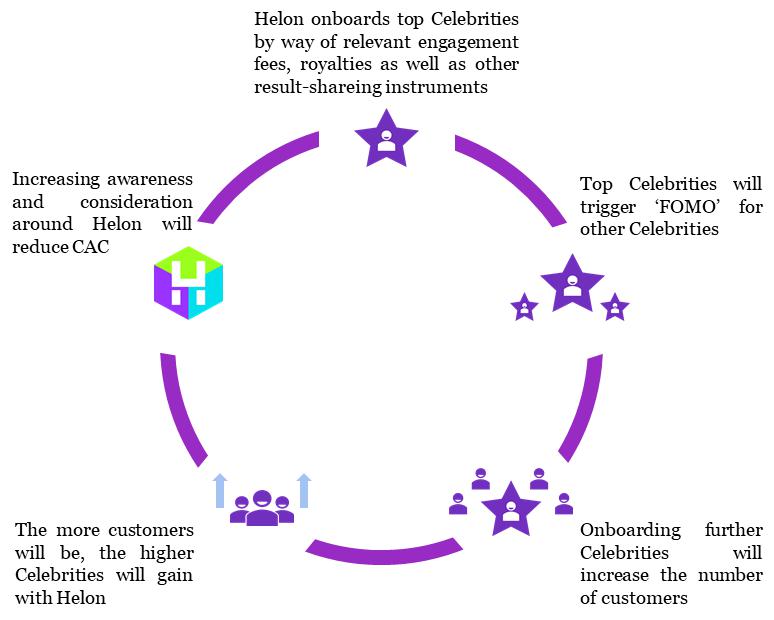
| - | Helon’s business strategy focuses to involve top Celebrities by way of relevant engagement fees, and royalties. According to generally known data, the average ‘Click-through’ rate (CTR) audience on any outcome of a Celebrity is 3%. Using a ‘Conversion’ rate on the CTR of 3%, approx. 0.1% of a Celebrity’s total reach could be converted into Helon’s costumers. |
| - | We were able to start endorsing Celebrities with considerable audiences in various fields using a combination of cash together with an equity settled compensation to share success with them. The cash basis is mainly used to settle the Celebrity’s royalty, calculated based on the number of tiles sold on the platform. Even if the royalty grows-up strongly in favor of the Celebrity with the numbers of tiles sold, its combination with the price mechanism applied to the tiles (as further described on section 0) grants to all Helon’s customers the opportunity to get their own benefit from their preferred Celebrity. An equity-based compensation is instead used to mainly settle the Celebrity’s engagement with Helon, the value of the equity instruments of Helon on a regulated market being then the reference value for the settlement. We expect to start settling Our Celebrities once our equity instruments will be authorized for listing on a regulated market. To avoid an overall dilution effect (from the increase in the outstanding equity instruments), Helon will initially secure the access to existing shares with current shareholders. We will start settling royalties and engagements to Our Celebrities once We decide to start launching the Celebrity on the market. |
| - | Our expectation is that top Celebrities having joined Helon will trigger a ‘Fear of missing out’ (FOMO) behavior in other Celebrities, also willing to appear on Our platform. | |
- 65 -
| - | The overall increase of Our endorsed Celebrities will lead to an increase in Helon’s customers, further boosted by the Play-to-Earn expectation. |
| - | An increasing number of customers will boost Celebrities’ gains. |
| - | An increased brand awareness will allow Us to endorse further top Celebrities and make the value circle restarts once. Furthermore, market research provided by Forbes benchmarks the overall customer acquisition costs in the gaming industry in EUR 33/customer. The amount is likely to decrease with an increasing brand awareness. |
Content evolution and diversification
|
Helon’s offered goods are unique digitally reproduced body parts of Celebrities acting in various fields including but not limited to, music, movie, fashion, lifestyle, art, gaming, and sports as well as in the media, community, and social networking industry generally. Endorsing new Celebrities will allow Us to systematically evolve in content and to diversify in audience. |
|
Own scalable platform and industry-leading partners
Our business is fully and exclusively driven and carried out on our proprietary marketplace platform. We generate tiles starting from a scanned 3D character of our endorsed Celebrities, and once uploaded, the tiles will never leave the platform anymore. The uniqueness and exclusivity of Our offering does therefore not rely on NFTs’ blockchain technologies but is granted by and is intrinsic in the use of Our proprietary platform.
- 66 -
- 67 -
Since the purchasing and marketplace schemes hypothesized did not match adequately with the standard logics of digital products, Helon decided to build the platform from scratch, avoiding the use of third-party CMS (Content Management System) or SaaS (Software as a Service) and preferring React Native as open-source UI (User Interface) software, supported by MySQL for database matters. The platform also uses portions of open-source libraries for reading 3D models (three.js) and commercial libraries for building the UI (Chakra UI). Furthermore, the platform has been designed to scale-up rapidly and without limits, using one of the well-known and most reliable players for web hosting (Amazon Web Services AWS) with the server adapting itself to always sustain the resources needed to grant to every user a fluid and stable experience, and all payments underlying commercial transactions are processed using an established and well-known gateway provider around the world (Stripe).
Key competitive strengths
We believe that Helon can successfully compete in its market based on the following key strengths.
Gamification
Helon includes several features that make the experience on the platform more engaging, allowing users to have fun while playing and incentivizing them to come back.
The main features that make the platform a gamified experience include: the leaderboard, intended as a leaderboard in which gamers can compete for top prizes; packs, which allow the user to obtain random tiles and additional in-game items in a more appealing way; player levels, which allows the user to progress and unlock rewards; experience points, which are necessary to level up and can be obtained through in-game actions; badges, which represent actual in-game trophies obtainable after reaching certain level goals.
Helon is structured in game Seasons, each lasting 3 months, during which new game features will be added and in which new Celebrities will be introduced. During the Season, users will be able to compete within the leaderboard to finish in the highest positions on the leaderboard and secure prizes of a certain caliber.
The leaderboard will be sortable by “Helo” (an in-game weighted score), number of tiles owned, net worth, total earnings, number of unique stars owned, number of packages opened, and value of all in-game exchanges made. At the end of each season, the top users will win unique prizes, both in-game features (such as tokens, perks, packs) and offline/online experiences with Celebrities.
- 68 -

According to the user performance and the leaderboard ranking, users will achieve a wide range of rewards based on their own Celebrity. Celebrities will interact with tile holders by choosing a series of pre-agreed activities, rewarding users with more tiles with more interesting activities. There are different levels of interaction, from simple ones such as merchandising, concert tickets, and following on social media, to something more complex and elaborate, such as having lunch together and performing with Celebrities.
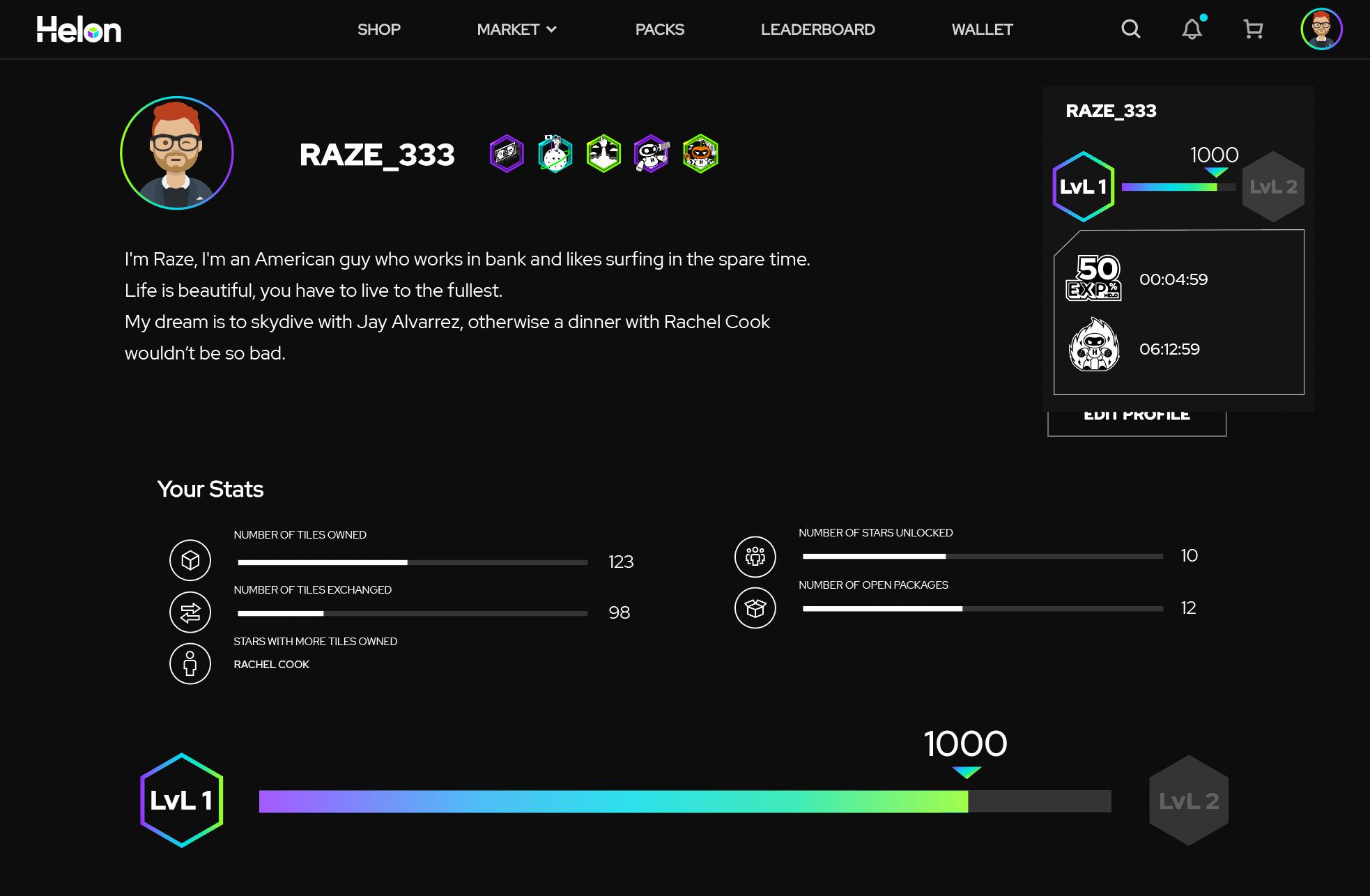
- 69 -
Further game progression involving customers in the platform experience will be the chance and the emotion through pack opening that gives the customer the opportunity to gain in-game features. Furthermore, the use of the pack opening is expected to improve a still growing mechanism in the current gaming environment, streaming live on Twitch or recorded on YouTube.
Three types of Packs are expected to be made available:
| ● | Rookie Pack: 3 celebrities, random number of tiles, sum of tile value between 7.00€ and 10.50€, number of tokens between 7 and 23; |
| ● | Pro Pack: 5 celebrities, random number of tiles, sum of tile value between 47,00€ and 79,90€, number of tokens between 47 and 159; |
| ● | Legendary Pack: 7 celebrities, random number of tiles, tile value sum between 147,00€ and 294,00€, tokens between 147 and 499. |
All packs purchased by the users are visible into the “wallet” section of the platform. The users can open the pack after the purchase, or later, from their wallet. Every opened pack has a customized animation that can be shared on social media.
- 70 -
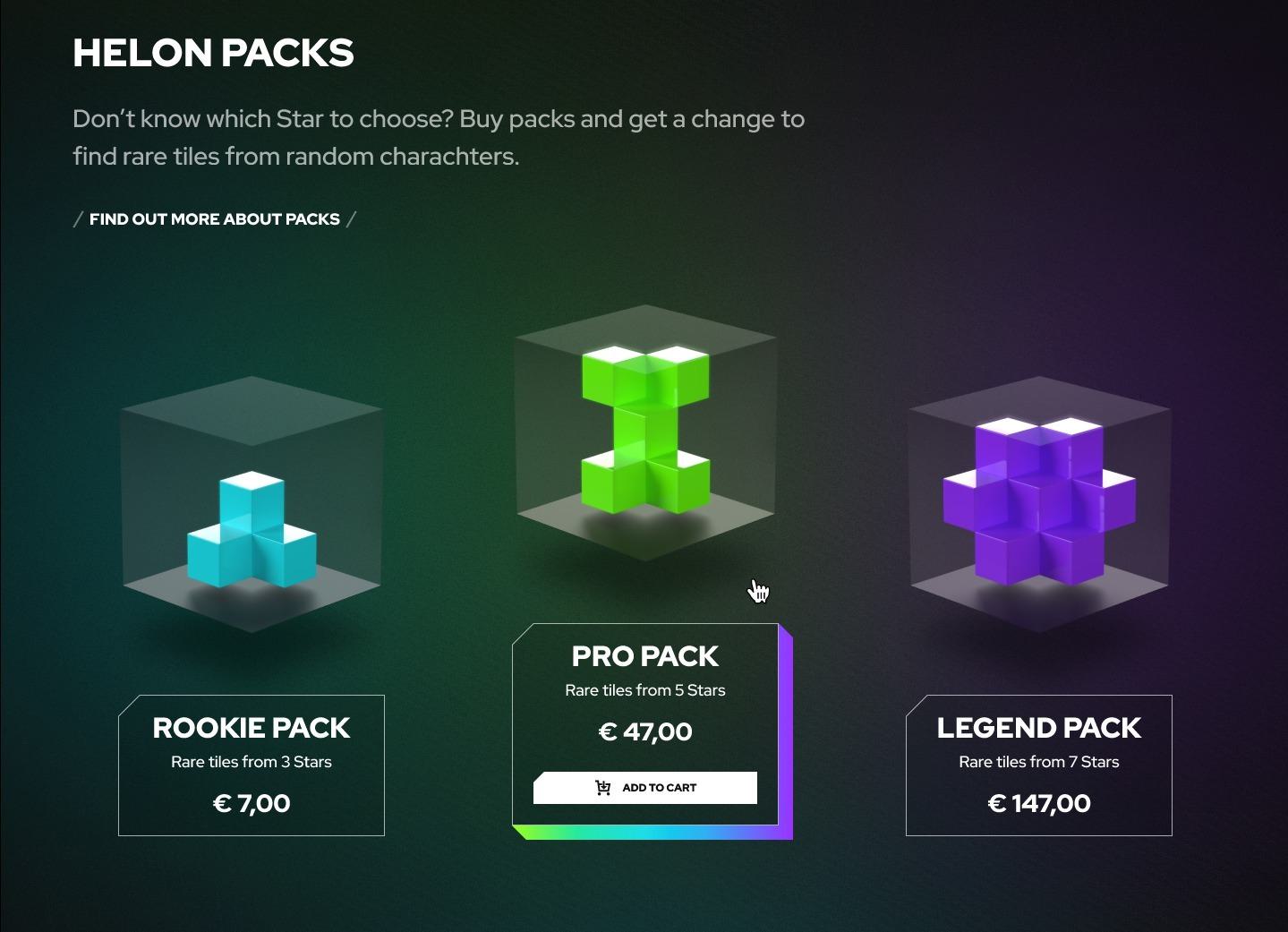
Play-to-earn (P2E)
Helon is a P2E game by extension. The platform allows customers to trade on tiles and to realize gains by reselling them at higher prices. The price of all tiles follows a Taylor’s series exponential-like curve increasing every 300 tiles sold, ranging from EUR 1.00 for the first 300 and EUR 1’340 for the last 300 tiles. This will keep the tiles at affordable price levels, granting inclusion for all major customer communities expected (as further described on section 3.4).
The price curve is designed to benefit early adopters by decreasing the buying friction due to the opportunity to get better spreads on the further trading of tiles. In the mid-section of the curve, early adopters are expected to start trading on tiles while ‘FOMO’ induced behavior is expected to drive the customer on the primary market. The buying friction most probably decreases in the last section of the price curve, where the popularity of the Celebrity is expected to influence customer behavior in such a way as to allow significantly higher prices.

- 71 -
Opportunities for customers
During the last few years, many different phenomena related to collectibles like Pokémon and Yu-Gi-Oh! have experienced overall increases in value, reaching worth more than millions of dollars. We expect that the collection mechanism will start developing for top Celebrities and will then further include all Celebrities featured in Our platform, boosted by the trading mechanism on the platform.
 |
 |
Global communities of customers
We expect to get three majors customer communities: Celebrities’ fandom, gamers, and digital collectors.
| - | The Celebrities’ fandom is expected to be our most direct consumer segment. The Celebrities We have selected have a strong engagement with and a very active fanbase with a propensity to consume goods and services related to their favourite artists. Fandoms are generally and broadly active on major social networks. The Celebrities’ fandom will be attracted by Helon because We bring them such emotions and experiences this audience generally looks for in and with the Celebrity, including exclusive content, merchandising, promotions on the platform and the rewarding of the most deserving fans. |
| - | Gamers have increased their market share in recent years, reaching a global spent in 2021 of more than EUR 200 billion. Gamers are mainly active on YouTube, Twitch, and Discord as they follow live streams or videos of popular gamers. One of the most important trends is the opening of in-game packages, surrounded by gamification elements. They will be attracted by Helon as a new type of gaming experience because of the gamified footprint of the platform such as package opening, challenges, leaderboards, and any potential rewards system. |
| - | Digital collectors have experienced exponential growth in both numbers and spending capacity in recent years. Digital collectors are generally active on major social media. They will be attracted by Helon’s tiles as they are unique and one-of-a-kind in terms of exclusivity and potential gain opportunities. |
Social aggregation
Human psychology will always push towards being aggregated with someone. Whether it be a group or a niche, humans will always tend to aggregate to something and someone. This necessity, along with the concept of community associated with Helon, creates a unique interaction. Inside the platform, customers will be part of a group, joining a clan or creating one, competing together in or between groups, generating and developing a game mode.
Interaction with Celebrities
As Helon is a revolutionary way for Celebrities to interact with their fanbase, Celebrities are a strong pillar of Helon’s business. Helon presents a portfolio of different Celebrities in various fields thus having a diverse audience. Whether it is sports, music, movies, or video games, Helon will be a cauldron of many different industries, which will bring a continuous flow of new customers to Our platform. Celebrities will interact with tiles holders by choosing a series of pre-agreed upon activities and rewarding those with a higher number of tiles in their wallet with cool stuff. There are various levels of interaction, from simple ones such as merchandising, concert tickets, and following on social media, to more complex and elaborate things such as having lunch together or performing with. The more the range of opportunities is wide, the more Celebrities will get famous, and We are ready to welcome their proposals.
- 72 -

Outsourcing and management overview and control
An integral part of Helon’s business model is to cooperate with leading third-party service providers, Helon believes that outsourcing or collaborating with specialists thus maintaining overview and control of operations through a highly specialized team of in-house experts able to competently interact with its partners is the optimal way to achieve its business goals and efficiently managing its business processes.
Products and services
Helon’s offering is driven and carried out over Helon’s platform. The platform hosts a centralized shop and a trading place. In the shop, Helon showcases the Celebrities and consumers can browse, select, and buy tiles, being the direct-to-consumer (the ‘DTC Goods’) segment of the Helon’s business. In the marketplace, customers can interact between them, make, or receive offers and trade on tiles, being the ‘Marketplace Services’ segment of Our business. Tiles are always stored on the platform in each customer’s profile.
Digital goods
Helon offers unique and single portions of the digital image of a Celebrity. Each Celebrity is portioned in 30,000 tiles. The tiles are offered at prices as previously described (see section 3.2). The Company does therefore not apply for auction or other offer-based price mechanisms and prices do not vary depending on the part of the body represented or on the Celebrity involved and features are in place to grant the widest possible distribution of the tiles to the largest possible number of customers. The platform substantially showcases Celebrities, their 3D model, their 2D model in tiles and the customer’s profile.

- 73 -
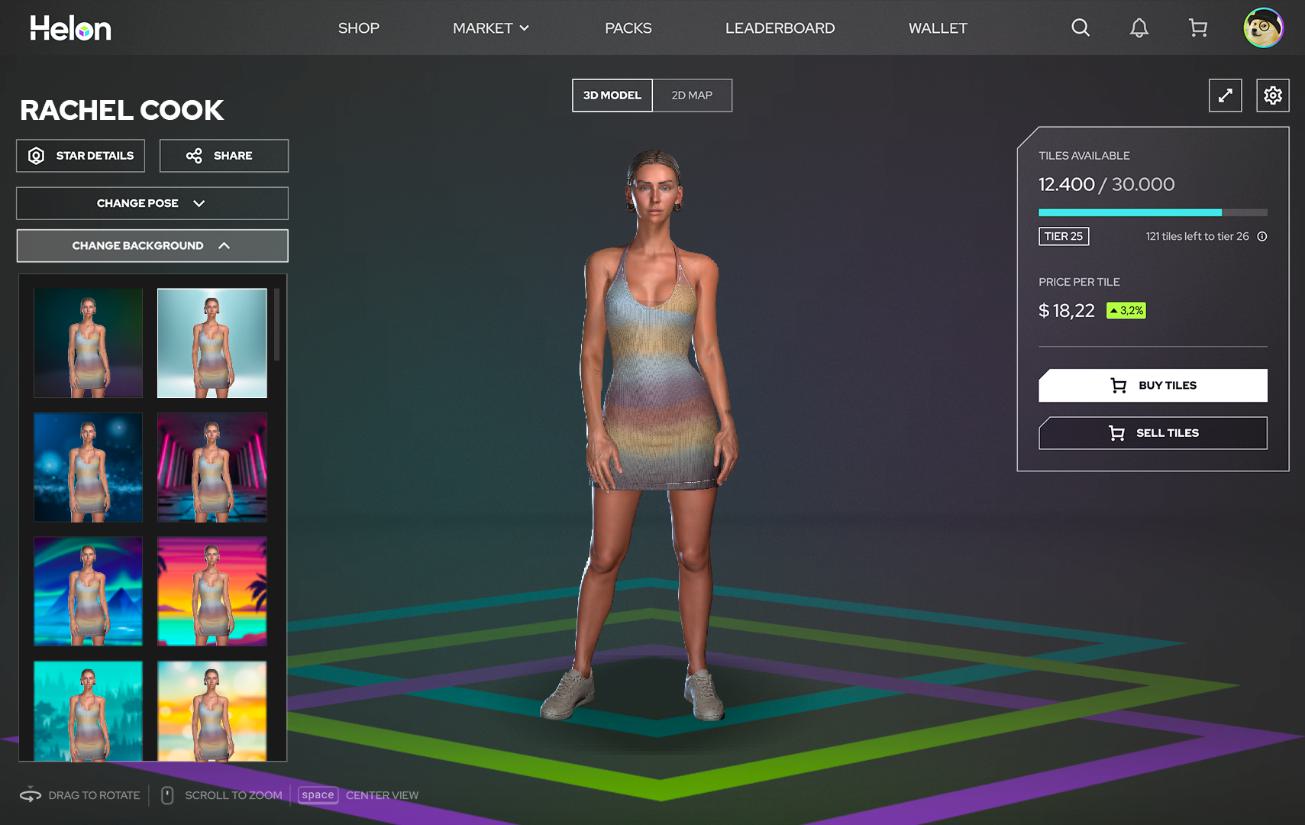
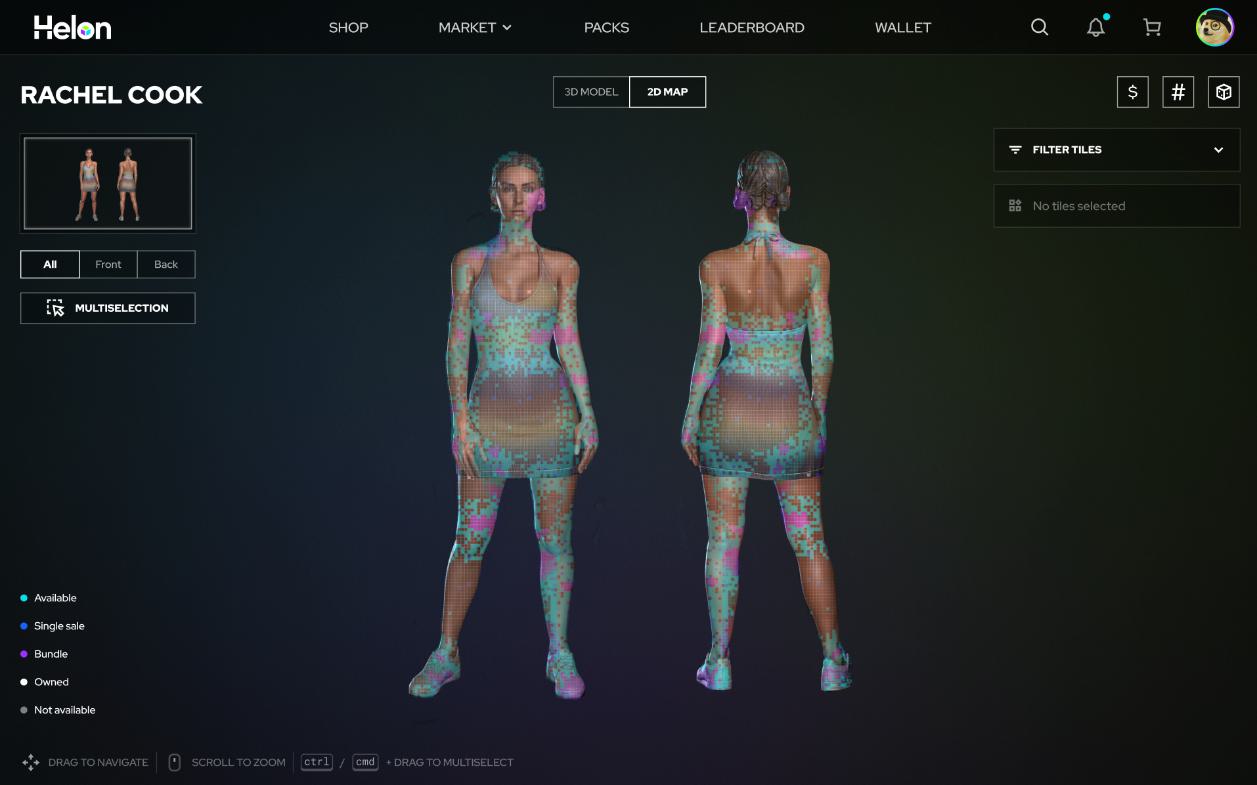
- 74 -
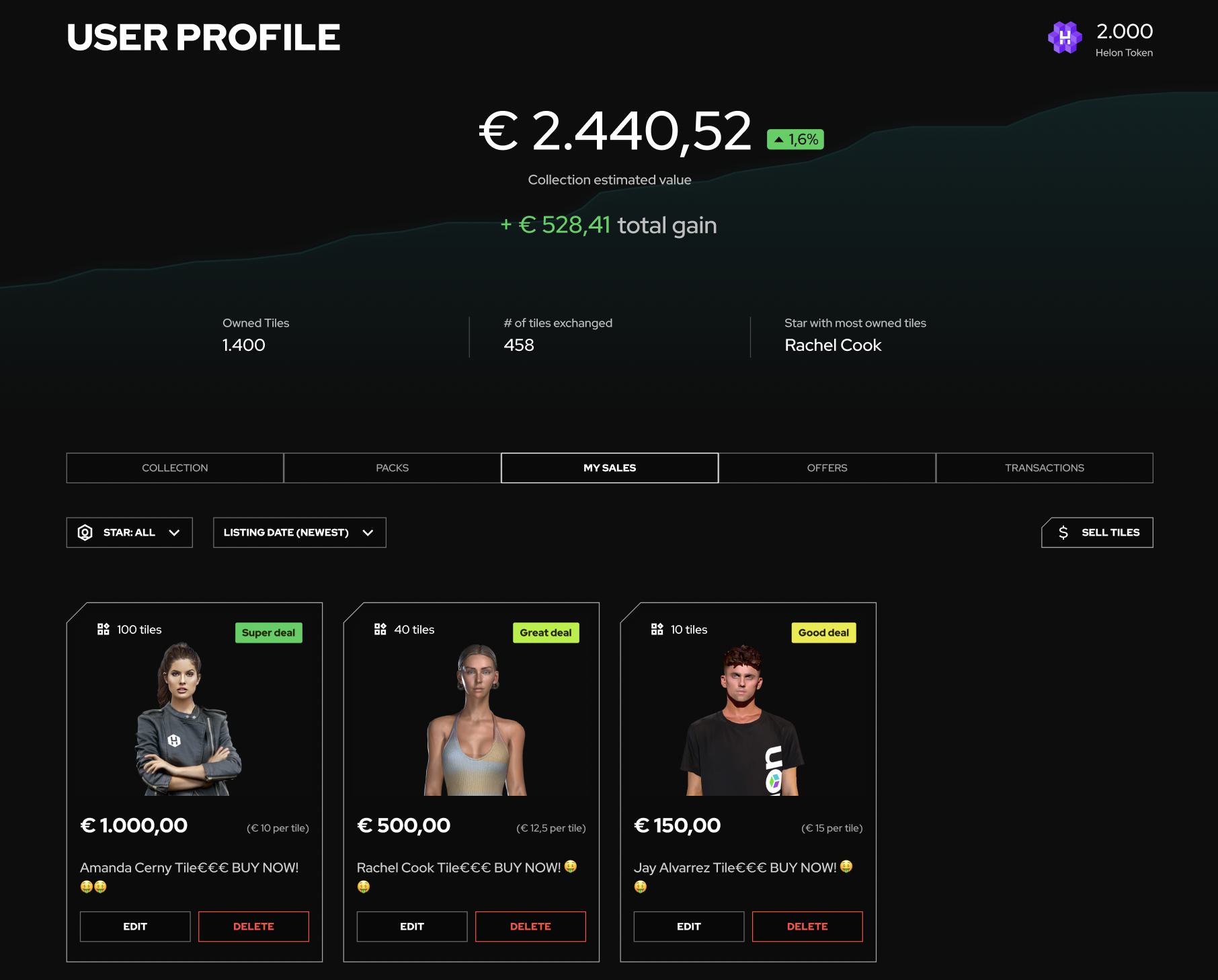
Marketplace services
The marketplace allows customers to trade on their tiles. The platform offers a burden of features to better set-up once own offering, including the creation of sales ads and the making or receiving of offers. The customer is free in the price setting. Helon acts as an escrow, for which a fee of 7% in withheld and charged equally to both parties to the transaction.
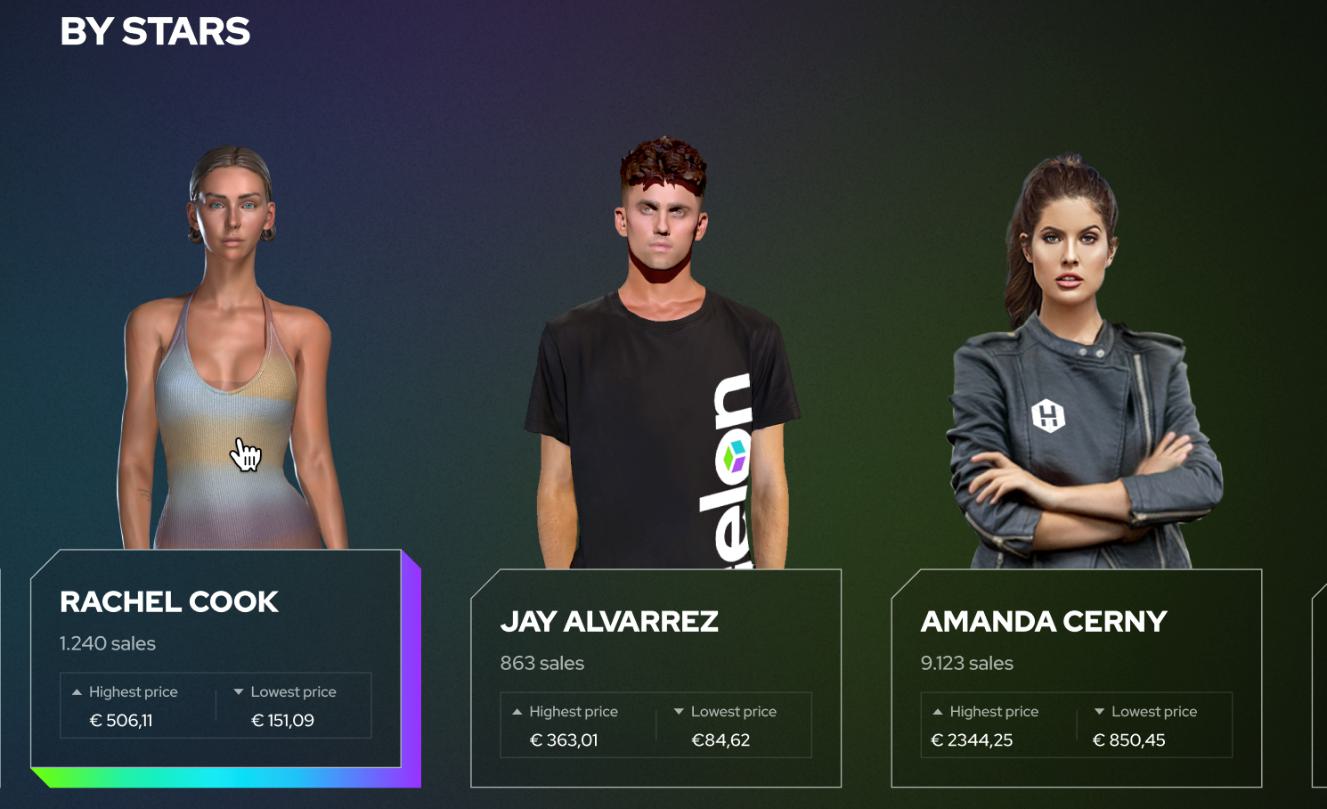
- 75 -
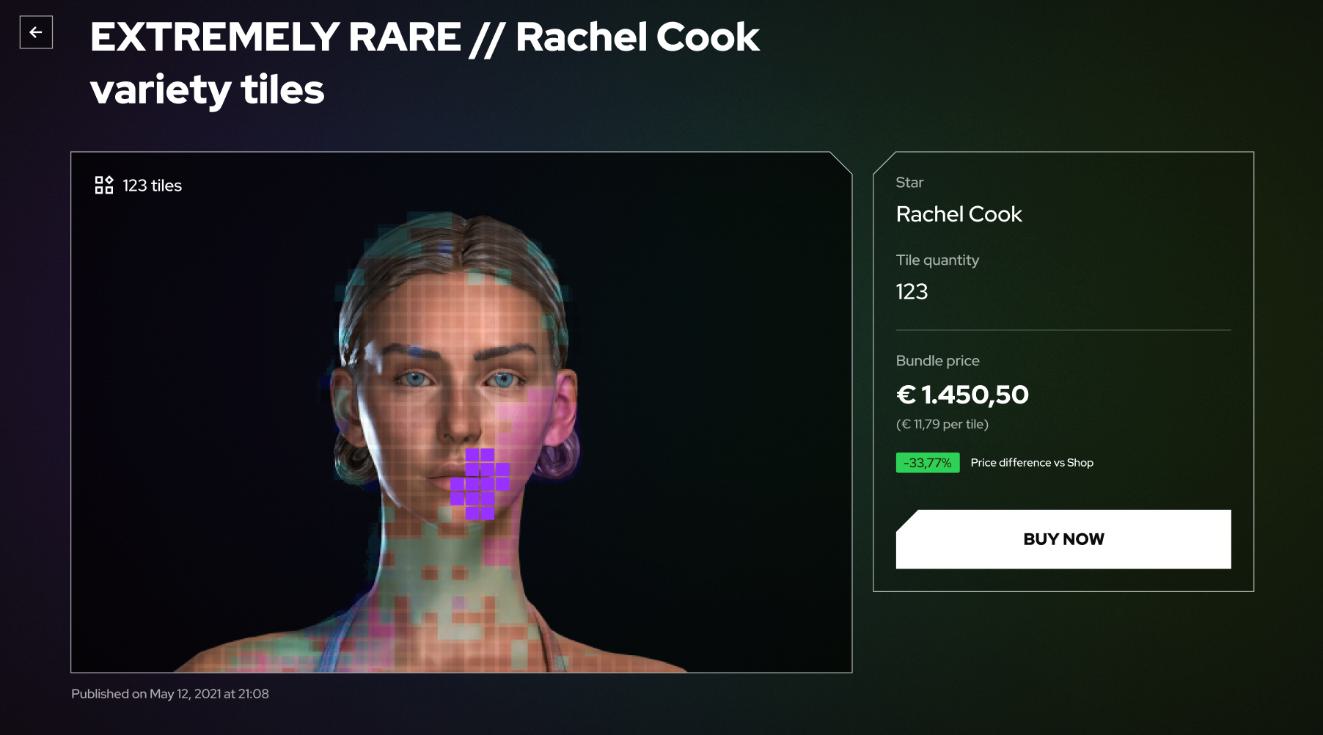
Marketing Strategy
The Company conducted internal market research to identify the most interesting targets for its offering based on demographics, behavior and habits, the social media environments and further communication channels used, the outcome of which is illustrated on section 3.4 above.
The marketing plan essentially consists of the digital presidium of all the places where the identified customers aggregate, using engaging creativities and paid promotion. Celebrities will produce a series of promotional content that will be delivered through their channels and amplified by the Company through advertising.
Market
Helon targets an extremely articulated and rapid growing market, as deductible from the following statements:
| - | In 2021, the global metaverse market size stood at USD 38.9 billion. In 2022, this market is expected to rise up to USD 47.48 billion, and get USD 678.8 billion by 2030. | |
| - | In 2021, Accenture estimates the market value of gaming exceeded USD 300 billion, with 2.7 billion users, with Statista expecting users being increased up to more than 3 billion still in 2022. | |
| - | The impact of Covid-19 was pretty much irrelevant in the gaming industry. | |
| - | The average age of gamers is 35. Gamers are generally equally distributed between male and female. 32% are between 16 and 24 years old and represent the most active group. 57% are between 18 and 44 years. More than 214 million US people play generally. In the EU, the average playing time is 9.5 hours per week. | |
| - | Influencer marketing has become one of the most popular and effective forms of online marketing. The global influencer induced market value has more than doubled since 2019, standing at around USD 13.8 billion as of 2021. As the influencer induced business continues to mature as an industry, the size and value of influencer platforms also continue to expand every year, making collaborations between brands and creators more profitable than ever. |
Competition
The business environment of Helon is highly competitive. The Company seeks to evade competition with companies having significantly larger financial, marketing and product development resources than itself by focusing on Celebrities’ derived experiences and emotions and the value circle Helon expects to generate from.
The main competitors with which Helon shares some common features are the following:
- 76 -
 |
- | Sorare is a blockchain-based fantasy soccer game where the consumer can virtually buy his own favorite players, be rewarded for setting up his team, participate in tournaments and trade the player cards. Generally available information indicates revenue of USD 80 million in 2021 with 150 thousand active customers. In September 2021, Sorare raised USD 680 million with Softbank in a B-series funding, with a reference value of Sorare of about USD 4.3 billion. | |
 |
- | Earth2 is a second planet concept in a 1:1 scale virtual environment in which the ground is fractioned in 100m2 virtual pieces that can be commercialized. The business model of Earth2 consists of the direct sale of ground and in a fee on the volume of the transacted land between users. In 2021, Earth2 sold 9,000 million m2, generating revenue of USD 176 million, with 150 thousand monthly active users. | |
 |
- | NBA TopShot, developed by Drapper Labs in partnership with the NBA and the National Basketball Players Association, allows users to collect and trade officially licensed highlights called “moments”. The “moments” are NFTs (non-fungible tokens), made unique and easily authenticated though common blockchain technology. The platform launch was in October 2020. Until December 2021, the platform reported over USD 780 million revenues, with some “moments” sold for more than USD 100 thousand. Active users in September 2021 were more than 1.1 million. In September 2021, Dapper Labs raised USD 250 million, with a reference value of the company over USD 7.6 billion. |
Intellectual Property
Helon’s intellectual property strategy focuses on the proprietary platform on which Helon’s offering is driven and carried out, the protection of brands and the full exploitation of images and other rights received from Celebrities rather than in the filing of provisional patents applications.
The Company does not possess any issued patent nor has the company filed any provisional patent application. The Company obtained in November 2021 the registration of the figurative mark ‘Helon’ (TM 018526327) under the classes 26.15.09 and 27.05.06 of the Vienna Classification. The registration of the word mark ‘Helon’ under the classes 9, 14, 25, 28, 35, 36, 41, 42 and 45 of the Nice Classification has been opposed in November 2021 and the process is in stand-by.

Insurance
Helon has obtained insurance coverage for its operations at levels which it considers prudent and in conformity with its business risk profiles. Helon has taken out global coverage for a variety of risks and activities, including cyber intrusion insurance. These insurance policies generally exclude acts of willful misconduct and gross negligence. The Company intends to continue its practice of obtaining global insurance coverage where practicable, increasing coverage where necessary, and reducing costs. The Company does not anticipate difficulties in obtaining adequate levels of insurance in the future.
Human capital resources
As of June 30, 2022, Helon employed 4 full-time employees equivalents. All employees are in Italy.
Facilities
The Company maintains a 220m2 (square meters) leased facility in Italy, Milano, via Borgogna 5, for headquarters and other operating activities, which is in good condition and working order. The lease expiration date is May 31, 2023.
Legal proceedings
The Company is not, nor was, a party to any legal or other regulatory proceedings and claims.
- 77 -
Risk, Fraud and Compliance Systems
The Company encounters sophisticated attempts at fraud on a regular basis and is required to verify customers and their source of funds in accordance with varying regulations in each jurisdiction. Significant customer volumes mean that systems for the detection and prevention of attempted fraud and ensuring compliance with “know your customer” and anti-money laundering regulations must be substantially automated.
Partnerships, Suppliers and Strategic Collaborations
Helon engages in long-term partnerships, including with leading third-party technology providers which, together with the Company’s own technology, increases the speed with which its offerings are brought to market and decreases the friction associated with adjusting its technology to new markets.
Other Partnerships, Suppliers and Strategic Collaborations
Sales and Marketing
Search engine marketing and brand protection
Intellectual Property
Intellectual property rights are important to the success of Helon’s business. Helon relies on a combination of trademark, trade secret, database, copyright, confidentiality and other intellectual property protection laws in the United Kingdom, the European Union, the United States and other jurisdictions, as well as license agreements, confidentiality procedures, non-disclosure agreements with third parties and other contractual protections, to protect its intellectual property rights, including its trademarks, database, proprietary technology, software, know-how and copyright. In certain foreign jurisdictions and in the United States, Helon has filed trademark applications, currently holds numerous trademarks and domain names, and in the future is likely to acquire additional trademarks and domain names.
It has not always been possible, and may not be, or commercially desirable to obtain registered protection for Helon’s products, software, databases or other technology. In such situations, the Company relies on laws governing protection of unregistered intellectual property rights, confidentiality and/or contractual arrangements to prevent unauthorized use by third parties. Helon uses open-source software in its services and periodically reviews its use of open-source software to attempt to avoid subjecting its services and product offerings to conditions it does not intend.
Helon controls access to and use of its data, database, proprietary technology and other confidential information through the use of internal and external controls, including contractual protections with employees, contractors, customers and partners. The Company requires its employees, consultants and other third parties to enter into confidentiality and proprietary rights agreements and it controls and monitors access to its data, database, software, documentation, proprietary technology and other confidential information. Helon’s policy is to require all employees and independent contractors to sign agreements assigning to it any inventions, trade secrets, works of authorship, developments, processes and other intellectual property generated by them on the Company’s behalf and under which they agree to protect the Company’s confidential information. In addition, the Company generally enters into confidentiality agreements with its partners.
See “Risk Factors — Intellectual Property and Data Privacy Risks — Failure to protect or enforce our intellectual property rights, the confidentiality of our trade secrets and confidential information, or the costs involved in protecting or enforcing our intellectual property rights and confidential information, could harm our business, financial condition and results of operations”, “Risk Factors — Intellectual Property and Data Privacy Risks — Our collection, storage and use, including sharing and international transfers, of personal data are subject to applicable data protection and privacy laws, and any actual or perceived failure to comply with such laws may harm our reputation and business or expose us to fines, civil claims (including class actions), and other enforcement action. The protection of personal information is becoming increasingly regulated and changes in applicable laws may require changes to our policies, practices, procedures and personnel which may require material expenditures and harm our financial condition and results of operations” and other risk factors related to Helon’s intellectual property included in “Risk Factors — Risks Related to Helon’s Business” for a more comprehensive description of risks related to Helon’s intellectual property.
- 78 -
Government Regulation
In order to operate in certain jurisdictions (including U.S. states), Helon must obtain the appropriate licensure as required under local legislation. Generally, each relevant group company and at times certain directors, officers, employees and material shareholders (typically those holding 5% or more of equity — but not limited to that threshold of holdings nor limited to solely holding equity), would be required to qualify as suitable for a license to be awarded. The failure of Helon’s officers, directors and holders of its ordinary shares to submit to background checks and provide any requested disclosure could result in the imposition of penalties and could jeopardize the award of a contract to the Company or provide grounds for termination of an existing contract. Generally, any person or entity who fails or refuses to apply for a finding of suitability or a license within the prescribed period after being advised by a competent authority that such person or entity is required to do so may be found unsuitable or denied a license, as applicable. If any director, officer, employee or significant shareholder is found unsuitable (including due to the failure to submit required documentation) by a competent regulator or authority, Helon may deem it necessary, or be required, to sever its relationship with such person or entity.
While Helon is wholly committed to complying with all applicable regulations and has in place processes and procedures dedicated to these requirements, which are constantly evolving, the Company cannot assure the prevention of a violation of one or more laws or regulations, or that an actual or alleged violation by the Company or an employee will not result in the imposition of a monetary fine or suspension or revocation of one or more of the Company’s licenses.
While Helon is required to maintain licenses in each jurisdiction from which it operates in order to continue its operations, the Company’s offering into certain jurisdictions on the basis of its licenses is at times based on a lack of a local regulatory framework in that jurisdiction where the Company’s services are accessed and used by end users, or based on a specific legal position and/or interpretation of local legislation. The latter, at times, may include a legal position based on EU law or supranational law.
Data Privacy Regulations and PCI DSS
Laws, regulations, rules and standards in many jurisdictions apply broadly to the collection, use, retention, security, disclosure, transfer and other processing of personal data, which impose significant compliance obligations. The nature of these obligations often varies significantly by jurisdiction.
For example, in the EEA, the processing of personal data is principally governed by the provisions of the General Data Protection Regulation (“GDPR”). Furthermore, notwithstanding the United Kingdom’s withdrawal from the European Union, by operation of the so-called ‘UK GDPR’ (i.e., the GDPR as it continues to form part of the law of the United Kingdom by virtue of section 3 of the EU (Withdrawal) Act 2018 and as subsequently amended) (“UK GDPR”) the GDPR continues to apply in substantially equivalent form to processing operations carried out in the context of an establishment in the United Kingdom and any processing relating to the offering of goods or services to individuals in the United Kingdom and/or monitoring of their behavior in the United Kingdom. Therefore, reference to the GDPR herein, also refers to the UK GDPR in the context of the United Kingdom, unless the context requires otherwise. The GDPR applies to any processing operations carried out in the context of an establishment in the EEA as well as any processing operations relating to the offering of goods or services to individuals in the EEA and/or the monitoring of their behavior in the EEA. The GDPR imposes many onerous obligations, including stringent requirements relating to the consent of data subjects in certain circumstances, expanded disclosures about how personal data is used, requirements to respect enhanced data subject rights in certain circumstances, requirements to conduct privacy impact assessments for “high risk” processing, limitations on retention of personal data, mandatory data breach notification and “privacy by design” requirements. The GDPR also imposes strict rules on the transfer of personal data outside of the EEA or United Kingdom to countries that have not been judged to ensure an adequate level of protection for personal data, like the U.S. Such transfers of personal data require the use of a valid “transfer mechanism” and, in many cases, the implementation of supplementary technical, organizational and/or contractual measures. In addition, the GDPR provides that EEA member states may introduce specific requirements related to the processing of “special categories of personal data”; as well as personal data related to criminal offenses or convictions. In the United Kingdom, the UK Data Protection Act 2018 complements the UK GDPR in this regard. This fact may lead to greater divergence on the law that applies to the processing of such personal data across the EEA and/or United Kingdom.
- 79 -
In the United States, the Federal Trade Commission and the Department of Commerce continue to call for greater regulation of the collection of personal data, as well as restrictions for certain targeted advertising practices. Numerous states have enacted or are in the process of enacting state level data privacy laws and regulations governing the collection, use and processing of state residents’ personal data. For example, the CCPA went into effect in California on January 1, 2020. The CCPA establishes a new privacy framework for covered businesses and requires specific data processing practices and policies. In November 2020, California voters passed the California Privacy Rights and Enforcement Act of 2020, which further expands the CCPA with additional data privacy compliance requirements and establishes a regulatory agency dedicated to enforcing those requirements. In addition, privacy- and security-related laws have been passed in other jurisdictions including New York, Virginia and Colorado. These and other data protection and privacy laws and their interpretations continue to develop and may be inconsistent from jurisdiction to jurisdiction. Certain of these laws may be more stringent or broader in scope, or offer greater individual rights, with respect to sensitive and personal information than federal, international or other state laws.
Given the breadth and depth of changes in relevant data protection obligations and regulatory frameworks, achieving and maintaining compliance with applicable data protection laws and regulations will require significant time, resources and expense, and Helon may be required to put in place new or additional mechanisms to ensure compliance with current, evolving and new data protection requirements. Actual or perceived failure to comply with relevant data protection obligations and regulatory frameworks could have a material adverse effect on the Company’s reputation, business, or financial condition, and could lead to a loss of actual or prospective customers, collaborators or partners, result in an inability to process personal data or to operate in certain jurisdictions, limit the Company’s ability to develop or commercialize current or prospective offerings or services, or require it to revise or restructure its operations.
The Payment Card Industry Data Security Standard (“PCI DSS”) applies to the processing of cardholder data. PCI DSS consists of a set of policies and procedures intended to enhance the security of cardholder data during card transactions. PCI DSS was implemented by the five largest credit card brands — Visa, Mastercard, Discover, American Express, and JCB. Compliance in this regard is important as Helon does process cardholder data. Where there is actual or perceived non-compliance with PCI DSS, this may result in Helon’s inability to process payments, monetary penalties and reputational damage. As part of PCI DSS compliance Helon is required to undertake internal and external network vulnerability scans at least quarterly and after any significant change in the network and to carry out a formal risk assessment process at least annually and upon significant changes to the environment that identifies critical assets, threats, and vulnerabilities. Where such scans reveal any lack of compliance, the Company will take appropriate steps to ensure compliance in accordance with the relevant and applicable policies and procedures.
Human Capital Resources
Helon and its subsidiaries currently manage approximately Three staff with teams in One country. 100% of employees are permanently employed.
The Company believes that its staff are adequately dispersed geographically for the purpose of reducing geopolitical risks that the Company would otherwise be more exposed to if its operations were more highly centralized. The Company utilizes some of its offices as off-site data backup locations for each other and has contingency plans in place for the rapid relocation of necessary staff to alternate Company locations in the case of natural or other disasters. Throughout the ongoing Covid-19 pandemic, the Company did not experience any operational disruptions as all staff were able to work from home.
- 80 -
The Company operates a performance-oriented culture that emphasizes personal growth and effective delivery of objectives within the context of corporate strategy and goals. Performance management processes avoid explicit Key Performance Indicators (which management believes to be too easily gamed and generally ineffective for technology-focused activities) and focus instead on desired values and behaviors (an approach which management believes is much harder to game and more effective at reinforcing Helon’s corporate culture and effectiveness). Examples of how this approach is applied in practice include the assessment of individual staff members with reference to their effectiveness, commitment and level of initiative.
The Company maintains a steady pipeline of home-grown customer-focused management talent by exposing the majority of new hires to customer-facing roles that provide a comprehensive introduction to the workings of many of the Company’s systems and how they meet the needs of the customer. It is not uncommon for senior management roles to be occupied by staff who have graduated from this environment and who thereby benefit from a broad understanding of the major areas of the business and how the needs of the customer impact on each area.
Where specific skills or expertise are unavailable internally the Company will hire externally and typically seeks to offer compensation packages that compare well with other employment opportunities, including non-gambling technology companies.
The Company expends considerable effort ensuring that all staff understand the Company’s vision and culture and that all staff are held accountable for upholding the Company’s values. Regular staff engagement together with ongoing training programs and values-based performance feedback mechanisms seek to ensure that high standards are maintained. In particular, quality of customer service, and data security are emphasized regularly and repeatedly.
HR professionals are embedded throughout the business, operating in partnership with all levels of management to identify and surface potential performance problems faster than would otherwise be the case. HR professionals are expected to understand the commercial and operational details of the business as if they were employed directly in those areas and are thereby expected to assist managers with both their personal growth and the effectiveness and strategic development of their teams.
The Company believes that the above-mentioned are some of the reasons why the Company benefits from low staff turnover and significant loyalty from its staff, including over Zero employees who have been employed within the company for more than 10 years and an appreciable number for more than 20 years.
Company Facilities
Helon’s principal executive office is located in Via Borgogna 5 Milan (MI) CAP 20122, Italy. Helon’s 2368 square foot facilities located in Milan, Italy are used primarily for headquarters and other operating activities. The Company does not have any further facilities Worldwide. None of the leases are considered to be material to the Company.
The Company believes that its facilities are adequate to meet its needs for the immediate future and that suitable additional space will be procured to accommodate any expansion of its operations as needed.
Legal Proceedings
In the ordinary course of business, Helon may be involved in various pending and threatened litigation and regulatory matters relating to its operations.
In the future, Helon may be subject to additional legal proceedings, the scope and severity of which is unknown, and which could adversely affect its business. See “Risk Factors — Litigation and Regulatory Risks — We are party to pending litigation and regulatory and tax audits in various jurisdictions and with various plaintiffs and we may be subject to future litigation and regulatory and tax audits in the operation of our business. An adverse outcome in one or more proceedings could adversely affect our business.” In addition, from time to time, others may assert claims against Helon, and the Company may assert claims and legal proceedings against other parties, including in the form of letters and other forms of communication.
- 81 -
The results of any current or future legal proceedings cannot be predicted with certainty and, regardless of the outcome, can have an adverse impact on the Company because of defense and settlement costs, diversion of management resources and other factors.
Organizational Structure
The following diagram depicts the organizational structure of the Company as of the date of the Closing.
Property, Plants and Equipment
Helon’s principal executive office is located in Via Borgogna 5 Milan (MI) CAP 20122, Italy. Helon’s 2368 square foot facilities located in Milan, Italy, are used primarily for headquarters and other operating activities. None of the leases are considered to be material to the Company.
The Company believes that its facilities are adequate to meet its needs for the immediate future and that suitable additional space will be procured to accommodate any expansion of its operations as needed.
MANAGEMENT
This section summarizes certain information concerning the Company’s board of directors, the Company’s statutory auditors board (Collegio sindacale), the Company officers and/or key management and certain other Company’s corporate governance principles applicable to this section. It is based on relevant provisions of Italian law as well as the articles of association (the “Articles”) as in effect on the date of this Prospectus.
The Articles in the governing Italian language and in an unofficial English translation thereof are available on the Company’s website.
Helon is a ‘foreign private issuer’ as defined by and under the rules of the SEC. Accordingly, Helon relays on its home country governance requirements and rules rather than on the corporate governance requirements applicable for US listed companies. Any further relevant difference is disclosed under the section “Description of Share Capital and Articles of Association”.
Directors and Executive Officers
The following section sets forth the names of the members of the current Board, their positions, the year when each was initially appointed as Director, their ages and their business experience, education, and activities. The business address for each of the above Directors is the registered office of the Company, i.e., Via Borgogna 5, Milano, Italy: The board of directors and executive officers of Helon are as follows, with their ages as of [DATE OF FILING WITH SEC]:
| Name | Position | Age |
| Andrea Paolo Luigi Sparano(1) | Chairman of the Board of directors | 57 |
| Daniele Fracchia(1) | Co-founder and Director | 27 |
| Manuel Rossi(2) | Co-founder and Director | 28 |
(1) Andrea Sparano and Daniele Fracchia were first elected as board members of Helon at the formation of the company in April 2021. At amendment of the legal form of Helon from a limited liability company (S.R.L - Società a responsabilità limitata) to a stockholding corporation (S.p.A - Società per Azioni), Sparano and Fracchia were confirmed as members of the Board by the General Meeting.
| - | Andrea Paolo Luigi Sparano is an attorney specializing in corporate and restructuring law. Skilled in restructuring and insolvency regulation, M&A, corporate law and contract negotiation, Mr. Sparano, in more than two decades of practice, has had the opportunity to support the day-to-day activities of boards of directors, thus acquiring significant experience in specific management issues and a particular sensitivity in handling the broad spectrum of governance and operational needs. In addition, Mr. Sparano has been called upon to serve as a director of several companies in different sectors, such as media and telecommunications, fashion, and real estate. Currently, Mr. Sparano is engaged outside of Helon as sole director of Parbuckle Equity Partners s.r.l., a private equity company that, amongst others, also holds a stake in Helon. Mr. Sparano graduated cum laude in law from the University of Pavia. |
- 82 -
| - | Daniale Fracchia is a young entrepreneur in the fintech area and a board member of Helon since its inception. In 2021 Mr. Fracchia founded and serves as sole director of Ad.E Srl (Italy), a company providing marketing services and holding a minority stake in Helon. In 2020, he co-founded and serves, together with Mr. Rossi (see below), as director of Smartbuy (UK), a company focused on app-based retailers data analysis. Furthermore, in 2020 he founded and serves as director of 4Crowd (Italy), one of the first real estate focused crowdfunding platforms on the market. In 2018, he founded and serves as director of Kerberos (Italy), a company focused on app-based market and forex news and research. Except as mentioned, Mr. Fracchia is not engaged in other activities outside of Helon. Besides his entrepreneur activity, Mr. Fracchia is completing his bachelor’s degree in economics and business at the University of Pavia. |
| - | Manuel Rossi is a young entrepreneur and a member of the Board since July 2022. Prior to joining Helon, Mr. Rossi founded in 2021 and serves as sole director of Horizon Srls (Italy), a company providing business development services and holding a minority stake in Helon. In 2020, he co-founded and serves, together with Mr. Fracchia, as director of Smartbuy (UK), a company focused on app-based retailers data analysis. From 2020 to 2021, he served as consultant at Safer Smartlabels (Italy), active in developing freshness smart labels to be used in large food distribution. During 2018, he served as trainee in sales and trading at Visor Capital (UK), an FCA regulated player in securities and commodities contract dealing activities and from 2015 he has been a partner of Blue-in (Italy), a company providing technical advice on ‘NDI’ and ‘Hybrid’ based audio and video systems. Except as mentioned, Mr. Rossi is not engaged in other activities outside of Helon. Mr. Rossi holds a master’s degree in Economics and Financial Instruments from the University of Pavia. |
Appointment, terms of office and removal
Pursuant to the Articles, the Company is managed by a board of directors which must consist of two to five individuals (the “Board” and the board members being the “Directors”, each a “Director”). The Board is appointed as such by a resolution of the General Meeting. Directors are generally appointed for a term of three years (a year being normally the period from the appointment to the annual General Meeting held in the year after the year of appointment), unless specified otherwise in the nomination for their appointment. Reappointment is allowed.
The General Meeting may at any time dismiss a Director. If removed in circumstances where there was no just cause, a Director may have a claim for indemnification against the Company. Directors may resign at any time by written notice to the Board and to the Chairman of the Board of Statutory Auditors (as defined below). The Board must appoint substitute Directors to fill vacancies arising from removals or resignations, subject to the approval of the Board of Statutory Auditors and provided however that the majority of the then current members of the Board shall always be elected by the General Meeting, to serve until the next ordinary General Meeting. If at any time the majority of the then current members of the Board resign or otherwise cease to be Directors, the entire Board will be considered to have lapsed and the remaining Directors, or the Board of Statutory Auditors if all the Directors have resigned or ceased to be Directors, must promptly call a General Meeting to appoint a new Board.
Organization and functioning
The Board is the ultimate governing body of the Company. It is responsible for the management of the Company’s operations. This includes, among other things, setting the Company’s management agenda, enhancing the Company’s performance, developing a general strategy, identifying, analyzing and managing the risks associated with the Company’s strategy and activities, determining and pursuing operational and financial objectives, structuring and managing internal business control systems, overseeing the Company’s financial reporting processes, preparing the Company’s management report, the annual budget and significant capital expenditures and monitoring corporate social responsibility issues. The Board attends to all matters which are necessary or useful for achieving the Company’s objectives, except for those acts that are prohibited or are expressly attributed by law or by the Articles of Association to others. In performing their duties, the Directors are guided by the interests of the Company and its business enterprise, taking into consideration the interests of all the Company’s stakeholders.
- 83 -
The Board appoints the chairperson (the “Chairman of the Board”), if not appointed by the General Meeting. The Chairman of the Board shall ensure the proper functioning of the Board, represents the Company among the Executive Director and has generally the casting vote in case of a tie.
The Board may designate one or more Directors to exercise one or more of the board powers and activities or even designate among its members an executive committee composed by one or more Directors, which always includes the Chairman as well as any such other Director designated by the Board to exercise one or more powers or activities. Furthermore, the Board may appoint other persons which are not Directors and grant these persons titles and designated powers. However, in accordance with Italian law and the Articles, the Board may not delegate certain of its responsibilities, including the approval of the financial statements, the increases of the Company’s share capital or the issuance of debentures (if any such power has been delegated to the Board of Directors by vote of the extraordinary shareholders’ meeting) as well as the calling of General Meetings. The Board may in any case and at any time remove any entrusted power or dismiss any designated member, except where the Board is composed by two Directors. In such a case, the Board entirely dismiss, and a new General Meeting must be convened to elect new Directors. The Company is represented by the Chairman of the Board or by any such other Director designated by the Board to exercise one or more powers or activities.
The Board meets as often as required by the Chairman of the Board, another Director or upon the request of the Board of Auditors (as defined below). Meetings are called by written notice (by e-mail, fax or telegram). The Chairman of the Board, or if unable to attend, the most senior Director in terms of office or, subordinated, in terms of age, chairs the meeting. Resolutions may be adopted when at least the majority of the Directors attend the meeting, provided that any Director with a direct or indirect personal conflict of interest with the Company is not taken into account when establishing this quorum. Each Director has one vote. Resolutions are adopted by a majority of votes cast. In the event of a tie vote, the Chairman has the casting vote. Meetings are generally held at the place and the time set in the convening. Meetings held by way of audio or video conference are also possible. If audio conference only is available, the following conditions must be satisfied (i) the Director chairing the meeting and the secretary must be in the same physical place, (ii) the Director chairing the meeting must be in a condition to ascertain the identity of each of the other Directors attending, (iii) the conference quality is sufficiently granted and (iv) all Directors attending the meeting are granted the opportunity to discuss and vote simultaneously as well as to see, get and send documents. If all Directors are [?].
Compensation Policy
The compensation of the Directors is defined in the Articles. The Directors are entitled to compensation for and to the refund of all expenses incurred in their term of office. The overall compensation is determined by the General Meeting. Compensations in the form of bonuses, profit sharing arrangements, cash and/or equity incentives and severance compensation is allowed. The compensation of the Chairman of the Board and the Directors eventually designated to exercise one or more of the board powers and activities is defined by the Board, with the opinion of the Board of Auditors.
Compensation
Until the date of this Prospectus, there was no compensation accrued or paid to the Directors and the General Meeting still did not define any compensation for the Board.
Ownership of Shares and Options
As of the date of this Prospectus, the ownership of shares for each Director is as follows. The Company has not issued and/or granted any options with respect to its Shares.
- 84 -
| DIRECTORS / OFFICERS | SHARES | % |
| (direct) | ||
| ANDREA SPARANO | 357,143 | 1.19% |
| DANIELE FRACCHIA | 142,857 | 0.48% |
| MANUEL ROSSI | 142,857 | 0.48% |
| PATRICK POZZORINI | 71,429 | 0.24% |
| 714,286 | 2.38% | |
| DIRECTORS | SHARES | % |
| (direct and indirect) | ||
| ANDREA SPARANO | 357,143 | 1.19% |
| PARBUCKLE EQUITY PARTNERS s.r.l. |
13,426,770 | 44.76% |
| 13,783,913 | 45.95% | |
| DANIELE FRACCHIA | 142,857 | 0.48% |
| AD.E. s.r.l. unipersonale | 750,000 | 2.50% |
| 892,857 | 2.98% | |
| MANUEL ROSSI | 142,857 | 0.48% |
| HORIZON s.r.l. unipersonale | 750,000 | 2.50% |
| 892,857 | 2.98% | |
| (1) | Andrea Paolo Luigi Sparano controls 13,426,774 shares by way of Parbuckle Equity Partners Srl and 357,143 shares personally. |
| (2) | Daniele Fracchia controls 750,000 shares by way of Ad.e.e Srl. and 142,857 shares personally. |
| (3) | Manuel Rossi controls 750,000 shares by way of Horizon Srl and 142,857 shares personally. |
Loans granted to Directors
As of the date of this Prospectus, the Company has no outstanding loan, advance, credit or guarantee commitments to the Directors.
Transactions with Directors
For information regarding related party transactions, see “Related Party Transactions”.
Other corporate governance considerations
Employment, management, and severance agreements
As of the date of this Prospectus, none of the Directors has any kind of agreement with the Company.
Liability of Directors
Under Italian law, the Directors may be liable towards the Company for damages in the event of improper or negligent performance of their duties. They may be jointly and severally liable for damages towards the Company for infringement of the Articles and the law. In addition, they may be liable towards third parties for infringement of the law. In certain circumstances, they may also incur additional specific civil and criminal liabilities.
- 85 -
Insurance
Directors will be insured against damages resulting from their conduct when acting in their capacities as directors starting from the date of this Prospectus.
Board Practices
The parties agreed that the initial board would be comprised of five (5) persons who were appointed at the annual meeting in 2021 and serving until 2025.
As discussed more fully under the section titled “Description of Securities — Directors,” the Helon Governing Documents provide that there shall be a board of directors consisting of no fewer than three (3) and no greater than five (5) directors, unless increased or decreased from time to time by the board of directors or by shareholders in a general meeting by an Ordinary Resolution. So long as shares of Helon are listed on the OTCQB, the Helon Board shall included such number of “independent directors” as the relevant rules applicable to the listing of such shares on the OTCQB require.
Committees of the Board
The Board expects to set-up an Audit Committee and a Nomination and Corporate Governance Committee, and a Compensation Committee, having a preparatory and/or advisory role to the Board. The rules on each committee’s role, responsibilities, and functioning will be as follows. The committees report their findings to the Board, which is ultimately responsible for all decision-making.
Audit Committee (Board of Auditors)
The duties of the Audit Committee, or more properly mandated under Italian law, the Board of Auditors, (the “AC”) include the supervision and monitoring as well as advising the Board and each Director regarding the operation of the Company’s internal risk management and control systems. The AC advises the Board on the exercise of certain of its duties and prepares nominations and reviews for the Board in this regard. The AC also supervises the submission of financial information by the Company, the compliance with recommendations of internal and external accountants, the Company’s policy on tax planning, the Company’s financing arrangements, assists the Board with the Company’s information and communications technology. It furthermore maintains regular contact with, supervises, and prepares the nomination of the external auditor for appointment by the General Meeting. The AC also issues preliminary advice to the Board regarding the approval of the financial statements and the annual report, as well as the financial plan.
The AC consists of at least two members, the majority of which tare o be selected among the independent Directors pursuant to the OTC Markets Group requirements. The Chairman of the Board should not be eligible for AC membership purposes. The rules of the AC will be published on the Company’s website under https://….
Code of Business Conduct and Ethics
Helon has posted its Code of Conduct and Ethics and will post any amendments to or any waivers from a provision of its Corporate Governance Guidelines on its website, and also intends to disclose any amendments to or waivers of certain provisions of its Corporate Governance Guidelines in a manner consistent with the applicable rules or regulations of the SEC and the OTCQB.
Shareholder Communication with the Board of Directors
Shareholders and interested parties may communicate with the Helon Board, any committee chairperson or the independent directors as a group by writing to the Helon Board or committee chairperson in care of Via Borgogna 5, Milan (MI) CAP 20122, Italy.
- 86 -
Board of statutory auditors
Appointment, terms of office and removal
Under Italian law, the General Meeting also elects a Board of Statutory Auditors (Collegio Sindacale) (the “Board of Auditors” and the members being the “Members”, each one a “Member”). Members are generally elected for a three-year term, may be re-elected, and may be removed only for cause and with the approval of a competent court. Each member of the Board of Auditors must provide certain evidence that he is in good standing and meets certain professional standards. The compensation of the Board of Auditors is determined by the General Meeting.
Organization and functioning
The Board of Auditors will be required to verify that the Company (i) complies with applicable law and the Articles, (ii) respects the principles of correct administration, (iii) maintains adequate organizational structure, internal controls and administrative and accounting systems and (iv) adequately instructs its subsidiaries to transmit to the Company information relevant to the disclosure obligations of the Company.
The Board of Auditors is required to meet at least once each quarter. In addition, the Members may be present at meetings of the Board and the General Meeting. The Members may decide to call a General Meeting or a Board meeting, ask for information on the management, carry out inspections and verifications and exchange information with the Company’s external auditors. The Board must report to the Members at least quarterly on its activities and on the main transactions carried out by the Company. The Board of Auditors may report to the competent court serious breaches of the duties of the Directors.
Members
At the date of this Prospectus, the following persons are members of the Board of Auditors. The business address for each of the above Members is the registered office of the Company, i.e., Via Borgogna 5, Milano, Italy.
| Name | Age | Position | First elected | Elected until |
| Prof. Eugenio D’Amico | 57 | Chairman | 2022 | 2025 |
| Dr. Essa Pamela Petruccioli | 39 | Member | 2022 | 2025 |
| Dr. Andrea Valataro | 37 | Member | 2022 | 2025 |
| Dr. Andrea Petrollo | 45 | Member | 2022 | 2025 |
| Dr. Essa Pamela Costarini | 34 | Member | 2022 | 2025 |
Compensation
The yearly aggregate compensation of the Board of Auditors has been defined by the General Meeting of July 8, 2022 in EUR 22,000.
Officers and key management
At the date of this Prospectus, the following persons are or will become, subject to certain conditions (as further mentioned below), officers or key managers of Helon (the “Management”, together the “Managers”, each alone “Manager”). The business address for each of the Managers is the registered office of the Company, i.e. Via Borgogna 5, Milan, Italy.
| Name | Position | Age |
| Matteo Lo Valvo(3) | Co-founder and Chief technical officer | 32 |
| Manuel Rossi(4) | Chief financial officer | 28 |
A short description of each Manager’s business experience, education and activities is as follows:
| - | Matteo Lo Valvo will become the Chief technical officer of Helon with the set-up of Helon’s proprietary platform for launch. Mr. Lo Valvo founded ? in 2021 and serves as sole director in Potto Srls (Italy), a company providing business development services and holding a minority stake in Helon. Since 2017, he advised as head of digital at Reverb (Italy), a company specializing in team building, experimental learning, facilitation, and digital strategies. In 2015, he co-founded and served until 2018 as head of production at Next3 (Italy), a music producer and promoter, and since 2013 he advised as head of digital at White Forest Records (Italy), a company specializing in the Italian electronic music scene. In 2014. Mr. Lo Valvo founded and serves part-time as head of strategy at Imsomewhere (Italy), a communication and marketing agency. Except as mentioned, Mr. Lo Valvo is not engaged in further activities outside of Helon. Mr. Lo Valvo holds a bachelor’s degree in new media technologies from the IED Milano. |
- 87 -
| - | Patrick Pozzorini will become the Chief financial officer of Helon upon completion of certain conditions as further described under section 0. Mr. Pozzorini has advised on financial management and financial market regulations in various fields and environments since 2015, among which were serving as CFO to develop and set-up a reverse merger process for SIX-listed IGEA Pharma (the Netherlands) from mid-2019 to the beginning of 2021 and setting-up new concepts in the consumer credit business with Redo Finance (Italy), then sold to a major Italian bank software provider in 2021. Prior to his activity as advisor, he served as CFO of a privately held renewable power generation technology developer Airlight (Switzerland and Morocco) from 2012 to 2015 and co-founded in 2001 and listed at SIX in 2009 formerly mondoBIOTECH (now Relief Therapeutics, Switzerland), an unconventional drug developer targeting rare and underserved diseases, serving as CFO. Between 1995 and 2000, Mr. Pozzorini served at PricewaterhouseCoopers (Switzerland) in various audit engagements, including several major public groups in the fashion industry and at Fidinam Group (Switzerland) as auditor and advisor from 1991 to 1995, setting up beside in 1998 and serving as director and CFO of Count-net (Switzerland), a SaaS solution developer for the financial and operational management of SMEs then terminated in 2001. Mr. Pozzorini holds a degree in business economics (lic. Eoc.) from the University of Zürich. |
Convictions and Proceedings
None of the Managers is or has been during the past five years subject to any convictions for finance or business-related crimes or to legal proceedings (excluding traffic violations) by statutory or regulatory authorities (including designated professional organizations and associations) that are continuing or have been concluded with a sanction.
Compensation
There was no compensation accrued or paid to the Managers for the period ended December 31, 2021 and until the date of this Prospectus.
Ownership of shares and Options
As of the date of this Prospectus, the ownership of shares for the management is as follows. The Company has not issued and/or granted any options with respect to its Shares.
| (1) | Matteo Lo Valvo controls 750,000 shares by way of Potto Srl. and 142,857 shares personally. |
| (2) | Patrick Pozzorini controls 71.429 shares personally |
Loans granted to Management
As of the date of this Prospectus, the Company has no outstanding loan, advance, credit or guarantee commitments to the Management.
Transactions with Management
For information regarding related party transactions, see “Related Party Transactions”.
Other corporate governance considerations
Employment, management, and severance agreements
Conditional to the set-up of Helon’s proprietary platform for launch, Mr. Lo Valvo will enter a management agreement for serving as chief technical officer of Helon. The agreement will be at conditions customary to the role. Conditional to the approval by the SEC of this Prospectus, to the admission to listing of the shares of Helon on one of the segments of OTC Markets Group or other selected markets within December 31, 2022 and other conditions customary to the role, Mr. Pozzorini will enter into a management agreement with Helon for delivering chief financial officer services.
- 88 -
Liability of Managers
Under Italian law, the Managers may be liable towards the Company for damages in the event of improper or negligent performance of their duties. They may be jointly and severally liable for damages towards the Company for infringement of the Articles and the law. In addition, they may be liable towards third parties for infringement of the law. In certain circumstances, they may also incur additional specific civil and criminal liabilities.
Insurance
Managers will be insured against damages resulting from their conduct when acting in their capacities as officers and/or key management of Helon starting from the First Day of Trading.
- 89 -
BENEFICIAL OWNERSHIP OF SECURITIES
The following table sets forth information regarding the beneficial ownership of the Company as of [DATE OF BENEFICIAL OWNERSHIP ASSESSMENT] by:
● each beneficial owner of more than 5% of the outstanding ordinary shares;
● each executive officer and director of the Company; and
● all of the Company’s executive officers and directors as a group.
Beneficial ownership is determined according to the rules of the SEC, which generally provide that a person has beneficial ownership of a security if he, she or it possesses sole or shared voting or investment power over that security, including options and warrants that are currently exercisable or exercisable within 60 days.
Each ordinary share will entitle the holder to one vote.
The beneficial ownership of the Company is based on 30,000,000[NUMBER OF ORDINARY SHARES OUTSTANDING] ordinary shares issued and outstanding as of [DATE OF BENEFICIAL OWNERSHIP ASSESSMENT].
Holders
As of November 15, 2022, we had approximately fifty (50) shareholders of record of our ordinary shares. We estimate that as of November 15, 2022, approximately Eight six tenths percent (8.6%) of our outstanding ordinary shares are held by two U.S. record holders. The actual number of shareholders is greater than this number of record holders and includes shareholders who are beneficial owners but whose shares are held in street name by brokers and other nominees. This number of holders of record also does not include shareholders whose shares may be held in trust or by other entities.
- 90 -
SELLING SECURITYHOLDERS
The selling securityholders may from time to time offer and sell any or all of the ordinary shares as identified below pursuant to this prospectus. When we refer to the “selling securityholders” in this prospectus, we mean the persons listed in the tables below, and their permitted transferees, lenders and others who later come to hold any of the selling securityholders’ interest in the securities other than through a public sale.
The table below sets forth, as of the date of this prospectus, the names of the selling securityholders for which we are registering ordinary shares for potential resale to the public and the aggregate principal amount that the selling securityholders may offer pursuant to this prospectus. The individuals and entities listed below have beneficial ownership over their respective securities.
Beneficial ownership is determined according to the rules of the SEC, which generally provide that a person has beneficial ownership of a security if he, she or it possesses sole or shared voting or investment power over that security, including options and warrants that are currently exercisable or exercisable within 60 days.
The beneficial ownership of the Company is based on thirty million (30,000,000) ordinary shares issued and outstanding as of the date of this prospectus.
The ordinary shares held by certain of the selling securityholders are subject to certain transfer restrictions, as described in “Description of Securities” and “Related Party Transactions.” The selling security holders are also subject to lock-up agreements pursuant to which, among other things, they agree not to transfer, sell, assign or otherwise dispose of the ordinary shares held by such person for twelve (12) months following the Closing (with respect to the Selling securityholders) and six (6) months following the Closing for the other selling securityholders, in each case subject to certain exceptions and as more fully described in the lock-up agreements.
We cannot advise you as to whether the selling securityholders will in fact sell any or all of such securities. In addition, the selling securityholders may sell, transfer or otherwise dispose of, at any time and from time to time, the ordinary shares in transactions exempt from the registration requirements of the Securities Act after the date of this prospectus, subject to applicable law.
Selling securityholder information for each additional selling securityholder, if any, will be set forth by prospectus supplement to the extent required prior to the time of any offer or sale of such selling securityholder’s securities pursuant to this prospectus. Any prospectus supplement may add, update, substitute, or change the information contained in this prospectus, including the identity of each selling securityholder and the number of ordinary shares registered on its behalf. A selling security holder may sell all, some or none of such securities in this offering. See the section titled “Plan of Distribution”.
Selling Stockholder Table
The following table sets forth for each selling stockholder, the name, the number and percentage of shares of common stock beneficially owned as of 12/29/2022, the maximum number of shares of common stock that may be offered pursuant to this prospectus and the number and percentage of shares of common stock that would be beneficially owned after the sale of the maximum number of shares of common stock, and is based upon information provided to us by each selling stockholder for use in this prospectus. The information presented in the table is based on 30,000,000 shares of our common stock outstanding on 12/29/2022.
Beneficial ownership is determined in accordance with the rules of the SEC and generally includes voting or investment power with respect to securities. Unless otherwise indicated below, to our knowledge, the persons and entities named in the table have sole voting and investment power with respect to all shares beneficially owned, subject to community property laws where applicable. For purposes of the table below, shares of common stock issuable pursuant to Series A Preferred Stock shares held by a selling stockholder that can be acquired within sixty (60) days of 12/29/2022, are deemed to be outstanding and to be beneficially owned by the selling stockholder holding the securities but are not treated as outstanding for the purpose of computing the percentage ownership of any other selling stockholder.
- 91 -
The selling stockholders may sell all, some or none of their shares in this offering. See “Plan of Distribution.”
This prospectus covers an aggregate of up to 30,000,000 shares of our common stock that may be sold or otherwise disposed of by the holders of the Common Stock shares. Such shares were received in private placement transactions and as compensation for services in connection with such transactions and the related registered direct offering of shares of our common stock, as described herein.
When we refer to the selling stockholders in this prospectus, we mean those persons listed in the table below, as well as the permitted transferees, pledgees, donees, assignees, successors, and others who later come to hold any of the selling stockholders’ interests other than through a public sale.
The selling stockholders may from time to time offer and sell pursuant to this prospectus any or all of the shares of common stock set forth in the following table. There is no requirement for the selling stockholders to sell their shares, and we do not know when, or if, or in what amount the selling stockholders may offer the shares of common stock for sale pursuant to this prospectus.
The selling stockholders identified below may have sold, transferred or otherwise disposed of some or all of their shares since the date on which the information in the following table is presented in transactions exempt from or not subject to the registration requirements of the Securities Act. Information concerning the selling stockholders may change from time to time and, if necessary, we will supplement this prospectus accordingly. We are unable to confirm whether the selling stockholders will in fact sell any or all of their shares of common stock.
To our knowledge and except as noted below, none of the selling stockholders has, or within the past three years has had, any material relationships with us or any of our affiliates. Each selling stockholder who is also an affiliate of a broker dealer, as noted below, has represented that: (1) the selling stockholder purchased in the ordinary course of business; and (2) at the time of purchase of the securities being registered for resale, the selling stockholder had no agreements or understandings, directly or indirectly, with any person to distribute the securities.
| 1. | PARBUCKLE EQUITY PARTNERS s.r.l. 13,426,770 Shares of our Common Stock registered for resale herein, and would represent 44.7559% of our issued and outstanding shares of common stock as of 12/29/2022; |
| 2. | GIOVANNI CUSMANO 3,000,000 Shares of our Common Stock registered for resale herein, and would represent 10.0000% of our issued and outstanding shares of common stock as of 12/29/2022; |
| 3. | ALEPH s.r.l.s. unipersonale 2,878,571 Shares of our Common Stock registered for resale herein, and would represent 9.5952% of our issued and outstanding shares of common stock as of 12/29/2022; |
| 4. | Two Pillar (Orlando, FA) 1,425,000 Shares of our Common Stock registered for resale herein, and would represent 4.7500% of our issued and outstanding shares of common stock as of 12/29/2022; |
| 5. | ANDREA LABATE 1,228,571 Shares of our Common Stock registered for resale herein, and would represent 4.0952% of our issued and outstanding shares of common stock as of 12/29/2022; |
| 6. | OCS Consultants Inc. (Orlando, FA) 1,144,643 Shares of our Common Stock registered for resale herein, and would represent 3.8155% of our issued and outstanding shares of common stock as of 12/29/2022; |
| 7. | Sienna Continuity Trust Ltd (UK) 1,144,643 Shares of our Common Stock registered for resale herein, and would represent 3.8155% of our issued and outstanding shares of common stock as of 12/29/2022; |
- 92 -
| 8. | AD.E. s.r.l. unipersonale 750,000 Shares of our Common Stock registered for resale herein, and would represent 2.5000% of our issued and outstanding shares of common stock as of 12/29/2022; |
| 9. | HORIZON s.r.l.s. unipersonale 750,000 Shares of our Common Stock registered for resale herein, and would represent 2.5000% of our issued and outstanding shares of common stock as of 12/29/2022; |
| 10. | POTTO s.r.l. 750,000 Shares of our Common Stock registered for resale herein, and would represent 2.5000% of our issued and outstanding shares of common stock as of 12/29/2022; |
| 11. | SIMONA PIROTA 414,181 Shares of our Common Stock registered for resale herein, and would represent 1.3806% of our issued and outstanding shares of common stock as of 12/29/2022; |
| 12. | ALESSANDRO SPARANO 357,143 Shares of our Common Stock registered for resale herein, and would represent 1.1905% of our issued and outstanding shares of common stock as of 12/29/2022; |
| 13. | ANDREA SPARANO 357,143 Shares of our Common Stock registered for resale herein, and would represent 1.1905% of our issued and outstanding shares of common stock as of 12/29/2022; |
| 14. | ANTONELLA AZZOLINI 357,143 Shares of our Common Stock registered for resale herein, and would represent 1.1905% of our issued and outstanding shares of common stock as of 12/29/2022; |
| 15. | MARGHERITA MAZZOLA 357,143 Shares of our Common Stock registered for resale herein, and would represent 1.1905% of our issued and outstanding shares of common stock as of 12/29/2022; |
| 16. | SIMONE MAZZOLA 357,143 Shares of our Common Stock registered for resale herein, and would represent 1.1905% of our issued and outstanding shares of common stock as of 12/29/2022; |
| 17. | DANIELE FRACCHIA 142,857 Shares of our Common Stock registered for resale herein, and would represent 0.4762% of our issued and outstanding shares of common stock as of 12/29/2022; |
| 18. | MANUEL ROSSI 142,857 Shares of our Common Stock registered for resale herein, and would represent 0.4762% of our issued and outstanding shares of common stock as of 12/29/2022; |
| 19. | MARCELLO SPARANO 142,857 Shares of our Common Stock registered for resale herein, and would represent 0.4762% of our issued and outstanding shares of common stock as of 12/29/2022; |
- 93 -
| 20. | MATTEO LO VALVO 142,857 Shares of our Common Stock registered for resale herein, and would represent 0.4762% of our issued and outstanding shares of common stock as of 12/29/2022; |
| 21. | ANGELO MARZIA 128,571 Shares of our Common Stock registered for resale herein, and would represent 0.4286% of our issued and outstanding shares of common stock as of 12/29/2022; |
| 22. | ANNA LATELLA 71,429 Shares of our Common Stock registered for resale herein, and would represent 0.2381% of our issued and outstanding shares of common stock as of 12/29/2022; |
| 23. | DOMIZIANO PATERNO 71,429 Shares of our Common Stock registered for resale herein, and would represent 0.2381% of our issued and outstanding shares of common stock as of 12/29/2022; |
| 24. | MARCO BRUGOLA 71,429 Shares of our Common Stock registered for resale herein, and would represent 0.2381% of our issued and outstanding shares of common stock as of 12/29/2022; |
| 25. | MILLENIUM SAS 71,429 Shares of our Common Stock registered for resale herein, and would represent 0.2381% of our issued and outstanding shares of common stock as of 12/29/2022; |
| 26. | MSP GROUP S.R.L. 71,429 Shares of our Common Stock registered for resale herein, and would represent 0.2381% of our issued and outstanding shares of common stock as of 12/29/2022; |
| 27. | PATRICK POZZORINI 71,429 Shares of our Common Stock registered for resale herein, and would represent 0.2381% of our issued and outstanding shares of common stock as of 12/29/2022; |
| 28. | UMBERTO SPARANO 57,143 Shares of our Common Stock registered for resale herein, and would represent 0.1905% of our issued and outstanding shares of common stock as of 12/29/2022; |
| 29. | MARCO DESTEFANIS 35,727 Shares of our Common Stock registered for resale herein, and would represent 0.1191% of our issued and outstanding shares of common stock as of 12/29/2022; |
| 30. | SIMONA COLOMBI 35,715 Shares of our Common Stock registered for resale herein, and would represent 0.1191% of our issued and outstanding shares of common stock as of 12/29/2022; |
| 31. | ANGELA LABO’ 21,429 Shares of our Common Stock registered for resale herein, and would represent 0.0714% of our issued and outstanding shares of common stock as of 12/29/2022; |
| 32. | GIULIA CUSMANO 21,429 Shares of our Common Stock registered for resale herein, and would represent 0.0714% of our issued and outstanding shares of common stock as of 12/29/2022; |
- 94 -
| 33. | FABIO SANNINO 105 Shares of our Common Stock registered for resale herein, and would represent 0.0004% of our issued and outstanding shares of common stock as of 12/29/2022; |
| 34. | ALESSANDRO ESPOSITO 105 Shares of our Common Stock registered for resale herein, and would represent 0.0004% of our issued and outstanding shares of common stock as of 12/29/2022; |
| 35. | ANDREA FURLANI 105 Shares of our Common Stock registered for resale herein, and would represent 0.0004% of our issued and outstanding shares of common stock as of 12/29/2022; |
| 36. | ANDREA MARCOLINI 105 Shares of our Common Stock registered for resale herein, and would represent 0.0004% of our issued and outstanding shares of common stock as of 12/29/2022; |
| 37. | CARLO CAMPANINI 105 Shares of our Common Stock registered for resale herein, and would represent 0.0004% of our issued and outstanding shares of common stock as of 12/29/2022; |
| 38. | CESARE GEAT 105 Shares of our Common Stock registered for resale herein, and would represent 0.0004% of our issued and outstanding shares of common stock as of 12/29/2022; |
| 39. | DANILO COCCIMIGLIO 105 Shares of our Common Stock registered for resale herein, and would represent 0.0004% of our issued and outstanding shares of common stock as of 12/29/2022; |
| 40. | DIANA BRANCA 105 Shares of our Common Stock registered for resale herein, and would represent 0.0004% of our issued and outstanding shares of common stock as of 12/29/2022; |
| 41. | FILIPPO FERRARA 105 Shares of our Common Stock registered for resale herein, and would represent 0.0004% of our issued and outstanding shares of common stock as of 12/29/2022; |
| 42. | FILIPPO TRINITAS 105 Shares of our Common Stock registered for resale herein, and would represent 0.0004% of our issued and outstanding shares of common stock as of 12/29/2022; |
| 43. | JACOPO D’ATTIMO 105 Shares of our Common Stock registered for resale herein, and would represent 0.0004% of our issued and outstanding shares of common stock as of 12/29/2022; |
| 44. | LORIS ALEO 105 Shares of our Common Stock registered for resale herein, and would represent 0.0004% of our issued and outstanding shares of common stock as of 12/29/2022; |
- 95 -
| 45. | MATTIA COVI 105 Shares of our Common Stock registered for resale herein, and would represent 0.0004% of our issued and outstanding shares of common stock as of 12/29/2022; |
| 46. | SAVERIO ANTONIO PELLEGRINO 105 Shares of our Common Stock registered for resale herein, and would represent 0.0004% of our issued and outstanding shares of common stock as of 12/29/2022; |
| 47. | STEFANO FRANCOLINO 105 Shares of our Common Stock registered for resale herein, and would represent 0.0004% of our issued and outstanding shares of common stock as of 12/29/2022; |
| 48. | STEFANO ORLANDI 105 Shares of our Common Stock registered for resale herein, and would represent 0.0004% of our issued and outstanding shares of common stock as of 12/29/2022; |
| 49. | THOMAS BOMBARDELLI 105 Shares of our Common Stock registered for resale herein, and would represent 0.0004% of our issued and outstanding shares of common stock as of 12/29/2022; |
| 50. | TIZIANA MAZZOLA 105 Shares of our Common Stock registered for resale herein, and would represent 0.0004% of our issued and outstanding shares of common stock as of 12/29/2022; |
We may require the selling security holders to suspend the sales of the shares of our common stock being offered pursuant to this prospectus upon the occurrence of any event that makes any statement in this prospectus or the related registration statement untrue in any material respect or that requires the changing of statements in those documents in order to make statements in those documents not misleading.
The selling security holders identified in the table below may from time to time offer and sell under this prospectus any or all of the shares of common stock described under the column “Shares of Common Stock Being Offered” in the table below.
We cannot give an estimate as to the number of shares of common stock that will actually be held by the Selling Stockholder upon termination of this offering, because each selling security holder may offer some or all of the common stock being registered on their individual behalf under the offering contemplated by this prospectus or acquire additional shares of common stock. The total number of shares that may be sold hereunder will not exceed the number of shares offered hereby. Please read the section entitled “Plan of Distribution” in this prospectus.
The manner in which the Selling Stockholder acquired or will acquire shares of our common stock is discussed below under “The Offering.”
The following table sets forth the name of the selling stockholder, the number of shares of our common stock beneficially owned by such stockholder before this offering, the number of shares to be offered for such stockholders’ account and the number and (if one percent or more) the percentage of the class to be beneficially owned by such stockholders after completion of the offering. The number of shares owned are those beneficially owned, as determined under the rules of the SEC, and such information is not necessarily indicative of beneficial ownership for any other purpose. Under such rules, beneficial ownership includes any shares of our common stock as to which a person has sole or shared voting power or investment power and any shares of common stock which the person has the right to acquire within 60 days of the date as of which the information is provided, through the exercise of any option, warrant or right, through conversion of any security or pursuant to the automatic termination of a power of attorney or revocation of a trust, discretionary account or similar arrangement, and such shares are deemed to be beneficially owned and outstanding for computing the share ownership and percentage of the person holding such options, warrants or other rights, but are not deemed outstanding for computing the percentage of any other person. Beneficial ownership percentages are calculated based on 30,000,000 shares of our common stock outstanding as of 12/29/2022.
- 96 -
Unless otherwise set forth below, (a) the persons and entities named in the table have sole voting and sole investment power with respect to the shares set forth opposite the selling stockholder’s name, subject to community property laws, where applicable, and (b) no selling stockholders had any position, office or other material relationship within the past three years, with us or with any of our predecessors or affiliates. The number of shares of common stock shown as beneficially owned before the offering is based on information furnished to us or otherwise based on information available to us at the timing of the filing of the registration statement of which this prospectus forms a part.
|
Shares Beneficially Owned |
Maximum Number of Shares to be Sold |
Shares Beneficially Owned After the Sale of the Maximum Number of Shares | |||
| Name of Selling Stockholder | Number | Percentage | Hereunder | Number | Percentage |
| PARBUCKLE EQUITY PARTNERS s.r.l. | 13,426,770 | 44.7559% | 13,426,770 | 0 | 0 |
| GIOVANNI CUSMANO | 3,000,000 | 10.0000% | 3,000,000 | 0 | 0 |
| ALEPH s.r.l.s. unipersonale | 2,878,571 | 9.5952% | 2,878,571 | 0 | 0 |
| Two Pillar (Orlando, FA) | 1,425,000 | 4.7500% | 1,425,000 | 0 | 0 |
| ANDREA LABATE | 1,228,571 | 4.0952% | 1,228,571 | 0 | 0 |
| OCS Consultants Inc. (Orlando, FA) | 1,144,643 | 3.8155% | 1,144,643 | 0 | 0 |
| Sienna Continuity Trust Ltd (UK) | 1,144,643 | 3.8155% | 1,144,643 | 0 | 0 |
| AD.E. s.r.l. unipersonale | 750,000 | 2.5000% | 750,000 | 0 | 0 |
| HORIZON s.r.l.s. unipersonale | 750,000 | 2.5000% | 750,000 | 0 | 0 |
| POTTO s.r.l. | 750,000 | 2.5000% | 750,000 | 0 | 0 |
| SIMONA PIROTA | 414,181 | 1.3806% | 414,181 | 0 | 0 |
| ALESSANDRO SPARANO | 357,143 | 1.1905% | 357,143 | 0 | 0 |
| ANDREA SPARANO | 357,143 | 1.1905% | 357,143 | 0 | 0 |
| ANTONELLA AZZOLINI | 357,143 | 1.1905% | 357,143 | 0 | 0 |
| MARGHERITA MAZZOLA | 357,143 | 1.1905% | 357,143 | 0 | 0 |
| SIMONE MAZZOLA | 357,143 | 1.1905% | 357,143 | 0 | 0 |
| DANIELE FRACCHIA | 142,857 | 0.4762% | 142,857 | 0 | 0 |
| MANUEL ROSSI | 142,857 | 0.4762% | 142,857 | 0 | 0 |
| MARCELLO SPARANO | 142,857 | 0.4762% | 142,857 | 0 | 0 |
| MATTEO LO VALVO | 142,857 | 0.4762% | 142,857 | 0 | 0 |
| ANGELO MARZIA | 128,571 | 0.4286% | 128,571 | 0 | 0 |
| ANNA LATELLA | 71,429 | 0.2381% | 71,429 | 0 | 0 |
| DOMIZIANO PATERNO | 71,429 | 0.2381% | 71,429 | 0 | 0 |
| MARCO BRUGOLA | 71,429 | 0.2381% | 71,429 | 0 | 0 |
| MILLENIUM SAS | 71,429 | 0.2381% | 71,429 | 0 | 0 |
| MSP GROUP S.R.L. | 71,429 | 0.2381% | 71,429 | 0 | 0 |
| PATRICK POZZORINI | 71,429 | 0.2381% | 71,429 | 0 | 0 |
| UMBERTO SPARANO | 57,143 | 0.1905% | 57,143 | 0 | 0 |
| MARCO DESTEFANIS | 35,727 | 0.1191% | 35,727 | 0 | 0 |
| SIMONA COLOMBI | 35,715 | 0.1191% | 35,715 | 0 | 0 |
| ANGELA LABO’ | 21,429 | 0.0714% | 21,429 | 0 | 0 |
| GIULIA CUSMANO | 21,429 | 0.0714% | 21,429 | 0 | 0 |
| FABIO SANNINO | 105 | 0.0004% | 105 | 0 | 0 |
| ALESSANDRO ESPOSITO | 105 | 0.0004% | 105 | 0 | 0 |
| ANDREA FURLANI | 105 | 0.0004% | 105 | 0 | 0 |
| ANDREA MARCOLINI | 105 | 0.0004% | 105 | 0 | 0 |
| CARLO CAMPANINI | 105 | 0.0004% | 105 | 0 | 0 |
| CESARE GEAT | 105 | 0.0004% | 105 | 0 | 0 |
| DANILO COCCIMIGLIO | 105 | 0.0004% | 105 | 0 | 0 |
| DIANA BRANCA | 105 | 0.0004% | 105 | 0 | 0 |
| FILIPPO FERRARA | 105 | 0.0004% | 105 | 0 | 0 |
| FILIPPO TRINITAS | 105 | 0.0004% | 105 | 0 | 0 |
| JACOPO D’ATTIMO | 105 | 0.0004% | 105 | 0 | 0 |
| LORIS ALEO | 105 | 0.0004% | 105 | 0 | 0 |
| MATTIA COVI | 105 | 0.0004% | 105 | 0 | 0 |
| SAVERIO ANTONIO PELLEGRINO | 105 | 0.0004% | 105 | 0 | 0 |
| STEFANO FRANCOLINO | 105 | 0.0004% | 105 | 0 | 0 |
| STEFANO ORLANDI | 105 | 0.0004% | 105 | 0 | 0 |
| THOMAS BOMBARDELLI | 105 | 0.0004% | 105 | 0 | 0 |
| TIZIANA MAZZOLA | 105 | 0.0004% | 105 | 0 | 0 |
- 97 -
RELATED PARTY TRANSACTIONS
The following is a summary of related-party transactions we have entered into with any of the members of the Helon Board, our Senior Management and the holders of more than five percent (5%) of our ordinary shares since our inception on May 6, 2021.
| Name of Shareholder | Title | Date Acquired / Subscribed (dd/mm/yyyy) |
Number of shares |
Purchase amount (EUR) |
| Andrea Sparano | Director | 9/10/22 | 357,143 | 2,381 |
| Daniele Fracchia | Director | 9/10/22 | 142,852 | 952 |
| Manuel Rossi | Director | 9/10/22 | 142,852 | 952 |
| Patrick Pozzorini | Contractor |
9/10/22 | 71,429 | 476 |
| Parbuckle Equity Partners S.r.l. | qualified shareholder | 4/27/21 | 525,000 | 3,500 |
| Parbuckle Equity Partners S.r.l. | qualified shareholder | 9/10/22 | 12,901,770 | 86,012 |
| Giovanni Cusmano | qualified shareholder | 9/10/22 | 750,000 | 5,000 |
| Aleph s.r.l. | qualified shareholder | 4/27/21 | 525,000 | 3,500 |
| Aleph s.r.l. | qualified shareholder | 9/10/22 | 2,353,571 | 15,690 |
Board and officers’ compensation
For the reporting period, directors and officers did not get any compensation. During the previous period, directors and officers did not get any compensation. The Company does not have any equity incentive plans in place.
Transactions with other related parties
There were no transactions with other related parties during the reporting period except for a loan facility agreement and a lease agreement entered into both with Parbuckle Equity Partners SRL (Parbuckle), one of the principal shareholders of the Company and controlled by a director, in 2021.
The loan facility agreement entered into in May 2021 has been amended in January 2022. Under the new terms, Parbuckle will further grant funds up to TEUR 1.2 million to finance the Company operations until market launch, expected before end of 2022, based on request and pursuant to the activities as defined in the Company’s business plan. The funds are unsecured, bore an interest of 6% p.a. and are redeemable in one instalment within March 31, 2023. The financial debt toward Parbuckle as of June 30, 2022 was TEUR 598.6 (December 31, 2021: TEUR 188.7) and interest expenses were TEUR 20.0 (previous period: TEUR 0.6).
- 98 -
The lease agreement refers to the 225m2 facility located in via Borgogna 5, Milano, Italy, for headquarters and other operating purposes entered into with Parbuckle in June 2021. The lease expires May 31, 2023 without any extension option. The rent is EUR 6,125 per month, which is to be considered at arm’s length for similar objects in a similar location. Payment is mainly at end of period. The lease liability toward Parbuckle as of June 30, 2022 (all current) was TEUR 127.7 (December 31, 2021: TEUR 119.3 non-current and current together). Interest expenses were TEUR 8.4 (previous period: TEUR 1.2).
The Company was able to start endorsing Celebrities with considerable amounts of followers in various fields using a cash together with an equity-based compensation to settle their engagements generally represented by service fees and royalties on the tiles sold. The equity instruments hereto have been secured by the Company with certain current shareholders and procedures were started for having Helon’s shares registered with the Security and Exchange Commission and traded on a public market on or before December 2022. In order to issue the necessary shares without creating dilution in the Company’s equity, two of the major shareholders Parbuckle and Directors Sparano, Rossi and Fracchia and the Officer Lo Valvo entered into an agreement to transfer the shares to ensure existing Shares for the equity-based compensation of the Celebrities.
Selling securityholders Indemnification Under Articles of Incorporation; Indemnification Agreements
Our governing documents provide that we will indemnify our directors and officers to the fullest extent permitted by Codice civile (Italian civil code).
We also entered into indemnification agreements with each of our executive officers and directors. The indemnification agreements provide the indemnitees with contractual rights to indemnification, and expense advancement and reimbursement, to the fullest extent permitted under Codice civile (Italian civil code).
- 99 -
DESCRIPTION OF SECURITIES
Overview
Helon is a company with limited liability incorporated under the laws of Italy. Its affairs are governed by the Helon Governing Documents and the Codice civile (Italian Civil Code). Helon’s register of shareholders is kept at Helon’s principal executive office at Via Borgogna 5, Milano (MI) CAP 20122. The Helon Shareholders’ Meeting is entitled to issue an unlimited number of shares of any class, with or without a par value. Currently, Helon ordinary shares have no par value.
Shares
General
Helon is not required to issue certificates representing the issued ordinary shares of Helon (unless required to be issued pursuant to the rules and regulations of the OTCQB). Legal title to the issued shares is recorded in registered form in the register of shareholders of Helon. Subject to certain exceptions described elsewhere in this prospectus, holders of ordinary shares of Helon have no pre-emptive, subscription, redemption or conversion rights. The Helon Board may be authorized by the Shareholders’ Meeting to create and issue additional classes of shares which could be utilized for a variety of corporate purposes, including future offerings to raise capital for corporate purposes or for use in employee benefit plans. Such additional classes of shares will have such voting powers (full or limited or without voting powers), designations, preferences and relative, participating, optional or other special rights and qualifications, limitations or restrictions thereof as may be determined by the Helon Shareholders’ Meeting.
Dividends
The holders of ordinary shares are entitled to such dividends as may be declared by the Helon Board, subject to the Codice civile (Italian Civil Code) and the Helon Governing Documents. Dividends and other distributions authorized by the Helon Board in respect of the issued and outstanding ordinary shares shall be paid in accordance with the Helon Governing Documents and shall be distributed among the holders of ordinary shares on a pro rata basis.
Voting rights
Ordinary shares entitle the holder (i) on a show of hands, to one vote and (ii) on a poll, to one vote for each ordinary share registered in the name of the holder on all matters upon which the ordinary shares are entitled to vote (whether in person or by proxy). Voting at any shareholders’ meeting is by way of poll, unless otherwise determined by the Helon Board or the shareholders of Helon in accordance with the Codice civile (Italian Civil Code).
In determining the number of votes cast at a general meeting of shareholders for or against a proposal, holders of ordinary shares who abstain from voting on any resolution will be counted for purposes of determining a quorum but not for the purposes of determining the number of votes cast. No business shall be transacted at any general meeting unless a quorum of shareholders is present at the time when the meeting proceeds to business.
The ordinary shareholders’ meeting is duly constituted (i) in first convening, with the attendance of as many shareholders as represent at least half of the share capital; (ii) in second convening, whatever portion of the share capital represented. An Ordinary Resolution requires the affirmative vote of a simple majority of the votes of shareholders entitled to vote and voting in person or by attorney or proxy
The extraordinary shareholders’ meeting, in first convening, is regularly constituted and passes resolutions with the affirmative vote of more than half of the share capital; in second convening, is validly constituted with the attendance of as many shareholders as represent more than one third of the share capital and deliberates with the favorable vote of at least two-thirds of the capital stock represented at the meeting
A Special Resolution is required for important matters such as (without limitation) the merger or consolidation of Helon or making changes to the Helon Governing Documents or the voluntary winding up of Helon.
- 100 -
Variation of rights
The rights attached to any class of shares (unless otherwise provided by the terms of issue of that class), such as voting, dividends and the like, may be varied only with the consent of the relevant holders: in the event that a shareholders’ resolution affects the rights of a special class of shares, such a decision must be approved by a majority vote of the special shareholders’ meeting, constituted exclusively by the holders of such class of shares..
Transfer of ordinary shares
Where ordinary shares have been admitted to settlement by means of the uncertificated system operated by DTC (or any other uncertificated system to which Helon’s shares are admitted to settlement) (an “uncertificated system”), any shareholder may transfer all or any of his or her ordinary shares in accordance with and subject to the rules issued by DTC (or such other operator as may operate the relevant uncertificated system) (the “Rules”) and no written instrument of transfer shall, subject to the Rules, be required.
Where any ordinary shares are not admitted to an uncertificated system, a shareholder may transfer his or her ordinary shares by an instrument of transfer in the usual form or any other form approved by the Helon Board.
In addition, the Helon Governing Documents provide (without limitation) that the Helon Board may, subject to the Rules, decline to recognize any transfer of ordinary shares of Helon which are admitted to settlement on an uncertificated system if (i) the transfer is in breach of the Rules or (ii) the transfer would prevent dealings in the share from taking place on an open and proper basis on the OTCQB. The transfer of Helon’s ordinary shares is also subject to any relevant securities laws (including the Exchange Act).
Liquidation
On a return of capital on winding up or otherwise (other than on conversion, redemption or repurchase by Helon of ordinary shares and subject to any agreement between the relevant shareholders and Helon in respect of the ordinary shares), assets available for distribution among the holders of ordinary shares of Helon shall be distributed among the holders of the ordinary shares of Helon on a pro rata basis.
Share repurchases and redemptions
Helon may purchase its own ordinary shares on a stock exchange if it complies with the requirements of the Codice civile (Italian Civil Code). Helon may also purchase its own ordinary shares in privately negotiated transactions if the terms of the contract to acquire such shares are compliant with the requirements of the Codice civile (Italian Civil Code)).
The Helon Governing Documents provide that Helon ordinary shares are redeemable by agreement between Helon and the relevant shareholder. However, any such redemption: (i) would need to be effected on a pro rata basis unless all other shareholders entitled to participate waive their participation rights; (ii) would be subject to certain restrictions and conditions set out in the Codice civile (Italian Civil Code); in particular, the buy back or redeem of any ordinary share must be carried out in such a way that, even once the capital has been reduced, the value of the company’s own shares held by the company does not exceed one-fifth of the share capital and the value of the issued bonds, if any, does not exceed the limit of twice the share capital, legal reserve and available reserves as shown in the latest approved financial statements.
In addition, the resolution to reduce the share capital cannot be executed until after the ninety-day period has elapsed since its registration in the Company Registrar. This time frame is provided to allow those who have a claim prior to the registration itself to take possible legal action against it. In any case, the resolution shall be executable if the Court finds that the danger of harm resulting from the reduction of the share capital is groundless, or if the company provides appropriate security.
Conversion
There are no automatic conversion rights which attach to Helon ordinary shares.
- 101 -
Lien, forfeiture and surrender
The directors of Helon may at any time make calls upon the shareholders in respect of any moneys unpaid on their shares (whether on account of the nominal value or by way of premium) and each shareholder shall pay to Helon at the time and place appointed the amount called.
If a shareholder fails to pay any call or installment on the day appointed, the directors of Helon may serve notice requiring payment of so much of the call or installment as is unpaid together with any interest which may have accrued and any expenses which may have been incurred by Helon by reason of non-payment. If the requirements of any such notice are not complied with, any share in respect of which the notice has been given may, at any time before payment has been made and subject to the Codice civile (Italian Civil Code), be forfeited by a resolution of the directors of Helon to that effect. Such forfeiture shall include all dividends or other distributions declared in respect of the forfeited share and not actually paid before the forfeiture. A forfeited share shall be deemed to be the property of Helon and, subject to the provisions of the Law of Italy and the Helon Governing Documents, may be sold, re-allotted or otherwise disposed of on such terms as the directors of Helon shall think fit. A person whose shares have been forfeited shall cease to be a shareholder in respect of those shares but shall remain liable to pay to Helon all moneys which, at the date of forfeiture, were payable by him to Helon in respect of the shares together with interest from the date of forfeiture until payment at such rate as the directors of Helon may determine.
The directors of Helon may accept from any shareholder on such terms as shall be agreed a surrender of any shares in respect of which there is a liability for calls. Any surrendered share may be disposed of in the same manner as a forfeited share.
Directors
Appointment and removal
The management of Helon is vested in its board of directors. The Helon Governing Documents provide that there shall be a board of directors consisting of no fewer than two and no greater than five (5) directors, unless increased or decreased from time to time by the board of directors or by shareholders in a general meeting by Ordinary Resolution. So long as shares of Helon are listed on the OTCQB, the Helon Board shall include such number of “independent directors” as the relevant rules applicable to the listing of such shares on the OTCQB require.
A director may be removed from office by the holders of ordinary shares by Ordinary Resolution at any time before the expiration of his term. The appointment and removal of directors is subject to the Codice civile (Italian Civil Code), the Helon Governing Documents, applicable rules of the OTCQB (or any other stock exchange on which Helon’s shares are listed). The detailed procedures for the nomination of persons proposed to be elected as directors at any general meeting of Helon are set out in the Helon Governing Documents.
Indemnification of directors and officers
To the fullest extent permitted by law, the Helon Governing Documents provide that the directors and officers of Helon shall be indemnified from and against all liability which they incur in execution of their duty in their respective offices, except liability incurred by reason of such director’s or officer’s negligence, default, breach of duty, breach of trust or actual fraud.
Shareholder power to requisition general meetings
The directors of Helon are required to call a general meeting if requisitioned to do so in writing, given by one or more shareholders who together hold more than five (5)% of such of the capital of Helon as carries the right to vote at such general meeting (excluding any capital held as treasury shares). The requisition must specify the general nature of the business to be dealt with at the meeting; be signed by or on behalf of the requisitioners and must be deposited at the registered office of Helon.
- 102 -
If the directors, or in their stead the auditors (or the supervisory board or the management control committee, if appointed) fail to call a general meeting the court of Milan (Italy), after hearing the members of the board of directors and the auditors, if the refusal to provide is unjustified, shall order by decree that a meeting be convened, designating the person who is to preside over it.
Shareholder’s nomination of a director
The ordinary assembly provides for the determination of the number of directors and their appointment.
The directors shall hold office for the period established at their appointment and in any case not more than three (3) fiscal years and are eligible for re-election. They shall expire on the date of the shareholders’ meeting convened to approve the financial statements relating to the last fiscal year of their term of office.
If in the course of the fiscal year one or more directors resigns, the others shall replace them by a resolution approved by the board of auditors, provided that the majority of directors shall consist of directors appointed by the shareholders’ meeting. The directors thus appointed remain in office until the next shareholders’ meeting and expire together with those in office at the time of their appointment.
Directors shall be appointed by the ordinary shareholders’ meeting which shall resolve by the affirmative vote of the absolute majority of those present
The ordinary shareholders’ meeting is duly constituted (i) on first call, with the attendance of as many shareholders as represent at least half of the share capital; (ii) on second call, whatever portion of the share capital share capital represented.
Enforceability of Civil Liabilities
Helon is a limited company incorporated under the laws of Italy. As a result, it may be difficult for investors to effect service of process within the United States upon Helon’s directors or officers, or enforce judgments obtained in the United States courts against Helon’s directors or officers.
We have been advised that there is doubt as to the enforceability in Italy of judgments of the United States courts of civil liabilities predicated solely upon the laws of the United States, including the federal securities laws.
As a result of all of the above, public shareholders may have more difficulty in protecting their interests in the face of actions taken by management, members of the board of directors or controlling shareholders than they would as public shareholders of a corporation incorporated in the United States.
A majority of Helon directors and executive officers are not residents of the United States, and the majority of Helon’s assets and the assets of these persons are located outside the United States. As a result, it may be difficult or impossible for investors to effect service of process upon Helon within the United States or other jurisdictions, including judgments predicated upon the civil liability provisions of the federal securities laws of the United States. Additionally, it may be difficult to assert U.S. securities law claims in actions originally instituted outside of the United States. Foreign courts may refuse to hear a U.S. securities law claim, because foreign courts may not be the most appropriate forum in which to bring such a claim. Even if a foreign court agrees to hear a claim, it may determine that the law of the jurisdiction in which the foreign court resides, and not U.S. law, is applicable to the claim. Further, if U.S. law is found to be applicable, the content of applicable U.S. law must be proved as a fact, which can be a time-consuming and costly process, and certain matters of procedure would still be governed by the law of the jurisdiction in which the foreign court resides.
Transfer Agent
The transfer agent for Helon ordinary shares is Equity Stock Transfer, Inc. Equity Stock Transfer, Inc. is located at 237 W. 37th Street, #602, New York, NY 10018. More information can be found at https://www.equitystock.com.
- 103 -
Notices
Helon will give notice of each Helon general meeting by publication on its website and in any other manner that we may be required to follow in order to comply with the Helon Governing Documents, the Codice civile (Italian Civil Code) and applicable stock exchange and SEC requirements. Each shareholder is deemed to have agreed to accept communication from the Company by electronic means (including, for the avoidance of doubt, by means of a website) in accordance with the Codice civile (Italian Civil Code) unless the shareholder notifies Helon otherwise. Holders of registered shares may further be provided notice of the meeting in writing at their addresses as stated in Helon’s register of shareholders.
Subject to any restrictions imposed on any shares, notice of each general meeting shall be given to Helon’s shareholders, persons entitled to a share in consequence of the death or bankruptcy of a shareholder, Helon’s directors, Helon’s auditor (if any) and persons entitled to vote in respect of a share in consequence of the incapacity of a shareholder.
Other Codice civile (Italian civil code) Considerations
Compromises and Arrangements
Any compromise or arrangement between Helon and its creditors shall be approved by a majority representing fifty-one percent (51%) to seventy percent (70%), depending on the proceedings or the value of existing claims. An agreement, if approved by the creditors and sanctioned by the Court, is binding on Helon and all the creditors, shareholders or any liquidator or administrator and contributories (where relevant) of Helon.
Certain Disclosure Obligations of Helon
Helon is subject to certain disclosure obligations under Italy and U.S. law and the rules of the OTCQB. The following is a description of the general disclosure obligations of public companies under Italy and U.S. law and the rules of the OTCQB as such laws and rules exist as of the date of this document, and should not be viewed as legal advice for specific circumstances.
Periodic Reporting under Codice civile (Italian civil code)
The annual financial statements - which must be approved within the period of one hundred twenty (120) days after the end of the fiscal year to which they refer. These annual financial statements are issued together with a set of documents that contain detailed information on the company’s results from both an operational, and economic, and financial perspective.
In particular, the main documents that complement and supplement the annual financial statements are:
(i) la “nota integrativa”, issued by the board of directors, which includes, among others, the criteria applied in the assessment of the accounts in the financial statements; the changes that have occurred in the consistency of the assets and liabilities; the total amount of commitments, guarantees and contingent liabilities not shown in the balance sheet, with an indication of the nature of the collateral provided; the list of equity investments, held directly or through trust companies or intermediaries, in subsidiaries and affiliated companies; the amount of compensation, advances and credits granted to directors and statutory auditors; the number and par value of each category of shares of the company and the number and par value of new shares of the company subscribed during the fiscal year; the number and characteristics of other financial instruments issued by the company; the transactions carried out with related parties, specifying the amount, the nature of the relationship and any other information necessary for understanding the financial statements relating to such transactions, if they were not concluded at normal market conditions; detailed information concerning the “fair value” of financial instruments;
(ii) la “relazione sulla gestione”, issued by the board of directors, which includes a faithful, balanced and comprehensive analysis of the company’s situation and performance and results of operations, as a whole and in the various sectors in which it has operated, including through subsidiaries, with particular regard to costs, revenues and investments, as well as a description of the main risks and uncertainties to which the company is exposed;
(iii) la “relazione dei sindaci” , whereby the board of auditors reports to the shareholders on the outcome of audit activities carried out in the performance of its duties and makes comments and proposals regarding the financial statements and their approval;
- 104 -
(iv) la “relazione del soggetto incaricato della revisione legale dei conti”, issued by the entity in charge of the independent audit of the accounts, whereby the avoidance of irregularities in the process of drawing up of the financial statements is certified
For companies with shares listed on a regulated market, shareholders’ agreements must be publicly disclosed and declared at the opening of each shareholders’ meeting; such declaration must be transcribed in the minutes, and these minutes must be filed with the office of the Registrar of Companies.
Periodic Reporting under U.S. Securities Law
Helon is a “foreign private issuer” under the securities laws of the United States and the rules of the OTCQB. Under the securities laws of the United States, “foreign private issuers” are subject to different disclosure requirements than U.S. registrants. Helon intends to take all actions necessary to maintain compliance as a foreign private issuer under the applicable corporate governance requirements of the Sarbanes-Oxley Act of 2002, the rules adopted by the SEC and OTCQB’s listing standards.
Listing of Helon Securities
The Helon ordinary shares will be listed on the OTCQB.
MATERIAL TAX CONSIDERATIONS
This section describes the material U.S. federal income tax considerations applicable to U.S. Holder or Non-U.S. Holders of the ownership and disposition of Helon ordinary shares. This section addresses only those holders that hold Helon ordinary shares as a capital asset (generally property held for investment). This section does not discuss all aspects of U.S. federal income taxation that may be relevant to particular investors in light of their particular circumstances, or to investors subject to special tax rules, such as:
| ● | financial institutions or financial services entities; |
| ● | insurance companies; |
| ● | specified non-U.S. corporations including “controlled foreign corporations,” and “passive foreign investment companies” (each as defined in the Internal Revenue Code of 1986, as amended (the “Code”) or corporations that accumulate earnings to avoid U.S. federal income tax; |
| ● | mutual funds; |
| ● | pension plans; |
| ● | S corporations; |
| ● | broker-dealers; |
| ● | traders in securities including taxpayers subject to mark-to-market treatment; |
| ● | regulated investment companies; |
| ● | real estate investment trusts; |
| ● | trusts and estates; |
| ● | tax-exempt organizations (including private foundations); |
| ● | partnerships (including entities or arrangements treated as partnerships for U.S. federal income tax purposes); |
| ● | governments or agencies or instrumentalities thereof; |
| ● | investors that hold Helon ordinary shares or who will hold Helon ordinary shares as part of a “straddle,” “hedge,” “conversion,” “synthetic security,” “constructive ownership transaction,” “constructive sale” or other integrated transaction for U.S. federal income tax purposes; |
- 105 -
| ● | investors that have a functional currency other than the U.S. dollar; |
| ● | accrual method taxpayers that file applicable financial statements as described in Section 451(b) of the Code; |
| ● | U.S. expatriates or former long-term residents of the United States; |
| ● | investors subject to the U.S. “inversion” rules; |
| ● | holders owning or considered as owning (directly, indirectly, or through attribution) five percent (measured by vote or value) or more of Helon ordinary shares; or |
| ● | persons who received any Helon ordinary shares or warrants issued pursuant to an exercise of employee share options, in connection with employee share incentive plans or otherwise as compensation. |
This description in this section does not discuss any state, local, or non-U.S. tax considerations, any non-income tax (such as gift or estate tax) considerations, the alternative minimum tax or the Medicare tax on net investment income.
If a partnership (including an entity or arrangement treated as a partnership for U.S. federal income tax purposes) is the beneficial owner of Helon ordinary shares, the tax treatment of such partnership and any person treated as a partner in such partnership will generally depend upon the status of the partner, the activities of the partnership and the partner and certain determinations made at the partner level. If you are a partner of a partnership holding Helon ordinary shares, you are urged to consult your tax advisor regarding the tax consequences to you of the ownership and disposition of Helon ordinary shares by the partnership.
The material U.S. federal income tax considerations described in this section are based upon the Code, the regulations promulgated by the U.S. Treasury Department thereunder (“Treasury Regulations”), current administrative interpretations and practices of the U.S. Internal Revenue Service (“IRS”), and judicial decisions, all as currently in effect and all of which are subject to differing interpretations or to change, possibly with retroactive effect. We have not sought, and do not intend to seek, a ruling from the IRS as to any U.S. federal income tax consideration described herein. No assurance can be given that the IRS would not assert, or that a court would not sustain, a position contrary to any of the tax considerations described below.
EACH HOLDER SHOULD CONSULT ITS TAX ADVISOR WITH RESPECT TO THE PARTICULAR TAX CONSEQUENCES TO SUCH HOLDER OF THE OWNERSHIP AND DISPOSITION OF HELON ORDINARY SHARES.
For purposes of the description set forth in this section, a “U.S. Holder” is a beneficial owner of Helon ordinary shares, that is:
| ● | an individual who is a U.S. citizen or resident of the United States for U.S. federal income tax purposes; |
| ● | a corporation (or other entity that is treated as a corporation for U.S. federal income tax purposes) that is created or organized (or treated as created or organized) in or under the laws of the United States, any state thereof or the District of Columbia; |
| ● | an estate the income of which is includible in gross income for U.S. federal income tax purposes regardless of its source; or |
| ● | a trust (A) the administration of which is subject to the primary supervision of a U.S. court and which has one or more U.S. persons (within the meaning of the Code) who have the authority to control all substantial decisions of the trust or (B) that has in effect a valid election under applicable Treasury Regulations to be treated as a U.S. person. |
Treatment of the Company as a non-U.S. Corporation for U.S. Federal Income Tax Purposes
Under current U.S. federal income tax law, a corporation generally will be considered to be a U.S. corporation for U.S. federal income tax purposes only if it is created or organized in the United States or under the law of the United States or of any State. Accordingly, under generally applicable U.S. federal income tax rules, the Company, which is not created or organized in the United States or under the law of the United States or of any State but is instead an Italian incorporated entity as a Società per azioni, and tax resident of Italy, would generally be classified as a non-U.S. corporation.
- 106 -
Section 7874 of the Code and the Treasury Regulations promulgated thereunder, however, contain specific rules (more fully discussed below) that may cause a non-U.S. corporation to be treated as a U.S. corporation for U.S. federal income tax purposes.
The Section 7874 rules are complex and require analysis of all relevant facts, and there is limited guidance as to their application. Under Section 7874 of the Code, a corporation created or organized outside the United States (i.e., a non-U.S. corporation) will nevertheless be treated as a U.S. corporation for U.S. federal income tax purposes (and, therefore, be subject to U.S. federal income tax on its worldwide income) if (1) the non-U.S. corporation directly or indirectly acquires substantially all of the assets held directly or indirectly by a U.S. corporation (including through the acquisition of all of the outstanding stock of the U.S. corporation), (2) the non-U.S. corporation’s “expanded affiliated group” does not have substantial business activities in the non-U.S. corporation’s country of organization or incorporation relative to the expanded affiliated group’s worldwide activities, and (3) the shareholders of the acquired U.S. corporation before the acquisition hold at least 80% (by either vote or value) of the shares of the non-U.S. acquiring corporation after the acquisition by reason of holding shares in the acquired U.S. corporation (the “Ownership Test”).
Based on the complex rules for determining share ownership for purposes of the Ownership Test and certain factual assumptions, stockholders are expected to be treated as holding less than 80% (by both vote and value) of Helon, and therefore Helon is not expected to satisfy the Ownership Test. As a result, Helon believes, and the remainder of this discussion assumes that it will not be treated as a U.S. corporation for U.S. federal income tax purposes under Section 7874 of the Code.
Furthermore, the interpretation of Treasury Regulations relating to the Ownership Test is subject to uncertainty, and there is limited guidance regarding their application. In addition, changes to the rules in Section 7874 of the Code or the Treasury Regulations promulgated thereunder, or other changes in law, could adversely affect Helon’s status as a non-U.S. entity for U.S. federal income tax purposes. Accordingly, there can be no assurance that the IRS will not take a contrary position to those described above or that a court will not agree with a contrary position of the IRS in the event of litigation.
If it were determined that Helon is treated as a U.S. corporation for U.S. federal income tax purposes under Section 7874 of the Code and the Treasury Regulations promulgated thereunder, Helon would be liable for U.S. federal income tax on its income just like any other U.S. corporation, and U.S. Holders and Non-U.S. Holders (as defined below) of Helon ordinary shares would be treated as holders of stock of a U.S. corporation.
U.S. Federal Income Taxation of U.S. Holders
Tax Consequences to U.S. Holders of Ownership and Disposition of Helon ordinary shares and Public Distributions on Helon ordinary shares
Subject to the PFIC rules discussed below under the heading “— Passive Foreign Investment Company Rules,” distributions (including, for the avoidance of doubt and for the purpose of the balance of this discussion, deemed distributions) on Helon ordinary shares will generally be taxable as a dividend for U.S. federal income tax purposes to the extent paid from the Company’s current or accumulated earnings and profits, as determined under U.S. federal income tax principles. Distributions in excess of the Company’s current and accumulated earnings and profits will constitute a return of capital that will be applied against and reduce (but not below zero) the U.S. Holder’s adjusted tax basis in its Helon ordinary shares. Any remaining excess will be treated as gain realized on the sale or other disposition of the Helon ordinary shares and will be treated as described below under the heading “— Gain or Loss on Sale, Taxable Exchange or Other Taxable Disposition of Helon ordinary shares.” The amount of any such distribution will include any amounts withheld by us (or another applicable withholding agent). Amounts treated as dividends that the Company pays to a U.S. Holder that is a taxable corporation generally will be taxed at regular tax rates and will not qualify for the dividends received deduction generally allowed to domestic corporations in respect of dividends received from other domestic corporations. With respect to non-corporate U.S. Holders, under tax laws currently in effect and subject to certain exceptions (including, but not limited to, dividends treated as investment income for purposes of investment interest deduction limitations), dividends generally will be taxed at the lower applicable long-term capital gains rate only if the Company ordinary shares are readily tradable on an established securities market in the United States or the Company is eligible for benefits under an applicable tax treaty with the United States and, in each case, the Company is not treated as a PFIC with respect to such U.S. Holder at the time the dividend was paid or in the preceding year and provided certain holding period requirements are met. The amount of any dividend distribution paid in foreign currency will be the U.S. dollar amount calculated by reference to the applicable exchange rate in effect on the date of actual or constructive receipt, regardless of whether the payment is in fact converted into U.S. dollars at that time. A U.S. Holder may have foreign currency gain or loss if the dividend is converted into U.S. dollars after the date of receipt.
- 107 -
Gain or Loss on Sale, Taxable Exchange or Other Taxable Disposition of Helon ordinary shares.
Subject to the PFIC rules discussed below under the heading “— Passive Foreign Investment Company Rules,” upon any sale, exchange or other taxable disposition of Helon ordinary shares, a U.S. Holder generally will recognize gain or loss in an amount equal to the difference between (i) the sum of (x) the amount cash and (y) the fair market value of any other property, received in such sale, exchange or other taxable disposition and (ii) the U.S. Holder’s adjusted tax basis in such Helon ordinary share in each case as calculated in U.S. dollars. Any such gain or loss generally will be capital gain or loss and will be long-term capital gain or loss if the U.S. Holder’s holding period for such Helon ordinary share exceeds one year. Long-term capital gain realized by a non-corporate U.S. Holder generally will be taxable at a reduced rate. The deduction of capital losses is subject to limitations.
Passive Foreign Investment Company Rules
The treatment of U.S. Holders of Helon ordinary shares could be materially different from that described above if the Company is treated as a passive foreign investment company (“PFIC”) for U.S. federal income tax purposes.
A non-U.S. corporation will be classified as a PFIC for U.S. federal income tax purposes if either (i) at least 75% of its gross income in a taxable year or (ii) at least 50% of its assets in a taxable year (determined on the basis of a quarterly weighted average) produce or are held for the production of passive income. Passive income generally includes, among other things, dividends, interest, rents and royalties (other than rents or royalties derived from the active conduct of a trade or business) and gains from the disposition of passive assets. For purposes of the above calculations, a non-U.S. corporation that directly or indirectly owns at least 25% by value of the shares of another corporation is treated as holding and receiving directly its proportionate share of assets and income of such corporation.
Based on the nature of our business and the valuation of our assets, including goodwill, we expect that Helon will not be treated as a PFIC for its taxable year ended December 31, 2021. However, no assurances regarding our PFIC status can be provided for current or future taxable years. The determination of whether we are a PFIC is a fact-intensive determination made on an annual basis and the applicable law is subject to varying interpretation. In particular, the characterization of our assets as active or passive may depend in part on our current and intended future business plans, which are subject to change. In addition, for our current and future taxable years, the total value of our assets for PFIC testing purposes may be determined in part by reference to the market price of our ordinary shares from time to time, which may fluctuate considerably. Under the income test, our status as a PFIC depends on the composition of our income which will depend on a variety of factors that are subject to uncertainty, including the characterization of transactions we may enter into during 2022 and in the future and our corporate structure. Even if we determine that we are not a PFIC for a taxable year, there can be no assurance that the IRS will agree with our conclusion and that the IRS would not successfully challenge our position. Accordingly, our U.S. counsel expresses no opinion with respect to our PFIC status for the current taxable year or any future taxable year.
If the Company is determined to be a PFIC for any taxable year (or portion thereof) that is included in the holding period of a U.S. Holder of Helon ordinary shares, we generally would continue to be treated as a PFIC with respect to that U.S. Holder for all succeeding years during which the U.S. Holder holds the ordinary shares, even if we ceased to meet the threshold requirements for PFIC status in any particular year, unless an applicable PFIC election (or elections) has been made with respect to the ordinary shares (to the extent available), as described below under the heading ” — PFIC Elections.”
- 108 -
If we are a PFIC for any taxable year during which a U.S. Holder holds our ordinary shares, the U.S. Holder may be subject to adverse tax consequences. Generally, any gain recognized by the U.S. Holder on the sale or other disposition of its Helon ordinary shares (which may include gain realized by reason of transfers of Helon ordinary shares that would otherwise qualify as nonrecognition transactions for U.S. federal income tax purposes) and (ii) any “excess distribution” made to the U.S. Holder (generally, any distributions to such U.S. Holder during a taxable year of the U.S. Holder that are greater than 125% of the average annual distributions received by such U.S. Holder in respect of the Helon ordinary shares during the three preceding taxable years of such U.S. Holder or, if shorter, such U.S. Holder’s holding period for the Helon ordinary shares) would be subject to tax under the following rules:
| ● | the U.S. Holder’s gain or excess distribution will be allocated ratably over the U.S. Holder’s holding period for the Helon ordinary shares; |
| ● | the amount allocated to the U.S. Holder’s taxable year in which the U.S. Holder recognized the gain or received the excess distribution, or to the period in the U.S. Holder’s holding period before the first day of the Company’s first taxable year in which the Company is a PFIC, will be taxed as ordinary income; |
| ● | the amount allocated to other taxable years (or portions thereof) of the U.S. Holder and included in its holding period will be taxed at the highest tax rate in effect for that year and applicable to the U.S. Holder without regard to the U.S. Holder’s other items of income and loss for such year; and |
| ● | an additional tax equal to the interest charge generally applicable to underpayments of tax will be imposed on the U.S. Holder with respect to the tax attributable to each such other taxable year of the U.S. Holder. |
PFIC Elections. In general, if the Company is determined to be a PFIC, a U.S. Holder may avoid the adverse PFIC tax consequences described above in respect of Helon ordinary shares by making and maintaining a timely and valid qualified electing fund (“QEF”) election (if eligible to do so) to include in income its pro rata share of the Company’s net capital gains (as long-term capital gain) and other earnings and profits (as ordinary income), on a current basis, in each case whether or not distributed, in the first taxable year of the U.S. Holder in which or with which the Company’s taxable year ends and each subsequent taxable year. However, a U.S. Holder may make a QEF election with respect to our ordinary shares only if we annually provide such U.S. Holder with certain tax information, and we currently do not intend to prepare or provide such information. As a result, the QEF election is not expected to be available to a U.S. Holder and the remainder of this disclosure assumes that such election will not be available. If the Company’s is a PFIC and Helon ordinary shares constitute “marketable stock,” a U.S. Holder may avoid the adverse PFIC tax consequences described above if such U.S. Holder makes a mark-to-market election with respect to such shares for the first taxable year in which it holds (or is deemed to hold) Helon ordinary shares and each subsequent taxable year. Such U.S. Holder generally will include for each of its taxable years as ordinary income the excess, if any, of the fair market value of its Helon ordinary shares at the end of such year over its adjusted basis in its Helon ordinary shares. These amounts of ordinary income would not be eligible for the favorable tax rates applicable to qualified dividend income or long-term capital gains. The U.S. Holder also will recognize an ordinary loss in respect of the excess, if any, of its adjusted basis of its Helon ordinary shares over the fair market value of its Helon ordinary shares at the end of its taxable year (but only to the extent of the net amount of previously included income as a result of the mark-to-market election). The U.S. Holder’s basis in its Helon ordinary shares will be adjusted to reflect any such income or loss amounts, and any further gain recognized on a sale or other taxable disposition of its Helon ordinary shares will be treated as ordinary income.
The mark-to-market election is available only for “marketable stock,” generally, stock that is regularly traded on a national securities exchange that is registered with the Securities and Exchange Commission, including the OTCQB (on which Helon ordinary shares are listed), or on a foreign exchange or market that the IRS determines has rules sufficient to ensure that the market price represents a legitimate and sound fair market value. If made, a mark-to-market election would be effective for the taxable year for which the election was made and for all subsequent taxable years unless the Helon ordinary shares cease to qualify as “marketable stock” for purposes of the PFIC rules or the IRS consents to the revocation of the election.
- 109 -
U.S. Holders are urged to consult their tax advisors regarding the availability and tax consequences of a mark-to-market with respect to Helon ordinary shares under their particular circumstances.
Related PFIC Rules. If the Company is a PFIC and, at any time, has a foreign subsidiary that is classified as a PFIC, a U.S. Holder generally would be deemed to own a proportionate amount of the shares of such lower-tier PFIC, and generally could incur liability for the deferred tax and interest charge described above if the Company receives a distribution from, or disposes of all or part of its interest in, the lower-tier PFIC, or the U.S. Holder otherwise was deemed to have disposed of an interest in the lower-tier PFIC. A mark-to-market election generally would not be available with respect to such lower-tier PFIC. U.S. Holders are urged to consult their tax advisors regarding the tax issues raised by lower-tier PFICs.
A U.S. Holder that owns (or is deemed to own) shares in a PFIC during any taxable year of the U.S. Holder, may have to file an IRS Form 8621 (whether or not a QEF or mark-to-market election is made) and to provide such other information as may be required by the U.S. Treasury Department. Failure to do so, if required, will extend the statute of limitations applicable to such U.S. Holder until such required information is furnished to the IRS.
The rules dealing with PFICs and with the QEF, purging, and mark-to-market elections are very complex and are affected by various factors in addition to those described above. Accordingly, U.S. Holders of Helon ordinary shares are urged to consult their own tax advisors concerning the application of the PFIC rules to Helon securities under their particular circumstances.
Additional Reporting Requirements
Certain U.S. Holders holding specified foreign financial assets with an aggregate value in excess of the applicable dollar thresholds are required to report information to the IRS relating to Helon ordinary shares, subject to certain exceptions (including an exception for Helon ordinary shares held in accounts maintained by U.S. financial institutions), by attaching a complete IRS Form 8938 (Statement of Specified Foreign Financial Assets) with their tax return for each year in which they hold Helon ordinary shares. Substantial penalties apply to any failure to file IRS Form 8938 and the period of limitations on assessment and collection of U.S. federal income taxes will be extended in the event of a failure to comply. U.S. Holders are urged to consult their tax advisors regarding the effect, if any, of these rules on the ownership and disposition of Helon ordinary shares.
Information Reporting and Backup Withholding
Payments of dividends and sales proceeds that are made within the United States or through certain U.S.-related financial intermediaries are subject to information reporting and may be subject to backup withholding. Backup withholding generally will not apply, however, to a U.S. Holder if (i) the U.S. Holder is a corporation or other exempt recipient or (ii) the U.S. Holder provides a correct taxpayer identification number and certifies that it is not subject to backup withholding.
Backup withholding is not an additional tax. The amount of any backup withholding from a payment to a holder will be allowed as a credit against such holder’s U.S. federal income tax liability and may entitle it to a refund, provided that the required information is timely furnished to the IRS.
THE DESCRIPTION OF U.S. FEDERAL INCOME TAX CONSIDERATIONS SET FORTH ABOVE MAY NOT BE APPLICABLE TO YOU DEPENDING UPON YOUR PARTICULAR SITUATION. YOU ARE URGED TO CONSULT YOUR OWN TAX ADVISOR WITH RESPECT TO THE TAX CONSEQUENCES TO YOU OF THE OWNERSHIP AND DISPOSITION OF Helon ORDINARY SHARES, INCLUDING THE TAX CONSEQUENCES UNDER STATE, LOCAL, ESTATE, FOREIGN AND OTHER TAX LAWS AND TAX TREATIES AND THE POSSIBLE EFFECTS OF CHANGES IN U.S. OR OTHER TAX LAWS.
Italy Tax Considerations
The following summary of the anticipated tax treatment in Italy applies to persons holding Helon ordinary shares as an investment and the potential tax treatment, depending on the individual status of investors, on Helon shareholders resident in Italy. The summary does not constitute legal or tax advice and is based on taxation law and published Revenue Service practice in Italy at the date of this document, which is subject to change, possibly with retroactive effect. Prospective investors should be aware that the level and bases of taxation may change from those described and should consult their own professional advisers on the implications of making an investment in, holding or disposing of Helon ordinary shares under the laws of the countries in which they are liable to taxation.
- 110 -
Taxation of Helon
Helon is resident for tax purposes in Italy and is subject to the company standard rate of income tax in Italy, currently charged at the rate of 24%
Taxation of Helon Shareholders
ENFORCEABILITY OF JUDGMENTS
Enforceability of Civil Liabilities
Helon is a limited company incorporated under the laws of Italy. As a result, it may be difficult for investors to effect service of process within the United States upon Helon’s directors or officers, or enforce judgments obtained in the United States courts against Helon’s directors or officers.
We have been advised that there is doubt as to the enforceability in Italy of judgments of the United States courts of civil liabilities predicated solely upon the laws of the United States, including the federal securities laws.
As a result of all of the above, public shareholders may have more difficulty in protecting their interests in the face of actions taken by management, members of the board of directors or controlling shareholders than they would as public shareholders of a corporation incorporated in the United States.
A majority of Helon directors and executive officers are not residents of the United States, and the majority of Helon’s assets and the assets of these persons are located outside the United States. As a result, it may be difficult or impossible for investors to effect service of process upon Helon within the United States or other jurisdictions, including judgments predicated upon the civil liability provisions of the federal securities laws of the United States. Additionally, it may be difficult to assert U.S. securities law claims in actions originally instituted outside of the United States. Foreign courts may refuse to hear a U.S. securities law claim, because foreign courts may not be the most appropriate forum in which to bring such a claim. Even if a foreign court agrees to hear a claim, it may determine that the law of the jurisdiction in which the foreign court resides, and not U.S. law, is applicable to the claim. Further, if U.S. law is found to be applicable, the content of applicable U.S. law must be proved as a fact, which can be a time-consuming and costly process, and certain matters of procedure would still be governed by the law of the jurisdiction in which the foreign court resides.
PLAN OF DISTRIBUTION
We are registering the possible offer and sale from time to time by the selling securityholders of up to 30,000,000 ordinary shares. All of the ordinary shares offered by the selling securityholders pursuant to this prospectus will be sold by the selling securityholders for their respective accounts.
Except as set forth in any applicable agreement providing registration rights, the selling securityholders will pay any underwriting discounts and commissions and expenses incurred by the selling securityholders for brokerage, accounting, tax or legal services or any other expenses incurred by the selling securityholders in disposing of the securities. We will bear all other costs, fees and expenses incurred in effecting the registration of the securities covered by this prospectus, including, without limitation, all registration and filing fees, OTCQB listing fees and fees and expenses of our counsel and our independent registered public accountants.
- 111 -
The securities beneficially owned by the selling securityholders covered by this prospectus may be offered and sold from time to time by the selling securityholders. The term “selling securityholders” includes donees, pledgees, transferees or other successors in interest selling securities received after the date of this prospectus from a selling securityholder as a gift, pledge, partnership distribution or other transfer. The selling securityholders will act independently of us in making decisions with respect to the timing, manner and size of each sale. Such sales may be made on one or more exchanges or in the over-the-counter market or otherwise, at prices and under terms then prevailing or at prices related to the then current market price or in negotiated transactions. Each selling security holder reserves the right to accept and, together with its respective agents, to reject, any proposed purchase of securities to be made directly or through agents. The selling securityholders and any of their permitted transferees may sell their securities offered by this prospectus on any stock exchange, market or trading facility on which the securities are traded or in private transactions. If underwriters are used in the sale, such underwriters will acquire the shares for their own account. These sales may be at a fixed price or varying prices, which may be changed, or at market prices prevailing at the time of sale, at prices relating to prevailing market prices or at negotiated prices. The securities may be offered to the public through underwriting syndicates represented by managing underwriters or by underwriters without a syndicate. The obligations of the underwriters to purchase the securities will be subject to certain conditions. The underwriters will be obligated to purchase all the securities offered if any of the securities are purchased.
Subject to the limitations set forth in any applicable agreement providing registration rights, the selling securityholders may use any one or more of the following methods when selling the securities offered by this prospectus:
| ● | purchases by a broker-dealer as principal and resale by such broker-dealer for its own account pursuant to this prospectus; |
| ● | ordinary brokerage transactions and transactions in which the broker solicits purchasers; |
| ● | block trades in which the broker-dealer so engaged will attempt to sell the securities as agent but may position and resell a portion of the block as principal to facilitate the transaction; |
| ● | an over-the-counter distribution in accordance with the rules of OTCQB; |
| ● | through trading plans entered into by a selling securityholder pursuant to Rule 10b5-1 under the Exchange Act that are in place at the time of an offering pursuant to this prospectus and any applicable prospectus supplement hereto that provide for periodic sales of their securities on the basis of parameters described in such trading plans; |
| ● | to or through underwriters or broker-dealers; |
| ● | in “at the market” offerings, as defined in Rule 415 under the Securities Act, at negotiated prices, |
| ● | at prices prevailing at the time of sale or at prices related to such prevailing market prices, including sales made directly on a national securities exchange or sales made through a market maker other than on an exchange or other similar offerings through sales agents; |
| ● | directly to purchasers, including through a specific bidding, auction or other process or in privately negotiated transactions; |
| ● | in options transactions; |
| ● | through a combination of any of the above methods of sale; or |
| ● | any other method permitted pursuant to applicable law. |
In addition, a selling securityholder that is an entity may elect to make a pro rata in-kind distribution of securities to its members, partners or shareholders pursuant to the registration statement of which this prospectus is a part by delivering a prospectus with a plan of distribution. Such members, partners or shareholders would thereby receive freely tradeable securities pursuant to the distribution through a registration statement. To the extent a distributee is an affiliate of ours (or to the extent otherwise required by law), we may file a prospectus supplement in order to permit the distributees to use the prospectus to resell the securities acquired in the distribution.
There can be no assurance that the selling securityholders will sell all or any of the securities offered by this prospectus. In addition, the selling securityholders may also sell securities under Rule 144 under the Securities Act, if available, or in other transactions exempt from registration, rather than under this prospectus. The selling securityholders have the sole and absolute discretion not to accept any purchase offer or make any sale of securities if they deem the purchase price to be unsatisfactory at any particular time.
- 112 -
The selling security holders also may transfer the securities in other circumstances, in which case the transferees, pledgees or other successors-in-interest will be the selling beneficial owners for purposes of this prospectus. Upon being notified by a selling securityholder that a donee, pledgee, transferee, other successor-in-interest intends to sell our securities, we will, to the extent required, promptly file a supplement to this prospectus to name specifically such person as a selling securityholder.
With respect to a particular offering of the securities held by the selling securityholders, to the extent required, an accompanying prospectus supplement or, if appropriate, a post-effective amendment to the registration statement of which this prospectus is part, will be prepared and will set forth the following information:
| ● | the specific securities to be offered and sold; |
| ● | the names of the selling securityholders; |
| ● | the respective purchase prices and public offering prices, the proceeds to be received from the sale, if any, and other material terms of the offering; |
| ● | settlement of short sales entered into after the date of this prospectus; |
| ● | the names of any participating agents, broker-dealers or underwriters; and |
| ● | any applicable commissions, discounts, concessions and other items constituting compensation from the selling securityholders. |
In connection with distributions of the securities or otherwise, the selling securityholders may enter into hedging transactions with broker-dealers or other financial institutions. In connection with such transactions, broker-dealers or other financial institutions may engage in short sales of the securities in the course of hedging the positions they assume with selling securityholders. The selling securityholders may also sell the securities short and redeliver the securities to close out such short positions. The selling securityholders may also enter into option or other transactions with broker-dealers or other financial institutions which require the delivery to such broker-dealer or other financial institution of securities offered by this prospectus, which securities such broker-dealer or other financial institution may resell pursuant to this prospectus (as supplemented or amended to reflect such transaction). The selling securityholders may also pledge securities to a broker-dealer or other financial institution, and, upon a default, such broker-dealer or other financial institution, may effect sales of the pledged securities pursuant to this prospectus (as supplemented or amended to reflect such transaction).
In order to facilitate the offering of the securities, any underwriters or agents, as the case may be, involved in the offering of such securities may engage in transactions that stabilize, maintain or otherwise affect the price of our securities. Specifically, the underwriters or agents, as the case may be, may overallot in connection with the offering, creating a short position in our securities for their own account. In addition, to cover overallotments or to stabilize the price of our securities, the underwriters or agents, as the case may be, may bid for, and purchase, such securities in the open market. Finally, in any offering of securities through a syndicate of underwriters, the underwriting syndicate may reclaim selling concessions allotted to an underwriter or a broker-dealer for distributing such securities in the offering if the syndicate repurchases previously distributed securities in transactions to cover syndicate short positions, in stabilization transactions or otherwise. Any of these activities may stabilize or maintain the market price of the securities above independent market levels. The underwriters or agents, as the case may be, are not required to engage in these activities, and may end any of these activities at any time.
The selling security holders may solicit offers to purchase the securities directly from, and they may sell such securities directly to, institutional investors or others. In this case, no underwriters or agents would be involved. The terms of any of those sales, including the terms of any bidding or auction process, if utilized, will be described in the applicable prospectus supplement.
It is possible that one or more underwriters may make a market in our securities, but such underwriters will not be obligated to do so and may discontinue any market making at any time without notice. We cannot give any assurance as to the liquidity of the trading market for our securities. Our ordinary shares will be listed on the OTCQB.
- 113 -
The selling securityholders may authorize underwriters, broker-dealers or agents to solicit offers by certain purchasers to purchase the securities at the public offering price set forth in the prospectus supplement pursuant to delayed delivery contracts providing for payment and delivery on a specified date in the future. The contracts will be subject only to those conditions set forth in the prospectus supplement, and the prospectus supplement will set forth any commissions we or the selling securityholders pay for solicitation of these contracts.
A selling security holder may enter into derivative transactions with third parties, or sell securities not covered by this prospectus to third parties in privately negotiated transactions. If the applicable prospectus supplement indicates, in connection with those derivatives, the third parties may sell securities covered by this prospectus and the applicable prospectus supplement, including in short sale transactions. If so, the third party may use securities pledged by any selling securityholder or borrowed from any selling securityholder or others to settle those sales or to close out any related open borrowings of stock, and may use securities received from any selling securityholder in settlement of those derivatives to close out any related open borrowings of stock. The third party in such sale transactions will be an underwriter and will be identified in the applicable prospectus supplement (or a post-effective amendment). In addition, any selling securityholder may otherwise loan or pledge securities to a financial institution or other third party that in turn may sell the securities short using this prospectus. Such financial institution or other third party may transfer its economic short position to investors in our securities or in connection with a concurrent offering of other securities.
In effecting sales, broker-dealers or agents engaged by the selling securityholders may arrange for other broker-dealers to participate. Broker-dealers or agents may receive commissions, discounts or concessions from the selling securityholders in amounts to be negotiated immediately prior to the sale.
In compliance with the guidelines of the Financial Industry Regulatory Authority (“FINRA”), the aggregate maximum discount, commission, fees or other items constituting underwriting compensation to be received by any FINRA member or independent broker-dealer will not exceed eight percent (8%) of the gross proceeds of any offering pursuant to this prospectus and any applicable prospectus supplement.
LEGAL MATTERS
Brinen & Associates, LLC, 90 Broad Street, Tenth Floor, New York, New York 10004 will pass upon the validity of our ordinary shares offered hereby under United States law.
EXPERTS
The consolidated financial statements of Helon S.p.A. as of December 31, 2021, and for the period from May 6, 2021 (inception) to December 31, 2021, included in this Prospectus and in the Registration Statement have been so included in reliance on the report of Mazars Italia S.p.A., an independent registered public accounting firm, appearing elsewhere herein and in the Registration Statement, given on the authority of said firm as experts in auditing and accounting.
The consolidated financial statements of Helon S.p.A. as of December 31, 2021 and June 30, 2022 included in this Prospectus and in the Registration Statement have been so included in reliance on the report of Mazars Italia S.p.A., an independent registered public accounting firm, appearing elsewhere herein and in the Registration Statement, given on the authority of said firm as experts in auditing and accounting.
The registered business address of Mazars Italia S.p.A. is in Via Ceresio 7, 20154 Milano, Italy. Mazars Italia S.p.A. is a member of the Forum of Firms, an association of international networks of accounting firms having the objective to promote consistent and high quality standards of financial and auditing practices world-wide. Mazars Italia S.p.A. is a member of the CNDEC (National Council of the Accountancy Profession).
- 114 -
WHERE YOU CAN FIND MORE INFORMATION
We have filed with the SEC a registration statement (including any amendments and exhibits to the registration statement) on Form F-1 under the Securities Act with respect to our ordinary shares offered in this prospectus. This prospectus, which forms a part of the registration statement, does not contain all of the information included in the registration statement. Certain information is omitted, and you should refer to the registration statement and its exhibits for that information. With respect to references made in this prospectus to any contract or other document of Helon, such references are not necessarily complete, and you should refer to the exhibits attached to the registration statement for copies of the actual contract or document.
Each statement in this prospectus relating to a document filed as an exhibit is qualified in all respects by the filed exhibit. You should read this prospectus and the documents that we reference in this prospectus and have filed as exhibits to the registration statement, of which this prospectus is a part, completely.
We are subject to the information reporting requirements of the Exchange Act applicable to foreign private issuers. Accordingly, we will be required to file reports and other information with the SEC, including annual reports on Form 20-F and reports on Form 6-K. The SEC maintains an internet website that contains reports and other information about issuers, like us, that file electronically with the SEC. The address of that website is www.sec.gov. As a foreign private issuer, we will be exempt from the rules under the Exchange Act related to the furnishing and content of proxy statements, and our officers, directors and principal shareholders will be exempt from the reporting and short-swing profit recovery provisions contained in Section 16 of the Exchange Act. In addition, we will not be required under the Exchange Act to file periodic reports and financial statements with the SEC as frequently or as promptly as United States companies whose securities are registered under the Exchange Act.
We maintain a corporate website at https://helon.io . The information contained on, or accessible from, or hyperlinked to our website is not a part of this prospectus and you should not consider information on our website to be part of this prospectus. We have included our website address in this prospectus solely as an inactive textual reference.
- 115 -
| Page(s) | ||
| Balance Sheets | 119 | |
| Statement of profit or loss | 120 | |
| Statement of other comprehensive income | 120 | |
| Statement of cash flows | 121 | |
| Statement of changes in equity | 122 | |
| Notes | 123 |
- 116 -
Report of Independent Registered Public Accounting Firm
Helon S.p.A.
Independent auditor’s report
Financial statements as of December 31, 2021
Mazars Italia S.p.A
Via Toscana, 1
00187 Roma
Tel: +39 06 833 65 900
www.mazars.it
Independent auditor’s report
To the Shareholders of Helon S.p.A.
Opinion
We have audited the financial statements of Helon S.p.A. (the Company), which comprise the balance sheet as of December 31, 2021, and the income statement, statement of changes in equity and cash flow statement for the year then ended, and notes to the financial statements, including a summary of significant accounting policies.
In our opinion, the accompanying financial statements of the Company are prepared, in all material respects, in accordance with International Financial Reporting Standards (IFRS).
Basis for Opinion
We conducted our audit in accordance with International Standards on Auditing (ISAs). Our responsibilities under those standards are further described in the Auditor’s Responsibilities for the Audit of the Financial Statements section of our report. We are independent of the Company in accordance with the ethical requirements that are relevant to our audit of the financial statements, and we have fulfilled our other responsibilities in accordance with these requirements. We believe that the audit evidence we have obtained is sufficient and appropriate to provide a basis for our opinion.
Emphasis of Matter
We draw attention to notes of the financial statements “General information”, which indicates that the company begin the operation in April 2021, therefore the financial statements do not show the figures as of December 2020. Our opinion is not modified in respect of this matter.
Responsibilities of Management and Those Charged with Governance for the Financial
Statements
Management is responsible for the preparation of financial statements that give a true and fair view in accordance with IFRS, and for such internal control as management determines is necessary to enable the preparation of financial statements that are free from material misstatement, whether due to fraud or error.
In preparing the financial statements, management is responsible for assessing the Company’s ability to continue as a going concern, disclosing, as applicable, matters related to going concern and using the going concern basis of accounting unless management either intends to liquidate the Company or to cease operations, or has no realistic alternative but to do so.
Those charged with governance are responsible for overseeing the Company’s financial reporting process.
Auditor’s Responsibilities for the Audit of the Financial Statements
Our objectives are to obtain reasonable assurance about whether the financial statements as a whole are free from material misstatement, whether due to fraud or error, and to issue an auditor’s report that includes our opinion. Reasonable assurance is a high level of assurance but is not a guarantee that an audit conducted in accordance with ISAs will always detect a material misstatement when it exists. Misstatements can arise from fraud or error and are considered material if, individually or in the aggregate, they could reasonably be expected to influence the economic decisions of users taken on the basis of these financial statements.
As part of an audit in accordance with ISAs, we exercise professional judgment and maintain professional skepticism throughout the audit. We also:
- 117 -
| ● | Identify and assess the risks of material misstatement of the financial statements, whether due to fraud or error, design and perform audit procedures responsive to those risks, and obtain audit evidence that is sufficient and appropriate to provide a basis for our opinion. The risk of not detecting a material misstatement resulting from fraud is higher than for one resulting from error, as fraud may involve collusion, forgery, intentional omissions, misrepresentations, or the override of internal control. |
| ● | Obtain an understanding of internal control relevant to the audit in order to design audit procedures that are appropriate in the circumstances, but not for the purpose of expressing an opinion on the effectiveness of the Company’s internal control. |
| ● | Evaluate the appropriateness of accounting policies used and the reasonableness of accounting estimates and related disclosures made by management. |
| ● | Conclude on the appropriateness of management’s use of the going concern basis of accounting and, based on the audit evidence obtained, whether a material uncertainty exists related to events or conditions that may cast significant doubt on the Company’s ability to continue as a going concern. If we conclude that a material uncertainty exists, we are required to draw attention in our auditor’s report to the related disclosures in the financial statements or, if such disclosures are inadequate, to modify our opinion. Our conclusions are based on the audit evidence obtained up to the date of our auditor’s report. However, future events or conditions may cause the Company to cease to continue as a going concern. |
2
We communicate with those charged with governance regarding, among other matters, the planned scope and timing of the audit and significant audit findings, including any significant deficiencies in internal control that we identify during our audit.
Rome, November 7, 2022
Mazars Italia S.p.A.
Raffaello Lombardi
Partner
- 118 -
Helon
Statements of Balance Sheet for the year ended
December 31, 2021
(in thousand EUR, unless otherwise stated)
| Notes | 2021 | |||||||
| ASSETS | ||||||||
| Property, plant and equipment | 9 | 51.7 | ||||||
| Right-of-use assets | 10 | 78.7 | ||||||
| Intangible assets | 11 | 306.0 | ||||||
| Non-current assets | 436.4 | |||||||
| Inventories | 13 | 16.7 | ||||||
| Other assets | 14 | 90.4 | ||||||
| Cash and cash equivalents | 12.1 | 22.3 | ||||||
| Current assets | 129.4 | |||||||
| Total assets | 565.8 | |||||||
| EQUITY AND LIABILITIES | ||||||||
| Capital | 15 | 10.0 | ||||||
| Other equity | 244.9 | |||||||
| Accumulated loss | (240.0 | ) | ||||||
| Equity | 14.9 | |||||||
| Lease liability | 10 | 82.5 | ||||||
| Provisions | 16 | 10.0 | ||||||
| Employee benefit obligations | 17 | 1.9 | ||||||
| Non-current liabilities | 94.4 | |||||||
| Trade and other payables | 12.2 | 218.1 | ||||||
| Financial liabilities | 12.3 | 188.7 | ||||||
| Lease liabilities | 10 | 36.8 | ||||||
| Accruals | 12.4 | 12.9 | ||||||
| Current liabilities | 456.5 | |||||||
| Total equity and liabilities | 565.8 | |||||||
The accompanying notes are an integral part of these consolidated financial statements.
- 119 -
Helon
Statements of Profit or Loss and Other Comprehensive Income for the year ended
December 31, 2021
(in thousand EUR, unless otherwise stated)
| 4.27.2021 | ||||||||
| Notes | 12.31.2021 | |||||||
| Revenue | 5 | - | ||||||
| Cost of sales of goods | - | |||||||
| Cost of providing services | - | |||||||
| Gross result | - | |||||||
| Selling, general and administration | 7.1 | (217.3 | ) | |||||
| Operating result | (217.3 | ) | ||||||
| Finance income | - | |||||||
| Finance costs | 7.2 | (22.7 | ) | |||||
Finance cost – net | (22.7 | ) | ||||||
| Result before income tax | (240.0 | ) | ||||||
| Income tax expense | 8 | - | ||||||
| Result of the period | (240.0 | ) | ||||||
| Basic loss per share (in EUR units) | 24 | (0.036 | ) | |||||
| Diluted loss per share (in EUR units) | 24 | (0.008 | ) | |||||
Statement of other comprehensive income
(in thousand EUR, unless otherwise stated)
| 4.27.2021 | ||||
| 12.31.2021 | ||||
| Result of the period | (240.0 | ) | ||
| Items that may be reclassified to profit or loss | - | |||
| Items that will not be reclassified to profit or loss | - | |||
| Other comprehensive results for the period | - | |||
| Total comprehensive results for the period | (240.0 | ) |
The accompanying notes are an integral part of these consolidated financial statements.
- 120 -
Consolidated Statements of Cash Flows
for the year ended December 31, 2021
(in thousand EUR, unless otherwise stated)
| 4.27.2021 | ||||||||
| Notes | 12.31.2021 | |||||||
| Cash generated from operations | 18.1 | (48.2 | ) | |||||
| Interest and income tax paid | - | |||||||
| Net cash (outflow) from operating activities | (48.2 | ) | ||||||
| Payments for property, plant and equipment | 9 | (52.5 | ) | |||||
| Payments for intangible assets | 11 | (306.0 | ) | |||||
| Cash flow (outflow) from investing activities | (358.5 | ) | ||||||
| Proceeds from issuance of equity instruments, net of cost | 15 | 10.0 | ||||||
| Proceeds from debt financing | 12.3 | 419.0 | ||||||
| Interest paid | - | |||||||
| Cash flow from financing activities | 429.0 | |||||||
| Increase in cash and cash equivalents | 22.3 | |||||||
| Cash and cash equivalents at beginning of period | - | |||||||
| Cash and cash equivalents at end of period | 22.3 | |||||||
| Non-cash transactions | 18.2 | |||||||
The accompanying notes are an integral part of these consolidated financial statements.
- 121 -
Statement of changes in equity
(in thousand EUR, unless otherwise stated)
| Notes | Capital | Other equity | Retained earnings | Total | ||||||||||||||||
| Result of the period | - | - | (240.0 | ) | (240.0 | ) | ||||||||||||||
| Other comprehensive results for the period | - | - | - | - | ||||||||||||||||
| Total comprehensive income | - | - | (240.0 | ) | (240.0 | ) | ||||||||||||||
| Transactions with owners: | ||||||||||||||||||||
| Issuance of quotes, net of cost | 15 | 10.0 | - | - | 10.0 | |||||||||||||||
| Other equity components from financial liabilities and from unconditional debt waive towards related parties | 12.3 | - | 244.9 | - | 244.9 | |||||||||||||||
| 10.0 | 244.9 | - | 254.9 | |||||||||||||||||
| Equity as of December 31, 2021 | 10.0 | 244.9 | (240.0 | ) | 14.9 | |||||||||||||||
- 122 -
| 1 | General information |
Helon S.p.A. is a stockholding corporation existing under the law of Italy and registered under number 11751940963 with the Camera di Commercio di Milano Monza Brianza Lodi. The Company headquarters and registered office is in Via Borgogna 5, Milano, Italy. The principal place of business of Helon is in Italy.
Helon takes celebrities to fans, gamers and collectors and lets them get the most emotions and experiences out of it. We do this by showcasing 30,000 unique tiles of each endorsed Celebrity’s digitalized body on Our platform where fans, gamers, collectors, or any other parties having fun can buy, collect, interact with and even trade on their favorite celebrities.
We started operations in April 2021 setting up Our headquarter in Milano, Italy. In May 2021, We began to develop our digital platform. In August 2021, We got the process to digitally reproduce tiles from a 3D scanned character and in December 2021, We started to generate tiles. The first release of Our platform has been meanwhile completed and We expect to start commercializing Our offering before the end of 2022.
Helon does not hold investment in subsidiaries, associates, or joint ventures and these interim financial statements include Helon only. Unless the context indicates otherwise, all reference to ‘Helon’ or alternatively ‘We’, ‘Our’ or the ‘Company’ refer to Helon S.p.A.
These financial statements are the first financial statements of Helon. They have been approved by the board of directors of the Company on November 4, 2022.
| 2 | Summary of significant accounting policies |
| 2.1 | Basis of preparation |
The financial statements of Helon have been prepared in accordance with International Financial Reporting Standards (IFRS) and interpretations issued by the IFRS Interpretations Committee (IFRS IC) applicable to companies reporting under IFRS. The financial statements comply with IFRS as issued by the International Accounting Standards Board (IASB).
They have been prepared on a historical cost basis and are presented in EUR. All figures included in these financial statements and notes have been rounded to the nearest thousand unit (TEUR) except when otherwise indicated.
The preparation of financial statements in accordance with IFRS requires the use of estimates and assumptions that affect the reported amounts of assets and liabilities and disclosure of contingent assets and liabilities at the date of the financial statements and the reported amounts of revenues and expenses during the reporting period. Although these estimates are based on management’s best knowledge of current events and actions, actual results ultimately may differ from those estimates. It also requires management to make judgements in the process of applying the Company’s accounting policies. The areas involving a higher degree of judgement or complexity, or areas where assumptions and estimates are significant to the financial statements are disclosed in section 2.2 of this note 2 and note 3 of these financial statements.
| 2.2 | Uncertainty and ability to continue operations |
To date, Helon has financed its cash requirements mainly from debt financing with related parties. This will continue to apply until the Company will launch its offering and start generating revenue and consistent cash flows to adequately support its operations, which the Company expects to be by the end of 2022, and for which the required funds have been mainly ensured by way of a loan facility agreement with a related party in January 2022 (see note 22 and 23 for further details).
The commercial launch essentially depends on (i) the completion and functioning of Helon’s platform and (ii) Helon’s ability to attract and endorse Celebrities, and during 2022, the Company progressively got comfort on both conditions. The development of the digital platform to fully carry out the business has mainly been completed and with the ongoing accomplishment of the functional tests, the platform will be ready for lunch. The Company was able to start endorsing Celebrities with considerable amounts of followers in various fields using a cash together with an equity-based compensation to settle their engagements generally represented by service fees and royalties on the tiles sold. The equity instruments hereto have been secured by the Company with certain current shareholders and procedures were started for having Helon’s shares registered with the Security and Exchange Commission and traded on a public market on or before December 2022.
- 123 -
To date, the Company did not anticipate nor is the Company aware of any events or circumstances which could negatively affect the ability of the Company to achieve its goals and start commercializing its offering by end of 2022, having therefore granted the funds management requires essential to operate the business as expected and to meet its obligations as they fall due for at least 12 months and accordingly, these financial statements have been prepared assuming that the Company will continue as a going concern.
Notwithstanding the foregoing, the ability of Helon to start generating revenue and consistent cash flows that will adequately support its operations remains uncertain and this exposes the Company to all the risks inherent in establishing a business.
| 2.3 | Segment reporting |
The directors comprehensively manage the entire business and have defined from a product and operations perspective view reportable segments. The operating decision-maker is the Board of directors who reviews the Company’s operations and makes decisions in the segments. The Company intends to focus on the EU and U.S. markets, and operates on other markets on an opportunistic approach, but geographies are not considered to be separate segments.
| 2.4 | Foreign currencies |
Foreign currency transactions are translated into the functional currency using the exchange rate prevailing at the dates of the transactions. Foreign exchange gains and losses resulting from the settlement of such transactions and from the translation of monetary assets and liabilities denominated in other currencies are recognized in the statement of profit or loss. They are deferred in equity if they are attributable to part of the net investment in a foreign operation.
| 2.5 | Revenue recognition |
Helon sales tiles and related trade services using its proprietary platform. The following revenue recognition has been applied to each operating segment. The Company does not have any contracts where the period between the customer payment and the transfer of the agreed goods or the delivery of the service exceeds some seconds. Transaction prices are consequently not adjusted for the time value of money. Revenue is measured at the fair value of the consideration received, stated net of discounts and any value added or other applicable sales tax.
Sales within the DTC Goods’ segment
Tiles are sold on a ‘direct to customer’ (DTC Goods) basis. Revenue is recognized when the tiles are transferred to the customer’s wallet on Helon’s platform following to the payment of the transaction price, which is always a credit card wire. Helon does not offer any acceptance provision or any other right of return, and therefore the Company does not recognize any return liability.
Sales within the ‘Marketplace Services’ segment
Helon’s platform offers customers the opportunity to trade on tiles. Revenue is recognized when the service is rendered, being when a trade is settled among its participants. Payment of the service, charged equally to the seller and the purchaser, is always by credit card wire. The Company does not have any performance obligations deriving from the trade service provided.
| 2.6 | Income tax |
The income tax expense or credit for the period is the tax payable on the current period’s taxable income based on the applicable income tax rate for each jurisdiction adjusted by changes in deferred tax assets and liabilities attributable to temporary differences and to unused tax losses.
- 124 -
The current income tax charge is calculated based on the tax laws enacted or substantively enacted at the end of the reporting period in the country where the Company operates and generates taxable income. Deferred income tax is provided in full, using the liability method, on temporary differences arising between the tax bases of assets and liabilities and their carrying amounts in the financial statements. However, deferred tax liabilities are not recognized if they arise from the initial recognition of goodwill. Deferred income tax is also not accounted for if it arises from initial recognition of an asset or liability in a transaction other than a business combination that at the time of the transaction affects neither accounting nor taxable profit or loss. Deferred income tax is determined using the tax rate and law that has been enacted or substantially enacted by the end of the reporting period and is expected to apply when the related deferred income tax asset is realized, or the deferred income tax liability is settled. Deferred tax assets are recognized only if it is probable that future taxable income will be available to utilize those temporary differences and losses.
Deferred tax liabilities and assets are not recognized for temporary differences between the carrying amount and tax bases of investments in foreign operations where the Company is able to control the timing of the reversal of the temporary differences and it is probable that the differences will not reverse in the foreseeable future.
Deferred tax assets and liabilities are offset when there is a legally enforceable right to offset current tax assets and liabilities and when the deferred tax balances relate to the same taxation authority. Current tax assets and tax liabilities are offset where the entity has a legally enforceable right to offset and intends either to settle on a net basis, or to realize the asset and settle the liability simultaneously.
Tax is recognized in the statement of profit or loss except to the extent that it releases to items recognized in other comprehensive income or directly in equity. In this case the tax is also recognized in other comprehensive income or directly in equity, respectively.
| 2.7 | Property, plant, and equipment |
Property, plant and equipment are stated at historical cost less accumulated depreciation and any impairment. Historical costs include expenditures that are directly attributable to the acquisition of the items. Subsequent costs are included in the assets’ carrying amount or recognized as a separate asset, as appropriate, only when it is probable that future economic benefits associated with the item will flow to the Company and the cost of the item can be measured reliably. Otherwise, they are charged to the statement of profit or loss when incurred. Depreciation is calculated using the straight-line method to allocate costs to residual values over each asset’s estimated useful lives. At each reporting date, the residual values, useful lives, and depreciation methods are reviewed and adjusted prospectively, if appropriate. Furthermore, Helon assesses whether there is an indication that an asset may be impaired. If any such indication exists, a recoverable amount is estimated and where the carrying amount is greater, an impairment loss is recognized on the difference. Gains and losses on disposals are determined by comparing proceeds with carrying amount and are included in the statement of profit or loss. To date, the Company owns property, plant, and equipment in the form of hardware and standard software, with 4 years estimated useful life.
| 2.8 | Leases |
All contracts that convey the right to use an underlying physical asset for a time in exchange for consideration are recognized as a right-of-use asset together with a corresponding liability at the date at which the leased asset is available for use, except for leases with a term of twelve months or less and low value leases. For these short-term and low value leases, the Company recognizes the lease payments as an operating expense on a straight-line basis over the term of the lease. In determining the lease term, management consider all facts and circumstances that create an economic incentive to exercise an extension option, or not to exercise a termination option. Extension options are only considered if the lease is reasonably certain to be extended. The assessment of reasonable certainty is only revised if a significant event or a significant change in circumstances, that is within the control of the lessees, occurs.
Assets and liabilities arising from a lease are initially measured on a present value basis. The lease liabilities include the net present value of the future payments, discounted using the interest rate implicit in the lease or, if not readily determinable, an incremental borrowing rate, being the rate that the Company would have to pay to borrow the funds necessary to obtain an asset of similar value to the right-of-use asset, in a similar economic environment. Lease payments are allocated between principal and finance cost. The right-of-use assets are initially recognized at cost, which comprises the amount of the initial measurement of the corresponding lease liability, adjusted for any lease payments made at or prior to the commencement date of the lease, any lease incentive received, and any initial direct costs incurred by the Company, and expected costs for obligations to dismantle and remove right-of-use assets when they are no longer used.
- 125 -
Right-of-use assets are depreciated over the shorter of the asset’s useful life and the lease term on a straight-line basis. Right-of-use assets are assessed for impairment whenever there is an indication that the balance sheet carrying amount may not be recoverable using cash flow projections for the useful life.
| 2.9 | Intangible assets |
Digital platform
The Company is developing a digital platform to fully carry out its business. The platform hosts a centralized shop and a trading environment. In the shop, Helon showcases its offering and consumers will be able to browse, select, and buy tiles. In the trading environment, customers will be able to interact between them, make, or receive offers and trade on tiles. Tiles will always be stored on the platform in each customer’s profile.
Costs directly attributable to the development of the digital platform were recognized as intangible assets where the required recognition criteria (being the technical feasibility, the intention to complete and use it with available resources to do so, the ability to use it, the demonstrability that probable future economic benefit will be generated, and the development expenditures being measurable reliably) where met. Otherwise, they were charged to the statement of profit or loss when incurred. The Company did not capitalize any own generated costs. The platform will be amortized from the point at which it will be ready for use, which is expected to happen in the second half of 2022. The useful life of the platform is estimated to be 5 years.
| 2.10 | Impairment of non-financial assets |
Non-financial assets, regardless of whether they have a finished or indefinite useful life, are tested for impairment if events or changes in circumstances indicate that they might be impaired or their carrying amount may not be recoverable. An impairment loss is recognized for the amount by which the asset’s carrying amount exceeds its recoverable amount. The recoverable amount is the higher of an asset’s fair value less costs of disposal and value in use. For the purposes of assessing impairment, assets are grouped at the lowest levels for which there are separately identifiable cash inflows which are largely independent of the cash inflows from other assets or groups of assets (cash-generating units). Non-financial assets other than goodwill that suffered an impairment are reviewed for possible reversal of the impairment at the end of each reporting period.
| 2.11 | Financial assets |
| 2.11.1 | Cash and cash equivalents |
Cash and cash equivalents are stated at nominal value. They only include deposits held at call with financial institutions immediately available for use by the Company.
| 2.12 | Financial liabilities |
| 2.12.1 | Financial debts |
Financial debts are initially recognized at fair value, net of transaction costs incurred, and subsequently stated at amortized cost. Any difference between the proceeds received (net of transaction costs) and the redemption amount is recognized in profit or loss over the debt period using the effective interest method.
Financial debts are removed from the balance sheet when the obligation specified in the contract is discharged, cancelled, or expired. The difference between the carrying amount of a financial debt that has been extinguished or transferred to another party and the consideration paid, including any non-cash assets transferred or liabilities assumed, is recognized in profit or loss as other income.
| 2.12.2 | Trade and other payables |
Trade and other payables are initially recognized at fair value and subsequently measured at amortized costs. Due to their short-term nature, their carrying amount generally correspond to their fair value.
- 126 -
| 2.12.3 | Lease liabilities |
Pursuant to IFRS 16, liabilities deriving from lease arrangements (see note 2.8) are classified separately.
| 2.13 | Inventories |
Inventories include only semi-finished and finished tiles measured at the lower of cost and net realizable value. Net realizable value is the estimated market price less applicable variable selling expenses. Cost includes expenditures incurred in generating tiles and bringing them to their current condition.
| 2.14 | Contributed equity |
Shares (or quotes forming the capital of the Company) are classified as equity. Incremental costs directly attributable to the issue of new shares are shown as a deduction, net of tax, from the proceeds and accounted for within equity. Own shares held are recognized at cost and deducted from equity. No gain or loss is recognized in profit or loss on the purchase, sale, issue, or cancellation of the Company’s own equity instruments. Any difference between the carrying amount and the consideration, if reissued, is recognized directly in share premium. Voting rights related to treasury shares are nullified for the Company and no dividends are allocated to them.
| 2.15 | Provisions |
Provisions are recognized when the Company has a present legal or constructive obligation as a result of past events, it is probable that an outflow of resources will be required to settle the obligation and the amount has been reliably estimated. Provisions are measured at the present value of the expenditures expected to be required to settle the obligation using a pre-tax rate that reflects current market assessments of the time value of money and the risks specific to the obligation.
| 2.16 | Employee benefits |
Employee benefits are considerations given by the Company in exchange for service rendered by employees.
Short-term obligations
Liabilities for employee benefits that are expected to be settled wholly within 12 months after the end of the period in which the employees render the related service are recognized in respect of employees’ services up to the end of the reporting period and are measured at the amounts expected to be paid when the liabilities are settled.
Post-employment benefits
The Company operates Italian defined benefit plans only, which are classified as either defined contribution plans or defined benefit plans depending on the economic substance of the plan as derived from its principal terms and conditions. Under defined contribution plans, the Company’s obligation, which consists in making payments to the State or to a trust or a fund, is determined on the basis of contributions due. The liabilities related to defined benefit plans are determined on the basis of actuarial assumptions and charged on an accrual basis during the employment period required to obtain the benefits. Net interest is measured by applying the discount rate used to calculate the present value of the liability and recognized in profit or loss. Remeasurements of the benefit liability, comprising actuarial gains or losses resulting from changes in the assumptions used or from changes arising from experience adjustments, are recognized in the statement of other comprehensive income and are not reclassified subsequently to profit or loss.
Share-based compensation
The Company did not operate equity incentive plans during the reporting period.
| 2.17 | Earnings per share |
Basic earnings or losses per shares are calculated by dividing the net result of the period attributable to the equity holders by the weighted average number of shares outstanding during the period. The number of shares outstanding varied as a result of different operations on the share capital structure of the Company. Diluted losses per share adjusts the figures used in the determination of basic losses per share to take into account the after-income tax effect of interest and other finance costs associated with dilutive potential ordinary shares, and the weighted average number of additional ordinary shares that would have been outstanding assuming the conversion of all dilutive potential ordinary shares.
- 127 -
| 2.18 | Related party transactions |
Transactions with related parties are made on terms equivalent to those that prevail in arm’s length transactions. Please refer to note 23 for additional details.
| 3 | Critical accounting estimates and judgements |
The preparation of financial statements requires management to make estimates and assumptions concerning the future that affect the application of policies and reported amounts of assets, liabilities, income, expenses, and related disclosures. The estimates and underlying assumptions are based on historical experience and various other factors that are believed to be reasonable under the circumstances, the results of which form the basis for making the judgments about carrying values of assets and liabilities that are not readily apparent from other sources. Actual results may differ from these estimates.
The estimates and assumptions that have a significant risk of causing a material adjustment to the carrying amounts of assets and liabilities or may have a significant impact on the reported results are described below:
| - | Uncertainty and ability to continue operations. The uncertainty and ability of Helon to continue operations is disclosed under note 2.2 ‘Uncertainty and ability to continue operations’. |
| - | Impairment of intangible assets. Starting May 2021, the Company developed its own digital platform to fully carry out its business. The development has mainly been completed during the second half of 2022 and with the accomplishment of the functional tests, the Company will be able to start launching its offering on the platform, which is expected to be by the end of 2022. The Company has insured the ability to continue operations according to plans and no elements exist at the time of disclosure of these financial statements that would trigger for impairment. |
| - | Lease liabilities and right-of-use assets. The interest rate implicit in the lease agreement in place with a related party (as further described under note 23) could not be determined readily, and consequently, directors used the incremental borrowing rate of the Company, expected to be 14%, to determine the present value of the lease liability and of the right-of-use assets. |
| - | Financial liabilities. The fair value of the drawdowns within the meaning of the loan facility agreement with a related party (as further described under note 23) was estimated by the directors using the incremental borrowing rate of the Company. Any difference between the fair value and the proceeds received has been treated as a contribution by the related party (which is one of the main shareholders) to the Company which goes beyond making funds available at market conditions and accordingly recognized as other equity (as further indicated under note 12.3). |
| - | Deferred tax assets and liabilities. The assessment as to whether deferred tax assets relating to tax losses carry-forwards and temporary differences have to be recognized requires significant judgment, in particular on the future availability of taxable profits. At December 31, 2021, the Company did not capitalize any deferred tax assets because the capitalization criteria are not met. Deferred tax assets relating to tax loss carry-forwards and temporary differences that have not been recognized are reported in note 8. |
| 4 | Segment information |
| 4.1 | Reportable segments |
The Board has identified the following three segments:
| - | DTC Goods. This part of the business deals with the generation and the ‘direct-to-consumer’ (DTC) based sale of the tiles on the platform. |
- 128 -
| - | Marketplace Services. Tiles are cryptographic assets available on Helon’s platform only. Fans, gamers, collectors, or any other person owning tiles can also trade them on the platform. Helon will get marketplace fees in the form of a flat fee based on the value of each transaction performed between participants. |
| - | Corporate. Results of activities of a financial nature as well as revenues, results, assets, and liabilities which cannot be allocated reliably to another segment are reported under the caption ‘Corporate’. |
The Board uses primarily revenue, gross result, operating result, and results before income tax as well as assets and liabilities to assess the segments’ performance. The segment figures for the period ended December 31, 2021 were as follows:
| Period ended December 31, 2021 | ||||||||||||||||
| DTC Goods | Marketplace Services | Corporate | Total | |||||||||||||
| Revenues from external customers | - | - | - | - | ||||||||||||
| Gross result | - | - | - | |||||||||||||
| Operating result | (39.1 | ) | (28.6 | ) | (149.6 | ) | (217.3 | ) | ||||||||
| Interest revenue | - | - | - | - | ||||||||||||
| Interest expense | (2.7 | ) | (2.7 | ) | (17.3 | ) | (22.7 | ) | ||||||||
| Depreciation and amortization | (10.9 | ) | (10.9 | ) | (10.9 | ) | (32.7 | ) | ||||||||
| Other material non-cash items | - | - | - | - | ||||||||||||
| Segment result before income tax | (41.8 | ) | (31.3 | ) | (166.9 | ) | (240.0 | ) | ||||||||
| Total segment assets | 234.6 | 179.2 | 152.0 | 565.8 | ||||||||||||
| Total segment liabilities | 99.7 | 99.7 | 351.5 | 550.9 | ||||||||||||
The total segments’ result before income tax of TEUR (240.0) corresponds to the overall Company result for the reporting period.
| 4.2 | Other information |
The Company did not generate revenues in the reporting period, but due to the fragmented customer base, the Company expects not to have single customers accounting for more than 10% of the revenues in the future. The geographic information on non-current assets is as follows:
| 4.27.2021 | ||||
| 12.31.2021 | ||||
| Non-current assets: | ||||
| Europe | 436.5 | |||
| thereof Italy | 436.5 | |||
| Other regions | - | |||
| 436.5 |
| 5 | Revenue |
The Company did not generate and recognize revenue during the reporting period.
| 6 | Material profit or loss items |
In the last quarter of 2021, the Company assessed the opportunity to perform a reverse merger with an Italian listed entity, having therefore a quick access to a regulated market for one’s own securities, considered strategic by the Company to endorse celebrities using equity-based compensation models. However, the operation has been withdrawn by Helon in December 2021 for opportunity reasons. The expenses related to this matter were TEUR 100.7, all recognized to profit or loss and reported under the caption ‘Corporate’.
| 7 | Other income and expense items |
| 7.1 | Breakdown of expenses by nature |
| 4.27.2021 | ||||
| 12.31.2021 | ||||
| Products and services | (25.9 | ) | ||
| Corporate | (104.1 | ) | ||
| General and administration | (0.8 | ) | ||
| Depreciation | (32.6 | ) | ||
| Employee benefit expenses | (53.9 | ) | ||
| Total selling, general and administration expenses | 217.3 |
- 129 -
| 7.2 | Finance income and costs |
| 4.27.2021 | ||||
| 12.31.2021 | ||||
| Finance income | - | |||
| Interest on financial debts | (14.6 | ) | ||
| Interest on lease liabilities | (8.1 | ) | ||
| Finance costs | (22.7 | ) | ||
| Finance result, net | 22.7 |
| 8 | Taxes |
| 8.1 | Income taxes |
The Company did not charge any tax to profit or loss. The tax rate of the Company is 24%. The reconciliation of the Company’s income tax is as follows:
| 4.27.2021 | ||||
| 12.31.2021 | ||||
| Net loss before income taxes | (240.0 | ) | ||
| Tax income at the domestic rates applicable in the country concerned | (57.6 | ) | ||
| Tax losses for which no deferred income tax asset was recognized | 57.6 | |||
| Total income tax charged to statement of profit or loss | - |
| 8.2 | Deferred taxes |
The Company did not capitalize any deferred tax asset relating to tax loss carry-forwards and temporary differences since the criteria for recognition are unmet. The gross value of unused tax losses which have not been capitalized as deferred tax asset amount to TEUR 220.5 and will expire in more than 5 years. The gross value of not recognized deferred tax assets on temporary differences amounts to TEUR 2.3.
| 9 | Property, plant, and equipment |
| Hardware and standard Software | ||||
| Period ended 31 December 2021: | ||||
| Increases | 52.5 | |||
| Depreciation charges | (0.8 | ) | ||
| Closing net book amount | 51.7 | |||
| Cost value | 52.5 | |||
| Accumulated depreciation and impairment | (0.8 | ) | ||
| Net book amount | 51.7 | |||
Depreciation charges for TEUR 0.1 is included in the statement of profit or loss under ’Selling, general and administration’ and TEUR 0.7 were allocated to cost of inventories and recognized consequently in the balance sheet.
| 10 | Right-of-use assets and lease liabilities |
The balance sheet shows the following amounts relating to leases:
| 2021 | ||||
| Headquarter office space, Milano, Italy | 78.7 | |||
| Right-of-use assets | 78.7 | |||
| Non-current lease liabilities | 82.5 | |||
| Current lease liabilities | 36.8 | |||
| Lease liabilities | 119.3 | |||
- 130 -
Proceeds used and lease interest were as follows:
| 4.27.2021 | ||||
| 12.31.2021 | ||||
| Initial recognition of lease liability | 111.2 | |||
| Unpaid interests | 8.1 | |||
| 119.3 |
The amounts recognized in the statement of profit or loss are as follows:
| 4.27.2021 | ||||
| 12.31.2021 | ||||
| Depreciation charges on right-of-use assets | (32.5 | ) | ||
| Interests expense for leases | 8.1 | |||
| Expenses related to short-term and low value leases | - |
Assets and liabilities arising from a lease are initially measured on a present value basis. The lease payments are discounted using the interest rate implicit in the lease agreement or the Company’s incremental borrowing rate, if the former cannot be readily determined, which is generally the case for space leases. Lease payments are allocated between principal and finance cost. Right-of-use assets are measured at cost which is generally the amount of the initial measurement of the lease liability and are depreciated on a straight-line basis over the duration of the lease.
The Company entered a lease agreement with a related party (as further described under note 23.2) for headquarter spaces in Milano, Italy, in May 2021 with a duration of 2 years. The carrying value of the right-of-use assets and lease liabilities as of December 31, 2021 is TEUR 78.7 and TEUR 119.3 respectively. Depreciation charges for TEUR 32.5 are included in ’Selling, general and Administration. Pursuant to the lease terms, the Company did not use any proceeds during the period ended December 31, 2021 to reduce the liability. The Company accounts for the expenses of short-term leases of twelve months or less and low value leases on a straight-line basis over the lease term, but there were no such leases agreements in the reporting period.
| 11 | Intangible assets |
| Digital platform | ||||
| Period ended December 31, 2021: | ||||
| Additions | 306.0 | |||
| Closing net book amount | 306.0 | |||
| Cost value | 306.0 | |||
| Net book amount | 306.0 |
The development of the digital platform has mainly been completed during 2022, and use is expected to start by the end of 2022. Amortization will start with the use of the digital platform.
| 12 | Financial instruments |
| Notes | 2021 | |||||||
| Financial assets at amortized cost | ||||||||
| Cash and cash equivalents | 12.1 | 22.3 | ||||||
| Total financial assets | 22.3 | |||||||
| Liabilities at amortized costs: | ||||||||
| Trade and other payables* | 12.2 | 185.5 | ||||||
| Financial debts | 12.3 | 188.7 | ||||||
| Accruals | 12.4 | 12.9 | ||||||
| Lease liabilities | 10 | 119.3 | ||||||
| Total financial liabilities | 506.4 | |||||||
* Excluding non-financial components
- 131 -
The Company’s exposure to the risks associated with the financial instruments is disclosed in note 19.
| 12.1 | Cash and cash equivalents |
Cash and cash equivalents refer to cash at banks exclusively and amount to TEUR 22.3 as of December 31, 2021.
| 12.2 | Trade and other payables |
| 2021 | ||||
| Trade payables | 185.5 | |||
| Payables to social insurance authorities | 7.3 | |||
| Payables to tax authorities (for items not related to income tax) | 4.0 | |||
| Payables to employees | 21.3 | |||
| Trade and other payables | 218.1 | |||
Trade and other payables are unsecured and are usually settled within 30 and 90 days from recognition. The fair value is considered to be the same as the carrying amounts due to the short-term nature.
| 12.3 | Financial debts |
| 2021 | ||||
| Borrowings from a loan facility agreement with a related party (see note 24) | 188.7 | |||
| Total financial debts | 188.7 | |||
The Company entered a loan facility agreement on May 2021 with a related party (as further described under note 23.2) for a total available amount of EUR 0.5 million, to be drawn down until December 31, 2021 pursuant to operations, and redeemable in a single instalment within January 31, 2022. The funds are unsecured. Part of the liability has been unconditionally waived and furthermore, the terms of the loan facility agreement have been renegotiated and adjusted to the new financial needs of the Company (see note 22 for further details) in January 2022.
Borrowings were presented in the balance sheet as follows:
| 2021 | ||||
| Drawdowns | 419.0 | |||
| Components recognized in other equity | (12.5 | ) | ||
| Unconditional debt waiver | (232.4 | ) | ||
| 174.1 | ||||
| Interest expense | 14.6 | |||
| At end of the period | 188.7 | |||
The fair value of each drawdown was determined using the Company’s incremental borrowing rate, and subsequently measured at amortized costs. The differences between the proceeds received and the fair values of the drawdowns have been considered as a contribution of the related party (which is also one of the main shareholders of the Company) to the Company which goes beyond making funds available at market conditions and therefore recognized in other equity and not subsequently remeasured.
| 12.4 | Accruals |
Accruals for corporate purposes were TEUR 12.9 as of December 31, 2021. Accruals are usually settled within 90 and 180 days from recognition and their fair value is considered to be the same as their carrying amount due to their short-term nature.
| 13 | Inventories |
Inventories were TEUR 16.7 as of December 31, 2021 and refer to semi-finished cryptographic goods (tiles) in transformation from the 3D scanned celebrities’ avatars to finished tiles ready to be placed in the shop environment of the platform for DTC sales.
| 14 | Other assets |
Other assets were TEUR 90.4 as of December 31, 2021 and refer to receivables towards tax authorities for VAT items.
| 15 | Capital |
The Company has been formed in April 2021 with a capital consisting of 4 quotes, the par value of which amounted to globally TEUR 10 without any changes until December 31, 2021.
On July 2022, the Company amended its legal form from a limited liability company (S.R.L - Società a responsabilità limitata) to a stockholding corporation (S.p.A - Società per azioni) with an adjustment in the form and in the number of its equity instruments. Please refer to note 22 for further details.
- 132 -
| 16 | Provisions |
In the last quarter of 2021, the Company assessed the opportunity to perform a reverse merger with an Italian listed entity as further described under note 6. The operation has been withdrawn by Helon in December 2021 and all expenses were recognized in profit or loss. However, limited risks exist that Helon could be made jointly liable by a third party for certain services (mandatory pursuant to Italian law for the listed entity) provided in the assessment. The recognized provision of TEUR 10.0 as of December 31, 2021 reflects the directors’ best estimate of the most likely expenses to be incurred by Helon in the event of going to court.
| 17 | Employee benefit obligations |
Employee benefit obligations for TEUR 1.9 at the end of the reporting period refers to Italian defined benefit plans only. The present value of the obligation and the total amounts recognized in profit or loss and other comprehensive results respectively, estimated by applying the ‘Projected Unit Credit Method - PUCM’ actuarial technique, consists of the following:
| 4.27.2021 | ||||
| 12.31.2021 | ||||
| Beginning of period | - | |||
| Current cost | 1.9 | |||
| Total amount recognized in profit or loss | 1.9 | |||
| Total amounts recognized in other comprehensive results | - | |||
| End of period | 1.9 |
The plans do not include any assets. The main actuarial assumptions used in the measurement of the liabilities at year-end and in the estimate of costs for the reporting period consisted of the following. The mortality ISTAT 2020 tables, reduced by an overall 30%, were used, with an average life-expectancy for a 60-year-old male and female of approximatively 13 years and 16 years respectively:
| 4.27.2021 | ||||
| 12.31.2021 | ||||
| Discount rate | 0.10 | % | ||
| Future salary increases | 3.00 | % | ||
| Inflation rate | 1.75 | % |
Due to the limited impact, the Company did not perform a sensitivity analysis on the effects of the main actuarial assumptions. The expected service costs for post-employment benefit plans for the year 2022 are TEUR 15.
| 18 | Cash flow information |
| 18.1 | Net cash flow from operations |
| 4.27.2021 | ||||
| 12.31.2021 | ||||
| Result before income tax, including discontinued operations | (240.0 | ) | ||
| Adjustment for: | ||||
| Depreciation and amortization | 33.3 | |||
| Provision | 10.0 | |||
| Employee benefit obligations | 1.9 | |||
| Items of financing nature | 22.7 | |||
| Changes in operating assets and liabilities: | ||||
| (increase) in inventories | (16.7 | ) | ||
| (increase) in other assets | (90.4 | ) | ||
| Increase in trade and other payables | 218.1 | |||
| Increase in accruals | 12.9 | |||
| Cash flow from operations | 48.2 |
- 133 -
| 18.2 | Non-cash transactions |
Following non-cash transactions were not included in the cash-flow statement:
| 4.27.2021 | ||||
| 12.31.2021 | ||||
| Acquisition of rights-of-use assets | 111.2 | |||
| 111.2 |
| 19 | Financial risk management |
The Company is exposed with differentiated impact to the following financial risks. Given the simple organizational structure, Helon does still not dispose of a risk management framework. Where necessary, the risks are controlled by the board of directors with targeted and ad-hoc actions. The Company does not hold derivative financial instruments.
| 19.1 | Credit risk |
Credit risk arises from cash and cash equivalents only. The operations as actually conducted do not require the maintenance of an active risk management. The maximum credit risk exposure is limited to the carrying amounts of the financial assets, amounting at the reporting date to TEUR 22.3. Credit risk on cash and cash equivalents is mitigated using relationships with primary banks, and sales will be settled using major credit cards only, mitigating credit risk.
| 19.2 | Liquidity risk |
Liquidity risk arises from the exposure of the Company from financial liabilities. The Company measures its liquidity risk by rolling financial and cash flow forecasts and the risk management consists in maintaining enough liquidity in adequate form to meet financial obligations when due. The liquidity sources of the Company are represented by the loan facility agreement as further described in note 23, the extension of which has granted the necessary liquidity reserve until revenues will reach, if ever, such an adequate level to generate cash in the manner necessary to sustain the Company operation.
The tables below show the contractual maturities of the Company’s financial liabilities:
| 0-6 months | 6-12 months | 1-2 years | over 2 years | Total contract cash flows | Carrying Amount | |||||||||||||
| Financial debts | 190.8 | - | - | - | 190.8 | 188.7 | ||||||||||||
| Trade and other payables | 185.5 | - | - | - | 185.5 | 185.5 | ||||||||||||
| Accruals | - | 12.9 | - | - | 12.9 | 12.9 | ||||||||||||
| Lease liabilities | - | 36.8 | 104.1 | - | 140.9 | 119.3 | ||||||||||||
| As of December 31, 2021 | 376.3 | 49.7 | 104.1 | - | 530.1 | 506.4 | ||||||||||||
The undrawn credit facility for TEUR 81.0 expired on December 31, 2021.
| 19.3 | Market risk |
Foreign exchange risk
The Company is not exposed to any material foreign currency risk at the end of the reporting period and no sensitivity of profit or loss to variations in the exchange rates has been performed at the end of the reporting period. The directors consider that the actual level of the Company’s activities does not require an active management of the foreign exchange risks.
Other market risks
The Company is not exposed to interest rate, security prices or any other market derived risk.
| 19.4 | Capital risk |
Helon’s objectives in managing capital are to grant the Company’s ability to continue as a going concern and to maintain a capital structure that optimizes cost of capital. The instruments for achieving an optimal capital structure depends for the time being on external factors not entirely under the Company’s control. The Company is not subject to externally imposed capital requirements pursuant to Italian law.
- 134 -
| 20 | Contingent liabilities and assets |
The Company does not have contingent liabilities and assets at the end of the reporting period.
| 21 | Commitments |
The Company has capital expenditures for property, plant, and equipment and for intangibles contracted for at the end of the reporting period but not recognized as liabilities for an amount of TEUR 133.9.
The Company has recognized right-of-use assets for those leases except for short-term and low value leases - see note 10 for further information. There were no expenses for short-term and low value leases in the reporting period.
| 22 | Events occurring after the balance sheet date |
| - | See note 2.2 ‘Uncertainty and ability to continue operations’. |
| - | In January 2022, the Company renegotiated its existing loan facility agreement with a related party (see note 23.2) to have granted the funds required to finance its operations for 2022. The loan facility agreement has been prolonged for one year, with an increase in the funds granted of up to additional EUR 1.2 million, to be drawdown over the next coming 12 months pursuant to the activities of the Company as defined in the business plan. The loan is still redeemable in a single instalment including interests and less any unconditional waive, now on March 31, 2023 (instead of January 31, 2022 as previously defined). The extension of the terms to continue supporting the development of the Company up to the commercial launch goes beyond making funds available at market conditions and hence the resulting modification gain of TEUR 14.2 will be recognized in the 2022 financial year as a contribution in equity by the related party (which is also one of the main shareholders of the Company). |
| - | In July 2022, the general meeting amended the legal form of Helon from a limited liability company (S.R.L - Società a responsabilità limitata) to a stockholding corporation (S.p.A - Società per Azioni), with an adjustment in the form (from quotes to shares) and in the number of the equity instruments as well as in the shareholders’ structure due to certain reorganizations on the previous holdings. The share capital is newly represented by 30 million shares without par value, of which 6.647 million issued to the previous existing quote owners and 23.353 million shares to be issued by the board on or before September 10, 2022 to still defined parties. Of those 23.353 million shares, 1.978 million shares were still issued and one of the existing shareholders of the Company has already committed the subscription and the payment of the issue price for all the remaining unissued 21.375 million shares. The total share capital and premium of Helon outstanding after issuance of all the 30 million shares will rise from TEUR 10 up to TEUR 200. All 30 million new shares will be issued at the same price, which is approx. EUR 0.007 per share. The reorganization reflects assessments within the shareholders, remaining substantially the same before and after the increase, with the newly issued shares and the issue price of no major relevance. For purposes of determining EPS, the weighted average number of shares outstanding during the reporting period has been retrospectively restated to 6.647 million shares as issued to the previous existing quote holders, and the further 23.353 million shares, still committed for subscription, used to determine the potential dilutive effect. See note 24 for further details. |
| - | Given the gradual easing of the COVID-19 pandemic as well as the return to normal economic activity, at the date of the approval of these financial statements, the Company is not aware of any particular potentially adverse effect COVID-19 could have on the future Company’s activities. The Company concluded that there is no material uncertainty from COVID-19 that may cast a significant doubt upon the Company’s ability to continue as a going concern. |
| - | In February 2022, the Russian army launched a military action against Ukraine. Sanctions taken by the European Union, the U.S. as well as other countries against Russia and each country’s potential response to such sanctions and tensions could have an influence on the Company’s future sale of goods and services in those countries. Even though the Company has no way to predict the progress or outcome of the situation and the conflict and the government reactions are rapidly developing and beyond the Company’s control, the overall market sentiment and the trends in consumption in the markets where the Company intends to grow would not indicate that the new geopolitical situation would represent a material uncertainty that may cast a significant doubt upon the Company’s ability to continue as a going concern. |
- 135 -
| 23 | Related party transactions |
Related parties include directors as well as shareholders of the Company. The following transactions were carried out with related parties.
| 23.1 | Board compensation |
The directors did not get any compensation during the reporting period.
| 23.2 | Transactions with other related parties |
There were no transactions with related parties during the reporting period except for a loan facility agreement and a lease agreement entered into with Parbuckle Equity Partners SRL (Parbuckle), one of the principal shareholders of the Company and controlled by a director:
| - | The loan facility agreement was entered into on May 2021. Under the terms, Parbuckle has granted up to TEUR 500 to finance the Company operations until December 31, 2021. The funds have been made available based on request and pursuant to the activities as defined in the Company’s business plan. The funds were unsecured, born an interest of 6% p.a. and were redeemable in one instalment within January 31, 2022. The agreement further granted Parbuckle the right to convert the loan in equity instruments in case the Company would issue new equity instruments and an option to subscribe for against conversion of existing loans would be offered by the Company. By end of 2021, Parbuckle unconditionally waived part of its debt claim toward the Company and furthermore the loan facility terms have been renegotiated in January 2022, the effect of which is further described under note 22. |
| - | The lease agreement refers to the 220 m2 office space facility located in via Borgogna 5, Milano, Italy, leased by the Company for headquarters and other operating purposes. The lease term is from June 1, 2021 until May 31, 2023, without any extension option. June 2021 was rent-free and from July 2021 onward the rent is EUR 6,125 per month, which is to be considered at arm’s length for similar objects in a similar location. Payment is basically at end of the lease period. |
| 23.3 | Year-end balances arising from purchase of products and services |
The following balances are outstanding at the end of the reporting period in relation to transactions with related parties:
| 2021 | |||
| Total assets | - | ||
| Lease liabilities (both non-current and current) | 119.3 | ||
| Financial liabilities (current) | 188.7 | ||
| Total liabilities | 308.0 |
Lease liabilities (both non-current and current) and financial liabilities (current) were as follows:
| 2021 | |||
| Lease liability towards Parbuckle Equity Partners SRL (parent entity controlled by a board member) | |||
| Initial recognition of lease liability | 111.2 | ||
| Interest expense | 8.1 | ||
| End of year | 119.3 | ||
| Financial liability towards Parbuckle Equity Partners SRL (parent entity controlled by a board member) | |||
| Drawdown | 419.0 | ||
| Components recognized in other equity | (12.5 | ) | |
| Unconditional debt waiver | (232.4 | ) | |
| Interest expense | 14.6 | ||
| End of year | 188.7 |
- 136 -
| 24 | Earnings per share |
Basic loss per share is as follows:
| 2021 | |||
| Net loss attributable to the equity holders | (240.0 | ) | |
| Weighted average number of shares outstanding (in million)* | 6.647 | ||
| Basic loss per share (in EUR) | (0.036 | ) |
* The weighted average number of shares outstanding during the reporting period has been restated retrospectively to 6.647 million shares, reflecting the number of shares issued to the previous existing quote holders pursuant to the equity reorganization in July 2022.
Diluted loss per share is as follows:
| 2021 | |||
| Net loss attributable to the equity holders | (240.0 | ) | |
| Weighted average number of shares outstanding (in million) | 6.647 | ||
| adjusted for committed subscription of shares (in million)* | 23.353 | ||
| Diluted loss per share (in EUR) | (0.008 | ) |
* The additional 23.353 million shares generated in the equity reorganization in July 2022, as further described in note 22, to be issued by the board on or before September 10, 2022 and for which one of the existing shareholders of the Company has already committed subscription and payment of the issue price, have been used retrospectively to reflect the dilution effect of the equity reorganization.
- 137 -
Up to 30,000,000 Ordinary Shares
Preliminary Prospectus
[DATE OF FILING WITH SEC]
- 138 -
PART II
INFORMATION NOT REQUIRED IN THE PROSPECTUS
Item 6. Indemnification of Directors and Officers
Our governing documents provide that we will indemnify our directors and officers to the fullest extent permitted by Codice civile (Italian civil code).
We also entered into indemnification agreements with each of our executive officers and directors. The indemnification agreements provide the indemnitees with contractual rights to indemnification, and expense advancement and reimbursement, to the fullest extent permitted under Codice civile (Italian civil code).
Insofar as indemnification for liabilities arising under the Securities Act may be permitted to directors, officers or persons controlling us pursuant to the foregoing provisions, we have been informed that in the opinion of the SEC such indemnification is against public policy as expressed in the Securities Act and is theretofore unenforceable.
Item 7. Recent Sales of Unregistered Securities
Set forth below is information regarding share capital issued by us since our inception that were not registered under the Securities Act. These sales were exempt from registration under Section 4(a)(2) of the Securities Act, Rule 701, Regulation D and/or Regulation S under the Securities Act.
| Item 8. | Exhibits and Financial Statement Schedules |
(a) The following documents are filed as part of this registration statement:
- 139 -
TABLE OF CONTENTS
- 140 -
| Exhibit No. | Description |
| Item 9. | Undertakings. |
| (a) | The undersigned registrant hereby undertakes: |
| (1) | to file, during any period in which offers or sales are being made, a post-effective amendment to this registration statement: |
| (i) | to include any prospectus required by Section 10(a)(3) of the Securities Act; |
| (ii) | to reflect in the prospectus any facts or events arising after the effective date of the registration statement (or the most recent post-effective amendment thereof) which, individually or in the aggregate, represent a fundamental change in the information set forth in the registration statement. Notwithstanding the foregoing, any increase or decrease in volume of securities offered (if the total dollar value of securities offered would not exceed that which was registered) and any deviation from the low or high end of the estimated maximum offering range may be reflected in the form of prospectus filed with the SEC pursuant to Rule 424(b) if, in the aggregate, the changes in volume and price represent no more than five percent (5%) percent change in the maximum aggregate offering price set forth in the “Calculation of Registration Fee” table in the effective registration statement; and |
| (iii) | to include any material information with respect to the plan of distribution not previously disclosed in the registration statement or any material change to such information in the registration statement provided, however, that: |
| Paragraphs (i), (ii) and (iii) do not apply if the information required to be included in a post-effective amendment by those paragraphs is contained in reports filed with or furnished to the SEC by the registrant pursuant to Section 13 or Section 15(d) of the Securities and Exchange Act of 1934, as amended (the “Exchange Act”), that are incorporated by reference in the registration statement, or is contained in a form of prospectus filed pursuant to Rule 424(b) that is part of the registration statement. |
| (2) | That for the purpose of determining any liability under the Securities Act, each post-effective amendment that contains a form of prospectus shall be deemed to be a new registration statement relating to the securities offered therein, and the offering of such securities at that time shall be deemed to be the initial bona fide offering thereof. |
| (3) | To remove from registration by means of a post-effective amendment any of the securities being registered which remain unsold at the termination of the offering. |
| (4) | To file a post-effective amendment to the registration statement to include any financial statements required by “Item 8.A. of Form 20-F” at the start of any delayed offering or throughout a continuous offering. Financial statements and information otherwise required by Section 10(a)(3) of the Securities Act need not be furnished, provided that the registrant includes in the prospectus, by means of a post-effective amendment, financial statements required pursuant to this paragraph (a)(4) and other information necessary to ensure that all other information in the prospectus is at least as current as the date of those financial statements. Notwithstanding the foregoing, a post-effective amendment need not be filed to include financial statements and information required by Section 10(a)(3) of the Securities Act or Item 8.A. of Form 20-F if such financial statements and information are contained in periodic reports filed with or furnished to the SEC by the registrant pursuant to Section 13 or Section 15(d) of the Exchange Act that are incorporated by reference in this registration statement. |
| (5) | That, for the purpose of determining liability under the Securities Act to any purchaser: |
| (i) | That, for the purpose of determining liability under the Securities Act to any purchaser: |
| (A) | Each prospectus filed by the registrant pursuant to Rule 424(b)(3) shall be deemed to be part of the registration statement as of the date the filed prospectus was deemed part of and included in the registration statement; and |
- 141 -
| (B) | Each prospectus required to be filed pursuant to Rule 424(b)(2), (b)(5), or (b)(7) as part of a registration statement in reliance on Rule 430B relating to an offering made pursuant to Rule 415(a)(1)(i), (vii), or (x) for the purpose of providing the information required by section 10(a) of the Securities Act shall be deemed to be part of and included in the registration statement as of the earlier of the date such form of prospectus is first used after effectiveness or the date of the first contract of sale of securities in the offering described in the prospectus. As provided in Rule 430B, for liability purposes of the issuer and any person that is at that date an underwriter, such date shall be deemed to be a new effective date of the registration statement relating to the securities in the registration statement to which that prospectus relates, and the offering of such securities at that time shall be deemed to be the initial bona fide offering thereof. Provided, however, that no statement made in a registration statement or prospectus that is part of the registration statement or made in a document incorporated or deemed incorporated by reference into the registration statement or prospectus that is part of the registration statement will, as to a purchaser with a time of contract of sale prior to such effective date, supersede or modify any statement that was made in the registration statement or prospectus that was part of the registration statement or made in any such document immediately prior to such effective date. |
| (ii) | If the registrant is subject to Rule 430C, each prospectus filed pursuant to Rule 424(b) as part of a registration statement relating to an offering, other than registration statements relying on Rule 430B or other than prospectuses filed in reliance on Rule 430A, shall be deemed to be part of and included in the registration statement as of the date it is first used after effectiveness. Provided, however, that no statement made in a registration statement or prospectus that is part of the registration statement or made in a document incorporated or deemed incorporated by reference into the registration statement or prospectus that is part of the registration statement will, as to a purchaser with a time of contract of sale prior to such first use, supersede or modify any statement that was made in the registration statement or prospectus that was part of the registration statement or made in any such document immediately prior to such date of first use. |
| (b) | Insofar as indemnification for liabilities arising under the Securities Act may be permitted to directors, officers and controlling persons of the registrant pursuant to the foregoing provisions, or otherwise, the registrant has been advised that in the opinion of the SEC such indemnification is against public policy as expressed in the Securities Act and is, therefore, unenforceable. In the event that a claim for indemnification against such liabilities (other than the payment by the Registrant of expenses incurred or paid by a director, officer or controlling person of the Registrant in the successful defense of any action, suit or proceeding) is asserted by such director, officer or controlling person in connection with the securities being registered, the registrant will, unless in the opinion of its counsel the matter has been settled by controlling precedent, submit to a court of appropriate jurisdiction the question whether such indemnification by it is against public policy as expressed in the Securities Act and will be governed by the final adjudication of such issue. |
| (c) | The undersigned registrant hereby undertakes: |
| (1) | That for purposes of determining any liability under the Securities Act, the information omitted from the form of prospectus filed as part of this registration statement in reliance upon Rule 430A and contained in a form of prospectus filed by the registrant pursuant to Rule 424(b)(1) or (4) or 497(h) under the Securities Act shall be deemed to be part of this registration statement as of the time it was declared effective. |
| (2) | For the purpose of determining any liability under the Securities Act, each post-effective amendment that contains a form of prospectus shall be deemed to be a new registration statement relating to the securities offered therein, and the offering of such securities at that time shall be deemed to be the initial bona fide offering thereof. |
Pursuant to the requirements of the Securities Act of 1933, as amended, the registrant certifies that it has reasonable grounds to believe that it meets all of the requirements for filing on Form F-1 and has duly caused this registration statement to be signed on its behalf by the undersigned, thereunto duly authorized, in Milan, Italy on [DATE OF FILING WITH SEC].
Helon S.p.A.
By: /s/Andrea Paolo Luigi Sparano
Andrea Paolo Luigi Sparano Chairman
- 142 -
KNOW ALL PERSONS BY THESE PRESENTS, that each person whose signature appears below constitutes and appoints Andrea Paolo Luigi Sparano and Manuel Rossi, and each of them individually, as his or her true and lawful attorney-in-facts and agents, with full power of substitution and resubstitution, for him or her and in his or her name, place and stead, in any and all capacities, to sign any and all amendments (including post-effective amendments) to this registration statement and any and all additional registration statements pursuant to Rule 462(b) of the Securities Act of 1933, as amended, and to file the same, with all exhibits thereto, and all other documents in connection therewith, with the Securities and Exchange Commission, granting unto said attorney-in-facts and agents full power and authority to do and perform each and every act in person, hereby ratifying and confirming all that said attorney-in-facts and agents or their or his or her substitute or substitutes may lawfully do or cause to be done by virtue hereof.
Pursuant to the requirements of the Securities Act of 1933, as amended, this registration statement has been signed by the following persons on [DATE OF FILING WITH SEC] in the capacities indicated:
| NAME | TITLE | DATE | ||
| /s/ Andrea Paolo Luigi Sparano | Chairman , Director | December 29, 2022 | ||
| Andrea Paolo Luigi Sparano | (Principal Executive Officer) | |||
| /s/ Manuel Rossi | Chief Financial Officer | December 29, 2022 | ||
| Manuel Rossi | (Principal Financial and Accounting Officer) | |||
| /s/ Daniale Fracchia | Director | December 29, 2022 | ||
| Daniale Fracchia | ||||
| /s/ Manuel Rossi | Director | December 29, 2022 | ||
| Manuel Rossi |
- 143 -
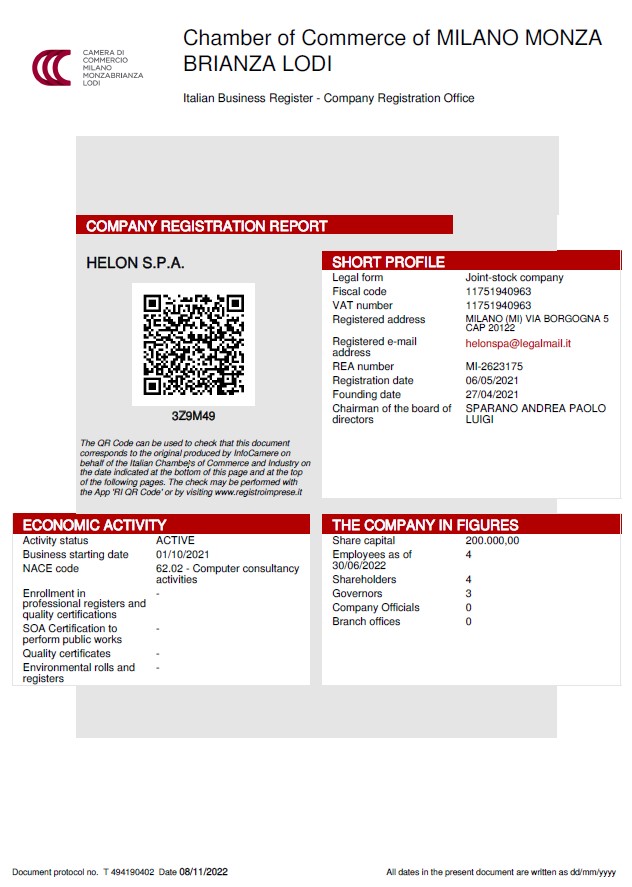
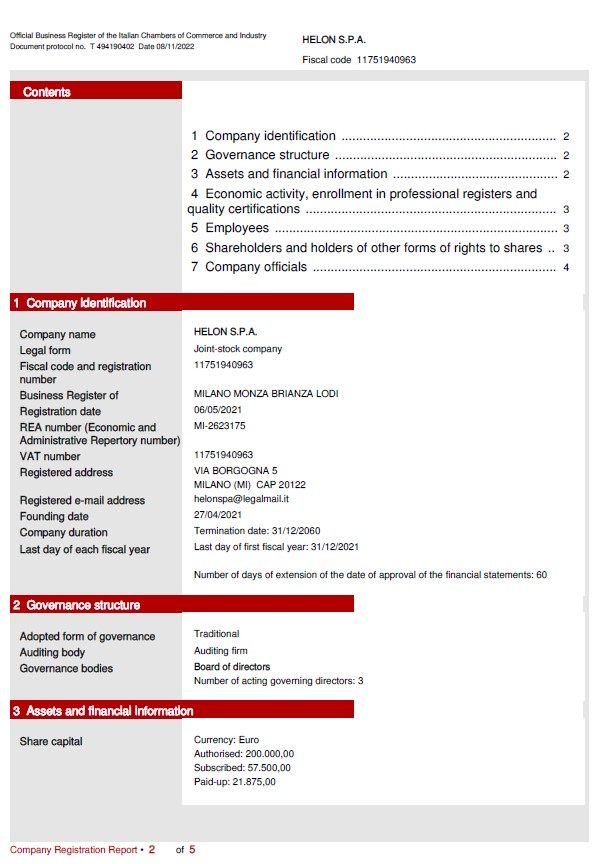
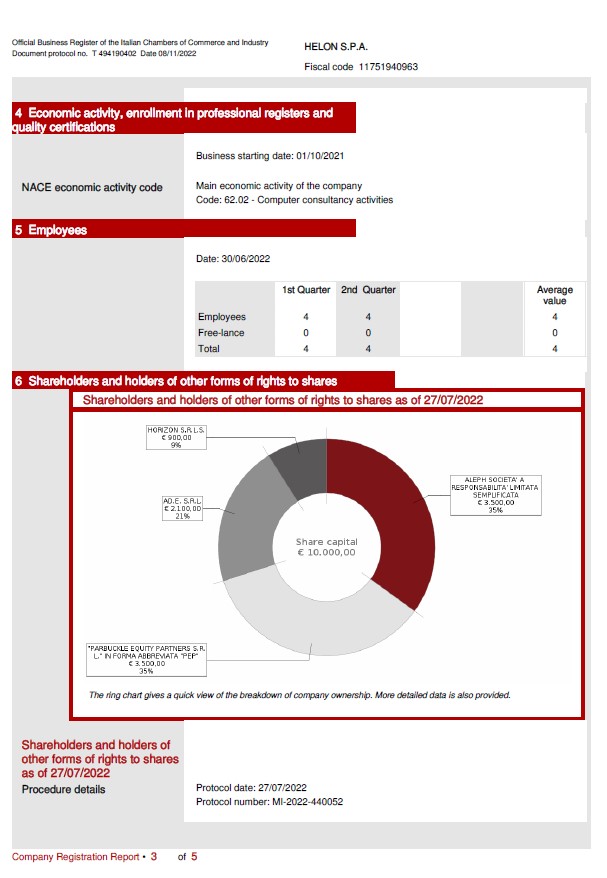
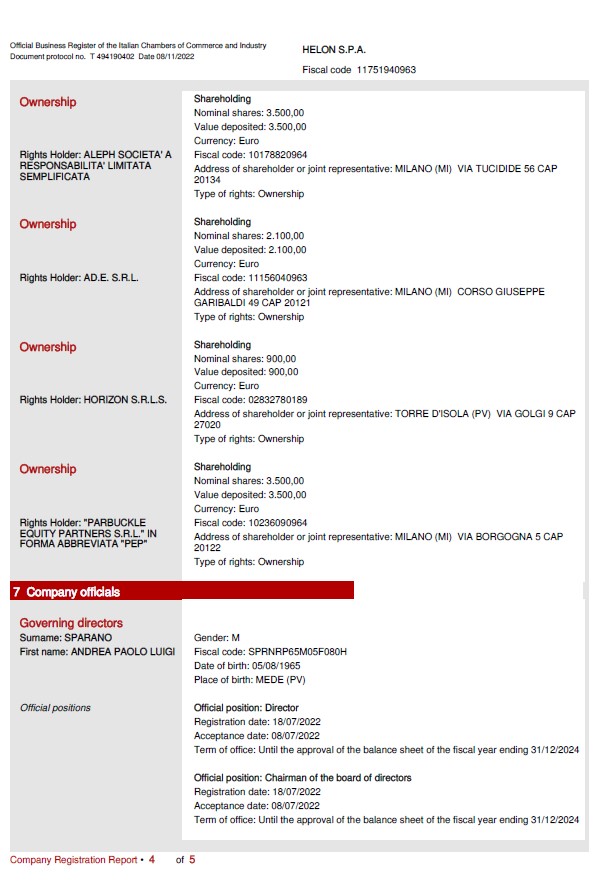
Annex “A” to deed rep. no.
STATUTES
Article 1
Name
1.1 The Company is named:
“HELON S.P.A.”
Article 2
Headquarters
2.1 The Company has its registered office in Milan.
The Administrative Body has the power to establish elsewhere administrative offices, branch offices, establishments, branches, warehouses, agencies, representative offices and to suppress them.
Article 3
Object
3.1 The company’s object is:
- The study, research, conception, design, realization and edition, including on behalf of third parties of software and products and/or services with high technological value including, within the scope of this object, the realization, management and marketing of video game software;
- the development of all technology necessary and functional to enable the effective participation of users in the video games used, including the creation and distribution of applications that enable the enjoyment of video games made and/or distributed by the company;
1
- the marketing and management of all platforms necessary for users’ participation in video games;
- the creation, design, development, distribution, marketing and licensing of software products, program and application packages and related instructional materials;
- the management of web portals;
- the provision of hosting and application services;
- the management of databases, data mining and data processing;
- the management of hardware and housing facilities and equipment.
For the purposes of the pursuit of the corporate purpose, the Company may in an instrumental manner, and in any case in full compliance with legal regulations, carry out real estate, securities, financial, commercial and industrial transactions and all necessary activities that are deemed necessary, useful or appropriate for the achievement of the corporate purpose, as well as carry out anything that is related, even indirectly, to the corporate purpose and is in any case deemed useful for its realization, consequently performing all acts and concluding all contractual transactions necessary or useful for the realization of the company’s purposes and activities.
The collection of savings from the public and any other activity prohibited by law or subject to special authorization remains strictly excluded.
2
Financial activities as mentioned above may be carried out not towards the public and with the exclusion of the character of professionalism.
All activities envisaged as the object of the Company will be carried out within the limits provided by and in compliance with the laws and regulations, including those in force from time to time.
In any case with prohibition to carry out the activities reserved by law and in particular the activities reserved for companies as per the Banking Consolidation Act and the Financial Intermediation Consolidation Act (Legislative Decree No. 385 of 1/9/1993 and Legislative Decree No. 58 of 24/2/1998 and subsequent additions or amendments).
Article 4
Duration
4.1 The duration of the Company is established until December 31 (thirty-one) 2060 (two thousand sixty) and may be extended in accordance with the law.
3
Article 5
Domicile
5.1 The domicile of the shareholders, directors, auditors, and the statutory auditor, for their relations with the Company, shall be as shown in the Company’s books.
Article 6
Capital and shares
6.1 The share capital is Euro 50,000.00 (fifty thousand/00) and is divided into 50,000 (fifty thousand) shares with a par value of Euro 1.00 (one/00) each.
The shares are dematerialized and are entered into the centralized management system as regulated and provided for by Legislative Decree No. 58 of February 24, 1998, as amended and supplemented.
Article 7
Financial Instruments
7.1 The Company may issue financial instruments provided with equity rights or administrative rights, excluding the right to vote in the general meeting of shareholders.
Article 8
Bonds
8.1 The Company may issue non-convertible bonds by a resolution passed by the General Meeting of Shareholders with the majorities required by these bylaws for the extraordinary general meeting, pursuant to Article 2410 of the Civil Code, and bonds convertible into shares by a resolution passed by the extraordinary general meeting, pursuant to Article 2420-bis of the Civil Code.
4
8.2 Bondholders may choose a common representative.
The provisions of Article 2415 of the Civil Code apply to the bondholders’ meeting.
Article 9
Financing
9.1 The Company may acquire payments and financing from shareholders in compliance with the regulations in force from time to time, with particular reference to those regulating the collection of savings from the public.
Article 10
Transfer of shares
10.1 Shares are freely transferable.
10.1.2 The term “transfer by deed between living persons” shall be understood to include all acts of alienation, in the broadest sense of the term and thus, in addition to sale, purely by way of example, contracts of exchange, contribution, gift in payment, transfer of trust mandate and donation.
10.1.3 Shares are freely transferable by inheritance upon death in favor of relatives in the direct line.
Article 11
Withdrawal
11.1 The right of withdrawal shall be in the cases and in the manner provided by law
5
Article 12
Powers of the shareholders’ meeting
12.1 The ordinary shareholders’ meeting shall deliberate on matters reserved for it, namely:
* approves the budget;
*appoints and removes directors also by appointing new directors in addition to those already in office at the time of the resolution of appointment within, in any case, the maximum number provided for in the bylaws. The directors so appointed shall expire together with the expiration of the directors in office at the time of their appointment;
* appoints the auditors and the chairman of the board of auditors and, when provided for, the person entrusted with the statutory audit of the accounts;
* determines the remuneration of directors and auditors, if it is not established in the bylaws;
* decides on the responsibilities of directors and auditors;
* decides on other matters assigned by law to the competence of the shareholders’ meeting, as well as on any authorizations required by the bylaws for the performance of acts of the directors; without prejudice, in any case, to the responsibility of the directors for the acts performed;
* approves any regulations for the proceedings of the shareholders’ meeting.
6
12.2 The extraordinary meeting is responsible for:
a. amendments to the bylaws;
b. the appointment, replacement and determination of the powers of the liquidators;
c. other matters assigned to it by law and these bylaws.
Article 13
Convocation of the assembly
13.1 The shareholders’ meeting must be convened by the administrative body at least once a year within 120 (one hundred and twenty) days from the end of the fiscal year or within the longer term if the conditions of the law are met.
13.2 The meeting may also be convened outside the municipality in which the registered office is located as long as it is in a member state of the European Union.
13.3 The meeting is convened, at the choice of the competent body:
- by notice communicated to the members by registered letter with return receipt, anticipated by fax or e-mail or by other means that guarantee proof of receipt, to be sent at least eight days before the date set for the meeting;
- by publication, fifteen days before the meeting, in the Official Gazette of the Italian Republic.
7
13.4 Even in the absence of formal convocation, the meeting shall be deemed regularly constituted when the entire share capital is represented and the majority of the members of the administrative body and the members of the control body attend the meeting.
Article 14
Ordinary shareholders’ meeting: determination of quorums
14.1 An ordinary shareholders’ meeting in first call is duly constituted with the attendance of as many shareholders as represent at least half of the share capital.
14.2 The ordinary meeting in second call is duly constituted whatever portion of the share capital is represented.
14.3 The ordinary meeting, in first and second call, passes resolutions by the affirmative vote of the absolute majority of those present.
However, a resolution waiving or settling a liability action against the directors shall not be deemed to have been passed if it is found to have the vote against by at least one-fifth of the share capital.
Article 15
Extraordinary shareholders’ meeting: determination of quorums
15.1 An extraordinary meeting in first call is duly constituted and passes resolutions with the affirmative vote of more than half of the share capital.
8
15.2 In second call, the extraordinary shareholders’ meeting is validly constituted with the attendance of as many shareholders as represent more than one-third of the share capital, and resolves with the favorable vote of at least two-thirds of the capital represented at the meeting.
However, the affirmative vote of as many members representing more than one-third of the share capital is required for resolutions pertaining to:
a. the change of corporate purpose;
b. the transformation;
c. early dissolution;
d. the extension of the duration;
e. the revocation of the state of liquidation;
f. the transfer of the registered office abroad;
g. the issuance of preferred shares.
Article 16
Entitlement to attend shareholders’ meetings
16.1 The right to attend the shareholders’ meeting and exercise voting rights are governed by Article 2370 Paragraph V of the Civil Code.
16.2 Without prejudice to the prohibitions set forth in Article 2372 of the Civil Code, shareholders may also participate in shareholders’ meetings through proxies.
9
16.3 The company may request, at any time and at its own expense, from the intermediaries, through the centralized management company, the number of shares registered in the accounts in the shareholders’ names.
16.4 Entitlement to exercise the company’s rights derives from the intermediary’s fulfillment of the account entry made in compliance with the relevant regulations.
The company will update the shareholder register in accordance with the notices and reports made by the intermediaries and the centralized management company, indicating the dates to which the entries on the intermediaries’ accounts refer.
Article 17
Chairman and secretary of the shareholders’ meeting
17.1 The shareholders’ meeting shall be chaired by the chairman of the board of directors or the sole director; in case of their absence or impediment, by the person designated by those present.
17.2 The meeting appoints a secretary who may also be a nonmember and, if necessary, one or more tellers who may also be nonmembers. The assistance of the secretary is not necessary if the minutes are taken by a notary public.
17.3 It shall be the duty of the chairman of the meeting to ascertain that the meeting has been duly constituted, to ascertain the identity and legitimacy of those present, to regulate the proceedings of the meeting, and to ascertain and proclaim the results of voting.
10
17.4 Regarding the discipline of the meeting proceedings, the order of interventions, and the manner of dealing with the agenda, the chairman has the power to propose procedures, but these may be changed by a vote of the absolute majority of those entitled to vote.
Article 18
Assembly proceedings
18.1 The shareholders’ meeting shall be conducted in such a manner that all those entitled to participate in the meeting can become aware of the events in real time, freely form their own convictions, and freely and promptly cast their votes. The manner in which the meeting is held may not conflict with the requirements of proper and complete recording of the proceedings.
18.2 It is possible to hold the meetings of the assembly, with participants located in several places, contiguous or distant, audio/video connected, and this is subject to the following conditions, which must be noted in the relevant minutes:
- That the Chairman and the Secretary of the meeting are present in the same place, who will provide for the formation and signing of the minutes;
- that it is possible for the Chairman of the meeting to ascertain the identity and legitimacy of those present, regulate the conduct of the meeting, and ascertain and proclaim the results of the vote;
11
- That it is possible for the person taking the minutes to adequately perceive the meeting events being recorded;
- That those present are allowed to participate in the discussion and simultaneous voting on the items on the agenda, as well as to view, receive or transmit documents;
- that the notice of the meeting (except in the case of a total meeting) indicates the audio/video connected places by the company, in which the participants may attend, the meeting being deemed to have been held in the place where the Chairman and the person taking the minutes will be present; furthermore, as many attendance sheets must be prepared as there are audio/video connected places in which the meeting is held.
18.3 Secret voting is not permitted. A vote that cannot be traced back to a member is an uncast vote.
Article 19
Annulment of meeting resolutions
19.1 An action for the annulment of resolutions may be brought by the administrative body, the supervisory body, or absent, dissenting or abstaining shareholders, when they own, even jointly, 5% (five percent) of the share capital having the right to vote with reference to the resolution that can be challenged.
12
Article 20
Competence and powers of the administrative body
20.1 The administrative body has all powers for the ordinary and extraordinary management of the company, subject to the need for specific authorization in cases required by law.
Article 21
Composition of the administrative body
21.1 The company shall be administered by a sole director or a board of directors consisting of a minimum of 2 (two) up to a maximum of 5 (five).
Article 22
Appointment and replacement of the administrative body
22.1 It is up to the ordinary shareholders’ meeting to determine the number of members of the administrative body and to appoint them.
22.2 The directors shall hold office for the period established at their appointment and in any case not more than 3 (three) fiscal years and may be re-elected. Their term of office shall expire on the date of the shareholders’ meeting convened to approve the financial statements for the last fiscal year of their term of office.
22.3 If one or more directors leave office during the fiscal year, the others shall replace them by a resolution approved by the board of auditors, provided that the majority always consists of directors appointed by the shareholders’ meeting. Directors so appointed shall hold office until the next shareholders’ meeting.
13
Directors so appointed expire together with those in office at the time of their appointment.
If the majority, in the case of an odd number, and half in the case of an even number, of the directors appointed by the shareholders’ meeting is lost, the entire board shall cease to exist.
In such a case, the shareholders’ meeting for the appointment of the new board shall be called urgently by the board of auditors, which may carry out the acts of ordinary administration in the meantime.
22.4 In the event that the sole director or all directors cease to hold office, the meeting to appoint the director or the entire board shall be urgently convened by the board of auditors, which may carry out acts of ordinary administration in the meantime.
22.5 Failure to meet the legal requirements constitutes cause for the director’s disqualification.
Article 23
Chairman of the board of directors
23.1 The board of directors shall, at the first meeting following its appointment, elect a chairman from among its members, if the shareholders’ meeting has not done so.
23.2 The chairman of the board of directors shall convene the board of directors, set its agenda, coordinate its work, and ensure that adequate information on the matters on the agenda is provided to all directors.
14
Article 24
Delegated bodies
24.1 The board of directors may delegate, within the limits of the law, part of its powers to one or more of its members, determining their powers and remuneration.
24.2 The board may also provide for the establishment of an executive committee of which the chairman, in addition to the directors appointed to serve on it, as well as all directors with delegated powers are members by right.
The rules provided for the board of directors apply to the convening, constitution and operation of the executive committee; resolutions are passed by a majority vote of those present and voting.
24.3 In any case, the board shall have the power to supervise and to call upon itself the operations covered by the delegation of authority, as well as the power to revoke delegations of authority.
24.4 The powers referred to in Article 2381, paragraph four of the Civil Code cannot be assigned to the delegated bodies.
24.5 The administrative body may appoint general managers, determining their powers.
24.6 The delegated bodies, if appointed, shall ensure that the organizational, administrative and accounting structure is appropriate to the nature and size of the enterprise and shall report to the board of directors and the board of auditors, with the periodicity required by the law, on the general operating performance and its foreseeable development, as well as on the most significant transactions, due to their size or characteristics, carried out by the company or its subsidiaries.
15
Article 25
Resolutions of the board of directors
25.1 The board meets at the place indicated in the notice of meeting, at the registered office or elsewhere, as often as deemed necessary by the chairman, the board of auditors, or even by only one of the directors.
25.2 The convocation shall be made at least 5 (five) days before the meeting by letter to be sent by fax, telegram, or e-mail (sent to the number or address authorized by the addressee).
25.3 In cases of urgency, the convocation may be made by letter to be sent by fax, telegram or electronic mail, with at least 1 (one) day’s notice.
25.4 The board is validly constituted with the presence of the majority of the directors in office and deliberates:
- with the affirmative vote of the absolute majority of the directors present;
- by the affirmative vote of the absolute majority of its members, if it is intended to establish assets for a specific business.
16
Directors who abstain or who have declared a conflict of interest are not counted for the purpose of calculating the majority.
In any case, in the event of a tie, the Chairman’s vote prevails, except in the case where the Board of Directors is composed of two members.
When the Board of Directors is composed of two members, both directors will fall from office if they do not agree on the possible removal of the managing director they had appointed, and a meeting must then be called for new appointments.
25.5 The Board of Directors may hold its meetings in audio/video conference or in audio conference only under the following conditions, which shall be noted in the relevant minutes:
(a) that the Chairman and the secretary of the meeting are present in the same place, who will provide for the formation and signing of the minutes, the meeting being deemed to have been held in said place,
(b) that it is permissible for the chairman of the meeting to ascertain the identity of those present, regulate the conduct of the meeting, and ascertain and proclaim the results of the vote;
(c) that it is allowed for the person taking the minutes to adequately perceive the events of the meeting being recorded;
17
(d) that those in attendance are allowed to participate in the discussion by simultaneous voting on the items on the agenda, as well as to view, receive or transmit documents.
25.6 A meeting of the board of directors is validly constituted, even in the absence of formal convocation, if all the directors in office and all the acting auditors are present.
25.7 Meetings of the board are chaired by the chairman or by the most senior director in terms of office or, subordinately, age.
25.8 Voting may not be given by proxy.
Article 26
Company Representation
26.1 Representation of the Company shall be vested in the sole director or the chairman of the board of directors.
26.2 Representation of the Society shall also be vested in the directors holding proxies from the board.
Proxies and proxies may be appointed for certain acts or categories of acts.
In any case, when the person appointed is not a member of the board of directors, the granting of the power to represent the Company is governed by the rules on power of attorney.
18
26.3 The representation of the Company in liquidation shall be vested in the liquidator or the chairman of the board of liquidators and any other members of the board of liquidators in the manner and within the limits established in the appointment.
Article 27
Remuneration of directors
27.1 Members of the board of directors shall be entitled to reimbursement of expenses incurred by reason of their office and a remuneration determined by the shareholders’ meeting at the time of their appointment.
Directors may also be granted a one-time or periodic fixed or variable emolument (including in proportion to the profits for the year), and a termination allowance may also be provided.
27.2 The remuneration of directors vested with the office of chairman, director or managing director shall be determined by the board of directors, after hearing the opinion of the board of auditors.
Article 28
Statutory Audit of the Company
28.1 The board of statutory auditors supervises compliance with the law and the articles of association, compliance with the principles of proper administration and, in particular, the adequacy of the administrative and accounting organizational structure adopted by the Company and its actual functioning.
19
Except in cases where the appointment of a statutory auditor or auditing firm is mandatory, the statutory audit may be assigned by resolution of the ordinary shareholders’ meeting and upon reasoned proposal of the Board of Statutory Auditors to a statutory auditor or auditing firm.
The shareholders’ meeting shall determine the fee payable to the statutory auditor or the statutory auditing firm for the entire term of the appointment and any criteria for adjusting such fee during the term of the appointment.
The term of the appointment is three fiscal years, expiring on the date of the shareholders’ meeting called to approve the financial statements for the third fiscal year of the appointment.
In the absence of a resolution, the statutory audit is carried out by the Board of Statutory Auditors.
28.2 The shareholders’ meeting elects the Board of Statutory Auditors, consisting of three acting auditors and two alternate auditors, appoints its chairman and determines the remuneration of those present for the entire term of office.
28.3 The auditors’ terms of office expire on the date of the shareholders’ meeting convened to approve the financial statements for the third year of their term of office. The termination of auditors due to expiration of the term shall take effect from the time when the board is reconstituted.
28.4 The board of auditors shall meet at least every 90 (ninety) days at the initiative of any one of the auditors. It is validly constituted with the presence of the majority of the auditors and passes resolutions with the favorable vote of the absolute majority of the auditors.
20
28.5 Meetings of the Board of Statutory Auditors may also be held in more than one place, whether contiguous or distant, audio and/or video connected, in a manner to be noted in the minutes.
Article 29
Financial statements and profits
29.1 The fiscal years shall close on December 31 (thirty- one) of each year.
29.2 The net profits resulting from the financial statements, minus at least 5% (five percent) to be allocated to the legal reserve until the latter has reached one-fifth of the share capital, shall be distributed among the shareholders in proportion to the shareholding held by each, unless the shareholders’ meeting resolves further allocations to extraordinary reserve funds.
Article 30
Dissolution and liquidation
30.1 The Company is dissolved for the causes provided by law.
30.2 In all cases of dissolution, the administrative body shall carry out the publicity fulfillments required by law within 30 (thirty) days from their occurrence.
21
Article 31
Applicable Provisions
31.1 For all matters not provided for in these Bylaws, reference shall be made to the provisions of the Civil Code and other relevant laws.
22

Via Toscana, 1
00187 Roma
Tel: +39 06 833 65 900
www.mazars.it
CONSENT OF INDEPENDENT REGISTERED PUBLIC ACCOUNTING FIRM
We have issued our report dated November 7, 2022, with respect to the financial statements of Helon S.p.A. incorporated by reference in this Registration Statement and Prospectus (Registration No.333). We consent to the use of the aforementioned report in the Registration Statement and Prospectus, and to the use of our name as it appears under the caption “Experts”.
Rome, Italy, November 22, 2022
Mazars Italia S.p.A.
Raffaello Lombardi
(Partner)
Mazars Italia S.p.A.
Capitale sociale deliberato, sottoscritto e versato € 120.000,00 - Sede legale: Via Ceresio, 7 - 20154 Milano Rea MI-2076227 - Cod. Fisc. e P. Iva 11176691001
Iscrizione al Registro dei Revisori Legali n. 163788 con D.M. del 14/07/2011 G.U. n. 57 del 19/07/2011

Joshua D. Brinen
Attorney at Law
New York Office
jbrinen@brinenlaw.com
Member New York, New Jersey, Florida, California, Texas & Nevada Bar
LL.M. in Taxation
December 29, 2022
Helon S.p.A.
Via Borgogna 5
Milano (MI) CAP 20122
Dear Ladies and Gentlemen:
We are legal counsel to Helon S.p.A., a Italy corporation (the "Company"), and have represented the Company in connection with the preparation and filing of that certain Registration Statement on Form F-1 (the "Registration Statement") to be filed with the Securities and Exchange Commission (the "Commission") on the date hereof, for the purpose of registering under the Securities Act of 1933, as amended (the "Securities Act"), thirty million (30,000,000) shares of the Company's common stock, par value $0.0001 per share (the "Shares"), which have been issued to the selling shareholders named in the Registration Statement.
In connection with the foregoing, we have examined such documents, corporate records and matters of law as we have deemed necessary or appropriate in connection with this opinion.
In our examination, we have assumed the legal capacity of all natural persons, the genuineness of all signatures, the authenticity of all documents submitted to us as originals, the conformity to original documents of all documents submitted to us as certified, conformed, photostatic or facsimile copies and the authenticity of the originals of such latter documents. In making our examination of executed documents, we have assumed that the parties thereto, other than the Company, its directors and officers, had the power, corporate or otherwise, to enter into and perform all obligations thereunder and have also assumed the due authorization by all requisite action, corporate or otherwise, and execution and delivery by such parties of such documents and the validity and binding effect thereof on such parties. As to any facts material to the opinions expressed herein that were not independently established or verified, we have relied upon oral or written statements and representations of officers and other representatives of the Company and others. The opinion expressed below is limited to matters governed
by Federal securities laws and by the General Corporation Law of the State of Italy, and we express no opinion as to the effect of the laws of any other jurisdictions. This opinion is limited to the laws, including the rules and regulations, as in effect on the date hereof.
Based upon and subject to the foregoing and to the other qualifications and limitations set forth herein, we are of the opinion that the Shares have been duly authorized and are duly and validly issued, fully paid and non-assessable.
We hereby consent to the filing of this opinion with the Commission as an exhibit to the Registration Statement. We also hereby consent to the use of our name under the heading "Legal Matters" in the prospectus which forms a part of the Registration Statement. In giving this consent, we do not thereby admit that we are within the category of persons whose consent is required under Section 7 of the Securities Act or the rules and regulations of the Commission promulgated thereunder. We disclaim any undertaking to advise you of any subsequent changes in the facts stated or assumed herein or of any subsequent changes in applicable laws.
Should you have any questions, please do not hesitate to contact me at the New York office or via electronic mail at jbrinen@brinenlaw.com.
Yours truly,
Brinen & Associates, LLC
Joshua D. Brinen
JDB:jdb
Exhibit 107
Calculation of
Filing Fee Tables F-1
(Form Type)
Helon S.p.A.
(Exact Name of Registrant as Specified in its Charter)
Table 1: Newly Registered Securities
CALCULATION OF REGISTRATION FEE
| Title of Each Class of Securities to be Registered |
Amount to be Registered |
Proposed Maximum Offering Price Per Share |
Proposed Maximum Aggregate Offering Price |
Amount of Registration Fee (1) | ||||
| Common Stock, $0.001 par value per share | 30,000,000 | $14.00 | $420,000,000 | $45,822 | ||||
| (1) | The fee is calculated by multiplying the aggregate offering amount by .00010910, pursuant to Section 6(b) of the Securities Act of 1933. |