
Summary Prospectus May 1, 2015
A NO-LOAD MUTUAL FUND (CSRIX)
Cohen & Steers Institutional Realty Shares
Before you invest, you may want to review the Fund’s prospectus and statement of additional information, which contain more information about the Fund and its risks. You can find the Fund’s prospectus, statement of additional information and other information about the Fund online at www.cohenandsteers.com/prospectus. You can also get this information at no cost by calling 800.330.7348 or by sending an e-mail request to marketing@cohenandsteers.com. The current prospectus and statement of additional information, dated May 1, 2015, are incorporated by reference into this summary prospectus.
Investment Objective
The investment objective of Cohen & Steers Institutional Realty Shares (the “Fund”) is total return through investment in real estate securities.
Fund Fees and Expenses
This table describes the fees and expenses that you could pay if you buy and hold shares of the Fund.
   
Shareholder Fees
(fees paid directly from your investment):
None
Annual Fund Operating Expenses
(expenses that you pay each year as a percentage of the value of your investment):
 
Management Fee

0.75%
Other Expenses

0.01%
Total Annual Fund Operating Expenses(1)

0.76%
Fee Waiver/Expense Reimbursement(1)

(0.01)%
Total Annual Fund Operating Expenses

(after fee waiver/expense reimbursement)(1)

0.75%
(1) Cohen & Steers Capital Management, Inc., the Fund’s investment advisor (the “Advisor”), has contractually agreed to waive total annual Fund operating expenses (excluding brokerage fees and commissions, taxes, interest, fees and expenses of the independent directors (including fees and expenses of their independent counsel and other independent consultants), trade organization membership dues, federal and state registration fees and extraordinary expenses) so that total annual Fund operating expenses never exceed 0.75% of average daily net assets. This commitment is currently expected to remain in place for the life of the Fund, can only be amended or terminated by agreement of the Fund and the Advisor and will terminate automatically in the event of termination of the investment management agreement between the Fund and the Advisor.
Example
This example is intended to help you compare the cost of investing in the Fund with the cost of investing in other mutual funds. The example assumes that you invest $3,000,000 (the Fund's minimum initial investment) in the Fund for the time periods indicated and then redeem all of your shares at the end of those periods. The example also assumes that your investment has a 5% return each year and that the Fund’s operating expenses remain the same pursuant to its agreement with the Advisor. Although your actual costs may be higher or lower, based on these assumptions your costs would be:
1 Year 3 Years 5 Years 10 Years
$22,978 $71,906 $125,080 $279,097
Portfolio Turnover
The Fund pays transaction costs, such as commissions, when it buys and sells securities (or “turns over” its portfolio). A higher portfolio turnover rate may indicate higher transaction costs and may result in higher taxes when Fund shares are held in a taxable account. These costs, which are not reflected in annual fund operating expenses or in the example, affect the Fund’s performance. During the Fund’s most recent fiscal year, the Fund’s portfolio turnover rate was 54% of the average value of its portfolio.

1
CSIRSPRO-0515
Principal Investment Strategies
Under normal market conditions, the Fund invests at least 80%, and normally substantially all, of its total assets in common stocks and other equity securities issued by real estate companies. Real estate equity securities include common stocks, preferred stocks and other equity securities issued by real estate companies, including real estate investment trusts (“REITs”) and similar REIT-like entities. A real estate company is one that (i) derives at least 50% of its revenue from the ownership, construction, financing, management or sale of commercial, industrial or residential real estate and land; or (ii) has at least 50% of its assets invested in such real estate. REITs are companies that own interests in real estate or in real estate related loans or other interests, and their revenue primarily consists of rent derived from owned, income producing real estate properties and capital gains from the sale of such properties. The Fund may invest, without limit, in shares of REITS. A REIT in the U.S. is generally not taxed on income distributed to shareholders so long as it meets certain tax related requirements, including the requirement that it distribute substantially all of its taxable income to such shareholders (other than net capital gains for each taxable year). REIT-like entities are organized outside of the U.S. and have operations and receive tax treatment in their respective countries similar to that of U.S. REITs. The Fund retains the ability to invest in real estate companies of any market capitalization.
The Fund may invest up to 20% of its total assets in securities of foreign issuers (including emerging market issuers) which meet the same criteria for investment as domestic companies, including investments in such companies in the form of American Depositary Receipts (“ADRs”), Global Depositary Receipts (“GDRs”) and European Depositary Receipts (“EDRs”).
Principal Risks
Before investing, be sure to read the additional descriptions of these risks in the full statutory prospectus.
Investment Risk
An investment in the Fund is subject to investment risk, including the possible loss of the entire principal amount that you invest.
Market Risk
Your investment in Fund shares represents an indirect investment in the REIT shares and other real estate securities owned by the Fund. The value of these securities, like other investments, may move up or down, sometimes rapidly and unpredictably. Your Fund shares at any point in time may be worth less than what you invested, even after taking into account the reinvestment of Fund dividends and distributions.
Common Stock Risk
While over the long-term common stocks have historically generated higher average returns than fixed income securities, common stock has also experienced significantly more volatility in those returns, although under certain market conditions, fixed-income investments may have comparable or greater price volatility. An adverse event, such as an unfavorable earnings report, may depress the value of common stock held by the Fund. Also, the price of common stock is sensitive to general movements in the stock market. A drop in the stock market may depress the price of common stock held by the Fund.
Real Estate Market Risk
Since the Fund concentrates its assets in companies engaged in the real estate industry, your investment in the Fund will be closely linked to the performance of the real estate markets. Property values may fall due to increasing vacancies or declining rents resulting from unanticipated economic, legal, cultural or technological developments. Real estate company prices also may drop because of the failure of borrowers to pay their loans and poor management, and residential developers, in particular, could be negatively impacted by falling home prices, slower mortgage origination and rising construction costs.
REIT Risk
REITs are dependent upon management skills and generally may not be diversified. REITs are also subject to heavy cash flow dependency, defaults by borrowers and self-liquidation. In addition, REITs could possibly fail to qualify for pass-through of income under applicable tax law. Various factors may also adversely affect a borrower’s or a lessee’s ability to meet its obligations to the REIT. In the event of a default by a borrower or lessee, the REIT may experience delays in enforcing its rights as a mortgagee or lessor and may incur substantial costs associated with protecting its investments.

2

Foreign (Non-U.S.) Securities Risk
Risks of investing in foreign securities, which can be expected to be greater for investments in emerging markets, include currency risks, future political and economic developments and possible imposition of foreign withholding taxes on income payable on the securities. In addition, there may be less publicly available information about a foreign issuer than about a domestic issuer, and foreign issuers may not be subject to the same accounting, auditing and financial recordkeeping standards and requirements as domestic issuers.
Small- and Medium-Sized Companies Risk
Real estate companies in the industry tend to be small- to medium-sized companies in relation to the equity markets as a whole. There may be less trading in a smaller company’s stock, which means that buy and sell transactions in that stock could have a larger impact on the stock’s price than is the case with larger company stocks. Smaller companies also may have fewer lines of business so that changes in any one line of business may have a greater impact on a smaller company’s stock price than is the case for a larger company. Further, smaller company stocks may perform in different cycles than larger company stocks. Accordingly, real estate company shares can, and at times will, perform differently than large company stocks.
Preferred Securities Risk
There are various risks associated with investing in preferred securities, including credit risk, interest rate risk, deferral and omission of distributions, subordination to bonds and other debt securities in a company’s capital structure, call, reinvestment, and income risk, limited liquidity, limited voting rights and special redemption rights.
Non-Diversification Risk
As a “non-diversified” investment company, the Fund can invest in fewer individual companies than a diversified investment company. As a result, the Fund is more susceptible to any single political, regulatory or economic occurrence and to the financial condition of individual issuers in which it invests. The Fund’s relative lack of diversity may subject investors to greater risk of loss than a fund that has a diversified portfolio.
Your investment in the Fund is not a deposit of any bank and is not insured or guaranteed by the Federal Deposit Insurance Corporation or any other government agency.
Fund Performance
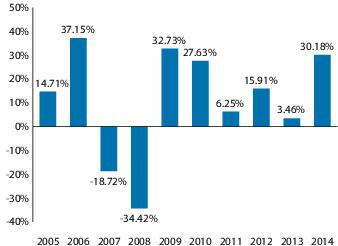
The following bar chart and table provide some indication of the risks of investing in the Fund. The bar chart shows changes in the Fund’s performance from year to year. The table shows how the Fund’s average annual returns compare with the performance of selected broad market indexes over various time periods. Past performance (both before and after taxes) is not, however, an indication as to how the Fund may perform in the future. Updated performance information, including the Fund’s net asset value (“NAV”) per share, is available at www.cohenandsteers.com or by calling (800) 330-7348.
Cohen & Steers Institutional Realty Shares
Annual Total Returns
Highest quarterly return during this period: 35.85%
(quarter ended September 30, 2009)
Lowest quarterly return during this period: -35.65%
(quarter ended December 31, 2008)

3

Average Annual Total Returns
(for the periods ended December 31, 2014)
  1 Year 5 Years 10 Years
Return Before Taxes 30.18% 16.19% 8.95%
Return After Taxes on Distributions 27.61% 14.43% 7.11%
Return After Taxes on Distributions and Sale of Fund Shares 17.66% 12.44% 6.72%
FTSE NAREIT Equity REIT Index (reflects no deduction for fees, expenses or taxes)(1) 30.14% 16.89% 8.31%
S&P 500® Index (reflects no deduction for fees, expenses or taxes)(2) 13.69% 15.46% 7.68%
(1) FTSE NAREIT Equity REIT Index is an unmanaged, market-capitalization-weighted index of all publicly traded REITs that invest predominantly in the equity ownership of real estate. The index is designed to reflect the performance of all publicly traded equity REITs as a whole.
(2) The S&P 500 Index is an unmanaged index of common stocks that is frequently used as a general measure of stock market performance.
After-tax returns are calculated using the historical highest individual federal marginal income tax rates, and do not reflect the impact of state and local taxes. Actual after-tax returns depend on the investor’s tax situation and may differ from those shown, and the after-tax returns shown are not relevant to investors who hold their shares through tax-deferred arrangements such as 401(k) plans or individual retirement accounts.
Investment Management
Advisor
Cohen & Steers Capital Management, Inc. (the “Advisor”)
Portfolio Managers
The Fund's portfolio managers are:
Joseph M. Harvey—Vice President of the Fund. Mr. Harvey has been a portfolio manager of the Fund since 2005.
Jon Cheigh—Vice President of the Fund. Mr. Cheigh has been a portfolio manager of the Fund since 2007.
Thomas Bohjalian—Vice President of the Fund. Mr. Bohjalian has been a portfolio manager of the Fund since 2012.
Jason Yablon—Mr. Yablon has been a portfolio manager of the Fund since 2013.
Purchase and Sale of Fund Shares
You may open an account with the Fund with a minimum investment of $3,000,000. Additional investments must be at least $10,000. The Fund reserves the right to waive or change its minimum investment requirements.
You may purchase, redeem or exchange shares of the Fund on any business day, which is any day the New York Stock Exchange (“NYSE”) is open for business, by written request, wire transfer (call (800) 437-9912 for instructions) or telephone. You may purchase, redeem or exchange shares of the Fund either through a financial intermediary or directly through Cohen & Steers Securities, LLC, the Fund’s distributor (the “Distributor”). For accounts opened directly through the Distributor, a completed and signed Subscription Agreement is required for the initial account opened with the Fund.
Please mail the signed Subscription Agreement to:
Boston Financial Data Services
Cohen & Steers Funds
P.O. Box 8123
Boston, MA 02266-8123
Phone: (800) 437-9912
Tax Information
The Fund’s distributions are taxable as ordinary income or capital gains, up to the extent of the Fund’s current and/or accumulated earnings and profits, unless you are investing through a tax-deferred arrangement, such as a 401(k) plan or an individual retirement account.

4

Payments to Broker-Dealers and Other Financial Intermediaries
If you purchase shares of the Fund through a broker-dealer or other financial intermediary (such as a bank), the Fund and/or its Advisor or Distributor may pay the intermediary for the sale of Fund shares and related services. These payments may create a conflict of interest by influencing the broker-dealer or other intermediary and your individual financial adviser to recommend the Fund over another investment. Ask your individual financial adviser or visit your financial intermediary’s Web site for more information.
(REMAINDER OF PAGE INTENTIONALLY LEFT BLANK)

5

        
(THIS PAGE INTENTIONALLY LEFT BLANK)

(THIS PAGE INTENTIONALLY LEFT BLANK)

(THIS PAGE INTENTIONALLY LEFT BLANK)