Active Assets—
Prime Trust
Government Trust
|
Prospectus | October 31, 2017
|
|
Fund
|
Share Class
|
Ticker Symbol
|
|
Active Assets Prime Trust
|
S Class
|
AVIXX
|
|
Active Assets Prime Trust
|
Administrative Class
|
AADXX
|
|
Active Assets Prime Trust
|
Advisory Class
|
AAVXX
|
|
Active Assets Prime Trust
|
Select Class
|
AAEXX
|
|
Active Assets Government Trust
|
S Class
|
AISXX
|

The Securities and Exchange Commission ("SEC") has not approved or disapproved these securities or passed upon the adequacy
of this Prospectus. Any representation to the contrary is a criminal offense.
AVIPRO 10-17
Table of Contents
Eligible Investors/Overview
Active Assets Prime Trust and Active Assets Government Trust (each, a "Fund," and collectively, the "Funds") are two separate
money market funds available for direct purchase. Morgan Stanley Wealth Management S Class ("S Class") shares of Active Assets
Government Trust are also offered to investors who have certain accounts ("Accounts") with Morgan Stanley Wealth Management.
(Morgan Stanley Wealth Management is affiliated with Morgan Stanley Investment Management Inc., the Funds' "Adviser.")
There may be various account and service fees charged in connection with your investment in Fund shares. Please refer to your
Account agreement, speak to your Morgan Stanley Financial Advisor or contact a Financial Intermediary (as defined below),
as applicable, for more information.
Table of Contents
|
Active Assets | Fund Summary
|
|
Active Assets Prime Trust
|
|
|
|
Investment Objective
Active Assets Prime Trust is a money market fund that seeks high current income, preservation of capital and liquidity.
Fees and Expenses
The table below describes the fees and expenses that you may pay if you buy and hold shares of the Fund. The Fund offers four
Classes of shares: S Class, Administrative Class, Advisory Class and Select Class. Each Class has different fees and expenses
and varying minimum initial investment amounts. The Fund does not impose any sales charges or distribution and/or shareholder
service (12b-1) fees for S Class shares of the Fund.
Annual Fund Operating Expenses (expenses that you pay each year as a percentage of the value of your investment)
|
|
S Class
|
|
Admin.
Class
|
|
Advisory
Class
|
|
Select
Class
|
|
|
Advisory Fee
|
0.10%
|
|
0.10%
|
|
0.10%
|
|
0.10%
|
|
|
Distribution and/or Shareholder Service (12b-1) Fee
|
N/A
|
|
N/A
|
|
N/A
|
|
0.55%
|
|
|
Other Expenses
|
0.29%
|
|
0.29%
|
|
0.29%
|
|
0.29%
|
|
|
Shareholder Administration Fee
|
N/A
|
|
0.15%
|
|
N/A
|
|
N/A
|
|
|
Service and Shareholder Administration Fee
|
N/A
|
|
N/A
|
|
0.25%
|
|
N/A
|
|
|
Shareholder Service Fee
|
N/A
|
|
N/A
|
|
N/A
|
|
0.25%
|
|
|
Total Annual Fund Operating Expenses1
|
0.39%
|
|
0.54%
|
|
0.64%
|
|
1.19%
|
|
|
Fee Waiver and/or Expense Reimbursements1
|
0.20%
|
|
0.21%
|
|
0.25%
|
|
0.69%
|
|
|
Total Annual Fund Operating Expenses After Fee Waivers and/or Expense Reimbursements1
|
0.19%
|
|
0.33%
|
|
0.39%
|
|
0.50%
|
|
Example
The example below is intended to help you compare the cost of investing in the Fund with the cost of investing in other mutual
funds.
The example assumes that you invest $10,000 in the Fund, your investment has a 5% return each year, and the Fund's operating
expenses remain the same (except that the example incorporates the fee waiver and/or expense reimbursement arrangement for
only the first year). Although your actual costs may be higher or lower, based on these assumptions your costs would be:
|
|
1 Year
|
|
3 Years
|
|
5 Years
|
|
10 Years
|
|
|
S Class
|
$19
|
|
$105
|
|
$199
|
|
$473
|
|
|
Administrative Class
|
$34
|
|
$152
|
|
$281
|
|
$657
|
|
|
Advisory Class
|
$40
|
|
$180
|
|
$332
|
|
$775
|
|
|
Select Class
|
$51
|
|
$309
|
|
$588
|
|
$1,382
|
|
1 The Fund's "Adviser" and "Administrator," Morgan Stanley Investment Management Inc., has contractually agreed to assume all
operating expenses of the Fund (except for brokerage fees) to the extent that such expenses on an annualized basis exceed
0.20%, 0.35%, 0.45% and 1.00% of the average daily net assets of the Fund's S Class, Administrative Class, Advisory Class
and Select Class, respectively. In addition, the Fund's "Distributor," Morgan Stanley Distribution, Inc., and the Adviser
and Administrator have agreed to waive all or a portion of the Fund's shareholder service/distribution fee, advisory fee and
administration fee, respectively, and/or reimburse expenses, to the extent that total expenses exceed total income of the
Fund on a daily basis. These fee waivers and/or expense reimbursements will continue for at least one year or until such time
as the Fund's Board of Trustees acts to discontinue all or a portion of such waivers and/or reimbursements when it deems such
action is appropriate.
Principal Investment Strategies
The Fund invests in high quality, short-term debt obligations. In selecting investments, the Adviser seeks to maintain the
Fund's share price at $1.00. The Fund's investments include the following money market instruments: corporate obligations
(including, but not limited to, commercial paper); debt obligations of U.S.-regulated banks (including domestic branches or
subsidiaries of foreign banks) and instruments secured by those obligations (including certificates of deposit); certificates
of deposit of savings banks and savings and loan associations; debt obligations issued or guaranteed as to principal and interest
by the U.S. Government, its agencies or instrumentalities; U.S. dollar-denominated foreign bank obligations; asset-backed
securities; repurchase agreements; municipal obligations; and variable and floating rate notes.
The Fund operates as a "retail money market fund," as such term is defined or interpreted under Rule 2a-7 under the Investment
Company Act of 1940, as amended (the "1940 Act"). A "retail money market fund" is a money market fund that has policies and
procedures reasonably designed to limit all beneficial owners of the fund to natural persons. As a "retail money market fund,"
the Fund may value its securities using the amortized cost method as permitted by Rule 2a-7 to maintain a stable net asset
value per share ("NAV") of $1.00. Like other retail money market funds, the Fund is subject to the possible imposition of
liquidity fees and/or redemption gates.
Principal Risks
There is no assurance that the Fund will achieve its investment objective.
You could lose money by investing in the Fund. Although the Fund seeks to preserve the value of your investment at $1.00 per
share, it cannot guarantee it will do so. The Fund may impose a fee upon the sale of your shares or may temporarily suspend
your ability to sell shares if the Fund's liquidity falls below required minimums because of market conditions or other factors.
An investment in the Fund is not insured or guaranteed by the Federal Deposit Insurance Corporation ("FDIC") or any other
government agency. The Fund's sponsor has no legal obligation to provide financial support to the Fund, and you should not
expect that the sponsor will provide financial support to the Fund at any time.
Table of Contents
|
Active Assets | Fund Summary
|
|
Active Assets Prime Trust (Con't)
|
|
|
|
The principal risks of investing in the Fund include:
●
Credit and Interest Rate Risk. Credit risk refers to the possibility that the issuer or guarantor of a security will be unable to make interest payments
and/or repay the principal on its debt. Interest rate risk refers to fluctuations in the value of a fixed-income security
resulting from changes in the general level of interest rates. The historically low interest rate environment increases the
risk associated with rising interest rates. The Fund may face a heightened level of risk, especially since the Federal Reserve
Board has ended its quantitative easing program and has begun to raise rates.
●
U.S. Government Securities. With respect to U.S. government securities that are not backed by the full faith and credit of the United States, there is
the risk that the U.S. Government will not provide financial support to such U.S. government agencies, instrumentalities or
sponsored enterprises if it is not obligated to do so by law.
●
Asset-Backed Securities. Asset-backed securities involve the risk that various federal and state consumer laws and other legal and economic factors
may result in the collateral backing the securities being insufficient to support payment on the securities. Some asset-backed
securities also entail prepayment risk, which may vary depending on the type of asset.
●
Foreign Money Market Securities. Investing in money market securities of foreign issuers involves some additional risks, including the possibility of adverse
political, economic or other developments affecting the issuers of these securities.
●
Repurchase Agreements. Repurchase agreements are subject to risks associated with the possibility of default by the seller at a time when the collateral
has declined in value, or insolvency of the seller, which may affect the Fund's right to control the collateral and result
in certain costs and delays. Repurchase agreements may involve a greater degree of credit risk than investments in U.S. government
securities.
●
Municipal Obligations. To the extent the Fund invests in municipal obligations issued by state and local governments and their agencies, the Fund
may be susceptible to political, economic, regulatory or other factors affecting issuers of these municipal obligations. To
the extent that the Fund invests in municipal obligations of issuers in the same economic sector, it could be more sensitive
to economic, business or political developments which affect such sector.
Past Performance
The bar chart and table below provide some indication of the risks of investing in the Fund by showing changes in the Fund's S Class shares' performance from year-to-year and by showing the Fund's average annual returns for the one, five and 10 year periods. The performance of the Administrative, Advisory and Select Class shares will differ because the Administrative, Advisory and Select Class shares have different ongoing fees. The Fund's past performance is not necessarily an indication of how the Fund will perform in the future. Updated performance information is available online at www.morganstanley.com/im or by calling toll-free (800) 548-7786.
Annual Total Return—Calendar Years
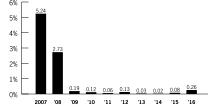
The year-to-date total return as of September 30, 2017 for S Class shares was 0.43%.
|
High Quarter
|
9/30/07
|
1.30%
|
|
Low Quarter
|
9/30/13
|
0.00%
|
Average Annual Total Returns
(for the Periods Ended December 31, 2016)
|
|
Past 1
Year
|
Past 5
Years
|
Past 10
Years
|
|
S Class
|
0.26%
|
|
0.10%
|
|
0.87%
|
|
|
Administrative Class1
|
N/A
|
|
N/A
|
|
N/A
|
|
|
Advisory Class1
|
N/A
|
|
N/A
|
|
N/A
|
|
|
Select Class1
|
N/A
|
|
N/A
|
|
N/A
|
|
1 Administrative, Advisory and Select Class shares of the Fund had not completed a full year of operation as of December 31,
2016 and therefore do not have annualized returns information to report.
For the Fund's most recent 7-day annualized yield, you may call toll-free (800) 548-7786.
Fund Management
Adviser. Morgan Stanley Investment Management Inc.
Purchase and Sale of Fund Shares
Investments in the Fund are limited to shareholder accounts beneficially owned by natural persons.
The minimum initial investment is generally $5,000 for S Class shares and $10,000,000 for each of Administrative Class and
Advisory Class shares of the Fund. There is no minimum initial investment amount for Select Class shares of the Fund. The
minimum investment requirements may be waived for certain investments. For more information, please refer to the section of
this Prospectus entitled "Shareholder Information—How to Buy Shares."
Fund shares may be purchased or sold on any day the New York Stock Exchange ("NYSE") is open for business (except when the following federal holidays are observed: Columbus Day and Veterans Day) directly from the Fund by mail (c/o Boston Financial Data Services, Inc., P.O. Box 219804, Kansas City,
Table of Contents
|
Active Assets | Fund Summary
|
|
Active Assets Prime Trust (Con't)
|
|
|
|
MO 64121-9804), by telephone ((800) 548-7786) or by contacting an authorized third-party, such as a broker, dealer or other financial intermediary that has entered into a selling agreement with the Fund's Distributor (each, a "Financial Intermediary"). In addition, you can sell Fund shares at any time by enrolling in a systematic withdrawal plan. Your shares will be sold at the next price calculated after we receive your order to redeem. For more information, please refer to the sections of this Prospectus entitled "Shareholder Information— How to Buy Shares."
To contact a Morgan Stanley Financial Advisor, call toll-free 1-866-MORGAN8 for the telephone number of the Morgan Stanley
office nearest you or access our office locator at www.morganstanley.com.
Tax Information
The Fund intends to make distributions that may be taxed as ordinary income or capital gains.
Payments to Broker-Dealers and Other Financial Intermediaries
If you purchase Fund shares through a Financial Intermediary (such as a bank), the Adviser and/or the Distributor may pay
the Financial Intermediary for the sale of Fund shares and related services. These payments, which may be significant in amount,
may create a conflict of interest by influencing the Financial Intermediary and your salesperson to recommend the Fund over
another investment. Ask your salesperson or visit your Financial Intermediary's web site for more information.
Table of Contents
|
Active Assets | Fund Summary
|
|
Active Assets Government Trust
|
|
|
|
Investment Objective
Active Assets Government Trust is a money market fund that seeks to provide high current income, preservation of capital and
liquidity.
Fees and Expenses
The table below describes the fees and expenses that you may pay if you buy and hold shares of the Fund. The Fund is a no-load
fund. The Fund does not impose any sales charges or distribution and/or shareholder service (12b-1) fees.
Annual Fund Operating Expenses (expenses that you pay each year as a percentage of the value of your investment)
|
Advisory Fee
|
0.10%
|
|
|
Distribution and/or Shareholder Service (12b-1) Fee
|
None
|
|
|
Other Expenses
|
0.06%
|
|
|
Total Annual Fund Operating Expenses
|
0.16%
|
|
Example
The example below is intended to help you compare the cost of investing in the Fund with the cost of investing in other mutual
funds.
The example assumes that you invest $10,000 in the Fund, your investment has a 5% return each year, and the Fund's operating
expenses remain the same. Although your actual costs may be higher or lower, based on these assumptions your costs would be:
|
|
1 Year
|
|
3 Years
|
|
5 Years
|
|
10 Years
|
|
|
S Class
|
$16
|
|
$52
|
|
$90
|
|
$205
|
|
Principal Investment Strategies
The Fund has adopted a policy to invest exclusively in obligations issued or guaranteed by the U.S. Government and its agencies
and instrumentalities and in repurchase agreements collateralized by such securities in order to qualify as a "government
money market fund" under federal regulations. The Fund may also hold cash from time to time. A "government money market fund"
is a money market fund that invests at least 99.5% of its total assets in cash, securities issued or guaranteed by the United
States or certain U.S. government agencies or instrumentalities and/or repurchase agreements that are collateralized fully
by the foregoing. A "government money market fund" is exempt from requirements that permit money market funds to impose a
"liquidity fee" and/or a "redemption gate" that temporarily restricts redemptions. In selecting investments, the Fund's "Adviser,"
Morgan Stanley Investment Management Inc., seeks to maintain the Fund's share price at $1.00. The share price remaining stable
at $1.00 means that the Fund would preserve the principal value of your investment.
The U.S. government securities that the Fund may purchase include: U.S. Treasury bills, notes and bonds, all of which are direct obligations of the U.S. Government; securities issued by agencies or instrumentalities of the U.S. Government which are backed by the full faith and credit of the United States; securities issued by agencies or instrumentalities which are not backed by the full faith and credit of the United States, but whose issuing agency or instrumentality has the right to borrow from the U.S. Treasury to meet its obligations; and securities issued by agencies or instrumentalities which are backed solely by the credit of the issuing agency or instrumentality. In addition, the Fund may invest in repurchase agreements that are collateralized fully by cash and/or government securities.
Principal Risks
There is no assurance that the Fund will achieve its investment objective.
You could lose money by investing in the Fund. Although the Fund seeks to preserve the value of your investment at $1.00 per
share, it cannot guarantee it will do so. An investment in the Fund is not insured or guaranteed by the Federal Deposit Insurance
Corporation ("FDIC") or any other government agency. The Fund's sponsor has no legal obligation to provide financial support
to the Fund, and you should not expect that the sponsor will provide financial support to the Fund at any time.
The principal risks of investing in the Fund include:
●
Credit and Interest Rate Risk. Credit risk refers to the possibility that the issuer or guarantor of a security will be unable to make interest payments
and/or repay the principal on its debt. Interest rate risk refers to fluctuations in the value of a fixed-income security
resulting from changes in the general level of interest rates. The historically low interest rate environment increases the
risk associated with rising interest rates. The Fund may face a heightened level of risk, especially since the Federal Reserve
Board has ended its quantitative easing program and has begun to raise rates.
●
U.S. Government Securities. With respect to U.S. government securities that are not backed by the full faith and credit of the United States, there is
the risk that the U.S. Government will not provide financial support to such U.S. government agencies, instrumentalities or
sponsored enterprises if it is not obligated to do so by law.
●
Repurchase Agreements. Repurchase agreements are subject to risks associated with the possibility of default by the seller at a time when the collateral
has declined in value, or insolvency of the seller, which may affect the Fund's right to control the collateral and result
in certain costs and delays. Repurchase agreements may involve a greater degree of credit risk than investments in U.S. government
securities.
Table of Contents
|
Active Assets | Fund Summary
|
|
Active Assets Government Trust
|
|
|
|
Past Performance
The bar chart and table below provide some indication of the risks of investing in the Fund by showing changes in the Fund's
performance from year-to-year and by showing the Fund's average annual returns for the one, five and 10 year periods. The
Fund's past performance is not necessarily an indication of how the Fund will perform in the future. Updated performance information
is available online at www.morganstanley.com/im or by calling toll-free (800) 548-7786.
Annual Total Return—Calendar Years
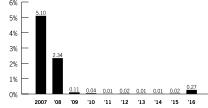
The year-to-date total return as of September 30, 2017 was 0.53%.
|
High Quarter
|
6/30/07
|
1.28%
|
|
Low Quarter
|
3/31/10
|
0.00%
|
Average Annual Total Returns
(for the Periods Ended December 31, 2016)
|
|
Past 1
Year
|
Past 5
Years
|
Past 10
Years
|
|
Active Assets Government Trust
|
0.27%
|
|
0.07%
|
|
0.78%
|
|
For the Fund's most recent 7-day annualized yield, you may call toll-free (800) 548-7786.
Fund Management
Adviser. Morgan Stanley Investment Management Inc.
Purchase and Sale of Fund Shares
Minimum Investment Amounts With respect to purchases through an Account, there is no minimum investment amount for investors, although the current minimum
initial deposit into any Account is $5,000 in cash or securities and certain Accounts may have higher minimum initial deposits.
For more information, please refer to the section of this Prospectus entitled "Shareholder Information—How Are Fund Investments
Made?"
With respect to direct purchases of Fund shares, the minimum initial investment is generally $5,000 for shares of the Fund.
The minimum investment requirements may be waived for certain investments. For more information, please refer to the section
of this Prospectus entitled "Shareholder Information—How to Buy Shares."
How Are Fund Investments Made? If you select the Fund as the sweep investment choice for your Account, transaction activity in your Account may result in
(i) cash balances that are not invested in securities or other investments at the end of each day or (ii) debit balances for
transactions posted to your Account. Morgan Stanley Wealth Management will automatically process a purchase or redemption
of Fund shares on the next day that the New York Stock Exchange ("NYSE") and the Federal Reserve Bank of New York are open
for business. For more information on the Fund's investment procedures, please refer to the section of this Prospectus entitled
"Shareholder Information—How Are Fund Investments Made?"
Your shares will be purchased or sold at the price next calculated after the Fund receives instructions. In the case of sweep
investments, the price of the Fund's shares will be the share price next calculated after the Fund receives the order to purchase
or sell shares from Morgan Stanley Wealth Management. For more information on the Fund's purchase and redemption procedures,
please refer to the section of this Prospectus entitled "Shareholder Information—How Are Fund Investments Made?"
Please refer to your Account documentation for more information about processing of Fund transactions.
With respect to direct purchases of Fund shares, you can purchase or sell Fund shares on any day the NYSE is open for business
(except when the following federal holidays are observed: Columbus Day and Veterans Day) directly from the Fund by mail (c/o
Boston Financial Data Services, Inc., P.O. Box 219804, Kansas City, MO 64121-9804), by telephone ((800) 548-7786) or by contacting
an authorized third-party, such as a broker, dealer or other financial intermediary that has entered into a selling agreement
with the Fund's "Distributor," Morgan Stanley Distribution, Inc. (each, a "Financial Intermediary"). In addition, you can
sell Fund shares at any time by enrolling in a systematic withdrawal plan. Your shares will be sold at the next price calculated
after we receive your order to redeem. For more information, please refer to the sections of this Prospectus entitled "Shareholder
Information—How to Buy shares."
To contact a Morgan Stanley Financial Advisor, call toll-free 1-866-MORGAN8 for the telephone number of the Morgan Stanley
office nearest you or access our office locator at www.morganstanley.com.
Tax Information
The Fund intends to make distributions that will generally be taxed as ordinary income or capital gains. Depending on your
state's rules, however, any income dividend distributions from the Fund attributable to interest earned on direct obligations
of the U.S. Government may be exempt from state and local taxes.
Payments to Broker-Dealers and Other Financial Intermediaries
If you purchase Fund shares through a Financial Intermediary (such as a bank), the Adviser and/or the Distributor may pay
Table of Contents
|
Active Assets | Fund Summary
|
|
Active Assets Government Trust (Con't)
|
|
|
|
the Financial Intermediary for the sale of Fund shares and related services. These payments, which may be significant in amount, may create a conflict of interest by influencing the Financial Intermediary and your salesperson to recommend the Fund over another investment. Ask your salesperson or visit your Financial Intermediary's web site for more information.
Table of Contents
|
Active Assets | Details of the Funds
|
|
Active Assets Prime Trust
|
|
|
|
Additional Information about the Funds' Investment Objectives, Strategies and Risks
|
Money Market Fund
A mutual fund meeting the requirements of Rule 2a-7 and having the goal to select securities to provide current income while
seeking to maintain principal.Yield
The Fund's yield reflects the actual income the Fund pays to you expressed as a percentage of the Fund's share price. Because
the Fund's income from its portfolio securities will fluctuate, the income it in turn distributes to you and the Fund's yield
will vary.
|
Investment Objective
Active Assets Prime Trust is a money market fund that seeks high current income, preservation of capital and liquidity.
Principal Investment Strategies
The Fund invests in high quality, short-term debt obligations. In selecting investments, the Adviser seeks to maintain the
Fund's share price at $1.00. The share price remaining stable at $1.00 means that the Fund would preserve the principal value
of your investment.
The Fund's investments include the following money market instruments:
●
Corporate debt obligations, including, but not limited to, commercial paper.
●
Debt obligations of U.S.-regulated banks (including domestic branches or subsidiaries of foreign banks) and instruments secured
by those obligations (including certificates of deposit).
●
Certificates of deposit of savings banks and savings and loan associations.
●
Debt obligations issued or guaranteed as to principal and interest by the U.S. Government, its agencies or instrumentalities.
●
U.S. dollar-denominated money market instruments and other short-term obligations issued by foreign banks.
●
Asset-backed securities.
●
Repurchase agreements.
●
Municipal obligations.
●
Variable and floating rate notes.
Repurchase agreements are fixed-income securities in the form of agreements backed by collateral. These agreements typically
involve the acquisition by the Fund of securities from the selling institution (such as a bank or a broker-dealer), coupled
with the agreement that the selling institution will repurchase the underlying securities at a specified price and at a fixed
time in the future (or on demand, if applicable). The underlying securities which serve as collateral for the repurchase agreements
entered into by the Fund may include U.S. government securities, municipal securities, corporate debt obligations, convertible
securities, and common and preferred stock and may be of below investment grade quality. These securities are marked-to-market
daily in order to maintain full collateralization (typically purchase price plus accrued interest).
Municipal obligations are securities issued by state and local governments and their agencies. These securities typically
are "general obligation" or "revenue" bonds, notes or commercial paper, including participations in lease obligations and
installment purchase contracts of municipalities. These obligations may have fixed, variable or floating rates.
The Fund may purchase debt obligations that have fixed, variable or floating rates of interest. The interest rates payable
on variable or floating rate obligations may fluctuate based upon changes in market rates.
The Adviser actively manages the Fund's assets in an attempt to reduce the risk of losing any principal investment as a result
of credit or interest rate risks. The Fund's assets are reviewed to maintain or improve creditworthiness. In addition, federal
regulations require money market funds to invest only in debt obligations of high quality and short-term maturities.
In pursuing the Fund's investment objective, the Adviser has considerable leeway in deciding which investments it buys, holds
or sells on a day-to-day basis and which trading strategies it uses. For example, the Adviser in its discretion may determine
to use some permitted trading strategies while not using others.
Table of Contents
|
Active Assets| Details of the Funds
|
|
Active Assets Prime Trust (Con't)
|
|
|
|
The Fund operates as a "retail money market fund," as such term is defined or interpreted under Rule 2a-7. A "retail money
market fund" is a money market fund that has policies and procedures reasonably designed to limit all beneficial owners of
the fund to natural persons. As a "retail money market fund," the Fund may value its securities using the amortized cost method
as permitted by Rule 2a-7 to maintain a NAV of $1.00. Like other retail money market funds, the Fund is subject to the possible
imposition of liquidity fees and/or redemption gates.
Additional Investment Strategy Information
This section provides additional information relating to the Fund's investment strategies.
Defensive Investments. When the Adviser believes that changes in market, economic, political or other conditions warrant, the Fund may invest without
limit in cash or cash equivalents for temporary defensive purposes that may be inconsistent with the Fund's principal investment
strategies. If the Adviser incorrectly predicts the effects of these changes, the defensive investments may adversely affect
the Fund's performance. Using defensive investments could cause the Fund to fail to meet its investment objective.
Principal Risks
There is no assurance that the Fund will achieve its investment objective.
You could lose money by investing in the Fund. Although the Fund seeks to preserve the value of your investment at $1.00 per
share, it cannot guarantee it will do so. The Fund may impose a fee upon the sale of your shares or may temporarily suspend
your ability to sell shares if the Fund's liquidity falls below required minimums because of market conditions or other factors.
An investment in the Fund is not insured or guaranteed by the FDIC or any other government agency. The Fund's sponsor has
no legal obligation to provide financial support to the Fund, and you should not expect that the sponsor will provide financial
support to the Fund at any time.
Credit and Interest Rate Risk. Principal risks of investing in the Fund are associated with its debt obligation investments. All debt obligations, such
as bonds, are subject to two types of risk: credit risk and interest rate risk.
Credit risk refers to the possibility that the issuer or guarantor of a security will be unable to make interest payments
and/or repay the principal on its debt. Interest rate risk refers to fluctuations in the value of a fixed-income security
resulting from changes in the general level of interest rates. The historically low interest rate environment increases the
risk associated with rising interest rates. The Fund may face a heightened level of risk, especially since the Federal Reserve
Board has ended its quantitative easing program and has begun to raise rates.
U.S. Government Securities. The Fund may purchase U.S. government securities that are not backed by the full faith and credit of the United States. With
respect to these U.S. government securities, there is the risk that the U.S. Government will not provide financial support
to such U.S. government agencies, instrumentalities or sponsored enterprises if it is not obligated to do so by law. The maximum
potential liability of the issuers of some U.S. government securities held by the Fund may greatly exceed their current resources,
including their legal right to support from the U.S. Treasury. It is possible that these issuers will not have the funds to
meet their payment obligations in the future.
Asset-Backed Securities. Asset-backed securities involve the risk that various federal and state consumer laws and other legal and economic factors
may result in the collateral backing the securities being insufficient to support payment on the securities. Some asset-backed
securities also entail prepayment risk, which may vary depending on the type of asset. Securities subject to prepayment risk
generally offer less potential for gains when interest rates decline, and a greater potential for loss when interest rates
rise. In addition, rising interest rates may cause prepayments to occur at a slower than expected rate, thereby effectively
lengthening the maturity of the security and making the security more sensitive to interest rate changes.
Foreign Money Market Securities. The Fund may invest in U.S. dollar-denominated money market instruments and other short-term debt obligations issued by foreign
banks. Although the Fund will invest in these securities only if the Adviser determines they are of comparable quality to
the Fund's U.S. investments, investing in securities of foreign issuers involves some additional risks. These risks may include
the possibility of adverse political, economic or other developments affecting the issuers of these securities.
Repurchase Agreements. The use of repurchase agreements involves certain risks and may involve a greater degree of credit risk than investments
in U.S. government securities. For example, if the selling institution defaults on its obligation to repurchase the underlying
securities at a time when the value of the securities has declined, the Fund may incur a loss upon disposition of them. In
the event of an insolvency or bankruptcy by the selling institution, the Fund's right to control the collateral could be affected
and result in certain costs and delays. Additionally, if the proceeds from the liquidation of such collateral after an insolvency
were less than the repurchase price, the Fund could suffer a loss. The Fund follows procedures that are designed to minimize
such risks.
Municipal Obligations. To the extent the Fund invests in municipal obligations issued by state and local governments and their agencies, the Fund may be susceptible to political, economic, regulatory or other factors affecting issuers of these municipal
Table of Contents
|
Active Assets | Details of the Funds
|
|
Active Assets Prime Trust (Con't)
|
|
|
|
obligations. To the extent that the Fund invests in municipal obligations of issuers in the same economic sector, it could
be more sensitive to economic, business or political developments which affect such sector.
Table of Contents
|
Active Assets | Details of the Funds
|
|
Active Assets Government Trust
|
|
|
|
|
Money Market Fund
A mutual fund meeting the requirements of Rule 2a-7 and having the goal to select securities to provide current income while
seeking to maintain principal.Yield
The Fund's yield reflects the actual income the Fund pays to you expressed as a percentage of the Fund's share price. Because
the Fund's income from its portfolio securities will fluctuate, the income it in turn distributes to you and the Fund's yield
will vary.
|
Investment Objective
Active Assets Government Trust is a money market fund that seeks to provide high current income, preservation of capital and
liquidity.
Principal Investment Strategies
The Fund has adopted a policy to invest exclusively in obligations issued or guaranteed by the U.S. Government and its agencies
and instrumentalities and in repurchase agreements collateralized by such securities in order to qualify as a "government
money market fund" under federal regulations. The Fund may also hold cash from time to time. A "government money market fund"
is a money market fund that invests at least 99.5% of its total assets in cash, securities issued or guaranteed by the United
States or certain U.S. government agencies or instrumentalities and/or repurchase agreements that are collateralized fully
by the foregoing. A "government money market fund" is exempt from requirements that permit money market funds to impose a
"liquidity fee" and/or a "redemption gate" that temporarily restricts redemptions. In selecting investments, the Adviser seeks
to maintain the Fund's share price at $1.00. The share price remaining stable at $1.00 means that the Fund would preserve
the principal value of your investment.
The U.S. government securities that the Fund may purchase include:
●
U.S. Treasury bills, notes and bonds, all of which are direct obligations of the U.S. Government.
●
Securities issued by agencies or instrumentalities of the U.S. Government which are backed by the full faith and credit of
the United States. Among the agencies or instrumentalities issuing these obligations are the Government National Mortgage
Association and the Federal Housing Administration.
●
Securities issued by agencies or instrumentalities which are not backed by the full faith and credit of the United States,
but whose issuing agency or instrumentality has the right to borrow from the U.S. Treasury to meet its obligations. Among
these agencies and instrumentalities are the Federal National Mortgage Association ("Fannie Mae"), the Federal Home Loan Mortgage
Corporation ("Freddie Mac") and the Federal Home Loan Banks.
●
Securities issued by agencies or instrumentalities which are backed solely by the credit of the issuing agency or instrumentality.
Among these agencies and instrumentalities is the Federal Farm Credit System.
In addition, the Fund may invest in repurchase agreements that are collateralized fully by cash and/or government securities.
Repurchase agreements are fixed-income securities in the form of agreements backed by collateral. These agreements typically
involve the acquisition by the Fund of securities from the selling institution (such as a bank or a broker-dealer), coupled
with the agreement that the selling institution will repurchase the underlying securities at a specified price and at a fixed
time in the future (or on demand, if applicable). The underlying securities which serve as collateral for the repurchase agreements
entered into by the Fund are marked-to-market daily in order to maintain full collateralization (typically purchase price
plus accrued interest).
The Adviser actively manages the Fund's assets in an attempt to reduce the risk of losing any principal investment as a result
of credit or interest rate risks. In addition, federal regulations require money market funds to invest only in debt obligations
of high quality and short-term maturities.
In pursuing the Fund's investment objective, the Adviser has considerable leeway in deciding which investments it buys, holds
or sells on a day-to-day basis and which trading strategies it uses. For example, the Adviser in its discretion may determine
to use some permitted trading strategies while not using others.
Additional Investment Strategy Information
This section provides additional information relating to the Fund's investment strategies.
Defensive Investments. When the Adviser believes that changes in market, economic, political or other conditions warrant, the Fund may invest without limit in cash or cash equivalents for temporary defensive purposes that may be inconsistent with the Fund's
Table of Contents
|
Active Assets | Details of the Funds
|
|
Active Assets Government Trust (Con't)
|
|
|
|
principal investment strategies. If the Adviser incorrectly predicts the effects of these changes, the defensive investments
may adversely affect the Fund's performance. Using defensive investments could cause the Fund to fail to meet its investment objective.
Principal Risks
There is no assurance that the Fund will achieve its investment objective.
You could lose money by investing in the Fund. Although the Fund seeks to preserve the value of your investment at $1.00 per
share, it cannot guarantee it will do so. An investment in the Fund is not insured or guaranteed by the FDIC or any other
government agency. The Fund's sponsor has no legal obligation to provide financial support to the Fund, and you should not
expect that the sponsor will provide financial support to the Fund at any time.
Credit and Interest Rate Risk. Principal risks of investing in the Fund are associated with its debt obligation investments. All debt obligations, such
as bonds, are subject to two types of risk: credit risk and interest rate risk.
Credit risk refers to the possibility that the issuer or guarantor of a security will be unable to make interest payments
and/or repay the principal on its debt. Interest rate risk refers to fluctuations in the value of a fixed-income security
resulting from changes in the general level of interest rates. The historically low interest rate environment increases the
risk associated with rising interest rates. The Fund may face a heightened level of risk, especially since the Federal Reserve
Board has ended its quantitative easing program and has begun to raise rates.
U.S. Government Securities. The Fund may purchase U.S. government securities that are not backed by the full faith and credit of the United States. With
respect to these U.S. government securities, there is the risk that the U.S. Government will not provide financial support
to such U.S. government agencies, instrumentalities or sponsored enterprises if it is not obligated to do so by law. The maximum
potential liability of the issuers of some U.S. government securities held by the Fund may greatly exceed their current resources,
including their legal right to support from the U.S. Treasury. It is possible that these issuers will not have the funds to
meet their payment obligations in the future.
Repurchase Agreements. The use of repurchase agreements involves certain risks and may involve a greater degree of credit risk than investments
in U.S. government securities. For example, if the selling institution defaults on its obligation to repurchase the underlying
securities at a time when the value of the securities has declined, the Fund may incur a loss upon disposition of them. In
the event of an insolvency or bankruptcy by the selling institution, the Fund's right to control the collateral could be affected
and result in certain costs and delays. Additionally, if the proceeds from the liquidation of such collateral after an insolvency
were less than the repurchase price, the Fund could suffer a loss. The Fund follows procedures that are designed to minimize
such risks.
Portfolio Holdings
A description of the Funds' policies and procedures with respect to the disclosure of the Funds' portfolio securities is available
in the Funds' Statement of Additional Information ("SAI").
|
Morgan Stanley Investment Management Inc.
The Adviser is widely recognized as a leader in the mutual fund industry and, together with its affiliated asset management
companies, had approximately $447 billion in assets under management or administration as of September 30, 2017.
|
Fund Management
Each Fund has retained the Adviser—Morgan Stanley Investment Management Inc.—to provide investment advisory services. The
Adviser is a wholly-owned subsidiary of Morgan Stanley (NYSE: "MS"), a preeminent global financial services firm engaged in
securities trading and brokerage activities, as well as providing investment banking, research and analysis, financing and
financial advisory services. The Adviser's address is 522 Fifth Avenue, New York, NY 10036.
Each Fund pays the Adviser a monthly advisory fee as full compensation for the services and facilities furnished to each Fund,
and for each Fund's expenses assumed by the Adviser. Each Fund pays the Adviser monthly compensation calculated daily by applying
the annual rate of 0.10% to the daily net assets of the Fund determined as of the close of each business day.
For the fiscal year ended June 30, 2017, Active Assets Prime Trust paid total investment advisory compensation (net of fee
waivers, if applicable) amounting to 0.09% of Active Assets Prime Trust's average daily net assets. For the fiscal year ended
June 30, 2017, Active Assets Government Trust paid total investment advisory compensation (net of fee waivers, if applicable)
amounting to 0.10% of Active Assets Government Trust's average daily net assets.
Table of Contents
|
Active Assets| Details of the Funds
|
|
Active Assets Government Trust (Con't)
|
|
|
|
Morgan Stanley Investment Management Inc., as the Adviser and Administrator, has contractually agreed to assume all operating
expenses of Active Assets Prime Trust (except for brokerage fees) to the extent that such expenses on an annualized basis
exceed 0.20%, 0.35%, 0.45% and 1.00% of the average daily net assets of the Fund's S Class, Administrative Class, Advisory
Class and Select Class, respectively. Morgan Stanley Investment Management Inc., as the Adviser and Administrator, has also
contractually agreed to assume all operating expenses of Active Assets Government Trust (except for brokerage fees) to the
extent that such expenses on an annualized basis exceed 0.20% of the average daily net assets of the Fund's S Class. This
arrangement for Active Assets Government Trust had no effect during the most recent fiscal year. In addition, with respect
to Active Assets Prime Trust, the Distributor, Adviser and Administrator have agreed to waive all or a portion of the Fund's
shareholder service/distribution fee, advisory fee and administration fee, respectively, and/or reimburse expenses, to the
extent that total expenses exceed total income of the Fund on a daily basis. With respect to Active Assets Government Trust,
the Fund's Adviser and Administrator has agreed to waive all or a portion of the Fund's advisory fee and administration fee,
respectively, and/or reimburse expenses, to the extent that total expenses exceed total income of the Fund on a daily basis. This
arrangement for Active Assets Government Trust had no effect during the most recent fiscal year. These fee waivers and/or
expense reimbursements will continue for at least one year or until such time as the Fund's Board of Trustees acts to discontinue
all or a portion of such waivers and/or reimbursements when it deems such action is appropriate.
A discussion regarding the Board of Trustees' approval of the investment advisory agreement is available in each Fund's Annual
Report to Shareholders for the fiscal year ended June 30, 2017.
Table of Contents
|
Active Assets | Shareholder Information
|
|
Shareholder Information
|
|
|
|
|
Contacting a Morgan Stanley Financial Advisor
If you are new to the Morgan Stanley Funds and would like to contact a Morgan Stanley Financial Advisor, call toll-free 1-866-MORGAN8
for the telephone number of the Morgan Stanley office nearest you. You may also access our office locator on our Internet
site at: www.morganstanley.com
|
Pricing Fund Shares
The NAV of each Fund is based on the amortized cost of the respective Fund's portfolio securities. The amortized cost valuation
method involves valuing a debt obligation in reference to its cost, rather than market forces.
The NAV of each Fund is determined once daily, at the NYSE close (normally 4:00 p.m. Eastern time), on each day that the NYSE
is open, except when the following federal holidays are observed: Columbus Day and Veterans Day. Shares will generally not
be priced on any day that the NYSE is closed, although Fund shares may be priced on such days if the Securities Industry and
Financial Markets Association ("SIFMA") recommends that the bond markets remain open for all or part of the day. On any business
day when SIFMA recommends that the bond markets close early, the Funds reserve the right to close at or prior to the SIFMA
recommended closing time. If a Fund does so, it will cease granting same day credit for purchase and redemption orders received
after the Fund's closing time and credit will be given on the next business day. If the NYSE is closed due to inclement weather,
technology problems or any other reason on a day it would normally be open for business, or the NYSE has an unscheduled early
closing on a day it has opened for business, a Fund reserves the right to treat such day as a business day and accept purchase
and redemption orders until, and calculate its NAV as of, the normally scheduled close of regular trading on the NYSE for
that day, so long as the Adviser believes there generally remains an adequate market to obtain reliable and accurate market
quotations. The Fund may elect to remain open and price its shares on days when the NYSE is closed but the primary securities
markets on which the Fund's securities trade remain open.
To the extent a Fund invests in open-end management companies (other than exchange-traded funds) that are registered under
the 1940 Act, the Fund's NAV is calculated based upon the NAV of such funds. The prospectuses for such funds explain the circumstances
under which they will use fair value pricing and its effects.
Shareholder Eligibility—Active Assets Prime Trust
As a result of the operation of Active Assets Prime Trust as a retail money market fund, the Fund has adopted policies and
procedures reasonably designed to limit beneficial owners of the Fund to natural persons in accordance with Rule 2a-7 and
SEC interpretations thereunder.
In order to make an initial investment in Active Assets Prime Trust, you must furnish to your Financial Intermediary certain
information (e.g., Social Security Number or government-issued identification, such as a driver's license or passport) that
confirms your eligibility to invest in the Fund. The Fund requires a Financial Intermediary to refuse to open an account if
you fail to (1) provide a Social Security Number or other government-issued identification (e.g., a driver's license or passport);
or (2) certify that such number or other information is correct (if required to do so under applicable law).
Financial Intermediaries may only submit purchase orders if they have implemented policies and procedures reasonably designed
to limit all investors on behalf of whom they submit orders to accounts beneficially owned by natural persons. Financial Intermediaries
may be required by the Fund or its shareholder servicing agent to provide a written statement or other representation that
they have in place, and operate in compliance with, such policies and procedures prior to submitting purchase orders. In addition,
a Financial Intermediary is required to involuntarily redeem their customers that do not satisfy the eligibility requirements
as set forth above.
The following sections are applicable to purchases of S Class shares of Active Assets Government Trust through an Account.
How Are Fund Investments Made?
Morgan Stanley Wealth Management will review your Account activity on each business day to determine whether it has a cash
balance as a result of any credits accrued or debits incurred that day. This review will take place once daily after the Fund's
close of business even though your Account may have debits and credits posted throughout each business day. Transaction activity
in your Account that results in cash balances that are not invested in securities or other investments at the end of each
day will be automatically processed for investment in S Class shares of Active Assets Government Trust on the next day that
the NYSE and the Federal Reserve Bank of New York are open for business. If you have debits posted to your Account during
any business day that are not offset by credits during the same business day, then Morgan Stanley Wealth Management will automatically
process a redemption of S Class shares of Active Assets Government Trust on the next business day that the NYSE and the Federal
Reserve Bank of New York are open for business equal to the debit amount. Please refer to your Account documentation for more
information about processing of Fund transactions.
Table of Contents
|
Active Assets | Shareholder Information
|
|
Shareholder Information (Con't)
|
|
|
|
You begin earning dividends the business day the shares are purchased if the order to purchase shares is received in good
order. Fund purchases and redemptions are determined as set forth above. Each Fund will effect orders to purchase or redeem
shares on each day the NYSE is open. Orders to purchase or redeem shares must be received in good order prior to 4:00 p.m.
Eastern time. In the event that the NYSE closes prior to such time, orders must be received in good order prior to such earlier
time. Orders received in good order after such time will be processed the following business day. Purchase orders not received
in good order prior to these pricing times will be executed at the NAV next determined once the order is received in good
order.
In addition, if Morgan Stanley Wealth Management exercises its right to terminate your Account then all of your Fund shares
will be sold.
To help the U.S. Government fight the funding of terrorism and money laundering activities, federal law requires all financial
institutions to obtain, verify and record information that identifies each person who opens an account. What this means to
you: when you open an account, we will ask your name, address, date of birth and other information that will allow us to identify
you. If we are unable to verify your identity, we reserve the right to restrict additional transactions and/or liquidate your
account at the next calculated NAV after your account is closed (less any applicable sales/account charges and/or tax penalties)
or take any other action required by law. In accordance with federal law requirements, the Fund has implemented an anti-money
laundering compliance program, which includes the designation of an anti-money laundering compliance officer.
All Sales. You will not earn a dividend on the day your shares are sold. Orders to sell shares (redemption requests) will be processed
on the day on which they are received, provided they are received prior to 4:00 p.m. Eastern time or, if the NYSE closes earlier
than 4:00 p.m., prior to such earlier closing time. Orders received after such time will be processed the following business
day. Generally, payment for Fund shares sold will be made on the day on which the order is processed, but may be postponed
under extraordinary circumstances when the Adviser believes that same day payment is impractical or could have a material
adverse impact on the Fund. For example, on any day that SIFMA recommends that the bond markets close early, payments may
be postponed with respect to redemption requests received subsequent to the recommended closing time. Such postponements will
normally be until the next business day, but will not exceed seven calendar days (or three business days, if the order is
executed through a broker). If you request to sell shares that were recently purchased by check, the proceeds of the sale
may not be sent to you until it has been verified that the check has been honored, which may take up to 15 calendar days from
the date of purchase.
The following sections are applicable to direct purchase investments.
How to Buy Shares
Minimum Investment Amounts. The minimum investment amounts for S Class shares of Active Assets Government Trust and Active Assets Prime Trust are as
follows:
|
|
Minimum Investment
|
|
Investment Options
|
Initial
|
|
Additional
|
|
|
Regular Account
|
$5,000
|
|
$100
|
|
The minimum initial and additional investment for S Class shares of Active Assets Government Trust and Active Assets Prime
Trust may be waived for the following categories: (1) sales through banks, broker-dealers and other financial institutions
(including registered investment advisers and financial planners) purchasing shares on behalf of their clients in (i) discretionary
and non-discretionary advisory programs, (ii) fund supermarkets, (iii) asset allocation programs, (iv) other programs in which
the client pays an asset-based fee for advice or for executing transactions in Fund shares or for otherwise participating
in the program or (v) certain other investment programs that do not charge an asset-based fee; (2) qualified state tuition
plans described in Section 529 of the Internal Revenue Code of 1986, as amended (the "Code"), and donor-advised charitable
gift funds (subject to all applicable terms and conditions); (3) defined contribution, defined benefit and other employer-sponsored
employee benefit plans, whether or not qualified under the Code; (4) certain retirement and deferred compensation programs
established by Morgan Stanley Investment Management or its affiliates for their employees or the Fund's Trustees; (5) current
or retired directors, officers and employees of Morgan Stanley and any of its subsidiaries, such persons' spouses, and children
under the age of 21, and trust accounts for which any of such persons is a beneficiary; (6) current or retired Directors or
Trustees of the Morgan Stanley Funds, such persons' spouses, and children under the age of 21, and trust accounts for which
any of such persons is a beneficiary; (7) certain other registered open-end investment companies whose shares are distributed
by the Distributor; (8) investments made in connection with certain reorganizations as approved by the Adviser; (9) the reinvestment
of dividends in additional Fund shares; or (10) certain other institutional investors based on assets under management or
other considerations at the discretion of the Adviser.
The minimum initial investment is generally $10,000,000 for Administrative and Advisory Class shares of Active Assets Prime
Trust. There is no minimum initial investment amount for Select Class shares of Active Assets Prime Trust. Active Assets Prime Trust,
in its sole discretion, may waive the minimum initial investment amount for Administrative and Advisory Class shares in certain cases
Table of Contents
|
Active Assets | Shareholder Information
|
|
Shareholder Information (Con't)
|
|
|
|
including, but not limited to, shares of the Fund purchased through a Financial Intermediary or when the Adviser anticipates
the combined value of a client's investments will meet or exceed the minimum.
Purchasing Shares Through a Financial Intermediary. You may open a new account and purchase Fund shares through your Financial Intermediary. Your Financial Intermediary will
assist you with the procedures to invest in shares of the Fund. The Financial Intermediary will establish times by which it
must receive such purchase orders and payments from investors. Financial Intermediaries are responsible for transmitting purchase
orders and payments from the Fund and the Fund's custodian in a timely fashion. Purchase orders placed with a Financial Intermediary
and transmitted through a trading platform used by the Financial Intermediary may be transmitted by the trading platform after
the deadline established by the Fund for receipt of purchase orders, as set forth below; in such case, the purchase orders
will receive a trade date of the next business day. Your Financial Intermediary may charge transaction-based or other fees
in connection with the purchase or sale of Fund shares. Please consult your Financial Intermediary for more information regarding
any such fees and for purchase instructions.
Distributor. S Class, Administrative, Advisory and Select Class shares of Active Assets Prime Trust available for direct purchase are
distributed exclusively through Morgan Stanley Distribution, Inc., a wholly-owned subsidiary of Morgan Stanley. The Distributor
has entered into arrangements with certain financial intermediaries (also referred to as service organizations) who may accept
purchase and redemption orders for shares of the Fund on its behalf.
The Adviser and/or the Distributor may pay additional compensation (out of their own funds and not as an expense of Active
Assets Prime Trust) to selected affiliated or unaffiliated brokers or other service providers in connection with the sale,
distribution, retention and/or servicing of Administrative, Advisory or Select Class shares. Such compensation may be significant
in amount and the prospect of receiving any such additional compensation may provide affiliated or unaffiliated entities with
an incentive to favor sales of Administrative, Advisory or Select Class shares of the Fund over other investment options.
Any such payments will not change the NAV or the price of Fund shares. For more information, please see the Fund's SAI.
Active Assets Prime Trust has adopted an Administration Plan for the Fund's Administrative Class shares to pay the Distributor
to compensate certain financial intermediaries (also referred to as service organizations) who provide administrative services
to shareholders. Under the Administration Plan, the Fund pays the Distributor a monthly administration fee at an annual rate
of 0.15% of the Fund's average daily net assets of Administrative Class shares owned beneficially by the customers of such
service organization during such period. The Distributor may waive distribution fees to enable the Fund to maintain a minimum
level of daily net investment income. The Distributor may discontinue these voluntary fee waivers at any time in the future.
Active Assets Prime Trust has adopted a Service and Shareholder Administration Plan for the Fund's Advisory Class shares to
pay the Distributor to compensate certain financial intermediaries (also referred to as service organizations) who provide
administrative services to shareholders. Under the Service and Shareholder Administration Plan, the Fund pays the Distributor
a monthly service fee at an annual rate of 0.25% of the Fund's average daily net assets of Advisory Class shares owned beneficially
by the customers of such service organization during such period. The Distributor may waive distribution fees to enable the
Fund to maintain a minimum level of daily net investment income. The Distributor may discontinue these voluntary fee waivers
at any time in the future.
Active Assets Prime Trust has adopted a Distribution Plan for the Fund's Select Class shares pursuant to Rule 12b-1 under
the 1940 Act to pay the Distributor to provide for, or to compensate certain financial intermediaries (also referred to as
service organizations) for, providing distribution related services to the Fund. Under the Distribution Plan, the Fund pays
the Distributor a monthly distribution fee which shall not exceed during any one year 0.55% of the Fund's average daily net
assets of Select Class shares which are owned beneficially by the customers of such service organization during such period.
The Distributor may waive distribution fees to enable the Fund to maintain a minimum level of daily net investment income.
The Distributor may discontinue these voluntary fee waivers at any time in the future.
Active Assets Prime Trust has also adopted a Shareholder Service Plan for the Fund's Select Class shares to pay the Distributor
to provide for, or to compensate service organizations for providing personal and account maintenance services and administrative
services to shareholders. Under the Shareholder Service Plan, the Fund pays the Distributor a monthly service fee which shall
not exceed during any one year 0.25% of the Fund's average daily net assets of Select Class shares which are owned beneficially
by the customers of such service organization during such period. The Distributor may waive distribution fees to enable the
Fund to maintain a minimum level of daily net investment income. The Distributor may discontinue these voluntary fee waivers
at any time in the future.
Because such distribution and service fees are paid out of Active Assets Prime Trust's assets on an ongoing basis, over time
these fees will increase the cost of your investment and reduce your return and may cost you more than paying other types
of sales charges.
Table of Contents
|
Active Assets | Shareholder Information
|
|
Shareholder Information (Con't)
|
|
|
|
Purchasing Shares Directly from the Funds.
Initial Purchase by Mail
You may open a new account, subject to acceptance by a Fund, and purchase Fund shares by completing and signing a New Account
Application provided by Boston Financial Data Services, Inc. (the "Transfer Agent"), which you can obtain by calling the Transfer
Agent at (800) 548-7786 (our automated telephone system (which is generally accessible 24 hours a day, seven days a week))
and mailing it to [Fund Name], c/o Boston Financial Data Services, Inc., P.O. Box 219804, Kansas City, MO 64121-9804 together
with a check payable to the applicable Fund.
Please note that payments to investors who redeem Fund shares purchased by check will not be made until payment of the purchase
has been collected, which may take up to 15 calendar days after purchase. You can avoid this delay by purchasing Fund shares
by wire.
Initial Purchase by Wire
You may purchase Fund shares by wiring Federal Funds (monies credited by a Federal Reserve Bank) to State Street Bank and
Trust Company (the "Custodian"). You must forward a completed New Account Application to the Transfer Agent in advance of
the wire by following instructions under "Initial Purchase by Mail." You should instruct your bank to send a Federal Funds
wire in a specified amount to the Custodian using the following wire instructions:
State Street Bank and Trust Company
One Lincoln Street
Boston, MA 02111-2101
ABA #011000028
DDA #99060238
Attn: Morgan Stanley Funds Subscription Account
Ref: (Fund Name, Account Number, Account Name)
Additional Investments. You may purchase additional Fund shares for your account at any time by contacting your Financial Intermediary or by contacting
a Fund directly. For additional Fund share purchases directly from a Fund, you should write a "letter of instruction" that
includes your account name, account number and the Fund name, signed by the account owner(s), to assure proper crediting to
your account. The letter must be mailed along with a check in accordance with the instructions under "Initial Purchase by
Mail." Instead of a letter you may mail a check along with the payment stub attached to the bottom portion of your account
statement. You may also purchase additional Fund shares by wire by following the instructions under "Initial Purchase by Wire."
When you buy Fund shares, the shares are purchased at the next share price calculated after we receive your purchase order
in proper form accompanied by federal or other immediately available funds. You begin earning dividends the business day the
shares are purchased if the order to purchase shares is received in good order.We reserve the right to reject any order for
the purchase of Fund shares for any reason.
How to Exchange Shares
Permissible Fund Exchanges. You may only exchange shares of a Fund for shares of other Morgan Stanley Funds (as defined herein) if the Fund shares were
acquired in an exchange of shares initially purchased in a mutual fund (excluding money market funds) sponsored and advised
by the Adviser (each, a "Morgan Stanley Multi-Class Fund"). In that case, the Fund shares may be subsequently re-exchanged
for shares of the same Class of any Morgan Stanley Multi- Class Fund, if available, as the initially purchased shares or for
shares of Morgan Stanley California Tax-Free Daily Income Trust, Morgan Stanley New York Municipal Money Market Trust, Morgan
Stanley Tax-Free Daily Income Trust and Morgan Stanley U.S. Government Money Market Trust (each, a "Morgan Stanley Money Market
Fund" and together with the Morgan Stanley Multi-Class Funds, the "Morgan Stanley Funds"), if available, without the imposition
of an exchange fee. Because purchases of Class A shares of Morgan Stanley Institutional Fund Trust Short Duration Income and
Ultra-Short Income Portfolios are not subject to a sales charge, you will be subject to the payment of a sales charge, at
time of exchange into Class A shares of a Morgan Stanley Fund, based on the amount that you would have owed if you directly
purchased Class A shares of that Morgan Stanley Fund (less any sales charge previously paid in connection with shares exchanged
for such shares of Morgan Stanley Institutional Fund Trust Short Duration Income or Ultra-Short Income Portfolios, as applicable).
Of course, if an exchange is not permitted, you may sell shares of a Fund and buy another Morgan Stanley Fund's shares with
the proceeds. If you acquired Fund shares through a Financial Intermediary, certain Morgan Stanley Funds may be unavailable
for exchange. Contact your Financial Intermediary to determine which Morgan Stanley Funds are available for exchange.
Table of Contents
|
Active Assets | Shareholder Information
|
|
Shareholder Information (Con't)
|
|
|
|
The current prospectus for each Morgan Stanley Fund describes its investment objective(s), policies and investment minimums,
and should be read before investment. Since exchanges are available only into continuously offered Morgan Stanley Funds, exchanges
are not available into Morgan Stanley Funds or classes of Morgan Stanley Funds that are not currently being offered for purchase.
Exchange Procedures. You can process an exchange by contacting your Financial Intermediary. You may also write the Transfer Agent or call toll-free
(800) 548-7786 to place an exchange order.
Exchange requests received on a business day prior to the time shares of the funds involved in the request are priced will
be processed on the date of receipt. "Processing" a request means that shares of the Fund which you are exchanging will be
redeemed and shares of the Morgan Stanley Fund that you are purchasing will be purchased at the NAV next determined on the
date of receipt. Exchange requests received on a business day after the time that shares of the funds involved in the request
are priced will be processed on the next business day in the manner described herein.
A Fund may terminate or revise the exchange privilege upon required notice or in certain cases without notice. See "Limitations
on Exchanges."
Telephone Exchanges. Morgan Stanley and its subsidiaries, the Transfer Agent and each Fund employ procedures considered by them to be reasonable
to confirm that instructions communicated by telephone are genuine. Such procedures may include requiring certain personal
identification information prior to acting upon telephone instructions, tape-recording telephone communications and providing
written confirmation of instructions communicated by telephone. If reasonable procedures are employed, none of Morgan Stanley,
the Transfer Agent or the Funds will be liable for following telephone instructions which it reasonably believes to be genuine.
Telephone exchanges may not be available if you cannot reach the Transfer Agent by telephone, whether because all telephone
lines are busy or for any other reason; in such case, a shareholder would have to use a Fund's other exchange procedures described
in this section.
Telephone instructions will be accepted if received by the Transfer Agent between 9:00 a.m. and 4:00 p.m. Eastern time on
any day the NYSE is open for business, except when the following federal holidays are observed: Columbus Day and Veterans
Day. On any business day that the NYSE closes early, or when SIFMA recommends that the securities markets close early, a Fund
may close early and purchase orders received after such earlier closing times will be processed the following business day.
During periods of drastic economic or market changes, it is possible that the telephone exchange procedures may be difficult
to implement, although this has not been the case with any Fund in the past.
You automatically have the telephone exchange privilege unless you indicate otherwise by checking the applicable box on the
New Account Application. You may also opt out of telephone privileges at any time by contacting the Transfer Agent at (800)
548-7786. If you hold share certificates, no exchanges may be processed until we have received all applicable share certificates.
Margin Accounts. If you have pledged your Fund shares in a margin account, contact your Financial Intermediary regarding restrictions on the
exchange of such shares.
Limitations on Exchanges. Certain patterns of past exchanges and/or purchase or sale transactions involving a Fund or other Morgan Stanley Funds may
result in the Fund rejecting, limiting or prohibiting, at its sole discretion, and without prior notice, additional purchases
and/or exchanges and may result in a shareholder's account being closed. Determinations in this regard may be based on the
frequency or dollar amount of previous exchanges or purchase or sale transactions. Each Fund reserves the right to reject
an exchange request for any reason.
Exchanging Shares of Another Fund Subject to a Contingent Deferred Sales Charge ("CDSC").
There are special considerations when you exchange shares subject to a CDSC of another Morgan Stanley Fund for shares of
a Fund. When determining the length of time you held the shares and the corresponding CDSC rate, any period (starting at the
end of the month) during which you held shares of a Fund will be counted. If shares subject to a CDSC were exchanged for shares
of a Fund prior to August 1, 2007, you will receive a credit when you sell the shares equal to the distribution (12b-1) fees,
if any, you paid on those shares while in the Fund up to the amount of any applicable CDSC. See the prospectus of the fund
that charges the CDSC for more details.
For further information regarding exchange privileges, you should contact your Financial Intermediary or call toll-free (800)
548-7786.
How to Sell Shares
You can sell some or all of your Fund shares at any time, and your shares will be sold at the next price calculated after
we receive your order to sell as described below, except as described in the section of this Prospectus entitled "Shareholder
Information—Liquidity Fees and Redemption Gates—Active Assets Prime Trust."
Table of Contents
|
Active Assets | Shareholder Information
|
|
Shareholder Information (Con't)
|
|
|
|
|
Options
|
Procedures
|
|
Contact Your Morgan Stanley Financial Advisor/Financial Intermediary
|
To sell your shares, simply call your Financial Intermediary. Payment will be sent to the address to which the account is
registered or deposited in your brokerage account. Your Financial Intermediary may charge transaction-based or other fees
in connection with the purchase or sale of a Fund's shares. Please contact your Financial Intermediary for more information
regarding any such fees.
|
|
Contact a Fund By Letter
|
You may also sell your Fund shares by writing a "letter of instruction" that includes:• the name on your account and account number
• the name of the Fund;the dollar amount or the number of shares you wish to sell
• the signature of each owner as it appears on the account; and
• whether you wish to receive the redemption proceeds by check or by wire to the bank account we have on file for you. If you are requesting payment to anyone other than the registered owner(s) or that payment be sent to any address other than
the address of the registered owner(s) or pre-designated bank account, you will need a signature guarantee. You can obtain
a signature guarantee from an eligible guarantor acceptable to the Transfer Agent. (You should contact the Transfer Agent
toll-free at (800) 548-7786 for a determination as to whether a particular institution is an eligible guarantor.) A notary
public cannot provide a signature guarantee. Additional documentation may be required for shares held by a corporation, partnership,
trustee or executor. Mail the letter to Boston Financial Data Services, Inc. at P.O. Box 219804, Kansas City, MO 64121-9804. If you hold share
certificates, you must return the certificates, along with the letter and any required additional documentation. A check or
wire will be sent according to your instructions.
|
|
Systematic Withdrawal Plan
|
If your investment in all of the Morgan Stanley Funds has a total market value of at least $10,000, you may elect to withdraw
amounts of $25 or more, on a monthly, quarterly, semi-annual or annual basis, from any fund with a balance of at least $1,000.
Each time you add a fund to the plan, you must meet the plan requirements.To sign up for the systematic withdrawal plan, contact your Morgan Stanley Financial Advisor or call toll-free (800) 548-7786.
You may terminate or suspend your plan at any time. Please remember that withdrawals from the plan are sales of shares, not
Fund "distributions," and ultimately may exhaust your account balance. Each Fund may terminate or revise the plan at any time. When you sell Fund shares through the systematic withdrawal plan, the shares may be subject to a CDSC if they were obtained
in exchange for shares subject to a CDSC of another Morgan Stanley Fund. The CDSC, however, will be waived in an amount up
to 12% annually of a Fund's value, although Fund shares with no CDSC will be sold first, followed by those with the lowest
CDSC. As such, the waiver benefit will be reduced by the amount of your shares that are not subject to a CDSC. See the prospectus
of the fund that charges the CDSC for more details.
|
|
Contact a Fund By Telephone or Wire
|
To sell Fund shares by telephone or wire, first complete a telephone redemption application designating a bank account. Redemptions
for more than $1,000 will be wired to your bank account (your bank may charge a fee for this service). For redemptions for
less than $1,000, a check will be mailed to your bank account. For more information or to request a telephone redemption application,
call the Transfer Agent toll-free at (800) 548-7786.
|
Payment for Sold Shares. Each Fund typically expects to pay redemption proceeds to you within three business days following receipt of your redemption
request for those payments made to your brokerage account held with a financial intermediary. For redemption proceeds that
are paid directly to you by a Fund, the Fund typically expects to pay redemption proceeds by check or by wire to you within
one business day, following receipt of your redemption request; however, in all cases, it may take up to seven calendar days
to pay redemption proceeds.
Each Fund typically expects to meet redemption requests by using a combination of sales of securities held by a Fund and/or
holdings of cash and cash equivalents. On a less regular basis, each Fund also reserves the right to use borrowings to meet
redemption requests, and the Funds may use these methods during both normal and stressed market conditions.
Payment may be postponed or the right to sell your shares suspended under unusual circumstances or as described in the section
of this Prospectus entitled "Shareholder Information—Liquidity Fees and Redemption Gates—Active Assets Prime Trust." If you
request to sell shares that were recently purchased by check, the proceeds of the sale may not be sent to you until it has
been verified that the check has cleared, which may take up to 15 calendar days from the date of purchase.
Payments-in-Kind. If we determine that it is in the best interest of a Fund not to pay redemption proceeds in cash, we may pay you partly or
entirely by distributing to you securities held by the Fund. If a Fund redeems your shares in-kind, you will bear any market
risks associated with the securities paid as redemption proceeds. Such in-kind securities may be illiquid and difficult or
impossible for a shareholder to sell at a time and at a price that a shareholder would like. Redemptions paid in such securities
generally will give rise to income, gain or loss for income tax purposes in the same manner as redemptions paid in cash. In
addition, you may incur brokerage costs and a further gain or loss for income tax purposes when you ultimately sell the securities.
Table of Contents
|
Active Assets | Shareholder Information
|
|
Shareholder Information (Con't)
|
|
|
|
Involuntary Sales. Each Fund reserves the right, on 60 days' notice, to sell the shares of any shareholder whose shares, due to sales by the
shareholder, have a value below $1,000. However, before a Fund sells your shares in this manner, we will notify you and allow
you 60 days to make an additional investment in an amount that will increase the value of your account to at least the required
amount before the sale is processed.
Margin Accounts. If you have pledged your Fund shares in a margin account, contact your Financial Intermediary regarding restrictions on the
sale of such shares.
Distributions
Each Fund passes substantially all of its earnings along to its investors as "distributions." Each Fund earns interest from
fixed-income investments. These amounts are passed along to Fund shareholders as "income dividend distributions." Each Fund
realizes capital gains whenever it sells securities for a higher price than it paid for them. These amounts may be passed
along as "capital gain distributions." The Adviser does not anticipate that there will be significant capital gain distributions.
Each Fund declares and reinvests income dividends on each day the NYSE is open for business (except when the following federal
holidays are observed: Columbus Day and Veterans Day) to shareholders of record as of 4:00 p.m. Eastern time. These distributions
are paid (credited to your account) no later than the last business day of each month. Capital gains, if any, are distributed
periodically.
Distributions are reinvested automatically in additional shares of the Fund (rounded to the last 1/100 of a share) and automatically
credited to your account.
Frequent Purchases and Redemptions
Because, as money market funds, each Fund's principal investment strategy is to maintain a stable share price, frequent purchases
and redemptions of shares by Fund shareholders generally do not present risks for other shareholders of each Fund. Therefore,
the policies and procedures regulating frequent purchases and redemptions adopted by the Funds' Board of Trustees applicable
to other Morgan Stanley Funds are not applicable with respect to frequent purchases and redemptions of each Fund's shares.
However, frequent trading by Fund shareholders can disrupt management of each Fund and raise its expenses. Therefore, we may
not accept any request for a purchase when we believe that it is being used as a tool for market timing and we may bar shareholders
who trade excessively from making further purchases for an indefinite period.
Liquidity Fees and Redemption Gates—Active Assets Prime Trust
Under Rule 2a-7, Active Assets Prime Trust will be permitted (or in some cases, may be required) to impose a liquidity fee
on redemptions (up to 2%) or temporarily restrict redemptions from the Fund for up to 10 business days during a 90 calendar
day period (a "redemption gate"), in the event that the Fund's weekly liquid assets fall below the following thresholds:
●
30% weekly liquid assets—If the weekly liquid assets of the Fund fall below 30% of the Fund's total assets, and the Board of Trustees determines it
is in the best interests of the Fund, the Board of Trustees may impose a liquidity fee of no more than 2% of the amount redeemed
and/or a redemption gate that temporarily suspends the right of redemption. The liquidity fee or redemption gate may be imposed
at any point during the applicable business day, generally at the subsequent NAV calculation time of the Fund following the
determination of the Board of Trustees.
●
10% weekly liquid assets—If the weekly liquid assets of the Fund fall below 10% of the Fund's total assets as of the end of a business day, the Fund
must impose, at the beginning of the next business day, a liquidity fee of 1% of the amount redeemed, unless the Board of
Trustees determines that imposing such a fee would not be in the best interests of the Fund or determines that a lower or
higher fee (not to exceed 2%) would be in the best interests of the Fund.
Liquidity fees and redemptions gates may be terminated at any time in the discretion of the Board of Trustees. Liquidity fees
and redemptions gates will also terminate at the beginning of the next business day once the Fund has invested 30% or more
of its total assets in weekly liquid assets as of the end of a business day. The Fund may only suspend redemptions for up
to 10 business days in any 90 calendar day period.
Weekly liquid assets generally include: (a) cash; (b) direct obligations of the U.S. Government; (c) certain U.S. government
agency discount notes with remaining maturities of 60 days or less; (d) securities that will mature or are subject to a demand
feature that is exercisable and payable within five business days; or (e) amounts receivable and due unconditionally within
five business days on pending sales of portfolio securities.
If the Fund imposes a redemption gate, the Fund and your Financial Intermediary will not accept redemption or exchange orders
out of the Fund until the Fund has notified shareholders that the redemption gate has been lifted. Any redemption or exchange
orders out of the Fund submitted while a redemption gate is in effect will be cancelled without further notice. If you still wish
to redeem or exchange shares out of the Fund once the redemption gate has been lifted, you will need to submit a new redemption or exchange
Table of Contents
|
Active Assets | Shareholder Information
|
|
Shareholder Information (Con't)
|
|
|
|
request to the Fund or your Financial Intermediary. Unprocessed purchase orders that the Fund received prior to notification
of the imposition of a liquidity fee or redemption gate will be cancelled unless re-confirmed. Under certain circumstances, the Fund
may honor redemption or exchange orders out of the Fund (or pay redemptions without adding a liquidity fee to the redemption amount)
if the Fund can verify that the redemption or exchange order out of the Fund was submitted to the Fund's agent before the
Fund imposed liquidity fees or suspended redemptions. Once a liquidity fee or a redemption gate is in place, shareholders will
not be permitted to exchange into or out of the Fund until the fee or gate is terminated.
The Board of Trustees generally expects that a liquidity fee or redemption gate would be imposed, if at all, during periods
of extraordinary market stress. The Board of Trustees generally expects that a redemption gate would be imposed prior to notification
to shareholders and Financial Intermediaries that a gate would be imposed. While the Board of Trustees may, in its discretion,
impose a liquidity fee at any time after the weekly liquid assets of the Fund fall below 30% of the Fund's total assets, the
Board of Trustees generally expects that a liquidity fee would be imposed only after the Fund has notified Financial Intermediaries
and shareholders that a liquidity fee will be imposed. The Fund retains the liquidity fees for the benefit of remaining shareholders.
The Board of Trustees may, in its discretion, permanently suspend redemptions and liquidate the Fund if, among other things,
the Fund, at the end of a business day, has less than 10% of its total assets invested in weekly liquid assets. In the event
of liquidation, shareholders are entitled to share pro rata in the net assets of the Fund available for distribution to such
shareholders.
Announcements regarding the imposition of liquidity fees or redemption gates, or the termination of liquidity fees or redemption
gates, will be filed with the SEC on Form N-CR and will be available on the website of the Fund (http://www.morganstanley.com/im).
In addition, the Fund will make such announcements through a supplement to its Prospectus and may make such announcements
through a press release or by other means.
Dividend payments will not be subject to liquidity fees or redemption gates; however, in the event that a liquidity fee or
redemption gate is in place at the time that dividends are distributed, all distributions will be made in the form of cash.
Trade corrections requested after a liquidity fee or redemption gate is imposed will be honored so long as the "as of" date
of the transaction to be processed is prior to the effective time of the liquidity fee or redemption gate and a valid reason
for the trade error is provided.
Financial Intermediaries will be required to promptly take such actions reasonably requested by the Fund, the Transfer Agent
or the Adviser to implement, modify or remove, or to assist the Fund in implementing, modifying or removing, a liquidity fee
or redemption gate established by the Fund.
Taxes
As with any investment, you should consider how your investment in a Fund will be taxed. The tax information in this Prospectus
is provided as general information. You should consult your own tax professional about the tax consequences of an investment
in a Fund.
Your distributions are normally subject to federal and state income tax when they are paid. A distribution also may be subject
to local income tax. Any income dividend distributions and any short-term capital gain distributions are taxable to you as
ordinary income. Any long-term capital gain distributions are taxable as long-term capital gains, no matter how long you have
owned shares in a Fund. Depending on your state's rules, however, any income dividend distributions from Active Assets Government
Trust attributable to interest earned on direct obligations of the U.S. Government may be exempt from state and local taxes.
You will be sent a statement (Internal Revenue Service ("IRS") Form 1099-DIV) by February of each year showing the taxable
distributions paid to you in the previous year. The statement provides information on your dividends and any capital gains
for tax purposes.
An additional 3.8% Medicare tax is imposed on certain net investment income (including ordinary dividends and capital gain
distributions received from a Fund and net gains from redemptions or other taxable dispositions of Fund shares) of U.S. individuals,
estates and trusts to the extent that such person's "modified adjusted gross income" (in the case of an individual) or "adjusted
gross income" (in the case of an estate or trust) exceeds certain threshold amounts.
When you open your Fund account, you should provide your social security or tax identification number. By providing this information,
you will avoid being subject to federal backup withholding tax on taxable distributions and redemption proceeds at a rate
of 28%. Any withheld amount would be sent to the IRS as an advance payment of your taxes due on your income.
Shareholders who are not citizens or residents of the United States and certain foreign entities will generally be subject
to U.S. tax withholding of 30% on Fund distributions of investment income and short-term capital gains. Dividends paid by a Fund to shareholders who are nonresident aliens or foreign entities that are derived from short-term capital gains and qualifying
U.S. source
Table of Contents
|
Active Assets | Shareholder Information
|
|
Shareholder Information (Con't)
|
|
|
|
net interest income (including income from original issue discount and market discount), if such dividends are designated
by the Fund as "interest-related dividends" or "short-term capital gain dividends," will generally not be subject to U.S. withholding
tax, provided that the income would not be subject to U.S. federal income tax if earned directly by the foreign shareholder. There
can be no assurance what portion of the dividends paid by the Funds (if any) will be designated as "interest-related dividends" or
"short-term capital gain dividends" with respect to any particular taxable year.
The Funds are required to withhold U.S. tax (at a 30% rate) on payments of taxable dividends and (effective January 1, 2019)
redemption proceeds and certain capital gain dividends made to certain non-U.S. entities that fail to comply (or be deemed
compliant) with extensive new reporting and withholding requirements designed to inform the U.S.
Department of the Treasury of U.S.-owned foreign investment accounts. Shareholders may be requested to provide additional
information to the Funds to enable the Funds to determine whether withholding is required.
Liquidity fees imposed by a Fund will reduce the amount you will receive upon the redemption of your shares, and will generally
decrease the amount of any capital gain or increase the amount of any capital loss you will recognize with respect to such
redemption. There is some degree of uncertainty with respect to the tax treatment of liquidity fees received by money market
funds, and such tax treatment may be the subject of future guidance issued by the IRS. If a Fund receives liquidity fees,
it will consider the appropriate tax treatment of such fees to the Fund at such time.
Additional Information
The Adviser and/or the Distributor may pay additional compensation (out of their own funds and not as an additional charge
to of the Funds) to certain affiliated or unaffiliated broker-dealers or other financial intermediaries or service providers,
including record keepers and administrators of various deferred compensation plans, in connection with the sale, distribution,
marketing and retention of Fund shares and/or shareholder servicing. Such compensation may be significant in amount and the
prospect of receiving any such additional compensation may provide such affiliated or unaffiliated entities with an incentive
to favor sales of shares of the Funds over other investment options. Any such payments will not change the NAV of a Fund.
For more information, please see the Funds' SAI.
Table of Contents
|
Active Assets Prime Trust
|
Active Assets | Financial Highlights
|
|
Financial Highlights
|
|
|
|
The financial highlights tables are intended to help you understand the Fund's financial performance for the periods indicated.
Certain information reflects financial results for a single Fund share throughout each period. The total returns in the tables
represent the rate an investor would have earned or lost on an investment in the Fund (assuming reinvestment of all dividends
and distributions). The financial highlights tables reflect the financial performance of the S Class shares, Administrative
Class shares, Advisory Class shares and Select Class shares. The ratios of expenses to average net assets listed in the tables
below are based on the average net assets of the Fund for each of the periods listed in the tables. To the extent that the
Fund's average net assets decrease over the Fund's next fiscal year, such expense ratios can be expected to increase, potentially
significantly, because certain fixed costs will be spread over a smaller amount of assets.
The information below has been derived from the financial statements audited by Ernst & Young LLP, an independent registered
public accounting firm. Ernst & Young LLP's report, along with the Fund's financial statements, are incorporated by reference
in the Fund's SAI. The Annual Report to Shareholders (which includes the Fund's financial statements) and SAI are available
at no cost from the Fund at the toll-free number noted on the back cover of this Prospectus.
|
|
S Class(2)
|
|
|
Year Ended June 30,
|
|
Selected Per Share Data:
|
|
2017(1)
|
|
2016
|
|
2015
|
|
2014
|
|
2013
|
|
Net Asset Value, Beginning of Period
|
$
|
1.00
|
$
|
1.00
|
$
|
1.00
|
$
|
1.00
|
$
|
1.00
|
|
Net income from investment operations
|
|
0.003
|
|
0.002
|
|
0.000(3)
|
|
0.000(3)
|
|
0.001
|
|
Less dividends and distributions from net
investment income
|
|
(0.003)(4)
|
|
(0.002)
|
|
(0.000)(3)
|
|
(0.000)(3)
|
|
(0.001)
|
|
Net Asset Value, End of Period
|
$
|
1.00
|
$
|
1.00
|
$
|
1.00
|
$
|
1.00
|
$
|
1.00
|
|
Total Return
|
|
0.33%
|
|
0.21%
|
|
0.04%
|
|
0.01%
|
|
0.09%
|
|
Ratios to Average Net Assets:
|
|
Net expenses
|
|
0.19%(5)
|
|
0.18%
|
|
0.18%
|
|
0.17%(6)
|
|
0.17%(6)
|
|
Net investment income
|
|
0.30%(5)
|
|
0.23%
|
|
0.04%
|
|
0.01%(6)
|
|
0.08%(6)
|
|
Supplemental Data:
|
|
Net assets, end of period, in millions
|
$
|
2
|
$
|
1,368
|
$
|
997
|
$
|
1,294
|
$
|
1,594
|
|
(1)
|
Refer to Note 6 in the Notes to Financial Statements in the Fund's Annual Report for discussion of prior period custodian
out-of-pocket expenses that were reimbursed in the current period. The amount of the reimbursement was immaterial on a per
share basis and did not impact the total return of S Class shares.
|
|
(2)
|
Effective March 31, 2016, the original class was redesignated as S Class shares.
|
|
(3)
|
Amount is less than $0.001.
|
|
(4)
|
Includes capital gain and paid-in-capital distributions of less than $0.001.
|
|
(5)
|
If the Fund had not received the reimbursement from the custodian and had borne all of its expenses that were waived by the
Adviser/Administrator, the annualized expense and net investment income ratios would have been as follows:
|
|
|
Period Ended
|
Expense Ratio
|
Net Investment Income Ratio
|
|
|
|
June 30, 2017
|
0.39%
|
0.10%
|
|
|
(6)
|
If the Fund had borne all of its expenses that were waived by the Adviser/Administrator, the annualized expense and net investment
income ratios, would have been as follows:
|
|
|
Period Ended
|
Expense Ratio
|
Net Investment Income Ratio
|
|
|
|
June 30, 2014
|
0.18%
|
0.00%(7)
|
|
|
|
June 30, 2013
|
0.18
|
0.07
|
|
|
|
(7) Amount is less than 0.005%.
|
Table of Contents
|
Active Assets | Financial Highlights
|
|
|
|
|
|
Administrative Class
|
|
Selected Per Share Data:
|
Year Ended
June 30, 2017(1)
|
Period from March 31, 2016(2)
to June 30, 2016
|
|
Net Asset Value, Beginning of Period
|
$
|
1.00
|
$
|
1.00
|
|
Net income from investment operations
|
|
0.002
|
|
0.000(3)
|
|
Less dividends and distributions from net investment income
|
|
(0.002)(4)
|
|
(0.000)(3)
|
|
Net Asset Value, End of Period
|
$
|
1.00
|
$
|
1.00
|
|
Total Return
|
|
0.20%
|
|
0.05%(6)
|
|
Ratios to Average Net Assets:
|
|
Net expenses
|
|
0.33%(5)
|
|
0.33%(7)
|
|
Net investment income
|
|
0.16%(5)
|
|
0.18%(7)
|
|
Supplemental Data:
|
|
Net assets, end of period, in thousands
|
$
|
50
|
$
|
50
|
|
(1)
|
Refer to Note 6 in the Notes to Financial Statements in the Fund's Annual Report for discussion of prior period custodian
out-of-pocket expenses that were reimbursed in the current period. The amount of the reimbursement was immaterial on a per
share basis and did not impact the total return of Administrative Class shares.
|
|
(2)
|
Commencement of Offering.
|
|
(3)
|
Amount is less than $0.001.
|
|
(4)
|
Includes capital gain and paid-in-capital distributions of less than $0.001.
|
|
(5)
|
If the Fund had not received the reimbursement from the custodian and had borne all of its expenses that were reimbursed
or waived by the Distributor and Adviser/Administrator, the annualized expense and net investment loss ratios, would have
been as follows:
|
|
|
Period Ended
|
Expense Ratio
|
Net Investment Loss Ratio
|
|
|
|
June 30, 2017
|
0.54%
|
(0.05)%
|
|
|
(6)
|
Not Annualized.
|
|
(7)
|
Annualized.
|
Table of Contents
|
Active Assets | Financial Highlights
|
|
|
|
|
|
Advisory Class
|
|
Selected Per Share Data:
|
Year Ended
June 30, 2017(1)
|
Period from March 31, 2016(2)
to June 30, 2016
|
|
Net Asset Value, Beginning of Period
|
$
|
1.00
|
$
|
1.00
|
|
Net income from investment operations
|
|
0.001
|
|
0.000(3)
|
|
Less dividends and distributions from net investment income
|
|
(0.001)(4)
|
|
(0.000)(3)
|
|
Net Asset Value, End of Period
|
$
|
1.00
|
$
|
1.00
|
|
Total Return
|
|
0.13%
|
|
0.02%(6)
|
|
Ratios to Average Net Assets:
|
|
Net expenses
|
|
0.39%(5)
|
|
0.43%(7)
|
|
Net investment income
|
|
0.10%(5)
|
|
0.08%(7)
|
|
Supplemental Data:
|
|
Net assets, end of period, in thousands
|
$
|
50
|
$
|
50
|
|
(1)
|
Refer to Note 6 in the Notes to Financial Statements in the Fund's Annual Report for discussion of prior period custodian
out-of-pocket expenses that were reimbursed in the current period. The amount of the reimbursement was immaterial on a per
share basis and did not impact the total return of Advisory Class shares.
|
|
(2)
|
Commencement of Offering.
|
|
(3)
|
Amount is less than $0.001.
|
|
(4)
|
Includes capital gain and paid-in-capital distributions of less than $0.001.
|
|
(5)
|
If the Fund had not received the reimbursement from the custodian and had borne all of its expenses that were reimbursed
or waived by the Distributor and Adviser/Administrator, the annualized expense and net investment loss ratios, would have
been as follows:
|
|
|
Period Ended
|
Expense Ratio
|
Net Investment Loss Ratio
|
|
|
|
June 30, 2017
|
0.63%
|
(0.14)%
|
|
|
(6)
|
Not Annualized.
|
|
(7)
|
Annualized.
|
Table of Contents
|
Active Assets | Financial Highlights
|
|
|
|
|
|
Select Class
|
|
Selected Per Share Data:
|
Year Ended
June 30, 2017(1)
|
Period from March 31, 2016(2)
to June 30, 2016
|
|
Net Asset Value, Beginning of Period
|
$
|
1.00
|
$
|
1.00
|
|
Net income from investment operations
|
|
0.000(3)
|
|
0.000(3)
|
|
Less dividends and distributions from net investment income
|
|
(0.000)(3)(4)
|
|
(0.000)(3)
|
|
Net Asset Value, End of Period
|
$
|
1.00
|
$
|
1.00
|
|
Total Return
|
|
0.03%
|
|
0.00%(5)(8)
|
|
Ratios to Average Net Assets:
|
|
Net expenses
|
|
0.50%(6)
|
|
0.50%(7)(9)
|
|
Net investment income (loss)
|
|
(0.01)%(6)
|
|
0.01%(7)(9)
|
|
Supplemental Data:
|
|
Net assets, end of period, in thousands
|
$
|
51
|
$
|
50
|
|
(1)
|
Refer to Note 6 in the Notes to Financial Statements in the Fund's Annual Report for discussion of prior period custodian
out-of-pocket expenses that were reimbursed in the current period. The amount of the reimbursement was immaterial on a per
share basis and did not impact the total return of Select Class shares.
|
|
(2)
|
Commencement of Offering.
|
|
(3)
|
Amount is less than $0.001.
|
|
(4)
|
Includes capital gain and paid-in-capital distributions of less than $0.001.
|
|
(5)
|
Amount is less than 0.005%.
|
|
(6)
|
If the Fund had not received the reimbursement from the custodian and had borne all of its expenses that were reimbursed
or waived by the Distributor and Adviser/Administrator, the annualized expense and net investment loss ratios, would have
been as follows:
|
|
|
Period Ended
|
Expense Ratio
|
Net Investment Loss Ratio
|
|
|
|
June 30, 2017
|
1.19%
|
(0.70)%
|
|
|
(7)
|
If the Fund had borne all of its expenses that were waived by the Distributor, the annualized expense and net investment
loss ratios, would have been as follows:
|
|
|
Period Ended
|
Expense Ratio
|
Net Investment Loss Ratio
|
|
|
|
June 30, 2016
|
0.98%
|
(0.47)%
|
|
|
(8)
|
Not Annualized.
|
|
(9)
|
Annualized.
|
Table of Contents
|
Active Assets Government Trust
|
Active Assets | Financial Highlights
|
|
Financial Highlights
|
|
|
|
The financial highlights table is intended to help you understand the Fund's financial performance for the periods indicated.
Certain information reflects financial results for a single Fund share throughout each period. The total returns in the table
represent the rate an investor would have earned or lost on an investment in the Fund (assuming reinvestment of all dividends
and distributions). The financial highlights table reflects the financial performance of the S Class shares. The ratios of
expenses to average net assets listed in the table below are based on the average net assets of the Fund for each of the periods
listed in the table. To the extent that the Fund's average net assets decrease over the Fund's next fiscal year, such expense
ratios can be expected to increase, potentially significantly, because certain fixed costs will be spread over a smaller amount
of assets.
The information below has been derived from the financial statements audited by Ernst & Young LLP, an independent registered
public accounting firm. Ernst & Young LLP's report, along with the Fund's financial statements, are incorporated by reference
in the Fund's SAI. The Annual Report to Shareholders (which includes the Fund's financial statements) and SAI are available
at no cost from the Fund at the toll-free number noted on the back cover of this Prospectus.
|
|
S Class (6)
|
|
|
Year Ended June 30,
|
|
Selected Per Share Data:
|
|
2017(1)
|
|
2016
|
|
2015
|
|
2014
|
|
2013
|
|
Net Asset Value, Beginning of Period
|
$
|
1.00
|
$
|
1.00
|
$
|
1.00
|
$
|
1.00
|
$
|
1.00
|
|
Net income from investment operations
|
|
0.005
|
|
0.001
|
|
0.000(2)
|
|
0.000(2)
|
|
0.000(2)
|
|
Less dividends and distributions from net investment income
|
|
(0.005)(3)(5)
|
|
(0.001)
|
|
(0.000)(2)
|
|
(0.000)(2)
|
|
(0.000)(2)(3)
|
|
Net Asset Value, End of Period
|
$
|
1.00
|
$
|
1.00
|
$
|
1.00
|
$
|
1.00
|
$
|
1.00
|
|
Total Return
|
|
0.46%
|
|
0.13%
|
|
0.01%
|
|
0.01%
|
|
0.02%
|
|
Ratios to Average Net Assets:
|
|
Net expenses
|
|
0.16%(4)
|
|
0.15%(4)
|
|
0.10%(4)
|
|
0.08%(4)
|
|
0.14%(4)
|
|
Net investment income
|
|
0.48%(4)
|
|
0.14%(4)
|
|
0.01%(4)
|
|
0.01%(4)
|
|
0.02%(4)
|
|
Supplemental Data:
|
|
Net assets, end of period, in millions
|
$
|
6,420
|
$
|
2,663
|
$
|
1,915
|
$
|
1,991
|
$
|
2,379
|
|
(1)
|
Refer to Note 5 in the Notes to Financial Statements in the Fund's Annual Report for discussion of prior period custodian
out-of-pocket expenses that were reimbursed in the current period. The amount of the reimbursement was immaterial on a per
share basis and did not impact the total return of the Fund. The amount of the reimbursement was immaterial and did not have
an impact on the annualized expenses and net investment income ratios of the Fund.
|
|
(2)
|
Amount is less than $0.001.
|
|
(3)
|
Includes capital gain distribution of less than $0.001.
|
|
(4)
|
If the Fund had borne all of its expenses that were waived by the Adviser/Administrator, the annualized expense and net investment
income (loss) ratios would have been as follows:
|
|
|
Period Ended
|
Expense Ratio
|
Net Investment Income (Loss) Ratio
|
|
|
|
June 30, 2016
|
0.16%
|
0.13%
|
|
|
|
June 30, 2015
|
0.17
|
(0.06)
|
|
|
|
June 30, 2014
|
0.18
|
(0.09)
|
|
|
|
June 30, 2013
|
0.17
|
(0.01)
|
|
|
(5)
|
Includes paid-in-capital distribution of less than $0.001.
|
|
(6)
|
Effective September 29, 2016, the existing class was re-designated as S Class shares.
|
Table of Contents
Additional information about each Fund's investments is available in each Fund's Annual and Semi-Annual Reports to Shareholders.
The Funds' Statement of Additional Information, dated October 31, 2017 (as may be supplemented from time to time), also provides
additional information about the Funds. The Statement of Additional Information is incorporated herein by reference (legally
is part of this Prospectus). For a free copy of any of the Funds' Annual Report, Semi-Annual Report or Statement of Additional
Information, to request other information about the Funds or to make shareholder inquiries, please call toll-free (800) 548-7786. Free copies of these documents are also available from our Internet site at: www.morganstanley.com/im.
You also may obtain information about the Funds by calling your Morgan Stanley Financial Advisor or by visiting our Internet
site.
Information about the Funds (including the Statement of Additional Information) can be reviewed and copied at the SEC's Public
Reference Room in Washington, D.C. Information on the operation of the Public Reference Room may be obtained by calling the
SEC at (202) 551-8090. Shareholder Reports and other information about the Funds are available on the EDGAR Database on the
SEC's Internet site at: www.sec.gov, and copies of this information may be obtained, after paying a duplicating fee, by electronic
request at the following E-mail address: publicinfo@sec.gov, or by writing to the SEC's Public Reference Section, Washington,
D.C. 20549-1520.
Morgan Stanley Distribution, Inc., member FINRA.
THE FUNDS' 1940 ACT FILE NOS. ARE:
Active Assets Prime Trust 811-9713
Active Assets Government Trust 811-21024
|
© 2017 Morgan Stanley
|
AVIPRO
|
|

|
|
|
Active Assets Prime Trust
Active Assets Government Trust
|
Fund
|
|
Share Class
|
Ticker Symbol
|
|
Active Assets Prime Trust
|
|
S Class
|
AVIXX
|
|
Active Assets Prime Trust
|
|
Administrative Class
|
AADXX
|
|
Active Assets Prime Trust
|
|
Advisory Class
|
AAVXX
|
|
Active Assets Prime Trust
|
|
Select Class
|
AAEXX
|
|
Active Assets Government Trust
|
|
S Class
|
AISXX
|
Statement of Additional Information
October 31, 2017
This Statement of Additional Information ("SAI") is not a prospectus. The Prospectus (dated October 31, 2017) for Active Assets
Prime Trust and Active Assets Government Trust (each, a "Fund," and together, the "Funds") may be obtained without charge
from the Funds at their address or telephone number listed below.
The Funds' audited financial statements for the fiscal year ended June 30, 2017, including notes thereto, and the reports
of the Funds' independent registered public accounting firm, are herein incorporated by reference from the Funds' Annual Reports
to Shareholders. Copies of the Funds' Annual Reports to Shareholders must accompany the delivery of this SAI.
Active Assets Prime Trust
Active Assets Government Trust
522 Fifth Avenue
New York, NY 10036
(800) 548-7786
TABLE OF CONTENTS
Glossary of Selected Defined Terms
The terms defined in this glossary are frequently used in this SAI (other terms used occasionally are defined in the text
of the document).
"Administrator" — Morgan Stanley Investment Management Inc., a wholly-owned fund services subsidiary of Morgan Stanley.
"Adviser" — Morgan Stanley Investment Management Inc., a wholly-owned investment adviser subsidiary of Morgan Stanley.
"Custodian" — State Street Bank and Trust Company.
"Distributor" — Morgan Stanley Distribution, Inc., a wholly-owned broker-dealer subsidiary of Morgan Stanley.
"Financial Intermediaries" — Authorized third-parties, such as brokers, dealers or other financial intermediaries that have entered into a selling agreement
with the Distributor.
"Fund" — Either of Active Assets Prime Trust or Active Assets Government Trust, each a registered, open-end investment company.
"Independent Trustees" — Trustees who are not "interested persons" (as defined by the Investment Company Act of 1940, as amended (the "1940 Act"))
of the Funds.
"Transfer Agent" — Boston Financial Data Services, Inc.
"Trustees" —The Boards of Trustees of the Funds.
Table of Contents
HISTORY OF THE FUNDS
Each Fund was organized as a Massachusetts business trust, under a separate Declaration of Trust. Active Assets Prime Trust
was organized on November 23, 1999, with the name Active Assets Institutional Money Trust. Active Assets Government Trust
was organized on January 18, 2002, with the name Active Assets Institutional Government Securities Trust. On February 25,
2016, the Funds' Trustees adopted an amendment to each Fund's Declaration of Trust changing the names of the Funds to Active
Assets Prime Trust and Active Assets Government Trust, effective March 31, 2016.
DESCRIPTION OF THE FUNDS AND THEIR INVESTMENTS AND RISKS
A. Classification
Each Fund is an open-end, diversified management investment company whose investment objective is to provide high current
income, preservation of capital and liquidity.
B. Investment Strategies and Risks
The following discussion of the Funds' investment strategies and risks should be read with the sections of the Funds' Prospectus
titled "Principal Investment Strategies," "Principal Risks" and "Additional Information about the Funds' Investment Objectives,
Strategies and Risks."
Repurchase Agreements. The Funds may invest in repurchase agreements. These agreements typically involve the acquisition by the Funds of debt securities
from a selling financial institution (such as a bank or broker-dealer) coupled with an agreement that the institution will
repurchase the underlying security, at a specified price and at a fixed time in the future (or on demand, if applicable).
The underlying securities, which serve as collateral for the agreement, will be marked-to-market daily to determine that the
value of the collateral, as specified in the agreement, does not decrease below the purchase price plus accrued interest.
If such a decrease occurs, additional collateral will be requested and, when received, will be added to the account to maintain
full collateralization. Each Fund will accrue interest from the institution until the time when the repurchase is to occur.
Although this date is deemed by each Fund to be the maturity date of a repurchase agreement, the maturities of securities
subject to repurchase agreements are not subject to any limits.
While repurchase agreements involve certain risks not associated with direct investments in debt securities, the Funds follow
procedures approved by the Trustees that are designed to minimize such risks. These procedures include effecting repurchase
transactions only with large, well-capitalized and well-established financial institutions whose financial condition will
be continually monitored by the Adviser. In addition, as described above, the value of the collateral underlying the repurchase
agreement will be at least equal to the repurchase price which consists of the acquisition price paid to the seller of the
securities plus the accrued resale premium, which is defined as the amount specified in the repurchase agreement or the daily
amortization of the difference between the acquisition price and the resale price specified in the repurchase agreement. In
the event of a default or bankruptcy by a selling financial institution, the Funds will seek to liquidate such collateral.
However, the exercise of a Fund's right to liquidate such collateral could involve certain costs or delays and, to the extent
that proceeds from any sale upon a default of the obligation to repurchase were less than the repurchase price, the Fund could
suffer a loss. With respect to Active Assets Government Trust, such collateral will consist entirely of securities that are
direct obligations of, or that are fully guaranteed as to principal and interest by, the United States or any agency or instrumentality
thereof. Active Assets Prime Trust may invest in repurchase agreements backed by municipal securities and non-governmental
collateral such as corporate debt obligations, convertible securities and common and preferred stock. Certain of these securities
may be rated below investment grade. Repurchase agreements involving obligations other than U.S. government securities may
be subject to special risks. Repurchase agreements secured by obligations that are not eligible for direct investment under
Rule 2a-7 under the 1940 Act or a Fund's investment objective and restrictions may require the Fund to promptly dispose of
such collateral if the seller or guarantor becomes insolvent. A Fund will not invest in repurchase agreements that do not
mature within seven days if any such investment, together with any other illiquid assets held by that Fund, amount to more
than 5% of its net assets. A Fund's investments in repurchase agreements may at times be substantial when, in the view of
the Fund's Adviser, liquidity or other conditions warrant.
Reverse Repurchase Agreements. Each Fund may also use reverse repurchase agreements as part of its investment strategy. Reverse repurchase agreements involve
sales by a Fund of portfolio assets concurrently with an agreement by the Fund to repurchase the same assets at a later date
at a fixed price. Generally, the effect of such a transaction is that the Fund can recover all or most of the cash invested
in the portfolio securities involved during the term of the reverse repurchase agreement, while it will be able to keep the
interest income associated with those portfolio securities. Such transactions are only advantageous if the interest cost to
the Fund of the reverse repurchase transaction is less than the cost of otherwise obtaining the cash. Opportunities to achieve
this advantage may not always be available, and each Fund intends to use the reverse repurchase technique only when it will
be to its advantage to do so. Each Fund will earmark or segregate cash or liquid assets in an amount at least equal in value
to its obligations in respect of reverse repurchase agreements. Reverse repurchase agreements are considered borrowings by
the Funds and, for purposes other than meeting redemptions, may not exceed 5% of each Fund's total assets.
Table of Contents
Floating and Variable Rate Obligations. The Funds may purchase floating and variable rate obligations, including floating and variable rate municipal obligations
and preferred shares of closed-end funds. The value of these obligations is generally more stable than that of a fixed rate
obligation in response to changes in interest rate levels. Subject to the conditions for using amortized cost valuation under
the 1940 Act, the Funds may consider the maturity of a variable or floating rate obligation to be shorter than its ultimate
stated maturity if the obligation is a U.S. Treasury obligation or U.S. government security, if the obligation has a remaining
maturity of 397 calendar days or less, or if the obligation has a demand feature that permits the Funds to receive payment
at any time or at specified intervals not exceeding 397 calendar days. The issuers or financial intermediaries providing demand
features may support their ability to purchase the obligations by obtaining credit with liquidity supports. These may include
lines of credit, which are conditional commitments to lend, and letters of credit, which will ordinarily be irrevocable, both
of which may be issued by domestic banks or foreign banks which have a branch, agency or subsidiary in the United States.
The Funds may purchase variable or floating rate obligations from the issuers or may purchase certificates of participation,
a type of floating or variable rate obligation, which are interests in a pool of debt obligations held by a bank or other
financial institution.
Private Placements and Restricted Securities. A Fund may invest up to 5% of its net assets in securities which are subject to restrictions on resale because they have
not been registered under the Securities Act of 1933, as amended (the "1933 Act"), or which are otherwise not readily marketable.
(Securities that are eligible for resale pursuant to Rule 144A under the 1933 Act, and determined to be liquid pursuant to
the procedures discussed in the following paragraph, are not subject to the foregoing restriction.) These securities are generally
referred to as private placements or restricted securities. Such securities may involve a higher degree of business and financial
risk that can result in substantial losses. As a result of the absence of a public trading market for these securities, they
may be less liquid than publicly traded securities. Although these securities may be resold in privately negotiated transactions,
the prices realized from these sales could be less than those originally paid by a Fund or less than what may be considered
the fair value of such securities. Furthermore, companies whose securities are not publicly traded may not be subject to the
disclosure and other investor protection requirements which might be applicable if their securities were publicly traded.
The illiquidity of the market, as well as the lack of publicly available information regarding these securities, may also
adversely affect the ability to arrive at a fair value for certain securities at certain times and could make it difficult
for the Funds to sell certain securities. If such securities are required to be registered under the securities laws of one
or more jurisdictions before being sold, the Funds may be required to bear the expenses of registration.
Rule 144A permits the Funds to sell restricted securities to qualified institutional buyers without limitation. The Adviser,
pursuant to procedures adopted by the Trustees, will make a determination as to the liquidity of each restricted security
purchased by a Fund. If a restricted security is determined to be "liquid," the security will not be included within the category
"illiquid securities," which may not exceed 5% of a Fund's net assets. However, investing in Rule 144A securities could have
the effect of increasing the level of Fund illiquidity to the extent a Fund, at a particular point in time, may be unable
to find qualified institutional buyers interested in purchasing such securities.
Investment Company Securities. Investment company securities are securities of other open-end, closed-end and unregistered investment companies, including
foreign investment companies and preferred shares of closed-end funds. A Fund may invest in investment company securities
as may be permitted by (i) the 1940 Act; (ii) the rules and regulations promulgated by the United States Securities and Exchange
Commission ("SEC") under the 1940 Act, as amended from time to time; or (iii) an exemption or other relief applicable to a
Fund from provisions of the 1940 Act. The 1940 Act generally prohibits an investment company from acquiring more than 3% of
the outstanding voting shares of an investment company and limits such investments to no more than 5% of a portfolio's total
assets in any one investment company, and no more than 10% in any combination of investment companies. A Fund may invest in
investment company securities of investment companies managed by the Adviser or its affiliates to the extent permitted under
the 1940 Act or as otherwise authorized by the SEC. To the extent a Fund invests a portion of its assets in investment company
securities, those assets will be subject to the risks of the purchased investment company's portfolio securities, and a shareholder
in a Fund will bear not only his proportionate share of the expenses of a Fund, but also, indirectly the expenses of the purchased
investment company.
Money Market Funds. To the extent permitted by applicable law, a Fund may invest all or some of its short term cash investments in any money
market fund advised or managed by the Adviser or its affiliates. In connection with any such investments, a Fund, to the extent
permitted by the 1940 Act, will pay its share of all expenses (other than advisory and administrative fees) of a money market
fund in which it invests, which may result in a Fund bearing some additional expenses. The SEC has adopted changes to the
rules that govern money market funds. These changes: (1) permit (and, under certain circumstances, require) money market funds
to impose a "liquidity fee" (up to 2%), or a "redemption gate" that temporarily restricts redemptions from a money market
fund, if weekly liquidity levels fall below the required regulatory threshold, and (2) require "institutional money market
funds" to operate with a floating NAV rounded to a minimum of the fourth decimal place in the case of a fund with a $1.0000
share price or an equivalent or more precise level of accuracy for money market funds with a different share price (e.g.,
$10.000 per share, or $100.00 per share). "Government money market funds," as defined under Rule 2a-7 of the 1940 Act, are
exempt from these requirements, though such funds may choose to opt-in to the implementation of liquidity fees and redemption
gates. These changes may affect the investment strategies, performance and operating expenses of money market funds.
Table of Contents
Borrowing. Active Assets Prime Trust has an operating policy, which may be changed by the Fund's Board of Trustees, not to borrow except
from a bank for temporary or emergency purposes in amounts not exceeding 5% (taken at the lower of cost or current value)
of its total assets (not including the amount borrowed). Should the Board of Trustees remove this operating policy, the Fund
would be permitted to borrow money from banks in accordance with the 1940 Act, or the rules and regulations promulgated by
the SEC thereunder. Currently, the 1940 Act permits a fund to borrow money from banks in an amount up to 331/3% of its total assets (including the amount borrowed) less its liabilities (not including any borrowings but including the
fair market value at the time of computation of any other senior securities then outstanding). The Fund may also borrow an
additional 5% of its total assets without regard to the foregoing limitation for temporary purposes such as clearance of portfolio
transactions. The Fund will only borrow when the Adviser believes that such borrowings will benefit the Fund after taking
into account considerations such as interest income and possible gains or losses upon liquidation. The Fund will maintain
asset coverage in accordance with the 1940 Act.
With regard to Active Assets Government Trust, the Fund will not borrow money, except for temporary or emergency purposes
or to meet redemption requests which might otherwise require the untimely disposition of securities, provided that (i) borrowing
in the aggregate may not exceed 331/3% of the value of the Fund's total assets (including the amount borrowed), or mortgage, pledge or hypothecate any assets except
in connection with any such borrowing and in amounts not in excess of 331/3% of the value of the Fund's total assets, and (ii) borrowing for purposes other than meeting redemption requests may not
exceed 5% of the value of the Fund's total assets (including the amount borrowed).
Borrowing by the Funds creates an opportunity for increased net income but, at the same time, creates special risks. For example,
leveraging may exaggerate changes in and increase the volatility of a Fund's net asset value per share ("NAV"). This is because
leverage tends to exaggerate the effect of any increase or decrease in the value of the Funds' portfolio securities. The use
of leverage also may cause the Funds to liquidate portfolio positions when it may not be advantageous to do so to satisfy
its obligations or to maintain asset coverage.
In general, the Funds may not issue any class of senior security, except that the Funds may (i) borrow from banks, provided
that immediately following any such borrowing there is an asset coverage of at least 300% for all Fund borrowings and in the
event such asset coverage falls below 300% the Funds will within three days or such longer period as the SEC may prescribe
by rules and regulations, reduce the amount of its borrowings to an extent that the asset coverage of such borrowings shall
be at least 300%, and (ii) engage in trading practices which could be deemed to involve the issuance of a senior security,
provided that the Funds earmark cash or segregate liquid assets in accordance with applicable SEC regulations and interpretations.
Loans of Portfolio Securities. Each Fund may lend its portfolio securities to brokers, dealers, banks and other institutional investors. By lending its
portfolio securities, each Fund attempts to increase its net investment income through the receipt of interest on the cash
collateral with respect to the loan or fees received from the borrower in connection with the loan. Any gain or loss in the
market price of the securities loaned that might occur during the term of the loan would be for the account of each respective
Fund. Each Fund employs an agent to implement the securities lending program and the agent receives a fee from the Fund for
its services. Active Assets Prime Trust may lend its portfolio securities up to 331/3% of the value of its total assets and Active Assets Government Trust may lend its portfolio securities up to 10% of the value
of its total assets.
Each Fund may lend its portfolio securities so long as the terms, structure and the aggregate amount of such loans are not
inconsistent with the 1940 Act or the rules and regulations or interpretations of the SEC thereunder, which currently require
that (i) the borrower pledge and maintain with the Fund collateral consisting of liquid, unencumbered assets having a value
not less than 100% of the value of the securities loaned; (ii) the borrower add to such collateral whenever the price of the
securities loaned rises (i.e., the borrower "marks-to-market" on a daily basis); (iii) the loan be made subject to termination
by the Fund at any time; and (iv) the Fund receives a reasonable return on the loan (which may include the Fund investing
any cash collateral in interest bearing short-term investments), any distributions on the loaned securities and any increase
in their market value. In addition, voting rights may pass with the loaned securities, but each Fund will retain the right
to call any security in anticipation of a vote that the Adviser deems material to the security on loan.
Loans of securities involve a risk that the borrower may fail to return the securities or may fail to maintain the proper
amount of collateral, which may result in a loss of money by a Fund. There may be risks of delay and costs involved in recovery
of securities or even loss of rights in the collateral should the borrower of the securities fail financially. These delays
and costs could be greater for foreign securities. However, loans will be made only to borrowers deemed by the Adviser to
be creditworthy and when, in the judgment of the Adviser, the income which can be earned from such securities loans justifies
the attendant risk. All relevant facts and circumstances, including the creditworthiness of the broker, dealer, bank or institution,
will be considered in making decisions with respect to the lending of securities, subject to review by each Fund's Board of
Trustees. Each Fund also bears the risk that the reinvestment of collateral will result in a principal loss. Finally, there
is the risk that the price of the securities will increase while they are on loan and the collateral will not be adequate
to cover their value.
When-Issued and Delayed Delivery Securities. From time to time, each of the Funds may purchase securities on a when-issued or delayed delivery basis. When these transactions are negotiated, the price is fixed at the time of the commitment, but delivery
and payment may take place a month or more after the date of commitment. A Fund may sell the securities before the settlement
date, if
Table of Contents
it is deemed advisable. The securities so purchased or sold are subject to market fluctuation and no interest or dividends
accrue to the purchaser prior to the settlement date.
At the time a Fund makes the commitment to purchase or sell securities on a when-issued or delayed delivery basis, it will
record the transaction and thereafter reflect the value, each day, of such security purchased, or if a sale, the proceeds
to be received, in determining its NAV. At the time of delivery of the securities, their value may be more or less than the
purchase or sale price. An increase in the percentage of a Fund's assets committed to the purchase of securities on a when-issued
or delayed delivery basis may increase the volatility of its NAV. A Fund will also earmark or segregate cash or liquid assets
in an amount at least equal in value to commitments to purchase securities on a when-issued or delayed delivery basis.
Regulatory Matters. The Funds have filed notices of eligibility with the National Futures Association ("NFA") claiming an exclusion from the
definition of the term "commodity pool operator" ("CPO") pursuant to U.S. Commodity Futures Trading Commission ("CFTC") Regulation
4.5, as promulgated under the Commodity Exchange Act, as amended ("CEA"), with respect to the Funds' operations. Therefore,
neither the Funds nor the Adviser (with respect to the Funds) is subject to registration or regulation as a CPO under the
CEA. If the Funds become subject to these requirements, as well as related NFA rules, the Funds may incur additional compliance
and other expenses.
Special Risks Related to Cyber Security. The Funds and their service providers are susceptible to cyber security risks that include, among other things, theft, unauthorized
monitoring, release, misuse, loss, destruction or corruption of confidential and highly restricted data; denial of service
attacks; unauthorized access to relevant systems; compromises to networks or devices that the Funds and their service providers
use to service the Funds' operations; or operational disruption or failures in the physical infrastructure or operating systems
that support the Funds and their service providers. Cyber attacks against or security breakdowns of the Funds or their service
providers may adversely impact the Funds and their shareholders, potentially resulting in, among other things, financial losses;
the inability of Fund shareholders to transact business and the Funds to process transactions; inability to calculate the
Funds' NAVs; violations of applicable privacy and other laws; regulatory fines, penalties, reputational damage, reimbursement
or other compensation costs; and/or additional compliance costs. The Funds may incur additional costs for cyber security risk
management and remediation purposes. In addition, cyber security risks may also impact issuers of securities in which the
Funds invest, which may cause the Funds' investment in such issuers to lose value. There can be no assurance that the Funds
or their service providers will not suffer losses relating to cyber attacks or other information security breaches in the
future.
Investment Strategies and Risks Applicable to Active Assets Prime Trust
Promissory Notes. The Fund may invest in unsecured promissory notes. Promissory notes are generally debt obligations of the issuing entity
and are subject to the risks of investing in corporate debt. The Fund may invest up to 5% of its net assets in illiquid securities,
including unsecured bank promissory notes.
Funding Agreements. The Fund may invest in funding agreements. A funding agreement is a contract between an issuer and a purchaser that obligates
the issuer to pay a guaranteed rate of interest on a principal sum deposited by the purchaser. Funding agreements will also
guarantee the return of principal and may guarantee a stream of payments over time. A funding agreement has a fixed maturity
and may have either a fixed, variable or floating interest rate that is based on an index and guaranteed for a fixed time
period. The secondary market, if any, for these funding agreements is limited; thus, such investments purchased by the Fund
may be treated as illiquid. The Fund may invest up to 5% of its net assets in illiquid securities, including funding agreements.
Corporates. Corporate bonds ("Corporates") are fixed income securities issued by private corporations. Bondholders, as creditors, have
a prior legal claim over common and preferred stockholders of the corporation as to both income and assets for the principal
and interest due to the bondholder. The Fund will buy Corporates subject to any quality constraints set forth under Rule 2a-7.
Asset-Backed Securities. The Fund may invest in asset-backed securities. Asset-backed securities are securities secured by non-mortgage assets such
as company receivables, truck and auto loans, leases, home equity loans and credit card receivables. Such securities are generally
issued as passthrough certificates, which represent undivided fractional ownership interests in the underlying pools of assets.
Such securities also may be debt instruments, which are also known as collateralized obligations and are generally issued
as the debt of a special purpose entity, such as a trust, organized solely for the purpose of owning such assets and issuing
such debt. Credit support for asset-backed securities may be based on the underlying assets and/or provided by a third-party
through credit enhancements. Credit enhancement techniques include letters of credit, insurance bonds, limited guarantees
(which are generally provided by the issuer), senior-subordinated structures and over-collateralization. New instruments and
variations of asset-backed securities continue to be developed. The Fund may invest in any of these instruments or variations.
Asset-backed securities are not issued or guaranteed by the U.S. Government or its agencies or instrumentalities; however,
the payment of principal and interest on such obligations may be guaranteed up to certain amounts for a certain period by a letter
of credit issued by a financial institution (such as a bank or insurance company) unaffiliated with the issuers of such securities.
The purchase of asset-backed securities raises risk considerations peculiar to the financing of the instruments underlying such
securities. For example, there is a risk that another party could acquire an interest in the obligations superior to that of the holders
of the asset-backed securities. There also is the possibility that recoveries or repossessed collateral may not, in some cases, be available
to support
Table of Contents
payments on those securities. Some asset-backed securities entail prepayment risk, which may vary depending on the type of
asset. Securities subject to prepayment risk generally offer less potential for gains when interest rates decline, and may offer
a greater potential for loss when interest rates rise. In addition, rising interest rates may cause prepayments to occur at a slower
than expected rate, thereby effectively lengthening the maturity of the security and making the security more sensitive to interest rate
changes. Asset-backed securities also involve the risk that various federal and state consumer laws and other legal, regulatory and
economic factors may result in the collateral backing the securities being insufficient to support payment on the securities.
Adjustable Rate Government Securities. Adjustable rate government securities are variable rate securities where the variable rate of interest is readjusted no less
frequently than every 397 days and deemed to have a maturity equal to the period remaining until the next readjustment of
the interest rate.
Municipal Obligations. Municipal obligations are securities issued by state and local governments and their agencies. These securities typically
are "general obligation" or "revenue" bonds, notes or commercial paper, including participations in lease obligations and
installment purchase contracts of municipalities. These obligations may have fixed, variable or floating rates. To the extent
the Fund invests in municipal obligations issued by state and local governments and their agencies, the Fund may be susceptible
to political, economic, regulatory or other factors affecting issuers of these municipal obligations.
Any downgrade of a municipal securities insurer may negatively impact the price of insured municipal securities. Any perceived
increased likelihood of default among municipal issuers may result in constrained liquidity, increased price volatility and
credit downgrades of municipal issuers. Local and national market forces, such as declines in real estate prices and general
business activity, may result in decreasing tax bases, fluctuations in interest rates, and increasing construction costs,
all of which could reduce the ability of certain municipal issuers to repay their obligations. Municipal issuers may be unable
to obtain additional financing through, or may be required to pay higher interest rates on, new issues, which may reduce revenues
available for municipal issuers to pay existing obligations. In addition, past events have demonstrated that the lack of disclosure
rules in this area can make it difficult for investors to obtain reliable information on the obligations underlying municipal
securities. Adverse developments in the municipal securities market may negatively affect the value of all or a substantial
portion of the Fund's municipal securities.
Additionally, an insolvent municipality may file for bankruptcy, as allowed by Chapter 9 of the Bankruptcy Code. This section
provides a financially distressed municipality protection from its creditors while it develops and negotiates a plan for reorganizing
its debts. The reorganization of a municipality's debts may be accomplished by extending debt maturities, reducing the amount
of principal or interest, refinancing the debt or other measures which may significantly affect the rights of creditors and
the value of the securities issued by the municipality and the value of the Fund's investments.
C. Investment Objectives/Policies/Investment Restrictions
Each Fund's investment objective, policies and restrictions listed below have been adopted by the Funds as fundamental policies.
Under the 1940 Act, a fundamental policy may not be changed without the vote of a majority of the outstanding voting securities
of the applicable Fund. The 1940 Act defines a majority as the lesser of (a) 67% or more of the shares present at a meeting
of shareholders, if the holders of 50% of the outstanding shares of the applicable Fund are present or represented by proxy;
or (b) more than 50% of the outstanding shares of the applicable Fund. For purposes of the following restrictions: (i) all
percentage limitations apply immediately after a purchase or initial investment, except in the case of borrowings, and (ii)
any subsequent change in any applicable percentage resulting from market fluctuations or other changes in total or net assets
does not require elimination of any security from the portfolio, except in the case of borrowings.
Each Fund will:
1
Seek high current income, preservation of capital and liquidity.
The Active Assets Prime Trust will not:
1
Invest in a manner inconsistent with its classification as a "diversified company" as provided by (i) the 1940 Act, as amended
from time to time, (ii) the rules and regulations promulgated by the SEC under the 1940 Act, as amended from time to time,
or (iii) an exemption or other relief applicable to the Fund from the provisions for the 1940 Act, as amended from time to
time.
2
Borrow money, except the Fund may borrow money to the extent permitted by (i) the 1940 Act, as amended from time to time,
(ii) the rules and regulations promulgated by the SEC under the 1940 Act, as amended from time to time, or (iii) an exemption
or other relief applicable to the Fund from the provisions of the 1940 Act, as amended from time to time.
3
Purchase any securities, other than obligations of banks or of the U.S. Government, or its agencies or instrumentalities,
if, immediately after such purchase, 25% or more of the value of the Fund's total assets would be invested in the securities
of issuers in the same industry; however, there is no limitation as to investments in bank obligations or in obligations issued
or guaranteed by the U.S. Government, its agencies or instrumentalities.
4
Make loans of money or property to any person, except (a) to the extent that securities or interests in which the Fund may
invest are considered to be loans, (b) through the loan of portfolio securities, (c) by engaging in repurchase agreements or (d)
as may
Table of Contents
otherwise be permitted by (i) the 1940 Act, as amended from time to time, (ii) the rules and regulations promulgated by the
SEC under the 1940 Act, as amended from time to time, or (iii) an exemption or other relief applicable to the Fund from the provisions of the 1940 Act, as amended from time to time.
5
Purchase or sell real estate; however, the Fund may purchase marketable securities issued by companies which invest in real
estate or interests therein.
6
Purchase or sell physical commodities unless acquired as a result of ownership of securities or other instruments; provided
that this restriction shall not prohibit the Fund from purchasing or selling options, futures contracts and related options
thereon, forward contracts, swaps, caps, floors, collars and any other financial instruments or from investing in securities
or other instruments backed by physical commodities or as otherwise permitted by (i) the 1940 Act, as amended from time to
time, (ii) the rules and regulations promulgated by the SEC under the 1940 Act, as amended from time to time, or (iii) an
exemption or other relief applicable to the Fund from the provisions of the 1940 Act, as amended from time to time.
7
Underwrite securities of other issuers.
8
Issue senior securities, except the Fund may issue senior securities to the extent permitted by (i) the 1940 Act, as amended
from time to time, (ii) the rules and regulations promulgated by the SEC under the 1940 Act, as amended from time to time,
or (iii) an exemption or other relief applicable to the Fund from the provisions of the 1940 Act, as amended from time to
time.
In addition, as a non-fundamental policy, which can be changed with Board approval and without shareholder vote, Active Assets
Prime Trust will not invest in other investment companies in reliance on Section 12(d)(1)(F), 12(d)(1)(G) or 12(d)(1)(J) of
the 1940 Act.
Active Assets Prime Trust has an operating policy, which may be changed by the Fund's Board of Trustees, not to borrow except
from a bank for temporary or emergency purposes in amounts not exceeding 5% (taken at the lower of cost or current value)
of its total assets (not including the amount borrowed).
Notwithstanding any other investment policy or restriction, the Fund may seek to achieve its investment objective by investing
all or substantially all of its assets in another investment company having substantially the same investment objective and
policies as the Fund.
The Active Assets Government Trust will not:
1
Borrow money, except for temporary or emergency purposes or to meet redemption requests which might otherwise require the
untimely disposition of securities, provided that (i) borrowing in the aggregate may not exceed 331/3% of the value of the Fund's total assets (including the amount borrowed); or mortgage, pledge or hypothecate any assets except
in connection with any such borrowing and in amounts not in excess of 331/3% of the value of the Fund's total assets, and (ii) borrowing for purposes other than meeting redemption requests may not
exceed 5% of the value of the Fund's total assets (including the amount borrowed).
2
With respect to 75% of its total assets, purchase any securities, other than obligations of the U.S. Government, or its agencies
or instrumentalities, if, immediately after such purchase, more than 5% of the value of the Fund's total assets would be invested
in securities of any one issuer.
3
With respect to 75% of its total assets, purchase any securities, other than obligations of the U.S. Government, or its agencies
or instrumentalities, if, immediately after such purchase, more than 10% of the outstanding securities of one issuer would
be owned by the Fund (for this purpose all indebtedness of an issuer shall be deemed a single class of security).
4
Purchase any securities, other than obligations of banks or of the U.S. Government, or its agencies or instrumentalities,
if, immediately after such purchase, 25% or more of the value of the Fund's total assets would be invested in the securities
of issuers in the same industry; however, there is no limitation as to investments in bank obligations or in obligations issued
or guaranteed by the U.S. Government, its agencies or instrumentalities.
5
Purchase any common stocks or other equity securities.
6
Make loans to others, except through the purchase of the permitted debt obligations and repurchase agreements; and loans of
portfolio securities in excess of 10% of the value of the Fund's total assets, made in accordance with guidelines established
by the Fund's Board of Trustees, including maintaining collateral from the borrower equal at all times to the current market
value of the securities loaned.
7
Purchase or sell real estate; however, the Fund may purchase marketable securities issued by companies which invest in real
estate or interests therein.
8
Purchase or sell commodities or commodity futures contracts, or oil, gas or mineral exploration or development programs.
9
Underwrite securities of other issuers.
10
Issue senior securities as defined in the 1940 Act except insofar as the Fund may be deemed to have issued a senior security
by reason of: (a) entering into any repurchase agreement; (b) entering into any reverse repurchase agreement; (c) purchasing
any securities on a when-issued or delayed delivery basis; or (d) borrowing money in accordance with restrictions described
above.
Table of Contents
In addition, as a non-fundamental policy, Active Assets Government Trust will not invest in other investment companies in
reliance on Section 12(d)(1)(F), 12(d)(1)(G) or 12(d)(1)(J) of the 1940 Act.
Notwithstanding any other investment policy or restriction, the Fund may seek to achieve its investment objective by investing
all or substantially all of its assets in another investment company having substantially the same investment objective and
policies as the Fund.
With respect to the above restrictions, "investments in bank obligations" refer to obligations of U.S.- regulated banks (including
domestic branches of foreign banks).
The investment policies, limitations or practices of the Funds may not apply during periods of unusual or adverse market,
economic, political or other conditions. Such market, economic, political or other conditions may include periods of abnormal
or heightened market volatility, strained credit and/or liquidity conditions or increased governmental intervention in the
markets or industries. During such periods, the Funds may not invest according to their principal investment strategies or
in the manner in which their name may suggest, and may be subject to different and/or heightened risks. It is possible that
such unusual or adverse conditions may continue for extended periods of time.
D. Disclosure of Portfolio Holdings
The Funds' Board of Trustees and the Adviser have adopted policies and procedures regarding disclosure of portfolio holdings
(the "Policy"). Pursuant to the Policy, the Adviser may disclose information concerning Fund portfolio holdings only if such
disclosure is consistent with the antifraud provisions of the federal securities laws and the Funds' and the Adviser's fiduciary
duties to Fund shareholders. In no instance may the Adviser or the Funds receive compensation or any other consideration in
connection with the disclosure of information about the portfolio securities of the Funds. Consideration includes any agreement
to maintain assets in the Funds or in other investment companies or accounts managed by the Adviser or by any affiliated person
of the Adviser. Non-public information concerning portfolio holdings may be divulged to third-parties only when the Funds
have a legitimate business purpose for doing so and the recipients of the information are subject to a duty of confidentiality.
Under no circumstances shall current or prospective Fund shareholders receive non-public portfolio holdings information, except
as described below.
In order to comply with amendments to Rule 2a-7, information concerning each Fund's portfolio holdings, as well as its daily
weighted average portfolio maturity and weighted average life, is posted on its public website no later than five business
days after the end of each month. It is also the current policy of the Funds to post this information on their website on
a weekly basis. In addition, each Fund also discloses on its website its market-based NAV, daily and weekly liquid assets
and daily net inflows and outflows as of each business day for the preceding six months, as of the end of the preceding business
day. The market-based NAV is for informational purposes only. The Funds currently use an amortized cost valuation methodology
to value underlying securities, and each Fund's shares generally transact at $1.00 per share. In the event that a Fund files
information regarding certain material events with the SEC on Form N-CR, the Fund will disclose on its website certain information
that the Fund is required to report on Form N-CR (e.g., the imposition or termination of a liquidity fee or redemption gate).
Also, the Funds file portfolio holdings information with the SEC on Form N-MFP within five business days after the end of
each month. The SEC makes Form N-MFP filings publicly available on its website at the same time as the filing and a link to
the SEC filing is posted on the Funds' website.
The Funds provide a complete schedule of portfolio holdings for the second and fourth fiscal quarters in their semi-annual
and annual reports, and for the first and third fiscal quarters in their filings with the SEC on Form N-Q.
All other portfolio holdings information that has not been disseminated in a manner making it available to investors generally
as described above is non-public information for purposes of the Policy.
The Funds may make selective disclosure of non-public portfolio holdings information pursuant to certain exemptions set forth
in the Policy. Third-parties eligible for exemptions under the Policy and therefore eligible to receive such disclosures currently
include clients/shareholders (such as redeeming shareholders in kind), fund rating agencies, information exchange subscribers,
proxy voting or advisory services, pricing services, consultants and analysts, portfolio analytics providers, transition managers
and service providers, provided that the third-party expressly agrees to maintain the disclosed information in confidence
and not to trade portfolio securities or related derivative securities based on the non-public information. Non-public portfolio
holdings information may not be disclosed to a third-party pursuant to an exemption unless and until the third-party recipient
has entered into a non-disclosure agreement with a Fund and the arrangement has been reviewed and approved, as set forth in
the Policy and discussed below. In addition, persons who owe a duty of trust or confidence to a Fund or the Adviser may receive
non-public portfolio holdings information without entering into a non-disclosure agreement. Currently, these persons include
(i) a Fund's independent registered public accounting firm (as of a Fund's fiscal year-end and on an as-needed basis), (ii)
counsel to a Fund (on an as-needed basis), (iii) counsel to the independent Trustees (on an as-needed basis) and (iv) members
of the Board of Trustees (on an as-needed basis). Subject to the terms and conditions of any agreement between the Adviser
or the Funds and the third-party recipient, if these conditions for disclosure are satisfied, there shall be no restriction
on the frequency with which Fund non-public portfolio holdings information is released, and no lag period shall apply (unless
otherwise indicated below).
Table of Contents
The Adviser may provide interest lists to broker-dealers who execute securities transactions for the Funds without entering
into a non-disclosure agreement with the broker-dealers, provided that the interest list satisfies all of the following criteria:
(1) the interest list must contain only the CUSIP numbers and/or ticker symbols of securities held in all registered management
investment companies advised by the Adviser or any affiliate of the Adviser (the "MSIM Funds") on an aggregate, rather than
a fund-by-fund basis; (2) the interest list will not disclose portfolio holdings on a fund-by-fund basis; (3) the interest
list must not contain information about the number or value of shares owned by a specified MSIM Fund; (4) the interest list
may identify the investment strategy, but not the particular MSIM Funds, to which the list relates; and (5) the interest list
may not identify the portfolio manager or team members responsible for managing the MSIM Funds.
Fund shareholders may elect in some circumstances to redeem their shares of the Funds in exchange for their pro rata share
of the securities held by that Fund. Under such circumstances, Fund shareholders or their agents may receive a complete listing
of the holdings of the Fund up to seven calendar days prior to making the redemption request provided that they represent
in writing that they agree not to disclose or trade on the basis of the portfolio holdings information.
The Funds may discuss or otherwise disclose performance attribution analyses (i.e., mention the effects of having a particular
security in the portfolio(s)) where such discussion is not contemporaneously made public, provided that the particular holding
has been disclosed publicly or the information that includes such holding(s) has been made available to shareholders requesting
such information. Additionally, any discussion of the analyses may not be more current than the date the holding was disclosed
publicly or the information that includes such holding(s) has been made available to shareholders requesting such information.
Portfolio holdings information may be provided to broker dealers, prime brokers, futures commission merchants, or similar
providers in connection with a Fund's portfolio trading or operational processing activities; such entities generally need
access to such information in the performance of their duties and responsibilities to fund service providers and are subject
to a duty of confidentiality, including a duty not to trade on material nonpublic information, imposed by law or contract.
Portfolio holdings information may also be provided to affiliates of Morgan Stanley Investment Management ("MSIM") pursuant
to regulatory requirements or may be reported by a Fund's counterparties to certain global trade repositories pursuant to
regulatory requirements.
The Adviser and/or each Fund currently have entered into ongoing arrangements with the following parties:
|
Name
|
Information Disclosed
|
Frequency1
|
Lag Time
|
|
Service Providers
|
|
|
|
|
State Street Bank and Trust Company*
|
Complete portfolio holdings
|
Daily basis
|
2
|
|
BlackRock Financial Management Inc.*
|
Complete portfolio holdings
|
Daily basis
|
2
|
|
KellyCo Marketing
|
Complete portfolio holdings
|
Monthly basis and quarterly basis
|
2
|
|
RR Donnelley Inc.
|
Complete portfolio holdings
|
Monthly basis and quarterly basis
|
2
|
|
Bloomberg Finance, L.P.
|
Complete portfolio holdings
|
Daily
|
2
|
|
Fund Rating Agencies
|
|
|
|
|
Lipper*
|
Complete portfolio holdings
|
Monthly basis
|
Approximately six business days after month end
|
* This entity has agreed to maintain Fund non-public portfolio holdings information in confidence and not to trade portfolio
securities based on the non-public portfolio holdings information.
1 Dissemination of portfolio holdings information to entities listed above may occur less frequently than indicated (or not
at all).
2 Information will typically be provided on a real time basis or as soon thereafter as possible.
All disclosures of non-public portfolio holdings information made to third-parties pursuant to the exemptions set forth in
the Policy must be reviewed and approved by the Adviser, which will also determine from time to time whether such third-parties
should continue to receive portfolio holdings information.
The Adviser shall report quarterly to the Board of Trustees (or a designated committee thereof) at the next regularly scheduled
meeting (i) any material information concerning all parties receiving non-public portfolio holdings information pursuant to
an exemption; and (ii) any new non-disclosure agreements entered into during the reporting period. Procedures to monitor the
use of such non-public portfolio holdings information may include requiring annual certifications that the recipients have utilized
such information only pursuant to the terms of the agreement between the recipient and the Adviser and, for those recipients receiving
Table of Contents
information electronically, acceptance of the information will constitute reaffirmation that the third party expressly agrees
to maintain the disclosed information in confidence and not to trade portfolio securities based on the non-public information.
MANAGEMENT OF THE FUNDS
A. Boards of Trustees
General. The Boards of Trustees of each of the Funds (collectively, the "Board") oversees the management of each Fund, but does not
itself manage each Fund. The Trustees review various services provided by or under the direction of the Adviser to ensure
that the Funds' general investment policies and programs are properly carried out. The Trustees also conduct their review
to ensure that administrative services are provided to the Funds in a satisfactory manner.
Under state law, the duties of the Trustees are generally characterized as a duty of loyalty and a duty of care. The duty
of loyalty requires a Trustee to exercise his or her powers in the interest of the Funds and not the Trustee's own interest
or the interest of another person or organization. A Trustee satisfies his or her duty of care by acting in good faith with
the care of an ordinarily prudent person and in a manner the Trustee reasonably believes to be in the best interest of each
Fund and its shareholders.
Trustees and Officers. The Board of each Fund consists of 11 Trustees. These same individuals also serve as directors or trustees for certain of
the funds advised by the Adviser and Morgan Stanley AIP GP LP. None of the Trustees have an affiliation or business connection
with the Adviser or any of its affiliated persons or own any stock or other securities issued by the Adviser's parent company,
Morgan Stanley. These are the "non-interested" or "Independent" Trustees as defined under the 1940 Act.
Board Structure and Oversight Function. The Board's leadership structure features an Independent Trustee serving as Chairperson and the Board Committees described
below. The Chairperson participates in the preparation of the agenda for meetings of the Board and the preparation of information
to be presented to the Board with respect to matters to be acted upon by the Board. The Chairperson also presides at all meetings
of the Board and is involved in discussions regarding matters pertaining to the oversight of the management of each Fund between
meetings.
The Board of Trustees operates using a system of committees to facilitate the timely and efficient consideration of all matters
of importance to the Trustees, each Fund and Fund shareholders, and to facilitate compliance with legal and regulatory requirements
and oversight of each Fund's activities and associated risks. The Board of Trustees has established five standing committees:
(1) Audit Committee, (2) Governance Committee, (3) Compliance and Insurance Committee, (4) Investment Committee and (5) Closed-End
Fund Committee, which are each comprised exclusively of Independent Trustees. Each committee charter governs the scope of
the committee's responsibilities with respect to the oversight of each Fund. The responsibilities of each committee, including
their oversight responsibilities, are described further under the caption "Independent Trustees and the Committees."
Each Fund is subject to a number of risks, including investment, compliance, operational and valuation risk, among others.
The Board of Trustees oversees these risks as part of its broader oversight of each Fund's affairs through various Board and
committee activities. The Board has adopted, and periodically reviews, policies and procedures designed to address various
risks to each Fund. In addition, appropriate personnel, including but not limited to each Fund's Chief Compliance Officer,
members of each Fund's administration and accounting teams, representatives from each Fund's independent registered public
accounting firm, each Fund's Treasurer, portfolio management personnel, risk management personnel and independent valuation
and brokerage evaluation service providers, make regular reports regarding each Fund's activities and related risks to the
Board of Trustees and the committees, as appropriate. These reports include, among others, quarterly performance reports,
quarterly risk reports and discussions with members of the risk teams relating to each asset class. The Board's committee
structure allows separate committees to focus on different aspects of risk and the potential impact of these risks on some
or all of the funds in the complex and then report back to the full Board. In between regular meetings, Fund officers also
communicate with the Trustees regarding material exceptions and items relevant to the Board's risk oversight function. The
Board recognizes that it is not possible to identify all of the risks that may affect each Fund, and that it is not possible
to develop processes and controls to eliminate all of the risks that may affect each Fund. Moreover, the Board recognizes
that it may be necessary for each Fund to bear certain risks (such as investment risk) to achieve its investment objective.
As needed between meetings of the Board, the Board or a specific committee receives and reviews reports relating to each Fund
and engages in discussions with appropriate parties relating to each Fund's operations and related risks.
B. Management Information
Trustees. Each Fund seeks as Trustees individuals of distinction and experience in business and finance, government service or academia. In determining that a particular Trustee was and continues to be qualified to serve as Trustee, the Board has considered
a variety of criteria, none of which, in isolation, was controlling. Based on a review of the experience, qualifications, attributes
or skills of each Trustee, including those enumerated in the table below, the Board has determined that each of the Trustees is qualified
to serve as a Trustee of each Fund. In addition, the Board believes that, collectively, the Trustees have balanced and diverse
experience, qualifications, attributes and skills that allow the Board to operate effectively in governing each Fund and protecting the
interests of
Table of Contents
shareholders. Information about each Fund's Governance Committee and Board of Trustees nomination process is provided below
under the caption "Independent Trustees and the Committees."
The Trustees of each Fund, their ages, addresses, positions held, length of time served, their principal business occupations
during the past five years and other relevant professional experience, the number of portfolios in the Fund Complex (defined
below) overseen by each Independent Trustee (as of December 31, 2016 unless otherwise indicated) and other directorships,
if any, held by the Trustees, are shown below. The Fund Complex includes all open-end and closed-end funds (including all
of their portfolios) advised by the Adviser and any registered funds that have an adviser that is an affiliate of the Adviser
(including, but not limited to, Morgan Stanley AIP GP LP) (the "Morgan Stanley AIP Funds") (collectively, the "Morgan Stanley
Funds").
|
Independent Trustees:
|
|
Name, Age and Address of Independent Trustee
|
Position(s) Held with Registrant
|
Length of Time Served*
|
Principal Occupation(s) During Past 5 Years and Other Relevant Professional Experience
|
Number of Portfolios
in Fund Complex Overseen by Independent Trustee
|
Other Directorships Held by Independent Trustee**
|
|
Frank L. Bowman (72)
c/o Perkins Coie LLP
Counsel to the
Independent Trustees
30 Rockefeller Plaza
New York, NY 10112
|
Trustee
|
Since August 2006
|
President, Strategic Decisions, LLC (consulting) (since February 2009); Director or Trustee of various Morgan Stanley Funds
(since August 2006); Chairperson of the Compliance and Insurance Committee (since October 2015); formerly, Chairperson of
the Insurance Sub-Committee of the Compliance and Insurance Committee (2007-2015); served as President and Chief Executive
Officer of the Nuclear Energy Institute (policy organization) (February 2005-November 2008); retired as Admiral, U.S. Navy
after serving over 38 years on active duty including 8 years as Director of the Naval Nuclear Propulsion Program in the Department
of the Navy and the U.S. Department of Energy (1996- 2004); served as Chief of Naval Personnel (July 1994-September 1996)
and on the Joint Staff as Director of Political Military Affairs (June 1992-July 1994); knighted as Honorary Knight Commander
of the Most Excellent Order of the British Empire; awarded the Officier de l'Orde National du Mérite by the French Government;
elected to the National Academy of Engineering (2009) .
|
90
|
Director of BP p.l.c.; Director of Naval and Nuclear Technologies LLP; Director Emeritus of the Armed Services YMCA; Director
of the U.S. Naval Submarine League; Member of the National Security Advisory Council of the Center for U.S. Global Engagement
and a member of the CNA Military Advisory Board; Chairman of the charity J Street Cup Golf; Trustee of Fairhaven United Methodist
Church; and Director of other various non-profit organizations.
|
|
Kathleen A. Dennis (64)
c/o Perkins Coie LLP
Counsel to the
Independent Trustees
30 Rockefeller Plaza
New York, NY 10112
|
Trustee
|
Since August 2006
|
President, Cedarwood Associates (mutual fund and investment management consulting) (since July 2006); Chairperson of the Liquidity
Market and Alternatives Sub-Committee of the Investment Committee (since October 2006) and Director or Trustee of various
Morgan Stanley Funds (since August 2006); formerly, Senior Managing Director of Victory Capital Management (1993-2006).
|
91
|
Director of various non-profit organizations.
|
|
Nancy C. Everett (62)
c/o Perkins Coie LLP
Counsel to the
Independent Trustees
30 Rockefeller Plaza
New York, NY 10112
|
Trustee
|
Since January 2015
|
Chief Executive Officer, Virginia Commonwealth University Investment Company; Owner, OBIR, LLC (institutional investment management
consulting) (since June 2014); formerly, Managing Director, BlackRock, Inc. (February 2011-December 2013); and Chief Executive
Officer, General Motors Asset Management (a/k/a Promark Global Advisors, Inc.) (June 2005- May 2010).
|
91
|
Member of Virginia Commonwealth University School of Business Foundation; formerly, Member of Virginia Commonwealth University
Board of Visitors (2013-2015); Member of Committee on Directors for Emerging Markets Growth Fund, Inc. (2007-2010); Chairperson
of Performance Equity Management, LLC (2006-2010); and Chairperson, GMAM Absolute Return Strategies Fund, LLC (2006-2010).
|
Table of Contents
|
Independent Trustees:
|
|
Name, Age and Address of Independent Trustee
|
Position(s) Held with Registrant
|
Length of Time Served*
|
Principal Occupation(s) During Past 5 Years and Other Relevant Professional Experience
|
Number of Portfolios
in Fund Complex Overseen by Independent Trustee
|
Other Directorships Held by Independent Trustee**
|
|
Jakki L. Haussler (60)
c/o Perkins Coie LLP
Counsel to the
Independent Trustees
30 Rockefeller Plaza
New York, NY 10112
|
Trustee
|
Since January 2015
|
Chairman and Chief Executive Officer, Opus Capital Group (since January 1996); formerly, Director, Capvest Venture Fund, LP
(May 2000- December 2011); Partner, Adena Ventures, LP (July 1999- December 2010); Director, The Victory Funds (February 2005-July
2008).
|
91
|
Director of Cincinnati Bell Inc. and Member, Audit Committee and Compensation Committee; Director of Northern Kentucky University
Foundation and Member, Investment Committee; Member of Chase College of Law Transactional Law Practice Center Board of Advisors;
Director of Best Transport; Director of Chase College of Law Board of Visitors; formerly, Member, University of Cincinnati
Foundation Investment Committee; Member, Miami University Board of Visitors (2008-2011); Trustee of Victory Funds (2005-2008)
and Chairman, Investment Committee (2007-2008) and Member, Service Provider Committee (2005-2008).
|
|
Dr. Manuel H. Johnson (68)
c/o Johnson Smick
International, Inc.
220 I Street, NE
Suite 200
Washington, D.C. 20002
|
Trustee
|
Since July 1991
|
Senior Partner, Johnson Smick International, Inc. (consulting firm); Chairperson of the Investment Committee (since October
2006) and Director or Trustee of various Morgan Stanley Funds (since July 1991); Co- Chairman and a founder of the Group of
Seven Council (G7C) (international economic commission); formerly, Chairperson of the Audit Committee (July 1991-September
2006); Vice Chairman of the Board of Governors of the Federal Reserve System and Assistant Secretary of the U.S. Treasury.
|
91
|
Director of NVR, Inc. (home construction).
|
|
Joseph J. Kearns (75)
c/o Kearns &
Associates LLC
23823 Malibu Road
S-50-440
Malibu, CA 90265
|
Trustee
|
Since August 1994
|
President, Kearns & Associates LLC (investment consulting); Chairperson of the Audit Committee (since October 2006) and Director
or Trustee of various Morgan Stanley Funds (since August 1994); formerly, Deputy Chairperson of the Audit Committee (July
2003-September 2006) and Chairperson of the Audit Committee of various Morgan Stanley Funds (since August 1994); CFO of the
J. Paul Getty Trust.
|
93
|
Director of Electro Rent Corporation (equipment leasing). Prior to December 31, 2013, Director of The Ford Family Foundation.
|
Table of Contents
|
Independent Trustees:
|
|
Name, Age and Address of Independent Trustee
|
Position(s) Held with Registrant
|
Length of Time Served*
|
Principal Occupation(s) During Past 5 Years and Other Relevant Professional Experience
|
Number of Portfolios
in Fund Complex Overseen by Independent Trustee
|
Other Directorships Held by Independent Trustee**
|
|
Michael F. Klein (58)
c/o Perkins Coie LLP
Counsel to the
Independent Trustees
30 Rockefeller Plaza
New York, NY 10112
|
Trustee
|
Since August 2006
|
Managing Director, Aetos Capital, LLC (since March 2000); Co-President, Aetos Alternatives Management, LLC (since January
2004) and Co-Chief Executive Officer of Aetos Capital LLC (since August 2013); Chairperson of the Fixed Income Sub-Committee
of the Investment Committee (since October 2006) and Director or Trustee of various Morgan Stanley Funds (since August 2006);
formerly, Managing Director, Morgan Stanley & Co. Inc. and Morgan Stanley Dean Witter Investment Management, President, various
Morgan Stanley Funds (June 1998-March 2000) and Principal, Morgan Stanley & Co. Inc. and Morgan Stanley Dean Witter Investment
Management (August 1997- December 1999).
|
90
|
Director of certain investment funds managed or sponsored by Aetos Capital, LLC. Director of Sanitized AG and Sanitized Marketing
AG (specialty chemicals).
|
|
Patricia Maleski*** (57)
c/o Perkins Coie LLP
Counsel to the
Independent Trustees
30 Rockefeller Plaza
New York, NY 10112
|
Trustee
|
Since January 2017
|
Managing Director, JPMorgan Asset Management (2004-2016); Oversight and Control Head of Fiduciary and Conflicts of Interest
Program (2015-2016); Chief Control Officer - Global Asset Management (2013-2015); President, JPMorgan Funds (2010-2013); Chief
Administrative Officer (2004-2013); various other positions including Treasurer and Board Liaison (since 2001).
|
91
|
None.
|
|
Michael E. Nugent (81)
522 Fifth Avenue
New York, NY 10036
|
Chair of the Board and Trustee
|
Chair of the Boards since July 2006 and Trustee since July 1991
|
Chair of the Boards of various Morgan Stanley Funds (since July 2006); Chairperson of the Closed- End Fund Committee (since
June 2012) and Director or Trustee of various Morgan Stanley Funds (since July 1991); formerly, Chairperson of the Insurance
Committee (until July 2006); General Partner, Triumph Capital, L.P. (private investment partnership) (1988- 2013).
|
92
|
None.
|
|
W. Allen Reed (70)
c/o Perkins Coie LLP
Counsel to the Independent Directors
30 Rockefeller Plaza
New York, NY 10012
|
Trustee
|
Since August 2006
|
Chairperson of the Equity Sub-Committee of the Investment Committee (since October 2006) and Director or Trustee of various
Morgan Stanley Funds (since August 2006); formerly, President and CEO of General Motors Asset Management; Chairman and Chief
Executive Officer of the GM Trust Bank and Corporate Vice President of General Motors Corporation (August 1994-December 2005).
|
91
|
Director of Legg Mason, Inc.; formerly, Director of the Auburn University Foundation (2010-2015).
|
|
Fergus Reid (85)
c/o Joe Pietryka, Inc.
85 Charles Colman Blvd.
Pawling, NY 12564
|
Trustee
|
Since June 1992
|
Chairman, Joe Pietryka, Inc.; Chairperson of the Governance Committee and Director or Trustee of various Morgan Stanley Funds
(since June 1992).
|
92
|
Formerly, Trustee and Director of certain investment companies in the JPMorgan Fund complex managed by J.P. Morgan Investment
Management Inc. (1987- 2012).
|
* This is the earliest date the Trustee began serving the Morgan Stanley Funds. Each Trustee serves an indefinite term, until
his or her successor is elected.
** This includes any directorships at public companies and registered investment companies held by the Trustee at any time during
the past five years.
*** Ms. Maleski joined the Board of Trustees of each Fund as an Independent Trustee effective January 1, 2017.
Table of Contents
The executive officers of each Fund, their ages, addresses, positions held, length of time served and their principal business
occupations during the past five years are shown below.
|
Executive Officers:
|
|
Name, Age and Address of Executive Officer
|
Position(s) Held with Registrants
|
Length of Time Served*
|
Principal Occupation(s) During Past 5 Years
|
|
John H. Gernon (54)
522 Fifth Avenue
New York, NY 10036
|
President and Principal Executive Officer
|
Since September 2013
|
President and Principal Executive Officer of the Equity and Fixed Income Funds and the Morgan Stanley AIP Funds (since September
2013) and the Liquidity Funds and various money market funds (since May 2014) in the Fund Complex; Managing Director of the
Adviser; Head of Product (since 2006).
|
|
Timothy J. Knierim (58)
522 Fifth Avenue
New York, NY 10036
|
Chief Compliance Officer
|
Since December 2016
|
Managing Director of the Adviser and various entities affiliated with the Adviser; Chief Compliance Officer of various Morgan
Stanley Funds and the Adviser (since December 2016) and Chief Compliance Officer of Morgan Stanley AIP GP LP (since 2014).
Formerly, Managing Director and Deputy Chief Compliance Officer of the Adviser (2014-2016); and formerly, Chief Compliance
Officer of Prudential Investment Management, Inc. (2007-2014).
|
|
Francis J. Smith (52)
522 Fifth Avenue
New York, NY 10036
|
Treasurer and Principal Financial Officer
|
Treasurer since July 2003 and Principal Financial Officer since September 2002
|
Managing Director of the Adviser and various entities affiliated with the Adviser; Treasurer (since July 2003) and Principal
Financial Officer of various Morgan Stanley Funds (since September 2002).
|
|
Mary E. Mullin (50)
522 Fifth Avenue
New York, NY 10036
|
Secretary
|
Since June 1999
|
Executive Director of the Adviser; Secretary of various Morgan Stanley Funds (since June 1999).
|
|
Michael J. Key (38)
522 Fifth Avenue
New York, NY 10036
|
Vice President
|
Since June 2017
|
Vice President of the Equity and Fixed Income Funds, Liquidity Funds, various money market funds and the Morgan Stanley AIP
Funds in the Fund Complex (since June 2017); Executive Director of the Adviser; Head of Product Development for Equity and
Fixed Income Funds (since August 2013).
|
* This is the earliest date the officer began serving the Morgan Stanley Funds. Each officer serves a one-year term, until his
or her successor is elected and has qualified.
In addition, the following individuals who are officers of the Adviser or its affiliates serve as assistant secretaries of
each of the Funds: Daniel E. Burton and Francesca Mead.
It is a policy of each Fund's Board that each Trustee shall invest at least $250,000 ($100,000 prior to January 1, 2015) in
any combination of the Morgan Stanley Funds that the Trustee determines meets his or her own specific investment objectives,
without requiring any specific investment in any particular Fund. Newly elected or appointed Trustees have three years to
comply with this policy.
For each Trustee, the dollar range of equity securities beneficially owned by the Trustee in each of the Funds and in the
Family of Investment Companies (Family of Investment Companies includes all of the registered investment companies advised
by the Adviser and Morgan Stanley AIP GP LP) for the calendar year ended December 31, 2016, is set forth in the table below.
|
Name of Independent Trustee
|
Dollar Range of Equity Securities in the Funds (As of December 31, 2016)
|
Aggregate Dollar Range of Equity Securities in All Registered Investment Companies Overseen by Trustee in Family of Investment
Companies (As of December 31, 2016)
|
|
Frank L. Bowman
|
None
|
over $100,000
|
|
Kathleen A. Dennis
|
None
|
over $100,000
|
|
Nancy C. Everett
|
N/A
|
over $100,000
|
|
Jakki L. Haussler
|
N/A
|
over $100,000
|
|
Manuel H. Johnson
|
None
|
over $100,000
|
|
Joseph J. Kearns1
|
None
|
over $100,000
|
|
Michael F. Klein1
|
None
|
over $100,000
|
|
Patricia Maleski2
|
None
|
None
|
|
Michael E. Nugent
|
None
|
over $100,000
|
|
W. Allen Reed1
|
None
|
over $100,000
|
|
Fergus Reid1
|
None
|
over $100,000
|
Table of Contents
1 Includes the total amount of compensation deferred by the Trustee at his election pursuant to a deferred compensation plan.
Such deferred compensation is placed in a deferral account and deemed to be invested in one or more of the Morgan Stanley
Funds (or portfolio thereof) that are offered as investment options under the plan.
2 Ms. Maleski joined the Board of Trustees of each Fund as an Independent Trustee effective January 1, 2017.
As to each Independent Trustee and his or her immediate family members, no person owned beneficially or of record securities
of an investment adviser or principal underwriter of each Fund, or a person (other than a registered investment company) directly
or indirectly controlling, controlled by or under common control with an investment adviser or principal underwriter of each
Fund.
Independent Trustees and the Committees. Law and regulation establish both general guidelines and specific duties for the Independent Trustees. The Board has five
committees: (1) Audit Committee, (2) Governance Committee, (3) Compliance and Insurance Committee, (4) Investment Committee
and (5) Closed-End Fund Committee.
The Independent Trustees are charged with recommending to the full Board approval of management, advisory and administration
contracts, Rule 12b-1 plans and distribution and underwriting agreements; continually reviewing fund performance; checking
on the pricing of portfolio securities, brokerage commissions, transfer agent costs and performance and trading among funds
in the same complex; and approving fidelity bond and related insurance coverage and allocations, as well as other matters
that arise from time to time. The Independent Trustees are required to select and nominate individuals to fill any Independent
Trustee vacancy on the board of any fund that has a Rule 12b-1 plan of distribution. Most of the retail Morgan Stanley Funds
have a Rule 12b-1 plan.
The Board of Trustees has a separately-designated standing Audit Committee established in accordance with Section 3(a)(58)(A)
of the Securities Exchange Act of 1934, as amended (the "1934 Act"). The Audit Committee is charged with recommending to the
full Board the engagement or discharge of the Funds' independent registered public accounting firm; directing investigations
into matters within the scope of the independent registered public accounting firm's duties, including the power to retain
outside specialists; reviewing with the independent registered public accounting firm the audit plan and results of the auditing
engagement; approving professional services provided by the independent registered public accounting firm and other accounting
firms prior to the performance of the services; reviewing the independence of the independent registered public accounting
firm; considering the range of audit and non-audit fees; reviewing the adequacy of the Funds' system of internal controls;
and reviewing the valuation process. Each Fund has adopted a formal, written Audit Committee Charter.
The members of the Audit Committee for each Fund are Jakki L. Haussler, Joseph J. Kearns, Michael F. Klein, Patricia Maleski
and W. Allen Reed. None of the members of the Funds' Audit Committee is an "interested person," as defined under the 1940
Act, of each Fund (with such disinterested Trustees being "Independent Trustees" or individually, an "Independent Trustee").
Each Independent Trustee is also "independent" from the Funds under the listing standards of the New York Stock Exchange,
Inc. ("NYSE"). The Chairperson of the Audit Committee of each Fund is Joseph J. Kearns.
The Board of Trustees of each Fund also has a Governance Committee. The Governance Committee identifies individuals qualified
to serve as Independent Trustees on the Funds' Board and on committees of such Board and recommends such qualified individuals
for nomination by the Funds' Independent Trustees as candidates for election as Independent Trustees, advises each Funds'
Board with respect to Board composition, procedures and committees, develops and recommends to each Fund's Board a set of
corporate governance principles applicable to the Funds, monitors and makes recommendations on corporate governance matters
and policies and procedures of the Funds' Board of Trustees and any Board committees and oversees periodic evaluations of
the Funds' Board and its committees. The members of the Governance Committee of each Fund are Kathleen A. Dennis, Michael
E. Nugent and Fergus Reid, each of whom is an Independent Trustee. In addition, Michael E. Nugent (as Chair of the Morgan
Stanley Funds) periodically may attend other operating committee meetings. The Chairperson of the Governance Committee is
Fergus Reid.
The Funds do not have a separate nominating committee. While the Funds' Governance Committee recommends qualified candidates
for nominations as Independent Trustees, the Boards of Trustees of the Funds believe that the task of nominating prospective
Independent Trustees is important enough to require the participation of all current Independent Trustees, rather than a separate
committee consisting of only certain Independent Trustees. Accordingly, all the Independent Trustees participate in the selection
and nomination of candidates for election as Independent Trustees for the Funds. Persons recommended by the Funds' Governance
Committee as candidates for nomination as Independent Trustees shall possess such experience, qualifications, attributes,
skills and diversity so as to enhance each Board's ability to manage and direct the affairs and business of the Funds, including,
when applicable, to enhance the ability of committees of each Board to fulfill their duties and/or to satisfy any independence
requirements imposed by law, regulation or any listing requirements of the NYSE. While the Independent Trustees of each Fund
expects to be able to continue to identify from their own resources an ample number of qualified candidates for the Funds'
Board as they deem appropriate, they will consider nominations from shareholders to the Board. Nominations from shareholders
should be in writing and sent to the Independent Trustees as described below under the caption "Shareholder Communications."
The Board formed the Compliance and Insurance Committee to address insurance coverage and oversee the compliance function
for the Funds and the Boards. The Compliance and Insurance Committee of each Fund consists of Frank L. Bowman, Nancy C. Everett
Table of Contents
and Manuel H. Johnson, each of whom is an Independent Trustee. The Chairperson of the Compliance and Insurance Committee is
Frank L. Bowman.
The Investment Committee oversees the portfolio investment process for and reviews the performance of the Funds. The Investment
Committee also recommends to the Boards to approve or renew each Fund's Investment Advisory and Administration Agreements.
Each Independent Trustee is a member of the Investment Committee. The Chairperson of the Investment Committee is Manuel H.
Johnson.
The Investment Committee has three Sub-Committees, each with its own Chairperson. Each Sub-Committee focuses on the funds'
primary areas of investment, namely equities, fixed income and alternatives. Within the Fund Complex, the Sub-Committees and
their members are as follows:
(1) Equity—W. Allen Reed (Chairperson), Frank L. Bowman, Nancy C. Everett and Michael E. Nugent.
(2) Fixed Income—Michael F. Klein (Chairperson) and Fergus Reid.
(3) Liquidity and Alternatives—Kathleen A. Dennis (Chairperson), Jakki L. Haussler, Joseph J. Kearns and Patricia Maleski.
In addition, Manuel H. Johnson (as Chairperson of the Investment Committee) periodically attends Sub-Committee meetings, filling
in where necessary.
The Boards formed the Closed-End Fund Committee to consider a range of issues unique to closed-end funds. The Closed-End Fund
Committee consists of Michael E. Nugent, W. Allen Reed and Fergus Reid, each of whom is an Independent Trustee. The Chairperson
of the Closed-End Fund Committee is Michael E. Nugent.
During the Funds' fiscal year ended June 30, 2017, the Board of Trustees held the following meetings:
|
Board of Trustees/Committee/Sub-Committee
|
Number of Meetings
|
|
Board of Trustees
|
8
|
|
Audit Committee
|
4
|
|
Governance Committee
|
4
|
|
Compliance and Insurance Committee
|
4
|
|
Investment Committee
|
5
|
|
Equity Sub-Committee
|
5
|
|
Fixed Income Sub-Committee
|
5
|
|
Liquidity and Alternatives Sub-Committee
|
5
|
|
Closed-End Fund Committee
|
4
|
Experience, Qualifications and Attributes
The Board has concluded, based on each Trustee's experience, qualifications and attributes that each Board member should serve
as a Trustee. Following is a brief summary of the information that led to and/or supports this conclusion.
Mr. Bowman has experience in a variety of business and financial matters through his prior service as a Director or Trustee
for various other funds in the Fund Complex, where he serves as Chairperson of the Compliance and Insurance Committee (and
formerly served as Chairperson of the Insurance Sub- Committee of the Compliance and Insurance Committee), and as a Director
of BP p.l.c. and Naval and Nuclear Technologies LLP. Mr. Bowman also serves as a Director Emeritus for the Armed Services
YMCA, Director of the U.S. Naval Submarine League and as Chairman of the charity J Street Cup Golf. Mr. Bowman serves as a
Trustee of the Fairhaven United Methodist Church. Mr. Bowman is also a member of the National Security Advisory Council of
the Center for U.S. Global Engagement and a member of the CNA Military Advisory Board. Mr. Bowman retired as an Admiral in
the U.S. Navy, after serving over 38 years on active duty including eight years as Director of the Naval Nuclear Propulsion
Program in the Department of the Navy and the U.S. Department of Energy (1996-2004). Additionally, Mr. Bowman served as the
U.S. Navy's Chief of Naval Personnel (1994-1996), where he was responsible for the planning and programming of all manpower,
personnel, training and education resources for the U.S. Navy, and on the Joint Staff as Director of Political Military Affairs
(1992-1994). In addition, Mr. Bowman served as President and Chief Executive Officer of the Nuclear Energy Institute. Mr.
Bowman has received such distinctions as a knighthood as Honorary Knight Commander of the Most Excellent Order of the British
Empire and the Officier de l'Orde National du Mérite from the French Government and was elected to the National Academy of
Engineering (2009). He is President of the consulting firm Strategic Decisions, LLC.
Ms. Dennis has over 25 years of business experience in the financial services industry and related fields including serving
as a Director or Trustee of various other funds in the Fund Complex, where she serves as Chairperson of the Liquidity and
Alternatives Sub-Committee of the Investment Committee. Ms. Dennis possesses a strong understanding of the regulatory framework
under which investment companies must operate based on her years of service to this Board and her position as Senior Managing
Director of Victory Capital Management.
Table of Contents
Ms. Everett has over 35 years of experience in the financial services industry, including roles with both registered investment
companies and registered investment advisers. By serving on the boards of other registered funds, such as GMAM Absolute Return
Strategies Fund, LLC and Emerging Markets Growth Fund, Inc., Ms. Everett has acquired significant experience with financial,
accounting, investment and regulatory matters. Ms. Everett is also a Chartered Financial Analyst.
With more than 30 years of experience in the financial services industry, including her years of entrepreneurial and managerial
experience in the development and growth of Opus Capital Group, Ms. Haussler brings a valuable perspective to the Fund's Board.
Through her role at Opus Capital and her service as a director of several venture capital funds and other boards, Ms. Haussler
has gained valuable experience dealing with accounting principles and evaluating financial results of large corporations.
She is a certified public accountant (inactive) and a licensed attorney in the State of Ohio (inactive).
In addition to his tenure as a Director or Trustee of various other funds in the Fund Complex, where he formerly served as
Chairperson of the Audit Committee, Dr. Johnson has also served as an officer or a board member of numerous companies for
over 20 years. These positions included Co-Chairman and a founder of the Group of Seven Council, Director of NVR, Inc., Director
of Evergreen Energy and Director of Greenwich Capital Holdings. He also has served as Vice Chairman of the Board of Governors
of the Federal Reserve System and Assistant Secretary of the U.S. Treasury. In addition, Dr. Johnson also served as Chairman
of the Financial Accounting Foundation, which oversees the Financial Accounting Standards Board, for seven years.
Mr. Kearns gained extensive experience regarding accounting through his experience on the Audit Committees of the boards of
other funds in the Funds Complex, including serving as either Chairperson or Deputy Chairperson of the Audit Committee for
nearly 20 years, and through his position as Chief Financial Officer of the J. Paul Getty Trust. He also has experience in
financial, accounting, investment and regulatory matters through his position as President and founder of Kearns & Associates
LLC, a financial consulting company. Mr. Kearns also serves as a Director of Electro Rent Corporation and previously served
as Director of The Ford Family Foundation. The Board has determined that Mr. Kearns is an "audit committee financial expert"
as defined by the SEC.
Through his prior positions as a Managing Director of Morgan Stanley & Co. Inc. and Morgan Stanley Dean Witter Investment
Management and as President and a Trustee of the Morgan Stanley Institutional Funds, Mr. Klein has experience in the management
and operation of registered investment companies, enabling him to provide management input and investment guidance to the
Board. Mr. Klein also has extensive experience in the investment management industry based on his current positions as Managing
Director and Co-Chief Executive Officer of Aetos Capital, LLC, Co-President of Aetos Alternatives Management, LLC and as a
Director of certain investment funds managed or sponsored by Aetos Capital, LLC. In addition, he also has experience as a
member of the board of other funds in the Fund Complex.
Ms. Maleski has over 30 years of experience in the financial services industry and extensive experience with registered investment
companies. Ms. Maleski began her career as a certified public accountant at Price Waterhouse LLP ("PW") and was a member of
PW's Investment Company Practice. After a brief stint at the Bank of New York, Ms. Maleski began her affiliation with the
JPMorgan Funds, at the Pierpont Group and then with J.P. Morgan Investment Management Inc. From 2001-2013, Ms. Maleski held
roles with increasing responsibilities, from Vice President and Board Liaison, Treasurer and Principal Financial Officer,
Chief Administrative Officer and finally President and Principal Executive Officer for the JPMorgan Fund Complex. Between
2013 and 2016, Ms. Maleski served as Global Head of Oversight and Control of JPMorgan Asset Management and then as Head of
JPMorgan Chase's Fiduciary and Conflicts of Interest Program. Ms. Maleski has extensive experience in the management and operation
of funds in addition to regulatory and accounting and valuation matters.
Mr. Nugent has extensive experience with financial, accounting, investment and regulatory matters through his over 20 years
of service on the boards of various funds in the Fund Complex, including time as the Chairperson of the Insurance Committee,
Chairperson of the Closed-End Fund Committee and Chair of the Morgan Stanley Funds. Mr. Nugent also has experience as a former
General Partner in Triumph Capital, L.P.
Mr. Reed has experience on investment company boards and is experienced with financial, accounting, investment and regulatory
matters through his prior service as a Director of iShares Inc. and his service as Trustee or Director of other funds in the
Fund Complex. Mr. Reed also gained substantial experience in the financial services industry through his position as a Director
of Legg Mason, Inc. and prior position as President and CEO of General Motors Asset Management.
Mr. Reid has served on a number of mutual fund boards, including as a Trustee or Director of certain investment companies
in the JPMorgan Fund complex and as a Trustee or Director of other funds in the Fund Complex. Therefore, Mr. Reid is experienced
with financial, accounting, investment and regulatory matters, enabling him to provide management input and investment guidance
to the Board.
The Trustees' principal occupations and other relevant professional experience during the past five years or more are shown
in the above tables
Advantages of Having the Same Individuals as Trustees for the Morgan Stanley Funds. The Independent Trustees and each Fund's management believe that having the same Independent Trustees for each of the Morgan Stanley Funds avoids the duplication
Table of Contents
of effort that would arise from having different groups of individuals serving as Independent Trustees for each of the funds
or even of sub-groups of funds. They believe that having the same individuals serve as Independent Trustees of all the Morgan Stanley
Funds tends to increase their knowledge and expertise regarding matters which affect the Fund Complex generally and enhances their
ability to negotiate on behalf of each fund with the fund's service providers. This arrangement also precludes the possibility of
separate groups of Independent Trustees arriving at conflicting decisions regarding operations and management of the funds and avoids
the cost and confusion that would likely ensue. Finally, having the same Independent Trustees serve on all fund boards enhances
the ability of each fund to obtain, at modest cost to each separate fund, the services of Independent Trustees of the caliber,
experience and business acumen of the individuals who serve as Independent Trustees of the Morgan Stanley Funds.
Trustee and Officer Indemnification. Each Fund's Declaration of Trust provides that no Trustee, officer, employee or agent of the Fund is liable to the Fund or
to a shareholder, nor is any Trustee, officer, employee or agent liable to any third persons in connection with the affairs
of the Fund, except as such liability may arise from his/her or its own bad faith, willful misfeasance, gross negligence or
reckless disregard of his/her or its duties. It also provides that all third persons shall look solely to Fund property for
satisfaction of claims arising in connection with the affairs of the Fund. With the exceptions stated, each Funds' Declaration
of Trust provides that a Trustee, officer, employee or agent is entitled to be indemnified against all liability in connection
with the affairs of each Fund.
Shareholder Communications. Shareholders may send communications to the Funds' Board of Trustees. Shareholders should send communications intended for
the Funds' Board by addressing the communications directly to the Board (or individual Board members) and/or otherwise clearly
indicating in the salutation that the communication is for the Board (or individual Board members) and by sending the communication
to either the Funds' office or directly to such Board member(s) at the address specified for each Trustee previously noted.
Other shareholder communications received by the Funds not directly addressed and sent to the Board will be reviewed and generally
responded to by management, and will be forwarded to the Board only at management's discretion based on the matters contained
therein.
C. Compensation
Effective January 1, 2017, each Trustee (except for the Chair of the Boards) receives an annual retainer fee of $260,000 ($250,000
prior to January 1, 2017) for serving as a Trustee of the Morgan Stanley Funds.
The Chairperson of the Audit Committee receives an additional annual retainer fee of $80,000, the Governance Committee Chairperson
receives an additional annual retainer fee of $35,000, the Investment Committee Chairperson receives an additional annual
retainer fee of $50,000 and the Chairperson of the Compliance and Insurance Committee receives an additional annual retainer
fee of $60,000. Each Sub-Committee Chairperson receives an additional annual retainer fee of $40,000. The aggregate compensation
paid to each Trustee is paid by the Morgan Stanley Funds, and is allocated on a pro rata basis among each of the operational
funds/portfolios of the Morgan Stanley Funds based on the relative net assets of each of the funds/portfolios. Michael E.
Nugent receives a total annual retainer fee of $520,000 ($500,000 prior to January 1, 2017) for his services as Chair of the
Boards of the Morgan Stanley Funds and for administrative services provided to each Board.
Each of the Funds also reimburses such Trustees for travel and other out-of-pocket expenses incurred by them in connection
with attending such meetings. Trustees of the Funds who are employed by the Adviser receive no compensation or expense reimbursement
from the Funds for their services as Trustee.
Effective April 1, 2004, each of the Funds began a Deferred Compensation Plan (the "DC Plan"), which allows each Trustee to
defer payment of all, or a portion, of the fees he or she receives for serving on the Board of Trustees throughout the year.
Each eligible Trustee generally may elect to have the deferred amounts credited with a return equal to the total return on
one or more of the Morgan Stanley Funds (or portfolios thereof) that are offered as investment options under the DC Plan.
At the Trustee's election, distributions are either in one lump sum payment, or in the form of equal annual installments over
a period of five years. The rights of an eligible Trustee and the beneficiaries to the amounts held under the DC Plan are
unsecured and such amounts are subject to the claims of the creditors of each Fund.
Prior to April 1, 2004, certain Morgan Stanley Funds maintained a similar Deferred Compensation Plan (the "Prior DC Plan"),
which also allowed each Independent Trustee to defer payment of all, or a portion, of the fees he or she received for serving
on the Board of Trustees throughout the year. Generally, the DC Plan amends and supersedes the Prior DC Plan and all amounts
payable under the Prior DC Plan are now subject to the terms of the DC Plan (except for amounts paid during the calendar year
2004, which remain subject to the terms of the Prior DC Plan).
The following table shows aggregate compensation payable to each of the Fund's Trustees from each of the Funds for the fiscal
year ended June 30, 2017, and the aggregate compensation payable to each of the Fund's Trustees by the Fund Complex (which
includes all of the Morgan Stanley Funds) for the calendar year ended December 31, 2016.
Table of Contents
|
Compensation1
|
|
Name of Independent Trustee
|
Aggregate Compensation From Active Assets Prime Trust2
|
Aggregate Compensation from Active Assets Government Trust
|
Total Compensation From Fund and Fund Complex3
|
|
Frank L. Bowman
|
$48
|
—
|
$300,000
|
|
Kathleen A. Dennis
|
$41
|
—
|
$285,000
|
|
Nancy C. Everett
|
$31
|
—
|
$250,000
|
|
Jakki L. Haussler
|
$31
|
—
|
$250,000
|
|
Manuel H. Johnson
|
$44
|
$10,982
|
$315,000
|
|
Joseph J. Kearns3
|
$46
|
$11,947
|
$371,500
|
|
Michael F. Klein2,3
|
$46
|
—
|
$285,000
|
|
Patricia Maleski4
|
N/A
|
N/A
|
N/A
|
|
Michael E. Nugent
|
$78
|
$18,235
|
$500,000
|
|
W. Allen Reed2,3
|
$46
|
—
|
$285,000
|
|
Fergus Reid3
|
$40
|
$2,006
|
$321,500
|
1 Includes all amounts paid for serving as director/trustee of the funds, as well as serving as Chair of the Boards or a Chairperson
of a Committee or Sub-Committee.
2 The amounts shown in these columns represent the aggregate compensation before deferral with respect to each Fund's fiscal
year. The following Trustees deferred compensation from a Fund during the fiscal year ended June 30, 2017: Active Assets Prime
Trust: Mr. Klein, $46 and Mr. Reed, $46.
3 The amounts shown in this column represent the aggregate compensation paid by all of the funds in the Fund Complex as of December
31, 2016 before deferral by the Trustees under the DC Plan. As of December 31, 2016, the value (including interest) of the
deferral accounts across the Fund Complex for Messrs. Kearns, Klein, Reed and Reid pursuant to the deferred compensation plan
was $599,876, $771,644, $1,979,045 and $872,599, respectively. Because the funds in the Fund Complex have different fiscal
year ends, the amounts shown in this column are presented on a calendar year basis.
4 Ms. Maleski joined the Board of Trustees of each Fund as an Independent Trustee effective January 1, 2017.
Prior to December 31, 2003, 49 of the Morgan Stanley Funds (the "Adopting Funds"), not including the Funds, had adopted a
retirement program under which an Independent Trustee who retired after serving for at least five years as an Independent
Trustee of any such fund (an "Eligible Trustee") would have been entitled to retirement payments, based on factors such as
length of service, upon reaching the eligible retirement age. On December 31, 2003, the amount of accrued retirement benefits
for each Eligible Trustee was frozen, and will be payable, together with a return of 8% per annum, at or following each such
Eligible Trustee's retirement as shown in the table below.
The following table illustrates the retirement benefits accrued to the Funds' Independent Trustees by the Adopting Funds for
the calendar year ended December 31, 2016, and the estimated retirement benefits for the Independent Trustees, from the Adopting
Funds for each calendar year following retirement. Only the Trustees listed below participated in the retirement program.
|
Name of Independent Trustee
|
Retirement Benefits Accrued as Fund Expenses By all Adopting Funds
|
Estimated Annual Benefits Upon Retirement1 From all Adopting Funds
|
|
Manuel H. Johnson
|
$40,749
|
$58,657
|
|
Michael E. Nugent2
|
$(17,073)
|
$52,462
|
1 Total compensation accrued under the retirement plan, together with a return of 8% per annum, will be paid annually commencing
upon retirement and continuing for the remainder of the Trustee's life.
2 Mr. Nugent's retirement expenses are negative due to the fact that his retirement date has been extended and therefore his
expenses had been overaccrued.
CONTROL PERSONS AND PRINCIPAL HOLDERS OF SECURITIES
The following owned beneficially or of record 5% or more of the outstanding S Class shares of Active Assets Prime Trust as
of October 1, 2017: Morgan Stanley Smith Barney LLC, 1300 Thames St. Wharf, 6th Floor, Baltimore, MD 21231 — 93.28%. As of
October 1, 2017, no person was known by Active Assets Prime Trust to own beneficially or of record 5% or more of the outstanding
Administrative Class, Advisory Class or Select Class shares of the Fund.
The following owned beneficially or of record 5% or more of the outstanding S Class shares of Active Assets Government Trust
as of October 1, 2017: Morgan Stanley Smith Barney LLC, 1300 Thames St. Wharf, 6th Floor, Baltimore, MD 21231 — 100.00%.
The percentage ownership of shares of the Funds change from time to time depending on purchases and redemptions by shareholders
and the total number of shares outstanding.
As of October 1, 2017, the aggregate number of shares of beneficial interest of each Fund owned by the Fund's officers and
Trustees as a group was less than 1% of each Fund's shares of beneficial interest outstanding.
Table of Contents
INVESTMENT ADVISORY AND OTHER SERVICES
A. Adviser and Administrator
The Adviser to each Fund is Morgan Stanley Investment Management Inc., a Delaware corporation, whose address is 522 Fifth
Avenue, New York, NY 10036. The Adviser is a wholly-owned subsidiary of Morgan Stanley, a Delaware corporation traded on the
NYSE under the symbol "MS." Morgan Stanley is a preeminent global financial services firm engaged in securities trading and
brokerage activities, as well as providing investment banking, research and analysis, financing and financial advisory services.
Pursuant to an Investment Advisory Agreement (the "Investment Advisory Agreement") with the Adviser, each Fund has retained
the Adviser to manage and/or oversee the investment of the Fund's assets, including the placing of orders for the purchase
and sale of portfolio securities. Each Fund pays the Adviser monthly compensation calculated daily by applying the annual
rate of 0.10% to the daily net assets of the Fund determined as of the close of each business day.
Administration services are provided to the Funds by Morgan Stanley Investment Management Inc. ("Administrator"), a wholly-owned
subsidiary of Morgan Stanley, pursuant to a separate administration agreement (the "Administration Agreement") entered into
by the Funds with the Administrator. Prior to January 1, 2014, the Administrator was Morgan Stanley Services Company Inc.
Each Fund pays the Administrator monthly compensation at the annual rate of 0.05% of daily net assets.
Morgan Stanley Investment Management Inc., as the Adviser and Administrator, has contractually agreed to assume all operating
expenses of Active Assets Prime Trust (except for brokerage fees) to the extent that such expenses on an annualized basis
exceed 0.20%, 0.35%, 0.45% and 1.00% of the average daily net assets of the Fund's S Class, Administrative Class, Advisory
Class and Select Class, respectively. Morgan Stanley Investment Management Inc., as the Adviser and Administrator, has also
contractually agreed to assume all operating expenses of Active Assets Government Trust (except for brokerage fees) to the
extent that such expenses on an annualized basis exceed 0.20% of the average daily net assets of the Fund's S Class. This
arrangement for Active Assets Government Trust had no effect during the most recent fiscal year. In addition, with respect
to Active Assets Prime Trust, the Distributor, Adviser and Administrator have agreed to waive all or a portion of the Fund's
shareholder service/distribution fee, advisory fee and administration fee, respectively, and/or reimburse expenses, to the
extent that total expenses exceed total income of the Fund on a daily basis. With respect to Active Assets Government Trust,
the Fund's Adviser and Administrator has agreed to waive all or a portion of the Fund's advisory fee and administration fee,
respectively, and/or reimburse expenses, to the extent that total expenses exceed total income of the Fund on a daily basis. This
arrangement for Active Assets Government Trust had no effect during the most recent fiscal year. These fee waivers and/or
expense reimbursements will continue for at least one year or until such time as the Fund's Board of Trustees acts to discontinue
all or a portion of such waivers and/or reimbursements when it deems such action is appropriate.
The following table reflects for each Fund (i) the advisory fee paid; and (ii) the advisory fee waived and/or affiliated rebates
for each of the past three fiscal years ended June 30, 2015, 2016 and 2017.
|
|
Advisory Fees Paid (After Fee Waivers and/or Affiliated Rebates)
|
Advisory Fees Waived
|
Affiliated Rebates
|
|
Name of Fund
|
2015
|
2016
|
2017
|
2015
|
2016
|
2017
|
2015
|
2016
|
2017
|
|
Active Assets Prime Trust
|
$1,230,334
|
$1,273,661
|
$144,339
|
$0
|
$0
|
$23,906
|
$0
|
$0
|
$0
|
|
Active Assets Government Trust
|
612,843
|
1,935,903
|
5,211,517
|
1,304,026
|
233,640
|
0
|
0
|
0
|
0
|
For the fiscal years ended June 30, 2015, 2016 and 2017 each Fund paid compensation under its Administration Agreement as
follows:
|
|
Compensation Paid for the Fiscal Year Ended June 30,
|
|
Name of Fund
|
2015
|
2016
|
2017
|
|
Active Assets Prime Trust
|
$615,1671
|
$636,8311
|
$78,4361
|
|
Active Assets Government Trust
|
953,1232
|
1,084,7722
|
2,605,7582
|
1 For the fiscal years ended June 30, 2015 and 2016, no administration fees were waived. For the fiscal year ended June 30,
2017, the administration fees paid reflect a waiver of $5,687.
2 For the fiscal year ended June 30, 2015, the administration fees paid reflect a waiver of $5,312. For the fiscal year ended
June 30, 2016 and 2017, no administration fees were waived.
Under a Sub-Administration Agreement between the Administrator and State Street Bank and Trust Company ("State Street"), State
Street provides certain administrative services to the Funds. For such services, the Administrator pays State Street a portion
of the fee the Administrator receives from each Fund. The Administrator supervises and monitors the administrative and accounting
services provided by State Street. Their services are also subject to the supervision of the officers and the Board of Trustees
of each Fund. State Street's business address is One Lincoln Street, Boston, MA 02111-2101.
Table of Contents
B. Principal Underwriter
Each Fund's principal underwriter is the Distributor (which has the same address as the Adviser). In this capacity, each Fund's
shares are distributed by the Distributor. The Distributor has entered into a selected dealer agreement with Morgan Stanley
Smith Barney LLC and Morgan Stanley & Co. LLC, which, through their own sales organizations, sell shares of each Fund. In
addition, the Distributor may enter into similar agreements with other selected broker-dealers. The Distributor, a Delaware
corporation, is a wholly-owned subsidiary of Morgan Stanley.
The Distributor bears all expenses it may incur in providing services under each Distribution Agreement. These expenses include
the payment to Financial Intermediaries of any sales commissions, service fees and other expenses for sales of the Fund's
shares incurred or paid by Financial Intermediaries. Each Fund bears all initial costs associated with the preparing, printing,
mailing and otherwise distributing prospectuses, annual or interim reports or proxy materials to shareholders. The Distributor
also pays certain expenses, including the costs of distributing any copies of prospectuses, annual or interim reports or proxy
materials to shareholders which are used in connection with the offering of each Fund's shares. The Distributors also bears
the expenses of preparing, printing and distributing any supplementary sales literature used in connection with the offering
and sale of each Fund's shares. Each Fund bears the costs of registering the Fund and its shares under federal and state securities
laws and pays filing fees in accordance with state securities laws.
Each Fund and the Distributor have agreed to indemnify each other against certain liabilities, including liabilities under
the 1933 Act. Under each Distribution Agreement, the Distributor uses its best efforts in rendering services to each Fund,
but in the absence of willful misfeasance, bad faith, gross negligence or reckless disregard of its obligations, the Distributor
is not liable to the Funds or any of their shareholders for any error of judgment or mistake of law or for any act or omission
or for any losses sustained by the Funds or their shareholders.
C. Services Provided by the Adviser and Administrator
The Adviser manages the investment of each Fund's assets, including the placing of orders for the purchase and sale of portfolio
securities. The Adviser obtains and evaluates the information and advice relating to the economy, securities markets and specific
securities as it considers necessary or useful to continuously manage the assets of each Fund in a manner consistent with
its investment objective.
Under the terms of each Administration Agreement, the Administrator maintains certain of each Fund's books and records and
furnishes, at its own expense, the office space, facilities, equipment, clerical help and bookkeeping as each Fund may reasonably
require in the conduct of its business. The Administrator also assists in the preparation of prospectuses, proxy statements
and reports required to be filed with federal and state securities commissions (except insofar as the participation or assistance
of the independent registered public accounting firm and attorneys is, in the opinion of the Administrator, necessary or desirable).
The Administrator also bears the cost of telephone service, heat, light, power and other utilities provided to the Funds.
Expenses not expressly assumed by the Adviser under each Investment Advisory Agreement or by the Administrator under each
Administration Agreement or by the Distributor will be paid by the applicable Fund. Such expenses include, but are not limited
to: charges and expenses of any registrar, custodian, stock transfer and dividend disbursing agent; brokerage commissions;
taxes; registration costs of the Funds and their shares under federal and state securities laws; the cost and expense of printing,
including typesetting, and distributing prospectuses of each Fund and supplements thereto to the Funds' shareholders; all
expenses of shareholders' and Trustees' meetings and of preparing, printing and mailing of proxy statements and reports to
shareholders; fees and travel expenses of Trustees or members of any advisory board or committee who are not employees of
the Adviser or any corporate affiliate of the Adviser; all expenses incident to any dividend, withdrawal or redemption options;
charges and expenses of any outside service used for pricing of each Fund's shares; fees and expenses of legal counsel, including
counsel to the Trustees who are not interested persons of the Funds or of the Adviser (not including compensation or expenses
of attorneys who are employees of the Adviser); fees and expenses of each Fund's independent registered public accounting
firm; membership dues of industry associations; interest on either Fund borrowings; postage; insurance premiums on property
or personnel (including officers and Trustees) of each Fund which inure to its benefit; extraordinary expenses (including,
but not limited to, legal claims and liabilities and litigation costs and any indemnification relating thereto); and all other
costs of each Fund's operation.
Each Investment Advisory Agreement provides that in the absence of willful misfeasance, bad faith, gross negligence or reckless
disregard of its obligations thereunder, the Adviser is not liable to either Fund or any of its investors for any act or omission
by the Adviser or for any losses sustained by either Fund or its investors.
Each Investment Advisory Agreement will remain in effect from year to year, provided continuance of each Investment Advisory
Agreement is approved at least annually by the vote of the holders of a majority, as defined in the 1940 Act, of the outstanding
shares of the applicable Fund, or by the Trustees; provided that in either event such continuance is approved annually by
the vote of a majority of the Independent Trustees.
Table of Contents
Each Administration Agreement provides that in the absence of willful misfeasance, bad faith, gross negligence or reckless
disregard of its obligations thereunder, the Administrator is not liable to the Funds or any of its investors for any act
or omission by the Administrator or for any losses sustained by the Funds or their investors. Each Administration Agreement
will continue unless terminated by either party by written notice delivered to the other party within 30 days.
D. Service and Distribution of Shares
Active Assets Prime Trust has entered into an Administration Plan with respect to its Administrative Class shares to pay the
Distributor to compensate Service Organizations (as defined below) who provide administrative services to shareholders. Under
the Administration Plan, the Fund, on behalf of the Administrative Class shares, is authorized to pay the Distributor a monthly
administration fee which shall not exceed during any one year 0.15% of the average daily net assets of Administrative Class
shares owned beneficially by the customers of such Service Organizations during such period. An initial 0.10% of the average
daily net assets of the Administrative Class shares will be assessed for making available the following services: (a) acting,
or arranging for another party to act, as recordholder and nominee of all shares of such class beneficially owned by shareholders
of the Fund; (b) providing sub-accounting with respect to shares of such class of the Fund beneficially owned by shareholders
or the information necessary for sub-accounting, including establishing and maintaining individual accounts and records with
respect to shares of such class owned by each shareholder; (c) processing and issuing confirmations concerning shareholder
orders to purchase, redeem and exchange shares of such class; (d) providing periodic statements to each shareholder showing
account balances and transactions during the relevant period; and (e) processing dividend payments. An additional 0.05% of
the average daily net assets of the Administrative Class shares will be assessed for making available the following shareholder
administration services: (f) receiving, tabulating and transmitting proxies; (g) responding to shareholder inquiries relating
to such class of shares or these services; and (h) providing sweep services which may include: (i) providing the necessary
computer hardware and software which links the service organization to an account management system; (ii) providing software
that aggregates a shareholder's orders and establishes an order to purchase or redeem shares of the Fund based on established
target levels for the shareholder's demand deposit accounts; (iii) providing periodic statements showing a shareholder's account
balance and, to the extent practicable, integrating such information with other shareholder transactions otherwise effected
through or with the Service Organization; and (iv) furnishing (either separately or on an integrated basis with other reports
sent to a shareholder by the Service Organization) monthly and year-end statements and confirmations of purchases, exchanges
and redemptions.
Service Organizations include institutions that (i) act directly or indirectly as nominees and recordholders of shares of
each class for their respective customers who are or may become beneficial owners of such shares; (ii) provide services to
other Service Organizations intended to facilitate or improve a Service Organization's services to shareholders of Active
Assets Prime Trust; and/or (iii) perform certain account administration services with respect to the shareholders pursuant
to agreements between the Fund and such Service Organizations.
For the fiscal year ended June 30, 2017, Administrative Class of Active Assets Prime Trust paid $69 to compensate the Distributor
pursuant to the Administration Plan, which reflects a waiver of $8. These fees were used to reimburse third-parties for various
Fund administration activities performed on behalf of the Fund.
Active Assets Prime Trust also has entered into a Service and Shareholder Administration Plan with respect to its Advisory
Class shares to pay the Distributor to compensate Service Organizations who provide administrative services to shareholders.
Under the Plan, the Fund, on behalf of the Advisory Class shares, is authorized to pay the Distributor a monthly service fee
which shall not exceed during any one year 0.25% of the average daily net assets of Advisory Class shares owned beneficially
by the customers of such Service Organizations during such period. An initial 0.10% of the average daily net assets of the
Advisory Class shares will be assessed for making available the services listed in (a) through (e) above. An additional 0.05%
of the average daily net assets of the Advisory Class shares will be assessed for providing some or all of the services listed
in (f) through (h) above; and an additional 0.10% of the average daily net assets of the Advisory Class shares will be assessed
for making available some or all of the following shareholder services: (i) providing facilities to answer inquiries and respond
to correspondence with shareholders of the Fund and other investors about the status of their accounts or about other aspects
of the Fund; (j) acting as liaison between shareholders and the Fund, including obtaining information from the Fund and assisting
the Fund in correcting errors and resolving problems; (k) assisting shareholders of the Fund in completing application forms,
selecting dividend and other account options and opening custody accounts with the Service Organization; and (l) displaying
and making prospectuses available to existing shareholders on the Service Organization's premises.
For the fiscal year ended June 30, 2017, Advisory Class of Active Assets Prime Trust paid $100 to compensate the Distributor
pursuant to the Service and Shareholder Administration Plan, which reflects a waiver of $25. These fees were used to reimburse
third-parties for shareholder administration-related and personal and account maintenance services performed on behalf of
the Fund.
Active Assets Prime Trust also has entered into a Shareholder Service Plan with respect to its Select Class shares to pay
the Distributor to provide for, or to compensate Service Organizations for providing personal and account maintenance services and administrative
services to shareholders. Under the Plan, the Fund, on behalf of the Select Class shares, is authorized to pay the Distributor
a
Table of Contents
monthly service fee which shall not exceed during any one year 0.25% of the average daily net assets of Select Class shares
owned beneficially by the customers of such Service Organizations during such period. Such service fee is assessed as follows: an
initial 0.10% of the average daily net assets of the Select Class shares will be assessed for making available the services listed
in (a) through (e) above; an additional 0.05% of the average daily net assets of the Select Class Shares will be assessed for making available
the services listed in (f) through (h) above; and an additional 0.10% of the average daily net assets of the Select Class shares
will be assessed for making available some or all of the services listed in (i) through (l) above.
For the fiscal year ended June 30, 2017, Select Class of Active Assets Prime Trust paid $49 to compensate the Distributor
pursuant to the Shareholder Service Plan, which reflects a waiver of $77. These fees were used to reimburse third-parties
for shareholder administration-related and personal and account maintenance services performed on behalf of the Fund.
Active Assets Prime Trust also has entered into a Distribution Plan with respect to its Select Class shares to pay the Distributor
to provide for, or to compensate Service Organizations for providing distribution related services. Under the Plan, the Fund,
on behalf of the Select Class shares, is authorized to pay the Distributor a monthly distribution fee which shall not exceed
during any one year 0.55% (which is assessed annually) of the average daily net assets of Select Class shares owned beneficially
by the customers of such Service Organizations during such period. Distribution related services for which the Distributor
or a Service Organization may be compensated include any activities or expenses primarily intended to result in the sale of
Select Class shares, including, but not limited to: distribution of sales literature and advertising materials and compensation
to broker/dealers who sell Select Class shares. The Distributor may negotiate with any such broker/dealer the services to
be provided by the broker/dealer to shareholders in connection with the sale of Select Class shares, and all or any portion
of the compensation paid to the Distributor pursuant to this Distribution Plan may be reallocated by the Distributor to broker/dealers
who sell shares. The Fund, on behalf of the Select Class Shares, has adopted this Plan in accordance with the provisions of
Rule 12b-1 under the 1940 Act which regulates circumstances under which an investment company may directly or indirectly bear
expenses relating to the distribution of shares. The Distributor may retain any portion of the fees it does not expend in
meeting its obligations to the Fund.
For the fiscal year ended June 30, 2017, Select Class of Active Assets Prime Trust paid $108 to compensate the Distributor
pursuant to the Distribution Plan, which reflects a waiver of $170. These fees were used to reimburse third-parties for various
Fund administration activities performed on behalf of the Fund.
No interested person of Active Assets Prime Trust nor any Independent Trustee has any direct financial interest in the operation
of each Plan except to the extent that the Distributor, the Adviser, Morgan Stanley & Co. LLC, Morgan Stanley Smith Barney
LLC or certain of their employees may be deemed to have such an interest as a result of benefits derived from the successful
operation of a Plan or as a result of receiving a portion of the amounts expended thereunder by Active Assets Prime Trust.
Continuance of each Plan must be approved annually by a majority of the Trustees of Active Assets Prime Trust and the Trustees
who are not "interested persons" of the Fund within the meaning of the 1940 Act. The Plans require that quarterly written
reports of amounts spent under each respective Plan and the purposes of such expenditures be furnished to and reviewed by
Trustees. The Plans may not be amended to increase materially the amount which may be spent thereunder by each class without
approval by a majority of the outstanding shares of each respective class. All material amendments of the Plans will require
approval by a majority of the Trustees of the Fund and of the Trustees who are not "interested persons" of the Fund.
E. Other Service Providers
(1) Transfer Agent/Dividend Disbursing Agent
Boston Financial Data Services, Inc., 2000 Crown Colony Drive, Quincy, MA 02169-0953, is the Transfer Agent for the Funds'
shares and the Dividend Disbursing Agent for payment of dividends and distributions on Fund shares.
(2) Custodian and Independent Registered Public Accounting Firm
State Street Bank and Trust Company, One Lincoln Street, Boston, MA 02111-2101, is the Custodian of each Fund's assets. Any
of the Funds' cash balances with the Custodian in excess of $250,000 are unprotected by federal deposit insurance. These balances
may, at times, be substantial.
Ernst & Young LLP, located at 200 Clarendon Street, Boston, MA 02116-5021, is the independent registered public accounting
firm of each Fund. Each Fund's independent registered public accounting firm is responsible for auditing the annual financial
statements.
F. Codes of Ethics
The Funds, the Adviser and the Distributor have each adopted a Code of Ethics pursuant to Rule 17j-1 under the 1940 Act. The
Codes of Ethics are designed to detect and prevent improper personal trading. The Codes of Ethics permit personnel subject
to the Codes to invest in securities, including securities that may be purchased, sold or held by the Funds, subject to a number
of
Table of Contents
restrictions and controls, including prohibitions against purchases of securities in an initial public offering and a preclearance
requirement with respect to personal securities transactions.
G. Proxy Voting Policy and Proxy Voting Record
The Board of Trustees believes that the voting of proxies on securities held by each Fund is an important element of the overall
investment process. As such, the Trustees have delegated the responsibility to vote such proxies to MSIM.
A copy of MSIM's Proxy Voting Policy ("Proxy Policy") is attached hereto as Appendix A. In addition, a copy of the Proxy Policy,
as well as each Fund's most recent proxy voting record for the 12-month period ended June 30, as filed with the SEC are available
without charge on our web site at www.morganstanley.com/im. Each Fund's proxy voting record is also available without charge
on the SEC's web site at www.sec.gov.
H. Revenue Sharing
The Adviser and/or Distributor may pay compensation, out of their own funds and not as an expense of the Funds, to Morgan
Stanley Smith Barney LLC in connection with the sale, distribution, marketing and retention of Fund shares and/or shareholder
servicing. For example, the Adviser or the Distributor may pay additional compensation to Morgan Stanley Smith Barney LLC
for, among other things, promoting the sale and distribution of Fund shares, providing access to various programs, mutual
fund platforms or preferred or recommended mutual fund lists that may be offered by Morgan Stanley Smith Barney LLC, granting
the Distributor access to Morgan Stanley Smith Barney LLC's financial intermediaries and consultants, providing assistance
in the ongoing education and training of Morgan Stanley Smith Barney LLC's financial personnel, furnishing marketing support,
maintaining share balances and/or for sub-accounting, recordkeeping, administrative, shareholder or transaction processing
services. Such payments are in addition to any distribution fees, shareholder service fees and/or transfer agency fees that
may be payable by the Funds. The additional payments may be based on various factors, including level of sales (based on gross
or net sales or some specified minimum sales or some other similar criteria related to sales of the Funds and/or some or all
other Morgan Stanley Funds), amount of assets invested by Morgan Stanley Smith Barney LLC's customers (which could include
current or aged assets of the Funds and/or some or all other Morgan Stanley Funds), a Fund's advisory fees, some other agreed
upon amount, or other measures as determined from time to time by the Adviser and/or Distributor.
These payments currently include the following amounts, which are paid in accordance with the applicable compensation structure:
on Fund shares held in Morgan Stanley Smith Barney LLC brokerage accounts, an ongoing annual fee, payable quarterly, in an
amount up to 0.10% of the total average daily NAV of such shares for the applicable quarterly period.
The prospect of receiving, or the receipt of, additional compensation, as described above, by Morgan Stanley Smith Barney
LLC may provide Morgan Stanley Smith Barney LLC and/or its financial intermediaries or other salespersons, with an incentive
to favor sales of shares of the Funds over other investment options with respect to which Morgan Stanley Smith Barney LLC
does not receive additional compensation (or receives lower levels of additional compensation). These payment arrangements,
however, will not change the price that an investor pays for shares of the Funds or the amount a Fund receives to invest on
behalf of an investor. Investors may wish to take such payment arrangements into account when considering and evaluating any
recommendations relating to Fund shares and should review carefully any disclosure provided by Morgan Stanley Smith Barney
LLC as to its compensation.
BROKERAGE ALLOCATION AND OTHER PRACTICES
A. Brokerage Transactions
Subject to the general supervision of the Trustees, the Adviser is responsible for decisions to buy and sell securities for
each Fund, the selection of brokers and dealers to effect the transactions, and the negotiation of brokerage commissions,
if any. Purchases and sales of portfolio securities are normally transacted through issuers, underwriters or major dealers
in U.S. government securities acting as principals. Such transactions are generally made on a net basis and do not involve
payment of brokerage commissions. The cost of securities purchased from an underwriter usually includes a commission paid
by the issuer to the underwriters; transactions with dealers normally reflect the spread between bid and asked prices.
Pursuant to an order issued by the SEC, the Funds are permitted to engage in principal transactions in money market instruments,
subject to certain conditions, with Morgan Stanley & Co. LLC, which is a broker-dealer affiliated with the Fund's Adviser.
During the fiscal years ended June 30, 2015, 2016 and 2017, the Funds did not effect any principal transactions with Morgan
Stanley & Co. LLC.
Table of Contents
B. Commissions
Brokerage transactions in securities listed on exchanges or admitted to unlisted trading privileges may be effected through
Morgan Stanley & Co. LLC and other affiliated brokers and dealers. In order for an affiliated broker or dealer to effect any
portfolio transactions on an exchange for either Fund, the commissions, fees or other remuneration received by the affiliated
broker or dealer must be reasonable and fair compared to the commissions, fees or other remuneration paid to other brokers
in connection with comparable transactions involving similar securities being purchased or sold on an exchange during a comparable
period of time. This standard would allow the affiliated broker or dealer to receive no more than the remuneration which would
be expected to be received by an unaffiliated broker in a commensurate arm's-length transaction. Furthermore, the Trustees,
including the Independent Trustees, have adopted procedures which are reasonably designed to provide that any commissions,
fees or other remuneration paid to an affiliated broker or dealer are consistent with the foregoing standard. The Funds do
not reduce the management fee they pay to the Adviser by any amount of the brokerage commissions they may pay to an affiliated
broker or dealer.
During the fiscal years ended June 30, 2015, 2016 and 2017, the Funds did not pay any brokerage commissions or concessions.
During the fiscal years ended June 30, 2015, 2016 and 2017, the Funds did not pay any brokerage commissions to an affiliated
broker or dealer.
C. Brokerage Selection
On occasion, the Fund may purchase certain money market instruments directly from an issuer without payment of a commission
or concession. Money market instruments are generally traded on a "net" basis with dealers acting as principal for their own
accounts without a stated commission, although the price of the security usually includes a profit to the dealer.
The Adviser serves as investment adviser to a number of clients, including other investment companies. The Adviser attempts
to equitably allocate purchase and sale transactions among the Fund and other client accounts. To that end, the Adviser considers
various factors, including respective investment objectives, relative size of portfolio holdings of the same or comparable
securities, availability of cash for investment, size of investment commitments generally held and the opinions of the persons
responsible for managing the Fund and other client accounts.
The Adviser selects the brokers or dealers that will execute the purchases and sales of investment securities for the Fund.
Selection of approved brokers for execution is based on three main criteria: access to liquidity, provision of capital and
quality of execution. The Adviser effects transactions with those broker-dealers under the obligation to seek best execution.
The Adviser may place portfolio transactions with those brokers and dealers who also furnish research and other services to
the Fund and the Adviser. Services provided may include certain research services (as described below), as well as effecting
securities transactions and performing functions incidental thereto (such as clearance, settlement and custody).
For those costs not decoupled, but retained by broker-dealers, the Adviser also effects transactions with brokers which directly
pay for proprietary research services provided in accordance with Section 28(e) of the 1934 Act. Such transactions include
equity transactions effected on an agency basis.
Transactions involving client accounts managed by two or more affiliated investment advisers may be aggregated and executed
using the services of broker-dealers that provide third-party benefits/research so long as all client accounts involved in
the transaction benefit from one or more of the services offered by such broker-dealer.
The research services received include those of the nature described above and other services which aid the Adviser in fulfilling
its investment decision-making responsibilities, including (a) furnishing advice as to the value of securities, the advisability
of investing in, purchasing or selling securities, and the availability of securities or purchasers or sellers of securities;
and (b) furnishing analyses and reports concerning issuers, industries, securities, economic factors and trends, portfolio
strategy, and the performance of accounts. Where a particular item has both research and non-research related uses, the Adviser
will make a reasonable allocation of the cost of the item between research and non-research uses and will only pay for the
portion of the cost allocated to research uses with client brokerage transactions.
Certain investment professionals and other employees of the Adviser are also officers of affiliated investment advisers and
may provide investment advisory services to clients of such affiliated investment advisers. Research services furnished or
paid for by brokers through whom the Adviser effects transactions for a particular account may be used by the Adviser or its
affiliated investment advisers in servicing their other accounts, and not all such services may be used for the benefit of
the client which pays the brokerage commission that results in the receipt of such research services. Commissions paid to
brokers providing research services may be higher than those charged by brokers not providing such services.
The Adviser's personnel also provide research and trading support to personnel of certain affiliated investment advisers.
Research related costs may be shared by affiliated investment advisers and may benefit the clients of such affiliated investment
advisers. Research services that benefit the Adviser may be received in connection with commissions generated by clients of
its affiliated investment advisers.
Table of Contents
The Adviser and its affiliated investment advisers make a good faith determination of the value of research services in accordance
with Section 28(e) of the 1934 Act, UK Financial Conduct Authority and Prudential Regulation Authority Rules and other relevant
regulatory requirements.
The Adviser and certain of its affiliates currently serve as an investment adviser to a number of clients, including other
investment companies, and may in the future act as investment adviser to others. It is the practice of the Adviser, and its
affiliates, to cause purchase and sale transactions (including transactions in certain initial and secondary public offerings)
to be allocated among clients whose assets they manage (including the Fund) in such manner they deem equitable. In making
such allocations among the Fund and other client accounts, various factors may be considered, including the respective investment
objectives, the relative size of portfolio holdings of the same or comparable securities, the availability of cash for investment,
the size of investment commitments generally held and the opinions of the persons responsible for managing the Fund and other
client accounts. The Adviser and its affiliates may operate one or more order placement facilities and each facility will
implement order allocation in accordance with the procedures described above. From time to time, each facility may transact
in a security at the same time as other facilities are trading in that security.
D. Regular Broker-Dealers
During the fiscal year ended June 30, 2017, Active Assets Prime Trust purchased securities issued by The Bank of New York
Mellon, Canadian Imperial Bank of Commerce, Credit Agricole Securities, National Australia Bank Ltd. and Natixis Global Asset
Management L.P., which were among the ten brokers or ten dealers which executed transactions for or with Active Assets Prime
Trust in the largest dollar amounts during the period. At June 30, 2017, Active Assets Prime Trust did not own any securities
issued by any of such issuers.
During the fiscal year ended June 30, 2017, Active Assets Government Trust did not purchase any securities issued by issuers
who were among the ten brokers or ten dealers which executed transactions for or with Active Assets Government Trust in the
largest dollar amounts during the period. At June 30, 2017, the Active Assets Government Trust did not own any securities
issued by any of such issuers.
CAPITAL STOCK AND OTHER SECURITIES
Active Assets Prime Trust offers four classes of shares: S Class, Administrative Class, Advisory Class and Select Class. Active
Assets Government Trust offers one class of shares: S Class. The shareholders of each Fund are entitled to a full vote for
each full share of beneficial interest held. The Funds are authorized to issue an unlimited number of shares of beneficial
interest. All shares of beneficial interest of each Fund are of $0.01 par value and are equal as to earnings, assets and voting
privileges except that each class of Active Assets Prime Trust will have exclusive voting privileges with respect to matters
relating to distribution expenses borne solely by such class or any other matter in which the interests of one class differ
from the interests of any other class. The Administrative Class, Advisory Class and Select Class of Active Assets Prime Trust
each bear expenses related to the distribution of their respective shares.
Each Fund's Declaration of Trust permits the Trustees to authorize the creation of additional series of shares (the proceeds
of which would be invested in separate, independently managed portfolios) and additional Classes of shares within any series.
The Trustees have not presently authorized any such additional series or Classes of shares other than as set forth in the
Prospectus.
The Funds are not required to hold annual meetings of shareholders and in ordinary circumstances the Funds do not intend to
hold such meetings. The Trustees may call special meetings of shareholders for action by shareholder vote as may be required
by the 1940 Act or the respective Fund's Declaration of Trust. Under certain circumstances, the Trustees may be removed by
the actions of the Trustees. In addition, under certain circumstances, the shareholders may call a meeting to remove the Trustees
and the Funds are required to provide assistance in communicating with shareholders about such a meeting. The voting rights
of shareholders are not cumulative, so that holders of more than 50% of the shares voting can, if they choose, elect all Trustees
being selected, while the holders of the remaining shares would be unable to elect any Trustees.
Under Massachusetts law, shareholders of a business trust may, under certain limited circumstances, be held personally liable
as partners for the obligations of each Fund. However, each Declaration of Trust contains an express disclaimer of shareholder
liability for acts or obligations of the respective Fund, requires that notice of such Fund obligations include such disclaimer,
and provides for indemnification out of the Fund's property for any shareholder held personally liable for the obligations
of the Fund. Thus, the risk of a shareholder incurring financial loss on account of shareholder liability is limited to circumstances
in which a Fund itself would be unable to meet its obligations. Given the above limitations on shareholder personal liability,
and the nature of each Fund's assets and operations, the possibility of a Fund being unable to meet its obligations is remote
and thus, in the opinion of Massachusetts counsel to the Funds, the risk to each Fund's shareholders of personal liability
is remote.
The Trustees themselves have the power to alter the number and the terms of office of the Trustees (as provided for in each
Fund's Declaration of Trust), and they may at any time lengthen or shorten their own terms or make their terms of unlimited duration
and
Table of Contents
appoint their own successors, provided that always at least a majority of the Trustees has been elected by the shareholders
of the respective Fund.
PURCHASE, REDEMPTION AND PRICING OF SHARES
A. Purchase/Redemption of Shares
Information concerning how Fund shares are offered to the public (and how they are redeemed) is provided in the Funds' Prospectus.
Suspension of Redemptions. Redemptions are not made on days during which the NYSE is closed or on the following federal holidays: Columbus Day and Veterans
Day. In addition, when the Securities Industry and Financial Markets Association recommends that the securities markets close
early, payments with respect to redemption requests received subsequent to the recommended close will be made the next business
day. A Fund may postpone and/or suspend redemption and payment beyond one business day only as follows: (a) for any period
during which there is a non-routine closure of the Federal Reserve Wire Network or applicable Federal Reserve Banks; (b) or
any period (i) during which the NYSE is closed other than customary week-end and holiday closings or (ii) during which trading
on the NYSE is restricted; (c) for any period during which an emergency exists as a result of which (i) disposal of securities
owned by the Fund is not reasonably practicable or (ii) it is not reasonably practicable for the Fund to fairly determine
the NAV of shares of the Fund; (d) for any period during which the SEC has, by rule or regulation, deemed that (i) trading
shall be restricted or (ii) an emergency exists; (e) for any period that the SEC may by order permit; (f) the Board of Trustees
has imposed a redemption gate that temporarily suspends the right of redemption; or (g) for any period during which the Fund
as part of a necessary liquidation of the Fund, has properly postponed and/or suspended redemption of shares and payment in
accordance with federal securities laws.
Transfer Agent as Agent. With respect to the redemption of the Funds' shares, the application of proceeds to the purchase of new shares in a Fund
or any other Morgan Stanley Funds and the general administration of the exchange privilege, the Transfer Agent acts as agent
for the Distributor and for the shareholder's authorized broker-dealer, if any, in the performance of such functions. With
respect to exchanges, redemptions or repurchases, the Transfer Agent is liable for its own negligence and not for the default
or negligence of its correspondents or for losses in transit. The Funds are not liable for any default or negligence of the
Transfer Agent, the Distributor or any authorized broker-dealer.
Liquidity Fees and Redemption Gates. Under Rule 2a-7, Active Assets Prime Trust will be permitted (or in some cases, may be required) to impose a liquidity fee
on redemptions (up to 2%) or temporarily restrict redemptions from a Fund for up to 10 business days during a 90 calendar
day period (a "redemption gate"), in the event that the Fund's weekly liquid assets fall below the following thresholds:
●
30% weekly liquid assets —If the weekly liquid assets of the Fund fall below 30% of the Fund's total assets, and the Board determines it is in the
best interests of the Fund, the Board may impose a liquidity fee of no more than 2% of the amount redeemed and/or a redemption
gate that temporarily suspends the right of redemption. The liquidity fee or redemption gate may be imposed at any point during
the applicable business day, generally at the subsequent NAV calculation time of a Fund following the determination of the
Board.
●
10% weekly liquid assets — If the weekly liquid assets of the Fund fall below 10% of the Fund's total assets as of the end of a business day, the
Fund must impose, at the beginning of the next business day, a liquidity fee of 1% of the amount redeemed, unless the Board
determines that imposing such a fee would not be in the best interests of the Fund or determines that a lower or higher fee
(not to exceed 2%) would be in the best interests of the Fund.
Liquidity fees and redemptions gates may be terminated at any time in the discretion of the Board. Liquidity fees and redemptions
gates will also terminate at the beginning of the next business day once the Fund has invested 30% or more of its total assets
in weekly liquid assets as of the end of a business day. The Fund may only suspend redemptions for up to 10 business days
in any 90 calendar day period.
Weekly liquid assets generally include: (a) cash; (b) direct obligations of the U.S. Government; (c) certain U.S. government
agency discount notes with remaining maturities of 60 days or less; (d) securities that will mature or are subject to a demand
feature that is exercisable and payable within five business days; or (e) amounts receivable and due unconditionally within
five business days on pending sales of portfolio securities.
If the Fund imposes a redemption gate, the Fund and your Financial Intermediary will not accept redemption or exchange orders
out of the Fund until the Fund has notified shareholders that the redemption gate has been lifted. Any redemption or exchange
orders out of the Fund submitted while a redemption gate is in effect will be cancelled without further notice. If you still wish
to redeem or exchange shares out of the Fund once the redemption gate has been lifted, you will need to submit a new redemption or exchange
request to the Fund or your Financial Intermediary. Unprocessed purchase orders that the Fund received prior to notification
of the imposition of a liquidity fee or redemption gate will be cancelled unless re-confirmed. Under certain circumstances, the Fund
may
Table of Contents
honor redemption or exchange orders out of the Fund (or pay redemptions without adding a liquidity fee to the redemption amount)
if the Fund can verify that the redemption or exchange order out of the Fund was submitted to the Fund's agent before the
Fund imposed liquidity fees or suspended redemptions. Once a liquidity fee or a redemption gate is in place, shareholders will
not be permitted to exchange into or out of the Fund until the fee or gate is terminated.
The Board generally expects that a liquidity fee or redemption gate would be imposed, if at all, during periods of extraordinary
market stress. The Board generally expects that a redemption gate would be imposed prior to notification to shareholders and
Financial Intermediaries that a gate would be imposed. While the Board may, in its discretion, impose a liquidity fee at any
time after the weekly liquid assets of the Fund fall below 30% of the Fund's total assets, the Board generally expects that
a liquidity fee would be imposed only after the Fund has notified Financial Intermediaries and shareholders that a liquidity
fee will be imposed. Each Fund retains the liquidity fees for the benefit of remaining shareholders.
The Board of Trustees may, in its discretion, permanently suspend redemptions and liquidate a Fund if, among other things,
the Fund, at the end of a business day, has less than 10% of its total assets invested in weekly liquid assets. In the event
of liquidation, shareholders are entitled to share pro rata in the net assets of the Fund available for distribution to such
shareholders.
Announcements regarding the imposition of liquidity fees or redemption gates, or the termination of liquidity fees or redemption
gates, will be filed with the SEC on Form N-CR and will be available on the website of the Fund (http://www.morganstanley.com/im).
In addition, the Fund will make such announcements through a supplement to its Prospectus and may make such announcements
through a press release or by other means.
Dividend payments will not be subject to liquidity fees or redemption gates; however, in the event that a liquidity fee or
redemption gate is in place at the time that dividends are distributed, all distributions will be made in the form of cash.
Trade corrections requested after a liquidity fee or redemption gate is imposed will be honored so long as the "as of" date
of the transaction to be processed is prior to the effective time of the liquidity fee or redemption gate and a valid reason
for the trade error is provided.
Financial Intermediaries will be required to promptly take such actions reasonably requested by the Fund, the Transfer Agent
or MSIM to implement, modify or remove, or to assist the Fund in implementing, modifying or removing, a liquidity fee or redemption
gate established by the Fund.
B. Offering Price
The NAV of each Fund is based on the value of the respective Fund's portfolio securities.
Each Fund utilizes the amortized cost method in valuing its portfolio securities for purposes of determining the NAV of its
shares, even though the portfolio securities may increase or decrease in market value, generally in connection with changes
in interest rates. The amortized cost method of valuation involves valuing a security at its cost at the time of purchase
adjusted by a constant amortization to maturity of any discount or premium, regardless of the impact of fluctuating interest
rates on the market value of the instrument. While this method provides certainty in valuation, it may result in periods during
which value, as determined by amortized cost, is higher or lower than the price a Fund would receive if it sold the investment.
During such periods, the yield to investors in each Fund may differ somewhat from that obtained in a similar company which
uses marked-to-market values for all of its portfolio securities. For example, if the use of amortized cost resulted in a
lower (higher) aggregate portfolio value on a particular day, a prospective investor in either Fund would be able to obtain
a somewhat higher (lower) yield than would result from investment in such a similar company and existing investors would receive
less (more) investment income. The purpose of this method of calculation is to facilitate the maintenance of a constant NAV
of $1.00.
The use of the amortized cost method to value the portfolio securities of each Fund and the maintenance of the NAV of $1.00
is permitted pursuant to Rule 2a-7 and is conditioned on its compliance with various conditions contained in Rule 2a-7 including:
(a) the Trustees are obligated, as a particular responsibility within the overall duty of care owed to the Funds' shareholders,
to establish procedures reasonably designed, taking into account current market conditions and each Fund's investment objective,
to stabilize the NAV as computed for the purpose of distribution and redemption at $1.00; (b) the procedures include (i) calculation,
at such intervals as the Trustees determine are appropriate and as are reasonable in light of current market conditions, of
the deviation, if any, between NAV using amortized cost to value portfolio securities and NAV based upon available market
quotations with respect to such portfolio securities; (ii) periodic review by the Trustees of the amount of deviation as well
as methods used to calculate it; and (iii) maintenance of written records of the procedures, and the Trustees' considerations
made pursuant to them and any actions taken upon such consideration; (c) the Trustees should consider what steps should be
taken, if any, in the event of a difference of more than 1/2 of 1% between the two methods of valuation; and (d) the Trustees
should take such action as they deem appropriate (such as shortening the average portfolio maturity, realizing gains or losses,
withholding dividends or, as provided by the Declaration of Trust, reducing the number of outstanding shares of either Fund)
to eliminate or reduce to the extent reasonably practicable material dilution or other unfair results to investors or existing
shareholders which might arise from differences between the two methods of valuation.
Table of Contents
Generally, for purposes of the procedures adopted under Rule 2a-7, the maturity of a portfolio security is deemed to be the
period remaining (calculated from the trade date or such other date on which a Fund's interest in the instrument is subject
to market action) until the date on which in accordance with the terms of the security the principal amount must unconditionally
be paid, or in the case of a security called for redemption, the date on which the redemption payment must be made.
Each Fund invests in eligible securities ("Eligible Securities") as defined in Rule 2a-7. An Eligible Security means a security:
(i) with a remaining maturity of 397 calendar days or less that a Fund's Board determines presents minimal credit risks to
the Fund, which determination must include an analysis of the capacity of the security's issuer or guarantor (including for
this paragraph the provider of a conditional demand feature, when applicable) to meet its financial obligations, and such
analysis must include, to the extent appropriate, consideration of the following factors with respect to the security's issuer
or guarantor: (a) financial condition; (b) sources of liquidity; (c) ability to react to future market-wide and issuer- or
guarantor-specific events, including ability to repay debt in a highly adverse situation; and (d) strength of the issuer's
or guarantor's industry within the economy and relative to economic trends, and issuer or guarantor's competitive position
within its industry; (ii) that is issued by a registered investment company that is a money market fund; or (iii) that is
a government security. As permitted by Rule 2a-7, the Board has delegated to the Funds' Adviser the responsibility to make
the above determinations pursuant to Rule 2a-7.
Rule 2a-7 further requires that the Funds limit their investments to U.S. dollar-denominated instruments.
Also, as required by Rule 2a-7, Active Assets Prime Trust will limit its investments in securities, other than government
securities, so that, at the time of purchase, no more than 5% of its total assets will be invested in the securities of any
one issuer and no more than 10% of its total assets will be invested in securities subject to demand features or guarantees
from any one institution.
Rule 2a-7 also requires each Fund to maintain a dollar-weighted average portfolio maturity (not more than 60 days) appropriate
to its objective of maintaining a stable NAV of $1.00 and precludes the purchase of any instrument with a remaining maturity
of more than 397 calendar days. Should the disposition of a portfolio security result in a dollar-weighted average portfolio
maturity of more than 60 days, a Fund will invest its available cash in such a manner as to reduce such maturity to 60 days
or less as soon as is reasonably practicable.
In the unlikely event that a Fund's Board of Trustees are to determine pursuant to Rule 2a-7 that the extent of the deviation
between the Fund's amortized cost per share and its market-based NAV may result in material dilution or other unfair results
to shareholders, the Board will cause the Fund to take such action as it deems appropriate to eliminate or reduce to the extent
practicable such dilution or unfair results, including, but not limited to, considering suspending redemption of shares and
liquidating the Fund under Rule 22e-3 under the 1940 Act.
If the Trustees determine that it is no longer in the best interests of a Fund and its shareholders to maintain a stable price
of $1.00 or if the Trustees believe that maintaining such price no longer reflects a market-based NAV, the Trustees have the
right to change from an amortized cost basis of valuation to valuation based on market quotations. The Funds will notify their
respective shareholders of any such change.
C. Duties of Financial Intermediaries under Rule 2a-7 with respect to Active Assets Prime Trust
Financial Intermediaries will take such actions reasonably requested by the Fund to impose, lift or modify a liquidity fee
or redemption gate, or to assist the Fund in imposing, lifting or modifying a liquidity fee or redemption gate.
If the Fund implements a liquidity fee, unless the Financial Intermediary will calculate and remit the liquidity fee in accordance
with the Fund's reasonable directions, the Financial Intermediary authorizes the Fund or the Distributor to calculate the
liquidity fee owed to the Fund as a result of redemptions submitted through the Financial Intermediary (the "Fee Amount")
following the imposition of the liquidity fee and to withhold an amount equal to the Fee Amount from any redemption proceeds
or other payments that the Fund owes to the Financial Intermediary in its sole discretion.
To facilitate the Fund's or the Distributor's ability to calculate the Fee Amount, following such notification, the Financial
Intermediary will provide the Fund or the Distributor, before each NAV calculation time (as detailed in the Fund's Prospectus),
with the gross dollar amount and number of Fund shares that the Financial Intermediary's customers tendered for redemption
before the NAV calculation time and, if requested by the Fund, after the time at which the liquidity fee was imposed or before
the time at which the liquidity fee was terminated or modified, as applicable.
Upon the reasonable request of the Distributor, the Fund or its authorized agent, Financial Intermediaries will provide (i)
copies (or a summary) of the policies, procedures and internal controls covering the foregoing and (ii) information or certification
as to the adequacy of such procedures and the effectiveness of their implementation, in such form as may be reasonably satisfactory
to the Distributor and/or Fund (or its authorized agent).
Table of Contents
In the event that a Financial Intermediary cannot redeem shares as provided herein, the Financial Intermediary will promptly
notify the Fund and will comply with any requests from the Fund or the Distributor relating to the involuntary redemption
of such shares (including shares held in an omnibus account).
TAXES
Each Fund generally will make two basic types of distributions: ordinary dividends and long-term capital gain distributions.
These two types of distributions are reported differently on a shareholder's income tax return. The tax treatment of the investment
activities of the Funds will affect the amount, timing and character of the distributions made by each Fund. The following
discussion is only a summary of certain tax considerations generally affecting the Funds and shareholders of the Funds and
is not intended as a substitute for careful tax planning. Shareholders are urged to consult their own tax professionals regarding
specific questions as to federal, state or local taxes.
Each Fund intends to declare and pay all of its net investment income (and net short-term capital gains, if any) as dividends
daily. Dividends are automatically reinvested in additional Fund shares at NAV. Net investment income, for dividend purposes,
includes accrued interest and original issue and market discount, plus or minus any short-term gains or losses realized on
sales of portfolio securities, less the amortization of market premium and the estimated expenses of each Fund, respectively.
Net income will be calculated immediately prior to the determination of NAV of each Fund.
The Trustees of the Funds may revise the dividend policy or postpone the payment of dividends if a Fund should have or anticipate
any large unexpected expense, loss or fluctuation in net assets which, in the opinion of the Trustees, might have a significant
adverse effect on shareholders. On occasion, in order to maintain a a Fund's share price at $1.00, the Trustees may direct
that the number of outstanding shares be reduced in each shareholder's account. Such reduction may result in taxable income
to a shareholder in excess of the net increase (i.e., dividends, less such reductions), if any, in the shareholder's account
for a period of time. Furthermore, such reduction may be realized as a capital loss when the shares are liquidated.
It is each Fund's policy and practice that, if checks for dividends or distributions paid in cash remain uncashed, no interest
will accrue on amounts represented by such uncashed checks.
Taxes. Each Fund has qualified and intends to continue to qualify as a regulated investment company under Subchapter M of the Internal
Revenue Code of 1986, as amended. As such, each Fund will not be subject to federal income tax on its net investment income
and capital gains, if any, to the extent that each Fund timely distributes such income and capital gains to its shareholders.
If a Fund fails to qualify for any taxable year as a regulated investment company, all of its taxable income will be subject
to tax at regular corporate income tax rates without any deduction for distributions to shareholders, and such distributions
generally will be taxable to shareholders as ordinary dividends to the extent of the Fund's current and accumulated earnings
and profits.
Each Fund generally intends to distribute sufficient income and gains so that it will not pay corporate income tax on its
earnings. Each Fund also generally intends to distribute to its shareholders in each calendar year a sufficient amount of
ordinary income and capital gains to avoid the imposition of a 4% excise tax. However, a Fund may instead determine to retain
all or part of any income or capital gains in any year for reinvestment. In such event, a Fund will pay federal income tax
(and possibly excise tax) on such retained income or gains.
Gains or losses on sales of securities by each Fund will generally be long-term capital gains or losses if the securities
have a tax holding period of more than one year at the time of such sale. Gains or losses on the sale of securities with a
tax holding period of one year or less will be short-term capital gains or losses. Special tax rules may change the normal
treatment of gains and losses recognized by a Fund when a Fund invests in options and futures transactions. Those special
tax rules can, among other things, affect the treatment of capital gain or loss as long-term or short-term and may result
in ordinary income or loss rather than capital gain or loss. The application of these special rules would therefore also affect
the character of distributions made by a Fund.
Under certain tax rules, the Funds may be required to accrue a portion of any discount at which certain securities are purchased
as income each year even though the Funds receive no payments in cash on the security during the year. To the extent that
the Funds invest in such securities, they would be required to pay out such income as an income distribution in order to avoid
taxation at the Fund level. Such distributions will be made from the available cash of the Funds or by liquidation of portfolio
securities if necessary. If a distribution of cash necessitates the liquidation of portfolio securities, the Adviser will
select which securities to sell. The Funds may realize a gain or loss from such sales. In the event the Funds realize net
capital gains from such transactions, their shareholders may receive a larger capital gain distribution, if any, than they
would in the absence of such transactions.
Liquidity fees imposed by a Fund will reduce the amount you will receive upon the redemption of your shares, and will generally
decrease the amount of any capital gain or increase the amount of any capital loss you will recognize with respect to such
redemption. There is some degree of uncertainty with respect to the tax treatment of liquidity fees received by money market
funds, and such tax treatment may be the subject of future guidance issued by the IRS. If a Fund receives liquidity fees,
it will consider the appropriate tax treatment of such fees to the Fund at such time.
Table of Contents
Taxation of Dividends and Distributions. Shareholders normally will be subject to federal income tax, and state and/or local income taxes on dividends paid from interest
income derived from taxable securities and on distributions of realized net short-term capital gains and long-term capital
gains. Interest income and realized net short-term capital gains distributions are taxable to the shareholder as ordinary
income regardless of whether the shareholder receives such distributions in additional shares or in cash. Shareholders normally
will be subject to federal income taxes, and state and/or local income taxes, on dividends paid from interest income as well
as distributions of capital gains realized with respect to both taxable and tax-exempt securities. However, any dividends
attributable to interest earned on direct obligations of the U.S. government may be exempt from state and local taxes. Dividends
paid from interest income derived from taxable securities and distributions of net short-term capital gains (realized with
respect to both taxable and tax-exempt securities) are taxable at ordinary income rates for federal tax purposes. Net long-term
capital gains distributions are taxable to the shareholder as long-term capital gains, regardless of how long the shareholder
has held the Fund shares and regardless of whether the shareholder receives such distribution in additional shares or in cash.
The maximum individual rate applicable to long-term capital gains is generally either 15% or 20% depending on whether the
individual's income exceeds certain threshold amounts.
It is not anticipated that the ordinary dividends or net long-term capital gains distributions will be eligible for the federal
dividends received deduction available to corporations.
Shareholders are generally taxed on any income dividend or capital gain distribution from a Fund in the year they are actually
distributed. However, if any such dividends or distributions are declared in October, November or December and paid to shareholders
of record of such month in January then such amounts will be treated for tax purposes as received by the shareholders on December
31.
Shareholders who are not citizens or residents of the United States and certain foreign entities will generally be subject
to U.S. tax withholding of 30% on Fund distributions made of investment income and short-term capital gains. Dividends paid
by a Fund to shareholders who are nonresident aliens or foreign entities that are derived from short-term capital gains and
qualifying U.S. source net interest income (including income from original issue discount and market discount), if such dividends
are designated by the Fund as "interest-related dividends" or "short-term capital gain dividends," will generally not be subject
to U.S. withholding tax, provided that the income would not be subject to U.S. federal income tax if earned directly by the
foreign shareholder. There can be no assurance what portion of the dividends paid by the Funds (if any) will be designated
as "interest-related dividends" or "short-term capital gain dividends" with respect to any particular taxable year.
The Funds are required to withhold U.S. tax (at a 30% rate) on payments of taxable dividends and (effective January 1, 2019)
redemption proceeds and certain capital gain dividends made to certain non-U.S. entities that fail to comply (or be deemed
compliant) with extensive new reporting and withholding requirements designed to inform the U.S. Department of the Treasury
of U.S.-owned foreign investment accounts. Shareholders may be requested to provide additional information to the Funds to
enable the Funds to determine whether withholding is required.
Foreign shareholders may also be subject to U.S. estate tax with respect to their Fund shares.
After the end of each calendar year, shareholders will be sent information on their dividends and capital gain distributions
for tax purposes, including the portion taxable as ordinary income and the portion taxable as long-term capital gains.
Purchases and Redemptions and Exchanges of Fund Shares. Shareholders normally will be subject to federal income taxes and state and/or local income taxes on the sale or disposition
of Fund shares. In general, a sale of shares results in capital gain or loss, and for individual shareholders, is taxable
at a federal rate dependent upon the length of time the shares were held. A redemption of a shareholder's Fund shares is normally
treated as a sale for tax purposes. Gain or loss on the sale or redemption of shares in a Fund is generally measured by the
difference between the amount received and the tax basis of the shares. Fund shares held for a period of one-year or less
at the time of such sale or redemption will, for tax purposes, generally result in short-term capital gains or losses and
those held for more than one year generally will result in long-term capital gains or losses. As described above, the maximum
individual rate applicable to long-term capital gains is generally either 15% or 20%, depending on whether the individual's
income exceeds certain threshold amounts. However, as each Fund intends to maintain its share price at $1.00, preserving the
principal value of a shareholder's investment, a shareholder generally will not realize gain or loss on the sale or redemption
of shares in a Fund.
Shareholders may be permitted to adopt a simplified "NAV method" of accounting to account for any such gain or loss. If a
shareholder elects to adopt the simplified "NAV method" of accounting, rather than compute gain or loss on every taxable sale
or other disposition of shares of a Fund as described above, such shareholder would determine gain or loss based on the change
in the aggregate value of Fund shares during a computation period (such as a taxable year), reduced by net investment (i.e.,
purchases minus sales) in those Fund shares during the computation period. Under the simplified "NAV method," any resulting
capital gain or loss would be reportable on a net basis and would generally be treated as a short-term capital gain or loss.
Shareholders should consult with their tax advisors about the consequences of adopting the simplified "NAV method" of accounting
in their particular circumstances.
Table of Contents
Backup Withholding. A Fund may be required to withhold U.S. federal income tax (currently, at a rate of 28%) ("backup withholding") from all
(1) taxable distributions and the proceeds of redemptions payable to any shareholder who fails to furnish the Fund with its
correct taxpayer identification number or a certificate that the shareholder is exempt from backup withholding and (2) taxable
distributions payable to any shareholder with respect to whom the Internal Revenue Service ("IRS") notifies the Fund that
the shareholder has failed to properly report certain interest and dividend income to the IRS and to respond to notices to
that effect. An individual's taxpayer identification number is her or his social security number. The 28% backup withholding
is not an additional tax and may generally be credited against a taxpayer's regular federal income tax liability.
Medicare Tax. An additional 3.8% Medicare tax is imposed on certain net investment income (including ordinary dividends and capital gain
distributions received from a Fund and net gains from redemptions or other taxable dispositions of Fund shares) of U.S. individuals,
estates and trusts to the extent that such person's "modified adjusted gross income" (in the case of an individual) or "adjusted
gross income" (in the case of an estate or trust) exceeds certain threshold amounts.
UNDERWRITERS
Each Fund's shares are offered to the public on a continuous basis. The Distributor, as the principal underwriter of the shares,
has certain obligations under the Distribution Agreement concerning the distribution of the shares. These obligations and
the compensation the Distributor receives are described above in the section titled "Principal Underwriter."
PERFORMANCE DATA
Active Assets Prime Trust's current yield for the seven days ended June 30, 2017 was 0.81% for S Class shares, 0.66% for Administrative
Class shares, 0.56% for Advisory Class shares and 0.01% for Select Class shares. The seven day effective annual yield on June
30, 2017, assuming daily compounding, was 0.81% for S Class shares, 0.66% for Administrative Class shares, 0.56% for Advisory
Class shares and 0.01% for Select Class shares.
Active Assets Government Trust's current yield for the seven days ended June 30, 2017 was 0.87% for S Class shares. The seven
day effective annual yield for S Class shares on June 30, 2017 was 0.87%, assuming daily compounding.
POTENTIAL CONFLICTS OF INTEREST
The Adviser and/or its affiliates (together "Morgan Stanley") provide a broad array of discretionary and non-discretionary
investment management services and products for institutional accounts and individual investors. In addition, Morgan Stanley
is a diversified global financial services firm that engages in a broad spectrum of activities including financial advisory
services, asset management activities, sponsoring and managing private investment funds, engaging in broker-dealer transactions
and other activities. Investors should be aware that there will be occasions when Morgan Stanley may encounter potential conflicts
of interest in connection with its investment management services.
Other Accounts. In addition to responsibilities with respect to the management and investment activities of the Funds, the Adviser and its
affiliates may have similar responsibilities with respect to various other existing and future pooled investment vehicles
and client accounts. Such other private investment funds, registered investment companies and any other existing or future
pooled investment vehicles and separately managed accounts advised or managed by the Adviser or any of its affiliates are
referred to in this Statement of Additional Information collectively as the "Other Accounts." The existence of such multiple
vehicles and accounts necessarily creates a number of potential conflicts of interest.
Investment Activities of the Funds and Other Accounts. In the course of providing investment advisory or other services to Other Accounts, the Adviser and its affiliates might
come into possession of material, non-public information that affects the Adviser's ability to buy, sell or hold Fund investments.
In addition, affiliates of the Adviser might own, and effect transactions in, securities of companies which the Adviser and/or
its affiliates cover in investment research materials or to whom affiliates of the Adviser provide investment banking services
or make a market in such securities, or in which the Adviser, its affiliates and their respective shareholders, members, managers,
partners, directors, officers and employees have positions of influence or financial interests. As a result, such persons
might possess information relating to such securities that is not known to the individuals of the Adviser responsible for
managing a Fund's investments, or might be subject to confidentiality or other restrictions by law, contract or internal procedures.
The terms under which the Adviser and its affiliates provide management and other services to Other Accounts may differ significantly
from those applicable to the Funds. In particular, arrangements with certain Other Accounts might provide for the Adviser
and its affiliates to receive fees that are higher than the Advisory Fees payable by shareholders of a Fund. The Adviser does
not receive performance-based compensation in respect of its investment management activities on behalf of the Funds, but
may simultaneously manage Other Accounts for which the Adviser receives greater fees or other compensation (including performance-based
fees or allocations) than it receives in respect of a Fund, which may create a conflict of interest.
Table of Contents
Potential conflicts also may arise due to the fact that certain securities or instruments may be held in some Other Accounts
but not in a Fund, or certain Other Accounts may have different levels of holdings in certain securities or instruments than
those of a Fund. In addition, the Adviser or its affiliates may give advice or take action with respect to the investments
of one or more Other Accounts that may not be given or taken with respect to a Fund or Other Accounts with similar investment
programs, objectives, and strategies. Accordingly, a Fund and Other Accounts with similar strategies may not hold the same
securities or instruments or achieve the same performance. The Adviser and its affiliates also may advise Other Accounts with
conflicting programs, objectives or strategies. Different clients, including funds advised by the Adviser or an affiliate,
may invest in different classes of securities of the same issuer, depending on the respective client's investment objectives
and policies. As a result, the Adviser and its affiliates may at times seek to satisfy their fiduciary obligations to certain
Other Accounts owning one class of securities of a particular issuer by pursuing or enforcing rights on behalf of such Other
Accounts with respect to such class of securities, and those activities may have an adverse effect on a Fund or certain Other
Accounts, which may own a different class of securities of such issuer.
Allocation of Investment Opportunities between Funds and Other Accounts. The Adviser expects to conduct each Fund's investment program in a manner that is similar to the investment programs of certain
of the Other Accounts, particularly where the investment objectives and policies of Other Accounts overlap (in whole or in
part) with those of the Fund. However, there are or are expected to be differences among each Fund and the Other Accounts
with respect to investment objectives, investment strategies, investment parameters and restrictions, portfolio management
personnel, tax considerations, liquidity considerations, legal and/or regulatory considerations, asset levels, timing and
size of investor capital contributions and withdrawals, cash flow considerations, available cash, market conditions and other
criteria deemed relevant by the Adviser and its affiliates (the nature and extent of the differences will vary from fund to
fund). Furthermore, the Adviser may manage or advise multiple Accounts (including Other Accounts in which Morgan Stanley and
its personnel have an interest) that have investment objectives that are similar to a Fund and that may seek to make investments
or sell investments in the same securities or other instruments, sectors or strategies as the Fund. This creates potential
conflicts, particularly in circumstances where the availability of such investment opportunities is limited.
Notwithstanding these differences, there may be circumstances where a Fund and all Other Accounts participate in parallel
investment transactions at the same time and on the same terms. The Adviser seeks to allocate portfolio transactions equitably
whenever concurrent decisions are made to purchase or sell securities for a Fund and any Other Account. To the extent that
the Adviser seeks to acquire the same security at the same time for more than one client account, it may not be possible to
acquire a sufficiently large quantity of the security, or the price at which the security is obtained for clients may vary.
Similarly, clients may not be able to obtain the same price for, or as large an execution of, an order to sell a particular
security when the Adviser is trading for more than one account at the same time. If the Adviser manages accounts that engage
in short sales of securities of the type in which a Fund invests, the Adviser could be seen as harming the performance of
the Fund for the benefit of the accounts engaging in short sales if the short sales cause the market value of the securities
to fall.
Transactions with Affiliates. The Adviser might purchase securities from underwriters or placement agents in which an affiliate is a member of a syndicate
or selling group, as a result of which an affiliate might benefit from the purchase through receipt of a fee or otherwise.
The Adviser will not purchase securities on behalf of a Fund from an affiliate that is acting as a manager of a syndicate
or selling group. Purchases by the Adviser on behalf of a Fund from an affiliate acting as a placement agent must meet the
requirements of applicable law.
Furthermore, Morgan Stanley may face conflicts of interest when a Fund uses service providers affiliated with Morgan Stanley
because Morgan Stanley receives greater overall fees when they are used.
FINANCIAL STATEMENTS
The Funds' audited financial statements for the fiscal year ended June 30, 2017, including notes thereto, and the reports
of Ernst & Young LLP, an independent registered public accounting firm, are herein incorporated by reference to the Funds'
Annual Reports to Shareholders. Copies of the Funds' Annual Reports to Shareholders must accompany the delivery of this SAI.
FUND COUNSEL
Dechert LLP, located at 1095 Avenue of the Americas, New York, NY 10036, acts as the Fund' legal counsel.
*****
This SAI and the Prospectus do not contain all of the information set forth in the Registration Statements the Funds' have
filed with the SEC. The complete Registration Statement for each Fund may be obtained from the SEC.
Table of Contents
APPENDIX A — MORGAN STANLEY INVESTMENT MANAGEMENT PROXY VOTING POLICY AND PROCEDURES
I. POLICY STATEMENT
Morgan Stanley Investment Management's ("MSIM") policy and procedures for voting proxies ("Policy") with respect to securities
held in the accounts of clients applies to those MSIM entities that provide discretionary investment management services and
for which an MSIM entity has authority to vote proxies. This Policy is reviewed and updated as necessary to address new and
evolving proxy voting issues and standards.
The MSIM entities covered by this Policy currently include the following: Morgan Stanley AIP GP LP, Morgan Stanley Investment
Management Inc., Morgan Stanley Investment Management Limited, Morgan Stanley Investment Management Company, Morgan Stanley
Investment Management (Japan) Co. Limited and Morgan Stanley Investment Management Private Limited (each a "MSIM Affiliate"
and collectively referred to as the "MSIM Affiliates" or as "we" below).
Each MSIM Affiliate will use its best efforts to vote proxies as part of its authority to manage, acquire and dispose of account
assets. With respect to the registered management investment companies sponsored, managed or advised by any MSIM affiliate
(the "MSIM Funds"), each MSIM Affiliate will vote proxies under this Policy pursuant to authority granted under its applicable
investment advisory agreement or, in the absence of such authority, as authorized by the Board of Directors/Trustees of the
MSIM Funds. A MSIM Affiliate will not vote proxies unless the investment management or investment advisory agreement explicitly
authorizes the MSIM Affiliate to vote proxies.
MSIM Affiliates will vote proxies in a prudent and diligent manner and in the best interests of clients, including beneficiaries
of and participants in a client's benefit plan(s) for which the MSIM Affiliates manage assets, consistent with the objective
of maximizing long-term investment returns ("Client Proxy Standard"). In addition to voting proxies at portfolio companies,
MSIM routinely engages with the management or board of companies in which we invest on a range of governance issues. Governance
is a window into or proxy for management and board quality. MSIM engages with companies where we have larger positions, voting
issues are material or where we believe we can make a positive impact on the governance structure. MSIM's engagement process,
through private communication with companies, allows us to understand the governance structures at investee companies and
better inform our voting decisions. In certain situations, a client or its fiduciary may provide an MSIM Affiliate with a
proxy voting policy. In these situations, the MSIM Affiliate will comply with the client's policy.
Retention and Oversight of Proxy Advisory Firms - Institutional Shareholder Services ("ISS") and Glass Lewis (together with other proxy research providers as we may retain
from time to time, the "Research Providers") are independent advisers that specialize in providing a variety of fiduciary-level
proxy-related services to institutional investment managers, plan sponsors, custodians, consultants, and other institutional
investors. The services provided include in-depth research, global issuer analysis, and voting recommendations.
MSIM has retained Research Providers to analyze proxy issues and to make vote recommendations on those issues. While we may
review and utilize the recommendations of one or more Research Providers in making proxy voting decisions, we are in no way
obligated to follow such recommendations. MSIM votes all proxies based on its own proxy voting policies in the best interests
of each client. In addition to research, ISS provides vote execution, reporting, and recordkeeping services to MSIM.
As part of MSIM's ongoing oversight of the Research Providers, MSIM performs periodic due diligence on the Research Providers.
Topics of the reviews include, but are not limited to, conflicts of interest, methodologies for developing their policies
and vote recommendations, and resources.
Voting Proxies for Certain Non-U.S. Companies - Voting proxies of companies located in some jurisdictions may involve several problems that can restrict or prevent the
ability to vote such proxies or entail significant costs. These problems include, but are not limited to: (i) proxy statements
and ballots being written in a language other than English; (ii) untimely and/or inadequate notice of shareholder meetings;
(iii) restrictions on the ability of holders outside the issuer's jurisdiction of organization to exercise votes; (iv) requirements
to vote proxies in person; (v) the imposition of restrictions on the sale of the securities for a period of time in proximity
to the shareholder meeting; and (vi) requirements to provide local agents with power of attorney to facilitate our voting
instructions. As a result, we vote clients' non-U.S. proxies on a best efforts basis only, after weighing the costs and benefits
of voting such proxies, consistent with the Client Proxy Standard. ISS has been retained to provide assistance in connection
with voting non-U.S. proxies.
Securities Lending - MSIM Funds or any other investment vehicle sponsored, managed or advised by a MSIM affiliate may participate in a securities
lending program through a third party provider. The voting rights for shares that are out on loan are transferred to the borrower
and therefore, the lender (i.e., a MSIM Fund or another investment vehicle sponsored, managed or advised by a MSIM affiliate)
is not entitled to vote the lent shares at the company meeting. In general, MSIM believes the revenue received from the lending
program outweighs the ability to vote and we will not recall shares for the purpose of voting. However, in cases in which
MSIM believes the right to vote outweighs the revenue received, we reserve the right to recall the shares on loan on a best
efforts basis.
Table of Contents
II. GENERAL PROXY VOTING GUIDELINES
To promote consistency in voting proxies on behalf of our clients, we follow this Policy (subject to any exception set forth
herein). The Policy addresses a broad range of issues, and provides general voting parameters on proposals that arise most
frequently. However, details of specific proposals vary, and those details affect particular voting decisions, as do factors
specific to a given company. Pursuant to the procedures set forth herein, we may vote in a manner that is not in accordance
with the following general guidelines, provided the vote is approved by the Proxy Review Committee (see Section III for description)
and is consistent with the Client Proxy Standard. Morgan Stanley AIP GP LP will follow the procedures as described in Appendix
A.
We endeavor to integrate governance and proxy voting policy with investment goals, using the vote to encourage portfolio companies
to enhance long-term shareholder value and to provide a high standard of transparency such that equity markets can value corporate
assets appropriately.
We seek to follow the Client Proxy Standard for each client. At times, this may result in split votes, for example when different
clients have varying economic interests in the outcome of a particular voting matter (such as a case in which varied ownership
interests in two companies involved in a merger result in different stakes in the outcome). We also may split votes at times
based on differing views of portfolio managers.
We may abstain on matters for which disclosure is inadequate.
A. Routine Matters
We generally support routine management proposals. The following are examples of routine management proposals:
●
Approval of financial statements and auditor reports if delivered with an unqualified auditor's opinion.
●
General updating/corrective amendments to the charter, articles of association or bylaws, unless we believe that such amendments
would diminish shareholder rights.
●
Most proposals related to the conduct of the annual meeting, with the following exceptions. We generally oppose proposals
that relate to "the transaction of such other business which may come before the meeting," and open-ended requests for adjournment.
However, where management specifically states the reason for requesting an adjournment and the requested adjournment would
facilitate passage of a proposal that would otherwise be supported under this Policy (i.e., an uncontested corporate transaction),
the adjournment request will be supported. We do not support proposals that allow companies to call a special meeting with
a short (generally two weeks or less) time frame for review.
We generally support shareholder proposals advocating confidential voting procedures and independent tabulation of voting
results.
B. Board of Directors
1
Election of directors: Votes on board nominees can involve balancing a variety of considerations. In vote decisions, we may take into consideration
whether the company has a majority voting policy in place that we believe makes the director vote more meaningful. In the
absence of a proxy contest, we generally support the board's nominees for director except as follows:
a. We consider withholding support from or voting against a nominee if we believe a direct conflict exists between the interests
of the nominee and the public shareholders, including failure to meet fiduciary standards of care and/or loyalty. We may oppose
directors where we conclude that actions of directors are unlawful, unethical or negligent. We consider opposing individual
board members or an entire slate if we believe the board is entrenched and/or dealing inadequately with performance problems;
if we believe the board is acting with insufficient independence between the board and management; or if we believe the board
has not been sufficiently forthcoming with information on key governance or other material matters.
b. We consider withholding support from or voting against interested directors if the company's board does not meet market
standards for director independence, or if otherwise we believe board independence is insufficient. We refer to prevalent
market standards as promulgated by a stock exchange or other authority within a given market (e.g., New York Stock Exchange
or Nasdaq rules for most U.S. companies, and The Combined Code on Corporate Governance in the United Kingdom). Thus, for an
NYSE company with no controlling shareholder, we would expect that at a minimum a majority of directors should be independent
as defined by NYSE. Where we view market standards as inadequate, we may withhold votes based on stronger independence standards.
Market standards notwithstanding, we generally do not view long board tenure alone as a basis to classify a director as non-independent.
i. At a company with a shareholder or group that controls the company by virtue of a majority economic interest in the company,
we have a reduced expectation for board independence, although we believe the presence of independent directors can be helpful,
particularly in staffing the audit committee, and at times we may withhold support from or vote against a nominee on the view
the board or its committees are not sufficiently independent. In markets where board independence is not the norm (e.g. Japan),
however, we consider factors including whether a board of a controlled company includes independent members who can be expected
to look out for interests of minority holders.
Table of Contents
ii. We consider withholding support from or voting against a nominee if he or she is affiliated with a major shareholder that
has representation on a board disproportionate to its economic interest.
c. Depending on market standards, we consider withholding support from or voting against a nominee who is interested and who
is standing for election as a member of the company's compensation/remuneration, nominating/governance or audit committee.
d. We consider withholding support from or voting against nominees if the term for which they are nominated is excessive.
We consider this issue on a market-specific basis.
e. We consider withholding support from or voting against nominees if in our view there has been insufficient board renewal
(turnover), particularly in the context of extended poor company performance.
f. We consider withholding support from or voting against a nominee standing for election if the board has not taken action
to implement generally accepted governance practices for which there is a "bright line" test. For example, in the context
of the U.S. market, failure to eliminate a dead hand or slow hand poison pill would be seen as a basis for opposing one or
more incumbent nominees.
g. In markets that encourage designated audit committee financial experts, we consider voting against members of an audit
committee if no members are designated as such. We also consider voting against the audit committee members if the company
has faced financial reporting issues and/or does not put the auditor up for ratification by shareholders.
h. We believe investors should have the ability to vote on individual nominees, and may abstain or vote against a slate of
nominees where we are not given the opportunity to vote on individual nominees.
i. We consider withholding support from or voting against a nominee who has failed to attend at least 75% of the nominee's
board and board committee meetings within a given year without a reasonable excuse. We also consider opposing nominees if
the company does not meet market standards for disclosure on attendance.
j. We consider withholding support from or voting against a nominee who appears overcommitted, particularly through service
on an excessive number of boards. Market expectations are incorporated into this analysis; for U.S. boards, we generally oppose
election of a nominee who serves on more than five public company boards (excluding investment companies), or public company
CEOs that serve on more than two outside boards given the level of time commitment required in their primary job.
k. We consider withholding support from or voting against a nominee where we believe executive remuneration practices are
poor, particularly if the company does not offer shareholders a separate "say-on-pay" advisory vote on pay.
2. Discharge of directors' duties: In markets where an annual discharge of directors' responsibility is a routine agenda item, we generally support such discharge.
However, we may vote against discharge or abstain from voting where there are serious findings of fraud or other unethical
behavior for which the individual bears responsibility. The annual discharge of responsibility represents shareholder approval
of disclosed actions taken by the board during the year and may make future shareholder action against the board difficult
to pursue.
3. Board independence: We generally support U.S. shareholder proposals requiring that a certain percentage (up to 66 2/3%) of the company's board
members be independent directors, and promoting all-independent audit, compensation and nominating/governance committees.
4. Board diversity: We consider on a case-by-case basis shareholder proposals urging diversity of board membership with respect to gender, race
or other factors.
5. Majority voting: We generally support proposals requesting or requiring majority voting policies in election of directors, so long as there
is a carve-out for plurality voting in the case of contested elections.
6. Proxy access: We consider proposals on procedures for inclusion of shareholder nominees and to have those nominees included in the company's
proxy statement and on the company's proxy ballot on a case-by-case basis. Considerations include ownership thresholds, holding
periods, the number of directors that shareholders may nominate and any restrictions on forming a group.
7. Reimbursement for dissident nominees: We generally support well-crafted U.S. shareholder proposals that would provide for reimbursement of dissident nominees elected
to a board, as the cost to shareholders in electing such nominees can be factored into the voting decision on those nominees.
8. Proposals to elect directors more frequently: In the U.S. public company context, we usually support shareholder and management proposals to elect all directors annually
(to "declassify" the board), although we make an exception to this policy where we believe that long-term shareholder value
may be harmed by this change given particular circumstances at the company at the time of the vote on such proposal. As indicated
above, outside the United States, we generally support greater accountability to shareholders that comes through more frequent
director elections, but recognize that many markets embrace longer term lengths, sometimes for valid reasons given other aspects
of the legal context in electing boards.
Table of Contents
9. Cumulative voting:We generally support proposals to eliminate cumulative voting in the U.S. market context. (Cumulative voting provides that
shareholders may concentrate their votes for one or a handful of candidates, a system that can enable a minority bloc to place
representation on a board.) U.S. proposals to establish cumulative voting in the election of directors generally will not
be supported.
10. Separation of Chairman and CEO positions: We vote on shareholder proposals to separate the Chairman and CEO positions and/or to appoint an independent Chairman based
in part on prevailing practice in particular markets, since the context for such a practice varies. In many non- U.S. markets,
we view separation of the roles as a market standard practice, and support division of the roles in that context. In the United
States, we consider such proposals on a case-by-case basis, considering, among other things, the existing board leadership
structure, company performance, and any evidence of entrenchment or perceived risk that power is overly concentrated in a
single individual.
11. Director retirement age and term limits: Proposals setting or recommending director retirement ages or director term limits are voted on a case-by-case basis that
includes consideration of company performance, the rate of board renewal, evidence of effective individual director evaluation
processes, and any indications of entrenchment.
12. Proposals to limit directors' liability and/or broaden indemnification of officers and directors: Generally, we will support such proposals provided that an individual is eligible only if he or she has not acted in bad
faith, with gross negligence or with reckless disregard of their duties.
C. Statutory Auditor Boards
The statutory auditor board, which is separate from the main board of directors, plays a role in corporate governance in several
markets. These boards are elected by shareholders to provide assurance on compliance with legal and accounting standards and
the company's articles of association. We generally vote for statutory auditor nominees if they meet independence standards.
In markets that require disclosure on attendance by internal statutory auditors, however, we consider voting against nominees
for these positions who failed to attend at least 75% of meetings in the previous year. We also consider opposing nominees
if the company does not meet market standards for disclosure on attendance.
D. Corporate Transactions and Proxy Fights
We examine proposals relating to mergers, acquisitions and other special corporate transactions (i.e., takeovers, spin-offs,
sales of assets, reorganizations, restructurings and recapitalizations) on a case-by-case basis in the interests of each fund
or other account. Proposals for mergers or other significant transactions that are friendly and approved by the Research Providers
usually are supported if there is no portfolio manager objection. We also analyze proxy contests on a case-by-case basis.
E. Changes in Capital Structure
1
We generally support the following:
●
Management and shareholder proposals aimed at eliminating unequal voting rights, assuming fair economic treatment of classes
of shares we hold.
●
U.S. management proposals to increase the authorization of existing classes of common stock (or securities convertible into
common stock) if: (i) a clear business purpose is stated that we can support and the number of shares requested is reasonable
in relation to the purpose for which authorization is requested; and/or (ii) the authorization does not exceed 100% of shares
currently authorized and at least 30% of the total new authorization will be outstanding. (We consider proposals that do not
meet these criteria on a case-by-case basis.)
●
U.S. management proposals to create a new class of preferred stock or for issuances of preferred stock up to 50% of issued
capital, unless we have concerns about use of the authority for anti-takeover purposes.
●
Proposals in non-U.S. markets that in our view appropriately limit potential dilution of existing shareholders. A major consideration
is whether existing shareholders would have preemptive rights for any issuance under a proposal for standing share issuance
authority. We generally consider market-specific guidance in making these decisions; for example, in the U.K. market we usually
follow Association of British Insurers' ("ABI") guidance, although company-specific factors may be considered and for example,
may sometimes lead us to voting against share authorization proposals even if they meet ABI guidance.
●
Management proposals to authorize share repurchase plans, except in some cases in which we believe there are insufficient
protections against use of an authorization for anti-takeover purposes.
●
Management proposals to reduce the number of authorized shares of common or preferred stock, or to eliminate classes of preferred
stock.
●
Management proposals to effect stock splits.
●
Management proposals to effect reverse stock splits if management proportionately reduces the authorized share amount set
forth in the corporate charter. Reverse stock splits that do not adjust proportionately to the authorized share amount generally
Table of Contents
will be approved if the resulting increase in authorized shares coincides with the proxy guidelines set forth above for common
stock increases.
●
Management dividend payout proposals, except where we perceive company payouts to shareholders as inadequate.
2
We generally oppose the following (notwithstanding management support):
●
Proposals to add classes of stock that would substantially dilute the voting interests of existing shareholders.
●
Proposals to increase the authorized or issued number of shares of existing classes of stock that are unreasonably dilutive,
particularly if there are no preemptive rights for existing shareholders. However, depending on market practices, we consider
voting for proposals giving general authorization for issuance of shares not subject to pre-emptive rights if the authority
is limited.
●
Proposals that authorize share issuance at a discount to market rates, except where authority for such issuance is de minimis,
or if there is a special situation that we believe justifies such authorization (as may be the case, for example, at a company
under severe stress and risk of bankruptcy).
●
Proposals relating to changes in capitalization by 100% or more.
We consider on a case-by-case basis shareholder proposals to increase dividend payout ratios, in light of market practice
and perceived market weaknesses, as well as individual company payout history and current circumstances. For example, currently
we perceive low payouts to shareholders as a concern at some Japanese companies, but may deem a low payout ratio as appropriate
for a growth company making good use of its cash, notwithstanding the broader market concern.
F. Takeover Defenses and Shareholder Rights
1
Shareholder rights plans: We generally support proposals to require shareholder approval or ratification of shareholder rights plans (poison pills).
In voting on rights plans or similar takeover defenses, we consider on a case-by-case basis whether the company has demonstrated
a need for the defense in the context of promoting long-term share value; whether provisions of the defense are in line with
generally accepted governance principles in the market (and specifically the presence of an adequate qualified offer provision
that would exempt offers meeting certain conditions from the pill); and the specific context if the proposal is made in the
midst of a takeover bid or contest for control.
2
Supermajority voting requirements: We generally oppose requirements for supermajority votes to amend the charter or bylaws, unless the provisions protect minority
shareholders where there is a large shareholder. In line with this view, in the absence of a large shareholder we support
reasonable shareholder proposals to limit such supermajority voting requirements. Also, we oppose provisions that do not allow
shareholders any right to amend the charter or bylaws.
3
Shareholders right to call a special meeting: We consider proposals to enhance a shareholder's rights to call meetings on a case-by-case basis. At large-cap U.S. companies,
we generally support efforts to establish the right of holders of 10% or more of shares to call special meetings, unless the
board or state law has set a policy or law establishing such rights at a threshold that we believe to be acceptable.
4
Written consent rights: In the U.S. context, we examine proposals for shareholder written consent rights on a case-by-case basis.
5
Reincorporation: We consider management and shareholder proposals to reincorporate to a different jurisdiction on a case-by-case basis. We
oppose such proposals if we believe the main purpose is to take advantage of laws or judicial precedents that reduce shareholder
rights.
6
Anti-greenmail provisions: Proposals relating to the adoption of anti-greenmail provisions will be supported, provided that the proposal: (i) defines
greenmail; (ii) prohibits buyback offers to large block holders (holders of at least 1% of the outstanding shares and in certain
cases, a greater amount) not made to all shareholders or not approved by disinterested shareholders; and (iii) contains no
anti-takeover measures or other provisions restricting the rights of shareholders.
7
Bundled proposals: We may consider opposing or abstaining on proposals if disparate issues are "bundled" and presented for a single vote.
G. Auditors
We generally support management proposals for selection or ratification of independent auditors. However, we may consider
opposing such proposals with reference to incumbent audit firms if the company has suffered from serious accounting irregularities
and we believe rotation of the audit firm is appropriate, or if fees paid to the auditor for non-audit-related services are
excessive. Generally, to determine if non-audit fees are excessive, a 50% test will be applied (i.e., non-audit-related fees
should be less than 50% of the total fees paid to the auditor). We generally vote against proposals to indemnify auditors.
H. Executive and Director Remuneration
1
We generally support the following:
●
Proposals for employee equity compensation plans and other employee ownership plans, provided that our research does not indicate that approval of the plan would be against shareholder interest. Such approval may be against shareholder interest
if it
Table of Contents
authorizes excessive dilution and shareholder cost, particularly in the context of high usage ("run rate") of equity compensation
in the recent past; or if there are objectionable plan design and provisions.
●
Proposals relating to fees to outside directors, provided the amounts are not excessive relative to other companies in the
country or industry, and provided that the structure is appropriate within the market context. While stock-based compensation
to outside directors is positive if moderate and appropriately structured, we are wary of significant stock option awards
or other performance-based awards for outside directors, as well as provisions that could result in significant forfeiture
of value on a director's decision to resign from a board (such forfeiture can undercut director independence).
●
Proposals for employee stock purchase plans that permit discounts, but only for grants that are part of a broad-based employee
plan, including all non-executive employees, and only if the discounts are limited to a reasonable market standard or less.
●
Proposals for the establishment of employee retirement and severance plans, provided that our research does not indicate that
approval of the plan would be against shareholder interest.
2
We generally oppose retirement plans and bonuses for non-executive directors and independent statutory auditors.
3
In the U.S. context, we generally vote against shareholder proposals requiring shareholder approval of all severance agreements,
but we generally support proposals that require shareholder approval for agreements in excess of three times the annual compensation
(salary and bonus) or proposals that require companies to adopt a provision requiring an executive to receive accelerated
vesting of equity awards if there is a change of control and the executive is terminated. We generally oppose shareholder
proposals that would establish arbitrary caps on pay. We consider on a case-by-case basis shareholder proposals that seek
to limit Supplemental Executive Retirement Plans (SERPs), but support such shareholder proposals where we consider SERPs excessive.
4
Shareholder proposals advocating stronger and/or particular pay-for-performance models will be evaluated on a case-by-case
basis, with consideration of the merits of the individual proposal within the context of the particular company and its labor
markets, and the company's current and past practices. While we generally support emphasis on long-term components of senior
executive pay and strong linkage of pay to performance, we consider factors including whether a proposal may be overly prescriptive,
and the impact of the proposal, if implemented as written, on recruitment and retention.
5
We generally support proposals advocating reasonable senior executive and director stock ownership guidelines and holding
requirements for shares gained in executive equity compensation programs.
6
We generally support shareholder proposals for reasonable "claw-back" provisions that provide for company recovery of senior
executive bonuses to the extent they were based on achieving financial benchmarks that were not actually met in light of subsequent
restatements.
7
Management proposals effectively to re-price stock options are considered on a case-by-case basis. Considerations include
the company's reasons and justifications for a re-pricing, the company's competitive position, whether senior executives and
outside directors are excluded, potential cost to shareholders, whether the re-pricing or share exchange is on a value-for-value
basis, and whether vesting requirements are extended.
8
Say-on-Pay: We consider proposals relating to an advisory vote on remuneration on a case-by-case basis. Considerations include
a review of the relationship between executive remuneration and performance based on operating trends and total shareholder
return over multiple performance periods. In addition, we review remuneration structures and potential poor pay practices,
including relative magnitude of pay, discretionary bonus awards, tax gross ups, change-in-control features, internal pay equity
and peer group construction. As long-term investors, we support remuneration policies that align with long-term shareholder
returns.
I. Social and Environmental Issues. Shareholders in the United States and certain other markets submit proposals encouraging changes in company disclosure and
practices related to particular social and environmental matters. We consider how to vote on the proposals on a case-by-case
basis to determine likely impacts on shareholder value. We seek to balance concerns on reputational and other risks that lie
behind a proposal against costs of implementation, while considering appropriate shareholder and management prerogatives.
We may abstain from voting on proposals that do not have a readily determinable financial impact on shareholder value. We
support proposals that if implemented would enhance useful disclosure, but we generally vote against proposals requesting
reports that we believe are duplicative, related to matters not material to the business, or that would impose unnecessary
or excessive costs. We believe that certain social and environmental shareholder proposals may intrude excessively on management
prerogatives, which can lead us to oppose them.
J. Funds of Funds. Certain MSIM Funds advised by an MSIM Affiliate invest only in other MSIM Funds. If an underlying fund has a shareholder
meeting, in order to avoid any potential conflict of interest, such proposals will be voted in the same proportion as the
votes of the other shareholders of the underlying fund, unless otherwise determined by the Proxy Review Committee. In markets
where proportional voting is not available we will not vote at the meeting, unless otherwise determined by the Proxy Review
Committee. Other MSIM Funds invest in unaffiliated funds. If an unaffiliated underlying fund has a shareholder meeting and
the MSIM Fund owns more than 25% of the voting shares of the underlying fund, the MSIM Fund will vote its shares in the unaffiliated
underlying fund in the same proportion as the votes of the other shareholders of the underlying fund to the extent possible.
Table of Contents
III. ADMINISTRATION OF POLICY
The MSIM Proxy Review Committee (the "Committee") has overall responsibility for the Policy. The Committee consists of investment
professionals who represent the different investment disciplines and geographic locations of the firm, and is chaired by the
director of the Corporate Governance Team ("CGT"). Because proxy voting is an investment responsibility and impacts shareholder
value, and because of their knowledge of companies and markets, portfolio managers and other members of investment staff play
a key role in proxy voting, although the Committee has final authority over proxy votes.
The CGT Director is responsible for identifying issues that require Committee deliberation or ratification. The CGT, working
with advice of investment teams and the Committee, is responsible for voting on routine items and on matters that can be addressed
in line with these Policy guidelines. The CGT has responsibility for voting case-by-case where guidelines and precedent provide
adequate guidance.
The Committee will periodically review and have the authority to amend, as necessary, the Policy and establish and direct
voting positions consistent with the Client Proxy Standard.
CGT and members of the Committee may take into account Research Providers' recommendations and research as well as any other
relevant information they may request or receive, including portfolio manager and/or analyst comments and research, as applicable.
Generally, proxies related to securities held in accounts that are managed pursuant to quantitative, index or index-like strategies
("Index Strategies") will be voted in the same manner as those held in actively managed accounts, unless economic interests
of the accounts differ. Because accounts managed using Index Strategies are passively managed accounts, research from portfolio
managers and/or analysts related to securities held in these accounts may not be available. If the affected securities are
held only in accounts that are managed pursuant to Index Strategies, and the proxy relates to a matter that is not described
in this Policy, the CGT will consider all available information from the Research Providers, and to the extent that the holdings
are significant, from the portfolio managers and/or analysts.
A. Committee Procedures
The Committee meets at least quarterly, and reviews and considers changes to the Policy at least annually. Through meetings
and/or written communications, the Committee is responsible for monitoring and ratifying "split votes" (i.e., allowing certain
shares of the same issuer that are the subject of the same proxy solicitation and held by one or more MSIM portfolios to be
voted differently than other shares) and/or "override voting" (i.e., voting all MSIM portfolio shares in a manner contrary
to the Policy). The Committee will review developing issues and approve upcoming votes, as appropriate, for matters as requested
by CGT.
The Committee reserves the right to review voting decisions at any time and to make voting decisions as necessary to ensure
the independence and integrity of the votes.
B. Material Conflicts of Interest
In addition to the procedures discussed above, if the CGT Director determines that an issue raises a material conflict of
interest, the CGT Director may request a special committee to review, and recommend a course of action with respect to, the
conflict(s) in question ("Special Committee").
A potential material conflict of interest could exist in the following situations, among others:
1
The issuer soliciting the vote is a client of MSIM or an affiliate of MSIM and the vote is on a matter that materially affects
the issuer.
2
The proxy relates to Morgan Stanley common stock or any other security issued by Morgan Stanley or its affiliates except if
echo voting is used, as with MSIM Funds, as described herein.
3
Morgan Stanley has a material pecuniary interest in the matter submitted for a vote (e.g., acting as a financial advisor to
a party to a merger or acquisition for which Morgan Stanley will be paid a success fee if completed).
4
One of Morgan Stanley's independent directors or one of MSIM Funds' directors also serves on the board of directors or is
a nominee for election to the board of directors of a company held by a MSIM Fund or affiliate.
If the CGT Director determines that an issue raises a potential material conflict of interest, depending on the facts and
circumstances, the issue will be addressed as follows:
1
If the matter relates to a topic that is discussed in this Policy, the proposal will be voted as per the Policy.
2
If the matter is not discussed in this Policy or the Policy indicates that the issue is to be decided case-by-case, the proposal
will be voted in a manner consistent with the Research Providers, provided that all the Research Providers consulted have
the same recommendation, no portfolio manager objects to that vote, and the vote is consistent with MSIM's Client Proxy Standard.
3
If the Research Providers' recommendations differ, the CGT Director will refer the matter to a Special Committee to vote on
the proposal, as appropriate.
Table of Contents
Any Special Committee shall be comprised of the CGT Director, and at least two portfolio managers (preferably members of the
Committee), as approved by the Committee. The CGT Director may request non-voting participation by MSIM's General Counsel
or his/her designee and the Chief Compliance Officer or his/her designee. In addition to the research provided by Research
Providers, the Special Committee may request analysis from MSIM Affiliate investment professionals and outside sources to
the extent it deems appropriate.
C. Proxy Voting Reporting
The CGT will document in writing all Committee and Special Committee decisions and actions, which documentation will be maintained
by the CGT for a period of at least six years. To the extent these decisions relate to a security held by an MSIM Fund, the
CGT will report the decisions to each applicable Board of Trustees/Directors of those Funds at each Board's next regularly
scheduled Board meeting. The report will contain information concerning decisions made during the most recently ended calendar
quarter immediately preceding the Board meeting.
MSIM will promptly provide a copy of this Policy to any client requesting it. MSIM will also, upon client request, promptly
provide a report indicating how each proxy was voted with respect to securities held in that client's account.
MSIM's Legal Department is responsible for filing an annual Form N-PX on behalf of each MSIM Fund for which such filing is
required, indicating how all proxies were voted with respect to such Fund's holdings.
APPENDIX A
Appendix A applies to the following accounts managed by Morgan Stanley AIP GP LP: (i) closed end funds registered under the
Investment Company Act of 1940, as amended; (ii) discretionary separate accounts; (iii) unregistered funds; and (iv) non-discretionary
accounts offered in connection with AIP's Custom Advisory Portfolio Solutions service.
Generally, AIP will follow the guidelines set forth in Section II of MSIM's Proxy Voting Policy and Procedures. To the extent
that such guidelines do not provide specific direction, or AIP determines that consistent with the Client Proxy Standard,
the guidelines should not be followed, the Proxy Review Committee has delegated the voting authority to vote securities held
by accounts managed by AIP to the Fund of Hedge Funds investment team, the Private Equity Fund of Funds investment team, the
Private Equity Real Estate Fund of Funds investment team or the Portfolio Solutions team of AIP. A summary of decisions made
by the applicable investment teams will be made available to the Proxy Review Committee for its information at the next scheduled
meeting of the Proxy Review Committee.
In certain cases, AIP may determine to abstain from determining (or recommending) how a proxy should be voted (and therefore
abstain from voting such proxy or recommending how such proxy should be voted), such as where the expected cost of giving
due consideration to the proxy does not justify the potential benefits to the affected account(s) that might result from adopting
or rejecting (as the case may be) the measure in question.
Waiver of Voting Rights
For regulatory reasons, AIP may either 1) invest in a class of securities of an underlying fund (the "Fund") that does not
provide for voting rights; or 2) waive 100% of its voting rights with respect to the following:
1
Any rights with respect to the removal or replacement of a director, general partner, managing member or other person acting
in a similar capacity for or on behalf of the Fund (each individually a "Designated Person," and collectively, the "Designated
Persons"), which may include, but are not limited to, voting on the election or removal of a Designated Person in the event
of such Designated Person's death, disability, insolvency, bankruptcy, incapacity, or other event requiring a vote of interest
holders of the Fund to remove or replace a Designated Person; and
2
Any rights in connection with a determination to renew, dissolve, liquidate, or otherwise terminate or continue the Fund,
which may include, but are not limited to, voting on the renewal, dissolution, liquidation, termination or continuance of
the Fund upon the occurrence of an event described in the Fund's organizational documents; provided, however, that, if the Fund's organizational documents require the consent of the Fund's general partner or manager, as the case may
be, for any such termination or continuation of the Fund to be effective, then AIP may exercise its voting rights with respect
to such matter.
Approved by the Board September 2015, September 27-28, 2016 and September 27-28, 2017.