Exhibit 99.1
FORM 18-K/A
For Foreign Governments and Political Subdivisions Thereof
SECURITIES AND EXCHANGE COMMISSION
Washington, D.C. 20549
Amendment No. 2
to
ANNUAL REPORT
of
PROVINCE OF MANITOBA CANADA
(Name of Registrant)
Date of end of last fiscal year: March 31, 2022
SECURITIES REGISTERED*
(As of close of fiscal year)
|
| ||||
| Title of issue | Amounts as to which registration is effective |
Names of exchanges on which registered | ||
| N/A |
N/A | N/A | ||
|
| ||||
|
| ||||
Names and addresses of persons authorized to receive notices
and communications from the Securities and Exchange Commission:
ANDRÉ FRENETTE
Canadian Consulate General
466 Lexington Ave
New York, New York 10017
Copies to:
| CATHERINE M. CLARKIN Sullivan & Cromwell 125 Broad Street New York, New York 10004 |
RICHARD GROEN Province of Manitoba Room 109, Legislative Building 450 Broadway R3C 0V8 |
| * | The Registrant filed this annual report on a voluntary basis. |
The undersigned registrant hereby amends the following items, financial statements, exhibits or other portions of its Annual Report on Form 18-K for the fiscal year ended March 31, 2022, as set forth in the pages attached hereto:
| Exhibit 99.1 | Province of Manitoba Budget 2023 | |
| https://gov.mb.ca/budget2023/index.html | ||
SIGNATURE
Pursuant to the requirements of the Securities Exchange Act of 1934, the registrant has duly caused this amendment to its Annual Report to be signed on its behalf by the undersigned, thereunto duly authorized, at Winnipeg, Canada on March 13, 2023.
| Province of Manitoba | ||
| By: | /s/ Don Delisle | |
| Don Delisle Assistant Deputy Minister, Treasury Division | ||
EXHIBIT INDEX
| Exhibit Number |
Description |
Page | ||
| 99.1 | Province of Manitoba Budget 2023 | |||
Exhibit 99.1
Manitoba Budget 2023
Indigenous Land Acknowledgement
We recognize that Manitoba is on the treaty territories and ancestral lands of the Anishinaabe, Anishininewuk, Dakota Oyate, Denesuline and Nehethowuk peoples.
We acknowledge Manitoba is located on the Homeland of the Red River Métis.
We acknowledge northern Manitoba includes lands that were and are the ancestral lands of the Inuit.
We respect the spirit and intent of Treaties and Treaty Making and remain committed to working in partnership with First Nations, Inuit and Métis people in the spirit of truth, reconciliation and collaboration.

This document is available on the Internet at: www.gov.mb.ca/finance
Information available at this site includes:
| · | Manitoba Budget 2023 Address |
| · | Budget 2023 |
| · | Estimates of Expenditure for the Fiscal Year Ending March 31, 2024 |
Available in alternate formats upon request.
Le présent document se trouve sur Internet à l’adresse suivante : www.gov.mb.ca/finance/index.fr.html
Vous trouverez sur ce site les renseignements suivants:
| · | Discours du Budget 2023 du Manitoba |
| · | Budget 2023 (en anglais seulement) |
| · | Budget des dépenses pour l’exercice se terminant le 31 mars 2024 |
Disponible en d’autres formats, sur demande
ISSN 1913-2492
Manitoba Budget 2023
Summary Budget and Financial Updates
| Introduction |
6 | |||
| Summary Budget 2023/24 |
8 | |||
| 2022/23 Forecast |
10 | |||
| Summary Revenue |
12 | |||
| Summary Expenditure |
13 | |||
| Financial Updates |
15 | |||
| Special Accounts |
18 | |||
| Entities Included in the Summary Budget |
21 | |||
Fiscally Responsible Outcomes and Economic Growth Strategy
| Introduction |
25 | |||
| Budget 2023 – Historic Help for Manitobans |
26 | |||
| Historic Help for Manitobans |
33 | |||
| Safer Streets |
39 | |||
| Healing Health Care |
42 | |||
| Stronger Communities |
48 | |||
| Opportunities Ahead |
55 | |||
| Capital Investments |
65 | |||
| Appendix: Manitoba Capital Highlights |
73 | |||
| Modernizing Government and Summary Reporting |
80 | |||
| Manitoba’s Economic Outlook and Review |
91 | |||
| Appendix – Economic Indicators |
100 | |||
| Fiscal Strategy |
102 | |||
| Credit Ratings |
108 | |||
| Borrowing and Debt Management Strategy |
109 | |||
| Federal-Provincial Fiscal Arrangements |
114 | |||
| Budget 2023 | 3
|
|
|
Manitoba’s Poverty Reduction Strategy
| Introduction |
120 | |||
| Poverty Reduction Strategy |
121 | |||
| Highlights of Government Actions in Priority Areas |
123 | |||
| Strengthening Client-Centred Service Delivery |
134 | |||
| Making Positive Change through Social Innovation |
136 | |||
| Progress Indicators |
137 | |||
Tax Measures
| Fiscal Summary of Measures |
140 | |||
| Contacts for Further Information |
145 | |||
| Comparison of 2023 Tax Rates |
146 | |||
| 4 | Budget 2023
|
|
|
Introduction
The Summary Budget includes an overview of the financial plan for the Manitoba government reporting entity, which includes the services of the government generally associated with the Legislative Assembly (voted and statutory appropriations and non-voted expenses), government business enterprises (GBEs) (such as Manitoba Hydro and Manitoba Public Insurance), and other reporting entities that are indirectly controlled by the Manitoba government, such
as health authorities, post-secondary institutions and school divisions. In the Summary Budget, the voted and statutory appropriations and non-voted expenses are consolidated with the high level projections of other reporting entities and GBEs, according to the standards set by the Public Sector Accounting Board (PSAB). The Summary Budget fully reflects Generally Accepted Accounting Principles (GAAP).
Summary Budget
For the Fiscal Year Ending March 31
| 2023/24 Budget
|
2022/23 Forecast*
|
2022/23 Budget
|
||||||||||
|
(Millions of Dollars) |
||||||||||||
| Revenue |
21,514 | 20,583 | 19,353 | |||||||||
| Expenditure |
21,877 | 20,961 | 19,901 | |||||||||
| Net Income (Loss) |
(363 | ) | (378 | ) | (548 | ) | ||||||
| Summary Net Debt |
31,057 | 29,415 | 30,544 | |||||||||
| Net Debt to GDP |
34.6% | 33.5% | 35.9% | |||||||||
Notes:
*This report also includes our updated 2022/23 forecast and serves as our third quarter report.
| 6 | Budget 2023 – Summary Budget and Financial Updates
|
|
|
Summary Budget Detail
For the Fiscal Year Ending March 31
| 2023/24 Budget |
2022/23 Forecast* |
2022/23 Budget |
||||||||||
| (Millions of Dollars) | ||||||||||||
| Revenue |
||||||||||||
| Income Taxes |
5,532 | 5,581 | 4,958 | |||||||||
| Retail Sales Tax |
2,602 | 2,549 | 2,410 | |||||||||
| Education Property Taxes |
693 | 667 | 745 | |||||||||
| Other Taxes |
1,477 | 1,430 | 1,501 | |||||||||
| Tuition Fees |
474 | 435 | 447 | |||||||||
| Fees and Other Revenue |
2,069 | 1,932 | 2,081 | |||||||||
| Federal Transfers |
7,299 | 6,257 | 6,250 | |||||||||
| Net Income of Government Business Enterprises |
1,181 | 1,383 | 834 | |||||||||
| Sinking Funds and Other Earnings |
387 | 349 | 327 | |||||||||
| Contingency |
(200 | ) | - | (200 | ) | |||||||
| Total Revenue |
21,514 | 20,583 | 19,353 | |||||||||
| Expenditure |
||||||||||||
| Legislative Assembly |
74 | 55 | 53 | |||||||||
| Executive Council |
5 | 5 | 5 | |||||||||
| Advanced Education and Training |
1,833 | 1,656 | 1,664 | |||||||||
| Agriculture |
612 | 401 | 495 | |||||||||
| Consumer Protection and Government Services |
648 | 521 | 406 | |||||||||
| Economic Development, Investment and Trade |
183 | 233 | 183 | |||||||||
| Education and Early Childhood Learning |
3,679 | 3,569 | 3,566 | |||||||||
| Environment and Climate |
140 | 105 | 136 | |||||||||
| Families |
2,305 | 2,071 | 2,084 | |||||||||
| Finance |
72 | 338 | 67 | |||||||||
| Health |
7,133 | 6,962 | 6,664 | |||||||||
| Indigenous Reconciliation and Northern Relations |
39 | 37 | 37 | |||||||||
| Justice |
813 | 727 | 729 | |||||||||
| Labour and Immigration |
32 | 28 | 28 | |||||||||
| Mental Health and Community Wellness |
439 | 409 | 412 | |||||||||
| Municipal Relations |
420 | 603 | 392 | |||||||||
| Natural Resources and Northern Development |
156 | 141 | 138 | |||||||||
| Public Service Commission |
29 | 28 | 28 | |||||||||
| Seniors and Long-Term Care |
93 | 30 | 54 | |||||||||
| Sport, Culture and Heritage |
95 | 109 | 91 | |||||||||
| Transportation and Infrastructure |
550 | 518 | 524 | |||||||||
| Enabling Appropriations |
989 | 939 | 873 | |||||||||
| Emergency Expenditures |
100 | 217 | 100 | |||||||||
| Tax Credits** |
150 | 146 | 147 | |||||||||
| Debt Servicing |
1,288 | 1,113 | 1,025 | |||||||||
| Total Expenditures |
21,877 | 20,961 | 19,901 | |||||||||
| Net Income (Loss) |
(363 | ) | (378 | ) | (548 | ) | ||||||
Notes: The 2022/23 forecast and budget has been restated to be consistent with the 2023/24 budget presentation.
* Represents the forecast as of third quarter.
** Tax Credits includes only those tax credits that are recorded as expenditures; other tax credits like the Education Property Tax Credit are recorded as revenue offsets.
| Budget 2023 – Summary Budget and Financial Updates | 7
|
|
|
Summary Budget 2023/24
Revenue
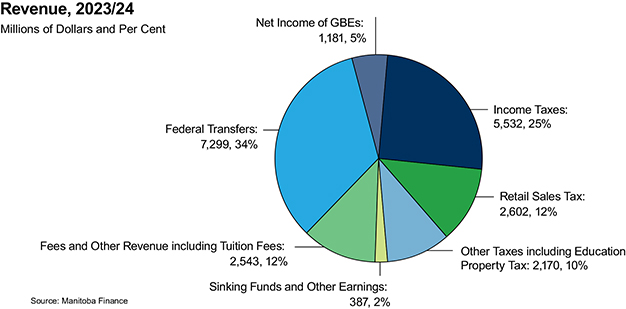
Budget 2023 includes a projected revenue increase of $2,161-million or 11.2 per cent increase from Budget 2022.
Income tax revenue is projected to increase by $574-million from Budget 2022, with a $332-million increase in Individual income tax revenue and a $242-million increase in Corporation income tax revenue. Increase in income tax revenue reflects higher personal and corporate taxable income offset by the fiscal impact of the increase to the basic personal amount in 2023 and the change to the personal income tax bracket thresholds in 2024.
Retail Sales Tax is projected to increase by $192-million reflecting higher consumer spending and higher prices.
Education Property Taxes is projected to decrease by $52-million reflecting the increase to the School Tax Rebate to 50% in 2023.
Other Taxes are projected to decrease overall by $24-million from Budget 2022 reflecting volume decreases in tobacco taxes, fuel taxes and land transfer taxes, offset by increases to corporations taxes and Levy for Health and Education.
Tuition fees are projected to increase $27-million.
Fees and other revenue are projected to decrease by a net of $12-million from Budget 2022 mainly related to the recently announced reduction to the water power rental rates paid by Manitoba Hydro, which is offset by a proportionate increase in Manitoba Hydro’s net income.
Federal transfers are projected to increase $1,049-million, or 16.8 per cent from Budget 2022 reflecting increases in Equalization, the new federal health-care funding proposal and other major transfers and bi-lateral agreements.
Net income of Government Business Enterprises is projected to increase by $347-million mainly reflecting an increase in Manitoba Hydro due to a reduction in water power rental rates and the debt guarantee fee paid to the province and an increase in Manitoba Liquor and Lotteries Corporation revenues through return to full operations. These higher projections are offset by a decline in net revenue from Manitoba Public Insurance due to reductions in basic premium rates.
Sinking funds and other earnings are projected to increase by $60-million compared to Budget 2022 due to an increase in investment earnings offset by a reduction in the guarantee fees paid by Manitoba Hydro.
| 8 | Budget 2023 – Summary Budget and Financial Updates
|
|
|
Expenditure
Expenditures in 2023/24 are projected to increase $1,976-million overall, or 9.9 per cent from Budget 2022.
Significant changes in departmental expenditures include a $469-million or 7.0 per cent increase in Health due to increases in front-line health care provider remuneration and price and volume increases in Pharmacare.
Education and Early Childhood Learning has projected an increase of $113-million largely due to increased operational requirements to strengthen the education system with a focus on literacy, numeracy, student presence and engagement.
Advanced Education and Training has projected an increase of $169-million mainly due to higher personnel expenses and inflationary increases in operational costs at post-secondary institutions.
Families has projected an increase of $221-million as a result of sector wage increases for the Community Living disABILITY Services, Homelessness strategy initiatives, as well as price and volume increases to Employment, Income and Health Supports.
Agriculture has projected a $117-million increase primarily due to higher insurance indemnities and increased contributions to the reserves for the AgriInsurance program after a high claim year in 2021/22.
Consumer Protection and Government Services has projected an increase of $242-million primarily due to higher projected expenditures for cost-shared projects under the Investing in Canada Infrastructure Program (ICIP) being delivered to municipalities.
Enabling Appropriations is projected to increase by $116-million largely due to an increase in funding to advance various initiatives such as the Surgical and Diagnostic Backlog, Health Human Resource Action Plan, Homelessness Strategy and the federal programs under the Low Carbon Economy Fund.
Debt Servicing is projected to increase by $263-million due to higher interest rates.
| Budget 2023 – Summary Budget and Financial Updates | 9
|
|
|
2022/23 Forecast
Revenue
Overall, revenue is forecast at $1,230-million higher compared to budget for 2022/23. The majority of the increase is comprised of $474-million increase from own source revenue and $549-million increase in net income from government business enterprises.
Individual income tax revenue is $198-million higher than budget, while Corporation income tax revenue is $425-million higher than budget reflecting a total of $623-million increase based on higher than forecast economic growth boosted by stronger labour projections.
Retail Sales Tax is forecast to increase by $139-million over budget while Education Property Taxes are projected to decrease $78-million compared to budget.
Other taxes is forecast to decrease by $71-million compared to budget. The decrease reflects lower revenue projections from lower fuel consumption as well as lower tobacco sales.
Tuition fees are forecast to be $12-million under budget while fees and other revenues are forecast to be $149-million under budget. The decline in fees and other revenues includes the reduction to the water power rental rates paid by Manitoba Hydro, which is offset by a proportionate increase in Hydro net income.
Net changes in Federal transfers includes a $72-million one-time federal payment to the Canada Health Transfer to address the backlog of surgeries and procedures. Other net changes in federal transfers reflect a reduction in the forecast for federal transfers related to the Lake Manitoba and Lake St. Martin outlet channels due to delays in the federal environmental licensing process, which is partially offset by a one-time transfer of $27-million for public transit and school ventilation, which flows through the province to municipalities and school divisions.
Net income of Government Business Enterprises mainly reflects an increase in Manitoba Hydro’s forecast. Due to a combination of above-average water levels at generating stations, an upward forecast attributable to the export spot market prices, as well as a reduction in water power rental rates and the debt guarantee fee paid to the province, Hydro is now forecasting a $531-million improvement over budget. Manitoba Public Insurance is forecasting a lower net income compared to budget largely due to higher project and operating expenses. This is offset by an increase to Manitoba Liquor and Lotteries Corporation’s net income forecast driven by projected strong gaming revenues and higher than expected liquor sales.
Budget 2022 included a $200-million negative revenue contingency as a fiscal planning measure given the uncertain economic situation. This contingency has been removed in this forecast.
| 10 | Budget 2023 – Summary Budget and Financial Updates
|
|
|
Expenditure
Expenditures in 2022/23 are forecast at $1,060-million over budget, which includes over $940-million in additional expenditure authority obtained through Special Warrants.
Health is forecasting an increase of $298-million over budget largely reflecting expenditure pressures in the regional health authorities and price and volume increases in Pharmacare. The variance also includes expenditures related to the implementation of the Health Human Resource Action Plan focused on retaining, training and recruiting health professionals.
Finance is forecasting a variance of $271-million over budget mainly due to the affordability measures that provided relief for families and seniors as well as the recently announced Carbon Tax Relief Fund.
Municipal Relations is forecasting an increase of $211-million over budget mainly due to the $140-million investment in nine municipal water and wastewater projects, $47-million operating grant increase for the 2023 municipal year, and $21-million of federal transit funding that will flow through the province to municipalities.
Consumer Protection and Government Services is forecasting an over expenditure of $115-million, primarily due to the distribution of pandemic related supplies that have been donated by the federal government as well as increased repairs and maintenance costs for older fleet vehicles as a result of vehicle supply chain issues affecting delivery of new units.
Agriculture is forecasting an under expenditure of $94-million largely due to a reduction in anticipated indemnity payments for both the AgriInsurance and Hail Insurance programs.
Economic Development, Investment and Trade is forecasting to be over budget due to a $50-million contribution to the Venture Capital Fund.
Emergency Expenditures is forecasting an increase of $117-million over budget, mainly related to the 2022 spring flood costs and higher than anticipated wildfire suppression expenditures.
Debt Servicing is forecast to be $88-million over budget reflecting the higher interest rates. The Bank of Canada has increased Canada’s target interest rate from 0.25 per cent in March 2022 to 4.50 per cent by January 2023.
| Budget 2023 – Summary Budget and Financial Updates | 11
|
|
|
Summary Revenue
For the Fiscal Year Ending March 31
| 2023/24 Budget |
2022/23 Forecast* |
2022/23 Budget |
||||||||||
| (Millions of Dollars) | ||||||||||||
| Income Taxes |
||||||||||||
| Individual Income Tax |
4,646 | 4,512 | 4,314 | |||||||||
| Corporation Income Tax |
886 | 1,069 | 644 | |||||||||
| Subtotal: Income Taxes |
5,532 | 5,581 | 4,958 | |||||||||
| Retail Sales Tax |
2,602 | 2,549 | 2,410 | |||||||||
| Education Property Taxes |
693 | 667 | 745 | |||||||||
| Other Taxes |
||||||||||||
| Corporations Taxes |
398 | 390 | 366 | |||||||||
| Fuel Taxes |
342 | 320 | 359 | |||||||||
| Land Transfer Tax |
134 | 139 | 149 | |||||||||
| Levy for Health and Education |
439 | 415 | 422 | |||||||||
| Tobacco Tax |
150 | 147 | 192 | |||||||||
| Other Taxes |
14 | 19 | 13 | |||||||||
| Subtotal: Other Taxes |
1,477 | 1,430 | 1,501 | |||||||||
| Tuition Fees |
474 | 435 | 447 | |||||||||
| Fees and Other Revenue |
||||||||||||
| Fines and Costs and Other Legal |
49 | 49 | 49 | |||||||||
| Minerals and Petroleum |
34 | 24 | 17 | |||||||||
| Automobile and Motor Carrier Licences and Fees |
169 | 160 | 166 | |||||||||
| Parks: Forestry and Other Conservation |
39 | 46 | 41 | |||||||||
| Water Power Rentals |
65 | 70 | 120 | |||||||||
| Service Fees and Other Miscellaneous Charges |
1,713 | 1,583 | 1,688 | |||||||||
| Subtotal: Fees and Other Revenue |
2,069 | 1,932 | 2,081 | |||||||||
| Federal Transfers |
||||||||||||
| Equalization |
3,510 | 2,933 | 2,933 | |||||||||
| Canada Health Transfer (CHT) |
1,853 | 1,719 | 1,633 | |||||||||
| Canada Social Transfer (CST) |
591 | 581 | 576 | |||||||||
| Shared Cost and Other Transfers |
1,345 | 1,024 | 1,108 | |||||||||
| Subtotal: Federal Transfers |
7,299 | 6,257 | 6,250 | |||||||||
| Net Income of Government |
||||||||||||
| Business Enterprises (GBEs) |
||||||||||||
| Manitoba Liquor and Lotteries Corporation |
668 | 725 | 635 | |||||||||
| Deposit Guarantee Corporation of Manitoba |
33 | 27 | 31 | |||||||||
| Manitoba Hydro-Electric Board |
450 | 651 | 120 | |||||||||
| Manitoba Public Insurance Corporation |
30 | (20 | ) | 48 | ||||||||
| Subtotal: Net Income of GBEs |
1,181 | 1,383 | 834 | |||||||||
| Sinking Funds and Other Earnings |
387 | 349 | 327 | |||||||||
| Contingency |
(200 | ) | - | (200 | ) | |||||||
| Total Revenue |
21,514 | 20,583 | 19,353 | |||||||||
*Represents the forecast as of third quarter.
| 12 | Budget 2023 – Summary Budget and Financial Updates
|
|
|
Summary Expenditure
For the Fiscal Year Ending March 31
| |
2023/24 Budget |
|
|
2022/23 Forecast |
* |
|
2022/23 Budget |
| ||||
| (Millions of Dollars) | ||||||||||||
| Expenditure |
||||||||||||
| Legislative Assembly |
74 | 55 | 53 | |||||||||
| Executive Council |
5 | 5 | 5 | |||||||||
| Advanced Education and Training |
1,833 | 1,656 | 1,664 | |||||||||
| Agriculture |
612 | 401 | 495 | |||||||||
| Consumer Protection and Government Services |
648 | 521 | 406 | |||||||||
| Economic Development, Investment and Trade |
183 | 233 | 183 | |||||||||
| Education and Early Childhood Learning |
3,679 | 3,569 | 3,566 | |||||||||
| Environment and Climate |
140 | 105 | 136 | |||||||||
| Families |
2,305 | 2,071 | 2,084 | |||||||||
| Finance |
72 | 338 | 67 | |||||||||
| Health |
7,133 | 6,962 | 6,664 | |||||||||
| Indigenous Reconciliation and Northern Relations |
39 | 37 | 37 | |||||||||
| Justice |
813 | 727 | 729 | |||||||||
| Labour and Immigration |
32 | 28 | 28 | |||||||||
| Mental Health and Community Wellness |
439 | 409 | 412 | |||||||||
| Municipal Relations |
420 | 603 | 392 | |||||||||
| Natural Resources and Northern Development |
156 | 141 | 138 | |||||||||
| Public Service Commission |
29 | 28 | 28 | |||||||||
| Seniors and Long-Term Care |
93 | 30 | 54 | |||||||||
| Sport, Culture and Heritage |
95 | 109 | 91 | |||||||||
| Transportation and Infrastructure |
550 | 518 | 524 | |||||||||
| Enabling Appropriations |
989 | 939 | 873 | |||||||||
| Emergency Expenditures |
100 | 217 | 100 | |||||||||
| Tax Credits** |
150 | 146 | 147 | |||||||||
| Debt Servicing |
1,288 | 1,113 | 1,025 | |||||||||
| Total Expenditures |
21,877 | 20,961 | 19,901 | |||||||||
Notes:
* Represents the forecast as of third quarter.
** Tax Credits includes only those tax credits that are recorded as expenditures; other tax credits like the Education Property Tax Credit are recorded as revenue offsets.
| Budget 2023 – Summary Budget and Financial Updates | 13
|
|
|
| Total Revenue: $21,714
Note: a revenue contingency of $200-million used for fiscal planning further reduces the projection to $21,514. |

| Total Expenditure: $21,877 |
| 14 | Budget 2023 – Summary Budget and Financial Updates
|
|
|
Financial Updates
Summary Net Debt
| 2023/24 Budget |
2022/23 Forecast |
|||||||||||
| (Millions of Dollars) | ||||||||||||
| Summary Net Debt, beginning of year |
29,415 | 28,455 | ||||||||||
| Net Investment in Tangible Capital Assets |
1,279 | 582 | ||||||||||
| Plus: Projected (Income) Loss for the Year |
363 | 378 | ||||||||||
| Change in Net Debt |
1,642 | 960 | ||||||||||
| Summary Net Debt, end of year |
31,057 | 29,415 | ||||||||||
Summary net debt is an important indicator of a government’s financial position, as this highlights the affordability of future government services. Summary net debt represents the difference between the Government Reporting Entity’s total liabilities, less financial assets; it reflects the residual liability that must be financed by future revenues. It is important to measure changes in net debt against the growth of the economy, as measured by nominal GDP.
In Budget 2023, the net debt to GDP ratio is forecast to be 34.6 per cent. This is a decrease from 35.9 per cent in Budget 2022.
| Budget 2023 – Summary Budget and Financial Updates | 15
|
|
|
| Capital Investment
Capital investment continues to be a priority across government. An investment made to construct or enhance capital assets is a benefit to Manitobans for the provision of services needed into the future. Tangible capital assets are assets with a useful life extending beyond one year, which are acquired, constructed or developed and held for use, not for resale. Net investment in tangible capital assets is projected to be $16.3-billion as at March 31, 2024. |
Tangible Capital Assets – Net Book Values
Millions of Dollars
Source: Manitoba Finance |
TANGIBLE CAPITAL ASSETS – NET BOOK VALUES
| Projection as at March 31 |
2023/24 Budget |
2022/23 Forecast |
||||||
| (Millions of Dollars) | ||||||||
| Cost of Assets, beginning of year |
27,948 | 26,521 | ||||||
| Additions |
2,120 | 1,427 | ||||||
| Cost of Assets, end of year |
30,068 | 27,948 | ||||||
| Accumulated Amortization, beginning of year |
12,889 | 12,044 | ||||||
| Amortization |
841 | 845 | ||||||
| Accumulated Amortization, end of year |
13,730 | 12,889 | ||||||
| Net Book Value |
16,338 | 15,059 | ||||||
| 16 | Budget 2023 – Summary Budget and Financial Updates
|
|
|
Borrowing Requirements
Manitoba’s borrowing requirements with respect to both general and self-sustaining borrowings are estimated to total $4.7-billion in 2023/24, of which $2.4-billion is required for refinancing purposes. New cash requirements, net of estimated repayments, are $2.3-billion, which includes requirements for general government purposes and capital investments by departments. To date, approximately $1.8-billion of funding for 2023/24 has been pre-borrowed.
Manitoba will also pre-fund approximately $2.1-billion of borrowing requirements for fiscal 2024/25. This will reduce the amount that needs to be borrowed next fiscal year.
BORROWING REQUIREMENTS 2023/24
| Refinancing | New Cash Requirements |
Estimated Repayments |
Gross Borrowing Repayments |
Pre- Borrowed March 31, 2023 |
Pre- Funding March 31, 2024 |
Borrowing Requirements |
||||||||||||||||||||||
| (Millions of Dollars) | ||||||||||||||||||||||||||||
| Government Business Enterprises |
||||||||||||||||||||||||||||
| Manitoba Hydro-Electric Board |
400 | - | - | 400 | - | - | 400 | |||||||||||||||||||||
| Manitoba Liquor and Lotteries Corporation |
- | 90 | 57 | 33 | - | - | 33 | |||||||||||||||||||||
| Subtotal |
400 | 90 | 57 | 433 | - | - | 433 | |||||||||||||||||||||
| Other Borrowings |
||||||||||||||||||||||||||||
| General Purpose Borrowings |
1,100 | 655 | - | 1,755 | 1,159 | 930 | 1,526 | |||||||||||||||||||||
| Capital Investment Assets |
200 | 1,013 | 334 | 879 | 388 | 920 | 1,411 | |||||||||||||||||||||
| Health Facilities |
196 | 290 | 119 | 367 | 100 | - | 267 | |||||||||||||||||||||
| Other Crowns and Organizations |
302 | 765 | 277 | 790 | 75 | - | 715 | |||||||||||||||||||||
| Public School Divisions |
- | 260 | 31 | 229 | 75 | - | 154 | |||||||||||||||||||||
| Teachers’ Retirement Allowances Fund |
- | - | - | - | - | 250 | 250 | |||||||||||||||||||||
| Subtotal |
1,798 | 2,983 | 761 | 4,020 | 1,797 | 2,100 | 4,323 | |||||||||||||||||||||
| Total Borrowing Requirements |
2,198 | 3,073 | 818 | 4,453 | 1,797 | 2,100 | 4,756 | |||||||||||||||||||||
| Budget 2023 – Summary Budget and Financial Updates | 17
|
|
|
Special Accounts
Pension Assets Fund
The trust conditions of the funds held in the Pension Assets Fund are irrevocably restricted for pension purposes only. Net investment earnings of pension assets include the expected rate of return during the year, as well as adjustments to the market-related value. Market fluctuations of pension assets are not recorded in the year in which they occur, but are recognized over the employee average remaining service life.
The fund is expected to have a balance of $5,713-million by the end of the 2023/24 fiscal year.
PENSION ASSETS FUND
| Projection as at March 31 |
2023/24 Budget |
2022/23 Forecast |
||||||
| (Millions of Dollars) | ||||||||
| Balance, beginning of year |
5,568 | 5,427 | ||||||
| Contributions and Revenue |
||||||||
| Net Investment Earnings |
374 | 367 | ||||||
| Departments and Crown Corporations |
234 | 228 | ||||||
| 608 | 595 | |||||||
| Transfers |
||||||||
| Teachers’ Retirement Allowances Fund and Civil Service Superannuation Fund payments |
(463 | ) | (454 | ) | ||||
| Balance, end of year |
5,713 | 5,568 | ||||||
Fiscal Stabilization Account
The Fiscal Stabilization Account, also known as the rainy day fund, currently has a balance of $585-million. Any draws or deposits for 2022/23 or 2023/24 will be announced closer to year end.
| 18 | Budget 2023 – Summary Budget and Financial Updates
|
|
|
MANITOBA SUMMARY FINANCIAL STATISTICS
| 2023/24 Budget |
2022/23 Forecast |
2021/22 Actual |
2020/21 Actual |
2019/20 Actual |
2018/19 Actual | |||||||||||||||||||
| SUMMARY FINANCIAL STATEMENTS |
(Millions of Dollars) | |||||||||||||||||||||||
| Revenue |
||||||||||||||||||||||||
| Income Taxes |
5,532 | 5,581 | 5,245 | 4,199 | 4,515 | 4,234 | ||||||||||||||||||
| Other Taxes |
4,772 | 4,646 | 4,485 | 4,429 | 4,492 | 4,685 | ||||||||||||||||||
| Fees and Other Revenue |
2,543 | 2,367 | 2,479 | 2,291 | 2,465 | 2,341 | ||||||||||||||||||
| Federal Transfers |
7,299 | 6,257 | 6,263 | 5,900 | 4,879 | 4,531 | ||||||||||||||||||
| Net Income of Government Business Enterprises |
1,181 | 1,383 | 321 | 600 | 913 | 919 | ||||||||||||||||||
| Sinking Funds and Other Earnings |
387 | 349 | 314 | 325 | 377 | 318 | ||||||||||||||||||
| Contingency |
(200 | ) | - | - | - | - | - | |||||||||||||||||
| Total Revenue |
21,514 | 20,583 | 19,107 | 17,744 | 17,641 | 17,028 | ||||||||||||||||||
| Expenditures (excluding Debt Servicing) |
20,589 | 19,848 | 18,844 | 18,899 | 16,599 | 16,177 | ||||||||||||||||||
| Debt Servicing |
1,288 | 1,113 | 967 | 969 | 1,037 | 1,000 | ||||||||||||||||||
| Expenditure |
21,877 | 20,961 | 19,811 | 19,868 | 17,636 | 17,177 | ||||||||||||||||||
| Net Income (Loss) |
(363 | ) | (378 | ) | (704 | ) | (2,124 | ) | 5 | (149 | ) | |||||||||||||
| Tangible Capital assets |
||||||||||||||||||||||||
| Acquisition of tangible capital assets |
(2,120 | ) | (1,427 | ) | (1,071 | ) | (1,061 | ) | (1,025 | ) | (1,006 | ) | ||||||||||||
| Amortization of tangible capital assets |
841 | 845 | 802 | 783 | 745 | 723 | ||||||||||||||||||
| Disposal of tangible capital assets |
- | - | 47 | 64 | 93 | 39 | ||||||||||||||||||
| Subtotal |
(1,279 | ) | (582 | ) | (222 | ) | (214 | ) | (187 | ) | (244 | ) | ||||||||||||
| Other Non-Financial Assets |
||||||||||||||||||||||||
| Decrease (Increase) in inventories |
- | - | (151 | ) | (110 | ) | (8 | ) | 3 | |||||||||||||||
| Decrease (Increase) in prepaid expenses |
- | - | (6 | ) | (5 | ) | (4 | ) | (10 | ) | ||||||||||||||
| Subtotal |
- | - | (157 | ) | (115 | ) | (12 | ) | (7 | ) | ||||||||||||||
| Other comprehensive income (loss) |
- | - | 279 | 243 | 69 | (225 | ) | |||||||||||||||||
| (Increase) in Net Debt |
(1,642 | ) | (960 | ) | (804 | ) | (2,210 | ) | (125 | ) | (625 | ) | ||||||||||||
| Summary Net Debt, beginning of year |
(29,415 | ) | (28,455 | ) | (27,651 | ) | (25,441 | ) | (25,095 | ) | (24,470 | ) | ||||||||||||
| Change in Accounting Policy |
- | - | - | - | (221 | ) | - | |||||||||||||||||
| Summary Net Debt |
(31,057 | ) | (29,415 | ) | (28,455 | ) | (27,651 | ) | (25,441 | ) | (25,095 | ) | ||||||||||||
| Budget 2023 – Summary Budget and Financial Updates | 19
|
|
|
MANITOBA SUMMARY FINANCIAL STATISTICS
| 2023/24 Budget |
2022/23 Forecast |
2021/22 Actual |
2020/21 Actual |
2019/20 Actual |
2018/19 Actual |
|||||||||||||||||||
| Annual Change |
(Percentage Change) | |||||||||||||||||||||||
| Income Taxes |
(0.9 | ) | 6.4 | 24.9 | (7.0 | ) | 6.6 | 6.2 | ||||||||||||||||
| Other Taxes |
2.7 | 3.6 | 1.3 | (1.4 | ) | (4.1 | ) | 2.1 | ||||||||||||||||
| Fees and Other Revenue |
7.4 | (4.5 | ) | 8.2 | (7.1 | ) | 5.3 | (1.0 | ) | |||||||||||||||
| Federal Transfers |
16.7 | (0.1 | ) | 6.2 | 20.9 | 7.7 | 7.9 | |||||||||||||||||
| Total Revenue |
4.5 | 7.7 | 7.7 | 0.6 | 3.6 | 5.4 | ||||||||||||||||||
| Debt Servicing |
15.7 | 15.1 | (0.2 | ) | (6.6 | ) | 3.7 | 5.0 | ||||||||||||||||
| Total Expenditure |
4.4 | 5.8 | (0.3 | ) | 12.7 | 2.7 | 2.0 | |||||||||||||||||
| Summary Net Debt |
5.6 | 3.4 | 2.9 | 8.7 | 1.4 | 2.6 | ||||||||||||||||||
| Per Cent of GDP |
(Per Cent) | |||||||||||||||||||||||
| Income Taxes |
6.2 | 6.4 | 6.6 | 5.7 | 6.1 | 5.8 | ||||||||||||||||||
| Other Taxes |
5.3 | 5.3 | 5.6 | 6.0 | 6.0 | 6.4 | ||||||||||||||||||
| Fees and Other Revenue |
2.8 | 2.7 | 3.1 | 3.1 | 3.3 | 3.2 | ||||||||||||||||||
| Federal Transfers |
8.1 | 7.1 | 7.8 | 8.0 | 6.5 | 6.2 | ||||||||||||||||||
| Total Revenue |
24.0 | 23.5 | 23.9 | 24.1 | 23.6 | 23.2 | ||||||||||||||||||
| Debt Servicing |
1.4 | 1.3 | 1.2 | 1.3 | 1.4 | 1.4 | ||||||||||||||||||
| Total Expenditure |
24.4 | 23.9 | 24.8 | 27.0 | 23.6 | 23.4 | ||||||||||||||||||
| Summary Net Debt |
(34.6 | ) | (33.5 | ) | (35.6 | ) | (37.6 | ) | (34.1 | ) | (34.2 | ) | ||||||||||||
| Per Cent of Revenue |
||||||||||||||||||||||||
| Income Taxes |
25.7 | 27.1 | 27.5 | 23.7 | 25.6 | 24.9 | ||||||||||||||||||
| Other Taxes |
22.2 | 22.6 | 23.5 | 25.0 | 25.5 | 27.5 | ||||||||||||||||||
| Fees and Other Revenue |
11.8 | 11.5 | 13.0 | 12.9 | 14.0 | 13.7 | ||||||||||||||||||
| Federal Transfers |
33.9 | 30.4 | 32.8 | 33.3 | 27.7 | 26.6 | ||||||||||||||||||
| Net Income of Government Business Enterprises |
5.5 | 6.7 | 1.7 | 3.4 | 5.2 | 5.4 | ||||||||||||||||||
| Sinking Funds and Other Earnings |
1.8 | 1.7 | 1.6 | 1.8 | 2.1 | 1.9 | ||||||||||||||||||
| Debt Servicing |
6.0 | 5.4 | 5.1 | 5.5 | 5.9 | 5.9 | ||||||||||||||||||
| Dollars Per Capita |
(Dollars) | |||||||||||||||||||||||
| Total Revenue |
15,064 | 14,606 | 13,808 | 12,852 | 12,877 | 12,587 | ||||||||||||||||||
| Total Expenditure |
15,318 | 14,874 | 14,316 | 14,391 | 12,873 | 12,697 | ||||||||||||||||||
| Debt Servicing |
902 | 790 | 699 | 702 | 757 | 739 | ||||||||||||||||||
| Summary Net Debt |
(21,746 | ) | (20,874 | ) | (20,563 | ) | (20,028 | ) | (18,570 | ) | (18,550 | ) | ||||||||||||
| Memorandum Items |
||||||||||||||||||||||||
| Population (000s) * |
1,428.2 | 1,409.2 | 1,383.8 | 1,380.6 | 1,370.0 | 1,352.8 | ||||||||||||||||||
| GDP at Market Prices |
89,729 | 87,763 | 79,834 | 73,635 | 74,626 | 73,372 | ||||||||||||||||||
Source: Manitoba Finance
* official population July 1
Note: Numbers may not add due to rounding.
| 20 | Budget 2023 – Summary Budget and Financial Updates
|
|
|
Entities Included in
the Summary Budget
| Legislative Assembly
Executive Council
Advanced Education and Training
Assiniboine Community College
Brandon University
Manitoba Institute of Trades and Technology
Red River College Polytechnic
Université de Saint-Boniface
University College of the North
University of Manitoba
University of Winnipeg
Agriculture
Manitoba Agricultural Services Corporation
Consumer Protection and Government Services
Entrepreneurship Manitoba
Manitoba Education, Research and Learning Information Networks (MERLIN)
Materials Distribution Agency
The Public Guardian and Trustee of Manitoba
Vehicle and Equipment Management Agency
Economic Development, Investment and Trade
Abandonment Reserve Fund
Communities Economic Development Fund
Economic Development Winnipeg Inc.*
Manitoba Development Corporation
Manitoba Opportunities Fund Ltd.
Manitoba Potash Corporation
Mining Rehabilitation Reserve Fund
Quarry Rehabilitation Reserve Fund |
Research Manitoba
Rural Manitoba Economic Development Corporation
Education and Early Childhood Learning
Public School Divisions
Environment and Climate
Efficiency Manitoba Inc.
Manitoba Hazardous Waste Management Corporation
Families
General Child and Family Services Authority
Manitoba Housing and Renewal Corporation
Finance
Insurance Council of Manitoba
Manitoba Financial Services Agency
Pension Assets Fund
Health
CancerCare Manitoba
Not-for-Profit Personal Care Homes and Community Health Agencies
Regional Health Authorities (including controlled organizations)
Interlake-Eastern Regional Health Authority
Northern Regional Health Authority
Prairie Mountain Health
Southern Health-Santé Sud
Winnipeg Regional Health Authority
Rehabilitation Centre for Children, Inc.
Shared Health Inc.
St.Amant Inc. | |
| Budget 2023 – Summary Budget and Financial Updates | 21
|
|
|
| Indigenous Reconciliation and Northern Relations
Justice
Legal Aid Manitoba
Liquor, Gaming and Cannabis Authority of Manitoba
Manitoba Law Reform Commission
Labour and Immigration
Mental Health and Community Wellness
Municipal Relations
Manitoba Water Services Board
North Portage Development Corporation**
Natural Resources and Northern Development
Public Service Commission
Seniors and Long-Term Care
Sport, Culture and Heritage
Le Centre culturel franco-manitobain
Manitoba Arts Council
Manitoba Centennial Centre Corporation
Manitoba Combative Sports Commission
Manitoba Film and Sound Recording Development Corporation
Sport Manitoba Inc.
Travel Manitoba
Transportation and Infrastructure |
Government Business Enterprises
Deposit Guarantee Corporation of Manitoba
Manitoba Hydro-Electric Board
Manitoba Liquor and Lotteries Corporation
Manitoba Public Insurance Corporation
Special Accounts, not attached to a Department
Fiscal Stabilization Account (Rainy Day Fund)
Notes: * Economic Development Winnipeg Inc. is a government partnership ** North Portage Development Corporation is a government business partnership | |
| 22 | Budget 2023 – Summary Budget and Financial Updates
|
|
|
Note on the Format
This budget paper includes seven parts:
| 1. | Historic Help for Manitobans describes the key priorities and investments in this budget and provides updates on select programs and initiatives. |
| 2. | Capital Investments provides details on a multi-year capital plan, highlights of strategic infrastructure spending and the development of a longer-term capital strategy for Manitoba. |
| 3. | Modernizing Government and Summary Reporting provides highlights of ongoing work to modernize how government fulfils its functions including the management of the summary government reporting entity. |
| 4. | Economic Outlook and Review provides the economic outlook and review for Manitoba, Canada and internationally including certain risks to the outlook. |
| 5. | Fiscal Strategy presents a renewed fiscal strategy aimed at responsibly balancing the budget and measuring progress with fiscal indicators. |
| 6. | Borrowing and Debt Management Strategy presents the government’s borrowing plan and approach to debt management. |
| 7. | Federal-Provincial Fiscal Arrangements highlights the major federal transfers to Manitoba and other fiscal issues of intergovernmental significance. |
Budget 2023 Announcements
New initiatives, programs and undertakings announced in Budget 2023 are indicated in bold with a unique symbol.

| 24 | Budget 2023 – Fiscally Responsible Outcomes and Economic Growth Strategy
|
|
|
Introduction
Budget 2023 invests nearly $2-billion in new funding to provide historic help for Manitobans. These investments will make streets safer, heal the health-care system, make communities stronger and create opportunities ahead for all Manitobans.
Budget 2023: Historic Help for Manitobans reflects the priorities of every Manitoban. The development of this year’s budget was informed by significant public engagement in January and February 2023, with thousands of Manitobans participating in consultations across the province.
This year, 29,934 individuals participated in the pre-budget engagement process, with 15,758 people taking part in telephone town halls, 127 people attending public meetings and more than 10,078 people taking part in online quick polls. The government also received 3,971 responses to the online survey at EngageMB. For more information on Budget 2023 consultations, visit engagemb.ca/budget-2023.
Manitobans have faced unprecedented challenges over the last three years, challenges that required unprecedented government action. The Manitoba government has steered the province through the COVID-19 pandemic, the economic impacts of the war in Ukraine, supply chain disruptions, inflation and high interest rates. While the uncertainty continues, Manitoba’s economy has proven to be resilient. Manitoba has recovered faster and emerged stronger than ever.
In 2022/23, all provinces across Canada experienced increased tax revenues thanks to the economic rebound coming out of the pandemic. While the Manitoba government did not anticipate the pace of the recovery in the previous year’s budget, in 2022/23 it helped the government address the cost-shock of inflation,
pandemic-related health-care backlogs and other challenges for Manitobans.
The Manitoba government invested the growth in personal and corporate tax revenues into two special warrants totalling more than $940-million. These investments helped reduce the cost of living for families and invested in the services Manitobans rely on.
The Manitoba government is continuing with this balanced approach. Budget 2023 invests nearly $2-billion in new funding to provide historic help for Manitobans. These investments will make our streets safer, heal our health-care system, make our communities stronger and create opportunities ahead for all Manitobans.
The government has been outperforming budget projections, lowering the deficit to $704-million in 2021/22 and to a projected deficit of $378-million in the third quarter of 2022/23. Budget 2023 projects a deficit of $363-million, and puts Manitoba on track to balance the budget by 2028/29.
Budget 2023 provides a balanced approach to the challenges the province faces. It provides historic help for Manitobans that will shape the future of the province for generations to come.
| Budget 2023 – Fiscally Responsible Outcomes and Economic Growth Strategy | 25
|
|
|
Budget 2023 – Historic Help
for Manitobans
During increasingly uncertain financial conditions, sound fiscal management will build a stronger and more resilient province. Budget 2023 balances much-needed investments into Manitobans’ priorities with careful, measured approaches to support economic growth.
Budget 2023 is providing historic help to support Manitobans across all areas of family and community life. With economic growth stronger than expected, the Manitoba government is investing every dollar into the priorities of Manitobans.
Historic Help for Manitobans
Budget 2023 implements new and enhanced tax measures to better bring Manitoba’s personal income taxes in line with other provinces. The changes in personal income tax will allow families to keep more of their income and will attract inter-provincial migration to grow the economy.
The new tax measures include:
| · | increasing the Basic Personal Amount to $15,000 in 2023; |
| · | increasing the personal income tax bracket thresholds to $47,000 and $100,000 for 2024; |
| · | continuing to phase out school taxes by increasing the rebate for residential and farm properties from 37.5 per cent to 50 per cent in 2023; and |
| · | continuing to reduce the Health and Post-Secondary Education Tax Levy in 2024 by increasing thresholds for the fourth consecutive year and committing to the first reduction in the tax rates in 25 years tied to Manitoba’s 2023 fiscal performance. |
When these taxation changes are combined with other affordability measures, Manitobans will benefit from more than $1.8-billion in savings between 2022 and 2024.
The reduction of payments charged to Manitoba Hydro will have a favourable impact on electricity rates. Manitoba Hydro’s rate application to the Public Utilities Board is now an increase of only two per cent over each of the next two years, saving Manitoba Hydro and ratepayers $190-million this year and more than $4-billion over the next 20 years.
These changes build on the 2022/23 Family Affordability Package and Carbon Tax Relief Fund payments that return nearly $290-million to Manitobans.
Safer Streets
Government plays a significant role in keeping Manitobans safe from crime. To achieve this, Budget 2023 brings a balanced approach that addresses the root causes of crime while cracking down on violent crime.
Budget 2023 includes funding to implement a $51.8-million Violent Crime Strategy over two years, which will provide support for police services as well as resources and funding for prosecution services to create additional capacity to address crime.
| 26 | Budget 2023 – Fiscally Responsible Outcomes and Economic Growth Strategy
|
|
|
Investments in community safety initiatives, including the Winnipeg Bear Clan Patrol Inc. and Winnipeg’s Downtown Community Safety Partnership, will provide more eyes and ears on the ground to make our communities safer.
Investments in services to address the root causes of crime, including addictions, mental health and community wellness, will also help keep our streets safer.
Budget 2023 is investing more than $50-million in a comprehensive homelessness strategy, which will increase funding for overnight shelters, transitional housing and rent subsidies. The Manitoba government is also funding year two of the Mental Health Five-Year Roadmap with $17.3-million, and provides $9.4-million for 1,000 new addictions treatment spaces. Through these investments, more Manitobans are on the road to recovery than ever before.
Building on the increases to Employment and Income Assistance basic needs rate, increases to Rent Assist benefits for working families and the new Disability Support Program will help low-income Manitobans across the province.
Healing Health Care
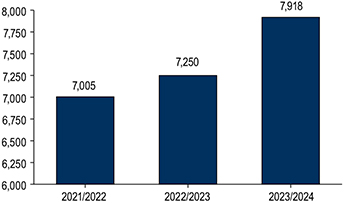
Health-care systems across the country and around the world are facing significant challenges, with the pandemic revealing capacity challenges and creating backlogs in diagnostic tests and surgeries. Budget 2023 invests a record $7.9-billion in health care services in Manitoba, $668-million more than last year to heal health care – a 9.2 per cent increase.
Total Health Care Spending Budget Amounts
2021/22 to 2023/24
Millions of Dollars
Source: Manitoba Finance
To continue addressing the backlogs for diagnostic and surgical services, government is investing $130-million through the Diagnostic and Surgical Recovery Task Force to open more capacity with local private and public care providers, and implement safe, out-of-province care options for some procedures.
The government is also investing $200-million through the Health Human Resource Action Plan for programs and incentives to train and retain health-care professionals, while recruiting more from within Manitoba, across Canada and around the world.
Budget 2023 also commits an additional $15.9-million to advance initiatives in the seniors’ strategy and support a full spectrum of community-based services, as well as $55-million to address recommendations from the Stevenson Review to implement staffing and emergency preparedness technology improvements in personal care homes.
The increase in health funding will address the pressures in Pharmacare, extend coverage for insulin pumps and introduce a new hearing aid program for Manitoba’s seniors.
| Budget 2023 – Fiscally Responsible Outcomes and Economic Growth Strategy | 27
|
|
|
Stronger Communities
Strong and vibrant communities improve the quality of life for all Manitobans, while attracting new families, investment and economic growth. They are built by investing in child care, education, infrastructure, recreation, arts and culture, tourism and heritage projects.
This budget is on track to create an additional 2,600 affordable child-care spaces in non-profit centres under the five-year Early Learning and Child Care Agreement across the province and invests $76.1-million to make $10-per-day child care a reality this year.
In 2022/23, the government invested $77-million in K-12 schools to support teacher wages. Budget 2023 makes this funding permanent to support school divisions for ongoing wage pressures. K-12 schools will receive an additional $100-million funding increase, bringing the total investment to $1.7-billion this year.
Low wages in the government funded Community Living disABILITY Services and Children’s disABILITY Services programs have contributed to high turnover and staff burnout in this critically important sector supporting the most vulnerable Manitobans. Budget 2023 provides $81-million to establish an average funded wage of $19 per hour for all disability service workers funded by the government.
The Manitoba government recognizes that building stronger communities requires working with municipal partners. The government is increasing funding support to Manitoba municipalities in the 2023 municipal fiscal year, increasing the operating funding basket by $47-million, while taking steps to modernize the calculation of municipal operating grants to recognize the needs of municipalities facing greater financial challenges over time. This increase, first implemented in 2023, will become a permanent part of the funding in future years.
Along with the operating grants, a one-time increase of $140-million in capital grants for 2022/23 from the January 2023 special warrant for municipal water and
wastewater infrastructure and a budgeted increase to municipal infrastructure funding for a total commitment of up to $160.4-million on an ongoing basis.
The Manitoba government will continue to work with Indigenous peoples to implement reconciliation commitments related to shared goals and objectives, including addressing the harms related to residential schools. Budget 2023 will also sustain the Indigenous Reconciliation Initiatives Fund, which is dedicated to advancing truth and reconciliation by partnering with Indigenous groups, communities and governing bodies to implement projects to address the injustices that have been faced by Indigenous peoples.
Budget 2023 also builds on investments in nature and heritage spaces, tourism, arts and culture. The government is investing $100-million for the Arts, Culture and Sport in Community Fund, with $50-million available in 2023/24.
Opportunities Ahead
Rich with resources, a skilled workforce and a diversified economy while also located at the centre of North America’s trade corridors, Manitoba is well placed to build an inclusive economy where all Manitobans can compete, innovate and thrive. In 2022/23, Manitoba has experienced unprecedented economic growth and an influx of skilled workers.
Budget 2023 makes investments to spur economic development opportunities, generate well-paying jobs and strengthen the government’s fiscal resilience, all of which will support Manitobans through challenging times.
With input from the Tax Competitiveness Working Group, the Premier’s Economic Advisory Council on Competitiveness is guiding Manitoba’s work to modernize the tax system, making it more affordable and competitive with neighbouring jurisdictions. In 2023/24, the payroll tax thresholds will increase; ensuring employers with payrolls of less than $2.25-million will no longer pay payroll tax.
| 28 | Budget 2023 – Fiscally Responsible Outcomes and Economic Growth Strategy
|
|
|
A strong economy requires a skilled workforce. Budget 2023 invests more than $65-million in operating funding for post-secondary institutions, caps university tuition increases at 2.75 per cent and caps the college tuition increases at $133 per program for Manitoba students. The new Internationally Educated Professionals Program will speed up certification so newcomers can have their credentials recognized, helping them secure employment.
In 2022, the government established a venture capital fund with $50-million in seed funding. This year, Manitoba is adding another $50-million, bringing the government’s total contribution to $100-million to create a much larger venture and growth capital ecosystem for Manitoba businesses.
There are endless opportunities to grow Manitoba’s mining and natural resources sector. Budget 2023 invests to speed up the permitting process, helping to get mines up and running more quickly in Manitoba. Budget 2023 is also continuing the commitment of $10-million over three years in the Manitoba Mineral Development Fund.
Protecting Manitoba’s environment creates conditions for sustainable growth and a greener economy. In Budget 2023, the government will provide grant funding
to encourage businesses, industries and institutions to identify pathways to de-carbonization, as well as fund innovative projects to help protect the environment and create a greener Manitoba.
Capital Investments
Infrastructure is the foundation for quality public services, with the health care, education and criminal justice systems dependent on quality capital assets. It is also integral to a thriving economy, with highways, bridges and other capital projects helping to ensure the efficient movement of people and goods throughout the province and around the world.
To strengthen long-term confidence in the Manitoba economy, Budget 2023 builds on the three-year capital plan in Budget 2022, to a five-year plan with historic levels of strategic capital investments.
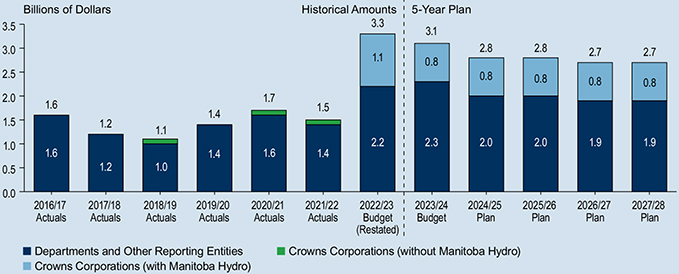
The capital plan in Budget 2023 increases investments to a record $3-billion in 2023/24, through departments and other reporting entities. Over the next five years, Manitoba will be investing a record $14-billion in the province through various departments and other reporting entities. New projects will be added to the five-year capital plan as future years are budgeted.
Highlights of New Investments in Five Priority Areas
|
Historic Help for Manitobans |
· $311-million in tax relief to Manitobans in 2023 through an increase to the Basic Personal Amount from $10,855 to $15,000
· $40-million for Budget 2023 for increases to tax brackets in 2024, which will be worth $160-million in savings for the full 2024 tax year
· increasing minimum wage to $14.15 per hour effective Apr. 1, 2023 and to $15 per hour effective Oct. 1, 2023
· school tax rebates increasing to 50 per cent for farm and residential properties |
| Budget 2023 – Fiscally Responsible Outcomes and Economic Growth Strategy | 29
|
|
|
| Safer Streets
|
· $51.8-million for the Violent Crime Strategy over two years with $34.6-million for 2023/24 | |
|
· $10.8-million to support the RCMP Provincial Police Service Agreement | ||
|
· $3.6-million contribution to the Downtown Community Safety Partnership to build a safer, more inviting downtown Winnipeg for businesses and residents | ||
|
· $7.1-million in funding for enhancements to the Family Violence Prevention Program | ||
|
· $51.1-million in support of the province’s Homelessness Strategy | ||
|
· $780,000 to Toba Centre to expand services responding to child abuse | ||
|
· $100,000 to support ongoing operations of the Winnipeg Bear Clan Patrol Inc. | ||
|
· $17.3-million to advance priorities for the second year of the implementation of the five-year plan, A Pathway to Mental Health and Community Wellness: A Roadmap for Manitoba | ||
|
· $9.4-million to support and create 1,000 new publicly- funded treatment spaces for individuals with substance use and addictions treatment services across the province
| ||
|
Healing Health Care |
· increasing the funding dedicated to reducing the diagnostic and surgical backlog to $130-million | |
|
· continuing to implement the $200-million Health Human Resource Action Plan | ||
|
· $504-million increase into health operations, including a $120-million infusion to the Pharmacare program | ||
|
· $42-million to maintain pandemic readiness and quick response | ||
|
· $1.2-billion in multi-year capital investments for the expansion and improvements to hospital developments in Manitoba under the Clinical and Preventive Services Plan | ||
|
· extending coverage for insulin pumps | ||
|
· creating a new Hearing Aid Program to help cover the costs of hearing aids for Manitoba seniors | ||
|
· $1.5-million increase to enhance mental health amongst children and youth | ||
|
· an increase of $15.9-million to advance initiatives under the Seniors Strategy to enable more seniors to remain in their homes and communities longer | ||
|
· $55-million in 2023/24 to implement recommendations of the Stevenson Review for staffing and emergency preparedness technology improvements in personal care homes across Manitoba
|
| 30 | Budget 2023 – Fiscally Responsible Outcomes and Economic Growth Strategy
|
|
|
|
· an increase of $47-million in the 2023 calendar year and within future municipal fiscal years in operating grants to municipalities and Northern Affairs communities based on a new funding formula | ||
| · an increase to municipal infrastructure funding for a total commitment of up to $160.4-million on an ongoing basis | ||
| · an increase of $54.1-million to support cost-shared strategic infrastructure projects under the Investing in Canada Infrastructure Program | ||
| · an additional $13.4-million for the transit systems in Winnipeg, Brandon, Selkirk, Flin Flon and Thompson | ||
| · an increase of $4-million for the Manitoba Water Services Board in the 2023 calendar year to support water and wastewater projects in municipalities outside Winnipeg | ||
|
· $8.7-million to support recycling, composting and waste diversion initiatives through the Waste Reduction and Recycling Support program | ||
|
· $1.6-million to advance the Water Management Strategy and ensure a long-term approach to managing water resources in partnership with stakeholders and communities | ||
|
· $1.5-million to enhance the provision of safe drinking water in Northern Affairs communities | ||
|
· $10-million to support the new Parks Capital Plan and operating requirements | ||
| Stronger |
· $100-million in new funding in the 2023/24 school year for school divisions and independent schools in addition to a $106-million increase in annualized funding | |
| Communities |
· $268.5-million in capital expenditures to build more schools under the commitment to build 20 new schools, and to support renovation and addition projects in existing schools | |
|
· $1.4-million to develop a Teacher Regulatory Framework | ||
|
· $1.4-million for the implementation of the Student Information System | ||
|
· advancing Manitoba Education and Early Childhood Learning’s Aboriginal Languages Strategy and implementation of Mamàhtawisiwin: The Wonder We are Born With, Manitoba Indigenous Inclusion Policy Framework | ||
| · more than $81-million to the service providers of Community Living disABILITY Services and Children’s disABILITY Services to raise the average funded wage rate to $19/hour | ||
|
· $76.1-million to reduce regulated parent fees for child care to $10 per day | ||
|
· $13.9-million to Child and Family Services authorities to administer to their mandated agencies | ||
| · working with Indigenous leaders, Elders, Knowledge Keepers, families and community members to advance shared goals | ||
|
· providing $300,000 to increase the number of qualified Indigenous translators in Manitoba as part of a multi-year commitment | ||
|
· continuing the $100-million for the Arts, Culture and Sport in Community Fund including $50-million available in 2023/24 | ||
|
· $277,000 funding increase for Manitoba’s public libraries outside of Winnipeg
| ||
| Budget 2023 – Fiscally Responsible Outcomes and Economic Growth Strategy | 31
|
|
|
|
· an additional $50-million contribution to the Venture Capital Fund through a special warrant in January 2023 | ||
|
· $92.5-million in funding to support post-secondary education, an 11.5 per cent increase from 2022/23, including $10-million to support the creation and expansion of programs to address labour market shortages | ||
|
· $15-million in the Community Economic Development Fund | ||
|
· $20-million to support economic development and investment attraction | ||
| · more than $2.5-billion in trade-enabling highway infrastructure over the next five years | ||
|
· $40-million to build infrastructure that will develop and expand CentrePort South, North America’s largest inland port and foreign trade zone through a special warrant in January 2023 | ||
|
· $101-million for the Lake Manitoba Outlet Channels project | ||
|
· $3.6-million for a new internationally-educated professionals program | ||
| · an increase of $2-million to support regional and strategic economic development | ||
|
Opportunities Ahead |
· collaborating with Assembly of Manitoba Chiefs to offer non-traditional lending options through the First Peoples Economic Growth Fund | |
|
· $2.3-million for an increase to the payroll tax exemption from $2-million to $2.25-million and to the threshold below which businesses pay a reduced effective rate from $4-million to $4.5-million | ||
|
· $10.1-million to support the Sector Council Program | ||
|
· $103.1-million contribution to AgriInsurance premiums to help protect producers against crop production shortfalls caused by natural perils | ||
|
· $221-million in Manitoba’s agriculture industry over the next five years (2023-2028), cost-shared with the federal government as part of Sustainable Canadian Agriculture Partnership | ||
|
· Manitoba and Canada are investing a combined $147.6-million over two years in the Hudson Bay rail line to the Port of Churchill | ||
|
· $2.5-million in capital expenditures to support the Manitoba Protein Advantage Strategy | ||
|
· $10-million over the next three years to leverage private sector investment in the mineral sector | ||
| · using the Indigenous Reconciliation Initiatives Fund to develop initiatives and advance progress on reconciliation | ||
|
· $2-million for expansion of Newcomer Community Integration Support Program
| ||
| 32 | Budget 2023 – Fiscally Responsible Outcomes and Economic Growth Strategy
|
|
|
Historic Help for Manitobans
Whether it is filling up a tank of gas, buying groceries or heating a home, the purchases Manitobans make every day are becoming more expensive. As Manitobans continue to grapple with the rising cost of living, Budget 2023 contains new measures to help individuals, families and businesses make ends meet.
Economic factors, such as the Russian invasion of Ukraine, persistent supply chain disruptions, tight labour markets, a robust economic recovery from the COVID-19 pandemic and a weakening Canadian dollar have
contributed to decades-high inflation. These global and domestic forces have created upward pressure on prices, increasing the cost of living for households across the country.
|
In 2022/23, government introduced several key measures to ease the burden of inflation and help Manitobans make ends meet, including:
· providing a nearly $80-million family affordability package for 145,000 Manitoba families with children and a household net income of less than $175,000 and nearly 52,500 low-income Manitoba seniors;
· increasing the basic needs benefits under Employment and Income Assistance benefits and creating a new Disability Income Support Program;
· indexing Employment and Income Assistance (EIA) and non-EIA Rent Assist benefits at 77 per cent and 80 per cent of median market rent respectively;
· providing a zero per cent rent increase guideline in 2022 and 2023 and locking in a $525 annual Residential Renters Tax Credit in 2022, with up to an additional $300 for low-income seniors;
· creating a $1.75-million Food Security Fund to provide temporary relief to organizations that provide food to Manitobans in need and are experiencing financial difficulty due to rising costs and inflation;
|
· providing a $3-million grant to Harvest Manitoba to alleviate food insecurity by helping food banks address increased food prices and high demand province-wide;
· implementing the Business Minimum Wage Adjustment Program to help small- and medium-sized businesses offset the impact of minimum wage increases;
· providing nearly $200-million in Carbon Tax Relief Fund payments to nearly 700,000 individuals and couples; and
· increasing the School Tax Rebate from 25 per cent to 37.5 per cent, with the average homeowner in Manitoba receiving $581.
In November 2022, the government took steps to financially stabilize Manitoba Hydro as a Crown Corporation, including a 50 per cent reduction to both the water power rental rate and the Hydro guarantee fee starting in 2022/23. These changes resulted in approximately $190-million in savings for the utility that will be applied to keep electricity rates low in Manitoba. |
| Budget 2023 – Fiscally Responsible Outcomes and Economic Growth Strategy | 33
|
|
|
|
This will reduce its debt burden by approximately $4-billion over 20 years.
As a result of this historic reduction in payments to the government, Manitoba Hydro filed an update to its general rate application with the Public Utilities Board. The update requested a reduction in the increase to the average electricity rate in Manitoba from 3.5 per cent to two per cent, for fiscal years 2023/24 and 2024/25, lowering the monthly increases for ratepayers.
With savings from reduced government payments growing over time, Manitoba Hydro is now forecasting annual rate increases of two per cent for the next 19 years, starting in fiscal year 2023/24.
On Oct. 19, 2022, Premier Stefanson announced the formation of the Premier’s Economic Advisory Council on Competitiveness to chart Manitoba’s course for reopening its economy and renewing growth to move the province forward. The premier also established a Tax Competitiveness Working Group to support the council. The working group provides advice to further the province’s ongoing work to modernize Manitoba’s
|
tax system, making it more affordable and more competitive with other jurisdictions. The working group is made up of tax professionals and other experts to provide relevant, objective advice on short-, medium-and long-term goals, and prioritize tax measures that the government should consider.
Tax measures introduced in Budget 2023 reflect the input of the working group. This includes a historic increase in the Basic Personal Amount, and personal income tax brackets and planning to reduce the Health and Post-Secondary Education Tax Levy rate based on fiscal performance.
The Manitoba government acknowledges the importance of these first steps, but more is required to advance Manitoba’s tax competitiveness. The working group will continue to meet and continue to provide advice on future steps on personal and business taxation to grow the economy and make Manitoba a competitive place to live, work and invest. | |
| Bringing Taxation More in Line with Other Provinces
The Manitoba government remains focused on maintaining a strong, sustainable fiscal foundation that will provide better services to all Manitobans. This includes investing in frontline services and lowering taxes to make life more affordable for Manitobans and more competitive for Manitoba businesses. |
Basic Personal Amount
The Basic Personal Amount is a non-refundable tax credit every Manitoba resident is entitled to claim on their income tax return that creates a tax-free zone on which Manitoba income tax is not paid.
| |||
|
|
Budget 2023 announces the largest ever enhancement to the Basic Personal Amount. The amount will be increased by $4,145 above the indexed amount, or nearly 40 per cent, from $10,855 to $15,000 in 2023, with a return to annual indexing in 2024. | |||
| 34 | Budget 2023 – Fiscally Responsible Outcomes and Economic Growth Strategy
|
|
|
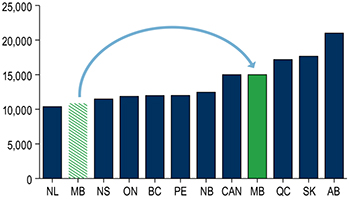
At $15,000, Manitoba’s Basic Personal Amount will match the current federal amount.
As shown in the chart, Manitoba will go from having among the lowest basic personal amounts to among the highest.
2023 Basic Personal Amount
In Dollars
Source: Manitoba Finance
|
|
The total cost of this measure and the savings to Manitoba taxpayers in 2023 is estimated at $311-million. With the Basic Personal Amount enhancement, the incremental savings compared to 2022 will be up to $524 for an individual or $1,048 for a two-income family. |
This measure will remove an
additional 47,400 low-income
taxpayers from the tax rolls in 2023. That is the equivalent of more than 90 per cent of the total population of Brandon no longer paying Manitoba income tax. When combined with increases to the Basic Personal Amount under indexing since 2017, nearly 75,000 low-income Manitobans will no longer be paying Manitoba income tax.
Personal Income Tax Bracket Thresholds in 2024
Manitoba’s personal income taxes are calculated based on three taxable income brackets. Budget 2023 introduces increases to tax bracket thresholds that are over and above the annual indexation increases.
|
|
Budget 2023 increases the tax bracket thresholds for the 2024 taxation year to $47,000 and $100,000, with a return to annual indexing in 2025. |
| Tax Rate | 2023 Taxable Income |
|
2024 Taxable Income |
|||||||
| 10.80% |
first $36,842 | first $47,000 | ||||||||
| 12.75% |
|
over $36,842 up to $79,625 |
|
|
over $47,000 up to $100,000 |
| ||||
| 17.40% |
over $79,625 | over $100,000 | ||||||||
| Budget 2023 – Fiscally Responsible Outcomes and Economic Growth Strategy | 35
|
|
|
These are increases of $10,158 (28 per cent) and $20,375 (26 per cent) compared to the 2023 thresholds and will result in estimated tax savings of $160-million in the 2024 tax year compared to what would have occurred under indexing.
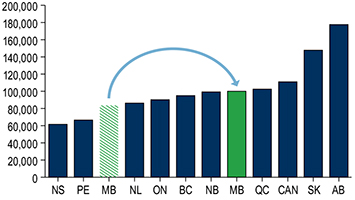
With the increase to $47,000, Manitoba’s first tax bracket threshold is projected to rise from third lowest among provinces to fifth lowest in 2024 and move to within $500 of British Columbia and within 10 per cent of British Columbia, New Brunswick, Ontario, Quebec and Saskatchewan.
2024 Projected Second Tax Bracket Thresholds
In Dollars
Source: Manitoba Finance
With the increase to $100,000, Manitoba’s second tax bracket threshold is projected to rise from third-lowest among provinces to fourth-highest in 2024.
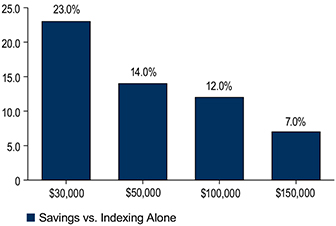
Combined, the changes to the Basic Personal Amount and brackets will provide significant tax savings to Manitobans across the income distribution. A Manitoban with taxable income of $30,000 will pay 23 per cent less than based on indexing alone without the Budget 2023 increases.
At $100,000 in taxable income, a Manitoban will save 12 per cent compared to indexing alone without the Budget 2023 increase. Clearly, Budget 2023 measures provide more tax savings to middle- and low-income Manitobans.
Compared to the forecasted Basic Personal Amount and thresholds based on indexing, taxpayers will save up to an additional $1,399 in 2024 with these threshold improvements.
2024 Percentage Reduction in Provincial Income Taxes by Taxable Income Level
Percentage
Source: Manitoba Finance
| Taxable Income | ||||||||||||||||
| $30,000 | $50,000 | $100,000 | $150,000 | |||||||||||||
| 2024 Savings from Budget 2023 Measures |
$470 | $633 | $1,399 | $1,399 | ||||||||||||
| Per cent Reduction |
23% | 14% | 12% | 7% | ||||||||||||
| 36 | Budget 2023 – Fiscally Responsible Outcomes and Economic Growth Strategy
|
|
|
The increases to the tax bracket thresholds will lead to a shift from Manitobans who were in the middle-income bracket of 12.75 per cent now paying tax at 10.8 per cent, and Manitobans who were paying tax at the top rate on their income up to $100,000 will now be paying the middle tax rate of 12.75 per cent on that income.
|
Whether someone is a nurse, a firefighter or a police officer earning up to $100,000, they will now pay tax at a rate of 12.75 per cent instead of 17.4 per cent. If someone makes $23 per hour and works a 40-hour week, they will now pay tax at the low rate of 10.8 per cent instead of 12.75 per cent.
|
These increases will provide even greater savings to Manitobans going forward. As indexing continues in future years, the Basic Personal Amount and income tax bracket thresholds will increase by a greater amount each year than they would have without these large bumps in Budget 2023.
School Tax Rebates
The elimination of school taxes will become the largest tax reduction in Manitoba history, as the phase-out moves ahead and rebate percentages increase.
In Budget 2021, the Manitoba government committed to a 10-year phase-out of education property taxes in Manitoba with the introduction of the School Tax Rebate. Budget 2022 increased the rebate for residential and farm properties from 25 per cent in 2021 to 37.5 per cent in 2022.
Budget 2023 includes a previously-committed rebate increase for residential and farm properties from 37.5 per cent in 2022 to 50 per cent in 2023, while maintaining the rebate for other properties at 10 per cent.
|
|
Total rebates are equal to $246.5-million in 2021, $350.4-million in 2022 and $453.2-million in 2023 – a combined value of more than $1-billion over the three years. |
|
Total School Tax Rebates ($millions) |
||||||||||||||||
| Property Type | 2021 | 2022 | 2023 | |||||||||||||
| Residential |
179.3 | 270 | 358.6 | |||||||||||||
| Farm |
27.4 | 40.6 | 54.8 | |||||||||||||
| Other |
39.8 | 39.8 | 39.8 | |||||||||||||
| TOTAL |
246.5 | 350.4 | 453.2 | |||||||||||||
As a result of the increases, school tax rebates for homeowners will increase from an average of $387 in 2021 to $581 in 2022 and to $774 in 2023.
For residential properties, net school tax (per cent tax paid) will decrease to 36 per cent in 2023 from 71 per cent before the introduction of the School Tax Rebate as the value of the education property tax credit advance and rebate savings increase to $462-million in 2023 from $210-million in 2020.
All Residential Properties
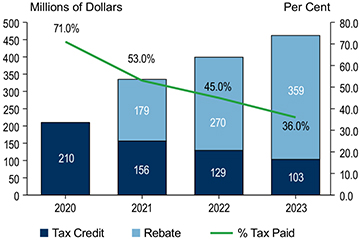
Source: Manitoba Finance
| Budget 2023 – Fiscally Responsible Outcomes and Economic Growth Strategy | 37
|
|
|
On farm properties, the savings are more pronounced. The percentage of net school tax (per cent tax paid) will decrease to 28 per cent in 2023 from 55 per cent in 2020 as the value of rebate savings increase to $79-million in 2023 from $49-million in 2020.
All Farm Properties
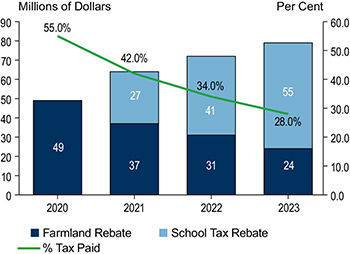
Source: Manitoba Finance
| 38 | Budget 2023 – Fiscally Responsible Outcomes and Economic Growth Strategy
|
|
|
Safer Streets
Manitoba needs a balanced approach that addresses the root causes of crime while also getting tough on violent crime and violent criminals so Manitobans feel safe in their homes, streets and communities.
Public Safety
Manitobans are concerned about high crime rates and violence in their communities. Budget 2023 addresses public safety by cracking down on crime while concurrently addressing the factors contributing to crime including homelessness, addiction and mental health issues.
|
|
To target violent crime, the Manitoba government is investing $51.8-million over two years to a Violent Crime Strategy, with $34.6-million allocated for 2023/24. |
To further enhance policing and public safety in Manitoba, Budget 2023 includes:
| · | $3.2-million to create a High-Risk Apprehension Team and to strengthen intensive bail and supervision for serious, violent offenders. This new unit will use strategic criminal intelligence and risk assessment tools to target the most violent offenders and those who have warrants and present the highest risk to re-offend or breach court conditions; |
| · | $3.6-million for Winnipeg’s Downtown Community Safety Partnership to support a safer, more inviting downtown Winnipeg for businesses and residents; |
| · | an additional $2.5-million for critical equipment, technology upgrades and expanded training opportunities for Manitoba’s conservation officers; |
| · | $780,000 to Toba Centre to expand services responding to child abuse; |
| · | an additional $650,000 to fund a central communication and dispatch system for the province’s Conservation Officer Service; |
| · | an additional $236,000 for the DNA Biology Casework Analysis Agreement between the federal government and Manitoba to share the actual costs of biology casework analysis arising from criminal investigations in the province; |
| · | $100,000 to support ongoing operations of the Winnipeg Bear Clan Patrol Inc.; and |
| · | $1.4-million to ensure the Manitoba Prosecution Service has enough capacity to address violent crime related to serious firearms offences. |
The RCMP provides all policing services in the province with the exception of some municipalities and Indigenous communities policed by independent police services. Budget 2023 increases funding to support the RCMP Provincial Police Service Agreement by $10.8-million.
Homelessness Strategy
|
|
Budget 2023 is investing more than $50-million in a comprehensive homelessness strategy which will increase funding for overnight shelters, transitional housing and rent subsidies. |
Combined with continued investments into mental health and addictions programs, especially for populations that experience homelessness due to mental health and addiction, many will be on the road to counselling, detox and long-term treatment.
| Budget 2023 – Fiscally Responsible Outcomes and Economic Growth Strategy | 39
|
|
|
Family Violence Prevention
Supporting family violence prevention initiatives ensures quality supports and programming is available and helps expand programs to serve more members of the community.
|
|
Budget 2023 includes $7.1-million in funding for the Family Violence Prevention Program, including an annualized funding increase of $1.6-million to 10 provincial shelters to implement year two of a new funding model that aims to improve operations and better protect vulnerable Manitobans. |
In addition, Manitoba Status of Women’s Family Violence Prevention program will provide annualized funding increases of:
| · | $2-million for nine women’s resource centres; |
| · | $890,000 for four residential second stage programming agencies; and |
| · | $439,000 for seven specialized programs. |
The Manitoba government has also committed funding for a program led by Ma Mawi Wi Chi Itata to engage men and boys to help reduce sexual exploitation and sex trafficking.
Mental Health and Community Wellness
Manitoba continues to see the effects of the COVID-19 pandemic on the health and well-being of Manitobans, including an unprecedented demand on mental health and addictions services over the last two years.
To work towards addressing these issues for all Manitobans, Manitoba Mental Health and Community Wellness launched A Pathway to Mental Health and Community Wellness: A Roadmap for Manitoba in February 2022. The roadmap outlines the priorities and action items that will enhance the mental health, addictions, wellness and health promotion system in Manitoba.
|
Over the last year, significant progress has been made to the implementation of the roadmap, including investments in services to ensure services and supports are available as close to home as possible for all Manitobans. This includes:
· providing ongoing support to more than 1,000 clients accessing an award-winning, locally-developed mindfulness-based cognitive behavioural therapy program that helps participants develop skills to improve their mental health and wellness;
· partnering with the United Way to invest in community organizations and initiatives to address wait times and increased pressures for mental health and addictions services;
· adding new clinical psychologists to work in child and adolescent, adult and forensic services;
|
· expanding Opiate Agonist Treatment (OAT) in the Interlake health region’s Rapid Access to Addictions Medicine (RAAM) clinic to allow 100 new patients to receive community-based care;
· investing in the St. Boniface Street Links’ Outreach and Supportive Intervention for People who Use Substances program to increase safety and support for vulnerable citizens;
· expanding the Take Home Naloxone Kit program and investment in a Narcan pilot project;
· increasing services and hours at the RAAM clinics in Winnipeg, Portage la Prairie and Thompson, including Saturday clinics;
· expanding eating disorder services for children and youth and annualizing funding to adult eating disorder programs; |
| 40 | Budget 2023 – Fiscally Responsible Outcomes and Economic Growth Strategy
|
|
|
|
· launching an Indigenous-operated RAAM clinic in the province in partnership with the Aboriginal Health and Wellness Centre in Winnipeg;
· developing substance use and addictions service standards to help ensure safety, quality of care and consumer protection for Manitobans seeking substance use and addictions services; and
|
· launching the province’s first health-related social impact bond, Quit Smoking with Your Manitoba Pharmacist to support individuals in their journey to quit smoking. In the first six months of the program, 553 Manitobans enrolled and received an initial assessment from a pharmacist. |
Budget 2023 continues government’s investments in mental health and addictions core services, with a focus on helping some of the most vulnerable Manitobans affected by addictions and mental illness move forward on their recovery journey. This will include:
| · | $17.3-million for year two commitments under the five-year roadmap for mental health, including: |
| ¡ | providing $1-million to add crisis stabilization unit beds and expand telepsychiatry services to ensure Manitobans living in rural and remote communities are able to access timely and efficient psychiatric support; |
| ¡ | investing $600,000 for flexible-length community residential withdrawal management beds in Brandon to allow patients the necessary time to withdraw from dangerous drugs and be connected to longer term treatment options; and |
| ¡ | investing $448,000 to provide ongoing funding for mobile withdrawal management services from Klinic Community Health Centre to ensure addictions services are accessible as close to home as possible; and |
| · | $9.4-million for 1,000 new treatment spaces for providers of substance use and addictions treatment services across Manitoba. |
Government will also invest in initiatives focused on children and youth, including:
| · | an investment of $1.5-million in child and youth mental health services to improve access and reduce wait times; |
| · | $1.3-million in funding for the Child Nutrition Council of Manitoba to ensure schools throughout the province will be able to deliver school nourishment programs that encourage school attendance, support learning and promote health and wellness; and |
| · | a $345,000-investment to develop a provincial suicide prevention strategy in collaboration with Indigenous communities, focusing on at-risk youth and prevention programming for Indigenous children and youth. |
| Budget 2023 – Fiscally Responsible Outcomes and Economic Growth Strategy | 41
|
|
|
Healing Health Care
Budget 2023 continues to address challenges arising from the pandemic by investing in a health human resource action plan and committing funds to address surgical and diagnostic wait lists.
Healing our health system requires historic investments in human resources, ongoing investments in health-care infrastructure and changing the structure of the system as a whole. These efforts to strengthen health care and reduce surgical and diagnostic backlogs will ensure Manitobans have timely access to the care they need.
The Manitoba government strives to provide consistent and accessible health care, despite the challenges of a national and international shortage of trained health care professionals. In Budget 2023, the Manitoba government continues to invest in increased health human resource capacity, address surgical diagnostic backlogs and modernize health care.
| INVESTMENTS INTO HEALTHCARE | ||||||||||||||
| Variance | ||||||||||||||
| Millions of Dollars | Budget 2023 | Budget 2022 | $ | % | ||||||||||
| Health |
7,133 | 6,664 | 469 | 7.0% | ||||||||||
| Mental Health and Community Wellness |
439 | 412 | 27 | 6.6% | ||||||||||
| Seniors and Long-Term Care |
93 | 54 | 39 | 72.2% | ||||||||||
| Enabling Appropriations: |
||||||||||||||
| Surgical and Diagnostic Backlog |
130 | 120 | 10 | 8.3% | ||||||||||
| Health Human Resource Action Plan |
123 | - | 123 | n/a | ||||||||||
| 7,918 | 7,250 | 668 | 9.2% | |||||||||||
| 42 | Budget 2023 – Fiscally Responsible Outcomes and Economic Growth Strategy
|
|
|
Health Human Resource Action Plan
Health-care systems across the country are facing significant health human resources challenges as a result of the COVID-19 pandemic, with high demand for health care professionals around the globe.
The Health Human Resource Action Plan is a $200-million strategy to recruit, train and retain health-care providers across Manitoba. Manitoba is investing in programs and incentives to:
| · | retain existing health-care providers; |
| · | recruit new health-care providers through incentive and training initiatives; and |
| · | encourage the health-care providers of the future to enter training and educational programs that will equip them to support care for Manitobans well into the future. |
New initiatives will build upon ongoing strategies and programs to improve health care for all Manitobans. It will support the human resource needs of the health-care sector by retaining valued staff and adding 2,000 new health-care providers to the provincial health-care system. All action items and incentives are rolling out in a phased approach.
In the first phase of the action plan, several targeted initiatives are being introduced within the system. This includes incentive measures such as:
| · | a weekend wage premium for nurses; |
| · | a one-time $500 wellness bonus for health care employees; |
| · | incentive for nurses working in full-time positions; |
| · | the payment of 2023 and 2024 licensing fees for public sector nurses; |
| · | incentives for nurses returning to practice; and |
| · | a remote location incentive for nurses. |
It also includes workforce supports, such as:
| · | a provincial float pool for nurses; and |
| · | the introduction of the Virtual Emergency Care and Transfer Resource Service to provide rural and northern physicians with improved access to specialist consultation for clinical advice and transfer of patients. |
More targeted initiatives will be introduced in subsequent phases of the action plan.
Beyond the action plan, the Manitoba government is working with health system stakeholders in developing innovative approaches to recruitment and retention. Shared Health is currently building a centre of expertise for recruitment. The team is currently supporting the international recruitment mission to the Philippines being led by the Government of Manitoba.
Other significant measures include supporting the expansion of health-care provider training programs offered in the universities and assisting international medical and nursing graduates with their transition to practicing in Manitoba.
Addressing Diagnostic and Surgical Backlogs
In Budget 2022, the Manitoba government created the Diagnostic and Surgical Recovery Task Force to address surgical and diagnostic waitlists. In Budget 2023, $130-million is committed to continue the program.
The task force is finding innovative solutions to address backlogs in health care resulting from the COVID-19 pandemic by building capacity in Manitoba by developing request for supply arrangements with private and public care providers in the province, as well as implementing safe, out-of-province care options for some procedures.
| Budget 2023 – Fiscally Responsible Outcomes and Economic Growth Strategy | 43
|
|
|
MAKING PROGRESS ON DIAGNOSTIC AND SURGICAL RECOVERY BACKLOGS
The Diagnostic and Surgical Recovery Task Force (DSRTF) was created in December 2021 by the Government of Manitoba to eliminate the diagnostic and surgical procedures backlog as well as related services resulting from the COVID-19 pandemic.
The task force has made significant progress to eliminate the COVID-19 driven diagnostic and surgical backlog and will be working in the longer term to establish a sustainable and effective diagnostic and surgical operating model across Manitoba.
Measuring Success
To address the immediate challenge, the short-term goal is focused on eliminating the COVID-19 backlog. The COVID-19 target backlog is the fixed number of backlog cases between February 2020 and February 2022. The work of the task force will eliminate these cases.
The COVID-19 target backlog is part of a larger total backlog, which is the ongoing build-up of cases due to COVID-19 and other factors. While the task force is focused on eliminating the COVID-19 backlog, the task force has solicited and approved proposals for permanent increases in health system capacity, which are aimed at reducing long wait times and achieving target wait times.
However, it is recognized that addressing the total backlog will require alleviating larger health system challenges, such as through the work of Manitoba Health Human Resource Action Plan.
To date, the work of the Diagnostic and Surgical Recovery Task Force has eliminated 52 per cent of the known COVID-19 target backlog across Manitoba. The known backlog is defined by reliable data for twenty of the thirty-three service lines currently in scope for the task force.
The COVID-19 backlog has been eliminated for the following services:
| · | cataract surgeries; |
| · | cardiac catheterization; |
| · | pacemaker; and |
| · | ultrasound. |
The COVID-19 target backlog has also been significantly reduced for the following services:
| · | orthopaedic surgeries, including shoulder, foot and ankle surgeries, by more than 99 per cent; |
| · | CT scans by more than 96 per cent; |
| · | orthopaedic spine surgeries by more than 85 per cent; and |
| · | cardiac surgery by more than 50 per cent. |
Other work underway includes:
| · | mitigating the endoscopy wait list by expanding the use of fecal immunochemical tests (FIT); |
| · | expanding access to gynecological surgery through outpatient surgeries at Maples Surgical Centre/ Clearpoint Health Network; |
| · | developing the Anesthesia Clinical Assistant Program to help address the global shortage of anesthesia providers; |
| · | providing operating costs for the new Surgical Wait Information Management System (SWIM) to centralize wait lists in Manitoba and make wait list management more efficient; |
| · | expanding the Spine Assessment Clinic at HSC to a provincial resource; |
| 44 | Budget 2023 – Fiscally Responsible Outcomes and Economic Growth Strategy
|
|
|
| · | expanding orthopedic surgery capacity by opening a fifth operating room at Concordia General Hospital; |
| · | expanding diagnostic imaging capacity Manitoba-wide through additional staff; and |
| · | expanding hours for MRI and CT scanning, and by purchasing one new mobile CT and one new mobile MRI. |
As of early February 2023, there are 22,335 patients who were supported by the task force through short-term Request for Supply Arrangement (RFSA) contracts to receive the care they require.
The task force has also been identifying patients who may wish to travel to another jurisdiction if their
procedure could be performed there sooner, while also identifying any supports they may need to do this safely.
So far, this includes 176 patients who received surgical care out of province at approved partner provider organizations, including Sanford Health, Cleveland Clinic, North West Ontario/Big Thunder Orthopedic Associates, and at upcoming agreements with the University of California at San Francisco and the Mayo Clinic.
Over the next two years, an additional 120,000 cases will be added to increase Manitoba’s capacity to eliminate the COVID-19 backlog.
Current COVID-19 Backlog Elimination Across Service Lines
Per Cent
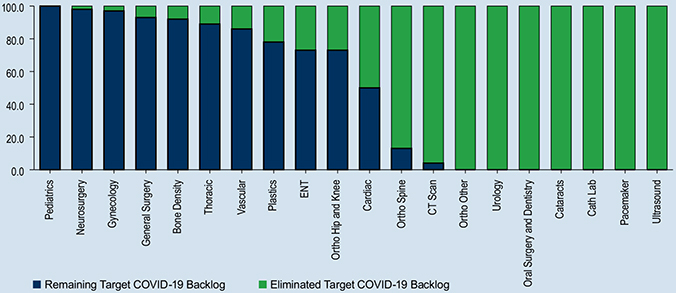
Source: Manitoba Health and the Diagnostic and Surgical Recovery Task Force
The graph represents the progress of COVID-19 target backlog elimination. The green bars indicate the proportion of the target COVID-19 backlog which has been eliminated. The blue bars indicate the proportion of the remaining targets.
| Budget 2023 – Fiscally Responsible Outcomes and Economic Growth Strategy | 45
|
|
|
On Sept. 26, 2022, the Minister of Health signed the Declaration to Eliminate all Forms of Indigenous-Specific Racism in the health system, along with Manitoba Keewatinowi Okimakanak Inc. (MKO), Keewatinohk Inniniw Minoayawin Inc. (KIM), the Northern Regional Health Authority (NRHA) and others. This declaration is part of ongoing efforts to end racism in all parts of the health system.
As first announced in Budget 2021, Manitoba is making historic capital investments in building, expanding and renovating health care facilities across the province to support health transformation.
Budget 2023 provides a total multi-year capital investment of $1.2-billion for the expansion, improvement or creation of new hospital developments in Manitoba as part of the province’s Clinical and Preventive Services Plan. This includes:
| · | $795-million for new hospitals in Portage la Prairie and Neepawa; |
| · | $123-million to enhance health services in Brandon, including an addition and renovations at the Brandon Regional Health Centre and the expansion and renovation of the Western Manitoba Cancer Centre; |
| · | $106-million for the expansion and redevelopment of several sites including Virden, Souris, Killarney, Shoal Lake, Arborg and Beausejour; $115-million for projects in northern Manitoba; |
| · | $165-million for the expansions of the Bethesda Regional Health Centre, the Boundary Trails Health Centre and the Selkirk Regional Health Centre; |
| · | $33-million for renovations to Ashern’s Lakeshore General Hospital; and |
| · | $7.6-million for new endoscopy and chemotherapy spaces at Dauphin Regional Health Centre. |
All of these projects are currently underway, with some at the design stage and others already in construction. In addition, funding is allocated for a number of projects in Winnipeg hospitals, including:
| · | renovations to the adult emergency department, emergency psychiatry and additional areas of Health Sciences Centre; |
| · | the redevelopment of the emergency department at St. Boniface General hospital, which is currently underway; |
| · | renovations at CancerCare Manitoba to expand capacity and strengthen services; and |
| · | We are also joining the Health Sciences Centre Foundation’s Operation Excellence, a $100-million redevelopment of the HSC campus increasing capacity for services. |
Funding is also being provided over five years to continue capital investment in the following:
| · | $350-million for upgrades to and the replacement of building infrastructure and medical equipment such as diagnostic equipment, roof replacements and heating/cooling and electrical services; |
| · | $280-million for upgrades to and the installation of fire protection systems in personal care homes; |
| · | $277-million for upgrades to and the development of information and communications technology; |
| 46 | Budget 2023 – Fiscally Responsible Outcomes and Economic Growth Strategy
|
|
|
| · | more than $95-million for the renovations or new construction of facilities to accommodate regulations for the mixing, storage and distribution of pharmaceutical drugs; and |
| · | more than $17-million in capital investment for the renovation or new construction of ambulance stations in eight locations throughout the province. |

|
This year’s budget also includes a $504-million investment into health system operations, including a $120-million infusion to the Pharmacare program. |
As part of this investment, Manitoba is extending coverage for insulin pumps.
|
|
An additional $42-million will be invested to maintain pandemic readiness and a quick response as required. |
Seniors and Long-Term Care
In 2022, the Manitoba government launched extensive, province-wide public consultations to help inform a renewed provincial seniors’ strategy. More than 10,000 Manitobans were engaged through surveys, focus groups, interviews, community engagement networks and a minister’s tour of the province.
Manitoba’s seniors’ strategy, built with the help of these Manitobans, provides a guide to address the challenges faced by seniors and caregivers. Seven areas of focus have been identified and strategic initiatives outlined in the strategy will guide the province’s work with partners to bring the strategy’s vision to life.
|
|
Budget 2023 commits an additional $15.9-million to advance initiatives in the seniors’ strategy. These actions will include support for a full spectrum of community-based services including social and recreation services, and wellness and prevention. Families and unpaid caregivers will be recognized and supported in the critical role they play helping Manitobans to age in place. |
Government also recognizes the important role personal care homes play in Manitoba communities. Significant progress has been made in implementing the 17 recommendations of the Stevenson Review, conducted in 2021.
More than $55-million has been committed to date to address resident safety, pandemic preparedness and direct care staffing gaps. Ongoing funding and oversight is being provided by Manitoba Seniors and Long-Term Care to ensure changes to personal care homes are fully implemented and sustained over the coming years.
| Budget 2023 – Fiscally Responsible Outcomes and Economic Growth Strategy | 47
|
|
|
Stronger Communities
Growing a stronger Manitoba starts with communities that are vibrant and thriving – with the services, businesses, infrastructure and jobs to attract families, investment and greater growth.
Strong communities also need to be livable and lively places with sporting, cultural and heritage venues and recreational destinations made all the better with historic investments province-wide.
Early Learning and Child Care
Manitoba is working towards expanding and strengthening the early learning and child-care system throughout the province. This includes significant investments in workforce retention and recruitment and increasing the number of funded licensed spaces. The government is also reducing parent fees to make early learning and child care more affordable and accessible for all Manitobans.
Budget 2023 makes a number of investments in early learning and child care, including:
| · | investing $76.1-million to reduce regulated parent fees to $10 per day, well in advance of the target date of Mar. 31, 2026; and |
| · | launching a multi-year training expansion plan for the early learning and child-care workforce, including early childhood educators and child-care assistants, in partnership with post-secondary institutions. |
Disability Services
|
|
Budget 2023 also includes nearly $104-million in new funding for Community Living disABILITY Services and Children’s disABILITY Services, for a total commitment of $640-million annually towards services for the disability community. |
This investment represents a 19 per cent increase from the previous year and is the largest single investment in Community Living disABILITY Services since the program’s inception.
The $104-million total increase includes:
| · | $79.7-million earmarked for increasing the funded wage rate from $15.11 per hour to $19 per hour for frontline residential, respite and day service workers providing Community Living disABILITY Services; |
| · | $2-million earmarked for increasing the funded wage to $19 per hour for front-line workers providing Children’s disABILITY Services; and |
| · | $21.4-million to expand the capacity of the Community Living disABILITY Services program to support new entrants. |
Education
Manitoba’s goal is to ensure an equitable and effective provincial education system where students receive a high-quality education.
|
|
For the 2023/24 school year, Manitoba is investing an increase of $100-million in K to 12 education, including: |
| · | a $63-million increase in operating support, including an additional $20-million to address cost pressures, $5-million for special needs and increases in other existing grants; |
| · | a $24-million increase to the Property Tax Offset Grant; |
| 48 | Budget 2023 – Fiscally Responsible Outcomes and Economic Growth Strategy
|
|
|
| · | an $8-million increase in capital support payments; and |
| · | an additional $5-million for independent schools. |
|
|
The Manitoba government is investing another $106-million to make one-time funding provided to school divisions last year permanent. This includes $22-million to support student presence and engagement to facilitate the implementation of Safe and Caring Schools, the new policy directive and action plan for enhancing student presence and engagement. |
|
|
Manitoba is also investing $268.5-million in capital expenditures under the commitment to build 20 new schools, and to support renovation and additional projects in existing schools. To date, the province has 14 out of 20 schools either completed, under construction or in design. |
The province is moving forward with the implementation of Manitoba’s K to 12 Education Action Plan, which sets out the path for responding to the recommendations from the Manitoba Commission on Kindergarten to Grade 12 Education.
Budget 2023 includes:
| · | $3.8-million in additional funding for the enhancement of French as a second language and French immersion programs, at all levels of education |
| · | $1.4-million to support the implementation of a provincial Student Information System to integrate system-wide information for the K-12 education sector; and |
| · | $1.4-million to develop a Teacher Regulatory Framework, including a teacher registry and an independent body to improve accountability and transparency related to educator misconduct in K-12 schools. |
Budget 2023 includes funding to support the implementation of the Aboriginal Languages Strategy and Mamàhtawisiwin: The Wonder We are Born With, Manitoba’s Indigenous Inclusion Policy Framework.
|
|
This year, the province will invest $2.2-million to support the Elders and Knowledge Keepers in Schools Initiative. This initiative supports students, educators and families in learning First Nations, Métis and Inuit histories, languages and cultures, traditional values and knowledge systems, and contemporary lifestyles. |
|
|
The budget also includes the provision of $300,000 to increase the number of qualified Indigenous translators in Manitoba as part of a multi-year commitment. |
Social Services and Housing
Manitoba families need safe, wrap-around supports to improve the overall quality of life for communities across Manitoba and make a real difference for thousands of people each year.
|
|
This year, more than $13.9-million in funding will be provided to Child and Family Services Authorities to administer to their mandated agencies. |
The Manitoba government will also continue to support youth transitioning out of care by continuing the Supporting Young Adults Grant, which expanded the eligibility criteria for Child and Family Services (CFS) supports provided to young adults who would otherwise have been ineligible for these supports from their child and family service agencies.
The Manitoba government continues to support the housing needs of vulnerable Manitobans, including those at risk of and experiencing homelessness.
|
|
Budget 2023 includes $32.3-million in funding to implement the province’s second three-year action plan as part of the National Housing Strategy. Funding allocated under the action plan will be used to: |
| · | construct new affordable rental housing; |
| · | repair existing community housing stock; |
| Budget 2023 – Fiscally Responsible Outcomes and Economic Growth Strategy | 49
|
|
|
| · | provide operating subsidies for community housing units; and |
| · | provide affordability support for low-income renters in the form of rent supplements, shelter benefits and other subsidized housing. |
Additional provincial funding of $17.9-million is provided as part of the Homelessness Strategy towards increasing new affordable rental housing units. Other investments in housing will include:
| · | annualized funding to support the North End Women’s Centre’s and the West Central Women’s Resource Centre’s transitional housing programs; and |
| · | providing $1.5-million in annualized funding for Velma’s House, a safe space for women, where they can receive services, supports and a place to sleep. |
Strengthening Municipal Partnerships
The Government of Manitoba continues to address the growing financial challenges faced by all municipalities in the province.
|
|
In 2023, the Manitoba government will provide municipalities and Northern Affairs communities with more than $217-million in annual operating funding, an increase of 28 per cent from Budget 2022. |
At the same time, steps are being taken to modernize the calculation of municipal operating grants to recognize:
| · | the service needs of smaller municipalities and northern communities through a new base grant of $25,000 for communities with a population of 5,000 or less; |
| · | a per capita grant calculation for all municipalities; and |
| · | specific needs-based funding that individual municipalities currently receive. |
In 2023, all municipalities across Manitoba will receive more funding than in previous years, resulting in unconditional funding of $137.9-million for the City of Winnipeg, and $78.8-million for all other municipalities and Northern Affairs Communities, which is more in line with Manitoba’s population levels and regional distribution.
Every municipality will receive a minimum increase of more than 24 per cent compared to 2022, and most will receive a higher increase based on the new model that considers size, population and essential municipal service needs, as well as one-time transit support funding that will be distributed to the City of Winnipeg (and other municipalities with transit systems) in 2023/24.
To continue to improve the municipal operating grant framework in 2023, Manitoba Municipal Relations will work with municipal stakeholders, including the Association of Manitoba Municipalities, the Association of Manitoba Bilingual Municipalities and the City of Winnipeg, to establish a review framework to inform future changes and improvements to Manitoba’s municipal operating funding framework.
The development of this framework will balance existing municipal financial need with municipal capacity to generate revenue. It will also explore the development of a funding escalator to help municipalities in their long-term fiscal planning.
Additional funding increases to support communities in 2023 includes an increase of $471,000 to support United Way Winnipeg’s Community Assistance Program, which builds community capacity by providing opportunities for local communities to raise and invest funds into programs that benefit the community.
The Office of the Fire Commissioner supports local authorities in the delivery of sustainable fire and rescue services for Manitobans, as well as emergency and disaster response activities in communities across the province. Budget 2023 provides additional staff to enhance effective and efficient coordination of core emergency response programs.
| 50 | Budget 2023 – Fiscally Responsible Outcomes and Economic Growth Strategy
|
|
|
Capital funding for core infrastructure helps build stronger communities across Manitoba and supports economic stability and growth.
Recognizing the importance of providing long-term, stable and predictable funding to municipalities, the Government of Manitoba continues to make significant investments in municipal infrastructure.
|
|
Budget 2023 provides a further 17 per cent increase to municipal infrastructure funding for a total commitment of up to $160.4-million on an on-going basis, to support water and wastewater projects, waste management facilities, roads and bridges, public transit, recreation and other capital priorities. |
This funding is in addition to $140-million in one-time capital investments in water and wastewater projects through a special warrant in January 2023, and $4-million in funding for projects through the Manitoba Water Services Board.
|
|
Budget 2023 includes an increase of $54.1-million to support cost-shared strategic infrastructure projects under the Investing in Canada Infrastructure Program. Supported projects may include initiatives under public transit, green infrastructure, community infrastructure, rural and northern infrastructure and COVID-19 resilience. |
Government is also supporting the establishment of the Capital Planning Region, which is mandated to adopt a regional plan that supports robust healthy ecosystems and enhancing resilience to climate change. The plan will contain policies to support integrated watershed management planning, building a natural assets network, regional flood and drought resiliency, and policies to support a low carbon capital region economy.
|
|
Budget 2023 allocates up to $13.4-million of additional transit funding to be distributed to Winnipeg, Brandon, Selkirk, Flin Flon, and Thompson to ensure the transit operations of five communities are supported. |
This commitment builds on Manitoba’s collaboration with the Government of Canada in 2022 to provide $20.7-million in funding to assist Manitoba municipalities in addressing transit operating shortfalls related to reduced ridership caused by the COVID-19 pandemic.
|
|
Over the last ten years, the Manitoba government has invested in water and wastewater infrastructure for northern Manitoba communities and has taken steps to address several long-term boil water advisories. Budget 2023 includes $1.5-million in new funding focused on operator training and certification to provide safe drinking water in Northern Affairs communities in the north through significant investments in human resources, training and succession planning. |
Protecting the Environment, Climate and Parks
Manitoba’s natural environment is one of its greatest assets and is as diverse as the province’s economy and population. Protecting Manitoba’s environment is essential for ensuring communities remain healthy and create the conditions to sustainably grow the economy and create new jobs.
| Budget 2023 – Fiscally Responsible Outcomes and Economic Growth Strategy | 51
|
|
|
Manitoba’s Climate and Green Plan continues to guide priorities and investments to help protect the environment and reduce emissions while advancing economic opportunities and innovation for Manitoba.
Carbon Emission Reduction
Budget 2023 is strengthening investments to continue work to reduce carbon emissions and prevent pollution. This includes:
| · | increasing strategic investments in initiatives that advance priorities of environmental sustainability; |
| · | providing grant funding to help organizations that have a good track record of supporting sustainability measures; |
| · | introducing new programs to further advance the Climate and Green Plan objectives with emphasis on stimulating economic activity and reducing reliance on imported fossil fuel energy; and |
| · | providing grants under the Conservation and Climate Fund for innovative projects that work to help protect the environment in 2023/24. |
As Manitoba remains a key transportation hub in North America and many Manitobans rely on their personal vehicles in their daily lives, creating green transportation solutions that work for Manitobans and industry is a key priority for government.
Budget 2023 sets out new green investments for the successful Efficient Trucking Program, cost-shared with the federal government under the Low Carbon Economy Fund. The grants aim to encourage heavy-duty vehicle operators in the province to install fuel saving upgrades to their trucks and trailers. Manitoba is also working closely with transportation stakeholders and will be advancing developments to assist in a green transition.
|
|
Budget 2023 includes $170,000 for Climate West, a non-profit organization that serves as a central hub for climate data and services in Manitoba, Saskatchewan and Alberta. |
Protecting the Natural Environment
Work also continues to protect the natural environment and human health from harmful contaminants, including cleaning up orphaned and abandoned mines and contaminated sites, diverting waste from landfills and having strong regulatory controls to prevent pollution and reduce its impact to soil, land, water and air.
|
|
Manitoba will provide $8.7-million to support recycling, composting and waste diversion initiatives across the province through the Waste Reduction and Recycling Support program. This program helps divert more than 188,250 tonnes of waste from Manitoba landfills annually. In 2021, composting facilities receiving this funding diverted more than 82,000 tonnes of organic material from landfills. |
|
|
Budget 2023 continues to build on the 2022 investment of $50.7-million over five years to support the implementation of an action plan to accelerate the clean-up of Manitoba’s orphaned and abandoned mines. Annual work continues to make these sites safer for the public, reduce damage to the environment, and decrease Manitoba’s environmental liability. |
Manitoba remains committed to advancing critical environmental goals including protecting the health of Lake Winnipeg. In 2022, Manitoba, the federal government, and the City of Winnipeg announced a joint investment of more than $550-million for the second phase of upgrades to the Winnipeg North End Water Pollution Control Centre. This includes a $167-million investment from Manitoba to help reduce pollutants from entering Manitoba waterways and protect Lake Winnipeg for future generations.
Manitoba is introducing a new approach to water power licensing in Manitoba that is more efficient, addresses the ongoing environmental concerns associated with legacy developments and advances reconciliation.
| 52 | Budget 2023 – Fiscally Responsible Outcomes and Economic Growth Strategy
|
|
|
Maximize the Value of Parks and Trails
Manitoba’s 92 provincial parks and network of trails are treasured by Manitobans and promote positive health, social, environmental and economic outcomes. In addition to recreational and educational opportunities, Manitoba’s parks help preserve natural spaces and habitats and conserve areas of geological, cultural and ecological significance such as grasslands, boreal forest and wetlands.
Parks are also a strong economic driver in the province through tourism that supports local businesses and creates jobs.
Budget 2023 will maximize the conservation and recreation value of these natural resources, ensuring all Manitobans are able to benefit from these unparalleled natural spaces. This includes:
|
|
$10-million to support the new parks capital plan and operating requirements; |
| · | investments to restore park infrastructure damaged in the 2022 flooding, ensuring Manitoba’s parks are prepared for a changing climate; |
| · | a new, modern reservation system that will be in-place for the 2023 camping season to enhance the visitor experience; and |
| · | beginning this year, Manitoba’s new Trails Strategy and Action Plan to guide investments to enhance trail infrastructure and promote Manitoba’s world-class trails. |
Securing Manitoba’s Environmental Future
Manitoba recently launched the new Water Management Strategy to guide future actions, decisions and investments to protect the province’s water resources and ecosystems and sustainably grow the economy and local communities.
|
|
Budget 2023 will make new investments of $1.6-million to advance the implementation of the Water Management Strategy and ensure a long-term approach to managing water resources in partnership with stakeholders and communities. These investments will enhance water quality monitoring, drinking water safety, watershed planning and programming, as well as critical water and wastewater development and projects. |
Manitoba will continue to implement the 2 Billion Trees Program.
Other Initiatives
|
|
Budget 2023 incudes $101-million for work on the Lake St. Martin Outlet Channel to enhance flood protection for First Nations, Indigenous communities and their neighbours around Lake Manitoba and Lake St. Martin, while helping strengthen Manitoba’s existing network of flood mitigation infrastructure. |
The Manitoba government has also provided funding towards the development of forestry initiatives and for activities focused on the sustainability of commercial fisheries. This work is ongoing and includes:
| · | $675,000 to the International Institute of Sustainable Development to help advance eco-certification of Manitoba’s commercial fisheries; and |
| · | $125,000 for two forestry related projects by FPInnovations, a not-for-profit research and development organization that specializes in the creation of solutions to accelerate the growth of the Canadian forest sector. |
| Budget 2023 – Fiscally Responsible Outcomes and Economic Growth Strategy | 53
|
|
|
|
|
To support early detection of chronic wasting disease and respond to identified cases, Budget 2023 provides an additional $880,000 to increase the capacity of Manitoba’s chronic wasting disease mandatory sample program to 6,000 samples per year and reduce the turnaround time of test reports to mitigate human and animal health risks. |
Manitoba continues to manage Dutch elm disease by providing grant funding to 38 partner communities to support the protection of their urban forest canopies, reducing the spread of Dutch elm disease, and building capacity to deal with invasive species.
|
|
To offset the effects of inflation, Budget 2023 increases available grant funding to $1.2-million, a 20 per cent increase to reduce the loss of elms to Dutch elm disease, maintain healthy urban forests and provide technical and educational support to communities and the public, while building local capacity. |
Advancing Reconciliation
Advancing Truth and Reconciliation is crucial to ensure Manitoba addresses historical wounds and works with Indigenous communities and nations to build a better province for all. The Manitoba government continues to advance reconciliation through the co-development of strategies and best practices with Indigenous and non-Indigenous partners.
The Manitoba government has committed funds to support the Manitoba MMIWG2S+ Partnership Implementation Plan, led by Ma Mawi Wi Chi Itata. This project will create and implement a five-year plan to address violence against Indigenous women, girls and 2SLGBTQQIA+ people. The plan will be a community-led, made-in-Manitoba approach that is province-wide, measurable, and accountable.
The first year of the project, which is being funded by the Manitoba government, will create the governance
and organizational structures necessary to develop and implement the plan. This will include the creation of an Indigenous Matriarchal Governing body to guide the plan and its implementation.
Arts and Culture
Participating in arts, culture, heritage and sport activities enhances one’s quality of life. Not only do these activities contribute to enriched perspectives and communities, but they are also important for physical, mental and spiritual health.
Budget 2022 committed to an investment of $100-million for the Arts, Culture and Sport in Community Fund. The fund supports these sectors to enhance opportunities for Manitobans to access quality programming and facilities in their own community. Funding is distributed for large capital projects, small capital projects and special initiatives and community celebrations.
|
|
The Manitoba government is accelerating its support for the Arts, Culture and Sport In Community Fund, expanding a planned $34-million investment by $16-million to $50-million, and investing a further $50-million in Budget 2023 for a total of $100-million over two years. This will enable the many Manitobans who enjoy and celebrate the province’s rich culture to benefit from this enhanced support for capital projects and programming related to arts, culture, and sports initiatives. |
|
|
Public libraries are important institutions in Manitoba’s communities, and Budget 2023 builds on previous investments in public libraries by providing a further $277,000 to ensure all library systems receive at least the same level of provincial funding in 2023 as they did in 2022. |
|
|
Budget 2023 will maintain funding of $250,000 to prioritize the welfare, safety and rights of every Manitoban taking part in sports. |
| 54 | Budget 2023 – Fiscally Responsible Outcomes and Economic Growth Strategy
|
|
|
Opportunities Ahead
Manitoba’s economic growth strategy has been fundamental in improving the province’s competitive position, removing impediments to doing business and creating an environment that increases household and business income.
At the core of Manitoba’s economic growth plan is improving the province’s economic competitiveness as a preferred destination to work, live and invest in Canada. A sustainable, green and growing economy will be achieved through a multi-faceted approach.
Budget 2023 will support Manitoba’s economic development with $24.1-million in funding through the Industry Partnerships Program, a nearly nine per cent increase over 2022/23 funding levels. The work of Manitoba and its partners will be supported through a new data and information sharing framework to enable collaboration and quick action on economic development opportunities.
In 2023, Manitoba will release an Opportunities for Growth Action Plan, consisting of a series of short-term, strategic commitments to help Manitoba capitalize on emerging economic growth opportunities, address workforce and skills shortage and invest in critical business infrastructure and supports. Key commitments include:
| · | launching Manitoba’s first Life Sciences Strategy; |
| · | investing in a virtual production training studio in Manitoba, StudioLab XR, the first of its kind in the prairies; |
| · | expanding the use of the new Invest Manitoba brand to promote Manitoba as a key global destination for trade and investment; |
| · | capitalizing on Manitoba’s green energy advantage to attract new business investment; and |
| · | implementing key findings from the Premier’s Economic Advisory Council on Competitiveness to make Manitoba a preferred business destination. |
Venture Capital
Access to capital is critical for the development and expansion of Manitoba businesses. In February 2021, after a review of successful venture capital programs in other provinces, the Economic Development Board recommended the creation of an independent, professionally managed fund. The fund would invest in several independently managed funds that will leverage the government capital with private sector capital, increasing the amounts available to be invested in Manitoba companies.
In 2022, the new Venture Capital Fund was established with an initial contribution of $50-million. In 2023, this investment is doubled by adding $50-million, bringing the total contribution to $100-million. The fund will create a much larger venture and growth capital ecosystem for Manitoba businesses that will lead to the creation of entrepreneur-led businesses that will fuel provincewide economic growth to support the economies in rural, urban and Northern Manitoba.
| Budget 2023 – Fiscally Responsible Outcomes and Economic Growth Strategy | 55
|
|
|
To improve access to financing, investments are also being made to support the development of a vibrant venture capital system in Manitoba, including:
| · | re-opening Manitoba’s Communities Economic Development Fund’s Business Loan Program in 2023 to support northern economic development; and |
| · | renewing and expanding a funding agreement with Futurpreneur, which offers financing, mentorship and support to enterprising young Manitobans, including Black, Indigenous and People of Colour (BIPOC) to foster and inspire the next generation of young aspiring entrepreneurs. |
Economic Development Loans
|
|
In 2023/24, Manitoba Economic Development, Investment and Trade will invest more than $35-million in loans and guarantees, an increase of $27-million from 2022/23. |
This will include $15-million for the Community Economic Development Fund and $20-million to support economic development and investment attraction. The funding will incent private sector investment in enterprises that can demonstrate significant, sustainable growth and job creation.
Economic Reconciliation
Engagement with Indigenous communities continues to advance economic reconciliation and build a more inclusive forest sector. As a first step, five memorandums of understanding with Indigenous communities were signed in 2022 to create two-year pilot revenue sharing agreements with Indigenous communities affected by forestry operations for timber dues collected by the province.
|
|
Budget 2023 will sustain the Indigenous Reconciliation Initiatives Fund, which is dedicated to advancing truth and reconciliation by partnering with Indigenous groups, |
| communities and governing bodies to implement projects to address the injustices faced by Indigenous peoples. |
To further economic reconciliation, the Manitoba government is also:
| · | developing a new $15-million fund to support Indigenous economic development opportunities related to the Lake Manitoba and Lake St. Martin Outlet Channels Project, which will be used to support economic development opportunities for the 39 Indigenous groups related to the outlet channels, and reconciliation in alignment with the principles outlined in The Path to Reconciliation Act; |
| · | collaborating with the Assembly of Manitoba Chiefs to offer non-traditional lending options through the First Peoples Economic Growth Fund to support Indigenous economic opportunities and enhance access to finance; and |
| · | working with the Manitoba Métis Federation to provide a sustainable mechanism offering access to capital for Métis entrepreneurs. |
Trade
With trade corridors in every direction and North America’s largest tri-modal inland port and foreign trade zone, CentrePort Canada, Manitoba is in a unique position to compete globally. Over the past decade, Manitoba’s international merchandise exports have increased by 80 per cent.
Through a federal-provincial partnership, Manitoba and Canada are investing a combined $147.6-million in the Hudson Bay rail line. This, in addition to guaranteeing continued service to remote northern communities, will increase investment attraction to the Port of Churchill as Manitoba leads the development of a northern trade and transportation corridor that will connect Western Canada to Europe.
| 56 | Budget 2023 – Fiscally Responsible Outcomes and Economic Growth Strategy
|
|
|
|
To advance the province’s economic growth priorities, the Manitoba government has established a new Investment and Trade Division within Manitoba Economic Development, Investment and Trade.
This will bring government and industry partners together with a common vision to advance Manitoba’s economic growth, compete globally to secure investment opportunities and realize Manitoba’s potential as a global trading force.
|
Agricultural Investments
The Manitoba government is supporting Manitoba agricultural producers and the competitiveness of the province’s agricultural sector, including:
| · | investing $221-million in Manitoba’s agriculture industry over the next five years through the federal-provincial Sustainable Canadian Agriculture Partnership, with the federal government providing 60 per cent of the funding and Manitoba providing 40 per cent to ensure sustainable development of the agri-food industry into the future; |
| · | making an estimated $103.1-million investment in AgriInsurance premiums, which represents approximately 24 per cent of the total projected premiums of $432.4-million and is government’s largest-ever contribution to the program, enabling farmers to have better access to adequate coverage; |
| · | implementing a three-year rent reduction for forage leases providing ranchers with up to $4-million in relief, with a 50 per cent reduction in 2023, a 33 per cent reduction in 2024 and a 15 per cent reduction in 2025; |
| · | investing $2.5-million in capital funding equipment enhancements at the Food Development Centre to support the continued implementation of the Manitoba Protein Advantage, plant innovation and product commercialization; |
| · | increasing the maximum loan limit by $500,000 for direct loans available through the Manitoba Agricultural Services Corporation to assist in the creation and expansion of farming operations in rural Manitoba; |
| · | investing an additional $394,000 to build capacity to support the active and productive management of Agricultural Crown Lands; and |
| · | expanding the contract price option that allows crop producers to blend the contracted price of their production with the base AgriInsurance dollar value on the majority of field crops starting in 2023 to better reflect expected agriculture commodity prices. |
Well-cared-for animals and poultry strengthens the sustainability of farming operations and provides broad-based economic benefits for many sectors, including transportation and financial services. To bolster animal disease preparedness in Manitoba, Manitoba Agriculture is leading efforts on animal disease surveillance and detection.
Budget 2023 is strengthening veterinary diagnostic testing and disease analysis to reduce large-scale risks for livestock and poultry producers by:
| · | investing $396,000 to support the operations of the new Laboratory Information Management System; and |
| · | enhancing staffing at the Veterinary Diagnostic Services Laboratory to support higher volumes of animal disease testing and the provision of timely results. |
Mining
Manitoba is experiencing the highest level of exploration expenditures in the history of the province. Natural Resources Canada notes a 95 per cent increase in mining exploration investments in 2021 and an estimated 28 per cent increase in 2022.
| Budget 2023 – Fiscally Responsible Outcomes and Economic Growth Strategy | 57
|
|
|
To support the increased interest in Manitoba as a world-class mining destination, Budget 2023 permanently increases department capacity to improve the mineral tenure and work permit process timelines. The 18 new positions will provide additional capacity to ensure Manitoba is responsive to industry and is a 50 per cent increase of staffing complement from Budget 2022 levels.
The number of companies exploring for lithium has almost tripled to 18 companies since 2020, including one of the world’s largest producers of mineral resources. Four firms are planning lithium mines, and three groups engaged with six companies are actively exploring the establishment of lithium-processing facilities in Manitoba.
Canadian Premium Sands announced plans for Canada’s first solar panel glass manufacturing facility near Selkirk, which is to start construction in the fall of 2023. The manufacturing plant and silica sand mine near Seymourville represent an investment of more than $300-million and will create more than 320 permanent jobs. Both projects are being developed with the support of Hollow Water First Nation.
| · | The Potash and Agri-Development Corporation of Manitoba, with its equity partner Gambler First Nation, is constructing the first potash mine in southwestern Manitoba using selective solution mining processes. Production is expected to begin in March 2023, starting at 100,000 tonnes per year and rising to one million tonnes in five years. |
Manitoba has also renewed the Manitoba Mineral Development Fund partnership with the Manitoba Chamber of Commerce. Within this partnership, Manitoba will contribute to sustainable economic growth by supporting strategic projects that capitalize on mineral potential and other existing assets of the mineral supply chain.
|
|
Over the next three years, $10-million will be provided to leverage private sector investment that will support the growth of the mineral sector in Manitoba. |
|
Five mining companies account for 84 per cent of Manitoba’s exploration expenditures. Projects completed, underway or announced in 2022 include:
· Vale: Vale completed 75,000 metres of drilling in 2021 and planned for 75,000 metres of new exploration drilling in 2022/23 as part of a five-year $236-million exploration commitment.
· Hudbay Minerals: In 2022, Hudbay invested $15-million in exploration expenditures with a similar amount budgeted for 2023 as they work to develop the 1901 Mine in Snow Lake, adjacent to the Lalor Mine.
· Teck Resources and Anglo American have acquired ground and are active in Manitoba once again, joining Kinross Gold which acquired interest in Manitoba several years ago.
· 1911 Gold Corp.: The company had plans to conduct 11,000 metres of drilling on its Bissett gold property and invested more than $5-million in Manitoba.
· Alamos Gold: The company allocated $17-million in background studies in preparation to presenting a mine plan for board approval after the Island Lake Project is completed.
|
Oil and Gas Sector
Manitoba’s oil and gas industry continues to play an important role in the provincial economy. In 2022, Manitoba issued 130 Crown oil and gas leases and 487 applications and licenses for oil extraction, a 16.5 per cent increase from the previous year. In 2023,
| 58 | Budget 2023 – Fiscally Responsible Outcomes and Economic Growth Strategy
|
|
|
the oil and gas industry is anticipated to invest close to $400-million in Manitoba, which supports more than 1,000 full time jobs in the sector.
Federal policies around greenhouse gas emissions and carbon tax are influencing spending decisions in the industry and driving change. To meet greenhouse gas emission reduction targets and address carbon taxes,
the industry is looking for investment opportunities in carbon capture and underground storage and utilization.
To support the oil and gas industry Manitoba is proposing a regulatory framework for carbon capture, underground storage, and utilization. This framework will support the provincial Climate and Green Action Plan objective to reduce harmful carbon dioxide emissions and create certainty for industry.
|
|
PRIVATE SECTOR INVESTMENTS
|
|||||||||
| Private-sector capital projects attract investment, and create opportunities and jobs. Examples of large and medium-scale projects that were completed, underway or announced in 2022 include:
· the development of the CentrePort Rail Park by Focus Equities, a unique 665-acre development for rail-dependent heavy industries that is expected to generate $2-billion to $3-billion in development as it is built out over the next 10 to 20 years;
· a $1-billion redevelopment of the 84-acre CF Polo Park and former CanadInns Stadium site by Cadillac Fairview and Shindico Realty;
· the construction of more than 600,000-square feet of buildings in CentrePort in 2022, with the value of building permits exceeding $70-million;
· an investment of $160-million by CN Rail in its Manitoba infrastructure, technology and capacity;
· the official opening of McKesson Canada Inc.’s 120,000-square foot, $65-million pharmaceutical distribution centre in Winnipeg, tripling the size of its Manitoba operation that handles about one-third of the pharmaceutical market in Manitoba, southern Saskatchewan and northwest Ontario;
· the development of a new $62-million multi-tenant air cargo logistics facility by the Winnipeg Airports Authority;
|
· the opening of a newly-completed 187,000-square foot full-service motion picture production centre designed for film, television, and multimedia projects by Big Sky Studios, which is expected to be a catalyst for the Manitoba Film Industry to build on the $365-million of film and television production activity in 2021/22;
· tripling the size of global videogame producer Ubisoft’s Winnipeg production facility from 100 to 300 staff by 2030;
· a $7-million expansion of Perimeter Aviation’s terminal in Winnipeg by Exchange Income Corp., tripling its size, and a new $13-million maintenance hangar for Calm Air;
· a $25-million makeover of 201 Portage, Harvard Developments’ Portage and Main office tower in Winnipeg that will include a WOW Hospitality investment of $1.2-million to open a restaurant in the lobby and plaza;
· significant development at the office tower at 360 Main St., a new 40-storey apartment building;
· plans for a Métis Nation Heritage Centre at the former Bank of Montreal building;
· a $15-million renovation of the Best Western Charter House Hotel in downtown Winnipeg to add two storeys; | |
| Budget 2023 – Fiscally Responsible Outcomes and Economic Growth Strategy | 59
|
|
|
|
· a $10-million investment in new presses and other equipment at the Winnipeg Free Press;
· a new $8.4-million urologic centre by the Health Sciences Centre Foundation;
· a $7-million investment by Charbone Corp. of Quebec to use a de-commissioned wastewater treatment plant for its green-hydrogen facility;
· a new, $4.5-million, 4,500-square foot expansion at the Manitoba Institute of Trades and Technology that more than doubles its capacity for welding training;
· growth expected at JCA Industries, developer of control systems and software for autonomous machinery, after agricultural equipment giant, Agco Corp., acquired the company;
|
· the completion of ground remediation at the former Kapyong Barracks site, to prepare for the Naawi-Oodena project, which, when completely developed, will be able to accommodate up to 3,000 residences and up to 1.2-million-square feet of commercial space;
· the opening of the International Centre for Innovation by the Manitoba Technology Accelerator, which officially launched its in-house investment vehicle, MTA InvestCo that is expected to invest between $2-million and $4-million per year into Manitoba start-ups; and
· the opening of the new 35,000-square-foot Cineplex Junxion at Kildonan Place — its first self-proclaimed “cinema of the future” in Canada.
| |
Health and Post-Secondary Education Tax Levy
Growing the Manitoba population is an important key to growing the economy. The historic improvements to Manitoba personal income taxes will help attract and retain Manitobans in the province. It will also encourage employers to hire more Manitobans and provide Manitobans with good paying jobs.
Budget 2023 continues efforts to support job creation and increasing payrolls by increasing the Health and Post-Secondary Education Tax Levy (commonly referred to as the “payroll tax”) thresholds for the fourth consecutive year.
The Health and Post-Secondary Education Tax Levy is a tax imposed on remuneration paid to employees by companies with a permanent residence in Manitoba. Too many businesses are paying payroll tax, which
can discourage entrepreneurship and investment and employment.
Since 2020, the government has increased the exemption at which employers do not pay the tax from $1.25-million to $2-million in 2023, and the payroll at which employers pay tax at a reduced effective rate from $2.5-million to $4-million in 2023. These changes provide nearly $28-million in annual tax savings.
|
|
Effective Jan. 1, 2024, Budget 2023 increases the exemption to $2.25-million and the reduced rate threshold to $4.5-million. This will benefit approximately 900 employers, including exempting 150 employers from the tax entirely. This increase to the thresholds will provide an additional $9-million in annual tax savings to employers. |
| 60 | Budget 2023 – Fiscally Responsible Outcomes and Economic Growth Strategy
|
|
|
Payroll Tax Savings and Employers No Longer Paying Payroll Tax (Compared to 2020)
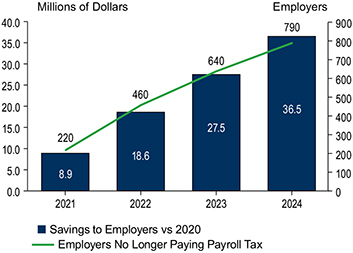
Source: Manitoba Finance
In addition, if fiscal updates show better than expected revenue performance, the government will implement the first rate reduction in 25 years in the tax levy for 2024, from 4.3 per cent to 4.0 per cent on payroll between $2.25-million and $4.5-million and from 2.15 per cent to 2.0 per cent on total payroll if payroll exceeds $4.5-million.
This rate reduction will be confirmed before Jan. 1, 2024. Tying this change to the province’s fiscal performance is the most responsible way to ensure there are sufficient resources and a strong enough fiscal foundation to support this reduction.
This rate reduction will benefit all 2,750 businesses paying the tax and result in a further annual tax savings of $35-million beginning in 2024. This would provide total incremental annual tax savings of $44-million beginning in 2024 when combined with the threshold adjustments.
Manitoba recognizes the payroll tax is money businesses and employers could better use to hire Manitobans or increase worker wages. The reduction to 2.0 per cent in 2024 is an important first step towards the elimination of this tax.
Interactive Digital Media Tax Credit
Manitoba’s media sector is burgeoning, and Budget 2023 continues to support this creative industry. The Interactive Digital Media Tax Credit will be enhanced as of Apr. 1, 2023 by expanding eligible expenditures to allow for more flexible forms of employee compensation and incentives as eligible labour expenditures. This does not include labour expenditures such as bonuses tied to profits or revenues, stock options and signing bonuses, which will remain ineligible.
The industry is evolving as it adopts progressive wage packages to address the competitiveness of its work force with other sectors with similar skill requirements. This enhancement to the credit is estimated to provide over $200,000 in on-going annual tax savings to this industry.
This credit was previously enhanced and modernized in 2021 to help continue to grow the industry. Manitoba eliminated the tax credit’s expiration date, simplified the initial application for a Certificate of Eligibility, and expanded the tax credit’s eligibility to allow add-on activities, such as downloadable content, ongoing maintenance and updates, and data management and analysis that are complementary to the main products being developed.
These enhancements have made the tax credit more competitive with other jurisdictions and is serving as an important tool to help attract investment, jobs and growth in the sector.
| Budget 2023 – Fiscally Responsible Outcomes and Economic Growth Strategy | 61
|
|
|
Building a Skilled Workforce
Like the rest of Canada, Manitoba is facing a tight labour market, with the provincial unemployment rate at a near all-time low and job vacancies at record highs.
A skilled workforce is the engine that runs an innovative and productive economy.
Industry stakeholders have indicated that labour shortages are the most significant impediment to economic growth. Manitoba is forecasting 114,300 job openings between 2022 and 2026, and 56 per cent will require some post-secondary education and training (e.g., college, university, trade certification).
In Budget 2023, the government is investing an additional $92.5-million in funding to support post-secondary education and the labour market, an 11.5 per cent increase from 2022/23.
To ensure individuals gain the skills and competencies needed to meet growing provincial needs, Budget 2023 sets out investments focused on addressing provincial labour market needs, including:
| · | $7.5-million for a total $12.5-million project for an innovative, interdisciplinary health and community services simulation centre at Red River College Polytechnic (RRC Polytech) to support up to an additional 115 nursing seats and support the college’s commitment to train more nurses and health-care professionals; |
| · | $1.3-million in capital and operating funding for Assiniboine Community College (ACC) to offer training for a one-time 25-student cohort in its practical nurse diploma program in Neepawa starting in 2023/24 to help address the urgent nurse staffing need for the new Neepawa hospital, which is slated to open in 2025; |
| · | $725,000 to increase training seats by 25 per cent (from 16 to 20) in the University of Manitoba’s Respiratory Therapy program; and |
| · | $539,000 to expand the inter-provincial agreement with the Western College of Veterinary Medicine at the University of Saskatchewan and help attract, train and retain veterinarians to reinforce commercial agriculture in rural areas. Funding will increase the intake to 20 seats every year until it supports 80 Manitoba students annually through the four-year program. |
|
|
The province will also invest $10-million for the expansion of other post-secondary education and training aimed specifically at meeting Manitoba’s growing labour market needs. This will support a number of programs at different post-secondary partners. |
The Sector Council Program supports organizations in key Manitoba economic sectors to deliver workforce training to support business growth and prosperity.
|
|
Budget 2023 commits $40.4-million to expand and enhance the Sector Council Program over the next four years to support economic growth and help reduce the labour demand/supply gap by helping employers attract, recruit, train and retain employees. |
The provincial apprenticeship system saw a significant rebound in new registrations in 2021/22. New registrations accelerated by 55 per cent to a record 2,770 registrants, making up substantially more than the 24 per cent decline reported in 2020/21.
| 62 | Budget 2023 – Fiscally Responsible Outcomes and Economic Growth Strategy
|
|
|
To further encourage participation in the trades, the government is increasing awareness of the benefits, opportunities and value of apprenticeship programs and to promote trades as a career path through its new partnership with Employment and Social Development Canada’s Skilled Trades, Awareness and Readiness (STAR) program.
|
|
Supporting students to access and achieve their education goals is critical to growing the provincial workforce. Budget 2023 commits an additional $1.4-million to the Manitoba Bursary program. This represents a total increase of $13-million since 2017/18. |
| In December 2022, the Manitoba government provided a $50-million repayable loan to the NFI Group to capitalize on economic growth opportunities in manufacturing and help maintain jobs as NFI Group recovers from global supply-chain disruption and benefits from record investments in public transit.
NFI’s head office, three manufacturing facilities and a parts distribution facility are located in Winnipeg and employ approximately 2,500 people in Manitoba.
|
Newcomer Education and Training Supports
Labour shortages are being addressed by ensuring every Manitoban is working to their full potential. Each year, the province attracts thousands of newcomers who make Manitoba their home; however, many are not working in their fields of education and experience.
In 2022, the province welcomed more than 21,000 permanent residents across all immigration categories, including almost 14,000 through the Manitoba Provincial Nominee Program. This is the highest annual number of nominees since the program was established in 1998.
Manitoba Permanent Resident Landings
Number of Landings
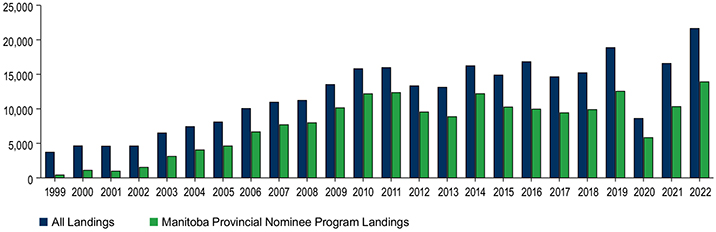
Source: Manitoba Labour and Immigration
| Budget 2023 – Fiscally Responsible Outcomes and Economic Growth Strategy | 63
|
|
|
|
|
Budget 2023 will help further this momentum to support the economy and continue growing the number of nominees making Manitoba home. To that end, the Manitoba government will invest an additional $2-million to expand the Newcomer Community Integration Support Program to ensure the provision of robust settlement and integration services. |
And work is underway to bring entrepreneurs to Manitoba to start new businesses outside of Winnipeg.
Manitoba’s Fair Registration Practices Office will continue its work with self-regulated professions to ensure internationally-educated applicants can practice in their chosen fields sooner.
|
|
In 2023, Manitoba will invest $3.6-million to launch a new pilot program for internationally-educated professionals to reduce financial barriers and help newcomers fill in-demand jobs that match their education and experiences. |
Manitoba settlement service providers also deliver services to Ukrainian temporary residents who have fled Russia’s brutal and unjust war. Between April 2022 and January 2023, more than 16,000 Canada-Ukraine Authorization for Emergency Travel holders have visited Manitoba’s Ukraine Reception Centre, with more than 12,000 applying for Manitoba health cards.
| 64 | Budget 2023 – Fiscally Responsible Outcomes and Economic Growth Strategy
|
|
|
Capital Investments
Manitoba’s investments in schools, health care, highways, housing, municipal infrastructure and other capital assets provide multiple benefits to society. These strategic investments provide an immediate economic stimulus, generating jobs and boosting the incomes of Manitobans.
These investments also provide long-term social benefits of making communities more resilient, Manitoba more competitive in the global market, healing health care, protecting the environment and parks, and advancing productivity and wellness.
This year’s multi-year capital investment plan follows best practises in Canada and has been expanded to a five-year plan which is able to provide a more strategic outlook of future year priorities and commitments.
As witnessed in the past two years, capital delivery has been made more difficult by unprecedented inflation and supply chain issues due to a pandemic, and geopolitical instability; this is in addition to weather and climate challenges.
This change to a long-term plan will provide targets to ensure government stays on track in uncertain times on needed strategic infrastructure commitments and provides transparency to Manitobans. This will also help our construction industry, by ensuring they are better able to plan for labour or equipment needs in upcoming years.
The five-year plan is ambitious, with a total investment of over $14-billion in strategic infrastructure planned over five years, and more than $3-billion in strategic infrastructure spending planned for 2023/24.
| Budget 2023 – Fiscally Responsible Outcomes and Economic Growth Strategy | 65
|
|
|
Five Year Capital Plan, 2023/24 – 2027/28
Building from the three-year capital plan in Budget 2022, the 2023/24 budget expands the multi-year capital plan to five years. The overview of the five-year capital plan is included on the table and graphs below and a listing of major projects in planning or delivery stages in 2023/24 is attached in Appendix: Manitoba Capital Highlights on page 73.
Work is well underway to develop and maintain a government-wide inventory of the condition of assets that will facilitate better prioritization of capital investments and proactive asset management.
This plan provides funding for new and ongoing projects to address essential infrastructure needs, stimulate economic recovery, and ensure Manitoba’s continued success.
|
Annual Capital Infrastructure Investments
Source: Manitoba Finance | ||
|
Typical of multi-year capital plans in other provinces, the values reported only include projects that are known of at this time. Therefore, the planned investments in 2024/25 onwards show a lower total strategic infrastructure investment. |
Another reason for the downward trend by 2027/28 is that the commitment to build 20 new schools in 10 years will be completed by this point. This should not be interpreted as a downward commitment from the government. New projects will be added to the five-year capital plan as future years are budgeted.
| |
| 66 | Budget 2023 – Fiscally Responsible Outcomes and Economic Growth Strategy
|
|
|
Capital Infrastructure Investment Plan
| (Millions of Dollars) | 2022 Budget (Restated) |
2023 Budget |
2024 Plan |
2025 Plan |
2026 Plan |
2027 Plan |
5 Year Total |
|||||||||||||||||||||
| BUILDINGS, EQUIPMENT AND TECHNOLOGY |
|
|||||||||||||||||||||||||||
| Health | 294 | 291 | 295 | 298 | 297 | 293 | 1,474 | |||||||||||||||||||||
| K-12 and Advanced Education | 383 | 387 | 368 | 350 | 310 | 252 | 1,667 | |||||||||||||||||||||
| Housing | 67 | 67 | 67 | 67 | 67 | 67 | 335 | |||||||||||||||||||||
| Other Departments | 135 | 332 | 86 | 84 | 85 | 82 | 669 | |||||||||||||||||||||
| Information Technology | 81 | 84 | 92 | 70 | 66 | 60 | 372 | |||||||||||||||||||||
| 960 | 1,161 | 908 | 869 | 825 | 754 | 4,517 | ||||||||||||||||||||||
| ROADS, HIGHWAYS, BRIDGES AND FLOOD PROTECTION |
|
|||||||||||||||||||||||||||
| Highways & Airport Runway Capital | 474 | 563 | 506 | 506 | 506 | 506 | 2,587 | |||||||||||||||||||||
| Manitoba Restart Capital Program | 111 | - | - | - | - | - | - | |||||||||||||||||||||
| Lake Manitoba Outlet Channel | 107 | 101 | 101 | 101 | 101 | 101 | 505 | |||||||||||||||||||||
| Water Related Infrastructure | 32 | 32 | 33 | 33 | 33 | 33 | 164 | |||||||||||||||||||||
| Transportation Equipment and Aircraft | 7 | 7 | 7 | 7 | 7 | 7 | 35 | |||||||||||||||||||||
| 731 | 703 | 647 | 647 | 647 | 647 | 3,291 | ||||||||||||||||||||||
| OTHER REPORTING ENTITIES | ||||||||||||||||||||||||||||
| Efficiency Manitoba | 66 | 66 | 66 | 66 | 66 | 66 | 330 | |||||||||||||||||||||
| Other | 53 | 66 | 65 | 65 | 66 | 66 | 328 | |||||||||||||||||||||
| 119 | 132 | 131 | 131 | 132 | 132 | 658 | ||||||||||||||||||||||
| CAPITAL GRANTS | ||||||||||||||||||||||||||||
| Municipal Grants | 292 | 160 | 160 | 160 | 160 | 160 | 800 | |||||||||||||||||||||
| Northern Affairs Communities | 4 | 4 | 4 | 4 | 4 | 4 | 20 | |||||||||||||||||||||
| 296 | 164 | 164 | 164 | 164 | 164 | 820 | ||||||||||||||||||||||
| MAINTENANCE AND PRESERVATION | ||||||||||||||||||||||||||||
| Highways Infrastructure | 124 | 137 | 137 | 137 | 137 | 137 | 685 | |||||||||||||||||||||
| Water Related Infrastructure | 13 | 14 | 14 | 14 | 14 | 14 | 70 | |||||||||||||||||||||
| 137 | 151 | 151 | 151 | 151 | 151 | 755 | ||||||||||||||||||||||
| CROWN CORPORATIONS | ||||||||||||||||||||||||||||
| Manitoba Liquor and Lotteries Corporation | 71 | 91 | 73 | 52 | 49 | 49 | 314 | |||||||||||||||||||||
| Manitoba Public Insurance Corporation | 87 | 76 | 50 | 56 | 11 | 12 | 205 | |||||||||||||||||||||
| Manitoba Hydro | 907 | 654 | 651 | 692 | 699 | 775 | 3,471 | |||||||||||||||||||||
| 1,065 | 821 | 774 | 800 | 759 | 836 | 3,990 | ||||||||||||||||||||||
| TOTAL STRATEGIC INFRASTRUCTURE INVESTMENTS |
3,308 | 3,132 | 2,775 | 2,762 | 2,678 | 2,684 | 14,031 | |||||||||||||||||||||
| Budget 2023 – Fiscally Responsible Outcomes and Economic Growth Strategy | 67
|
|
|
2023/24 Capital Infrastructure Investments
Millions of Dollars and Per Cent
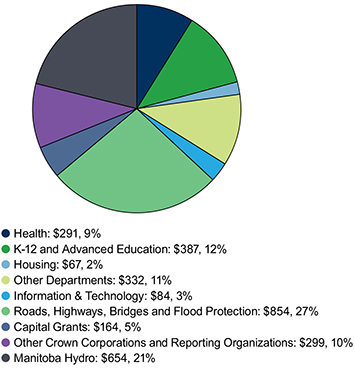
Source: Manitoba Finance
Handling Uncertainty and Capital Plan Modernization
As the province develops long-term capital plans, it is important to recognize that capital projects take years to complete, and there can be unforeseen challenges to some projects that result in delays while other projects experience hurdles due to inflation.
Planned appropriation legislation will allow for capital expenditure authority that would otherwise lapse to be redirected towards priority areas such as school construction, the construction of health facilities in our communities, highway and road construction, and building social housing.
Capital Infrastructure Investments in the Five-Year Plan
The following investments are included in the five-year capital plan by government departments.
Manitoba Consumer Protection and Government Services
Capital infrastructure delivery services to government departments have been centralized in Manitoba Consumer Protection and Government Services. These services include information technology, capital project planning and delivery, and asset management for government-owned buildings.
The department provides property services for owned capital assets, provides project management and real estate services to government, and oversees real estate and property asset disposal. Assets administered by the department include the Legislative Building, the Manitoba Museum and Centennial Concert Hall, correctional institutes, courts and government office spaces.
|
|
The 2023/24 capital plan is $51-million for capital projects to improve, repair and construct capital assets for government operations and programming. Significant continuing projects include the construction and renovation of Dauphin Courthouse, modernizing the courtrooms at Thompson Provincial Office Building and the renewal of the exterior stone cladding and roof at the Centennial Concert Hall in Winnipeg. |
|
|
This year $84-million is committed towards information technology capital projects that support the annual upgrading and replacement of infrastructure. |
| 68 | Budget 2023 – Fiscally Responsible Outcomes and Economic Growth Strategy
|
|
|
This includes the Enterprise Resource Planning Modernization project that will upgrade critical business functions and support business transformation programs like Procurement Modernization and Finance and Administration Services Consolidation. It will streamline, digitize and standardize government operations to align with industry best practices and provide a platform to support the introduction of common business processes across the enterprise.
The Legislative Building Centennial Restoration and Preservation Act, through its statutory appropriation, continues to commit $10-million annually for upkeep and restoration. Projects of significance include the restoration of the 106-year-old service tunnel spanning Broadway and heritage exterior restoration on the east façade of the Legislature.
Manitoba Education and Early Childhood Learning
Over the last five years, $984-million has been invested in education capital spending, with an additional $1.297-billion planned over the next five years.
With 14 schools under construction or completed and another nine planned, the Manitoba government is on track to exceed the commitment to build 20 new schools by 2028. New schools going into design and construction in 2023/24 include K-8 schools in Sage Creek (Division scolaire franco-manitobaine and Louis Riel School Division), Seven Oaks School Division (Precinct F), Morden and Steinbach as well as a Grade 9 to 12 high school in Winnipeg.
|
|
To make this leap in building new schools, a historic $350-million in additional capital funding has been provided between 2020/21 and 2023/24. |
Each new school includes the development of early learning and child-care spaces to increase availability of services for Manitoba families.
Investments have and continue to be made in existing school buildings to maintain a safe, healthy and accessible environment for students throughout the province.
Manitoba Natural Resources and Northern Development
Capital investments in natural resources and northern development are a key component in the delivery of many public-facing and conservation-focused programs including the management and operation of provincial parks and trails, natural resource stewardship, water stewardship and forest fire suppression activities across the province.
|
|
In 2022/23, the department developed a new multi-year Manitoba Parks Strategic Investment Capital Plan with a capital investment of an additional $10-million beginning in 2023/24. |
The increased funding will improve infrastructure, construct new facilities and provide the necessary equipment to support programs, tourism activities and services.
Highlights of the plan include expansions to yurt villages and other ‘glamping’ developments, campground infrastructure, electrification projects, significant trail improvement projects, and the redevelopment of the North Whiteshell Museum at Nutimik Lake.
Manitoba Families
Over the last five years, $205-million has been invested in housing with an additional $335-million planned over the next five years. Through the Manitoba Housing Renewal Corporation, the government supports the development of safe and affordable housing, particularly for those of low and moderate income or those with specialized needs. Significant investments have been made to repair and restore existing social housing units and address the repair backlog.
| Budget 2023 – Fiscally Responsible Outcomes and Economic Growth Strategy | 69
|
|
|
|
|
The 2023/24 capital plan continues with these necessary repairs by committing $67-million for building and asset renovations including exterior retrofits, mechanical, structural and security upgrades to its aging stock. |
Plans for new buildings are being prioritized with the first new building to be planned and designed in 2023/24. New buildings will allow flexibility to move tenants out of existing buildings requiring significant retrofits and will later provide additional units to the housing portfolio.
Manitoba Health
|
|
Over the last five years, $754-million has been invested in capital health projects, with an additional $1.4-billion planned for the next five years. Capital investments in hospitals, clinics, personal care homes and emergency response services enable the provision of quality health care services to Manitobans. |
Manitoba is making a historic capital investment in building, expanding and renovating health care facilities across the province in support of Manitoba’s Clinical and Preventive Services Plan. The plan, led by clinicians, improves access to care for all Manitobans and identifies planned investments in health infrastructure as being pivotal to efforts to support better care sooner and as close to home as possible.
In addition to the projects under the Clinical and Preventive Services Plan, Manitoba’s continued commitment to the expansion and redevelopment of rural and northern health care facilities is under way, including upgrading and replacement of building infrastructure and medical equipment such as diagnostic equipment, roof replacements, heating/cooling and electrical services, and upgrading and installation of fire protection systems in personal care homes.
The five-year capital plan includes project investments in new hospitals in Neepawa and Portage la Prairie, expansions at the Selkirk Regional Health Centre, Boundary Trails Health Centre and Bethesda Regional
Health Centre, along with redevelopment and expansion projects at several sites including Virden, Souris, Killarney, Shoal Lake, Arborg, Beausejour and the emergency department at St. Boniface Hospital in Winnipeg.
Manitoba Municipal Relations
To support environmental, economic and social needs in communities and mitigate against adverse market conditions, Manitoba continues to support and facilitate innovative infrastructure funding solutions by working with provincial departments and external bodies, such as municipalities or the broader private sector, to make large, strategic and complex projects possible for Manitobans.
Drawing on best practices from other jurisdictions, Manitoba continues to develop strategic partnerships with the Canada Infrastructure Bank and others, exploring the merits of alternative delivery models or working with clients to leverage national, merit-based grants in support of both federal and provincial infrastructure initiatives.
Investments in infrastructure in Manitoba municipalities include Manitoba’s investments under the partnership with the Federal Government in the Investing in Canada Infrastructure Program (ICIP). More than $1.17-billion in federal funding will be available to support Manitoba’s infrastructure needs.
Manitoba has advanced 136 projects to Canada under the program, worth $3.2-billion in total project costs. Almost all provincial funding available under ICIP has been applied for, and 99 projects have been approved and jointly announced to date, with more federal approvals pending.
These projects will benefit Manitoba’s post-pandemic economic recovery by supporting job creation and economic growth while promoting sustainability, improving public spaces, modernizing water and waste-water treatment systems, mitigating impacts of climate-related events and enhancing public transit.
| 70 | Budget 2023 – Fiscally Responsible Outcomes and Economic Growth Strategy
|
|
|
|
|
Working with the City of Winnipeg and Government of Canada to fund the Winnipeg North End Water Pollution Control Centre, with Manitoba investing $96.7-million towards phase one and further investment of $167.4-million for phase two. |
The Manitoba Water Services Board has significantly expanded the amount of construction undertaken to replace, upgrade or expand municipal potable water and sewer infrastructure throughout Manitoba.
In 2022, the board tendered and awarded 40 construction projects with a total construction cost of approximately $130 million, which includes a new water treatment plant and groundwater supply for the Town of Beausejour, a wastewater treatment lagoon expansion in Rosenort in the Rural Municipality of Morris, water and sewer main renewals in the Town of Snow Lake and phase two of the Town of Neepawa’s wastewater treatment facility upgrades.
|
|
New construction projects planned in 2023 includes $12-million for the second phase of the City of Thompson’s water and sewer main renewals, $5 million for a water treatment plant expansion in the Rural Municipality of Brokenhead, and $3.6-million in lift station upgrades in the City of Flin Flon. In addition, the board continues to work with municipalities to conduct planning and engineering to deliver tender-ready water and sewer projects for future funding opportunities. |
Manitoba Transportation and Infrastructure
|
|
Over the last five years, $2.8-billion has been invested in transportation infrastructure, with an additional $4-billion planned over the next five years. |
The Manitoba government has a vision to expand Manitoba as a transportation hub, improving trade access to markets and supporting investment in trade-based industry. In support of this vision, Manitoba is establishing a senior level advisory council. Long-term strategic initiatives are in place to build the foundation for Manitoba’s economic growth, including the Winnipeg One Million Perimeter Freeway Initiative and the Trade and Commerce Strategy.
| Budget 2023 – Fiscally Responsible Outcomes and Economic Growth Strategy | 71
|
|
|
The five-year plan will see more than $2.5-billion invested, and annual minimum commitments of $500-million in highway capital with some of the highlights including:
| · | investing in an access-controlled Perimeter Highway freeway system with major enhancements such as the interchanges at St. Mary’s Road (PR 200) and McGillivray Boulevard (PTH 3) to ensure the movement of goods along key international trade corridors; |
| · | investing in national trade corridors, initially focusing on the twinning of PTH 1 from Falcon Lake to the Ontario border; |
| · | investing in key trade and commerce routes to efficiently move goods within and across borders, including the reconstruction on PTH 12, rehabilitation on PTH 5 and a structure replacement on PTH 5 at Assiniboine River (Spruce Woods); |
| · | supporting improved connectivity construction, with work commencing on the twinning of PTH 6 north of Winnipeg and PTH 3 southwest of Winnipeg; |
| · | developing additional planned resiliency projects including the structure rehabilitation at Rivers Dam, structure replacements at Deloraine, Falcon Lake and Wanipigow Dams and a structure replacement at PR 305 at Red River (Ste. Agathe). |
|
|
Constructing the Manitoba outlet channels remains a priority, with Indigenous consultation and engagement continuing as the project progresses through the federal environmental process. The flooding experienced in spring 2022 resulted in $392-million in recovery work to be completed in the next three years; and highlighted the importance of investing in climate resiliency to mitigate losses incurred from frequent flooding and other weather-related events. |
Crown Corporations – Manitoba Hydro
|
|
Manitoba Hydro will invest approximately $3.4-billion over the next five years to provide safe, reliable energy through additions, improvements and replacement of existing infrastructure. Of the $654-million committed to its capital program in 2023/24, $585-million will sustain and support growth of the current and future performance capability of Manitoba Hydro’s generation, transmission and distribution assets. |
A significant project included in the five-year capital plan is the Pointe du Bois Renewable Energy Project, which will increase capacity and the annual amount of clean, low-cost, renewable energy generated at the Pointe du Bois Generating Station.
Crown Corporations – Manitoba Liquor and Lotteries
|
|
Manitoba Liquor and Lotteries 2023/24 capital program of $91-million primarily focuses on projects that are required for the necessary maintenance, safety and security of Manitoba Liquor and Lotteries’ facilities, equipment, infrastructure, systems, employees and customers. In addition, it supports maintaining the equipment and systems essential for conducting gaming activity in business partner locations, including First Nation casinos and VLT gaming centers. |
Crown Corporations – Manitoba Public Insurance
Manitoba Public Insurance continues to invest in technology to modernize and transform the corporation’s services, placing customers at the forefront by enabling expanded online service options for Manitobans.
| 72 | Budget 2023 – Fiscally Responsible Outcomes and Economic Growth Strategy
|
|
|
Appendix: Manitoba Capital Highlights
Major Capital Projects
|
|
Manitoba is investing $3-billion towards capital infrastructure renewal in 2023-24. There is $1-billion in planned spending for major projects, each with an estimated total project cost greater than $10-million. These projects will be in various stages of planning and delivery in the year 2023/24. |
| MANITOBA EDUCATION AND EARLY CHILDHOOD LEARNING | ||||
| School/Location |
School Division | Activity | ||
| Morden |
Western School Division | New K-8 School and Child Care | ||
| Precinct F |
Seven Oaks School Division | New K-8 School and Child Care | ||
| Sage Creek / Bonavista |
Louis Riel School Division | New K-8 School (French Immersion) | ||
| Sage Creek |
Division scolaire franco-manitobaine | New K-8 School (Français) | ||
| Bison Run School in Waverley West |
Pembina Trails School Division | New K-8 School | ||
| West Steinbach |
Hanover School Division | New K-4 School and Child Care | ||
| King Edward High School |
Winnipeg School Division | New 9-12 High School and Child Care | ||
| Pembina Trails Collegiate in Waverley West |
Pembina Trails School Division | New 9-12 School | ||
| Ecole Regent Park |
River East Transcona School Division | Gym addition, Renovation and Child Care | ||
| École Saint Joachim School |
Division Scolaire Franco-Manitobain | Classroom Addition and Renovation | ||
| Ecole St. Malo |
Red River Valley School Division | Classroom Addition | ||
| Gordon Bell High School |
Winnipeg School Division | Wall and roof replacement, mechanical upgrades | ||
| Green Valley School |
Hanover School Division | Gym, Classroom Addition and Renovation | ||
| Marion School |
Louis Riel School Division | Gym, Classroom Addition and Child Care | ||
| RD Parker Collegiate |
Mystery Lake School Division | Exterior repairs, Roof Replacement and Band Room Addition | ||
| Sir William Osler School |
Winnipeg School Division | Gym, Classrooms Addition, Renovations and Child Care | ||
| MANITOBA ADVANCED EDUCATION AND TRAINING | ||||
| School |
Location | Activity | ||
| Red River College |
Winnipeg | Nursing Lab | ||
| Budget 2023 – Fiscally Responsible Outcomes and Economic Growth Strategy | 73
|
|
|
| MANITOBA HEALTH – HEALTH FACILITY INVESTMENTS | ||||
| Health Facility/Personal Care Home |
Service Delivery Organization | Activity | ||
| Boundary Trails Hospital |
Southern Health-Santé Sud | Energy Centre Expansion | ||
| Boyne Lodge Personal Care Home |
Southern Health-Santé Sud | Redevelopment of 110 Beds | ||
| Brandon Regional Health Centre |
Prairie Mountain Health | Emergency Department Redevelopment | ||
| Churchill Health Centre Nursing Station |
Winnipeg Regional Health Authority | Emergency Response Stations Upgrades | ||
| Grace Hospital Intensive Care Unit |
Winnipeg Regional Health Authority | Renovation and Expansion | ||
| Health Sciences Centre |
Shared Health | Adult Emergency Department, Emergency Psychiatry and Addictions Area | ||
| Health Sciences Centre |
Shared Health | Adult Inpatient Unit Refresh | ||
| Saint Boniface General Hospital |
Winnipeg Regional Health Authority | Emergency Department Redevelopment | ||
| The Pas Primary Care Clinic |
Northern Regional Health Authority | New Primary Care Clinic | ||
| Thompson General Hospital |
Northern Regional Health Authority | Emergency Department Redevelopment | ||
| Victoria Hospital |
Winnipeg Regional Health Authority | Building Envelope | ||
| Parkview Place Personal Care Home |
Winnipeg Regional Health Authority | Replacement Beds for Convalescent Home | ||
| CancerCare Manitoba |
CancerCare Manitoba | Immediate Needs and Stabilization and Strengthening Services to 2025 | ||
| Health Sciences Centre |
Shared Health | Surgical Centre of Excellence | ||
| MANITOBA HEALTH – HEALTH SYSTEM CAPITAL INVESTMENTS | ||
| Activity |
Scope/Location | |
| Clinical Preventative Services Plan |
Multiple Health Facilities | |
| Cybersecurity Improvements |
Province-Wide | |
| Emergency Response Services Upgrades |
Multiple Health Facilities | |
| Health-care System Transformation Projects |
Province-Wide | |
| Fire Safety Improvements |
Province-Wide | |
| Personal Care Home New Construction |
Various Locations | |
| Provincial Pharmaceutical Distribution and Sterile Compounding Improvements |
Province-Wide | |
| Primary Care Enrolment and Clinical Info Sharing Program |
Province-Wide | |
| Provincial Electronic Patient Record – Brandon |
Information Technology | |
| Provincial Electronic Patient Record Clinical Documentation Ambulatory |
Information Technology | |
| 74 | Budget 2023 – Fiscally Responsible Outcomes and Economic Growth Strategy
|
|
|
| MANITOBA HEALTH – HEALTH SYSTEM CAPITAL INVESTMENTS | ||
| Activity |
Scope/Location | |
| Provincial Information Management and Analytics Solution |
Province-Wide | |
| Service Delivery Organization Infrastructure Transition Project |
Province-Wide | |
| Wi-Fi Expansion |
Province-Wide | |
| MANITOBA FAMILIES | ||||
| Project |
Location | Activity | ||
| Burrows and Keewatin-FP01 (Gilbert Park) |
Winnipeg | Site Improvement and Sanitary Waste and Storm Water Piping Upgrades | ||
| MANITOBA CONSUMER PROTECTION AND GOVERNMENT SERVICES | ||||
| Facility |
Location | Activity | ||
| 219 Memorial and Legislative Assembly |
Winnipeg | Central Power House Tunnel Refurbishment, Roadwork and Repair | ||
| Centennial Concert Hall |
Winnipeg | Cladding Upgrade | ||
| Dauphin Courthouse |
Dauphin | Renovation and Expansion | ||
| Legislative Building |
Winnipeg | Heritage Preservation and Exterior Stone Restoration | ||
| Thompson Provincial Office Building |
Thompson | Expansion of Court Spaces | ||
| Cyber Security Risk Reduction Program |
Province-Wide | Technology | ||
| Manitoba Technology Risk Reduction Program |
Province-Wide | Technology | ||
| Enterprise Resource Planning Modernization Program |
Province-Wide | Technology | ||
| Courts Modernization |
Various | Technology | ||
| Customer Relationship Management – Case Management and Workflow Solutions |
Province-Wide | Technology | ||
| Computer Assisted Mass Appraisal System |
Province-Wide | Technology | ||
| Budget 2023 – Fiscally Responsible Outcomes and Economic Growth Strategy | 75
|
|
|
| MANITOBA TRANSPORTATION AND INFRASTRUCTURE – AIRPORTS AND WATER INFRASTRUCTURE | ||||
| Project |
Location | Activity | ||
| Lake Manitoba and Lake St. Martin Outlet Channels |
Lake Manitoba and Lake St. Martin | Flood Protection | ||
| Boundary Creek Drain: 2,3,4,5,6- 18-3E |
Boundary Creek Manitoba | Drain Reconstruction | ||
| Deloraine Dam: 30-02-22W |
Deloraine | Structure Replacement | ||
| Emerson – West Lynne Pump Station* |
Emerson-West Lynne Dike | Pump Station Rehabilitation & Replacement | ||
| Portage Diversion Outlet |
Lake Manitoba, R.M. of Portage La Prairie | Structure Rehabilitation (Flood Recovery) | ||
| Quesnel Lake Dam |
Quesnel Lake | Structure Rehabilitation (Flood Recovery) | ||
| Rivers Dam: SW 19-12-20W Mitigation |
Lake Wahtopanah, Near Rivers Manitoba | Spillway, Dam & Control Structure Rehabilitation (Flood Mitigation & Flood Recovery) | ||
| St. Adolphe Dike Pump Station Rehabilitation* |
St. Adolphe | Pump Station Rehabilitation | ||
| Gods Lake Narrows Airport* |
Gods Lake Narrows | Runway Repairs/Improvements | ||
| Oxford House Airport |
Oxford House | Runway Rehabilitation | ||
* Cost-shared with other levels of government, Airports Capital Assistance Program (ACAP), Investing in Canada Infrastructure Program, Green Infrastructure Stream (ICIP-GIS) and Adaptation, Resilience and Disaster Mitigation program (ARDM)
| MANITOBA TRANSPORTATION AND INFRASTRUCTURE – HIGHWAY CONSTRUCTION AND REPAIR | ||||
| Highway |
Location | Activity | ||
| HWY 1 |
0.8km West of PR 334 to PR 334 | Concrete Reconstruction* | ||
| HWY 1 |
Vicinity of PTH 12 | Bituminous Reconstruction | ||
| HWY 1 |
Brokenhead River to PTH 11 (W/B) | Bituminous Reconstruction * | ||
| HWY 1 |
PTH 11 to PR 308 (W/B) | Bituminous Reconstruction* | ||
| HWY 1 |
PR 248 to East Junction of PTH 26 (E/B) | Bituminous Reconstruction* | ||
| HWY 1 |
At Symington Yard Overpass (East of Winnipeg) | Structure Replacement | ||
| HWY 1 |
At Assiniboine River: 0.8km West of East Junction PTH 26 (E/B) | Structure Replacement | ||
| HWY 1 |
West Junction PTH 26 (Portage la Prairie) to 1km West of PTH 13 (E/B) | Bituminous Reconstruction | ||
| HWY 1 |
At PTH 1A West Junction (Portage Diversion to Can-Oat Road) | Bituminous Reconstruction | ||
* Cost-shared with the Federal Government through the Provincial Territorial Infrastructure Component (PTIC) part of the Nation Rebuilding Program (NRP).
| 76 | Budget 2023 – Fiscally Responsible Outcomes and Economic Growth Strategy
|
|
|
| MANITOBA TRANSPORTATION AND INFRASTRUCTURE – HIGHWAY CONSTRUCTION AND REPAIR | ||||
| Highway |
Location | Activity | ||
| HWY 1 |
3.4km West of PTH 83 (Hargrave) to PR 257 (E/B) | Bituminous Rehabilitation * | ||
| HWY 1 |
6km West of PTH 21 E Junction PR 250 (E/B) | Bituminous Rehabilitation * | ||
| HWY 1 |
5km West of PR 301 to Ontario Boundary | Bituminous Reconstruction (Twinning) | ||
| HWY 001A |
Portage la Prairie Bypass: 7.6km East of PR 305 (West of Portage la Prairie) | Structure Replacement | ||
| HWY 001A |
At Interchange: 1.3km West of PTH 26 (Portage la Prairie) | Structure Replacement | ||
| HWY 2 |
PR 240 to PTH 13 | Bituminous Rehabilitation * | ||
| HWY 3 |
PTH 31 to 1.9km West of PR 432 | Bituminous Rehabilitation * | ||
| HWY 3 |
PTH 23 to 0.7km South of PTH 13 | Bituminous Rehabilitation * | ||
| HWY 3 |
0.3km East of PTH 13 to 0.2km West of PR 336 | Bituminous Reconstruction | ||
| HWY 3 |
0.2km West of PR 336 to PR 305 (Morris River) | Bituminous Reconstruction | ||
| HWY 3 |
1.6km East of PTH 100 (Wyper Road) to 6.7km East of PTH 100 (Winnipeg City Limits) | Bituminous Reconstruction (Twinning) | ||
| HWY 3 |
North Junction PTH 3A to North Junction PTH 34 | Bituminous Reconstruction | ||
| HWY 3 |
At Souris River: 0.7km East of North Junction of PTH 83 (Vicinity of Melita) | Structure Replacement (Flood Mitigation) | ||
| HWY 3 |
Saskatchewan Boundary to South Junction PTH 83 | Bituminous Rehabilitation | ||
| HWY 5 |
PTH 23 to PTH 2 | Bituminous Rehabilitation | ||
| HWY 5 |
15.0km North of PTH 2 to PTH 1 | Bituminous Rehabilitation | ||
| HWY 5 |
At Assiniboine River: 11.1km North of PTH 2 (At Spruce Woods) | Structure Replacement | ||
| HWY 5 |
At Lake of the Prairies to 12.6km West of PTH 83 (West of Roblin) | Structure Rehabilitation | ||
| HWY 005A |
In Dauphin: Triangle Road to Whitmore Ave | Bituminous Reconstruction | ||
| HWY 6 |
PTH 101 to Grosse Isle | Bituminous Reconstruction (Twinning & Passing Lanes) * | ||
| HWY 6 |
0.4km North of PR 419 to South Junction PTH 68 (Lundar to Eriksdale) | Bituminous Rehabilitation * | ||
| HWY 6 |
0.4km North of North Junction PR 237 to 0.6km South of PR 239 (Moosehorn to North of Grahamdale) | Bituminous Rehabilitation * | ||
* Cost-shared with the Federal Government through the Provincial Territorial Infrastructure Component (PTIC) part of the Nation Rebuilding Program (NRP).
| Budget 2023 – Fiscally Responsible Outcomes and Economic Growth Strategy | 77
|
|
|
| MANITOBA TRANSPORTATION AND INFRASTRUCTURE – HIGHWAY CONSTRUCTION AND REPAIR | ||||
| Highway |
Location | Activity | ||
| HWY 9 |
0.1km North of PTH 101 to 1.7km South of PTH 27 | Bituminous Rehabilitation | ||
| HWY 10 |
1.2km North of North Junction PTH 16 to 11.6km North of North Junction PTH 16 | Bituminous Reconstruction * | ||
| HWY 10 |
In Brandon: Daly Overpass (18th Street at CP Railway) | Structure Replacement * | ||
| HWY 10 |
At Duck River North: 0.5km North of PTH 20 (At Cowan) | Structure Replacement | ||
| HWY 12 |
1.8km North of PTH 52 (Park Road) to Seine River Diversion (N/B & S/B) | Bituminous Rehabilitation | ||
| HWY 15 |
PR 206 to Brokenhead River | Bituminous Reconstruction | ||
| HWY 16 |
2km West of PR 242 to 1.8km East of PR 242 | Bituminous Reconstruction * | ||
| HWY 16 |
PR 472 – West Junction PR 264 (Solsgirth Curves) | Bituminous Reconstruction | ||
| HWY 18 |
North Limit of Killarney to PTH 23 | Bituminous Rehabilitation | ||
| HWY 21 |
North Junction of PR 355 to 1st Ave (Shoal Lake) | Bituminous Reconstruction | ||
| HWY 21 |
US Border to 3km South of PTH 3 | Bituminous Rehabilitation | ||
| HWY 23 |
PR 336 to PR 422 | Bituminous Reconstruction | ||
| HWY 23 |
West Junction PTH 18 to PTH 5 | Bituminous Rehabilitation | ||
| HWY 23 |
PTH 5 to PTH 34 | Bituminous Rehabilitation | ||
| HWY 23 |
South Jct PTH 10 West Jct PTH 18 | Bituminous Rehabilitation | ||
| HWY 34 |
PTH 1–PTH 16 | Bituminous Reconstruction | ||
| HWY 34 |
At Assiniboine River: 12.2km North of PTH 2 (North of Holland) | Structure Replacement | ||
| HWY 39 |
PR 627 (Reed Lake) to PR 392 | Bituminous Rehabilitation | ||
| HWY 59 |
US Border to PR 403 | Bituminous Reconstruction | ||
| HWY 59 |
At Floodway: 4.5km North of PTH 101 (Vicinity of Birds Hill) | Structure Replacement | ||
| HWY 59 |
At Brokenhead River: 3.8km South of PR 319 (Vicinity of Scanterbury) | Structure Replacement | ||
| HWY 75 |
PR 305 to PR 205 (S/B) | Concrete Reconstruction | ||
| HWY 75 |
0.5 km North of PTH 23 – PR 205 | Concrete Reconstruction | ||
| HWY 75 |
At Morris River: 0.6km North of PTH 23 | Structure Replacement | ||
* Cost-shared with the Federal Government through the Provincial Territorial Infrastructure Component (PTIC) part of the Nation Rebuilding Program (NRP).
| 78 | Budget 2023 – Fiscally Responsible Outcomes and Economic Growth Strategy
|
|
|
| MANITOBA TRANSPORTATION AND INFRASTRUCTURE – HIGHWAY CONSTRUCTION AND REPAIR | ||||
| Highway |
Location | Activity | ||
| HWY 83 |
0.5km North of West Junction PTH 1 to 18km North of West Junction PTH 1 | Bituminous Reconstruction | ||
| HWY 83 |
PR 355 to PTH 42 | Bituminous Rehabilitation | ||
| HWY 83 |
17.7km North of PR 482 to PTH 5 (Roblin) | Bituminous Rehabilitation | ||
| HWY 100 |
South Perimeter: Safety Plan | Intersection Improvements, Median Closures & Service Roads | ||
| HWY 100 |
South Perimeter: At St. Mary’s Road | Interchange Construction | ||
| HWY 100 |
South Perimeter: At PTH 3 | Interchange Construction | ||
| HWY 100 |
South Perimeter: PTH 1W to PTH 1E | Land Acquisition | ||
| HWY 101 |
North Perimeter: Safety Plan | Intersection Improvements, Median Closures & Service Roads | ||
| HWY 200 |
At Floodway: 4.4km South of PTH 100 | Structure Rehabilitation | ||
| HWY 204 |
At Red River (Selkirk): 0.4km East of PTH 9A | Structure Rehabilitation | ||
| HWY 227 |
PR 430 to PTH 6 | Bituminous Reconstruction | ||
| HWY 240 |
In Portage la Prairie: At CNR/CPR: 0.6km North of PTH 1A | Structure Rehabilitation | ||
| HWY 248 |
At Assiniboine River: 0.3km South of PTH 26 | Structure Replacement | ||
| HWY 283 |
PR 282 to PTH 10 | Bituminous Reconstruction | ||
| HWY 283 |
Saskatchewan Boundary to PR 282 | Bituminous Reconstruction | ||
| HWY 305 |
At Red River: 0.5km East of PTH 75 (Ste Agathe) | Structure Rehabilitation | ||
| HWY 305 |
At Assiniboine River: 13.3km South of PTH 1 (At Long Plain First Nation) | Structure Replacement | ||
| HWY 311 |
PR 206 to PTH 12 | Bituminous Reconstruction | ||
| HWY 391 |
At Burntwood River: 3.0km North of PTH 6 (Thompson) | Structure Rehabilitation | ||
* Cost-shared with the Federal Government through the Provincial Territorial Infrastructure Component (PTIC) part of the Nation Rebuilding Program (NRP).
| MANITOBA MUNICIPAL RELATIONS (MANITOBA WATER SERVICES BOARD) | ||||
| Location |
Facility | Activity | ||
| Lorrette |
Water Treatment Plant | Expansion | ||
| Winkler |
Water Treatment Plant | Upgrades and Expansion | ||
| Portage Poplar Bluff Industrial Park |
Pumphouse/Reservoir | New Pumphouse/Reservoir | ||
| Beausejour |
Water Treatment Plant | Water Treatment Plant Upgrade | ||
| Stonewall |
Water Treatment Plant | New Water Treatment Plant | ||
| Budget 2023 – Fiscally Responsible Outcomes and Economic Growth Strategy | 79
|
|
|
Modernizing Government
and Summary Reporting
Budget 2023 invests further in ongoing work to modernize government through better performance management, transforming the public service, investing in digital government and other initiatives to improve public service delivery.
Balanced Scorecards
The Manitoba government continues to enhance and implement what is expected to be the best integrated management strategy and performance measurement framework in Canada. The framework objectives are to strengthen the alignment of department level work with government priorities, improve accountability and transparency, and to deliver better outcomes for Manitobans.
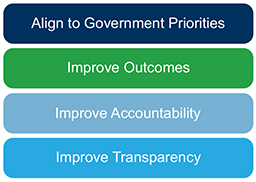
Performance measurements are helping departments focus on priority areas and on improving results that are important to Manitobans. The framework has been instrumental in supporting the whole-of-government approach by getting government departments to align their business plans with budget priorities.
Balanced scorecards improve alignment to government priorities through cascading objectives and performance measures. By measuring performance against targets, government demonstrates progress on advancing priorities and accountability for results.
Every department’s Supplements to the Estimates of Expenditure document, which are departmental business plans, are tabled, distributed and available online no later than six business days after tabling the provincial budget. These business plans align with the broader government strategic priorities identified in the balanced scorecards. These plans and the annual reports are available to the public and contribute to increased transparency.
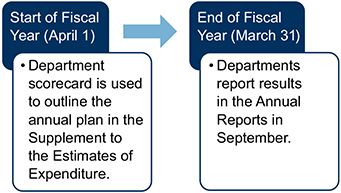
| 80 | Budget 2023 – Fiscally Responsible Outcomes and Economic Growth Strategy
|
|
|
Department business plans include customized balanced scorecards, key initiatives and summary budget information, outlining their operational plans and activities for the year.
Balanced Scorecards in Action – Manitoba Environment and Climate
Manitoba Environment and Climate’s mandate is to protect and improve water quality across the province. As part of this mandate, the department monitors water quality in rivers and lakes. Water quality data are used
to assess changes over time and suitability for drinking water, fish and other aquatic life, recreation, irrigation, and other important water uses. Water quality results are communicated with the Canadian Council of Ministers of the Environment (CCME) Water Quality Index.
Through balanced scorecards, Manitoba’s target for the Water Quality Index is 80 or higher, which is considered good to excellent water quality. On average across Manitoba, the Water Quality Index in 2021 was 87 (good).
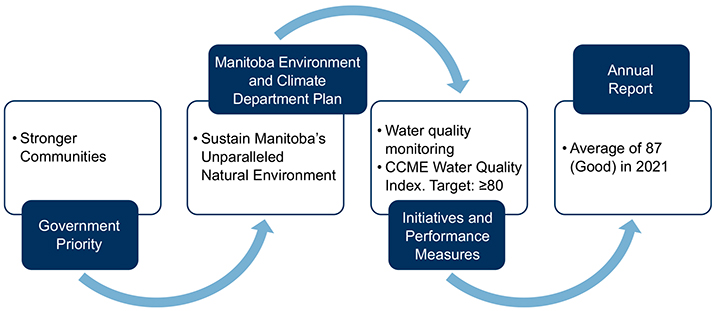
| Budget 2023 – Fiscally Responsible Outcomes and Economic Growth Strategy | 81
|
|
|
Balanced Scorecards in Action – Manitoba Education and Early Childhood Learning
Access to high-quality child care is essential for Manitoba families. High-quality child care allows parents and care givers to re-enter the workforce, upgrade their skills and training, support their families and play an active role in the vibrancy of our community and the health of Manitoba’s economy.
Manitoba Education and Early Childhood Learning’s department plan calls for ensuring access to high-quality, accessible and affordable early learning and child-care services. To achieve this, the department has committed $94-million to create more than 1,600 new child-care spaces across the province with a focus
on rural and Northern communities that are on track to be operational in 2023/24.
In addition, a first-in-Canada industry recognized technical vocational curriculum cluster in early childhood education has been developed, which will help meet the pressing need for more early childhood educators. High schools will begin pilot implementation in the 2023/24 school year.
The department is also making child care more affordable for Manitobans by reducing regulated parent fees to $10 a day, and has expanded eligibility to the Child Care Subsidy Program for families most in need. This performance measure is tracked in balanced scorecards and the progress is updated.
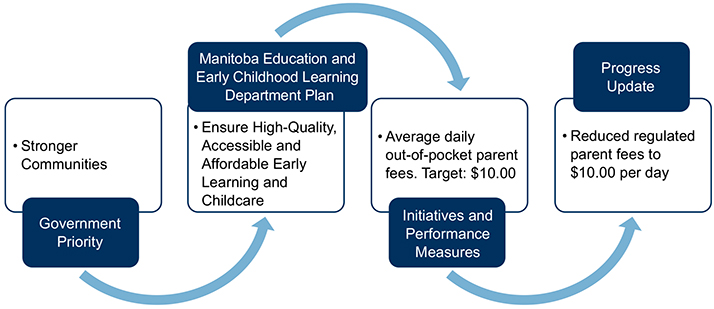
| 82 | Budget 2023 – Fiscally Responsible Outcomes and Economic Growth Strategy
|
|
|
Balanced Scorecards in Action – Manitoba Municipal Relations
Manitoba Municipal Relations is tracking the percentage of the Municipal Service Delivery Improvement Program’s budget that is committed to projects. The program launched in 2021/22 to help municipalities conduct value-for-money audits to help municipalities maximize effectiveness when using taxpayer dollars to provide needed services to citizens.
The 2021/22 report of 88 per cent means $1.1-million of the budgeted $1.25-million was committed to projects in the program’s first year.
In 2022, a total of 22 applications were received through the second project intake. Following internal evaluation by the department, nine projects were recommended for approval by the minister. In 2023, successful project applicants will work directly with pre-qualified third-party consultants to manage comprehensive service delivery reviews for each municipality or planning district. This will result in a value-for-money audit report, including actionable recommendations. Final 2022 reports will be available for use by other local governments in 2023/24.
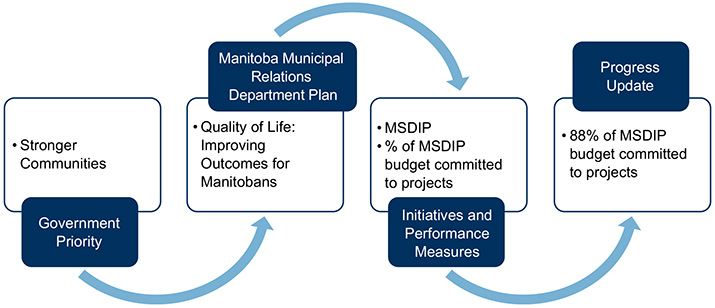
| Budget 2023 – Fiscally Responsible Outcomes and Economic Growth Strategy | 83
|
|
|
Balanced Scorecards in Action – Manitoba Sports, Culture and Heritage
Providing online access to information and services is a priority for the Manitoba government. Manitoba Sport, Culture and Heritage continues to increase online digital content, and has highlighted this goal through the following performance measures:
| · | increase the number of accessible departmental documents posted to InfoMB; |
| · | increase the percentage of historical Manitoba government documents available in the Legislative |
| Library’s Digital Collection of Manitoba Government Publications; |
| · | increase the number of Keystone records available to the public; and |
| · | increasing the number of archival records accessible to the public by 12,000 through the Keystone database, makes it easier for the public to search and access historical Manitoba documents. |
In 2022/23, the department is projecting to exceed the target of adding 12,000 records to the database.
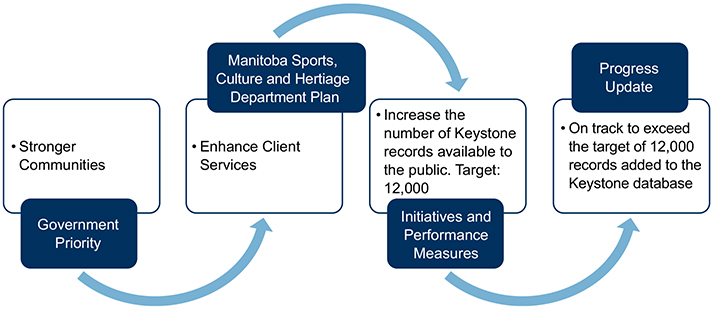
| 84 | Budget 2023 – Fiscally Responsible Outcomes and Economic Growth Strategy
|
|
|
Procurement Modernization
The Manitoba government continues to strategically modernize its procurement practices and increase its collaboration with broader public sector entities to maximize value for money and ensure transparent, fair and competitive tenders.
By consolidating the purchasing power of core government and the broader public sector in high-value procurement categories such as facility services, information technology infrastructure and engineering services, government has achieved more than $34.5-million in savings since 2019.
With 14 per cent of government spending currently under category management and $4.1-billion in total annual addressable spending for government and the broader public sector, Manitoba has the potential to deliver hundreds of millions of dollars in annual savings in the coming years.
The Manitoba government is also working diligently on a number of initiatives aimed at simplifying the bidding process, reducing procurement time cycles and ensuring policy continues to be aligned with best practices and trade agreements.
Social Innovation Office
The Social Innovation Office brings together government, community, and private sector to solve the most pressing and complex social and environmental issues, maximizing impact. Since launching in 2019, the office has assisted government with more than 40 projects aimed at improving outcomes for Manitoba.
The Social Innovation Office has been focused on fostering innovation and cross-sector collaboration in numerous areas of government priority. Highlights of this work includes work in health care, protecting the environment and building stronger communities.
Successes have led to deeper relationships with community organizations, foundations and private sector partners. In 2023/24, work will be done to
monitor the outcomes of current programs, while also collaborating to tackle more shared priorities, such as affordable housing and health care.
Healing Health Care
Government launched two outcome-based projects aimed at reducing factors associated with chronic disease while improving health outcomes. The depth of partnership on these projects has led to more collaboration, including a program that offers free menstrual products to those in greatest need and the commitment to explore more collaborative opportunities.
Protecting the Environment
The Social Innovation Office is currently using an outcome-based approach to explore an innovative way to reduce greenhouse gas emissions by diverting organic waste from landfills. The office is also exploring the opportunity of developing a sustainability bond aimed at capitalizing on the province’s ability to raise funds at low interest rates and serve as an important tool to help finance critical social and environmental projects.
Building Stronger Communities
In the fall of 2022, government announced the commitment to build nine new child-care centres using this partnership approach. Together with Manitoba Education and Early Childhood Learning, the Social Innovation Office collaborated with community partners to design a new partnership approach to the development of child-care centres. Further work is underway with community partners to co-create solutions to address the child-care workforce gap.
Supporting Manitoba Hydro by Lowering Fees
Manitoba recently took steps to financially stabilize Manitoba Hydro, including a 50 per cent reduction to both the water power rental rates and the Hydro Guarantee Fee starting in 2022/23. These changes
| Budget 2023 – Fiscally Responsible Outcomes and Economic Growth Strategy | 85
|
|
|
resulted in approximately $190-million in savings for the utility that will be applied to reduce Manitoba Hydro’s debt.
These ongoing reductions will support the utility’s efforts to keep electricity rates low for Manitobans and provide the ability to start lowering its debt burden. It is anticipated that applying the savings to debt will save ratepayers $4-billion in accumulated debt over the next 20 years.
Regulatory Accountability
Creating a prosperous future for all Manitobans requires departments and government agencies to focus on regulatory modernization to ensure desired policy outcomes are achieved with the least administrative burden on stakeholders and government. Many small, common-sense regulatory changes can significantly reduce the time and resources needed to comply with provincial rules and regulations.
These small but important changes exemplify Manitoba’s commitment to identify, streamline and reduce regulatory requirements that are not achieving their intended objectives.
As a result, 100,664 regulatory requirements placed on Manitobans by government were removed by December 2022, a reduction of 10.7 per cent from the April 2016 baseline measurement of 939,827 regulatory requirements.
The Manitoba government continues to lead efforts to advance regulatory accountability and reduce red tape on inter-provincial trade. In January 2023, Manitoba removed additional exceptions under the Canadian Free Trade Agreement (CFTA) on naming and business activity restrictions for corporations providing land-surveying services, office location requirements for inter-jurisdictional law firms and residency requirements for individuals applying for wild rice harvesting and export licences. With the implementation of these latest trade barrier reductions, Manitoba will have the lowest
remaining Canadian Free Trade Agreement and labour mobility exceptions in Canada.
Through the Canadian Free Trade Agreement’s Regulatory Reconciliation and Cooperation Table Work Plan, Manitoba has endorsed two reconciliation items and participated in the negotiation of 14 interprovincial Table Work Plan reconciliation items in areas including:
| · | occupational health and safety standards; |
| · | technical safety; |
| · | construction codes; and |
| · | corporate registries. |
Manitoba has also participated in the completion of two work plan cooperation items on the testing of automated and connected vehicles, and on prompt payment legislation and associated regulations under builders’ lien. These small changes help reduce barriers that impede business, investment and labour mobility between provinces.
Executive Government Organization Act Changes
Every day, hundreds of public servants from multiple departments work together to ensure the provincial government can provide the services relied on by Manitobans.
Today’s complex problems require even more collaboration amongst departments, not less. To support these efforts, changes will be made to The Executive Government Organization Act to support department efforts to share services, such as information management and technology, communications and policy development to ensure a whole-of-government response is made to address today’s challenges.
Digital Government
The Manitoba government has ambitions to accelerate Manitoba into the digital age by transforming the way citizens and business request and access public
| 86 | Budget 2023 – Fiscally Responsible Outcomes and Economic Growth Strategy
|
|
|
services. The plan takes a citizen and business first approach and looks at the province’s strategic priorities to establish the following themes:
| · | better and more efficient government services; |
| · | improved tools and processes for cutting red tape; |
| · | improved support for citizens and business; |
| · | improved turnaround times on decisions and approvals; |
| · | services where and when citizens and businesses need it; and |
| · | 24/7 online channels for service, status monitoring and submissions. |
Manitoba continues assembling the groundwork for the digital government evolution with key initiatives to drive efficiencies in the 2023/24 fiscal year. Highlights include plans to:
| · | establish an enterprise-wide back-office systems to modernize resource planning systems and standardize processes and information exchanges to improve how the Manitoba public service works and expand digital service delivery capacity; |
| · | modernize the courts technology systems and align them with Manitoba Justice’s modernization goals, including electronic filing of documents, reduced paper and improved integration between systems; |
| · | evolve citizen engagement and services technologies to streamline and enhance the citizen experience and ensure easier and faster access to services and programs, including using strategic digital platforms and an improved delivery approach to drive better fiscal outcomes; |
| · | enhance information technology cyber security services as more digital services come online; |
| · | advance business engagement and services technology that will streamline and enhance business experience and provide better service and |
| program delivery, including using strategic digital platforms and efficient delivery methods; and |
| · | support enterprise records management and undertake foundational work to support a content services platform that will streamline document workflows to improve response times. |
Building on this momentum, progress continues in areas such as data science, robotics process automation and modernizing the government’s core information technology systems in the 2023/24 fiscal year. This will include:
| · | enhancing data science by leveraging diverse data sources and advanced predictive analytics to drive evidence-based decision-making, future focused planning and service delivery. |
| · | implementing robotics process automation with the continued rollout of software that automates manual and repetitive activities; |
| · | using a cloud-first approach by transitioning information technology infrastructure and business applications to the cloud, which will allow government to offer more cloud- based services that increase operational efficiencies; and |
| · | introducing technology that supports identification and personal credential recognition within an online channel, offering an alternative to in-person visits when identification of a person is required. |
Transforming Manitoba’s Public Service Culture
To provide better outcomes for Manitobans, Manitoba’s Public Service continues its transformation journey as a modern and innovative organization. In February 2022, The Public Service Act came into force and sets out the foundational principles to support a modern public service, which include diversity, inclusion, ethics and integrity.
| Budget 2023 – Fiscally Responsible Outcomes and Economic Growth Strategy | 87
|
|
|
The Public Service Commission, in collaboration with government departments, continues to advance initiatives and programs that support these principles and ensure Manitoba’s Public Service is equipped to provide high quality services and programs to Manitobans, now and in the future.
The commission is focused on supporting the development and success of public servants through leadership programs and services, consistent onboarding for new employees and new leaders and new training opportunities to advance reconciliation and to foster diverse, inclusive and accessible services for Manitobans and workplaces for employees.
Supporting a Sustainable Workforce
The Manitoba government continues to support employee development and recruitment strategies to address current and future employment needs, ensuring a sustainable workforce is maintained to meet the needs of Manitobans. This includes filling priority vacant positions to support continued direct service delivery and public safety, supporting a data-driven workforce, succession planning and targeted outreach for difficult-to-recruit positions.
Following an organizational review conducted with the assistance of a third-party consultant, the Public Service Commission is undergoing a redesign of its service delivery model. The redesign is intended to increase efficiencies in the department’s human resource, employee development, policy, data management and labour relations functions, including realigning talent acquisition into a dedicated unit focused on recruitment and outreach activities.
Employee Engagement
The Manitoba government recognizes its employees are critical to the success of the organization. A highly-engaged public service helps deliver government’s priorities and improve outcomes for Manitobans. Collecting valuable feedback from employees is a
critical way to assess the needed actions to enhance employee engagement, and ensure employees have the tools necessary to maximize their potential and meet the needs of Manitobans.
The Employee Perspectives Program includes annual engagement surveys on a range of topics, including leadership, employee development, capacity and workplace culture. Past employee feedback has helped inform the development and implementation of programs such as the Learning Fund and the Idea Fund, and the most recent survey conducted in January 2023.
Starting in January 2022, Probe Research Inc. was engaged to support survey delivery and the development of an online employee panel. The panel is made up of a representative and diverse group of public servants that provide feedback through additional topical surveys and engagements throughout the year. In 2022, the panel provided meaningful feedback that will help inform the development of a new employee giving program.
To help inform actions to support employee retention, the program was expanded in the fall of 2022 with the launch of a new corporate exit survey. With this new tool, employees who are voluntarily exiting the Manitoba government or moving to another department can share their perspectives on a range of topics related to the workplace, such as employee engagement and recognition.
Diversity and Inclusion Efforts
The Manitoba government is dedicated to the ongoing advancement of diversity, equity and inclusion within Manitoba’s Public Service. Important work is being undertaken to ensure government policies, programs, and initiatives are inclusive, accessible and equitable.
In 2022, a new diversity and inclusion policy was introduced that commits to achieving an inclusive public service at all levels within the organization. A new Manitoba Government Accessibility Plan for 2023
| 88 | Budget 2023 – Fiscally Responsible Outcomes and Economic Growth Strategy
|
|
|
and 2024 was also developed, and includes actions to make government workplaces, products and services accessible to all Manitobans, including employees.
The Public Service Commission continues to collaborate with employee network groups and external organizations, such as Pride Winnipeg, Indigenous-led organizations and accessibility-serving organizations, to support diversity and inclusion-related learning events and courses for public servants. In spring 2022, the Manitoba government also became an official partner of Pride at Work Canada, an organization that empowers Canadian employers to build workplaces that celebrate all employees regardless of gender expression, gender identity, and sexual orientation.
The commission is also redesigning a mandatory course for all public servants with the most current information, resources and tools that support diverse, equitable and inclusive workplaces.
Employment equity strategies within recruitment processes also continue to be assessed to support focused efforts to increase diversity within Manitoba’s Public Service, which includes giving preference to or designating competitions for members of one or more designated groups (women, Indigenous peoples, visible minorities and persons with disabilities).
Truth and Reconciliation Initiatives
The Manitoba government remains committed to advancing reconciliation in Manitoba’s Public Service by supporting the Truth and Reconciliation Commission’s Call to Action #57 and implementing The Path to Reconciliation Act through educational workshops for public servants at all levels of government. Several training and engagement opportunities were provided to public servants in the past year, including:
| · | The Path to Reconciliation: A Historic and Contemporary Overview; |
| · | Building Your Indigenous Cross-Cultural Awareness; |
| · | Exploring the Historical and Modern Treaty Relationship; and |
| · | lunch-and-learn sessions with speakers from the Treaty Relations Commission of Manitoba. |
In addition, workshops offered in the past year include Making Truth and Reconciliation Real, Residential School History and Experiences, and Historical and Modern Treaty Relationships.
In 2023, the Public Service Commission is launching a new mandatory course for all public servants designed to increase awareness about the historical and contemporary issues facing Indigenous peoples in Manitoba and Canada, which include Inuit, Métis and First Nations. The course will also build awareness of the contributions of Indigenous peoples, and ways that public servants can develop respectful and effective relationships with Indigenous peoples and communities.
The commission has also created new Indigenous consultant positions to focus on employee learning, recruitment of new Indigenous talent to Manitoba’s Public Service and other projects that advance Truth and Reconciliation across the public service.
Investing in Public Servants – Learning Fund
Since its inception in 2019, there has been considerable interest in the Learning Fund, which has become a vital initiative that supports the professional development of public servants. This $2-million centralized fund provides equitable access to all public servants to take education and training that supports job-specific and organizational needs.
Public servants’ drive for learning and development was evident in 2022. Between April and November 2022, more than 895 applications were received, of which 698 were individual and 197 were group applications. Over 95 per cent of these applications were approved at a total cost of $2-million, supporting the professional and personal development of more than 6,100 public servants.
| Budget 2023 – Fiscally Responsible Outcomes and Economic Growth Strategy | 89
|
|
|
Investing in Public Servants – Improving Employee Learning
The Public Service Commission continues to deliver workshops that support the current development needs of employees to ensure the public service is equipped to provide high quality services and programs to Manitobans, now and in the future.
Workshops for 2022/23 focused on innovation and continuous improvement that support transformation initiatives and efficiencies, as well as on interpersonal communication, mental health and wellness, stress reduction and diversity equity and inclusion training.
In 2023/24, course offerings will focus on technology, performance measurement, effective project management and further advancing accessibility through customer service and employment practices.
Investing in Public Servants – Developing Leaders
Transformational leadership training continues to be a priority for executive and senior leaders in partnership with York University’s Schulich Executive Education Centre. As of December 2022, 80 executives and 122 senior leaders have completed the programs. Further leadership development programming for executives, senior leaders and managers was launched in 2022/23, with additional programming planned for 2023/24.
The Leaders in Training Program, a paid internship program that helps develop future leaders, was enhanced in 2022 with the launch of a new data science internship to attract new data scientists and expertise across government. Since its inception in 2019, the program has recruited 39 interns in the general stream, 16 in the financial stream, and five in the data science stream to foster new and emerging talent in the public service.
Collective Bargaining
Summary government has approximately 200 separate bargaining units spanning departments and all government reporting entities, including school divisions, post-secondary institutions, health service delivery organizations and others.
In 2022/23, the vast majority of collective agreements were either settled or renewed by government, with the others in progress. Public servants are a valuable resource and the 2023/24 budget reflects all current contracts in both the departments and reporting entities.
| 90 | Budget 2023 – Fiscally Responsible Outcomes and Economic Growth Strategy
|
|
|
Manitoba’s Economic
Outlook and Review
Manitoba has one of the most diverse and balanced economies in Canada, which is made up of a variety of industries. The goods-producing sector generates 26 per cent of provincial gross domestic product (GDP) and private and public services account for a combined 74 per cent. Nearly ten industries contribute five per cent or more to the total provincial GDP. Historically, a decline in one area of the economy is offset by growth elsewhere, demonstrating the provincial economy’s resiliency to downturns.
Composition of Real Gross Domestic Product by Industry, Manitoba, 2021
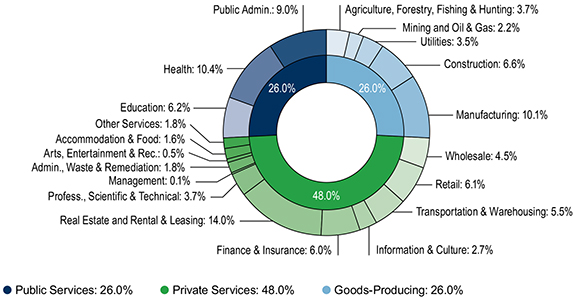
Source: Statistics Canada and Manitoba Bureau of Statistics
| Budget 2023 – Fiscally Responsible Outcomes and Economic Growth Strategy | 91
|
|
|
Manitoba’s Economic Outlook
After a strong performance in 2022, the Manitoba economy faces several headwinds moving forward. Economies around the world are beginning to slow under the weight of decades-high inflation, tighter monetary policy, the ongoing Russian invasion of Ukraine, persistent supply chain disruptions and lingering labour shortages as markets adjust.
Budget 2023 expects the province’s real GDP to slow from 3.6 per cent growth in 2022 to 0.7 per cent in 2023, with an expansion of 1.1 per cent in 2024.
| MANITOBA ECONOMIC OUTLOOK | ||||||||
| 2023F | 2024F | |||||||
| Gross Domestic Product |
||||||||
| Real |
0.7 | 1.1 | ||||||
| Nominal |
2.2 | 3.0 | ||||||
| Consumer Price Index |
3.8 | 2.2 | ||||||
| Employment |
0.4 | 0.8 | ||||||
| Unemployment Rate (%) |
5.4 | 5.9 | ||||||
| Population |
1.0 | 1.0 | ||||||
per cent change unless otherwise noted
Source: Manitoba Finance Survey of Economic Forecasts
The Manitoba economy is not immune to these global economic forces. Private forecasters are projecting the provincial economy to decelerate in the following years, although at a slower pace relative to other provincial economies that are more sensitive to recent interest rate hikes. In fact, several forecasters are projecting some provincial economies to dip into a mild recession in 2023, but not Manitoba’s economy.
Due to strong labour market projections, the economic slowdown is not expected to translate into large-scale job losses and a spike in the unemployment rate, as is typical with a downturn. Rather, the decline in economic activity is expected to help balance labour markets by relieving pressure from existing labour shortages.
Manitoba employment is expected to increase by 0.4 per cent in 2023 and 0.8 per cent in 2024.
Elevated inflation and growing incomes helped push up provincial nominal GDP growth in 2022 to levels not seen in decades, contributing to Manitoba’s strong fiscal performance in the 2022/23 fiscal year.
Restrictive monetary policy from the Bank of Canada is expected to stabilize price pressures and return inflation to target levels by 2024. Slower real economic growth, in combination with declining inflation, is projected to decelerate nominal GDP growth from 9.9 per cent in 2022 to 2.2 per cent in 2023 and 3.0 per cent in 2024. Moderate nominal GDP growth in the coming months will temper near-term tax revenue growth.
Projected Nominal GDP Growth, 2022F-2024F, Manitoba
Per Cent Growth
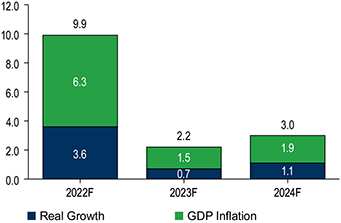
Source: Manitoba Finance Survey of Economic Forecasts
While the Manitoba economy is expected to avoid a contraction in 2023 and 2024, future monetary policy, inflation, persistent supply chain disruptions, geopolitical tensions, and environmental events create uncertainty to the provincial outlook.
| 92 | Budget 2023 – Fiscally Responsible Outcomes and Economic Growth Strategy
|
|
|
Risks to Manitoba’s Economic Outlook
There remains considerable uncertainty in Manitoba’s economic forecast, especially in 2023. The following chart illustrates the uncertainty in the economic outlook due to risk factors outlined below.
The solid line, in the chart below represents the consensus forecast (i.e., average) and the dashed lines are the highs and lows, while the shaded area represents the range of uncertain in the forecasts. In 2023, the range of forecasts is 3.2 percentage points, compared to 0.9 points in 2024.
Range of Nominal GDP Growth Forecasts, 2022-2024, Manitoba
Per Cent Growth
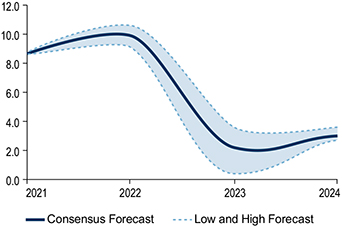
Source: Manitoba Finance Survey of Economic Forecasts
The following factors present risks to the outlook that could potentially cause the economy to depart from Budget 2023 expectations.
Monetary Policy
Since March 2022, the Bank of Canada has increased the policy interest rate by 425 basis points to 4.50 per cent – the highest rate since 2007. The Bank of Canada has signaled its intention to stabilize inflation to target levels (between one and three per cent).
Larger than anticipated employment growth and persistent high inflation rates in the first half of 2023 could provide the Bank of Canada with justification to raise interest rates further. Additionally, consumer sensitivity to higher interest rates will inform future Bank of Canada monetary policy decisions.
Bank of Canada Policy Interest Rate, 2022-2023
Per Cent
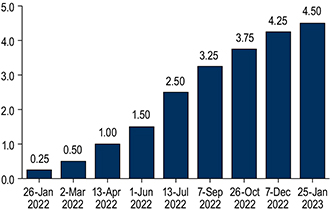
Source: Bank of Canada
Inflation
Inflation remains well-above the Bank of Canada’s target range. Inflation expectations that become entrenched could create challenges for businesses that are expanding and looking to create jobs. Moreover, persistent inflation in the absence of wage growth could erode household purchasing power and curtail spending. In its latest interest rate decision, the bank forecasts Consumer Price Index inflation to decline to three per cent in the middle of 2023 and decline further in 2024, reaching the two per cent target.
Supply Chain Disruptions
Global supply chain bottlenecks and shortages have been a main driver of upwards pressure on prices throughout the pandemic recovery. Although the past year saw improvements in terms of restoring global supply chains, challenges remain for several key
| Budget 2023 – Fiscally Responsible Outcomes and Economic Growth Strategy | 93
|
|
|
industries. The end of China’s zero-COVID policy should relieve lingering supply-side pressures.
Geopolitical Tensions
The Russian invasion of Ukraine disrupted commodity markets and contributed to upwards pressure on prices in 2022, especially for energy and food. The Black Sea grain initiative signed in July 2022 helped to restore grain shipments from Ukraine. A sudden breakdown in the trade arrangement could exacerbate supply-side price pressures. Moreover, several Western countries introduced a price cap on Russian oil that could affect global energy prices.
Environmental Events
Climate change and extreme weather events such as droughts, flooding, and wildfires pose threats to the provincial economy and finances as these events can have a material impact on people, communities, jobs, and economic activity. For example, the severe drought experienced in 2021 resulted in below-average yields for all major crops and contributed to a substantial increase in insurance claims payable (up 213 per cent) and indemnities (up 716 per cent).
Canadian Outlook
Heading into 2023, the Canadian economy faces many of the same challenges as Manitoba.
| · | High inflation and interest rates are contributing to rising costs to households and businesses, underscoring affordability concerns across the country. |
| · | The Canadian housing market continues to slide, especially in jurisdictions that experienced a surge in activity and prices during the pandemic. |
| · | Labour markets remain tight, although ambitious immigration targets could help to alleviate labour shortages in time. |
In addition, Canadian exports in 2023 are expected to be adversely affected by the projected economic slowdown in the United States (U.S.) and ongoing global supply chain issues, particularly in the manufacturing sector. ‘Buy American’ procurement policies noted in the most-recent U.S. State of the Union address could also create challenges for Canadian exports.
On the other hand, agricultural products, such as wheat and fertilizer, will have an advantage from strong global demand. In addition, oil and gas producing provinces will continue to benefit from elevated energy prices.
Like Manitoba, national household savings is falling from the elevated rates recorded during the pandemic to normal levels. Household spending is expected to slow as families cope with rising costs of living.
Budget 2023 expects the Canadian economy to expand by 0.5 per cent in 2023 and 1.3 per cent in 2024.
International Outlook
The outlook for the American economy has dimmed in light of the present global economic challenges. Consumer inflation is slowing in the U.S. but remains well-above target levels at 6.5 per cent growth on an annual basis in December 2022.
Elevated inflation, combined with strong employment growth and ongoing labour shortages, may provide the U.S. Federal Reserve with more justification to raise interest rates further.
The American key interest rate is currently set at 4.50 to 4.75 per cent. Further rate hikes by the U.S. Federal Reserve will likely strengthen the American dollar relative to the Canadian dollar, which could help to stimulate demand for Manitoba exports. However, a slowing American economy is likely to offset gains made from a weaker Canadian dollar. The American economy is projected to expand by a modest 1.4 per cent in 2023 and 1.0 per cent in 2024.
| 94 | Budget 2023 – Fiscally Responsible Outcomes and Economic Growth Strategy
|
|
|
China’s announcement to end the country’s zero-COVID policy should provide a boost in demand for Manitoba commodities such as copper, canola and transportation equipment, as well as restore fractured global supply chains. On the downside, renewed demand in China could accelerate present inflationary pressures. The table below shows the projected economic growth rates for Manitoba’s key international trading partners.
INTERNATIONAL ECONOMIC OUTLOOK
| |
% of MB exports** |
|
2023F* | 2024F* | ||||||||
| United States |
71.6 | 1.4 | 1.0 | |||||||||
| Japan |
5.7 | 1.8 | 0.9 | |||||||||
| Mexico |
3.7 | 1.7 | 1.6 | |||||||||
| China |
5.7 | 5.2 | 4.5 | |||||||||
| Euro Area |
2.0 | 0.7 | 1.6 | |||||||||
*real GDP growth rate per cent
** per cent of exports in 2021
Source: Manitoba Finance Survey of Economic Forecasts and International Monetary Fund
Manitoba Economic Review
The Manitoba economy showed healthy growth in 2022 as the province emerged from multiple pandemic waves and a severe drought in the previous year. Overall, the Manitoba economy expanded by an estimated 3.6 per cent in 2022, ranking third highest in Canada and best among non-resource-based provinces.
Projected Real GDP Growth, 2022, Provinces and Canada
Per Cent Growth
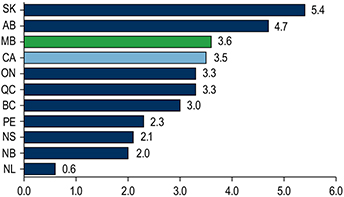
Source: Manitoba Finance Survey of Economic Forecasts
Notably, the Manitoba economy achieved several all-time highs, including:
| · | manufacturing shipments totalling nearly $25-billion, roughly $600-million above pre-pandemic levels; |
| · | farm cash receipts increasing by $1.4-billion to $9.8-billion, 48 per cent above pre-pandemic levels; |
| · | foreign merchandise exports surpassing $20-billion, nearly $5-billion above pre-pandemic levels; |
| · | investment in residential construction eclipsing $5-billion; |
| · | the labour force population reaching a record 709,800; |
| · | employee compensation exceeding $40-billion for the first-time ever; and |
| · | the second lowest unemployment rate in Canada at 4.6 per cent. |
See the appendix on page 100 for a comprehensive listing of Manitoba economic statistics.
Inflation
Consumer inflation, as measured by Statistics Canada’s Consumer Price Index (CPI), reached a near 40-year high in June 2022 in Manitoba, peaking at 9.4 per cent growth year-over-year. Since then, inflationary pressures have eased slightly, falling to 8.0 per cent growth in December. Annual consumer inflation in 2022 was 7.8 per cent in Manitoba and 6.8 per cent in Canada.
Some indicators in the inflation data are pointing in the right direction. Energy prices have declined from their peak of 40.7 per cent year-over-year growth in June 2022 to 15.2 per cent growth in December. However, elevated inflation has spread beyond energy into other commodities, particularly food and services, which are seeing accelerated price growth in recent months.
| Budget 2023 – Fiscally Responsible Outcomes and Economic Growth Strategy | 95
|
|
|
Consumer Price Inflation
Twelve-Month Per Cent Change
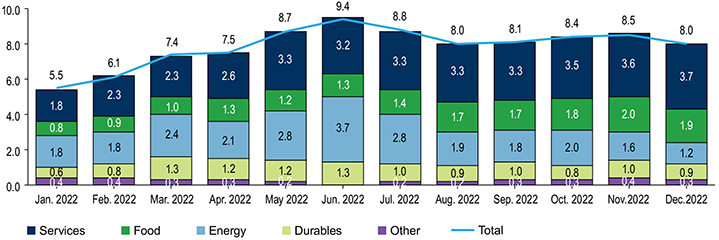
Source: Statistics Canada
Budget 2023 expects consumer inflation to fall to 3.8 per cent in 2023 and 2.2 per cent in 2024. However, as noted in the outlook risks section above, inflation expectations that become entrenched could see high inflation persist for longer.
Labour Market
The Manitoba labour market experienced a robust recovery in 2022 underpinned by strong economic growth and record immigration. After losing 90,500 jobs during the pandemic low in April 2020, Manitoba has regained more than 100,000 jobs.
Moreover, the Manitoba labour force was the fastest to return to pre-pandemic levels further underscoring the economy’s resiliency. In 2022, Manitoba employment expanded by 2.7 per cent, representing the second largest growth in recorded history – trailing only last year. Additionally, the provincial labour force reached a new record high of nearly 710,000 persons. A growing labour force is integral to meeting the demands of future business investment and an expanding economy.
The strength in job growth contributed to one of the lowest unemployment rates in Canada at 4.6 per cent. Manitoba’s strong labour market also plays a role in insulating the provincial economy from the recession projected in other provincial economies in 2023.
Annual Unemployment Rate, 2022, Provinces and Canada
Per Cent
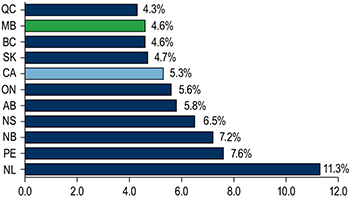
Source: Statistics Canada
| 96 | Budget 2023 – Fiscally Responsible Outcomes and Economic Growth Strategy
|
|
|
With a surging economy and robust demand for labour, businesses in several key industries have reported labour shortages. Indeed, the number of job vacancies in Manitoba reached a record high in the third quarter of 2022 at 32,290, representing a 102 per cent increase above the same quarter in 2019.
Jurisdictions from across Canada and the United States are experiencing similar challenges. In Canada, the number of job vacancies surpassed one million in the second quarter of 2022.
Higher wages help households to retain purchasing power and sustain against the rising costs of goods and services. However, persistent upwards pressure on wages is a challenge for businesses expanding and looking to create jobs.
A tight labour market and rising costs of living is giving workers more leverage in negotiating higher wages. Unsurprisingly, wages in Manitoba are showing signs of acceleration. Consumer inflation increased on average by 0.6 per cent in 2022, whereas wages only grew by 0.4 per cent.
Average Monthly Wage Growth and Consumer Inflation, Manitoba
Per Cent Growth
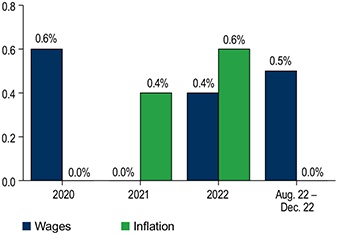
Source: Statistics Canada
Over the past five months, however, monthly wage growth outpaced inflation, increasing on average by 0.5 per cent. Budget 2023 expects employment growth to slow from 2.7 per cent in 2022 to a modest 0.4 per cent in 2023 and 0.8 per cent in 2024.
| Budget 2023 – Fiscally Responsible Outcomes and Economic Growth Strategy | 97
|
|
|
Rolling Annual Farm Cash Receipts, Manitoba
Billions of Dollars
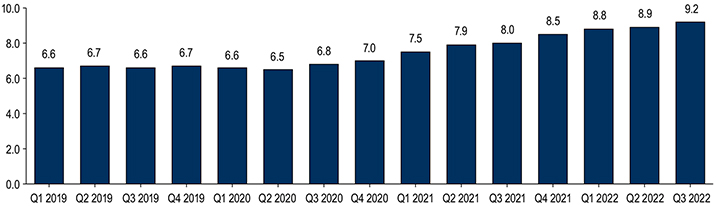
Source: Statistics Canada and Manitoba Agriculture
Agriculture
The 2022 crop production season got off to a slow start, mainly due to exceedingly wet conditions in the spring. Despite the late start, the growing season turned out to be favourable with adequate moisture and suitable above-average temperatures. This allowed crops to flourish and mature before any frost damage. While the two largest crops, canola and wheat, achieved yields slightly below recent averages, the soybean, oat and corn yields set new records.
Despite the delays and unseeded acres, 2022 production was overall above average and a welcome recovery following the 2021 drought. In fact, Manitoba’s farm cash receipts increased by $1.4-billion to $9.8-billion, 48 per cent above pre-pandemic levels.
With low inventories after 2021 and a delayed 2022 harvest, the volume of crops available to market was notably lower during 2022. Fortunately, prices remained at elevated levels and farm cash receipts from crops
registered slightly higher than 2021 levels and set new records. However, higher prices for key inputs, including fertilizer and fuel, largely curtailed gains in profit margins.
Looking ahead for 2023, global demand for crops continues to show steady strength and prices are expected to remain at around current levels until the size of the 2023 harvest becomes more confidently known. With the large 2022 harvest, supplies available for sale will allow steady marketing until the 2023 harvest.
Livestock receipts enjoyed strong growth in 2022, driven by the hog sector. Similar to crops, this was driven by higher production and higher output prices, while higher input costs – notably feed – offset some of the revenue gains. Heading into 2023, the hog, dairy and poultry sectors are expected to see slower but steady growth, while the cattle sector continues to recover after the 2021 drought contracted herd numbers.
| 98 | Budget 2023 – Fiscally Responsible Outcomes and Economic Growth Strategy
|
|
|
Population
Manitoba has the fifth largest population in Canada at 1,420,228 persons (Oct. 1, 2022), representing roughly 3.6 per cent of the national population.
Manitoba’s population is relatively young, with a median age of 37.7 years on Jul. 1, 2022 – the lowest median age among provinces, and below Canada’s median age of 40 years. Manitoba’s younger population will create an ongoing supply of labour for the province in the coming years helping to minimize emerging shortages.
Since the inception of Manitoba’s Provincial Nominee Program (MPNP) in 1998, immigration has contributed an increasing number of new residents to the province. However, on Mar. 18, 2020, the Government of Canada implemented travel restrictions aimed at reducing the spread of COVID-19. In addition, the implementation of COVID-19 related health and safety measures within Government of Canada offices affected processing times for immigration applications and temporary resident permits.
As a result of these measures, both population growth and immigration levels slowed during the height of the pandemic. Between Oct. 1, 2019 and Oct. 1, 2020, Manitoba’s population increased by 7,727 persons – well below the pre-pandemic ten-year average of 16,197 persons per year. During the 2019/20 period, Manitoba gained 10,888 immigrants – a 29.2 per cent
decrease compared to the average for the 2009/10 to 2018/19 period.
With COVID-19 travel restrictions no longer in effect and a commitment to assist Ukrainians fleeing the Russian invasion, Manitoba is seeing strong increases in both permanent and temporary international migration inflows. In 2021/22, Manitoba’s immigration level nearly doubled, up 82.5 per cent compared to the previous twelve months and highest since at least 1946/47. Furthermore, the change in non-permanent residents reached 9,553 persons – a level not seen since at least 1971/72, and nearly three times the 3,311 persons recorded in 2020/21.
Results from the 2022 Manitoba Provincial Nominee Program (MPNP) exceeded expectations in attracting record numbers of skilled immigrants. Number of individuals arriving through MPNP reached 14,000 in 2022, the highest number since the program was established in 1998. Since inception, the MPNP had attracted more than 184,000 nominees and their families to Manitoba from all over the world.
The Manitoba government is currently working with the federal government to renew the existing immigration agreements to help achieve national immigration targets and meet the needs of the province beyond the pandemic.
12-Month Population Growth, Components, Manitoba
Person (000s)
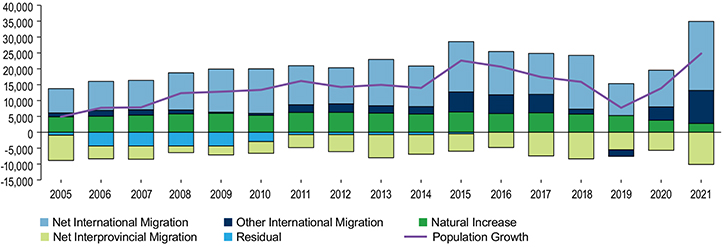
Source: Statistics Canada
| Budget 2023 – Fiscally Responsible Outcomes and Economic Growth Strategy | 99
|
|
|
Appendix – Economic Indicators
| MANITOBA ECONOMIC STATISTICS – 2018-2022 | ||||||||||||||||||||
| 2018 | 2019 | 2020 | 2021 | 2022 | ||||||||||||||||
| (Millions of Dollars, unless noted) | ||||||||||||||||||||
| Gross Domestic Product1 |
||||||||||||||||||||
| Nominal |
73,372 | 74,626 | 73,635 | 79,834 | 87,738 | |||||||||||||||
| Real (chained 2012 dollars) |
68,003 | 68,813 | 65,763 | 66,917 | 69,326 | |||||||||||||||
| Investment |
||||||||||||||||||||
| Residential Construction |
3,366 | 3,642 | 3,766 | 4,963 | 5,439 | |||||||||||||||
| Housing Starts All Areas (Units) |
7,376 | 6,946 | 7,314 | 8,023 | 8,095 | |||||||||||||||
| Building Permits |
2,974 | 3,554 | 3,018 | 3,853 | 3,815 | |||||||||||||||
| Non-Res. Building Construction |
1,889 | 2,110 | 2,333 | 1,900 | 1,978 | |||||||||||||||
| Non-Res. Capital Investment |
9,392 | 9,476 | 7,944 | 8,241 | 8,958 | |||||||||||||||
| Private Capital Investment |
5,169 | 5,706 | 4,749 | 4,945 | 5,276 | |||||||||||||||
| Public Capital Investment |
4,223 | 3,771 | 3,196 | 3,296 | 3,682 | |||||||||||||||
| Sectors |
||||||||||||||||||||
| Manufacturing |
18,999 | 18,935 | 18,210 | 20,791 | 24,864 | |||||||||||||||
| Retail Trade |
20,767 | 20,891 | 20,827 | 23,604 | 25,521 | |||||||||||||||
| Wholesale Trade |
19,224 | 18,425 | 18,541 | 20,325 | 23,001 | |||||||||||||||
| Farm Cash Receipts2 |
6,625 | 6,662 | 7,012 | 8,468 | 9,833 | |||||||||||||||
| Crops2 |
4,201 | 4,006 | 4,374 | 5,266 | 6,186 | |||||||||||||||
| Livestock2 |
2,244 | 2,401 | 2,343 | 2,784 | 3,047 | |||||||||||||||
| Direct Payments2 |
180 | 255 | 295 | 418 | 600 | |||||||||||||||
| Mining and Petroleum3 |
2,711 | 2,199 | 1,722 | 1,942 | n/a | |||||||||||||||
| Foreign Merchandise Exports |
||||||||||||||||||||
| Total |
15,484 | 15,925 | 15,750 | 17,437 | 20,729 | |||||||||||||||
| USA |
10,925 | 12,095 | 10,997 | 12,322 | 15,302 | |||||||||||||||
| Non-USA |
4,559 | 3,830 | 4,754 | 5,116 | 5,427 | |||||||||||||||
| Labour Market |
||||||||||||||||||||
| Labour Force (000s) |
695.2 | 698.7 | 688.7 | 701.5 | 709.8 | |||||||||||||||
| Employment (000s) |
654.0 | 661.4 | 632.6 | 656.2 | 677.5 | |||||||||||||||
| Participation Rate (%) |
67.6 | 67.2 | 65.7 | 66.7 | 66.7 | |||||||||||||||
| Unemployment Rate (%) |
5.9 | 5.3 | 8.1 | 6.5 | 4.6 | |||||||||||||||
| Youth Unemployment Rate (%) |
10.9 | 10.8 | 16.3 | 11.7 | 8.6 | |||||||||||||||
| Average Weekly Earnings ($) |
936.6 | 953.8 | 992.5 | 1,023.81 | 1,055.7 | |||||||||||||||
| Compensation of Employees ($M) |
36,110 | 36,678 | 36,308 | 38,940 | 41,389 | |||||||||||||||
| Consumer Price Index |
||||||||||||||||||||
| (2002=100) |
133.8 | 136.8 | 137.5 | 142.0 | 153.2 | |||||||||||||||
| Population |
||||||||||||||||||||
| July 1st estimates (in thousands) |
1,352.8 | 1,370.0 | 1,379.9 | 1,392.0 | 1,409.2 | |||||||||||||||
1 2017 to 2021 are from Statistics Canada; 2022 is from the Manitoba Finance Survey of Economic Forecasts (2023-01-09)
2 2022 data are estimated by the Manitoba Bureau of Statistics
3 derived from Statistics Canada and Manitoba Petroleum Branch
*2022 annualized using year-to-date growth rate (December data available in Feb. 2023)
n/a not available
Source: Manitoba Bureau of Statistics and Statistics Canada
Totals in the statistical tables may not add due to rounding.
| 100 | Budget 2023 – Fiscally Responsible Outcomes and Economic Growth Strategy
|
|
|
| MANITOBA ECONOMIC STATISTICS – 2018-2022 | ||||||||||||||||||||
| 2018 | 2019 | 2020 | 2021 | 2022 | ||||||||||||||||
| (Annual Percentage Change) | ||||||||||||||||||||
| Gross Domestic Product1 |
||||||||||||||||||||
| Nominal |
2.9 | 1.7 | (1.3 | ) | 8.4 | 9.9 | ||||||||||||||
| Real (chained 2012 dollars) |
2.0 | 1.2 | (4.4 | ) | 1.8 | 3.6 | ||||||||||||||
| Investment |
||||||||||||||||||||
| Residential Construction |
(8.0 | ) | 8.2 | 3.4 | 31.8 | 9.6 | ||||||||||||||
| Housing Starts All Areas |
(1.7 | ) | (5.8 | ) | 5.3 | 9.7 | 0.9 | |||||||||||||
| Building Permits |
(0.4 | ) | 19.5 | (15.1 | ) | 27.6 | (1.0 | ) | ||||||||||||
| Non-Res. Building Construction |
7.7 | 11.7 | 10.6 | (18.6 | ) | 4.1 | ||||||||||||||
| Non-Res. Capital Investment |
2.8 | 0.9 | (16.2 | ) | 3.7 | 8.7 | ||||||||||||||
| Private Capital Investment |
17.9 | 10.4 | (16.8 | ) | 4.1 | 6.7 | ||||||||||||||
| Public Capital Investment |
(11.2 | ) | (10.7 | ) | (15.2 | ) | 3.1 | 11.7 | ||||||||||||
| Sectors |
||||||||||||||||||||
| Manufacturing |
(1.6 | ) | (0.3 | ) | (3.8 | ) | 14.2 | 19.6 | ||||||||||||
| Retail Trade |
2.0 | 0.6 | (0.3 | ) | 13.3 | 8.1 | ||||||||||||||
| Wholesale Trade |
1.4 | (4.2 | ) | 0.6 | 9.6 | 13.2 | ||||||||||||||
| Farm Cash Receipts2 |
(1.0 | ) | 0.6 | 5.3 | 20.8 | 16.1 | ||||||||||||||
| Crops2 |
(1.8 | ) | (4.7 | ) | 9.2 | 20.4 | 17.5 | |||||||||||||
| Livestock2 |
0.3 | 7.0 | (2.4 | ) | 18.8 | 9.5 | ||||||||||||||
| Direct Payments2 |
0.8 | 42.1 | 15.8 | 41.4 | 43.6 | |||||||||||||||
| Mining and Petroleum3 |
6.7 | (18.9 | ) | (21.7 | ) | 12.8 | n/a | |||||||||||||
| Foreign Merchandise Exports |
||||||||||||||||||||
| Total |
11.5 | 2.8 | (1.1 | ) | 10.7 | 18.9 | ||||||||||||||
| USA |
22.0 | 10.7 | (9.1 | ) | 12.1 | 24.2 | ||||||||||||||
| Non-USA |
(7.5 | ) | (16.0 | ) | 24.1 | 7.6 | 6.1 | |||||||||||||
| Labour Market |
||||||||||||||||||||
| Labour Force |
1.5 | 0.5 | (1.4 | ) | 1.9 | 1.2 | ||||||||||||||
| Employment |
0.9 | 1.1 | (4.4 | ) | 3.7 | 3.2 | ||||||||||||||
| Participation Rate (% pts) |
0.1 | (0.4 | ) | (1.5 | ) | 1.0 | 0.0 | |||||||||||||
| Unemployment Rate (% pts) |
0.5 | (0.6 | ) | 2.8 | (1.6 | ) | (1.9 | ) | ||||||||||||
| Youth Unemployment Rate (% pts) |
0.0 | (0.1 | ) | 5.5 | (4.6 | ) | (3.1 | ) | ||||||||||||
| Average Weekly Earnings |
2.9 | 1.8 | 4.1 | 3.2 | 3.1 | |||||||||||||||
| Compensation of Employees |
3.3 | 1.6 | (1.0 | ) | 7.3 | 6.3 | ||||||||||||||
| Consumer Price Index |
||||||||||||||||||||
| (2002=100) |
2.5 | 2.2 | 0.5 | 3.3 | 7.9 | |||||||||||||||
| Population |
||||||||||||||||||||
| July 1st estimates (in thousands) |
1.4 | 1.3 | 0.7 | 0.9 | 1.2 | |||||||||||||||
12017 to 2021 are from Statistics Canada; 2022 is from the Manitoba Finance Survey of Economic Forecasts (2023-01-09)
22022 data are estimated by the Manitoba Bureau of Statistics
3derived from Statistics Canada and Manitoba Petroleum Branch
*2022 annualized using year-to-date growth rate (December data available in February 2023)
n/a not available
Source: Manitoba Bureau of Statistics and Statistics Canada
Totals in the statistical tables may not add due to rounding.
| Budget 2023 – Fiscally Responsible Outcomes and Economic Growth Strategy | 101
|
|
|
Fiscal Strategy
| The Fiscal Responsibility and Taxpayer Protection Act requires the Minister of Finance to present a report on the government’s fiscal responsibility strategy on budget day. |
Manitoba’s fiscal strategy takes into consideration the province’s financial health given the context of the overall socio-economic environment and financial conditions.
The fiscal strategy is the government’s plan for managing revenues, expenditures and capital infrastructure in a way that is consistent not only with short-term investment requirements but also long-term objectives of building fiscal resilience while meeting the needs of Manitobans today and in the future.
The fiscal strategy includes the following key objectives:
| · | considering the needs and well-being of present and future generations and the environment; |
| · | ensuring all summary government resources are managed effectively and efficiently; |
| · | maintaining an efficient, fair and stable revenue strategy; |
| · | taking prudent and responsible steps to return to budgetary balance; and |
| · | making best efforts to gradually reduce the provincial debt once fiscal balance has been achieved. |
As outlined in the section below, Budget 2023 reports on several indicators to help guide and evaluate progress on the fiscal strategy. The indicators also tie the plans in the budget to the reporting on the government’s fiscal health in the annual public accounts.
| 102 | Budget 2023 – Fiscally Responsible Outcomes and Economic Growth Strategy
|
|
|
Fiscal Outlook
| Manitoba’s fiscal outlook is informed by the economic outlook and review. The interim forecast for the 2022/23 fiscal year, which will be finalized in the Public Accounts for the fiscal year, is a deficit of $378-million. The Budget 2023 plan is a deficit of $363-million for fiscal year 2023/24. |
The medium-term plan shows declining deficits over the fiscal outlook from $294-million in 2024/25 to $53-million in 2026/27. Reflecting the multi-year capital infrastructure investment plan and moderating economic growth, the outlook for Manitoba’s net-debt to GDP shows the ratio growing in 2023/24 and 2024/25 followed by a declining trend over the planning horizon.
| FISCAL SUMMARY AND OUTLOOK | ||||||||||||||||||||||||
| Actual | Forecast | Budget | Medium Term | |||||||||||||||||||||
| 2021–22 | 2022–23 | 2023–24 | 2024–25p | 2025–26p | 2026–27p | |||||||||||||||||||
| Millions Of Dollars | ||||||||||||||||||||||||
| Total Revenue |
19,107 | 20,583 | 21,714 | 22,337 | 23,067 | 23,796 | ||||||||||||||||||
| Expenditures |
||||||||||||||||||||||||
| Programs |
18,844 | 19,848 | 20,589 | 21,214 | 21,693 | 22,168 | ||||||||||||||||||
| Interest on Debt |
967 | 1,113 | 1,288 | 1,317 | 1,496 | 1,631 | ||||||||||||||||||
| Total Expenditure |
19,811 | 20,961 | 21,877 | 22,531 | 23,189 | 23,799 | ||||||||||||||||||
| Surplus/(Deficit) |
(704) | (378) | (163) | (194) | (122) | (3) | ||||||||||||||||||
| Planning Contingency |
(200) | (100) | (75) | (50) | ||||||||||||||||||||
| Surplus/(Deficit) |
(704) | (378) | (363) | (294) | (197) | (53) | ||||||||||||||||||
| Net Debt as a Per Cent of GDP |
35.6% | 33.5% | 34.6% | 35.0% | 34.8% | 34.6% | ||||||||||||||||||
p – projections
Source: Manitoba Finance
Note: Numbers may not add due to rounding
| Budget 2023 – Fiscally Responsible Outcomes and Economic Growth Strategy | 103
|
|
|
Challenging Forecasting Environment
Manitoba Finance surveys nine private-sector economic forecasters on its economic outlook. The average of the forecasts is used for fiscal planning purposes.
Changes in the economic forecast affect the estimates for provincial revenues and expenses. The graph illustrates the uncertainty inherent in the forecast over the coming years.
Manitoba Summary Budget Deficit Scenarios, 2015/16 – 2026/27p
Millions of Dollars
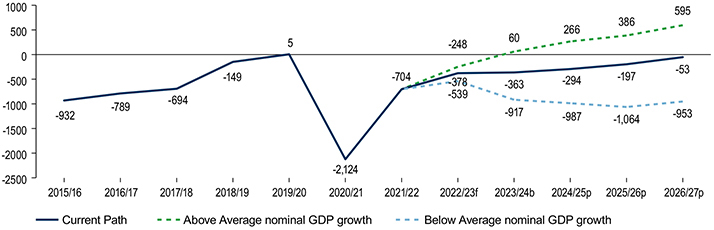
Source: Statistics Canada and Manitoba Finance
f – Forecast b – Budget p – Projection
Note: The Manitoba Budget 2023 net income (loss) scenarios are based on the average private sector economists’ projection for nominal GDP growth without any forecast adjustments. The higher (slower) economic growth scenarios are based on the above (below) average projections for nominal GDP among the economists surveyed.
Manitoba Summary Budget Net Debt Scenarios, 2013/14 – 2026/27p
Per Cent of GPD
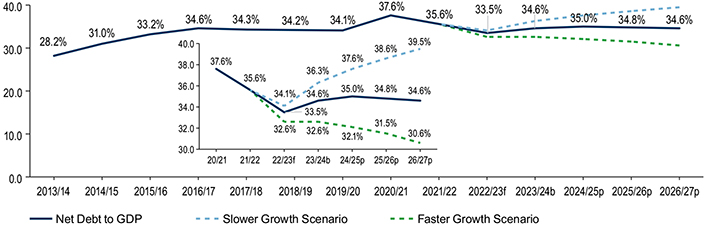
Source: Statistics Canada and Manitoba Finance
f – Forecast b – Budget p – Projection
Note: The Manitoba Budget 2023 net debt scenarios are based on the average private sector economists’ projection for nominal GDP growth without any forecast adjustments. The higher (slower) economic growth scenarios are based on the above (below) average projections for nominal GDP among the economists surveyed.
| 104 | Budget 2023 – Fiscally Responsible Outcomes and Economic Growth Strategy
|
|
|
Fiscal Indicators
| Budget 2023 highlights several fiscal indicators to guide the fiscal strategy. These indicators help the assessment of a government’s financial condition and also align with those published in the annual provincial Public Accounts, as recommended by the Public Sector Accounting Board. The indicators also compare budgetary expenditures with the growth in Manitoba’s economy. |
The indicators, expressed as ratios or trends, serve as anchors to measure the extent to which budget plans are being accomplished. These metrics help guide ongoing work to address the deficit and the debt, and to build a path that progressively balances competing internal and external needs and pressures. The fiscal indicators are grouped into the following categories.
Sustainability Indicators
These measures trace the ability of a government to maintain its services and programs over a longer term. The following indicators have been selected to assess sustainability:
| · | expenditure as a share of provincial GDP; |
| · | annual net income or loss to provincial GDP; and |
| · | net debt as a share of provincial GDP. |
Flexibility Indicator
This measures how well a government can respond to changing financial commitments with revenue measures and debt management strategy. The indicator is:
| · | public debt charges to total revenue. |
Vulnerability Indicator
This measures how much a government relies on revenue sources beyond its direct control or influence, both domestically and internationally. The indicator is:
| · | federal transfers to total revenue. |
Sustainability Indicator Performance:
Expenditure as a share of provincial GDP
Expenditures as a percentage of the provincial economy, measured by nominal Gross Domestic Product (GDP), indicates the amount of annual government spending on programs and other costs as a share of the total GDP.
Total Expenditures as a Percentage of Provincial GDP
Percentage of GDP
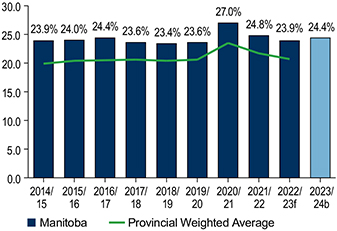
Source: Provincial Budgetary documents, Statistics Canada and Manitoba Finance Calculations
f – Forecast b – Budget
As shown in the graph, Manitoba’s total expenditures as a share of the economy before the pandemic was moving towards the weighted average for Canadian provinces.
Given inflationary pressure, which affects government spending, Budget 2023 proposes to spend almost $21.9-billion. Compared to a projected GDP of over $89.7-billion, the ratio of total expenditures to provincial GDP is estimated at 24.4 per cent for 2023/24.
Annual net income or loss to Provincial GDP
This indicator represents the government’s summary bottom line and re-establishes a strategic approach to responsibly balance Manitoba’s budget over a number of years. The ratio of net income (loss)-to-provincial GDP measures the difference between revenues and expenses expressed as a percentage of GDP.
| Budget 2023 – Fiscally Responsible Outcomes and Economic Growth Strategy | 105
|
|
|
Budget 2023 was prepared during a period of great economic turmoil and uncertainty, and balances immediate needs against long-term goals. With lasting effects from the COVID-19 pandemic still affecting the health care system and the economy across the world, global supply chain constraints, the ongoing Russian invasion of Ukraine and labour shortages, inflation rates have escalated to their highest levels in decades.
Given that the budget is prepared during a period of great economic and financial market uncertainties, the strategy is to balance immediate needs against long-term economic and financial goals. Budget 2023 will maintain the annual net loss to provincial GDP at (0.4) per cent in 2023/24.
| ANNUAL NET INCOME (LOSS) | ||||||||||||||||||||||||||||||||||||||||
| |
2014/ 2015 |
|
|
2015/ 2016 |
|
|
2016/ 2017 |
|
|
2017/ 2018 |
|
|
2018/ 2019 |
|
|
2019/ 2020 |
|
|
2020/ 2021 |
|
|
2021/ 2022 |
|
|
2022/ 2023f |
|
|
2023/ 2024b |
| |||||||||||
| Millions of Dollars | ||||||||||||||||||||||||||||||||||||||||
| Total Revenue |
14,801 | 14,916 | 15,627 | 16,152 | 17,028 | 17,641 | 17,744 | 19,107 | 20,583 | 21,714 | ||||||||||||||||||||||||||||||
| Total Expenses |
15,340 | 15,848 | 16,416 | 16,846 | 17,177 | 17,636 | 19,868 | 19,811 | 20,961 | 21,877 | ||||||||||||||||||||||||||||||
| Planning Contingencies |
(200) | |||||||||||||||||||||||||||||||||||||||
| Summary Net Income (Loss) |
(539) | (932) | (789) | (694) | (149) | 5 | (2,124) | (704) | (378) | (363) | ||||||||||||||||||||||||||||||
| Annual Net Income (Loss) to Provincial GDP (%) |
(0.8) | (1.4) | (1.2) | (1.0) | (0.2) | 0.0 | (2.9) | (0.9) | (0.4) | (0.4) | ||||||||||||||||||||||||||||||
f- Forecast b – Budget
Source: Manitoba Finance
Net debt as a share of provincial GDP
Provincial net debt represents accumulated financial obligations for governments over time. It indicates the level of future revenue required to pay down these obligations from past transactions or unanticipated events.
Responsibly balancing Manitoba’s longer-term investment needs in tangible and non-financial capital assets, combined with a strategy to gradually return to balance is reflected in a stabilized ratio of net debt as a share of provincial GDP.
Incorporating the jump in pandemic related borrowing, net debt as a percentage of provincial GDP increased to 37.6 per cent in 2020/21, up from 34.1 per cent in 2019/20.
With GDP growth expected to slow in 2023/24, combined with a renewed capital infrastructure plan, the ratio is expected to grow to 34.6 per cent in 2023/24.
Net Debt as a Percentage of Provincial GDP
Percentage of GDP
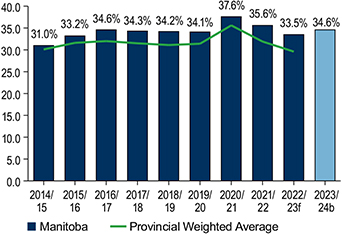
Source: Provincial Budgetary documents, Statistics Canada and Manitoba Finance Calculations
f – Forecast b – Budget
| 106 | Budget 2023 – Fiscally Responsible Outcomes and Economic Growth Strategy
|
|
|
Flexibility Indicator Performance:
Public Debt Charges to Total Revenue
The amount of debt charges or interest costs as a percentage of total revenue is a measure of flexibility. It shows the extent to which a government must use revenue to pay interest and other debt servicing costs rather than provide services or programs.
The Bank of Canada has aggressively raised Canadian interest rates starting in March 2022. To date, the Canadian trend setting rate has increased by 425 basis points. The possibility of further interest rate hikes is there, if decade-high inflation rates persist into 2023 and 2024. Rising interest rates are pressuring fiscal flexibility. Debt servicing costs to provincial revenues rose in 2022/23 to 5.4 cents for every revenue dollar from 5.1 cents in 2021/22. The interest rate pressure is expected to lift debt servicing cost to 6.0 cents for every revenue dollar in 2023/24.
Debt Servicing Costs to Provincial Revenues
Percentage of Revenue
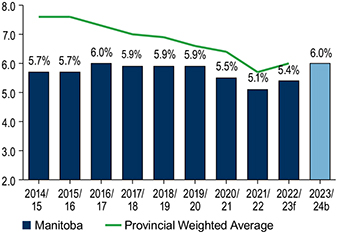
Source: Provincial Budgetary documents, Statistics Canada and Manitoba Finance Calculations
f – Forecast b – Budget
Vulnerability Indicator Performance:
Federal Transfers to Total Revenue
The ratio of federal transfers to total revenue measures the vulnerability of provinces to changes in transfers from the Government of Canada.
Vulnerability is the extent to which a government depends on sources of revenue outside of its control or influence.
The overall trend shows federal transfers to provincial revenues slowly increasing before the pandemic. The share rose sharply during the height of the pandemic due to one-time targeted support and introduction of new cost shared programs.
As illustrated in the chart, the share is expected to increase to 33.9 per cent in 2023/24. This reflects a notable increase in equalization and additional cost shared programs. The increase in equalization payments in 2023/24 is due to a number of factors, including relatively strong fiscal capacity growth in some of the other provinces receiving equalization, population growth in Manitoba as well as a historically large increase in the overall program.
Federal Transfers to Total Revenue
Percentage
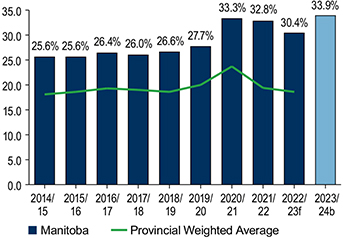
Source: Provincial Budgetary documents, Statistics Canada and Manitoba Finance Calculations
f – Forecast b – Budget
| Budget 2023 – Fiscally Responsible Outcomes and Economic Growth Strategy | 107
|
|
|
Credit Ratings
| Credit rating agencies monitor the government’s progress on the fiscal strategy and assess the credit worthiness of the province and the ability to pay back debt obligations. Investors partially make decisions to buy Manitoba bonds based on the credit ratings assigned by rating agencies. |
Manitoba bonds are rated A+ with stable outlook by Standard and Poor’s, Aa2 stable by Moody’s and A(high) stable by DBRS. Manitoba bonds require a formal rating in order for some investors to consider purchasing.
When evaluating a credit, rating agencies look at such factors as the economy, financial performance, liquidity levels and debt burden. Manitoba provides rating agencies consistent and updated information on factors used to determine the rating outlook.
| Ratings | ||||||
| Province |
Moody’s | S&P | DBRS | |||
| British Columbia |
Aaa | AA+ | AA(H) | |||
| Alberta |
Aa2 | A+ | AA(L) | |||
| Saskatchewan |
Aa1 | AA | AA(L) | |||
| Manitoba |
Aa2 | A+ | A(H) | |||
| Ontario |
Aa3 | A+ | AA(L) | |||
| Quebec |
Aa2 | AA- | AA(L) | |||
| New Brunswick |
Aa2 | A+ | A(H) | |||
| Nova Scotia |
Aa2 | AA- | A(H) | |||
| PEI |
Aa2 | A | A | |||
| Nfld and Labrador |
A1 | A | A(L) | |||
| 108 | Budget 2023 – Fiscally Responsible Outcomes and Economic Growth Strategy
|
|
|
Borrowing and Debt
Management Strategy
| Manitoba raises funds in both Canadian and international capital markets. This provides the Manitoba government with a cost-effective source of financing. |
The Manitoba government engages in domestic and international capital markets to manage government obligations and cash flow liquidity requirements. The government also borrows on behalf of Manitoba Hydro, with principal and interest payments fully recoverable from the corporation.
As a result of the province borrowing on behalf of Manitoba Hydro, a guarantee fee is paid by the corporation. In fiscal 2022/23, the Manitoba government reduced Manitoba Hydro’s guarantee fee by 50 per cent, allowing the corporation to improve its financial metrics and pay down a portion of current debt outstanding.
Borrowing Authority
The borrowing authority is set out in The Financial Administration Act, allowing the Minister of Finance to raise funds on behalf of the province. The act sets limits for debt outstanding in a given year for both the Manitoba government and Manitoba Hydro.
These limits are reviewed annually and may be adjusted based on expected new cash requirements plus a contingency. The act also allows for an increase because of extraordinary circumstances, such as flooding, other natural disasters and pandemics.
Currently, the limit sits at $44.4-billion for the province and $29.3-billion for Manitoba Hydro. As a part of these reforms, this budget and subsequent budgets will report on the status and projections of the provincial debt and how this compares to borrowing authority limits.
STATEMENT OF DEBT ESTIMATE (SECTION 49.1 OF THE FINANCIAL ADMINISTRATION ACT)
| In Millions of Canadian Dollars | 2021/22 Actual |
2022/23 Forecast |
2023/24 Forecast |
|||||||||
| The Debt of the government reporting entity excluding Manitoba Hydro |
$32,418 | $33,172 | $36,385 | |||||||||
| Borrowing Authority Limit of government reporting entity excluding Manitoba Hydro |
$44,400 | $44,400 | $44,400 | |||||||||
| Available Authority |
$11,980 | $11,228 | $8,015 | |||||||||
| In Millions of Canadian Dollars | 2021/22 Actual |
2022/23 Forecast |
2023/24 Forecast |
|||||||||
| The Debt of Manitoba Hydro |
$24,645 | $24,481 | $23,431 | |||||||||
| Borrowing Authority Limit of Manitoba Hydro |
$29,300 | $29,300 | $29,300 | |||||||||
| Available Authority |
$4,665 | $4,819 | $5,869 | |||||||||
| Budget 2023 – Fiscally Responsible Outcomes and Economic Growth Strategy | 109
|
|
|
Debt Management Strategy
To ensure market availability to complete its borrowing program, Manitoba raises funds in both domestic and international capital markets. A well-established domestic program is the primary source of funding for the province, for both short- and long-term borrowing.
Short-Term Borrowing Program
Manitoba’s short-term borrowing program provides a cost-effective option for financing, and also provides liquidity for the province. The program primarily raises funds through a weekly 91-day Treasury-Bill Auction. To augment the Treasury-Bill program, there is authority in place to issue promissory notes for immediate cash requirements if necessary.
Long-Term Borrowing Program
Most of Manitoba’s funding is raised in long-term markets with the focus on benchmark size issues in 10 and 30-year terms. This ensures a robust secondary trading market in Manitoba bonds that is critical to investors. During fiscal year 2022/23, Manitoba also accessed the domestic market with a five-year bond.
In addition to and in line with government priorities, Manitoba will engage a Sustainability Bond Structuring Agent to help the province evaluate the prospects of developing a Sustainable Bond Framework.
International Markets
To ensure access to international markets, Manitoba has established formal programs that are filed with regulators in the United States, Europe and Australia.
Having the ability to issue in international markets increases access to capital while also diversifying the province’s investor base.
Manitoba will only borrow in international markets if the costs are competitive with the domestic market, which borrowing have consistently generated savings. The Manitoba government has no foreign currency risk as all international issuance is swapped back to Canadian dollars.
Risk Management
A key component of Manitoba Finance’s debt management strategy is the use of derivative instruments for managing financial risks that are used to mitigate:
| · | asset liability risks – alter pattern or characteristics of debt service payments to facilitate a balanced asset and liability match of the Loans and Advances program; |
| · | foreign currency risks – eliminate foreign exchange exposure while taking advantage of pricing arbitrage by facilitating offshore funding; |
| · | interest rate risks – provide financial stability by reducing the impact of interest rate volatility; and |
| · | refinancing risks – provide long-term interest rate protection required to match long-term funding obligations. |
Treasury Management System
Given the amount of financial risk inherent within government borrowing and debt management programs, Manitoba Finance is actively pursuing a more sophisticated system to manage this risk.
It will meet modern standards, best practices, and satisfy specific and critical business and risk requirements. From the new system, the Treasury Division will develop enhanced value-added reporting, as well as more robust risk management and forecasting models.
Investor Relations
As Manitoba is competing with other entities for a finite amount of investor capital, it is imperative the purchasers of Manitoba’s bonds are continually updated on the financial and strategic objectives of the government.
The province participates in government finance conferences as well as has regular meetings with investors to ensure they have the credit analysis of the province completed before going to market.
| 110 | Budget 2023 – Fiscally Responsible Outcomes and Economic Growth Strategy
|
|
|
Investors also use reports from the credit rating agencies to facilitate their evaluation of the province. Manitoba Finance officials are regularly engaged with these agencies to ensure they are fully apprised on the economic, financial and fiscal environment in Manitoba.
Liquidity
The amount of liquidity Manitoba retains is dependent on the level of uncertainty in capital markets at any given time, due to unexpected events such as a pandemic or geo-political occurrences.
Market uncertainty has continued through fiscal 2022/23, creating the need for a significant amount of cash reserves. As a result, the government continues to maintain a high liquidity position.
Historically, Manitoba maintained approximately three months of cash requirements on hand, but has now increased this position to six months of requirements. These reserves are made up of cash, which are invested in short-term instruments plus investments in the Fiscal Stabilization Account and the Provincial Sinking Fund. Manitoba invests only in high-quality liquid instruments such as Government of Canada, provincial government, and municipal bonds.
2022/23 Borrowing Update
As of February 17, 2023, the Manitoba government has raised $3.9-billion in fiscal 2022/23. This includes six months of pre-funding for 2023/24.
Manitoba raised more than 90 per cent of its fiscal 2022/23 borrowing in Canadian domestic markets. The Manitoba government also issued in international markets, including $263-million Canadian equivalent in European private placements.
Manitoba’s current gross outstanding debt as of February 17, 2023 is $57.7-billion.
Debt Outstanding by Currency
(as of February 17, 2023) (Millions of Dollars)
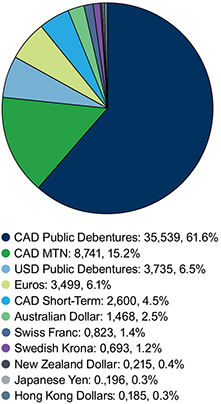
Source: Manitoba Finance
| Budget 2023 – Fiscally Responsible Outcomes and Economic Growth Strategy | 111
|
|
|
2023/24 Borrowing Requirements
Borrowing requirements in 2023/24 are forecast to be $4.7-billion. This amount includes $2.1-billion of pre-funding for the next fiscal year. Domestic as well as international capital markets will be accessed to complete this program.
BORROWING REQUIREMENTS 2023/24
| Refinancing | New Cash Requirements |
Estimated Repayments |
Gross Borrowing Repayments |
Pre- Borrowed March 31, 2023 |
Pre- Funding March 31, 2024 |
Borrowing Requirements |
||||||||||||||||||||||
| (Millions of Dollars) | ||||||||||||||||||||||||||||
| Government Business Enterprises |
||||||||||||||||||||||||||||
| Manitoba Hydro-Electric Board |
400 | - | - | 400 | - | - | 400 | |||||||||||||||||||||
| Manitoba Liquor and Lotteries Corporation |
- | 90 | 57 | 33 | - | - | 33 | |||||||||||||||||||||
| Subtotal |
400 | 90 | 57 | 433 | - | - | 433 | |||||||||||||||||||||
| Other Borrowings |
||||||||||||||||||||||||||||
| General Purpose Borrowings |
1,100 | 655 | - | 1,755 | 1,159 | 930 | 1,526 | |||||||||||||||||||||
| Capital Investment Assets |
200 | 1,013 | 334 | 879 | 388 | 920 | 1,411 | |||||||||||||||||||||
| Health Facilities |
196 | 290 | 119 | 367 | 100 | - | 267 | |||||||||||||||||||||
| Other Crowns and Organizations |
302 | 765 | 277 | 790 | 75 | - | 715 | |||||||||||||||||||||
| Public School Divisions |
- | 260 | 31 | 229 | 75 | - | 154 | |||||||||||||||||||||
| Teachers’ Retirement Allowances Fund |
- | - | - | - | - | 250 | 250 | |||||||||||||||||||||
| Subtotal |
1,798 | 2,983 | 761 | 4,020 | 1,797 | 2,100 | 4,323 | |||||||||||||||||||||
| Total Borrowing Requirements |
2,198 | 3,073 | 818 | 4,453 | 1,797 | 2,100 | 4,756 | |||||||||||||||||||||
| 112 | Budget 2023 – Fiscally Responsible Outcomes and Economic Growth Strategy
|
|
|
Borrowing Requirements – Mid-Term Outlook
In line with the government’s fiscal outlook, new borrowing requirements for the government will continue to decrease as the fiscal position improves in line with The Fiscal Responsibility and Taxpayers Protection Act.
For the past number of years Manitoba Hydro’s capital needs were a significant portion of the Manitoba government’s new borrowing requirements. With Bipole III completed and construction of Keeyask in its final stages, Manitoba Hydro’s medium-term forecast shows no new cash requirements as the corporation plans to fund capital requirements from internally generated funds.
As a result, the medium-term borrowing forecast shows new cash requirements to average $1.7-billion per year, while refinancing of maturing debt will average about $3.5-billion per year. The following table outlines expected future borrowings.
| Fiscal Year | 24/25 | 25/26 | 26/27 | |||
| New Cash |
$1,882 | $1,694 | $1,420 | |||
| Refinancing |
$3,373 | $3,965 | $3,000 | |||
| Total |
$5,254 | $5,659 | $4,420 | |||
Millions of Dollars
Debt Servicing Costs
Summary public debt costs for 2022/23 are forecast to be $1.1-billion, $88-million higher than Budget 2022, due to higher-than-forecasted interest rates and partially offset by decrease in borrowing requirements from budget.
For fiscal year 2023/24, summary public debt expense is forecast to be $1.3-billion.
The Bank of Canada increased its policy rate to levels last seen in 2017 and messaged it expects to hold the policy rate at these levels as it assesses the impact of the rate increases on the economy.
Manitoba’s forecast average interest rate for term borrowings during 2023/24 is 4.3 per cent. A one-percentage point increase in interest rates for an entire year will result in an estimated increase in debt servicing costs of $32.9-million.
| Budget 2023 – Fiscally Responsible Outcomes and Economic Growth Strategy | 113
|
|
|
Federal-Provincial Fiscal
Arrangements
Canada’s constitution assigns responsibility for the delivery of key public services, such as health care, education, and social services, to the provinces and territories. Provinces and territories are also the primary funder of these services.
However, the federal government plays an important role in supporting these efforts by providing funding that helps to supplement provincial and territorial own source revenues. These funds are provided primarily through the major federal transfer programs – the Canada Health Transfer (CHT), Canada Social Transfer (CST), Equalization, and Territorial Formula Financing (TFF). All provinces and territories receive the CHT and CST each year, and all provinces have received support from the Equalization program at one time or another.
Funding provided through the major federal transfers remains the most effective and efficient way the federal government can support provinces in meeting their constitutional spending responsibilities in a fiscally responsible manner.
Provinces and territories are best positioned to allocate federal funds in a manner that addresses the specific and unique needs and challenges in their jurisdictions. Provinces and territories are also directly accountable to their citizens through well-established processes, including annual budgets and departmental annual reports, as well as oversight provided through Question Period and other legislative processes. For these reasons, major federal transfer payments are provided to provinces and territories under (mostly) unconditional terms. This is a critical feature of the major transfer programs, as well as the fiscal relationship between the federal and provincial/territorial governments.
Major federal transfers typically account for about one-quarter of Manitoba’s total summary revenue. Over the past five years, major transfer revenues have grown by $1.6-billion or 38.1 per cent. Manitoba will receive $5.9-billion through the major transfers in 2023/24, up $733-million or 14.2 per cent over 2022/23.
Equalization accounts for 60 per cent of Manitoba’s major federal transfers in 2023/24.
Major Federal Transfer in 2023/24
Millions of Dollars
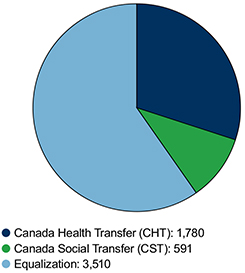
Source: Finance Canada
Note: CHT Does not include $72 million one-time top-up payment.
| 114 | Budget 2023 – Fiscally Responsible Outcomes and Economic Growth Strategy
|
|
|
Manitoba’s Share of Health and Social Transfers is Declining
The federal government allocates the major health and social transfers, the CHT and CST, to the provinces and territories on an equal per capita basis. Manitoba’s
declining share of the national population of late has resulted in an estimated $81-million less in funding for health and social transfers compared to what would have been the case if the province’s population had grown as fast as the national average.
| MAJOR FEDERAL TRANSFER ALLOCATIONS, MANITOBA, 2019/20 TO 2023/24
|
||||||||||||||||||||
| (Millions of Dollars) | 2019/20 | 2020/21 | 2021/22 | 2022/23 | 2023/24 | |||||||||||||||
| Canada Health Transfer (CHT) |
1,471 | 1,520 | 1,571 | 1,638 | 1,780 | |||||||||||||||
| Canada Social Transfer (CST) |
531 | 545 | 564 | 577 | 591 | |||||||||||||||
| Equalization |
2,255 | 2,510 | 2,719 | 2,933 | 3,510 | |||||||||||||||
| Total |
4,257 | 4,576 | 4,853 | 5,148 | 5,881 | |||||||||||||||
Source: Finance Canada
Note: CHT does not include one-time top-up payments of $18-million in 2020/21, $145-million in 2021/22, $72-million in 2022/23 and $72-million in 2023/24. CHT and CST prior year adjustment payments are included in corresponding allocation year.
Manitoba’s Share of Health and Social Transfers
Per Cent
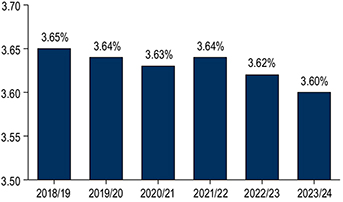
Source: Finance Canada
Canada Health Transfer
The CHT is the major federal transfer in support of health care. It is also the largest of the major federal transfers. It provides provinces and territories with predictable and unconditional funding allocated on an equal per-capita basis.
Historically, the federal government has played an important role in helping support provincial and territorial health care services. However, starting in fiscal year 2017/18, the federal government cut growth in the CHT from a fixed six per cent per year to a three-year moving average of national nominal gross domestic product (GDP) growth, with funding guaranteed to increase by three per cent per year.
| Budget 2023 – Fiscally Responsible Outcomes and Economic Growth Strategy | 115
|
|
|
The decrease in the CHT’s growth rate since 2017/18 has reduced the overall federal contribution through the CHT in supporting total health care costs in Canada, resulting in billions of dollars less in health care funding for provinces and territories. For Manitoba, it means a reduction of hundreds of millions of dollars compared to what would have been received during this period under the previous formula.
Having access to quality and timely health care services is a top priority for all Canadians. It is also the single largest expenditure item of provincial and territorial governments including Manitoba. Manitoba will spend $7.9-billion on health care services in 2023/24, 36.2 per cent of the province’s total expenditures.
Manitoba will receive a total of $1.78-billion in base CHT funding in 2023/24, up $142-million or 8.7 per cent from 2022/23. The CHT will represent 22.5 per cent of Manitoba’s health expenditures in 2023/24. This does not include an additional $72 million that Manitoba will receive as its share of a $2 billion “top-up” payment provided to all provinces and territories “through” the CHT. The top-up is a one-time payment that will not be added to the CHT base, so it will not grow with the CHT or result in any additional health funding in future years.
Canada Social Transfer
The CST supports post-secondary education, social assistance and social services, as well as early childhood development and early learning and child care. The CST has a fixed, three per cent annual growth rate and is distributed to provinces and territories on an equal per- capita basis. The sole condition for the CST is that there be no minimum residency requirements for people seeking to receive social assistance.
Manitoba will receive $591-million through the CST in 2023/24, up $14-million or 2.4 per cent from 2022/23. Manitoba’s share of the CST nationally is 3.6 per cent.
Equalization
Equalization is funded by general taxes paid by all federal taxpayers. The federal government collects revenue from all Canadians and businesses and redistributes a certain amount to help provinces and territories fund services. The purpose of the Equalization program was entrenched in the Canadian Constitution in 1982.
|
“Parliament and the Government of Canada are committed to the principle of making Equalization payments to ensure that provincial governments have sufficient revenues to provide reasonably comparable levels of public services at reasonably comparable levels of taxation.”
Subsection 36(2) of the Constitution Act, 1982
|
Provinces with per-capita fiscal capacities below the national average receive payments to raise their fiscal capacities to the national average. Provinces above the national average do not receive payments.
Annual growth in the Equalization program is determined by a three-year moving average of growth in Canada’s nominal GDP, while fiscal capacity calculations are based on a three-year, weighted moving average of revenues, with a two-year data lag.
The federal equalization program has not experienced any major changes since 2009/10. The program is renewed every five years in line with the federal legislation governing the program. Any changes made as part of the 2024 renewal will be implemented in 2024/25.
Manitoba will receive $3.5-billion in equalization funding in 2023/24, up $577-million or 19.7 per cent from 2022/23. Manitoba’s large equalization increase in 2023/24 is due to a number of factors, including
| 116 | Budget 2023 – Fiscally Responsible Outcomes and Economic Growth Strategy
|
|
|
relatively strong fiscal capacity growth in some of the other provinces, growth in the province’s population, as well as a historically large increase in the overall program, which resulted in an adjustment payment to the province of $221-million.
Despite strong growth, Manitoba’s share of total Equalization payments increased by only 1.2 percentage points, from 13.4 per cent in 2022/23 to 14.6 per cent in 2023/24. Manitoba continues to receive the second lowest Equalization per capita after Quebec, not including Ontario, which qualified for an adjustment payment in 2023/24, but otherwise did not qualify for Equalization.
Manitoba’s per capita fiscal capacity, even after Equalization, is still well below that of the non-receiving provinces. For example, Alberta’s 2023/24 fiscal capacity, as measured by the Equalization program, is $14,004 per capita, compared to $10,706 for Manitoba (including Equalization), a deficit of $3,298 per Manitoban. This represents a $4.6-billion shortfall in Manitoba’s overall fiscal capacity compared to Alberta.
Fiscal Capacity by Province, 2023/24
Dollars per Capita
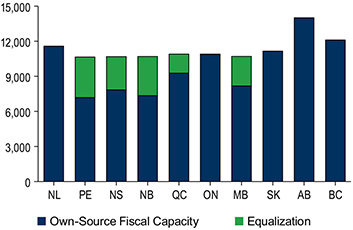
Source: Finance Canada and Statistics Canada
| Budget 2023 – Fiscally Responsible Outcomes and Economic Growth Strategy | 117
|
|
|
Introduction
Budget 2023 lays out the Manitoba government’s continued commitment to create a better quality of life for Manitobans in need, building on the progress that has been achieved in reducing poverty.
Through collaborative work with the federal government and community organizations, the Manitoba government responded successfully in helping Manitobans cope with the economic disruptions and uncertainties caused by the pandemic. The child poverty rate in Manitoba improved significantly, from 19.3 per cent in 2015 to six per cent in 2020, a 69 per cent improvement.
While the government made a major stride in poverty reduction despite the pandemic, the task ahead remains challenging in the face of high inflation affecting Canada and nations around the world.
The government recognizes that inflation exacerbates the problem of poverty. Inflation erodes the purchasing value of incomes and savings. The impact of inflation on vulnerable Manitobans is more critical, as their limited incomes and savings are rendered even more inadequate to make ends meet.
As Manitoba moves into the new fiscal year, the government has already launched initiatives that seek to alleviate the burden of inflation on Manitobans. Three refundable tax credits were established (including The Family Affordability Package for families with children and low-income seniors, and the Carbon Tax Relief Fund), and the basic rates of Employment and Income Assistance supports were increased. In addition, income was provided from rebates through the School Tax Rebate and Manitoba Public Insurance, and by an increase to the minimum wage.
In 2023/24, the Manitoba government is focused on doing more to build on the momentum that has been put into action to make life more affordable for Manitobans, particularly for the most vulnerable. In addition to the affordability work, the government is committed to helping build stronger and safer communities while advancing reconciliation and collaboration. Manitoba is moving forward with actions that will continue to promote the wellbeing of vulnerable Manitobans in the upcoming year.
| 120 | Budget 2023 – Manitoba’s Poverty Reduction Strategy
|
|
|
Poverty Reduction Strategy
Budget 2023 outlines the Manitoba government’s planned actions under the priorities and goals of Pathways to a Better Future: Manitoba’s Poverty Reduction Strategy, which affirms the government’s commitment to reduce poverty and social exclusion.
The strategy, launched in March 2019, aims to break the cycle of poverty by creating pathways to improve the lives of Manitobans at risk of or experiencing poverty. It promotes opportunities for economic inclusion and successful transitions through life.
To achieve its overall goal, the strategy includes a measurement framework, made up of a key target and a set of 13 indicators used to measure progress.
The key target of the strategy is to reduce child poverty rate by 25 per cent by 2025, relative to the 2015
baseline. Using the most recent data on the Market Basket Measure (MBM), Manitoba exceeded its target in 2020.
The child poverty rate improved by 69 per cent from 19.3 per cent in 2015 to six per cent in 2020. This means there were 35,000 fewer Manitoban children living in poverty in 2020 than in 2015. The table below shows detailed information for various demographic groups.
LOW INCOME IN MANITOBA, 2015 – 2020, STATISTICS CANADA, MARKET BASKET MEASURE1
| Per cent Change | ||||||||||||||||||||||||||||||||||
| 2015 | 2016 | 2017 | 2018 | 2019 | 2020 | 2015 to 2020 |
2019 to 2020 |
|||||||||||||||||||||||||||
| All Manitobans |
Rate, per cent | 14.1 | 12.4 | 11.2 | 11.1 | 11.5 | 6.8 | -51.8 | -40.9 | |||||||||||||||||||||||||
| Rank (1 is best) | 5 | 5 | 3 | 5 | 6 | 4 | ||||||||||||||||||||||||||||
| Number | 171,000 | 153,000 | 141,000 | 142,000 | 148,000 | 87,000 | -49.1 | -41.2 | ||||||||||||||||||||||||||
| Children |
Rate, per cent | 19.3 | 15.5 | 12.8 | 13.1 | 13.5 | 6 | -68.9 | -55.6 | |||||||||||||||||||||||||
| Rank (1 is best) | 8 | 6 | 5 | 9 | 8 | 6 | ||||||||||||||||||||||||||||
| Number | 52,000 | 43,000 | 36,000 | 37,000 | 39,000 | 17,000 | -67.3 | -56.4 | ||||||||||||||||||||||||||
| Seniors |
Rate, per cent | 5.9 | 4.9 | 5.4 | 6.1 | 5.6 | 2.3 | -61.0 | -58.9 | |||||||||||||||||||||||||
| Rank (1 is best) | 2 | 2 | 2 | 7 | 3 | 1 | ||||||||||||||||||||||||||||
| Number | 11,000 | 9,000 | 10,000 | 12,000 | 11,000 | 5,000 | -54.5 | -54.5 | ||||||||||||||||||||||||||
| Persons in Lone- Parent Families |
Rate, per cent | 44.5 | 38.4 | 28.6 | 30.3 | 33.5 | 15.2 | -65.8 | -54.6 | |||||||||||||||||||||||||
| Rank (1 is best) | 8 | 6 | 4 | 6 | 8 | 3 | ||||||||||||||||||||||||||||
| Number | 26,000 | 23,000 | 20,000 | 19,000 | 21,000 | 11,000 | -57.7 | -47.6 | ||||||||||||||||||||||||||
| 1 | Data from Statistics Canada’s 2018-base Market Basket Measure (MBM) series based on Canadian Income Survey. Data from 2015 to 2019 may differ from data earlier reported because of Statistics Canada’s population rebasing. |
| Budget 2023 – Manitoba’s Poverty Reduction Strategy | 121
|
|
|
Taking a whole of government approach, and founded on the principles of reconciliation, community involvement and collaboration, Manitoba’s Poverty Reduction Strategy identifies six priority areas of focus to reduce poverty and social exclusion:
| · | investing in Manitoba’s future prosperity through supports to children and youth; |
| · | working together to improve health outcomes and standard of living; |
| · | promoting economic inclusion through employment, education and training; |
| · | facilitating partnerships and supporting community-based organizations; |
| · | strengthening client-centred service delivery; and |
| · | making positive change through social innovation. |
Budget 2023/24 presents the key poverty-related actions taken by the government along the six priority areas of the strategy.
| 122 | Budget 2023 – Manitoba’s Poverty Reduction Strategy
|
|
|
Highlights of Government
Actions in Priority Areas
Investing in Manitoba’s Future Prosperity through Supports to Children and Youth
Supports for Young Adults Grant Extension
The Manitoba government is committed to supporting better outcomes and successful transitions for youth and young adults. In 2023/24, Manitoba is continuing its funding for Supports for Young Adults Grant, which gives Child and Family Services (CFS) agencies the ability to extend existing supports to young adults who exited care as a temporary ward and beyond the age of 21. Over the last three fiscal years, more than $7-million has been allocated to extend supports to this demographic.
New Child-Care Spaces in Rural Communities
Over the next year, more than 2,600 new, regulated non-profit child-care spaces will open across the province with a focus on rural and northern communities as a result of a $94-million investment.
Funding for this project is being provided through the Canada-Manitoba Canada-Wide Early Learning and Child Care Agreement and is a collaborative approach with communities to support the development of and need for child-care spaces in Manitoba.
Local partners will provide a minimum of two acres of serviced land with 15 years of free rent and support services including snow removal, landscape maintenance and repairs. These support services reduce costs for child-care operators, ensuring long-term sustainability of centres.
Education Council
The Manitoba government is establishing the Manitoba Education Council to take a province-wide approach to planning, implementing and monitoring Manitoba’s K to 12 Education Action Plan.
The Manitoba Education Council will give members of the public, education partners and others an opportunity to share knowledge, experience and perspectives to enhance student achievement and well-being, as well as creating a forum to discuss and plan for broader issues within the education system.
Teacher’s Idea Fund
In 2023/24, Manitoba is investing in new projects under the Manitoba’s Teachers’ Idea Fund, a five-year, $25-million investment in the ideas and innovations of front-line teachers, staff and school leaders from across the province that support quality education and improve student outcomes.
Since 2021, $11-million has been committed to 162 projects. Ongoing partnerships and strong collaboration with and between schools are fostering opportunities to promote inclusion and learning that will help students reach their full potential for a successful future. Projects in the first year (2021/22) of the program highlighted positive outcomes such as improvements in attendance and engagement, numeracy and literacy, and mental health and well-being. Projects in the second year (2022/23) have an emphasis on mental health and well-being, including initiatives that focus on social and emotional learning and provide enhanced mental health resources and supports for children. In 2023/24, the focus will once again be on initiatives that support mental health and well-being.
| Budget 2023 – Manitoba’s Poverty Reduction Strategy | 123
|
|
|
School Nourishment Programs
School nourishment programs support healthy eating and food security for Manitoba children, especially during critical times such as the pandemic and high inflation. These programs are also encouraging school attendance, supporting learning and promoting life-long health and wellness.
In 2023/24, Manitoba is supporting the ongoing work to provide nourishment to children in partnership with the Child Nutrition Council of Manitoba. Investments in the school nourishment programs were identified as a priority in the report of the Manitoba Commission on Kindergarten to Grade 12 Education.
Working Together to Improve Health Outcomes and Standard of Living
Affordability Payments
Not only are Manitobans recovering from the pandemic, but they are also facing the burden of rising prices on everything from gasoline to groceries.
On Aug. 31, 2022, two new affordability payments were announced as part of the Family Affordability Package, which provides families with children and seniors living on a fixed income with benefits to help ease the burden of rising costs and high inflation.
| 1. | Manitoba families with children under 18 and a family net income of less than $175,000 in 2021 were eligible to receive $250 for the first child and $200 for each additional child. An estimated 145,000 families with approximately 282,000 children benefitted, with an average cheque of approximately $440 per family, totalling $63-million in benefits. |
| 2. | Manitoba seniors with less than $40,000 in family income, who claimed a Education Property Tax Credit in 2021, were eligible to receive $300. This $16-million initiative helped approximately 52,500 senior households living on fixed incomes. |
On Jan. 26, 2023, a new $200-million Carbon Tax Relief Fund was announced to help Manitobans cope with the negative effects of rising costs, from food to fuel. The fund will provide income-tested support payments of $225 per single person and $375 per couple to an estimated 700,000 Manitobans, with or without children. All three of these payments have been or will be legislated as refundable tax credits and will not be taxable or affect eligibility for other tax credits.
Reducing the Tax Burden on Families
As inflation drives up the cost of living, the tax changes that have been put in place are providing financial relief to Manitobans. Indexing of the Basic Personal Amount and personal income tax brackets have been in place since 2017 and help to protect Manitoba taxpayers from the impacts of inflation.
Budget 2023 announces the largest ever enhancement to the Basic Personal Amount. The amount will be increased by $4,145 above the indexed amount, or nearly 40 per cent in 2023, from $10,855 to $15,000, with a return to annual indexing in 2024.
This measure will remove an additional 47,400 low-income taxpayers from the tax rolls in 2023. That is the equivalent of more than 90 per cent of the total population of Brandon no longer paying Manitoba income tax. When combined with increases to the Basic Personal Amount under indexing since 2017, nearly 75,000 low-income Manitobans will no longer be paying Manitoba income tax..
School Tax Rebate
Manitoba is continuing to phase out school taxes enabling Manitobans to keep more of their hard-earned money. In 2023, the School Tax Rebate will provide financial assistance to residential and farm property owners with an increase in the rebate to 50 per cent from 37.5 per cent in 2022. This will increase the average rebate for a homeowner to $774 in 2023 from $581 in 2022.
| 124 | Budget 2023 – Manitoba’s Poverty Reduction Strategy
|
|
|
As landlords of residential properties are benefitting from the School Tax Rebate, Manitoba set the rent guidelines at zero per cent for 2022 and 2023. If material improvements are made to a property, landlords will still be able to apply for an above-guideline rent increase.
Minimum Wage Increase
To help low–income Manitobans who are struggling with the high cost of living, the Manitoba government introduced the Minimum Wage Adjustment Act on Nov. 18, 2022. Minimum wage increased by $1.55 on Oct. 1, 2022 from $11.95 to $13.50 following government consultations with labour groups and businesses. The new act will increase minimum wage by a further 65 cents to $14.15 on Apr. 1, 2023, for a total increase of $2.20 or over 18 per cent.
Next October, inflation indexing is expected to bring Manitoba’s minimum wage to $15 per hour.
Rent Assist
The Manitoba government recognizes that access to safe and affordable housing can improve the lives and health of low-income Manitobans. Unique to Manitoba, Rent Assist is a financial benefit for households who receive provincial income assistance and have shelter costs, as well as other low-income households renting in the private market who are not in receipt of income assistance.
Rent Assist benefits are indexed each year using Median Market Rent, as reported by the Canada Mortgage and Housing Corporation (CMHC). This ensures the benefit is directly tied to the actual cost of renting, and typically results in annual benefit increases.
In January 2023, Rent Assist indexing for recipients of income assistance, which includes both EIA and Manitoba Supports for Persons with Disabilities (Manitoba Supports), was increased to reflect 77 rather than 75 per cent of Median Market Rent. This resulted in maximum monthly benefits rising between $16 and $33, depending on the size of the household. This
represents an approximate three per cent increase in benefits.
In 2023/24, Manitoba will continue increasing Rent Assist benefits through annual indexation, based on 77 per cent of Median Market Rent for households in receipt of income assistance and 80 per cent of Median Market Rent for low-income households not receiving income assistance.
Working Together to End Homelessness in Manitoba
The Manitoba government is working towards ending homelessness in the province by supporting people throughout their housing journey. The recently announced provincial homelessness strategy includes several initiatives for 2023/24.
To help people exit homelessness, the government has introduced initiatives to improve access to support services and affordable housing. This includes funding shelters to extend their operating hours during the winter and developing 400 new social housing units through the rent supplement program.
The government is also funding support service teams to assist people with finding and maintaining long-term housing. The teams will be developed to complement the new social housing supply and will support people exiting homelessness to secure housing, maintain their tenancies and access other provincial and community services.
Additional initiatives include:
| · | support for a project to integrate and expand the use of the Homeless Individuals and Families Information System in the province; |
| · | funds for an environmental scan on homelessness in northern and rural communities; |
| · | a capital grant program for community organizations to develop new social rental housing, with a focus on transitional and supportive housing models; |
| Budget 2023 – Manitoba’s Poverty Reduction Strategy | 125
|
|
|
| · | annual funding for N’Dinawemak shelter and transitional housing services; |
| · | an extension of the Housing Supports Initiative of the Manitoba Non-Profit Housing Association; |
| · | funds to support the creation of community-based mentorship hubs for young adults who have exited the child welfare system; |
| · | funds to develop a public campaign to address discrimination against people experiencing homelessness; |
| · | a community-based income support program to provide funds to people awaiting enrollment on Employment and Income Assistance; and |
| · | new positions at Manitoba Housing to support tenants who have exited homelessness. |
Increase in Social Housing and Housing Supports
Throughout 2023/24, Manitoba will be working on providing additional rent supplement units, and the acquisition or construction of new social housing units, while continuing with housing support programs that are benefitting Manitobans in need.
Manitoba Rent Relief Fund
The Manitoba Rent Relief Fund (MRRF) is an eviction prevention initiative that provides fast-access crisis intervention loans to bridge a temporary interruption of income or unexpected expense that causes rent or utility arrears and a pending eviction. The loans are interest-free, have flexible repayment terms and payments are made directly to the landlord or utility provider.
In addition to providing loans, MRRF staff connect Manitobans to income or employment resources, benefits such as Rent Assist, assistance with tax filing and financial management training.
Manitoba Tipi Mitawa
Funded by Manitoba Housing and administered by the Manitoba Real Estate Association, the Manitoba Tipi Mitawa Affordable Aboriginal Homeownership Program provides forgivable down payments and subsidized mortgage payments for housing within Winnipeg, purchased by qualifying Indigenous first-time homebuyers.
Portable Housing Benefit
The Portable Housing Benefit is a shelter benefit, accompanied by housing supports, for low-income individuals with a mental health disability who have an unstable housing situation that is interfering with their progress in recovery and/or positive participation in community life.
Rural Homeownership Program
The Rural Homeownership Program helps low- to moderate-income households purchase under-utilized single- and semi-detached homes in select rural communities at fair market value.
Northern Healthy Foods Initiative
The Northern Healthy Foods Initiative (NHFI) supports local and regional projects that contribute to the development of culturally relevant, healthy food systems, while improving health and well-being. The program aims to increase access to food by working with communities and coordinating efforts aligned with the program’s goals and objectives.
The NHFI provides $1.3-million annually to provincial partners and projects working towards food security in Northern Manitoba. Core NHFI projects and programming are delivered by five community-based regional partners who include: Bayline Regional Roundtable, Four Arrows Regional Health Authority, Frontier School Division, Food Matters Manitoba and the Northern Association of Community Councils.
| 126 | Budget 2023 – Manitoba’s Poverty Reduction Strategy
|
|
|
Providing Mental Health Services and Supports
Persons with mental health problems face many challenges, including stigma and discrimination, which may prevent them from securing adequate education and meaningful employment leading them to a life of chronic poverty. Conversely, poverty can cause mental health problems through the social stress, stigma and insecurities that it creates.
Moving forward, Manitoba is investing in initiatives that provide mental health supports to Manitobans.
A Pathway to Mental Health and Community Wellness: A Roadmap for Manitoba
The government will move forward with the implementation of year two of the five-year A Pathway to Mental Health and Community Wellness: A Roadmap for Manitoba. This involves leading a whole-of-government approach to help improve health and well-being for individuals, families and communities.
Investments will continue to be made in core services to ensure that supports are available as close to home as possible for all Manitobans. This will include a focus on children and youth with complex needs who are often impacted by poverty. In collaboration with Indigenous communities, a provincial suicide prevention strategy will also be developed focusing on at-risk youth.
Recovery-Oriented System of Care
The Manitoba government is committing to a recovery-oriented system of care including investments in treatment and recovery for individuals with substance use and addictions challenges.
The government is dedicated to the support of a continuum of care including prevention, early intervention, treatment and recovery for individuals affected by substance use and addiction.
Since October 2019, the Manitoba government has undertaken initiatives to improve mental health and
addictions services throughout the province. These initiatives include Rapid Access to Addictions Medicine (RAAM) clinics, medical and community-based withdrawal management services, mobile withdrawal management services, expansion of opiate agonist treatment, short- and long-term residential addictions treatment, after-care programming, supportive recovery housing, the Take-Home Naloxone Kit Program and the St. Boniface Street Links mobile outreach project, among others.
Promoting Economic Inclusion through Employment, Education and Training
Employment Supports for Adults with an Intellectual Disability
Supportive employment aims to foster inclusion in the community and in the workforce and empower people to enjoy greater autonomy and financial independence.
The Community Living disABILITY Services (CLDS) program is working towards strengthening employment services to support adults with an intellectual disability as they pursue employment goals in inclusive, community-based workplaces across the province.
This initiative will support CLDS participants who have identified competitive employment as a goal in their person-centred plans and are seeking assistance to overcome barriers to employment.
Employment Supports for Financial Independence
Manitobans recognize the dignity of work, and the opportunities for independence that come from employment. The Manitoba government is committed to supporting Manitobans to achieve financial independence by providing them the supports they need to achieve meaningful employment. For 2023/24, the government is taking supportive actions.
| Budget 2023 – Manitoba’s Poverty Reduction Strategy | 127
|
|
|
Enhanced Assessment Tools for Employment and Income Assistance
In 2023/24, as part of the department’s commitment to help clients achieve financial independence, Employment and Income Assistance (EIA) is enhancing its assessment tools to improve how the program assesses where each individual is at in their journey to financial independence. These assessment tools will enable the program to develop individualized supportive plans with clients that connect persons with community supports tailored to their needs.
Journey to Independence Fund
In 2021, the Manitoba government established a $20-million endowment fund with the Winnipeg Foundation to invest in initiatives that would support EIA clients to achieve milestones on their journeys to independence.
Using the annual revenue from the fund, the EIA program launched the Journey to Independence Fund in September 2022. Grants from the fund have been issued to various organizations across Manitoba for projects that will improve community participation and support meaningful transitions into the labour market in 2023/24.
By funding innovative and supportive programming, the fund will support Manitobans along their pathway to independence.
Indigenous Youth Programming – Expression of Interest
The Manitoba government is committed to offering more targeted and culturally-appropriate programming to individuals in receipt of Employment and Income Assistance.
In the spirit of Truth and Reconciliation, the Employment and Income Assistance program issued two expressions of interest to identify Indigenous-led organizations to
design and deliver programming tailored to meet the unique needs of Indigenous youth aged 16 to 29 years of age.
Programming and services funded through these expressions of interest will bridge into 2023/24 and contribute to long-term independence for Indigenous youth.
Adult Learning Programming
Lack of education and low literacy are closely related with poverty. Adult learning and literacy programs provide the skills and education needed for personal and professional advancement and create pathways to meaningful employment and a better life for adult learners.
In 2023/24, the Manitoba government is working to sustain and enhance adult learning programming across the province by supporting adult education service providers through an innovative flexible funding model, which will ensure adequate financial assistance for planning and delivery of effective programs in a timely manner to more adult learners.
Supporting Access to Higher Education
Access to good, higher education is key to breaking the cycle of poverty. In 2023/24, the Manitoba government is increasing supports for low-income students pursuing higher education and for post-secondary institutions.
Manitoba Student Aid and Bursary Fund
The Manitoba Bursary provides non-repayable, supplemental financial assistance to help lower-income Manitobans and Indigenous Manitobans access post-secondary educational opportunities. It is an up-front grant that provides up to $2,000 to eligible students who apply to Manitoba Student Aid. In addition, the Manitoba Bursary provides up to $1,500 as a top-up for eligible lower income Indigenous students.
| 128 | Budget 2023 – Manitoba’s Poverty Reduction Strategy
|
|
|
As Manitobans face the challenges of rising cost of living and cost of education, the government is increasing its investment in the Manitoba Bursary Fund in 2023/24 by $1.4-million to support all eligible students in need of educational assistance.
Increased Funding for Post- Secondary Institutions
Publicly-funded post-secondary institutions (PSIs) play an important role in providing the quality education that Manitoba students need to succeed in life. Manitoba is committed to increase investments in education and training and to implement policies and programs to improve education and training opportunities for Manitoba students.
In 2023/24, the Manitoba government is increasing its investment in PSIs. Amidst the financial pressures brought about by high inflation and the lingering impact of the pandemic, the increased financial assistance for post-secondary institutions is crucial in ensuring the sustainability of student programs and services that they provide.
Facilitating Partnerships and Supporting Community- Based Organizations
Funding for Community Programming
In 2023/24, Manitoba will provide funding for three community programs that previously operated as pilot projects.
Community Helpers
Wahbung Abinoojiik, one of two parallel community helper initiatives, is a strong community-driven initiative by Indigenous leadership and is led by a consortium including Blue Thunderbird Family Care Inc., Andrews Street Family Centre Inc., Mount Carmel Clinic and The Winnipeg Boldness Project.
This program delivers 24/7 culturally relevant, on-call services for families experiencing crisis and other challenges in the Point Douglas community. The initiative provides direct support to families to stabilize in community and prevent involvement or further involvement in the child welfare system.
Programming builds on the inherent strengths, capacity and resilience of the Indigenous community and empowers families to thrive.
Super Dads
Super Dads is a culturally-safe group teaching and healing parenting program, run by Mount Carmel Clinic. This program provides four sessions in one calendar year, with eight participants per session. This program is provided to fathers with Child and Family Services involvement or who are at high risk of Child and Family Services involvement.
Granny’s House – Expansion Site
Blue Thunderbird Family Care Inc. operates Granny’s House, a community-based home in Winnipeg that provides 24/7 access to temporary, out-of-home respite care to at-risk families with children not in care to prevent involvement with child welfare. Blue Thunderbird Family Care Inc. extended their program to expand to a second location due to waitlists and provide additional community respite care to at-risk families.
Community Supports to Address Gender-Based Violence and Exploitation
Manitoba recognizes the vital role of community organizations and agencies in delivering needed services to vulnerable Manitobans who are at-risk of or experiencing gender-based violence. In 2023/24, the Manitoba government is providing funding to community partners and agencies for key initiatives that will support victims of gender – based violence.
| Budget 2023 – Manitoba’s Poverty Reduction Strategy | 129
|
|
|
Family Violence Prevention Program Shelter Funding Model – Phase Two
In April 2022, the Manitoba government announced the introduction of a new funding model for shelters in the Family Violence Prevention Program. The funding model implementation strategy proposes a total of $5.1-million over three years from 2022/23 to 2024/25. The first phase of the model was provided in 2022 and amounted to $3.6-million. This funding is focused on addressing the rising costs of inflation experienced by agencies since the last shelter increase.
The second phase of this model, to be provided in 2023, will amount to $1.6-million and provide funding for the expansion of existing programming as well as provision of additional agency staff. The purpose of this funding is to improve access to programming and supports that assist vulnerable communities.
Manitoba Construction Sector Council/Clan Mothers Healing Village Training Initiative
The Manitoba government has partnered with the Manitoba Construction Council Sector and the Clan Mothers Healing Village to deliver a skilled trades initiative for Indigenous women who have experienced gender-based violence or exploitation.
The program will recruit and train 20 Indigenous women over a 37-week period. Cultural and land-based teaching and healing will be incorporated throughout the program. Upon completion of the program, participants will be employed by the all-woman construction company that the Clan Mothers Healing Village is establishing and will assist in the construction of the village site.
Food Currency Program
The Manitoba government is providing almost $1.1-million over three years to Direct Farm Manitoba to support its Manitoba Community Food Currency Program, which works to improve food security for Manitobans in need while also supporting local agri-businesses.
The investment in the food security program builds on the Manitoba government’s effort to help families make ends meet.
Direct Farm Manitoba launched the Manitoba Community Food Currency Program in 2020 as a community-building initiative to empower Manitobans facing food insecurity by providing food currency that can be used to purchase locally produced fruit, vegetables, meat and processed foods at farmer’s markets. The Manitoba’s government’s investment will ensure 700 families in the province benefit from the program annually over the next three years.
Community-based social service organizations will identify families disproportionately affected by inflation and in need of healthy food. Each family will receive $28 in food currency per week for 14 weeks ($392 in total) during the summer market season from late June to early October. With up to 26 participating markets, the initiative will support families in Winnipeg and in rural areas.
Investing in Community Safety
Crime is closely associated with poverty and all its consequences. Where crime abounds, people are experiencing financial hardships, deprivation, homelessness, addiction, family disintegration and abuse.
Building a safe community for vulnerable Manitobans is paramount, as everyone deserves a safe place to live. In 2023/24, the Manitoba government continues its partnerships with community organizations to promote the safety and well-being of vulnerable Manitobans in low-income neighborhoods.
Downtown Community Safety Partnership
Downtown Winnipeg is at the core of the inner city where many Winnipeggers most in need live. The Downtown Community Safety Partnership is a made-in-Winnipeg approach to creating safer and
| 130 | Budget 2023 – Manitoba’s Poverty Reduction Strategy
|
|
|
more welcoming downtown through the availability of cohesive support and non-emergency response to those in the community in need of assistance.
The program connects the downtown community with social services, including employment assistance, housing and shelter resources.
Winnipeg Bear Clan Patrol
The Winnipeg Bear Clan Patrol provides vital front-line community safety initiatives that support community wellness and deter crime. In 2023/24, Manitoba is providing new ongoing funding for the organization to support its long-term program sustainability and to ensure resources are in place to continue its street-level work in communities.
Building Sustainable Communities Program
The Building Sustainable Communities grant helps build thriving sustainable communities that provide a high quality of life for Manitobans. The grant leverages investments in community development by local governments, non-profit organizations and others.
Eligible community development projects include planning activities, organizational capacity building, community or regional initiatives, and community, culture or recreation capital infrastructure projects.
Building Sustainable Communities provides a grant contribution of 50 per cent for eligible project costs up to $75,000 and up to $300,000 for large capital projects. Since its launch in 2019, the program has committed more than $57-million to support more than 1,300 community-led projects and leveraged approximately $135-million from other funding sources.
As the program has been a huge success, the Manitoba government is providing program funding in 2023/24. Intake for 2023/24 grant funding started in November 2022 with an application deadline of Jan. 23, 2023.
Urban/Hometown – Green Team Program
The Urban/Hometown Green Team program is an application-based grant program that provides funding to non-profit organizations, education authorities, Northern Affairs Community councils, and municipal governments to create summer jobs for youth aged 15 to 29. The program supports Manitoba’s workforce and training development strategy by offering opportunities for youth to gain leadership skills and employment income for post-secondary education while strengthening Manitoba’s economy.
Non-profit organizations, education authorities and Northern Affairs Community councils are eligible to receive 100 per cent of wage costs and up to $250 for support costs for each approved employee. Municipal governments (excluding the City of Winnipeg) are eligible to receive 50 per cent of wages and up to $125 for support costs for each employee on a cost-shared basis.
The program has been effective in providing jobs for youth, and successfully used available funding each year. With positive outcomes, Manitoba is providing funding support to the program in 2023/24. Intake for 2023/24 grant funding started in November 2022 with an application deadline of Jan. 23, 2023.
| Budget 2023 – Manitoba’s Poverty Reduction Strategy | 131
|
|
|
Municipal Service Delivery Improvement Program
Manitobans depend on local governments to deliver important programs and services as effectively and efficiently as possible. That is why Manitoba is investing up to $5-million towards the Municipal Service Delivery Improvement Program. For 2022, up to $1.35-million for nine projects under the program has been approved.
The funding support for the program will help municipalities and planning districts identify areas of potential improvement and enhance services without raising taxes.
Municipalities and planning districts can apply for provincial support through the program to conduct service delivery reviews and identify actionable recommendations for service improvements and potential cost savings that can be reinvested towards other core priorities.
Service programs eligible for review include transportation, safety and protection, water and sewer, waste management, recreation and culture, planning, general government administration and other core activities.
For example, the Yellowhead Community Recreation Centre/Operations Review was approved for funding in 2022. This integrated regional facility serves the Town of Neepawa, the Rural Municipality of Rosedale, the Rural Municipality of North Cypress-Langford and the Rural Municipality of Glenella-Lansdowne. This review will help ensure the centre continues to play a key role serving the community well into the future. Objectives for the review will focus on program viability, cost effective service delivery, operational efficiencies and long-term financial sustainability supported by reasonable user fees and appropriate levels of municipal funding. Project reporting will include a review of current conditions and opportunities, supported by a recommended implementation plan.
Another project receiving funding in 2022 included evaluating current recreational and cultural services funding delivered within the Rural Municipality of Two Borders. The rising costs of facility maintenance and operations combined with services delivered across a large geographical area are challenging the municipality to find a new service delivery approach to address these economic realities. Review objectives will focus on providing a more comprehensive approach based on a modernized funding model. Key products will include completion of an asset management plan and 10-year capital expenditure program.
Supporting Municipal Public Transit Systems
The Manitoba government is allocating more than $34-million over two years to help alleviate transit operating shortfalls related to reduced ridership caused by the COVID-19 pandemic, and to provide other related transit supports. Pending approval of the 2023 Budget, up to $13.4-million will be provided to Winnipeg, Brandon, Selkirk, Flin Flon and Thompson to support the operation of their public transit systems.
This new provincial funding leverages and enhances the provision of $20.7-million in related federal funding administered by Manitoba in 2022. As part of the federal agreement, the Manitoba government is committed to work with these municipalities to advance shared priorities focused on improving housing supply and affordability for Manitobans that, together with effective transit systems, will improve the ability of all Manitobans to live more sustainably, in terms of community, economy and environment.
| 132 | Budget 2023 – Manitoba’s Poverty Reduction Strategy
|
|
|
Support for Economic Development Partners
A prosperous Manitoba means higher incomes for Manitobans and lower poverty rate. Industry programs and partnerships with non-profit organizations in key industries contribute to job creation and economic prosperity.
Sector Council Program
In 2023/24, the government is entering into the next cycle of the four-year Sector Council Program agreements with non-profit organizations to develop new and expanded program activities to address skills and labour shortages and support economic recovery.
Through cross-sectoral collaboration and training, the program is an essential part of the government’s plan and commitment for a stronger, more prosperous Manitoba.
To incentivize new and expanded program activities, the government is increasing its annual investment in the program.
Supports for Young Entrepreneurs
Futurpreneur Canada is a non-profit organization that has been helping diverse young entrepreneurs build, launch and grow new businesses since 1996. In 2020, Manitoba entered into a $750,000 funding agreement with the organization over three fiscal years ending on Mar. 31, 2023. This funding has produced strong positive outcomes.
Since Futurpreneur’s partnership with the province, the organization has helped 91 businesses, including cash flow relief to clients during the pandemic to ensure that young entrepreneurs were supported through business challenges brought on by the COVID-19 crisis.
In 2023/24, Manitoba is investing in Futurpreneur to continue the organization’s very successful program.
Circles for Reconciliation
Manitoba’s poverty reduction strategy supports the ongoing process of establishing and maintaining mutually respectful relationships between Indigenous and non-Indigenous peoples in order to build trust, affirm historical agreements, address healing and create a more equitable and inclusive society.
Circles for Reconciliation is a Winnipeg-based national charity that facilitates small group gatherings between Indigenous and non-Indigenous participants that aim to advance reconciliation. The Manitoba government is providing $167,000 in funding to support the ongoing operation of the program.
| Budget 2023 – Manitoba’s Poverty Reduction Strategy | 133
|
|
|
Strengthening Client-Centred
Service Delivery
Transforming Income Assistance
As part of transforming income assistance to provide better services that are more tailored to the specific needs of clients, the Manitoba government has put in place for 2023/24 supportive important initiatives.
Manitoba Supports for Persons with Disabilities
The government launched Manitoba Supports, a new disability income support program that is separate and distinct from Employment and Income Assistance (EIA). Its creation was informed by what the government heard from Manitobans, and community stakeholders.
The new program is providing better supports and services for Manitobans living with severe and prolonged disabilities and who need help paying for basic living costs. Clients who enroll in this program will have access to the same financial, health and other benefits available to EIA clients.
Beginning in 2023/24, the basic needs amount will be indexed to the rate of inflation on an annual basis. Indexation will increase adequacy of benefits due to the unique expenses associated with having severe and prolonged disabilities, compounded by the rising cost of living.
Clients enrolled in this program will also receive:
| · | an assigned financial worker to issue monthly benefits; |
| · | increased benefits of approximately $100 per month; |
| · | laundry and phone allowances automatically added to budgets; |
| · | ability to earn up to $12,000 per year before benefits are impacted; and |
| · | access to health benefits for two years after a file closes. |
Clarification of Employment Obligations
Employment and Income Assistance clients enrolled in the general assistance or single parent categories and have children over the age of six are subject to employment or employment enhancement obligations.
Amendments to The Manitoba Assistance Act and assistance regulation will come into force on Apr. 1, 2023. These amendments clarify that employment obligations can also be satisfied through participation in supportive planning or treatment programs.
This is part of broader efforts to reframe EIA as a program of temporary financial assistance that provides assessment-informed and person-centred supports to help clients move towards financial independence.
Supportive Planning Incentive
The revised Manitoba Assistance Act retains a category for persons with medical barriers to employment or disabilities, which will be reframed from the disability category to the medical-barriers-to-full-employment category. This category will support clients who are unable to work for one year or longer due to a medical condition or disability, but whose disabilities do not meet the threshold of severe and prolonged for Manitoba Supports. This category does not have employment obligations, but clients are encouraged to participate in supportive planning.
Beginning in April 2023, clients in this category who choose to participate in supportive planning will be
| 134 | Budget 2023 – Manitoba’s Poverty Reduction Strategy
|
|
|
entitled to receive a $25 Supportive Planning Incentive. This could include a range of activities, from rehabilitative treatment to relevant education and training programs. Encouraging supportive planning aligns with the goals of income assistance transformation, and better supports clients with disabilities to move forward in their journey to independence.
Post-Bail Training Program
In 2022/23, the EIA program issued a request for proposals for up to $2-million in funding for a community organization to design and deliver a post-bail job-training program. A key component of this initiative is to ensure the organization will offer employment and training programming in 2023/24 with intensive and personalized wraparound supports, specifically for individuals on bail who are in receipt of Employment and Income Assistance.
Transformation Training for Employment and Income Assistance Counsellors
The EIA program is launching a new two-year training and development series to increase EIA program staff capacity to deliver services and work with clients in the context of the modernized program.
Training will be designed to ensure staff have exposure to diverse topics that affect low-income Manitobans and equip staff with a variety of resources and skills to support the varying needs of clients. This training will increase quality and consistency of service delivery across the province for staff to effectively support clients on their pathway to independence.
Seniors Strategy
Manitoba has a growing senior’s population. The Manitoba government is committed to supporting seniors to stay safe in their homes and communities, and to promote their wellbeing under a renewed Manitoba’s Seniors Strategy that was informed by public and stakeholder consultations.
As part of the strategy, Manitoba is investing in initiatives that are tailored to the specific needs of seniors. These person- and family-centred initiatives will provide essential services in areas such as housing, health needs, wellness, elder abuse services, service awareness and navigation, and caregiver supports.
| Budget 2023 – Manitoba’s Poverty Reduction Strategy | 135
|
|
|
Making Positive Change
through Social Innovation
Outcomes Contracts
The Manitoba government’s Social Innovation Office enables the creation of unique and effective solutions to complex social problems often experienced by vulnerable populations.
In 2023/24, the Social Innovation Office will continue to support four outcomes contracts at various stages of development, launch an engagement plan with the philanthropic community, initiate the development of new outcomes contracts and administer solution labs to support government in achieving strategic priorities. Two outcomes contracts and one social innovation project are profiled below.
Social Innovation Outcome Contract: Women’s Heart Health
Poverty is closely tied to the health of an individual. Poor health inhibits a person’s ability to maintain a viable employment and increases their risk of living in poverty. In September 2021, the Manitoba government partnered with the Reh-Fit Centre and Victoria General Hospital Foundation to deliver Her Heart Her Way, a three-year program.
The program intake was announced in October 2022 and is aimed at reducing heart disease for women in Manitoba by improving behavioural and biometric measures that research has identified as major contributors to increasing the risk of heart disease.
The project objectives aim to reduce systolic blood pressure and increase physical activity, aligning to the government’s commitment to promote wellness and chronic disease prevention to improve the health outcomes for Manitobans.
Social Innovation Outcome Contract: Restoring the Sacred Bond:
In 2018/19, the Manitoba government partnered with the Southern First Nations Network of Care to deliver
the landmark social impact bond in Manitoba, Restoring the Sacred Bond. The two-year project concluded in December 2021 and connected more than 100 expecting mothers assessed to be high risk of infant apprehension to Indigenous birth helpers who provided intense supports.
This initiative provided preventative care for expecting Indigenous mothers through a culturally appropriate lens as called for by the Truth and Reconciliation Commission Calls to Action and the Calls for Justice from the National Inquiry into Missing and Murdered Indigenous Women and Girls, and generated positive outcomes for the families it served.
An evaluation of the first of two program cohort participants was conducted in November 2022 and concluded that children in the program spent an average of 29 fewer days in care than children in a matched control group. These findings represent a full achievement of outcomes.
Social Innovation Project: Access to Menstrual Products
In September 2022, Manitoba Families and Manitoba Education and Early Childhood Learning partnered with Shoppers Drug Mart Inc. to provide free menstrual products to schools and other agencies.
Throughout a three-year contract, Shoppers Drug Mart Inc. will provide 3.3-million free menstrual products and product dispensers to select school divisions and domestic violence shelters across the province.
The program is designed to remove barriers for Manitobans with little or no access to regular menstrual products. Products are distributed to the highest need sites in schools and in agencies serving low-income adults including domestic violence shelters.
| 136 | Budget 2023 – Manitoba’s Poverty Reduction Strategy
|
|
|
Progress Indicators
The Poverty Reduction Strategy Act mandates that poverty and social inclusion indicators be established to measure the progress of Manitoba’s poverty reduction strategy.
The measurement framework of the strategy includes a set of 13 indicators, developed based on consultations with stakeholders and the need for alignment with the federal government’s poverty reduction strategy indicators.
Eight of the 13 indicators of Manitoba’s strategy are aligned with the federal strategy indicators. This allows for comparison with national trends and with other jurisdictions and supports the collaborative work among the different levels of government to reduce poverty.
The Market Basket Measure (MBM), Canada’s official poverty measure, forms part of the 13 indicators of Pathways to a Better Future. This indicator is used to measure Manitoba’s poverty rate, and the basis for monitoring the strategy’s achievement of its key target of reducing child poverty rate by 25 per cent by 2025 relative to 2015.
The other indicators provide a multi-dimensional view of poverty in Manitoba in areas that are strongly related to poverty such as employment, education, skills, training, child care, child welfare, health housing and income inequality.
As required by legislation, indicators were formally registered in regulation in May 2019, and the Poverty Reduction Annual Report publishes the data on these indicators to present the progress made in reducing poverty and social exclusion every year.
| Budget 2023 – Manitoba’s Poverty Reduction Strategy | 137
|
|
|
Fiscal Summary of Measures
| 2023/24 | Full Year | |||||||||
| millions of dollars | millions of dollars | |||||||||
| Personal Measures |
||||||||||
| Basic Personal Amount – increased |
-314.7 | -326.1 | ||||||||
| Tax Bracket Thresholds – increased |
-40.0 | -160.0 | ||||||||
| -354.7 | -486.1 | |||||||||
| Business Measures |
||||||||||
| Health and Post-Secondary Education Tax Levy – enhanced |
|
-2.3 | -9.0 | |||||||
| Interactive Digital Media Tax Credit – enhanced |
-0.2 | -0.3 | ||||||||
| -2.5 | -9.3 | |||||||||
| Tax Credit Extensions |
||||||||||
| Mineral Exploration Tax Credit – made permanent |
- | - | ||||||||
| Green Energy Equipment Tax Credit – made permanent |
- | - | ||||||||
| - | - | |||||||||
| Total Fiscal Impact |
-357.2 | -495.4 | ||||||||
A negative amount reflects tax savings for Manitobans.
| 140 | Budget 2023 – Tax Measures
|
|
|
Personal Measures
Basic Personal Amount 2023/24
Fiscal Impact: $-314.7-million
The Basic Personal Amount is a non-refundable tax credit every Manitoba resident is entitled to claim on their income tax return. Budget 2016 announced indexing of the Basic Personal Amount and personal income tax brackets starting in 2017.
Budget 2023 announces the largest ever enhancement to the Basic Personal Amount. Effective for the 2023 tax year, the Basic Personal Amount will be increased to $15,000.
The total cost of this measure and the savings to Manitoba taxpayers in 2023 will total $311-million, compared to the indexed amount of $10,855. Compared to the 2022 Basic Personal Amount of $10,145, the tax savings from the Basic Personal Amount in 2023 will be up to $524 more for an individual or up to $1,048 more for a two-income family.
This measure will remove an additional 47,400 taxpayers from the tax rolls in 2023. When combined with increases to the Basic Personal Amount under indexing since 2017, nearly 75,000 Manitobans will no longer be paying Manitoba income tax.
| Year | Basic Personal Amount |
Individual Taxpayer Savings1 |
Incremental Taxpayer Savings2 |
Taxes Saved by Manitobans (Cumulative) |
Individuals no Longer Paying Tax (Cumulative) |
|||||||||||||||
| 2017 |
$9,271 | $1,001 | $15 | $10M | 2,150 | |||||||||||||||
| 2018 |
$9,382 | $1,013 | $27 | $18M | 3,900 | |||||||||||||||
| 2019 |
$9,626 | $1,040 | $53 | $37M | 7,700 | |||||||||||||||
| 2020 |
$9,838 | $1,063 | $76 | $53M | 11,000 | |||||||||||||||
| 2021 |
$9,936 | $1,073 | $87 | $61M | 12,530 | |||||||||||||||
| 2022 |
$10,145 | $1,096 | $109 | $77M | 15,780 | |||||||||||||||
| 2023 |
$15,000 | $1,620 | $634 | $444M | 74,260 | |||||||||||||||
1 Savings calculated as the basic personal amount times the lowest personal income tax rate of 10.8 per cent.
2 Savings for an individual due to increasing the Basic Personal Amount from its 2016 value of $9,134.
For more information, please contact Location A, page 145.
| Budget 2023 – Tax Measures | 141
|
|
|
Tax Bracket Thresholds 2023/24
Fiscal Impact: $-40-million
Effective for the 2024 tax year, Manitoba’s tax bracket thresholds will increase to $47,000 and $100,000, with a return to annual indexing in 2025. These are increases of $10,158 (28 per cent) and $20,375 (26 per cent) compared to the 2023 thresholds of $36,842 and $79,625, and will result in an estimated total tax savings of $160-million in the 2024 tax year compared to what would have occurred under indexing.
| Tax Rate | 2023 Taxable Income | 2024 Taxable Income | ||||||
| 10.80% |
first $36,842 | first $47,000 | ||||||
| 12.75% |
over $36,842 | over $47,000 | ||||||
| up to $79,625 | up to $100,000 | |||||||
| 17.40% |
over $79,625 | over $100,000 | ||||||
Combining the changes to the Basic Personal Amount and tax brackets, taxpayers will save up to an additional $1,399 in 2024 with these threshold improvements versus savings under indexing alone.
As shown in the table below, the savings to individual taxpayers with taxable income in the range of $30,000 to $150,000 will range from $470 to $1,399 versus what would have been the case had indexing proceeded on its forecasted course.
| 2024 Tax Savings from Budget 2023 Measures | ||||||||||||||||
| $30,000 | $50,000 | $100,000 | $150,000 | |||||||||||||
| Taxes in 2024 with indexing but without changes announced in Budget 2023 |
$2,010 | $4,392 | $11,533 | $20,233 | ||||||||||||
| MB Taxes in 2024 including changes announced in Budget 2023 |
$1,541 | $3,759 | $10,134 | $18,834 | ||||||||||||
| Budget 2023 Tax Savings |
$470 | $633 | $1,399 | $1,399 | ||||||||||||
| Per cent Reduction |
23% | 14% | 12% | 7% | ||||||||||||
| 142 | Budget 2023 – Tax Measures
|
|
|
Business Measures
Health and Post-Secondary Education Tax Levy 2023/24
Fiscal Impact: -$2.3-million
Effective Jan. 1, 2024, the exemption threshold is raised from $2-million to $2.25-million of annual remuneration. In addition, the threshold below which businesses pay a reduced effective rate is raised from $4-million to $4.5-million.
Increases to the thresholds primarily benefit construction, manufacturing, retailer, wholesaler, professional and restaurant sectors.
The new higher thresholds will benefit approximately 900 Manitoba employers, including exempting approximately 150 Manitoba employers from the tax entirely. These changes further build upon the increases to the levy thresholds announced in each of the last three Budgets. In 2020, the exemption threshold was $1.25-million and the threshold below which employers pay a reduced effective rate was $2.5-million, both of which had been in place since 2008.
In addition, if fiscal updates later in the year show better than expected revenue performance, the government will reduce the tax levy for 2024, from 4.3 per cent to 4.0 per cent on payroll between $2.25-million and $4.5-million and from 2.15 per cent to 2.0 per cent on total payroll if payroll exceeds $4.5-million. This will be the first reduction in 25 years in the tax rates and will set the stage for future reductions.
This rate reduction will benefit all 2,750 businesses paying the tax and result in a further annual tax savings of $35-million beginning in 2024. This would provide total incremental annual tax savings of $44-million beginning in 2024 when combined with the threshold adjustments.
This rate reduction will be confirmed prior to Jan. 1, 2024.
HEALTH AND POST-SECONDARY EDUCATION TAX LEVY CHANGES SINCE 2020
| Year | Exemption Threshold |
Second Threshold |
||||||||||
| 2020 |
$1.25-million | $2.5-million | ||||||||||
| 2021 |
$1.5-million | $3.0-million | ||||||||||
| 2022 |
$1.75-million | $3.5-million | ||||||||||
| 2023 |
$2.0-million | $4.0-million | ||||||||||
| 2024 |
$2.25-million | $4.5-million | ||||||||||
For more information, please visit: Location B, page 145.
Interactive Digital Media Tax Credit 2023/24
Fiscal Impact: $-0.2-million
Effective Apr. 1, 2023, eligible expenditures for this tax credit will be expanded to allow for more flexible forms of employee compensation and incentives as eligible labour expenditures. This does not include labour expenditures such as bonuses tied to profits or revenues, stock options and signing bonuses, which will remain ineligible.
For more information, please visit: Location C, page 145.
Extensions to Existing Tax Credits
The Mineral Exploration Tax Credit, scheduled to expire on Dec. 31, 2023, is made permanent. This credit supports Manitobans who invest in flow-through shares of qualifying mineral exploration companies engaged in mineral exploration in Manitoba and is equal to 30 per cent of investments in flow-through shares.
The Green Energy Equipment Tax Credit, scheduled to expire on Jun. 30, 2023, is made permanent. This credit supports the production and purchase of machinery and equipment used to generate renewable energy in Manitoba.
For more information, please visit: Location A, page 145.
| Budget 2023 – Tax Measures | 143
|
|
|
Administrative Tax Measures
Mineral Exploration Tax Credit
As a result of changes to the Canada Income Tax Act establishing a new Critical Mineral Exploration Tax Credit respecting critical minerals (which includes copper, nickel, lithium, cobalt, graphite, rare earth elements, scandium, titanium, gallium, vanadium, tellurium, magnesium, zinc, platinum group metal and uranium), minor amendments to Manitoba’s Income Tax Act are required to ensure that exploration expenses related to critical minerals continue to be eligible for Manitoba’s Mineral Exploration Tax Credit.
For more information, please visit: Location A, page 145.
Provincially Administered Tax Refunds
The tax refund limit period for provincially-administered taxes will be extended for refunds that are the result of a tax audit to match the audit period.
For more information, please visit: Location A, page 145.
| 144 | Budget 2023 – Tax Measures
|
|
|
Contacts for Further Information
Location A
Manitoba Tax Assistance Office
Manitoba Finance
Telephone 204-948-2115
Toll-free 1-800-782-0771
e-mail: tao@gov.mb.ca mailto:tao@gov.mb.ca
Location B
Compliance and Enforcement Division
Manitoba Finance
Telephone 204-945-5603
Toll-free 1-800-782-0318
e-mail: mbtax@gov.mb.ca
Location C
Economic Programs Branch
Manitoba Economic Development, Investment and Trade
Telephone 204-945-2475
e-mail: EcDevPrograms@gov.mb.ca
For further information on government programs, individuals can contact Manitoba Government Inquiry by calling 204-945-3744 in Winnipeg or toll-free 1-866-626-4862, or by e-mail at mgi@gov.mb.ca.
| Budget 2023 – Tax Measures | 145
|
|
|
Comparison of 2023 Tax Rates
COMPARISON OF 2023 TAX RATES
| CAN | BC | AB | SK | MB | ON | QC | NB | NS | PE | NL | ||||||||||||||||||||||||||||||||||
| Personal Income Tax |
||||||||||||||||||||||||||||||||||||||||||||
| Basic Personal Amount ($) |
15,000 | 11,981 | 21,003 | 17,661 | 15,000 | 11,865 | 17,183 | 12,458 | 11,481A | 12,000 | 10,382 | |||||||||||||||||||||||||||||||||
| Top Rate (%) |
33.00 | 20.50 | 15.00 | 14.50 | 17.40 | 20.53B | 25.75 | 19.50 | 21.00 | 18.37C | 21.80 | |||||||||||||||||||||||||||||||||
| Health Care Premiums ($) |
900 | |||||||||||||||||||||||||||||||||||||||||||
| Health and Education Tax (%) |
1.95D | 2.15E | 1.95F | 4.26G | 2.00H | |||||||||||||||||||||||||||||||||||||||
| Corporation Income Tax (%) |
||||||||||||||||||||||||||||||||||||||||||||
| Small |
9.00 | 2.00 | 2.00 | 1.00I | 0.00 | 3.20 | 3.20 | 2.50 | 2.50 | 1.00 | 3.00 | |||||||||||||||||||||||||||||||||
| Large |
15.00 | 12.00 | 8.00 | 12.00 | 12.00 | 11.50 | 11.50 | 14.00 | 14.00 | 16.00 | 15.00 | |||||||||||||||||||||||||||||||||
| Small business limit ($000) |
500 | 500 | 500 | 600 | 500 | 500 | 500 | 500 | 500 | 500 | 500 | |||||||||||||||||||||||||||||||||
| Capital Tax on Banks (%) |
- | - | 4.00 | 6.00 | - | - | 5.00 | 4.00 | 5.00 | 6.00 | ||||||||||||||||||||||||||||||||||
| Sales Tax (%) |
5.00 | 7.00 | - | 6.00 | 7.00 | 8.00 | 9.98 | 10.00 | 10.00 | 10.00 | 10.00 | |||||||||||||||||||||||||||||||||
| Tobacco Tax (¢ per cigarette) |
14.545 | 32.50 | 27.50 | 29.00 | 30.00 | 18.48 | 18.90J | 25.52 | 27.52 | 29.52 | 32.50 | |||||||||||||||||||||||||||||||||
| Fuel Tax |
||||||||||||||||||||||||||||||||||||||||||||
| Gasoline (¢/L) |
10.00 | 14.50 | 13.00K | 15.00 | 14.00 | 14.70Q | 19.20 | 10.87 | 15.50 | 8.47 | 14.50 | |||||||||||||||||||||||||||||||||
| Diesel (¢/L) |
4.00 | 15.00 | 13.00K | 15.00 | 14.00 | 14.30Q | 20.20 | 15.45 | 15.40 | 14.15 | 16.50 | |||||||||||||||||||||||||||||||||
| Carbon Levy |
||||||||||||||||||||||||||||||||||||||||||||
| Gasoline (¢/L) LM |
14.31N | 14.31 | 14.31 | 14.31 | 14.31 | 8.25O | 14.31P | 14.31 | 14.31 | 14.31 | ||||||||||||||||||||||||||||||||||
| Diesel (¢/L) LM |
17.38N | 17.38 | 17.38 | 17.38 | 17.38 | 9.72O | 17.38P | 17.38 | 17.38 | 17.38 | ||||||||||||||||||||||||||||||||||
| A | Nova Scotia’s BPA is reduced by 6% of taxable income in excess of $25,000 and under $75,000. It is $8,481 for persons with taxable income over $75,000 and over. |
| B,C | Includes Surtax |
| D | Employers with BC remuneration of $500,000 or less don’t pay employer health tax. Between $500,000.01 and $1.5 million pay the reduced tax amount of 2.925%. Employers with more than $1.5 million pay the tax on their total BC remuneration at 1.95%. |
| E | Effective January 1, 2024, MB employers with total remuneration in a year of $2.25 million or less are exempted. MB employers with up to $4.5 million of remuneration pay 4.3% on the amount in excess of $2.25 million. Employers with more than $4.5 million pay the tax on their total MB remuneration at 2.15%. If fiscal updates later in 2023 show better than expected revenue performance, Manitoba will reduce the tax levy for 2024 from 4.3% to 4.0% on payroll between $2.25 million and $4.5 million and from 2.15% to 2.0% on total payroll if payroll exceeds $4.5 million. |
| F | The ON Employer Health Tax rates vary from 0.98% on payroll less than $200,000, up to 1.95% for payroll in excess of $400,000. |
| G | The QC Health Services Fund contribution rates vary from 1.25% to 4.26% dependent upon sector and total payroll. Employers, other than a public-sector employer, with total payroll less than $7.2 million are eligible for the reduced contribution rates. |
| H | The NL Health and Post Secondary Education Tax, at a rate of 2%, is payable by employers whose annual remuneration that exceeds $1.3 million. |
| I | Saskatchewan’s small business corporate income tax rate temporarily dropped from 2% to zero effective October 1, 2020. Beginning July 1, 2023, the small business tax rate will move to 1%. And on July 1, 2024, the small business tax rate will return to 2%. |
| J | Quebec’s new rate in effect starting February 9, 2023, increasing from 14.90 cents per cigarette prior. |
| K | Effective January 1, 2022, Alberta is adjusting their fuel tax rate quarterly based on the average price of West Texas Intermediate (“WTI”). If WTI is below $80 USD, the full 13 cents/litre rate applies. If WTI is between $80 USD and $84.99 USD the tax rate is 9 cents per litre. If WTI is between $85 USD and $89.99 USD, the tax rate is 4.5 cents per litre. If the WTI is $90 USD or higher the tax rate is Nil. This relief measure is expected to remain in place until at least June 30, 2023. |
| 146 | Budget 2023 – Tax Measures
|
|
|
| L | The federal government imposes a carbon pricing system in provincial jurisdictions that do not have a carbon pricing system that aligns with the federal benchmark. The federal government fuel charge applies in MB, AB, SK, ON, NS, NL and PE. |
| M | Effective July 1, 2023 the federal carbon tax will apply to Newfoundland and Labrador, Nova Scotia and Price Edward Island. |
| N | BC’s provincial rates follow the federal tax rates but the listed rates are estimated as BC has not published its rates for 2023 as of the date of this table. |
| O | Quebec operates under a provincial Cap-and-Trade program. The figures listed in the table are estimated costs. |
| P | Effective April 1, 2020 the federal government stopped applying their carbon pricing system in New Brunswick when the province started their own carbon emitting tax. The provincial rates align with the federal rates in order to meet the federal requirements. |
| Q | Effective July 1, 2022 until December 31, 2023 the Ontario tax rate for gasoline and diesel will be reduced to 9 cents per litre. |
| Budget 2023 – Tax Measures | 147
|
|
|