Summary prospectus
Multi-asset mutual fund
Delaware Strategic Allocation Fund
(formerly, Delaware Foundation® Moderate Allocation Fund)
|
Nasdaq ticker symbols | |
|
Class A |
DFBAX |
|
Class C |
DFBCX |
|
Class R |
DFBRX |
|
Institutional Class |
DFFIX |
July 30, 2018
(as amended and restated March 25, 2019)
Before you invest, you may want to review the Fund’s statutory prospectus (and any supplements thereto), which contains more information about the Fund and its risks. You can find the Fund’s statutory prospectus and other information about the Fund, including its statement of additional information and most recent reports to shareholders, online at delawarefunds.com/literature. You can also get this information at no cost by calling 800 523-1918. The Fund’s statutory prospectus and statement of additional information, both dated July 30, 2018 and amended and restated March 25, 2019 (and any supplements thereto), are incorporated by reference into this summary prospectus.
Summary prospectus
Delaware Strategic Allocation Fund
Effective as of the close of business on July 27, 2018, Delaware Foundation Conservative Allocation Fund merged into Delaware Foundation Moderate Allocation Fund.
What is the Fund’s investment objective?
Delaware Strategic Allocation Fund seeks capital appreciation with current income as a secondary objective.
What are the Fund’s fees and expenses?
The table below describes the fees and expenses that you may pay if you buy and hold shares of the Fund. You may qualify for sales-charge discounts if you and your family invest, or agree to invest in the future, at least $50,000 in Delaware Funds® by Macquarie. More information about these and other discounts is available from your financial intermediary, in the Fund’s Prospectus under the section entitled “About your account,” and in the Fund’s statement of additional information (SAI) under the section entitled “Purchasing Shares.”
Shareholder fees (fees paid directly from your investment)
Class |
A | C | R | Inst. | ||||||||
Maximum sales charge (load) imposed on purchases as a percentage of offering price
|
5.75% | none | none | none | ||||||||
Maximum contingent deferred sales charge (load) as a percentage of original purchase price or redemption price, whichever is lower
|
none | 1.00% | 1 |
none | none | |||||||
Annual fund operating expenses (expenses that you pay each year as a percentage of the value of your investment)
Class |
A | C | R | Inst. | ||||||||
Management fees
|
0.65% | 0.65% | 0.65% | 0.65% | ||||||||
Distribution and service (12b-1) fees
|
0.24% | 1.00% | 0.50% | none | ||||||||
Other expenses2
|
0.28% | 0.28% | 0.28% | 0.28% | ||||||||
Total annual fund operating expenses
|
1.17% | 1.93% | 1.43% | 0.93% | ||||||||
Fee waivers and expense reimbursements
|
(0.03%) | 3 |
(0.03%) | 3 |
(0.03%) | 3 |
(0.03%) | 3 |
||||
Total annual fund operating expenses after fee waivers and expense reimbursements
|
1.14% | 1.90% | 1.40% | 0.90% | ||||||||
1 |
Class C shares redeemed within one year of purchase are subject to a 1.00% contingent deferred sales charge (CDSC). |
2 |
“Other expenses” have been restated to reflect future lower operating expenses. |
3 |
The Fund’s investment manager, Delaware Management Company (Manager), has contractually agreed to waive all or a portion of its investment advisory fees and/or pay/reimburse expenses (excluding any 12b-1 fees, taxes, interest, acquired fund fees and expenses, short sale dividend and interest expenses, brokerage fees, certain insurance costs, and nonroutine expenses or costs, including, but not limited to, those relating to reorganizations, litigation, conducting shareholder meetings, and liquidations) in order to prevent total annual fund operating expenses from exceeding 0.90% of the Fund’s average daily net assets from March 25, 2019 through March 25, 2020. These waivers and reimbursements may only be terminated by agreement of the Manager and the Fund. |
2
Example
This example is intended to help you compare the cost of investing in the Fund with the cost of investing in other mutual funds. The example assumes that you invest $10,000 in the Fund for the time periods indicated and then redeem all of your shares at the end of those periods. In addition, the example shows expenses for Class C shares, assuming those shares were not redeemed at the end of those periods. The example also assumes that your investment has a 5% return each year and reflects the Manager’s expense waivers and reimbursements for the 1-year contractual period and the total operating expenses without waivers for years 2 through 10. Although your actual costs may be higher or lower, based on these assumptions your costs would be:
Class |
A | (if not | C | R | Inst. | ||||||||||
1 year
|
$685 | $193 | $293 | $143 | $92 | ||||||||||
3 years
|
$922 | $603 | $603 | $449 | $293 | ||||||||||
5 years
|
$1,179 | $1,039 | $1,039 | $779 | $512 | ||||||||||
10 years
|
$1,911 | $2,251 | $2,251 | $1,710 | $1,140 | ||||||||||
Portfolio turnover
The Fund pays transaction costs, such as commissions, when it buys and sells securities (or “turns over” its portfolio). A higher portfolio turnover rate may indicate higher transaction costs and may result in higher taxes when Fund shares are held in a taxable account. These costs, which are not reflected in the annual fund operating expenses or in the example, affect the Fund’s performance. During the most recent fiscal year, the Fund’s portfolio turnover rate was 93% of the average value of its portfolio.
What are the Fund’s principal investment strategies?
The Fund seeks to achieve its objectives by investing in a combination of underlying securities representing a variety of asset classes and investment styles. Macquarie Investment Management Austria Kapitalanlage AG (MIMAK), one of the Fund’s sub-advisors, uses an active allocation approach when selecting investments for the Fund. In striving to meet its objectives, the Fund will typically target about 60% of its net assets in equity securities and about 40% of its net assets in fixed income securities. Allocations for the Fund may vary within the ranges shown in the table below. The Fund may invest 10% to 60% of net assets in foreign securities, and up to 15% of net assets in emerging market securities. Following are the strategic policy weights for the Fund’s net assets, as they may be invested in broad and narrow asset classes, and various investment styles, and the permitted range of variation around those weights.
Equity asset class: 60% policy weight (40-70% range)
3
Summary prospectus
Delaware Strategic Allocation Fund
What are the principal risks of investing in the Fund?
Investing in any mutual fund involves the risk that you may lose part or all of the money you invest. Over time, the value of your investment in the Fund will increase and decrease according to changes in the value of the securities in the Fund’s portfolio. The Fund’s principal risks include:
Market risk — The risk that all or a majority of the securities in a certain market — such as the stock or bond market — will decline in value because of factors such as adverse political or economic conditions, future expectations, investor confidence, or heavy institutional selling.
Company size risk — The risk that investments in small- and/or medium-sized companies may be more volatile than those of larger companies because of limited financial resources or dependence on narrow product lines.
Foreign risk — The risk that foreign securities (particularly in emerging markets) may be adversely affected by political instability, changes in currency exchange rates, inefficient markets and higher transaction costs, foreign economic conditions, the imposition of economic or trade sanctions, or inadequate or different regulatory and accounting standards.
Fixed income risk — The risk that bonds may decrease in value if interest rates increase; an issuer may not be able to make principal and interest payments when due; a bond may be prepaid prior to maturity; and, in the case of high yield bonds (“junk bonds”), such bonds may be subject to an increased risk of default, a more limited secondary market than investment grade bonds, and greater price volatility. Interest rate changes are influenced by a number of factors, such as government policy, monetary policy, inflation expectations, and the supply and demand of bonds. Bonds and other fixed income securities with longer maturities or duration generally are more sensitive to interest rate changes. A fund may be subject to a greater risk of rising interest rates due to the current period of historically low interest rates.
Forward foreign currency risk — The use of forward foreign currency contracts may substantially change a fund’s exposure to currency exchange rates and could result in losses to a fund if currencies do
4
not perform as the portfolio manager expects. The use of these investments as a hedging technique to reduce a fund’s exposure to currency risks may also reduce its ability to benefit from favorable changes in currency exchange rates.
Real estate industry risk — This risk includes, among others: possible declines in the value of real estate; risks related to general and local economic conditions; possible lack of availability of mortgage funds; overbuilding; extended vacancies of properties; increases in competition, property taxes, and operating expenses; changes in zoning laws; costs resulting from the cleanup of, and liability to third parties resulting from, environmental problems; casualty for condemnation losses; uninsured damages from floods, earthquakes, or other natural disasters; limitations on and variations in rents; and changes in interest rates.
Derivatives risk — Derivatives contracts, such as futures, forward foreign currency contracts, options, and swaps, may involve additional expenses (such as the payment of premiums) and are subject to significant loss if a security, index, reference rate, or other asset or market factor to which a derivatives contract is associated, moves in the opposite direction from what the portfolio manager anticipated. When used for hedging, the change in value of the derivatives instrument may also not correlate specifically with the currency, rate, or other risk being hedged, in which case a fund may not realize the intended benefits. Derivatives contracts are also subject to the risk that the counterparty may fail to perform its obligations under the contract due to, among other reasons, financial difficulties (such as a bankruptcy or reorganization).
Leveraging risk — The risk that certain fund transactions, such as reverse repurchase agreements, short sales, loans of portfolio securities, and the use of when-issued, delayed delivery or forward commitment transactions, or derivatives instruments, may give rise to leverage, causing a fund to be more volatile than if it had not been leveraged, which may result in increased losses to the fund.
Liquidity risk — The possibility that investments cannot be readily sold within seven calendar days at approximately the price at which a fund has valued them.
Government and regulatory risk — The risk that governments or regulatory authorities may take actions that could adversely affect various sectors of the securities markets and affect fund performance.
Active management and selection risk — The risk that the securities selected by a fund’s management will underperform the markets, the relevant indices, or the securities selected by other funds with similar investment objectives and investment strategies. The securities and sectors selected may vary from the securities and sectors included in the relevant index.
The Manager is an indirect wholly owned subsidiary of Macquarie Group Limited (MGL). Other than Macquarie Bank Limited (MBL), a subsidiary of MGL and an affiliate of the Manager, none of the entities noted are authorized deposit-taking institutions for the purposes of the Banking Act 1959 (Commonwealth of Australia). The obligations of these entities do not represent deposits or other liabilities of MBL. MBL does not guarantee or otherwise provide assurance in respect of the obligations of these entities, unless noted otherwise. The Fund is governed by US laws and regulations.
How has Delaware Strategic Allocation Fund performed?
The bar chart and table below provide some indication of the risks of investing in the Fund by showing changes in the Fund’s performance from year to year and by showing how the Fund’s average annual total returns for the 1-, 5-, and 10-year periods compare with those of a broad measure of market performance. The Fund’s past performance (before and after taxes) is not necessarily an indication of how it will perform in
5
Summary prospectus
Delaware Strategic Allocation Fund
the future. The returns reflect any expense caps in effect during these periods. The returns would be lower without the expense caps. You may obtain the Fund’s most recently available month-end performance by calling 800 523-1918 or by visiting our website at delawarefunds.com/performance.
Calendar year-by-year total return (Class A)
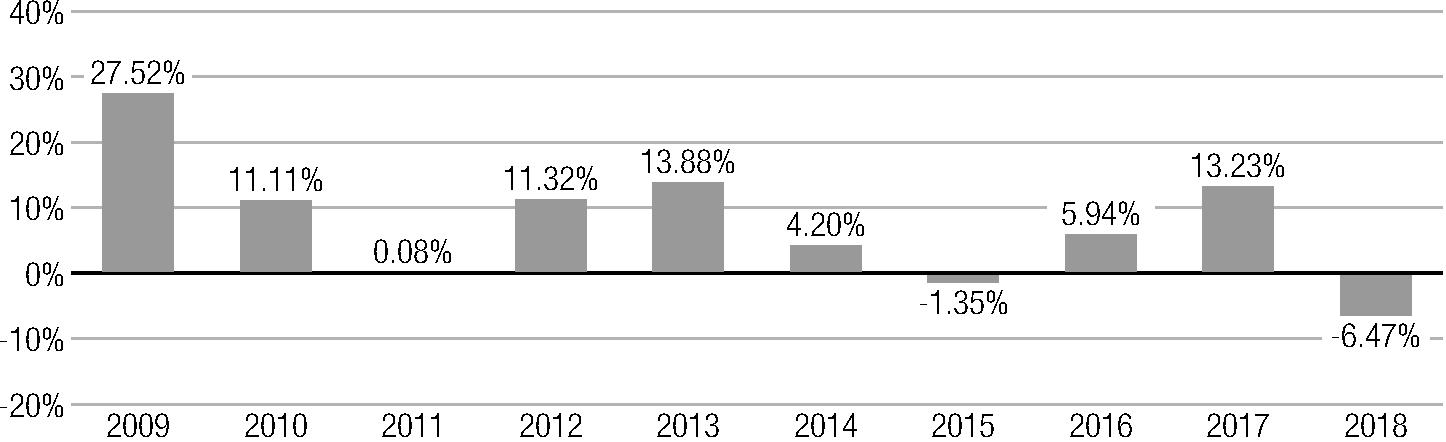
During the periods illustrated in this bar chart, Class A’s highest quarterly return was 13.72% for the quarter ended June 30, 2009, and its lowest quarterly return was -10.65% for the quarter ended Sept. 30, 2011. The maximum Class A sales charge of 5.75%, which is normally deducted when you purchase shares, is not reflected in the highest/lowest quarterly returns or in the bar chart. If this fee were included, the returns would be less than those shown. The average annual total returns in the table below do include the sales charge.
Average annual total returns for periods ended December 31, 2018
|
1 year | 5 years | 10 years | ||||||
Class A return before taxes
|
-11.86% | 1.68% | 6.92% | ||||||
Class A return after taxes on distributions
|
-13.28% | -0.14% | 5.59% | ||||||
Class A return after taxes on distributions and sale of Fund shares
|
-6.15% | 1.05% | 5.38% | ||||||
Class C return before taxes
|
-8.10% | 2.10% | 6.74% | ||||||
Class R return before taxes
|
-6.66% | 2.63% | 7.27% | ||||||
Institutional Class return before taxes
|
-6.25% | 3.15% | 7.81% | ||||||
S&P 500® Index (reflects no deduction for fees, expenses, or taxes)
|
-4.38% | 8.49% | 13.12% | ||||||
Bloomberg Barclays US Aggregate Index (reflects no deduction for fees, expenses, or taxes)
|
0.01% | 2.52% | 3.48% | ||||||
After-tax performance is presented only for Class A shares of the Fund. The after-tax returns for other Fund classes may vary. Actual after-tax returns depend on the investor’s individual tax situation and may differ from the returns shown. After-tax returns are not relevant for shares held in tax-advantaged investment vehicles such as employer-sponsored 401(k) plans and individual retirement accounts (IRAs). The after-tax returns shown are calculated using the highest individual federal marginal income tax rates in effect during the periods presented and do not reflect the impact of state and local taxes.
6
Who manages the Fund?
Investment manager and sub-advisors
Delaware Management Company, a series of Macquarie Investment Management Business Trust (a Delaware statutory trust), is the Fund's investment manager. Macquarie Investment Management Austria Kapitalanlage AG (MIMAK) and Jackson Square Partners, LLC (JSP) serve as sub-advisors for the Fund. MIMAK is primarily responsible for the day-to-day management of the Fund’s portfolio and determines its asset allocation.
|
Portfolio managers |
Title with MIMAK |
Start date on the Fund |
|
Stefan Loewenthal |
Chief Investment Officer |
January 2019 |
|
Juergen Wurzer |
Deputy Head of Portfolio Management |
January 2019 |
Purchase and redemption of Fund shares
You may purchase or redeem shares of the Fund on any day that the New York Stock Exchange (NYSE) is open for business (Business Day). Shares may be purchased or redeemed: through your financial advisor; through the Fund’s website at delawarefunds.com; by calling 800 523-1918; by regular mail (c/o Macquarie Investment Management, P.O. Box 9876, Providence, RI 02940-8076); by overnight courier service (c/o Delaware Funds by Macquarie Service Center, 4400 Computer Drive, Westborough, MA 01581-1722); or by wire.
For Class A and Class C shares, the minimum initial investment is generally $1,000 and subsequent investments can be made for as little as $100. The minimum initial investment for IRAs, Uniform Gifts/Transfers to Minors Act accounts, direct deposit purchase plans, and automatic investment plans is $250 and through Coverdell Education Savings Accounts is $500, and subsequent investments in these accounts can be made for as little as $25. For Class R and Institutional Class shares (except those shares purchased through an automatic investment plan), there is no minimum initial purchase requirement, but certain eligibility requirements must be met. The eligibility requirements are described in this Prospectus under “Choosing a share class” and on the Fund’s website. We may reduce or waive the minimums or eligibility requirements in certain cases.
Please refer to the Fund’s prospectus and statement of additional information for more details regarding the purchase and sale of Fund shares.
Tax information
The Fund’s distributions generally are taxable to you as ordinary income, capital gains, or some combination of both, unless you are investing through a tax-advantaged arrangement, such as a 401(k) plan or an IRA, in which case your distributions may be taxed as ordinary income when withdrawn from the tax-advantaged account.
Payments to broker/dealers and other financial intermediaries
If you purchase shares of the Fund through a broker/dealer or other financial intermediary (such as a bank), the Fund and its related companies may pay the intermediary for the sale of Fund shares and related services. These payments may create a conflict of interest by influencing the broker/dealer or other
7
Summary prospectus
Delaware Strategic Allocation Fund
intermediary and your salesperson to recommend the Fund over another investment. Ask your salesperson or visit your financial intermediary’s website for more information.
SMPR-448 [3/18] DG3 22194 [3/19]