485BPOSMarch 31, 20230000773674false0.010.010.010.010.411.381.750.250.011.192.324.870.771.051.210.426.163.711.6511.512.884.600.510.852.140.566.166.691.1412.550.410.330.110.410.211.112.913.350.093.969.132.672.154.723.082.517.8510.286.3712.3800007736742023-08-012023-08-010000773674ck0000773674:S000005965Memberck0000773674:AmericanCenturyGovernmentIncomeTrustMemberck0000773674:C000016429Member2023-08-012023-08-010000773674ck0000773674:S000005966Memberck0000773674:C000016430Memberck0000773674:AmericanCenturyGovernmentIncomeTrustMember2023-08-012023-08-010000773674ck0000773674:C000189731Memberck0000773674:S000005966Memberck0000773674:AmericanCenturyGovernmentIncomeTrustMember2023-08-012023-08-010000773674ck0000773674:S000005966Memberck0000773674:AmericanCenturyGovernmentIncomeTrustMemberck0000773674:C000016431Member2023-08-012023-08-010000773674ck0000773674:C000088034Memberck0000773674:S000005966Memberck0000773674:AmericanCenturyGovernmentIncomeTrustMember2023-08-012023-08-010000773674ck0000773674:S000005966Memberck0000773674:AmericanCenturyGovernmentIncomeTrustMemberck0000773674:C000051003Member2023-08-012023-08-010000773674ck0000773674:C000051002Memberck0000773674:S000005966Memberck0000773674:AmericanCenturyGovernmentIncomeTrustMember2023-08-012023-08-010000773674ck0000773674:S000005968Memberck0000773674:AmericanCenturyGovernmentIncomeTrustMemberck0000773674:C000016435Member2023-08-012023-08-010000773674ck0000773674:C000189732Memberck0000773674:S000005968Memberck0000773674:AmericanCenturyGovernmentIncomeTrustMember2023-08-012023-08-010000773674ck0000773674:S000005968Memberck0000773674:AmericanCenturyGovernmentIncomeTrustMemberck0000773674:C000016436Member2023-08-012023-08-010000773674ck0000773674:S000005968Memberck0000773674:AmericanCenturyGovernmentIncomeTrustMemberck0000773674:C000088036Member2023-08-012023-08-010000773674ck0000773674:S000005968Memberck0000773674:AmericanCenturyGovernmentIncomeTrustMemberck0000773674:C000088037Member2023-08-012023-08-010000773674ck0000773674:C000088035Memberck0000773674:S000005968Memberck0000773674:AmericanCenturyGovernmentIncomeTrustMember2023-08-012023-08-010000773674ck0000773674:AmericanCenturyGovernmentIncomeTrustMemberck0000773674:S000005970Memberck0000773674:C000016440Member2023-08-012023-08-010000773674ck0000773674:C000189733Memberck0000773674:AmericanCenturyGovernmentIncomeTrustMemberck0000773674:S000005970Member2023-08-012023-08-010000773674ck0000773674:C000016441Memberck0000773674:AmericanCenturyGovernmentIncomeTrustMemberck0000773674:S000005970Member2023-08-012023-08-010000773674ck0000773674:AmericanCenturyGovernmentIncomeTrustMemberck0000773674:S000005970Memberck0000773674:C000088041Member2023-08-012023-08-010000773674ck0000773674:C000088042Memberck0000773674:AmericanCenturyGovernmentIncomeTrustMemberck0000773674:S000005970Member2023-08-012023-08-010000773674ck0000773674:AmericanCenturyGovernmentIncomeTrustMemberck0000773674:S000005970Memberck0000773674:C000088040Member2023-08-012023-08-010000773674ck0000773674:S000005965Memberck0000773674:AmericanCenturyGovernmentIncomeTrustMember2023-08-012023-08-01iso4217:USDxbrli:pure0000773674ck0000773674:S000005966Memberck0000773674:AmericanCenturyGovernmentIncomeTrustMember2023-08-012023-08-010000773674ck0000773674:S000005966Memberck0000773674:C000016430Memberck0000773674:AmericanCenturyGovernmentIncomeTrustMemberrr:AfterTaxesOnDistributionsMember2023-08-012023-08-010000773674rr:AfterTaxesOnDistributionsAndSalesMemberck0000773674:S000005966Memberck0000773674:C000016430Memberck0000773674:AmericanCenturyGovernmentIncomeTrustMember2023-08-012023-08-010000773674ck0000773674:S000005966Memberck0000773674:AmericanCenturyGovernmentIncomeTrustMemberck0000773674:BloombergUSGNMAIndexMember2023-08-012023-08-010000773674ck0000773674:S000005968Memberck0000773674:AmericanCenturyGovernmentIncomeTrustMember2023-08-012023-08-010000773674ck0000773674:S000005968Memberck0000773674:AmericanCenturyGovernmentIncomeTrustMemberck0000773674:C000016435Memberrr:AfterTaxesOnDistributionsMember2023-08-012023-08-010000773674rr:AfterTaxesOnDistributionsAndSalesMemberck0000773674:S000005968Memberck0000773674:AmericanCenturyGovernmentIncomeTrustMemberck0000773674:C000016435Member2023-08-012023-08-010000773674ck0000773674:BloombergUSGovernmentMBSIndexMemberck0000773674:S000005968Memberck0000773674:AmericanCenturyGovernmentIncomeTrustMember2023-08-012023-08-010000773674ck0000773674:AmericanCenturyGovernmentIncomeTrustMemberck0000773674:S000005970Member2023-08-012023-08-010000773674ck0000773674:AmericanCenturyGovernmentIncomeTrustMemberck0000773674:S000005970Memberck0000773674:C000016440Memberrr:AfterTaxesOnDistributionsMember2023-08-012023-08-010000773674rr:AfterTaxesOnDistributionsAndSalesMemberck0000773674:AmericanCenturyGovernmentIncomeTrustMemberck0000773674:S000005970Memberck0000773674:C000016440Member2023-08-012023-08-010000773674ck0000773674:BloombergUS13YearGovernmentBondIndexMemberck0000773674:AmericanCenturyGovernmentIncomeTrustMemberck0000773674:S000005970Member2023-08-012023-08-010000773674ck0000773674:S000005969Memberck0000773674:AmericanCenturyGovernmentIncomeTrustMember2023-08-012023-08-010000773674ck0000773674:C000016437Memberck0000773674:S000005969Memberck0000773674:AmericanCenturyGovernmentIncomeTrustMember2023-08-012023-08-010000773674ck0000773674:C000181796Memberck0000773674:S000005969Memberck0000773674:AmericanCenturyGovernmentIncomeTrustMember2023-08-012023-08-010000773674ck0000773674:S000005969Memberck0000773674:AmericanCenturyGovernmentIncomeTrustMemberck0000773674:C000181797Member2023-08-012023-08-010000773674ck0000773674:S000005969Memberck0000773674:AmericanCenturyGovernmentIncomeTrustMemberck0000773674:C000016438Member2023-08-012023-08-010000773674ck0000773674:S000005969Memberck0000773674:AmericanCenturyGovernmentIncomeTrustMemberck0000773674:C000088038Member2023-08-012023-08-010000773674ck0000773674:C000088039Memberck0000773674:S000005969Memberck0000773674:AmericanCenturyGovernmentIncomeTrustMember2023-08-012023-08-010000773674ck0000773674:S000005969Memberck0000773674:C000016439Memberck0000773674:AmericanCenturyGovernmentIncomeTrustMember2023-08-012023-08-010000773674ck0000773674:S000005969Memberck0000773674:AmericanCenturyGovernmentIncomeTrustMemberck0000773674:C000191079Member2023-08-012023-08-010000773674ck0000773674:S000005969Memberck0000773674:AmericanCenturyGovernmentIncomeTrustMemberck0000773674:C000191080Member2023-08-012023-08-010000773674ck0000773674:C000016437Memberck0000773674:S000005969Memberck0000773674:AmericanCenturyGovernmentIncomeTrustMemberrr:AfterTaxesOnDistributionsMember2023-08-012023-08-010000773674ck0000773674:C000016437Memberck0000773674:S000005969Memberrr:AfterTaxesOnDistributionsAndSalesMemberck0000773674:AmericanCenturyGovernmentIncomeTrustMember2023-08-012023-08-010000773674ck0000773674:S000005969Memberck0000773674:AmericanCenturyGovernmentIncomeTrustMemberck0000773674:BloombergUSTreasuryInflationProtectedSecuritiesTIPSIndexMember2023-08-012023-08-01
As Filed with the U.S. Securities and Exchange Commission on July 28, 2023
1933 Act File No. 002-99222
1940 Act File No. 811-04363
| | | | | |
UNITED STATES
SECURITIES AND EXCHANGE COMMISSION
WASHINGTON, D.C. 20549 |
__________________ |
FORM N-1A |
| __________________ |
| |
| REGISTRATION STATEMENT UNDER THE SECURITIES ACT OF 1933 | ☒ |
| |
| Pre-Effective Amendment No. | ☐ |
| |
| Post-Effective Amendment No. 90 | ý |
| |
| and/or |
| |
| REGISTRATION STATEMENT UNDER THE INVESTMENT COMPANY ACT OF 1940 | ☒ |
| |
| Amendment No. 91 | ý |
| (Check appropriate box or boxes.) |
__________________ |
American Century Government Income Trust (Exact Name of Registrant as Specified in Charter) |
__________________ |
4500 MAIN STREET, KANSAS CITY, MO 64111 (Address of Principal Executive Offices) (Zip Code) |
REGISTRANT’S TELEPHONE NUMBER, INCLUDING AREA CODE: (816) 531-5575 |
JOHN PAK 4500 MAIN STREET, KANSAS CITY, MISSOURI 64111 (Name and Address of Agent for Service) |
| Approximate Date of Proposed Public Offering: August 1, 2023 | |
| |
| It is proposed that this filing will become effective (check appropriate box) |
| | | | | |
| ☐ | immediately upon filing pursuant to paragraph (b) |
| ý | on August 1, 2023 at 8:30 a.m. Central pursuant to paragraph (b) |
| ☐ | 60 days after filing pursuant to paragraph (a)(1) |
| ☐ | on (date) pursuant to paragraph (a)(1) |
| ☐ | 75 days after filing pursuant to paragraph (a)(2) |
| ☐ | on (date) pursuant to paragraph (a)(2) of rule 485. |
| |
| If appropriate, check the following box: |
| |
| ☐ | this post-effective amendment designates a new effective date for a previously filed post-effective amendment. |
August 1, 2023
American Century Investments
Prospectus
Capital Preservation Fund
Investor Class (CPFXX)
Ginnie Mae Fund
Investor Class (BGNMX)
I Class (AGMHX)
A Class (BGNAX)
C Class (BGNCX)
R Class (AGMWX)
R5 Class (AGMNX)
Government Bond Fund
Investor Class (CPTNX)
I Class (ABHTX)
A Class (ABTAX)
C Class (ABTCX)
R Class (ABTRX)
R5 Class (ABTIX)
Short-Term Government Fund
Investor Class (TWUSX)
I Class (ASGHX)
A Class (TWAVX)
C Class (TWACX)
R Class (TWARX)
R5 Class (TWUOX)
| | | | | |
The Securities and Exchange Commission has not approved or disapproved these securities or passed upon the adequacy of this prospectus. Any representation to the contrary is a criminal offense. | |
Table of Contents | | | | | | | | |
| Fund Summary—Capital Preservation Fund | 2 |
| Investment Objective | 2 |
| Fees and Expenses | 2 |
| Principal Investment Strategies | 2 |
| Principal Risks | 2 |
| Fund Performance | 3 |
| Investment Advisor | 3 |
| Purchase and Sale of Fund Shares | 3 |
| Tax Information | 4 |
| Payments to Broker-Dealers and Other Financial Intermediaries | 4 |
| | |
| Fund Summary—Ginnie Mae Fund | 5 |
| Investment Objective | 5 |
| Fees and Expenses | 5 | |
| Principal Investment Strategies | 6 | |
| Principal Risks | 6 | |
| Fund Performance | 7 | |
| Portfolio Management | 8 | |
| Purchase and Sale of Fund Shares | 8 | |
| Tax Information | 8 | |
| Payments to Broker-Dealers and Other Financial Intermediaries | 8 | |
| | |
| Fund Summary—Government Bond Fund | 9 | |
| Investment Objective | 9 | |
| Fees and Expenses | 9 | |
| Principal Investment Strategies | 10 | |
| Principal Risks | 10 | |
| Fund Performance | 11 | |
| Portfolio Management | 12 | |
| Purchase and Sale of Fund Shares | 12 | |
| Tax Information | 12 | |
| Payments to Broker-Dealers and Other Financial Intermediaries | 12 | |
| | |
| Fund Summary–Short-Term Government Fund | 13 |
| Investment Objective | 13 |
| Fees and Expenses | 13 |
| Principal Investment Strategies | 14 | |
| Principal Risks | 14 | |
| Fund Performance | 15 | |
| Portfolio Management | 16 | |
| Purchase and Sale of Fund Shares | 16 | |
| Tax Information | 16 | |
| Payments to Broker-Dealers and Other Financial Intermediaries | 16 | |
| | |
| Objectives, Strategies and Risks | 17 |
| Management | 24 |
| Investing Directly with American Century Investments | 27 |
| Investing Through a Financial Intermediary | 29 |
| Additional Policies Affecting Your Investment | 34 |
| | | | | | | | |
| Share Price and Distributions | 38 |
| Taxes | 40 |
| Multiple Class Information | 42 |
| Financial Highlights | 43 |
| | |
| Appendix A | A-1 |
©2023 American Century Proprietary Holdings, Inc. All rights reserved.
Fund Summary—Capital Preservation Fund
Investment Objective
The fund is a money market fund that seeks maximum safety and liquidity. Its secondary objective is to seek to pay shareholders the highest rate of return consistent with safety and liquidity.
Fees and Expenses
The following table describes the fees and expenses you may pay if you buy, hold, and sell shares of the fund. You may pay other fees, such as brokerage commissions and other fees to financial intermediaries, which are not reflected in the tables and examples below. | | | | | |
Shareholder Fees (fees paid directly from your investment) |
| Investor |
Maximum Annual Account Maintenance Fee (waived if eligible investments total at least $10,000) | $25 |
Annual Fund Operating Expenses (expenses that you pay each year as a percentage of the value of your investment) |
| Investor |
Management Fee | 0.47% |
Distribution and Service (12b-1) Fees | None |
Other Expenses | 0.01% |
Total Annual Fund Operating Expenses | 0.48% |
Example
The example below is intended to help you compare the costs of investing in the fund with the costs of investing in other mutual funds. The example assumes that you invest $10,000 in the fund for the time periods indicated and then redeem all of your shares at the end of those periods, that you earn a 5% return each year and that the fund’s operating expenses remain the same. Although your actual costs may be higher or lower, based on these assumptions your costs would be:
| | | | | | | | | | | | | | |
| 1 year | 3 years | 5 years | 10 years |
Investor Class | $49 | $154 | $269 | $604 |
Principal Investment Strategies
Under normal circumstances, Capital Preservation invests exclusively in short-term money market securities issued by the U.S. Treasury that are guaranteed by the direct full faith and credit pledge of the U.S. government. The income from these securities is exempt from state income tax. Examples of U.S. Treasury securities in which the fund may invest include Treasury bills and notes, and Treasury floating-rate notes.
Because this fund is a government money market fund, both retail and institutional shareholders may invest in the fund. This fund does not have the ability to impose a liquidity fee on the sale of shares or temporarily suspend redemptions in response to decreases in liquidity.
The fund may purchase U.S. Treasury securities through buy/sell back transactions. The fund may commit up to 35% of its total assets to such transactions.
Principal Risks
Because short-term money market securities are among the safest securities available, the interest they pay is among the lowest for income-paying securities. Accordingly, the yield on this fund will likely be lower than the yield on funds that invest in longer-term or lower-quality securities.
Investments in U.S. Treasury securities are sensitive to interest rate changes. Generally, the value of debt securities and the funds that hold them decline as interest rates rise. The fund’s investments in short-term U.S. Treasury securities are designed to minimize this risk. However, a sharp and unexpected rise in interest rates could cause the fund’s share price to drop.
You could lose money by investing in the fund. Although the fund seeks to preserve the value of your investment at $1.00 per share, it cannot guarantee it will do so. An investment in the fund is not insured or guaranteed by the Federal Deposit Insurance Corporation or any other government agency. The fund’s sponsor has no legal obligation to provide financial support to the fund, and you should not expect that the sponsor will provide financial support to the fund at any time.
Fund Performance
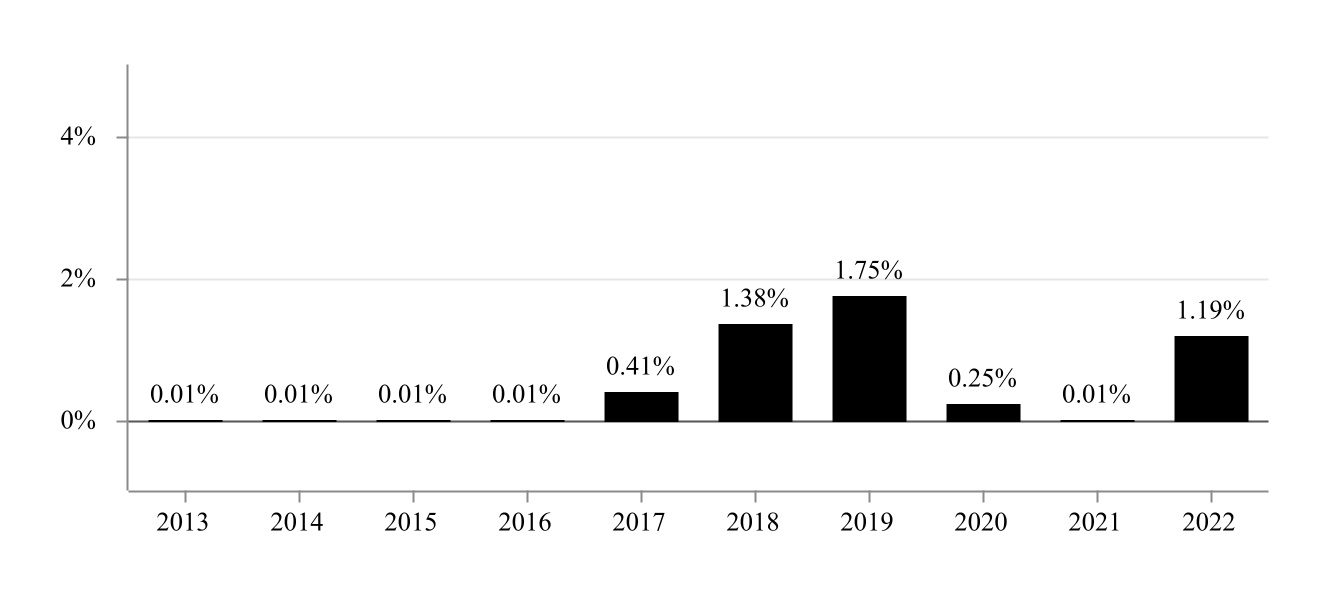
The following bar chart and table provide some indication of the risks of investing in the fund. The bar chart shows changes in the fund’s performance from year to year for Investor Class shares. The fund’s past performance is not necessarily an indication of how the fund will perform in the future. For current performance information, including yields, please visit americancentury.com.
Sales charges and account fees, if applicable, are not reflected in the bar chart. If those charges were included, returns would be less than those shown.
Calendar Year Total Returns
Highest Performance Quarter (4Q 2022): 0.73% Lowest Performance Quarter (1Q 2022): 0.00%
As of June 30, 2023, the most recent calendar quarter end, the fund’s Investor Class year-to-date return was 2.09%.
| | | | | | | | | | | |
Average Annual Total Returns
For the calendar year ended December 31, 2022 | 1 year | 5 years | 10 years |
| Investor Class | 1.19% | 0.91% | 0.50% |
Investment Advisor
American Century Investment Management, Inc.
Purchase and Sale of Fund Shares
You may purchase or redeem shares of the fund on any business day through our website at americancentury.com, in person (at one of our Investor Centers), by mail (American Century Investments, P.O. Box 419200, Kansas City, MO 64141-6200), by telephone at 1-800-345-2021 (Investor Services Representative) or 1-800-345-3533 (Business, Not-For-Profit and Employer-Sponsored Retirement Plans), or through a financial intermediary. Shares may be purchased and redemption proceeds received by electronic bank transfer, by check or by wire.
Unless otherwise specified below, the minimum initial investment amount to open an account is $2,500 ($1,000 for Coverdell Education Savings Accounts and IRAs). However, American Century Investments will waive the fund minimum if you make an initial investment of at least $500 and continue to make automatic investments of at least $100 a month until reaching the fund minimum. Investors opening accounts through financial intermediaries may open an account with $250, but the financial intermediaries may require their clients to meet different investment minimums. The minimum may be waived for broker-dealer sponsored wrap program accounts, fee based accounts, and accounts through bank/trust and wealth management advisory organizations or certain employer-sponsored retirement plans.
There is a $50 minimum for subsequent purchases, except that there is no subsequent purchase minimum for financial intermediaries or employer-sponsored retirement plans.
Tax Information
Fund distributions are generally taxable as ordinary income or capital gains, unless you are investing through a tax-deferred account such as a 401(k) or individual retirement account (in which case you may be taxed upon withdrawal of your investment from such account).
Payments to Broker-Dealers and Other Financial Intermediaries
If you purchase the fund through a broker-dealer or other financial intermediary (such as a bank, insurance company, plan sponsor or financial professional), the fund and its related companies may pay the intermediary for the sale of fund shares and related services. These payments may create a conflict of interest by influencing the broker-dealer or other intermediary and your salesperson to recommend the fund over another investment. Ask your salesperson or visit your financial intermediary’s website for more information.
Fund Summary—Ginnie Mae Fund
Investment Objective
Ginnie Mae seeks high current income while maintaining liquidity and safety of principal by investing primarily in GNMA certificates.
Fees and Expenses
The following table describes the fees and expenses you may pay if you buy, hold and sell shares of the fund. You may pay other fees, such as brokerage commissions and other fees to financial intermediaries, which are not reflected in the tables and examples below. You may qualify for sales charge discounts if you and your family invest, or agree to invest in the future, at least $100,000 in American Century Investments funds. More information about these and other discounts is available from your financial professional and in Calculation of Sales Charges on page 29 of the fund’s prospectus, Appendix A of the fund’s prospectus and Sales Charges in Appendix B of the statement of additional information. | | | | | | | | | | | | | | | | | | | | |
Shareholder Fees (fees paid directly from your investment) | |
| Investor | I | A | C | R | R5 |
Maximum Sales Charge (Load) Imposed on
Purchases (as a percentage of offering price) | None | None | 4.50% | None | None | None |
Maximum Deferred Sales Charge (Load)
(as a percentage of the lower of the original
offering price or redemption proceeds when redeemed within one year of purchase) | None | None | None¹ | 1.00% | None | None |
Maximum Annual Account Maintenance Fee
(waived if eligible investments total at least $10,000) | $25 | None | None | None | None | None |
Annual Fund Operating Expenses (expenses that you pay each year as a percentage of the value of your investment) | |
| Investor | I | A | C | R | R5 |
| Management Fee | 0.54% | 0.44% | 0.54% | 0.54% | 0.54% | 0.34% |
| Distribution and Service (12b-1) Fees | None | None | 0.25% | 1.00% | 0.50% | None |
| Other Expenses | 0.01% | 0.01% | 0.01% | 0.01% | 0.01% | 0.01% |
| Total Annual Fund Operating Expenses | 0.55% | 0.45% | 0.80% | 1.55% | 1.05% | 0.35% |
1 Purchases of $1 million or more may be subject to a contingent deferred sales charge of 1.00% if the shares are redeemed within one year of the date of purchase.
Example
The example below is intended to help you compare the costs of investing in the fund with the costs of investing in other mutual funds. The example assumes that you invest $10,000 in the fund for the time periods indicated and then redeem all of your shares at the end of those periods, that you earn a 5% return each year and that the fund’s operating expenses remain the same. Although your actual costs may be higher or lower, based on these assumptions your costs would be:
| | | | | | | | | | | | | | |
| 1 year | 3 years | 5 years | 10 years |
Investor Class | $56 | $177 | $308 | $690 |
I Class | $46 | $145 | $252 | $567 |
A Class | $528 | $694 | $875 | $1,396 |
C Class | $158 | $490 | $845 | $1,643 |
R Class | $107 | $335 | $580 | $1,282 |
R5 Class | $36 | $113 | $197 | $444 |
Portfolio Turnover
The fund pays transaction costs, such as commissions, when it buys and sells securities (or “turns over” its portfolio). A higher portfolio turnover rate may indicate higher transaction costs and may result in higher taxes when fund shares are held in a taxable account. These costs, which are not reflected in annual fund operating expenses or in the example, affect the fund’s performance. During the most recent fiscal year, the fund’s portfolio turnover rate was 146% of the average value of its portfolio.
Principal Investment Strategies
Under normal market conditions, the fund invests at least 80% of its net assets in securities issued by the Government National Mortgage Association (GNMA). GNMA certificates represent interests in pools of mortgage loans and in the cash flows from these loans. Unlike many other mortgage-backed securities, the timely payment of principal and interest on these certificates is guaranteed by GNMA. GNMA’s payment guarantee is stronger than most other government agencies’ because it is backed by the full faith and credit pledge of the U.S. government.
In addition, the fund may buy other U.S. government debt securities, including U.S. Treasury securities and other securities issued or guaranteed by the U.S. government and its agencies and instrumentalities. Securities issued or guaranteed by other U.S. government agencies or instrumentalities, such as the Federal National Mortgage Association (Fannie Mae), the Federal Home Loan Mortgage Corporation (Freddie Mac), and the Federal Home Loan Bank are not guaranteed by the U.S. Treasury or supported by the full faith and credit of the U.S. government. However, these agencies or instrumentalities are authorized to borrow from the U.S. Treasury to meet their obligations.
To generate additional income, the fund may purchase securities, including mortgage dollar rolls, in advance through when-issued and forward commitment transactions. The fund may commit up to 35% of its total assets to such transactions.
The fund also may invest in derivative instruments such as options, futures contracts, options on futures contracts and swap agreements, or in mortgage- or asset-backed securities, provided that such investments are in keeping with the fund’s investment objective.
When determining whether to sell a security, the portfolio managers consider, among other things, current and anticipated changes in interest rates, current valuation relative to alternatives in the market, general market conditions and any other factors deemed relevant by the portfolio managers.
The fund may engage in active and frequent trading of portfolio securities to achieve its principal investment strategies. This may cause higher transaction costs and may affect performance. It may also result in the realization and distribution of capital gains.
Principal Risks
•Interest Rate Risk — Generally, when interest rates rise, the fund’s share value will decline. The opposite is true when interest rates decline. This risk is higher for the fund than for other funds that have shorter weighted average maturities, such as money market funds and short-term bond funds. A period of rising interest rates may negatively affect the fund’s performance.
•Prepayment and Extension Risk — The fund may invest in debt securities backed by mortgages or other assets. If these underlying assets are prepaid, the fund may benefit less from declining interest rates than funds that have similar weighted average maturities. Conversely, an issuer may exercise its right to pay principal on an obligation held by the fund later than expected (extend the obligation) especially in periods of rising interest rates. These events may lengthen weighted average maturity and potentially reduce the value of these securities.
•Derivatives Risk — The use of derivative instruments involves risks different from, or possibly greater than, the risks associated with investing directly in securities and other traditional instruments. Derivatives are subject to a number of risks including liquidity, interest rate, market, credit and correlation risk. Derivatives used for hedging or risk management may not operate as intended, may expose the fund to other risks, and may be insufficient to protect the fund from the risks they were intended to hedge.
•Market Risk — The value of the securities owned by the fund may go up and down, sometimes rapidly or unpredictably. Market risks, including political, regulatory, economic and social developments, can affect the value of the fund’s investments. Natural disasters, public health emergencies, war, terrorism and other unforeseeable events may lead to increased market volatility and may have adverse long-term effects on world economies and markets generally.
•Redemption Risk — The fund may need to sell securities at times it would not otherwise do so in order to meet shareholder redemption requests. Selling securities to meet such redemptions may cause the fund to experience a loss, increase the fund’s transaction costs or have tax consequences. To the extent that a large shareholder (including a fund of funds or 529 college savings plan) invests in the fund, the fund may experience relatively large redemptions as such shareholder reallocates its assets.
•Principal Loss Risk — At any given time your shares may be worth less than the price you paid for them. In other words, it is possible to lose money by investing in the fund.
An investment in the fund is not a bank deposit, and it is not insured or guaranteed by the Federal Deposit Insurance Corporation (FDIC) or any other government agency.
Fund Performance
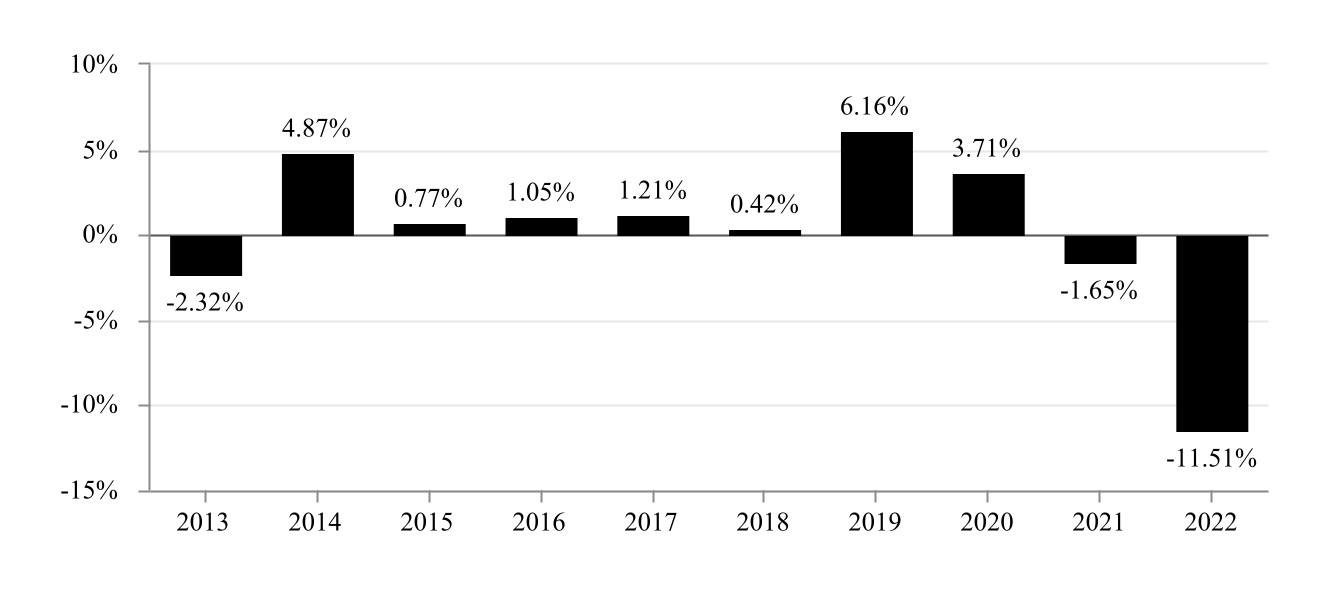
The following bar chart and table provide some indication of the risks of investing in the fund. The bar chart shows changes in the fund’s performance from year to year for Investor Class shares. The table shows how the fund’s average annual returns for the periods shown compared with those of a broad measure of market performance. The fund’s past performance (before and after taxes) is not necessarily an indication of how the fund will perform in the future. For current performance information, including yields, please visit americancentury.com.
Sales charges and account fees, if applicable, are not reflected in the bar chart. If those charges were included, returns would be less than those shown.
Calendar Year Total Returns
Highest Performance Quarter (1Q 2020): 2.62% Lowest Performance Quarter (3Q 2022): -5.34%
As of June 30, 2023, the most recent calendar quarter end, the fund’s Investor Class year-to-date return was 1.79%.
| | | | | | | | | | | |
Average Annual Total Returns
For the calendar year ended December 31, 2022 | 1 year | 5 years | 10 years |
Investor Class Return Before Taxes | -11.51% | -0.77% | 0.16% |
Return After Taxes on Distributions | -12.38% | -1.71% | -0.85% |
Return After Taxes on Distributions and Sale of Fund Shares | -6.79% | -0.94% | -0.29% |
I Class1 Return Before Taxes | -11.32% | -0.65% | 0.27% |
A Class Return Before Taxes | -15.70% | -1.92% | -0.55% |
C Class2 Return Before Taxes | -12.39% | -1.75% | -0.69% |
R Class Return Before Taxes | -11.86% | -1.26% | -0.34% |
R5 Class Return Before Taxes | -11.33% | -0.57% | 0.36% |
Bloomberg U.S. GNMA Index
(reflects no deduction for fees, expenses or taxes) | -10.76% | -0.50% | 0.59% |
1 Historical performance for the I Class prior to its inception (April 10, 2017) is based on the performance of R5 Class shares. I Class performance has been adjusted to reflect differences in expenses between classes, if applicable.
2 C Class shares automatically convert to A Class shares after approximately eight years. All returns for periods greater than eight years reflect this conversion.
The after-tax returns are shown only for Investor Class shares. After-tax returns for other share classes will vary. After-tax returns are calculated using the historical highest individual federal marginal income tax rates and do not reflect the impact of state and local taxes. Actual after-tax returns depend on an investor’s tax situation and may differ from those shown. After-tax returns are not relevant to investors who hold their fund shares through tax-deferred arrangements, such as 401(k) plans or IRAs.
Portfolio Management
Investment Advisor
American Century Investment Management, Inc.
Portfolio Managers
Dan Shiffman, CFA, Vice President and Senior Portfolio Manager, has served on teams managing fixed-income investments for American Century Investments since joining the advisor in 2004.
Peter Van Gelderen, Vice President and Senior Portfolio Manager, has served on teams managing fixed-income investments for American Century Investments since joining the advisor in 2021.
Curtis Manning, CFA, Portfolio Manager, has served on teams managing fixed-income investments for American Century Investments since joining the advisor in 2019.
Michael Waggaman, Portfolio Manager, has served on teams managing fixed-income investments for American Century Investments since joining the advisor in 2021.
Purchase and Sale of Fund Shares
You may purchase or redeem shares of the fund on any business day through our website at americancentury.com, in person (at one of our Investor Centers), by mail (American Century Investments, P.O. Box 419200, Kansas City, MO 64141-6200), by telephone at 1-800-345-2021 (Investor Services Representative) or 1-800-345-3533 (Business, Not-For-Profit and Employer-Sponsored Retirement Plans), or through a financial intermediary. Shares may be purchased and redemption proceeds received by electronic bank transfer, by check or by wire.
Unless otherwise specified below, the minimum initial investment amount to open an account is $2,500 ($1,000 for Coverdell Education Savings Accounts and IRAs). However, American Century Investments will waive the fund minimum if you make an initial investment of at least $500 and continue to make automatic investments of at least $100 a month until reaching the fund minimum. Investors opening accounts through financial intermediaries may open an account with $250 for the Investor, A, C and R Classes, but the financial intermediaries may require their clients to meet different investment minimums. The minimum may be waived for broker-dealer sponsored wrap program accounts, fee based accounts, and accounts through bank/trust and wealth management advisory organizations.
The minimum initial investment amount for the I Class is generally $5 million ($3 million for endowments and foundations), but the minimum may be waived if you have an aggregate investment in the American Century family of funds of $10 million or more ($5 million for endowments and foundations). This includes accounts held directly with American Century and those held through a financial intermediary.
There is no minimum initial investment amount for R5 Class shares.
For the Investor, A, C, R and R5 Classes, there is no minimum initial investment amount for certain employer-sponsored retirement plans, however, financial intermediaries or plan recordkeepers may require plans to meet different minimums. Employer-sponsored retirement plans are not eligible to purchase I Class shares.
There is a $50 minimum for subsequent purchases, except there is no subsequent purchase minimum for financial intermediaries or employer-sponsored retirement plans.
Tax Information
Fund distributions are generally taxable as ordinary income or capital gains, unless you are investing through a tax-deferred account such as a 401(k) or individual retirement account (in which case you may be taxed upon withdrawal of your investment from such account).
Payments to Broker-Dealers and Other Financial Intermediaries
If you purchase the fund through a broker-dealer or other financial intermediary (such as a bank, insurance company, plan sponsor or financial professional), the fund and its related companies may pay the intermediary for the sale of fund shares and related services for investments in all classes. These payments may create a conflict of interest by influencing the broker-dealer or other intermediary and your salesperson to recommend the fund over another investment. Ask your salesperson or visit your financial intermediary’s website for more information.
Fund Summary—Government Bond Fund
Investment Objective
The fund seeks high current income.
Fees and Expenses
The following table describes the fees and expenses you may pay if you buy, hold and sell shares of the fund. You may pay other fees, such as brokerage commissions and other fees to financial intermediaries, which are not reflected in the tables and examples below. You may qualify for sales charge discounts if you and your family invest, or agree to invest in the future, at least $100,000 in American Century Investments funds. More information about these and other discounts is available from your financial professional and in Calculation of Sales Charges on page 29 of the fund’s prospectus, Appendix A of the fund’s prospectus and Sales Charges in Appendix B of the statement of additional information.
| | | | | | | | | | | | | | | | | | | | |
Shareholder Fees (fees paid directly from your investment) | |
| Investor | I | A | C | R | R5 |
Maximum Sales Charge (Load) Imposed on
Purchases (as a percentage of offering price) | None | None | 4.50% | None | None | None |
Maximum Deferred Sales Charge (Load)
(as a percentage of the lower of the original
offering price or redemption proceeds when redeemed within one year of purchase) | None | None | None¹ | 1.00% | None | None |
Maximum Annual Account Maintenance Fee
(waived if eligible investments total at least $10,000) | $25 | None | None | None | None | None |
Annual Fund Operating Expenses (expenses that you pay each year as a percentage of the value of your investment) |
| Investor | I | A | C | R | R5 |
| Management Fee | 0.46% | 0.36% | 0.46% | 0.46% | 0.46% | 0.26% |
| Distribution and Service (12b-1) Fees | None | None | 0.25% | 1.00% | 0.50% | None |
| Other Expenses | 0.01% | 0.01% | 0.01% | 0.01% | 0.01% | 0.01% |
| Total Annual Fund Operating Expenses | 0.47% | 0.37% | 0.72% | 1.47% | 0.97% | 0.27% |
1 Purchases of $1 million or more may be subject to a contingent deferred sales charge of 1.00% if the shares are redeemed within one year of the date of purchase.
Example
The example below is intended to help you compare the costs of investing in the fund with the costs of investing in other mutual funds. The example assumes that you invest $10,000 in the fund for the time periods indicated and then redeem all of your shares at the end of those periods, that you earn a 5% return each year and that the fund’s operating expenses remain the same. Although your actual costs may be higher or lower, based on these assumptions your costs would be: | | | | | | | | | | | | | | |
| 1 year | 3 years | 5 years | 10 years |
Investor Class | $48 | $151 | $264 | $592 |
I Class | $38 | $119 | $208 | $469 |
A Class | $520 | $670 | $833 | $1,305 |
C Class | $150 | $466 | $803 | $1,553 |
R Class | $99 | $310 | $537 | $1,190 |
R5 Class | $28 | $87 | $152 | $344 |
Portfolio Turnover
The fund pays transaction costs, such as commissions, when it buys and sells securities (or “turns over” its portfolio). A higher portfolio turnover rate may indicate higher transaction costs and may result in higher taxes when fund shares are held in a taxable account. These costs, which are not reflected in annual fund operating expenses or in the example, affect the fund’s performance. During the most recent fiscal year, the fund’s portfolio turnover rate was 251% of the average value of its portfolio.
Principal Investment Strategies
Under normal market conditions, the fund invests at least 80% of its net assets in U.S. government debt securities, including U.S. Treasury securities and other securities issued or guaranteed by the U.S. government and its agencies and instrumentalities.
Securities issued or guaranteed by the U.S. Treasury and certain U.S. government agencies or instrumentalities, such as the Government National Mortgage Association (Ginnie Mae), are supported by the full faith and credit of the U.S. government. Securities issued or guaranteed by other U.S. government agencies or instrumentalities, such as the Federal National Mortgage Association (Fannie Mae), the Federal Home Loan Mortgage Corporation (Freddie Mac), and the Federal Home Loan Bank are not guaranteed by the U.S. Treasury or supported by the full faith and credit of the U.S. government. However, these agencies or instrumentalities are authorized to borrow from the U.S. Treasury to meet their obligations.
To generate additional income, the fund may purchase securities, including mortgage dollar rolls, in advance through when-issued and forward commitment transactions. The fund may commit up to 35% of its total assets to such transactions.
The fund also may invest in derivative instruments such as options, futures contracts, options on futures contracts and swap agreements, or in mortgage- or asset-backed securities, provided that such investments are in keeping with the fund’s investment objective.
When determining whether to sell a security, the portfolio managers consider, among other things, current and anticipated changes in interest rates, current valuation relative to alternatives in the market, general market conditions and any other factors deemed relevant by the portfolio managers.
The fund may engage in active and frequent trading of portfolio securities to achieve its principal investment strategies. This may cause higher transaction costs and may affect performance. It may also result in the realization and distribution of capital gains.
Principal Risks
•Interest Rate Risk — Generally, when interest rates rise, the fund’s share value will decline. The opposite is true when interest rates decline. This risk is higher for the fund than for other funds that have shorter weighted average maturities, such as money market funds or short-term bond funds. A period of rising interest rates may negatively affect the fund’s performance.
•Prepayment and Extension Risk — The fund may invest in debt securities backed by mortgages or other assets. If these underlying assets are prepaid, the fund may benefit less from declining interest rates than funds that have similar weighted average maturities. Conversely, an issuer may exercise its right to pay principal on an obligation held by the fund later than expected (extend the obligation) especially in periods of rising interest rates. These events may lengthen weighted average maturity and potentially reduce the value of these securities.
•Derivatives Risk — The use of derivative instruments involves risks different from, or possibly greater than, the risks associated with investing directly in securities and other traditional instruments. Derivatives are subject to a number of risks including liquidity, interest rate, market, credit and correlation risk. Derivatives used for hedging or risk management may not operate as intended, may expose the fund to other risks, and may be insufficient to protect the fund from the risks they were intended to hedge.
•Market Risk — The value of the securities owned by the fund may go up and down, sometimes rapidly or unpredictably. Market risks, including political, regulatory, economic and social developments, can affect the value of the fund’s investments. Natural disasters, public health emergencies, war, terrorism and other unforeseeable events may lead to increased market volatility and may have adverse long-term effects on world economies and markets generally.
•Principal Loss Risk — At any given time your shares may be worth less than the price you paid for them. In other words, it is possible to lose money by investing in the fund.
An investment in the fund is not a bank deposit, and it is not insured or guaranteed by the Federal Deposit Insurance Corporation (FDIC) or any other government agency.
Fund Performance
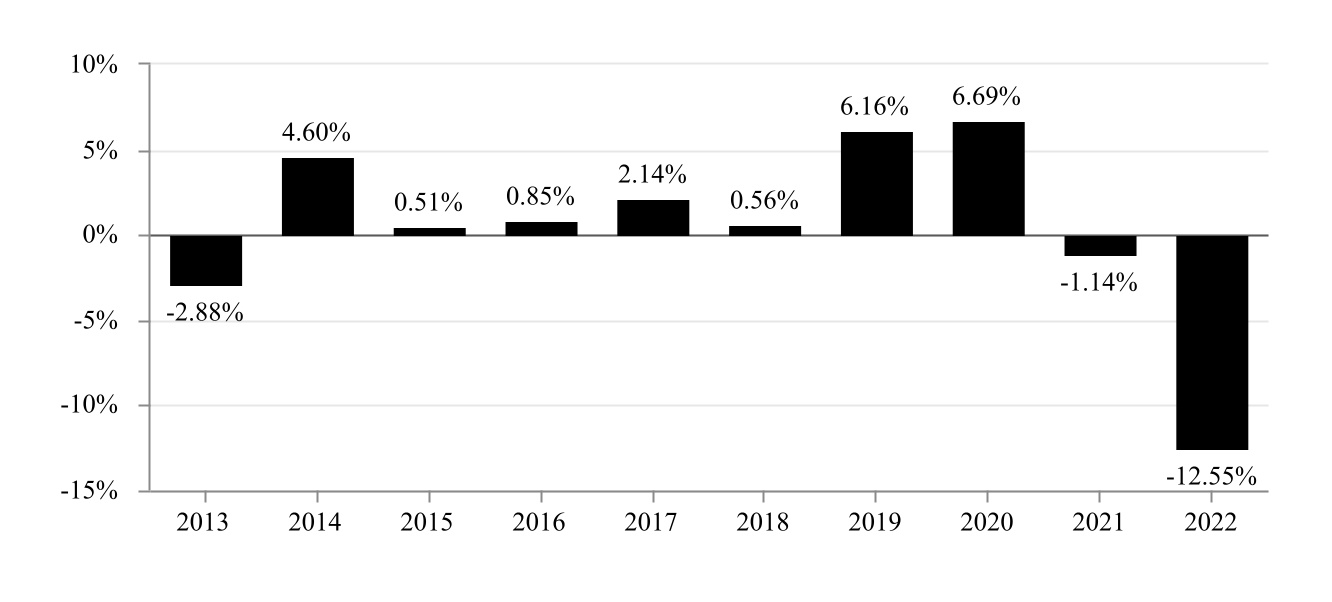
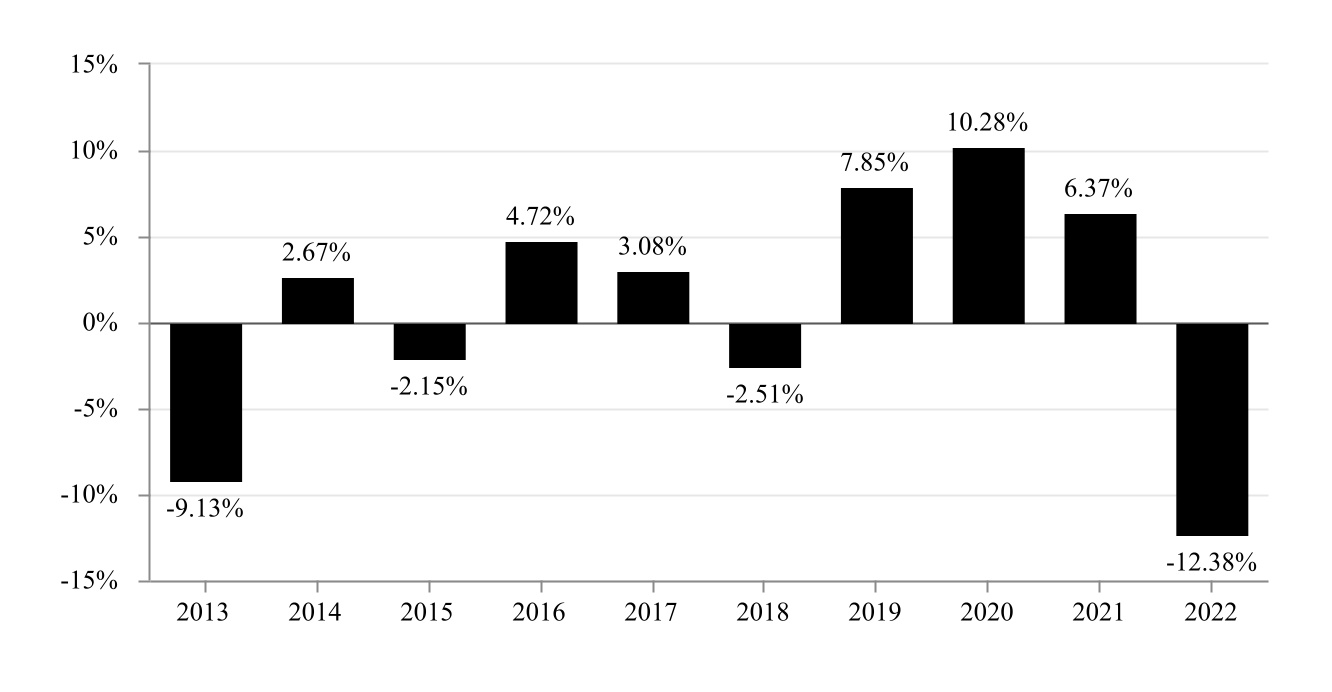
The following bar chart and table provide some indication of the risks of investing in the fund. The bar chart shows changes in the fund’s performance from year to year for Investor Class shares. The table shows how the fund’s average annual returns for the periods shown compared with those of a broad measure of market performance. The fund’s past performance (before and after taxes) is not necessarily an indication of how the fund will perform in the future. For current performance information, including yields, please visit americancentury.com.
Sales charges and account fees, if applicable, are not reflected in the bar chart. If those charges were included, returns would be less than those shown.
Calendar Year Total Returns
Highest Performance Quarter (1Q 2020): 5.78% Lowest Performance Quarter (3Q 2022): -4.89%
As of June 30, 2023, the most recent calendar quarter end, the fund’s Investor Class year-to-date return was 1.05%.
| | | | | | | | | | | |
Average Annual Total Returns
For the calendar year ended December 31, 2022 | 1 year | 5 years | 10 years |
Investor Class Return Before Taxes | -12.55% | -0.31% | 0.35% |
| Return After Taxes on Distributions | -13.39% | -1.23% | -0.53% |
| Return After Taxes on Distributions and Sale of Fund Shares | -7.41% | -0.57% | -0.09% |
I Class1 Return Before Taxes | -12.40% | -0.21% | 0.44% |
A Class Return Before Taxes | -16.70% | -1.47% | -0.36% |
C Class2 Return Before Taxes | -13.35% | -1.30% | -0.51% |
R Class Return Before Taxes | -12.91% | -0.81% | -0.15% |
R5 Class Return Before Taxes | -12.38% | -0.11% | 0.55% |
Bloomberg U.S. Government/MBS Index
(reflects no deduction for fees, expenses or taxes) | -12.12% | -0.24% | 0.67% |
1 Historical performance for the I Class prior to its inception (April 10, 2017) is based on the performance of R5 Class shares. I Class performance has been adjusted to reflect differences in expenses between classes, if applicable.
2 C Class shares automatically convert to A Class shares after approximately eight years. All returns for periods greater than eight years reflect this conversion.
The after-tax returns are shown only for Investor Class shares. After-tax returns for other share classes will vary. After-tax returns are calculated using the historical highest individual federal marginal income tax rates and do not reflect the impact of state and local taxes. Actual after-tax returns depend on an investor’s tax situation and may differ from those shown. After-tax returns are not relevant to investors who hold their fund shares through tax-deferred arrangements, such as 401(k) plans or IRAs.
Portfolio Management
Investment Advisor
American Century Investment Management, Inc.
Portfolio Managers
James E. Platz, CFA, Vice President and Portfolio Manager, has served on teams managing fixed-income investments for American Century Investments since joining the advisor in 2003.
Robert V. Gahagan, Senior Vice President and Senior Portfolio Manager, has served on teams managing fixed-income investments for American Century Investments since joining the advisor in 1983.
Peter Van Gelderen, Vice President and Senior Portfolio Manager, has served on teams managing fixed-income investments for American Century Investments since joining the advisor in 2021.
Curtis Manning, CFA, Portfolio Manager, has served on teams managing fixed-income investments for American Century Investments since joining the advisor in 2019.
Michael Waggaman, Portfolio Manager, has served on teams managing fixed-income investments for American Century Investments since joining the advisor in 2021.
Purchase and Sale of Fund Shares
You may purchase or redeem shares of the fund on any business day through our website at americancentury.com, in person (at one of our Investor Centers), by mail (American Century Investments, P.O. Box 419200, Kansas City, MO 64141-6200), by telephone at 1-800-345-2021 (Investor Services Representative) or 1-800-345-3533 (Business, Not-For-Profit and Employer-Sponsored Retirement Plans), or through a financial intermediary. Shares may be purchased and redemption proceeds received by electronic bank transfer, by check or by wire.
Unless otherwise specified below, the minimum initial investment amount to open an account is $2,500 ($1,000 for Coverdell Education Savings Accounts and IRAs). However, American Century Investments will waive the fund minimum if you make an initial investment of at least $500 and continue to make automatic investments of at least $100 a month until reaching the fund minimum. Investors opening accounts through financial intermediaries may open an account with $250 for the Investor, A, C and R Classes, but the financial intermediaries may require their clients to meet different investment minimums. The minimum may be waived for broker-dealer sponsored wrap program accounts, fee based accounts, and accounts through bank/trust and wealth management advisory organizations.
The minimum initial investment amount for the I Class is generally $5 million ($3 million for endowments and foundations), but the minimum may be waived if you have an aggregate investment in the American Century family of funds of $10 million or more ($5 million for endowments and foundations). This includes accounts held directly with American Century and those held through a financial intermediary.
There is no minimum initial investment amount for R5 Class shares.
For the Investor, A, C, R and R5 Classes, there is no minimum initial investment amount for certain employer-sponsored retirement plans, however, financial intermediaries or plan recordkeepers may require plans to meet different minimums. Employer-sponsored retirement plans are not eligible to purchase I Class shares.
There is a $50 minimum for subsequent purchases, except there is no subsequent purchase minimum for financial intermediaries or employer-sponsored retirement plans.
Tax Information
Fund distributions are generally taxable as ordinary income or capital gains, unless you are investing through a tax-deferred account such as a 401(k) or individual retirement account (in which case you may be taxed upon withdrawal of your investment from such account).
Payments to Broker-Dealers and Other Financial Intermediaries
If you purchase the fund through a broker-dealer or other financial intermediary (such as a bank, insurance company, plan sponsor or financial professional), the fund and its related companies may pay the intermediary for the sale of fund shares and related services for investments in all classes. These payments may create a conflict of interest by influencing the broker-dealer or other intermediary and your salesperson to recommend the fund over another investment. Ask your salesperson or visit your financial intermediary’s website for more information.
Fund Summary–Short-Term Government Fund
Investment Objective
The fund seeks high current income while maintaining safety of principal.
Fees and Expenses
The following table describes the fees and expenses you may pay if you buy, hold and sell shares of the fund. You may pay other fees, such as brokerage commissions and other fees to financial intermediaries, which are not reflected in the tables and examples below. You may qualify for sales charge discounts if you and your family invest, or agree to invest in the future, at least $100,000 in American Century Investments funds. More information about these and other discounts is available from your financial professional and in Calculation of Sales Charges on page 29 of the fund’s prospectus, Appendix A of the fund’s prospectus and Sales Charges in Appendix B of the statement of additional information.
| | | | | | | | | | | | | | | | | | | | |
Shareholder Fees (fees paid directly from your investment) | |
| Investor | I | A | C | R | R5 |
Maximum Sales Charge (Load) Imposed on
Purchases (as a percentage of offering price) | None | None | 2.25% | None | None | None |
Maximum Deferred Sales Charge (Load)
(as a percentage of the lower of the original
offering price or redemption proceeds when redeemed within one year of purchase) | None | None | None¹ | 1.00% | None | None |
Maximum Annual Account Maintenance Fee
(waived if eligible investments total at least $10,000) | $25 | None | None | None | None | None |
Annual Fund Operating Expenses (expenses that you pay each year as a percentage of the value of your investment) |
| Investor | I | A | C | R | R5 |
Management Fee | 0.54% | 0.44% | 0.54% | 0.54% | 0.54% | 0.34% |
Distribution and Service (12b-1) Fees | None | None | 0.25% | 1.00% | 0.50% | None |
Other Expenses | 0.01% | 0.01% | 0.01% | 0.01% | 0.01% | 0.01% |
Total Annual Fund Operating Expenses | 0.55% | 0.45% | 0.80% | 1.55% | 1.05% | 0.35% |
1 Purchases of $500,000 or more may be subject to a contingent deferred sales charge of 1.00% if the shares are redeemed within one year of the date of purchase.
Example
The example below is intended to help you compare the costs of investing in the fund with the costs of investing in other mutual funds. The example assumes that you invest $10,000 in the fund for the time periods indicated and then redeem all of your shares at the end of those periods, that you earn a 5% return each year and that the fund’s operating expenses remain the same. Although your actual costs may be higher or lower, based on these assumptions your costs would be:
| | | | | | | | | | | | | | |
| 1 year | 3 years | 5 years | 10 years |
Investor Class | $56 | $177 | $308 | $690 |
I Class | $46 | $145 | $252 | $567 |
A Class | $305 | $475 | $660 | $1,193 |
C Class | $158 | $490 | $845 | $1,643 |
R Class | $107 | $335 | $580 | $1,282 |
R5 Class | $36 | $113 | $197 | $444 |
Portfolio Turnover
The fund pays transaction costs, such as commissions, when it buys and sells securities (or “turns over” its portfolio). A higher portfolio turnover rate may indicate higher transaction costs and may result in higher taxes when fund shares are held in a taxable account. These costs, which are not reflected in annual fund operating expenses or in the example, affect the fund’s performance. During the most recent fiscal year, the fund’s portfolio turnover rate was 238% of the average value of its portfolio.
Principal Investment Strategies
Under normal market conditions, the fund buys short-term debt securities and will invest at least 80% of its net assets in U.S. government securities, including U.S. Treasury securities and other securities issued or guaranteed by the U.S. government and its agencies and instrumentalities. In addition, the fund may invest a portion of its assets in investment-grade debt securities, including debt securities of U.S. companies, and non-U.S. government mortgage-backed, asset-backed and other fixed-income securities. Under normal market conditions, the portfolio managers maintain a weighted average maturity of three years or less.
Securities issued or guaranteed by the U.S. Treasury and certain U.S. government agencies or instrumentalities, such as the Government National Mortgage Association (Ginnie Mae), are supported by the full faith and credit of the U.S. government. Securities issued or guaranteed by other U.S. government agencies or instrumentalities, such as the Federal National Mortgage Association (Fannie Mae), the Federal Home Loan Mortgage Corporation (Freddie Mac), and the Federal Home Loan Bank are not guaranteed by the U.S. Treasury or supported by the full faith and credit of the U.S. government. However, these agencies or instrumentalities are authorized to borrow from the U.S. Treasury to meet their obligations. In general, securities issued by non-U.S. government entities such as corporations are backed only by the credit of the issuer.
To generate additional income, the fund may purchase securities, including mortgage dollar rolls, in advance through when-issued and forward commitment transactions. The fund may commit up to 35% of its total assets to such transactions.
The fund also may invest in derivative instruments such as options, futures contracts, options on futures contracts and swap agreements (including, but not limited to, credit default swap agreements), in mortgage- or asset-backed securities, or in pre-refunded municipal securities, provided that such investments are in keeping with the fund’s investment objective.
When determining whether to sell a security, the portfolio managers consider, among other things, current and anticipated changes in interest rates, current valuation relative to alternatives in the market, general market conditions and any other factors deemed relevant by the portfolio managers.
The fund may engage in active and frequent trading of portfolio securities to achieve its principal investment strategies. This may cause higher transaction costs and may affect performance. It may also result in the realization and distribution of capital gains.
Principal Risks
•Interest Rate Risk — Generally, when interest rates rise, the fund’s share value will decline. The opposite is true when interest rates decline. This risk is higher for the fund than for other funds that have shorter weighted average maturities, such as money market funds. A period of rising interest rates may negatively affect the fund’s performance.
•Prepayment and Extension Risk — The fund may invest in debt securities backed by mortgages or other assets. If these underlying assets are prepaid, the fund may benefit less from declining interest rates than funds that have similar weighted average maturities. Conversely, an issuer may exercise its right to pay principal on an obligation held by the fund later than expected (extend the obligation) especially in periods of rising interest rates. These events may lengthen weighted average maturity and potentially reduce the value of these securities.
•Derivatives Risk — The use of derivative instruments involves risks different from, or possibly greater than, the risks associated with investing directly in securities and other traditional instruments. Derivatives are subject to a number of risks including liquidity, interest rate, market, credit and correlation risk. Derivatives used for hedging or risk management may not operate as intended, may expose the fund to other risks, and may be insufficient to protect the fund from the risks they were intended to hedge.
•Market Risk — The value of the securities owned by the fund may go up and down, sometimes rapidly or unpredictably. Market risks, including political, regulatory, economic and social developments, can affect the value of the fund’s investments. Natural disasters, public health emergencies, war, terrorism and other unforeseeable events may lead to increased market volatility and may have adverse long-term effects on world economies and markets generally.
•Principal Loss Risk — At any given time your shares may be worth less than the price you paid for them. In other words, it is possible to lose money by investing in the fund.
An investment in the fund is not a bank deposit, and it is not insured or guaranteed by the Federal Deposit Insurance Corporation (FDIC) or any other government agency.
Fund Performance
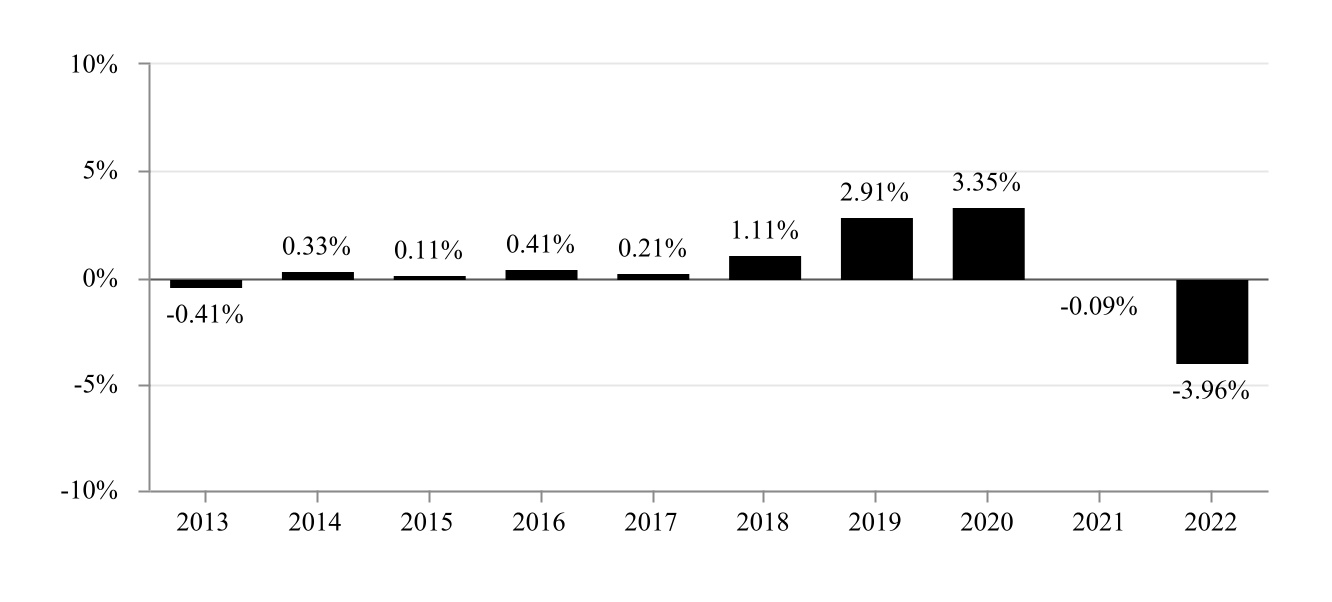
The following bar chart and table provide some indication of the risks of investing in the fund. The bar chart shows changes in the fund’s performance from year to year for Investor Class shares. The table shows how the fund’s average annual returns for the periods shown compared with those of a broad measure of market performance. The fund’s past performance (before and after taxes) is not necessarily an indication of how the fund will perform in the future. For current performance information, including yields, please visit americancentury.com.
Sales charges and account fees, if applicable, are not reflected in the bar chart. If those charges were included, returns would be less than those shown.
Calendar Year Total Returns
Highest Performance Quarter (1Q 2020): 2.49% Lowest Performance Quarter (1Q 2022): -2.27%
As of June 30, 2023, the most recent calendar quarter end, the fund’s Investor Class year-to-date return was 0.52%.
| | | | | | | | | | | |
Average Annual Total Returns
For the calendar year ended December 31, 2022 | 1 year | 5 years | 10 years |
Investor Class Return Before Taxes | -3.96% | 0.63% | 0.38% |
Return After Taxes on Distributions | -4.54% | 0.08% | -0.02% |
Return After Taxes on Distributions and Sale of Fund Shares | -2.34% | 0.25% | 0.12% |
I Class1 Return Before Taxes | -3.76% | 0.73% | 0.48% |
A Class Return Before Taxes | -6.28% | -0.06% | -0.09% |
C Class2 Return Before Taxes | -4.79% | -0.37% | -0.47% |
R Class Return Before Taxes | -4.38% | 0.14% | -0.11% |
R5 Class Return Before Taxes | -3.66% | 0.85% | 0.59% |
Bloomberg U.S. 1-3 Year Government Bond Index
(reflects no deduction for fees, expenses or taxes) | -3.81% | 0.74% | 0.66% |
1 Historical performance for the I Class prior to its inception (April 10, 2017) is based on the performance of R5 Class shares. I Class performance has been adjusted to reflect differences in expenses between classes, if applicable.
2 C Class shares automatically convert to A Class shares after approximately eight years. All returns for periods greater than eight years reflect this conversion.
The after-tax returns are shown only for Investor Class shares. After-tax returns for other share classes will vary. After-tax returns are calculated using the historical highest individual federal marginal income tax rates and do not reflect the impact of state and local taxes. Actual after-tax returns depend on an investor’s tax situation and may differ from those shown. After-tax returns are not relevant to investors who hold their fund shares through tax-deferred arrangements, such as 401(k) plans or IRAs.
Portfolio Management
Investment Advisor
American Century Investment Management, Inc.
Portfolio Managers
James E. Platz, CFA, Vice President and Portfolio Manager, has served on teams managing fixed-income investments for American Century Investments since joining the advisor in 2003.
Robert V. Gahagan, Senior Vice President and Senior Portfolio Manager, has served on teams managing fixed-income investments for American Century Investments since joining the advisor in 1983.
Peter Van Gelderen, Vice President and Senior Portfolio Manager, has served on teams managing fixed-income investments for American Century Investments since joining the advisor in 2021.
Curtis Manning, CFA, Portfolio Manager, has served on teams managing fixed-income investments for American Century Investments since joining the advisor in 2019.
Michael Waggaman, Portfolio Manager, has served on teams managing fixed-income investments for American Century Investments since joining the advisor in 2021.
Purchase and Sale of Fund Shares
You may purchase or redeem shares of the fund on any business day through our website at americancentury.com, in person (at one of our Investor Centers), by mail (American Century Investments, P.O. Box 419200, Kansas City, MO 64141-6200), by telephone at 1-800-345-2021 (Investor Services Representative) or 1-800-345-3533 (Business, Not-For-Profit and Employer-Sponsored Retirement Plans), or through a financial intermediary. Shares may be purchased and redemption proceeds received by electronic bank transfer, by check or by wire.
Unless otherwise specified below, the minimum initial investment amount to open an account is $2,500 ($1,000 for Coverdell Education Savings Accounts and IRAs). However, American Century Investments will waive the fund minimum if you make an initial investment of at least $500 and continue to make automatic investments of at least $100 a month until reaching the fund minimum. Investors opening accounts through financial intermediaries may open an account with $250 for the Investor, A, C and R Classes, but the financial intermediaries may require their clients to meet different investment minimums. The minimum may be waived for broker-dealer sponsored wrap program accounts, fee based accounts, and accounts through bank/trust and wealth management advisory organizations.
The minimum initial investment amount for the I Class is generally $5 million ($3 million for endowments and foundations), but the minimum may be waived if you have an aggregate investment in the American Century family of funds of $10 million or more ($5 million for endowments and foundations). This includes accounts held directly with American Century and those held through a financial intermediary.
There is no minimum initial investment amount for R5 Class shares.
For the Investor, A, C, R and R5 Classes, there is no minimum initial investment amount for certain employer-sponsored retirement plans, however, financial intermediaries or plan recordkeepers may require plans to meet different minimums. Employer-sponsored retirement plans are not eligible to purchase I Class shares.
There is a $50 minimum for subsequent purchases, except there is no subsequent purchase minimum for financial intermediaries or employer-sponsored retirement plans.
Tax Information
Fund distributions are generally taxable as ordinary income or capital gains, unless you are investing through a tax-deferred account such as a 401(k) or individual retirement account (in which case you may be taxed upon withdrawal of your investment from such account).
Payments to Broker-Dealers and Other Financial Intermediaries
If you purchase the fund through a broker-dealer or other financial intermediary (such as a bank, insurance company, plan sponsor or financial professional), the fund and its related companies may pay the intermediary for the sale of fund shares and related services for investments in all classes. These payments may create a conflict of interest by influencing the broker-dealer or other intermediary and your salesperson to recommend the fund over another investment. Ask your salesperson or visit your financial intermediary’s website for more information.
Objectives, Strategies and Risks
Capital Preservation Fund
What is the fund’s investment objective?
The fund is a money market fund that seeks maximum safety and liquidity. Its secondary objective is to seek to pay shareholders the highest rate of return consistent with safety and liquidity.
What are the fund’s principal investment strategies?
Under normal circumstances, Capital Preservation invests exclusively in short-term money market securities issued by the U.S. Treasury that are guaranteed by the direct full faith and credit pledge of the U.S. government. The income from these securities is exempt from state income tax.
| | | | | | | | |
| | Money market securities have less than 397 days remaining until maturity. | |
The fund may purchase Treasury securities in a number of different ways. For example, the fund may use buy/sell back transactions, also known as dollar rolls. The fund may commit up to 35% of its total assets to buy/sell back transactions.
The fund may hold cash balances at the fund’s custodian or invest in cash-equivalent securities, such as money market funds, in order to facilitate daily portfolio operations.
In the event of adverse market, economic, political, or other conditions, the fund may invest temporarily in cash or securities issued or guaranteed by the U.S. government and its agencies and instrumentalities or repurchase agreements collateralized by U.S. government securities. To the extent the fund invests in such securities, it may not achieve its investment objective.
A description of the policies and procedures with respect to the disclosure of the fund’s portfolio securities is available in the statement of additional information.
What are the principal risks of investing in the fund?
U.S. Treasury securities are believed to be the safest securities because they are supported by the government’s full faith and credit pledge and because they are among the most widely traded and most liquid securities investors can buy. Because short-term money market securities are among the safest securities available, the interest they pay is among the lowest for income-paying securities. Accordingly, the yield on this fund will likely be lower than the yield on funds that invest in longer-term or lower-quality securities.
Investments in U.S. Treasury securities are sensitive to interest rate changes. Generally, the value of debt securities and the funds that hold them decline as interest rates rise. The fund’s investments in short-term U.S. Treasury securities are designed to minimize this risk. However, a sharp and unexpected rise in interest rates could cause the fund’s share price to drop.
The fund may need to sell securities at times it would not otherwise do so in order to meet shareholder redemption requests. The fund could experience a loss when selling securities, particularly if the redemption requests are unusually large or frequent, occur in times of overall market turmoil or declining pricing for the securities sold or when the securities the fund wishes to sell are illiquid. Selling securities to meet such redemption requests also may increase transaction costs or have tax consequences. To the extent that a large shareholder (including a fund of funds or 529 college savings plan) invests in the fund, the fund may experience relatively large redemptions as such shareholder reallocates its assets. Although the advisor seeks to minimize the impact of such transactions where possible, the fund’s performance may be adversely affected.
Ginnie Mae Fund
What is the fund’s investment objective?
Ginnie Mae seeks high current income while maintaining liquidity and safety of principal by investing primarily in GNMA certificates.
What are the fund’s principal investment strategies?
Under normal market conditions, the fund invests at least 80% of its net assets in securities issued by the Government National Mortgage Association (GNMA). The fund may change this 80% policy only upon 60 days’ prior written notice to shareholders. GNMA certificates represent interests in pools of mortgage loans and in the cash flows from these loans. Unlike many other mortgage-backed securities, the timely payment of principal and interest on these certificates is guaranteed by GNMA. GNMA’s payment guarantee is stronger than most other government agencies’ because it is backed by the full faith and credit pledge of the U.S. government. This means that the fund receives its share of payments regardless of whether the ultimate borrowers make their payments.
In addition, the fund may buy other U.S. government securities, including U.S. Treasury securities and other securities issued or guaranteed by the U.S. government and its agencies and instrumentalities.
The fund may purchase securities in a number of different ways to seek higher rates of return. For example, the fund may purchase securities, including mortgage dollar rolls, in advance through when-issued and forward commitment transactions. The fund may commit up to 35% of its total assets to when-issued or forward commitment agreements.
The fund may invest in derivative instruments such as options, futures contracts, options on futures contracts, and swap agreements, or in mortgage- or asset-backed securities, provided that such investments are in keeping with the fund’s investment objective.
When determining whether to sell a security, the portfolio managers consider, among other things, current and anticipated changes in interest rates, current valuation relative to alternatives in the market, general market conditions and any other factors deemed relevant by the portfolio managers.
The fund may engage in active and frequent trading of portfolio securities to achieve its principal investment strategies. A higher portfolio turnover rate may indicate higher transaction costs and may affect the fund’s performance. Higher portfolio turnover also may result in the realization and distribution of capital gains, including short-term capital gains.
In the event of adverse market, economic, political, or other conditions, the fund may take temporary defensive positions that are inconsistent with the fund’s principal investment strategies. To the extent the fund assumes a defensive position, it may not achieve its investment objective.
A description of the policies and procedures with respect to the disclosure of the fund’s portfolio securities is available in the statement of additional information.
What are the principal risks of investing in the fund?
When interest rates change, the fund’s share value will be affected. Generally, when interest rates rise, the fund’s share value will decline. The opposite is true when interest rates decline. The degree to which interest rate changes affect fund performance varies and is related to the weighted average maturity of the fund. For example, when interest rates rise, you can expect the share value of a long-term bond fund to fall more than that of a short-term bond fund. When rates fall, the opposite is true. This interest rate risk is higher for Ginnie Mae than for funds that have shorter weighted average maturities, such as money market funds and short-term bond funds. A period of rising interest rates may negatively affect the fund’s performance.
Ginnie Mae invests in mortgage-backed securities. When homeowners refinance their mortgages to take advantage of declining interest rates, their existing mortgages are prepaid. The mortgages, which back the securities purchased by Ginnie Mae, may be prepaid in this fashion. When this happens, the fund will be required to purchase new securities at current market rates, which will usually be lower. Because of this prepayment risk, the fund may benefit less from declining interest rates than funds that have similar weighted average maturities. Conversely, an issuer may exercise its right to pay principal on an obligation held by the fund later than expected (extend the obligation) especially in periods of rising interest rates. These events may lengthen weighted average maturity and potentially reduce the value of these securities.
The use of derivative instruments involves risks different from, or possibly greater than, the risks associated with investing directly in securities and other traditional instruments. Derivatives are subject to a number of risks including, liquidity, interest rate, market, and credit risk. They also involve the risk of mispricing or improper valuation, the risk that changes in the value of the derivative may not correlate perfectly with the underlying asset, rate or index, and the risk of default or bankruptcy of the other party to the instrument. Derivatives used for hedging or risk management may not operate as intended, may expose the fund to other risks, and may be insufficient to protect the fund from the risks they were intended to hedge. Gains or losses involving some futures, options, and other derivatives may be substantial – in part because a relatively small price movement in these securities may result in an immediate and substantial gain or loss for the fund.
The value of the securities owned by the fund may go up and down, sometimes rapidly or unpredictably, due to factors affecting securities markets generally or particular industries, real or perceived adverse economic conditions or investor sentiment generally. Market risks, including political, regulatory, economic and social developments, can affect the value of the fund’s investments. Natural disasters, public health emergencies, war, terrorism and other unforeseeable events may lead to increased market volatility and may have adverse long-term effects on world economies and markets generally.
The fund may need to sell securities at times it would not otherwise do so in order to meet shareholder redemption requests. The fund could experience a loss when selling securities, particularly if the redemption requests are unusually large or frequent, occur in times of overall market turmoil or declining pricing for the securities sold or when the securities the fund wishes to sell are illiquid. Selling securities to meet such redemption requests also may increase transaction costs or have tax consequences. To the extent that a large shareholder (including a fund of funds or 529 college savings plan) invests in the fund, the fund may experience relatively large redemptions as such shareholder reallocates its assets. Although the advisor seeks to minimize the impact of such transactions where possible, the fund’s performance may be adversely affected.
At any given time your shares may be worth less than the price you paid for them. In other words, it is possible to lose money by investing in the fund.
Government Bond Fund
What is the fund’s investment objective?
The fund seeks high current income.
What are the fund’s principal investment strategies?
Under normal market conditions, the fund invests at least 80% of its net assets in U.S. government debt securities, including U.S. Treasury securities and other securities issued or guaranteed by the U.S. government and its agencies and instrumentalities. The fund may change this 80% policy only upon 60 days’ prior written notice to shareholders.
The fund may purchase securities in a number of different ways to seek higher rates of return. For example, by using when-issued and forward commitment transactions, the fund may purchase securities, including mortgage dollar rolls, in advance to generate additional income. The fund may commit up to 35% of its total assets to when-issued or forward commitment agreements.
The fund may invest in derivative instruments such as options, futures contracts, options on futures contracts, and swap agreements, or in mortgage- or asset-backed securities, provided that such investments are in keeping with the fund’s investment objective.
The portfolio managers monitor the weighted average maturity of Government Bond. The managers seek to adjust this weighted average maturity as appropriate, taking into account market conditions and other relevant factors.
When determining whether to sell a security, the portfolio managers consider, among other things, current and anticipated changes in interest rates, current valuation relative to alternatives in the market, general market conditions and any other factors deemed relevant by the portfolio managers.
The fund may engage in active and frequent trading of portfolio securities to achieve its principal investment strategies. A higher portfolio turnover rate may indicate higher transaction costs and may affect the fund’s performance. Higher portfolio turnover also may result in the realization and distribution of capital gains, including short-term capital gains.
In the event of adverse market, economic, political, or other conditions, the fund may take temporary defensive positions that are inconsistent with the fund’s principal investment strategies. To the extent the fund assumes a defensive position, it may not achieve its investment objective.
A description of the policies and procedures with respect to the disclosure of the fund’s portfolio securities is available in the statement of additional information.
What are the principal risks of investing in the fund?
When interest rates change, the fund’s share value will be affected. Generally, when interest rates rise, the fund’s share value will decline. The opposite is true when interest rates decline. The degree to which interest rate changes affect fund performance varies and is related to the weighted average maturity of the fund. For example, when interest rates rise, you can expect the share value of a long-term bond fund to fall more than that of a short-term bond fund. When rates fall, the opposite is true. This interest rate risk is higher for Government Bond than for funds that have shorter weighted average maturities, such as money market funds and short-term bond funds. A period of rising interest rates may negatively affect the fund’s performance.
Government Bond invests in mortgage-backed securities. When homeowners refinance their mortgages to take advantage of declining interest rates, their existing mortgages are prepaid. The mortgages, which back the securities purchased by Government Bond, may be prepaid in this fashion. When this happens, the fund will be required to purchase new securities at current market rates, which will usually be lower. Because of this prepayment risk, the fund may benefit less from declining interest rates than funds with similar maturities. Conversely, an issuer may exercise its right to pay principal on an obligation held by the fund later than expected (extend the obligation) especially in periods of rising interest rates. These events may lengthen weighted average maturity and potentially reduce the value of these securities.
The use of derivative instruments involves risks different from, or possibly greater than, the risks associated with investing directly in securities and other traditional instruments. Derivatives are subject to a number of risks including, liquidity, interest rate, market, and credit risk. They also involve the risk of mispricing or improper valuation, the risk that changes in the value of the derivative may not correlate perfectly with the underlying asset, rate or index, and the risk of default or bankruptcy of the other party to the instrument. Derivatives used for hedging or risk management may not operate as intended, may expose the fund to other risks, and may be insufficient to protect the fund from the risks they were intended to hedge. Gains or losses involving some futures, options, and other derivatives may be substantial – in part because a relatively small price movement in these securities may result in an immediate and substantial gain or loss for the fund.
The value of the securities owned by the fund may go up and down, sometimes rapidly or unpredictably, due to factors affecting securities markets generally or particular industries, real or perceived adverse economic conditions or investor sentiment generally. Market risks, including political, regulatory, economic and social developments, can affect the value of the fund’s investments. Natural disasters, public health emergencies, war, terrorism and other unforeseeable events may lead to increased market volatility and may have adverse long-term effects on world economies and markets generally.
The fund may need to sell securities at times it would not otherwise do so in order to meet shareholder redemption requests. The fund could experience a loss when selling securities, particularly if the redemption requests are unusually large or frequent, occur in times of overall market turmoil or declining pricing for the securities sold or when the securities the fund wishes to sell are illiquid. Selling securities to meet such redemption requests also may increase transaction costs or have tax consequences. To the extent that a large shareholder (including a fund of funds or 529 college savings plan) invests in the fund, the fund may experience relatively large redemptions as such shareholder reallocates its assets. Although the advisor seeks to minimize the impact of such transactions where possible, the fund’s performance may be adversely affected.
The fund’s share value will fluctuate. As a result, it is possible to lose money by investing in the fund. In general, funds that have a higher potential gain have a higher potential loss.
Short-Term Government Fund
What is the fund’s investment objective?
Short-Term Government seeks high current income while maintaining safety of principal.
What are the fund’s principal investment strategies?
Under normal market conditions, the fund buys short-term debt securities and will invest at least 80% of its net assets in U.S. government securities, including U.S. Treasury securities and other securities issued or guaranteed by the U.S. government and its agencies and instrumentalities. The fund may change this 80% policy only upon 60 days’ prior written notice to shareholders. In addition, the fund may invest in investment-grade debt securities, including debt securities of U.S. companies, and non-U.S. government mortgage-backed, asset-backed and other fixed-income securities.
| | |
An investment-grade security is one that has been rated by an independent rating agency in its top four credit quality categories or determined by the advisor to be of comparable credit quality. |
Under normal market conditions, the portfolio managers maintain a weighted average maturity of three years or less.
The fund may purchase securities in a number of different ways to seek higher rates of return. For example, by using when-issued and forward commitment transactions, the fund may purchase securities, including mortgage dollar rolls, in advance to generate additional income. The fund may commit up to 35% of its total assets to when-issued or forward commitment agreements.
The fund may invest in derivative instruments such as options, futures contracts, options on futures contracts, and swap agreements (including, but not limited to, credit default swap agreements), in mortgage- or asset-backed securities, or in pre-refunded municipal securities, provided that such investments are in keeping with the fund’s investment objective.
When determining whether to sell a security, the portfolio managers consider, among other things, current and anticipated changes in interest rates, current valuation relative to alternatives in the market, general market conditions and any other factors deemed relevant by the portfolio managers.
The fund may engage in active and frequent trading of portfolio securities to achieve its principal investment strategies. A higher portfolio turnover rate may indicate higher transaction costs and may affect the fund’s performance. Higher portfolio turnover also may result in the realization and distribution of capital gains, including short-term capital gains.
In the event of adverse market, economic, political, or other conditions, the fund may take temporary defensive positions that are inconsistent with the fund’s principal investment strategies. To the extent the fund assumes a defensive position, it may not achieve its investment objective.
A description of the policies and procedures with respect to the disclosure of the fund’s portfolio securities is available in the statement of additional information.
What are the principal risks of investing in the fund?
When interest rates change, the fund’s share value will be affected. Generally, when interest rates rise, the fund’s share value will decline. The opposite is true when interest rates decline. The degree to which interest rate changes affect fund performance varies and is related to the weighted average maturity of the fund. For example, when interest rates rise, you can expect the share value of a long-term bond fund to fall more than that of a short-term bond fund. When rates fall, the opposite is true. This interest rate risk is higher for Short-Term Government than for funds that have shorter weighted average maturities, such as money market funds. A period of rising interest rates may negatively affect the fund’s performance.
Short-Term Government invests in mortgage-backed and asset-backed securities. When homeowners refinance their mortgages to take advantage of declining interest rates, their existing mortgages are prepaid. The mortgages, which back the mortgage-backed securities purchased by Short-Term Government, may be prepaid in this fashion. Likewise, borrowers may prepay the auto loan, home equity loan or student loan receivables, corporate loans or bonds or other assets underlying the fund’s asset-backed securities. When this happens, the fund will be required to purchase new securities at current market rates, which will usually be lower. Because of this prepayment risk, the fund may benefit less from declining interest rates than other short-term funds. Conversely, an issuer may exercise its right to pay principal on an obligation held by the fund later than expected (extend the obligation) especially in periods of rising interest rates. These events may lengthen weighted average maturity and potentially reduce the value of these securities.
The use of derivative instruments involves risks different from, or possibly greater than, the risks associated with investing directly in securities and other traditional instruments. Derivatives are subject to a number of risks including, liquidity, interest rate, market, and credit risk. They also involve the risk of mispricing or improper valuation, the risk that changes in the value of the derivative may not correlate perfectly with the underlying asset, rate or index, and the risk of default or bankruptcy of the other party to the instrument. Derivatives used for hedging or risk management may not operate as intended, may expose the fund to other risks, and may be insufficient to protect the fund from the risks they were intended to hedge. Gains or losses involving some futures, options, and other derivatives may be substantial – in part because a relatively small price movement in these securities may result in an immediate and substantial gain or loss for the fund.
The value of the securities owned by the fund may go up and down, sometimes rapidly or unpredictably, due to factors affecting securities markets generally or particular industries, real or perceived adverse economic conditions or investor sentiment generally. Market risks, including political, regulatory, economic and social developments, can affect the value of the fund’s investments. Natural disasters, public health emergencies, war, terrorism and other unforeseeable events may lead to increased market volatility and may have adverse long-term effects on world economies and markets generally.
The fund may need to sell securities at times it would not otherwise do so in order to meet shareholder redemption requests. The fund could experience a loss when selling securities, particularly if the redemption requests are unusually large or frequent, occur in times of overall market turmoil or declining pricing for the securities sold or when the securities the fund wishes to sell are illiquid. Selling securities to meet such redemption requests also may increase transaction costs or have tax consequences. To the extent that a large shareholder (including a fund of funds or 529 college savings plan) invests in the fund, the fund may experience relatively large redemptions as such shareholder reallocates its assets. Although the advisor seeks to minimize the impact of such transactions where possible, the fund’s performance may be adversely affected.
At any given time your shares may be worth less than the price you paid for them. In other words, it is possible to lose money by investing in the fund.
Management
Who manages the funds?
The Board of Trustees, investment advisor and fund management team play key roles in the management of the funds.
The Board of Trustees
The Board of Trustees is responsible for overseeing the advisor’s management and operations of the funds pursuant to the management agreement. In performing their duties, Board members receive detailed information about the funds and their advisor regularly throughout the year, and meet at least quarterly with management of the advisor to review reports about fund operations. The trustees’ role is to provide oversight and not to provide day-to-day management. More than three-fourths of the trustees are independent of the funds’ advisor. They are not employees, directors or officers of, and have no financial interest in, the advisor or any of its affiliated companies (other than as shareholders of American Century Investments funds), and they do not have any other affiliations, positions or relationships that would cause them to be considered “interested persons” under the Investment Company Act of 1940.
The Investment Advisor
The funds’ investment advisor is American Century Investment Management, Inc. (the advisor). The advisor has been managing mutual funds since 1958 and is headquartered at 4500 Main Street, Kansas City, Missouri 64111.
The advisor is responsible for managing the investment portfolio of the funds and directing the purchase and sale of their investment securities. The advisor also arranges for transfer agency, custody and all other services necessary for the funds to operate.
For the services it provides to the funds, the advisor receives a unified management fee based on a percentage of the daily net assets of each class of shares of the funds. The management fee is calculated daily and paid monthly in arrears. Out of each fund’s fee, the advisor pays all expenses of managing and operating that fund except brokerage expenses, taxes, interest, fees and expenses of the independent trustees (including legal counsel fees), extraordinary expenses, and expenses incurred in connection with the provision of shareholder services and distribution services under a plan adopted pursuant to Rule 12b-1 under the Investment Company Act of 1940. The difference in unified management fees among each fund’s classes is a result of their separate arrangements for non-Rule 12b-1 shareholder services. It is not the result of any difference in advisory or custodial fees or other expenses related to the management of the fund’s assets, which do not vary by class. The advisor may pay unaffiliated third parties who provide recordkeeping and administrative services that would otherwise be performed by an affiliate of the advisor.
The percentage rate used to calculate the management fee for each class of shares of a fund is determined daily using a two-component formula that takes into account (i) the daily net assets of certain accounts managed by the advisor that are in the same broad investment category as each of the funds (the Category Fee) and (ii) the assets of all funds in the American Century Investments family of funds that have the same investment advisor and distributor as the fund (the Complex Fee). For purposes of determining the Category Fee and Complex Fee, the assets of funds managed by the advisor that invest exclusively in the shares of other funds (funds of funds) are not included. The statement of additional information contains detailed information about the calculation of the management fee.
For Capital Preservation, the advisor may waive the receipt of a portion of the management fee, or may agree to bear fund expenses, to enhance the fund’s yield during periods when fund operating expenses have a significant impact on the fund’s yield due to low interest rates or to assist the advisor’s efforts to maintain a $1.00 net asset value per share. Any such fee waiver is voluntary and temporary, and may be revised or terminated at any time by the advisor without notice. There is no guarantee that the fund will maintain a $1.00 net asset value per share or a positive yield. | | | | | | | | | | | | | | | | | | | | |
Management Fees Paid by the
Funds to the Advisor as a Percentage
of Average Net Assets for the
Fiscal Year Ended March 31, 2023 | Investor
Class | I
Class | A
Class | C
Class | R
Class | R5
Class |
Capital Preservation | 0.47% | N/A | N/A | N/A | N/A | N/A |
Ginnie Mae | 0.54% | 0.44% | 0.54% | 0.54% | 0.54% | 0.34% |
Government Bond | 0.46% | 0.36% | 0.46% | 0.46% | 0.46% | 0.26% |
Short-Term Government | 0.54% | 0.44% | 0.54% | 0.54% | 0.54% | 0.34% |
A discussion regarding the basis for the Board of Trustees’ approval of each fund’s investment advisory agreement with the advisor is available in each fund’s semiannual report to shareholders dated September 30, 2022.
The Fund Management Teams
The advisor uses teams of portfolio managers and analysts, organized by broad investment categories such as money markets, corporate bonds, government bonds and municipal bonds, in its management of fixed-income funds. Designated portfolio managers serve on the firm’s Global Fixed Income Investment Committee, which is responsible for periodically adjusting each fund’s dynamic investment parameters based on economic and market conditions. All portfolio managers listed below for Ginnie Mae, Government Bond and Short-Term Government are responsible for security selection and portfolio construction for each fund within these parameters, as well as compliance with stated investment objectives and cash flow monitoring. Other members of the investment teams provide research and analytical support but generally do not make day-to-day investment decisions for the funds.
The individuals listed below are jointly and primarily responsible for the day-to-day management of the funds described in this prospectus.
Ginnie Mae
Dan Shiffman
Mr. Shiffman, Vice President and Senior Portfolio Manager, has served on teams managing fixed-income investments since joining the advisor in 2004. He has a bachelor’s degree in social sciences from the University of California – Berkeley and an MBA from the Thunderbird School of Global Management. He is a CFA charterholder.
Peter Van Gelderen (Global Fixed Income Investment Committee Representative)
Mr. Van Gelderen, Vice President and Senior Portfolio Manager, has served on teams managing fixed-income investments since joining the advisor in 2021. Prior to joining American Century Investments, Mr. Van Gelderen was most recently co-head of the structured credit group at Guggenheim Partners from 2013 to 2021. He has a bachelor of arts degree from Duke University and a juris doctorate from Georgetown University Law Center.
Curtis Manning
Mr. Manning, Portfolio Manager, has served on teams managing fixed-income investments since joining the advisor in 2019. Prior to joining American Century Investments, Mr. Manning was most recently a senior analyst at Janus Henderson Investors from 2015 to 2019. He has a bachelor’s degree in finance from Boston College. He is a CFA charterholder.
Michael Waggaman
Mr. Waggaman, Portfolio Manager, has served on teams managing fixed-income investments since joining the advisor in 2021. Prior to joining American Century Investments, Mr. Waggaman was most recently an investment director at Aberdeen Standard Investments from 2006 to 2021. He has a bachelor’s degree in sociology from the University of Chicago.
Government Bond
Short-Term Government
James E. Platz
Mr. Platz, Vice President and Portfolio Manager, has served on teams managing fixed-income investments since joining the advisor in 2003. He received a bachelor’s degree in history and political economies of industrial societies from the University of California – Berkeley, and an MBA from the University of Southern California. He is a CFA charterholder.
Robert V. Gahagan (Global Fixed Income Investment Committee Representative)
Mr. Gahagan, Senior Vice President and Senior Portfolio Manager, has served on teams managing fixed-income investments since joining the advisor in 1983. He has a bachelor’s degree in economics and an MBA from the University of Missouri – Kansas City.
Peter Van Gelderen (Global Fixed Income Investment Committee Representative)
Mr. Van Gelderen, Vice President and Senior Portfolio Manager, has served on teams managing fixed-income investments since joining the advisor in 2021. Prior to joining American Century Investments, Mr. Van Gelderen was most recently co-head of the structured credit group at Guggenheim Partners from 2013 to 2021. He has a bachelor of arts degree from Duke University and a juris doctorate from Georgetown University Law Center.
Curtis Manning
Mr. Manning, Portfolio Manager, has served on teams managing fixed-income investments since joining the advisor in 2019. Prior to joining American Century Investments, Mr. Manning was most recently a senior analyst at Janus Henderson Investors from 2015 to 2019. He has a bachelor’s degree in finance from Boston College. He is a CFA charterholder.
Michael Waggaman
Mr. Waggaman, Portfolio Manager, has served on teams managing fixed-income investments since joining the advisor in 2021. Prior to joining American Century Investments, Mr. Waggaman was most recently an investment director at Aberdeen Standard Investments from 2006 to 2021. He has a bachelor’s degree in sociology from the University of Chicago.
The statement of additional information provides additional information about the accounts managed by the portfolio managers, the structure of their compensation, and their ownership of fund securities.
Fundamental Investment Policies
Shareholders must approve any change to the fundamental investment policies contained in the statement of additional information, as well as any change to the investment objectives of the funds. The Board of Trustees and/or the advisor may change any other policies or investment strategies described in this prospectus or otherwise used in the operation of the fund at any time, subject to applicable notice provisions.
Investing Directly with American Century Investments
Services Automatically Available to You
Most accounts automatically have access to the services listed under Ways to Manage Your Account when the account is opened. If you have questions about the services that apply to your account type, please call us.
Generally, once your account is established, any registered owner (including those on jointly owned accounts) or any trustee (including those on trust accounts with multiple trustees), or any authorized signer on business accounts with multiple authorized signers, may transact business by any of the methods described below. American Century reserves the right to require all owners or trustees or authorized signers to act together, at our discretion.
Account Maintenance Fee
If you hold Investor Class shares of any American Century Investments mutual fund, or I Class shares of the American Century Diversified Bond Fund, in an American Century Investments account (i.e., not through a financial intermediary or employer-sponsored retirement plan account), we may charge you a $25 annual account maintenance fee if the value of those shares is less than $10,000. We will determine the amount of your total eligible investments once per year, generally the last Friday in October. If the value of those investments is less than $10,000 at that time, we will automatically redeem shares in one of your accounts to pay the $25 fee as soon as administratively possible. Please note that you may incur tax liability as a result of the redemption. In determining your total eligible investment amount, we will include your investments in all personal accounts (including American Century Investments brokerage accounts) registered under your Social Security number.
| | | | | | | | |
| | Personal accounts include individual accounts, joint accounts, UGMA/UTMA accounts, personal trusts, Coverdell Education Savings Accounts, IRAs (including traditional, Roth, Rollover, SEP-, SARSEP- and SIMPLE-IRAs), and certain other retirement accounts. If you have only business, business retirement, employer-sponsored or American Century Investments brokerage accounts, you are currently not subject to this fee, but you may be subject to other fees. | |
Wire Purchases
Current Investors: If you would like to make a wire purchase into an existing account, your bank will need the following information. (To invest in a new fund, please call us first to set up the new account.)
•American Century Investments bank information: Commerce Bank N.A., Routing No. 101000019, Account No. 2804918
•Your American Century Investments account number and fund name
•Your name
•The contribution year (for IRAs only)
•Dollar amount
New Investors: To make a wire purchase into a new account, please complete an application or call us prior to wiring money.
Ways to Manage Your Account
ONLINE
americancentury.com
Open an account: If you are a current or new investor, you can open an account by completing and submitting our online application. Current investors also can open an account by exchanging shares from another American Century Investments account with an identical registration.
Exchange shares: Exchange shares from another American Century Investments account with an identical registration.
Make additional investments: Make an additional investment into an established American Century Investments account. If we do not have your bank information, you can add it.
Sell shares*: Redeem shares and choose whether the proceeds are electronically transferred to your authorized bank account or sent by check to your address of record.
* Online redemptions up to $25,000 per day per account.
IN PERSON
If you prefer to handle your transactions in person, visit one of our Investor Centers and a representative can help you open an account, make additional investments, and sell or exchange shares.
•4400 Main Street, Kansas City, MO — 8 a.m. to 5 p.m., Monday – Friday
•4917 Town Center Drive, Leawood, KS — 8 a.m. to 5 p.m., Monday – Friday
BY TELEPHONE
Investor Services Representative: 1-800-345-2021
Business, Not-For-Profit and Employer-Sponsored Retirement Plans: 1-800-345-3533
Automated Information Line: 1-800-345-8765
Open an account: If you are a current investor, you can open an account by exchanging shares from another American Century Investments account with an identical registration.
Exchange shares: Call or use our Automated Information Line (available only to Investor Class shareholders).
Make additional investments: Call or use our Automated Information Line if you have authorized us to invest from your bank account. The Automated Information Line is available only to Investor Class shareholders.
Sell shares: Call or use our Automated Information Line. The Automated Information Line redemptions are up to $25,000 per day per account and are available for Investor Class shareholders only.
BY MAIL OR FAX
Mail Address: P.O. Box 419200, Kansas City, MO 64141-6200 — Fax: 1-888-327-1998
Open an account: Send a signed, completed application and check or money order payable to American Century Investments.
Exchange shares: Send written instructions to exchange your shares from one American Century Investments account to another with an identical registration.
Make additional investments: Send your check or money order for at least $50 with an investment slip. If you don’t have an investment slip, include your name, address and account number on your check or money order.
Sell shares: Send written instructions or a redemption form to sell shares. Call a Service Representative to request a form.
AUTOMATICALLY
Open an account: Not available.
Exchange shares: Send written instructions to set up an automatic exchange of your shares from one American Century Investments account to another with an identical registration.
Make additional investments: With the automatic investment service, you can purchase shares on a regular basis. You must invest at least $50 per month per account.
Sell shares: You may sell shares automatically by establishing a systematic redemption plan.
See Additional Policies Affecting Your Investment for more information about investing with us.
Investing Through a Financial Intermediary
The funds may be purchased by participants in employer-sponsored retirement plans or through financial intermediaries that provide various administrative and distribution services.
| | | | | | | | |
| | Financial intermediaries include banks, broker-dealers, insurance companies, plan sponsors and financial professionals. | |
Although each class of a fund’s shares represents an interest in the same fund, each has a different cost structure, as described below. Which class is right for you depends on many factors, including how long you plan to hold the shares, how much you plan to invest, the fee structure of each class, and how you wish to compensate your financial professional for the services provided to you. Your financial professional can help you choose the option that is most appropriate.
Investor Class
Investor Class shares are available for purchase without sales charges or commissions but may be subject to account or transaction fees if purchased through financial intermediaries. These shares are available to investors in retail brokerage accounts, broker-dealer-sponsored fee-based advisory accounts, other advisory accounts where fees are charged, and employer-sponsored retirement plans.
I Class
I Class shares are available for purchase without sales charges or commissions by endowments, foundations, large institutional investors and financial intermediaries.
A Class
A Class shares are available for purchase through broker-dealers and other financial intermediaries. These shares carry an initial sales charge and an ongoing distribution and service (12b-1) fee that is used to compensate your financial professional. See Calculation of Sales Charges below for commission amounts received by financial professionals on the purchase of A Class shares. The sales charge decreases with the size of the purchase, and may be reduced or eliminated in certain situations. See Reductions and Waivers of Sales Charges for A Class and CDSC Waivers below for a full description of the breakpoints, reductions and waivers that may be available through financial intermediaries in certain types of accounts or products.
C Class
C Class shares are available for purchase through broker-dealers and other financial intermediaries. These shares do not have an initial sales charge but carry an ongoing distribution and service (12b-1) fee. Except as noted below, the commission paid to your financial professional for purchases of C Class shares is 1.00% of the amount invested, and the shares have a contingent deferred sales charge (CDSC) when redeemed within one year of purchase. Your financial professional does not receive the distribution and service (12b-1) fee until the CDSC period has expired (it is retained by the distributor). See CDSC Waivers below for a full description of the waivers that may be available. C Class shares automatically convert to A Class shares 8 years after purchase.
R Class
R Class shares do not carry a sales charge or commission, but they have an ongoing distribution and service (12b-1) fee. R Class shares are available for purchase through certain employer-sponsored retirement plans. R Class shares also may be available for certain other accounts through financial intermediaries who have an agreement with us to offer the R Class in certain products. Additionally, IRA accounts in R Class shares established through financial intermediaries prior to August 1, 2006, may make additional purchases. With respect to purchases through financial intermediaries, R Class shares are not available in the following types of employer-sponsored retirement plans: SEP IRAs, SIMPLE IRAs or SARSEPs, except that investors in such plans with accounts in R Class shares established prior to March 1, 2009, may make additional purchases, and certain intermediaries may have agreements with us to offer R Class shares in such plans as described above.
R5 Class
R5 Class shares are available for purchase without sales charges or commissions by participants in certain employer-sponsored retirement plans. Beginning April 10, 2017, R5 Class shares may be purchased or redeemed only through employer-sponsored retirement plans where a financial intermediary provides retirement recordkeeping services to plan participants. Accounts in R5 Class shares opened prior to April 10, 2017 remain eligible for the R5 Class.
Calculation of Sales Charges
The information regarding sales charges provided herein is included free of charge and in a clear and prominent format at americancentury.com in the Investors Using Advisors and Investment Professionals portions of the website. From the description of A or C Class shares, a hyperlink will take you directly to this disclosure.
The availability of the sales charge reductions and waivers discussed below will depend upon whether you purchase your shares directly from the fund or through a financial intermediary. Intermediaries may have different policies and procedures regarding the availability of these reductions or waivers. Please refer to Appendix A for information provided by certain financial intermediaries regarding their sales charge waiver or discount policies that are applicable to investors transacting in fund shares through such financial intermediary.
A Class
A Class shares are sold at their offering price, which is net asset value plus an initial sales charge. This sales charge varies depending on the amount of your investment, and is deducted from your purchase before it is invested. The sales charges and the amounts paid to your financial professional for Ginnie Mae and Government Bond are:
| | | | | | | | | | | |
Purchase Amount | Sales Charge as a %
of Offering Price | Sales Charge as a %
of Net Amount Invested | Dealer Commission
as a % of Offering Price |
Less than $100,000 | 4.50% | 4.71% | 4.00% |
$100,000 - $249,999 | 3.50% | 3.63% | 3.00% |
$250,000 - $499,999 | 2.50% | 2.56% | 2.00% |
$500,000 - $999,999 | 2.00% | 2.04% | 1.75% |
$1,000,000 - $3,999,999 | 0.00% | 0.00% | 0.75% |
$4,000,000 - $9,999,999 | 0.00% | 0.00% | 0.50% |
$10,000,000 or more | 0.00% | 0.00% | 0.25% |
The sales charges and the amounts paid to your financial professional for Short-Term Government are:
| | | | | | | | | | | |
Purchase Amount | Sales Charge as a %
of Offering Price | Sales Charge as a %
of Net Amount Invested | Dealer Commission
as a % of Offering Price |
Less than $100,000 | 2.25% | 2.30% | 2.00% |
$100,000 - $249,999 | 1.75% | 1.78% | 1.50% |
$250,000 - $499,999 | 1.50% | 1.52% | 1.25% |
$500,000 - $3,999,999 | 0.00% | 0.00% | 0.75% |
$4,000,000 - $9,999,999 | 0.00% | 0.00% | 0.50% |
$10,000,000 or more | 0.00% | 0.00% | 0.25% |
There is no front-end sales charge for purchases of $1,000,000 or more for all funds other than Short-Term Government, and purchases of $500,000 or more for Short-Term Government, but if you redeem your shares within one year of purchase you will pay a deferred sales charge of 1.00% of the lower of the original purchase price or the current market value at redemption, subject to the exceptions listed below. No sales charge applies to reinvested dividends. No dealer commission will be paid to your financial professional for purchases by certain employer-sponsored retirement plans. For this purpose, employer-sponsored retirement plans do not include SEP IRAs, SIMPLE IRAs or SARSEPs.
Reductions and Waivers of Sales Charges for A Class
You may qualify for a reduction or waiver of certain sales charges, but you or your financial professional must provide certain information, including the account numbers of any accounts to be aggregated, to American Century Investments at the time of purchase in order to take advantage of such reduction or waiver. If you hold assets among multiple intermediaries, it is your responsibility to inform your intermediary and/or American Century Investments at the time of purchase of any accounts to be aggregated.
You and your immediate family (which includes your spouse or domestic partner and children, step-children, parents or step-parents of you, your spouse or domestic partner) may combine investments in any share class of any American Century Investments mutual fund (excluding certain assets in money market accounts, but including account assets invested in Qualified Tuition Programs under Section 529) to reduce your A Class sales charge in the following ways:
Account Aggregation. Investments made by you and your immediate family may be aggregated at each account’s current market value if made for your own account(s) and/or certain other accounts, such as:
•Certain trust accounts
•Solely controlled business accounts
•Single-participant retirement plans
•Endowments or foundations established and controlled by you or an immediate family member
For purposes of aggregation, only investments made through individual-level accounts may be combined. Assets held in multiple participant employer-sponsored retirement plans may be aggregated at a plan level.
Concurrent Purchases. You may combine simultaneous purchases in any share class of any American Century Investments mutual fund to qualify for a reduced A Class sales charge.
Rights of Accumulation. You may take into account the current value of your existing holdings, less any commissionable shares in the money market funds, in any share class of any American Century Investments mutual fund to qualify for a reduced A Class sales charge.
Letter of Intent. A Letter of Intent allows you to combine all purchases of any share class of any American Century Investments mutual fund you intend to make over a 13-month period to determine the applicable sales charge, except for purchases in the A or C Class of money market funds. At your request, existing holdings may be combined with new purchases and sales charge amounts may be adjusted for purchases made within 90 days prior to our receipt of the Letter of Intent. Capital appreciation, capital gains and reinvested dividends earned during the Letter of Intent period do not apply toward its completion. A portion of your account will be held in escrow to cover additional A Class sales charges that will be due if your total investments over the 13-month period do not qualify for the applicable sales charge reduction.
Waivers for Certain Investors. The sales charge on A Class shares may be waived for:
•Purchases by registered representatives and other employees of certain financial intermediaries (and their immediate family members, which includes their spouse or domestic partner and children, step-children, parents or step-parents of them, their spouse or domestic partner)
•Broker-dealer sponsored wrap program accounts and/or fee-based accounts maintained for clients of certain financial intermediaries who have entered into selling agreements with American Century Investments
•Purchases in accounts of financial intermediaries that have entered into a selling agreement with American Century Investments that allows for the waiver of the sales charge in brokerage accounts that may or may not charge a transaction fee
•Current officers, directors and employees of American Century Investments
•Certain group employer-sponsored retirement plans, where plan level or omnibus accounts are held with the fund, or shares are purchased by certain retirement plans that are part of a retirement plan or platform offered by banks, broker dealers, financial advisors or insurance companies, or serviced by retirement recordkeepers. For purposes of this waiver, employer-sponsored retirement plans do not include SEP IRAs, SIMPLE IRAs or SARSEPs. However, SEP IRA, SIMPLE IRA or SARSEP retirement plans that (i) held shares of an A Class fund prior to March 1, 2009 that received sales charge waivers or (ii) held shares of an Advisor Class fund that was renamed A Class on March 1, 2010, may permit additional purchases by new and existing participants in A Class shares without an initial sales charge. Refer to Buying and Selling Fund Shares in the statement of additional information
•Purchases of additional shares in accounts that held shares of an Advisor Class fund that was renamed A Class on either September 4, 2007, December 3, 2007 or March 1, 2010. However if you close your account or if you transfer your account to another financial intermediary, future purchases of A Class shares of a fund may not receive a sales charge waiver.
An investor who receives a sales charge waiver for purchases of fund shares through a financial intermediary may become ineligible to receive such waiver if the nature of the investor’s relationship with and/or the services it receives from the financial intermediary changes. Please consult with your financial professional for further details.
C Class
C Class shares are sold at their net asset value without an initial sales charge. If you purchase shares through a financial intermediary who receives a commission from the fund’s distributor on the purchase and redeem your shares within 12 months of purchase, you will pay a CDSC of 1.00% of the original purchase price or the current market value at redemption, whichever is less. The purpose of the CDSC is to permit the fund’s distributor to recoup all or a portion of the up-front payment made to your financial professional. There is no CDSC on shares acquired through reinvestment of dividends or capital gains.
American Century Investments generally limits purchases of C Class shares to investors whose aggregate investments in American Century Investments mutual funds are less than $1,000,000. However, it is your responsibility to inform your financial intermediary and/or American Century Investments at the time of purchase of any accounts to be aggregated, including investments in any share class of any American Century Investments mutual fund (excluding certain assets in money market accounts, but including account assets invested in Qualified Tuition Programs under Section 529) in accounts held by you and your immediate family members (which includes your spouse or domestic partner and children, step-children, parents or step-parents of you, your spouse or domestic partner). Once you reach this limit, you should work with your financial intermediary to determine what share class is most appropriate for additional purchases.
C Class shares automatically convert to A Class shares after being held for 8 years. The automatic conversion will be executed in the month following the 8-year anniversary of the purchase date for such C Class shares without any sales charge, fee or other charges. The conversion from C Class shares is not considered a taxable event for Federal income tax purposes. After the conversion, shares will be subject to all features and expenses of A Class shares.
Calculation of Contingent Deferred Sales Charge (CDSC)
To minimize the amount of the CDSC you may pay when you redeem shares, the fund will first redeem shares acquired through reinvested dividends and capital gain distributions, which are not subject to a CDSC. Shares that have been in your account long enough that they are not subject to a CDSC are redeemed next. For any remaining redemption amount, shares will be sold in the order they were purchased (earliest to latest).
CDSC Waivers
Any applicable CDSC for A or C Classes may be waived in the following cases:
•redemptions through systematic withdrawal plans not exceeding annually 12% of the lesser of the original purchase cost or current market value for A and C Class shares
•redemptions through employer-sponsored retirement plans. For this purpose, employer-sponsored retirement plans do not include SEP IRAs, SIMPLE IRAs or SARSEPs.
•distributions from IRAs due to attainment of age 59½ for A Class shares and for C Class shares
•required minimum distributions from retirement accounts due to the shareholder reaching the qualified age based on applicable IRS regulations
•tax-free returns of excess contributions to IRAs
•redemptions due to death or post-purchase disability
•exchanges, unless the shares acquired by exchange are redeemed within the original CDSC period
•IRA Rollovers from any American Century Investments mutual fund held in an employer-sponsored retirement plan, for A Class shares only
•if no dealer commission was paid to the financial intermediary on the purchase for any other reason
Reinstatement Privilege
Within 90 days of a redemption, dividend payment or capital gains distribution of any A or B Class shares, you may reinvest all or a portion of the proceeds in A Class shares of any American Century Investments mutual fund at the then-current net asset value without paying an initial sales charge. At your request, any CDSC you paid on an A Class redemption that you are reinvesting will be credited to your account. You may use the privilege only once per account. This privilege may only be invoked by the original account owner to reinvest shares in an account with the same registration as the account from which the redemption or distribution originated. This privilege does not apply to systematic or automatic transactions, including, for example, automatic purchases, withdrawals and payroll deductions. If you wish to use this reinvestment privilege, you or your financial professional must provide written notice to American Century Investments.
Employer-Sponsored Retirement Plans
Certain group employer-sponsored retirement plans that hold a single account for all plan participants with the fund, or that are part of a retirement plan or platform offered by banks, broker-dealers, financial advisors or insurance companies, or serviced by retirement recordkeepers are eligible to purchase Investor, A, C, R and R5 Class shares. Employer-sponsored retirement plans are not eligible to purchase I Class shares. For more information regarding employer-sponsored retirement plan types, please refer to Buying and Selling Fund Shares in the statement of additional information. A and C Class purchases are available at net asset value with no dealer commission paid to the financial professional, and do not incur a CDSC. A, C and R Class shares purchased in employer-sponsored retirement plans are subject to applicable distribution and service (12b-1) fees, which the financial intermediary begins receiving immediately at the time of purchase. American Century does not impose minimum initial investment amount, plan size or participant number requirements by class for employer-sponsored retirement plans; however, financial intermediaries or plan recordkeepers may require plans to meet different requirements.
Exchanging Shares
You may exchange shares of the fund for shares of the same class of another American Century Investments mutual fund without a sales charge if you meet the following criteria:
•The exchange is for a minimum of $100
•For an exchange that opens a new account, the amount of the exchange must meet or exceed the minimum account size requirement for the fund receiving the exchange
For purposes of computing any applicable CDSC on shares that have been exchanged, the holding period will begin as of the date of purchase of the original fund owned. Exchanges from a money market fund are subject to a sales charge on the fund being purchased, unless the money market fund shares were acquired by exchange from a fund with a sales charge or by reinvestment of dividends or capital gains distributions.
Moving Between Share Classes and Accounts
You may move your investment between share classes (within the same fund or between different funds) in certain circumstances deemed appropriate by American Century Investments. You also may move investments held in certain accounts to a different type of account if you meet certain criteria. Please contact your financial professional for more information about moving between share classes or account types.
Buying and Selling Shares through a Financial Intermediary
Your ability to purchase, exchange, redeem and transfer shares will be affected by the policies of the financial intermediary through which you do business. Some policy differences may include
•minimum investment requirements
•exchange policies
•fund choices
•cutoff time for investments
•trading restrictions
In addition, your financial intermediary may charge a transaction fee for the purchase or sale of fund shares. Those charges are retained by the financial intermediary and are not shared with American Century Investments or the fund. Please contact your financial intermediary or plan sponsor for a complete description of its policies. Copies of the funds’ annual report, semiannual report and statement of additional information are available from your financial intermediary or plan sponsor.
The funds have authorized certain financial intermediaries to accept orders on the funds’ behalf. American Century Investments has selling agreements with these financial intermediaries requiring them to track the time investment orders are received and to comply with procedures relating to the transmission of orders. Orders must be received by the financial intermediary on the funds’ behalf before the time the net asset value is determined in order to receive that day’s share price. If those orders are transmitted to American Century Investments and paid for in accordance with the selling agreement, they will be priced at the net asset value next determined after your request is received in the form required by the financial intermediary.
If you submit a transaction request through a financial intermediary that does not have a selling agreement with us, or if the financial intermediary’s selling agreement does not cover the type of account or share class requested, we may reject or cancel the transaction without prior notice to you or the intermediary.
Investor and I Class shares may also be available on brokerage platforms of financial intermediaries that have agreements with American Century Investments to offer such shares solely when acting as an agent for the shareholder. A shareholder transacting in Investor or I Class shares in these programs may be required to pay a commission and/or other forms of compensation to the broker. Shares of the fund are available in other share classes that have different fees and expenses.
See Additional Policies Affecting Your Investment for more information about investing with us.
Additional Policies Affecting Your Investment
Eligibility for Investor Class Shares
The funds’ Investor Class shares are available for purchase directly from American Century Investments and through the following types of products, programs or accounts offered by financial intermediaries:
•self-directed accounts on transaction-based platforms that may or may not charge a transaction fee
•employer-sponsored retirement plans
•broker-dealer sponsored fee-based wrap programs or other fee-based advisory accounts
•insurance products and bank/trust products where fees are being charged
The funds reserve the right, when in the judgment of American Century Investments it is not adverse to the funds’ interest, to permit all or only certain types of investors to open new accounts in the funds, to impose further restrictions, or to close the funds to any additional investments, all without notice.
Minimum Initial Investment Amounts for Investor, A, C and R Classes
Unless otherwise specified below, the minimum initial investment amount to open an account is $2,500. However, American Century Investments will waive the fund minimum if you make an initial investment of at least $500 and continue to make automatic investments of at least $100 a month until reaching the fund minimum. Investors opening accounts through financial intermediaries may open an account with $250, but the financial intermediaries may require their clients to meet different investment minimums. See Investing Through a Financial Intermediary for more information.
| | | | | |
Broker-dealer sponsored wrap program accounts and/or fee-based advisory accounts | No minimum |
Coverdell Education Savings Account (CESA) and IRAs | $1,0001 |
Employer-sponsored retirement plans | No minimum |
1 The minimum initial investment for shareholders investing through financial intermediaries is $250. Financial intermediaries may have different minimums for their clients.
Subsequent Purchases
There is a $50 minimum for subsequent purchases. See Ways to Manage Your Account for more information about making additional investments directly with American Century Investments. However, there is no subsequent purchase minimum for financial intermediaries or employer-sponsored retirement plans, but financial intermediaries may require their clients to meet different subsequent purchase requirements.
Eligibility for I Class Shares
The I Class shares are made available for purchase by individuals and large institutional shareholders such as bank trust departments, corporations, endowments, foundations and financial advisors that meet the fund’s minimum investment requirements.
Minimum Initial Investment Amounts for I Class
The minimum initial investment amount is generally $5 million ($3 million for endowments and foundations) per fund. If you invest with us through a financial intermediary, this requirement may be met if your financial intermediary aggregates your investments with those of other clients into a single group, or omnibus, account that meets the minimum. The minimum investment requirement may be waived if you have an aggregate investment in our family of funds of $10 million or more ($5 million for endowments and foundations). This includes accounts held directly with American Century and those held through a financial intermediary. American Century Investments also may waive the minimum initial investment in other situations it deems appropriate.
American Century Investments may permit an intermediary to waive the initial minimum per shareholder as provided in Buying and Selling Fund Shares in the statement of additional information.
Eligibility for R5 Class Shares
The funds’ R5 Class shares are generally available only through employer-sponsored retirement plans where a financial intermediary provides retirement recordkeeping services to plan participants. To be eligible, plan level or omnibus accounts must be held on the books of the fund.
R5 shares are not available to retail accounts, traditional or Roth IRAs, SEP IRAs, SIMPLE IRAs, SARSEPs or Coverdell education savings accounts. However, accounts in R5 Class shares opened prior to April 10, 2017, remain eligible for the R5 Class.
Minimum Initial Investment Amounts for R5 Class
There is no minimum initial amount or subsequent investment amount for R5 Class shares, but financial intermediaries or plan recordkeepers may require plans to meet different investment minimums.
Redemptions
Your redemption proceeds will be calculated using the net asset value (NAV) next determined after we receive your transaction request in good order. If you sell C, or in certain cases, A Class shares, you may pay a sales charge depending on how long you have held your shares, as described above.
Generally, we expect to remit your redemption proceeds to you one business day after we process your transaction. However, we reserve the right to delay delivery of redemption proceeds up to seven days. For example, each time you make an investment with American Century Investments, there is a seven-day holding period before we will release redemption proceeds from those shares, unless you provide us with satisfactory proof that your purchase funds have cleared. For funds with CheckWriting privileges, we will not honor checks written against shares subject to this seven-day holding period. Investments by wire generally require only a one-day holding period. If you change your address, we may require that any redemption request made within seven days be submitted in writing and be signed by all authorized signers with their signatures guaranteed. We may also require a signature guarantee for redemptions in other situations, as described below. If you change your bank information, we may impose a seven-day holding period before we will transfer or wire redemption proceeds to your bank. Please remember, if you request redemptions by wire, $10 will be deducted from the amount redeemed. Your bank also may charge a fee.
Additionally, if you are age 65 or older, or if we have reason to believe you have a mental or physical impairment that renders you unable to protect your own interest, we may temporarily delay the disbursement of redemption proceeds from your account if we believe that you have been the victim of actual or attempted financial exploitation. This temporary delay will be for an initial period of no more than 15 business days while we conduct an internal review of the facts and circumstances of the suspected financial exploitation. If our internal review supports our belief that actual or attempted financial exploitation has occurred or is occurring, we may extend the hold for up to 10 additional business days. At the expiration of the additional hold time, if we have not confirmed that exploitation has occurred, the proceeds will be released to you.
Under normal market conditions, each fund generally meets redemption requests through its holdings of cash or cash equivalents or by selling portfolio securities. However, we reserve the right to honor certain redemptions with securities, rather than cash, as described in the next section. Additionally, each fund may consider interfund lending to meet redemption requests. The funds are more likely to use these other methods to meet large redemption requests or during times of market stress.
Special Requirements for Large Redemptions
If, during any 90-day period, you redeem fund shares worth more than $250,000 (or 1% of the value of a fund’s assets if that amount is less than $250,000), we reserve the right to pay part or all of the redemption proceeds in excess of this amount in readily marketable securities instead of in cash. To the extent practicable, these securities will represent your pro rata share of the fund’s securities.
For Capital Preservation Fund, we will value these securities utilizing the current market price of the holding on the date of the redemption. The current market price will be based off of prices obtained from the independent pricing service approved by the fund’s board. For the other funds, we will value these securities in the same manner as we do in computing the fund’s net asset value. We may provide these securities in lieu of cash without prior notice. Also, if payment is made in securities, you may have to pay brokerage or other transaction costs to convert the securities to cash. These securities remain subject to market risk until sold, and you may incur capital gains and/or losses when you sell the securities.
If your redemption would exceed this limit and you would like to avoid being paid in securities, please provide us with an unconditional instruction to redeem at least 15 days prior to the date on which the redemption transaction is to occur. The instruction must specify the dollar amount or number of shares to be redeemed and the date of the transaction. This minimizes the effect of the redemption on a fund and its remaining investors.
Redemption of Shares in Accounts Below Minimum
If your account balance falls below the minimum initial investment amount for any reason, or if you cancel your automatic monthly investment plan prior to reaching the fund minimum, American Century Investments reserves the right to redeem the shares in the account and send the proceeds to your address of record. Prior to doing so, we will notify you and give you 60 days to meet the minimum or reinstate your automatic monthly investment plan. Please note that shares redeemed in this manner may be subject to a sales charge if held less than the applicable time period. You also may incur tax liability as a result of the redemption. For I Class shares, we reserve the right to convert your shares to Investor Class shares of the same fund. The Investor Class shares have a unified management fee that is 0.10 percentage points higher than the I Class.
Small Distributions and Uncashed Distribution Checks
Generally, dividends and distributions cannot be paid by check for an amount less than $50. Any such amount will be automatically reinvested in additional shares. The funds reserve the right to reinvest any dividend or distribution amount you elect
to receive by check if your check is returned as undeliverable or if you do not cash your check within six months. Interest will not accrue on the amount of your uncashed check. We will reinvest your check into your account at the NAV on the day of reinvestment. When reinvested, those amounts are subject to the risk of loss like any other fund investment. We also reserve the right to change your election to receive dividends and distributions in cash after a check is returned undeliverable or uncashed for the six month period, and we may automatically reinvest all future dividends and distributions at the NAV on the date of the payment.
Signature Guarantees
A signature guarantee — which is different from a notarized signature — is a warranty that the signature presented is genuine. We may require a signature guarantee for the following transactions.
•Your redemption or distribution check or automatic redemption is made payable to someone other than the account owners;
•Your redemption proceeds or distribution amount is sent by EFT (ACH or wire) to a destination other than your personal bank account;
•You are transferring ownership of an account over $100,000;
•You change your address and request a redemption over $100,000 within seven days;
•You request proceeds from redemptions, dividends, or distributions be sent to an address or financial institution differing from those on record; or
•You make a redemption or other transaction request via telephone, and we are unable to verify your identity.
We reserve the right to require a signature guarantee for other transactions, or we may employ other security measures, such as signature comparison or notarized signature, at our discretion.
Canceling a Transaction
American Century Investments will use its best efforts to honor your request to revoke a transaction instruction if your revocation request is received prior to the close of trading on the New York Stock Exchange (NYSE) (generally 4 p.m. Eastern time) on the trade date of the transaction. Once processing has begun, or the NYSE has closed on the trade date, the transaction can no longer be canceled. Each fund reserves the right to suspend the offering of shares for a period of time and to reject any specific investment (including a purchase by exchange). Additionally, we may refuse a purchase if, in our judgment, it is of a size that would disrupt the management of a fund.
Frequent Trading Practices
Frequent trading and other abusive trading practices may disrupt portfolio management strategies and harm fund performance. If the cumulative amount of frequent trading activity is significant relative to a fund’s net assets, the fund may incur trading costs that are higher than necessary as securities are first purchased then quickly sold to meet the redemption request. In such case, the fund’s performance could be negatively impacted by the increased trading costs created by frequent trading if the additional trading costs are significant.
Because of the potentially harmful effects of abusive trading practices, the funds’ Board of Trustees has approved American Century Investments’ abusive trading policies and procedures, which are designed to reduce the frequency and effect of these activities in our funds. These policies and procedures include monitoring trading activity, imposing trading restrictions on certain accounts and using fair value pricing when current market prices are not readily available. Although these efforts are designed to discourage abusive trading practices, they cannot eliminate the possibility that such activity will occur. American Century Investments seeks to exercise its judgment in implementing these tools to the best of its ability in a manner that it believes is consistent with shareholder interests.
For money market funds, American Century Investments anticipates that shareholders will purchase and sell shares frequently because these funds are designed to offer investors a liquid investment. Accordingly, American Century Investments has determined that it is not necessary to monitor trading activity or impose trading restrictions on money market fund shares and these funds accommodate frequent trading. However, we reserve the right, in our sole discretion, to modify monitoring and other practices as necessary to deal with novel or unique abusive trading practices.
For the non-money market funds, American Century Investments uses a variety of techniques to monitor for and detect frequent trading practices. These techniques may vary depending on the type of fund, the class of shares or whether the shares are held directly or indirectly with American Century Investments. They may change from time to time as determined by American Century Investments in its sole discretion. To minimize harm to the funds and their shareholders, we reserve the right to reject any purchase order (including exchanges) from any shareholder we believe has a history of frequent trading or whose trading, in our judgment, has been or may be disruptive to the funds. In making this judgment, we may consider trading done in multiple accounts under common ownership or control.
Currently, for shares held directly with American Century Investments, we may deem the sale of all or a substantial portion of a shareholder’s purchase of fund shares to be frequent trading if the sale is made
•within seven days of the purchase, or
•within 30 days of the purchase, if it happens more than once per year.
To the extent practicable, we try to use the same approach for defining frequent trading for shares held through financial intermediaries. American Century Investments reserves the right, in its sole discretion, to identify other trading practices as abusive and to modify its monitoring and other practices as necessary to deal with novel or unique abusive trading practices.
The frequent trading limitations do not apply to the following types of transactions:
•purchases of shares through reinvested distributions (dividends and capital gains);
•redemption of shares to pay fund or account fees;
•CheckWriting redemptions;
•redemptions requested following the death of a registered shareholder;
•transactions through automatic purchase or redemption plans;
•transfers and re-registrations of shares within the same fund;
•shares exchanged from one share class to another within the same fund;
•transactions by 529 college savings plans and funds of funds (however shareholders of American Century’s funds of funds are subject to the limitations); and
•reallocation or rebalancing transactions in broker-dealer sponsored fee-based wrap and advisory programs.
For shares held in employer-sponsored retirement plans, generally only participant-directed exchange transactions are subject to the frequent trading restrictions. For this purpose, employer-sponsored retirement plans do not include SEP IRAs, SIMPLE IRAs, or SARSEPs.
In addition, American Century Investments reserves the right to accept purchases and exchanges in excess of the trading restrictions discussed above if it believes that such transactions would not be inconsistent with the best interests of fund shareholders or this policy.
American Century Investments’ policies do not permit us to enter into arrangements with fund shareholders that permit such shareholders to engage in frequent purchases and redemptions of fund shares. Due to the complexity and subjectivity involved in identifying abusive trading activity and the volume of shareholder transactions American Century Investments handles, there can be no assurance that American Century Investments’ efforts will identify all trades or trading practices that may be considered abusive. American Century Investments monitors aggregate trades placed in omnibus accounts and works with financial intermediaries to identify shareholders engaging in abusive trading practices and impose restrictions to discourage such practices. Because American Century Investments relies on financial intermediaries to provide information and impose restrictions, our ability to monitor and discourage abusive trading practices in omnibus accounts may be dependent on the intermediaries’ timely performance of such duties and restrictions may not be applied uniformly in all cases.
Your Responsibility for Unauthorized Transactions
American Century Investments and its affiliated companies use procedures reasonably designed to confirm that telephone, electronic and other instructions are genuine. These procedures include recording telephone calls, requesting additional identifying information, requiring personalized security codes or other information online, and sending confirmation of transactions. If we follow these procedures, we are not responsible for any losses that may occur due to unauthorized instructions. For transactions conducted over the Internet, we recommend the use of a secure Internet browser. In addition, you should verify the accuracy of your confirmation statements immediately after you receive them.
A Note About Mailings to Shareholders
To reduce the amount of mail you receive from us, we generally deliver a single copy of fund documents (like shareholder reports, proxies and prospectuses) to investors who share an address, even if their accounts are registered under different names. Investors who share an address may also receive account-specific documents (like statements) in a single envelope. If you prefer to receive your documents addressed individually, please call us or your financial professional. For American Century Investments brokerage accounts, please call 1-888-345-2071.
Right to Change Policies
We reserve the right to change any stated investment requirement, including those that relate to purchases, exchanges and redemptions. In accordance with applicable law, we also may alter, add or discontinue any service or privilege. Changes may affect all investors or only those in certain classes or groups. In addition, from time to time we may waive a policy on a case-by-case basis, as the advisor deems appropriate.
Share Price and Distributions
Share Price
American Century Investments will price the fund shares you purchase, exchange or redeem based on the net asset value (NAV) next determined after your order is received in good order by the fund’s transfer agent, or other financial intermediary with the authority to accept orders on the fund’s behalf. We determine the NAV of each fund as of the close of regular trading (usually 4 p.m. Eastern time) on the New York Stock Exchange (NYSE) on each day the NYSE is open. On days when the NYSE is closed (including certain U.S. national holidays), we do not calculate the NAV.
| | | | | | | | |
| | The net asset value, or NAV, of each class of the fund is the current value of the class’s assets, minus any liabilities, divided by the number of shares of the class outstanding. | |
Money Market Fund
All securities held by Capital Preservation shall be valued using the amortized cost method pursuant to Rule 2a-7 under the Investment Company Act of 1940. As required by Rule 2a-7, the Board of Trustees has adopted procedures designed to stabilize, to the extent reasonably possible, the fund’s price per share as computed for the purposes of sales and redemptions at $1.00. The securities of a money market fund will also be valued daily using prices provided by independent pricing services to facilitate the calculation of the deviation between the fund’s market-based NAV per share and the NAV per share of $1.00.
If the fund is unable to maintain a stable $1.00 per share price, the advisor and the Board of Trustees may consider: (i) selling portfolio securities prior to maturity, (ii) withholding dividends or distributions from capital, (iii) authorizing a one-time dividend adjustment, (iv) discounting share purchases and initiating redemptions in kind, (v) valuing portfolio securities at market price for purposes of calculating NAV, or (vi) suspending redemptions in accordance with Rule 22e-3 and liquidating the fund.
Other Funds
The value of the securities and other assets and liabilities held by the fund are determined by the advisor, as the valuation designee, pursuant to its valuation policies and procedures. The funds’ Board of Trustees oversees the valuation designee and at least annually reviews its valuation policies and procedures. Valuations are determined in accordance with applicable federal securities laws and accounting principles generally accepted in the United States.
Portfolio securities for which market quotations are readily available are valued at their market price. If the valuation designee determines that the market price for a portfolio security is not readily available or is believed by the valuation designee to be unreliable, such security is valued at fair value as determined in good faith by the valuation designee, in accordance with its policies and procedures.
Fixed income securities are generally valued using prices obtained from approved independent pricing services approved by the valuation designee or market quotations provided by dealers. Pricing services will generally provide evaluated prices based on accepted industry conventions, which may require the service to use its own discretion. Evaluated prices are commonly derived through utilization of market models that take into consideration various market factors, assumptions and security characteristics including, but not limited to, trade data, quotations from broker-dealers and active market makers, relevant yield curve and spread data, related sector levels, creditworthiness, trade data or market information on comparable securities and other relevant security-specific information. The use of different models or inputs may result in pricing services determining a different price for the same security. The methods used by the pricing services and the valuations so established are reviewed by the valuation designee under the oversight of the Board of Trustees.
Debt obligations with 60 days or less remaining until maturity may be valued at amortized cost.
If the valuation designee determines that the valuation methods mentioned above do not reflect the security's fair value, the valuation designee will use other valuation methodologies to value a security if the fair valuation would materially impact the fund’s NAV. While fair value determinations involve judgments that are inherently subjective, these determinations are made in good faith in accordance with the valuation designee’s valuation policies and procedures.
The effect of using fair value determinations is that the fund’s NAV will be based, to some degree, on security valuations that the valuation designee reasonably believes are fair rather than being solely determined by the market.
With respect to any portion of the fund’s assets that are invested in other mutual funds, the fund’s NAV will be calculated based upon the NAVs of such mutual funds. These mutual funds are required to explain the circumstances under which they will use fair value pricing and the effects of using fair value pricing in their prospectuses.
Securities and other assets quoted in foreign currencies are valued in U.S. dollars based on the prevailing exchange rates at the time the fund’s NAV is determined. Trading of securities in foreign markets may not take place every day the NYSE is open. Also, trading in some foreign markets and on some electronic trading networks may take place on weekends or holidays when the fund’s NAV is not calculated. So, the value of the fund’s portfolio may be affected on days when you will not be able to purchase or sell fund shares.
Distributions
Federal tax laws require each fund to make distributions to its shareholders in order to qualify as a regulated investment company. Qualification as a regulated investment company means that a fund should not be subject to state or federal income tax on amounts distributed. The distributions generally consist of dividends and interest received, as well as capital gains realized by a fund on the sale of its investment securities.
| | | | | | | | |
| | Capital gains are increases in the values of capital assets, such as stocks or bonds, from the time the assets are purchased. | |
Money Market Fund
Capital Preservation expects to declare distributions from net income daily. These distributions are paid on the last business day of each month. Distributions are reinvested automatically in additional shares unless you choose another option.
Except as described in the next paragraph, you will begin to participate in fund distributions the next business day after your purchase is effective. If you redeem shares, you will receive the distribution declared for the day you redeem.
You will begin to participate in fund distributions on the day your instructions to purchase are received if you
•notify us of your purchase prior to 11 a.m. Central time AND
•pay for your purchase by bank wire transfer prior to 3 p.m. Central time on the same day.
Also, we will wire your redemption proceeds to you by the end of the business day if you request your redemption before 11 a.m. Central time.
Other Funds
Ginnie Mae, Government Bond and Short-Term Government expect to declare distributions from net income, if any, daily. The distributions are paid on the last business day of each month. Each fund generally pays capital gains distributions, if any, once a year, usually in December. A fund may make more frequent distributions, if necessary, to comply with Internal Revenue Code provisions.
You will participate in fund distributions when they are declared, starting the next business day after your purchase is effective. For example, if you purchase shares on a day that a distribution is declared, you will not receive that distribution. If you redeem shares, you will receive any distribution declared on the day you redeem. If you redeem all shares, we will include any distributions received with your redemption proceeds.
Generally, participants in tax-deferred retirement plans reinvest all distributions. For investors investing through taxable accounts, we will reinvest distributions unless you elect to have dividends and/or capital gains sent to another American Century Investments account, to your bank electronically, or to your home address or to another person or address by check.
Taxes
Some of the tax consequences of owning shares of the funds will vary depending on whether you own them through a taxable or tax-deferred account. Distributions by the funds of dividend and interest income, capital gains and other income they have generated through their investment activities will generally be taxable to shareholders who hold shares in a taxable account. Tax consequences also may result when investors sell fund shares after the net asset value has increased or decreased.
Tax-Deferred Accounts
If you purchase fund shares through a tax-deferred account, such as an IRA or a employer-sponsored retirement plan, income and capital gains distributions usually will not be subject to current taxation but will accumulate in your account under the plan on a tax-deferred basis. Likewise, moving from one fund to another fund within a plan or tax-deferred account generally will not cause you to be taxed. For information about the tax consequences of making purchases or withdrawals through a tax-deferred account, please consult your plan administrator, your summary plan description or a tax advisor.
Taxable Accounts
If you own fund shares through a taxable account, you may be taxed on your investments if the fund makes distributions or if you sell your fund shares.
Taxability of Distributions
Fund distributions may consist of income, such as dividends and interest earned by a fund from its investments, or capital gains generated by a fund from the sale of its investment securities. Distributions of income are taxed as ordinary income, unless they are designated as qualified dividend income and you meet a minimum required holding period with respect to your shares of the fund, in which case distributions of income are taxed at the same rates as long-term capital gains.
| | | | | | | | |
| | Qualified dividend income is a dividend received by the fund from the stock of a domestic or qualifying foreign corporation, provided that the fund has held the stock for a required holding period and the stock was not on loan at the time of the dividend. | |
The funds do not expect a significant portion of their distributions to be derived from qualified dividend income. The tax character of any distributions from capital gains is determined by how long the fund held the underlying security that was sold, not by how long you have been invested in the fund or whether you reinvest your distributions or take them in cash. Short-term (one year or less) capital gains are taxable as ordinary income. Gains on securities held for more than one year are taxed at the lower rates applicable to long-term capital gains.
If the fund’s distributions exceed current and accumulated earnings and profits, such excess will generally be considered a return of capital. A return of capital distribution is generally not subject to tax, but will reduce your cost basis in the fund and result in higher realized capital gains (or lower realized capital losses) upon the sale of fund shares.
For taxable accounts, American Century Investments or your financial intermediary will inform you of the tax character of fund distributions for each calendar year in an annual tax mailing.
If you meet specified income levels, you will also be subject to a 3.8% Medicare contribution tax which is imposed on net investment income, including interest, dividends and capital gains. Distributions also may be subject to state and local taxes. Because everyone’s tax situation is unique, you may want to consult your tax professional about federal, state and local tax consequences.
Taxes on Transactions
Your redemptions — including exchanges to other American Century Investments mutual funds — are subject to capital gains tax. Short-term capital gains are gains on fund shares you held for 12 months or less. Long-term capital gains are gains on fund shares you held for more than 12 months. If your shares decrease in value, their sale or exchange will result in a long-term or short-term capital loss. However, you should note that loss realized upon the sale or exchange of shares held for six months or less will be treated as a long-term capital loss to the extent of any distribution of long-term capital gain to you with respect to those shares. If a loss is realized on the redemption of fund shares, the reinvestment in additional fund shares within 30 days before or after the redemption may be subject to the wash sale rules of the Internal Revenue Code. This may result in a postponement of the recognition of such loss for federal income tax purposes.
If you have not certified to us that your Social Security number or tax identification number is correct and that you are not subject to withholding, we are required to withhold and pay to the IRS the applicable federal withholding tax rate on taxable dividends, capital gains distributions and redemption proceeds.
Buying a Dividend
Purchasing fund shares in a taxable account shortly before a distribution is sometimes known as buying a dividend. In taxable accounts, you must pay income taxes on the distribution whether you reinvest the distribution or take it in cash. In addition, you will have to pay taxes on the distribution whether the value of your investment decreased, increased or remained the same after you bought the fund shares.
The risk in buying a dividend is that a fund’s portfolio may build up taxable income and gains throughout the period covered by a distribution, as income is earned and securities are sold at a profit. The fund distributes the income and gains to you, after subtracting any losses, even if you did not own the shares when the income was earned or the gains occurred.
If you buy a dividend, you incur the full tax liability of the distribution period, but you may not enjoy the full benefit of the income earned or the gains realized in the fund’s portfolio.
Multiple Class Information
The funds, other than Capital Preservation, offer multiple classes of shares. The classes have different fees, expenses, eligibility requirements and/or minimum investment requirements. Different fees and expenses will affect performance.
Except as described below, all classes of shares of a fund have identical voting, dividend, liquidation and other rights, preferences, terms and conditions. The only differences among the classes are (a) each class may be subject to different expenses specific to that class; (b) each class has a different identifying designation or name; (c) each class has exclusive voting rights with respect to matters solely affecting such class; (d) each class may have different exchange privileges; (e) the I Class may provide for conversion from that class into shares of the Investor Class of the same fund; and (f) the C Class provides for automatic conversion from that class into shares of the A Class of the same fund after 8 years.
Service, Distribution and Administrative Fees
Rule 12b-1 of the Investment Company Act of 1940 permits mutual funds that adopt a written plan to pay certain expenses associated with the distribution of their shares out of fund assets. The funds’ A Class, C Class and R Class shares have a 12b-1 Plan. The plans provide for the funds to pay annual fees of 0.25% for A Class, 0.50% for R Class and 1.00% for C Class to the distributor for distribution and individual shareholder services, including past distribution services. The distributor pays all or a portion of such fees to financial intermediaries that make the classes available. Because these fees may be used to pay for services that are not related to prospective sales of the funds, each class will continue to make payments under its plan even if it is closed to new investors. Because these fees are paid out of the funds’ assets on an ongoing basis, over time these fees will increase the cost of your investment and may cost you more than paying other types of sales charges. The higher fees for C Class shares may cost you more over time than paying the initial sales charge for A Class shares. For additional information about the plans and their terms, see Multiple Class Structure in the statement of additional information.
Certain financial intermediaries perform recordkeeping and administrative services for their clients that would otherwise be performed by American Century Investments’ transfer agent. In some circumstances, the advisor will pay such service providers a fee for performing those services. Also, the advisor and the funds’ distributor may make payments to intermediaries for various additional services, other expenses and/or the intermediaries’ distribution of the funds out of their profits or other available sources. Such payments may be made for one or more of the following: (1) distribution, which may include expenses incurred by intermediaries for their sales activities with respect to the funds, such as preparing, printing and distributing sales literature and advertising materials and compensating registered representatives or other employees of such financial intermediaries for their sales activities, as well as the opportunity for the funds to be made available by such intermediaries; (2) shareholder services, such as providing individual and custom investment advisory services to clients of the financial intermediaries; and (3) marketing and promotional services, including business planning assistance, educating personnel about the funds, and sponsorship of sales meetings, which may include covering costs of providing speakers, meals and other entertainment. The distributor may pay partnership and/or sponsorship fees to support seminars, conferences, and other programs designed to educate intermediaries about the funds and may cover the expenses associated with attendance at such meetings, including travel costs. The distributor also may pay fees related to obtaining data regarding intermediary or financial advisor activities to assist American Century Investments with sales reporting, business intelligence, and training and education opportunities. These payments and activities are intended to provide an incentive to intermediaries to sell the funds by educating them about the funds and helping defray the costs associated with offering the funds. These payments may create a conflict of interest by influencing the intermediary to recommend the funds over another investment. Ask your salesperson or visit your financial intermediary’s website for more information. The amount of any payments described by this paragraph is determined by the advisor or the distributor, and all such amounts are paid out of their available assets, and not paid by you or the funds. As a result, the total expense ratio of the funds will not be affected by any such payments.
Financial Highlights
Understanding the Financial Highlights
The tables on the next few pages itemize what contributed to the changes in share price during the most recently ended fiscal year. They also show the changes in share price for this period in comparison to changes over the last five fiscal years.
On a per-share basis, each table includes as appropriate
•share price at the beginning of the period
•investment income and capital gains or losses
•distributions of income and capital gains paid to investors
•share price at the end of the period
Each table also includes some key statistics for the period as appropriate
•Total Return – the overall percentage of return of the fund, assuming the reinvestment of all distributions
•Expense Ratio – the operating expenses of the fund as a percentage of average net assets
•Net Income Ratio – the net investment income of the fund as a percentage of average net assets
•Portfolio Turnover – the percentage of the fund’s investment portfolio that is replaced during the period
The Financial Highlights that follow for the fiscal year ended March 31, 2023, have been audited by Deloitte & Touche LLP. The Report of Independent Registered Public Accounting Firm and the financial statements and financial highlights are included in the funds’ annual reports, which are available upon request.
Capital Preservation Fund
| | | | | | | | | | | | | | | | | | | | | | | | | | | | | | | | | | | | | | |
| For a Share Outstanding Throughout the Years Ended March 31 (except as noted) | | | |
| Per-Share Data | | | Ratios and Supplemental Data |
| | Income From Investment Operations: | | | | Ratio to Average Net Assets of: | |
| Net Asset
Value,
Beginning
of Period | Net Investment Income (Loss) | Net Realized and Unrealized Gain (Loss) | Total From Investment Operations | Distributions From
Net
Investment
Income | Net Asset
Value,
End
of Period | Total Return(1) | Operating
Expenses | Operating
Expenses
(before
expense
waiver) | Net
Investment
Income
(Loss) | Net Investment Income (Loss) (before expense waiver) | Net
Assets,
End of
Period
(in thousands) |
| Investor Class | | | | | | | | | | | |
| 2023 | $1.00 | 0.02 | —(2) | 0.02 | (0.02) | $1.00 | 2.15% | 0.48% | 0.48% | 2.15% | 2.15% | $2,297,181 | |
| 2022 | $1.00 | —(2) | —(2) | —(2) | —(2) | $1.00 | 0.01% | 0.08% | 0.48% | 0.01% | (0.39)% | $2,195,618 | |
| 2021 | $1.00 | —(2) | —(2) | —(2) | —(2) | $1.00 | 0.01% | 0.21% | 0.48% | 0.01% | (0.26)% | $2,286,880 | |
| 2020 | $1.00 | 0.01 | —(2) | 0.01 | (0.01) | $1.00 | 1.49% | 0.48% | 0.48% | 1.48% | 1.48% | $2,174,827 | |
| 2019 | $1.00 | 0.02 | —(2) | 0.02 | (0.02) | $1.00 | 1.63% | 0.48% | 0.48% | 1.62% | 1.62% | $2,091,234 | |
| | |
| Notes to Financial Highlights |
(1)Total returns are calculated based on the net asset value of the last business day. Total returns for periods less than one year are not annualized.
(2)Per-share amount was less than $0.005.
Ginnie Mae Fund
| | | | | | | | | | | | | | | | | | | | | | | | | | | | | | | | | | | |
| For a Share Outstanding Throughout the Years Ended March 31 (except as noted) |
| Per-Share Data | | | | | | Ratios and Supplemental Data | |
| | Income From Investment Operations: | | | Ratio to Average Net Assets of: | | |
| Net Asset
Value,
Beginning
of Period | Net Investment Income (Loss)(1) | Net
Realized and Unrealized
Gain (Loss) | Total From Investment Operations | Distributions
From Net
Investment
Income | Net Asset
Value, End
of Period | Total Return(2) | Operating
Expenses | Net
Investment
Income
(Loss) | Portfolio
Turnover
Rate | Net Assets,
End of Period
(in thousands) |
| Investor Class | | | | | | | | | |
| 2023 | $9.84 | 0.21 | (0.70) | (0.49) | (0.25) | $9.10 | (4.98)% | 0.55% | 2.27% | 146% | $401,519 | |
| 2022 | $10.59 | 0.08 | (0.65) | (0.57) | (0.18) | $9.84 | (5.41)% | 0.54% | 0.77% | 288% | $490,899 | |
| 2021 | $10.75 | 0.08 | (0.03) | 0.05 | (0.21) | $10.59 | 0.49% | 0.55% | 0.75% | 308% | $607,507 | |
| 2020 | $10.34 | 0.21 | 0.48 | 0.69 | (0.28) | $10.75 | 6.73% | 0.55% | 1.97% | 270% | $888,369 | |
| 2019 | $10.24 | 0.22 | 0.16 | 0.38 | (0.28) | $10.34 | 3.78% | 0.55% | 2.18% | 297% | $658,034 | |
| I Class | | | | | | | | | | | |
| 2023 | $9.85 | 0.22 | (0.71) | (0.49) | (0.26) | $9.10 | (4.98)% | 0.45% | 2.37% | 146% | $27,287 | |
| 2022 | $10.59 | 0.09 | (0.63) | (0.54) | (0.20) | $9.85 | (5.22)% | 0.44% | 0.87% | 288% | $38,469 | |
| 2021 | $10.76 | 0.09 | (0.04) | 0.05 | (0.22) | $10.59 | 0.50% | 0.45% | 0.85% | 308% | $266,543 | |
| 2020 | $10.34 | 0.22 | 0.49 | 0.71 | (0.29) | $10.76 | 6.83% | 0.45% | 2.07% | 270% | $62,648 | |
| 2019 | $10.25 | 0.23 | 0.15 | 0.38 | (0.29) | $10.34 | 3.88% | 0.45% | 2.28% | 297% | $38,809 | |
| A Class | | | | | | | | | | |
| 2023 | $9.84 | 0.19 | (0.70) | (0.51) | (0.23) | $9.10 | (5.22)% | 0.80% | 2.02% | 146% | $10,040 | |
| 2022 | $10.59 | 0.05 | (0.64) | (0.59) | (0.16) | $9.84 | (5.65)% | 0.79% | 0.52% | 288% | $13,717 | |
| 2021 | $10.76 | 0.05 | (0.03) | 0.02 | (0.19) | $10.59 | 0.15% | 0.80% | 0.50% | 308% | $18,262 | |
| 2020 | $10.34 | 0.19 | 0.48 | 0.67 | (0.25) | $10.76 | 6.56% | 0.80% | 1.72% | 270% | $16,844 | |
| 2019 | $10.24 | 0.20 | 0.15 | 0.35 | (0.25) | $10.34 | 3.52% | 0.80% | 1.93% | 297% | $28,153 | |
| | | | | | | | | | | | | | | | | | | | | | | | | | | | | | | | | | | |
| For a Share Outstanding Throughout the Years Ended March 31 (except as noted) |
| Per-Share Data | | | | | | Ratios and Supplemental Data | |
| | Income From Investment Operations: | | | Ratio to Average Net Assets of: | | |
| Net Asset
Value,
Beginning
of Period | Net Investment Income (Loss)(1) | Net
Realized and Unrealized
Gain (Loss) | Total From Investment Operations | Distributions
From Net
Investment
Income | Net Asset
Value, End
of Period | Total Return(2) | Operating
Expenses | Net
Investment
Income
(Loss) | Portfolio
Turnover
Rate | Net Assets,
End of Period
(in thousands) |
| C Class | | | | | | | | | | | |
| 2023 | $9.84 | 0.12 | (0.70) | (0.58) | (0.16) | $9.10 | (5.93)% | 1.55% | 1.27% | 146% | $535 | |
| 2022 | $10.59 | (0.02) | (0.65) | (0.67) | (0.08) | $9.84 | (6.35)% | 1.54% | (0.23)% | 288% | $749 | |
| 2021 | $10.76 | (0.02) | (0.04) | (0.06) | (0.11) | $10.59 | (0.60)% | 1.55% | (0.25)% | 308% | $1,141 | |
| 2020 | $10.34 | 0.11 | 0.48 | 0.59 | (0.17) | $10.76 | 5.76% | 1.55% | 0.97% | 270% | $3,526 | |
| 2019 | $10.24 | 0.12 | 0.16 | 0.28 | (0.18) | $10.34 | 2.75% | 1.55% | 1.18% | 297% | $4,663 | |
| R Class | | | | | | | | | | | |
| 2023 | $9.84 | 0.16 | (0.71) | (0.55) | (0.20) | $9.09 | (5.56)% | 1.05% | 1.77% | 146% | $10,504 | |
| 2022 | $10.58 | 0.03 | (0.64) | (0.61) | (0.13) | $9.84 | (5.79)% | 1.04% | 0.27% | 288% | $13,262 | |
| 2021 | $10.75 | 0.03 | (0.04) | (0.01) | (0.16) | $10.58 | (0.11)% | 1.05% | 0.25% | 308% | $14,350 | |
| 2020 | $10.33 | 0.16 | 0.48 | 0.64 | (0.22) | $10.75 | 6.19% | 1.05% | 1.47% | 270% | $12,465 | |
| 2019 | $10.24 | 0.17 | 0.15 | 0.32 | (0.23) | $10.33 | 3.26% | 1.05% | 1.68% | 297% | $9,353 | |
| R5 Class | | | | | | | | | | | |
| 2023 | $9.84 | 0.23 | (0.70) | (0.47) | (0.27) | $9.10 | (4.79)% | 0.35% | 2.47% | 146% | $34,980 | |
| 2022 | $10.59 | 0.10 | (0.64) | (0.54) | (0.21) | $9.84 | (5.22)% | 0.34% | 0.97% | 288% | $46,121 | |
| 2021 | $10.75 | 0.10 | (0.03) | 0.07 | (0.23) | $10.59 | 0.69% | 0.35% | 0.95% | 308% | $62,423 | |
| 2020 | $10.34 | 0.23 | 0.48 | 0.71 | (0.30) | $10.75 | 6.94% | 0.35% | 2.17% | 270% | $92,693 | |
| 2019 | $10.24 | 0.24 | 0.16 | 0.40 | (0.30) | $10.34 | 3.98% | 0.35% | 2.38% | 297% | $81,710 | |
| | |
| Notes to Financial Highlights |
(1)Computed using average shares outstanding throughout the period.
(2)Total returns are calculated based on the net asset value of the last business day and do not reflect applicable sales charges, if any. Total returns for periods less than one year are not annualized.
Government Bond Fund
| | | | | | | | | | | | | | | | | | | | | | | | | | | | | | | | | | | | | | | | | |
| For a Share Outstanding Throughout the Years Ended March 31 (except as noted) |
| Per-Share Data | Ratios and Supplemental Data |
| | Income From Investment Operations: | Distributions From: | | | Ratio to Average Net Assets of: | | |
| Net Asset
Value,
Beginning
of Period | Net Investment Income (Loss)(1) | Net
Realized
and
Unrealized
Gain (Loss) | Total From
Investment
Operations | Net
Investment
Income | Net
Realized
Gains | Total
Distributions | Net Asset
Value,
End
of Period | Total Return(2) | Operating
Expenses | Net
Investment
Income
(Loss) | Portfolio
Turnover
Rate | Net
Assets,
End of
Period
(in thousands) |
| Investor Class |
| 2023 | $10.65 | 0.26 | (0.85) | (0.59) | (0.28) | — | (0.28) | $9.78 | (5.40)% | 0.47% | 2.68% | 251% | $288,235 | |
| 2022 | $11.31 | 0.14 | (0.55) | (0.41) | (0.17) | (0.08) | (0.25) | $10.65 | (3.76)% | 0.46% | 1.20% | 364% | $357,145 | |
| 2021 | $11.69 | 0.12 | (0.28) | (0.16) | (0.17) | (0.05) | (0.22) | $11.31 | (1.39)% | 0.47% | 1.05% | 246% | $490,142 | |
| 2020 | $10.89 | 0.23 | 0.84 | 1.07 | (0.27) | — | (0.27) | $11.69 | 9.92% | 0.47% | 2.09% | 103% | $508,040 | |
| 2019 | $10.75 | 0.24 | 0.17 | 0.41 | (0.27) | — | (0.27) | $10.89 | 3.93% | 0.47% | 2.28% | 157% | $449,565 | |
| I Class |
| 2023 | $10.64 | 0.28 | (0.86) | (0.58) | (0.29) | — | (0.29) | $9.77 | (5.41)% | 0.37% | 2.78% | 251% | $223,815 | |
| 2022 | $11.30 | 0.14 | (0.54) | (0.40) | (0.18) | (0.08) | (0.26) | $10.64 | (3.67)% | 0.36% | 1.30% | 364% | $127,299 | |
| 2021 | $11.67 | 0.13 | (0.27) | (0.14) | (0.18) | (0.05) | (0.23) | $11.30 | (1.21)% | 0.37% | 1.15% | 246% | $103,700 | |
| 2020 | $10.87 | 0.24 | 0.84 | 1.08 | (0.28) | — | (0.28) | $11.67 | 10.05% | 0.37% | 2.19% | 103% | $54,971 | |
| 2019 | $10.74 | 0.26 | 0.15 | 0.41 | (0.28) | — | (0.28) | $10.87 | 3.94% | 0.37% | 2.38% | 157% | $14,065 | |
| A Class |
| 2023 | $10.65 | 0.24 | (0.85) | (0.61) | (0.26) | — | (0.26) | $9.78 | (5.73)% | 0.72% | 2.43% | 251% | $20,839 | |
| 2022 | $11.31 | 0.11 | (0.55) | (0.44) | (0.14) | (0.08) | (0.22) | $10.65 | (4.00)% | 0.71% | 0.95% | 364% | $26,872 | |
| 2021 | $11.68 | 0.10 | (0.28) | (0.18) | (0.14) | (0.05) | (0.19) | $11.31 | (1.55)% | 0.72% | 0.80% | 246% | $29,374 | |
| 2020 | $10.88 | 0.21 | 0.83 | 1.04 | (0.24) | — | (0.24) | $11.68 | 9.66% | 0.72% | 1.84% | 103% | $49,587 | |
| 2019 | $10.75 | 0.22 | 0.16 | 0.38 | (0.25) | — | (0.25) | $10.88 | 3.58% | 0.72% | 2.03% | 157% | $58,964 | |
| | | | | | | | | | | | | | | | | | | | | | | | | | | | | | | | | | | | | | | | | |
| For a Share Outstanding Throughout the Years Ended March 31 (except as noted) |
| Per-Share Data | Ratios and Supplemental Data |
| | Income From Investment Operations: | Distributions From: | | | Ratio to Average Net Assets of: | | |
| Net Asset
Value,
Beginning
of Period | Net Investment Income (Loss)(1) | Net
Realized
and
Unrealized
Gain (Loss) | Total From
Investment
Operations | Net
Investment
Income | Net
Realized
Gains | Total
Distributions | Net Asset
Value,
End
of Period | Total Return(2) | Operating
Expenses | Net
Investment
Income
(Loss) | Portfolio
Turnover
Rate | Net
Assets,
End of
Period
(in thousands) |
| C Class |
| 2023 | $10.64 | 0.16 | (0.84) | (0.68) | (0.18) | — | (0.18) | $9.78 | (6.35)% | 1.47% | 1.68% | 251% | $1,271 | |
| 2022 | $11.31 | 0.02 | (0.55) | (0.53) | (0.06) | (0.08) | (0.14) | $10.64 | (4.81)% | 1.46% | 0.20% | 364% | $1,756 | |
| 2021 | $11.68 | 0.01 | (0.27) | (0.26) | (0.06) | (0.05) | (0.11) | $11.31 | (2.29)% | 1.47% | 0.05% | 246% | $2,306 | |
| 2020 | $10.88 | 0.12 | 0.83 | 0.95 | (0.15) | — | (0.15) | $11.68 | 8.84% | 1.47% | 1.09% | 103% | $2,934 | |
| 2019 | $10.74 | 0.14 | 0.17 | 0.31 | (0.17) | — | (0.17) | $10.88 | 2.90% | 1.47% | 1.28% | 157% | $2,080 | |
| R Class |
| 2023 | $10.64 | 0.22 | (0.85) | (0.63) | (0.23) | — | (0.23) | $9.78 | (5.88)% | 0.97% | 2.18% | 251% | $2,214 | |
| 2022 | $11.31 | 0.08 | (0.56) | (0.48) | (0.11) | (0.08) | (0.19) | $10.64 | (4.33)% | 0.96% | 0.70% | 364% | $1,860 | |
| 2021 | $11.68 | 0.06 | (0.27) | (0.21) | (0.11) | (0.05) | (0.16) | $11.31 | (1.80)% | 0.97% | 0.55% | 246% | $2,496 | |
| 2020 | $10.88 | 0.18 | 0.83 | 1.01 | (0.21) | — | (0.21) | $11.68 | 9.39% | 0.97% | 1.59% | 103% | $2,813 | |
| 2019 | $10.74 | 0.19 | 0.17 | 0.36 | (0.22) | — | (0.22) | $10.88 | 3.42% | 0.97% | 1.78% | 157% | $2,394 | |
| R5 Class |
| 2023 | $10.65 | 0.29 | (0.86) | (0.57) | (0.30) | — | (0.30) | $9.78 | (5.30)% | 0.27% | 2.88% | 251% | $223,313 | |
| 2022 | $11.31 | 0.16 | (0.55) | (0.39) | (0.19) | (0.08) | (0.27) | $10.65 | (3.57)% | 0.26% | 1.40% | 364% | $244,463 | |
| 2021 | $11.68 | 0.15 | (0.27) | (0.12) | (0.20) | (0.05) | (0.25) | $11.31 | (1.11)% | 0.27% | 1.25% | 246% | $254,349 | |
| 2020 | $10.88 | 0.25 | 0.84 | 1.09 | (0.29) | — | (0.29) | $11.68 | 10.15% | 0.27% | 2.29% | 103% | $230,808 | |
| 2019 | $10.75 | 0.26 | 0.17 | 0.43 | (0.30) | — | (0.30) | $10.88 | 4.04% | 0.27% | 2.48% | 157% | $192,572 | |
| | | | | |
| Notes to Financial Highlights |
(1)Computed using average shares outstanding throughout the period.
(2)Total returns are calculated based on the net asset value of the last business day and do not reflect applicable sales charges, if any. Total returns for periods less than one year are not annualized.
Short-Term Government Fund
| | | | | | | | | | | | | | | | | | | | | | | | | | | | | | | | | | | | | | | | | |
| For a Share Outstanding Throughout the Years Ended March 31 (except as noted) | | | | | | |
| Per-Share Data | | | | | | | | | Ratios and Supplemental Data | |
| | Income From Investment Operations: | Distributions From: | | | Ratio to Average Net Assets of: | | |
| Net Asset
Value,
Beginning
of Period | Net Investment Income (Loss)(1) | Net
Realized
and
Unrealized
Gain (Loss) | Total From
Investment
Operations | Net
Investment
Income | Net
Realized
Gains | Total
Distributions | Net Asset
Value, End
of Period | Total Return(2) | Operating
Expenses | Net
Investment
Income
(Loss) | Portfolio
Turnover
Rate | Net Assets,
End of Period
(in thousands) |
| Investor Class |
| 2023 | $9.45 | 0.19 | (0.21) | (0.02) | (0.20) | — | (0.20) | $9.23 | (0.18)% | 0.55% | 2.09% | 238% | $139,180 | |
| 2022 | $9.81 | 0.04 | (0.30) | (0.26) | (0.04) | (0.06) | (0.10) | $9.45 | (2.61)% | 0.54% | 0.40% | 229% | $152,845 | |
| 2021 | $9.75 | 0.03 | 0.08 | 0.11 | (0.05) | — | (0.05) | $9.81 | 1.09% | 0.55% | 0.27% | 162% | $197,813 | |
| 2020 | $9.48 | 0.14 | 0.28 | 0.42 | (0.15) | — | (0.15) | $9.75 | 4.48% | 0.55% | 1.47% | 206% | $213,672 | |
| 2019 | $9.45 | 0.17 | 0.04 | 0.21 | (0.18) | — | (0.18) | $9.48 | 2.25% | 0.55% | 1.81% | 128% | $159,683 | |
| I Class |
| 2023 | $9.44 | 0.21 | (0.21) | — | (0.21) | — | (0.21) | $9.23 | 0.02% | 0.45% | 2.19% | 238% | $175,341 | |
| 2022 | $9.80 | 0.05 | (0.30) | (0.25) | (0.05) | (0.06) | (0.11) | $9.44 | (2.51)% | 0.44% | 0.50% | 229% | $18,367 | |
| 2021 | $9.75 | 0.03 | 0.08 | 0.11 | (0.06) | — | (0.06) | $9.80 | 1.09% | 0.45% | 0.37% | 162% | $36,987 | |
| 2020 | $9.48 | 0.14 | 0.29 | 0.43 | (0.16) | — | (0.16) | $9.75 | 4.59% | 0.45% | 1.57% | 206% | $23,045 | |
| 2019 | $9.45 | 0.18 | 0.04 | 0.22 | (0.19) | — | (0.19) | $9.48 | 2.35% | 0.45% | 1.91% | 128% | $3,347 | |
| A Class |
| 2023 | $9.46 | 0.17 | (0.21) | (0.04) | (0.18) | — | (0.18) | $9.24 | (0.43)% | 0.80% | 1.84% | 238% | $5,633 | |
| 2022 | $9.81 | 0.01 | (0.29) | (0.28) | (0.01) | (0.06) | (0.07) | $9.46 | (2.78)% | 0.79% | 0.15% | 229% | $6,795 | |
| 2021 | $9.76 | —(3) | 0.07 | 0.07 | (0.02) | — | (0.02) | $9.81 | 0.75% | 0.80% | 0.02% | 162% | $10,876 | |
| 2020 | $9.48 | 0.11 | 0.30 | 0.41 | (0.13) | — | (0.13) | $9.76 | 4.33% | 0.80% | 1.22% | 206% | $8,987 | |
| 2019 | $9.45 | 0.14 | 0.05 | 0.19 | (0.16) | — | (0.16) | $9.48 | 1.99% | 0.80% | 1.56% | 128% | $5,293 | |
| | | | | | | | | | | | | | | | | | | | | | | | | | | | | | | | | | | | | | | | | |
| For a Share Outstanding Throughout the Years Ended March 31 (except as noted) | | | | | | |
| Per-Share Data | | | | | | | | | Ratios and Supplemental Data | |
| | Income From Investment Operations: | Distributions From: | | | Ratio to Average Net Assets of: | | |
| Net Asset
Value,
Beginning
of Period | Net Investment Income (Loss)(1) | Net
Realized
and
Unrealized
Gain (Loss) | Total From
Investment
Operations | Net
Investment
Income | Net
Realized
Gains | Total
Distributions | Net Asset
Value, End
of Period | Total Return(2) | Operating
Expenses | Net
Investment
Income
(Loss) | Portfolio
Turnover
Rate | Net Assets,
End of Period
(in thousands) |
| C Class | | | | | | | | | | | | |
| 2023 | $9.17 | 0.09 | (0.20) | (0.11) | — | — | — | $9.06 | (1.20)% | 1.55% | 1.09% | 238% | $2,218 | |
| 2022 | $9.58 | (0.06) | (0.29) | (0.35) | —(3) | (0.06) | (0.06) | $9.17 | (3.62)% | 1.54% | (0.60)% | 229% | $2,591 | |
| 2021 | $9.57 | (0.07) | 0.08 | 0.01 | —(3) | — | —(3) | $9.58 | 0.11% | 1.55% | (0.73)% | 162% | $2,335 | |
| 2020 | $9.29 | 0.05 | 0.27 | 0.32 | (0.04) | — | (0.04) | $9.57 | 3.46% | 1.55% | 0.47% | 206% | $2,991 | |
| 2019 | $9.18 | 0.09 | 0.02 | 0.11 | —(3) | — | —(3) | $9.29 | 1.20% | 1.55% | 0.81% | 128% | $2,679 | |
| R Class |
| 2023 | $9.40 | 0.15 | (0.22) | (0.07) | (0.13) | — | (0.13) | $9.20 | (0.74)% | 1.05% | 1.59% | 238% | $3,385 | |
| 2022 | $9.76 | (0.01) | (0.29) | (0.30) | —(3) | (0.06) | (0.06) | $9.40 | (3.04)% | 1.04% | (0.10)% | 229% | $3,090 | |
| 2021 | $9.72 | (0.03) | 0.08 | 0.05 | (0.01) | — | (0.01) | $9.76 | 0.52% | 1.05% | (0.23)% | 162% | $3,172 | |
| 2020 | $9.44 | 0.07 | 0.31 | 0.38 | (0.10) | — | (0.10) | $9.72 | 4.09% | 1.05% | 0.97% | 206% | $1,995 | |
| 2019 | $9.41 | 0.13 | 0.03 | 0.16 | (0.13) | — | (0.13) | $9.44 | 1.74% | 1.05% | 1.31% | 128% | $301 | |
| R5 Class |
| 2023 | $9.45 | 0.20 | (0.20) | — | (0.22) | — | (0.22) | $9.23 | 0.01% | 0.35% | 2.29% | 238% | $16,257 | |
| 2022 | $9.81 | 0.06 | (0.30) | (0.24) | (0.06) | (0.06) | (0.12) | $9.45 | (2.41)% | 0.34% | 0.60% | 229% | $31,501 | |
| 2021 | $9.75 | 0.05 | 0.08 | 0.13 | (0.07) | — | (0.07) | $9.81 | 1.29% | 0.35% | 0.47% | 162% | $24,972 | |
| 2020 | $9.48 | 0.16 | 0.28 | 0.44 | (0.17) | — | (0.17) | $9.75 | 4.69% | 0.35% | 1.67% | 206% | $25,528 | |
| 2019 | $9.45 | 0.19 | 0.04 | 0.23 | (0.20) | — | (0.20) | $9.48 | 2.45% | 0.35% | 2.01% | 128% | $23,847 | |
| | | | | |
| Notes to Financial Highlights |
(1)Computed using average shares outstanding throughout the period.
(2)Total returns are calculated based on the net asset value of the last business day and do not reflect applicable sales charges, if any. Total returns for periods less than one year are not annualized.
(3)Per-share amount was less than $0.005.
Appendix A
The information in this Appendix is part of, and incorporated into, the fund’s prospectus.
Financial Intermediary Sales Charge Reduction and Waiver Information
The availability of certain sales charge waivers and discounts will depend on whether you purchase your shares directly from the fund or through a financial intermediary. Intermediaries may have different policies and procedures regarding the availability of front-end sales load waivers or contingent deferred (back-end) sales load (CDSC) waivers, which are set forth below. In all instances, it is the investor’s responsibility to notify the fund or the applicable financial intermediary at the time of purchase of any relationship or other facts qualifying the investor for sales charge waivers or discounts. For waivers and discounts not available through a particular intermediary, shareholders will have to purchase fund shares directly from the fund or through another intermediary to receive these waivers or discounts.
Sales Charge Reductions and Waivers Available through Ameriprise Financial
The following information applies to A Class shares purchases if you have an account with or otherwise purchase fund shares through Ameriprise Financial.
Shareholders purchasing fund shares through an Ameriprise Financial brokerage account are eligible for the following front-end sales charge waivers, which may differ from those disclosed elsewhere in this fund’s prospectus or SAI:
•Employer-sponsored retirement plans (e.g., 401(k) plans, 457 plans, employer-sponsored 403(b) plans, profit sharing and money purchase pension plans and defined benefit plans). For purposes of this provision, employer-sponsored retirement plans do not include SEP IRAs, Simple IRAs or SAR-SEPs.
•Shares purchased through reinvestment of capital gains distributions and dividend reinvestment when purchasing shares of the same fund (but not any other fund within the same fund family).
•Shares exchanged from C Class shares of the same fund in the month of or following the 7-year anniversary of the purchase date. To the extent that this prospectus elsewhere provides for a waiver with respect to exchanges of C Class shares or conversion of C Class shares following a shorter holding period, that waiver will apply.
•Employees and registered representatives of Ameriprise Financial or its affiliates and their immediate family members.
•Shares purchased by or through qualified accounts (including IRAs, Coverdell Education Savings Accounts, 401(k)s, 403(b) TSCAs subject to ERISA and defined benefit plans) that are held by a covered family member, defined as an Ameriprise financial advisor and/or the advisor’s spouse, advisor’s lineal ascendant (mother, father, grandmother, grandfather, great grandmother, great grandfather), advisor’s lineal descendant (son, step-son, daughter, step-daughter, grandson, granddaughter, great grandson, great granddaughter) or any spouse of a covered family member who is a lineal descendant.
•Shares purchased from the proceeds of redemptions within the same fund family, provided (1) the repurchase occurs within 90 days following the redemption, (2) the redemption and purchase occur in the same account, and (3) redeemed shares were subject to a front-end or deferred sales load (i.e., Rights of Reinstatement).
Sales Charge Reductions and Waivers Available through Baird
Effective June 15, 2020, shareholders purchasing fund shares through a Baird platform or account will only be eligible for the following sales charge waivers (front-end sales charge waivers and CDSC waivers) and discounts, which may differ from those disclosed elsewhere in this prospectus or the SAI.
Front-End Sales Charge Waivers on Investors A-shares Available at Baird
•Shares purchased through reinvestment of capital gains distributions and dividend reinvestment when purchasing share of the same fund.
•Share purchase by employees and registered representatives of Baird or its affiliate and their family members as designated by Baird.
•Shares purchase from the proceeds of redemptions from another American Century Investments fund, provided (1) the repurchase occurs within 90 days following the redemption, (2) the redemption and purchase occur in the same accounts, and (3) redeemed shares were subject to a front-end or deferred sales charge (known as rights of reinstatement).
•A shareholder in the funds’ Investor C Shares will have their share converted at net asset value to Investor A shares of the fund if the shares are no longer subject to CDSC and the conversion is in line with the policies and procedures of Baird.
•Employer-sponsored retirement plans or charitable accounts in a transactional brokerage account at Baird, including 401(k) plans, 457 plans, employer-sponsored 403(b) plans, profit sharing and money purchase pension plans and defined benefit plans. For purposes of this provision, employer-sponsored retirement plans do not include SEP IRAs, Simple IRAs or SAR-SEPs.
CDSC Waivers on Investor A and C shares Available at Baird
•Shares sold due to death or disability of the shareholder.
•Shares sold as part of a systematic withdrawal plan as described in the fund’s prospectus.
•Shares bought due to returns of excess contributions from an IRA Account.
•Shares sold as part of a required minimum distribution for IRA and retirement accounts due to the shareholder reaching the qualified age based on applicable IRS regulations as described in the prospectus.
•Shares sold to pay Baird fees but only if the transaction is initiated by Baird.
•Shares acquired through a right of reinstatement.
Front-End Sales Charge Discounts Available at Baird: Breakpoints and/or Rights of Accumulations
•Breakpoints as described in this prospectus.
•Rights of accumulations which entitles shareholders to breakpoint discounts will be automatically calculated based on the aggregated holding of American Century Investments assets held by accounts within the purchaser’s household at Baird. Eligible American Century Investments assets not held at Baird may be included in the rights of accumulations calculation only if the shareholder notifies his or her financial advisor about such assets.
•Letters of Intent (LOI) allow for breakpoint discounts based on anticipated purchases of American Century Investments funds through Baird, over a 13-month period of time.
Policies regarding transactions through Edward D. Jones & Co., L.P. (Edward Jones)
The following information has been provided by Edward Jones:
Effective on or after April 1, 2021, the following information supersedes prior information with respect to transactions and positions held in fund shares through an Edward Jones system. Clients of Edward Jones (also referred to as “shareholders”) purchasing fund shares on the Edward Jones commission and fee-based platforms are eligible only for the following sales charge discounts (also referred to as “breakpoints”) and waivers, which can differ from discounts and waivers described elsewhere in the mutual fund prospectus or statement of additional information (SAI) or through another broker-dealer. In all instances, it is the shareholder’s responsibility to inform Edward Jones at the time of purchase of any relationship, holdings of American Century, or other facts qualifying the purchaser for discounts or waivers. Edward Jones can ask for documentation of such circumstance. Shareholders should contact Edward Jones if they have questions regarding their eligibility for these discounts and waivers.
Breakpoints
•Breakpoint pricing, otherwise known as volume pricing, at dollar thresholds as described in the prospectus.
Rights of Accumulation (ROA)
•The applicable sales charge on a purchase of A Class shares is determined by taking into account all share classes (except certain money market funds and any assets held in group retirement plans) of American Century held by the shareholder or in an account grouped by Edward Jones with other accounts for the purpose of providing certain pricing considerations (pricing groups). If grouping assets as a shareholder, this includes all share classes held on the Edward Jones platform and/or held on another platform. The inclusion of eligible fund family assets in the ROA calculation is dependent on the shareholder notifying Edward Jones of such assets at the time of calculation. Money market funds are included only if such shares were sold with a sales charge at the time of purchase or acquired in exchange for shares purchased with a sales charge.
•The employer maintaining a SEP IRA plan and/or SIMPLE IRA plan may elect to establish or change ROA for the IRA accounts associated with the plan to a plan-level grouping as opposed to including all share classes at a shareholder or pricing group level.
•ROA is determined by calculating the higher of cost minus redemptions or market value (current shares x NAV).
Letter of Intent (LOI)
•Through a LOI, shareholders can receive the sales charge and breakpoint discounts for purchases shareholders intend to make over a 13- month period from the date Edward Jones receives the LOI. The LOI is determined by calculating the higher of cost or market value of qualifying holdings at LOI initiation in combination with the value that the shareholder intends to buy over a 13-month period to calculate the front-end sales charge and any breakpoint discounts. Each purchase the shareholder
makes during that 13-month period will receive the sales charge and breakpoint discount that applies to the total amount. The inclusion of eligible fund family assets in the LOI calculation is dependent on the shareholder notifying Edward Jones of such assets at the time of calculation. Purchases made before the LOI is received by Edward Jones are not adjusted under the LOI and will not reduce the sales charge previously paid. Sales charges will be adjusted if LOI is not met.
•If the employer maintaining a SEP IRA plan and/or SIMPLE IRA plan has elected to establish or change ROA for the IRA accounts associated with the plan to a plan-level grouping, LOIs will also be at the plan-level and may only be established by the employer.
Sales Charge Waivers
Sales charges are waived for the following shareholders and in the following situations:
•Associates of Edward Jones and its affiliates and their family members who are in the same pricing group (as determined by Edward Jones under its policies and procedures) as the associate. This waiver will continue for the remainder of the associate’s life if the associate retires from Edward Jones in good-standing and remains in good standing pursuant to Edward Jones’ policies and procedures.
•Shares purchased in an Edward Jones fee-based program.
•Shares purchased through reinvestment of capital gains distributions and dividend reinvestment.
•Shares purchased from the proceeds of redeemed shares of the same fund family so long as the following conditions are met: 1) the proceeds are from the sale of shares within 60 days of the purchase, and 2) the sale and purchase are made in the same share class and the same account or the purchase is made in an individual retirement account with proceeds from liquidations in a non-retirement account.
•Shares exchanged into Class A shares from another share class so long as the exchange is into the same fund and was initiated at the discretion of Edward Jones. Edward Jones is responsible for any remaining CDSC due to the fund company, if applicable. Any future purchases are subject to the applicable sales charge as disclosed in the prospectus.
•Exchanges from Class C shares to Class A shares of the same fund, generally, in the 84th month following the anniversary of the purchase date or earlier at the discretion of Edward Jones.
Contingent Deferred Sales Charge (CDSC) Waivers
If the shareholder purchases shares that are subject to a CDSC and those shares are redeemed before the CDSC is expired, the shareholder is responsible to pay the CDSC except in the following conditions:
•The death or disability of the shareholder.
•Systematic withdrawals with up to 10% per year of the account value.
•Return of excess contributions from an Individual Retirement Account (IRA).
•Shares sold as part of a required minimum distribution for IRA and retirement accounts if the redemption is taken in or after the year the shareholder reaches qualified age based on applicable IRS regulations.
•Shares sold to pay Edward Jones fees or costs in such cases where the transaction is initiated by Edward Jones.
•Shares exchanged in an Edward Jones fee-based program.
•Shares acquired through NAV reinstatement.
•Shares redeemed at the discretion of Edward Jones for Minimum Balances, as described below.
Other Important Information Regarding Transactions Through Edward Jones
Minimum Purchase Amounts
▪Initial purchase minimum: $250
▪Subsequent purchase minimum: none
Minimum Balances
▪Edward Jones has the right to redeem at its discretion fund holdings with a balance of $250 or less. The following are examples of accounts that are not included in this policy:
•A fee-based account held on an Edward Jones platform.
•A 529 account held on an Edward Jones platform.
•An account with an active systematic investment plan or LOI.
Exchanging Share Classes
▪At any time it deems necessary, Edward Jones has the authority to exchange at NAV a shareholder’s holdings in a fund to Class A shares of the same fund.
Sales Charge Reductions and Waivers Available through Janney Montgomery Scott LLC (Janney)
Effective May 1, 2020, if you purchase fund shares through a Janney Montgomery Scott LLC (Janney) brokerage account, you will be eligible for the following load waivers (front-end sales charge waivers and contingent deferred sales charge (CDSC), or back-end sales charge, waivers) and discounts, which may differ from those disclosed elsewhere in this fund’s Prospectus or SAI.
Front-end sales charge* waivers on A Class shares available at Janney
•Shares purchased through reinvestment of capital gains distributions and dividend reinvestment when purchasing shares of the same fund (but not any other fund within the fund family).
•Shares purchased by employees and registered representatives of Janney or its affiliates and their family members as designated by Janney.
•Shares purchased from the proceeds of redemptions within the same fund family, provided (1) the repurchase occurs within ninety (90) days following the redemption, (2) the redemption and purchase occur in the same account, and (3) redeemed shares were subject to a front-end or deferred sales load (i.e., right of reinstatement).
•Employer-sponsored retirement plans (e.g., 401(k) plans, 457 plans, employer-sponsored 403(b) plans, profit sharing and money purchase pension plans and defined benefit plans). For purposes of this provision, employer-sponsored retirement plans do not include SEP IRAs, Simple IRAs, SAR-SEPs or Keogh plans.
•Shares acquired through a right of reinstatement.
•C Class shares that are no longer subject to a contingent deferred sales charge and are converted to A Class shares of the same fund pursuant to Janney’s policies and procedures.
CDSC waivers on A and C Class shares available at Janney
•Shares sold upon the death or disability of the shareholder.
•Shares sold as part of a systematic withdrawal plan as described in the fund’s prospectus.
•Shares purchased in connection with a return of excess contributions from an IRA account.
•Shares sold as part of a required minimum distribution for IRA and other retirement accounts if the redemption is taken in or after the year the shareholder reaches qualified age based on applicable IRS regulations.
•Shares sold to pay Janney fees but only if the transaction is initiated by Janney.
•Shares acquired through a right of reinstatement.
•Shares exchanged into the same share class of a different fund.
Front-end sales charge* discounts available at Janney: breakpoints, rights of accumulation, and/or letters of intent
•Breakpoints as described in the fund’s prospectus.
•Rights of accumulation (ROA), which entitle shareholders to breakpoint discounts, will be automatically calculated based on the aggregated holding of fund family assets held by accounts within the purchaser’s household at Janney. Eligible fund family assets not held at Janney may be included in the ROA calculation only if the shareholder notifies his or her financial advisor about such assets.
•Letters of intent which allow for breakpoint discounts based on anticipated purchases within a fund family, over a 13-month time period. Eligible fund family assets not held at Janney Montgomery Scott may be included in the calculation of letters of intent only if the shareholder notifies his or her financial advisor about such assets.
*Also referred to as an “initial sales charge.”
Sales Charge Reductions and Waivers Available through Merrill Lynch
Shareholders purchasing fund shares through a Merrill Lynch platform or account will be eligible only for the following load waivers (front-end sales charge waivers and contingent deferred, or back-end, sales charge waivers) and discounts, which may differ from those disclosed elsewhere in this fund’s prospectus or SAI.
Front-end Sales Load Waivers on A Class Shares available at Merrill Lynch
•Employer-sponsored retirement, deferred compensation and employee benefit plans (including health savings accounts) and trusts used to fund those plans, provided that the shares are not held in a commission-based brokerage account and shares are held for the benefit of the plan.
•Shares purchased by a 529 Plan (does not include 529-specific share classes or equivalents).
•Shares purchased through a Merrill Lynch affiliated investment advisory program.
•Shares exchanged due to the holdings moving from a Merrill Lynch affiliated investment advisory program to a Merrill Lynch brokerage (non-advisory) account pursuant to Merrill Lynch’s policies relating to sales load discounts and waivers.
•Shares purchased by third party investment advisors on behalf of their advisory clients through Merrill Lynch’s platform.
•Shares of funds purchased through the Merrill Edge Self-Directed platform (if applicable).
•Shares purchased through reinvestment of capital gains distributions and dividend reinvestment when purchasing shares of the same fund (but not any other fund within the fund family).
•Shares exchanged from C Class (i.e., level-load) shares of the same fund pursuant to Merrill Lynch’s policies relating to sales load discounts and waivers.
•Employees and registered representatives of Merrill Lynch or its affiliates and their family members.
•Directors or trustees of the fund, and employees of the fund’s investment advisor or any of its affiliates, as described in this prospectus.
•Eligible shares purchased from the proceeds of redemptions within the American Century Investments family of mutual funds, provided (1) the repurchase occurs within 90 days following the redemption, (2) the redemption and purchase occur in the same account, and (3) redeemed shares were subject to a front-end or deferred sales load (known as Rights of Reinstatement) Automated transactions (i.e., systematic purchases and withdrawals) and purchases made after shares are automatically sold to pay Merrill Lynch’s account maintenance fees are not eligible for reinstatement.
CDSC Waivers on A and C Shares available at Merrill Lynch
•Death or disability of the shareholder.
•Shares sold as part of a systematic withdrawal plan as described in the fund’s prospectus.
•Return of excess contributions from an IRA Account.
•Shares sold as part of a required minimum distribution for IRA and retirement accounts pursuant to the Internal Revenue Code.
•Shares sold to pay Merrill Lynch fees but only if the transaction is initiated by Merrill Lynch.
•Shares acquired through a right of reinstatement.
•Shares held in retirement brokerage accounts, that are exchanged for a lower cost share class due to transfer to certain fee based accounts or platforms (applicable to A and C shares only).
•Shares received through an exchange due to the holdings moving from a Merrill Lynch affiliated investment advisory program to a Merrill Lynch brokerage (non-advisory) account pursuant to Merrill Lynch’s policies relating to sales load discounts and waivers.
Front-end load Discounts Available at Merrill Lynch: Breakpoints, Rights of Accumulation & Letters of Intent
•Breakpoints as described in this prospectus.
•Rights of Accumulation (ROA) which entitle shareholders to breakpoint discounts as described in the fund’s prospectus will be automatically calculated based on the aggregated holding of fund family assets held by accounts (including 529 program holdings, where applicable) within the purchaser’s household at Merrill Lynch. Eligible fund family assets not held at Merrill Lynch may be included in the ROA calculation only if the shareholder notifies his or her financial advisor about such assets.
•Letters of Intent (LOI) which allow for breakpoint discounts based on anticipated purchases within a fund family, through Merrill Lynch, over a 13-month period of time (if applicable).
Sales Charge Reductions and Waivers available through Morgan Stanley Wealth Management
Effective July 1, 2018, shareholders purchasing fund shares through a Morgan Stanley Wealth Management transactional brokerage account will be eligible only for the following front-end sales charge waivers with respect to A Class shares, which may differ from and may be more limited than those disclosed elsewhere in this fund’s prospectus or SAI.
•Employer-sponsored retirement plans (e.g., 401(k) plans, 457 plans, employer-sponsored 403(b) plans, profit sharing and money purchase pension plans and defined benefit plans). For purposes of this provision, employer-sponsored retirement plans do not include SEP IRAs, Simple IRAs, SAR-SEPs or Keogh plans.
•Morgan Stanley employee and employee-related accounts according to Morgan Stanley’s account linking rules.
•Shares purchased through reinvestment of dividends and capital gains distributions when purchasing shares of the same fund.
•Shares purchased through a Morgan Stanley self-directed brokerage account.
•C Class (i.e., level-load) shares that are no longer subject to a contingent deferred sales charge and are converted to A Class shares of the same fund pursuant to Morgan Stanley Wealth Management’s share class conversion program.
•Shares purchased from the proceeds of redemptions within the American Century Investments family of mutual funds, provided (i) the repurchase occurs within 90 days following the redemption, (ii) the redemption and purchase occur in the same account, and (iii) redeemed shares were subject to a front-end or deferred sales charge.
Sales Charge Reductions and Waivers Available through Oppenheimer & Co. Inc. (OPCO)
Effective February 26, 2020, shareholders purchasing fund shares through an OPCO platform or account are eligible only for the following load waivers (front-end sales charge waivers and contingent deferred, or back-end, sales charge waivers) and discounts, which may differ from those disclosed elsewhere in this fund’s prospectus or SAI.
Front-end Sales Load Waivers on Class A Shares available at OPCO
•Employer-sponsored retirement, deferred compensation and employee benefit plans (including health savings accounts) and trusts used to fund those plans, provided that the shares are not held in a commission-based brokerage account and shares are held for the benefit of the plan.
•Shares purchased by or through a 529 Plan.
•Shares purchased through an OPCO affiliated investment advisory program.
•Shares purchased through reinvestment of capital gains distributions and dividend reinvestment when purchasing shares of the same fund (but not any other fund within the fund family).
•Shares purchased from the proceeds of redemptions within the same fund family, provided (1) the repurchase occurs within 90 days following the redemption, (2) the redemption and purchase occur in the same account, and (3) redeemed shares were subject to a front-end or deferred sales load (known as Rights of Restatement).
•A shareholder in the fund's C Class shares will have their shares converted at net asset value to A Class shares (or the appropriate share class) of the fund if the shares are no longer subject to a CDSC and the conversion is in line with the policies and procedures of OPCO.
•Employees and registered representatives of OPCO or its affiliates and their family members.
•Directors or Trustees of the fund, and employees of the fund’s investment adviser or any of its affiliates, as described in this prospectus.
CDSC Waivers on A and C Shares available at OPCO
•Death or disability of the shareholder.
•Shares sold as part of a systematic withdrawal plan as described in the fund’s prospectus.
•Return of excess contributions from an IRA.
•Shares sold as part of a required minimum distribution for IRA and retirement accounts due to the shareholder reaching the qualified age based on applicable IRS regulations as described in the prospectus.
•Shares sold to pay OPCO fees but only if the transaction is initiated by OPCO.
•Shares acquired through a right of reinstatement.
Front-end load Discounts Available at OPCO: Breakpoints, Rights of Accumulation & Letters of Intent
•Breakpoints as described in this prospectus.
•Rights of Accumulation (ROA) which entitle shareholders to breakpoint discounts will be automatically calculated based on the aggregated holding of fund family assets held by accounts within the purchaser’s household at OPCO. Eligible fund family assets not held at OPCO may be included in the ROA calculation only if the shareholder notifies his or her financial advisor about such assets.
Sales Charge Reductions and Waivers Available through PFS Investments Inc. (PFSI)
Policies Regarding Fund Purchases Held on the PSS Platform
The following information supersedes all prior information with respect to transactions and positions held in fund shares purchased through PFSI and held on the mutual fund platform of its affiliate, Primerica Shareholder Services (“PSS”). Clients of PFSI (also referred to as “shareholders”) purchasing fund shares on the PSS platform are eligible only for the following share classes, sales charge discounts (also referred to as “breakpoints”) and waivers, which can differ from share classes, discounts and waivers described elsewhere in this prospectus or the related statement of additional information (“SAI”) or through another broker-dealer. In all instances, it is the shareholder’s responsibility to inform PFSI at the time of a purchase of all holdings of American Century Funds on the PSS platform, or other facts qualifying the purchaser for discounts or waivers. PFSI may request reasonable documentation of such facts and condition the granting of any discount or waiver on the timely receipt of such documents. Shareholders should contact PSS if they have questions regarding their eligibility for these discounts and waivers.
Share Classes
a.Class A shares are available to non-retirement accounts, individual retirement accounts (IRA), SEP IRAs, SIMPLE IRAs, Keogh Plans, and all other account types.
b.Class C shares are available only to accounts with existing Class C share holdings
Breakpoints
a.Breakpoint pricing at dollar thresholds as described in the prospectus of the fund you are purchasing.
Rights of Accumulation (“ROA”)
a.The applicable sales charge on a purchase of Class A shares is determined by taking into account all share classes (except any assets held in group retirement plans) of American Century Funds held by the shareholder on the PSS Platform. The inclusion of eligible fund family assets in the ROA calculation is dependent on the shareholder notifying PFSI of such assets at the time of calculation. Shares of money market funds are included only if such shares were acquired in exchange for shares of another American Century Fund purchased with a sales charge. No shares of American Century Funds held by the shareholder away from the PSS platform will be granted ROA with shares of any American Century Fund purchased on the PSS platform.
b.Any SEP IRA plan, any SIMPLE IRA plan or any Payroll Deduction plan (“PDP”) on the PSS platform will be defaulted to plan-level grouping for purposes of ROA, which allows each participating employee ROA with all other eligible shares held in plan accounts on the PSS platform. At any time, a participating employee may elect to exercise a one-time option to change grouping for purposes of ROA to shareholder- level grouping, which allows the plan account of the electing employee ROA with her other eligible holdings on the PSS platform, but not with all other eligible participant holdings in the plan. Eligible shares held in plan accounts electing shareholder-level grouping will not be available for purposes of ROA to plan accounts electing plan-level grouping.
c.ROA is determined by calculating the higher of cost minus redemptions or current market value (current shares x NAV).
Letter of Intent (“LOI”)
a.By executing a LOI, shareholders can receive the sales charge and breakpoint discounts for purchases shareholders intend to make on the PSS platform over a 13-month period, beginning from the date PSS receives the LOI. The purchase price of the LOI is determined by calculating the higher of cost or market value of qualifying holdings at LOI initiation in combination with the dollar amount the shareholder intends to invest over a 13-month period to arrive at total investment for purposes of determining any breakpoint discount and the applicable front-end sales charge. Each purchase the shareholder makes during that 13-month period will receive the sales charge and breakpoint discount that applies to the projected total investment.
b.Only holdings of American Century Funds on the PSS platform are eligible for inclusion in the LOI calculation and the shareholder must notify PFSI of all eligible assets at the time of calculation.
c.Purchases made before the LOI is received by PSS are not adjusted under the LOI, and the LOI will not reduce any sales charge previously paid. Sales charges will be automatically adjusted if the total purchases required by the LOI are not met.
d.If an employer maintaining a SEP IRA plan, SIMPLE IRA plan or non-IRA PDP on the PSS platform has elected to establish or change ROA for the accounts associated with the plan to a plan-level grouping, LOIs will also be at the plan-level and may only be established by the employer. LOIs are not available to PDP IRA plans on the PSS platform with plan-level grouping for purposes of ROA but are available to any participating employee that elects shareholder-level grouping for purposes of ROA.
Sales Charge Waivers
Sales charges are waived for the following shareholders and in the following situations:
a.Shares purchased through reinvestment of capital gains distributions and dividend reinvestment.
b.Shares purchased with the proceeds of redeemed shares of the same fund family so long as the following conditions are met: 1) the proceeds are from the sale of shares within 90 days of the purchase, 2) the sale and purchase are made in the same share class and the same account or the purchase is made in an individual retirement account with proceeds from liquidations in a non-retirement account, and 3) the redeemed shares were subject to a front-end or deferred sales load. Automated transactions (i.e., systematic purchases and withdrawals), full or partial transfers or rollovers of retirement accounts, and purchases made after shares are automatically sold to pay account maintenance fees are not eligible for this sales charge waiver.
c.Shares exchanged into Class A shares from another share class so long as the exchange is into the same fund and was initiated at the discretion of PFSI. PFSI is responsible for any remaining CDSC due to the fund company, if applicable. Any future purchases are subject to the applicable sales charge as disclosed in the prospectus.
Raymond James & Associates, Inc., Raymond James Financial Services & each entity’s affiliates (Raymond James)
Effective March 1, 2019, shareholders purchasing fund shares through a Raymond James platform or account, or through an introducing broker-dealer or independent registered investment adviser for which Raymond James provides trade execution, clearance, and/or custody services, will be eligible only for the following load waivers (front-end sales charge waivers and contingent deferred, or back-end, sales charge waivers) and discounts, which may differ from those disclosed elsewhere in this fund’s prospectus or SAI.
Front-end sales load waivers on Class A shares available at Raymond James
•Shares purchased in an investment advisory program.
•Shares purchased within the same fund family through a systematic reinvestment of capital gains distributions and dividend reinvestment when purchasing shares of the same fund (but not any other fund within the American Century Investments fund family).
•Employees and registered representatives of Raymond James or its affiliates and their family members as designated by Raymond James.
•Shares purchased from the proceeds of redemptions within the American Century Investments fund family, provided (1) the repurchase occurs within 90 days following the redemption, (2) the redemption and purchase occur in the same account, and (3) redeemed shares were subject to a front-end or deferred sales load (known as Rights of Reinstatement).
•A shareholder in the fund’s C Class shares will have their shares converted at net asset value to A Class shares (or the appropriate share class) of the fund if the shares are no longer subject to a CDSC and the conversion is in line with the policies and procedures of Raymond James.
CDSC waivers on A and C Class shares available at Raymond James
•Death or disability of the shareholder.
•Shares sold as part of a systematic withdrawal plan as described in the fund’s prospectus.
•Return of excess contributions from an IRA Account.
•Shares sold as part of a required minimum distribution for IRA and retirement accounts due to the shareholder reaching the qualified age based on applicable IRS regulations as described in the fund’s prospectus.
•Shares sold to pay Raymond James fees but only if the transaction is initiated by Raymond James.
•Shares acquired through a right of reinstatement.
Front-end load discounts available at Raymond James: breakpoints, rights of accumulation, and/or letters of intent
•Breakpoints as described in this prospectus.
•Rights of accumulation which entitle shareholders to breakpoint discounts will be automatically calculated based on the aggregated holding of American Century Investments fund family assets held by accounts within the purchaser’s household at Raymond James. Eligible American Century Investments fund family assets not held at Raymond James may be included in the calculation of rights of accumulation only if the shareholder notifies his or her financial advisor about such assets.
•Letters of intent which allow for breakpoint discounts based on anticipated purchases within a fund family, over a 13-month time period. Eligible fund family assets not held at Raymond James may be included in the calculation of letters of intent only if the shareholder notifies his or her financial advisor about such assets.
Sales Charge Reductions and Waivers Available through Stifel, Nicolaus & Company, Incorporated (Stifel)
Effective July 1, 2020, shareholders purchasing fund shares through a Stifel platform or account or who own shares for which Stifel or an affiliate is the broker-dealer of record are eligible for the following additional sales charge waiver.
Front-end Sales Load Waiver on Class A Shares
•Class C shares that have been held for more than seven (7) years will be converted to Class A shares of the same Fund pursuant to Stifel’s policies and procedures
All other sales charge waivers and reductions described elsewhere in the fund’s prospectus or SAI still apply.
Notes
Where to Find More Information
Annual and Semiannual Reports
Additional information about each fund’s investments is available in the fund’s annual and semiannual reports to shareholders. In each fund’s annual report, you will find a discussion of the market conditions and investment strategies that significantly affected the fund’s performance during its last fiscal year. This prospectus incorporates by reference the Report of Independent Registered Public Accounting Firm and the financial statements included in each fund’s annual report to shareholders dated March 31, 2023. Statement of Additional Information (SAI)
The SAI contains a more detailed legal description of the funds’ operations, investment restrictions, policies and practices. The SAI is incorporated by reference into this prospectus. This means that it is legally part of this prospectus, even if you don’t request a copy. You may obtain a free copy of the SAI, annual reports and semiannual reports, and you may ask questions about the funds or your accounts, online at americancentury.com, by contacting American Century Investments at the addresses or telephone numbers listed below or by contacting your financial intermediary.
The Securities and Exchange Commission (SEC)
Reports and other information about the funds are available on the EDGAR database on the SEC’s website at sec.gov, and copies of this information may be obtained, after paying a duplicating fee, by electronic request at the following email address: publicinfo@sec.gov.
This prospectus shall not constitute an offer to sell securities of a fund in any state, territory, or other jurisdiction where the funds’ shares have not been registered or qualified for sale, unless such registration or qualification is not required, or under any circumstances in which such offer or solicitation would be unlawful.
| | | | | |
American Century Investments
americancentury.com | |
Retail Investors P.O. Box 419200
Kansas City, Missouri 64141-6200
1-800-345-2021 or 816-531-5575 | Financial Professionals P.O. Box 419385
Kansas City, Missouri 64141-6385
1-800-345-6488 |
Investment Company Act File No. 811-04363
CL-PRS-92484 2308
August 1, 2023
American Century Investments
Prospectus
Inflation-Adjusted Bond Fund
Investor Class (ACITX)
I Class (AIAHX)
Y Class (AIAYX)
A Class (AIAVX)
C Class (AINOX)
R Class (AIARX)
R5 Class (AIANX)
R6 Class (AIADX)
G Class (AINGX)
| | | | | |
The Securities and Exchange Commission has not approved or disapproved these securities or passed upon the adequacy of this prospectus. Any representation to the contrary is a criminal offense. | |
Table of Contents | | | | | | | | |
| Fund Summary | 2 | |
| Investment Objective | 2 | |
| Fees and Expenses | 2 | |
| Principal Investment Strategies | 3 | |
| Principal Risks | 3 | |
| Fund Performance | 5 | |
| Portfolio Management | 6 | |
| Purchase and Sale of Fund Shares | 6 | |
| Tax Information | 6 | |
| Payments to Broker-Dealers and Other Financial Intermediaries | 7 | |
| Objectives, Strategies and Risks | 8 |
| Management | 11 |
| Investing Directly with American Century Investments | 13 |
| Investing Through a Financial Intermediary | 15 |
| Additional Policies Affecting Your Investment | 20 |
| Share Price and Distributions | 25 |
| Taxes | 27 |
| Multiple Class Information | 29 |
| Financial Highlights | 30 |
| | |
| Appendix A | A-1 |
©2023 American Century Proprietary Holdings, Inc. All rights reserved.
Fund Summary
Investment Objective
The fund seeks to provide total return and inflation protection consistent with investment in inflation-indexed securities.
Fees and Expenses
The following table describes the fees and expenses you may pay if you buy, hold, and sell shares of the fund. You may pay other fees, such as brokerage commissions and other fees to financial intermediaries, which are not reflected in the tables and examples below. You may qualify for sales charge discounts if you and your family invest, or agree to invest in the future, at least $100,000 in American Century Investments funds. More information about these and other discounts is available from your financial professional and in Calculation of Sales Charges on page 16 of the fund’s prospectus, Appendix A of the fund’s prospectus and Sales Charges in Appendix B of the statement of additional information.
| | | | | | | | | | | | | | | | | | | | | | | | | | | | | |
Shareholder Fees (fees paid directly from your investment) | | | |
| Investor | I | Y | A | C | R | R5 | R6 | G |
Maximum Sales Charge (Load) Imposed on
Purchases (as a percentage of offering price) | None | None | None | 4.50% | None | None | None | None | None |
Maximum Deferred Sales Charge (Load)
(as a percentage of the lower of the original
offering price or redemption proceeds when redeemed within one year of purchase) | None | None | None | None¹ | 1.00% | None | None | None | None |
Maximum Annual Account Maintenance Fee (waived if eligible investments total at least $10,000) | $25 | None | None | None | None | None | None | None | None |
| | | | | | | | | |
Annual Fund Operating Expenses (expenses that you pay each year as a percentage of the value of your investment) |
| Investor | I | Y | A | C | R | R5 | R6 | G |
Management Fee | 0.46% | 0.36% | 0.26% | 0.46% | 0.46% | 0.46% | 0.26% | 0.21% | 0.21% |
Distribution and Service (12b-1) Fees | None | None | None | 0.25% | 1.00% | 0.50% | None | None | None |
Other Expenses | 0.05% | 0.05% | 0.05% | 0.05% | 0.05% | 0.05% | 0.05% | 0.05% | 0.05% |
Total Annual Fund Operating Expenses | 0.51% | 0.41% | 0.31% | 0.76% | 1.51% | 1.01% | 0.31% | 0.26% | 0.26% |
Fee Waiver | None | None | None | None | None | None | None | None | 0.21%² |
Total Annual Fund Operating Expenses After Fee Waiver | 0.51% | 0.41% | 0.31% | 0.76% | 1.51% | 1.01% | 0.31% | 0.26% | 0.05% |
1 Purchases of $1 million or more may be subject to a contingent deferred sales charge of 1.00% if the shares are redeemed within one year of the date of purchase.
2 The advisor has agreed to waive the G Class’s management fee in its entirety. The advisor expects this waiver to remain in effect permanently and cannot terminate it without the approval of the Board of Trustees.
Example
The example below is intended to help you compare the costs of investing in the fund with the costs of investing in other mutual funds. The example assumes that you invest $10,000 in the fund for the time periods indicated and then redeem all of your shares at the end of those periods, and that you earn a 5% return each year. The example also assumes that the fund’s operating expenses remain the same, except that it reflects the rate and duration of any fee waivers noted in the table above. Although your actual costs may be higher or lower, based on these assumptions your costs would be: | | | | | | | | | | | | | | |
| 1 year | 3 years | 5 years | 10 years |
Investor Class | $52 | $164 | $286 | $641 |
I Class | $42 | $132 | $230 | $518 |
Y Class | $32 | $100 | $175 | $394 |
A Class | $524 | $682 | $854 | $1,350 |
C Class | $154 | $478 | $824 | $1,598 |
R Class | $103 | $322 | $559 | $1,236 |
R5 Class | $32 | $100 | $175 | $394 |
R6 Class | $27 | $84 | $147 | $331 |
G Class | $5 | $16 | $28 | $64 |
Portfolio Turnover
The fund pays transaction costs, such as commissions, when it buys and sells securities (or “turns over” its portfolio). A higher portfolio turnover rate may indicate higher transaction costs and may result in higher taxes when fund shares are held in a taxable account. These costs, which are not reflected in annual fund operating expenses or in the example, affect the fund’s performance. During the most recent fiscal year, the fund’s portfolio turnover rate was 18% of the average value of its portfolio.
Principal Investment Strategies
Under normal market conditions, the fund invests at least 80% of its net assets in inflation-adjusted bonds. The advisor considers inflation-adjusted bonds to include inflation-indexed bonds, notes, commercial paper, short-term instruments and other debt securities issued by the U.S. Treasury, by other U.S. government agencies and instrumentalities, and by other, non-U.S. government entities such as corporations and foreign governments. Inflation-indexed securities are designed to protect the future purchasing power of the money invested in them; their principal value may be indexed for changes in inflation. In addition, the fund may invest a portion of its assets in traditional U.S. Treasury, U.S. government agency or other non-U.S. government securities that are not inflation-indexed.
Securities issued or guaranteed by the U.S. Treasury and certain U.S. government agencies or instrumentalities, such as the Government National Mortgage Association (Ginnie Mae), are supported by the full faith and credit of the U.S. government. Securities issued or guaranteed by other U.S. government agencies or instrumentalities, such as the Federal National Mortgage Association (Fannie Mae), the Federal Home Loan Mortgage Corporation (Freddie Mac), and the Federal Home Loan Bank are not guaranteed by the U.S. Treasury or supported by the full faith and credit of the U.S. government. However, these agencies or instrumentalities are authorized to borrow from the U.S. Treasury to meet their obligations. In general, securities issued by non-U.S. government entities are backed only by the credit of the issuer.
The fund invests primarily in investment-grade securities, but may also invest a portion of its assets in high-yield securities, or junk bonds. A high-yield security is one that has been rated below the four highest categories by a nationally recognized rating organization.
There are no maturity or duration restrictions for the securities in which the fund may invest.
Although the fund invests primarily in U.S. dollar-denominated securities, the fund also may invest in securities denominated in foreign currencies.
To generate additional income, the fund may purchase securities, including mortgage dollar rolls, in advance through when-issued and forward commitment transactions. The fund may commit up to 35% of its total assets to such transactions.
The fund also may invest in derivative instruments such as futures contracts and swap agreements (including, but not limited to, inflation swap agreements and credit default swap agreements), bank loans, securities backed by mortgages or other assets and collateralized obligations (including collateralized loan obligations). The fund may invest in U.S. Treasury futures, inflation swap agreements and credit default swap agreements to manage duration, inflation and credit exposure.
When determining whether to sell a security, the portfolio managers consider, among other things, current and anticipated changes in interest rates, current valuation relative to alternatives in the market, general market conditions and any other factors deemed relevant by the portfolio managers.
Principal Risks
•Inflation-Indexed Bonds Risk — If the index measuring inflation falls, the principal value of inflation-indexed bonds will be adjusted downward, and consequently the interest payable on these securities will be reduced. In addition, interest payments on inflation-indexed bonds may be difficult to predict and may vary as the principal and/or interest is adjusted for inflation. In periods of deflation, the fund may have no income at all from such investments.
•Interest Rate Risk — Investments in debt securities are sensitive to interest rate changes. Generally, the value of debt securities and the funds that hold them decline as interest rates rise. The fund’s interest rate risk is generally higher than for funds with shorter-weighted average maturities, such as money market and short-term bond funds. A period of rising interest rates may negatively affect the fund’s performance.
•Credit Risk — The value of the fund’s debt securities will be affected adversely by the inability or perceived inability of the issuers of these securities to make interest and principal payments as they become due. As a result, the fund’s share price could also decrease. Changes in the credit rating of a debt security held by the fund could have a similar effect.
•High-Yield Risk — Issuers of high-yield securities, or junk bonds, are more vulnerable to real or perceived economic changes (such as an economic downturn or a prolonged period of rising interest rates), political changes or adverse developments specific to an issuer. These factors may be more likely to cause an issuer of low quality bonds to default on its obligations. High-yield securities (junk bonds) are also inherently speculative.
•Liquidity Risk — During periods of market turbulence or unusually low trading activity, in order to meet redemptions it may be necessary for the fund to sell securities at prices that could have an adverse effect on the fund’s share price. The market for lower-
quality debt securities is generally less liquid than the market for higher-quality securities. Changing regulatory and market conditions, including increases in interest rates and credit spreads may adversely affect the liquidity of the fund’s investments.
•Foreign Securities Risk — Foreign securities have certain unique risks, such as currency risk, social, political and economic risk, and foreign market and trading risk. Securities of foreign issuers may be less liquid, more volatile and harder to value than U.S. securities.
•Bank Loan Risk — The market for bank loans may not be highly liquid and the fund may have difficulty selling them. Bank loans may not be considered securities, thus the fund may not be afforded anti-fraud protections available under the federal securities laws. In connection with purchasing loan participations, the fund generally will have no right to enforce compliance by borrowers with loan terms nor any set off rights, and the fund may not benefit directly from any posted collateral. As a result, the fund may be subject to the credit risk of both the borrower and the lender selling the participation. Bank loan transactions may take more than seven days to settle, meaning that proceeds would be unavailable to make additional investments or meet redemptions.
•Collateralized Obligations Risk — Collateralized obligations, such as collateralized loan obligations (CLOs) are subject to credit, interest rate, valuation, and prepayment and extension risks. These securities also are subject to risk of default on the underlying asset, particularly during periods of economic downturn. The market value of collateralized obligations may be affected by, among other things, changes in the market value of the underlying assets held by the collateralized obligation, changes in the distributions on the underlying assets, defaults and recoveries on the underlying assets, capital gains and losses on the underlying assets, prepayments on underlying assets and the availability, and prices and interest rate of underlying assets. Lower rated tranches of such debt are subject to a higher risk of total loss and deferral or nonpayment of interest than the more senior tranches to which they are subordinated. Some of the collateralized obligations in which the fund invests may be covenant-lite loans. Covenant-lite loans contain fewer or less restrictive constraints on the borrower. The fund may have fewer rights against a borrower and an accompanying greater risk of loss when it invests in covenant-lite loans.
•Derivatives Risk — The use of derivative instruments involves risks different from the risks associated with investing directly in securities and other traditional instruments. The fund’s use of derivatives, and in particular its use of inflation swap agreements and credit default swap agreements, are subject to counterparty risk, which is the risk that the other party in the transaction will not fulfill its contractual obligation. Derivatives are also subject to a number of additional risks including liquidity, interest rate, market, credit and correlation risk. In addition, gains or losses involving some futures and other derivatives may be substantial - in part because a relatively small price movement in these securities may result in an immediate and substantial gain or loss for the fund. Derivatives used for hedging or risk management may not operate as intended, may expose the fund to other risks, and may be insufficient to protect the fund from the risks they were intended to hedge.
•Market Risk — The value of the securities owned by the fund may go up and down, sometimes rapidly or unpredictably. Market risks, including political, regulatory, economic and social developments, can affect the value of the fund’s investments. Natural disasters, public health emergencies, war, terrorism and other unforeseeable events may lead to increased market volatility and may have adverse long-term effects on world economies and markets generally.
•Redemption Risk — The fund may need to sell securities at times it would not otherwise do so in order to meet shareholder redemption requests. Selling securities to meet such redemptions may cause the fund to experience a loss, increase the fund’s transaction costs or have tax consequences. To the extent that a large shareholder (including a fund of funds or 529 college savings plan) invests in the fund, the fund may experience relatively large redemptions as such shareholder reallocates its assets.
•When-Issued and Forward Commitment Risk — When-issued and forward commitments involve the risk that the security the fund buys will lose value prior to its delivery. There also is the risk that the security will not be issued or that the other party to the transaction will not meet its obligation. If this occurs, the fund may lose both the investment opportunity for the assets it set aside to pay for the security and any gain in the security’s price.
•Mortgage- and Asset-Backed Securities Risk — Mortgage- and asset backed securities are subject to credit, interest rate, prepayment and extension risks. These securities also are subject to risk of default on the underlying mortgage or asset, particularly during periods of economic downturn.
•Mortgage Dollar Rolls Risk — If the counterparty to whom the fund sells the security becomes insolvent, the fund’s right to repurchase the security may be restricted. Other risks involved in entering into mortgage dollar rolls include the risk that the value of the security may change adversely over the term of the mortgage dollar roll and that the security the fund is required to repurchase may be worth less than the security that the fund originally held.
•Principal Loss Risk — At any given time your shares may be worth less than the price you paid for them. In other words, it is possible to lose money by investing in the fund.
An investment in the fund is not a bank deposit, and it is not insured or guaranteed by the Federal Deposit Insurance Corporation (FDIC) or any other government agency.
Fund Performance
The following bar chart and table provide some indication of the risks of investing in the fund. The bar chart shows changes in the fund’s performance from year to year for Investor Class shares. The table shows how the fund’s average annual returns for the periods shown compared with those of a broad measure of market performance. The fund’s past performance (before and after taxes) is not necessarily an indication of how the fund will perform in the future. For current performance information, including yields, please visit americancentury.com.
Sales charges and account fees, if applicable, are not reflected in the bar chart. If those charges were included, returns would be less than those shown.
Calendar Year Total Returns
Highest Performance Quarter (2Q 2020): 4.91% Lowest Performance Quarter (2Q 2013): -7.52%
As of June 30, 2023, the most recent calendar quarter end, the fund’s Investor Class year-to-date return was 1.64%.
| | | | | | | | | | | | | | | | | |
Average Annual Total Returns
For the calendar year ended December 31, 2022 | 1 year | 5 years | 10 years | Since Inception | Inception
Date |
Investor Class Return Before Taxes | -12.38% | 1.56% | 0.63% | — | 02/10/1997 |
| Return After Taxes on Distributions | -14.80% | 0.10% | -0.51% | — | 02/10/1997 |
| Return After Taxes on Distributions and Sale of Fund Shares | -7.30% | 0.61% | 0.02% | — | 02/10/1997 |
I Class1 Return Before Taxes | -12.23% | 1.69% | 0.73% | — | 04/10/2017 |
Y Class1 Return Before Taxes | -12.15% | 1.79% | 0.83% | — | 04/10/2017 |
A Class Return Before Taxes | -16.49% | 0.40% | -0.07% | — | 06/15/1998 |
C Class2 Return Before Taxes | -13.22% | 0.56% | -0.21% | — | 03/01/2010 |
R Class Return Before Taxes | -12.86% | 1.07% | 0.13% | — | 03/01/2010 |
R5 Class Return Before Taxes | -12.21% | 1.79% | 0.84% | — | 10/01/2002 |
R6 Class Return Before Taxes | -12.18% | 1.82% | — | 1.99% | 07/28/2017 |
G Class Return Before Taxes | -11.99% | 2.05% | — | 2.21% | 07/28/2017 |
Bloomberg U.S. Treasury Inflation Protected Securities (TIPS) Index
(reflects no deduction for fees, expenses or taxes) | -11.85% | 2.11% | 1.11% | | |
1 Historical performance for the I and Y Classes prior to their inception is based on the performance of R5 Class shares. I and Y Class performance has been adjusted to reflect differences in expenses between classes, if applicable.
2 C Class shares automatically convert to A Class shares after approximately eight years. All returns for periods greater than eight years reflect this conversion.
The after-tax returns are shown only for Investor Class shares. After-tax returns for other share classes will vary. After-tax returns are calculated using the historical highest individual federal marginal income tax rates and do not reflect the impact of state and local taxes. Actual after-tax returns depend on an investor’s tax situation and may differ from those shown. After-tax returns are not relevant to investors who hold their fund shares through tax-deferred arrangements, such as 401(k) plans or IRAs.
Portfolio Management
Investment Advisor
American Century Investment Management, Inc.
Portfolio Managers
Robert V. Gahagan, Senior Vice President and Senior Portfolio Manager, has served on teams managing fixed-income investments for American Century Investments since joining the advisor in 1983.
James E. Platz, CFA, Vice President and Portfolio Manager, has served on teams managing fixed-income investments for American Century Investments since joining the advisor in 2003.
Miguel Castillo, Vice President and Portfolio Manager, has served on teams managing fixed-income investments for American Century Investments since joining the advisor in 2008.
Purchase and Sale of Fund Shares
You may purchase or redeem shares of the fund on any business day through our website at americancentury.com, in person (at one of our Investor Centers), by mail (American Century Investments, P.O. Box 419200, Kansas City, MO 64141-6200), by telephone at 1-800-345-2021 (Investor Services Representative) or 1-800-345-3533 (Business, Not-For-Profit and Employer-Sponsored Retirement Plans), or through a financial intermediary. Shares may be purchased and redemption proceeds received by electronic bank transfer, by check or by wire.
Unless otherwise specified below, the minimum initial investment amount to open an account is $2,500 ($1,000 for Coverdell Education Savings Accounts and IRAs). However, American Century Investments will waive the fund minimum if you make an initial investment of at least $500 and continue to make automatic investments of at least $100 a month until reaching the fund minimum. Investors opening accounts through financial intermediaries may open an account with $250 for the Investor, A, C and R Classes, but the financial intermediaries may require their clients to meet different investment minimums. The minimum may be waived for broker-dealer sponsored wrap program accounts, fee based accounts, and accounts through bank/trust and wealth management advisory organizations.
The minimum initial investment amount for the I Class is generally $5 million ($3 million for endowments and foundations), but the minimum may be waived if you have an aggregate investment in the American Century family of funds of $10 million or more ($5 million for endowments and foundations). This includes accounts held directly with American Century and those held through a financial intermediary.
There is no minimum initial investment amount for Y, R5 or R6 Class shares.
For the Investor, A, C, R, R5 and R6 Classes, there is no minimum initial investment amount for certain employer-sponsored retirement plans, however, financial intermediaries or plan recordkeepers may require plans to meet different minimums. Employer-sponsored retirement plans are not eligible to purchase I or Y Class shares.
There is a $50 minimum for subsequent purchases, except there is no subsequent purchase minimum for financial intermediaries or employer-sponsored retirement plans.
G Class shares are available for purchase by other funds offered by American Century Investments for which it charges a management fee. In its sole discretion, American Century Investments may also make G Class shares available for purchase by other institutional clients for which American Century Investments provides investment management services for a fee pursuant to an investment advisory agreement. Currently, eligible clients are limited to commingled investment trusts or other pooled investment vehicles that utilize a target date or other asset allocation investment strategy for which American Century Investments provides asset allocation or glide path investment management services for a fee. G Class shares do not have a minimum purchase amount.
Tax Information
Fund distributions are generally taxable as ordinary income or capital gains, unless you are investing through a tax-deferred account such as a 401(k) or individual retirement account (in which case you may be taxed upon withdrawal of your investment from such account).
Payments to Broker-Dealers and Other Financial Intermediaries
If you purchase the fund through a broker-dealer or other financial intermediary (such as a bank, insurance company, plan sponsor or financial professional), the fund and its related companies may pay the intermediary for the sale of fund shares and related services for investments in all classes except the Y, R6 and G Classes. These payments may create a conflict of interest by influencing the broker-dealer or other intermediary and your salesperson to recommend the fund over another investment. Ask your salesperson or visit your financial intermediary’s website for more information.
Objectives, Strategies and Risks
What is the fund’s investment objective?
The fund seeks to provide total return and inflation protection consistent with investment in inflation-indexed securities.
What are the fund’s principal investment strategies?
Under normal market conditions, the fund invests at least 80% of its net assets in inflation-adjusted bonds. The fund may change this 80% policy only upon 60 days’ prior written notice to shareholders. The advisor considers inflation-adjusted bonds to include inflation-indexed bonds, notes, commercial paper, short-term instruments and other debt securities issued by the U.S. Treasury, by other U.S. government agencies and instrumentalities, and by other, non-U.S. government entities such as corporations and foreign governments. Inflation-indexed securities are designed to protect the future purchasing power of the money invested in them; their principal value may be indexed for changes in inflation. In addition, the fund may invest a portion of its assets in traditional U.S. Treasury, U.S. government agency or other non-U.S. government securities that are not inflation-indexed.
Securities issued or guaranteed by the U.S. Treasury and certain U.S. government agencies or instrumentalities, such as the Government National Mortgage Association (Ginnie Mae), are supported by the full faith and credit of the U.S. government. Securities issued or guaranteed by other U.S. government agencies or instrumentalities, such as the Federal National Mortgage Association (Fannie Mae), the Federal Home Loan Mortgage Corporation (Freddie Mac), and the Federal Home Loan Bank are not guaranteed by the U.S. Treasury or supported by the full faith and credit of the U.S. government. However, these agencies or instrumentalities are authorized to borrow from the U.S. Treasury to meet their obligations. In general, securities issued by non-U.S. government entities are backed only by the credit of the issuer.
The fund invests primarily in investment-grade securities, but may also invest a portion of its assets in high-yield securities, or junk bonds. A high-yield security is one that has been rated below the four highest categories by a nationally recognized rating organization.
There are no maturity or duration restrictions for the securities in which the fund may invest.
Although the fund invests primarily in U.S. dollar-denominated securities, the fund also may invest in securities denominated in foreign currencies.
The fund also may invest in derivative instruments such as futures contracts and swap agreements (including, but not limited to, inflation swap agreements and credit default swap agreements), bank loans, securities backed by mortgages or other assets and collateralized obligations (including collateralized loan obligations). The fund may invest in U.S. Treasury futures, inflation swap agreements and credit default swap agreements to manage duration, inflation and credit exposure.
The fund may purchase securities in a number of different ways to seek higher rates of return. For example, by using when-issued and forward commitment transactions, the fund may purchase securities in advance to generate additional income.
When determining whether to sell a security, the portfolio managers consider, among other things, current and anticipated changes in interest rates, current valuation relative to alternatives in the market, general market conditions and any other factors deemed relevant by the portfolio managers.
In the event of adverse market, economic, political, or other conditions, the fund may take temporary defensive positions that are inconsistent with the fund’s principal investment strategies. To the extent the fund assumes a defensive position, it may not achieve its investment objective.
A description of the policies and procedures with respect to the disclosure of the fund’s portfolio securities is available in the statement of additional information.
What are the principal risks of investing in the fund?
Inflation-indexed securities offer a return linked to inflation. They are designed to protect investors from a loss of value due to inflation. However, inflation-indexed securities are still subject to the effects of changes in market interest rates caused by factors other than inflation, or so-called real interest rates. Because inflation-indexed securities trade at prevailing real, or after-inflation, interest rates, changes in these rates affect the fund’s share value. Generally, when real interest rates rise, the fund’s share value will decline. The opposite is true when real interest rates decline. A period of rising interest rates may negatively affect the fund’s performance.
| | |
The real interest rate is the current market interest rate minus the market’s inflation expectations. |
The principal value of an investment is not protected or otherwise guaranteed by virtue of the fund’s investments in inflation-indexed securities. In addition, interest payments on inflation-indexed securities may be difficult to predict and may vary as the principal and/or interest is adjusted for inflation. In periods of deflation, the fund may have no income at all from such investments.
Debt securities, even investment-grade debt securities, are subject to credit risk. Credit risk is the risk that the inability or perceived inability of the issuer to make interest and principal payments will cause the value of the securities to decrease. As a result the fund’s
share price could also decrease. Changes in the credit rating of a debt security held by the fund could have a similar effect. A high credit rating indicates a high degree of confidence by the rating organization that the issuer will be able to withstand adverse business, financial or economic conditions and make interest and principal payments on time.
A lower credit rating indicates a greater risk of non-payment. However, the fund may invest a portion of its total assets in high-yield securities, including so-called junk bonds. A high-yield security is one that has been rated below the four highest categories by a nationally recognized rating organization. The fund’s credit quality restrictions apply at the time of purchase; the fund will not necessarily sell securities if they are downgraded by a rating agency.
High-yield securities, or junk bonds, often have high credit risk. Issuers of high-yield securities are more vulnerable to real or perceived economic changes (such as an economic downturn or a prolonged period of rising interest rates), political changes or adverse developments specific to the issuer. In addition, lower-rated securities may be unsecured or subordinated to other obligations of the issuer. These factors may be more likely to cause an issuer of low-quality bonds to default on its obligation to pay the interest and principal due under its securities. High-yield securities (junk bonds) are also inherently speculative.
The fund may also be subject to liquidity risk. The chance that a fund will have difficulty selling its debt securities is called liquidity risk. During periods of market turbulence or unusually low trading activity, in order to meet redemptions it may be necessary for the fund to sell securities at prices that could have an adverse effect on the fund’s share price. The market for lower-quality debt securities is generally less liquid than the market for higher-quality securities. Adverse publicity and investor perceptions, as well as new and proposed laws, also may have a greater negative impact on the market for lower-quality securities. Changing regulatory and market conditions, including increases in interest rates and credit spreads may adversely affect the liquidity of the fund’s investments.
The fund may invest in securities issued by foreign governments and corporations. Foreign investment involves additional risks, including fluctuations in currency exchange rates, less stable social, political and economic structures, reduced availability of public information, and lack of uniform financial reporting and regulatory practices similar to those that apply in the United States. These factors and others make investing in foreign securities generally riskier than investing in U.S. securities. Securities of foreign issuers may be less liquid, more volatile and harder to value than U.S. securities. To the extent the fund invests in foreign securities, the overall risk of the fund could be affected.
Investments in bank loans, loans made by banks or other financial intermediaries to borrowers, require the fund to depend primarily upon the creditworthiness of the borrower for payment of principal and interest, exposing the fund to the credit risk of both the financial institution and the underlying borrower. The market for bank loans may not be highly liquid and the fund may have difficulty selling them. In connection with purchasing participations, the fund generally will have no right to enforce compliance by the borrower with the terms of the loan agreement, nor any rights with respect to any funds acquired by other lenders through set-off against the borrower, and the fund may not directly benefit from any collateral supporting the loan in which it has purchased the participation. In addition, transactions in bank loans may take more than seven days to settle. As a result, the proceeds from the sale of bank loans may not be readily available to make additional investments or to meet the fund’s redemption obligations. Some bank loan interests may not be considered securities or registered under the Securities Act of 1933 and therefore not afforded the protections of the federal securities laws.
The risks of an investment in a collateralized obligation depend largely on the type of the collateral securities and the class of the debt obligation in which the fund invests. Collateralized debt obligations (CDOs) and collateralized loan obligations (CLOs) are subject to credit, interest rate, valuation, prepayment and extension risks. These securities also are subject to risk of default on the underlying asset, particularly during periods of economic downturn. The market value of CLO securities may be affected by, among other things, changes in the market value of the underlying assets held by the CLO, changes in the distributions on the underlying assets, defaults and recoveries on the underlying assets, capital gains and losses on the underlying assets, prepayments on underlying assets and the availability and prices and interest rates of underlying assets. Lower rated tranches of such debt are subject to a higher risk of total loss and deferral or nonpayment of interest than the more senior tranches to which they are subordinated.
Some of the collateralized obligations in which the fund invests may be covenant-lite loans. Covenant-lite loans contain fewer or less restrictive constraints on the borrower. Generally, the lender is not allowed to monitor the borrower’s performance, declare default, or force borrowers into bankruptcy. In this type of loan, lenders rely on restrictive covenants to prevent a company from engaging in specified actions such as taking on additional debt. Generally, such covenants are precipitated only by an affirmative breach by the borrower, as opposed to a decline in the borrower’s financial condition. Thus, the fund may have fewer rights against a borrower and an accompanying greater risk of loss when it invests in covenant-lite loans.
The use of derivative instruments involves risks different from the risks associated with investing directly in securities and other traditional instruments. The fund’s use of derivatives, and in particular its use of inflation swap agreements and credit default swap agreements, are subject to counterparty risk, which is the risk that the other party in the transaction will not fulfill its contractual obligation. Derivatives are also subject to a number of additional risks including, liquidity, interest rate, market, and credit risk. They also involve the risk of mispricing or improper valuation, the risk that changes in the value of the derivative may not correlate perfectly with the underlying asset, rate or index, and the risk of default or bankruptcy of the other party to the instrument. Gains or losses involving some futures, options, and other derivatives may be substantial – in part because a relatively small price movement in these securities may result in an immediate and substantial gain or loss for the fund.
The value of the securities owned by the fund may go up and down, sometimes rapidly or unpredictably, due to factors affecting securities markets generally or particular industries, real or perceived adverse economic conditions or investor sentiment generally. Market risks, including political, regulatory, economic and social developments, can affect the value of the fund’s investments. Natural disasters, public health emergencies, war, terrorism and other unforeseeable events may lead to increased market volatility and may have adverse long-term effects on world economies and markets generally.
The fund may need to sell securities at times it would not otherwise do so in order to meet shareholder redemption requests. The fund could experience a loss when selling securities, particularly if the redemption requests are unusually large or frequent, occur in times of overall market turmoil or declining pricing for the securities sold or when the securities the fund wishes to sell are illiquid. Selling securities to meet such redemption requests also may increase transaction costs or have tax consequences. To the extent that a large shareholder (including a fund of funds or 529 college savings plan) invests in the fund, the fund may experience relatively large redemptions as such shareholder reallocates its assets. Although the advisor seeks to minimize the impact of such transactions where possible, the fund’s performance may be adversely affected.
When-issued and forward commitments involve the risk that the security the fund buys will lose value prior to its delivery. There also is the risk that the security will not be issued or that the other party to the transaction will not meet its obligation. If this occurs, the fund may lose both the investment opportunity for the assets it set aside to pay for the security and any gain in the security’s price.
Mortgage- and asset-backed securities represent interests in “pools” of mortgages or other assets, including consumer loans or receivables held in trust. Mortgage- and asset backed securities are subject to credit, interest rate, prepayment and extension risks. These securities also are subject to risk of default on the underlying mortgage or asset, particularly during periods of economic downturn. Small movements in interest rates (both increases and decreases) may quickly and significantly reduce the value of certain mortgage-backed securities.
Mortgage dollar rolls are transactions in which the fund sells securities (usually mortgage-backed securities) and simultaneously contracts to repurchase substantially similar, but not identical, securities on a specified future date. If the counterparty to whom the fund sells the security becomes insolvent, the fund’s right to repurchase the security may be restricted. Other risks involved in entering into mortgage dollar rolls include the risk that the value of the security may change adversely over the term of the mortgage dollar roll and that the security the fund is required to repurchase may be worth less than the security that the fund originally held.
At any given time your shares may be worth less than the price you paid for them. In other words, it is possible to lose money by investing in the fund.
Management
Who manages the fund?
The Board of Trustees, investment advisor and fund management team play key roles in the management of the fund.
The Board of Trustees
The Board of Trustees is responsible for overseeing the advisor’s management and operations of the fund pursuant to the management agreement. In performing their duties, Board members receive detailed information about the fund and its advisor regularly throughout the year, and meet at least quarterly with management of the advisor to review reports about fund operations. The trustees’ role is to provide oversight and not to provide day-to-day management. More than three-fourths of the trustees are independent of the fund’s advisor. They are not employees, directors or officers of, and have no financial interest in, the advisor or any of its affiliated companies (other than as shareholders of American Century Investments funds), and they do not have any other affiliations, positions or relationships that would cause them to be considered “interested persons” under the Investment Company Act of 1940.
The Investment Advisor
The fund’s investment advisor is American Century Investment Management, Inc. (the advisor). The advisor has been managing mutual funds since 1958 and is headquartered at 4500 Main Street, Kansas City, Missouri 64111.
The advisor is responsible for managing the investment portfolio of the fund and directing the purchase and sale of its investment securities. The advisor also arranges for transfer agency, custody and all other services necessary for the fund to operate.
For the services it provides to the classes of the fund other than G Class, the advisor receives a unified management fee based on a percentage of the daily net assets of those classes of shares of the fund. The management fee is calculated daily and paid monthly in arrears. Out of the fund’s fee, the advisor pays all expenses of managing and operating the fund except brokerage expenses, taxes, interest, fees and expenses of the independent trustees (including legal counsel fees), extraordinary expenses, and expenses incurred in connection with the provision of shareholder services and distribution services under a plan adopted pursuant to Rule 12b-1 under the Investment Company Act of 1940. The difference in unified management fees among the classes is a result of their separate arrangements for non-Rule 12b-1 shareholder services. It is not the result of any difference in advisory or custodial fees or other expenses related to the management of the fund’s assets, which do not vary by class. For all classes other than the Y, R6 and G Classes, the advisor may pay unaffiliated third parties who provide recordkeeping and administrative services that would otherwise be performed by an affiliate of the advisor.
The percentage rate used to calculate the management fee for a class of shares of a fund is determined daily using a two-component formula that takes into account (i) the daily net assets of certain accounts managed by the advisor that are in the same broad investment category as the fund (the Category Fee) and (ii) the assets of all funds in the American Century Investments family of funds that have the same investment advisor and distributor as the fund (the Complex Fee). For purposes of determining the Category Fee and Complex Fee, the assets of funds managed by the advisor that invest exclusively in the shares of other funds (funds of funds) are not included. The statement of additional information contains detailed information about the calculation of the management fee.
The G Class is subject to a contractual unified management fee that the advisor waives in its entirety. However, the advisor does receive a management fee from funds or client advisory accounts that invest in the G Class. | | | | | | | | | | | | | | | | | | | | | | | | | | | | | |
Management Fees Paid by the Fund
to the Advisor as a Percentage of Average Net Assets for the Fiscal
Year Ended March 31, 2023 | Investor
Class | I Class | Y Class | A Class | C Class | R Class | R5 Class | R6 Class | G Class |
Inflation-Adjusted Bond | 0.46% | 0.36% | 0.26% | 0.46% | 0.46% | 0.46% | 0.26% | 0.21% | 0.00% |
A discussion regarding the basis for the Board of Trustees’ approval of each fund’s investment advisory agreement with the advisor is available in the fund’s semiannual report to shareholders dated September 30, 2022.
The Fund Management Team
The advisor uses teams of portfolio managers and analysts, organized by broad investment categories such as money markets, corporate bonds, government bonds and municipal bonds, in its management of fixed-income funds. Designated portfolio managers serve on the firm’s Global Fixed Income Investment Committee, which is responsible for periodically adjusting each fund’s strategic investment parameters based on economic and market conditions. All portfolio managers listed below are responsible for security selection and portfolio construction for the fund within these strategic parameters, as well as compliance with stated investment objectives and cash flow monitoring. Other members of the investment teams provide research and analytical support but generally do not make day-to-day investment decisions for the fund.
The individuals listed below are jointly and primarily responsible for the day-to-day management of the fund described in this prospectus.
Miguel Castillo
Mr. Castillo, Vice President and Portfolio Manager, has served on teams managing fixed-income investments since joining the advisor in 2008 as a senior fixed income trader. He was promoted to portfolio manager in 2014. He has a bachelor’s degree in banking and finance from Escuela Bancaria Y Comercial, Mexico City, and an MBA from the University of Minnesota.
Robert V. Gahagan (Global Fixed Income Investment Committee Representative)
Mr. Gahagan, Senior Vice President and Senior Portfolio Manager, has served on teams managing fixed-income investments since joining the advisor in 1983. He has a bachelor’s degree in economics and an MBA from the University of Missouri – Kansas City.
James E. Platz
Mr. Platz, Vice President and Portfolio Manager, has served on teams managing fixed-income investments since joining the advisor in 2003. He received a bachelor’s degree in history and political economies of industrial societies from the University of California – Berkeley, and an MBA from the University of Southern California. He is a CFA charterholder.
The statement of additional information provides additional information about the accounts managed by the portfolio managers, the structure of their compensation, and their ownership of fund securities.
Fundamental Investment Policies
Shareholders must approve any change to the fundamental investment policies contained in the statement of additional information, as well as any change to the investment objectives of the fund. The Board of Trustees and/or the advisor may change any other policies or investment strategies described in this prospectus or otherwise used in the operation of the fund at any time, subject to applicable notice provisions.
Investing Directly with American Century Investments
Services Automatically Available to You
Most accounts automatically have access to the services listed under Ways to Manage Your Account when the account is opened. If you have questions about the services that apply to your account type, please call us.
Generally, once your account is established, any registered owner (including those on jointly owned accounts) or any trustee (including those on trust accounts with multiple trustees), or any authorized signer on business accounts with multiple authorized signers, may transact business by any of the methods described below. American Century reserves the right to require all owners or trustees or authorized signers to act together, at our discretion.
Account Maintenance Fee
If you hold Investor Class shares of any American Century Investments mutual fund, or I Class shares of the American Century Diversified Bond Fund, in an American Century Investments account (i.e., not through a financial intermediary or employer-sponsored retirement plan account), we may charge you a $25 annual account maintenance fee if the value of those shares is less than $10,000. We will determine the amount of your total eligible investments once per year, generally the last Friday in October. If the value of those investments is less than $10,000 at that time, we will automatically redeem shares in one of your accounts to pay the $25 fee as soon as administratively possible. Please note that you may incur tax liability as a result of the redemption. In determining your total eligible investment amount, we will include your investments in all personal accounts (including American Century Investments brokerage accounts) registered under your Social Security number.
| | | | | | | | |
| | Personal accounts include individual accounts, joint accounts, UGMA/UTMA accounts, personal trusts, Coverdell Education Savings Accounts, IRAs (including traditional, Roth, Rollover, SEP-, SARSEP- and SIMPLE-IRAs), and certain other retirement accounts. If you have only business, business retirement, employer-sponsored or American Century Investments brokerage accounts, you are currently not subject to this fee, but you may be subject to other fees. | |
Wire Purchases
Current Investors: If you would like to make a wire purchase into an existing account, your bank will need the following information. (To invest in a new fund, please call us first to set up the new account.)
•American Century Investments bank information: Commerce Bank N.A., Routing No. 101000019, Account No. 2804918
•Your American Century Investments account number and fund name
•Your name
•The contribution year (for IRAs only)
•Dollar amount
New Investors: To make a wire purchase into a new account, please complete an application or call us prior to wiring money.
Ways to Manage Your Account
ONLINE
americancentury.com
Open an account: If you are a current or new investor, you can open an account by completing and submitting our online application. Current investors also can open an account by exchanging shares from another American Century Investments account with an identical registration.
Exchange shares: Exchange shares from another American Century Investments account with an identical registration.
Make additional investments: Make an additional investment into an established American Century Investments account. If we do not have your bank information, you can add it.
Sell shares*: Redeem shares and choose whether the proceeds are electronically transferred to your authorized bank account or sent by check to your address of record.
* Online redemptions up to $25,000 per day per account.
IN PERSON
If you prefer to handle your transactions in person, visit one of our Investor Centers and a representative can help you open an account, make additional investments, and sell or exchange shares.
•4400 Main Street, Kansas City, MO — 8 a.m. to 5 p.m., Monday – Friday
•4917 Town Center Drive, Leawood, KS — 8 a.m. to 5 p.m., Monday – Friday
BY TELEPHONE
Investor Services Representative: 1-800-345-2021
Business, Not-For-Profit and Employer-Sponsored Retirement Plans: 1-800-345-3533
Automated Information Line: 1-800-345-8765
Open an account: If you are a current investor, you can open an account by exchanging shares from another American Century Investments account with an identical registration.
Exchange shares: Call or use our Automated Information Line (available only to Investor Class shareholders).
Make additional investments: Call or use our Automated Information Line if you have authorized us to invest from your bank account. The Automated Information Line is available only to Investor Class shareholders.
Sell shares: Call or use our Automated Information Line. The Automated Information Line redemptions are up to $25,000 per day per account and are available for Investor Class shareholders only.
BY MAIL OR FAX
Mail Address: P.O. Box 419200, Kansas City, MO 64141-6200 — Fax: 1-888-327-1998
Open an account: Send a signed, completed application and check or money order payable to American Century Investments.
Exchange shares: Send written instructions to exchange your shares from one American Century Investments account to another with an identical registration.
Make additional investments: Send your check or money order for at least $50 with an investment slip. If you don’t have an investment slip, include your name, address and account number on your check or money order.
Sell shares: Send written instructions or a redemption form to sell shares. Call a Service Representative to request a form.
AUTOMATICALLY
Open an account: Not available.
Exchange shares: Send written instructions to set up an automatic exchange of your shares from one American Century Investments account to another with an identical registration.
Make additional investments: With the automatic investment service, you can purchase shares on a regular basis. You must invest at least $50 per month per account.
Sell shares: You may sell shares automatically by establishing a systematic redemption plan.
See Additional Policies Affecting Your Investment for more information about investing with us.
Investing Through a Financial Intermediary
The fund may be purchased by participants in employer-sponsored retirement plans or through financial intermediaries that provide various administrative and distribution services.
| | | | | | | | |
| | Financial intermediaries include banks, broker-dealers, insurance companies, plan sponsors and financial professionals. | |
Although each class of a fund’s shares represents an interest in the same fund, each has a different cost structure, as described below. Which class is right for you depends on many factors, including how long you plan to hold the shares, how much you plan to invest, the fee structure of each class, and how you wish to compensate your financial professional for the services provided to you. Your financial professional can help you choose the option that is most appropriate.
Investor Class
Investor Class shares are available for purchase without sales charges or commissions but may be subject to account or transaction fees if purchased through financial intermediaries. These shares are available to investors in retail brokerage accounts, broker-dealer-sponsored fee-based advisory accounts, other advisory accounts where fees are charged, and employer-sponsored retirement plans.
I Class
I Class shares are available for purchase without sales charges or commissions by endowments, foundations, large institutional investors and financial intermediaries.
Y Class
Y Class shares are available for purchase without sales charges or commissions through financial intermediaries that offer fee based advisory programs. Y Class shares may be purchased only through financial intermediaries that trade in omnibus accounts with American Century Investments.
A Class
A Class shares are available for purchase through broker-dealers and other financial intermediaries. These shares carry an initial sales charge and an ongoing distribution and service (12b-1) fee that is used to compensate your financial professional. See Calculation of Sales Charges below for commission amounts received by financial professionals on the purchase of A Class shares. The sales charge decreases with the size of the purchase, and may be reduced or eliminated in certain situations. See Reductions and Waivers of Sales Charges for A Class and CDSC Waivers below for a full description of the breakpoints, reductions and waivers that may be available through financial intermediaries in certain types of accounts or products.
C Class
C Class shares are available for purchase through broker-dealers and other financial intermediaries. These shares do not have an initial sales charge but carry an ongoing distribution and service (12b-1) fee. Except as noted below, the commission paid to your financial professional for purchases of C Class shares is 1.00% of the amount invested, and the shares have a contingent deferred sales charge (CDSC) when redeemed within one year of purchase. Your financial professional does not receive the distribution and service (12b-1) fee until the CDSC period has expired (it is retained by the distributor). See CDSC Waivers below for a full description of the waivers that may be available. C Class shares automatically convert to A Class shares 8 years after purchase.
R Class
R Class shares do not carry a sales charge or commission, but they have an ongoing distribution and service (12b-1) fee. R Class shares are available for purchase through certain employer-sponsored retirement plans. R Class shares also may be available for certain other accounts through financial intermediaries who have an agreement with us to offer the R Class in certain products. Additionally, IRA accounts in R Class shares established through financial intermediaries prior to August 1, 2006, may make additional purchases. With respect to purchases through financial intermediaries, R Class shares are not available in the following types of employer-sponsored retirement plans: SEP IRAs, SIMPLE IRAs or SARSEPs, except that investors in such plans with accounts in R Class shares established prior to March 1, 2009, may make additional purchases, and certain intermediaries may have agreements with us to offer R Class shares in such plans as described above.
R5 and R6 Class
R5 and R6 Class shares are available for purchase without sales charges or commissions by participants in certain employer-sponsored retirement plans. R5 and R6 Class shares may be purchased or redeemed only through employer-sponsored retirement plans where a financial intermediary provides retirement recordkeeping services to plan participants. Accounts in R5 Class shares opened prior to April 10, 2017 remain eligible for the R5 Class.
Calculation of Sales Charges
The information regarding sales charges provided herein is included free of charge and in a clear and prominent format at americancentury.com in the Investors Using Advisors and Investment Professionals portions of the website. From the description of A or C Class shares, a hyperlink will take you directly to this disclosure.
The availability of the sales charge reductions and waivers discussed below will depend upon whether you purchase your shares directly from the fund or through a financial intermediary. Intermediaries may have different policies and procedures regarding the availability of these reductions or waivers. Please refer to Appendix A for information provided by certain financial intermediaries regarding their sales charge waiver or discount policies that are applicable to investors transacting in fund shares through such financial intermediary.
A Class
A Class shares are sold at their offering price, which is net asset value plus an initial sales charge. This sales charge varies depending on the amount of your investment, and is deducted from your purchase before it is invested. The sales charges and the amounts paid to your financial professional are:
| | | | | | | | | | | |
Purchase Amount | Sales Charge as a %
of Offering Price | Sales Charge as a %
of Net Amount Invested | Dealer Commission
as a % of Offering Price |
Less than $100,000 | 4.50% | 4.71% | 4.00% |
$100,000 - $249,999 | 3.50% | 3.63% | 3.00% |
$250,000 - $499,999 | 2.50% | 2.56% | 2.00% |
$500,000 - $999,999 | 2.00% | 2.04% | 1.75% |
$1,000,000 - $3,999,999 | 0.00% | 0.00% | 0.75% |
$4,000,000 - $9,999,999 | 0.00% | 0.00% | 0.50% |
$10,000,000 or more | 0.00% | 0.00% | 0.25% |
There is no front-end sales charge for purchases of $1,000,000 or more, but if you redeem your shares within one year of purchase you will pay a deferred sales charge of 1.00% of the lower of the original purchase price or the current market value at redemption, subject to the exceptions listed below. No sales charge applies to reinvested dividends. No dealer commission will be paid to your financial professional for purchases by certain employer-sponsored retirement plans. For this purpose, employer-sponsored retirement plans do not include SEP IRAs, SIMPLE IRAs or SARSEPs.
Reductions and Waivers of Sales Charges for A Class
You may qualify for a reduction or waiver of certain sales charges, but you or your financial professional must provide certain information, including the account numbers of any accounts to be aggregated, to American Century Investments at the time of purchase in order to take advantage of such reduction or waiver. If you hold assets among multiple intermediaries, it is your responsibility to inform your intermediary and/or American Century Investments at the time of purchase of any accounts to be aggregated.
You and your immediate family (which includes your spouse or domestic partner and children, step-children, parents or step-parents of you, your spouse or domestic partner) may combine investments in any share class of any American Century Investments mutual fund (excluding certain assets in money market accounts, but including account assets invested in Qualified Tuition Programs under Section 529) to reduce your A Class sales charge in the following ways:
Account Aggregation. Investments made by you and your immediate family may be aggregated at each account’s current market value if made for your own account(s) and/or certain other accounts, such as:
•Certain trust accounts
•Solely controlled business accounts
•Single-participant retirement plans
•Endowments or foundations established and controlled by you or an immediate family member
For purposes of aggregation, only investments made through individual-level accounts may be combined. Assets held in multiple participant employer-sponsored retirement plans may be aggregated at a plan level.
Concurrent Purchases. You may combine simultaneous purchases in any share class of any American Century Investments mutual fund to qualify for a reduced A Class sales charge.
Rights of Accumulation. You may take into account the current value of your existing holdings, less any commissionable shares in the money market funds, in any share class of any American Century Investments mutual fund to qualify for a reduced A Class sales charge.
Letter of Intent. A Letter of Intent allows you to combine all purchases of any share class of any American Century Investments mutual fund you intend to make over a 13-month period to determine the applicable sales charge, except for purchases in the A or C Class of money market funds. At your request, existing holdings may be combined with new purchases and sales charge amounts may be adjusted for purchases made within 90 days prior to our receipt of the Letter of Intent. Capital appreciation, capital gains and reinvested dividends earned during the Letter of Intent period do not apply toward its completion. A portion of your account will be held in escrow to cover additional A Class sales charges that will be due if your total investments over the 13-month period do not qualify for the applicable sales charge reduction.
Waivers for Certain Investors. The sales charge on A Class shares may be waived for:
•Purchases by registered representatives and other employees of certain financial intermediaries (and their immediate family members, which includes their spouse or domestic partner and children, step-children, parents or step-parents of them, their spouse or domestic partner)
•Broker-dealer sponsored wrap program accounts and/or fee-based accounts maintained for clients of certain financial intermediaries who have entered into selling agreements with American Century Investments
•Purchases in accounts of financial intermediaries that have entered into a selling agreement with American Century Investments that allows for the waiver of the sales charge in brokerage accounts that may or may not charge a transaction fee
•Current officers, directors and employees of American Century Investments
•Certain group employer-sponsored retirement plans, where plan level or omnibus accounts are held with the fund, or shares are purchased by certain retirement plans that are part of a retirement plan or platform offered by banks, broker dealers, financial advisors or insurance companies, or serviced by retirement recordkeepers. For purposes of this waiver, employer-sponsored retirement plans do not include SEP IRAs, SIMPLE IRAs or SARSEPs. However, SEP IRA, SIMPLE IRA or SARSEP retirement plans that (i) held shares of an A Class fund prior to March 1, 2009 that received sales charge waivers or (ii) held shares of an Advisor Class fund that was renamed A Class on March 1, 2010, may permit additional purchases by new and existing participants in A Class shares without an initial sales charge. Refer to Buying and Selling Fund Shares in the statement of additional information
•Purchases of additional shares in accounts that held shares of an Advisor Class fund that was renamed A Class on either September 4, 2007, December 3, 2007 or March 1, 2010. However if you close your account or if you transfer your account to another financial intermediary, future purchases of A Class shares of a fund may not receive a sales charge waiver.
An investor who receives a sales charge waiver for purchases of fund shares through a financial intermediary may become ineligible to receive such waiver if the nature of the investor’s relationship with and/or the services it receives from the financial intermediary changes. Please consult with your financial professional for further details.
C Class
C Class shares are sold at their net asset value without an initial sales charge. If you purchase shares through a financial intermediary who receives a commission from the fund’s distributor on the purchase and redeem your shares within 12 months of purchase, you will pay a CDSC of 1.00% of the original purchase price or the current market value at redemption, whichever is less. The purpose of the CDSC is to permit the fund’s distributor to recoup all or a portion of the up-front payment made to your financial professional. There is no CDSC on shares acquired through reinvestment of dividends or capital gains.
American Century Investments generally limits purchases of C Class shares to investors whose aggregate investments in American Century Investments mutual funds are less than $1,000,000. However, it is your responsibility to inform your financial intermediary and/or American Century Investments at the time of purchase of any accounts to be aggregated, including investments in any share class of any American Century Investments mutual fund (excluding certain assets in money market accounts, but including account assets invested in Qualified Tuition Programs under Section 529) in accounts held by you and your immediate family members (which includes your spouse or domestic partner and children, step-children, parents or step-parents of you, your spouse or domestic partner). Once you reach this limit, you should work with your financial intermediary to determine what share class is most appropriate for additional purchases.
C Class shares automatically convert to A Class shares after being held for 8 years. The automatic conversion will be executed in the month following the 8-year anniversary of the purchase date for such C Class shares without any sales charge, fee or other charges. The conversion from C Class shares is not considered a taxable event for Federal income tax purposes. After the conversion, shares will be subject to all features and expenses of A Class shares.
Calculation of Contingent Deferred Sales Charge (CDSC)
To minimize the amount of the CDSC you may pay when you redeem shares, the fund will first redeem shares acquired through reinvested dividends and capital gain distributions, which are not subject to a CDSC. Shares that have been in your account long enough that they are not subject to a CDSC are redeemed next. For any remaining redemption amount, shares will be sold in the order they were purchased (earliest to latest).
CDSC Waivers
Any applicable CDSC for the A or C Classes may be waived in the following cases:
•redemptions through systematic withdrawal plans not exceeding annually 12% of the lesser of the original purchase cost or current market value for A and C Class shares
•redemptions through employer-sponsored retirement plans. For this purpose, employer-sponsored retirement plans do not include SEP IRAs, SIMPLE IRAs or SARSEPs.
•distributions from IRAs due to attainment of age 59½ for A Class shares and for C Class shares
•required minimum distributions from retirement accounts due to the shareholder reaching the qualified age based on applicable IRS regulations
•tax-free returns of excess contributions to IRAs
•redemptions due to death or post-purchase disability
•exchanges, unless the shares acquired by exchange are redeemed within the original CDSC period
•IRA Rollovers from any American Century Investments mutual fund held in an employer-sponsored retirement plan, for A Class shares only
•if no dealer commission was paid to the financial intermediary on the purchase for any other reason
Reinstatement Privilege
Within 90 days of a redemption, dividend payment or capital gains distribution of any A or B Class shares, you may reinvest all or a portion of the proceeds in A Class shares of any American Century Investments mutual fund at the then-current net asset value without paying an initial sales charge. At your request, any CDSC you paid on an A Class redemption that you are reinvesting will be credited to your account. You may use the privilege only once per account. This privilege may only be invoked by the original account owner to reinvest shares in an account with the same registration as the account from which the redemption or distribution originated. This privilege does not apply to systematic or automatic transactions, including, for example, automatic purchases, withdrawals and payroll deductions. If you wish to use this reinvestment privilege, you or your financial professional must provide written notice to American Century Investments.
Employer-Sponsored Retirement Plans
Certain group employer-sponsored retirement plans that hold a single account for all plan participants with the fund, or that are part of a retirement plan or platform offered by banks, broker-dealers, financial advisors or insurance companies, or serviced by retirement recordkeepers are eligible to purchase Investor, A, C, R, R5 and R6 Class shares. Employer-sponsored retirement plans are not eligible to purchase I or Y Class shares. For more information regarding employer-sponsored retirement plan types, please refer to Buying and Selling Fund Shares in the statement of additional information. A and C Class purchases are available at net asset value with no dealer commission paid to the financial professional, and do not incur a CDSC. A, C and R Class shares purchased in employer-sponsored retirement plans are subject to applicable distribution and service (12b-1) fees, which the financial intermediary begins receiving immediately at the time of purchase. American Century does not impose minimum initial investment amount, plan size or participant number requirements by class for employer-sponsored retirement plans; however, financial intermediaries or plan recordkeepers may require plans to meet different requirements.
Exchanging Shares
You may exchange shares of the fund for shares of the same class of another American Century Investments mutual fund without a sales charge if you meet the following criteria:
•The exchange is for a minimum of $100
•For an exchange that opens a new account, the amount of the exchange must meet or exceed the minimum account size requirement for the fund receiving the exchange
For purposes of computing any applicable CDSC on shares that have been exchanged, the holding period will begin as of the date of purchase of the original fund owned. Exchanges from a money market fund are subject to a sales charge on the fund being purchased, unless the money market fund shares were acquired by exchange from a fund with a sales charge or by reinvestment of dividends or capital gains distributions.
Moving Between Share Classes and Accounts
You may move your investment between share classes (within the same fund or between different funds) in certain circumstances deemed appropriate by American Century Investments. You also may move investments held in certain accounts to a different type of account if you meet certain criteria. Please contact your financial professional for more information about moving between share classes or account types.
Buying and Selling Shares through a Financial Intermediary
Your ability to purchase, exchange, redeem and transfer shares will be affected by the policies of the financial intermediary through which you do business. Some policy differences may include
•minimum investment requirements
•exchange policies
•fund choices
•cutoff time for investments
•trading restrictions
In addition, your financial intermediary may charge a transaction fee for the purchase or sale of fund shares. Those charges are retained by the financial intermediary and are not shared with American Century Investments or the fund. Please contact your financial intermediary or plan sponsor for a complete description of its policies. Copies of the fund’s annual report, semiannual report and statement of additional information are available from your financial intermediary or plan sponsor.
The fund have authorized certain financial intermediaries to accept orders on the fund’s behalf. American Century Investments has selling agreements with these financial intermediaries requiring them to track the time investment orders are received and to comply with procedures relating to the transmission of orders. Orders must be received by the financial intermediary on the fund’s behalf before the time the net asset value is determined in order to receive that day’s share price. If those orders are transmitted to American Century Investments and paid for in accordance with the selling agreement, they will be priced at the net asset value next determined after your request is received in the form required by the financial intermediary.
If you submit a transaction request through a financial intermediary that does not have a selling agreement with us, or if the financial intermediary’s selling agreement does not cover the type of account or share class requested, we may reject or cancel the transaction without prior notice to you or the intermediary.
Investor, I and Y Class shares may also be available on brokerage platforms of financial intermediaries that have agreements with American Century Investments to offer such shares solely when acting as an agent for the shareholder. A shareholder transacting in Investor, I or Y Class shares in these programs may be required to pay a commission and/or other forms of compensation to the broker. Shares of the fund are available in other share classes that have different fees and expenses.
See Additional Policies Affecting Your Investment for more information about investing with us.
Additional Policies Affecting Your Investment
Eligibility for Investor Class Shares
The fund’s Investor Class shares are available for purchase directly from American Century Investments and through the following types of products, programs or accounts offered by financial intermediaries:
•self-directed accounts on transaction-based platforms that may or may not charge a transaction fee
•employer-sponsored retirement plans
•broker-dealer sponsored fee-based wrap programs or other fee-based advisory accounts
•insurance products and bank/trust products where fees are being charged
The fund reserves the right, when in the judgment of American Century Investments it is not adverse to the fund’s interest, to permit all or only certain types of investors to open new accounts in the fund, to impose further restrictions, or to close the fund to any additional investments, all without notice.
Minimum Initial Investment Amounts for Investor, A, C and R Classes
Unless otherwise specified below, the minimum initial investment amount to open an account is $2,500. However, American Century Investments will waive the fund minimum if you make an initial investment of at least $500 and continue to make automatic investments of at least $100 a month until reaching the fund minimum. Investors opening accounts through financial intermediaries may open an account with $250, but the financial intermediaries may require their clients to meet different investment minimums. See Investing Through a Financial Intermediary for more information.
| | | | | |
Broker-dealer sponsored wrap program accounts and/or fee-based advisory accounts | No minimum |
Coverdell Education Savings Account (CESA) and IRAs | $1,0001 |
Employer-sponsored retirement plans | No minimum |
1 The minimum initial investment for shareholders investing through financial intermediaries is $250. Financial intermediaries may have different minimums for their clients.
Subsequent Purchases
There is a $50 minimum for subsequent purchases. See Ways to Manage Your Account for more information about making additional investments directly with American Century Investments. However, there is no subsequent purchase minimum for financial intermediaries or employer-sponsored retirement plans, but financial intermediaries may require their clients to meet different subsequent purchase requirements.
Eligibility for I Class Shares
The I Class shares are made available for purchase by individuals and large institutional shareholders such as bank trust departments, corporations, endowments, foundations and financial advisors that meet the fund’s minimum investment requirements.
Minimum Initial Investment Amounts for I Class
The minimum initial investment amount is generally $5 million ($3 million for endowments and foundations) per fund. If you invest with us through a financial intermediary, this requirement may be met if your financial intermediary aggregates your investments with those of other clients into a single group, or omnibus, account that meets the minimum. The minimum investment requirement may be waived if you have an aggregate investment in our family of funds of $10 million or more ($5 million for endowments and foundations). This includes accounts held directly with American Century and those held through a financial intermediary. American Century Investments also may waive the minimum initial investment in other situations it deems appropriate.
American Century Investments may permit an intermediary to waive the initial minimum per shareholder as provided in Buying and Selling Fund Shares in the statement of additional information.
Eligibility for Y Class Shares
Y Class shares are available for purchase without sales charges or commissions through financial intermediaries that offer fee based advisory programs. Y Class shares may be purchased only through financial intermediaries that trade in omnibus accounts with American Century Investments. Y Class shares may not be purchased by shareholders investing through employer-sponsored retirement plans or individuals investing directly with American Century Investments.
Minimum Initial Investment Amount for Y Class
There is no minimum initial investment amount or subsequent investment amount for Y Class shares, but financial intermediaries may require different investment minimums.
Eligibility for R5 and R6 Class Shares
The fund’s R5 and R6 Class shares are generally available only through employer-sponsored retirement plans where a financial intermediary provides retirement recordkeeping services to plan participants. To be eligible, plan level or omnibus accounts must be held on the books of the fund. R6 Class shares are also available to funds of funds advised by American Century and unaffiliated funds of funds sold primarily to the employer-sponsored retirement plan market.
R5 and R6 shares are not available to retail accounts, traditional or Roth IRAs, SEP IRAs, SIMPLE IRAs, SARSEPs or Coverdell education savings accounts. However, accounts in R5 Class shares opened prior to April 10, 2017, remain eligible for the R5 Class.
Minimum Initial Investment Amounts for R5 and R6 Class
There is no minimum initial amount or subsequent investment amount for R5 and R6 Class shares, but financial intermediaries or plan recordkeepers may require plans to meet different investment minimums.
Eligibility and Minimum Initial Investment Amounts for G Class
G Class shares are available for purchase by other funds offered by American Century Investments for which it charges a management fee. In its sole discretion, American Century Investments may also make G Class shares available for purchase by other institutional clients for which American Century Investments provides investment management services for a fee pursuant to an investment advisory agreement. Currently, eligible clients are limited to commingled investment trusts or other pooled investment vehicles that utilize a target date or other asset allocation investment strategy for which American Century Investments provides asset allocation or glide path investment management services for a fee. G Class shares do not have a minimum purchase amount.
Redemptions
Your redemption proceeds will be calculated using the net asset value (NAV) next determined after we receive your transaction request in good order. If you sell C, or in certain cases, A Class shares, you may pay a sales charge depending on how long you have held your shares, as described above.
Generally, we expect to remit your redemption proceeds to you one business day after we process your transaction. However, we reserve the right to delay delivery of redemption proceeds up to seven days. For example, each time you make an investment with American Century Investments, there is a seven-day holding period before we will release redemption proceeds from those shares, unless you provide us with satisfactory proof that your purchase funds have cleared. For funds with CheckWriting privileges, we will not honor checks written against shares subject to this seven-day holding period. Investments by wire generally require only a one-day holding period. If you change your address, we may require that any redemption request made within seven days be submitted in writing and be signed by all authorized signers with their signatures guaranteed. We may also require a signature guarantee for redemptions in other situations, as described below. If you change your bank information, we may impose a seven-day holding period before we will transfer or wire redemption proceeds to your bank. Please remember, if you request redemptions by wire, $10 will be deducted from the amount redeemed. Your bank also may charge a fee.
Additionally, if you are age 65 or older, or if we have reason to believe you have a mental or physical impairment that renders you unable to protect your own interest, we may temporarily delay the disbursement of redemption proceeds from your account if we believe that you have been the victim of actual or attempted financial exploitation. This temporary delay will be for an initial period of no more than 15 business days while we conduct an internal review of the facts and circumstances of the suspected financial exploitation. If our internal review supports our belief that actual or attempted financial exploitation has occurred or is occurring, we may extend the hold for up to 10 additional business days. At the expiration of the additional hold time, if we have not confirmed that exploitation has occurred, the proceeds will be released to you.
Under normal market conditions, the fund generally meets redemption requests through its holdings of cash or cash equivalents or by selling portfolio securities. However, we reserve the right to honor certain redemptions with securities, rather than cash, as described in the next section. Additionally, the fund may consider interfund lending to meet redemption requests. The fund is more likely to use these other methods to meet large redemption requests or during times of market stress.
Special Requirements for Large Redemptions
If, during any 90-day period, you redeem fund shares worth more than $250,000 (or 1% of the value of a fund’s assets if that amount is less than $250,000), we reserve the right to pay part or all of the redemption proceeds in excess of this amount in readily marketable securities instead of in cash. To the extent practicable, these securities will represent your pro rata share of the fund’s securities.
We will value these securities in the same manner as we do in computing the fund’s net asset value. We may provide these securities in lieu of cash without prior notice. Also, if payment is made in securities, you may have to pay brokerage or other transaction costs to convert the securities to cash. These securities remain subject to market risk until sold, and you may incur capital gains and/or losses when you sell the securities.
If your redemption would exceed this limit and you would like to avoid being paid in securities, please provide us with an unconditional instruction to redeem at least 15 days prior to the date on which the redemption transaction is to occur. The instruction
must specify the dollar amount or number of shares to be redeemed and the date of the transaction. This minimizes the effect of the redemption on a fund and its remaining investors.
Redemption of Shares in Accounts Below Minimum
If your account balance falls below the minimum initial investment amount for any reason, or if you cancel your automatic monthly investment plan prior to reaching the fund minimum, American Century Investments reserves the right to redeem the shares in the account and send the proceeds to your address of record. Prior to doing so, we will notify you and give you 60 days to meet the minimum or reinstate your automatic monthly investment plan. Please note that shares redeemed in this manner may be subject to a sales charge if held less than the applicable time period. You also may incur tax liability as a result of the redemption. For I Class shares, we reserve the right to convert your shares to Investor Class shares of the same fund. The Investor Class shares have a unified management fee that is 0.10 percentage points higher than the I Class.
Small Distributions and Uncashed Distribution Checks
Generally, dividends and distributions cannot be paid by check for an amount less than $50. Any such amount will be automatically reinvested in additional shares. The fund reserves the right to reinvest any dividend or distribution amount you elect to receive by check if your check is returned as undeliverable or if you do not cash your check within six months. Interest will not accrue on the amount of your uncashed check. We will reinvest your check into your account at the NAV on the day of reinvestment. When reinvested, those amounts are subject to the risk of loss like any other fund investment. We also reserve the right to change your election to receive dividends and distributions in cash after a check is returned undeliverable or uncashed for the six month period, and we may automatically reinvest all future dividends and distributions at the NAV on the date of the payment.
Signature Guarantees
A signature guarantee — which is different from a notarized signature — is a warranty that the signature presented is genuine. We may require a signature guarantee for the following transactions.
•Your redemption or distribution check or automatic redemption is made payable to someone other than the account owners;
•Your redemption proceeds or distribution amount is sent by EFT (ACH or wire) to a destination other than your personal bank account;
•You are transferring ownership of an account over $100,000;
•You change your address and request a redemption over $100,000 within seven days;
•You request proceeds from redemptions, dividends, or distributions be sent to an address or financial institution differing from those on record; or
•You make a redemption or other transaction request via telephone, and we are unable to verify your identity.
We reserve the right to require a signature guarantee for other transactions, or we may employ other security measures, such as signature comparison or notarized signature, at our discretion.
Canceling a Transaction
American Century Investments will use its best efforts to honor your request to revoke a transaction instruction if your revocation request is received prior to the close of trading on the New York Stock Exchange (NYSE) (generally 4 p.m. Eastern time) on the trade date of the transaction. Once processing has begun, or the NYSE has closed on the trade date, the transaction can no longer be canceled. Each fund reserves the right to suspend the offering of shares for a period of time and to reject any specific investment (including a purchase by exchange). Additionally, we may refuse a purchase if, in our judgment, it is of a size that would disrupt the management of a fund.
Frequent Trading Practices
Frequent trading and other abusive trading practices may disrupt portfolio management strategies and harm fund performance. If the cumulative amount of frequent trading activity is significant relative to a fund’s net assets, the fund may incur trading costs that are higher than necessary as securities are first purchased then quickly sold to meet the redemption request. In such case, the fund’s performance could be negatively impacted by the increased trading costs created by frequent trading if the additional trading costs are significant.
Because of the potentially harmful effects of abusive trading practices, the fund’s Board of Trustees has approved American Century Investments’ abusive trading policies and procedures, which are designed to reduce the frequency and effect of these activities in our funds. These policies and procedures include monitoring trading activity, imposing trading restrictions on certain accounts and using fair value pricing when current market prices are not readily available. Although these efforts are designed to discourage abusive trading practices, they cannot eliminate the possibility that such activity will occur. American Century Investments seeks to exercise its judgment in implementing these tools to the best of its ability in a manner that it believes is consistent with shareholder interests.
For money market funds, American Century Investments anticipates that shareholders will purchase and sell shares frequently because these funds are designed to offer investors a liquid investment. Accordingly, American Century Investments has determined that it is
not necessary to monitor trading activity or impose trading restrictions on money market fund shares and these funds accommodate frequent trading. However, we reserve the right, in our sole discretion, to modify monitoring and other practices as necessary to deal with novel or unique abusive trading practices.
For the non-money market funds, American Century Investments uses a variety of techniques to monitor for and detect frequent trading practices. These techniques may vary depending on the type of fund, the class of shares or whether the shares are held directly or indirectly with American Century Investments. They may change from time to time as determined by American Century Investments in its sole discretion. To minimize harm to the funds and their shareholders, we reserve the right to reject any purchase order (including exchanges) from any shareholder we believe has a history of frequent trading or whose trading, in our judgment, has been or may be disruptive to the funds. In making this judgment, we may consider trading done in multiple accounts under common ownership or control.
Currently, for shares held directly with American Century Investments, we may deem the sale of all or a substantial portion of a shareholder’s purchase of fund shares to be frequent trading if the sale is made
•within seven days of the purchase, or
•within 30 days of the purchase, if it happens more than once per year.
To the extent practicable, we try to use the same approach for defining frequent trading for shares held through financial intermediaries. American Century Investments reserves the right, in its sole discretion, to identify other trading practices as abusive and to modify its monitoring and other practices as necessary to deal with novel or unique abusive trading practices.
The frequent trading limitations do not apply to the following types of transactions:
•purchases of shares through reinvested distributions (dividends and capital gains);
•redemption of shares to pay fund or account fees;
•CheckWriting redemptions;
•redemptions requested following the death of a registered shareholder;
•transactions through automatic purchase or redemption plans;
•transfers and re-registrations of shares within the same fund;
•shares exchanged from one share class to another within the same fund;
•transactions by 529 college savings plans and funds of funds (however shareholders of American Century’s funds of funds are subject to the limitations); and
•reallocation or rebalancing transactions in broker-dealer sponsored fee-based wrap and advisory programs.
For shares held in employer-sponsored retirement plans, generally only participant-directed exchange transactions are subject to the frequent trading restrictions. For this purpose, employer-sponsored retirement plans do not include SEP IRAs, SIMPLE IRAs, or SARSEPs.
In addition, American Century Investments reserves the right to accept purchases and exchanges in excess of the trading restrictions discussed above if it believes that such transactions would not be inconsistent with the best interests of fund shareholders or this policy.
American Century Investments’ policies do not permit us to enter into arrangements with fund shareholders that permit such shareholders to engage in frequent purchases and redemptions of fund shares. Due to the complexity and subjectivity involved in identifying abusive trading activity and the volume of shareholder transactions American Century Investments handles, there can be no assurance that American Century Investments’ efforts will identify all trades or trading practices that may be considered abusive. American Century Investments monitors aggregate trades placed in omnibus accounts and works with financial intermediaries to identify shareholders engaging in abusive trading practices and impose restrictions to discourage such practices. Because American Century Investments relies on financial intermediaries to provide information and impose restrictions, our ability to monitor and discourage abusive trading practices in omnibus accounts may be dependent on the intermediaries’ timely performance of such duties and restrictions may not be applied uniformly in all cases.
Your Responsibility for Unauthorized Transactions
American Century Investments and its affiliated companies use procedures reasonably designed to confirm that telephone, electronic and other instructions are genuine. These procedures include recording telephone calls, requesting additional identifying information, requiring personalized security codes or other information online, and sending confirmation of transactions. If we follow these procedures, we are not responsible for any losses that may occur due to unauthorized instructions. For transactions conducted over the Internet, we recommend the use of a secure Internet browser. In addition, you should verify the accuracy of your confirmation statements immediately after you receive them.
A Note About Mailings to Shareholders
To reduce the amount of mail you receive from us, we generally deliver a single copy of fund documents (like shareholder reports, proxies and prospectuses) to investors who share an address, even if their accounts are registered under different names. Investors who share an address may also receive account-specific documents (like statements) in a single envelope. If you prefer to receive your documents addressed individually, please call us or your financial professional. For American Century Investments brokerage accounts, please call 1-888-345-2071.
Right to Change Policies
We reserve the right to change any stated investment requirement, including those that relate to purchases, exchanges and redemptions. In accordance with applicable law, we also may alter, add or discontinue any service or privilege. Changes may affect all investors or only those in certain classes or groups. In addition, from time to time we may waive a policy on a case-by-case basis, as the advisor deems appropriate.
Share Price and Distributions
Share Price
American Century Investments will price the fund shares you purchase, exchange or redeem based on the net asset value (NAV) next determined after your order is received in good order by the fund’s transfer agent, or other financial intermediary with the authority to accept orders on the fund’s behalf. We determine the NAV of each fund as of the close of regular trading (usually 4 p.m. Eastern time) on the New York Stock Exchange (NYSE) on each day the NYSE is open. On days when the NYSE is closed (including certain U.S. national holidays), we do not calculate the NAV.
| | | | | | | | |
| | The net asset value, or NAV, of each class of the fund is the current value of the class’s assets, minus any liabilities, divided by the number of shares of the class outstanding. | |
The value of the securities and other assets and liabilities held by the fund are determined by the advisor, as the valuation designee, pursuant to its valuation policies and procedures. The fund’s Board of Trustees oversees the valuation designee and at least annually reviews its valuation policies and procedures. Valuations are determined in accordance with applicable federal securities laws and accounting principles generally accepted in the United States.
Portfolio securities for which market quotations are readily available are valued at their market price. If the valuation designee determines that the market price for a portfolio security is not readily available or is believed by the valuation designee to be unreliable, such security is valued at fair value as determined in good faith by the valuation designee, in accordance with its policies and procedures.
Fixed income securities are generally valued using prices obtained from approved independent pricing services approved by the valuation designee or market quotations provided by dealers. Pricing services will generally provide evaluated prices based on accepted industry conventions, which may require the service to use its own discretion. Evaluated prices are commonly derived through utilization of market models that take into consideration various market factors, assumptions and security characteristics including, but not limited to, trade data, quotations from broker-dealers and active market makers, relevant yield curve and spread data, related sector levels, creditworthiness, trade data or market information on comparable securities and other relevant security-specific information. The use of different models or inputs may result in pricing services determining a different price for the same security. The methods used by the pricing services and the valuations so established are reviewed by the valuation designee under the oversight of the Board of Trustees.
Debt obligations with 60 days or less remaining until maturity may be valued at amortized cost.
If the valuation designee determines that the valuation methods mentioned above do not reflect the security's fair value, the valuation designee will use other valuation methodologies to value a security if the fair valuation would materially impact the fund’s NAV. While fair value determinations involve judgments that are inherently subjective, these determinations are made in good faith in accordance with the valuation designee’s valuation policies and procedures.
The effect of using fair value determinations is that the fund’s NAV will be based, to some degree, on security valuations that the valuation designee reasonably believes are fair rather than being solely determined by the market.
With respect to any portion of the fund’s assets that are invested in other mutual funds, the fund’s NAV will be calculated based upon the NAVs of such mutual funds. These mutual funds are required to explain the circumstances under which they will use fair value pricing and the effects of using fair value pricing in their prospectuses.
Securities and other assets quoted in foreign currencies are valued in U.S. dollars based on the prevailing exchange rates at the time the fund’s NAV is determined. Trading of securities in foreign markets may not take place every day the NYSE is open. Also, trading in some foreign markets and on some electronic trading networks may take place on weekends or holidays when the fund’s NAV is not calculated. So, the value of the fund’s portfolio may be affected on days when you will not be able to purchase or sell fund shares.
Distributions
Federal tax laws require each fund to make distributions to its shareholders in order to qualify as a regulated investment company. Qualification as a regulated investment company means that a fund should not be subject to state or federal income tax on amounts distributed. The distributions generally consist of dividends and interest received by the fund, as well as capital gains realized by the fund on the sale of its investment securities.
| | | | | | | | |
| | Capital gains are increases in the values of capital assets, such as stocks or bonds, from the time the assets are purchased. | |
The fund generally expects to declare distributions from net income, if any, quarterly, but may pay less frequently. The fund generally pays capital gains distributions, if any, once a year, usually in December. The fund may make more frequent distributions, if necessary, to comply with Internal Revenue Code provisions.
You will participate in fund distributions when they are declared, starting the next business day after your purchase is effective. For example, if you purchase shares on a day that a distribution is declared, you will not receive that distribution. If you redeem shares, you will receive any distribution declared on the day you redeem. If you redeem all shares, we will include any distributions received with your redemption proceeds.
Generally, participants in tax-deferred retirement plans reinvest all distributions. For investors investing through taxable accounts, we will reinvest distributions unless you elect to have dividends and/or capital gains sent to another American Century Investments account, to your bank electronically, or to your home address or to another person or address by check.
Taxes
Some of the tax consequences of owning shares of the fund will vary depending on whether you own them through a taxable or tax-deferred account. Distributions by the fund of dividend and interest income, capital gains and other income they have generated through their investment activities will generally be taxable to shareholders who hold shares in a taxable account. Tax consequences also may result when investors sell fund shares after the net asset value has increased or decreased.
Tax-Deferred Accounts
If you purchase fund shares through a tax-deferred account, such as an IRA or a employer-sponsored retirement plan, income and capital gains distributions usually will not be subject to current taxation but will accumulate in your account under the plan on a tax-deferred basis. Likewise, moving from one fund to another fund within a plan or tax-deferred account generally will not cause you to be taxed. For information about the tax consequences of making purchases or withdrawals through a tax-deferred account, please consult your plan administrator, your summary plan description or a tax advisor.
Taxable Accounts
If you own fund shares through a taxable account, you may be taxed on your investments if the fund makes distributions or if you sell your fund shares.
Taxability of Distributions
Fund distributions may consist of income, such as dividends and interest earned by a fund from its investments, or capital gains generated by a fund from the sale of its investment securities. Distributions of income are taxed as ordinary income, unless they are designated as qualified dividend income and you meet a minimum required holding period with respect to your shares of the fund, in which case distributions of income are taxed at the same rates as long-term capital gains.
| | | | | | | | |
| | Qualified dividend income is a dividend received by the fund from the stock of a domestic or qualifying foreign corporation, provided that the fund has held the stock for a required holding period and the stock was not on loan at the time of the dividend. | |
The fund does not expect a significant portion of its distributions to be derived from qualified dividend income. The tax character of any distributions from capital gains is determined by how long the fund held the underlying security that was sold, not by how long you have been invested in the fund or whether you reinvest your distributions or take them in cash. Short-term (one year or less) capital gains are taxable as ordinary income. Gains on securities held for more than one year are taxed at the lower rates applicable to long-term capital gains.
If the fund’s distributions exceed current and accumulated earnings and profits, such excess will generally be considered a return of capital. A return of capital distribution is generally not subject to tax, but will reduce your cost basis in the fund and result in higher realized capital gains (or lower realized capital losses) upon the sale of fund shares.
For taxable accounts, American Century Investments or your financial intermediary will inform you of the tax character of fund distributions for each calendar year in an annual tax mailing.
If you meet specified income levels, you will also be subject to a 3.8% Medicare contribution tax which is imposed on net investment income, including interest, dividends and capital gains. Distributions also may be subject to state and local taxes. Because everyone’s tax situation is unique, you may want to consult your tax professional about federal, state and local tax consequences.
Taxes on Transactions
Your redemptions — including exchanges to other American Century Investments mutual funds — are subject to capital gains tax. Short-term capital gains are gains on fund shares you held for 12 months or less. Long-term capital gains are gains on fund shares you held for more than 12 months. If your shares decrease in value, their sale or exchange will result in a long-term or short-term capital loss. However, you should note that loss realized upon the sale or exchange of shares held for six months or less will be treated as a long-term capital loss to the extent of any distribution of long-term capital gain to you with respect to those shares. If a loss is realized on the redemption of fund shares, the reinvestment in additional fund shares within 30 days before or after the redemption may be subject to the wash sale rules of the Internal Revenue Code. This may result in a postponement of the recognition of such loss for federal income tax purposes.
If you have not certified to us that your Social Security number or tax identification number is correct and that you are not subject to withholding, we are required to withhold and pay to the IRS the applicable federal withholding tax rate on taxable dividends, capital gains distributions and redemption proceeds.
Buying a Dividend
Purchasing fund shares in a taxable account shortly before a distribution is sometimes known as buying a dividend. In taxable accounts, you must pay income taxes on the distribution whether you reinvest the distribution or take it in cash. In addition, you will have to pay taxes on the distribution whether the value of your investment decreased, increased or remained the same after you bought the fund shares.
The risk in buying a dividend is that a fund’s portfolio may build up taxable income and gains throughout the period covered by a distribution, as income is earned and securities are sold at a profit. The fund distributes the income and gains to you, after subtracting any losses, even if you did not own the shares when the income was earned or the gains occurred.
If you buy a dividend, you incur the full tax liability of the distribution period, but you may not enjoy the full benefit of the income earned or the gains realized in the fund’s portfolio.
Multiple Class Information
The fund offers multiple classes of shares. The classes have different fees, expenses, eligibility requirements and/or minimum investment requirements. Different fees and expenses will affect performance.
Except as described below, all classes of shares of a fund have identical voting, dividend, liquidation and other rights, preferences, terms and conditions. The only differences among the classes are (a) each class may be subject to different expenses specific to that class; (b) each class has a different identifying designation or name; (c) each class has exclusive voting rights with respect to matters solely affecting such class; (d) each class may have different exchange privileges; (e) the I Class may provide for conversion from that class into shares of the Investor Class of the same fund; and (f) the C Class provides for automatic conversion from that class into shares of the A Class of the same fund after 8 years.
Service, Distribution and Administrative Fees
Rule 12b-1 of the Investment Company Act of 1940 permits mutual funds that adopt a written plan to pay certain expenses associated with the distribution of their shares out of fund assets. The fund’s A Class, C Class and R Class shares have a 12b-1 Plan. The plans provide for the fund to pay annual fees of 0.25% for A Class, 0.50% for R Class and 1.00% for C Class to the distributor for distribution and individual shareholder services, including past distribution services. The distributor pays all or a portion of such fees to financial intermediaries that make the classes available. Because these fees may be used to pay for services that are not related to prospective sales of the fund, each class will continue to make payments under its plan even if it is closed to new investors. Because these fees are paid out of the fund’s assets on an ongoing basis, over time these fees will increase the cost of your investment and may cost you more than paying other types of sales charges. The higher fees for C Class shares may cost you more over time than paying the initial sales charge for A Class shares. For additional information about the plans and their terms, see Multiple Class Structure in the statement of additional information.
Certain financial intermediaries perform recordkeeping and administrative services for their clients that would otherwise be performed by American Century Investments’ transfer agent. In some circumstances, the advisor will pay such service providers a fee for performing those services. Also, the advisor and the fund’s distributor may make payments to intermediaries for various additional services, other expenses and/or the intermediaries’ distribution of the fund out of its profits or other available sources. Such payments may be made for one or more of the following: (1) distribution, which may include expenses incurred by intermediaries for their sales activities with respect to the fund, such as preparing, printing and distributing sales literature and advertising materials and compensating registered representatives or other employees of such financial intermediaries for their sales activities, as well as the opportunity for the fund to be made available by such intermediaries; (2) shareholder services, such as providing individual and custom investment advisory services to clients of the financial intermediaries; and (3) marketing and promotional services, including business planning assistance, educating personnel about the fund, and sponsorship of sales meetings, which may include covering costs of providing speakers, meals and other entertainment. The distributor may pay partnership and/or sponsorship fees to support seminars, conferences and other programs designed to educate intermediaries about the fund and may cover the expenses associated with attendance at such meetings, including travel costs. The distributor also may pay fees related to obtaining data regarding intermediary or financial advisor activities to assist American Century Investments with sales reporting, business intelligence, and training and education opportunities. These payments and activities are intended to provide an incentive to intermediaries to sell the fund by educating them about the fund and helping defray the costs associated with offering the fund. These payments may create a conflict of interest by influencing the intermediary to recommend the fund over another investment. Ask your salesperson or visit your financial intermediary’s website for more information. The amount of any payments described by this paragraph is determined by the advisor or the distributor, and all such amounts are paid out of their available assets, and not paid by you or the fund. As a result, the total expense ratio of the fund will not be affected by any such payments.
American Century Investments does not pay any fees to financial intermediaries on Y, R6 or G Class shares.
Financial Highlights
Understanding the Financial Highlights
The tables on the next few pages itemize what contributed to the changes in share price during the most recently ended fiscal year. They also show the changes in share price for this period in comparison to changes over the last five fiscal years.
On a per-share basis, each table includes as appropriate
•share price at the beginning of the period
•investment income and capital gains or losses
•distributions of income and capital gains paid to investors
•share price at the end of the period
Each table also includes some key statistics for the period as appropriate
•Total Return – the overall percentage of return of the fund, assuming the reinvestment of all distributions
•Expense Ratio – the operating expenses of the fund as a percentage of average net assets
•Net Income Ratio – the net investment income of the fund as a percentage of average net assets
•Portfolio Turnover – the percentage of the fund’s investment portfolio that is replaced during the period
The Financial Highlights that follow for the fiscal year ended March 31, 2023, have been audited by Deloitte & Touche LLP. The Report of Independent Registered Public Accounting Firm and the financial statements and financial highlights are included in the funds’ annual reports, which are available upon request.
Inflation-Adjusted Bond Fund
| | | | | | | | | | | | | | | | | | | | | | | | | | | | | | | | | | | | | | | | | |
| For a Share Outstanding Throughout the Years Ended March 31 (except as noted) | | | | | | | |
| Per-Share Data | | | | | | | Ratios and Supplemental Data | | |
| | Income From Investment Operations: | | | | Ratio to Average Net Assets of: | | |
| Net Asset
Value,
Beginning
of Period | Net Investment Income (Loss)(1) | Net
Realized
and
Unrealized
Gain (Loss) | Total From
Investment
Operations | Distributions
From
Net
Investment
Income | Net Asset
Value,
End
of Period | Total Return(2) | Operating
Expenses | Operating
Expenses
(before
expense
waiver) | Net
Investment
Income
(Loss) | Net
Investment
Income
(Loss)
(before
expense
waiver) | Portfolio
Turnover
Rate | Net
Assets,
End of
Period
(in thousands) |
| Investor Class |
| 2023 | $12.53 | 0.66 | (1.52) | (0.86) | (0.77) | $10.90 | (6.76)% | 0.51% | 0.51% | 5.72% | 5.72% | 18% | $846,252 | |
| 2022 | $12.49 | 0.68 | (0.06) | 0.62 | (0.58) | $12.53 | 4.89% | 0.46% | 0.46% | 5.30% | 5.30% | 30% | $1,053,464 | |
| 2021 | $11.63 | 0.17 | 0.84 | 1.01 | (0.15) | $12.49 | 8.70% | 0.47% | 0.47% | 1.46% | 1.46% | 22% | $965,896 | |
| 2020 | $11.39 | 0.32 | 0.20 | 0.52 | (0.28) | $11.63 | 4.62% | 0.47% | 0.47% | 2.70% | 2.70% | 24% | $929,682 | |
| 2019 | $11.54 | 0.24 | (0.06) | 0.18 | (0.33) | $11.39 | 1.63% | 0.47% | 0.47% | 2.17% | 2.17% | 21% | $1,101,609 | |
| I Class | | | | | | | | | | | | | |
| 2023 | $12.51 | 0.70 | (1.54) | (0.84) | (0.78) | $10.89 | (6.59)% | 0.41% | 0.41% | 5.82% | 5.82% | 18% | $294,877 | |
| 2022 | $12.48 | 0.69 | (0.07) | 0.62 | (0.59) | $12.51 | 4.92% | 0.36% | 0.36% | 5.40% | 5.40% | 30% | $497,514 | |
| 2021 | $11.61 | 0.20 | 0.83 | 1.03 | (0.16) | $12.48 | 8.91% | 0.37% | 0.37% | 1.56% | 1.56% | 22% | $380,580 | |
| 2020 | $11.38 | 0.31 | 0.22 | 0.53 | (0.30) | $11.61 | 4.64% | 0.37% | 0.37% | 2.80% | 2.80% | 24% | $203,093 | |
| 2019 | $11.53 | 0.29 | (0.10) | 0.19 | (0.34) | $11.38 | 1.73% | 0.37% | 0.37% | 2.27% | 2.27% | 21% | $149,791 | |
| Y Class | | | | | | | | | | | | | |
| 2023 | $12.52 | 0.65 | (1.49) | (0.84) | (0.79) | $10.89 | (6.57)% | 0.31% | 0.31% | 5.92% | 5.92% | 18% | $63,121 | |
| 2022 | $12.48 | 0.71 | (0.07) | 0.64 | (0.60) | $12.52 | 5.10% | 0.26% | 0.26% | 5.50% | 5.50% | 30% | $63,634 | |
| 2021 | $11.62 | 0.21 | 0.82 | 1.03 | (0.17) | $12.48 | 8.93% | 0.27% | 0.27% | 1.66% | 1.66% | 22% | $52,784 | |
| 2020 | $11.38 | 0.30 | 0.25 | 0.55 | (0.31) | $11.62 | 4.84% | 0.27% | 0.27% | 2.90% | 2.90% | 24% | $28,234 | |
| 2019 | $11.53 | 0.25 | (0.05) | 0.20 | (0.35) | $11.38 | 1.83% | 0.27% | 0.27% | 2.37% | 2.37% | 21% | $13,802 | |
| | | | | | | | | | | | | | | | | | | | | | | | | | | | | | | | | | | | | | | | | |
| For a Share Outstanding Throughout the Years Ended March 31 (except as noted) | | | | | | | |
| Per-Share Data | | | | | | | Ratios and Supplemental Data | | |
| | Income From Investment Operations: | | | | Ratio to Average Net Assets of: | | |
| Net Asset
Value,
Beginning
of Period | Net Investment Income (Loss)(1) | Net
Realized
and
Unrealized
Gain (Loss) | Total From
Investment
Operations | Distributions
From
Net
Investment
Income | Net Asset
Value,
End
of Period | Total Return(2) | Operating
Expenses | Operating
Expenses
(before
expense
waiver) | Net
Investment
Income
(Loss) | Net
Investment
Income
(Loss)
(before
expense
waiver) | Portfolio
Turnover
Rate | Net
Assets,
End of
Period
(in thousands) |
| A Class | | | | | | | | | | | | | |
| 2023 | $12.49 | 0.62 | (1.50) | (0.88) | (0.74) | $10.87 | (6.93)% | 0.76% | 0.76% | 5.47% | 5.47% | 18% | $105,092 | |
| 2022 | $12.46 | 0.66 | (0.09) | 0.57 | (0.54) | $12.49 | 4.55% | 0.71% | 0.71% | 5.05% | 5.05% | 30% | $130,021 | |
| 2021 | $11.59 | 0.14 | 0.85 | 0.99 | (0.12) | $12.46 | 8.55% | 0.72% | 0.72% | 1.21% | 1.21% | 22% | $155,704 | |
| 2020 | $11.36 | 0.29 | 0.19 | 0.48 | (0.25) | $11.59 | 4.28% | 0.72% | 0.72% | 2.45% | 2.45% | 24% | $148,184 | |
| 2019 | $11.50 | 0.22 | (0.06) | 0.16 | (0.30) | $11.36 | 1.46% | 0.72% | 0.72% | 1.92% | 1.92% | 21% | $153,652 | |
| C Class | | | | | | | | | | | | | |
| 2023 | $12.46 | 0.56 | (1.52) | (0.96) | (0.66) | $10.84 | (7.66)% | 1.51% | 1.51% | 4.72% | 4.72% | 18% | $9,635 | |
| 2022 | $12.43 | 0.54 | (0.06) | 0.48 | (0.45) | $12.46 | 3.77% | 1.46% | 1.46% | 4.30% | 4.30% | 30% | $12,996 | |
| 2021 | $11.60 | 0.05 | 0.84 | 0.89 | (0.06) | $12.43 | 7.73% | 1.47% | 1.47% | 0.46% | 0.46% | 22% | $7,698 | |
| 2020 | $11.36 | 0.21 | 0.20 | 0.41 | (0.17) | $11.60 | 3.49% | 1.47% | 1.47% | 1.70% | 1.70% | 24% | $7,134 | |
| 2019 | $11.51 | 0.14 | (0.07) | 0.07 | (0.22) | $11.36 | 0.70% | 1.47% | 1.47% | 1.17% | 1.17% | 21% | $11,407 | |
| R Class | | | | | | | | | | | | | |
| 2023 | $12.55 | 0.59 | (1.51) | (0.92) | (0.71) | $10.92 | (7.21)% | 1.01% | 1.01% | 5.22% | 5.22% | 18% | $34,651 | |
| 2022 | $12.51 | 0.61 | (0.06) | 0.55 | (0.51) | $12.55 | 4.35% | 0.96% | 0.96% | 4.80% | 4.80% | 30% | $41,155 | |
| 2021 | $11.65 | 0.11 | 0.84 | 0.95 | (0.09) | $12.51 | 8.20% | 0.97% | 0.97% | 0.96% | 0.96% | 22% | $28,398 | |
| 2020 | $11.41 | 0.26 | 0.21 | 0.47 | (0.23) | $11.65 | 4.09% | 0.97% | 0.97% | 2.20% | 2.20% | 24% | $23,721 | |
| 2019 | $11.55 | 0.17 | (0.04) | 0.13 | (0.27) | $11.41 | 1.20% | 0.97% | 0.97% | 1.67% | 1.67% | 21% | $26,748 | |
| | | | | | | | | | | | | | | | | | | | | | | | | | | | | | | | | | | | | | | | | |
| For a Share Outstanding Throughout the Years Ended March 31 (except as noted) | | | | | | | |
| Per-Share Data | | | | | | | Ratios and Supplemental Data | | |
| | Income From Investment Operations: | | | | Ratio to Average Net Assets of: | | |
| Net Asset
Value,
Beginning
of Period | Net Investment Income (Loss)(1) | Net
Realized
and
Unrealized
Gain (Loss) | Total From
Investment
Operations | Distributions
From
Net
Investment
Income | Net Asset
Value,
End
of Period | Total Return(2) | Operating
Expenses | Operating
Expenses
(before
expense
waiver) | Net
Investment
Income
(Loss) | Net
Investment
Income
(Loss)
(before
expense
waiver) | Portfolio
Turnover
Rate | Net
Assets,
End of
Period
(in thousands) |
| R5 Class | | | | | | | | | | | | | |
| 2023 | $12.52 | 0.69 | (1.53) | (0.84) | (0.79) | $10.89 | (6.57)% | 0.31% | 0.31% | 5.92% | 5.92% | 18% | $209,404 | |
| 2022 | $12.48 | 0.71 | (0.07) | 0.64 | (0.60) | $12.52 | 5.10% | 0.26% | 0.26% | 5.50% | 5.50% | 30% | $293,867 | |
| 2021 | $11.62 | 0.20 | 0.83 | 1.03 | (0.17) | $12.48 | 8.93% | 0.27% | 0.27% | 1.66% | 1.66% | 22% | $305,728 | |
| 2020 | $11.38 | 0.34 | 0.21 | 0.55 | (0.31) | $11.62 | 4.84% | 0.27% | 0.27% | 2.90% | 2.90% | 24% | $273,591 | |
| 2019 | $11.53 | 0.28 | (0.08) | 0.20 | (0.35) | $11.38 | 1.83% | 0.27% | 0.27% | 2.37% | 2.37% | 21% | $327,939 | |
| R6 Class | | | | | | | | | | | | | |
| 2023 | $12.51 | 0.66 | (1.48) | (0.82) | (0.80) | $10.89 | (6.45)% | 0.26% | 0.26% | 5.97% | 5.97% | 18% | $538,834 | |
| 2022 | $12.48 | 0.71 | (0.07) | 0.64 | (0.61) | $12.51 | 5.07% | 0.21% | 0.21% | 5.55% | 5.55% | 30% | $554,324 | |
| 2021 | $11.61 | 0.21 | 0.84 | 1.05 | (0.18) | $12.48 | 9.08% | 0.22% | 0.22% | 1.71% | 1.71% | 22% | $454,592 | |
| 2020 | $11.38 | 0.33 | 0.21 | 0.54 | (0.31) | $11.61 | 4.80% | 0.22% | 0.22% | 2.95% | 2.95% | 24% | $303,503 | |
| 2019 | $11.52 | 0.26 | (0.04) | 0.22 | (0.36) | $11.38 | 1.98% | 0.22% | 0.22% | 2.42% | 2.42% | 21% | $238,545 | |
| G Class | | | | | | | | | | | | | |
| 2023 | $12.53 | 0.69 | (1.50) | (0.81) | (0.82) | $10.90 | (6.33)% | 0.05% | 0.26% | 6.18% | 5.97% | 18% | $918,235 | |
| 2022 | $12.49 | 0.74 | (0.07) | 0.67 | (0.63) | $12.53 | 5.37% | 0.01% | 0.21% | 5.75% | 5.55% | 30% | $899,091 | |
| 2021 | $11.63 | 0.26 | 0.80 | 1.06 | (0.20) | $12.49 | 9.20% | 0.01% | 0.22% | 1.92% | 1.71% | 22% | $968,646 | |
| 2020 | $11.39 | 0.37 | 0.21 | 0.58 | (0.34) | $11.63 | 5.11% | 0.01% | 0.22% | 3.16% | 2.95% | 24% | $434,322 | |
| 2019 | $11.53 | 0.30 | (0.06) | 0.24 | (0.38) | $11.39 | 2.19% | 0.01% | 0.22% | 2.63% | 2.42% | 21% | $529,604 | |
| | |
| Notes to Financial Highlights |
(1)Computed using average shares outstanding throughout the period.
(2)Total returns are calculated based on the net asset value of the last business day and do not reflect applicable sales charges, if any. Total returns for periods less than one year are not annualized.
Appendix A
The information in this Appendix is part of, and incorporated into, the fund’s prospectus.
Financial Intermediary Sales Charge Reduction and Waiver Information
The availability of certain sales charge waivers and discounts will depend on whether you purchase your shares directly from the fund or through a financial intermediary. Intermediaries may have different policies and procedures regarding the availability of front-end sales load waivers or contingent deferred (back-end) sales load (CDSC) waivers, which are set forth below. In all instances, it is the investor’s responsibility to notify the fund or the applicable financial intermediary at the time of purchase of any relationship or other facts qualifying the investor for sales charge waivers or discounts. For waivers and discounts not available through a particular intermediary, shareholders will have to purchase fund shares directly from the fund or through another intermediary to receive these waivers or discounts.
Sales Charge Reductions and Waivers Available through Ameriprise Financial
The following information applies to A Class shares purchases if you have an account with or otherwise purchase fund shares through Ameriprise Financial.
Shareholders purchasing fund shares through an Ameriprise Financial brokerage account are eligible for the following front-end sales charge waivers, which may differ from those disclosed elsewhere in this fund’s prospectus or SAI:
•Employer-sponsored retirement plans (e.g., 401(k) plans, 457 plans, employer-sponsored 403(b) plans, profit sharing and money purchase pension plans and defined benefit plans). For purposes of this provision, employer-sponsored retirement plans do not include SEP IRAs, Simple IRAs or SAR-SEPs.
•Shares purchased through reinvestment of capital gains distributions and dividend reinvestment when purchasing shares of the same fund (but not any other fund within the same fund family).
•Shares exchanged from C Class shares of the same fund in the month of or following the 7-year anniversary of the purchase date. To the extent that this prospectus elsewhere provides for a waiver with respect to exchanges of C Class shares or conversion of C Class shares following a shorter holding period, that waiver will apply.
•Employees and registered representatives of Ameriprise Financial or its affiliates and their immediate family members.
•Shares purchased by or through qualified accounts (including IRAs, Coverdell Education Savings Accounts, 401(k)s, 403(b) TSCAs subject to ERISA and defined benefit plans) that are held by a covered family member, defined as an Ameriprise financial advisor and/or the advisor’s spouse, advisor’s lineal ascendant (mother, father, grandmother, grandfather, great grandmother, great grandfather), advisor’s lineal descendant (son, step-son, daughter, step-daughter, grandson, granddaughter, great grandson, great granddaughter) or any spouse of a covered family member who is a lineal descendant.
•Shares purchased from the proceeds of redemptions within the same fund family, provided (1) the repurchase occurs within 90 days following the redemption, (2) the redemption and purchase occur in the same account, and (3) redeemed shares were subject to a front-end or deferred sales load (i.e., Rights of Reinstatement).
Sales Charge Reductions and Waivers Available through Baird
Effective June 15, 2020, shareholders purchasing fund shares through a Baird platform or account will only be eligible for the following sales charge waivers (front-end sales charge waivers and CDSC waivers) and discounts, which may differ from those disclosed elsewhere in this prospectus or the SAI.
Front-End Sales Charge Waivers on Investors A-shares Available at Baird
•Shares purchased through reinvestment of capital gains distributions and dividend reinvestment when purchasing share of the same fund.
•Share purchase by employees and registered representatives of Baird or its affiliate and their family members as designated by Baird.
•Shares purchase from the proceeds of redemptions from another American Century Investments fund, provided (1) the repurchase occurs within 90 days following the redemption, (2) the redemption and purchase occur in the same accounts, and (3) redeemed shares were subject to a front-end or deferred sales charge (known as rights of reinstatement).
•A shareholder in the funds’ Investor C Shares will have their share converted at net asset value to Investor A shares of the fund if the shares are no longer subject to CDSC and the conversion is in line with the policies and procedures of Baird.
•Employer-sponsored retirement plans or charitable accounts in a transactional brokerage account at Baird, including 401(k) plans, 457 plans, employer-sponsored 403(b) plans, profit sharing and money purchase pension plans and defined benefit plans. For purposes of this provision, employer-sponsored retirement plans do not include SEP IRAs, Simple IRAs or SAR-SEPs.
CDSC Waivers on Investor A and C shares Available at Baird
•Shares sold due to death or disability of the shareholder.
•Shares sold as part of a systematic withdrawal plan as described in the fund’s prospectus.
•Shares bought due to returns of excess contributions from an IRA Account.
•Shares sold as part of a required minimum distribution for IRA and retirement accounts due to the shareholder reaching the qualified age based on applicable IRS regulations as described in the prospectus.
•Shares sold to pay Baird fees but only if the transaction is initiated by Baird.
•Shares acquired through a right of reinstatement.
Front-End Sales Charge Discounts Available at Baird: Breakpoints and/or Rights of Accumulations
•Breakpoints as described in this prospectus.
•Rights of accumulations which entitles shareholders to breakpoint discounts will be automatically calculated based on the aggregated holding of American Century Investments assets held by accounts within the purchaser’s household at Baird. Eligible American Century Investments assets not held at Baird may be included in the rights of accumulations calculation only if the shareholder notifies his or her financial advisor about such assets.
•Letters of Intent (LOI) allow for breakpoint discounts based on anticipated purchases of American Century Investments funds through Baird, over a 13-month period of time.
Policies regarding transactions through Edward D. Jones & Co., L.P. (Edward Jones)
The following information has been provided by Edward Jones:
Effective on or after April 1, 2021, the following information supersedes prior information with respect to transactions and positions held in fund shares through an Edward Jones system. Clients of Edward Jones (also referred to as “shareholders”) purchasing fund shares on the Edward Jones commission and fee-based platforms are eligible only for the following sales charge discounts (also referred to as “breakpoints”) and waivers, which can differ from discounts and waivers described elsewhere in the mutual fund prospectus or statement of additional information (SAI) or through another broker-dealer. In all instances, it is the shareholder’s responsibility to inform Edward Jones at the time of purchase of any relationship, holdings of American Century, or other facts qualifying the purchaser for discounts or waivers. Edward Jones can ask for documentation of such circumstance. Shareholders should contact Edward Jones if they have questions regarding their eligibility for these discounts and waivers.
Breakpoints
•Breakpoint pricing, otherwise known as volume pricing, at dollar thresholds as described in the prospectus.
Rights of Accumulation (ROA)
•The applicable sales charge on a purchase of A Class shares is determined by taking into account all share classes (except certain money market funds and any assets held in group retirement plans) of American Century held by the shareholder or in an account grouped by Edward Jones with other accounts for the purpose of providing certain pricing considerations (pricing groups). If grouping assets as a shareholder, this includes all share classes held on the Edward Jones platform and/or held on another platform. The inclusion of eligible fund family assets in the ROA calculation is dependent on the shareholder notifying Edward Jones of such assets at the time of calculation. Money market funds are included only if such shares were sold with a sales charge at the time of purchase or acquired in exchange for shares purchased with a sales charge.
•The employer maintaining a SEP IRA plan and/or SIMPLE IRA plan may elect to establish or change ROA for the IRA accounts associated with the plan to a plan-level grouping as opposed to including all share classes at a shareholder or pricing group level.
•ROA is determined by calculating the higher of cost minus redemptions or market value (current shares x NAV).
Letter of Intent (LOI)
•Through a LOI, shareholders can receive the sales charge and breakpoint discounts for purchases shareholders intend to make over a 13- month period from the date Edward Jones receives the LOI. The LOI is determined by calculating the higher of cost or market value of qualifying holdings at LOI initiation in combination with the value that the shareholder intends to buy over a 13-month period to calculate the front-end sales charge and any breakpoint discounts. Each purchase the shareholder
makes during that 13-month period will receive the sales charge and breakpoint discount that applies to the total amount. The inclusion of eligible fund family assets in the LOI calculation is dependent on the shareholder notifying Edward Jones of such assets at the time of calculation. Purchases made before the LOI is received by Edward Jones are not adjusted under the LOI and will not reduce the sales charge previously paid. Sales charges will be adjusted if LOI is not met.
•If the employer maintaining a SEP IRA plan and/or SIMPLE IRA plan has elected to establish or change ROA for the IRA accounts associated with the plan to a plan-level grouping, LOIs will also be at the plan-level and may only be established by the employer.
Sales Charge Waivers
Sales charges are waived for the following shareholders and in the following situations:
•Associates of Edward Jones and its affiliates and their family members who are in the same pricing group (as determined by Edward Jones under its policies and procedures) as the associate. This waiver will continue for the remainder of the associate’s life if the associate retires from Edward Jones in good-standing and remains in good standing pursuant to Edward Jones’ policies and procedures.
•Shares purchased in an Edward Jones fee-based program.
•Shares purchased through reinvestment of capital gains distributions and dividend reinvestment.
•Shares purchased from the proceeds of redeemed shares of the same fund family so long as the following conditions are met: 1) the proceeds are from the sale of shares within 60 days of the purchase, and 2) the sale and purchase are made in the same share class and the same account or the purchase is made in an individual retirement account with proceeds from liquidations in a non-retirement account.
•Shares exchanged into Class A shares from another share class so long as the exchange is into the same fund and was initiated at the discretion of Edward Jones. Edward Jones is responsible for any remaining CDSC due to the fund company, if applicable. Any future purchases are subject to the applicable sales charge as disclosed in the prospectus.
•Exchanges from Class C shares to Class A shares of the same fund, generally, in the 84th month following the anniversary of the purchase date or earlier at the discretion of Edward Jones.
Contingent Deferred Sales Charge (CDSC) Waivers
If the shareholder purchases shares that are subject to a CDSC and those shares are redeemed before the CDSC is expired, the shareholder is responsible to pay the CDSC except in the following conditions:
•The death or disability of the shareholder.
•Systematic withdrawals with up to 10% per year of the account value.
•Return of excess contributions from an Individual Retirement Account (IRA).
•Shares sold as part of a required minimum distribution for IRA and retirement accounts if the redemption is taken in or after the year the shareholder reaches qualified age based on applicable IRS regulations.
•Shares sold to pay Edward Jones fees or costs in such cases where the transaction is initiated by Edward Jones.
•Shares exchanged in an Edward Jones fee-based program.
•Shares acquired through NAV reinstatement.
•Shares redeemed at the discretion of Edward Jones for Minimum Balances, as described below.
Other Important Information Regarding Transactions Through Edward Jones
Minimum Purchase Amounts
▪Initial purchase minimum: $250
▪Subsequent purchase minimum: none
Minimum Balances
▪Edward Jones has the right to redeem at its discretion fund holdings with a balance of $250 or less. The following are examples of accounts that are not included in this policy:
•A fee-based account held on an Edward Jones platform.
•A 529 account held on an Edward Jones platform.
•An account with an active systematic investment plan or LOI.
Exchanging Share Classes
▪At any time it deems necessary, Edward Jones has the authority to exchange at NAV a shareholder’s holdings in a fund to Class A shares of the same fund.
Sales Charge Reductions and Waivers Available through Janney Montgomery Scott LLC (Janney)
Effective May 1, 2020, if you purchase fund shares through a Janney Montgomery Scott LLC (Janney) brokerage account, you will be eligible for the following load waivers (front-end sales charge waivers and contingent deferred sales charge (CDSC), or back-end sales charge, waivers) and discounts, which may differ from those disclosed elsewhere in this fund’s Prospectus or SAI.
Front-end sales charge* waivers on A Class shares available at Janney
•Shares purchased through reinvestment of capital gains distributions and dividend reinvestment when purchasing shares of the same fund (but not any other fund within the fund family).
•Shares purchased by employees and registered representatives of Janney or its affiliates and their family members as designated by Janney.
•Shares purchased from the proceeds of redemptions within the same fund family, provided (1) the repurchase occurs within ninety (90) days following the redemption, (2) the redemption and purchase occur in the same account, and (3) redeemed shares were subject to a front-end or deferred sales load (i.e., right of reinstatement).
•Employer-sponsored retirement plans (e.g., 401(k) plans, 457 plans, employer-sponsored 403(b) plans, profit sharing and money purchase pension plans and defined benefit plans). For purposes of this provision, employer-sponsored retirement plans do not include SEP IRAs, Simple IRAs, SAR-SEPs or Keogh plans.
•Shares acquired through a right of reinstatement.
•C Class shares that are no longer subject to a contingent deferred sales charge and are converted to A Class shares of the same fund pursuant to Janney’s policies and procedures.
CDSC waivers on A and C Class shares available at Janney
•Shares sold upon the death or disability of the shareholder.
•Shares sold as part of a systematic withdrawal plan as described in the fund’s prospectus.
•Shares purchased in connection with a return of excess contributions from an IRA account.
•Shares sold as part of a required minimum distribution for IRA and other retirement accounts if the redemption is taken in or after the year the shareholder reaches qualified age based on applicable IRS regulations.
•Shares sold to pay Janney fees but only if the transaction is initiated by Janney.
•Shares acquired through a right of reinstatement.
•Shares exchanged into the same share class of a different fund.
Front-end sales charge* discounts available at Janney: breakpoints, rights of accumulation, and/or letters of intent
•Breakpoints as described in the fund’s prospectus.
•Rights of accumulation (ROA), which entitle shareholders to breakpoint discounts, will be automatically calculated based on the aggregated holding of fund family assets held by accounts within the purchaser’s household at Janney. Eligible fund family assets not held at Janney may be included in the ROA calculation only if the shareholder notifies his or her financial advisor about such assets.
•Letters of intent which allow for breakpoint discounts based on anticipated purchases within a fund family, over a 13-month time period. Eligible fund family assets not held at Janney Montgomery Scott may be included in the calculation of letters of intent only if the shareholder notifies his or her financial advisor about such assets.
*Also referred to as an “initial sales charge.”
Sales Charge Reductions and Waivers Available through Merrill Lynch
Shareholders purchasing fund shares through a Merrill Lynch platform or account will be eligible only for the following load waivers (front-end sales charge waivers and contingent deferred, or back-end, sales charge waivers) and discounts, which may differ from those disclosed elsewhere in this fund’s prospectus or SAI.
Front-end Sales Load Waivers on A Class Shares available at Merrill Lynch
•Employer-sponsored retirement, deferred compensation and employee benefit plans (including health savings accounts) and trusts used to fund those plans, provided that the shares are not held in a commission-based brokerage account and shares are held for the benefit of the plan.
•Shares purchased by a 529 Plan (does not include 529-specific share classes or equivalents).
•Shares purchased through a Merrill Lynch affiliated investment advisory program.
•Shares exchanged due to the holdings moving from a Merrill Lynch affiliated investment advisory program to a Merrill Lynch brokerage (non-advisory) account pursuant to Merrill Lynch’s policies relating to sales load discounts and waivers.
•Shares purchased by third party investment advisors on behalf of their advisory clients through Merrill Lynch’s platform.
•Shares of funds purchased through the Merrill Edge Self-Directed platform (if applicable).
•Shares purchased through reinvestment of capital gains distributions and dividend reinvestment when purchasing shares of the same fund (but not any other fund within the fund family).
•Shares exchanged from C Class (i.e., level-load) shares of the same fund pursuant to Merrill Lynch’s policies relating to sales load discounts and waivers.
•Employees and registered representatives of Merrill Lynch or its affiliates and their family members.
•Directors or trustees of the fund, and employees of the fund’s investment advisor or any of its affiliates, as described in this prospectus.
•Eligible shares purchased from the proceeds of redemptions within the American Century Investments family of mutual funds, provided (1) the repurchase occurs within 90 days following the redemption, (2) the redemption and purchase occur in the same account, and (3) redeemed shares were subject to a front-end or deferred sales load (known as Rights of Reinstatement) Automated transactions (i.e., systematic purchases and withdrawals) and purchases made after shares are automatically sold to pay Merrill Lynch’s account maintenance fees are not eligible for reinstatement.
CDSC Waivers on A and C Shares available at Merrill Lynch
•Death or disability of the shareholder.
•Shares sold as part of a systematic withdrawal plan as described in the fund’s prospectus.
•Return of excess contributions from an IRA Account.
•Shares sold as part of a required minimum distribution for IRA and retirement accounts pursuant to the Internal Revenue Code.
•Shares sold to pay Merrill Lynch fees but only if the transaction is initiated by Merrill Lynch.
•Shares acquired through a right of reinstatement.
•Shares held in retirement brokerage accounts, that are exchanged for a lower cost share class due to transfer to certain fee based accounts or platforms (applicable to A and C shares only).
•Shares received through an exchange due to the holdings moving from a Merrill Lynch affiliated investment advisory program to a Merrill Lynch brokerage (non-advisory) account pursuant to Merrill Lynch’s policies relating to sales load discounts and waivers.
Front-end load Discounts Available at Merrill Lynch: Breakpoints, Rights of Accumulation & Letters of Intent
•Breakpoints as described in this prospectus.
•Rights of Accumulation (ROA) which entitle shareholders to breakpoint discounts as described in the fund’s prospectus will be automatically calculated based on the aggregated holding of fund family assets held by accounts (including 529 program holdings, where applicable) within the purchaser’s household at Merrill Lynch. Eligible fund family assets not held at Merrill Lynch may be included in the ROA calculation only if the shareholder notifies his or her financial advisor about such assets.
•Letters of Intent (LOI) which allow for breakpoint discounts based on anticipated purchases within a fund family, through Merrill Lynch, over a 13-month period of time (if applicable).
Sales Charge Reductions and Waivers available through Morgan Stanley Wealth Management
Effective July 1, 2018, shareholders purchasing fund shares through a Morgan Stanley Wealth Management transactional brokerage account will be eligible only for the following front-end sales charge waivers with respect to A Class shares, which may differ from and may be more limited than those disclosed elsewhere in this fund’s prospectus or SAI.
•Employer-sponsored retirement plans (e.g., 401(k) plans, 457 plans, employer-sponsored 403(b) plans, profit sharing and money purchase pension plans and defined benefit plans). For purposes of this provision, employer-sponsored retirement plans do not include SEP IRAs, Simple IRAs, SAR-SEPs or Keogh plans.
•Morgan Stanley employee and employee-related accounts according to Morgan Stanley’s account linking rules.
•Shares purchased through reinvestment of dividends and capital gains distributions when purchasing shares of the same fund.
•Shares purchased through a Morgan Stanley self-directed brokerage account.
•C Class (i.e., level-load) shares that are no longer subject to a contingent deferred sales charge and are converted to A Class shares of the same fund pursuant to Morgan Stanley Wealth Management’s share class conversion program.
•Shares purchased from the proceeds of redemptions within the American Century Investments family of mutual funds, provided (i) the repurchase occurs within 90 days following the redemption, (ii) the redemption and purchase occur in the same account, and (iii) redeemed shares were subject to a front-end or deferred sales charge.
Sales Charge Reductions and Waivers Available through Oppenheimer & Co. Inc. (OPCO)
Effective February 26, 2020, shareholders purchasing fund shares through an OPCO platform or account are eligible only for the following load waivers (front-end sales charge waivers and contingent deferred, or back-end, sales charge waivers) and discounts, which may differ from those disclosed elsewhere in this fund’s prospectus or SAI.
Front-end Sales Load Waivers on Class A Shares available at OPCO
•Employer-sponsored retirement, deferred compensation and employee benefit plans (including health savings accounts) and trusts used to fund those plans, provided that the shares are not held in a commission-based brokerage account and shares are held for the benefit of the plan.
•Shares purchased by or through a 529 Plan.
•Shares purchased through an OPCO affiliated investment advisory program.
•Shares purchased through reinvestment of capital gains distributions and dividend reinvestment when purchasing shares of the same fund (but not any other fund within the fund family).
•Shares purchased from the proceeds of redemptions within the same fund family, provided (1) the repurchase occurs within 90 days following the redemption, (2) the redemption and purchase occur in the same account, and (3) redeemed shares were subject to a front-end or deferred sales load (known as Rights of Restatement).
•A shareholder in the fund's C Class shares will have their shares converted at net asset value to A Class shares (or the appropriate share class) of the fund if the shares are no longer subject to a CDSC and the conversion is in line with the policies and procedures of OPCO.
•Employees and registered representatives of OPCO or its affiliates and their family members.
•Directors or Trustees of the fund, and employees of the fund’s investment adviser or any of its affiliates, as described in this prospectus.
CDSC Waivers on A and C Shares available at OPCO
•Death or disability of the shareholder.
•Shares sold as part of a systematic withdrawal plan as described in the fund’s prospectus.
•Return of excess contributions from an IRA.
•Shares sold as part of a required minimum distribution for IRA and retirement accounts due to the shareholder reaching the qualified age based on applicable IRS regulations as described in the prospectus.
•Shares sold to pay OPCO fees but only if the transaction is initiated by OPCO.
•Shares acquired through a right of reinstatement.
Front-end load Discounts Available at OPCO: Breakpoints, Rights of Accumulation & Letters of Intent
•Breakpoints as described in this prospectus.
•Rights of Accumulation (ROA) which entitle shareholders to breakpoint discounts will be automatically calculated based on the aggregated holding of fund family assets held by accounts within the purchaser’s household at OPCO. Eligible fund family assets not held at OPCO may be included in the ROA calculation only if the shareholder notifies his or her financial advisor about such assets.
Sales Charge Reductions and Waivers Available through PFS Investments Inc. (PFSI)
Policies Regarding Fund Purchases Held on the PSS Platform
The following information supersedes all prior information with respect to transactions and positions held in fund shares purchased through PFSI and held on the mutual fund platform of its affiliate, Primerica Shareholder Services (“PSS”). Clients of PFSI (also referred to as “shareholders”) purchasing fund shares on the PSS platform are eligible only for the following share classes, sales charge discounts (also referred to as “breakpoints”) and waivers, which can differ from share classes, discounts and waivers described elsewhere in this prospectus or the related statement of additional information (“SAI”) or through another broker-dealer. In all instances, it is the shareholder’s responsibility to inform PFSI at the time of a purchase of all holdings of American Century Funds on the PSS platform, or other facts qualifying the purchaser for discounts or waivers. PFSI may request reasonable documentation of such facts and condition the granting of any discount or waiver on the timely receipt of such documents. Shareholders should contact PSS if they have questions regarding their eligibility for these discounts and waivers.
Share Classes
a.Class A shares are available to non-retirement accounts, individual retirement accounts (IRA), SEP IRAs, SIMPLE IRAs, Keogh Plans, and all other account types.
b.Class C shares are available only to accounts with existing Class C share holdings
Breakpoints
a.Breakpoint pricing at dollar thresholds as described in the prospectus of the fund you are purchasing.
Rights of Accumulation (“ROA”)
a.The applicable sales charge on a purchase of Class A shares is determined by taking into account all share classes (except any assets held in group retirement plans) of American Century Funds held by the shareholder on the PSS Platform. The inclusion of eligible fund family assets in the ROA calculation is dependent on the shareholder notifying PFSI of such assets at the time of calculation. Shares of money market funds are included only if such shares were acquired in exchange for shares of another American Century Fund purchased with a sales charge. No shares of American Century Funds held by the shareholder away from the PSS platform will be granted ROA with shares of any American Century Fund purchased on the PSS platform.
b.Any SEP IRA plan, any SIMPLE IRA plan or any Payroll Deduction plan (“PDP”) on the PSS platform will be defaulted to plan-level grouping for purposes of ROA, which allows each participating employee ROA with all other eligible shares held in plan accounts on the PSS platform. At any time, a participating employee may elect to exercise a one-time option to change grouping for purposes of ROA to shareholder- level grouping, which allows the plan account of the electing employee ROA with her other eligible holdings on the PSS platform, but not with all other eligible participant holdings in the plan. Eligible shares held in plan accounts electing shareholder-level grouping will not be available for purposes of ROA to plan accounts electing plan-level grouping.
c.ROA is determined by calculating the higher of cost minus redemptions or current market value (current shares x NAV).
Letter of Intent (“LOI”)
a.By executing a LOI, shareholders can receive the sales charge and breakpoint discounts for purchases shareholders intend to make on the PSS platform over a 13-month period, beginning from the date PSS receives the LOI. The purchase price of the LOI is determined by calculating the higher of cost or market value of qualifying holdings at LOI initiation in combination with the dollar amount the shareholder intends to invest over a 13-month period to arrive at total investment for purposes of determining any breakpoint discount and the applicable front-end sales charge. Each purchase the shareholder makes during that 13-month period will receive the sales charge and breakpoint discount that applies to the projected total investment.
b.Only holdings of American Century Funds on the PSS platform are eligible for inclusion in the LOI calculation and the shareholder must notify PFSI of all eligible assets at the time of calculation.
c.Purchases made before the LOI is received by PSS are not adjusted under the LOI, and the LOI will not reduce any sales charge previously paid. Sales charges will be automatically adjusted if the total purchases required by the LOI are not met.
d.If an employer maintaining a SEP IRA plan, SIMPLE IRA plan or non-IRA PDP on the PSS platform has elected to establish or change ROA for the accounts associated with the plan to a plan-level grouping, LOIs will also be at the plan-level and may only be established by the employer. LOIs are not available to PDP IRA plans on the PSS platform with plan-level grouping for purposes of ROA but are available to any participating employee that elects shareholder-level grouping for purposes of ROA.
Sales Charge Waivers
Sales charges are waived for the following shareholders and in the following situations:
a.Shares purchased through reinvestment of capital gains distributions and dividend reinvestment.
b.Shares purchased with the proceeds of redeemed shares of the same fund family so long as the following conditions are met: 1) the proceeds are from the sale of shares within 90 days of the purchase, 2) the sale and purchase are made in the same share class and the same account or the purchase is made in an individual retirement account with proceeds from liquidations in a non-retirement account, and 3) the redeemed shares were subject to a front-end or deferred sales load. Automated transactions (i.e., systematic purchases and withdrawals), full or partial transfers or rollovers of retirement accounts, and purchases made after shares are automatically sold to pay account maintenance fees are not eligible for this sales charge waiver.
c.Shares exchanged into Class A shares from another share class so long as the exchange is into the same fund and was initiated at the discretion of PFSI. PFSI is responsible for any remaining CDSC due to the fund company, if applicable. Any future purchases are subject to the applicable sales charge as disclosed in the prospectus.
Raymond James & Associates, Inc., Raymond James Financial Services & each entity’s affiliates (Raymond James)
Effective March 1, 2019, shareholders purchasing fund shares through a Raymond James platform or account, or through an introducing broker-dealer or independent registered investment adviser for which Raymond James provides trade execution, clearance, and/or custody services, will be eligible only for the following load waivers (front-end sales charge waivers and contingent deferred, or back-end, sales charge waivers) and discounts, which may differ from those disclosed elsewhere in this fund’s prospectus or SAI.
Front-end sales load waivers on Class A shares available at Raymond James
•Shares purchased in an investment advisory program.
•Shares purchased within the same fund family through a systematic reinvestment of capital gains distributions and dividend reinvestment when purchasing shares of the same fund (but not any other fund within the American Century Investments fund family).
•Employees and registered representatives of Raymond James or its affiliates and their family members as designated by Raymond James.
•Shares purchased from the proceeds of redemptions within the American Century Investments fund family, provided (1) the repurchase occurs within 90 days following the redemption, (2) the redemption and purchase occur in the same account, and (3) redeemed shares were subject to a front-end or deferred sales load (known as Rights of Reinstatement).
•A shareholder in the fund’s C Class shares will have their shares converted at net asset value to A Class shares (or the appropriate share class) of the fund if the shares are no longer subject to a CDSC and the conversion is in line with the policies and procedures of Raymond James.
CDSC waivers on A and C Class shares available at Raymond James
•Death or disability of the shareholder.
•Shares sold as part of a systematic withdrawal plan as described in the fund’s prospectus.
•Return of excess contributions from an IRA Account.
•Shares sold as part of a required minimum distribution for IRA and retirement accounts due to the shareholder reaching the qualified age based on applicable IRS regulations as described in the fund’s prospectus.
•Shares sold to pay Raymond James fees but only if the transaction is initiated by Raymond James.
•Shares acquired through a right of reinstatement.
Front-end load discounts available at Raymond James: breakpoints, rights of accumulation, and/or letters of intent
•Breakpoints as described in this prospectus.
•Rights of accumulation which entitle shareholders to breakpoint discounts will be automatically calculated based on the aggregated holding of American Century Investments fund family assets held by accounts within the purchaser’s household at Raymond James. Eligible American Century Investments fund family assets not held at Raymond James may be included in the calculation of rights of accumulation only if the shareholder notifies his or her financial advisor about such assets.
•Letters of intent which allow for breakpoint discounts based on anticipated purchases within a fund family, over a 13-month time period. Eligible fund family assets not held at Raymond James may be included in the calculation of letters of intent only if the shareholder notifies his or her financial advisor about such assets.
Sales Charge Reductions and Waivers Available through Stifel, Nicolaus & Company, Incorporated (Stifel)
Effective July 1, 2020, shareholders purchasing fund shares through a Stifel platform or account or who own shares for which Stifel or an affiliate is the broker-dealer of record are eligible for the following additional sales charge waiver.
Front-end Sales Load Waiver on Class A Shares
•Class C shares that have been held for more than seven (7) years will be converted to Class A shares of the same Fund pursuant to Stifel’s policies and procedures
All other sales charge waivers and reductions described elsewhere in the fund’s prospectus or SAI still apply.
Where to Find More Information
Annual and Semiannual Reports
Additional information about each fund’s investments is available in the fund’s annual and semiannual reports to shareholders. In each fund’s annual report, you will find a discussion of the market conditions and investment strategies that significantly affected the fund’s performance during its last fiscal year. This prospectus incorporates by reference the Report of Independent Registered Public Accounting Firm and the financial statements included in the fund’s annual report to shareholders dated March 31, 2023. Statement of Additional Information (SAI)
The SAI contains a more detailed legal description of the fund’s operations, investment restrictions, policies and practices. The SAI is incorporated by reference into this prospectus. This means that it is legally part of this prospectus, even if you don’t request a copy. You may obtain a free copy of the SAI, annual reports and semiannual reports, and you may ask questions about the fund or your accounts, online at americancentury.com, by contacting American Century Investments at the addresses or telephone numbers listed below or by contacting your financial intermediary.
The Securities and Exchange Commission (SEC)
Reports and other information about the fund are available on the EDGAR database on the SEC’s website at sec.gov, and copies of this information may be obtained, after paying a duplicating fee, by electronic request at the following email address: publicinfo@sec.gov.
This prospectus shall not constitute an offer to sell securities of a fund in any state, territory, or other jurisdiction where the fund’s shares have not been registered or qualified for sale, unless such registration or qualification is not required, or under any circumstances in which such offer or solicitation would be unlawful.
| | | | | |
American Century Investments
americancentury.com | |
Retail Investors P.O. Box 419200
Kansas City, Missouri 64141-6200
1-800-345-2021 or 816-531-5575 | Financial Professionals P.O. Box 419385
Kansas City, Missouri 64141-6385
1-800-345-6488 |
Investment Company Act File No. 811-04363
CL-PRS-92485 2308
August 1, 2023
American Century Investments
Statement of Additional Information
American Century Government Income Trust
Capital Preservation Fund
Investor Class (CPFXX)
Ginnie Mae Fund
Investor Class (BGNMX)
I Class (AGMHX)
A Class (BGNAX)
C Class (BGNCX)
R Class (AGMWX)
R5 Class (AGMNX)
Government Bond Fund
Investor Class (CPTNX)
I Class (ABHTX)
A Class (ABTAX)
C Class (ABTCX)
R Class (ABTRX)
R5 Class (ABTIX)
Inflation-Adjusted Bond Fund
Investor Class (ACITX)
I Class (AIAHX)
Y Class (AIAYX)
A Class (AIAVX)
C Class (AINOX)
R Class (AIARX)
R5 Class (AIANX)
R6 Class (AIADX)
G Class (AINGX)
Short-Term Government Fund
Investor Class (TWUSX)
I Class (ASGHX)
A Class (TWAVX)
C Class (TWACX)
R Class (TWARX)
R5 Class (TWUOX)
| | | | | |
| This statement of additional information adds to the discussion in the funds’ prospectuses dated August 1, 2023, but is not a prospectus. The statement of additional information should be read in conjunction with the funds’ current prospectuses. If you would like a copy of a prospectus, please contact us at one of the addresses or telephone numbers listed on the back cover or visit American Century Investments’ website at americancentury.com. | |
This statement of additional information incorporates by reference certain
information that appears in the funds’ annual reports, which are delivered to all investors. You may obtain a free copy of the funds’ annual reports by calling 1-800-345-2021. | |
©2023 American Century Proprietary Holdings, Inc. All rights reserved.
Table of Contents
| | | | | |
| The Funds’ History | 2 | |
| Fund Investment Guidelines | 3 | |
Capital Preservation | 3 | |
Ginnie Mae | 3 | |
Government Bond | 4 | |
Inflation-Adjusted Bond | 4 | |
Short-Term Government | 4 | |
| Fund Investments and Risks | 5 | |
Investment Strategies and Risks | 5 | |
Investment Policies | 24 | |
Temporary Defensive Measures | 25 | |
Portfolio Turnover | 25 | |
Disclosure of Portfolio Holdings | 26 | |
| Management | 30 | |
Board of Trustees | 30 | |
Officers | 36 | |
Code of Ethics | 36 | |
Proxy Voting Policies | 36 | |
| The Funds’ Principal Shareholders | 36 | |
| Service Providers | 36 | |
Investment Advisor | 37 | |
Portfolio Managers | 39 | |
Transfer Agent and Administrator | 42 | |
Sub-Administrator | 42 | |
Distributor | 42 | |
Custodian Bank | 43 | |
Securities Lending Agent | 43 | |
Independent Registered Public Accounting Firm | 43 | |
| Brokerage Allocation | 43 | |
Regular Broker-Dealers | 44 | |
| Information About Fund Shares | 44 | |
Multiple Class Structure | 45 | |
Valuation of a Fund’s Securities | 47 | |
| Taxes | 49 | |
Federal Income Tax | 49 | |
State and Local Taxes | 50 | |
| Financial Statements | 51 | |
| |
| Appendix A - Principal Shareholders | A-1 |
| Appendix B - Sales Charges and Payments to Dealers | B-1 |
| Appendix C - Buying and Selling Fund Shares | C-1 |
| Appendix D - Explanation of Fixed-Income Securities Ratings | D-1 |
| Appendix E - Proxy Voting Policies | E-1 |
The Funds’ History
American Century Government Income Trust is a registered, open-end management investment company that was organized as a Massachusetts business trust on July 24, 1985. Until January 1997, it was known as Benham Government Income Trust. Throughout this statement of additional information we refer to American Century Government Income Trust as the trust.
For accounting and performance purposes, Government Bond is the post-reorganization successor to the American Century Treasury Fund.
Each fund described in this statement of additional information is a separate series of the trust and operates for many purposes as if it were an independent company. Each fund has its own investment objective, strategy, management team, assets, and tax identification and stock registration numbers.
| | | | | | | | |
Fund | Ticker Symbol | Inception Date |
Capital Preservation | | |
Investor Class | CPFXX | 10/13/1972 |
Ginnie Mae | | |
Investor Class | BGNMX | 09/23/1985 |
I Class | AGMHX | 04/10/2017 |
A Class | BGNAX | 10/09/1997 |
C Class | BGNCX | 03/01/2010 |
R Class | AGMWX | 09/28/2007 |
R5 Class | AGMNX | 09/28/2007 |
Government Bond | | |
Investor Class | CPTNX | 05/16/1980 |
I Class | ABHTX | 04/10/2017 |
A Class | ABTAX | 10/09/1997 |
C Class | ABTCX | 03/01/2010 |
R Class | ABTRX | 03/01/2010 |
R5 Class | ABTIX | 03/01/2010 |
Inflation-Adjusted Bond | | |
Investor Class | ACITX | 02/10/1997 |
I Class | AIAHX | 04/10/2017 |
Y Class | AIAYX | 04/10/2017 |
A Class | AIAVX | 06/15/1998 |
C Class | AINOX | 03/01/2010 |
R Class | AIARX | 03/01/2010 |
R5 Class | AIANX | 10/01/2002 |
R6 Class | AIADX | 07/28/2017 |
G Class | AINGX | 07/28/2017 |
Short-Term Government | | |
Investor Class | TWUSX | 12/15/1982 |
I Class | ASGHX | 04/10/2017 |
A Class | TWAVX | 07/08/1998 |
C Class | TWACX | 03/01/2010 |
R Class | TWARX | 03/01/2010 |
R5 Class | TWUOX | 03/01/2010 |
Fund Investment Guidelines
This section explains the extent to which the funds’ advisor, American Century Investment Management, Inc. (ACIM), can use various investment vehicles and strategies in managing a fund’s assets. Descriptions of the investment techniques and risks associated with each appear in the section, Investment Strategies and Risks on page 5. In the case of the funds’ principal investment strategies, these descriptions elaborate upon the discussion contained in the prospectus.
Each fund (except the money market fund) is diversified as defined in the Investment Company Act of 1940 (the Investment Company Act). Diversified means that, with respect to 75% of its total assets, each fund will not invest more than 5% of its total assets in the securities of a single issuer or own more than 10% of the outstanding voting securities of a single issuer (other than U.S. government securities and securities of other investment companies).
The money market fund, Capital Preservation, operates pursuant to Rule 2a-7 under the Investment Company Act, which permits the valuation of portfolio securities on the basis of amortized cost. To rely on Rule 2a-7, the fund must comply with the definition of diversified under the rule.
To meet federal tax requirements for qualification as a regulated investment company, each fund must limit its investments so that at the close of each quarter of its taxable year (1) no more than 25% of its total assets are invested in the securities of a single issuer (other than the U.S. government or a regulated investment company); and (2) with respect to at least 50% of its total assets, no more than 5% of its total assets are invested in the securities of a single issuer (other than the U.S. government or a regulated investment company) and it does not own more than 10% of the outstanding voting securities of a single issuer.
Investments are varied according to what is judged advantageous under changing economic conditions. It is the advisor’s policy to retain maximum flexibility in management without restrictive provisions as to the proportion of one or another class of securities that may be held, subject to the investment restrictions described below. Subject to the specific limitations applicable to a fund, the fund management teams may invest the assets of each fund in varying amounts in other instruments when such a course is deemed appropriate in order to pursue a fund’s investment objective. Unless otherwise noted, all investment restrictions described below and in each fund’s prospectus are measured at the time of the transaction in the security. If market action affecting fund securities (including, but not limited to, appreciation, depreciation or a credit rating event) causes a fund to exceed an investment restriction, the advisor is not required to take immediate action. Under normal market conditions, however, the advisor’s policies and procedures indicate that the advisor will not make any purchases that will make the fund further outside the investment restriction.
Capital Preservation
Capital Preservation is a money market fund that seeks maximum safety and liquidity. Its secondary objective is to seek to pay its shareholders the highest rate of return on their investment in Capital Preservation consistent with safety and liquidity. Capital Preservation pursues its investment objectives by investing exclusively in short-term U.S. Treasury securities guaranteed by the direct full faith and credit pledge of the U.S. government. Capital Preservation’s dollar-weighted average portfolio maturity will not exceed 60 days and its weighted average life will not exceed 120 days.
While the risks associated with investing in short-term U.S. Treasury securities are very low, an investment in Capital Preservation is not risk-free.
Money market funds seeks to maintain a $1.00 share price, although there is no guarantee they will be able to do so. Shares of the money market fund are neither insured nor guaranteed by the U.S. government.
Ginnie Mae
The Ginnie Mae Fund seeks high current income while maintaining liquidity and safety of principal by investing primarily in GNMA certificates. Under normal market conditions, the fund invests at least 80% of its net assets in certificates issued by the Government National Mortgage Association (GNMA).
Ginnie Mae certificates represent interests in pools of mortgage loans and in the cash flows from those loans. These certificates are guaranteed by the GNMA and are backed by the full faith and credit of the U.S. government as to the timely payment of interest and repayment of principal. This means that the Ginnie Mae Fund receives its share of interest and principal payments owed on the underlying pool of mortgage loans, regardless of whether borrowers make their scheduled mortgage payments.
The fund also may buy securities issued by the U.S. government and its agencies and instrumentalities, including mortgage-backed securities issued by the Federal National Mortgage Association (Fannie Mae) and the Federal Home Loan Mortgage Corporation (Freddie Mac), among others. The U.S. government provides varying levels of financial support to these agencies and instrumentalities. For temporary defensive purposes, the Ginnie Mae Fund may invest 100% of its assets in these securities.
A unique feature of mortgage-backed securities, such as GNMA certificates, is that their principal is scheduled to be paid back gradually for the duration of the loan rather than in one lump sum at maturity. Investors (such as those investing in the Ginnie
Mae Fund) receive scheduled monthly payments of principal and interest, but they also may receive unscheduled prepayments of principal on the underlying mortgages. See Mortgage-Related Securities on page 16 for a discussion of prepayment risk.
Government Bond
Government Bond seeks to provide a high level of current income under normal market conditions. Government Bond pursues its investment objective by investing at least 80% of its net assets in securities issued or guaranteed by agencies and instrumentalities of the U.S. government, including mortgage-backed securities. It may invest in U.S. Treasury bills, bonds, notes and zero-coupon securities, all of which are backed by the direct full faith and credit pledge of the U.S. government. It also may invest in securities issued by agencies and instrumentalities of the U.S. government other than the U.S. Treasury. The U.S. government provides varying levels of financial support to these agencies. Government Bond invests in securities of all maturity ranges and is not limited to a specific weighted average portfolio maturity range. Government Bond’s weighted average portfolio maturity varies as determined by the portfolio managers, taking into consideration market conditions and other relevant factors.
Inflation-Adjusted Bond
Inflation-Adjusted Bond pursues its investment objective by investing in inflation-indexed securities. These securities include inflation-indexed Treasury securities that are backed by the full faith and credit of the U.S. government and indexed or otherwise structured by the U.S. Treasury to provide protection against inflation. Inflation-indexed securities may be issued by the U.S. Treasury in the form of notes or bonds. The fund also may invest in inflation-indexed securities issued by U.S. government agencies and instrumentalities other than the U.S. Treasury. In addition, the fund may invest in inflation-indexed securities issued by entities other than the U.S. Treasury or the U.S. government and its agencies and instrumentalities, such as corporations and foreign governments. Under normal market conditions the fund invests at least 80% of its net assets in inflation-adjusted bonds. The advisor considers inflation-adjusted bonds to include inflation-indexed bonds, notes, commercial paper, short-term instruments and other debt securities. The fund also may invest in traditional U.S. Treasury, U.S. government agency or other non-U.S. government securities that are not inflation-indexed, and in derivative instruments such as options, futures contracts, options on futures contracts, and swap agreements (including, but not limited to, inflation swap agreements and credit default swap agreements), or in mortgage- or asset-backed securities, provided that such investments are in keeping with the fund’s investment objective.
Inflation-Adjusted Bond also may invest in U.S. Treasury securities that are not indexed to inflation for liquidity and total return purposes, or if at any time the portfolio managers believe there is an inadequate supply of appropriate inflation-indexed securities in which to invest or when such investments are required as a temporary defensive measure. Inflation-Adjusted Bond’s portfolio may consist of any combination of these securities consistent with investment strategies employed by the advisor. While Inflation-Adjusted Bond seeks to provide a measure of inflation protection to its investors, there is no assurance that the fund will provide less risk than a fund investing in conventional fixed-principal securities.
There are no maturity or duration restrictions for the securities in which Inflation-Adjusted Bond may invest. The U.S. Treasury has issued inflation-indexed Treasury securities with five-year, 10-year, 20-year and 30-year maturities.
Inflation-Adjusted Bond may be appropriate for investors who are seeking to protect all or a part of their investment portfolio from the effects of inflation.
Traditional fixed-principal notes and bonds pay a stated return or rate of interest in dollars and are redeemed at their par amount. Inflation during the period that the securities are outstanding will diminish the future purchasing power of these dollars. Inflation-Adjusted Bond is designed to serve as a vehicle to protect against this diminishing effect.
Inflation-Adjusted Bond is designed to provide total return consistent with an investment in inflation-indexed securities. Inflation-Adjusted Bond’s yield will reflect both the inflation-adjusted interest income and the inflation adjustment to principal, which are features of inflation-indexed securities. The current income generated by Inflation-Adjusted Bond will vary with month-to-month changes in the Consumer Price Index and may be substantially more or substantially less than traditional fixed-principal securities.
There are special investment risks, particularly share price volatility and potential adverse tax consequences, associated with investment in inflation-indexed securities. These risks are described in the section titled Investment Strategies and Risks on page 5. You should read that section carefully to make sure you understand the nature of Inflation-Adjusted Bond before you invest in the fund.
Short-Term Government
Short-Term Government seeks to provide investors with a high level of current income while maintaining safety of principal. Short-Term Government pursues this objective by investing primarily in securities issued or guaranteed by the U.S. government or its agencies or instrumentalities, including mortgage-backed, asset-backed and other securities in keeping with its investment objectives. Under normal conditions, the portfolio managers invest at least 80% of Short-Term Government’s net assets in securities of the U.S. government and its agencies and instrumentalities and maintain a weighted average maturity of three years
or less. The portfolio managers also may invest in investment-grade debt securities of U.S. companies and pre-refunded municipal securities.
Fund Investments and Risks
Investment Strategies and Risks
This section describes investment vehicles and techniques the portfolio managers can use in managing a fund’s assets. It also details the risks associated with each, because each investment vehicle and technique contributes to a fund’s overall risk profile.
Asset-Backed Securities (ABS) (Ginnie Mae, Government Bond, Inflation-Adjusted Bond and Short-Term Government only)
ABS are structured like mortgage-backed securities, but instead of mortgage loans or interest in mortgage loans, the underlying assets may include, for example, such items as motor vehicle installment sales or installment loan contracts, leases of various types of real and personal property, home equity loans, student loans, small business loans, and receivables from credit card agreements. The ability of an issuer of ABS to enforce its security interest in the underlying assets may be limited. The value of an ABS is affected by changes in the market’s perception of the assets backing the security, the creditworthiness of the servicing agent for the loan pool, the originator of the loans, or the financial institution providing any credit enhancement.
Payments of principal and interest passed through to holders of ABS are typically supported by some form of credit enhancement, such as a letter of credit, surety bond, limited guarantee by another entity or a priority to certain of the borrower’s other securities. The degree of credit enhancement varies, and generally applies to only a fraction of the asset-backed security’s par value until exhausted. If the credit enhancement of an ABS held by the fund has been exhausted, and if any required payments of principal and interest are not made with respect to the underlying loans, the fund may experience losses or delays in receiving payment.
Some types of ABS may be less effective than other types of securities as a means of “locking in” attractive long-term interest rates. One reason is the need to reinvest prepayments of principal; another is the possibility of significant unscheduled prepayments resulting from declines in interest rates. These prepayments would have to be reinvested at lower rates. As a result, these securities may have less potential for capital appreciation during periods of declining interest rates than other securities of comparable maturities, although they may have a similar risk of decline in market value during periods of rising interest rates. Prepayments may also significantly shorten the effective maturities of these securities, especially during periods of declining interest rates. Conversely, during periods of rising interest rates, a reduction in prepayments may increase the effective maturities of these securities, subjecting them to a greater risk of decline in market value in response to rising interest rates than traditional debt securities, and, therefore, potentially increasing the volatility of the fund.
The risks of investing in ABS are ultimately dependent upon the repayment of loans by the individual or corporate borrowers. Although the fund would generally have no recourse against the entity that originated the loans in the event of default by a borrower, ABS typically are structured to mitigate this risk of default.
ABS are generally issued in more than one class, each with different payment terms. Multiple class ABS may be used as a method of providing credit support through creation of one or more classes whose right to payments is made subordinate to the right to such payments of the remaining class or classes. Multiple classes also may permit the issuance of securities with payment terms, interest rates or other characteristics differing both from those of each other and from those of the underlying assets. Examples include so-called strips (ABS entitling the holder to disproportionate interests with respect to the allocation of interest and principal of the assets backing the security), and securities with classes having characteristics such as floating interest rates or scheduled amortization of principal.
Collateralized Obligations
The funds, other than Capital Preservation, may invest in collateralized obligations including collateralized debt obligations (CDOs), collateralized loan obligations (CLOs), collateralized mortgage obligations (CMOs), collateralized bond obligations (CBOs), and other similarly structured investments. CBOs and CLOs are types of asset backed securities. A CLO is a trust or other special purpose entity that is typically collateralized by a pool of loans, which may include, among others, U.S. and non-U.S. senior secured loans, senior unsecured loans, and subordinate corporate loans, including loans that may be rated below investment grade or equivalent unrated loans. A CBO is generally a trust which is backed by a diversified pool of high risk, below investment grade fixed income securities. The risks of an investment in a CDO depend largely on the type of the collateral backing the obligation and the class of the CDO in which a fund invests. CDOs are subject to credit, interest rate, valuation, prepayment and extension risks. These securities are also subject to risk of default on the underlying asset, particularly during periods of economic downturn. CDOs carry additional risks including, but not limited to, (i) the possibility that distributions from collateral securities will not be adequate to make interest or other payments, (ii) the collateral may decline in value or default, (iii) a fund may invest in CDOs that are subordinate to other classes, and (iv) the complex structure of the security may not be fully understood at the time of investment and may produce disputes with the issuer or unexpected investment results. A CMO is a
multiclass bond backed by a pool of mortgage pass-through certificates or mortgage loans. CMOs are discussed in more detail in the Mortgage-Related Securities section below.
Convertible Securities
The funds may invest in convertible securities. A convertible security is a bond, debenture, note, preferred stock or other security that may be converted into or exchanged for a prescribed amount of common stock of the same or a different issuer within a particular time period at a specified price or formula. A convertible security entitles the holder to receive the interest paid or accrued on debt or the dividend paid on preferred stock until the convertible security matures or is redeemed, converted or exchanged. Before conversion or exchange, such securities ordinarily provide a stream of income with generally higher yields than common stocks of the same or similar issuers, but lower than the yield on non-convertible debt. Of course, there can be no assurance of current income because issuers of convertible securities may default on their obligations. In addition, there can be no assurance of capital appreciation because the value of the underlying common stock will fluctuate. Because of the conversion feature, the managers consider some convertible securities to be equity equivalents.
The price of a convertible security will normally fluctuate in some proportion to changes in the price of the underlying asset. A convertible security is subject to risks relating to the activities of the issuer and/or general market and economic conditions. The stream of income typically paid on a convertible security may tend to cushion the security against declines in the price of the underlying asset. However, the stream of income causes fluctuations based upon changes in interest rates and the credit quality of the issuer. In general, the value of a convertible security is a function of (1) its yield in comparison with yields of other securities of comparable maturity and quality that do not have a conversion privilege and (2) its worth, at market value, if converted or exchanged into the underlying common stock. The price of a convertible security often reflects such variations in the price of the underlying common stock in a way that a non-convertible security does not. At any given time, investment value generally depends upon such factors as the general level of interest rates, the yield of similar nonconvertible securities, the financial strength of the issuer and the seniority of the security in the issuer’s capital structure.
A convertible security may be subject to redemption at the option of the issuer at a predetermined price. If a convertible security held by a fund is called for redemption, the fund would be required to permit the issuer to redeem the security and convert it to underlying common stock or to cash, or would sell the convertible security to a third party, which may have an adverse effect on the fund. A convertible security may feature a put option that permits the holder of the convertible security to sell that security back to the issuer at a predetermined price. A fund generally invests in convertible securities for their favorable price characteristics and total return potential and normally would not exercise an option to convert unless the security is called or conversion is forced.
Contingent convertible securities (sometimes referred to as CoCos or Additional Tier 1 instruments) generally either convert into equity or have their principal written down upon the occurrence of certain trigger events, which may be linked to the issuer’s stock price, regulatory capital thresholds, regulatory actions relating to the issuer’s continued viability, or other pre-specified events. Under certain circumstances, CoCos may be subject to an automatic write-down of the principal amount or value of the securities, sometimes to zero, thereby cancelling the securities. If such an event occurs, a fund may not have any rights to repayment of the principal amount of the securities that has not become due. Additionally, a fund may not be able to collect interest payments or dividends on such securities. In the event of liquidation or dissolution of the issuer, CoCos generally rank junior to the claims of holders of the issuer’s other debt obligations. CoCos also may provide for the mandatory conversion of the security into common stock of the issuer under certain circumstances. Because the common stock of an issuer may not pay a dividend, a fund may experience reduced yields (or no yield) as a result of the conversion. Conversion of the security from debt to equity would deepen the subordination of the investor and thereby worsen the fund’s standing in bankruptcy.
Corporate Debt Securities
Short-Term Government may invest a portion of its assets in investment-grade debt securities of U.S. companies, including mortgage-backed, asset-backed and other securities, when the portfolio managers believe such securities represent an attractive investment for the fund. Inflation-Adjusted Bond also may invest in debt securities issued by corporations. The value of the debt securities in which the funds may invest will fluctuate based upon changes in interest rates and the credit quality of the issuer. Corporate debt securities will be limited to investment-grade obligations, except that Inflation-Adjusted Bond may invest in high-yield securities, or junk bonds. Investment grade means that at the time of purchase, such obligations are rated within the four highest categories by a nationally recognized statistical rating organization (for example, at least Baa by Moody’s Investors Service, Inc. or BBB by Standard & Poor’s Corporation), or, if not rated, are of equivalent investment quality as determined by the fund’s advisor. According to Moody’s, bonds rated Baa are medium-grade and possess some speculative characteristics. A BBB rating by S&P indicates S&P’s belief that a security exhibits a satisfactory degree of safety and capacity for repayment, but is more vulnerable to adverse economic conditions and changing circumstances.
The value of a fund’s investments in corporate debt securities will change as prevailing interest rates change. In general, the prices of such securities vary inversely with interest rates. As prevailing interest rates fall, the prices of bonds and other securities that trade on a yield basis generally rise. When prevailing interest rates rise, bond prices generally fall. Depending upon the particular amount and type of fixed-income securities holdings of a fund, these changes may impact the net asset value of the fund’s shares.
Counterparty Risk
A fund will be exposed to the credit risk of the counterparties with which, or the brokers, dealers and exchanges through which, it deals, whether it engaged in exchange traded or off-exchange transactions.
A fund is subject to the risk that issuers of the instruments in which it invests and trades may default on their obligations under those instruments, and that certain events may occur that have an immediate and significant adverse effect on the value of those instruments. There can be no assurance that an issuer of an instrument in which a fund invests will not default, or that an event that has an immediate and significant adverse effect on the value of an instrument will not occur, and that a fund will not sustain a loss on a transaction as a result.
Transactions entered into by a fund may be executed on various U.S. and non-U.S. exchanges, and may be cleared and settled through various clearinghouses, custodians, depositories and prime brokers throughout the world. Although a fund attempts to execute, clear and settle the transactions through entities the advisor believes to be sound, there can be no assurance that a failure by any such entity will not lead to a loss to a fund.
Cyber Security Risk
As the funds increasingly rely on technology and information systems to operate, they become susceptible to operational risks linked to security breaches in those information systems. Both calculated attacks and unintentional events can cause failures in the funds’ information systems. Cyber attacks can include acquiring unauthorized access to information systems, usually through hacking or the use of malicious software, for purposes of stealing assets or confidential information, corrupting data, or disrupting fund operations. Cyber attacks can also occur without direct access to information systems, for example by making network services unavailable to intended users. Cyber security failures by, or breaches of the information systems of, the advisor, distributors, broker-dealers, other service providers (including, but not limited to, index providers, fund accountants, custodians, transfer agents and administrators), or the issuers of securities the fund invests in may also cause disruptions and impact the funds’ business operations. Breaches in information security may result in financial losses, interference with the funds’ ability to calculate NAV, impediments to trading, inability of fund shareholders to transact business, violations of applicable privacy and other laws, regulatory fines, penalties, reputational damage, reimbursement or other compensation costs, or additional compliance costs. Additionally, the funds may incur substantial costs to prevent future cyber incidents. The funds have business continuity plans in the event of, and risk management systems to help prevent, such cyber attacks, but these plans and systems have limitations including the possibility that certain risks have not been identified. Moreover, the funds do not control the cyber security plans and systems of our service providers and other third party business partners. The funds and their shareholders could be negatively impacted as a result.
Derivative Instruments
To the extent permitted by its investment objectives and policies, each fund may invest in derivative instruments. Generally, a derivative instrument is a financial arrangement, the value of which is based on, or derived from, a traditional security, asset, or market index. A fund may not invest in a derivative instrument if its credit, interest rate, liquidity, counterparty or other associated risks are outside acceptable limits set forth in its prospectus. The advisor has a derivatives risk management program that includes policies and procedures reasonably designed to manage each fund’s respective derivatives risk. The derivatives risk management program complies with Rule 18f-4 of the Investment Company Act. Unless a fund qualifies as a limited derivatives user, the fund will be required to participate in the derivatives risk management program, which includes compliance with value-at-risk based leverage limits, oversight by a derivatives risk manager, and additional reporting and disclosure regarding its derivatives positions. A fund designated as a limited derivatives user has policies and procedures to manage its aggregate derivatives risk. The advisor will report on the derivatives risk management program to the Board of Trustees on a quarterly basis.
Examples of common derivative instruments include futures contracts, warrants, structured notes, credit default swaps, options contracts, swap transactions, forward currency contracts, and treasury futures, including foreign government bond futures.
The risks associated with investments in derivatives differ from, and may be greater than, the risks associated with investing directly in traditional investments.
Leverage Risk – Relatively small market movements may cause large changes in an investment’s value. Leverage is associated with certain types of derivatives or trading strategies. Certain transactions in derivatives (such as futures transactions or sales of put options) involve substantial leverage and may expose a fund to potential losses that exceed the amount of initial investment.
Hedging Risk – When used to hedge against a position in a fund, losses on a derivative instrument are typically offset by gains on the hedged position, and vice versa. Thus, though hedging can minimize or cancel out losses, it can also have the same effect on gains. Occasionally, there may be imperfect matching between the derivative and the underlying security, such a match may prevent the fund from achieving the intended hedge or expose it to a risk of loss. There is no guarantee that a fund’s hedging strategy will be effective. Portfolio managers may decide not to hedge against any given risk either because they deem such risk improbable or they do not foresee the occurrence of the risk. Additionally, certain risks may be impossible to hedge against.
Correlation Risk – The value of the underlying security, interest rate, market index or other financial asset may not move in the direction the portfolio managers anticipate. Additionally, the value of the derivative may not move or react to changes in the underlying security, interest rate, market index or other financial asset as anticipated.
Illiquidity Risk – There may be no liquid secondary market, which may make it difficult or impossible to close out a position when desired. For exchange-traded derivatives contracts, daily limits on price fluctuations and speculative position limits set by the exchanges on which the fund transacts in derivative instruments may prevent profitable liquidation of positions, subjecting a fund to the potential of greater losses.
Settlement Risk – A fund may have an obligation to deliver securities or currency pursuant to a derivatives transaction that such fund does not own at the inception of the derivatives trade.
Counterparty Risk – A counterparty may fail to perform its obligations. Because bi-lateral derivative transactions are traded between counterparties based on contractual relationships, a fund is subject to the risk that a counterparty will not perform its obligations under the related contracts. Although each fund intends to enter into transactions only with counterparties which the advisor believes to be creditworthy, there can be no assurance that a counterparty will not default and that the funds will not sustain a loss on a transaction as a result. In situations where a fund is required to post margin or other collateral with a counterparty, the counterparty may fail to segregate the collateral or may commingle the collateral with the counterparty’s own assets. As a result, in the event of the counterparty’s bankruptcy or insolvency, a fund’s collateral may be subject to the conflicting claims of the counterparty’s creditors, and a fund may be exposed to the risk of a court treating a fund as a general unsecured creditor of the counterparty, rather than as the owner of the collateral.
Volatility Risk – A fund could face higher volatility because some derivative instruments create leverage.
Futures and Options
The funds, other than Capital Preservation, may enter into futures contracts, options or options on futures contracts. The funds may not, however, enter into a futures transaction for speculative purposes.
Futures
Generally, futures transactions will be used to:
•protect against a decline in market value of a fund’s securities (taking a short futures position), or
•protect against the risk of an increase in market value for securities in which a fund generally invests at a time when a fund is not fully invested (taking a long futures position), or
•provide a temporary substitute for the purchase of an individual security that may be purchased in an orderly fashion.
Although other techniques may be used to control a fund’s exposure to market fluctuations, the use of futures contracts may be a more effective means of hedging this exposure. While a fund pays brokerage commissions in connection with opening and closing out futures positions, these costs are lower than the transaction costs incurred in the purchase and sale of the underlying securities.
For example, the sale of a future by a fund means the fund becomes obligated to deliver the security (or securities, in the case of an index future) at a specified price on a specified date. The purchase of a future means the fund becomes obligated to buy the security (or securities) at a specified price on a specified date. Futures contracts provide for the sale by one party and purchase by another party of a specific security at a specified future time and price. The portfolio managers may engage in futures and options transactions based on securities indices that are consistent with a fund’s investment objective. An example of an index that may be used is the S&P 500® Index for equity funds. The managers also may engage in futures and options transactions based on specific securities, such as U.S. Treasury bonds or notes. Futures contracts are traded on national futures exchanges. Futures exchanges and trading are regulated under the Commodity Exchange Act by the Commodity Futures Trading Commission (CFTC), a U.S. government agency.
Index futures contracts differ from traditional futures contracts in that when delivery takes place, no stocks or bonds change hands. Instead, these contracts settle in cash at the spot market value of the index. Although other types of futures contracts by their terms call for actual delivery or acceptance of the underlying securities, in most cases the contracts are closed out before the settlement date. A futures position may be closed by taking an opposite position in an identical contract (i.e., buying a contract that has previously been sold or selling a contract that has previously been bought).
Unlike when a fund purchases or sells a bond, no price is paid or received by the fund upon the purchase or sale of the future. Initially, a fund will be required to deposit an amount of cash or securities equal to a varying specified percentage of the contract amount. This amount is known as initial margin. The margin deposit is intended to ensure completion of the contract (delivery or acceptance of the underlying security) if it is not terminated prior to the specified delivery date. A margin deposit does not constitute a margin transaction for purposes of a fund’s investment restrictions. Minimum initial margin requirements are established by the futures exchanges and may be revised. In addition, brokers may establish margin deposit requirements that are higher than the exchange minimums. Cash held in the margin account generally is not income-producing. However, coupon-bearing securities, such as Treasury bills and bonds, held in major accounts generally will earn income. Subsequent payments, called variation margin, to and from the broker will be made on a daily basis as the price of the underlying debt securities or index fluctuates, making the future more or less valuable, a process known as marking the contract to market. Changes in variation
margin are recorded by a fund as unrealized gains or losses. At any time prior to expiration of the future, a fund may elect to close the position by taking an opposite position that will operate to terminate its position in the future. A final determination of variation margin is then made, additional cash is required to be paid by or released to the fund, and the fund realizes a loss or gain.
Options
By buying a put option, a fund obtains the right (but not the obligation) to sell the instrument underlying the option at a fixed strike price and in return a fund pays the current market price for the option (known as the option premium). A fund may terminate its position in a put option it has purchased by allowing it to expire, by exercising the option or by entering into an offsetting transaction, if a liquid market exists. If the option is allowed to expire, a fund will lose the entire premium it paid. If a fund exercises a put option on a security, it will sell the instrument underlying the option at the strike price. The buyer of a typical put option can expect to realize a gain if the value of the underlying instrument falls substantially. However, if the price of the instrument underlying the option does not fall enough to offset the cost of purchasing the option, a put buyer can expect to suffer a loss limited to the amount of the premium paid, plus related transaction costs.
Options on Futures
By purchasing an option on a futures contract, a fund obtains the right, but not the obligation, to sell the futures contract (a put option) or to buy the contract (a call option) at a fixed strike price. A fund can terminate its position in a put option by allowing it to expire or by exercising the option. If the option is exercised, the fund completes the sale of the underlying security at the strike price. Purchasing an option on a futures contract does not require a fund to make margin payments unless the option is exercised.
Some funds may write (or sell) call options that obligate them to sell (or deliver) the option’s underlying instrument upon exercise of the option. While the receipt of option premiums would mitigate the effects of price declines, a fund would give up some ability to participate in a price increase on the underlying security. If a fund were to engage in options transactions, it would own the futures contract at the time a call was written and would keep the contract open until the obligation to deliver it pursuant to the call expired.
Risks Related to Futures and Options Transactions
Futures and options prices can be volatile, and trading in these markets involves certain risks. If the portfolio managers apply a hedge at an inappropriate time or judge interest rate or equity market trends incorrectly, futures and options strategies may lower a fund’s return.
A fund could suffer losses if it is unable to close out its position because of an illiquid secondary market. Futures contracts may be closed out only on an exchange that provides a secondary market for these contracts, and there is no assurance that a liquid secondary market will exist for any particular futures contract at any particular time. Consequently, it may not be possible to close a futures position when the portfolio managers consider it appropriate or desirable to do so. In the event of adverse price movements, a fund would be required to continue making daily cash payments to maintain its required margin. If the fund had insufficient cash, it might have to sell portfolio securities to meet daily margin requirements at a time when the portfolio managers would not otherwise elect to do so. In addition, a fund may be required to deliver or take delivery of instruments underlying futures contracts it holds. The portfolio managers will seek to minimize these risks by limiting the contracts entered into on behalf of the funds to those traded on national futures exchanges and for which there appears to be a liquid secondary market.
A fund could suffer losses if the prices of its futures and options positions were poorly correlated with its other investments, or if securities underlying futures contracts purchased by a fund had different maturities than those of the portfolio securities being hedged. Such imperfect correlation may give rise to circumstances in which a fund loses money on a futures contract at the same time that it experiences a decline in the value of its hedged portfolio securities. A fund also could lose margin payments it has deposited with a margin broker, if, for example, the broker became bankrupt.
Most futures exchanges limit the amount of fluctuation permitted in futures contract prices during a single trading day. The daily limit establishes the maximum amount that the price of a futures contract may vary either up or down from the previous day’s settlement price at the end of the trading session. Once the daily limit has been reached in a particular type of contract, no trades may be made on that day at a price beyond the limit. However, the daily limit governs only price movement during a particular trading day and, therefore, does not limit potential losses. In addition, the daily limit may prevent liquidation of unfavorable positions. Futures contract prices have occasionally moved to the daily limit for several consecutive trading days with little or no trading, thereby preventing prompt liquidation of futures positions and subjecting some futures traders to substantial losses.
If a fund’s futures commission merchant (FCM) becomes bankrupt or insolvent, or otherwise defaults on its obligations to the fund, the fund may not receive all amounts owed to it in respect of its trading, despite the clearinghouse fully discharging all of its obligations. The Commodity Exchange Act requires an FCM to segregate all funds received from its customers with respect to regulated futures transactions from such FCM’s proprietary funds. If an FCM were not to do so to the full extent required by law, the assets of an account might not be fully protected in the event of the bankruptcy of an FCM. Furthermore, in the event of an FCM’s bankruptcy, a fund would be limited to recovering only a pro rata share of all available funds segregated on behalf of an FCM’s combined customer accounts, even though certain property specifically traceable to the fund (for example, U.S. Treasury bills deposited by the fund) was held by an FCM. FCM bankruptcies have occurred in which customers were unable to recover from the FCM’s estate the full amount of their funds on deposit with such FCM and owing to them. Such situations could arise
due to various factors, or a combination of factors, including inadequate FCM capitalization, inadequate controls on customer trading and inadequate customer capital. In addition, in the event of the bankruptcy or insolvency of a clearinghouse, the fund might experience a loss of funds deposited through its FCM as margin with the clearinghouse, a loss of unrealized profits on its open positions, and the loss of funds owed to it as realized profits on closed positions. Such a bankruptcy or insolvency might also cause a substantial delay before the fund could obtain the return of funds owed to it by an FCM who was a member of such clearinghouse.
When purchasing an option on a futures contract, the fund assumes the risk of the premium paid for the option plus related transaction costs. The purchase of an option on a futures contract also entails the risk that changes in the value of the underlying futures contract will not be fully reflected in the value of the option purchased.
Restrictions on the Use of Futures Contracts and Options
Each non-money market fund may enter into futures contracts, options, options on futures contracts, or swap agreements as permitted by its investment policies and the Commodity Futures Trading Commission (CFTC) rules. The advisor to each fund has claimed an exclusion from the definition of the term “commodity pool operator” under the Commodity Exchange Act and, therefore, the advisor is not subject to registration or regulation as a commodity pool operator under that Act with respect to its provision of services to each fund.
Certain rules adopted by the CFTC may impose additional limits on the ability of a fund to invest in futures contracts, options on futures, swaps, and certain other commodity interests if its investment advisor does not register with the CFTC as a “commodity pool operator” with respect to such fund. It is expected that the funds will be able to execute their investment strategies within the limits adopted by the CFTC’s rules. As a result, the advisor does not intend to register with the CFTC as a commodity pool operator on behalf of any of the funds. In the event that one of the funds engages in transactions that necessitate future registration with the CFTC, the advisor will register as a commodity pool operator and comply with applicable regulations with respect to that fund.
Foreign Currency Exchange Transactions
Inflation-Adjusted Bond may conduct foreign currency transactions on a spot basis (i.e., for prompt delivery and settlement) or forward basis (i.e., by entering into forward currency exchange contracts, currency options and futures transactions for hedging or any lawful purpose). Although foreign exchange dealers generally do not charge a fee for such transactions, they do realize a profit based on the difference between the prices at which they are buying and selling various currencies.
Forward contracts are customized transactions that require a specific amount of a currency to be delivered at a specific exchange rate on a specific date or range of dates in the future. Forward contracts are generally traded in an interbank market directly between currency traders (usually larger commercial banks) and their customers. The parties to a forward contract may agree to offset or terminate the contract before its maturity, or may hold the contract to maturity and complete the contemplated currency exchange.
The following summarizes the principal currency management strategies involving forward contracts. A fund may also use swap agreements, indexed securities, and options and futures contracts relating to foreign currencies for the same purposes.
| | | | | |
| (1) | Settlement Hedges or Transaction Hedges. When the portfolio managers wish to lock in the U.S. dollar price of or proceeds from a foreign currency denominated security when a fund is purchasing or selling the security, a fund may enter into a forward contract to do so. This type of currency transaction, often called a “settlement hedge” or “transaction hedge,” protects the fund against an adverse change in foreign currency values between the date a security is purchased or sold and the date on which payment is made or received (i.e., settled). Forward contracts to purchase or sell a foreign currency may also be used by a fund in anticipation of future purchases or sales of securities denominated in foreign currency, even if the specific investments have not yet been selected by the portfolio managers. This strategy is often referred to as “anticipatory hedging.” |
| (2) | Position Hedges. When the portfolio managers believe that the currency of a particular foreign country may suffer substantial decline against the U.S. dollar, a fund may enter into a forward contract to sell foreign currency for a fixed U.S. dollar amount approximating the value of some or all of its portfolio securities either denominated in, or whose value is tied to, such foreign currency. This use of a forward contract is sometimes referred to as a “position hedge.” For example, if a fund owned securities denominated in Euro, it could enter into a forward contract to sell Euro in return for U.S. dollars to hedge against possible declines in the Euro’s value. This hedge would tend to offset both positive and negative currency fluctuations, but would not tend to offset changes in security values caused by other factors. |
| A fund could also hedge the position by entering into a forward contract to sell another currency expected to perform similarly to the currency in which the fund’s existing investments are denominated. This type of hedge, often called a “proxy hedge,” could offer advantages in terms of cost, yield or efficiency, but may not hedge currency exposure as effectively as a simple position hedge against U.S. dollars. This type of hedge may result in losses if the currency used to hedge does not perform similarly to the currency in which the hedged securities are denominated. |
| | | | | |
| The precise matching of forward contracts in the amounts and values of securities involved generally would not be possible because the future values of such foreign currencies will change as a consequence of market movements in the values of those securities between the date the forward contract is entered into and the date it matures. Predicting short-term currency market movements is extremely difficult, and the successful execution of a short-term hedging strategy is highly uncertain. Normally, consideration of the prospect for currency parities will be incorporated into the long-term investment decisions made with respect to overall diversification strategies. However, the managers believe that it is important to have flexibility to enter into such forward contracts when they determine that a fund’s best interests may be served. |
| At the maturity of the forward contract, the fund may either sell the portfolio security and make delivery of the foreign currency, or it may retain the security and terminate the obligation to deliver the foreign currency by purchasing an “offsetting” forward contract with the same currency trader obligating the fund to purchase, on the same maturity date, the same amount of the foreign currency. |
| It is impossible to forecast with absolute precision the market value of portfolio securities at the expiration of the forward contract. Accordingly, it may be necessary for a fund to purchase additional foreign currency on the spot market (and bear the expense of such purchase) if the market value of the security is less than the amount of foreign currency the fund is obligated to deliver and if a decision is made to sell the security and make delivery of the foreign currency the fund is obligated to deliver. |
| (3) | Shifting Currency Exposure. A fund may also enter into forward contracts to shift its investment exposure from one currency into another for hedging purposes or to enhance returns. This may include shifting exposure from U.S. dollars to foreign currency, or from one foreign currency to another foreign currency. This strategy tends to limit exposure to the currency sold, and increase exposure to the currency that is purchased, much as if a fund had sold a security denominated in one currency and purchased an equivalent security denominated in another currency. For example, if the portfolio managers believed that the U.S. dollar may suffer a substantial decline against the Euro, they could enter into a forward contract to purchase Euros for a fixed amount of U.S. dollars. This transaction would protect against losses resulting from a decline in the value of the U.S. dollar, but would cause the fund to assume the risk of fluctuations in the value of the Euro. |
Successful use of currency management strategies will depend on the fund management team’s skill in analyzing currency values. Currency management strategies may substantially subject a fund’s investment exposure to changes in currency rates and could result in losses to a fund if currencies do not perform as the portfolio managers anticipate. For example, if a currency’s value rose at a time when the portfolio managers hedged a fund by selling the currency in exchange for U.S. dollars, a fund would not participate in the currency’s appreciation. Similarly, if the portfolio managers increase a fund’s exposure to a currency and that currency’s value declines, a fund will sustain a loss. There is no assurance that the portfolio managers’ use of foreign currency management strategies will be advantageous to a fund or that they will hedge at appropriate times.
The fund will generally cover outstanding forward contracts by maintaining liquid portfolio securities denominated in, or whose value is tied to, the currency underlying the forward contract or the currency being hedged.
The funds, except the money market fund, may also invest in nondeliverable forward (NDF) currency transactions. A NDF is a transaction that represents an agreement between the fund and a counterparty to buy or sell a specified amount of a particular currency at an agreed upon foreign exchange rate on a future date. Unlike other currency transactions, there is no physical delivery of the currency on the settlement of an NDF transaction. Rather, the fund and the counterparty agree to net the settlement by making a payment in U.S. dollars or another fully convertible currency that represents any difference between the foreign exchange rate agreed upon at the inception of the NDF agreement and the actual exchange rate on the agreed upon future date. The funds may use an NDF contract to gain exposure to foreign currencies which are not internationally traded or if the markets for such currencies are heavily regulated or highly taxed. When currency exchange rates do not move as anticipated, a fund could sustain losses on the NDF transaction. This risk is heightened when the transactions involve currencies of emerging market countries. Additionally, certain NDF transactions which involve currencies of less developed countries or with respect to certain other currencies, may be relatively illiquid.
Swap Agreements
Each fund (except Capital Preservation) may invest in swap agreements, consistent with its investment objective and strategies. A fund may enter into a swap agreement in order to, for example, attempt to obtain or preserve a particular return or spread at a lower cost than obtaining a return or spread through purchases and/or sales of instruments in other markets; protect against currency fluctuations; attempt to manage duration to protect against any increase in the price of securities the fund anticipates purchasing at a later date; or gain exposure to certain markets in the most economical way possible.
Swap agreements are two-party contracts entered into primarily by institutional investors for periods ranging from a few weeks to more than one year. In a standard “swap” transaction, two parties agree to exchange the returns (or differentials in rates of return) earned or realized on particular predetermined investments or instruments, which may be adjusted for an interest factor. The gross
returns to be exchanged or “swapped” between the parties are generally calculated with respect to a “notional amount,” i.e., the return on or increase in value of a particular dollar amount invested at a particular interest rate, in a particular foreign currency, or in a “basket” of securities representing a particular index. Forms of swap agreements include, for example, interest rate swaps, under which fixed- or floating-rate interest payments on a specific principal amount are exchanged and total return swaps, under which one party agrees to pay the other the total return of a defined underlying asset (usually an index, including inflation indexes, stock, bond or defined portfolio of loans and mortgages) in exchange for fee payments, often a variable stream of cashflows based on a reference rate. The funds may enter into credit default swap agreements to hedge an existing position by purchasing or selling credit protection. Credit default swaps enable an investor to buy/sell protection against a credit event of a specific issuer. The seller of credit protection against a security or basket of securities receives an up-front or periodic payment to compensate against potential default event(s). The fund may enhance income by selling protection or attempt to mitigate credit risk by buying protection. Market supply and demand factors may cause distortions between the cash securities market and the credit default swap market.
Whether a fund’s use of swap agreements will be successful depends on the advisor’s ability to predict correctly whether certain types of investments are likely to produce greater returns than other investments. Interest rate swaps could result in losses if interest rate changes are not correctly anticipated by the fund. Total return swaps could result in losses if the reference index, security, or investments do not perform as anticipated by the fund. Credit default swaps could result in losses if the fund does not correctly evaluate the creditworthiness of the issuer on which the credit default swap is based. Because they are two-party contracts and because they may have terms of greater than seven days, swap agreements may be considered to be illiquid. Moreover, a fund bears the risk of loss of the amount expected to be received under a swap agreement in the event of the default or bankruptcy of a swap agreement counterparty. The funds will enter into swap agreements only with counterparties that meet certain standards of creditworthiness or that are cleared through a Derivatives Clearing Organization (“DCO”). Certain restrictions imposed on the funds by the Internal Revenue Code may limit the funds’ ability to use swap agreements.
The Dodd-Frank Wall Street Reform and Consumer Protection Act (the “Dodd-Frank Act”) and related regulatory developments require the clearing and exchange-trading of certain standardized derivative instruments that the CFTC and SEC have defined as “swaps.” The CFTC has implemented mandatory exchange-trading and clearing requirements under the Dodd-Frank Act and the CFTC continues to approve contracts for central clearing. Although exchange trading is designed to decrease counterparty risk, it does not do so entirely because the fund will still be subject to the credit risk of the central clearinghouse. Cleared swaps are subject to margin requirements imposed by both the central clearinghouse and the clearing member FCM. Uncleared swaps are now subject to posting and collecting collateral on a daily basis to secure mark-to-market obligations (variation margin). Swaps data reporting may subject a fund to administrative costs, and the safeguards established to protect trader anonymity may not function as expected. Exchange trading, central clearing, margin requirements, and data reporting regulations may increase a fund’s cost of hedging risk and, as a result, may affect shareholder returns.
Foreign Securities
Inflation-Adjusted Bond may invest in securities of foreign issuers, including foreign governments and corporations, when these securities meet its standards of selection. Securities of foreign issuers may or may not be inflation-linked, and may trade in U.S. or foreign securities markets. Securities of foreign issuers may be less liquid, more volatile and harder to value than U.S. securities. Although the fund invests primarily in U.S. dollar-denominated securities, the fund also may invest in securities denominated in foreign currencies.
Investments in securities of foreign issuers may present certain risks, including:
Currency Risk — The value of the foreign investments held by the fund may be significantly affected by changes in currency exchange rates. The dollar value of a foreign security generally decreases when the value of the dollar rises against the foreign currency in which the security is denominated, and tends to increase when the value of the dollar falls against such currency. In addition, the value of fund assets may be affected by losses and other expenses incurred in converting between various currencies in order to purchase and sell foreign securities, and by currency restrictions, exchange control regulation, currency devaluations and political developments.
Social, Political and Economic Risk — The economies of many of the countries in which the fund invests are not as developed as the economy of the United States and may be subject to significantly different forces. Political or social instability, expropriation, nationalization, confiscatory taxation and limitations on the removal of funds or other assets also could adversely affect the value of investments. Further, the fund may find it difficult or be unable to enforce ownership rights, pursue legal remedies or obtain judgments in foreign courts.
Regulatory Risk — Foreign companies generally are not subject to the regulatory controls imposed on U.S. issuers and, in general, there is less publicly available information about foreign securities than is available about domestic securities. Many foreign companies are not subject to uniform accounting, auditing and financial reporting standards, practices and requirements comparable to those applicable to domestic companies, and there may be less stringent investor protection and disclosure standards in some foreign markets. Certain jurisdictions do not currently provide the Public Company Accounting Oversight Board (“PCAOB”) with sufficient access to inspect audit work papers and practices, or otherwise do not cooperate with U.S.
regulators, potentially exposing investors in U.S. capital markets to significant risks. Income from foreign securities owned by the fund may be reduced by a withholding tax at the source, which would reduce dividend income payable to shareholders.
Market and Trading Risk — Brokerage commission rates in foreign countries, which generally are fixed rather than subject to negotiation as in the United States, are likely to be higher. The securities markets in many of the countries in which the fund invests will have substantially less trading volume than the principal U.S. markets. As a result, the securities of some companies in these countries may be less liquid, more volatile and harder to value than comparable U.S. securities. Furthermore, one securities broker may represent all or a significant part of the trading volume in a particular country, resulting in higher trading costs and decreased liquidity due to a lack of alternative trading partners. There generally is less government regulation and supervision of foreign stock exchanges, brokers and issuers, which may make it difficult to enforce contractual obligations.
Clearance and Settlement Risk — Foreign securities markets also have different clearance and settlement procedures, and in certain markets there have been times when settlements have been unable to keep pace with the volume of securities transactions, making it difficult to conduct such transactions. Delays in clearance and settlement could result in temporary periods when assets of the fund are uninvested and no return is earned. The inability of the fund to make intended security purchases due to clearance and settlement problems could cause the fund to miss attractive investment opportunities. Inability to dispose of portfolio securities due to clearance and settlement problems could result either in losses to the fund due to subsequent declines in the value of the portfolio security or, if the fund has entered into a contract to sell the security, liability to the purchaser.
Ownership Risk — Evidence of securities ownership may be uncertain in many foreign countries. As a result, there is a risk that a fund’s trade details could be incorrectly or fraudulently entered at the time of the transaction, resulting in a loss to the fund.
Sanctions — The U.S. may impose economic sanctions against companies in various sectors of certain countries. This could limit a fund's investment opportunities in such countries, impairing the fund’s ability to invest in accordance with its investment strategy and/or to meet its investment objective. For example, a fund may be prohibited from investing in securities issued by companies subject to such sanctions. In addition, the sanctions may require a fund to freeze its existing investments in sanctioned companies, prohibiting the fund from selling or otherwise transacting in these investments. Current sanctions or the threat of potential sanctions may also impair the value or liquidity of affected securities and negatively impact a fund.
In early 2022, the United States and countries throughout the world imposed economic sanctions on Russia in response to its military invasion of Ukraine. The sanctions are broad and include restrictions on the Russian government as well as Russian companies, individuals, and banking entities. The sanctions and other measures, such as boycotts or changes in consumer preferences, will likely cause declines in the value and liquidity of Russian securities, downgrades in the credit ratings of Russian securities, devaluation of Russia’s currency, and increased market volatility and disruption in Russia and throughout the world. Sanctions and similar measures, such as banning Russia from financial transaction systems that facilitate international transfers of funds, could limit or prevent the funds from selling and buying impacted securities both in Russia and in other markets. Such measures will likely cause significant delay in the settlement of impacted securities transactions or prevent settlement all together. The lack of available market prices for such securities may cause the funds to use fair value procedures to value certain securities. The consequences of the war and sanctions may negatively impact other regional and global economic markets. Additionally, Russia may take counter measures or engage in retaliatory actions—including cyberattacks and espionage—which could further disrupt global markets and supply chains. Companies in other countries that do business with Russia and the global commodities market for oil and natural gas, especially, will likely feel the impact of the sanctions. The sanctions, together with the potential for a wider armed or cyber conflict, could increase financial market volatility globally and negatively impact the funds’ performance beyond any direct exposure to Russian issuers or securities.
Bond Connect Risk — Consistent with their investment objectives and strategies, the funds may invest in certain securities that are listed and traded through China’s Bond Connect Program (“Bond Connect”), which allows non-Chinese investors to purchase certain fixed-income investments available from China’s interbank bond market. Bond Connect uses the trading infrastructure of both Hong Kong and China and is therefore not available on trading holidays in those countries. As a result, prices of securities purchased through Bond Connect may fluctuate at times when a fund is unable to add to or exit its position. Securities offered through Bond Connect may lose their eligibility for trading through the program at any time. If Bond Connect securities lose their eligibility for trading through the program, they may be sold but can no longer be purchased through Bond Connect. Bond Connect is subject to regulation by both Hong Kong and China, and there can be no assurance that further regulations will not affect the availability of securities in the program, the frequency of redemptions, or other limitations. In China, the Hong Kong Monetary Authority Central Money Markets Unit holds Bond Connect securities on behalf of investors (such as the funds) via accounts maintained with China’s two fixed-income securities clearinghouses. While these investors may hold beneficial interest in Bond Connect securities, courts in China have limited experience in applying the concept of beneficial ownership. Additionally, a fund may not be able to participate in corporate actions affecting Bond Connect securities due to time constraints or for other operational reasons. As a result, payments of distributions could be delayed. Bond Connect trades are settled in Chinese currency, the renminbi (“RMB”). It cannot be guaranteed that investors will have timely access to a reliable supply of RMB in Hong Kong.
Emerging Markets Risk — Inflation-Adjusted Bond may invest in securities of issuers located in emerging market (developing) countries. Investing in securities of issuers in emerging market countries involves exposure to significantly higher risk than
investing in countries with developed markets. Emerging market countries may have economic structures that generally are less diverse and mature, and political systems that can be expected to be less stable than those of developed countries.
Securities prices in emerging market countries can be significantly more volatile than in developed countries, reflecting the greater uncertainties of investing in lesser developed markets and economies. In particular, emerging market countries may have relatively unstable governments, and may present the risk of nationalization of businesses, expropriation, confiscatory taxation or in certain instances, reversion to closed-market, centrally planned economies. Such countries may also have less protection of property rights than developed countries.
Inflation-Indexed Securities
The funds may purchase inflation-indexed securities issued by the U.S. Treasury, U.S. government agencies and instrumentalities other than the U.S. Treasury, and (except the money market fund) entities other than the U.S. Treasury or U.S. government agencies and instrumentalities.
Inflation-indexed securities are designed to offer a return linked to inflation, thereby protecting future purchasing power of the money invested in them. However, inflation-indexed securities provide this protected return only if held to maturity. In addition, inflation-indexed securities may not trade at par value. Real interest rates (the market rate of interest less the anticipated rate of inflation) change over time as a result of many factors, such as what investors are demanding as a true value for money. When real rates do change, inflation-indexed securities prices will be more sensitive to these changes than conventional bonds, because these securities were sold originally based upon a real interest rate that is no longer prevailing. Should market expectations for real interest rates rise, the price of inflation-indexed securities and the share price of Inflation-Adjusted Bond will fall. Investors in the fund should be prepared to accept not only this share price volatility but also the possible adverse tax consequences it may cause.
An investment in securities featuring inflation-adjusted principal and/or interest involves factors not associated with more traditional fixed-principal securities. Such factors include the possibility that the inflation index may be subject to significant changes, that changes in the index may or may not correlate to changes in interest rates generally or changes in other indices, or that the resulting interest may be greater or less than that payable on other securities of similar maturities. In the event of sustained deflation, it is possible that the amount of semiannual interest payments, the inflation-adjusted principal of the security or the value of the stripped components will decrease. If any of these possibilities are realized, Inflation-Adjusted Bond’s net asset value could be negatively affected.
Inflation-Indexed Treasury Securities
Inflation-indexed U.S. Treasury securities are U.S. Treasury securities with a final value and interest payment stream linked to the inflation rate. Inflation-indexed U.S. Treasury securities may be issued in either note or bond form. Inflation-indexed U.S. Treasury notes have maturities of at least one year, but not more than 10 years. Inflation-indexed U.S. Treasury bonds have maturities of more than 10 years.
Inflation-indexed U.S. Treasury securities may be attractive to investors seeking an investment backed by the full faith and credit of the U.S. government that provides a return in excess of the rate of inflation. These securities were first sold in the U.S. market in January 1997. Inflation-indexed U.S. Treasury securities are auctioned and issued on a quarterly basis.
Structure and Inflation Index — The principal value of inflation-indexed U.S. Treasury securities will be adjusted to reflect changes in the level of inflation. The index for measuring the inflation rate for inflation-indexed U.S. Treasury securities is the non-seasonally adjusted U.S. City Average All Items Consumer Price for All Urban Consumers Index (Consumer Price Index) published monthly by the U.S. Department of Labor’s Bureau of Labor Statistics.
Semiannual coupon interest payments are made at a fixed percentage of the inflation-indexed principal value. The coupon rate for the semiannual interest rate of each issuance of inflation-indexed U.S. Treasury securities is determined at the time the securities are sold to the public (i.e., by competitive bids in the auction). The coupon rate will likely reflect real yields available in the U.S. Treasury market; real yields are the prevailing yields on U.S. Treasury securities with similar maturities, less then-prevailing inflation expectations. While a reduction in inflation will cause a reduction in the interest payment made on the securities, the repayment of principal at the maturity of the security is guaranteed by the U.S. Treasury to be no less than the original face or par amount of the security at the time of issuance.
Indexing Methodology — The principal value of inflation-indexed U.S. Treasury securities will be indexed, or adjusted, to account for changes in the Consumer Price Index. Semiannual coupon interest payment amounts will be determined by multiplying the inflation-indexed principal amount by one-half the stated rate of interest on each interest payment date.
Taxation — The taxation of inflation-indexed U.S. Treasury securities is similar to the taxation of conventional bonds. Both interest payments and the difference between original principal and the inflation-adjusted principal will be treated as interest income subject to taxation. Interest payments are taxable when received or accrued. The inflation adjustment to the principal is subject to tax in the year the adjustment is made, not at maturity of the security when the cash from the repayment of principal is received. If an upward adjustment has been made, investors in non-tax-deferred accounts will pay taxes on this amount currently. Decreases in the indexed principal can be deducted only from current or previous interest payments reported as income.
Inflation-indexed U.S. Treasury securities therefore have a potential cash flow mismatch to an investor, because investors must pay taxes on the inflation-adjusted principal before the repayment of principal is received. It is possible that, particularly for high income tax bracket investors, inflation-indexed U.S. Treasury securities would not generate enough cash in a given year to cover the tax liability they could create. This is similar to the current tax treatment for zero-coupon bonds and other discount securities. If inflation-indexed U.S. Treasury securities are sold prior to maturity, capital losses or gains are realized in the same manner as traditional bonds.
Inflation-Adjusted Bond, however, distributes all income on a quarterly basis. Investors in Inflation-Adjusted Bond will receive dividends that represent both the interest payments and the principal adjustments of the inflation-indexed securities held in the fund’s portfolio. An investment in Inflation-Adjusted Bond may, therefore, be a means to avoid the cash flow mismatch associated with a direct investment in inflation-indexed securities. For more information about taxes and their effect on you as an investor in the fund, see Taxes on page 49.
U.S. Government Agencies — A number of U.S. government agencies and instrumentalities other than the U.S. Treasury may issue inflation-indexed securities. Some U.S. government agencies have issued inflation-indexed securities whose design mirrors that of the inflation-indexed U.S. Treasury securities described above.
Other Entities — Entities other than the U.S. Treasury or U.S. government agencies and instrumentalities may issue inflation-indexed securities. While some entities have issued inflation-linked securities whose design mirrors that of the inflation-indexed U.S. Treasury securities described above, others utilize different structures. For example, the principal value of these securities may be adjusted with reference to the Consumer Price Index, but the semiannual coupon interest payments are made at a fixed percentage of the original issue principal. Alternatively, the principal value may remain fixed, but the coupon interest payments may be adjusted with reference to the Consumer Price Index.
Loan Participation Notes
Inflation Adjusted Bond may invest in loan participation notes (LPNs). In terms of their functioning and investment risk, LPNs are comparable to an investment in "normal" bonds. In return for the investor’s commitment of capital, the issuer makes regular interest payments and, at maturity or in accordance with an agreed upon amortization schedule, the note is repaid at par.
However, in contrast to "normal" bonds, there are three parties involved in the issuance of an LPN. The legal issuer, typically a bankruptcy-remote, limited purpose entity, issues notes to investors and uses the proceeds received from investors to make loans to the borrower-with each loan generally having substantially identical payment terms to the related note issued by the issuer. The borrower is typically an operating company, and the issuer’s obligations under a note are typically limited to the extent of any capital repayments and interest payments made by the borrower under the related loan. Accordingly, the investor generally assumes the credit risk of the underlying borrower. The loan participation note structure is generally used to provide the borrower more efficient financing in the capital markets than the borrower would be able to obtain if it issued notes directly.
In the event of a default by the borrower of an LPN, the fund may experience delays in receiving payments of interest and principal while the note issuer enforces and liquidates the underlying collateral, and there is no guarantee that the underlying collateral will cover the principal and interest owed to the fund under the LPN.
LPNs are generally subject to liquidity risk. Even though an LPN may be traded on an exchange there can be no assurance that a liquid market will develop for the LPNs, that holders of the LPNs will be able to sell their LPNs, or that such holders will be able to sell their LPNs for a price that reflects their value.
Depending on the creditworthiness of the underlying borrower, LPNs may be subject to the risk of investing in high-yield securities. Additionally, LPNs are generally utilized by foreign borrowers and therefore may be subject to the risk of investing in foreign securities and emerging markets risk. Such foreign risk could include interest payments being subject to withholding tax.
LIBOR Transition Risk
The London Interbank Offered Rate (LIBOR) is a benchmark interest rate intended to be representative of the rate at which major international banks who are members of the British Bankers Association lend to one another over short-terms. Following manipulation allegations, financial institutions have started the process of phasing out the use of LIBOR. The transition process to a replacement rate or rates may lead to increased volatility or illiquidity in markets for instruments that currently rely on LIBOR. The transition may also result in a change in the value of certain instruments the funds hold or a change in the cost of temporary borrowing for the funds. As LIBOR is discontinued, the LIBOR replacement rate may be lower than market expectations, which could have an adverse impact on the value of preferred and debt-securities with floating or fixed-to-floating rate coupons. The transition away from LIBOR could result in losses to the funds.
Loans of Portfolio Securities
In order to realize additional income, a fund may lend its portfolio securities. Such loans may not exceed one-third of the fund’s total assets valued at market, however, this limitation does not apply to purchases of debt securities in accordance with the fund’s investment objectives, policies and limitations, or to repurchase agreements with respect to portfolio securities.
Cash received from the borrower as collateral through loan transactions may be invested in other eligible securities. Investing this cash subjects that investment to market appreciation or depreciation. If a borrower defaults on a securities loan because of insolvency or other reasons, the lending fund could experience delays or costs in recovering the securities it loaned; if the value of the loaned securities increased over the value of the collateral, the fund could suffer a loss. To minimize the risk of default on securities loans, the advisor adheres to guidelines prescribed by the Board of Trustees governing lending of securities. These guidelines strictly govern
•the type and amount of collateral that must be received by the fund;
•the circumstances under which additions to that collateral must be made by borrowers;
•the return to be received by the fund on the loaned securities;
•the limitations on the percentage of fund assets on loan; and
•the credit standards applied in evaluating potential borrowers of portfolio securities.
In addition, the guidelines require that the fund have the option to terminate any loan of a portfolio security at any time and set requirements for recovery of securities from borrowers.
Mortgage-Related Securities
Background
A mortgage-backed security represents an ownership interest in a pool of mortgage loans. The loans are made by financial institutions to finance home and other real estate purchases. As the loans are repaid, investors receive payments of both interest and principal.
Like fixed-income securities such as U.S. Treasury bonds, mortgage-backed securities pay a stated rate of interest during the life of the security. However, unlike a bond, which returns principal to the investor in one lump sum at maturity, mortgage-backed securities return principal to the investor in increments during the life of the security.
Because the timing and speed of principal repayments vary, the cash flow on mortgage-backed securities is irregular. If mortgage holders sell their homes, refinance their loans, prepay their mortgages or default on their loans, the principal is distributed pro rata to investors.
As with other fixed-income securities, the prices of mortgage-backed securities fluctuate in response to changing interest rates; when interest rates fall, the prices of mortgage-backed securities rise, and vice versa. Changing interest rates have additional significance for mortgage-backed securities investors, however, because they influence prepayment rates (the rates at which mortgage holders prepay their mortgages), which in turn affect the yields on mortgage-backed securities. When interest rates decline, prepayment rates generally increase. Mortgage holders take advantage of the opportunity to refinance their mortgages at lower rates with lower monthly payments. When interest rates rise, mortgage holders are less inclined to refinance their mortgages. The effect of prepayment activity on yield depends on whether the mortgage-backed security was purchased at a premium or at a discount.
A fund may receive principal sooner than it expected because of accelerated prepayments. Under these circumstances, the fund might have to reinvest returned principal at rates lower than it would have earned if principal payments were made on schedule. Conversely, a mortgage-backed security may exceed its anticipated life if prepayment rates decelerate unexpectedly. Under these circumstances, a fund might miss an opportunity to earn interest at higher prevailing rates.
GNMA Certificates
The Government National Mortgage Association (GNMA) is a wholly owned corporate instrumentality of the United States within the Department of Housing and Urban Development. The National Housing Act of 1934 (Housing Act), as amended, authorizes GNMA to guarantee the timely payment of interest and repayment of principal on certificates that are backed by a pool of mortgage loans insured by the Federal Housing Administration under the Housing Act, or by Title V of the Housing Act of 1949 (FHA Loans), or guaranteed by the Department of Veterans Affairs under the Servicemen’s Readjustment Act of 1944 (VA Loans), as amended, or by pools of other eligible mortgage loans. The Housing Act provides that the full faith and credit of the U.S. government is pledged to the payment of all amounts that may be required to be paid under any guarantee. GNMA has unlimited authority to borrow from the U.S. Treasury in order to meet its obligations under this guarantee.
GNMA certificates represent a pro rata interest in one or more pools of the following types of mortgage loans: (a) fixed-rate level payment mortgage loans; (b) fixed-rate graduated payment mortgage loans (GPMs); (c) fixed-rate growing equity mortgage loans (GEMs); (d) fixed-rate mortgage loans secured by manufactured (mobile) homes (MHs); (e) mortgage loans on multifamily residential properties under construction (CLCs); (f) mortgage loans on completed multifamily projects (PLCs); (g) fixed-rate mortgage loans that use escrowed funds to reduce the borrower’s monthly payments during the early years of the mortgage loans (buydown mortgage loans); and (h) mortgage loans that provide for payment adjustments based on periodic changes in interest rates or in other payment terms of the mortgage loans.
Fannie Mae Certificates
The Federal National Mortgage Association (FNMA or Fannie Mae) is a federally chartered and privately owned corporation established under the Federal National Mortgage Association Charter Act. Fannie Mae was originally established in 1938 as a U.S. government agency designed to provide supplemental liquidity to the mortgage market and was reorganized as a stockholder-owned and privately managed corporation by legislation enacted in 1968. Fannie Mae acquires capital from investors who would not ordinarily invest in mortgage loans directly and thereby expands the total amount of funds available for housing. This money is used to buy home mortgage loans from local lenders, replenishing the supply of capital available for mortgage lending.
Fannie Mae certificates represent a pro rata interest in one or more pools of FHA Loans, VA Loans, or, most commonly, conventional mortgage loans (i.e., mortgage loans that are not insured or guaranteed by a government agency) of the following types: (a) fixed-rate level payment mortgage loans; (b) fixed-rate growing equity mortgage loans; (c) fixed-rate graduated payment mortgage loans; (d) adjustable-rate mortgage loans; and (e) fixed-rate mortgage loans secured by multifamily projects.
Fannie Mae certificates entitle the registered holder to receive amounts representing a pro rata interest in scheduled principal and interest payments (at the certificate’s pass-through rate, which is net of any servicing and guarantee fees on the underlying mortgage loans), any principal prepayments, and a proportionate interest in the full principal amount of any foreclosed or otherwise liquidated mortgage loan. The full and timely payment of interest and repayment of principal on each Fannie Mae certificate is guaranteed by Fannie Mae; this guarantee is not backed by the full faith and credit of the U.S. government. See Current Status of Fannie Mae and Freddie Mac.
Freddie Mac Certificates
The Federal Home Loan Mortgage Corporation (FHLMC or Freddie Mac) is a corporate instrumentality of the United States created pursuant to the Emergency Home Finance Act of 1970 (FHLMC Act), as amended. Freddie Mac was established primarily for the purpose of increasing the availability of mortgage credit. Its principal activity consists of purchasing first-lien conventional residential mortgage loans (and participation interests in such mortgage loans) and reselling these loans in the form of mortgage-backed securities, primarily Freddie Mac certificates.
Freddie Mac certificates represent a pro rata interest in a group of mortgage loans (a Freddie Mac certificate group) purchased by Freddie Mac. The mortgage loans underlying Freddie Mac certificates consist of fixed- or adjustable-rate mortgage loans with original terms to maturity of between 10 and 30 years, substantially all of which are secured by first-liens on one- to four-family residential properties or multifamily projects. Each mortgage loan must meet standards set forth in the FHLMC Act. A Freddie Mac certificate group may include whole loans, participation interests in whole loans, undivided interests in whole loans, and participations composing another Freddie Mac certificate group.
Freddie Mac guarantees to each registered holder of a Freddie Mac certificate the timely payment of interest at the rate provided for by the certificate. Freddie Mac also guarantees ultimate collection of all principal on the related mortgage loans, without any offset or deduction, but generally does not guarantee the timely repayment of principal. Freddie Mac may remit principal at any time after default on an underlying mortgage loan, but no later than 30 days following (a) foreclosure sale, (b) payment of a claim by any mortgage insurer, or (c) the expiration of any right of redemption, whichever occurs later, and in any event no later than one year after demand has been made upon the mortgager for accelerated payment of principal. Obligations guaranteed by Freddie Mac are not backed by the full faith and credit pledge of the U.S. government. See Current Status of Fannie Mae and Freddie Mac.
Current Status of Fannie Mae and Freddie Mac
Since September 2008, Fannie Mae and Freddie Mac have operated under a conservatorship administered by the Federal Housing Finance Agency (FHFA). In addition, the U.S. Treasury has entered into senior preferred stock purchase agreements (SPSPAs) to provide additional financing to Fannie Mae and Freddie Mac. Although the SPSPAs are intended to provide Fannie Mae and Freddie Mac with the necessary cash resources to meet their obligations, Fannie Mae and Freddie Mac continue to operate as going concerns while in conservatorship, and each remains liable for all of its obligations, including its guaranty obligations, associated with its mortgage-backed securities.
The future status and role of Fannie Mae or Freddie Mac could be impacted by, among other things, the actions taken and restrictions placed on Fannie Mae or Freddie Mac by the FHFA in its role as conservator, the restrictions placed on Fannie Mae’s or Freddie Mac’s operations and activities under the senior preferred stock purchase agreements, market responses to developments at Fannie Mae or Freddie Mac, and future legislative, regulatory, or legal action that alters the operations, ownership, structure and/or mission of Fannie Mae or Freddie Mac, each of which may, in turn, impact the value of, and cash flows on, any securities guaranteed by Fannie Mae and Freddie Mac.
Collateralized Mortgage Obligations (CMOs)
(Ginnie Mae, Government Bond, Inflation-Adjusted Bond and Short-Term Government only)
A CMO is a multiclass bond backed by a pool of mortgage pass-through certificates or mortgage loans. CMOs may be collateralized by (a) GNMA, Fannie Mae or Freddie Mac pass-through certificates; (b) unsecured mortgage loans insured by the Federal Housing Administration or guaranteed by the Department of Veterans’ Affairs; (c) unsecuritized conventional mortgages; or (d) any combination thereof.
In structuring a CMO, an issuer distributes cash flow from the underlying collateral over a series of classes called tranches. Each CMO is a set of two or more tranches, with average lives and cash flow patterns designed to meet specific investment objectives. The average life expectancies of the different tranches in a four-part deal, for example, might be two, five, seven and 20 years.
As payments on the underlying mortgage loans are collected, the CMO issuer pays the coupon rate of interest to the bondholders in each tranche. At the outset, scheduled and unscheduled principal payments go to investors in the first tranches. Investors in later tranches do not begin receiving principal payments until the prior tranches are paid off. This basic type of CMO is known as a sequential pay or plain vanilla CMO.
Some CMOs are structured so that the prepayment or market risks are transferred from one tranche to another. Prepayment stability is improved in some tranches if other tranches absorb more prepayment variability.
The final tranche of a CMO often takes the form of a Z-bond, also known as an accrual bond or accretion bond. Holders of these securities receive no cash until the earlier tranches are paid in full. During the period that the other tranches are outstanding, periodic interest payments are added to the initial face amount of the Z-bond but are not paid to investors. When the prior tranches are retired, the Z-bond receives coupon payments on its higher principal balance plus any principal prepayments from the underlying mortgage loans. The existence of a Z-bond tranche helps stabilize cash flow patterns in the other tranches. In a changing interest rate environment, however, the value of the Z-bond tends to be more volatile.
As CMOs have evolved, some classes of CMO bonds have become more prevalent. The planned amortization class (PAC) and targeted amortization class (TAC), for example, were designed to reduce prepayment risk by establishing a sinking-fund structure. PAC and TAC bonds assure to varying degrees that investors will receive payments over a predetermined period under various prepayment scenarios. Although PAC and TAC bonds are similar, PAC bonds are better able to provide stable cash flows under various prepayment scenarios than TAC bonds because of the order in which these tranches are paid.
The existence of a PAC or TAC tranche can create higher levels of risk for other tranches in the CMO because the stability of the PAC or TAC tranche is achieved by creating at least one other tranche — known as a companion bond, support or non-PAC bond — that absorbs the variability of principal cash flows. Because companion bonds have a high degree of average life variability, they generally pay a higher yield. A TAC bond can have some of the prepayment variability of a companion bond if there is also a PAC bond in the CMO issue.
Floating-rate CMO tranches (floaters) pay a variable rate of interest that is usually tied to a reference rate, such as the Secured Overnight Financing Rate (SOFR). Institutional investors with short-term liabilities, such as commercial banks, often find floating-rate CMOs attractive investments. Super floaters (which float a certain percentage above a reference rate) and inverse floaters (which float inversely to a reference rate) are variations on the floater structure that have highly variable cash flows.
Stripped Mortgage-Backed Securities (Ginnie Mae, Government Bond, Inflation-Adjusted Bond and Short-Term Government only)
Stripped mortgage-backed securities are created by segregating the cash flows from underlying mortgage loans or mortgage securities to create two or more new securities, each with a specified percentage of the underlying security’s principal or interest payments. Mortgage-backed securities may be partially stripped so that each investor class receives some interest and some principal. When securities are completely stripped, however, all of the interest is distributed to holders of one type of security, known as an interest-only security, or IO, and all of the principal is distributed to holders of another type of security known as a principal-only security, or PO. Strips can be created in a pass-through structure or as tranches of a CMO.
The market values of IOs and POs are very sensitive to interest rate and prepayment rate fluctuations. POs, for example, increase (or decrease) in value as interest rates decline (or rise). The price behavior of these securities also depends on whether the mortgage collateral was purchased at a premium or discount to its par value. Prepayments on discount coupon POs generally are much lower than prepayments on premium coupon POs. IOs may be used to hedge a fund’s other investments because prepayments cause the value of an IO strip to move in the opposite direction from other mortgage-backed securities.
Commercial Mortgage-Backed Securities (CMBS) (Ginnie Mae, Government Bond, Inflation-Adjusted Bond and Short-Term Government only)
CMBS are securities created from a pool of commercial mortgage loans, such as loans for hotels, shopping centers, office buildings, apartment buildings, and the like. Interest and principal payments from these loans are passed on to the investor according to a particular schedule of payments. They may be issued by U.S. government agencies or by private issuers. The credit quality of CMBS depends primarily on the quality of the underlying loans and on the structure of the particular deal. Generally, deals are structured with senior and subordinate classes. Multiple classes may permit the issuance of securities with payment
terms, interest rates, or other characteristics differing both from those of each other and those of the underlying assets. Examples include classes having characteristics such as floating interest rates or scheduled amortization of principal. Rating agencies rate the individual classes of the deal based on the degree of seniority or subordination of a particular class and other factors. The value of these securities may change because of actual or perceived changes in the creditworthiness of individual borrowers, their tenants, the servicing agents, or the general state of commercial real estate and other factors.
CMBS may be partially stripped so that each investor class receives some interest and some principal. When securities are completely stripped, however, all of the interest is distributed to holders of one type of security, known as an interest-only security (IO), and all of the principal is distributed to holders of another type of security known as a principal-only security (PO). The funds are permitted to invest in IO classes of CMBS. As interest rates rise and fall, the value of IOs tends to move in the same direction as interest rates. The cash flows and yields on IO classes are extremely sensitive to the rate of principal payments (including prepayments) on the related underlying mortgage assets. In the cases of IOs, prepayments affect the amount of cash flows provided to the investor. If the underlying mortgage assets experience greater than anticipated prepayments of principal, an investor may fail to fully recoup its initial investment in an IO class of a stripped mortgage-backed security, even if the IO class is rated AAA or Aaa or is derived from a full faith and credit obligation. However, because commercial mortgages are often locked out from prepayment, or have high prepayment penalties or a defeasance mechanism, the prepayment risk associated with a CMBS IO class is generally less than that of a residential IO.
Adjustable Rate Mortgage Securities
Adjustable rate mortgage securities (ARMs) have interest rates that reset at periodic intervals. Acquiring ARMs permits a fund to participate in increases in prevailing current interest rates through periodic adjustments in the coupons of mortgages underlying the pool on which ARMs are based. In addition, when prepayments of principal are made on the underlying mortgages during periods of rising interest rates, a fund can reinvest the proceeds of such prepayments at rates higher than those at which they were previously invested. Mortgages underlying most ARMs, however, have limits on the allowable annual or lifetime increases that can be made in the interest rate that the mortgagor pays. Therefore, if current interest rates rise above such limits over the period of the limitation, a fund holding an ARM does not benefit from further increases in interest rates. Moreover, when interest rates are in excess of coupon rates (i.e., the rates being paid by mortgagors) of the mortgages, ARMs behave more like fixed income securities and less like adjustable rate securities and are subject to the risks associated with fixed income securities. In addition, during periods of rising interest rates, increases in the coupon rate of adjustable rate mortgages generally lag current market interest rates slightly, thereby creating the potential for capital depreciation on such securities.
Mortgage Dollar Rolls
The funds (except Capital Preservation) may enter into mortgage dollar rolls in which a fund sells mortgage-backed securities to financial institutions for delivery in the current month and simultaneously contracts to repurchase similar securities on a specified future date. During the period between the sale and repurchase (the “roll period”), the fund forgoes principal and interest paid on the mortgage-backed securities. The fund is compensated by the difference between the current sales price and the forward price for the future purchase (often referred to as the “drop”), as well as by the interest earned on the cash proceeds of the initial sale. The fund will use the proceeds generated from the transaction to invest in other securities that are permissible investments for the fund. Such investments may have a leveraging effect, increasing the volatility of the fund.
Generally, the funds intend to physically settle dollar roll transactions within 35 days of their trade dates. If a dollar roll cannot be physically settled in this time, it will be treated as a derivatives transaction for purposes of the fund’s derivative risk management program. The derivative risk management program is described in greater detail in the Derivative Instruments section.
A fund could suffer a loss if the contracting party fails to perform the future transaction and the fund is therefore unable to buy back the mortgage-backed securities it initially sold. The fund also takes the risk that the mortgage-backed securities that it repurchases at a later date will have less favorable market characteristics than the securities originally sold.
To-Be-Announced Mortgage-Backed Securities
To-be-announced (TBA) commitments are forward agreements for the purchase or sale of securities, which are described in greater detail under the heading When-Issued and Forward Commitment Agreements. A fund may gain exposure to mortgage-backed securities through TBA transactions. TBA mortgage-backed securities typically are debt securities structured by agencies such as Fannie Mae and Freddie Mac. In a typical TBA mortgage transaction, certain terms (such as price) are fixed, with delayed payment and delivery on an agreed upon future settlement date. The specific mortgage-backed securities to be delivered are not typically identified at the trade date but the delivered security must meet specified terms (such as issuer, interest rate, and underlying mortgage terms). Consequently, TBA mortgage-backed transactions involve increased interest rate risk because the underlying mortgages may be less favorable at delivery than anticipated. TBA mortgage contracts also involve a risk of loss if the value of the underlying security to be purchased declines prior to delivery date. The yield obtained for such securities may be higher or lower than yields available in the market on delivery date. The funds may also take short positions in TBA investments. To enter a short sale of a TBA security, a fund effectively agrees to sell a security it does not own at a future date and price. The funds generally anticipate closing short TBA positions before delivery of the respective security is required, however if the fund is
unable to close a position, the fund would have to purchase the securities needed to settle the short sale. Such purchases could be at a different price than anticipated, and the fund would lose or gain money based on the acquisition price.
Credit Risk Transfer Securities
Each fund, except Capital Preservation, may invest in credit risk transfer securities (CRTs), which transfer the credit risk related to certain types of mortgage-backed securities to the owner of the credit risk transfer. Government entities, such as Fannie Mae or Freddie Mac, primarily issue CRTs. CRTs trade in an active over the counter market facilitated by well-known investment banks. Though an active OTC market for trading exists, CRTs may be less liquid than exchange traded securities. CRTs are unguaranteed and unsecured fixed or floating rate general obligations. Holders of CRTs receive compensation for providing credit protection to the issuer. The issuer of the CRT selects the pool of mortgage loans based on that entity’s eligibility criteria, and the performance of the CRTs will be directly affected by the selection of such underlying mortgage loans. The risks associated with an investment in a CRT differ from the risks of investing in mortgage-backed securities issued by government entities or issued by private issuers because some or all of the mortgage default or credit risk associated with the underlying mortgage loans is transferred to investors. Accordingly, investors in CRTs could lose some or all of their investment if the underlying mortgage loans default.
Municipal Bonds
Each fund, except Capital Preservation, may invest in municipal bonds, which generally have maturities of more than one year when issued and are designed to meet longer-term capital needs. These securities have two principal classifications: general obligation bonds and revenue bonds.
General obligation (GO) bonds are issued by states, counties, cities, towns and regional districts to fund a variety of public projects, including construction of and improvements to schools, highways, and water and sewer systems. GO bonds are backed by the issuer’s full faith and credit pledge based on its ability to levy taxes for the timely payment of interest and repayment of principal, although such levies may be constitutionally or statutorily limited as to rate or amount.
Revenue bonds are not backed by an issuer’s taxing authority; rather, interest and principal are secured by the net revenues from a project or facility. Revenue bonds are issued to finance a variety of capital projects, including construction or refurbishment of utility and waste disposal systems, highways, bridges, tunnels, air and seaport facilities, schools and hospitals.
Industrial development bonds (IDBs), a type of revenue bond, are issued by or on behalf of public authorities to finance privately operated facilities. These bonds are used to finance business, manufacturing, housing, athletic and pollution control projects, as well as public facilities such as mass transit systems, air and seaport facilities and parking garages. Payment of interest and repayment of principal on an IDB depend solely on the ability of the facility’s operator to meet financial obligations and on the pledge, if any, of the real or personal property financed. The interest earned on IDBs may be subject to the federal alternative minimum tax.
Some longer-term municipal bonds allow an investor to “put” or sell the security at a specified time and price to the issuer or other “put provider.” If a put provider fails to honor its commitment to purchase the security, the fund may have to treat the security’s final maturity as its effective maturity, lengthening the fund’s weighted average maturity and increasing the volatility of the fund.
Municipal Notes
Each fund, except Capital Preservation, may invest in municipal notes, which are issued by state and local governments or government entities to provide short-term capital or to meet cash flow needs.
Tax anticipation notes (TANs) are issued in anticipation of seasonal tax revenues, such as ad valorem property, income, sales, use and business taxes, and are payable from these future taxes. TANs usually are general obligations of the issuer. General obligations are backed by the issuer’s full faith and credit pledge based on its ability to levy taxes for the timely payment of interest and repayment of principal, although such levies may be constitutionally or statutorily limited as to rate or amount.
Revenue anticipation notes (RANs) are issued with the expectation that receipt of future revenues, such as federal revenue sharing or state aid payments, will be used to repay the notes. Typically, these notes also constitute general obligations of the issuer.
Bond anticipation notes (BANs) are issued to provide interim financing until long-term financing can be arranged. In most cases, the long-term bonds provide the money for repayment of the notes.
Revenue anticipation warrants, or reimbursement warrants, are issued to meet the cash flow needs of state governments at the end of a fiscal year and in the early weeks of the following fiscal year. These warrants are payable from unapplied money in the state’s General Fund, including the proceeds of RANs issued following enactment of a state budget or the proceeds of refunding warrants issued by the state.
Other Investment Companies
Each of the funds may invest in other investment companies, such as closed-end investment companies, unit investment trusts, exchange traded funds (ETFs) and other open-end investment companies, provided that the investment is consistent with the
fund’s investment policies and restrictions. Under the Investment Company Act, a fund’s investment in such securities, subject to certain exceptions, currently is limited to:
•3% of the total voting stock of any one investment company;
•5% of the fund’s total assets with respect to any one investment company; and
•10% of the fund’s total assets in the aggregate.
Such exceptions may include reliance on Rule 12d1-4 of the Investment Company Act. Rule 12d1-4, subject to certain requirements, would permit a fund to invest in affiliated investment companies (other American Century mutual funds and ETFs) and unaffiliated investment companies in excess of the limitations described above.
A fund’s investments in other investment companies may include money market funds managed by the advisor. Investments in money market funds are not subject to the percentage limitations set forth above.
As a shareholder of another investment company, a fund would bear, along with other shareholders, its pro rata portion of the other investment company’s expenses, including advisory fees. These expenses would be in addition to the management fee that each fund bears directly in connection with its own operations.
ETFs are a type of fund bought and sold on a securities exchange. An ETF trades like common stock and may be actively managed or index-based. A fund may purchase an ETF to temporarily gain exposure to a portion of the U.S. or a foreign market while awaiting purchase of underlying securities, to gain exposure to specific asset classes or sectors, or as a substitute for investing directly in securities. The risks of owning an ETF generally reflect the risks of owning the underlying securities. Additionally, because the price of ETF shares is based on market price rather than net asset value (NAV), shares may trade at a price greater than NAV (a premium) or less than NAV (a discount). A fund may also incur brokerage commissions, as well as the cost of the bid/ask spread, when purchasing or selling ETF shares.
Repurchase Agreements
Each fund, with the exception of Capital Preservation, may invest in repurchase agreements when they present an attractive short-term return on cash that is not otherwise committed to the purchase of securities pursuant to the investment policies of that fund.
A repurchase agreement occurs when, at the time the fund purchases an interest-bearing obligation, the seller (a bank or a broker-dealer registered under the Securities Exchange Act of 1934) agrees to repurchase it on a specified date in the future at an agreed-upon price. The repurchase price reflects an agreed-upon interest rate during the time the fund’s money is invested in the security.
Because the security purchased constitutes collateral for the repurchase obligation, a repurchase agreement can be considered a loan collateralized by the security purchased. The fund’s risk is the seller’s ability to pay the agreed-upon repurchase price on the repurchase date. If the seller defaults, the fund may incur costs in disposing of the collateral, which would reduce the amount realized thereon. If the seller seeks relief under the bankruptcy laws, the disposition of the collateral may be delayed or limited. To the extent the value of the security decreases, the fund could experience a loss.
Each of the funds, with the exception of Capital Preservation, may invest in repurchase agreements with respect to any security in which that fund is authorized to invest, even if the remaining maturity of the underlying security would make that security ineligible for purchase by such fund.
In the event of adverse market, economic, political, or other conditions, Capital Preservation may invest temporarily in repurchase agreements collateralized by U.S. government securities.
Restricted and Illiquid Securities
Each fund may, from time to time, purchase restricted or illiquid securities, including Rule 144A securities, when they present attractive investment opportunities that otherwise meet the funds’ criteria for selection. Restricted securities include securities that cannot be sold to the public without registration under the Securities Act of 1933 or the availability of an exemption from registration, or that are “not readily marketable” because they are subject to other legal or contractual delays in or restrictions on resale. Rule 144A securities are securities that are privately placed with and traded among qualified institutional investors rather than the general public. Although Rule 144A securities are considered restricted securities, they are not necessarily illiquid.
With respect to securities eligible for resale under Rule 144A, the advisor will determine the liquidity of such pursuant to the fund’s Liquidity Risk Management Program, approved by the Board of Trustees in accordance with Rule 22e-4. Each of the funds may invest no more than 15% of the value of its net assets (5% of the value of its total assets for Capital Preservation) in illiquid securities.
Because the secondary market for such securities is limited to certain qualified institutional investors, the liquidity of such securities may be limited accordingly and a fund may, from time to time, hold a Rule 144A or other security that is illiquid. In such an event, the portfolio managers will consider appropriate remedies to minimize the effect on such fund’s liquidity.
Short-Term Securities
In order to meet anticipated redemptions, anticipated purchases of additional securities for a fund’s portfolio, or, in some cases, for temporary defensive purposes, the funds may invest a portion of their assets in money market and other short-term securities.
Examples of those securities include:
•Securities issued or guaranteed by the U.S. government and its agencies and instrumentalities;
•Commercial Paper;
•Certificates of Deposit and Euro Dollar Certificates of Deposit;
•Bankers’ Acceptances;
•Short-term notes, bonds, debentures or other debt instruments;
•Repurchase agreements; and
•Money market funds.
Structured Investments
A structured investment is a security whose value or performance is linked to an underlying index or other security or asset class. Structured investments involve the transfer of specified financial assets to a special purpose entity, generally a corporation or trust, or the deposit of financial assets with a custodian; and the issuance of securities or depositary receipts backed by, or representing interests in, those assets. Structured investments may be organized and operated to restructure the investment characteristics of the underlying security. The cash flow on the underlying instruments may be apportioned among the newly issued structured investments to create securities with different investment characteristics, such as varying maturities, payment priorities and interest rate provisions, and the extent of such payments made with respect to structured investments is dependent on the extent of the cash flow on the underlying instruments.
Structured investments are generally individually negotiated agreements or traded over the counter, and as such, there is no active trading market for such investments. Thus structured investments may be less liquid than other securities. Because structured investments typically involve no credit enhancement, their credit risk generally will be equivalent to that of the underlying instruments. In addition, structured investments are subject to the risks that the issuers of the underlying securities may be unable or unwilling to repay principal and interest (credit risk), and that issuers of the underlying securities may request to reschedule or restructure outstanding debt and to extend additional loan amounts (prepayment or extension risk).
U.S. Government Securities
U.S. Treasury bills, notes, zero-coupon bonds and other bonds are direct obligations of the U.S. Treasury. Treasury bills have initial maturities of one year or less, Treasury notes from two to 10 years, and Treasury bonds more than 10 years. While U.S. Treasury securities are supported by the full faith and credit of the U.S. government, such securities are nonetheless subject to credit risk (i.e., the risk that the U.S. government may be, or be perceived to be, unable to make interest and principal payments). Although U.S. Treasury securities carry little principal risk if held to maturity, the prices of these securities (like all debt securities) change between issuance and maturity in response to fluctuating market interest rates.
A number of U.S. government agencies and instrumentalities issue debt securities. These agencies generally are created by Congress to fulfill a specific need, such as providing credit to home buyers or farmers. Among these agencies are the Federal Home Loan Banks, the Federal Farm Credit Banks and the Resolution Funding Corporation. Some agency securities are backed by the full faith and credit pledge of the U.S. government, some are supported by the right of the issuer to borrow from the U.S. Treasury, and some are guaranteed only by the issuing agency. Agency securities typically offer somewhat higher yields than U.S. Treasury securities with similar maturities. However, these securities may involve greater risk of default than securities backed by the U.S. Treasury. There can be no assurance that the U.S. government will provide financial support to a government agency or instrumentality it sponsors when it is not obligated by law to do so. Occasionally, Congressional negotiations regarding increasing the U.S. statutory debt ceiling cause uncertainty in the market. Uncertainty, or a default on U.S. government debt, could cause the credit rating of the U.S. government to be downgraded, increase volatility in debt and equity markets, result in higher interest rates, reduce prices of U.S. Treasury securities, or increase the costs of certain kinds of debt.
On August 5, 2011, Standard & Poor’s Ratings Services (S&P) lowered its long-term sovereign credit rating for the United States to “AA+” from “AAA.” The market prices and yields of securities supported by the full faith and credit of the U.S. government may be adversely affected by S&P’s downgrade or any future downgrades of the U.S. government’s credit rating. While the long-term impact of the downgrade is uncertain, it could, for example, lead to increased volatility in the short-term.
Variable- and Floating-Rate Securities
Interest rates on securities may be fixed for the term of the investment (fixed-rate securities) or tied to prevailing interest rates. Floating-rate instruments have interest rates that change whenever there is a change in a designated base rate; while variable-rate instruments provide for specified periodic interest rate reset adjustments.
Floating-rate securities frequently have caps limiting the extent to which coupon rates can be raised. The price of a floating-rate security may decline if its capped coupon rate is lower than prevailing market interest rates. Fixed- and floating-rate securities may be issued with a call date (which permits redemption before the maturity date). The exercise of a call may reduce an obligation’s yield to maturity.
Interest rate resets on floating-rate U.S. government agency securities generally occur at intervals of one year or less in response to changes in a predetermined interest rate index. There are two main categories of indices: those based on U.S. Treasury securities and those derived from a calculated measure, such as a cost-of-funds index. Commonly used indices include the three-month, six-month and one-year Treasury bill rates; the two-year Treasury note yield; and the Eleventh District Federal Home Loan Bank Cost of Funds Index (EDCOFI). Fluctuations in the prices of floating-rate U.S. government agency securities are typically attributed to differences between the coupon rates on these securities and prevailing market interest rates between interest rate reset dates.
When-Issued and Forward Commitment Agreements
The portfolio managers may sometimes purchase securities on a when-issued or forward commitment basis in which the transaction price and yield are each fixed at the time the commitment is made, but payment and delivery occur at a future date.
For example, a fund may sell a security and at the same time make a commitment to purchase the same or a comparable security at a future date and specified price. Conversely, a fund may purchase a security and at the same time make a commitment to sell the same or a comparable security at a future date and specified price. These types of transactions are executed simultaneously in what are known as dollar-rolls, buy/sell back transactions, cash and carry, or financing transactions. For example, a broker-dealer may seek to purchase a particular security that a fund owns. The fund will sell that security to the broker-dealer and simultaneously enter into a forward commitment agreement to buy it back at a future date. This type of transaction generates income for the fund if the dealer is willing to execute the transaction at a favorable price in order to acquire a specific security.
When purchasing securities on a when-issued or forward commitment basis, a fund assumes the rights and risks of ownership, including the risks of price and yield fluctuations. Market rates of interest on debt securities at the time of delivery may be higher or lower than those contracted for on the when-issued security. Accordingly, the value of the security may decline prior to delivery, which could result in a loss to the fund. While the fund will make commitments to purchase or sell securities with the intention of actually receiving or delivering them, it may sell the securities before the settlement date if doing so is deemed advisable as a matter of investment strategy.
To the extent a fund remains fully invested or almost fully invested at the same time it has purchased securities on a when-issued basis, there will be greater fluctuations in its net asset value than if it solely set aside cash to pay for when-issued securities. When the time comes to pay for the when-issued securities, the fund will meet its obligations with available cash, through the sale of securities, or, although it would not normally expect to do so, by selling the when-issued securities themselves (which may have a market value greater or less than the fund’s payment obligation). Selling securities to meet when-issued or forward commitment obligations may generate taxable capital gains or losses.
Generally, the funds intend to physically settle when-issued and forward commitments within 35 days of their trade dates. If such a transaction cannot be physically settled in this time, it will be treated as a derivatives transaction for purposes of the fund’s derivative risk management program. The derivative risk management program is described in greater detail in the Derivative Instruments section.
Zero-Coupon Securities
Zero-Coupon Treasury and Treasury-Equivalent Securities
Zero-coupon U.S. Treasury securities (or zeros) are the unmatured interest coupons and underlying principal portions of U.S. Treasury bonds. Unlike traditional U.S. Treasury securities, these securities are sold at a discount to their face value and all of the interest and principal is paid when the securities mature. Originally, these securities were created by broker-dealers who bought Treasury bonds and deposited these securities with a custodian bank. The broker-dealers then sold receipts representing ownership interests in the coupons or principal portions of the bonds. Some examples of zero-coupon securities sold through custodial receipt programs are CATS (Certificates of Accrual on Treasury Securities), TIGRs (Treasury Investment Growth Receipts) and generic TRs (Treasury Receipts).
The U.S. Treasury subsequently introduced a program called Separate Trading of Registered Interest and Principal of Securities (STRIPS), through which it exchanges eligible securities for their component parts and then allows the component parts to trade in book-entry form. STRIPS are direct obligations of the U.S. government and have the same credit risks as other U.S. Treasury securities.
Zero-coupon Treasury equivalent securities are government agency debt securities that are ultimately backed by obligations of the U.S. Treasury and are considered by the market place to be backed by the full faith and credit of the U.S. Treasury. These securities are created by financial institutions (like broker-dealers) and by U.S. government agencies. For example, the Resolution Funding Corporation (REFCORP) issues bonds whose interest payments are guaranteed by the U.S. Treasury and whose principal amounts are secured by zero-coupon U.S. Treasury securities held in a separate custodial account at the Federal Reserve Bank of New York. The principal amount and maturity date of REFCORP bonds are the same as the par amount and maturity date of the corresponding zeros; upon maturity, REFCORP bonds are repaid from the proceeds of the zeros. REFCORP zeros are the unmatured coupons and principal portions of REFCORP bonds.
The U.S. government may issue securities in zero-coupon form. These securities are referred to as original issue zero-coupon securities.
Zero-Coupon U.S. Government Agency Securities
A number of U.S. government agencies issue debt securities. These agencies generally are created by Congress to fulfill a specific need, such as providing credit to homebuyers or farmers. Among these agencies are the Farm Home Loan Banks and the Federal Farm Credit Banks.
Zero-coupon U.S. government agency securities operate in all respects like zero-coupon Treasury securities and their equivalents, except that they are created by separating a U.S. government agency bond’s interest and principal payment obligations. The final maturity value of a zero-coupon U.S. government agency security is a debt obligation of the issuing agency. Some agency securities are backed by the full faith and credit pledge of the U.S. government, while others are guaranteed only by the issuing agency. Agency securities typically offer somewhat higher yields than U.S. Treasury securities with similar maturities. However, these securities may involve greater risk of default than securities backed by the U.S. Treasury.
Securities issued by U.S. government agencies in zero-coupon form are referred to as original issue zero-coupon securities.
Investment Policies
Unless otherwise indicated, with the exception of the percentage limitations on borrowing, the policies described below apply at the time a fund enters into a transaction. Accordingly, any later increase or decrease beyond the specified limitation resulting from a change in a fund’s assets will not be considered in determining whether it has complied with its investment policies.
Fundamental Investment Policies
The funds’ fundamental investment policies are set forth below. These investment policies, a funds’ investment objective set forth in its prospectus, and a fund’s status as diversified may not be changed without approval of a majority of the outstanding votes of shareholders of a fund. Under the Investment Company Act, the vote of a majority of the outstanding votes of shareholders means, the vote of (A) 67 percent or more of the voting securities present at a shareholder meeting, if the holders of more than 50 percent of the outstanding voting securities are present or represented by proxy; or (B) more than 50 percent of the outstanding voting securities, whichever is less.
| | | | | |
Subject | Policy |
Senior Securities | A fund may not issue senior securities, except as permitted under the Investment Company Act. |
Borrowing | A fund may not borrow money, except that a fund may borrow for temporary or emergency purposes (not for leveraging or investment) in an amount not exceeding 33⅓% of the fund’s total assets (including the amount borrowed) less liabilities (other than borrowings). |
Lending | A fund may not lend any security or make any other loan if, as a result, more than 33⅓% of the fund’s total assets would be lent to other parties, except (i) through the purchase of debt securities in accordance with its investment objective, policies and limitations; or (ii) by engaging in repurchase agreements with respect to portfolio securities. |
Real Estate | A fund may not purchase or sell real estate unless acquired as a result of ownership of securities or other instruments. This policy shall not prevent a fund from investing in securities or other instruments backed by real estate or securities of companies that deal in real estate or are engaged in the real estate business. |
Concentration | A fund may not concentrate its investments in securities of issuers in a particular industry (other than securities issued or guaranteed by the U.S. government or any of its agencies or instrumentalities). |
Underwriting | A fund may not serve as an underwriter of securities issued by others, except to the extent that the fund may be considered an underwriter within the meaning of the Securities Act of 1933 in the disposition of restricted securities. |
Commodities | A fund may not purchase or sell physical commodities unless acquired as a result of ownership of securities or other instruments, provided that this limitation shall not prohibit the fund from purchasing or selling options and futures contracts or from investing in securities or other instruments backed by physical commodities. |
Control | A fund may not invest for purposes of exercising control over management. |
For purposes of the investment policy relating to senior securities, a fund may borrow from any bank provided that immediately after any such borrowing there is asset coverage of at least 300% for all borrowings of such fund. In the event that such asset coverage falls below 300%, the fund shall, within three days thereafter (not including Sundays and holidays) or such longer period as the SEC may prescribe by rules and regulations, reduce the amount of its borrowings to an extent that the asset coverage of such borrowings is at least 300%.
For purposes of the investment policies relating to lending and borrowing, the funds have received an exemptive order from the SEC regarding an interfund lending program. Under the terms of the exemptive order, the funds may borrow money from or lend money to other American Century Investments-advised funds that permit such transactions. All such transactions will be subject to the limits for borrowing and lending set forth above. The funds will borrow money through the program only when the costs
are equal to or lower than the cost of short-term bank loans. Interfund loans and borrowing normally extend only overnight, but can have a maximum duration of seven days. The funds will lend through the program only when the returns are higher than those available from other short-term instruments (such as repurchase agreements). The funds may have to borrow from a bank at a higher interest rate if an interfund loan is called or not renewed. Any delay in repayment to a lending fund could result in a lost investment opportunity or additional borrowing costs.
For purposes of the investment policy relating to concentration, a fund shall not purchase any securities that would cause 25% or more of the value of the fund’s net assets at the time of purchase to be invested in the securities of one or more issuers conducting their principal business activities in the same industry, provided that
(a)there is no limitation with respect to obligations issued or guaranteed by the U.S. government, any state, territory or possession of the United States, the District of Columbia or any of their authorities, agencies, instrumentalities or political subdivisions and repurchase agreements secured by such obligations (except that an Industrial Development Bond backed only by the assets and revenues of a non-governmental user will be deemed to be an investment in the industry represented by such user);
(b)wholly owned finance companies will be considered to be in the industries of their parents if their activities are primarily related to financing the activities of their parents;
(c)utilities will be divided according to their services, for example, gas, gas transmission, electric and gas, electric, and telephone will each be considered a separate industry; and
(d)personal credit and business credit businesses will be considered separate industries.
Nonfundamental Investment Policies
In addition, the funds are subject to the following investment policies that are not fundamental and may be changed by the Board of Trustees.
| | | | | |
Subject | Policy |
Leveraging | A fund may not purchase additional investment securities at any time during which outstanding borrowings exceed 5% of the total assets of the fund. |
Liquidity | A fund may not purchase any security or enter into a repurchase agreement if, as a result, more than 15% of its net assets (5% of its total assets for Capital Preservation Fund) would be invested in illiquid securities. Illiquid securities include repurchase agreements not entitling the holder to payment of principal and interest within seven days, and in securities that are illiquid by virtue of legal or contractual restrictions on resale or the absence of a readily available market. |
Short Sales | A fund may not sell securities short, unless it owns or has the right to obtain securities equivalent in kind and amount to the securities sold short, and provided that transactions in futures contracts, options and other derivative instruments are not deemed to constitute selling securities short. |
Margin | A fund may not purchase securities on margin, except to obtain such short-term credits as are necessary for the clearance of transactions, and provided that margin payments and other deposits in connection with transactions involving futures, options (puts, calls, etc.), swaps, short sales, forward contracts, commitment agreements, and other similar investment techniques shall not be deemed to constitute purchasing securities on margin. |
The Investment Company Act imposes certain additional restrictions upon the funds’ ability to acquire securities issued by insurance companies, broker-dealers, underwriters or investment advisors, and upon transactions with affiliated persons as defined in the Act. It also defines and forbids the creation of cross- and circular-ownership.
Temporary Defensive Measures
For temporary defensive purposes, a fund may invest in securities that may not fit its investment objective or its stated market. During a temporary defensive period, a fund may direct its assets to the following investment vehicles:
•interest-bearing bank accounts or certificates of deposit;
•U.S. government securities and repurchase agreements collateralized by U.S. government securities; and
•other money market funds.
To the extent a fund assumes a defensive position, it may not achieve its investment objective.
Portfolio Turnover
The portfolio turnover rate of each fund (except the money market fund) for its most recent fiscal year is included in the Fund Summary section of that fund’s prospectus. The portfolio turnover rate for such funds’ last five fiscal years (or a shorter period if the fund is less than five years old) is shown in the Financial Highlights tables in the prospectus. Because of the short-term nature of the money market fund’s investments, portfolio turnover rates are not generally used to evaluate its trading activities.
For each fund other than the money market fund, the portfolio managers intend to purchase a given security whenever they believe it will contribute to the stated objective of a particular fund. In order to achieve each fund’s investment objective, the managers may sell a given security regardless of the length of time it has been held in the portfolio, and regardless of the gain or loss realized on the sale. The managers may sell a portfolio security if they believe that the security is not fulfilling its purpose because, among other things, it did not live up to the managers’ expectations, because it may be replaced with another security holding greater promise, because it has reached its optimum potential, because of a change in the circumstances of a particular company or industry or in general economic conditions, or because of some combination of such reasons.
Because investment decisions are based on a particular security’s anticipated contribution to a fund’s investment objective, the managers believe that the rate of portfolio turnover is irrelevant when they determine that a change is required to achieve the fund’s investment objective. As a result, a fund’s annual portfolio turnover rate cannot be anticipated and may be higher than that of other mutual funds with similar investment objectives. Higher turnover could result in greater trading costs, which is a cost the funds pay directly. Portfolio turnover also may affect the character of capital gains realized and distributed by a fund, if any, because short-term capital gains are characterized as ordinary income.
Because the managers do not take portfolio turnover rate into account in making investment decisions, (1) the managers have no intention of maintaining any particular rate of portfolio turnover, whether high or low, and (2) the portfolio turnover rates in the past should not be considered as representative of the rates that will be attained in the future.
Variations in a fund’s portfolio turnover rate from year to year may be due to a fluctuating volume of shareholder purchase and redemption activity, varying market conditions, and/or changes in the managers’ investment outlook.
Disclosure of Portfolio Holdings
The advisor (ACIM) has adopted policies and procedures with respect to the disclosure of fund portfolio holdings and characteristics, which are described below.
Distribution to the Public
Month-end full portfolio holdings for each fund will generally be made available for distribution 15 days after the end of each calendar quarter for each of the preceding three months. This disclosure is in addition to the portfolio disclosure in annual and semiannual shareholder reports and the quarter-end portfolio disclosures on Form N-PORT. Such disclosures are filed with the Securities and Exchange Commission within 60 days of each fiscal quarter end and also posted on americancentury.com at approximately the same time the filings are made. The distribution of holdings after the above time periods is not limited.
On a monthly basis, top 10 holdings (on an absolute basis and relative to the appropriate benchmark) for each fund (except AC Alternatives Market Neutral Value Fund, which is limited to the top five pairs by type, as described below) will generally be made available for distribution 7 days after the end of each month, and will be posted on americancentury.com at approximately the same time.
Portfolio characteristics that are derived from portfolio holdings will be made available for distribution 7 days after the end of each month, or as soon thereafter as possible, which timeframe may vary by fund. Certain characteristics, as determined by the advisor, will be posted on americancentury.com monthly at approximately the time they are made available for distribution. Data derived from portfolio returns and any other characteristics not deemed confidential will be available for distribution at any time. The advisor may make determinations of confidentiality on a fund-by-fund basis, and may add or delete characteristics to or from those considered confidential at any time.
Any American Century Investments fund that sells securities short as an investment strategy will disclose full portfolio holdings in annual and semiannual shareholder reports and on Form N-PORT. These funds will make long and short holdings as of the end of a calendar quarter available for distribution 15 days after the end of each calendar quarter. These funds may also make limited disclosures as noted in the Single Event Requests section below. The distribution of holdings after the above time periods is not limited.
Examples of securities (both long and short) currently or previously held in a portfolio may be included in presentations or other marketing documents as soon as available. The inclusion of such examples is at the relevant portfolio’s team discretion.
So long as portfolio holdings are disclosed in accordance with the above parameters, the advisor makes no distinction among different categories of recipients, such as individual investors, institutional investors, intermediaries that distribute the funds’ shares, third-party service providers, rating and ranking organizations, and fund affiliates. Because this information is publicly available and widely disseminated, the advisor places no conditions or restrictions on, and does not monitor, its use. Nor does the advisor require special authorization for its disclosure.
Accelerated Disclosure
The advisor recognizes that certain parties, in addition to the advisor and its affiliates, may have legitimate needs for information about portfolio holdings and characteristics prior to the times prescribed above. Such accelerated disclosure is permitted under the circumstances described below.
Ongoing Arrangements
Certain parties, such as investment consultants who provide regular analysis of fund portfolios for their clients and intermediaries who pass through information to fund shareholders, may have legitimate needs for accelerated disclosure. These needs may include, for example, the preparation of reports for customers who invest in the funds, the creation of analyses of fund characteristics for intermediary or consultant clients, the reformatting of data for distribution to the intermediary’s or consultant’s clients, and the review of fund performance for ERISA fiduciary purposes.
In such cases, accelerated disclosure is permitted if the service provider enters an appropriate non-disclosure agreement with the funds’ distributor in which it agrees to treat the information confidentially until the public distribution date and represents that the information will be used only for the legitimate services provided to its clients (i.e., not for trading). Non-disclosure agreements require the approval of an attorney in the advisor’s legal department. The advisor’s compliance department receives quarterly reports detailing which clients received accelerated disclosure, what they received, when they received it and the purposes of such disclosure. Compliance personnel are required to confirm that an appropriate non-disclosure agreement has been obtained from each recipient identified in the reports.
Those parties who have entered into non-disclosure agreements as of June 30, 2023, are as follows:
•Aetna, Inc.
•Alight Solutions LLC
•AllianceBernstein L.P.
•American Fidelity Assurance Co.
•Ameritas Life Insurance Corporation
•AMP Capital Investors Limited
•Annuity Investors Life Insurance Company
•Aon Hewitt Investment Consulting
•Athene Annuity & Life Assurance Company
•AUL/American United Life Insurance Company
•Bell Globemedia Publishing
•Bellwether Consulting, LLC
•BNY Mellon Performance & Risk Analytics, LLC
•Brighthouse Life Insurance Company
•Callan Associates, Inc.
•Calvert Asset Management Company, Inc.
•Cambridge Associates, LLC
•Capital Cities, LLC
•CBIZ, Inc.
•Charles Schwab & Co., Inc.
•Choreo, LLC
•Clearwater Analytics, LLC
•Cleary Gull Inc.
•Commerce Bank N.A.
•Connecticut General Life Insurance Company
•Corestone Investment Managers AG
•Corning Incorporated
•Curcio Webb LLC
•Deutsche AM Distributors, Inc.
•Eckler, Ltd.
•Electra Information Systems, Inc.
•Empower Plan Services, LLC
•Equitable Investment Management Group, LLC
•EquiTrust Life Insurance Company
•Farm Bureau Life Insurance Company
•Fidelity Workplace Services, LLC
•FIL Investment Management
•Finance-Doc Multimanagement AG
•Fund Evaluation Group, LLC
•Government Employees Pension Service
•GSAM Strategist Portfolios, LLC
•The Guardian Life Insurance Company of America
•Intel Corporation
•InvesTrust Consulting, LLC
•Iron Capital Advisors
•Jefferson National Life Insurance Company
•JLT Investment Management Limited
•John Hancock Distributors LLC
•Kansas City Life Insurance Company
•Kiwoom Asset Management
•Kmotion, Inc.
•Korea Investment Management Co. Ltd.
•Korea Teachers Pension
•Legal Super Pty Ltd.
•The Lincoln National Life Insurance Company
•Lipper Inc.
•Marquette Associates
•Massachusetts Mutual Life Insurance Company
•Mercer Investment Management, Inc.
•Merian Global Investors Limited
•Merrill Lynch
•Midland National Life Insurance Company
•Minnesota Life Insurance Company
•Modern Woodmen of America
•Montana Board of Investments
•Morgan Stanley Wealth Management
•Morningstar Investment Management LLC
•Morningstar, Inc.
•Morningstar Investment Services, Inc.
•Mutual of America Life Insurance Company
•National Life Insurance Company
•Nationwide Financial
•NEPC
•The Newport Group
•Nomura Asset Management U.S.A. Inc.
•Nomura Securities International, Inc.
•The Northern Trust Company
•Northwestern Mutual Life Insurance Co.
•NYLIFE Distributors, LLC
•Pacific Life Insurance Company
•Principal Life Insurance Company
•Prudential Financial, Inc.
•RidgeWorth Capital Management, Inc.
•Rocaton Investment Advisors, LLC
•RVK, Inc.
•Säästöpankki (The Savings Banks)
•Security Benefit Life Insurance Co.
•Shinhan Asset Management
•State Street Global Exchange
•State Street Global Markets Canada Inc.
•Stellantis
•Symetra Life Insurance Company
•Tokio Marine Asset Management Co., Ltd.
•Truist Bank
•UBS Financial Services, Inc.
•UBS Wealth Management
•Univest Company
•Valic Financial Advisors Inc.
•VALIC Retirement Services Company
•Vestek Systems, Inc.
•Voya Retirement Insurance and Annuity Company
•Wells Fargo Bank, N.A.
•Wilshire Advisors LLC
•WTW
•Zeno Consulting Group, LLC
Once a party has executed a non-disclosure agreement, it may receive any or all of the following data for funds in which its clients have investments or are actively considering investment:
(1) Full holdings (both long and short) quarterly as soon as reasonably available;
(2) Full holdings (long only) monthly as soon as reasonably available;
(3) Top 10 holdings (top 5 pairs for each type for AC Alternatives Market Neutral Value Fund) monthly as soon as reasonably available; and
(4) Portfolio attributes (such as sector or country weights), characteristics and performance attribution monthly as soon as reasonably available.
The types, frequency and timing of disclosure to such parties vary.
Single Event Requests
In certain circumstances, the advisor may provide fund holding information on an accelerated basis outside of an ongoing arrangement with manager-level or higher authorization. For example, from time to time the advisor may receive requests for proposals (RFPs) from consultants or potential clients that request information about a fund’s holdings on an accelerated basis. As long as such requests are on a one-time basis, and do not result in continued receipt of data, such information may be provided in the RFP. In these circumstances, top 15 long and short holdings may be disclosed 7 days after the end of each month. Such disclosure may be presented in paired trades, such as by showing a long holding in one sector or security and a corresponding short holding in another sector or security together to show a long/short strategy. Such information will be provided with a confidentiality legend and only in cases where the advisor has reason to believe that the data will be used only for legitimate purposes and not for trading.
Service Providers
Various service providers to the funds and the funds’ advisor must have access to some or all of the funds’ portfolio holdings information on an accelerated basis from time to time in the ordinary course of providing services to the funds. These service providers include the funds’ custodian (daily, with no lag), auditors (as needed) and brokers involved in the execution of fund trades (as needed). Additional information about these service providers and their relationships with the funds and the advisor are provided elsewhere in this statement of additional information. In addition, the funds’ investment advisor may use analytical systems provided by third party data aggregators who have access to the funds’ portfolio holdings daily, with no lag. These data aggregators enter into separate non-disclosure agreements after authorization by an appropriate officer of the advisor. The
agreements with service providers and data aggregators generally require that they treat the funds’ portfolio holdings information confidentially until the public distribution date and represent that the information will be used only for the legitimate services it provides (i.e., not for trading).
Additional Safeguards
The advisor’s policies and procedures include a number of safeguards designed to control disclosure of portfolio holdings and characteristics so that such disclosure is consistent with the best interests of fund shareholders, including procedures to address conflicts between the interests of shareholders and those of the advisor and its affiliates. First, the frequency with which this information is disclosed to the public, and the length of time between the date of the information and the date on which the information is disclosed, are selected to minimize the possibility of a third party improperly benefiting from fund investment decisions to the detriment of fund shareholders. In the event that a request for portfolio holdings or characteristics creates a potential conflict of interest that is not addressed by the safeguards and procedures described above, the advisor’s procedures require that such requests may only be granted with the approval of the advisor’s legal department and the relevant chief investment officers. In addition, distribution of portfolio holdings information, including compliance with the advisor’s policies and the resolution of any potential conflicts that may arise, is monitored quarterly by the advisor’s compliance department. Finally, the funds’ Board of Trustees exercises oversight of disclosure of the funds’ portfolio securities. The board has received and reviewed a summary of the advisor’s policy and is informed on a quarterly basis of any changes to or violations of such policy detected during the prior quarter.
Neither the advisor nor the funds receive any compensation from any party for the distribution of portfolio holdings information.
The advisor reserves the right to change its policies and procedures with respect to the distribution of portfolio holdings information at any time. There is no guarantee that these policies and procedures will protect the funds from the potential misuse of holdings information by individuals or firms in possession of such information.
Management
Board of Trustees
The individuals listed below serve as trustees of the funds. Each trustee will continue to serve in this capacity until death, retirement, resignation or removal from office. The board has adopted a mandatory retirement age for trustees who are not “interested persons,” as that term is defined in the Investment Company Act (independent trustees). Independent trustees shall retire on December 31 of the year in which they reach their 76th birthday.
Jonathan S. Thomas is an “interested person” because he currently serves as President and Chief Executive Officer of American Century Companies, Inc. (ACC), the parent company of American Century Investment Management, Inc. (ACIM or the advisor). The other trustees (more than three-fourths of the total number) are independent. They are not employees, directors or officers of, and have no financial interest in, ACC or any of its wholly owned, direct or indirect, subsidiaries, including ACIM, American Century Investment Services, Inc. (ACIS) and American Century Services, LLC (ACS), and they do not have any other affiliations, positions or relationships that would cause them to be considered “interested persons” under the Investment Company Act. The trustees serve in this capacity for eight (in the case of Jonathan S. Thomas, 16; and Jeremy I. Bulow, 9) registered investment companies in the American Century Investments family of funds.
The following table presents additional information about the trustees. The mailing address for each trustee other than Jonathan S. Thomas is 3945 Freedom Circle, Suite #800, Santa Clara, California 95054. The mailing address for Jonathan S. Thomas is 4500 Main Street, Kansas City, Missouri 64111.
| | | | | | | | | | | | | | | | | |
| Name (Year of Birth) | Position(s)
Held with
Fund | Length of
Time
Served | Principal Occupation(s) During Past 5 Years | Number of
American
Century
Portfolios
Overseen
by Trustee | Other
Directorships
Held During
Past 5 Years |
| Independent Trustees | | | | |
Tanya S. Beder (1955) | Trustee and Board Chair | Since 2011 (Board Chair since 2022) | Chairman and CEO, SBCC Group Inc. (independent advisory services) (2006 to present) | 32 | Kirby Corporation; Nabors Industries, Ltd. |
Jeremy I. Bulow (1954) | Trustee | Since 2011 | Professor of Economics, Stanford University, Graduate School of Business (1979 to present) | 83 | None |
Jennifer Cabalquinto (1968) | Trustee | Since 2021 | Chief Financial Officer, EMPIRE (digital media distribution) (2023 to present); Chief Financial Officer, 2K (interactive entertainment) (2021 to present); Special Advisor, GSW Sports, LLC (2020 to 2021); Chief Financial Officer, GSW Sports, LLC (2013 to 2020) | 32 | Sabio Holdings Inc. |
Anne Casscells (1958) | Trustee | Since 2016 | Co-Chief Executive Officer and Chief Investment Officer, Aetos Alternatives Management (investment advisory firm) (2001 to present) | 32 | None |
Jonathan D. Levin (1972) | Trustee | Since 2016 | Philip H. Knight Professor and Dean, Graduate School of Business, Stanford University (2016 to present); Professor, Stanford University (2000 to present) | 32 | None |
Peter F. Pervere (1947) | Trustee | Since 2007 | Retired | 32 | None |
John B. Shoven (1947) | Trustee | Since 2002 | Charles R. Schwab Professor of Economics, Stanford University (1973 to present, emeritus since 2019)
| 32 | Cadence Design Systems; Exponent; Financial Engines |
| Interested Trustee | | | | |
Jonathan S. Thomas (1963) | Trustee | Since 2007 | President and Chief Executive Officer, ACC (2007 to present). Also serves as Chief Executive Officer, ACS; Director, ACC and other ACC subsidiaries | 148 | None |
Qualifications of Trustees
Generally, no one factor was decisive in the selection of the trustees to the board. Qualifications considered by the board to be important to the selection and retention of trustees include the following: (i) the individual’s business and professional experience and accomplishments; (ii) the individual’s educational background and accomplishments; (iii) the individual’s experience and expertise performing senior policy-making functions in business, government, education, accounting, law and/or administration; (iv) how the individual’s expertise and experience would contribute to the mix of relevant skills and experience on the board; (v) the individual’s ability to work effectively with the other members of the board; and (vi) the individual’s ability and willingness to make the time commitment necessary to serve as an effective trustee. In addition, the individuals’ ability to review and critically evaluate information, their ability to evaluate fund service providers, their ability to exercise good business judgment on behalf of fund shareholders, their prior service on the board, and their familiarity with the funds are considered important assets.
While the board has not adopted a specific policy on diversity, it takes overall diversity into account when considering and evaluating nominees for trustee. The board generally considers the manner in which each trustee’s professional experience, background, skills, and other individual attributes will contribute to the effectiveness of the board. Additional information about each trustee’s individual educational and professional experience (supplementing the information provided in the table above) follows.
Tanya S. Beder: BA, Yale University; MBA, Harvard University; Fellow in Practice, International Center for Finance, Yale University, School of Management; formerly, Lecturer in Public Policy, Stanford University; formerly, Chief Executive Officer, Tribeca Global Management LLC (asset management firm); formerly, Managing Director and Head of Strategic Quantitative
Investment Division, Caxton Associates LLC; formerly, President and Co-Founder, Capital Market Risk Advisors Inc.; formerly, Founder and Chief Executive Officer, SB Consulting Corp.
Jeremy I. Bulow: BA, MA, Yale University; PhD in Economics, Massachusetts Institute of Technology; formerly, Director, Bureau of Economics, Federal Trade Commission
Jennifer Cabalquinto: BS in Accounting, State University of New York; Experienced Financial Leadership Program Graduate, General Electric Company; formerly, Chief Financial Officer, Legal Solutions Holdings Inc.; formerly, Chief Financial Officer, NBC Universal, Universal Studios Hollywood; formerly, Vice President, Finance, NBC Universal, Los Angeles Television Station Group
Anne Casscells: BA in British Studies, Yale University; MBA, Stanford Graduate School of Business; formerly, Lecturer in Accounting, Stanford University, Graduate School of Business; formerly, Chief Investment Officer and Managing Director of Investment Policy Research, Stanford Management Company; formerly, Vice President, Fixed Income Division, Goldman Sachs
Jonathan D. Levin: BA in English, BS in Mathematics, Stanford University; MPhil in Economics, Oxford University; PhD in Economics, Massachusetts Institute of Technology; Senior Fellow, Stanford Institute for Economic Policy Research; Trustee, Gordon and Betty Moore Foundation; Member, President's Council of Advisors on Science and Technology
Peter F. Pervere: BA in History, Stanford University; CPA; formerly, Vice President and Chief Financial Officer, Commerce One, Inc. (software and services provider); formerly, Vice President and Corporate Controller, Sybase, Inc.; formerly with accounting firm of Arthur Young & Co.
John B. Shoven: BA in Physics, University of California; PhD in Economics, Yale University; formerly, Director of the Stanford Institute for Economic Policy Research; formerly, Chair of Economics and Dean of Humanities and Sciences, Stanford University
Jonathan S. Thomas: BA in Economics, University of Massachusetts; MBA, Boston College; formerly held senior leadership roles with Fidelity Investments, Boston Financial Services, Bank of America and Morgan Stanley; serves on the Board of Governors of the Investment Company Institute
Responsibilities of the Board
The board is responsible for overseeing the advisor’s management and operations of the funds pursuant to the management agreement. Trustees also have significant responsibilities under the federal securities laws. Among other things, they:
•oversee the performance of the funds;
•oversee the quality of the advisory and shareholder services provided by the advisor;
•review annually the fees paid to the advisor for its services;
•monitor potential conflicts of interest between the funds and their affiliates, including the advisor;
•oversee custody of assets and the valuation of securities; and
•oversee the funds’ compliance program.
In performing their duties, board members receive detailed information about the funds and the advisor regularly throughout the year, and they meet in person at least quarterly with management of the advisor to review reports about fund operations. Certain Board committee members also hold periodic telephone conferences with management between quarterly board meetings. The trustees’ role is to provide oversight and not to provide day-to-day management.
The board has all powers necessary or convenient to carry out its responsibilities. Consequently, the board may adopt bylaws providing for the regulation and management of the affairs of the funds and may amend and repeal them to the extent that such bylaws do not reserve that right to the funds’ shareholders. They may increase or reduce the number of board members and may, subject to the Investment Company Act, fill board vacancies. Board members also may elect and remove such officers and appoint and terminate such agents as they consider appropriate. They may establish and terminate committees consisting of two or more trustees who may exercise the powers and authority of the board as determined by the trustees. They may, in general, delegate such authority as they consider desirable to any officer of the funds, to any board committee and to any agent or employee of the funds or to any custodian, transfer agent, investor servicing agent, principal underwriter or other service provider for a fund.
To communicate with the board, or a member of the board, a shareholder should send a written communication addressed to the board or member of the board to the attention of the Corporate Secretary at the following address: P.O. Box 418210, Kansas City, Missouri 64141-9210. Shareholders who prefer to communicate by email may send their comments to corporatesecretary@americancentury.com. All shareholder communications received will be forwarded to the board or to the independent chairman of such board.
Board Leadership Structure and Standing Board Committees
Tanya S. Beder currently serves as the independent board chair and has served in such capacity since 2022. Of the board’s members, Jonathan S. Thomas is the only member who is an “interested person” as that term is defined in the Investment Company Act. The remaining members are independent trustees. The independent trustees meet separately to consider a variety of
matters that are scheduled to come before the board and meet periodically with the funds’ Chief Compliance Officer and fund auditors. They are advised by independent legal counsel. No independent trustee may serve as an officer or employee of a fund. The board has also established several committees, as described below. Each committee is comprised solely of independent trustees. The board believes that the current leadership structure, with independent trustees filling all but one position on the board, with an independent trustee serving as board chair and with the board committees comprised only of independent trustees, is appropriate and allows for independent oversight of the funds.
The board has an Audit and Compliance Committee that approves the funds’ engagement of the independent registered public accounting firm and recommends approval of such engagement to the independent trustees. The committee also oversees the activities of the accounting firm, receives regular reports regarding fund accounting, oversees securities valuation (approving the funds’ or the trust’s valuation policy and receiving reports regarding instances of fair valuation thereunder), and receives regular reports from the advisor’s internal audit department. The committee also reviews the results of the funds’ compliance testing program, meets regularly with the funds’ Chief Compliance Officer, and monitors implementation of the funds’ Code of Ethics. The committee currently consists of Jennifer Cabalquinto (chair), Tanya S. Beder, Anne Casscells and Peter F. Pervere. It met four times during the fiscal year ended March 31, 2023.
The board also has a Portfolio Committee that meets quarterly to review the investment activities and strategies used to manage the funds’ assets and monitor investment performance. The committee regularly receives reports from the advisor’s Chief Investment Officer, portfolio managers, credit analysts and other investment personnel concerning the funds’ investments. The committee also receives information regarding fund trading activities and monitors derivative usage. It currently consists of Anne Casscells (chair), Tanya S. Beder, Jeremy I. Bulow, Jennifer Cabalquinto, Jonathan D. Levin, Peter F. Pervere and John B. Shoven. The committee met four times during the fiscal year ended March 31, 2023.
The Client Experience Oversight Committee monitors the quality of services that the funds offer both to direct customers and to intermediaries who offer fund shares to their customers. All channels of communication (written, telephone, web and mobile) are reviewed. The level of performance is compared to peer competitors. The committee also monitors payments to intermediaries and trading in fund shares that could harm the interests of other shareholders and reviews future strategic initiatives of the advisor and their potential effects on fund shareholders. The committee currently consists of John B. Shoven (chair), Jeremy I. Bulow, Jonathan D. Levin and Peter F. Pervere. It met four times during the fiscal year ended March 31, 2023.
The Technology and Risk Committee coordinates the board’s oversight of the funds’ risk management processes and monitors the systems, practices and procedures the advisor uses to manage the funds’ risks. In addition, the committee oversees enterprise technology risk management and the advisor’s processes for oversight of vendors that provide critical services or technologies to the funds or on which the advisor relies in providing services to the funds. It also makes recommendations to the board regarding the allocation of risk oversight activities among the board’s committees. The committee currently consists of Tanya S. Beder (chair), Jennifer Cabalquinto, Anne Casscells and Peter F. Pervere. It met four times during the fiscal year ended March 31, 2023.
The board has a Corporate Governance Committee that is responsible for reviewing board procedures and committee structures. The committee also considers and recommends individuals for nomination as trustees. The names of potential trustee candidates may be drawn from a number of sources, including recommendations from members of the board, the advisor (in the case of interested trustees only), shareholders and third party search firms. The committee seeks to identify and recruit the best available candidates and will evaluate qualified shareholder nominees on the same basis as those identified through other sources. Although not written, the funds have a policy of considering all candidates recommended in writing by shareholders. Shareholders may submit trustee nominations in writing to the Corporate Secretary, P.O. Box 418210, Kansas City, Missouri 64141-9210, or by email to corporatesecretary@americancentury.com. The nomination should include the following information:
•Shareholder’s name, the fund name, number of fund shares owned and length of period held;
•Name, age and address of the candidate;
•A detailed resume describing, among other things, the candidate’s educational background, occupation, employment history, financial knowledge and expertise and material outside commitments (e.g., memberships on other boards and committees, charitable foundations, etc.);
•Any other information relating to the candidate that is required to be disclosed in solicitations of proxies for election of trustees in an election contest pursuant to Regulation 14A under the Securities Exchange Act of 1934;
•A supporting statement that (i) describes the candidate’s reasons for seeking election to the board and(ii) documents his/her qualifications to serve as a trustee; and
•A signed statement from the candidate confirming his/her willingness to serve on the board.
The Corporate Governance Committee also may consider, and make recommendations to the board regarding, other matters relating to the corporate governance of the funds. It currently consists of Jonathan D. Levin (chair), Tanya Beder, Jeremy I. Bulow and John B. Shoven. The committee met four times during the fiscal year ended March 31, 2023.
Risk Oversight by the Board
As previously disclosed, the board oversees the advisor’s management of the funds and meets at least quarterly with management of the advisor to review reports and receive information regarding fund operations. Risk oversight relating to the funds is one component of the board’s oversight and is undertaken in connection with the duties of the board. As described in the previous section, the board’s committees, including the Technology and Risk Committee, assist the board in overseeing various types of risks relating to the funds. The board receives regular reports from each committee regarding the committee’s areas of oversight responsibility. In addition, the board receives information regarding, and has discussions with senior management of the advisor about, the advisor’s enterprise risk management systems and strategies. There can be no assurance that all elements of risk, or even all elements of material risk, will be disclosed to or identified by the board, or that the advisor’s risk management systems and strategies, and the board’s oversight thereof, will mitigate all elements of risk, or even all elements of material risk, to the funds.
Board Compensation
Each independent trustee receives compensation for service as a member of the board. Under the terms of each management agreement with the advisor, the funds are responsible for paying such fees and expenses. None of the interested trustees or officers of the funds receive compensation from the funds. For the fiscal year ended March 31, 2023, each independent trustee received the following compensation for his or her service to the funds and the American Century family of funds.
| | | | | | | | |
| Name of Trustee | Total Compensation for Service
as Trustee of the Funds1 | Total Compensation for Service as Directors/Trustees for the American Century
Investments Family of Funds2 |
| Tanya S. Beder | $64,603 | $400,000 |
| Jeremy I. Bulow | $46,837 | $421,250 |
| Jennifer Cabalquinto | $49,668 | $307,500 |
| Anne Casscells | $50,067 | $310,000 |
| Jonathan D. Levin | $49,260 | $305,000 |
| Peter F. Pervere | $49,856 | $308,750 |
| John B. Shoven | $49,260 | $305,000 |
1 Includes compensation paid to the trustees for the fiscal year ended March 31, 2023, and also includes amounts deferred at the election of the trustees under the American Century Mutual Funds Independent Directors’ Deferred Compensation Plan.
2 Includes compensation paid to each trustee for his or her service as director/trustee for eight (in the case of Mr. Bulow, nine) investment companies in the American Century Investments family of funds. The total amount of deferred compensation included in the table is as follows: Mr. Bulow, $108,613; Ms. Casscells, $310,000; and Mr. Pervere, $30,875.
None of the funds currently provides any pension or retirement benefits to the trustees except pursuant to the American Century Mutual Funds’ Independent Directors’ Deferred Compensation Plan adopted by the trust. Under the plan, the independent trustees may defer receipt of all or any part of the fees to be paid to them for serving as trustees of the funds. All deferred fees are credited to accounts established in the names of the trustees. The amounts credited to each account then increase or decrease, as the case may be, in accordance with the performance of one or more American Century funds selected by the trustee. The account balance continues to fluctuate in accordance with the performance of the selected fund or funds until final payment of all amounts credited to the account. Trustees are allowed to change their designation of funds from time to time.
Generally, deferred fees are not payable to a trustee until the distribution date elected by the trustee in accordance with the terms of the plan. Such distribution date may be a date on or after the trustee’s retirement date, but may be an earlier date if the trustee agrees not to make any additional deferrals after such distribution date. Distributions may commence prior to the elected payment date for certain reasons specified in the plan, such as unforeseeable emergencies, death or disability. Trustees may receive deferred fee account balances either in a lump sum payment or in substantially equal installment payments to be made over a period not to exceed 10 years. Upon the death of a trustee, all remaining deferred fee account balances are paid to the trustee’s beneficiary or, if none, to the trustee’s estate.
The plan is an unfunded plan and, accordingly, the funds have no obligation to segregate assets to secure or fund the deferred fees. To date, the funds have met all payment obligations under the plan. The rights of trustees to receive their deferred fee account balances are the same as the rights of a general unsecured creditor of the funds. The plan may be terminated at any time by the administrative committee of the plan. If terminated, all deferred fee account balances will be paid in a lump sum.
Ownership of Fund Shares
The trustees owned shares in the funds as of December 31, 2022, as shown in the table below.
| | | | | | | | | | | | | | |
| Name of Trustee |
| Tanya S. Beder | Jeremy I. Bulow | Jennifer Cabalquinto | Anne Casscells |
Dollar Range of Equity Securities in the Funds: | | | | |
Capital Preservation Fund | B | B | A | A |
Ginnie Mae Fund | A | A | A | A |
Government Bond Fund | A | A | A | A |
Inflation-Adjusted Bond Fund | E | A | A | D |
Short-Term Government Fund | A | A | A | A |
Aggregate Dollar Range of Equity
Securities in all Registered Investment
Companies Overseen by Trustee in
Family of Investment Companies | E | D | A | E |
Ranges: A—none, B—$1-$10,000, C—$10,001-$50,000, D—$50,001-$100,000, E—More than $100,000
| | | | | | | | | | | | | | |
| Name of Trustee |
| Jonathan Levin | Peter F. Pervere | John B. Shoven | Jonathan S. Thomas |
Dollar Range of Equity Securities in the Funds: | | | | |
Capital Preservation Fund | A | A | A | A |
Ginnie Mae Fund | A | A | A | A |
Government Bond Fund | A | A | A | A |
Inflation-Adjusted Bond Fund | A | A | A | B |
Short-Term Government Fund | A | A | A | A |
Aggregate Dollar Range of Equity
Securities in all Registered Investment
Companies Overseen by Trustee in
Family of Investment Companies | A | E | E | E |
Ranges: A—none, B—$1-$10,000, C—$10,001-$50,000, D—$50,001-$100,000, E—More than $100,000
Beneficial Ownership of Affiliates by Independent Trustees
No independent trustee or his or her immediate family members beneficially owned shares of the advisor, the principal underwriter of the funds or any other person directly or indirectly controlling, controlled by, or under common control with the advisor or the funds’ principal underwriter as of December 31, 2022.
Officers
The following table presents certain information about the executive officers of the funds. Each officer serves as an officer for 16 investment companies in the American Century family of funds. No officer is compensated for his or her service as an officer of the funds. The listed officers are interested persons of the funds and are appointed or re-appointed on an annual basis. The mailing address for each of the officers listed below is 4500 Main Street, Kansas City, Missouri 64111.
| | | | | | | | |
Name (Year of Birth) | Offices with the Funds | Principal Occupation(s) During the Past Five Years |
Patrick Bannigan
(1965) | President since 2019 | Executive Vice President and Director, ACC (2012 to present); Chief Financial Officer, Chief Accounting Officer and Treasurer, ACC (2015 to present). Also serves as President, ACS; Vice President, ACIM; Chief Financial Officer, Chief Accounting Officer and/or Director, ACIM, ACS and other ACC subsidiaries |
R. Wes Campbell
(1974) | Chief Financial Officer and Treasurer since 2018 | Vice President, ACS (2020 to present); Investment Operations and Investment Accounting, ACS (2000 to present) |
Amy D. Shelton
(1964) | Chief Compliance
Officer and Vice President since 2014 | Chief Compliance Officer, American Century funds, (2014 to present); Chief Compliance Officer, ACIM (2014 to present); Chief Compliance Officer, ACIS (2009 to present). Also serves as Vice President, ACIS |
John Pak
(1968) | General Counsel and
Senior Vice President since 2021 | General Counsel and Senior Vice President, ACC (2021 to present); Also serves as General Counsel and Senior Vice President, ACIM, ACS and ACIS. Chief Legal Officer of Investment and Wealth Management, The Bank of New York Mellon (2014 to 2021) |
David H. Reinmiller
(1963) | Vice President since 2000 | Attorney, ACC (1994 to present). Also serves as Vice President, ACIM and ACS |
Ward D. Stauffer
(1960) | Secretary since 2005 | Attorney, ACC (2003 to present) |
Code of Ethics
The funds, their investment advisor and principal underwriter have adopted codes of ethics under Rule 17j-1 of the Investment Company Act. They permit personnel subject to the codes to invest in securities, including securities that may be purchased or held by the funds, provided that they first obtain approval from the compliance department before making such investments.
Proxy Voting Policies
The funds’ Board of Trustees has adopted a general statement of proxy voting principles that governs the exercise of voting and consent rights associated with the securities purchased and/or held by the funds. The funds have delegated to the advisor the responsibility for exercising such rights, subject to the board’s oversight. The advisor has adopted proxy voting policies that describe in detail how the advisor intends to exercise its delegated proxy voting authority in a manner consistent with the board’s principles.
Copies of the advisor’s proxy voting policies are attached hereto as Appendix E. Copies of the board’s proxy voting principles, as well as information regarding how the advisor voted proxies relating to portfolio securities during the most recent 12-month period ended June 30, are available at americancentury.com/proxy. The advisor’s proxy voting record also is available on the SEC’s website at sec.gov.
The Funds’ Principal Shareholders
A list of the fund’s principal shareholders appears in Appendix A.
Service Providers
The funds have no employees. To conduct the funds’ day-to-day activities, the trust has hired a number of service providers. Each service provider has a specific function to fill on behalf of the funds that is described below.
ACIM, ACS and ACIS are wholly owned, directly or indirectly, by ACC. The Stowers Institute for Medical Research (SIMR) controls ACC by virtue of its beneficial ownership of more than 25% of the voting securities of ACC. SIMR is part of a not-for-profit biomedical research organization dedicated to finding the keys to the causes, treatments and prevention of disease.
Investment Advisor
American Century Investment Management, Inc. (ACIM) serves as the investment advisor for each of the funds. A description of the responsibilities of the advisor appear in each prospectus under the heading Management.
Each class of each fund is subject to a contractual unified management fee based on a percentage of the daily net assets of each class of such class. For more information about the unified management fee, see The Investment Advisor under the heading Management in each fund’s prospectus. The annual rate at which this fee is assessed is determined daily in a multi-step process. First, each fund is categorized according to the broad asset class in which it invests (e.g., money market, bond or equity), and the assets of all funds for which ACIM serves as the investment advisor and for which American Century Investment Services, Inc. (ACIS) serves as the distributor are totaled for each category (Fund Category Assets). Second, the assets are totaled for certain other accounts managed by the advisor (Other Account Category Assets). To be included, these accounts must have the same management team and investment objective as a fund in the same category with the same Board of Trustees as the trust. Together, the Fund Category Assets and the Other Account Category Assets comprise the “Investment Category Assets.” The Investment Category Fee Rate is then calculated by applying a fund’s Investment Category Fee Schedule to the Investment Category Assets and dividing the result by the Investment Category Assets.
Finally, a separate Complex Fee Schedule is applied to the assets of all funds for which ACIM serves as the investment advisor and for which ACIS serves as the distributor (the “Complex Assets”), and the Complex Fee Rate is calculated based on the resulting total. The Investment Category Fee Rate and the Complex Fee Rate are then added to determine the Management Fee Rate payable by a class of the fund to the advisor.
For purposes of determining the assets that comprise the Fund Category Assets, Other Account Category Assets and Complex Assets, the assets of registered investment companies managed by the advisor that invest exclusively in the shares of other registered investment companies shall not be included.
The schedules by which the category fee is determined are shown below.
| | | | | |
Investment Category Fee Schedule for: Capital Preservation |
Category Assets | Fee Rate |
First $1 billion | 0.2500% |
Next $1 billion | 0.2070% |
Next $3 billion | 0.1660% |
Next $5 billion | 0.1490% |
Next $15 billion | 0.1380% |
Next $25 billion | 0.1375% |
Thereafter | 0.1370% |
| | | | | |
Investment Category Fee Schedule for: Government Bond, Inflation-Adjusted Bond |
Category Assets | Fee Rate |
First $1 billion | 0.2800% |
Next $1 billion | 0.2280% |
Next $3 billion | 0.1980% |
Next $5 billion | 0.1780% |
Next $15 billion | 0.1650% |
Next $25 billion | 0.1630% |
Thereafter | 0.1625% |
| | | | | |
Investment Category Fee Schedule for: Short-Term Government, Ginnie Mae |
Category Assets | Fee Rate |
First $1 billion | 0.3600% |
Next $1 billion | 0.3080% |
Next $3 billion | 0.2780% |
Next $5 billion | 0.2580% |
Next $15 billion | 0.2450% |
Next $25 billion | 0.2430% |
Thereafter | 0.2425% |
The Complex Fee is determined according to the schedule below.
| | | | | | | | | | | | | | |
Complex Assets | Investor, A, C and R Classes: Fee Rate | I Class: Fee Rate | Y and R5 Classes: Fee Rate | R6 and G Classes: Fee Rate |
First $2.5 billion | 0.3100% | 0.2100% | 0.1100% | 0.0600% |
Next $7.5 billion | 0.3000% | 0.2000% | 0.1000% | 0.0500% |
Next $15 billion | 0.2985% | 0.1985% | 0.0985% | 0.0485% |
Next $25 billion | 0.2970% | 0.1970% | 0.0970% | 0.0470% |
Next $25 billion | 0.2870% | 0.1870% | 0.0870% | 0.0370% |
Next $25 billion | 0.2800% | 0.1800% | 0.0800% | 0.0300% |
Next $25 billion | 0.2700% | 0.1700% | 0.0700% | 0.0200% |
Next $25 billion | 0.2650% | 0.1650% | 0.0650% | 0.0150% |
Next $25 billion | 0.2600% | 0.1600% | 0.0600% | 0.0100% |
Next $25 billion | 0.2550% | 0.1550% | 0.0550% | 0.0050% |
Thereafter | 0.2500% | 0.1500% | 0.0500% | 0.0000% |
On each calendar day, each class of each fund accrues a management fee that is equal to the class’s Management Fee Rate times the net assets of the class divided by 365 (366 in leap years). On the first business day of each month, the funds pay a management fee to the advisor for the previous month. The fee for the previous month is the sum of the calculated daily fees for each class of a fund during the previous month.
The management agreement between the trust and the advisor shall continue in effect for a period of two years from its effective date (unless sooner terminated in accordance with its terms) and shall continue in effect from year to year thereafter for each fund so long as such continuance is approved at least annually by:
(1)either the funds’ Board of Trustees, or a majority of the outstanding voting securities of such fund (as defined in the Investment Company Act); and
(2)the vote of a majority of the trustees of the funds who are not parties to the agreement or interested persons of the advisor, cast in person at a meeting called for the purpose of voting on such approval.
The management agreement states that the funds’ Board of Trustees or a majority of the outstanding voting securities of each class of such fund may terminate the management agreement at any time without payment of any penalty on 60 days’ written notice to the advisor. The management agreement shall be automatically terminated if it is assigned.
The management agreement states that the advisor shall not be liable to the funds or their shareholders for anything other than willful misfeasance, bad faith, gross negligence or reckless disregard of its obligations and duties.
The management agreement also provides that the advisor and its officers, trustees and employees may engage in other business, render services to others, and devote time and attention to any other business whether of a similar or dissimilar nature.
Certain investments may be appropriate for the funds and also for other clients advised by the advisor. Investment decisions for the funds and other clients are made with a view to achieving their respective investment objectives after consideration of such factors as their current holdings, availability of cash for investment and the size of their investment generally. A particular security may be bought or sold for only one client or fund, or in different amounts and at different times for more than one but less than all clients or funds. A particular security may be bought for one client or fund on the same day it is sold for another client or fund, and a client or fund may hold a short position in a particular security at the same time another client or fund holds a long position. In addition, purchases or sales of the same security may be made for two or more clients or funds on the same date. The advisor has adopted procedures designed to ensure such transactions will be allocated among clients and funds in a manner believed by the advisor to be equitable to each. In some cases this procedure could have an adverse effect on the price or amount of the securities purchased or sold by a fund.
The advisor may aggregate purchase and sale orders of the funds with purchase and sale orders of its other clients when the advisor believes that such aggregation provides the best execution for the funds. The Board of Trustees has approved the policy of the advisor with respect to the aggregation of portfolio transactions. Fixed-income securities transactions are not executed through a centralized trading desk. Instead, portfolio teams are responsible for executing trades with broker/dealers in a predominately dealer marketplace. Trade allocation decisions are made by the portfolio manager at the time of trade execution and orders entered on the fixed-income order management system. The advisor will not aggregate portfolio transactions of the funds unless it believes such aggregation is consistent with its duty to seek best execution on behalf of the funds and the terms of the management agreement. The advisor receives no additional compensation or remuneration as a result of such aggregation.
Unified management fees paid by each fund for the fiscal periods ended March 31, 2023, 2022 and 2021, are indicated in the following tables.
| | | | | | | | | | | |
Fund | 2023 | 2022 | 2021 |
Capital Preservation | $10,354,1901 | $1,582,1123 | $4,517,9285 |
Ginnie Mae | $2,698,697 | $3,769,001 | $5,272,863 |
Government Bond | $2,632,809 | $3,074,129 | $3,785,051 |
Inflation-Adjusted Bond | $8,197,1922 | $9,192,4714 | $7,958,6806 |
Short-Term Government | $1,151,933 | $1,215,179 | $1,628,740 |
1 Amount shown reflects waiver by advisor of $82,144 in management fees.
2 Amount shown reflects waiver by advisor of $1,765,682 in management fees.
3 Amount shown reflects waiver by advisor of $8,755,922 in management fees.
4 Amount shown reflects waiver by advisor of $2,061,088 in management fees.
5 Amount shown reflects waiver by advisor of $6,129,826 in management fees.
6 Amount shown reflects waiver by advisor of $1,517,636 in management fees.
Portfolio Managers
Accounts Managed
The portfolio managers are responsible for the day-to-day management of various accounts, as indicated by the following table. None of these accounts has an advisory fee based on the performance of the account.
| | | | | | | | | | | | | | |
Accounts Managed (As of March 31, 2023) |
| | Registered Investment
Companies (e.g., American
Century Investments
funds and American
Century Investments -
subadvised funds) | Other Pooled
Investment Vehicles
(e.g., commingled
trusts and 529
education
savings plans) | Other Accounts
(e.g., separate
accounts and
corporate accounts
including incubation
strategies and
corporate money) |
Miguel Castillo | Number of Accounts | 11 | 1 | 2 |
Assets | $11.8 billion1 | $81.1 million | $517.8 million |
Robert V. Gahagan | Number of Accounts | 14 | 0 | 2 |
Assets | $19.7 billion2 | $0 | $517.8 million |
Curtis Manning | Number of Accounts | 3 | 0 | 0 |
Assets | $1.6 billion3 | $0 | $0 |
James E. Platz | Number of Accounts | 15 | 0 | 2 |
Assets | $19.9 billion2 | $0 | $517.8 million |
Dan Shiffman | Number of Accounts | 8 | 0 | 2 |
Assets | $4.0 billion3 | $0 | $517.8 million |
Peter Van Gelderen | Number of Accounts | 14 | 0 | 2 |
Assets | $14.1 billion4 | $0 | $517.8 million |
Michael Waggaman | Number of Accounts | 4 | 0 | 1 |
Assets | $1.7 billion3 | $0 | $13.3 million |
1 Includes $3.0 billion in Inflation-Adjusted Bond.
2 Includes $757.7 million in Government Bond; $3.0 billion in Inflation-Adjusted Bond; and $339.5 million in Short-Term Government.
3 Includes $483.9 million in Ginnie Mae.
4 Includes $483.9 million in Ginnie Mae; $757.7 million in Government Bond; and $339.5 million in Short-Term Government.
Potential Conflicts of Interest
Certain conflicts of interest may arise in connection with the management of multiple portfolios. Potential conflicts include, for example, conflicts among investment strategies, such as one portfolio buying or selling a security while another portfolio has a differing, potentially opposite position in such security. This may include one portfolio taking a short position in the security of an issuer that is held long in another portfolio (or vice versa). Other potential conflicts may arise with respect to the allocation of investment opportunities, which are discussed in more detail below. American Century Investments has adopted policies and procedures that are designed to minimize the effects of these conflicts.
Responsibility for managing American Century Investments client portfolios is organized according to investment discipline. Investment disciplines include, for example, disciplined equity, global growth equity, global value equity, global fixed income multi-asset strategies, exchange traded funds and Avantis Investors funds. Within each discipline are one or more portfolio teams responsible for managing specific client portfolios. Generally, client portfolios with similar strategies are managed by the same team using the same objective, approach, and philosophy. Accordingly, portfolio holdings, position sizes, and industry and sector exposures tend to be similar across similar portfolios, which minimizes the potential for conflicts of interest. In addition, American Century Investments maintains an ethical wall that restricts real time access to information regarding any portfolio’s transaction activities and positions to team members that have responsibility for a given portfolio or are within the same equity investment discipline. The ethical wall is intended to aid in preventing the misuse of portfolio holdings information and trading activity in the other disciplines.
For each investment strategy, one portfolio is generally designated as the “policy portfolio.” Other portfolios with similar investment objectives, guidelines and restrictions, if any, are referred to as “tracking portfolios.” When managing policy and tracking portfolios, a portfolio team typically purchases and sells securities across all portfolios that the team manages. American Century Investments’ trading systems include various order entry programs that assist in the management of multiple portfolios, such as the ability to purchase or sell the same relative amount of one security across several funds. In some cases a tracking portfolio may have additional restrictions or limitations that cause it to be managed separately from the policy portfolio. Portfolio managers make purchase and sale decisions for such portfolios alongside the policy portfolio to the extent the overlap is appropriate, and separately, if the overlap is not.
American Century Investments may aggregate orders to purchase or sell the same security for multiple portfolios when it believes such aggregation is consistent with its duty to seek best execution on behalf of its clients. Orders of certain client portfolios may, by investment restriction or otherwise, be determined not available for aggregation. American Century Investments has adopted policies and procedures to minimize the risk that a client portfolio could be systematically advantaged or disadvantaged in connection with the aggregation of orders. To the extent equity trades are aggregated, shares purchased or sold are generally allocated to the participating portfolios pro rata based on order size. Because initial public offerings (IPOs) are usually available in limited supply and in amounts too small to permit across-the-board pro rata allocations, American Century Investments has adopted special procedures designed to promote a fair and equitable allocation of IPO securities among clients over time. A centralized trading desk executes all fixed income securities transactions for Avantis ETFs and mutual funds. For all other funds in the American Century complex, portfolio teams are responsible for executing fixed income trades with broker/dealers in a predominantly dealer marketplace. Trade allocation decisions are made by the portfolio manager at the time of trade execution and orders entered on the fixed income order management system. There is an ethical wall between the Avantis trading desk and all other American Century traders. The Advisor’s Global Head of Trading monitors all trading activity for best execution and to make sure no set of clients is being systematically disadvantaged.
Finally, investment of American Century Investments’ corporate assets in proprietary accounts may raise additional conflicts of interest. To mitigate these potential conflicts of interest, American Century Investments has adopted policies and procedures intended to provide that trading in proprietary accounts is performed in a manner that does not give improper advantage to American Century Investments to the detriment of client portfolios.
Compensation
American Century Investments portfolio manager compensation is structured to align the interests of portfolio managers with those of the shareholders whose assets they manage. As of March 31, 2023, it includes the components described below, each of which is determined with reference to a number of factors such as overall performance, market competition, and internal equity.
Base Salary
Portfolio managers receive base pay in the form of a fixed annual salary.
Bonus
A significant portion of portfolio manager compensation takes the form of an annual incentive bonus, which is determined by a combination of factors. One factor is investment performance. The mutual funds’ investment performance is generally measured by a combination of one-, three- and five-year pre-tax performance relative to various benchmarks and/or internally-customized peer groups, such as those indicated below. The performance comparison periods may be adjusted based on a fund’s inception date or a portfolio manager’s tenure on the fund.
| | | | | | | | |
Fund | Benchmark | Peer Group |
Ginnie Mae | Bloomberg U.S. GNMA Index | N/A |
Government Bond | Bloomberg U.S. Government/MBS Index | Morningstar U.S. Intermediate Government |
Inflation-Adjusted Bond | Bloomberg U.S. Treasury Inflation Protected Securities (TIPS) Index | Morningstar U.S. Inflation-Protected Bond |
Short-Term Government | Bloomberg U.S. 1-3 Year Government Bond Index | Morningstar U.S. Short Government |
Portfolio managers may have responsibility for multiple American Century Investments mutual funds. In such cases, the performance of each is assigned a percentage weight appropriate for the portfolio manager’s relative levels of responsibility. Portfolio managers also may have responsibility for other types of managed portfolios or ETFs. If the performance of a managed account or ETF is considered for purposes of compensation, it is generally measured via the same criteria as an American Century Investments mutual fund (i.e., relative to the performance of a benchmark and/or peer group).
A second factor in the bonus calculation relates to the performance of a number of American Century Investments funds managed according to one of the following investment disciplines: global growth equity, global value equity, disciplined equity, global fixed-income and multi-asset strategies. The performance of American Century ETFs may also be included for certain investment disciplines. Performance is measured for each product individually as described above and then combined to create an overall composite for the product group. These composites may measure one-year performance (equal weighted) or a combination of one-, three- and five-year performance (equal or asset weighted) depending on the portfolio manager’s responsibilities and products managed and the composite for certain portfolio managers may include multiple disciplines. This feature is designed to encourage effective teamwork among portfolio management teams in achieving long-term investment success for similarly styled portfolios.
A portion of portfolio managers’ bonuses may be discretionary and may be tied to factors such as profitability, or individual performance goals, such as research projects and the development of new products.
Restricted Stock Plans
Portfolio managers are eligible for grants of restricted stock of ACC. These grants are discretionary, and eligibility and availability can vary from year to year. The size of an individual’s grant is determined by individual and product performance as well as other product-specific considerations such as profitability. Grants can appreciate/depreciate in value based on the performance of the ACC stock during the restriction period (generally three to four years).
Deferred Compensation Plans
Portfolio managers are eligible for grants of deferred compensation. These grants are used in very limited situations, primarily for retention purposes. Grants are fixed and can appreciate/depreciate in value based on the performance of the American Century Investments mutual funds in which the portfolio manager chooses to invest them.
Ownership of Securities
The following table indicates the dollar range of securities of each fund beneficially owned by the funds’ portfolio managers as of March 31, 2023 the funds’ most recent fiscal year end. Certain portfolio managers serve on teams that oversee a number of funds in the same broad investment strategy and are not expected to invest in each fund.
| | | | | |
| Aggregate Dollar Range of Securities in Fund |
Ginnie Mae | |
Curtis Manning | A |
Dan Shiffman | A |
Peter Van Gelderen | A |
Michael Waggaman | A |
Government Bond | |
Robert V. Gahagan | A |
Curtis Manning | A |
James E. Platz | C |
Peter Van Gelderen | A |
Michael Waggaman | A |
| | | | | |
| Aggregate Dollar Range of Securities in Fund |
Inflation-Adjusted Bond | |
Miguel Castillo | C |
Robert V. Gahagan | A |
James E. Platz | C |
Short-Term Government | |
Robert V. Gahagan | A |
Curtis Manning | A |
James E. Platz | B |
Peter Van Gelderen | A |
Michael Waggaman | A |
Ranges: A – none; B – $1-$10,000; C – $10,001-$50,000; D – $50,001-$100,000; E – $100,001-$500,000; F – $500,001-$1,000,000;
G – More than $1,000,000.
Transfer Agent and Administrator
American Century Services, LLC (ACS), 4500 Main Street, Kansas City, Missouri 64111, serves as transfer agent and dividend-paying agent for the funds. It provides physical facilities, computer hardware and software, and personnel for the day-to-day administration of the funds and the advisor. The advisor pays ACS’s costs for serving as transfer agent and dividend-paying agent for the funds out of the advisor’s unified management fee. For a description of this fee and the terms of its payment, see the above discussion under the caption Investment Advisor on page 37.
Proceeds from purchases of fund shares may pass through accounts maintained by the transfer agent at Commerce Bank, N.A. or UMB Bank, n.a. before being held at the fund’s custodian. Redemption proceeds also may pass from the custodian to the shareholder through such bank accounts.
From time to time, special services may be offered to shareholders who maintain higher share balances in our family of funds. These services may include the waiver of minimum investment requirements, expedited confirmation of shareholder transactions, newsletters and a team of personal representatives. Any expenses associated with these special services will be paid by the advisor.
Sub-Administrator
The advisor has entered into an Administration Agreement with State Street Bank and Trust Company (SSB) to provide certain fund accounting, fund financial reporting, tax and treasury/tax compliance services for the funds, including striking the daily net asset value for each fund. The advisor pays SSB a monthly fee as compensation for these services that is based on the total net assets of accounts in the American Century complex serviced by SSB. ACS does pay SSB for some additional services on a per fund basis. While ACS continues to serve as the administrator of the funds, SSB provides sub-administrative services that were previously undertaken by ACS.
Distributor
The funds’ shares are distributed by American Century Investment Services, Inc. (ACIS), a registered broker-dealer. The distributor is a wholly owned subsidiary of ACC and its principal business address is 4500 Main Street, Kansas City, Missouri 64111.
The distributor is the principal underwriter of the funds’ shares. The distributor makes a continuous, best-efforts underwriting of the funds’ shares. This means the distributor has no liability for unsold shares. The advisor pays ACIS’s costs for serving as principal underwriter of the funds’ shares out of the advisor’s unified management fee. For a description of this fee and the terms of its payment, see the above discussion under the caption Investment Advisor on page 37. ACIS does not earn commissions for distributing the funds’ shares.
Certain financial intermediaries unaffiliated with the distributor or the funds may perform various administrative and shareholder services for their clients who are invested in the funds. These services may include assisting with fund purchases, redemptions and exchanges, distributing information about the funds and their performance, preparing and distributing client account statements, and other administrative and shareholder services that would otherwise be provided by the distributor or its affiliates. The distributor may pay fees out of its own resources to such financial intermediaries for the provision of these services.
Custodian Bank
State Street Bank and Trust Company (SSB), State Street Financial Center, One Lincoln Street, Boston, Massachusetts 02111 serves as custodian of the funds’ cash and securities under a Master Custodian Agreement with the trust. Foreign securities, if any, are held by foreign banks participating in a network coordinated by SSB. The custodian takes no part in determining the investment policies of the funds or in deciding which securities are purchased or sold by the funds. The funds, however, may invest in certain obligations of the custodian and may purchase or sell certain securities from or to the custodian.
Securities Lending Agent
State Street Bank and Trust Company (SSB) serves as securities lending agent for the funds pursuant to a Securities Lending Administration Agreement with the advisor. The funds did not loan their securities or employ SSB as securities lending agent during their most recent fiscal year. To the extent that the funds engage in securities lending during the current fiscal year, information concerning the amounts of income and fees/compensation related to securities lending activities will be included in the statement of additional information in the next annual update to the funds’ registration statement.
As the funds’ securities lending agent, SSB is expected to locate borrowers for fund securities, execute loans of portfolio securities pursuant to terms and parameters defined by the advisor and the Board of Trustees, monitor the daily value of the loaned securities and collateral, require additional collateral as necessary, manage cash collateral, and provide certain limited recordkeeping and accounting services.
Independent Registered Public Accounting Firm
The funds’ Board appointed Deloitte & Touche LLP to serve as the funds’ independent registered public accounting firm for the fiscal year ended March 31, 2023. The address of Deloitte & Touche LLP is 1100 Walnut Street, Suite 3300, Kansas City, Missouri 64106. As the independent registered public accounting firm of the funds, Deloitte & Touche LLP provides services including auditing the annual financial statements and financial highlights for each fund.
Brokerage Allocation
The advisor places orders for equity portfolio transactions with broker-dealers, who receive commissions for their services. Generally, commissions relating to securities traded on foreign exchanges will be higher than commissions relating to securities traded on U.S. exchanges. The advisor purchases and sells fixed-income securities through principal transactions, meaning the advisor normally purchases securities on a net basis directly from the issuer or a primary market-maker acting as principal for the securities. The funds generally do not pay a stated brokerage commission on these transactions, although the purchase price for debt securities usually includes an undisclosed compensation. Purchases of securities from underwriters typically include a commission or concession paid by the issuer to the underwriter, and purchases from dealers serving as market-makers typically include a dealer’s mark-up (i.e., a spread between the bid and asked prices).
Under the management agreement between the funds and the advisor, the advisor has the responsibility of selecting brokers and dealers to execute portfolio transactions. The funds’ policy is to secure the most favorable prices and execution of orders on its portfolio transactions. The advisor selects broker-dealers on their perceived ability to obtain “best execution” in effecting transactions in its clients’ portfolios. In selecting broker-dealers to effect portfolio transactions relating to equity securities, the advisor considers the full range and quality of a broker-dealer’s research and brokerage services, including, but not limited to, the following:
•applicable commission rates and other transaction costs charged by the broker-dealer
•value of research provided to the advisor by the broker-dealer (including economic forecasts, fundamental and technical advice on individual securities, market analysis, and advice, either directly or through publications or writings, as to the value of securities, availability of securities or of purchasers/sellers of securities)
•timeliness of the broker-dealer’s trade executions
•efficiency and accuracy of the broker-dealer’s clearance and settlement processes
•broker-dealer’s ability to provide data on securities executions
•financial condition of the broker-dealer
•the quality of the overall brokerage and customer service provided by the broker-dealer
In transactions to buy and sell fixed-income securities, the selection of the broker- dealer is determined by the availability of the desired security and its offering price, as well as the broker-dealer’s general execution and operational and financial capabilities in the type of transaction involved. The advisor will seek to obtain prompt execution of orders at the most favorable prices or yields. The advisor does not consider the receipt of products or services other than brokerage or research services in selecting broker-dealers.
On an ongoing basis, the advisor seeks to determine what levels of commission rates are reasonable in the marketplace. In evaluating the reasonableness of commission rates, the advisor considers:
•rates quoted by broker-dealers
•the size of a particular transaction, in terms of the number of shares, dollar amount, and number of clients involved
•the ability of a broker-dealer to execute large trades while minimizing market impact
•the complexity of a particular transaction
•the nature and character of the markets on which a particular trade takes place
•the level and type of business done with a particular firm over a period of time
•the ability of a broker-dealer to provide anonymity while executing trades
•historical commission rates
•rates that other institutional investors are paying, based on publicly available information
The brokerage commissions paid by the funds may exceed those that another broker-dealer might have charged for effecting the same transactions, because of the value of the brokerage and research services provided by the broker-dealer. Research services furnished by broker-dealers through whom the funds effect securities transactions may be used by the advisor in servicing all of its accounts, and not all such services may be used by the advisor in managing the portfolios of the funds.
Pursuant to its internal allocation procedures, the advisor regularly evaluates the brokerage and research services provided by each broker-dealer that it uses. On a periodic basis, members of the advisor’s portfolio management team assess the quality and value of research and brokerage services provided by each broker-dealer that provides execution services and research to the advisor for its clients’ accounts. The results of the periodic assessments are used to add or remove brokers from the approved brokers list, if needed, and to set research budgets for the following period. Execution-only brokers are used where deemed appropriate.
In the fiscal years ended March 31, 2023, 2022 and 2021, the brokerage commissions including, as applicable, futures commissions, of each fund are listed in the following table.
| | | | | | | | | | | |
Fund | 2023 | 2022 | 2021 |
| Capital Preservation | $0 | $0 | $0 |
| Ginnie Mae | $9,419 | $4,902 | $10,429 |
| Government Bond | $87,775 | $51,581 | $61,913 |
| Inflation-Adjusted Bond | $102,664 | $37,626 | $9,416 |
| Short-Term Government | $12,466 | $10,255 | $9,459 |
Brokerage commissions paid by a fund may vary significantly from year to year as a result of changing asset levels throughout the year, portfolio turnover, varying market conditions, and other factors. For example, brokerage commissions varied for the fiscal year ended March 31, 2023, 2022 and 2021 for Ginnie Mae, Government Bond, and Inflation-Adjusted Bond, as these funds managed portfolio duration due to interest rate volatility throughout the year.
Regular Broker-Dealers
As of the end of its most recently completed fiscal year, the fund listed below owned securities of its regular brokers or dealers (as defined by Rule 10b-1 under the Investment Company Act) or of their parent companies.
| | | | | | | | |
Fund | Broker, Dealer or Parent | Value of Securities Owned as of
March 31, 2023 |
| Inflation-Adjusted Bond | Bank of America Corp. | $950,173 | |
| Citigroup, Inc. | $1,939,165 | |
| JPMorgan Chase & Co. | $2,877,438 | |
Information About Fund Shares
The Declaration of Trust permits the Board of Trustees to issue an unlimited number of full and fractional shares of beneficial interest without par value, which may be issued in series (or funds). Each of the funds named on the front of this statement of additional information is a series of shares issued by the trust. In addition, each series (or fund) may be divided into separate classes. See Multiple Class Structure, which follows. Additional funds and classes may be added without a shareholder vote.
Each fund votes separately on matters affecting that fund exclusively. Voting rights are not cumulative, so that investors holding more than 50% of the trust’s (i.e., all funds’) outstanding shares may be able to elect a Board of Trustees. The trust undertakes dollar-based voting, meaning that the number of votes a shareholder is entitled to is based upon the dollar amount of the
shareholder’s investment. The election of trustees is determined by the votes received from all trust shareholders without regard to whether a majority of shares of any one fund voted in favor of a particular nominee or all nominees as a group.
Each shareholder has rights to dividends and distributions declared by the fund he or she owns and to the net assets of such fund upon its liquidation or dissolution proportionate to his or her share ownership interest in the fund. Shares of each fund have equal voting rights, although each fund votes separately on matters affecting that fund exclusively.
The trust shall continue unless terminated by (1) approval of at least two-thirds of the shares of each fund entitled to vote or (2) by the Trustees by written notice to shareholders of each fund. Any fund may be terminated by (1) approval of at least two-thirds of the shares of that fund or (2) by the Trustees by written notice to shareholders of that fund.
Upon termination of the trust or a fund, as the case may be, the trust shall pay or otherwise provide for all charges, taxes, expenses and liabilities belonging to the trust or the fund. Thereafter, the trust shall reduce the remaining assets belonging to each fund (or the particular fund) to cash, shares of other securities or any combination thereof, and distribute the proceeds belonging to each fund (or the particular fund) to the shareholders of that fund ratably according to the number of shares of that fund held by each shareholder on the termination date.
Shareholders of a Massachusetts business trust could, under certain circumstances, be held personally liable for its obligations. However, the Declaration of Trust contains an express disclaimer of shareholder liability for acts or obligations of the trust. The Declaration of Trust also provides for indemnification and reimbursement of expenses of any shareholder held personally liable for obligations of the trust. The Declaration of Trust provides that the trust will, upon request, assume the defense of any claim made against any shareholder for any act or obligation of the trust and satisfy any judgment thereon. The Declaration of Trust further provides that the trust may maintain appropriate insurance (for example, fidelity, bonding, and errors and omissions insurance) for the protection of the trust, its shareholders, trustees, officers, employees and agents to cover possible tort and other liabilities. Thus, the risk of a shareholder incurring financial loss as a result of shareholder liability is limited to circumstances in which both inadequate insurance exists and the trust is unable to meet its obligations.
The assets belonging to each series are held separately by the custodian and the shares of each series represent a beneficial interest in the principal, earnings and profit (or losses) of investments and other assets held for each series. Your rights as a shareholder are the same for all series of securities unless otherwise stated. Within their respective fund or class, all shares have equal redemption rights. Each share, when issued, is fully paid and non-assessable.
Multiple Class Structure
The Trust’s Board of Trustees has adopted a multiple class plan pursuant to Rule 18f-3 under the Investment Company Act. The plan is described in the prospectus of any fund that offers more than one class. Pursuant to such plan, the funds may issue the following classes of shares: Investor Class, I Class, Y Class, A Class, C Class, R Class, R5 Class, R6 Class and G Class. Not all funds offer all classes.
The Investor Class is made available to investors directly from American Century Investments and/or through some financial intermediaries. Additional information regarding eligibility for Investor Class shares may be found in the funds’ prospectus. The I Class is made available to institutional shareholders or through financial intermediaries that provide various shareholder and administrative services. Y Class shares are available through financial intermediaries that offer fee-based advisory programs. The A and C Classes also are made available through financial intermediaries, for purchase by individual investors who receive advisory and personal services from the intermediary. The R Class is made available through financial intermediaries and is generally used in 401(k) and other retirement plans. The R5 and R6 Class is generally available only to participants in employer-sponsored retirement plans where a financial intermediary provides recordkeeping services to plan participants. G Class shares are available for purchase only by funds advised by American Century Investments and other American Century advisory clients that are subject to a contractual fee for investment management services. The classes have different unified management fees as a result of their separate arrangements for shareholder services. In addition, the A, C and R Class shares each are subject to a separate Master Distribution and Individual Shareholder Services Plan (the A Class Plan, C Class Plan and R Class Plan, respectively, and collectively, the plans) described below. The plans have been adopted by the funds’ Board of Trustees in accordance with Rule 12b-1 adopted by the SEC under the Investment Company Act.
Rule 12b-1
Rule 12b-1 permits an investment company to pay expenses associated with the distribution of its shares in accordance with a plan adopted by its Board of Trustees and approved by its shareholders. Pursuant to such rule, the Board of Trustees of the funds’ A, C and R Classes have approved and entered into the A Class Plan, C Class Plan and R Class Plan, respectively. The plans are described below.
In adopting the plans, the Board of Trustees (including a majority of trustees who are not interested persons of the funds, as defined in the Investment Company Act, hereafter referred to as the independent trustees) determined that there was a reasonable likelihood that the plans would benefit the funds and the shareholders of the affected class. Some of the anticipated benefits include improved name recognition of the funds generally; and growing assets in existing funds, which helps retain and attract investment management talent, provides a better environment for improving fund performance, and can lower the total expense
ratio for funds with stepped-fee schedules. Pursuant to Rule 12b-1, information about revenues and expenses under the plans is presented to the Board of Trustees quarterly. Continuance of the plans must be approved by the Board of Trustees, including a majority of the independent trustees, annually. The plans may be amended by a vote of the Board of Trustees, including a majority of the independent trustees, except that the plans may not be amended to materially increase the amount to be spent for distribution without majority approval of the shareholders of the affected class. The plans terminate automatically in the event of an assignment and may be terminated upon a vote of a majority of the independent trustees or by vote of a majority of outstanding shareholder votes of the affected class.
All fees paid under the plans will be made in accordance with Section 2830 of the Conduct Rules of the Financial Industry Regulatory Authority (FINRA).
The Share Class Plans
As described in the prospectuses, the A, C and R Class shares of the funds are made available to persons purchasing through broker-dealers, banks, insurance companies and other financial intermediaries that provide various administrative, shareholder and distribution services. In addition, the A, C and R Classes are made available to participants in employer-sponsored retirement plans. The funds’ distributor enters into contracts with various banks, broker-dealers, insurance companies and other financial intermediaries, with respect to the sale of the funds’ shares and/or the use of the funds’ shares in various investment products or in connection with various financial services.
Certain recordkeeping and administrative services that would otherwise be performed by the funds’ transfer agent may be performed by a plan sponsor (or its agents) or by a financial intermediary for A, C and R Class investors. In addition to such services, the financial intermediaries provide various individual shareholder and distribution services.
To enable the funds’ shares to be made available through such plans and financial intermediaries, and to compensate them for such services, the funds’ Board of Trustees has adopted the A, C and R Class Plans. Pursuant to the plans, the following fees are paid and described further below.
A Class
The A Class pays the funds’ distributor 0.25% annually of the average daily net asset value of the A Class shares. The distributor may use these fees to pay for certain ongoing shareholder and administrative services and for distribution services, including past distribution services. This payment is fixed at 0.25% and is not based on expenses incurred by the distributor.
C Class
The C Class pays the funds’ distributor 1.00% annually of the average daily net asset value of the funds’ C Class shares, 0.25% of which is paid for certain ongoing individual shareholder and administrative services and 0.75% of which is paid for distribution services, including past distribution services. This payment is fixed at 1.00% and is not based on expenses incurred by the distributor.
R Class
The R Class pays the funds’ distributor 0.50% annually of the average daily net asset value of the R Class shares. The distributor may use these fees to pay for certain ongoing shareholder and administrative services and for distribution services, including past distribution services. This payment is fixed at 0.50% and is not based on expenses incurred by the distributor. During the fiscal year ended March 31, 2023, the aggregate amount of fees paid under each class plan was:
| | | | | | | | | | | |
| A Class | C Class | R Class |
Ginnie Mae | $27,610 | $6,214 | $58,352 |
Government Bond | $56,813 | $13,390 | $9,747 |
Inflation-Adjusted Bond | $285,066 | $104,172 | $188,479 |
Short-Term Government | $14,862 | $25,276 | $15,893 |
The distributor then makes these payments to the financial intermediaries (including underwriters and broker-dealers, who may use some of the proceeds to compensate sales personnel) who offer the A, C and R Class shares for the services described below. No portion of these payments is used by the distributor to pay for advertising, printing costs or interest expenses.
Payments may be made for a variety of individual shareholder services, including, but not limited to:
(a)providing individualized and customized investment advisory services, including the consideration of shareholder profiles and specific goals;
(b)creating investment models and asset allocation models for use by shareholders in selecting appropriate funds;
(c)conducting proprietary research about investment choices and the market in general;
(d)periodic rebalancing of shareholder accounts to ensure compliance with the selected asset allocation;
(e)consolidating shareholder accounts in one place;
(f)paying service fees for providing personal, continuing services to investors, as contemplated by the Conduct Rules of FINRA; and
(g)other individual services.
Individual shareholder services do not include those activities and expenses that are primarily intended to result in the sale of additional shares of the funds.
Distribution services include any activity undertaken or expense incurred that is primarily intended to result in the sale of A, C and R Class shares, which services may include but are not limited to:
(a)paying sales commissions, on-going commissions and other payments to brokers, dealers, financial institutions or others who sell A, C and/or R Class shares pursuant to selling agreements;
(b)compensating registered representatives or other employees of the distributor who engage in or support distribution of the funds’ A, C and/or R Class shares;
(c)compensating and paying expenses (including overhead and telephone expenses) of the distributor;
(d)printing prospectuses, statements of additional information and reports for other-than-existing shareholders;
(e)preparing, printing and distributing sales literature and advertising materials provided to the funds’ shareholders and prospective shareholders;
(f)receiving and answering correspondence from prospective shareholders, including distributing prospectuses, statements of additional information, and shareholder reports;
(g)providing facilities to answer questions from prospective shareholders about fund shares;
(h)complying with federal and state securities laws pertaining to the sale of fund shares;
(i)assisting shareholders in completing application forms and selecting dividend and other account options;
(j)providing other reasonable assistance in connection with the distribution of fund shares;
(k)organizing and conducting sales seminars and payments in the form of transactional and compensation or promotional incentives;
(l)profit on the foregoing; and
(m)such other distribution and services activities as the advisor determines may be paid for by the funds pursuant to the terms of the agreement between the corporation and the funds’ distributor and in accordance with Rule 12b-1 of the Investment Company Act.
Valuation of a Fund’s Securities
The net asset value (NAV) for each class of each fund is calculated by adding the value of all portfolio securities and other assets attributable to the class, deducting liabilities and dividing the result by the number of shares of the class outstanding. Expenses and interest earned on portfolio securities are accrued daily.
All classes of the funds except the A Class are offered at their NAV. The A Class of the funds is offered at its public offering price, which is the NAV plus the appropriate sales charge. This calculation may be expressed as a formula:
Offering Price = NAV/(1 – Sales Charge as a % of Offering Price)
For example, for Ginnie Mae, Government Bond and Inflation-Adjusted Bond, if the NAV of the fund’s A Class shares is $5.00, the public offering price would be $5.00/(1 – 4.50%) = $5.24.
For example, for Short-Term Government, if the NAV of the fund’s A Class shares is $5.00, the public offering price would be $5.00/(1 – 2.25%) = $5.12.
Each fund’s NAV is calculated as of the close of regular trading on the New York Stock Exchange (the NYSE), each day the NYSE is open for business. The NYSE usually closes at 4 p.m. Eastern time. The NYSE typically observes the following holidays: New Year’s Day, Martin Luther King Jr. Day, Presidents’ Day, Good Friday, Memorial Day, Juneteenth National Independence Day, Independence Day, Labor Day, Thanksgiving Day and Christmas Day. Although the funds expect the same holidays to be observed in the future, the NYSE may modify its holiday schedule at any time.
Capital Preservation
Money market funds operate pursuant to Investment Company Act Rule 2a-7, which permits valuation of portfolio securities on the basis of amortized cost. This method involves valuing an instrument at its cost and thereafter assuming a constant amortization to maturity of any discount or premium paid at the time of purchase. Although this method provides certainty in valuation, it generally disregards the effect of fluctuating interest rates on an instrument’s market value. Consequently, the instrument’s amortized cost value may be higher or lower than its market value, and this discrepancy may be reflected in the funds’ yields. During periods of declining interest rates, for example, the daily yield on fund shares computed as described above may be higher than that of a fund with identical investments priced at market value. The converse would apply in a period of rising interest rates.
As required by Rule 2a-7, the Board of Trustees has adopted procedures designed to stabilize, to the extent reasonably possible, a money market fund’s price per share as computed for the purposes of sales and redemptions at $1.00. While the day-to-day operation of the fund has been delegated to the portfolio managers, the quality requirements established by the procedures limit investments to certain instruments that the Board of Trustees has determined present minimal credit risks and that have been rated in one of the two highest rating categories as determined by a rating agency or, in the case of unrated securities, of comparable quality. The procedures require review of the money market fund’s portfolio holdings at such intervals as are reasonable in light of current market conditions to determine whether the money market fund’s market-based NAVs deviate from the per-share value based on amortized cost. The procedures also prescribe the action to be taken by the advisor if such deviation should exceed 0.25%.
Actions the advisor and the Board of Trustees may consider under these circumstances include (i) selling portfolio securities prior to maturity, (ii) withholding dividends or distributions from capital, (iii) authorizing a one-time dividend adjustment, (iv) discounting share purchases and initiating redemptions in kind, or (v) valuing portfolio securities at market price for purposes of calculating NAV.
Ginnie Mae, Government Bond, Inflation-Adjusted Bond and Short-Term Government
Debt securities and swap agreements are generally valued using evaluated prices obtained from approved independent pricing services or at the most recent mean of the bid and asked prices provided by investment dealers in accordance with the valuation policies and procedures.
Pricing services will generally provide evaluated prices based on accepted industry conventions, which may require the pricing service to exercise its own discretion. Evaluated prices are commonly derived through utilization of market models that take into consideration various market factors, assumptions, and security characteristics including, but not limited to; trade data, quotations from broker-dealers and active market makers, relevant yield curve and spread data, related sector levels, creditworthiness, trade data or market information on comparable securities and other relevant security-specific information. Pricing services may exercise discretion including, but not limited to; selecting and designing the valuation methodology, determining the source and relevance of inputs and assumptions, and assessing price challenges received from its clients. Pricing services may provide prices when market quotations are not available or when certain pricing inputs may be stale. The use of different models or inputs may result in pricing services determining a different price for the same security. Pricing services generally value fixed-income securities assuming orderly transactions of an institutional round lot size but may consider trades of smaller sizes in their models. The fund may hold or transact in such securities in smaller lot sizes, sometimes referred to as “odd-lots.” Securities may trade at different prices when transacted in different lot sizes. The methods used by the pricing services and the valuations so established are reviewed by the valuation designee under the oversight of the Board of Trustees.
There are a number of pricing services available, and the valuation designee, on the basis of ongoing evaluation of these services, may use other pricing services or discontinue the use of any pricing service in whole or in part.
Securities maturing within 60 days of the valuation date may also be valued at cost, plus or minus any amortized discount or premium, unless it is determined, based on established guidelines and procedures, that this would not result in fair valuation of a given security. Other assets and securities for which market quotations or the methods described above are not readily available are valued in good faith in accordance with the valuation designee’s procedures.
Futures contracts are generally valued at the settlement price as provided by the exchange or clearing corporation.
The value of any security or other asset denominated in a currency other than U.S. dollars is then converted to U.S. dollars at the prevailing foreign exchange rate at the time the fund’s NAV is determined. Securities that are neither listed on a securities exchange or traded over the counter may be priced using the mean of the bid and asked prices obtained from an independent broker who is an established market maker in the security.
Trading in equity securities on European, African and Asian securities exchanges and over-the-counter markets is normally completed at various times before the close of business on each day that the NYSE is open. Model-derived fair value factors may be applied to the market quotations of certain foreign equity securities whose last closing price was before the time the NAV was determined. Factors are based on observable market data and are generally provided by an independent pricing service. Such factors are designed to estimate the price of the foreign equity security that would have prevailed at the time the NAV is determined.
Trading of these securities in foreign markets may not take place on every day that the NYSE is open. In addition, trading may take place in various foreign markets and on some electronic trading networks on Saturdays or on other days when the NYSE is not open and on which the funds’ NAVs are not calculated. Therefore, such calculations do not take place contemporaneously with the determination of the prices of many of the portfolio securities used in such calculation, and the value of the funds’ portfolios may be affected on days when shares of the funds may not be purchased or redeemed.
Valuations are determined in accordance with applicable federal securities laws, regulations promulgated by the SEC and accounting principles generally accepted in the United States.
Taxes
Federal Income Tax
Each fund intends to qualify annually as a regulated investment company (RIC) under Subchapter M of the Internal Revenue Code of 1986, as amended (the Code). RICs generally are not subject to federal and state income taxes. To qualify as a RIC a fund must, among other requirements, distribute substantially all of its net investment income and net realized capital gains (if any) to investors each year. If a fund were not eligible to be treated as a RIC, it would become liable for taxes at the fund level on all its income, significantly reducing its distributions to investors and eliminating investors’ ability to treat distributions received from the fund in the same manner in which they were realized by the fund. Under certain circumstances, the Code allows funds to cure deficiencies that would otherwise result in the loss of RIC status, including by paying a fund-level tax.
To qualify as a RIC, a fund must meet certain requirements of the Code, among which are requirements relating to sources of its income and diversification of its assets. A fund is also required to distribute 90% of its investment company taxable income each year. Additionally, a fund must declare dividends by December 31 of each year equal to at least 98% of ordinary income (as of December 31) and 98.2% of capital gains (as of October 31) to avoid the nondeductible 4% federal excise tax on any undistributed amounts.
Certain bonds purchased by the funds may be treated as bonds that were originally issued at a discount. Original issue discount represents interest for federal income tax purposes and generally can be defined as the difference between the price at which a security was issued and its stated redemption price at maturity. Although no cash is actually received by a fund until the maturity of the bond, original issue discount is treated for federal income tax purposes as income earned by a fund over the term of the bond, and therefore is subject to the distribution requirements of the Code. The annual amount of income earned on such a bond by a fund generally is determined on the basis of a constant yield to maturity that takes into account the semiannual compounding of accrued interest.
In addition, some of the bonds may be purchased by a fund at a discount that exceeds the original issue discount on such bonds, if any. This additional discount represents market discount for federal income tax purposes. The gain realized on the disposition of any bond having market discount generally will be treated as taxable ordinary income to the extent it does not exceed the accrued market discount on such bond (unless a fund elects to include market discount in income in tax years to which it is attributable or if the amount is considered de minimis). Generally, market discount accrues on a daily basis for each day the bond is held by a fund on a constant yield to maturity basis. In the case of any debt security having a fixed maturity date of not more than one year from its date of issue, the gain realized on disposition generally will be treated as short-term capital gain. If a fund holds the foregoing kinds of securities, it may be required to pay out as an income distribution each year an amount that is greater than the total amount of cash interest the fund actually received, which distributions may be made from the assets of the fund or, if necessary, by disposition of portfolio securities, including at a time when such disposition may not otherwise be advantageous.
A fund’s transactions in foreign currencies, forward contracts, options and futures contracts (including options and futures contracts on foreign currencies) will be subject to special provisions of the Code that, among other things, may affect the character of gains and losses realized by the fund (i.e., may affect whether gains or losses are ordinary or capital), accelerate recognition of income to the fund, defer fund losses, and affect the determination of whether capital gains and losses are characterized as long-term or short-term capital gains or losses. These rules could therefore affect the character, amount and timing of distributions to shareholders. These provisions also may require a fund to mark-to-market certain types of the positions in its portfolio (i.e., treat them as if they were sold), which may cause the fund to recognize income without receiving cash with which to make distributions in amounts necessary to satisfy the distribution requirements of the Code for relief from income and excise taxes. A fund will monitor its transactions and may make such tax elections as fund management deems appropriate with respect to these transactions.
Under the Code, gains or losses attributable to fluctuations in exchange rates that occur between the time a fund accrues income or other receivables or accrues expenses or other liabilities denominated in a foreign currency and the time a fund actually collects such receivables or pays such liabilities generally are treated as ordinary income or loss. Similarly, in disposing of debt securities denominated in foreign currencies, certain forward currency contracts, or other instruments, gains or losses attributable to fluctuations in the value of a foreign currency between the date the security, contract or other instrument is acquired and the date it is disposed of are also usually treated as ordinary income or loss. Under Section 988 of the Code, these gains or losses may increase or decrease the amount of a fund’s investment company taxable income distributed to shareholders as ordinary income. This treatment could increase or decrease a fund’s ordinary income distributions, which may cause some or all of a fund’s previously distributed income to be classified as a return of capital.
A fund’s investments in foreign securities may be subject to withholding and other taxes imposed by foreign countries. However, tax conventions between certain countries and the United States may reduce or eliminate such taxes. Any foreign taxes paid by a fund will reduce its dividend distribution to investors.
As of March 31, 2023, the funds in the table below had the following capital loss carryovers. When a fund has a capital loss carryover, it does not make capital gains distributions until the loss has been offset. The Regulated Investment Company Modernization Act of 2010 allows the funds to carry forward capital losses incurred in future taxable years for an unlimited period.
| | | | | |
Fund | Unlimited |
Capital Preservation | — |
Ginnie Mae | $(94,213,393) |
Government Bond | $(72,378,661) |
Inflation-Adjusted Bond | $(48,317,619) |
Short-Term Government | $(9,848,211) |
If you have not complied with certain provisions of the Internal Revenue Code and Regulations, either American Century Investments or your financial intermediary is required by federal law to withhold and remit to the IRS the applicable federal withholding rate of reportable payments (which may include dividends, capital gains distributions and redemption proceeds). Those regulations require you to certify that the Social Security number or tax identification number you provide is correct and that you are not subject to withholding for previous under-reporting to the IRS. You will be asked to make the appropriate certification on your account application. Payments reported by us to the IRS that omit your Social Security number or tax identification number will subject us to a nonrefundable penalty of $50, which will be charged against your account if you fail to provide the certification by the time the report is filed.
If fund shares are purchased through taxable accounts, distributions either of cash or additional shares of net investment income and net short-term capital gains are taxable to you as ordinary income, unless they are designated as qualified dividend income and you meet a minimum required holding period with respect to your shares of a fund, in which case such distributions are taxed at the same rates as long-term capital gains. Qualified dividend income is a dividend received by a fund from the stock of a domestic or qualifying foreign corporation, provided that the fund has held the stock for a required holding period and the stock was not on loan at the time of the dividend. The required holding period for qualified dividend income is met if the underlying shares are held at least 60 days in the 121-day period beginning 60 days prior to the ex-dividend date. Dividends received by the funds on shares of stock of domestic corporations may qualify for the 70% dividends-received deduction when distributed to corporate shareholders to the extent that the fund held those shares for more than 45 days. The funds do not expect a significant portion of their distributions to be qualified dividend income or to qualify for the corporate dividends-received deduction.
Distributions from gains on assets held by a fund longer than 12 months are taxable as long-term gains regardless of the length of time you have held your shares in the fund. If you purchase shares in a fund and sell them at a loss within six months, your loss on the sale of those shares will be treated as a long-term capital loss to the extent of any long-term capital gains dividend you received on those shares.
Each fund may use the “equalization method” of accounting to allocate a portion of its earnings and profits to redemption proceeds. Although using this method generally will not affect a fund’s total returns, it may reduce the amount that a fund would otherwise distribute to continuing shareholders by reducing the effect of redemptions of fund shares on fund distributions to shareholders.
A redemption of shares of the fund (including a redemption made in an exchange transaction) will be a taxable transaction for federal income tax purposes and you generally will recognize gain or loss in an amount equal to the difference between the basis of the shares and the amount received. If a loss is realized on the redemption of fund shares, the reinvestment in additional fund shares within 30 days before or after the redemption may be subject to the “wash sale” rules of the Code, resulting in a postponement of the recognition of such loss for federal income tax purposes.
A 3.8% Medicare contribution tax is imposed on net investment income, including interest, dividends and capital gains, provided you meet specified income levels.
State and Local Taxes
Distributions also may be subject to state and local taxes, even if all or a substantial part of these distributions are derived from interest on U.S. government obligations which, if you received them directly, would be exempt from state income tax. However, most but not all states allow this tax exemption to pass through to fund shareholders when a fund pays distributions to its investors. You should consult your tax advisor about the tax status of these distributions in your state.
The information above is only a summary of some of the tax considerations affecting the funds and their U.S. investors. No attempt has been made to discuss individual tax consequences. A prospective investor should consult with his or her tax advisors or state or local tax authorities to determine whether the funds are suitable investments.
Financial Statements
The funds’ financial statements for the fiscal year ended March 31, 2023 have been audited by Deloitte & Touche LLP, independent registered public accounting firm. Their Reports of Independent Registered Public Accounting Firm and the financial statements included in the funds’ annual reports for the fiscal year ended March 31, 2023 are incorporated herein by reference.
Appendix A – Principal Shareholders
As of June 30, 2023, the following shareholders owned more than 5% of the outstanding shares of a class of the fund. The table shows shares owned of record unless otherwise noted. | | | | | | | | |
Fund/
Class | Shareholder | Percentage of
Outstanding Shares
Owned Of Record |
Capital Preservation | |
Investor Class | |
| Pershing LLC
Jersey City, NJ | 6% |
Ginnie Mae | |
Investor Class | |
| Charles Schwab & Co Inc
San Francisco, CA | 19% |
I Class | |
| American Enterprise Investment Svc
Minneapolis, MN | 27% |
| Pershing LLC
Jersey City, NJ | 24% |
| Charles Schwab & Co Inc
San Francisco, CA | 17% |
A Class | |
| American United Life Group Retirement Annuity
Indianapolis, IN | 14% |
| Pershing LLC
Jersey City, NJ | 13% |
| Wells Fargo Clearing Services LLC
Saint Louis, MO | 10% |
| Empower Trust FBO Empower Benefit Plans
Greenwood Village, CO | 7% |
| MLPF&S
Jacksonville, FL | 5% |
| Massachusetts Mutual Insurance Com
Springfield, MA | 5% |
C Class | |
| Wells Fargo Clearing Services LLC
Saint Louis, MO | 57% |
| LPL Financial
San Diego, CA | 25% |
| American Enterprise Inv Svcs
Minneapolis, MN | 12% |
R Class | |
| Sammons Financial Network LLC
West Des Moines, IA | 77% |
| Massachusetts Mutual Insurance Com
Springfield, MA | 14% |
R5 Class | |
| National Financial Services LLC
Jersey City, NJ | 55% |
| TD Ameritrade Inc
Omaha, NE | 14% |
| Charles Schwab & Co Inc
San Francisco, CA | 7% |
| DCGT Trustee and/or Custodian
Des Moines, IA | 6% |
| | | | | | | | |
Fund/
Class | Shareholder | Percentage of
Outstanding Shares
Owned Of Record |
Government Bond | |
Investor Class | |
| Charles Schwab & Co Inc
San Francisco, CA | 21% |
| National Financial Services LLC
Jersey City, NJ | 10% |
| MLPF&S
Jacksonville, FL | 7% |
| Fidelity FIIOC TR FBO Certain Employee Benefit Plans c/o Fidelity Investments Covington, KY | 6% |
I Class | |
| American Enterprise Investment Svc
Minneapolis, MN | 45% |
| Lincoln Investment Planning LLC FBO Lincoln Customers
Ft. Washington, PA | 28% |
| Charles Schwab & Co Inc San Francisco, CA Includes 7.20% registered to a Special Custody A/C FBO Customers and 5.44% registered to a Special Custody Account for the Exclusive Benefit of Customers | 13% |
| Pershing LLC
Jersey City, NJ | 6% |
A Class | |
| MLPF&S
Jacksonville, FL | 24% |
| Empower Trust FBO Empower Benefit Plans
Greenwood Village, CO | 16% |
| State St Bk/Tr as TTEE FBO ADP Access Product
Boston, MA | 11% |
| National Financial Services LLC
Jersey City, NJ | 6% |
| Reliance Trust Co TTEE FBO ADP Access Large Market 401(k)
Atlanta, GA | 5% |
C Class |
| American Enterprise Inv Svcs
Minneapolis, MN | 27% |
| Wells Fargo Clearing Services LLC
Saint Louis, MO | 20% |
| Pershing LLC
Jersey City, NJ | 10% |
R Class | |
| State St Bk/Tr as TTEE FBO ADP Access Product
Boston, MA | 16% |
| Kevin and Zofia Lavoie TTEE
FBO Vision Point 401(k)
c/o Fascore LLC Greenwood Village, CO Shares owned of record and beneficially | 10% |
| MLPF&S Jacksonville, FL | 6% |
| | | | | | | | |
Fund/
Class | Shareholder | Percentage of
Outstanding Shares
Owned Of Record |
R5 Class | |
| Charles Schwab & Co Inc San Francisco, CA | 25% |
| Fidelity FIIOC TR FBO Certain Employee Benefit Plans c/o Fidelity Investments Covington, KY | 17% |
| MLPF&S
Jacksonville, FL | 13% |
| DCGT Trustee and/or Custodian
Des Moines, IA | 9% |
| National Financial Services LLC
Jersey City, NJ | 8% |
Inflation-Adjusted Bond | |
Investor Class | |
| Charles Schwab & Co Inc
San Francisco, CA | 13% |
| American Century Services LLC SSB&T Custodian
One Choice Portfolio Moderate Omnibus
Kansas City, MO Shares owned of record and beneficially | 13% |
| National Financial Services LLC
Jersey City, NJ | 13% |
| American Century Services LLC SSB&T Custodian
One Choice Portfolio Conservative Omnibus
Kansas City, MO Shares owned of record and beneficially | 12% |
| American Century Services LLC SSB&T Custodian
One Choice Portfolio Very Conservative Omnibus
Kansas City, MO Shares owned of record and beneficially | 6% |
I Class | |
| Spec Cdy A/C Excl Ben Cust UBSFSI
Weehawken, NJ | 21% |
| Charles Schwab & Co Inc
San Francisco, CA | 19% |
| Pershing LLC
Jersey City, NJ | 19% |
| MLPF&S
Jacksonville, FL | 13% |
| American Enterprise Investment Svc
Minneapolis, MN | 12% |
| National Financial Services LLC
Jersey City, NJ | 10% |
Y Class | |
| Pershing LLC
Jersey City, NJ | 23% |
| Lincoln Investment Planning LLC FBO Lincoln Customers
Ft. Washington, PA | 16% |
A Class | | |
| MLPF&S
Jacksonville, FL | 40% |
| National Financial Services LLC
Jersey City, NJ | 9% |
| Nationwide Trust Company
Columbus, OH | 6% |
| | | | | | | | |
Fund/
Class | Shareholder | Percentage of
Outstanding Shares
Owned Of Record |
C Class | |
| Wells Fargo Clearing Services LLC
Saint Louis, MO | 30% |
| MLPF&S
Jacksonville, FL | 27% |
| Pershing LLC
Jersey City, NJ | 10% |
| American Enterprise Investment Svc
Minneapolis, MN | 6% |
R Class | | |
| Sammons Financial Network LLC
West Des Moines, IA | 43% |
| State Street Bk/TR as TTEE and/or Cust FBO ADP Access Product
Boston, MA | 14% |
| Massachusetts Mutual Life Insurance Company
Springfield, MA | 10% |
R5 Class | | |
| Charles Schwab & Co Inc
San Francisco, CA | 32% |
| National Financial Services LLC Jersey City, NJ | 13% |
| Empower Trust FBO Empower Benefit Plans
Greenwood Village, CO | 13% |
| Valic Retirement Services
FBO AIGFSB (Cust) (Ttee) FBO Retirement Plans
Houston, TX | 10% |
| MLPF&S
Jacksonville, FL | 7% |
R6 Class | | |
| National Financial Services LLC Jersey City, NJ | 27% |
| MLPF&S
Jacksonville, FL | 18% |
| Empower Trust FBO Empower Benefit Plans
Greenwood Village, CO | 6% |
| Charles Schwab & Co Inc
San Francisco, CA | 6% |
| DCGT Trustee and/or Custodian
Des Moines, IA | 6% |
G Class | |
| AC Retirement Date Trust Woburn, MA Includes 8.84% registered to TD 2030 Trust; 8.51% registered to TD 2035 Trust; 6.92% registered to 2040 Trust; 5.76% registered to 2045 Trust; and 5.47% registered to TD 2025 Trust | 46% |
| American Century Services LLC SSB&T Custodian
One Choice 2035 Portfolio Infl-Adj Bond Omnibus
Kansas City, MO Shares owned of record and beneficially | 9% |
| American Century Services LLC SSB&T Custodian
One Choice 2030 Portfolio Inflation-Adj Bond Omnibus
Kansas City, MO Shares owned of record and beneficially | 8% |
| | | | | | | | |
Fund/
Class | Shareholder | Percentage of
Outstanding Shares
Owned Of Record |
| American Century Services LLC SSB&T Custodian
One Choice 2025 Portfolio Infl-Adj Bond Omnibus
Kansas City, MO Shares owned of record and beneficially | 7% |
| American Century Services LLC SSB&T Custodian
One Choice In Retirement Portfolio Infl-Adj Bond Omnibus
Kansas City, MO Shares owned of record and beneficially | 7% |
| American Century Services LLC SSB&T Custodian
One Choice 2040 Portfolio Infl-Adj Bond Omnibus
Kansas City, MO Shares owned of record and beneficially | 6% |
Short-Term Government | |
Investor Class | |
| National Financial Services LLC
Jersey City, NJ | 11% |
| Charles Schwab & Co Inc
San Francisco, CA | 11% |
I Class | |
| American Enterprise Investment Svc
Minneapolis, MN | 35% |
| Pershing LLC
Jersey City, NJ | 22% |
| National Financial Services LLC
Jersey City, NJ | 12% |
| Wells Fargo Clearing Services LLC
Saint Louis, MO | 12% |
| RBC Capital Markets LLC
Minneapolis, MN | 8% |
| Charles Schwab & Co Inc
San Francisco, CA | 7% |
A Class |
| LPL Financial
San Diego, CA | 42% |
| National Financial Services LLC
Jersey City, NJ | 11% |
| DCGT Trustee and/or Custodian FBO Plic Various Retirement Plans
Des Moines, IA | 8% |
| Pershing LLC
Jersey City, NJ | 7% |
| Raymond James
St. Petersburg, FL | 6% |
| Nationwide Trust Company
Columbus, OH | 6% |
C Class | |
| Wells Fargo Clearing Services LLC
Saint Louis, MO | 35% |
| Pershing LLC
Jersey City, NJ | 12% |
| Raymond James
St. Petersburg, FL | 11% |
| National Financial Services LLC
Jersey City, NJ | 6% |
| PAI Trust Company Inc
De Pere, WI | 5% |
| | | | | | | | |
Fund/
Class | Shareholder | Percentage of
Outstanding Shares
Owned Of Record |
R Class | |
| DCGT Trustee and/or Custodian FBO Plic Various Retirement Plans
Des Moines, IA | 67% |
R5 Class | |
| Biomed Valley Discoveries Inc.
Kansas City, MO | 42% |
| Charles Schwab & Co Inc
San Francisco, CA | 24% |
| Nationwide Trust Company
Columbus, OH | 6% |
A shareholder owning beneficially more than 25% of the trust’s outstanding shares may be considered a controlling person. The vote of any such person could have a more significant effect on matters presented at a shareholders’ meeting than votes of other shareholders. The funds are unaware of any shareholders, beneficial or of record, who own more than 25% of the voting securities of the trust. As of June 30, 2023, the officers and trustees of the funds, as a group, owned 1.68% of Ginnie Mae Fund R5 Class, and less than 1% of all other classes of the funds’ outstanding shares.
Appendix B – Sales Charges and Payments to Dealers
Sales Charges
The sales charges applicable to the A and C Classes of the funds are described in the prospectus for those classes in the section titled Investing Through a Financial Intermediary. Shares of the A Class are subject to an initial sales charge, which declines as the amount of the purchase increases. Additional information regarding reductions and waivers of the A Class sales charge may be found in the funds’ prospectus.
Shares of the A and C Classes are subject to a contingent deferred sales charge (CDSC) upon redemption of the shares in certain circumstances. The specific charges and when they apply are described in the relevant prospectus. The CDSC may be waived for certain redemptions by some shareholders, as described in the prospectus.
An investor may terminate his relationship with an intermediary at any time. If the investor does not establish a relationship with a new intermediary and transfer any accounts to that new intermediary, such accounts may be exchanged to the Investor Class of the fund, if such class is available. The investor will be the shareholder of record of such accounts. In this situation, any applicable CDSCs will be charged when the exchange is made.
The aggregate CDSCs paid to the distributor for the A Class shares in the fiscal year ended March 31, 2023 were:
| | | | | |
Ginnie Mae | — |
Government Bond | $6,115 |
Inflation-Adjusted Bond | — |
Short-Term Government | $9,752 |
The aggregate CDSCs paid to the distributor for the C Class shares in the fiscal year ended March 31, 2023 were:
| | | | | |
Ginnie Mae | — |
Government Bond | $18 |
Inflation-Adjusted Bond | $2,431 |
Short-Term Government | $186 |
Payments to Dealers
The funds’ distributor expects to pay dealer commissions to the financial intermediaries who sell A and/or C Class shares of the funds at the time of such sales. Payments for A Class shares for Ginnie Mae, Government Bond and Inflation-Adjusted Bond will be as follows:
| | | | | |
Purchase Amount | Dealer Commission as a % of Offering Price |
Less than $100,000 | 4.00% |
$100,000 - $249,999 | 3.00% |
$250,000 - $499,999 | 2.00% |
$500,000 - $999,999 | 1.75% |
$1,000,000 - $3,999,999 | 0.75% |
$4,000,000 - $9,999,999 | 0.50% |
$10,000,000 or more | 0.25% |
Payments for A Class shares for Short-Term Government will be as follows:
| | | | | |
Purchase Amount | Dealer Commission as a % of Offering Price |
Less than $100,000 | 2.00% |
$100,000 - $249,999 | 1.50% |
$250,000 - $499,999 | 1.25% |
$500,000 - $3,999,999 | 0.75% |
$4,000,000 - $9,999,999 | 0.50% |
$10,000,000 or more | 0.25% |
No dealer commission will be paid on purchases by employer-sponsored retirement plans. For this purpose, employer-sponsored retirement plans do not include SEP IRAs, SIMPLE IRAs or SARSEPs. Payments will equal 1.00% of the purchase price of the C Class shares sold by the financial intermediary. The distributor will retain the 12b-1 fee paid by the C Class of funds for the first 12 months after the shares are purchased. This fee is intended in part to permit the distributor to recoup a portion of on-going sales
commissions to dealers plus financing costs, if any. Beginning with the first day of the 13th month, the distributor will make the C Class distribution and individual shareholder services fee payments described above to the financial intermediaries involved on a quarterly basis. In addition, C Class purchases, A Class purchases greater than $1,000,000 for all funds other than Short-Term Government, and A Class purchases greater than $500,000 for Short-Term Government are subject to a CDSC as described in the prospectus.
From time to time, the distributor may make additional payments to dealers, including but not limited to payment assistance for conferences and seminars, provision of sales or training programs for dealer employees and/or the public (including, in some cases, payment for travel expenses for registered representatives and other dealer employees who participate), advertising and sales campaigns about a fund or funds, and assistance in financing dealer-sponsored events. Other payments may be offered as well, and all such payments will be consistent with applicable law, including the then-current rules of the Financial Industry Regulatory Authority. Such payments will not change the price paid by investors for shares of the funds.
Appendix C – Buying and Selling Fund Shares
Information about buying, selling, exchanging and, if applicable, converting fund shares is contained in the funds’ prospectus. The prospectus is available to investors without charge and may be obtained by calling us.
Employer-Sponsored Retirement Plans
Certain group employer-sponsored retirement plans that hold a single account for all plan participants with the fund, or that are part of a retirement plan or platform offered by banks, broker-dealers, financial advisors or insurance companies, or serviced by retirement recordkeepers are eligible to purchase Investor, A, C, R, R5 and R6 Class shares. Employer-sponsored retirement plans are not eligible to purchase I or Y Class shares. A and C Class purchases are available at net asset value with no dealer commission paid to the financial professional, and do not incur a CDSC. A, C and R Class shares purchased in employer-sponsored retirement plans are subject to applicable distribution and service (12b-1) fees, which the financial intermediary begins receiving immediately at the time of purchase. American Century does not impose minimum initial investment amount, plan size or participant number requirements by class for employer-sponsored retirement plans; however, financial intermediaries or plan recordkeepers may require plans to meet different requirements.
Examples of employer-sponsored retirement plans include the following:
•401(a) plans
•pension plans
•profit sharing plans
•401(k) plans (including plans with a Roth 401(k) feature, SIMPLE 401(k) plans and Solo 401(k) plans)
•money purchase plans
•target benefit plans
•Taft-Hartley multi-employer pension plans
•SERP and “Top Hat” plans
•ERISA trusts
•employee benefit plans and trusts
•employer-sponsored health plans
•457 plans
•KEOGH or HR(10) plans
•employer-sponsored 403(b) plans (including plans with a Roth 403(b) feature)
•nonqualified deferred compensation plans
•nonqualified excess benefit plans
•nonqualified retirement plans
Traditional and Roth IRAs are not considered employer-sponsored retirement plans, and SIMPLE IRAs, SEP IRAs and SARSEPs are collectively referred to as Business IRAs. Business IRAs that (i) held shares of an A Class fund prior to March 1, 2009 that received sales charge waivers or (ii) held shares of an Advisor Class fund that was renamed A Class on March 1, 2010, may permit additional purchases by new and existing participants in A Class shares without an initial sales charge.
R Class IRA Accounts established prior to August 1, 2006 may make additional purchases.
Waiver of Minimum Initial Investment Amounts — I Class
A financial intermediary, upon receiving prior approval from American Century Investments, may waive applicable minimum initial investment amounts per shareholder for I Class shares in the following situations:
•Broker-dealers, banks, trust companies, registered investment advisors and other financial intermediaries may make I Class shares available with no initial investment minimum in fee based advisory programs or accounts where such program or account is traded omnibus by the financial intermediary;
•Qualified Tuition Programs under Section 529 that have entered into an agreement with the distributor; and
•Certain other situations deemed appropriate by American Century Investments.
Appendix D – Explanation of Fixed-Income Securities Ratings
As described in the prospectuses, the funds invest in fixed-income securities. Those investments, however, are subject to certain credit quality restrictions, as noted in the prospectuses and in this statement of additional information. The following are examples of the rating categories referenced in the prospectus disclosure. | | | | | |
| Ratings of Corporate and Municipal Debt Securities |
| Standard & Poor’s Long-Term Issue Credit Ratings* |
| Category | Definition |
| AAA | An obligation rated ‘AAA’ has the highest rating assigned by Standard & Poor’s. The obligor’s capacity to meet its financial commitment on the obligation is extremely strong. |
| AA | An obligation rated ‘AA’ differs from the highest-rated obligations only to a small degree. The obligor’s capacity to meet its financial commitment on the obligation is very strong. |
| A | An obligation rated ‘A’ is somewhat more susceptible to the adverse effects of changes in circumstances and economic conditions than obligations in higher-rated categories. However, the obligor’s capacity to meet its financial commitment on the obligation is still strong. |
| BBB | An obligation rated ‘BBB’ exhibits adequate protection parameters. However, adverse economic conditions or changing circumstances are more likely to lead to a weakened capacity of the obligor to meet its financial commitment on the obligation. |
| BB;B; CCC; CC; and C | Obligations rated ‘BB’, ‘B’, ‘CCC’, ‘CC’, and ‘C’ are regarded as having significant speculative characteristics. ‘BB’ indicates the least degree of speculation and ‘C’ the highest. While such obligations will likely have some quality and protective characteristics, these may be outweighed by large uncertainties or major exposures to adverse conditions. |
| BB | An obligation rated ‘BB’ is less vulnerable to nonpayment than other speculative issues. However, it faces major ongoing uncertainties or exposure to adverse business, financial, or economic conditions which could lead to the obligor’s inadequate capacity to meet its financial commitment on the obligation. |
| B | An obligation rated ‘B’ is more vulnerable to nonpayment than obligations rated ‘BB’, but the obligor currently has the capacity to meet its financial commitment on the obligation. Adverse business, financial, or economic conditions will likely impair the obligor’s capacity or willingness to meet its financial commitment on the obligation. |
| CCC | An obligation rated ‘CCC’ is currently vulnerable to nonpayment, and is dependent upon favorable business, financial, and economic conditions for the obligor to meet its financial commitment on the obligation. In the event of adverse business, financial, or economic conditions, the obligor is not likely to have the capacity to meet its financial commitment on the obligation. |
| CC | An obligation rated ‘CC’ is currently highly vulnerable to nonpayment. The ‘CC’ rating is used when a default has not yet occurred, but Standard & Poor’s expects default to be a virtual certainty, regardless of the anticipated time to default. |
| C | An obligation rated ‘C’ is currently highly vulnerable to nonpayment,and the obligation is expected to have lower relative seniority or lower ultimate recovery compared to obligations that are rated higher. |
| D | An obligation rated ‘D’ is in default or in breach of an imputed promise. For non-hybrid capital instruments, the ‘D’ rating category is used when payments on an obligation are not made on the date due, unless Standard & Poor’s believes that such payments will be made within five business days in the absence of a stated grace period or within the earlier of the stated grace period or 30 calendar days. The ‘D’ rating also will be used upon the filing of a bankruptcy petition or the taking of similar action and where default on an obligation is a virtual certainty, for example due to automatic stay provisions. An obligation’s rating is lowered to ‘D’ if it is subject to a distressed exchange offer. |
| NR | This indicates that no rating has been requested, or that there is insufficient information on which to base a rating, or that Standard & Poor’s does not rate a particular obligation as a matter of policy. |
* The ratings from “AA” to “CCC” may be modified by the addition of a plus (+) or minus (-) sign to show relative standing within the major rating categories.
| | | | | |
| Moody’s Investors Service, Inc. Global Long-Term Rating Scale |
| Category | Definition |
| Aaa | Obligations rated Aaa are judged to be of the highest quality, subject to the lowest level of credit risk. |
| Aa | Obligations rated Aa are judged to be of high quality and are subject to very low credit risk. |
| A | Obligations rated A are judged to be upper-medium grade and are subject to low credit risk. |
| Baa | Obligations rated Baa are judged to be medium-grade and subject to moderate credit risk and as such may possess certain speculative characteristics. |
| | | | | |
| Ba | Obligations rated Ba are judged to be speculative and are subject to substantial credit risk. |
| B | Obligations rated B are considered speculative and are subject to high credit risk. |
| Caa | Obligations rated Caa are judged to be speculative of poor standing and are subject to very high credit risk. |
| Ca | Obligations rated Ca are highly speculative and are likely in, or very near, default, with some prospect of recovery of principal and interest. |
| C | Obligations rated C are the lowest rated and are typically in default, with little prospect for recovery of principal or interest. |
Note: Moody’s appends numerical modifiers 1, 2, and 3 to each generic rating classification from Aa through Caa. The
modifier 1 indicates that the obligation ranks in the higher end of its generic rating category; the modifier 2 indicates a
mid-range ranking; and the modifier 3 indicates a ranking in the lower end of that generic rating category. Additionally, a
“(hyb)” indicator is appended to all ratings of hybrid securities issued by banks, insurers, finance companies, and securities
firms.
| | | | | |
| Fitch Investors Service, Inc. Long-Term Ratings |
| Category | Definition |
| AAA | Highest credit quality. ‘AAA’ ratings denote the lowest expectation of credit risk. They are assigned only in cases of exceptionally strong capacity for payment of financial commitments. This capacity is highly unlikely to be adversely affected by foreseeable events. |
| AA | Very high credit quality. ‘AA’ ratings denote expectations of very low credit risk. They indicate very strong capacity for payment of financial commitments. This capacity is not significantly vulnerable to foreseeable events. |
| A | High credit quality. ‘A’ ratings denote expectations of low credit risk. The capacity for payment of financial commitments is considered strong. This capacity may, nevertheless, be more vulnerable to adverse business or economic conditions than is the case for higher ratings. |
| BBB | Good credit quality. ‘BBB’ ratings indicate that expectations of credit risk are currently low. The capacity for payment of financial commitments is considered adequate but adverse business or economic conditions are more likely to impair this capacity. |
| BB | Speculative. ‘BB’ ratings indicate an elevated vulnerability to credit risk, particularly in the event of adverse changes in business or economic conditions over time; however, business or financial alternatives may be available to allow financial commitments to be met. |
| B | Highly speculative. ‘B’ ratings indicate that material credit risk is present. |
| CCC | Substantial credit risk. ‘CCC’ ratings indicate that substantial credit risk is present. |
| CC | Very high levels of credit risk. ‘CC’ ratings indicate very high levels of credit risk. |
| C | Exceptionally high levels of credit risk. ‘C’ indicates exceptionally high levels of credit risk. |
Defaulted obligations typically are not assigned ‘RD’ or ‘D’ ratings, but are instead rated in the ‘B’ to ‘C’ rating categories, depending upon their recovery prospects and other relevant characteristics. This approach better aligns obligations that have comparable overall expected loss but varying vulnerability to default and loss.
Notes: The modifiers “+” or “-“ may be appended to a rating to denote relative status within major rating categories. Such suffixes are not added to the ‘AAA’ obligation rating category, or to corporate finance obligation ratings in the categories below ‘CCC’.
| | | | | |
| Standard & Poor’s Corporate Short-Term Note Ratings |
| Category | Definition |
| A-1 | A short-term obligation rated ‘A-1’ is rated in the highest category by Standard & Poor’s. The obligor’s capacity to meet its financial commitment on the obligation is strong. Within this category, certain obligations are designated with a plus sign (+). This indicates that the obligor’s capacity to meet its financial commitment on these obligations is extremely strong. |
| A-2 | A short-term obligation rated ‘A-2’ is somewhat more susceptible to the adverse effects of changes in circumstances and economic conditions than obligations in higher rating categories. However, the obligor’s capacity to meet its financial commitment on the obligation is satisfactory. |
| A-3 | A short-term obligation rated ‘A-3’ exhibits adequate protection parameters. However, adverse economic conditions or changing circumstances are more likely to lead to a weakened capacity of the obligor to meet its financial commitment on the obligation. |
| | | | | |
| B | A short-term obligation rated ‘B’ is regarded as vulnerable and has significant speculative characteristics. The obligor currently has the capacity to meet its financial commitments; however, it faces major ongoing uncertainties which could lead to the obligor’s inadequate capacity to meet its financial commitments. |
| C | A short-term obligation rated ‘C’ is currently vulnerable to nonpayment and is dependent upon favorable business, financial, and economic conditions for the obligor to meet its financial commitment on the obligation. |
| D | A short-term obligation rated ‘D’ is in default or in breach of an imputed promise. For non-hybrid capital instruments, the ‘D’ rating category is used when payments on an obligation are not made on the date due, unless Standard & Poor’s believes that such payments will be made within any stated grace period. However, any stated grace period longer than five business days will be treated as five business days. The ‘D’ rating also will be used upon the filing of a bankruptcy petition or the taking of a similar action and where default on an obligation is a virtual certainty, for example due to automatic stay provisions. An obligation’s rating is lowered to ‘D’ if it is subject to a distressed exchange offer. |
| | | | | |
| Moody’s Global Short-Term Rating Scale |
| Category | Definition |
| P-1 | Issuers (or supporting institutions) rated Prime-1 have a superior ability to repay short-term debt obligations. |
| P-2 | Issuers (or supporting institutions) rated Prime-2 have a strong ability to repay short-term debt obligations. |
| P-3 | Issuers (or supporting institutions) rated Prime-3 have an acceptable ability to repay short-term obligations. |
| NP | Issuers (or supporting institutions) rated Not Prime do not fall within any of the Prime rating categories. |
| | | | | |
| Fitch Investors Service, Inc. Short-Term Ratings |
| Category | Definition |
| F1 | Highest short-term credit quality. Indicates the strongest intrinsic capacity for timely payment of financial commitments; may have an added “+” to denote any exceptionally strong credit feature. |
| F2 | Good short-term credit quality. Good intrinsic capacity for timely payment of financial commitments. |
| F3 | Fair short-term credit quality. The intrinsic capacity for timely payment of financial commitments is adequate. |
| B | Speculative short-term credit quality. Minimal capacity for timely payment of financial commitments, plus heightened vulnerability to near term adverse changes in financial and economic conditions. |
| C | High short-term default risk. Default is a real possibility. |
| RD | Restricted default. Indicates an entity that has defaulted on one or more of its financial commitments, although it continues to meet other financial obligations. Typically applicable to entity ratings only. |
| D | Default Indicates a broad-based default event for an entity, or the default of a short-term obligation. |
| | | | | |
| Standard & Poor’s Municipal Short-Term Note Ratings |
| Category | Definition |
| SP-1 | Strong capacity to pay principal and interest. An issue determined to possess a very strong capacity to pay debt service is given a plus (+) designation. |
| SP-2 | Satisfactory capacity to pay principal and interest, with some vulnerability to adverse financial and economic changes over the term of the notes. |
| SP-3 | Speculative capacity to pay principal and interest. |
| | | | | |
| Moody’s US Municipal Short-Term Debt Ratings |
| Category | Definition |
| MIG 1 | This designation denotes superior credit quality. Excellent protection is afforded by established cash flows, highly reliable liquidity support, or demonstrated broad-based access to the market for refinancing. |
| MIG 2 | This designation denotes strong credit quality. Margins of protection are ample, although not as large as in the preceding group. |
| MIG 3 | This designation denotes acceptable credit quality. Liquidity and cash-flow protection may be narrow, and market access for refinancing is likely to be less well-established. |
| SG | This designation denotes speculative-grade credit quality. Debt instruments in this category may lack sufficient margins of protection. |
| | | | | |
| Moody’s Demand Obligation Ratings |
| Category | Definition |
| VMIG 1 | This designation denotes superior credit quality. Excellent protection is afforded by the superior short-term credit strength of the liquidity provider and structural and legal protections that ensure the timely payment of purchase price upon demand. |
| VMIG 2 | This designation denotes strong credit quality. Good protection is afforded by the strong short-term credit strength of the liquidity provider and structural and legal protections that ensure the timely payment of purchase price upon demand. |
| VMIG 3 | This designation denotes acceptable credit quality. Adequate protection is afforded by the satisfactory short-term credit strength of the liquidity provider and structural and legal protections that ensure the timely payment of purchase price upon demand. |
| SG | This designation denotes speculative-grade credit quality. Demand features rated in this category may be supported by a liquidity provider that does not have an investment grade short-term rating or may lack the structural and/or legal protections necessary to ensure the timely payment of purchase price upon demand. |
Appendix E - Proxy Voting Policies
American Century Investment Management, Inc. (Advisor) is the investment manager for a variety of advisory clients, including the American Century family of funds. In such capacity, the Advisor has been delegated the authority to vote proxies with respect to investments held in the accounts it manages. The following is a statement of the proxy voting policies that have been adopted by the Advisor. In the exercise of proxy voting authority which has been delegated to it by particular clients, the Advisor will apply the following policies in accordance with, and subject to, any specific policies that have been adopted by the client and communicated to and accepted by the Advisor in writing.
A.General Principles
In providing the service of voting client proxies, the Advisor is guided by general fiduciary principles, must act prudently, solely in the interest of its clients, and must not subordinate client interests to unrelated objectives. Except as otherwise indicated in these Policies, the Advisor will vote all proxies with respect to investments held in the client accounts it manages. The Advisor will attempt to consider all factors of its vote that could affect the value of the investment. Although in most instances the Advisor will vote proxies consistently across all client accounts, the votes will be based on the best interests of each client. As a result, accounts managed by the Advisor may at times vote differently on the same proposals. Examples of when an account’s vote might differ from other accounts managed by the Advisor include, but are not limited to, proxy contests and proposed mergers. In short, the Advisor will vote proxies in the manner that it believes will do the most to maximize shareholder value.
B.Specific Proxy Matters
1. Routine Matters
a. Election of Directors
(1) Generally. The Advisor will generally support the election of directors that result in a board made up of a majority of independent directors. In general, the Advisor will vote in favor of management’s director nominees if they are running unopposed. The Advisor believes that management is in the best possible position to evaluate the qualifications of directors and the needs and dynamics of a particular board. The Advisor of course maintains the ability to vote against any candidate whom it feels is not qualified or if there are specific concerns about the individual, such as allegations of criminal wrongdoing or breach of fiduciary responsibilities. Additional information the Advisor may consider concerning director nominees include, but is not limited to, whether (1) there is an adequate explanation for repeated absences at board meetings, (2) the nominee receives non-board fee compensation, or (3) there is a family relationship between the nominee and the company’s chief executive officer or controlling shareholder. When management’s nominees are opposed in a proxy contest, the Advisor will evaluate which nominees’ publicly-announced management policies and goals are most likely to maximize shareholder value, as well as the past performance of the incumbents.
(2) Committee Service. The Advisor will withhold votes for non-independent directors who serve on the audit, compensation, and/or nominating committees of the board.
(3) Classification of Boards. The Advisor will support proposals that seek to declassify boards. Conversely, the Advisor will oppose efforts to adopt classified board structures.
(4) Majority Independent Board. The Advisor will support proposals calling for a majority of independent directors on a board. The Advisor believes that a majority of independent directors can help to facilitate objective decision making and enhances accountability to shareholders.
(5) Majority Vote Standard for Director Elections. The Advisor will vote in favor of proposals calling for directors to be elected by an affirmative majority of the votes cast in a board election, provided that the proposal allows for a plurality voting standard in the case of contested elections. The Advisor may consider voting against such shareholder proposals where a company’s board has adopted an alternative measure, such as a director resignation policy, that provides a meaningful alternative to the majority voting standard and appropriately addresses situations where an incumbent director fails to receive the support of the majority of the votes cast in an uncontested election.
(6) Withholding Campaigns. The Advisor will support proposals calling for shareholders to withhold votes for directors where such actions will advance the principles set forth in paragraphs (1) through (5) above.
b. Ratification of Selection of Auditors
The Advisor will generally rely on the judgment of the issuer’s audit committee in selecting the independent auditors who will provide the best service to the company. The Advisor believes that independence of the auditors is paramount and will vote against auditors whose independence appears to be impaired. The Advisor will vote against proposed auditors in those circumstances where (1) an auditor has a financial interest in or association with the company, and is therefore not independent; (2) non-audit fees comprise more than 50% of the total fees paid by the company to the audit firm; or (3) there
is reason to believe that the independent auditor has previously rendered an opinion to the issuer that is either inaccurate or not indicative of the company’s financial position.
2. Compensation Matters
a. Executive Compensation
(1) Advisory Vote on Compensation. The Advisor believes there are more effective ways to convey concerns about compensation than through an advisory vote on compensation (such as voting against specific excessive incentive plans or withholding votes from compensation committee members). The Advisor will consider and vote on a case-by-case basis on say-on-pay proposals and will generally support management proposals unless specific concerns exist, including if the Advisor concludes that executive compensation is (i) misaligned with shareholder interests, (ii) unreasonable in amount, or (iii) not in the aggregate meaningfully tied to the company’s performance.
(2) Frequency of Advisory Votes on Compensation. The Advisor generally supports the triennial option for the frequency of say-on-pay proposals, but will consider management recommendations for an alternative approach.
b. Equity Based Compensation Plans
The Advisor believes that equity-based incentive plans are economically significant issues upon which shareholders are entitled to vote. The Advisor recognizes that equity-based compensation plans can be useful in attracting and maintaining desirable employees. The cost associated with such plans must be measured if plans are to be used appropriately to maximize shareholder value. The Advisor will conduct a case-by-case analysis of each stock option, stock bonus or similar plan or amendment, and generally approve management’s recommendations with respect to adoption of or amendments to a company’s equity-based compensation plans, provided that the total number of shares reserved under all of a company’s plans is reasonable and not excessively dilutive.
The Advisor will review equity-based compensation plans or amendments thereto on a case-by-case basis. Factors that will be considered in the determination include the company’s overall capitalization, the performance of the company relative to its peers, and the maturity of the company and its industry; for example, technology companies often use options broadly throughout its employee base which may justify somewhat greater dilution.
Amendments which are proposed in order to bring a company’s plan within applicable legal requirements will be reviewed by the Advisor’s legal counsel; amendments to executive bonus plans to comply with IRS Section 162(m) disclosure requirements, for example, are generally approved.
The Advisor will generally vote against the adoption of plans or plan amendments that:
•Provide for immediate vesting of all stock options in the event of a change of control of the company without reasonable safeguards against abuse (see Anti-Takeover Proposals below);
•Reset outstanding stock options at a lower strike price unless accompanied by a corresponding and proportionate reduction in the number of shares designated. The Advisor will generally oppose adoption of stock option plans that explicitly or historically permit repricing of stock options, regardless of the number of shares reserved for issuance, since their effect is impossible to evaluate;
•Establish restriction periods shorter than three years for restricted stock grants;
•Do not reasonably associate awards to performance of the company; or
•Are excessively dilutive to the company.
3. Anti-Takeover Proposals
In general, the Advisor will vote against any proposal, whether made by management or shareholders, which the Advisor believes would materially discourage a potential acquisition or takeover. In most cases an acquisition or takeover of a particular company will increase share value. The adoption of anti-takeover measures may prevent or frustrate a bid from being made, may prevent consummation of the acquisition, and may have a negative effect on share price when no acquisition proposal is pending. The items below discuss specific anti-takeover proposals.
a. Cumulative Voting
The Advisor will vote in favor of any proposal to adopt cumulative voting and will vote against any proposal to eliminate cumulative voting that is already in place, except in cases where a company has a staggered board. Cumulative voting gives minority shareholders a stronger voice in the company and a greater chance for representation on the board. The Advisor believes that the elimination of cumulative voting constitutes an anti-takeover measure.
b. Staggered Board
If a company has a “staggered board,” its directors are elected for terms of more than one year and only a segment of the board stands for election in any year. Therefore, a potential acquiror cannot replace the entire board in one year even if it controls a majority of the votes. Although staggered boards may provide some degree of continuity and stability of leadership
and direction to the board of directors, the Advisor believes that staggered boards are primarily an anti-takeover device and will vote against establishing them and for eliminating them. However, the Advisor does not necessarily vote against the re-election of directors serving on staggered boards.
c. “Blank Check” Preferred Stock
Blank check preferred stock gives the board of directors the ability to issue preferred stock, without further shareholder approval, with such rights, preferences, privileges and restrictions as may be set by the board. In response to a hostile takeover attempt, the board could issue such stock to a friendly party or “white knight” or could establish conversion or other rights in the preferred stock which would dilute the common stock and make an acquisition impossible or less attractive. The argument in favor of blank check preferred stock is that it gives the board flexibility in pursuing financing, acquisitions or other proper corporate purposes without incurring the time or expense of a shareholder vote. Generally, the Advisor will vote against blank check preferred stock. However, the Advisor may vote in favor of blank check preferred if the proxy statement discloses that such stock is limited to use for a specific, proper corporate objective as a financing instrument.
d. Elimination of Preemptive Rights
When a company grants preemptive rights, existing shareholders are given an opportunity to maintain their proportional ownership when new shares are issued. A proposal to eliminate preemptive rights is a request from management to revoke that right.
While preemptive rights will protect the shareholder from having its equity diluted, it may also decrease a company’s ability to raise capital through stock offerings or use stock for acquisitions or other proper corporate purposes. Preemptive rights may therefore result in a lower market value for the company’s stock. In the long term, shareholders could be adversely affected by preemptive rights. The Advisor generally votes against proposals to grant preemptive rights, and for proposals to eliminate preemptive rights.
e. Non-targeted Share Repurchase
A non-targeted share repurchase is generally used by company management to prevent the value of stock held by existing shareholders from deteriorating. A non-targeted share repurchase may reflect management’s belief in the favorable business prospects of the company. The Advisor finds no disadvantageous effects of a non-targeted share repurchase and will generally vote for the approval of a non-targeted share repurchase subject to analysis of the company’s financial condition.
f. Increase in Authorized Common Stock
The issuance of new common stock can also be viewed as an anti-takeover measure, although its effect on shareholder value would appear to be less significant than the adoption of blank check preferred. The Advisor will evaluate the amount of the proposed increase and the purpose or purposes for which the increase is sought. If the increase is not excessive and is sought for proper corporate purposes, the increase will be approved. Proper corporate purposes might include, for example, the creation of additional stock to accommodate a stock split or stock dividend, additional stock required for a proposed acquisition, or additional stock required to be reserved upon exercise of employee stock option plans or employee stock purchase plans. Generally, the Advisor will vote in favor of an increase in authorized common stock of up to 100%; increases in excess of 100% are evaluated on a case-by-case basis, and will be voted affirmatively if management has provided sound justification for the increase.
g. “Supermajority” Voting Provisions or Super Voting Share Classes
A “supermajority” voting provision is a provision placed in a company’s charter documents which would require a “supermajority” (ranging from 66 to 90%) of shareholders and shareholder votes to approve any type of acquisition of the company. A super voting share class grants one class of shareholders a greater per-share vote than those of shareholders of other voting classes. The Advisor believes that these are standard anti-takeover measures and will generally vote against them. The supermajority provision makes an acquisition more time-consuming and expensive for the acquiror. A super voting share class favors one group of shareholders disproportionately to economic interest. Both are often proposed in conjunction with other anti-takeover measures.
h. “Fair Price” Amendments
This is another type of charter amendment that would require an offeror to pay a “fair” and uniform price to all shareholders in an acquisition. In general, fair price amendments are designed to protect shareholders from coercive, two-tier tender offers in which some shareholders may be merged out on disadvantageous terms. Fair price amendments also have an anti-takeover impact, although their adoption is generally believed to have less of a negative effect on stock price than other anti-takeover measures. The Advisor will carefully examine all fair price proposals. In general, the Advisor will vote against fair price proposals unless the Advisor concludes that it is likely that the share price will not be negatively affected and the proposal will not have the effect of discouraging acquisition proposals.
i. Limiting the Right to Call Special Shareholder Meetings.
The corporation statutes of many states allow minority shareholders at a certain threshold level of ownership (frequently 10%) to call a special meeting of shareholders. This right can be eliminated (or the threshold increased) by amendment to the company’s charter documents. The Advisor believes that the right to call a special shareholder meeting is significant for minority shareholders; the elimination of such right will be viewed as an anti-takeover measure and the Advisor will generally vote against proposals attempting to eliminate this right and for proposals attempting to restore it.
j. Poison Pills or Shareholder Rights Plans
Many companies have now adopted some version of a poison pill plan (also known as a shareholder rights plan). Poison pill plans generally provide for the issuance of additional equity securities or rights to purchase equity securities upon the occurrence of certain hostile events, such as the acquisition of a large block of stock.
The basic argument against poison pills is that they depress share value, discourage offers for the company and serve to “entrench” management. The basic argument in favor of poison pills is that they give management more time and leverage to deal with a takeover bid and, as a result, shareholders may receive a better price. The Advisor believes that the potential benefits of a poison pill plan are outweighed by the potential detriments. The Advisor will generally vote against all forms of poison pills.
The Advisor will, however, consider on a case-by-case basis poison pills that are very limited in time and preclusive effect. The Advisor will generally vote in favor of such a poison pill if it is linked to a business strategy that will - in our view - likely result in greater value for shareholders, if the term is less than three years, and if shareholder approval is required to reinstate the expired plan or adopt a new plan at the end of this term.
k. Golden Parachutes
Golden parachute arrangements provide substantial compensation to executives who are terminated as a result of a takeover or change in control of their company. The existence of such plans in reasonable amounts probably has only a slight anti-takeover effect. In voting, the Advisor will evaluate the specifics of the plan presented.
l. Reincorporation
Reincorporation in a new state is often proposed as one part of a package of anti-takeover measures. Several states (such as Pennsylvania, Ohio and Indiana) now provide some type of legislation that greatly discourages takeovers. Management believes that Delaware in particular is beneficial as a corporate domicile because of the well-developed body of statutes and case law dealing with corporate acquisitions.
The Advisor will examine reincorporation proposals on a case-by-case basis. Generally, if the Advisor believes that the reincorporation will result in greater protection from takeovers, the reincorporation proposal will be opposed. The Advisor will also oppose reincorporation proposals involving jurisdictions that specify that directors can recognize non-shareholder interests over those of shareholders. When reincorporation is proposed for a legitimate business purpose and without the negative effects identified above, the Advisor will generally vote affirmatively.
m. Confidential Voting
Companies that have not previously adopted a “confidential voting” policy allow management to view the results of shareholder votes. This gives management the opportunity to contact those shareholders voting against management in an effort to change their votes.
Proponents of secret ballots argue that confidential voting enables shareholders to vote on all issues on the basis of merit without pressure from management to influence their decision. Opponents argue that confidential voting is more expensive and unnecessary; also, holding shares in a nominee name maintains shareholders’ confidentiality. The Advisor believes that the only way to insure anonymity of votes is through confidential voting, and that the benefits of confidential voting outweigh the incremental additional cost of administering a confidential voting system. Therefore, the Advisor will generally vote in favor of any proposal to adopt confidential voting.
n. Opting In or Out of State Takeover Laws
State takeover laws typically are designed to make it more difficult to acquire a corporation organized in that state. The Advisor believes that the decision of whether or not to accept or reject offers of merger or acquisition should be made by the shareholders, without unreasonably restrictive state laws that may impose ownership thresholds or waiting periods on potential acquirors. Therefore, the Advisor will generally vote in favor of opting out of restrictive state takeover laws.
4. Transaction Related Proposals
The Advisor will review transaction related proposals, such as mergers, acquisitions, and corporate reorganizations, on a case-by-case basis, taking into consideration the impact of the transaction on each client account. In some instances, such as the approval of a proposed merger, a transaction may have a differential impact on client accounts depending on the securities
held in each account. For example, whether a merger is in the best interest of a client account may be influenced by whether an account holds, and in what proportion, the stock of both the acquirer and the acquiror. In these circumstances, the Advisor may determine that it is in the best interests of the accounts to vote the accounts’ shares differently on proposals related to the same transaction.
5. Other Matters
a. Proposals Involving Environmental, Social, and Governance (ESG) Matters
The Advisor believes that ESG issues can potentially impact an issuer’s long-term financial performance and has developed an analytical framework, as well as a proprietary assessment tool, to integrate risks and opportunities stemming from ESG issues into our investment process. This ESG integration process extends to our proxy voting practices in that our ESG Proxy Team analyzes on a case-by-case basis the financial materiality and potential risks or economic impact of the ESG issues underpinning proxy proposals and makes voting recommendations based thereon for the Advisor’s consideration. The ESG Proxy Team will generally recommend support for well-targeted ESG proposals if it believes that there is a rational linkage between a proposal, its economic impact, and its potential to maximize long-term shareholder value.
Where the economic effect of such proposals is unclear and there is not a specific written client-mandate, the Advisor believes it is generally impossible to know how to vote in a manner that would accurately reflect the views of the Advisor’s clients, and therefore, the Advisor will generally rely on management’s assessment of the economic effect if the Advisor believes the assessment is not unreasonable.
Shareholders may also introduce proposals which are the subject of existing law or regulation. Examples of such proposals would include a proposal to require disclosure of a company’s contributions to political action committees or a proposal to require a company to adopt a non-smoking workplace policy. The Advisor believes that such proposals may be better addressed outside the corporate arena and, absent a potential economic impact, will generally vote with management’s recommendation. In addition, the Advisor will generally vote against any proposal which would require a company to adopt practices or procedures which go beyond the requirements of existing, directly applicable law.
b. Anti-Greenmail Proposals
“Anti-greenmail” proposals generally limit the right of a corporation, without a shareholder vote, to pay a premium or buy out a 5% or greater shareholder. Management often argues that they should not be restricted from negotiating a deal to buy out a significant shareholder at a premium if they believe it is in the best interest of the company. Institutional shareholders generally believe that all shareholders should be able to vote on such a significant use of corporate assets. The Advisor believes that any repurchase by the company at a premium price of a large block of stock should be subject to a shareholder vote. Accordingly, it will generally vote in favor of anti-greenmail proposals.
c. Indemnification
The Advisor will generally vote in favor of a corporation’s proposal to indemnify its officers and directors in accordance with applicable state law. Indemnification arrangements are often necessary in order to attract and retain qualified directors. The adoption of such proposals appears to have little effect on share value.
d. Non-Stock Incentive Plans
Management may propose a variety of cash-based incentive or bonus plans to stimulate employee performance. In general, the cash or other corporate assets required for most incentive plans is not material, and the Advisor will vote in favor of such proposals, particularly when the proposal is recommended in order to comply with IRC Section 162(m) regarding salary disclosure requirements. Case-by-case determinations will be made of the appropriateness of the amount of shareholder value transferred by proposed plans.
e. Director Tenure
These proposals ask that age and term restrictions be placed on the board of directors. The Advisor believes that these types of blanket restrictions are not necessarily in the best interests of shareholders and therefore will vote against such proposals, unless they have been recommended by management.
f. Directors’ Stock Options Plans
The Advisor believes that stock options are an appropriate form of compensation for directors, and the Advisor will generally vote for director stock option plans which are reasonable and do not result in excessive shareholder dilution. Analysis of such proposals will be made on a case-by-case basis, and will take into account total board compensation and the company’s total exposure to stock option plan dilution.
g. Director Share Ownership
The Advisor will generally vote against shareholder proposals which would require directors to hold a minimum number of the company’s shares to serve on the Board of Directors, in the belief that such ownership should be at the discretion of Board members.
h. Non-U.S. Proxies
The Advisor will generally evaluate non-U.S. proxies in the context of the voting policies expressed herein but will also, where feasible, take into consideration differing laws, regulations, and practices in the relevant foreign market in determining if and how to vote. There may also be circumstances when practicalities and costs involved with non-U.S. investing make it disadvantageous to vote shares. For instance, the Advisor generally does not vote proxies in circumstances where share blocking restrictions apply, when meeting attendance is required in person, or when current share ownership disclosure is required.
C.Use of Proxy Advisory Services
The Adviser may retain proxy advisory firms to provide services in connection with voting proxies, including, without limitation, to provide information on shareholder meeting dates and proxy materials, translate proxy materials printed in a foreign language, provide research on proxy proposals and voting recommendations in accordance with the voting policies expressed herein, provide systems to assist with casting the proxy votes, and provide reports and assist with preparation of filings concerning the proxies voted.
Prior to the selection of a proxy advisory firm and periodically thereafter, the Advisor will consider whether the proxy advisory firm has the capacity and competency to adequately analyze proxy issues and the ability to make recommendations based on material accurate information in an impartial manner. Such considerations may include some or all of the following (i) periodic sampling of votes cast through the firm’s systems to determine that votes are in accordance with the Advisor’s policies and its clients best interests, (ii) onsite visits to the proxy advisory firm’s office and/or discussions with the firm to determine whether the firm continues to have the resources (e.g., staffing, personnel, technology, etc.) capacity and competency to carry out its obligations to the Advisor, (iii) a review of the firm’s policies and procedures, with a focus on those relating to identifying and addressing conflicts of interest and monitoring that current and accurate information is used in creating recommendations, (iv) requesting that the firm notify the Advisor if there is a change in the firm’s material policies and procedures, particularly with respect to conflicts, or material business practices (e.g., entering or exiting new lines of business), and reviewing any such change, and (v) in case of an error made by the firm, discussing the error with the firm and determining whether appropriate corrective and preventative action is being taken. In the event the Advisor discovers an error in the research or voting recommendations provided by the firm, it will take reasonable steps to investigate the error and seek to determine whether the firm is taking reasonable steps to reduce similar errors in the future.
While the Advisor takes into account information from many different sources, including independent proxy advisory services, the decision on how to vote proxies will be made in accordance with these policies.
D.Monitoring Potential Conflicts of Interest
Corporate management has a strong interest in the outcome of proposals submitted to shareholders. As a consequence, management often seeks to influence large shareholders to vote with their recommendations on particularly controversial matters. In the vast majority of cases, these communications with large shareholders amount to little more than advocacy for management’s positions and give the Advisor’s staff the opportunity to ask additional questions about the matter being presented. Companies with which the Advisor has direct business relationships could theoretically use these relationships to attempt to unduly influence the manner in which the Advisor votes on matters for its clients. To ensure that such a conflict of interest does not affect proxy votes cast for the Advisor’s clients, our proxy voting personnel regularly catalog companies with whom the Advisor has significant business relationships; all discretionary (including case-by-case) voting for these companies will be voted by the client or an appropriate fiduciary responsible for the client (e.g., a committee of the independent trustees of a fund or the trustee of a retirement plan).
In addition, to avoid any potential conflict of interest that may arise when one American Century fund owns shares of another American Century fund, the Advisor will “echo vote” such shares, if possible. Echo voting means the Advisor will vote the shares in the same proportion as the vote of all of the other holders of the fund’s shares. So, for example, if shareholders of a fund cast 80% of their votes in favor of a proposal and 20% against the proposal, any American Century fund that owns shares of such fund will cast 80% of its shares in favor of the proposal and 20% against. When this is not possible where American Century funds are the only shareholders, the shares of the underlying fund will be voted in the same proportion as the vote of the shareholders of a corresponding American Century policy portfolio for proposals common to both funds. In the case where there is no policy portfolio or the policy portfolio does not have a common proposal, shares will be voted in consultation with a committee of the independent directors.
************************************************************
The voting policies expressed above are of course subject to modification in certain circumstances and will be reexamined from time to time. With respect to matters that do not fit in the categories stated above, the Advisor will exercise its best judgment as a fiduciary to vote in the manner which will most enhance shareholder value.
Case-by-case determinations will be made by the Advisor’s staff, which is overseen by the General Counsel of the Advisor, in consultation with equity managers. Electronic records will be kept of all votes made.
| | | | | |
American Century Investments
americancentury.com | |
Retail Investors
P.O. Box 419200
Kansas City, Missouri 64141-6200
1-800-345-2021 or 816-531-5575 | Financial Professionals
P.O. Box 419385
Kansas City, Missouri 64141-6385
1-800-345-6488 |
Investment Company Act File No. 811-04363
CL-SAI-92488 2308
AMERICAN CENTURY GOVERNMENT INCOME TRUST
PART C OTHER INFORMATION
Item 28. Exhibits
(b) Amended and Restated Bylaws, dated June 19, 2019 (filed electronically as Exhibit b to Post-Effective Amendment No. 84 to the Registration Statement of the Registrant on July 29, 2019, File No. 2-99222, and incorporated herein by reference).
(c) Registrant hereby incorporates by reference, as though set forth fully herein, Article III, Article IV, Article V, Article VI and Article VIII of Registrant’s Amended and Restated Agreement and Declaration of Trust, appearing as Exhibit (a)(1) herein, Article III, Article V, and Article VIII of Registrant’s Amended and Restated Agreement and Declaration of Trust as amended by Amendment No. 1, appearing as Exhibit (a)(2), Article VI of Registrant’s Amended and Restated Agreement and Declaration of Trust as amended by Amendment No. 6, appearing as Exhibit (a)(7), and Article II, Article VII, and Article IX of Registrant’s Amended and Restated Bylaws, incorporated by reference as Exhibit (b) herein.
(2) Form of Dealer/Agency Agreement (filed electronically as Exhibit e2 to Post-Effective Amendment No. 87 to the Registration Statement of American Century Municipal Trust on September 28, 2022, File No. 002-91229, and incorporated herein by reference). (f) Not applicable.
(l) Not applicable.
(o) Reserved.
(p) (1) American Century Investments Code of Ethics (filed electronically as Exhibit p1 to Post-Effective Amendment No. 127 to the Registration Statement of American Century Capital Portfolios, Inc. on July 28, 2023, File No. 33-64872, and incorporated herein by reference).
(q) (1) Power of Attorney, dated September 21, 2022 (filed electronically as Exhibit q1 to Post-Effective Amendment No. 87 to the Registration Statement of American Century Municipal Trust on September 28, 2022, File No.002-90229, and incorporated herein by reference).
(2) Secretary’s Certificate, dated September 21, 2022 (filed electronically as Exhibit q2 to Post-Effective Amendment No. 87 to the Registration Statement of American Century Municipal Trust on September 28, 2022, File No. 002-90229, and incorporated herein by reference).
Item 29. Persons Controlled by or Under Common Control with Registrant
Some of the trustees of the Registrant serve, in substantially identical capacities, other registered investment companies in the American Century family of funds. In addition, several of the officers of the Registrant serve as officers for other registered investment companies in the American Century family of funds, each of which has American Century Investment Management, Inc. as its investment advisor. Nonetheless, the Registrant takes the position that it is not under common control with other American Century investment companies because the power residing in the respective boards and officers arises as a result of an official position with the respective investment companies.
Item 30. Indemnification
As stated in Article VII, Section 3 of the Amended and Restated Agreement and Declaration of Trust, incorporated herein by reference to Exhibit (a) to the Registration Statement, “The Trustees shall be entitled and empowered to the fullest extent permitted by law to purchase insurance for and to provide by resolution or in the Bylaws for indemnification out of Trust assets for liability and for all expenses reasonably incurred or paid or expected to be paid by a Trustee or officer in connection with any claim, action, suit, or proceeding in which he or she becomes involved by virtue of his or her capacity or former capacity with the Trust. The provisions, including any exceptions and limitations concerning indemnification, may be set forth in detail in the Bylaws or in a resolution of the Trustees.”
The Registrant hereby incorporates by reference, as though set forth fully herein, Article VI of the Registrant’s Amended and Restated Bylaws, appearing as Exhibit (b) herein.
The Registrant has purchased an insurance policy insuring its officers and directors against certain liabilities which such officers and directors may incur while acting in such capacities and providing reimbursement to the Registrant for sums which it may be permitted or required to pay to its officers and directors by way of indemnification against such liabilities, subject in either case to clauses respecting deductibility and participation.
Item 31. Business and Other Connections of Investment Advisor
In addition to serving as the Registrant’s advisor, American Century Investment Management, Inc. (ACIM) provides portfolio management services for other investment companies as well as for other business and institutional clients. Except as listed below, none of the directors or officers of the advisor are or have been engaged in any business, profession, vocation or employment of a substantial nature, other than on behalf of the advisor and its affiliates, within the last two fiscal years.
Peter Van Gelderen (Vice President of ACIM) Served as Co-Head of Structured Credit Group, Guggenheim Partners, 100 Wilshire Boulevard, Santa Monica, CA 90401. 2013-2021
John Pak (General Counsel and Senior Vice President of ACIM) Served as Chief Legal Officer of Investment and Wealth Management, The Bank of New York Mellon, 240 Greenwich Street, New York, New York 10007. 2014-2021
Sarah Bratton Hughes (Senior Vice President) Served as Global Head of Sustainability Solutions and Head of Sustainability, North America, Schroders Investment Management North America Inc., 7 Bryant Park, New York, New York 10018. 2011-2022
Lindsey Spink (Vice President) Served as Head of Trading Americas, HSBC Asset Management, 452 5th Avenue, New York, New York 10018. 2018-2022
Balaji Venkataraman (Vice President) Served as Investment Specialist (Product Specialist), Wellington Management, 280 Congress Street, Boston, Massachusetts 02210. 2016-2022
The principal address for the advisor is 4500 Main Street, Kansas City, MO 64111.
Item 32. Principal Underwriters
I. (a) American Century Investment Services, Inc. (ACIS) acts as principal underwriter for certain series of the following investment companies:
American Century Asset Allocation Portfolios, Inc.
American Century California Tax-Free and Municipal Funds
American Century Capital Portfolios, Inc.
American Century ETF Trust
American Century Government Income Trust
American Century Growth Funds, Inc.
American Century International Bond Funds
American Century Investment Trust
American Century Municipal Trust
American Century Mutual Funds, Inc.
American Century Quantitative Equity Funds, Inc.
American Century Strategic Asset Allocations, Inc.
American Century Target Maturities Trust
American Century Variable Portfolios, Inc.
American Century Variable Portfolios II, Inc.
American Century World Mutual Funds, Inc.
ACIS is registered with the Securities and Exchange Commission as a broker-dealer and is a member of the Financial Industry Regulatory Authority. ACIS is located at 4500 Main Street, Kansas City, Missouri 64111. ACIS is a wholly-owned subsidiary of American Century Companies, Inc.
(b) The following is a list of the directors and officers of ACIS as of July 20, 2023:
| | | | | | | | |
Name and Principal Business Address* | Positions and Offices With Underwriter | Positions and Offices With Registrant |
| | |
| Joe Schultz | Director, President and Chief Executive Officer | none |
| | |
| Mark Najarian | Director and Senior Vice President | none |
| | |
| Richard T. Luchinsky | Senior Vice President | none |
| | |
| John Pak | Senior Vice President and
General Counsel | Senior Vice President and
General Counsel |
| | |
| | | | | | | | |
Name and Principal Business Address* | Positions and Offices With Underwriter | Positions and Offices With Registrant |
| Brian Schappert | Senior Vice President | none |
| | |
| Erik Schneberger | Senior Vice President | none |
| | |
| Richard Smith | Senior Vice President | none |
| | |
| Ward D. Stauffer | Secretary | Secretary |
| | |
| Brian L. Brogan | Assistant Secretary | Assistant Vice President |
| | |
| Otis H. Cowan | Assistant Secretary | Assistant Vice President and
Assistant Secretary |
| | |
| David H. Reinmiller | Assistant Secretary | Vice President |
| | |
| Carrie Caruthers | Senior AML Officer | none |
| | |
| Greg Barner | Chief Privacy Officer | none |
| | |
| Robert Allen | Vice President | none |
| | |
| Xavier Allen | Vice President | none |
| | |
| Ryan Ander | Vice President | none |
| | |
| Paul Ardekani | Vice President | none |
| | |
| Grace Arnold | Vice President | none |
| | |
| Matthew Auer | Vice President | none |
| | |
| Julia Bartlett | Vice President | none |
| | |
| Stacey L. Belford | Vice President | none |
| | |
| Stacy Bernstein | Vice President | none |
| | |
| Andrew M. Billingsley | Vice President | none |
| | |
| James D. Blythe | Vice President | none |
| | |
| Don Bonder | Vice President | none |
| | |
| Karyn Bostick | Vice President | none |
| | |
| Scott Boughton | Vice President | non |
| | |
| Bruce W. Caldwell | Vice President | none |
| | |
| Donell Chisolm | Vice President | none |
| | |
| Andrew Clark | Vice President | none |
| | |
| Douglas Comer | Vice President | none |
| | |
| Shawn Connor | Vice President | none |
| | | | | | | | |
Name and Principal Business Address* | Positions and Offices With Underwriter | Positions and Offices With Registrant |
| | |
| Chatten Cowherd | Vice President | none |
| | |
| Nicolas D’Alessandro | Vice President | none |
| | |
| Jesse Daniels | Vice President | none |
| | |
| Terry Daugherty | Vice President | none |
| | |
| Mario Davila | Vice President | none |
| | |
| Mark Davis | Vice President | none |
| | |
| Shane Dawe | Vice President | none |
| | |
| Ellen DeNicola | Vice President | none |
| | |
| Glenn Dial | Vice President | none |
| | |
| David P. Donovan | Vice President | none |
| | |
| Gabriel Dorman | Vice President | none |
| | |
| Ryan C. Dreier | Vice President | none |
| | |
| John Dudgeon | Vice President | none |
| | |
| Courtney Dunne | Vice President | none |
| | |
| Megan Ekleberry | Vice President | none |
| | |
| Kevin G. Eknaian | Vice President | none |
| | |
| John Ellspermann | Vice President | none |
| | |
| Sean Ensminger | Vice President | none |
| | |
| Gregg Erdman | Vice President | none |
| | |
| Christopher Evans | Vice President | none |
| | |
| Jill A. Farrell | Vice President | none |
| | |
| Alex Fishman | Vice President | none |
| | |
| Michael C. Galkoski | Vice President | none |
| | |
| Diane Gallagher | Vice President | none |
| | |
| Glenn Godin | Vice President | none |
| | |
| Stephen Gongola | Vice President | none |
| | |
| Wendy Goodyear | Vice President | none |
| | |
| Timothy R. Guay | Vice President | none |
| | |
| Brett G. Hart | Vice President | none |
| | |
| | | | | | | | |
Name and Principal Business Address* | Positions and Offices With Underwriter | Positions and Offices With Registrant |
| Marcela Holder | Vice President | none |
| | |
| Tom Horning | Vice President | none |
| | |
| Robert O. Houston | Vice President | none |
| | |
| Christopher T. Jackson | Vice President | none |
| | |
| Amanda Jacobi | Vice President | none |
| | |
| Angela Johnson | Vice President | none |
| | |
| Wylie Kain | Vice President | none |
| | |
| Delia Kiely | Vice President | none |
| | |
| Matthew S. Kives | Vice President | none |
| | |
| Matthew Kobata | Vice President | none |
| | |
| Gary P. Kostuke | Vice President | none |
| | |
| Joshua Kurtz | Vice President | none |
| | |
| Kyle Langan | Vice President | none |
| | |
| Jeffrey Leone | Vice President | none |
| | |
| Dennis Logan | Vice President | none |
| | |
| Robert Macchi | Vice President | none |
| | |
| Chris Marra | Vice President | none |
| | |
| Brian Mayfield | Vice President | none |
| | |
| Evan Mayhew | Vice President | none |
| | |
| Walter McGhee | Vice President | none |
| | |
| Alastair McKibbin | Vice President | none |
| | |
| Tod McMichael | Vice President | none |
| | |
| Ariella Menegon | Vice President | none |
| | |
| Marek Michejda | Vice President | none |
| | |
| Sam Mielnik | Vice President | none |
| | |
| Erin Molle | Vice President | none |
| | |
| Nate Morris | Vice President | none |
| | |
| Susan M. Morris | Vice President | none |
| | |
| Jennifer Mulrooney | Vice President | none |
| | |
| Brian Munn | Vice President | none |
| | |
| | | | | | | | |
Name and Principal Business Address* | Positions and Offices With Underwriter | Positions and Offices With Registrant |
| Michael Nelligan | Vice President | none |
| | |
| Andrew Nepomuceno | Vice President | none |
| | |
| John E. O’Connor | Vice President | none |
| | |
| Edward Panko | Vice President | none |
| | |
| Scott Pawlich | Vice President | none |
| | |
| David Perkins | Vice President | none |
| | |
| Christy A. Poe | Vice President | none |
| | |
| Nathaniel Proctor | Vice President | none |
| | |
| Blake Reardon | Vice President | none |
| | |
| Cheryl Redline | Vice President and Treasurer | none |
| | |
| Daniel K. Richardson | Vice President | none |
| | |
| Gerald M. Rossi | Vice President | none |
| | |
| Brian Schweisberger | Vice President | none |
| | |
| Matthew Sennet | Vice President | none |
| | |
| Amy D. Shelton | Vice President and Chief Compliance Officer | Vice President and Chief Compliance Officer |
| | |
| Steven Silverman | Vice President | none |
| | |
| Matthew Sullivan | Vice President | none |
| | |
| Michael T. Sullivan | Vice President | none |
| | |
| Michael Swank | Vice President | none |
| | |
| Michael Swezy | Vice President | none |
| | |
| Adam Tabor | Vice President | none |
| | |
| Faiq Tahir | Vice President | none |
| | |
| Noah Tenenhaus | Vice President | none |
| | |
| Francis Tighe | Vice President | none |
| | |
| David Tondreault | Viced President | none |
| | |
| Ryan VanSickle | Vice President | none |
| | |
| Sean Walker | Vice President | none |
| | | | | | | | |
Name and Principal Business Address* | Positions and Offices With Underwriter | Positions and Offices With Registrant |
| | |
| Elizabeth A. Young | Vice President | none |
| | |
| Justin Wingate | Vice President | none |
| | |
| John Brereton Young | Vice President | none |
| | |
| John Zimmerman | Vice President | none |
* All addresses are 4500 Main Street, Kansas City, Missouri 64111
(c) Not applicable.
Item 33. Location of Accounts and Records – Not Applicable.
Item 34. Management Services -- Not applicable.
Item 35. Undertakings -- Not applicable.
SIGNATURES
Pursuant to the requirements of the Securities Act of 1933 and the Investment Company Act of 1940, the Registrant certifies that it meets all of the requirements for effectiveness of this Registration Statement amendment pursuant to Rule 485(b) promulgated under the Securities Act of 1933, as amended, and has duly caused this amendment to be signed on its behalf by the undersigned, duly authorized, in the City of Kansas City, State of Missouri on the 28th day of July, 2023.
| | | | | |
| | American Century Government Income Trust |
| | (Registrant) |
| | By: * ___________________________________ Patrick Bannigan President |
Pursuant to the requirements of the Securities Act of 1933, this Registration Statement amendment has been signed by the following persons in the capacities and on the dates indicated.
| | | | | | | | |
| SIGNATURES | TITLE | DATE |
| | | |
* _________________________________ Patrick Bannigan | President (principal executive officer) | July 28, 2023 |
| | | |
* _________________________________ R. Wes Campbell | Chief Financial Officer and Treasurer (principal financial officer and principal accounting officer) | July 28, 2023 |
| | | |
* _________________________________ Jonathan S. Thomas | Trustee | July 28, 2023 |
| | |
* _________________________________ Tanya S. Beder | Board Chair and Trustee | July 28, 2023 |
| | | |
* _________________________________ Jeremy I. Bulow | Trustee | July 28, 2023 |
| | |
* _________________________________ Jennifer Cabalquinto | Trustee | July 28, 2023 |
| | | |
* _________________________________ Anne Casscells | Trustee | July 28, 2023 |
| | |
* _________________________________ Jonathan D. Levin | Trustee | July 28, 2023 |
| | |
* _________________________________ Peter F. Pervere | Trustee | July 28, 2023 |
| | |
* _________________________________ John B. Shoven | Trustee | July 28, 2023 |
| | |
*By: Vincent M. Lewis Vincent M. Lewis Attorney in Fact (pursuant to Power of Attorney dated September 21, 2022) |
EXHIBIT INDEX
EXHIBIT DESCRIPTION OF DOCUMENT
NUMBER
| | | | | | | | |
| EXHIBIT – 101.CAL | | XBRL Taxonomy Extension Calculation Linkbase Document |
| | |
| EXHIBIT – 101.SCH | | XBRL Taxonomy Extension Schema Document |
| | |
| EXHIBIT – 101.PRE | | XBRL Taxonomy Extension Presentation Linkbase Document |
| | |
| EXHIBIT – 101.DEF | | XBRL Taxonomy Extension Definition Linkbase Document |
| | |
| EXHIBIT – 101.LAB | | XBRL Taxonomy Extension Label Linkbase Document |
| | |
CONSENT OF INDEPENDENT REGISTERED PUBLIC ACCOUNTING FIRM
We consent to the incorporation by reference in this Post-Effective Amendment to Registration Statement No. 002-99222 on Form N-1A of our reports dated May 16, 2023, relating to the financial statements and financial highlights of Capital Preservation Fund, Ginnie Mae Fund, Government Bond Fund, Inflation-Adjusted Bond Fund, and Short-Term Government Fund, each a series of American Century Government Income Trust, appearing in the Annual Reports on Form N-CSR of American Century Government Income Trust for the year ended March 31, 2023, and to the references to us under the headings “Financial Highlights” in each of the Prospectuses and “Independent Registered Public Accounting Firm” and “Financial Statements” in the Statement of Additional Information, which are part of such Registration Statement.
/s/ Deloitte & Touche LLP
Kansas City, Missouri
July 27, 2023
v3.23.2
| X |
- DefinitionBoolean flag that is true when the XBRL content amends previously-filed or accepted submission.
| Name: |
dei_AmendmentFlag |
| Namespace Prefix: |
dei_ |
| Data Type: |
xbrli:booleanItemType |
| Balance Type: |
na |
| Period Type: |
duration |
|
| X |
- DefinitionThe date the document was made available and submitted, in YYYY-MM-DD format. The date of submission, date of acceptance by the recipient, and the document effective date are all potentially different.
| Name: |
dei_DocumentCreationDate |
| Namespace Prefix: |
dei_ |
| Data Type: |
xbrli:dateItemType |
| Balance Type: |
na |
| Period Type: |
duration |
|
| X |
- DefinitionThe date when a document, upon receipt and acceptance, becomes officially effective, in YYYY-MM-DD format. Usually it is a system-assigned date time value, but it may be declared by the submitter in some cases.
| Name: |
dei_DocumentEffectiveDate |
| Namespace Prefix: |
dei_ |
| Data Type: |
xbrli:dateItemType |
| Balance Type: |
na |
| Period Type: |
duration |
|
| X |
- DefinitionFor the EDGAR submission types of Form 8-K: the date of the report, the date of the earliest event reported; for the EDGAR submission types of Form N-1A: the filing date; for all other submission types: the end of the reporting or transition period. The format of the date is YYYY-MM-DD.
| Name: |
dei_DocumentPeriodEndDate |
| Namespace Prefix: |
dei_ |
| Data Type: |
xbrli:dateItemType |
| Balance Type: |
na |
| Period Type: |
duration |
|
| X |
- DefinitionThe type of document being provided (such as 10-K, 10-Q, 485BPOS, etc). The document type is limited to the same value as the supporting SEC submission type, or the word 'Other'.
| Name: |
dei_DocumentType |
| Namespace Prefix: |
dei_ |
| Data Type: |
dei:submissionTypeItemType |
| Balance Type: |
na |
| Period Type: |
duration |
|
| X |
- DefinitionA unique 10-digit SEC-issued value to identify entities that have filed disclosures with the SEC. It is commonly abbreviated as CIK. Reference 1: http://www.xbrl.org/2003/role/presentationRef
-Publisher SEC
-Name Exchange Act
-Number 240
-Section 12
-Subsection b-2
| Name: |
dei_EntityCentralIndexKey |
| Namespace Prefix: |
dei_ |
| Data Type: |
dei:centralIndexKeyItemType |
| Balance Type: |
na |
| Period Type: |
duration |
|
| X |
- DefinitionOne of: N-1A (Mutual Fund), N-1 (Open-End Separate Account with No Variable Annuities), N-2 (Closed-End Investment Company), N-3 (Separate Account Registered as Open-End Management Investment Company), N-4 (Variable Annuity UIT Separate Account), N-5 (Small Business Investment Company), N-6 (Variable Life UIT Separate Account), S-1 or S-3 (Face Amount Certificate Company), S-6 (UIT, Non-Insurance Product). Reference 1: http://www.xbrl.org/2003/role/presentationRef
-Publisher SEC
-Name Regulation S-T
-Number 232
-Section 313
| Name: |
dei_EntityInvCompanyType |
| Namespace Prefix: |
dei_ |
| Data Type: |
dei:invCompanyType |
| Balance Type: |
na |
| Period Type: |
duration |
|
| X |
- DefinitionThe exact name of the entity filing the report as specified in its charter, which is required by forms filed with the SEC. Reference 1: http://www.xbrl.org/2003/role/presentationRef
-Publisher SEC
-Name Exchange Act
-Number 240
-Section 12
-Subsection b-2
| Name: |
dei_EntityRegistrantName |
| Namespace Prefix: |
dei_ |
| Data Type: |
xbrli:normalizedStringItemType |
| Balance Type: |
na |
| Period Type: |
duration |
|
| X |
- DefinitionThe date of the prospectus. Reference 1: http://www.xbrl.org/2003/role/presentationRef
-Publisher SEC
-Name Form
-Number N-1A
-Chapter A
-Section 1
-Subsection a
-Paragraph 3
| Name: |
rr_ProspectusDate |
| Namespace Prefix: |
rr_ |
| Data Type: |
xbrli:dateItemType |
| Balance Type: |
na |
| Period Type: |
duration |
|
| X |
- References
+ Details
| Name: |
rr_RiskReturnAbstract |
| Namespace Prefix: |
rr_ |
| Data Type: |
xbrli:stringItemType |
| Balance Type: |
na |
| Period Type: |
duration |
|
v3.23.2
| Label |
Element |
Value |
| American Century Government Income Trust | CAPITAL PRESERVATION FUND |
|
|
|
| Prospectus [Line Items] |
rr_ProspectusLineItems |
|
|
| Risk/Return [Heading] |
rr_RiskReturnHeading |
Capital Preservation Fund
|
|
| Objective [Heading] |
rr_ObjectiveHeading |
Investment Objective
|
|
| Objective, Primary [Text Block] |
rr_ObjectivePrimaryTextBlock |
The fund is a money market fund that seeks maximum safety and liquidity.
|
|
| Objective, Secondary [Text Block] |
rr_ObjectiveSecondaryTextBlock |
Its secondary objective is to seek to pay shareholders the highest rate of return consistent with safety and liquidity.
|
|
| Expense [Heading] |
rr_ExpenseHeading |
Fees and Expenses
|
|
| Expense Narrative [Text Block] |
rr_ExpenseNarrativeTextBlock |
The following table describes the fees and expenses you may pay if you buy, hold, and sell shares of the fund. You may pay other fees, such as brokerage commissions and other fees to financial intermediaries, which are not reflected in the tables and examples below.
|
|
| Shareholder Fees Caption [Text] |
rr_ShareholderFeesCaption |
Shareholder Fees (fees paid directly from your investment)
|
|
| Operating Expenses Caption [Text] |
rr_OperatingExpensesCaption |
Annual Fund Operating Expenses (expenses that you pay each year as a percentage of the value of your investment)
|
|
| Expense Example [Heading] |
rr_ExpenseExampleHeading |
Example
|
|
| Expense Example Narrative [Text Block] |
rr_ExpenseExampleNarrativeTextBlock |
The example below is intended to help you compare the costs of investing in the fund with the costs of investing in other mutual funds.
|
|
| Expense Example by, Year, Caption [Text] |
rr_ExpenseExampleByYearCaption |
The example assumes that you invest $10,000 in the fund for the time periods indicated and then redeem all of your shares at the end of those periods, that you earn a 5% return each year and that the fund’s operating expenses remain the same. Although your actual costs may be higher or lower, based on these assumptions your costs would be:
|
|
| Strategy [Heading] |
rr_StrategyHeading |
Principal Investment Strategies
|
|
| Strategy Narrative [Text Block] |
rr_StrategyNarrativeTextBlock |
Under normal circumstances, Capital Preservation invests exclusively in short-term money market securities issued by the U.S. Treasury that are guaranteed by the direct full faith and credit pledge of the U.S. government. The income from these securities is exempt from state income tax. Examples of U.S. Treasury securities in which the fund may invest include Treasury bills and notes, and Treasury floating-rate notes. Because this fund is a government money market fund, both retail and institutional shareholders may invest in the fund. This fund does not have the ability to impose a liquidity fee on the sale of shares or temporarily suspend redemptions in response to decreases in liquidity. The fund may purchase U.S. Treasury securities through buy/sell back transactions. The fund may commit up to 35% of its total assets to such transactions.
|
|
| Risk [Heading] |
rr_RiskHeading |
Principal Risks
|
|
| Risk Narrative [Text Block] |
rr_RiskNarrativeTextBlock |
Because short-term money market securities are among the safest securities available, the interest they pay is among the lowest for income-paying securities. Accordingly, the yield on this fund will likely be lower than the yield on funds that invest in longer-term or lower-quality securities. Investments in U.S. Treasury securities are sensitive to interest rate changes. Generally, the value of debt securities and the funds that hold them decline as interest rates rise. The fund’s investments in short-term U.S. Treasury securities are designed to minimize this risk. However, a sharp and unexpected rise in interest rates could cause the fund’s share price to drop. You could lose money by investing in the fund. Although the fund seeks to preserve the value of your investment at $1.00 per share, it cannot guarantee it will do so. An investment in the fund is not insured or guaranteed by the Federal Deposit Insurance Corporation or any other government agency. The fund’s sponsor has no legal obligation to provide financial support to the fund, and you should not expect that the sponsor will provide financial support to the fund at any time.
|
|
| Risk Lose Money [Text] |
rr_RiskLoseMoney |
You could lose money by investing in the fund.
|
|
| Risk Not Insured Depository Institution [Text] |
rr_RiskNotInsuredDepositoryInstitution |
An investment in the fund is not insured or guaranteed by the Federal Deposit Insurance Corporation or any other government agency.
|
|
| Bar Chart and Performance Table [Heading] |
rr_BarChartAndPerformanceTableHeading |
Fund Performance
|
|
| Performance Narrative [Text Block] |
rr_PerformanceNarrativeTextBlock |
The following bar chart and table provide some indication of the risks of investing in the fund. The bar chart shows changes in the fund’s performance from year to year for Investor Class shares. The fund’s past performance is not necessarily an indication of how the fund will perform in the future. For current performance information, including yields, please visit americancentury.com. Sales charges and account fees, if applicable, are not reflected in the bar chart. If those charges were included, returns would be less than those shown.
|
|
| Performance Information Illustrates Variability of Returns [Text] |
rr_PerformanceInformationIllustratesVariabilityOfReturns |
The following bar chart and table provide some indication of the risks of investing in the fund. The bar chart shows changes in the fund’s performance from year to year for Investor Class shares.
|
|
| Performance Availability Website Address [Text] |
rr_PerformanceAvailabilityWebSiteAddress |
americancentury.com
|
|
| Performance Past Does Not Indicate Future [Text] |
rr_PerformancePastDoesNotIndicateFuture |
The fund’s past performance is not necessarily an indication of how the fund will perform in the future.
|
|
| Bar Chart [Heading] |
rr_BarChartHeading |
Calendar Year Total Returns
|
|
| Bar Chart Does Not Reflect Sales Loads [Text] |
rr_BarChartDoesNotReflectSalesLoads |
Sales charges and account fees, if applicable, are not reflected in the bar chart. If those charges were included, returns would be less than those shown.
|
|
| Bar Chart Closing [Text Block] |
rr_BarChartClosingTextBlock |
Highest Performance Quarter (4Q 2022): 0.73% Lowest Performance Quarter (1Q 2022): 0.00%
As of June 30, 2023, the most recent calendar quarter end, the fund’s Investor Class year-to-date return was 2.09%.
|
|
| Performance Table Heading |
rr_PerformanceTableHeading |
Average Annual Total ReturnsFor the calendar year ended December 31, 2022
|
|
| American Century Government Income Trust | CAPITAL PRESERVATION FUND | INVESTOR CLASS |
|
|
|
| Prospectus [Line Items] |
rr_ProspectusLineItems |
|
|
| Trading Symbol |
dei_TradingSymbol |
CPFXX
|
|
| Maximum Account Fee |
rr_MaximumAccountFee |
$ 25
|
|
| Management Fees (as a percentage of Assets) |
rr_ManagementFeesOverAssets |
0.47%
|
|
| Distribution and Service (12b-1) Fees |
rr_DistributionAndService12b1FeesOverAssets |
none
|
|
| Other Expenses (as a percentage of Assets): |
rr_OtherExpensesOverAssets |
0.01%
|
|
| Expenses (as a percentage of Assets) |
rr_ExpensesOverAssets |
0.48%
|
|
| Expense Example, with Redemption, 1 Year |
rr_ExpenseExampleYear01 |
$ 49
|
|
| Expense Example, with Redemption, 3 Years |
rr_ExpenseExampleYear03 |
154
|
|
| Expense Example, with Redemption, 5 Years |
rr_ExpenseExampleYear05 |
269
|
|
| Expense Example, with Redemption, 10 Years |
rr_ExpenseExampleYear10 |
$ 604
|
|
| Annual Return 2013 |
rr_AnnualReturn2013 |
0.01%
|
|
| Annual Return 2014 |
rr_AnnualReturn2014 |
0.01%
|
|
| Annual Return 2015 |
rr_AnnualReturn2015 |
0.01%
|
|
| Annual Return 2016 |
rr_AnnualReturn2016 |
0.01%
|
|
| Annual Return 2017 |
rr_AnnualReturn2017 |
0.41%
|
|
| Annual Return 2018 |
rr_AnnualReturn2018 |
1.38%
|
|
| Annual Return 2019 |
rr_AnnualReturn2019 |
1.75%
|
|
| Annual Return 2020 |
rr_AnnualReturn2020 |
0.25%
|
|
| Annual Return 2021 |
rr_AnnualReturn2021 |
0.01%
|
|
| Annual Return 2022 |
rr_AnnualReturn2022 |
1.19%
|
|
| Year to Date Return, Label |
rr_YearToDateReturnLabel |
Investor Class year-to-date return
|
|
| Bar Chart, Year to Date Return, Date |
rr_BarChartYearToDateReturnDate |
Jun. 30, 2023
|
|
| Bar Chart, Year to Date Return |
rr_BarChartYearToDateReturn |
2.09%
|
|
| Highest Quarterly Return, Label |
rr_HighestQuarterlyReturnLabel |
Highest Performance Quarter
|
|
| Highest Quarterly Return, Date |
rr_BarChartHighestQuarterlyReturnDate |
Dec. 31, 2022
|
|
| Highest Quarterly Return |
rr_BarChartHighestQuarterlyReturn |
0.73%
|
|
| Lowest Quarterly Return, Label |
rr_LowestQuarterlyReturnLabel |
Lowest Performance Quarter
|
|
| Lowest Quarterly Return, Date |
rr_BarChartLowestQuarterlyReturnDate |
Mar. 31, 2022
|
|
| Lowest Quarterly Return |
rr_BarChartLowestQuarterlyReturn |
none
|
|
| Label |
rr_AverageAnnualReturnLabel |
Investor Class
|
|
| 1 Year |
rr_AverageAnnualReturnYear01 |
1.19%
|
|
| 5 Years |
rr_AverageAnnualReturnYear05 |
0.91%
|
|
| 10 Years |
rr_AverageAnnualReturnYear10 |
0.50%
|
|
| American Century Government Income Trust | GINNIE MAE FUND |
|
|
|
| Prospectus [Line Items] |
rr_ProspectusLineItems |
|
|
| Risk/Return [Heading] |
rr_RiskReturnHeading |
Ginnie Mae Fund
|
|
| Objective [Heading] |
rr_ObjectiveHeading |
Investment Objective
|
|
| Objective, Primary [Text Block] |
rr_ObjectivePrimaryTextBlock |
Ginnie Mae seeks high current income while maintaining liquidity and safety of principal by investing primarily in GNMA certificates.
|
|
| Expense [Heading] |
rr_ExpenseHeading |
Fees and Expenses
|
|
| Expense Narrative [Text Block] |
rr_ExpenseNarrativeTextBlock |
The following table describes the fees and expenses you may pay if you buy, hold and sell shares of the fund. You may pay other fees, such as brokerage commissions and other fees to financial intermediaries, which are not reflected in the tables and examples below. You may qualify for sales charge discounts if you and your family invest, or agree to invest in the future, at least $100,000 in American Century Investments funds. More information about these and other discounts is available from your financial professional and in Calculation of Sales Charges on page 29 of the fund’s prospectus, Appendix A of the fund’s prospectus and Sales Charges in Appendix B of the statement of additional information.
|
|
| Shareholder Fees Caption [Text] |
rr_ShareholderFeesCaption |
Shareholder Fees (fees paid directly from your investment)
|
|
| Operating Expenses Caption [Text] |
rr_OperatingExpensesCaption |
Annual Fund Operating Expenses (expenses that you pay each year as a percentage of the value of your investment)
|
|
| Portfolio Turnover [Heading] |
rr_PortfolioTurnoverHeading |
Portfolio Turnover
|
|
| Portfolio Turnover [Text Block] |
rr_PortfolioTurnoverTextBlock |
The fund pays transaction costs, such as commissions, when it buys and sells securities (or “turns over” its portfolio). A higher portfolio turnover rate may indicate higher transaction costs and may result in higher taxes when fund shares are held in a taxable account. These costs, which are not reflected in annual fund operating expenses or in the example, affect the fund’s performance. During the most recent fiscal year, the fund’s portfolio turnover rate was 146% of the average value of its portfolio.
|
|
| Portfolio Turnover, Rate |
rr_PortfolioTurnoverRate |
146.00%
|
|
| Expense Breakpoint Discounts [Text] |
rr_ExpenseBreakpointDiscounts |
You may qualify for sales charge discounts if you and your family invest, or agree to invest in the future, at least $100,000 in American Century Investments funds.
|
|
| Expense Breakpoint, Minimum Investment Required [Amount] |
rr_ExpenseBreakpointMinimumInvestmentRequiredAmount |
$ 100,000
|
|
| Expense Example [Heading] |
rr_ExpenseExampleHeading |
Example
|
|
| Expense Example Narrative [Text Block] |
rr_ExpenseExampleNarrativeTextBlock |
The example below is intended to help you compare the costs of investing in the fund with the costs of investing in other mutual funds.
|
|
| Expense Example by, Year, Caption [Text] |
rr_ExpenseExampleByYearCaption |
The example assumes that you invest $10,000 in the fund for the time periods indicated and then redeem all of your shares at the end of those periods, that you earn a 5% return each year and that the fund’s operating expenses remain the same. Although your actual costs may be higher or lower, based on these assumptions your costs would be:
|
|
| Strategy [Heading] |
rr_StrategyHeading |
Principal Investment Strategies
|
|
| Strategy Narrative [Text Block] |
rr_StrategyNarrativeTextBlock |
Under normal market conditions, the fund invests at least 80% of its net assets in securities issued by the Government National Mortgage Association (GNMA). GNMA certificates represent interests in pools of mortgage loans and in the cash flows from these loans. Unlike many other mortgage-backed securities, the timely payment of principal and interest on these certificates is guaranteed by GNMA. GNMA’s payment guarantee is stronger than most other government agencies’ because it is backed by the full faith and credit pledge of the U.S. government. In addition, the fund may buy other U.S. government debt securities, including U.S. Treasury securities and other securities issued or guaranteed by the U.S. government and its agencies and instrumentalities. Securities issued or guaranteed by other U.S. government agencies or instrumentalities, such as the Federal National Mortgage Association (Fannie Mae), the Federal Home Loan Mortgage Corporation (Freddie Mac), and the Federal Home Loan Bank are not guaranteed by the U.S. Treasury or supported by the full faith and credit of the U.S. government. However, these agencies or instrumentalities are authorized to borrow from the U.S. Treasury to meet their obligations. To generate additional income, the fund may purchase securities, including mortgage dollar rolls, in advance through when-issued and forward commitment transactions. The fund may commit up to 35% of its total assets to such transactions. The fund also may invest in derivative instruments such as options, futures contracts, options on futures contracts and swap agreements, or in mortgage- or asset-backed securities, provided that such investments are in keeping with the fund’s investment objective. When determining whether to sell a security, the portfolio managers consider, among other things, current and anticipated changes in interest rates, current valuation relative to alternatives in the market, general market conditions and any other factors deemed relevant by the portfolio managers. The fund may engage in active and frequent trading of portfolio securities to achieve its principal investment strategies. This may cause higher transaction costs and may affect performance. It may also result in the realization and distribution of capital gains.
|
|
| Strategy Portfolio Concentration [Text] |
rr_StrategyPortfolioConcentration |
Under normal market conditions, the fund invests at least 80% of its net assets in securities issued by the Government National Mortgage Association (GNMA).
|
|
| Risk [Heading] |
rr_RiskHeading |
Principal Risks
|
|
| Risk Narrative [Text Block] |
rr_RiskNarrativeTextBlock |
•Interest Rate Risk — Generally, when interest rates rise, the fund’s share value will decline. The opposite is true when interest rates decline. This risk is higher for the fund than for other funds that have shorter weighted average maturities, such as money market funds and short-term bond funds. A period of rising interest rates may negatively affect the fund’s performance. •Prepayment and Extension Risk — The fund may invest in debt securities backed by mortgages or other assets. If these underlying assets are prepaid, the fund may benefit less from declining interest rates than funds that have similar weighted average maturities. Conversely, an issuer may exercise its right to pay principal on an obligation held by the fund later than expected (extend the obligation) especially in periods of rising interest rates. These events may lengthen weighted average maturity and potentially reduce the value of these securities. •Derivatives Risk — The use of derivative instruments involves risks different from, or possibly greater than, the risks associated with investing directly in securities and other traditional instruments. Derivatives are subject to a number of risks including liquidity, interest rate, market, credit and correlation risk. Derivatives used for hedging or risk management may not operate as intended, may expose the fund to other risks, and may be insufficient to protect the fund from the risks they were intended to hedge. •Market Risk — The value of the securities owned by the fund may go up and down, sometimes rapidly or unpredictably. Market risks, including political, regulatory, economic and social developments, can affect the value of the fund’s investments. Natural disasters, public health emergencies, war, terrorism and other unforeseeable events may lead to increased market volatility and may have adverse long-term effects on world economies and markets generally. •Redemption Risk — The fund may need to sell securities at times it would not otherwise do so in order to meet shareholder redemption requests. Selling securities to meet such redemptions may cause the fund to experience a loss, increase the fund’s transaction costs or have tax consequences. To the extent that a large shareholder (including a fund of funds or 529 college savings plan) invests in the fund, the fund may experience relatively large redemptions as such shareholder reallocates its assets. •Principal Loss Risk — At any given time your shares may be worth less than the price you paid for them. In other words, it is possible to lose money by investing in the fund. An investment in the fund is not a bank deposit, and it is not insured or guaranteed by the Federal Deposit Insurance Corporation (FDIC) or any other government agency.
|
|
| Risk Lose Money [Text] |
rr_RiskLoseMoney |
Principal Loss Risk — At any given time your shares may be worth less than the price you paid for them. In other words, it is possible to lose money by investing in the fund.
|
|
| Risk Not Insured Depository Institution [Text] |
rr_RiskNotInsuredDepositoryInstitution |
An investment in the fund is not a bank deposit, and it is not insured or guaranteed by the Federal Deposit Insurance Corporation (FDIC) or any other government agency.
|
|
| Bar Chart and Performance Table [Heading] |
rr_BarChartAndPerformanceTableHeading |
Fund Performance
|
|
| Performance Narrative [Text Block] |
rr_PerformanceNarrativeTextBlock |
The following bar chart and table provide some indication of the risks of investing in the fund. The bar chart shows changes in the fund’s performance from year to year for Investor Class shares. The table shows how the fund’s average annual returns for the periods shown compared with those of a broad measure of market performance. The fund’s past performance (before and after taxes) is not necessarily an indication of how the fund will perform in the future. For current performance information, including yields, please visit americancentury.com. Sales charges and account fees, if applicable, are not reflected in the bar chart. If those charges were included, returns would be less than those shown.
|
|
| Performance Information Illustrates Variability of Returns [Text] |
rr_PerformanceInformationIllustratesVariabilityOfReturns |
The following bar chart and table provide some indication of the risks of investing in the fund. The bar chart shows changes in the fund’s performance from year to year for Investor Class shares. The table shows how the fund’s average annual returns for the periods shown compared with those of a broad measure of market performance.
|
|
| Performance Availability Website Address [Text] |
rr_PerformanceAvailabilityWebSiteAddress |
americancentury.com
|
|
| Performance Past Does Not Indicate Future [Text] |
rr_PerformancePastDoesNotIndicateFuture |
The fund’s past performance (before and after taxes) is not necessarily an indication of how the fund will perform in the future.
|
|
| Bar Chart [Heading] |
rr_BarChartHeading |
Calendar Year Total Returns
|
|
| Bar Chart Does Not Reflect Sales Loads [Text] |
rr_BarChartDoesNotReflectSalesLoads |
Sales charges and account fees, if applicable, are not reflected in the bar chart. If those charges were included, returns would be less than those shown.
|
|
| Bar Chart Closing [Text Block] |
rr_BarChartClosingTextBlock |
Highest Performance Quarter (1Q 2020): 2.62% Lowest Performance Quarter (3Q 2022): -5.34%
As of June 30, 2023, the most recent calendar quarter end, the fund’s Investor Class year-to-date return was 1.79%.
|
|
| Performance Table Heading |
rr_PerformanceTableHeading |
Average Annual Total ReturnsFor the calendar year ended December 31, 2022
|
|
| Performance Table Uses Highest Federal Rate |
rr_PerformanceTableUsesHighestFederalRate |
After-tax returns are calculated using the historical highest individual federal marginal income tax rates and do not reflect the impact of state and local taxes.
|
|
| Performance Table Not Relevant to Tax Deferred |
rr_PerformanceTableNotRelevantToTaxDeferred |
Actual after-tax returns depend on an investor’s tax situation and may differ from those shown. After-tax returns are not relevant to investors who hold their fund shares through tax-deferred arrangements, such as 401(k) plans or IRAs.
|
|
| Performance Table One Class of after Tax Shown [Text] |
rr_PerformanceTableOneClassOfAfterTaxShown |
The after-tax returns are shown only for Investor Class shares. After-tax returns for other share classes will vary.
|
|
| Performance Table Closing [Text Block] |
rr_PerformanceTableClosingTextBlock |
The after-tax returns are shown only for Investor Class shares. After-tax returns for other share classes will vary. After-tax returns are calculated using the historical highest individual federal marginal income tax rates and do not reflect the impact of state and local taxes. Actual after-tax returns depend on an investor’s tax situation and may differ from those shown. After-tax returns are not relevant to investors who hold their fund shares through tax-deferred arrangements, such as 401(k) plans or IRAs.
|
|
| American Century Government Income Trust | GINNIE MAE FUND | Bloomberg U.S. GNMA Index |
|
|
|
| Prospectus [Line Items] |
rr_ProspectusLineItems |
|
|
| Index No Deduction for Fees, Expenses, Taxes [Text] |
rr_IndexNoDeductionForFeesExpensesTaxes |
(reflects no deduction for fees, expenses or taxes)
|
|
| Label |
rr_AverageAnnualReturnLabel |
Bloomberg U.S. GNMA Index (reflects no deduction for fees, expenses or taxes)
|
|
| 1 Year |
rr_AverageAnnualReturnYear01 |
(10.76%)
|
|
| 5 Years |
rr_AverageAnnualReturnYear05 |
(0.50%)
|
|
| 10 Years |
rr_AverageAnnualReturnYear10 |
0.59%
|
|
| American Century Government Income Trust | GINNIE MAE FUND | INVESTOR CLASS |
|
|
|
| Prospectus [Line Items] |
rr_ProspectusLineItems |
|
|
| Trading Symbol |
dei_TradingSymbol |
BGNMX
|
|
| Maximum Sales Charge Imposed on Purchases (as a percentage of Offering Price) |
rr_MaximumSalesChargeImposedOnPurchasesOverOfferingPrice |
none
|
|
| Maximum Deferred Sales Charge (as a percentage of Offering Price) |
rr_MaximumDeferredSalesChargeOverOfferingPrice |
none
|
|
| Maximum Account Fee |
rr_MaximumAccountFee |
$ 25
|
|
| Management Fees (as a percentage of Assets) |
rr_ManagementFeesOverAssets |
0.54%
|
|
| Distribution and Service (12b-1) Fees |
rr_DistributionAndService12b1FeesOverAssets |
none
|
|
| Other Expenses (as a percentage of Assets): |
rr_OtherExpensesOverAssets |
0.01%
|
|
| Expenses (as a percentage of Assets) |
rr_ExpensesOverAssets |
0.55%
|
|
| Expense Example, with Redemption, 1 Year |
rr_ExpenseExampleYear01 |
$ 56
|
|
| Expense Example, with Redemption, 3 Years |
rr_ExpenseExampleYear03 |
177
|
|
| Expense Example, with Redemption, 5 Years |
rr_ExpenseExampleYear05 |
308
|
|
| Expense Example, with Redemption, 10 Years |
rr_ExpenseExampleYear10 |
$ 690
|
|
| Annual Return 2013 |
rr_AnnualReturn2013 |
(2.32%)
|
|
| Annual Return 2014 |
rr_AnnualReturn2014 |
4.87%
|
|
| Annual Return 2015 |
rr_AnnualReturn2015 |
0.77%
|
|
| Annual Return 2016 |
rr_AnnualReturn2016 |
1.05%
|
|
| Annual Return 2017 |
rr_AnnualReturn2017 |
1.21%
|
|
| Annual Return 2018 |
rr_AnnualReturn2018 |
0.42%
|
|
| Annual Return 2019 |
rr_AnnualReturn2019 |
6.16%
|
|
| Annual Return 2020 |
rr_AnnualReturn2020 |
3.71%
|
|
| Annual Return 2021 |
rr_AnnualReturn2021 |
(1.65%)
|
|
| Annual Return 2022 |
rr_AnnualReturn2022 |
(11.51%)
|
|
| Year to Date Return, Label |
rr_YearToDateReturnLabel |
Investor Class year-to-date return
|
|
| Bar Chart, Year to Date Return, Date |
rr_BarChartYearToDateReturnDate |
Jun. 30, 2023
|
|
| Bar Chart, Year to Date Return |
rr_BarChartYearToDateReturn |
1.79%
|
|
| Highest Quarterly Return, Label |
rr_HighestQuarterlyReturnLabel |
Highest Performance Quarter
|
|
| Highest Quarterly Return, Date |
rr_BarChartHighestQuarterlyReturnDate |
Mar. 31, 2020
|
|
| Highest Quarterly Return |
rr_BarChartHighestQuarterlyReturn |
2.62%
|
|
| Lowest Quarterly Return, Label |
rr_LowestQuarterlyReturnLabel |
Lowest Performance Quarter
|
|
| Lowest Quarterly Return, Date |
rr_BarChartLowestQuarterlyReturnDate |
Sep. 30, 2022
|
|
| Lowest Quarterly Return |
rr_BarChartLowestQuarterlyReturn |
(5.34%)
|
|
| Label |
rr_AverageAnnualReturnLabel |
Investor Class Return Before Taxes
|
|
| 1 Year |
rr_AverageAnnualReturnYear01 |
(11.51%)
|
|
| 5 Years |
rr_AverageAnnualReturnYear05 |
(0.77%)
|
|
| 10 Years |
rr_AverageAnnualReturnYear10 |
0.16%
|
|
| American Century Government Income Trust | GINNIE MAE FUND | INVESTOR CLASS | After Taxes on Distributions |
|
|
|
| Prospectus [Line Items] |
rr_ProspectusLineItems |
|
|
| Label |
rr_AverageAnnualReturnLabel |
Return After Taxes on Distributions
|
|
| 1 Year |
rr_AverageAnnualReturnYear01 |
(12.38%)
|
|
| 5 Years |
rr_AverageAnnualReturnYear05 |
(1.71%)
|
|
| 10 Years |
rr_AverageAnnualReturnYear10 |
(0.85%)
|
|
| American Century Government Income Trust | GINNIE MAE FUND | INVESTOR CLASS | After Taxes on Distributions and Sales |
|
|
|
| Prospectus [Line Items] |
rr_ProspectusLineItems |
|
|
| Label |
rr_AverageAnnualReturnLabel |
Return After Taxes on Distributions and Sale of Fund Shares
|
|
| 1 Year |
rr_AverageAnnualReturnYear01 |
(6.79%)
|
|
| 5 Years |
rr_AverageAnnualReturnYear05 |
(0.94%)
|
|
| 10 Years |
rr_AverageAnnualReturnYear10 |
(0.29%)
|
|
| American Century Government Income Trust | GINNIE MAE FUND | I CLASS |
|
|
|
| Prospectus [Line Items] |
rr_ProspectusLineItems |
|
|
| Trading Symbol |
dei_TradingSymbol |
AGMHX
|
|
| Maximum Sales Charge Imposed on Purchases (as a percentage of Offering Price) |
rr_MaximumSalesChargeImposedOnPurchasesOverOfferingPrice |
none
|
|
| Maximum Deferred Sales Charge (as a percentage of Offering Price) |
rr_MaximumDeferredSalesChargeOverOfferingPrice |
none
|
|
| Maximum Account Fee |
rr_MaximumAccountFee |
none
|
|
| Management Fees (as a percentage of Assets) |
rr_ManagementFeesOverAssets |
0.44%
|
|
| Distribution and Service (12b-1) Fees |
rr_DistributionAndService12b1FeesOverAssets |
none
|
|
| Other Expenses (as a percentage of Assets): |
rr_OtherExpensesOverAssets |
0.01%
|
|
| Expenses (as a percentage of Assets) |
rr_ExpensesOverAssets |
0.45%
|
|
| Expense Example, with Redemption, 1 Year |
rr_ExpenseExampleYear01 |
$ 46
|
|
| Expense Example, with Redemption, 3 Years |
rr_ExpenseExampleYear03 |
145
|
|
| Expense Example, with Redemption, 5 Years |
rr_ExpenseExampleYear05 |
252
|
|
| Expense Example, with Redemption, 10 Years |
rr_ExpenseExampleYear10 |
$ 567
|
|
| Label |
rr_AverageAnnualReturnLabel |
I Class1 Return Before Taxes
|
[1] |
| 1 Year |
rr_AverageAnnualReturnYear01 |
(11.32%)
|
[1] |
| 5 Years |
rr_AverageAnnualReturnYear05 |
(0.65%)
|
[1] |
| 10 Years |
rr_AverageAnnualReturnYear10 |
0.27%
|
[1] |
| American Century Government Income Trust | GINNIE MAE FUND | A CLASS |
|
|
|
| Prospectus [Line Items] |
rr_ProspectusLineItems |
|
|
| Trading Symbol |
dei_TradingSymbol |
BGNAX
|
|
| Maximum Sales Charge Imposed on Purchases (as a percentage of Offering Price) |
rr_MaximumSalesChargeImposedOnPurchasesOverOfferingPrice |
4.50%
|
|
| Maximum Deferred Sales Charge (as a percentage of Offering Price) |
rr_MaximumDeferredSalesChargeOverOfferingPrice |
none
|
[2] |
| Maximum Account Fee |
rr_MaximumAccountFee |
none
|
|
| Management Fees (as a percentage of Assets) |
rr_ManagementFeesOverAssets |
0.54%
|
|
| Distribution and Service (12b-1) Fees |
rr_DistributionAndService12b1FeesOverAssets |
0.25%
|
|
| Other Expenses (as a percentage of Assets): |
rr_OtherExpensesOverAssets |
0.01%
|
|
| Expenses (as a percentage of Assets) |
rr_ExpensesOverAssets |
0.80%
|
|
| Expenses Deferred Charges [Text Block] |
rr_ExpensesDeferredChargesTextBlock |
Purchases of $1 million or more may be subject to a contingent deferred sales charge of 1.00% if the shares are redeemed within one year of the date of purchase.
|
|
| Expense Example, with Redemption, 1 Year |
rr_ExpenseExampleYear01 |
$ 528
|
|
| Expense Example, with Redemption, 3 Years |
rr_ExpenseExampleYear03 |
694
|
|
| Expense Example, with Redemption, 5 Years |
rr_ExpenseExampleYear05 |
875
|
|
| Expense Example, with Redemption, 10 Years |
rr_ExpenseExampleYear10 |
$ 1,396
|
|
| Label |
rr_AverageAnnualReturnLabel |
A Class Return Before Taxes
|
|
| 1 Year |
rr_AverageAnnualReturnYear01 |
(15.70%)
|
|
| 5 Years |
rr_AverageAnnualReturnYear05 |
(1.92%)
|
|
| 10 Years |
rr_AverageAnnualReturnYear10 |
(0.55%)
|
|
| American Century Government Income Trust | GINNIE MAE FUND | C CLASS |
|
|
|
| Prospectus [Line Items] |
rr_ProspectusLineItems |
|
|
| Trading Symbol |
dei_TradingSymbol |
BGNCX
|
|
| Maximum Sales Charge Imposed on Purchases (as a percentage of Offering Price) |
rr_MaximumSalesChargeImposedOnPurchasesOverOfferingPrice |
none
|
|
| Maximum Deferred Sales Charge (as a percentage of Offering Price) |
rr_MaximumDeferredSalesChargeOverOfferingPrice |
1.00%
|
|
| Maximum Account Fee |
rr_MaximumAccountFee |
none
|
|
| Management Fees (as a percentage of Assets) |
rr_ManagementFeesOverAssets |
0.54%
|
|
| Distribution and Service (12b-1) Fees |
rr_DistributionAndService12b1FeesOverAssets |
1.00%
|
|
| Other Expenses (as a percentage of Assets): |
rr_OtherExpensesOverAssets |
0.01%
|
|
| Expenses (as a percentage of Assets) |
rr_ExpensesOverAssets |
1.55%
|
|
| Expense Example, with Redemption, 1 Year |
rr_ExpenseExampleYear01 |
$ 158
|
|
| Expense Example, with Redemption, 3 Years |
rr_ExpenseExampleYear03 |
490
|
|
| Expense Example, with Redemption, 5 Years |
rr_ExpenseExampleYear05 |
845
|
|
| Expense Example, with Redemption, 10 Years |
rr_ExpenseExampleYear10 |
$ 1,643
|
|
| Label |
rr_AverageAnnualReturnLabel |
C Class2 Return Before Taxes
|
[3] |
| 1 Year |
rr_AverageAnnualReturnYear01 |
(12.39%)
|
[3] |
| 5 Years |
rr_AverageAnnualReturnYear05 |
(1.75%)
|
[3] |
| 10 Years |
rr_AverageAnnualReturnYear10 |
(0.69%)
|
[3] |
| American Century Government Income Trust | GINNIE MAE FUND | R CLASS |
|
|
|
| Prospectus [Line Items] |
rr_ProspectusLineItems |
|
|
| Trading Symbol |
dei_TradingSymbol |
AGMWX
|
|
| Maximum Sales Charge Imposed on Purchases (as a percentage of Offering Price) |
rr_MaximumSalesChargeImposedOnPurchasesOverOfferingPrice |
none
|
|
| Maximum Deferred Sales Charge (as a percentage of Offering Price) |
rr_MaximumDeferredSalesChargeOverOfferingPrice |
none
|
|
| Maximum Account Fee |
rr_MaximumAccountFee |
none
|
|
| Management Fees (as a percentage of Assets) |
rr_ManagementFeesOverAssets |
0.54%
|
|
| Distribution and Service (12b-1) Fees |
rr_DistributionAndService12b1FeesOverAssets |
0.50%
|
|
| Other Expenses (as a percentage of Assets): |
rr_OtherExpensesOverAssets |
0.01%
|
|
| Expenses (as a percentage of Assets) |
rr_ExpensesOverAssets |
1.05%
|
|
| Expense Example, with Redemption, 1 Year |
rr_ExpenseExampleYear01 |
$ 107
|
|
| Expense Example, with Redemption, 3 Years |
rr_ExpenseExampleYear03 |
335
|
|
| Expense Example, with Redemption, 5 Years |
rr_ExpenseExampleYear05 |
580
|
|
| Expense Example, with Redemption, 10 Years |
rr_ExpenseExampleYear10 |
$ 1,282
|
|
| Label |
rr_AverageAnnualReturnLabel |
R Class Return Before Taxes
|
|
| 1 Year |
rr_AverageAnnualReturnYear01 |
(11.86%)
|
|
| 5 Years |
rr_AverageAnnualReturnYear05 |
(1.26%)
|
|
| 10 Years |
rr_AverageAnnualReturnYear10 |
(0.34%)
|
|
| American Century Government Income Trust | GINNIE MAE FUND | R5 CLASS |
|
|
|
| Prospectus [Line Items] |
rr_ProspectusLineItems |
|
|
| Trading Symbol |
dei_TradingSymbol |
AGMNX
|
|
| Maximum Sales Charge Imposed on Purchases (as a percentage of Offering Price) |
rr_MaximumSalesChargeImposedOnPurchasesOverOfferingPrice |
none
|
|
| Maximum Deferred Sales Charge (as a percentage of Offering Price) |
rr_MaximumDeferredSalesChargeOverOfferingPrice |
none
|
|
| Maximum Account Fee |
rr_MaximumAccountFee |
none
|
|
| Management Fees (as a percentage of Assets) |
rr_ManagementFeesOverAssets |
0.34%
|
|
| Distribution and Service (12b-1) Fees |
rr_DistributionAndService12b1FeesOverAssets |
none
|
|
| Other Expenses (as a percentage of Assets): |
rr_OtherExpensesOverAssets |
0.01%
|
|
| Expenses (as a percentage of Assets) |
rr_ExpensesOverAssets |
0.35%
|
|
| Expense Example, with Redemption, 1 Year |
rr_ExpenseExampleYear01 |
$ 36
|
|
| Expense Example, with Redemption, 3 Years |
rr_ExpenseExampleYear03 |
113
|
|
| Expense Example, with Redemption, 5 Years |
rr_ExpenseExampleYear05 |
197
|
|
| Expense Example, with Redemption, 10 Years |
rr_ExpenseExampleYear10 |
$ 444
|
|
| Label |
rr_AverageAnnualReturnLabel |
R5 Class Return Before Taxes
|
|
| 1 Year |
rr_AverageAnnualReturnYear01 |
(11.33%)
|
|
| 5 Years |
rr_AverageAnnualReturnYear05 |
(0.57%)
|
|
| 10 Years |
rr_AverageAnnualReturnYear10 |
0.36%
|
|
| American Century Government Income Trust | GOVERNMENT BOND FUND |
|
|
|
| Prospectus [Line Items] |
rr_ProspectusLineItems |
|
|
| Risk/Return [Heading] |
rr_RiskReturnHeading |
Government Bond Fund
|
|
| Objective [Heading] |
rr_ObjectiveHeading |
Investment Objective
|
|
| Objective, Primary [Text Block] |
rr_ObjectivePrimaryTextBlock |
The fund seeks high current income.
|
|
| Expense [Heading] |
rr_ExpenseHeading |
Fees and Expenses
|
|
| Expense Narrative [Text Block] |
rr_ExpenseNarrativeTextBlock |
The following table describes the fees and expenses you may pay if you buy, hold and sell shares of the fund. You may pay other fees, such as brokerage commissions and other fees to financial intermediaries, which are not reflected in the tables and examples below. You may qualify for sales charge discounts if you and your family invest, or agree to invest in the future, at least $100,000 in American Century Investments funds. More information about these and other discounts is available from your financial professional and in Calculation of Sales Charges on page 29 of the fund’s prospectus, Appendix A of the fund’s prospectus and Sales Charges in Appendix B of the statement of additional information.
|
|
| Shareholder Fees Caption [Text] |
rr_ShareholderFeesCaption |
Shareholder Fees (fees paid directly from your investment)
|
|
| Operating Expenses Caption [Text] |
rr_OperatingExpensesCaption |
Annual Fund Operating Expenses (expenses that you pay each year as a percentage of the value of your investment)
|
|
| Portfolio Turnover [Heading] |
rr_PortfolioTurnoverHeading |
Portfolio Turnover
|
|
| Portfolio Turnover [Text Block] |
rr_PortfolioTurnoverTextBlock |
The fund pays transaction costs, such as commissions, when it buys and sells securities (or “turns over” its portfolio). A higher portfolio turnover rate may indicate higher transaction costs and may result in higher taxes when fund shares are held in a taxable account. These costs, which are not reflected in annual fund operating expenses or in the example, affect the fund’s performance. During the most recent fiscal year, the fund’s portfolio turnover rate was 251% of the average value of its portfolio.
|
|
| Portfolio Turnover, Rate |
rr_PortfolioTurnoverRate |
251.00%
|
|
| Expense Breakpoint Discounts [Text] |
rr_ExpenseBreakpointDiscounts |
You may qualify for sales charge discounts if you and your family invest, or agree to invest in the future, at least $100,000 in American Century Investments funds.
|
|
| Expense Breakpoint, Minimum Investment Required [Amount] |
rr_ExpenseBreakpointMinimumInvestmentRequiredAmount |
$ 100,000
|
|
| Expense Example [Heading] |
rr_ExpenseExampleHeading |
Example
|
|
| Expense Example Narrative [Text Block] |
rr_ExpenseExampleNarrativeTextBlock |
The example below is intended to help you compare the costs of investing in the fund with the costs of investing in other mutual funds.
|
|
| Expense Example by, Year, Caption [Text] |
rr_ExpenseExampleByYearCaption |
The example assumes that you invest $10,000 in the fund for the time periods indicated and then redeem all of your shares at the end of those periods, that you earn a 5% return each year and that the fund’s operating expenses remain the same. Although your actual costs may be higher or lower, based on these assumptions your costs would be:
|
|
| Strategy [Heading] |
rr_StrategyHeading |
Principal Investment Strategies
|
|
| Strategy Narrative [Text Block] |
rr_StrategyNarrativeTextBlock |
Under normal market conditions, the fund invests at least 80% of its net assets in U.S. government debt securities, including U.S. Treasury securities and other securities issued or guaranteed by the U.S. government and its agencies and instrumentalities. Securities issued or guaranteed by the U.S. Treasury and certain U.S. government agencies or instrumentalities, such as the Government National Mortgage Association (Ginnie Mae), are supported by the full faith and credit of the U.S. government. Securities issued or guaranteed by other U.S. government agencies or instrumentalities, such as the Federal National Mortgage Association (Fannie Mae), the Federal Home Loan Mortgage Corporation (Freddie Mac), and the Federal Home Loan Bank are not guaranteed by the U.S. Treasury or supported by the full faith and credit of the U.S. government. However, these agencies or instrumentalities are authorized to borrow from the U.S. Treasury to meet their obligations. To generate additional income, the fund may purchase securities, including mortgage dollar rolls, in advance through when-issued and forward commitment transactions. The fund may commit up to 35% of its total assets to such transactions. The fund also may invest in derivative instruments such as options, futures contracts, options on futures contracts and swap agreements, or in mortgage- or asset-backed securities, provided that such investments are in keeping with the fund’s investment objective. When determining whether to sell a security, the portfolio managers consider, among other things, current and anticipated changes in interest rates, current valuation relative to alternatives in the market, general market conditions and any other factors deemed relevant by the portfolio managers. The fund may engage in active and frequent trading of portfolio securities to achieve its principal investment strategies. This may cause higher transaction costs and may affect performance. It may also result in the realization and distribution of capital gains.
|
|
| Strategy Portfolio Concentration [Text] |
rr_StrategyPortfolioConcentration |
Under normal market conditions, the fund invests at least 80% of its net assets in U.S. government debt securities, including U.S. Treasury securities and other securities issued or guaranteed by the U.S. government and its agencies and instrumentalities.
|
|
| Risk [Heading] |
rr_RiskHeading |
Principal Risks
|
|
| Risk Narrative [Text Block] |
rr_RiskNarrativeTextBlock |
•Interest Rate Risk — Generally, when interest rates rise, the fund’s share value will decline. The opposite is true when interest rates decline. This risk is higher for the fund than for other funds that have shorter weighted average maturities, such as money market funds or short-term bond funds. A period of rising interest rates may negatively affect the fund’s performance. •Prepayment and Extension Risk — The fund may invest in debt securities backed by mortgages or other assets. If these underlying assets are prepaid, the fund may benefit less from declining interest rates than funds that have similar weighted average maturities. Conversely, an issuer may exercise its right to pay principal on an obligation held by the fund later than expected (extend the obligation) especially in periods of rising interest rates. These events may lengthen weighted average maturity and potentially reduce the value of these securities. •Derivatives Risk — The use of derivative instruments involves risks different from, or possibly greater than, the risks associated with investing directly in securities and other traditional instruments. Derivatives are subject to a number of risks including liquidity, interest rate, market, credit and correlation risk. Derivatives used for hedging or risk management may not operate as intended, may expose the fund to other risks, and may be insufficient to protect the fund from the risks they were intended to hedge. •Market Risk — The value of the securities owned by the fund may go up and down, sometimes rapidly or unpredictably. Market risks, including political, regulatory, economic and social developments, can affect the value of the fund’s investments. Natural disasters, public health emergencies, war, terrorism and other unforeseeable events may lead to increased market volatility and may have adverse long-term effects on world economies and markets generally. •Principal Loss Risk — At any given time your shares may be worth less than the price you paid for them. In other words, it is possible to lose money by investing in the fund. An investment in the fund is not a bank deposit, and it is not insured or guaranteed by the Federal Deposit Insurance Corporation (FDIC) or any other government agency.
|
|
| Risk Lose Money [Text] |
rr_RiskLoseMoney |
Principal Loss Risk — At any given time your shares may be worth less than the price you paid for them. In other words, it is possible to lose money by investing in the fund.
|
|
| Risk Not Insured Depository Institution [Text] |
rr_RiskNotInsuredDepositoryInstitution |
An investment in the fund is not a bank deposit, and it is not insured or guaranteed by the Federal Deposit Insurance Corporation (FDIC) or any other government agency.
|
|
| Bar Chart and Performance Table [Heading] |
rr_BarChartAndPerformanceTableHeading |
Fund Performance
|
|
| Performance Narrative [Text Block] |
rr_PerformanceNarrativeTextBlock |
The following bar chart and table provide some indication of the risks of investing in the fund. The bar chart shows changes in the fund’s performance from year to year for Investor Class shares. The table shows how the fund’s average annual returns for the periods shown compared with those of a broad measure of market performance. The fund’s past performance (before and after taxes) is not necessarily an indication of how the fund will perform in the future. For current performance information, including yields, please visit americancentury.com. Sales charges and account fees, if applicable, are not reflected in the bar chart. If those charges were included, returns would be less than those shown.
|
|
| Performance Information Illustrates Variability of Returns [Text] |
rr_PerformanceInformationIllustratesVariabilityOfReturns |
The following bar chart and table provide some indication of the risks of investing in the fund. The bar chart shows changes in the fund’s performance from year to year for Investor Class shares. The table shows how the fund’s average annual returns for the periods shown compared with those of a broad measure of market performance.
|
|
| Performance Availability Website Address [Text] |
rr_PerformanceAvailabilityWebSiteAddress |
americancentury.com
|
|
| Performance Past Does Not Indicate Future [Text] |
rr_PerformancePastDoesNotIndicateFuture |
The fund’s past performance (before and after taxes) is not necessarily an indication of how the fund will perform in the future.
|
|
| Bar Chart [Heading] |
rr_BarChartHeading |
Calendar Year Total Returns
|
|
| Bar Chart Does Not Reflect Sales Loads [Text] |
rr_BarChartDoesNotReflectSalesLoads |
Sales charges and account fees, if applicable, are not reflected in the bar chart. If those charges were included, returns would be less than those shown.
|
|
| Bar Chart Closing [Text Block] |
rr_BarChartClosingTextBlock |
Highest Performance Quarter (1Q 2020): 5.78% Lowest Performance Quarter (3Q 2022): -4.89%As of June 30, 2023, the most recent calendar quarter end, the fund’s Investor Class year-to-date return was 1.05%.
|
|
| Performance Table Heading |
rr_PerformanceTableHeading |
Average Annual Total ReturnsFor the calendar year ended December 31, 2022
|
|
| Performance Table Uses Highest Federal Rate |
rr_PerformanceTableUsesHighestFederalRate |
After-tax returns are calculated using the historical highest individual federal marginal income tax rates and do not reflect the impact of state and local taxes.
|
|
| Performance Table Not Relevant to Tax Deferred |
rr_PerformanceTableNotRelevantToTaxDeferred |
Actual after-tax returns depend on an investor’s tax situation and may differ from those shown. After-tax returns are not relevant to investors who hold their fund shares through tax-deferred arrangements, such as 401(k) plans or IRAs.
|
|
| Performance Table One Class of after Tax Shown [Text] |
rr_PerformanceTableOneClassOfAfterTaxShown |
The after-tax returns are shown only for Investor Class shares. After-tax returns for other share classes will vary.
|
|
| Performance Table Closing [Text Block] |
rr_PerformanceTableClosingTextBlock |
The after-tax returns are shown only for Investor Class shares. After-tax returns for other share classes will vary. After-tax returns are calculated using the historical highest individual federal marginal income tax rates and do not reflect the impact of state and local taxes. Actual after-tax returns depend on an investor’s tax situation and may differ from those shown. After-tax returns are not relevant to investors who hold their fund shares through tax-deferred arrangements, such as 401(k) plans or IRAs.
|
|
| American Century Government Income Trust | GOVERNMENT BOND FUND | Bloomberg U.S. Government/MBS Index |
|
|
|
| Prospectus [Line Items] |
rr_ProspectusLineItems |
|
|
| Index No Deduction for Fees, Expenses, Taxes [Text] |
rr_IndexNoDeductionForFeesExpensesTaxes |
(reflects no deduction for fees, expenses or taxes)
|
|
| Label |
rr_AverageAnnualReturnLabel |
Bloomberg U.S. Government/MBS Index (reflects no deduction for fees, expenses or taxes)
|
|
| 1 Year |
rr_AverageAnnualReturnYear01 |
(12.12%)
|
|
| 5 Years |
rr_AverageAnnualReturnYear05 |
(0.24%)
|
|
| 10 Years |
rr_AverageAnnualReturnYear10 |
0.67%
|
|
| American Century Government Income Trust | GOVERNMENT BOND FUND | INVESTOR CLASS |
|
|
|
| Prospectus [Line Items] |
rr_ProspectusLineItems |
|
|
| Trading Symbol |
dei_TradingSymbol |
CPTNX
|
|
| Maximum Sales Charge Imposed on Purchases (as a percentage of Offering Price) |
rr_MaximumSalesChargeImposedOnPurchasesOverOfferingPrice |
none
|
|
| Maximum Deferred Sales Charge (as a percentage of Offering Price) |
rr_MaximumDeferredSalesChargeOverOfferingPrice |
none
|
|
| Maximum Account Fee |
rr_MaximumAccountFee |
$ 25
|
|
| Management Fees (as a percentage of Assets) |
rr_ManagementFeesOverAssets |
0.46%
|
|
| Distribution and Service (12b-1) Fees |
rr_DistributionAndService12b1FeesOverAssets |
none
|
|
| Other Expenses (as a percentage of Assets): |
rr_OtherExpensesOverAssets |
0.01%
|
|
| Expenses (as a percentage of Assets) |
rr_ExpensesOverAssets |
0.47%
|
|
| Expense Example, with Redemption, 1 Year |
rr_ExpenseExampleYear01 |
$ 48
|
|
| Expense Example, with Redemption, 3 Years |
rr_ExpenseExampleYear03 |
151
|
|
| Expense Example, with Redemption, 5 Years |
rr_ExpenseExampleYear05 |
264
|
|
| Expense Example, with Redemption, 10 Years |
rr_ExpenseExampleYear10 |
$ 592
|
|
| Annual Return 2013 |
rr_AnnualReturn2013 |
(2.88%)
|
|
| Annual Return 2014 |
rr_AnnualReturn2014 |
4.60%
|
|
| Annual Return 2015 |
rr_AnnualReturn2015 |
0.51%
|
|
| Annual Return 2016 |
rr_AnnualReturn2016 |
0.85%
|
|
| Annual Return 2017 |
rr_AnnualReturn2017 |
2.14%
|
|
| Annual Return 2018 |
rr_AnnualReturn2018 |
0.56%
|
|
| Annual Return 2019 |
rr_AnnualReturn2019 |
6.16%
|
|
| Annual Return 2020 |
rr_AnnualReturn2020 |
6.69%
|
|
| Annual Return 2021 |
rr_AnnualReturn2021 |
(1.14%)
|
|
| Annual Return 2022 |
rr_AnnualReturn2022 |
(12.55%)
|
|
| Year to Date Return, Label |
rr_YearToDateReturnLabel |
Investor Class year-to-date return
|
|
| Bar Chart, Year to Date Return, Date |
rr_BarChartYearToDateReturnDate |
Jun. 30, 2023
|
|
| Bar Chart, Year to Date Return |
rr_BarChartYearToDateReturn |
1.05%
|
|
| Highest Quarterly Return, Label |
rr_HighestQuarterlyReturnLabel |
Highest Performance Quarter
|
|
| Highest Quarterly Return, Date |
rr_BarChartHighestQuarterlyReturnDate |
Mar. 31, 2020
|
|
| Highest Quarterly Return |
rr_BarChartHighestQuarterlyReturn |
5.78%
|
|
| Lowest Quarterly Return, Label |
rr_LowestQuarterlyReturnLabel |
Lowest Performance Quarter
|
|
| Lowest Quarterly Return, Date |
rr_BarChartLowestQuarterlyReturnDate |
Sep. 30, 2022
|
|
| Lowest Quarterly Return |
rr_BarChartLowestQuarterlyReturn |
(4.89%)
|
|
| Label |
rr_AverageAnnualReturnLabel |
Investor Class Return Before Taxes
|
|
| 1 Year |
rr_AverageAnnualReturnYear01 |
(12.55%)
|
|
| 5 Years |
rr_AverageAnnualReturnYear05 |
(0.31%)
|
|
| 10 Years |
rr_AverageAnnualReturnYear10 |
0.35%
|
|
| American Century Government Income Trust | GOVERNMENT BOND FUND | INVESTOR CLASS | After Taxes on Distributions |
|
|
|
| Prospectus [Line Items] |
rr_ProspectusLineItems |
|
|
| Label |
rr_AverageAnnualReturnLabel |
Return After Taxes on Distributions
|
|
| 1 Year |
rr_AverageAnnualReturnYear01 |
(13.39%)
|
|
| 5 Years |
rr_AverageAnnualReturnYear05 |
(1.23%)
|
|
| 10 Years |
rr_AverageAnnualReturnYear10 |
(0.53%)
|
|
| American Century Government Income Trust | GOVERNMENT BOND FUND | INVESTOR CLASS | After Taxes on Distributions and Sales |
|
|
|
| Prospectus [Line Items] |
rr_ProspectusLineItems |
|
|
| Label |
rr_AverageAnnualReturnLabel |
Return After Taxes on Distributions and Sale of Fund Shares
|
|
| 1 Year |
rr_AverageAnnualReturnYear01 |
(7.41%)
|
|
| 5 Years |
rr_AverageAnnualReturnYear05 |
(0.57%)
|
|
| 10 Years |
rr_AverageAnnualReturnYear10 |
(0.09%)
|
|
| American Century Government Income Trust | GOVERNMENT BOND FUND | I CLASS |
|
|
|
| Prospectus [Line Items] |
rr_ProspectusLineItems |
|
|
| Trading Symbol |
dei_TradingSymbol |
ABHTX
|
|
| Maximum Sales Charge Imposed on Purchases (as a percentage of Offering Price) |
rr_MaximumSalesChargeImposedOnPurchasesOverOfferingPrice |
none
|
|
| Maximum Deferred Sales Charge (as a percentage of Offering Price) |
rr_MaximumDeferredSalesChargeOverOfferingPrice |
none
|
|
| Maximum Account Fee |
rr_MaximumAccountFee |
none
|
|
| Management Fees (as a percentage of Assets) |
rr_ManagementFeesOverAssets |
0.36%
|
|
| Distribution and Service (12b-1) Fees |
rr_DistributionAndService12b1FeesOverAssets |
none
|
|
| Other Expenses (as a percentage of Assets): |
rr_OtherExpensesOverAssets |
0.01%
|
|
| Expenses (as a percentage of Assets) |
rr_ExpensesOverAssets |
0.37%
|
|
| Expense Example, with Redemption, 1 Year |
rr_ExpenseExampleYear01 |
$ 38
|
|
| Expense Example, with Redemption, 3 Years |
rr_ExpenseExampleYear03 |
119
|
|
| Expense Example, with Redemption, 5 Years |
rr_ExpenseExampleYear05 |
208
|
|
| Expense Example, with Redemption, 10 Years |
rr_ExpenseExampleYear10 |
$ 469
|
|
| Label |
rr_AverageAnnualReturnLabel |
I Class1 Return Before Taxes
|
[4] |
| 1 Year |
rr_AverageAnnualReturnYear01 |
(12.40%)
|
[4] |
| 5 Years |
rr_AverageAnnualReturnYear05 |
(0.21%)
|
[4] |
| 10 Years |
rr_AverageAnnualReturnYear10 |
0.44%
|
[4] |
| American Century Government Income Trust | GOVERNMENT BOND FUND | A CLASS |
|
|
|
| Prospectus [Line Items] |
rr_ProspectusLineItems |
|
|
| Trading Symbol |
dei_TradingSymbol |
ABTAX
|
|
| Maximum Sales Charge Imposed on Purchases (as a percentage of Offering Price) |
rr_MaximumSalesChargeImposedOnPurchasesOverOfferingPrice |
4.50%
|
|
| Maximum Deferred Sales Charge (as a percentage of Offering Price) |
rr_MaximumDeferredSalesChargeOverOfferingPrice |
none
|
[5] |
| Maximum Account Fee |
rr_MaximumAccountFee |
none
|
|
| Management Fees (as a percentage of Assets) |
rr_ManagementFeesOverAssets |
0.46%
|
|
| Distribution and Service (12b-1) Fees |
rr_DistributionAndService12b1FeesOverAssets |
0.25%
|
|
| Other Expenses (as a percentage of Assets): |
rr_OtherExpensesOverAssets |
0.01%
|
|
| Expenses (as a percentage of Assets) |
rr_ExpensesOverAssets |
0.72%
|
|
| Expenses Deferred Charges [Text Block] |
rr_ExpensesDeferredChargesTextBlock |
Purchases of $1 million or more may be subject to a contingent deferred sales charge of 1.00% if the shares are redeemed within one year of the date of purchase.
|
|
| Expense Example, with Redemption, 1 Year |
rr_ExpenseExampleYear01 |
$ 520
|
|
| Expense Example, with Redemption, 3 Years |
rr_ExpenseExampleYear03 |
670
|
|
| Expense Example, with Redemption, 5 Years |
rr_ExpenseExampleYear05 |
833
|
|
| Expense Example, with Redemption, 10 Years |
rr_ExpenseExampleYear10 |
$ 1,305
|
|
| Label |
rr_AverageAnnualReturnLabel |
A Class Return Before Taxes
|
|
| 1 Year |
rr_AverageAnnualReturnYear01 |
(16.70%)
|
|
| 5 Years |
rr_AverageAnnualReturnYear05 |
(1.47%)
|
|
| 10 Years |
rr_AverageAnnualReturnYear10 |
(0.36%)
|
|
| American Century Government Income Trust | GOVERNMENT BOND FUND | C CLASS |
|
|
|
| Prospectus [Line Items] |
rr_ProspectusLineItems |
|
|
| Trading Symbol |
dei_TradingSymbol |
ABTCX
|
|
| Maximum Sales Charge Imposed on Purchases (as a percentage of Offering Price) |
rr_MaximumSalesChargeImposedOnPurchasesOverOfferingPrice |
none
|
|
| Maximum Deferred Sales Charge (as a percentage of Offering Price) |
rr_MaximumDeferredSalesChargeOverOfferingPrice |
1.00%
|
|
| Maximum Account Fee |
rr_MaximumAccountFee |
none
|
|
| Management Fees (as a percentage of Assets) |
rr_ManagementFeesOverAssets |
0.46%
|
|
| Distribution and Service (12b-1) Fees |
rr_DistributionAndService12b1FeesOverAssets |
1.00%
|
|
| Other Expenses (as a percentage of Assets): |
rr_OtherExpensesOverAssets |
0.01%
|
|
| Expenses (as a percentage of Assets) |
rr_ExpensesOverAssets |
1.47%
|
|
| Expense Example, with Redemption, 1 Year |
rr_ExpenseExampleYear01 |
$ 150
|
|
| Expense Example, with Redemption, 3 Years |
rr_ExpenseExampleYear03 |
466
|
|
| Expense Example, with Redemption, 5 Years |
rr_ExpenseExampleYear05 |
803
|
|
| Expense Example, with Redemption, 10 Years |
rr_ExpenseExampleYear10 |
$ 1,553
|
|
| Label |
rr_AverageAnnualReturnLabel |
C Class2 Return Before Taxes
|
[6] |
| 1 Year |
rr_AverageAnnualReturnYear01 |
(13.35%)
|
[6] |
| 5 Years |
rr_AverageAnnualReturnYear05 |
(1.30%)
|
[6] |
| 10 Years |
rr_AverageAnnualReturnYear10 |
(0.51%)
|
[6] |
| American Century Government Income Trust | GOVERNMENT BOND FUND | R CLASS |
|
|
|
| Prospectus [Line Items] |
rr_ProspectusLineItems |
|
|
| Trading Symbol |
dei_TradingSymbol |
ABTRX
|
|
| Maximum Sales Charge Imposed on Purchases (as a percentage of Offering Price) |
rr_MaximumSalesChargeImposedOnPurchasesOverOfferingPrice |
none
|
|
| Maximum Deferred Sales Charge (as a percentage of Offering Price) |
rr_MaximumDeferredSalesChargeOverOfferingPrice |
none
|
|
| Maximum Account Fee |
rr_MaximumAccountFee |
none
|
|
| Management Fees (as a percentage of Assets) |
rr_ManagementFeesOverAssets |
0.46%
|
|
| Distribution and Service (12b-1) Fees |
rr_DistributionAndService12b1FeesOverAssets |
0.50%
|
|
| Other Expenses (as a percentage of Assets): |
rr_OtherExpensesOverAssets |
0.01%
|
|
| Expenses (as a percentage of Assets) |
rr_ExpensesOverAssets |
0.97%
|
|
| Expense Example, with Redemption, 1 Year |
rr_ExpenseExampleYear01 |
$ 99
|
|
| Expense Example, with Redemption, 3 Years |
rr_ExpenseExampleYear03 |
310
|
|
| Expense Example, with Redemption, 5 Years |
rr_ExpenseExampleYear05 |
537
|
|
| Expense Example, with Redemption, 10 Years |
rr_ExpenseExampleYear10 |
$ 1,190
|
|
| Label |
rr_AverageAnnualReturnLabel |
R Class Return Before Taxes
|
|
| 1 Year |
rr_AverageAnnualReturnYear01 |
(12.91%)
|
|
| 5 Years |
rr_AverageAnnualReturnYear05 |
(0.81%)
|
|
| 10 Years |
rr_AverageAnnualReturnYear10 |
(0.15%)
|
|
| American Century Government Income Trust | GOVERNMENT BOND FUND | R5 CLASS |
|
|
|
| Prospectus [Line Items] |
rr_ProspectusLineItems |
|
|
| Trading Symbol |
dei_TradingSymbol |
ABTIX
|
|
| Maximum Sales Charge Imposed on Purchases (as a percentage of Offering Price) |
rr_MaximumSalesChargeImposedOnPurchasesOverOfferingPrice |
none
|
|
| Maximum Deferred Sales Charge (as a percentage of Offering Price) |
rr_MaximumDeferredSalesChargeOverOfferingPrice |
none
|
|
| Maximum Account Fee |
rr_MaximumAccountFee |
none
|
|
| Management Fees (as a percentage of Assets) |
rr_ManagementFeesOverAssets |
0.26%
|
|
| Distribution and Service (12b-1) Fees |
rr_DistributionAndService12b1FeesOverAssets |
none
|
|
| Other Expenses (as a percentage of Assets): |
rr_OtherExpensesOverAssets |
0.01%
|
|
| Expenses (as a percentage of Assets) |
rr_ExpensesOverAssets |
0.27%
|
|
| Expense Example, with Redemption, 1 Year |
rr_ExpenseExampleYear01 |
$ 28
|
|
| Expense Example, with Redemption, 3 Years |
rr_ExpenseExampleYear03 |
87
|
|
| Expense Example, with Redemption, 5 Years |
rr_ExpenseExampleYear05 |
152
|
|
| Expense Example, with Redemption, 10 Years |
rr_ExpenseExampleYear10 |
$ 344
|
|
| Label |
rr_AverageAnnualReturnLabel |
R5 Class Return Before Taxes
|
|
| 1 Year |
rr_AverageAnnualReturnYear01 |
(12.38%)
|
|
| 5 Years |
rr_AverageAnnualReturnYear05 |
(0.11%)
|
|
| 10 Years |
rr_AverageAnnualReturnYear10 |
0.55%
|
|
| American Century Government Income Trust | SHORT-TERM GOVERNMENT FUND |
|
|
|
| Prospectus [Line Items] |
rr_ProspectusLineItems |
|
|
| Risk/Return [Heading] |
rr_RiskReturnHeading |
Short-Term Government Fund
|
|
| Objective [Heading] |
rr_ObjectiveHeading |
Investment Objective
|
|
| Objective, Primary [Text Block] |
rr_ObjectivePrimaryTextBlock |
The fund seeks high current income while maintaining safety of principal.
|
|
| Expense [Heading] |
rr_ExpenseHeading |
Fees and Expenses
|
|
| Expense Narrative [Text Block] |
rr_ExpenseNarrativeTextBlock |
The following table describes the fees and expenses you may pay if you buy, hold and sell shares of the fund. You may pay other fees, such as brokerage commissions and other fees to financial intermediaries, which are not reflected in the tables and examples below. You may qualify for sales charge discounts if you and your family invest, or agree to invest in the future, at least $100,000 in American Century Investments funds. More information about these and other discounts is available from your financial professional and in Calculation of Sales Charges on page 29 of the fund’s prospectus, Appendix A of the fund’s prospectus and Sales Charges in Appendix B of the statement of additional information.
|
|
| Shareholder Fees Caption [Text] |
rr_ShareholderFeesCaption |
Shareholder Fees (fees paid directly from your investment)
|
|
| Operating Expenses Caption [Text] |
rr_OperatingExpensesCaption |
Annual Fund Operating Expenses (expenses that you pay each year as a percentage of the value of your investment)
|
|
| Portfolio Turnover [Heading] |
rr_PortfolioTurnoverHeading |
Portfolio Turnover
|
|
| Portfolio Turnover [Text Block] |
rr_PortfolioTurnoverTextBlock |
The fund pays transaction costs, such as commissions, when it buys and sells securities (or “turns over” its portfolio). A higher portfolio turnover rate may indicate higher transaction costs and may result in higher taxes when fund shares are held in a taxable account. These costs, which are not reflected in annual fund operating expenses or in the example, affect the fund’s performance. During the most recent fiscal year, the fund’s portfolio turnover rate was 238% of the average value of its portfolio.
|
|
| Portfolio Turnover, Rate |
rr_PortfolioTurnoverRate |
238.00%
|
|
| Expense Breakpoint Discounts [Text] |
rr_ExpenseBreakpointDiscounts |
You may qualify for sales charge discounts if you and your family invest, or agree to invest in the future, at least $100,000 in American Century Investments funds.
|
|
| Expense Breakpoint, Minimum Investment Required [Amount] |
rr_ExpenseBreakpointMinimumInvestmentRequiredAmount |
$ 100,000
|
|
| Expense Example [Heading] |
rr_ExpenseExampleHeading |
Example
|
|
| Expense Example Narrative [Text Block] |
rr_ExpenseExampleNarrativeTextBlock |
The example below is intended to help you compare the costs of investing in the fund with the costs of investing in other mutual funds.
|
|
| Expense Example by, Year, Caption [Text] |
rr_ExpenseExampleByYearCaption |
The example assumes that you invest $10,000 in the fund for the time periods indicated and then redeem all of your shares at the end of those periods, that you earn a 5% return each year and that the fund’s operating expenses remain the same. Although your actual costs may be higher or lower, based on these assumptions your costs would be:
|
|
| Strategy [Heading] |
rr_StrategyHeading |
Principal Investment Strategies
|
|
| Strategy Narrative [Text Block] |
rr_StrategyNarrativeTextBlock |
Under normal market conditions, the fund buys short-term debt securities and will invest at least 80% of its net assets in U.S. government securities, including U.S. Treasury securities and other securities issued or guaranteed by the U.S. government and its agencies and instrumentalities. In addition, the fund may invest a portion of its assets in investment-grade debt securities, including debt securities of U.S. companies, and non-U.S. government mortgage-backed, asset-backed and other fixed-income securities. Under normal market conditions, the portfolio managers maintain a weighted average maturity of three years or less. Securities issued or guaranteed by the U.S. Treasury and certain U.S. government agencies or instrumentalities, such as the Government National Mortgage Association (Ginnie Mae), are supported by the full faith and credit of the U.S. government. Securities issued or guaranteed by other U.S. government agencies or instrumentalities, such as the Federal National Mortgage Association (Fannie Mae), the Federal Home Loan Mortgage Corporation (Freddie Mac), and the Federal Home Loan Bank are not guaranteed by the U.S. Treasury or supported by the full faith and credit of the U.S. government. However, these agencies or instrumentalities are authorized to borrow from the U.S. Treasury to meet their obligations. In general, securities issued by non-U.S. government entities such as corporations are backed only by the credit of the issuer. To generate additional income, the fund may purchase securities, including mortgage dollar rolls, in advance through when-issued and forward commitment transactions. The fund may commit up to 35% of its total assets to such transactions. The fund also may invest in derivative instruments such as options, futures contracts, options on futures contracts and swap agreements (including, but not limited to, credit default swap agreements), in mortgage- or asset-backed securities, or in pre-refunded municipal securities, provided that such investments are in keeping with the fund’s investment objective. When determining whether to sell a security, the portfolio managers consider, among other things, current and anticipated changes in interest rates, current valuation relative to alternatives in the market, general market conditions and any other factors deemed relevant by the portfolio managers. The fund may engage in active and frequent trading of portfolio securities to achieve its principal investment strategies. This may cause higher transaction costs and may affect performance. It may also result in the realization and distribution of capital gains.
|
|
| Strategy Portfolio Concentration [Text] |
rr_StrategyPortfolioConcentration |
Under normal market conditions, the fund buys short-term debt securities and will invest at least 80% of its net assets in U.S. government securities, including U.S. Treasury securities and other securities issued or guaranteed by the U.S. government and its agencies and instrumentalities.
|
|
| Risk [Heading] |
rr_RiskHeading |
Principal Risks
|
|
| Risk Narrative [Text Block] |
rr_RiskNarrativeTextBlock |
•Interest Rate Risk — Generally, when interest rates rise, the fund’s share value will decline. The opposite is true when interest rates decline. This risk is higher for the fund than for other funds that have shorter weighted average maturities, such as money market funds. A period of rising interest rates may negatively affect the fund’s performance. •Prepayment and Extension Risk — The fund may invest in debt securities backed by mortgages or other assets. If these underlying assets are prepaid, the fund may benefit less from declining interest rates than funds that have similar weighted average maturities. Conversely, an issuer may exercise its right to pay principal on an obligation held by the fund later than expected (extend the obligation) especially in periods of rising interest rates. These events may lengthen weighted average maturity and potentially reduce the value of these securities. •Derivatives Risk — The use of derivative instruments involves risks different from, or possibly greater than, the risks associated with investing directly in securities and other traditional instruments. Derivatives are subject to a number of risks including liquidity, interest rate, market, credit and correlation risk. Derivatives used for hedging or risk management may not operate as intended, may expose the fund to other risks, and may be insufficient to protect the fund from the risks they were intended to hedge. •Market Risk — The value of the securities owned by the fund may go up and down, sometimes rapidly or unpredictably. Market risks, including political, regulatory, economic and social developments, can affect the value of the fund’s investments. Natural disasters, public health emergencies, war, terrorism and other unforeseeable events may lead to increased market volatility and may have adverse long-term effects on world economies and markets generally. •Principal Loss Risk — At any given time your shares may be worth less than the price you paid for them. In other words, it is possible to lose money by investing in the fund. An investment in the fund is not a bank deposit, and it is not insured or guaranteed by the Federal Deposit Insurance Corporation (FDIC) or any other government agency.
|
|
| Risk Lose Money [Text] |
rr_RiskLoseMoney |
Principal Loss Risk — At any given time your shares may be worth less than the price you paid for them. In other words, it is possible to lose money by investing in the fund.
|
|
| Risk Not Insured Depository Institution [Text] |
rr_RiskNotInsuredDepositoryInstitution |
An investment in the fund is not a bank deposit, and it is not insured or guaranteed by the Federal Deposit Insurance Corporation (FDIC) or any other government agency.
|
|
| Bar Chart and Performance Table [Heading] |
rr_BarChartAndPerformanceTableHeading |
Fund Performance
|
|
| Performance Narrative [Text Block] |
rr_PerformanceNarrativeTextBlock |
The following bar chart and table provide some indication of the risks of investing in the fund. The bar chart shows changes in the fund’s performance from year to year for Investor Class shares. The table shows how the fund’s average annual returns for the periods shown compared with those of a broad measure of market performance. The fund’s past performance (before and after taxes) is not necessarily an indication of how the fund will perform in the future. For current performance information, including yields, please visit americancentury.com. Sales charges and account fees, if applicable, are not reflected in the bar chart. If those charges were included, returns would be less than those shown.
|
|
| Performance Information Illustrates Variability of Returns [Text] |
rr_PerformanceInformationIllustratesVariabilityOfReturns |
The following bar chart and table provide some indication of the risks of investing in the fund. The bar chart shows changes in the fund’s performance from year to year for Investor Class shares. The table shows how the fund’s average annual returns for the periods shown compared with those of a broad measure of market performance.
|
|
| Performance Availability Website Address [Text] |
rr_PerformanceAvailabilityWebSiteAddress |
americancentury.com
|
|
| Performance Past Does Not Indicate Future [Text] |
rr_PerformancePastDoesNotIndicateFuture |
The fund’s past performance (before and after taxes) is not necessarily an indication of how the fund will perform in the future.
|
|
| Bar Chart [Heading] |
rr_BarChartHeading |
Calendar Year Total Returns
|
|
| Bar Chart Does Not Reflect Sales Loads [Text] |
rr_BarChartDoesNotReflectSalesLoads |
Sales charges and account fees, if applicable, are not reflected in the bar chart. If those charges were included, returns would be less than those shown.
|
|
| Bar Chart Closing [Text Block] |
rr_BarChartClosingTextBlock |
Highest Performance Quarter (1Q 2020): 2.49% Lowest Performance Quarter (1Q 2022): -2.27%
As of June 30, 2023, the most recent calendar quarter end, the fund’s Investor Class year-to-date return was 0.52%.
|
|
| Performance Table Heading |
rr_PerformanceTableHeading |
Average Annual Total ReturnsFor the calendar year ended December 31, 2022
|
|
| Performance Table Uses Highest Federal Rate |
rr_PerformanceTableUsesHighestFederalRate |
After-tax returns are calculated using the historical highest individual federal marginal income tax rates and do not reflect the impact of state and local taxes.
|
|
| Performance Table Not Relevant to Tax Deferred |
rr_PerformanceTableNotRelevantToTaxDeferred |
Actual after-tax returns depend on an investor’s tax situation and may differ from those shown. After-tax returns are not relevant to investors who hold their fund shares through tax-deferred arrangements, such as 401(k) plans or IRAs.
|
|
| Performance Table One Class of after Tax Shown [Text] |
rr_PerformanceTableOneClassOfAfterTaxShown |
The after-tax returns are shown only for Investor Class shares. After-tax returns for other share classes will vary.
|
|
| Performance Table Closing [Text Block] |
rr_PerformanceTableClosingTextBlock |
The after-tax returns are shown only for Investor Class shares. After-tax returns for other share classes will vary. After-tax returns are calculated using the historical highest individual federal marginal income tax rates and do not reflect the impact of state and local taxes. Actual after-tax returns depend on an investor’s tax situation and may differ from those shown. After-tax returns are not relevant to investors who hold their fund shares through tax-deferred arrangements, such as 401(k) plans or IRAs.
|
|
| American Century Government Income Trust | SHORT-TERM GOVERNMENT FUND | Bloomberg U.S. 1-3 Year Government Bond Index |
|
|
|
| Prospectus [Line Items] |
rr_ProspectusLineItems |
|
|
| Index No Deduction for Fees, Expenses, Taxes [Text] |
rr_IndexNoDeductionForFeesExpensesTaxes |
(reflects no deduction for fees, expenses or taxes)
|
|
| Label |
rr_AverageAnnualReturnLabel |
Bloomberg U.S. 1-3 Year Government Bond Index (reflects no deduction for fees, expenses or taxes)
|
|
| 1 Year |
rr_AverageAnnualReturnYear01 |
(3.81%)
|
|
| 5 Years |
rr_AverageAnnualReturnYear05 |
0.74%
|
|
| 10 Years |
rr_AverageAnnualReturnYear10 |
0.66%
|
|
| American Century Government Income Trust | SHORT-TERM GOVERNMENT FUND | INVESTOR CLASS |
|
|
|
| Prospectus [Line Items] |
rr_ProspectusLineItems |
|
|
| Trading Symbol |
dei_TradingSymbol |
TWUSX
|
|
| Maximum Sales Charge Imposed on Purchases (as a percentage of Offering Price) |
rr_MaximumSalesChargeImposedOnPurchasesOverOfferingPrice |
none
|
|
| Maximum Deferred Sales Charge (as a percentage of Offering Price) |
rr_MaximumDeferredSalesChargeOverOfferingPrice |
none
|
|
| Maximum Account Fee |
rr_MaximumAccountFee |
$ 25
|
|
| Management Fees (as a percentage of Assets) |
rr_ManagementFeesOverAssets |
0.54%
|
|
| Distribution and Service (12b-1) Fees |
rr_DistributionAndService12b1FeesOverAssets |
none
|
|
| Other Expenses (as a percentage of Assets): |
rr_OtherExpensesOverAssets |
0.01%
|
|
| Expenses (as a percentage of Assets) |
rr_ExpensesOverAssets |
0.55%
|
|
| Expense Example, with Redemption, 1 Year |
rr_ExpenseExampleYear01 |
$ 56
|
|
| Expense Example, with Redemption, 3 Years |
rr_ExpenseExampleYear03 |
177
|
|
| Expense Example, with Redemption, 5 Years |
rr_ExpenseExampleYear05 |
308
|
|
| Expense Example, with Redemption, 10 Years |
rr_ExpenseExampleYear10 |
$ 690
|
|
| Annual Return 2013 |
rr_AnnualReturn2013 |
(0.41%)
|
|
| Annual Return 2014 |
rr_AnnualReturn2014 |
0.33%
|
|
| Annual Return 2015 |
rr_AnnualReturn2015 |
0.11%
|
|
| Annual Return 2016 |
rr_AnnualReturn2016 |
0.41%
|
|
| Annual Return 2017 |
rr_AnnualReturn2017 |
0.21%
|
|
| Annual Return 2018 |
rr_AnnualReturn2018 |
1.11%
|
|
| Annual Return 2019 |
rr_AnnualReturn2019 |
2.91%
|
|
| Annual Return 2020 |
rr_AnnualReturn2020 |
3.35%
|
|
| Annual Return 2021 |
rr_AnnualReturn2021 |
(0.09%)
|
|
| Annual Return 2022 |
rr_AnnualReturn2022 |
(3.96%)
|
|
| Year to Date Return, Label |
rr_YearToDateReturnLabel |
Investor Class year-to-date return
|
|
| Bar Chart, Year to Date Return, Date |
rr_BarChartYearToDateReturnDate |
Jun. 30, 2023
|
|
| Bar Chart, Year to Date Return |
rr_BarChartYearToDateReturn |
0.52%
|
|
| Highest Quarterly Return, Label |
rr_HighestQuarterlyReturnLabel |
Highest Performance Quarter
|
|
| Highest Quarterly Return, Date |
rr_BarChartHighestQuarterlyReturnDate |
Mar. 31, 2020
|
|
| Highest Quarterly Return |
rr_BarChartHighestQuarterlyReturn |
2.49%
|
|
| Lowest Quarterly Return, Label |
rr_LowestQuarterlyReturnLabel |
Lowest Performance Quarter
|
|
| Lowest Quarterly Return, Date |
rr_BarChartLowestQuarterlyReturnDate |
Mar. 31, 2022
|
|
| Lowest Quarterly Return |
rr_BarChartLowestQuarterlyReturn |
(2.27%)
|
|
| Label |
rr_AverageAnnualReturnLabel |
Investor Class Return Before Taxes
|
|
| 1 Year |
rr_AverageAnnualReturnYear01 |
(3.96%)
|
|
| 5 Years |
rr_AverageAnnualReturnYear05 |
0.63%
|
|
| 10 Years |
rr_AverageAnnualReturnYear10 |
0.38%
|
|
| American Century Government Income Trust | SHORT-TERM GOVERNMENT FUND | INVESTOR CLASS | After Taxes on Distributions |
|
|
|
| Prospectus [Line Items] |
rr_ProspectusLineItems |
|
|
| Label |
rr_AverageAnnualReturnLabel |
Return After Taxes on Distributions
|
|
| 1 Year |
rr_AverageAnnualReturnYear01 |
(4.54%)
|
|
| 5 Years |
rr_AverageAnnualReturnYear05 |
0.08%
|
|
| 10 Years |
rr_AverageAnnualReturnYear10 |
(0.02%)
|
|
| American Century Government Income Trust | SHORT-TERM GOVERNMENT FUND | INVESTOR CLASS | After Taxes on Distributions and Sales |
|
|
|
| Prospectus [Line Items] |
rr_ProspectusLineItems |
|
|
| Label |
rr_AverageAnnualReturnLabel |
Return After Taxes on Distributions and Sale of Fund Shares
|
|
| 1 Year |
rr_AverageAnnualReturnYear01 |
(2.34%)
|
|
| 5 Years |
rr_AverageAnnualReturnYear05 |
0.25%
|
|
| 10 Years |
rr_AverageAnnualReturnYear10 |
0.12%
|
|
| American Century Government Income Trust | SHORT-TERM GOVERNMENT FUND | I CLASS |
|
|
|
| Prospectus [Line Items] |
rr_ProspectusLineItems |
|
|
| Trading Symbol |
dei_TradingSymbol |
ASGHX
|
|
| Maximum Sales Charge Imposed on Purchases (as a percentage of Offering Price) |
rr_MaximumSalesChargeImposedOnPurchasesOverOfferingPrice |
none
|
|
| Maximum Deferred Sales Charge (as a percentage of Offering Price) |
rr_MaximumDeferredSalesChargeOverOfferingPrice |
none
|
|
| Maximum Account Fee |
rr_MaximumAccountFee |
none
|
|
| Management Fees (as a percentage of Assets) |
rr_ManagementFeesOverAssets |
0.44%
|
|
| Distribution and Service (12b-1) Fees |
rr_DistributionAndService12b1FeesOverAssets |
none
|
|
| Other Expenses (as a percentage of Assets): |
rr_OtherExpensesOverAssets |
0.01%
|
|
| Expenses (as a percentage of Assets) |
rr_ExpensesOverAssets |
0.45%
|
|
| Expense Example, with Redemption, 1 Year |
rr_ExpenseExampleYear01 |
$ 46
|
|
| Expense Example, with Redemption, 3 Years |
rr_ExpenseExampleYear03 |
145
|
|
| Expense Example, with Redemption, 5 Years |
rr_ExpenseExampleYear05 |
252
|
|
| Expense Example, with Redemption, 10 Years |
rr_ExpenseExampleYear10 |
$ 567
|
|
| Label |
rr_AverageAnnualReturnLabel |
I Class1 Return Before Taxes
|
[7] |
| 1 Year |
rr_AverageAnnualReturnYear01 |
(3.76%)
|
[7] |
| 5 Years |
rr_AverageAnnualReturnYear05 |
0.73%
|
[7] |
| 10 Years |
rr_AverageAnnualReturnYear10 |
0.48%
|
[7] |
| American Century Government Income Trust | SHORT-TERM GOVERNMENT FUND | A CLASS |
|
|
|
| Prospectus [Line Items] |
rr_ProspectusLineItems |
|
|
| Trading Symbol |
dei_TradingSymbol |
TWAVX
|
|
| Maximum Sales Charge Imposed on Purchases (as a percentage of Offering Price) |
rr_MaximumSalesChargeImposedOnPurchasesOverOfferingPrice |
2.25%
|
|
| Maximum Deferred Sales Charge (as a percentage of Offering Price) |
rr_MaximumDeferredSalesChargeOverOfferingPrice |
none
|
[8] |
| Maximum Account Fee |
rr_MaximumAccountFee |
none
|
|
| Management Fees (as a percentage of Assets) |
rr_ManagementFeesOverAssets |
0.54%
|
|
| Distribution and Service (12b-1) Fees |
rr_DistributionAndService12b1FeesOverAssets |
0.25%
|
|
| Other Expenses (as a percentage of Assets): |
rr_OtherExpensesOverAssets |
0.01%
|
|
| Expenses (as a percentage of Assets) |
rr_ExpensesOverAssets |
0.80%
|
|
| Expenses Deferred Charges [Text Block] |
rr_ExpensesDeferredChargesTextBlock |
Purchases of $500,000 or more may be subject to a contingent deferred sales charge of 1.00% if the shares are redeemed within one year of the date of purchase.
|
|
| Expense Example, with Redemption, 1 Year |
rr_ExpenseExampleYear01 |
$ 305
|
|
| Expense Example, with Redemption, 3 Years |
rr_ExpenseExampleYear03 |
475
|
|
| Expense Example, with Redemption, 5 Years |
rr_ExpenseExampleYear05 |
660
|
|
| Expense Example, with Redemption, 10 Years |
rr_ExpenseExampleYear10 |
$ 1,193
|
|
| Label |
rr_AverageAnnualReturnLabel |
A Class Return Before Taxes
|
|
| 1 Year |
rr_AverageAnnualReturnYear01 |
(6.28%)
|
|
| 5 Years |
rr_AverageAnnualReturnYear05 |
(0.06%)
|
|
| 10 Years |
rr_AverageAnnualReturnYear10 |
(0.09%)
|
|
| American Century Government Income Trust | SHORT-TERM GOVERNMENT FUND | C CLASS |
|
|
|
| Prospectus [Line Items] |
rr_ProspectusLineItems |
|
|
| Trading Symbol |
dei_TradingSymbol |
TWACX
|
|
| Maximum Sales Charge Imposed on Purchases (as a percentage of Offering Price) |
rr_MaximumSalesChargeImposedOnPurchasesOverOfferingPrice |
none
|
|
| Maximum Deferred Sales Charge (as a percentage of Offering Price) |
rr_MaximumDeferredSalesChargeOverOfferingPrice |
1.00%
|
|
| Maximum Account Fee |
rr_MaximumAccountFee |
none
|
|
| Management Fees (as a percentage of Assets) |
rr_ManagementFeesOverAssets |
0.54%
|
|
| Distribution and Service (12b-1) Fees |
rr_DistributionAndService12b1FeesOverAssets |
1.00%
|
|
| Other Expenses (as a percentage of Assets): |
rr_OtherExpensesOverAssets |
0.01%
|
|
| Expenses (as a percentage of Assets) |
rr_ExpensesOverAssets |
1.55%
|
|
| Expense Example, with Redemption, 1 Year |
rr_ExpenseExampleYear01 |
$ 158
|
|
| Expense Example, with Redemption, 3 Years |
rr_ExpenseExampleYear03 |
490
|
|
| Expense Example, with Redemption, 5 Years |
rr_ExpenseExampleYear05 |
845
|
|
| Expense Example, with Redemption, 10 Years |
rr_ExpenseExampleYear10 |
$ 1,643
|
|
| Label |
rr_AverageAnnualReturnLabel |
C Class2 Return Before Taxes
|
[9] |
| 1 Year |
rr_AverageAnnualReturnYear01 |
(4.79%)
|
[9] |
| 5 Years |
rr_AverageAnnualReturnYear05 |
(0.37%)
|
[9] |
| 10 Years |
rr_AverageAnnualReturnYear10 |
(0.47%)
|
[9] |
| American Century Government Income Trust | SHORT-TERM GOVERNMENT FUND | R CLASS |
|
|
|
| Prospectus [Line Items] |
rr_ProspectusLineItems |
|
|
| Trading Symbol |
dei_TradingSymbol |
TWARX
|
|
| Maximum Sales Charge Imposed on Purchases (as a percentage of Offering Price) |
rr_MaximumSalesChargeImposedOnPurchasesOverOfferingPrice |
none
|
|
| Maximum Deferred Sales Charge (as a percentage of Offering Price) |
rr_MaximumDeferredSalesChargeOverOfferingPrice |
none
|
|
| Maximum Account Fee |
rr_MaximumAccountFee |
none
|
|
| Management Fees (as a percentage of Assets) |
rr_ManagementFeesOverAssets |
0.54%
|
|
| Distribution and Service (12b-1) Fees |
rr_DistributionAndService12b1FeesOverAssets |
0.50%
|
|
| Other Expenses (as a percentage of Assets): |
rr_OtherExpensesOverAssets |
0.01%
|
|
| Expenses (as a percentage of Assets) |
rr_ExpensesOverAssets |
1.05%
|
|
| Expense Example, with Redemption, 1 Year |
rr_ExpenseExampleYear01 |
$ 107
|
|
| Expense Example, with Redemption, 3 Years |
rr_ExpenseExampleYear03 |
335
|
|
| Expense Example, with Redemption, 5 Years |
rr_ExpenseExampleYear05 |
580
|
|
| Expense Example, with Redemption, 10 Years |
rr_ExpenseExampleYear10 |
$ 1,282
|
|
| Label |
rr_AverageAnnualReturnLabel |
R Class Return Before Taxes
|
|
| 1 Year |
rr_AverageAnnualReturnYear01 |
(4.38%)
|
|
| 5 Years |
rr_AverageAnnualReturnYear05 |
0.14%
|
|
| 10 Years |
rr_AverageAnnualReturnYear10 |
(0.11%)
|
|
| American Century Government Income Trust | SHORT-TERM GOVERNMENT FUND | R5 CLASS |
|
|
|
| Prospectus [Line Items] |
rr_ProspectusLineItems |
|
|
| Trading Symbol |
dei_TradingSymbol |
TWUOX
|
|
| Maximum Sales Charge Imposed on Purchases (as a percentage of Offering Price) |
rr_MaximumSalesChargeImposedOnPurchasesOverOfferingPrice |
none
|
|
| Maximum Deferred Sales Charge (as a percentage of Offering Price) |
rr_MaximumDeferredSalesChargeOverOfferingPrice |
none
|
|
| Maximum Account Fee |
rr_MaximumAccountFee |
none
|
|
| Management Fees (as a percentage of Assets) |
rr_ManagementFeesOverAssets |
0.34%
|
|
| Distribution and Service (12b-1) Fees |
rr_DistributionAndService12b1FeesOverAssets |
none
|
|
| Other Expenses (as a percentage of Assets): |
rr_OtherExpensesOverAssets |
0.01%
|
|
| Expenses (as a percentage of Assets) |
rr_ExpensesOverAssets |
0.35%
|
|
| Expense Example, with Redemption, 1 Year |
rr_ExpenseExampleYear01 |
$ 36
|
|
| Expense Example, with Redemption, 3 Years |
rr_ExpenseExampleYear03 |
113
|
|
| Expense Example, with Redemption, 5 Years |
rr_ExpenseExampleYear05 |
197
|
|
| Expense Example, with Redemption, 10 Years |
rr_ExpenseExampleYear10 |
$ 444
|
|
| Label |
rr_AverageAnnualReturnLabel |
R5 Class Return Before Taxes
|
|
| 1 Year |
rr_AverageAnnualReturnYear01 |
(3.66%)
|
|
| 5 Years |
rr_AverageAnnualReturnYear05 |
0.85%
|
|
| 10 Years |
rr_AverageAnnualReturnYear10 |
0.59%
|
|
| American Century Government Income Trust | INFLATION-ADJUSTED BOND FUND |
|
|
|
| Prospectus [Line Items] |
rr_ProspectusLineItems |
|
|
| Risk/Return [Heading] |
rr_RiskReturnHeading |
Inflation-Adjusted Bond Fund
|
|
| Objective [Heading] |
rr_ObjectiveHeading |
Investment Objective
|
|
| Objective, Primary [Text Block] |
rr_ObjectivePrimaryTextBlock |
The fund seeks to provide total return and inflation protection consistent with investment in inflation-indexed securities.
|
|
| Expense [Heading] |
rr_ExpenseHeading |
Fees and Expenses
|
|
| Expense Narrative [Text Block] |
rr_ExpenseNarrativeTextBlock |
The following table describes the fees and expenses you may pay if you buy, hold, and sell shares of the fund. You may pay other fees, such as brokerage commissions and other fees to financial intermediaries, which are not reflected in the tables and examples below. You may qualify for sales charge discounts if you and your family invest, or agree to invest in the future, at least $100,000 in American Century Investments funds. More information about these and other discounts is available from your financial professional and in Calculation of Sales Charges on page 16 of the fund’s prospectus, Appendix A of the fund’s prospectus and Sales Charges in Appendix B of the statement of additional information.
|
|
| Shareholder Fees Caption [Text] |
rr_ShareholderFeesCaption |
Shareholder Fees (fees paid directly from your investment)
|
|
| Operating Expenses Caption [Text] |
rr_OperatingExpensesCaption |
Annual Fund Operating Expenses (expenses that you pay each year as a percentage of the value of your investment)
|
|
| Portfolio Turnover [Heading] |
rr_PortfolioTurnoverHeading |
Portfolio Turnover
|
|
| Portfolio Turnover [Text Block] |
rr_PortfolioTurnoverTextBlock |
The fund pays transaction costs, such as commissions, when it buys and sells securities (or “turns over” its portfolio). A higher portfolio turnover rate may indicate higher transaction costs and may result in higher taxes when fund shares are held in a taxable account. These costs, which are not reflected in annual fund operating expenses or in the example, affect the fund’s performance. During the most recent fiscal year, the fund’s portfolio turnover rate was 18% of the average value of its portfolio.
|
|
| Portfolio Turnover, Rate |
rr_PortfolioTurnoverRate |
18.00%
|
|
| Expense Breakpoint Discounts [Text] |
rr_ExpenseBreakpointDiscounts |
You may qualify for sales charge discounts if you and your family invest, or agree to invest in the future, at least $100,000 in American Century Investments funds.
|
|
| Expense Breakpoint, Minimum Investment Required [Amount] |
rr_ExpenseBreakpointMinimumInvestmentRequiredAmount |
$ 100,000
|
|
| Expense Example [Heading] |
rr_ExpenseExampleHeading |
Example
|
|
| Expense Example Narrative [Text Block] |
rr_ExpenseExampleNarrativeTextBlock |
The example below is intended to help you compare the costs of investing in the fund with the costs of investing in other mutual funds.
|
|
| Expense Example by, Year, Caption [Text] |
rr_ExpenseExampleByYearCaption |
The example assumes that you invest $10,000 in the fund for the time periods indicated and then redeem all of your shares at the end of those periods, and that you earn a 5% return each year. The example also assumes that the fund’s operating expenses remain the same, except that it reflects the rate and duration of any fee waivers noted in the table above. Although your actual costs may be higher or lower, based on these assumptions your costs would be:
|
|
| Strategy [Heading] |
rr_StrategyHeading |
Principal Investment Strategies
|
|
| Strategy Narrative [Text Block] |
rr_StrategyNarrativeTextBlock |
Under normal market conditions, the fund invests at least 80% of its net assets in inflation-adjusted bonds. The advisor considers inflation-adjusted bonds to include inflation-indexed bonds, notes, commercial paper, short-term instruments and other debt securities issued by the U.S. Treasury, by other U.S. government agencies and instrumentalities, and by other, non-U.S. government entities such as corporations and foreign governments. Inflation-indexed securities are designed to protect the future purchasing power of the money invested in them; their principal value may be indexed for changes in inflation. In addition, the fund may invest a portion of its assets in traditional U.S. Treasury, U.S. government agency or other non-U.S. government securities that are not inflation-indexed. Securities issued or guaranteed by the U.S. Treasury and certain U.S. government agencies or instrumentalities, such as the Government National Mortgage Association (Ginnie Mae), are supported by the full faith and credit of the U.S. government. Securities issued or guaranteed by other U.S. government agencies or instrumentalities, such as the Federal National Mortgage Association (Fannie Mae), the Federal Home Loan Mortgage Corporation (Freddie Mac), and the Federal Home Loan Bank are not guaranteed by the U.S. Treasury or supported by the full faith and credit of the U.S. government. However, these agencies or instrumentalities are authorized to borrow from the U.S. Treasury to meet their obligations. In general, securities issued by non-U.S. government entities are backed only by the credit of the issuer. The fund invests primarily in investment-grade securities, but may also invest a portion of its assets in high-yield securities, or junk bonds. A high-yield security is one that has been rated below the four highest categories by a nationally recognized rating organization. There are no maturity or duration restrictions for the securities in which the fund may invest. Although the fund invests primarily in U.S. dollar-denominated securities, the fund also may invest in securities denominated in foreign currencies. To generate additional income, the fund may purchase securities, including mortgage dollar rolls, in advance through when-issued and forward commitment transactions. The fund may commit up to 35% of its total assets to such transactions. The fund also may invest in derivative instruments such as futures contracts and swap agreements (including, but not limited to, inflation swap agreements and credit default swap agreements), bank loans, securities backed by mortgages or other assets and collateralized obligations (including collateralized loan obligations). The fund may invest in U.S. Treasury futures, inflation swap agreements and credit default swap agreements to manage duration, inflation and credit exposure. When determining whether to sell a security, the portfolio managers consider, among other things, current and anticipated changes in interest rates, current valuation relative to alternatives in the market, general market conditions and any other factors deemed relevant by the portfolio managers.
|
|
| Strategy Portfolio Concentration [Text] |
rr_StrategyPortfolioConcentration |
Under normal market conditions, the fund invests at least 80% of its net assets in inflation-adjusted bonds.
|
|
| Risk [Heading] |
rr_RiskHeading |
Principal Risks
|
|
| Risk Narrative [Text Block] |
rr_RiskNarrativeTextBlock |
•Inflation-Indexed Bonds Risk — If the index measuring inflation falls, the principal value of inflation-indexed bonds will be adjusted downward, and consequently the interest payable on these securities will be reduced. In addition, interest payments on inflation-indexed bonds may be difficult to predict and may vary as the principal and/or interest is adjusted for inflation. In periods of deflation, the fund may have no income at all from such investments. •Interest Rate Risk — Investments in debt securities are sensitive to interest rate changes. Generally, the value of debt securities and the funds that hold them decline as interest rates rise. The fund’s interest rate risk is generally higher than for funds with shorter-weighted average maturities, such as money market and short-term bond funds. A period of rising interest rates may negatively affect the fund’s performance. •Credit Risk — The value of the fund’s debt securities will be affected adversely by the inability or perceived inability of the issuers of these securities to make interest and principal payments as they become due. As a result, the fund’s share price could also decrease. Changes in the credit rating of a debt security held by the fund could have a similar effect. •High-Yield Risk — Issuers of high-yield securities, or junk bonds, are more vulnerable to real or perceived economic changes (such as an economic downturn or a prolonged period of rising interest rates), political changes or adverse developments specific to an issuer. These factors may be more likely to cause an issuer of low quality bonds to default on its obligations. High-yield securities (junk bonds) are also inherently speculative. •Liquidity Risk — During periods of market turbulence or unusually low trading activity, in order to meet redemptions it may be necessary for the fund to sell securities at prices that could have an adverse effect on the fund’s share price. The market for lower- quality debt securities is generally less liquid than the market for higher-quality securities. Changing regulatory and market conditions, including increases in interest rates and credit spreads may adversely affect the liquidity of the fund’s investments. •Foreign Securities Risk — Foreign securities have certain unique risks, such as currency risk, social, political and economic risk, and foreign market and trading risk. Securities of foreign issuers may be less liquid, more volatile and harder to value than U.S. securities. •Bank Loan Risk — The market for bank loans may not be highly liquid and the fund may have difficulty selling them. Bank loans may not be considered securities, thus the fund may not be afforded anti-fraud protections available under the federal securities laws. In connection with purchasing loan participations, the fund generally will have no right to enforce compliance by borrowers with loan terms nor any set off rights, and the fund may not benefit directly from any posted collateral. As a result, the fund may be subject to the credit risk of both the borrower and the lender selling the participation. Bank loan transactions may take more than seven days to settle, meaning that proceeds would be unavailable to make additional investments or meet redemptions. •Collateralized Obligations Risk — Collateralized obligations, such as collateralized loan obligations (CLOs) are subject to credit, interest rate, valuation, and prepayment and extension risks. These securities also are subject to risk of default on the underlying asset, particularly during periods of economic downturn. The market value of collateralized obligations may be affected by, among other things, changes in the market value of the underlying assets held by the collateralized obligation, changes in the distributions on the underlying assets, defaults and recoveries on the underlying assets, capital gains and losses on the underlying assets, prepayments on underlying assets and the availability, and prices and interest rate of underlying assets. Lower rated tranches of such debt are subject to a higher risk of total loss and deferral or nonpayment of interest than the more senior tranches to which they are subordinated. Some of the collateralized obligations in which the fund invests may be covenant-lite loans. Covenant-lite loans contain fewer or less restrictive constraints on the borrower. The fund may have fewer rights against a borrower and an accompanying greater risk of loss when it invests in covenant-lite loans. •Derivatives Risk — The use of derivative instruments involves risks different from the risks associated with investing directly in securities and other traditional instruments. The fund’s use of derivatives, and in particular its use of inflation swap agreements and credit default swap agreements, are subject to counterparty risk, which is the risk that the other party in the transaction will not fulfill its contractual obligation. Derivatives are also subject to a number of additional risks including liquidity, interest rate, market, credit and correlation risk. In addition, gains or losses involving some futures and other derivatives may be substantial - in part because a relatively small price movement in these securities may result in an immediate and substantial gain or loss for the fund. Derivatives used for hedging or risk management may not operate as intended, may expose the fund to other risks, and may be insufficient to protect the fund from the risks they were intended to hedge. •Market Risk — The value of the securities owned by the fund may go up and down, sometimes rapidly or unpredictably. Market risks, including political, regulatory, economic and social developments, can affect the value of the fund’s investments. Natural disasters, public health emergencies, war, terrorism and other unforeseeable events may lead to increased market volatility and may have adverse long-term effects on world economies and markets generally. •Redemption Risk — The fund may need to sell securities at times it would not otherwise do so in order to meet shareholder redemption requests. Selling securities to meet such redemptions may cause the fund to experience a loss, increase the fund’s transaction costs or have tax consequences. To the extent that a large shareholder (including a fund of funds or 529 college savings plan) invests in the fund, the fund may experience relatively large redemptions as such shareholder reallocates its assets. •When-Issued and Forward Commitment Risk — When-issued and forward commitments involve the risk that the security the fund buys will lose value prior to its delivery. There also is the risk that the security will not be issued or that the other party to the transaction will not meet its obligation. If this occurs, the fund may lose both the investment opportunity for the assets it set aside to pay for the security and any gain in the security’s price. •Mortgage- and Asset-Backed Securities Risk — Mortgage- and asset backed securities are subject to credit, interest rate, prepayment and extension risks. These securities also are subject to risk of default on the underlying mortgage or asset, particularly during periods of economic downturn. •Mortgage Dollar Rolls Risk — If the counterparty to whom the fund sells the security becomes insolvent, the fund’s right to repurchase the security may be restricted. Other risks involved in entering into mortgage dollar rolls include the risk that the value of the security may change adversely over the term of the mortgage dollar roll and that the security the fund is required to repurchase may be worth less than the security that the fund originally held. •Principal Loss Risk — At any given time your shares may be worth less than the price you paid for them. In other words, it is possible to lose money by investing in the fund. An investment in the fund is not a bank deposit, and it is not insured or guaranteed by the Federal Deposit Insurance Corporation (FDIC) or any other government agency.
|
|
| Risk Lose Money [Text] |
rr_RiskLoseMoney |
Principal Loss Risk — At any given time your shares may be worth less than the price you paid for them. In other words, it is possible to lose money by investing in the fund.
|
|
| Risk Not Insured Depository Institution [Text] |
rr_RiskNotInsuredDepositoryInstitution |
An investment in the fund is not a bank deposit, and it is not insured or guaranteed by the Federal Deposit Insurance Corporation (FDIC) or any other government agency.
|
|
| Bar Chart and Performance Table [Heading] |
rr_BarChartAndPerformanceTableHeading |
Fund Performance
|
|
| Performance Narrative [Text Block] |
rr_PerformanceNarrativeTextBlock |
The following bar chart and table provide some indication of the risks of investing in the fund. The bar chart shows changes in the fund’s performance from year to year for Investor Class shares. The table shows how the fund’s average annual returns for the periods shown compared with those of a broad measure of market performance. The fund’s past performance (before and after taxes) is not necessarily an indication of how the fund will perform in the future. For current performance information, including yields, please visit americancentury.com. Sales charges and account fees, if applicable, are not reflected in the bar chart. If those charges were included, returns would be less than those shown.
|
|
| Performance Information Illustrates Variability of Returns [Text] |
rr_PerformanceInformationIllustratesVariabilityOfReturns |
The following bar chart and table provide some indication of the risks of investing in the fund. The bar chart shows changes in the fund’s performance from year to year for Investor Class shares. The table shows how the fund’s average annual returns for the periods shown compared with those of a broad measure of market performance.
|
|
| Performance Availability Website Address [Text] |
rr_PerformanceAvailabilityWebSiteAddress |
americancentury.com
|
|
| Performance Past Does Not Indicate Future [Text] |
rr_PerformancePastDoesNotIndicateFuture |
The fund’s past performance (before and after taxes) is not necessarily an indication of how the fund will perform in the future.
|
|
| Bar Chart [Heading] |
rr_BarChartHeading |
Calendar Year Total Returns
|
|
| Bar Chart Does Not Reflect Sales Loads [Text] |
rr_BarChartDoesNotReflectSalesLoads |
Sales charges and account fees, if applicable, are not reflected in the bar chart. If those charges were included, returns would be less than those shown.
|
|
| Bar Chart Closing [Text Block] |
rr_BarChartClosingTextBlock |
Highest Performance Quarter (2Q 2020): 4.91% Lowest Performance Quarter (2Q 2013): -7.52% As of June 30, 2023, the most recent calendar quarter end, the fund’s Investor Class year-to-date return was 1.64%.
|
|
| Performance Table Heading |
rr_PerformanceTableHeading |
Average Annual Total ReturnsFor the calendar year ended December 31, 2022
|
|
| Performance Table Uses Highest Federal Rate |
rr_PerformanceTableUsesHighestFederalRate |
After-tax returns are calculated using the historical highest individual federal marginal income tax rates and do not reflect the impact of state and local taxes.
|
|
| Performance Table Not Relevant to Tax Deferred |
rr_PerformanceTableNotRelevantToTaxDeferred |
Actual after-tax returns depend on an investor’s tax situation and may differ from those shown. After-tax returns are not relevant to investors who hold their fund shares through tax-deferred arrangements, such as 401(k) plans or IRAs.
|
|
| Performance Table One Class of after Tax Shown [Text] |
rr_PerformanceTableOneClassOfAfterTaxShown |
The after-tax returns are shown only for Investor Class shares. After-tax returns for other share classes will vary.
|
|
| Performance Table Closing [Text Block] |
rr_PerformanceTableClosingTextBlock |
The after-tax returns are shown only for Investor Class shares. After-tax returns for other share classes will vary. After-tax returns are calculated using the historical highest individual federal marginal income tax rates and do not reflect the impact of state and local taxes. Actual after-tax returns depend on an investor’s tax situation and may differ from those shown. After-tax returns are not relevant to investors who hold their fund shares through tax-deferred arrangements, such as 401(k) plans or IRAs.
|
|
| American Century Government Income Trust | INFLATION-ADJUSTED BOND FUND | Bloomberg U.S. Treasury Inflation Protected Securities (TIPS) Index |
|
|
|
| Prospectus [Line Items] |
rr_ProspectusLineItems |
|
|
| Index No Deduction for Fees, Expenses, Taxes [Text] |
rr_IndexNoDeductionForFeesExpensesTaxes |
(reflects no deduction for fees, expenses or taxes)
|
|
| Label |
rr_AverageAnnualReturnLabel |
Bloomberg U.S. Treasury Inflation Protected Securities (TIPS) Index (reflects no deduction for fees, expenses or taxes)
|
|
| 1 Year |
rr_AverageAnnualReturnYear01 |
(11.85%)
|
|
| 5 Years |
rr_AverageAnnualReturnYear05 |
2.11%
|
|
| 10 Years |
rr_AverageAnnualReturnYear10 |
1.11%
|
|
| American Century Government Income Trust | INFLATION-ADJUSTED BOND FUND | INVESTOR CLASS |
|
|
|
| Prospectus [Line Items] |
rr_ProspectusLineItems |
|
|
| Trading Symbol |
dei_TradingSymbol |
ACITX
|
|
| Maximum Sales Charge Imposed on Purchases (as a percentage of Offering Price) |
rr_MaximumSalesChargeImposedOnPurchasesOverOfferingPrice |
none
|
|
| Maximum Deferred Sales Charge (as a percentage of Offering Price) |
rr_MaximumDeferredSalesChargeOverOfferingPrice |
none
|
|
| Maximum Account Fee |
rr_MaximumAccountFee |
$ 25
|
|
| Management Fees (as a percentage of Assets) |
rr_ManagementFeesOverAssets |
0.46%
|
|
| Distribution and Service (12b-1) Fees |
rr_DistributionAndService12b1FeesOverAssets |
none
|
|
| Other Expenses (as a percentage of Assets): |
rr_OtherExpensesOverAssets |
0.05%
|
|
| Expenses (as a percentage of Assets) |
rr_ExpensesOverAssets |
0.51%
|
|
| Fee Waiver or Reimbursement |
rr_FeeWaiverOrReimbursementOverAssets |
none
|
|
| Net Expenses (as a percentage of Assets) |
rr_NetExpensesOverAssets |
0.51%
|
|
| Expense Example, with Redemption, 1 Year |
rr_ExpenseExampleYear01 |
$ 52
|
|
| Expense Example, with Redemption, 3 Years |
rr_ExpenseExampleYear03 |
164
|
|
| Expense Example, with Redemption, 5 Years |
rr_ExpenseExampleYear05 |
286
|
|
| Expense Example, with Redemption, 10 Years |
rr_ExpenseExampleYear10 |
$ 641
|
|
| Annual Return 2013 |
rr_AnnualReturn2013 |
(9.13%)
|
|
| Annual Return 2014 |
rr_AnnualReturn2014 |
2.67%
|
|
| Annual Return 2015 |
rr_AnnualReturn2015 |
(2.15%)
|
|
| Annual Return 2016 |
rr_AnnualReturn2016 |
4.72%
|
|
| Annual Return 2017 |
rr_AnnualReturn2017 |
3.08%
|
|
| Annual Return 2018 |
rr_AnnualReturn2018 |
(2.51%)
|
|
| Annual Return 2019 |
rr_AnnualReturn2019 |
7.85%
|
|
| Annual Return 2020 |
rr_AnnualReturn2020 |
10.28%
|
|
| Annual Return 2021 |
rr_AnnualReturn2021 |
6.37%
|
|
| Annual Return 2022 |
rr_AnnualReturn2022 |
(12.38%)
|
|
| Year to Date Return, Label |
rr_YearToDateReturnLabel |
Investor Class year-to-date return
|
|
| Bar Chart, Year to Date Return, Date |
rr_BarChartYearToDateReturnDate |
Jun. 30, 2023
|
|
| Bar Chart, Year to Date Return |
rr_BarChartYearToDateReturn |
1.64%
|
|
| Highest Quarterly Return, Label |
rr_HighestQuarterlyReturnLabel |
Highest Performance Quarter
|
|
| Highest Quarterly Return, Date |
rr_BarChartHighestQuarterlyReturnDate |
Jun. 30, 2020
|
|
| Highest Quarterly Return |
rr_BarChartHighestQuarterlyReturn |
4.91%
|
|
| Lowest Quarterly Return, Label |
rr_LowestQuarterlyReturnLabel |
Lowest Performance Quarter
|
|
| Lowest Quarterly Return, Date |
rr_BarChartLowestQuarterlyReturnDate |
Jun. 30, 2013
|
|
| Lowest Quarterly Return |
rr_BarChartLowestQuarterlyReturn |
(7.52%)
|
|
| Label |
rr_AverageAnnualReturnLabel |
Investor Class Return Before Taxes
|
|
| 1 Year |
rr_AverageAnnualReturnYear01 |
(12.38%)
|
|
| 5 Years |
rr_AverageAnnualReturnYear05 |
1.56%
|
|
| 10 Years |
rr_AverageAnnualReturnYear10 |
0.63%
|
|
| Inception Date |
rr_AverageAnnualReturnInceptionDate |
Feb. 10, 1997
|
|
| American Century Government Income Trust | INFLATION-ADJUSTED BOND FUND | INVESTOR CLASS | After Taxes on Distributions |
|
|
|
| Prospectus [Line Items] |
rr_ProspectusLineItems |
|
|
| Label |
rr_AverageAnnualReturnLabel |
Return After Taxes on Distributions
|
|
| 1 Year |
rr_AverageAnnualReturnYear01 |
(14.80%)
|
|
| 5 Years |
rr_AverageAnnualReturnYear05 |
0.10%
|
|
| 10 Years |
rr_AverageAnnualReturnYear10 |
(0.51%)
|
|
| Inception Date |
rr_AverageAnnualReturnInceptionDate |
Feb. 10, 1997
|
|
| American Century Government Income Trust | INFLATION-ADJUSTED BOND FUND | INVESTOR CLASS | After Taxes on Distributions and Sales |
|
|
|
| Prospectus [Line Items] |
rr_ProspectusLineItems |
|
|
| Label |
rr_AverageAnnualReturnLabel |
Return After Taxes on Distributions and Sale of Fund Shares
|
|
| 1 Year |
rr_AverageAnnualReturnYear01 |
(7.30%)
|
|
| 5 Years |
rr_AverageAnnualReturnYear05 |
0.61%
|
|
| 10 Years |
rr_AverageAnnualReturnYear10 |
0.02%
|
|
| Inception Date |
rr_AverageAnnualReturnInceptionDate |
Feb. 10, 1997
|
|
| American Century Government Income Trust | INFLATION-ADJUSTED BOND FUND | I CLASS |
|
|
|
| Prospectus [Line Items] |
rr_ProspectusLineItems |
|
|
| Trading Symbol |
dei_TradingSymbol |
AIAHX
|
|
| Maximum Sales Charge Imposed on Purchases (as a percentage of Offering Price) |
rr_MaximumSalesChargeImposedOnPurchasesOverOfferingPrice |
none
|
|
| Maximum Deferred Sales Charge (as a percentage of Offering Price) |
rr_MaximumDeferredSalesChargeOverOfferingPrice |
none
|
|
| Maximum Account Fee |
rr_MaximumAccountFee |
none
|
|
| Management Fees (as a percentage of Assets) |
rr_ManagementFeesOverAssets |
0.36%
|
|
| Distribution and Service (12b-1) Fees |
rr_DistributionAndService12b1FeesOverAssets |
none
|
|
| Other Expenses (as a percentage of Assets): |
rr_OtherExpensesOverAssets |
0.05%
|
|
| Expenses (as a percentage of Assets) |
rr_ExpensesOverAssets |
0.41%
|
|
| Fee Waiver or Reimbursement |
rr_FeeWaiverOrReimbursementOverAssets |
none
|
|
| Net Expenses (as a percentage of Assets) |
rr_NetExpensesOverAssets |
0.41%
|
|
| Expense Example, with Redemption, 1 Year |
rr_ExpenseExampleYear01 |
$ 42
|
|
| Expense Example, with Redemption, 3 Years |
rr_ExpenseExampleYear03 |
132
|
|
| Expense Example, with Redemption, 5 Years |
rr_ExpenseExampleYear05 |
230
|
|
| Expense Example, with Redemption, 10 Years |
rr_ExpenseExampleYear10 |
$ 518
|
|
| Label |
rr_AverageAnnualReturnLabel |
I Class1 Return Before Taxes
|
[10] |
| 1 Year |
rr_AverageAnnualReturnYear01 |
(12.23%)
|
[10] |
| 5 Years |
rr_AverageAnnualReturnYear05 |
1.69%
|
[10] |
| 10 Years |
rr_AverageAnnualReturnYear10 |
0.73%
|
[10] |
| Inception Date |
rr_AverageAnnualReturnInceptionDate |
Apr. 10, 2017
|
[10] |
| American Century Government Income Trust | INFLATION-ADJUSTED BOND FUND | Y CLASS |
|
|
|
| Prospectus [Line Items] |
rr_ProspectusLineItems |
|
|
| Trading Symbol |
dei_TradingSymbol |
AIAYX
|
|
| Maximum Sales Charge Imposed on Purchases (as a percentage of Offering Price) |
rr_MaximumSalesChargeImposedOnPurchasesOverOfferingPrice |
none
|
|
| Maximum Deferred Sales Charge (as a percentage of Offering Price) |
rr_MaximumDeferredSalesChargeOverOfferingPrice |
none
|
|
| Maximum Account Fee |
rr_MaximumAccountFee |
none
|
|
| Management Fees (as a percentage of Assets) |
rr_ManagementFeesOverAssets |
0.26%
|
|
| Distribution and Service (12b-1) Fees |
rr_DistributionAndService12b1FeesOverAssets |
none
|
|
| Other Expenses (as a percentage of Assets): |
rr_OtherExpensesOverAssets |
0.05%
|
|
| Expenses (as a percentage of Assets) |
rr_ExpensesOverAssets |
0.31%
|
|
| Fee Waiver or Reimbursement |
rr_FeeWaiverOrReimbursementOverAssets |
none
|
|
| Net Expenses (as a percentage of Assets) |
rr_NetExpensesOverAssets |
0.31%
|
|
| Expense Example, with Redemption, 1 Year |
rr_ExpenseExampleYear01 |
$ 32
|
|
| Expense Example, with Redemption, 3 Years |
rr_ExpenseExampleYear03 |
100
|
|
| Expense Example, with Redemption, 5 Years |
rr_ExpenseExampleYear05 |
175
|
|
| Expense Example, with Redemption, 10 Years |
rr_ExpenseExampleYear10 |
$ 394
|
|
| Label |
rr_AverageAnnualReturnLabel |
Y Class1 Return Before Taxes
|
[10] |
| 1 Year |
rr_AverageAnnualReturnYear01 |
(12.15%)
|
[10] |
| 5 Years |
rr_AverageAnnualReturnYear05 |
1.79%
|
[10] |
| 10 Years |
rr_AverageAnnualReturnYear10 |
0.83%
|
[10] |
| Inception Date |
rr_AverageAnnualReturnInceptionDate |
Apr. 10, 2017
|
[10] |
| American Century Government Income Trust | INFLATION-ADJUSTED BOND FUND | A CLASS |
|
|
|
| Prospectus [Line Items] |
rr_ProspectusLineItems |
|
|
| Trading Symbol |
dei_TradingSymbol |
AIAVX
|
|
| Maximum Sales Charge Imposed on Purchases (as a percentage of Offering Price) |
rr_MaximumSalesChargeImposedOnPurchasesOverOfferingPrice |
4.50%
|
|
| Maximum Deferred Sales Charge (as a percentage of Offering Price) |
rr_MaximumDeferredSalesChargeOverOfferingPrice |
none
|
[11] |
| Maximum Account Fee |
rr_MaximumAccountFee |
none
|
|
| Management Fees (as a percentage of Assets) |
rr_ManagementFeesOverAssets |
0.46%
|
|
| Distribution and Service (12b-1) Fees |
rr_DistributionAndService12b1FeesOverAssets |
0.25%
|
|
| Other Expenses (as a percentage of Assets): |
rr_OtherExpensesOverAssets |
0.05%
|
|
| Expenses (as a percentage of Assets) |
rr_ExpensesOverAssets |
0.76%
|
|
| Fee Waiver or Reimbursement |
rr_FeeWaiverOrReimbursementOverAssets |
none
|
|
| Net Expenses (as a percentage of Assets) |
rr_NetExpensesOverAssets |
0.76%
|
|
| Expenses Deferred Charges [Text Block] |
rr_ExpensesDeferredChargesTextBlock |
Purchases of $1 million or more may be subject to a contingent deferred sales charge of 1.00% if the shares are redeemed within one year of the date of purchase.
|
|
| Expense Example, with Redemption, 1 Year |
rr_ExpenseExampleYear01 |
$ 524
|
|
| Expense Example, with Redemption, 3 Years |
rr_ExpenseExampleYear03 |
682
|
|
| Expense Example, with Redemption, 5 Years |
rr_ExpenseExampleYear05 |
854
|
|
| Expense Example, with Redemption, 10 Years |
rr_ExpenseExampleYear10 |
$ 1,350
|
|
| Label |
rr_AverageAnnualReturnLabel |
A Class Return Before Taxes
|
|
| 1 Year |
rr_AverageAnnualReturnYear01 |
(16.49%)
|
|
| 5 Years |
rr_AverageAnnualReturnYear05 |
0.40%
|
|
| 10 Years |
rr_AverageAnnualReturnYear10 |
(0.07%)
|
|
| Inception Date |
rr_AverageAnnualReturnInceptionDate |
Jun. 15, 1998
|
|
| American Century Government Income Trust | INFLATION-ADJUSTED BOND FUND | C CLASS |
|
|
|
| Prospectus [Line Items] |
rr_ProspectusLineItems |
|
|
| Trading Symbol |
dei_TradingSymbol |
AINOX
|
|
| Maximum Sales Charge Imposed on Purchases (as a percentage of Offering Price) |
rr_MaximumSalesChargeImposedOnPurchasesOverOfferingPrice |
none
|
|
| Maximum Deferred Sales Charge (as a percentage of Offering Price) |
rr_MaximumDeferredSalesChargeOverOfferingPrice |
1.00%
|
|
| Maximum Account Fee |
rr_MaximumAccountFee |
none
|
|
| Management Fees (as a percentage of Assets) |
rr_ManagementFeesOverAssets |
0.46%
|
|
| Distribution and Service (12b-1) Fees |
rr_DistributionAndService12b1FeesOverAssets |
1.00%
|
|
| Other Expenses (as a percentage of Assets): |
rr_OtherExpensesOverAssets |
0.05%
|
|
| Expenses (as a percentage of Assets) |
rr_ExpensesOverAssets |
1.51%
|
|
| Fee Waiver or Reimbursement |
rr_FeeWaiverOrReimbursementOverAssets |
none
|
|
| Net Expenses (as a percentage of Assets) |
rr_NetExpensesOverAssets |
1.51%
|
|
| Expense Example, with Redemption, 1 Year |
rr_ExpenseExampleYear01 |
$ 154
|
|
| Expense Example, with Redemption, 3 Years |
rr_ExpenseExampleYear03 |
478
|
|
| Expense Example, with Redemption, 5 Years |
rr_ExpenseExampleYear05 |
824
|
|
| Expense Example, with Redemption, 10 Years |
rr_ExpenseExampleYear10 |
$ 1,598
|
|
| Label |
rr_AverageAnnualReturnLabel |
C Class2 Return Before Taxes
|
[12] |
| 1 Year |
rr_AverageAnnualReturnYear01 |
(13.22%)
|
[12] |
| 5 Years |
rr_AverageAnnualReturnYear05 |
0.56%
|
[12] |
| 10 Years |
rr_AverageAnnualReturnYear10 |
(0.21%)
|
[12] |
| Inception Date |
rr_AverageAnnualReturnInceptionDate |
Mar. 01, 2010
|
[12] |
| American Century Government Income Trust | INFLATION-ADJUSTED BOND FUND | R CLASS |
|
|
|
| Prospectus [Line Items] |
rr_ProspectusLineItems |
|
|
| Trading Symbol |
dei_TradingSymbol |
AIARX
|
|
| Maximum Sales Charge Imposed on Purchases (as a percentage of Offering Price) |
rr_MaximumSalesChargeImposedOnPurchasesOverOfferingPrice |
none
|
|
| Maximum Deferred Sales Charge (as a percentage of Offering Price) |
rr_MaximumDeferredSalesChargeOverOfferingPrice |
none
|
|
| Maximum Account Fee |
rr_MaximumAccountFee |
none
|
|
| Management Fees (as a percentage of Assets) |
rr_ManagementFeesOverAssets |
0.46%
|
|
| Distribution and Service (12b-1) Fees |
rr_DistributionAndService12b1FeesOverAssets |
0.50%
|
|
| Other Expenses (as a percentage of Assets): |
rr_OtherExpensesOverAssets |
0.05%
|
|
| Expenses (as a percentage of Assets) |
rr_ExpensesOverAssets |
1.01%
|
|
| Fee Waiver or Reimbursement |
rr_FeeWaiverOrReimbursementOverAssets |
none
|
|
| Net Expenses (as a percentage of Assets) |
rr_NetExpensesOverAssets |
1.01%
|
|
| Expense Example, with Redemption, 1 Year |
rr_ExpenseExampleYear01 |
$ 103
|
|
| Expense Example, with Redemption, 3 Years |
rr_ExpenseExampleYear03 |
322
|
|
| Expense Example, with Redemption, 5 Years |
rr_ExpenseExampleYear05 |
559
|
|
| Expense Example, with Redemption, 10 Years |
rr_ExpenseExampleYear10 |
$ 1,236
|
|
| Label |
rr_AverageAnnualReturnLabel |
R Class Return Before Taxes
|
|
| 1 Year |
rr_AverageAnnualReturnYear01 |
(12.86%)
|
|
| 5 Years |
rr_AverageAnnualReturnYear05 |
1.07%
|
|
| 10 Years |
rr_AverageAnnualReturnYear10 |
0.13%
|
|
| Inception Date |
rr_AverageAnnualReturnInceptionDate |
Mar. 01, 2010
|
|
| American Century Government Income Trust | INFLATION-ADJUSTED BOND FUND | R5 CLASS |
|
|
|
| Prospectus [Line Items] |
rr_ProspectusLineItems |
|
|
| Trading Symbol |
dei_TradingSymbol |
AIANX
|
|
| Maximum Sales Charge Imposed on Purchases (as a percentage of Offering Price) |
rr_MaximumSalesChargeImposedOnPurchasesOverOfferingPrice |
none
|
|
| Maximum Deferred Sales Charge (as a percentage of Offering Price) |
rr_MaximumDeferredSalesChargeOverOfferingPrice |
none
|
|
| Maximum Account Fee |
rr_MaximumAccountFee |
none
|
|
| Management Fees (as a percentage of Assets) |
rr_ManagementFeesOverAssets |
0.26%
|
|
| Distribution and Service (12b-1) Fees |
rr_DistributionAndService12b1FeesOverAssets |
none
|
|
| Other Expenses (as a percentage of Assets): |
rr_OtherExpensesOverAssets |
0.05%
|
|
| Expenses (as a percentage of Assets) |
rr_ExpensesOverAssets |
0.31%
|
|
| Fee Waiver or Reimbursement |
rr_FeeWaiverOrReimbursementOverAssets |
none
|
|
| Net Expenses (as a percentage of Assets) |
rr_NetExpensesOverAssets |
0.31%
|
|
| Expense Example, with Redemption, 1 Year |
rr_ExpenseExampleYear01 |
$ 32
|
|
| Expense Example, with Redemption, 3 Years |
rr_ExpenseExampleYear03 |
100
|
|
| Expense Example, with Redemption, 5 Years |
rr_ExpenseExampleYear05 |
175
|
|
| Expense Example, with Redemption, 10 Years |
rr_ExpenseExampleYear10 |
$ 394
|
|
| Label |
rr_AverageAnnualReturnLabel |
R5 Class Return Before Taxes
|
|
| 1 Year |
rr_AverageAnnualReturnYear01 |
(12.21%)
|
|
| 5 Years |
rr_AverageAnnualReturnYear05 |
1.79%
|
|
| 10 Years |
rr_AverageAnnualReturnYear10 |
0.84%
|
|
| Inception Date |
rr_AverageAnnualReturnInceptionDate |
Oct. 01, 2002
|
|
| American Century Government Income Trust | INFLATION-ADJUSTED BOND FUND | R6 CLASS |
|
|
|
| Prospectus [Line Items] |
rr_ProspectusLineItems |
|
|
| Trading Symbol |
dei_TradingSymbol |
AIADX
|
|
| Maximum Sales Charge Imposed on Purchases (as a percentage of Offering Price) |
rr_MaximumSalesChargeImposedOnPurchasesOverOfferingPrice |
none
|
|
| Maximum Deferred Sales Charge (as a percentage of Offering Price) |
rr_MaximumDeferredSalesChargeOverOfferingPrice |
none
|
|
| Maximum Account Fee |
rr_MaximumAccountFee |
none
|
|
| Management Fees (as a percentage of Assets) |
rr_ManagementFeesOverAssets |
0.21%
|
|
| Distribution and Service (12b-1) Fees |
rr_DistributionAndService12b1FeesOverAssets |
none
|
|
| Other Expenses (as a percentage of Assets): |
rr_OtherExpensesOverAssets |
0.05%
|
|
| Expenses (as a percentage of Assets) |
rr_ExpensesOverAssets |
0.26%
|
|
| Fee Waiver or Reimbursement |
rr_FeeWaiverOrReimbursementOverAssets |
none
|
|
| Net Expenses (as a percentage of Assets) |
rr_NetExpensesOverAssets |
0.26%
|
|
| Expense Example, with Redemption, 1 Year |
rr_ExpenseExampleYear01 |
$ 27
|
|
| Expense Example, with Redemption, 3 Years |
rr_ExpenseExampleYear03 |
84
|
|
| Expense Example, with Redemption, 5 Years |
rr_ExpenseExampleYear05 |
147
|
|
| Expense Example, with Redemption, 10 Years |
rr_ExpenseExampleYear10 |
$ 331
|
|
| Label |
rr_AverageAnnualReturnLabel |
R6 Class Return Before Taxes
|
|
| 1 Year |
rr_AverageAnnualReturnYear01 |
(12.18%)
|
|
| 5 Years |
rr_AverageAnnualReturnYear05 |
1.82%
|
|
| Since Inception |
rr_AverageAnnualReturnSinceInception |
1.99%
|
|
| Inception Date |
rr_AverageAnnualReturnInceptionDate |
Jul. 28, 2017
|
|
| American Century Government Income Trust | INFLATION-ADJUSTED BOND FUND | G CLASS |
|
|
|
| Prospectus [Line Items] |
rr_ProspectusLineItems |
|
|
| Trading Symbol |
dei_TradingSymbol |
AINGX
|
|
| Maximum Sales Charge Imposed on Purchases (as a percentage of Offering Price) |
rr_MaximumSalesChargeImposedOnPurchasesOverOfferingPrice |
none
|
|
| Maximum Deferred Sales Charge (as a percentage of Offering Price) |
rr_MaximumDeferredSalesChargeOverOfferingPrice |
none
|
|
| Maximum Account Fee |
rr_MaximumAccountFee |
none
|
|
| Management Fees (as a percentage of Assets) |
rr_ManagementFeesOverAssets |
0.21%
|
|
| Distribution and Service (12b-1) Fees |
rr_DistributionAndService12b1FeesOverAssets |
none
|
|
| Other Expenses (as a percentage of Assets): |
rr_OtherExpensesOverAssets |
0.05%
|
|
| Expenses (as a percentage of Assets) |
rr_ExpensesOverAssets |
0.26%
|
|
| Fee Waiver or Reimbursement |
rr_FeeWaiverOrReimbursementOverAssets |
(0.21%)
|
[13] |
| Net Expenses (as a percentage of Assets) |
rr_NetExpensesOverAssets |
0.05%
|
|
| Expense Example, with Redemption, 1 Year |
rr_ExpenseExampleYear01 |
$ 5
|
|
| Expense Example, with Redemption, 3 Years |
rr_ExpenseExampleYear03 |
16
|
|
| Expense Example, with Redemption, 5 Years |
rr_ExpenseExampleYear05 |
28
|
|
| Expense Example, with Redemption, 10 Years |
rr_ExpenseExampleYear10 |
$ 64
|
|
| Label |
rr_AverageAnnualReturnLabel |
G Class Return Before Taxes
|
|
| 1 Year |
rr_AverageAnnualReturnYear01 |
(11.99%)
|
|
| 5 Years |
rr_AverageAnnualReturnYear05 |
2.05%
|
|
| Since Inception |
rr_AverageAnnualReturnSinceInception |
2.21%
|
|
| Inception Date |
rr_AverageAnnualReturnInceptionDate |
Jul. 28, 2017
|
|
|
|
| X |
- DefinitionTrading symbol of an instrument as listed on an exchange.
| Name: |
dei_TradingSymbol |
| Namespace Prefix: |
dei_ |
| Data Type: |
dei:tradingSymbolItemType |
| Balance Type: |
na |
| Period Type: |
duration |
|
| X |
- DefinitionIf the Fund has annual returns for at least one calendar year, provide a bar chart showing the Fund's annual total returns for each of the last 10 calendar years (or for the life of the Fund if less than 10 years), but only for periods subsequent to the effective date of the Fund's registration statement. Present the corresponding numerical return adjacent to each bar. If the Fund's fiscal year is other than a calendar year, include the year-to-date return information as of the end of the most recent quarter in a footnote to the bar chart. Following the bar chart, disclose the Fund's highest and lowest return for a quarter during the 10 years or other period of the bar chart. When a Multiple Class Fund offers more than one Class in the prospectus, provide annual total returns in the bar chart for only one of those Classes. The Fund can select which Class to include (e.g., the oldest Class, the Class with the greatest net assets). Reference 1: http://www.xbrl.org/2003/role/presentationRef
-Publisher SEC
-Name Form
-Number N-1A
-Chapter A
-Section 4
-Subsection b
-Paragraph 2
-Subparagraph ii
| Name: |
rr_AnnualReturn2013 |
| Namespace Prefix: |
rr_ |
| Data Type: |
xbrli:pureItemType |
| Balance Type: |
na |
| Period Type: |
duration |
|
| X |
- DefinitionIf the Fund has annual returns for at least one calendar year, provide a bar chart showing the Fund's annual total returns for each of the last 10 calendar years (or for the life of the Fund if less than 10 years), but only for periods subsequent to the effective date of the Fund's registration statement. Present the corresponding numerical return adjacent to each bar. If the Fund's fiscal year is other than a calendar year, include the year-to-date return information as of the end of the most recent quarter in a footnote to the bar chart. Following the bar chart, disclose the Fund's highest and lowest return for a quarter during the 10 years or other period of the bar chart. When a Multiple Class Fund offers more than one Class in the prospectus, provide annual total returns in the bar chart for only one of those Classes. The Fund can select which Class to include (e.g., the oldest Class, the Class with the greatest net assets). Reference 1: http://www.xbrl.org/2003/role/presentationRef
-Publisher SEC
-Name Form
-Number N-1A
-Chapter A
-Section 4
-Subsection b
-Paragraph 2
-Subparagraph ii
| Name: |
rr_AnnualReturn2014 |
| Namespace Prefix: |
rr_ |
| Data Type: |
xbrli:pureItemType |
| Balance Type: |
na |
| Period Type: |
duration |
|
| X |
- DefinitionIf the Fund has annual returns for at least one calendar year, provide a bar chart showing the Fund's annual total returns for each of the last 10 calendar years (or for the life of the Fund if less than 10 years), but only for periods subsequent to the effective date of the Fund's registration statement. Present the corresponding numerical return adjacent to each bar. If the Fund's fiscal year is other than a calendar year, include the year-to-date return information as of the end of the most recent quarter in a footnote to the bar chart. Following the bar chart, disclose the Fund's highest and lowest return for a quarter during the 10 years or other period of the bar chart. When a Multiple Class Fund offers more than one Class in the prospectus, provide annual total returns in the bar chart for only one of those Classes. The Fund can select which Class to include (e.g., the oldest Class, the Class with the greatest net assets). Reference 1: http://www.xbrl.org/2003/role/presentationRef
-Publisher SEC
-Name Form
-Number N-1A
-Chapter A
-Section 4
-Subsection b
-Paragraph 2
-Subparagraph ii
| Name: |
rr_AnnualReturn2015 |
| Namespace Prefix: |
rr_ |
| Data Type: |
xbrli:pureItemType |
| Balance Type: |
na |
| Period Type: |
duration |
|
| X |
- DefinitionIf the Fund has annual returns for at least one calendar year, provide a bar chart showing the Fund's annual total returns for each of the last 10 calendar years (or for the life of the Fund if less than 10 years), but only for periods subsequent to the effective date of the Fund's registration statement. Present the corresponding numerical return adjacent to each bar. If the Fund's fiscal year is other than a calendar year, include the year-to-date return information as of the end of the most recent quarter in a footnote to the bar chart. Following the bar chart, disclose the Fund's highest and lowest return for a quarter during the 10 years or other period of the bar chart. When a Multiple Class Fund offers more than one Class in the prospectus, provide annual total returns in the bar chart for only one of those Classes. The Fund can select which Class to include (e.g., the oldest Class, the Class with the greatest net assets). Reference 1: http://www.xbrl.org/2003/role/presentationRef
-Publisher SEC
-Name Form
-Number N-1A
-Chapter A
-Section 4
-Subsection b
-Paragraph 2
-Subparagraph ii
| Name: |
rr_AnnualReturn2016 |
| Namespace Prefix: |
rr_ |
| Data Type: |
xbrli:pureItemType |
| Balance Type: |
na |
| Period Type: |
duration |
|
| X |
- DefinitionIf the Fund has annual returns for at least one calendar year, provide a bar chart showing the Fund's annual total returns for each of the last 10 calendar years (or for the life of the Fund if less than 10 years), but only for periods subsequent to the effective date of the Fund's registration statement. Present the corresponding numerical return adjacent to each bar. If the Fund's fiscal year is other than a calendar year, include the year-to-date return information as of the end of the most recent quarter in a footnote to the bar chart. Following the bar chart, disclose the Fund's highest and lowest return for a quarter during the 10 years or other period of the bar chart. When a Multiple Class Fund offers more than one Class in the prospectus, provide annual total returns in the bar chart for only one of those Classes. The Fund can select which Class to include (e.g., the oldest Class, the Class with the greatest net assets). Reference 1: http://www.xbrl.org/2003/role/presentationRef
-Publisher SEC
-Name Form
-Number N-1A
-Chapter A
-Section 4
-Subsection b
-Paragraph 2
-Subparagraph ii
| Name: |
rr_AnnualReturn2017 |
| Namespace Prefix: |
rr_ |
| Data Type: |
xbrli:pureItemType |
| Balance Type: |
na |
| Period Type: |
duration |
|
| X |
- DefinitionIf the Fund has annual returns for at least one calendar year, provide a bar chart showing the Fund's annual total returns for each of the last 10 calendar years (or for the life of the Fund if less than 10 years), but only for periods subsequent to the effective date of the Fund's registration statement. Present the corresponding numerical return adjacent to each bar. If the Fund's fiscal year is other than a calendar year, include the year-to-date return information as of the end of the most recent quarter in a footnote to the bar chart. Following the bar chart, disclose the Fund's highest and lowest return for a quarter during the 10 years or other period of the bar chart. When a Multiple Class Fund offers more than one Class in the prospectus, provide annual total returns in the bar chart for only one of those Classes. The Fund can select which Class to include (e.g., the oldest Class, the Class with the greatest net assets). Reference 1: http://www.xbrl.org/2003/role/presentationRef
-Publisher SEC
-Name Form
-Number N-1A
-Chapter A
-Section 4
-Subsection b
-Paragraph 2
-Subparagraph ii
| Name: |
rr_AnnualReturn2018 |
| Namespace Prefix: |
rr_ |
| Data Type: |
xbrli:pureItemType |
| Balance Type: |
na |
| Period Type: |
duration |
|
| X |
- DefinitionIf the Fund has annual returns for at least one calendar year, provide a bar chart showing the Fund's annual total returns for each of the last 10 calendar years (or for the life of the Fund if less than 10 years), but only for periods subsequent to the effective date of the Fund's registration statement. Present the corresponding numerical return adjacent to each bar. If the Fund's fiscal year is other than a calendar year, include the year-to-date return information as of the end of the most recent quarter in a footnote to the bar chart. Following the bar chart, disclose the Fund's highest and lowest return for a quarter during the 10 years or other period of the bar chart. When a Multiple Class Fund offers more than one Class in the prospectus, provide annual total returns in the bar chart for only one of those Classes. The Fund can select which Class to include (e.g., the oldest Class, the Class with the greatest net assets). Reference 1: http://www.xbrl.org/2003/role/presentationRef
-Publisher SEC
-Name Form
-Number N-1A
-Chapter A
-Section 4
-Subsection b
-Paragraph 2
-Subparagraph ii
| Name: |
rr_AnnualReturn2019 |
| Namespace Prefix: |
rr_ |
| Data Type: |
xbrli:pureItemType |
| Balance Type: |
na |
| Period Type: |
duration |
|
| X |
- DefinitionIf the Fund has annual returns for at least one calendar year, provide a bar chart showing the Fund's annual total returns for each of the last 10 calendar years (or for the life of the Fund if less than 10 years), but only for periods subsequent to the effective date of the Fund's registration statement. Present the corresponding numerical return adjacent to each bar. If the Fund's fiscal year is other than a calendar year, include the year-to-date return information as of the end of the most recent quarter in a footnote to the bar chart. Following the bar chart, disclose the Fund's highest and lowest return for a quarter during the 10 years or other period of the bar chart. When a Multiple Class Fund offers more than one Class in the prospectus, provide annual total returns in the bar chart for only one of those Classes. The Fund can select which Class to include (e.g., the oldest Class, the Class with the greatest net assets). Reference 1: http://www.xbrl.org/2003/role/presentationRef
-Publisher SEC
-Name Form
-Number N-1A
-Chapter A
-Section 4
-Subsection b
-Paragraph 2
-Subparagraph ii
| Name: |
rr_AnnualReturn2020 |
| Namespace Prefix: |
rr_ |
| Data Type: |
xbrli:pureItemType |
| Balance Type: |
na |
| Period Type: |
duration |
|
| X |
- DefinitionIf the Fund has annual returns for at least one calendar year, provide a bar chart showing the Fund's annual total returns for each of the last 10 calendar years (or for the life of the Fund if less than 10 years), but only for periods subsequent to the effective date of the Fund's registration statement. Present the corresponding numerical return adjacent to each bar. If the Fund's fiscal year is other than a calendar year, include the year-to-date return information as of the end of the most recent quarter in a footnote to the bar chart. Following the bar chart, disclose the Fund's highest and lowest return for a quarter during the 10 years or other period of the bar chart. When a Multiple Class Fund offers more than one Class in the prospectus, provide annual total returns in the bar chart for only one of those Classes. The Fund can select which Class to include (e.g., the oldest Class, the Class with the greatest net assets). Reference 1: http://www.xbrl.org/2003/role/presentationRef
-Publisher SEC
-Name Form
-Number N-1A
-Chapter A
-Section 4
-Subsection b
-Paragraph 2
-Subparagraph ii
| Name: |
rr_AnnualReturn2021 |
| Namespace Prefix: |
rr_ |
| Data Type: |
xbrli:pureItemType |
| Balance Type: |
na |
| Period Type: |
duration |
|
| X |
- DefinitionIf the Fund has annual returns for at least one calendar year, provide a bar chart showing the Fund's annual total returns for each of the last 10 calendar years (or for the life of the Fund if less than 10 years), but only for periods subsequent to the effective date of the Fund's registration statement. Present the corresponding numerical return adjacent to each bar. If the Fund's fiscal year is other than a calendar year, include the year-to-date return information as of the end of the most recent quarter in a footnote to the bar chart. Following the bar chart, disclose the Fund's highest and lowest return for a quarter during the 10 years or other period of the bar chart. When a Multiple Class Fund offers more than one Class in the prospectus, provide annual total returns in the bar chart for only one of those Classes. The Fund can select which Class to include (e.g., the oldest Class, the Class with the greatest net assets). Reference 1: http://www.xbrl.org/2003/role/presentationRef
-Publisher SEC
-Name Form
-Number N-1A
-Chapter A
-Section 4
-Subsection b
-Paragraph 2
-Subparagraph ii
| Name: |
rr_AnnualReturn2022 |
| Namespace Prefix: |
rr_ |
| Data Type: |
xbrli:pureItemType |
| Balance Type: |
na |
| Period Type: |
duration |
|
| X |
- Definition
+ ReferencesReference 1: http://www.xbrl.org/2003/role/presentationRef
-Publisher SEC
-Name Form
-Number N-1A
-Chapter A
-Section 4
-Subsection b
-Paragraph 2
-Subparagraph instructions
-Clause 4
| Name: |
rr_AverageAnnualReturnInceptionDate |
| Namespace Prefix: |
rr_ |
| Data Type: |
xbrli:dateItemType |
| Balance Type: |
na |
| Period Type: |
duration |
|
| X |
- DefinitionThis item represents Average Annual Total Returns. If a Multiple Class Fund offers a Class in the prospectus that converts into another Class after a stated period, compute average annual total returns in the table by using the returns of the other Class for the period after conversion. Reference 1: http://www.xbrl.org/2003/role/presentationRef
-Publisher SEC
-Name Form
-Number N-1A
-Chapter A
-Section 4
-Subsection b
-Paragraph 2
-Subparagraph iii
-Clause 1
-Exhibit 2
| Name: |
rr_AverageAnnualReturnLabel |
| Namespace Prefix: |
rr_ |
| Data Type: |
xbrli:stringItemType |
| Balance Type: |
na |
| Period Type: |
duration |
|
| X |
- Definition
+ ReferencesReference 1: http://www.xbrl.org/2003/role/presentationRef
-Publisher SEC
-Name Form
-Number N-1A
-Chapter A
-Section 4
-Subsection b
-Paragraph 2
-Subparagraph iii
-Clause 1
-Exhibit 2
| Name: |
rr_AverageAnnualReturnSinceInception |
| Namespace Prefix: |
rr_ |
| Data Type: |
xbrli:pureItemType |
| Balance Type: |
na |
| Period Type: |
duration |
|
| X |
- Definition
+ ReferencesReference 1: http://www.xbrl.org/2003/role/presentationRef
-Publisher SEC
-Name Form
-Number N-1A
-Chapter A
-Section 4
-Subsection b
-Paragraph 2
-Subparagraph iii
-Clause 1
-Exhibit 2
| Name: |
rr_AverageAnnualReturnYear01 |
| Namespace Prefix: |
rr_ |
| Data Type: |
xbrli:pureItemType |
| Balance Type: |
na |
| Period Type: |
duration |
|
| X |
- Definition
+ ReferencesReference 1: http://www.xbrl.org/2003/role/presentationRef
-Publisher SEC
-Name Form
-Number N-1A
-Chapter A
-Section 4
-Subsection b
-Paragraph 2
-Subparagraph iii
-Clause 1
-Exhibit 2
| Name: |
rr_AverageAnnualReturnYear05 |
| Namespace Prefix: |
rr_ |
| Data Type: |
xbrli:pureItemType |
| Balance Type: |
na |
| Period Type: |
duration |
|
| X |
- Definition
+ ReferencesReference 1: http://www.xbrl.org/2003/role/presentationRef
-Publisher SEC
-Name Form
-Number N-1A
-Chapter A
-Section 4
-Subsection b
-Paragraph 2
-Subparagraph iii
-Clause 1
-Exhibit 2
| Name: |
rr_AverageAnnualReturnYear10 |
| Namespace Prefix: |
rr_ |
| Data Type: |
xbrli:pureItemType |
| Balance Type: |
na |
| Period Type: |
duration |
|
| X |
- DefinitionIf the Fund has annual returns for at least one calendar year, provide a bar chart showing the Fund's annual total returns for each of the last 10 calendar years (or for the life of the Fund if less than 10 years), but only for periods subsequent to the effective date of the Fund's registration statement. Present the corresponding numerical return adjacent to each bar. If the Fund's fiscal year is other than a calendar year, include the year-to-date return information as of the end of the most recent quarter in a footnote to the bar chart. Following the bar chart, disclose the Fund's highest and lowest return for a quarter during the 10 years or other period of the bar chart. Reference 1: http://www.xbrl.org/2003/role/presentationRef
-Publisher SEC
-Name Form
-Number N-1A
-Chapter A
-Section 4
-Subsection b
-Paragraph 2
-Subparagraph ii
| Name: |
rr_BarChartClosingTextBlock |
| Namespace Prefix: |
rr_ |
| Data Type: |
dtr-types:textBlockItemType |
| Balance Type: |
na |
| Period Type: |
duration |
|
| X |
- DefinitionInclude the bar chart and table required by Item 4 (b)(2)(ii) and (iii) of this section. Provide a brief explanation of how the information illustrates the variability of the Fund's returns (e.g., by stating that the information provides some indication of the risks of investing in the Fund by showing changes in the Fund's performance from year to year and by showing how the Fund's average annual returns for 1, 5, and 10 years compare with those of a broad measure of market performance). Provide a statement to the effect that the Fund's past performance (before and after taxes) is not necessarily an indication of how the Fund will perform in the future. Provide annual total returns beginning with the earliest calendar year. Calculate annual returns using the Instructions to Item 8(a), except that the calculations should be based on calendar years. If a Fund's shares are sold subject to a sales load or account fees, state that sales loads or account fees are not reflected in the bar chart and that, if these amounts were reflected, returns would be less than those shown. Reference 1: http://www.xbrl.org/2003/role/presentationRef
-Publisher SEC
-Name Form
-Number N-1A
-Chapter A
-Section 4
-Subsection b
-Paragraph 2
-Subparagraph i
| Name: |
rr_BarChartDoesNotReflectSalesLoads |
| Namespace Prefix: |
rr_ |
| Data Type: |
xbrli:stringItemType |
| Balance Type: |
na |
| Period Type: |
duration |
|
| X |
- DefinitionRisk/Return Bar Chart and Table. Reference 1: http://www.xbrl.org/2003/role/presentationRef
-Publisher SEC
-Name Form
-Number N-1A
-Chapter A
-Section 4
-Subsection b
-Paragraph 2
| Name: |
rr_BarChartHeading |
| Namespace Prefix: |
rr_ |
| Data Type: |
xbrli:stringItemType |
| Balance Type: |
na |
| Period Type: |
duration |
|
| X |
- DefinitionIf the Fund has annual returns for at least one calendar year, provide a bar chart showing the Fund's annual total returns for each of the last 10 calendar years (or for the life of the Fund if less than 10 years), but only for periods subsequent to the effective date of the Fund's registration statement. Present the corresponding numerical return adjacent to each bar. If the Fund's fiscal year is other than a calendar year, include the year-to-date return information as of the end of the most recent quarter in a footnote to the bar chart. Following the bar chart, disclose the Fund's highest and lowest return for a quarter during the 10 years or other period of the bar chart. Reference 1: http://www.xbrl.org/2003/role/presentationRef
-Publisher SEC
-Name Form
-Number N-1A
-Chapter A
-Section 4
-Subsection b
-Paragraph 2
-Subparagraph ii
| Name: |
rr_BarChartHighestQuarterlyReturn |
| Namespace Prefix: |
rr_ |
| Data Type: |
xbrli:pureItemType |
| Balance Type: |
na |
| Period Type: |
duration |
|
| X |
- DefinitionIf the Fund has annual returns for at least one calendar year, provide a bar chart showing the Fund's annual total returns for each of the last 10 calendar years (or for the life of the Fund if less than 10 years), but only for periods subsequent to the effective date of the Fund's registration statement. Present the corresponding numerical return adjacent to each bar. If the Fund's fiscal year is other than a calendar year, include the year-to-date return information as of the end of the most recent quarter in a footnote to the bar chart. Following the bar chart, disclose the Fund's highest and lowest return for a quarter during the 10 years or other period of the bar chart. Reference 1: http://www.xbrl.org/2003/role/presentationRef
-Publisher SEC
-Name Form
-Number N-1A
-Chapter A
-Section 4
-Subsection b
-Paragraph 2
-Subparagraph ii
| Name: |
rr_BarChartHighestQuarterlyReturnDate |
| Namespace Prefix: |
rr_ |
| Data Type: |
xbrli:dateItemType |
| Balance Type: |
na |
| Period Type: |
duration |
|
| X |
- DefinitionIf the Fund has annual returns for at least one calendar year, provide a bar chart showing the Fund's annual total returns for each of the last 10 calendar years (or for the life of the Fund if less than 10 years), but only for periods subsequent to the effective date of the Fund's registration statement. Present the corresponding numerical return adjacent to each bar. If the Fund's fiscal year is other than a calendar year, include the year-to-date return information as of the end of the most recent quarter in a footnote to the bar chart. Following the bar chart, disclose the Fund's highest and lowest return for a quarter during the 10 years or other period of the bar chart. Reference 1: http://www.xbrl.org/2003/role/presentationRef
-Publisher SEC
-Name Form
-Number N-1A
-Chapter A
-Section 4
-Subsection b
-Paragraph 2
-Subparagraph ii
| Name: |
rr_BarChartLowestQuarterlyReturn |
| Namespace Prefix: |
rr_ |
| Data Type: |
xbrli:pureItemType |
| Balance Type: |
na |
| Period Type: |
duration |
|
| X |
- DefinitionIf the Fund has annual returns for at least one calendar year, provide a bar chart showing the Fund's annual total returns for each of the last 10 calendar years (or for the life of the Fund if less than 10 years), but only for periods subsequent to the effective date of the Fund's registration statement. Present the corresponding numerical return adjacent to each bar. If the Fund's fiscal year is other than a calendar year, include the year-to-date return information as of the end of the most recent quarter in a footnote to the bar chart. Following the bar chart, disclose the Fund's highest and lowest return for a quarter during the 10 years or other period of the bar chart. Reference 1: http://www.xbrl.org/2003/role/presentationRef
-Publisher SEC
-Name Form
-Number N-1A
-Chapter A
-Section 4
-Subsection b
-Paragraph 2
-Subparagraph ii
| Name: |
rr_BarChartLowestQuarterlyReturnDate |
| Namespace Prefix: |
rr_ |
| Data Type: |
xbrli:dateItemType |
| Balance Type: |
na |
| Period Type: |
duration |
|
| X |
- DefinitionIf the Fund has annual returns for at least one calendar year, provide a bar chart showing the Fund's annual total returns for each of the last 10 calendar years (or for the life of the Fund if less than 10 years), but only for periods subsequent to the effective date of the Fund's registration statement. Present the corresponding numerical return adjacent to each bar. If the Fund's fiscal year is other than a calendar year, include the year-to-date return information as of the end of the most recent quarter in a footnote to the bar chart. Following the bar chart, disclose the Fund's highest and lowest return for a quarter during the 10 years or other period of the bar chart. Reference 1: http://www.xbrl.org/2003/role/presentationRef
-Publisher SEC
-Name Form
-Number N-1A
-Chapter A
-Section 4
-Subsection b
-Paragraph 2
-Subparagraph ii
| Name: |
rr_BarChartYearToDateReturn |
| Namespace Prefix: |
rr_ |
| Data Type: |
xbrli:pureItemType |
| Balance Type: |
na |
| Period Type: |
duration |
|
| X |
- DefinitionIf the Fund has annual returns for at least one calendar year, provide a bar chart showing the Fund's annual total returns for each of the last 10 calendar years (or for the life of the Fund if less than 10 years), but only for periods subsequent to the effective date of the Fund's registration statement. Present the corresponding numerical return adjacent to each bar. If the Fund's fiscal year is other than a calendar year, include the year-to-date return information as of the end of the most recent quarter in a footnote to the bar chart. Following the bar chart, disclose the Fund's highest and lowest return for a quarter during the 10 years or other period of the bar chart. Reference 1: http://www.xbrl.org/2003/role/presentationRef
-Publisher SEC
-Name Form
-Number N-1A
-Chapter A
-Section 4
-Subsection b
-Paragraph 2
-Subparagraph ii
| Name: |
rr_BarChartYearToDateReturnDate |
| Namespace Prefix: |
rr_ |
| Data Type: |
xbrli:dateItemType |
| Balance Type: |
na |
| Period Type: |
duration |
|
| X |
- DefinitionDistribution [and/or Service] (12b-1) Fees" include all distribution or other expenses incurred during the most recent fiscal year under a plan adopted pursuant to rule 12b-1 [17 CFR 270.12b-1]. Under an appropriate caption or a subcaption of "Other Expenses," disclose the amount of any distribution or similar expenses deducted from the Fund's assets other than pursuant to a rule 12b-1 plan. Reference 1: http://www.xbrl.org/2003/role/presentationRef
-Publisher SEC
-Name Form
-Number N-1A
-Chapter A
-Section 3
-Subsection table
-Paragraph 1
-Subparagraph 9
| Name: |
rr_DistributionAndService12b1FeesOverAssets |
| Namespace Prefix: |
rr_ |
| Data Type: |
rr:NonNegativePure4Type |
| Balance Type: |
na |
| Period Type: |
duration |
|
| X |
- DefinitionInclude the narrative explanations in the order indicated. A Fund may modify the narrative explanations if the explanation contains comparable information to that shown. The narrative explanation regarding sales charge discounts is only required by a Fund that offers such discounts and should specify the minimum level of investment required to qualify for a discount. Reference 1: http://www.xbrl.org/2003/role/presentationRef
-Publisher SEC
-Name Form
-Number N-1A
-Chapter A
-Section 3
-Subsection instructions
-Paragraph 1
-Subparagraph b
| Name: |
rr_ExpenseBreakpointDiscounts |
| Namespace Prefix: |
rr_ |
| Data Type: |
xbrli:stringItemType |
| Balance Type: |
na |
| Period Type: |
duration |
|
| X |
- DefinitionThis element represents the minimum level of investment required to qualify for discounted sales charges or fund expenses (SEC Form N-1A 2006-09-14 A.3.instructions.1.b). Reference 1: http://www.xbrl.org/2003/role/presentationRef
-Publisher SEC
-Name Form
-Number N-1A
-Chapter A
-Section 3
-Subsection instructions
-Paragraph 1
-Subparagraph b
| Name: |
rr_ExpenseBreakpointMinimumInvestmentRequiredAmount |
| Namespace Prefix: |
rr_ |
| Data Type: |
xbrli:monetaryItemType |
| Balance Type: |
na |
| Period Type: |
duration |
|
| X |
- DefinitionThe Example assumes that you invest $10,000 in the Fund for the time periods indicated and then you redeem all of your shares at the end of those periods. The Example also assumes that your investment has a 5% return per year and that the Fund's operating expenses remained the same. Although your actual costs may be higher or lower. Reference 1: http://www.xbrl.org/2003/role/presentationRef
-Publisher SEC
-Name Form
-Number N-1A
-Chapter A
-Section 3
-Subsection example
-Paragraph 1
-Subparagraph 2
| Name: |
rr_ExpenseExampleByYearCaption |
| Namespace Prefix: |
rr_ |
| Data Type: |
xbrli:stringItemType |
| Balance Type: |
na |
| Period Type: |
duration |
|
| X |
- DefinitionHeading for Expense Example. Reference 1: http://www.xbrl.org/2003/role/presentationRef
-Publisher SEC
-Name Form
-Number N-1A
-Chapter A
-Section 3
-Subsection instructions
-Paragraph 4
| Name: |
rr_ExpenseExampleHeading |
| Namespace Prefix: |
rr_ |
| Data Type: |
xbrli:stringItemType |
| Balance Type: |
na |
| Period Type: |
duration |
|
| X |
- DefinitionThe Example is intended to help you compare the cost of investing in the Fund with the cost of investing in other mutual funds. Reference 1: http://www.xbrl.org/2003/role/presentationRef
-Publisher SEC
-Name Form
-Number N-1A
-Chapter A
-Section 3
-Subsection example
-Paragraph 1
-Subparagraph 1
| Name: |
rr_ExpenseExampleNarrativeTextBlock |
| Namespace Prefix: |
rr_ |
| Data Type: |
dtr-types:textBlockItemType |
| Balance Type: |
na |
| Period Type: |
duration |
|
| X |
- DefinitionThe Example assumes that you invest $10,000 in the Fund for the time periods indicated and then you redeem all of your shares at the end of those periods. The Example also assumes that your investment has a 5% return per year and that the Fund's operating expenses remained the same. Although your actual costs may be higher or lower. Reference 1: http://www.xbrl.org/2003/role/presentationRef
-Publisher SEC
-Name Form
-Number N-1A
-Chapter A
-Section 3
-Subsection instructions
-Paragraph 4
| Name: |
rr_ExpenseExampleYear01 |
| Namespace Prefix: |
rr_ |
| Data Type: |
rr:NonNegativeMonetaryType |
| Balance Type: |
na |
| Period Type: |
duration |
|
| X |
- DefinitionThe Example assumes that you invest $10,000 in the Fund for the time periods indicated and then you redeem all of your shares at the end of those periods. The Example also assumes that your investment has a 5% return per year and that the Fund's operating expenses remained the same. Although your actual costs may be higher or lower. Reference 1: http://www.xbrl.org/2003/role/presentationRef
-Publisher SEC
-Name Form
-Number N-1A
-Chapter A
-Section 3
-Subsection example
-Paragraph 1
-Subparagraph 2
| Name: |
rr_ExpenseExampleYear03 |
| Namespace Prefix: |
rr_ |
| Data Type: |
rr:NonNegativeMonetaryType |
| Balance Type: |
na |
| Period Type: |
duration |
|
| X |
- DefinitionThe Example assumes that you invest $10,000 in the Fund for the time periods indicated and then you redeem all of your shares at the end of those periods. The Example also assumes that your investment has a 5% return per year and that the Fund's operating expenses remained the same. Although your actual costs may be higher or lower. Reference 1: http://www.xbrl.org/2003/role/presentationRef
-Publisher SEC
-Name Form
-Number N-1A
-Chapter A
-Section 3
-Subsection example
-Paragraph 1
-Subparagraph 2
| Name: |
rr_ExpenseExampleYear05 |
| Namespace Prefix: |
rr_ |
| Data Type: |
rr:NonNegativeMonetaryType |
| Balance Type: |
na |
| Period Type: |
duration |
|
| X |
- DefinitionThe Example assumes that you invest $10,000 in the Fund for the time periods indicated and then you redeem all of your shares at the end of those periods. The Example also assumes that your investment has a 5% return per year and that the Fund's operating expenses remained the same. Although your actual costs may be higher or lower. Reference 1: http://www.xbrl.org/2003/role/presentationRef
-Publisher SEC
-Name Form
-Number N-1A
-Chapter A
-Section 3
-Subsection example
-Paragraph 1
-Subparagraph 2
| Name: |
rr_ExpenseExampleYear10 |
| Namespace Prefix: |
rr_ |
| Data Type: |
rr:NonNegativeMonetaryType |
| Balance Type: |
na |
| Period Type: |
duration |
|
| X |
- DefinitionRisk/Return Summary Fee Table Includes the following information, in plain English under rule 421(d) under the Securities Act, after Item 2 Fees and expenses of the Fund This table describes the fees and expenses that you may pay if you buy and hold shared of the Fund. You may qualify for sales charge discounts if you and your family invest, or agree to invest in the future, at least $[_____] in [name of fund family] funds. Shareholder Fees (fees paid directly from your investment) Example This Example is intended to help you compare the cost of investing in the Fund with the cost of investing in other mutual funds. The Example assumes that you invest $10,000 in the Fund for the time periods indicated and then you redeem all of your shares at the end of those periods. The Example also assumes that your investment has a 5% return per year and that the Fund's operating expenses remained the same. Although your actual costs may be higher or lower, based on these assumptions your costs would be You would pay the following expenses if you did not redeem your shares The Example does not reflect sales charges (loads) on reinvested dividends [and other distributions]. If these sales charges (loads) were included, your costs would be higher. Portfolio Turnover The Fund pays transaction costs, such as commissions, when it buys and sells securities (or "turns over" its portfolio). A higher portfolio turnover may indicate higher transaction costs. These costs, which are not reflected in annual fund operating expenses or in the example, affect the Fund's performance. During the most recent fiscal year, the Fund's portfolio turnover rate was __% of the average value of its whole portfolio. Instructions. A.3.instructions.6 New Funds. For purposes of this Item, a "New Fund" is a Fund that does not include in Form N-1A financial statements reporting operating results or that includes financial statements for the Fund's initial fiscal year reporting operating results for a period of 6 months or less. The following Instructions apply to New Funds. Reference 1: http://www.xbrl.org/2003/role/presentationRef
-Publisher SEC
-Name Form
-Number N-1A
-Chapter A
-Section 3
-Subsection instructions
-Paragraph 1
-Subparagraph d
| Name: |
rr_ExpenseHeading |
| Namespace Prefix: |
rr_ |
| Data Type: |
xbrli:stringItemType |
| Balance Type: |
na |
| Period Type: |
duration |
|
| X |
- DefinitionThis table describes the fees and expenses that you may pay if you buy, hold, and sell shares of the Fund. You may pay other fees, such as brokerage commissions and other fees to financial intermediaries, which are not reflected in the tables and examples below. You may qualify for sales charge discounts if you and your family invest, or agree to invest in the future, at least $[ ] in [name of fund family] funds. More information about these and other discounts is available from your financial intermediary and in [identify section heading and page number] of the Fund's prospectus and [identify section heading and page number] of the Fund's statement of additional information Reference 1: http://www.xbrl.org/2003/role/presentationRef
-Publisher SEC
-Name Form
-Number N-1A
-Chapter A
-Section 3
-Subsection instructions
-Paragraph 1
-Subparagraph b
| Name: |
rr_ExpenseNarrativeTextBlock |
| Namespace Prefix: |
rr_ |
| Data Type: |
dtr-types:textBlockItemType |
| Balance Type: |
na |
| Period Type: |
duration |
|
| X |
- DefinitionA Fund may include in a footnote to the table, if applicable, a tabular presentation showing the amount of deferred sales charges (loads) over time or a narrative explanation of the sales charges (loads) (e.g., __% in the first year after purchase, declining to __% in the __ year and eliminated thereafter). Reference 1: http://www.xbrl.org/2003/role/presentationRef
-Publisher SEC
-Name Form
-Number N-1A
-Chapter A
-Section 3
-Subsection instructions
-Paragraph 2
-Subparagraph a
-Clause i
| Name: |
rr_ExpensesDeferredChargesTextBlock |
| Namespace Prefix: |
rr_ |
| Data Type: |
dtr-types:textBlockItemType |
| Balance Type: |
na |
| Period Type: |
duration |
|
| X |
- DefinitionTotal Annual Fund Operating Expenses. If the Fund is a Feeder Fund, reflect the aggregate expenses of the Feeder Fund and the Master Fund in a single fee table using the captions provided. In a footnote to the fee table, state that the table and Example reflect the expenses of both the Feeder and Master Funds. If the prospectus offers more than one Class of a Multiple Class Fund or more than one Feeder Fund that invests in the same Master Fund, provide a separate response for each Class or Feeder Fund. Base the percentages of "Annual Fund Operating Expenses" on amounts incurred during the Fund's most recent fiscal year, but include in expenses amounts that would have been incurred absent expense reimbursement or fee waiver arrangements. If the Fund has changed its fiscal year and, as a result, the most recent fiscal year is less than three months, use the fiscal year prior to the most recent fiscal year as the basis for determining "Annual Fund Operating Expenses." Reference 1: http://www.xbrl.org/2003/role/presentationRef
-Publisher SEC
-Name Form
-Number N-1A
-Chapter A
-Section 3
-Subsection instructions
-Paragraph 3
-Subparagraph d
| Name: |
rr_ExpensesOverAssets |
| Namespace Prefix: |
rr_ |
| Data Type: |
rr:NonNegativePure4Type |
| Balance Type: |
na |
| Period Type: |
duration |
|
| X |
- DefinitionTotal Annual Fund Operating Expenses. If there were expense reimbursement or fee waiver arrangements that reduced any Fund operating expenses and will continue to reduce them for no less than one year from the effective date of the Fund's registration statement, a Fund may add two captions to the table one caption showing the amount of the expense reimbursement or fee waiver, and a second caption showing the Fund's net expenses after subtracting the fee reimbursement or expense waiver from the total fund operating expenses. The Fund should place these additional captions directly below the "Total Annual Fund Operating Expenses" caption of the table and should use appropriate descriptive captions, such as "Fee Waiver [and/or Expense Reimbursement]" and "Total Annual Fund Operating Expenses After Fee Waiver [and/or Expense Reimbursement]," respectively. If the Fund provides this disclosure, also disclose the period for which the expense reimbursement or fee waiver arrangement is expected to continue, and briefly describe who can terminate the arrangement and under what circumstances. Reference 1: http://www.xbrl.org/2003/role/presentationRef
-Publisher SEC
-Name Form
-Number N-1A
-Chapter A
-Section 3
-Subsection table
-Paragraph 1
-Subparagraph 11
| Name: |
rr_FeeWaiverOrReimbursementOverAssets |
| Namespace Prefix: |
rr_ |
| Data Type: |
rr:NonPositivePure4Type |
| Balance Type: |
na |
| Period Type: |
duration |
|
| X |
- DefinitionIf the Fund has annual returns for at least one calendar year, provide a bar chart showing the Fund's annual total returns for each of the last 10 calendar years (or for the life of the Fund if less than 10 years), but only for periods subsequent to the effective date of the Fund's registration statement. Present the corresponding numerical return adjacent to each bar. If the Fund's fiscal year is other than a calendar year, include the year-to-date return information as of the end of the most recent quarter in a footnote to the bar chart. Following the bar chart, disclose the Fund's highest and lowest return for a quarter during the 10 years or other period of the bar chart. Reference 1: http://www.xbrl.org/2003/role/presentationRef
-Publisher SEC
-Name Form
-Number N-1A
-Chapter A
-Section 4
-Subsection b
-Paragraph 2
-Subparagraph ii
| Name: |
rr_HighestQuarterlyReturnLabel |
| Namespace Prefix: |
rr_ |
| Data Type: |
xbrli:stringItemType |
| Balance Type: |
na |
| Period Type: |
duration |
|
| X |
- DefinitionThe Performance Table includes a parenthetical, indicating that the Index "(reflects no deduction for fees, expenses or taxes)". This tag is used when this is reflected in a footnote. Reference 1: http://www.xbrl.org/2003/role/presentationRef
-Publisher SEC
-Name Form
-Number N-1A
-Chapter A
-Section 4
-Subsection b
-Paragraph 2
-Subparagraph iii
-Clause 1
-Exhibit 5
| Name: |
rr_IndexNoDeductionForFeesExpensesTaxes |
| Namespace Prefix: |
rr_ |
| Data Type: |
xbrli:stringItemType |
| Balance Type: |
na |
| Period Type: |
duration |
|
| X |
- DefinitionIf the Fund has annual returns for at least one calendar year, provide a bar chart showing the Fund's annual total returns for each of the last 10 calendar years (or for the life of the Fund if less than 10 years), but only for periods subsequent to the effective date of the Fund's registration statement. Present the corresponding numerical return adjacent to each bar. If the Fund's fiscal year is other than a calendar year, include the year-to-date return information as of the end of the most recent quarter in a footnote to the bar chart. Following the bar chart, disclose the Fund's highest and lowest return for a quarter during the 10 years or other period of the bar chart. Reference 1: http://www.xbrl.org/2003/role/presentationRef
-Publisher SEC
-Name Form
-Number N-1A
-Chapter A
-Section 4
-Subsection b
-Paragraph 2
-Subparagraph ii
| Name: |
rr_LowestQuarterlyReturnLabel |
| Namespace Prefix: |
rr_ |
| Data Type: |
xbrli:stringItemType |
| Balance Type: |
na |
| Period Type: |
duration |
|
| X |
- DefinitionManagement Fees include investment advisory fees (including any fees based on the Fund's performance), any other management fees payable to the investment adviser or its affiliates, and administrative fees payable to the investment adviser or its affiliates that are not included as "Other Expenses." Reference 1: http://www.xbrl.org/2003/role/presentationRef
-Publisher SEC
-Name Form
-Number N-1A
-Chapter A
-Section 3
-Subsection instructions
-Paragraph 3
-Subparagraph a
| Name: |
rr_ManagementFeesOverAssets |
| Namespace Prefix: |
rr_ |
| Data Type: |
rr:NonNegativePure4Type |
| Balance Type: |
na |
| Period Type: |
duration |
|
| X |
- DefinitionInclude the caption "Maximum Account Fees" only if the Fund charges these fees. A Fund may omit other captions if the Fund does not charge the fees or expenses covered by the captions. Disclose account fees that may be charged to a typical investor in the Fund; fees that apply to only a limited number of shareholders based on their particular circumstances need not be disclosed. Include a caption describing the maximum account fee (e.g., "Maximum Account Maintenance Fee" or "Maximum Cash Management Fee"). State the maximum annual account fee as either a fixed dollar amount or a percentage of assets. Include in a parenthetical to the caption the basis on which any percentage is calculated. If an account fee is charged only to accounts that do not meet a certain threshold (e.g., accounts under $5) Reference 1: http://www.xbrl.org/2003/role/presentationRef
-Publisher SEC
-Name Form
-Number N-1A
-Chapter A
-Section 3
-Subsection instructions
-Paragraph 1
-Subparagraph c
| Name: |
rr_MaximumAccountFee |
| Namespace Prefix: |
rr_ |
| Data Type: |
rr:NonNegativeMonetaryType |
| Balance Type: |
na |
| Period Type: |
duration |
|
| X |
- DefinitionMaximum Deferred Sales Charge (Load) (as a percentage of ____) A.3.instructions.2.a.i "Maximum Deferred Sales Charge (Load)" includes the maximum total deferred sales charge (load) payable upon redemption, in installments, or both, expressed as a percentage of the amount or amounts stated in response to Item 7(a), except that, for a sales charge (load) based on net asset value at the time of purchase, show the sales charge (load) as a percentage of the offering price at the time of purchase. A Fund may include in a footnote to the table, if applicable, a tabular presentation showing the amount of deferred sales charges (loads) over time or a narrative explanation of the sales charges (loads) (e.g., __% in the first year after purchase, declining to __% in the __ year and eliminated thereafter). A.3.instructions.2.a.ii If more than one type of sales charge (load) is imposed (e.g., a deferred sales charge (load) and a front-end sales charge (load)), the first caption in the table should read "Maximum Sales Charge (Load)" and show the maximum cumulative percentage. Show the percentage amounts and the terms of each sales charge (load) comprising that figure on separate lines below. Reference 1: http://www.xbrl.org/2003/role/presentationRef
-Publisher SEC
-Name Form
-Number N-1A
-Chapter A
-Section 3
-Subsection instructions
-Paragraph 2
-Subparagraph a
-Clause i
| Name: |
rr_MaximumDeferredSalesChargeOverOfferingPrice |
| Namespace Prefix: |
rr_ |
| Data Type: |
rr:NonNegativePure4Type |
| Balance Type: |
na |
| Period Type: |
duration |
|
| X |
- DefinitionMaximum Deferred Sales Charge (Load) (as a percentage of ____) A.3.instructions.2.a.i "Maximum Deferred Sales Charge (Load)" includes the maximum total deferred sales charge (load) payable upon redemption, in installments, or both, expressed as a percentage of the amount or amounts stated in response to Item 7(a), except that, for a sales charge (load) based on net asset value at the time of purchase, show the sales charge (load) as a percentage of the offering price at the time of purchase. A Fund may include in a footnote to the table, if applicable, a tabular presentation showing the amount of deferred sales charges (loads) over time or a narrative explanation of the sales charges (loads) (e.g., __% in the first year after purchase, declining to __% in the __ year and eliminated thereafter). A.3.instructions.2.a.ii If more than one type of sales charge (load) is imposed (e.g., a deferred sales charge (load) and a front-end sales charge (load)), the first caption in the table should read "Maximum Sales Charge (Load)" and show the maximum cumulative percentage. Show the percentage amounts and the terms of each sales charge (load) comprising that figure on separate lines below. Reference 1: http://www.xbrl.org/2003/role/presentationRef
-Publisher SEC
-Name Form
-Number N-1A
-Chapter A
-Section 3
-Subsection table
-Paragraph 1
-Subparagraph 1
| Name: |
rr_MaximumSalesChargeImposedOnPurchasesOverOfferingPrice |
| Namespace Prefix: |
rr_ |
| Data Type: |
rr:NonNegativePure4Type |
| Balance Type: |
na |
| Period Type: |
duration |
|
| X |
- DefinitionTotal Annual Fund Operating Expenses. Reference 1: http://www.xbrl.org/2003/role/presentationRef
-Publisher SEC
-Name Form
-Number N-1A
-Chapter A
-Section 3
-Subsection table
-Paragraph 1
-Subparagraph 11
| Name: |
rr_NetExpensesOverAssets |
| Namespace Prefix: |
rr_ |
| Data Type: |
rr:NonNegativePure4Type |
| Balance Type: |
na |
| Period Type: |
duration |
|
| X |
- DefinitionInvestment Objectives/Goals. Disclose the Fund's investment objectives or goals. A Fund also may identify its type or category (e.g., that it is a Money Market Fund or a balanced fund). Reference 1: http://www.xbrl.org/2003/role/presentationRef
-Publisher SEC
-Name Form
-Number N-1A
-Chapter A
-Section 2
-Subsection a
| Name: |
rr_ObjectiveHeading |
| Namespace Prefix: |
rr_ |
| Data Type: |
xbrli:stringItemType |
| Balance Type: |
na |
| Period Type: |
duration |
|
| X |
- DefinitionInvestment Objectives/Goals. Disclose the Fund's investment objectives or goals. A Fund also may identify its type or category (e.g., that it is a Money Market Fund or a balanced fund). Reference 1: http://www.xbrl.org/2003/role/presentationRef
-Publisher SEC
-Name Form
-Number N-1A
-Chapter A
-Section 2
-Subsection a
| Name: |
rr_ObjectivePrimaryTextBlock |
| Namespace Prefix: |
rr_ |
| Data Type: |
dtr-types:textBlockItemType |
| Balance Type: |
na |
| Period Type: |
duration |
|
| X |
- DefinitionInvestment Objectives/Goals. Disclose the Fund's investment objectives or goals. A Fund also may identify its type or category (e.g., that it is a Money Market Fund or a balanced fund). Reference 1: http://www.xbrl.org/2003/role/presentationRef
-Publisher SEC
-Name Form
-Number N-1A
-Chapter A
-Section 2
-Subsection a
| Name: |
rr_ObjectiveSecondaryTextBlock |
| Namespace Prefix: |
rr_ |
| Data Type: |
dtr-types:textBlockItemType |
| Balance Type: |
na |
| Period Type: |
duration |
|
| X |
- DefinitionAnnual Fund Operating Expenses (ongoing expenses that you pay each year as a percentage of the value of your investment) Reference 1: http://www.xbrl.org/2003/role/presentationRef
-Publisher SEC
-Name Form
-Number N-1A
-Chapter A
-Section 3
-Subsection table
-Paragraph 1
-Subparagraph 7
| Name: |
rr_OperatingExpensesCaption |
| Namespace Prefix: |
rr_ |
| Data Type: |
xbrli:stringItemType |
| Balance Type: |
na |
| Period Type: |
duration |
|
| X |
- Definition"Other Expenses" include all expenses not otherwise disclosed in the table that are deducted from the Fund's assets or charged to all shareholder accounts. The amount of expenses deducted from the Fund's assets are the amounts shown as expenses in the Fund's statement of operations (including increases resulting from complying with paragraph 2(g) of rule 6-07 of Regulation S-X [17 CFR 210.6-07]). "Other Expenses" do not include extraordinary expenses as determined under generally accepted accounting principles (see Accounting Principles Board Opinion No. 30). If extraordinary expenses were incurred that materially affected the Fund's "Other Expenses," disclose in a footnote to the table what "Other Expenses" would have been had the extraordinary expenses been included. Reference 1: http://www.xbrl.org/2003/role/presentationRef
-Publisher SEC
-Name Form
-Number N-1A
-Chapter A
-Section 3
-Subsection instructions
-Paragraph 3
-Subparagraph c
-Clause i
| Name: |
rr_OtherExpensesOverAssets |
| Namespace Prefix: |
rr_ |
| Data Type: |
rr:NonNegativePure4Type |
| Balance Type: |
na |
| Period Type: |
duration |
|
| X |
- DefinitionRisk/Return Bar Chart and Table. Reference 1: http://www.xbrl.org/2003/role/presentationRef
-Publisher SEC
-Name Form
-Number N-1A
-Chapter A
-Section 4
-Subsection b
-Paragraph 2
| Name: |
rr_PerformanceNarrativeTextBlock |
| Namespace Prefix: |
rr_ |
| Data Type: |
dtr-types:textBlockItemType |
| Balance Type: |
na |
| Period Type: |
duration |
|
| X |
- DefinitionIf the Fund has annual returns for at least one calendar year, provide a table showing the Fund's (A) average annual total return; (B) average annual total return (after taxes on distributions); and (C) average annual total return (after taxes on distributions and redemption). A Money Market Fund should show only the returns described in clause (A) of the preceding sentence. All returns should be shown for 1-, 5-, and 10- calendar year periods ending on the date of the most recently completed calendar year (or for the life of the Fund, if shorter), but only for periods subsequent to the effective date of the Fund's registration statement. The table also should show the returns of an appropriate broad-based securities market index as defined in Instruction 5 to Item 22(b)(7) for the same periods. A Fund that has been in existence for more than 10 years also may include returns for the life of the Fund. A Money Market Fund may provide the Fund's 7-day yield ending on the date of the most recent calendar year or disclose a toll-free (or collect) telephone number that investors can use to obtain the Fund's current 7-day yield. For a Fund (other than a Money Market Fund or a Fund described in General Instruction C.3.(d)(iii)), provide the information in the following table with the specified captions AVERAGE ANNUAL TOTAL RETURNS (For the periods ended December 31, _____) Reference 1: http://www.xbrl.org/2003/role/presentationRef
-Publisher SEC
-Name Form
-Number N-1A
-Chapter A
-Section 4
-Subsection b
-Paragraph 2
-Subparagraph iii
| Name: |
rr_PerformanceTableClosingTextBlock |
| Namespace Prefix: |
rr_ |
| Data Type: |
dtr-types:textBlockItemType |
| Balance Type: |
na |
| Period Type: |
duration |
|
| X |
- DefinitionDisclose the portfolio turnover rate provided in response to Item 14(a) for the most recent fiscal year (or for such shorter period as the Fund has been in operation). Disclose the period for which the information is provided if less than a full fiscal year. A Fund that is a Money Market Fund may omit the portfolio turnover information required by this Item. Reference 1: http://www.xbrl.org/2003/role/presentationRef
-Publisher SEC
-Name Form
-Number N-1A
-Chapter A
-Section 3
-Subsection instructions
-Paragraph 5
| Name: |
rr_PortfolioTurnoverHeading |
| Namespace Prefix: |
rr_ |
| Data Type: |
xbrli:stringItemType |
| Balance Type: |
na |
| Period Type: |
duration |
|
| X |
- DefinitionThis element represents the rate of portfolio turnover presented as a percentage (SEC Form N-1A 2006-09-14 A.3.example.3 Portfolio Turnover A.3.instructions.5 Portfolio Turnover). Reference 1: http://www.xbrl.org/2003/role/presentationRef
-Publisher SEC
-Name Form
-Number N-1A
-Chapter A
-Section 3
-Subsection example
-Paragraph 3
| Name: |
rr_PortfolioTurnoverRate |
| Namespace Prefix: |
rr_ |
| Data Type: |
xbrli:pureItemType |
| Balance Type: |
na |
| Period Type: |
duration |
|
| X |
- DefinitionDisclose the portfolio turnover rate provided in response to Item 14(a) for the most recent fiscal year (or for such shorter period as the Fund has been in operation). Disclose the period for which the information is provided if less than a full fiscal year. A Fund that is a Money Market Fund may omit the portfolio turnover information required by this Item. Reference 1: http://www.xbrl.org/2003/role/presentationRef
-Publisher SEC
-Name Form
-Number N-1A
-Chapter A
-Section 3
-Subsection example
-Paragraph 3
| Name: |
rr_PortfolioTurnoverTextBlock |
| Namespace Prefix: |
rr_ |
| Data Type: |
dtr-types:textBlockItemType |
| Balance Type: |
na |
| Period Type: |
duration |
|
| X |
- ReferencesReference 1: http://www.xbrl.org/2003/role/presentationRef
-Publisher SEC
-Name Form
-Number N-1A
-Chapter A
| Name: |
rr_ProspectusLineItems |
| Namespace Prefix: |
rr_ |
| Data Type: |
xbrli:stringItemType |
| Balance Type: |
na |
| Period Type: |
duration |
|
| X |
- DefinitionNarrative Risk Disclosure. Reference 1: http://www.xbrl.org/2003/role/presentationRef
-Publisher SEC
-Name Form
-Number N-1A
-Chapter A
-Section 4
-Subsection b
-Paragraph 1
| Name: |
rr_RiskHeading |
| Namespace Prefix: |
rr_ |
| Data Type: |
xbrli:stringItemType |
| Balance Type: |
na |
| Period Type: |
duration |
|
| X |
- DefinitionSummarize the principal risks of investing in the Fund, including the risks to which the Fund's portfolio as a whole is subject and the circumstances reasonably likely to affect adversely the Fund's net asset value, yield, and total return. Unless the Fund is a Money Market Fund, disclose that loss of money is a risk of investing in the Fund. If the Fund is a Money Market Fund, include the following statement: "You could lose money by investing in the Fund." Reference 1: http://www.xbrl.org/2003/role/presentationRef
-Publisher SEC
-Name Form
-Number N-1A
-Chapter A
-Section 4
-Subsection b
-Paragraph 1
-Subparagraph i
Reference 2: http://www.xbrl.org/2003/role/presentationRef
-Publisher SEC
-Name Form
-Number N-1A
-Chapter A
-Section 4
-Subsection b
-Paragraph 1
-Subparagraph ii
-Clause A
Reference 3: http://www.xbrl.org/2003/role/presentationRef
-Publisher SEC
-Name Form
-Number N-1A
-Chapter A
-Section 4
-Subsection b
-Paragraph 1
-Subparagraph ii
-Clause B
Reference 4: http://www.xbrl.org/2003/role/presentationRef
-Publisher SEC
-Name Form
-Number N-1A
-Chapter A
-Section 4
-Subsection b
-Paragraph 1
-Subparagraph ii
-Clause C
| Name: |
rr_RiskLoseMoney |
| Namespace Prefix: |
rr_ |
| Data Type: |
xbrli:stringItemType |
| Balance Type: |
na |
| Period Type: |
duration |
|
| X |
- DefinitionNarrative Risk Disclosure. A Fund may, in responding to this Item, describe the types of investors for whom the Fund is intended or the types of investment goals that may be consistent with an investment in the Fund. Reference 1: http://www.xbrl.org/2003/role/presentationRef
-Publisher SEC
-Name Form
-Number N-1A
-Chapter A
-Section 4
-Subsection b
-Paragraph 1
-Subparagraph i
-Clause instruction
| Name: |
rr_RiskNarrativeTextBlock |
| Namespace Prefix: |
rr_ |
| Data Type: |
dtr-types:textBlockItemType |
| Balance Type: |
na |
| Period Type: |
duration |
|
| X |
- DefinitionIf the Fund is advised by or sold through an insured depository institution, state that "An investment in the Fund is not a deposit of the bank and is not insured or guaranteed by the Federal Deposit Insurance Corporation or any other government agency." Reference 1: http://www.xbrl.org/2003/role/presentationRef
-Publisher SEC
-Name Form
-Number N-1A
-Chapter A
-Section 4
-Subsection b
-Paragraph 1
-Subparagraph iii
| Name: |
rr_RiskNotInsuredDepositoryInstitution |
| Namespace Prefix: |
rr_ |
| Data Type: |
xbrli:stringItemType |
| Balance Type: |
na |
| Period Type: |
duration |
|
| X |
- DefinitionRisk/Return Summary Investment Objectives/Goals Include the following information, in plain English under rule 421(d) under the Securities Act, in the order and subject matter indicated Reference 1: http://www.xbrl.org/2003/role/presentationRef
-Publisher SEC
-Name Form
-Number N-1A
-Chapter A
-Section 2
| Name: |
rr_RiskReturnHeading |
| Namespace Prefix: |
rr_ |
| Data Type: |
xbrli:stringItemType |
| Balance Type: |
na |
| Period Type: |
duration |
|
| X |
- DefinitionShareholder Fees (fees paid directly from your investment). Reference 1: http://www.xbrl.org/2003/role/presentationRef
-Publisher SEC
-Name Form
-Number N-1A
-Chapter A
-Section 3
-Subsection table
-Paragraph 1
| Name: |
rr_ShareholderFeesCaption |
| Namespace Prefix: |
rr_ |
| Data Type: |
xbrli:stringItemType |
| Balance Type: |
na |
| Period Type: |
duration |
|
| X |
- DefinitionPrincipal investment strategies of the Fund. Summarize how the Fund intends to achieve its investment objectives by identifying the Fund's principal investment strategies (including the type or types of securities in which the Fund invests or will invest principally) and any policy to concentrate in securities of issuers in a particular industry or group of industries. Reference 1: http://www.xbrl.org/2003/role/presentationRef
-Publisher SEC
-Name Form
-Number N-1A
-Chapter A
-Section 4
-Subsection a
| Name: |
rr_StrategyHeading |
| Namespace Prefix: |
rr_ |
| Data Type: |
xbrli:stringItemType |
| Balance Type: |
na |
| Period Type: |
duration |
|
| X |
- DefinitionPrincipal investment strategies of the Fund. Summarize how the Fund intends to achieve its investment objectives by identifying the Fund's principal investment strategies (including the type or types of securities in which the Fund invests or will invest principally) and any policy to concentrate in securities of issuers in a particular industry or group of industries. Reference 1: http://www.xbrl.org/2003/role/presentationRef
-Publisher SEC
-Name Form
-Number N-1A
-Chapter A
-Section 4
-Subsection a
| Name: |
rr_StrategyNarrativeTextBlock |
| Namespace Prefix: |
rr_ |
| Data Type: |
dtr-types:textBlockItemType |
| Balance Type: |
na |
| Period Type: |
duration |
|
| X |
- DefinitionPrincipal investment strategies of the Fund. Summarize how the Fund intends to achieve its investment objectives by identifying the Fund's principal investment strategies (including the type or types of securities in which the Fund invests or will invest principally) and any policy to concentrate in securities of issuers in a particular industry or group of industries. Reference 1: http://www.xbrl.org/2003/role/presentationRef
-Publisher SEC
-Name Form
-Number N-1A
-Chapter A
-Section 4
-Subsection a
| Name: |
rr_StrategyPortfolioConcentration |
| Namespace Prefix: |
rr_ |
| Data Type: |
xbrli:stringItemType |
| Balance Type: |
na |
| Period Type: |
duration |
|
| X |
- DefinitionIf the Fund has annual returns for at least one calendar year, provide a bar chart showing the Fund's annual total returns for each of the last 10 calendar years (or for the life of the Fund if less than 10 years), but only for periods subsequent to the effective date of the Fund's registration statement. Present the corresponding numerical return adjacent to each bar. If the Fund's fiscal year is other than a calendar year, include the year-to-date return information as of the end of the most recent quarter in a footnote to the bar chart. Following the bar chart, disclose the Fund's highest and lowest return for a quarter during the 10 years or other period of the bar chart. Reference 1: http://www.xbrl.org/2003/role/presentationRef
-Publisher SEC
-Name Form
-Number N-1A
-Chapter A
-Section 4
-Subsection b
-Paragraph 2
-Subparagraph ii
| Name: |
rr_YearToDateReturnLabel |
| Namespace Prefix: |
rr_ |
| Data Type: |
xbrli:stringItemType |
| Balance Type: |
na |
| Period Type: |
duration |
|
| X |
- Details
| Name: |
dei_LegalEntityAxis=ck0000773674_S000005965Member |
| Namespace Prefix: |
|
| Data Type: |
na |
| Balance Type: |
|
| Period Type: |
|
|
| X |
- Details
| Name: |
rr_ProspectusShareClassAxis=ck0000773674_C000016429Member |
| Namespace Prefix: |
|
| Data Type: |
na |
| Balance Type: |
|
| Period Type: |
|
|
| X |
- Details
| Name: |
dei_LegalEntityAxis=ck0000773674_S000005966Member |
| Namespace Prefix: |
|
| Data Type: |
na |
| Balance Type: |
|
| Period Type: |
|
|
| X |
- Details
| Name: |
rr_PerformanceMeasureAxis=ck0000773674_BloombergUSGNMAIndexMember |
| Namespace Prefix: |
|
| Data Type: |
na |
| Balance Type: |
|
| Period Type: |
|
|
| X |
- Details
| Name: |
rr_ProspectusShareClassAxis=ck0000773674_C000016430Member |
| Namespace Prefix: |
|
| Data Type: |
na |
| Balance Type: |
|
| Period Type: |
|
|
| X |
- Details
| Name: |
rr_ProspectusShareClassAxis=ck0000773674_C000189731Member |
| Namespace Prefix: |
|
| Data Type: |
na |
| Balance Type: |
|
| Period Type: |
|
|
| X |
- Details
| Name: |
rr_ProspectusShareClassAxis=ck0000773674_C000016431Member |
| Namespace Prefix: |
|
| Data Type: |
na |
| Balance Type: |
|
| Period Type: |
|
|
| X |
- Details
| Name: |
rr_ProspectusShareClassAxis=ck0000773674_C000088034Member |
| Namespace Prefix: |
|
| Data Type: |
na |
| Balance Type: |
|
| Period Type: |
|
|
| X |
- Details
| Name: |
rr_ProspectusShareClassAxis=ck0000773674_C000051003Member |
| Namespace Prefix: |
|
| Data Type: |
na |
| Balance Type: |
|
| Period Type: |
|
|
| X |
- Details
| Name: |
rr_ProspectusShareClassAxis=ck0000773674_C000051002Member |
| Namespace Prefix: |
|
| Data Type: |
na |
| Balance Type: |
|
| Period Type: |
|
|
| X |
- Details
| Name: |
dei_LegalEntityAxis=ck0000773674_S000005968Member |
| Namespace Prefix: |
|
| Data Type: |
na |
| Balance Type: |
|
| Period Type: |
|
|
| X |
- Details
| Name: |
rr_ProspectusShareClassAxis=ck0000773674_C000016435Member |
| Namespace Prefix: |
|
| Data Type: |
na |
| Balance Type: |
|
| Period Type: |
|
|
| X |
- Details
| Name: |
rr_ProspectusShareClassAxis=ck0000773674_C000189732Member |
| Namespace Prefix: |
|
| Data Type: |
na |
| Balance Type: |
|
| Period Type: |
|
|
| X |
- Details
| Name: |
rr_ProspectusShareClassAxis=ck0000773674_C000016436Member |
| Namespace Prefix: |
|
| Data Type: |
na |
| Balance Type: |
|
| Period Type: |
|
|
| X |
- Details
| Name: |
rr_ProspectusShareClassAxis=ck0000773674_C000088036Member |
| Namespace Prefix: |
|
| Data Type: |
na |
| Balance Type: |
|
| Period Type: |
|
|
| X |
- Details
| Name: |
rr_ProspectusShareClassAxis=ck0000773674_C000088037Member |
| Namespace Prefix: |
|
| Data Type: |
na |
| Balance Type: |
|
| Period Type: |
|
|
| X |
- Details
| Name: |
rr_ProspectusShareClassAxis=ck0000773674_C000088035Member |
| Namespace Prefix: |
|
| Data Type: |
na |
| Balance Type: |
|
| Period Type: |
|
|
| X |
- Details
| Name: |
dei_LegalEntityAxis=ck0000773674_S000005970Member |
| Namespace Prefix: |
|
| Data Type: |
na |
| Balance Type: |
|
| Period Type: |
|
|
| X |
- Details
| Name: |
rr_ProspectusShareClassAxis=ck0000773674_C000016440Member |
| Namespace Prefix: |
|
| Data Type: |
na |
| Balance Type: |
|
| Period Type: |
|
|
| X |
- Details
| Name: |
rr_ProspectusShareClassAxis=ck0000773674_C000189733Member |
| Namespace Prefix: |
|
| Data Type: |
na |
| Balance Type: |
|
| Period Type: |
|
|
| X |
- Details
| Name: |
rr_ProspectusShareClassAxis=ck0000773674_C000016441Member |
| Namespace Prefix: |
|
| Data Type: |
na |
| Balance Type: |
|
| Period Type: |
|
|
| X |
- Details
| Name: |
rr_ProspectusShareClassAxis=ck0000773674_C000088041Member |
| Namespace Prefix: |
|
| Data Type: |
na |
| Balance Type: |
|
| Period Type: |
|
|
| X |
- Details
| Name: |
rr_ProspectusShareClassAxis=ck0000773674_C000088042Member |
| Namespace Prefix: |
|
| Data Type: |
na |
| Balance Type: |
|
| Period Type: |
|
|
| X |
- Details
| Name: |
rr_ProspectusShareClassAxis=ck0000773674_C000088040Member |
| Namespace Prefix: |
|
| Data Type: |
na |
| Balance Type: |
|
| Period Type: |
|
|
| X |
- Details
| Name: |
dei_LegalEntityAxis=ck0000773674_S000005969Member |
| Namespace Prefix: |
|
| Data Type: |
na |
| Balance Type: |
|
| Period Type: |
|
|
| X |
- Details
| Name: |
rr_ProspectusShareClassAxis=ck0000773674_C000016437Member |
| Namespace Prefix: |
|
| Data Type: |
na |
| Balance Type: |
|
| Period Type: |
|
|
| X |
- Details
| Name: |
rr_ProspectusShareClassAxis=ck0000773674_C000181796Member |
| Namespace Prefix: |
|
| Data Type: |
na |
| Balance Type: |
|
| Period Type: |
|
|
| X |
- Details
| Name: |
rr_ProspectusShareClassAxis=ck0000773674_C000181797Member |
| Namespace Prefix: |
|
| Data Type: |
na |
| Balance Type: |
|
| Period Type: |
|
|
| X |
- Details
| Name: |
rr_ProspectusShareClassAxis=ck0000773674_C000016438Member |
| Namespace Prefix: |
|
| Data Type: |
na |
| Balance Type: |
|
| Period Type: |
|
|
| X |
- Details
| Name: |
rr_ProspectusShareClassAxis=ck0000773674_C000088038Member |
| Namespace Prefix: |
|
| Data Type: |
na |
| Balance Type: |
|
| Period Type: |
|
|
| X |
- Details
| Name: |
rr_ProspectusShareClassAxis=ck0000773674_C000088039Member |
| Namespace Prefix: |
|
| Data Type: |
na |
| Balance Type: |
|
| Period Type: |
|
|
| X |
- Details
| Name: |
rr_ProspectusShareClassAxis=ck0000773674_C000016439Member |
| Namespace Prefix: |
|
| Data Type: |
na |
| Balance Type: |
|
| Period Type: |
|
|
| X |
- Details
| Name: |
rr_ProspectusShareClassAxis=ck0000773674_C000191079Member |
| Namespace Prefix: |
|
| Data Type: |
na |
| Balance Type: |
|
| Period Type: |
|
|
| X |
- Details
| Name: |
rr_ProspectusShareClassAxis=ck0000773674_C000191080Member |
| Namespace Prefix: |
|
| Data Type: |
na |
| Balance Type: |
|
| Period Type: |
|
|
{
"instance": {
"ck0000773674-20230331.htm": {
"axisCustom": 0,
"axisStandard": 4,
"baseTaxonomies": {
"http://xbrl.sec.gov/dei/2022": 36,
"http://xbrl.sec.gov/rr/2022": 765
},
"contextCount": 46,
"dts": {
"calculationLink": {
"local": [
"ck0000773674-20230331_cal.xml"
]
},
"definitionLink": {
"local": [
"ck0000773674-20230331_def.xml"
]
},
"inline": {
"local": [
"ck0000773674-20230331.htm"
]
},
"labelLink": {
"local": [
"ck0000773674-20230331_lab.xml"
]
},
"presentationLink": {
"local": [
"ck0000773674-20230331_pre.xml"
]
},
"schema": {
"local": [
"ck0000773674-20230331.xsd"
],
"remote": [
"http://www.xbrl.org/2003/xbrl-instance-2003-12-31.xsd",
"http://www.xbrl.org/2003/xbrl-linkbase-2003-12-31.xsd",
"http://www.xbrl.org/2003/xl-2003-12-31.xsd",
"http://www.xbrl.org/2003/xlink-2003-12-31.xsd",
"http://www.xbrl.org/2005/xbrldt-2005.xsd",
"http://www.xbrl.org/lrr/role/negated-2009-12-16.xsd",
"http://www.xbrl.org/lrr/role/net-2009-12-16.xsd",
"https://www.xbrl.org/dtr/type/2020-01-21/types.xsd",
"https://xbrl.sec.gov/dei/2022/dei-2022.xsd",
"https://xbrl.sec.gov/rr/2022/rr-2022.xsd"
]
}
},
"elementCount": 234,
"entityCount": 1,
"hidden": {
"http://xbrl.sec.gov/dei/2022": 4,
"http://xbrl.sec.gov/rr/2022": 50,
"total": 54
},
"keyCustom": 0,
"keyStandard": 86,
"memberCustom": 38,
"memberStandard": 2,
"nsprefix": "ck0000773674",
"nsuri": "http://www.americancentury.com/20230331",
"report": {
"R1": {
"firstAnchor": {
"ancestors": [
"span",
"div",
"td",
"tr",
"table",
"div",
"body",
"html"
],
"baseRef": "ck0000773674-20230331.htm",
"contextRef": "c-1",
"decimals": null,
"first": true,
"lang": "en-US",
"name": "dei:EntityRegistrantName",
"reportCount": 1,
"unique": true,
"unitRef": null,
"xsiNil": "false"
},
"groupType": "document",
"isDefault": "false",
"longName": "0000001 - Document - Document and Entity Information {Elements}",
"menuCat": "Risk/Return",
"order": "1",
"role": "http://www.americancentury.com/role/DocumentandEntityInformationElements",
"shortName": "Document and Entity Information",
"subGroupType": "",
"uniqueAnchor": {
"ancestors": [
"span",
"div",
"td",
"tr",
"table",
"div",
"body",
"html"
],
"baseRef": "ck0000773674-20230331.htm",
"contextRef": "c-1",
"decimals": null,
"first": true,
"lang": "en-US",
"name": "dei:EntityRegistrantName",
"reportCount": 1,
"unique": true,
"unitRef": null,
"xsiNil": "false"
}
},
"R2": {
"firstAnchor": {
"ancestors": [
"span",
"div",
"body",
"html"
],
"baseRef": "ck0000773674-20230331.htm",
"contextRef": "c-21",
"decimals": null,
"first": true,
"lang": "en-US",
"name": "rr:RiskReturnHeading",
"reportCount": 1,
"unique": true,
"unitRef": null,
"xsiNil": "false"
},
"groupType": "disclosure",
"isDefault": "false",
"longName": "0000002 - Disclosure - Risk/Return Detail Data {Elements}",
"menuCat": "Risk/Return",
"order": "2",
"role": "http://www.americancentury.com/role/RiskReturnDetailDataElements",
"shortName": "Risk/Return Detail Data",
"subGroupType": "",
"uniqueAnchor": {
"ancestors": [
"span",
"div",
"body",
"html"
],
"baseRef": "ck0000773674-20230331.htm",
"contextRef": "c-21",
"decimals": null,
"first": true,
"lang": "en-US",
"name": "rr:RiskReturnHeading",
"reportCount": 1,
"unique": true,
"unitRef": null,
"xsiNil": "false"
}
},
"S1": {
"firstAnchor": {
"ancestors": [
"span",
"div",
"body",
"html"
],
"baseRef": "ck0000773674-20230331.htm",
"contextRef": "c-1",
"decimals": null,
"lang": "en-US",
"name": "dei:DocumentCreationDate",
"reportCount": 1,
"unitRef": null,
"xsiNil": "false"
},
"groupType": "RR_Summaries",
"isDefault": "true",
"longName": "000025725 - Disclosure - Document and Entity Information",
"section": 0,
"shortName": "Document and Entity Information",
"subGroupType": "",
"uniqueAnchor": {
"ancestors": [
"span",
"div",
"body",
"html"
],
"baseRef": "ck0000773674-20230331.htm",
"contextRef": "c-1",
"decimals": null,
"lang": "en-US",
"name": "dei:DocumentCreationDate",
"reportCount": 1,
"unitRef": null,
"xsiNil": "false"
}
},
"S2": {
"firstAnchor": {
"ancestors": [
"span",
"div",
"body",
"html"
],
"baseRef": "ck0000773674-20230331.htm",
"contextRef": "c-21",
"decimals": null,
"lang": "en-US",
"name": "rr:RiskReturnHeading",
"reportCount": 1,
"unitRef": null,
"xsiNil": "false"
},
"groupType": "RR_Summaries",
"isDefault": "false",
"longName": "000025747 - Disclosure - American Century Government Income Trust, CAPITAL PRESERVATION FUND",
"section": 1,
"shortName": "American Century Government Income Trust, CAPITAL PRESERVATION FUND",
"subGroupType": "",
"uniqueAnchor": {
"ancestors": [
"span",
"div",
"body",
"html"
],
"baseRef": "ck0000773674-20230331.htm",
"contextRef": "c-21",
"decimals": null,
"lang": "en-US",
"name": "rr:RiskReturnHeading",
"reportCount": 1,
"unitRef": null,
"xsiNil": "false"
}
},
"S3": {
"firstAnchor": {
"ancestors": [
"span",
"div",
"body",
"html"
],
"baseRef": "ck0000773674-20230331.htm",
"contextRef": "c-22",
"decimals": null,
"lang": "en-US",
"name": "rr:RiskReturnHeading",
"reportCount": 1,
"unitRef": null,
"xsiNil": "false"
},
"groupType": "RR_Summaries",
"isDefault": "false",
"longName": "000025790 - Disclosure - American Century Government Income Trust, GINNIE MAE FUND",
"section": 2,
"shortName": "American Century Government Income Trust, GINNIE MAE FUND",
"subGroupType": "",
"uniqueAnchor": {
"ancestors": [
"span",
"div",
"body",
"html"
],
"baseRef": "ck0000773674-20230331.htm",
"contextRef": "c-22",
"decimals": null,
"lang": "en-US",
"name": "rr:RiskReturnHeading",
"reportCount": 1,
"unitRef": null,
"xsiNil": "false"
}
},
"S4": {
"firstAnchor": {
"ancestors": [
"span",
"div",
"body",
"html"
],
"baseRef": "ck0000773674-20230331.htm",
"contextRef": "c-26",
"decimals": null,
"lang": "en-US",
"name": "rr:RiskReturnHeading",
"reportCount": 1,
"unitRef": null,
"xsiNil": "false"
},
"groupType": "RR_Summaries",
"isDefault": "false",
"longName": "000025925 - Disclosure - American Century Government Income Trust, GOVERNMENT BOND FUND",
"section": 3,
"shortName": "American Century Government Income Trust, GOVERNMENT BOND FUND",
"subGroupType": "",
"uniqueAnchor": {
"ancestors": [
"span",
"div",
"body",
"html"
],
"baseRef": "ck0000773674-20230331.htm",
"contextRef": "c-26",
"decimals": null,
"lang": "en-US",
"name": "rr:RiskReturnHeading",
"reportCount": 1,
"unitRef": null,
"xsiNil": "false"
}
},
"S5": {
"firstAnchor": {
"ancestors": [
"span",
"div",
"body",
"html"
],
"baseRef": "ck0000773674-20230331.htm",
"contextRef": "c-30",
"decimals": null,
"lang": "en-US",
"name": "rr:RiskReturnHeading",
"reportCount": 1,
"unitRef": null,
"xsiNil": "false"
},
"groupType": "RR_Summaries",
"isDefault": "false",
"longName": "000026062 - Disclosure - American Century Government Income Trust, SHORT-TERM GOVERNMENT FUND",
"section": 4,
"shortName": "American Century Government Income Trust, SHORT-TERM GOVERNMENT FUND",
"subGroupType": "",
"uniqueAnchor": {
"ancestors": [
"span",
"div",
"body",
"html"
],
"baseRef": "ck0000773674-20230331.htm",
"contextRef": "c-30",
"decimals": null,
"lang": "en-US",
"name": "rr:RiskReturnHeading",
"reportCount": 1,
"unitRef": null,
"xsiNil": "false"
}
},
"S6": {
"firstAnchor": {
"ancestors": [
"span",
"div",
"body",
"html"
],
"baseRef": "ck0000773674-20230331.htm",
"contextRef": "c-34",
"decimals": null,
"lang": "en-US",
"name": "rr:RiskReturnHeading",
"reportCount": 1,
"unitRef": null,
"xsiNil": "false"
},
"groupType": "RR_Summaries",
"isDefault": "false",
"longName": "000026198 - Disclosure - American Century Government Income Trust, INFLATION-ADJUSTED BOND FUND",
"section": 5,
"shortName": "American Century Government Income Trust, INFLATION-ADJUSTED BOND FUND",
"subGroupType": "",
"uniqueAnchor": {
"ancestors": [
"span",
"div",
"body",
"html"
],
"baseRef": "ck0000773674-20230331.htm",
"contextRef": "c-34",
"decimals": null,
"lang": "en-US",
"name": "rr:RiskReturnHeading",
"reportCount": 1,
"unitRef": null,
"xsiNil": "false"
}
}
},
"segmentCount": 40,
"tag": {
"ck0000773674_AmericanCenturyGovernmentIncomeTrustMember": {
"auth_ref": [],
"lang": {
"en-us": {
"role": {
"documentation": "American Century Government Income Trust",
"label": "American Century Government Income Trust",
"terseLabel": "American Century Government Income Trust"
}
}
},
"localname": "AmericanCenturyGovernmentIncomeTrustMember",
"nsuri": "http://www.americancentury.com/20230331",
"presentation": [
"http://www.americancentury.com/role/RiskReturnDetailDataElements"
],
"xbrltype": "domainItemType"
},
"ck0000773674_BloombergUS13YearGovernmentBondIndexMember": {
"auth_ref": [],
"lang": {
"en-us": {
"role": {
"documentation": "Bloomberg U.S. 1-3 Year Government Bond Index",
"label": "Bloomberg U.S. 1-3 Year Government Bond Index",
"terseLabel": "Bloomberg U.S. 1-3 Year Government Bond Index"
}
}
},
"localname": "BloombergUS13YearGovernmentBondIndexMember",
"nsuri": "http://www.americancentury.com/20230331",
"presentation": [
"http://www.americancentury.com/role/RiskReturnDetailDataElements"
],
"xbrltype": "domainItemType"
},
"ck0000773674_BloombergUSGNMAIndexMember": {
"auth_ref": [],
"lang": {
"en-us": {
"role": {
"documentation": "Bloomberg U.S. GNMA Index",
"label": "Bloomberg U.S. GNMA Index",
"terseLabel": "Bloomberg U.S. GNMA Index"
}
}
},
"localname": "BloombergUSGNMAIndexMember",
"nsuri": "http://www.americancentury.com/20230331",
"presentation": [
"http://www.americancentury.com/role/RiskReturnDetailDataElements"
],
"xbrltype": "domainItemType"
},
"ck0000773674_BloombergUSGovernmentMBSIndexMember": {
"auth_ref": [],
"lang": {
"en-us": {
"role": {
"documentation": "Bloomberg U.S. Government/MBS Index",
"label": "Bloomberg U.S. Government/MBS Index",
"terseLabel": "Bloomberg U.S. Government/MBS Index"
}
}
},
"localname": "BloombergUSGovernmentMBSIndexMember",
"nsuri": "http://www.americancentury.com/20230331",
"presentation": [
"http://www.americancentury.com/role/RiskReturnDetailDataElements"
],
"xbrltype": "domainItemType"
},
"ck0000773674_BloombergUSTreasuryInflationProtectedSecuritiesTIPSIndexMember": {
"auth_ref": [],
"lang": {
"en-us": {
"role": {
"documentation": "Bloomberg U.S. Treasury Inflation Protected Securities (TIPS) Index",
"label": "Bloomberg U.S. Treasury Inflation Protected Securities (TIPS) Index",
"terseLabel": "Bloomberg U.S. Treasury Inflation Protected Securities (TIPS) Index"
}
}
},
"localname": "BloombergUSTreasuryInflationProtectedSecuritiesTIPSIndexMember",
"nsuri": "http://www.americancentury.com/20230331",
"presentation": [
"http://www.americancentury.com/role/RiskReturnDetailDataElements"
],
"xbrltype": "domainItemType"
},
"ck0000773674_C000016429Member": {
"auth_ref": [],
"lang": {
"en-us": {
"role": {
"documentation": "CAPITAL PRESERVATION FUND INVESTOR CLASS, C000016429",
"label": "CAPITAL PRESERVATION FUND INVESTOR CLASS",
"terseLabel": "INVESTOR CLASS"
}
}
},
"localname": "C000016429Member",
"nsuri": "http://www.americancentury.com/20230331",
"presentation": [
"http://www.americancentury.com/role/RiskReturnDetailDataElements"
],
"xbrltype": "domainItemType"
},
"ck0000773674_C000016430Member": {
"auth_ref": [],
"lang": {
"en-us": {
"role": {
"documentation": "GINNIE MAE FUND INVESTOR CLASS, C000016430",
"label": "GINNIE MAE FUND INVESTOR CLASS",
"terseLabel": "INVESTOR CLASS"
}
}
},
"localname": "C000016430Member",
"nsuri": "http://www.americancentury.com/20230331",
"presentation": [
"http://www.americancentury.com/role/RiskReturnDetailDataElements"
],
"xbrltype": "domainItemType"
},
"ck0000773674_C000016431Member": {
"auth_ref": [],
"lang": {
"en-us": {
"role": {
"documentation": "GINNIE MAE FUND A CLASS, C000016431",
"label": "GINNIE MAE FUND A CLASS",
"terseLabel": "A CLASS"
}
}
},
"localname": "C000016431Member",
"nsuri": "http://www.americancentury.com/20230331",
"presentation": [
"http://www.americancentury.com/role/RiskReturnDetailDataElements"
],
"xbrltype": "domainItemType"
},
"ck0000773674_C000016435Member": {
"auth_ref": [],
"lang": {
"en-us": {
"role": {
"documentation": "GOVERNMENT BOND FUND INVESTOR CLASS, C000016435",
"label": "GOVERNMENT BOND FUND INVESTOR CLASS",
"terseLabel": "INVESTOR CLASS"
}
}
},
"localname": "C000016435Member",
"nsuri": "http://www.americancentury.com/20230331",
"presentation": [
"http://www.americancentury.com/role/RiskReturnDetailDataElements"
],
"xbrltype": "domainItemType"
},
"ck0000773674_C000016436Member": {
"auth_ref": [],
"lang": {
"en-us": {
"role": {
"documentation": "GOVERNMENT BOND FUND A CLASS",
"label": "GOVERNMENT BOND FUND A CLASS",
"terseLabel": "A CLASS"
}
}
},
"localname": "C000016436Member",
"nsuri": "http://www.americancentury.com/20230331",
"presentation": [
"http://www.americancentury.com/role/RiskReturnDetailDataElements"
],
"xbrltype": "domainItemType"
},
"ck0000773674_C000016437Member": {
"auth_ref": [],
"lang": {
"en-us": {
"role": {
"documentation": "INFLATION-ADJUSTED BOND FUND INVESTOR CLASS, C000016437",
"label": "INFLATION-ADJUSTED BOND FUND INVESTOR CLASS",
"terseLabel": "INVESTOR CLASS"
}
}
},
"localname": "C000016437Member",
"nsuri": "http://www.americancentury.com/20230331",
"presentation": [
"http://www.americancentury.com/role/RiskReturnDetailDataElements"
],
"xbrltype": "domainItemType"
},
"ck0000773674_C000016438Member": {
"auth_ref": [],
"lang": {
"en-us": {
"role": {
"documentation": "INFLATION-ADJUSTED BOND FUND A CLASS, C000016438",
"label": "INFLATION-ADJUSTED BOND FUND A CLASS",
"terseLabel": "A CLASS"
}
}
},
"localname": "C000016438Member",
"nsuri": "http://www.americancentury.com/20230331",
"presentation": [
"http://www.americancentury.com/role/RiskReturnDetailDataElements"
],
"xbrltype": "domainItemType"
},
"ck0000773674_C000016439Member": {
"auth_ref": [],
"lang": {
"en-us": {
"role": {
"documentation": "INFLATION-ADJUSTED BOND FUND R5 CLASS, C000016439",
"label": "INFLATION-ADJUSTED BOND FUND R5 CLASS",
"terseLabel": "R5 CLASS"
}
}
},
"localname": "C000016439Member",
"nsuri": "http://www.americancentury.com/20230331",
"presentation": [
"http://www.americancentury.com/role/RiskReturnDetailDataElements"
],
"xbrltype": "domainItemType"
},
"ck0000773674_C000016440Member": {
"auth_ref": [],
"lang": {
"en-us": {
"role": {
"documentation": "SHORT-TERM GOVERNMENT FUND INVESTOR CLASS, C000016440",
"label": "SHORT-TERM GOVERNMENT FUND INVESTOR CLASS",
"terseLabel": "INVESTOR CLASS"
}
}
},
"localname": "C000016440Member",
"nsuri": "http://www.americancentury.com/20230331",
"presentation": [
"http://www.americancentury.com/role/RiskReturnDetailDataElements"
],
"xbrltype": "domainItemType"
},
"ck0000773674_C000016441Member": {
"auth_ref": [],
"lang": {
"en-us": {
"role": {
"documentation": "SHORT-TERM GOVERNMENT FUND A CLASS, C000016441",
"label": "SHORT-TERM GOVERNMENT FUND A CLASS",
"terseLabel": "A CLASS"
}
}
},
"localname": "C000016441Member",
"nsuri": "http://www.americancentury.com/20230331",
"presentation": [
"http://www.americancentury.com/role/RiskReturnDetailDataElements"
],
"xbrltype": "domainItemType"
},
"ck0000773674_C000051002Member": {
"auth_ref": [],
"lang": {
"en-us": {
"role": {
"documentation": "GINNIE MAE FUND R5 CLASS, C000051002",
"label": "GINNIE MAE FUND R5 CLASS",
"terseLabel": "R5 CLASS"
}
}
},
"localname": "C000051002Member",
"nsuri": "http://www.americancentury.com/20230331",
"presentation": [
"http://www.americancentury.com/role/RiskReturnDetailDataElements"
],
"xbrltype": "domainItemType"
},
"ck0000773674_C000051003Member": {
"auth_ref": [],
"lang": {
"en-us": {
"role": {
"documentation": "GINNIE MAE FUND R CLASS, C000051003",
"label": "GINNIE MAE FUND R CLASS",
"terseLabel": "R CLASS"
}
}
},
"localname": "C000051003Member",
"nsuri": "http://www.americancentury.com/20230331",
"presentation": [
"http://www.americancentury.com/role/RiskReturnDetailDataElements"
],
"xbrltype": "domainItemType"
},
"ck0000773674_C000088034Member": {
"auth_ref": [],
"lang": {
"en-us": {
"role": {
"documentation": "GINNIE MAE FUND C CLASS, C000088034",
"label": "GINNIE MAE FUND C CLASS",
"terseLabel": "C CLASS"
}
}
},
"localname": "C000088034Member",
"nsuri": "http://www.americancentury.com/20230331",
"presentation": [
"http://www.americancentury.com/role/RiskReturnDetailDataElements"
],
"xbrltype": "domainItemType"
},
"ck0000773674_C000088035Member": {
"auth_ref": [],
"lang": {
"en-us": {
"role": {
"documentation": "GOVERNMENT BOND FUND R5 CLASS",
"label": "GOVERNMENT BOND FUND R5 CLASS",
"terseLabel": "R5 CLASS"
}
}
},
"localname": "C000088035Member",
"nsuri": "http://www.americancentury.com/20230331",
"presentation": [
"http://www.americancentury.com/role/RiskReturnDetailDataElements"
],
"xbrltype": "domainItemType"
},
"ck0000773674_C000088036Member": {
"auth_ref": [],
"lang": {
"en-us": {
"role": {
"documentation": "GOVERNMENT BOND FUND C CLASS",
"label": "GOVERNMENT BOND FUND C CLASS",
"terseLabel": "C CLASS"
}
}
},
"localname": "C000088036Member",
"nsuri": "http://www.americancentury.com/20230331",
"presentation": [
"http://www.americancentury.com/role/RiskReturnDetailDataElements"
],
"xbrltype": "domainItemType"
},
"ck0000773674_C000088037Member": {
"auth_ref": [],
"lang": {
"en-us": {
"role": {
"documentation": "GOVERNMENT BOND FUND R CLASS",
"label": "GOVERNMENT BOND FUND R CLASS",
"terseLabel": "R CLASS"
}
}
},
"localname": "C000088037Member",
"nsuri": "http://www.americancentury.com/20230331",
"presentation": [
"http://www.americancentury.com/role/RiskReturnDetailDataElements"
],
"xbrltype": "domainItemType"
},
"ck0000773674_C000088038Member": {
"auth_ref": [],
"lang": {
"en-us": {
"role": {
"documentation": "INFLATION-ADJUSTED BOND FUND C CLASS, C000088038",
"label": "INFLATION-ADJUSTED BOND FUND C CLASS",
"terseLabel": "C CLASS"
}
}
},
"localname": "C000088038Member",
"nsuri": "http://www.americancentury.com/20230331",
"presentation": [
"http://www.americancentury.com/role/RiskReturnDetailDataElements"
],
"xbrltype": "domainItemType"
},
"ck0000773674_C000088039Member": {
"auth_ref": [],
"lang": {
"en-us": {
"role": {
"documentation": "INFLATION-ADJUSTED BOND FUND R CLASS, C000088039",
"label": "INFLATION-ADJUSTED BOND FUND R CLASS",
"terseLabel": "R CLASS"
}
}
},
"localname": "C000088039Member",
"nsuri": "http://www.americancentury.com/20230331",
"presentation": [
"http://www.americancentury.com/role/RiskReturnDetailDataElements"
],
"xbrltype": "domainItemType"
},
"ck0000773674_C000088040Member": {
"auth_ref": [],
"lang": {
"en-us": {
"role": {
"documentation": "SHORT-TERM GOVERNMENT FUND R5 CLASS, C000088040",
"label": "SHORT-TERM GOVERNMENT FUND R5 CLASS",
"terseLabel": "R5 CLASS"
}
}
},
"localname": "C000088040Member",
"nsuri": "http://www.americancentury.com/20230331",
"presentation": [
"http://www.americancentury.com/role/RiskReturnDetailDataElements"
],
"xbrltype": "domainItemType"
},
"ck0000773674_C000088041Member": {
"auth_ref": [],
"lang": {
"en-us": {
"role": {
"documentation": "SHORT-TERM GOVERNMENT FUND C CLASS, C000088041",
"label": "SHORT-TERM GOVERNMENT FUND C CLASS",
"terseLabel": "C CLASS"
}
}
},
"localname": "C000088041Member",
"nsuri": "http://www.americancentury.com/20230331",
"presentation": [
"http://www.americancentury.com/role/RiskReturnDetailDataElements"
],
"xbrltype": "domainItemType"
},
"ck0000773674_C000088042Member": {
"auth_ref": [],
"lang": {
"en-us": {
"role": {
"documentation": "SHORT-TERM GOVERNMENT FUND R CLASS, C000088042",
"label": "SHORT-TERM GOVERNMENT FUND R CLASS",
"terseLabel": "R CLASS"
}
}
},
"localname": "C000088042Member",
"nsuri": "http://www.americancentury.com/20230331",
"presentation": [
"http://www.americancentury.com/role/RiskReturnDetailDataElements"
],
"xbrltype": "domainItemType"
},
"ck0000773674_C000181796Member": {
"auth_ref": [],
"lang": {
"en-us": {
"role": {
"documentation": "INFLATION-ADJUSTED BOND FUND I CLASS, C000181796",
"label": "INFLATION-ADJUSTED BOND FUND I CLASS",
"terseLabel": "I CLASS"
}
}
},
"localname": "C000181796Member",
"nsuri": "http://www.americancentury.com/20230331",
"presentation": [
"http://www.americancentury.com/role/RiskReturnDetailDataElements"
],
"xbrltype": "domainItemType"
},
"ck0000773674_C000181797Member": {
"auth_ref": [],
"lang": {
"en-us": {
"role": {
"documentation": "INFLATION-ADJUSTED BOND FUND Y CLASS, C000181797",
"label": "INFLATION-ADJUSTED BOND FUND Y CLASS",
"terseLabel": "Y CLASS"
}
}
},
"localname": "C000181797Member",
"nsuri": "http://www.americancentury.com/20230331",
"presentation": [
"http://www.americancentury.com/role/RiskReturnDetailDataElements"
],
"xbrltype": "domainItemType"
},
"ck0000773674_C000189731Member": {
"auth_ref": [],
"lang": {
"en-us": {
"role": {
"documentation": "GINNIE MAE FUND I CLASS, C000189731",
"label": "GINNIE MAE FUND I CLASS",
"terseLabel": "I CLASS"
}
}
},
"localname": "C000189731Member",
"nsuri": "http://www.americancentury.com/20230331",
"presentation": [
"http://www.americancentury.com/role/RiskReturnDetailDataElements"
],
"xbrltype": "domainItemType"
},
"ck0000773674_C000189732Member": {
"auth_ref": [],
"lang": {
"en-us": {
"role": {
"documentation": "GOVERNMENT BOND FUND I CLASS, C000189732",
"label": "GOVERNMENT BOND FUND I CLASS",
"terseLabel": "I CLASS"
}
}
},
"localname": "C000189732Member",
"nsuri": "http://www.americancentury.com/20230331",
"presentation": [
"http://www.americancentury.com/role/RiskReturnDetailDataElements"
],
"xbrltype": "domainItemType"
},
"ck0000773674_C000189733Member": {
"auth_ref": [],
"lang": {
"en-us": {
"role": {
"documentation": "SHORT-TERM GOVERNMENT FUND I CLASS, C000189733",
"label": "SHORT-TERM GOVERNMENT FUND I CLASS",
"terseLabel": "I CLASS"
}
}
},
"localname": "C000189733Member",
"nsuri": "http://www.americancentury.com/20230331",
"presentation": [
"http://www.americancentury.com/role/RiskReturnDetailDataElements"
],
"xbrltype": "domainItemType"
},
"ck0000773674_C000191079Member": {
"auth_ref": [],
"lang": {
"en-us": {
"role": {
"documentation": "INFLATION-ADJUSTED BOND FUND R6 CLASS, C000191079",
"label": "INFLATION-ADJUSTED BOND FUND R6 CLASS",
"terseLabel": "R6 CLASS"
}
}
},
"localname": "C000191079Member",
"nsuri": "http://www.americancentury.com/20230331",
"presentation": [
"http://www.americancentury.com/role/RiskReturnDetailDataElements"
],
"xbrltype": "domainItemType"
},
"ck0000773674_C000191080Member": {
"auth_ref": [],
"lang": {
"en-us": {
"role": {
"documentation": "INFLATION-ADJUSTED BOND FUND G CLASS, C000191080",
"label": "INFLATION-ADJUSTED BOND FUND G CLASS",
"terseLabel": "G CLASS"
}
}
},
"localname": "C000191080Member",
"nsuri": "http://www.americancentury.com/20230331",
"presentation": [
"http://www.americancentury.com/role/RiskReturnDetailDataElements"
],
"xbrltype": "domainItemType"
},
"ck0000773674_S000005965Member": {
"auth_ref": [],
"lang": {
"en-us": {
"role": {
"documentation": "CAPITAL PRESERVATION FUND, S000005965",
"label": "CAPITAL PRESERVATION FUND",
"terseLabel": "CAPITAL PRESERVATION FUND"
}
}
},
"localname": "S000005965Member",
"nsuri": "http://www.americancentury.com/20230331",
"presentation": [
"http://www.americancentury.com/role/RiskReturnDetailDataElements"
],
"xbrltype": "domainItemType"
},
"ck0000773674_S000005966Member": {
"auth_ref": [],
"lang": {
"en-us": {
"role": {
"documentation": "GINNIE MAE FUND, S000005966",
"label": "GINNIE MAE FUND",
"terseLabel": "GINNIE MAE FUND"
}
}
},
"localname": "S000005966Member",
"nsuri": "http://www.americancentury.com/20230331",
"presentation": [
"http://www.americancentury.com/role/RiskReturnDetailDataElements"
],
"xbrltype": "domainItemType"
},
"ck0000773674_S000005968Member": {
"auth_ref": [],
"lang": {
"en-us": {
"role": {
"documentation": "GOVERNMENT BOND FUND, S000005968",
"label": "GOVERNMENT BOND FUND",
"terseLabel": "GOVERNMENT BOND FUND"
}
}
},
"localname": "S000005968Member",
"nsuri": "http://www.americancentury.com/20230331",
"presentation": [
"http://www.americancentury.com/role/RiskReturnDetailDataElements"
],
"xbrltype": "domainItemType"
},
"ck0000773674_S000005969Member": {
"auth_ref": [],
"lang": {
"en-us": {
"role": {
"documentation": "INFLATION-ADJUSTED BOND FUND, S000005969",
"label": "INFLATION-ADJUSTED BOND FUND",
"terseLabel": "INFLATION-ADJUSTED BOND FUND"
}
}
},
"localname": "S000005969Member",
"nsuri": "http://www.americancentury.com/20230331",
"presentation": [
"http://www.americancentury.com/role/RiskReturnDetailDataElements"
],
"xbrltype": "domainItemType"
},
"ck0000773674_S000005970Member": {
"auth_ref": [],
"lang": {
"en-us": {
"role": {
"documentation": "SHORT-TERM GOVERNMENT FUND, S000005970",
"label": "SHORT-TERM GOVERNMENT FUND",
"terseLabel": "SHORT-TERM GOVERNMENT FUND"
}
}
},
"localname": "S000005970Member",
"nsuri": "http://www.americancentury.com/20230331",
"presentation": [
"http://www.americancentury.com/role/RiskReturnDetailDataElements"
],
"xbrltype": "domainItemType"
},
"dei_AmendmentDescription": {
"auth_ref": [],
"lang": {
"en-us": {
"role": {
"documentation": "Description of changes contained within amended document.",
"label": "Amendment Description",
"terseLabel": "Amendment Description"
}
}
},
"localname": "AmendmentDescription",
"nsuri": "http://xbrl.sec.gov/dei/2022",
"presentation": [
"http://www.americancentury.com/role/DocumentandEntityInformationElements"
],
"xbrltype": "stringItemType"
},
"dei_AmendmentFlag": {
"auth_ref": [],
"lang": {
"en-us": {
"role": {
"documentation": "Boolean flag that is true when the XBRL content amends previously-filed or accepted submission.",
"label": "Amendment Flag",
"terseLabel": "Amendment Flag"
}
}
},
"localname": "AmendmentFlag",
"nsuri": "http://xbrl.sec.gov/dei/2022",
"presentation": [
"http://www.americancentury.com/role/DocumentandEntityInformationElements"
],
"xbrltype": "booleanItemType"
},
"dei_DocumentCreationDate": {
"auth_ref": [],
"lang": {
"en-us": {
"role": {
"documentation": "The date the document was made available and submitted, in YYYY-MM-DD format. The date of submission, date of acceptance by the recipient, and the document effective date are all potentially different.",
"label": "Document Creation Date",
"terseLabel": "Document Creation Date"
}
}
},
"localname": "DocumentCreationDate",
"nsuri": "http://xbrl.sec.gov/dei/2022",
"presentation": [
"http://www.americancentury.com/role/DocumentandEntityInformationElements"
],
"xbrltype": "dateItemType"
},
"dei_DocumentDomain": {
"auth_ref": [],
"lang": {
"en-us": {
"role": {
"documentation": "Type of the document as assigned by the filer, corresponding to SEC document naming convention standards.",
"label": "Prospectus",
"terseLabel": "Prospectus"
}
}
},
"localname": "DocumentDomain",
"nsuri": "http://xbrl.sec.gov/dei/2022",
"presentation": [
"http://www.americancentury.com/role/RiskReturnDetailDataElements"
],
"xbrltype": "domainItemType"
},
"dei_DocumentEffectiveDate": {
"auth_ref": [],
"lang": {
"en-us": {
"role": {
"documentation": "The date when a document, upon receipt and acceptance, becomes officially effective, in YYYY-MM-DD format. Usually it is a system-assigned date time value, but it may be declared by the submitter in some cases.",
"label": "Document Effective Date",
"terseLabel": "Document Effective Date"
}
}
},
"localname": "DocumentEffectiveDate",
"nsuri": "http://xbrl.sec.gov/dei/2022",
"presentation": [
"http://www.americancentury.com/role/DocumentandEntityInformationElements"
],
"xbrltype": "dateItemType"
},
"dei_DocumentInformationDocumentAxis": {
"auth_ref": [],
"lang": {
"en-us": {
"role": {
"documentation": "The axis of a table defines the relationship between the domain members or categories in the table and the line items or concepts that complete the table.",
"label": "Document [Axis]",
"terseLabel": "Document [Axis]"
}
}
},
"localname": "DocumentInformationDocumentAxis",
"nsuri": "http://xbrl.sec.gov/dei/2022",
"presentation": [
"http://www.americancentury.com/role/RiskReturnDetailDataElements"
],
"xbrltype": "stringItemType"
},
"dei_DocumentPeriodEndDate": {
"auth_ref": [],
"lang": {
"en-us": {
"role": {
"documentation": "For the EDGAR submission types of Form 8-K: the date of the report, the date of the earliest event reported; for the EDGAR submission types of Form N-1A: the filing date; for all other submission types: the end of the reporting or transition period. The format of the date is YYYY-MM-DD.",
"label": "Document Period End Date",
"terseLabel": "Document Period End Date"
}
}
},
"localname": "DocumentPeriodEndDate",
"nsuri": "http://xbrl.sec.gov/dei/2022",
"presentation": [
"http://www.americancentury.com/role/DocumentandEntityInformationElements"
],
"xbrltype": "dateItemType"
},
"dei_DocumentType": {
"auth_ref": [],
"lang": {
"en-us": {
"role": {
"documentation": "The type of document being provided (such as 10-K, 10-Q, 485BPOS, etc). The document type is limited to the same value as the supporting SEC submission type, or the word 'Other'.",
"label": "Document Type",
"terseLabel": "Document Type"
}
}
},
"localname": "DocumentType",
"nsuri": "http://xbrl.sec.gov/dei/2022",
"presentation": [
"http://www.americancentury.com/role/DocumentandEntityInformationElements"
],
"xbrltype": "submissionTypeItemType"
},
"dei_EntityCentralIndexKey": {
"auth_ref": [
"r1"
],
"lang": {
"en-us": {
"role": {
"documentation": "A unique 10-digit SEC-issued value to identify entities that have filed disclosures with the SEC. It is commonly abbreviated as CIK.",
"label": "Entity Central Index Key",
"terseLabel": "Central Index Key"
}
}
},
"localname": "EntityCentralIndexKey",
"nsuri": "http://xbrl.sec.gov/dei/2022",
"presentation": [
"http://www.americancentury.com/role/DocumentandEntityInformationElements"
],
"xbrltype": "centralIndexKeyItemType"
},
"dei_EntityDomain": {
"auth_ref": [],
"lang": {
"en-us": {
"role": {
"documentation": "All the names of the entities being reported upon in a document. Any legal structure used to conduct activities or to hold assets. Some examples of such structures are corporations, partnerships, limited liability companies, grantor trusts, and other trusts. This item does not include business and geographical segments which are included in the geographical or business segments domains.",
"label": "Series",
"terseLabel": "Series"
}
}
},
"localname": "EntityDomain",
"nsuri": "http://xbrl.sec.gov/dei/2022",
"presentation": [
"http://www.americancentury.com/role/RiskReturnDetailDataElements"
],
"xbrltype": "domainItemType"
},
"dei_EntityInvCompanyType": {
"auth_ref": [
"r78"
],
"lang": {
"en-us": {
"role": {
"documentation": "One of: N-1A (Mutual Fund), N-1 (Open-End Separate Account with No Variable Annuities), N-2 (Closed-End Investment Company), N-3 (Separate Account Registered as Open-End Management Investment Company), N-4 (Variable Annuity UIT Separate Account), N-5 (Small Business Investment Company), N-6 (Variable Life UIT Separate Account), S-1 or S-3 (Face Amount Certificate Company), S-6 (UIT, Non-Insurance Product).",
"label": "Entity Inv Company Type",
"terseLabel": "Entity Inv Company Type"
}
}
},
"localname": "EntityInvCompanyType",
"nsuri": "http://xbrl.sec.gov/dei/2022",
"presentation": [
"http://www.americancentury.com/role/DocumentandEntityInformationElements"
],
"xbrltype": "invCompanyType"
},
"dei_EntityRegistrantName": {
"auth_ref": [
"r1"
],
"lang": {
"en-us": {
"role": {
"documentation": "The exact name of the entity filing the report as specified in its charter, which is required by forms filed with the SEC.",
"label": "Registrant Name",
"terseLabel": "Registrant Name"
}
}
},
"localname": "EntityRegistrantName",
"nsuri": "http://xbrl.sec.gov/dei/2022",
"presentation": [
"http://www.americancentury.com/role/DocumentandEntityInformationElements"
],
"xbrltype": "normalizedStringItemType"
},
"dei_LegalEntityAxis": {
"auth_ref": [],
"lang": {
"en-us": {
"role": {
"documentation": "The set of legal entities associated with a report.",
"label": "Series [Axis]",
"terseLabel": "Series [Axis]"
}
}
},
"localname": "LegalEntityAxis",
"nsuri": "http://xbrl.sec.gov/dei/2022",
"presentation": [
"http://www.americancentury.com/role/RiskReturnDetailDataElements"
],
"xbrltype": "stringItemType"
},
"dei_LegalEntityIdentifier": {
"auth_ref": [
"r0"
],
"lang": {
"en-us": {
"role": {
"documentation": "A globally unique ISO 17442 value to identify entities, commonly abbreviated as LEI.",
"label": "Legal Entity Identifier",
"terseLabel": "Legal Entity Identifier"
}
}
},
"localname": "LegalEntityIdentifier",
"nsuri": "http://xbrl.sec.gov/dei/2022",
"presentation": [
"http://www.americancentury.com/role/DocumentandEntityInformationElements"
],
"xbrltype": "legalEntityIdentifierItemType"
},
"dei_TradingSymbol": {
"auth_ref": [],
"lang": {
"en-us": {
"role": {
"documentation": "Trading symbol of an instrument as listed on an exchange.",
"label": "Trading Symbol",
"terseLabel": "Trading Symbol"
}
}
},
"localname": "TradingSymbol",
"nsuri": "http://xbrl.sec.gov/dei/2022",
"presentation": [
"http://www.americancentury.com/role/RiskReturnDetailDataElements"
],
"xbrltype": "tradingSymbolItemType"
},
"rr_AcquiredFundFeesAndExpensesBasedOnEstimates": {
"auth_ref": [
"r29"
],
"lang": {
"en-us": {
"role": {
"documentation": "This element represents a statement that \"Acquired Fund\" (as defined) fees and expenses for the current year are based on estimates.",
"label": "Acquired Fund Fees and Expenses, Based on Estimates [Text]",
"terseLabel": "Acquired Fund Fees and Expenses, Based on Estimates [Text]"
}
}
},
"localname": "AcquiredFundFeesAndExpensesBasedOnEstimates",
"nsuri": "http://xbrl.sec.gov/rr/2022",
"presentation": [
"http://www.americancentury.com/role/RiskReturnDetailDataElements"
],
"xbrltype": "stringItemType"
},
"rr_AcquiredFundFeesAndExpensesOverAssets": {
"auth_ref": [
"r38"
],
"lang": {
"en-us": {
"role": {
"documentation": "Total Annual Fund Operating Expenses.",
"label": "Acquired Fund Fees and Expenses",
"terseLabel": "Acquired Fund Fees and Expenses"
}
}
},
"localname": "AcquiredFundFeesAndExpensesOverAssets",
"nsuri": "http://xbrl.sec.gov/rr/2022",
"presentation": [
"http://www.americancentury.com/role/RiskReturnDetailDataElements"
],
"xbrltype": "NonNegativePure4Type"
},
"rr_AfterTaxesOnDistributionsAndSalesMember": {
"auth_ref": [],
"lang": {
"en-us": {
"role": {
"documentation": "Calculate the taxes due on any distributions by the Fund by applying the tax rates specified in Instruction 4 to each component of the distributions on the reinvestment date (e.g., ordinary income, short-term capital gain, long-term capital gain). The taxable amount and tax character of each distribution should be as specified by the Fund on the dividend declaration date, but may be adjusted to reflect subsequent recharacterizations of distributions. Distributions should be adjusted to reflect the federal tax impact the distribution would have on an individual taxpayer on the reinvestment date. For example, assume no taxes are due on the portion of any distribution that would not result in federal income tax on an individual, e.g., tax-exempt interest or non-taxable returns of capital. The effect of applicable tax credits, such as the foreign tax credit, should be taken into account in accordance with federal tax law.",
"label": "After Taxes on Distributions and Sales",
"terseLabel": "After Taxes on Distributions and Sales"
}
}
},
"localname": "AfterTaxesOnDistributionsAndSalesMember",
"nsuri": "http://xbrl.sec.gov/rr/2022",
"presentation": [
"http://www.americancentury.com/role/RiskReturnDetailDataElements"
],
"xbrltype": "domainItemType"
},
"rr_AfterTaxesOnDistributionsMember": {
"auth_ref": [],
"lang": {
"en-us": {
"role": {
"documentation": "Calculate the taxes due on any distributions by the Fund by applying the tax rates specified in Instruction 4 to each component of the distributions on the reinvestment date (e.g., ordinary income, short-term capital gain, long-term capital gain). The taxable amount and tax character of each distribution should be as specified by the Fund on the dividend declaration date, but may be adjusted to reflect subsequent recharacterizations of distributions. Distributions should be adjusted to reflect the federal tax impact the distribution would have on an individual taxpayer on the reinvestment date. For example, assume no taxes are due on the portion of any distribution that would not result in federal income tax on an individual, e.g., tax-exempt interest or non-taxable returns of capital. The effect of applicable tax credits, such as the foreign tax credit, should be taken into account in accordance with federal tax law.",
"label": "After Taxes on Distributions",
"terseLabel": "After Taxes on Distributions"
}
}
},
"localname": "AfterTaxesOnDistributionsMember",
"nsuri": "http://xbrl.sec.gov/rr/2022",
"presentation": [
"http://www.americancentury.com/role/RiskReturnDetailDataElements"
],
"xbrltype": "domainItemType"
},
"rr_AnnualReturn1990": {
"auth_ref": [
"r68"
],
"lang": {
"en-us": {
"role": {
"documentation": "If the Fund has annual returns for at least one calendar year, provide a bar chart showing the Fund's annual total returns for each of the last 10 calendar years (or for the life of the Fund if less than 10 years), but only for periods subsequent to the effective date of the Fund's registration statement. Present the corresponding numerical return adjacent to each bar. If the Fund's fiscal year is other than a calendar year, include the year-to-date return information as of the end of the most recent quarter in a footnote to the bar chart. Following the bar chart, disclose the Fund's highest and lowest return for a quarter during the 10 years or other period of the bar chart. When a Multiple Class Fund offers more than one Class in the prospectus, provide annual total returns in the bar chart for only one of those Classes. The Fund can select which Class to include (e.g., the oldest Class, the Class with the greatest net assets).",
"label": "Annual Return 1990",
"terseLabel": "Annual Return 1990"
}
}
},
"localname": "AnnualReturn1990",
"nsuri": "http://xbrl.sec.gov/rr/2022",
"presentation": [
"http://www.americancentury.com/role/RiskReturnDetailDataElements"
],
"xbrltype": "pureItemType"
},
"rr_AnnualReturn1991": {
"auth_ref": [
"r57"
],
"lang": {
"en-us": {
"role": {
"documentation": "If the Fund has annual returns for at least one calendar year, provide a bar chart showing the Fund's annual total returns for each of the last 10 calendar years (or for the life of the Fund if less than 10 years), but only for periods subsequent to the effective date of the Fund's registration statement. Present the corresponding numerical return adjacent to each bar. If the Fund's fiscal year is other than a calendar year, include the year-to-date return information as of the end of the most recent quarter in a footnote to the bar chart. Following the bar chart, disclose the Fund's highest and lowest return for a quarter during the 10 years or other period of the bar chart. When a Multiple Class Fund offers more than one Class in the prospectus, provide annual total returns in the bar chart for only one of those Classes. The Fund can select which Class to include (e.g., the oldest Class, the Class with the greatest net assets).",
"label": "Annual Return 1991",
"terseLabel": "Annual Return 1991"
}
}
},
"localname": "AnnualReturn1991",
"nsuri": "http://xbrl.sec.gov/rr/2022",
"presentation": [
"http://www.americancentury.com/role/RiskReturnDetailDataElements"
],
"xbrltype": "pureItemType"
},
"rr_AnnualReturn1992": {
"auth_ref": [
"r68"
],
"lang": {
"en-us": {
"role": {
"documentation": "If the Fund has annual returns for at least one calendar year, provide a bar chart showing the Fund's annual total returns for each of the last 10 calendar years (or for the life of the Fund if less than 10 years), but only for periods subsequent to the effective date of the Fund's registration statement. Present the corresponding numerical return adjacent to each bar. If the Fund's fiscal year is other than a calendar year, include the year-to-date return information as of the end of the most recent quarter in a footnote to the bar chart. Following the bar chart, disclose the Fund's highest and lowest return for a quarter during the 10 years or other period of the bar chart. When a Multiple Class Fund offers more than one Class in the prospectus, provide annual total returns in the bar chart for only one of those Classes. The Fund can select which Class to include (e.g., the oldest Class, the Class with the greatest net assets).",
"label": "Annual Return 1992",
"terseLabel": "Annual Return 1992"
}
}
},
"localname": "AnnualReturn1992",
"nsuri": "http://xbrl.sec.gov/rr/2022",
"presentation": [
"http://www.americancentury.com/role/RiskReturnDetailDataElements"
],
"xbrltype": "pureItemType"
},
"rr_AnnualReturn1993": {
"auth_ref": [
"r68"
],
"lang": {
"en-us": {
"role": {
"documentation": "If the Fund has annual returns for at least one calendar year, provide a bar chart showing the Fund's annual total returns for each of the last 10 calendar years (or for the life of the Fund if less than 10 years), but only for periods subsequent to the effective date of the Fund's registration statement. Present the corresponding numerical return adjacent to each bar. If the Fund's fiscal year is other than a calendar year, include the year-to-date return information as of the end of the most recent quarter in a footnote to the bar chart. Following the bar chart, disclose the Fund's highest and lowest return for a quarter during the 10 years or other period of the bar chart. When a Multiple Class Fund offers more than one Class in the prospectus, provide annual total returns in the bar chart for only one of those Classes. The Fund can select which Class to include (e.g., the oldest Class, the Class with the greatest net assets).",
"label": "Annual Return 1993",
"terseLabel": "Annual Return 1993"
}
}
},
"localname": "AnnualReturn1993",
"nsuri": "http://xbrl.sec.gov/rr/2022",
"presentation": [
"http://www.americancentury.com/role/RiskReturnDetailDataElements"
],
"xbrltype": "pureItemType"
},
"rr_AnnualReturn1994": {
"auth_ref": [
"r57"
],
"lang": {
"en-us": {
"role": {
"documentation": "If the Fund has annual returns for at least one calendar year, provide a bar chart showing the Fund's annual total returns for each of the last 10 calendar years (or for the life of the Fund if less than 10 years), but only for periods subsequent to the effective date of the Fund's registration statement. Present the corresponding numerical return adjacent to each bar. If the Fund's fiscal year is other than a calendar year, include the year-to-date return information as of the end of the most recent quarter in a footnote to the bar chart. Following the bar chart, disclose the Fund's highest and lowest return for a quarter during the 10 years or other period of the bar chart. When a Multiple Class Fund offers more than one Class in the prospectus, provide annual total returns in the bar chart for only one of those Classes. The Fund can select which Class to include (e.g., the oldest Class, the Class with the greatest net assets).",
"label": "Annual Return 1994",
"terseLabel": "Annual Return 1994"
}
}
},
"localname": "AnnualReturn1994",
"nsuri": "http://xbrl.sec.gov/rr/2022",
"presentation": [
"http://www.americancentury.com/role/RiskReturnDetailDataElements"
],
"xbrltype": "pureItemType"
},
"rr_AnnualReturn1995": {
"auth_ref": [
"r57"
],
"lang": {
"en-us": {
"role": {
"documentation": "If the Fund has annual returns for at least one calendar year, provide a bar chart showing the Fund's annual total returns for each of the last 10 calendar years (or for the life of the Fund if less than 10 years), but only for periods subsequent to the effective date of the Fund's registration statement. Present the corresponding numerical return adjacent to each bar. If the Fund's fiscal year is other than a calendar year, include the year-to-date return information as of the end of the most recent quarter in a footnote to the bar chart. Following the bar chart, disclose the Fund's highest and lowest return for a quarter during the 10 years or other period of the bar chart. When a Multiple Class Fund offers more than one Class in the prospectus, provide annual total returns in the bar chart for only one of those Classes. The Fund can select which Class to include (e.g., the oldest Class, the Class with the greatest net assets).",
"label": "Annual Return 1995",
"terseLabel": "Annual Return 1995"
}
}
},
"localname": "AnnualReturn1995",
"nsuri": "http://xbrl.sec.gov/rr/2022",
"presentation": [
"http://www.americancentury.com/role/RiskReturnDetailDataElements"
],
"xbrltype": "pureItemType"
},
"rr_AnnualReturn1996": {
"auth_ref": [
"r68"
],
"lang": {
"en-us": {
"role": {
"documentation": "If the Fund has annual returns for at least one calendar year, provide a bar chart showing the Fund's annual total returns for each of the last 10 calendar years (or for the life of the Fund if less than 10 years), but only for periods subsequent to the effective date of the Fund's registration statement. Present the corresponding numerical return adjacent to each bar. If the Fund's fiscal year is other than a calendar year, include the year-to-date return information as of the end of the most recent quarter in a footnote to the bar chart. Following the bar chart, disclose the Fund's highest and lowest return for a quarter during the 10 years or other period of the bar chart. When a Multiple Class Fund offers more than one Class in the prospectus, provide annual total returns in the bar chart for only one of those Classes. The Fund can select which Class to include (e.g., the oldest Class, the Class with the greatest net assets).",
"label": "Annual Return 1996",
"terseLabel": "Annual Return 1996"
}
}
},
"localname": "AnnualReturn1996",
"nsuri": "http://xbrl.sec.gov/rr/2022",
"presentation": [
"http://www.americancentury.com/role/RiskReturnDetailDataElements"
],
"xbrltype": "pureItemType"
},
"rr_AnnualReturn1997": {
"auth_ref": [
"r68"
],
"lang": {
"en-us": {
"role": {
"documentation": "If the Fund has annual returns for at least one calendar year, provide a bar chart showing the Fund's annual total returns for each of the last 10 calendar years (or for the life of the Fund if less than 10 years), but only for periods subsequent to the effective date of the Fund's registration statement. Present the corresponding numerical return adjacent to each bar. If the Fund's fiscal year is other than a calendar year, include the year-to-date return information as of the end of the most recent quarter in a footnote to the bar chart. Following the bar chart, disclose the Fund's highest and lowest return for a quarter during the 10 years or other period of the bar chart. When a Multiple Class Fund offers more than one Class in the prospectus, provide annual total returns in the bar chart for only one of those Classes. The Fund can select which Class to include (e.g., the oldest Class, the Class with the greatest net assets).",
"label": "Annual Return 1997",
"terseLabel": "Annual Return 1997"
}
}
},
"localname": "AnnualReturn1997",
"nsuri": "http://xbrl.sec.gov/rr/2022",
"presentation": [
"http://www.americancentury.com/role/RiskReturnDetailDataElements"
],
"xbrltype": "pureItemType"
},
"rr_AnnualReturn1998": {
"auth_ref": [
"r57"
],
"lang": {
"en-us": {
"role": {
"documentation": "If the Fund has annual returns for at least one calendar year, provide a bar chart showing the Fund's annual total returns for each of the last 10 calendar years (or for the life of the Fund if less than 10 years), but only for periods subsequent to the effective date of the Fund's registration statement. Present the corresponding numerical return adjacent to each bar. If the Fund's fiscal year is other than a calendar year, include the year-to-date return information as of the end of the most recent quarter in a footnote to the bar chart. Following the bar chart, disclose the Fund's highest and lowest return for a quarter during the 10 years or other period of the bar chart. When a Multiple Class Fund offers more than one Class in the prospectus, provide annual total returns in the bar chart for only one of those Classes. The Fund can select which Class to include (e.g., the oldest Class, the Class with the greatest net assets).",
"label": "Annual Return 1998",
"terseLabel": "Annual Return 1998"
}
}
},
"localname": "AnnualReturn1998",
"nsuri": "http://xbrl.sec.gov/rr/2022",
"presentation": [
"http://www.americancentury.com/role/RiskReturnDetailDataElements"
],
"xbrltype": "pureItemType"
},
"rr_AnnualReturn1999": {
"auth_ref": [
"r68"
],
"lang": {
"en-us": {
"role": {
"documentation": "If the Fund has annual returns for at least one calendar year, provide a bar chart showing the Fund's annual total returns for each of the last 10 calendar years (or for the life of the Fund if less than 10 years), but only for periods subsequent to the effective date of the Fund's registration statement. Present the corresponding numerical return adjacent to each bar. If the Fund's fiscal year is other than a calendar year, include the year-to-date return information as of the end of the most recent quarter in a footnote to the bar chart. Following the bar chart, disclose the Fund's highest and lowest return for a quarter during the 10 years or other period of the bar chart. When a Multiple Class Fund offers more than one Class in the prospectus, provide annual total returns in the bar chart for only one of those Classes. The Fund can select which Class to include (e.g., the oldest Class, the Class with the greatest net assets).",
"label": "Annual Return 1999",
"terseLabel": "Annual Return 1999"
}
}
},
"localname": "AnnualReturn1999",
"nsuri": "http://xbrl.sec.gov/rr/2022",
"presentation": [
"http://www.americancentury.com/role/RiskReturnDetailDataElements"
],
"xbrltype": "pureItemType"
},
"rr_AnnualReturn2000": {
"auth_ref": [
"r57"
],
"lang": {
"en-us": {
"role": {
"documentation": "If the Fund has annual returns for at least one calendar year, provide a bar chart showing the Fund's annual total returns for each of the last 10 calendar years (or for the life of the Fund if less than 10 years), but only for periods subsequent to the effective date of the Fund's registration statement. Present the corresponding numerical return adjacent to each bar. If the Fund's fiscal year is other than a calendar year, include the year-to-date return information as of the end of the most recent quarter in a footnote to the bar chart. Following the bar chart, disclose the Fund's highest and lowest return for a quarter during the 10 years or other period of the bar chart. When a Multiple Class Fund offers more than one Class in the prospectus, provide annual total returns in the bar chart for only one of those Classes. The Fund can select which Class to include (e.g., the oldest Class, the Class with the greatest net assets).",
"label": "Annual Return 2000",
"terseLabel": "Annual Return 2000"
}
}
},
"localname": "AnnualReturn2000",
"nsuri": "http://xbrl.sec.gov/rr/2022",
"presentation": [
"http://www.americancentury.com/role/RiskReturnDetailDataElements"
],
"xbrltype": "pureItemType"
},
"rr_AnnualReturn2001": {
"auth_ref": [
"r57"
],
"lang": {
"en-us": {
"role": {
"documentation": "If the Fund has annual returns for at least one calendar year, provide a bar chart showing the Fund's annual total returns for each of the last 10 calendar years (or for the life of the Fund if less than 10 years), but only for periods subsequent to the effective date of the Fund's registration statement. Present the corresponding numerical return adjacent to each bar. If the Fund's fiscal year is other than a calendar year, include the year-to-date return information as of the end of the most recent quarter in a footnote to the bar chart. Following the bar chart, disclose the Fund's highest and lowest return for a quarter during the 10 years or other period of the bar chart. When a Multiple Class Fund offers more than one Class in the prospectus, provide annual total returns in the bar chart for only one of those Classes. The Fund can select which Class to include (e.g., the oldest Class, the Class with the greatest net assets).",
"label": "Annual Return 2001",
"terseLabel": "Annual Return 2001"
}
}
},
"localname": "AnnualReturn2001",
"nsuri": "http://xbrl.sec.gov/rr/2022",
"presentation": [
"http://www.americancentury.com/role/RiskReturnDetailDataElements"
],
"xbrltype": "pureItemType"
},
"rr_AnnualReturn2002": {
"auth_ref": [
"r57"
],
"lang": {
"en-us": {
"role": {
"documentation": "If the Fund has annual returns for at least one calendar year, provide a bar chart showing the Fund's annual total returns for each of the last 10 calendar years (or for the life of the Fund if less than 10 years), but only for periods subsequent to the effective date of the Fund's registration statement. Present the corresponding numerical return adjacent to each bar. If the Fund's fiscal year is other than a calendar year, include the year-to-date return information as of the end of the most recent quarter in a footnote to the bar chart. Following the bar chart, disclose the Fund's highest and lowest return for a quarter during the 10 years or other period of the bar chart. When a Multiple Class Fund offers more than one Class in the prospectus, provide annual total returns in the bar chart for only one of those Classes. The Fund can select which Class to include (e.g., the oldest Class, the Class with the greatest net assets).",
"label": "Annual Return 2002",
"terseLabel": "Annual Return 2002"
}
}
},
"localname": "AnnualReturn2002",
"nsuri": "http://xbrl.sec.gov/rr/2022",
"presentation": [
"http://www.americancentury.com/role/RiskReturnDetailDataElements"
],
"xbrltype": "pureItemType"
},
"rr_AnnualReturn2003": {
"auth_ref": [
"r68"
],
"lang": {
"en-us": {
"role": {
"documentation": "If the Fund has annual returns for at least one calendar year, provide a bar chart showing the Fund's annual total returns for each of the last 10 calendar years (or for the life of the Fund if less than 10 years), but only for periods subsequent to the effective date of the Fund's registration statement. Present the corresponding numerical return adjacent to each bar. If the Fund's fiscal year is other than a calendar year, include the year-to-date return information as of the end of the most recent quarter in a footnote to the bar chart. Following the bar chart, disclose the Fund's highest and lowest return for a quarter during the 10 years or other period of the bar chart. When a Multiple Class Fund offers more than one Class in the prospectus, provide annual total returns in the bar chart for only one of those Classes. The Fund can select which Class to include (e.g., the oldest Class, the Class with the greatest net assets).",
"label": "Annual Return 2003",
"terseLabel": "Annual Return 2003"
}
}
},
"localname": "AnnualReturn2003",
"nsuri": "http://xbrl.sec.gov/rr/2022",
"presentation": [
"http://www.americancentury.com/role/RiskReturnDetailDataElements"
],
"xbrltype": "pureItemType"
},
"rr_AnnualReturn2004": {
"auth_ref": [
"r68"
],
"lang": {
"en-us": {
"role": {
"documentation": "If the Fund has annual returns for at least one calendar year, provide a bar chart showing the Fund's annual total returns for each of the last 10 calendar years (or for the life of the Fund if less than 10 years), but only for periods subsequent to the effective date of the Fund's registration statement. Present the corresponding numerical return adjacent to each bar. If the Fund's fiscal year is other than a calendar year, include the year-to-date return information as of the end of the most recent quarter in a footnote to the bar chart. Following the bar chart, disclose the Fund's highest and lowest return for a quarter during the 10 years or other period of the bar chart. When a Multiple Class Fund offers more than one Class in the prospectus, provide annual total returns in the bar chart for only one of those Classes. The Fund can select which Class to include (e.g., the oldest Class, the Class with the greatest net assets).",
"label": "Annual Return 2004",
"terseLabel": "Annual Return 2004"
}
}
},
"localname": "AnnualReturn2004",
"nsuri": "http://xbrl.sec.gov/rr/2022",
"presentation": [
"http://www.americancentury.com/role/RiskReturnDetailDataElements"
],
"xbrltype": "pureItemType"
},
"rr_AnnualReturn2005": {
"auth_ref": [
"r57"
],
"lang": {
"en-us": {
"role": {
"documentation": "If the Fund has annual returns for at least one calendar year, provide a bar chart showing the Fund's annual total returns for each of the last 10 calendar years (or for the life of the Fund if less than 10 years), but only for periods subsequent to the effective date of the Fund's registration statement. Present the corresponding numerical return adjacent to each bar. If the Fund's fiscal year is other than a calendar year, include the year-to-date return information as of the end of the most recent quarter in a footnote to the bar chart. Following the bar chart, disclose the Fund's highest and lowest return for a quarter during the 10 years or other period of the bar chart. When a Multiple Class Fund offers more than one Class in the prospectus, provide annual total returns in the bar chart for only one of those Classes. The Fund can select which Class to include (e.g., the oldest Class, the Class with the greatest net assets).",
"label": "Annual Return 2005",
"terseLabel": "Annual Return 2005"
}
}
},
"localname": "AnnualReturn2005",
"nsuri": "http://xbrl.sec.gov/rr/2022",
"presentation": [
"http://www.americancentury.com/role/RiskReturnDetailDataElements"
],
"xbrltype": "pureItemType"
},
"rr_AnnualReturn2006": {
"auth_ref": [
"r57"
],
"lang": {
"en-us": {
"role": {
"documentation": "If the Fund has annual returns for at least one calendar year, provide a bar chart showing the Fund's annual total returns for each of the last 10 calendar years (or for the life of the Fund if less than 10 years), but only for periods subsequent to the effective date of the Fund's registration statement. Present the corresponding numerical return adjacent to each bar. If the Fund's fiscal year is other than a calendar year, include the year-to-date return information as of the end of the most recent quarter in a footnote to the bar chart. Following the bar chart, disclose the Fund's highest and lowest return for a quarter during the 10 years or other period of the bar chart. When a Multiple Class Fund offers more than one Class in the prospectus, provide annual total returns in the bar chart for only one of those Classes. The Fund can select which Class to include (e.g., the oldest Class, the Class with the greatest net assets).",
"label": "Annual Return 2006",
"terseLabel": "Annual Return 2006"
}
}
},
"localname": "AnnualReturn2006",
"nsuri": "http://xbrl.sec.gov/rr/2022",
"presentation": [
"http://www.americancentury.com/role/RiskReturnDetailDataElements"
],
"xbrltype": "pureItemType"
},
"rr_AnnualReturn2007": {
"auth_ref": [
"r68"
],
"lang": {
"en-us": {
"role": {
"documentation": "If the Fund has annual returns for at least one calendar year, provide a bar chart showing the Fund's annual total returns for each of the last 10 calendar years (or for the life of the Fund if less than 10 years), but only for periods subsequent to the effective date of the Fund's registration statement. Present the corresponding numerical return adjacent to each bar. If the Fund's fiscal year is other than a calendar year, include the year-to-date return information as of the end of the most recent quarter in a footnote to the bar chart. Following the bar chart, disclose the Fund's highest and lowest return for a quarter during the 10 years or other period of the bar chart. When a Multiple Class Fund offers more than one Class in the prospectus, provide annual total returns in the bar chart for only one of those Classes. The Fund can select which Class to include (e.g., the oldest Class, the Class with the greatest net assets).",
"label": "Annual Return 2007",
"terseLabel": "Annual Return 2007"
}
}
},
"localname": "AnnualReturn2007",
"nsuri": "http://xbrl.sec.gov/rr/2022",
"presentation": [
"http://www.americancentury.com/role/RiskReturnDetailDataElements"
],
"xbrltype": "pureItemType"
},
"rr_AnnualReturn2008": {
"auth_ref": [
"r57"
],
"lang": {
"en-us": {
"role": {
"documentation": "If the Fund has annual returns for at least one calendar year, provide a bar chart showing the Fund's annual total returns for each of the last 10 calendar years (or for the life of the Fund if less than 10 years), but only for periods subsequent to the effective date of the Fund's registration statement. Present the corresponding numerical return adjacent to each bar. If the Fund's fiscal year is other than a calendar year, include the year-to-date return information as of the end of the most recent quarter in a footnote to the bar chart. Following the bar chart, disclose the Fund's highest and lowest return for a quarter during the 10 years or other period of the bar chart. When a Multiple Class Fund offers more than one Class in the prospectus, provide annual total returns in the bar chart for only one of those Classes. The Fund can select which Class to include (e.g., the oldest Class, the Class with the greatest net assets).",
"label": "Annual Return 2008",
"terseLabel": "Annual Return 2008"
}
}
},
"localname": "AnnualReturn2008",
"nsuri": "http://xbrl.sec.gov/rr/2022",
"presentation": [
"http://www.americancentury.com/role/RiskReturnDetailDataElements"
],
"xbrltype": "pureItemType"
},
"rr_AnnualReturn2009": {
"auth_ref": [
"r68"
],
"lang": {
"en-us": {
"role": {
"documentation": "If the Fund has annual returns for at least one calendar year, provide a bar chart showing the Fund's annual total returns for each of the last 10 calendar years (or for the life of the Fund if less than 10 years), but only for periods subsequent to the effective date of the Fund's registration statement. Present the corresponding numerical return adjacent to each bar. If the Fund's fiscal year is other than a calendar year, include the year-to-date return information as of the end of the most recent quarter in a footnote to the bar chart. Following the bar chart, disclose the Fund's highest and lowest return for a quarter during the 10 years or other period of the bar chart. When a Multiple Class Fund offers more than one Class in the prospectus, provide annual total returns in the bar chart for only one of those Classes. The Fund can select which Class to include (e.g., the oldest Class, the Class with the greatest net assets).",
"label": "Annual Return 2009",
"terseLabel": "Annual Return 2009"
}
}
},
"localname": "AnnualReturn2009",
"nsuri": "http://xbrl.sec.gov/rr/2022",
"presentation": [
"http://www.americancentury.com/role/RiskReturnDetailDataElements"
],
"xbrltype": "pureItemType"
},
"rr_AnnualReturn2010": {
"auth_ref": [
"r57"
],
"lang": {
"en-us": {
"role": {
"documentation": "If the Fund has annual returns for at least one calendar year, provide a bar chart showing the Fund's annual total returns for each of the last 10 calendar years (or for the life of the Fund if less than 10 years), but only for periods subsequent to the effective date of the Fund's registration statement. Present the corresponding numerical return adjacent to each bar. If the Fund's fiscal year is other than a calendar year, include the year-to-date return information as of the end of the most recent quarter in a footnote to the bar chart. Following the bar chart, disclose the Fund's highest and lowest return for a quarter during the 10 years or other period of the bar chart. When a Multiple Class Fund offers more than one Class in the prospectus, provide annual total returns in the bar chart for only one of those Classes. The Fund can select which Class to include (e.g., the oldest Class, the Class with the greatest net assets).",
"label": "Annual Return 2010",
"terseLabel": "Annual Return 2010"
}
}
},
"localname": "AnnualReturn2010",
"nsuri": "http://xbrl.sec.gov/rr/2022",
"presentation": [
"http://www.americancentury.com/role/RiskReturnDetailDataElements"
],
"xbrltype": "pureItemType"
},
"rr_AnnualReturn2011": {
"auth_ref": [
"r68"
],
"lang": {
"en-us": {
"role": {
"documentation": "If the Fund has annual returns for at least one calendar year, provide a bar chart showing the Fund's annual total returns for each of the last 10 calendar years (or for the life of the Fund if less than 10 years), but only for periods subsequent to the effective date of the Fund's registration statement. Present the corresponding numerical return adjacent to each bar. If the Fund's fiscal year is other than a calendar year, include the year-to-date return information as of the end of the most recent quarter in a footnote to the bar chart. Following the bar chart, disclose the Fund's highest and lowest return for a quarter during the 10 years or other period of the bar chart. When a Multiple Class Fund offers more than one Class in the prospectus, provide annual total returns in the bar chart for only one of those Classes. The Fund can select which Class to include (e.g., the oldest Class, the Class with the greatest net assets).",
"label": "Annual Return 2011",
"terseLabel": "Annual Return 2011"
}
}
},
"localname": "AnnualReturn2011",
"nsuri": "http://xbrl.sec.gov/rr/2022",
"presentation": [
"http://www.americancentury.com/role/RiskReturnDetailDataElements"
],
"xbrltype": "pureItemType"
},
"rr_AnnualReturn2012": {
"auth_ref": [
"r57"
],
"lang": {
"en-us": {
"role": {
"documentation": "If the Fund has annual returns for at least one calendar year, provide a bar chart showing the Fund's annual total returns for each of the last 10 calendar years (or for the life of the Fund if less than 10 years), but only for periods subsequent to the effective date of the Fund's registration statement. Present the corresponding numerical return adjacent to each bar. If the Fund's fiscal year is other than a calendar year, include the year-to-date return information as of the end of the most recent quarter in a footnote to the bar chart. Following the bar chart, disclose the Fund's highest and lowest return for a quarter during the 10 years or other period of the bar chart. When a Multiple Class Fund offers more than one Class in the prospectus, provide annual total returns in the bar chart for only one of those Classes. The Fund can select which Class to include (e.g., the oldest Class, the Class with the greatest net assets).",
"label": "Annual Return 2012",
"terseLabel": "Annual Return 2012"
}
}
},
"localname": "AnnualReturn2012",
"nsuri": "http://xbrl.sec.gov/rr/2022",
"presentation": [
"http://www.americancentury.com/role/RiskReturnDetailDataElements"
],
"xbrltype": "pureItemType"
},
"rr_AnnualReturn2013": {
"auth_ref": [
"r57"
],
"lang": {
"en-us": {
"role": {
"documentation": "If the Fund has annual returns for at least one calendar year, provide a bar chart showing the Fund's annual total returns for each of the last 10 calendar years (or for the life of the Fund if less than 10 years), but only for periods subsequent to the effective date of the Fund's registration statement. Present the corresponding numerical return adjacent to each bar. If the Fund's fiscal year is other than a calendar year, include the year-to-date return information as of the end of the most recent quarter in a footnote to the bar chart. Following the bar chart, disclose the Fund's highest and lowest return for a quarter during the 10 years or other period of the bar chart. When a Multiple Class Fund offers more than one Class in the prospectus, provide annual total returns in the bar chart for only one of those Classes. The Fund can select which Class to include (e.g., the oldest Class, the Class with the greatest net assets).",
"label": "Annual Return 2013",
"terseLabel": "Annual Return 2013"
}
}
},
"localname": "AnnualReturn2013",
"nsuri": "http://xbrl.sec.gov/rr/2022",
"presentation": [
"http://www.americancentury.com/role/RiskReturnDetailDataElements"
],
"xbrltype": "pureItemType"
},
"rr_AnnualReturn2014": {
"auth_ref": [
"r57"
],
"lang": {
"en-us": {
"role": {
"documentation": "If the Fund has annual returns for at least one calendar year, provide a bar chart showing the Fund's annual total returns for each of the last 10 calendar years (or for the life of the Fund if less than 10 years), but only for periods subsequent to the effective date of the Fund's registration statement. Present the corresponding numerical return adjacent to each bar. If the Fund's fiscal year is other than a calendar year, include the year-to-date return information as of the end of the most recent quarter in a footnote to the bar chart. Following the bar chart, disclose the Fund's highest and lowest return for a quarter during the 10 years or other period of the bar chart. When a Multiple Class Fund offers more than one Class in the prospectus, provide annual total returns in the bar chart for only one of those Classes. The Fund can select which Class to include (e.g., the oldest Class, the Class with the greatest net assets).",
"label": "Annual Return 2014",
"terseLabel": "Annual Return 2014"
}
}
},
"localname": "AnnualReturn2014",
"nsuri": "http://xbrl.sec.gov/rr/2022",
"presentation": [
"http://www.americancentury.com/role/RiskReturnDetailDataElements"
],
"xbrltype": "pureItemType"
},
"rr_AnnualReturn2015": {
"auth_ref": [
"r57"
],
"lang": {
"en-us": {
"role": {
"documentation": "If the Fund has annual returns for at least one calendar year, provide a bar chart showing the Fund's annual total returns for each of the last 10 calendar years (or for the life of the Fund if less than 10 years), but only for periods subsequent to the effective date of the Fund's registration statement. Present the corresponding numerical return adjacent to each bar. If the Fund's fiscal year is other than a calendar year, include the year-to-date return information as of the end of the most recent quarter in a footnote to the bar chart. Following the bar chart, disclose the Fund's highest and lowest return for a quarter during the 10 years or other period of the bar chart. When a Multiple Class Fund offers more than one Class in the prospectus, provide annual total returns in the bar chart for only one of those Classes. The Fund can select which Class to include (e.g., the oldest Class, the Class with the greatest net assets).",
"label": "Annual Return 2015",
"terseLabel": "Annual Return 2015"
}
}
},
"localname": "AnnualReturn2015",
"nsuri": "http://xbrl.sec.gov/rr/2022",
"presentation": [
"http://www.americancentury.com/role/RiskReturnDetailDataElements"
],
"xbrltype": "pureItemType"
},
"rr_AnnualReturn2016": {
"auth_ref": [
"r57"
],
"lang": {
"en-us": {
"role": {
"documentation": "If the Fund has annual returns for at least one calendar year, provide a bar chart showing the Fund's annual total returns for each of the last 10 calendar years (or for the life of the Fund if less than 10 years), but only for periods subsequent to the effective date of the Fund's registration statement. Present the corresponding numerical return adjacent to each bar. If the Fund's fiscal year is other than a calendar year, include the year-to-date return information as of the end of the most recent quarter in a footnote to the bar chart. Following the bar chart, disclose the Fund's highest and lowest return for a quarter during the 10 years or other period of the bar chart. When a Multiple Class Fund offers more than one Class in the prospectus, provide annual total returns in the bar chart for only one of those Classes. The Fund can select which Class to include (e.g., the oldest Class, the Class with the greatest net assets).",
"label": "Annual Return 2016",
"terseLabel": "Annual Return 2016"
}
}
},
"localname": "AnnualReturn2016",
"nsuri": "http://xbrl.sec.gov/rr/2022",
"presentation": [
"http://www.americancentury.com/role/RiskReturnDetailDataElements"
],
"xbrltype": "pureItemType"
},
"rr_AnnualReturn2017": {
"auth_ref": [
"r57"
],
"lang": {
"en-us": {
"role": {
"documentation": "If the Fund has annual returns for at least one calendar year, provide a bar chart showing the Fund's annual total returns for each of the last 10 calendar years (or for the life of the Fund if less than 10 years), but only for periods subsequent to the effective date of the Fund's registration statement. Present the corresponding numerical return adjacent to each bar. If the Fund's fiscal year is other than a calendar year, include the year-to-date return information as of the end of the most recent quarter in a footnote to the bar chart. Following the bar chart, disclose the Fund's highest and lowest return for a quarter during the 10 years or other period of the bar chart. When a Multiple Class Fund offers more than one Class in the prospectus, provide annual total returns in the bar chart for only one of those Classes. The Fund can select which Class to include (e.g., the oldest Class, the Class with the greatest net assets).",
"label": "Annual Return 2017",
"terseLabel": "Annual Return 2017"
}
}
},
"localname": "AnnualReturn2017",
"nsuri": "http://xbrl.sec.gov/rr/2022",
"presentation": [
"http://www.americancentury.com/role/RiskReturnDetailDataElements"
],
"xbrltype": "pureItemType"
},
"rr_AnnualReturn2018": {
"auth_ref": [
"r57"
],
"lang": {
"en-us": {
"role": {
"documentation": "If the Fund has annual returns for at least one calendar year, provide a bar chart showing the Fund's annual total returns for each of the last 10 calendar years (or for the life of the Fund if less than 10 years), but only for periods subsequent to the effective date of the Fund's registration statement. Present the corresponding numerical return adjacent to each bar. If the Fund's fiscal year is other than a calendar year, include the year-to-date return information as of the end of the most recent quarter in a footnote to the bar chart. Following the bar chart, disclose the Fund's highest and lowest return for a quarter during the 10 years or other period of the bar chart. When a Multiple Class Fund offers more than one Class in the prospectus, provide annual total returns in the bar chart for only one of those Classes. The Fund can select which Class to include (e.g., the oldest Class, the Class with the greatest net assets).",
"label": "Annual Return 2018",
"terseLabel": "Annual Return 2018"
}
}
},
"localname": "AnnualReturn2018",
"nsuri": "http://xbrl.sec.gov/rr/2022",
"presentation": [
"http://www.americancentury.com/role/RiskReturnDetailDataElements"
],
"xbrltype": "pureItemType"
},
"rr_AnnualReturn2019": {
"auth_ref": [
"r57"
],
"lang": {
"en-us": {
"role": {
"documentation": "If the Fund has annual returns for at least one calendar year, provide a bar chart showing the Fund's annual total returns for each of the last 10 calendar years (or for the life of the Fund if less than 10 years), but only for periods subsequent to the effective date of the Fund's registration statement. Present the corresponding numerical return adjacent to each bar. If the Fund's fiscal year is other than a calendar year, include the year-to-date return information as of the end of the most recent quarter in a footnote to the bar chart. Following the bar chart, disclose the Fund's highest and lowest return for a quarter during the 10 years or other period of the bar chart. When a Multiple Class Fund offers more than one Class in the prospectus, provide annual total returns in the bar chart for only one of those Classes. The Fund can select which Class to include (e.g., the oldest Class, the Class with the greatest net assets).",
"label": "Annual Return 2019",
"terseLabel": "Annual Return 2019"
}
}
},
"localname": "AnnualReturn2019",
"nsuri": "http://xbrl.sec.gov/rr/2022",
"presentation": [
"http://www.americancentury.com/role/RiskReturnDetailDataElements"
],
"xbrltype": "pureItemType"
},
"rr_AnnualReturn2020": {
"auth_ref": [
"r57"
],
"lang": {
"en-us": {
"role": {
"documentation": "If the Fund has annual returns for at least one calendar year, provide a bar chart showing the Fund's annual total returns for each of the last 10 calendar years (or for the life of the Fund if less than 10 years), but only for periods subsequent to the effective date of the Fund's registration statement. Present the corresponding numerical return adjacent to each bar. If the Fund's fiscal year is other than a calendar year, include the year-to-date return information as of the end of the most recent quarter in a footnote to the bar chart. Following the bar chart, disclose the Fund's highest and lowest return for a quarter during the 10 years or other period of the bar chart. When a Multiple Class Fund offers more than one Class in the prospectus, provide annual total returns in the bar chart for only one of those Classes. The Fund can select which Class to include (e.g., the oldest Class, the Class with the greatest net assets).",
"label": "Annual Return 2020",
"terseLabel": "Annual Return 2020"
}
}
},
"localname": "AnnualReturn2020",
"nsuri": "http://xbrl.sec.gov/rr/2022",
"presentation": [
"http://www.americancentury.com/role/RiskReturnDetailDataElements"
],
"xbrltype": "pureItemType"
},
"rr_AnnualReturn2021": {
"auth_ref": [
"r57"
],
"lang": {
"en-us": {
"role": {
"documentation": "If the Fund has annual returns for at least one calendar year, provide a bar chart showing the Fund's annual total returns for each of the last 10 calendar years (or for the life of the Fund if less than 10 years), but only for periods subsequent to the effective date of the Fund's registration statement. Present the corresponding numerical return adjacent to each bar. If the Fund's fiscal year is other than a calendar year, include the year-to-date return information as of the end of the most recent quarter in a footnote to the bar chart. Following the bar chart, disclose the Fund's highest and lowest return for a quarter during the 10 years or other period of the bar chart. When a Multiple Class Fund offers more than one Class in the prospectus, provide annual total returns in the bar chart for only one of those Classes. The Fund can select which Class to include (e.g., the oldest Class, the Class with the greatest net assets).",
"label": "Annual Return 2021",
"terseLabel": "Annual Return 2021"
}
}
},
"localname": "AnnualReturn2021",
"nsuri": "http://xbrl.sec.gov/rr/2022",
"presentation": [
"http://www.americancentury.com/role/RiskReturnDetailDataElements"
],
"xbrltype": "pureItemType"
},
"rr_AnnualReturn2022": {
"auth_ref": [
"r57"
],
"lang": {
"en-us": {
"role": {
"documentation": "If the Fund has annual returns for at least one calendar year, provide a bar chart showing the Fund's annual total returns for each of the last 10 calendar years (or for the life of the Fund if less than 10 years), but only for periods subsequent to the effective date of the Fund's registration statement. Present the corresponding numerical return adjacent to each bar. If the Fund's fiscal year is other than a calendar year, include the year-to-date return information as of the end of the most recent quarter in a footnote to the bar chart. Following the bar chart, disclose the Fund's highest and lowest return for a quarter during the 10 years or other period of the bar chart. When a Multiple Class Fund offers more than one Class in the prospectus, provide annual total returns in the bar chart for only one of those Classes. The Fund can select which Class to include (e.g., the oldest Class, the Class with the greatest net assets).",
"label": "Annual Return 2022",
"terseLabel": "Annual Return 2022"
}
}
},
"localname": "AnnualReturn2022",
"nsuri": "http://xbrl.sec.gov/rr/2022",
"presentation": [
"http://www.americancentury.com/role/RiskReturnDetailDataElements"
],
"xbrltype": "pureItemType"
},
"rr_AnnualReturnCaption": {
"auth_ref": [
"r69"
],
"lang": {
"en-us": {
"role": {
"documentation": "If the Fund has annual returns for at least one calendar year, provide a bar chart showing the Fund's annual total returns for each of the last 10 calendar years (or for the life of the Fund if less than 10 years), but only for periods subsequent to the effective date of the Fund's registration statement. Present the corresponding numerical return adjacent to each bar. If the Fund's fiscal year is other than a calendar year, include the year-to-date return information as of the end of the most recent quarter in a footnote to the bar chart. Following the bar chart, disclose the Fund's highest and lowest return for a quarter during the 10 years or other period of the bar chart. Provide annual total returns beginning with the earliest calendar year. Calculate annual returns using the Instructions to Item 8(a), except that the calculations should be based on calendar years. If a Fund's shares are sold subject to a sales load or account fees, state that sales loads or account fees are not reflected in the bar chart and that, if these amounts were reflected, returns would be less than those shown. When a Multiple Class Fund offers more than one Class in the prospectus, provide annual total returns in the bar chart for only one of those Classes. The Fund can select which Class to include (e.g., the oldest Class, the Class with the greatest net assets). When a Multiple Class Fund offering one or more Classes offers a new Class in a prospectus that does not offer the shares of any other Class, include the bar chart with annual total returns for any other existing Class for the first year that the Class is offered. Explain in a footnote that the returns are for a Class that is not offered in the prospectus that would have substantially similar annual returns because the shares are invested in the same portfolio of securities and the annual returns would differ only to the extent that the Classes do not have the same expenses. Include return information for the other Class reflected in the bar chart in the performance table.",
"label": "Annual Return Caption [Text]",
"terseLabel": "Annual Return Caption [Text]"
}
}
},
"localname": "AnnualReturnCaption",
"nsuri": "http://xbrl.sec.gov/rr/2022",
"presentation": [
"http://www.americancentury.com/role/RiskReturnDetailDataElements"
],
"xbrltype": "stringItemType"
},
"rr_AnnualReturnColumnName": {
"auth_ref": [
"r62"
],
"lang": {
"en-us": {
"role": {
"documentation": "If the Fund has annual returns for at least one calendar year, provide a bar chart showing the Fund's annual total returns for each of the last 10 calendar years (or for the life of the Fund if less than 10 years), but only for periods subsequent to the effective date of the Fund's registration statement. Present the corresponding numerical return adjacent to each bar. If the Fund's fiscal year is other than a calendar year, include the year-to-date return information as of the end of the most recent quarter in a footnote to the bar chart. Following the bar chart, disclose the Fund's highest and lowest return for a quarter during the 10 years or other period of the bar chart. Provide annual total returns beginning with the earliest calendar year. Calculate annual returns using the Instructions to Item 8(a), except that the calculations should be based on calendar years. If a Fund's shares are sold subject to a sales load or account fees, state that sales loads or account fees are not reflected in the bar chart and that, if these amounts were reflected, returns would be less than those shown. When a Multiple Class Fund offers more than one Class in the prospectus, provide annual total returns in the bar chart for only one of those Classes. The Fund can select which Class to include (e.g., the oldest Class, the Class with the greatest net assets). When a Multiple Class Fund offering one or more Classes offers a new Class in a prospectus that does not offer the shares of any other Class, include the bar chart with annual total returns for any other existing Class for the first year that the Class is offered. Explain in a footnote that the returns are for a Class that is not offered in the prospectus that would have substantially similar annual returns because the shares are invested in the same portfolio of securities and the annual returns would differ only to the extent that the Classes do not have the same expenses. Include return information for the other Class reflected in the bar chart in the performance table.",
"label": "Annual Return, Column [Text]",
"terseLabel": "Annual Return, Column [Text]"
}
}
},
"localname": "AnnualReturnColumnName",
"nsuri": "http://xbrl.sec.gov/rr/2022",
"presentation": [
"http://www.americancentury.com/role/RiskReturnDetailDataElements"
],
"xbrltype": "textBlockItemType"
},
"rr_AnnualReturnInceptionDate": {
"auth_ref": [
"r57"
],
"lang": {
"en-us": {
"role": {
"documentation": "If the Fund has annual returns for at least one calendar year, provide a bar chart showing the Fund's annual total returns for each of the last 10 calendar years (or for the life of the Fund if less than 10 years), but only for periods subsequent to the effective date of the Fund's registration statement. Present the corresponding numerical return adjacent to each bar. If the Fund's fiscal year is other than a calendar year, include the year-to-date return information as of the end of the most recent quarter in a footnote to the bar chart. Following the bar chart, disclose the Fund's highest and lowest return for a quarter during the 10 years or other period of the bar chart. Provide annual total returns beginning with the earliest calendar year. Calculate annual returns using the Instructions to Item 8(a), except that the calculations should be based on calendar years. If a Fund's shares are sold subject to a sales load or account fees, state that sales loads or account fees are not reflected in the bar chart and that, if these amounts were reflected, returns would be less than those shown. When a Multiple Class Fund offers more than one Class in the prospectus, provide annual total returns in the bar chart for only one of those Classes. The Fund can select which Class to include (e.g., the oldest Class, the Class with the greatest net assets). When a Multiple Class Fund offering one or more Classes offers a new Class in a prospectus that does not offer the shares of any other Class, include the bar chart with annual total returns for any other existing Class for the first year that the Class is offered. Explain in a footnote that the returns are for a Class that is not offered in the prospectus that would have substantially similar annual returns because the shares are invested in the same portfolio of securities and the annual returns would differ only to the extent that the Classes do not have the same expenses. Include return information for the other Class reflected in the bar chart in the performance table.",
"label": "Annual Return, Inception Date",
"terseLabel": "Annual Return, Inception Date"
}
}
},
"localname": "AnnualReturnInceptionDate",
"nsuri": "http://xbrl.sec.gov/rr/2022",
"presentation": [
"http://www.americancentury.com/role/RiskReturnDetailDataElements"
],
"xbrltype": "dateItemType"
},
"rr_AverageAnnualReturnCaption": {
"auth_ref": [
"r73"
],
"lang": {
"en-us": {
"role": {
"documentation": "This item represents Average Annual Total Returns. If a Multiple Class Fund offers a Class in the prospectus that converts into another Class after a stated period, compute average annual total returns in the table by using the returns of the other Class for the period after conversion.",
"label": "Average Annual Return, Caption",
"terseLabel": "Caption"
}
}
},
"localname": "AverageAnnualReturnCaption",
"nsuri": "http://xbrl.sec.gov/rr/2022",
"presentation": [
"http://www.americancentury.com/role/RiskReturnDetailDataElements"
],
"xbrltype": "stringItemType"
},
"rr_AverageAnnualReturnColumnName": {
"auth_ref": [
"r59"
],
"lang": {
"en-us": {
"role": {
"documentation": "This item represents Average Annual Total Returns. If a Multiple Class Fund offers a Class in the prospectus that converts into another Class after a stated period, compute average annual total returns in the table by using the returns of the other Class for the period after conversion.",
"label": "Average Annual Return, Column Name",
"terseLabel": "Column"
}
}
},
"localname": "AverageAnnualReturnColumnName",
"nsuri": "http://xbrl.sec.gov/rr/2022",
"presentation": [
"http://www.americancentury.com/role/RiskReturnDetailDataElements"
],
"xbrltype": "textBlockItemType"
},
"rr_AverageAnnualReturnInceptionDate": {
"auth_ref": [
"r72"
],
"lang": {
"en-us": {
"role": {
"documentation": "Return Before Taxes.",
"label": "Inception Date",
"terseLabel": "Inception Date"
}
}
},
"localname": "AverageAnnualReturnInceptionDate",
"nsuri": "http://xbrl.sec.gov/rr/2022",
"presentation": [
"http://www.americancentury.com/role/RiskReturnDetailDataElements"
],
"xbrltype": "dateItemType"
},
"rr_AverageAnnualReturnLabel": {
"auth_ref": [
"r60"
],
"lang": {
"en-us": {
"role": {
"documentation": "This item represents Average Annual Total Returns. If a Multiple Class Fund offers a Class in the prospectus that converts into another Class after a stated period, compute average annual total returns in the table by using the returns of the other Class for the period after conversion.",
"label": "Label",
"terseLabel": "Label"
}
}
},
"localname": "AverageAnnualReturnLabel",
"nsuri": "http://xbrl.sec.gov/rr/2022",
"presentation": [
"http://www.americancentury.com/role/RiskReturnDetailDataElements"
],
"xbrltype": "stringItemType"
},
"rr_AverageAnnualReturnSinceInception": {
"auth_ref": [
"r60"
],
"lang": {
"en-us": {
"role": {
"documentation": "Return Before Taxes.",
"label": "Since Inception",
"terseLabel": "Since Inception"
}
}
},
"localname": "AverageAnnualReturnSinceInception",
"nsuri": "http://xbrl.sec.gov/rr/2022",
"presentation": [
"http://www.americancentury.com/role/RiskReturnDetailDataElements"
],
"xbrltype": "pureItemType"
},
"rr_AverageAnnualReturnYear01": {
"auth_ref": [
"r60"
],
"lang": {
"en-us": {
"role": {
"documentation": "Return Before Taxes.",
"label": "1 Year",
"terseLabel": "1 Year"
}
}
},
"localname": "AverageAnnualReturnYear01",
"nsuri": "http://xbrl.sec.gov/rr/2022",
"presentation": [
"http://www.americancentury.com/role/RiskReturnDetailDataElements"
],
"xbrltype": "pureItemType"
},
"rr_AverageAnnualReturnYear05": {
"auth_ref": [
"r60"
],
"lang": {
"en-us": {
"role": {
"documentation": "Return Before Taxes.",
"label": "5 Years",
"terseLabel": "5 Years"
}
}
},
"localname": "AverageAnnualReturnYear05",
"nsuri": "http://xbrl.sec.gov/rr/2022",
"presentation": [
"http://www.americancentury.com/role/RiskReturnDetailDataElements"
],
"xbrltype": "pureItemType"
},
"rr_AverageAnnualReturnYear10": {
"auth_ref": [
"r60"
],
"lang": {
"en-us": {
"role": {
"documentation": "Return Before Taxes.",
"label": "10 Years",
"terseLabel": "10 Years"
}
}
},
"localname": "AverageAnnualReturnYear10",
"nsuri": "http://xbrl.sec.gov/rr/2022",
"presentation": [
"http://www.americancentury.com/role/RiskReturnDetailDataElements"
],
"xbrltype": "pureItemType"
},
"rr_BarChartAndPerformanceTableHeading": {
"auth_ref": [
"r55"
],
"lang": {
"en-us": {
"role": {
"documentation": "Risk/Return Bar Chart and Table.",
"label": "Bar Chart and Performance Table [Heading]",
"terseLabel": "Bar Chart and Performance Table [Heading]"
}
}
},
"localname": "BarChartAndPerformanceTableHeading",
"nsuri": "http://xbrl.sec.gov/rr/2022",
"presentation": [
"http://www.americancentury.com/role/RiskReturnDetailDataElements"
],
"xbrltype": "stringItemType"
},
"rr_BarChartClosingTextBlock": {
"auth_ref": [
"r57"
],
"lang": {
"en-us": {
"role": {
"documentation": "If the Fund has annual returns for at least one calendar year, provide a bar chart showing the Fund's annual total returns for each of the last 10 calendar years (or for the life of the Fund if less than 10 years), but only for periods subsequent to the effective date of the Fund's registration statement. Present the corresponding numerical return adjacent to each bar. If the Fund's fiscal year is other than a calendar year, include the year-to-date return information as of the end of the most recent quarter in a footnote to the bar chart. Following the bar chart, disclose the Fund's highest and lowest return for a quarter during the 10 years or other period of the bar chart.",
"label": "Bar Chart Closing [Text Block]",
"terseLabel": "Bar Chart Closing [Text Block]"
}
}
},
"localname": "BarChartClosingTextBlock",
"nsuri": "http://xbrl.sec.gov/rr/2022",
"presentation": [
"http://www.americancentury.com/role/RiskReturnDetailDataElements"
],
"xbrltype": "textBlockItemType"
},
"rr_BarChartDoesNotReflectSalesLoads": {
"auth_ref": [
"r56"
],
"lang": {
"en-us": {
"role": {
"documentation": "Include the bar chart and table required by Item 4 (b)(2)(ii) and (iii) of this section. Provide a brief explanation of how the information illustrates the variability of the Fund's returns (e.g., by stating that the information provides some indication of the risks of investing in the Fund by showing changes in the Fund's performance from year to year and by showing how the Fund's average annual returns for 1, 5, and 10 years compare with those of a broad measure of market performance). Provide a statement to the effect that the Fund's past performance (before and after taxes) is not necessarily an indication of how the Fund will perform in the future. Provide annual total returns beginning with the earliest calendar year. Calculate annual returns using the Instructions to Item 8(a), except that the calculations should be based on calendar years. If a Fund's shares are sold subject to a sales load or account fees, state that sales loads or account fees are not reflected in the bar chart and that, if these amounts were reflected, returns would be less than those shown.",
"label": "Bar Chart Does Not Reflect Sales Loads [Text]",
"terseLabel": "Bar Chart Does Not Reflect Sales Loads [Text]"
}
}
},
"localname": "BarChartDoesNotReflectSalesLoads",
"nsuri": "http://xbrl.sec.gov/rr/2022",
"presentation": [
"http://www.americancentury.com/role/RiskReturnDetailDataElements"
],
"xbrltype": "stringItemType"
},
"rr_BarChartFootnotesTextBlock": {
"auth_ref": [
"r67"
],
"lang": {
"en-us": {
"role": {
"documentation": "Multiple Class Funds.",
"label": "Bar Chart Footnotes [Text Block]",
"terseLabel": "Bar Chart Footnotes [Text Block]"
}
}
},
"localname": "BarChartFootnotesTextBlock",
"nsuri": "http://xbrl.sec.gov/rr/2022",
"presentation": [
"http://www.americancentury.com/role/RiskReturnDetailDataElements"
],
"xbrltype": "textBlockItemType"
},
"rr_BarChartHeading": {
"auth_ref": [
"r55"
],
"lang": {
"en-us": {
"role": {
"documentation": "Risk/Return Bar Chart and Table.",
"label": "Bar Chart [Heading]",
"terseLabel": "Bar Chart [Heading]"
}
}
},
"localname": "BarChartHeading",
"nsuri": "http://xbrl.sec.gov/rr/2022",
"presentation": [
"http://www.americancentury.com/role/RiskReturnDetailDataElements"
],
"xbrltype": "stringItemType"
},
"rr_BarChartHighestQuarterlyReturn": {
"auth_ref": [
"r57"
],
"lang": {
"en-us": {
"role": {
"documentation": "If the Fund has annual returns for at least one calendar year, provide a bar chart showing the Fund's annual total returns for each of the last 10 calendar years (or for the life of the Fund if less than 10 years), but only for periods subsequent to the effective date of the Fund's registration statement. Present the corresponding numerical return adjacent to each bar. If the Fund's fiscal year is other than a calendar year, include the year-to-date return information as of the end of the most recent quarter in a footnote to the bar chart. Following the bar chart, disclose the Fund's highest and lowest return for a quarter during the 10 years or other period of the bar chart.",
"label": "Highest Quarterly Return",
"terseLabel": "Highest Quarterly Return"
}
}
},
"localname": "BarChartHighestQuarterlyReturn",
"nsuri": "http://xbrl.sec.gov/rr/2022",
"presentation": [
"http://www.americancentury.com/role/RiskReturnDetailDataElements"
],
"xbrltype": "pureItemType"
},
"rr_BarChartHighestQuarterlyReturnDate": {
"auth_ref": [
"r57"
],
"lang": {
"en-us": {
"role": {
"documentation": "If the Fund has annual returns for at least one calendar year, provide a bar chart showing the Fund's annual total returns for each of the last 10 calendar years (or for the life of the Fund if less than 10 years), but only for periods subsequent to the effective date of the Fund's registration statement. Present the corresponding numerical return adjacent to each bar. If the Fund's fiscal year is other than a calendar year, include the year-to-date return information as of the end of the most recent quarter in a footnote to the bar chart. Following the bar chart, disclose the Fund's highest and lowest return for a quarter during the 10 years or other period of the bar chart.",
"label": "Highest Quarterly Return, Date",
"terseLabel": "Highest Quarterly Return, Date"
}
}
},
"localname": "BarChartHighestQuarterlyReturnDate",
"nsuri": "http://xbrl.sec.gov/rr/2022",
"presentation": [
"http://www.americancentury.com/role/RiskReturnDetailDataElements"
],
"xbrltype": "dateItemType"
},
"rr_BarChartLowestQuarterlyReturn": {
"auth_ref": [
"r57"
],
"lang": {
"en-us": {
"role": {
"documentation": "If the Fund has annual returns for at least one calendar year, provide a bar chart showing the Fund's annual total returns for each of the last 10 calendar years (or for the life of the Fund if less than 10 years), but only for periods subsequent to the effective date of the Fund's registration statement. Present the corresponding numerical return adjacent to each bar. If the Fund's fiscal year is other than a calendar year, include the year-to-date return information as of the end of the most recent quarter in a footnote to the bar chart. Following the bar chart, disclose the Fund's highest and lowest return for a quarter during the 10 years or other period of the bar chart.",
"label": "Lowest Quarterly Return",
"terseLabel": "Lowest Quarterly Return"
}
}
},
"localname": "BarChartLowestQuarterlyReturn",
"nsuri": "http://xbrl.sec.gov/rr/2022",
"presentation": [
"http://www.americancentury.com/role/RiskReturnDetailDataElements"
],
"xbrltype": "pureItemType"
},
"rr_BarChartLowestQuarterlyReturnDate": {
"auth_ref": [
"r57"
],
"lang": {
"en-us": {
"role": {
"documentation": "If the Fund has annual returns for at least one calendar year, provide a bar chart showing the Fund's annual total returns for each of the last 10 calendar years (or for the life of the Fund if less than 10 years), but only for periods subsequent to the effective date of the Fund's registration statement. Present the corresponding numerical return adjacent to each bar. If the Fund's fiscal year is other than a calendar year, include the year-to-date return information as of the end of the most recent quarter in a footnote to the bar chart. Following the bar chart, disclose the Fund's highest and lowest return for a quarter during the 10 years or other period of the bar chart.",
"label": "Lowest Quarterly Return, Date",
"terseLabel": "Lowest Quarterly Return, Date"
}
}
},
"localname": "BarChartLowestQuarterlyReturnDate",
"nsuri": "http://xbrl.sec.gov/rr/2022",
"presentation": [
"http://www.americancentury.com/role/RiskReturnDetailDataElements"
],
"xbrltype": "dateItemType"
},
"rr_BarChartNarrativeTextBlock": {
"auth_ref": [
"r56"
],
"lang": {
"en-us": {
"role": {
"documentation": "Provide a brief explanation of how the information illustrates the variability of the Fund's returns (e.g., by stating that the information provides some indication of the risks of investing in the Fund by showing changes in the Fund's performance from year to year and by showing how the Fund's average annual returns for 1, 5, and 10 years compare with those of a broad measure of market performance). Provide a statement to the effect that the Fund's past performance (before and after taxes) is not necessarily an indication of how the Fund will perform in the future.",
"label": "Bar Chart Narrative [Text Block]",
"terseLabel": "Bar Chart Narrative [Text Block]"
}
}
},
"localname": "BarChartNarrativeTextBlock",
"nsuri": "http://xbrl.sec.gov/rr/2022",
"presentation": [
"http://www.americancentury.com/role/RiskReturnDetailDataElements"
],
"xbrltype": "textBlockItemType"
},
"rr_BarChartReasonSelectedClassDifferentFromImmediatelyPrecedingPeriod": {
"auth_ref": [
"r71"
],
"lang": {
"en-us": {
"role": {
"documentation": "If the Fund provides annual total returns in the bar chart for a Class that is different from the Class selected for the most immediately preceding period, explain in a footnote to the bar chart the reasons for the selection of a different Class.",
"label": "Bar Chart, Reason Selected Class Different from Immediately Preceding Period [Text]",
"terseLabel": "Bar Chart, Reason Selected Class Different from Immediately Preceding Period [Text]"
}
}
},
"localname": "BarChartReasonSelectedClassDifferentFromImmediatelyPrecedingPeriod",
"nsuri": "http://xbrl.sec.gov/rr/2022",
"presentation": [
"http://www.americancentury.com/role/RiskReturnDetailDataElements"
],
"xbrltype": "stringItemType"
},
"rr_BarChartReturnsForClassNotOfferedInProspectus": {
"auth_ref": [
"r69"
],
"lang": {
"en-us": {
"role": {
"documentation": "When a Multiple Class Fund offering one or more Classes offers a new Class in a prospectus that does not offer the shares of any other Class, include the bar chart with annual total returns for any other existing Class for the first year that the Class is offered. Explain in a footnote that the returns are for a Class that is not offered in the prospectus that would have substantially similar annual returns because the shares are invested in the same portfolio of securities and the annual returns would differ only to the extent that the Classes do not have the same expenses. Include return information for the other Class reflected in the bar chart in the performance table.",
"label": "Bar Chart, Returns for Class Not Offered in Prospectus [Text]",
"terseLabel": "Bar Chart, Returns for Class Not Offered in Prospectus [Text]"
}
}
},
"localname": "BarChartReturnsForClassNotOfferedInProspectus",
"nsuri": "http://xbrl.sec.gov/rr/2022",
"presentation": [
"http://www.americancentury.com/role/RiskReturnDetailDataElements"
],
"xbrltype": "stringItemType"
},
"rr_BarChartYearToDateReturn": {
"auth_ref": [
"r57"
],
"lang": {
"en-us": {
"role": {
"documentation": "If the Fund has annual returns for at least one calendar year, provide a bar chart showing the Fund's annual total returns for each of the last 10 calendar years (or for the life of the Fund if less than 10 years), but only for periods subsequent to the effective date of the Fund's registration statement. Present the corresponding numerical return adjacent to each bar. If the Fund's fiscal year is other than a calendar year, include the year-to-date return information as of the end of the most recent quarter in a footnote to the bar chart. Following the bar chart, disclose the Fund's highest and lowest return for a quarter during the 10 years or other period of the bar chart.",
"label": "Bar Chart, Year to Date Return",
"terseLabel": "Bar Chart, Year to Date Return"
}
}
},
"localname": "BarChartYearToDateReturn",
"nsuri": "http://xbrl.sec.gov/rr/2022",
"presentation": [
"http://www.americancentury.com/role/RiskReturnDetailDataElements"
],
"xbrltype": "pureItemType"
},
"rr_BarChartYearToDateReturnDate": {
"auth_ref": [
"r57"
],
"lang": {
"en-us": {
"role": {
"documentation": "If the Fund has annual returns for at least one calendar year, provide a bar chart showing the Fund's annual total returns for each of the last 10 calendar years (or for the life of the Fund if less than 10 years), but only for periods subsequent to the effective date of the Fund's registration statement. Present the corresponding numerical return adjacent to each bar. If the Fund's fiscal year is other than a calendar year, include the year-to-date return information as of the end of the most recent quarter in a footnote to the bar chart. Following the bar chart, disclose the Fund's highest and lowest return for a quarter during the 10 years or other period of the bar chart.",
"label": "Bar Chart, Year to Date Return, Date",
"terseLabel": "Bar Chart, Year to Date Return, Date"
}
}
},
"localname": "BarChartYearToDateReturnDate",
"nsuri": "http://xbrl.sec.gov/rr/2022",
"presentation": [
"http://www.americancentury.com/role/RiskReturnDetailDataElements"
],
"xbrltype": "dateItemType"
},
"rr_Component1OtherExpensesOverAssets": {
"auth_ref": [
"r25"
],
"lang": {
"en-us": {
"role": {
"documentation": "The Fund may subdivide this caption into no more than three subcaptions that identify the largest expense or expenses comprising \"Other Expenses,\" but must include a total of all \"Other Expenses.\" Alternatively, the Fund may include the components of \"Other Expenses\" in a parenthetical to the caption.",
"label": "Component1 Other Expenses",
"terseLabel": "Component1 Other Expenses"
}
}
},
"localname": "Component1OtherExpensesOverAssets",
"nsuri": "http://xbrl.sec.gov/rr/2022",
"presentation": [
"http://www.americancentury.com/role/RiskReturnDetailDataElements"
],
"xbrltype": "NonNegativePure4Type"
},
"rr_Component2OtherExpensesOverAssets": {
"auth_ref": [
"r37"
],
"lang": {
"en-us": {
"role": {
"documentation": "The Fund may subdivide this caption into no more than three subcaptions that identify the largest expense or expenses comprising \"Other Expenses,\" but must include a total of all \"Other Expenses.\" Alternatively, the Fund may include the components of \"Other Expenses\" in a parenthetical to the caption.",
"label": "Component2 Other Expenses",
"terseLabel": "Component2 Other Expenses"
}
}
},
"localname": "Component2OtherExpensesOverAssets",
"nsuri": "http://xbrl.sec.gov/rr/2022",
"presentation": [
"http://www.americancentury.com/role/RiskReturnDetailDataElements"
],
"xbrltype": "NonNegativePure4Type"
},
"rr_Component3OtherExpensesOverAssets": {
"auth_ref": [
"r25"
],
"lang": {
"en-us": {
"role": {
"documentation": "The Fund may subdivide this caption into no more than three subcaptions that identify the largest expense or expenses comprising \"Other Expenses,\" but must include a total of all \"Other Expenses.\" Alternatively, the Fund may include the components of \"Other Expenses\" in a parenthetical to the caption.",
"label": "Component3 Other Expenses",
"terseLabel": "Component3 Other Expenses"
}
}
},
"localname": "Component3OtherExpensesOverAssets",
"nsuri": "http://xbrl.sec.gov/rr/2022",
"presentation": [
"http://www.americancentury.com/role/RiskReturnDetailDataElements"
],
"xbrltype": "NonNegativePure4Type"
},
"rr_CoregistrantAxis": {
"auth_ref": [
"r2"
],
"lang": {
"en-us": {
"role": {
"documentation": "The Coregistrant Axis may be used to distinguish disclosures that belong to registrants having different Central Index Key (CIK) values that nevertheless all present in the same filing.",
"label": "Coregistrant [Axis]",
"terseLabel": "Coregistrant [Axis]"
}
}
},
"localname": "CoregistrantAxis",
"nsuri": "http://xbrl.sec.gov/rr/2022",
"presentation": [
"http://www.americancentury.com/role/RiskReturnDetailDataElements"
],
"xbrltype": "stringItemType"
},
"rr_CoregistrantDomain": {
"auth_ref": [
"r3"
],
"lang": {
"en-us": {
"role": {
"documentation": "The default member of the Coregistrant axis. It represents any disclosure that applies to the registrant whose Central Index Key (CIK) is that of the default context.",
"label": "Coregistrant [Domain]",
"terseLabel": "Coregistrant [Domain]"
}
}
},
"localname": "CoregistrantDomain",
"nsuri": "http://xbrl.sec.gov/rr/2022",
"presentation": [
"http://www.americancentury.com/role/RiskReturnDetailDataElements"
],
"xbrltype": "domainItemType"
},
"rr_DistributionAndService12b1FeesOverAssets": {
"auth_ref": [
"r44"
],
"calculation": {
"http://www.americancentury.com/role/RiskReturnDetailDataElements": {
"order": 2.0,
"parentTag": "rr_ExpensesOverAssets",
"weight": 1.0
}
},
"lang": {
"en-us": {
"role": {
"documentation": "Distribution [and/or Service] (12b-1) Fees\" include all distribution or other expenses incurred during the most recent fiscal year under a plan adopted pursuant to rule 12b-1 [17 CFR 270.12b-1]. Under an appropriate caption or a subcaption of \"Other Expenses,\" disclose the amount of any distribution or similar expenses deducted from the Fund's assets other than pursuant to a rule 12b-1 plan.",
"label": "Distribution and Service (12b-1) Fees",
"terseLabel": "Distribution and Service (12b-1) Fees"
}
}
},
"localname": "DistributionAndService12b1FeesOverAssets",
"nsuri": "http://xbrl.sec.gov/rr/2022",
"presentation": [
"http://www.americancentury.com/role/RiskReturnDetailDataElements"
],
"xbrltype": "NonNegativePure4Type"
},
"rr_DistributionOrSimilarNon12b1FeesOverAssets": {
"auth_ref": [
"r22"
],
"lang": {
"en-us": {
"role": {
"documentation": "Distribution [and/or Service] (12b-1) Fees\" include all distribution or other expenses incurred during the most recent fiscal year under a plan adopted pursuant to rule 12b-1 [17 CFR 270.12b-1]. Under an appropriate caption or a subcaption of \"Other Expenses,\" disclose the amount of any distribution or similar expenses deducted from the Fund's assets other than pursuant to a rule 12b-1 plan.",
"label": "Distribution or Similar (Non 12b-1) Fees",
"terseLabel": "Distribution or Similar (Non 12b-1) Fees"
}
}
},
"localname": "DistributionOrSimilarNon12b1FeesOverAssets",
"nsuri": "http://xbrl.sec.gov/rr/2022",
"presentation": [
"http://www.americancentury.com/role/RiskReturnDetailDataElements"
],
"xbrltype": "NonNegativePure4Type"
},
"rr_ExchangeFee": {
"auth_ref": [
"r41"
],
"lang": {
"en-us": {
"role": {
"documentation": "Exchange Fee includes the maximum fee charged for any exchange or transfer of interest from the Fund to another fund. The Fund may include in a footnote to the table, if applicable, a tabular presentation of the range of exchange fees or a narrative explanation of the fees.",
"label": "Exchange Fee",
"terseLabel": "Exchange Fee"
}
}
},
"localname": "ExchangeFee",
"nsuri": "http://xbrl.sec.gov/rr/2022",
"presentation": [
"http://www.americancentury.com/role/RiskReturnDetailDataElements"
],
"xbrltype": "NonNegativeMonetaryType"
},
"rr_ExchangeFeeOverRedemption": {
"auth_ref": [
"r19"
],
"lang": {
"en-us": {
"role": {
"documentation": "Exchange Fee includes the maximum fee charged for any exchange or transfer of interest from the Fund to another fund. The Fund may include in a footnote to the table, if applicable, a tabular presentation of the range of exchange fees or a narrative explanation of the fees.",
"label": "Exchange Fee (as a percentage of Amount Redeemed)",
"terseLabel": "Exchange Fee (as a percentage of Amount Redeemed)"
}
}
},
"localname": "ExchangeFeeOverRedemption",
"nsuri": "http://xbrl.sec.gov/rr/2022",
"presentation": [
"http://www.americancentury.com/role/RiskReturnDetailDataElements"
],
"xbrltype": "NonNegativePure4Type"
},
"rr_ExpenseBreakpointDiscounts": {
"auth_ref": [
"r12"
],
"lang": {
"en-us": {
"role": {
"documentation": "Include the narrative explanations in the order indicated. A Fund may modify the narrative explanations if the explanation contains comparable information to that shown. The narrative explanation regarding sales charge discounts is only required by a Fund that offers such discounts and should specify the minimum level of investment required to qualify for a discount.",
"label": "Expense Breakpoint Discounts [Text]",
"terseLabel": "Expense Breakpoint Discounts [Text]"
}
}
},
"localname": "ExpenseBreakpointDiscounts",
"nsuri": "http://xbrl.sec.gov/rr/2022",
"presentation": [
"http://www.americancentury.com/role/RiskReturnDetailDataElements"
],
"xbrltype": "stringItemType"
},
"rr_ExpenseBreakpointMinimumInvestmentRequiredAmount": {
"auth_ref": [
"r12"
],
"lang": {
"en-us": {
"role": {
"documentation": "This element represents the minimum level of investment required to qualify for discounted sales charges or fund expenses (SEC Form N-1A 2006-09-14 A.3.instructions.1.b).",
"label": "Expense Breakpoint, Minimum Investment Required [Amount]",
"terseLabel": "Expense Breakpoint, Minimum Investment Required [Amount]"
}
}
},
"localname": "ExpenseBreakpointMinimumInvestmentRequiredAmount",
"nsuri": "http://xbrl.sec.gov/rr/2022",
"presentation": [
"http://www.americancentury.com/role/RiskReturnDetailDataElements"
],
"xbrltype": "monetaryItemType"
},
"rr_ExpenseExampleByYearCaption": {
"auth_ref": [
"r8"
],
"lang": {
"en-us": {
"role": {
"documentation": "The Example assumes that you invest $10,000 in the Fund for the time periods indicated and then you redeem all of your shares at the end of those periods. The Example also assumes that your investment has a 5% return per year and that the Fund's operating expenses remained the same. Although your actual costs may be higher or lower.",
"label": "Expense Example by, Year, Caption [Text]",
"terseLabel": "Expense Example by, Year, Caption [Text]"
}
}
},
"localname": "ExpenseExampleByYearCaption",
"nsuri": "http://xbrl.sec.gov/rr/2022",
"presentation": [
"http://www.americancentury.com/role/RiskReturnDetailDataElements"
],
"xbrltype": "stringItemType"
},
"rr_ExpenseExampleByYearHeading": {
"auth_ref": [
"r8"
],
"lang": {
"en-us": {
"role": {
"documentation": "The Example assumes that you invest $10,000 in the Fund for the time periods indicated and then you redeem all of your shares at the end of those periods. The Example also assumes that your investment has a 5% return per year and that the Fund's operating expenses remained the same. Although your actual costs may be higher or lower.",
"label": "Expense Example by Year [Heading]",
"terseLabel": "Expense Example by Year [Heading]"
}
}
},
"localname": "ExpenseExampleByYearHeading",
"nsuri": "http://xbrl.sec.gov/rr/2022",
"presentation": [
"http://www.americancentury.com/role/RiskReturnDetailDataElements"
],
"xbrltype": "stringItemType"
},
"rr_ExpenseExampleClosingTextBlock": {
"auth_ref": [
"r31"
],
"lang": {
"en-us": {
"role": {
"documentation": "The Example does not reflect sales charges (loads) on reinvested dividends [and other distributions]. If these sales charges (loads) were included, your costs would be higher.",
"label": "Expense Example Closing [Text Block]",
"terseLabel": "Expense Example Closing [Text Block]"
}
}
},
"localname": "ExpenseExampleClosingTextBlock",
"nsuri": "http://xbrl.sec.gov/rr/2022",
"presentation": [
"http://www.americancentury.com/role/RiskReturnDetailDataElements"
],
"xbrltype": "textBlockItemType"
},
"rr_ExpenseExampleFootnotesTextBlock": {
"auth_ref": [
"r10"
],
"lang": {
"en-us": {
"role": {
"documentation": "The Example does not reflect sales charges (loads) on reinvested dividends [and other distributions]. If these sales charges (loads) were included, your costs would be higher.",
"label": "Expense Example Footnotes [Text Block]",
"terseLabel": "Expense Example Footnotes [Text Block]"
}
}
},
"localname": "ExpenseExampleFootnotesTextBlock",
"nsuri": "http://xbrl.sec.gov/rr/2022",
"presentation": [
"http://www.americancentury.com/role/RiskReturnDetailDataElements"
],
"xbrltype": "textBlockItemType"
},
"rr_ExpenseExampleHeading": {
"auth_ref": [
"r31"
],
"lang": {
"en-us": {
"role": {
"documentation": "Heading for Expense Example.",
"label": "Expense Example [Heading]",
"terseLabel": "Expense Example [Heading]"
}
}
},
"localname": "ExpenseExampleHeading",
"nsuri": "http://xbrl.sec.gov/rr/2022",
"presentation": [
"http://www.americancentury.com/role/RiskReturnDetailDataElements"
],
"xbrltype": "stringItemType"
},
"rr_ExpenseExampleNarrativeTextBlock": {
"auth_ref": [
"r7"
],
"lang": {
"en-us": {
"role": {
"documentation": "The Example is intended to help you compare the cost of investing in the Fund with the cost of investing in other mutual funds.",
"label": "Expense Example Narrative [Text Block]",
"terseLabel": "Expense Example Narrative [Text Block]"
}
}
},
"localname": "ExpenseExampleNarrativeTextBlock",
"nsuri": "http://xbrl.sec.gov/rr/2022",
"presentation": [
"http://www.americancentury.com/role/RiskReturnDetailDataElements"
],
"xbrltype": "textBlockItemType"
},
"rr_ExpenseExampleNoRedemptionByYearCaption": {
"auth_ref": [
"r9"
],
"lang": {
"en-us": {
"role": {
"documentation": "You would pay the following expenses if you did not redeem your shares. Include the second 1-, 3-, 5-, and 10-year periods and related narrative explanation only if a sales charge (load) or other fee is charged upon redemption.",
"label": "Expense Example, No Redemption, By Year, Caption [Text]",
"terseLabel": "Expense Example, No Redemption, By Year, Caption [Text]"
}
}
},
"localname": "ExpenseExampleNoRedemptionByYearCaption",
"nsuri": "http://xbrl.sec.gov/rr/2022",
"presentation": [
"http://www.americancentury.com/role/RiskReturnDetailDataElements"
],
"xbrltype": "stringItemType"
},
"rr_ExpenseExampleNoRedemptionNarrativeTextBlock": {
"auth_ref": [],
"lang": {
"en-us": {
"role": {
"documentation": "Contains a command for the SEC Viewer for the role corresponding to ExpenseExampleNoRedemption.",
"label": "Expense Example, No Redemption Narrative [Text Block]",
"terseLabel": "Expense Example, No Redemption Narrative [Text Block]"
}
}
},
"localname": "ExpenseExampleNoRedemptionNarrativeTextBlock",
"nsuri": "http://xbrl.sec.gov/rr/2022",
"presentation": [
"http://www.americancentury.com/role/RiskReturnDetailDataElements"
],
"xbrltype": "textBlockItemType"
},
"rr_ExpenseExampleNoRedemptionYear01": {
"auth_ref": [
"r9"
],
"lang": {
"en-us": {
"role": {
"documentation": "You would pay the following expenses if you did not redeem your shares. Include the second 1-, 3-, 5-, and 10-year periods and related narrative explanation only if a sales charge (load) or other fee is charged upon redemption.",
"label": "Expense Example, No Redemption, 1 Year",
"terseLabel": "Expense Example, No Redemption, 1 Year"
}
}
},
"localname": "ExpenseExampleNoRedemptionYear01",
"nsuri": "http://xbrl.sec.gov/rr/2022",
"presentation": [
"http://www.americancentury.com/role/RiskReturnDetailDataElements"
],
"xbrltype": "NonNegativeMonetaryType"
},
"rr_ExpenseExampleNoRedemptionYear03": {
"auth_ref": [
"r9"
],
"lang": {
"en-us": {
"role": {
"documentation": "You would pay the following expenses if you did not redeem your shares. Include the second 1-, 3-, 5-, and 10-year periods and related narrative explanation only if a sales charge (load) or other fee is charged upon redemption.",
"label": "Expense Example, No Redemption, 3 Years",
"terseLabel": "Expense Example, No Redemption, 3 Years"
}
}
},
"localname": "ExpenseExampleNoRedemptionYear03",
"nsuri": "http://xbrl.sec.gov/rr/2022",
"presentation": [
"http://www.americancentury.com/role/RiskReturnDetailDataElements"
],
"xbrltype": "NonNegativeMonetaryType"
},
"rr_ExpenseExampleNoRedemptionYear05": {
"auth_ref": [
"r32"
],
"lang": {
"en-us": {
"role": {
"documentation": "You would pay the following expenses if you did not redeem your shares. Include the second 1-, 3-, 5-, and 10-year periods and related narrative explanation only if a sales charge (load) or other fee is charged upon redemption.",
"label": "Expense Example, No Redemption, 5 Years",
"terseLabel": "Expense Example, No Redemption, 5 Years"
}
}
},
"localname": "ExpenseExampleNoRedemptionYear05",
"nsuri": "http://xbrl.sec.gov/rr/2022",
"presentation": [
"http://www.americancentury.com/role/RiskReturnDetailDataElements"
],
"xbrltype": "NonNegativeMonetaryType"
},
"rr_ExpenseExampleNoRedemptionYear10": {
"auth_ref": [
"r32"
],
"lang": {
"en-us": {
"role": {
"documentation": "You would pay the following expenses if you did not redeem your shares. Include the second 1-, 3-, 5-, and 10-year periods and related narrative explanation only if a sales charge (load) or other fee is charged upon redemption.",
"label": "Expense Example, No Redemption, 10 Years",
"terseLabel": "Expense Example, No Redemption, 10 Years"
}
}
},
"localname": "ExpenseExampleNoRedemptionYear10",
"nsuri": "http://xbrl.sec.gov/rr/2022",
"presentation": [
"http://www.americancentury.com/role/RiskReturnDetailDataElements"
],
"xbrltype": "NonNegativeMonetaryType"
},
"rr_ExpenseExampleYear01": {
"auth_ref": [
"r31"
],
"lang": {
"en-us": {
"role": {
"documentation": "The Example assumes that you invest $10,000 in the Fund for the time periods indicated and then you redeem all of your shares at the end of those periods. The Example also assumes that your investment has a 5% return per year and that the Fund's operating expenses remained the same. Although your actual costs may be higher or lower.",
"label": "Expense Example, with Redemption, 1 Year",
"terseLabel": "Expense Example, with Redemption, 1 Year"
}
}
},
"localname": "ExpenseExampleYear01",
"nsuri": "http://xbrl.sec.gov/rr/2022",
"presentation": [
"http://www.americancentury.com/role/RiskReturnDetailDataElements"
],
"xbrltype": "NonNegativeMonetaryType"
},
"rr_ExpenseExampleYear03": {
"auth_ref": [
"r8"
],
"lang": {
"en-us": {
"role": {
"documentation": "The Example assumes that you invest $10,000 in the Fund for the time periods indicated and then you redeem all of your shares at the end of those periods. The Example also assumes that your investment has a 5% return per year and that the Fund's operating expenses remained the same. Although your actual costs may be higher or lower.",
"label": "Expense Example, with Redemption, 3 Years",
"terseLabel": "Expense Example, with Redemption, 3 Years"
}
}
},
"localname": "ExpenseExampleYear03",
"nsuri": "http://xbrl.sec.gov/rr/2022",
"presentation": [
"http://www.americancentury.com/role/RiskReturnDetailDataElements"
],
"xbrltype": "NonNegativeMonetaryType"
},
"rr_ExpenseExampleYear05": {
"auth_ref": [
"r8"
],
"lang": {
"en-us": {
"role": {
"documentation": "The Example assumes that you invest $10,000 in the Fund for the time periods indicated and then you redeem all of your shares at the end of those periods. The Example also assumes that your investment has a 5% return per year and that the Fund's operating expenses remained the same. Although your actual costs may be higher or lower.",
"label": "Expense Example, with Redemption, 5 Years",
"terseLabel": "Expense Example, with Redemption, 5 Years"
}
}
},
"localname": "ExpenseExampleYear05",
"nsuri": "http://xbrl.sec.gov/rr/2022",
"presentation": [
"http://www.americancentury.com/role/RiskReturnDetailDataElements"
],
"xbrltype": "NonNegativeMonetaryType"
},
"rr_ExpenseExampleYear10": {
"auth_ref": [
"r8"
],
"lang": {
"en-us": {
"role": {
"documentation": "The Example assumes that you invest $10,000 in the Fund for the time periods indicated and then you redeem all of your shares at the end of those periods. The Example also assumes that your investment has a 5% return per year and that the Fund's operating expenses remained the same. Although your actual costs may be higher or lower.",
"label": "Expense Example, with Redemption, 10 Years",
"terseLabel": "Expense Example, with Redemption, 10 Years"
}
}
},
"localname": "ExpenseExampleYear10",
"nsuri": "http://xbrl.sec.gov/rr/2022",
"presentation": [
"http://www.americancentury.com/role/RiskReturnDetailDataElements"
],
"xbrltype": "NonNegativeMonetaryType"
},
"rr_ExpenseFootnotesTextBlock": {
"auth_ref": [
"r16"
],
"lang": {
"en-us": {
"role": {
"documentation": "Shareholder Fees.",
"label": "Expense Footnotes [Text Block]",
"terseLabel": "Expense Footnotes [Text Block]"
}
}
},
"localname": "ExpenseFootnotesTextBlock",
"nsuri": "http://xbrl.sec.gov/rr/2022",
"presentation": [
"http://www.americancentury.com/role/RiskReturnDetailDataElements"
],
"xbrltype": "textBlockItemType"
},
"rr_ExpenseHeading": {
"auth_ref": [
"r14"
],
"lang": {
"en-us": {
"role": {
"documentation": "Risk/Return Summary Fee Table Includes the following information, in plain English under rule 421(d) under the Securities Act, after Item 2 Fees and expenses of the Fund This table describes the fees and expenses that you may pay if you buy and hold shared of the Fund. You may qualify for sales charge discounts if you and your family invest, or agree to invest in the future, at least $[_____] in [name of fund family] funds. Shareholder Fees (fees paid directly from your investment) Example This Example is intended to help you compare the cost of investing in the Fund with the cost of investing in other mutual funds. The Example assumes that you invest $10,000 in the Fund for the time periods indicated and then you redeem all of your shares at the end of those periods. The Example also assumes that your investment has a 5% return per year and that the Fund's operating expenses remained the same. Although your actual costs may be higher or lower, based on these assumptions your costs would be You would pay the following expenses if you did not redeem your shares The Example does not reflect sales charges (loads) on reinvested dividends [and other distributions]. If these sales charges (loads) were included, your costs would be higher. Portfolio Turnover The Fund pays transaction costs, such as commissions, when it buys and sells securities (or \"turns over\" its portfolio). A higher portfolio turnover may indicate higher transaction costs. These costs, which are not reflected in annual fund operating expenses or in the example, affect the Fund's performance. During the most recent fiscal year, the Fund's portfolio turnover rate was __% of the average value of its whole portfolio. Instructions. A.3.instructions.6 New Funds. For purposes of this Item, a \"New Fund\" is a Fund that does not include in Form N-1A financial statements reporting operating results or that includes financial statements for the Fund's initial fiscal year reporting operating results for a period of 6 months or less. The following Instructions apply to New Funds.",
"label": "Expense [Heading]",
"terseLabel": "Expense [Heading]"
}
}
},
"localname": "ExpenseHeading",
"nsuri": "http://xbrl.sec.gov/rr/2022",
"presentation": [
"http://www.americancentury.com/role/RiskReturnDetailDataElements"
],
"xbrltype": "stringItemType"
},
"rr_ExpenseNarrativeTextBlock": {
"auth_ref": [
"r12"
],
"lang": {
"en-us": {
"role": {
"documentation": "This table describes the fees and expenses that you may pay if you buy, hold, and sell shares of the Fund. You may pay other fees, such as brokerage commissions and other fees to financial intermediaries, which are not reflected in the tables and examples below. You may qualify for sales charge discounts if you and your family invest, or agree to invest in the future, at least $[ ] in [name of fund family] funds. More information about these and other discounts is available from your financial intermediary and in [identify section heading and page number] of the Fund's prospectus and [identify section heading and page number] of the Fund's statement of additional information",
"label": "Expense Narrative [Text Block]",
"terseLabel": "Expense Narrative [Text Block]"
}
}
},
"localname": "ExpenseNarrativeTextBlock",
"nsuri": "http://xbrl.sec.gov/rr/2022",
"presentation": [
"http://www.americancentury.com/role/RiskReturnDetailDataElements"
],
"xbrltype": "textBlockItemType"
},
"rr_ExpensesDeferredChargesTextBlock": {
"auth_ref": [
"r17"
],
"lang": {
"en-us": {
"role": {
"documentation": "A Fund may include in a footnote to the table, if applicable, a tabular presentation showing the amount of deferred sales charges (loads) over time or a narrative explanation of the sales charges (loads) (e.g., __% in the first year after purchase, declining to __% in the __ year and eliminated thereafter).",
"label": "Expenses Deferred Charges [Text Block]",
"terseLabel": "Expenses Deferred Charges [Text Block]"
}
}
},
"localname": "ExpensesDeferredChargesTextBlock",
"nsuri": "http://xbrl.sec.gov/rr/2022",
"presentation": [
"http://www.americancentury.com/role/RiskReturnDetailDataElements"
],
"xbrltype": "textBlockItemType"
},
"rr_ExpensesExplanationOfNonrecurringAccountFee": {
"auth_ref": [
"r20"
],
"lang": {
"en-us": {
"role": {
"documentation": "The Fund may include an explanation of any non-recurring account fee in a parenthetical to the caption or in a footnote to the table.",
"label": "Expenses Explanation of Nonrecurring Account Fee [Text]",
"terseLabel": "Expenses Explanation of Nonrecurring Account Fee [Text]"
}
}
},
"localname": "ExpensesExplanationOfNonrecurringAccountFee",
"nsuri": "http://xbrl.sec.gov/rr/2022",
"presentation": [
"http://www.americancentury.com/role/RiskReturnDetailDataElements"
],
"xbrltype": "stringItemType"
},
"rr_ExpensesNotCorrelatedToRatioDueToAcquiredFundFees": {
"auth_ref": [
"r30"
],
"lang": {
"en-us": {
"role": {
"documentation": "The Fund may clarify in a footnote to the fee table that the total annual fund operating expenses under Item 3 do not correlate to the ratio of expenses to average net assets given in response to Item 8, which reflects the operating expenses of the Fund and does not include Acquired Fund fees and expenses.",
"label": "Expenses Not Correlated to Ratio Due to Acquired Fund Fees [Text]",
"terseLabel": "Expenses Not Correlated to Ratio Due to Acquired Fund Fees [Text]"
}
}
},
"localname": "ExpensesNotCorrelatedToRatioDueToAcquiredFundFees",
"nsuri": "http://xbrl.sec.gov/rr/2022",
"presentation": [
"http://www.americancentury.com/role/RiskReturnDetailDataElements"
],
"xbrltype": "stringItemType"
},
"rr_ExpensesOtherExpensesHadExtraordinaryExpensesBeenIncluded": {
"auth_ref": [
"r24"
],
"lang": {
"en-us": {
"role": {
"documentation": "\"Other Expenses\" do not include extraordinary expenses as determined under generally accepted accounting principles (see Accounting Principles Board Opinion No. 30). If extraordinary expenses were incurred that materially affected the Fund's \"Other Expenses,\" disclose in a footnote to the table what \"Other Expenses\" would have been had the extraordinary expenses been included.",
"label": "Expenses Other Expenses Had Extraordinary Expenses Been Included [Text]",
"terseLabel": "Expenses Other Expenses Had Extraordinary Expenses Been Included [Text]"
}
}
},
"localname": "ExpensesOtherExpensesHadExtraordinaryExpensesBeenIncluded",
"nsuri": "http://xbrl.sec.gov/rr/2022",
"presentation": [
"http://www.americancentury.com/role/RiskReturnDetailDataElements"
],
"xbrltype": "stringItemType"
},
"rr_ExpensesOverAssets": {
"auth_ref": [
"r26"
],
"calculation": {
"http://www.americancentury.com/role/RiskReturnDetailDataElements": {
"order": 1.0,
"parentTag": "rr_NetExpensesOverAssets",
"weight": 1.0
}
},
"lang": {
"en-us": {
"role": {
"documentation": "Total Annual Fund Operating Expenses. If the Fund is a Feeder Fund, reflect the aggregate expenses of the Feeder Fund and the Master Fund in a single fee table using the captions provided. In a footnote to the fee table, state that the table and Example reflect the expenses of both the Feeder and Master Funds. If the prospectus offers more than one Class of a Multiple Class Fund or more than one Feeder Fund that invests in the same Master Fund, provide a separate response for each Class or Feeder Fund. Base the percentages of \"Annual Fund Operating Expenses\" on amounts incurred during the Fund's most recent fiscal year, but include in expenses amounts that would have been incurred absent expense reimbursement or fee waiver arrangements. If the Fund has changed its fiscal year and, as a result, the most recent fiscal year is less than three months, use the fiscal year prior to the most recent fiscal year as the basis for determining \"Annual Fund Operating Expenses.\"",
"label": "Expenses (as a percentage of Assets)",
"totalLabel": "Expenses (as a percentage of Assets)"
}
}
},
"localname": "ExpensesOverAssets",
"nsuri": "http://xbrl.sec.gov/rr/2022",
"presentation": [
"http://www.americancentury.com/role/RiskReturnDetailDataElements"
],
"xbrltype": "NonNegativePure4Type"
},
"rr_ExpensesRangeOfExchangeFeesTextBlock": {
"auth_ref": [
"r19"
],
"lang": {
"en-us": {
"role": {
"documentation": "The Fund may include in a footnote to the table, if applicable, a tabular presentation of the range of exchange fees or a narrative explanation of the fees.",
"label": "Expenses Range of Exchange Fees [Text Block]",
"terseLabel": "Expenses Range of Exchange Fees [Text Block]"
}
}
},
"localname": "ExpensesRangeOfExchangeFeesTextBlock",
"nsuri": "http://xbrl.sec.gov/rr/2022",
"presentation": [
"http://www.americancentury.com/role/RiskReturnDetailDataElements"
],
"xbrltype": "textBlockItemType"
},
"rr_ExpensesRepresentBothMasterAndFeeder": {
"auth_ref": [
"r15"
],
"lang": {
"en-us": {
"role": {
"documentation": "If the Fund is a Feeder Fund, reflect the aggregate expenses of the Feeder Fund and the Master Fund in a single fee table using the captions provided. In a footnote to the fee table, state that the table and Example reflect the expenses of both the Feeder and Master Funds.",
"label": "Expenses Represent Both Master and Feeder [Text]",
"terseLabel": "Expenses Represent Both Master and Feeder [Text]"
}
}
},
"localname": "ExpensesRepresentBothMasterAndFeeder",
"nsuri": "http://xbrl.sec.gov/rr/2022",
"presentation": [
"http://www.americancentury.com/role/RiskReturnDetailDataElements"
],
"xbrltype": "stringItemType"
},
"rr_ExpensesRestatedToReflectCurrent": {
"auth_ref": [
"r27"
],
"lang": {
"en-us": {
"role": {
"documentation": "In a footnote to the table, disclose that the expense information in the table has been restated to reflect current fees.",
"label": "Expenses Restated to Reflect Current [Text]",
"terseLabel": "Expenses Restated to Reflect Current [Text]"
}
}
},
"localname": "ExpensesRestatedToReflectCurrent",
"nsuri": "http://xbrl.sec.gov/rr/2022",
"presentation": [
"http://www.americancentury.com/role/RiskReturnDetailDataElements"
],
"xbrltype": "stringItemType"
},
"rr_FeeWaiverOrReimbursementOverAssets": {
"auth_ref": [
"r38"
],
"calculation": {
"http://www.americancentury.com/role/RiskReturnDetailDataElements": {
"order": 2.0,
"parentTag": "rr_NetExpensesOverAssets",
"weight": 1.0
}
},
"lang": {
"en-us": {
"role": {
"documentation": "Total Annual Fund Operating Expenses. If there were expense reimbursement or fee waiver arrangements that reduced any Fund operating expenses and will continue to reduce them for no less than one year from the effective date of the Fund's registration statement, a Fund may add two captions to the table one caption showing the amount of the expense reimbursement or fee waiver, and a second caption showing the Fund's net expenses after subtracting the fee reimbursement or expense waiver from the total fund operating expenses. The Fund should place these additional captions directly below the \"Total Annual Fund Operating Expenses\" caption of the table and should use appropriate descriptive captions, such as \"Fee Waiver [and/or Expense Reimbursement]\" and \"Total Annual Fund Operating Expenses After Fee Waiver [and/or Expense Reimbursement],\" respectively. If the Fund provides this disclosure, also disclose the period for which the expense reimbursement or fee waiver arrangement is expected to continue, and briefly describe who can terminate the arrangement and under what circumstances.",
"label": "Fee Waiver or Reimbursement",
"terseLabel": "Fee Waiver or Reimbursement"
}
}
},
"localname": "FeeWaiverOrReimbursementOverAssets",
"nsuri": "http://xbrl.sec.gov/rr/2022",
"presentation": [
"http://www.americancentury.com/role/RiskReturnDetailDataElements"
],
"xbrltype": "NonPositivePure4Type"
},
"rr_FeeWaiverOrReimbursementOverAssetsDateOfTermination": {
"auth_ref": [
"r28"
],
"lang": {
"en-us": {
"role": {
"documentation": "This element represents the date of expected termination of any expense reimbursement or fee waiver arrangements that reduce any Fund operating expenses (SEC Form N-1A 2006-09-14 A.3.table.1.11 Total Annual Fund Operating Expenses A.3.instructions.3.e).",
"label": "Fee Waiver or Reimbursement over Assets, Date of Termination",
"terseLabel": "Fee Waiver or Reimbursement over Assets, Date of Termination"
}
}
},
"localname": "FeeWaiverOrReimbursementOverAssetsDateOfTermination",
"nsuri": "http://xbrl.sec.gov/rr/2022",
"presentation": [
"http://www.americancentury.com/role/RiskReturnDetailDataElements"
],
"xbrltype": "stringItemType"
},
"rr_HighestQuarterlyReturnLabel": {
"auth_ref": [
"r57"
],
"lang": {
"en-us": {
"role": {
"documentation": "If the Fund has annual returns for at least one calendar year, provide a bar chart showing the Fund's annual total returns for each of the last 10 calendar years (or for the life of the Fund if less than 10 years), but only for periods subsequent to the effective date of the Fund's registration statement. Present the corresponding numerical return adjacent to each bar. If the Fund's fiscal year is other than a calendar year, include the year-to-date return information as of the end of the most recent quarter in a footnote to the bar chart. Following the bar chart, disclose the Fund's highest and lowest return for a quarter during the 10 years or other period of the bar chart.",
"label": "Highest Quarterly Return, Label",
"terseLabel": "Highest Quarterly Return, Label"
}
}
},
"localname": "HighestQuarterlyReturnLabel",
"nsuri": "http://xbrl.sec.gov/rr/2022",
"presentation": [
"http://www.americancentury.com/role/RiskReturnDetailDataElements"
],
"xbrltype": "stringItemType"
},
"rr_IndexNoDeductionForFeesExpensesTaxes": {
"auth_ref": [
"r61"
],
"lang": {
"en-us": {
"role": {
"documentation": "The Performance Table includes a parenthetical, indicating that the Index \"(reflects no deduction for fees, expenses or taxes)\". This tag is used when this is reflected in a footnote.",
"label": "Index No Deduction for Fees, Expenses, Taxes [Text]",
"terseLabel": "Index No Deduction for Fees, Expenses, Taxes [Text]"
}
}
},
"localname": "IndexNoDeductionForFeesExpensesTaxes",
"nsuri": "http://xbrl.sec.gov/rr/2022",
"presentation": [
"http://www.americancentury.com/role/RiskReturnDetailDataElements"
],
"xbrltype": "stringItemType"
},
"rr_LowestQuarterlyReturnLabel": {
"auth_ref": [
"r57"
],
"lang": {
"en-us": {
"role": {
"documentation": "If the Fund has annual returns for at least one calendar year, provide a bar chart showing the Fund's annual total returns for each of the last 10 calendar years (or for the life of the Fund if less than 10 years), but only for periods subsequent to the effective date of the Fund's registration statement. Present the corresponding numerical return adjacent to each bar. If the Fund's fiscal year is other than a calendar year, include the year-to-date return information as of the end of the most recent quarter in a footnote to the bar chart. Following the bar chart, disclose the Fund's highest and lowest return for a quarter during the 10 years or other period of the bar chart.",
"label": "Lowest Quarterly Return, Label",
"terseLabel": "Lowest Quarterly Return, Label"
}
}
},
"localname": "LowestQuarterlyReturnLabel",
"nsuri": "http://xbrl.sec.gov/rr/2022",
"presentation": [
"http://www.americancentury.com/role/RiskReturnDetailDataElements"
],
"xbrltype": "stringItemType"
},
"rr_ManagementFeesOverAssets": {
"auth_ref": [
"r21"
],
"calculation": {
"http://www.americancentury.com/role/RiskReturnDetailDataElements": {
"order": 1.0,
"parentTag": "rr_ExpensesOverAssets",
"weight": 1.0
}
},
"lang": {
"en-us": {
"role": {
"documentation": "Management Fees include investment advisory fees (including any fees based on the Fund's performance), any other management fees payable to the investment adviser or its affiliates, and administrative fees payable to the investment adviser or its affiliates that are not included as \"Other Expenses.\"",
"label": "Management Fees (as a percentage of Assets)",
"terseLabel": "Management Fees (as a percentage of Assets)"
}
}
},
"localname": "ManagementFeesOverAssets",
"nsuri": "http://xbrl.sec.gov/rr/2022",
"presentation": [
"http://www.americancentury.com/role/RiskReturnDetailDataElements"
],
"xbrltype": "NonNegativePure4Type"
},
"rr_MaximumAccountFee": {
"auth_ref": [
"r13"
],
"lang": {
"en-us": {
"role": {
"documentation": "Include the caption \"Maximum Account Fees\" only if the Fund charges these fees. A Fund may omit other captions if the Fund does not charge the fees or expenses covered by the captions. Disclose account fees that may be charged to a typical investor in the Fund; fees that apply to only a limited number of shareholders based on their particular circumstances need not be disclosed. Include a caption describing the maximum account fee (e.g., \"Maximum Account Maintenance Fee\" or \"Maximum Cash Management Fee\"). State the maximum annual account fee as either a fixed dollar amount or a percentage of assets. Include in a parenthetical to the caption the basis on which any percentage is calculated. If an account fee is charged only to accounts that do not meet a certain threshold (e.g., accounts under $5)",
"label": "Maximum Account Fee",
"terseLabel": "Maximum Account Fee"
}
}
},
"localname": "MaximumAccountFee",
"nsuri": "http://xbrl.sec.gov/rr/2022",
"presentation": [
"http://www.americancentury.com/role/RiskReturnDetailDataElements"
],
"xbrltype": "NonNegativeMonetaryType"
},
"rr_MaximumAccountFeeOverAssets": {
"auth_ref": [
"r42"
],
"lang": {
"en-us": {
"role": {
"documentation": "Include the caption \"Maximum Account Fees\" only if the Fund charges these fees. A Fund may omit other captions if the Fund does not charge the fees or expenses covered by the captions. Disclose account fees that may be charged to a typical investor in the Fund; fees that apply to only a limited number of shareholders based on their particular circumstances need not be disclosed. Include a caption describing the maximum account fee (e.g., \"Maximum Account Maintenance Fee\" or \"Maximum Cash Management Fee\"). State the maximum annual account fee as either a fixed dollar amount or a percentage of assets. Include in a parenthetical to the caption the basis on which any percentage is calculated. If an account fee is charged only to accounts that do not meet a certain threshold (e.g., accounts under $5)",
"label": "Maximum Account Fee (as a percentage of Assets)",
"terseLabel": "Maximum Account Fee (as a percentage of Assets)"
}
}
},
"localname": "MaximumAccountFeeOverAssets",
"nsuri": "http://xbrl.sec.gov/rr/2022",
"presentation": [
"http://www.americancentury.com/role/RiskReturnDetailDataElements"
],
"xbrltype": "NonNegativePure4Type"
},
"rr_MaximumCumulativeSalesChargeOverOfferingPrice": {
"auth_ref": [
"r36"
],
"lang": {
"en-us": {
"role": {
"documentation": "Maximum Sales Charge (Load) Imposed on Purchases (as a percentage of offering price). If a sales charge (load) is imposed on shares purchased with reinvested capital gains distributions or returns of capital, include the bracketed words in the third caption.",
"label": "Maximum Cumulative Sales Charge (as a percentage of Offering Price)",
"terseLabel": "Maximum Cumulative Sales Charge (as a percentage of Offering Price)"
}
}
},
"localname": "MaximumCumulativeSalesChargeOverOfferingPrice",
"nsuri": "http://xbrl.sec.gov/rr/2022",
"presentation": [
"http://www.americancentury.com/role/RiskReturnDetailDataElements"
],
"xbrltype": "NonNegativePure4Type"
},
"rr_MaximumCumulativeSalesChargeOverOther": {
"auth_ref": [
"r36"
],
"lang": {
"en-us": {
"role": {
"documentation": "Maximum Sales Charge (Load) Imposed on Purchases (as a percentage of offering price). If a sales charge (load) is imposed on shares purchased with reinvested capital gains distributions or returns of capital, include the bracketed words in the third caption.",
"label": "Maximum Cumulative Sales Charge (as a percentage)",
"terseLabel": "Maximum Cumulative Sales Charge (as a percentage)"
}
}
},
"localname": "MaximumCumulativeSalesChargeOverOther",
"nsuri": "http://xbrl.sec.gov/rr/2022",
"presentation": [
"http://www.americancentury.com/role/RiskReturnDetailDataElements"
],
"xbrltype": "NonNegativePure4Type"
},
"rr_MaximumDeferredSalesChargeOverOfferingPrice": {
"auth_ref": [
"r17"
],
"lang": {
"en-us": {
"role": {
"documentation": "Maximum Deferred Sales Charge (Load) (as a percentage of ____) A.3.instructions.2.a.i \"Maximum Deferred Sales Charge (Load)\" includes the maximum total deferred sales charge (load) payable upon redemption, in installments, or both, expressed as a percentage of the amount or amounts stated in response to Item 7(a), except that, for a sales charge (load) based on net asset value at the time of purchase, show the sales charge (load) as a percentage of the offering price at the time of purchase. A Fund may include in a footnote to the table, if applicable, a tabular presentation showing the amount of deferred sales charges (loads) over time or a narrative explanation of the sales charges (loads) (e.g., __% in the first year after purchase, declining to __% in the __ year and eliminated thereafter). A.3.instructions.2.a.ii If more than one type of sales charge (load) is imposed (e.g., a deferred sales charge (load) and a front-end sales charge (load)), the first caption in the table should read \"Maximum Sales Charge (Load)\" and show the maximum cumulative percentage. Show the percentage amounts and the terms of each sales charge (load) comprising that figure on separate lines below.",
"label": "Maximum Deferred Sales Charge (as a percentage of Offering Price)",
"terseLabel": "Maximum Deferred Sales Charge (as a percentage of Offering Price)"
}
}
},
"localname": "MaximumDeferredSalesChargeOverOfferingPrice",
"nsuri": "http://xbrl.sec.gov/rr/2022",
"presentation": [
"http://www.americancentury.com/role/RiskReturnDetailDataElements"
],
"xbrltype": "NonNegativePure4Type"
},
"rr_MaximumDeferredSalesChargeOverOther": {
"auth_ref": [
"r17"
],
"lang": {
"en-us": {
"role": {
"documentation": "Maximum Deferred Sales Charge (Load) (as a percentage of ____) \"Maximum Deferred Sales Charge (Load)\" includes the maximum total deferred sales charge (load) payable upon redemption, in installments, or both, expressed as a percentage of the amount or amounts stated in response to Item 7(a), except that, for a sales charge (load) based on net asset value at the time of purchase, show the sales charge (load) as a percentage of the offering price at the time of purchase. A Fund may include in a footnote to the table, if applicable, a tabular presentation showing the amount of deferred sales charges (loads) over time or a narrative explanation of the sales charges (loads) (e.g., __% in the first year after purchase, declining to __% in the __ year and eliminated thereafter). If more than one type of sales charge (load) is imposed (e.g., a deferred sales charge (load) and a front-end sales charge (load)), the first caption in the table should read \"Maximum Sales Charge (Load)\" and show the maximum cumulative percentage. Show the percentage amounts and the terms of each sales charge (load) comprising that figure on separate lines below.",
"label": "Maximum Deferred Sales Charge (as a percentage)",
"terseLabel": "Maximum Deferred Sales Charge (as a percentage)"
}
}
},
"localname": "MaximumDeferredSalesChargeOverOther",
"nsuri": "http://xbrl.sec.gov/rr/2022",
"presentation": [
"http://www.americancentury.com/role/RiskReturnDetailDataElements"
],
"xbrltype": "NonNegativePure4Type"
},
"rr_MaximumSalesChargeImposedOnPurchasesOverOfferingPrice": {
"auth_ref": [
"r36"
],
"lang": {
"en-us": {
"role": {
"documentation": "Maximum Deferred Sales Charge (Load) (as a percentage of ____) A.3.instructions.2.a.i \"Maximum Deferred Sales Charge (Load)\" includes the maximum total deferred sales charge (load) payable upon redemption, in installments, or both, expressed as a percentage of the amount or amounts stated in response to Item 7(a), except that, for a sales charge (load) based on net asset value at the time of purchase, show the sales charge (load) as a percentage of the offering price at the time of purchase. A Fund may include in a footnote to the table, if applicable, a tabular presentation showing the amount of deferred sales charges (loads) over time or a narrative explanation of the sales charges (loads) (e.g., __% in the first year after purchase, declining to __% in the __ year and eliminated thereafter). A.3.instructions.2.a.ii If more than one type of sales charge (load) is imposed (e.g., a deferred sales charge (load) and a front-end sales charge (load)), the first caption in the table should read \"Maximum Sales Charge (Load)\" and show the maximum cumulative percentage. Show the percentage amounts and the terms of each sales charge (load) comprising that figure on separate lines below.",
"label": "Maximum Sales Charge Imposed on Purchases (as a percentage of Offering Price)",
"terseLabel": "Maximum Sales Charge Imposed on Purchases (as a percentage of Offering Price)"
}
}
},
"localname": "MaximumSalesChargeImposedOnPurchasesOverOfferingPrice",
"nsuri": "http://xbrl.sec.gov/rr/2022",
"presentation": [
"http://www.americancentury.com/role/RiskReturnDetailDataElements"
],
"xbrltype": "NonNegativePure4Type"
},
"rr_MaximumSalesChargeOnReinvestedDividendsAndDistributionsOverOther": {
"auth_ref": [
"r39"
],
"lang": {
"en-us": {
"role": {
"documentation": "Maximum Sales Charge (Load) Imposed on Reinvested Dividends[and other Distributions] (as a percentage of ____)",
"label": "Maximum Sales Charge on Reinvested Dividends and Distributions (as a percentage)",
"terseLabel": "Maximum Sales Charge on Reinvested Dividends and Distributions (as a percentage)"
}
}
},
"localname": "MaximumSalesChargeOnReinvestedDividendsAndDistributionsOverOther",
"nsuri": "http://xbrl.sec.gov/rr/2022",
"presentation": [
"http://www.americancentury.com/role/RiskReturnDetailDataElements"
],
"xbrltype": "NonNegativePure4Type"
},
"rr_MoneyMarketSevenDayTaxEquivalentYield": {
"auth_ref": [
"r64"
],
"lang": {
"en-us": {
"role": {
"documentation": "Calculate a Money Market Fund's 7-day yield under Item 21(a); the Fund's average annual total return under Item 21(b)(1); and the Fund's average annual total return (after taxes on distributions) and average annual total return (after taxes on distributions and redemption) under Items 21(b)(2) and (3), respectively.",
"label": "Money Market Seven Day Tax Equivalent Yield",
"terseLabel": "Money Market Seven Day Tax Equivalent Yield"
}
}
},
"localname": "MoneyMarketSevenDayTaxEquivalentYield",
"nsuri": "http://xbrl.sec.gov/rr/2022",
"presentation": [
"http://www.americancentury.com/role/RiskReturnDetailDataElements"
],
"xbrltype": "pureItemType"
},
"rr_MoneyMarketSevenDayYield": {
"auth_ref": [
"r64"
],
"lang": {
"en-us": {
"role": {
"documentation": "Calculate a Money Market Fund's 7-day yield under Item 21(a); the Fund's average annual total return under Item 21(b)(1); and the Fund's average annual total return (after taxes on distributions) and average annual total return (after taxes on distributions and redemption) under Items 21(b)(2) and (3), respectively.",
"label": "Money Market Seven Day Yield",
"terseLabel": "Money Market Seven Day Yield"
}
}
},
"localname": "MoneyMarketSevenDayYield",
"nsuri": "http://xbrl.sec.gov/rr/2022",
"presentation": [
"http://www.americancentury.com/role/RiskReturnDetailDataElements"
],
"xbrltype": "pureItemType"
},
"rr_MoneyMarketSevenDayYieldCaption": {
"auth_ref": [
"r64"
],
"lang": {
"en-us": {
"role": {
"documentation": "Calculate a Money Market Fund's 7-day yield under Item 21(a); the Fund's average annual total return under Item 21(b)(1); and the Fund's average annual total return (after taxes on distributions) and average annual total return (after taxes on distributions and redemption) under Items 21(b)(2) and (3), respectively.",
"label": "Money Market Seven Day Yield, Caption [Text]",
"terseLabel": "Money Market Seven Day Yield, Caption [Text]"
}
}
},
"localname": "MoneyMarketSevenDayYieldCaption",
"nsuri": "http://xbrl.sec.gov/rr/2022",
"presentation": [
"http://www.americancentury.com/role/RiskReturnDetailDataElements"
],
"xbrltype": "stringItemType"
},
"rr_MoneyMarketSevenDayYieldColumnName": {
"auth_ref": [
"r64"
],
"lang": {
"en-us": {
"role": {
"documentation": "Calculate a Money Market Fund's 7-day yield under Item 21(a); the Fund's average annual total return under Item 21(b)(1); and the Fund's average annual total return (after taxes on distributions) and average annual total return (after taxes on distributions and redemption) under Items 21(b)(2) and (3), respectively.",
"label": "Money Market Seven Day Yield Column [Text]",
"terseLabel": "Money Market Seven Day Yield Column [Text]"
}
}
},
"localname": "MoneyMarketSevenDayYieldColumnName",
"nsuri": "http://xbrl.sec.gov/rr/2022",
"presentation": [
"http://www.americancentury.com/role/RiskReturnDetailDataElements"
],
"xbrltype": "textBlockItemType"
},
"rr_MoneyMarketSevenDayYieldPhone": {
"auth_ref": [
"r66"
],
"lang": {
"en-us": {
"role": {
"documentation": "A Fund (other than a Money Market Fund) may include the Fund's yield calculated under Item 21(b)(2). Any Fund may include its tax-equivalent yield calculated under Item 21. If a Fund's yield is included, provide a toll-free (or collect) telephone number that investors can use to obtain current yield information.",
"label": "Money Market Seven Day Yield Phone",
"terseLabel": "Money Market Seven Day Yield Phone"
}
}
},
"localname": "MoneyMarketSevenDayYieldPhone",
"nsuri": "http://xbrl.sec.gov/rr/2022",
"presentation": [
"http://www.americancentury.com/role/RiskReturnDetailDataElements"
],
"xbrltype": "stringItemType"
},
"rr_NetExpensesOverAssets": {
"auth_ref": [
"r38"
],
"calculation": {
"http://www.americancentury.com/role/RiskReturnDetailDataElements": {
"order": null,
"parentTag": null,
"root": true,
"weight": null
}
},
"lang": {
"en-us": {
"role": {
"documentation": "Total Annual Fund Operating Expenses.",
"label": "Net Expenses (as a percentage of Assets)",
"totalLabel": "Net Expenses (as a percentage of Assets)"
}
}
},
"localname": "NetExpensesOverAssets",
"nsuri": "http://xbrl.sec.gov/rr/2022",
"presentation": [
"http://www.americancentury.com/role/RiskReturnDetailDataElements"
],
"xbrltype": "NonNegativePure4Type"
},
"rr_ObjectiveHeading": {
"auth_ref": [
"r6"
],
"lang": {
"en-us": {
"role": {
"documentation": "Investment Objectives/Goals. Disclose the Fund's investment objectives or goals. A Fund also may identify its type or category (e.g., that it is a Money Market Fund or a balanced fund).",
"label": "Objective [Heading]",
"terseLabel": "Objective [Heading]"
}
}
},
"localname": "ObjectiveHeading",
"nsuri": "http://xbrl.sec.gov/rr/2022",
"presentation": [
"http://www.americancentury.com/role/RiskReturnDetailDataElements"
],
"xbrltype": "stringItemType"
},
"rr_ObjectivePrimaryTextBlock": {
"auth_ref": [
"r6"
],
"lang": {
"en-us": {
"role": {
"documentation": "Investment Objectives/Goals. Disclose the Fund's investment objectives or goals. A Fund also may identify its type or category (e.g., that it is a Money Market Fund or a balanced fund).",
"label": "Objective, Primary [Text Block]",
"terseLabel": "Objective, Primary [Text Block]"
}
}
},
"localname": "ObjectivePrimaryTextBlock",
"nsuri": "http://xbrl.sec.gov/rr/2022",
"presentation": [
"http://www.americancentury.com/role/RiskReturnDetailDataElements"
],
"xbrltype": "textBlockItemType"
},
"rr_ObjectiveSecondaryTextBlock": {
"auth_ref": [
"r6"
],
"lang": {
"en-us": {
"role": {
"documentation": "Investment Objectives/Goals. Disclose the Fund's investment objectives or goals. A Fund also may identify its type or category (e.g., that it is a Money Market Fund or a balanced fund).",
"label": "Objective, Secondary [Text Block]",
"terseLabel": "Objective, Secondary [Text Block]"
}
}
},
"localname": "ObjectiveSecondaryTextBlock",
"nsuri": "http://xbrl.sec.gov/rr/2022",
"presentation": [
"http://www.americancentury.com/role/RiskReturnDetailDataElements"
],
"xbrltype": "textBlockItemType"
},
"rr_OperatingExpensesCaption": {
"auth_ref": [
"r43"
],
"lang": {
"en-us": {
"role": {
"documentation": "Annual Fund Operating Expenses (ongoing expenses that you pay each year as a percentage of the value of your investment)",
"label": "Operating Expenses Caption [Text]",
"terseLabel": "Operating Expenses Caption [Text]"
}
}
},
"localname": "OperatingExpensesCaption",
"nsuri": "http://xbrl.sec.gov/rr/2022",
"presentation": [
"http://www.americancentury.com/role/RiskReturnDetailDataElements"
],
"xbrltype": "stringItemType"
},
"rr_OperatingExpensesColumnName": {
"auth_ref": [
"r43"
],
"lang": {
"en-us": {
"role": {
"documentation": "Annual Fund Operating Expenses (ongoing expenses that you pay each year as a percentage of the value of your investment)",
"label": "Operating Expenses Column [Text]",
"terseLabel": "Operating Expenses Column [Text]"
}
}
},
"localname": "OperatingExpensesColumnName",
"nsuri": "http://xbrl.sec.gov/rr/2022",
"presentation": [
"http://www.americancentury.com/role/RiskReturnDetailDataElements"
],
"xbrltype": "textBlockItemType"
},
"rr_OtherExpensesNewFundBasedOnEstimates": {
"auth_ref": [
"r34"
],
"lang": {
"en-us": {
"role": {
"documentation": "This element represents the disclosure for new funds that \"Other Expenses\" are based on estimated amounts for the current fiscal year.",
"label": "Other Expenses, New Fund, Based on Estimates [Text]",
"terseLabel": "Other Expenses, New Fund, Based on Estimates [Text]"
}
}
},
"localname": "OtherExpensesNewFundBasedOnEstimates",
"nsuri": "http://xbrl.sec.gov/rr/2022",
"presentation": [
"http://www.americancentury.com/role/RiskReturnDetailDataElements"
],
"xbrltype": "stringItemType"
},
"rr_OtherExpensesOverAssets": {
"auth_ref": [
"r23"
],
"calculation": {
"http://www.americancentury.com/role/RiskReturnDetailDataElements": {
"order": 3.0,
"parentTag": "rr_ExpensesOverAssets",
"weight": 1.0
}
},
"lang": {
"en-us": {
"role": {
"documentation": "\"Other Expenses\" include all expenses not otherwise disclosed in the table that are deducted from the Fund's assets or charged to all shareholder accounts. The amount of expenses deducted from the Fund's assets are the amounts shown as expenses in the Fund's statement of operations (including increases resulting from complying with paragraph 2(g) of rule 6-07 of Regulation S-X [17 CFR 210.6-07]). \"Other Expenses\" do not include extraordinary expenses as determined under generally accepted accounting principles (see Accounting Principles Board Opinion No. 30). If extraordinary expenses were incurred that materially affected the Fund's \"Other Expenses,\" disclose in a footnote to the table what \"Other Expenses\" would have been had the extraordinary expenses been included.",
"label": "Other Expenses (as a percentage of Assets):",
"terseLabel": "Other Expenses (as a percentage of Assets):"
}
}
},
"localname": "OtherExpensesOverAssets",
"nsuri": "http://xbrl.sec.gov/rr/2022",
"presentation": [
"http://www.americancentury.com/role/RiskReturnDetailDataElements"
],
"xbrltype": "NonNegativePure4Type"
},
"rr_PerformanceAdditionalMarketIndex": {
"auth_ref": [
"r56"
],
"lang": {
"en-us": {
"role": {
"documentation": "Include the bar chart and table required by paragraphs (b)(2)(ii) and (iii) of this section. Provide a brief explanation of how the information illustrates the variability of the Fund's returns (e.g., by stating that the information provides some indication of the risks of investing in the Fund by showing changes in the Fund's performance from year to year and by showing how the Fund's average annual returns for 1, 5, and 10 years compare with those of a broad measure of market performance). Provide a statement to the effect that the Fund's past performance (before and after taxes) is not necessarily an indication of how the Fund will perform in the future.",
"label": "Performance Additional Market Index [Text]",
"terseLabel": "Performance Additional Market Index [Text]"
}
}
},
"localname": "PerformanceAdditionalMarketIndex",
"nsuri": "http://xbrl.sec.gov/rr/2022",
"presentation": [
"http://www.americancentury.com/role/RiskReturnDetailDataElements"
],
"xbrltype": "stringItemType"
},
"rr_PerformanceAvailabilityPhone": {
"auth_ref": [
"r56"
],
"lang": {
"en-us": {
"role": {
"documentation": "If applicable, include a statement explaining that updated performance information is available and providing a Web site address and/or toll-free (or collect) telephone number where the updated information may be obtained.",
"label": "Performance Availability Phone [Text]",
"terseLabel": "Performance Availability Phone [Text]"
}
}
},
"localname": "PerformanceAvailabilityPhone",
"nsuri": "http://xbrl.sec.gov/rr/2022",
"presentation": [
"http://www.americancentury.com/role/RiskReturnDetailDataElements"
],
"xbrltype": "stringItemType"
},
"rr_PerformanceAvailabilityWebSiteAddress": {
"auth_ref": [
"r56"
],
"lang": {
"en-us": {
"role": {
"documentation": "If applicable, include a statement explaining that updated performance information is available and providing a Website address and/or toll-free (or collect) telephone number where the updated information may be obtained.",
"label": "Performance Availability Website Address [Text]",
"terseLabel": "Performance Availability Website Address [Text]"
}
}
},
"localname": "PerformanceAvailabilityWebSiteAddress",
"nsuri": "http://xbrl.sec.gov/rr/2022",
"presentation": [
"http://www.americancentury.com/role/RiskReturnDetailDataElements"
],
"xbrltype": "stringItemType"
},
"rr_PerformanceInformationIllustratesVariabilityOfReturns": {
"auth_ref": [
"r56"
],
"lang": {
"en-us": {
"role": {
"documentation": "Include the bar chart and table required by paragraphs (b)(2)(ii) and (iii) of this section. Provide a brief explanation of how the information illustrates the variability of the Fund's returns (e.g., by stating that the information provides some indication of the risks of investing in the Fund by showing changes in the Fund's performance from year to year and by showing how the Fund's average annual returns for 1, 5, and 10 years compare with those of a broad measure of market performance). Provide a statement to the effect that the Fund's past performance (before and after taxes) is not necessarily an indication of how the Fund will perform in the future.",
"label": "Performance Information Illustrates Variability of Returns [Text]",
"terseLabel": "Performance Information Illustrates Variability of Returns [Text]"
}
}
},
"localname": "PerformanceInformationIllustratesVariabilityOfReturns",
"nsuri": "http://xbrl.sec.gov/rr/2022",
"presentation": [
"http://www.americancentury.com/role/RiskReturnDetailDataElements"
],
"xbrltype": "stringItemType"
},
"rr_PerformanceMeasureAxis": {
"auth_ref": [],
"lang": {
"en-us": {
"role": {
"documentation": "The Performance Measure Axis has members that distinguish different returns according to whether they are Before Taxes (the default), After Taxes on Distributions, After Taxes on Distributions and Sales, or are a pre-tax measure of returns based on a broadly available market index.",
"label": "Performance Measure [Axis]",
"terseLabel": "Performance Measure [Axis]"
}
}
},
"localname": "PerformanceMeasureAxis",
"nsuri": "http://xbrl.sec.gov/rr/2022",
"presentation": [
"http://www.americancentury.com/role/RiskReturnDetailDataElements"
],
"xbrltype": "stringItemType"
},
"rr_PerformanceMeasureDomain": {
"auth_ref": [],
"lang": {
"en-us": {
"role": {
"documentation": "The default member of the Performance Measure axis. It represents any return that is measured before taxes.",
"label": "Before Taxes",
"terseLabel": "Before Taxes"
}
}
},
"localname": "PerformanceMeasureDomain",
"nsuri": "http://xbrl.sec.gov/rr/2022",
"presentation": [
"http://www.americancentury.com/role/RiskReturnDetailDataElements"
],
"xbrltype": "domainItemType"
},
"rr_PerformanceNarrativeTextBlock": {
"auth_ref": [
"r55"
],
"lang": {
"en-us": {
"role": {
"documentation": "Risk/Return Bar Chart and Table.",
"label": "Performance Narrative [Text Block]",
"terseLabel": "Performance Narrative [Text Block]"
}
}
},
"localname": "PerformanceNarrativeTextBlock",
"nsuri": "http://xbrl.sec.gov/rr/2022",
"presentation": [
"http://www.americancentury.com/role/RiskReturnDetailDataElements"
],
"xbrltype": "textBlockItemType"
},
"rr_PerformanceOneYearOrLess": {
"auth_ref": [
"r56",
"r63"
],
"lang": {
"en-us": {
"role": {
"documentation": "For a Fund that provides annual total returns for only one calendar year or for a Fund that does not include the bar chart because it does not have annual returns for a full calendar year, modify, as appropriate, the narrative explanation required by stating that the information gives some indication of the risks of an investment in the Fund by comparing the Fund's performance with a broad measure of market performance). Provide a brief explanation of how the information illustrates the variability of the Fund's returns (e.g., by stating that the information provides some indication of the risks of investing in the Fund by showing changes in the Fund's performance from year to year and by showing how the Fund's average annual returns for 1, 5, and 10 years compare with those of a broad measure of market performance). Provide a statement to the effect that the Fund's past performance (before and after taxes) is not necessarily an indication of how the Fund will perform in the future.",
"label": "Performance One Year or Less [Text]",
"terseLabel": "Performance One Year or Less [Text]"
}
}
},
"localname": "PerformanceOneYearOrLess",
"nsuri": "http://xbrl.sec.gov/rr/2022",
"presentation": [
"http://www.americancentury.com/role/RiskReturnDetailDataElements"
],
"xbrltype": "stringItemType"
},
"rr_PerformancePastDoesNotIndicateFuture": {
"auth_ref": [
"r56"
],
"lang": {
"en-us": {
"role": {
"documentation": "Include the bar chart and table required by paragraphs (b)(2)(ii) and (iii) of this section. Provide a brief explanation of how the information illustrates the variability of the Fund's returns (e.g., by stating that the information provides some indication of the risks of investing in the Fund by showing changes in the Fund's performance from year to year and by showing how the Fund's average annual returns for 1, 5, and 10 years compare with those of a broad measure of market performance). Provide a statement to the effect that the Fund's past performance (before and after taxes) is not necessarily an indication of how the Fund will perform in the future.",
"label": "Performance Past Does Not Indicate Future [Text]",
"terseLabel": "Performance Past Does Not Indicate Future [Text]"
}
}
},
"localname": "PerformancePastDoesNotIndicateFuture",
"nsuri": "http://xbrl.sec.gov/rr/2022",
"presentation": [
"http://www.americancentury.com/role/RiskReturnDetailDataElements"
],
"xbrltype": "stringItemType"
},
"rr_PerformanceTableClosingTextBlock": {
"auth_ref": [
"r58"
],
"lang": {
"en-us": {
"role": {
"documentation": "If the Fund has annual returns for at least one calendar year, provide a table showing the Fund's (A) average annual total return; (B) average annual total return (after taxes on distributions); and (C) average annual total return (after taxes on distributions and redemption). A Money Market Fund should show only the returns described in clause (A) of the preceding sentence. All returns should be shown for 1-, 5-, and 10- calendar year periods ending on the date of the most recently completed calendar year (or for the life of the Fund, if shorter), but only for periods subsequent to the effective date of the Fund's registration statement. The table also should show the returns of an appropriate broad-based securities market index as defined in Instruction 5 to Item 22(b)(7) for the same periods. A Fund that has been in existence for more than 10 years also may include returns for the life of the Fund. A Money Market Fund may provide the Fund's 7-day yield ending on the date of the most recent calendar year or disclose a toll-free (or collect) telephone number that investors can use to obtain the Fund's current 7-day yield. For a Fund (other than a Money Market Fund or a Fund described in General Instruction C.3.(d)(iii)), provide the information in the following table with the specified captions AVERAGE ANNUAL TOTAL RETURNS (For the periods ended December 31, _____)",
"label": "Performance Table Closing [Text Block]",
"terseLabel": "Performance Table Closing [Text Block]"
}
}
},
"localname": "PerformanceTableClosingTextBlock",
"nsuri": "http://xbrl.sec.gov/rr/2022",
"presentation": [
"http://www.americancentury.com/role/RiskReturnDetailDataElements"
],
"xbrltype": "textBlockItemType"
},
"rr_PerformanceTableDoesReflectSalesLoads": {
"auth_ref": [
"r58"
],
"lang": {
"en-us": {
"role": {
"documentation": "If the Fund has annual returns for at least one calendar year, provide a table showing the Fund's (A) average annual total return; (B) average annual total return (after taxes on distributions); and (C) average annual total return (after taxes on distributions and redemption). A Money Market Fund should show only the returns described in clause (A) of the preceding sentence. All returns should be shown for 1-, 5-, and 10- calendar year periods ending on the date of the most recently completed calendar year (or for the life of the Fund, if shorter), but only for periods subsequent to the effective date of the Fund's registration statement. The table also should show the returns of an appropriate broad-based securities market index as defined in Instruction 5 to Item 22(b)(7) for the same periods. A Fund that has been in existence for more than 10 years also may include returns for the life of the Fund. A Money Market Fund may provide the Fund's 7-day yield ending on the date of the most recent calendar year or disclose a toll-free (or collect) telephone number that investors can use to obtain the Fund's current 7-day yield. For a Fund (other than a Money Market Fund or a Fund described in General Instruction C.3.(d)(iii)), provide the information in the following table with the specified captions AVERAGE ANNUAL TOTAL RETURNS (For the periods ended December 31, _____)",
"label": "Performance Table Does Reflect Sales Loads",
"terseLabel": "Performance Table Does Reflect Sales Loads"
}
}
},
"localname": "PerformanceTableDoesReflectSalesLoads",
"nsuri": "http://xbrl.sec.gov/rr/2022",
"presentation": [
"http://www.americancentury.com/role/RiskReturnDetailDataElements"
],
"xbrltype": "stringItemType"
},
"rr_PerformanceTableExplanationAfterTaxHigher": {
"auth_ref": [
"r77"
],
"lang": {
"en-us": {
"role": {
"documentation": "If average annual total return (after taxes on distributions and redemption) is higher than average annual total return, the reason for this result may be explained.",
"label": "Performance Table Explanation after Tax Higher",
"terseLabel": "Performance Table Explanation after Tax Higher"
}
}
},
"localname": "PerformanceTableExplanationAfterTaxHigher",
"nsuri": "http://xbrl.sec.gov/rr/2022",
"presentation": [
"http://www.americancentury.com/role/RiskReturnDetailDataElements"
],
"xbrltype": "stringItemType"
},
"rr_PerformanceTableFootnotesReasonPerformanceInformationForClassDifferentFromImmediatelyPrecedingPeriod": {
"auth_ref": [
"r70"
],
"lang": {
"en-us": {
"role": {
"documentation": "This element represents disclosure when presented performance information for a class is different from the class selected for the most immediately preceding period (Form N-1A, Item 2., Instr. 3.(c).(ii).(D)).",
"label": "Performance Table Footnotes, Reason Performance Information for Class Different from Immediately Preceding Period [Text]",
"terseLabel": "Performance Table Footnotes, Reason Performance Information for Class Different from Immediately Preceding Period [Text]"
}
}
},
"localname": "PerformanceTableFootnotesReasonPerformanceInformationForClassDifferentFromImmediatelyPrecedingPeriod",
"nsuri": "http://xbrl.sec.gov/rr/2022",
"presentation": [
"http://www.americancentury.com/role/RiskReturnDetailDataElements"
],
"xbrltype": "stringItemType"
},
"rr_PerformanceTableFootnotesTextBlock": {
"auth_ref": [
"r58"
],
"lang": {
"en-us": {
"role": {
"documentation": "If the Fund has annual returns for at least one calendar year, provide a table showing the Fund's (A) average annual total return; (B) average annual total return (after taxes on distributions); and (C) average annual total return (after taxes on distributions and redemption). A Money Market Fund should show only the returns described in clause (A) of the preceding sentence. All returns should be shown for 1-, 5-, and 10- calendar year periods ending on the date of the most recently completed calendar year (or for the life of the Fund, if shorter), but only for periods subsequent to the effective date of the Fund's registration statement. The table also should show the returns of an appropriate broad-based securities market index as defined in Instruction 5 to Item 22(b)(7) for the same periods. A Fund that has been in existence for more than 10 years also may include returns for the life of the Fund. A Money Market Fund may provide the Fund's 7-day yield ending on the date of the most recent calendar year or disclose a toll-free (or collect) telephone number that investors can use to obtain the Fund's current 7-day yield. For a Fund (other than a Money Market Fund or a Fund described in General Instruction C.3.(d)(iii)), provide the information in the following table with the specified captions AVERAGE ANNUAL TOTAL RETURNS (For the periods ended December 31, _____)",
"label": "Performance Table Footnotes",
"terseLabel": "Performance Table Footnotes"
}
}
},
"localname": "PerformanceTableFootnotesTextBlock",
"nsuri": "http://xbrl.sec.gov/rr/2022",
"presentation": [
"http://www.americancentury.com/role/RiskReturnDetailDataElements"
],
"xbrltype": "textBlockItemType"
},
"rr_PerformanceTableHeading": {
"auth_ref": [
"r70"
],
"lang": {
"en-us": {
"role": {
"documentation": "This item represents Average Annual Total Returns. If a Multiple Class Fund offers a Class in the prospectus that converts into another Class after a stated period, compute average annual total returns in the table by using the returns of the other Class for the period after conversion.",
"label": "Performance Table Heading",
"terseLabel": "Performance Table Heading"
}
}
},
"localname": "PerformanceTableHeading",
"nsuri": "http://xbrl.sec.gov/rr/2022",
"presentation": [
"http://www.americancentury.com/role/RiskReturnDetailDataElements"
],
"xbrltype": "stringItemType"
},
"rr_PerformanceTableMarketIndexChanged": {
"auth_ref": [
"r65"
],
"lang": {
"en-us": {
"role": {
"documentation": "If the Fund selects an index that is different from the index used in a table for the immediately preceding period, explain the reason(s) for the selection of a different index and provide information for both the newly selected and the former index.",
"label": "Performance Table Market Index Changed",
"terseLabel": "Performance Table Market Index Changed"
}
}
},
"localname": "PerformanceTableMarketIndexChanged",
"nsuri": "http://xbrl.sec.gov/rr/2022",
"presentation": [
"http://www.americancentury.com/role/RiskReturnDetailDataElements"
],
"xbrltype": "stringItemType"
},
"rr_PerformanceTableNarrativeTextBlock": {
"auth_ref": [
"r74"
],
"lang": {
"en-us": {
"role": {
"documentation": "If the Fund has annual returns for at least one calendar year, provide a table showing the Fund's (A) average annual total return; (B) average annual total return (after taxes on distributions); and (C) average annual total return (after taxes on distributions and redemption). A Money Market Fund should show only the returns described in clause (A) of the preceding sentence. All returns should be shown for 1-, 5-, and 10- calendar year periods ending on the date of the most recently completed calendar year (or for the life of the Fund, if shorter), but only for periods subsequent to the effective date of the Fund's registration statement. The table also should show the returns of an appropriate broad-based securities market index as defined in Instruction 5 to Item 22(b)(7) for the same periods. A Fund that has been in existence for more than 10 years also may include returns for the life of the Fund. A Money Market Fund may provide the Fund's 7-day yield ending on the date of the most recent calendar year or disclose a toll-free (or collect) telephone number that investors can use to obtain the Fund's current 7-day yield. For a Fund (other than a Money Market Fund or a Fund described in General Instruction C.3.(d)(iii)), provide the information in the following table with the specified captions AVERAGE ANNUAL TOTAL RETURNS (For the periods ended December 31, _____). For a Fund that provides annual total returns for only one calendar year or for a Fund that does not include the bar chart because it does not have annual returns for a full calendar year, modify, as appropriate, the narrative explanation required by paragraph (c)(2)(i) (e.g., by stating that the information gives some indication of the risks of an investment in the Fund by comparing the Fund's performance with a broad measure of market performance).",
"label": "Performance Table Narrative",
"terseLabel": "Performance Table Narrative"
}
}
},
"localname": "PerformanceTableNarrativeTextBlock",
"nsuri": "http://xbrl.sec.gov/rr/2022",
"presentation": [
"http://www.americancentury.com/role/RiskReturnDetailDataElements"
],
"xbrltype": "textBlockItemType"
},
"rr_PerformanceTableNotRelevantToTaxDeferred": {
"auth_ref": [
"r75"
],
"lang": {
"en-us": {
"role": {
"documentation": "Provide a brief explanation that the actual after-tax returns depend on an investor's tax situation and may differ from those shown, and after-tax returns shown are not relevant to investors who hold their Fund shares through tax-deferred arrangements, such as 401(k) plans or individual retirement accounts.",
"label": "Performance Table Not Relevant to Tax Deferred",
"terseLabel": "Performance Table Not Relevant to Tax Deferred"
}
}
},
"localname": "PerformanceTableNotRelevantToTaxDeferred",
"nsuri": "http://xbrl.sec.gov/rr/2022",
"presentation": [
"http://www.americancentury.com/role/RiskReturnDetailDataElements"
],
"xbrltype": "stringItemType"
},
"rr_PerformanceTableOneClassOfAfterTaxShown": {
"auth_ref": [
"r58",
"r76"
],
"lang": {
"en-us": {
"role": {
"documentation": "Provide a brief explanation that if the Fund is a Multiple Class Fund that offers more than one Class in the prospectus, after-tax returns are shown for only one Class and after-tax returns for other Classes will vary.",
"label": "Performance Table One Class of after Tax Shown [Text]",
"terseLabel": "Performance Table One Class of after Tax Shown [Text]"
}
}
},
"localname": "PerformanceTableOneClassOfAfterTaxShown",
"nsuri": "http://xbrl.sec.gov/rr/2022",
"presentation": [
"http://www.americancentury.com/role/RiskReturnDetailDataElements"
],
"xbrltype": "stringItemType"
},
"rr_PerformanceTableUsesHighestFederalRate": {
"auth_ref": [
"r58"
],
"lang": {
"en-us": {
"role": {
"documentation": "Provide a brief explanation that after-tax returns are calculated using the historical highest individual federal marginal income tax rates and do not reflect the impact of state and local taxes.",
"label": "Performance Table Uses Highest Federal Rate",
"terseLabel": "Performance Table Uses Highest Federal Rate"
}
}
},
"localname": "PerformanceTableUsesHighestFederalRate",
"nsuri": "http://xbrl.sec.gov/rr/2022",
"presentation": [
"http://www.americancentury.com/role/RiskReturnDetailDataElements"
],
"xbrltype": "stringItemType"
},
"rr_PortfolioTurnoverHeading": {
"auth_ref": [
"r33"
],
"lang": {
"en-us": {
"role": {
"documentation": "Disclose the portfolio turnover rate provided in response to Item 14(a) for the most recent fiscal year (or for such shorter period as the Fund has been in operation). Disclose the period for which the information is provided if less than a full fiscal year. A Fund that is a Money Market Fund may omit the portfolio turnover information required by this Item.",
"label": "Portfolio Turnover [Heading]",
"terseLabel": "Portfolio Turnover [Heading]"
}
}
},
"localname": "PortfolioTurnoverHeading",
"nsuri": "http://xbrl.sec.gov/rr/2022",
"presentation": [
"http://www.americancentury.com/role/RiskReturnDetailDataElements"
],
"xbrltype": "stringItemType"
},
"rr_PortfolioTurnoverRate": {
"auth_ref": [
"r11"
],
"lang": {
"en-us": {
"role": {
"documentation": "This element represents the rate of portfolio turnover presented as a percentage (SEC Form N-1A 2006-09-14 A.3.example.3 Portfolio Turnover A.3.instructions.5 Portfolio Turnover).",
"label": "Portfolio Turnover, Rate",
"terseLabel": "Portfolio Turnover, Rate"
}
}
},
"localname": "PortfolioTurnoverRate",
"nsuri": "http://xbrl.sec.gov/rr/2022",
"presentation": [
"http://www.americancentury.com/role/RiskReturnDetailDataElements"
],
"xbrltype": "pureItemType"
},
"rr_PortfolioTurnoverTextBlock": {
"auth_ref": [
"r11"
],
"lang": {
"en-us": {
"role": {
"documentation": "Disclose the portfolio turnover rate provided in response to Item 14(a) for the most recent fiscal year (or for such shorter period as the Fund has been in operation). Disclose the period for which the information is provided if less than a full fiscal year. A Fund that is a Money Market Fund may omit the portfolio turnover information required by this Item.",
"label": "Portfolio Turnover [Text Block]",
"terseLabel": "Portfolio Turnover [Text Block]"
}
}
},
"localname": "PortfolioTurnoverTextBlock",
"nsuri": "http://xbrl.sec.gov/rr/2022",
"presentation": [
"http://www.americancentury.com/role/RiskReturnDetailDataElements"
],
"xbrltype": "textBlockItemType"
},
"rr_ProspectusDate": {
"auth_ref": [
"r4"
],
"lang": {
"en-us": {
"role": {
"documentation": "The date of the prospectus.",
"label": "Prospectus Date",
"terseLabel": "Prospectus Date"
}
}
},
"localname": "ProspectusDate",
"nsuri": "http://xbrl.sec.gov/rr/2022",
"presentation": [
"http://www.americancentury.com/role/DocumentandEntityInformationElements"
],
"xbrltype": "dateItemType"
},
"rr_ProspectusLineItems": {
"auth_ref": [
"r2"
],
"lang": {
"en-us": {
"role": {
"label": "Prospectus [Line Items]",
"terseLabel": "Prospectus [Line Items]"
}
}
},
"localname": "ProspectusLineItems",
"nsuri": "http://xbrl.sec.gov/rr/2022",
"presentation": [
"http://www.americancentury.com/role/RiskReturnDetailDataElements"
],
"xbrltype": "stringItemType"
},
"rr_ProspectusShareClassAxis": {
"auth_ref": [
"r2"
],
"lang": {
"en-us": {
"role": {
"documentation": "Prospectus Share Class Axis.",
"label": "Share Class [Axis]",
"terseLabel": "Share Class [Axis]"
}
}
},
"localname": "ProspectusShareClassAxis",
"nsuri": "http://xbrl.sec.gov/rr/2022",
"presentation": [
"http://www.americancentury.com/role/RiskReturnDetailDataElements"
],
"xbrltype": "stringItemType"
},
"rr_ProspectusTable": {
"auth_ref": [
"r2"
],
"lang": {
"en-us": {
"role": {
"documentation": "Prospectus Table.",
"label": "Prospectus:",
"terseLabel": "Prospectus:"
}
}
},
"localname": "ProspectusTable",
"nsuri": "http://xbrl.sec.gov/rr/2022",
"presentation": [
"http://www.americancentury.com/role/RiskReturnDetailDataElements"
],
"xbrltype": "stringItemType"
},
"rr_RedemptionFee": {
"auth_ref": [
"r40"
],
"lang": {
"en-us": {
"role": {
"documentation": "\"Redemption Fee\" (as a percentage of amount redeemed, if applicable) If the Fund is an Exchange-Traded Fund and issues or redeems shares in creation units of not less than 25,000 shares each, exclude any fees charged for the purchase and redemption of the Fund's creation units. \"Redemption Fee\" includes a fee charged for any redemption of the Fund's shares, but does not include a deferred sales charge (load) imposed upon redemption.",
"label": "Redemption Fee",
"terseLabel": "Redemption Fee"
}
}
},
"localname": "RedemptionFee",
"nsuri": "http://xbrl.sec.gov/rr/2022",
"presentation": [
"http://www.americancentury.com/role/RiskReturnDetailDataElements"
],
"xbrltype": "NonPositiveMonetaryType"
},
"rr_RedemptionFeeOverRedemption": {
"auth_ref": [
"r18"
],
"lang": {
"en-us": {
"role": {
"documentation": "\"Redemption Fee\" (as a percentage of amount redeemed, if applicable) If the Fund is an Exchange-Traded Fund and issues or redeems shares in creation units of not less than 25,000 shares each, exclude any fees charged for the purchase and redemption of the Fund's creation units. \"Redemption Fee\" includes a fee charged for any redemption of the Fund's shares, but does not include a deferred sales charge (load) imposed upon redemption.",
"label": "Redemption Fee (as a percentage of Amount Redeemed)",
"terseLabel": "Redemption Fee (as a percentage of Amount Redeemed)"
}
}
},
"localname": "RedemptionFeeOverRedemption",
"nsuri": "http://xbrl.sec.gov/rr/2022",
"presentation": [
"http://www.americancentury.com/role/RiskReturnDetailDataElements"
],
"xbrltype": "NonPositivePure4Type"
},
"rr_Risk": {
"auth_ref": [
"r46"
],
"lang": {
"en-us": {
"role": {
"documentation": "Narrative Risk Disclosure.",
"label": "Risk [Text]",
"terseLabel": "Risk [Text]"
}
}
},
"localname": "Risk",
"nsuri": "http://xbrl.sec.gov/rr/2022",
"presentation": [
"http://www.americancentury.com/role/RiskReturnDetailDataElements"
],
"xbrltype": "stringItemType"
},
"rr_RiskCaption": {
"auth_ref": [
"r46"
],
"lang": {
"en-us": {
"role": {
"documentation": "Narrative Risk Disclosure.",
"label": "Risk Caption",
"terseLabel": "Risk Caption"
}
}
},
"localname": "RiskCaption",
"nsuri": "http://xbrl.sec.gov/rr/2022",
"presentation": [
"http://www.americancentury.com/role/RiskReturnDetailDataElements"
],
"xbrltype": "stringItemType"
},
"rr_RiskClosingTextBlock": {
"auth_ref": [
"r49"
],
"lang": {
"en-us": {
"role": {
"documentation": "(ii) (A) If the Fund is a Money Market Fund that is not a government Money Market Fund, as defined in \u00a7270.2a\u2013 7(a)(16) or a retail Money Market Fund, as defined in \u00a7 270.2a\u20137(a)(25), include the following statement: You could lose money by investing in the Fund. Because the share price of the Fund will fluctuate, when you sell your shares they may be worth more or less than what you originally paid for them. The Fund may impose a fee upon sale of your shares or may temporarily suspend your ability to sell shares if the Fund's liquidity falls below required minimums because of market conditions or other factors. An investment in the Fund is not insured or guaranteed by the Federal Deposit Insurance Corporation or any other government agency. The Fund's sponsor has no legal obligation to provide financial support to the Fund, and you should not expect that the sponsor will provide financial support to the Fund at any time. (B) If the Fund is a Money Market Fund that is a government Money Market Fund, as defined in \u00a7 270.2a\u20137(a)(16), or a retail Money Market Fund, as defined in \u00a7 270.2a\u20137(a)(25), and that is subject to the requirements of \u00a7\u00a7 270.2a\u20137(c)(2)(i) and/or (ii) of this chapter (or is not subject to the requirements of \u00a7\u00a7 270.2a\u20137(c)(2)(i) and/or (ii) of this chapter pursuant to \u00a7 270.2a\u20137(c)(2)(iii) of this chapter, but has chosen to rely on the ability to impose liquidity fees and suspend redemptions consistent with the requirements of \u00a7\u00a7 270.2a\u20137(c)(2)(i) and/or (ii)), include the following statement: You could lose money by investing in the Fund. Although the Fund seeks to preserve the value of your investment at $1.00 per share, it cannot guarantee it will do so. The Fund may impose a fee upon sale of your shares or may temporarily suspend your ability to sell shares if the Fund's liquidity falls below required minimums because of market conditions or other factors. An investment in the Fund is not insured or guaranteed by the Federal Deposit Insurance Corporation or any other government agency. The Fund's sponsor has no legal obligation to provide financial support to the Fund, and you should not expect that the sponsor will provide financial support to the Fund at any time. (C) If the Fund is a Money Market Fund that is a government Money Market Fund, as defined in \u00a7 270.2a\u20137(a)(16), that is not subject to the requirements of \u00a7\u00a7 270.2a\u20137(c)(2)(i) and/or (ii) of this chapter pursuant to \u00a7 270.2a\u20137(c)(2)(iii) of this chapter, and that has not chosen to rely on the ability to impose liquidity fees and suspend redemptions consistent with the requirements of \u00a7\u00a7 270.2a\u20137(c)(2)(i) and/or (ii), include the following statement: You could lose money by investing in the Fund. Although the Fund seeks to preserve the value of your investment at $1.00 per share, it cannot guarantee it will do so. An investment in the Fund is not insured or guaranteed by the Federal Deposit Insurance Corporation or any other government agency. The Fund's sponsor has no legal obligation to provide financial support to the Fund, and you should not expect that the sponsor will provide financial support to the Fund at any time. Instruction. If an affiliated person, promoter, or principal underwriter of the Fund, or an affiliated person of such a person, has contractually committed to provide financial support to the Fund, and the term of the agreement will extend for at least one year following the effective date of the Fund's registration statement, the statement specified in Item 4(b)(1)(ii)(A), Item 4(b)(1)(ii)(B), or Item 4(b)(1)(ii)(C) may omit the last sentence (\"The Fund's sponsor has no legal obligation to provide financial support to the Fund, and you should not expect that the sponsor will provide financial support to the Fund at any time.\"). For purposes of this Instruction, the term \"financial support\" includes any capital contribution, purchase of a security from the Fund in reliance on \u00a7 270.17a\u20139, purchase of any defaulted or devalued security at par, execution of letter of credit or letter of indemnity, capital support agreement (whether or not the Fund ultimately received support), performance guarantee, or any other similar action reasonably intended to increase or stabilize the value or liquidity of the fund's portfolio; however, the term \"financial support\" excludes any routine waiver of fees or reimbursement of fund expenses, routine inter-fund lending, routine inter-fund purchases of fund shares, or any action that would qualify as financial support as defined above, that the board of directors has otherwise determined not to be reasonably intended to increase or stabilize the value or liquidity of the fund's portfolio. (iii) If the Fund is advised by or sold through an insured depository institution, state that: An investment in the Fund is not a deposit of the bank and is not insured or guaranteed by the Federal Deposit Insurance corporation or any other government agency. Instruction. A Money Market Fund that is advised by or sold through an insured depository institution should combine the disclosure required by Items 4(b)(1)(ii) and (iii) in a single statement.",
"label": "Risk Closing [Text Block]",
"terseLabel": "Risk Closing [Text Block]"
}
}
},
"localname": "RiskClosingTextBlock",
"nsuri": "http://xbrl.sec.gov/rr/2022",
"presentation": [
"http://www.americancentury.com/role/RiskReturnDetailDataElements"
],
"xbrltype": "textBlockItemType"
},
"rr_RiskColumnName": {
"auth_ref": [
"r46"
],
"lang": {
"en-us": {
"role": {
"documentation": "Narrative Risk Disclosure.",
"label": "Risk Column [Text]",
"terseLabel": "Risk Column [Text]"
}
}
},
"localname": "RiskColumnName",
"nsuri": "http://xbrl.sec.gov/rr/2022",
"presentation": [
"http://www.americancentury.com/role/RiskReturnDetailDataElements"
],
"xbrltype": "textBlockItemType"
},
"rr_RiskFootnotesTextBlock": {
"auth_ref": [
"r46"
],
"lang": {
"en-us": {
"role": {
"documentation": "Narrative Risk Disclosure.",
"label": "Risk Footnotes [Text Block]",
"terseLabel": "Risk Footnotes [Text Block]"
}
}
},
"localname": "RiskFootnotesTextBlock",
"nsuri": "http://xbrl.sec.gov/rr/2022",
"presentation": [
"http://www.americancentury.com/role/RiskReturnDetailDataElements"
],
"xbrltype": "textBlockItemType"
},
"rr_RiskHeading": {
"auth_ref": [
"r46"
],
"lang": {
"en-us": {
"role": {
"documentation": "Narrative Risk Disclosure.",
"label": "Risk [Heading]",
"terseLabel": "Risk [Heading]"
}
}
},
"localname": "RiskHeading",
"nsuri": "http://xbrl.sec.gov/rr/2022",
"presentation": [
"http://www.americancentury.com/role/RiskReturnDetailDataElements"
],
"xbrltype": "stringItemType"
},
"rr_RiskLoseMoney": {
"auth_ref": [
"r47",
"r50",
"r51",
"r52"
],
"lang": {
"en-us": {
"role": {
"documentation": "Summarize the principal risks of investing in the Fund, including the risks to which the Fund's portfolio as a whole is subject and the circumstances reasonably likely to affect adversely the Fund's net asset value, yield, and total return. Unless the Fund is a Money Market Fund, disclose that loss of money is a risk of investing in the Fund. If the Fund is a Money Market Fund, include the following statement: \"You could lose money by investing in the Fund.\"",
"label": "Risk Lose Money [Text]",
"terseLabel": "Risk Lose Money [Text]"
}
}
},
"localname": "RiskLoseMoney",
"nsuri": "http://xbrl.sec.gov/rr/2022",
"presentation": [
"http://www.americancentury.com/role/RiskReturnDetailDataElements"
],
"xbrltype": "stringItemType"
},
"rr_RiskNarrativeTextBlock": {
"auth_ref": [
"r48"
],
"lang": {
"en-us": {
"role": {
"documentation": "Narrative Risk Disclosure. A Fund may, in responding to this Item, describe the types of investors for whom the Fund is intended or the types of investment goals that may be consistent with an investment in the Fund.",
"label": "Risk Narrative [Text Block]",
"terseLabel": "Risk Narrative [Text Block]"
}
}
},
"localname": "RiskNarrativeTextBlock",
"nsuri": "http://xbrl.sec.gov/rr/2022",
"presentation": [
"http://www.americancentury.com/role/RiskReturnDetailDataElements"
],
"xbrltype": "textBlockItemType"
},
"rr_RiskNondiversifiedStatus": {
"auth_ref": [
"r54"
],
"lang": {
"en-us": {
"role": {
"documentation": "If applicable, state that the Fund is non-diversified, describe the effect of non-diversification (e.g., disclose that, compared with other funds, the Fund may invest a greater percentage of its assets in a particular issuer), and summarize the risks of investing in a non-diversified fund.",
"label": "Risk Nondiversified Status [Text]",
"terseLabel": "Risk Nondiversified Status [Text]"
}
}
},
"localname": "RiskNondiversifiedStatus",
"nsuri": "http://xbrl.sec.gov/rr/2022",
"presentation": [
"http://www.americancentury.com/role/RiskReturnDetailDataElements"
],
"xbrltype": "stringItemType"
},
"rr_RiskNotInsuredDepositoryInstitution": {
"auth_ref": [
"r53"
],
"lang": {
"en-us": {
"role": {
"documentation": "If the Fund is advised by or sold through an insured depository institution, state that \"An investment in the Fund is not a deposit of the bank and is not insured or guaranteed by the Federal Deposit Insurance Corporation or any other government agency.\"",
"label": "Risk Not Insured Depository Institution [Text]",
"terseLabel": "Risk Not Insured Depository Institution [Text]"
}
}
},
"localname": "RiskNotInsuredDepositoryInstitution",
"nsuri": "http://xbrl.sec.gov/rr/2022",
"presentation": [
"http://www.americancentury.com/role/RiskReturnDetailDataElements"
],
"xbrltype": "stringItemType"
},
"rr_RiskReturnAbstract": {
"auth_ref": [],
"lang": {
"en-us": {
"role": {
"label": "Risk/Return:",
"terseLabel": "Risk/Return:"
}
}
},
"localname": "RiskReturnAbstract",
"nsuri": "http://xbrl.sec.gov/rr/2022",
"presentation": [
"http://www.americancentury.com/role/DocumentandEntityInformationElements"
],
"xbrltype": "stringItemType"
},
"rr_RiskReturnHeading": {
"auth_ref": [
"r5"
],
"lang": {
"en-us": {
"role": {
"documentation": "Risk/Return Summary Investment Objectives/Goals Include the following information, in plain English under rule 421(d) under the Securities Act, in the order and subject matter indicated",
"label": "Risk/Return [Heading]",
"terseLabel": "Risk/Return [Heading]"
}
}
},
"localname": "RiskReturnHeading",
"nsuri": "http://xbrl.sec.gov/rr/2022",
"presentation": [
"http://www.americancentury.com/role/RiskReturnDetailDataElements"
],
"xbrltype": "stringItemType"
},
"rr_ShareClassDomain": {
"auth_ref": [
"r3"
],
"lang": {
"en-us": {
"role": {
"documentation": "All members of this domain must be elements with name starting with \"C\" and consisting of a 9-digit Fund share class CIK.",
"label": "Share Classes",
"terseLabel": "Share Classes"
}
}
},
"localname": "ShareClassDomain",
"nsuri": "http://xbrl.sec.gov/rr/2022",
"presentation": [
"http://www.americancentury.com/role/RiskReturnDetailDataElements"
],
"xbrltype": "domainItemType"
},
"rr_ShareholderFeeOther": {
"auth_ref": [
"r37"
],
"lang": {
"en-us": {
"role": {
"documentation": "Other Expenses",
"label": "Shareholder Fee, Other",
"terseLabel": "Shareholder Fee, Other"
}
}
},
"localname": "ShareholderFeeOther",
"nsuri": "http://xbrl.sec.gov/rr/2022",
"presentation": [
"http://www.americancentury.com/role/RiskReturnDetailDataElements"
],
"xbrltype": "NonNegativeMonetaryType"
},
"rr_ShareholderFeesCaption": {
"auth_ref": [
"r35"
],
"lang": {
"en-us": {
"role": {
"documentation": "Shareholder Fees (fees paid directly from your investment).",
"label": "Shareholder Fees Caption [Text]",
"terseLabel": "Shareholder Fees Caption [Text]"
}
}
},
"localname": "ShareholderFeesCaption",
"nsuri": "http://xbrl.sec.gov/rr/2022",
"presentation": [
"http://www.americancentury.com/role/RiskReturnDetailDataElements"
],
"xbrltype": "stringItemType"
},
"rr_ShareholderFeesColumnName": {
"auth_ref": [
"r35"
],
"lang": {
"en-us": {
"role": {
"documentation": "Shareholder Fees (fees paid directly from your investment).",
"label": "Shareholder Fees Column [Text]",
"terseLabel": "Shareholder Fees Column [Text]"
}
}
},
"localname": "ShareholderFeesColumnName",
"nsuri": "http://xbrl.sec.gov/rr/2022",
"presentation": [
"http://www.americancentury.com/role/RiskReturnDetailDataElements"
],
"xbrltype": "textBlockItemType"
},
"rr_StrategyHeading": {
"auth_ref": [
"r45"
],
"lang": {
"en-us": {
"role": {
"documentation": "Principal investment strategies of the Fund. Summarize how the Fund intends to achieve its investment objectives by identifying the Fund's principal investment strategies (including the type or types of securities in which the Fund invests or will invest principally) and any policy to concentrate in securities of issuers in a particular industry or group of industries.",
"label": "Strategy [Heading]",
"terseLabel": "Strategy [Heading]"
}
}
},
"localname": "StrategyHeading",
"nsuri": "http://xbrl.sec.gov/rr/2022",
"presentation": [
"http://www.americancentury.com/role/RiskReturnDetailDataElements"
],
"xbrltype": "stringItemType"
},
"rr_StrategyNarrativeTextBlock": {
"auth_ref": [
"r45"
],
"lang": {
"en-us": {
"role": {
"documentation": "Principal investment strategies of the Fund. Summarize how the Fund intends to achieve its investment objectives by identifying the Fund's principal investment strategies (including the type or types of securities in which the Fund invests or will invest principally) and any policy to concentrate in securities of issuers in a particular industry or group of industries.",
"label": "Strategy Narrative [Text Block]",
"terseLabel": "Strategy Narrative [Text Block]"
}
}
},
"localname": "StrategyNarrativeTextBlock",
"nsuri": "http://xbrl.sec.gov/rr/2022",
"presentation": [
"http://www.americancentury.com/role/RiskReturnDetailDataElements"
],
"xbrltype": "textBlockItemType"
},
"rr_StrategyPortfolioConcentration": {
"auth_ref": [
"r45"
],
"lang": {
"en-us": {
"role": {
"documentation": "Principal investment strategies of the Fund. Summarize how the Fund intends to achieve its investment objectives by identifying the Fund's principal investment strategies (including the type or types of securities in which the Fund invests or will invest principally) and any policy to concentrate in securities of issuers in a particular industry or group of industries.",
"label": "Strategy Portfolio Concentration [Text]",
"terseLabel": "Strategy Portfolio Concentration [Text]"
}
}
},
"localname": "StrategyPortfolioConcentration",
"nsuri": "http://xbrl.sec.gov/rr/2022",
"presentation": [
"http://www.americancentury.com/role/RiskReturnDetailDataElements"
],
"xbrltype": "stringItemType"
},
"rr_ThirtyDayTaxEquivalentYield": {
"auth_ref": [
"r66"
],
"lang": {
"en-us": {
"role": {
"documentation": "A Fund (other than a Money Market Fund) may include the Fund's yield calculated under Item 21(b)(2). Any Fund may include its tax-equivalent yield calculated under Item 21. If a Fund's yield is included, provide a toll-free (or collect) telephone number that investors can use to obtain current yield information.",
"label": "Thirty Day Tax Equivalent Yield",
"terseLabel": "Thirty Day Tax Equivalent Yield"
}
}
},
"localname": "ThirtyDayTaxEquivalentYield",
"nsuri": "http://xbrl.sec.gov/rr/2022",
"presentation": [
"http://www.americancentury.com/role/RiskReturnDetailDataElements"
],
"xbrltype": "pureItemType"
},
"rr_ThirtyDayYield": {
"auth_ref": [
"r66"
],
"lang": {
"en-us": {
"role": {
"documentation": "A Fund (other than a Money Market Fund) may include the Fund's yield calculated under Item 21(b)(2). Any Fund may include its tax-equivalent yield calculated under Item 21. If a Fund's yield is included, provide a toll-free (or collect) telephone number that investors can use to obtain current yield information.",
"label": "Thirty Day Yield",
"terseLabel": "Thirty Day Yield"
}
}
},
"localname": "ThirtyDayYield",
"nsuri": "http://xbrl.sec.gov/rr/2022",
"presentation": [
"http://www.americancentury.com/role/RiskReturnDetailDataElements"
],
"xbrltype": "pureItemType"
},
"rr_ThirtyDayYieldCaption": {
"auth_ref": [
"r66"
],
"lang": {
"en-us": {
"role": {
"documentation": "A Fund (other than a Money Market Fund) may include the Fund's yield calculated under Item 21(b)(2). Any Fund may include its tax-equivalent yield calculated under Item 21. If a Fund's yield is included, provide a toll-free (or collect) telephone number that investors can use to obtain current yield information.",
"label": "Thirty Day Yield Caption",
"terseLabel": "Thirty Day Yield Caption"
}
}
},
"localname": "ThirtyDayYieldCaption",
"nsuri": "http://xbrl.sec.gov/rr/2022",
"presentation": [
"http://www.americancentury.com/role/RiskReturnDetailDataElements"
],
"xbrltype": "stringItemType"
},
"rr_ThirtyDayYieldColumnName": {
"auth_ref": [
"r66"
],
"lang": {
"en-us": {
"role": {
"documentation": "A Fund (other than a Money Market Fund) may include the Fund's yield calculated under Item 21(b)(2). Any Fund may include its tax-equivalent yield calculated under Item 21. If a Fund's yield is included, provide a toll-free (or collect) telephone number that investors can use to obtain current yield information.",
"label": "Thirty Day Yield Column [Text]",
"terseLabel": "Thirty Day Yield Column [Text]"
}
}
},
"localname": "ThirtyDayYieldColumnName",
"nsuri": "http://xbrl.sec.gov/rr/2022",
"presentation": [
"http://www.americancentury.com/role/RiskReturnDetailDataElements"
],
"xbrltype": "textBlockItemType"
},
"rr_ThirtyDayYieldPhone": {
"auth_ref": [
"r66"
],
"lang": {
"en-us": {
"role": {
"documentation": "A Fund (other than a Money Market Fund) may include the Fund's yield calculated under Item 21(b)(2). Any Fund may include its tax-equivalent yield calculated under Item 21. If a Fund's yield is included, provide a toll-free (or collect) telephone number that investors can use to obtain current yield information.",
"label": "Thirty Day Yield Phone",
"terseLabel": "Thirty Day Yield Phone"
}
}
},
"localname": "ThirtyDayYieldPhone",
"nsuri": "http://xbrl.sec.gov/rr/2022",
"presentation": [
"http://www.americancentury.com/role/RiskReturnDetailDataElements"
],
"xbrltype": "stringItemType"
},
"rr_YearToDateReturnLabel": {
"auth_ref": [
"r57"
],
"lang": {
"en-us": {
"role": {
"documentation": "If the Fund has annual returns for at least one calendar year, provide a bar chart showing the Fund's annual total returns for each of the last 10 calendar years (or for the life of the Fund if less than 10 years), but only for periods subsequent to the effective date of the Fund's registration statement. Present the corresponding numerical return adjacent to each bar. If the Fund's fiscal year is other than a calendar year, include the year-to-date return information as of the end of the most recent quarter in a footnote to the bar chart. Following the bar chart, disclose the Fund's highest and lowest return for a quarter during the 10 years or other period of the bar chart.",
"label": "Year to Date Return, Label",
"terseLabel": "Year to Date Return, Label"
}
}
},
"localname": "YearToDateReturnLabel",
"nsuri": "http://xbrl.sec.gov/rr/2022",
"presentation": [
"http://www.americancentury.com/role/RiskReturnDetailDataElements"
],
"xbrltype": "stringItemType"
}
},
"unitCount": 2
}
},
"std_ref": {
"r0": {
"Publisher": "Global LEI Foundation",
"URI": "www.leiroc.org",
"URIDate": "2013-08-21",
"role": "http://www.xbrl.org/2003/role/presentationRef"
},
"r1": {
"Name": "Exchange Act",
"Number": "240",
"Publisher": "SEC",
"Section": "12",
"Subsection": "b-2",
"role": "http://www.xbrl.org/2003/role/presentationRef"
},
"r10": {
"Chapter": "A",
"Name": "Form",
"Number": "N-1A",
"Paragraph": "2",
"Publisher": "SEC",
"Section": "3",
"Subparagraph": "6",
"Subsection": "example",
"role": "http://www.xbrl.org/2003/role/presentationRef"
},
"r11": {
"Chapter": "A",
"Name": "Form",
"Number": "N-1A",
"Paragraph": "3",
"Publisher": "SEC",
"Section": "3",
"Subsection": "example",
"role": "http://www.xbrl.org/2003/role/presentationRef"
},
"r12": {
"Chapter": "A",
"Name": "Form",
"Number": "N-1A",
"Paragraph": "1",
"Publisher": "SEC",
"Section": "3",
"Subparagraph": "b",
"Subsection": "instructions",
"role": "http://www.xbrl.org/2003/role/presentationRef"
},
"r13": {
"Chapter": "A",
"Name": "Form",
"Number": "N-1A",
"Paragraph": "1",
"Publisher": "SEC",
"Section": "3",
"Subparagraph": "c",
"Subsection": "instructions",
"role": "http://www.xbrl.org/2003/role/presentationRef"
},
"r14": {
"Chapter": "A",
"Name": "Form",
"Number": "N-1A",
"Paragraph": "1",
"Publisher": "SEC",
"Section": "3",
"Subparagraph": "d",
"Subsection": "instructions",
"role": "http://www.xbrl.org/2003/role/presentationRef"
},
"r15": {
"Chapter": "A",
"Clause": "i",
"Name": "Form",
"Number": "N-1A",
"Paragraph": "1",
"Publisher": "SEC",
"Section": "3",
"Subparagraph": "d",
"Subsection": "instructions",
"role": "http://www.xbrl.org/2003/role/presentationRef"
},
"r16": {
"Chapter": "A",
"Name": "Form",
"Number": "N-1A",
"Paragraph": "2",
"Publisher": "SEC",
"Section": "3",
"Subsection": "instructions",
"role": "http://www.xbrl.org/2003/role/presentationRef"
},
"r17": {
"Chapter": "A",
"Clause": "i",
"Name": "Form",
"Number": "N-1A",
"Paragraph": "2",
"Publisher": "SEC",
"Section": "3",
"Subparagraph": "a",
"Subsection": "instructions",
"role": "http://www.xbrl.org/2003/role/presentationRef"
},
"r18": {
"Chapter": "A",
"Name": "Form",
"Number": "N-1A",
"Paragraph": "2",
"Publisher": "SEC",
"Section": "3",
"Subparagraph": "b",
"Subsection": "instructions",
"role": "http://www.xbrl.org/2003/role/presentationRef"
},
"r19": {
"Chapter": "A",
"Name": "Form",
"Number": "N-1A",
"Paragraph": "2",
"Publisher": "SEC",
"Section": "3",
"Subparagraph": "c",
"Subsection": "instructions",
"role": "http://www.xbrl.org/2003/role/presentationRef"
},
"r2": {
"Chapter": "A",
"Name": "Form",
"Number": "N-1A",
"Publisher": "SEC",
"role": "http://www.xbrl.org/2003/role/presentationRef"
},
"r20": {
"Chapter": "A",
"Name": "Form",
"Number": "N-1A",
"Paragraph": "2",
"Publisher": "SEC",
"Section": "3",
"Subparagraph": "d",
"Subsection": "instructions",
"role": "http://www.xbrl.org/2003/role/presentationRef"
},
"r21": {
"Chapter": "A",
"Name": "Form",
"Number": "N-1A",
"Paragraph": "3",
"Publisher": "SEC",
"Section": "3",
"Subparagraph": "a",
"Subsection": "instructions",
"role": "http://www.xbrl.org/2003/role/presentationRef"
},
"r22": {
"Chapter": "A",
"Name": "Form",
"Number": "N-1A",
"Paragraph": "3",
"Publisher": "SEC",
"Section": "3",
"Subparagraph": "b",
"Subsection": "instructions",
"role": "http://www.xbrl.org/2003/role/presentationRef"
},
"r23": {
"Chapter": "A",
"Clause": "i",
"Name": "Form",
"Number": "N-1A",
"Paragraph": "3",
"Publisher": "SEC",
"Section": "3",
"Subparagraph": "c",
"Subsection": "instructions",
"role": "http://www.xbrl.org/2003/role/presentationRef"
},
"r24": {
"Chapter": "A",
"Clause": "ii",
"Name": "Form",
"Number": "N-1A",
"Paragraph": "3",
"Publisher": "SEC",
"Section": "3",
"Subparagraph": "c",
"Subsection": "instructions",
"role": "http://www.xbrl.org/2003/role/presentationRef"
},
"r25": {
"Chapter": "A",
"Clause": "iii",
"Name": "Form",
"Number": "N-1A",
"Paragraph": "3",
"Publisher": "SEC",
"Section": "3",
"Subparagraph": "c",
"Subsection": "instructions",
"role": "http://www.xbrl.org/2003/role/presentationRef"
},
"r26": {
"Chapter": "A",
"Name": "Form",
"Number": "N-1A",
"Paragraph": "3",
"Publisher": "SEC",
"Section": "3",
"Subparagraph": "d",
"Subsection": "instructions",
"role": "http://www.xbrl.org/2003/role/presentationRef"
},
"r27": {
"Chapter": "A",
"Clause": "ii",
"Exhibit": "B",
"Name": "Form",
"Number": "N-1A",
"Paragraph": "3",
"Publisher": "SEC",
"Section": "3",
"Subparagraph": "d",
"Subsection": "instructions",
"role": "http://www.xbrl.org/2003/role/presentationRef"
},
"r28": {
"Chapter": "A",
"Name": "Form",
"Number": "N-1A",
"Paragraph": "3",
"Publisher": "SEC",
"Section": "3",
"Subparagraph": "e",
"Subsection": "instructions",
"role": "http://www.xbrl.org/2003/role/presentationRef"
},
"r29": {
"Chapter": "A",
"Clause": "vi",
"Name": "Form",
"Number": "N-1A",
"Paragraph": "3",
"Publisher": "SEC",
"Section": "3",
"Subparagraph": "f",
"Subsection": "instructions",
"role": "http://www.xbrl.org/2003/role/presentationRef"
},
"r3": {
"Chapter": "A",
"Name": "Form",
"Number": "N-1A",
"Paragraph": "1",
"Publisher": "SEC",
"Section": "1",
"Subsection": "a",
"role": "http://www.xbrl.org/2003/role/presentationRef"
},
"r30": {
"Chapter": "A",
"Clause": "vii",
"Name": "Form",
"Number": "N-1A",
"Paragraph": "3",
"Publisher": "SEC",
"Section": "3",
"Subparagraph": "f",
"Subsection": "instructions",
"role": "http://www.xbrl.org/2003/role/presentationRef"
},
"r31": {
"Chapter": "A",
"Name": "Form",
"Number": "N-1A",
"Paragraph": "4",
"Publisher": "SEC",
"Section": "3",
"Subsection": "instructions",
"role": "http://www.xbrl.org/2003/role/presentationRef"
},
"r32": {
"Chapter": "A",
"Name": "Form",
"Number": "N-1A",
"Paragraph": "4",
"Publisher": "SEC",
"Section": "3",
"Subparagraph": "f",
"Subsection": "instructions",
"role": "http://www.xbrl.org/2003/role/presentationRef"
},
"r33": {
"Chapter": "A",
"Name": "Form",
"Number": "N-1A",
"Paragraph": "5",
"Publisher": "SEC",
"Section": "3",
"Subsection": "instructions",
"role": "http://www.xbrl.org/2003/role/presentationRef"
},
"r34": {
"Chapter": "A",
"Name": "Form",
"Number": "N-1A",
"Paragraph": "6",
"Publisher": "SEC",
"Section": "3",
"Subparagraph": "a",
"Subsection": "instructions",
"role": "http://www.xbrl.org/2003/role/presentationRef"
},
"r35": {
"Chapter": "A",
"Name": "Form",
"Number": "N-1A",
"Paragraph": "1",
"Publisher": "SEC",
"Section": "3",
"Subsection": "table",
"role": "http://www.xbrl.org/2003/role/presentationRef"
},
"r36": {
"Chapter": "A",
"Name": "Form",
"Number": "N-1A",
"Paragraph": "1",
"Publisher": "SEC",
"Section": "3",
"Subparagraph": "1",
"Subsection": "table",
"role": "http://www.xbrl.org/2003/role/presentationRef"
},
"r37": {
"Chapter": "A",
"Name": "Form",
"Number": "N-1A",
"Paragraph": "1",
"Publisher": "SEC",
"Section": "3",
"Subparagraph": "10",
"Subsection": "table",
"role": "http://www.xbrl.org/2003/role/presentationRef"
},
"r38": {
"Chapter": "A",
"Name": "Form",
"Number": "N-1A",
"Paragraph": "1",
"Publisher": "SEC",
"Section": "3",
"Subparagraph": "11",
"Subsection": "table",
"role": "http://www.xbrl.org/2003/role/presentationRef"
},
"r39": {
"Chapter": "A",
"Name": "Form",
"Number": "N-1A",
"Paragraph": "1",
"Publisher": "SEC",
"Section": "3",
"Subparagraph": "3",
"Subsection": "table",
"role": "http://www.xbrl.org/2003/role/presentationRef"
},
"r4": {
"Chapter": "A",
"Name": "Form",
"Number": "N-1A",
"Paragraph": "3",
"Publisher": "SEC",
"Section": "1",
"Subsection": "a",
"role": "http://www.xbrl.org/2003/role/presentationRef"
},
"r40": {
"Chapter": "A",
"Name": "Form",
"Number": "N-1A",
"Paragraph": "1",
"Publisher": "SEC",
"Section": "3",
"Subparagraph": "4",
"Subsection": "table",
"role": "http://www.xbrl.org/2003/role/presentationRef"
},
"r41": {
"Chapter": "A",
"Name": "Form",
"Number": "N-1A",
"Paragraph": "1",
"Publisher": "SEC",
"Section": "3",
"Subparagraph": "5",
"Subsection": "table",
"role": "http://www.xbrl.org/2003/role/presentationRef"
},
"r42": {
"Chapter": "A",
"Name": "Form",
"Number": "N-1A",
"Paragraph": "1",
"Publisher": "SEC",
"Section": "3",
"Subparagraph": "6",
"Subsection": "table",
"role": "http://www.xbrl.org/2003/role/presentationRef"
},
"r43": {
"Chapter": "A",
"Name": "Form",
"Number": "N-1A",
"Paragraph": "1",
"Publisher": "SEC",
"Section": "3",
"Subparagraph": "7",
"Subsection": "table",
"role": "http://www.xbrl.org/2003/role/presentationRef"
},
"r44": {
"Chapter": "A",
"Name": "Form",
"Number": "N-1A",
"Paragraph": "1",
"Publisher": "SEC",
"Section": "3",
"Subparagraph": "9",
"Subsection": "table",
"role": "http://www.xbrl.org/2003/role/presentationRef"
},
"r45": {
"Chapter": "A",
"Name": "Form",
"Number": "N-1A",
"Publisher": "SEC",
"Section": "4",
"Subsection": "a",
"role": "http://www.xbrl.org/2003/role/presentationRef"
},
"r46": {
"Chapter": "A",
"Name": "Form",
"Number": "N-1A",
"Paragraph": "1",
"Publisher": "SEC",
"Section": "4",
"Subsection": "b",
"role": "http://www.xbrl.org/2003/role/presentationRef"
},
"r47": {
"Chapter": "A",
"Name": "Form",
"Number": "N-1A",
"Paragraph": "1",
"Publisher": "SEC",
"Section": "4",
"Subparagraph": "i",
"Subsection": "b",
"role": "http://www.xbrl.org/2003/role/presentationRef"
},
"r48": {
"Chapter": "A",
"Clause": "instruction",
"Name": "Form",
"Number": "N-1A",
"Paragraph": "1",
"Publisher": "SEC",
"Section": "4",
"Subparagraph": "i",
"Subsection": "b",
"role": "http://www.xbrl.org/2003/role/presentationRef"
},
"r49": {
"Chapter": "A",
"Name": "Form",
"Number": "N-1A",
"Paragraph": "1",
"Publisher": "SEC",
"Section": "4",
"Subparagraph": "ii",
"Subsection": "b",
"role": "http://www.xbrl.org/2003/role/presentationRef"
},
"r5": {
"Chapter": "A",
"Name": "Form",
"Number": "N-1A",
"Publisher": "SEC",
"Section": "2",
"role": "http://www.xbrl.org/2003/role/presentationRef"
},
"r50": {
"Chapter": "A",
"Clause": "A",
"Name": "Form",
"Number": "N-1A",
"Paragraph": "1",
"Publisher": "SEC",
"Section": "4",
"Subparagraph": "ii",
"Subsection": "b",
"role": "http://www.xbrl.org/2003/role/presentationRef"
},
"r51": {
"Chapter": "A",
"Clause": "B",
"Name": "Form",
"Number": "N-1A",
"Paragraph": "1",
"Publisher": "SEC",
"Section": "4",
"Subparagraph": "ii",
"Subsection": "b",
"role": "http://www.xbrl.org/2003/role/presentationRef"
},
"r52": {
"Chapter": "A",
"Clause": "C",
"Name": "Form",
"Number": "N-1A",
"Paragraph": "1",
"Publisher": "SEC",
"Section": "4",
"Subparagraph": "ii",
"Subsection": "b",
"role": "http://www.xbrl.org/2003/role/presentationRef"
},
"r53": {
"Chapter": "A",
"Name": "Form",
"Number": "N-1A",
"Paragraph": "1",
"Publisher": "SEC",
"Section": "4",
"Subparagraph": "iii",
"Subsection": "b",
"role": "http://www.xbrl.org/2003/role/presentationRef"
},
"r54": {
"Chapter": "A",
"Name": "Form",
"Number": "N-1A",
"Paragraph": "1",
"Publisher": "SEC",
"Section": "4",
"Subparagraph": "iv",
"Subsection": "b",
"role": "http://www.xbrl.org/2003/role/presentationRef"
},
"r55": {
"Chapter": "A",
"Name": "Form",
"Number": "N-1A",
"Paragraph": "2",
"Publisher": "SEC",
"Section": "4",
"Subsection": "b",
"role": "http://www.xbrl.org/2003/role/presentationRef"
},
"r56": {
"Chapter": "A",
"Name": "Form",
"Number": "N-1A",
"Paragraph": "2",
"Publisher": "SEC",
"Section": "4",
"Subparagraph": "i",
"Subsection": "b",
"role": "http://www.xbrl.org/2003/role/presentationRef"
},
"r57": {
"Chapter": "A",
"Name": "Form",
"Number": "N-1A",
"Paragraph": "2",
"Publisher": "SEC",
"Section": "4",
"Subparagraph": "ii",
"Subsection": "b",
"role": "http://www.xbrl.org/2003/role/presentationRef"
},
"r58": {
"Chapter": "A",
"Name": "Form",
"Number": "N-1A",
"Paragraph": "2",
"Publisher": "SEC",
"Section": "4",
"Subparagraph": "iii",
"Subsection": "b",
"role": "http://www.xbrl.org/2003/role/presentationRef"
},
"r59": {
"Chapter": "A",
"Clause": "1",
"Exhibit": "1",
"Name": "Form",
"Number": "N-1A",
"Paragraph": "2",
"Publisher": "SEC",
"Section": "4",
"Subparagraph": "iii",
"Subsection": "b",
"role": "http://www.xbrl.org/2003/role/presentationRef"
},
"r6": {
"Chapter": "A",
"Name": "Form",
"Number": "N-1A",
"Publisher": "SEC",
"Section": "2",
"Subsection": "a",
"role": "http://www.xbrl.org/2003/role/presentationRef"
},
"r60": {
"Chapter": "A",
"Clause": "1",
"Exhibit": "2",
"Name": "Form",
"Number": "N-1A",
"Paragraph": "2",
"Publisher": "SEC",
"Section": "4",
"Subparagraph": "iii",
"Subsection": "b",
"role": "http://www.xbrl.org/2003/role/presentationRef"
},
"r61": {
"Chapter": "A",
"Clause": "1",
"Exhibit": "5",
"Name": "Form",
"Number": "N-1A",
"Paragraph": "2",
"Publisher": "SEC",
"Section": "4",
"Subparagraph": "iii",
"Subsection": "b",
"role": "http://www.xbrl.org/2003/role/presentationRef"
},
"r62": {
"Chapter": "A",
"Clause": "1",
"Exhibit": "a",
"Name": "Form",
"Number": "N-1A",
"Paragraph": "2",
"Publisher": "SEC",
"Section": "4",
"Subparagraph": "instructions",
"Subsection": "b",
"role": "http://www.xbrl.org/2003/role/presentationRef"
},
"r63": {
"Chapter": "A",
"Clause": "1",
"Exhibit": "b",
"Name": "Form",
"Number": "N-1A",
"Paragraph": "2",
"Publisher": "SEC",
"Section": "4",
"Subparagraph": "instructions",
"Subsection": "b",
"role": "http://www.xbrl.org/2003/role/presentationRef"
},
"r64": {
"Chapter": "A",
"Clause": "2",
"Exhibit": "a",
"Name": "Form",
"Number": "N-1A",
"Paragraph": "2",
"Publisher": "SEC",
"Section": "4",
"Subparagraph": "instructions",
"Subsection": "b",
"role": "http://www.xbrl.org/2003/role/presentationRef"
},
"r65": {
"Chapter": "A",
"Clause": "2",
"Exhibit": "c",
"Name": "Form",
"Number": "N-1A",
"Paragraph": "2",
"Publisher": "SEC",
"Section": "4",
"Subparagraph": "instructions",
"Subsection": "b",
"role": "http://www.xbrl.org/2003/role/presentationRef"
},
"r66": {
"Chapter": "A",
"Clause": "2",
"Exhibit": "d",
"Name": "Form",
"Number": "N-1A",
"Paragraph": "2",
"Publisher": "SEC",
"Section": "4",
"Subparagraph": "instructions",
"Subsection": "b",
"role": "http://www.xbrl.org/2003/role/presentationRef"
},
"r67": {
"Chapter": "A",
"Clause": "3",
"Name": "Form",
"Number": "N-1A",
"Paragraph": "2",
"Publisher": "SEC",
"Section": "4",
"Subparagraph": "instructions",
"Subsection": "b",
"role": "http://www.xbrl.org/2003/role/presentationRef"
},
"r68": {
"Chapter": "A",
"Clause": "3",
"Exhibit": "a",
"Name": "Form",
"Number": "N-1A",
"Paragraph": "2",
"Publisher": "SEC",
"Section": "4",
"Subparagraph": "instructions",
"Subsection": "b",
"role": "http://www.xbrl.org/2003/role/presentationRef"
},
"r69": {
"Chapter": "A",
"Clause": "3",
"Exhibit": "b",
"Name": "Form",
"Number": "N-1A",
"Paragraph": "2",
"Publisher": "SEC",
"Section": "4",
"Subparagraph": "instructions",
"Subsection": "b",
"role": "http://www.xbrl.org/2003/role/presentationRef"
},
"r7": {
"Chapter": "A",
"Name": "Form",
"Number": "N-1A",
"Paragraph": "1",
"Publisher": "SEC",
"Section": "3",
"Subparagraph": "1",
"Subsection": "example",
"role": "http://www.xbrl.org/2003/role/presentationRef"
},
"r70": {
"Chapter": "A",
"Clause": "3",
"Exhibit": "c",
"Name": "Form",
"Number": "N-1A",
"Paragraph": "2",
"Publisher": "SEC",
"Section": "4",
"Subparagraph": "instructions",
"Subsection": "b",
"role": "http://www.xbrl.org/2003/role/presentationRef"
},
"r71": {
"Chapter": "A",
"Clause": "3",
"Example": "ii",
"Exhibit": "c",
"Name": "Form",
"Number": "N-1A",
"Paragraph": "2",
"Publisher": "SEC",
"Section": "4",
"Sentence": "D",
"Subparagraph": "instructions",
"Subsection": "b",
"role": "http://www.xbrl.org/2003/role/presentationRef"
},
"r72": {
"Chapter": "A",
"Clause": "4",
"Name": "Form",
"Number": "N-1A",
"Paragraph": "2",
"Publisher": "SEC",
"Section": "4",
"Subparagraph": "instructions",
"Subsection": "b",
"role": "http://www.xbrl.org/2003/role/presentationRef"
},
"r73": {
"Chapter": "A",
"Clause": "5",
"Name": "Form",
"Number": "N-1A",
"Paragraph": "2",
"Publisher": "SEC",
"Section": "4",
"Subparagraph": "instructions",
"Subsection": "b",
"role": "http://www.xbrl.org/2003/role/presentationRef"
},
"r74": {
"Chapter": "A",
"Name": "Form",
"Number": "N-1A",
"Paragraph": "2",
"Publisher": "SEC",
"Section": "4",
"Subparagraph": "iv",
"Subsection": "b",
"role": "http://www.xbrl.org/2003/role/presentationRef"
},
"r75": {
"Chapter": "A",
"Clause": "B",
"Name": "Form",
"Number": "N-1A",
"Paragraph": "2",
"Publisher": "SEC",
"Section": "4",
"Subparagraph": "iv",
"Subsection": "b",
"role": "http://www.xbrl.org/2003/role/presentationRef"
},
"r76": {
"Chapter": "A",
"Clause": "C",
"Name": "Form",
"Number": "N-1A",
"Paragraph": "2",
"Publisher": "SEC",
"Section": "4",
"Subparagraph": "iv",
"Subsection": "b",
"role": "http://www.xbrl.org/2003/role/presentationRef"
},
"r77": {
"Chapter": "A",
"Clause": "D",
"Name": "Form",
"Number": "N-1A",
"Paragraph": "2",
"Publisher": "SEC",
"Section": "4",
"Subparagraph": "iv",
"Subsection": "b",
"role": "http://www.xbrl.org/2003/role/presentationRef"
},
"r78": {
"Name": "Regulation S-T",
"Number": "232",
"Publisher": "SEC",
"Section": "313",
"role": "http://www.xbrl.org/2003/role/presentationRef"
},
"r8": {
"Chapter": "A",
"Name": "Form",
"Number": "N-1A",
"Paragraph": "1",
"Publisher": "SEC",
"Section": "3",
"Subparagraph": "2",
"Subsection": "example",
"role": "http://www.xbrl.org/2003/role/presentationRef"
},
"r9": {
"Chapter": "A",
"Name": "Form",
"Number": "N-1A",
"Paragraph": "2",
"Publisher": "SEC",
"Section": "3",
"Subparagraph": "1",
"Subsection": "example",
"role": "http://www.xbrl.org/2003/role/presentationRef"
}
},
"version": "2.2"
}