QUEENSLAND
ENERGY AND JOBS PLAN
2023 Update
Powering ahead
|

|
EXHIBIT (c)(xvii)
2023 Update to the Queensland Energy and Jobs Plan
EXPLANATORY NOTE
This Exhibit (c)(xvii) (2023 Update to the Queensland Energy and Jobs Plan) updates Exhibit (c)(v) (Queensland Energy and Jobs Plan) to the Form 18-K for the fiscal year ended June 30, 2022 and should be read in conjunction with that Exhibit.
FORWARD-LOOKING STATEMENTS
This exhibit contains forward-looking statements. Statements that are not historical facts, including statements about the State of Queensland’s (the “State” or “Queensland”) beliefs and expectations, are forward-looking statements. These statements are based on current plans, budgets, estimates and projections and therefore you should not place undue reliance on them. The words “believe”, “may”, “will”, “should”, “estimate”, “continue”, “anticipate”, “intend”, “expect”, “forecast” and similar words are intended to identify forward-looking statements. Forward-looking statements speak only as of the date they are made, and neither the Queensland Treasury Corporation nor the State undertake any obligation to update publicly any of them in light of new information or future events.
Forward-looking statements are based on current plans, estimates and projections and, therefore, undue reliance should not be placed on them. Although the Queensland Treasury Corporation and the State believe that the beliefs and expectations reflected in such forward-looking statements are reasonable, no assurance can be given that such beliefs and expectations will prove to have been correct. Forward-looking statements involve inherent risks and uncertainties. We caution you that actual results may differ materially from those contained in any forward-looking statements.
A number of important factors could cause actual results to differ materially from those expressed in any forward-looking statement. Factors that could cause the actual outcomes to differ materially from those expressed or implied in forward-looking statements include:
| • | the international and Australian economies, and in particular the rates of growth (or contraction) of the State’s major trading partners; |
| • | the effects, both internationally and in Australia, of any subsequent economic downturn, as well as the effect of ongoing economic, banking and sovereign debt risk; |
| • | the effect of natural disasters, epidemics and geopolitical events, such as the novel coronavirus (COVID-19) pandemic, the Russia-Ukraine conflict and the Israel-Hamas conflict; |
| • | increases or decreases in international and Australian domestic interest rates; |
| • | changes in and increased volatility in currency exchange rates; |
| • | changes in the State’s domestic consumption; |
| • | changes in the State’s labor force participation and productivity; |
| • | downgrades in the credit ratings of the State and Australia; |
| • | changes in the rate of inflation in the State; |
| • | changes in environmental and other regulation; and |
| • | changes in the distribution of revenue from the Commonwealth of Australia Government to the State. |
(c)(xvii)-1
QUEENSLAND
ENERGY AND JOBS PLAN
2023 Update
Powering ahead
|
|
|
| 02 | ||||
| 03 | ||||
| 04-06 | ||||
| 07-08 | ||||
| 09 | ||||
| 10 | ||||
| 10 | ||||
| 11-12 | ||||
| 13 | ||||
| 14 | ||||
| 14 | ||||
| 15 | ||||
| 16 | ||||
| 17 | ||||
| 01 | Queensland Energy and Jobs Plan 2023 Update |
The launch of the Queensland Energy and Jobs Plan (the plan) was a landmark moment in the state’s history as we committed to transform our energy sector and power more jobs across the state. Thanks to the skill and ambition of Queenslanders, we have taken significant steps to deliver on our commitment in the first year since the plan’s launch.
With 27 per cent renewable energy supply now in Queensland, we are on schedule to reach our first renewable energy target of 50 per cent by 2030. Clean energy supply is set to grow even more, with more generation and storage to commence operations over the next 12 months and beyond.
This investment in renewable energy projects also translates to long-term job opportunities for our regions. Since the launch of the plan, more opportunities are in the pipeline as we build the Queensland SuperGrid. We are investing $90 million to deliver two Queensland SuperGrid Training Centres – the first interim centre opened in Gladstone in May and the second in Townsville in August. Training our next generation of workers will ensure we build the capability and capacity locally to support the transition and become a world leader in renewable energy.
We have also started early works on CopperString 2032 to connect vast renewable wind and solar resources in North and North West Queensland, unlocking the critical minerals we need to support our renewable energy transformation.
Queensland’s renewable hydrogen sector is also making great strides, positioning Queensland as a world-leading producer and exporter, attracting strong international interest. Among more than 50 renewable hydrogen projects across the state, the Central Queensland Hydrogen Project (CQ-H2) in Gladstone is on track to be Queensland’s largest when it commences commercial production.
Since we released our plan for a clean energy future, there has been a significant volume of new energy generation committed or proposed, demonstrating that we’re delivering investment and confidence in our energy transition. The results speak for themselves. Queensland is the only jurisdiction with adequate committed projects in the pipeline to meet its clean energy targets, meaning we are on track to meet our targets to power industry, support businesses and provide Queenslanders with clean, reliable and affordable energy for generations.
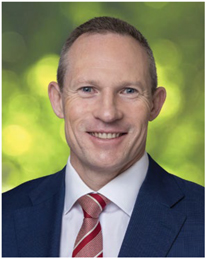
Mick de Brenni MP
Minister for Energy, Renewables and Hydrogen and
Minister for Public Works and Procurement
| 02 |
Queensland’s SuperGrid
providing power for generations
| Clean energy economy |
Empowered households and businesses |
Secure jobs and communities | ||
| Build a clean and competitive energy system for the Queensland economy and industries as a platform for accelerating growth. | Deliver affordable energy for households and businesses, and support more rooftop solar and batteries. | Drive better outcomes for workers and communities as partners in the energy transformation. | ||
The Queensland Energy and Jobs Plan (the plan) sets out our state’s bold vision to achieve 70 per cent renewable energy by 2032 and 80 per cent by 2035. As the ‘Sunshine State,’ we have world-class solar and wind, the ideal landscape for large-scale pumped hydro projects, and the critical minerals under the ground to support the renewable energy transformation.
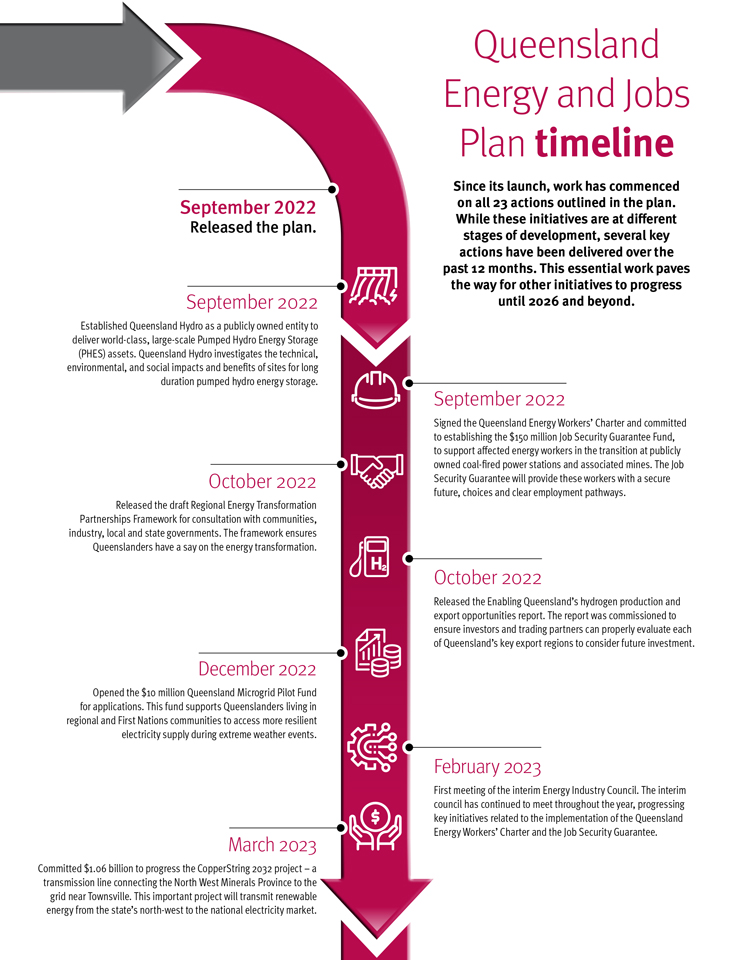
Since the plan’s release, the Department of Energy and Public Works, alongside government owned corporations, and the broader energy industry, have worked together to achieve many key milestones, including:
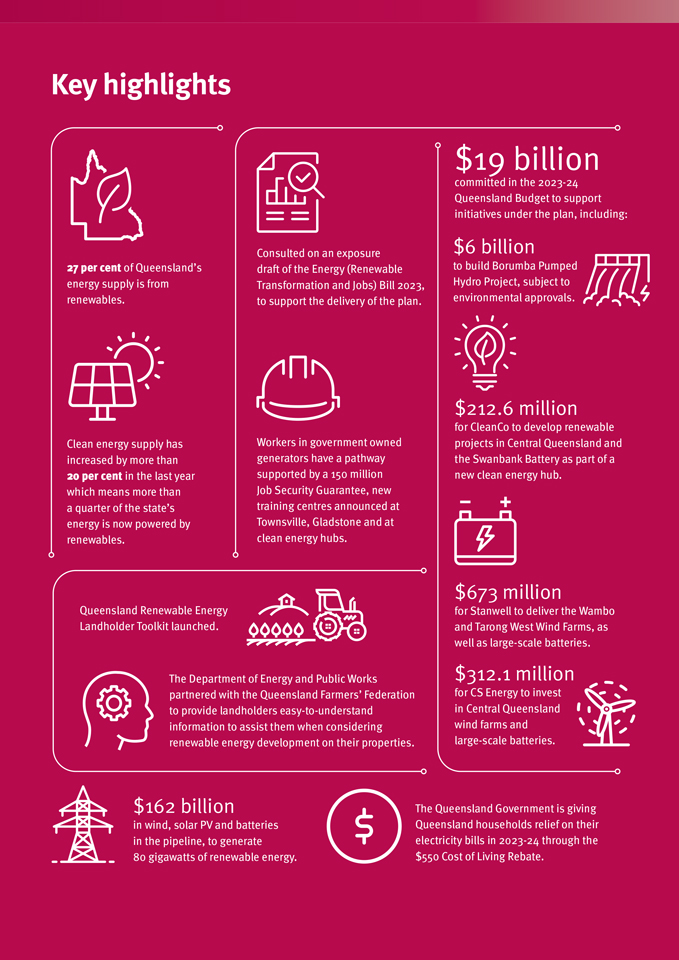
| • | 27 per cent renewable energy supply – over halfway to our goal of 50 per cent renewable energy by 2030 |
| • | release of the draft Energy (Renewable Transformation and Jobs) Bill 2023 and the draft Queensland Renewable Energy Zone Roadmap. |
| • | support for Queenslanders with the Cost of Living Rebate to give households relief on their electricity bills for 2023-24 |
| • | launch of the Household Energy Savings Program, including the Climate Smart Energy Savers rebate. The initiative has attracted unprecedented interest from householders keen to lower their electricity costs and reduce carbon emissions. |
With extensive headway being made to deliver on key priorities in the plan, the state is in a solid position to develop a clean energy economy, empower households and businesses and secure jobs for our communities.
| 03 | Queensland Energy and Jobs Plan 2023 Update |

Clean energy economy
|
∎ 1.1 Begin building the SuperGrid | ||||
| a) Progress early design and planning for the SuperGrid backbone transmission |

| |||
| b) Investigate appropriate legislative models to support backbone transmission |
| |||
|
∎ 1.2 Develop two world-class pumped hydro | ||||
| a) Establish Queensland Hydro to deliver Queensland’s world-class large-scale pumped hydro energy storage (PHES) assets |

| |||
| b) Progress assessment and some early works for Borumba PHES |
| |||
| c) Progress planning, analytical studies and community consultation for the Pioneer-Burdekin PHES site |
| |||
|
∎ 1.3 Invest in more batteries and storage | ||||
| a) Deliver $500 million from the boosted QREHJF for investment in batteries for publicly owned energy businesses |
| |||
| b) Release the Queensland Battery Industry Strategy |
| |||
| c) Release the Energy Storage Strategy |
| |||
|
∎ 1.4 Build more renewable energy and connect an additional 22 GW by 2035 | ||||
| a) Prepare legislation on the framework for Renewable Energy Zones (REZ) development |
| |||
| b) Establish Powerlink as the designated planning body for transmission in REZ regions (subject to legislation) |
| |||
| c) Undertake stakeholder consultation on the 2023 draft REZ Roadmap |
| |||
| d) Deliver the Central Queensland Gladstone Grid reinforcement |
| |||
|
∎ 1.5 Ensure reliability with low to no emissions gas | ||||
| a) A joint venture to build, own and operate a new 200 MW hydrogen-ready gas peaking power station at Kogan Creek |
| |||
| b) Work collaboratively with industry and national bodies to help address gas supply shortfalls |
| |||
| c) Work with industry to investigate options for connecting the Bowen Basin to the East Coast Gas market and options to secure additional gas storage for electricity needs |
| |||
| ∎ 1.6 Grow the future renewable hydrogen industry | ||||
| a) Review the Hydrogen Development – Guidance for Local Government |
| |||
| b) Complete technical and economic studies to supercharge domestic renewable hydrogen hubs |
| |||
| c) Roll out a Renewable Hydrogen Awareness Program to share information with the community and build awareness |
| |||
| d) Prepare legislation to support effective regulation of hydrogen development and use |
| |||
| e) Release an update of the Hydrogen Industry Development Strategy to cover 2024-2028 |
| |||
|
∎ 1.7 Deliver sustainable liquid fuels | ||||
| a) Collaborate with industry, Australian Government and customers to support development of sustainable liquid fuels |
| |||
| b) Deliver a fuels strategy to accelerate the uptake of sustainable liquid fuels on the pathway towards net zero and beyond |
| |||
|
∎ 1.8 Switch to renewable energy with new targets | ||||
| a) Prepare legislation for the Queensland Government’s renewable energy targets |
| |||
| b) Source 100 per cent renewable energy for all large government sites by 2030 |
| |||
|
∎ 1.9 Advance Queensland’s bioenergy future | ||||
| a) Register of interest for feasibility and technical studies |
| |||
| b) Finalise feasibility and technical studies to identify options and pathways to expand bioenergy generation and support technology innovation in the bioenergy sector |
| |||
|
∎ 1.10 Establish a new technical board for expert advice | ||||
| a) Prepare legislation to establish Queensland Energy System Advisory Board |
| |||
| b) Prepare first annual market snapshot |
| |||
| c) Prepare first Queensland SuperGrid Infrastructure Blueprint update |
| |||
| 04 |
Year 1 progress report
Empowered households and businesses
|
∎ 2.1 Deliver a smarter grid that benefits all Queenslanders | ||||
| a) Target 100 per cent penetration of smart meter devices with appropriate data sharing arrangements by 2030 by leveraging reforms by the Australian Energy Market Commission and other jurisdictional levers |
| |||
| b) Develop and evolve a smart connections framework to streamline households and businesses connecting technologies to the network |
| |||
| c) Define the roles and responsibilities of Queensland’s Distribution System Operator (DSO) in advance of the appointment of Energy Queensland as DSO to better coordinate energy use and supply to customers |
| |||
| d) Encourage the inclusion of electric vehicle charging infrastructure in buildings |
| |||
| e) Increase rollout of dynamic connection arrangements for customers |
| |||
| f) Increase network access and enable orchestration of Customer Energy Resources |
| |||
| g) Review regulatory framework for retail supply to remove barriers to delivering innovative products and services |
| |||
| h) Publish updated technical connection standards |
| |||
|
∎ 2.2 Deliver a new household program |
| |||
|
∎ 2.3 Support to reduce household bills | ||||
| a) Applications from eligible non-government organisations open |
| |||
| b) Deliver energy efficiency advice, assessments, and install smart and efficient equipment to reduce customer bills |
| |||
|
∎ 2.4 Drive savings for small businesses | ||||
| a) Applications open for QBEST |
| |||
| b) Successful applicants awarded and QBEST delivered |
| |||
|
∎ 2.5 Integrate Queensland’s zero emissions vehicles | ||||
| a) Replace all eligible government fleet vehicles with electric vehicles as leases expire, and where a suitable alternative is available and appropriate for business needs |
| |||
| b) Establish a customer portal to provide information and advice to households and businesses on optimal electric vehicle charging timings and tariffs |
| |||
| c) Electric vehicle charging infrastructure delivered in public places at congested areas of the network and explore innovative “smart” integration and management of electric vehicle charging |
| |||
| d) Deliver ZEV ready government buildings |
| |||
|
∎ 2.6 Enable savings for commercial buildings with Environmental Upgrade Agreements | ||||
| a) Finalise the EUA framework through public consultation |
| |||
| b) Prepare legislative amendments to the Local Government Act 2009 and the City of Brisbane Act 2010 to enable the operation of EUAs |
| |||
|
∎ 2.7 Ensure affordable electricity in regional and south east Queensland | ||||
| a) Continue current Unform Tariff Policy arrangements |
| |||
| b) Annual revision of Community Service Obligation Deed |
| |||
| 05 | Queensland Energy and Jobs Plan 2023 Update |
Year 1 progress report
Secure jobs and communities
| ∎ 3.1 Invest to modernise Queensland’s publicly owned coal-fired power stations for the future |
d) Build capacity to manufacture components for priority technologies (e.g., wind, batteries, electrolyser) |
| ||||||||
| a) CS Energy and Stanwell to invest in clean energy hubs |
|
e) Publish guidelines and open the $7.1 million grant program for energy efficiency grants to manufacturers |
| |||||||
| ∎ 3.2 Support workers with a Job Security Guarantee |
f) Award successful applicants for grant program |
| ||||||||
| a) Implement the Queensland Energy Workers’ Charter and the Job Security Guarantee Fund |
|
∎ 3.5 Clean energy for remote and First Nations communities |
||||||||
| b) Prepare legislation to support implementation of the Job Security Guarantee |
|
a) Implement national reforms on third party owned microgrids and standalone power systems adapted to the Queensland context as necessary |
| |||||||
| c) Establish dedicated future pathway managers to assist workers to develop their career pathway |
|
b) Queensland Microgrid Pilot Fund guidelines released |
| |||||||
| d) Leverage existing workforce programs and training programs to support delivery of the Job Security Guarantee |
|
c) Energy Queensland to update their Isolated Networks Strategy 2030 and complete feasibility studies to decarbonise isolated power stations in each community. |
| |||||||
| ∎ 3.3 Prepare Queensland’s workforce and regions for growth |
d) Scope, consult and co-design on Remote and First Nations Clean Energy Strategy |
| ||||||||
| a) Establish two new regional transmission and training hubs for critical skills development, including employment of apprentices |
|
e) Remote and First Nations Clean Energy Strategy released |
| |||||||
| b) Deliver the Future Energy Workforce Roadmap |
|
∎ 3.6 Partner with industries and communities to maximise benefits from the energy transformation and drive regional economic opportunities |
||||||||
| c) Appoint a Queensland Renewable Energy Jobs Advocate |
|
a) Develop and publish funding guidelines for the Regional Economic Futures Fund |
| |||||||
| d) Establish the Energy Industry Council to provide advice to government |
|
b) Consult on the draft Regional Energy Transformation Partnerships Framework |
| |||||||
| ∎ 3.4 Grow the renewable energy supply chain in Queensland |
c) Deliver initial actions as part of the Regional Energy Transformation Partnerships Framework |
| ||||||||
| a) Release local content targets to develop renewable energy supply chains and outline relevant policy mechanisms to improve investment certainty |
|
d) Outline additional actions for the Regional Energy Transformation Partnerships Framework identified through community consultation |
| |||||||
| b) Deliver detailed studies for priority technologies (e.g., wind) |
|
|||||||||
| c) Build capacity in the manufacturing sector including end-of-life and recycling opportunities |
|
|||||||||
| 06 |
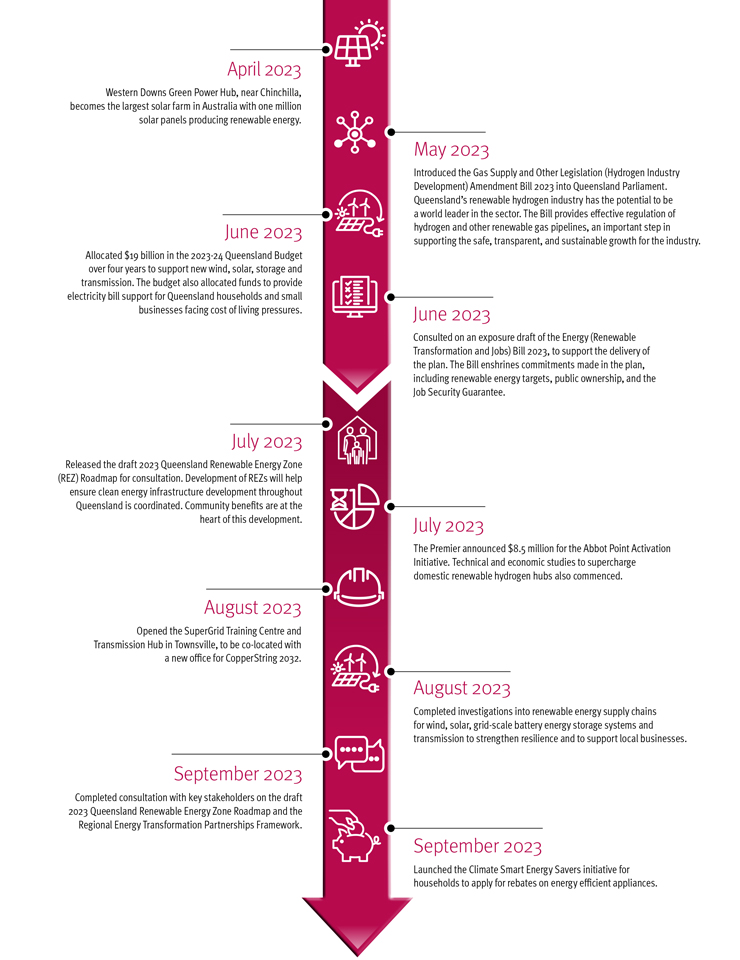
| 08 |
New energy legislation to support SuperGrid
The Queensland Government has prepared the Energy (Renewable Transformation and Jobs) Bill 2023 to support Queensland’s energy transformation.
The Bill is designed to help deliver the plan by:
| ● | enshrining in legislation the commitments made in the plan, including the renewable energy targets, Job Security Guarantee, and public ownership of assets |
| ● | creating the frameworks needed to progress Queensland’s SuperGrid, including the Priority Transmission Investment Framework to build the backbone transmission and Queensland’s Renewable Energy Zone Framework |
| ● | establishing the governance and advice functions needed to ensure Queensland’s transition to renewable energy continues to be based on expert advice and delivers for communities and workers affected by the transformation. |
More than 90 submissions came from industry and community stakeholders to help inform the final Bill. The legislation is expected to be introduced into Queensland Parliament in late 2023, marking a pivotal milestone to cement Queensland’s renewable future.
Halfway to renewable energy milestone
With 27 per cent of the state’s energy supply now powered by renewables, Queensland is on track to reach its target of 50 per cent renewable energy by 2030.
Clean energy produced from renewables has increased by more than 20 per cent over the last financial year. More renewables continue to come online, with total capacity now more than 9,700 megawatts (MW), including 4,800 MW from rooftop solar.
Growth in renewable energy is being driven by a range of factors including large-scale investment, a 13 per cent increase in the capacity of rooftop solar, and several solar and wind projects coming online since the plan was launched.
Some of these projects include:
| ● | Dulacca Renewable Energy Project – 180 MW |
| ● | Edenvale Solar Park – 146 MW |
| ● | Kaban Green Power Hub – 157 MW |
| ● | Moura Solar Farm – 82 MW |
| ● | Wandoan South Solar Project |
Stage 1 – 125 MW
More than one in three Queensland households generate electricity from rooftop solar.
Around seven per cent more Queensland households have rooftop solar compared to before the plan was launched. This brings the total to 775,000 rooftops fitted with solar panels (August 2023).
| 10 |
Queensland’s Renewable Energy Zone story
Queensland’s rich natural resources, combined with our abundant sunshine and wind, puts us in a prime position to bolster our reliance on renewable energy to power the state.
To maximise this potential, three regions were identified in 2020 as key areas of renewable energy development, called Queensland Renewable Energy Zones (QREZ). The Queensland Government committed $145 million to support their initial investment.
This funding helped to establish in-flight renewable energy development by backing storage and transmission infrastructure to support more energy generation. In-flight Renewable Energy Zones are renewable energy development that Powerlink, Queensland’s publicly owned transmission company, are progressing under the existing National Electricity Rules.
Work to progress and coordinate renewable energy development in Queensland has surged ahead.
The release of the draft 2023 Queensland Renewable Energy Zone Roadmap identified an adapted framework and definition of a more targeted Renewable Energy Zone (REZ). Regions have also been refined to align with Local Government Areas and 12 potential future REZs have been identified within the Southern, Central and North and Far North Queensland regions.
The indicative locations of potential REZ development have been identified based on network capacity, project pipeline and land use analysis. These preliminary locations represent the REZ connection to the shared network, and as each REZ is declared for consultation and development, the specific locations will be further defined.
In July 2023 the draft roadmap was released for public consultation and submissions were received from community, industry and government stakeholders. The feedback will help guide the final roadmap.
| 11 | Queensland Energy and Jobs Plan 2023 Update |
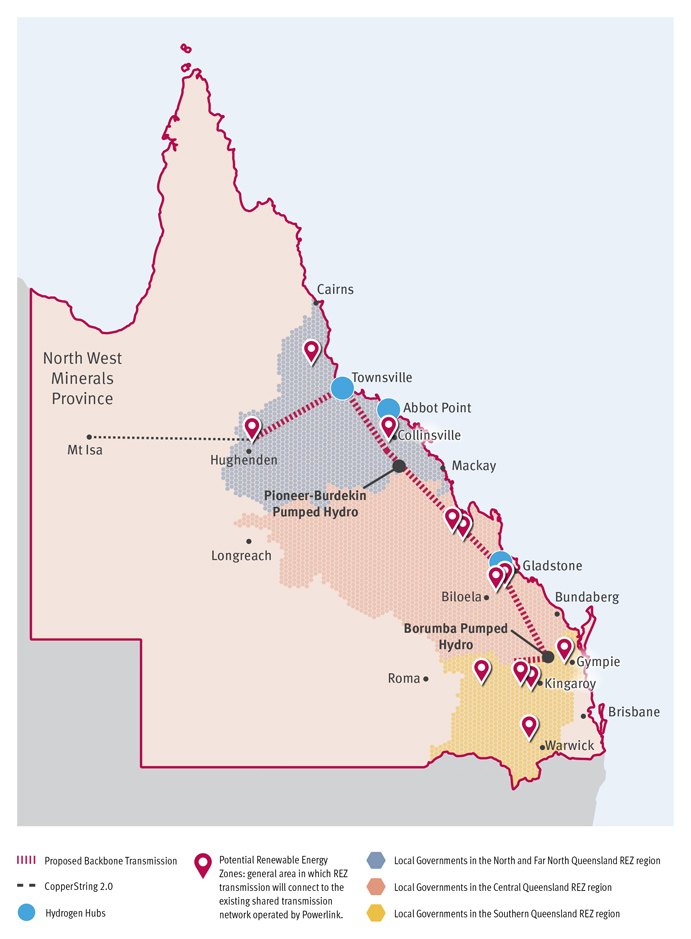
The Queensland Government has outlined the optimal infrastructure pathway in the Queensland SuperGrid Infrastructure Blueprint, released in September 2022. Indicative locations and regions were refined in the draft Queensland Renewable Energy Zone Roadmap in July 2023.
| 12 |
Delivering savings for Queensland households
The Queensland Government is giving households relief on their electricity bills for 2023-24 through the Cost of Living Rebate.
Every household will receive a $550 rebate. The rebate will be divided into quarterly instalments and automatically applied to household electricity bills.
Seniors, pensioners and concession cardholders may be eligible for a higher rebate of up to $700. Combined with the existing Electricity Rebate, eligible vulnerable households could save up to $1,072 over the 2023-24 financial year.
To further support Queenslanders, the Climate Smart Energy Savers rebate program was launched in September 2023. Queenslanders have shown overwhelming support for energy efficient appliances,
with thousands of households benefiting from rebates under the program.
The program includes rebates from $300-$1000 and encourages households to upgrade to 4-star (or higher) energy efficient appliances including refrigerators, washing machines, dryers, air conditioners and solar and heat pump hot water systems.
Upgrading to a 4-star energy efficient appliance (for example from a 2-star appliance) is estimated to save up to $134 on energy bills and cut carbon emissions by up to 0.35 tonnes each year. Switching to an energy-efficient hot water system can cut power bills by up to $1118 and reduce carbon emissions by up to
2.96 tonnes annually.
Climate Smart Energy Savers is the first household energy savings program to be released under the plan and will provide rebates for up to 80,000 households.
| 13 | Queensland Energy and Jobs Plan 2023 Update |
More renewable energy projects supported by jobs fund
Queensland’s ambitious renewable energy targets will not only help end the state’s reliance on fossil fuels, it will also generate more ongoing jobs as work ramps up.
Already, more than half of the $4.5 billion Queensland Renewable Energy and Hydrogen Jobs Fund has been allocated to support more publicly owned renewable energy projects and boost employment opportunities.
Around $2.2 billion has been allocated to government owned corporations to develop key renewable energy projects as part of the plan. This includes $192.5 million towards Stanwell’s investment in the 252 MW Wambo Wind Farm near Dalby and $776.1 million for Stanwell’s 500 MW Tarong West Wind Farm outside of Kingaroy.
Renewable hydrogen projects are progressing with support from the fund, including $15 million to progress Stanwell’s proposed Central Queensland
Hydrogen Project in Gladstone. This project has the potential to be the largest of its kind in Queensland.
$28.9 million has been allocated to a partnership led by CS Energy to develop the Kogan Renewable Hydrogen Demonstration Plant and refueling facilities near Chinchilla.
This investment, coupled with private sector partnerships, ensures government owned corporations can continue to invest in renewable energy, storage, and hydrogen projects in the Renewable Energy Zone regions of Southern, Central and North and Far North Queensland.
Queensland on track to be a hydrogen powerhouse
Queensland’s emerging hydrogen industry presents an exciting opportunity for our state to become a world-leading producer and exporter of renewable hydrogen. As we build our capacity and capability in this sector, careful strategic planning is essential to ensure the renewable hydrogen industry in Queensland can be delivered at scale.
The Enabling Queensland’s hydrogen production and export opportunities report released in October 2022, examines the potential to produce and export renewable hydrogen across the state, taking advantage of Queensland’s world-class port infrastructure and our proximity to Asian markets.
The state-wide study is being used as an important guide to ensure the industry grows sustainably, while balancing economic opportunities with environmental, social, and cultural values.
Renewable hydrogen will play a significant role in decarbonising our heavy industries and the transport sector.
For the renewable hydrogen industry in Queensland to reach its full potential, a clear and transparent regulatory pathway for industry development is required.
The first phase of regulatory reform is being progressed through the Gas Supply and Other Legislation (Hydrogen Industry Development) Amendment Bill 2023 which was introduced into the Queensland Parliament by Minister de Brenni in May 2023. The Bill is an important step to support the construction, operation and safety of Queensland’s hydrogen and other renewable gas pipelines.
The second phase of reform is also underway through a wide-ranging review of the broader regulatory framework applying to hydrogen industry development. This phase will identify and progress further options for reforms to streamline the safe and sustainable development of the hydrogen industry.
| 14 |
Queenslanders helping shape our energy future
Engaging with community and industry is integral to bring Queensland’s renewable energy plan to life. At events held across the state, community leaders, business owners, industry representatives and locals heard about the plan and the benefits for regional areas now and into the future.
Since the first community event in Toowoomba in November 2022, the Department of Energy and Public Works, along with government owned corporations, have visited close to a dozen regional areas – from Gladstone and Emerald to Mackay and Townsville, as well as communities across the south-east and greater Brisbane.
Ranging from regional shows and community events to standalone Queensland Energy and Jobs Fairs, the events featured interactive displays, information booths and activities hosted by Queensland Government agencies and corporations.
Community members were interested in hearing about
the employment and economic impacts and opportunities that renewable energy projects would bring to their region.
Community events provided a valuable opportunity to achieve meaningful engagement with Queenslanders and to demonstrate how the plan would drive job growth and create clean, reliable, and affordable energy for the state.
Engagement with the energy industry and all levels of government has been a focus since the plan was released, including exploring the issues and opportunities from the draft Queensland Renewable Energy Zone Roadmap and the draft Regional Energy Transformation Partnerships Framework.
Meaningful engagement and opportunities for direct feedback are essential to successfully deliver the plan and ensure communities are empowered throughout the renewable energy transformation.
| 15 | Queensland Energy and Jobs Plan 2023 Update |
Government owned corporations delivering for Queenslanders
Stanwell Corporation
| • | Sod officially turned to begin construction of Wambo Wind Farm, near Jandowae. |
| • | Announced Future Energy Innovation and Training Hub (FEITH) pilot and testing facility for new energy technologies, and a training facility for energy workers to build on or develop new skills to work on renewable energy assets. |
| • | Agreements with renewable energy developers including Neoen, Cubico Sustainable Investments, RES and RWE and renewable technology companies like ESI and Hysata. |
CleanCo
| • | Master planning underway to identify opportunities to redevelop the Swanbank power station precinct into a clean energy hub. |
| • | Progressed the development phase of the 250 megawatt (MW)/500 megawatt hours (MWh) Swanbank Battery to be built on the footprint of the Swanbank B coal-fired power station, demonstrating how existing infrastructure can be leveraged to support new technologies in the energy transformation. |
| • | Commenced supplying renewable energy to Coles, Dalrymple Bay Coal Terminal and BHP Mitsubishi Alliance (BMA), and secured new retail agreements with customers including BMA and Cairns Regional Council. |
Energy Queensland Limited
| • | Delivered 800,000 solar rooftop connections. |
| • | Delivered $1.4 billion capital works program to maintain a safe and reliable electricity network while enabling the renewable energy transition. |
| • | Launched Energy Queensland’s $2 million engineering undergraduate scholarship program with the first 100 scholarships awarded to support our future engineers. |
Powerlink Queensland
| • | Opened the new SuperGrid Training Centre |
| and Transmission Hub in Townsville and interim Queensland SuperGrid Training Centre and Transmission Hub in Gladstone, providing a regional base for Powerlink teams and industry partners. |
| • | Launched the new SuperGrid Landholder Payment Framework, which significantly boosts payments to landholders hosting new transmission infrastructure and in an Australian first, introduced payments for adjacent landholders. |
| • | CopperString 2032, a $5 billion investment in North Queensland which forms part of the Queensland SuperGrid, transitioned to Powerlink. This included sign off on a $20 million early works package with UGL and CPB Contractors to start early works on the project. |
CS Energy
| • | Completed construction of the 100 MW/200 MWh Chinchilla Battery and began site works for the 200 MW/400 MWh Greenbank Battery in South East Queensland. |
| • | Site and ground works commenced on the Kogan Renewable Hydrogen Demonstration Plant. The project includes the co-location of a solar farm, battery, hydrogen electrolyser, hydrogen fuel cell, hydrogen storage and out loading facility. |
| • | Progressing development of the Brigalow Peaking Power Plant, which will provide critical firming capacity to support more renewables entering Queensland’s energy grid. |
Queensland Hydro
| • | Borumba Pumped Hydro Project was greenlit with $6 billion funding from the Queensland Government, the largest single investment in Queensland’s energy infrastructure in decades. |
| • | Company established as publicly owned entity specifically created to design, deliver, operate and maintain long duration pumped hydro energy storage assets. |
| • | Undertook significant stakeholder and community engagement on Borumba and Pioneer-Burdekin Pumped Hydro projects. |
| 16 |
The extensive achievements over the last year have laid a solid foundation for future activity, involving several key deliverables across the plan’s three focus areas.
This includes progressing the development of Borumba and Pioneer-Burdekin pumped hydro projects to ensure our renewable energy targets are realised.
In May 2023 the Sustainable liquid fuels options and opportunities paper was open for consultation to inform the Sustainable Fuels Strategy to be released in 2024. This strategy will outline how Queensland will increase the use of sustainable liquid fuels as we continue on a pathway to net zero.
There are several energy efficiency programs to be delivered over the next 12 months to benefit Queenslanders. Small to medium sized businesses will save on their energy bills under the $35 million Queensland Business Energy Savings Transformation (QBEST).
The QBEST program will support business owners to purchase energy efficient equipment and smart technology to help drive down their energy costs.
Under the $10 million Enable Grants Program, non-government organisations will be engaged to provide energy efficiency advice and measures to support vulnerable households lower their energy usage.
With ongoing engagement and strategic planning to achieve our clean energy future, Queensland is well-positioned to edge closer to the state’s renewable energy targets and deliver on its commitment – providing clean, reliable and affordable energy for all Queenslanders.
| 17 | Queensland Energy and Jobs Plan 2023 Update |
QUEENSLAND ENERGY AND JOBS PLAN
Power for generations
13 QGOV (13 74 68)
2023