
THE INFORMATION IN THIS PROSPECTUS IS NOT COMPLETE AND MAY BE CHANGED. WE MAY NOT SELL THESE SECURITIES UNTIL THE REGISTRATION STATEMENT FILED WITH THE SECURITIES AND EXCHANGE COMMISSION IS EFFECTIVE. THIS PROSPECTUS IS NOT AN OFFER TO SELL THESE CLASSES OF SECURITIES AND IS NOT SOLICITING AN OFFER TO BUY THESE SECURITIES IN ANY STATE WHERE THE OFFER OR SALE IS NOT PERMITTED.
Subject to Completion
Preliminary
Prospectus dated December 11, 2023
Prospectus for MainStay Fiera SMID Growth Fund | |
MainStay Funds® | [February 28, 2024] |
Class A | Class C | Class I | Class R6 | |
U.S. Equity | ||||
MainStay Fiera SMID Growth Fund | APSRX | APSLX | APSGX | APSDX |
Neither the Securities and Exchange Commission nor any state securities commission has approved or disapproved of these securities or passed upon the accuracy or adequacy of this Prospectus. Any representation to the contrary is a criminal offense.

Table of Contents
Appendix A – Intermediary-Specific Sales Charge |
MainStay Fiera SMID Growth Fund
The Fund seeks long term capital growth.
The table below describes the fees and expenses that you may pay if you buy, hold and sell shares of the Fund. You may pay other fees, such as brokerage commissions and other fees to financial intermediaries, which are not reflected in the table and example below. You may qualify for sales charge discounts if you and your family invest, or agree to invest in the future, at least $50,000 in the Fund. In addition, different financial intermediary firms and financial professionals may impose different sales loads and waivers. More information about these and other discounts or waivers is available from your financial professional, in the "Information on Sales Charges" section starting on page [28] of the Prospectus and Appendix A – Intermediary-Specific Sales Charge Waivers and Discounts, and in the "Alternative Sales Arrangements" section on page [141] of the Statement of Additional Information.
TO BE UPDATED BY AMENDMENT
|
| Class A |
| Class C |
| Class I |
| Class R6 | |||||||||
Shareholder Fees (fees paid directly from your investment) |
|
|
|
|
|
|
|
|
|
|
|
|
|
|
|
| |
| Maximum Sales Charge (Load) Imposed on Purchases (as a percentage of offering price) |
| 5.50 | % |
| None |
|
|
| None |
|
|
| None |
|
| |
| Maximum Deferred Sales Charge (Load) (as a percentage of the lesser of the original offering price or redemption proceeds) |
| None | 1 |
|
| 1.00 | % |
| None |
|
|
| None |
|
| |
Annual Fund Operating Expenses (expenses that you pay each year as a percentage of the value of your investment) |
|
|
|
|
|
|
|
|
|
|
|
|
|
|
|
| |
| Management Fees (as an annual percentage of the Fund's average daily net assets) |
| 0.75 | % |
| 0.75 | % |
| 0.75 | % |
| 0.75 | % | ||||
| Distribution and/or Service (12b-1) Fees |
| 0.25 | % |
| 1.00 | % |
| None |
|
|
| None |
|
| ||
| Other Expenses |
| 0.34 | % |
| 0.49 | % |
| 0.34 | % |
| 0.24 | % | ||||
| Total Annual Fund Operating Expenses |
| 1.34 | % |
| 2.24 | % |
| 1.09 | % |
| 0.99 | % | ||||
| Waivers / Reimbursements2 |
| (0.19 | )% |
| (0.19 | )% |
| (0.24 | )% |
| (0.15 | )% | ||||
| Total Annual Fund Operating Expenses After Waivers / Reimbursements2 |
| 1.15 | % |
| 2.05 | % |
| 0.85 | % |
| 0.84 | % | ||||
1. No initial sales charge applies on investments of $1 million or more (and certain other qualified purchases). However, a contingent deferred sales charge of 1.00% may be imposed on certain redemptions made within 18 months of the date of purchase on shares that were purchased without an initial sales charge.
2. New York Life Investments has contractually agreed to waive fees and/or reimburse expenses so that Total Annual Fund Operating Expenses (excluding taxes, interest, litigation, extraordinary expenses, brokerage and other transaction expenses relating to the purchase or sale of portfolio investments, and acquired (underlying) fund fees and expenses) for a class do not exceed the following percentage of its average daily net assets: Class A, 1.15%; Class C, 2.05%; Class I, 0.85%; and Class R6, 0.84%. This agreement will remain in effect until February 28, 2026, and thereafter shall renew automatically for one-year terms unless New York Life Investments provides written notice of termination prior to the start of the next term or upon approval of the Board of Trustees of the Fund.
The Example is intended to help you compare the cost of investing in the Fund with the cost of investing in other mutual funds. The Example assumes that you invest $10,000 in the Fund for the time periods indicated whether or not you redeem all of your shares at the end of those periods (except as indicated with respect to Class C shares). The Example also assumes that your investment has a 5% return each year and that the Fund's operating expenses remain the same. The Example reflects the contractual fee waiver and/or expense reimbursement arrangement, if applicable, for the current duration of the arrangement only. Although your actual costs may be higher or lower, based on these assumptions your costs would be:
TO BE UPDATED BY AMENDMENT
Expenses After |
| Class A |
|
| Class C |
| Class I |
| Class R6 |
| ||||
|
|
|
|
| Assuming no redemption |
|
| Assuming redemption at end of period |
|
|
|
|
| |
1 Year |
| $ 661 |
|
| $ 208 |
|
| $ 308 |
|
| $ 87 |
| $ 86 |
|
3 Years |
| $ 915 |
|
| $ 663 |
|
| $ 663 |
|
| $ 298 |
| $ 285 |
|
5 Years |
| $ 1,208 |
|
| $ 1,164 |
|
| $ 1,164 |
|
| $ 553 |
| $ 517 |
|
10 Years |
| $ 2,042 |
|
| $ 1,970 |
|
| $ 1,970 |
|
| $ 1,284 |
| $ 1,185 |
|
The Fund pays transaction costs, such as commissions, when it buys and sells securities (or "turns over" its portfolio). A higher portfolio turnover rate may indicate higher transaction costs and may result in higher taxes when Fund shares are held in a taxable account. These costs, which are not reflected in annual fund operating expenses or in the Example, affect the Fund's performance. During the most recent fiscal [period], the Fund’s portfolio turnover rate was [XX]% of the average value of its portfolio. TO BE UPDATED BY AMENDMENT
4
MainStay Fiera SMID Growth Fund
Fiera Capital Inc. (the “Subadvisor”) seeks to achieve the Fund’s investment objective by investing in a diversified portfolio of common stocks of companies believed to be small- and mid-cap growth-oriented companies that are selected for their long-term capital appreciation potential and which the Subadvisor expects to grow faster than the U.S. economy.
The Fund considers an issuer to be a small- or mid-capitalization issuer if it has a market capitalization, at the time of purchase, within the range of $10 million and $52 billion. These ranges are subject to change. The Fund may also invest in exchange-traded funds (“ETFs”).
The Fund may also invest in companies that are in the earlier stages of their growth cycle that the Subadvisor recognizes as “emerging growth” companies. The Subadvisor believes that emerging growth companies can typically exhibit more aggressive growth characteristics and may be experiencing a significant positive transformation or a favorable catalyst impacting their long-term earnings potential. Characteristics the Subadvisor considers in identifying emerging growth companies for the Fund include accelerating revenue growth, strong relative strength, company specific market advantage, or an introduction of a new product line with a large addressable marketplace.
Under normal circumstances, the Fund will invest at least 80% of its assets (net assets plus the amount of any borrowings for investment purposes) in common stocks of small- and mid-cap companies. The Fund may invest up to 15% of its assets in common stocks of foreign small-and mid-cap companies through the purchase of sponsored American Depositary Receipts (“ADRs”), sponsored Global Depositary Receipts and/or foreign companies listed on U.S. stock exchanges.
An issuer is considered to be U.S. or foreign based on the issuer’s “country of risk,” or similar designation, as determined by a third party such as Bloomberg.
The Fund may from time to time emphasize one or more sectors as defined by GICs classification in selecting its investments, including the information technology/technology-related sectors and consumer non-cyclical sector.
Investment Process:
In selecting investments for the Fund, the Subadvisor uses an approach that combines “top-down” secular/macro-economic trend analysis with “bottom- up” security selection. The “top-down” approach takes into consideration factors such as interest rates, inflation, fiscal and monetary policy, global demographic trends, the regulatory environment and other attractive global investment opportunities. In addition, the Subadvisor may make investments in companies that seek to benefit from secular growth trends.
Through this “top-down” view, the Subadvisor seeks to provide a framework for “bottom up” research by identifying sectors, industries and companies that may benefit from the sustainability of the observed trends.
The Subadvisor then looks to fundamental “bottom-up” research for individual companies that it believes are exhibiting earnings growth potential at different stages of a company’s growth cycle and may benefit from the observed secular/macro trends. The core investments of the Fund typically include more established companies that the Subadvisor recognizes as “stable growth” companies, but the Fund may also invest in “emerging growth” companies. The Subadvisor believes that stable growth companies can typically provide more stability and consistency in volatile markets and are identified as exhibiting potential earnings acceleration, consistency of earnings, solid fundamentals (e.g., a strong balance sheet and the ability to generate free cash flow), franchise durability and reasonable valuations in the context of projected growth rates.
The Fund may sell securities and other investments when the Subadvisor believes that they have achieved full valuation, the Subadvisor identifies a more attractive investment, the Fund needs to maintain portfolio diversification, or an individual stock experiences declining fundamentals, negative earnings reports or similar adverse events or other relevant factors.
You can lose money by investing in the Fund. An investment in the Fund is not a bank deposit and is not insured or guaranteed by the Federal Deposit Insurance Corporation or any other governmental agency. The investments selected by the Subadvisor may underperform the market in which the Fund invests or other investments. The Fund may receive large purchase or redemption orders which may have adverse effects on performance if the Fund were required to sell securities, invest cash or hold a relatively large amount of cash at times when it would not otherwise do so.
The principal risks of investing in the Fund are summarized below.
Market Risk: Changes in markets may cause the value of investments to fluctuate, which could cause the Fund to underperform other funds with similar investment objectives and strategies. Such changes may be rapid and unpredictable. From time to time, markets may experience periods of stress as a result of various market and economic factors for potentially prolonged periods that may result in: (i) increased market volatility; (ii) reduced market liquidity; and (iii) increased redemptions of shares. Such conditions may add significantly to the risk of volatility in the net asset value of the Fund's shares and adversely affect the Fund and its investments.
Portfolio Management Risk: The investment strategies, practices and risk analyses used by the Subadvisor may not produce the desired results or expected returns.
5
MainStay Fiera SMID Growth Fund
Equity Securities Risk: Investments in common stocks and other equity securities are particularly subject to the risk of changing economic, stock market, industry and company conditions and the risks inherent in the ability to anticipate such changes that can adversely affect the value of portfolio holdings.
Market Capitalization Risk: Investments in securities issued by small- or mid-cap companies, will be subject to the risks associated with securities issued by companies of the applicable market capitalization. Securities of small-cap and mid-cap companies may be subject to greater price volatility, significantly lower trading volumes, cyclical, static or moderate growth prospects and greater spreads between their bid and ask prices than securities of larger companies. Smaller capitalization companies frequently rely on narrower product lines and niche markets and may be more vulnerable to adverse business or market developments. There is a risk that the securities issued by companies of a certain market capitalization may underperform the broader market at any given time.
Growth Stock Risk: If growth companies do not increase their earnings at a rate expected by investors, the market price of the stock may decline significantly, even if earnings show an absolute increase. Growth company stocks also typically lack the dividend yield that can cushion stock prices in market downturns. These risks may be more pronounced in companies that are in the earlier stages of their growth cycle.
Issuer Risk: An issuer in which the Fund invests or to which it has exposure may perform poorly, and the value of its securities may therefore decline, which would negatively affect the Fund’s performance. Poor performance may be caused by poor management decisions, competitive pressures, breakthroughs in technology, reliance on suppliers, labor problems or shortages, corporate restructurings, fraudulent disclosures, natural disasters, military confrontations and actions, war, other conflicts, terrorism, disease/virus outbreaks, epidemics or other events, conditions or factors.
Foreign Securities Risk: An issuer of a security is considered to be a U.S. or foreign issuer based on the issuer’s “country of risk” (or similar designation) as determined by a third party such as Bloomberg. The issuer’s “country of risk” is determined based on a number of criteria, including its country of domicile, the primary stock exchange on which it trades, the location from which the majority of its revenue comes, and its reporting currency. Although a Fund will generally rely on an issuer’s “country of risk,” as determined by Bloomberg when categorizing securities as either U.S. or foreign-based, it is not required to do so.
Investments in foreign (non-U.S.) securities may be riskier than investments in U.S. securities. Foreign regulatory regimes and securities markets can have less stringent investor protections and disclosure standards and less liquid trading markets than U.S. regulatory regimes and securities markets, and can experience political, social and economic developments that may affect the value of investments in foreign securities. Foreign securities may also subject the Fund's investments to changes in currency rates. Changes in the value of foreign currencies may make the return on an investment increase or decrease, unrelated to the quality or performance of the investment itself. Economic sanctions may be, and have been, imposed against certain countries, organizations, companies, entities and/or individuals. Economic sanctions and other similar governmental actions or developments could, among other things, effectively restrict or eliminate the Fund’s ability to purchase or sell certain foreign securities or groups of foreign securities, and thus may make the Fund’s investments in such securities less liquid or more difficult to value. Such sanctions may also cause a decline in the value of securities issued by the sanctioned country or companies located in or economically tied to the sanctioned country. In addition, as a result of economic sanctions and other similar governmental actions or developments, the Fund may be forced to sell or otherwise dispose of foreign investments at inopportune times or prices. The Fund may seek to hedge against its exposure to changes in the value of foreign currency, but there is no guarantee that such hedging techniques will be successful in reducing any related foreign currency valuation risk.
Depositary Receipts Risk: Investments in depositary receipts may entail the special risks of investing in foreign securities, including currency exchange fluctuations, government regulations, and the potential for political and economic instability.
Exchange-Traded Fund Risk: The risks of owning an ETF generally reflect the risks of owning the underlying securities in which the ETF invests or is designed to track, although lack of liquidity in an ETF’s shares could result in the market price of the ETF’s shares being more volatile than its underlying portfolio securities. Disruptions in the markets for the securities underlying ETFs could result in losses on the investments in ETFs. ETFs also have management fees and transaction costs that may make them more expensive than owning the underlying securities directly.
Sector Risk: To the extent the Fund focuses its investments in particular sectors of the economy, the Fund’s performance may be more subject to the risks of volatile economic cycles and/or conditions or developments adversely affecting such sectors than if the Fund held a broader range of investments. Individual sectors may fluctuate more widely than the broader market.
At times, the Fund may have a significant portion of its assets invested in securities of companies conducting business in a related group of industries within an economic sector, including the information technology/technology-related sectors and consumer non-cyclical sector. Companies in the same economic sector may be similarly affected by economic, regulatory, political or market events or conditions, which may make the Fund more vulnerable to unfavorable developments in that economic sector than funds that invest more broadly. Generally, the more broadly the Fund invests, the more it spreads risk and potentially reduces the risks of loss and volatility.
The Fund may be more susceptible to the particular risks that may affect companies in the information technology sector, as well as other technology-related sectors (collectively, the technology sectors) than if it were invested in a wider variety of companies in unrelated sectors. Companies in the technology sectors are subject to certain risks, including the risk that new services, equipment or technologies will not be accepted by consumers and businesses or will become rapidly obsolete. Performance of such companies may be affected by factors including
6
MainStay Fiera SMID Growth Fund
obtaining and protecting patents (or the failure to do so) and significant competitive pressures, including aggressive pricing of their products or services, new market entrants, competition for market share and short product cycles due to an accelerated rate of technological developments. Such competitive pressures may lead to limited earnings and/or falling profit margins. As a result, the value of their securities may fall or fail to rise. In addition, many technology sector companies have limited operating histories and prices of these companies’ securities historically have been more volatile than other securities, especially over the short term.
The Fund may also be more susceptible to the particular risks that may affect companies in the consumer non-cyclical sector than if it were invested in a wider variety of companies in unrelated sectors. Investments in the consumer non-cyclical sector involve risks associated with companies that manufacture products and provide discretionary services directly to the consumer. Performance of companies in the consumer non-cyclical sector may be adversely impacted by fluctuations in supply and demand, changes in the global economy, consumer spending, competition, demographics and consumer preferences, and production spending. Companies in the consumer non-cyclical sector are also affected by changes in government regulation, global economic, environmental and political events, and economic conditions.
The following bar chart and table provide some indication of the risks of investing in the Fund by showing changes in the Fund’s performance from year to year and by showing how the Fund’s average annual returns compare with those of a broad measure of market performance, as well as an additional index over time. Sales loads, if any, are not reflected in the bar chart. If they were, returns would be less than those shown. In accordance with a new regulatory requirement, the Fund has selected the Russell 3000® Index, which represents a broad measure of market performance, as a replacement for the Russell 2500TM Growth Index. The table also includes the average annual returns of the Russell 2500TM Growth Index, which is generally representative of the market sectors or types of investments in which the Fund invests.
Index returns reflect no deductions for fees, expenses or taxes, except for foreign withholding taxes where applicable.
Effective July 21, 2023, the Fiera Capital Small/Mid-Cap Growth Fund (the "Predecessor Fund") was reorganized into the Fund. As accounting successor to the Predecessor Fund, the Fund has assumed the Predecessor Fund's historical performance. Therefore, the performance information shown below prior to July 21, 2023 is that of the Predecessor Fund, which had a different fee structure from the Fund. The returns of the Predecessor Fund have not been adjusted to reflect the applicable expenses of the Fund. The historical performance presented prior to February 12, 2018 reflects the performance of APEXcm Small/Mid-Cap Growth Fund, a former series of The Ultimus Managers Trust (the "Prior Predecessor Fund"). The returns of the Prior Predecessor Fund have not been adjusted to reflect the applicable expenses of the Predecessor Fund or the Fund. The returns prior to February 12, 2018 are based on the previous performance and actual fees and expenses of the Prior Predecessor Fund's sole class of shares (i.e., the Predecessor Fund's Institutional Class shares, which commenced operations on June 29, 2012). The Predecessor Fund's Investor Class shares commenced operations on February 12, 2018.
Performance data for the classes varies based on differences in their fee and expense structures. Performance data is not shown for classes with less than one calendar year of performance. Past performance (before and after taxes) is not necessarily an indication of how the Fund will perform in the future. Please visit newyorklifeinvestments.com/funds for more recent performance information.
TO BE UPDATED BY AMENDMENT
7
MainStay Fiera SMID Growth Fund
Annual Returns, Class I shares
(by calendar year [2014-2023])
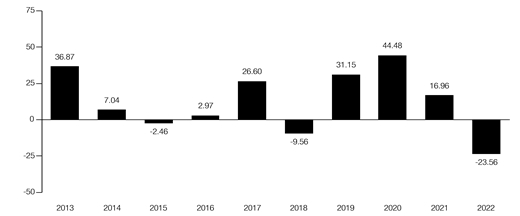
Best Quarter | ||
2020, Q2 | 33.72 | % |
Worst Quarter | ||
2020, Q1 | -23.24 | % |
Average Annual Total Returns (for the periods ended December 31, [2023])
|
|
|
| 5 Years or | 10 Years or | |||
| Inception |
| 1 Year | Since | Since | |||
|
|
|
| Inception | Inception | |||
Return Before Taxes |
|
|
|
|
|
|
|
|
Class I | 6/29/2012 |
| -23.56 | % | 8.91 | % | 11.06 | % |
Return After Taxes on Distributions |
|
|
|
|
|
|
|
|
Class I |
|
| -26.19 | % | 4.87 | % | 8.95 | % |
Return After Taxes on Distributions and Sale of Fund Shares |
|
|
|
|
|
|
|
|
Class I |
|
| -12.09 | % | 6.60 | % | 8.95 | % |
Return Before Taxes |
|
|
|
|
|
|
|
|
Class A | 2/12/2018 |
| -23.75 | % | N/A |
| 8.75 | % |
|
|
|
|
|
|
|
|
|
Russell 3000® Index1 | -19.21 | % | 8.79 | % | 12.13 | % | ||
Russell 2500TM Growth Index2 | -26.21 | % | 5.97 | % | 10.62 | % | ||
1. The Russell 3000® Index measures the performance of the largest 3,000 U.S. companies representing approximately 98% of the investable U.S. equity market.
2. The Russell 2500™ Growth Index measures the performance of the small to mid-cap growth segment of the U.S. equity universe. It includes those Russell 2500 companies with higher price-to-book ratios and higher forecasted growth values.
New York Life Investment Management LLC serves as the Manager. Fiera Capital, Inc. serves as the Subadvisor. The individuals listed below are jointly and primarily responsible for day-to-day portfolio management.
Subadvisor | Portfolio Managers | Service Date |
Fiera Capital, Inc. | Sunil M. Reddy - Lead Portfolio Manager | Since 2023 |
David Cook - Portfolio Manager | Since 2023 |
You may purchase or sell shares of the Fund on any day the Fund is open for business by contacting your financial adviser or financial intermediary firm, or by contacting the Fund by telephone at 800-624-6782, by mail at MainStay Funds, P.O. Box 219003, Kansas City, MO 64121-9000, by
8
MainStay Fiera SMID Growth Fund
overnight mail to 430 West 7th Street, Suite 219003, Kansas City, MO 64105-1407, or by accessing our website at newyorklifeinvestments.com/accounts.
Class R6 shares are generally only available to certain retirement plans invested in the Fund through omnibus accounts (either at the plan level or omnibus accounts held on the books of the Fund). Class R6 shares are generally not available to retail accounts. Generally, an initial investment minimum of $1,000 applies if you invest in Class C shares, $15,000 for Class A shares and $1,000,000 for individual investors in Class I shares investing directly (i) with the Fund or (ii) through certain private banks and trust companies that have an agreement with NYLIFE Distributors LLC, the Fund’s principal underwriter and distributor, or its affiliates. A subsequent investment minimum of $50 applies to investments in Class C shares. However, for Class C shares purchased through AutoInvest, MainStay’s systematic investment plan, a $500 initial investment minimum and a $50 minimum for subsequent purchases applies. Class A shares have no subsequent investment minimum. Class R6 shares and institutional shareholders in Class I shares have no initial or subsequent investment minimums.
Certain financial intermediaries through whom you may invest may impose their own investment minimums, fees, policies and procedures for purchasing and selling Fund shares, which are not described in this Prospectus or the Statement of Additional Information, and which will depend on the policies, procedures and trading platforms of the financial intermediary. Consult a representative of your financial intermediary about the availability of shares of the Fund and the intermediary's policies, procedures and other information.
The Fund's distributions are generally taxable to you as ordinary income, capital gains, or a combination of the two, unless you are investing through a tax-deferred arrangement, such as a 401(k) plan or an individual retirement account.
If you purchase Fund shares through a financial intermediary firm (such as a broker/dealer or bank), the Fund and its related companies may pay the intermediary for the sale of Fund shares and related services. These payments may create a conflict of interest by influencing the financial intermediary firm or your financial adviser to recommend the Fund over another investment. Ask your financial adviser or visit your financial intermediary firm's website for more information. No compensation, administrative payments, sub-transfer agency payments or service payments are paid to broker/dealers or other financial intermediaries from Fund assets or the Distributor’s or an affiliate’s resources on sales of or investments in Class R6 shares. The Distributor or an affiliate may pay de minimis amounts to intermediaries for setup, connectivity or other technological expenses. Class R6 shares do not carry sales charges or pay Rule 12b-1 fees, or make payments to financial intermediaries to assist in, or in connection with, the sale of the Fund’s shares.
9
More About Investment Strategies and Risks
Investment Policies and Objectives
The Fund has a name which suggests a focus on a particular type of investment. In accordance with Rule 35d-1 under the 1940 Act, the Fund has adopted a policy that it will, under normal circumstances, invest at least 80% of the value of its assets (net assets plus the amount of any borrowings for investment purposes) in investments of the type suggested by its name, as set forth in the Statement of Additional Information. This requirement is applied at the time the Fund invests its assets. If, subsequent to an investment by the Fund, this requirement is no longer met, the Fund's future investments will be made in a manner that will bring the Fund into compliance with this requirement. To the extent the Fund invests in derivatives, such investments may be counted on a mark-to-market basis for purposes of the 80% policy. In addition, in appropriate circumstances, synthetic investments may count toward the 80% policy if they have economic characteristics similar to the other investments included in the basket. The Fund’s policy to invest at least 80% of its assets in such a manner is “non-fundamental,” which means that it may be changed without shareholder approval. The Funds have adopted a policy to provide the Fund's shareholders with at least 60 days' prior notice of any change in the Fund’s non-fundamental investment policy with respect to investments of the type suggested by its name. For additional information, please see the SAI.
The Fund may invest its net assets in other investment companies, including exchange-traded funds that invest in similar securities to those in which the Fund may invest directly, and count such holdings towards various guideline tests (such as the 80% test required under Rule 35d-1 under the 1940 Act).
The Fund’s investment objective is non-fundamental and may be changed without shareholder approval.
Russian Securities
Until further notice, the Fund will not purchase securities of Russian issuers.
Additional Information About Risks
The principal risks of investing in the Fund are described below, which may result in a loss of your investment. As indicated in the table below, not all of these risks are principal risks of investing in the Fund. The risks are presented below in alphabetical order, and not in the order of importance or potential exposure. The Fund may be subject to risks to different degrees. The fact that a particular risk is not identified as a principal risk for the Fund does not mean that the Fund is prohibited from investing in securities or investments that give rise to that risk. There can be no assurance that the Fund will achieve its investment objective.
Investors should be aware that in light of the current uncertainty, volatility and state of economies, financial markets, and labor and health conditions around the world, the risks below are heightened significantly compared to normal conditions and therefore may subject the Fund's investments and a shareholder’s investment in the Fund to reduced yield and/or income and sudden and substantial losses. The fact that a particular risk below is not specifically identified as being heightened under current conditions does not mean that the risk is not greater than under normal conditions.
Additional information about the investment practices of the Fund and risks pertinent to these practices is included in the SAI. The following information regarding principal investment strategies and risks is provided in alphabetical order and not necessarily in order of importance.
x Principal Risk • Additional Risk | MainStay Fiera SMID Growth Fund |
Consumer Non-Cyclical Sector Risk | X |
Debt or Fixed-Income Securities | ● |
Depositary Receipts | X |
Equity Securities | X |
Exchange-Traded Funds | X |
Foreign Securities and Currencies | X |
Geographic Focus Risk | ● |
Growth Stocks | X |
Increase in Expenses Risk | ● |
Inflation Risk | ● |
Initial Public Offerings | ● |
Issuer Risk | X |
10
More About Investment Strategies and Risks
x Principal Risk • Additional Risk | MainStay Fiera SMID Growth Fund |
Large Investments or Redemptions by Shareholders | ● |
Lending of Portfolio Securities | ● |
Liquidity and Valuation Risk | ● |
Market Capitalization Risk | X |
Market Risk | X |
Operational and Cyber Security Risk | ● |
Portfolio Management Risk | X |
Portfolio Turnover | ● |
Real Estate Investment Trusts | ● |
Regulatory Risk | ● |
Repurchase Agreements | ● |
Restricted Securities Risk | ● |
Risk Management Techniques | ● |
Sector Risk | X |
Tax Risk | ● |
Technology Stock Risk | X |
Temporary Defensive Investments | ● |
U.S. Government Securities Risk | ● |
Consumer Non-Cyclical Sector Risk
To the extent the Fund invests in companies in the consumer non-cyclical sector, it is more susceptible to adverse developments affecting such companies and may perform poorly during a downturn in the consumer non-cyclical sector. Investments in the consumer non-cyclical sector involve risks associated with companies that manufacture products and provide discretionary services directly to the consumer. Investments in the consumer non-cyclical sector may be adversely affected by fluctuations in supply and demand, disruptions in supply chains, product obsolescence, product liability claims, changes in regulations, domestic and global economic conditions, consumer spending, competition, demographics, consumer preferences and production spending, and environmental and political events.
Debt or Fixed-Income Securities
Investors buy debt securities primarily to profit through interest payments. Governments, banks and companies raise cash by issuing or selling debt securities to investors. Debt securities may be bought directly from those issuers or in the secondary trading markets. There are many different types of debt securities, including (without limitation) bonds, notes and debentures.
Some debt securities pay interest at fixed rates of return (referred to as fixed-income securities), while others pay interest at variable rates. Interest may be paid at different intervals. Some debt securities do not make regular interest payments, but instead are initially sold at a discount to the principal amount that is to be paid at maturity.
The risks involved with investing in debt securities include (without limitation):
· Credit risk: Credit risk is the risk that an issuer, guarantor, or liquidity provider of a debt security may be unable or unwilling, or may be perceived (whether by market participants, ratings agencies, pricing services or otherwise) as unable or unwilling, to make timely principal and/or interest payments, or to otherwise honor its obligations. By purchasing a debt security, in certain circumstances, a buyer is effectively lending money to the issuer of that security. If the issuer does not pay back the loan, the holder of the security may experience a loss on its investment. Changes in an issuer's credit rating or the market's perception of an issuer's creditworthiness may also affect the value of an investment. Moreover, in a rising interest rate environment, the risk that such issuer or guarantor may default on its obligations is heightened. Actual or perceived changes in economic, social, health, financial or political conditions in general or that affect a particular type of instrument, issuer, guarantor or counterparty can reduce the ability of the party to meet its obligations, which can affect the credit quality, liquidity and/or value of an instrument. The value of an instrument also may decline for reasons that relate directly to the issuer, guarantor or counterparty, such as management performance, financial leverage and reduced demand for goods and services. Although credit quality ratings may not accurately reflect the true credit risk or liquidity of an instrument, a change in the credit quality rating of an instrument or an issuer can have a rapid, adverse effect on the instrument’s liquidity and make it more difficult to sell the instrument at an advantageous price or time. Credit ratings assigned by rating agencies are based on a number of factors and subjective judgments and, therefore, do not necessarily represent an issuer's actual financial condition or the volatility or liquidity of the security.
· Maturity risk: Maturity is the average expected repayment date of the Fund's portfolio, taking into account the expected final repayment dates of the securities in the portfolio. A debt security with a longer maturity may fluctuate in value more than a debt security with a shorter maturity. Therefore, the NAV of the Fund that holds debt securities with a longer average maturity may fluctuate in value more than the NAV of the Fund that holds debt securities with a shorter average maturity. Duration is a measure of the price sensitivity of a fixed-income investment to changes in interest rates. Duration is expressed as a number of years and is
11
More About Investment Strategies and Risks
considered a more accurate sensitivity gauge than average maturity. However, measures such as average duration may not accurately reflect the true interest rate sensitivity of the Fund's investments or its overall portfolio.
· Market risk: Like other securities, debt securities are subject to the forces of supply and demand. Low demand may negatively impact the price of a debt security.
· Interest rate risk: A variety of factors can cause interest rates to change, including central bank monetary policies, inflation rates and general economic conditions. The value of a debt security usually changes when interest rates change. Generally, when interest rates go up, the value of a debt security goes down and when interest rates go down, the value of a debt security goes up. During periods of very low or negative interest rates, the Fund's susceptibility to interest rate risk may be magnified, its yield may be diminished and its performance may be adversely affected. Low interest rates (or negative interest rates) may magnify the risks associated with rising interest rates. The Fund may also be subject to heightened interest rate risk when the Federal Reserve raises interest rates. For more information on risks associated with inflation, please see “Inflation Risk.”
Changing interest rates may have unpredictable effects on markets, including market volatility, and may adversely affect performance. A low or negative interest rate environment may pose additional risks because low or negative yields on portfolio holdings may have an adverse impact on the Fund's ability to provide a positive yield to its shareholders. Any such change in interest rates may be sudden and significant, with unpredictable effects on the financial markets and the Fund's investments. Should interest rates decrease, investments in certain variable-rate and fixed-rate debt securities may be adversely affected.
· Extension risk and Prepayment risk: An issuer could exercise its right to pay principal on an obligation later than expected. This may happen when there is a rise in interest rates. Under these circumstances, the value of the obligation may decrease, and the Fund may also suffer from the inability to reinvest in higher yielding securities. An issuer may exercise its right to redeem outstanding debt securities prior to their maturity (known as a “call”) or otherwise pay principal earlier than expected for a number of reasons (e.g., declining interest rates, changes in credit spreads and improvements in the issuer's credit quality). If an issuer calls or “prepays” a security, the Fund may not recoup the full amount of its initial investment and may be required to reinvest in generally lower-yielding securities, securities with greater credit risks or securities with other, less favorable features or terms.
Debt securities rated below investment grade by a nationally recognized statistical rating organization ("NRSRO") are considered to have speculative characteristics and some may be commonly referred to as "junk bonds." Junk bonds entail default and other risks greater than those associated with higher-rated securities.
The duration of a bond or mutual fund portfolio is an indication of sensitivity to changes in interest rates. In general, the longer the Fund's duration, the more it will react to changes in interest rates and the greater the risk and return potential. Duration may not accurately reflect the true interest rate sensitivity of instruments held by the Fund and, in turn, the Fund's susceptibility to changes in interest rates. For example, the price of a bond fund with an average duration of five years would be expected to fall approximately 5% if interest rates rose by one percentage point.
A laddered maturity schedule means a portfolio is structured so that a certain percentage of the securities will mature each year. This helps the Fund manage duration and risk, and attempts to create a more consistent return.
Depositary Receipts
American Depositary Receipts ("ADRs"), European Depositary Receipts ("EDRs"), Global Depositary Receipts ("GDRs"), International Depositary Receipts ("IDRs"), Non-Voting Depositary Receipts (“NVDRs”) and other similar securities represent ownership of securities of non-U.S. issuers held in trust by a bank, exchange or similar financial institution. ADRs are denominated in U.S. dollars and trade in the U.S. securities markets. GDRs and EDRs are receipts issued by foreign banks or trust companies, or foreign branches of U.S. banks that represent an interest in shares of either a foreign or U.S. corporation. NVDRs are typically issued by an exchange or its affiliate and do not have voting rights. These investments may not be denominated in the same currency as the underlying securities into which they may be converted, and are subject to currency risks. Depositary receipts involve many of the same risks of investing directly in foreign securities. The issuers of depositary receipts may discontinue issuing new depositary receipts and withdraw existing depositary receipts at any time, which may result in costs and delays in the distribution of the underlying assets to the Fund and may negatively impact the Fund’s performance.
Equity Securities Risk
Publicly held corporations may raise needed cash by issuing or selling equity securities to investors. When the Fund buys the equity securities of a corporation it becomes a part owner of the issuing corporation. Equity securities may be bought on domestic stock exchanges, foreign stock exchanges, or in the over-the-counter market. There are many different types of equity securities, including (without limitation) common stocks, preferred stocks, ADRs, and real estate investment trusts.
Investors buy equity securities to make money through dividend payments and/or selling them for more than they paid. The risks involved with investing in equity securities include (without limitation):
· Changing economic conditions: Equity securities may fluctuate as a result of general economic conditions, including changes in interest rates.
12
More About Investment Strategies and Risks
· Industry and company conditions: Certain industries or individual companies may come in and out of favor with investors. In addition, changing technology and competition may make the equity securities of a company or industry more volatile.
· Security selection: A portfolio manager may not be able to consistently select equity securities that appreciate in value, or anticipate changes that can adversely affect the value of the Fund's holdings. Investments in smaller and mid-size companies may be more volatile than investments in larger companies.
Exchange-Traded Funds (“ETFs”)
To the extent the Fund may invest in securities of other investment companies, it may invest in shares of ETFs, including ETFs advised by affiliates of New York Life Investments. ETFs are investment companies that trade like stocks. The price of an ETF is derived from and based upon the securities held by the ETF. However, like stocks, shares of ETFs are not traded at NAV, but may trade at prices above or below the value of their underlying portfolios. The level of risk involved in the purchase or sale of an ETF is similar to the risk involved in the purchase or sale of a traditional common stock, except that the pricing mechanism for an ETF is based on a basket of securities. Thus, the risks of owning an ETF generally reflect the risks of owning the underlying securities that the ETF is designed to track, although lack of liquidity in an ETF’s shares could result in the market price of the ETF’s shares being more volatile than the underlying portfolio of securities. Disruptions in the markets for the securities underlying ETFs could result in losses on investment in ETFs. In addition, an actual trading market may not develop for an ETF’s shares and the listing exchange may halt trading of an ETF’s shares. ETFs are subject to management fees and other fees that may increase their costs versus the costs of owning the underlying securities directly. The Fund will indirectly bear its proportionate share of management fees and other expenses that are charged by an ETF in addition to the management fees and other expenses paid by the Fund. The Fund will pay brokerage commissions in connection with the purchase and sale of shares of ETFs. The Fund may from time to time invest in ETFs, primarily as a means of gaining exposure for its portfolio to the market without investing in individual securities, particularly in the context of managing cash flows into the Fund or where access to a local market is restricted or not cost effective. In addition, an index-based ETF may not exactly replicate the performance of the index it seeks to track for a number of reasons, such as operating expenses, transaction costs and imperfect correlation between the performance of the ETF’s holdings and that of the index.
The Fund may invest in ETFs, among other reasons, to gain broad market, sector or asset class exposure, including during periods when it has large amounts of uninvested cash or when the Manager or Subadvisor believes share prices of ETFs offer attractive values, subject to any applicable investment restrictions in the Prospectus and the SAI.
Foreign Securities and Currencies
An issuer of a security is considered to be a U.S. or foreign issuer based on the issuer’s “country of risk” (or similar designation), as determined by a third-party such as Bloomberg. The issuer’s “country of risk” is determined based on a number of criteria, including its country of domicile, the primary stock exchange on which it trades, the location from which the majority of its revenue comes, and its reporting currency. Although the Fund will generally rely on an issuer’s “country of risk,” as determined by Bloomberg when categorizing securities as either U.S. or foreign-based, it is not required to do so. Foreign securities may be more difficult to sell than U.S. securities. Foreign securities may be domiciled in the United States and traded on a U.S. market, but possess elements of foreign risk. Investments in foreign securities may involve difficulties in receiving or interpreting financial and economic information, possible imposition of taxes, higher brokerage and custodian fees, possible currency exchange controls or other government restrictions, including possible seizure or nationalization of foreign deposits or assets. Foreign securities may also be less liquid and more volatile than U.S. securities. Additionally, to the extent that the underlying securities held by the Fund trade on foreign exchanges or in foreign markets that may be closed when the U.S. markets are open, there are likely to be deviations between the current price of an underlying security and the last quoted price for the underlying security (i.e., the Fund's quote from the closed foreign market). There may also be difficulty in invoking legal protections across borders and, as a result, the Fund may have limited or no legal recourse with respect to foreign securities. In addition, investments in emerging market countries present unique and greater risks than those presented by investments in countries with developed securities markets and more advanced regulatory systems. For example, some Asia-Pacific countries can be characterized as emerging markets or newly industrialized and may experience more volatile economic cycles and less liquid markets than developed countries. The Asia-Pacific region has historically been highly dependent on global trade and the growth, development and stability of the region can be adversely affected by, among other regional and global developments, trade barriers, exchange controls and other measures imposed or negotiated by the countries with which they trade. See “Emerging Markets” above.
Economic sanctions and other similar measures may be, and have been, imposed against certain countries, organizations, companies, entities and/or individuals. Economic sanctions and other similar governmental actions or developments could, among other things, effectively restrict or eliminate the ability to purchase or sell certain foreign securities or groups of foreign securities, and thus may make investments in such securities less liquid or more difficult to value. Such sanctions may also cause a decline in the value of securities issued by the sanctioned country or companies located in or economically tied to the sanctioned country. In addition, as a result of economic sanctions and other similar governmental actions or developments, the Fund may be forced to sell or otherwise dispose of foreign investments at inopportune times or prices. Sanctions and other similar measures could significantly delay or prevent the settlement of securities transactions or their valuation, and significantly impact the Fund's liquidity and performance. Sanctions and other similar measures may be in place for a substantial period of time and enacted with limited advanced notice.
13
More About Investment Strategies and Risks
Many foreign securities are denominated or quoted in a foreign currency. A decline in value of a currency will have an adverse impact on the U.S. dollar value of any investments denominated in that currency. Exchange rate movements can be large and can endure for extended periods of time, affecting either favorably or unfavorably the value of the Fund's assets. However, the Fund may engage in foreign currency transactions to attempt to protect itself against fluctuations in currency exchange rates in relation to the U.S. dollar. See “Risk Management Techniques” below.
Changes in the value of foreign (non-U.S.) currencies relative to the U.S. dollar and inflation may adversely affect the Fund's investments in foreign currencies or in securities that trade in, and receive revenues in, or in derivatives that provide exposure to, foreign currencies. These changes in value can make the return on an investment go up or down, unrelated to the quality or performance of the investment itself. The Subadvisor may seek to reduce currency risk by hedging all or part of the exposure to various foreign currencies of the Fund's assets allocated to the Subadvisor by engaging in hedging transactions, including swaps, futures, forward currency contracts and other derivatives. However, these transactions and techniques may not always work as intended, and in certain cases the Fund may be worse off than if it had not engaged in such hedging practices. In addition, certain market conditions may make it impossible or uneconomical to hedge against currency risk.
Geographic Focus Risk
Issuers in a single country, a small number of countries, or a particular geographic region can react similarly to market, currency, economic, political, regulatory, geopolitical and other conditions. These conditions include anticipated or actual government budget deficits or other financial difficulties, levels of inflation and unemployment, fiscal and monetary controls, tax policy and political and social instability. The Fund's performance will be particularly susceptible to the conditions in the countries or regions to which it is significantly exposed.
For example, investments in Japan may be subject to additional risks, including those associated with an aging and declining population, which contributes to the increasing cost of Japan’s pension and public welfare system and makes the economy more dependent on foreign trade. Additionally, Japan is prone to natural disasters, such as earthquakes and tsunamis.
Additionally, investments in the United Kingdom are subject to additional risks. For example, the United Kingdom is a substantial trading partner of the United States and other European countries, and, as a result, the British economy may be impacted by adverse changes to the economic health of the United States and other European countries. In addition, on January 31, 2020, the United Kingdom officially withdrew from the European Union (known as “Brexit”), and on December 30, 2020, the United Kingdom and the European Union signed a trade agreement, which was subsequently ratified by the parties. The impact of Brexit on the United Kingdom and European Union and the broader global economy is unknown but could be significant and could result in ongoing market volatility and illiquidity and potentially lower economic growth.
Growth Stocks
Growth stocks typically trade at higher multiples of current earnings than other securities. Therefore, the values of growth stocks may be more sensitive to changes in current or expected earnings than the values of other securities.
The principal risk of investing in growth stocks is that investors expect growth companies to increase their earnings at a certain rate that is generally higher than the rate expected for non-growth companies. If these expectations are not met, the market price of the stock may decline significantly, even if earnings showed an absolute increase. Growth stocks also typically lack the dividend yield that can cushion stock prices in market downturns.
Increase in Expenses Risk
The actual costs of investing in the Fund may be higher than the expenses shown in “Total Annual Fund Operating Expenses” for a variety of reasons. For example, expense ratios may be higher than those shown if average net assets decrease, as a result of redemptions or otherwise, or if a fee limitation is changed or terminated. Net assets are more likely to decrease and fund expense ratios are more likely to increase when markets are volatile.
Inflation Risk
The Fund's investments may be subject to inflation risk, which is the risk that the real value (i.e., nominal price of the asset adjusted for inflation) of assets or income from investments will be less in the future because inflation decreases the purchasing power and value of money (i.e., as inflation increases, the real value of the Fund's assets can decline as can the value of the Fund's distributions). Inflation rates may change frequently and significantly as a result of various factors, including unexpected shifts in the domestic or global economy and changes in monetary or economic policies (or expectations that these policies may change). The market price of debt securities generally falls as inflation increases because the purchasing power of the future income and repaid principal is expected to be worth less when received by the Fund. The risk of inflation is greater for debt instruments with longer maturities and especially those that pay a fixed rather than variable interest rate. In addition, this risk may be significantly elevated compared to normal conditions because of monetary policy measures and the current interest rate environment and level of government intervention and spending.
14
More About Investment Strategies and Risks
Initial Public Offerings (“IPOs”)
IPO share prices are frequently volatile due to factors such as the absence of a prior public market for the shares, unseasoned trading in the shares, the small number of shares available for trading and limited information about the issuer’s business model, quality of management, earnings growth potential and other criteria used to evaluate its investment prospects. Investments in IPO shares, which are subject to market risk and liquidity risk, involve greater risks than investments in shares of companies that have traded publicly on an exchange for extended periods of time. Investments in IPO shares may have a magnified impact on the performance of the Fund with a small asset base. The impact of the investments in IPO shares on the Fund's performance will likely decrease as the Fund's asset size increases, which could reduce the Fund's returns. IPOs may not be consistently available for investing, particularly as the Fund's asset base grows. The Fund may hold IPO shares for a very short period of time, which may increase portfolio turnover and expenses, such as commissions and transaction costs. In addition, IPO shares can experience an immediate drop in value if the demand for the securities does not continue to support the offering price.
Issuer Risk
An issuer in which the Fund invests or to which it has exposure may perform poorly, and the value of its securities may therefore decline, which would negatively affect the Fund’s performance. Poor performance may be caused by poor management decisions, competitive pressures, breakthroughs in technology, reliance on suppliers, labor problems or shortages, corporate restructurings, fraudulent disclosures, natural disasters, military confrontations and actions, war, other conflicts, terrorism, disease/virus outbreaks, epidemics or other events, conditions or factors.
Large Investments or Redemptions by Shareholders Risk
From time to time, the Fund may receive large purchase or redemption orders from affiliated or unaffiliated mutual funds or other investors. Such large transactions could have adverse effects on performance if the Fund is required to sell securities, invest cash or hold significant cash at times when it otherwise would not do so. This activity could also accelerate the realization of capital gains and increase transaction costs. Certain shareholders, including clients or affiliates of the Manager and/or other funds managed by the Manager or its affiliates, may from time to time own or control a significant percentage of the Fund’s shares. Redemptions by these shareholders of their shares may further increase the liquidity risk and may otherwise adversely impact the Fund. These shareholders may include, for example, institutional investors, funds of funds, discretionary advisory clients and other shareholders whose buy-sell decisions are controlled by a single decision-maker. For more information, please see “Liquidity and Valuation Risk.”
Lending of Portfolio Securities
The Fund may lend its portfolio securities. Portfolio securities may be loaned to brokers, dealers and financial institutions to realize additional income under guidelines adopted by the Fund's Board. In determining whether to lend securities, the Manager or the Subadvisor or its/their agent will consider relevant facts and circumstances, including the creditworthiness of the borrower. Securities lending involves the risk that the Fund may lose money in the event that the borrower fails to return the securities in a timely manner or at all. The Fund also could lose money in the event of a decline in the value of the collateral provided for loaned securities or in the event that the borrower fails to provide additional collateral as needed to ensure the loan is fully collateralized. The Fund may also not experience the returns expected with the investment of cash collateral. Furthermore, as with other extensions of credit, the Fund could lose its rights in the collateral should the borrower fail financially. Another risk of securities lending is the risk that the loaned portfolio securities may not be available to the Fund on a timely basis and the Fund may therefore lose the opportunity to sell the securities at a desirable price. Any decline in the value of a security that occurs while the security is out on loan would continue to be borne by the Fund.
Liquidity and Valuation Risk
Liquidity risk is the risk that the Fund could not meet redemption requests within the allowable time period without significant dilution of remaining investors’ interests in the Fund. Liquidity risk exists when particular investments are difficult to sell, possibly preventing the Fund from selling the investments at an advantageous time or price. Liquidity risk may also exist because of unusual market conditions, government intervention, political, social, health, economic or market developments, unusually high volume of redemptions, or other reasons. To meet redemption requests, the Fund may be forced to sell securities at an unfavorable time and/or under unfavorable conditions. The liquidity of any Fund investment may change significantly over time as a result of market, economic, trading, issuer-specific and other factors.
Valuation risk refers to the potential that the sales price the Fund could receive for any particular investment may differ from the Fund’s valuation of the investment. Valuation of the Fund’s investments may be difficult, particularly for securities that trade in thin or volatile markets or that are valued using a fair value methodology that produces an estimate of the fair value of the security/instrument, which are based on good faith, subjective judgments, and available information. Such valuations may prove to be inaccurate. Where no clear or reliable indication of the value of a particular investment is available, the investment will be valued at its fair value according to valuation procedures approved by the Board. These cases include, among others, situations where the secondary markets on which a security has previously been traded are no longer viable for lack of liquidity. The value of illiquid investments may reflect a discount, which may be significant, from the market price of comparable securities for which a liquid market exists, and thus negatively affect the Fund's NAV. In addition, the value of illiquid investments that subsequently become liquid may increase, positively affecting the Fund's NAV. The
15
More About Investment Strategies and Risks
Manager, as valuation designee, may rely on various sources of information to value investments and calculate NAVs. The Manager may obtain pricing information from third parties that are believed to be reliable. In certain cases, this information may be unavailable or this information may be inaccurate because of errors by the third parties, technological issues, an absence of current market data, or otherwise. These cases increase the risks associated with fair valuation.
Performance attributable to variations in liquidity are not necessarily an indication of future performance. For more information on fair valuation, please see "Fair Valuation and Portfolio Holdings Disclosure."
Market Capitalization Risk
To the extent the Fund invests in securities issued by small-, mid-, or large-cap companies, it will be subject to the risks associated with securities issued by companies of the applicable market capitalization. Securities issued by companies of different market capitalizations tend to go in and out of favor based on market and economic conditions. During a period when securities of a particular market capitalization underperform other types of investments, the Fund's performance could be adversely impacted.
Securities of small-cap and mid-cap companies may be subject to greater price volatility, significantly lower trading volumes, cyclical, static or moderate growth prospects and greater spreads between their bid and ask prices than securities of larger companies. In addition, securities of small-cap and mid-cap companies may trade in an over-the-counter market or on a regional exchange, or may otherwise have limited liquidity. Smaller capitalization companies frequently rely on narrower product lines, niche markets, limited financial resources, a few key employees and inexperienced management. Smaller capitalization companies have more speculative prospects for future growth, sustained earnings and market share than larger companies and may be more vulnerable to adverse business or market developments. Accordingly, it may be difficult for the Fund to sell small-cap securities at a desired time or price. Generally, the smaller the company, the greater these risks become. Although securities issued by larger companies tend to have less overall volatility than securities issued by smaller companies, securities issued by larger companies may have less growth potential and may not be able to attain the high growth rates of successful smaller companies, especially during strong economic periods. In addition, larger companies may be less capable of responding quickly to competitive challenges and industry changes, including those resulting from improvements in technology, and may suffer sharper price declines as a result of earnings disappointments.
Market Risk
The value of the Fund's investments may fluctuate and/or decline because of changes in the markets in which the Fund invests, which could cause the Fund to underperform other funds with similar investment objectives and strategies. Security markets are volatile and may decline significantly in response to adverse issuer, regulatory, political, or economic developments. Different sectors of the market and different security types may react differently to such developments. Changes in these markets may be rapid and unpredictable. Fluctuations in the markets generally or in a specific industry or sector may impact the securities in which the Fund invests. From time to time, markets may experience periods of stress for potentially prolonged periods that may result in: (i) increased market volatility; (ii) reduced market liquidity; and (iii) increased redemptions. Such conditions may add significantly to the risk of volatility in the net asset value of the Fund’s shares. Market changes may impact equity and fixed income securities in different and, at times, conflicting manners. The Fund potentially will be prevented from executing investment decisions at an advantageous time or price as a result of any domestic or global market disruptions, particularly disruptions causing heightened market volatility and reduced market liquidity, as well as increased or changing regulations. Thus, investments that the Subadvisor believes represent an attractive opportunity or in which the Fund seeks to obtain exposure may be unavailable entirely or in the specific quantities sought by the Subadvisor and the Fund may need to obtain the exposure through less advantageous or indirect investments or forgo the investment at the time.
Political and diplomatic events within the United States and abroad, such as the U.S. budget and trade tensions, has in the past resulted, and may in the future result, in developments that present additional risks to the Fund's investments and operations. Geopolitical and other events, such as war, acts of terrorism, natural disasters, the spread of infectious illnesses, epidemics and pandemics, environmental and other public health issues, supply chain disruptions, inflation, recessions or other events, and governments’ reactions to such events, may lead to increased market volatility and instability in world economies and markets generally and may have adverse effects on the performance of the Fund and its investments. It is difficult to accurately predict or foresee when events or conditions affecting the U.S. or global financial markets, economies, and issuers may occur, the effects of such events or conditions, potential escalations or expansions of these events, possible retaliations in response to sanctions or similar actions and the duration or ultimate impact of those events. There is an increased likelihood that these types of events or conditions can, sometimes rapidly and unpredictably, result in a variety of adverse developments and circumstances, such as reduced liquidity, supply chain disruptions and market volatility, as well as increased general uncertainty and broad ramifications for markets, economies, issuers, businesses in many sectors and societies globally. Stocks of large capitalization issuers that are included as components of indices replicated by passively-managed funds may be particularly susceptible to declines in value, including declines in value that are not believed to be representative of the issuer’s fundamentals, due to market and investor reactions to such events. Additional and/or prolonged geopolitical or other events may affect investor and consumer confidence and may adversely impact financial markets and the broader economy, perhaps suddenly and to a significant degree. Any such market, economic and other disruptions could also prevent the Fund from executing its investment strategies and processes in a timely manner.
16
More About Investment Strategies and Risks
Operational and Cyber Security Risk
The Fund is exposed to operational risk arising from a number of factors, including but not limited to, human error, processing and communication errors, errors of service providers, counterparties or other third-parties, failed or inadequate processes and technology or system failures. Additionally, the Fund and its service providers are susceptible to risks resulting from breaches in cyber security, including the theft, corruption, destruction or denial of access to data maintained online or digitally, denial of service on websites and other disruptions. Successful cyber security breaches may adversely impact the Fund and its shareholders by, among other things, interfering with the processing of shareholder transactions, impacting the Fund’s ability to calculate its NAV, causing the release of confidential shareholder or Fund information, impeding trading, causing reputational damage and subjecting the Fund to fines, penalties or financial losses. The Fund seek to reduce these operational and cyber security risks through controls and procedures. However, these measures do not address every possible risk and may be inadequate for those risks that they are intended to address.
Portfolio Management Risk
The investment strategies, practices and risk analysis used may not produce the desired results. In addition, the Fund may not achieve its investment objective, including during periods in which it takes temporary positions in response to unusual or adverse market, economic or political conditions, or other unusual or abnormal circumstances. The Subadvisor may be incorrect in its assessment of a particular security or market trend, which could result in losses. The Subadvisor's judgment about whether securities will increase or decrease in value may prove to be incorrect, and the value of these securities could change unexpectedly.
A quantitative model or algorithm (“quantitative tool”) used by the Subadvisor, and the investments selected based on the quantitative tool, may not perform as expected. A quantitative tool may contain certain assumptions in construction and implementation that may adversely affect the Fund’s performance. There may also be technical issues with the construction and implementation of the quantitative tool (for example, software or other technology malfunctions, or programming inaccuracies). In addition, the Fund’s performance will reflect, in part, the Subadvisor’s ability to make active qualitative decisions and timely adjust the quantitative tool, including the tool’s underlying metrics and data.
Portfolio Turnover
Portfolio turnover measures the amount of trading the Fund does during the year. Due to its trading strategies, the Fund may experience a portfolio turnover rate of over 100%. The portfolio turnover rate for the Fund is found in the summary section for the Fund and the Financial Highlights. The use of certain investment strategies may generate increased portfolio turnover. The Fund with a high turnover rate (at or over 100%) often will have higher transaction costs (which are paid by the Fund) and may generate short-term capital gains (on which Fund shareholders will pay taxes, even if such shareholders do not sell any shares by year-end).
Real Estate Investment Trusts ("REITs")
REITs are pooled investment vehicles that invest primarily in either real estate or real estate-related loans. Investment in REITs carries with it many of the risks associated with direct ownership of real estate, including declines in property values extended vacancies, increases in property taxes, possible environmental liabilities and changes in interest rates. In addition to these risks, REITs are dependent upon management skills, may not be diversified, may experience substantial cost in the event of borrower or lessee defaults, and are subject to heavy cash flow dependency. REITs are also susceptible to the risks associated with the types of real estate investments they own and adverse economic or market events with respect to these securities and property types (e.g., apartment properties, retail shopping centers, office and industrial properties, hotels, healthcare facilities, manufactured housing and mixed-property types). A REIT could possibly fail to qualify for tax free pass-through of income under the Internal Revenue Code of 1986, as amended (the “Internal Revenue Code”), or could fail to maintain its exemption from registration under the 1940 Act. The failure of a company to qualify as a REIT under federal tax law or maintain its exemption from registration under the 1940 Act may have adverse consequences.
Regulatory Risk
Government regulation and/or intervention may change the way the Fund is regulated, affect the expenses incurred directly by the Fund, affect the value of its investments, and limit the Fund’s ability to achieve its investment objective. Government regulation may change frequently and may have significant adverse consequences. Moreover, government regulation may have unpredictable and unintended effects. In addition to exposing the Fund to potential new costs and expenses, additional regulation or changes to existing regulation may also require changes to the Fund's investment practices. Certain regulatory authorities may also prohibit or restrict the ability of the Fund to engage in certain derivative transactions or short-selling of certain securities. Although there continues to be uncertainty about the full impact of these and other regulatory changes, the Fund may be subject to a more complex regulatory framework, and incur additional costs to comply with new requirements as well as to monitor for compliance with any new requirements going forward.
At any time after the date of this Prospectus, legislation may be enacted that could negatively affect the assets of the Fund. Legislation or regulation may change the way in which the Fund is managed. Neither the Manager nor the Subadvisor can predict the effects of any new governmental regulation that may be implemented, and there can be no assurance that any new governmental regulation will not adversely affect the Fund's ability to achieve its respective investment objective. The Fund's activities may be limited or restricted because of laws and regulations applicable to the Manager, the Subadvisor or the Fund.
17
More About Investment Strategies and Risks
Repurchase Agreements
The Fund may enter into repurchase agreements with certain sellers in accordance with guidelines adopted by the Board. A repurchase agreement is an instrument under which the Fund acquires a security and the seller agrees, at the time of the sale, to repurchase the security at an agreed upon time and price. The Fund's use of repurchase agreements is generally intended to be a means for the Fund to earn income on uninvested cash, but there is no guarantee that a repurchase agreement will provide income.
Repurchase agreements subject the Fund to counterparty risks, including the risk that the seller of the underlying security will become bankrupt or insolvent before the date of repurchase or otherwise will fail to repurchase the security as agreed, which could cause losses to the Fund. If the seller defaults on its obligations under the agreement, the Fund may incur costs, lose money or suffer delays in exercising its rights under the agreement. If the seller fails to repurchase the underlying instruments collateralizing the repurchase agreement, the Fund may lose money. The credit, liquidity and other risks associated with repurchase agreements are heightened when a repurchase agreement is secured by collateral other than cash or U.S. government securities.
Restricted Securities Risk
Restricted securities are securities that are sold only through negotiated private transactions and not to the general public, due to certain restrictions imposed by federal securities laws or the terms of the security. The principal risk of investing in restricted securities is that the Fund may be limited or prevented by law or the terms of the security from selling the security and, as a result, the Fund may be unable to dispose of the security at an advantageous time or price. In addition, there is no assurance that a trading market will develop or exist for a restricted security, which also may result in difficulties in selling the security.
Risk Management Techniques
Various techniques can be used to increase or decrease exposure to changing security prices, interest rates, currency exchange rates, commodity prices or other factors that affect security values. These techniques may involve derivative transactions such as buying and selling futures contracts and options on futures contracts, entering into foreign currency transactions (such as foreign currency forward contracts and options on foreign currencies) and purchasing put or call options on securities and securities indices.
These practices can be used in an attempt to adjust the risk and return characteristics of a portfolio of investments. For example, to gain exposure to a particular market, the Fund may be able to purchase a futures contract with respect to that market. The use of such techniques in an attempt to reduce risk is known as "hedging." If the Manager or Subadvisor judges market conditions incorrectly or employs a strategy that does not correlate well with the Fund’s investments, these techniques could result in a loss, which in some cases may be unlimited, regardless of whether the intent was to reduce risk or increase return. These techniques may increase the volatility of the Fund and may involve a small investment of cash relative to the magnitude of the risk assumed. In addition, these techniques could result in a loss if the counterparty to the transaction does not perform as promised.
Sector Risk
To the extent the Fund focuses its investments in particular sectors of the economy, the Fund’s performance may be more subject to the risks of volatile economic cycles and/or conditions or developments adversely affecting such sectors than if the Fund held a broader range of investments. Individual sectors may fluctuate more widely than the broader market.
Tax Risk
Certain investments and investment strategies, including transactions in options and futures contracts, may be subject to special and complex federal income tax provisions, the effect of which may be, among other things: (i) to disallow, suspend, defer or otherwise limit the allowance of certain losses or deductions; (ii) to accelerate income to the Fund; (iii) to convert an ordinary loss or a deduction into a capital loss (the deductibility of which is more limited); and/or (iv) to produce income that will not qualify as good income under the gross income requirements that must be met for the Fund to qualify as a regulated investment company under Subchapter M of the Internal Revenue Code of 1986, as amended (the “Internal Revenue Code”). Furthermore, to the extent that any futures contract or option on a futures contract held by the Fund is a “Section 1256 contract” under Section 1256 of the Internal Revenue Code, the contract will be marked to market annually, and any gain or loss will be treated as 60% long-term and 40% short-term, regardless of the holding period for such contract. Section 1256 contracts may include Fund transactions involving call options on a broad-based securities index, certain futures contracts and other financial contracts.
Technology Stock Risk
Investments in technology companies may be subject to various risks, including risks relating to falling prices and profits, competition from new domestic and international market entrants, difficulty in obtaining financing and general economic conditions. In addition, the products of technology companies may face obsolescence associated with rapid technological developments and innovation, frequent new product introduction, unpredictable changes in growth rates and competition for the services of qualified personnel. Technology companies are also heavily dependent on intellectual property rights and may be adversely affected by the loss or impairment of those rights. The profitability of technology companies, and an investment in such companies, may be particularly vulnerable to changing market demand, research and development costs and availability and price of components and related commodities, which may be influenced or characterized by unpredictable factors. In addition, technology stocks historically have experienced unusually wide price swings, thus potentially causing the Fund's performance to be more volatile than a fund not invested in technology companies.
18
More About Investment Strategies and Risks
Temporary Defensive Investments
In times of unusual or adverse market, economic or political conditions or abnormal circumstances (such as large cash inflows or anticipated large redemptions), the Fund may, for temporary defensive purposes or for liquidity purposes (which may be for a prolonged period), invest outside the scope of its principal investment strategies. Under such conditions, the Fund may not invest in accordance with its investment objective or principal investment strategies and, as a result, there is no assurance that the Fund will achieve its investment objective. Under such conditions, the Fund may also invest without limit in cash, money market securities or other investments.
U.S. Government Securities Risk
There are different types of U.S. government securities with different levels of credit risk, including the risk of default, depending on the nature of the particular government support for that security. For example, a U.S. government-sponsored entity, such as Federal National Mortgage Association ("Fannie Mae") or Federal Home Loan Mortgage Corporation ("Freddie Mac"), although chartered or sponsored by an Act of Congress, may issue securities that are neither insured nor guaranteed by the U.S. Treasury and are therefore riskier than those that are.
19
The information described in this Shareholder Guide is available free of charge by calling toll-free 800-624-6782 or by visiting our website at newyorklifeinvestments.com. The information contained in or otherwise accessible through the MainStay website does not form part of this Prospectus. For additional details, please contact your financial adviser or the MainStay Funds free of charge by calling toll-free 800-624-6782.
Please note that shares of the MainStay Funds are generally not available for purchase by foreign investors, except to certain qualified investors. The MainStay Funds reserve the right to: (i) pay dividends from net investment income and distributions from net capital gains in a check mailed to any investor who becomes a non-U.S. resident; (ii) redeem shares and close the account of an investor who becomes a non-U.S. resident; and (iii) redeem shares and close the account of an investor in the case of actual or suspected threatening conduct or actual or suspected fraudulent, suspicious or illegal activity by that investor or any other individual associated with that account.
SIMPLE IRA Plan accounts and certain other retirement plan accounts may not be eligible to invest in certain MainStay Funds.
The following terms are used in this Shareholder Guide:
· "MainStay Asset Allocation Funds" collectively refers to the MainStay Conservative Allocation Fund, MainStay Equity Allocation Fund, MainStay Growth Allocation Fund and MainStay Moderate Allocation Fund.
· "MainStay Epoch Funds" collectively refers to the MainStay Epoch Capital Growth Fund, MainStay Epoch U.S. Equity Yield Fund and MainStay Epoch Global Equity Yield Fund.
· “MainStay ETF Asset Allocation Funds” collectively refers to the MainStay Conservative ETF Allocation Fund, MainStay Defensive ETF Allocation Fund, MainStay Equity ETF Allocation Fund, MainStay ESG Multi-Asset Allocation Fund, MainStay Growth ETF Allocation Fund and MainStay Moderate ETF Allocation Fund.
· “MainStay Funds” collectively refers to each mutual fund managed by New York Life Investment Management LLC.
· "MainStay International/Global Equity Funds" collectively refers to the MainStay Candriam Emerging Markets Equity Fund, MainStay CBRE Global Infrastructure Fund, MainStay Epoch Capital Growth Fund, MainStay Epoch Global Equity Yield Fund, MainStay Epoch International Choice Fund, MainStay PineStone Global Equity Fund, MainStay PineStone International Equity Fund and MainStay WMC International Research Equity Fund.
· "MainStay Mixed Asset Funds" collectively refers to the MainStay Balanced Fund, MainStay Income Builder Fund and MainStay MacKay Convertible Fund.
· “MainStay Tax-Exempt Funds” collectively refers to the MainStay MacKay California Tax Free Opportunities Fund, MainStay MacKay High Yield Municipal Bond Fund, MainStay MacKay New York Tax Free Opportunities Fund, MainStay MacKay Short Term Municipal Fund, MainStay MacKay Strategic Municipal Allocation Fund and MainStay MacKay Tax Free Bond Fund.
· "MainStay Taxable Bond Funds" collectively refers to the MainStay Candriam Emerging Markets Debt Fund, MainStay Floating Rate Fund, MainStay MacKay High Yield Corporate Bond Fund, MainStay MacKay Short Duration High Yield Fund, MainStay MacKay Strategic Bond Fund, MainStay MacKay Total Return Bond Fund, MainStay MacKay U.S. Infrastructure Bond Fund, MainStay Money Market Fund and MainStay Short Term Bond Fund.
· "MainStay U.S. Equity Funds" collectively refers to the MainStay CBRE Real Estate Fund, MainStay Epoch U.S. Equity Yield Fund, MainStay Fiera SMID Growth Fund, MainStay S&P 500 Index Fund, MainStay PineStone U.S. Equity Fund, MainStay Winslow Large Cap Growth Fund, MainStay WMC Enduring Capital Fund, MainStay WMC Growth Fund, MainStay WMC Small Companies Fund and MainStay WMC Value Fund.
· The Board of Trustees of MainStay Funds Trust and the Board of Trustees of The MainStay Funds are collectively referred to as the "Board."
· The Investment Company Act of 1940, as amended, is referred to as the "1940 Act."
· New York Life Investment Management LLC is referred to as the "Manager" or "New York Life Investments."
· New York Life Insurance Company is referred to as "New York Life."
· NYLIM Service Company LLC is referred to as the "Transfer Agent" or "NYLIM Service Company."
20
Shareholder Guide
· NYLIFE Distributors LLC, the MainStay Funds’ principal underwriter and distributor, is referred to as the "Distributor" or "NYLIFE Distributors."
· The New York Stock Exchange is referred to as the "Exchange."
· Net asset value is referred to as "NAV."
· The Securities and Exchange Commission is referred to as the "SEC."
· Automated Clearing House, the electronic process by which shares may be purchased or redeemed, is referred to as “ACH.”
The MainStay Funds offer Investor Class, Class A, A2, C, C2, I, P, R1, R2, R3, R6 and SIMPLE Class shares, as applicable. Each share class may not currently be offered by each MainStay Fund or through your financial intermediary and may be offered through a separate prospectus. Effective February 28, 2017, Class B shares were closed to all new purchases and additional investments by existing Class B shareholders. Each share class of a MainStay Fund represents an interest in the same portfolio of securities, has the same rights and is identical in all respects to the other classes (unless otherwise disclosed in this Shareholder Guide or as set forth in the MainStay Funds’ multiple class plan adopted pursuant to Rule 18f-3 under the 1940 Act), except that, to the extent applicable, each class also bears its own service and distribution expenses and may bear incremental transfer agency costs resulting from its investor base. In addition, each class has its own sales charge and expense structure, providing you with different choices for meeting the needs of your situation. Depending upon the number of shares of a MainStay Fund you choose to purchase, how you wish to purchase shares of a MainStay Fund and the MainStay Fund in which you wish to invest, the share classes available to you may vary.
The decision as to which class of shares is best suited to your needs depends on a number of factors that you should consider and discuss with your financial adviser. Important factors you may wish to consider include, among others:
· how much you plan to invest;
· how long you plan to hold your shares;
· the fees (e.g., sales charge) and total expenses associated with each class of shares; and
· whether you qualify for any reduction or waiver of the sales charge, if any, as discussed below in the section “Sales Charge Reductions and Waivers” and in Appendix A – Intermediary-Specific Sales Charge Waivers and Discounts.
The MainStay Funds, the Distributor and the Transfer Agent do not provide investment advice or recommendations or any form of tax or legal advice to existing or potential shareholders with respect to investment transactions involving the Funds. A shareholder transacting in (or holding) Fund shares through an intermediary should carefully review the fees and expenses charged by the intermediary relating to holding and transacting in Fund shares. These fees and expenses, including commissions, may vary by intermediary and customers of certain intermediaries are eligible only for the sales charge reductions or waivers set forth in Appendix A – Intermediary-Specific Sales Charge Waivers and Discounts. As a result, a shareholder purchasing or redeeming Fund shares through an intermediary may incur higher or lower costs than a shareholder purchasing or redeeming Fund shares through another intermediary or directly with the MainStay Funds. You may be required to pay a commission or other transaction charge to your financial intermediary when buying or selling shares of a share class that has no initial sales charge, contingent deferred sales charge, or asset-based fee for sales or distribution, such as Class I or Class R6 shares. These commissions or transaction charges are not reflected in the fee and expense table or expense examples for the share classes. The Funds make available other share classes that have different fees and expenses, which are disclosed and described in this Prospectus. Please contact your financial intermediary for more information on commissions or other transaction charges applicable to the purchase or redemption of shares of the Funds.
As with any business, operating a mutual fund involves costs. There are regular operating costs, such as investment advisory fees, distribution expenses, and custodial, transfer agency, legal and accounting fees, among others. These operating costs are typically paid from the assets of a MainStay Fund, and thus, all investors in the MainStay Fund (or share class, if applicable) indirectly share such costs. The expenses for each MainStay Fund are presented in the Funds’ respective Prospectuses in the tables entitled, "Fees and Expenses of the Fund," under the heading, "Annual Fund Operating Expenses." As the fee and expense tables show, certain costs are borne equally by each share class. In cases where services or expenses are class-specific, such as distribution and/or service (12b-1) fees, the fees payable for transfer agency services or certain other expenses, the costs are typically allocated differently among the share classes or among groups of share classes.
In addition to the direct expenses that a MainStay Fund bears, MainStay Fund shareholders indirectly bear the expenses of the other funds in which the MainStay Fund invests ("Underlying Funds"), where applicable. The tables entitled "Fees and Expenses of the Fund" reflect a MainStay Fund's estimated indirect expenses from investing in Underlying Funds based on the allocation of the MainStay Fund's assets among the Underlying Funds (if any) during the MainStay Fund's most recent fiscal year. These expenses may be higher or lower over time depending on the actual investments of the MainStay Fund's assets in the Underlying Funds and the actual expenses of the Underlying Funds.
21
Shareholder Guide
In some cases, the Total Annual Fund Operating Expenses reflected in the tables entitled "Fees and Expenses of the Fund" may differ in part from the amounts shown in the Financial Highlights section of the applicable Prospectuses, which reflect only the operating expenses of a MainStay Fund for its prior fiscal year and do not include the MainStay Fund's share of the fees and expenses of any Underlying Fund in which the MainStay Fund invested during its prior fiscal year.
12b-1 and Shareholder Service Fees
Most significant among the class-specific costs are:
· Distribution and/or Service (12b-1) Fee—named after the SEC rule that permits their payment, 12b-1 fees are paid by a class of shares to compensate the Distributor for distribution and/or shareholder services such as marketing and selling MainStay Fund shares, compensating brokers and others who sell MainStay Fund shares, advertising, printing and mailing of prospectuses and responding to shareholder inquiries.
· Shareholder Service Fee—this fee covers certain services provided to retirement plans investing in Class R1, Class R2 and Class R3 shares that are not included under a 12b-1 plan for such class (if any), such as certain account establishment and maintenance, order processing, and communication services.
An important point to keep in mind about 12b-1 fees and shareholder service fees, which are paid out of Fund assets on an ongoing basis, is that they reduce the value of your shares, and therefore, will proportionately reduce the returns you receive on your investment and any dividends that are paid. See "Information on Fees" in this section for more information about these fees.
Sales Charges
In addition to regular operating costs, there are costs associated with an individual investor's transactions and account, such as the compensation paid to your financial adviser for helping you with your investment decisions. The MainStay Funds typically cover such costs by imposing sales charges and other fees directly on the investor either at the time of purchase or upon redemption for certain share classes. These charges and fees for each MainStay Fund are presented earlier in the tables entitled "Fees and Expenses of the Fund," under the heading, "Shareholder Fees." Such charges and fees include:
· Initial Sales Charge—also known as a "front-end sales load," refers to a charge that is deducted from your initial investment in Investor Class, Class A and Class A2 shares that is used to compensate the Distributor and/or your financial adviser for their efforts and assistance to you in connection with the purchase. The key point to keep in mind about a front-end sales load is that it reduces the initial amount invested in MainStay Fund shares.
· Contingent Deferred Sales Charge—also known as a "CDSC" or "back-end sales load," refers to a charge that is deducted from the proceeds when you redeem MainStay Fund shares (that is, sell shares back to the MainStay Fund). The amount of CDSC that you pay will depend on how long you hold your shares and decreases to zero if you hold your shares long enough. Although you pay no sales charge at the time of purchase, the Distributor typically pays your financial adviser a commission up-front. In part to compensate the Distributor for this expense, you will pay a higher ongoing 12b-1 fee over time for Class B, Class C or Class C2 shares. Subsequently, these fees may cost you more than paying an initial sales charge.
Distribution and/or service (12b-1) fees, shareholder service fees, initial sales charges and contingent deferred sales charges are each discussed in more detail later in this Shareholder Guide in the section “Information on Sales Charges.” Certain intermediaries impose different sales charges and make only specified waivers from sales charges available to their customers. These variations are described in Appendix A – Intermediary-Specific Sales Charge Waivers and Discounts. The following table provides a summary of the differences among share classes with respect to such fees and other important factors:
22
Shareholder Guide
Summary of Important Differences Among Share Classes
Class A1 | Class A2 | Investor | Class B 2 | Class C1 | Class C2 | Class I | Class R1 | Class R2 | Class R3 | Class R6 | Class P | SIMPLE | |
Initial sales charge | Yes | Yes | Yes | None | None | None | None | None | None | None | None | None | None |
Contingent deferred sales charge | None3 | None3 | None3 | Sliding scale during the first six years after purchase4 | 1% on sale of shares held for one year or less5 | 1% on sale of shares held for one year or less | None | None | None | None | None | None | None |
Ongoing distribution and/or service (12b-1) fees | 0.25% | 0.25% | 0.25% | 0.75%6 distribution and 0.25% service (1.00% total)7 | 0.75%6 distribution and 0.25% service (1.00%
| 0.40% distribution and 0.25% service (0.65% total) | None | None | 0.25% | 0.25% distribution and 0.25% service (0.50% total) | None | None | 0.25% distribution and 0.25% service (0.50% total) |
Shareholder service fee | None | None | None | None | None | None | None | 0.10% | 0.10% | 0.10% | None | None | None |
Conversion feature | Yes8 | No | Yes8 | Yes8 | Yes8 | Yes8 | Yes8 | Yes8 | Yes8 | Yes8 | Yes8 | No | Yes8 |
Purchase maximum9 | None | None | None | N/A | $1,000,00010 | $250,000 | None | None | None | None | None | None | None |
1. Class A, Investor Class and Class C shares of the MainStay Money Market Fund are sold with no initial sales charge or CDSC and have no 12b-1 fees.
2. Class B shares are closed to all new purchases and additional investments by existing Class B shareholders.
3. No initial sales charge applies on investments of $1 million or more ($250,000 or more with respect to MainStay Asset Allocation Funds, MainStay Balanced Fund, MainStay ETF Asset Allocation Funds, MainStay Floating Rate Fund, MainStay Income Builder Fund, MainStay MacKay California Tax Free Opportunities Fund, MainStay MacKay High Yield Municipal Bond Fund, MainStay MacKay New York Tax Free Opportunities Fund, MainStay MacKay Short Duration High Yield Fund, MainStay MacKay Short Term Municipal Fund, MainStay MacKay Strategic Municipal Allocation Fund, MainStay MacKay Tax Free Bond Fund, MainStay MacKay U.S. Infrastructure Bond Fund and MainStay Short Term Bond Fund). However, for purchases of Class A and Investor Class shares of each Fund (except MainStay MacKay Short Term Municipal Fund and MainStay Short Term Bond Fund), a CDSC of 1.00% (0.50% for MainStay ETF Asset Allocation Funds) may be imposed on redemptions made within 18 months of the date of purchase on shares that were purchased without an initial sales charge. For purchases of Class A, Class A2 and Investor Class shares of MainStay MacKay Short Term Municipal Fund and Class A and Investor Class shares of MainStay Short Term Bond Fund, a CDSC of 0.50% may be imposed on redemptions made within 12 months of the date of purchase on shares that were purchased without an initial sales charge. The Distributor may pay a commission to financial intermediary firms on these purchases from its own resources. See "Sales Charge Reductions and Waivers - Waivers of Contingent Deferred Sales Charges" below.
4. The CDSC period for MainStay Floating Rate Fund is a sliding scale during the first four years after purchase.
5. 18 months or less with respect to MainStay MacKay Short Duration High Yield Fund.
6. 0.25% for MainStay MacKay California Tax Free Opportunities Fund, MainStay MacKay New York Tax Free Opportunities Fund, MainStay MacKay Strategic Municipal Allocation Fund and MainStay MacKay Tax Free Bond Fund.
7. 0.50% for MainStay MacKay California Tax Free Opportunities Fund, MainStay MacKay New York Tax Free Opportunities Fund, MainStay MacKay Strategic Municipal Allocation Fund and MainStay MacKay Tax Free Bond Fund.
8. See the sections discussing Share Class Considerations and the section entitled "Buying, Selling, Converting and Exchanging Fund Shares—Conversions Between Share Classes" for more information on the voluntary and/or automatic conversions that apply to each share class.
9. Does not apply to purchases by certain retirement plans.
10. $250,000 for MainStay Asset Allocation Funds, MainStay Balanced Fund, MainStay ETF Asset Allocation Funds, MainStay Floating Rate Fund, MainStay Income Builder Fund, MainStay MacKay California Tax Free Opportunities Fund, MainStay MacKay High Yield Municipal Bond Fund, MainStay MacKay New York Tax Free Opportunities Fund, MainStay MacKay Short Duration High Yield Fund, MainStay MacKay Strategic Municipal Allocation Fund, MainStay MacKay Tax Free Bond Fund and MainStay MacKay U.S. Infrastructure Bond Fund.
The discussions in this Shareholder Guide are not intended to be investment advice or a recommendation because each investor's financial situation and considerations are different. Additionally, certain MainStay Funds have sales charge and expense structures that may alter your analysis as to which share class is most appropriate for your needs. This analysis can best be made by discussing your situation and the factors mentioned above with your financial adviser. Generally, however, Investor Class, Class A or Class A2 shares are more economical than Class C or Class C2 shares if you intend to invest larger amounts and hold your shares long-term (more than six years, for most MainStay Funds). Class C or Class C2 shares may be more economical than Investor Class, Class A or Class A2 shares if you intend to hold your shares for a shorter term. Class I, Class R6 and Class P shares are the most economical, regardless of amount invested or intended holding period. Class I shares are generally available only to certain institutional investors or through certain financial intermediary accounts or retirement plans. Class R6 shares are generally available only to certain retirement plans invested in a MainStay Fund through omnibus accounts (either at the plan level or omnibus accounts held on the books of the MainStay Fund). Class R1, Class R2 and Class R3 shares are available only to certain employer-sponsored retirement plans. Class P shares are generally only available to investors that have a relationship with PineStone Asset Management, Inc. and are investing directly with the Fund. SIMPLE Class shares are generally only available to SIMPLE IRA Plan accounts.
If the share class that is most economical for you, given your individual financial circumstances and goals, is not offered through your financial intermediary and you are otherwise eligible to invest in that share class, you can open an account and invest directly in the
23
Shareholder Guide
MainStay Funds by submitting an application. Please see the section entitled “How to Open Your Account” in this Shareholder Guide and the SAI for details.
Investor Class Share Considerations
· Your Investor Class shares may convert automatically to Class A shares. Investor Class share balances are examined Fund-by-Fund on a quarterly basis. If, at that time, the value of your Investor Class shares in any one MainStay Fund equals or exceeds $15,000 ($10,000 in the case of IRA or 403(b)(7) accounts that are making required minimum distributions via the systematic withdrawal plan or systematic exchange program), whether by shareholder action or change in market value, or if you have otherwise become eligible to invest in Class A shares, your Investor Class shares of that MainStay Fund will be automatically converted into Class A shares. Eligible Investor Class shares may also convert upon request. Please note that, in most cases, you may not aggregate your holdings of Investor Class shares in multiple MainStay Funds/accounts or rely on a Right of Accumulation or Letter of Intent (each discussed below) to qualify for this conversion feature. Certain holders of Investor Class shares are not subject to this automatic conversion feature. For more information, please see the SAI.
· Share class conversions are based on the relevant NAVs of the two classes at the time of the conversion and no sales load or other charge is imposed upon conversion. The MainStay Funds expect all share class conversions described in this section to be made on a tax-free basis. The MainStay Funds reserve the right to modify or eliminate the share class conversion feature at any time. When a conversion occurs, reinvested dividends and capital gains convert with the shares that are converting.
· When you invest in Investor Class shares, you pay the public offering price, which is the share price, or NAV, plus the initial sales charge that may apply to your purchase. The amount of the initial sales charge varies based on the size of your investment (see "Information on Sales Charges"). We also describe below how you may reduce or eliminate the initial sales charge (see "Sales Charge Reductions and Waivers").
· Since some of your investment goes to pay an upfront sales charge when you purchase Investor Class shares, you will purchase fewer shares than you would with the same investment in certain other share classes. However, the net income attributable to Class C or Class C2 shares and the dividends payable on Class C or Class C2 shares will be reduced by the amount of the higher distribution and/or service (12b-1) fee and incremental expenses associated with each such class. Likewise, the NAV of the Class C or Class C2 shares generally will be reduced by such class-specific expenses (to the extent a MainStay Fund has undistributed net income) and investment performance of Class C or Class C2 shares will be lower than that of Investor Class shares. As a result, you are usually better off purchasing Investor Class shares rather than Class C or Class C2 shares and paying an up-front sales charge if you:
— plan to own the shares for an extended period of time, since the higher ongoing distribution and/or service (12b-1) fees on Class C or Class C2 shares may eventually exceed the cost of the up-front sales charge; or
— qualify for a reduced or waived sales charge.
Class A and Class A2 Share Considerations
· Generally, Class A and Class A2 shares have a minimum initial investment amount of $15,000 per MainStay Fund, however Class A shares of the MainStay ETF Asset Allocation Funds have a minimum initial investment amount of $2,500.
· When you invest in Class A or Class A2 shares, you pay the public offering price, which is the share price, or NAV, plus the initial sales charge that may apply to your purchase. The amount of the initial sales charge is based on the size of your investment (see "Information on Sales Charges"). We also describe below how you may reduce or eliminate the initial sales charge (see "Sales Charge Reductions and Waivers").
· Since some of your investment goes to pay an up-front sales charge when you purchase Class A or Class A2 shares, you will purchase fewer shares than you would with the same investment in certain other share classes. However, the net income attributable to Class C or Class C2 shares and the dividends payable on Class C or Class C2 shares will be reduced by the amount of the higher distribution and/or service (12b-1) fee and incremental expenses associated with such class. Likewise, the NAV of the Class C or Class C2 shares generally will be reduced by such class-specific expenses (to the extent a MainStay Fund has undistributed net income) and investment performance of Class C or Class C2 shares will be lower than that of Class A or Class A2 shares. As a result, you are usually better off purchasing Class A or Class A2 shares rather than Class C or Class C2 shares and paying an up-front sales charge if you:
— plan to own the shares for an extended period of time, since the higher ongoing distribution and/or service (12b-1) fees on Class C or Class C2 shares may eventually exceed the cost of the up-front sales charge; or
— qualify for a reduced or waived sales charge.
Class B Share Considerations
· Effective February 28, 2017, Class B shares of the MainStay Funds were closed to all new purchases as well as additional investments by existing Class B shareholders. Existing Class B shareholders may continue to reinvest dividends and capital gains distributions, as well as exchange their Class B shares for Class B shares of other MainStay Funds as permitted by the applicable exchange privileges. Class B shareholders will continue to be subject to any applicable contingent deferred sales charge at the
24
Shareholder Guide
time of redemption. All other features of Class B shares, including but not limited to the fees and expenses applicable to Class B shares, will remain unchanged. Unless redeemed, Class B Shares shareholders will remain in Class B shares of their respective Fund until the Class B shares are converted to Class A or Investor Class shares pursuant to the applicable conversion schedule.
· When Class B shares were offered, no initial sales charge was incurred upon investment in Class B shares. However, you will pay higher ongoing distribution and/or service (12b-1) fees over the life of your investment. Over time these fees may cost you more than paying an initial sales charge on Investor Class or Class A shares. Consequently, it is important that you consider your investment goals and the length of time you intend to hold your shares when comparing your share class options.
· You should consult with your financial adviser to assess your Class B share investments in light of your particular circumstances.
· In most circumstances, you will pay a CDSC if you sell Class B shares within six years (four years with respect to MainStay Floating Rate Fund) of buying them (see "Information on Sales Charges"). Exchanging Class B shares into the MainStay Money Market Fund may impact your holding period. Please see “Exchanging Shares Among MainStay Funds” for more information. There are exceptions, which are described in the SAI.
· Selling Class B shares during the period in which the CDSC applies can significantly diminish the overall return on an investment.
· When you sell Class B shares of a MainStay Fund, to minimize your sales charges, the MainStay Funds first redeem the shares that have no sales charges (shares representing the amount of any appreciation on the original value of your shares, fully aged shares, and any shares received through the reinvestment of dividends and capital gains) and then the shares you have held longest.
· Class B shares convert to Class A shares, or Investor Class shares if you are not eligible to hold Class A shares, at the end of the calendar quarter, eight years (four years with respect to MainStay Floating Rate Fund) after the date they were purchased. This reduces distribution and/or service (12b-1) fees from 1.00% to 0.25% of average daily net assets (or from 0.50% to 0.25% with respect to MainStay MacKay Tax Free Bond Fund). Conversion features do not apply to Class B shares of the MainStay Money Market Fund that were exchanged from another MainStay Fund before their CDSC periods expired. Exchanging Class B shares into the MainStay Money Market Fund may impact your eligibility to convert at the end of the calendar quarter, eight years (four years with respect to MainStay Floating Rate Fund) after the date they were purchased. Please see “Exchanging Shares Among MainStay Funds” for more information.
· Share class conversions are based on the relevant NAVs of the two classes at the time of the conversion, and no sales load or other charge is imposed upon conversion. The MainStay Funds expect all share class conversions described in this section to be made on a tax-free basis. The MainStay Funds reserve the right to modify or eliminate this share class conversion feature at any time. When a conversion occurs, reinvested dividends and capital gains convert proportionately with the shares that are converting.
Class C and Class C2 Share Considerations
· You pay no initial sales charge on an investment in Class C or Class C2 shares. However, for certain Funds, you will pay higher ongoing distribution and/or service (12b-1) fees over the life of your investment than for each other share class.
· In most circumstances, you will pay a 1.00% CDSC if you redeem shares held for one year or less (18 months with respect to Class C shares of MainStay MacKay Short Duration High Yield Fund). Exchanging Class C or Class C2 shares may impact your holding period. Please see “Exchanging Shares Among MainStay Funds” for more information.
· When you sell Class C or Class C2 shares of a MainStay Fund, to minimize your sales charges, the MainStay Funds first redeem the shares that have no sales charges (shares representing the amount of any appreciation on the original value of your shares, fully aged shares, and any shares received through the reinvestment of dividends and capital gains) and then the shares you have held longest.
· Class C and, with respect to MainStay MacKay California Tax Free Opportunities Fund, MainStay MacKay New York Tax Free Opportunities Fund, MainStay MacKay Strategic Municipal Allocation Fund and MainStay MacKay Tax Free Bond Fund, Class C2 shares convert to Class A shares, or Investor Class shares if you are not eligible to hold Class A shares, at the end of the calendar quarter, eight years after the date they were purchased. This reduces distribution and/or service (12b-1) fees from 1.00% to 0.25% of average daily net assets for Class C shares (or from 0.50% to 0.25% for Class C shares and from 0.65% to 0.25% for Class C2 shares with respect to MainStay MacKay California Tax Free Opportunities Fund, MainStay MacKay New York Tax Free Opportunities Fund, MainStay MacKay Strategic Municipal Allocation Fund and MainStay MacKay Tax Free Bond Fund). Conversion features do not apply to Class C shares of the MainStay Money Market Fund that were exchanged from another MainStay Fund before their CDSC periods expired. Exchanging Class C or Class C2 shares into the MainStay Money Market Fund and/or holding Class C or Class C2 shares through a financial intermediary in an omnibus account may impact your eligibility to convert at the end of the calendar quarter, eight years after the date they were purchased. Please see “Conversions Between Share Classes” for more information.
· Share class conversions are based on the relevant NAVs of the two classes at the time of the conversion, and no sales load or other charge is imposed upon conversion. The MainStay Funds expect all share class conversions described in this section to be
25
Shareholder Guide
made on a tax-free basis. The MainStay Funds reserve the right to modify or eliminate this share class conversion feature at any time.
· The MainStay Funds will generally not accept a purchase order for Class C or Class C2 shares in the amount of $1,000,000 or more ($250,000 or more with respect to the MainStay Asset Allocation Funds, MainStay Balanced Fund, MainStay ETF Asset Allocation Funds, MainStay Floating Rate Fund, MainStay Income Builder Fund, MainStay MacKay California Tax Free Opportunities Fund, MainStay MacKay High Yield Municipal Bond Fund, MainStay MacKay New York Tax Free Opportunities Fund, MainStay MacKay Short Duration High Yield Fund, MainStay MacKay Strategic Municipal Allocation Fund, MainStay MacKay Tax Free Bond Fund and MainStay MacKay U.S. Infrastructure Bond Fund).
· Please note that Class C2 shares may not be available for initial or subsequent purchases through certain financial intermediary firms, investment platforms or in certain types of investment accounts. See the SAI for additional information.
Class I Share Considerations
· You pay no initial sales charge or CDSC on an investment in Class I shares.
· You do not pay any ongoing distribution and/or service (12b-1) fees.
· You may buy Class I shares if you are an:
— Institutional Investor
Certain employer-sponsored, association or other group retirement plans or employee benefit trusts with a service arrangement through the Distributor or its affiliates;
Certain financial institutions, endowments, foundations, government entities or corporations investing on their own behalf;
Clients transacting through financial intermediaries that purchase Class I shares through: (i) fee-based accounts that charge such clients an ongoing fee for advisory, investment, consulting or similar services; (ii) a no-load network or platform that has entered into an agreement with the Distributor or its affiliates to offer Class I shares through a no-load network or platform; or (iii) brokerage accounts held at a broker that charges such clients transaction fees.
— Individual Investor who is initially investing at least $1 million in any single MainStay Fund: (i) directly with the MainStay Fund; or (ii) through certain private banks and trust companies that have an agreement with the Distributor or its affiliates.
— Existing Class I Shareholder; or
— Existing or retired MainStay Funds Trustee or Officer, current Portfolio Manager of a MainStay Fund or an employee of a Subadvisor.
· The MainStay asset allocation funds may invest in Class I shares, if Class R6 shares for a Fund are unavailable.
Class P Share Considerations
· You pay no initial sales charge or CDSC on an investment in Class P shares.
· You do not pay any ongoing distribution and/or service fees (12b-1) fees.
· Generally, Class P shares are only available to investors that have a relationship with PineStone Asset Management Inc. and are investing directly with the Fund.
Class R1, Class R2, Class R3, Class R6 and SIMPLE Class Share Considerations
· You pay no initial sales charge or CDSC on an investment in Class R1, Class R2, Class R3, Class R6 or SIMPLE Class shares.
· You pay ongoing shareholder service fees for Class R1, Class R2 and Class R3 shares. You also pay ongoing distribution and/or service (12b-1) fees for Class R2, and Class R3 shares.
· You do not pay ongoing shareholder service fees or ongoing distribution and/or service fees (12b-1) fees for Class R6 shares.
· You pay ongoing distribution and/or service fees (12b-1) fees but do not pay ongoing shareholder service fees for SIMPLE Class shares.
· Class R1, Class R2 and Class R3 shares are available in certain individual retirement accounts and in certain retirement plans that have a service arrangement with the Distributor, including:
— Section 401(a) and 457 plans;
— Certain Section 403(b)(7) plans;
— Section 401(k), profit sharing, money purchase pension, Keogh and defined benefit plans; and
— Non-qualified deferred compensation plans.
· Generally, Class R6 shares are only available to certain employer-sponsored retirement plans held with a Fund through omnibus accounts (either at the plan level or omnibus accounts held on the books of the Fund) that have a service arrangement with the Distributor or its affiliate, such as Section 401(k), profit sharing, money purchase pension and defined benefit plans. However, the Fund reserves the right in its sole discretion to waive this eligibility requirement.
26
Shareholder Guide
· SIMPLE Class shares are generally only available to SIMPLE IRA Plan accounts.
· SIMPLE Class shares convert to Class A shares, or Investor Class shares if you are not eligible to hold Class A shares, at the end of the calendar quarter, ten years after the date they were purchased. Share class conversions are based on the relevant NAVs of the two classes at the time of the conversion, and no sales load or other charge is imposed. The MainStay Funds expect all share class conversions described in this section to be made on a tax-free basis. The MainStay Funds reserve the right to modify or eliminate this share class conversion feature at any time.
· The MainStay asset allocation funds may invest in Class R6 shares, if available.
The following minimums apply if you are investing in a MainStay Fund. A minimum initial investment amount may be waived for purchases by the Trustees and directors and employees of New York Life and its affiliates and subsidiaries. The MainStay Funds may also waive investment minimums for certain qualified purchases and accept additional investments of smaller amounts at their discretion. Please see the SAI for additional information.
Investor Class Shares
All MainStay Funds except MainStay Candriam Emerging Markets Equity Fund, MainStay Cushing MLP Premier Fund, MainStay Epoch Funds, MainStay MacKay California Tax Free Opportunities Fund, MainStay MacKay High Yield Municipal Bond Fund, MainStay MacKay New York Tax Free Opportunities Fund, MainStay MacKay Short Duration High Yield Fund and MainStay WMC Growth Fund:
· $1,000 minimum for initial and $50 minimum for subsequent purchases of any of these MainStay Funds, or
· if through AutoInvest, a monthly systematic investment plan: $500 minimum for initial and $50 minimum for subsequent monthly purchases (except MainStay Money Market Fund, which requires an initial investment amount of $1,000).
MainStay Candriam Emerging Markets Equity Fund, MainStay Cushing MLP Premier Fund, MainStay Epoch Funds, MainStay MacKay California Tax Free Opportunities Fund, MainStay MacKay High Yield Municipal Bond Fund, MainStay MacKay New York Tax Free Opportunities Fund, MainStay MacKay Short Duration High Yield Fund and MainStay WMC Growth Fund:
· $2,500 minimum for initial and $50 minimum for subsequent purchases of any of these MainStay Funds, or
· if through AutoInvest, a monthly systematic investment plan: $2,500 minimum for initial and $50 minimum for subsequent monthly purchases.
Class A Shares
All MainStay Funds except MainStay ETF Asset Allocation Funds and MainStay Money Market Fund:
· $15,000 minimum initial investment with no minimum for subsequent purchases of any of these MainStay Funds.
MainStay ETF Asset Allocation Funds:
· $2,500 minimum for initial and no minimum for subsequent purchases of any of these MainStay Funds, or
· if through AutoInvest, a monthly systematic investment plan: $500 minimum for initial and $50 minimum for subsequent monthly purchases.
MainStay Money Market Fund:
· There are no minimums for initial and subsequent purchases if all of your other accounts contain Class A shares only.
· Please note that if at any time you hold any class of shares other than Class A shares, your holdings in the MainStay Money Market Fund will immediately become subject to the applicable investment minimums, subsequent purchase minimums and subsequent conversion features for Class A shares.
Broker/dealers (and their affiliates) or certain service providers with customer accounts that trade primarily on an omnibus level or through the National Securities Clearing Corporation's Fund/SERV network (Levels 1-3 only); certain retirement plan accounts, including investment-only plan accounts; directors and employees of New York Life and its affiliates; investors who obtained their Class A shares through certain reorganizations (including holders of Class P shares of any of the predecessor funds to the MainStay Epoch Funds as of November 16, 2009); and subsidiaries and employees of the Subadvisors are not subject to the minimum investment requirement for Class A shares, however MainStay Funds reserve the right to impose other minimum initial investment amounts on these accounts. See the SAI for additional information.
Class A2 Shares
MainStay MacKay Short Term Municipal Fund:
· $15,000 minimum for initial and no minimum for subsequent purchases.
Class C Shares
All MainStay Funds except MainStay Candriam Emerging Markets Equity Fund, MainStay Cushing MLP Premier Fund, MainStay Epoch Funds, MainStay MacKay California Tax Free Opportunities Fund, MainStay MacKay High Yield Municipal Bond Fund, MainStay MacKay New York Tax Free Opportunities Fund, MainStay MacKay Short Duration High Yield Fund and MainStay WMC Growth Fund:
27
Shareholder Guide
· $1,000 minimum for initial and $50 minimum for subsequent purchases of any of these MainStay Funds, or
· if through AutoInvest, a monthly systematic investment plan: $500 minimum for initial and $50 minimum for subsequent monthly purchases (except MainStay Money Market Fund, which requires an initial investment amount of $1,000).
MainStay Candriam Emerging Markets Equity Fund, MainStay Cushing MLP Premier Fund, MainStay Epoch Funds, MainStay MacKay California Tax Free Opportunities Fund, MainStay MacKay High Yield Municipal Bond Fund, MainStay MacKay New York Tax Free Opportunities Fund, MainStay MacKay Short Duration High Yield Fund and MainStay WMC Growth Fund:
· $2,500 minimum for initial and $50 minimum for subsequent purchases of any of these MainStay Funds, or
· if through AutoInvest, a monthly systematic investment plan: $2,500 minimum for initial and $50 minimum for subsequent monthly purchases.
Investors who obtained their Class C shares through certain reorganizations are not subject to the minimum investment requirements for Class C shares. See the SAI for additional information.
Class C2 Shares
MainStay MacKay Strategic Municipal Allocation Fund and MainStay MacKay Tax Free Bond Fund:
· $1,000 minimum for initial and $50 minimum for subsequent purchases, or
· if through AutoInvest, a monthly systematic investment plan: $500 minimum for initial and $50 minimum for subsequent monthly purchases.
MainStay MacKay California Tax Free Opportunities Fund and MainStay MacKay New York Tax Free Opportunities Fund:
· $2,500 minimum for initial and $50 minimum for subsequent purchases of any of these MainStay Funds, or
· if through AutoInvest, a monthly systematic investment plan: $2,500 minimum for initial and $50 minimum for subsequent monthly purchases.
Class I Shares
· Individual Investors—$1 million minimum for initial purchases of any single MainStay Fund and no minimum for subsequent purchases of any other MainStay Fund; and
· Institutional Investors, the MainStay Funds' existing and retired Trustees and Officers, current Portfolio Managers of the MainStay Funds and employees of Subadvisors—no minimums for initial and subsequent purchases of any MainStay Fund.
Please note that Class I shares may not be available for initial or subsequent purchases through certain financial intermediary firms, investment platforms or in certain types of investment accounts. See the SAI for additional information.
Investors who obtained their Class I shares through certain reorganizations are not subject to the minimum investment requirements for Class I shares. See the SAI for additional information.
Class P Shares
MainStay PineStone Global Equity Fund, MainStay PineStone International Equity Fund and MainStay PineStone U.S. Equity Fund:
· If you are eligible to invest in Class P shares, $5,000,000 minimum for initial and no minimum for subsequent purchases.
Please note that Class P shares may not be available for initial or subsequent purchases through certain financial intermediary firms, investment platforms or in certain types of investment accounts. See the SAI for additional information.
Class R1, Class R2, Class R3 and Class R6 Shares
If you are eligible to invest in Class R1, Class R2, Class R3 or Class R6 shares of the MainStay Funds, there are no minimums for initial and subsequent purchases.
SIMPLE Class Shares
All MainStay Funds except MainStay Money Market Fund, MainStay Asset Allocation Funds and MainStay ETF Asset Allocation Funds:
· $1,000 minimum for initial and no minimum for subsequent purchases of any of these MainStay Funds.
MainStay Money Market Fund, MainStay Asset Allocation Funds and MainStay ETF Asset Allocation Funds:
· There are no minimums for initial and subsequent purchases of any of these MainStay Funds.
28
Shareholder Guide
The MainStay Funds make available (free of charge) information regarding sales charges at newyorklifeinvestments.com/salescharges.
Investor Class, Class A and Class A2 Shares
The initial sales charge you pay when you buy Investor Class, Class A or Class A2 shares differs depending upon the MainStay Fund you choose and the amount you invest, as indicated in the following tables. The sales charge may be reduced or eliminated for larger purchases, as described below, or as described under "Sales Charge Reductions and Waivers" or for shares purchased or accounts held through particular financial intermediaries as set forth in Appendix A – Intermediary-Specific Sales Charge Waivers and Discounts. Any applicable sales charge will be deducted directly from your investment. All or a portion of the sales charge may be retained by the Distributor or paid to your financial intermediary firm as a concession. Investor Class shares and Class A shares of MainStay Money Market Fund are not subject to a sales charge.
MainStay Candriam Emerging Markets Equity Fund, MainStay CBRE Global Infrastructure Fund, MainStay CBRE Real Estate Fund, MainStay Cushing MLP Premier Fund, MainStay Epoch Capital Growth Fund, MainStay Epoch Global Equity Yield Fund, MainStay Epoch International Choice Fund, MainStay Epoch U.S. Equity Yield Fund, MainStay Fiera SMID Growth Fund, MainStay MacKay Convertible Fund, MainStay PineStone Global Equity Fund, MainStay PineStone International Equity Fund, MainStay PineStone U.S. Equity Fund, MainStay Winslow Large Cap Growth Fund, MainStay WMC Enduring Capital Fund, MainStay WMC Growth Fund, MainStay WMC International Research Equity Fund, MainStay WMC Small Companies Fund and MainStay WMC Value Fund
Class A Shares
Purchase | Sales charges as a percentage of1 | Typical dealer concession | |||||
Offering price | Net investment | ||||||
Less than $50,000 | 5.50% | 5.82% | 4.75% | ||||
$50,000 to $99,999 | 4.50% | 4.71% | 4.00% | ||||
$100,000 to $249,999 | 3.50% | 3.63% | 3.00% | ||||
$250,000 to $499,999 | 2.50% | 2.56% | 2.00% | ||||
$500,000 to $999,999 | 2.00% | 2.04% | 1.75% | ||||
$1,000,000 or more2 | None | None | None | ||||
1. The sales charge you pay may differ slightly from the amounts listed here due to rounding calculations.
2. No sales charge applies on investments of $1 million or more. A contingent deferred sales charge of 1.00% may be imposed, however, on redemptions made within 18 months of the date of purchase on shares that were purchased without an initial sales charge. The Distributor may pay a commission to financial intermediary firms on these purchases from its own resources. See "Sales Charge Reductions and Waivers - Waivers of Contingent Deferred Sales Charges" below.
Investor Class Shares
Purchase | Sales charges as a percentage of1 | Typical
dealer concession | |||||
Offering price | Net investment | ||||||
Less than $50,000 | 5.00% | 5.26% | 4.25% | ||||
$50,000 to $99,999 | 4.00% | 4.17% | 3.50% | ||||
$100,000 to $249,999 | 3.00% | 3.09% | 2.50% | ||||
$250,000 to $499,999 | 2.00% | 2.04% | 1.50% | ||||
$500,000 to $999,999 | 1.50% | 1.52% | 1.25% | ||||
$1,000,000 or more2 | None | None | None | ||||
1. The sales charge you pay may differ slightly from the amounts listed here due to rounding calculations.
2. No sales charge applies on investments of $1 million or more. A contingent deferred sales charge of 1.00% may be imposed, however, on redemptions made within 18 months of the date of purchase on shares that were purchased without an initial sales charge. The Distributor may pay a commission to financial intermediary firms on these purchases from its own resources. See "Sales Charge Reductions and Waivers - Waivers of Contingent Deferred Sales Charges" below.
29
Shareholder Guide
MainStay S&P 500 Index Fund
Class A Shares
Purchase | Sales charges as a percentage of1 | Typical dealer concession | ||||||
Offering price | Net investment | |||||||
Less than $50,000 | 1.50% | 1.52% | 1.25% | |||||
$50,000 to $99,999 | 1.25% | 1.27% | 1.00% | |||||
$100,000 to $249,999 | 1.00% | 1.01% | 0.75% | |||||
$250,000 to $499,999 | 0.75% | 0.76% | 0.50% | |||||
$500,000 to $999,999 | 0.50% | 0.50% | 0.25% | |||||
$1,000,000 or more2 | None | None | None | |||||
1. The sales charge you pay may differ slightly from the amounts listed here due to rounding calculations.
2. No sales charge applies on investments of $1 million or more. A contingent deferred sales charge of 1.00% may be imposed, however, on redemptions made within 18 months of the date of purchase on shares that were purchased without an initial sales charge. The Distributor may pay a commission to financial intermediary firms on these purchases from its own resources. See "Sales Charge Reductions and Waivers - Waivers of Contingent Deferred Sales Charges" below.
Investor Class Shares
Purchase | Sales charges as a percentage of1 | Typical dealer concession | ||||||
Offering price | Net investment | |||||||
Less than $50,000 | 1.00% | 1.01% | 0.75% | |||||
$50,000 to $99,999 | 0.75% | 0.76% | 0.50% | |||||
$100,000 to $249,999 | 0.50% | 0.50% | 0.35% | |||||
$250,000 to $499,999 | 0.25% | 0.25% | 0.25% | |||||
$500,000 to $999,999 | 0.15% | 0.15% | 0.15% | |||||
$1,000,000 or more2 | None | None | None | |||||
1. The sales charge you pay may differ slightly from the amounts listed here due to rounding calculations.
2. No sales charge applies on investments of $1 million or more. A contingent deferred sales charge of 1.00% may be imposed, however, on redemptions made within 18 months of the date of purchase on shares that were purchased without an initial sales charge. The Distributor may pay a commission to financial intermediary firms on these purchases from its own resources. See "Sales Charge Reductions and Waivers - Waivers of Contingent Deferred Sales Charges" below.
30
Shareholder Guide
MainStay Candriam Emerging Markets Debt Fund, MainStay MacKay High Yield Corporate Bond Fund, MainStay MacKay Strategic Bond Fund and MainStay MacKay Total Return Bond Fund
Class A Shares
Purchase | Sales charges as a percentage of1 | Typical dealer concession | |||||
Offering price | Net investment | ||||||
Less than $100,000 | 4.50% | 4.71% | 4.00% | ||||
$100,000 to $249,999 | 3.50% | 3.63% | 3.00% | ||||
$250,000 to $499,999 | 2.50% | 2.56% | 2.00% | ||||
$500,000 to $999,999 | 2.00% | 2.04% | 1.75% | ||||
$1,000,000 or more2 | None | None | None | ||||
1. The sales charge you pay may differ slightly from the amounts listed here due to rounding calculations.
2. No sales charge applies on investments of $1 million or more. A contingent deferred sales charge of 1.00% may be imposed, however, on redemptions made within 18 months of the date of purchase on shares that were purchased without an initial sales charge. The Distributor may pay a commission to financial intermediary firms on these purchases from its own resources. See "Sales Charge Reductions and Waivers - Waivers of Contingent Deferred Sales Charges" below.
Investor Class Shares
Purchase | Sales charges as a percentage of1 | Typical
dealer concession | |||||
Offering price | Net investment | ||||||
Less than $100,000 | 4.00% | 4.17% | 3.50% | ||||
$100,000 to $249,999 | 3.00% | 3.09% | 2.50% | ||||
$250,000 to $499,999 | 2.00% | 2.04% | 1.50% | ||||
$500,000 to $999,999 | 1.50% | 1.52% | 1.25% | ||||
$1,000,000 or more2 | None | None | None | ||||
1. The sales charge you pay may differ slightly from the amounts listed here due to rounding calculations.
2. No sales charge applies on investments of $1 million or more. A contingent deferred sales charge of 1.00% may be imposed, however, on redemptions made within 18 months of the date of purchase on shares that were purchased without an initial sales charge. The Distributor may pay a commission to financial intermediary firms on these purchases from its own resources. See "Sales Charge Reductions and Waivers - Waivers of Contingent Deferred Sales Charges" below.
MainStay Balanced Fund, MainStay Conservative Allocation Fund, MainStay Conservative ETF Allocation Fund, MainStay Defensive ETF Allocation Fund, MainStay Equity Allocation Fund, MainStay Equity ETF Allocation Fund, MainStay ESG Multi-Asset Allocation Fund, MainStay Floating Rate Fund, MainStay Growth Allocation Fund, MainStay Growth ETF Allocation Fund, MainStay Income Builder Fund, MainStay MacKay California Tax Free Opportunities Fund, MainStay MacKay High Yield Municipal Bond Fund, MainStay MacKay New York Tax Free Opportunities Fund, MainStay MacKay Short Duration High Yield Fund, MainStay MacKay Strategic Municipal Allocation Fund, MainStay MacKay Tax Free Bond Fund, MainStay MacKay U.S. Infrastructure Bond Fund, MainStay Moderate Allocation Fund and MainStay Moderate ETF Allocation Fund
Class A Shares
Purchase | Sales charges as a percentage of1 | Typical dealer concession | |||||
Offering price | Net investment | ||||||
Less than $100,000 | 3.00% | 3.09% | 2.75% | ||||
$100,000 to $249,999 | 2.00% | 2.04% | 1.75% | ||||
$250,000 or more2 | None | None | None | ||||
1. The sales charge you pay may differ slightly from the amounts listed here due to rounding calculations.
2. No sales charge applies on investments of $250,000 or more. A contingent deferred sales charge of 1.00% (0.50% for each MainStay ETF Asset Allocation Fund) may be imposed, however, on redemptions made within 18 months of the date of purchase on shares that were purchased without an initial sales charge. The Distributor may pay a commission to financial intermediary firms on these purchases from its own resources. See "Sales Charge Reductions and Waivers - Waivers of Contingent Deferred Sales Charges" below.
31
Shareholder Guide
Investor Class Shares
Purchase | Sales charges as a percentage of1 | Typical dealer concession | |||||
Offering price | Net investment | ||||||
Less than $100,000 | 2.50% | 2.56% | 2.25% | ||||
$100,000 to $249,999 | 1.50% | 1.52% | 1.25% | ||||
$250,000 or more2 | None | None | None | ||||
1. The sales charge you pay may differ slightly from the amounts listed here due to rounding calculations.
2. No sales charge applies on investments of $250,000 or more. A contingent deferred sales charge of 1.00% may be imposed, however, on redemptions made within 18 months of the date of purchase on shares that were purchased without an initial sales charge. The Distributor may pay a commission to financial intermediary firms on these purchases from its own resources. See "Sales Charge Reductions and Waivers - Waivers of Contingent Deferred Sales Charges" below.
MainStay Short Term Bond Fund and MainStay MacKay Short Term Municipal Fund
Class A Shares
Purchase | Sales charges as a percentage of1 | Typical dealer concession | |||||
Offering price | Net investment | ||||||
Less than $250,000 | 1.00% | 1.01% | 1.00% | ||||
$250,000 or more2 | None | None | None | ||||
1. The sales charge you pay may differ slightly from the amounts listed here due to rounding calculations.
2. No sales charge applies on investments of $250,000 or more. A contingent deferred sales charge of 0.50% may be imposed, however, on redemptions made within 12 months of the date of purchase on shares that were purchased without an initial sales charge. The Distributor may pay a commission to financial intermediary firms on these purchases from its own resources. See "Sales Charge Reductions and Waivers - Waivers of Contingent Deferred Sales Charges" below.
Class A2 Shares (MainStay MacKay Short Term Municipal Fund only)
Purchase | Sales charges as a percentage of1 | Typical dealer concession | |||||
Offering price | Net investment | ||||||
Less than $250,000 | 2.00% | 2.04% | 1.75% | ||||
$250,000 or more2 | None | None | None | ||||
1. The sales charge you pay may differ slightly from the amounts listed here due to rounding calculations.
2. No sales charge applies on investments of $250,000 or more. A contingent deferred sales charge of 0.50% may be imposed, however, on redemptions made within 12 months of the date of purchase on shares that were purchased without an initial sales charge. The Distributor may pay a commission to financial intermediary firms on these purchases from its own resources. See "Sales Charge Reductions and Waivers - Waivers of Contingent Deferred Sales Charges" below.
Investor Class Shares
Purchase | Sales charges as a percentage of1 | Typical dealer concession | |||||
Offering price | Net investment | ||||||
Less than $250,000 | 0.50% | 0.50% | 0.50% | ||||
$250,000 or more2 | None | None | None | ||||
1. The sales charge you pay may differ slightly from the amounts listed here due to rounding calculations.
2. No sales charge applies on investments of $250,000 or more. A contingent deferred sales charge of 0.50% may be imposed, however, on redemptions made within 12 months of the date of purchase on shares that were purchased without an initial sales charge. The Distributor may pay a commission to financial intermediary firms on these purchases from its own resources. See "Sales Charge Reductions and Waivers - Waivers of Contingent Deferred Sales Charges" below.
Sales charges that are specific to customers of a specific intermediary are set forth in Appendix A – Intermediary-Specific Sales Charge Waivers and Discounts.
Class B Shares
Effective February 28, 2017, Class B shares were closed to all new purchases and additional investments by existing Class B shareholders. Class B shares were sold without an initial sales charge. However, if Class B shares are redeemed within six years (four years with respect to MainStay Floating Rate Fund) of their purchase, a CDSC will be deducted from the redemption proceeds, except under circumstances described below. Additionally, for certain Funds, Class B shares have higher ongoing distribution and/or service (12b-1) fees than for other share classes and, over time, these fees may cost you more than paying an initial sales charge. The Class B share CDSC and the higher ongoing distribution and/or service (12b-1) fees are paid to compensate the Distributor for its expenses in connection with the sale of Class B shares. Class B shares of MainStay Money Market Fund are not subject to a sales charge. The
32
Shareholder Guide
amount of the CDSC will depend on the number of years you have held the shares that you are redeeming, according to the following schedule:
All MainStay Funds which offer Class B Shares (except MainStay Floating Rate Fund)
For shares sold in the: | Contingent deferred sales charge (CDSC) as
|
First year | 5.00% |
Second year | 4.00% |
Third year | 3.00% |
Fourth year | 2.00% |
Fifth year | 2.00% |
Sixth year | 1.00% |
Thereafter | None |
MainStay Floating Rate Fund
For shares sold in the: | Contingent deferred sales charge (CDSC) as
|
First year | 3.00% |
Second year | 2.00% |
Third year | 2.00% |
Fourth year | 1.00% |
Thereafter | None |
Class C Shares
Class C shares are sold without an initial sales charge. However, if Class C shares are redeemed within one year of purchase (18 months with respect to MainStay MacKay Short Duration High Yield Fund), a CDSC of 1.00% will be deducted from the redemption proceeds, except under circumstances described below. Additionally, Class C shares have higher ongoing distribution and/or service (12b-1) fees than other share classes (except Class B and, with respect to MainStay MacKay California Tax Free Opportunities Fund, MainStay MacKay New York Tax Free Opportunities Fund, MainStay MacKay Strategic Municipal Allocation Fund and MainStay MacKay Tax Free Bond Fund, Class C2 shares) and, over time, these fees may cost you more than paying an initial sales charge. The Class C share CDSC and the higher ongoing distribution and/or service (12b-1) fees are paid to compensate the Distributor for its expenses in connection with the sale of Class C shares. Class C shares of MainStay Money Market Fund are not subject to a sales charge.
Class C2 Shares
Class C2 shares are sold without an initial sales charge. However, if Class C2 shares are redeemed within one year of purchase, a CDSC of 1.00% will be deducted from the redemption proceeds, except under circumstances described below. Additionally, for certain Funds, Class C2 shares have higher ongoing distribution and/or service (12b-1) fees than other share classes and, over time, these fees may cost you more than paying an initial sales charge. The Class C2 share CDSC and the higher ongoing distribution and/or service (12b-1) fees are paid to compensate the Distributor for its expenses in connection with the sale of Class C2 shares.
Computing Contingent Deferred Sales Charge on Class B, Class C and Class C2 Shares
Subject to certain exceptions, a CDSC will be imposed on redemptions of Class B, Class C or Class C2 shares of a MainStay Fund, at the rates previously described, at the time of any redemption by a shareholder that reduces the current value of the shareholder's Class B, Class C or Class C2 share account to an amount that is lower than the amount of all payments by the shareholder for the purchase of Class B shares during the preceding six years (four years with respect to MainStay Floating Rate Fund) or Class C or Class C2 shares during the preceding year (18 months with respect to Class C shares of MainStay MacKay Short Duration High Yield Fund). The CDSC is calculated based on the lesser of the offering price or the market value of the shares being sold. The MainStay Funds first redeem the shares that have no sales charges (shares representing the amount of any appreciation on the original value of your shares, fully aged shares, and any shares received through the reinvestment of dividends and capital gains) and then the shares you have held longest.
For example, no CDSC will be imposed to the extent that the NAV of the Class B, Class C or Class C2 shares redeemed does not exceed:
· the current aggregate NAV of Class B, Class C or Class C2 shares of the MainStay Fund purchased more than six years (four years with respect to MainStay Floating Rate Fund) prior to the redemption for Class B shares or more than one year (18 months with respect to Class C shares of MainStay MacKay Short Duration High Yield Fund) prior to the redemption for Class C or Class C2 shares; plus
33
Shareholder Guide
· the current aggregate NAV of Class B, Class C or Class C2 shares of the MainStay Fund purchased through reinvestment of dividends or capital gain distributions; plus
· increases in the NAV of the investor's Class B, Class C or Class C2 shares of the MainStay Fund above the total amount of payments for the purchase of Class B, Class C or Class C2 shares of the MainStay Fund made during the preceding six years (four years with respect to MainStay Floating Rate Fund) for Class B shares or one year (18 months with respect to Class C shares of MainStay MacKay Short Duration High Yield Fund) for Class C or Class C2 shares.
There are exceptions, which are described below.
Further information regarding sales charges is available in the SAI.
The MainStay Funds make available (free of charge) information regarding sales charge reductions and waivers on our website at newyorklifeinvestments.com/salescharges.
Reducing the Initial Sales Charge on Investor Class, Class A and Class A2 Shares
You may be eligible to buy Investor Class, Class A and Class A2 shares of the MainStay Funds at one of the reduced sales charge rates shown in the tables above through a Right of Accumulation or a Letter of Intent, as briefly described below. You may also be eligible for a waiver of the initial sales charge as set forth below or in Appendix A – Intermediary-Specific Sales Charge Waivers and Discounts. Each MainStay Fund reserves the right to modify or eliminate these programs at any time. However, please note the Right of Accumulation or Letter of Intent may only be used to reduce sales charges and may not be used to satisfy investment minimums or to avoid the automatic conversion feature of Investor Class shares.
· Right of Accumulation
A Right of Accumulation allows you to reduce the initial sales charge as shown in the tables above by combining the amount of your current purchase with the current market value of investments made by you, your spouse, and your children under age 21 in Investor Class, Class A, Class A2, Class B, Class C, Class C2 or SIMPLE Class shares of most MainStay Funds. You may not include investments of previously non-commissioned shares in the MainStay Money Market Fund, investments in Class I shares, or your interests in any MainStay Fund held through a 401(k) plan or other employee benefit plan. For example, if you currently own $45,000 worth of Class C shares of a MainStay Fund, your spouse owns $50,000 worth of Class B shares of another MainStay Fund, and you wish to invest $15,000 in a MainStay Fund, using your Right of Accumulation you can invest that $15,000 in Investor Class or Class A shares and pay the reduced sales charge rate normally applicable to a $110,000 investment. For more information, please see the SAI.
· Letter of Intent
Whereas the Right of Accumulation allows you to use prior investments to reach a reduced initial sales charge, a Letter of Intent allows you to qualify for a discount by combining your current purchase amount with purchases you, your spouse or children under age 21 intend to make in the near future. A Letter of Intent is a written statement of your intention to purchase Investor Class, Class A, Class A2, Class C, Class C2 or SIMPLE Class shares of one or more MainStay Funds (excluding investments of non-commissioned shares in the MainStay Money Market Fund) over a 24-month period. The total amount of your intended purchases will determine the reduced sales charge rate that will apply to Investor Class, Class A or Class A2 shares of the MainStay Funds purchased during that period. You can also apply a Right of Accumulation to these purchases.
Your Letter of Intent goal must be at least $100,000. Submitting a Letter of Intent does not obligate you to purchase the specified amount of shares. If you do not meet your intended purchase goal, the initial sales charge that you paid on your purchases will be recalculated to reflect the actual value of shares purchased. A certain portion of your shares will be held in escrow by the Transfer Agent for this purpose. For more information, please see the SAI.
· Your Responsibility
To receive the reduced sales charge, you must inform the Transfer Agent of your eligibility and holdings at the time of your purchase if you are buying shares directly from the MainStay Funds. If you are buying MainStay Fund shares through a financial intermediary firm, you must tell your financial adviser of your eligibility for a Right of Accumulation or a Letter of Intent at the time of your purchase.
To combine shares of eligible MainStay Funds held in accounts at other intermediaries under your Right of Accumulation or a Letter of Intent, you may be required to provide the Transfer Agent or your financial adviser a copy of each account statement showing your current holdings of each eligible MainStay Fund, including statements for accounts held by you, your spouse or your children under age 21, as described above. The Transfer Agent or intermediary through which you are buying shares will combine the value of all your eligible MainStay Fund holdings based on the current NAV per share to determine what Investor Class, Class A or Class A2 sales charge rate you may qualify for on your current purchase. If you do not inform the Transfer Agent or your financial adviser of all of your
34
Shareholder Guide
MainStay Fund holdings or planned MainStay Fund purchases that make you eligible for a sales charge reduction or do not provide requested documentation, you may not receive the discount to which you are otherwise entitled.
"Spouse," with respect to a Right of Accumulation and Letter of Intent, is defined as the person to whom you are legally married. We also consider your spouse to include one of the following: (i) an individual of the same gender with whom you have been joined in a civil union or legal contract similar to marriage; (ii) a domestic partner, who is an individual (including one of the same gender) to whom you are not related by blood and with whom you have shared a primary residence for at least six months in a relationship as a couple where you, your domestic partner or both of you provide for the personal or financial welfare of the other without a fee; or (iii) an individual with whom you have a common law marriage, which is a marriage in a state where such marriages are recognized between a man and a woman arising from the fact that the two live together and hold themselves out as being married.
Purchases at Net Asset Value
A Fund's Class A or Class A2 shares may be purchased at NAV, without payment of any sales charge, by its current and former Trustees; New York Life and its subsidiaries and their employees, officers, directors, or agents or former employees (and immediate family members); individuals and other types of accounts purchasing through "wrap fee" or other programs sponsored by a financial intermediary firm; employees (and immediate family members) of the Subadvisors; any employee or registered representative of a financial intermediary firm (and immediate family members) and any employee of SS&C GIDS, Inc. that is assigned to the Fund. Individuals and other types of accounts may purchase Class A2 shares at NAV, without payment of any sales charge, if exchanged for Class A shares of the same fund through a financial intermediary's share class conversion program. Class A shares, Class A2 shares or Investor Class shares may be purchased without an initial sales load by qualified tuition programs operating under Section 529 of the Internal Revenue Code.
There is no sales charge on shares purchased through the automatic reinvestment of dividends or capital gains.
Class A shares of the MainStay Funds also may be purchased at NAV, without payment of any sales charge, by shareholders:
(i) who owned Service Class shares of a series of Eclipse Trust (the predecessor trust for certain Funds) or certain series of MainStay Funds Trust, as of December 31, 2003, and who are invested directly with and have maintained their account with the Fund; and
(ii) who owned Class P shares of certain Epoch Funds as of the closing date of their reorganization and who are invested directly with and have maintained their account with the Funds.
Purchases Through Financial Intermediaries
The MainStay Funds have authorized financial intermediary firms (such as a broker/dealers, financial advisers or financial institutions), and other intermediaries that the firms may designate, to accept orders. When an authorized firm or its designee has received your order, together with the purchase price of the shares, it is considered received by the MainStay Funds and will be priced at the next computed NAV. Financial intermediary firms may charge transaction fees or other fees and may modify other features such as minimum investment amounts, share class eligibility and exchange privileges.
Please read your financial intermediary firm’s program materials for any special provisions or additional service features that may apply to investing in the MainStay Funds through the firm.
The availability of initial sales charge waivers (and discounts) may depend on the particular financial intermediary or type of account through which you purchase MainStay Fund shares. The MainStay Funds’ initial sales charge waivers disclosed in this Prospectus and the SAI are available through financial intermediaries. The initial sales charge waivers available only to customers of certain other financial intermediaries are set forth in Appendix A – Intermediary-Specific Sales Charge Waivers and Discounts to this Prospectus. For these customers, the sales charge waivers offered by the MainStay Funds may not be available for transactions through the intermediary. Please contact your financial intermediary regarding the availability of applicable sales charge waivers and information regarding the intermediary’s related policies and procedures.
Contingent Deferred Sales Charge on Certain Investor Class, Class A and Class A2 Share Redemptions
For purchases of Class A and Investor Class shares of each MainStay Fund (except MainStay MacKay Short Term Municipal Fund and MainStay Short Term Bond Fund), a CDSC of 1.00% (0.50% for the MainStay ETF Asset Allocation Funds) may be imposed on redemptions made within 18 months of the date of purchase on shares that were purchased without an initial sales charge. For purchases of Class A, Class A2 and Investor Class shares of MainStay MacKay Short Term Municipal Fund and Class A and Investor Class shares of MainStay Short Term Bond Fund, a CDSC of 0.50% may be imposed on redemptions made within 12 months of the date of purchase on shares that were purchased without an initial sales charge.
The Distributor may pay a commission to financial intermediary firms on these purchases from its own resources. See "Sales Charge Reductions and Waivers - Waivers of Contingent Deferred Sales Charges" below.
Waivers of Contingent Deferred Sales Charges
A CDSC may not be imposed on redemptions of Class A, Class A2 and Investor Class shares purchased at NAV through financial intermediaries or by persons that are affiliated with New York Life or its affiliates. Any applicable CDSC on Class A, Class A2 and Investor
35
Shareholder Guide
Class shares may be waived for redemptions made through a financial intermediary firm that has waived its finder’s fee or other similar compensation.
In addition, the CDSC on subject Class A, Class A2, Investor Class, Class B, Class C or Class C2 shares may be waived for: (i) withdrawals from qualified retirement plans and nonqualified deferred compensation plans resulting from separation of service, loans, hardship withdrawals, Qualified Domestic Relations Orders ("QDROs") and required excess contribution returns pursuant to applicable IRS rules; and Required Minimum Distributions (based on MainStay holdings only) for IRA and 403(b)(7) TSA participants in the year following the year in which such participant attains age 73. However, different rules relating to mandatory distributions apply to individuals who attained age 70 1/2 before 2020; (ii) withdrawals related to the termination of a retirement plan where no successor plan has been established; (iii) transfers within a retirement plan where the proceeds of the redemption are invested in any guaranteed investment contract written by New York Life or any of its affiliates, transfers to products offered within a retirement plan which uses NYLIM Service Company or an affiliate as the recordkeeper; as well as participant transfers or rollovers from a retirement plan to a MainStay IRA; (iv) required distributions by charitable trusts under Section 664 of the Internal Revenue Code for accounts held directly with a MainStay Fund; (v) redemptions following the death of the shareholder or the beneficiary of a living revocable trust or within one year (18 months with respect to Class A, Investor Class and Class C shares of the MainStay MacKay Short Duration High Yield Fund) following the disability of a shareholder occurring subsequent to the purchase of shares; (vi) redemptions under the Systematic Withdrawal Plan for accounts held directly with the Fund used to pay scheduled monthly premiums on insurance policies issued by New York Life or an affiliate; (vii) continuing, periodic systematic withdrawals within one year of the date of the initial purchase, under the Systematic Withdrawal Plan, up to an annual total of 10% of the value of a shareholder's Class A, Class A2, Investor Class, Class B, Class C or Class C2 shares in a Fund; (viii) redemptions by New York Life or any of its affiliates or by accounts managed by New York Life or any of its affiliates; (ix) redemptions effected by registered investment companies by virtue of transactions with a Fund; and (x) redemptions by shareholders of shares purchased with the proceeds of a settlement payment made in connection with the liquidation and dissolution of a limited partnership sponsored by New York Life or one of its affiliates.
The availability of contingent deferred sales charge waivers may depend on the particular financial intermediary or type of account through which you purchase or hold MainStay Fund shares. The MainStay Funds’ contingent deferred sales charge waivers disclosed in this Prospectus and the SAI are available for direct accounts and through financial intermediaries. The contingent deferred sales charge waivers available through certain other financial intermediaries are set forth in Appendix A – Intermediary-Specific Sales Charge Waivers and Discounts to this Prospectus. Please contact your financial intermediary regarding applicable sales charge waivers and information regarding the intermediary’s related policies and procedures.
For information about these considerations, call your financial adviser or the Transfer Agent toll free at 800-624-6782; see our website at newyorklifeinvestments.com/salescharges; and read the information under "Reduced Sales Charges on Class A, Class A2 and Investor Class Shares—Contingent Deferred Sales Charge, Class A, Class A2 and Investor Class Shares" in the SAI.
Rule 12b-1 Plans
Each MainStay Fund (except the MainStay Money Market Fund) has adopted a distribution plan pursuant to Rule 12b-1 under the 1940 Act for certain classes of shares pursuant to which distribution and/or service (12b-1) fees are paid to the Distributor. Rule 12b-1 fees are calculated and accrued daily and paid monthly. The Investor Class, Class A, Class A2 and Class R2 12b-1 plans provide for payment for distribution and/or service activities of up to 0.25% of the average daily net assets of the respective class. The Class B and Class C 12b-1 plans each provide for payment of 0.75% for distribution (0.25% for MainStay MacKay California Tax Free Opportunities Fund, MainStay MacKay New York Tax Free Opportunities Fund, MainStay MacKay Strategic Municipal Allocation Fund and MainStay MacKay Tax Free Bond Fund) and 0.25% for service activities for a total 12b-1 fee of up to 1.00% of the average daily net assets of Class B and Class C shares, respectively (0.50% for MainStay MacKay California Tax Free Opportunities Fund, MainStay MacKay New York Tax Free Opportunities Fund, MainStay MacKay Strategic Municipal Allocation Fund and MainStay MacKay Tax Free Bond Fund). The Class C2 12b-1 plan provides for payment of 0.40% for distribution and 0.25% for service activities for a total 12b-1 fee of up to 0.65% of the average daily net assets of Class C2 shares. The Class R3 and SIMPLE Class 12b-1 plans each provide for payment of 0.25% for distribution and/or 0.25% for service activities for a total 12b-1 fee of up to 0.50% of the average daily net assets of Class R3 and SIMPLE Class shares, respectively. The distribution activities paid for by this distribution fee are those activities that are primarily intended to result in the sale of MainStay Fund shares. The service activities paid for by this service fee are personal shareholder services and maintenance of shareholder accounts. With respect to Class R2 and Class R3 shares, the portion of the 12b-1 fee dedicated to service activities is in addition to the 0.10% of annual net assets paid under the Class R2 and Class R3 Shareholder Services Plans, as discussed in the section entitled "Shareholder Services Plans." The Distributor may pay all or a portion of the 12b-1 fee to your investment professional. Because 12b-1 fees are ongoing, over time they will increase the cost of an investment in the MainStay Fund and may cost more than certain types of sales charges.
36
Shareholder Guide
Shareholder Services Plans
Each MainStay Fund that offers Class R1, Class R2 or Class R3 shares has adopted a Shareholder Services Plan with respect to those classes. Under the terms of the Shareholder Services Plans, each MainStay Fund's Class R1, Class R2 or Class R3 shares pay New York Life Investments, its affiliates or independent third-party service providers, as compensation for services rendered to the shareholders of the Class R1, Class R2 or Class R3 shares, a shareholder service fee at the rate of 0.10% on an annualized basis of the average daily net assets of Class R1, Class R2 or Class R3 shares of such MainStay Fund.
Pursuant to the Shareholder Services Plans, each MainStay Fund's Class R1, Class R2 or Class R3 shares may pay for shareholder services or account maintenance services, including assistance in establishing and maintaining shareholder accounts, processing purchase and redemption orders, communicating periodically with shareholders and assisting shareholders who have questions or other needs relating to their account. Because service fees are ongoing, over time they will increase the cost of an investment in the MainStay Fund and may cost more than certain types of sales charges. With respect to the Class R2 and R3 shares, these services and fees are in addition to those services and fees that may be provided under the Class R2 or Class R3 12b-1 plan.
Small Account Fee
Several of the MainStay Funds have a relatively large number of shareholders with small account balances. Small accounts increase the transfer agency expenses borne by the Funds. In an effort to reduce total transfer agency expenses, the MainStay Funds (except the MainStay ETF Asset Allocation Funds) have implemented a small account fee. Each shareholder with an account balance of less than $1,000 ($5,000 for Class A share accounts) will be charged an annual per account fee of $20 (assessed semi-annually, as discussed below). The fee may be deducted directly from your account balance. This small account fee will not apply to certain types of accounts including:
· accounts held by employees of New York Life and its subsidiaries and their employees, officers, directors or agents or former employees (and immediate family members);
· Class B share, Class I share, Class R1 share, Class R2 share, Class R3 share, Class R6 share and Class P share accounts, retirement plan services bundled accounts and investment-only retirement accounts;
· accounts with active AutoInvest plans where the MainStay Funds deduct funds directly from the client's checking or savings account;
· New York Life Investments SIMPLE IRA Plan Accounts and SEP IRA Accounts that have been funded/established for less than 1 year;
· certain 403(b)(7) accounts;
· accounts serviced by unaffiliated financial intermediary firms or third-party administrators (other than New York Life Investments SIMPLE IRA Plan Accounts);
· certain Investor Class accounts where the small account balance is due solely to the conversion from Class B, Class C or Class C2 shares; and
· Investors who obtained their Class A shares through certain reorganizations.
This small account fee will be deducted in $10 increments on or about March 1st and September 1st of each year. For accounts with balances of less than $10, the remaining balance will be deducted and the account will be closed. The MainStay Funds may, from time to time, consider and implement additional measures to increase the average shareholder account size and/or otherwise reduce the cost of transfer agency services. Please contact the MainStay Funds by calling toll-free 800-624-6782 for more information.
Financial intermediary firms and their associated financial advisers are paid in different ways for the services they provide to the MainStay Funds and shareholders. Such compensation may vary depending upon the financial intermediary firm, the MainStay Fund sold, the amount invested, the share class sold, the amount of time that shares are held and/or the services provided by the particular financial intermediary firm.
The Distributor will pay sales concessions to financial intermediary firms, as described in the tables under “Information on Sales Charges” above, on the purchase price of Investor Class, Class A or Class A2 shares sold subject to a sales charge. The Distributor retains the difference, if any, between the sales charge that you pay and the portion that it pays to financial intermediary firms as a sales concession. The Distributor and/or an affiliate, from its/their own resources, also may pay a finder’s fee or other compensation up to 1.00% of the purchase price of Investor Class, Class A or Class A2 shares, sold at NAV, to financial intermediary firms at the time of sale. The Distributor may pay a sales concession of up to 1.00% on purchases of Class C or Class C2 shares to financial intermediary firms at the time of sale.
For share classes that have adopted a 12b-1 plan, the Distributor will also pay, pursuant to the 12b-1 plan, distribution-related and other service fees to qualified financial intermediary firms for providing certain services.
37
Shareholder Guide
In addition to the payments described above, the Distributor and/or an affiliate will pay from its/their own resources additional fees to certain financial intermediary firms, including an affiliated broker/dealer, in connection with the sale of any class of MainStay Fund shares (other than Class R6) and/or shareholder or account servicing arrangements. The amount paid to financial intermediary firms pursuant to these sales and/or servicing fee arrangements varies and may involve payments of up to 0.25% on new sales and/or up to 0.35% annually on assets held or fixed dollar amounts according to the terms of the agreement between the Distributor and/or its affiliate and the financial intermediary. The Distributor or an affiliate may make these payments based on factors including, but not limited to, the distribution potential of the financial intermediary, the types of products and programs offered by the financial intermediary, the level and/or type of marketing and administrative support provided by the financial intermediary, the level of assets attributable to and/or sales by the financial intermediary and the quality of the overall relationship with the financial intermediary. Such payments may qualify a MainStay Fund for preferred status with the financial intermediary receiving the payments or provide the representatives of the Distributor with access to representatives of the financial intermediary’s sales force, in some cases on a preferential basis over the mutual funds and/or representatives of the Funds’ competitors.
The Distributor, from its own resources or from those of an affiliate, also may reimburse financial intermediary firms in connection with their marketing activities supporting the MainStay Funds. To the extent permitted under applicable SEC and Financial Industry Regulatory Authority (“FINRA”) rules and other applicable laws and regulations, the Distributor or an affiliate may sponsor training or informational meetings or provide other non-monetary benefits for financial intermediary firms and their associated financial advisers and may make other payments or allow other promotional incentives or payments to financial intermediaries.
Wholesaler representatives of the Distributor communicate with financial intermediary firms on a regular basis to educate their financial advisers about the MainStay Funds and to encourage the advisers to recommend the purchase of MainStay Fund shares to their clients. The Distributor, from its own resources or from those of an affiliate, may absorb the costs and expenses associated with the marketing efforts of these firms and financial advisers, which may include travel, lodging, sponsorship at educational seminars and conferences, entertainment and meals to the extent permitted by law and FINRA rules. The Distributor, from its own resources or from those of an affiliate, provides compensation to its wholesaler representatives for their sales efforts in promoting sales of the MainStay Funds, which may vary based on the MainStay Funds being promoted and/or which financial intermediary firms and/or financial advisers are involved in selling MainStay Fund shares or are listed on MainStay Fund accounts.
To the extent that financial intermediaries receiving payments from the Distributor or an affiliate sell more shares of the MainStay Funds or retain more shares of the MainStay Funds for their clients’ accounts, New York Life Investments and its affiliates benefit from the incremental management and other fees they receive with respect to those assets.
In addition to the payments described above, NYLIM Service Company or an affiliate may make payments to financial intermediary firms that provide sub-transfer agency and other administrative services in addition to supporting distribution of the MainStay Funds. NYLIM Service Company uses a portion of the transfer agent fees it receives from the MainStay Funds to make these sub-transfer agency and other administrative payments. To the extent that the fee amounts payable by NYLIM Service Company or an affiliate for such sub-transfer agency and other administrative services exceed the corresponding transfer agent fees that the MainStay Funds pay to NYLIM Service Company, then NYLIM Service Company or an affiliate will pay the difference from its own resources. In connection with these arrangements, NYLIM Service Company may retain a portion of the fees for the sub-transfer agency oversight, support and administrative services it provides.
For Class R6 shares, no compensation, administrative payments, sub-transfer agency payments or service payments are paid to financial intermediary firms from MainStay Fund assets or the Distributor’s or an affiliate’s resources. The Distributor or an affiliate may pay de minimis amounts to intermediaries for setup, connectivity or other technological expenses. Class R6 shares do not provide for the payment of sales charges, Rule 12b-1 fees, or other compensation to financial intermediaries for their efforts in assisting in the sale of, or in selling the MainStay Fund’s shares.
Although financial firms that sell MainStay Fund shares may execute brokerage transactions for a MainStay Fund’s portfolio, the MainStay Funds, New York Life Investments and the Subadvisors do not consider the sale of MainStay Fund shares as a factor when choosing financial firms to effect portfolio transactions for the MainStay Funds.
The types and amounts of payments described above can be significant to the financial intermediary. Payments made from the Distributor’s or an affiliate’s resources do not increase the price or decrease the amount or value of the shares you purchase. However, if investment advisers, distributors or affiliates of mutual funds make such payments in differing amounts, financial intermediary firms and their financial advisers may have financial incentives and be subject to conflicts of interest for recommending a particular mutual fund or a particular share class of that fund over other mutual funds. For example, payments made by the Distributor or an affiliate, as described above, may be used by the financial intermediary firm to reduce or eliminate transaction charges associated with purchases of MainStay Fund shares. Payments made from the Distributor’s or an affiliate’s own resources are not reflected in tables in the “Fees and Expenses of the Fund” sections of the MainStay Funds’ Prospectuses because the payments are not made by the MainStay Funds.
38
Shareholder Guide
For more information regarding the types of compensation described above, see the SAI or consult with your financial intermediary firm or financial adviser. You should also review carefully any disclosure by your financial intermediary firm as to compensation received by that firm and/or your financial adviser.
HOW TO OPEN YOUR ACCOUNT
Investor Class, Class A or Class C Shares
Return your completed MainStay Funds application in good order with a check payable to the MainStay Funds for the amount of your investment to your financial adviser or directly to MainStay Funds, P.O. Box 219003, Kansas City, Missouri 64121-9000. Alternatively, you may choose to have your initial deposit processed via ACH from your bank account. You can do this by selecting the initial deposit via ACH option and submitting bank information on your application. Please note that if you select Class A shares on your application and you are not eligible to invest in Class A shares, we will treat your application as being in good order but will invest you in Investor Class shares of the same MainStay Fund provided Investor Class shares are available through your intermediary if you are not purchasing shares directly from the MainStay Funds. Similarly, if you select Investor Class shares and you are eligible to invest in Class A shares we will treat your application as being in good order, but will invest you in Class A shares of the same MainStay Fund.
Class A2 Shares
Class A2 shares are available only through certain financial intermediary firms. The financial intermediary firm will assist you with opening an account.
Class I, Class R1, Class R2, Class R3, Class R6 and SIMPLE Class Shares
If you are participating in a company savings plan, such as a 401(k) plan, profit sharing plan, defined benefit plan, Keogh or other employee-directed plan, your company will provide you with the information you need to open an account and buy or sell Class I, Class R1, Class R2, Class R3, Class R6 or SIMPLE Class shares of the MainStay Funds.
If you are investing through a financial intermediary firm, the financial intermediary firm will assist you with opening an account.
Class C2 Shares
Class C2 shares are available only through certain financial intermediary firms. The financial intermediary firm will assist you with opening an account.
Class P Shares
Return your completed MainStay Funds application in good order with a check payable to the MainStay Funds for the amount of your investment directly to MainStay Funds, P.O. Box 219003, Kansas City, Missouri 64121-9000. Alternatively, you may choose to have your initial deposit processed via ACH from your bank account. You can do this by selecting the initial deposit via ACH option and submitting bank information on your application.
All Classes
You buy shares at NAV (plus, for Investor Class, Class A and Class A2 shares, any applicable front-end sales charge). NAV is generally calculated by each MainStay Fund as of the Fund’s close (usually 4:00 pm Eastern time) on the Exchange every day the Exchange is open. The MainStay Funds do not usually calculate their NAVs on days when the Exchange is scheduled to be closed. When you buy shares, you must pay the NAV next calculated after we receive your purchase request in good order. Alternatively, the MainStay Funds have arrangements with certain financial intermediary firms whereby purchase requests through these entities are considered received in good order when received by the financial intermediary firm together with the purchase price of the shares ordered. The order will then be priced at a MainStay Fund's NAV next computed after receipt in good order of the purchase request by these entities. Such financial intermediary firms are responsible for timely and accurately transmitting the purchase request to the MainStay Funds.
If the Exchange is closed due to inclement weather, technology problems or any other reason on a day it would normally be open for business, or the Exchange has an unscheduled early closing on a day it has opened for business, each MainStay Fund reserves the right to treat such day as a business day and accept purchase and redemption orders until, and calculate its NAV as of, the normally scheduled close of regular trading on the NYSE for that day, so long as New York Life Investments believes there generally remains an adequate market to obtain reliable and accurate market quotations. On any business day when the Securities Industry and Financial Markets Association recommends that the bond markets close trading early, each MainStay Fund reserves the right to close at such
39
Shareholder Guide
earlier closing time, and therefore accept purchase and redemption orders until, and calculate a Fund’s NAV as of, such earlier closing time.
When you open your account, you may also want to choose certain buying and selling options, including transactions by wire. In most cases, these choices can be made later in writing, but it may be quicker and more convenient to decide on them when you open your account. Please note that your bank may charge a fee for wire transfers.
To help the government fight the funding of terrorism and money laundering activities, federal law requires all financial institutions to obtain, verify and record information that identifies each person who opens a new account and to determine whether such person's name appears on government lists of known or suspected terrorists and terrorist organizations. As a result, the MainStay Funds, or your financial adviser on their behalf, must obtain the following information for each person who opens a new account:
· Name;
· Date of birth (for individuals);
· Residential or business street address (although post office boxes are still permitted for mailing); and
· Social security number or taxpayer identification number.
You may also be asked for a copy of your driver's license, passport or other identifying document in order to verify your identity. In addition, it may be necessary to verify your identity by cross-referencing your identification information with a consumer report or other electronic database. Additional information may be required to open accounts for corporations and other entities. Certain information regarding beneficial ownership will be verified, including information about the identity of beneficial owners of such entities.
Federal law prohibits the MainStay Funds and other financial institutions from opening a new account unless they receive the minimum identifying information listed above.
After an account is opened, the MainStay Funds may restrict your ability to purchase additional shares until your identity is verified, and, for legal entities, the identities of beneficial owners are verified. The MainStay Funds also may close your account or take other appropriate action if they are unable to verify your identity within a reasonable time. If your account is closed for this reason, your shares will be redeemed at the NAV next calculated after the account is closed, and the MainStay Funds, New York Life Investments and its affiliates and the Board will not be responsible for any loss in your account or tax liability resulting therefrom.
In addition to any automatic conversion features described above in this Shareholder Guide with respect to Investor Class, Class B, Class C, Class C2 and SIMPLE Class shares, you generally may also elect on a voluntary basis to convert, for example:
· Investor Class shares into Class A shares, or Investor Class shares that are no longer subject to a CDSC into Class I shares, of the same MainStay Fund, subject to satisfying the eligibility requirements of Class A or Class I shares.
· Class A shares that are no longer subject to a CDSC into Class I shares of the same MainStay Fund, subject to satisfying the eligibility requirements of Class I shares.
· Class C or Class C2 shares that are no longer subject to a CDSC into Class A or Class I shares of the same MainStay Fund to facilitate participation in a fee-based advisory program, subject to satisfying the eligibility requirements of Class A or Class I shares.
Also, you generally may elect on a voluntary basis to convert your Investor Class, Class A, Class C or Class C2 shares that are no longer subject to a CDSC, or Class I, Class R1, Class R2 or Class R3 shares, into Class R6 shares of the same MainStay Fund, subject to satisfying the eligibility requirements of Class R6 shares.
These limitations do not impact any automatic conversion features described elsewhere in this Shareholder Guide with respect to Investor Class, Class B, Class C, Class C2 and SIMPLE Class shares. An investor may directly or through his or her financial intermediary contact the MainStay Funds to request a voluntary conversion between share classes of the same MainStay Fund as described above. You may be required to provide sufficient information to establish eligibility to convert to the new share class. Class B shares are ineligible for a voluntary conversion. All permissible conversions will be made on the basis of the relevant NAVs of the two classes without the imposition of any sales load, fee or other charge. If you fail to remain eligible for the new share class, you may be converted automatically back to your original share class. Although the MainStay Funds expect that a conversion (or intra-MainStay Fund exchange) between share classes of the same MainStay Fund should not result in the recognition of a gain or loss for tax purposes, you should consult with your own tax adviser with respect to the tax treatment of your investment in a MainStay Fund. The MainStay Funds may change, suspend or terminate this conversion feature at any time.
Class C or Class C2 shares held through a financial intermediary in an omnibus account will be converted into Class A shares or Investor Class shares only if the intermediary can document that the shareholder has met the required holding period. In certain circumstances, for example, when shares are invested through retirement plans or omnibus accounts, a financial intermediary may not have
40
Shareholder Guide
transparency into how long a shareholder has held Class C or Class C2 shares for purposes of determining whether such Class C or Class C2 shares are eligible for automatic conversion into Class A shares or Investor Class shares. Thus, the financial intermediary may not have the ability to track purchases to credit individual shareholders’ holding periods. In these circumstances, a Fund may not be able to automatically convert Class C or Class C2 shares into Class A shares or Investor Class shares as described above. In order to determine eligibility for conversion in these circumstances, it is the responsibility of the shareholder or its financial intermediary to notify the Fund that the shareholder is eligible for the conversion of Class C or Class C2 shares to Class A shares or Investor Class shares, and the shareholder or their financial intermediary may be required to maintain and provide the Fund with records that substantiate the holding period of Class C or Class C2 shares. For clients of financial intermediaries, it is the financial intermediary’s responsibility (and not the Funds’) to keep records and to ensure that the shareholder is credited with the proper holding period. Please consult with your financial intermediary about your shares’ eligibility for this conversion feature.
Following a share class conversion (or other similar shareholder transaction event, such as an intra-MainStay Fund exchange), the ongoing fees and expenses of the new share class will differ from and may be higher or lower than those of the share class that you previously held. You should carefully review information in this Prospectus relating to the new share class, including the fees, expenses and features of the new share class, or contact your financial intermediary for more information.
You should also consult your financial intermediary to learn more about the details of these types of shareholder transaction events for Fund shares held through the intermediary.
41
Shareholder Guide
Opening Your Account – Individual Shareholders
How | Details | |
By wire: | You or your financial adviser should call us toll-free at 800-624-6782 to obtain an account number and wiring instructions. Wire the purchase amount to: State Street Bank and Trust Company · ABA #011-0000-28 · MainStay Funds (DDA #99029415) · Attn: Custody and Shareholder Services | Please take note of the applicable minimum initial investment amounts for your MainStay Fund and share class. The wire must include: · name(s) of investor(s); · your account number; and · MainStay Fund name and share class. Your bank may charge a fee for the wire transfer. An application must be received by NYLIM Service Company within three business days. |
By mail: | Return your completed MainStay Funds Application with a check for the amount of your investment to: MainStay Funds P.O. Box 219003 Kansas City, MO 64121-9000 Send overnight orders to: MainStay Funds 430 West 7th Street, Suite 219003 Kansas City, MO 64105-1407 | Make your check payable to MainStay Funds. Please take note of the applicable minimum initial investment amounts for your MainStay Fund and share class. Be sure to write on your check: · name(s) of investor(s); and · MainStay Fund name and share class. Alternatively, you may choose to have your initial deposit processed via ACH from your bank account. You can do this by selecting the initial deposit via ACH option and submitting bank information on your application. Please take note of the applicable minimum investment amounts for your Fund and share class. · The maximum ACH purchase amount is $100,000. · If the bank information section of your application is not completed correctly or in its entirety, we will be unable to process your initial deposit. |
42
Shareholder Guide
Buying additional shares of the MainStay Funds – Individual Shareholders
How | Details | |
By wire: | Wire the purchase amount to: State Street Bank and Trust Company · ABA #011-0000-28 · MainStay Funds (DDA #99029415) · Attn: Custody and Shareholder Services | Please take note of the applicable minimum investment amounts for your MainStay Fund and share class. The wire must include: · name(s) of investor(s); · your account number; and · MainStay Fund name and share class. Your bank may charge a fee for the wire transfer. |
By phone: | Call, or have your financial adviser call us toll-free at 800-624-6782 between 8:30 am and 5:00 pm Eastern time any day the Exchange is open to make an ACH purchase. | Eligible investors can purchase shares by using electronic debits from a designated bank account on file. Please take note of the applicable minimum investment amounts for your MainStay Fund and share class. · The maximum ACH purchase amount is $100,000. · We must have your bank information on file. |
By mail: | Address your order to: MainStay Funds P.O. Box 219003 Kansas City, MO 64121-9000 Send overnight orders to: MainStay Funds 430 West 7th Street, Suite 219003 Kansas City, MO 64105-1407 | Make your check payable to MainStay Funds. Please take note of the applicable minimum investment amounts for your MainStay Fund and share class. Be sure to write on your check: · name(s) of investor(s); · your account number; and · MainStay Fund name and share class. |
By internet: | Visit us at newyorklifeinvestments.com/accounts | Eligible investors can purchase shares via ACH by using electronic debits from a designated bank account on file. Please take note of the applicable minimum investment amounts for your MainStay Fund and share class. · The maximum ACH purchase amount is $100,000. · We must have your bank information on file. |
43
Shareholder Guide
Selling Shares – Individual Shareholders
How | Details | |
By contacting your financial adviser: | · You may sell (redeem) your shares through your financial adviser or by any of the methods described below. | |
By phone: | To receive proceeds by check: Call us toll-free at 800-624-6782 between 8:30 am and 5:00 pm Eastern time any day the Exchange is open. You should have your account number and social security or taxpayer identification number available. | · Generally, after receiving your sell order by phone, we will send a check to the account owner at the owner's address of record the next business day, although it may take up to seven days to do so. Generally, we will not send checks to addresses on record for 30 days or less. · The maximum order we can process by phone is $100,000. |
To receive proceeds by wire: Call us toll-free at 800-624-6782 between 8:30 am and 5:00 pm Eastern time any day the Exchange is open. You should have your account number and social security or taxpayer identification number available. Eligible investors may sell shares and have proceeds electronically credited to their designated bank account on file. | · Generally, after receiving your sell order by phone, we will send the proceeds by bank wire to your bank account on file the next business day, although it may take up to seven days to do so. Your bank may charge you a fee to receive the wire transfer. · We must have your bank account information on file. · There is an $11 fee for wire redemptions, except no fee applies to redemptions of Class I shares. · Generally, the minimum wire transfer amount is $1,000. | |
To receive proceeds electronically by ACH: Call us toll-free at 800-624-6782 between 8:30 am and 5:00 pm Eastern time any day the Exchange is open. You should have your account number and social security or taxpayer identification number available. Eligible investors may sell shares and have proceeds electronically credited to their designated bank account on file. | · Generally, after receiving your sell order by phone, we will send the proceeds by ACH transfer to your designated bank account on file the next business day, although it may take up to seven days to do so. · We must have your bank account information on file. · After we initiate the ACH transfer, proceeds may take 2-3 business days to reach your bank account. · The MainStay Funds do not charge fees for ACH transfers. · The maximum ACH transfer amount is $100,000. | |
By mail: | Address your order to: MainStay Funds P.O. Box 219003 Kansas City, MO 64121-9000 Send overnight orders to: MainStay Funds 430 West 7th Street, Suite 219003 Kansas City, MO 64105-1407 | Write a letter of instruction that includes: · your name(s) and signature(s); · your account number; · MainStay Fund name and share class; and · dollar amount or share amount you want to sell. A Medallion Signature Guarantee may be required. There is a $15 fee for Class A or Class A2 shares ($25 fee for Investor Class, Class B, Class C or Class C2 shares) for checks mailed to you via overnight service. |
By internet: | Visit us at newyorklifeinvestments.com/accounts | |
44
Shareholder Guide
The following are our general policies regarding the purchase and sale of MainStay Fund shares. The MainStay Funds reserve the right to change these policies at any time. Certain retirement plans and/or financial intermediaries may adopt different policies. Consult your plan or account documents for the policies applicable to you or contact your financial intermediary for more information.
Buying Shares
· All investments must be in U.S. dollars with funds drawn on a U.S. bank. We generally will not accept payment in the following forms: travelers checks, personal money orders, credit card convenience checks, cash or starter checks.
· Generally, we do not accept third-party checks, and we reserve the right to limit the number of checks processed at one time.
· The MainStay Funds may not allow investments in accounts that do not have a correct address for the investor.
· If your investment check or ACH purchase does not clear, your order will be canceled and your account will be responsible for any losses or fees a MainStay Fund incurs as a result. Your account will also be charged a $20 fee for each returned check or canceled ACH purchase. In addition, a MainStay Fund may also redeem shares to cover any losses it incurs as a result. If an AutoInvest payment is returned unpaid for two consecutive periods, the privilege will be suspended until you notify us to reinstate it.
· If you wish to defer or stop an ACH purchase, please contact the MainStay Funds at least 3 days prior to the scheduled purchase.
· A MainStay Fund may, in its discretion, reject, restrict or cancel, in whole or in part, without prior notice, any order for the purchase of shares.
· The MainStay Funds do not issue share certificates at this time.
· To buy shares by wire the same day, we generally must receive your wired money by 4:00 pm Eastern time. Your bank may charge a fee for the wire transfer.
· To buy shares electronically via ACH, generally call before 4:00 pm Eastern time to buy shares at the current day's NAV.
Selling Shares
· Your shares will be sold at the next NAV calculated after we receive your request in good order. Generally, we will make the payment, less any applicable CDSC, on the next business day for all forms of payment after receiving your request in good order. However, it may take up to seven days to do so.
· If you redeem shares that were purchased by check or ACH shortly before such redemption, MainStay Funds will process your redemption but may delay sending the proceeds up to 10 days to reasonably ensure that the check or ACH payment has cleared.
· When you sell Class B, Class C or Class C2 shares, or Investor Class, Class A or Class A2 shares, when applicable, MainStay Funds will recover any applicable sales charges either by selling additional shares, if available, or by reducing your proceeds by the amount of those charges.
· The right to redeem shares of a Fund may be suspended and the payment of redemption proceeds may be postponed for any period beyond seven days:
— during which the Exchange is closed other than customary weekend and holiday closings or during which trading on the Exchange is restricted;
— when the SEC determines that a state of emergency exists that may make payment or transfer not reasonably practicable;
— as the SEC may by order permit for the protection of the shareholders of MainStay Funds; or
— at any other time as the SEC, laws or regulations may allow.
· In addition, in the case of the MainStay Money Market Fund, the Board may impose a fee upon the sale of shares or may temporarily suspend the ability to sell shares if the Fund’s liquidity falls below required minimums because of market conditions or other factors. The Board also may suspend redemptions and irrevocably approve the liquidation of the MainStay Money Market Fund as permitted by applicable law.
· Unless you decline telephone privileges on your application, you may be responsible for any fraudulent telephone order as long as the MainStay Funds take reasonable measures to verify the order.
· Reinvestment will not relieve you of any tax consequences on gains realized from a sale. The deductions for losses, however, may be denied.
· We require a written order to sell shares if an account has submitted a change of address during the previous 30 days, unless the proceeds of the sell order are directed to your bank account on file with us.
· We may require a written order to sell shares and a Medallion Signature Guarantee if:
— the proceeds from the sale are to be wired and we do not have on file required bank information to wire funds;
45
Shareholder Guide
— the proceeds from the sale are being sent via wire or ACH to bank information that was added or changed within the past 30 days;
— the proceeds from the sale will exceed $100,000 to the address of record;
— the proceeds of the sale are to be sent to an address other than the address of record;
— the account was designated as a lost shareholder account within 30 days of the redemption request; or
— the proceeds are to be payable to someone other than the registered account holder(s).
· In the interests of all shareholders, we reserve the right to:
— temporarily hold redemption proceeds of natural persons (i) age 65 or older or (ii) age 18 and older who the Transfer Agent reasonably believes has a mental or physical impairment that renders the individual unable to protect his or her own interests from actual or attempted financial exploitation; however, the Transfer Agent is not required to hold redemption proceeds in these circumstances and does not assume any obligation to do so;
— change or discontinue exchange privileges upon notice to shareholders, or temporarily suspend this privilege without notice under extraordinary circumstances;
— change or discontinue the systematic withdrawal plan upon notice to shareholders;
— close accounts with balances less than $250 invested in Investor Class shares or $750 invested in all other classes of shares (by redeeming all shares held and sending proceeds to the address of record); and/or
— change the minimum investment amounts.
· There is no fee for wire redemptions of Class I or Class P shares.
· Calls received before 4:00 pm Eastern time will generally receive the current day's NAV.
· Calls received after 4:00 pm Eastern time will receive the following business day’s NAV.
Each MainStay Fund typically expects to meet redemption requests by using holdings of cash or cash equivalents or proceeds from the sale of portfolio holdings (or a combination of these methods), unless it believes circumstances warrant otherwise. For example, under stressed market conditions, as well as during emergency or temporary circumstances, each MainStay Fund may distribute redemption proceeds in-kind (rather than in cash), access its line of credit or overdraft facility, or borrow through other sources (e.g., reverse repurchase agreements or engage in certain types of derivatives) to meet redemption requests. See “Redemptions-In-Kind” below and the SAI for more details regarding redemptions-in-kind.
MainStay Money Market Fund
The MainStay Money Market Fund (the “Fund”) intends to qualify as a “retail money market fund” pursuant to Rule 2a-7 under the 1940 Act or the rules governing money market funds. As a “retail money market fund,” the Fund has adopted policies and procedures reasonably designed to limit all beneficial owners of the Fund to natural persons. In order to be eligible to invest in the Fund, you may be required to furnish the Fund or your financial intermediary with certain information (e.g., social security number or government-issued identification, such as a driver’s license or passport) that confirms your eligibility to invest in the Fund. Accounts that are not beneficially owned by natural persons (for example, accounts not associated with a social security number), such as those opened by businesses, including small businesses, defined benefit plans and endowments, are not eligible to invest in the Fund and the Fund will deny purchases of Fund shares by such accounts.
Natural persons may invest in the Fund through certain tax-advantaged savings accounts, trusts and other retirement and investment accounts, which may include, among others: participant-directed defined contribution plans; individual retirement accounts; simplified employee pension arrangements; simple retirement accounts; custodial accounts; deferred compensation plans for government or tax-exempt organization employees; Archer medical savings accounts; college savings plans; health savings account plans; ordinary trusts and estates of natural persons; or certain other retirement and investment accounts with ultimate investment power held by the natural person beneficial owner, notwithstanding having an institutional decision maker making day-to-day decisions (e.g., a plan sponsor in certain retirement arrangements or an investment adviser managing discretionary investment accounts).
Financial intermediaries are required to take steps to remove any shareholders on behalf of whom they hold shares in the Fund that are not eligible to invest in, or are no longer eligible to invest in, the Fund. Further, financial intermediaries may only submit purchase orders if they have implemented policies and procedures reasonably designed to limit all investors on behalf of whom they submit orders to accounts beneficially owned by natural persons. Financial intermediaries may be required by the Fund or a service provider to provide a written statement or other representation that they have in place, and operate in compliance with, such policies and procedures prior to submitting purchase orders.
The Fund may involuntarily redeem investors that do not satisfy the eligibility requirements for a “retail money market fund” or accounts that the Fund cannot confirm to its satisfaction are beneficially owned by natural persons. Neither the Fund, the Manager nor the Subadvisor will be responsible for any loss in an investor’s account or tax liability resulting from an involuntary redemption.
46
Shareholder Guide
Additional Information
Wiring money to the MainStay Funds reduces the time a shareholder must wait before redeeming shares. Wired funds are generally available for redemption on the next business day. A 10-day hold may be placed on purchases made by check or ACH payment from the date the purchase is received, making them unavailable for immediate redemption.
You may receive confirmation statements that describe your transactions. You should review the information in the confirmation statements carefully. If you notice an error, you should call the MainStay Funds or your financial adviser immediately. If you or your financial adviser fails to notify the MainStay Funds within one year of the transaction, you may be required to bear the costs of any correction.
The policies and fees described in this Prospectus govern transactions with the MainStay Funds. If you invest through a third party—bank, broker/dealer, 401(k), financial intermediary firm or financial supermarket—there may be transaction fees for, and you may be subject to, different investment minimums or limitations on buying or selling shares. Accordingly, the return to investors who purchase through financial intermediaries may be less than the return earned by investors who invest in a MainStay Fund directly. Consult a representative of your plan or financial institution if in doubt.
From time to time, any of the MainStay Funds may close and reopen to new investors or new share purchases at their discretion. Due to the nature of their portfolio investments, certain MainStay Funds may be more likely to close and reopen than others. If a MainStay Fund is closed, either to new investors or new share purchases, and you redeem your total investment in the MainStay Fund, your account will be closed and you will not be able to make any additional investments in that MainStay Fund. If a MainStay Fund is closed to new investors, you may not exchange shares of other MainStay Funds for shares of that MainStay Fund unless you are already a shareholder of such MainStay Fund.
It is important that the MainStay Funds maintain a correct address for each investor. An incorrect address may cause an investor’s account statements and other mailings to be returned to the MainStay Funds. It is the responsibility of an investor to ensure that the MainStay Funds are aware of the correct address for the investor’s account(s). It is important to promptly notify us of any name or address changes.
Mutual fund accounts can be considered abandoned property.
States increasingly are looking at inactive mutual fund accounts and uncashed checks as possible abandoned or unclaimed property. Under certain circumstances, the MainStay Funds may be legally obligated to escheat (or transfer) an investor’s account to the appropriate state’s unclaimed property administrator. Escheatment with respect to a retirement account is subject to a 10% federal withholding on the account. The MainStay Funds, the Board, and NYLIM Service Company and its affiliates will not be liable to investors or their representatives for good faith compliance with state unclaimed or abandoned property (escheatment) laws. If you invest in a MainStay Fund through a financial intermediary, we encourage you to contact the financial intermediary regarding applicable state escheatment laws.
Escheatment laws vary by state, and states have different criteria for defining inactivity and abandoned property. Generally, a mutual fund account may be subject to “escheatment” (i.e., considered to be abandoned or unclaimed property) if the account owner has not initiated any activity in the account or contacted the MainStay Funds for an “inactivity period” as specified in applicable state laws. If a MainStay Fund is unable to establish contact with an investor, the MainStay Fund will determine whether the investor’s account must legally be considered abandoned and whether the assets in the account must be transferred to the appropriate state’s unclaimed property administrator. Typically, an investor’s last known address of record determines the state that has jurisdiction.
We strongly encourage you to contact us at least annually to review your account information. Below are ways in which you can assist us in safeguarding your MainStay Fund investments.
· Log in to your account by entering your user ID and Personal ID (PIN) at newyorklifeinvestments.com/accounts to view your account information. Please note, simply visiting our public website may not be considered establishing contact with us under state escheatment laws.
· Call our 24-hour automated service line at 800-624-6782 and select option 1 for an account balance using your PIN.
· Call one of our customer service representatives at 800-624-6782 Monday through Friday from 8:30 am to 5:00 pm Eastern time. Certain state escheatment laws do not consider contact by phone to be customer-initiated activity and such activity may be achieved only by contacting MainStay Funds in writing or through the MainStay Funds’ website.
· Take action on letters received in the mail from MainStay concerning account inactivity, outstanding checks and/or escheatment or abandoned property and follow the directions in these letters. To avoid escheatment, we advise that you promptly respond to any such letters.
· If you are a resident of Texas, you may designate a representative to receive escheatment or abandoned property notices regarding MainStay Fund shares by completing and submitting a designation form that can be found on the website of the Texas
47
Shareholder Guide
Comptroller. The completed designation form may be mailed to the MainStay Funds. For more information, please call 800-624-6782.
The Prospectus and SAI, related regulatory filings, and any other MainStay Fund communications or disclosure documents do not purport to create any contractual obligations between the Funds and shareholders. The MainStay Funds may amend any of these documents or enter into (or amend) a contract on behalf of the Funds without shareholder approval except where shareholder approval is specifically required. Further, shareholders are not intended third-party beneficiaries of any contracts entered into by (or on behalf of) the Funds, including contracts with New York Life Investments, a Subadvisor or other parties who provide services to the Funds.
Medallion Signature Guarantees
A Medallion Signature Guarantee helps protect against fraud. To protect your account, each MainStay Fund and the Transfer Agent from fraud, Medallion Signature Guarantees may be required to enable us to verify the identity or capacity of the person who has authorized redemption proceeds to be sent to a third party or a bank not previously established on the account. Medallion Signature Guarantees may be also required for redemptions of $100,000 or more from an account by check to the address of record and for share transfer requests. Medallion Signature Guarantees must be obtained from certain eligible financial institutions that are participants in the Securities Transfer Association Medallion Program, the Stock Exchange Medallion Program, or the New York Stock Exchange Medallion Signature Program. Eligible guarantor institutions provide Medallion Signature Guarantees that are covered by surety bonds in various amounts. It is your responsibility to ensure that the Medallion Signature Guarantee that you acquire is sufficient to cover the total value of your transaction(s). If the surety bond amount is not sufficient to cover the requested transaction(s), the Medallion Signature Guarantee will be rejected.
Signature guarantees that are not a part of these programs will not be accepted. Please note that a notary public stamp or seal is not acceptable.
Investing for Retirement
You can purchase shares of most, but not all, of the MainStay Funds for retirement plans providing tax-deferred investments for individuals and institutions. You can use MainStay Funds in established plans or the Distributor may provide the required plan documents for selected plans. A plan document must be adopted for a plan to be in existence.
Custodial services are available for IRA, Roth IRA and Coverdell Education Savings Accounts ("CESAs") (previously named Education IRA) as well as SEP and SIMPLE IRA plans. Plan administration is also available for select qualified retirement plans. An investor should consult with his or her tax advisor before establishing any tax-deferred retirement plan.
Not all MainStay Funds are available for all types of retirement plans or through all distribution channels. Please contact the MainStay Funds at 800-624-6782 and see the SAI for further details.
Purchases-In-Kind
You may purchase shares of a MainStay Fund by transferring securities to a MainStay Fund in exchange for MainStay Fund shares ("in-kind purchase"). In-kind purchases may be made only upon the MainStay Funds' approval and determination that the securities are acceptable investments for the MainStay Fund and are purchased consistent with that MainStay Fund's procedures relating to in-kind purchases. The MainStay Funds reserve the right to amend or terminate this practice at any time. You must call the MainStay Funds at 800-624-6782 before sending any securities. Please see the SAI for additional details.
Redemptions-In-Kind
The MainStay Funds reserve the right to pay redemptions, either totally or partially, by redemption-in-kind of securities (instead of cash) from the applicable MainStay Fund’s portfolio, consistent with the MainStay Fund’s procedures relating to in-kind redemptions and in accordance with the 1940 Act and rules and interpretations of the SEC thereunder. Each Fund may distribute redemption proceeds in-kind under normal and stressed market conditions as well as during emergency or temporary circumstances. In addition, a Fund may distribute redemption proceeds in-kind to any type of shareholder or account, including retail and omnibus accounts. The MainStay Funds may also redeem shares in-kind upon the request of a shareholder. The securities distributed in such a redemption would be effected through a distribution of the MainStay Fund’s portfolio securities (generally pro rata) and valued at the same value as that assigned to them in calculating the NAV of the shares being redeemed. Such securities may be illiquid, which means that they may be difficult or impossible to sell at an advantageous time or price. If a shareholder receives a redemption-in-kind, he or she should expect that the in-kind distribution would be subject to market and other risks, such as liquidity risk, before sale, and to incur transaction costs, including brokerage costs, when he or she converts the securities to cash. Gains or losses on the disposition of securities may also be tax reportable. Please see the SAI for additional details.
The Reinvestment Privilege May Help You Avoid Sales Charges
When you sell shares, you have the right—for 90 days—to reinvest any or all of the money in the same account and class of shares of the same or another MainStay Fund without paying another sales charge (so long as (i) those shares have not been reinvested once already; (ii) your account is not subject to a 30-day block as described in "Excessive Purchases and Redemptions or Exchanges;" and (iii)
48
Shareholder Guide
you are not reinvesting your required minimum distribution). If you paid a sales charge when you redeemed, you will receive a pro rata credit for reinvesting in the same account and class of shares.
MainStay Money Market Fund Check Writing
You can sell shares of the MainStay Money Market Fund by writing checks for an amount that meets or exceeds the pre-set minimum stated on your check. You need to complete special forms to set up check writing privileges. You cannot close your account by writing a check. This option is not available for IRAs, CESAs, 403(b)(7)s or qualified retirement plans.
Information on Liquidity Fees and Redemption Gates for the MainStay Money Market Fund
Pursuant to Rule 2a-7 under the 1940 Act, the Board is permitted to impose a liquidity fee on redemptions from the MainStay Money Market Fund (the “Fund”) of up to 2% or a redemption gate to temporarily suspend the right of redemption from the Fund for up to 10 business days (in any 90 day period) in the event that the Fund’s “weekly liquid assets” fall below certain required minimums because of market conditions or other factors.
If the Fund’s weekly liquid assets fall below 30% of the Fund’s total assets, the Board, based on its determination that the liquidity fee and/or redemption gate is in the best interests of the Fund, may, as early as the same day: (i) impose a liquidity fee of no more than 2% on redemptions from the Fund; and/or (ii) impose a redemption gate to temporarily suspend the right of redemption. If the Fund’s weekly liquid assets fall below 10% of the Fund’s total assets at the end of any business day, the Fund must impose, as of the beginning of the next business day, a liquidity fee of 1% on redemptions from the Fund, unless the Board (including a majority of Independent Trustees) determines that not doing so is in the best interests of the Fund or determines that a lower or higher fee (not to exceed 2%) is in the best interests of the Fund.
The Board may, in its discretion, terminate a liquidity fee or redemption gate at any time, if it believes such action to be in the best interests of the Fund and its shareholders. Also, liquidity fees and redemption gates will automatically terminate at the beginning of the next business day once the Fund’s weekly liquid assets reach at least 30% of its total assets. Redemption gates may only last up to 10 business days (in any 90 day period). When a fee or a gate is in place, the Fund may determine to halt purchases and exchanges or to subject any purchases to certain conditions, including, for example, a written affirmation of the purchaser’s knowledge that a fee or a gate is in effect. When a redemption gate is in place for the Fund, shareholders may not be permitted to exchange into or out of the Fund. Any redemption requests submitted while a redemption gate is in place, including any checks written under established checkwriting privileges, will be cancelled without further notice. In that case, a new redemption request must be submitted to the Fund if you wish to redeem your shares after the redemption gate has been lifted. During periods when the Fund is imposing a liquidity fee, shareholders may exchange out of the Fund but will be subject to the applicable liquidity fee, which will reduce the value of the shares exchanged.
Liquidity fees and redemption gates are most likely to be imposed, if at all, during times of extraordinary market stress. The imposition and termination of a liquidity fee or redemption gate will be reported by the Fund to the SEC on Form N-CR. Such information will also be available on the Fund’s website. In addition, the Fund will communicate such action through a supplement to its registration statement and may further communicate such action through a press release or by other means. Liquidity fees would reduce the amount you receive upon redemption of your shares. The Fund would retain the liquidity fees for the benefit of remaining shareholders.
The Board may, in its discretion, permanently suspend redemptions and liquidate the Fund, if, among other things, at the end of a business day the Fund has less than 10% of its total assets invested in weekly liquid assets.
49
Shareholder Guide
Automatic Services
Buying or selling shares automatically is easy with the services described below. You select your schedule and amount, subject to certain restrictions. You can set up most of these services on your application, by accessing your shareholder account on the internet at newyorklifeinvestments.com/accounts, by contacting your financial adviser for instructions, or by calling us toll-free at 800-624-6782 for a form.
Systematic Investing—Individual Shareholders Only
MainStay offers four automatic investment plans:
1. AutoInvest
If you obtain authorization from your bank, you can automatically debit your designated bank account to:
· make regularly scheduled investments; and/or
· purchase shares whenever you choose.
2. Dividend or Capital Gains Reinvestment
Automatically reinvest dividends, distributions or capital gains from one MainStay Fund into the same MainStay Fund or the same class of any other MainStay Fund. Accounts established with dividend or capital gains reinvestment must meet the initial minimum investment amounts and any other eligibility requirements of the selected share class.
3. Payroll Deductions
If your employer offers this option, you can make automatic investments through payroll deduction.
4. Systematic Exchange
Exchanges must be at least $100. You must have at least $10,000 in your account for Investor Class, Class B, Class C or Class C2 shares at the time of the initial request. You may systematically exchange a share or dollar amount from one MainStay Fund into any other MainStay Fund in the same share class. Accounts established with a systematic exchange must meet the initial minimum investment amounts and any other eligibility requirements of the selected share class. Please see "Exchanging Shares Among MainStay Funds" for more information.
Systematic Withdrawal Plan—Individual Shareholders Only
Withdrawals must be at least $100. You must have at least $10,000 in your account for Investor Class, Class B, Class C and Class C2 shares at the time of the initial request. The above minimums are waived for IRA and 403(b)(7) accounts where the systematic withdrawal represents required minimum distributions.
NYLIM Service Company acts as the agent for the shareholder in redeeming sufficient full and fractional shares to provide the amount of the systematic withdrawal payment and any CDSC, if applicable.
The MainStay Funds will not knowingly permit systematic withdrawals if, at the same time, you are making periodic investments.
Exchanging Shares Among MainStay Funds
Exchanges will be based upon each MainStay Fund's NAV next determined following receipt of a properly executed exchange request.
Generally, you exchange shares when you sell all or a portion of shares in one MainStay Fund and use the proceeds to purchase shares of the same class of another MainStay Fund at NAV. Investment minimums and eligibility requirements apply to exchanges. Please note that certain MainStay Funds have higher investment minimums. An exchange of shares of one MainStay Fund for shares of another MainStay Fund will be treated as a sale of shares of the first MainStay Fund and as a purchase of shares of the second MainStay Fund. Any gain on the transaction may be subject to taxes. You may make exchanges from one MainStay Fund to another by phone. There is also a systematic exchange program that allows you to make regularly scheduled, systematic exchanges from one MainStay Fund to the same class of another MainStay Fund. When you redeem exchanged shares without a corresponding purchase of another MainStay Fund, you may have to pay any applicable contingent deferred sales charge. If you choose to sell Class B, Class C or Class C2 shares and then separately buy Investor Class, Class A or Class A2 shares, you may have to pay a deferred sales charge on the Class B, Class C or Class C2 shares, as well as pay an initial sales charge on the purchase of Investor Class, Class A or Class A2 shares.
In addition, if you exchange Class B, Class C or Class C2 shares of a MainStay Fund into Class B or Class C shares of the MainStay Money Market Fund or if you exchange Investor Class shares or Class A shares of a MainStay Fund subject to the 1.00% CDSC into Investor Class shares or Class A shares of the MainStay Money Market Fund, the holding period for purposes of determining the CDSC stops until you exchange back into Investor Class, Class A, Class B, Class C or Class C2 shares, as applicable, of another non-money market MainStay Fund. The holding period for purposes of determining conversion of Class B shares, Class C or Class C2 shares into Investor Class or Class A shares also stops until you exchange back into Class B shares, Class C or Class C2 shares of another non-money market MainStay Fund. Shareholders who hold Class C shares of a MainStay Fund may exchange those shares into Class C2 shares of another MainStay Fund, or vice versa, depending on eligibility at the time of the exchange. Likewise, shareholders who hold
50
Shareholder Guide
Class A shares of a MainStay Fund may exchange those shares into Class A2 shares of another MainStay Fund, or vice versa, depending on eligibility at the time of the exchange. The CDSC holding period applicable to any Class C or Class A shares will continue in the same manner when exchanged into Class A2 or Class C2 shares, or vice versa, subject to stoppage during any period such shares are exchanged into either Class C or Class A shares of the MainStay Money Market Fund, as described above.
You also may exchange shares of a MainStay Fund for shares of an identical class, if offered, of any series of certain other open-end investment companies sponsored, advised or administered by New York Life Investments or any affiliate thereof (provided such series is registered for sale in your state of residence or an exemption from registration is available) some of which are offered in this Prospectus and some of which are offered in separate prospectuses, including:
MainStay Balanced Fund MainStay Candriam Emerging Markets Debt Fund MainStay Candriam Emerging Markets Equity Fund MainStay CBRE Global Infrastructure Fund MainStay CBRE Real Estate Fund MainStay Conservative Allocation Fund MainStay Conservative ETF Allocation Fund MainStay Cushing MLP Premier Fund MainStay Defensive ETF Allocation Fund MainStay Epoch Capital Growth Fund MainStay Epoch Global Equity Yield Fund MainStay Epoch International Choice Fund MainStay Epoch U.S. Equity Yield Fund MainStay Equity Allocation Fund MainStay Equity ETF Allocation Fund MainStay ESG Multi-Asset Allocation Fund MainStay Fiera SMID Growth Fund MainStay Floating Rate Fund MainStay Growth Allocation Fund MainStay Growth ETF Allocation Fund MainStay Income Builder Fund MainStay MacKay California Tax Free Opportunities Fund* MainStay MacKay Convertible Fund MainStay MacKay High Yield Corporate Bond Fund | MainStay MacKay High Yield Municipal Bond Fund MainStay MacKay New York Tax Free Opportunities Fund** MainStay MacKay Short Duration High Yield Fund MainStay MacKay Short Term Municipal Fund MainStay MacKay Strategic Bond Fund MainStay MacKay Strategic Municipal Allocation Fund MainStay MacKay Tax Free Bond Fund MainStay MacKay Total Return Bond Fund MainStay MacKay U.S. Infrastructure Bond Fund MainStay Moderate Allocation Fund MainStay Moderate ETF Allocation Fund MainStay Money Market Fund MainStay Short Term Bond Fund MainStay S&P 500 Index Fund MainStay PineStone Global Equity Fund MainStay PineStone International Equity Fund MainStay PineStone U.S. Equity Fund MainStay Winslow Large Cap Growth Fund MainStay WMC Enduring Capital Fund MainStay WMC Growth Fund MainStay WMC International Research Equity Fund MainStay WMC Small Companies Fund MainStay WMC Value Fund |
* The Fund is registered for sale in AZ, CA, NV, OR, TX, UT, WA, and MI (Class A and I shares only), and CO, FL, GA, HI, ID, MA, MD, NH, NJ and NY (Class I only).
** The Fund is registered for sale in CA, CT, DE, FL, MA, NJ, NY and VT.
You may not exchange shares of one MainStay Fund for shares of another MainStay Fund that is closed to new investors unless you are already a shareholder of that MainStay Fund or are otherwise eligible for purchase. You may not exchange shares of one MainStay Fund for shares of another MainStay Fund that is closed to new share purchases or not offered for sale in your state.
Before making an exchange request, read the prospectus of the MainStay Fund you wish to purchase by exchange. You can obtain a prospectus for any MainStay Fund by contacting your broker, financial adviser or other financial intermediary, by visiting newyorklifeinvestments.com or by calling the MainStay Funds at 800-624-6782. Following an exchange, the ongoing fees and expenses of the new MainStay Fund will differ from and may be higher or lower than those of the MainStay Fund that you previously held. The Prospectus relating to the new MainStay Fund includes information regarding the fees, expenses and other characteristics of the new MainStay Fund.
The exchange privilege is not intended as a vehicle for short-term trading, nor are the MainStay Funds designed for professional market timing organizations or other entities or individuals that use programmed frequent exchanges in response to market fluctuations. Excessive exchange activity may interfere with portfolio management and have an adverse effect on all shareholders (see "Excessive Purchases and Redemptions or Exchanges").
The MainStay Funds reserve the right to revise or terminate the exchange privilege, limit the amount or number of exchanges or reject any exchange consistent with the requirements of the 1940 Act and rules and interpretations of the SEC thereunder.
In certain circumstances you may have to pay a sales charge when exchanging shares.
Daily Dividend MainStay Fund Exchanges
If you exchange all your shares in the MainStay Floating Rate Fund, MainStay MacKay California Tax Free Opportunities Fund, MainStay MacKay High Yield Municipal Bond Fund, MainStay MacKay New York Tax Free Opportunities Fund, MainStay MacKay Short Term
51
Shareholder Guide
Municipal Fund, MainStay MacKay Strategic Municipal Allocation Fund, MainStay MacKay Tax Free Bond Fund or MainStay Money Market Fund for shares of the same class in another MainStay Fund, any dividends that have been declared but not yet distributed will be credited to the new MainStay Fund account. If you exchange all your shares in the MainStay Floating Rate Fund, MainStay MacKay California Tax Free Opportunities Fund, MainStay MacKay High Yield Municipal Bond Fund, MainStay MacKay New York Tax Free Opportunities Fund, MainStay MacKay Strategic Municipal Allocation Fund, MainStay MacKay Tax Free Bond Fund or MainStay Money Market Fund for shares of the same class in more than one MainStay Fund, undistributed dividends will be credited to the last MainStay Fund account that you exchange to.
Excessive Purchases and Redemptions or Exchanges
The MainStay Funds are not intended to be used as a vehicle for frequent, excessive or short-term trading (such as market timing). The interests of a MainStay Fund’s shareholders and the MainStay Fund’s ability to manage its investments may be adversely affected by excessive purchases and redemptions or exchanges (if applicable) of the MainStay Fund shares over the short term. The risks posed by excessive trading include the disruption of efficient implementation of a MainStay Fund's investment strategies, triggering the recognition of taxable gains and losses on the sale of portfolio investments, requiring a MainStay Fund to maintain higher levels of cash to meet redemption requests, experiencing increased transaction costs, all of which may adversely affect a MainStay Fund's performance to the detriment of long-term shareholders. These risks are more pronounced in MainStay Funds that invest in thinly-traded or foreign securities. Accordingly, the Board has adopted and implemented policies and procedures designed to discourage, detect and prevent frequent purchases and redemptions or exchanges of MainStay Fund shares in order to protect long-term MainStay Fund shareholders. These policies are discussed more fully below. Although MainStay Funds’ policies and procedures are designed to discourage frequent, excessive or short-term trading, there is no assurance that the MainStay Funds will be able to effectively detect such activity or participants engaged in such activity, or, if it is detected, to prevent its recurrence, particularly with respect to omnibus accounts as the MainStay Funds must rely on the cooperation of and/or information provided by third-parties, such as financial intermediaries or retirement plans. A MainStay Fund may change its policies or procedures at any time without prior notice to shareholders.
The MainStay Funds reserve the right to restrict, reject or cancel, without prior notice, any purchase or exchange order for any reason, including any purchase or exchange order accepted by any investor’s financial intermediary firm. Any such rejection or cancellation of an order placed through a financial intermediary will occur, under normal circumstances, within one business day of the financial intermediary transmitting the order to the MainStay Funds. If an order is cancelled due to a violation of this policy, and such cancellation causes a monetary loss to a MainStay Fund, such loss may become the responsibility of the party that placed the transaction or the account owner. In addition, the MainStay Funds reserve the right to reject, limit, or impose other conditions (that are more restrictive than those otherwise stated in the Prospectuses) on purchases or exchanges or to close or otherwise limit accounts based on a history of frequent purchases and redemptions of MainStay Fund shares that could adversely affect a MainStay Fund or its operations, including those from any individual or group who, in the MainStay Funds’ judgment, is likely to harm MainStay Fund shareholders.
The MainStay Funds, through New York Life Investments, the Transfer Agent and the Distributor, maintain surveillance procedures to detect frequent, excessive or short-term trading in MainStay Fund shares. As part of this surveillance process, the MainStay Funds examine transactions in MainStay Fund shares that exceed certain monetary thresholds or numerical limits within a specified period of time, including reviewing “round trips” in the MainStay Funds by investors. Round trips include purchases or exchanges into a MainStay Fund followed or preceded by a redemption or exchange out of the same MainStay Fund that is substantially similar in dollar terms. The MainStay Funds also may consider the history of trading activity in all accounts known to be under common ownership, control or influence. To the extent identified under these surveillance procedures, a MainStay Fund may place a 30-day “block” on any account if, during any 30-day period, there is a redemption or exchange from the account following a purchase or exchange into such account. An account that is blocked will not be permitted to place future purchase or exchange requests for at least an additional 30-day period in that MainStay Fund. The MainStay Funds may modify their surveillance procedures and criteria from time to time without prior notice, as necessary or appropriate to improve the detection of frequent, excessive or short-term trading or to address specific circumstances. In certain instances when deemed appropriate, the MainStay Funds will rely on a financial intermediary to apply the intermediary’s market timing procedures to an omnibus account. In certain cases, these procedures may be more or less restrictive than the MainStay Funds’ procedures.
In addition to these measures and other deterrents, the MainStay Funds may from time to time impose a redemption fee on redemptions or exchanges of MainStay Fund shares made within a certain period of time in order to deter frequent, excessive or short-term trading and to offset certain costs associated with such trading.
The MainStay Funds will seek to apply their frequent trading policies and procedures as uniformly as practicable to accounts with the MainStay Funds, with the following exceptions:
52
Shareholder Guide
· Short-term purchases or exchanges that it believes, in the exercise of its judgment, are not disruptive or harmful to the MainStay Fund’s long-term shareholders;
· Purchases, reinvestments, redemptions and exchanges made on a systematic or automatic basis, such as dollar-cost averaging, dividend diversification and systematic withdrawals;
· Certain purchases, redemptions or exchanges that are part of a rebalancing program, such as a wrap, advisory or bona fide asset allocation program;
· Any transactions not initiated by a shareholder or registered representative, such as redemptions of shares to pay fund or account fees;
· Permitted conversions of shares from one share class to another share class within the same MainStay Fund;
· Transactions initiated by the trustee or adviser to a donor-advised charitable gift fund;
· Transactions in qualified tuition programs operating under Section 529 of the Internal Revenue Code; and
· Transactions by fund of fund products where New York Life Investments or an affiliate is the program manager.
In addition, on a case-by-case basis, requests for one-time exceptions to the MainStay Funds’ frequent trading policies and procedures may be granted by the MainStay Funds’ Chief Compliance Officer based on the facts and circumstances of the request.
The MainStay Money Market Fund and the MainStay U.S. Government Liquidity Fund are intended for short-term investment horizons and do not monitor for nor prohibit short-term trading activity. Although these MainStay Funds are managed in a manner that is consistent with their investment objectives, frequent trading by shareholders may disrupt their management and increase their expenses.
Apart from trading permitted or exceptions enumerated above in accordance with the MainStay Funds’ policies and procedures, no MainStay Fund accommodates, nor has any arrangement to permit, frequent purchases and redemptions of MainStay Fund shares.
Determining the MainStay Funds' Share Prices and the Valuation of Securities and Other Assets
Each MainStay Fund generally calculates its NAV at the Fund’s close (usually 4:00 pm Eastern time) every day the Exchange is open. The MainStay Funds do not calculate their NAVs on days on which the Exchange is closed. The NAV per share for a class of shares is determined by dividing the value of the net assets attributable to that class by the number of shares of that class outstanding on that day.
The value of a MainStay Fund's investments is generally based (in whole or in part) on current market prices (amortized cost, in the case of the MainStay Money Market Fund and other MainStay Funds that hold debt securities with a remaining maturity of 60 days or less). If current market values of a MainStay Fund’s investments are not available or, in the judgment of New York Life Investments, do not accurately reflect the fair value of a security, the fair value of the investment will be determined in good faith in accordance with procedures approved by the Board. Changes in the value of a MainStay Fund's portfolio securities after the close of trading on the principal markets in which the portfolio securities trade will not be reflected in the calculation of NAV unless New York Life Investments, in consultation with the Subadvisor(s) (if applicable), determines that a particular event could materially affect the NAV. In this case, an adjustment in the valuation of the securities may be made in accordance with procedures approved by the Board. A MainStay Fund may invest in portfolio securities that are primarily listed on foreign exchanges that trade on weekends or other days when the MainStay Fund does not price its shares. Consequently, the value of portfolio securities of a MainStay Fund may change on days when shareholders will not be able to purchase or redeem shares.
With respect to any portion of a MainStay Fund's assets invested in one or more Underlying Funds, the MainStay Fund's NAV is calculated based upon the NAVs of those Underlying Funds, except for exchange-traded Underlying Funds, which are generally valued based on market prices.
The Board has adopted joint valuation procedures of the MainStay Funds and New York Life Investments establishing methodologies for the valuation of the MainStay Funds’ portfolio securities and other assets. Pursuant to Rule 2a-5 under the 1940 Act, the Board has designated New York Life Investments as the valuation designee to perform fair valuation determinations for each MainStay Fund with respect to all Fund investments and/or other assets for which market quotations are not readily available. New York Life Investments, in its role as valuation designee, utilizes the assistance of a Valuation Committee to support its obligations in determining fair value of the MainStay Funds’ securities and/or other assets. Fair value determinations may be based upon developments related to a specific security or events affecting securities markets and the specific methodologies used for a particular security may vary based on the market data available for a specific security at the time the MainStay Fund calculates its NAV or based on other considerations. Fair valuation involves subjective judgments, and it is possible that the fair value determined for a security may differ materially from the value that could be realized upon the sale of the security.
The MainStay Funds expect to use fair value pricing for securities actively traded on U.S. exchanges only under very limited circumstances. The MainStay Funds may use fair value pricing more frequently for foreign securities. Where foreign securities markets close earlier than U.S. markets, the value of the securities may be affected by significant events or volatility in the U.S. markets occurring
53
Shareholder Guide
after the close of those foreign securities markets. To account for this, certain MainStay Funds, notably the MainStay International/Global Equity Funds, have fair valuation procedures which include a procedure whereby foreign securities may be valued based on third-party vendor modeling tools to the extent available. For Underlying Funds in which the MainStay Funds may invest, additional information about the circumstances when those Underlying Funds may use fair value pricing may be found in each Underlying Fund’s respective prospectus.
There may be other instances where market quotations are not readily available or standard pricing principles do not apply. Please see the SAI for additional information about the valuations of the MainStay Funds’ securities and other assets and on how NAV is calculated.
Portfolio Holdings Information
A description of the MainStay Funds' policies and procedures with respect to the disclosure of each of the MainStay Funds' portfolio securities holdings is available in the SAI. Generally, a complete schedule of each of the MainStay Funds' portfolio holdings will be made public on the MainStay Funds' website at newyorklifeinvestments.com 30 days after month-end, except as noted below. You may also obtain this information by calling toll-free 800-624-6782.
The MainStay Money Market Fund will post on the MainStay Funds' website its complete schedule of portfolio holdings as of the last business day of the prior month, no later than the fifth business day following month-end. MainStay Money Market Fund's postings will remain on the MainStay Funds' website for a period of at least six months after posting. Also, in the case of the MainStay Money Market Fund, certain portfolio information will be provided in monthly holdings reports to the SEC on Form N-MFP. Form N-MFP will be made immediately available to the public by the SEC, and a link to each of the most recent 12 months of filings on Form N-MFP will be provided on the MainStay Funds’ website.
The portfolio holdings for MainStay Cushing MLP Premier Fund will be made public 60 days after quarter end.
The portfolio holdings for MainStay MacKay High Yield Corporate Bond Fund, MainStay Short Duration High Yield Fund, MainStay PineStone Global Equity Fund, MainStay PineStone International Equity Fund and MainStay PineStone U.S. Equity Fund will be made public 30 days after quarter end.
The portfolio holdings for MainStay Epoch Capital Growth Fund, MainStay Epoch Global Equity Yield Fund, MainStay Epoch International Choice Fund and MainStay Epoch U.S. Equity Yield Fund will be made public 15 days after month end.
The portfolio holdings for MainStay MacKay U.S. Infrastructure Bond Fund and MainStay Tax-Exempt Funds will be made public 60 days after month end.
All portfolio holdings will be posted on the appropriate MainStay Fund’s website and remain accessible until an updated shareholder report on Form N-CSR is filed or a Form N-PORT is filed.
Section 15(a) of the 1940 Act requires that all contracts pursuant to which persons serve as investment advisers to investment companies be approved by shareholders. As interpreted, this requirement also applies to the appointment of subadvisors to the MainStay Funds. The Manager and the MainStay Group of Funds, including the MainStay Funds that are covered by this Prospectus, have obtained an exemptive order (the “Order”) from the SEC permitting the Manager, on behalf of a MainStay Fund and subject to the approval of the Board, including a majority of the Independent Trustees, to hire and to modify any existing or future subadvisory agreement with unaffiliated subadvisors and subadvisors that are “wholly-owned subsidiaries” (as defined in the 1940 Act) of New York Life Investments, or a sister company of New York Life Investments that is a wholly-owned subsidiary of a company that, indirectly or directly, wholly owns New York Life Investments (“Wholly-Owned Subadvisors”). The Order supersedes a prior SEC exemptive order, which applied only to hiring, or modifying existing or future subadvisory agreements with unaffiliated subadvisors. In addition, pursuant to a no-action position issued by the staff of the SEC, Funds covered by this Prospectus may hire and modify any existing or future subadvisory agreement with subadvisors that are not Wholly-Owned Subadvisors, but are otherwise an “affiliated person” (as defined in the 1940 Act) of New York Life Investments (“Affiliated Subadvisors”) provided that certain conditions are met (“Interpretive Relief”). This authority is subject to certain conditions, including that each MainStay Fund will notify shareholders and provide them with certain information within 90 days of hiring a new subadvisor.
Certain MainStay Funds, including those listed in the table below, have approved operating under a manager-of-managers structure with respect to any affiliated or unaffiliated subadvisor, and may rely on the Order and Interpretive Relief as they relate to Wholly-Owned Subadvisors, Affiliated Subadvisors and unaffiliated subadvisors, while other MainStay Funds may rely on the Order only as it relates to unaffiliated subadvisors. Certain other MainStay Funds may not rely on any aspect of the Order without obtaining shareholder approval.
54
Shareholder Guide
Fund | May Rely on Order for Wholly-Owned Subadvisors and Unaffiliated Subadvisors and the Interpretive Relief for Affiliated Subadvisors | May Rely on Order Only for Unaffiliated Subadvisors* | Currently May Not
|
MAINSTAY FUNDS | |||
MainStay Candriam Emerging Markets Debt Fund | x | ||
MainStay Income Builder Fund | x | ||
MainStay MacKay Convertible Fund | x | ||
MainStay MacKay High Yield Corporate Bond Fund | x | ||
MainStay MacKay Strategic Bond Fund | x | ||
MainStay MacKay Tax Free Bond Fund | x | ||
MainStay MacKay U.S. Infrastructure Bond Fund | x | ||
MainStay Money Market Fund | x | ||
MainStay Winslow Large Cap Growth Fund | x | ||
MainStay WMC Enduring Capital Fund | x | ||
MainStay WMC Value Fund | x | ||
Fund | May Rely on Order for Wholly-Owned Subadvisors and Unaffiliated Subadvisors and the Interpretive Relief for Affiliated Subadvisors | May Rely on Order Only for Unaffiliated Subadvisors* | Currently May Not |
MAINSTAY FUNDS TRUST | |||
MainStay Balanced Fund | x | ||
MainStay Candriam Emerging Markets Equity Fund | x | ||
MainStay CBRE Global Infrastructure Fund | x | ||
MainStay CBRE Real Estate Fund | x | ||
MainStay Conservative Allocation Fund | x | ||
MainStay Conservative ETF Allocation Fund | x | ||
MainStay Cushing MLP Premier Fund | x | ||
MainStay Defensive ETF Allocation Fund | x | ||
MainStay Epoch Capital Growth Fund | x | ||
MainStay Epoch Global Equity Yield Fund | x | ||
MainStay Epoch International Choice Fund | x | ||
MainStay Epoch U.S. Equity Yield Fund | x | ||
MainStay Equity Allocation Fund | x | ||
MainStay Equity ETF Allocation Fund | x | ||
MainStay ESG Multi-Asset Allocation Fund | x | ||
MainStay Fiera SMID Growth Fund | x | ||
MainStay Floating Rate Fund | x | ||
MainStay Growth Allocation Fund | x | ||
MainStay Growth ETF Allocation Fund | x | ||
MainStay MacKay California Tax Free Opportunities Fund | x | ||
MainStay MacKay High Yield Municipal Bond Fund | x | ||
MainStay MacKay New York Tax Free Opportunities Fund | x | ||
MainStay MacKay Short Duration High Yield Fund | x | ||
MainStay MacKay Short Term Municipal Fund | x | ||
MainStay MacKay Strategic Municipal Allocation Fund | x | ||
MainStay MacKay Total Return Bond Fund | x | ||
MainStay Moderate Allocation Fund | x | ||
MainStay Moderate ETF Allocation Fund | x | ||
MainStay Short Term Bond Fund | x | ||
MainStay S&P 500 Index Fund | x | ||
MainStay PineStone Global Equity Fund | x | ||
MainStay PineStone International Equity Fund | x | ||
MainStay PineStone U.S. Equity Fund | x | ||
MainStay WMC Growth Fund | x | ||
MainStay WMC International Research Equity Fund | x | ||
55
Shareholder Guide
Fund | May Rely on Order for Wholly-Owned Subadvisors and Unaffiliated Subadvisors and the Interpretive Relief for Affiliated Subadvisors | May Rely on Order Only for Unaffiliated Subadvisors* | Currently May Not
|
MainStay WMC Small Companies Fund | x |
* The shareholders of these MainStay Funds must separately approve the use of the Order as it relates to Wholly-Owned Subadvisors before it may be relied upon to hire, or to modify existing or future subadvisory agreements with, Wholly-Owned Subadvisors.
** The shareholders of each of these MainStay Funds must approve the operation of the respective MainStay Fund in accordance with the Order for the Manager and the MainStay Fund to rely on the Order as it relates to Wholly-Owned Subadvisors and/or unaffiliated subadvisors.
Dividends and Interest
Most funds earn either dividends from stocks, interest from bonds and other securities, or both. A mutual fund, however, pays this income to you as "dividends." The dividends paid by each MainStay Fund will vary based on the income from its investments and the expenses incurred by the MainStay Fund.
Each Fund reserves the right to automatically reinvest dividend distributions of less than $10.00.
Dividends and Distributions
Each MainStay Fund intends to distribute substantially all of its net investment income and capital gains to shareholders at least once a year to the extent that dividends and/or capital gains are available for distribution. For the purpose of seeking to maintain its share price at $1.00, among other things, the MainStay Money Market Fund will distribute all or a portion of its capital gains and may reduce or withhold any income and/or gains generated by its portfolio. The MainStay Funds declare and pay dividends as set forth below:
Dividends from the net investment income (if any) of the following MainStay Funds are declared and paid at least annually:
MainStay Candriam Emerging Markets Equity Fund, MainStay Epoch Capital Growth Fund, MainStay Epoch International Choice Fund, MainStay Equity Allocation Fund, MainStay Equity ETF Allocation Fund, MainStay ESG Multi-Asset Allocation Fund, MainStay Fiera SMID Growth Fund, MainStay Growth Allocation Fund, MainStay Growth ETF Allocation Fund, MainStay Moderate Allocation Fund, MainStay Moderate ETF Allocation Fund, MainStay S&P 500 Index Fund, MainStay PineStone Global Equity Fund, MainStay PineStone International Equity Fund, MainStay PineStone U.S. Equity Fund, MainStay Winslow Large Cap Growth Fund, MainStay WMC Enduring Capital Fund, MainStay WMC Growth Fund, MainStay WMC International Research Equity Fund, MainStay WMC Small Companies Fund and MainStay WMC Value Fund
Dividends from the net investment income (if any) of the following MainStay Funds are declared and paid at least quarterly:
MainStay Balanced Fund, MainStay CBRE Global Infrastructure Fund, MainStay CBRE Real Estate Fund, MainStay Conservative Allocation Fund, MainStay Conservative ETF Allocation Fund, MainStay Defensive ETF Allocation Fund, MainStay Epoch Global Equity Yield Fund, MainStay Epoch U.S. Equity Yield Fund and MainStay MacKay Convertible Fund
Dividends from the net investment income (if any) of the following MainStay Funds are declared and paid at least monthly:
MainStay Candriam Emerging Markets Debt Fund, MainStay Cushing MLP Premier Fund, MainStay Income Builder Fund, MainStay MacKay High Yield Corporate Bond Fund, MainStay MacKay Short Duration High Yield Fund, MainStay MacKay Strategic Bond Fund, MainStay MacKay Total Return Bond Fund and MainStay Short Term Bond Fund
Dividends from the net investment income (if any) of the following MainStay Funds are declared daily and paid at least monthly:
MainStay Floating Rate Fund, MainStay MacKay California Tax Free Opportunities Fund, MainStay MacKay High Yield Municipal Bond Fund, MainStay MacKay New York Tax Free Opportunities Fund, MainStay MacKay Short Term Municipal Fund, MainStay MacKay Strategic Municipal Allocation Fund, MainStay MacKay Tax Free Bond Fund, MainStay MacKay U.S. Infrastructure Bond Fund and MainStay Money Market Fund
Dividends are generally paid during the last week of the month after a dividend is declared, except in December when they may be paid earlier in the month.
You generally begin earning dividends the next business day after the MainStay Funds receives your purchase request in good order.
Capital Gains
The MainStay Funds earn capital gains when they sell securities at a profit.
When the Funds Pay Capital Gains
The MainStay Funds will normally declare and distribute any capital gains, if any, to shareholders annually, typically in December.
56
Shareholder Guide
How to Take Your Earnings
You may receive your portion of MainStay Fund earnings in one of seven ways. You can make your choice at the time of application, and change it as often as you like by notifying your financial adviser (if permitted) or the MainStay Funds directly. The seven choices are:
1. Reinvest dividends and capital gains in:
· the same MainStay Fund; or
· another MainStay Fund of your choice (other than a MainStay Fund that is closed, either to new investors or to new share purchases).
2. Take the dividends in cash and reinvest the capital gains in the same MainStay Fund.
3. Take the capital gains in cash and reinvest the dividends in the same MainStay Fund.
4. Take a percentage of dividends or capital gains in cash and reinvest the remainder in the same MainStay Fund.
5. Take dividends and capital gains in cash.
6. Reinvest all or a percentage of the capital gains in another MainStay Fund of your choice (subject to eligibility requirements and other than a MainStay Fund that is closed, either to new investors or to new share purchases) and reinvest the dividends in the original MainStay Fund.
7. Reinvest all or a percentage of the dividends in another MainStay Fund (other than a MainStay Fund that is closed, either to new investors or to new share purchases) and reinvest the capital gains in the original MainStay Fund.
If you do not make one of these choices on your application, your earnings will be automatically reinvested in the same class of shares of the same MainStay Fund.
MainStay Candriam Emerging Markets Equity Fund, MainStay Cushing MLP Premier Fund, MainStay International/Global Equity Funds, MainStay Mixed Asset Funds, MainStay Money Market Fund, MainStay Taxable Bond Funds and MainStay U.S. Equity Funds
Distributions received by tax-exempt shareholders will not be subject to federal income tax to the extent permitted under applicable law. If you are not a tax-exempt shareholder virtually all of the dividends and capital gains distributions you receive from the MainStay Funds are subject to tax, whether you take them as cash or automatically reinvest them. Distributions from a MainStay Fund's realized capital gains are subject to tax based on the length of time a MainStay Fund holds its investments, regardless of how long you hold MainStay Fund shares. Generally, if a MainStay Fund realizes long-term capital gains, the capital gains distributions are subject to tax as long-term capital gains; earnings realized from short-term capital gains and income generated on debt investments, dividend income and other sources are generally subject to tax as ordinary income upon distribution.
For individual and certain other non-corporate shareholders, a portion of the dividends received from the MainStay Funds may be treated as "qualified dividend income," which is subject to tax to individuals and certain other non-corporate shareholders at preferential rates, to the extent that such MainStay Funds earn qualified dividend income from domestic corporations and certain qualified foreign corporations and that certain holding period and other requirements are met. Individual and certain other non-corporate shareholders must also generally satisfy a more than 60-day holding period and other requirements with respect to each distribution of qualified dividends in order to qualify for the preferential rates on such distributions. For certain corporate shareholders, a portion of the dividends received from the MainStay Funds may qualify for the corporate dividends received deduction if certain conditions are met. The maximum individual federal income tax rate applicable to qualified dividend income and long-term capital gains is either 15% or 20%, depending on whether the individual’s income exceeds certain threshold amounts.
Under certain circumstances, the MainStay Money Market Fund may impose a liquidity fee on Fund redemptions. A liquidity fee will reduce the amount a shareholder will receive upon the redemption of the shareholder’s shares, and will decrease the amount of any capital gain or increase the amount of any capital loss the shareholder will recognize from such redemption. There is some degree of uncertainty with respect to the tax treatment of liquidity fees received by the Fund, and such tax treatment may be the subject of future guidance issued by the IRS. If a Fund earns liquidity fees, it will consider the appropriate tax treatment of such fees to the Fund at such time. Please see the section entitled “Information on Liquidity Fees and Redemption Gates for the MainStay Money Market Fund” above for additional information regarding liquidity fees.
57
Shareholder Guide
MainStay Tax-Exempt Funds
The MainStay Tax-Exempt Funds’ distributions to shareholders are generally expected to be exempt from regular federal income taxes, and in the case of MainStay MacKay California Tax Free Opportunities Fund and MainStay MacKay New York Tax Free Opportunities Fund, California and New York personal income taxes, respectively. A portion of the distributions may be subject to the alternative minimum tax. In addition, these MainStay Funds may also derive taxable income and/or capital gains. Distributions to shareholders of any such taxable income or capital gains would generally be subject to tax whether you take them as cash or automatically reinvest them. These MainStay Funds' realized earnings, if any, from capital gains are subject to tax based on the length of time such MainStay Fund holds investments, regardless of how long you hold MainStay Fund shares. If any of the MainStay Tax-Exempt Funds realize long-term capital gains, the earnings distributions are subject to tax as long-term capital gains; earnings from short-term capital gains and taxable income generated on debt investments and other sources are generally subject to tax as ordinary income upon distribution. Interest on indebtedness incurred or continued to be incurred by a shareholder of a MainStay Tax-Exempt Fund to purchase or carry shares of such a Fund is not deductible to the extent it is deemed related to the Fund’s distributions from tax-exempt income.
"Tax-Free" Rarely Means "Totally Tax-Free"
· A tax-free fund or municipal bond fund may earn taxable income—in other words, you may have taxable income even from a generally tax-free fund.
· Tax-exempt dividends may still be subject to state and local taxes.
· Any time you sell shares—even shares of a tax-free fund—you will generally be subject to tax on any gain (the rise in the share price above the price at which you purchased the shares).
· If you sell shares of a tax-free fund at a loss after receiving a tax-exempt dividend, and you have held the shares for six months or less, then you may not be allowed to claim a loss on the sale.
· Some tax-exempt income may be subject to the alternative minimum tax.
· Capital gains declared in a tax-free fund are not tax-free.
· Acquisitions of municipal securities at a market discount may also result in ordinary income.
MainStay MacKay California Tax Free Opportunities Fund
So long as, at the close of each quarter of the MainStay MacKay California Tax Free Opportunities Fund’s taxable year, at least 50% of the value of the MainStay MacKay California Tax Free Opportunities Fund’s assets consists of California municipal bonds, distributions not exceeding the interest received on such California municipal bonds less deductible expenses allocable to such interest will be treated as interest excludable from the income of California residents for purposes of the California personal income tax. Such distributions paid to a shareholder subject to the California corporate franchise tax will be taxable as ordinary income for purposes of such tax. Interest income from other investments may produce taxable dividend distributions. If you are subject to income tax in a state other than California, distributions derived from interest on California municipal bonds may, depending on the treatment of out-of-state municipal bonds by that state, not be exempt from tax in that state. Distributions of taxable income and capital gains will be subject to tax at ordinary income tax rates for California state income tax purposes. Interest on indebtedness incurred or continued by a shareholder of the MainStay MacKay California Tax Free Opportunities Fund to purchase or carry shares of that Fund generally will not be deductible for California personal income tax purposes. Interest on indebtedness incurred or continued to be incurred by a shareholder of MainStay MacKay California Tax Free Opportunities Fund to purchase or carry shares of the Fund is not deductible to the extent that it is deemed related to the Fund’s distributions from tax-exempt income.
MainStay MacKay New York Tax Free Opportunities Fund
MainStay MacKay New York Tax Free Opportunities Fund seeks to comply with certain state tax requirements so that individual shareholders of MainStay MacKay New York Tax Free Opportunities Fund that are residents of New York State will not be subject to New York State income tax on distributions that are derived from interest on obligations exempt from taxation by New York State. To meet those requirements, MainStay MacKay New York Tax Free Opportunities Fund will invest in New York State or municipal bonds. Individual shareholders of MainStay MacKay New York Tax Free Opportunities Fund who are residents of New York City will also be able to exclude such distributions for New York City personal income tax purposes. Distributions by MainStay MacKay New York Tax Free Opportunities Fund derived from interest on obligations exempt from taxation by New York State may be subject to New York State and New York City taxes imposed on corporations. If you are subject to tax in a state other than New York, any distributions by the Fund derived from interest in New York municipal bonds may, depending on the treatment of out-of-state municipal bonds by that state, not be exempt from tax in that state. Interest on indebtedness incurred or continued to be incurred by a shareholder of the MainStay MacKay New York Tax Free Opportunities Fund to purchase or carry shares of that Fund is not deductible to the extent it is deemed related to the Fund’s distributions from tax-exempt income.
MainStay MacKay Short Term Municipal Fund
MainStay MacKay Short Term Municipal Fund will normally invest at least 80% of its assets (net assets plus any borrowings for investment purposes) in an actively managed, diversified portfolio of tax-exempt municipal debt securities, including securities with special features (e.g., puts and variable or floating rates) which have price volatility characteristics similar to debt securities. At least 50%
58
Shareholder Guide
of the MainStay MacKay Short Term Municipal Fund’s total assets must be invested in tax-exempt municipal securities as of the end of each fiscal quarter in order for the MainStay MacKay Short Term Municipal Fund to be able to pay distributions from its net tax-exempt income. Although the MainStay MacKay Short Term Municipal Fund normally will seek to qualify to pay distributions from its net tax-exempt income, there is no guarantee that the MainStay MacKay Short Term Municipal Fund will achieve such result. Distributions of net income from taxable bonds would be taxable as ordinary income. All distributions by the MainStay MacKay Short Term Municipal Fund, including any distributions from tax-exempt income, may be includible in taxable income for purposes of the federal alternative minimum tax. Interest on indebtedness incurred or continued to be incurred by a shareholder of a MainStay MacKay Short Term Municipal Fund to purchase or carry shares of that Fund is not deductible to the extent it is deemed related to the MainStay MacKay Short Term Municipal Fund’s distributions from tax-exempt income.
MainStay Asset Allocation Funds and MainStay ETF Asset Allocation Funds
Distributions received by tax-exempt shareholders will not be subject to federal income tax to the extent permitted under applicable tax law. If you are not a tax-exempt shareholder, virtually all of the dividends and capital gains distributions you receive from the MainStay Asset Allocation Funds and MainStay ETF Asset Allocation Funds are subject to tax, whether you take them as cash or automatically reinvest them. These MainStay Funds can have income, gains or losses from any distributions or redemptions in the Underlying Funds and Underlying ETFs. Distributions of the long-term capital gains of the MainStay Asset Allocation Funds, MainStay ETF Asset Allocation Funds or Underlying Funds and Underlying ETFs will generally be subject to tax as long-term capital gains. The maximum individual federal income tax rate applicable to long-term capital gains is either 15% or 20%, depending on whether the individual’s income exceeds certain threshold amounts. Other distributions, including short-term capital gains, will be subject to tax as ordinary income. The structure of these MainStay Funds and the reallocation of investments among Underlying Funds and Underlying ETFs could affect the amount, timing and character of distributions.
For individual and certain other non-corporate shareholders, a portion of the dividends received from the MainStay Asset Allocation Funds and MainStay ETF Asset Allocation Funds may be treated as "qualified dividend income," which is currently taxable to individuals at preferential rates, to the extent that the Underlying Funds and Underlying ETFs earn qualified dividend income from domestic corporations and certain qualified foreign corporations and that certain holding periods and other requirements are met. The shareholder must also satisfy a more than 60-day holding period and other requirements with respect to each distribution of qualified dividends in order to qualify for the preferential rates on such distributions. For U.S. corporate shareholders, a portion of the dividends received from the MainStay Asset Allocation Funds and MainStay ETF Asset Allocation Funds may qualify for the corporate dividends received deduction. The maximum individual federal income tax rate applicable to “qualified dividend income” is either 15% or 20%, depending on whether the individual’s income exceeds certain threshold amounts.
MainStay Cushing MLP Premier Fund
As a RIC, the Fund generally will not pay corporate-level federal income taxes on any ordinary income or capital gains that is distributed to shareholders as dividends. To obtain and maintain the federal income tax benefits of RIC status, the Fund must meet specified source-of-income and asset diversification requirements and distribute annually an amount equal to at least 90% of the sum of net ordinary income and realized net short-term capital gains in excess of realized net long-term capital losses, if any, out of assets legally available for distribution. In accordance with the tax requirements applicable to a RIC, the Fund will, as of the end of each quarter of its taxable year going forward, invest no more than 25% of the value of its total assets in the securities of MLPs and other entities treated as qualified publicly traded partnerships, which are treated as partnerships for U.S. federal income tax purposes and are defined more specifically in the provisions applicable to RICs.
To the extent that the MLP Premier Fund invests in the equity securities of an MLP, the MLP Premier Fund will be a partner in such MLP. Accordingly, the MLP Premier Fund will be required to include in its taxable income the MLP Premier Fund’s allocable share of the income, gains, losses, deductions and expenses recognized by each such MLP, regardless of whether the MLP distributes cash to the MLP Premier Fund. Based upon a review of the historic results of the type of MLPs in which the MLP Premier Fund intends to invest, the MLP Premier Fund expects that the cash distributions it will receive with respect to an investment in equity securities of MLPs will exceed the taxable income allocated to the MLP Premier Fund from such MLPs.
The MLP Premier Fund will recognize a gain or loss on the sale, exchange or other taxable disposition of an equity security of an MLP equal to the difference between the amount realized by the MLP Premier Fund on the sale, exchange or other taxable disposition and the MLP Premier Fund’s adjusted tax basis in such equity security. The amount realized by the MLP Premier Fund generally will be the amount paid by the purchaser of the equity security plus the MLP Premier Fund’s allocable share, if any, of the MLP’s debt that will be allocated to the purchaser as a result of the sale, exchange or other taxable disposition. The MLP Premier Fund’s tax basis in its equity securities in an MLP is generally equal to the amount the MLP Premier Fund paid for the equity securities, (a) increased by the MLP Premier Fund’s allocable share of the MLP’s net taxable income and certain MLP nonrecourse debt, if any, and (b) decreased by the MLP Premier Fund’s allocable share of the MLP’s net losses, any decrease in the amount of MLP nonrecourse debt allocated to the MLP Premier Fund, and any distributions received by the MLP Premier Fund from the MLP. Depreciation or other cost recovery deductions passed through to the Fund from investments in MLPs in a given year will generally reduce the Fund's taxable income (and earnings and profits), but those deductions may be recaptured in the Fund's income (and earnings and profits) in subsequent years when the MLPs
59
Shareholder Guide
dispose of their assets or when the Fund disposes of its interests in the MLPs. When deductions are recaptured, the Fund may realize taxable income and distributions to the Fund's shareholders may be taxable, even though the shareholders at the time of the recapture might not have held Shares in the Fund at the time the deductions were taken by the Fund, and even though the Fund does not have corresponding economic gain on its investment at the time of the recapture. Such taxable income from recapture may be realized even if an MLP interest is sold at a loss or may exceed the gain if the MLP interest is sold at a gain. Losses allocated to the Fund from one MLP investment will carry forward as separate activity passive losses until such investment generates income or is itself sold, with such losses not being available in the meantime to offset income or gains allocated to the Fund from other MLP investments. Any distribution by an MLP to the MLP Premier Fund in excess of the MLP Premier Fund’s allocable share of such MLP’s net taxable income will decrease the MLP Premier Fund’s tax basis in the MLP equity security and, as a result, increase the amount of gain (or decrease the amount of loss) that will be recognized on the sale of the equity security in the MLP by the MLP Premier Fund. If the MLP Premier Fund is required to sell equity securities in the MLPs to meet redemption requests, the MLP Premier Fund likely will recognize income and/or realized gain or losses for U.S. federal income tax purposes.
The MLP Premier Fund’s investment practices are subject to special and complex U.S. federal income tax provisions that may, among other things, (i) disallow, suspend or otherwise limit the allowance of certain losses or deductions, (ii) convert an ordinary loss or a deduction into a capital loss (the deductibility of which is more limited), (iii) cause the MLP Premier Fund to recognize income or gain without a corresponding receipt of cash, (iv) adversely affect the time as to when a purchase or sale of stock or securities is deemed to occur, and (v) adversely alter the characterization of certain complex financial transactions.
Tax Reporting and Withholding (All MainStay Funds)
We will mail your tax report for each calendar year by February 15 of the following calendar year. This report will tell you which dividends and redemption proceeds should be treated as taxable ordinary income, which portion, if any, as qualified dividends, and which portion, if any, as long-term capital gains.
For MainStay Fund shares acquired January 1, 2012 or later, cost basis will be reported to you and the IRS for any IRS Form 1099-B reportable transactions (e.g., redemptions and exchanges). The cost basis accounting method you select will be used to report transactions. If you do not select a cost basis accounting method, the MainStay Funds’ default method (i.e., average cost if available) will be used.
The MainStay Funds may be required to withhold U.S. federal income tax, currently at the rate of 24%, of all taxable distributions payable to you if you fail to provide the MainStay Funds with your correct taxpayer identification number or fail to make required certifications, or if you have been notified by the IRS that you are subject to backup withholding. Such withholding is not an additional tax and any amounts withheld may be credited against your U.S. federal income tax liability.
Non-U.S. Shareholders will generally be subject to U.S. tax withholding at the rate of 30% (or a lower rate under a tax treaty if applicable) on dividends paid by the MainStay Funds.
The MainStay Funds are required to withhold U.S. tax (at a 30% rate) on payments of taxable dividends made to certain entities that fail to comply (or to be deemed compliant) with extensive reporting and withholding requirements in the Internal Revenue Code designed to inform the U.S. Department of the Treasury of U.S.-owned foreign investment accounts. Shareholders may be requested to provide additional information to the Funds to enable the MainStay Funds to determine whether withholding is required.
Return of Capital (All MainStay Funds)
If a MainStay Fund's distributions exceed its taxable income and capital gains realized in any year, such excess distributions generally will constitute a return of capital for federal income tax purposes. A return of capital generally will not be taxable to you at the time of the distribution, but will reduce the cost basis of your shares and result in a higher reported capital gain or a lower reported capital loss when you sell shares.
Tax Treatment of Exchanges (All MainStay Funds)
An exchange of shares of one MainStay Fund for shares of another generally will be treated as a sale of shares of the first MainStay Fund and a purchase of shares of the second MainStay Fund. Any gain or loss on the transaction will be tax reportable by a shareholder if you are not a tax-exempt shareholder.
Medicare Tax (All MainStay Funds)
An additional 3.8% Medicare tax is imposed on certain net investment income (including ordinary dividends and capital gain distributions received from a MainStay Fund and net gains from redemptions or other taxable dispositions of Fund shares) of U.S. individuals, estates and trusts to the extent that such person’s “modified adjusted gross income” (in the case of an individual) or “adjusted gross income” (in the case of an estate or trust) exceeds certain threshold amounts.
General U.S. Tax Treatment U.S. Nonresident Shareholders (All MainStay Funds)
Non-U.S. shareholders generally will be subject to U.S. federal withholding tax at the rate of 30% on distributions treated as ordinary income, and may be subject to estate tax with respect to their MainStay Fund shares. However, non-U.S. shareholders may not be subject to U.S. federal withholding tax on certain distributions derived from certain U.S. source interest income and/or certain short-term
60
Shareholder Guide
capital gains earned by the MainStay Funds, to the extent reported by the MainStay Funds. There can be no assurance as to whether any of a MainStay Fund’s distributions will be eligible for this exemption from withholding of U.S. federal income tax or, if eligible, will be reported as such by the MainStay Funds. Moreover, depending on the circumstances, a MainStay Fund may report all, some or none of the MainStay Fund’s potentially eligible dividends as derived from such U.S. interest income or from such short-term capital gains, and a portion of the MainStay Fund’s distributions (e.g., interest from non-U.S. sources or any foreign currency gains) would be ineligible for this potential exemption from withholding when paid to non-U.S. shareholders.
Non-U.S. shareholders who fail to furnish any MainStay Fund with the proper IRS Form W-8 (i.e., IRS Form W-8BEN, IRS Form W-8BEN-E, IRS Form W-8ECI, IRS Form W-8IMY or IRS Form W-8EXP), or an acceptable substitute, may be subject to backup withholding (currently at a rate of 24%) rate on dividends (including capital gain dividends) and on the proceeds of redemptions and exchanges. The MainStay Funds are also required to withhold U.S. tax (at a 30% rate) on payments of dividends made to certain non-U.S. shareholders that fail to comply (or be deemed compliant) with extensive reporting and withholding requirements in the Internal Revenue Code designed to inform the U.S. Department of the Treasury of U.S.-owned foreign investment accounts. Shareholders may be requested to provide additional information to determine whether such withholding is required. Non-U.S. shareholders are advised to consult with their own tax advisors with respect to the particular tax consequences to them of an investment in the MainStay Funds.
61
Know With Whom You Are Investing
The Board oversees the actions of the Manager, the Subadvisor and the Distributor and decides on general policies governing the operations of the Fund. The Board also oversees the Fund's officers, who conduct and supervise the daily business of the Fund.
New York Life Investments is located at 51 Madison Avenue, New York, New York 10010. New York Life Investments, a Delaware limited liability company, commenced operations in April 2000 and is an indirect, wholly-owned subsidiary of New York Life. As of December 31, 2022, New York Life Investments and its affiliates managed approximately $662.1 billion in assets.
In accordance with the stated investment objectives, policies and restrictions of the Fund and subject to the oversight of the Board, the Manager provides various advisory services to the Fund. The Manager is responsible for, among other things, managing all aspects of the advisory operations of the Fund and the composition of the investment portfolio of the Fund. The Manager has delegated certain advisory duties with regard to the Fund (including management of all or a portion of the Fund’s assets) to the Subadvisor. The Manager supervises the services provided by the Subadvisor by performing due diligence, evaluating the performance of the Subadvisor and periodically reporting to the Board regarding the results of the Manager’s evaluation and monitoring functions. The Manager periodically makes recommendations to the Board regarding the renewal, modification or termination of agreements with the Subadvisor.
The Manager is responsible for providing (or procuring) certain administrative services, such as furnishing the Fund with office facilities and ordinary clerical, bookkeeping and recordkeeping services. In addition, the Manager is responsible for maintaining certain financial, accounting and other records for the Fund and providing various compliance services.
The Manager pays the Fund's Chief Compliance Officer’s compensation (a portion of which may be reimbursed by the Fund), the salaries and expenses of all personnel affiliated with the Fund, except for the independent members of the Board, and all operational expenses that are not the responsibility of the Fund, including the fees paid to the Subadvisor. Pursuant to a management agreement with the Fund, the Manager is entitled to receive fees from the Fund, accrued daily and payable monthly.
For the fiscal year ended [October 31, 2023], the Fund paid the Manager an effective management fee (exclusive of any applicable waivers / reimbursements) for services performed as a percentage of the average daily net assets of the Fund as follows:
Effective
Rate Paid for the Fiscal Period | |
MainStay Fiera SMID Growth Fund | [0.XX]% |
For information regarding the basis of the Board's approval of the management agreement and subadvisory agreement(s) for the Fund, please refer to the Fund's next available report to shareholders.
The Manager is not responsible for records maintained by the Subadvisor, custodian, transfer agent or dividend disbursing agent except to the extent expressly provided in the management agreement between the Manager and the Fund.
Pursuant to an agreement with New York Life Investments, JPMorgan Chase Bank, N.A., 383 Madison Avenue, New York, New York 10179 ("JPMorgan") provides sub-administration and sub-accounting services for the Fund. These services include, among other things, calculating daily NAVs of the Fund, maintaining general ledger and sub-ledger accounts for the calculation of the Fund's NAV, and assisting New York Life Investments in conducting various aspects of the Fund's administrative operations. For providing these services to the Fund, JPMorgan is compensated by New York Life Investments.
Contractual
New York Life Investments Management LLC (“New York Life Investments”) has contractually agreed to waive fees and/or reimburse expenses so that Total Annual Fund Operating Expenses (excluding taxes, interest, litigation, extraordinary expenses, brokerage and other transaction expenses relating to the purchase or sale of portfolio investments, and acquired (underlying) fund fees and expenses) of a class do not exceed the percentages of average daily net assets set forth below:
New York Life Investments has contractually agreed to limit the transfer agency expenses charged to any Fund’s share class to a maximum of 0.35% of that share class’s average daily net assets on an annual basis after deducting any applicable Fund or class-level reimbursements or small account fees.
These agreements will remain in effect until February 28, 2026 and shall renew automatically for one-year terms unless New York Life Investments provides written notice of termination prior to the start of the next term or upon approval of the Board.
62
Know With Whom You Are Investing
New York Life Investments serves as Manager of the Fund.
Under the supervision of the Manager, the Subadvisor listed below is responsible for making the specific decisions about the following: (i) buying, selling and holding securities; (ii) selecting brokers and brokerage firms to trade for them; (iii) maintaining accurate records; and, if possible, (iv) negotiating favorable commissions and fees with the brokers and brokerage firms for the Fund it oversees. For these services, the Subadvisor is paid a monthly fee by the Manager out of its management fee, not by the Fund. See the SAI for a breakdown of fees.
Fiera Capital Inc. (“Fiera Capital”), which has served as Subadvisor to the MainStay Fiera SMID Growth Fund since May 30, 2023 pursuant to a subadvisory agreement, is located at 375 Park Avenue, 8th Floor, New York, New York 10152, and provides day-to-day management of the investments of the Fund, subject to the oversight of the Advisor. As of October 31, 2023, Fiera Capital had $24.4 billion in regulatory assets under management.
The following section provides biographical information about the Fund’s portfolio managers. Additional information regarding the portfolio managers' compensation, other accounts they manage and their ownership of shares of the Funds is available in the SAI.
David Cook, CFA | Mr. Cook has managed the MainStay Fiera SMID Growth Fund since 2023. He is a Vice-President and Portfolio Manager at Fiera Capital Inc. He joined in 2018 from Federated Investors in Pittsburgh, PA., where he worked as a midcap portfolio manager and as a healthcare analyst for over 17 years. Mr. Cook has covered healthcare stocks extensively throughout his career, including at some of his previous firms (Founders Asset Management and Fifth Third Bank). His buy side experience encompasses both long only funds as well as absolute return funds. Mr. Cook holds the CFA designation, and has an MBA from the Weatherhead School of Management at the Case Western Reserve University and a BA in Economics from Miami (OH) University. |
Sunil Reddy, CFA | Mr. Reddy has managed the MainStay Fiera SMID Growth Fund since 2023. He is a Senior Vice President at Fiera Capital Inc. with diverse investment management experience accumulating since 1991. Mr. Reddy is a member of the investment committee at Fiera Growth Strategies, in addition to covering technology, fincnial and consumer discretionary sectors. His background includes stints in portfolio management, equity analysis and in corporate debt underwriting, trading and syndication roles. Mr. Reddy joined Apex from Fifth Third where he co-managed the Fifth Third Quality Growth Fund and was the sole manager for the Fifth Third Technology fund. In addition, Mr. Reddy was an integral member of the Growth team covering the technology and financial sectors. Mr. Reddy also has extensive fixed income experience having managed a $6 billion fixed income portfolio at Fifth Third. At Keycorp, Mr. Reddy was involved in various funding and interest rate risk management strategies for the Funds Management group. Mr. Reddy is a Chartered Financial Analyst, an M.B.A from Weatherhead School of Management, Case Western Reserve University and an undergraduate degree in Electrical Engineering from The Ohio State University. |
63
Financial Highlights
The financial highlights tables are intended to help you understand the Fund's financial performance for the past five fiscal years, including the period from April 1, 2023 to October 31, 2023, or, if shorter, the period of the Fund’s operations. Certain information reflects financial results for a single Fund share. The total returns in the tables represent the rate that an investor would have earned or lost on an investment in the Fund (assuming reinvestment of all dividends and distributions and excluding all sales charges). The Fund, as the accounting successor of the reorganization, has adopted the operating history of the Predecessor Fund for financial reporting purposes. Therefore, the financial highlights information presented below include those of the Predecessor Fund. The information for the fiscal period ended October 31, 2023 has been derived from the financial statements audited by [_____], the Fund’s independent registered public accounting firm, whose report, along with the Fund’s financial statements and financial highlights, is included in the Fund’s annual report, which is available upon request. The information for fiscal years and periods prior to October 31, 2023 was audited by the Predecessor Fund’s independent registered public accounting firm.
TO BE UPDATED BY AMENDMENT
| Period Ended March 31, | Period Ended March 31, | Period Ended March 31, | Period Ended March 31, | Period Ended March 31, | ||||||||||
Investor Class | 2023(1) | 2022(1) | 2021(1) | 2020(1) | 2019 | ||||||||||
Net asset value at beginning of period | $ | 19.12 | $ | 20.85 | $ | 12.68 | $ | 16.71 | $ | 21.20 |
| ||||
Net investment income (loss) |
| (0.08 | ) |
| (0.12 | ) |
| (0.15 | ) |
| (0.12 | ) |
| (0.11 | ) |
Net realized and unrealized gain (loss) |
| (2.79 | ) |
| 0.80 |
|
| 12.52 |
|
| (2.00 | ) |
| (0.38 | ) |
Total from investment operations |
| (2.87 | ) |
| 0.68 |
|
| 12.37 |
|
| (2.12 | ) |
| (0.49 | ) |
Less distributions: |
|
|
|
|
|
|
|
|
|
|
|
|
|
|
|
From net investment income |
| — |
|
| — |
|
| — |
|
| — |
|
| — |
|
From net realized gain on investments |
| (2.29 | ) |
| (2.41 | ) |
| (4.20 | ) |
| (1.91 | ) |
| (4.00 | ) |
Total distributions |
| (2.29 | ) |
| (2.41 | ) |
| (4.20 | ) |
| (1.91 | ) |
| (4.00 | ) |
Net asset value at end of period | $ | 13.96 |
| $ | 19.12 |
| $ | 20.85 |
| $ | 12.68 |
| $ | 16.71 |
|
Total investment return(2)(3) |
| (14.38 | )% |
| 2.64 | % |
| 99.38 | % |
| (15.36 | )% |
| 2.44 | % |
Ratios (to average net assets)/Supplemental Data: |
|
|
|
|
|
|
|
|
|
|
|
|
|
|
|
Net investment income (loss)(4)(5) |
| (0.52 | )% |
| (0.55 | )% |
| (0.78 | )% |
| (0.70 | )% |
| (0.73 | )% |
Gross expenses(4) |
| 1.61 | % |
| 1.40 | % |
| 1.41 | % |
| 1.36 | % |
| 1.36 | % |
Net expenses(4)(5) |
| 1.30 | % |
| 1.30 | % |
| 1.30 | % |
| 1.30 | % |
| 1.30 | % |
Portfolio turnover rate(3) |
| 88 | % |
| 24 | % |
| 53 | % |
| 38 | % |
| 50 | % |
Net assets at end of period (in 000’s) | $ | 122 |
| $ | 108 |
| $ | 70 |
| $ | 11 |
| $ | 11 |
|
(1) | Per share calculations are based on average shares outstanding throughout the period. |
(2) | Based on net asset value as of end of period date. |
(3) | Not annualized for periods less than one year. |
(4) | Annualized, with the exception of non-recurring organizational costs. |
(5) | The contractual and voluntary expense waivers pursuant to Note 2 and Note 4 of the financial statements are reflected in both the net expense and net investment income (loss) ratios. |
| Period Ended March 31, | Period Ended March 31, | Period Ended March 31, | Period Ended March 31, | Period Ended March 31, | ||||||||||
Institutional Class | 2023(1) | 2022(1) | 2021(1) | 2020(1) | 2019 | ||||||||||
Net asset value at beginning of period | $ | 19.45 | $ | 21.13 | $ | 12.78 | $ | 16.79 | $ | 21.21 |
| ||||
Net investment income (loss) |
| (0.04 | ) |
| (0.06 | ) |
| (0.10 | ) |
| (0.08 | ) |
| (0.10 | ) |
Net realized and unrealized gain (loss) |
| (2.84 | ) |
| 0.79 |
|
| 12.65 |
|
| (2.02 | ) |
| (0.32 | ) |
Total from investment operations |
| (2.88 | ) |
| 0.73 |
|
| 12.55 |
|
| (2.10 | ) |
| (0.42 | ) |
Less distributions: |
|
|
|
|
|
|
|
|
|
|
|
|
|
|
|
From net investment income |
| — |
|
| — |
|
| — |
|
| — |
|
| — |
|
From net realized gain on investments |
| (2.29 | ) |
| (2.41 | ) |
| (4.20 | ) |
| (1.91 | ) |
| (4.00 | ) |
Total distributions |
| (2.29 | ) |
| (2.41 | ) |
| (4.20 | ) |
| (1.91 | ) |
| (4.00 | ) |
Net asset value at end of period | $ | 14.28 |
| $ | 19.45 |
| $ | 21.13 |
| $ | 12.78 |
| $ | 16.79 |
|
Total investment return(2)(3) |
| (14.18 | )% |
| 2.85 | % |
| 100.06 | % |
| (15.16 | )% |
| 2.81 | % |
Ratios (to average net assets)/Supplemental Data: |
|
|
|
|
|
|
|
|
|
|
|
|
|
|
|
Net investment income (loss)(4)(5) |
| (0.27 | )% |
| (0.30 | )% |
| (0.53 | )% |
| (0.45 | )% |
| (0.49 | )% |
Gross expenses(4) |
| 1.36 | % |
| 1.15 | % |
| 1.16 | % |
| 1.11 | % |
| 1.11 | % |
Net expenses(4)(5) |
| 1.05 | % |
| 1.05 | % |
| 1.05 | % |
| 1.05 | % |
| 1.05 | % |
Portfolio turnover rate(3) |
| 88 | % |
| 24 | % |
| 53 | % |
| 38 | % |
| 50 | % |
Net assets at end of period (in 000’s) | $ | 73,927 |
| $ | 123,419 |
| $ | 149,608 |
| $ | 108,356 |
| $ | 190,348 |
|
(1) | Per share calculations are based on average shares outstanding throughout the period. |
(2) | Based on net asset value as of end of period date. |
(3) | Not annualized for periods less than one year. |
64
Financial Highlights
(4) | Annualized, with the exception of non-recurring organizational costs. |
(5) | The contractual and voluntary expense waivers pursuant to Note 2 and Note 4 of the financial statements are reflected in both the net expense and net investment income (loss) ratios. |
65
Appendix A – Intermediary-Specific Sales Charge Waivers and Discounts
This Appendix A discloses intermediary-specific sales charge waivers and discounts, if any. Please see the “Information on Sales Charges” section of the Prospectus for information about sales charge waivers and discounts available if you invest directly with a MainStay Fund or intermediaries not identified on this Appendix A. The terms or availability of waivers or discounts may be changed at any time.
The availability of initial and contingent deferred sales charge waivers and discounts may depend on the particular financial intermediary or type of account through which you purchase or hold Fund shares. Financial intermediaries specified on Appendix A may have different policies and procedures regarding, among other things, the availability of these waivers and discounts. To qualify for waivers or discounts not available through a particular financial intermediary, investors will have to purchase shares directly from the Funds (or the Distributor) or through another financial intermediary that makes available such waivers or discounts.
Purchases through any financial intermediary identified below are subject to sales charge waivers and/or discounts that are different from the sales charge waivers and/or discounts available for shares purchased directly from the Funds (or the Distributor). Financial intermediary-specific sales charge waivers and/or discounts are implemented and administered by each financial intermediary. This Appendix will be updated when required with changes to this Appendix or to add additional intermediaries.
In all instances, it is an investor’s responsibility to notify the financial intermediary of any facts that may qualify the investor for sales charge waivers or discounts. You may wish to contact your financial intermediary to ensure that you have the most current information regarding the sales charge waivers and discounts available to you and the steps you must take to qualify for available waivers and discounts.
Ameriprise Financial
The following information applies to Class A shares purchases if you have an account with or otherwise purchase Fund shares through Ameriprise Financial:
Shareholders purchasing Fund shares through an Ameriprise Financial retail brokerage account are eligible for the following front-end sales charge waivers, which may differ from those disclosed elsewhere in the Fund’s prospectus or SAI:
· Employer-sponsored retirement plans (e.g., 401(k) plans, 457 plans, employer-sponsored 403(b) plans, profit sharing and money purchase pension plans and defined benefit plans). For purposes of this provision, employer-sponsored retirement plans do not include SEP IRAs, Simple IRAs or SAR-SEPs.
· Shares purchased through reinvestment of capital gains distributions and dividend reinvestment when purchasing shares of the same Fund (but not any other fund within the MainStay Funds).
· Shares exchanged from Class C shares of the same fund in the month of or following the 7-year anniversary of the purchase date. To the extent that this prospectus elsewhere provides for a waiver with respect to exchanges of Class C shares or conversion of Class C shares following a shorter holding period, that waiver will apply.
· Employees and registered representatives of Ameriprise Financial or its affiliates and their immediate family members.
· Shares purchased by or through qualified accounts (including IRAs, Coverdell Education Savings Accounts, 401(k)s, 403(b) TSCAs subject to ERISA and defined benefit plans) that are held by a covered family member, defined as an Ameriprise financial advisor and/or the advisor’s spouse, advisor’s lineal ascendant (mother, father, grandmother, grandfather, great grandmother, great grandfather), advisor’s lineal descendant (son, step-son, daughter, step-daughter, grandson, granddaughter, great grandson, great granddaughter) or any spouse of a covered family member who is a lineal descendant.
· Shares purchased from the proceeds of redemptions within the MainStay Funds, provided (1) the repurchase occurs within 90 days following the redemption, (2) the redemption and purchase occur in the same account, and (3) redeemed shares were subject to a front-end or deferred sales load (i.e. Rights of Reinstatement).
Edward Jones
Shareholders of Edward D. Jones & Co., L.P. (“Edward Jones”) purchasing (or selling) MainStay Fund shares on the Edward Jones commission and fee-based platforms are eligible only for the following sales charge discounts (also referred to as “breakpoints”) and waivers, which can differ from discounts and waivers described elsewhere in the mutual fund Prospectus or statement of additional information (“SAI”) or through another broker-dealer. In all instances, it is the shareholder’s responsibility to inform Edward Jones at the time of purchase of any relationship, holdings of MainStay Funds, or other facts qualifying the purchaser for discounts or waivers. Edward Jones can ask for documentation of such circumstance. Shareholders should contact Edward Jones if they have questions regarding their eligibility for these discounts and waivers.
66
Breakpoints
· Breakpoint pricing, otherwise known as volume pricing, at dollar thresholds as described in the prospectus.
Rights of Accumulation (“ROA”)
· The applicable sales charge on a purchase of Class A shares is determined by taking into account all share classes (except certain money market funds and any assets held in group retirement plans) of MainStay Funds held by the shareholder or in an account grouped by Edward Jones with other accounts for the purpose of providing certain pricing considerations ("pricing groups"). If grouping assets as a shareholder, this includes all share classes held on the Edward Jones platform and/or held on another platform. The inclusion of eligible fund family assets in the ROA calculation is dependent on the shareholder notifying Edward Jones of such assets at the time of calculation. Money market funds are included only if such shares were sold with a sales charge at the time of purchase or acquired in exchange for shares purchased with a sales charge.
· The employer maintaining a SEP IRA plan and/or SIMPLE IRA plan may elect to establish or change ROA for the IRA accounts associated with the plan to a plan-level grouping as opposed to including all share classes at a shareholder or pricing group level.
· ROA is determined by calculating the higher of cost minus redemptions or market value (current shares x NAV).
Letter of Intent (“LOI”)
· Through a LOI, shareholders can receive the sales charge and breakpoint discounts for purchases shareholders intend to make over a 13-month period from the date Edward Jones receives the LOI. The LOI is determined by calculating the higher of cost or market value of qualifying holdings at LOI initiation in combination with the value that the shareholder intends to buy over a 13-month period to calculate the front-end sales charge and any breakpoint discounts. Each purchase the shareholder makes during that 13-month period will receive the sales charge and breakpoint discount that applies to the total amount. The inclusion of eligible fund family assets in the LOI calculation is dependent on the shareholder notifying Edward Jones of such assets at the time of calculation. Purchases made before the LOI is received by Edward Jones are not adjusted under the LOI and will not reduce the sales charge previously paid. Sales charges will be adjusted if LOI is not met.
· If the employer maintaining a SEP IRA plan and/or SIMPLE IRA plan has elected to establish or change ROA for the IRA accounts associated with the plan to a plan-level grouping, LOIs will also be at the plan-level and may only be established by the employer.
Sales Charge Waivers
Sales charges are waived for the following shareholders and in the following situations:
· Associates of Edward Jones and its affiliates and their family members who are in the same pricing group (as determined by Edward Jones under its policies and procedures) as the associate. This waiver will continue for the remainder of the associate's life if the associate retires from Edward Jones in good-standing and remains in good standing pursuant to Edward Jones' policies and procedures.
· Shares purchased in an Edward Jones fee-based program.
· Shares purchased through reinvestment of capital gains distributions and dividend reinvestment.
· Shares purchased from the proceeds of redeemed shares of the same fund family so long as the following conditions are met: 1) the proceeds are from the sale of shares within 60 days of the purchase, and 2) the sale and purchase are made in the same share class and the same account or the purchase is made in an individual retirement account with proceeds from liquidations in a non- retirement account.
· Shares exchanged into Class A shares from another share class so long as the exchange is into the same fund and was initiated at the discretion of Edward Jones. Edward Jones is responsible for any remaining CDSC due to the fund company, if applicable. Any future purchases are subject to the applicable sales charge as disclosed in the prospectus.
· Exchanges from Class C shares to Class A shares of the same fund, generally, in the 84th month following the anniversary of the purchase date or earlier at the discretion of Edward Jones.
Contingent Deferred Sales Charge (“CDSC”) Waivers
If the shareholder purchases shares that are subject to a CDSC and those shares are redeemed before the CDSC is expired, the shareholder is responsible to pay the CDSC except in the following conditions:
· The death or disability of the shareholder.
· Systematic withdrawals with up to 10% per year of the account value.
· Return of excess contributions from an Individual Retirement Account (IRA).
· Shares sold as part of a required minimum distribution for IRA and retirement accounts if the redemption is taken in or after the year the shareholder reaches qualified age based on applicable IRS regulations.
· Shares sold to pay Edward Jones fees or costs in such cases where the transaction is initiated by Edward Jones.
· Shares exchanged in an Edward Jones fee-based program.
67
· Shares acquired through NAV reinstatement.
· Shares redeemed at the discretion of Edward Jones for Minimum Balances, as described below.
Other Important Information Regarding Transactions Through Edward Jones
Minimum Purchase Amounts
· Initial purchase minimum: $250
· Subsequent purchase minimum: none
Minimum Balances
· Edward Jones has the right to redeem at its discretion fund holdings with a balance of $250 or less. The following are examples of accounts that are not included in this policy:
o A fee-based account held on an Edward Jones platform
o A 529 account held on an Edward Jones platform
o An account with an active systematic investment plan or LOI
Exchanging Share Classes
· At any time it deems necessary, Edward Jones has the authority to exchange at NAV a shareholder's holdings in a fund to Class A shares of the same fund.
E*TRADE
Front-End Sales Charge Waiver
Shareholders purchasing Fund shares through an E*TRADE brokerage account will be eligible for a waiver of the front-end sales charge with respect to Class A shares (or the equivalent). This includes shares purchased through the reinvestment of dividends and capital gains distributions.
J.P. MORGAN SECURITIES LLC
Effective September 29, 2023, if you purchase or hold fund shares through an applicable J.P. Morgan Securities LLC brokerage account, you will be eligible for the following sales charge waivers (front-end sales charge waivers and contingent deferred sales charge (“CDSC”), or back-end sales charge, waivers), share class conversion policy and discounts, which may differ from those disclosed elsewhere in this fund’s prospectus or Statement of Additional Information.
Front-end sales charge waivers on Class A shares available at J.P. Morgan Securities LLC
· Shares exchanged from Class C (i.e., level-load) shares that are no longer subject to a CDSC and are exchanged into Class A shares of the same fund pursuant to J.P. Morgan Securities LLC’s share class exchange policy.
· Qualified employer-sponsored defined contribution and defined benefit retirement plans, nonqualified deferred compensation plans, other employee benefit plans and trusts used to fund those plans. For purposes of this provision, such plans do not include SEP IRAs, SIMPLE IRAs, SAR-SEPs or 501(c)(3) accounts.
· Shares of funds purchased through J.P. Morgan Securities LLC Self-Directed Investing accounts.
· Shares purchased through rights of reinstatement.
· Shares purchased through reinvestment of capital gains distributions and dividend reinvestment when purchasing shares of the same fund (but not any other fund within the fund family).
· Shares purchased by employees and registered representatives of J.P. Morgan Securities LLC or its affiliates and their spouse or financial dependent as defined by J.P. Morgan Securities LLC.
Class C to Class A share conversion
· A shareholder in the fund’s Class C shares will have their shares converted by J.P. Morgan Securities LLC to Class A shares (or the appropriate share class) of the same fund if the shares are no longer subject to a CDSC and the conversion is consistent with J.P. Morgan Securities LLC’s policies and procedures.
CDSC waivers on Class A and C shares available at J.P. Morgan Securities LLC
· Shares sold upon the death or disability of the shareholder.
· Shares sold as part of a systematic withdrawal plan as described in the fund’s prospectus.
· Shares purchased in connection with a return of excess contributions from an IRA account.
68
· Shares sold as part of a required minimum distribution for IRA and retirement accounts pursuant to the Internal Revenue Code.
· Shares acquired through a right of reinstatement.
Front-end load discounts available at J.P. Morgan Securities LLC: breakpoints, rights of accumulation & letters of intent
· Breakpoints as described in the prospectus.
· Rights of Accumulation (“ROA”) which entitle shareholders to breakpoint discounts as described in the fund’s prospectus will be automatically calculated based on the aggregated holding of fund family assets held by accounts within the purchaser’s household at J.P. Morgan Securities LLC. Eligible fund family assets not held at J.P. Morgan Securities LLC (including 529 program holdings, where applicable) may be included in the ROA calculation only if the shareholder notifies their financial advisor about such assets.
· Letters of Intent which allow for breakpoint discounts based on anticipated purchases within a fund family, through J.P. Morgan Securities LLC, over a 13-month period of time (if applicable).
Janney Montgomery Scott LLC
Shareholders purchasing MainStay Fund shares through a Janney Montgomery Scott LLC (“Janney”) account will be eligible only for the following load waivers (front-end sales charge waivers and contingent deferred, or back-end, sales charge waivers) and discounts, which may differ from those disclosed elsewhere in this Prospectus or SAI.
Front-end sales charge waivers on Class A shares available at Janney
· Shares purchased through reinvestment of capital gains distributions and dividend reinvestment when purchasing shares of the same fund (but not any other fund within the MainStay Funds family).
· Shares purchased by employees and registered representatives of Janney or its affiliates and their family members as designated by Janney.
· Shares purchased from the proceeds of redemptions within the MainStay Funds family, provided (1) the repurchase occurs within ninety (90) days following the redemption, (2) the redemption and purchase occur in the same account, and (3) redeemed shares were subject to a front-end or deferred sales load (i.e., right of reinstatement).
· Class C shares that are no longer subject to a contingent deferred sales charge and are exchanged to Class A shares of the same MainStay Fund pursuant to Janney’s policies and procedures.
Sales charge waivers on Class A and C shares available at Janney
· Shares sold upon the death or disability of the shareholder.
· Shares sold as part of a systematic withdrawal plan as described in the MainStay Fund’s Prospectus.
· Shares purchased in connection with a return of excess contributions from an IRA account.
· Shares sold as part of a required minimum distribution for IRA and other retirement accounts pursuant to the Internal Revenue Code.
· Shares sold to pay Janney fees but only if the transaction is initiated by Janney.
· Shares acquired through a right of reinstatement.
Front-end load discounts available at Janney: breakpoints, and/or rights of accumulation
· Breakpoints as described in the MainStay Fund’s Prospectus.
· Rights of accumulation (“ROA”), which entitle shareholders to breakpoint discounts, will be automatically calculated based on the aggregated holding of MainStay Funds family assets held by accounts within the purchaser’s household at Janney. Eligible MainStay Funds family assets not held at Janney may be included in the ROA calculation only if the shareholder notifies his or her financial advisor about such assets.
LPL Financial
Shareholders purchasing Class A shares of a Fund through LPL Financial’s mutual fund only platform will be able to purchase shares without imposition of a front-end sales charge, which may differ from the waiver eligibility requirements otherwise disclosed in the Prospectus or SAI.
Merrill Lynch
Shareholders purchasing Fund shares through a Merrill Lynch platform or account are eligible only for the following load waivers (front-end sales charge waivers and contingent deferred, or back-end, sales charge waivers) and discounts, which may differ from those disclosed elsewhere in the Prospectus or SAI.
69
Front-End Sales Load Waivers on Class A Shares Available at Merrill Lynch |
Employer-sponsored retirement, deferred compensation and employee benefit plans (including health savings accounts) and trusts used to fund those plans, provided that the shares are not held in a commission-based brokerage account and shares are held for the benefit of the plan |
Shares purchased by a 529 Plan (does not include 529 Plan units or 529-specific share classes or equivalents) |
Shares purchased through a Merrill Lynch affiliated investment advisory program |
Shares exchanged due to the holdings moving from a Merrill Lynch affiliated investment advisory program to a Merrill Lynch brokerage (non-advisory) account pursuant to Merrill Lynch’s policies relating to sales load discounts and waivers |
Shares purchased by third party investment advisors on behalf of their advisory clients through Merrill Lynch’s platform |
Shares of funds purchased through the Merrill Edge Self-Directed platform (if applicable) |
Shares purchased through reinvestment of capital gains distributions and dividend reinvestment when purchasing shares of the same fund (but not any other MainStay Fund) |
Shares exchanged from Class C (i.e. level-load) shares of the same fund pursuant to Merrill Lynch’s policies relating to sales load discounts and waivers |
Employees and registered representatives of Merrill Lynch or its affiliates and their family members |
Directors or Trustees of the Fund, and employees of the Fund’s investment adviser or any of its affiliates, as described in the Prospectus |
Eligible shares purchased from the proceeds of redemptions within the MainStay Group of Funds, provided (1) the repurchase occurs within 90 days following the redemption, (2) the redemption and purchase occur in the same account, and (3) redeemed shares were subject to a front-end or deferred sales load (known as Rights of Reinstatement). Automated transactions (i.e. systematic purchases and withdrawals) and purchases made after shares are automatically sold to pay Merrill Lynch’s account maintenance fees are not eligible for reinstatement |
CDSC Waivers on A, B and C Shares Available at Merrill Lynch |
Death or disability of the shareholder |
Shares sold as part of a systematic withdrawal plan as described in the Prospectus |
Return of excess contributions from an IRA Account |
Shares sold as part of a required minimum distribution for IRA and retirement accounts pursuant to the Internal Revenue Code |
Shares sold to pay Merrill Lynch fees but only if the transaction is initiated by Merrill Lynch |
Shares acquired through a right of reinstatement |
Shares held in retirement brokerage accounts, that are exchanged for a lower cost share class due to transfer to a fee based account or platform (applicable to A and C shares only) |
Shares received through an exchange due to the holdings moving from a Merrill Lynch affiliated investment advisory program to a Merrill Lynch brokerage (non-advisory) account pursuant to Merrill Lynch’s policies relating to sales load discounts and waivers |
Front-End Load Discounts Available at Merrill Lynch: Breakpoints, Rights of Accumulation & Letters of Intent |
Breakpoints as described in the Prospectus. |
70
Rights of Accumulation (ROA) which entitle shareholders to breakpoint discounts as described in the Prospectus will be automatically calculated based on the aggregated holding of assets in the MainStay Group of Funds held by accounts (including 529 program holdings, where applicable) within the purchaser’s household at Merrill Lynch. Eligible assets not held at Merrill Lynch may be included in the ROA calculation only if the shareholder notifies his or her financial advisor about such assets |
Letters of Intent (LOI) which allow for breakpoint discounts based on anticipated purchases within the MainStay Group of Funds, through Merrill Lynch, over a 13-month period of time (if applicable) |
Morgan Stanley Wealth Management
Shareholders purchasing Fund shares through a Morgan Stanley Wealth Management transactional brokerage account will be eligible only for the following front-end sales charge waivers with respect to Class A shares, which may differ from and may be more limited than those disclosed elsewhere in this Fund’s Prospectus or SAI.
Front-end Sales Charge Waivers on Class A Shares available at Morgan Stanley Wealth Management
· Employer-sponsored retirement plans (e.g., 401(k) plans, 457 plans, employer-sponsored 403(b) plans, profit sharing and money purchase pension plans and defined benefit plans). For purposes of this provision, employer-sponsored retirement plans do not include SEP IRAs, Simple IRAs, SAR-SEPs or Keogh plans
· Morgan Stanley employee and employee-related accounts according to Morgan Stanley's account linking rules
· Shares purchased through reinvestment of dividends and capital gains distributions when purchasing shares of the same fund
· Shares purchased through a Morgan Stanley self-directed brokerage account
· Morgan Stanley, on your behalf, can also convert Class A shares to Class A2 shares of the same fund, without a sales charge and on a tax free basis, if they are held in a brokerage account.
· Class C (i.e., level-load) and Class C2 shares, as applicable, that are no longer subject to a contingent deferred sales charge and are converted to Class A shares (or equivalent) of the same fund pursuant to Morgan Stanley Wealth Management’s share class conversion program.
· Shares purchased from the proceeds of redemptions within the same fund family, provided (i) the repurchase occurs within 90 days following the redemption, (ii) the redemption and purchase occur in the same account, and (iii) redeemed shares were subject to a front-end or deferred sales charge.
Oppenheimer & Co. Inc.
Shareholders purchasing Fund shares through an Oppenheimer & Co. Inc. (“OPCO”) platform or account are eligible only for the following load waivers (front-end sales charge waivers and contingent deferred, or back-end, sales charge waivers) and discounts, which may differ from those disclosed elsewhere in this Fund’s prospectus or SAI.
Front-end Sales Load Waivers on Class A Shares and Investor Class Shares available at OPCO
· Employer-sponsored retirement, deferred compensation and employee benefit plans (including health savings accounts) and trusts used to fund those plans, provided that the shares are not held in a commission-based brokerage account and shares are held for the benefit of the plan
· Shares purchased by or through a 529 Plan
· Shares purchased through an OPCO-affiliated investment advisory program
· Shares purchased through reinvestment of capital gains distributions and dividend reinvestment when purchasing shares of the same fund (but not any other fund within the fund family)
· Shares purchased from the proceeds of redemptions within the same fund family, provided (1) the repurchase occurs within 90 days following the redemption, (2) the redemption and purchase occur in the same account, and (3) redeemed shares were subject to a front-end or deferred sales load (known as Rights of Reinstatement).
· A shareholder in the Fund's Class C shares that are converted by OPCO at net asset value to Class A shares (or the appropriate share class) of the Fund if the shares are no longer subject to a CDSC and the conversion is in line with the policies and procedures of OPCO
· Employees and registered representatives of OPCO or its affiliates and their family members
· Trustees of the Fund and employees of the Fund’s investment adviser or any of its affiliates, as described in this prospectus
CDSC Waivers on Class A, B and C Shares and Investor Class Shares available at OPCO
71
· Death or disability of the shareholder
· Shares sold as part of a systematic withdrawal plan as described in the Fund’s prospectus
· Return of excess contributions from an IRA Account
· Shares sold as part of a required minimum distribution for IRA and retirement accounts due to the shareholder reaching the qualified age based on applicable IRS regulations as described in the prospectus
· Shares sold to pay OPCO fees but only if the transaction is initiated by OPCO
· Shares acquired through a right of reinstatement
Front-end load Discounts Available at OPCO: Breakpoints, Rights of Accumulation & Letters of Intent
· Breakpoints as described in this prospectus.
· Rights of Accumulation (ROA) which entitle shareholders to breakpoint discounts will be automatically calculated based on the aggregated holding of fund family assets held by accounts within the purchaser’s household at OPCO. Eligible fund family assets not held at OPCO may be included in the ROA calculation only if the shareholder notifies his or her financial advisor about such assets.
Raymond James
Raymond James & Associates, Inc., Raymond James Financial Services Inc. and each entity’s affiliates (“Raymond James”)
Shareholders purchasing fund shares through a Raymond James platform or account, or through an introducing broker-dealer or independent registered investment adviser for which Raymond James provides trade execution, clearance, and/or custody services, will be eligible only for the following load waivers (front-end sales charge waivers and contingent deferred, or back-end, sales charge waivers) and discounts, which may differ from those disclosed elsewhere in the Prospectus or SAI.
Front-end sales load waivers on Class A shares available at Raymond James
· Shares purchased in an investment advisory program.
· Shares purchased within the MainStay Funds through a systematic reinvestment of capital gains and dividend distributions.
· Employees and registered representatives of Raymond James or its affiliates and their family members as designated by Raymond James.
· Shares purchased from the proceeds of redemptions within the MainStay Funds, provided (1) the repurchase occurs within 90 days following the redemption, (2) the redemption and purchase occur in the same account, and (3) redeemed shares were subject to a front-end or deferred sales load (known as Rights of Reinstatement).
· A shareholder in the Fund’s Class C shares will have their shares converted at net asset value to Class A shares (or the appropriate share class) of the Fund if the shares are no longer subject to a CDSC and the conversion is in line with the policies and procedures of Raymond James.
CDSC Waivers on Classes A, B and C shares available at Raymond James
· Death or disability of the shareholder.
· Shares sold as part of a systematic withdrawal plan as described in the fund’s prospectus.
· Return of excess contributions from an IRA Account.
· Shares sold as part of a required minimum distribution for IRA and retirement accounts due to the shareholder reaching age 70½ as described in the fund’s prospectus.
· Shares sold to pay Raymond James fees but only if the transaction is initiated by Raymond James.
· Shares acquired through a right of reinstatement.
Front-end load discounts available at Raymond James: breakpoints, and/or rights of accumulation, and/or letters of intent
· Breakpoints as described in this prospectus.
· Rights of accumulation which entitle shareholders to breakpoint discounts will be automatically calculated based on the aggregated holding of MainStay Fund assets held by accounts within the purchaser’s household at Raymond James. Eligible MainStay Fund assets not held at Raymond James may be included in the rights of accumulation calculation only if the shareholder notifies his or her financial advisor about such assets.
· Letters of intent which allow for breakpoint discounts based on anticipated purchases within the MainStay Funds over a 13-month time period. Eligible MainStay Fund assets not held at Raymond James may be included in the calculation of letters of intent only if the shareholder notifies his or her financial advisor about such assets.
Robert W. Baird & Co.
72
Shareholders purchasing Fund shares through a Robert W. Baird & Co. (“Baird”) platform or account will only be eligible for the following sales charge waivers (front-end sales charge waivers and CDSC waivers) and discounts, which may differ from those disclosed elsewhere in this prospectus or the SAI.
Front-End Sales Charge Waivers on Investor Class and Class A shares Available at Baird
· Shares purchased through reinvestment of capital gains distributions and dividend reinvestment when purchasing shares of the same Fund
· Shares purchased by employees and registered representatives of Baird or its affiliate and their family members as designated by Baird
· Shares purchased from the proceeds of redemptions from another MainStay Fund, provided (1) the repurchase occurs within 90 days following the redemption, (2) the redemption and purchase occur in the same account, and (3) redeemed shares were subject to a front-end or deferred sales charge (known as rights of reinstatement)
· A shareholder in a Fund’s Class C Shares will have their shares converted at net asset value to Class A shares of the Fund if the shares are no longer subject to a CDSC and the conversion is in line with the policies and procedures of Baird
· Employer-sponsored retirement plans or charitable accounts in a transactional brokerage account at Baird, including 401(k) plans, 457 plans, employer-sponsored 403(b) plans, profit sharing and money purchase pension plans and defined benefit plans. For purposes of this provision, employer-sponsored retirement plans do not include SEP IRAs, Simple IRAs or SAR-SEPs
CDSC Waivers on Investor Class, Class A and Class C shares Available at Baird
· Shares sold due to death or disability of the shareholder
· Shares sold as part of a systematic withdrawal plan as described in the Fund’s Prospectus
· Shares bought due to returns of excess contributions from an IRA Account
· Shares sold as part of a required minimum distribution for IRA and retirement accounts pursuant to the Internal Revenue Code
· Shares sold to pay Baird fees but only if the transaction is initiated by Baird
· Shares acquired through a right of reinstatement
Front-End Sales Charge Discounts Available at Baird: Breakpoints, Rights of Accumulations, and/or Letters of Intent
· Breakpoints as described in this prospectus
· Rights of accumulation which entitle shareholders to breakpoint discounts will be automatically calculated based on the aggregated holding of assets in the MainStay Group of Funds held by accounts within the purchaser’s household at Baird. Eligible MainStay Fund assets not held at Baird may be included in the rights of accumulation calculation only if the shareholder notifies his or her financial advisor about such assets
· Letters of Intent (LOI) allow for breakpoint discounts based on anticipated purchases of MainStay Funds through Baird, over a 13-month period of time
Stifel, Nicolaus & Company, Incorporated
Shareholders purchasing Fund shares through a Stifel, Nicolaus & Company, Incorporated (“Stifel”) platform or account or who own shares for which Stifel or an affiliate is the broker-dealer of record are eligible for the following additional sales charge waiver.
Front-end Sales Load Waiver on Class A Shares
· Class C shares that have been held for more than seven (7) years will be converted to Class A shares of the same Fund pursuant to Stifel’s policies and procedures
All other sales charge waivers and reductions described elsewhere in the Fund’s Prospectus or SAI still apply.
73
[This page intentionally left blank]
No dealer, sales representative or any other person is authorized to give any information or to make any representations other than those contained in this Prospectus and in the Statement of Additional Information, in connection with the offer contained in this Prospectus, and, if given or made, such other information or representations must not be relied upon as having been authorized by the Fund or the Distributor. This Prospectus and the Statement of Additional Information do not constitute an offer by the Fund or by the Distributor to sell or a solicitation of any offer to buy any of the securities offered hereby in any jurisdiction or to any person to whom it is unlawful to make such offer in such jurisdiction.
Each year you are automatically sent an updated Summary Prospectus and Annual and Semiannual Reports (or notice of such reports) for the Fund. You may also occasionally receive proxy statements for the Fund. In order to reduce the volume of mail you receive, when possible, only one copy of these documents may be sent to shareholders who are part of the same family and share the same household address. You may elect to receive these documents electronically in lieu of paper form by enrolling in e-delivery on our website, newyorklifeinvestments.com/accounts. If you would like to opt out of household-based mailings, please call toll free 800-624-6782.
Provides more details about the Fund. The current SAI is incorporated by reference into the Prospectus and has been filed with the SEC.
Provide additional information about the Fund's investments and include discussions of market conditions and investment strategies that significantly affected the Fund's performance during the last fiscal year or period, if applicable.
More information about the Fund, including the SAI and the Annual/Semiannual Reports, when available, may be obtained without charge, upon request. To obtain information, or for shareholder inquiries, call toll-free 800-624-6782, visit our website at newyorklifeinvestments.com, or write to NYLIFE Distributors LLC, Attn: New York Life Investments Marketing Dept., 30 Hudson Street, Jersey City, New Jersey 07302.
Other information about the Fund (including the Statement of Additional Information) is available on the EDGAR Database on the SEC's internet site at http://www.sec.gov. You may obtain copies of this information, after paying a duplicating fee, by electronic request at the following e-mail address: publicinfo@sec.gov.
NYLIFE Distributors
LLC
30 Hudson Street
Jersey City, NJ 07302
NYLIFE Distributors LLC is the principal underwriter and distributor of the MainStay Funds.
“New York Life Investments” is both a service mark, and the common trade name, of certain investment advisors affiliated with New York Life Insurance Company.
SEC File Number: 811-22321 (MainStay Funds
Trust)
For more information call 800-624-6782 or visit our website at newyorklifeinvestments.com.
MS01fsg-[XX/XX]
THE INFORMATION IN THIS STATEMENT OF ADDITIONAL INFORMATION IS NOT COMPLETE AND MAY BE CHANGED. WE MAY NOT SELL THESE SECURITIES UNTIL THE REGISTRATION STATEMENT FILED WITH THE SECURITIES AND EXCHANGE COMMISSION IS EFFECTIVE. THIS STATEMENT OF ADDITIONAL INFORMATION IS NOT AN OFFER TO SELL THESE CLASSES OF SECURITIES AND IS NOT SOLICITING AN OFFER TO BUY THESE SECURITIES IN ANY STATE WHERE THE OFFICER OR SALE IS NOT PERFMITTED.
Subject to Completion
Preliminary Statement of Additional Information dated December 11, 2023
MAINSTAY FUNDS TRUST AND THE MAINSTAY FUNDS
February 28, [2024]
STATEMENT OF ADDITIONAL INFORMATION
Class A | Class A2 | Investor | Class B1 | Class C | Class | Class I | Class P | Class | Class | Class | Class | SIMPLE | ||||||||||||||||
MAINSTAY FUNDS | ||||||||||||||||||||||||||||
MainStay Candriam Emerging Markets Debt Fund | MGHAX | -- | MGHHX | [MGHBX] | MHYCX | -- | MGHIX | -- | -- | -- | -- | -- | -- | |||||||||||||||
MainStay Income Builder Fund | MTRAX | -- | MTINX | MKTRX | MCTRX | -- | MTOIX | -- | -- | MTXRX | MTXVX | MTODX | MTISX | |||||||||||||||
MainStay MacKay Convertible Fund | MCOAX | -- | MCINX | MCSVX | MCCVX | -- | MCNVX | -- | -- | -- | -- | -- | -- | |||||||||||||||
MainStay MacKay High Yield Corporate Bond Fund | MHCAX | -- | MHHIX | MKHCX | MYHCX | -- | MHYIX | -- | MHHRX | MHYRX | MHYTX | MHYSX | MHHSX | |||||||||||||||
MainStay MacKay Strategic Bond Fund4 | MASAX | -- | MSYDX | MASBX | MSICX | -- | MSDIX | -- | -- | MSIRX | MSDJX | MSYEX | -- | |||||||||||||||
MainStay MacKay Tax Free Bond Fund | MTBAX | -- | MKINX | MKTBX | MTFCX | MTSPX | MTBIX | -- | -- | -- | -- | MTBDX | -- | |||||||||||||||
MainStay MacKay U.S. Infrastructure Bond Fund | MGVAX | -- | MGVNX | MCSGX | MGVCX | -- | MGOIX | -- | -- | -- | -- | MGVDX | -- | |||||||||||||||
MainStay Money Market Fund | MMAXX | -- | MKTXX | MKMXX | MSCXX | -- | -- | -- | -- | -- | -- | -- | MIPXX | |||||||||||||||
MainStay Winslow Large Cap Growth Fund | MLAAX | -- | MLINX | MLABX | MLACX | -- | MLAIX | -- | MLRRX | MLRTX | MLGRX | MLRSX | MLRMX | |||||||||||||||
MainStay WMC Enduring Capital Fund | MSOAX | -- | MCSSX | MOPBX | MGOCX | -- | MSOIX | -- | -- | MSORX | MSOSX | MCSDX | -- | |||||||||||||||
MainStay WMC Value Fund | MAPAX | -- | MSMIX | MAPBX | MMPCX | -- | MUBFX | -- | MAPRX | MPRRX | MMAPX | MMPDX | -- | |||||||||||||||
MAINSTAY FUNDS TRUST | ||||||||||||||||||||||||||||
MainStay Balanced Fund | MBNAX | -- | MBINX | MBNBX | MBACX | -- | MBAIX | -- | MBNRX | MBCRX | MBDRX | MBERX | -- | |||||||||||||||
MainStay Candriam Emerging Markets Equity Fund | MCYAX | -- | MCYVX | -- | MCYCX | -- | MCYIX | -- | -- | -- | -- | MCYSX | -- | |||||||||||||||
MainStay CBRE Global Infrastructure Fund | VCRAX | -- | VCRVX | -- | VCRCX | -- | VCRIX | -- | -- | -- | -- | VCRQX | --3 | |||||||||||||||
MainStay CBRE Real Estate Fund | CLARX | -- | CRVRX | -- | CRCRX | -- | CRARX | -- | -- | -- | CRWRX | VREQX | --3 | |||||||||||||||
MainStay Conservative Allocation Fund | MCKAX | -- | MCKNX | MCKBX | MCKCX | -- | MCKIX | -- | -- | MCKKX | MCKRX | -- | MCKSX | |||||||||||||||
MainStay Conservative ETF Allocation Fund | MNEAX | -- | --4 | -- | MNEKX | -- | MNELX | -- | -- | -- | MNERX | --2 | MNEVX | |||||||||||||||
MainStay Cushing® MLP Premier Fund | CSHAX | -- | CSHNX | -- | CSHCX | -- | CSHZX | -- | -- | -- | -- | --2 | --3 | |||||||||||||||
MainStay Defensive ETF Allocation Fund | MDNAX | -- | --4 | -- | MDNCX | -- | MDNIX | -- | -- | -- | MDNRX | --2 | MDNVX |
Class A | Class A2 | Investor | Class B1 | Class C | Class | Class I | Class P | Class | Class | Class | Class | SIMPLE | ||||||||||||||||
MainStay Epoch Capital Growth Fund | MECDX | -- | MECVX | -- | MECEX | -- | MECFX | -- | -- | -- | -- | -- | -- | |||||||||||||||
MainStay Epoch Global Equity Yield Fund | EPSPX | -- | EPSIX | -- | EPSKX | -- | EPSYX | -- | -- | EPSZX | EPSHX | EPSRX | -- | |||||||||||||||
MainStay Epoch International Choice Fund | ICEVX | -- | ICELX | -- | ICEWX | -- | ICEUX | -- | ICETX | ICEYX | ICEZX | -- | ICERX | |||||||||||||||
MainStay Epoch U.S. Equity Yield Fund | EPLPX | -- | EPLIX | EPLBX | EPLKX | -- | EPLCX | -- | EPLRX | EPLSX | EPLTX | EPLDX | EPLMX | |||||||||||||||
MainStay Equity Allocation Fund | MGXAX | -- | MGXNX | MGXBX | MGXCX | -- | MGXIX | -- | -- | -- | MGXRX | --2 | MGXSX | |||||||||||||||
MainStay Equity ETF Allocation Fund | MWFAX | -- | --4 | -- | MWFCX | -- | MWFIX | -- | -- | -- | MWFQX | --2 | MWFVX | |||||||||||||||
MainStay ESG Multi-Asset Allocation Fund | MMAEX | -- | --4 | -- | MMCEX | -- | MMTEX | -- | -- | -- | MMREX | --2 | MMPEX | |||||||||||||||
MainStay Fiera SMID Growth Fund | APSRX | -- | -- | -- | APSLX | -- | APSGX | -- | -- | -- | -- | APSDX | -- | |||||||||||||||
MainStay Floating Rate Fund | MXFAX | -- | MXFNX | MXFBX | MXFCX | -- | MXFIX | -- | -- | -- | MXFHX | MXFEX | MXFMX | |||||||||||||||
MainStay Growth Allocation Fund | MGDAX | -- | MGDNX | MGDBX | MGDCX | -- | MGDIX | -- | -- | [MGDKX] | MGDRX | --2 | MGDSX | |||||||||||||||
MainStay Growth ETF Allocation Fund | MOEAX | -- | --4 | -- | MOECX | -- | MOEIX | -- | -- | -- | MOERX | --2 | MOEVX | |||||||||||||||
MainStay MacKay California Tax Free Opportunities Fund | MSCAX | -- | MSCVX | -- | MSCCX | MCAMX | MCOIX | -- | -- | -- | -- | MSODX | -- | |||||||||||||||
MainStay MacKay High Yield Municipal Bond Fund | MMHAX | -- | MMHVX | -- | MMHDX | -- | MMHIX | -- | -- | -- | -- | MMHEX | -- | |||||||||||||||
MainStay MacKay New York Tax Free Opportunities Fund | MNOAX | -- | MNOVX | -- | MNOCX | MNOLX | MNOIX | -- | -- | -- | -- | MNODX | -- | |||||||||||||||
MainStay MacKay Short Duration High Yield Fund | MDHAX | -- | MDHVX | -- | MDHCX | -- | MDHIX | -- | -- | MDHRX | MDHTX | -- | -- | |||||||||||||||
MainStay MacKay Short Term Municipal Fund | MSTAX | MSTUX | MYTBX | -- | -- | -- | MSTIX | -- | -- | -- | -- | MSTEX | --3 | |||||||||||||||
MainStay MacKay Strategic Municipal Allocation Fund | MTFDX | -- | MTFEX | -- | MTFFX | MTFMX | MTFGX | -- | -- | -- | -- | MTFHX | --3 | |||||||||||||||
MainStay MacKay Total Return Bond Fund | MTMAX | -- | MTMNX | MTMBX | MTMCX | -- | MTMIX | -- | MTMRX | MTRTX | MTRVX | MTRDX | MTMSX | |||||||||||||||
MainStay Moderate Allocation Fund | MMRAX | -- | MMRDX | MMRBX | MMRCX | -- | MMRIX | -- | -- | MMRKX | MMRHX | --2 | MMRSX | |||||||||||||||
MainStay Moderate ETF Allocation Fund | MDAAX | -- | --4 | -- | MDAKX | -- | MDAIX | -- | -- | -- | MDARX | --2 | MDAVX | |||||||||||||||
MainStay S&P 500 Index Fund | MSXAX | -- | MYSPX | -- | -- | -- | MSPIX | -- | -- | -- | -- | -- | MSXMX | |||||||||||||||
MainStay Short Term Bond Fund | MIXAX | -- | MIXNX | -- | -- | -- | MIXIX | -- | -- | -- | -- | -- | MIXMX | |||||||||||||||
MainStay PineStone Global Equity Fund | FCGEX | -- | -- | -- | FCGYX | -- | FCGIX | FCGPX | -- | -- | -- | -- | -- | |||||||||||||||
MainStay PineStone International Equity Fund | FCIRX | -- | FCIKX | -- | FCICX | FCIUX | FCIHX | FCILX | FCIOX | FCIZX | FCIWX | -- | ||||||||||||||||
MainStay PineStone U.S. Equity Fund | FCUEX | -- | -- | -- | FCUCX | FCUIX | FCUPX | -- | -- | -- | -- | -- | ||||||||||||||||
MainStay WMC Growth Fund | KLGAX | -- | KLGNX | KLGBX | KLGCX | -- | KLGIX | -- | -- | KLGRX | -- | KLGDX | -- | |||||||||||||||
MainStay WMC International Research Equity Fund | MYITX | -- | MYINX | -- | MYICX | -- | MYIIX | -- | -- | -- | -- | -- | -- | |||||||||||||||
MainStay WMC Small Companies Fund | MOPAX | -- | MOINX | MOTBX | MOPCX | -- | MOPIX | -- | [MOPRX] | [MOTRX] | [MOVRX] | -- | -- |
1. Class B shares are closed to all new purchases as well as additional investments by existing Class B shareholders.
2. Class R6 shares are not currently offered.
3. SIMPLE Class shares are not currently offered.
4. Investor Class shares are not currently offered.
MS14-[02/24]
Although not a prospectus, this Statement of Additional Information (the "SAI") supplements the information contained in the prospectuses dated February 28, 2024, March 30, 2023, July 24, 2023, and August 28, 2023 as amended or supplemented from time to time, for Class A, Class A2, Investor Class, Class B, Class C, Class C2, Class I, Class P, Class R1, Class R2, Class R3, Class R6 and SIMPLE Class shares for certain separate investment series of The MainStay Funds, a Massachusetts business trust (the “MainStay Funds”) and MainStay Funds Trust, a Delaware statutory trust (the “Prospectuses”). The MainStay Funds and MainStay Funds Trust may collectively be referred to as "MainStay Funds" or the "MainStay Group of Funds." Each series of the MainStay Group of Funds may be referred to individually as a "Fund" and collectively, as the "Funds." This SAI is incorporated by reference in, is made a part of, and should be read in conjunction with, the Prospectuses. The Prospectuses are available without charge by writing to NYLIFE Distributors LLC, Attn: New York Life Investments Marketing Dept., 30 Hudson Street, Jersey City, New Jersey 07302 or by calling toll free 800-624-6782.
No dealer, sales representative or any other person has been authorized to give any information or to make any representations, other than those contained in this SAI or in the related Prospectuses, in connection with the offer contained herein and, if given or made, such other information or representations must not be relied upon as having been authorized by the MainStay Funds or NYLIFE Distributors LLC (the "Distributor"), the Funds’ distributor and an affiliate of New York Life Investment Management LLC. This SAI and the Prospectuses do not constitute an offer by the MainStay Funds or the Distributor to sell, or a solicitation of an offer to buy, any of the securities offered hereby in any jurisdiction to any person to whom it is unlawful to make such offer in such jurisdiction.
Shareholder inquiries should be made by writing directly to NYLIM Service Company LLC ("Transfer Agent" or "NYLIM Service Company"), the Funds' transfer agent and an affiliate of New York Life Investment Management LLC, P.O. Box 219003, Kansas City, Missouri 64121-9000 or by calling toll free 800-624-6782. In addition, you can make inquiries through your registered representative.
The financial highlights contained in the Prospectus for MainStay CBRE Global Infrastructure Fund and MainStay CBRE Real Estate Fund (the “MainStay CBRE Funds”) reflect the historical financial highlights of Voya CBRE Global Infrastructure Fund, a series of Voya Mutual Funds, and Voya Real Estate Fund, a series of Voya Equity Trust, respectively. Upon completion of the reorganization of Voya CBRE Global Infrastructure Fund with and into the MainStay CBRE Global Infrastructure Fund and the reorganizations of Voya Global Real Estate Fund, a series of Voya Mutual Funds, and Voya Real Estate Fund with and into the MainStay CBRE Real Estate Fund, each of which occurred on February 21, 2020, the MainStay CBRE Global Infrastructure Fund and MainStay CBRE Real Estate Fund assumed the performance, financial and other historical information of the Voya CBRE Global Infrastructure Fund and Voya Real Estate Fund, respectively. Any performance, financial and other historical information provided for MainStay CBRE Global Infrastructure Fund and MainStay CBRE Real Estate Fund in this SAI that relates to periods prior to February 21, 2020, therefore, is that of the applicable Voya Fund noted above.
The financial highlights contained in the Prospectus for MainStay Fiera SMID Growth Fund reflect the historical financial highlights of Fiera Capital Small/Mid-Cap Growth Fund, a former series of Fiera Capital Series Trust. Upon completion of the reorganization of Fiera Capital Small/Mid-Cap Growth Fund with and into the MainStay Fiera SMID Growth Fund, which occurred on July 24, 2023, the MainStay Fiera SMID Growth Fund assumed the performance, financial and other historical information of Fiera Capital Small/Mid-Cap Growth Fund. Any performance, financial and other historical information provided for MainStay Fiera SMID Growth Fund in this SAI that relates to periods prior to July 24, 2023, and therefore, is that of Fiera Capital Small/Mid-Cap Growth Fund. The audited financial statements for the Fiera Capital Small/Mid-Cap Growth Fund and report by [_____], the fund's independent registered public accounting firm, as presented in the Annual Report to shareholders of the fund for the year ended March 31, 2023, are incorporated by reference into this SAI.
The financial highlights contained in the Prospectus for MainStay PineStone Global Equity Fund, MainStay PineStone International Equity Fund and MainStay PineStone U.S. Equity Fund reflect the historical financial highlights of Fiera Capital Global Equity Fund, Fiera Capital International Equity Fund and Fiera Capital U.S. Equity Long-Term Quality Fund, each a former series of Fiera Capital Series Trust, respectively. Upon completion of a reorganization of Fiera Capital Global Equity Fund, Fiera Capital International Equity Fund and Fiera Capital U.S. Equity Long-Term Quality Fund with and into the MainStay PineStone Global Equity Fund, MainStay PineStone International Equity Fund and MainStay PineStone U.S. Equity Fund, respectively, which occurred on August 28, 2023, the MainStay PineStone Global Equity Fund, MainStay PineStone International Equity Fund and MainStay PineStone U.S. Equity Fund assumed the performance, financial and other historical information of Fiera Capital Global Equity Fund, Fiera Capital International Equity Fund and Fiera Capital U.S. Equity Long-Term Quality Fund, respectively. Any performance, financial and other historical information provided for MainStay PineStone Global Equity Fund, MainStay PineStone International Equity Fund and MainStay PineStone U.S. Equity Fund in this SAI that relates to periods prior to August 28, 2023, and therefore, is that of Fiera Capital Global Equity Fund, Fiera Capital International Equity Fund and Fiera Capital U.S. Equity Long-Term Quality Fund, respectively. The audited financial statements for Fiera Capital Global Equity Fund, Fiera Capital International Equity Fund and Fiera Capital U.S. Equity Long-Term Quality Fund and report by [_____], the funds’ independent registered public accounting firm, as presented in the Annual Report to shareholders of the fund for the year ended March 31, 2023, are incorporated by reference into this SAI.
The audited financial statements of each of the Funds (if applicable), including the Financial Highlights for the most recent fiscal year ended, as presented in the Annual Reports to Shareholders identified in the table below and the reports of [____], the Funds' independent registered public accounting firm, appearing therein are incorporated by reference into this SAI. These documents are available, without charge, by calling toll-free 800-624-6782.
Shareholder Reports
Fiscal Year End April 30 | ||
MainStay
CBRE Global Infrastructure Fund | MainStay
ESG Multi-Asset Allocation Fund | |
Fiscal Year End October 31 – MainStay Funds | ||
MainStay
Candriam Emerging Markets Debt Fund | MainStay
MacKay Tax Free Bond Fund | |
Fiscal Year End October 31 – MainStay Funds Trust | ||
MainStay
Balanced Fund | MainStay
MacKay High Yield Municipal Bond Fund | |
Fiscal Year End October 31—MainStay Funds Trust | ||
MainStay Fiera SMID Growth Fund MainStay PineStone Global Equity Fund | MainStay PineStone International Equity Fund MainStay PineStone U.S. Equity Fund | |
Fiscal Year End November 30 | ||
MainStay Cushing® MLP Premier Fund |
1. Effective May 1, 2023, the Fund changed its fiscal year from April 30th to October 31st.
NYLIFE Distributors LLC is the principal underwriter and distributor of the MainStay Funds.
“New York Life Investments” is both a service mark, and the common trade name, of certain investment advisors affiliated with New York Life Insurance Company.
Table of Contents
Investment Practices, Instruments and Risks Common to Multiple Funds | |
Reduced Sales Charges on Class A, Class A2 and Investor Class Shares | |
The MainStay Funds is an open-end management investment company (or mutual fund), organized as a Massachusetts business trust by an Agreement and Declaration of Trust dated January 9, 1986, as amended.
Shares of MainStay Funds are currently offered in 11 separate series. Each Fund is a “diversified company”, as defined in the Investment Company Act of 1940, as amended ("1940 Act"), unless otherwise indicated. When formed, the MainStay Candriam Emerging Markets Debt Fund was classified as a “non-diversified” fund as defined in the 1940 Act. However, due to the Fund’s principal investment strategies and investment process, the Fund has historically operated as a “diversified” fund. Therefore, the Fund will not operate as a “non-diversified” fund without first obtaining shareholder approval.
MainStay Equity Funds Prospectus dated February 28, 2024 – Fiscal Year End October 31 | |||
MainStay Winslow Large Cap Growth Fund MainStay WMC Enduring Capital Fund | MainStay WMC Value Fund | ||
MainStay Fixed Income and Mixed Asset Funds Prospectus dated February 28, 2024 – Fiscal Year End October 31 | |||
MainStay Candriam
Emerging Markets Debt Fund | MainStay MacKay Strategic Bond Fund | ||
MainStay Funds Trust is an open-end management investment company (or mutual fund), organized as a Delaware statutory trust by an Agreement and Declaration of Trust dated April 8, 2009, as amended.
Shares of MainStay Funds Trust are currently offered in 37 separate series. With the exception of MainStay CBRE Real Estate Fund, MainStay Cushing MLP Premier Fund and MainStay PineStone U.S. Equity Fund, each Fund is a “diversified company,” as defined in the 1940 Act, unless otherwise indicated. When formed, the MainStay Floating Rate Fund was classified as a "non-diversified" fund as defined in the 1940 Act. However, due to the Fund's principal investment strategies and investment process, the Fund has historically operated as a "diversified" fund. Therefore, the Fund will not operate as a "non-diversified" fund without first obtaining shareholder approval.
MainStay CBRE Specialty Funds Prospectus dated August 28, 2023 – Fiscal Year End April 30 | |||
MainStay CBRE Global Infrastructure Fund | MainStay CBRE Real Estate Fund | ||
MainStay ETF Asset Allocation Funds Prospectus dated August 28, 2023 – Fiscal Year End April 30 | |||
MainStay Conservative
ETF Allocation Fund | MainStay ESG Multi-Asset Allocation Fund MainStay Growth ETF Allocation Fund | ||
MainStay Asset Allocation Funds Prospectus dated February 28, 2024 – Fiscal Year End October 31 | |||
MainStay Conservative
Allocation Fund | MainStay Growth Allocation Fund | ||
MainStay Equity Funds Prospectus dated February 28, 2024 – Fiscal Year End October 31 | |||
MainStay Candriam Emerging Markets Equity Fund MainStay Fiera SMID Growth Fund MainStay PineStone Global Equity Fund | MainStay PineStone International Equity Fund MainStay PineStone U.S. Equity Fund MainStay S&P 500 Index Fund | ||
MainStay Fixed Income and Mixed Asset Funds Prospectus dated February 28, 2024 – Fiscal Year End October 31 | |||
MainStay
Balanced Fund MainStay MacKay Short Term Municipal Fund | MainStay MacKay
New York Tax Free Opportunities Fund MainStay MacKay Strategic Municipal Allocation Fund1 | ||
MainStay U.S. Government Liquidity Fund Prospectus dated February 28, 2023 – Fiscal Year End October 31 | |||
MainStay U.S. Government Liquidity Fund* | |||
MainStay Cushing Fund Prospectus dated March 30, 2023 – Fiscal Year End November 30 | |||
MainStay Cushing MLP Premier Fund | |||
1 Effective May 1, 2023, the Fund changed its fiscal year end from April 30th to October 31st.
* Shares of the MainStay U.S. Government Liquidity Fund are currently only available to other investment companies advised by New York Life Investments in private placement transactions that do not involve any “public offering” within the meaning of Section 4(a)(2) of the Securities Act of 1933. The MainStay U.S. Government Liquidity Fund is not covered by this SAI.
1
General
The Boards of Trustees of the MainStay Funds and MainStay Funds Trust may be referred to as the "Trustees," and collectively referred to as the "Board." Each Fund is authorized to offer shares in one or more of the following classes (although one or more classes of a Fund may not currently be offered for sale): Class A, Class A2, Investor Class, Class B, Class C, Class C2, Class I, Class P, Class R1, Class R2, Class R3, Class R6 and SIMPLE Class shares. Each Fund may offer one or more of these share classes.
THE MANAGER AND SUBADVISORS
New York Life Investment Management LLC ("New York Life Investments" or the "Manager") serves as the investment adviser for the Funds and has entered into subadvisory agreements with the following subadvisors to manage the day-to-day operations of certain Funds:
Subadvisor | Fund Name | |
Candriam | MainStay Funds Trust MainStay Candriam Emerging Markets Equity Fund | |
MainStay Funds MainStay Candriam Emerging Markets Debt Fund | ||
CBRE Investment Management Listed Real Assets LLC (“CBRE”) | MainStay Funds Trust MainStay
CBRE Global Infrastructure Fund | |
Cushing® Asset Management, LP (“Cushing”) | MainStay Funds Trust MainStay Cushing MLP Premier Fund | |
Epoch Investment Partners, Inc. ("Epoch") | MainStay Funds MainStay Income
Builder Fund (equity portion) MainStay Epoch Capital Growth Fund | |
Fiera Capital, Inc. (“Fiera Capital”) | MainStay Funds Trust MainStay Fiera SMID Growth Fund | |
IndexIQ Advisors LLC (“IndexIQ Advisors”) | MainStay Funds Trust MainStay S&P 500 Index Fund | |
MacKay Shields LLC ("MacKay Shields") | MainStay Funds MainStay Income Builder Fund (fixed-income
portion) MainStay MacKay
California Tax Free Opportunities Fund | |
NYL Investors LLC (“NYL Investors”) | MainStay Funds MainStay
Money Market Fund MainStay Balanced Fund (fixed-income portion) |
2
Subadvisor | Fund Name | |
PineStone Asset Management Inc. (“PineStone”) | MainStay Funds Trust MainStay PineStone Global Equity Fund MainStay PineStone International Equity Fund MainStay PineStone U.S. Equity Fund | |
Wellington Management Company LLP (“Wellington”) | MainStay Funds MainStay WMC Enduring
Capital Fund MainStay Balanced
Fund (equity portion) | |
Winslow Capital Management, LLC ("Winslow Capital") | MainStay Funds MainStay Winslow Large Cap Growth Fund |
Collectively, these agreements are referred to as the "Subadvisory Agreements." Candriam, CBRE, Cushing, Epoch, Fiera Capital, IndexIQ Advisors, MacKay Shields, NYL Investors, PineStone, Wellington and Winslow Capital are sometimes collectively referred to herein as the "Subadvisors" and each individually as a "Subadvisor." Candriam, IndexIQ Advisors, MacKay Shields and NYL Investors are affiliates of New York Life Investments.
Additional Information About Certain Funds
The Prospectuses discuss the principal investment objectives, strategies, risks and expenses of the Funds. This section contains supplemental information concerning certain securities and other instruments in which certain Funds may invest, the investment policies and portfolio strategies that certain Funds may utilize, and certain risks involved with those investment policies and strategies. For more information regarding the usage of certain securities and other instruments, see "Investment Practices, Instruments and Risks Common to Multiple Funds."
THE FUNDS' INVESTMENT POLICIES
The investment restrictions for each Fund as set forth below are fundamental policies of each Fund; i.e., they may not be changed with respect to a Fund without shareholder approval. In the context of changes to a fundamental policy, shareholder approval means approval by the lesser of (1) more than 50% of the outstanding voting securities of the Fund, or (2) 67% or more of the voting securities present at a meeting if the holders of more than 50% of the outstanding voting securities of the Fund are present or represented by proxy. Except for those investment policies specifically identified as fundamental in the Prospectuses and this SAI, the Funds' investment objectives as described in the Prospectuses, and all other investment policies and practices described in the Prospectuses and this SAI, are non-fundamental and may be changed by the Board at any time without the approval of shareholders.
Unless otherwise indicated, all of the percentage limitations below and in the investment restrictions recited in the Prospectuses apply to each Fund on an individual basis, and apply only at the time a transaction is entered into, except that any borrowing by a Fund that exceeds applicable limitations must be reduced to meet such limitations within the period required by the 1940 Act. Therefore, a change in the percentage that results from a relative change in values or from a change in a Fund's assets will not be considered a violation of the Fund’s policies or restrictions. "Value" for the purposes of all investment restrictions shall mean the value used in determining a Fund's net asset value (“NAV”) unless otherwise indicated.
For purposes of applying each Fund's policies with respect to being a "diversified company” or investing in the securities of any one issuer, an issuer will be deemed to be the sole issuer of a security if its assets and revenues alone back the security. However, if a security also is backed by the enforceable obligation of a superior or unrelated governmental entity or company, such entity or company also will be considered an issuer of the security.
If a security is separately guaranteed, either by a governmental entity or other facility (such as a bank guarantee or a letter of credit), such a guarantee will be considered a separate security issued by the guarantor. However, traditional bond insurance on a security will not be treated as a separate security, and the insurer will not be treated as a separate issuer. Therefore, these restrictions do not limit the percentage of a Fund's assets that may be invested in securities insured by a single bond insurer.
Fundamental Investment Restrictions
MainStay Balanced
Fund | MainStay
MacKay New York Tax Free Opportunities Fund |
3
Fund MainStay
Fiera SMID Growth Fund MainStay
MacKay High Yield Corporate Bond Fund | Fund MainStay PineStone Global Equity Fund MainStay PineStone International Equity Fund MainStay PineStone U.S. Equity Fund |
The fundamental investment restrictions applicable to the Funds apply to each of the Funds, except as noted below:
Each Fund (except MainStay MacKay Short Term Municipal Fund):
1. Except MainStay Candriam Emerging Markets Debt Fund, MainStay Cushing MLP Premier Fund, MainStay CBRE Real Estate Fund and MainStay PineStone U.S. Equity Fund, shall be a "diversified company" as that term is defined in the 1940 Act, as interpreted or modified by regulatory authorities having jurisdiction, from time to time. MainStay Candriam Emerging Markets Debt Fund, MainStay Cushing MLP Premier Fund, MainStay CBRE Real Estate Fund and MainStay PineStone U.S. Equity Fund are each a "non-diversified company" as that term is defined in the 1940 Act, as interpreted or modified by regulatory authorities having jurisdiction, from time to time.
When formed, the MainStay Candriam Emerging Markets Debt Fund was sub-classified as a "non-diversified" fund as defined in the 1940 Act. However, due to the Fund's principal investment strategy and investment process it has historically operated as a "diversified" fund. Therefore, the MainStay Candriam Emerging Markets Debt Fund will not operate as a "non-diversified" fund without first obtaining shareholder approval.
2. May borrow money to the extent permitted under the 1940 Act, as such may be interpreted or modified by regulatory authorities having jurisdiction, from time to time.
3. May not "concentrate" its investments in a particular industry or group of industries, except as permitted under the 1940 Act, as interpreted or modified by regulatory authorities having jurisdiction, from time to time, provided that, without limiting the generality of the foregoing, this limitation will not apply to a Fund's investments in: (i) securities of other investment companies; (ii) securities issued or guaranteed as to principal and/or interest by the U.S. government, its agencies or instrumentalities or with respect to the MainStay Cushing MLP Premier Fund, tax-exempt securities of state and municipal governments or their political subdivisions; (iii) with respect only to the MainStay Money Market Fund, instruments issued by domestic branches of U.S. banks (including U.S. branches of foreign banks subject to regulation under U.S. laws applicable to domestic banks and, to the extent that its parent is unconditionally liable for the obligation, foreign branches of U.S. banks) or (iv) repurchase agreements (collateralized by the instruments described in Clause (ii) or, with respect to the MainStay Money Market Fund, Clause (iii)).
Under normal market conditions, the MainStay CBRE Global Infrastructure Fund will invest more than 25% of the value of its total assets at the time of purchase in the securities of issuers conducting their business activities in the infrastructure group of industries.
Under normal market conditions, the MainStay CBRE Real Estate Fund will invest more than 25% of the value of its total assets at the time of purchase in the securities of companies principally engaged in the real estate industry.
Under normal market conditions, the MainStay Cushing MLP Premier Fund will, in normal circumstances, invest more than 25% of its assets in the natural resources industry, including master limited partnerships (“MLPs”) operating in such industry.
4. May purchase or sell real estate or any interest therein to the extent permitted under the 1940 Act, as such may be interpreted or modified by regulatory authorities having jurisdiction, from time to time.
5. Except the MainStay Cushing MLP Premier Fund, may not purchase physical commodities or contracts relating to physical commodities, except as permitted under the 1940 Act and other applicable laws, rules and regulations, as such may be interpreted or modified by regulatory authorities having jurisdiction, from time to time. The MainStay Cushing MLP Premier Fund may not purchase physical commodities or contracts relating to physical commodities (unless acquired as a result of owning securities or other instruments) except as permitted under the 1940 Act and other applicable laws, rules and regulations, as such may be interpreted or modified by regulatory authorities having jurisdiction, from time to time.
6. May make loans to the extent permitted by the 1940 Act, as such may be interpreted or modified by regulatory authorities having jurisdiction, from time to time.
7. May act as an underwriter of securities within the meaning of the Securities Act of 1933, as amended ("1933 Act"), to the extent permitted under the 1933 Act, as such may be interpreted or modified by regulatory authorities having jurisdiction, from time to time.
8. May issue senior securities, to the extent permitted under the 1940 Act, as such may be interpreted or modified by regulatory authorities having jurisdiction, from time to time.
The following fundamental investment restriction is applicable to the MainStay Balanced Fund only.
4
· The Fund has adopted as a fundamental policy that it will be a "balanced" fund. This fundamental policy cannot be changed without the approval of the Fund's shareholders. As a "balanced" fund, the Fund will invest at least 25% of the value of its net assets plus any borrowings in fixed-income securities. With respect to convertible securities held by the Fund, only that portion of the value attributable to their fixed-income characteristics will be used in calculating the 25% figure. Subject to such restrictions, the percentage of the Fund's assets invested in each type of security at any time shall be in accordance with the judgment of the Manager.
The following fundamental investment restriction is applicable to the MainStay MacKay California Tax Free Opportunities Fund only. The MainStay MacKay California Tax Free Opportunities Fund must:
· Under normal circumstances, invest at least 80% of its assets (net assets plus any borrowings for investment purposes) in municipal bonds, whose interest is, in the opinion of bond counsel for the issuers at the time of issuance, exempt from federal and California income taxes.
The following fundamental investment restriction is applicable to the MainStay MacKay High Yield Municipal Bond Fund only. The MainStay MacKay High Yield Municipal Bond Fund must:
· Invest at least 80% of the Fund's net assets in municipal bonds, which include debt obligations issued by or on behalf of a governmental entity or other qualifying entity/issuer that pays interest that is, in the opinion of bond counsel to the issuers, generally excludable from gross income for federal income tax purposes (except that the interest may be includable in taxable income for purposes of the federal alternative minimum tax).
The following fundamental investment restriction is applicable to the MainStay MacKay New York Tax Free Opportunities Fund only. The MainStay MacKay New York Tax Free Opportunities Fund must:
· Under normal circumstances, invest at least 80% of its assets (net assets plus any borrowings for investment purposes) in municipal bonds, whose interest is, in the opinion of bond counsel for the issuers at the time of issuance, exempt from federal and New York income taxes.
The following fundamental investment restrictions are applicable to the MainStay MacKay Short Term Municipal Fund only. The MainStay MacKay Short Term Municipal Fund may not:
1. Invest in a security if, as a result of such investment, 25% or more of its total assets would be invested in the securities of issuers in any particular industry, except that this restriction does not apply to securities issued or guaranteed by the U.S. government or its agencies or instrumentalities (or repurchase agreements with respect thereto) and at such time that the 1940 Act is amended to permit a registered investment company to elect to be "periodically industry concentrated," (i.e., a fund that does not concentrate its investments in a particular industry would be permitted, but not required, to invest 25% or more of its assets in a particular industry) the Fund elects to be so classified and the foregoing limitation shall no longer apply with respect to the Fund.
2. Invest in a security if, with respect to 75% of its total assets, more than 5% of its total assets would be invested in the securities of any one issuer, except that this restriction does not apply to securities issued or guaranteed by the U.S. government, its agencies or instrumentalities;
3. Invest in a security if, with respect to 75% of its total assets, it would hold more than 10% of the outstanding voting securities of any one issuer, except that this restriction does not apply to U.S. government securities;
4. Borrow money or issue senior securities, except that the Fund may (i) borrow from banks or enter into reverse repurchase agreements, but only if immediately after each borrowing there is asset coverage of 300%, and (ii) issue senior securities to the extent permitted under the 1940 Act;
5. Lend any funds or other assets, except that the Fund may, consistent with its investment objectives and policies: (i) invest in debt obligations including bonds, debentures or other debt securities, bankers' acceptances and commercial paper, even though the purchase of such obligations may be deemed to be the making of loans; (ii) enter into repurchase agreements; and (iii) lend its portfolio securities in accordance with applicable guidelines established by the Securities and Exchange Commission ("SEC") and any guidelines established by the Board;
6. Purchase or sell real estate (although it may purchase securities secured by real estate or interests therein, or securities issued by companies which invest in real estate, or interests therein);
7. Purchase or sell commodities or commodities contracts, except that, subject to restrictions described in the Prospectus and in this SAI, (i) the Fund may enter into futures contracts on securities, currencies or on indexes of such securities or currencies, or any other financial instruments and options on such futures contracts; (ii) the Fund may enter into spot or forward foreign currency contracts and foreign currency options; and
8. Act as an underwriter of securities of other issuers, except to the extent that in connection with the disposition of portfolio securities, it may be deemed to be an underwriter under the 1933 Act.
The following fundamental investment restrictions are applicable to the MainStay MacKay Tax Free Bond Fund only. The MainStay MacKay Tax Free Bond Fund must:
1. Invest at least 80% of the Fund's net assets in securities the interest on which is exempt from regular federal income tax, including the federal alternative minimum tax, except that the Fund may temporarily invest more than 20% of its net assets in securities the interest income on which may be subject to regular federal income tax.
2. Invest at least 80% of the value of its assets in investments the income from which is exempt from federal income tax.
Additional Fundamental Investment Policies Related to Fund Names
5
In addition to the fundamental investment policies discussed above, the MainStay MacKay Short Term Municipal Fund and MainStay MacKay Strategic Municipal Allocation Fund also each have a name that suggests that each Fund will focus on a type of investment, within the meaning of Rule 35d-1 under the 1940 Act. The MainStay MacKay Short Term Municipal Fund has adopted a policy that it will, under normal circumstances, invest at least 80% of its assets (net assets plus the amount of any borrowings for investment purposes) in municipal debt securities, which include debt obligations issued by or on behalf of a governmental entity or other qualifying entity/issuer that pays interest that is, in the opinion of bond counsel to the issuers, generally excludable from gross income for federal income tax purposes (except that the interest may be includable in taxable income for purposes of the federal alternative minimum tax). The MainStay MacKay Strategic Municipal Allocation Fund under normal circumstances, will invest at least 80% of the value of the Fund's net assets, plus any borrowings for investment purposes, in investments the income from which is exempt from federal income tax. Please see the discussion regarding fundamental investment restrictions above and in the Funds’ Prospectus for more information.
Additional Information Regarding Fundamental Investment Restrictions
Below is additional information regarding the Funds' fundamental investment restrictions and the current meaning of phrases similar to “to the extent permitted under the 1940 Act” as set forth in the restrictions, if applicable. This phrase may be informed by, among other things, guidance and interpretations of the SEC or its staff or exemptive relief from the SEC and, as such, may change from time to time. This information is in addition to, rather than part of, the fundamental investment restrictions themselves.
· Borrowing. In the event that a Fund's “asset coverage” (as defined in the 1940 Act) at any time falls below 300%, the Fund, within three days thereafter (not including Sundays and holidays) or such longer period as the SEC may prescribe by rules and regulations, will reduce the amount of its borrowings to the extent required so that the asset coverage of such borrowings will be at least 300%.
· Concentration. Although the 1940 Act does not define what constitutes “concentration” in an industry or group of industries, the SEC and its staff take the position that any fund that invests more than 25% of the value of its assets in a particular industry or group of industries (other than securities issued or guaranteed by the U.S. government, its agencies or instrumentalities) is deemed to be “concentrated” in that industry or group of industries.
For the purposes of the Funds' fundamental investment restriction relating to concentration, each Fund may use the industry classifications provided by Bloomberg, L.P., the MSCI/Standard & Poor's Global Industry Classification Standard ("GICS") or any other reasonable industry classification system. Wholly-owned finance companies will be considered to be in the industries of their parents (or affiliated entity) if their activities are primarily related to financing the activities of the parents (or affiliated entity). Due to their varied economic characteristics, issuers within the financial services industry will be classified at the sub-group level. Utilities will be divided according to their services, for example, gas, gas transmission, electric and gas, electric and telephone will each be considered a separate industry. Securities issued by foreign governmental entities (including foreign agencies, foreign municipalities and foreign instrumentalities) will be classified by country. For purposes of classifying such securities, each foreign country will be deemed a separate industry. Also, for purposes of industry concentration, tax-exempt securities issued by states, municipalities and their political subdivisions are not considered to be part of any industry, unless their payments of interest and/or principal are dependent upon revenues derived from projects, rather than the general obligations of the municipal issuer (such as private activity and revenue bonds or municipal securities backed principally from the assets or revenues of non-governmental users).
For the purposes of the MainStay MacKay Short Term Municipal Fund’s and MainStay MacKay Strategic Municipal Allocation Fund's industry concentration policy, the Manager or Subadvisor may analyze the characteristics of a particular issuer and instrument and may assign an industry classification consistent with those characteristics. The Manager and the Subadvisor may, but need not, consider industry classifications provided by third parties or the staff of the SEC.
· Real Estate. A Fund may acquire real estate as a result of ownership of securities or other instruments and a Fund may invest in securities or other instruments backed by real estate or securities of companies engaged in the real estate business or real estate investment trusts.
· Commodities. Under the federal securities and commodities laws, certain financial instruments such as futures contracts and options thereon, including currency futures, stock index futures or interest rate futures, and certain swaps, including currency swaps, interest rate swaps, swaps on broad-based securities indices and certain credit default swaps, may, under certain circumstances, also be considered to be commodities. Nevertheless, the 1940 Act does not prohibit investments in physical commodities or contracts related to physical commodities.
· Loans. Although the 1940 Act does not prohibit a fund from making loans, SEC staff interpretations currently prohibit funds from lending more than one-third of their total assets, except through the purchase of debt obligations or the use of repurchase agreements.
· Senior Securities. Under the 1940 Act and regulations thereunder, a Fund may trade derivatives and other transactions that create future payment or delivery obligations (except reverse repurchase agreements and similar financing transactions) subject to a “limited derivatives users” exception which imposes a limit on notional derivatives exposure or subject to a value-at-risk (“VaR”) leverage limit and certain derivatives risk management program and reporting requirements. When a Fund trades reverse repurchase agreements or similar financing transactions, including certain tender option bonds, it needs to aggregate the amount of indebtedness associated with the reverse repurchase agreements or similar financing transactions with the aggregate amount of any other senior securities representing indebtedness when calculating a Fund’s asset coverage ratio or treat all such transactions as derivatives transactions. Reverse repurchase agreements or similar financing transactions aggregated with other indebtedness do not need to be included in the calculation of whether a Fund satisfies the limited derivatives users exception, but for a Fund subject to the VaR testing requirement, reverse repurchase agreements and similar financing transactions must be included for purposes of such testing whether treated as derivatives transactions or not. A money market fund
6
may enter into reverse repurchase agreements with banks and needs to aggregate the amount of indebtedness associated with its reverse repurchase agreements with the aggregate amount of any other senior securities representing indebtedness (e.g., borrowings, if applicable) when calculating the fund’s asset coverage ratio.
· Diversification. Under the 1940 Act and the rules, regulations and interpretations thereunder, a “diversified company,” as to 75% of its total assets, may not purchase securities of any issuer (other than obligations of, or guaranteed by, the U.S. government or its agencies, or instrumentalities or securities of other investment companies) if, as a result, more than 5% of its total assets would be invested in the securities of such issuer, or more than 10% of the issuer’s voting securities would be held by the Fund.
· 80% Policy. In accordance with SEC staff guidance, the MainStay MacKay Strategic Municipal Allocation Fund will not count investments that are subject to the federal alternative minimum tax towards its 80% investment policy. Accordingly, the MainStay MacKay Strategic Municipal Allocation Fund, under normal circumstances, will invest at least 80% of the value of its net assets, plus any borrowings for investment purposes, in investments, the income from which is exempt from federal income tax and federal alternative minimum tax.
NON-FUNDAMENTAL INVESTMENT RESTRICTIONS - GENERAL
In addition to each Fund’s fundamental investment restrictions, the Trustees have adopted certain policies and restrictions, set forth below, that are observed in the conduct of the affairs of the Funds. These represent the intentions of the Trustees based upon current circumstances. They differ from fundamental investment policies in that the following non-fundamental investment restrictions may be changed or amended by action of the Trustees at any time without requiring prior notice to or approval of shareholders, unless set forth below.
Unless otherwise indicated, all percentage limitations apply to each Fund on an individual basis, and apply only at the time a transaction is entered into. Accordingly, if a percentage restriction is adhered to at the time of investment, a later increase or decrease in the percentage which results from a relative change in values or from a change in a Fund's assets will not be considered a violation.
Non-Fundamental Investment Policies Related to Fund Names
Certain of the Funds have names that suggest that a Fund will focus on a type of investment, within the meaning of Rule 35d-1 under the 1940 Act. Except for the MainStay MacKay California Tax Free Opportunities Fund, MainStay MacKay High Yield Municipal Bond Fund, MainStay MacKay New York Tax Free Opportunities Fund, MainStay MacKay Short Term Municipal Fund, MainStay MacKay Strategic Municipal Allocation Fund and MainStay MacKay Tax Free Bond Fund, the MainStay Group of Funds has adopted a non-fundamental policy for each of these Funds to invest, under normal circumstances, at least 80% of the value of its assets (net assets plus the amount of any borrowing for investment purposes) in the particular type of investments suggested by its name. Furthermore, with respect to each of these Funds, the MainStay Group of Funds has adopted a policy to provide a Fund's shareholders with at least 60 days’ prior notice of any change in the policy of a Fund to invest at least 80% of its assets in the manner described below.
The affected Funds and their corresponding 80% policies are as set forth in the table below:
FUND | NON-FUNDAMENTAL INVESTMENT POLICY | |
MAINSTAY FUNDS | ||
MainStay Candriam Emerging Markets Debt Fund | To invest, under normal circumstances, at least 80% of its assets (net assets plus any borrowing for investment purposes) in fixed-income securities of issuers in emerging markets. | |
MainStay MacKay Convertible Fund | To invest, under normal circumstances, at least 80% of its assets in convertible securities. | |
MainStay MacKay High Yield Corporate Bond Fund | To invest, under normal circumstances, at least 80% of its assets in high-yield corporate debt securities. | |
MainStay MacKay Strategic Bond Fund | To invest, under normal conditions, at least 80% of its assets in a diversified portfolio of debt or debt-related securities. | |
MainStay MacKay U.S. Infrastructure Bond Fund | To invest, under normal circumstances, at least 80% of its assets (net assets plus any borrowings for investment purposes) in an actively managed, diversified portfolio of U.S. infrastructure-related debt securities and/or securities intended primarily to finance infrastructure-related activities. | |
MainStay Winslow Large Cap Growth Fund | To invest, under normal circumstances, at least 80% of its net assets plus borrowings, in large capitalization companies. | |
MAINSTAY FUNDS TRUST | ||
MainStay Candriam Emerging Markets Equity Fund | To invest, under normal circumstances, at least 80% of its net assets, plus any borrowings for investment purposes, in equity securities or equity-related securities issued by entities in, or tied economically to, emerging markets. | |
MainStay CBRE Global Infrastructure Fund | To invest, under normal circumstances, at least 80% of its assets (net assets plus borrowings for investment purposes) in securities issued by infrastructure companies. | |
MainStay CBRE Real Estate Fund | To invest, under normal circumstances, at least 80% of its assets (net assets plus borrowings for investment purposes) in common and preferred stocks of U.S. real estate investment trusts (“REITs”) and other real estate companies. | |
MainStay Conservative ETF Allocation Fund | To invest, under normal circumstances, at least 80% of its assets (net assets plus any borrowings for investment purposes) in exchange-traded funds. |
7
FUND | NON-FUNDAMENTAL INVESTMENT POLICY | |
MainStay Cushing MLP Premier Fund | To invest, under normal circumstances, at least 80% of its assets (net assets plus any borrowings for investment purposes) in a portfolio of master limited partnerships (“MLPs”) and MLP-related investments. | |
MainStay Defensive ETF Allocation Fund | To invest, under normal circumstances, at least 80% of its assets (net assets plus any borrowings for investment purposes) in exchange-traded funds. | |
MainStay Epoch Global Equity Yield Fund | To invest, under normal circumstances, at least 80% of its assets in equity securities of dividend-paying companies. | |
MainStay Epoch U.S. Equity Yield Fund | To invest, under normal circumstances, at least 80% of its assets in equity securities of dividend-paying U.S. companies across all market capitalizations. | |
MainStay Equity Allocation Fund | To invest, under normal circumstances, at least 80% of its assets (net assets plus any borrowings for investment purposes) in underlying equity funds. | |
MainStay Equity ETF Allocation Fund | To invest, under normal circumstances, at least 80% of its assets (net assets plus any borrowings for investment purposes) in underlying equity exchange-traded funds. | |
MainStay ESG Multi-Asset Allocation Fund | To invest, under normal circumstances, at least 80% of its assets (net assets plus any borrowings for investment purposes) in exchange-traded funds that consider environmental, social and governance (“ESG”) factors in their investment strategy. | |
MainStay Fiera SMID Growth Fund | To invest, under normal circumstances, at least 80% of its assets (net assets plus any borrowings for investment purposes) in common stocks of small- and mid-cap companies. | |
MainStay Floating Rate Fund | To invest, under normal circumstances, at least 80% of its assets in a portfolio of floating rate loans and other floating rate securities. | |
MainStay Growth ETF Allocation Fund | To invest, under normal circumstances, at least 80% of its assets (net assets plus any borrowings for investment purposes) in exchange-traded funds. | |
MainStay MacKay Short Duration High Yield Fund | To invest, under normal circumstances, at least 80% of its assets in high-yield debt securities. | |
MainStay MacKay Total Return Bond Fund | To invest, under normal circumstances, at least 80% of its assets in debt securities. | |
MainStay Moderate ETF Allocation Fund | To invest, under normal circumstances, at least 80% of its assets (net assets plus any borrowings for investment purposes) in exchange-traded funds. | |
MainStay S&P 500 Index Fund | To invest, under normal circumstances, at least 80% of its net assets in stocks connoted by the S&P 500® Index. | |
MainStay Short Term Bond Fund | To invest, under normal circumstances, at least 80% of its assets (net assets plus any borrowings for investment purposes) in debt securities. | |
MainStay PineStone Global Equity Fund | To invest, under normal circumstances, at least 80% of its assets (net assets plus any borrowings for investment purposes) in equity securities. | |
MainStay PineStone International Equity Fund | To invest, under normal circumstances, at least 80% of its assets (net assets plus any borrowings for investment purposes) in equity securities. | |
MainStay PineStone U.S. Equity Fund | To invest, under normal circumstances, at least 80% of its assets (net assets plus any borrowings for investment purposes) in equity securities of U.S. companies. | |
MainStay WMC Small Companies Fund | To invest, under normal circumstances, at least 80% of its assets in securities of small-capitalization U.S. companies, as defined in the current prospectus of the Fund. | |
MainStay WMC International Research Equity Fund | To invest, under normal circumstances, at least 80% of its assets (net assets plus any borrowings for investment purposes) in equity securities. |
The 80% investment policies for the MainStay MacKay California Tax Free Opportunities Fund, MainStay MacKay High Yield Municipal Bond Fund, MainStay MacKay New York Tax Free Opportunities Fund, MainStay MacKay Short Term Municipal Fund, MainStay MacKay Strategic Municipal Allocation Fund and MainStay MacKay Tax Free Bond Fund are fundamental and, therefore, may not be changed without shareholder approval. Please see the discussion regarding fundamental investment restrictions above and in the Funds’ Prospectuses for more information.
INVESTMENT PRACTICES, INSTRUMENTS AND RISKS COMMON TO MULTIPLE FUNDS
Subject to the limitations set forth herein and in the Prospectuses, the Manager or Subadvisor(s) to each Fund may, in its discretion, at any time, employ any of the following practices, techniques or instruments for the Funds. Furthermore, it is possible that certain types of financial instruments or investment techniques described herein may not be available, permissible, economically feasible, or effective for their intended purposes in all markets and under all conditions. Certain practices, techniques or instruments may not be principal activities of the Funds but, to the extent employed, could from time to time have a material impact on the Funds' performance.
Unless otherwise indicated above, the Funds may engage in the following investment practices or techniques, subject to the specific limits described in the Prospectuses or elsewhere in this SAI. Unless otherwise stated in the Prospectuses, investment techniques are discretionary. That means the Manager or each Subadvisor may elect to engage or not engage in the various techniques at its sole discretion. Investors should not assume that any particular discretionary investment technique or strategy will be employed at all times, or ever employed. With respect to some of the investment practices and techniques, Funds that are most likely to engage in a particular investment practice or technique are indicated in the relevant descriptions as Funds that may engage in such practices or techniques.
The loss of money is a risk of investing in the Funds. None of the Funds, neither individually nor collectively, is intended to constitute a balanced or complete investment program and the NAV per share of each Fund will fluctuate based on the value of the securities held by each Fund. However,
8
the MainStay Money Market Fund seeks to maintain a stable NAV of $1.00 per share. Each Fund is subject to the risks and considerations associated with investing in mutual funds generally as well as additional risks and restrictions discussed herein.
Special Note Regarding Recent Market Events
From time to time, events in the financial sector may result in reduced liquidity in the credit, fixed-income and other financial markets and an unusually high degree of volatility in the financial markets, both domestically and internationally. Certain isolated events in a financial market may also result in systemic adverse consequences across broader segments of the financial markets (domestically, regionally or globally) in unanticipated or unforeseen ways. Such events may result from unregulated markets, systemic risk, natural market forces, bad actors or other unforeseen scenarios. In addition, events such as war, acts of terrorism, recessions, rapid inflation, the imposition of international sanctions, earthquakes, hurricanes, epidemics and pandemics and other unforeseen natural or human disasters may have broad adverse social, political and economic effects on the global economy, which could negatively impact the value of the Funds' investments. The potential for market turbulence may have an adverse effect on the value of the Funds' investments.
In the past, instability in the financial markets led the United States and other governments to take a number of unprecedented actions designed to support certain financial and other institutions and certain segments of the financial markets. Federal, state and foreign governments, regulatory agencies and self-regulatory organizations have taken, and could take in the future, actions that affect the regulation of the instruments in which the Funds invest, or the issuers of such instruments, in ways that are unforeseeable. Such legislation or regulation could limit the Funds' ability to achieve their investment objectives.
Governments or their agencies may also acquire distressed assets from financial institutions and acquire ownership interests in those institutions. The implications of government ownership and disposition of these assets vary, and such ownership or disposition may have positive or negative effects on the liquidity, valuation and performance of the Funds' portfolio holdings.
In March 2023, several financial institutions experienced a larger-than-expected decline in deposits and two banks, Silicon Valley Bank (“SVB”) and Signature Bank, were placed into receivership. Given the interconnectedness of the banking system, the Federal Reserve invoked the systemic risk exception, temporarily transferred all deposits—both insured and uninsured—and substantially all the assets of the two banks into respective bridge banks and guaranteed depositors' full access to their funds.
This type of systemic risk event and/or resulting government actions can negatively impact the Funds, for example, through less credit being available to issuers or uncertainty regarding safety of deposits at other institutions. These risks also may adversely affect financial intermediaries, such as clearing agencies, clearing houses, banks, securities firms and exchanges, with which the Funds interact.
The energy markets have experienced significant volatility in recent periods and may continue to experience relatively high volatility for a prolonged period. In part due to geopolitical events, crude oil and natural gas prices may continue to be extremely volatile and it is not possible to predict whether or not they will stay at current levels, increase or decrease. To the extent that issuers in which the Funds invest to sustain their historical distribution levels, which in turn, may adversely affect the Funds. The Subadvisors may take measures to navigate the conditions of the energy markets, but there is no guarantee that such efforts will be effective or that the Funds' performance will correlate with any increase in oil or gas prices. The Funds and their shareholders could therefore lose money as a result of the conditions in the energy market.
Changing interest rate environments (whether downward or upward) impact the various sectors of the economy in different ways. For example, low interest rate environments tend to be a positive factor for the equity markets, whereas high interest rate environments tend to apply downward pressure on earnings and stock prices. Likewise, during periods when interest rates are increasing (rather than stagnant in a high or low interest rate environment), the price of fixed income investments tend to fall as investors begin to seek higher yielding investments. Accordingly, a Fund is subject to heightened interest rate risk during periods of low interest rates. Accordingly, because of the rising interest rate environment, the Funds may be adversely affected, especially those Funds that are more susceptible to interest rate risk (e.g., those funds that hold fixed income investments or that invest in equity securities of issuers who are adversely affected by rising interest rates).
The risks attendant to changing interest rate environments have been, and continue to be, magnified in the current economic environment. In July 2019, the Board of Governors of the Federal Reserve System (“Federal Reserve Board”) lowered the federal funds rate for the first time since 2008, and further decreased the federal funds rate in September and October of 2019 and March 2020. However, to combat rising inflation, the Federal Reserve Board reversed course and most recently increased the federal funds rate several times in 2022 and 2023.
The outbreak of COVID-19, the adverse effects it had on the global economy and the current recovery underway, have disrupted consumer demand, economic output and supply chains. In 2022, many countries lifted some or all restrictions related to COVID-19 and on January 31, 2023, President Joseph R. Biden Jr. announced that the United States will end the public health emergency and national emergency declarations relating to the COVID-19 pandemic on May 11, 2023. However, the continued impact of COVID-19 and related variants is uncertain. As with other serious economic disruptions, governmental authorities and regulators responded to this crisis with significant fiscal and monetary policy changes. These responses included providing direct capital infusions into companies, introducing new monetary programs and considerably lowering interest rates. In some cases, these responses resulted in negative interest rates and higher inflation. As discussed above, the Federal Reserve Board has since reversed its policy by imposing a series of interest rate hikes over the course of 2022 and that are likely to continue into 2023. These actions, including their possible unexpected or sudden reversal or potential ineffectiveness, could further increase volatility in securities and other financial markets, reduce market liquidity, continue to cause higher inflation, heighten investor uncertainty and adversely affect the value of a Fund’s
9
investments and its performance. The duration and extent of COVID-19 over the long term cannot be reasonably estimated at this time. The ultimate impact of COVID-19 and the extent to which COVID-19 impacts the Funds will depend on future developments, which are highly uncertain and difficult to predict. Epidemics and/or pandemics, such as the Coronavirus, have and may further result in, among other things, travel restrictions, closure of international borders, certain businesses and securities markets, restrictions on securities trading activities, prolonged quarantines, supply chain disruptions and lower consumer demand, as well as general concern and uncertainty. The impact of the Coronavirus, and other epidemics and/or pandemics that may arise in the future, are uncertain and could adversely affect the global economy, national economies, individual issuers and capital markets in unforeseeable ways and result in a substantial and extended economic downturn. In addition, public health crises caused by the Coronavirus may exacerbate other pre-existing political, social and economic risks in certain countries.
In late February 2022, the Russian military invaded Ukraine, which amplified existing geopolitical tensions among Russia, Ukraine, Europe and many other countries including the U.S. and other members of the North Atlantic Treaty Organization (“NATO”). In response, various countries, including the U.S., the United Kingdom and members of the European Union issued broad-ranging economic sanctions against Russia, Russian companies and financial institutions, Russian individuals and others. In particular, U.S. sanctions prohibit any “new investment” in Russia which is defined to include any new purchases of Russian securities. U.S. persons also are required to freeze securities issued by certain Russian entities identified on the List of Specially Designated Nationals, which includes several large publicly traded Russian banks and other companies. Russia has issued various countermeasures that affect the ability of non-Russian persons to trade in Russian securities. Additional sanctions may be imposed in the future. Such sanctions (and any future sanctions) and other actions against Russia and Russia’s military action against Ukraine will adversely impact the economies of Russia and Ukraine. Certain sectors of each country’s economy were particularly affected, including but not limited to, financials, energy, metals and mining, engineering and defense and defense-related materials sectors.
Further, a number of large corporations and U.S. and foreign governmental entities have announced plans to divest interests or otherwise curtail business dealings in Russia or with certain Russian businesses. These events have resulted in (and will continue to result in) a loss of liquidity and value of Russian and Ukrainian securities and, in some cases, a complete inability to trade in or settle trades in transactions in certain Russian securities. Further actions are likely to be taken by the international community, including governments and private corporations, that will adversely impact the Russian economy in particular. Such actions may include boycotts, tariffs and purchasing and financing restrictions on Russia’s government, companies and certain individuals, or other unforeseeable actions.
The Russian and Ukrainian governments, economies, companies and the region will likely be further adversely impacted in unforeseeable ways. The ramifications of the hostilities and sanctions may also negatively impact other regional and global economic markets (including Europe and the U.S.), companies in other countries (particularly those that have done business with Russia) and various sectors, industries and markets for securities and commodities globally, such as oil and natural gas and precious metals. The imposition of sanctions and other similar measures could, among other things, cause downgrades in Russian securities or those of companies located in or economically tied to Russia, devaluation of Russia's currency and increased market volatility and disruption in Russia and throughout the world. Sanctions and other measures, including banning Russia from global payments systems that facilitate cross-border payments, could also limit or prevent a Fund from buying and selling securities and significantly delay or prevent the settlement of securities transactions. The extent and duration of the military action or future escalation of such hostilities, the extent and impact of existing and future sanctions, market disruptions and volatility, and the result of any diplomatic negotiations cannot be predicted. Sanctions could also result in Russia taking counter measures or retaliatory actions which may further impair the value and liquidity of Russian securities. Moreover, disruptions caused by Russian military action or other actions (including cyberattacks and espionage) or resulting actual and threatened responses to such activity, including cyberattacks on the Russian government, Russian companies or Russian individuals, including politicians, may impact Russia's economy and Russian issuers of securities in which a Fund invests. These and any related events could have a significant impact on a Fund’s performance and the value of an investment in the Fund.
Merger, Reorganization or Liquidation of a Fund
The Board may determine to merge or reorganize a Fund or a class of shares, or to close and liquidate a Fund at any time, which may have adverse consequences for shareholders. In the event of the liquidation of a Fund, shareholders will receive a liquidating distribution equal to their proportionate interest in the Fund. A liquidating distribution may be a taxable event to shareholders, resulting in a gain or loss for tax purposes, depending upon a shareholder's basis in his or her shares of the Fund. In the event of a liquidation of the Fund, a shareholder of the Fund will not be entitled to any refund or reimbursement of expenses borne, directly or indirectly, by the shareholder (such as sales loads, account fees or fund expenses), and a shareholder may receive an amount in liquidation less than the shareholder’s original investment.
Cyber Security and Disruptions in Operations
With the increasing use of the Internet and technology in connection with the Funds' operations, the Funds may be more susceptible to greater operational and information security risks resulting from breaches in cyber security. Cyber incidents can result from unintentional events (such as an inadvertent release of confidential information) or deliberate attacks by insiders or third parties, including cyber criminals, competitors, nation-states and “hacktivists,” and can be perpetrated by a variety of complex means, including the use of stolen access credentials, malware or other computer viruses, ransomware, phishing, structured query language injection attacks and distributed denial of service attacks, among other means. Cyber incidents may result in actual or potential adverse consequences for critical information and communications technology, or systems and networks that are vital to the Funds' or their service providers’ operations, or otherwise impair Fund or service provider operations. For example, a cyber incident may cause operational disruptions and failures impacting information systems or information that a system processes, stores or transmits, such as by theft, damage or destruction or corruption or modification of or denial of access to data maintained online or digitally, denial of service on websites rendering the websites unavailable to intended users or not accessible for such users in a timely manner and
10
the unauthorized release or other exploitation of confidential information (i.e., identity theft or other privacy breaches). In addition, a cyber security breach may cause disruptions and impact the Funds' business operations, which could potentially result in financial losses, inability to determine a Fund's NAV including over an extended period, impediments to trading, the inability of shareholders to transact business, violation of privacy and other applicable law, regulatory penalties and/or fines, compliance and other costs. The Funds and their shareholders could be negatively impacted as a result. Further, substantial costs may be incurred in order to prevent future cyber incidents.
In addition, because the Funds work closely with third-party service providers (e.g., custodians), cyber security breaches at such third-party service providers or trading counterparties may subject a Fund's shareholders to the same risks associated with direct cyber security breaches. Further, cyber security breaches at an issuer of securities in which the Funds invest may similarly negatively impact a Fund's shareholders because of a decrease in the value of these securities. These incidents could result in adverse consequences for such issuers, and may cause a Fund's investment in such securities to lose value. For example, a cyber incident involving an issuer may include the theft, destruction or misappropriation of financial assets, intellectual property or other sensitive information belonging to the issuer or their customers (i.e., identity theft or other privacy breaches). As a result, the issuer may experience the types of adverse consequences summarized above, among others (such as loss of revenue), despite having implemented preventative and other measures reasonably designed to protect from and/or defend against the risks or adverse effects associated with cyber incidents.
While the Funds have established risk management systems and business continuity policies designed to reduce the risks associated with cyber security breaches and other operational disruptions, there can be no assurances that such measures will be successful particularly since the Funds do not control the cyber security and operational systems of issuers or third-party service providers, and certain security breaches may not be detected. The Funds and their service providers, as well as exchanges and market participants through or with which the Funds trade and other infrastructures on which the Funds or their service providers rely, are also subject to the risks associated with technological and operational disruptions or failures arising from, for example, processing errors and human errors, inadequate or failed internal or external processes, failures in systems and technology, errors in algorithms used with respect to the Funds, changes in personnel and errors caused by third parties or trading counterparties. In addition, there are inherent limitations to these plans and systems, and certain risks may not yet be identified and new risks may emerge in the future. The Funds and their shareholders could be negatively impacted as a result of any security breaches or operational disruptions and may bear certain costs tied to such events.
Arbitrage
A Fund may sell a security that it owns in one market and simultaneously purchase the same security in another market, or it may buy a security in one market and simultaneously sell it in another market, in order to take advantage of differences in the price of the security in the different markets. The Funds do not actively engage in arbitrage. Such transactions are generally entered into with respect to debt securities and occur in a dealer's market where the buying and selling dealers involved confirm their prices to a Fund at the time of the transaction, thus eliminating any risk to the assets of the Fund. Such transactions, which involve costs to a Fund, may be limited by the policy of each Fund to qualify as a "regulated investment company" under the Internal Revenue Code of 1986, as amended (the “Internal Revenue Code”).
Bank Obligations
A Fund may invest in certificates of deposit ("CDs"), time deposits, bankers' acceptances and other short-term debt obligations issued by commercial banks or savings and loan institutions ("S&Ls"). CDs are certificates evidencing the obligation of a bank or S&L to repay funds deposited with it for a specified period of time at a specified rate of return. If a CD is non-negotiable, it may be classified as an illiquid investment.
Time deposits in banking institutions are generally similar to CDs, but are uncertificated. Bank time deposits are monies kept on deposit with U.S. or foreign banks (and their subsidiaries and branches) or U.S. S&Ls for a stated period of time at a fixed rate of interest. There may be penalties for the early withdrawal of such time deposits, in which case the yields of these investments will be reduced. Time deposits maturing in more than seven days and/or subject to withdrawal penalties may be classified as an illiquid investment.
Fixed time deposits are bank obligations payable at a stated maturity date and bearing interest at a fixed rate. Fixed time deposits may be withdrawn on demand by the investor, but may be subject to early withdrawal penalties that vary depending upon market conditions and the remaining maturity of the obligation. These instruments reflect the obligation both of the bank and of the drawer to pay the full amount of the instrument upon maturity. There are no contractual restrictions on the right to transfer a beneficial interest in a fixed time deposit to a third party, although there generally is no market for such deposits.
Bankers' acceptances are credit instruments evidencing the obligation of a bank or S&L to pay a draft drawn on it by a customer, usually in connection with international commercial transactions. Bankers' acceptances are short-term credit instruments used to finance commercial transactions. Generally, an acceptance is a time draft drawn on a bank by an exporter or an importer to obtain a stated amount of funds to pay for specific merchandise. The draft is then "accepted" by a bank that, in effect, unconditionally guarantees to pay the face value of the instrument on its maturity date. The acceptance may then be held by the accepting bank as an asset or it may be sold in the secondary market at the going rate of interest for a specific maturity.
As a result of governmental regulations, U.S. branches of foreign banks and of U.S. banks, among other things, generally are required to maintain specified levels of capital, and are subject to other supervision and prudential regulation designed to promote financial safety and soundness. U.S. S&Ls are supervised and subject to examination by the Office of the Comptroller of the Currency. Deposits held at U.S. banks and U.S. S&Ls are insured up to the insurance limit (currently $250,000 per person per bank) by the Deposit Insurance Fund, which is administered by the FDIC and
11
backed by the full faith and credit of the U.S. government. To the extent a Fund has money deposited at a bank, any amounts over $250,000 will not be insured.
Obligations of foreign banks involve somewhat different investment risks than those affecting obligations of U.S. banks, including: (i) an increased possibility that their liquidity could be impaired because of future political and economic developments; (ii) their obligations may be less marketable than comparable obligations of U.S. banks; (iii) a foreign jurisdiction might impose withholding taxes on interest income payable on those obligations; (iv) foreign deposits may be seized or nationalized; (v) foreign governmental restrictions, such as exchange controls, may be adopted which might adversely affect the payment of principal and interest on those obligations; and (vi) the selection of those obligations may be more difficult because there may be less publicly available information concerning foreign banks or the accounting, auditing, and financial reporting standards, practices and requirements applicable to foreign banks may differ from those applicable to U.S. banks. Foreign banks are not generally subject to examination by any U.S. government agency or instrumentality to the extent they do not have any U.S. banking operations.
See "Cash Equivalents" for more information.
Borrowing
Each Fund may borrow money to the extent permitted under the 1940 Act, or otherwise limited herein, as such may be interpreted or modified by regulatory authorities having jurisdiction, from time to time. This borrowing may be unsecured. The 1940 Act precludes a fund from borrowing if, as a result of such borrowing, the total amount of all money borrowed by a fund exceeds 33 1/3% of the value of its total assets (that is, total assets including borrowings, less liabilities exclusive of borrowings) at the time of such borrowings. This means that the 1940 Act requires a fund to maintain continuous asset coverage of 300% of the amount borrowed. If the 300% asset coverage should decline as a result of market fluctuations or other reasons, a Fund may be required to sell some of its portfolio holdings within three days to reduce the debt and restore the 300% asset coverage, or for other reasons to cover a borrowing transaction, even though it may be disadvantageous from an investment standpoint to sell securities at that time, and could cause the Fund to be unable to meet certain requirements for qualification as a regulated investment company under the Internal Revenue Code.
Borrowing tends to exaggerate the effect on a Fund's NAV per share of any changes in the market value of a Fund's portfolio securities. Money borrowed will be subject to interest costs, which may or may not be recovered by earnings on the securities purchased. A Fund also may be required to maintain minimum average balances in connection with a borrowing or to pay a commitment or other fee to maintain a line of credit. Either of these requirements would increase the cost of borrowing over the stated interest rate.
Cash Equivalents
To the extent permitted by its investment objective and policies, each Fund may invest in cash equivalents. Cash equivalents include U.S. government securities, CDs, bank time deposits, bankers' acceptances, repurchase agreements and commercial paper, each of which is discussed in more detail herein. Cash equivalents may include short-term fixed-income securities issued by private and governmental institutions. Repurchase agreements may be considered cash equivalents if the collateral pledged is an obligation of the U.S. government, its agencies or instrumentalities.
Closed-End Funds
The Funds may invest in shares of closed-end funds. Closed-end funds are investment companies that generally do not continuously offer their shares for sale. Rather, closed-end funds typically trade on a secondary market, such as the New York Stock Exchange or the NASDAQ Stock Market, Inc. Closed-end funds are subject to management risk because the adviser to the closed-end fund may be unsuccessful in meeting the fund's investment objective. Moreover, investments in a closed-end fund generally reflect the risks of the closed-end fund's underlying portfolio securities. Closed-end funds may also trade at a discount or premium to their NAV and may trade at a larger discount or smaller premium subsequent to purchase by a Fund. Closed-end funds may trade infrequently and with small volume, which may make it difficult for a Fund to buy and sell shares. Closed-end funds are subject to management fees and other expenses that may increase their cost versus the costs of owning the underlying securities. Since closed-end funds trade on exchanges, a Fund may also incur brokerage expenses and commissions when it buys or sells closed-end fund shares.
Collateralized Debt Obligations
The Funds may invest in collateralized debt obligations (“CDOs”), collateralized bond obligations (“CBOs”), collateralized loan obligations (“CLOs”) and other similarly structured vehicles. CBOs, CLOs, CDOs and similarly structured vehicles are types of asset-backed securities. In a CBO transaction, a special purpose entity (“SPE”) issues securities backed by a diversified pool of high risk, below investment grade fixed-income securities. The collateral can be from many different types of fixed-income securities, such as high yield debt, residential privately issued mortgage-related securities, commercial privately issued mortgage-related securities, trust preferred securities and emerging market debt. In a CLO transaction, an SPE issues securities collateralized by a pool of commercial loans, which may include, among others, domestic and foreign senior secured loans, senior unsecured loans and subordinate corporate loans, including loans that may be rated below investment grade or equivalent unrated loans. In a CDO transaction, an SPE issues securities backed by other types of assets, including synthetic instruments that provide exposure to other asset-backed securities representing obligations of various parties. CBOs, CLOs, CDOs and similarly structured vehicles typically charge management fees and administrative expenses.
For CBOs, CLOs, CDOs and similarly structured vehicles the cash flows received by the SPE are allocated among multiple classes of debt, called tranches, varying in seniority, risk level and potential yield. The most subordinated tranche (often referred to as the “equity” tranche) has the highest level of risk, as defaults on the underlying assets held by the SPE are borne first by the most subordinated tranche, thus providing the more
12
senior tranches a cushion from losses. However, despite the cushion from the equity and other more junior tranches, senior tranches can experience substantial losses due to defaults or other losses on the assets which exceed those of the more junior tranches. Additionally, the market value of CBO, CLO and CDO securities can decrease due to such defaults on the underlying assets of such CBO, CDO or CDO, as well as market anticipation of defaults or aversion to CBO, CLO or CDO securities as a class.
The risks of an investment in a CBO, CLO, CDO or similarly structured vehicle depend largely on the type of the underlying collateral and the class of the issuer in which a Fund invests. Normally, CBOs, CLOs and other CDOs are privately offered and sold, and thus, are not registered under the securities laws. As a result, investments in CBOs, CLOs, CDOs and similarly structured vehicles may be classified as illiquid investments. Notwithstanding such classification, an active dealer market may exist for CBOs, CLOs, CDOs and similarly structured vehicles allowing them to qualify for Rule 144A transactions. In addition to the normal risks associated with debt or fixed-income securities discussed elsewhere in this SAI and the Funds' Prospectuses (e.g., interest rate, credit, liquidity, prepayment and default risk), CBOs, CLOs, CDOs and similarly structured vehicles carry additional risks including, but not limited to: (i) the possibility that distributions from the collateral will not be adequate to make interest or other payments owed by the SPE to the holders of its securities; (ii) the underlying assets may experience defaults; (iii) the value or quality of the underlying assets may decline, and the SPE may sell such assets at a loss; (iv) the SPE itself may experience an event of default, which could result in an acceleration of its debt and a liquidation of its assets at a loss; (v) a Fund may invest in CBO, CLO or CDO tranches that are subordinate to other tranches; and (vi) the complex structure of the CBO, CLO or CDO may not be fully understood at the time of investment and may produce disputes with the parties involved in the transaction and/or unexpected investment results.
In addition, these risks may be magnified depending on the tranche of CBO, CLO or CDO securities in which a Fund invests. For example, investments in a junior tranche of CLO securities will likely be more sensitive to loan defaults or credit impairment than investments in more senior tranches. In addition, interest on certain tranches of a CBO, CLO or CDO may be paid in-kind (meaning that unpaid interest is effectively added to principal), which involves continued exposure to default risk with respect to such payments. Certain CBO, CLO and CDO securities may receive credit enhancement in the form of a senior-subordinate structure or over-collateralization, but such enhancement may not always be present and may fail to protect the Funds against the risk of loss due to defaults on the collateral.
CDOs are subject to additional risks because they are backed primarily by pools of assets other than loans including securities (such as other asset-backed securities), synthetic instruments or bonds, and may be highly leveraged. Like CLOs, losses incurred by CDOs are borne first by holders of subordinate tranches. Accordingly, the risks associated with CDO investments depend largely on the type of underlying collateral and the tranche of CDOs in which the Fund invests. Additionally, CDOs that obtain their exposure through synthetic investments entail the risks associated with derivative instruments.
Combined Transactions
Combined transactions involve entering into multiple derivatives transactions (such as multiple options transactions, including purchasing and writing options in combination with each other; multiple futures transactions; and combinations of options, futures, forward and swap transactions) instead of a single derivatives transaction in order to customize the risk and return characteristics of the overall position. Combined transactions typically contain elements of risk that are present in each of the component transactions. A Fund may enter into a combined transaction instead of a single derivatives transaction when, in the opinion of the Manager or a Subadvisor, it is in the best interest of the Fund to do so. Because combined transactions involve multiple transactions, they may result in higher transaction costs and may be more difficult to close out.
Commercial Paper
A Fund may invest in, among other things, commercial paper if it is rated at the time of investment in the highest ratings category by a nationally recognized statistical ratings organization ("NRSRO"), such as Prime-1 or A-1, or if not rated by an NRSRO, if the Fund’s Manager or Subadvisor determines that the commercial paper is of comparable quality.
In addition, unless otherwise stated in the applicable Prospectus or this SAI, each Fund (with the exception of the MainStay Money Market Fund) may invest up to 5% of its total assets in commercial paper if, when purchased, it is rated in the second highest ratings category by an NRSRO, or, if unrated, the Fund’s Manager or Subadvisor determines that the commercial paper is of comparable quality. See "Money Market Investments" for more information.
Generally, commercial paper represents short-term (typically, nine months or less) unsecured promissory notes issued (in bearer form) by banks or bank holding companies, corporations and finance companies. A commercial paper rating is not a recommendation to purchase, sell or hold a security inasmuch as it does not comment as to market price or suitability for a particular investor. The ratings are based on current information furnished to rating agencies by the issuer or obtained from other sources the rating agencies consider reliable. The rating agencies do not perform an audit in connection with any rating and may, on occasion, rely on unaudited financial information. The ratings may be changed, suspended or withdrawn as a result of changes in or unavailability of such information. See "Cash Equivalents" for more information.
Commodities and Commodity-Linked Derivatives
Commodity-linked or index-linked notes are derivative debt instruments with principal and/or coupon payments linked to the value of commodities, commodity futures contracts or the performance of commodity indices. These notes are sometimes referred to as “structured notes” because the terms of these notes may be structured by the issuer and the purchaser of the note. Structured notes may be illiquid and are often leveraged, increasing the volatility of each note’s market value relative to changes in the underlying commodity, commodity futures contract or commodity index.
13
Commodities include precious metals (such as gold, silver, platinum and palladium in the form of bullion and coins), industrial metals, gas and other energy products and natural resources. The value of a commodity-linked derivative investment generally is based upon the price movements of a physical commodity (such as energy, mineral or agricultural products), a commodity futures contract or commodity index or other economic variable based upon changes in the value of commodities or the commodities markets or by changes in overall market movements, commodity index volatility, changes in interest rates or factors affecting a particular industry. The value of these securities will rise or fall in response to changes in the underlying commodity or related index investment.
Exposure to the commodities markets may subject a Fund to greater volatility than investments in traditional securities. The commodities markets may fluctuate widely based on a variety of factors such as changes in overall market movements, political and economic events and policies, including environmental policies and regulation, war, acts of terrorism and changes in interest rates or inflation rates. Prices of various commodities may also be affected by factors such as drought, floods, weather, embargoes, disease, pandemics, tariffs and other regulatory developments. Certain commodities are also subject to limited pricing flexibility because of supply and demand factors. Others are subject to broad price fluctuations as a result of the volatility of the prices for certain raw materials and the instability of supplies of other materials. Certain commodities may be produced in a limited number of countries and may be controlled by a small number of producers. As a result, political, economic and supply related events in such countries could have a disproportionate impact on the prices of such commodities.
There are several additional risks associated with commodity futures contracts. In the commodity futures markets there are costs of physical storage associated with purchasing the underlying commodity. The price of the commodity futures contract will reflect the storage costs of purchasing the physical commodity, including the time value of money invested in the physical commodity. To the extent that the storage costs for an underlying commodity change while a Fund is invested in futures contracts on that commodity, the value of the futures contract may change proportionately.
In the commodity futures markets, producers of the underlying commodity may decide to hedge the price risk of selling the commodity by selling futures contracts today to lock in the price of the commodity at delivery tomorrow. In order to induce speculators to purchase the other side of the same futures contract, the commodity producer generally must sell the futures contract at a lower price than the expected future spot price.
Conversely, if most hedgers in the futures market are purchasing futures contracts to hedge against a rise in prices, then speculators will only sell the other side of the futures contract at a higher futures price than the expected future spot price of the commodity. The changing nature of the hedgers and speculators in the commodity markets will influence whether futures prices are above or below the expected future spot price, which can have significant implications for a Fund.
Convertible Securities
A Fund may invest in securities convertible into common stock or the cash value of a single equity security or a basket or index of equity securities. Such investments may be made, for example, if the Manager or a Subadvisor believes that a company's convertible securities are undervalued in the market. Convertible securities eligible for inclusion in the Funds' portfolios include convertible bonds, convertible preferred stocks, warrants or notes or other instruments that may be exchanged for cash payable in an amount that is linked to the value of a particular security, basket of securities, index or indices of securities or currencies.
Convertible debt securities, until converted, have the same general characteristics as other fixed-income securities insofar as they generally provide a stable stream of income with generally higher yields than those of equity securities of the same or similar issuers. By permitting the holder to exchange the investment for common stock or the cash value of a security or a basket or index of securities, convertible securities may also enable the investor to benefit from increases in the market price of the underlying securities. Therefore, convertible securities generally offer lower interest or dividend yields than non-convertible securities of similar quality.
As with all fixed-income securities, the market value of convertible debt securities tends to decline as interest rates increase and, conversely, tends to increase as interest rates decline. The unique feature of the convertible security is that as the market price of the underlying common stock declines, a convertible security tends to trade increasingly on a yield basis, and so may not experience market value declines to the same extent as the underlying common stock. When the market price of the underlying common stock increases, the price of a convertible security increasingly reflects the value of the underlying common stock and may rise accordingly. While no securities investment is without some risk, investments in convertible securities generally entail less risk than investments in the common stock of the same issuer. At any given time, investment value is dependent upon such factors as the general level of interest rates, the yield of similar nonconvertible securities, the financial strength of the issuer and the seniority of the security in the issuer's capital structure.
Holders of fixed-income securities (including convertible securities) have a claim on the assets of the issuer prior to the holders of common stock in case of liquidation. However, convertible securities are typically subordinated to similar non-convertible securities of the same issuer. Accordingly, convertible securities have unique investment characteristics because: (1) they have relatively high yields as compared to common stocks; (2) they have defensive characteristics since they provide a fixed return even if the market price of the underlying common stock declines; and (3) they provide the potential for capital appreciation if the market price of the underlying common stock increases.
A convertible security may be subject to redemption at the option of the issuer at a price established in the charter provision or indenture pursuant to which the convertible security is issued. If a convertible security held by a Fund is called for redemption, the Fund will be required to surrender the security for redemption, convert it into the underlying common stock or cash or sell it to a third party.
14
A Fund may invest in "synthetic" convertible securities. A synthetic convertible security is a derivative position composed of two or more securities whose investment characteristics, taken together, resemble those of traditional convertible securities. Synthetic convertibles are typically offered by financial institutions or investment banks in private placement transactions and are typically sold back to the offering institution. Unlike traditional convertible securities whose conversion values are based on the common stock of the issuer of the convertible security, "synthetic" and "exchangeable" convertible securities are preferred stocks or debt obligations of an issuer which are structured with an embedded equity component whose conversion value is based on the value of the common stocks of two or more different issuers or a particular benchmark (which may include indices, baskets of domestic stocks, commodities, a foreign issuer or basket of foreign stocks or a company whose stock is not yet publicly traded). The value of a synthetic convertible is the sum of the values of its preferred stock or debt obligation component and its convertible component. Therefore, the values of a synthetic convertible and a true convertible security may respond differently to market fluctuations. In addition, a Fund purchasing a synthetic convertible security may have counterparty (including credit) risk with respect to the financial institution or investment bank that offers the instrument. Purchasing a synthetic convertible security may provide greater flexibility than purchasing a traditional convertible security. Synthetic convertible securities are considered convertible securities for compliance testing purposes.
Contingent Convertible Securities
The MainStay MacKay Convertible Fund may invest in a type of convertible securities referred to as contingent convertible securities (“CoCos”), which are a form of hybrid debt security typically issued as subordinated debt instruments (i.e., the rights and claims of holders of CoCos will generally rank junior to the claims of holders of the issuer’s other debt instruments). Unlike traditional convertible securities, the conversion of a CoCo is contingent and occurs based on specified triggering events.
CoCos are usually issued by non-U.S. banks and are subject to risks in addition to those of convertible securities because, among other things, CoCos may be automatically converted to equity (such as common stock) or have their principal written down upon the occurrence of certain triggering events. These triggering events are usually linked to regulatory capital or other financial thresholds or regulatory actions calling into question the issuer’s continued viability as a going concern, such as an issuer’s capital falling below a specified level, an increase in an issuer’s risk weighted assets or the issuer’s share price falling below a particular level for a set period of time. If the issuer triggers the CoCo’s conversion mechanism, the Fund may lose all or part of the principal amount invested on a permanent or temporary basis or the CoCo may be converted to equity or other security ranking junior to the corresponding CoCo, which may occur at a predetermined share price. CoCos’ unique equity conversion and principal write-down features are tailored to the issuer and its regulatory requirements and are set forth in the applicable documentation governing the CoCos.
CoCos often have no stated maturity and often have fully discretionary coupons. This means coupons can potentially be suspended or cancelled at the issuer’s discretion or at the request of the relevant regulatory authority in order to help the bank absorb losses. In light of the uncertainty with respect to investments in CoCos, their value is subject to heightened volatility and may decrease quickly in the event that coupon payments are suspended or otherwise adversely affected.
CoCos are typically issued in the form of subordinated debt instruments to provide the appropriate regulatory capital treatment prior to a conversion. Accordingly, in the event of liquidation, dissolution or winding-up of an issuer prior to a conversion having occurred, the rights and claims of the holders of the CoCos against the issuer in respect of or arising under the terms of the CoCos would generally rank junior to the claims of holders of unsubordinated obligations of the issuer. In addition, if the CoCos are converted into the issuer’s underlying equity securities following a conversion event, each holder of the CoCos will be further subordinated as a result of the conversion from being the holder of a debt instrument to being the holder of an equity instrument. Holders of CoCos may be limited in their ability to institute claims against issuers.
The value of CoCos may fluctuate based on unpredictable factors and will be influenced by many factors, including, without limitation: (i) the creditworthiness of the issuer and/or fluctuations in such issuer’s applicable capital ratios; (ii) supply and demand for the CoCos; (iii) general market conditions and available liquidity; and (iv) economic, financial and political events that affect the issuer, its particular market or the financial markets in general.
Covenant-Lite Obligations
A Fund may invest in or be exposed to floating rate loans and other similar debt obligations that are sometimes referred to as “covenant-lite” loans or obligations (“covenant-lite obligations”), which are loans or other similar debt obligations that lack financial maintenance covenants or possess fewer or contingent financial maintenance covenants and other financial protections for lenders and investors. A Fund may obtain exposure to covenant-lite obligations through investment in securitization vehicles and other structured products. In current market conditions, many new, restructured or reissued loans and similar debt obligations do not feature traditional financial maintenance covenants, which are intended to protect lenders and investors by imposing certain restrictions and other limitations on a borrower’s operations or assets and by providing certain information and consent rights to lenders. Covenant-lite obligations allow borrowers to exercise more flexibility with respect to certain activities that may otherwise be limited or prohibited under similar loan obligations that are not covenant-lite. In an investment with a traditional financial maintenance covenant, the borrower is required to meet certain regular, specific financial tests over the term of the investment; in a covenant-lite obligation, the borrower would only be required to satisfy certain financial tests at the time it proposes to take a specific action or engage in a specific transaction (e.g., issuing additional debt, paying a dividend or making an acquisition) or at a time when another financial criteria has been met (e.g., reduced availability under a revolving credit facility or asset value falling below a certain percentage of outstanding debt obligations). In addition, in a loan with traditional covenants, the borrower is required to provide certain periodic financial reporting that typically includes a detailed calculation of certain financial metrics; in a covenant-lite obligation, certain detailed financial information is only required to be provided when a
15
financial metric is required to be calculated, which may result in more limited access to financial information, difficulty evaluating the borrower’s financial performance over time and delays in exercising rights and remedies in the event of a significant financial decline. In addition, in the event of default, covenant-lite obligations may exhibit diminished recovery values as the lender may not have the opportunity to negotiate with the borrower or take other measures intended to mitigate losses prior to default. Accordingly, a Fund may have fewer rights with respect to covenant-lite obligations, including fewer protections against the possibility of default and fewer remedies and may experience losses or delays in enforcing its rights on covenant-lite obligations. As a result, investments in or exposure to covenant-lite obligations are generally subject to more risk than investments that contain traditional financial maintenance covenants and financial reporting requirements.
Credit and Liquidity Enhancements
Issuers may employ various forms of credit and liquidity enhancements, including letters of credit, guarantees, puts and demand features, and insurance provided by domestic or foreign entities such as banks and other financial institutions. The Manager or Subadvisor may rely on its evaluation of the credit of the liquidity or credit enhancement provider in determining whether to purchase or sell a security supported by such enhancement in a manner consistent with Rule 2a-7 under the 1940 Act for purposes of MainStay Money Market Fund. In evaluating the credit of a foreign bank or other foreign entities, the Manager or Subadvisor will consider whether adequate public information about the entity is available and whether the entity may be subject to unfavorable political or economic developments, currency controls, or other government restrictions that might affect its ability to honor its commitment. Changes in the credit quality of the entity providing the enhancement could affect the value of the security or a Fund's share price.
Debt Securities
Debt securities may have fixed, variable or floating (including inverse floating) rates of interest. To the extent that a Fund invests in debt securities, it will be subject to certain risks. The value of the debt securities held by a Fund generally will fluctuate depending on a number of factors, including, among others, changes in the perceived creditworthiness of the issuers of those securities, movements in interest rates, the maturities of a Fund's investments and changes in values of the currencies in which a Fund's investments are denominated relative to the U.S. dollar. Generally, a rise in interest rates will reduce the value of fixed-income securities held by a Fund and a decline in interest rates will increase the value of fixed-income securities held by a Fund. Longer term debt securities generally pay higher interest rates than do shorter term debt securities but also may experience greater price volatility as interest rates change.
A Fund's investments in U.S. dollar- or foreign currency-denominated corporate debt securities of domestic or foreign issuers are limited to corporate debt securities (corporate bonds, debentures, notes and other similar corporate debt instruments) which meet the credit quality and maturity criteria set forth for the particular Fund. The rate of return or return of principal on some debt obligations may be linked to indices or stock prices or indexed to the level of exchange rates between the U.S. dollar and foreign currency or currencies. Differing yields on corporate fixed-income securities of the same maturity are a function of several factors, including the relative financial strength of the issuers. Higher yields are generally available from securities in the lower rating categories.
Corporate debt securities may bear fixed, contingent or variable rates of interest and may involve equity features, such as conversion or exchange rights or warrants for the acquisition of stock of the same or a different issuer, participations based on revenues, sales or profits or the purchase of common stock in a unit transaction (where corporate debt securities and common stock are offered as a unit).
Since shares of the Funds represent an investment in securities with fluctuating market prices, the value of shares of each Fund will vary as the aggregate value of the Fund's portfolio securities increases or decreases. The value of lower-rated debt securities that a Fund purchases may fluctuate more than the value of higher-rated debt securities, thus potentially increasing the volatility of a Fund’s NAV per share. Lower-rated debt securities generally carry greater risk that the issuer will default or be delinquent on the payment of interest and principal. Lower-rated fixed-income securities generally tend to reflect short-term corporate and market developments to a greater extent than higher-rated securities that react primarily to fluctuations in the general level of interest rates. Changes in the value of securities subsequent to their acquisition will not affect cash income or yields to maturity to the Funds but will be reflected in the NAV of the Funds' shares.
When and if available, debt securities may be purchased at a discount from face value. From time to time, each Fund may purchase securities not paying interest or dividends at the time acquired if, in the opinion of the Manager or Subadvisor, such securities have the potential for future income (or capital appreciation, if any).
Investment grade securities are generally securities rated at the time of purchase Baa3 or better, or BBB- or better by an NRSRO, or comparable non-rated securities. Non-rated securities will be considered for investment by a Fund when the Manager or Subadvisor believes that the financial condition of the issuers of such obligations and the protection afforded by the terms of the obligations themselves limit the risk to the Fund to a degree comparable to that of rated securities which are consistent with the Fund’s objective and policies.
Corporate debt securities with a below investment grade rating or deemed to be comparable to such rating by the Manager or Subadvisor have speculative characteristics, and changes in economic conditions or individual corporate developments are more likely to lead to a weakened capacity to make principal and interest payments than in the case of high grade bonds. If a credit rating agency downgrades the rating of a portfolio security held by a Fund, the Fund may retain the portfolio security if the Manager or Subadvisor, where applicable, deems it in the best interest of the Fund's shareholders.
16
The ratings of fixed-income securities by an NRSRO are a generally accepted barometer of credit risk. They are, however, subject to certain limitations from an investor's standpoint. The rating of an issuer is heavily weighted by past developments and does not necessarily reflect future conditions. There is frequently a lag between the time a rating is assigned and the time it is updated. In addition, there may be varying degrees of difference in credit risk of securities in each rating category. The Manager or Subadvisor will attempt to reduce the overall portfolio credit risk through diversification and selection of portfolio securities based on considerations mentioned above.
Depositary Receipts and Registered Depositary Certificates
A Fund may invest in securities of non-U.S. issuers directly or in the form of American Depositary Receipts ("ADRs"), European Depositary Receipts ("EDRs"), Global Depositary Receipts ("GDRs"), International Depositary Receipts ("IDRs"), Non-Voting Depositary Receipts (“NVDRs”) or other similar securities representing ownership of securities of non-U.S. issuers held in trust by a bank, exchange or similar financial institution. These securities may not necessarily be denominated in the same currency as the securities they represent. Designed for use in U.S., European and international securities markets, as applicable, ADRs, EDRs, GDRs, IDRs and NVDRs are alternatives to the purchase of the underlying securities in their national markets and currencies, but are subject to the same risks as the non-U.S. securities to which they relate.
ADRs are receipts typically issued by a U.S. bank or trust company which evidence ownership of underlying securities issued by a foreign corporation. EDRs and IDRs are receipts issued in Europe typically by non-U.S. banking and trust companies that evidence ownership of either foreign or U.S. securities. GDRs are receipts issued by either a U.S. or non-U.S. banking institution evidencing ownership of the underlying non-U.S. securities. NVDRs are typically issued by an exchange or its affiliate. Generally, ADRs, in registered form, are designed for use in U.S. securities markets, and EDRs, GDRs, IDRs and NVDRs are designed for use in European and international securities markets. An ADR, EDR, GDR, IDR or NVDR may be denominated in a currency different from the currency in which the underlying foreign security is denominated.
There is no guarantee that a financial institution will continue to sponsor depositary receipts, or that the depositary receipts will continue to trade on an exchange, either of which could adversely affect the liquidity, availability and pricing of the depositary receipt. Changes in foreign currency exchange rates will affect the value of depositary receipts and, therefore, may affect the value of the Fund's portfolio.
Derivative Instruments – General Discussion
The Funds may use derivative instruments consistent with their respective investment objectives for purposes including, but not limited to, hedging, managing risk or equitizing cash while maintaining liquidity. Derivative instruments are commonly defined to include securities or contracts whose value depends on (or "derives" from) the value of one or more other assets, such as securities, currencies or commodities. These "other assets" are commonly referred to as "underlying assets." Please see the disclosure regarding specific types of derivative instruments, such as options, futures, swaps, forward contracts, indexed securities and structured notes elsewhere in this SAI for more information.
Hedging. The Funds may use derivative instruments to protect against possible adverse changes in the market value of securities held in, or anticipated to be held in, their respective portfolios. Derivatives may also be used by the Funds to "lock-in" realized but unrecognized gains in the value of portfolio securities. Hedging strategies, if successful, can reduce the risk of loss by wholly or partially offsetting the negative effect of unfavorable price movements in the investments being hedged. However, hedging strategies can also reduce the opportunity for gain by offsetting the positive effect of favorable price movements in the hedged investments.
Managing Risk. The Funds may also use derivative instruments to manage the risks of their respective assets. Risk management strategies include, but are not limited to, facilitating the sale of portfolio securities, managing the effective maturity or duration of debt obligations held, establishing a position in the derivatives markets as a substitute for buying or selling certain securities or creating or altering exposure to certain asset classes, such as equity, debt and foreign securities. The use of derivative instruments may provide a less expensive, more expedient or more specifically focused way for a Fund to invest than "traditional" securities (i.e., stocks or bonds) would.
Equitization. A Fund may also use derivative instruments to maintain exposure to the market, while maintaining liquidity to meet expected redemptions or pending investment in securities. The use of derivative instruments for this purpose may result in losses to the Fund and may not achieve the intended results. The use of derivative instruments may not provide the same type of exposure as is provided by the Fund’s other portfolio investments.
Managed Futures. A Fund may take long and short positions in futures contracts in order to gain exposure to certain global markets. Additionally, a Fund may invest in an investment vehicle that employs a managed futures strategy. The success of a managed futures strategy will depend in part on the Manager, Subadvisor or underlying investment vehicle’s manager’s ability to correctly predict price movements, and such predictions may prove incorrect. The use of a managed futures strategy may not achieve its intended results and may result in losses to a Fund.
Exchange or OTC Derivatives. Derivative instruments may be exchange-traded or traded in over-the-counter ("OTC") transactions between private parties. Exchange-traded derivatives include standardized options, futures and swap contracts traded in an "open outcry" auction on the exchange floor or through competitive trading on an electronic trading system. Exchange-traded contracts are generally liquid. The exchange clearinghouse is the counterparty of every exchange-traded contract. Thus, each holder of an exchange-traded contract bears the credit risk of the clearinghouse (and has the benefit of its financial strength) rather than that of a particular counterparty. OTC derivatives are contracts between the holder and another party to the transaction (usually a securities dealer or a bank), but not any exchange clearinghouse. OTC transactions are subject to additional risks, such as the credit risk of the counterparty to the instrument, and are less liquid than exchange-traded derivatives since they often can only be closed out with the other party to the transaction. Currently, some, but not all, swap transactions are subject to central clearing and
17
exchange-trading. Swap transactions that are not exchange-traded and/or centrally cleared are less liquid than centrally cleared and exchange-traded instruments. Eventually, it is expected that many swaps will be centrally cleared and exchange-traded. Although these changes are expected to decrease the counterparty risk involved in bilaterally negotiated contracts because they interpose the central clearinghouse as the counterparty to each participant’s swap, exchange-trading and clearing would not make swap transactions risk-free.
Risks and Special Considerations. The use of derivative instruments involves risks and special considerations as described below. Risks pertaining to particular derivative instruments are described in the sections relating to those instruments contained elsewhere in this SAI.
1. Leverage & Market Risk. The primary risk of derivatives is the same as the risk of the underlying assets; namely, that the value of the underlying asset may go up or down. Adverse movements in the value of an underlying asset can expose the Funds to losses. Derivative instruments may include elements of leverage and, accordingly, the fluctuation of the value of the derivative instrument in relation to the underlying asset may be magnified. The successful use of derivative instruments depends upon a variety of factors, particularly the Manager's or Subadvisor's ability to anticipate movements of the securities and currencies markets, which requires different skills than anticipating changes in the prices of individual securities. There can be no assurance that any particular strategy adopted will succeed. A decision to engage in a derivative transaction will reflect the Manager's or Subadvisor's judgment that the derivative transaction will provide value to a Fund and its shareholders and is consistent with the Fund's objectives, investment limitations and operating policies. In making such a judgment, the Manager or Subadvisor will analyze the benefits and risks of the derivative transaction and weigh them in the context of the Fund's entire portfolio and investment objective. In order to manage leverage and market risk, the Manager will monitor a Fund against its notional derivatives exposure or value-at-risk (“VaR”) leverage limit, as applicable.
2. Credit Risk. The Funds will be subject to the risk that a loss may be sustained as a result of the failure of a counterparty to comply with the terms of a derivative instrument. The counterparty risk for exchange-traded derivative instruments is generally less than for privately-negotiated or OTC derivative instruments, since generally a clearing agency, which is the issuer or counterparty to each exchange-traded instrument, provides a guarantee of performance. For privately-negotiated instruments, including certain currency forward contracts, there is no similar clearing agency guarantee. In all transactions, the Funds will bear the risk that the counterparty will default, and this could result in a loss of the expected benefit of the derivative transaction and possibly other losses to the Funds. The Funds will enter into transactions in derivative instruments only with counterparties that the Manager or Subadvisor reasonably believes are capable of performing under the contract.
3. Correlation Risk. When a derivative transaction is used to completely hedge another position, changes in the market value of the combined position (the derivative instrument plus the position being hedged) can result from an imperfect correlation between the price movements of the two instruments. With a perfect hedge, the value of the combined position remains unchanged for any change in the price of the underlying asset. With an imperfect hedge, the value of the derivative instrument and its hedge are not perfectly correlated. Correlation risk is the risk that there might be imperfect correlation, or even no correlation, between price movements of a derivative instrument and price movements of investments being hedged. For example, if the value of a derivative instrument used in a short hedge (such as writing a call option, buying a put option or selling a futures contract) increased by less than the decline in value of the hedged investments, the hedge would not be perfectly correlated. Such a lack of correlation might occur due to factors unrelated to the value of the investments being hedged, such as speculative or other pressures on the markets in which these instruments are traded. The effectiveness of hedges using instruments on indices will depend, in part, on the degree of correlation between price movements in the index and price movements in the investments being hedged.
4. Market and Fund Liquidity Risk. Derivatives are also subject to the risk that they cannot be sold or disposed of in current market conditions in seven calendar days or less without the sale or disposition significantly changing the market value of the derivative. Generally, exchange-traded contracts are very liquid because the exchange clearinghouse is the counterparty of every contract and prices and volumes are posted on the exchange. OTC transactions are less liquid than exchange-traded derivatives since they often can only be closed out with the other party to the transaction. A Fund might be required by applicable regulatory requirements to make margin payments when it takes positions in derivative instruments involving obligations to third parties (i.e., instruments other than purchased options). If a Fund is unable to close out its positions in such instruments, it might be required to continue to maintain such assets or accounts or make such payments until the position expires, matures or is closed out. The requirements might impair the Fund's ability to sell a portfolio security or make an investment at a time when it would otherwise be favorable to do so, or require that the Fund sell a portfolio security at a disadvantageous time. A Fund's ability to sell or close out a position in an instrument prior to expiration or maturity depends on the existence of a liquid secondary market or, in the absence of such a market, the ability and willingness of the counterparty to enter into a transaction closing out the position. Therefore, there is no assurance that any derivatives position can be sold or closed out at a time and price that is favorable to the Funds. The Manager or Subadvisor will also monitor a Fund's obligations to satisfy calls for margin payments and make settlement payments under its derivatives transactions and confirms that the Fund will have sufficient liquid assets available to satisfy such obligations as they become due.
5. Operational & Legal Risk. Operational risk generally refers to the risk related to potential operational issues, including documentation issues, settlement issues, systems failures, inadequate controls and human error. The Manager or Subadvisor will monitor a Fund for operational issues. Legal risk is the risk of loss caused by the legal unenforceability of a party's obligations under the derivative. While a party seeking price certainty agrees to surrender the potential upside in exchange for downside protection, the party taking the risk is looking for a positive payoff. Despite this voluntary assumption of risk, a counterparty that has lost money in a derivative transaction may try to avoid payment by exploiting various legal uncertainties about certain derivative products.
18
6. Systemic or "Interconnection" Risk. Interconnection risk is the risk that a disruption in the financial markets will cause difficulties for all market participants. In other words, a disruption in one market will spill over into other markets, perhaps creating a chain reaction. Much of the OTC derivatives market takes place among the OTC dealers themselves, thus creating a large interconnected web of financial obligations. This interconnectedness raises the possibility that a default by one large dealer could create losses for other dealers and destabilize the entire market for OTC derivative instruments.
7. Tax Risk. A Fund's transactions in derivatives (such as options, swaps and other similar financial contracts) will be subject to special tax rules, the effect of which may be to accelerate income to the Fund, defer losses to the Fund, cause adjustments in the holding periods of the Fund’s securities and convert short-term capital losses into long-term capital losses. These rules could therefore affect the amount, timing and character of distributions to shareholders.
Derivatives Regulatory Matters
The Funds, as well as the issuers of the securities and other instruments in which the Funds may invest, are subject to considerable regulation and the risks associated with adverse changes in law and regulation governing their operations. For example, regulatory authorities in the United States or other countries may prohibit or restrict the ability of a Fund to fully implement its investment strategy, either generally or with respect to certain industries or countries. In addition, regulatory authorities are in the process of adopting and implementing regulations governing derivatives markets, the ultimate impact of which remains unclear and may adversely affect, among other things, the availability, value or performance of derivatives.
Each of the exchanges and other trading facilitates on which options are traded has established limitations on the maximum number of put or call options on a given underlying security that may be written by a single investor or group of investors acting in concert, regardless of whether the options are written on different exchanges or through one or more brokers. These position limits may restrict the number of listed options which the Funds may write. Option positions of all investment companies advised by the Manager or a Subadvisor are combined for purposes of these limits. An exchange may order the liquidation of positions found to be in excess of these limits and may impose certain other sanctions or restrictions. The CFTC and various exchanges have rules limiting the maximum net long or short positions which any person or group may own, hold or control in any given futures contract or option on such futures contract, and in some very limited cases, swap contracts. The Manager and/or Subadvisor will need to consider whether the exposure created under these contracts might exceed the applicable limits in managing a Fund, and the limits may constrain the ability of the Fund to use such contracts.
A Fund's trading of derivatives and other transactions that create future payment or delivery obligations (except reverse repurchase agreements and similar financing transactions) is subject to a “limited derivatives users” exception that is included in the final rule which imposes a limit on notional derivatives exposure or subject to a value-at-risk (“VaR”) leverage limit and certain derivatives risk management program and reporting requirements. When a Fund trades reverse repurchase agreements or similar financing transactions, including certain tender option bonds, it needs to aggregate the amount of indebtedness associated with the reverse repurchase agreements or similar financing transactions with the aggregate amount of any other senior securities representing indebtedness when calculating the Fund’s asset coverage ratio or treat all such transactions as derivatives transactions. Reverse repurchase agreements or similar financing transactions aggregated with other indebtedness do not need to be included in the calculation of whether a Fund satisfies the limited derivatives users exception, but for funds subject to the VaR testing requirement, reverse repurchase agreements and similar financing transactions must be included for purposes of such testing whether treated as derivatives transactions or not. SEC guidance in connection with the final rule regarding the use of securities lending collateral that may limit a Fund's securities lending activities. These requirements may limit the ability of a Fund to use derivatives, short sales and reverse repurchase agreements and similar financing transactions as part of its investment strategies. These requirements may increase the cost of a Fund's investments and cost of doing business, which could adversely affect investors. The Manager and Subadvisors cannot predict the effects of these regulations on a Fund. The Manager and Subadvisors intend to monitor developments and seek to manage the Funds in a manner consistent with achieving the Funds' investment objectives, but there can be no assurance that it will be successful in doing so.
The Manager has filed notices of eligibility to claim an exclusion from the definition of the term “commodity pool operator” (“CPO”) under the Commodity Exchange Act (“CEA”) for the Funds offered in this SAI, and, therefore, is not subject to registration or regulation as a CPO with regard to these Funds under the CEA. The Manager is also exempt from registration as a “commodity trading advisor” (“CTA”) with respect to the Funds covered by this SAI. Accordingly, the Manager is not subject to regulation as a CPO or CTA with respect to the Funds.
The terms of Commodity Futures Trading Commission (“CFTC”) Regulation 4.5 require each of the Funds covered by this SAI, among other things, to adhere to certain limits on its investments in “commodity interests.” Commodity interests include futures, commodity options and swaps, which in turn include non-deliverable currency forwards. The Funds are not intended as vehicles for trading in the commodity futures, commodity options or swaps markets. The CFTC has neither reviewed nor approved the Manager’s reliance on these exclusions, the Funds' investment strategies, applicable Prospectus or the SAI.
For certain Funds operating as funds-of-funds, the Manager has also claimed temporary relief from CPO registration under the CEA and, therefore, are not currently subject to registration or regulation as a CPO with regard to these Funds under the CEA. When the temporary exemption expires, to the extent these Funds are not otherwise eligible for exemption from CFTC regulation, the Manager may consider steps, such as substantial investment strategy changes, in order to continue to qualify for exemption from CFTC regulation.
19
The requirements for qualification as a regulated investment company also may limit the extent to which a Fund may enter into futures, options on futures or forward contracts. See "Tax Information."
Direct Investments
Direct investments include (i) the private purchase from an enterprise of an equity interest in the enterprise in the form of shares of common stock or equity interests in trusts, partnerships, joint ventures or similar enterprises, and (ii) the purchase of such an equity interest in an enterprise from a principal investor in the enterprise.
Certain direct investments may include investments in smaller, less seasoned companies. These companies may have limited product lines, markets or financial resources, or they may be dependent on a limited management group. Direct investments may also fund new operations for an enterprise which itself is engaged in similar operations or is affiliated with an organization that is engaged in similar operations.
Direct investments may involve a high degree of business and financial risk that can result in substantial losses. Because of the absence of any public trading market for these investments, the direct investments may take longer to liquidate than would be the case for publicly traded securities. Although these securities may be resold in privately negotiated transactions, the resale prices on these securities could be adversely impacted as a result of relative illiquidity. Furthermore, issuers whose securities are not publicly traded may not be subject to public disclosure and other investor protection requirements applicable to publicly traded securities. If such securities are required to be registered under the securities laws of one or more jurisdictions before being resold, a Fund may be required to bear the expense of the registration. Direct investments can be difficult to price accurately and may be valued at “fair value” in accordance with valuation policies established by the Board, and are subject to the valuation risks. See “How Portfolio Securities Are Valued” below.
Distressed Securities
Certain Funds may invest in securities, claims and obligations of U.S. and non-U.S. issuers which are experiencing significant financial or business difficulties (including companies involved in bankruptcy or other reorganization and liquidation proceedings). Certain Funds may purchase distressed securities and instruments of all kinds, subject to tax considerations, including equity and debt instruments and, in particular, loans, loan participations, claims held by trade or other creditors, bonds, notes, non-performing and sub-performing mortgage loans, beneficial interests in liquidating trusts or other similar types of trusts, fee interests and financial interests in real estate, partnership interests and similar financial instruments, executory contracts and participations therein, many of which are not publicly traded and which may involve a substantial degree of risk.
Investments in distressed securities are subject to substantial risks in addition to the risks of investing in other types of high yield securities. Distressed securities are speculative and involve substantial risk that principal will not be repaid. Generally, a Fund will not receive interest payments on such securities and may incur costs to protect its investment. In addition, a Fund's ability to sell distressed securities and any securities received in exchange for such securities may be restricted and the secondary market on which distressed company securities are traded may be less liquid than the market for higher grade securities.
In particular, defaulted obligations might be repaid, if at all, only after lengthy workout or bankruptcy proceedings, during which the issuer might not make any interest or other payments. The amount of any recovery may be adversely affected by the relative priority of a Fund's investment in the issuer’s capital structure. The ability to enforce obligations may be adversely affected by actions or omissions of predecessors in interest that give rise to counterclaims or defenses, including causes of action for equitable subordination or debt recharacterization. In addition, such investments, collateral securing such investments, and payments made in respect of such investments may be challenged as fraudulent conveyances or to be subject to avoidance as preferences under certain circumstances.
Investments in distressed securities inherently have more credit risk than do investments in similar securities and instruments of non-distressed companies, and the degree of risk associated with any particular distressed securities may be difficult or impossible for the Manager or a Subadvisor to determine within reasonable standards of predictability. The level of analytical sophistication, both financial and legal, necessary for successful investment in distressed securities is unusually high.
If the evaluation of the eventual recovery value of a defaulted instrument by the Manager or a Subadvisor should prove incorrect, a Fund may lose a substantial portion or all of its investment or it may be required to accept cash or instruments with a value less than a Fund's original investment.
Investments in financially distressed companies domiciled outside the United States involve additional risks. Bankruptcy law and creditor reorganization processes may differ substantially from those in the United States, resulting in greater uncertainty as to the rights of creditors, the enforceability of such rights, reorganization timing and the classification, seniority and treatment of claims. In certain developing countries, although bankruptcy laws have been enacted, the process for reorganization remains highly uncertain.
Effective Maturity
Certain Funds may use an effective maturity for determining the maturity of their portfolio. Effective maturity means the average expected repayment date of the portfolio taking into account prospective calls, puts and mortgage pre-payments, in addition to the maturity dates of the securities in the portfolio.
Equity Securities
20
Common Stock. Common stock represents an equity or ownership interest in an issuer. Common stock typically entitles the owner to vote on the election of directors and other important matters as well as to receive dividends on such stock. In the event an issuer is liquidated or declares bankruptcy, the claims of owners of bonds, other debt holders, and owners of preferred stock take precedence over the claims of those who own common stock.
Growth Stock. A Fund may invest in equity securities of companies that the portfolio manager believes will experience relatively rapid earnings growth. Such “growth stocks” typically trade at higher multiples of current earnings than other securities. Therefore, the values of growth stocks may be more sensitive to changes in current or expected earnings than the values of other securities.
The principal risk of investing in growth stocks is that investors expect growth companies to increase their earnings at a certain rate that is generally higher than the rate expected for non-growth companies. If these expectations are not met, the market price of the stock may decline significantly, even if earnings showed an absolute increase. Growth stocks also typically lack the dividend yield that can cushion stock prices in market downturns.
Large-Cap Stock. Although stocks issued by larger companies tend to have less overall volatility than stocks issued by smaller companies, larger companies may not be able to attain the high growth rates of successful smaller companies, especially during strong economic periods. In addition, larger companies may be less capable of responding quickly to competitive challenges and industry changes, and may suffer sharper price declines as a result of earnings disappointments. During a period when the performance of stocks issued by larger companies falls behind other types of investments, such as smaller capitalized companies, a Fund’s investments in large-cap issuers may be more likely to adversely affect its performance relative to funds investing in smaller cap companies.
Mid-Cap and Small-Cap Stocks. The general risks associated with equity securities and liquidity risk are particularly pronounced for stocks of companies with market capitalizations that are small compared to other publicly traded companies. These companies may have limited product lines, markets or financial resources or they may depend on a few key employees. Stocks of mid-capitalization and small-capitalization companies may trade less frequently and in lesser volume than more widely held securities, and their values may fluctuate more sharply than other securities. They may also trade in the over-the-counter market or on a regional exchange, or may otherwise have limited liquidity. Generally, the smaller the company, the greater these risks become.
Preferred Stock. Preferred stock represents an equity or ownership interest in an issuer. Preferred stock normally pays dividends at a specified rate and has precedence over common stock in the event the issuer is liquidated or declares bankruptcy. However, in the event an issuer is liquidated or declares bankruptcy, the claims of owners of bonds take precedence over the claims of those who own preferred and common stock. Preferred stock, unlike common stock, often has a stated dividend rate payable from the issuer's earnings. Preferred stock dividends may be cumulative or noncumulative, participating or auction rate. "Cumulative" dividend provisions require all or a portion of prior unpaid dividends to be paid before dividends can be paid to the issuer's common stock. "Participating" preferred stock may be entitled to a dividend exceeding the stated dividend in certain cases. In some cases, preferred stock dividends are not paid at a stated rate and may vary depending on an issuer’s financial performance. If interest rates rise, the fixed dividend on preferred stocks may be less attractive, causing the price of such stocks to decline. Preferred stock may have mandatory sinking fund provisions, as well as provisions allowing the stock to be called or redeemed, which can limit the benefit of a decline in interest rates. Preferred stock is subject to many of the risks to which common stock and debt securities are subject. In addition, a company’s preferred securities generally pay dividends only after the company makes required payments to holders of its bonds and other debt. For this reason, the value of preferred securities will usually react more strongly than bonds and other debt to actual or perceived changes in the company’s financial condition or prospects. Preferred securities of smaller companies may be more vulnerable to adverse developments than preferred securities of larger companies.
Value Stock. A Fund may invest in companies that may not be expected to experience significant earnings growth, but whose securities their portfolio manager believes are selling at a price lower than their true value. Companies that issue such “value stocks” may have experienced adverse business developments or may be subject to special risks that have caused their securities to be out of favor. The principal risk of investing in value stocks is that they may never reach what a Fund's portfolio manager believes is their full value or that they may go down in value. If the portfolio manager’s assessment of a company’s prospects is wrong, or if the market does not recognize the value of the company, the price of that company’s stocks may decline or may not approach the value that the portfolio manager anticipates.
Eurocurrency Instruments
A Fund may make investments in Eurocurrency instruments. Eurocurrency instruments are futures contracts or options thereon which are linked to the London InterBank Offered Rate ("LIBOR") or to the interbank rates offered in other financial centers. Eurocurrency futures contracts enable purchasers to obtain a fixed rate for the lending of funds and sellers to obtain a fixed rate for borrowings. Each Fund might use Eurocurrency futures contracts and options thereon to hedge against changes in LIBOR and other interbank rates, to which many interest rate swaps and fixed-income instruments are linked. See "Floating Rate and Variable Rate Securities" and "LIBOR Replacement" for more information concerning LIBOR.
Exchange-Traded Funds
A Fund may invest in shares of exchange-traded funds ("ETFs"). ETFs are investment companies whose shares trade like stocks. (See also "Investment Companies.") Like stocks, shares of ETFs are not traded at NAV, and may trade at prices above or below the value of their underlying portfolios. The share price of an ETF is derived from and based upon the securities held by the ETF and the relative supply of and demand for the
21
ETF’s shares. A lack of liquidity in an ETF’s shares could result in the market price of the ETF’s shares being more volatile than the underlying portfolio of securities. Disruptions in the markets for the securities underlying ETFs purchased or sold by a Fund could result in losses on the Fund’s investment in ETFs. ETFs also have management fees that increase their costs versus the costs of owning the underlying securities directly. A portfolio manager may from time to time invest in ETFs, primarily as a means of gaining exposure for a Fund to the equity market without investing in individual common stocks, particularly in the context of managing cash flows into the Fund or where access to a local market is restricted or not cost-effective, or for other portfolio management reasons.
A Fund may invest in certain ETFs beyond the limits of Section 12(d)(1) of the 1940 Act, subject to certain terms and conditions. Ordinarily, the 1940 Act limits a Fund's investments in a single ETF to 5% of the Fund’s total assets and in all ETFs to 10% of the Fund’s total assets and 3% of the total shares outstanding of the ETF. In reliance on regulations under the 1940 Act, a Fund may generally invest in excess of these limitations in a single ETF or in multiple ETFs, respectively. For additional information, see “Investment Companies” below.
An ETF may not replicate exactly the performance of the index it seeks to track for a number of reasons, including transaction costs incurred by the ETF, the temporary unavailability of certain index securities in the secondary market or discrepancies between the ETF and the index with respect to the weighting of securities or the number of securities held.
A Fund may invest its net assets in ETFs that invest in securities similar to those in which the Fund may invest directly, and count such holdings towards various guideline tests (such as the 80% test required under Rule 35d-1 under the 1940 Act).
A Fund may invest in ETFs, among other reasons, to gain broad market, sector or asset class exposure, including during periods when it has large amounts of uninvested cash or when the Manager or Subadvisor believes share prices of ETFs offer attractive values, subject to any applicable investment restrictions in the applicable Prospectus and this SAI.
Among other types of ETFs, a Fund also may invest in Standard & Poor's Depositary Receipts ("SPDRs"). SPDRs are units of beneficial interest in an investment trust sponsored by a wholly-owned subsidiary of the NYSE MKT, LLC (“NYSE MKT”) (formerly known as the American Stock Exchange, Inc.) that represent proportionate undivided interests in a portfolio of securities consisting of substantially all of the common stocks, in substantially the same weighting, as the component common stocks of the S&P 500® Index. SPDRs are designed to provide investment results that generally correspond to the price and yield performance of the component common stocks of the S&P 500® Index. SPDRs are listed on the AMEX and traded in the secondary market. The values of SPDRs are subject to change as the values of their respective component common stocks fluctuate according to the volatility of the market. Investments in SPDRs involve certain inherent risks generally associated with investments in a broadly based portfolio of common stocks, including the risk that the general level of stock prices may decline, thereby adversely affecting the value of each unit of SPDRs invested in by a Fund. Moreover, a Fund's investment in SPDRs may not exactly match the performance of a direct investment in the index to which SPDRs are intended to correspond. For example, replicating and maintaining price and yield performance of an index may be problematic for a Fund due to transaction costs and other Fund expenses.
ETFs generally do not sell or redeem their shares for cash, and most investors do not purchase or redeem shares directly from an ETF at all. Instead, the ETF issues and redeems its shares in large blocks (typically 50,000 shares) called “creation units.” Creation units are issued to anyone who deposits a specified portfolio of the ETF’s underlying securities, as well as a cash payment generally equal to accumulated dividends on the securities (net of expenses) up to the time of deposit. Creation units are redeemed in kind for a portfolio of the underlying securities (based on the ETF’s NAV) together with a cash payment generally equal to accumulated dividends on the date of redemption. Most ETF investors purchase and sell ETF shares in the secondary trading market on a securities exchange in lots of any size, at any time during the trading day. ETF investors generally pay a brokerage fee for each purchase or sale of ETF shares, including purchases made to reinvest dividends.
The purchase of ETFs may require the payment of substantial premiums above, or discounts below, the value of such ETFs’ portfolio securities or NAVs and may be illiquid. Because ETF shares are created from the securities of an underlying portfolio and may be redeemed for the securities of an underlying portfolio on any day, arbitrage traders may move to profit from any price discrepancies between the shares and the ETF’s portfolio, which in turn helps to close the price gap between the two. Because of supply and demand and other market factors, there may be times during which an ETF share trades at a premium or discount to its NAV. Market makers in an ETF’s shares generally seek to take advantage of arbitrage opportunities when the price of an ETF’s shares differ from the aggregate value of the ETF’s underlying portfolio securities, thus enabling an ETF’s share price to track the value of its portfolio holdings. However, market makers may choose to “step away” from this role, which may result in a premium or discount for the shares as compared to their net asset value.
A Fund intends to be a long-term investor in ETFs and does not intend to purchase and redeem creation units to take advantage of short-term arbitrage opportunities. However, a Fund may redeem creation units for the underlying securities (and any applicable cash) and may assemble a portfolio of the underlying securities to be used (with any required cash) to purchase creation units, if the Manager or Subadvisor believes that it is in the Fund’s best interest to do so. A Fund's ability to redeem creation units may be limited by the 1940 Act, which provides that ETFs are not obligated to redeem shares held by the Fund in an amount exceeding 1% of their total outstanding securities during any period of less than 30 days.
A Fund will invest in ETF shares only if the ETF is registered as an investment company under the 1940 Act (see “Investment Companies” below). If an ETF in which a Fund invests ceases to be a registered investment company, a Fund will dispose of the securities of the ETF. Furthermore, in connection with its investment in ETF shares, a Fund incurs various costs. A Fund may also realize capital gains or losses when ETF shares are
22
sold, and the purchase and sale of the ETF shares may generate a brokerage commission that may result in costs. In addition, a Fund will be subject to other fees as an investor in ETFs. Generally, those fees include, but are not limited to, trustee fees, operating expenses, licensing fees, registration fees and marketing expenses, each of which will be reflected in the NAV of the ETF and therefore its shares.
There is a risk that an ETF in which a Fund invests may terminate due to extraordinary events that may cause service providers to the ETF, such as the trustee or sponsor, to close or otherwise fail to perform their obligations to the ETF. Also, because certain of the ETFs in which a Fund may principally invest are granted licenses to use the relevant indices as a basis for determining their compositions and otherwise to use certain trade names, the ETFs may terminate if the license agreements are terminated. In addition, an ETF may terminate if its NAV falls below a certain amount.
Aggressive ETF Investment Technique Risk. ETFs may use investment techniques and financial instruments that could be considered aggressive, including the use of futures contracts, options on futures contracts, securities and indices, forward contracts, swap agreements and similar instruments. An ETF’s investment in financial instruments may involve a small investment relative to the amount of investment exposure assumed and may result in losses exceeding the amounts invested in those instruments. Such instruments, particularly when used to create leverage, may expose the ETF to potentially dramatic changes (losses or gains) in the value of the instruments and imperfect correlation between the value of the instruments and the relevant security or index. The use of aggressive investment techniques also exposes an ETF to risks different from, or possibly greater than, the risks associated with investing directly in securities contained in an index underlying the ETF’s benchmark, including: (1) the risk that an instrument is temporarily mispriced; (2) credit, performance or documentation risk on the amount each ETF expects to receive from a counterparty; (3) the risk that securities prices, interest rates and currency markets will move adversely and an ETF will incur significant losses; (4) imperfect correlation between the price of financial instruments and movements in the prices of the underlying securities; (5) the risk that the cost of holding a financial instrument may exceed its total return; and (6) the possible absence of a liquid secondary market for any particular instrument and possible exchange-imposed price fluctuation limits, both of which may make it difficult or impossible to adjust an ETF’s position in a particular instrument when desired.
Inverse Correlation ETF Risk. ETFs benchmarked to an inverse multiple of an index generally lose value as the index or security underlying such ETF’s benchmark is increasing (gaining value), a result that is the opposite from conventional mutual funds.
Leveraged ETF Risk. Leverage offers a means of magnifying market movements into larger changes in an investment’s value and provides greater investment exposure than an unleveraged investment. While only certain ETFs employ leverage, many may use leveraged investment techniques for investment purposes. ETFs that employ leverage will normally lose more money in adverse market environments than ETFs that do not employ leverage.
Environmental, Social and/or Governance (“ESG”) Considerations. The MainStay ESG Multi-Asset Allocation Fund invests in exchange-traded funds (“ETFs”) that consider ESG factors in their investment strategy. The Fund’s exclusionary ESG screen may result in the Fund forgoing opportunities to buy certain ETFs when it might otherwise be advantageous to do so, or selling ETFs for ESG reasons when it might be otherwise disadvantageous for it to do so. The ESG criteria utilized by the ETFs in which the Fund invests may include, but are not limited to, climate change, sustainability, energy resources & management, job creation/employee relations, human rights, health and safety, transparency/disclosures, board expertise, audit practices, transparency and accountability. The application of ESG criteria may result in the Fund (i) having exposure to certain securities or industry sectors that are significantly different than the composition of the Fund’s benchmark; and (ii) performing differently than the Fund’s benchmark or other funds and strategies in the Fund’s peer group that do not take into account ESG criteria or use different ESG criteria or ESG investment strategies. In addition, sectors and securities of companies that meet the ESG criteria may shift into and out of favor depending on market and economic conditions. The consideration of ESG criteria may adversely affect the Fund’s performance.
Although the Fund and the ETFs in which the Fund invests will generally intend to invest in issuers that they believe adhere to their respective ESG criteria, the subjective value that investors may assign to certain types of ESG criteria may differ substantially from that of the Fund and the ETFs in which the Fund invests. Investors can differ in their views of what constitutes positive or negative ESG characteristics. As a result, the Fund may invest in ETFs, and those ETFs may invest in issuers, that do not reflect the beliefs and values of any particular investor. When assessing whether an ETF meets the Fund’s ESG criteria, the Manager generally will rely on third-party data and tools that it believes to be reliable, but it does not guarantee the accuracy or reliability of such third-party data and tools. ESG information from third-party data providers may be incomplete, inaccurate or unavailable, which may adversely impact the investment process. Because the methodologies for third-party data providers are different, if a third-party data provider were to be replaced, the Fund’s portfolio could look different.
Exchange-Traded Notes
A Fund may invest in exchange-traded notes (“ETNs”), which are unsecured and unsubordinated structured debt securities that combine certain features of debt securities and ETFs and typically provide exposure to a market index. A Fund will bear its proportionate share of any fees and expenses of any ETNs in which it invests and, as a result, returns on these investments typically do not correlate fully to the performance of the relevant market index. Investments in ETNs are subject to risks similar to debt securities, including credit risk and counterparty risk, and the value of an ETN may be impacted by time remaining to maturity, level of supply and demand for the ETN, volatility and lack of liquidity in underlying markets, changes in the applicable interest rates, changes in the issuer’s credit rating and economic, legal, political or geographic events that affect the ETN or the components of the relevant market index. Unlike many debt securities, no periodic coupon payments are distributed and no principal protections exist for investments in ETNs. In addition, ETNs are subject to the other risks associated with the components of the relevant market index and the risks generally associated with investments in ETFs. For example, a Fund may be limited in its ability to sell its ETN holdings
23
at a favorable time or price depending on the availability and liquidity of a secondary market, and a Fund may have to sell some or all of its ETN holdings at a discount. The timing and character of income and gains derived by a Fund from investments in ETNs for U.S. federal income tax purposes may be affected by future legislation.
Firm or Standby Commitments — Obligations with Puts Attached
A Fund may from time to time purchase securities on a "firm commitment" or "standby commitment" basis. Such transactions might be entered into, for example, when the Manager or Subadvisor of a Fund anticipates a decline in the yield of securities of a given issuer and is able to obtain a more advantageous yield by committing currently to purchase securities to be issued or delivered later.
Securities purchased on a firm commitment basis are purchased for delivery beyond the normal settlement date at a stated price and yield. Delivery of and payment for these securities can take place a month or more after the date of the purchase commitment. No income accrues to the purchaser of a security on a firm commitment basis prior to delivery. Such securities are recorded as an asset and are subject to changes in value based upon changes in the general level of interest rates. Purchasing a security on a firm commitment basis can involve a risk that the market price at the time of delivery may be lower than the agreed upon purchase price, in which case there could be an unrealized loss at the time of delivery. A Fund will generally make commitments to purchase securities on a firm commitment basis with the intention of actually acquiring the securities, but may sell them before the settlement date if it is deemed advisable.
A Fund may purchase securities together with the right to resell the securities to the seller at an agreed-upon price or yield within a specified period prior to the maturity date of the securities. Although it is not a put option in the usual sense, such a right to resell is commonly known as a "put" and is also referred to as a "standby commitment." Funds may pay for a standby commitment either separately in cash, or in the form of a higher price for the securities that are acquired subject to the standby commitment, thus increasing the cost of securities and reducing the yield otherwise available from the same security. The Manager and the Subadvisors understand that the Internal Revenue Service (the "IRS") has issued a revenue ruling to the effect that, under specified circumstances, a regulated investment company will be the owner of tax-exempt municipal obligations acquired subject to a put option. The IRS has also issued private letter rulings to certain taxpayers (which do not serve as precedent for other taxpayers) to the effect that tax-exempt interest received by a regulated investment company with respect to such obligations will be tax-exempt in the hands of the company and may be distributed to its shareholders as exempt-interest dividends. The IRS has subsequently announced that it will not ordinarily issue advance letter rulings as to the identity of the true owner of property in cases involving the sale of securities or participation interests therein if the purchaser has the right to cause the security, or the participation interest therein, to be purchased by either the seller or a third party. Each Fund intends to take the position that it is the owner of any debt securities acquired subject to a standby commitment and that tax-exempt interest earned with respect to such debt securities will be tax-exempt in its possession; however, no assurance can be given that this position would prevail if challenged. In addition, there is no assurance that firm or standby commitments will be available to a Fund, nor will a Fund assume that such commitments would continue to be available under all market conditions.
A standby commitment may not be used to affect a Fund's valuation of the security underlying the commitment. Any consideration paid by a Fund for the standby commitment, whether paid in cash or by paying a premium for the underlying security, which increases the cost of the security and reduces the yield otherwise available from the same security, will be accounted for by the Fund as unrealized depreciation until the standby commitment is exercised or has expired.
Firm and standby transactions are entered into in order to secure what is considered to be an advantageous price and yield to a Fund and not for purposes of leveraging the Fund's assets. However, a Fund will not accrue any income on these securities prior to delivery. The value of firm and standby commitment agreements may vary prior to and after delivery depending on market conditions and changes in interest rate levels. If the other party to a delayed delivery transaction fails to deliver or pay for the securities, the Fund could miss a favorable price or yield opportunity or could suffer a loss. A Fund may dispose of or renegotiate a delayed delivery transaction after it is entered into.
The Funds do not believe that a Fund's NAV per share or income will be exposed to additional risk by the purchase of securities on a firm or standby commitment basis. At the time a Fund makes the commitment to purchase a security on a firm or standby commitment basis, it will record the transaction and reflect the amount due and the value of the security in determining the Fund's NAV per share. The market value of the firm or standby commitment securities may be more or less than the purchase price payable at the settlement date. The Board does not believe that a Fund's NAV or income will be exposed to additional risk by the purchase of securities on a firm or standby commitment basis.
Floating and Variable Rate Securities
The Funds may invest in floating and variable rate debt instruments. Floating and variable rate securities provide for a periodic adjustment in the interest rate paid on the obligations. The terms of such obligations must provide that interest rates are adjusted periodically based upon an interest rate adjustment index as provided in the respective obligations. The adjustment intervals may be regular and range from daily up to annually, or may be based on an event, such as a change in the prime rate.
Some variable or floating rate securities are structured with liquidity features such as (1) put options or tender options that permit holders (sometimes subject to conditions) to demand payment of the unpaid principal balance plus accrued interest from the issuers or certain financial intermediaries or (2) auction rate features, remarketing provisions or other maturity-shortening devices designed to enable the issuer to refinance or redeem outstanding debt securities (market-dependent liquidity features). Variable or floating rate securities that include market-dependent liquidity features may have greater liquidity risk than other securities, due to (for example) the failure of a market-dependent liquidity feature to operate as intended (as a result of the issuer's declining creditworthiness, adverse market conditions or other factors) or the inability or
24
unwillingness of a participating broker/dealer to make a secondary market for such securities. As a result, variable or floating rate securities that include market-dependent liquidity features may lose value and the holders of such securities may be required to retain them until the later of the repurchase date, the resale date, or maturity.
The interest rate on a floating rate debt instrument ("floater") is a variable rate that is tied to another interest rate, such as a money-market index or Treasury bill rate or LIBOR. The interest rate on a floater may reset periodically, typically every three to six months, or whenever a specified interest rate changes. While, because of the interest rate reset feature, floaters provide a Fund with a certain degree of protection against rises in interest rates; a Fund will participate in any declines in interest rates as well. To be an eligible investment for a money market fund, there must be a reasonable expectation that, at any time until the final maturity for the floater or the period remaining until the principal amount can be recovered through demand, the market value of a floater will approximate its amortized cost and the investment otherwise must comply with Rule 2a-7 under the 1940 Act.
In June 2017, the Alternative Reference Rates Committee, a group of large U.S. banks working with the Federal Reserve, announced its selection of a new Secured Overnight Funding Rate (“SOFR”), which is intended to be a broad measure of secured overnight U.S. Treasury repo rates as its recommendation, as an appropriate replacement for LIBOR. The Federal Reserve Bank of New York began publishing SOFR earlier in 2018, which has been used increasingly on a voluntary basis in new instruments and transactions. At times, SOFR has proven to be more volatile than the 3-month LIBOR. Bank working groups and regulators in other countries have suggested other alternatives for their markets, including the Sterling Overnight Interbank Average Rate (“SONIA”) in England.
For more information on the risks associated with the discontinuation and transition of LIBOR, please see “LIBOR Replacement" in this section.
Certain Funds may invest in leveraged inverse floating rate debt instruments ("inverse floaters"). The interest rate on an inverse floater resets in the opposite direction from the market rate of interest to which the inverse floater is indexed. An inverse floater may be considered to be leveraged to the extent that its interest rate varies by a magnitude that exceeds the magnitude of the change in the index rate of interest. The higher degree of leverage inherent in inverse floaters is associated with greater volatility in their market values. Accordingly, the duration of an inverse floater may exceed its stated final maturity. Certain inverse floaters may be classified as illiquid investments.
In certain circumstances, floating rate loans may not be deemed to be securities. As a result, a Fund may not have the protection of the anti-fraud provisions of the federal securities laws. In such cases, the Fund generally must rely on the contractual provisions in the loan agreement and common-law fraud protections under applicable state law.
Foreign Currency Transactions (Forward Contracts)
A foreign currency forward exchange contract (a "forward contract") involves an obligation to purchase or sell a specific currency at a future date, which may be any fixed number of days (usually less than one year) from the contract date, at a price set at the time of the contract. These contracts may be used to gain exposure to a particular currency or to hedge against the risk of loss due to changing currency exchange rates. Forward contracts to purchase or sell a foreign currency may also be used by a Fund in anticipation of future purchases (or in settlement of such purchases) or sales of securities denominated in foreign currency, even if the specific investments have not yet been selected. Forward currency contracts may also be used to exchange one currency for another, including to repatriate foreign currency. A forward contract generally has no deposit requirement and no commissions are charged at any stage for trades. Although foreign exchange dealers do not charge a fee for conversion, they do realize a profit based on the difference (the spread) between the price at which they are buying and selling various currencies. Although these contracts are intended, when used for hedging purposes, to minimize the risk of loss due to a decline in the value of the hedged currencies, they also tend to limit any potential gain which might result should the value of such currencies increase.
Foreign currency transactions in which a Fund may engage include foreign currency forward contracts, currency exchange transactions on a spot (i.e., cash) basis, put and call options on foreign currencies and foreign exchange futures contracts. A Fund also may use foreign currency transactions to increase exposure to a foreign currency or to shift exposure to foreign currency fluctuations from one country to another.
To the extent that a Fund invests in foreign securities, it may enter into foreign currency forward contracts in order to increase its return by trading in foreign currencies and/or protect against uncertainty in the level of future foreign currency exchange rates. A Fund may also enter into contracts to purchase foreign currencies to protect against an anticipated rise in the U.S. dollar price of securities it intends to purchase and may enter into contracts to sell foreign currencies to protect against the decline in value of its foreign currency-denominated portfolio securities due to a decline in the value of the foreign currencies against the U.S. dollar. In addition, a Fund may use one currency (or a basket of currencies) to hedge against adverse changes in the value of another currency (or a basket of currencies) when exchange rates between the two currencies are correlated.
Normally, consideration of fair value exchange rates will be incorporated in a longer-term investment decision made with regard to overall diversification strategies. However, certain Subadvisors believe that it is important to have the flexibility to enter into such forward contracts when they determine that the best interest of a Fund will be served by entering into such a contract. Set forth below are examples of some circumstances in which a Fund might employ a foreign currency transaction. When a Fund enters into, or anticipates entering into, a contract for the purchase or sale of a security denominated in a foreign currency, it may desire to "lock in" the U.S. dollar price of the security. By entering into a forward contract for the purchase or sale, for a fixed amount of U.S. dollars, of the amount of foreign currency involved in the underlying security transaction, a Fund will be able to insulate itself from a possible loss resulting from a change in the relationship between the U.S. dollar and the subject foreign currency during the period between the date on which the security is purchased or sold and the date on which payment is made or
25
received, although a Fund would also forego any gain it might have realized had rates moved in the opposite direction. This technique is sometimes referred to as a "settlement" hedge or "transaction" hedge.
When the Manager or Subadvisor believes that the currency of a particular foreign country may suffer a substantial decline against the U.S. dollar, it may enter into a forward contract to sell, for a fixed amount of dollars, the amount of foreign currency approximating the value of some or all of a Fund's portfolio securities denominated in such foreign currency. Such a hedge (sometimes referred to as a "position" hedge) will tend to offset both positive and negative currency fluctuations, but will not offset changes in security values caused by other factors. The Fund also may hedge the same position by using another currency (or a basket of currencies) expected to perform in a manner substantially similar to the hedged currency, which may be less costly than a direct hedge. This type of hedge, sometimes referred to as a "proxy hedge," could offer advantages in terms of cost, yield, or efficiency, but generally would not hedge currency exposure as effectively as a direct hedge into U.S. dollars. Proxy hedges may result in losses if the currency used to hedge does not perform similarly to the currency in which the hedged securities are denominated. A proxy hedge entails greater risk than a direct hedge because it is dependent on a stable relationship between the two currencies paired, as proxies, and the relationship can be very unstable at times. The precise matching of the forward contract amounts and the value of the securities involved will not generally be possible since the future value of such securities in foreign currencies will change as a consequence of market movements in the value of those securities between the date the forward contract is entered into and the date it matures. With respect to positions that constitute "transaction" or "position" hedges (including "proxy" hedges), a Fund will not enter into forward contracts to sell currency or maintain a net exposure to such contracts if the consummation of such contracts would obligate the Fund to deliver an amount of foreign currency in excess of the value of the Fund's portfolio securities or other assets denominated in that currency (or the related currency, in the case of a "proxy" hedge).
A Fund also may enter into forward contracts to shift its investment exposure from one currency into another currency that is expected to perform inversely with respect to the hedged currency relative to the U.S. dollar. This type of strategy, sometimes known as a "cross-currency" hedge, will tend to reduce or eliminate exposure to the currency that is sold, and increase exposure to the currency that is purchased, much as if a Fund had sold a security denominated in one currency and purchased an equivalent security denominated in another. "Cross-currency" hedges protect against losses resulting from a decline in the hedged currency but will cause a Fund to assume the risk of fluctuations in the value of the currency it purchases.
A Fund may also enter into currency transactions to profit from changing exchange rates based upon the Manager's or Subadvisor's assessment of likely exchange rate movements. These transactions will not necessarily hedge existing or anticipated holdings of foreign securities and may result in a loss if the Manager's or Subadvisor's currency assessment is incorrect.
At the consummation of the forward contract, a Fund may either make delivery of the foreign currency or terminate its contractual obligation to deliver the foreign currency by purchasing an offsetting contract obligating it to purchase at the same maturity date the same amount of such foreign currency. If a Fund chooses to make delivery of the foreign currency, it may be required to obtain such currency for delivery through the sale of portfolio securities denominated in such currency or through conversion of other assets of the Fund into such currency. If a Fund engages in an offsetting transaction, the Fund will realize a gain or a loss to the extent that there has been a change in forward contract prices. Closing purchase transactions with respect to forward contracts are usually effected with the currency trader who is a party to the original forward contract. A Fund will only enter into such a forward contract if it is expected that there will be a liquid market in which to close out the contract. However, there can be no assurance that a liquid market will exist in which to close a forward contract, in which case a Fund may suffer a loss.
When a Fund has sold a foreign currency, a similar process would be followed at the consummation of the forward contract. Of course, a Fund is not required to enter into such transactions with regard to its foreign currency-denominated securities and will not do so unless deemed appropriate by the Manager or Subadvisor.
Certain Subadvisors believe that active currency management strategies can be employed as an overall portfolio risk management tool. For example, in their view, foreign currency management can provide overall portfolio risk diversification when combined with a portfolio of foreign securities, and the market risks of investing in specific foreign markets can at times be reduced by currency strategies that may not involve the currency in which the foreign security is denominated. However, the use of currency management strategies to protect the value of a Fund's portfolio securities against a decline in the value of a currency does not eliminate fluctuations in the underlying prices of the securities.
While a Fund may enter into forward contracts to reduce currency exchange risks, changes in currency exchange rates may result in poorer overall performance for the Fund than if it had not engaged in such transactions. Exchange rate movements can be large, depending on the currency, and can last for extended periods of time, affecting the value of a Fund's assets. Moreover, there may be an imperfect correlation between a Fund's portfolio holdings of securities denominated in a particular currency and forward contracts entered into by the Fund. Such imperfect correlation may prevent the Fund from achieving the intended hedge or expose the Fund to the risk of currency exchange loss.
The Funds cannot assure that their use of currency management will always be successful. Successful use of currency management strategies will depend on the Manager's or Subadvisor's skill in analyzing currency values. Currency management strategies may substantially change a Fund's investment exposure to changes in currency exchange rates and could result in losses to a Fund if currencies do not perform as the Manager or Subadvisor anticipates. For example, if a currency's value rose at a time when the Manager or Subadvisor had hedged a Fund by selling that currency in exchange for dollars, a Fund would not participate in the currency's appreciation. If the Manager or Subadvisor hedges currency exposure through proxy hedges, a Fund could realize currency losses from both the hedge and the security position if the two currencies do not move in tandem. Similarly, if the Manager or Subadvisor increases a Fund's exposure to a foreign currency and that currency's value declines, a
26
Fund will realize a loss. There is no assurance that the Manager's or Subadvisor's use of currency management strategies will be advantageous to a Fund or that it will hedge at appropriate times. The forecasting of currency market movement is extremely difficult, and whether any hedging strategy will be successful is highly uncertain. Moreover, it is impossible to forecast with precision the market value of portfolio securities at the expiration of a foreign currency forward contract. Accordingly, a Fund may be required to buy or sell additional currency on the spot market (and bear the expense of such transaction) if the Manager's or Subadvisor's predictions regarding the movement of foreign currency or securities markets prove inaccurate. In addition, the use of cross-hedging transactions may involve special risks, and may leave a Fund in a less advantageous position than if such a hedge had not been established. Because foreign currency forward contracts are privately negotiated transactions, there can be no assurance that a Fund will have flexibility to roll-over a foreign currency forward contract upon its expiration if it desires to do so. Additionally, these contracts are subject to counterparty risks as there can be no assurance that the other party to the contract will perform its services thereunder. Certain foreign currency forwards may eventually be exchange-traded and cleared. Although these changes are expected to decrease the credit risk and liquidity risk involved in bilaterally negotiated contracts, exchange-trading and clearing would not make the contracts risk-free. A Fund may hold a portion of its assets in bank deposits denominated in foreign currencies, so as to facilitate investment in foreign securities as well as protect against currency fluctuations and the need to convert such assets into U.S. dollars (thereby also reducing transaction costs). To the extent these monies are converted back into U.S. dollars, the value of the assets so maintained will be affected favorably or unfavorably by changes in foreign currency exchange rates and exchange control regulations.
Foreign Government and Supranational Entity Securities
A Fund may invest in debt securities or obligations of foreign governments, agencies and supranational organizations ("Sovereign Debt"). A Fund's portfolio may include government securities of a number of foreign countries or, depending upon market conditions, those of a single country. Investments in Sovereign Debt can involve greater risks than investing in U.S. government securities. The issuer of the debt or the governmental authorities that control the repayment of the debt may be unable or unwilling to repay principal or interest when due in accordance with the terms of such debt, and a Fund may have limited legal recourse in the event of default.
The Manager's or Subadvisor's determination that a particular country should be considered stable depends on its evaluation of political and economic developments affecting the country as well as recent experience in the markets for government securities of the country. The Manager or Subadvisors do not believe that the credit risk inherent in the Sovereign Debt of such stable foreign governments is significantly greater than that of U.S. government securities. The percentage of a Fund's assets invested in foreign government securities will vary depending on the relative yields of such securities, the economies of the countries in which the investments are made and such countries' financial markets, the interest rate climate of such countries and the relationship of such countries' currencies to the U.S. dollar. Currency is judged on the basis of fundamental economic criteria (e.g., relative inflation levels and trends, growth rate forecasts, balance of payments status and economic policies) as well as technical and political data.
Debt securities of "quasi-governmental entities" are issued by entities owned by either a national, state or equivalent government or are obligations of a political unit that is not backed by the national government's full faith and credit and general taxing powers. Examples of quasi-governmental issuers include, among others, the Province of Ontario and the City of Stockholm. The Fund's portfolio may also include debt securities denominated in European Currency Units of an issuer in a country in which the Fund may invest. A European Currency Unit represents specified amounts of the currencies of certain member states of the European Union.
A "supranational entity" is an entity established or financially supported by the governments of several countries to promote reconstruction, economic development or trade. Examples of supranational entities include the World Bank (International Bank for Reconstruction and Development), the European Investment Bank, the Inter-American Development Bank, the Asian Development Bank, the African Development Bank and the European Coal and Steel Community. Typically, the governmental members, or "stockholders," make initial capital contributions to the supranational entity and may be committed to make additional contributions if the supranational entity is unable to repay its borrowings. There is no guarantee that one or more stockholders of a supranational entity will continue to make any necessary additional capital contributions or otherwise provide continued financial backing to the supranational entity. If such contributions or financial backing are not made, the entity may be unable to pay interest or repay principal on its debt securities. As a result, a Fund might lose money on such investments. In addition, if the securities of a supranational entity are denominated in a foreign currency, the obligations also will bear the risks of foreign currency investments. Securities issued by supranational entities may (or may not) constitute foreign securities for purposes of the Funds depending on a number of factors, including the countries that are members of the entity, the location of the primary office of the entity, the obligations of the members, the markets in which the securities trade, and whether, and to what extent, the performance of the securities is tied closely to the political or economic developments of a particular country or geographic region.
The occurrence of political, social or diplomatic changes in one or more of the countries issuing Sovereign Debt could adversely affect a Fund's investments. Political changes or a deterioration of a country's domestic economy or balance of trade may affect the willingness of countries to service their Sovereign Debt. While the Manager or Subadvisors intend to manage the Funds' portfolios in a manner that will minimize the exposure to such risks, there can be no assurance that adverse political changes will not cause a Fund to suffer a loss of interest or principal on any of its holdings.
Foreign Index-Linked Instruments
A Fund may invest, subject to compliance with its limitations and policies applicable to its investment in debt securities, in instruments which have the investment characteristics of particular securities, securities indices, futures contracts or currencies. Such instruments may take a variety of
27
forms, such as debt instruments with interest or principal payments determined by reference to the value of a currency or commodity at a future point in time. For example, a Fund may invest in instruments issued by the U.S. or a foreign government or by private issuers that return principal and/or pay interest to investors in amounts which are linked to the level of a particular foreign index ("foreign index-linked instruments"). Foreign index-linked instruments have the investment characteristics of particular securities, securities indices, futures contracts or currencies. Such instruments may take a variety of forms, such as debt instruments with interest or principal payments determined by reference to the value of a currency or commodity at a future point in time.
A foreign index-linked instrument may be based upon the exchange rate of a particular currency or currencies or the differential between two currencies, the level of interest rates in a particular country or countries, or the differential in interest rates between particular countries. In the case of foreign index-linked instruments linking the interest component to a foreign index, the amount of interest payable will adjust periodically in response to changes in the level of the foreign index during the term of the foreign index-linked instrument. The risks of such investments would reflect the risks of investing in the index or other instrument the performance of which determines the return for the instrument. Currency-indexed securities may be positively or negatively indexed, meaning their maturity value may increase when the specified currency value increases, resulting in a security that performs similarly to a foreign-denominated instrument, or their maturity value may decline when foreign currencies increase, resulting in a security whose price characteristics are similar to a put on the underlying currency. Currency-indexed securities may also have prices that depend on the values of a number of different foreign currencies relative to each other.
Foreign Securities
A Fund may invest in U.S. dollar-denominated and non-U.S. dollar-denominated foreign debt and equity securities and in CDs issued by foreign banks and foreign branches of U.S. banks. The MainStay Money Market Fund is permitted to purchase U.S. dollar-denominated securities of foreign issuers subject to Rule 2a-7 under the 1940 Act. Securities of issuers within a given country may be denominated in the currency of another country. These foreign securities can be subject to most, if not all, of the risks of foreign investing. Foreign securities may also be domiciled in the U.S. and traded on a U.S. market but possess elements of foreign risk.
An issuer of a security is considered to be a U.S. or foreign issuer based on the issuer’s “country of risk” (or similar designation), as determined by a third party such as Bloomberg. In determining whether an issuer of a security is foreign, a Fund will ordinarily look to the issuer’s “country of risk.” The issuer’s “country of risk” is determined based on a number of criteria, which may change from time to time and currently include, but not limited to, its country of domicile, the primary stock exchange on which it trades, the location from which the majority of its revenue comes and its reporting currency. Although a Fund will generally rely on an issuer’s “country of risk,” as determined by Bloomberg, when categorizing securities as either U.S. or foreign-based, it is not required to do so. For example, a Fund may choose to use a third party other than Bloomberg in cases where the Fund or the Fund’s subadvisor(s) disagree with Bloomberg’s categorization of a particular issuer.
Investors should carefully consider the appropriateness of foreign investing in light of their financial objectives and goals. While foreign markets may present unique investment opportunities, foreign investing involves risks not associated with domestic investing. In many foreign countries, there is less government supervision and regulation of business and industry practices, stock exchanges, brokers and listed companies than in the United States. Foreign investments involve risks relating to local political, economic, regulatory or social instability, military action or unrest, or adverse diplomatic or trade or other economic developments (including, for example, sanctions or tariffs), and may be affected by actions of foreign governments adverse to the interests of U.S. investors. Securities denominated in foreign currencies may gain or lose value as a result of fluctuating currency exchange rates. Securities markets in other countries are not always as efficient as those in the U.S. and are sometimes less liquid and more volatile. Foreign securities transactions may be subject to higher brokerage and custodial costs than domestic securities transactions.
Certain Funds may invest in securities of issuers in emerging markets, including issuers in Asia (including Russia), Eastern Europe, Central and South America, the Middle East and Africa. Securities markets of emerging market countries may also have less efficient clearance and settlement procedures than U.S. markets, making it difficult to conduct and complete transactions. Delays in the settlement could result in temporary periods when a portion of a Fund's assets is uninvested and no return is earned thereon. Inability to make intended security purchases could cause a Fund to miss attractive investment opportunities. Inability to dispose of portfolio securities could result either in losses to a Fund due to subsequent declines in value of the portfolio security or, if a Fund has entered into a contract to sell the security, could result in possible liability of a Fund to the purchaser. Other risks involved in investing in the securities of foreign issuers include differences in accounting, auditing and financial reporting standards; limited publicly available information; the difficulty of assessing economic trends in foreign countries; generally higher commission rates on foreign portfolio transactions; the possibility of nationalization, expropriation or confiscatory taxation; adverse changes in investment or exchange control regulations (which may include suspension of the ability to transfer currency from a country); government interference, including government ownership of companies in certain sectors, wage and price controls, or imposition of trade barriers and other protectionist measures; difficulties in invoking legal process abroad and enforcing contractual obligations; political, social or economic instability which could affect U.S. investments in foreign countries; and potential restrictions on the flow of international capital. Additionally, foreign securities and dividends and interest payable on those securities may be subject to foreign taxes, including foreign withholding taxes, and other foreign taxes may apply with respect to securities transactions. Additional costs associated with an investment in foreign securities may include higher transaction, custody and foreign currency conversion costs. In the event of litigation relating to a portfolio investment, the Funds may encounter substantial difficulties in obtaining and enforcing judgments against non-U.S. resident individuals and companies. Additionally, investments in certain countries may subject a Fund to a number of tax rules, the application of which may be uncertain. Countries may amend or revise their existing tax laws, regulations and/or procedures in the future, possibly with retroactive effect. Changes in or uncertainties regarding the laws, regulations or procedures of a
28
country could reduce the after-tax profits of a Fund, directly or indirectly, including by reducing the after-tax profits of companies located in such countries in which a Fund invests, or result in unexpected tax liabilities for a Fund.
Some securities are issued by companies organized outside the United States but are traded in U.S. securities markets and are denominated in U.S. dollars. Other securities are not traded in the United States but are denominated in U.S. dollars. These securities may be exposed to many, if not all, of the risks of foreign investing. For example, foreign trading market or currency risks will not apply to U.S. dollar-denominated securities traded in U.S. securities markets.
Investment in countries with emerging markets presents risks in greater degree than, and in addition to, those presented by investment in foreign issuers in general. Countries with developing markets have economic and legal structures that are less mature. Furthermore, countries with developing markets have less stable political systems and may have high inflation, rapidly changing interest and currency exchange rates, and their securities markets are substantially less developed. Countries with lower levels of government regulation could be more susceptible to market manipulation, and less extensive and transparent accounting, auditing, recordkeeping, financial reporting and other requirements which limit the quality and availability of financial information. There is also a risk that the SEC and the Public Company Accounting Oversight Board (“PCAOB”) may not be able to inspect the audit work and practices of PCAOB-registered auditing firms in emerging market countries, such as China, and this may result in the unavailability of financial information about U.S.-listed emerging market companies. The economies of countries with developing markets generally are heavily dependent upon international trade, and, accordingly, have been and may continue to be adversely affected by barriers, exchange controls, managed adjustments in relative currency values and other protectionist measures in the countries with which they trade. These economies also have been and may continue to be adversely affected by economic conditions in the countries with which they trade.
China. To the extent a Fund invests in Chinese securities, its investments may be impacted by the economic, political, diplomatic and social conditions within China. Moreover, investments may be impacted by geopolitical developments such as China’s posture regarding Hong Kong and Taiwan, international scrutiny of China’s human rights record, including China’s treatment of some of its minorities and competition between the United States and China. These domestic and external conditions may trigger a significant reduction in international trade, the institution of tariffs, sanctions by governmental entities or other trade barriers, the oversupply of certain manufactured goods, substantial price reductions of goods and possible failure of individual companies and/or large segments of China’s export industry. Events such as these and their consequences are difficult to predict and could have a negative impact on a Fund’s performance, including the loss incurred from a forced sale when trade barriers or other investment restrictions cause a security to become restricted. Special risks associated with investments in China include exposure to currency fluctuations, less liquidity, expropriation, confiscatory taxation, nationalization and exchange control regulations (including currency blockage). Inflation and rapid fluctuations in inflation and interest rates have had, and may continue to have, negative effects on the economy and securities markets of China, Hong Kong and Taiwan. Also, China generally has less established legal, accounting and financial reporting systems than those in more developed markets, which may reduce the scope or quality of financial information relating to Chinese issuers. These less developed systems also give rise to unofficial organizational structures and contractual arrangements which exist outside Chinese law. If Chinese regulators do not accept these structures and arrangements, the value of certain investments may be impacted with limited legal recourse for remedy.
Investments in China may subject a Fund's investments to a number of tax rules, and the application of many of those rules may be uncertain. Moreover, China has implemented a number of tax reforms in recent years, and may amend or revise its existing tax laws and/or procedures in the future, possibly with retroactive effect. Changes in applicable Chinese tax law could reduce the after-tax profits of the Funds, directly or indirectly, including by reducing the after-tax profits of companies in China in which a Fund invests. Chinese taxes that may apply to a Fund's investments include income tax or withholding tax on dividends, interest or gains earned by the Fund, business tax and stamp duty. Uncertainties in Chinese tax rules could result in unexpected tax liabilities for the Funds.
In December 2020, the U.S. Congress passed the Holding Foreign Companies Accountable Act (“HFCAA”). The HFCAA provides that after three consecutive years of determinations by the U.S. Public Company Accounting Oversight Board (“PCAOB”) that positions taken by authorities in China obstructed the PCAOB’s ability to inspect and investigate registered public accounting firms in mainland China and Hong Kong completely, the companies audited by those firms would be subject to a trading prohibition on U.S. markets. On August 26, 2022, the PCAOB signed a Statement of Protocol with the China Securities Regulatory Commission (“CSRC”) and the Ministry of Finance of the People’s Republic of China to grant the PCAOB access to inspect and investigate registered public accounting firms in mainland China and Hong Kong completely, consistent with U.S. law. To the extent the PCAOB remains unable to inspect audit work papers and practices of PCAOB-registered accounting firms in China with respect to their audit work of U.S. reporting companies, such inability may impose significant additional risks associated with investments in China. Further, to the extent a Fund invests in the securities of a company whose securities become subject to a trading prohibition, the Fund’s ability to transact in such securities, and the liquidity of the securities, as well as their market price, would likely be adversely affected.
Certain Funds may obtain exposure to companies based or operated in China by investing through legal structures known as variable interest entities (“VIEs”). Because of Chinese governmental restrictions on non-Chinese ownership of companies in certain industries in China, certain Chinese companies have used VIEs to facilitate foreign investment without distributing direct ownership of companies based or operated in China. In such cases, the Chinese operating company establishes an offshore company, and the offshore company enters into contractual arrangements (such as powers of attorney, equity pledge agreements and other services or business cooperation agreements) with the operating company. These contractual arrangements are intended to give the offshore company the ability to exercise power over and obtain economic rights from the operating company. Shares of the offshore company, in turn, are listed and traded on exchanges outside of China and are available to non-Chinese investors such as a Fund. This arrangement allows non-Chinese investors in the offshore company to obtain economic exposure to the Chinese
29
company without direct equity ownership in the Chinese company. Thus, VIE structures and its contractual arrangements are not equivalent to equity ownership in the operating Chinese company, which presents additional risks.
Although VIEs are a longstanding industry practice and well known to officials and regulators in China, VIEs are not formally recognized under Chinese law. On February 17, 2023, the CSRC released the “Trial Administrative Measures of Overseas Securities Offering and Listing by Domestic Companies” (the “Trial Measures”) which went into effect on March 31, 2023. The Trial Measures will require Chinese companies that pursue listings outside of mainland China, including those that do so using the VIE structure, to make a filing with the CSRC. While the Trial Measures do not prohibit the use of VIE structures, this does not serve as a formal endorsement either. There is a risk that China may cease to tolerate VIEs at any time or impose new restrictions on the structure, in each case either generally or with respect to specific industries, sectors or companies. Investments involving a VIE may also pose additional risks because such investments are made through a company whose interests in the underlying operating company are established through contract rather than through equity ownership. For example, in the event of a dispute, the offshore company’s contractual claims with respect to the operating company may be deemed unenforceable in China, thus limiting (or eliminating) the remedies and rights available to the offshore company and its investors. Such legal uncertainty may also be exploited against the interests of the offshore company and its investors. There is also uncertainty related to the Chinese taxation of VIEs and the Chinese tax authorities could take positions that result in increased tax liabilities. Further, the interests of the equity owners of the operating company may conflict with the interests of the investors of the offshore company, and the fiduciary duties of the officers and directors of the operating company may differ from, or conflict with, the fiduciary duties of the officers and directors of the offshore company. Foreign companies listed on U.S. exchanges, including offshore companies that utilize a VIE structure, also could face delisting or other ramifications for failure to meet the requirements of the SEC, the PCAOB or other United States regulators. Any of the foregoing risks and events could negatively impact the value and liquidity of the investment in a VIE, and therefore a Fund's performance.
Funds of Funds
The “MainStay Asset Allocation Funds,” consisting of the MainStay Conservative Allocation Fund, MainStay Equity Allocation Fund, MainStay Growth Allocation Fund, and MainStay Moderate Allocation Fund and the "MainStay ETF Asset Allocation Funds," consisting of the MainStay Conservative ETF Allocation Fund, MainStay Defensive ETF Allocation Fund, MainStay Equity ETF Allocation Fund, MainStay ESG Multi-Asset Allocation Fund, MainStay Growth ETF Allocation Fund and MainStay Moderate ETF Allocation Fund are each a "fund of funds," and are collectively referred to as the “MainStay Funds of Funds.” Each of the MainStay Asset Allocation Funds seeks to achieve its investment objective by investing primarily in certain series of MainStay Funds Trust and The MainStay Funds. The MainStay Asset Allocation Funds may also invest in exchange-traded funds advised by New York Life Investments or its affiliates. The series/funds in which the MainStay Asset Allocation Funds invest may be referred to in this SAI as the "Underlying Funds." Most of the Underlying Funds in which the MainStay Asset Allocation Funds currently invest are advised by New York Life Investments or its affiliates and are considered to be within the same "group of investment companies" as the MainStay Asset Allocation Funds. The MainStay Asset Allocation Funds do not currently invest in Underlying Funds that are not within the same "group of investment companies" as the Funds, but reserve the right to do so without prior notice to shareholders. New York Life Investments may change the Underlying Funds from time to time without prior approval from shareholders. The MainStay Asset Allocation Funds, in addition to investing primarily in Underlying Funds, may invest directly in certain liquid securities, such as the following: bank obligations, commercial paper, firm or standby commitments, lending of portfolio securities, repurchase agreements, restricted 144A and 4(a)(2) securities and reverse repurchase agreements. These securities are described later in this section.
Each MainStay ETF Asset Allocation Fund (except the MainStay Equity ETF Allocation Fund and the MainStay ESG Multi-Asset Allocation Fund) invests, under normal circumstances, at least 80% of its assets (net assets plus any borrowings for investment purposes) in exchange-traded funds. The MainStay Equity ETF Allocation Fund invests, under normal circumstances, at least 80% of its assets (net assets plus any borrowings for investment purposes) in underlying equity exchange-traded funds. The MainStay ESG Multi-Asset Allocation Fund invests, under normal circumstances, at least 80% of its assets (net assets plus any borrowings for investment purposes) in exchange-traded funds that consider ESG factors in their investment strategy. Each of the MainStay ETF Asset Allocation Funds (except the MainStay ESG Multi-Asset Allocation Fund) seeks to achieve its investment objective by investing in unaffiliated passively-managed ETFs. The MainStay ESG Multi-Asset Allocation Fund seeks to achieve its investment objective by investing in both unaffiliated and affiliated ETFs. The series/funds in which the MainStay ETF Asset Allocation Funds invest may be referred to in this SAI as the "Underlying ETFs." The MainStay ETF Asset Allocation Funds (except the MainStay ESG Multi-Asset Allocation Fund) do not currently invest in Underlying ETFs that are within the same "group of investment companies" as the MainStay ETF Asset Allocation Funds, but reserve the right to do so without prior shareholder approval. New York Life Investments may change the Underlying ETFs from time to time without prior approval from shareholders.
By investing in the Underlying Funds and Underlying ETFs (as applicable), the MainStay Funds of Funds may have an indirect investment interest in some or all of the securities and instruments described in this section depending upon how their assets are allocated among the Underlying Funds and Underlying ETFs. In general, this SAI addresses many of the investment techniques and instruments used by Underlying Funds and Underlying ETFs, although the MainStay Funds of Funds may also be subject to additional risks associated with other securities, instruments and techniques utilized by the Underlying Funds and Underlying ETFs that are not described below. The MainStay Funds of Funds will also have an indirect investment interest in other securities and instruments utilized by the Underlying Funds and Underlying ETFs. These securities and instruments are described in the Underlying Funds' and Underlying ETFs' current prospectuses and statements of additional information, which for the Underlying Funds and Underlying ETFs that are within the same “group of investment companies” as the MainStay Funds of Funds are available upon request, free of charge, by calling us toll-free at 800-624-6782 or on the internet at newyorklifeinvestments.com.
30
The Underlying Funds and Underlying ETFs may engage in investment practices, or invest in instruments to the extent permitted in the prospectus and SAI or other offering documents through which they are offered. Unless otherwise stated in the applicable prospectus or other offering documents, investment techniques are discretionary. That means the manager or subadvisor of an Underlying Fund or Underlying ETF may elect in its sole discretion to employ or not employ the various techniques. Furthermore, it is possible that certain types of financial instruments or investment techniques described herein may not be available, permissible, economically feasible, or effective for their intended purposes in all markets. Certain practices, techniques, or instruments may not be principal activities but, to the extent employed, could from time to time have a material impact on the performance of the Underlying Funds or Underlying ETFs. Investors should not assume that any particular discretionary investment technique will ever be employed, or if employed, that it will be employed at all times.
The MainStay Funds of Funds may invest in the Underlying Funds and Underlying ETFs (as applicable) in excess of statutory limits imposed by the 1940 Act in reliance on Rule 12d1-4 under the 1940 Act. These investments would be subject to the applicable conditions of Rule 12d1-4, which in part would affect or otherwise impose certain limits on the investments and operations of the Underlying Fund or Underlying ETF (notably such fund’s ability to invest in other investment companies and certain structured finance vehicles).
Futures Transactions
A futures contract is an agreement to buy or sell an underlying instrument such as a security or currency (or to deliver a final cash settlement price in the case of a contract relating to an index or otherwise not calling for physical delivery at the end of trading in the contract), for a set price at a future date. When interest rates are changing and portfolio values are falling, futures contracts can offset a decline in the value of a Fund's current portfolio securities. When interest rates are changing and portfolio values are rising, the purchase of futures contracts can secure better effective rates or purchase prices for the Fund than might later be available in the market when the Fund makes anticipated purchases. See "Derivative Instruments -- General Discussion" for more information. For a discussion on currency futures, please see "Foreign Currency Transactions (Forward Contracts)" in this section.
In the United States, futures contracts are traded on boards of trade that have been designated as "contract markets" or registered as derivatives transaction execution facilities by the CFTC. Futures contracts generally trade on these markets through an "open outcry" auction on the exchange floor or through competitive trading on an electronic trading system. A Fund (with the exception of the MainStay Money Market Fund) may only enter into futures contracts or related options that are standardized and traded on a U.S. or foreign exchange or board of trade, or similar entity, or quoted on an automatic quotation system. Currently, there are futures contracts based on a variety of instruments, indices and currencies. Subject to compliance with applicable CFTC rules, the Funds also may enter into futures contracts traded on foreign futures exchanges such as those located in Frankfurt, Tokyo, London or Paris as long as trading on foreign futures exchanges does not subject a Fund to risks that are materially greater than the risks associated with trading on U.S. exchanges, and in certain cases so long as the futures contract has received specific approval for U.S. person trading.
Positions taken in the futures markets are not normally held until delivery or final cash settlement is required, but are instead liquidated through offsetting transactions, which may result in a gain or a loss. While futures positions taken by a Fund will usually be liquidated in this manner, the Fund may instead make or take delivery of underlying securities or currencies whenever it appears economically advantageous to the Fund to do so. A clearing organization associated with the exchange on which futures are traded assumes responsibility for closing-out transactions and guarantees that as between the clearing members of an exchange, the sale and purchase obligations will be performed with regard to all positions that remain open at the termination of the contract. The Funds will not enter into futures contracts to the extent that the market value of the contracts exceed 100% of a Fund's net assets.
When a purchase or sale of a futures contract is made by a Fund, the Fund is required to deposit with its futures commission merchant a specified amount of liquid assets ("initial margin") as a partial guarantee of its performance under the contract. The margin required for a futures contract is set by the exchange on which the contract is traded and may be modified during the term of the contract. The initial margin is in the nature of a performance bond or good faith deposit on the futures contract that is returned to the Fund upon termination of the contract assuming all contractual obligations have been satisfied. Each Fund expects to earn interest income on its initial margin deposits. A Fund is also required to deposit and maintain margin with respect to put and call options on futures contracts written by it. Such margin deposits will vary depending on the nature of the underlying futures contract (and the related initial margin requirements), the current market value of the option, and other futures positions held by the Fund.
A futures contract held by a Fund is valued daily at the official settlement price of the exchange on which it is traded. Each day, as the value of the security, currency, commodity or index fluctuates, a Fund pays or receives cash, called "variation margin," equal to the daily change in value of the futures contract. This process is known as "marking-to-market." Variation margin does not represent a borrowing or loan by a Fund but is instead a settlement between the Fund and the broker of the amount one would owe the other if the futures contract expired. In computing daily NAV per share, each Fund will mark-to-market its open futures positions.
Futures on Debt Securities. Bond prices are established in both the cash market and the futures market. In the cash market, bonds are purchased and sold with payment for the full purchase price of the bond being made in cash, generally within five business days after the trade. In the futures market, only a contract is made to purchase or sell a bond in the future for a set price on a certain date. Historically, the prices for bonds established in the futures markets have tended to move generally in the aggregate in concert with the cash market prices and have maintained fairly predictable relationships.
31
Accordingly, a Fund may purchase and sell futures contracts on debt securities and on indices of debt securities in order to hedge against anticipated changes in interest rates that might otherwise have an adverse effect upon the value of a Fund's securities. A Fund may also enter into such futures contracts as a substitute for the purchase of longer-term securities to lengthen or shorten the average maturity or duration of the Fund's portfolio, and for other appropriate risk management, income enhancement and investment purposes.
For example, a Fund may take a "short" position in the futures market by selling contracts for the future delivery of debt securities held by the Fund (or securities having characteristics similar to those held by the Fund) in order to hedge against an anticipated rise in interest rates that would adversely affect the value of the Fund's investment portfolio. When hedging of this character is successful, any depreciation in the value of portfolio securities will be substantially offset by appreciation in the value of the futures position. On other occasions, a Fund may take a "long" position by purchasing futures on debt securities. This would be done, for example, when the Fund intends to purchase particular securities and it has the necessary cash, but expects the rate of return available in the securities markets at that time to be less favorable than rates currently available in the futures markets. If the anticipated rise in the price of the securities should occur (with its accompanying reduction in yield), the increased cost to a Fund of purchasing the securities will be offset, at least to some extent, by the rise in the value of the futures position taken in anticipation of the subsequent securities purchase. A Fund could accomplish similar results by selling securities with long maturities and investing in securities with short maturities when interest rates are expected to increase, or by buying securities with long maturities and selling securities with short maturities when interest rates are expected to decline. However, by using futures contracts as a risk management technique, given the greater liquidity in the futures market than in the cash market, it may be possible to accomplish the same result more easily and more quickly.
Depending upon the types of futures contracts that are available to hedge a Fund's portfolio of securities or portion of a portfolio, perfect correlation between that Fund's futures positions and portfolio positions may be difficult to achieve. Futures contracts do not exist for all types of securities and markets for futures contracts that do exist may, for a variety of reasons, be illiquid at particular times when a Fund might wish to buy or sell a futures contract.
Securities Index Futures. A securities index futures contract is an agreement in which one party agrees to deliver to the other an amount of cash equal to a specific dollar amount times the difference between the value of a specific securities index at the close of the last trading day of the contract and the price at which the agreement is made. A securities index futures contract does not require the physical delivery of securities, but merely provides for profits and losses resulting from changes in the market value of the contract to be credited or debited at the close of each trading day to the respective accounts of the parties to the contract. On the contract's expiration date a final cash settlement occurs and the futures positions are simply closed out. Changes in the market value of a particular securities index futures contract reflect changes in the specified index of equity securities on which the contract is based. A securities index is designed to reflect overall price trends in the market for equity securities.
A Fund may purchase and sell securities index futures to hedge the equity portion of its investment portfolio with regard to market (systematic) risk (involving the market's assessment of overall economic prospects), as distinguished from stock-specific risk (involving the market's evaluation of the merits of the issuer of a particular security) or to gain market exposure to that portion of the market represented by the futures contracts. The Funds may enter into securities index futures to the extent that they have equity securities in their portfolios. Similarly, the Funds may enter into futures on debt securities indices (including the municipal bond index) to the extent they have debt securities in their portfolios. In addition, to the extent that it invests in foreign securities, and subject to any applicable restriction on the Fund's ability to invest in foreign currencies, each Fund may enter into contracts for the future delivery of foreign currencies to hedge against changes in currency exchange rates. A Fund may also use securities index futures to maintain exposure to the market, while maintaining liquidity to meet expected redemptions or pending investment in securities.
By establishing an appropriate "short" position in securities index futures, a Fund may seek to protect the value of its portfolio against an overall decline in the market for securities. Alternatively, in anticipation of a generally rising market, a Fund can seek to avoid losing the benefit of apparently low current prices by establishing a "long" position in securities index futures and later liquidating that position as particular securities are in fact acquired. To the extent that these hedging strategies are successful, a Fund will be affected to a lesser degree by adverse overall market price movements, unrelated to the merits of specific portfolio securities, than would otherwise be the case. A Fund may also purchase futures on debt securities or indices as a substitute for the purchase of longer-term debt securities to lengthen the dollar-weighted average maturity of the Fund's debt portfolio or to gain exposure to particular markets represented by the index.
Risks of VIX Futures. A Fund may purchase and sell futures contracts that track the level of volatility indices which measure the expected future volatility of the stock market (“VIX futures”). One example of a volatility index is the CBOE Volatility Index, which attempts to reflect projected future (30-day) stock market volatility by calculating the average price of designated options on the S&P 500 Index that are listed on the CBOE. The prices of options on the S&P 500 Index have tended to increase during periods of heightened volatility and decrease during periods of greater market stability, which would result in increases or decreases, respectively, in the level of the CBOE Volatility Index.
VIX futures are contracts in which parties buy and sell the expectation of future volatility in the value of an index of equity securities (such as the S&P 500). A VIX future references a particular market volatility index, which measures market expectations of near-term volatility in the value of a specified equity index conveyed by prices of options on that equity index. Therefore, the value of VIX futures depends on changes in the expected volatility of stock prices, and VIX futures provide a way for a Fund to seek to either hedge certain of its portfolio positions or to profit by correctly forecasting the future volatility in the stock market. However, VIX futures are subject to the risk that the Subadvisor is incorrect in its forecast of volatility for the underlying index, resulting in a Fund having to make a cash payment to settle the futures contract, and in certain instances, have
32
the potential for unlimited loss. VIX futures also subject a Fund to leverage risk (as require only a small investment in the form of a deposit or margin) and volatility risk (as futures markets can be highly volatile). A Fund may also invest in ETNs that track volatility indices. See “Exchange Traded Notes” above for more information concerning ETNs.
Options on Futures. For bona fide hedging, risk management, income enhancement and investment and other appropriate purposes, the Funds also may purchase and write call and put options on futures contracts that are traded on exchanges that are licensed and regulated by the CFTC for the purpose of options trading, or, subject to applicable CFTC rules, on foreign exchanges.
A "call" option on a futures contract gives the purchaser the right, but not the obligation, in return for the premium paid, to purchase a futures contract (assume a "long" position) at a specified exercise price at any time before the option expires. Upon the exercise of a "call," the writer of the option is obligated to sell the futures contract (to deliver a "long" position to the option holder) at the option exercise price, which will presumably be lower than the current market price of the contract in the futures market. The writing of a call option on a futures contract constitutes a partial hedge against declining prices of the underlying securities or the currencies in which such securities are denominated. If the futures price at expiration is below the exercise price, a Fund will retain the full amount of the option premium, which provides a partial hedge against any decline that may have occurred in the Fund's holdings of securities or the currencies in which such securities are denominated. The purchase of a call option on a futures contract represents a means of hedging against a market advance affecting securities prices or currency exchange rates when a Fund is not fully invested or of lengthening the average maturity or duration of a Fund's portfolio.
A "put" option on a futures contract gives the purchaser the right, in return for the premium paid, to sell a futures contract (assume a "short" position), for a specified exercise price at any time before the option expires. Upon exercise of a "put," the writer of the option is obligated to purchase the futures contract (deliver a "short" position to the option holder) at the option exercise price, which will presumably be higher than the current market price of the contract in the futures market. If a Fund writes a put option on a futures contract on debt securities related to securities that the Fund expects to acquire and the market price of such securities increases, the net cost to a Fund of the debt securities acquired by it will be reduced by the amount of the option premium received. If market prices have declined, a Fund's purchase price upon exercise may be greater than the price at which the debt securities might be purchased in the securities market. The purchase of put options on futures contracts may be a means of hedging a Fund's portfolio against the risk of rising interest rates, declining securities prices or declining exchange rates for a particular currency.
When an entity exercises an option and assumes a "long" futures position, in the case of a "call," or a "short" futures position, in the case of a "put," its gain will be credited to its futures margin account, while the loss suffered by the writer of the option will be debited to its account. However, as with the trading of futures, most participants in the options markets do not seek to realize their gains or losses by exercise of their option rights. Instead, the writer or holder of an option will usually realize a gain or loss by buying or selling an offsetting option at a market price that will reflect an increase or a decrease from the premium originally paid.
Depending on the pricing of the option compared to either the futures contract upon which it is based or upon the price of the underlying securities, commodities or currencies, owning an option may or may not be less risky than ownership of the futures contract or underlying assets. In contrast to a futures transaction, in which only transaction costs are involved, benefits received in an option transaction will be reduced by the amount of the premium paid as well as by transaction costs. In the event of an adverse market movement, however, a Fund will not be subject to a risk of loss on the option transaction beyond the price of the premium it paid plus its transaction costs, and may consequently benefit from a favorable movement in the value of its portfolio assets in which such securities are denominated that would have been more completely offset if the hedge had been effected through the use of futures. If a Fund writes options on futures contracts, the Fund will receive a premium but will assume a risk of adverse movement in the price of the underlying futures contract comparable to that involved in holding a futures position. If the option is not exercised, a Fund will realize a gain in the amount of the premium, which may partially offset unfavorable changes in the value of assets held by or to be acquired for the Fund. If the option is exercised, a Fund will incur a loss on the option transaction, which will be reduced by the amount of the premium it has received, but which may partially offset favorable changes in the value of its portfolio assets or the currencies in which such assets are denominated.
While the holder or writer of an option on a futures contract may normally terminate its position by selling or purchasing an offsetting option of the same series, a Fund's ability to establish and close out options positions at fairly established prices will be subject to the maintenance of a liquid market.
Risks Associated with Futures and Options on Futures Contracts. There are several risks associated with the use of futures contracts and options on futures contracts as hedging techniques, including market price, interest rate, leverage, liquidity, counterparty, operational and legal risks. There can be no assurance that hedging strategies using futures will be successful. A purchase or sale of a futures contract may result in losses in excess of the amount invested in the futures contract, which in some cases may be unlimited. There can be no guarantee that there will be a correlation between price movements in the hedging vehicle and in a Fund's assets being hedged, even if the hedging vehicle closely correlates with a Fund's investments, such as with stock index futures contracts. If the price of a futures contract changes more than the price of the securities, assets or currencies, a Fund will experience either a loss or a gain on the futures contracts that will not be completely offset by changes in the price of the securities, assets or currencies that are the subject of the hedge. An incorrect correlation could result in a loss on both the hedged securities, assets or currencies and the hedging vehicle so that the portfolio return might have been better had hedging not been attempted. It is not possible to hedge fully or perfectly against currency fluctuations affecting the value of securities denominated in foreign currencies because the value of such securities is likely to fluctuate as a result of independent factors not related to currency fluctuations. In
33
addition, there are significant differences between the securities and futures markets that could result in an imperfect correlation between the markets, causing a given hedge not to achieve its objectives. The degree of imperfection of correlation depends on circumstances such as variations in speculative market demand for futures and options on securities, including technical influences in futures trading and options, and differences between the financial instruments being hedged and the instruments underlying the standard contracts available for trading in such respects as interest rate levels, maturities and creditworthiness of issuers. A decision as to whether, when and how to hedge involves the exercise of skill and judgment, and even a well-conceived hedge may be unsuccessful to some degree because of market behavior or unexpected interest rate trends. It is also possible that, when a Fund has sold stock index futures to hedge its portfolio against a decline in the market, the market may advance while the value of the particular securities held in the Fund's portfolio might decline. If this were to occur, a Fund would incur a loss on the futures contracts and also experience a decline in the value of its portfolio securities.
Futures exchanges may limit the amount of fluctuation permitted in certain futures contract prices during a single trading day. The daily limit establishes the maximum amount that the price of a futures contract may vary either up or down from the previous day's settlement price at the end of the current trading session. Once the daily limit has been reached in a futures contract subject to the limit, no more trades may be made on that day at a price beyond that limit. The daily limit governs only price movements during a particular trading day and therefore does not limit potential losses because the limit may work to prevent the liquidation of unfavorable positions. For example, futures prices have occasionally moved to the daily limit for several consecutive trading days with little or no trading, thereby preventing prompt liquidation of positions and subjecting some holders of futures contracts to substantial losses.
There can be no assurance that a liquid market will exist at a time when a Fund seeks to close out a futures contract or a futures option position. If no liquid market exists, a Fund would remain obligated to meet margin requirements until the position is closed.
Also, in the event of the bankruptcy or insolvency of a futures commission merchant that holds margin on behalf of a Fund, the Fund may not be entitled to the return of all the margin owed to the Fund, potentially resulting in a loss.
In addition to the risks that apply to all options transactions, there are several special risks relating to options on futures contracts. Although the Funds generally will purchase only those options and futures contracts for which there appears to be an active market, there is no assurance that a liquid market on an exchange will exist for any particular option or futures contract at any particular time. In the event no such market exists for particular options, it might not be possible to effect closing transactions in such options with the result that a Fund would have to exercise options it has purchased in order to realize any profit and would be less able to limit its exposure to losses on options it has written.
Hard Assets Securities
Hard assets securities include equity securities of "hard assets companies" and derivative securities and instruments whose value is linked to the price of a commodity or a commodity index. The term "hard assets companies" refers to companies that directly or indirectly (whether through supplier relationships, servicing agreements or otherwise) derive at least 50% of gross revenue or profit from exploration, development, production, distribution or facilitation of processes relating to: (i) precious metals (including gold), (ii) base and industrial metals, (iii) energy, or (iv) other commodities.
Since the market action of hard assets securities may move against or independently of the market trend of industrial shares, the addition of such securities to an overall portfolio may increase the return and reduce the price fluctuations of such a portfolio. There can be no assurance that an increased rate of return or a reduction in price fluctuations of a portfolio will be achieved. Hard assets securities are affected by many factors, including movement in the stock market. Inflation may cause a decline in the market, including hard assets securities. The price of precious metal and natural resource securities are particularly susceptible to volatility and there may be sharp fluctuations in prices, even during periods of rising prices. Additionally, companies engaged in the production and distribution of hard assets may be adversely affected by changes in world events, political and economic conditions, energy conservation, environmental policies, commodity price volatility, changes in exchange rates, imposition of import controls, increased competition, depletion of resources and labor relations.
High Yield Securities
Typically, high yield debt securities (sometimes called "junk bonds") are rated below investment grade by one or more of the rating agencies or, if not rated, are determined to be of comparable quality by the relevant Subadvisor and are generally considered to be speculative. Investment in lower rated corporate debt securities typically provide greater income and increased opportunity for capital appreciation than investments in higher quality securities, but they also typically entail greater price volatility and principal and income risk. These high yield securities are regarded as predominantly speculative with respect to the issuer's continuing ability to meet principal and interest payments.
Investment in high yield/high risk bonds involves special risks in addition to the risks associated with investments in higher rated debt securities. High yield/high risk bonds may be more susceptible to real or perceived adverse economic and competitive industry conditions than higher grade bonds. The prices of high yield/high risk bonds have been found to be less sensitive to interest-rate changes than more highly rated investments, but more sensitive to adverse economic downturns or individual corporate developments.
The secondary market on which high yield/high risk bonds are traded may be less liquid than the market for higher grade bonds. Less liquidity in the secondary trading market could adversely affect the price at which a Fund could sell a high yield/high risk bond, and could adversely affect and cause large fluctuations in the Fund's daily NAV. A projection of an economic downturn or of a period of rising interest rates, for example, could
34
cause a decline in high yield/high risk bond prices because the advent of a recession could lessen the ability of a highly leveraged company to make principal and interest payments on its debt securities.
Adverse publicity and investor perceptions, whether or not based on fundamental analysis, may decrease the values and liquidity of high yield/high risk bonds, especially in a thinly traded market.
Some high yield securities are issued by smaller, less-seasoned companies, while others are issued as part of a corporate restructuring, such as an acquisition, merger, or leveraged buyout. Companies that issue high yield securities are often highly leveraged and may not have available to them more traditional methods of financing. Therefore, the risk associated with acquiring the securities of such issuers generally is greater than is the case with investment-grade securities. Some high yield securities were once rated as investment-grade but have been downgraded to junk bond status because of financial difficulties experienced by their issuers.
If the issuer of high yield/high risk bonds defaults, a Fund may incur additional expenses to seek recovery. In the case of high yield/high risk bonds structured as zero coupon or payment-in-kind securities, the market prices of such securities are affected to a greater extent by interest rate changes, and therefore tend to be more volatile than securities that pay interest periodically and in cash.
Analysis of the creditworthiness of issuers of high yield/high risk bonds may be more complex than for issuers of higher quality debt securities, and the ability of a Fund to achieve its investment objective may, to the extent of its investment in high yield/high risk bonds, be more dependent upon such creditworthiness analysis than would be the case if the Fund were investing in higher quality bonds. When secondary markets for high yield securities are less liquid than the market for higher grade securities, it may be more difficult to value the securities because such valuation may require more research, and elements of judgment may play a greater role in the valuation because there is less reliable, objective data available.
The use of credit ratings as the sole method for evaluating high yield/high risk bonds also involves certain risks. For example, credit ratings evaluate the safety of principal and interest payments, not the market value risk of high yield/high risk bonds. Also, credit rating agencies may fail to change credit ratings on a timely basis to reflect subsequent events. If a credit rating agency changes the rating of a portfolio security held by a Fund, the Fund may retain the portfolio security if the Manager or Subadvisor, where applicable, deems it in the best interest of the Fund's shareholders. Legislation designed to limit the use of high yield/high risk bonds in corporate transactions may have a material adverse effect on a Fund's NAV per share and investment practices.
In addition, there may be special tax considerations associated with investing in high yield/high risk bonds structured as zero coupon or payment-in-kind securities. A Fund records the interest on these securities annually as income even though it receives no cash interest until the security's maturity or payment date. As a result, the amounts that have accrued each year are required to be distributed to shareholders and such amounts will be taxable to shareholders. Therefore, a Fund may have to sell some of its assets to distribute cash to shareholders. These actions are likely to reduce the Fund's assets and may thereby increase its expense ratios and decrease its rate of return.
Hybrid Instruments and Other Capital Securities
Hybrid Instruments. A hybrid instrument, or hybrid, is a derivative interest in an issuer that combines the characteristics of an equity security and a debt security. A hybrid may have characteristics that, on the whole, more strongly suggest the existence of a bond, stock or other traditional investment, but may also have prominent features that are normally associated with a different type of investment. For example, a hybrid instrument may have an interest rate or principal amount that is determined by an unrelated indicator, such as the performance of a commodity or a securities index. Moreover, hybrid instruments may be treated as a particular type of investment for one regulatory purpose (such as taxation) and may be simultaneously treated as a different type of investment for a different regulatory purpose (such as securities or commodity regulation). Hybrids can be used as an efficient means of pursuing a variety of investment goals, including increased total return and duration management. Because hybrids combine features of two or more traditional investments, and may involve the use of innovative structures, hybrids present risks that may be similar to, different from, or greater than those associated with traditional investments with similar characteristics. Some of these structural features may include, but are not limited to, structural subordination to the claims of senior debt holders, interest payment deferrals under certain conditions, perpetual securities with no final maturity date and/or maturity extension risk for callable securities should the issuer elect not to redeem the security at a predetermined call date.
Thus, an investment in a hybrid may entail significant market risks that are not associated with a similar investment in a traditional, U.S.-dollar-denominated bond with a fixed principal amount that pays a fixed rate or floating rate of interest. The purchase of hybrids also exposes a fund to the credit risk of the issuer of the hybrids. There is a risk that, under certain conditions, the redemption value of a hybrid may be zero. Depending on the level of a Fund's investment in hybrids, these risks may cause significant fluctuations in the Fund's NAV. Certain issuers of hybrid instruments known as structured products may be deemed to be investment companies as defined in the 1940 Act. As a result, the Funds' investments in these products may be subject to limits described below under the heading "Investment Companies."
Other Capital Securities. Other capital securities give issuers flexibility in managing their capital structure. The features associated with these securities are predominately debt like in that they have coupons, pay interest and in most cases have a final stated maturity. There are certain features that give the companies flexibility not commonly found in fixed-income securities, which include, but are not limited to, deferral of interest payments under certain conditions and subordination to debt securities in the event of default. However, it should be noted that in an event of default the securities would typically be expected to rank senior to common equity. The deferral of interest payments is generally not an event of
35
default for an extended period of time and the ability of the holders of such instruments to accelerate payment under terms of these instruments is generally more limited than other debt securities.
Trust Preferred Securities. Trust preferred securities are typically issued by corporations, generally in the form of interest bearing notes with preferred securities characteristics, or by an affiliated business trust of a corporation, generally in the form of beneficial interests in subordinated debentures or similarly structured securities. The trust preferred securities market consists of both fixed and adjustable coupon rate securities that are either perpetual in nature or have stated maturity dates.
Trust preferred securities are typically junior and fully subordinated liabilities of an issuer or the beneficiary of a guarantee that is junior and fully subordinated to the other liabilities of the guarantor. Trust preferred securities have many of the key characteristics of equity due to their subordinated position in an issuer's capital structure and because their quality and value are heavily dependent on the profitability of the issuer rather than on any legal claims to specific assets or cash flows.
Illiquid Investments
A Fund may acquire an illiquid investment so long as immediately after the acquisition the Fund would not have invested more than 15% of its net assets in illiquid investments that are assets (5% of "total assets," as that term is defined in Rule 2a-7 under the 1940 Act, for the MainStay Money Market Fund). A Fund will consider taking measures to reduce its holdings of illiquid investments if they exceed the percentage limitation as a result of changes in the values of the investments or if liquid investments have become illiquid.
An illiquid investment for each Fund, other than the MainStay Money Market Fund, means any investment that the Manager or Subadvisor reasonably expects cannot be sold or disposed of in current market conditions in seven calendar days or less without the sale or disposition significantly changing the market value of the investment. With respect to the MainStay Money Market Fund, illiquid security means a security that cannot be sold or disposed of in the ordinary course of business within seven calendar days at approximately the value ascribed to it by the Fund. Illiquid investments may include repurchase agreements maturing in more than seven days.
The Funds, other than the MainStay Money Market Fund, have implemented a written liquidity risk management program and related procedures (“Liquidity Program”) that is reasonably designed to assess and manage the Funds' “liquidity risk” (defined by the SEC as the risk that a Fund could not meet requests to redeem shares issued by the Fund without significant dilution of remaining investors’ interests in the Fund). The liquidity classification of each investment will be made after reasonable inquiry and taking into account, among other things, market, trading and investment-specific considerations deemed to be relevant to the liquidity classification of each Fund's investments in accordance with the Liquidity Program.
The lack of an established secondary market may make it more difficult to value illiquid investments, requiring a Fund to rely on judgments that may be somewhat subjective in determining value, which could vary from the amount that a Fund could realize upon disposition. Often, illiquid investments will be valued in accordance with fair valuation procedures adopted by the Board. An investment’s illiquidity might prevent the sale of such investment at a time when the Manager or Subadvisor might wish to sell, and these investments could have the effect of decreasing a Fund's liquidity. Difficulty in selling an investment, particularly an illiquid investment, may result in a loss or may be costly to a Fund.
Indexed Securities and Structured Notes
Structured notes are derivative debt instruments, the interest rate or principal of which is determined by an unrelated indicator (for example, a currency, security, commodity or index thereof). The terms of the instrument may be “structured” by the purchaser and the borrower issuing the note. Indexed securities may include structured notes as well as securities other than debt securities, the interest rate or principal of which is determined by an unrelated indicator. Indexed securities may include a multiplier that multiplies the indexed element by a specified factor and, therefore, the value of such securities may be very volatile. The terms of structured notes and indexed securities may provide that in certain circumstances no principal is due at maturity, which may result in a loss of invested capital. Structured notes and indexed securities may be positively or negatively indexed, so that appreciation of the unrelated indicator may produce an increase or a decrease in the interest rate or the value of the structured note or indexed security at maturity may be calculated as a specified multiple of the change in the value of the unrelated indicator. Therefore, the value of such notes and securities may be very volatile. Structured notes and indexed securities may entail a greater degree of market risk than other types of debt securities because the investor bears the risk of the unrelated indicator. Structured notes or indexed securities also may be more volatile, less liquid, and more difficult to accurately price than less complex securities and instruments or more traditional debt securities. To the extent a Fund invests in these notes and securities, however, the Manager or Subadvisor analyzes these notes and securities in its overall assessment of the effective duration of the Fund’s holdings in an effort to monitor the Fund’s interest rate risk.
Certain issuers of structured products may be deemed to be investment companies as defined in the 1940 Act. As a result, the Funds' investments in these structured products may be subject to limits applicable to investments in investment companies and may be subject to restrictions contained in the 1940 Act.
Industrial Development and Pollution Control Bonds
Industrial Development Bonds that pay tax-exempt interest are, in most cases, revenue bonds and are issued by, or on behalf of, public authorities to raise money to finance various privately operated facilities for business, manufacturing, housing, sports and pollution control. These bonds are also used to finance public facilities such as airports, mass transit systems, ports and parking. Consequently, the credit quality of these securities depends upon the ability of the user of the facilities financed by the bonds and any guarantor to meet its financial obligations. These bonds are
36
generally not secured by the taxing power of the municipality but are secured by the revenues of the authority derived from payments by the industrial user.
Industrial Development and Pollution Control Bonds, although nominally issued by municipal authorities, are generally not secured by the taxing power of the municipality but are secured by the revenues of the authority derived from payments by the industrial user. Industrial Development Bonds issued after August 7, 1986, as well as certain other bonds, are now classified as "private activity bonds." Some, but not all, private activity bonds issued after that date qualify to pay tax-exempt interest.
Inflation/Deflation Risk
A Fund's investments may be subject to inflation risk, which is the risk that the real value (i.e., nominal price of the asset adjusted for inflation) of assets or income from investments will be less in the future because inflation decreases the purchasing power and value of money (i.e., as inflation increases, the real value of a Fund's assets can decline). Inflation rates may change frequently and significantly as a result of various factors, including unexpected shifts in the domestic or global economy and changes in monetary or economic policies (or expectations that these policies may change). A Fund's investments may not keep pace with inflation, which would adversely affect the real value of Fund shareholders’ investment in the Fund. This risk is greater for fixed-income instruments with longer maturities.
Deflation risk is the risk that prices throughout the economy decline over time. Deflation may have an adverse effect on the creditworthiness of issuers and may make issuer default more likely, which may result in a decline in the value of a Fund's assets.
Information Regarding Investments in a Fund by Management or Affiliates
The Manager, Subadvisor or their affiliates may, from time to time, make initial or subsequent investments in a Fund. These investments may be redeemed from a Fund at any time, which may adversely impact the Fund and its shareholders. Additionally, the Manager, Subadvisor or their affiliates may choose to hedge all or part of their investment in a Fund. It is not expected that any such hedge will adversely impact any Fund.
Infrastructure Industry Risk
The MainStay MacKay U.S. Infrastructure Bond Fund and the MainStay CBRE Global Infrastructure Fund have greater exposure to adverse economic, regulatory, political, legal and other changes affecting the issuers of infrastructure-related securities. Infrastructure-related businesses are subject to a variety of factors that may adversely affect their business or operations, including high interest costs in connection with capital construction programs, costs associated with environmental and other regulations, the effects of economic slowdown and surplus capacity, increased competition from other providers of services, uncertainties concerning the availability of fuel at reasonable prices, the effects of energy conservation policies and other factors. Additionally, infrastructure-related entities may be subject to regulation by various governmental authorities and may also be affected by governmental regulation of rates charged to customers, service interruption and/or legal challenges due to environmental, operational or other mishaps and the imposition of special tariffs and changes in tax laws, regulatory policies and accounting standards as well as federal and state or local funding for infrastructure projects. There is also the risk that corruption may negatively affect publicly-funded infrastructure projects, resulting in delays and cost overruns.
Specific infrastructure assets in which each Fund invests may be subject to the following additional risks:
· communication infrastructure companies are subject to risks involving changes in government regulation, competition, dependency on patent protection, equipment incompatibility, changing consumer preferences, technological obsolescence and large capital expenditures and debt burdens.
· energy infrastructure companies are subject to adverse changes in fuel prices, the effects of energy conservation policies and other risks, such as increased regulation, negative effects of economic slowdowns, reduced demand, cleanup and litigation costs as a result of environmental damage, changing and international politics and regulatory policies of various governments. Natural disasters or terrorist attacks damaging sources of energy supplies will also negatively impact energy companies.
· social infrastructure companies are subject to government regulation and the costs of compliance with such regulations and delays or failures in receiving required regulatory approvals. The enactment of new or additional regulatory requirements may negatively affect the business of a social infrastructure company.
· transportation infrastructure companies can be significantly affected by economic changes, fuel prices, labor relations, insurance costs and government regulations. Transportation infrastructure companies will also be negatively impacted by natural disasters or terrorist attacks.
· utility company revenues and costs are subject to regulation by states and other regulators. Regulatory authorities also may restrict a company’s access to new markets. Utilities companies may incur unexpected increases in fuel and other operating costs. Utilities are also subject to considerable costs associated with environmental compliance, nuclear waste clean-up and safety regulation.
Initial Public Offerings
Initial public offerings ("IPOs") of securities occur when a company first offers its securities to the public. Although companies can be any age or size at the time of their IPO, they are often smaller and have limited operating histories, which may involve a greater potential for the value of their securities to be impaired following the IPO.
37
Investors in IPOs can be adversely affected by substantial dilution in the value of their shares, by the issuance of additional shares and by concentration of control in existing management and principal shareholders. In addition, all of the factors that affect stock market performance may have a greater impact on the shares of IPO companies.
The price of a company's securities may be highly unstable at the time of its IPO and for a period thereafter due to market psychology prevailing at the time of the IPO, the absence of a prior public market, the small number of shares available and limited availability of investor information. As a result of this or other factors, a Fund's Subadvisor might decide to sell a security issued through an IPO more quickly than it would otherwise, which may result in a significant gain or loss and greater transaction costs to the Fund. Any gains from shares held for one year or less may be treated as short-term gains, and be taxable as ordinary income to a Fund's shareholders. In addition, IPO securities may be subject to varying patterns of trading volume and may, at times, be difficult to sell without an unfavorable impact on prevailing prices.
The effect of an IPO investment can have a magnified impact on a Fund's performance if the Fund's asset base is small. Consequently, IPOs may constitute a significant portion of a Fund's returns particularly when the Fund is small. Since the number of securities issued in an IPO is limited, it is likely that IPO securities will represent a small component of a Fund's assets as it increases in size and therefore have a more limited effect on the Fund's performance.
There can be no assurance that IPOs will continue to be available for a Fund to purchase. The number or quality of IPOs available for purchase by a Fund may vary, decrease or entirely disappear. In some cases, a Fund may not be able to purchase IPOs at the offering price, but may have to purchase the shares in the after-market at a price greatly exceeding the offering price, making it more difficult for the Fund to realize a profit.
Interfund Lending
The Funds have obtained an exemptive order from the SEC allowing the Funds to lend money to, and borrow money from, each other pursuant to a master interfund lending agreement (the “Interfund Lending Program”). Under the Interfund Lending Program, the Funds (other than a money market fund) may lend or borrow money for temporary purposes directly to or from one another (an “Interfund Loan”), subject to meeting the conditions of the SEC exemptive order. All Interfund Loans would consist only of uninvested cash reserves that the lending Fund otherwise would invest in short-term repurchase agreements or other short-term instruments.
If a Fund has outstanding bank borrowings, any Interfund Loans to the Fund will: (a) be at an interest rate equal to or lower than that of any outstanding bank loan, (b) be secured at least on an equal priority basis with at least an equivalent percentage of collateral to loan value as any outstanding bank loan that requires collateral, (c) have a maturity no longer than any outstanding bank loan (and in any event not over seven days), and (d) provide that, if an event of default occurs under any agreement evidencing an outstanding bank loan to the Fund, that event of default will automatically (without need for action or notice by the lending Fund) constitute an immediate event of default under the master interfund lending agreement, entitling the lending Fund to call the Interfund Loan immediately (and exercise all rights with respect to any collateral), and that such call will be made if the lending bank exercises its right to call its loan under its agreement with the borrowing Fund. The Funds are currently parties to a line of credit which restricts a Fund's ability to participate in interfund lending while the Fund has an outstanding balance on the line of credit.
A Fund may borrow on an unsecured basis through the Interfund Lending Program only if its outstanding borrowings from all sources immediately after the borrowing total 10% or less of its total assets, provided that if the Fund has a secured loan outstanding from any other lender, including but not limited to another Fund, the Fund’s borrowing will be secured on at least an equal priority basis with at least an equivalent percentage of collateral to loan value as any outstanding loan that requires collateral. If a Fund's total outstanding borrowings immediately after an Interfund Loan under the Interfund Lending Program exceed 10% of its total assets, the Fund may borrow through the Interfund Lending Program on a secured basis only. A Fund may not borrow under the Interfund Lending Program or from any other source if its total outstanding borrowings immediately after the borrowing would be more than 33 1/3% of its total assets or any lower threshold provided for by a Fund's fundamental restriction or non-fundamental policy.
No Fund may lend to another Fund through the Interfund Lending Program if the loan would cause the lending Fund’s aggregate outstanding loans through the Interfund Lending Program to exceed 15% of its current net assets at the time of the loan. A Fund's Interfund Loans to any one Fund shall not exceed 5% of the lending Fund’s net assets. The duration of Interfund Loans will be limited to the time required to receive payment for securities sold, but in no event more than seven days, and for purposes of this condition, loans effected within seven days of each other will be treated as separate loan transactions. Each Interfund Loan may be called on one business day’s notice by a lending Fund and may be repaid on any day by a borrowing Fund.
The limitations detailed above and the other conditions of the SEC exemptive order permitting interfund lending are designed to minimize the risks associated with interfund lending for both the lending Fund and the borrowing Fund. However, no borrowing or lending activity is without risk. When a Fund borrows money from another Fund, there is a risk that the Interfund Loan could be called on one day’s notice or not renewed, in which case the Fund may have to borrow from a bank at higher rates if an Interfund Loan is not available from another Fund. Interfund Loans are subject to the risk that the borrowing Fund could be unable to repay the loan when due, and a delay in repayment to a lending Fund could result in a lost opportunity or additional lending costs. No Fund may borrow more than the amount permitted by its investment limitations.
Investment Companies
A Fund may invest in securities of other investment companies, including ETFs and business development companies, subject to limitations prescribed by the 1940 Act and any applicable investment restrictions described in the Fund’s Prospectus and SAI and count such holdings
38
towards various guideline tests (such as the 80% test required under Rule 35d-1 under the 1940 Act). These securities represent interests in professionally managed portfolios that may invest in various types of instruments pursuant to a wide range of investment styles. Investing in other investment companies involves substantially the same risks as investing directly in the underlying instruments, but may involve duplicative management and advisory fees and operating expenses. Certain types of investment companies, such as closed-end investment companies, issue a fixed number of shares that trade on a stock exchange or OTC at a premium or a discount to their NAV per share. Others are continuously offered at NAV per share but may also be traded in the secondary market. Each Fund indirectly will bear its proportionate share of any management fees and other expenses paid by the investment companies in which the Fund invests in addition to the fees and expenses the Fund bears directly in connection with its own operations.
Among other things, the 1940 Act limitations generally prohibit a Fund from: (1) acquiring more than 3% of the voting shares of an investment company; (2) investing more than 5% of the Fund's total assets in securities of any one investment company; and (3) investing more than 10% of the Fund’s total assets in securities of all investment companies. These restrictions do not apply to the MainStay Funds of Funds and typically do not apply to certain investments in money market funds, including money market funds advised by the Manager. The Funds' investments in money market funds may include money market funds managed by New York Life Investments that are offered for sale only to the Funds and other funds within the MainStay Group of Funds such as the MainStay U.S. Government Liquidity Fund. The MainStay U.S. Government Liquidity Fund invests 99.5% or more of its total assets in cash, “government securities” and/or repurchase agreements that are “collateralized fully” (i.e. collateralized by cash and/or government securities) so as to qualify as a “government money market fund” pursuant to Rule 2a-7 under the 1940 Act. A Fund may invest in money market funds for various cash management purposes. In addition, no Fund (with the exception of the MainStay Funds of Funds) may acquire the securities of registered open-end investment companies or registered unit investment trusts in reliance on Section 12(d)(1)(F) or 12(d)(1)(G) of the 1940 Act. Certain underlying funds may be advised or subadvised by New York Life Investments or its affiliates. These advisers and subadvisors are under common control with New York Life Investments and the underlying funds advised by those entities are considered to be in the same “group of investment companies” as the Funds for purposes of Section 12(d)(1)(G) of the 1940 Act. For example, exchange-traded funds advised by IndexIQ Advisors LLC are considered to be in the same group of investment companies as the Funds because IndexIQ Advisors LLC and New York Life Investments are under common control. For purposes of determining compliance with a Fund's policy on concentrating its investments in any one industry, the Funds will consider the portfolio positions of the underlying investment companies (at the time of purchase) in which the Funds invest to the extent reasonably practicable based on information publicly available to the Funds as shareholders in these underlying investment companies.
The Funds may invest in securities of other investment companies, including ETFs and money market funds, subject to statutory limitations prescribed by the 1940 Act or exemptive relief or regulations thereunder. For more information, please see “Exchange-Traded Funds.”
Potential conflicts of interest situations could occur where a Fund's portfolio manager is subject to competing interests that have the potential to influence his or her decision to invest a Fund's assets in a fund managed by New York Life Investments. For example, the MainStay U.S. Government Liquidity Fund, along with other money market funds managed by New York Life Investments, is available as an investment option for portfolio managers of each Fund. New York Life Investments and its affiliates would generate additional revenue from a Fund's investments in these money market funds as compared to investments in money market funds sponsored by third parties. A portfolio manager may also have an incentive to invest in the MainStay U.S. Government Liquidity Fund or another fund managed by New York Life Investments to increase the fund’s assets under management or otherwise support the fund. Moreover, a situation could occur where the best interests of the Fund could be adverse to the best interests of the Mainstay U.S. Government Liquidity Fund or another fund managed by New York Life Investments or vice versa. These incentives may result in decisions that adversely impact a Fund. Like any other Fund investment, it is possible for a Fund to lose money by investing in other funds.
New York Life Investments and the portfolio managers have a fiduciary duty to each Fund to act in that Fund’s best interests when selecting underlying funds. Under the oversight of the Board and pursuant to applicable policies and procedures, New York Life Investments will carefully analyze any such situation and take all steps it believes to be necessary to minimize and, where possible, eliminate potential conflicts.
Lending of Portfolio Securities
A Fund may lend portfolio securities to certain broker/dealers and institutions to the extent permitted by the 1940 Act, as modified or interpreted by regulatory authorities having jurisdiction, from time to time, in accordance with procedures adopted by the Board. By lending its securities, a Fund attempts to increase its net investment income through the receipt of lending fees or the spread received in connection with the investment of cash collateral. Any gain or loss in the market price of the securities loaned that might occur during the term of the loan would belong to the Fund. Such loans must be secured by collateral in cash, U.S. Treasury securities and/or U.S. government agency securities that are issued or guaranteed by the United States government or its agencies or instrumentalities maintained on a current basis in an amount at least equal to 100% of the current market value of the securities loaned. A Fund may call a loan and obtain the securities loaned at any time generally on less than five days' notice. For the duration of a loan, the Fund would continue to receive the equivalent of the interest or dividends paid by the issuer on the securities loaned and would also receive compensation from the investment of cash collateral or lending fees to the extent the borrower pledges securities instead of cash. A Fund would not, however, have the right to vote any securities having voting rights during the existence of the loan, but the Fund may call the loan in anticipation of an important vote to be taken among holders of the securities or of the giving or withholding of their consent on a material matter affecting the investment. In connection with its consideration of ESG factors in its investment process, the MainStay ESG Mulit-Asset Allocation Fund generally will call a loan in anticipation of any vote to be taken among holders of the securities. The MainStay Group of
39
Funds, on behalf of certain of the Funds, has entered into an agency agreement with JPMorgan Chase Bank, N.A. (“JPMorgan”), which acts as the Funds' agent in making loans of portfolio securities, subject to the supervision and control of the Manager or a Subadvisor, as the case may be.
As with other extensions of credit, there are risks of delay in recovery of, or even loss of rights in, the collateral should the borrower of the securities fail financially or breach its agreement with a Fund. A Fund also bears the risk that the borrower may fail to return the securities in a timely manner or at all, either because the borrower fails financially or for other reasons, such as the financial failure of the securities lending agent. A Fund could experience delays and costs in recovering the loaned securities or in gaining access to and liquidating the collateral, which could result in actual financial loss and which could interfere with portfolio management decisions or the exercise of ownership rights in the loaned securities. However, the loans would be made only to firms deemed by the Manager or a Subadvisor or its agent to be creditworthy and when the consideration that can be earned currently from securities loans of this type, justifies the attendant risk. If the Manager or a Subadvisor determines to make securities loans, it is intended that the value of the securities loaned will not exceed 33 1/3% of the value of the total assets of the lending Fund, including the value of any cash collateral received.
While securities are on loan, each Fund is subject to: the risk that the borrower may default on the loan and that the collateral could be inadequate in the event the borrower defaults; the risk that the earnings on any cash collateral invested may not be sufficient to pay fees incurred in connection with the loan; the risk that the principal value of any cash collateral invested may decline and may not be sufficient to pay back the borrower for amount of the collateral posted; the risk that the borrower may use the loaned securities to cover a short sale which may place downward pressure on the market prices of the loaned securities; the risk that return of loaned securities could be delayed and could interfere with portfolio management decisions; and the risk that any efforts to recall the securities for purposes of voting may not be effective.
The Funds, subject to certain conditions and limitations, are permitted to invest cash collateral and uninvested cash in one or more money market funds that are managed by the Manager, its affiliates or unaffiliated third-party investment advisers.
LIBOR Replacement
The terms of many investments, financings or other transactions in the U.S. and globally have been historically tied to LIBOR, which functions as a reference rate or benchmark for various commercial and financial contracts. LIBOR may be a significant factor in determining payment obligations under derivatives transactions, the cost of financing of Fund investments or the value or return on certain other Fund investments. As a result, LIBOR may be relevant to, and directly affect, a Fund’s performance, price volatility, liquidity and value, as well as the price volatility, liquidity and value of the assets that the Fund holds.
As of January 1, 2022, the Financial Conduct Authority (“FCA”), the United Kingdom’s financial regulatory body and regulator of LIBOR, ceased its active encouragement of banks to provide the quotations needed to sustain most LIBOR rates due to the absence of an active market for interbank unsecured lending and other reasons. In connection with supervisory guidance from U.S. regulators, certain U.S. regulated entities have generally ceased to enter into certain new LIBOR contracts after January 1, 2022. On March 15, 2022, the Adjustable Interest Rate (LIBOR) Act was signed into law. This law provides a statutory fallback mechanism on a nationwide basis to replace LIBOR with a benchmark rate that is selected by the Board of Governors of the Federal Reserve System and based on SOFR (which measures the cost of overnight borrowings through repurchase agreement transactions collateralized with U.S. Treasury securities) for tough legacy contracts. On February 27, 2023, the Federal Reserve System’s final rule in connection with this law became effective, establishing benchmark replacements based on SOFR and Term SOFR (a forward-looking measurement of market expectations of SOFR implied from certain derivatives markets) for applicable tough legacy contracts governed by U.S. law. In addition, the FCA has announced that it will require the publication of synthetic LIBOR for the one-month, three-month and six-month U.S. dollar LIBOR settings after June 30, 2023 through at least September 30, 2024. Certain of a Fund’s investments may involve individual tough legacy contracts which may be subject to the Adjustable Interest Rate (LIBOR) Act or synthetic LIBOR and no assurances can be given that these measures will have had the intended effects. Although the transition process away from LIBOR for many instruments has been completed, some LIBOR use is continuing and there are potential effects related to the transition away from LIBOR or continued use of LIBOR on a Fund.
Accordingly, the transition process might lead to increased volatility and illiquidity in markets for instruments with terms tied to LIBOR. It could also lead to a reduction in the interest rates on, and the value of, some LIBOR-based investments and reduce the effectiveness of hedges mitigating risk in connection with LIBOR-based investments. Although some LIBOR-based instruments may contemplate a scenario where LIBOR is no longer available by providing for an alternative rate-setting methodology and/or increased costs for certain LIBOR-related instruments or financing transactions, others may not have such provisions and there may be significant uncertainty regarding the effectiveness of any such alternative methodologies. Instruments that include robust fallback provisions to facilitate the transition from LIBOR to an alternative reference rate may also include adjustments that do not adequately compensate the holder for the different characteristics of the alternative reference rate. The result may be that the fallback provision results in a value transfer from one party to the instrument to the counterparty. Additionally, because such provisions may differ across instruments (e.g., hedges versus cash positions hedged, or investments in structured finance products transitioning to a different rate or at a different time as the assets underlying those structured finance products), LIBOR’s cessation may give rise to basis risk and render hedges less effective. The usefulness of LIBOR as a benchmark could deteriorate during the transition period, and any such effects of the transition process, including unforeseen effects, could result in losses to a Fund. The effect of the discontinuation of LIBOR on a Fund will vary depending, among other things, on (1) existing fallback or termination provisions in individual contracts and the possible renegotiation of existing contracts and (2) whether, how and when industry participants adopt new reference rates. Fund investments may also be tied to other interbank offered rates and currencies, which also will likely face similar issues. In many cases, in the event that an instrument falls back to an alternative reference rate, including SOFR or any reference rate based on SOFR, the alternative reference rate will not perform the same as LIBOR would have and may not
40
include adjustments to such alternative reference rate that are reflective of current economic circumstances or differences between such alternative reference rate and LIBOR. SOFR is based on a secured lending markets in U.S. government securities and does not reflect credit risk in the interbank lending market in the way that LIBOR did. The alternative reference rates are generally secured by U.S. treasury securities and reflect the performance of the market for U.S. treasury securities and not the interbank lending markets. In the event of a credit crisis, floating rate instruments using alternative reference rates could therefore perform differently than those instruments using a rate indexed to the interbank lending market.
Certain classes of instruments invested in by a Fund may be more sensitive to LIBOR cessation than others. For example, certain asset classes such as floating rate notes may not contemplate a LIBOR cessation and/or might freeze a last-published or last-used LIBOR rate for all future payment dates upon a discontinuation of LIBOR. Also, for example, syndicated and other business loans tied to LIBOR may not provide a clear roadmap for LIBOR’s replacement, leaving any future adjustments to the determination of a quantum of lenders. Securitizations and other asset-backed transactions may experience disruption as a result of inconsistencies between when collateral assets shift from LIBOR and the rate with which those assets replace LIBOR and when the securitization notes shift from LIBOR as well as the rate with which the securitization notes replace LIBOR.
The Internal Revenue Service (the "IRS") has issued regulations regarding the tax consequences of the transition from LIBOR or another interbank offered rate (“IBOR”) to a new reference rate in debt instruments and non-debt contracts. Under the regulations, alteration or modification of the terms of a debt instrument to replace an operative rate that uses a discontinued IBOR with a qualified rate (as defined in the regulations) including true up payments equalizing the fair market value of contracts before and after such IBOR transition, to add a qualified rate as a fallback rate to a contract whose operative rate uses a discontinued IBOR or to replace a fallback rate that uses a discontinued IBOR with a qualified rate would not be taxable. The IRS may provide additional guidance, with potential retroactive effect.
These developments could negatively impact financial markets in general and present heightened risks, including with respect to a Fund’s investments.
Loan Participation Interests
A Fund may invest in participation interests in loans. A Fund's investment in loan participation interests may take the form of participation interests in, or assignments or novations of a corporate loan ("Participation Interests"). The Participation Interests may be acquired from an agent bank, co-lenders or other holders of Participation Interests ("Participants"). In a novation, a Fund would assume all of the rights of the lender in a corporate loan, including the right to receive payments of principal and interest and other amounts directly from the borrower and to enforce its rights as a lender directly against the borrower. As an alternative, a Fund may purchase an assignment of all or a portion of a lender's interest in a corporate loan, in which case the Fund may be required generally to rely on a third-party agent bank, acting on behalf of the Participants, to demand payment and enforce the lenders' rights and exercise their remedies against the borrower, but would otherwise be entitled to the direct benefit of all such lender rights and remedies.
A Fund may also purchase participations in a portion of the rights of the lender in a corporate loan. In such a case, the Fund will be entitled to receive payments of principal, interest and fees, if any, but generally will not be entitled to enforce its rights directly against the borrower; rather the Fund must rely on the agent bank and/or the seller of the participation for that purpose. A Fund will not act as an agent bank, guarantor or sole negotiator of a credit facility with respect to a corporate loan. In addition, an agent bank may be responsible for various services with respect to the loan including, recordkeeping or other services (such as interest payment services) with respect to Loan Participation Interests held by a Fund and the related loan documentation. These services may be subject to risks of, among other things, computational errors, cyber-attacks, delays, and the bankruptcy or insolvency of such agents. The Funds are also subject to the risk of loss caused by human error and system or control failures by these agents. All these risks may affect the Funds, the Funds' investments and the Funds' investment performance.
In a typical corporate loan involving the sale of Participation Interests, the agent bank administers the terms of the corporate loan agreement and is responsible for the collection of principal and interest and fee payments to the credit of all lenders that are parties to the corporate loan agreement. The agent bank in such cases will be qualified under the 1940 Act to serve as a custodian for registered investment companies. A Fund generally will rely on the agent bank or an intermediate Participant to collect its portion of the payments on the corporate loan. The agent bank may monitor the value of the collateral and, if the value of the collateral declines, may take certain action, including accelerating the corporate loan, giving the borrower an opportunity to provide additional collateral or seeking other protection for the benefit of the Participants in the corporate loan, depending on the terms of the corporate loan agreement. Furthermore, unless under the terms of a participation agreement a Fund has direct recourse against the borrower (which is unlikely), a Fund will rely on the agent bank to use appropriate creditor remedies against the borrower. The agent bank also is responsible for monitoring compliance with covenants, if any, contained in the corporate loan agreement and for notifying holders of corporate loans of any failures of compliance. Typically, under corporate loan agreements, the agent bank is given discretion in enforcing the corporate loan agreement, and is obligated to follow the terms of the loan agreements and use only the same care it would use in the management of its own property. For these services, the borrower compensates the agent bank. Such compensation may include special fees paid on structuring and funding the corporate loan and other fees paid on a continuing basis.
A financial institution's employment as an agent bank may be terminated in the event that it fails to observe the requisite standard of care, becomes insolvent, or has a receiver, conservator or similar official appointed for it by the appropriate bank regulatory authority or becomes a debtor in a bankruptcy proceeding. Generally, a successor agent bank will be appointed to replace the terminated bank and assets held by the
41
agent bank under the corporate loan agreement should remain available to holders of corporate loans. If, however, assets held by the agent bank for the benefit of a Fund were determined by an appropriate regulatory authority or court to be subject to the claims of the agent bank's general or secured creditors, the Fund might incur certain costs and delays in realizing payment on a corporate loan, or suffer a loss of principal and/or interest. In situations involving intermediate Participants similar risks may arise.
When a Fund acts as co-lender in connection with Participation Interests or when a Fund acquires a Participation Interest the terms of which provide that the Fund will be in privity of contract with the corporate borrower, the Fund will have direct recourse against the borrower in the event the borrower fails to pay scheduled principal and interest. In all other cases, the Fund will look to the agent bank to enforce appropriate credit remedies against the borrower. In acquiring Participation Interests a Fund's Manager or Subadvisor will conduct analysis and evaluation of the financial condition of each such co-lender and participant to ensure that the Participation Interest meets the Fund's qualitative standards. There is a risk that there may not be a readily available market for Participation Interests and, in some cases, this could result in a Fund disposing of such securities at a substantial discount from face value or holding such security until maturity. When a Fund is required to rely upon a lending institution to pay the Fund principal, interest, and other amounts received by the lending institution for the loan participation, the Fund will treat both the borrower and the lending institution as an "issuer" of the loan participation for purposes of certain investment restrictions pertaining to the diversification and concentration of the Fund's portfolio.
Purchasers of loans and other forms of direct indebtedness depend primarily upon the creditworthiness of the corporate borrower for payment of principal and interest. If a Fund does not receive scheduled interest or principal payments on such indebtedness, the Fund's share price and yield could be adversely affected. Loans that are fully secured offer a Fund more protection than an unsecured loan in the event of non-payment of scheduled interest or principal. However, there is no assurance that the liquidation of collateral from a secured loan would satisfy the corporate borrower's obligation, or that the collateral can be liquidated.
Each Fund may invest in loan participations with credit quality comparable to that of issuers of its portfolio investments. Indebtedness of companies whose creditworthiness is poor involves substantially greater risks, and may be highly speculative. Some companies may never pay off their indebtedness or may pay only a small fraction of the amount owed. Consequently, when investing in indebtedness of companies with poor credit, a Fund bears a substantial risk of losing the entire amount invested.
Loans and other types of direct indebtedness may not be readily marketable and may be subject to restrictions on resale. In some cases, negotiations involved in disposing of indebtedness may require weeks to complete. Consequently, some indebtedness may be difficult or impossible to dispose of readily at what the Manager or Subadvisor believes to be a fair price. In addition, valuation of illiquid indebtedness involves a greater degree of judgment in determining a Fund's NAV than if that value were based on available market quotations and could result in significant variations in a Fund's daily share price. At the same time, some loan interests are traded among certain financial institutions and accordingly may be deemed liquid. As the market for different types of indebtedness develops, the liquidity of these instruments is expected to improve.
Investment in loans through a direct assignment of the financial institution's interests with respect to the loan may involve additional risks to a Fund. For example, if a loan is foreclosed, a Fund could become part owner of any collateral, and would bear the costs and liabilities associated with owning and disposing of the collateral. In addition, it is conceivable that under emerging legal theories of lender liability, a Fund could be held liable as co-lender. It is unclear whether loans and other forms of direct indebtedness offer securities law protections against fraud and misrepresentation. In the absence of definitive regulatory guidance, a Fund will rely on the Manager's or Subadvisor's research in an attempt to avoid situations where fraud or misrepresentation could adversely affect the Fund.
Floating Rate Loans. Floating rate loans are provided by banks and other financial institutions to corporate customers. Companies undertake these loans to finance acquisitions, buy-outs, recapitalizations or other leveraged transactions. Typically, these loans are the most senior source of capital in a borrower's capital structure and have certain of the borrower's assets pledged as collateral although they may not be fully collateralized and may be uncollateralized. The borrower pays interest and principal to the lenders.
A senior loan in which a Fund may invest typically is structured by a group of lenders. This means that the lenders participate in the negotiations with the borrower and in the drafting of the terms of the loan. The group of lenders often consists of commercial and investment banks, thrift institutions, insurance companies, finance companies, mutual funds and other institutional investment vehicles or other financial institutions. One or more of the lenders, referred to as the agent bank, usually administers the loan on behalf of all the lenders. In addition, to the extent a Fund holds a loan through a financial intermediary, or relies on a financial intermediary to administer the loan, the Fund’s investment, including receipt of principal and interest relating to the loan, will be subject to the credit risk of the intermediary.
Secondary trades of senior loans may have extended settlement periods. Any settlement of a secondary market purchase of senior loans in the ordinary course, on a settlement date beyond the period expected by loan market participants (i.e., T+7 for par/near par loans and T+20 for distressed loans, in other words more than seven or twenty business days beyond the trade date, respectively) is subject to the “delayed compensation” rules prescribed by the Loan Syndications and Trading Association (“LSTA”) and addressed in the LSTA’s standard loan documentation for par/near par trades and for distressed trades. “Delayed compensation” is a pricing adjustment comprised of certain interest and fees, which is payable between the parties to a secondary loan trade. The LSTA introduced a requirements-based rules program in order to incentivize shorter settlement times for secondary transactions and discourage certain delay tactics that create friction in the loan syndications market by, among other things, mandating that the buyer of a senior loan satisfy certain “basic requirements” as prescribed by the LSTA no later
42
than T+5 in order for the buyer to receive the benefit of interest and other fees accruing on the purchased loan from and after T+7 for par/near par loans (for distressed trades, T+20) until the settlement date, subject to certain specific exceptions. These “basic requirements” generally require a buyer to execute the required trade documentation and to be, and remain, financially able to settle the trade no later than T+7 for par/near par loans (and T+20 for distressed trades). In addition, buyers are required to fund the purchase price for a secondary trade upon receiving notice from the agent of the effectiveness of the trade in the agent’s loan register. A Fund, as a buyer of a senior loan in the secondary market, would need to meet these “basic requirements” or risk forfeiting all or some portion of the interest and other fees accruing on the loan from and after T+7 for par/near par loans (for distressed trades, T+20) until the settlement date. The “delayed compensation” mechanism does not mitigate the other risks of delayed settlement or other risks associated with investments in senior loans.
A Fund may invest in a floating rate loan in one of three ways: (1) it may make a direct investment in the loan by participating as one of the lenders; (2) it may purchase a participation interest; or (3) it may purchase an assignment. A Fund may make a direct investment in a floating rate loan pursuant to a primary syndication and initial allocation process (i.e., buying an unseasoned loan issue). Participation interests are interests issued by a lender or other financial institution, which represent a fractional interest in a loan that continues to be directly owned by the issuing lender. A Fund may acquire participation interests from a lender or other holders of participation interests. Holders of participation interests are referred to as participants. An assignment represents a portion of a loan previously owned by a different lender. Unlike when a Fund purchases a participation interest, a Fund that purchases an assignment will become a lender for the purposes of the relevant loan agreement.
A Fund can purchase a loan by signing as a direct lender under the loan document or by purchasing an assignment interest from the underwriting agent shortly after the initial funding on a basis which is consistent with the initial allocation under the syndication process. This is known as buying in the "primary" market. Such an investment is typically made at or about a floating rate loan's "par" value, which is its face value. From time to time, lenders in the primary market will receive an up-front fee for committing to purchase a floating rate loan that is being originated. In such instances, the fee received is reflected on the books of the Fund as a discount to the loan's par value. The discount is then amortized over the life of the loan, which would effectively increase the yield a Fund receives on the investment.
If a Fund purchases an existing assignment of a floating rate loan, or purchases a participation interest in a floating rate loan, it is said to be purchasing in the "secondary" market. Purchases of floating rate loans in the secondary market may take place at, above, or below the par value of a floating rate loan. Purchases above par will effectively reduce the amount of interest received by the Fund through the amortization of the purchase price premium, whereas purchases below par will effectively increase the amount of interest received by the Fund through the amortization of the purchase price discount. Where reduced primary investment opportunities in floating rate loans exist, a Fund may be able to invest in floating rate loans only through participation interests or assignments. If a Fund purchases an assignment from a lender, the Fund will generally have direct contractual rights against the borrower in favor of the lenders. On the other hand, if a Fund purchases a participation interest either from a lender or a participant, the Fund typically will have established a direct contractual relationship with the seller of the participation interest, but not with the borrower. Consequently, the Fund is subject to the credit risk of the lender or participant who sold the participation interest to the Fund, in addition to the usual credit risk of the borrower. Therefore, when a Fund invests in floating rate loans through the purchase of participation interests, the Manager or Subadvisor must consider the creditworthiness of the agent bank and any lenders and participants interposed between the Fund and a borrower. This secondary market is private and unregulated, and there is no organized exchange or board of trade on which floating rate loans are traded. Floating rate loans often trade in large denominations. Trades can be infrequent, and the market may be volatile.
Floating rate loans generally are subject to extended settlement periods that may be longer than seven days and may require the consent of the borrower and/or agent prior to their sale or assignment. These factors may impair, delay or negate a Fund's ability to generate cash through the liquidation of floating rate loans to repay debts, fund redemptions, or for any other purpose.
Typically, floating rate loans are secured by collateral although they may not be fully collateralized or may be uncollateralized. However, the value of the collateral may not be sufficient to repay the loan or, should a loan in which a Fund is invested be foreclosed on, the Fund may become owner of the collateral and will be responsible for any costs and liabilities associated with owning the collateral. The collateral may consist of various types of assets or interests including intangible assets. It may include working capital assets, such as accounts receivable or inventory, or tangible fixed assets, such as real property, buildings and equipment. It may include intangible assets, such as trademarks, copyrights and patent rights, or security interests in securities of subsidiaries or affiliates. If the collateral includes a pledge of equity interests in the borrower by its owners, the Fund may become the owner of equity in the borrower and may be responsible for the borrower’s business operations and/or assets.
The borrower under a floating rate loan must comply with restrictive covenants, if any, contained in the floating rate loan agreement between the borrower and the syndicate of lenders. A restrictive covenant includes a promise by the borrower to not take certain action that may impair the rights of lenders or increase the credit risk associated with the borrower or the loan. Generally these covenants, in addition to requiring the scheduled payment of interest and principal, may include restrictions on dividend payments and other distributions to shareholders, provisions requiring the borrower to maintain specific financial ratios or relationships and limits on total debt. In addition, a covenant may require the borrower to prepay the floating rate loan with any excess cash flow. Excess cash flow generally includes net cash flow after scheduled debt service payments and permitted capital expenditures, among other things, as well as the proceeds from certain asset dispositions or sales of securities. A breach of a covenant (after giving effect to any cure period) that is not waived by the agent bank and the lending syndicate normally is an event of acceleration. This means that the agent bank may have the right to demand immediate repayment in full of the outstanding floating rate loan on behalf of the syndicate lenders. Investments in, or exposure to, loans that lack financial maintenance covenants or possess fewer or contingent financial
43
maintenance covenants or other financial protections than certain other types of loans or other similar debt obligations subject a Fund to the risks of “Covenant-Lite Obligations” discussed above.
The Manager or Subadvisor must determine that the investment is suitable for each Fund based on the Manager's or Subadvisor’s independent credit analysis and industry research. Generally, this means that the Manager or Subadvisor has determined that the likelihood that the corporation will meet its obligations is acceptable. In considering investment opportunities, the Manager or the Subadvisor will conduct extensive due diligence, which may include, without limitation, management meetings; financial analysis; industry research and reference verification from customers, suppliers and rating agencies.
Floating rate loans feature rates that reset regularly, maintaining a fixed spread over the LIBOR or the prime rates of large money-center banks. The interest rate on the Fund's investment securities generally reset quarterly. During periods in which short-term rates rapidly increase, the Fund's NAV may be affected. Investment in floating rate loans with longer interest rate reset periods or loans with fixed interest rates may also increase fluctuations in a Fund's NAV as a result of changes in interest rates. However, the Fund may attempt to hedge its fixed rate loans against interest rate fluctuations by entering into interest rate swap or other derivative transactions.
In certain circumstances, floating rate loans may not be deemed to be securities. As a result, a Fund may not have the protection of the anti-fraud provisions of the federal securities laws. In such cases, the Fund generally must rely on the contractual provisions in the loan agreement and common-law fraud protections under applicable state law.
In addition, the Fund may have arrangements with loan, administrative and similar agents under which these agents provide recordkeeping or other services (such as interest payment services) with respect to loan positions held by a Fund and the related loan documentation. These services may be subject to risks of, among other things, computational errors, cyber-attacks, delays and the bankruptcy or insolvency of such agents. The Funds are also subject to the risk of loss caused by human error and system or control failures by these agents. All these risks may affect the Funds, the Funds' investments and the Funds' investment performance.
Unfunded Loan Commitments. The Funds may enter into loan commitments that are unfunded at the time of investment. A loan commitment is a written agreement under which the lender (such as a Fund) commits itself to make a loan or loans up to a specified amount within a specified time period. The loan commitment sets out the terms and conditions of the lender's obligation to make the loans. Loan commitments are made pursuant to a term loan, a revolving credit line or a combination thereof. A term loan is typically a loan in a fixed amount that borrowers repay in a scheduled series of repayments or a lump-sum payment at maturity. A revolving credit line allows borrowers to draw down, repay and reborrow specified amounts on demand. The portion of the amount committed by a lender under a loan commitment that the borrower has not drawn down is referred to as "unfunded." Loan commitments may be traded in the secondary market through dealer desks at large commercial and investment banks. Typically, the Funds enter into fixed commitments on term loans as opposed to revolving credit line arrangements.
Borrowers pay various fees in connection with loans and related commitments. In particular, borrowers may pay a commitment fee to lenders on unfunded portions of loan commitments and/or facility and usage fees, which are designed to compensate lenders in part for having an unfunded loan commitment.
Unfunded loan commitments expose lenders to credit risk—the possibility of loss due to a borrower's inability to meet contractual payment terms. A lender typically is obligated to advance the unfunded amount of a loan commitment at the borrower's request, subject to certain conditions regarding the creditworthiness of the borrower. Borrowers with deteriorating creditworthiness may continue to satisfy their contractual conditions and therefore be eligible to borrow at times when the lender might prefer not to lend. In addition, a lender may have assumptions as to when a borrower may draw on an unfunded loan commitment when the lender enters into the commitment. If the borrower does not draw as expected, the commitment may not prove as attractive an investment as originally anticipated.
Each Fund records an investment when the borrower draws down the money and records interest as earned.
Master Limited Partnerships
The Funds may invest in certain companies that are structured as MLPs in which ownership interests are publicly traded. MLPs often own several properties or businesses (or directly own interests) that are related to real estate development and oil and gas industries, but they also may finance motion pictures, research and development and other projects. Generally, an MLP is operated under the supervision of one or more managing general partners. Limited partners (like a Fund when it invests in an MLP) are not involved in the day-to-day management of the partnership. They are allocated income and capital gains associated with the partnership project in accordance with the terms established in the partnership agreement. The risks of investing in an MLP are generally those inherent in investing in a partnership as opposed to a corporation. For example, state law governing partnerships is often less restrictive than state law governing corporations. Accordingly, there may be less protections afforded investors in an MLP than investors in a corporation. Additional risks involved with investing in an MLP are risks associated with the specific industry or industries in which the partnership invests, such as the risks of investing in real estate, or oil and gas industries.
Individuals (and certain other noncorporate entities) are generally eligible for a 20% deduction with respect to net taxable income from certain MLPs through 2025. Currently, there is not a regulatory mechanism for regulated investment companies to pass through the 20% deduction to shareholders. As a result, in comparison, investors investing directly in such MLPs would generally be eligible for the 20% deduction for any such
44
taxable income from these investments while investors investing in those MLPs indirectly through the Fund would not be eligible for the 20% deduction for their share of such taxable income.
A Fund will invest no more than 25% of its total assets in securities of MLPs that are qualified publicly traded partnerships ("QPTPs"), which are treated as partnerships for U.S. federal income tax purposes.
MLPs are generally not subject to tax at the partnership level. Rather, each partner is allocated a share of the MLP’s income, gains, losses, deductions and expenses. A change in current tax law, or a change in the underlying business of a given MLP could result in the MLP being treated as a corporation for U.S. federal tax purposes, which would result in such MLP being subject to U.S. federal income tax on its taxable income. Such treatment also would have the effect of reducing the amount of cash available for distribution by the affected MLP. Thus, if any MLP owned by a Fund were treated as a corporation for U.S. federal tax purposes, such treatment could result in a reduction in the value of the Fund’s investment in such MLP.
MLP Interests and Other Natural Resources Sector Companies Risk
MLPs are organized as limited partnerships or limited liability companies under state law and are generally subject to tax as partnerships for U.S. federal income tax purposes. The equity securities issued by many MLPs are publicly traded and listed and traded on a U.S. exchange. An MLP typically issues general partner and limited partner interests. The general partner manages and often controls, has an ownership stake in, and is normally eligible to receive incentive distribution payments from, the MLP. Since MLP equity securities are typically publicly traded, in order to be treated as a partnership for U.S. federal income tax purposes, an MLP must derive at least 90% of its gross income for each taxable year from certain qualifying sources as described in the Internal Revenue Code. These qualifying sources include natural resources-based activities such as the exploration, development, mining, production, processing, refining, transportation, storage and certain marketing of mineral or natural resources. The general partner may be structured as a private or publicly-traded corporation or other entity. The general partner typically controls the operations and management of the entity through an up to 2% general partner interest in the entity plus, in many cases, ownership of some percentage of the outstanding limited partner interests. The limited partners, through their ownership of limited partner interests, provide capital to the entity, are intended to have no role in the operation and management of the entity and receive cash distributions. Due to their structure as partnerships for U.S. federal income tax purposes and the expected character of their income, MLPs generally are not subject to U.S. federal income tax. Thus, unlike investors in corporate securities, direct MLP investors are generally not subject to double taxation (i.e., corporate-level tax and tax on corporate dividends).
Certain MLPs are dependent on their parents or sponsors for a majority of their revenues. Any failure by an MLP’s parents or sponsors to satisfy their payments or obligations would impact the MLP’s revenues and cash flows and ability to make distributions. Moreover, the terms of an MLP’s transactions with its parent or sponsor are typically not arrived at on an arm’s-length basis, and may not be as favorable to the MLP as a transaction with a non-affiliate.
MLP Equity Securities. Equity securities issued by MLPs typically consist of common units, subordinated units and a general partner interests.
· Common Units. The common units of many MLPs are listed and traded on national securities exchanges, including the New York Stock Exchange (the “NYSE”), the NYSE MKT and the NASDAQ Stock Market (the “NASDAQ”). Holders of MLP common units typically have very limited control and voting rights. Holders of such common units are typically entitled to receive the minimum quarterly distribution (the “MQD”), including arrearage rights, from the issuer. In the event of a liquidation, common unit holders are intended to have a preference to the remaining assets of the issuer over holders of subordinated units. The Funds may invest in different classes of common units that may have different voting, trading and distribution rights.
· Subordinated Units. Subordinated units, which, like common units, represent limited partner interests, are not typically listed on an exchange or publicly traded. Holders of such subordinated units are generally entitled to receive a distribution only after the MQD and any arrearages from prior quarters have been paid to holders of common units. Holders of subordinated units typically have the right to receive distributions before any incentive distributions are payable to the general partner. Subordinated units generally do not provide arrearage rights. Most MLP subordinated units are convertible into common units after the passage of a specified period of time or upon the achievement by the issuer of specified financial goals. The Funds may invest in different classes of subordinated units that may have different voting, trading and distribution rights.
· General Partner Interests. The general partner interest in MLPs is typically retained by the original sponsors of an MLP, such as its founders, corporate partners and entities that sell assets to the MLP. The holder of the general partner interest can be liable in certain circumstances for amounts greater than the amount of the holder’s investment. General partner interests often confer direct board participation rights in, and in many cases control over the operations of, the MLP. General partner or managing member interests receive cash distributions, typically in an amount of up to 2% of available cash, which is contractually defined in the partnership or limited liability company agreement. In addition, holders of general partner or managing member interests may receive incentive distribution rights, which provide them with an increasing share of the entity’s aggregate cash distributions upon the payment of per common unit distributions that exceed specified threshold levels above the MQD. Due to the incentive distribution rights, some GP MLPs have higher distribution growth prospects than their underlying MLPs, but quarterly incentive distribution payments would also decline at a greater rate than the decline rate in quarterly distributions to common and subordinated unit holders in the event of a reduction in the MLP’s quarterly distribution.
45
I-Shares. I-Shares represent an ownership interest issued by an MLP affiliate. The MLP affiliate uses the proceeds from the sale of I-Shares to purchase limited partnership interests in the MLP in the form of I-units. Thus, I-Shares represent an indirect limited partner interest in the MLP. I units have features similar to MLP common units in terms of voting rights, liquidation preference and distribution. I-Shares differ from MLP common units primarily in that instead of receiving cash distributions, holders of I-Shares will receive distributions of additional I-Shares in an amount equal to the cash distributions received by common unit holders. I-Shares are traded on the NYSE.
MLPs and other natural resources sector companies are subject to certain risks, including, but not limited to, the following: MLPs and other companies operating in the natural resources sector may be affected by fluctuations in the prices of commodities; the highly cyclical nature of the natural resources sector may adversely affect the earnings or operating cash flows of the issuers in which a Fund will invest; a significant decrease in the production of energy commodities would reduce the revenue, operating income and operating cash flows of MLPs and other natural resources sector companies and, therefore, their ability to make distributions or pay dividends; a sustained decline in demand for energy commodities could adversely affect the revenues and cash flows of MLPs and other natural resources sector companies; MLPs and other natural resources sector companies may be subject to construction risk, development risk, acquisition risk or other risks arising from their specific business strategies; the natural resources sector is highly competitive; extreme weather conditions could result in substantial damage to the facilities of certain MLPs and other natural resources sector companies and significant volatility in the supply of natural resources, commodity prices and the earnings of such companies, and could therefore adversely affect their securities; the amount of cash that a Fund has available to distribute to shareholders will depend on the ability of the companies in which a Fund has an interest to make distributions or pay dividends to their investors, the tax character of those distributions or dividends; the profitability of MLPs and other natural resources sector companies are subject to significant foreign, federal, state and local regulation in virtually every aspect of their operations and could be adversely affected by changes in the regulatory environment; there is an inherent risk that MLPs may incur environmental costs and liabilities due to the nature of their businesses and the substances they handle and the possibility exists that stricter laws, regulations or enforcement policies could significantly increase the compliance costs of MLPs, and the cost of any remediation that may become necessary, which MLPs may not be able to recover from insurance; certain MLPs and other natural resources sector companies are dependent on their parents or sponsors for a majority of their revenues and any failure by the parents or sponsors to satisfy their payments or obligations would impact the company’s revenues and cash flows and ability to make distributions; and the operations of MLPs and other natural resources sector companies are subject to many hazards inherent in their business and since the September 11th terrorist attacks, the U.S. government has issued warnings that energy assets, specifically U.S. pipeline infrastructure, may be targeted in future terrorist attacks.
Money Market Investments
Consistent with the provisions of Rule 2a-7 under the 1940 Act ("Rule 2a-7"), the MainStay Money Market Fund invests in U.S. dollar-denominated money market instruments that present minimal credit risk. The Manager or Subadvisor shall determine whether a security presents minimal credit risk under procedures adopted by the MainStay Money Market Fund's Board of Trustees. In the event that an instrument acquired by the MainStay Money Market Fund experiences a default (other than an immaterial default unrelated to the financial condition of the issuer), ceases to be an eligible security under Rule 2a-7 or experiences an event of insolvency under Rule 2a-7, the Fund will dispose of such security as soon as practicable consistent with achieving an orderly disposition of the security, by sale, exercise of any demand feature or otherwise, unless the Manager (or the Board with the assistance of the Manager) finds that disposal of the security would not be in the best interests of the Fund (which determination may take into account, among other factors, market conditions that could affect the orderly disposition of the portfolio security). These circumstances are subject to certain reporting requirements under the Fund’s procedures adopted under Rule 2a-7.
The SEC and other government agencies continue to review the regulation of money market funds, such as the MainStay Money Market Fund, and may implement certain regulatory changes in the future. In July 2023, the SEC approved amendments to Rule 2a-7 and other rules that govern money market funds. Among other things, the amendments (i) remove redemption gates from Rule 2a-7 and the tie between the weekly liquid assets threshold and liquidity fees; (ii) institute a new mandatory liquidity fee framework for institutional prime and institutional tax-exempt money market funds in lieu of the proposed swing pricing regime; (iii) maintain a board’s ability to impose liquidity fees on a discretionary basis for non-government money market funds (i.e., institutional prime and institutional tax-exempt money market funds and retail money market funds); (iv) substantially increase the required minimum levels of applicable daily and weekly liquid assets for all money market funds; (v) permit stable net asset value (NAV) money market funds to institute a reverse distribution mechanism (RDM) or similar mechanisms during a negative interest rate environment to maintain a stable $1.00 share price; and (vi) enhance the reporting requirement of registered money market funds as well as SEC-registered investment advisers to private liquidity funds on Form PF. The effective date for the amendments is October 2, 2023 with various compliance dates following thereafter. These changes and developments, when implemented, may affect the investment strategies, performance, yield, operating expenses and continued viability of the MainStay Money Market Fund.
Mortgage Dollar Rolls
A mortgage dollar roll ("MDR") is a transaction in which a Fund sells mortgage-related securities from its portfolio to a counterparty from whom it simultaneously agrees to buy a similar security on a delayed delivery basis. MDR transactions involve certain risks, including the risk that the mortgage-related securities returned to the Fund at the end of the roll, while substantially similar, could be inferior to what was initially sold to the counterparty.
Mortgage Related and Other Asset-Backed Securities
46
Each Fund may buy mortgage-related and other asset-backed securities. Mortgage-related securities are a type of asset-backed securities and include mortgage-backed securities, mortgage pass-through securities and private mortgage pass-through securities, GNMA certificates, mortgage dollar rolls, stripped mortgage-backed securities, collateralized mortgage obligations and other securities that directly or indirectly represent a participation in, or are secured by and payable from, mortgage loans on real property. Mortgage-backed securities represent interests in pools of residential or commercial mortgage loans. The payment of principal and interest and the price of a mortgage-backed security generally depend on the cash flows generated by the underlying (adjustable and fixed rate) mortgages and the terms of the mortgage-backed security.
Like other fixed-income securities, when interest rates rise, the value of a mortgage-related security generally will decline. However, when interest rates are declining, the value of a mortgage-related security with prepayment features may not increase as much as other fixed-income securities. The value of these securities may be significantly affected by changes in interest rates, the market's perception of issuers and the creditworthiness of the parties involved. The ability of a Fund to successfully utilize these instruments may depend in part upon the ability of the Fund's Manager or Subadvisor to forecast interest rates and other economic factors correctly. Some securities may have a structure that makes their reaction to interest rate changes and other factors difficult to predict, making their value highly volatile. These securities may also be subject to prepayment risk and, if the security has been purchased at a premium, the amount of the premium would be lost in the event of prepayment.
The Funds may also invest in debt securities that are secured with collateral consisting of mortgage-related securities (see "Collateralized Mortgage Obligations"), and in other types of mortgage-related securities. While principal and interest payments on some mortgage-related securities may be guaranteed by the U.S. government, government agencies or other guarantors, the market value of such securities is not guaranteed.
Generally, a Fund will invest in mortgage-related (or other asset-backed) securities either (1) issued by U.S. government-sponsored corporations such as GNMA, the Federal Home Loan Mortgage Corporation ("FHLMC") and FNMA, or (2) privately issued securities rated Baa3 or better by Moody's or BBB- or better by S&P or, if not rated, of comparable investment quality as determined by the Manager or a Subadvisor.
Rating agencies, from time to time, have placed on credit watch or downgraded the ratings previously assigned to a large number of mortgage-related securities (which may include certain of the mortgage-related securities in which certain of the Funds may have invested or may in the future invest), and may continue to do so in the future. If a mortgage-related security in which the Fund is invested is placed on credit watch or downgraded, the value of the security may decline and the Fund may experience losses.
Adverse economic conditions may reduce the cash flow that a Fund investing in such mortgage-related securities receives from such securities and increase the incidence and severity of credit events and losses in respect of such securities. In addition, certain adverse economic conditions may result in interest rate spreads for mortgage-backed securities being widened and becoming more volatile. In the event that interest rate spreads for mortgage-related securities widen following the purchase of such assets by a Fund, the market value of such securities is likely to decline and, in the case of a substantial spread widening, could decline by a substantial amount. Furthermore, adverse changes in market conditions may result in a severe liquidity crisis in the market for mortgage-backed securities (including the mortgage-related securities in which certain of the Funds may invest) and an unwillingness by banks, financial institutions and investors to extend credit to servicers, originators and other participants in the mortgage-related securities market for these securities and other asset-backed securities. As a result, the liquidity and/or the market value of any mortgage-related securities that are owned by a Fund may experience declines after they are purchased by such Fund.
Legislative, regulatory and enforcement actions seeking to prevent or restrict foreclosures may adversely affect the value of mortgage-backed securities held by a Fund. Future legislative or regulatory initiatives by federal, state or local legislative bodies or administrative agencies, if enacted or adopted, could delay foreclosure or the exercise of other remedies, provide new defenses to foreclosure, or otherwise impair the ability of the loan servicer to foreclose or realize on a defaulted residential mortgage loan included in a pool of residential mortgage loans backing such residential mortgage-backed securities. The nature or extent of any future limitations on foreclosure or exercise of other remedies that may be enacted is uncertain. Governmental actions that interfere with the foreclosure process, for example, could increase the costs of such foreclosures or exercise of other remedies, could delay the timing or reduce the amount of recoveries on defaulted residential mortgage loans and securities backed by such residential mortgage loans owned by a Fund, which could adversely affect the yields on the mortgage-related securities owned by the Funds and could have the effect of reducing returns to the Funds, that have invested in mortgage-related securities collateralized by these residential mortgage loans.
The U.S. government, including the Federal Reserve, the Treasury, and other governmental and regulatory bodies have taken or are considering taking actions to address fallout from, or to mitigate the future occurrence of events similar to, the financial crisis of 2008, including initiatives to limit large-scale losses associated with mortgage-related securities held on the books of certain U.S. financial institutions and to support the credit markets generally. The impact that such actions could have on any of the mortgage-related securities held by the Funds is unknown.
Some of the loans or other similar debt obligations to which a Fund may obtain exposure through its investments in asset-backed securities or other types of structured products may lack financial maintenance covenants or possess fewer or contingent financial maintenance covenants or other financial protections than certain other types of loans or other similar debt obligations. These investments subject the Fund to the risks of “Covenant-Lite Obligations” discussed above.
Mortgage Pass-Through Securities. The Funds may invest in mortgage pass-through securities. Mortgage pass-through securities are interests in pools of mortgage-related securities. Unlike interests in other forms of debt securities, which normally provide for periodic payment of interest in fixed amounts with the payment of principal being made at maturity or specified call dates, these securities provide a monthly payment that
47
consists of both interest and principal payments. In effect, these payments are a "pass-through" of the monthly payments made by the individual borrowers on their residential mortgage loans, net of any fees paid to the issuer or guarantor of such securities. Additional payments are caused by repayments of principal resulting from the sale of the underlying residential property, refinancing or foreclosure, net of fees or costs that may be incurred. Some mortgage-related securities (such as securities issued by GNMA) are described as "modified pass-through." These securities entitle the holder to receive all interest and principal payments owed on the mortgage pool, net of certain fees, at the scheduled payment dates regardless of whether or not the mortgagor actually makes the payment. Some mortgage pass-through certificates may include securities backed by adjustable-rate mortgages that bear interest at a rate that will be adjusted periodically.
Early repayment of principal on mortgage pass-through securities (arising from prepayments of principal due to sale of the underlying property, refinancing, or foreclosure, net of fees and costs that may be incurred) may expose a Fund to a lower rate of return upon reinvestment of principal. Also, if a security subject to prepayment has been purchased at a premium, in the event of prepayment, the value of the premium would be lost. Reinvestments of prepayments may occur at lower interest rates than the original investment, thus adversely affecting a Fund's yield. Prepayments may cause the yield of a mortgage-backed security to differ from what was assumed when a Fund purchased the security. Prepayments at a slower rate than expected may lengthen the effective life of a mortgage-backed security. The value of securities with longer effective lives generally fluctuates more widely in response to changes in interest rates than the value of securities with shorter effective lives.
Payment of principal and interest on some mortgage pass-through securities (but not the market value of the securities themselves) may be guaranteed by the full faith and credit of the U.S. government (in the case of securities guaranteed by GNMA); or guaranteed by agencies or instrumentalities of the U.S. government (in the case of securities guaranteed by FNMA or FHLMC), which are supported only by the discretionary authority of the U.S. government to purchase the agency's obligations. Mortgage pass-through securities created by nongovernmental issuers (such as commercial banks, savings and loan institutions, private mortgage insurance companies, mortgage bankers and other secondary market issuers) may be supported by various forms of insurance or guarantees, including individual loan, title, pool and hazard insurance and letters of credit, which may be issued by governmental entities, private insurers, or the mortgage poolers.
It is possible that issuers of U.S. Government securities will not have the funds to meet their payment obligations in the future. FHLMC and FNMA have been operating under conservatorship, with the FHFA acting as their conservator, since September 2008. The FHFA and U.S. Presidential administration have made public statements regarding plans to consider ending the conservatorships. Under a letter agreement between the FHFA (in its role as conservator) and the U.S. Treasury, the FHFA is prohibited from removing its conservatorship of each enterprise until litigation regarding the conservatorship has ended and each enterprise has retained equity capital levels equal to three percent of their total assets. It is unclear how long it will be before the FHFA will be able to remove its conservatorship of the enterprises under this letter agreement. The FHFA has indicated that the conservatorship of each enterprise will end when the director of FHFA determines that FHFA’s plan to restore the enterprise to a safe and solvent condition has been completed. The FHFA recently announced plans to consider taking FHLMC and FNMA out of conservatorship and has begun a multi-step process, including its first pricing review of FHLMC and FNMA products since 2015, to unwind FHLMC and FNMA from government control. In the event that FHLMC or FNMA are taken out of conservatorship, it is unclear how their respective capital structure would be constructed and what impact, if any, there would be on FHLMC’s or FNMA’s creditworthiness and guarantees of certain mortgage-backed securities. The entities are dependent upon the continued support of the U.S. Department of the Treasury and FHFA in order to continue their business operations. These factors, among others, could affect the future status and role of FHLMC and FNMA and the value of their securities and the securities which they guarantee.
GNMA Certificates. The principal governmental guarantor of mortgage-related securities is the GNMA. GNMA is a wholly owned U.S. government corporation within the U.S. Department of Housing and Urban Development ("HUD"). GNMA is authorized to guarantee, with the full faith and credit of the U.S. government, the timely payment of principal and interest on securities issued by institutions approved by GNMA (such as S&Ls, commercial banks and mortgage bankers) and backed by pools of FHA-insured or Veterans Administration-guaranteed mortgages. In order to meet its obligations under such guarantee, GNMA is authorized to borrow from the U.S. Treasury with no limitations as to amount. GNMA certificates differ from typical bonds because principal is repaid monthly over the term of the loan rather than returned in a lump sum at maturity. Although GNMA guarantees timely payment even if homeowners delay or default, tracking the "pass-through" payments may, at times, be difficult. Expected payments may be delayed due to the delays in registering the newly traded paper securities. The custodian's policies for crediting missed payments while errant receipts are tracked down may vary. Although the mortgage loans in the pool underlying a GNMA certificate will have maturities of up to 30 years, the actual average life of a GNMA certificate typically will be substantially less because the mortgages will be subject to normal principal amortization and may be prepaid prior to maturity.
If either fixed or variable rate pass-through securities issued by the U.S. government or its agencies or instrumentalities are developed in the future, the Funds reserve the right to invest in them.
Private Mortgage Pass-Through Securities. Commercial banks, S&Ls, private mortgage insurance companies, mortgage bankers and other secondary market issuers also create pass-through pools of conventional residential mortgage loans. Such issuers may, in addition, be the originators and/or servicers of the underlying mortgage loans as well as the guarantors of the mortgage-related securities. Pools created by such non-governmental issuers generally offer a higher rate of interest than government and government-related pools because there are no direct or indirect government or agency guarantees of payments in the former pools. However, timely payment of interest and principal of these pools may be supported by various forms of insurance or guarantees, including individual loan, title, pool and hazard insurance and letters of credit. The insurance and guarantees are issued by governmental entities, private insurers and the mortgage poolers. Such insurance and guarantees and the
48
creditworthiness of the issuers thereof will be considered in determining whether a mortgage-related security meets a Fund's investment quality standards. There can be no assurance that the private insurers or guarantors can meet their obligations under the insurance policies or guarantee arrangements. A Fund may buy mortgage-related securities without insurance or guarantees if, through an examination of the loan experience and practices of the originator/servicers and poolers, the Fund's Manager or Subadvisor determines that the securities meet the Fund's quality standards. Although the market for such securities is becoming increasingly liquid, securities issued by certain private organizations may not be readily marketable.
Collateralized Mortgage Obligations ("CMOs"). A CMO is a debt obligation that is collateralized by a mortgage-backed bond or a mortgage security. Similar to a bond, interest and prepaid principal is paid, in most cases, semiannually. CMOs may be collateralized by whole mortgage loans, but are more typically collateralized by portfolios of mortgage pass-through securities guaranteed by GNMA, FHLMC or FNMA, and their income streams. CMOs may offer a higher yield than U.S. government securities, but they may also be subject to greater price fluctuation and credit risk. In addition, CMOs typically will be issued in a variety of classes or series, which have different maturities and are retired in sequence. Privately issued CMOs are not government securities nor are they supported in any way by any governmental agency or instrumentality. In the event of a default by an issuer of a CMO, there is no assurance that the collateral securing such CMO will be sufficient to pay principal and interest. It is possible that there will be limited opportunities for trading CMOs in the OTC market, the depth and liquidity of which will vary from time to time.
CMOs are typically structured into multiple classes or series, each bearing a different stated maturity. Actual maturity and average life will depend upon the prepayment experience of the collateral. CMOs provide for a modified form of call protection through a de facto breakdown of the underlying pool of mortgages according to how quickly the loans are repaid. Monthly payment of principal received from the pool of underlying mortgages, including prepayments, is first returned to investors holding the shortest maturity class. Investors holding the longer maturity classes receive principal only after the first class has been retired. An investor is partially guarded against a sooner than desired return of principal because of the sequential payments.
For example, if it is probable that the issuer of an instrument will take advantage of a maturity-shortening device, such as a call, refunding, or redemption provision, the date on which the instrument will probably be called, refunded, or redeemed may be considered to be its maturity date. Also, the maturities of mortgage securities, including collateralized mortgage obligations, and some asset-backed securities are determined on a weighted average life basis, which is the average time for principal to be repaid. For a mortgage security, this average time is calculated by estimating the timing of principal payments, including unscheduled prepayments, during the life of the mortgage. The weighted average life of these securities is likely to be substantially shorter than their stated final maturity.
As CMOs have evolved, some classes of CMO bonds have become more common than others, such as parallel-pay and planned amortization class (“PAC”) CMOs and multi-class pass through certificates. Parallel-pay CMOs and multi-class pass through certificates are structured to provide payments of principal on each payment date to more than one class. These simultaneous payments are taken into account in calculating the stated maturity date or final distribution date of each class, which, as with other CMO and multi-class pass-through structures, must be retired by its stated maturity date or final distribution date but may be retired earlier. PACs generally require payments of a specified amount of principal on each payment date. PACs are parallel-pay CMOs with the required principal amount on such securities having the highest priority after interest has been paid to all classes. Any CMO or multi-class pass through structure that includes PAC securities must also have support tranches—known as support bonds, companion bonds or non-PAC bonds—which lend or absorb principal cash flows to allow the PAC securities to maintain their stated maturities and final distribution dates within a range of actual prepayment experience. These support tranches are subject to a higher level of maturity risk compared to other mortgage-related securities, and usually provide a higher yield to compensate investors. If principal cash flows are received in amounts outside a pre-determined range such that the support bonds cannot lend or absorb sufficient cash flows to the PAC securities as intended, the PAC securities are subject to heightened maturity risk. Consistent with a Fund's investment objectives and policies, the Fund’s Manager or Subadvisor may invest in various tranches of CMO bonds, including support bonds.
An obligation's maturity is typically determined on a stated final maturity basis, although there are some exceptions to this rule. Dollar-weighted average maturity is derived by multiplying the value of each investment by the time remaining to its maturity, adding these calculations, and then dividing the total by the value of a Fund's portfolio holdings. In a typical CMO transaction, a corporation ("issuer") issues multiple series (e.g., A, B, C, Z) of CMO bonds ("Bonds"). Proceeds of the Bond offering are used to purchase mortgages or mortgage pass-through certificates ("Collateral"). The Collateral is pledged to a third-party trustee as security for the Bonds. Principal and interest payments from the Collateral are used to pay principal on the Bonds in the order A, B, C, Z. The Series A, B and C Bonds all bear current interest. Interest on the Series Z Bond is accrued and added to principal and a like amount is paid as principal on the Series A, B or C Bonds currently being paid off. When the Series A, B and C Bonds are paid in full, interest and principal on the Series Z Bond begins to be paid currently. With some CMOs, the issuer serves as a conduit to allow loan originators (primarily builders or S&Ls) to borrow against their loan portfolios.
The primary risk of CMOs is the uncertainty of the timing of cash flows that results from the rate of prepayments on the underlying mortgages serving as collateral and from the structure of the particular CMO transaction (that is, the priority of the individual tranches). An increase or decrease in prepayment rates (resulting from a decrease or increase in mortgage interest rates) will affect the yield, average life and price of CMOs. The prices of certain CMOs, depending on their structure and the rate of prepayments, can be volatile. Some CMOs may also not be as liquid as other securities.
FHLMC Collateralized Mortgage Obligations ("FHLMC CMOs"). FHLMC CMOs are debt obligations of FHLMC issued in multiple classes having different maturity dates that are secured by the pledge of a pool of conventional mortgage loans purchased by FHLMC. Unlike FHLMC PCs,
49
payments of principal and interest on the FHLMC CMOs are made semiannually, as opposed to monthly. The amount of principal payable on each semiannual payment date is determined in accordance with FHLMC's mandatory sinking fund schedule, which, in turn, is equal to approximately 100% of FHA prepayment experience applied to the mortgage collateral pool. All sinking fund payments in the CMOs are allocated to the retirement of the individual classes of bonds in the order of their stated maturities. Payment of principal on the mortgage loans in the collateral pool in excess of the amount of FHLMC's minimum sinking fund obligation for any payment date are paid to the holders of the CMOs as additional sinking fund payments. Because of the "pass-through" nature of all principal payments received on the collateral pool in excess of FHLMC's minimum sinking fund requirement, the rate at which principal of the CMOs is actually repaid is likely to be such that each class of bonds will be retired in advance of its scheduled maturity date.
If collection of principal (including prepayments) on the mortgage loans during any semi-annual payment period is not sufficient to meet FHLMC's minimum sinking fund obligation on the next sinking fund payment date, FHLMC agrees to make up the deficiency from its general funds.
Criteria for the mortgage loans in the pool backing the CMOs are identical to those of FHLMC PCs. FHLMC has the right to substitute collateral in the event of delinquencies and/or defaults.
Other Mortgage-Related Securities. Other mortgage-related securities include securities other than those described above that directly or indirectly represent a participation in, or are secured by and payable from, mortgage loans on real property, including CMO residuals or stripped mortgage-backed securities, and may be structured in classes with rights to receive varying proportions of principal and interest. Other mortgage-related securities may be equity or debt securities issued by agencies or instrumentalities of the U.S. government or by private originators of, or investors in, mortgage loans, including S&Ls, homebuilders, mortgage banks, commercial banks, investment banks, partnerships, trusts and special purpose entities of the foregoing.
The Funds' Manager or Subadvisors expect that governmental, government-related or private entities may create mortgage loan pools and other mortgage-related securities offering mortgage pass-through and mortgage-collateralized investments in addition to those described above. The mortgages underlying these securities may include alternative mortgage instruments, that is, mortgage instruments whose principal or interest payments may vary or whose terms to maturity may differ from customary long-term fixed rate mortgages. As new types of mortgage-related securities are developed and offered to investors, a Fund's Manager or Subadvisor will, consistent with the Fund's investment objectives, policies and quality standards, consider making investments in such new types of mortgage-related securities.
CMO Residuals. CMO residuals are derivative mortgage securities issued by agencies or instrumentalities of the U.S. government or by private originators of, or investors in, mortgage loans, including S&Ls, homebuilders, mortgage banks, commercial banks, investment banks and special purpose entities of the foregoing.
The cash flow generated by the mortgage assets underlying a series of CMOs is applied first to make required payments of principal and interest on the CMOs and second to pay the related administrative expenses of the issuer. The residual in a CMO structure generally represents the interest in any excess cash flow remaining after making the foregoing payments. Each payment of such excess cash flow to a holder of the related CMO residual represents income and/or a return of capital. The amount of residual cash flow resulting from a CMO will depend on, among other things, the characteristics of the mortgage assets, the coupon rate of each class of CMO, prevailing interest rates, the amount of administrative expenses and the prepayment experience on the mortgage assets. In particular, the yield to maturity on CMO residuals is extremely sensitive to prepayments on the related underlying mortgage assets, in the same manner as an interest-only class of stripped mortgage-backed securities. See "Stripped Mortgage-Backed Securities." In addition, if a series of a CMO includes a class that bears interest at an adjustable rate, the yield to maturity on the related CMO residual will also be extremely sensitive to changes in the level of the index upon which interest rate adjustments are based. As described below with respect to stripped mortgage-backed securities, in certain circumstances, a portfolio may fail to recoup fully its initial investment in a CMO residual.
CMO residuals are generally purchased and sold by institutional investors through several investment banking firms acting as brokers or dealers. The CMO residual market has only very recently developed and CMO residuals currently may not have the liquidity of other more established securities trading in other markets. Transactions in CMO residuals are generally completed only after careful review of the characteristics of the securities in question. In addition, CMO residuals may, pursuant to an exemption therefrom, or may not have been registered under the 1933 Act. CMO residuals, whether or not registered under the 1933 Act, may be subject to certain restrictions on transferability, and may be classified as illiquid investments.
Under certain circumstances, a Fund's investment in residual interests in "real estate mortgage investment conduits" ("REMICs") may cause shareholders of that Fund to be deemed to have taxable income in addition to their Fund dividends and distributions and such income may not be eligible to be reduced for tax purposes by certain deductible amounts, including net operating loss deductions. In addition, in some cases, the Fund may be subject to taxes on certain amounts deemed to have been earned from a REMIC residual. Prospective investors may wish to consult their tax advisors regarding REMIC residual investments by a Fund.
CMOs and REMICs may offer a higher yield than U.S. government securities, but they may also be subject to greater price fluctuation and credit risk. In addition, CMOs and REMICs typically will be issued in a variety of classes or series, which have different maturities and are retired in sequence. Privately issued CMOs and REMICs are not government securities nor are they supported in any way by any governmental agency or instrumentality. In the event of a default by an issuer of a CMO or a REMIC, there is no assurance that the collateral securing such CMO or REMIC
50
will be sufficient to pay principal and interest. It is possible that there will be limited opportunities for trading CMOs and REMICs in the OTC market, the depth and liquidity of which will vary from time to time. Holders of "residual" interests in REMICs (including the Funds) could be required to recognize potential phantom income, as could shareholders (including unrelated business taxable income for tax-exempt shareholders) of funds that hold such interests. The Funds will consider this rule in determining whether to invest in residual interests.
Stripped Mortgage-Backed Securities ("SMBS"). SMBS are derivative multi-class mortgage securities. SMBS may be issued by agencies or instrumentalities of the U.S. government, or by private originators of, or investors in, mortgage loans, including S&Ls, mortgage banks, commercial banks, investment banks and special purpose entities of the foregoing.
SMBS are usually structured with two classes that receive different proportions of the interest and principal distributions on a pool of mortgage assets. A common type of SMBS will have one class receiving some of the interest and most of the principal from the mortgage assets, while the other class will receive most of the interest and the remainder of the principal. In the most extreme case, one class will receive all of the interest (the interest only or "IO" class), while the other class will receive all of the principal (the principal-only or "PO" class). The yield to maturity on an IO class is extremely sensitive to the rate of principal payments (including prepayments) on the related underlying mortgage assets, and a rapid rate of principal payments may have a material adverse effect on a Fund's yield to maturity from these securities. If the underlying mortgage assets experience greater than anticipated prepayments of principal, a Fund may fail to fully recoup its initial investment in these securities even if the security is in one of the highest rating categories.
Although SMBS are purchased and sold by institutional investors through several investment banking firms acting as brokers or dealers, these securities were only recently developed. As a result, established trading markets have not yet developed and, accordingly, these securities may be classified as illiquid investments.
Risks Associated with Mortgage-Backed Securities. As in the case with other fixed-income securities, when interest rates rise, the value of a mortgage-backed security generally will decline; however, when interest rates are declining, the value of mortgage-backed securities with prepayment features may not increase as much as other fixed-income securities. The value of some mortgage-backed securities in which the Funds may invest may be particularly sensitive to changes in prevailing interest rates, and, like the other investments of the Funds, the ability of a Fund to successfully utilize these instruments may depend in part upon the ability of the Manager or Subadvisor to forecast interest rates and other economic factors correctly. If the Manager or Subadvisor incorrectly forecasts such factors and has taken a position in mortgage-backed securities that is or becomes contrary to prevailing market trends, the Funds could be exposed to the risk of a loss.
Investment in mortgage-backed securities poses several risks, including prepayment, extension market and credit risk. Prepayment risk reflects the chance that borrowers may prepay their mortgages faster than expected, thereby affecting the investment's average life and perhaps its yield. Whether or not a mortgage loan is prepaid is almost entirely controlled by the borrower. Borrowers are most likely to exercise their prepayment options at a time when it is least advantageous to investors, generally prepaying mortgages as interest rates fall, and slowing payments as interest rates rise. Conversely, when interest rates are rising, the rate of prepayment tends to decrease, thereby lengthening the average life of the mortgage-backed security. Besides the effect of prevailing interest rates, the rate of prepayment and refinancing of mortgages may also be affected by changes in home values, ease of the refinancing process and local economic conditions.
Market risk reflects the chance that the price of the security may fluctuate over time. The price of mortgage-backed securities may be particularly sensitive to prevailing interest rates, the length of time the security is expected to be outstanding, and the liquidity of the issue. In a period of unstable interest rates, there may be decreased demand for certain types of mortgage-backed securities, and a Fund invested in such securities and wishing to sell them may find it difficult to find a buyer, which may in turn decrease the price at which they may be sold.
Credit risk reflects the chance that a Fund may not receive all or part of its principal because the issuer or credit enhancer has defaulted on its obligations. Obligations issued by U.S. government-related entities are guaranteed as to the payment of principal and interest, but are not backed by the full faith and credit of the U.S. government. The performance of private label mortgage-backed securities, issued by private institutions, is based on the financial health of those institutions.
To the extent that mortgages underlying a mortgage-related security are so-called "subprime mortgages" (i.e., mortgages granted to borrowers whose credit history is not sufficient to obtain a conventional mortgage), the risk of default is higher. Subprime mortgages also have higher serious delinquency rates than prime loans. The downturn in the subprime mortgage lending market may have far-reaching consequences into various aspects of the financials sector, and consequently, the value of a Fund may decline in response to such developments. A decline or flattening of housing values may cause delinquencies in the mortgages (especially sub-prime or non-prime mortgages) underlying mortgage-backed securities held by a Fund and thereby adversely affect the ability of the mortgage-backed security issuer to make principal payments to holders, such as a Fund. Further, mortgage-backed securities are also subject to the risks associated with the types of real estate to which they relate and adverse economic or market events with respect to these property types (e.g., apartment properties, retail shopping centers, office and industrial properties, hotels, healthcare facilities, manufactured housing and mixed-property types).
Other Asset-Backed Securities. Asset-backed securities are securities that represent interests in, and whose values and payments are based on, a “pool” of underlying assets, which may include, among others, lower-rated debt securities, consumer loans or mortgages, and leases of property. Asset-backed securities include collateralized debt obligations, such as collateralized bond obligations and collateralized loan obligations. (See “Collateralized Debt Obligations”). The Funds' Manager or Subadvisors expect that other asset-backed securities (unrelated to mortgage loans) will
51
be offered to investors in the future. Several types of asset-backed securities have already been offered to investors, including credit card receivables and Certificates for Automobile Receivables(SM) ("CARs(SM)"). CARs(SM) represent undivided fractional interests in a trust ("trust") whose assets consist of a pool of motor vehicle retail installment sales contracts and security interests in the vehicles securing the contracts. Payments of principal and interest on CARs(SM) are passed-through monthly to certificate holders, and are guaranteed up to certain amounts and for a certain time period by a letter of credit issued by a financial institution unaffiliated with the trustee or originator of the trust.
An investor's return on CARs(SM) may be affected by early prepayment of principal on the underlying vehicle sales contracts. If the letter of credit is exhausted, the trust may be prevented from realizing the full amount due on a sales contract because of state law requirements and restrictions relating to foreclosure sales of vehicles and the obtaining of deficiency judgments following such sales or because of depreciation, damage or loss of a vehicle, the application of federal and state bankruptcy and insolvency laws, or other factors. As a result, certificate holders may experience delays in payments or losses if the letter of credit is exhausted.
If consistent with a Fund's investment objective and policies, and, in the case of a money market fund, the requirements of Rule 2a-7, a Fund also may invest in other types of asset-backed securities. Certain asset-backed securities may present the same types of risks that may be associated with mortgage-backed securities.
Delinquencies and losses on sub-prime and non-prime automobile loans have increased in recent years and, as a result, issuers of asset-backed securities backed by such loans may be adversely affected in their ability to continue to make principal and interest payments. The risk associated with investments in asset-backed securities may be heightened to the extent that a Fund invests in such loans.
Municipal Securities
A Fund may purchase municipal securities. Municipal securities include securities issued by, or on behalf of, the District of Columbia, the states, the territories (including Puerto Rico, Guam and the U.S. Virgin Islands), commonwealths and possessions of the United States and their political subdivisions, and agencies, authorities and instrumentalities (collectively, “municipalities”). Municipal securities, which may be issued in various forms, including bonds and notes, are issued to obtain funds for various public purposes.
Municipal bonds are debt obligations issued by municipalities. Typically, the interest payable on municipal bonds is, in the opinion of bond counsel to the issuer at the time of issuance, exempt from federal income tax.
A Fund's investments in municipal securities may be affected by political, societal and economic developments within the applicable municipality and by the financial condition of the municipality. Certain of the issuers in which a Fund may invest have recently experienced, or may experience, significant financial difficulties and repeated credit rating downgrades.
Additionally, Puerto Rico, in particular, has been experiencing significant financial difficulties and other events that have adversely affected its economy, infrastructure and financial condition, which have further strained Puerto Rico’s economic stagnation and fiscal challenges (including budget deficits, underfunded pensions, high unemployment, population decline, significant debt service obligations, liquidity issues and reduced access to financial markets). The default by issuers of Puerto Rico municipal securities on their obligations under securities held by a Fund may adversely affect the Fund and cause the Fund to lose the value of its investment in such securities.
Municipal bonds include securities from a variety of sectors, each of which has unique risks. They include, but are not limited to, general obligation bonds, limited obligation bonds and revenue bonds (including industrial development bonds issued pursuant to federal tax law). General obligation bonds are obligations involving the credit of an issuer possessing taxing power and are payable from such issuer's general revenues and not from any particular source. Limited obligation bonds are payable only from the revenues derived from a particular facility or class of facilities or, in some cases, from the proceeds of a special excise or other specific revenue source. Revenue bonds are issued for either project or enterprise financings in which the bond issuer pledges to the bondholders the revenues generated by the operating projects financed from the proceeds of the bond issuance. Revenue bonds involve the credit risk of the underlying project or enterprise (or its corporate user) rather than the credit risk of the issuing municipality. Under the Internal Revenue Code, certain limited obligation bonds are considered "private activity bonds" and interest paid on such bonds is treated as an item of tax preference for purposes of calculating federal alternative minimum tax liability. Tax exempt private activity bonds and industrial development bonds generally are also classified as revenue bonds and thus are not payable from the issuer's general revenues. The credit and quality of private activity bonds and industrial development bonds are usually related to the credit of the corporate user of the facilities. Payment of interest on and repayment of principal of such bonds are the responsibility of the corporate user (and/or any guarantor).
Some municipal bonds may be issued as variable or floating rate securities and may incorporate market-dependent liquidity features. Some longer-term municipal bonds give the investor the right to "put" or sell the security at par (face value) within a specified number of days following the investor's request—usually one to seven days. This demand feature enhances a security's liquidity by shortening its effective maturity and enables it to trade at a price equal to or very close to par. If a demand feature terminates prior to being exercised, a Fund would hold the longer-term security, which could experience substantially more volatility. Municipal bonds that are issued as variable or floating rate securities incorporating market-dependent liquidity features may have greater liquidity risk than other municipal bonds.
Some municipal bonds feature credit enhancements, such as lines of credit, letters of credit, municipal bond insurance and standby bond purchase agreements ("SBPAs"). SBPAs include lines of credit that are issued by a third party, usually a bank, to enhance liquidity and ensure repayment of principal and any accrued interest if the underlying municipal bond should default. Municipal bond insurance, which is usually purchased by the
52
bond issuer from a private, non-governmental insurance company, provides an unconditional and irrevocable assurance that the insured bond's principal and interest will be paid when due. Insurance does not guarantee the price of the bond or the share price of any Fund.
The credit rating of an insured bond may reflect the credit rating of the insurer, based on its claims-paying ability. The obligation of a municipal bond insurance company to pay a claim extends over the life of each insured bond. Although defaults on insured municipal bonds have historically been low and municipal bond insurers historically have met their claims, there is no assurance this will continue. A higher-than-expected default rate could strain the insurer's loss reserves and adversely affect its ability to pay claims to bondholders. The number of municipal bond insurers is relatively small, and not all of them have the highest credit rating. An SBPA can include a liquidity facility that is provided to pay the purchase price of any bonds that cannot be remarketed. The obligation of the liquidity provider (usually a bank) is only to advance funds to purchase tendered bonds that cannot be remarketed and does not cover principal or interest under any other circumstances. The liquidity provider's obligations under the SBPA are usually subject to numerous conditions, including the continued creditworthiness of the underlying borrower or bond issuer.
Municipal bonds also include tender option bonds (“TOBs”), which are municipal derivatives created by dividing the income stream provided by an underlying municipal bond to create two securities issued by a special-purpose trust, one short-term and one long-term. The interest rate on the short-term component is periodically reset. The short-term component has negligible interest rate risk, while the long-term component has all of the interest rate risk of the original bond. After income is paid on the short-term securities at current rates, the residual income goes to the long-term securities.
Therefore, rising short-term interest rates result in lower income for the longer-term portion, and vice versa. The longer-term components can be very volatile and may be less liquid than other municipal bonds of comparable maturity. These securities have been developed in the secondary market to meet the demand for short-term, tax-exempt securities.
Although most municipal bonds are exempt from federal income tax, some are not. Taxable municipal bonds include Build America Bonds ("BABs"), the borrowing costs of which are subsidized by the U.S. government, but which are subject to state and federal income tax. BABs were created pursuant to the American Recovery and Reinvestment Act of 2009, as amended ("ARRA"), to offer an alternative form of financing to state and local governments whose primary means for accessing the capital markets had been through the issuance of tax-free municipal bonds. BABs include Recovery Zone Economic Development Bonds, which are subsidized more heavily by the U.S. government than other BABs, and are designed to finance certain types of projects in distressed geographic areas.
Under ARRA, an issuer of a BAB is entitled to receive payments from the U.S. Treasury Department over the life of the BAB equal to 35% of the interest paid (or 45% of the interest paid in the case of a Recovery Zone Economic Development Bond). For example, if a state or local government were to issue a BAB at a 10% taxable interest rate, the U.S. Treasury Department would make a payment directly to the issuing government of 3.5% of that interest (or 4.5% in the case of a Recovery Zone Economic Development Bond). Thus, the state or local government's net borrowing cost would be 6.5% or 5.5%, respectively, on a bond that pays 10% interest. In other cases, holders of a BAB receive a 35% or 45% tax credit, respectively. Pursuant to ARRA, the issuance of BABs ceased on December 31, 2010. The BABs outstanding at such time will continue to be eligible for the federal interest rate subsidy or tax credit, which continues for the life of the BABs; however, no bonds issued following expiration of the program will be eligible for federal payment or tax credit. Under the sequestration process under the Budget Control Act of 2011, automatic spending cuts that became effective on March 1, 2013 will reduce the federal subsidy for BABs and other subsidized municipal bonds. Such cuts may end earlier if rescinded by Congress. Due to continuing uncertainty related to Congressional budget deficit reduction, there is a possibility that federal funds allocated to subsidize issuers of BABs for a portion of the interest paid by such issuers could be further reduced or eliminated in the future. To the extent the federal subsidy is reduced or eliminated, there is a risk that issuers of BABs could redeem bonds prior to their stated maturities based on the redemption language applicable to specific issues of BABs. Once such redemption provisions permit redemption of BABs because the subsidy is reduced or eliminated, issuers may be able to redeem BABs even after any reduction in the subsidy has ended. In addition to BABs, a Fund may invest in other municipal bonds that pay taxable interest.
Prices and yields on municipal bonds are dependent on a variety of factors, including general money-market conditions, the financial condition of the issuer, general conditions of the municipal bond market, the size of a particular offering, the maturity of the obligation and the rating of the issue. A number of these factors, including the ratings of particular issues, are subject to change from time to time. Information about the financial condition of an issuer of municipal bonds may not be as extensive as that which is made available by corporations whose securities are publicly traded. Tax Anticipation Notes are used to finance working capital needs of municipalities and are issued in anticipation of various seasonal tax revenues, to be payable from these specific future taxes. They are usually general obligations of the issuer, secured by the taxing power for the payment of principal and interest.
Municipal securities also include various forms of notes. These notes include, but are not limited to, the following types:
· Revenue anticipation notes which are issued in expectation of receipt of other kinds of revenue, such as federal revenues. They, also, are usually general obligations of the issuer.
· Bond anticipation notes which are normally issued to provide interim financial assistance until long-term financing can be arranged. The long-term bonds then provide funds for the repayment of the notes.
· Construction loan notes which are sold to provide construction financing for specific projects. After successful completion and acceptance, many projects receive permanent financing through the Federal Housing Administration ("FHA") under the FNMA or GNMA.
53
· Project notes which are instruments sold by HUD but issued by a state or local housing agency to provide financing for a variety of programs. They are backed by the full faith and credit of the U.S. government, and generally carry a term of one year or less.
· Short-term discount notes (tax-exempt commercial paper), which are short-term (365 days or less) promissory notes issued by municipalities to supplement their cash flow.
An entire issue of municipal securities may be purchased by one or a small number of institutional investors such as the Funds. Thus, the issue may not be said to be publicly offered. Unlike securities that must be registered under the 1933 Act prior to offer and sale, unless an exemption from such registration is available, municipal securities that are not publicly offered may nevertheless be readily marketable. A secondary market may exist for municipal securities that were not publicly offered initially.
Municipal securities are subject to credit risk. Information about the financial condition of an issuer of municipal securities may not be as extensive as that which is made available by corporations whose securities are publicly traded. Obligations of issuers of municipal securities are generally subject to the provisions of bankruptcy, insolvency and other laws affecting the rights and remedies of creditors. Congress or state legislatures may seek to extend the time for payment of principal or interest, or both, or to impose other constraints upon enforcement of such obligations. There is also the possibility that, as a result of litigation or other conditions, the power or ability of issuers to meet their obligations for the payment of interest and principal on their municipal securities may be materially affected or their obligations may be found to be invalid or unenforceable. Such litigation or conditions may from time to time have the effect of introducing uncertainties in the market for municipal securities or certain segments thereof, or of materially affecting the credit risk with respect to particular bonds. Adverse economic, business, legal, or political developments might affect all or a substantial portion of a Fund's municipal securities in the same manner. In addition, many states and municipalities have been adversely impacted by the ongoing Coronavirus pandemic as a result of declines in revenues and increased expenditures required to manage and mitigate the outbreak.
An insolvent municipality may take steps to reorganize its debt, which might include extending debt maturities, reducing the amount of principal or interest, refinancing the debt or taking other measures that may significantly affect the rights of creditors and the value of the securities issued by the municipality and the value of a Fund's investments in those securities. Under bankruptcy law, certain municipalities that meet specific conditions may be provided protection from creditors while they develop and negotiate plans for reorganizing their debts. U.S. bankruptcy law generally provides that individual U.S. states are not permitted to pass their own laws purporting to bind non-consenting creditors to a restructuring of a municipality’s indebtedness, and thus all such restructurings must be pursuant to Chapter 9 of the Bankruptcy Code. Changes to the Bankruptcy Code or the administration of its provisions relating to municipal bankruptcies could adversely impact a Fund's investments in municipal securities.
Municipal bankruptcies are relatively rare, and certain provisions of U.S. bankruptcy law governing such bankruptcies are unclear and remain untested. Although Puerto Rico is a U.S. Territory, neither Puerto Rico nor its subdivisions or agencies are eligible to file under U.S. bankruptcy law in order to seek protection from creditors or restructure their debt.
Puerto Rico has faced a number of significant fiscal challenges, including a structural imbalance between its general fund revenues and expenditures, substantial unemployment and mounting unfunded retirement obligations. To help address these and other challenges, in June 2016, the U.S. Congress passed the Puerto Rico Oversight, Management, and Economic Stability Act (“PROMESA”), which established a federally-appointed fiscal oversight board (“Oversight Board”) to oversee Puerto Rico’s financial operations and allows Puerto Rico and its instrumentalities, with approval of the Oversight Board, to file cases to restructure debt and other obligations in a “Title III” proceeding. Title III incorporates many provisions of the federal Bankruptcy Code, and incorporates legal mechanisms for a litigation stay and restructuring of pension and debt obligations, among other provisions. The Oversight Board is comprised of seven members appointed by the President who are nominated by a bipartisan selection process.
Puerto Rico has been in bankruptcy proceedings for approximately five years. However, in quarter one of 2022, the central government executed a debt exchange and exited bankruptcy. A debt adjustment plan was approved by Puerto Rico’s bankruptcy court in January 2022, and a debt exchange went effective in March 2022. Puerto Rico’s direct debt obligations were reduced from $34.3 billion to $7.4 billion, and its annual debt service was reduced from $4.2 billion to $1.15 billion.
The plan required that Puerto Rico adopt debt management policies to ensure debt service does not become unsustainable. Among other things, the policies dictate that debt proceeds may only be used to fund capital projects and that debt to cover deficits will no longer be allowed. Additionally, debt refundings are required to result in cash flow savings each fiscal year and may not raise principal. New debt is required to begin amortizing within two years and may not have a maturity greater than 30 years.
The Oversight Board is required by law to remain in place until, based on audited financials, four consecutive fiscal years have ended with balanced operations and Puerto Rico has demonstrated affordable market access to short-term and long-term credit markets at reasonable interest rates. Although the plan has substantially reduced the outstanding debt obligations of Puerto Rico and certain of its instrumentalities, there can be no assurances that Puerto Rico will be able to negotiate settlements with respect to the balance of its outstanding debt. In addition, the composition of the Oversight Board has changed significantly in recent years, and there is no assurance that the board members will approve future restructuring agreements with other creditors.
54
The budget process will continue to require the Oversight Board, the governor of Puerto Rico, and Puerto Rico’s Legislative Assembly to develop a budget that complies with the fiscal plan developed by the Oversight Board and the governor of Puerto Rico. The 2022 fiscal plan was certified by the Oversight Board on January 27, 2022 (“2022 Fiscal Plan”). The 2022 Fiscal Plan forecasts that Puerto Rico’s economy would grow by 2.6% during 2022, due in part to budgetary reforms and economic relief provided in response to COVID-19. The 2022 Fiscal Plan contemplates approximately $84 billion in federal disaster relief to address damage caused by recent natural disasters and COVID-19. Apart from federal aid, the 2022 Fiscal Plan projects General Fund revenues of approximately $12.7 billion. It is expected that the 2023 fiscal plan will be certified by the Oversight Board on February 16, 2023.
The budget for fiscal year 2023 was certified on June 30, 2022, provides for approximately $12.4 billion in General Fund expenditures. Allocations in the fiscal year 2023 budget to education, health care and economic development were approximately $2.5 billion, $1.4 billion and $33 million, respectively.
In addition, in early 2020, Puerto Rico was significantly impacted by COVID-19, which had a substantially adverse effect on the health of the population and economic activity. In March 2020, the Oversight Board authorized Puerto Rico to implement a $787 million relief package to fight the pandemic and its economic impacts, of which $500 million was incremental new spending made available through a special appropriation. Any reduction in Puerto Rico’s revenues as a result of the pandemic could have a negative ability on Puerto Rico to meet its debt service obligations, including with respect to debt held by a Fund. Further, Congress passed the Coronavirus Aid, Relief, and Economic Security Act (“CARES Act”) in March 2020, which provided for approximately $2.2 trillion in disaster relief. Among other things, the CARES Act established the Coronavirus Relief Fund (“CRF”), from which Puerto Rico has received $2.2 billion. In March 2021, the American Rescue Plan was signed into law, which provides an additional $350 billion in emergency funding for state, local, territorial and Tribal governments, including $4.5 billion specifically for relief to U.S. territories. It is not presently possible to predict whether the CRF and American Rescue Plan funds allocated to Puerto Rico will be sufficient to address its long-term economic challenges. The rate and level at which the federal government and Puerto Rico have taken on new debt could have a negative impact on their fiscal health, which could lead to prolonged challenges for their respective economies. A failure by Puerto Rico to meet its debt obligations could lead to a significant decline in the value, liquidity and marketability of Fund investments. The current economic environment, including prolonged inflation and rising interest rates, also may negatively affect the economy of Puerto Rico.
In September 2017, two successive hurricanes caused significant damage to Puerto Rico. The hurricanes caused severe flooding and infrastructure damage, and more than 1 million people lost power throughout the island. Estimates suggest that the hurricanes caused more than $80 billion in damage, which led to additional strain on Puerto Rico’s economic situation. In February 2018, Congress appropriated approximately $90 billion for disaster recovery efforts for areas affected by the hurricanes, and approximately $11 billion was available for Puerto Rico. In late December 2019 and January 2020, a series of earthquakes, including the strongest earthquake to hit the island in more than a century, caused an estimated $200 million in damage. The aftershocks from these earthquakes may continue for years, and it is not currently possible to predict the extent of the damage that could arise from any aftershocks. The damage caused by the hurricanes, earthquakes, and aftershocks is expected to have substantial adverse effects on Puerto Rico’s economy. In addition to diverting funds to relief and recovery efforts, Puerto Rico is expected to lose substantial revenue as a result of decreased tourism and general business operations. These developments have an adverse effect on Puerto Rico’s finances and negatively impact the payment of principal and interest, the marketability, liquidity and value of securities issued by Puerto Rico. Moreover, future weather events or natural disasters, which may become more frequent and severe as a result of climate change, could negatively impact Puerto Rico’s ability to resolve ongoing debt negotiations. Any delays in debt restructuring negotiations could adversely affect Fund performance.
Municipal securities are subject to interest rate risk. Interest rate risk is the chance that security prices overall will decline over short or even long periods because of rising interest rates. Interest rate risk is higher for long-term bonds, whose prices are more sensitive to interest rate changes than are the prices of shorter-term bonds. Generally, prices of longer maturity issues tend to fluctuate more than prices of shorter maturity issues. Prices and yields on municipal securities are dependent on a variety of factors, such as the financial condition of the issuer, general conditions of the municipal securities market, the size of a particular offering, the maturity of the obligation and the rating of the issue. In market environments where interest rates are rising, issuers may be less willing or able to make principal and/or interest payments on securities when due. A number of these factors, including the ratings of particular issues, are subject to change from time to time.
Municipal bonds are subject to call risk. Call risk is the chance that during periods of falling interest rates, a bond issuer will call—or repay—a higher-yielding bond before its maturity date. Forced to reinvest the unanticipated proceeds at lower interest rates, a Fund would experience a decline in income and lose the opportunity for additional price appreciation associated with falling rates. Call risk is generally high for long-term bonds. Municipal bonds may be classified as illiquid investments.
High yield municipal bonds are subject to increased liquidity and valuation risk as compared to other municipal bonds and to high yield debt securities generally. There may be no active market for a high yield municipal bond, or it may trade in secondary markets on an infrequent basis. High yield municipal bonds may be more likely than other municipal bonds to be considered illiquid. It may be difficult for a Fund to obtain an accurate or recent market quotation for a high yield municipal bond, which may cause the security to be "fair valued" in accordance with the fair valuation policies established by the Board. See "How Portfolio Securities Are Valued." For a more general discussion of the risks associated with high yield securities, which generally also are applicable to high yield municipal bonds, see "High Yield Securities."
There are, in addition, a variety of hybrid and special types of municipal obligations, such as municipal lease obligations, as well as numerous differences in the security of municipal securities both within and between the two principal classifications described above. Municipal lease
55
obligations are municipal securities that may be supported by a lease or an installment purchase contract issued by state and local government authorities to acquire funds to obtain the use of a wide variety of equipment and facilities such as fire and sanitation vehicles, computer equipment and other capital assets. These obligations, which may be secured or unsecured, are not general obligations and have evolved to make it possible for state and local governments to obtain the use of property and equipment without meeting constitutional and statutory requirements for the issuance of debt. Thus, municipal lease obligations have special risks not normally associated with municipal securities. These obligations frequently contain "non-appropriation" clauses that provide that the governmental issuer of the obligation has no obligation to make future payments under the lease or contract unless money is appropriated for such purposes by the legislative body on a yearly or other periodic basis. In addition to the "non-appropriation" risk, many municipal lease obligations have not yet developed the depth of marketability associated with municipal bonds; moreover, although the obligations may be secured by the leased equipment, the disposition of the equipment in the event of foreclosure might prove difficult. For the purpose of each Fund‘s investment restrictions, the identification of the "issuer" of municipal securities that are not general obligation bonds is made by the Manager or Subadvisor on the basis of the characteristics of the municipal securities as described above, the most significant of which is the source of funds for the payment of principal of and interest on such securities.
The Internal Revenue Code limits the types and volume of municipal securities qualifying for the federal income tax exemption for interest, and the Internal Revenue Code treats tax-exempt interest on certain municipal securities as a tax preference item included in the alternative minimum tax base for non-corporate shareholders. Further, an issuer's failure to comply with the detailed and numerous requirements imposed by the Internal Revenue Code after bonds have been issued may cause the retroactive revocation of the tax-exempt status of certain municipal securities after their issuance. If an issuer of a municipal bond fails to satisfy certain requirements with respect to a particular municipal bond issuance, any interest earned by a Fund from its investment in such municipal bond may be taxable. The Funds intend to monitor developments in the municipal bond market to determine whether any defensive action should be taken.
With respect to the MainStay MacKay California Tax Free Opportunities Fund, please see Appendix A for specific risks associated with investments in California. With respect to MainStay MacKay New York Tax Free Opportunities Fund, please see Appendix B for specific risks associated with investments in New York.
Options
A Fund may use options for any purpose consistent with their respective investment objectives, such as to seek to hedge or manage risk, or to seek to increase total return. An option is a contract in which the "holder" (the buyer) pays a certain amount (the "premium") to the "writer" (the seller) to obtain the right, but not the obligation, to buy from the writer (in a "call") or sell to the writer (in a "put") a specific asset at an agreed upon price (the "strike price" or "exercise price") at or before a certain time (the "expiration date"). The holder pays the premium at inception and has no further financial obligation. The holder of an option will benefit from favorable movements in the price of the underlying asset but is not exposed to corresponding losses due to adverse movements in the value of the underlying asset. The writer of an option will receive fees or premiums but is exposed to losses due to changes in the value of the underlying asset. A Fund may purchase (buy) or write (sell) put and call options on assets, such as securities, currencies and indices of debt and equity securities ("underlying assets") and enter into closing transactions with respect to such options to terminate an existing position. See "Derivative Instruments -- General Discussion" for more information. Options used by the Funds may include European, American and Bermuda-style options. If an option is exercisable only at maturity, it is a "European" option; if it is also exercisable prior to maturity, it is an "American" option; if it is exercisable only at certain times, it is a "Bermuda" option.
If a Fund's Manager or Subadvisor judges market conditions incorrectly or employs a strategy that does not correlate well with the Fund’s investments, these techniques could result in a loss, regardless of whether the intent was to reduce risk or increase return. These techniques may increase the volatility of a Fund's NAV per share and may involve a small investment of cash relative to the magnitude of the risk assumed. In addition, these techniques could result in a loss if the counterparty to the transaction does not perform as promised. Writing (selling) options involves greater risk than purchasing options because the seller is exposed to the extent of the actual price movement in the underlying security rather than only the loss of the premium payment paid, as would be the case with purchasing options. Purchasing and writing (selling) put and call options are highly specialized activities and entail greater than ordinary investment risks.
Purchasing Options. A Fund may purchase put or call options that are traded on an exchange or in the OTC market. Options traded in the OTC market may not be as actively traded as those listed on an exchange and generally involve greater credit risk than exchange-traded options, which are guaranteed by the clearing organization of the exchange where they are traded. Accordingly, it may be more difficult to value such options and to be assured that they can be closed out at any time. The Funds will engage in such transactions only with firms the Manager or Subadvisors deem to be of sufficient creditworthiness so as to minimize these risks.
A Fund may purchase put options on underlying assets to protect their holdings in an underlying or related asset against a substantial decline in market value. Underlying assets are considered related if their price movements generally correlate with one another. The purchase of put options on underlying assets held in the portfolio or related to such underlying assets will enable a Fund to preserve, at least partially, unrealized gains occurring prior to the purchase of the option on a portfolio asset without actually selling the asset.
In addition, a Fund will continue to receive interest or dividend income on the underlying asset. The put options purchased by a Fund may include, but are not limited to, "protective puts," in which the underlying asset to be sold is identical or substantially identical to an underlying asset already held by the Fund or to an underlying asset that the Fund has the right to purchase. In the case of a purchased call option, a Fund would ordinarily
56
recognize a gain if the value of the underlying assets decreased during the option period below the exercise price sufficiently to cover the premium. A Fund would recognize a loss if the value of the underlying assets remained above the difference between the exercise price and the premium.
A Fund may also purchase call options on underlying assets the Fund intends to purchase to protect against substantial increases in prices of such underlying assets pending their ability to invest in an orderly manner in such underlying assets. The purchase of a call option would entitle a Fund, in exchange for the premium paid, to purchase an underlying asset at a specified price upon exercise of the option during the option period. A Fund would ordinarily realize a gain if the value of the underlying assets increased during the option period above the exercise price sufficiently to cover the premium. A Fund would have a loss if the value of the underlying assets remained below the sum of the premium and the exercise price during the option period. In order to terminate an option position, the Funds may sell put or call options identical to those previously purchased, which could result in a net gain or loss depending on whether the amount received on the sale is more or less than the premium and other transaction costs paid on the put or call option when it was purchased.
Writing Call Options. A Fund may sell ("write") call options on its portfolio assets in an attempt to enhance investment performance. A call option sold by a Fund is a contract which gives the purchaser of the option the right to buy, and imposes on the writer of the option (in return for a premium received) the obligation to sell, the underlying asset at the exercise price upon the exercise of the option at a certain time or times prior to the expiration date, depending on the terms of the option, regardless of the market price of the underlying asset during the option period.
A Fund may write call options both to reduce the risks associated with certain of its investments and to increase total investment return through the receipt of premiums. In return for the premium income, a Fund will give up the opportunity to profit from an increase in the market price of the underlying asset above the exercise price so long as its obligations under the contract continue, except insofar as the premium represents a profit. Moreover, in writing the call option, a Fund will retain the risk of loss should the price of the underlying asset decline, which loss the premium is intended to offset in whole or in part. A Fund, in writing "American Style" call options, must assume that the call may be exercised at any time prior to the expiration of its obligations as a writer, and that in such circumstances the net proceeds realized from the sale of the underlying assets pursuant to the call may be substantially below the prevailing market price. In contrast, "European Style" options may only be exercised on the expiration date of the option. “Bermudian Style” options may only be exercised at certain times. Call options and the assets underlying such options will generally be listed on national securities exchanges, except for certain transactions in options on debt securities and foreign securities.
During the option period, the call writer has, in return for the premium received on the option, given up the opportunity to profit from a price increase in the underlying assets above the exercise price, but as long as its obligation as a writer continues, has retained the risk of loss should the price of the underlying asset decline.
A Fund may protect itself from further losses due to a decline in value of the underlying asset or from the loss of ability to profit from appreciation by buying an identical option, in which case the purchase cost may offset the premium. In order to do this, the Fund makes a "closing purchase transaction"—the purchase of a call option on the same underlying asset with the same exercise price and expiration date as the call option that it has previously written on any particular underlying asset. A Fund will realize a gain or loss from a closing purchase transaction if the amount paid to purchase a call option in a closing transaction is less or more than the amount received from the sale of the call option. Also, because increases in the market price of a call option will generally reflect increases in the market price of the underlying asset, any loss resulting from the closing out of a call option is likely to be offset in whole or in part by unrealized appreciation of the underlying asset owned by a Fund. When an underlying asset is to be sold from a Fund's portfolio, the Fund will first effect a closing purchase transaction so as to close out any existing call option on that underlying asset or otherwise cover the existing call option.
A closing purchase transaction may be made only on a national or foreign securities exchange that provides a secondary market for an option with the same exercise price and expiration date, except as discussed below. There is no assurance that a liquid secondary market on an exchange or otherwise will exist for any particular option, or at any particular time, and for some options no secondary market on an exchange or otherwise may exist. If a Fund is unable to effect a closing purchase transaction involving an exchange-traded option, the Fund will not sell the underlying asset until the option expires, or the Fund otherwise covers the existing option portion or the Fund delivers the underlying asset upon exercise. Once an option writer has received an exercise notice, it cannot effect a closing purchase transaction in order to terminate its obligation under the option and must deliver or purchase the underlying assets at the exercise price. OTC options differ from exchange-traded options in that they are two-party contracts with price and other terms negotiated between buyer and seller, and generally do not have as much market liquidity as exchange-traded options. Therefore, a closing purchase transaction for an OTC option may in many cases only be made with the other party to the option.
Each Fund pays brokerage commissions and dealer spreads in connection with writing call options and effecting closing purchase transactions, as well as for purchases and sales of underlying assets. The writing of covered call options could result in significant increases in a Fund's portfolio turnover rate, especially during periods when market prices of the underlying assets appreciate. Subject to the limitation that all call option writing transactions be covered, a Fund may, to the extent determined appropriate by the Manager or Subadvisor, engage without limitation in the writing of options on U.S. government securities.
Writing (selling) call options involves the risk that the seller may be obligated to deliver underlying assets at less than their current market price and, in the case of an unhedged written option, the risk of loss is theoretically unlimited. Unhedged call options and call options that are not hedged by the option's underlying instrument have speculative characteristics and are riskier than hedged call options because the Fund could be obligated to deliver a security it does not own and cannot obtain at a favorable price. The premiums received by the Fund for writing (selling) an
57
option may be insufficient to offset its losses sustained from market movements that are adverse to the strike (exercise or expiration) price of the written (sold) options.
Writing Put Options. A Fund may also write put options. A put option is a contract that gives the purchaser of the put option, in return for a premium, the right to sell the underlying asset to the seller of the option at a specified price at a certain time or times during the term of the option, depending on the terms of the option. Put options written by a Fund are agreements by a Fund, for a premium received by the Fund, to purchase specified underlying assets at a specified price if the option is exercised during the option period.
The premium that the Funds receive from writing a put option will reflect, among other things, the current market price of the underlying asset, the relationship of the exercise price to such market price, the historical price volatility of the underlying asset, the option period, supply and demand and interest rates.
A put writer assumes the risk that the market price for the underlying asset will fall below the exercise price, in which case the writer would be required to purchase the underlying asset at a higher price than the then-current market price of the underlying asset. In both cases, the writer has no control over the time when it may be required to fulfill its obligation as a writer of the option.
The Funds may effect a closing purchase transaction to realize a profit on an outstanding put option or to prevent an outstanding put option from being exercised. The Funds also may effect a closing purchase transaction, in the case of a put option, to permit the Funds to maintain their holdings of the deposited U.S. Treasury obligations, to write another put option to the extent that the exercise price thereof is secured by the deposited U.S. Treasury obligations, or to utilize the proceeds from the sale of such obligations to make other investments.
If a Fund is able to enter into a closing purchase transaction, a Fund will realize a profit or loss from such transaction if the cost of such transaction is less or more, respectively, than the premium received from the writing of the option. After writing a put option, a Fund may incur a loss equal to the difference between the exercise price of the option and the sum of the market value of the underlying asset plus the premium received from the sale of the option.
In addition, a Fund may also write straddles (combinations of puts and calls on the same underlying asset). The extent to which a Fund may write put and call options and enter into so-called "straddle" transactions involving put or call options may be limited by the requirements of the Internal Revenue Code for qualification as a regulated investment company and the Fund's intention that it qualify as such. Subject to the limitation that all put option writing transactions be covered, a Fund may, to the extent determined appropriate by the Manager or Subadvisor, engage without limitation in the writing of options on U.S. government securities.
Writing (selling) put options involves the risk that the seller may be obligated to purchase underlying assets for a higher price than their current market price and, in the case of an unhedged written put option, the risk of loss may be substantial. Unhedged put options have speculative characteristics and are riskier than hedged put options because the Fund could be obligated to purchase a worthless instrument that it cannot sell in the market at a later date. The premiums received by the Fund for writing (selling) an option may be insufficient to offset its losses sustained from market movements that are adverse to the strike price of the written (sold) options.
Married Puts. A Fund may engage in a strategy known as "married puts." This strategy is most typically used when a Fund owns a particular common stock or security convertible into common stock and wishes to effect a short sale "against the box" (see "Short Sales") but for various reasons is unable to do so. A Fund may then enter into a series of stock and related option transactions to achieve the economic equivalent of a short sale against the box. To implement this trading strategy, a Fund will simultaneously execute with the same broker a purchase of shares of the common stock and an "in the money" OTC put option to sell the common stock to the broker and generally will write an OTC "out of the money" call option in the same stock with the same exercise price as the put option. The options are linked and may not be exercised, transferred or terminated independently of the other.
Holding the put option places a Fund in a position to profit on the decline in price of the security just as it would by effecting a short sale and to, thereby, hedge against possible losses in the value of a security or convertible security held by a Fund. The writer of the put option may require that a Fund write a call option, which would enable the broker to profit in the event the price of the stock rises above the exercise price of the call option (see "Writing Call Options" above). In the event the stock price were to increase above the strike or exercise price of the option, a Fund would suffer a loss unless it first terminated the call by exercising the put.
Special Risks Associated With Options On Securities. A Fund's purpose in selling options is to realize greater income than would be realized on portfolio securities transactions alone. A Fund may forego the benefits of appreciation on securities sold pursuant to call options, or pay a higher price for securities acquired pursuant to put options written by the Fund. If a put or call option purchased by a Fund is not sold when it has remaining value, and if the market price of the underlying security, in the case of a put, remains equal to or greater than the exercise price, or, in the case of a call, remains less than or equal to the exercise price, the Fund will not be able to profitably exercise the option and will lose its entire investment in the option. Also, the price of a put or call option purchased to hedge against price movements in a related security may move more or less than the price of the related security.
A Fund would ordinarily realize a gain if the value of the securities increased during the option period above the exercise price sufficiently to cover the premium. A Fund would have a loss if the value of the securities remained below the sum of the premium paid and the exercise price during the option period. In addition, exchange markets in some securities options are a relatively new and untested concept, and it is impossible to
58
predict the amount of trading interest that may exist in such options. The same types of risks apply to OTC trading in options. There can be no assurance that viable markets will develop or continue in the United States or abroad.
The ability of a Fund to successfully utilize options may depend in part upon the ability of the Manager or Subadvisor to forecast interest rates and other economic factors correctly.
The hours of trading for options on securities may not conform to the hours during which the securities are traded. To the extent that the options markets close before the markets for the securities, significant price and rate movements can take place in the underlying markets that cannot be reflected in the options markets.
Options on Securities Indices. A Fund may purchase call and put options on securities indices for the purpose of hedging against the risk of unfavorable price movements that may adversely affect the value of the Fund's securities. Unlike a securities option, which gives the holder the right to purchase or sell specified securities at a specified price, an option on a securities index gives the holder the right to receive a cash "exercise settlement amount" equal to (1) the difference between the value of the underlying securities index on the exercise date and the exercise price of the option, multiplied by (2) a fixed "index multiplier." In exchange for undertaking the obligation to make such a cash payment, the writer of the securities index option receives a premium.
A securities index fluctuates with changes in the market values of the securities included in the index. For example, some securities index options are based on a broad market index such as the S&P 500® Composite Price Index or the NYSE Composite Index, or a narrower market index such as the S&P 100® Index. Indices may also be based on an industry or market segment such as the NYSE MKT Oil and Gas Index or the Computer and Business Equipment Index. Options on stock indices are traded on the following exchanges, among others: The Chicago Board Options Exchange, New York Stock Exchange and NYSE American.
The effectiveness of hedging through the purchase of securities index options will depend upon the extent to which price movements in the portion of the securities portfolio being hedged correlate with price movements in the selected securities index. Perfect correlation is not possible because the securities held or to be acquired by a Fund will not exactly match the securities represented in the securities indices on which options are based. The principal risk involved in the purchase of securities index options is that the premium and transaction costs paid by a Fund in purchasing an option will be lost as a result of unanticipated movements in prices of the securities comprising the securities index on which the option is based. Gains or losses on a Fund's transactions in securities index options depend on price movements in the securities market generally (or, for narrow market indices, in a particular industry or segment of the market) rather than the price movements of individual securities held by the Fund.
A Fund may sell securities index options prior to expiration in order to close out its positions in securities index options that it has purchased. A Fund may also allow options to expire unexercised.
Options on Foreign Currencies. To the extent that it invests in foreign currencies, a Fund may purchase and write options on foreign currencies. A Fund may use foreign currency options contracts for various reasons, including: to manage its exposure to changes in currency exchange rates; as an efficient means of adjusting its overall exposure to certain currencies; or in an effort to enhance its return through exposure to a foreign currency. A Fund may, for example, purchase and write put and call options on foreign currencies for the purpose of protecting against declines in the dollar value of foreign portfolio underlying assets and against increases in the U.S. dollar cost of foreign underlying assets to be acquired. A Fund may also use foreign currency options to protect against potential losses in positions denominated in one foreign currency against another foreign currency in which the Fund's assets are or may be denominated. For example, a decline in the dollar value of a foreign currency in which portfolio underlying assets are denominated will reduce the dollar value of such underlying assets, even if their value in the foreign currency remains constant. In order to protect against such declines in the value of portfolio underlying assets, a Fund may purchase put options on the foreign currency. If the value of the currency does decline, that Fund will have the right to sell such currency for a fixed amount of dollars that exceeds the market value of such currency, resulting in a gain that may offset, in whole or in part, the negative effect of currency depreciation on the value of the Fund's underlying assets denominated in that currency.
Conversely, if a rise in the dollar value of a currency in which underlying assets to be acquired are denominated is projected, thereby increasing the cost of such underlying assets, a Fund may purchase call options on such currency. If the value of such currency does increase, the purchase of such call options would enable a Fund to purchase currency for a fixed amount of dollars that is less than the market value of such currency, resulting in a gain that may offset, at least partially, the effect of any currency-related increase in the price of underlying assets the Fund intends to acquire. As in the case of other types of options transactions, however, the benefit a Fund derives from purchasing foreign currency options will be reduced by the amount of the premium and related transaction costs. In addition, if currency exchange rates do not move in the direction or to the extent anticipated, a Fund could sustain losses on transactions in foreign currency options that would deprive it of a portion or all of the benefits of advantageous changes in such rates.
A Fund may also write options on foreign currencies for hedging purposes. For example, if a Fund anticipates a decline in the dollar value of foreign currency-denominated underlying assets due to declining exchange rates, it could, instead of purchasing a put option, write a call option on the relevant currency. If the expected decline occurs, the option will most likely not be exercised, and the diminution in value of portfolio underlying assets will be offset by the amount of the premium received by a Fund.
59
Similarly, instead of purchasing a call option to hedge against an anticipated increase in the dollar cost of underlying assets to be acquired, a Fund could write a put option on the relevant currency. If rates move in the manner projected, the put option will expire unexercised and allow a Fund to offset such increased cost up to the amount of the premium. As in the case of other types of options transactions, however, the writing of a foreign currency option will constitute only a partial hedge up to the amount of the premium, and only if rates move in the expected direction. If unanticipated exchange rate fluctuations occur, the option may be exercised and a Fund would be required to purchase or sell the underlying currency at a loss that may not be fully offset by the amount of the premium. As a result of writing options on foreign currencies, a Fund also may be required to forego all or a portion of the benefits that might otherwise have been obtained from favorable movements in currency exchange rates.
Options on foreign currencies to be written or purchased by a Fund will be traded on U.S. and foreign exchanges or OTC. Exchange-traded options generally settle in cash, whereas OTC options may settle in cash or result in delivery of the underlying currency upon exercise of the option. As with other kinds of option transactions, however, the writing of an option on foreign currency will constitute only a partial hedge up to the amount of the premium received and a Fund could be required to purchase or sell foreign currencies at disadvantageous exchange rates, thereby incurring losses. The purchase of an option on foreign currency may constitute an effective hedge against exchange rate fluctuations, although, in the event of rate movements adverse to a Fund's position, a Fund may forfeit the entire amount of the premium plus related transaction costs.
A Fund also may use foreign currency options to protect against potential losses in positions denominated in one foreign currency against another foreign currency in which the Fund's assets are or may be denominated. There can be no assurance that a liquid market will exist when a Fund seeks to close out an option position. Furthermore, if trading restrictions or suspensions are imposed on the options markets, a Fund may be unable to close out a position.
Currency options traded on U.S. or other exchanges may be subject to position limits that may limit the ability of a Fund to reduce foreign currency risk using such options. OTC options differ from traded options in that they are two-party contracts with price and other terms negotiated between buyer and seller and generally do not have as much market liquidity as exchanged-traded options. Foreign currency exchange-traded options generally settle in cash, whereas options traded OTC may settle in cash or result in delivery of the underlying currency upon exercise of the option.
Private Investments in Public Equity
A Fund may purchase equity securities in a private placement that are issued by issuers who have outstanding, publicly-traded equity securities of the same class ("private investments in public equity" or "PIPES"). Shares in PIPES generally are not registered with the SEC until after a certain time period from the date the private sale is completed. This restricted period can last many months. Until the public registration process is completed, PIPES are restricted as to resale and a Fund cannot freely trade the securities. Generally, such restrictions cause the PIPES to be illiquid during this time. PIPES may contain provisions that the issuer will pay specified financial penalties to the holder if the issuer does not publicly register the restricted equity securities within a specified period of time, but there is no assurance that the restricted equity securities will be publicly registered, or that the registration will remain in effect.
Qualified Financial Contracts
Regulations adopted by prudential regulators require that certain qualified financial contracts (as defined below) entered into with certain counterparties that are U.S. banks or are part of a U.S. or foreign banking organization designated as a global-systemically important banking organization to include contractual provisions that delay or restrict the rights of counterparties, such as the Funds, to exercise certain close-out, cross-default and similar rights under certain conditions. Qualified financial contracts are subject to an automatic one-day stay during which counterparties, such as the Funds, will be prevented from closing out a qualified financial contract if the counterparty is subject to resolution proceedings and prohibit the Funds from exercising default rights due to a receivership or similar proceeding of an affiliate of the counterparty. Implementation of these requirements may increase credit and other risks to the Funds. “Qualified financial contracts” include securities contracts, swaps, currency forwards and other derivatives and related agreements as well as repurchase agreements and securities lending agreements.
Quantitative Investing Risk
The Manager or a Subadvisor may use quantitative models, algorithms, methods or other similar techniques (“quantitative tools”) in managing the Funds, including to generate investment ideas, identify investment opportunities or as a component of its overall portfolio construction processes and investment selection or screening criteria. Quantitative tools may also be used in connection with risk management and hedging processes. The value of securities selected using quantitative tools can react differently to issuer, political, market and economic developments than the market as a whole or securities selected using only fundamental or other similar means of analysis. The factors used in quantitative tools and the weight placed on those factors may not be predictive of a security’s value or a successful weighting. In addition, factors that affect a security’s value can change over time and these changes may not be reflected in the quantitative tools. Thus, a Fund is subject to the risk that any quantitative tools used by the Manager or a Subadvisor will not be successful in, among other things, forecasting movements in industries, sectors or companies and/or in determining the size, direction and/or weighting of investment positions.
There is no guarantee that quantitative tools, and the investments selected based on such tools, will produce the desired results or enable a Fund to achieve its investment objective. A Fund may be adversely affected by imperfections, errors or limitations in construction and implementation (for example, limitations in a model, proprietary or third-party data imprecision or unavailability, software or other technology malfunctions, or
60
programming inaccuracies) and the Manager’s or Subadvisor’s ability to monitor and timely adjust the metrics or update the data or features underlying the quantitative tools, including accounting for changes in the overall market environment, and identify and address omissions of relevant data or assumptions.
A quantitative tool may not perform as expected and a quantitative tool that has been formulated on the basis of past market data or trends may not be predictive of future price movements. A Fund may also be adversely affected by the Manager’s or Subadvisor’s ability to make accurate qualitative judgments regarding the quantitative tool’s output or operational complications relating to a quantitative tool.
Quantitative Models
Any quantitative models used by the Manager or a Subadvisor may not perform as expected. The quantitative model may contain certain assumptions in construction and implementation that may adversely affect the Fund’s performance.
Real Estate Companies and Real Estate Investment Trusts ("REITs")
Investments in equity securities of issuers that are principally engaged in the real estate industry are subject to certain risks associated with ownership of real estate and with the real estate industry in general. These risks include, among others: possible declines in the value of real estate, risks related to general and local economic conditions; possible lack of availability of mortgage funds or other limitations on access to capital; overbuilding; risks associated with leverage, market illiquidity, extended vacancies of properties, increase in competition, property taxes, capital expenditures and operating expenses, changes in zoning laws or other governmental regulation; costs resulting from the clean-up of, and liability to third parties for damages resulting from environmental problems, tenants bankruptcies or other credit problems, casualty or condemnation losses, uninsured damages from floods, earthquakes or other natural disasters, limitations on and variations in rents, including decreases in market rates for rents; investment in developments that are not completed or that are subject to delays in completion; and changes in interest rates. To the extent that assets underlying a Fund’s investments are concentrated geographically, by property type on in certain other respects, a Fund may be subject to certain of the foregoing risks to a greater extent. Investments by a Fund in securities of issuers providing mortgage servicing will be subject to the risks associated with refinancing and their impact on servicing rights. A Fund’s investment in real estate companies is particularly sensitive to economic downturns.
In addition, if a Fund receives rental income or income from the disposition of real property acquired as result of a default on securities the Fund owns, the receipt of such income may adversely affect the Fund’s ability to qualify as a regulated investment company because of certain income source requirements applicable to regulated investment companies under the Internal Revenue Code.
A Fund may invest in REITs. REITs are pooled investment vehicles that invest primarily in either real estate or real estate related loans. A REIT will not incur any entity level taxation on income distributed to its shareholders or unitholders if it complies with certain requirements under the Internal Revenue Code, including a requirement to distribute at least 90% of its taxable income for each taxable year. Generally, REITs can be classified as equity REITs, mortgage REITs or hybrid REITs. Equity REITs invest a majority of their assets directly in real property and derive their income primarily from rents and capital gains from appreciation realized through property sales. Equity REITs are further categorized according to the types of real estate securities they own, e.g., apartment properties, retail shopping centers, office and industrial properties, hotels, health-care facilities, manufactured housing and mixed-property types. Mortgage REITs invest a majority of their assets in real estate mortgages and derive their income primarily from income payments. Hybrid REITs combine the characteristics of both equity and mortgage REITs.
A Fund will not invest in real estate directly, but only in securities issued by real estate companies. However, to the extent that a Fund invests in REITs, the Fund is also subject to the risks associated with the direct ownership of real estate, including but not limited to: declines in the value of real estate; risks related to general and local economic conditions; possible lack of availability of mortgage funds; overbuilding; extended vacancies of properties; increased competition; increases in property taxes and operating expenses; changes in zoning laws; losses due to costs resulting from the clean-up of environmental problems; liability to third parties for damages resulting from environmental problems; casualty or condemnation losses; limitations on rents; changes in neighborhood values and the appeal of properties to tenants; and changes in interest rates. Thus, the value of the Fund's shares may change at different rates compared to the value of shares of a mutual fund with investments in a mix of different industries.
REITs are dependent upon management skills and generally may not be diversified. REITs are also subject to heavy cash flow dependency, defaults by borrowers and self-liquidation. In addition, REITs could possibly fail to qualify for special tax treatment under the Internal Revenue Code, or to maintain their exemptions from registration under the 1940 Act. The above factors may also adversely affect a borrower's or a lessee's ability to meet its obligations to the REIT. In the event of a default by a borrower or lessee, the REIT may experience delays in enforcing its rights as a mortgagee or lessor and may incur substantial costs associated with protecting its investments. In addition, even the larger REITs in the industry tend to be small to medium-sized companies in relation to the equity markets as a whole. Accordingly, REIT shares can be more volatile than — and at times will perform differently from — larger capitalization stocks such as those found in the Dow Jones Industrial Average.
Some REITs may have limited diversification and may be subject to risks inherent to investments in a limited number of properties, in a narrow geographic area, or in a single property type. Equity REITs may be affected by changes in underlying property values. Mortgage REITs may be affected by the quality of the credit extended. REITs also involve risks such as refinancing, interest rate fluctuations, changes in property values, general or specific economic risk on the real estate industry, dependency on management skills and other risks similar to small company investing.
61
Although a Fund is not allowed to invest in real estate directly, it may acquire real estate as a result of a default on the REIT securities it owns. A Fund, therefore, may be subject to certain risks associated with the direct ownership of real estate including difficulties in valuing and trading real estate, declines in the value of real estate, risks related to general and local economic conditions, adverse changes in the climate for real estate, environmental liability risks, increases in property taxes and operating expenses, changes in zoning laws, casualty or condemnation losses, limitation on rents, changes in neighborhood values, the appeal of properties to tenants and increases in interest rates.
In addition, because smaller-capitalization stocks are typically less liquid than larger capitalization stocks, REIT shares may sometimes experience greater share-price fluctuations than the stocks of larger companies.
Repurchase Agreements
A Fund may enter into domestic or foreign repurchase agreements with certain sellers pursuant to guidelines adopted by the Board.
A repurchase agreement, which provides a means for a Fund to earn income on uninvested cash for periods as short as overnight, is an arrangement under which the purchaser (i.e., the Fund) purchases a security, usually in the form of a debt obligation (the "Obligation") and the seller agrees, at the time of sale, to repurchase the Obligation at a specified time and price. Repurchase agreements with foreign banks may be available with respect to government securities of the particular foreign jurisdiction. The custody of the Obligation will be maintained by a custodian appointed by the Fund. The Fund attempts to assure that the value of the purchased securities, including any accrued interest, will at all times exceed the value of the repurchase agreement. The repurchase price may be higher than the purchase price, the difference being income to the Fund, or the purchase and repurchase prices may be the same, with interest at a stated rate due to the Fund together with the repurchase price upon repurchase. In either case, the income to the Fund is unrelated to the interest rate on the Obligation subject to the repurchase agreement.
In the event of the commencement of bankruptcy or insolvency proceedings with respect to the seller of the Obligation before repurchase of the Obligation under a repurchase agreement, a Fund may encounter delays and incur costs before being able to sell the security. Delays may involve loss of interest or decline in price of the Obligation. If the court characterizes the transaction as a loan and the Fund has not perfected a security interest in the Obligation, the Fund may be required to return the Obligation to the seller's estate and be treated as an unsecured creditor of the seller. As an unsecured creditor, the Fund would be at risk of losing some or all of the principal and income involved in the transaction. Apart from the risk of bankruptcy or insolvency proceedings, there is also the risk that the seller may fail to repurchase the security. In the event of the bankruptcy of the seller or the failure of the seller to repurchase the securities as agreed, a Fund could suffer losses, including loss of interest on or principal of the security and costs associated with delay and enforcement of the repurchase agreement. In addition, if the market value of the Obligation subject to the repurchase agreement becomes less than the repurchase price (including accrued interest), the Fund will direct the seller of the Obligation to deliver additional securities so that the market value of all securities subject to the repurchase agreement equals or exceeds the repurchase price.
The Board has delegated to the Manager or a Subadvisor the authority and responsibility to monitor and evaluate the Fund's use of repurchase agreements, which includes: (i) the identification of sellers whom they believe to be creditworthy; (ii) the authority to enter into repurchase agreements with such sellers; and (iii) the responsibility to determine, at the time the repurchase agreement is entered into, that the collateral, other than cash or government securities are issued by an issuer that has an “exceptionally strong capacity” to meet its financial obligations on the securities collateralizing the repurchase agreement, and are sufficiently liquid that they can be sold by a Fund at approximately their carrying value in the ordinary course of business within seven calendar days. As with any unsecured debt instrument purchased for the Funds, the Manager or Subadvisors seek to minimize the risk of loss from repurchase agreements by analyzing, among other things, sufficiency of the collateral.
For purposes of the 1940 Act, a repurchase agreement has been deemed to be a loan from a Fund to the seller of the Obligation. It is not clear whether a court would consider the Obligation purchased by the Fund subject to a repurchase agreement as being owned by the Fund or as being collateral for a loan by the Fund to the seller.
See "Temporary Defensive Positions; Cash Equivalents" for more information.
Restricted Securities – Rule 144A Securities and Section 4(a)(2) Commercial Paper
Restricted securities have no ready market and are subject to legal restrictions on their sale (other than those eligible for resale pursuant to Rule 144A under or Section 4(a)(2) of the 1933 Act determined to be liquid pursuant to guidelines adopted by the Board). Difficulty in selling securities may result in a loss or be costly to a Fund. Restricted securities generally can be sold only in privately negotiated transactions, pursuant to an exemption from registration under the 1933 Act, or in a registered public offering. Where registration is required, the holder of an unregistered security may be obligated to pay all or part of the registration expense and a considerable period may elapse between the time it decides to seek registration and the time when a holder can sell a security under an effective registration statement. If, during such a period, adverse market conditions were to develop, the holder of a restricted security (e.g., a Fund) might obtain a less favorable price than prevailed when it decided to seek registration of the security.
Each Fund may invest in Rule 144A securities and in Section 4(a)(2) commercial paper, as defined below. Certain securities may only be sold subject to limitations imposed under federal securities laws. Among others, two categories of such securities are (1) restricted securities that may be sold only to certain types of purchasers pursuant to the limitations of Rule 144A under the 1933 Act ("Rule 144A securities") and (2)
62
commercial debt securities that are not sold in a public offering and therefore exempt from registration under Section 4(a)(2) of the 1933 Act ("4(a)(2) commercial paper"). The resale limitations on these types of securities may affect their liquidity.
Reverse Repurchase Agreements
A Fund may enter into reverse repurchase agreements with banks or broker/dealers (except a money market fund may enter into reverse repurchase agreements with banks only), which involve the sale of a security by a Fund and its agreement to repurchase the instrument at a specified time and price. Under a reverse repurchase agreement, the Fund continues to receive any principal and interest payments on the underlying security during the term of the agreement. These agreements involve the sale of debt securities, or Obligations, held by a Fund, with an agreement to repurchase the Obligations at an agreed upon price, date and interest payment. The proceeds will be used to purchase other debt securities either maturing, or under an agreement to resell, at a date simultaneous with or prior to the expiration of the reverse repurchase agreement. Reverse repurchase agreements will be utilized, when permitted by law, only when the interest income to be earned from the investment of the proceeds from the transaction is greater than the interest expense of the reverse repurchase transaction.
The use of reverse repurchase agreements by a Fund creates leverage that increases a Fund's investment risk. If the income and gains on securities purchased with the proceeds of reverse repurchase agreements exceed the cost of the agreements, the Fund's earnings or NAV will increase faster than otherwise would be the case; conversely, if the income and gains fail to exceed the costs, earnings or NAV would decline faster than otherwise would be the case.
If the buyer of the Obligation subject to the reverse repurchase agreement becomes bankrupt, realization upon the underlying securities may be delayed and there is a risk of loss due to any decline in their value.
Short Sales
In accordance with the restrictions set forth in the applicable Prospectus and this SAI, certain Funds may engage in any type of short sales, including short sales "against the box." To the extent permitted by its investment objective and policies, each Fund may enter into short sales "against the box," and such transactions will be limited to no more than 25% of a Fund's total assets.
In a short sale transaction, a Fund sells a security it does not own in anticipation of a decline in the market value of that security. To enter into a short sale, a Fund borrows the security and delivers it to a buyer. To close out the short sale, the Fund purchases the security borrowed at the market price and returns it to the party from which it originally borrowed the security. The price at the time a Fund closes out a short sale may be more or less than the price at which the Fund sold the security to enter into the short sale. Until the Fund replaces the security, the Fund is required to pay to the lender amounts equal to any dividend which accrues during the period of the loan. To borrow the security, the Fund also may be required to pay a premium, which would increase the cost of the security sold. There may also be other costs associated with short sales. A Fund will incur a loss as a result of the short sale if the price of the security increases between the date when the Fund enters into the sale and the date when the Fund closes out the short position. The Fund will realize a gain if the security declines in price between those dates. Until a Fund replaces a borrowed security in connection with a short sale, the Fund will fully-collateralize its position in accordance with applicable law. There is no guarantee that a Fund will be able to close out a short position at any particular time or at an acceptable price. During the time that a Fund is short a security, it is subject to the risk that the lender of the security will terminate the loan at a time when the Fund is unable to borrow the same security from another lender. If that occurs, the Fund may be "bought in" at the price required to purchase the security needed to close out the short position, which may be a disadvantageous price. Unlike a long position in a security, theoretically there is no limit to the amount a Fund could lose in a short sale transaction.
MacKay Shields maintains internal restrictions on selling short securities that are held long by other funds or accounts that it manages. Therefore, if a Fund is subadvised by MacKay Shields, its ability to sell short certain securities may be restricted.
In a short sale "against the box," a Fund enters into a short sale of a security that the Fund owns or has the right to obtain the security or one of like kind and amount at no additional cost. The effect of a short sale against the box is to "lock in" appreciation of a long position by hedging against a possible market decline in the value of the long position. The short sale against the box counterbalances the related long position such that gains in the long position will be offset by equivalent losses in the short position, and vice versa. In some cases, the proceeds of the short sale are retained by the broker pursuant to applicable margin rules. If a broker with which the Fund has open short sales were to become bankrupt, a Fund could experience losses or delays in recovering gains on short sales.
If a Fund effects a short sale of securities against the box at a time when it has an unrealized gain on the securities, it may be required to recognize that gain as if it had actually sold the securities (as a "constructive sale") on the date it effects the short sale. However, such constructive sale treatment may not apply if the Fund closes out the short sale with securities other than the appreciated securities held at the time of the short sale and if certain other conditions are satisfied.
Special Purpose Acquisition Companies
A Fund may invest in stock, warrants, rights and other securities of special purpose acquisition companies (“SPACs”) or similar special purpose entities that pool funds to seek potential acquisition opportunities. A SPAC is typically a publicly traded company that raises funds through an IPO for the purpose of acquiring or merging with another company to be identified subsequent to the SPAC’s IPO. The securities of a SPAC are often
63
issued in “units” that include one share of common stock and one right or warrant (or partial right or warrant) conveying the right to purchase additional shares of common stock. At a specified time, the rights and warrants may be separated from the common stock at the election of the holder, after which time each security typically is freely tradeable. As an alternative to obtaining a public listing through a traditional IPO, SPAC investments carry many of the same risks as investments in IPO securities. These may include, but are not limited to, erratic price movements, greater risk of loss, lack of information about the issuer, limited operating and little public or no trading history and higher transaction costs.
Unless and until an acquisition is completed, a SPAC generally invests its assets (less a portion retained to cover expenses) in U.S. government securities, money market funds and similar investments and does not typically pay dividends with respect to its common stock. If an acquisition or merger that meets the requirements for the SPAC is not completed within a pre-established period of time, the invested funds are returned to the SPAC’s shareholders, less certain permitted expenses and any rights or warrants issued by the SPAC will expire worthless.
Additionally, a Fund may purchase units or shares of SPACs that have completed an IPO on a secondary market, during a SPAC’s IPO or through a PIPE offering. PIPE transactions involve the purchase of securities typically at a discount to the market price of the company’s common stock and may be subject to transfer restrictions, which typically would make them less liquid than equity issued through a public offering.
Because SPACs and similar entities are essentially blank check companies without operating history or ongoing business other than seeking acquisitions, the value of their securities is particularly dependent on the ability of the entity’s management to identify and complete a profitable acquisition. An investment in a SPAC is subject to a variety of risks, including that (i) a portion of the monies raised by the SPAC for the purpose of effecting an acquisition or merger may be expended prior to the transaction for payment of taxes and other expenses; (ii) prior to any acquisition or merger, a SPAC’s assets are typically invested in U.S. government securities, money market funds and similar investments whose returns or yields may be significantly lower than those of the Fund’s other investments; (iii) the Fund generally will not receive significant income from its investments in SPACs (both prior to and after any acquisition or merger) and, therefore, the Fund’s investments in SPACs will not significantly contribute to the Fund’s distributions to shareholders; (iv) attractive acquisition or merger targets may become scarce if the number of SPACs seeking to acquire operating businesses increases; (v) an attractive acquisition or merger target may not be identified at all, in which case the SPAC will be required to return any remaining monies to shareholders; (vi) if an acquisition or merger target is identified, the Fund may elect not to participate in, or vote to approve, the proposed transaction or the Fund may be required to divest its interests in the SPAC, due to regulatory or other considerations, in which case the Fund may not reap any resulting benefits; (vii) the warrants or other rights with respect to the SPAC held by the Fund may expire worthless or may be redeemed by the SPAC at an unfavorable price; (viii) any proposed merger or acquisition may be unable to obtain the requisite approval, if any, of SPAC shareholders and/or antitrust and securities regulators; (ix) under any circumstances in which the Fund receives a refund of all or a portion of its original investment (which typically represents a pro rata share of the proceeds of the SPAC’s assets, less any applicable taxes), the returns on that investment may be negligible and the Fund may be subject to opportunity costs to the extent that alternative investments would have produced higher returns; (x) to the extent an acquisition or merger is announced or completed, shareholders who redeem their shares prior to that time may not reap any resulting benefits; (xi) the Fund may be delayed in receiving any redemption or liquidation proceeds from a SPAC to which it is entitled; (xii) an acquisition or merger once effected may prove unsuccessful and an investment in the SPAC may lose value; (xiii) an investment in a SPAC may be diluted by additional later offerings of interests in the SPAC or by other investors exercising existing rights to purchase shares of the SPAC; (xiv) only a thinly traded market for shares of or interests in a SPAC may develop, or there may be no market at all, leaving the Fund unable to sell its interest in a SPAC or to sell its interest only at a price below what the Fund believes is the SPAC interest’s intrinsic value; and (xv) the values of investments in SPACs may be highly volatile and may depreciate significantly over time.
Stripped Securities
Stripped securities are the separate income or principal components of a debt security. The risks associated with stripped securities are similar to those of other debt securities, although stripped securities may be more volatile, and the value of certain types of stripped securities may move in the same direction as interest rates. U.S. Treasury securities that have been stripped by a Federal Reserve Bank are obligations issued by the U.S. Treasury.
Privately stripped government securities are created when a dealer deposits a U.S. Treasury security or other U.S. government security with a custodian for safekeeping. The custodian issues separate receipts for the coupon payments and the principal payment, which the dealer then sells.
A number of banks and brokerage firms have separated ("stripped") the principal portions ("corpus") from the coupon portions of the U.S. Treasury bonds and notes and sold them separately in the form of receipts or certificates representing undivided interests in these instruments (which instruments are generally held by a bank in a custodial or trust account). The investment and risk characteristics of "zero coupon" Treasury securities described below under "U.S. Government Securities" are shared by such receipts or certificates. The staff of the SEC has indicated that receipts or certificates representing stripped corpus interests in U.S. Treasury securities sold by banks and brokerage firms should not be deemed U.S. government securities but rather securities issued by the bank or brokerage firm involved.
Swap Agreements
In accordance with its investment strategy and only with Board approval, a Fund may enter into interest rate, equity, credit default, index and currency exchange rate swap agreements for purposes of attempting to obtain a particular desired return at a lower cost to the Fund than if the Fund had invested directly in an instrument that yielded that desired return or for other portfolio management purposes, subject to certain
64
limitations. Swap agreements can be individually negotiated and structured to include exposure to a variety of different types of investments or market factors. Depending on their structure, swap agreements may increase or decrease a Fund's exposure to long- or short-term interest rates (in the United States or abroad), foreign currency values, mortgage securities, corporate borrowing rates, or other factors such as security prices or inflation rates. Swap agreements can take many different forms and are known by a variety of names.
Most swap agreements entered into by a Fund would calculate the obligations of the parties to the agreements on a "net" basis. Consequently, a Fund's obligations (or rights) under a swap agreement will generally be equal only to the net amount to be paid or received under the agreement based on the relative values of the positions held by each party to the agreement (the "net amount"). A Fund's obligations under a swap agreement will be accrued daily (offset against any amounts owing to the Fund).
Each Fund will not enter into a swap agreement with any single party if the net amount owed or to be received under existing contracts with that party would exceed 5% of that Fund's total assets. This limitation will only apply to OTC swap transactions and will not apply to swap transactions that are centrally cleared. The Manager or Subadvisor will consider, among other factors, creditworthiness, size, market share, execution ability, pricing and reputation in selecting swap counterparties for the Funds.
Swap agreements will tend to shift a Fund's investment exposure from one type of investment to another. For example, if a Fund agreed to pay fixed rates in exchange for floating rates while holding fixed-rate bonds, the swap would tend to decrease the Fund's exposure to long-term interest rates. Depending on how they are used, swap agreements may increase or decrease the overall volatility of the Fund's investments and its share price and yield. The most significant factor in the performance of swap agreements is the change in the specific interest rate, currency, or other factors that determine the amounts of payments due to and from the Fund. If a swap agreement calls for payments by a Fund, the Fund must be prepared to make such payments when due.
Swap agreements are two party contracts entered into primarily by institutional investors for periods ranging from a few days to more than one year. In a standard "swap" transaction, two parties agree to exchange the returns, differentials in rates of return or some other amount earned or realized on particular predetermined investments or instruments, which may be adjusted for an interest factor. The gross returns to be exchanged or "swapped" between the parties are calculated with respect to a "notional amount," i.e., the return on or increase in value of a particular dollar amount invested at a particular interest rate, in a particular foreign currency, or in a "basket" of securities representing a particular index. The "notional amount" of the swap agreement is only a fictive basis on which to calculate the obligations that the parties to a swap agreement have agreed to exchange. An equity swap is a two-party contract that generally obligates one party to pay the positive return and the other party to pay the negative return on a specified reference security, basket of securities, security index or index component ("asset") during the period of the swap. The payments based on the reference asset may be adjusted for transaction costs, interest payments, the amount of dividends paid on the referenced asset or other economic factors.
A Fund may purchase and sell Municipal Market Data Rate Locks (“MMD Rate Locks”). An MMD Rate Lock is a type of swap agreement that is similar to an interest rate swap whereby it enables a Fund to lock in a specified municipal interest rate for a portion of its portfolio. An MMD Rate Lock is a contract between counterparties pursuant to which the parties agree to make payments to each other based on a notional amount, contingent upon whether municipal interest rates (typically based on the 30-year “AAA” Municipal Market Data rate) are above or below a specified rate on the expiration date of the contract. A Fund will ordinarily use these transactions as a hedge or for duration or risk management purposes although the Funds are permitted to enter into MMD Rate Locks to seek to enhance income or gain. In entering into MMD Rate Locks, there is a risk that municipal yields will move in a direction opposite of the direction anticipated by a Fund.
Whether a Fund's use of swap agreements will be successful in furthering its investment objective will depend on the Manager's or Subadvisor's ability to correctly predict whether certain types of investments are likely to produce greater returns than other investments. Because, among other reasons, swaps are two party contracts and may have terms of greater than seven days, swap agreements may be classified as illiquid investments. Moreover, a Fund bears the risk of loss of the amount expected to be received under a swap agreement in the event of the default or bankruptcy of a swap agreement counterparty. The Manager or Subadvisor will cause a Fund to enter into swap agreements only with counterparties that would be eligible for consideration as repurchase agreement counterparties under the Fund's repurchase agreement guidelines. Certain restrictions imposed on the Funds by the Internal Revenue Code may limit the Funds' ability to use swap agreements. A Fund may be able to eliminate its exposure under a swap agreement either by assignment or other disposition, or by entering into an offsetting swap agreement with the same party or a similarly creditworthy party. It is possible that developments in the swaps market, including potential government regulation, could adversely affect a Fund's ability to terminate existing swap agreements or to realize amounts to be received under such agreements.
Certain standardized swaps are currently subject to mandatory central clearing and exchange-trading. Central clearing is expected to decrease counterparty risk compared to bilateral swaps because central clearing interposes the central clearinghouse as the counterparty to each participant’s swap. Exchange-trading is expected to decrease illiquidity risk and increase transparency because prices and volumes are posted on the exchange. However, central clearing and exchange-trading do not eliminate counterparty risk or illiquidity risk entirely. In addition, depending on the size of a Fund and other factors, the margin required under the rules of a clearinghouse and by a clearing member may be in excess of the collateral required to be posted by a Fund to support its obligations under a similar bilateral swap thus requiring a Fund to incur increased expenses to access the same types of swaps. Uncleared swaps are subject to minimum margin requirements that will be implemented on a phased-in basis. Certain other swap agreements can be individually negotiated and structured to include exposure to a variety of different types of investments or market factors.
65
Equity Swaps (Total Return Swaps / Index Swaps). Equity swap contracts may be structured in different ways. For example, when a Fund takes a long position, the counterparty may agree to pay the Fund the amount, if any, by which the notional amount of the equity swap would have increased in value had it been invested in a particular stock (or group of stocks), plus the dividends that would have been received on the stock. In these cases, a Fund may agree to pay to the counterparty interest on the notional amount of the equity swap plus the amount, if any, by which that notional amount would have decreased in value had it been invested in such stock. Therefore, in this case the return to a Fund on the equity swap should be the gain or loss on the notional amount plus dividends on the stock less the interest paid by the Fund on the notional amount. In other cases, when a Fund takes a short position, a counterparty may agree to pay the Fund the amount, if any, by which the notional amount of the equity swap would have decreased in value had the Fund sold a particular stock (or group of stocks) short, less the dividend expense that the Fund would have paid on the stock, as adjusted for interest payments or other economic factors. In these situations, a Fund may be obligated to pay the amount, if any, by which the notional amount of the swap would have increased in value had it been invested in such stock.
Equity swaps normally do not involve the delivery of securities or other underlying assets. Accordingly, the risk of loss with respect to equity swaps is normally limited to the net amount of payments that a Fund is contractually obligated to make. If the other party to an equity swap defaults, a Fund's risk of loss consists of the net amount of payments that such Fund is contractually entitled to receive, if any.
Equity swaps are derivatives and their value can be very volatile. To the extent that the Manager or Subadvisor does not accurately analyze and predict future market trends, the values of assets or economic factors, a Fund may suffer a loss, which may be substantial. The swap markets in which many types of swap transactions are traded have grown substantially in recent years, with a large number of banks and investment banking firms acting both as principals and as agents. As a result, the markets for certain types of swaps have become relatively liquid.
Interest Rate Swaps. An interest rate swap is an agreement between two parties where one stream of future interest payments is exchanged for another based on a specified principal amount. Interest rate swaps often exchange a fixed payment for a floating payment that is linked to an interest rate (most often the LIBOR). A company will typically use interest rate swaps to limit, or manage, its exposure to fluctuations in interest rates, or to obtain a marginally lower interest rate than it would have been able to get without the swap.
Swap agreements will tend to shift a Fund's investment exposure from one type of investment to another. For example, if a Fund agreed to pay fixed rates in exchange for floating rates while holding fixed-rate bonds, the swap would tend to decrease the Fund's exposure to long-term interest rates. Depending on how they are used, swap agreements may increase or decrease the overall volatility of a Fund's investments and its share price and yield. The most significant factor in the performance of swap agreements is the change in the specific interest rate, currency, or other factors that determine the amounts of payments due to and from a Fund. If a swap agreement calls for payments by a Fund, the Fund must be prepared to make such payments when due.
Credit Default Swaps. To the extent consistent with its investment objectives and subject to the Funds' general limitations on investing in swap agreements, certain Funds may invest in credit default swaps, including credit default swap index products (sometimes referred to as CDX index). Credit default swaps are contracts whereby one party, the protection "buyer," makes periodic payments to a counterparty, the protection "seller," in exchange for the right to receive from the seller a payment equal to the par (or other agreed-upon value (the "value") of a particular debt obligation (the "referenced debt obligation") in the event of a default by the issuer of that debt obligation. A credit default swap may use one or more securities that are not currently held by a Fund as referenced debt obligations. A Fund may be either the buyer or the seller in the transaction. When used for hedging purposes, a Fund would be the buyer of a credit default swap contract. In that case, a Fund would be entitled to receive the value of a referenced debt obligation from the seller in the event of a default by a third party, such as a U.S. or non-U.S. issuer, on the debt obligation. In return, a Fund would pay to the seller a periodic stream of payments over the term of the contract provided that no event of default has occurred. If no default occurs, a Fund would have spent the stream of payments and received no benefit from the contract. Credit default swaps involve the risk that, in the event that the Manager or Subadvisor incorrectly evaluates the creditworthiness of the issuer on which the swap is based, the investment may expire worthless and would generate income only in the event of an actual default by the issuer of the underlying obligation (as opposed to a credit downgrade or other indication of financial instability). They also involve credit risk - that the seller may fail to satisfy its payment obligations to a Fund in the event of a default.
When a Fund is the seller of a credit default swap contract, it receives the stream of payments but is obligated to pay upon default of the referenced debt obligation. As the seller, a Fund would effectively add leverage to its portfolio because, in addition to its total assets, the Fund would be subject to investment exposure on the notional amount of the swap.
In addition to the risks applicable to derivatives generally, credit default swaps involve special risks because they are difficult to value, are highly susceptible to liquidity and credit risk, and generally pay a return to the party that has paid the premium only in the event of an actual default by the issuer of the underlying obligation (as opposed to a credit downgrade or other indication of financial difficulty).
A Fund may also invest in a CDX index, which is an equally-weighted credit default swap index that is designed to track a representative segment of the credit default swap market (e.g., investment grade, high volatility, below investment grade or emerging markets) and provides an investor with exposure to specific “baskets” of issuers of certain debt instruments. CDX index products potentially allow an investor to obtain the same investment exposure as an investor who invests in an individual credit default swap, with an increased level of diversification. Generally, the value of the CDX index will fluctuate in response to changes in the perceived creditworthiness or default experience of the basket of issuers of debt instruments to which the CDX index provides exposure. An investor’s investment in a tranche of a CDX index provides customized exposure to certain segments of the CDX index’s potential loss distribution. The lowest or riskiest tranche, known as the equity tranche, has exposure to the
66
first losses experienced by the basket. The mezzanine and senior tranches are higher in the capital structure but may also be exposed to losses in value. Investment in a CDX index is susceptible to liquidity risk, along with credit risk, counterparty risk and others risks associated with an investment in a credit default swaps, as discussed above. However, certain of these indices are subject to mandatory central clearing and exchange trading, which may reduce counterparty credit risk and increase liquidity compared to other credit default swap or CDX index transactions.
Swaptions. A Fund also may enter into swaptions. A swaption is a contract that gives a counterparty the right (but not the obligation) in return for payment of a premium, to enter into a new swap agreement or to shorten, extend, cancel or otherwise modify an existing swap agreement, at some designated future time on specified terms. Each Fund may write (sell) and purchase put and call swaptions.
Whether a Fund's use of swap agreements or swaptions will be successful in furthering its investment objective will depend on the Manager or Subadvisor’s ability to predict whether certain types of investments are likely to produce greater returns than other investments. Moreover, a Fund bears the risk of loss of the amount expected to be received under a swap agreement in the event of the default or bankruptcy of a swap agreement counterparty. The Funds will enter into swap agreements only with counterparties that meet certain standards of creditworthiness. Certain restrictions imposed by the Internal Revenue Code may limit the Funds' ability to use swap agreements. It is possible that developments in the swaps market, including additional government regulation, could adversely affect a Fund's ability to terminate existing swap agreements or to realize amounts to be received under such agreements.
Tax Risks
A Fund's investments and investment strategies, including transactions in options and futures contracts, may be subject to special and complex federal income tax provisions, the effect of which may be, among other things: (1) to disallow, suspend, defer or otherwise limit the allowance of certain losses or deductions; (2) to accelerate income to the Fund; (3) to convert long-term capital gain, which is currently subject to lower tax rates, into short-term capital gain or ordinary income, which are currently subject to higher tax rates; (4) to convert an ordinary loss or a deduction into a capital loss (the deductibility of which is more limited); (5) to treat dividends that would otherwise constitute qualified dividend income as non-qualified dividend income; and (6) to produce income that will not qualify as good income under the gross income requirements that must be met for the Fund to qualify as a regulated investment company under Subchapter M of the Internal Revenue Code. While it may not always be successful in doing so, a Fund will seek to avoid or minimize any adverse tax consequences that could arise from such investment practices.
Temporary Defensive Positions; Cash Equivalents
In times of unusual or adverse purchase or redemption activity, or market, economic or political conditions, for temporary defensive purposes, each Fund may invest outside the scope of its principal investment focus. Under these or other conditions, a Fund may not invest in accordance with its investment objective or investment strategies, including substantially reducing or eliminating its short positions, and, as a result, there is no assurance that the Fund will achieve its investment objective. Under these or other conditions, a Fund may, in the discretion of the Manager or a Subadvisor, invest without limit in cash, cash equivalents and/or other fixed-income securities. These include, but are not limited to: short-term obligations issued or guaranteed as to interest and principal by the U.S. government or any agency or instrumentality thereof (including repurchase agreements collateralized by such securities; see "Repurchase Agreements" and "Reverse Repurchase Agreements" for a description of the characteristics and risks of repurchase agreements and reverse repurchase agreements); obligations of banks CDs, bankers' acceptances and time deposits) and obligations of other banks or S&Ls if such obligations are federally insured; commercial paper (as described in this SAI); investment grade corporate debt securities or money market instruments, for this purpose including U.S. government securities having remaining maturities of one year or less; and other debt instruments not specifically described above if such instruments are deemed by the Manager or a Subadvisor to be of comparable high quality and liquidity. In addition, certain Funds may hold foreign cash and cash equivalents.
Also, a portion of each Fund's assets may be maintained in money market instruments as described above in such amount as the Manager or Subadvisor deems appropriate for cash reserves.
To-Be-Announced Purchase Commitments
To-Be-Announced ("TBA") purchase commitments are commitments to purchase mortgage-backed securities for a fixed price at a future date. At the time of purchase, the seller does not specify the particular mortgage-backed securities to be delivered. Instead, a Fund agrees to accept any mortgage-backed security that meets specified terms. Thus, a Fund and the seller would agree upon the issuer, interest rate and terms of the underlying mortgages, but the seller would not identify the specific underlying mortgages until shortly before it issues the mortgage-backed security.
Unsettled TBA purchase commitments are valued at the current market value of the underlying securities. On delivery for such transactions, a Fund will meet its obligations from maturities or sales of the securities and/or from cash flow.
Recently finalized rules include certain mandatory margin requirements for the TBA market, which may require the Funds to post collateral in connection with their TBA transactions. The required margin could increase the cost to the Funds and impose additional complexity to enter into TBA transactions.
67
TBA purchase commitments may be considered securities in themselves, and purchasing a security on a to be announced basis can involve the risk that the market price at the time of delivery may be lower than the agreed-upon purchase price, in which case there could be an unrealized loss at the time of delivery. Default by or bankruptcy of the counterparty to a TBA transaction would expose a Fund to possible loss because of adverse market action and expenses or delays in connection with the purchase of the mortgage-backed securities specified in the TBA transaction. Mortgage-backed securities purchased on a to be announced basis increase interest rate risks to the Fund because the underlying mortgages may be less favorable than anticipated. No interest or dividends accrue to the purchaser prior to the settlement date.
Tracking Error Risk
The performance of MainStay S&P 500 Index Fund may not equal or exceed that of its corresponding underlying index during any period of time. Although the Fund attempts to track the performance of its underlying index, it may not be able to duplicate its exact composition or return for any number of reasons, including but not limited to the risk that the strategies used by its Subadvisor that are intended to match the performance of the underlying index may fail to produce the intended results, liquidity risk and new fund risk, as well as the incurring of fund expenses that the underlying index does not incur. In addition, tracking error may be created by the use of underlying ETPs or derivative instruments to track underlying index components. In addition, tracking error may occur because of differences in timing of the accrual or the valuation of dividends or interest or tax gains or losses.
U.S. Government Securities
Securities issued or guaranteed by the United States government or its agencies or instrumentalities include various U.S. Treasury securities, which differ only in their interest rates, maturities and times of issuance. U.S. Treasury bills have initial maturities of one year or less; U.S. Treasury notes have initial maturities of one to ten years; and U.S. Treasury bonds generally have initial maturities of greater than ten years. Some obligations issued or guaranteed by U.S. government agencies and instrumentalities, such as GNMA pass-through certificates, are supported by the full faith and credit of the U.S. Treasury. Other securities, such as those of the Federal Home Loan Banks, are supported by the right of the issuer to borrow from the U.S. Treasury. Additionally, other securities, such as those issued by FNMA, are supported by the discretionary authority of the U.S. government to purchase certain obligations of the agency or instrumentality, while others, such as those issued by the Student Loan Marketing Association, are supported only by the credit of the agency or instrumentality. U.S. government securities also include government-guaranteed mortgage-backed securities.
While the U.S. government provides financial support to such U.S. government-sponsored agencies or instrumentalities, no assurance can be given that it will always do so, and it is not so obligated by law. Because the U.S. government is not obligated by law to provide support to an instrumentality it sponsors, a Fund will invest in obligations issued by such an instrumentality only if the Manager or Subadvisor determines that the credit risk with respect to the instrumentality does not make its securities unsuitable for investment by a Fund.
Any controversy or ongoing uncertainty regarding the status of negotiations in the U.S. Congress to increase the statutory debt ceiling may impact the market value of U.S. government debt securities held by a Fund. If the U.S. Congress is unable to negotiate an adjustment to the statutory debt ceiling, there is also the risk that the U.S. government may default on payments on certain U.S. government securities, including those held by a Fund, which could have a material negative impact on the Fund.
U.S. government securities do not generally involve the credit risks associated with other types of interest bearing securities. As a result, the yields available from U.S. government securities are generally lower than the yields available from other interest bearing securities. Like other fixed-income securities, the values of U.S. government securities change as interest rates fluctuate. When interest rates decline, the values of U.S. government securities can be expected to increase, and when interest rates rise, the values of U.S. government securities can be expected to decrease.
See "Temporary Defensive Positions; Cash Equivalents" for more information.
Variable Rate Demand Notes ("VRDNs")
Certain Funds may invest in VRDNs, which are tax-exempt obligations that contain a floating or variable interest rate adjustment formula and an unconditional right of demand to receive payment of the unpaid principal balance plus accrued interest upon a short notice period prior to specified dates, generally at 30, 60, 90, 180 or 365-day intervals. The interest rates are adjustable at various intervals to the prevailing market rate for similar investments. This adjustment formula is calculated to maintain the market value of the VRDN at approximately the par value of the VRDN on the adjustment date. The adjustments are typically based upon the prime rate of a bank or some other appropriate interest rate adjustment index.
Certain Funds may also invest in VRDNs in the form of participation interests ("Participating VRDNs") in variable rate tax-exempt obligations held by a financial institution, typically a commercial bank ("Institution"). Participating VRDNs may provide a Fund with specified undivided interests (up to 100%) of the underlying obligation and the right to demand payment of the unpaid principal balance plus accrued interest on the Participating VRDNs from the Institution upon a specified number of days' notice, not to exceed seven days. In addition, each Participating VRDN is backed by irrevocable letters of credit or guaranty of the relevant Institution. A Fund that invests in a Participating VRDN would have an undivided interest in the underlying obligation and thus would participate on the same basis as the Institution in such obligation, except that the Institution typically would retain fees out of the interest paid or the obligation for servicing the obligation, providing the letter of credit and issuing the repurchase commitment.
68
Floating rate and variable rate demand notes that have a stated maturity in excess of one year may have features that permit the holder to recover the principal amount of the underlying security at specified intervals not exceeding one year and upon no more than 30 days' notice. The issuer of that type of note normally has a corresponding right in its discretion, after a given period, to prepay the outstanding principal amount of the note plus accrued interest. Generally, the issuer must provide a specified number of days' notice to the holder.
If an issuer of a variable rate demand note defaulted on its payment obligation, a Fund might be unable to dispose of the note and a loss would be incurred to the extent of the default.
Warrants and Rights
To the extent that a Fund invests in equity securities, the Fund may purchase or otherwise receive warrants or rights. The holder of a warrant or right generally has the right to purchase a given number of shares of a particular issuer at a specified price until expiration of the warrant or right. Such investments can provide a greater potential for profit or loss than an equivalent investment in the underlying security. For example, warrants are speculative investments that pay no dividends and confer no rights other than a purchase option and the prices of warrants do not necessarily move in tandem with the prices of the underlying securities. If a warrant or right is not exercised by the date of its expiration, the Fund will lose its entire investment in such warrant or right. In addition, the terms of warrants or rights may limit the Fund’s ability to exercise the warrants or rights at such time, or in such quantities, as the Fund would otherwise wish.
When-Issued Securities
Each Fund may from time to time purchase securities on a "when-issued" basis. When purchasing a security on a when-issued basis, the Fund assumes the rights and risks of ownership of the security, including the risk of price and yield fluctuations, and takes such fluctuations into account when determining its NAV. Debt securities, including municipal securities, are often issued in this manner. The price of such securities, which may be expressed in yield terms, is fixed at the time a commitment to purchase is made, but delivery of and payment for the when-issued securities take place at a later date beyond the customary settlement time. Normally, the settlement date occurs within one month of the purchase (60 days for municipal bonds and notes). During the period between purchase and settlement, no payment is made by a Fund and no interest accrues to the Fund. To the extent that assets of a Fund are held in cash pending the settlement of a purchase of securities, that Fund would earn no income; however, it is the Funds' intention that each Fund will be fully invested to the extent practicable and subject to the policies stated herein and in the relevant Prospectus. Although when-issued securities may be sold prior to the settlement date, each Fund intends to purchase such securities with the purpose of actually acquiring them unless a sale appears desirable for investment reasons.
When-issued transactions are entered into in order to secure what is considered to be an advantageous price and yield to a Fund and not for purposes of leveraging the Fund's assets. However, a Fund will not accrue any income on these securities prior to delivery. The value of when-issued securities may vary prior to and after delivery depending on market conditions and changes in interest rate levels. There is a risk that a party with whom a Fund has entered into such transactions will not perform its commitment, which could result in a gain or loss to the Fund.
The Funds do not believe that a Fund's NAV per share or income will be exposed to additional risk by the purchase of securities on a when-issued basis. At the time a Fund makes the commitment to purchase a security on a when-issued basis, it will record the transaction and reflect the amount due and the value of the security in determining the Fund's NAV per share. The market value of the when-issued security may be more or less than the purchase price payable at the settlement date.
Zero-Coupon Bonds
The Funds may purchase zero coupon bonds, which are debt obligations issued without any requirement for the periodic payment of interest. Zero coupon bonds are issued at a significant discount from their face value. The discount approximates the total amount of interest the bonds would accrue and compound over the period until maturity at a rate of interest reflecting the market rate at the time of issuance. Because interest on zero coupon obligations is not paid to the Fund on a current basis but is, in effect, compounded, the value of the securities of this type is subject to greater fluctuations in response to changing interest rates than the value of debt obligations that distribute income regularly. Zero coupon bonds tend to be subject to greater market risk than interest paying securities of similar maturities. The discount represents income, a portion of which a Fund must accrue and distribute every year even though the Fund receives no payment on the investment in that year. Zero coupon bonds tend to be more volatile than conventional debt securities.
69
Board of Trustees and Officers
The Trustees and officers of the Funds are listed below. The Board oversees the MainStay Group of Funds, MainStay CBRE Global Infrastructure Megatrends Term Fund, MainStay MacKay DefinedTerm Municipal Opportunities Fund, MainStay VP Funds Trust, the Manager and the Subadvisors, and elects the officers of the Funds who are responsible for the day-to-day operations of the Funds. Information pertaining to the Trustees and officers is set forth below. Each Trustee serves until his or her successor is elected and qualified or until his or her resignation, death or removal. Under the Retirement Policy, unless an exception is made, a Trustee must tender his or her resignation by the end of the calendar year during which he or she reaches the age of 75. Officers are elected annually by the Board. The business address of each Trustee and officer listed below is 51 Madison Avenue, New York, New York 10010. A majority of the Trustees are not “interested persons” (as defined by the 1940 Act and rules adopted by the SEC thereunder) of The MainStay Funds or MainStay Funds Trust (“Independent Trustees”).
INTERESTED TRUSTEE
NAME AND | TERM OF OFFICE, POSITION(S) HELD AND LENGTH OF SERVICE | PRINCIPAL
OCCUPATION(S) | NUMBER OF PORTFOLIOS IN FUND COMPLEX OVERSEEN BY TRUSTEE | OTHER DIRECTORSHIPS | ||||
Naïm Abou-Jaoudé* | MainStay
Funds: | Chief Executive Officer of New York Life Investment Management LLC (since 2023). Chief Executive Officer of Candriam (an affiliate of New York Life Investment Management LLC) (2007 to 2023). | [81] | MainStay VP Funds Trust: Trustee since 2023 (31 portfolios); and MainStay MacKay DefinedTerm Municipal Opportunties Fund: Trustee since June 2023; MainStay CBRE Global Infrastructure Megatrends Term Fund: Trustee since June 2023; New York Life Investment Management International (Chair) since 2015 |
INDEPENDENT TRUSTEES
NAME AND | TERM OF OFFICE, POSITION(S) HELD AND LENGTH OF SERVICE | PRINCIPAL
OCCUPATION(S) | NUMBER OF PORTFOLIOS IN FUND COMPLEX OVERSEEN BY TRUSTEE | OTHER DIRECTORSHIPS | ||||
David H. Chow | MainStay Funds: | Founder and CEO, DanCourt Management, LLC (since 1999) | [81] | MainStay VP Funds Trust: Trustee since
January 2016, Advisory Board Member (June 2015 to December 2015); (31 portfolios); |
70
NAME
AND | TERM OF OFFICE, POSITION(S) HELD AND LENGTH OF SERVICE | PRINCIPAL OCCUPATION(S) | NUMBER OF PORTFOLIOS IN FUND COMPLEX OVERSEEN BY TRUSTEE | OTHER DIRECTORSHIPS | ||||
Karen Hammond | MainStay Funds: | Retired, Managing Director, Devonshire Investors (2007 to 2013); Senior Vice President, Fidelity Management & Research Co. (2005 to 2007); Senior Vice President and Corporate Treasurer, FMR Corp. (2003 to 2005); Chief Operating Officer, Fidelity Investments Japan (2001 to 2003) | [81] | MainStay
VP Funds Trust: Trustee since December 2021, Advisory Board Member (June 2021 to December 2021);
(31 portfolios); | ||||
Susan B. Kerley | MainStay Funds: | President,
Strategic Management Advisors LLC (since 1990) | [81] | MainStay VP Funds Trust: Chairman since
January 2017 and Trustee since 2007 (31 portfolios)**; | ||||
Alan R. Latshaw | MainStay
Funds: | Retired; Partner, Ernst & Young LLP
(2002 to 2003); Partner, Arthur Andersen LLP (1989 to 2002); Consultant to the MainStay Funds Audit and
Compliance Committee (2004 to 2006) | [81] | MainStay VP Funds Trust: Trustee since
2007 (31 portfolios)**; | ||||
Jacques
P. Perold | MainStay Funds: | Founder and Chief Executive Officer, CapShift Advisors LLC (since 2018); President, Fidelity Management & Research Company (2009 to 2014); President and Chief Investment Officer, Geode Capital Management, LLC (2001 to 2009) | [81] | MainStay
VP Funds Trust: Trustee since January 2016, Advisory Board Member (June 2015 to December 2015);
(31 portfolios); | ||||
Richard S. Trutanic | MainStay Funds: Trustee since
1994; | Chairman and Chief Executive Officer, Somerset & Company (financial advisory firm) (since 2004); Managing Director, The Carlyle Group (private investment firm) (2002 to 2004); Senior Managing Director, Partner and Board Member, Groupe Arnault S.A. (private investment firm) (1999 to 2002) | [81] | MainStay VP Funds Trust: Trustee since
2007 (31 portfolios)**; and |
*Mr. Abou-Jaoudé is considered to be an “interested person” of the MainStay Group of Funds within the meaning of the 1940 Act because of his affiliation with New York Life Investment Management LLC and Candriam, as described in detail above in the column entitled “Principal Occupation(s) During Past Five Years.”
**Includes
prior service as a Director of MainStay VP Series Fund, Inc., the predecessor to MainStay VP Funds Trust.
***Includes
prior service as a Director/Trustee of certain predecessor entities to MainStay Funds Trust.
71
Trustees
In addition to the information provided in the table above, the following is a brief discussion of the specific experience, qualifications, attributes, or skills that support the conclusion, as of the date of this SAI, that each person listed below is qualified to serve as a Trustee of the Funds in light of the Funds' business and structure. The disclosure below regarding the Trustees is not intended to state or imply that any Trustee has any title, expertise or experience that would impose a higher degree of individual responsibility or obligation on such Trustee, either as compared to the other Trustees of the Funds or to board members of other mutual funds generally.
Mr. Abou-Jaoudé. Mr. Abou-Jaoudé has served as a Trustee since 2023. Previously, Mr. Abou-Jaoudé was the Chief Executive Officer of Candriam (an affiliate of New York Life Investment Management LLC) from 2007 to 2023. Mr. Abou-Jaoudé has also served as Chair of New York Life Investment Management International since 2015. Mr. Abou-Jaoudé has over 30 years of experience in the investment management business.
Mr. Chow. Mr. Chow has served as a Trustee since 2016 and as an Advisory Board Member of the MainStay Group of Funds from June 2015 to December 2015. Mr. Chow has served as the Chairman of the Investment Committee since January 2022. Mr. Chow served as the Chairman of the Risk and Compliance Oversight Committee from 2017-2021. He is founder and CEO of DanCourt Management, LLC, a Registered Investment Advisor since 2012 and a strategy consultancy since 1999. Mr. Chow has over 35 years of experience in the investment management industry including 15 years as general partner of institutional private equity funds. He has served as a trustee of the VanEck Vectors ETF Trust since 2006 and as Independent Chairman from 2008 to 2022. Since 2009, he has been a trustee of Berea College, serves on the Executive Committee and is the Chairman of the Investment Committee. From 2008 to 2015, he served as a board member and Chairman of the Audit Committee of Forward Management, LLC, an investment management firm specializing in alternative strategies. Mr. Chow served on the Governing Council of the IDC from 2012 to 2020. He has been a CFA Charterholder since 1989, is a former President, and served on the board, of the CFA Society of Stamford from 2009 to 2017.
Ms. Hammond. Ms. Hammond has served as a Trustee since December 2021 and as an Advisory Board Member of the MainStay Group of Funds from June 2021 to December 2021. Ms. Hammond has served as the Chair of the Risk and Compliance Oversight Committee since December 2021. Ms. Hammond serves as an Audit Committee Financial Expert for the MainStay Group of Funds. Ms. Hammond has over 30 years of experience in the investment management industry, spending the majority of her career with Fidelity Investments from 1993 to 2013. Ms. Hammond served as Senior Vice President of Investment Services for Fidelity Management & Research Company from 2005 to 2007 and, most recently, was Managing Director of a private equity group within Fidelity from 2007 until 2013. Ms. Hammond also served as a director of real estate investment trusts beginning in 2014. Since 2017, Ms. Hammond has also been a member of the Rhode Island State Investment Committee. Ms. Hammond has been a CFA Charterholder since 1987 and also serves as a director for Two Harbors Investment Corp and Blue Cross Blue Shield of Rhode Island.
Ms. Kerley. Ms. Kerley has served as a Trustee or Director of one or more of the registrants of the MainStay Group of Funds or a predecessor since 1990, including serving as the Chairman of the Board since 2017 and as the Chairman of the Contracts Committee of each registrant from 2013 until 2016. Ms. Kerley serves as an Audit Committee Financial Expert for the MainStay Group of Funds. She had previously served as Chairman of the Board of each registrant through 2012. Ms. Kerley also has served as a trustee of another large mutual fund complex since 1991. She has been President of Strategic Management Advisors LLC, an investment consulting firm, since 1990. Ms. Kerley has over 25 years of experience in the investment management industry. She was, until September 2014, a member of the Board of Governors and the Executive Committee of the Investment Company Institute, the national association of U.S. investment companies (“ICI”), and the Chair of the Governing Council of the Independent Directors Council (“IDC”). She served as the Chair of the IDC Task Force on Derivatives in 2008.
Mr. Latshaw. Mr. Latshaw has served as a Trustee or Director of one or more registrants in the MainStay Group of Funds or a predecessor since 2007. Mr. Latshaw serves as an Audit Committee Financial Expert for the MainStay Group of Funds. Prior to becoming a Trustee of The MainStay Funds, Mr. Latshaw served as a consultant to the Audit and Compliance Committee of its Board of Trustees from 2004 through 2006. Mr. Latshaw also has served as a trustee of another mutual fund complex since 2005. Mr. Latshaw has over 20 years of accounting experience, and has spent the majority of his career focusing on accounting and audit issues related to mutual funds. Mr. Latshaw was a member of the Investment Companies Committee (“ICC”) of the American Institute of Certified Public Accountants, and served as its chairman from 1997-2001. As part of his chairmanship of the ICC, Mr. Latshaw assisted with the development of accounting standards and practices applicable to mutual funds, many of which were the predecessors to generally accepted accounting principles codified by the Financial Accounting Standards Board (“FASB”) in 2009.
Mr. Perold. Mr. Perold has served as a Trustee since 2016 and as an Advisory Board Member of the MainStay Group of Funds from June 2015 to December 2015. Mr. Perold has served as the Chairman of the Contracts Committee since January 2018. Mr. Perold spent the majority of his career at Fidelity Investments and Geode Capital Management, from 1986 until 2014. Mr. Perold was president of Fidelity Management and Research Co., the investment advisor for Fidelity’s family of mutual funds, a position he held from 2009 until his retirement from Fidelity in 2014. He was, until May of 2014, a member of the Board of Governors and the Executive Committee of the ICI. Mr. Perold has more than 25 years of experience as a senior executive and investment manager of equity and alternative investments for institutional and mutual fund portfolios, with roles in trading, research and portfolio management. Mr. Perold served as a member of the Board of Directors of MSCI Inc. since 2017 and of the Allstate Corporation since December 2015. He also served as a member of Boston University’s Investment Committee from 2008 to 2019 and was
72
a Trustee of the University until 2019. Since 2019, Mr. Perold has served as a Trustee at Partners in Health. In addition, Mr. Perold has served as the Chief Executive Officer of CapShift Advisors LLC, a SEC-registered investment adviser, since 2018.
Mr. Trutanic. Mr. Trutanic has served as a Trustee or Director of one or more of the registrants of the MainStay Group of Funds or a predecessor since 1994, including serving as the Chairman of the Nominating and Governance Committee since 2017, and previously serving as the Chairman of the Alternative and Closed-End Funds Oversight Committee and as the Chairman of the Brokerage and Expense Committee of The MainStay Funds. Currently, Mr. Trutanic is the Chairman and Chief Executive Officer of Somerset & Company, a private investment and advisory firm focused primarily on private equity and alternative investments for institutional clients and high net worth families. He has extensive investment management experience with several institutional investment firms, including the management of public and private equity investments, with a particular focus on international and alternative investments.
Board Structure and Leadership
The Board oversees the business and affairs of the Funds as well as key service providers to the Funds, including the services provided to the Funds by the Manager and Subadvisors. The Board holds regularly scheduled meetings on a quarterly basis and other special in person and telephonic meetings on a quarterly and/or an as needed basis. There are seven Trustees, six of whom are considered not to be "interested persons" (as that term is defined in the 1940 Act) of the Funds, the Manager or the Subadvisors (“Independent Trustees”) in accordance with rules adopted by the SEC.
The Board has elected an Independent Trustee to serve as its Chairman. The Chairman is responsible for setting the agendas of all regular and special Board meetings, assists in identifying the information to be presented to the Board with respect to matters to be acted upon by the Board and presides over all Board meetings. In between meetings, the Chairman is responsible for communicating with other Trustees, Fund officers and personnel of the Manager and other service providers as necessary to enable the Board to carry out its primary responsibility of overseeing the Funds and their operations.
As discussed further below, the Board has established various Committees through which the Trustees focus on matters relating to particular aspects of the Funds' operations, such as valuation of portfolio holdings, investments, risk oversight and compliance, Fund fees and expenses and financial reporting. The Trustees periodically review the effectiveness of the Committee structure and each Committee's responsibilities and membership.
The Trustees believe that the Board's leadership and committee structure is appropriate in light of the nature and size of the Funds because, among other things, it fosters strong communication between the Board, its individual members, the Manager and other service providers, allocates responsibilities among the Committees and permits Committee members to focus on particular areas involving the Funds. In addition, the Committees support and promote the Independent Trustees in their oversight of the Funds' operations and their independent review of proposals made by the Manager.
Risk Oversight
While responsibility for day-to-day risk management relating to the Funds and their operations resides with the Manager, Subadvisors or other service providers (subject to the supervision of the Manager), the Board actively performs a risk oversight function, both directly and through its Committees, as described below. The Board and its Committees exercise this function through regular and special Board and Committee meetings during which the Board and its Committees meet with representatives of the Manager, the Subadvisors and other key service providers. In addition, the Board has established a Risk and Compliance Oversight Committee that has the responsibility of coordinating the Board’s oversight of the implementation of the risk management and compliance programs of, and related to, the Funds. The Audit Committee also meets regularly with the Funds' independent registered public accounting firm and Principal Financial and Accounting Officer to discuss internal controls and financial reporting matters, among other things. Senior management of the Manager and senior officers of the Funds regularly report to the Board and the Committees on a variety of risk areas relating to the Funds, including, but not limited to, investment/portfolio risks (e.g., performance, compliance, counterparty, credit, liquidity and valuation risks) and operational/enterprise risks (e.g., financial, reputational, compliance, litigation, personnel and business continuity risks), as well as more general business risks. The Board reviews and considers, on an ongoing basis, these reports as well as reports on the Funds' performance, operations and investment practices. The Board also conducts reviews of the Manager in its role in managing the Funds' operations. In addition, the Board has engaged independent counsel to the Independent Trustees and consults with such counsel both during and between meetings of the Board and the Committees.
The Board and the Risk and Compliance Oversight Committee also meet regularly with the Funds' Chief Compliance Officer ("CCO"), who reports directly to the Board. The CCO has responsibility for, among other things, testing the compliance procedures of the Funds and their service providers. The CCO regularly discusses issues related to compliance and provides a quarterly report to the Board regarding the Funds' compliance program. In order to maintain a robust risk management and compliance program for the Funds, the Board and the Risk and Compliance Oversight Committee also regularly review and consider for approval, as necessary, the Funds' compliance policies and procedures and updates to these procedures, as well as review and consider for approval the compliance policies and procedures of certain of the Funds' service providers to the extent that those policies and procedures relate to the operations of the Funds. In addition to the meetings with various parties to oversee the risk management of the Funds, the Board and its Committees also receive regular written reports from these and other parties which assist the Board and the Committees in exercising their risk oversight function.
73
The Board oversees the Funds' liquidity risk (defined by the SEC as the risk a Fund could not meet requests to redeem shares issued by the Fund without significant dilution of remaining investors’ interests in the Fund) through, among other things, receiving periodic reporting and presentations by investment and other personnel of New York Life Investments and its affiliates. Additionally, as required by Rule 22e-4 under the 1940 Act, the Funds (other than the MainStay Money Market Fund) have implemented the Liquidity Program, which is reasonably designed to assess and manage the Funds' liquidity risk. The Board, including a majority of the Independent Trustees, approved the designation of New York Life Investments as the Liquidity Program’s Administrator. The Board will review, no less frequently than annually, a written report prepared by the Liquidity Program's Administrator that addresses the operation of the Liquidity Program and assesses its adequacy and the effectiveness of its implementation.
The Board also benefits from other risk management resources and functions within the Manager's organization, such as the Manager's risk management personnel and the internal auditor of the Manager's parent company. For example, the Board and the Risk and Compliance Oversight Committee meet periodically with the Manager's risk management personnel, including the Manager's Chief Risk Officer ("CRO"). The CRO is responsible for overseeing the measurement and monitoring of operational risks across the Manager's enterprise. In addition, the Board benefits from the work of the Manager’s Risk Management Committee, which is comprised of senior personnel of the Manager and seeks to identify and address material risks within the Manager's businesses across its multi-boutique structure. The Board recognizes that it is not possible to identify all of the risks that may affect the Funds or to develop processes and controls to mitigate or eliminate all risks and their possible effects, and that it may be necessary to bear certain risks (such as investment risks) to achieve the Funds' investment objectives. The Board may, at any time and in its discretion, change the manner in which it conducts risk oversight.
Officers (Who Are Not Trustees)*
NAME AND | POSITION(S) HELD | PRINCIPAL OCCUPATION(S) DURING PAST FIVE YEARS | ||
Kirk
C. Lehneis | President, MainStay Funds and MainStay Funds Trust (since 2017) | Chief Operating Officer and Senior Managing Director (since 2016), New York Life Investment Management LLC and New York Life Investment Management Holdings LLC; Member of the Board of Managers (since 2017) and Senior Managing Director (since 2018), NYLIFE Distributors LLC; Chairman of the Board and Senior Managing Director, NYLIM Service Company LLC (since 2017); Trustee, President and Principal Executive Officer of IndexIQ Trust, IndexIQ ETF Trust and IndexIQ Active ETF Trust (since January 2018); President, MainStay CBRE Global Infrastructure Megatrends Term Fund (since 2021), MainStay MacKay DefinedTerm Municipal Opportunities Fund and MainStay VP Funds Trust (since 2017); Senior Managing Director, Global Product Development (From 2015 - 2016); Managing Director, Product Development (From 2010 - 2015), New York Life Investment Management LLC | ||
Jack R. Benintende 1964 | Treasurer and Principal Financial and Accounting Officer, MainStay Funds (since 2007), MainStay Funds Trust (since 2009) | Managing Director, New York Life Investment Management LLC (since 2007); Treasurer and Principal Financial and Accounting Officer, MainStay CBRE Global Infrastructure Megatrends Term Fund (since 2021), MainStay MacKay DefinedTerm Municipal Opportunities Fund (since 2011) and MainStay VP Funds Trust (since 2007)**; and Assistant Treasurer, New York Life Investment Management Holdings LLC (2008 to 2012) | ||
Kevin M. Gleason 1967 | Vice President and Chief Compliance Officer, MainStay Funds and MainStay Funds Trust (since June 2022) | Vice President and Chief Compliance Officer, Index IQ Trust, Index IQ ETF Trust and Index IQ Active ETF Trust (since June 2022); Vice President and Chief Compliance Officer, MainStay CBRE Global Infrastructure Megatrends Term Fund, MainStay VP Funds Trust and MainStay MacKay DefinedTerm Municipal Opportunities Fund (since June 2022); Senior Vice President, Voya Investment Management and Chief Compliance Officer, Voya Family of Funds (2012-2022). | ||
J. Kevin Gao 1967 | Secretary and Chief Legal Officer, MainStay Funds and MainStay Funds Trust (since 2010) | Managing Director and Associate General Counsel, New York Life Investment Management LLC (since 2010); Secretary and Chief Legal Officer, MainStay CBRE Global Infrastructure Megatrends Term Fund (since 2021), MainStay MacKay DefinedTerm Municipal Opportunities Fund (since 2011) and MainStay VP Funds Trust (since 2010)**
| ||
Scott T. Harrington 1959 | Vice President — Administration, MainStay Funds (since 2005), MainStay Funds Trust (since 2009) | Managing Director, New York Life Investment Management LLC (including predecessor advisory organizations) (since 2000); Member of the Board of Directors, New York Life Trust Company (since 2009); Vice President—Administration, MainStay CBRE Global Infrastructure Megatrends Term Fund (since 2021), MainStay MacKay DefinedTerm Municipal Opportunities Fund (since 2011) and MainStay VP Funds Trust (since 2005)** |
* The Officers listed above are considered to be "interested persons" of the MainStay Group of Funds within the meaning of the 1940 Act because of their affiliation with the MainStay Group of Funds, New York Life Insurance Company and/or its affiliates, including New York Life Investment Management LLC, New York Life Insurance Company, NYLIM Service Company LLC, NYLIFE Securities LLC and/or NYLIFE Distributors LLC, as described in detail in the column captioned "Principal Occupation(s) During Past Five Years." Officers are elected annually by the Board.
**Includes prior service as an Officer of MainStay VP Series Fund, Inc., the predecessor to MainStay VP Funds Trust.
74
[TO BE UPDATED BY AMENDMENT]
Committees of the Board
The Board oversees the Funds, the Manager and the Subadvisors. The committees of the Board include the Audit Committee, the Contracts Committee, the Investment Committee, the Nominating and Governance Committee and the Risk and Compliance Oversight Committee.
Audit Committee. The primary purposes of the Audit Committee are to oversee the Funds' processes for accounting, auditing, financial reporting and related internal controls and compliance with applicable laws and regulations. The members of the Audit Committee include Alan R. Latshaw (Chairman), Karen Hammond and Susan B. Kerley.
Contracts Committee. The primary purposes of the Contracts Committee are to assist the Board in overseeing contracts to which the Funds are, or are proposed to be, parties and to ensure that the interests of the Funds and their shareholders are served by the terms of these contracts. The Committee will oversee the process of evaluating new contracts, reviewing existing contracts on a periodic basis and may, at its discretion or at the request of the Board, make recommendations to the Board with respect to any contracts affecting the Funds. The members of the Contracts Committee include Jacques P. Perold (Chairman), David H. Chow, Karen Hammond, Susan B. Kerley, Alan R. Latshaw and Richard S. Trutanic.
Investment Committee. The primary purposes of the Investment Committee are to assist the Board in overseeing the portfolio management, performance and brokerage practices relating to the Funds and to consider any investment-related proposals that the Manager may make from time to time. The members of the Investment Committee include David H. Chow (Chairman), Karen Hammond, Susan B. Kerley, Alan R. Latshaw, Jacques P. Perold and Richard S. Trutanic.
Nominating and Governance Committee. The primary purposes of the Nominating and Governance Committee are to: (1) make recommendations to the Board with respect to the effectiveness of the Board in carrying out its responsibilities in governing the Funds and overseeing the management of the Funds; (2) make recommendations to the Board regarding (a) its size, structure and composition; (b) qualifications for Board membership; and (c) compensation for Trustees; (3) identify and recommend qualified individuals for Board membership and for the chairmanship of the Board; (4) make recommendations to the Board with respect to the Board's committee structure, committee membership and chairmanship; and (5) oversee the self-assessment of the Board, its committees and its members. The members of the Nominating and Governance Committee include Richard S. Trutanic (Chairman), David H. Chow, Karen Hammond, Susan B. Kerley, Alan R. Latshaw and Jacques P. Perold.
The Nominating and Governance Committee has adopted Policies for Consideration of Trustee candidates (the "Candidate Policy"), which are formal policies on the consideration of Trustee candidates, including nominees recommended by shareholders. The Nominating and Governance Committee may solicit suggestions for nominations from any source that it deems appropriate, including independent consultants engaged specifically for such a purpose.
Shareholders or shareholder groups submitting candidates to the Nominating and Governance Committee must show that the candidate satisfies the Nominating and Governance Committee qualifications for submission, at the time of submitting the candidate to the attention of the Funds' Secretary, who will provide all qualified submissions to the Nominating and Governance Committee. This submission to the Secretary of the Funds must include: (a) contact information for the nominating shareholder or shareholder group; (b) a certification from the nominating shareholder or shareholder group which provides the number of shares for which the person or group has: (i) sole power to vote or direct the vote; (ii) shared power to vote or direct the vote; (iii) sole power to dispose or direct the disposition of such shares; and (iv) shared power to dispose or direct the disposition of such shares and (v) stating that the shares have been held continuously for at least two years as of the date of the nomination; (c) the candidate's contact information and the number of applicable Fund shares owned by the candidate; (d) all information regarding the candidate that would be required to be disclosed in solicitations of proxies for elections of directors required by Regulation 14A under the Securities Exchange Act of 1934, as amended (the “1934 Act”); and (e) a notarized letter executed by the candidate, stating his or her intention to serve as a candidate and be named in the Funds' proxy statement, if so designated by the Nominating and Governance Committee and the Board. It shall be in the Nominating and Governance Committee's sole discretion whether to seek corrections of a deficient submission or to exclude a candidate from consideration.
Risk and Compliance Oversight Committee. The primary purpose of the Risk and Compliance Oversight Committee is to assist the Board in overseeing the policies, procedures, practices and systems relating to identifying and managing the various risks and compliance matters that are or may be applicable to the Funds. The Risk and Compliance Oversight Committee serves as the primary link between significant areas of risk management and compliance that may affect the Funds, the Manager and Subadvisors and other service providers to the Funds. The Risk and Compliance Oversight Committee also oversees the implementation of the Funds' proxy voting policies and procedures, the implementation of the Funds’ and New York Life Investments’ valuation procedures and New York Life Investments as valuation designee in the performance of fair value determinations. The Risk and Compliance Oversight Committee shall recognize the risk and compliance oversight roles of other committees of the Board, and shall defer to such other committees with respect to compliance or risk oversight matters that relate specifically to the purposes or responsibilities of such other committees.
The Risk and Compliance Oversight Committee shall not assume any day-to-day compliance or risk management functions or activities. The Funds' Manager, Subadvisors and other service providers (“Fund management”) are responsible for the day-to-day implementation, maintenance, and
75
administration of the compliance policies and procedures of the Funds that are required to be reasonably designed to ensure compliance by the Funds and their primary service providers with applicable federal securities laws. The Funds' CCO shall oversee Fund management’s execution of its aforementioned compliance responsibilities. Fund management is responsible for the day-to-day implementation, maintenance and administration of policies, procedures, systems and practices designed to identify, monitor and control risks to which the Funds are or may be exposed. The CRO shall oversee Fund management’s execution of its aforementioned risk management responsibilities. The members of the Risk and Compliance Oversight Committee include: Karen Hammond (Chair), David H. Chow, Susan B. Kerley, Alan R. Latshaw, Jacques P. Perold and Richard S. Trutanic.
The table below shows the number of times each committee met during each of the following most recently completed fiscal year ends:
Committee Meetings
FISCAL YEAR END | Audit | Contracts Committee | Investment Committee | Nominating and Governance Committee | Risk and Compliance Oversight Committee |
April 30, 2023 | 9 | 7 | 12 | 4 | 7 |
October 31, 2022 | 7 | 6 | 8 | 5 | 6 |
November 30, 2022 | 10 | 7 | 9 | 5 | 7 |
Ownership of Securities
As of December 31, 2022, the dollar range of equity securities owned by each Trustee in the Funds (including beneficially) and in any registered investment company overseen by the Trustees within the same family of investment companies as the MainStay Group of Funds was as follows:
[TO BE UPDATED BY AMENDMENT]
INTERESTED TRUSTEE | DOLLAR RANGE OF EQUITY | AGGREGATE DOLLAR RANGE OF EQUITY SECURITIES IN ALL REGISTERED INVESTMENT COMPANIES OVERSEEN BY TRUSTEE IN FAMILY OF INVESTMENT COMPANIES | ||
Naïm Abou-Jaoudé | None | None |
INDEPENDENT TRUSTEES | DOLLAR RANGE OF EQUITY | AGGREGATE DOLLAR RANGE OF EQUITY SECURITIES IN ALL REGISTERED INVESTMENT COMPANIES OVERSEEN BY TRUSTEE IN FAMILY OF INVESTMENT COMPANIES | ||
David H. Chow | MainStay S&P 500 Index Fund - Over $100,000 | Over $100,000 | ||
Karen Hammond | MainStay MacKay Tax Free Bond Fund - Over $100,000 | Over $100,000 | ||
Susan B. Kerley | MainStay CBRE Global Infrastructure Fund - $50,001 - $100,000 MainStay Conservative Allocation Fund - Over $100,000 MainStay Epoch Capital Growth Fund - Over $100,000 MainStay Floating Rate Fund - Over $100,000 MainStay MacKay Convertible Fund - Over $100,000 MainStay Moderate Allocation Fund - Over $100,000 MainStay ESG Multi-Asset Allocation Fund - $1 - $10,000 MainStay MacKay High Yield Municipal Bond Fund - $10,001 - $50,000 | Over $100,000 | ||
Alan R. Latshaw | MainStay MacKay High Yield Corporate Bond Fund - Over $100,000 MainStay Winslow Large Cap Growth Fund - $10,001 - $50,000 | Over $100,000 | ||
Jacques P. Perold | MainStay CBRE Global Infrastructure Megatrends Term Fund - $50,001 - $100,000 MainStay Winslow Large Cap Growth Fund - Over $100,000 MainStay WMC Enduring Capital Fund - Over $100,000 MainStay WMC International Research Equity Fund - $50,001 - $100,000 | Over $100,000 |
76
INDEPENDENT TRUSTEES | DOLLAR RANGE OF EQUITY | AGGREGATE DOLLAR RANGE OF EQUITY SECURITIES IN ALL REGISTERED INVESTMENT COMPANIES OVERSEEN BY TRUSTEE IN FAMILY OF INVESTMENT COMPANIES | ||
Richard S. Trutanic | MainStay Money Market Fund - $10,001 - $50,000 MainStay Income Builder Fund - $1 - $10,000 MainStay Epoch Global Equity Yield Fund - $10,001 - $50,000 MainStay Candriam Emerging Markets Equity Fund - $1 - $10,000 MainStay Winslow Large Cap Growth Fund - $10,001 - $50,000 [MainStay MacKay International Equity Fund - $1 - $10,000] MainStay S&P 500 Index Fund - $10,001 - $50,000 MainStay Epoch Capital Growth Fund - $10,001 - $50,000 MainStay WMC Enduring Capital Fund - $10,001 - $50,000 MainStay MacKay Convertible Fund - $1 - $10,000 MainStay CBRE Real Estate Fund - $1 - $10,000 MainStay CBRE Global Infrastructure Fund - $1 - $10,000 MainStay CBRE Global Infrastructure Megatrends Term Fund - $10,001 - $50,000 | Over $100,000 |
As of December 31, 2022, each Independent Trustee and his or her immediate family members did not beneficially or of record own securities in (1) an investment adviser or principal underwriter of the MainStay Group of Funds or (2) a person (other than a registered investment company) directly or indirectly controlling, controlled by, or under common control with, an investment adviser or principal underwriter of the MainStay Group of Funds.
Compensation
The following table reflects the compensation received by certain Trustees for the relevant fiscal years from the Fund Complex. The Fund Complex consists of the MainStay Group of Funds, as well as MainStay VP Funds Trust, MainStay MacKay DefinedTerm Municipal Opportunities Fund and MainStay CBRE Global Infrastructure Megatrends Term Fund, which are registrants not discussed in this SAI. The Independent Trustees receive from the Fund Complex, either directly or indirectly, an annual retainer and a fee for each regularly scheduled Board meeting and associated Committee meetings attended and may receive fees for attending other Board meetings and associated Committee meetings on a case-by-case basis. The Chairman of the Board is paid an additional annual fee. Trustees also are reimbursed for all out-of-pocket expenses related to attendance at Board and Committee meetings. Each fund in the Fund Complex pays a pro-rata share of these fees based on its net assets relative to the other funds in the Fund Complex as of the end of the relevant fiscal year.
[TO BE UPDATED BY AMENDMENT]
TRUSTEE | PENSION OR RETIREMENT BENEFITS ACCRUED AS PART OF FUND EXPENSES / ESTIMATED ANNUAL BENEFITS UPON RETIREMENT | TOTAL COMPENSATION
FROM THE | |||
FISCAL YEAR END | FISCAL
YEAR END | FISCAL YEAR END | |||
David H. Chow | None | $360,000 | $ 360,000 | $ 360,000 | |
Karen Hammond2 | None | 360,000 | 360,000 | 360,000 | |
Susan B. Kerley | None | 420,000 | 420,000 | 420,000 | |
Alan R. Latshaw | None | 360,000 | 360,000 | 360,000 | |
Richard H. Nolan, Jr. 3 | None | 0 | 20,000 | 20,000 | |
Jacques P. Perold | None | 360,000 | 360,000 | 360,000 | |
Richard S. Trutanic | None | 360,000 | 360,000 | 360,000 | |
1. Includes compensation paid by MainStay Funds Trust, The MainStay Funds, MainStay VP Funds Trust, MainStay MacKay DefinedTerm Municipal Opportunities Fund and MainStay CBRE Global Infrastructure Megatrends Term Fund.
2. Karen Hammond was appointed as Trustee on December 31, 2021.
3. Richard H. Nolan, Jr. retired as of December 31, 2021.
The following table shows the compensation paid to Independent Trustees during the relevant fiscal years (or periods). The table is organized by fiscal year end.
AGGREGATE COMPENSATION FROM THE FUNDS | |||||||
FISCAL YEAR ENDED | David H. Chow | Karen | Susan B. Kerley | Alan R. Latshaw | Richard
H. | Jacques P. Perold | Richard S. Trutanic |
April 30 | $16,387 | $16,387 | $19,090 | $16,387 | $222 | $16,476 | $16,387 |
October 31 – MainStay Funds | 131,099 | 131,099 | 152,948 | 131,099 | 7,436 | 132,175 | 131,099 |
77
October 31 – MainStay Funds Trust | 105,709 | 105,709 | 123,327 | 105,709 | 5,873 | 106,580 | 105,709 |
November 30 | 2,488 | 2,488 | 2,903 | 2,488 | 117 | 2,508 | 2,488 |
1. Richard H. Nolan, Jr. retired as of December 31, 2021.
Codes of Ethics
The MainStay Group of Funds, the Manager, the Distributor and each Subadvisor have adopted Codes of Ethics pursuant to Rule 17j-1 under the 1940 Act. Each of these Codes of Ethics permits the personnel of their respective organizations to invest in securities for their own accounts, including securities that may be purchased or held by the MainStay Group of Funds. A copy of each of the Codes of Ethics is on public file with, and is available from, the SEC.
78
THE MANAGER, THE SUBADVISORS AND THE DISTRIBUTOR
Management Agreements
Pursuant to the respective Amended and Restated Management Agreements with MainStay Funds Trust and The MainStay Funds, dated February 27, 2015, as amended ("Management Agreements"), New York Life Investments, subject to the oversight of the Board, and in conformity with the stated policies of each Fund, administers each Fund's business affairs and has investment advisory responsibilities with respect to the Funds' portfolio securities. New York Life Investments is an indirect wholly-owned subsidiary of New York Life Insurance Company. New York Life Investments is registered as an investment adviser with the SEC and has provided investment management services since 2000.
A Fund's Management Agreement remains in effect for two years following its initial effective date and continues in effect thereafter for one-year periods only if such continuance is specifically approved at least annually by the Trustees or by a vote of a majority of the outstanding voting securities of the Fund (as defined in the 1940 Act and the rules thereunder) and, in either case, by a majority of the Independent Trustees.
The Manager has authorized any of its members, managers, officers and employees who have been elected or appointed as Trustees or officers of the MainStay Group of Funds to serve in the capacities in which they have been elected or appointed.
The Management Agreements provide that the Manager shall not be liable to a Fund for any error of judgment by the Manager or for any loss sustained by a Fund except in the case of the Manager's willful misfeasance, bad faith, gross negligence or reckless disregard of duty. The Management Agreements also provide that they shall terminate automatically if assigned and that they may be terminated without penalty by either party upon no more than 60 days' or less than 30 days' written notice.
In connection with its administration of the business affairs of each Fund, and except as indicated in the Prospectuses or elsewhere in this SAI, the Manager bears the following expenses:
· the salaries and expenses of all personnel of the MainStay Group of Funds and the Manager, except the fees and expenses of Trustees not affiliated with the Manager or a Subadvisor;
· the CCO’s compensation (a portion of which is currently reimbursed by the Funds);
· the fees to be paid to the Subadvisors pursuant to the Subadvisory Agreements or otherwise; and
· all expenses incurred by the Manager in connection with administering the ordinary course of the Funds' business, other than those assumed by the MainStay Group of Funds, as the case may be.
With respect to certain Funds, the Manager has entered into written expense limitation agreements as discussed in the Prospectuses.
Section 15(a) of the 1940 Act requires that all contracts pursuant to which persons serve as investment advisers to investment companies be approved by shareholders. As interpreted, this requirement also applies to the appointment of subadvisors to the Funds. The Manager and the MainStay Group of Funds have obtained an exemptive order (the “Order”) from the SEC permitting the Manager, on behalf of a Fund and subject to the conditions of the Order (as described below) and the approval of the Board, including a majority of the Independent Trustees, to hire and to modify any existing or future subadvisory agreements with unaffiliated subadvisors and subadvisors that are “wholly-owned subsidiaries” of New York Life Investments (meaning New York Life Investments owns 95% or more of the outstanding voting securities), or a sister company of New York Life Investments that is a wholly-owned subsidiary of a company that, indirectly or directly, wholly owns New York Life Investments (“Wholly-Owned Subadvisors”). In addition, pursuant to a no-action position issued by the staff of the SEC, the Manager may hire and modify any existing or future subadvisory agreement with subadvisors that are not Wholly-Owned Subadvisors, but are otherwise "affiliated persons" (as defined in the 1940 Act) of New York Life Investments ("Affiliated Subadvisors") provided that certain conditions are met (the "Interpretive Relief"). For its services, each Fund, except the MainStay Asset Allocation Funds, pays the Manager a monthly fee, which is based on each Fund's average net assets. The fees paid to each Subadvisor are paid out of the management fee paid to the Manager and are not additional expenses of each Fund.
This authority is subject to certain conditions, which include: (i) the MainStay Group of Funds will make certain disclosures in the prospectus regarding the existence, substance and effect of the Order; (ii) the Manager will provide general management services to each applicable Fund, including overall supervisory responsibility for the general management and investment of the Fund’s assets, and subject to review and approval of the Board, will (a) set the Fund’s overall investment strategies; (b) evaluate, select and recommend subadvisors to manage all or a portion of the Fund’s assets; (c) allocate and, when appropriate, reallocate the Fund’s assets among subadvisors; (d) monitor and evaluate the subadvisor’s performance; and (e) implement procedures reasonably designed to ensure that subadvisors comply with the Fund’s investment objective, policies and restrictions; (iii) the MainStay Group of Funds will provide an information statement to shareholders of a Fund containing details about the subadvisor, the subadvisory agreement and certain aggregate subadvisory fee information within 90 days of hiring a new subadvisor; (iv) the Manager will provide the Board, no less frequently than quarterly, with information about the profitability of the Manager on a per subadvised Fund basis; (v) before a Fund may rely on the Order, the operation of that Fund pursuant to the Order must be approved by a majority of the Fund’s outstanding voting securities; (vi) whenever a subadvisor change is proposed for a subadvised Fund with an affiliated subadvisor or a Wholly-Owned Subadvisor, the Board, including a majority of the Independent Trustees, will make a separate finding that the change is in the best interests of the subadvised Fund and its shareholders and does not involve a conflict of interest from which the Manager or the affiliated subadvisor or Wholly-Owned Subadvisor derives an inappropriate advantage; (vii) no Trustee or Officer of the Fund would be permitted to own any interest in a
79
subadvisor, subject to certain exceptions; and (viii) at all times, at majority of the Board will not be “interested persons” of the MainStay Group of Funds as a whole within the meaning of the 1940 Act and the nomination of new or additional Trustees that are not “interested persons” will be at the discretion of the then existing Trustees that are not “interested persons.”
For more information regarding the Order and Interpretive Relief, including whether a Fund may not use some or all of the relief granted by the Order and Interpretive Relief without obtaining shareholder approval, see the Prospectuses under the heading "Operation as a Manager of Managers."
Expenses Borne by the MainStay Group of Funds
Except for the expenses to be paid by the Manager as described in the Prospectuses and elsewhere in this SAI, the MainStay Group of Funds, on behalf of each Fund, is responsible under the respective Management Agreements for the payment of expenses related to each Fund's operations, including: (1) the fees payable to the Manager or the expenses otherwise incurred by a Fund in connection with the management of the investment of the assets of a Fund; (2) the fees and expenses of the Trustees who are not affiliated with the Manager or Subadvisors; (3) certain fees and expenses of the MainStay Group of Funds' custodian and transfer agent; (4) the charges and expenses of the MainStay Group of Funds' legal counsel and independent accountants; (5) brokers' commissions and any issue or transfer taxes chargeable to the MainStay Group of Funds, on behalf of a Fund, in connection with its securities transactions; (6) the fees of any trade association of which a Fund or the MainStay Group of Funds is a member; (7) the cost of share certificates representing shares of a Fund; (8) reimbursement of a portion of the organization expenses of a Fund and the fees and expenses involved in registering and maintaining the registrations of the MainStay Group of Funds and of its shares with the SEC and registering the MainStay Group of Funds as a broker or dealer and qualifying its shares under state securities laws, including the preparation and printing of the MainStay Group of Funds' registration statements and prospectuses for such purposes; (9) allocable communications expenses with respect to investor services and all expenses of shareholders' and Trustees' meetings and preparing, printing and mailing Prospectuses and reports to shareholders; (10) litigation and indemnification expenses and other extraordinary expenses not incurred in the ordinary course of a Fund's business; (11) any expenses assumed by the Fund pursuant to its plan of distribution; (12) all taxes and business fees payable by a Fund to federal, state or other governmental agencies; (13) costs associated with the pricing of the Funds' shares; and (14) the cost of fidelity bond and D&O insurance.
Pursuant to an agreement between the Trusts and New York Life Investments, New York Life Investments is responsible for providing or procuring certain regulatory reporting services for the Funds. The Funds will reimburse New York Life Investments for the actual costs incurred by New York Life Investments in connection with providing or procuring these services for the Funds.
In addition, each Fund may reimburse NYLIFE Securities LLC, NYLIFE Distributors and NYLIM Service Company for the cost of certain correspondence to shareholders and the establishment of shareholder accounts.
In addition, each Fund is currently reimbursing the Manager for a portion of the CCO’s compensation.
As noted above, the Manager has delegated day-to-day advisory responsibilities for certain Funds to the Subadvisors. Pursuant to the respective Subadvisory Agreements between the Manager and the Subadvisors, and subject to the oversight of the Board and supervision by the Manager in conformity with the stated investment objective or objectives, policies and restrictions of each such Fund, Subadvisors provide continuous supervision of the investment program for the Funds and determine the composition of the assets of the Funds, including determination of the purchase, retention or sale of the securities, cash and other investments contained in each Fund. The Subadvisors perform other portfolio management duties pursuant to the applicable Subadvisory Agreement.
As compensation for services, the Manager, not the Funds, pays each Fund's Subadvisor an annual fee, computed daily and paid monthly, calculated on the basis of each Fund's average daily net assets during the preceding month at the annual rates set forth in the chart below.
FUND NAME | ANNUAL RATE |
MAINSTAY FUNDS | |
MainStay Candriam Emerging Markets Debt Fund | 0.350% on assets up to $500 million; and
|
MainStay Income Builder Fund | Epoch: 50% of the effective gross management fee based on the assets allocated to Epoch. MacKay Shields:
0.32% on allocated assets up to $500 million; |
MainStay MacKay Convertible Fund | 0.300% on assets up to $500 million; |
80
FUND NAME | ANNUAL RATE |
MAINSTAY FUNDS | |
MainStay MacKay High Yield Corporate Bond Fund | 0.300% on assets up to $500 million; |
MainStay MacKay Strategic Bond Fund | 0.300% on assets up to $500 million; |
MainStay MacKay Tax Free Bond Fund | 0.225% on assets up to $500 million; |
MainStay MacKay U.S. Infrastructure Bond Fund | 0.250% on assets up to $500 million; |
MainStay Money Market Fund | 0.200% on assets up to $500 million; |
MainStay Winslow Large Cap Growth Fund | On the average daily NAV of all Subadvisor-serviced
assets in all investment companies managed by the Manager, including the MainStay Winslow Large Cap Growth
Fund, |
MainStay WMC Enduring Capital Fund | 0.2375% on assets up to $500 million; |
MainStay WMC Value Fund | 0.275% on allocated assets up to $1 billion; |
FUND NAME | ANNUAL RATE |
MAINSTAY FUNDS TRUST | |
MainStay Balanced Fund | NYL
Investors: 0.325% on allocated assets up to $1 billion; |
MainStay Candriam Emerging Markets Equity Fund | 0.500% on assets up to $1 billion; and |
MainStay CBRE Global Infrastructure Fund | 0.425% on assets up to $3 billion and 0.420% on assets over $3 billion |
MainStay CBRE Real Estate Fund | 0.375% on all assets |
MainStay Cushing MLP Premier Fund | 0.55% on assets up to $3 billion; and |
MainStay Epoch Capital Growth Fund | 0.375% on all assets |
MainStay Epoch Global Equity Yield Fund | 0.350% on all assets |
MainStay Epoch International Choice Fund | 0.400% on assets up to $5 billion; |
MainStay Epoch U.S. Equity Yield Fund | 0.350% on assets up to $500 million; |
MainStay Fiera SMID Growth Fund | 0.375% on all assets |
81
FUND NAME | ANNUAL RATE |
MAINSTAY FUNDS TRUST | |
MainStay Floating Rate Fund | 0.300%
on assets up to $1 billion; |
MainStay MacKay California Tax Free Opportunities Fund | 0.225%
on up to $1 billion; |
MainStay MacKay High Yield Municipal Bond Fund | 0.275%
on assets up to $1 billion; |
MainStay MacKay New York Tax Free Opportunities Fund | 0.225% on up to $1 billion; |
MainStay MacKay Short Duration High Yield Fund | 0.325% on all assets |
MainStay MacKay Short Term Municipal Fund | 0.175% on assets up to $1 billion; |
MainStay MacKay Strategic Municipal Allocation Fund | 0.200% on all assets |
MainStay MacKay Total Return Bond Fund | 0.225% on assets up to $1 billion; |
MainStay S&P 500 Index Fund | 0.080% on assets up to $2.5 billion; and |
MainStay Short Term Bond Fund | 0.125% on assets up to $1 billion; and |
MainStay PineStone Global Equity Fund | 0.40% on all assets |
MainStay PineStone International Equity Fund | 0.38% on all assets |
MainStay PineStone U.S. Equity Fund | 0.275% on all assets |
MainStay WMC Growth Fund | 0.29% on assets up to $500 million; |
MainStay WMC International Research Equity Fund | 0.335% on all assets |
MainStay WMC Small Companies Fund | 0.375% on assets up to $1 billion; |
To the extent New York Life Investments has agreed to waive or reimburse expenses, certain affiliated Subadvisors, with respect to certain Funds, have agreed to waive or reimburse their fees proportionately.
The Subadvisory Agreements provide that the Subadvisors shall not be liable to a Fund for any error of judgment by a Subadvisor or for any loss sustained by a Fund except in the case of a Subadvisor's willful misfeasance, bad faith, gross negligence or reckless disregard of duty. The Subadvisory Agreements also provide that they shall terminate automatically if assigned and that they may be terminated without penalty by either party upon 60 days' or less written notice.
Epoch and New York Life Investments have entered into an agreement pursuant to which Epoch and New York Life Investments contemplate an ongoing relationship between the parties wherein, among other things: (i) New York Life Investments agrees to recommend to the Board that Epoch continue to serve as subadvisor for the MainStay Epoch Funds and certain other MainStay Funds subadvised by Epoch for the five years following the closing of the transaction contemplated by such agreement, subject to Board approval and other conditions, insofar as such recommendation is consistent with New York Life Investments’ fiduciary duties; (ii) Epoch agrees not to provide subadvisory services to certain competing funds; (iii) New York Life Investments has a right of first refusal to offer certain new Epoch products; and (iv) Epoch and New York Life Investments enter into a distribution relationship with respect to certain separately managed account and unified managed account products.
New York Life Investments and CBRE have entered into an agreement pursuant to which CBRE and New York Life Investments contemplate an ongoing relationship between the parties wherein, among other things: (i) New York Life Investments agrees to recommend to the Board that CBRE continue to serve as subadvisor for certain MainStay Funds subadvised by CBRE for the three years following the initial term of the subadvisory agreement with New York Life Investments, subject to Board approval and other conditions, insofar as such recommendation is consistent with
82
New York Life Investments’ fiduciary duties; (ii) CBRE agrees not to provide advisory or subadvisory services to certain competing funds; (iii) New York Life Investments has a right of first refusal to offer certain new CBRE products; and (iv) CBRE and New York Life Investments enter into a distribution relationship with respect to certain CBRE products.
New York Life Investments and Wellington have entered into an agreement pursuant to which Wellington and New York Life Investments contemplate an ongoing relationship between the parties wherein, among other things (i) New York Life Investments agrees to recommend to the Board that Wellington continue to serve as subadvisor for certain MainStay Funds subadvised by Wellington for the five years following the initial term of the subadvisory agreement with New York Life Investments, subject to Board approval and other conditions, insofar as such recommendation is consistent with New York Life Investments’ fiduciary duties; and (ii) Wellington agrees not to provide advisory or subadvisory services to certain competing funds pursuant to the terms of the agreement.
New York Life Investments and Fiera Capital (and certain affiliates) have entered into a strategic partnership agreement under which, among other things, New York Life Investments would serve as the exclusive partner for the distribution to the U.S. retail market of certain Fiera Capital investment strategies, subject to certain conditions.
New York Life Investments and PineStone have entered into a strategic partnership agreement under which, among other things, New York Life Investments would serve as the exclusive third-party U.S. retail intermediary sales and distribution partner for the Acquiring Funds and any other products and strategies which may be agreed in the future, subject to certain conditions. Additionally, New York Life Investments, not the Funds, will pay PineStone a fee for providing certain shareholder services to shareholders investing in Class P shares.
The tables below show the amount of the Management fee paid by each Fund and the amount of any Management fees waived and/or reimbursed by New York Life Investments for the last three fiscal years (or periods).
[TO BE UPDATED BY AMENDMENT]
2023 | 2022 | 2021 | |||||||||
MANAGEMENT FEE PAID | MANAGEMENT FEE WAIVED AND/OR EXPENSES REIMBURSED | MANAGEMENT FEE PAID | MANAGEMENT FEE WAIVED AND/OR EXPENSES REIMBURSED | MANAGEMENT FEE PAID | MANAGEMENT FEE WAIVED AND/OR EXPENSES REIMBURSED | ||||||
Funds with fiscal year ending April 30 | |||||||||||
MAINSTAY FUNDS TRUST | |||||||||||
MainStay CBRE Global Infrastructure Fund | $16,311,801 | $808,272 | $7,733,788 | $322,113 | $2,581,182 | $388,646 | |||||
MainStay CBRE Real Estate Fund | 2,699,863 | 768,869 | 3,420,784 | 770,498 | 3,126,554 | 1,273,062 | |||||
MainStay Conservative ETF Allocation Fund | 71,076 | 58,419 | 63,730 | 35,840 | 25,727 | 88,864 | |||||
MainStay Defensive ETF Allocation Fund | 20,134 | 119,414 | 19,051 | 90,499 | 12,989 | 101,644 | |||||
MainStay ESG Multi-Asset Allocation Fund1 | 22,238 | 116,244 | 12,527 | 100,047 | 0 | 0 | |||||
MainStay Equity ETF Allocation Fund | 94,581 | 61,084 | 69,022 | 42,612 | 17,133 | 94,097 | |||||
MainStay Growth ETF Allocation Fund | 128,885 | 14,790 | 94,957 | 24,329 | 27,579 | 83,723 | |||||
MainStay MacKay Short Term Municipal Fund | 4,799,723 | 272,071 | 6,814,529 | 293,455 | 4,998,093 | 81,277 | |||||
MainStay MacKay Strategic Municipal Allocation Fund | 839,511 | 153,643 | 280,731 | 143,325 | 229,975 | 152,825 | |||||
MainStay Moderate ETF Allocation Fund | 189,214 | 0 | 159,396 | 42 | 50,932 | 60,441 | |||||
1 The MainStay ESG Multi-Asset Allocation Fund commenced operations on September 30, 2021. The amounts shown are for the period since inception.
2022 | 2021 | 2020 | |||||||||
MANAGEMENT FEE PAID | MANAGEMENT FEE WAIVED AND/OR EXPENSES REIMBURSED | MANAGEMENT FEE PAID | MANAGEMENT FEE WAIVED AND/OR EXPENSES REIMBURSED | MANAGEMENT FEE PAID | MANAGEMENT FEE WAIVED AND/OR EXPENSES REIMBURSED | ||||||
Funds with fiscal year ending October 31 | |||||||||||
MAINSTAY FUNDS | |||||||||||
MainStay Candriam Emerging Markets Debt Fund1 | $573,341 | $178,325 | $ 777,933 | $ 182,027 | $ 858,687 | $ 206,021 | |||||
MainStay Income Builder Fund | 9,103,197 | 0 | 9,919,000 | 0 | 9,117,556 | 0 | |||||
MainStay MacKay Convertible Fund | 9,787,826 | 638,454 | 10,523,166 | 503,766 | 8,449,827 | 756,070 | |||||
MainStay MacKay High Yield Corporate Bond Fund | 59,788,878 | 0 | 65,815,700 | 0 | 57,205,955 | 0 | |||||
MainStay MacKay Strategic Bond Fund | 4,171,449 | 407,855 | 4,077,850 | 95,224 | 4,692,436 | 0 | |||||
MainStay MacKay Tax Free Bond Fund | 32,730,055 | 0 | 35,074,826 | 0 | 25,489,278 | 0 | |||||
MainStay MacKay U.S. Infrastructure Bond Fund | 2,861,914 | 622,639 | 2,882,732 | 543,457 | 2,262,345 | 469,112 | |||||
MainStay Money Market Fund | 1,809,235 | 815,497 | 1,820,760 | 2,231,810 | 1,729,637 | 881,321 | |||||
MainStay Winslow Large Cap Growth Fund | 81,803,817 | 807,597 | 94,549,675 | 1,761,928 | 77,721,584 | 511,340 | |||||
MainStay WMC Enduring Capital Fund | 3,209,022 | 0 | 2,492,526 | 0 | 931,401 | 2,211 | |||||
83
2022 | 2021 | 2020 | |||||||||
MANAGEMENT FEE PAID | MANAGEMENT FEE WAIVED AND/OR EXPENSES REIMBURSED | MANAGEMENT FEE PAID | MANAGEMENT FEE WAIVED AND/OR EXPENSES REIMBURSED | MANAGEMENT FEE PAID | MANAGEMENT FEE WAIVED AND/OR EXPENSES REIMBURSED | ||||||
MainStay WMC Value Fund | 6,802,967 | 107,460 | 7,435,117 | 42,884 | 7,493,498 | 7,093 | |||||
MAINSTAY FUNDS TRUST | |||||||||||
MainStay Balanced Fund | 3,144,803 | 12,455 | 3,455,439 | 25,033 | 3,698,398 | 24,381 | |||||
MainStay Candriam Emerging Markets Equity Fund | 1,004,093 | 349,898 | 888,850 | 225,939 | 703,446 | 267,577 | |||||
MainStay Conservative Allocation Fund | 0 | 14,645 | 0 | 79,621 | 0 | 57,898 | |||||
MainStay Epoch Capital Growth Fund | 518,034 | 67,710 | 521,151 | 139,262 | 792,344 | 33,434 | |||||
MainStay Epoch Global Equity Yield Fund | 7,914,873 | 730,460 | 8,432,989 | 875,997 | 11,376,635 | 812,717 | |||||
MainStay Epoch International Choice Fund | 1,937,171 | 70,951 | 2,528,612 | 24,662 | 2,825,644 | 14,213 | |||||
MainStay Epoch U.S. Equity Yield Fund | 7,478,759 | 240,401 | 7,118,407 | 372,115 | 6,794,785 | 338,590 | |||||
MainStay Equity Allocation Fund | 0 | 72,266 | 0 | 186,891 | 0 | 196,581 | |||||
MainStay Floating Rate Fund | 13,932,570 | 0 | 8,830,337 | 0 | 6,171,685 | 0 | |||||
MainStay Growth Allocation Fund | 0 | 80,706 | 0 | 254,417 | 0 | 252,200 | |||||
MainStay MacKay California Tax Free Opportunities | 5,093,379 | 74,546 | 5,619,814 | 201,789 | 4,627,009 | 485,454 | |||||
MainStay MacKay High Yield Municipal Bond Fund | 56,129,216 | 0 | 56,541,267 | 0 | 38,975,759 | 0 | |||||
MainStay MacKay New York Tax Free Opportunities | 5,554,077 | 174,570 | 5,802,228 | 225,884 | 4,360,948 | 474,203 | |||||
MainStay MacKay Short Duration High Yield Fund | 9,348,853 | 6,391 | 9,882,070 | 0 | 9,403,737 | 0 | |||||
MainStay MacKay Total Return Bond Fund | 2,900,163 | 270,463 | 7,224,077 | 0 | 6,696,137 | 2,949 | |||||
MainStay Moderate Allocation Fund | 0 | 79,295 | 0 | 211,963 | 0 | 189,581 | |||||
MainStay S&P 500 Index Fund | 1,962,897 | 46,136 | 2,157,500 | 73,572 | 1,625,969 | 102,091 | |||||
MainStay Short Term Bond Fund | 195,554 | 112,251 | 247,890 | 89,806 | 301,445 | 82,754 | |||||
MainStay WMC Growth Fund | 5,505,500 | 35,441 | 5,979,758 | 134,335 | 5,074,101 | 92,008 | |||||
MainStay WMC International Research Equity Fund | 1,455,087 | 133,655 | 2,129,877 | 56,175 | 3,057,839 | 0 | |||||
MainStay WMC Small Companies Fund | 2,780,978 | 38,106 | 3,039,545 | 134,744 | 2,445,808 | 98,935 | |||||
2022 | 2021 | 2020 | ||||||||||||
MANAGEMENT FEE PAID | MANAGEMENT FEE WAIVED AND/OR EXPENSES REIMBURSED | MANAGEMENT FEE PAID | MANAGEMENT FEE WAIVED AND/OR EXPENSES REIMBURSED | MANAGEMENT FEE PAID | MANAGEMENT FEE WAIVED AND/OR EXPENSES REIMBURSED | |||||||||
Fund with fiscal year ending November 30 | ||||||||||||||
MAINSTAY FUNDS TRUST | ||||||||||||||
MainStay Cushing MLP Premier Fund | $7,725,532 | $ 0 | $ 6,780,679 | $ 0 | $ 7,327,667 | $ 0 | ||||||||
As of the reporting date of this SAI, MainStay Fiera SMID Growth Fund had not commenced operations. As of the date of this SAI, MainStay PineStone Global Equity Fund, MainStay PineStone International Equity Fund and MainStay PineStone U.S. Equity Fund had not commenced operations. Therefore, these Funds had not yet paid any management fees.
84
Subadvisory Fees
The tables below show the amount of the Subadvisory fee the amount of the subadvisory fee paid by the Manager from the management fee, and the amount of the subadvisory fee waived and/or reimbursed for the last three fiscal periods.
[TO BE UPDATED BY AMENDMENT]
2023 | 2022 | 2021 | |||||||||
SUBADVISORY FEE PAID | SUBADVISORY FEE WAIVED AND/OR EXPENSES REIMBURSED | SUBADVISORY FEE PAID | SUBADVISORY FEE WAIVED AND/OR EXPENSES REIMBURSED | SUBADVISORY FEE PAID | SUBADVISORY FEE WAIVED AND/OR EXPENSES REIMBURSED | ||||||
Funds with fiscal year ending April 30 | |||||||||||
MAINSTAY FUNDS TRUST | |||||||||||
MainStay CBRE Global Infrastructure Fund | $8,155,899 | $404,136 | $3,866,894 | $161,056 | $1,290,840 | $ 194,611 | |||||
MainStay CBRE Real Estate Fund | 1,349,931 | 384,434 | 1,710,547 | 385,249 | 1,563,742 | 636,318 | |||||
MainStay MacKay Short Term Municipal Fund | 2,399,861 | 136,036 | 3,407,265 | 146,450 | 2,496,964 | 40,916 | |||||
MainStay MacKay Strategic Municipal Allocation Fund2 | 419,756 | 76,822 | 140,365 | 71,663 | 114,989 | 76,413 | |||||
2022 | 2021 | 2020 | |||||||||
SUBADVISORY FEE PAID | SUBADVISORY FEE WAIVED AND/OR EXPENSES REIMBURSED | SUBADVISORY FEE PAID | SUBADVISORY FEE WAIVED AND/OR EXPENSES REIMBURSED | SUBADVISORY FEE PAID | SUBADVISORY FEE WAIVED AND/OR EXPENSES REIMBURSED | ||||||
Funds with fiscal year ending October 31 | |||||||||||
MAINSTAY FUNDS | |||||||||||
MainStay Candriam Emerging Markets Debt Fund | |||||||||||
MacKay Shields | $ 0 | $ 0 | $ 0 | $ 0 | $ 0 | $ 0 | |||||
Candriam | 286,670 | 89,162 | 394,564 | 94,433 | 429,343 | 103,133 | |||||
MainStay Income Builder Fund | |||||||||||
Epoch | 2,390,462 | 0 | 2,261,730 | 0 | 1,940,809 | 0 | |||||
MacKay Shields | 2,233,443 | 0 | 2,783,931 | 0 | 2,690,418 | 0 | |||||
MainStay MacKay Convertible Fund | 4,792,493 | 319,227 | 5,180,103 | 276,531 | 4,136,354 | 378,035 | |||||
MainStay MacKay High Yield Corporate Bond Fund | 29,325,504 | 0 | 32,278,529 | 0 | 28,060,187 | 0 | |||||
MainStay MacKay Strategic Bond Fund | 2,037,622 | 203,927 | 1,991,660 | 47,612 | 2,293,460 | 0 | |||||
MainStay MacKay Tax Free Bond Fund | 15,952,673 | 0 | 17,095,639 | 0 | 12,423,950 | 0 | |||||
MainStay MacKay U.S. Infrastructure Bond Fund | 1,430,957 | 311,319 | 1,465,977 | 296,334 | 1,131,172 | 239,002 | |||||
MainStay Money Market Fund | 904,617 | 13,342 | 913,182 | 63,331 | 864,819 | 47,336 | |||||
MainStay Winslow Large Cap Growth Fund | 32,796,240 | 767,063 | 38,352,611 | 1,167,034 | 31,018,083 | 691,966 | |||||
MainStay WMC Enduring Capital Fund | |||||||||||
MacKay Shields | 0 | 0 | 482,6981 | 110,316 | 465,701 | 1,106 | |||||
Wellington | 1,384,307 | 0 | 949,5112 | (1,615) | 0 | 0 | |||||
MainStay WMC Value Fund | |||||||||||
Epoch | 0 | 0 | 640,2253 | 0 | 1,342,675 | 0 | |||||
Markston | 0 | 0 | 1,382,5273 | 0 | 2,714,880 | 0 | |||||
Wellington | 2,835,119 | 48,357 | 1,528,6674 | 18,296 | 0 | 0 | |||||
MAINSTAY FUNDS TRUST | |||||||||||
MainStay Balanced Fund | |||||||||||
MacKay Shields | 0 | 0 | 371,751 | 1,100 | 963,708 | 6,195 | |||||
NYL Investors | 488,134 | 0 | 607,040 | 0 | 792,606 | 0 | |||||
MainStay Candriam Emerging Markets Equity Fund | 502,047 | 174,949 | 453,879 | 107,286 | 351,723 | 133,788 | |||||
MainStay Conservative Allocation Fund | 0 | 0 | 0 | 0 | 0 | 0 | |||||
MainStay Epoch Capital Growth Fund | 259,037 | 33,855 | 265,258 | 74,168 | 396,172 | 16,742 | |||||
MainStay Epoch Global Equity Yield Fund | 3,957,437 | 0 | 4,217,305 | 0 | 5,688,317 | 0 | |||||
MainStay Epoch International Choice Fund | 969,086 | 32,645 | 1,266,390 | 11,088 | 1,412,822 | 7,106 | |||||
MainStay Epoch U.S. Equity Yield Fund | 3,739,204 | 120,200 | 3,575,554 | 166,142 | 3,397,393 | 140,576 | |||||
MainStay Equity Allocation Fund | 0 | 0 | 0 | 0 | 0 | 0 | |||||
MainStay Floating Rate Fund | 6,966,285 | 0 | 4,415,202 | 0 | 3,085,842 | 0 | |||||
MainStay Growth Allocation Fund | 0 | 0 | 0 | 0 | 0 | 0 | |||||
MainStay MacKay
California Tax Free Opportunities | 2,546,689 | 37,273 | 2,832,018 | 100,904 | 2,312,727 | 242,727 | |||||
MainStay MacKay High Yield Municipal Bond Fund | 28,065,375 | 0 | 28,271,695 | 0 | 19,488,927 | 0 | |||||
MainStay
MacKay New York Tax Free Opportunities | 2,777,038 | 87,299 | 2,926,474 | 116,984 | 2,180,474 | 237,101 | |||||
85
2022 | 2021 | 2020 | |||||||||
SUBADVISORY FEE PAID | SUBADVISORY FEE WAIVED AND/OR EXPENSES REIMBURSED | SUBADVISORY FEE PAID | SUBADVISORY FEE WAIVED AND/OR EXPENSES REIMBURSED | SUBADVISORY FEE PAID | SUBADVISORY FEE WAIVED AND/OR EXPENSES REIMBURSED | ||||||
MainStay MacKay Short Duration High Yield Fund | 4,674,422 | 3,195 | 4,940,983 | (1) | 4,701,868 | 0 | |||||
MainStay MacKay Total Return Bond Fund | 1,450,082 | 133,907 | 3,611,929 | 1,343 | 3,348,069 | 1,407 | |||||
MainStay Moderate Allocation Fund | 0 | 0 | 0 | 0 | 0 | 0 | |||||
MainStay S&P 500 Index Fund | 981,449 | 23,068 | 1,082,756 | 40,396 | 812,985 | 51,046 | |||||
MainStay Short Term Bond Fund | 97,777 | 56,126 | 127,841 | 48,801 | 150,722 | 41,377 | |||||
MainStay WMC Growth Fund | |||||||||||
MacKay Shields | 0 | 0 | 954,0571 | 12,072 | 2,537,050 | 46,004 | |||||
Wellington | 2,267,744 | 2,897 | 1,678,1902 | 2,062 | |||||||
MainStay WMC International Research Equity Fund | |||||||||||
MacKay Shields | 0 | 0 | 480,6291 | 0 | 1,528,920 | 0 | |||||
Wellington | 649,939 | 60,145 | 521,8952 | 26,002 | |||||||
MainStay WMC Small Companies Fund | |||||||||||
Epoch | 0 | 0 | 01 | 0 | 0 | 0 | |||||
MacKay Shields | 0 | 0 | 480,9322 | 7,997 | 1,222,904 | 49,468 | |||||
Wellington | 1,303,634 | 0 | 968,8652 | ||||||||
1 For the period November 1, 2020 through March 4, 2021.
2 For the period March 5, 2021 through October 31, 2021.
3 For ther period November 1, 2020 through April 25, 2021.
4 For the period April 26, 2021 through October 31, 2021.
2022 | 2021 | 2020 | |||||||||
SUBADVISORY FEE PAID | SUBADVISORY FEE WAIVED AND/OR EXPENSES REIMBURSED | SUBADVISORY FEE PAID | SUBADVISORY FEE WAIVED AND/OR EXPENSES REIMBURSED | SUBADVISORY FEE PAID | SUBADVISORY FEE WAIVED AND/OR EXPENSES REIMBURSED | ||||||
Fund with fiscal year ending November 30 | |||||||||||
MAINSTAY FUNDS TRUST | |||||||||||
MainStay Cushing MLP Premier Fund | $3,862,765 | $ 0 | $ 3,391,239 | $ 0 | $ 3,663,833 | $ 0 | |||||
As of the reporting date of this SAI, MainStay Fiera SMID Growth Fund had not commenced operations. As of the date of this SAI, MainStay PineStone Global Equity Fund, MainStay PineStone International Equity Fund and MainStay PineStone U.S. Equity Fund had not commenced operations. Therefore, no subadvisory fees were paid by the Manager on behalf of these Funds.
JPMorgan Chase Bank, N.A., 383 Madison Avenue, New York, New York 10179 ("JPMorgan") provides sub-administration and sub-accounting services to the Funds pursuant to an agreement with New York Life Investments. These services include calculating daily NAVs of the Funds, maintaining general ledger and sub-ledger accounts for the calculation of the Funds' respective NAVs and assisting New York Life Investments in conducting various aspects of the Funds' administrative operations. JPMorgan has sub-custodial arrangements for holding such Funds' foreign assets. For providing these services to the Funds, JPMorgan is compensated by New York Life Investments.
Distribution Agreements
NYLIFE Distributors LLC (“Distributor”), an affiliate of New York Life Investments and a limited liability company organized under the laws of Delaware with a principal place of business located at 30 Hudson Street, Jersey City, New Jersey 07302, serves as the distributor and principal underwriter of each Fund's shares pursuant to Amended and Restated Distribution Agreements ("Distribution Agreements"), each dated August 1, 2014. NYLIFE Securities LLC ("NYLIFE Securities"), an affiliated broker-dealer, and other financial intermediaries, sell shares of the Funds pursuant to dealer agreements with the Distributor. The Distributor compensates these financial intermediary firms for their efforts in selling shares of the Funds. These firms, in turn, pay commissions to their sales representatives as well as pay the cost of printing and mailing prospectuses to potential investors and the respective cost of any advertising. In addition, the Distributor will pay for a variety of account maintenance and personal services to shareholders after the sale. The Distributor is not obligated to sell any specific amount of shares of the MainStay Group of Funds. The Distributor receives sales loads and distribution plan payments and receives no other compensation from the MainStay Group of Funds under the Distribution Agreements. The MainStay Group of Funds anticipates making a continuous offering of its shares, although it reserves the right to suspend or terminate such offering at any time with respect to any Fund or class or group of Funds or classes. The Distributor, from its own resources or from those of an affiliate, provides compensation to its wholesaler representatives for their sales efforts in promoting sales of the Funds, which may vary based on the Funds being promoted and/or which financial intermediary firms and/or financial advisers are involved in selling Fund shares or are
86
listed on Fund accounts. The Distributor, at its own expense, also may, from time to time, provide promotional incentives to dealers who sell Fund shares.
A Fund's Distribution Agreement remains in effect for two years following its initial effective date, and continues in effect for one-year periods only if its continuance is specifically approved at least annually by the Trustees or by a vote of a majority of the outstanding voting securities of the Fund (as defined in the 1940 Act and the rules thereunder) and, in either case, by a majority of the Independent Trustees. The Distribution Agreements are terminable with respect to a Fund at any time, without payment of a penalty, by vote of a majority of the Independent Trustees, upon 60 days' written notice to the Distributor, or by vote of a majority of the outstanding voting securities of that Fund, upon 60 days' written notice to the Distributor, or by the Distributor, upon not less than 60 days' written notice to MainStay Funds and/or MainStay Funds Trust. The Distribution Agreements will terminate in the event of assignment.
With respect to each of the Funds (except the MainStay Money Market Fund) the Board has adopted separate plans of distribution pursuant to Rule 12b-1 under the 1940 Act for Class A, Class A2, Investor Class, Class B, Class C, Class C2, Class R2, Class R3 and SIMPLE Class shares of certain Funds (the "Class A Plans," the "Class A2 Plan," the "Investor Class Plans," the "Class B Plans," the "Class C Plans," the "Class C2 Plans," the "Class R2 Plans," the "Class R3 Plans," and the "SIMPLE Class Plans," or collectively, the "12b-1 Plans"). Only certain Funds currently offer Class A, Class A2, Investor Class, Class B, Class C, Class C2, Class R2, Class R3 and SIMPLE Class shares.
Under the 12b-1 Plans, a class of shares of a Fund pays distribution and/or service fees to the Distributor as compensation for distribution and/or service activities related to that class of shares and its shareholders. Because these fees are paid out of a Fund's assets on an ongoing basis, over time these fees will increase the cost of an investment and may cost a shareholder more than paying other types of sales charges. Each 12b-1 Plan provides that the distribution and/or service fees are payable to the Distributor regardless of the amounts actually expended by the Distributor. Authorized distribution expenses include the Distributor's interest expense and profit. The Distributor anticipates that its actual expenditures will substantially exceed the distribution fee it receives during the early years of the operation of a 12b-1 Plan. In later years, its expenditures may be less than the distribution fee, thus enabling the Distributor to realize a profit in those years. With regard to Class B shares that are converted to Class A or Investor Class shares, the Manager may continue to pay the amount of the annual service fee to dealers after any such conversion.
If a 12b-1 Plan for the Funds is terminated, the Funds will owe no payments to the Distributor other than fees accrued but unpaid on the termination date. Each 12b-1 Plan may be terminated only by specific action of the Trustees or shareholders.
12b-1 Plan revenues may be used to reimburse third parties that provide various services to shareholders who are participants in various retirement plans. These services include activities in connection with the provision of personal, continuing services to investors in a Fund. Overhead and other expenses related to service activities, including telephone and other communications expenses, may be included in the amounts expended for such activities. Persons selling or servicing different classes of shares of the Funds may receive different compensation with respect to one particular class of shares as opposed to another in the same Fund.
A 12b-1 Plan shall continue in effect from year to year, provided such continuance is approved at least annually by the Trustees or by a vote of a majority of the outstanding voting securities of the Fund (as defined in the 1940 Act and the rules thereunder) and, in either case, by a majority of the Independent Trustees. No 12b-1 Plan may be amended to increase materially the amount to be spent for the services described therein without approval of the shareholders of the affected class of shares of a Fund, and all material amendments of a 12b-1 Plan must also be approved by the Trustees in the manner described above. Each 12b-1 Plan may be terminated at any time, without payment of any penalty, by vote of a majority of the Independent Trustees, or by a vote of a majority of the outstanding voting securities of the affected Fund (as defined in the 1940 Act) on not more than 30 days' written notice to any other party to the 12b-1 Plan. So long as any 12b-1 Plan is in effect, the selection and nomination of Trustees who are not interested persons has been committed to the Independent Trustees. Pursuant to each 12b-1 Plan, the Distributor shall provide the MainStay Group of Funds for review by the Trustees, and the Trustees shall review at least quarterly, a written report of the amounts expended under each 12b-1 Plan and the purpose for which such expenditures were made. In the Trustees' quarterly review of each 12b-1 Plan, they will consider its continued appropriateness and the level of compensation provided therein. The Trustees have determined that, in their judgment, there is a reasonable likelihood that each 12b-1 Plan will benefit the Fund and its shareholders.
Pursuant to FINRA Rule 2341, the amount which a Fund may pay for distribution expenses, excluding service fees, is limited to 6.25% of the gross sales of the Fund's shares since inception of the Fund's 12b-1 Plan, plus interest at the prime rate plus 1% per annum (less any contingent deferred sales charges ("CDSCs") paid by shareholders to the Distributor or distribution fee (other than service fees) paid by the Funds to the Distributor).
Class A2 shares were not offered prior to September 30, 2020. Therefore, no distribution and/or service fees have been paid by MainStay MacKay Short Term Municipal Fund for Class A2 shares for the fiscal year ended April 30, 2020.
Distribution Related Fees and Expenses for Funds with Fiscal Year Ending April 30
For the fiscal years ending April 30, 2023, April 30, 2022 and April 30, 2021, the Funds paid distribution and/or service fees pursuant to the Class A, Class A2, Investor Class, Class C, Class C2, Class R3 and SIMPLE Class Plans, as applicable, as follows:
[TO BE UPDATED BY AMENDMENT]
87
YEAR ENDED 4/30/23 | |||||||||||||||||||||
AMOUNT | AMOUNT | AMOUNT | AMOUNT | AMOUNT |
|
| |||||||||||||||
MainStay CBRE Global Infrastructure Fund | $238,711 | $0 | $5,840 | $218,346 | $0 | $0 | $0 | ||||||||||||||
MainStay CBRE Real Estate Fund | 383,801 | 0 | 484 | 51,564 | 0 | 9,679 | 0 | ||||||||||||||
MainStay Conservative ETF Allocation Fund | 82,957 | 0 | 0 | 3,803 | 0 | 1,698 | 8,012 | ||||||||||||||
MainStay Defensive ETF Allocation Fund | 23,433 | 0 | 0 | 1,600 | 0 | 220 | 2,255 | ||||||||||||||
MainStay ESG Multi-Asset Allocation Fund1 | 5,018 | 0 | 0 | 222 | 0 | 195 | 807 | ||||||||||||||
MainStay Equity ETF Allocation Fund | 104,292 | 0 | 0 | 1,672 | 0 | 2,252 | 24,140 | ||||||||||||||
MainStay Growth ETF Allocation Fund | 142,949 | 0 | 0 | 3,097 | 0 | 2,771 | 31,615 | ||||||||||||||
MainStay MacKay Short Term Municipal Fund | 935,547 | 190,927 | 6,840 | 0 | 0 | 0 | 0 | ||||||||||||||
MainStay MacKay Strategic Municipal Allocation Fund | 47,557 | 0 | 322 | 8,620 | 348 | 0 | 0 | ||||||||||||||
MainStay Moderate ETF Allocation Fund | 219,395 | 0 | 0 | 3,499 | 0 | 6,053 | 26,081 | ||||||||||||||
YEAR ENDED 4/30/22 | ||||||||||||||||||
AMOUNT | AMOUNT | AMOUNT | AMOUNT |
|
| |||||||||||||
MainStay CBRE Global Infrastructure Fund | $172,713 | $0 | $5,425 | $193,636 | $0 | $0 | ||||||||||||
MainStay CBRE Real Estate Fund | 481,921 | 0 | 489 | 86,886 | 13,086 | 0 | ||||||||||||
MainStay Conservative ETF Allocation Fund | 76,642 | 0 | 0 | 4,528 | 407 | 3,075 | ||||||||||||
MainStay Defensive ETF Allocation Fund | 22,663 | 0 | 0 | 1,438 | 146 | 726 | ||||||||||||
MainStay ESG Multi-Asset Allocation Fund1 | 1,108 | 0 | 0 | 145 | 108 | 104 | ||||||||||||
MainStay Equity ETF Allocation Fund | 79,426 | 0 | 0 | 1,906 | 2,374 | 9,096 | ||||||||||||
MainStay Growth ETF Allocation Fund | 111,099 | 0 | 0 | 3,137 | 1,230 | 12,187 | ||||||||||||
MainStay MacKay Short Term Municipal Fund | 1,195,403 | 292,427 | 8,139 | 0 | 0 | 0 | ||||||||||||
MainStay MacKay Strategic Municipal Allocation Fund | 3,279 | 0 | 137 | 1,357 | 0 | 0 | ||||||||||||
MainStay Moderate ETF Allocation Fund | 191,888 | 0 | 0 | 5,442 | 3,262 | 8,389 | ||||||||||||
1 The MainStay ESG Multi-Asset Allocation Fund commenced operations on September 30, 2021. The amounts shown are for the period since inception.
YEAR ENDED 4/30/21 | ||||||||||||||||||
AMOUNT | AMOUNT | AMOUNT | AMOUNT |
|
| |||||||||||||
MainStay CBRE Global Infrastructure Fund | $ 76,437 | $ 0 | $ 4,688 | $ 74,713 | $ 0 | $ 0 | ||||||||||||
MainStay CBRE Real Estate Fund | 382,274 | 0 | 353 | 163,716 | 11,535 | 0 | ||||||||||||
MainStay Conservative ETF Allocation Fund1 | 27,463 | 0 | 2,285 | 182 | 200 | |||||||||||||
MainStay Defensive ETF Allocation Fund1 | 11,571 | 0 | 1,601 | 108 | 125 | |||||||||||||
MainStay Equity ETF Allocation Fund1 | 15,665 | 0 | 0 | 851 | 880 | 581 | ||||||||||||
MainStay Growth ETF Allocation Fund1 | 29,134 | 0 | 0 | 1,280 | 578 | 1,066 | ||||||||||||
MainStay MacKay Short Term Municipal Fund | 915,805 | 74,459 | 10,114 | 0 | 0 | 0 | ||||||||||||
MainStay MacKay Strategic Municipal Allocation Fund | 793 | 0 | 76 | 543 | 0 | 0 | ||||||||||||
MainStay Moderate ETF Allocation Fund1 | 58,608 | 0 | 0 | 2,239 | 368 | 525 | ||||||||||||
1 The MainStay ETF Asset Allocation Funds (except the MainStay ESG Multi-Asset Allocation Fund) each commenced operations on June 30, 2020. The amounts shown are for the period since inception.
88
For the fiscal years ended April 30, 2023, April 30, 2022 and April 30, 2021, the Distributor received in total and retained the following amounts of sales charges, including CDSCs, as follows:
YEAR ENDED 4/30/23 | ||||||||||||
CLASS A SHARES | INITIAL
SALES | INITIAL SALES CHARGE RETAINED BY DISTRIBUTOR | CDSC
RECEIVED | |||||||||
MainStay CBRE Global Infrastructure Fund | $ | 230,408 | $ | 32,146 | $ | 5,629 | ||||||
MainStay CBRE Real Estate Fund | 28,504 | 3,846 | 440 | |||||||||
MainStay Conservative ETF Allocation Fund | 163,595 | 14,206 | 450 | |||||||||
MainStay Defensive ETF Allocation Fund | 44,488 | 4,275 | 673 | |||||||||
MainStay ESG Multi-Asset Allocation Fund1 | 12,291 | 1,150 | 0 | |||||||||
MainStay Equity ETF Allocation Fund | 398,399 | 34,627 | 1,139 | |||||||||
MainStay Growth ETF Allocation Fund | 487,585 | 41,451 | 2,626 | |||||||||
MainStay MacKay Short Term Municipal Fund | 79,084 | (1,402) | 127,152 | |||||||||
MainStay MacKay Strategic Municipal Allocation Fund | 13,990 | 1,362 | 7,525 | |||||||||
MainStay Moderate ETF Allocation Fund | 493,040 | 42,266 | 3,611 | |||||||||
YEAR ENDED 4/30/23 | ||||||||||||
CLASS A2 SHARES | INITIAL SALES | INITIAL SALES CHARGE RETAINED BY DISTRIBUTOR | CDSC RECEIVED | |||||||||
MainStay MacKay Short Term Municipal Fund | $ | 0 | $ | 0 | $ | 10,747 | ||||||
YEAR ENDED 4/30/23 | ||||||||||||
INVESTOR CLASS SHARES | INITIAL
SALES | INITIAL SALES CHARGE RETAINED BY DISTRIBUTOR | CDSC
RECEIVED | |||||||||
MainStay CBRE Global Infrastructure Fund | $ | 2,386 | $ | 358 | $ | 0 | ||||||
MainStay CBRE Real Estate Fund | 633 | 84 | 0 | |||||||||
MainStay MacKay Short Term Municipal Fund | 2,445 | 204 | 1,974 | |||||||||
MainStay MacKay Strategic Municipal Allocation Fund | 256 | 32 | 0 | |||||||||
YEAR ENDED 4/30/22 | ||||
CLASS A SHARES | INITIAL SALES | INITIAL SALES CHARGE RETAINED BY DISTRIBUTOR | CDSC RECEIVED | |
89
MainStay CBRE Global Infrastructure Fund | $ | 521,379 | $ | 60,515 | $ | (5,643) | ||||
MainStay CBRE Real Estate Fund | 76,255 | 11,130 | 1,375 | |||||||
MainStay Conservative ETF Allocation Fund | 251,625 | 22,997 | 6,520 | |||||||
MainStay Defensive ETF Allocation Fund | 53,588 | 5,029 | 2,707 | |||||||
MainStay ESG Multi-Asset Allocation Fund1 | 8,721 | 845 | 0 | |||||||
MainStay Equity ETF Allocation Fund | 461,113 | 39,895 | 4,029 | |||||||
MainStay Growth ETF Allocation Fund | 626,145 | 55,388 | 259 | |||||||
MainStay MacKay Short Term Municipal Fund | 419,221 | 7,962 | 177,899 | |||||||
MainStay MacKay Strategic Municipal Allocation Fund | 11,198 | 1,517 | 0 | |||||||
MainStay Moderate ETF Allocation Fund | 743,798 | 66,732 | 3,809 |
1 The MainStay ESG Multi-Asset Allocation Fund commenced operations on September 30, 2021. The amounts shown are for the period since inception.
YEAR ENDED 4/30/22 | ||||||||||||
CLASS A2 SHARES | INITIAL SALES | INITIAL SALES CHARGE RETAINED BY DISTRIBUTOR | CDSC RECEIVED | |||||||||
MainStay MacKay Short Term Municipal Fund | $ | 38 | $ | 38 | $ | 36,430 | ||||||
YEAR ENDED 4/30/22 | ||||||||||||
INVESTOR CLASS SHARES | INITIAL
SALES | INITIAL SALES CHARGE RETAINED BY DISTRIBUTOR | CDSC
RECEIVED | |||||||||
MainStay CBRE Global Infrastructure Fund | $ | 6,402 | $ | 1,042 | $ | 0 | ||||||
MainStay CBRE Real Estate Fund | 3 | 1 | 0 | |||||||||
MainStay MacKay Short Term Municipal Fund | 5,114 | 159 | 0 | |||||||||
MainStay MacKay Strategic Municipal Allocation Fund | 1,102 | 136 | 0 | |||||||||
YEAR ENDED 4/30/21 | ||||||||||||
CLASS A SHARES | INITIAL
SALES | INITIAL SALES CHARGE RETAINED BY DISTRIBUTOR | CDSC
RECEIVED | |||||||||
MainStay CBRE Global Infrastructure Fund1 | $ | 189,388 | $ | 21,871 | $ | (5) | ||||||
MainStay CBRE Real Estate Fund1 | 12,548 | 1,738 | 10 | |||||||||
MainStay Conservative ETF Allocation Fund1 | 196,997 | 18,172 | 17 | |||||||||
MainStay Defensive ETF Allocation Fund1 | 72,202 | 7,253 | 174 | |||||||||
MainStay Equity ETF Allocation Fund1 | 159,388 | 13,946 | 1 | |||||||||
MainStay Growth ETF Allocation Fund1 | 329,243 | 28,325 | 4,619 | |||||||||
MainStay MacKay Short Term Municipal Fund | 477,955 | 9,018 | 89,379 | |||||||||
MainStay MacKay Strategic Municipal Allocation Fund | 1,219 | 139 | 0 | |||||||||
MainStay Moderate ETF Allocation Fund1 | 386,130 | 35,101 | 344 | |||||||||
1 The MainStay ETF Asset Allocation Funds (except the MainStay ESG Multi-Asset Allocation Fund) each commenced operations on June 30, 2020. The amounts shown are for the period since inception.
90
YEAR ENDED 4/30/21 | ||||||||||||
CLASS A2 SHARES | INITIAL SALES | INITIAL SALES CHARGE RETAINED BY DISTRIBUTOR | CDSC RECEIVED | |||||||||
MainStay MacKay Short Term Municipal Fund 1 | $ | 33 | $ | 33 | $ | 499 | ||||||
1 The MainStay MacKay Short Term Municipal Fund Class A2 shares commenced operations on September 30, 2020. The amounts shown are for the period since inception.
YEAR ENDED 4/30/21 | ||||||||||||
INVESTOR CLASS SHARES | INITIAL
SALES | INITIAL SALES CHARGE RETAINED BY DISTRIBUTOR | CDSC
RECEIVED | |||||||||
MainStay CBRE Global Infrastructure Fund | $ | 3,409 | $ | 530 | $ | 0 | ||||||
MainStay CBRE Real Estate Fund | (193) | (27) | 0 | |||||||||
MainStay MacKay Short Term Municipal Fund | 11,682 | 275 | 0 | |||||||||
MainStay MacKay Strategic Municipal Allocation Fund | 856 | 92 | 0 | |||||||||
For the fiscal years ended April 30, 2023, April 30, 2022 and April 30, 2021, the Distributor received in total and retained the following amounts of sales charges, including CDSCs, for Class C shares of the Funds:
CLASS C SHARES | YEAR ENDED 4/30/23 | ||||||||
MainStay CBRE Global Infrastructure Fund | $3,027 | ||||||||
MainStay CBRE Real Estate Fund | 710 | ||||||||
MainStay Conservative ETF Allocation Fund | 0 | ||||||||
MainStay Defensive ETF Allocation Fund | 0 | ||||||||
MainStay ESG Multi-Asset Allocation Fund1 | 0 | ||||||||
MainStay Equity ETF Allocation Fund | 11 | ||||||||
MainStay Growth ETF Allocation Fund | 17 | ||||||||
MainStay MacKay Strategic Municipal Allocation Fund | 966 | ||||||||
MainStay Moderate ETF Allocation Fund | 0 | ||||||||
CLASS C SHARES | YEAR ENDED 4/30/22 | ||||||||
MainStay CBRE Global Infrastructure Fund | $8,077 | ||||||||
MainStay CBRE Real Estate Fund | 171 | ||||||||
MainStay Conservative ETF Allocation Fund | 36 | ||||||||
MainStay Defensive ETF Allocation Fund | 0 | ||||||||
MainStay ESG Multi-Asset Allocation Fund1 | 0 | ||||||||
MainStay Equity ETF Allocation Fund | 22 | ||||||||
MainStay Growth ETF Allocation Fund | 0 | ||||||||
MainStay MacKay Strategic Municipal Allocation Fund | 99 | ||||||||
MainStay Moderate ETF Allocation Fund | 23 | ||||||||
1 The MainStay ESG Multi-Asset Allocation Fund commenced operations on September 30, 2021. The amounts shown are for the period since inception.
CLASS C SHARES | YEAR ENDED 4/30/21 | ||||||||
MainStay CBRE Global Infrastructure Fund | $ 910 | ||||||||
MainStay CBRE Real Estate Fund | 302 | ||||||||
MainStay Conservative ETF Allocation Fund1 | 0 | ||||||||
MainStay Defensive ETF Allocation Fund1 | 0 | ||||||||
MainStay Equity ETF Allocation Fund1 | 0 | ||||||||
MainStay Growth ETF Allocation Fund1 | 0 | ||||||||
MainStay MacKay Strategic Municipal Allocation Fund | 0 | ||||||||
MainStay Moderate ETF Allocation Fund1 | 0 | ||||||||
1 The MainStay ETF Asset Allocation Funds (except the MainStay ESG Multi-Asset Allocation Fund) each commenced operations on June 30, 2020. The amounts shown are for the period since inception.
91
For the fiscal year ended April 30, 2023, the Distributor received in total and retained the following amounts of sales charges, including CDSCs, for Class C2 shares of the Funds:
CLASS C2 SHARES | YEAR ENDED 4/30/23 | ||||||||
MainStay MacKay Strategic Municipal Allocation Fund | $550 | ||||||||
For the fiscal year ended April 30, 2023, it is estimated that the following amounts were spent for distribution-related activities with respect to the Class A shares of the Funds:
YEAR ENDED 4/30/23 | |||||||||||||||||||||||||
CLASS A EXPENSE CATEGORIES | SALES MATERIAL | PRINTING AND | COMPENSATION | COMPENSATION | COMPENSATION | OTHER | APPROXIMATE | ||||||||||||||||||
MainStay CBRE Global Infrastructure Fund | $ | 1,669 | $ | 108 | $ | 52,399 | $ | 397,115 | $ | 42,135 | $ | 37,235 | $ | 530,661 | |||||||||||
MainStay CBRE Real Estate Fund | 583 | 41 | 22,833 | 333,284 | 7,805 | 33,950 | 398,496 | ||||||||||||||||||
MainStay Conservative ETF Allocation Fund | 544 | 19 | 16,149 | 21,210 | 196,228 | 4,300 | 238,449 | ||||||||||||||||||
MainStay Defensive ETF Allocation Fund | 152 | 5 | 4,514 | 16,036 | 43,408 | 1,194 | 65,309 | ||||||||||||||||||
MainStay ESG Multi-Asset Allocation Fund1 | 85 | 3 | 2,405 | 6,872 | 9,509 | 466 | 19,340 | ||||||||||||||||||
MainStay Equity ETF Allocation Fund | 1,039 | 36 | 30,015 | 73,154 | 363,657 | 6,784 | 474,684 | ||||||||||||||||||
MainStay Growth ETF Allocation Fund | 1,353 | 48 | 39,275 | 71,029 | 477,415 | 9,054 | 598,174 | ||||||||||||||||||
MainStay MacKay Short Term Municipal Fund | 2,480 | 153 | 85,739 | 831,623 | 92,919 | 45,488 | 1,058,402 | ||||||||||||||||||
MainStay MacKay Strategic Municipal Allocation Fund | 1,585 | 117 | 48,062 | 193,217 | 920 | 17,169 | 261,070 | ||||||||||||||||||
MainStay Moderate ETF Allocation Fund | 1,348 | 47 | 40,222 | 73,256 | 540,791 | 10,927 | 666,590 | ||||||||||||||||||
For the fiscal year ended April 30, 2023, it is estimated that the following amounts were spent for distribution-related activities with respect to the Class A2 shares of the MainStay MacKay Short Term Municipal Fund:
YEAR ENDED 4/30/23 | |||||||||||||||||||||||||
CLASS A2 EXPENSE CATEGORIES | SALES MATERIAL | PRINTING AND | COMPENSATION | COMPENSATION | COMPENSATION | OTHER | APPROXIMATE | ||||||||||||||||||
MainStay MacKay Short Term Municipal Fund | $ | 365 | $ | 27 | $ | 13,666 | $ | 0 | $ | 157,716 | $ | 7,201 | $ | 178,975 | |||||||||||
92
For the fiscal year ended April 30, 2023, it is estimated that the following amounts were spent for distribution-related activities with respect to the Investor Class shares of the Funds:
YEAR ENDED 4/30/23 | |||||||||||||||||||||||||||
INVESTOR CLASS EXPENSE CATEGORIES | SALES
MATERIAL | PRINTING AND | COMPENSATION | COMPENSATION | COMPENSATION | OTHER1 | APPROXIMATE | ||||||||||||||||||||
MainStay CBRE Global Infrastructure Fund | $ | 9 | $ | 1 | $ | 354 | $ | 6,606 | $ | 752 | $ | 196 | $ | 7,919 | |||||||||||||
MainStay CBRE Real Estate Fund | 1 | 0 | 35 | 684 | 146 | 16 | 882 | ||||||||||||||||||||
MainStay MacKay Short Term Municipal Fund | 50 | 2 | 1,506 | 7,947 | 122 | 416 | 10,043 | ||||||||||||||||||||
MainStay MacKay Strategic Municipal Allocation Fund | 1 | 0 | 24 | 85 | 343 | 12 | 465 | ||||||||||||||||||||
For the fiscal year ended April 30, 2023, it is estimated that the following amounts were spent for distribution-related activities with respect to the Class C shares of the Funds:
YEAR ENDED 4/30/23 | ||||||||||||||||||||||||||
CLASS C EXPENSE CATEGORIES | SALES
MATERIAL | PRINTING AND | COMPENSATION | COMPENSATION | COMPENSATION | OTHER | APPROXIMATE | |||||||||||||||||||
MainStay CBRE Global Infrastructure Fund | $ | 248 | $ | 18 | $ | 8,216 | $ | 2,964 | $ | 172,814 | $ | 3,377 | $ | 187,638 | ||||||||||||
MainStay CBRE Real Estate Fund | 15 | 1 | 639 | 135 | 43,821 | 620 | 45,231 | |||||||||||||||||||
MainStay Conservative ETF Allocation Fund | 1 | 0 | 39 | 3,576 | 215 | 27 | 3,858 | |||||||||||||||||||
MainStay Defensive ETF Allocation Fund | 13 | 1 | 400 | 904 | 1,501 | 98 | 2,918 | |||||||||||||||||||
MainStay ESG Multi-Asset Allocation Fund1 | 0 | 0 | 1 | 0 | 0 | 1 | 2 | |||||||||||||||||||
MainStay Equity ETF Allocation Fund | 1 | 0 | 40 | 1,408 | 200 | 16 | 1,666 | |||||||||||||||||||
MainStay Growth ETF Allocation Fund | 1 | 0 | 32 | 2,963 | 16 | 22 | 3,034 | |||||||||||||||||||
MainStay MacKay Strategic Municipal Allocation Fund | 142 | 11 | 4,317 | 266 | 19,599 | 1,057 | 25,392 | |||||||||||||||||||
MainStay Moderate ETF Allocation Fund | 2 | 0 | 80 | 3,378 | 18 | 32 | 3,510 | |||||||||||||||||||
For the fiscal year ended April 30, 2023, it is estimated that the following amounts were spent for distribution-related activities with respect to the Class C2 shares of MainStay MacKay Strategic Municipal Allocation Fund:
YEAR ENDED 4/30/23 | |||||||||||||||||||||||||
CLASS C2 EXPENSE CATEGORIES | SALES MATERIAL | PRINTING AND | COMPENSATION | COMPENSATION | COMPENSATION | OTHER | APPROXIMATE | ||||||||||||||||||
MainStay MacKay Strategic Municipal Allocation Fund | $ | 7 | $ | 1 | $ | 208 | $ | 0 | $ | 744 | $ | 53 | $ | 1,043 | |||||||||||
1 Class C2 Shares of the MainStay MacKay Strategic Municipal Allocation Fund commenced operations on December 13, 2022. The amounts shown are for the period since inception.
93
For the fiscal year ended April 30, 2023, it is estimated that the following amounts were spent for distribution-related activities with respect to the Class R3 shares of the Funds:
YEAR ENDED 4/30/23 | ||||||||||||||||||||||||||
CLASS R3 EXPENSE CATEGORIES | SALES
MATERIAL | PRINTING AND | COMPENSATION | COMPENSATION | COMPENSATION | OTHER | APPROXIMATE | |||||||||||||||||||
MainStay CBRE Real Estate Fund | $ | 21 | $ | 2 | $ | 712 | $ | 0 | $ | 8,929 | $ | 264 | $ | 9,929 | ||||||||||||
MainStay Conservative ETF Allocation Fund | 23 | 1 | 636 | 250 | 1,451 | 112 | 2,473 | |||||||||||||||||||
MainStay Defensive ETF Allocation Fund | 3 | 0 | 84 | 158 | 63 | 15 | 323 | |||||||||||||||||||
MainStay ESG Multi-Asset Allocation Fund1 | 2 | 0 | 48 | 2 | 82 | 9 | 142 | |||||||||||||||||||
MainStay Equity ETF Allocation Fund | 6 | 0 | 180 | 395 | 1,850 | 52 | 2,483 | |||||||||||||||||||
MainStay Growth ETF Allocation Fund | 17 | 1 | 494 | 763 | 2,016 | 103 | 3,394 | |||||||||||||||||||
MainStay Moderate ETF Allocation Fund | 50 | 2 | 1,419 | 2,838 | 3,219 | 275 | 7,804 | |||||||||||||||||||
For the fiscal year ended April 30, 2023, it is estimated that the following amounts were spent for distribution-related activities with respect to the SIMPLE Class shares of the Funds:
YEAR ENDED 4/30/23 | ||||||||||||||||||||||||||
SIMPLE CLASS EXPENSE CATEGORIES | SALES
MATERIAL | PRINTING AND | COMPENSATION | COMPENSATION | COMPENSATION | OTHER | APPROXIMATE | |||||||||||||||||||
MainStay Conservative ETF Allocation Fund | $ | 101 | $ | 3 | $ | 2,833 | $ | 8,017 | $ | 25 | $ | 504 | $ | 11,483 | ||||||||||||
MainStay Defensive ETF Allocation Fund | 28 | 1 | 798 | 2,240 | 0 | 142 | 3,209 | |||||||||||||||||||
MainStay ESG Multi-Asset Allocation Fund1 | 14 | 0 | 386 | 698 | 0 | 66 | 1,164 | |||||||||||||||||||
MainStay Equity ETF Allocation Fund | 315 | 11 | 8,820 | 24,045 | 194 | 1,560 | 34,945 | |||||||||||||||||||
MainStay Growth ETF Allocation Fund | 414 | 14 | 11,581 | 31,723 | 11 | 2,045 | 45,788 | |||||||||||||||||||
MainStay Moderate ETF Allocation Fund | 351 | 12 | 9,801 | 26,129 | 4 | 1,723 | 38,020 | |||||||||||||||||||
1 The MainStay ESG Multi-Asset Allocation Fund commenced operations on September 30, 2021. The amounts shown are for the period since inception.
Distribution Related Fees and Expenses for Funds with Fiscal Year Ending October 31
For the fiscal year ended October 31, 2022, the Funds paid distribution and/or service fees pursuant to the Class A, Investor Class, Class B, Class C, Class C2, Class R2, Class R3 and SIMPLE Class Plans as follows:
YEAR ENDED 10/31/22 | ||||||||||||||||||||||||||||
AMOUNT | AMOUNT | AMOUNT | AMOUNT | AMOUNT | AMOUNT | AMOUNT | AMOUNT | |||||||||||||||||||||
MAINSTAY FUNDS | ||||||||||||||||||||||||||||
MainStay Candriam Emerging Markets Debt Fund | $ | 160,576 | $ | 26,582 | $ | 7,990 | $ | 22,716 | $ | 0 | $ | 0 | $ | 0 | $ | 0 | ||||||||||||
MainStay Income Builder Fund | 1,894,236 | 172,435 | 124,002 | 1,046,634 | 0 | 6,172 | 10,975 | 171 | ||||||||||||||||||||
MainStay MacKay Convertible Fund | 1,944,672 | 117,743 | 79,636 | 455,312 | 0 | 0 | 0 | 0 | ||||||||||||||||||||
MainStay MacKay High Yield Corporate Bond Fund | 8,635,313 | 318,321 | 197,211 | 1,705,026 | 0 | 20,725 | 18,022 | 163 | ||||||||||||||||||||
MainStay MacKay Strategic Bond Fund | 470,267 | 38,376 | 22,675 | 342,383 | 0 | 2,561 | 2,947 | 0 | ||||||||||||||||||||
MainStay MacKay Tax Free Bond Fund | 5,251,693 | 19,282 | 28,212 | 807,280 | 22,909 | 0 | 0 | 0 | ||||||||||||||||||||
MainStay MacKay U.S. Infrastructure Bond Fund | 233,812 | 40,331 | 9,543 | 78,466 | 0 | 0 | 0 | 0 | ||||||||||||||||||||
MainStay Money Market Fund | 0 | 0 | 0 | 0 | 0 | 0 | 0 | 0 | ||||||||||||||||||||
MainStay Winslow Large Cap Growth Fund | 3,338,616 | 202,136 | 139,893 | 638,585 | 0 | 336,387 | 243,282 | 757 | ||||||||||||||||||||
94
YEAR ENDED 10/31/22 | ||||||||||||||||||||||||||||
AMOUNT | AMOUNT | AMOUNT | AMOUNT | AMOUNT | AMOUNT | AMOUNT | AMOUNT | |||||||||||||||||||||
MainStay WMC Enduring Capital Fund | 525,825 | 63,250 | 38,883 | 294,766 | 0 | 0 | 2,280 | 0 | ||||||||||||||||||||
MainStay WMC Value Fund | 1,315,088 | 149,127 | 103,696 | 208,625 | 0 | 2,600 | 6,121 | 0 | ||||||||||||||||||||
MAINSTAY FUNDS TRUST | ||||||||||||||||||||||||||||
MainStay Balanced Fund | 873,343 | 107,426 | 76,108 | 208,625 | 0 | 1,942 | 10,169 | 0 | ||||||||||||||||||||
MainStay Candriam Emerging Markets Equity Fund | 6,380 | 941 | 0 | 1,797 | 0 | 0 | 0 | 0 | ||||||||||||||||||||
MainStay Conservative Allocation Fund | 956,208 | 92,419 | 82,627 | 238,896 | 0 | 349 | 10,172 | 4,336 | ||||||||||||||||||||
MainStay Epoch Capital Growth Fund | 53,390 | 3,280 | 0 | 9,592 | 0 | 0 | 0 | 0 | ||||||||||||||||||||
MainStay Epoch Global Equity Yield Fund | 325,050 | 21,491 | 0 | 218,564 | 0 | 558 | 3,142 | 0 | ||||||||||||||||||||
MainStay Epoch International Choice Fund | 56,865 | 11,239 | 0 | 7,566 | 0 | 17,966 | 16,784 | 151 | ||||||||||||||||||||
MainStay Epoch U.S. Equity Yield Fund | 1,253,735 | 196,221 | 62,882 | 126,054 | 0 | 3,610 | 15,341 | 351 | ||||||||||||||||||||
MainStay Equity Allocation Fund | 836,344 | 159,506 | 141,398 | 129,518 | 0 | 0 | 10,079 | 4,229 | ||||||||||||||||||||
MainStay Floating Rate Fund | 1,225,379 | 46,528 | 7,209 | 585,534 | 0 | 0 | 3,638 | 130 | ||||||||||||||||||||
MainStay Growth Allocation Fund | 1,651,916 | 269,351 | 230,317 | 242,464 | 0 | 210 | 6,344 | 11,404 | ||||||||||||||||||||
MainStay MacKay California Tax Free Opportunities Fund | 986,088 | 1,322 | 0 | 233,382 | 2,273 | 0 | 0 | 0 | ||||||||||||||||||||
MainStay MacKay High Yield Municipal Bond Fund | 6,000,418 | 11,397 | 0 | 2,821,380 | 0 | 0 | 0 | 0 | ||||||||||||||||||||
MainStay MacKay New York Tax Free Opportunities Fund | 2,043,604 | 869 | 0 | 472,957 | 12,463 | 0 | 0 | 0 | ||||||||||||||||||||
MainStay MacKay Short Duration High Yield Fund | 759,537 | 14,068 | 0 | 301,396 | 0 | 1,247 | 797 | 0 | ||||||||||||||||||||
MainStay MacKay Total Return Bond Fund | 176,685 | 14,180 | 8,353 | 72,088 | 0 | 76 | 2,360 | 114 | ||||||||||||||||||||
MainStay Moderate Allocation Fund | 1,662,707 | 228,034 | 204,435 | 243,206 | 0 | 414 | 7,941 | 9,469 | ||||||||||||||||||||
MainStay S&P 500 Index Fund | 2,088,154 | 125,728 | 0 | 0 | 0 | 0 | 0 | 666 | ||||||||||||||||||||
MainStay Short Term Bond Fund | 142,762 | 6,599 | 0 | 0 | 0 | 0 | 0 | 136 | ||||||||||||||||||||
MainStay WMC Growth Fund | 1,407,197 | 182,048 | 105,553 | 19,833 | 0 | 261 | 0 | 0 | ||||||||||||||||||||
MainStay WMC International Research Equity Fund | 32,394 | 5,090 | 0 | 38,654 | 0 | 0 | 0 | 0 | ||||||||||||||||||||
MainStay WMC Small Companies Fund | 384,215 | 99,024 | 28,703 | 31,753 | 0 | 290 | 2,358 | 0 | ||||||||||||||||||||
YEAR ENDED 10/31/21 | ||||||||||||||||||||||||||||
AMOUNT | AMOUNT | AMOUNT | AMOUNT | AMOUNT | AMOUNT | AMOUNT | AMOUNT | |||||||||||||||||||||
MAINSTAY FUNDS | ||||||||||||||||||||||||||||
MainStay Candriam Emerging Markets Debt Fund | $ | 211,427 | $ | 34,015 | $ | 14,228 | $ | 48,217 | $ | 0 | $ | 0 | $ | 0 | $ | 0 | ||||||||||||
MainStay Income Builder Fund | 1,892,319 | 204,873 | 190,486 | 1,475,651 | 0 | 7,940 | 9,723 | 139 | ||||||||||||||||||||
MainStay MacKay Convertible Fund | 2,070,016 | 141,925 | 110,866 | 578,301 | 0 | 0 | 0 | 0 | ||||||||||||||||||||
MainStay MacKay High Yield Corporate Bond Fund | 9,843,143 | 369,961 | 342,235 | 2,554,645 | 0 | 27,507 | 15,313 | 132 | ||||||||||||||||||||
MainStay MacKay Strategic Bond Fund | 457,404 | 44,125 | 40,384 | 553,934 | 0 | 2,535 | 1,798 | 0 | ||||||||||||||||||||
MainStay MacKay Tax Free Bond Fund | 7,261,573 | 22,929 | 40,681 | 1,065,582 | 11,274 | 0 | 0 | 0 | ||||||||||||||||||||
MainStay MacKay U.S. Infrastructure Bond Fund | 279,850 | 47,345 | 16,371 | 79,705 | 0 | 0 | 0 | 0 | ||||||||||||||||||||
MainStay Money Market Fund | 0 | 0 | 0 | 0 | 0 | 0 | 0 | 0 | ||||||||||||||||||||
MainStay Winslow Large Cap Growth Fund | 4,099,973 | 276,448 | 207,460 | 928,019 | 0 | 442,118 | 308,801 | 231 | ||||||||||||||||||||
MainStay WMC Enduring Capital Fund | 363,791 | 59,481 | 46,860 | 232,140 | 0 | 0 | 1,557 | 0 | ||||||||||||||||||||
MainStay WMC Value Fund | 1,256,615 | 177,422 | 148,396 | 131,527 | 0 | 2,362 | 6,223 | 0 | ||||||||||||||||||||
MAINSTAY FUNDS TRUST | ||||||||||||||||||||||||||||
95
YEAR ENDED 10/31/21 | ||||||||||||||||||||||||||||
AMOUNT | AMOUNT | AMOUNT | AMOUNT | AMOUNT | AMOUNT | AMOUNT | AMOUNT | |||||||||||||||||||||
MainStay Balanced Fund | 796,982 | 121,677 | 106,691 | 297,166 | 0 | 6,849 | 13,509 | 0 | ||||||||||||||||||||
MainStay Candriam Emerging Markets Equity Fund | 6,678 | 1,220 | 0 | 2,321 | 0 | 0 | 0 | 0 | ||||||||||||||||||||
MainStay Conservative Allocation Fund | 994,703 | 107,009 | 129,081 | 336,843 | 0 | 315 | 8,065 | 785 | ||||||||||||||||||||
MainStay Epoch Capital Growth Fund | 35,873 | 4,124 | 0 | 11,977 | 0 | 0 | 0 | 0 | ||||||||||||||||||||
MainStay Epoch Global Equity Yield Fund | 315,924 | 22,803 | 0 | 367,964 | 0 | 1,092 | 2,743 | 0 | ||||||||||||||||||||
MainStay Epoch International Choice Fund | 64,972 | 14,435 | 0 | 24,856 | 0 | 22,575 | 22,093 | 150 | ||||||||||||||||||||
MainStay Epoch U.S. Equity Yield Fund | 1,163,313 | 223,515 | 89,449 | 167,021 | 0 | 3,966 | 16,922 | 165 | ||||||||||||||||||||
MainStay Equity Allocation Fund | 844,596 | 192,956 | 205,294 | 168,776 | 0 | 0 | 9,565 | 1,141 | ||||||||||||||||||||
MainStay Floating Rate Fund | 834,601 | 50,019 | 11,267 | 536,196 | 0 | 0 | 2833 | 131 | ||||||||||||||||||||
MainStay Growth Allocation Fund | 1,671,414 | 324,637 | 336,142 | 320,015 | 0 | 245 | 6,787 | 4,281 | ||||||||||||||||||||
MainStay MacKay California Tax Free Opportunities Fund | 1,054,610 | 1,668 | 0 | 312,069 | 1,276 | 0 | 0 | 0 | ||||||||||||||||||||
MainStay MacKay High Yield Municipal Bond Fund | 6,174,124 | 13,336 | 0 | 3,569,007 | 0 | 0 | 0 | 0 | ||||||||||||||||||||
MainStay MacKay New York Tax Free Opportunities Fund | 2,068,257 | 1,037 | 0 | 557,806 | 8,689 | 0 | 0 | 0 | ||||||||||||||||||||
MainStay MacKay Short Duration High Yield Fund | 713,304 | 15,338 | 0 | 382,658 | 0 | 1,311 | 753 | 0 | ||||||||||||||||||||
MainStay MacKay Total Return Bond Fund | 234,618 | 18,378 | 13,769 | 140,619 | 0 | 100 | 1,849 | 124 | ||||||||||||||||||||
MainStay Moderate Allocation Fund | 1,672,035 | 263,684 | 306,399 | 340,393 | 0 | 412 | 6,286 | 2,158 | ||||||||||||||||||||
MainStay S&P 500 Index Fund | 1,934,311 | 149,888 | 0 | 0 | 0 | 0 | 0 | 203 | ||||||||||||||||||||
MainStay Short Term Bond Fund | 139,940 | 8,441 | 0 | 0 | 0 | 0 | 0 | 124 | ||||||||||||||||||||
MainStay WMC Growth Fund | 1,632,927 | 252,037 | 167,959 | 31,229 | 0 | 323 | 0 | 0 | ||||||||||||||||||||
MainStay WMC International Research Equity Fund | 36,021 | 6,966 | 0 | 62,197 | 0 | 0 | 0 | 0 | ||||||||||||||||||||
MainStay WMC Small Companies Fund | 417,641 | 177,422 | 148,396 | 131,527 | 0 | 301 | 2,472 | 0 | ||||||||||||||||||||
For the fiscal year ended October 31, 2020, the Funds paid distribution and/or service fees pursuant to the Class A, Investor Class, Class B, Class C, Class C2, Class R2, Class R3 and SIMPLE Class Plans as follows:
YEAR ENDED 10/31/2020 | ||||||||||||||||||||||||||||
AMOUNT | AMOUNT | AMOUNT | AMOUNT | AMOUNT | AMOUNT | AMOUNT | AMOUNT | |||||||||||||||||||||
MAINSTAY FUNDS | ||||||||||||||||||||||||||||
MainStay Candriam Emerging Markets Debt Fund | $ | 215,242 | $ | 36,512 | $ | 21,553 | $ | 87,474 | $ | -- | $ | 0 | $ | 0 | $ | 0 | ||||||||||||
MainStay Income Builder Fund | 1,580,889 | 207,659 | 225,131 | 1,723,825 | -- | 6,730 | 5,058 | 21 | ||||||||||||||||||||
MainStay MacKay Convertible Fund | 1,467,195 | 147,950 | 109,408 | 571,312 | -- | 0 | 0 | 0 | ||||||||||||||||||||
MainStay MacKay High Yield Corporate Bond Fund | 8,387,184 | 383,564 | 537,199 | 3,358,506 | -- | 32,669 | 7,781 | 21 | ||||||||||||||||||||
MainStay MacKay Strategic Bond Fund | 449,439 | 46,632 | 65,502 | 775,389 | -- | 15,711 | 1,204 | 0 | ||||||||||||||||||||
MainStay MacKay Tax Free Bond Fund | 5,867,288 | 24,060 | 57,197 | 1,141,770 | 0 | 0 | 0 | 0 | ||||||||||||||||||||
MainStay MacKay U.S. Infrastructure Bond Fund | 233,729 | 50,174 | 22,506 | 101,536 | -- | 0 | 0 | 0 | ||||||||||||||||||||
MainStay Money Market Fund | 0 | 0 | 0 | 0 | -- | 0 | 0 | 0 | ||||||||||||||||||||
MainStay Winslow Large Cap Growth Fund | 2,908,403 | 284,743 | 203,280 | 1,211,523 | -- | 404,844 | 284,569 | 20 | ||||||||||||||||||||
MainStay WMC Enduring Capital Fund | 157,408 | 40,966 | 41,816 | 88,596 | -- | 0 | 1,132 | 0 | ||||||||||||||||||||
MainStay WMC Value Fund | 1,010,431 | 181,394 | 172,807 | 192,210 | -- | 1,786 | 11,537 | 0 | ||||||||||||||||||||
MAINSTAY FUNDS TRUST | ||||||||||||||||||||||||||||
MainStay Balanced Fund | 656,075 | 123,544 | 126,983 | 381,046 | -- | 5,481 | 11,224 | 0 | ||||||||||||||||||||
MainStay Candriam Emerging Markets Equity Fund | 1,405 | 861 | 0 | 1,763 | -- | 0 | 0 | 0 | ||||||||||||||||||||
MainStay Conservative Allocation Fund | 857,692 | 109,277 | 150,220 | 401,727 | -- | 257 | 4,918 | 21 | ||||||||||||||||||||
MainStay Epoch Capital Growth Fund | 12,821 | 3,231 | 0 | 11,303 | -- | 0 | 0 | 0 | ||||||||||||||||||||
96
YEAR ENDED 10/31/2020 | ||||||||||||||||||||||||||||
AMOUNT | AMOUNT | AMOUNT | AMOUNT | AMOUNT | AMOUNT | AMOUNT | AMOUNT | |||||||||||||||||||||
MainStay Epoch Global Equity Yield Fund | 275,509 | 22,025 | 0 | 715,046 | -- | 1,310 | 2,436 | 0 | ||||||||||||||||||||
MainStay Epoch International Choice Fund | 54,053 | 14,225 | 0 | 56,033 | -- | 22,926 | 23,650 | 20 | ||||||||||||||||||||
MainStay Epoch U.S. Equity Yield Fund | 1,028,183 | 220,445 | 114,168 | 255,712 | -- | 6,096 | 18,717 | 21 | ||||||||||||||||||||
MainStay Equity Allocation Fund | 628,449 | 185,716 | 223,793 | 168,506 | -- | 0 | 6,308 | 20 | ||||||||||||||||||||
MainStay Floating Rate Fund | 738,729 | 53,774 | 23,049 | 701,352 | -- | 0 | 2,296 | 20 | ||||||||||||||||||||
MainStay Growth Allocation Fund | 1,347,330 | 333,605 | 376,996 | 335,818 | -- | 238 | 6,053 | 40 | ||||||||||||||||||||
MainStay MacKay California Tax Free Opportunities Fund | 839,162 | 1,559 | 0 | 296,081 | 27 | 0 | 0 | 0 | ||||||||||||||||||||
MainStay MacKay High Yield Municipal Bond Fund | 5,319,422 | 13,237 | 0 | 4,038,664 | -- | 0 | 0 | 0 | ||||||||||||||||||||
MainStay MacKay New York Tax Free Opportunities Fund | 1,384,313 | 1,170 | 0 | 511,529 | 118 | 0 | 0 | 0 | ||||||||||||||||||||
MainStay MacKay Short Duration High Yield Fund | 622,882 | 16,747 | 0 | 453,467 | -- | 1,305 | 684 | 0 | ||||||||||||||||||||
MainStay MacKay Total Return Bond Fund | 173,744 | 17,261 | 21,052 | 151,289 | -- | 210 | 1,546 | 20 | ||||||||||||||||||||
MainStay Moderate Allocation Fund | 1,392,629 | 261,584 | 359,077 | 396,659 | -- | 352 | 4,684 | 24 | ||||||||||||||||||||
MainStay S&P 500 Index Fund | 1,443,166 | 141,778 | 0 | 0 | -- | 0 | 0 | 20 | ||||||||||||||||||||
MainStay Short Term Bond Fund | 78,604 | 8,551 | 0 | 0 | -- | 0 | 0 | 21 | ||||||||||||||||||||
MainStay WMC Growth Fund | 1,196,427 | 268,747 | 175,039 | 31,256 | -- | 177 | 0 | 0 | ||||||||||||||||||||
MainStay WMC International Research Equity Fund | 37,514 | 7,815 | 0 | 93,903 | -- | 0 | 0 | 0 | ||||||||||||||||||||
MainStay WMC Small Companies Fund | 303,642 | 107,982 | 55,075 | 41,917 | -- | 223 | 1,656 | 0 | ||||||||||||||||||||
For the fiscal year ended October 31, 2022, the Distributor received in total and retained the following amounts of sales charges, including CDSCs, for Class A shares of the Funds:
YEAR ENDED 10/31/22 | ||||||||||||
CLASS A SHARES | INITIAL SALES | INITIAL SALES CHARGE RETAINED BY DISTRIBUTOR | CDSC RECEIVED | |||||||||
MAINSTAY FUNDS | ||||||||||||
MainStay Candriam Emerging Markets Debt Fund | $ | 24,737 | $ | 3,377 | $ | 649 | ||||||
MainStay Income Builder Fund | 394,364 | 40,251 | 41,251 | |||||||||
MainStay MacKay Convertible Fund | 877,039 | 123,687 | 11,279 | |||||||||
MainStay MacKay High Yield Corporate Bond Fund | 3,222,680 | 459,819 | 88,658 | |||||||||
MainStay MacKay Strategic Bond Fund | 97,583 | 12,257 | 20,618 | |||||||||
MainStay MacKay Tax Free Bond Fund | 243,187 | 30,083 | 267,363 | |||||||||
MainStay MacKay U.S. Infrastructure Bond Fund | 21,413 | 2,615 | 22,814 | |||||||||
MainStay Money Market Fund | 10,457 | 2,227 | 236,451 | |||||||||
MainStay Winslow Large Cap Growth Fund | 1,534,245 | 214,083 | 18,173 | |||||||||
MainStay WMC Enduring Capital Fund | 239,842 | 35,712 | 1,240 | |||||||||
MainStay WMC Value Fund | 589,262 | 80,814 | 485 | |||||||||
MAINSTAY FUNDS TRUST | ||||||||||||
MainStay Balanced Fund | 315,702 | 31,837 | 16,347 | |||||||||
MainStay Candriam Emerging Markets Equity Fund | 6,101 | 1,079 | 0 | |||||||||
MainStay Conservative Allocation Fund | 331,283 | 31,957 | 22,119 | |||||||||
MainStay Epoch Capital Growth Fund | 84,931 | 12,255 | 525 | |||||||||
MainStay Epoch Global Equity Yield Fund | 42,157 | 5,849 | 6,137 | |||||||||
MainStay Epoch International Choice Fund | 5,757 | 793 | 0 | |||||||||
MainStay Epoch U.S. Equity Yield Fund | 338,075 | 48,076 | 3,240 | |||||||||
MainStay Equity Allocation Fund | 443,242 | 39,708 | 4,511 | |||||||||
MainStay Floating Rate Fund | 397,711 | 40,152 | 3,240 | |||||||||
MainStay Growth Allocation Fund | 815,913 | 74,368 | 7,897 | |||||||||
MainStay MacKay California Tax Free Opportunities Fund | 58,321 | 6,631 | 89,117 | |||||||||
MainStay MacKay High Yield Municipal Bond Fund | 604,322 | 76,339 | 640,562 | |||||||||
MainStay MacKay New York Tax Free Opportunities Fund | 42,280 | 6,019 | 190,393 | |||||||||
MainStay MacKay Short Duration High Yield Fund | 190,656 | 20,357 | 39,612 | |||||||||
MainStay MacKay Total Return Bond Fund | 79,812 | 11,494 | (1,325) | |||||||||
97
YEAR ENDED 10/31/22 | ||||||||||||
CLASS A SHARES | INITIAL SALES | INITIAL SALES CHARGE RETAINED BY DISTRIBUTOR | CDSC RECEIVED | |||||||||
MainStay Moderate Allocation Fund | 778,025 | 73,134 | 9,942 | |||||||||
MainStay S&P 500 Index Fund | 600,137 | 137,913 | 4,316 | |||||||||
MainStay Short Term Bond Fund | 168,557 | 938 | 13,037 | |||||||||
MainStay WMC Growth Fund | 191,400 | 26,828 | 1,183 | |||||||||
MainStay WMC International Research Equity Fund | 10,173 | 1,567 | 0 | |||||||||
MainStay WMC Small Companies Fund | 89,998 | 12,698 | (1,523) | |||||||||
For the fiscal year ended October 31, 2021, the Distributor received in total and retained the following amounts of sales charges, including CDSCs, for Class A shares of the Funds:
YEAR ENDED 10/31/21 | ||||||||||||
CLASS A SHARES | INITIAL SALES | INITIAL SALES CHARGE RETAINED BY DISTRIBUTOR | CDSC RECEIVED | |||||||||
MAINSTAY FUNDS | ||||||||||||
MainStay Candriam Emerging Markets Debt Fund | $ | 70,858 | $ | 9,011 | $ | 1,506 | ||||||
MainStay Income Builder Fund | 552,758 | 54,795 | 28,972 | |||||||||
MainStay MacKay Convertible Fund | 1,376,746 | 197,450 | 9,321 | |||||||||
MainStay MacKay High Yield Corporate Bond Fund | 5,013,857 | 746,900 | 27,010 | |||||||||
MainStay MacKay Strategic Bond Fund | 198,916 | 28,957 | 2,546 | |||||||||
MainStay MacKay Tax Free Bond Fund | 592,763 | 77,571 | 234,999 | |||||||||
MainStay MacKay U.S. Infrastructure Bond Fund | 37,608 | 5,033 | 32,740 | |||||||||
MainStay Money Market Fund | 0 | 0 | 168,925 | |||||||||
MainStay Winslow Large Cap Growth Fund | 2,217,668 | 311,819 | (6,450) | |||||||||
MainStay WMC Enduring Capital Fund | 185,614 | 26,586 | 463 | |||||||||
MainStay WMC Value Fund | 182,724 | 25,513 | 1,183 | |||||||||
MAINSTAY FUNDS TRUST | ||||||||||||
MainStay Balanced Fund | 251,756 | 25,376 | 5,241 | |||||||||
MainStay Candriam Emerging Markets Equity Fund | 7,159 | 1,048 | 147 | |||||||||
MainStay Conservative Allocation Fund | 397,959 | 38,627 | 7,367 | |||||||||
MainStay Epoch Capital Growth Fund | 103,358 | 15,146 | 601 | |||||||||
MainStay Epoch Global Equity Yield Fund | 76,343 | 10,858 | 1,359 | |||||||||
MainStay Epoch International Choice Fund | 13,056 | 2,110 | 0 | |||||||||
MainStay Epoch U.S. Equity Yield Fund | 365,207 | 52,415 | 4,985 | |||||||||
MainStay Equity Allocation Fund | 435,113 | 39,566 | 1,236 | |||||||||
MainStay Floating Rate Fund | 335,347 | 37,461 | 38,615 | |||||||||
MainStay Growth Allocation Fund | 803,765 | 73,022 | 3,547 | |||||||||
MainStay MacKay California Tax Free Opportunities Fund | 120,653 | 10,607 | 68,663 | |||||||||
MainStay MacKay High Yield Municipal Bond Fund | 1,217,111 | 159,120 | 226,257 | |||||||||
MainStay MacKay New York Tax Free Opportunities Fund | 128,269 | 16,597 | 123,142 | |||||||||
MainStay MacKay Short Duration High Yield Fund | 249,227 | 22,822 | 68,212 | |||||||||
MainStay MacKay Total Return Bond Fund | 203,449 | 30,296 | 10,959 | |||||||||
MainStay Moderate Allocation Fund | 769,118 | 71,712 | 9,089 | |||||||||
MainStay S&P 500 Index Fund | 657,311 | 154,861 | 14,195 | |||||||||
MainStay Short Term Bond Fund | 269,723 | 1,546 | 17,981 | |||||||||
MainStay WMC Growth Fund | 252,872 | 36,385 | 707 | |||||||||
MainStay WMC International Research Equity Fund | 16,313 | 2,496 | 0 | |||||||||
MainStay WMC Small Companies Fund | 190,555 | 27,710 | 13,786 | |||||||||
For the fiscal year ended October 31, 2020, the Distributor received in total and retained the following amounts of sales charges, including CDSCs, for Class A shares of the Funds:
YEAR ENDED 10/31/20 | ||||||||||||
CLASS A SHARES | INITIAL SALES | INITIAL SALES CHARGE RETAINED BY DISTRIBUTOR | CDSC RECEIVED | |||||||||
MAINSTAY FUNDS | ||||||||||||
MainStay Candriam Emerging Markets Debt Fund | $ | 77,891 | $ | 11,873 | $ | 665 | ||||||
98
YEAR ENDED 10/31/20 | ||||||||||||
CLASS A SHARES | INITIAL SALES | INITIAL SALES CHARGE RETAINED BY DISTRIBUTOR | CDSC RECEIVED | |||||||||
MainStay Income Builder Fund | 517,187 | 52,518 | 25,832 | |||||||||
MainStay MacKay Convertible Fund | 920,106 | 132,617 | 8,996 | |||||||||
MainStay MacKay High Yield Corporate Bond Fund | 4,570,912 | 660,892 | 38,593 | |||||||||
MainStay MacKay Strategic Bond Fund | 128,757 | 19,012 | 588 | |||||||||
MainStay MacKay Tax Free Bond Fund | 557,446 | 68,693 | 243,743 | |||||||||
MainStay MacKay U.S. Infrastructure Bond Fund | 53,063 | 6,477 | 5,510 | |||||||||
MainStay Money Market Fund | 0 | 0 | 150,276 | |||||||||
MainStay Winslow Large Cap Growth Fund | 1,706,941 | 240,736 | 32,690 | |||||||||
MainStay WMC Enduring Capital Fund | 61,879 | 8,918 | 203 | |||||||||
MainStay WMC Value Fund | 269,009 | 38,616 | 1,045 | |||||||||
MAINSTAY FUNDS TRUST | ||||||||||||
MainStay Balanced Fund | 160,508 | 15,315 | 5,884 | |||||||||
MainStay Candriam Emerging Markets Equity Fund | 9 | 1 | 0 | |||||||||
MainStay Conservative Allocation Fund | 410,573 | 40,610 | 3,085 | |||||||||
MainStay Epoch Capital Growth Fund | 40,982 | 6,010 | 98 | |||||||||
MainStay Epoch Global Equity Yield Fund | 61,203 | 8,428 | 1,297 | |||||||||
MainStay Epoch International Choice Fund | 12,924 | 1,672 | 51 | |||||||||
MainStay Epoch U.S. Equity Yield Fund | 331,107 | 46,646 | 10,179 | |||||||||
MainStay Equity Allocation Fund | 391,717 | 35,609 | 2,374 | |||||||||
MainStay Floating Rate Fund | 235,645 | 24,162 | 38,940 | |||||||||
MainStay Growth Allocation Fund | 743,632 | 67,205 | 1,330 | |||||||||
MainStay MacKay California Tax Free Opportunities Fund | 168,937 | 22,294 | 144,937 | |||||||||
MainStay MacKay High Yield Municipal Bond Fund | 1,092,025 | 132,198 | 494,166 | |||||||||
MainStay MacKay New York Tax Free Opportunities Fund | 147,466 | 16,328 | 173,451 | |||||||||
MainStay MacKay Short Duration High Yield Fund | 292,171 | 27,366 | 50,068 | |||||||||
MainStay MacKay Total Return Bond Fund | 358,968 | 50,715 | 4,923 | |||||||||
MainStay Moderate Allocation Fund | 715,715 | 66,999 | 5,343 | |||||||||
MainStay S&P 500 Index Fund | 841,202 | 118,219 | 11,831 | |||||||||
MainStay Short Term Bond Fund | 132,358 | 6,289 | 1,377 | |||||||||
MainStay WMC Growth Fund | 212,165 | 30,851 | 92 | |||||||||
MainStay WMC International Research Equity Fund | 24,936 | 3,527 | 653 | |||||||||
MainStay WMC Small Companies Fund | 128,435 | 18,253 | 1,224 | |||||||||
For the fiscal year ended October 31, 2022, the Distributor received in total and retained the following amounts of sales charges, including CDSCs, for Investor Class shares of the Funds:
YEAR ENDED 10/31/22 | ||||||||||||
INVESTOR CLASS SHARES | INITIAL SALES | INITIAL SALES CHARGE RETAINED BY DISTRIBUTOR | CDSC RECEIVED | |||||||||
MAINSTAY FUNDS | ||||||||||||
MainStay Candriam Emerging Markets Debt Fund | $ | 5,921 | $ | 800 | $ | 0 | ||||||
MainStay Income Builder Fund | 43,791 | 4,710 | 9 | |||||||||
MainStay MacKay Convertible Fund | 62,779 | 9,429 | 0 | |||||||||
MainStay MacKay High Yield Corporate Bond Fund | 174,633 | 23,777 | 0 | |||||||||
MainStay MacKay Strategic Bond Fund | 15,314 | 2,366 | 0 | |||||||||
MainStay MacKay Tax Free Bond Fund | 12,439 | 1,623 | 24 | |||||||||
MainStay MacKay U.S. Infrastructure Bond Fund | 9,373 | 1,205 | 9 | |||||||||
MainStay Money Market Fund | 0 | 0 | 12 | |||||||||
MainStay Winslow Large Cap Growth Fund | 178,812 | 26,790 | 0 | |||||||||
MainStay WMC Enduring Capital Fund | 39,577 | 5,824 | 0 | |||||||||
MainStay WMC Value Fund | 51,289 | 7,575 | 0 | |||||||||
MAINSTAY FUNDS TRUST | ||||||||||||
MainStay Balanced Fund | 39,038 | 4,003 | 8 | |||||||||
MainStay Candriam Emerging Markets Equity Fund | 606 | 89 | 0 | |||||||||
MainStay Conservative Allocation Fund | 98,040 | 9,957 | 0 | |||||||||
MainStay Epoch Capital Growth Fund | 2,493 | 401 | 0 | |||||||||
MainStay Epoch Global Equity Yield Fund | 4,264 | 611 | 15 | |||||||||
MainStay Epoch International Choice Fund | 7,725 | 1,216 | 0 | |||||||||
MainStay Epoch U.S. Equity Yield Fund | 49,263 | 7,280 | 57 | |||||||||
99
YEAR ENDED 10/31/22 | ||||||||||||
INVESTOR CLASS SHARES | INITIAL SALES | INITIAL SALES CHARGE RETAINED BY DISTRIBUTOR | CDSC RECEIVED | |||||||||
MainStay Equity Allocation Fund | 192,627 | 19,488 | 1 | |||||||||
MainStay Floating Rate Fund | 15,350 | 1,583 | 29 | |||||||||
MainStay Growth Allocation Fund | 307,333 | 30,838 | 22 | |||||||||
MainStay MacKay California Tax Free Opportunities Fund | 1,917 | 230 | 59 | |||||||||
MainStay MacKay High Yield Municipal Bond Fund | 17,945 | 2,340 | 4 | |||||||||
MainStay MacKay New York Tax Free Opportunities Fund | 968 | 125 | 0 | |||||||||
MainStay MacKay Short Duration High Yield Fund | 4,859 | 538 | 0 | |||||||||
MainStay MacKay Total Return Bond Fund | 5,340 | 709 | 0 | |||||||||
MainStay Moderate Allocation Fund | 326,767 | 32,928 | 34 | |||||||||
MainStay S&P 500 Index Fund | 44,022 | 11,428 | 80 | |||||||||
MainStay Short Term Bond Fund | 1,079 | 71 | 0 | |||||||||
MainStay WMC Growth Fund | 38,155 | 5,703 | 0 | |||||||||
MainStay WMC International Research Equity Fund | 1,815 | 275 | 71 | |||||||||
MainStay WMC Small Companies Fund | 34,945 | 5,175 | 0 | |||||||||
For the fiscal year ended October 31, 2021, the Distributor received in total and retained the following amounts of sales charges, including CDSCs, for Investor Class shares of the Funds:
YEAR ENDED 10/31/21 | ||||||||||||
INVESTOR CLASS SHARES | INITIAL SALES | INITIAL SALES CHARGE RETAINED BY DISTRIBUTOR | CDSC RECEIVED | |||||||||
MAINSTAY FUNDS | ||||||||||||
MainStay Candriam Emerging Markets Debt Fund | $ | 8,242 | $ | 1,130 | $ | 0 | ||||||
MainStay Income Builder Fund | 63,993 | 6,796 | 8 | |||||||||
MainStay MacKay Convertible Fund | 107,967 | 16,421 | 0 | |||||||||
MainStay MacKay High Yield Corporate Bond Fund | 271,047 | 39,304 | 63 | |||||||||
MainStay MacKay Strategic Bond Fund | 17,290 | 2,400 | 0 | |||||||||
MainStay MacKay Tax Free Bond Fund | 17,091 | 2,356 | 750 | |||||||||
MainStay MacKay U.S. Infrastructure Bond Fund | 11,242 | 1,531 | 36 | |||||||||
MainStay Money Market Fund | 0 | 0 | 122 | |||||||||
MainStay Winslow Large Cap Growth Fund | 265,685 | 39,747 | 0 | |||||||||
MainStay WMC Enduring Capital Fund | 42,242 | 6,268 | 0 | |||||||||
MainStay WMC Value Fund | 69,519 | 10,357 | 1 | |||||||||
MAINSTAY FUNDS TRUST | ||||||||||||
MainStay Balanced Fund | 51,367 | 5,505 | 76 | |||||||||
MainStay Candriam Emerging Markets Equity Fund | 1,264 | 187 | 0 | |||||||||
MainStay Conservative Allocation Fund | 131,187 | 13,478 | 10 | |||||||||
MainStay Epoch Capital Growth Fund | 4,326 | 653 | 0 | |||||||||
MainStay Epoch Global Equity Yield Fund | 4,322 | 682 | 0 | |||||||||
MainStay Epoch International Choice Fund | 7,264 | 1,167 | 0 | |||||||||
MainStay Epoch U.S. Equity Yield Fund | 75,869 | 11,185 | 193 | |||||||||
MainStay Equity Allocation Fund | 283,994 | 28,756 | 1 | |||||||||
MainStay Floating Rate Fund | 17,820 | 1,802 | 79 | |||||||||
MainStay Growth Allocation Fund | 433,450 | 43,525 | 32 | |||||||||
MainStay MacKay California Tax Free Opportunities Fund | 6,519 | 825 | 0 | |||||||||
MainStay MacKay High Yield Municipal Bond Fund | 15,709 | 1,996 | 0 | |||||||||
MainStay MacKay New York Tax Free Opportunities Fund | 601 | 75 | 0 | |||||||||
MainStay MacKay Short Duration High Yield Fund | 9,002 | 878 | 0 | |||||||||
MainStay MacKay Total Return Bond Fund | 12,811 | 1,721 | 42 | |||||||||
MainStay Moderate Allocation Fund | 439,559 | 44,297 | 111 | |||||||||
MainStay Short Term Bond Fund | 2,010 | 6 | 22 | |||||||||
MainStay S&P 500 Index Fund | 66,642 | 17,616 | 1 | |||||||||
MainStay WMC Growth Fund | 62,292 | 9,942 | 0 | |||||||||
MainStay WMC International Research Equity Fund | 3,805 | 584 | 0 | |||||||||
MainStay WMC Small Companies Fund | 56,961 | 8,463 | 0 | |||||||||
100
For the fiscal year ended October 31, 2020, the Distributor received in total and retained the following amounts of sales charges, including CDSCs, for Investor Class shares of the Funds:
YEAR ENDED 10/31/20 | ||||||||||||
INVESTOR CLASS SHARES | INITIAL SALES | INITIAL SALES CHARGE RETAINED BY DISTRIBUTOR | CDSC RECEIVED | |||||||||
MAINSTAY FUNDS | ||||||||||||
MainStay Candriam Emerging Markets Debt Fund | $ | 17,903 | $ | 2,299 | $ | 0 | ||||||
MainStay Income Builder Fund | 149,585 | 13,519 | 167 | |||||||||
MainStay MacKay Convertible Fund | 204,607 | 28,349 | 0 | |||||||||
MainStay MacKay High Yield Corporate Bond Fund | 509,029 | 63,108 | 0 | |||||||||
MainStay MacKay Strategic Bond Fund | 31,676 | 4,003 | 0 | |||||||||
MainStay MacKay Tax Free Bond Fund | 33,422 | 4,037 | 0 | |||||||||
MainStay MacKay U.S. Infrastructure Bond Fund | 14,976 | 1,784 | 0 | |||||||||
MainStay Money Market Fund | 41 | 0 | 0 | |||||||||
MainStay Winslow Large Cap Growth Fund | 541,505 | 74,210 | 71 | |||||||||
MainStay WMC Enduring Capital Fund | 45,000 | 6,162 | 0 | |||||||||
MainStay WMC Value Fund | 133,778 | 18,400 | 3 | |||||||||
MAINSTAY FUNDS TRUST | ||||||||||||
MainStay Balanced Fund | 100,260 | 8,982 | 0 | |||||||||
MainStay Candriam Emerging Markets Equity Fund | 976 | 141 | 0 | |||||||||
MainStay Conservative Allocation Fund | 229,915 | 20,514 | 0 | |||||||||
MainStay Epoch Capital Growth Fund | 7,496 | 1,026 | 0 | |||||||||
MainStay Epoch Global Equity Yield Fund | 14,744 | 2,049 | 0 | |||||||||
MainStay Epoch International Choice Fund | 10,133 | 1,342 | 0 | |||||||||
MainStay Epoch U.S. Equity Yield Fund | 126,517 | 17,337 | 42 | |||||||||
MainStay Equity Allocation Fund | 474,323 | 41,750 | 4 | |||||||||
MainStay Floating Rate Fund | 52,387 | 4,783 | 0 | |||||||||
MainStay Growth Allocation Fund | 729,510 | 64,827 | 0 | |||||||||
MainStay MacKay California Tax Free Opportunities Fund | 12,343 | 1,444 | 0 | |||||||||
MainStay MacKay High Yield Municipal Bond Fund | 45,108 | 5,340 | 24 | |||||||||
MainStay MacKay New York Tax Free Opportunities Fund | 4,116 | 481 | 0 | |||||||||
MainStay MacKay Short Duration High Yield Fund | 26,009 | 2,482 | 0 | |||||||||
MainStay MacKay Total Return Bond Fund | 34,590 | 4,179 | 0 | |||||||||
MainStay Moderate Allocation Fund | 710,231 | 62,732 | 22 | |||||||||
MainStay S&P 500 Index Fund | 286,190 | 33,095 | 0 | |||||||||
MainStay Short Term Bond Fund | 8,084 | 428 | 0 | |||||||||
MainStay WMC Growth Fund | 79,340 | 10,950 | 6 | |||||||||
MainStay WMC International Research Equity Fund | 9,444 | 1,314 | 0 | |||||||||
MainStay WMC Small Companies Fund | 92,673 | 12,642 | 5 | |||||||||
For the fiscal years ended October 31. 2022, October 31, 2021 and October 31, 2020, the Distributor received in total and retained the following amounts of sales charges, including CDSCs, for Class B shares of the Funds:
CLASS B SHARES | YEAR ENDED 10/31/22 | YEAR ENDED 10/31/21 | YEAR ENDED 10/31/20 | ||||||
MAINSTAY FUNDS | |||||||||
MainStay Candriam Emerging Markets Debt Fund | $ | 59 | $ | 378 | $ | 1,003 | |||
MainStay Income Builder Fund | 2,795 | 6,100 | 16,065 | ||||||
MainStay MacKay Convertible Fund | 1,237 | 2,567 | 6,665 | ||||||
MainStay MacKay High Yield Corporate Bond Fund | 2,087 | 15,453 | 24,075 | ||||||
MainStay MacKay Strategic Bond Fund | 1,394 | 1,468 | 4,734 | ||||||
MainStay MacKay Tax Free Bond Fund | 2,370 | 5,503 | 19,389 | ||||||
MainStay MacKay U.S. Infrastructure Bond Fund | (396) | 1,079 | 1,398 | ||||||
MainStay Money Market Fund1 | 14,964 | 23,884 | 48,348 | ||||||
MainStay Winslow Large Cap Growth Fund | 1,310 | 6,331 | 9,481 | ||||||
MainStay WMC Enduring Capital Fund | 284 | 1,206 | 3,931 | ||||||
MainStay WMC Value Fund | 5 | 492 | 12,388 | ||||||
MAINSTAY FUNDS TRUST | |||||||||
MainStay Balanced Fund | 971 | 1,353 | 11,605 | ||||||
MainStay Conservative Allocation Fund | 31,720 | 6,908 | 8,619 | ||||||
101
CLASS B SHARES | YEAR ENDED 10/31/22 | YEAR ENDED 10/31/21 | YEAR ENDED 10/31/20 | ||||||
MainStay Epoch U.S. Equity Yield Fund | 1,566 | 1,696 | 6,193 | ||||||
MainStay Equity Allocation Fund | (1078) | 13,486 | 12,855 | ||||||
MainStay Floating Rate Fund | 238 | 71 | 4,587 | ||||||
MainStay Growth Allocation Fund | 3,142 | 7,596 | 36,474 | ||||||
MainStay MacKay High Yield Municipal Bond Fund | 0 | 0 | 0 | ||||||
MainStay MacKay Total Return Bond Fund | 101 | 284 | 1,223 | ||||||
MainStay Moderate Allocation Fund | 3516 | 6,598 | 21,550 | ||||||
MainStay WMC Growth Fund | 596 | 2,057 | 7,058 | ||||||
MainStay WMC Small Companies Fund | 421 | 1,399 | 5,749 | ||||||
1 The amount shown represents proceeds from CDSCs that were assessed on redemptions of shares that had previously been exchanged from other Funds into the MainStay Money Market Fund.
For the fiscal years ended October 31, 2022, October 31, 2021 and October 31, 2020, the Distributor received in total and retained the following amounts of sales charges, including CDSCs, for Class C shares of the Funds:
CLASS C SHARES | YEAR ENDED 10/31/22 | YEAR ENDED 10/31/21 | YEAR ENDED 10/31/20 | ||||||
MAINSTAY FUNDS | |||||||||
MainStay Candriam Emerging Markets Debt Fund | $ | 26 | $ | (90) | $ | 752 | |||
MainStay Income Builder Fund | 7,548 | 6,539 | 10,265 | ||||||
MainStay MacKay Convertible Fund | 8,299 | 1,970 | 10,807 | ||||||
MainStay MacKay High Yield Corporate Bond Fund | 11,347 | 15,704 | 19,213 | ||||||
MainStay MacKay Strategic Bond Fund | 907 | 1,255 | 1,947 | ||||||
MainStay MacKay Tax Free Bond Fund | 16,700 | 24,822 | 32,591 | ||||||
MainStay MacKay U.S. Infrastructure Bond Fund | (563) | 4,616 | 0 | ||||||
MainStay Money Market Fund1 | 4,201 | 9,463 | 8,832 | ||||||
MainStay Winslow Large Cap Growth Fund | 4,191 | 6,328 | 11,549 | ||||||
MainStay WMC Enduring Capital Fund | 1,654 | 311 | 357 | ||||||
MainStay WMC Value Fund | 5,200 | 188 | 328 | ||||||
MAINSTAY FUNDS TRUST | |||||||||
MainStay Balanced Fund | 1,340 | 1,403 | 4,525 | ||||||
MainStay Conservative Allocation Fund | 1,614 | 1,168 | 3,842 | ||||||
MainStay Epoch Capital Growth Fund | 142 | 0 | 5 | ||||||
MainStay Epoch Global Equity Yield Fund | 29 | 795 | 2,405 | ||||||
MainStay Epoch International Choice Fund | 8 | 0 | 12 | ||||||
MainStay Epoch U.S. Equity Yield Fund | 623 | 1,040 | 1,572 | ||||||
MainStay Equity Allocation Fund | 600 | 1,233 | 2,224 | ||||||
MainStay Floating Rate Fund | 14,414 | 5,028 | 10,771 | ||||||
MainStay Growth Allocation Fund |
| 1,963 |
|
| 2,545 |
|
| 1,982 | |
MainStay MacKay California Tax Free Opportunities Fund | 7,212 | 7,677 | 16,627 | ||||||
MainStay MacKay High Yield Municipal Bond Fund | 30,708 | 22,620 | 63,323 | ||||||
MainStay MacKay New York Tax Free Opportunities Fund | 7,964 |
|
| 9,692 |
|
| 25,656 | ||
MainStay MacKay Short Duration High Yield Fund | 14,449 | 13,756 | 30,947 | ||||||
MainStay MacKay Total Return Bond Fund | 830 | 535 | 2,060 | ||||||
MainStay Moderate Allocation Fund | 2,465 | 1,279 | 3,998 | ||||||
MainStay Short Term Bond Fund | 0 | 0 | 0 | ||||||
MainStay WMC Growth Fund | 88 | 153 | 402 | ||||||
MainStay WMC International Research Equity Fund | 23 | 120 | 1,258 | ||||||
MainStay WMC Small Companies Fund | 547 | 210 | 146 | ||||||
1 The amount shown represents proceeds from CDSCs that were assessed on redemptions of shares that had previously been exchanged from other Funds into the MainStay Money Market Fund.
For the fiscal year ended October 31, 2022, October 31, 2021, and the period August 31, 2020 (commencement of operations) through fiscal year ended October 31, 2020, the Distributor received in total and retained the following amounts of sales charges, including CDSCs, for Class C2 shares of the Funds:
CLASS C2 SHARES | PERIOD ENDED 10/31/22 | PERIOD ENDED 10/31/21 | PERIOD ENDED 10/31/20 | ||||||
MAINSTAY FUNDS | |||||||||
102
CLASS C2 SHARES | PERIOD ENDED 10/31/22 | PERIOD ENDED 10/31/21 | PERIOD ENDED 10/31/20 | ||||||
MainStay MacKay Tax Free Bond Fund | $ | 917 | $ | 280 | $ | 0 | |||
MAINSTAY FUNDS TRUST | |||||||||
MainStay MacKay California Tax Free Opportunities Fund | 0 | 0 | 0 | ||||||
MainStay MacKay New York Tax Free Opportunities Fund | 0 | 90 |
| 0 | |||||
For the fiscal year ended October 31, 2022, it is estimated that the following amounts were spent for distribution-related activities with respect to the Class A shares of each Fund:
CLASS A EXPENSE CATEGORIES | SALES MATERIAL | PRINTING AND | COMPENSATION | COMPENSATION | COMPENSATION | OTHER1 | APPROXIMATE | ||||||||||||||||
MAINSTAY FUNDS | |||||||||||||||||||||||
MainStay Candriam Emerging Markets Debt Fund | $ | 568 | $ | 14 | $ | 22,855 | $ | 77,409 | $ | 93,061 | $ | 16,410 | $ | 210,316 | |||||||||
MainStay Income Builder Fund | 3,042 | 58 | 120,494 | 1,214,367 | 1,078,288 | 94,928 | 2,511,176 | ||||||||||||||||
MainStay MacKay Convertible Fund | 2,479 | 48 | 103,257 | 1,085,967 | 1,238,944 | 129,356 | 2,560,051 | ||||||||||||||||
MainStay MacKay High Yield Corporate Bond Fund | 22,928 | 506 | 907,031 | 6,582,216 | 4,098,507 | 774,672 | 12,385,860 | ||||||||||||||||
MainStay MacKay Strategic Bond Fund | 1,040 | 24 | 42,527 | 212,998 | 299,474 | 47,687 | 603,749 | ||||||||||||||||
MainStay MacKay Tax Free Bond Fund | 55,862 | 1,368 | 2,156,926 | 840,665 | 5,488,173 | 1,244,051 | 9,787,045 | ||||||||||||||||
MainStay MacKay U.S. Infrastructure Bond Fund | 299 | 7 | 13,400 | 126,770 | 104,161 | 25,035 | 269,671 | ||||||||||||||||
MainStay Money Market Fund | 7,840 | 124 | 247,200 | 6,081 | 2,149 | 55,243 | 318,637 | ||||||||||||||||
MainStay Winslow Large Cap Growth Fund | 4,494 | 87 | 184,872 | 1,610,870 | 2,474,572 | 248,672 | 4,523,567 | ||||||||||||||||
MainStay WMC Enduring Capital Fund | 796 | 14 | 31,229 | 302,096 | 332,488 | 29,177 | 695,801 | ||||||||||||||||
MainStay WMC Value Fund | 1,442 | 27 | 61,035 | 661,213 | 634,834 | 64,697 | 1,423,248 | ||||||||||||||||
MAINSTAY FUNDS TRUST | |||||||||||||||||||||||
MainStay Balanced Fund | 2,253 | 40 | 81,713 | 633,590 | 523,448 | 47,643 | 1,288,688 | ||||||||||||||||
MainStay Candriam Emerging Markets Equity Fund | 64 | 2 | 2,459 | 6,278 | 3,223 | 6,850 | 18,877 | ||||||||||||||||
MainStay Conservative Allocation Fund | 1,319 | 22 | 50,925 | 991,744 | 252,288 | 40,215 | 1,336,513 | ||||||||||||||||
MainStay Epoch Capital Growth Fund | 330 | 6 | 11,463 | 44,689 | 77,885 | 9,659 | 144,031 | ||||||||||||||||
MainStay Epoch Global Equity Yield Fund | 249 | 5 | 12,162 | 63,556 | 288,729 | 21,950 | 386,652 | ||||||||||||||||
MainStay Epoch International Choice Fund | 29 | 1 | 1,577 | 20,320 | 38,805 | 8,697 | 69,429 | ||||||||||||||||
MainStay Epoch U.S. Equity Yield Fund | 1,149 | 22 | 51,155 | 894,916 | 637,598 | 55,741 | 1,640,580 | ||||||||||||||||
MainStay Equity Allocation Fund | 1,302 | 21 | 48,677 | 1,001,681 | 176,656 | 36,757 | 1,265,094 | ||||||||||||||||
MainStay Floating Rate Fund | 10,243 | 216 | 370,655 | 848,820 | 1,719,878 | 120,251 | 3,070,063 | ||||||||||||||||
MainStay Growth Allocation Fund | 2,124 | 35 | 83,269 | 1,951,654 | 291,814 | 61,164 | 2,390,061 | ||||||||||||||||
MainStay MacKay California Tax Free Opportunities Fund | 9,941 | 237 | 379,288 | 145,681 | 1,113,458 | 114,014 | 1,762,619 | ||||||||||||||||
MainStay MacKay High Yield Municipal Bond Fund | 111,7766 | 2,732 | 4,266,282 | 1,091,488 | 6,391,689 | 1,495,229 | 13,359,19777777 | ||||||||||||||||
MainStay MacKay New York Tax Free Opportunities Fund | 49,366 | 1,219 | 1,888,007 | 56,169 | 2,474,189 | 618,468 | 5,087,417 | ||||||||||||||||
MainStay MacKay Short Duration High Yield Fund | 3,293 | 62 | 116,868 | 430,849 | 769,929 | 59,924 | 1,380,926 | ||||||||||||||||
MainStay MacKay Total Return Bond Fund | 313 | 6 | 12,581 | 103,865 | 124,128 | 14,146 | 255,039 | ||||||||||||||||
MainStay Moderate Allocation Fund | 2,357 | 39 | 90,383 | 1,979,378 | 290,528 | 65,683 | 2,428,368 | ||||||||||||||||
MainStay S&P 500 Index Fund | 3,782 | 64 | 140,832 | 1,231,764 | 1,043,984 | 101,722 | 2,522,148 | ||||||||||||||||
MainStay Short Term Bond Fund | 1,492 | 24 | 47,871 | 179,075 | 137,470 | 9,761 | 375,694 | ||||||||||||||||
MainStay WMC Growth Fund | 385 | 6 | 25,879 | 969,119 | 304,143 | 53,444 | 1,352,976 | ||||||||||||||||
MainStay WMC International Research Equity Fund | 88 | 2 | 3,464 | 10,406 | 29,652 | 8,605 | 52,218 | ||||||||||||||||
MainStay WMC Small Companies Fund | 212 | 4 | 10,856 | 231,572 | 140,423 | 21,874 | 404,942 | ||||||||||||||||
1 May include telephone and other communications expenses, certain legal expenses and overhead expenses, among others. Costs are allocated proportionately either based on Fund share sales or Fund assets.
For the fiscal year ended October 31, 2022, it is estimated that the following amounts were spent for distribution-related activities with respect to the Investor Class shares of each Fund:
INVESTOR CLASS EXPENSE CATEGORIES | SALES MATERIAL | PRINTING AND | COMPENSATION | COMPENSATION | COMPENSATION | OTHER1 | APPROXIMATE |
103
THAN | NYLIFE | |||||||||||||||||||||
MAINSTAY FUNDS | ||||||||||||||||||||||
MainStay Candriam Emerging Markets Debt Fund | $ | 9 | $ | 0 | $ | 569 | $ | 29,187 | $ | 731 | $ | 790 | $ | 31,286 | ||||||||
MainStay Income Builder Fund | 104 | 2 | 5,002 | 189,828 | 6,373 | 5,273 | 206,582 | |||||||||||||||
MainStay MacKay Convertible Fund | 80 | 1 | 3,687 | 143,602 | 3,463 | 3,630 | 154,464 | |||||||||||||||
MainStay MacKay High Yield Corporate Bond Fund | 322 | 6 | 13,734 | 424,812 | 20,495 | 10,497 | 469,866 | |||||||||||||||
MainStay MacKay Strategic Bond Fund | 30 | 1 | 1,367 | 47,721 | 2,565 | 1,220 | 52,904 | |||||||||||||||
MainStay MacKay Tax Free Bond Fund | 20 | 0 | 833 | 27,648 | 1,450 | 625 | 30,577 | |||||||||||||||
MainStay MacKay U.S. Infrastructure Bond Fund | 14 | 0 | 865 | 43,884 | 3,009 | 1,206 | 48,978 | |||||||||||||||
MainStay Money Market Fund | 369 | 6 | 12,009 | 0 | 0 | 2,787 | 15,172 | |||||||||||||||
MainStay Winslow Large Cap Growth Fund | 330 | 6 | 13,209 | 261,560 | 51,141 | 7,447 | 333,694 | |||||||||||||||
MainStay WMC Enduring Capital Fund | 47 | 1 | 2,132 | 80,371 | 2,723 | 1,973 | 87,246 | |||||||||||||||
MainStay WMC Value Fund | 65 | 1 | 3,583 | 120,931 | 5,957 | 4,489 | 135,027 | |||||||||||||||
MAINSTAY FUNDS TRUST | ||||||||||||||||||||||
MainStay Balanced Fund | 97 | 2 | 4,104 | 119,468 | 3,234 | 3,393 | 130,298 | |||||||||||||||
MainStay Candriam Emerging Markets Equity Fund | 1 | 0 | 39 | 1,235 | 130 | 31 | 1,436 | |||||||||||||||
MainStay Conservative Allocation Fund | 215 | 3 | 7,611 | 165,308 | 2,710 | 3,380 | 179,226 | |||||||||||||||
MainStay Epoch Capital Growth Fund | 4 | 0 | 150 | 4,345 | 169 | 107 | 4,775 | |||||||||||||||
MainStay Epoch Global Equity Yield Fund | 42 | 1 | 1,778 | 15,350 | 9,738 | 914 | 27,823 | |||||||||||||||
MainStay Epoch International Choice Fund | 12 | 0 | 490 | 16,966 | 299 | 362 | 18,129 | |||||||||||||||
MainStay Epoch U.S. Equity Yield Fund | 64 | 1 | 4,024 | 222,887 | 8,407 | 5,819 | 241,202 | |||||||||||||||
MainStay Equity Allocation Fund | 422 | 7 | 14,732 | 299,901 | 4,698 | 6,025 | 325,785 | |||||||||||||||
MainStay Floating Rate Fund | 89 | 1 | 3,249 | 65,346 | 1,991 | 1,642 | 72,319 | |||||||||||||||
MainStay Growth Allocation Fund | 663 | 11 | 23,374 | 492,834 | 8,110 | 10,024 | 535,016 | |||||||||||||||
MainStay MacKay California Tax Free Opportunities Fund | 3 | 0 | 112 | 2,910 | 13 | 49 | 3,086 | |||||||||||||||
MainStay MacKay High Yield Municipal Bond Fund | 35 | 1 | 1,220 | 25,821 | 1,250 | 459 | 28,786 | |||||||||||||||
MainStay MacKay New York Tax Free Opportunities Fund | 6 | 0 | 227 | 1,030 | 572 | 68 | 1,903 | |||||||||||||||
MainStay MacKay Short Duration High Yield Fund | 24 | 0 | 913 | 17,956 | 1,685 | 496 | 21,074 | |||||||||||||||
MainStay MacKay Total Return Bond Fund | 8 | 0 | 426 | 16,311 | 1,521 | 444 | 18,710 | |||||||||||||||
MainStay Moderate Allocation Fund | 716 | 12 | 24,574 | 477,745 | 5,497 | 8,976 | 517,518 | |||||||||||||||
MainStay S&P 500 Index Fund | 328 | 6 | 11,871 | 136,505 | 3,995 | 4,958 | 157,663 | |||||||||||||||
MainStay Short Term Bond Fund | 15 | 0 | 546 | 7,009 | 115 | 252 | 7,937 | |||||||||||||||
MainStay WMC Growth Fund | 46 | 1 | 3,312 | 169,687 | 6,332 | 5,336 | 184,714 | |||||||||||||||
MainStay WMC International Research Equity Fund | 3 | 0 | 143 | 6,021 | 347 | 157 | 6,671 | |||||||||||||||
MainStay WMC Small Companies Fund | 44 | 1 | 2,408 | 100,895 | 4,139 | 2,982 | 110,470 | |||||||||||||||
1 May include telephone and other communications expenses, certain legal expenses and overhead expenses, among others. Costs are allocated proportionately either based on fund share sales or fund assets.
For the fiscal year ended October 31, 2022, it is estimated that the following amounts were spent for distribution-related activities with respect to the Class B shares of each Fund:
CLASS B EXPENSE CATEGORIES | SALES
MATERIAL | PRINTING AND | COMPENSATION | COMPENSATION | COMPENSATION | OTHER1 | APPROXIMATE | |||||||||||||||
MAINSTAY FUNDS | ||||||||||||||||||||||
MainStay Candriam Emerging Markets Debt Fund | $ | 0 | 0 | 28 | 1,268 | 652 | 58 | 2,006 | ||||||||||||||
MainStay Income Builder Fund | 1 | 0 | 364 | 15,273 | 13,788 | 1,163 | 30,589 | |||||||||||||||
MainStay MacKay Convertible Fund | 0 | 0 | 205 | 10,207 | 7,038 | 592 | 18,042 | |||||||||||||||
MainStay MacKay High Yield Corporate Bond Fund | 6 | 0 | 705 | 26,394 | 21,565 | 1,579 | 50,249 | |||||||||||||||
MainStay MacKay Strategic Bond Fund | 0 | 0 | 68 | 2,614 | 2,970 | 173 | 5,825 | |||||||||||||||
MainStay MacKay Tax Free Bond Fund | 0 | 0 | 157 | 1,793 | 12,246 | 420 | 14,616 | |||||||||||||||
MainStay MacKay U.S. Infrastructure Bond Fund | 0 | 0 | 29 | 1,940 | 384 | 123 | 2,476 | |||||||||||||||
MainStay Money Market Fund | 0 | 0 | 492 | 0 | 0 | 1,776 | 2,264 | |||||||||||||||
MainStay Winslow Large Cap Growth Fund | 1 | 0 | 381 | 18,489 | 6,742 | 1,200 | 26,812 | |||||||||||||||
MainStay WMC Enduring Capital Fund | 0 | 0 | 106 | 6,116 | 1,753 | 296 | 8,271 | |||||||||||||||
104
CLASS B EXPENSE CATEGORIES | SALES MATERIAL | PRINTING AND | COMPENSATION | COMPENSATION | COMPENSATION | OTHER1 | APPROXIMATE | ||||||||||||||
MainStay WMC Value Fund | 1 | 0 | 314 | 10,521 | 1,605 | 811 | 13,252 | ||||||||||||||
MAINSTAY FUNDS TRUST | |||||||||||||||||||||
MainStay Balanced Fund | 1 | 0 | 224 | 10,914 | 5,154 | 587 | 16,880 | ||||||||||||||
MainStay Conservative Allocation Fund | 0 | 0 | 213 | 16,636 | 2,850 | 631 | 20,330 | ||||||||||||||
MainStay Epoch U.S. Equity Fund | 0 | 0 | 174 | 13,877 | 1,934 | 469 | 16,454 | ||||||||||||||
MainStay Equity Allocation Fund | 0 | 0 | 371 | 28,234 | 3,840 | 1,042 | 33,488 | ||||||||||||||
MainStay Floating Rate Fund | 0 | 0 | 28 | 985 | 758 | 53 | 1,825 | ||||||||||||||
MainStay Growth Allocation Fund | 1 | 0 | 617 | 48,675 | 4,288 | 1,693 | 55,275 | ||||||||||||||
MainStay MacKay Total Return Bond Fund | 0 | 0 | 23 | 1,032 | 971 | 64 | 2,090 | ||||||||||||||
MainStay Moderate Allocation Fund | 2 | 0 | 589 | 43,659 | 3,648 | 1,513 | 49,411 | ||||||||||||||
MainStay WMC Growth Fund | 1 | 0 | 290 | 17,580 | 2,478 | 783 | 21,131 | ||||||||||||||
MainStay WMC Small Companies Fund | 0 | 0 | 86 | 4,092 | 1,156 | 267 | 5,602 | ||||||||||||||
1 May include telephone and other communications expenses, certain legal expenses and overhead expenses, among others. Costs are allocated proportionately either based on fund share sales or fund assets.
For the fiscal year ended October 31, 2022, it is estimated that the following amounts were spent for distribution-related activities with respect to the Class C shares of each Fund:
CLASS C EXPENSE CATEGORIES | SALES MATERIAL | PRINTING AND | COMPENSATION | COMPENSATION | COMPENSATION | OTHER1 | APPROXIMATE | |||||||||||||||
MAINSTAY FUNDS | ||||||||||||||||||||||
MainStay Candriam Emerging Markets Debt Fund | $ | 5 | $ | 0 | $ | 223 | $ | 5,916 | $ | 15,560 | $ | 215 | $ | 21,919 | ||||||||
MainStay Income Builder Fund | 161 | 4 | 8,668 | 65,489 | 900,481 | 10,398 | 985,202 | |||||||||||||||
MainStay MacKay Convertible Fund | 318 | 8 | 13,159 | 42,389 | 346,666 | 6,526 | 409,066 | |||||||||||||||
MainStay MacKay High Yield Corporate Bond Fund | 498 | 12 | 22,652 | 422,644 | 1,190,010 | 18,538 | 1,654,355 | |||||||||||||||
MainStay MacKay Strategic Bond Fund | 54 | 1 | 2,867 | 31,553 | 286,206 | 3,171 | 323,852 | |||||||||||||||
MainStay MacKay Tax Free Bond Fund | 836 | 21 | 35,713 | 40,667 | 791,625 | 19,688 | 888,550 | |||||||||||||||
MainStay MacKay U.S. Infrastructure Bond Fund | 47 | 1 | 1,942 | 11,698 | 66,636 | 1,487 | 81,811 | |||||||||||||||
MainStay Money Market Fund | 56 | 1 | 2,300 | 0 | 0 | 1,687 | 4,044 | |||||||||||||||
MainStay Winslow Large Cap Growth Fund | 368 | 9 | 15,383 | 73,799 | 413,338 | 7,780 | 510,677 | |||||||||||||||
MainStay WMC Enduring Capital Fund | 29 | 1 | 1,820 | 23,596 | 177,167 | 2,819 | 205,432 | |||||||||||||||
MainStay WMC Value Fund | 499 | 12 | 19,156 | 17,599 | 107,686 | 4,878 | 149,831 | |||||||||||||||
MAINSTAY FUNDS TRUST | ||||||||||||||||||||||
MainStay Balanced Fund | 48 | 1 | 2,226 | 46,171 | 126,518 | 2,100 | 177,064 | |||||||||||||||
MainStay Candriam Emerging Markets Equity Fund | 1 | 0 | 26 | 1,553 | 318 | 15 | 1,913 | |||||||||||||||
MainStay Conservative Allocation Fund | 64 | 1 | 2,694 | 156,698 | 62,025 | 2,040 | 223,522 | |||||||||||||||
MainStay Epoch Capital Growth Fund | 2 | 0 | 100 | 988 | 6,121 | 94 | 7,306 | |||||||||||||||
MainStay Epoch Global Equity Yield Fund | 28 | 1 | 1,598 | 8,897 | 203,593 | 2,098 | 216,213 | |||||||||||||||
MainStay Epoch International Choice Fund | 0 | 0 | 28 | 1,832 | 5,472 | 68 | 7,399 | |||||||||||||||
MainStay Epoch U.S. Equity Yield Fund | 60 | 1 | 2,529 | 25,552 | 97,408 | 1,604 | 127,154 | |||||||||||||||
MainStay Equity Allocation Fund | 43 | 1 | 1,726 | 80,994 | 36,200 | 1,101 | 120,064 | |||||||||||||||
MainStay Floating Rate Fund | 1,032 | 25 | 40,498 | 63,951 | 486,554 | 12,638 | 604,698 | |||||||||||||||
MainStay Growth Allocation Fund | 80 | 1 | 3,151 | 164,370 | 58,850 | 2,052 | 228,504 | |||||||||||||||
MainStay MacKay California Tax Free Opportunities Fund | 244 | 6 | 10,430 | 4,290 | 242,750 | 5,356 | 263,075 | |||||||||||||||
MainStay MacKay High Yield Municipal Bond Fund | 1,482 | 37 | 63,320 | 62,591 | 2,601,835 | 34,794 | 2,764,058 | |||||||||||||||
MainStay MacKay New York Tax Free Opportunities Fund | 515 | 13 | 21,936 | 1,121 | 474,081 | 11,292 | 508,958 | |||||||||||||||
MainStay MacKay Short Duration High Yield Fund | 141 | 3 | 6,101 | 30,048 | 248,354 | 3,446 | 288,093 | |||||||||||||||
MainStay MacKay Total Return Bond Fund | 19 | 0 | 896 | 14,694 | 52,529 | 931 | 69,070 | |||||||||||||||
MainStay Moderate Allocation Fund | 102 | 2 | 3,995 | 180,266 | 47,863 | 2,224 | 234,452 | |||||||||||||||
MainStay WMC Growth Fund | 10 | 0 | 356 | 9,008 | 6,825 | 188 | 16,386 | |||||||||||||||
MainStay WMC International Research Equity Fund | 1 | 0 | 152 | 2,061 | 35,833 | 398 | 38,445 | |||||||||||||||
105
CLASS C EXPENSE CATEGORIES | SALES MATERIAL | PRINTING AND | COMPENSATION | COMPENSATION | COMPENSATION | OTHER1 | APPROXIMATE | ||||||||||||||
MainStay WMC Small Companies Fund | 6 | 0 | 293 | 7,637 | 12,756 | 324 | 21,015 | ||||||||||||||
1 May include telephone and other communications expenses, certain legal expenses and overhead expenses, among others. Costs are allocated proportionately either based on fund share sales or fund assets.
For the fiscal year ended October 31, 2022, it is estimated that the following amounts were spent for distribution-related activities with respect to the Class C2 shares of each Fund:
CLASS C2 EXPENSE CATEGORIES | SALES MATERIAL | PRINTING AND | COMPENSATION | COMPENSATION | COMPENSATION | OTHER1 | APPROXIMATE | |||||||||||||||
MAINSTAY FUNDS | ||||||||||||||||||||||
MainStay MacKay Tax Free Bond Fund | $ | 96 | $ | 2 | $ | 3,727 | $ | 0 | $ | 24,592 | $ | 990 | $ | 29,406 | ||||||||
MAINSTAY FUNDS TRUST | ||||||||||||||||||||||
MainStay MacKay California Tax Free Opportunities Fund | 10 | 0 | 374 | 0 | 2,251 | 99 | 2,734 | |||||||||||||||
MainStay MacKay New York Tax Free Opportunities Fund | 24 | 1 | 943 | 0 | 9,985 | 318 | 11,270 | |||||||||||||||
1 May include telephone and other communications expenses, certain legal expenses and overhead expenses, among others. Costs are allocated proportionately either based on fund share sales or fund assets.
For the fiscal year ended October 31, 2022, it is estimated that the following amounts were spent for distribution-related activities with respect to the Class R2 shares of each Fund:
CLASS R2 EXPENSE CATEGORIES | SALES MATERIAL | PRINTING AND | COMPENSATION | COMPENSATION | COMPENSATION | OTHER1 | APPROXIMATE | |||||||||||||||
MAINSTAY FUNDS | ||||||||||||||||||||||
MainStay Income Builder Fund | $ | 9 | $ | 0 | $ | 410 | $ | 0 | $ | 6,113 | $ | 246 | $ | 6,779 | ||||||||
MainStay MacKay High Yield Corporate Bond Fund | 102 | 3 | 4,068 | 583 | 19,940 | 1,406 | 26,102 | |||||||||||||||
MainStay MacKay Strategic Bond Fund | 7 | 0 | 301 | 0 | 2,564 | 131 | 3,004 | |||||||||||||||
MainStay Winslow Large Cap Growth Fund | 1,058 | 26 | 43,511 | 0 | 313,476 | 45,634 | 403,704 | |||||||||||||||
MainStay WMC Enduring Capital Fund | 0 | 0 | 0 | 0 | 0 | 0 | 0 | |||||||||||||||
MainStay WMC Value Fund | 4 | 0 | 165 | 1,569 | 948 | 114 | 2,801 | |||||||||||||||
MAINSTAY FUNDS TRUST | ||||||||||||||||||||||
MainStay Balanced Fund | 3 | 0 | 127 | 0 | 1,924 | 77 | 2,131 | |||||||||||||||
MainStay Conservative Allocation Fund | 1 | 0 | 57 | 0 | 22 | 21 | 101 | |||||||||||||||
MainStay Epoch Global Equity Yield Fund | 0 | 0 | 6 | 0 | 466 | 16 | 488 | |||||||||||||||
MainStay Epoch International Choice Fund | 63 | 2 | 2,556 | 0 | 17,898 | 993 | 21,512 | |||||||||||||||
MainStay Epoch U.S. Equity Yield Fund | 21 | 1 | 838 | 250 | 3,239 | 367 | 4,716 | |||||||||||||||
MainStay Growth Allocation Fund | 0 | 0 | 2 | 0 | 209 | 6 | 217 | |||||||||||||||
MainStay MacKay Short Duration High Yield Fund | 1 | 0 | 68 | 0 | 1,156 | 47 | 1,272 | |||||||||||||||
MainStay MacKay Total Return Bond Fund | 0 | 0 | 1 | 0 | 0 | 2 | 3 | |||||||||||||||
MainStay Moderate Allocation Fund | 0 | 0 | 22 | 0 | 305 | 15 | 342 | |||||||||||||||
MainStay WMC Growth Fund | 1 | 0 | 38 | 0 | 0 | 11 | 50 | |||||||||||||||
MainStay WMC Small Companies Fund | 0 | 0 | 10 | 0 | 149 | 10 | 169 | |||||||||||||||
1 May include telephone and other communications expenses, certain legal expenses and overhead expenses, among others. Costs are allocated proportionately either based on fund share sales or fund assets.
106
For the fiscal year ended October 31, 2022, it is estimated that the following amounts were spent for distribution-related activities with respect to the Class R3 shares of each Fund:
CLASS R3 EXPENSE CATEGORIES | SALES MATERIAL | PRINTING AND | COMPENSATION | COMPENSATION | COMPENSATION | OTHER1 | APPROXIMATE | |||||||||||||||
MAINSTAY FUNDS | ||||||||||||||||||||||
MainStay Income Builder Fund | $ | 40 | 1 | 1,315 | $ | 2,773 | $ | 8,229 | $ | 302 | $ | 12,660 | ||||||||||
MainStay MacKay High Yield Corporate Bond Fund | 54 | 1 | 1,839 | 8,501 | 9,568 | 494 | 20,456 | |||||||||||||||
MainStay MacKay Strategic Bond Fund | 4 | 0 | 125 | 708 | 2,106 | 55 | 2,996 | |||||||||||||||
MainStay Winslow Large Cap Growth Fund | 444 | 10 | 17,378 | 5,838 | 232,729 | 9,706 | 266,106 | |||||||||||||||
MainStay WMC Enduring Capital Fund | 10 | 0 | 324 | 335 | 1,638 | 67 | 2,375 | |||||||||||||||
MainStay WMC Value Fund | 21 | 0 | 717 | 3,069 | 3,034 | 185 | 7,026 | |||||||||||||||
MAINSTAY FUNDS TRUST | ||||||||||||||||||||||
MainStay Balanced Fund | 20 | 0 | 683 | 2,304 | 7,871 | 227 | 11,106 | |||||||||||||||
MainStay Conservative Allocation Fund | 37 | 1 | 1,209 | 8,942 | 1,375 | 275 | 11,839 | |||||||||||||||
MainStay Epoch Global Equity Yield Fund | 9 | 0 | 301 | 1,296 | 1,663 | 87 | 3,355 | |||||||||||||||
MainStay Epoch International Choice Fund | 34 | 1 | 1,391 | 224 | 16,348 | 504 | 18,503 | |||||||||||||||
MainStay Epoch U.S. Equity Yield Fund | 25 | 1 | 954 | 943 | 14,547 | 363 | 16,833 | |||||||||||||||
MainStay Equity Allocation Fund | 17 | 0 | 580 | 1,372 | 8,695 | 204 | 10,868 | |||||||||||||||
MainStay Floating Rate Fund | 13 | 0 | 452 | 1,227 | 2,411 | 122 | 4,224 | |||||||||||||||
MainStay Growth Allocation Fund | 14 | 0 | 460 | 2,363 | 3,985 | 142 | 6,964 | |||||||||||||||
MainStay MacKay Short Duration High Yield Fund | 1 | 0 | 51 | 298 | 334 | 19 | 704 | |||||||||||||||
MainStay MacKay Total Return Bond Fund | 6 | 0 | 206 | 232 | 1,988 | 55 | 2,488 | |||||||||||||||
MainStay Moderate Allocation Fund | 20 | 0 | 657 | 3,283 | 4,778 | 183 | 8,920 | |||||||||||||||
MainStay WMC Small Companies Fund | 5 | 0 | 179 | 1,999 | 162 | 52 | 2,398 | |||||||||||||||
1 May include telephone and other communications expenses, certain legal expenses and overhead expenses, among others. Costs are allocated proportionately either based on fund share sales or fund assets.
For the fiscal year ended October 31, 2022, it is estimated that the following amounts were spent for distribution-related activities with respect to the SIMPLE Class shares of each Fund:
SIMPLE CLASS EXPENSE CATEGORIES | SALES
MATERIAL | PRINTING AND | COMPENSATION | COMPENSATION | COMPENSATION | OTHER1 | APPROXIMATE | |||||||||||||||||
MAINSTAY FUNDS | ||||||||||||||||||||||||
MainStay Income Builder Fund | $ | 0 | $ | 0 | $ | 10 | $ | 39 | $ | 0 | $ | 3 | $ | 53 | ||||||||||
MainStay MacKay High Yield Corporate Bond Fund | 0 | 0 | 1 | 34 | 0 | 2 | 38 | |||||||||||||||||
MainStay Money Market Fund | 2 | 0 | 71 | 0 | 0 | 12 | 85 | |||||||||||||||||
MainStay Winslow Large Cap Growth Fund | 2 | 0 | 76 | 630 | 0 | 19 | 727 | |||||||||||||||||
MAINSTAY FUNDS TRUST | ||||||||||||||||||||||||
MainStay Conservative Allocation Fund | 67 | 1 | 2,174 | 3,681 | 0 | 339 | 6,262 | |||||||||||||||||
MainStay Epoch International Choice Fund | 0 | 0 | 4 | 25 | 0 | 3 | 32 | |||||||||||||||||
MainStay Epoch U.S. Equity Yield Fund | 0 | 0 | 14 | 193 | 0 | 6 | 214 | |||||||||||||||||
MainStay Equity Allocation Fund | 58 | 1 | 1,807 | 4,094 | 0 | 257 | 6,218 | |||||||||||||||||
MainStay Floating Rate Fund | 0 | 0 | 1 | 0 | 0 | 2 | 3 | |||||||||||||||||
MainStay Growth Allocation Fund | 107 | 2 | 3,388 | 11,249 | 0 | 531 | 15,278 | |||||||||||||||||
MainStay MacKay Total Return Bond Fund | 0 | 0 | 1 | 0 | 0 | 2 | 2 | |||||||||||||||||
MainStay Moderate Allocation Fund | 135 | 2 | 4,227 | 9,357 | 0 | 597 | 14,317 | |||||||||||||||||
MainStay S&P 500 Index Fund | 1 | 0 | 46 | 481 | 0 | 14 | 543 | |||||||||||||||||
MainStay Short Term Bond Fund | 0 | 0 | 13 | 46 | 0 | 3 | 63 | |||||||||||||||||
1 May include telephone and other communications expenses, certain legal expenses and overhead expenses, among others. Costs are allocated proportionately either based on Fund share sales or Fund assets.
107
As of the reporting date of this SAI, MainStay Fiera SMID Growth Fund had not commenced operations. As of the date of this SAI, MainStay PineStone Global Equity Fund, MainStay PineStone International Equity Fund and MainStay PineStone U.S. Equity Fund had not commenced operations. Therefore, no distribution and/or service fees have been paid by these Funds.
Distribution Related Fees and Expenses for MainStay Cushing MLP Premier Fund
For the fiscal years ended November 30, 2022, November 30, 2021 and November 30, 2020, the MainStay Cushing MLP Premier Fund paid the following distribution and/or service fees pursuant to the Investor Class, Class A and Class C Plans:
YEAR ENDED 11/30/22 | |||||||||||
FUND | AMOUNT | AMOUNT | AMOUNT | ||||||||
MainStay Cushing MLP Premier Fund | $620,186 | $6,759 | $1,504,077 | ||||||||
YEAR ENDED 11/30/21 | |||||||||||
FUND | AMOUNT | AMOUNT | AMOUNT | ||||||||
MainStay Cushing MLP Premier Fund | $536,091 | $5,087 | $1,452,320 | ||||||||
YEAR ENDED 11/30/20 | |||||||||||
FUND | AMOUNT | AMOUNT | AMOUNT | ||||||||
MainStay Cushing MLP Premier Fund | $459,428 | $4,743 | $1,771,012 | ||||||||
For the fiscal year ended November 30, 2022, the Distributor received in total and retained the following amounts of sales charges, including CDSCs, for the MainStay Cushing MLP Premier Fund, as follows:
CLASS A SHARES | INVESTOR CLASS SHARES | |||||||
FUND | INITIAL SALES CHARGES COLLECTED | INITIAL SALES CHARGES RETAINED BY DISTRIBUTOR | INITIAL SALES CHARGES COLLECTED | INITIAL SALES CHARGES RETAINED BY DISTRIBUTOR | ||||
MainStay Cushing MLP Premier Fund | $ 544,322 | $ 76,653 | $ 3,882 | $ 583 | ||||
CDSC CLASS A SHARES | CDSC INVESTOR CLASS SHARES | CDSC CLASS C SHARES | ||||
FUND | RECEIVED BY DISTRIBUTOR | RECEIVED BY DISTRIBUTOR | RECEIVED BY DISTRIBUTOR | |||
MainStay Cushing MLP Premier Fund | $ 1,233 | — | $ 5,786 | |||
For the fiscal year ended November 30, 2021, the Distributor received in total and retained the following amounts of sales charges, including CDSCs, for the MainStay Cushing MLP Premier Fund, as follows:
CLASS A SHARES | INVESTOR CLASS SHARES | |||||||
FUND | INITIAL SALES CHARGES COLLECTED | INITIAL SALES CHARGES RETAINED BY DISTRIBUTOR | INITIAL SALES CHARGES COLLECTED | INITIAL SALES CHARGES RETAINED BY DISTRIBUTOR | ||||
MainStay Cushing MLP Premier Fund | $ 545,283 | $ 74,014 | $ 3,069 | $ 465 | ||||
CDSC CLASS A SHARES | CDSC INVESTOR CLASS SHARES | CDSC CLASS C SHARES | ||||
FUND | RECEIVED BY DISTRIBUTOR | RECEIVED BY DISTRIBUTOR | RECEIVED BY DISTRIBUTOR | |||
MainStay Cushing MLP Premier Fund | $ 10,250 | — | $ 6,323 | |||
For the fiscal year ended November 30, 2020, the Distributor received in total and retained the following amounts of sales charges, including CDSCs, for the MainStay Cushing MLP Premier Fund, as follows:
108
CLASS A SHARES | INVESTOR CLASS SHARES | |||||||
FUND | INITIAL SALES CHARGES COLLECTED | INITIAL SALES CHARGES RETAINED BY DISTRIBUTOR | INITIAL SALES CHARGES COLLECTED | INITIAL SALES CHARGES RETAINED BY DISTRIBUTOR | ||||
MainStay Cushing MLP Premier Fund | $ 265,386 | $ 35,671 | $ 8,368 | $ 1,160 | ||||
CDSC CLASS A SHARES | CDSC INVESTOR CLASS SHARES | CDSC CLASS C SHARES | ||||
FUND | RECEIVED BY DISTRIBUTOR | RECEIVED BY DISTRIBUTOR | RECEIVED BY DISTRIBUTOR | |||
MainStay Cushing MLP Premier Fund | $ 128,932 | — | $ 26,498 | |||
For the fiscal year ended November 30, 2022, it is estimated that the following amounts were spent for distribution-related activities with respect to the Class A shares of the MainStay Cushing MLP Premier Fund:
CLASS A EXPENSE CATEGORIES | SALES MATERIAL | PRINTING AND | COMPENSATION | COMPENSATION | COMPENSATION | OTHER1 | APPROXIMATE | ||||||||||||||||||
MainStay Cushing MLP Premier Fund | $1,744 | $40 | $69,347 | $53,091 | $949,527 | $50,703 | $1,124,452 | ||||||||||||||||||
1 May include telephone and other communications expenses, certain legal expenses and overhead expenses, among others. Costs are allocated proportionately either based on Fund share sales or Fund assets.
For the fiscal year ended November 30, 2022, it is estimated that the following amounts were spent for distribution-related activities with respect to the Investor Class shares of the MainStay Cushing MLP Premier Fund:
INVESTOR CLASS EXPENSE CATEGORIES | SALES MATERIAL | PRINTING AND | COMPENSATION | COMPENSATION | COMPENSATION | OTHER1 | APPROXIMATE | ||||||||||||||||||
MainStay Cushing MLP Premier Fund | $1,352 | $34 | $55,070 | $27 | $1,388,022 | $25,785 | $1,470,290 | ||||||||||||||||||
1 May include telephone and other communications expenses, certain legal expenses and overhead expenses, among others. Costs are allocated proportionately either based on Fund share sales or Fund assets.
109
For the fiscal year ended November 30, 2022, it is estimated that the following amounts were spent for distribution-related activities with respect to the Class C shares of the MainStay Cushing MLP Premier Fund:
CLASS C EXPENSE CATEGORIES | SALES
MATERIAL | PRINTING AND | COMPENSATION | COMPENSATION | COMPENSATION | OTHER1 | APPROXIMATE | ||||||||||||||||||
MainStay Cushing MLP Premier Fund | $7 | $0 | $286 | $2,894 | $1,149 | $218 | $4,554 | ||||||||||||||||||
1 May include telephone and other communications expenses, certain legal expenses and overhead expenses, among others. Costs are allocated proportionately either based on Fund share sales or Fund assets.
Shareholder Services Plans; Service Fees
The Board has adopted separate shareholder services plans with respect to the Class R1, Class R2 and Class R3 shares of the Funds (each a "Services Plan"). Only certain Funds currently offer Class R1, Class R2 and Class R3 shares. Under the terms of the Services Plans, each Fund is authorized to pay to New York Life Investments, its affiliates or independent third-party service providers as compensation for services rendered by New York Life Investments to shareholders of the Class R1, Class R2 and Class R3 shares, in connection with the administration of plans or programs that use Fund shares as their funding medium a shareholder servicing fee at the rate of 0.10% on an annualized basis of the average daily net assets of the Class R1, Class R2 and Class R3 shares.
Each Services Plan provides that it may not take effect until approved by vote of a majority of both (i) the Board and (ii) the Independent Trustees. Each Services Plan provides that it shall continue in effect so long as such continuance is specifically approved at least annually by the Board and the Independent Trustees.
Each Services Plan provides that it may not be amended to materially increase the costs that holders of Class R1, Class R2 and Class R3 shares of a Fund may bear under the Services Plan without the approval of a majority of both (i) the Board and (ii) the Independent Trustees, cast at a meeting called for the purpose of voting on such amendments.
Each Services Plan provides that the Manager shall provide to the Board, and the Board shall review at least quarterly, a written report of the amounts expended in connection with the performance of service activities, and the purposes for which such expenditures were made. Services provided under the Services Plan include maintaining separate records for each contract owner, disbursing or crediting to shareholders all proceeds of redemptions of shares of the Funds and all dividends and other distributions not reinvested in shares of the Funds, preparing and transmitting to shareholders periodic statements, as required by law, supporting and responding to service inquiries from shareholders, and maintaining and preserving all records required by law to be maintained and preserved in connection with providing the services for shareholders.
PROXY VOTING POLICIES AND PROCEDURES
It is the policy of the Funds that proxies received by the Funds are voted in the best interests of the Funds' shareholders. The Board has adopted Proxy Voting Policies and Procedures for the Funds that delegate responsibility for voting proxies received relating to the Funds' portfolio securities to New York Life Investments, subject to the oversight of the Board. The Manager has adopted its own Proxy Voting Policies and Procedures in order to assure that proxies voted on behalf of the Funds are voted in the best interests of the Funds and their shareholders. Where a Fund has retained the services of a Subadvisor to provide day-to-day portfolio management for the Fund, the Manager may delegate proxy voting authority to the Subadvisor; provided that, as specified in the Manager's Proxy Voting Policies and Procedures, the Subadvisor either (1) follows the Manager's Proxy Voting Policy and the Funds' Procedures; or (2) has demonstrated that its proxy voting policies and procedures are consistent with the Manager's Proxy Voting Policies and Procedures or are otherwise implemented in the best interests of the Manager's clients and appear to comply with governing regulations. The Funds may revoke all or part of this delegation (to the Manager and/or Subadvisors as applicable) at any time by a vote of the Board. In voting proxies, the Manager and Subadvisors may take into account long-term economic value in evaluating issues relating to items such as corporate governance, including structures and practices, accountability and transparency, the nature of long-term business plans, including sustainability polices and practices to address environmental and social factors that are likely to have an impact on shareholder value, and other non-financial measures of corporate performance.
Conflicts of Interest. When a proxy presents a conflict of interest, such as when the Manager has actual knowledge of a material business arrangement between a particular proxy issuer or closely affiliated entity and the Manager or an affiliated entity of the Manager, both the Funds' and the Manager's proxy voting policies and procedures mandate that the Manager follow an alternative voting procedure rather than voting proxies in its sole discretion. In these cases, the Manager may: (1) cause the proxies to be voted in accordance with the recommendations of an independent service provider; (2) notify the Funds' Board or a designated committee of the Manager, or a representative of either of the conflict of interest and seek a waiver of the conflict to permit the Manager to vote the proxies as it deems appropriate and in the best interest of Fund shareholders, under its usual policy; or (3) forward the proxies to the Funds' Board, or a designated committee of the Manager, so that the Board or the committee may vote the proxies itself. In the case of proxies received in connection with a fund of funds structure, whereby the Manager, on behalf of a Fund, receives proxies in its capacity as a shareholder in an Affiliated Underlying Fund, the Manager may vote in accordance with its predetermined or custom voting guidelines, if applicable. If there is no relevant predetermined guideline, the Manager will vote in accordance with
110
the recommendation of its independent service provider, Institutional Shareholder Services Inc. (“ISS”). If ISS does not provide a recommendation, the Manager then may address the conflict by “echoing” or “mirroring” the vote of the other shareholders in the Affiliated Underlying Fund.
In the case of proxies received in connection with a fund of funds structure, whereby the Manager, on behalf of a Fund, receives proxies in its capacity as a shareholder in an Unaffiliated Underlying Fund, where the Fund relies on Section 12(d)(1)(F) of the 1940 Act, the Fund will either seek instructions from its shareholders as to how to vote shares of the Unaffiliated Underlying Fund, or vote the shares in the same proportion as the vote of all other shareholders of the acquired fund or “echoing” or “mirroring” the vote of the other shareholders in the Unaffiliated Underlying Fund.
As part of their delegation of proxy voting responsibility to the Manager, the Funds also delegated to the Manager responsibility for resolving conflicts of interest based on the use of acceptable alternative voting procedures, as described above. If the Manager chooses to override a voting recommendation made by ISS, the Manager’s compliance department will review the override prior to voting to determine the existence of any potential conflicts of interest. If the compliance department determines a material conflict may exist, the issue is referred to the Manager’s Proxy Voting Committee who will consider the facts and circumstances and determine whether to allow the override or take other action, such as the alternative voting procedures just mentioned.
Manager's Proxy Voting Guidelines. The Manager has selected ISS to assist it in researching and voting proxies. ISS provides research and analytical services, operational implementation and recordkeeping and reporting services to research each proxy and provide a recommendation to the Manager as to how to vote on each issue.
The Manager has adopted ISS’s Sustainability proxy voting guidelines with respect to recurring issues (“Guidelines”). These Guidelines are reviewed at least annually by the Manager’s Proxy Voting Committee and revised when the Proxy Voting Committee determines that a change is appropriate. These Guidelines are meant to convey the Manager’s general approach to voting decisions on certain issues. Nevertheless, the Manager’s portfolio managers maintain responsibility for reviewing all proxies individually and making final decisions based on the merits of each case.
The Funds' portfolio managers (or other designated personnel) have the responsibility to accept or reject any ISS proxy voting recommendation ("Recommendation"). The Manager will memorialize the basis for any decision to override a Recommendation, to abstain from voting, and to resolve any conflicts. In addition, the Manager may choose not to vote a proxy if for example, the cost of voting outweighs the possible benefit; if the vote would have an indeterminable or insignificant effect on the client's economic interests or the value of the portfolio holding; or if a jurisdiction imposes share blocking restrictions which prevent the Manager from exercising its voting authority.
The Manager has retained voting authority for the MainStay Balanced Fund (portion), MainStay Conservative Allocation Fund, MainStay Conservative ETF Allocation Fund, MainStay Defensive ETF Allocation Fund, MainStay Equity Allocation Fund, MainStay Equity ETF Allocation Fund, MainStay ESG Multi-Asset Allocation Fund, MainStay Growth Allocation Fund, MainStay Growth ETF Allocation Fund, MainStay Moderate Allocation Fund and MainStay Moderate ETF Allocation Fund.
The Guidelines have been developed by ISS and are consistent with the objectives of sustainability minded investors and fiduciaries. On matters of ESG import, ISS' Sustainability Policy seeks to promote support for recognized global governing bodies promoting sustainable business practices advocating for stewardship of environment, fair labor practices, non-discrimination and the protection of human rights. Generally, ISS' Sustainability Policy will take as its frame of reference internationally recognized sustainability-related initiatives such as the United Nations Environment Programme Finance Initiative (UNEP FI), United Nations Principles for Responsible Investment (UNPRI), United Nations Global Compact, Global Reporting Initiative (GRI), Carbon Principles, International Labour Organization Conventions (ILO), CERES Roadmap for Sustainability, Global Sullivan Principles, MacBride Principles and environmental and social European Union Directives. Each of these efforts promote a fair, unified and productive reporting and compliance environment which advances positive corporate ESG actions that promote practices that present new opportunities or that mitigate related financial and reputational risks.
On matters of corporate governance, executive compensation and corporate structure, the Guidelines are based on a commitment to create and preserve economic value and to advance principles of good corporate governance.
Subadvisor Proxy Voting Guidelines. Below are summaries of each Subadvisor's proxy voting policies and procedures with respect to the Funds where the Manager has delegated proxy voting authority to a Subadvisor. These summaries are not an exhaustive list of all the issues that may arise or of all matters addressed in the applicable proxy voting policies and procedures, and whether the Subadvisor supports or opposes a proposal will depend upon the specific facts and circumstances described in the proxy statement and other available information. These summaries have either been provided by the Subadvisor or summarized by the Manager on behalf of the Subadvisor.
MainStay Candriam Emerging Markets Debt Fund and MainStay Candriam Emerging Markets Equity Fund
The Manager has delegated proxy-voting authority to the Funds' Subadvisor, Candriam. A summary of their proxy voting policies and procedures is provided below.
Candriam's proprietary proxy voting policy is defined by Candriam's Proxy Voting Committee. This Policy is designed to ensure that all proxies are voted in the best interest of its clients without regard to Candriam’s own interests or the interests of its affiliates. Candriam's proxy voting policy is based on four principles:
111
· One share, one vote;
· The equal treatment of shareholders;
· The accountability of the Board; and
· The transparency and integrity of financial statements.
Candriam holds regular dialogues on its own initiative or at the request of the issuer on strategy, risk management and ESG concerns. The objectives of these dialogues is threefold:
· Encouraging improved disclosure and in particular obtaining more information on specific resolutions;
· Supporting investment decision making; and
· Influencing corporate practices, notably by explaining the voting policy, especially when one of the resolutions is not aligned with what we consider to be corporate governance best practices.
In exceptional circumstances, usually as a result of a triggered escalation process following an unsuccessful engagement, Candriam may consider:
· Exercising voting rights against management to show disagreement on practices or strategic choices;
· supporting or filing a shareholder resolution;
· Reading a statement at the meeting to raise both management and shareholder awareness
Pre-declaration of voting intentions can be considered either as an escalation measure or when pre-declaration may answer to stakeholders’ demand of improved transparency or serve an engagement objective. Any pre-declaration will request first approval of Candriam Proxy Voting Committee. To assist Candriam in researching and voting proxies, they utilize the research and implementation services of ISS, the world’s leading provider of corporate governance solutions. ISS provides Proxy Voting recommendations based on Candriam’s own proxy voting policy.
In the vast majority of cases, Candriam's policy is similar to or consistent with ISS' "Benchmark Voting Policy.” There are some specific proxy proposals on which Candriam deviate from ISS’ Benchmark Voting Policy for some markets e.g., the level of independence of the Board or the possibility for non-executives to receive equity grants. Candriam also recognizes that there is no one-size fits all solution and takes into consideration company explanations and market practices when casting its votes.
Candriam's Proxy Voting Committee defines and adjusts the proxy voting policy and reviews the votes cast at general meetings. Once a year, Candriam head a meeting with ISS to assess the results of the proxy voting season. During this meeting ISS also explains to Candriam any changes to their Benchmark Voting Policy. Those elements as well as others linked to evolution of local regulations or observed best practices are then discussed by Candriam's Proxy Voting Committee and if needed, can lead to some changes in the proxy voting policy. The subsequent policy is communicated to ISS before the new proxy voting season starts.
While taking into consideration the voting recommendations of ISS based on Candriam custom voting guidelines, Candriam have the final say in the votes exercised. Especially in more complex situations, Candriam's dedicated ESG stewardship analysts may perform a full internal analysis of some or all of the items to be presented at a shareholder meeting, in addition to any custom recommendations provided by ISS. In this way, Candriam re-assess items for meetings that are potentially controversial.
The merits of every shareholder resolution are systematically assessed internally.
Should ISS:
· Miss its deadlines and not provide custom recommendations, or
· Declare itself unable to provide such recommendations, then the full analysis of the meeting items will be performed internally when materially feasible.
An assessment of the quality of ISS research and service is performed at least annually by the Candriam ESG Stewardship Team, in collaboration with Candriam's Middle Office. A due diligence addressing, amongst other items, information security risks and business continuity risks, is also performed regularly by Candriam's Risk Department.
Should a conflict of interest arise regarding a vote, the Head of Compliance is to be immediately notified, as well as the Proxy Voting Committee. The best approach will be determined in full cooperation with the Compliance Department. At each level, the “best interest of clients” principle is paramount in the decision outcome.
The Proxy Voting Committee will consider the facts and circumstances of the pending vote and the potential or actual material conflict and make a determination as to how to vote: following proxy advisor’s recommendation without any intervention, or perform a full internal analysis for sensitive resolutions or Abstain votes will be considered, as well as obtaining voting instructions from clients in case of concerned mandates.
· A post-vote review of our voting decisions is performed by our Proxy Voting Committee
MainStay CBRE Global Infrastructure Fund and MainStay CBRE Real Estate Fund
112
The Manager has delegated proxy-voting authority to the Funds' Subadvisor, CBRE. A summary of CBRE’s proxy voting policies and procedures is provided below.
CBRE treats proxy voting as a fundamental responsibility of shareholders – one which can work to affect positive management behavior over time and therefore ultimately contribute to generating economic value to shareholders.
Proxy voting is an important right of shareholders, and reasonable care and diligence must be undertaken to ensure that such rights are properly and timely exercised. When CBRE has discretion to vote the proxies of its clients, including the Funds, it will vote those proxies in accordance with CBRE’s Global Proxy Voting Policy. The guidelines in the Global Proxy Voting Policy reflect a corporate governance structure that is responsive to company stakeholders and supportive of responsible investment goals.
CBRE’s global guidelines, developed by senior leadership and reviewed and updated as needed, reflect its preference for a corporate governance structure which is responsive to company stakeholders and supportive of responsible investment goals.
Some items up for vote are undertaken on a case-by-case basis. In those instances, CBRE believes its framework – comprised of senior Investment Analysts, Portfolio Managers, the Head of ESG and the Chief Compliance Officer – allows it to determine the appropriate vote based on CBRE’s combined knowledge, engagement and our overall philosophy around governance.
CBRE has engaged a third-party vendor, ISS, to provide proxy voting administration services, including the tracking of proxies received for clients, providing notice concerning dates votes are due, the actual casting of ballots and recordkeeping. It is important to recognize that the ability of the proxy voting administrator and CBRE to process proxy voting decisions in a timely manner is contingent in large part on the custodian banks holding securities for clients, including the Funds. In certain situations, clients may have securities lending arrangements which are not in the scope of the advisory services provided by CBRE. When client securities are “out on loan,” CBRE may not be able to vote proxies related to those securities as result of the lending arrangement.
On a daily basis, CBRE provides ISS with a list of securities held in each account over which CBRE has voting authority.
While not the norm, in certain countries where share blocking is required, there may be times where CBRE chooses not to vote. Share blocking entails selling the stock short for a period of time around the date of the vote. CBRE may decide not to vote if in the in the best interest of the client to avoid failed trades or overdrafts, or to have shares be freely tradeable.
CBRE established its own proxy voting guidelines and provides those guidelines to ISS. Proxy voting guidelines are reviewed and approved by CBRE’s Head of ESG and Portfolio Managers. The approved proxy voting guidelines are provided to ISS to facilitate the administrative processing proxy voting.
Voting decisions remain within the discretion of CBRE. On a daily basis, CBRE reviews an online system maintained by the proxy voting administrator in order to monitor for upcoming votes. When a pending vote is identified, the ballot is reviewed by the appropriate Portfolio Manager or Investment Analyst for review, along with any supplemental information about the ballots provided by ISS and – if available – other research vendors to which CBRE subscribes.
CBRE’s Investment Analysts review the proxy statement and determine the votes within the firm’s specified guidelines. If the Analyst’s indicated vote conflicts with CBRE’s guidelines, the vote must be verified (with documented rationale) and approved by a designated Portfolio Manager or the Head of ESG; the vote and corresponding rationale is also reviewed by the Chief Compliance Officer.
CBRE’s proxy voting process is tested annually by external auditors to confirm that it has adequate procedures which are consistently applied.
CBRE will identify any conflicts that exist between the interests of CBRE (including its employees and affiliates) and its clients as it relates to proxy voting. CBRE obtains information from all employees regarding outside business activities and personal relationships with companies within the investable universe (such as serving as board members or executive officers of an issuer), to confirm that employees do not have personal interests in transactions, holdings, or proxy matters. Additionally, CBRE will consider the conflicts associated with any ballot which identifies a relationship to affiliates of CBRE. Lastly, CBRE will consider any ballot which relates to a client of CBRE as a potential conflict of interest. If a material conflict is identified for a particular ballot, CBRE will refer the ballot and conflict to CBRE’s Risk & Control Committee for review. In such situations, CBRE will generally defer the vote either to the recommendation provided by ISS (not based on CBRE’s guidelines) or to the affected client(s) so that the client may determine its voting decision.
MainStay Cushing MLP Premier Fund
The Manager has delegated proxy-voting authority to the Fund's Subadvisor, Cushing. A summary of its proxy voting policies and procedures is provided below.
Purpose. The Subadvisor follows this proxy voting policy (the “Policy”) to ensure that proxies the Subadvisor votes, on behalf of each client, are voted to further the best interest of that client. The Policy establishes a mechanism to address any conflicts of interests between the Subadvisor and the client. Further, the Policy establishes how clients may obtain information on how the proxies have been voted.
113
Determination of Vote. The Subadvisor determines how to vote after studying the proxy materials and any other materials that may be necessary or beneficial to voting. The Subadvisor votes in a manner that the Subadvisor believes reasonably furthers the best interests of the client and is consistent with the Investment Philosophy as set forth in the relevant investment management documents.
The major proxy-related issues generally fall within five categories: corporate governance, takeover defenses, compensation plans, capital structure and social responsibility. The Subadvisor will cast votes for these matters on a case-by-case basis. The Subadvisor will generally vote in favor of matters which follow an agreeable corporate strategic direction, support an ownership structure that enhances shareholder value without diluting management’s accountability to shareholders and/or present compensation plans that are commensurate with enhanced manager performance and market practices.
Resolution of any Conflicts of Interest. If a proxy vote creates a material conflict between the interests of the Subadvisor and a client, the Subadvisor will resolve the conflict before voting the proxies. The Subadvisor will either disclose the conflict to the client and obtain a consent or take other steps designed to ensure that a decision to vote the proxy was based on the Subadvisor’s determination of the client’s best interest and was not the product of the conflict.
Records. The Subadvisor maintains records of (i) all proxy statements and materials the Subadvisor receives on behalf of clients; (ii) all proxy votes that are made on behalf of the clients; (iii) all documents that were material to a proxy vote; (iv) all written requests from clients regarding voting history; and (v) all responses (written and oral) to clients’ requests. Such records are available to the clients (and owners of a client that is an investment vehicle) upon request.
Questions and Requests. This document is a summary of the proxy voting process. Clients may obtain, free of charge, a full copy of the policies and procedures and/or a record of proxy votes. Any questions or requests should be directed to the Subadvisor.
MainStay Epoch Capital Growth, MainStay Epoch Global Equity Yield, MainStay Epoch International Choice and MainStay Epoch U.S. Equity Yield Funds, as well as the equity portion of MainStay Income Builder Fund
The Manager has delegated proxy voting authority to the Funds' Subadvisor, Epoch. A summary of Epoch's proxy voting policies and procedures is provided below.
Epoch maintains proxy voting authority for client accounts, unless otherwise instructed by the client. Epoch votes proxies in a manner that it believes is most likely to enhance the economic value of the underlying securities held in client accounts. Epoch will not respond to proxy solicitor requests unless Epoch determines that it is in the best interest of clients to do so.
In light of Epoch’s fiduciary duty to its clients, and given the complexity of the issues that may be raised in connection with proxy votes, the Epoch has retained Institutional Shareholder Services (“ISS”). ISS is an independent adviser that specializes in providing a variety of fiduciary-level proxy-related services to institutional investment managers. The services provided to Epoch include in-depth research, voting recommendations, vote execution and recordkeeping. Epoch believes that the retention of the services of ISS and the adoption of the proxy voting procedures of ISS adequately addresses the risks of material conflicts that may arise between Epoch's interests and those of its clients.
Notwithstanding the foregoing, Epoch will use its best judgment to vote proxies in the manner it deems to be in the best interests of its clients. In the event that its judgment differs from that of ISS, or that investment teams within Epoch wish to vote differently with respect to the same proxy in light of their specific strategy, Epoch will memorialize the reasons supporting that judgment and retain a copy of those records for its files. Additionally, Epoch’s CCO will periodically review the voting of proxies to ensure that all such votes, particularly those diverging from the judgment of ISS, were voted consistent with Epoch’s fiduciary duties.
On at least an annual basis, Epoch’s CCO or a designee will review this Proxy Voting and Class Action Monitoring policy.
MainStay Fiera SMID Growth Fund
The Manager has delegated proxy voting authority to the Fund’s subadvisor, Fiera Capital. A summary of its proxy voting policies and procedures is provided below.
Fiera Capital votes proxy proposals, amendments, consents or resolutions (collectively, “proxies”), on behalf of the Fund, in a manner that seeks to serve the best interests of the Fund. Fiera Capital has guidelines addressing how it votes proxies with regard to specific matters. The Board of Trustees permits Fiera Capital to contract with a third party to obtain proxy voting and related services, including research of current issues.
Fiera Capital has implemented written Proxy Voting Policies and Procedures (“Proxy Voting Policy”) that are designed to reasonably ensure that it votes proxies prudently and in the best interest of its advisory clients for whom it has voting authority, including the Fund. The Proxy Voting Policy of Fiera Capital also describes how Fiera Capital addresses any conflicts that may arise between its interests and those of its clients with respect to proxy voting.
Fiera Capital (or a designated proxy committee at Fiera Capital) is responsible for developing, authorizing, implementing and updating the Proxy Voting Policy, overseeing the proxy voting process and engaging and overseeing any independent third-party vendors as voting delegate to review, monitor and/or vote proxies.
114
In general, Fiera Capital seeks to resolve any potential conflicts of interest associated with any proxy by applying the foregoing general policy of seeking to serve the best interests of the Fund.
MainStay Income Builder (fixed-income portion and asset allocation), MainStay MacKay California Tax Free Opportunities, MainStay MacKay Convertible, MainStay MacKay High Yield Corporate Bond, MainStay MacKay High Yield Municipal Bond, MainStay MacKay New York Tax Free Opportunities, MainStay MacKay Short Duration High Yield, MainStay MacKay Short Term Municipal, MainStay MacKay Strategic Bond, MainStay MacKay Strategic Municipal Allocation, MainStay MacKay Tax Free Bond, MainStay MacKay Total Return Bond and MainStay MacKay U.S. Infrastructure Bond Funds
The Manager has delegated proxy-voting authority to the Funds' subadvisor, MacKay Shields. A summary of its proxy voting policies and procedures is provided below.
MacKay Shields has adopted Proxy-Voting Policies and Procedures designed to make sure that where clients have delegated proxy-voting authority to MacKay Shields, proxies are voted in the best interest of such clients without regard to the interests of MacKay Shields or related parties. MacKay Shields currently uses Institutional Shareholder Services, Inc. (“ISS”) to assist in voting client securities. For purposes of the Policy, the "best interests of clients" means, unless otherwise specified by the client, the clients' best economic interests over the long term – that is, the common interest that all clients share in seeing the value of a common investment increase over time. MacKay Shields has adopted standard proxy voting guidelines, which follow ISS voting recommendations and standard guidelines will vary based on client type and/or investment strategy (e.g., union or non-union voting guidelines, or sustainability voting guidelines).
For those clients who have given us voting authority, we instruct the client’s custodian to send all ballots to ISS and we instruct ISS which guidelines to follow. MacKay Shields votes proxies in accordance with the applicable standard voting guidelines unless MacKay Shields agrees with the client to apply custom guidelines. ISS researches each proxy issue and provides a recommendation to MacKay Shields on how to vote based on such research and its application of the research to the applicable voting guidelines. ISS casts votes in accordance with its recommendation unless a portfolio manager believes that it is in the best interests of the client(s) to vote otherwise. To override a proxy recommendation, a portfolio manager must submit a written override request to the Legal and/or Compliance Department. MacKay Shields has procedures in place to review each such override request for potential material conflicts of interest between clients and MacKay Shields. MacKay Shields will memorialize the basis for any decision to override a recommendation or to abstain from voting, including the resolution of any conflicts of interest.
MainStay Balanced (fixed-income portion), MainStay Floating Rate, MainStay Money Market and MainStay Short Term Bond Funds
The Manager has delegated proxy-voting authority to the Funds' Subadvisor, NYL Investors. A summary of its proxy voting policies and procedures is provided below.
NYL Investors has adopted a Proxy Voting Policy and Procedures (the “Policy”) to provide guidance to its employees in discharging its proxy voting duty, and to ensure that where proxy-voting authority has been granted to NYL Investors that all proxies are voted in the “best interests” of its clients without regard to the interests of NYL Investors or related parties. In voting proxies, NYL Investors takes into account long term economic value in evaluating issues relating to items such as corporate governance, including structures and practices, accountability and transparency, the nature of long-term business plans, including sustainability practices to address environmental and social factors that are likely to have an impact on shareholder value and other non-financial measures of corporate performance.
To assist in researching and voting proxies, NYL Investors utilizes the research and implementation services of a third-party proxy service provider, Institutional Shareholder Services (“ISS”). NYL Investors uses ISS’s voting guidelines with respect to voting certain frequently recurring proxy issues. ISS researches each proxy issue and provides a recommendation to NYL Investors on how to vote based on such research and its application of the research to the applicable voting guidelines. ISS casts votes in accordance with its recommendation unless a portfolio manager believes that it is in the best interests of the client(s) to vote otherwise. To override a proxy recommendation, a portfolio manager must submit a written override request to the Compliance Department. NYL Investors has procedures in place to review each such override request for potential material conflicts of interest between clients and NYL Investors and its affiliates. NYL Investors will memorialize the basis for any decision to override a recommendation or to abstain from voting, including the resolution of any conflicts of interest. NYL Investors' Proxy Voting Committee is responsible for general oversight of NYL Investors' Proxy Policy and Procedures and voting activity. All proxy voting guidelines are reviewed annually by the Proxy Voting Committee.
MainStay S&P 500 Index Fund
The Manager has delegated proxy-voting authority to the Fund's Subadvisor, IndexIQ Advisors. A summary of its proxy voting policies and procedures is provided below.
IndexIQ Advisors exercises its proxy voting rights with regard to the holdings in the Fund’s investment portfolio with the goals of maximizing the value of the Fund’s investments, promoting accountability of a company’s management and board of directors (collectively, the “Management”) to its shareholders, aligning the interests of Management with those of shareholders, and increasing transparency of a company’s business and operations.
115
IndexIQ Advisors seeks to avoid material conflicts of interest through its use of a third-party proxy services vendor, which applies detailed, pre-determined proxy voting guidelines (the “Voting Guidelines”) in an objective and consistent manner across client accounts, based on research and recommendations provided by a third party vendor, and without consideration of any client relationship factors. For the Fund, IndexIQ Advisors will use the proxy vendor’s sustainability proxy voting guidelines (the “Sustainability Guidelines”). The Sustainability Guidelines are consistent with the objectives of sustainability-minded investors and fiduciaries. IndexIQ Advisors may vote differently on a proposal for different funds. IndexIQ Advisors engages a third party as an independent fiduciary to vote all proxies for the Fund.
All proxy voting proposals are reviewed, categorized, analyzed and voted in accordance with the Voting Guidelines. These guidelines are reviewed periodically and updated as necessary to reflect new issues and any changes in our policies on specific issues. Items that can be categorized under the Voting Guidelines will be voted in accordance with any applicable guidelines. Proposals that cannot be categorized under the Voting Guidelines will be referred to the Fund Oversight Committee for discussion and vote. Additionally, the Fund Oversight Committee may review any proposal where it has identified a particular company, industry or issue for special scrutiny. With regard to voting proxies of foreign companies, IndexIQ Advisors weighs the cost of voting, and potential inability to sell the securities (which may occur during the voting process) against the benefit of voting the proxies to determine whether or not to vote.
MainStay PineStone Global Equity Fund, MainStay PineStone International Equity Fund and MainStay PineStone U.S. Equity Fund
The Manager has delegated proxy voting authority to the Funds' Subadvisor, PineStone. A summary of PineStone’s Proxy Voting Guidelines is provided below.
PineStone votes proxy proposals, amendments, consents or resolutions (collectively, “proxies”) on behalf of each Fund in a manner that seeks to serve the best interests of such Fund. The Board of Trustees permits PineStone to contract with a third party to obtain proxy voting and related services, including research of current issues.
PineStone has implemented written Proxy Voting Guidelines and Proxy Voting Procedures that are designed to reasonably ensure that it votes proxies prudently and in the best interest of its advisory clients for whom it has voting authority, including the Funds. The Proxy Voting Guidelines also describe how PineStone addresses any conflicts that may arise between its interests and those of its clients with respect to proxy voting.
PineStone is responsible for developing, authorizing, implementing and updating the Proxy Voting Guidelines, overseeing the proxy voting process and engaging and overseeing any independent third-party vendors as voting delegate to review, monitor and/or vote proxies.
In general, PineStone seeks to resolve any potential conflicts of interest associated with any proxy by applying the foregoing general policy of seeking to serve the best interests of the relevant Fund.
MainStay Balanced (equity portion), MainStay WMC Enduring Capital, MainStay WMC Growth, MainStay WMC International Research Equity and MainStay WMC Growth Funds
The Manager has delegated proxy voting authority to the Funds' Subadvisor, Wellington. A summary of Wellington’s proxy voting policies and procedures is provided below. Wellington’s policies and procedures with regard to voting on proxies relating to ESG factors are contained in Wellington’s Global Proxy Voting Guidelines (the “Guidelines”), which Wellington will provide to a client upon written request. In addition, Wellington will provide specific client information relating to proxy voting to a client upon request.
Wellington has adopted and implemented policies and procedures that it believes are reasonably designed to ensure that proxies are voted in the best interests of clients for whom it exercises proxy-voting discretion.
The Guidelines set forth broad guidelines and positions on common proxy issues that Wellington uses in voting on proxies In addition, Wellington also considers each proposal in the context of the issuer, industry and country or countries in which the issuer’s business is conducted. The Guidelines are not rigid rules and the merits of a particular proposal may cause Wellington to enter a vote that differs from the Guidelines. Wellington seeks to vote all proxies with the goal of increasing long-term client value and, while client investment strategies may differ, applying this common set of guidelines is consistent with the investment objective of achieving positive long-term investment performance for each client.
STATEMENT OF POLICY
Wellington:
1) Votes client proxies for which clients have affirmatively delegated proxy-voting authority, in writing, unless it has arranged in advance with the client to limit the circumstances in which it would exercise voting authority or determines that it is in the best interest of one or more clients to refrain from voting a given proxy.
2) Votes all proxies in the best interests of the client for whom it is voting.
3) Identifies and resolves all material proxy-related conflicts of interest between the firm and its clients in the best interests of the client.
116
RESPONSIBILITY AND OVERSIGHT
The Investment Research Group (“Investment Research”) monitors regulatory requirements with respect to proxy voting and works with the firm’s Legal and Compliance Group and the Investment Stewardship Committee to develop practices that implement those requirements. Investment Research also acts as a resource for portfolio managers and research analysts on proxy matters as needed. Day-to-day administration of the proxy voting process is the responsibility of Investment Research. The Investment Stewardship Committee is responsible for oversight of the implementation of the Global Proxy Policy and Procedures, review and approval of the Guidelines, identification and resolution of conflicts of interest, and for providing advice and guidance on specific proxy votes for individual issuers. The Investment Stewardship Committee reviews the Global Proxy Policy and Procedures annually.
PROCEDURES
Use of Third-Party Voting Agent
Wellington uses the services of a third-party voting agent for research, voting recommendations and to manage the administrative aspects of proxy voting. The voting agent processes proxies for client accounts, casts votes based on the Guidelines and maintains records of proxies voted. Wellington complements the research received by its primary voting agent with research from another voting agent.
Receipt of Proxy
If a client requests that Wellington votes proxies on its behalf, the client must instruct its custodian bank to deliver all relevant voting material to Wellington or its voting agent.
Reconciliation
Each public security proxy received by electronic means is matched to the securities eligible to be voted and a reminder is sent to any custodian or trustee that has not forwarded the proxies as due. This reconciliation is performed at the ballot level. Although proxies received for private securities, as well as those received in non- electronic format, are voted as received, Wellington is not able to reconcile these ballots, nor does it notify custodians of non-receipt.
Research
In addition to proprietary investment research undertaken by Wellington investment professionals, Investment Research conducts proxy research internally, and uses the resources of a number of external sources including third-party voting agents to keep abreast of developments in corporate governance and of current practices of specific companies.
Proxy Voting
Following the reconciliation process, each proxy is compared against the Guidelines, and handled as follows:
• Generally, issues for which explicit proxy voting guidance is provided in the Guidelines (i.e., “For”, “Against”, “Abstain”) are voted in accordance with the Guidelines.
• Issues identified as “case-by-case” in the Guidelines are further reviewed by Investment Research. In certain circumstances, further input is needed, so the issues are forwarded to the relevant research analyst and/or portfolio manager(s) for their input.
• Absent a material conflict of interest, the portfolio manager has the authority to decide the final vote. Different portfolio managers holding the same securities may arrive at different voting conclusions for their clients’ proxies.
Wellington reviews a subset of the voting record to ensure that proxies are voted in accordance with these Global Proxy Policy and Procedures and the Guidelines; and ensures that documentation and reports, for clients and for internal purposes, relating to the voting of proxies are promptly and properly prepared and disseminated.
Material Conflict of Interest Identification and Resolution Processes
Wellington’s broadly diversified client base and functional lines of responsibility serve to minimize the number of, but not prevent, material conflicts of interest it faces in voting proxies. Annually, the Investment Stewardship Committee sets standards for identifying material conflicts based on client, vendor and lender relationships and publishes those standards to individuals involved in the proxy voting process. In addition, the Investment Stewardship Committee encourages all personnel to contact Investment Research about apparent conflicts of interest, even if the apparent conflict does not meet the published materiality criteria. Apparent conflicts are reviewed by designated members of the Investment Stewardship Committee to determine if there is a conflict and if so whether the conflict is material.
If a proxy is identified as presenting a material conflict of interest, the matter must be reviewed by designated members of the Investment Stewardship Committee, who will resolve the conflict and direct the vote. In certain circumstances, the designated members may determine that the full Investment Stewardship Committee should convene.
117
OTHER CONSIDERATIONS
In certain instances, Wellington may be unable to vote or may determine not to vote a proxy on behalf of one or more clients. While not exhaustive, the following are potential instances in which a proxy vote might not be entered.
Securities Lending
In general, Wellington does not know when securities have been lent out pursuant to a client’s securities lending program and are therefore unavailable to be voted. Efforts to recall loaned securities are not always effective, but, in rare circumstances, Wellington may determine voting would outweigh the benefit to the client resulting from use of securities for lending and recommend that a client attempt to have its custodian recall the security to permit voting of related proxies.
Share Blocking and Re-registration
Certain countries impose trading restrictions or requirements regarding re-registration of securities held in omnibus accounts in order for shareholders to vote a proxy. The potential impact of such requirements is evaluated when determining whether to vote such proxies.
Lack of Adequate Information, Untimely Receipt of Proxy Materials, or Excessive Costs
Wellington may abstain from voting a proxy when the proxy statement or other available information is inadequate to allow for an informed vote, when the proxy materials are not delivered in a timely fashion or when, in Wellington’s judgment, the costs exceed the expected benefits to clients (such as when powers of attorney or consularization are required).
118
ADDITIONAL INFORMATION
Wellington maintains records related to proxies pursuant to Rule 204-2 of the Investment Advisers Act of 1940 (the “Advisers Act”), the Employee Retirement Income Security Act of 1974, as amended (“ERISA”) and other applicable laws. In addition, Wellington discloses annually how it has exercised its voting rights for significant votes, as require by the EU Shareholder Rights Directive II (“SRD II”).
Wellington provides clients with a copy of its Global Proxy Policy and Procedures, including the Guidelines, upon written request. In addition, Wellington will provide specific client information relating to proxy voting to a client upon written request.
MainStay Winslow Large Cap Growth Fund
The Manager has delegated proxy-voting authority to the Fund's Subadvisor, Winslow Capital. A summary of Winslow Capital's proxy voting policies and procedures is provided below.
Winslow Capital, pursuant to Rule 206(4)-6 under the Investment Advisers Act of 1940, as amended, has adopted Proxy Voting Policies and Procedures pursuant to which Winslow Capital has undertaken to vote all proxies or other beneficial interests in an equity security prudently (the “Proxies”) and solely in the best long-term economic interest of its advisory clients and their beneficiaries, considering all relevant factors and without undue influence from individuals or groups who may have an economic interest in the outcome of a proxy vote.
Winslow Capital will vote all proxies appurtenant to shares of corporate stock held by a plan or account with respect to which Winslow Capital serves as investment manager, unless the investment management contract expressly precludes Winslow Capital, as investment manager, from voting such proxy.
Winslow Capital has delegated the authority to vote proxies in accordance with its Proxy Voting Policies and Procedures to ISS, a third party proxy-voting agency. Winslow Capital subscribes to ISS's Implied Consent service feature. As ISS research is completed, the ISS Vote Execution Team executes the ballots as Winslow Capital's agent according to the vote recommendations and consistent with the ISS Standard Proxy Voting Guidelines. Please see the "Guidelines Examples" section above for examples of Winslow Capital's guidelines with respect to certain typical proxy votes.
Winslow Capital retains the ability to override any vote if it disagrees with ISS's vote recommendation, and always maintains the option to review and amend votes before they are cast up until the proxy submission deadline, except in the case of a conflict of interest. When there is an apparent conflict of interest, or the appearance of a conflict of interest, e.g. where Winslow Capital may receive fees from a company for advisory or other services at the same time that Winslow Capital has investments in the stock of that company, Winslow Capital will follow the vote recommendation of ISS. Winslow Capital retains documentation of all amended votes.
Fund's Proxy Voting Record. Each Fund is required to file with the SEC its proxy voting record for the 12-month period ending June 30 on Form N-PX. The Funds will provide any shareholder a copy of their proxy voting record for the previous year ended June 30 within three business days of receipt of request, as well as make the proxy voting results available on their website. The most recent Form N-PX is available on the Funds' website at newyorklifeinvestments.com or on the SEC's website at www.sec.gov.
DISCLOSURE OF PORTFOLIO HOLDINGS
It is the policy of the Funds and of New York Life Investments to protect the confidentiality of portfolio holdings information (“Portfolio Holdings”) and to prevent the selective disclosure of non-public information concerning the Funds.
Portfolio Holdings shall not include non-specific or summary information that does not identify specific holdings of a Fund from which the identity of specific portfolio holdings cannot reasonably be derived (including without limitation, the quality or character of a Fund's portfolio), as reasonably determined by New York Life Investments. In addition, a Fund's cash holdings shall not constitute a portfolio holding.
The Manager or a Fund's Subadvisor(s) may share the Fund’s non-public portfolio holdings information with other subadvisors, pricing services and other service providers to the Fund, the Manager or the Subadvisor who require access to such information in order to fulfill their contractual duties to the Fund or to assist the Manager or the Subadvisor in fulfilling its contractual duties to the Fund. As of the date of this SAI, those service providers that may receive information are State Street, JPMorgan, National Association, BNY Mellon, KPMG LLP, PricewaterhouseCoopers LLP, Investment Company Institute, Accenture, Brown Brothers Harriman & Co., Harte Hanks Response Management Inc., Russell Mellon, ISS, Abel/Noser Corporation, Omgeo LLC, Merrill Corporation, Glass, Lewis & Co., Charles River, UMB Fund Services, BlackRock, Inc., Eze Castle, Broadridge, Trade Informatics LLC, GTA BABELFISH, LLC, Linedata, Fidelity National Information Services, Inc. (FIS), AcadiaSoft, Inc., Snowflake Inc., Acuity Knowledge Partners, Commcise, Advent Software Inc., Financial Tracking Technologies LLC, Instinet Inc., MSCI Inc., Nirvana, BNP Paribas Financial Services LLC, IHS Markit, Ltd., Moody’s Analytics Knowledge Services (UK) Limited, Northern Trust Corp., Adviser Compliance Associates, LLC, Ashland Partners & Company LLP, ComplySci, DTC and CTM, Fail Station, Outside Legal Counsel, RecCollect, SWIFT, Trade Flow and the agent and banks that participate in the Funds' credit facility. This list may be revised from time to time. The Manager may also disclose non-public information regarding a Fund's portfolio holdings information to certain mutual fund analysts, pricing agents, rating and tracking entities, such as Morningstar, Bloomberg, Standard & Poor's, Refinitiv, Pricing Direct Inc., Markit, ICE Data Services Inc. (ICE), SIX Financial Information (“SIX”), Virtu ITG Solutions Network (“Virtu”), Factset and Lipper Analytical Services, or to other entities that have a legitimate business purpose and is in the best interests of the Funds' shareholders, taking into consideration potential conflicts of interest, in receiving such information on a more frequent basis (such as Morgan Stanley Smith Barney or other platform providers). These entities may provide information regarding a
119
Fund to its subscribers. The Manager and each Subadvisor may also disclose non-public information regarding a Fund's portfolio holdings information to certain liquidity analytics vendors, including but not limited to, MSCI, Inc., Bloomberg, State Street, JPMorgan, ICE, HedgeMark Advisors, LLC and BlackRock, Inc. in connection with the Liquidity Program. In addition, for the Funds they subadvise, Subadvisors, their agents (e.g., back office service providers) and their employees regularly have access to portfolio holdings more frequently than publicly available. Each Subadvisor is contractually obligated to keep portfolio holdings confidential. Exceptions to the frequency and recipients of the disclosure may be made only with the advance authorization of the CCO, after discussion with the appropriate portfolio manager, upon a determination that such disclosure serves a legitimate business purpose and is in the best interests of the Funds, taking into consideration potential conflicts of interest. Such disclosure will be reported to the Board at the next regularly scheduled Board meeting.
In addition, the Manager or a Subadvisor may release statistical or attribution information with respect to a Fund's portfolio holdings prior to the release of the actual portfolio holdings. This information will be released upon authorization of the CCO after receipt of a certification from the Fund's portfolio manager that the information provided will, among other things, not harm the Fund or shareholders.
Non-public portfolio holdings information is provided pursuant to a confidentiality agreement. All confidentiality agreements entered into for the receipt of non-public portfolio holdings information must provide that: (i) the Funds' non-public portfolio holdings information is the confidential property of the Funds and may not be used for any purpose except as expressly provided; (ii) the recipient of the non-public portfolio holdings information (a) agrees to limit access to the information to its employees and agents who are subject to a duty to keep and treat such information as confidential and (b) will implement appropriate monitoring procedures; and (iii) upon written request from New York Life Investments or the Funds, the recipient of the non-public portfolio holdings information shall promptly return or destroy the information. In lieu of the separate confidentiality agreements described above, the MainStay Group of Funds may rely on the confidentiality provisions of existing agreements provided New York Life Investments has determined that such provisions adequately protect the MainStay Group of Funds against disclosure or misuse of non-public holdings information.
Generally, employees of the Manager who have access to non-public information regarding the Funds' portfolio holdings information are restricted in their uses of such information pursuant to information barriers and personal trading restrictions contained in the Manager's policies and procedures.
For the Funds they subadvise, the Subadvisors, their agents and their employees regularly have access to portfolio holdings information. Each Subadvisor is contractually obligated to keep portfolio holdings information confidential.
Portfolio holdings disclosure made pursuant to these procedures may potentially involve a conflict of interest between the Funds' shareholders and the Funds' Manager, Subadvisor, Distributor or any affiliated person of the Funds. Accordingly, potential conflicts of interest will be taken into consideration when requests for information concerning portfolio holdings cannot be answered via the periodic disclosure schedule and the CCO will report disclosures granted and any material issues that may arise during the previous quarter to the Board at the next regularly scheduled Board meeting.
The Funds, the Manager and the Subadvisors shall not enter into any arrangement providing for the disclosure of non-public portfolio holding information for the receipt of compensation or benefit of any kind. Any material changes to the policies and procedures for the disclosure of portfolio holdings are reported to the Board on at least an annual basis.
Each Fund's portfolio managers also have responsibility for the day-to-day management of accounts other than the Funds. Information regarding these other accounts is set forth below.
[TO BE UPDATED BY AMENDMENT]
NUMBER OF OTHER ACCOUNTS
MANAGED | NUMBER OF ACCOUNTS
AND ASSETS | |||||||
PORTFOLIO MANAGER | FUNDS MANAGED BY PORTFOLIO MANAGER | REGISTERED INVESTMENT COMPANY | OTHER POOLED INVESTMENT VEHICLES | OTHER | REGISTERED INVESTMENT COMPANY | OTHER POOLED INVESTMENT VEHICLES | OTHER ACCOUNTS | |
For Funds with fiscal year ending April 30 – information is as of April 30, 2023, unless otherwise indicated | ||||||||
Jeremy Anagnos | MainStay CBRE Global Infrastructure Fund | 3 RICs | 5 Accounts | 10 Accounts | 0 RICs $0 | 1
Account | 0 Accounts $0 | |
Michael Denlinger | MainStay MacKay Strategic Municipal Allocation Fund | 14 RICs $21,202,776,587 | 9 Accounts | 82 Accounts | 0 RICs $0 | 2 Accounts $785,581,031 | 2 Accounts $611,412,054 | |
Robert DiMella | MainStay MacKay Short Term Municipal Fund, MainStay MacKay Strategic Municipal Allocation Fund | 16 RICs $29,119,173,792 | 9 Accounts | 82 Accounts | 0 RICs $0 | 2 Accounts $785,581,031 | 2 Accounts $611,412,054 | |
120
NUMBER
OF OTHER ACCOUNTS MANAGED | NUMBER
OF ACCOUNTS AND ASSETS | |||||||
PORTFOLIO MANAGER | FUNDS MANAGED BY PORTFOLIO MANAGER | REGISTERED INVESTMENT COMPANY | OTHER POOLED INVESTMENT VEHICLES | OTHER | REGISTERED INVESTMENT COMPANY | OTHER POOLED INVESTMENT VEHICLES | OTHER ACCOUNTS | |
David Dowden | MainStay MacKay Short Term Municipal Fund, MainStay MacKay Strategic Municipal Allocation Fund | 17 RICs $29,797,792,217 | 9 Accounts | 82 Accounts | 0 RICs $0 | 2 Accounts $785,581,031 | 2 Accounts $611,412,054 | |
Daniel Foley | MainStay CBRE Global Infrastructure Fund | 3 RICs $3,351,514,572 | 4 Accounts | 9 Accounts | 0 RICs $0 | 0 Accounts $0 | 0 Accounts $0 | |
Sanjit Gill | MainStay MacKay Short Term Municipal Fund, MainStay MacKay Strategic Municipal Allocation Fund | 2 RICs $650,380,513 | 9 Accounts | 82 Accounts | 0 RICs $0 | 2 Accounts $785,581,031 | 2 Accounts $611,412,054 | |
Hinds Howard | MainStay CBRE Global Infrastructure Fund | 3 RICs | 4 Accounts | 9 Accounts | 0 RICs $0 | 0 Accounts $0 | 0 Accounts $0 | |
Poul Kristensen | MainStay ETF Asset Allocation Funds MainStay ESG Multi-Asset Allocation Fund | 11
RICs | 0 Accounts $0 | 1 Account $44,270,000 | 0 RICs $0 | 0 Accounts $0 | 0 Accounts $0 | |
John Lawlor | MainStay MacKay Short Term Municipal Fund, MainStay MacKay Strategic Municipal Allocation Fund | 12
RICs | 9
Accounts | 82
Accounts | 0 RICs $0 | 2 Accounts $785,581,031 | 2 Accounts $611,412,054 | |
Frances Lewis | MainStay MacKay Short Term Municipal Fund, MainStay MacKay Strategic Municipal Allocation Fund | 9 RICs | 9 Accounts | 82 Accounts | 0 RICs $0 | 2 Accounts $785,581,031 | 2 Accounts $611,412,054 | |
John Loffredo | MainStay MacKay Short Term Municipal Fund, MainStay MacKay Strategic Municipal Allocation Fund | 14 RICs | 9 Accounts | 82 Accounts | 0 RICs $0 | 2 Accounts $785,581,031 | 2 Accounts $611,412,054 | |
Jonathan Miniman | MainStay CBRE Real Estate Fund | 3 RICs | 7 Accounts | 6 Accounts | 0 RICs $0 | 0 Accounts $0 | 0 Accounts $0 | |
Michael Petty | MainStay MacKay Short Term Municipal Fund, MainStay MacKay Strategic Municipal Allocation Fund | 17
RICs | 9
Accounts | 82
Accounts | 0 RICs $0 | 2 Accounts $785,581,031 | 2 Accounts $611,412,054 | |
Joseph P. Smith | MainStay CBRE Global Infrastructure Fund, MainStay CBRE Real Estate Fund | 8
RICs | 10
Accounts | 19
Accounts | 0 RICs $0 | 1
Account | 6
Accounts | |
Amit Soni | MainStay ETF Asset Allocation Funds MainStay ESG Multi-Asset Allocation Fund | 11
RICs | 0 Accounts $0 | 1 Account $44,270,000 | 0 RICs $0 | 0 Accounts $0 | 0 Accounts $0 | |
Scott Sprauer | MainStay MacKay Short Term Municipal Fund, MainStay MacKay Strategic Municipal Allocation Fund | 17
RICs | 9
Accounts | 82
Accounts | 0 RICs $0 | 2 Accounts $785,581,031 | 2 Accounts $611,412,054 | |
Jonathan Swaney | MainStay ETF Asset Allocation Funds MainStay ESG Multi-Asset Allocation Fund | 13 RICs | 0 Accounts $0 | 1 Account $44,270,000 | 0 RICs $0 | 0 Accounts $0 | 0 Accounts $0 | |
Kenneth Weinberg | MainStay CBRE Real Estate Fund | 5
RICs | 2
Accounts | 19
Accounts | 0 RICs $0 | 0 Accounts $0 | 5
Accounts | |
121
NUMBER
OF OTHER ACCOUNTS MANAGED | NUMBER
OF ACCOUNTS AND ASSETS | |||||||
PORTFOLIO MANAGER | FUNDS MANAGED BY PORTFOLIO MANAGER | REGISTERED INVESTMENT COMPANY | OTHER POOLED INVESTMENT VEHICLES | OTHER | REGISTERED INVESTMENT COMPANY | OTHER POOLED INVESTMENT VEHICLES | OTHER ACCOUNTS | |
Jae S. Yoon | MainStay ETF Asset Allocation Funds MainStay ESG Multi-Asset Allocation Fund | 13
RICs | 0 Accounts $0 | 1 Account $44,270,000 | 0 RICs $0 | 0 Accounts $0 | 0 Accounts $0 | |
For Funds with fiscal year ending October 31 – information is as of October 31, 2022, unless otherwise indicated | ||||||||
Greg Barrato | MainStay S&P 500 Index Fund | 34 RICs $4,214,722,701 | 0 Accounts $0 | 0 Accounts $0 | 0 RICs $0 | 0 Accounts $0 | 0 Accounts $0 | |
Steven D. Bleiberg | MainStay Epoch Capital Growth Fund | 0 RICs $0 | 6 Accounts $3,682,231,483 | 2 Accounts $246,725,701 | 0 RICs $0 | 0 Accounts $0 | 0 Accounts $0 | |
William J. Booth | MainStay Epoch International Choice Fund | 0 RICs $0 | 7 Accounts $1,288,293,621 | 2 Accounts $1,019,945,373 | 0 RICs $0 | 0 Accounts $0 | 0 Accounts $0 | |
Richard Briggs | MainStay Candriam Emerging Markets Debt Fund | 0 RICs $0 | 5 Accounts $1,696,936,271 | 1 Account $761,533,398 | 0 RICs $0 | 4 Accounts $138,958,759 | 0 Accounts $0 | |
Robert Burke | MainStay MacKay U.S. Infrastructure Bond Fund | 7 RICs $4,451,478,097 | 8 Accounts $10,032,060,966 | 80 Accounts $22,056,112,669 | 0 RICs $0 | 2 Accounts $742,979,355 | 2 Accounts $553,480,681 | |
Patrick M. Burton | MainStay Winslow Large Cap Growth Fund | 6 RICs $1,922,000,000 | 3 Accounts $2,217,000,000 | 1,283 Accounts $5,209,000,000 | 0 RICs $0 | 0 Accounts $0 | 3 Accounts $179,000,000 | |
Mark Campellone | MainStay Floating Rate Fund | 1 RICs $822,682,288 | 0 Accounts $0 | 0 Accounts $0 | 0 RICs $0 | 9 Accounts $3,993,856,252 | 0 Accounts $0 | |
Peter W. Carpi | MainStay WMC Small Companies Fund | 2 RICs $173,037,039 | 8 Accounts $839,264,089 | 2 Accounts $63,623,993 | 0 RICs $0 | 0 Accounts $0 | 0 Accounts $0 | |
Andrew Chan^ | MainStay PineStone Global Equity Fund, MainStay PineStone International Equity Fund and MainStay PineStone U.S. Equity Fund | 7 RICs $988,341,660 | 14 Accounts $13,020,368,542 | 74 Accounts $23,668,022,628 | 0 RICs $0 | 1 Account $101,049,338 | 1 Account $307,448,378 | |
David Cook+ | MainStay Fiera SMID Growth Fund | 0 RICs $0 | 0 Accounts $0 | 1,786 Accounts $5,461,547,893 | 0 RICs $0 | 0 Accounts $0 | 0 Accounts $0 | |
Diliana Deltcheva | MainStay Candriam Emerging Markets Debt Fund | 0 RICs $0 | 5 Accounts $1,696,936,271 | 1 Account $761,533,398 | 0 RICs $0 | 4 Accounts $138,958,759 | 0 Accounts $0 | |
Michael DePalma* | MainStay Income Builder Fund MainStay Strategic Bond Fund MainStay Total Return Bond Fund | 6 RICs $1,523,496,922 | 25 Accounts $9,214,840,479 | 104 Accounts $17,525,094,085 | 0 RICs $0 | 1 Account $211,845,562 | 2 Accounts $756,850,730 | |
Michael Denlinger | MainStay MacKay California Tax Free Opportunities Fund, MainStay MacKay New York Tax Free Opportunities Fund, MainStay MacKay Tax Free Bond Fund, MainStay MacKay U.S. Infrastructure Bond Fund | 11 RICs $9,182,279,331 | 8 Accounts $10,032,060,966 | 80 Accounts $22,056,112,669 | 0 RICs $0 | 2 Accounts $742,979,355 | 2 Accounts $553,480,681 | |
Robert DiMella | MainStay MacKay California Tax Free Opportunities Fund, MainStay MacKay High Yield Municipal Bond Fund, MainStay MacKay New York Tax Free Opportunities Fund, MainStay MacKay Tax Free Bond Fund, MainStay MacKay U.S. Infrastructure Bond Fund | 13 RICs $10,650,296,873 | 8 Accounts $10,032,060,966 | 80 Accounts $22,056,112,669 | 0 RICs $0 | 2 Accounts $742,979,355 | 2 Accounts $553,480,681 | |
122
NUMBER
OF OTHER ACCOUNTS MANAGED | NUMBER
OF ACCOUNTS AND ASSETS | |||||||
PORTFOLIO MANAGER | FUNDS MANAGED BY PORTFOLIO MANAGER | REGISTERED INVESTMENT COMPANY | OTHER POOLED INVESTMENT VEHICLES | OTHER | REGISTERED INVESTMENT COMPANY | OTHER POOLED INVESTMENT VEHICLES | OTHER ACCOUNTS | |
Peter A. Dlugosch | MainStay Winslow Large Cap Growth Fund | 4 RICs $1,312,000,000 | 2 Accounts $2,097,000,000 | 1,283 Accounts $5,209,000,000 | 0 RICs $0 | 0 Accounts $0 | 3 Accounts $179,000,000 | |
David Dowden | MainStay MacKay California Tax Free Opportunities Fund, MainStay MacKay High Yield Municipal Bond Fund, MainStay MacKay New York Tax Free Opportunities Fund, MainStay MacKay Tax Free Bond Fund, MainStay MacKay U.S. Infrastructure Bond Fund | 14 RICs $11,189,738,771 | 8 Accounts $10,032,060,966 | 80 Accounts $22,056,112,669 | 0 RICs $0 | 2 Accounts $742,979,355 | 2 Accounts $553,480,681 | |
Matthew Downs | MainStay Short Term Bond Fund, MainStay Balanced Fund | 5 RICs $2,045,747,266 | 10 Accounts $1,257,182,301 | 11 Accounts $11,912,029,062 | 0 RICs $0 | 0 Accounts $0 | 0 Accounts $0 | |
David DuBard | MainStay WMC Small Companies Fund | 0 RICs $0 | 5 Accounts $1,351,702,835 | 1 Account $47,710,933 | 0 RICs $0 | 1 Account $525,250,398 | 0 Accounts $0 | |
Sanjit Gill | MainStay MacKay U.S. Infrastructure Bond Fund | 1 RICs $2,230,102 | 8 Accounts $10,032,060,966 | 80 Accounts $22,056,112,669 | 0 RICs $0 | 2 Accounts $742,979,355 | 2 Accounts $553,480,681 | |
Steven M. Hamill | MainStay Winslow Large Cap Growth Fund | 0 RICs $0 | 0 Accounts $0 | 0 Accounts $0 | 0 RICs $0 | 0 Accounts $0 | 0 Accounts $0 | |
Adam H. Illfelder | MainStay Balanced Fund, MainStay WMC Value Fund | 8 RICs $16,988,012,903 | 3 Accounts $377,196,604 | 2 Accounts $582,694,580 | 0 RICs $0 | 0 Accounts $0 | 0 Accounts $0 | |
Matt Jacob | MainStay MacKay Strategic Bond Fund | 3 RICs $1,167,615,531 | 15 Accounts $7,340,216,601 | 19 Accounts $2,252,490,293 | 0 RICs $0 | 1 Account $509,115 | 0 Accounts $0 | |
Justin H. Kelly | MainStay Winslow Large Cap Growth Fund | 6 RICs $1,922,000,000 | 3 Accounts $2,217,000,000 | 1,283 Accounts $5,209,000,000 | 0 RICs $0 | 0 Accounts $0 | 3 Accounts $179,000,000 | |
Poul Kristensen | MainStay Asset Allocation Funds | 5 RICs $4,055,719,076 | 0 Accounts $0 | 1 Account $45,230,000 | 0 RICs $0 | 0 Accounts $0 | 0 Accounts $0 | |
John Lawlor | MainStay MacKay U.S. Infrastructure Bond Fund | 13 RICs $7,429,952,944 | 8 Accounts $10,032,060,966 | 80 Accounts $22,056,112,669 | 0 RICs $0 | 2 Accounts $742,979,355 | 2 Accounts $553,480,681 | |
Frances Lewis | MainStay MacKay California Tax Free Opportunities Fund, MainStay MacKay High Yield Municipal Bond Fund, MainStay MacKay New York Tax Free Opportunities Fund, MainStay MacKay Tax Free Bond Fund, MainStay MacKay U.S. Infrastructure Bond Fund | 6 RICs $5,452,498,040 | 8 Accounts $10,032,060,966 | 80 Accounts $22,056,112,669 | 0 RICs $0 | 2 Accounts $742,979,355 | 2 Accounts $553,480,681 | |
John Loffredo | MainStay MacKay California Tax Free Opportunities Fund, MainStay MacKay High Yield Municipal Bond Fund, MainStay MacKay New York Tax Free Opportunities Fund, MainStay MacKay Tax Free Bond Fund, MainStay MacKay U.S. Infrastructure Bond Fund | 11 RICs $7,813,877,099 | 8 Accounts $10,032,060,966 | 80 Accounts $22,056,112,669 | 0 RICs $0 | 2 Accounts $742,979,355 | 2 Accounts $553,480,681 | |
Christopher Mey | MainStay Candriam Emerging Markets Debt Fund | 0 RICs $0 | 5 Accounts $1,696,936,271 | 1 Account $761,533,398 | 0 RICs $0 | 4 Accounts $138,958,759 | 0 Accounts $0 | |
123
NUMBER
OF OTHER ACCOUNTS MANAGED | NUMBER
OF ACCOUNTS AND ASSETS | |||||||
PORTFOLIO MANAGER | FUNDS MANAGED BY PORTFOLIO MANAGER | REGISTERED INVESTMENT COMPANY | OTHER POOLED INVESTMENT VEHICLES | OTHER | REGISTERED INVESTMENT COMPANY | OTHER POOLED INVESTMENT VEHICLES | OTHER ACCOUNTS | |
Neil Moriarty, III | MainStay Income Builder Fund, MainStay MacKay Strategic Bond Fund, MainStay MacKay Total Return Bond Fund | 5 RICs $1,411,708,403 | 10 Accounts $1,664,937,960 | 82 Accounts $13,824,250,078 | 0 RICs $0 | 0 Accounts $0 | 2 Accounts $1,627,292,383 | |
Thomas Musmanno* | MainStay Income Builder Fund MainStay Strategic Bond Fund MainStay Total Return Bond Fund | 5 RICs $1,428,480,916 | 9 Accounts $1,789,401,920 | 83 Accounts $14,347,095,093 | 0 RICs $0 | 0 Accounts $0 | 2 Accounts $756,850,730 | |
Francis J. Ok | MainStay S&P 500 Index Fund | 1 RICs $3,021,326,904 | 0 Accounts $0 | 4 Accounts $592,170,682 | 0 RICs $0 | 0 Accounts $0 | 0 Accounts $0 | |
Lesya Paisley | MainStay MacKay Strategic Bond Fund, MainStay MacKay Total Return Bond Fund | 2 RICs $735,871,040 | 10 Accounts $1,664,937,960 | 82 Accounts $13,824,250,078 | 0 RICs $0 | 0 Accounts $0 | 2 Accounts $1,627,292,383 | |
Glen Petraglia | MainStay Epoch International Choice Fund | 0 RICs $0 | 1 Account $250,427,777 | 0 Accounts $0 | 0 RICs $0 | 0 Accounts $0 | 0 Accounts $0 | |
Michael Petty | MainStay MacKay California Tax Free Opportunities Fund, MainStay MacKay High Yield Municipal Bond Fund, MainStay MacKay New York Tax Free Opportunities Fund, MainStay MacKay Tax Free Bond Fund, MainStay MacKay U.S. Infrastructure Bond Fund | 14 RICs $8,486,275,463 | 8 Accounts $10,032,060,966 | 80 Accounts $22,056,112,669 | 0 RICs $0 | 2 Accounts $742,979,355 | 2 Accounts $553,480,681 | |
William W. Priest | MainStay Epoch Capital Growth Fund, MainStay Epoch Global Equity Yield Fund, MainStay Epoch U.S. Equity Yield Fund, MainStay Income Builder Fund | 2 RICs $1,035,294,958 | 29 Accounts $6,091,964,734 | 71 Accounts $5,984,444,051 | 0 RICs $0 | 1 Account $43,645,829 | 7 Accounts $277,522,794 | |
Mary L. Pryshlak | MainStay WMC International Research Equity Fund | 12 RICs $7,040,193,633 | 56 Accounts $15,090,251,964 | 94 Accounts $29,013,744,994 | 2 RICs $735,306,604 | 8 Accounts $4,187,361,307 | 13 Accounts $5,202,855,760 | |
Sunil M. Reddy+ | MainStay Fiera SMID Growth Fund | 0 RICs $0 | 0 Accounts $0 | 1,786 Accounts $5,461,547,893 | 0 RICs $0 | 0 Accounts $0 | 0 Accounts $0 | |
Nadim Rizk^ | MainStay PineStone Global Equity Fund, MainStay PineStone International Equity Fund and MainStay PineStone U.S. Equity Fund | 7 RICs $988,341,660 | 14 Accounts $13,020,368,542 | 74 Accounts $23,668,022,628 | 0 RICs $0 | 1 Account $101,049,338 | 1 Account $307,448,378 | |
Lamine Saidi | MainStay Candriam Emerging Markets Equity Fund | 1 RICs $216,775,395 | 3 Accounts $3,966,430,808 | 6 Accounts $425,819,069 | 0 RICs $0 | 1 Account $18,939,091 | 0 Accounts $0 | |
Paulo Salazar | MainStay Candriam Emerging Markets Equity Fund | 1 RICs $216,775,395 | 3 Accounts $3,966,430,808 | 6 Accounts $425,819,069 | 0 RICs $0 | 1 Account $18,939,091 | 0 Accounts $0 | |
Philip Screve | MainStay Candriam Emerging Markets Equity Fund | 1 RICs $216,775,395 | 3 Accounts $3,966,430,808 | 6 Accounts $425,819,069 | 0 RICs $0 | 1 Accounts $18,939,091 | 0 Accounts $0 | |
Clark Shields | MainStay WMC Growth Fund | 0 RICs $0 | 4 Accounts $1,196,941,813 | 3 Accounts $1,158,810,230 | 0 RICs $0 | 0 Accounts $0 | 0 Accounts $0 | |
Andrew J. Shilling | MainStay WMC Growth Fund | 5 RICs $12,365,102,901 | 5 Accounts $4,791,865,165 | 19 Accounts $3,662,521,038 | 2 RICs $10,994,128,012 | 0 Accounts $0 | 0 Accounts $0 | |
124
NUMBER
OF OTHER ACCOUNTS MANAGED | NUMBER
OF ACCOUNTS AND ASSETS | |||||||
PORTFOLIO MANAGER | FUNDS MANAGED BY PORTFOLIO MANAGER | REGISTERED INVESTMENT COMPANY | OTHER POOLED INVESTMENT VEHICLES | OTHER | REGISTERED INVESTMENT COMPANY | OTHER POOLED INVESTMENT VEHICLES | OTHER ACCOUNTS | |
David J. Siino | MainStay Epoch Capital Growth Fund | 0 RICs $0 | 6 Accounts $3,682,231,483 | 2 Accounts $246,725,701 | 0 RICs $0 | 0 Accounts $0 | 0 Accounts $0 | |
Edward Silverstein | MainStay MacKay Convertible Fund | 2 RICs $1,718,905,116 | 1 Account $30,168,364 | 12 Accounts $604,756,528 | 0 RICs $0 | 0 Accounts $0 | 0 Accounts $0 | |
Kenneth Sommer | MainStay Balanced Fund, MainStay Short Term Bond Fund | 5 RICs $2,045,747,266 | 10 Accounts $1,257,182,301 | 11 Accounts $11,912,029,062 | 0 RICs $0 | 0 Accounts $0 | 0 Accounts $0 | |
Amit Soni | MainStay Asset Allocation Funds | 5 RICs $4,055,719,076 | 0 Accounts $0 | 1 Account $45,230,000 | 0 RICs $0 | 0 Accounts $0 | 0 Accounts $0 | |
Scott Sprauer | MainStay MacKay California Tax Free Opportunities Fund, MainStay MacKay High Yield Municipal Bond Fund, MainStay MacKay New York Tax Free Opportunities Fund, MainStay MacKay Tax Free Bond Fund, MainStay MacKay U.S. Infrastructure Bond Fund | 14 RICs $7,432,183,046 | 8 Accounts $10,032,060,966 | 80 Accounts $22,056,112,669 | 0 RICs $0 | 2 Accounts $742,979,355 | 2 Accounts $553,480,681 | |
Andrew Susser | MainStay MacKay High Yield Corporate Bond Fund, MainStay MacKay Short Duration High Yield Fund | 1 RICs $2,677,237,197 | 6 Accounts $631,878,776 | 51 Accounts $12,310,271,223 | 0 RICs $0 | 0 Accounts $0 | 0 Accounts $0 | |
Jonathan Swaney | MainStay Asset Allocation Funds, MainStay Balanced Fund, MainStay Income Builder Fund | 6 RICs $4,444,857,107 | 0 Accounts $0 | 1 Account $45,230,000 | 0 RICs $0 | 0 Accounts $0 | 0 Accounts $0 | |
Shu-Yang Tan* | MainStay MacKay Strategic Bond Fund, MainStay Income Builder Fund | 4 RICs $1,616,070,767 | 24 Accounts $9,210,854,853 | 104 Accounts $17,525,094,085 | 0 RICs $0 | 1 Account $211,845,562 | 2 Accounts $756,850,730 | |
John Tobin | MainStay Epoch Global Equity Yield Fund, MainStay Epoch U.S. Equity Yield Fund, MainStay Income Builder Fund | 1 RICs $977,632,185 | 11 Accounts $1,783,275,945 | 12 Accounts $2,657,637,067 | 0 RICs $0 | 0 Accounts $0 | 0 Accounts $0 | |
Arthur Torrey | MainStay Floating Rate Fund | 1 RICs $822,682,288 | 0 Accounts $0 | 0 Accounts $0 | 0 RICs $0 | 9 Accounts $3,993,856,252 | 0 Accounts $0 | |
Kera Van Valen | MainStay Epoch Global Equity Yield Fund, MainStay Epoch U.S. Equity Yield Fund, MainStay Income Builder Fund | 1 RICs $977,632,185 | 11 Accounts $1,783,275,945 | 12 Accounts $2,657,637,067 | 0 RICs $0 | 0 Accounts $0 | 0 Accounts $0 | |
Michael A. Welhoelter | MainStay Epoch Capital Growth Fund, MainStay Epoch Global Equity Yield Fund, MainStay Epoch International Choice Fund, MainStay Epoch U.S. Equity Yield Fund, MainStay Income Builder Fund | 2 RICs $1,035,294,958 | 38 Accounts $9,115,481,349 | 74 Accounts $6,086,669,001 | 0 RICs $0 | 1 Account $43,645,829 | 7 Accounts $277,522,794 | |
Mark A. Whitaker | MainStay WMC Enduring Capital Fund | 8 RICs $10,455,642,563 | 8 Accounts $2,302,448,558 | 24 Accounts $3,374,484,120 | 0 RICs $0 | 0 Accounts $0 | 3 Accounts $588,736,404 | |
Jonathan G. White | MainStay WMC International Research Equity Fund | 12 RICs $7,040,193,633 | 58 Accounts $15,201,242,284 | 96 Accounts $29,146,944,438 | 2 RICs $735,306,604 | 8 Accounts $4,187,361,307 | 13 Accounts $5,202,855,760 | |
125
NUMBER
OF OTHER ACCOUNTS MANAGED | NUMBER
OF ACCOUNTS AND ASSETS | |||||||
PORTFOLIO MANAGER | FUNDS MANAGED BY PORTFOLIO MANAGER | REGISTERED INVESTMENT COMPANY | OTHER POOLED INVESTMENT VEHICLES | OTHER | REGISTERED INVESTMENT COMPANY | OTHER POOLED INVESTMENT VEHICLES | OTHER ACCOUNTS | |
Jae S. Yoon | MainStay Asset Allocation Funds, MainStay Balanced Fund, MainStay Income Builder Fund | 6 RICs $4,444,857,107 | 0 Accounts $0 | 1 Account $45,230,000 | 0 RICs $0 | 0 Accounts $0 | 0 Accounts $0 | |
For the Fund with fiscal year ending November 30 – information is as of November 30, 2022, unless otherwise indicated | ||||||||
John M. Musgrave | MainStay Cushing MLP Premier Fund | 1 RICs | 1 Account | 3 Accounts | 0 RICs $0 | 1 Account | 0 Accounts $0 | |
Saket Kumar | MainStay Cushing MLP Premier Fund | 3 RICs | 2 Accounts | 0 Accounts | 0 RICs $0 | 1 Account | 0 Accounts $0 | |
^ As of 9/30/22
* As of 4/28/23
+As of 10/31/23
Portfolio Manager Compensation Structure
New York Life Investments and each Subadvisor has in place a compensation program for all eligible investment and non-investment employees that is consistent with its business strategy, objectives, values and long-term interests. Moreover, these programs encourage an alignment of long-term interests between each Subadvisor and Fund shareholders. Each Subadvisor has structured its compensation plan to be competitive with other investment management firms. Total compensation is designed to align portfolio manager compensation with shareholder goals by rewarding portfolio managers who meet the long-term objective of consistent, dependable and superior investment results. Each Subadvisor’s compensation program includes two components, fixed and variable compensation.
Fixed compensation is paid through an employee’s annual base salary, which is set by reference to a range of factors, taking account of seniority and responsibilities and the market rate of pay for the relevant position.
Variable or incentive compensation, both cash bonus and deferred awards, are a significant component of total compensation. Variable compensation for investment personnel is generally based on both quantitative and qualitative factors. Quantitative factors may include some of the following: (1) the multi-year investment performance (such as 3-, 5- or 7-year) of portfolios managed by the employee, including benchmarks and competitive universes as well as multi-year investment performance of analyst recommendations; (2) assets under management, (3) the overall revenues and profitability of the firm; (4) the financial results of the investment team and (5) industry benchmarks. The qualitative factors may include, among others, leadership, adherence to the firm’s policies and procedures and contribution to the firm’s goals and objectives. As described, many factors including an individual’s role, responsibilities, performance and financial results, are critical components of the compensation process. Variable compensation may be paid in the form of a cash bonus, deferred compensation and/or a fund profit re-allocation. In some instances, variable or incentive compensation may be predetermined or guaranteed for a period of time.
The deferred portion of variable compensation is provided to further retain and motivate key personnel. Each Subadvisor may maintain a long-term incentive, phantom equity or profit interest program. These programs are an integral component of the compensation structure and are designed to align employees’ compensation with the overall health of the Subadvisor and, more importantly, with the satisfaction of its clients.
In addition, each Subadvisor maintains an employee benefit program, including health and non-health insurance and a 401(k) defined contribution or defined benefit plan for all of its employees regardless of their job title, responsibilities or seniority.
Fiera Capital
The compensation structure for the MainStay Fiera SMID Growth Fund’s portfolio managers is comprised of a competitive base salary, a performance-based incentive plan, as well as a long term incentive share ownership plan. Performance-based compensation is generally measured in terms of the portfolio managers’ ability to meet and exceed the pre-tax annual performance (spanning a five-year period) of an appropriate, broad-based recognizable index of securities (which currently is the publicly disclosed primary benchmark of the Fund against which the Fund’s performance is measured).
MacKay Shields
Salaries are set by reference to a range of factors, taking into account each individual’s seniority and responsibilities and the market rate of pay for the relevant position. Annual salaries are set at competitive levels to attract and maintain the best professional talent. Variable or incentive compensation, both cash bonus and deferred awards, are a significant component of total compensation for portfolio managers at MacKay Shields. Incentive compensation received by portfolio managers is generally based on both quantitative and qualitative factors. The quantitative factors include, but are not limited to: (i) investment performance; (ii) assets under management; (iii) revenues and profitability; and (iv) industry benchmarks. The qualitative factors may include, among others: leadership, adherence to the firm’s policies and procedures, and contribution to the firm’s goals and objectives.
126
MacKay Shields maintains a phantom equity plan for those employees who qualify whereby awards vest and pay out after several years, to attract, retain, motivate and reward key personnel. Portfolio managers that participate in the phantom equity plan share in the results and success of the firm as the value of award tracks the operating revenue and operating profit of Mackay Shields. This approach helps to instill a strong sense of commitment towards the overall success of the firm.
MacKay Shields maintains an employee benefit program, including health and non-health insurance and a 401(k) defined contribution plan for all of its employees regardless of their job title, responsibilities or seniority.
PineStone
The compensation structure for the Fund’s Portfolio Managers is comprised of a competitive base salary, a performance based incentive plan, as well as a long term incentive share ownership plan. Performance-based compensation is generally measured in terms of the team’s ability to meet and exceed their performance objective (based either on the value added target or a universe of peers).
Wellington
Wellington receives a fee based on the assets under management of each Fund as set forth in the Subadvisory Agreement between Wellington and the Manager on behalf of each Fund. Wellington pays its investment professionals out of its total revenues, including the advisory fees earned with respect to the Fund. The following information is as of December 31, 2022.
Wellington’s compensation structure is designed to attract and retain high-caliber investment professionals necessary to deliver high quality investment management services to its clients. Wellington’s compensation of each Fund’s managers listed in the Prospectus who are primarily responsible for the day-to-day management of the Fund (the “Portfolio Managers”) includes a base salary and incentive components. The base salary for each Portfolio Manager who is a partner (a “Partner”) of Wellington Management Group LLP, the ultimate holding company of Wellington, is generally a fixed amount that is determined by the managing partners of Wellington Management Group LLP. The base salary for each other Portfolio Manager is determined by the Portfolio Manager’s experience and performance in their role as a Portfolio Manager. Base salaries for Wellington’s employees are reviewed annually and may be adjusted based on the recommendation of a Portfolio Manager’s manager, using guidelines established by Wellington’s Compensation Committee, which has final oversight responsibility for base salaries of employees of the firm. Each Portfolio Manager, with the exception of Pryshlak and White, is eligible to receive an incentive payment based on the revenues earned by Wellington from the Fund and generally each other account managed by such Portfolio Manager. Each Fund Manager’s incentive payment relating to the Fund is linked to the gross pre-tax performance of the portion of the Fund managed by the Portfolio Manager compared to the benchmark index and/or peer group identified below over one, three and five year periods, with an emphasis on five year results. Wellington applies similar incentive compensation structures (although the benchmarks or peer groups, time periods and rates may differ) to other accounts managed by the Portfolio Manager, including accounts with performance fees.
Fund-based incentives across all accounts managed by an investment professional can, and typically do, represent a significant portion of an investment professional’s overall compensation; incentive compensation varies significantly by individual and can vary significantly from year to year. The Portfolio Managers may also be eligible for bonus payments based on their overall contribution to Wellington’s business operations. Senior management at Wellington may reward individuals as it deems appropriate based on other factors. Each Partner is eligible to participate in a Partner-funded tax qualified retirement plan, the contributions to which are made pursuant to an actuarial formula. Messrs. DuBard, Illfelder, Shilling, Whitaker and Ms. Pryshlak are Partners.
Fund | Benchmark Index and/or Peer Group for Incentive Period |
MainStay Balanced Fund (equity portion) | Russell 1000 Value |
MainStay WMC Enduring Capital Fund | S&P 500 |
MainStay WMC Growth Fund | Russell 1000 Growth |
MainStay WMC International Research Equity Fund | MSCI ACWI ex USA |
MainStay WMC Small Companies Fund | Russell 2000 |
MainStay WMC Value Fund | Russell 1000 Value |
The following table states the dollar range of Fund securities beneficially owned by each Portfolio Manager in the MainStay Group of Funds, as well as ownership, whether direct or as part of a compensation plan, in any investment vehicles that have substantially similar investment objectives, policies and strategies to the MainStay Group of Funds. These vehicles may include separately managed accounts or private placement vehicles. This ownership is expressed in the following ranges separately and as a total amount: ($1-$10,000, $10,001-$50,000, $50,001-$100,000, $100,001- $500,000, $500,001-$1,000,000, or over $1,000,000).
[TO BE UPDATED BY AMENDMENT]
PORTFOLIO MANAGER | FUND | RANGE OF OWNERSHIP | RANGE OF OWNERSHIP IN SIMILAR INVESTMENT STRATEGIES | TOTAL RANGE OF OWNERSHIP |
127
PORTFOLIO MANAGER | FUND | RANGE OF OWNERSHIP | RANGE OF OWNERSHIP IN SIMILAR INVESTMENT STRATEGIES | TOTAL RANGE OF OWNERSHIP | ||||
For Funds with fiscal year ending April 30 – information is as of April 30, 2023, unless otherwise indicated | ||||||||
Jeremy Anagnos | MainStay CBRE Global Infrastructure Fund | $100,001 - $500,000 | $0 | $100,001 - $500,000 | ||||
Robert DiMella | Mainstay MacKay High Yield Municipal Bond
Fund MainStay MacKay DefinedTerm Municipal Opportunities Fund | $10,001 - $50,000 | Over $1,000,000 | Over $1,000,000 | ||||
Michael Denlinger | MainStay MacKay DefinedTerm Municipal Opportunities Fund | $100,001-$500,000 | ||||||
David Dowden | MainStay MacKay California Tax Free Opportunities
Fund MainStay MacKay Strategic Municipal Allocation Fund | $1
- $10,000 | $100,001 - $500,000 | $100,001 - $500,000 | ||||
Daniel Foley | MainStay CBRE Global Infrastructure Fund | $10,001 - $50,000 | $0 | $10,001 - $50,000 | ||||
Sanjit Gill | None | $0 | $50,001-$100,000 | $10,001 - $50,000 | ||||
Hinds Howard | MainStay
CBRE Global Infrastructure Fund | $10,001
- $50,000 | $0 | $10,001 - $50,000 | ||||
Poul Kristensen1 | None | $0 | $0 | $0 | ||||
John Lawlor | MainStay MacKay High Yield Municipal Bond
Fund | $1 - $10,000 $10,001 - $50,000 $10,001 - $50,000 | $0 | $50,001-$100,000 | ||||
Frances Lewis | Mainstay MacKay High Yield Municipal Bond Fund MainStay MacKay DefinedTerm Municipal Opportunities Fund | $50,001 - $100,000 $1 - $10,000 $10,001-$50,000 $10,001 - $50,000 | $500,001 - $1,000,000 | $100,001 - $500,000 | ||||
John Loffredo | MainStay MacKay California Tax Free Opportunities
Fund | $1 - $10,000 $10,001 - $50,000 $1 - $10,000 $1 - $10,000 $10,001 - $50,000 | $500,001 - $1,000,000 | Over $1,000,000 | ||||
Jonathan Miniman | MainStay CBRE Real Estate Fund | $100,001 - $500,000 | $0 | $100,001 - $500,000 | ||||
Michael Petty | MainStay MacKay DefinedTerm Municipal Opportunities Fund Mainstay
MacKay High Yield Municipal Bond Fund MainStay MacKay Tax Free Bond Fund | $1 - $10,000
| $500,001 - $1,000,000 | $50,001 - $100,000 | ||||
Joseph P. Smith | MainStay CBRE Global Infrastructure Fund | $100,001 - $500,000 | $0 | $100,001 - $500,000 | ||||
Amit Soni1 | None | $0 | $0 | $0 | ||||
Scott Sprauer | MainStay Epoch Global Equity Yield Fund | $10,001 - $50,000 | Over $1,000,000 | $50,001 - $100,000 | ||||
Jonathan Swaney1 | MainStay Conservative ETF Allocation Fund MainStay ESG Multi-Asset Allocation Fund | $100,001 - $500,000 | $0 | Over $1,000,000 | ||||
Kenneth Weinberg | MainStay CBRE Real Estate Fund | $50,001 - $100,000 | $0 | $50,001 - $100,000 | ||||
Jae S. Yoon1 | None | $0 | $0 | $0 | ||||
For Funds with fiscal year ending October 31 – information is as of October 31, 2022, unless otherwise indicated | ||||||||
Greg Barrato | MainStay Income Builder | $10,001- $50,000 | $0 | $10,001-$50,000 | ||||
Steven D. Bleiberg | MainStay Epoch Capital Growth Fund | $100,001 - $500,000 | $0 | $100,001-$500,000 | ||||
William J. Booth | MainStay Epoch International Choice Fund | $500,001-$1,000,000 | $0 | $500,001-$1,000,000 | ||||
128
PORTFOLIO MANAGER | FUND | RANGE OF OWNERSHIP | RANGE OF OWNERSHIP IN SIMILAR INVESTMENT STRATEGIES | TOTAL RANGE OF OWNERSHIP | ||||
Richard Briggs | None | $0 | $0 | $0 | ||||
Patrick M. Burton | MainStay Winslow Large Cap Growth Fund | $100,001 - $500,000 | $100,001 - $500,000 | $500,001 - $1,000,000 | ||||
Robert Burke | MainStay MacKay U.S. Infrastructure Bond Fund | $1 - $10,000 | $500,001-$1,000,000 | $500,001-$1,000,000 | ||||
Mark Campellone | None | $0 | $0 | $0 | ||||
Peter W. Carpi | MainStay WMC Small Companies Fund | $100,001-$500,000 | - | - | ||||
Andrew Chan^ | MainStay PineStone Global Equity Fund | $0 | $500,001-$1,000,000 | $500,001-$1,000,000 | ||||
David Cook | MainStay Fiera SMID Growth Fund | $10,001- $50,000 | $0 | $10,001-$50,000 | ||||
Diliana Deltcheva | None | $0 | $0 | $0 | ||||
Michael Denlinger | MainStay MacKay DefinedTerm Municipal Opportunities Fund | $100,001-$500,000 | ||||||
Michael DePalma* | None | $0 | $100,001-$500,000 | $100,001 - $500,000 | ||||
Robert DiMella | Mainstay
MacKay High Yield Municipal Bond Fund MainStay MacKay
DefinedTerm Municipal Opportunities Fund Fund | $10,001 - $50,000 $1 - $10,000 $1 - $10,000 $100,001-$500,000 $100,001 - $500,000 | Over $1,000,000 | Over $1,000,000 | ||||
Peter A. Dlugosch | None | $0 | $0 | $0 | ||||
David Dowden | MainStay MacKay California Tax Free Opportunities Fund MainStay Mackay Strategic Municipal Allocation Fund MainStay
MacKay Tax Free Bond Fund | $1 - $10,000 $10,001- $50,000 | $100,001-$500,000 | $100,001- $500,000 | ||||
Matthew Downs | None | $0 | $0 | $0 | ||||
David DuBard | None | $0 | - | - | ||||
Sanjit Gill | None | $0 | $50,001-$100,000 | $10,001-$50,000 | ||||
Steven M. Hamill | MainStay Winslow Large Cap Growth Fund | $100,001-$500,000 | $500,001-$1,000,000 | Over $1,000,000 | ||||
Adam H. Illfelder | None | $0 | - | - | ||||
Matt Jacob | None | $0 | $50,001 - $100,000 | $50,001 - $100,000 | ||||
Justin H. Kelly | MainStay Winslow Large Cap Growth Fund | Over $1,000,000 | Over $1,000,000 | Over $1,000,000 | ||||
Poul Kristensen | MainStay Income Builder Fund | $100,001 - $500,000 | $0 | $0 | ||||
John Lawlor | MainStay MacKay High Yield Municipal Bond Fund | $10,001 - $50,000 | $50,001-$100,000 | $50,001-$100,000 | ||||
Frances Lewis | Mainstay MacKay High Yield Municipal Bond Fund MainStay MacKay DefinedTerm Municipal Opportunities Fund | $50,001 - $100,000 $10,001-50,000 | $500,001-$1,000,000 | $500,001-$1,000,000 | ||||
John Loffredo | MainStay MacKay California Tax Free Opportunities
Fund | $1 - $10,000 | Over $1,000,000 | Over $1,000,000 | ||||
Christopher Mey | None | $0 | $0 | $0 | ||||
Neil Moriarty, III | None | $0 | $100,001-$500,000 | $100,001-$500,000 | ||||
Thomas Musmanno* | MainStay MacKay High Yield Municipal Bond Fund MainStay MacKay Strategic Bond Fund MainStay MacKay Tax Free Bond Fund | $10,001 - $50,000 $50,001-$100,000 $500,001 - $1,000,000 | $0 | $500,001 - $1,000,000 | ||||
Francis J. Ok | None | $0 | $0 | $0 | ||||
Lesya Paisley | None | $0 | $0 | $0 | ||||
Glen Petraglia | None | $0 | $0 | $0 |
129
PORTFOLIO MANAGER | FUND | RANGE OF OWNERSHIP | RANGE OF OWNERSHIP IN SIMILAR INVESTMENT STRATEGIES | TOTAL RANGE OF OWNERSHIP | ||||
Michael Petty | MainStay MacKay DefinedTerm Municipal Opportunities Fund Mainstay
MacKay High Yield Municipal Bond Fund | $10,001-$50,000 $10,001 - $50,000 | $100,001-$500,000 | $100,001-$500,000 | ||||
William W. Priest | MainStay
Epoch Global Equity Yield Fund | $10,001 - $50,000 $0 | $100,001-$500,000 | $100,001 - $500,000 | ||||
Mary L. Pryshlak | None | $0 | - | - | ||||
Sunil M. Reddy | MainStay Fiera SMID Growth Fund | $100,001-$500,000 | $0 | $100,001-$500,000 | ||||
Nadim Rizk^ | MainStay PineStone Global Equity Fund | $0 | Over $1,000,000 | Over $1,000,000 | ||||
Lamine Saidi | None | $0 | $0 | $0 | ||||
Paulo Salazar | None | $0 | $0 | $0 | ||||
Philip Screve | None | $0 | $0 | $0 | ||||
Clark Shields | None | $0 | - | - | ||||
Andrew J. Shilling | None | $0 | - | - | ||||
David J. Siino | MainStay Epoch Capital Growth Fund | $50,001-$100,000 | $0 | $50,001-$100,000 | ||||
Edward Silverstein | MainStay MacKay Convertible Fund | Over $1,000,000 | Over $1,000,000 | Over $1,000,000 | ||||
Kenneth Sommer | None | $0 | $0 | $0 | ||||
Amit Soni | MainStay Income Builder Fund | $10,001-$50,000 | $0 | $10,001 - $50,000 | ||||
Scott Sprauer | MainStay Epoch Global Equity Yield Fund MainStay
MacKay DefinedTerm Municipal Opportunities Fund | $10,001 - $50,000 $10,001-$50,000 $1
- $10,000 | $500,001 - $1,000,000 | $500,001 - $1,000,000 | ||||
Andrew Susser | MainStay MacKay High Yield Corporate Bond Fund | Over $1,000,000 | Over $1,000,000 | Over $1,000,000 | ||||
Jonathan Swaney | MainStay Equity ETF Allocation Fund MainStay Growth ETF Allocation Fund MainStay ESG Multi-Asset Allocation Fund | $100,001 - $500,000 $100,001- $500,000 $100,001-$500,000 | $0 | Over $1,000,000 | ||||
John Tobin | MainStay Epoch Global Equity Yield Fund | $0 | $10,001 - $50,000 | $10,001 - $50,000 | ||||
Arthur Torrey | MainStay VP Floating Rate Portfolio | $1-$10,000 | $0 | $1-$10,000 | ||||
Kera Van Valen | MainStay Epoch Global Equity Yield Fund | $0 | $10,001 - $50,000 | $10,001 - $50,000 | ||||
Michael A. Welhoelter | None | $0 | $100,001-$500,000 | $100,001-$500,000 | ||||
Mark A. Whitaker | MainStay WMC Enduring Capital Fund | Over $1,000,000 | - | - | ||||
Jonathan G. White | None | $0 | - | - | ||||
Jae S. Yoon | MainStay Income Builder Fund MainStay VP Income Builder | $100,001 - $500,000 $10,001-$50,000 | $0 | $100,001 - $500,000 | ||||
For the Fund with fiscal year ending November 30 – information is as of November 30, 2022, unless otherwise indicated | ||||||||
John M. Musgrave | MainStay Cushing MLP Premier Fund | $10,001 - $50,000 | $500,001 - $1,000,000 | Over $1,000,000 | ||||
Saket Kumar | MainStay Cushing MLP Premier Fund | $0 | $0 | $0 | ||||
* As of 4/30/23
^ As of 9/30/22
Potential Portfolio Manager Conflicts
Certain portfolio managers who are responsible for managing certain institutional accounts share a performance fee based on the performance of the account. These accounts are distinguishable from the Funds because they use techniques that are not permitted for the Funds, such as short sales and leveraging. (Note that this conflict only arises with regard to Funds that have a high yield component.)
A portfolio manager who makes investment decisions with respect to multiple Funds and/or other accounts, including accounts in which the portfolio manager is personally invested, may be presented with one or more of the following potential conflicts:
130
· The management of multiple Funds and/or accounts may result in the portfolio manager devoting unequal time and attention to the management of each Fund and/or account;
· If a portfolio manager identifies a limited investment opportunity which may be suitable for more than one Fund or account managed by the portfolio manager, a Fund may not be able to take full advantage of that opportunity due to an allocation of filled purchase or sale orders across all eligible Funds and accounts managed by the portfolio manager;
· A portfolio manager may take a position for a Fund or account in a security that is contrary to the position held in the same security by other Funds or accounts managed by the portfolio manager. For example, the portfolio manager may sell certain securities short for one Fund or account while other Funds or accounts managed by the portfolio manager simultaneously hold the same or related securities long; and
· An apparent conflict may arise where an adviser receives higher fees from certain Funds or accounts that it manages than from others, or where an adviser receives a performance-based fee from certain Funds or accounts that it manages and not from others. In these cases, there may be an incentive for a portfolio manager to favor the higher and/or performance-based fee Funds or accounts over other Funds or accounts managed by the portfolio manager.
To address potential conflicts of interest, New York Life Investments and each Subadvisor have adopted various policies and procedures to provide for equitable treatment of trading activity and to ensure that investment opportunities are allocated in a fair and appropriate manner. In addition, New York Life Investments has adopted a Code of Ethics that recognizes the Manager's obligation to treat all of its clients, including the Fund, fairly and equitably. These policies, procedures and the Code of Ethics are designed to restrict the portfolio manager from favoring one client over another. There is no guarantee that the policies, procedures and the Code of Ethics will be successful in every instance.
For any Fund that is subadvised by more than one Subadvisor, the Manager may be subject to potential conflicts of interest in allocating the Fund’s assets between or among the Subadvisors. These allocation decisions will be made by the Manager in light of its fiduciary duty to act in the Fund’s best interest and will be subject to the general oversight of the Board.
Candriam
Candriam provide portfolio management services to other accounts using substantially similar investment strategies as the MainStay Candriam Emerging Markets Debt Fund and MainStay Candriam Emerging Markets Equity Fund.
The side-by-side management of these accounts with the Funds may raise potential conflicts of interest relating to the allocation of investment opportunities and the aggregation and allocation of trades.
Therefore, Candriam has adopted various policies and procedures designed to disclose and mitigate these potential conflicts of interest. Candriam has set up a Code of Ethics and a Conflicts of Interest Policy, and has implemented structural measures intended to prevent conflicts of interest (i.e., task segmentation, information barriers, etc.) together with the adoption of procedures regarding allocation of investment opportunities and aggregation and allocation of trades.
These procedures are designed to ensure that all clients are treated fairly and equally, and to prevent these kinds of conflicts from influencing the allocation of investment opportunities among clients.
CBRE
A portfolio manager may be subject to potential conflicts of interest because the portfolio manager is responsible for other accounts in addition to the MainStay CBRE Funds. These accounts may include, among others, other closed-end funds, mutual funds, separately managed advisory accounts, commingled trust accounts, insurance separate accounts, wrap fee programs and hedge funds. Potential conflicts may arise out of the implementation of differing investment strategies for a portfolio manager’s various accounts, the allocation of investment opportunities among those accounts or differences in the advisory fees paid by the portfolio manager’s accounts.
A potential conflict of interest may arise as a result of a portfolio manager’s responsibility for multiple accounts with similar investment guidelines. Under these circumstances, a potential investment may be suitable for more than one of the portfolio manager’s accounts, but the quantity of the investment available for purchase is less than the aggregate amount the accounts would ideally devote to the opportunity. Similar conflicts may arise when multiple accounts seek to dispose of the same investment.
A portfolio manager may also manage accounts whose objectives and policies differ from those of the MainStay CBRE Funds. These differences may be such that under certain circumstances, trading activity appropriate for one account managed by a portfolio manager may have adverse consequences for another account managed by the portfolio manager. For example, if an account were to sell a significant position in a security, which could cause the market price of that security to decrease while the MainStay CBRE Funds maintained their position in that security.
A potential conflict may arise when a portfolio manager is responsible for accounts that have different advisory fees – the difference in the fees may create an incentive for the portfolio manager to favor one account over another, for example, in terms of access to particularly appealing investment opportunities. This conflict may be heightened where an account is subject to a performance-based fee.
CBRE recognizes the duty of loyalty it owes to its client and has established and implemented certain policies and procedures designed to control and mitigate conflicts of interest arising from the execution of a variety of portfolio management and trading strategies across the firm’s diverse client base. Such policies and procedures include but are not limited to: (i) investment process, portfolio management and trade allocation
131
procedures; (ii) procedures regarding short sales in securities recommended for other clients; and (iii) procedures regarding personal trading by the firm’s employees (contained in the Code of Ethics).
Cushing
Cushing manages other portfolios with a similar investment strategy to the MainStay Cushing MLP Premier Fund. Conflicts of interest may arise related to the allocation of similar investment opportunities among client portfolios. Cushing has adopted policies and procedures to ensure that all client portfolios are managed in accordance with each client’s investment objective and guidelines and that no client portfolio is inappropriately favored over another.
Epoch
Epoch’s solitary line of business is investment management; therefore, Epoch believes it would not have any significant conflicts of interest in the management of the Funds other than those conflicts of interest that are customary in the asset management industry. For example, as an asset manager to multiple accounts, Epoch faces conflicts of interest related to the allocation of securities, the sequencing of transactions, fee arrangements, the use of brokerage activity to acquire research or brokerage services and proxy voting. Epoch faces other conflicts of interest related to the personal trading activities of its employees.
To address potential conflicts of interest Epoch has adopted various policies and procedures reasonably designed to disclose and mitigate these potential conflicts of interest. For example Epoch has adopted a Code of Ethics and Business Conduct (the “Code”) that contains policies and procedures that address the potential conflict that exists when Epoch employees purchase or sell securities for their personal accounts. The Code generally requires that all transactions in securities by Epoch employees, their spouses and immediate family members be pre-cleared by the compliance department prior to execution. The Code contains policies, inter alia, which prohibit employees from buying or selling securities on the same day that the same security is bought or sold for a client. Securities transactions for employee’s personal accounts are also subject to quarterly reporting requirements, annual holdings disclosure and annual certification and attestation requirements. In addition, the Code requires Epoch and its employees to act in clients’ best interests, abide by all applicable regulations and avoid even the appearance of insider trading.
Additionally, as a result of the merger between Epoch and the Toronto Dominion Bank, Epoch gained a number of TD affiliates, including broker-dealers, some of which may be perceived as presenting a potential conflict of interest. Epoch expects to avoid any potential conflicts by not conducting business with these affiliated entities.
Fiera Capital
Fiera Capital also manages other investment vehicles (the “Related Accounts”). The Related Accounts may invest in the same securities as the MainStay Fiera SMID Growth Fund. As a result, the Related Accounts may compete with such Fund for appropriate investment opportunities. As a general matter, Fiera Capital will consider participation by the Fund in all appropriate investment opportunities that are under consideration by Fiera Capital for the Related Accounts. Fiera Capital will evaluate for the Fund and the Related Accounts a variety of factors that may be relevant in determining whether a particular investment opportunity or strategy is appropriate and feasible for the Fund or the Related Accounts at a particular time. Because these considerations may differ for the Fund and the Related Accounts in the context of any particular investment opportunity and at any particular time, the investment activities and future investment performance of the Fund and each of the Related Accounts will differ. Fiera Capital will, however, attempt to allocate these investment opportunities in an equitable manner. In doing so, Fiera Capital will take into account applicable laws and regulations, particularly those impacting registered investment companies, like the Fund and its affiliates, including its Related Accounts.
IndexIQ Advisors
The portfolio managers manage accounts for other clients that may hold the same securities or have a similar investment style as the Fund. Because the portfolio managers manage multiple accounts for multiple clients, the potential for conflicts of interest exists. However, the accounts managed by a portfolio manager may not have portfolio compositions identical to those of the Fund due, for example, to specific investment limitations or guidelines present in some accounts but not others, differences in cash flows or purchase or redemption activity. The portfolio managers may purchase securities for one portfolio and not another account, and the performance of securities purchased for one portfolio may vary from the performance of securities purchased for other accounts. A portfolio manager may place transactions on behalf of other accounts that are directly or indirectly contrary to investment decisions made on behalf of the Fund, or make investment decisions that are similar to those made for the Fund, both of which have the potential to adversely impact the Fund depending on market conditions. For example, a portfolio manager may purchase a security in one account while appropriately selling that same security in another account. In addition, some of these accounts have fee structures that are or have the potential to be higher than the advisory fees paid by the Fund, which can cause potential conflicts in the allocation of investment opportunities between the Fund and the other accounts. IndexIQ Advisors permits its personnel, including portfolio managers and other investment personnel, to engage in personal securities transactions, including buying or selling securities that are purchased or sold for the Fund. These transactions raise potential conflicts of interests, including when they involve securities owned, purchased or sold on behalf of the Fund.
To address potential conflicts of interest between clients and IndexIQ Advisors, IndexIQ Advisors has developed procedures, including procedures regarding Allocation of Investment Opportunities and Trades and a Code of Ethics to assist and guide the portfolio managers and other investment personnel when faced with a conflict. Although IndexIQ Advisors has adopted such policies and procedures to provide for equitable treatment of trading activity and to ensure that investment opportunities are allocated in a manner that is fair and appropriate, it is possible that unforeseen or unusual circumstances may arise that may require different treatment between the Fund and other accounts managed. Additionally, the
132
compensation structure for portfolio managers does not generally provide incentive to favor one account over another because that part of a portfolio manager’s bonus based on performance is not based on the performance of one account to the exclusion of others. There are many other factors considered in determining the portfolio managers’ bonus and there is no formula that is applied to weight the factors listed.
MacKay Shields
MacKay Shields does not favor the interest of one client over another and it has adopted a Trade Allocation Policy designed so that all client accounts will be treated fairly and no one client account will receive, over time, preferential treatment over another.
We maintain investment teams with their own distinct investment process that operate independent of each other when making portfolio management decisions. Certain investment teams consist of Portfolio Managers, Research Analysts, and Traders, while certain other investment teams share Research Analysts and/or Traders. MacKay Shields’ investment teams may compete with each other for the same investment opportunities and/or take contrary positions. At times, two or more of MacKay Shields’ investment teams may jointly manage the assets of a single client portfolio (“Crossover Mandate”). In such instances, the asset allocation decisions will be discussed amongst the various investment teams, but the day-to-day investment decision-making process will typically be made independently by each team for the portion of the Crossover Mandate that team is responsible for managing. Orders within an investment team will typically be aggregated or bunched to reduce the costs of the transactions. Orders are typically not aggregated across investment teams even though there may be orders by separate investment teams to execute the same instrument on the same trading day; provided, however, that orders for the same instrument are typically aggregated across investment teams that are supported by a shared trading desk.
MacKay Shields’ clients have held, and it is expected that in the future they will at times hold, different segments of the capital structure of the same issuer that have different priorities. These investments create conflicts of interest, particularly because MacKay Shields can take certain actions for clients that can have an adverse effect on other clients. For example, certain MacKay Shields clients may hold instruments that are senior or subordinated relative to instruments of the same issuer held by other clients, and any action that the portfolio managers were to take on behalf of the issuer’s senior instrument, for instance, could have an adverse effect on the issuer’s junior instrument held by other clients, and vice versa, particularly in distressed or default situations. To the extent MacKay Shields or any of its employees were to serve on a formal or informal creditor or similar committee on behalf of a client, such conflicts of interest may be exacerbated.
MacKay Shields engages in transactions and investment strategies for certain clients that differ from the transactions and strategies executed on behalf of other clients, including clients that have retained the services of the same investment team. MacKay Shields may make investments for certain clients that they conclude are inappropriate for other clients. For instance, clients within one investment strategy may take short positions in the debt or equity instruments of certain issuers, while at the same time those instruments or other instruments of that issuer are acquired or held long by clients in another investment strategy, or within the same strategy, and vice versa.
Additionally, MacKay Shields’ investment strategies are available through a variety of investment products, including, without limitation, separately managed accounts, private funds, mutual funds and ETFs. Given the different structures of these products, certain clients are subject to terms and conditions that are materially different or more advantageous than available under different products. For example, mutual funds offer investors the ability to redeem from the fund daily, while private funds offer less frequent liquidity. Similarly a client with a separately managed account may have more transparency regarding the positions held in its account than would be available to an investor in a collective investment vehicle. Further, separately managed account clients have the ability to terminate their investment management agreement with little or no notice (subject to the terms of the investment advisory agreement or similar agreement).
As a result of these differing liquidity and other terms, MacKay Shields may acquire and/or dispose of investments for a client either prior to or subsequent to the acquisition and/or disposition of the same or similar securities held by another client. In certain circumstances, purchases or sales of securities by one client could adversely affect the value of the same securities held in another client’s portfolio. In addition, MacKay Shields has caused, and expects in the future to cause, certain clients to invest in opportunities with different levels of concentration or on different terms than that to which other clients invest in the same securities. These differences in terms and concentration could lead to different investment outcomes among clients investing in the same securities. MacKay Shields seeks to tailor its investment advisory services to meet each client’s investment objective, constraints and investment guidelines and MacKay Shields’ judgments with respect to a particular client will at times differ from its judgments for other clients, even when such clients pursue similar investment strategies.
MacKay Shields permits its personnel, including portfolio managers and other investment personnel, to engage in personal securities transactions, including buying or selling securities that it has recommended to, or purchased or sold on behalf of, clients. These transactions raise potential conflicts of interest, including when they involve securities owned or considered for purchase or sale by or on behalf of a client account. MacKay Shields has adopted a Code of Ethics to assist and guide the portfolio managers and other investment personnel when faced with a conflict. MacKay Shields’ services to each client are not exclusive. The nature of managing accounts for multiple clients creates a conflict of interest with regard to time available to serve clients. MacKay Shields and its portfolio managers will devote as much of their time to the activities of each client as they deem necessary and appropriate. Although MacKay Shields strives to identify and mitigate all conflicts of interest, and seeks to treat its clients in a fair and reasonable manner consistent with its fiduciary duties, there may be times when conflicts of interest are not resolved in a manner favorable to a specific client.
Additional material conflicts of interest are presented within Part 2A of MacKay Shields’ Form ADV.
133
New York Life Investments
Certain employees of the Manager, such as portfolio managers and other investment personnel, may be responsible for managing investments in the Funds as well as investments held by various other accounts, which may include separate accounts and unregistered investment companies. Consequently conflicts may arise between the interest of the Manager and/or Subadvisor in its investment management activities related to the Funds and potentially its interest in its investment management activities related to various other accounts it manages. Such conflicts principally arise with respect to the allocation of investment opportunities and performance-based compensation arrangements of the Funds and other managed accounts.
To address potential conflicts of interest between the clients and the Manager, New York Life Investments has developed Aggregation and Allocation Policies and Procedures (trading costs and investment opportunities) and a Code of Ethics (Personal Trading) to assist and guide the portfolio managers and other investment personnel when faced with a conflict. Although the Manager has adopted such policies and procedures to provide for equitable treatment of trading activity and to ensure that investment opportunities are allocated in a manner that is fair and appropriate, it is possible that unforeseen or unusual circumstances may arise that may require different treatment between the Funds and other accounts managed.
NYL Investors LLC
To address potential conflicts of interest between the clients and the Manager, NYL Investors has developed Allocation Procedures, Codes of Ethics and Policies and Procedures for Portfolio Management and Trades in Securities to assist and guide the portfolio managers and other investment personnel when faced with a conflict. Although the Manager and NYL Investors have adopted such policies and procedures to provide for equitable treatment of trading activity and to ensure that investment opportunities are allocated in a manner that is fair and appropriate, it is possible that unforeseen or unusual circumstances may arise that may require different treatment between the Funds and other accounts managed.
PineStone
PineStone also manages other investment vehicles (the “Related Accounts”). The Related Accounts may invest in the same securities as the MainStay PineStone Global Equity Fund, MainStay PineStone International Equity Fund and/or MainStay PineStone U.S. Equity Fund. As a result, the Related Accounts may compete with any such Fund for appropriate investment opportunities. As a general matter, PineStone will consider participation by a Fund in all appropriate investment opportunities that are under consideration by PineStone for the Related Accounts. PineStone will evaluate for the Funds and the Related Accounts a variety of factors that may be relevant in determining whether a particular investment opportunity or strategy is appropriate and feasible for a Fund or the Related Accounts at a particular time. Because these considerations may differ for a Fund and the Related Accounts in the context of any particular investment opportunity and at any particular time, the investment activities and future investment performance of the relevant Fund(s) and each of the Related Accounts will differ. PineStone will, however, attempt to allocate these investment opportunities in an equitable manner. In doing so, PineStone will take into account applicable laws and regulations, particularly those impacting registered investment companies, like the Funds and their affiliates, including its Related Accounts.
Wellington
Individual investment professionals at Wellington manage multiple accounts for multiple clients. These accounts may include mutual funds, separate accounts (assets managed on behalf of institutions, such as pension funds, insurance companies, foundations, or separately managed account programs sponsored by financial intermediaries), bank common trust accounts and hedge funds. Each Fund’s managers listed in the prospectus who are primarily responsible for the day-to-day management of the Funds. Portfolio Managers generally manage accounts in several different investment styles. These accounts may have investment objectives, strategies, time horizons, tax considerations and risk profiles that differ from those of the Funds. The Portfolio Managers make investment decisions for each account, including the relevant Fund, based on the investment objectives, policies, practices, benchmarks, cash flows, tax and other relevant investment considerations applicable to that account. Consequently, the Portfolio Managers may purchase or sell securities, including IPOs, for one account and not another account, and the performance of securities purchased for one account may vary from the performance of securities purchased for other accounts. Alternatively, these accounts may be managed in a similar fashion to the relevant Fund and thus the accounts may have similar, and in some cases nearly identical, objectives, strategies and/or holdings to that of the relevant Fund.
A Portfolio Manager or other investment professionals at Wellington may place transactions on behalf of other accounts that are directly or indirectly contrary to investment decisions made on behalf of the relevant Fund, or make investment decisions that are similar to those made for the relevant Fund, both of which have the potential to adversely impact the relevant Fund depending on market conditions. For example, an investment professional may purchase a security in one account while appropriately selling that same security in another account. Similarly, a Portfolio Manager may purchase the same security for the relevant Fund and one or more other accounts at or about the same time. In those instances the other accounts will have access to their respective holdings prior to the public disclosure of the relevant Fund’s holdings. In addition, some of these accounts have fee structures, including performance fees, which are or have the potential to be higher, in some cases significantly higher, than the fees Wellington receives for managing the Funds. Messrs. DuBard, Shilling , Whitaker, White and Ms. Pryshlak also manage accounts which pay performance allocations to Wellington or its affiliates. Because incentive payments paid by Wellington to the Portfolio Managers are tied to revenues earned by Wellington and, where noted, to the performance achieved by the manager in each account, the incentives associated with any given account may be significantly higher or lower than those associated with other accounts managed by a given Portfolio Manager. Finally, the Managers may hold shares or investments in the other pooled investment vehicles and/or other accounts identified above.
134
Wellington’s goal is to meet its fiduciary obligation to treat all clients fairly and provide high quality investment services to all of its clients. Wellington has adopted and implemented policies and procedures, including brokerage and trade allocation policies and procedures, which it believes address the conflicts associated with managing multiple accounts for multiple clients. In addition, Wellington monitors a variety of areas, including compliance with primary account guidelines, the allocation of IPOs and compliance with the firm’s Code of Ethics and places additional investment restrictions on investment professionals who manage hedge funds and certain other accounts. Furthermore, senior investment and business personnel at Wellington periodically review the performance of Wellington’s investment professionals. Although Wellington does not track the time an investment professional spends on a single account, Wellington does periodically assess whether an investment professional has adequate time and resources to effectively manage the investment professional’s various client mandates.
Winslow Capital
Winslow Capital acknowledges its fiduciary duty to follow trading procedures that meet each client's investment objectives and guidelines. Winslow Capital will manage the Portfolio and all other institutional clients in the Large Cap Growth product essentially identically. Pursuant to Winslow Capital's "Trade Management Policy," the firm treats all clients fairly in the execution of orders and allocation of trades. Pursuant to Winslow Capital's "Trade Order Processing Policy," the firm processes trade orders for its clients in a consistent, controlled, transparent and accountable manner.
It is Winslow Capital's practice to aggregate multiple contemporaneous client purchase or sell orders into a block order for execution. If the aggregated order is not filled in its entirety, the partially filled order is allocated pro rata based on the original allocation. Clients' accounts for which orders are aggregated receive the average share price of such transaction. Any transaction costs incurred in the aggregated transaction will be shared pro rata based on each client's participation in the transaction.
Winslow Capital has also established and will maintain and enforce a Code of Ethics to set forth the standards of conduct expected of employees, to require compliance with the federal securities laws, and to uphold Winslow Capital's fiduciary duties. This Code of Ethics also addresses the personal securities trading activities of Access Persons in an effort to detect and prevent illegal or improper personal securities transactions.
Winslow Capital believes that it has addressed all potential conflicts of interest that may exist in connection with the investment manager's management of the investments of the Fund and the investments of the other accounts under its management.
PORTFOLIO TRANSACTIONS AND BROKERAGE
Purchases and sales of securities on a securities exchange are effected by brokers, and the Funds pay a brokerage commission for this service. In transactions on stock exchanges in the United States, these commissions are negotiated, whereas on many foreign stock exchanges these commissions are fixed. In the OTC markets, securities (i.e., municipal bonds, other debt securities and some equity securities) are generally traded on a "net" basis with dealers acting as principal for their own accounts without a stated commission, although the price of the security usually includes a profit to the dealer. Transactions in certain OTC securities also may be effected on an agency basis, when the total price paid (including commission) is equal to or better than the best total prices available from other sources. In underwritten offerings, securities are usually purchased at a fixed price that includes an amount of compensation to the underwriter, generally referred to as the underwriter's concession or discount. On occasion, certain money market instruments may be purchased directly from an issuer, in which case no commissions or discounts are paid.
Because the MainStay Asset Allocation Funds primarily invest all of their assets in shares of Underlying Funds other than ETFs, they generally do not pay brokerage commissions and related costs with respect to their investments in Underlying Funds (other than ETFs), but do indirectly bear a proportionate share of these costs incurred by the Underlying Funds in which they invest. Purchases and sales of ETFs generally are subject to brokerage commissions and related costs.
In effecting purchases and sales of portfolio securities for the account of a Fund, the Fund's Manager or Subadvisor will seek the best execution of the Fund's orders. The Board has adopted policies and procedures that govern the selection of broker/dealers to effect securities transactions on behalf of a Fund. Under these policies and procedures, the Manager or Subadvisor must consider not only the commission rate, spread or other compensation paid, but the price at which the transaction is executed, bearing in mind that it may be in a Fund's best interests to pay a higher commission, spread or other compensation in order to receive better execution. The Manager or Subadvisor may consider other factors, including the broker's integrity, specialized expertise, speed, ability or efficiency, research or other services. The Manager or Subadvisor may not consider a broker's promotional or sales efforts on behalf of any Fund as part of the broker selection process for executing Fund transactions. Furthermore, neither the Funds nor the Manager may enter into agreements under which a Fund directs brokerage transactions (or revenue generated from those transactions) to a broker to pay for distribution of Fund shares.
Currently, New York Life Investments is affiliated with two broker/dealers, NYLIFE Securities LLC and NYLIFE Distributors LLC (each an "Affiliated Broker" and collectively, the "Affiliated Brokers"), neither of which have institutional capacity to underwrite securities that would be purchased by, or effect portfolio transactions for, the MainStay Group of Funds.
As permitted by Section 28(e) of the 1934 Act, the Manager or a Subadvisor may, subject to the restrictions of Markets in Financial Instruments Directive (“MiFID II”) as described below, cause a Fund to pay a broker/dealer, except the Affiliated Brokers, that provides brokerage and research services to the Manager or Subadvisor an amount of commission for effecting a securities transaction for a Fund in excess of the amount other broker/dealers would have charged for the transaction if the Manager or the Subadvisor determines in good faith that the greater commission is
135
reasonable in relation to the value of the brokerage and research services provided by the executing broker/dealer viewed in terms of either a particular transaction or the Manager's or the Subadvisor's overall responsibilities to the Fund or to its other clients. The term "brokerage and research services" includes advice as to the value of securities, the advisability of investing in, purchasing, or selling securities and the availability of securities or of purchasers or sellers of securities; furnishing analyses and reports concerning issuers, industries, securities, economic factors and trends, portfolio strategy and the performance of accounts; and effecting securities transactions and performing functions incidental thereto such as clearance and settlement. No commission payments were made to Affiliated Brokers in the last three fiscal periods.
Under MiFID II, investment managers in the EU providing portfolio management services or investment advice on an independent basis will no longer be able to use soft dollars to pay for research as they must now unbundle payments for research from payments for trade execution to pay for research from brokers. As part of their portfolio management or independent investment advice activities, investment managers in the EU will be required to either pay for research out of their own profit or agree with clients to have research costs paid by clients through research payment accounts that are funded out of execution commissions or by a specific client research charge.
Although commissions paid on every transaction will, in the judgment of the Manager or the Subadvisors, be reasonable in relation to the value of the brokerage services provided, commissions exceeding those that another broker might charge may be paid to broker/dealers, except the Affiliated Brokers, who were selected to execute transactions on behalf of the Fund and the Manager's or the Subadvisors' other clients in part for providing advice as to the availability of securities or of purchasers or sellers of securities and services in effecting securities transactions and performing functions incidental thereto such as clearance and settlement.
Broker/dealers may be willing to furnish statistical, research and other factual information or services ("Research") to the Manager or the Subadvisors for no consideration other than brokerage or underwriting commissions. Research provided by brokers is used for the benefit of all of the Manager's or the Subadvisors' clients and not solely or necessarily for the benefit of the Funds. The Manager's or the Subadvisors' investment management personnel attempt to evaluate the quality of Research provided by brokers. Results of this effort are sometimes used by the Manager or the Subadvisors as a consideration in the selection of brokers to execute portfolio transactions. Certain of the Funds may participate in commission recapture programs with certain brokers selected by the Manager. Under these programs, a Fund may select a broker or dealer to effect transactions for the Fund whereby the broker or dealer uses a negotiated portion of the commissions earned on such brokerage transactions to pay bona fide operating expenses of the Fund. Such expenses may include fees paid directly to the broker or dealer, to an affiliate of the broker or dealer, or to other service providers, for transfer agency, sub-transfer agency, recordkeeping, or shareholder services or other bona fide services of the Funds.
In certain instances there may be securities that are suitable for a Fund's portfolio as well as for that of another MainStay Fund or one or more of the other clients of the Manager or the Subadvisors. Investment decisions for a Fund and for the Manager's or the Subadvisors' other clients are made independently from those of the other accounts and investment companies that may be managed by the Manager or the Subadvisor with a view to achieving their respective investment objectives. It may develop that a particular security is bought or sold for only one client even though it might be held by, or bought or sold for, other clients. Likewise, a particular security may be bought for one or more clients when one or more other clients are selling that same security. Some simultaneous transactions are inevitable when several clients receive investment advice from the same investment adviser, particularly when the same security is suitable for the investment objectives of more than one client. When two or more clients are simultaneously engaged in the purchase or sale of the same security, the securities are allocated among clients in a manner believed to be equitable to each. It is recognized that in some cases this system could have a detrimental effect on the price or volume of the security in a particular transaction as far as a Fund is concerned. The Manager and Subadvisors believe that over time the Funds' ability to participate in volume transactions will produce better executions for the Funds.
The Management fees paid by the MainStay Group of Funds, on behalf of each Fund, to the Manager and the Subadvisory fees that the Manager pays on behalf of certain Funds to the Subadvisors will not be reduced as a consequence of the Manager's or the Subadvisors' receipt of brokerage and research services. To the extent a Fund's transactions are used to obtain such services, the brokerage commissions paid by the Fund will exceed those that might otherwise be paid, by an amount that cannot be clearly determined. Such services would be useful and of value to the Manager and the Subadvisors in serving both the Funds and other clients and, conversely, such services obtained by the placement of brokerage business of other clients would be useful to the Manager and the Subadvisors in carrying out their obligations to the Funds.
The table below shows information on brokerage commissions paid by each of the Funds for the three most recently completed fiscal years, all of which were paid to entities that are not affiliated with the Funds, the Manager or the Distributor.
136
Brokerage Commissions
[TO BE UPDATED BY AMENDMENT]
2023 | 2022 | 2021 | |||||
For Funds with fiscal year ending April 30 | |||||||
MainStay CBRE Global Infrastructure Fund | $ 1,135,046 | $ 794,228 | $ 210,095 | ||||
MainStay CBRE Real Estate Fund | 383,553 | 378,832 | 574,736 | ||||
MainStay Conservative ETF Allocation Fund | 17,917 | 23,935 | 19,160 | ||||
MainStay Defensive ETF Allocation Fund | 5,419 | 7,323 | 8,847 | ||||
MainStay ESG Multi-Asset Allocation Fund1 | 5,721 | 4,944 | 0 | ||||
MainStay Equity ETF Allocation Fund | 21,976 | 26,048 | 12,732 | ||||
MainStay Growth ETF Allocation Fund | 36,520 | 37,157 | 20,629 | ||||
MainStay MacKay Short Term Municipal Fund | 0 | 3,850 | 550 | ||||
MainStay MacKay Strategic Municipal Allocation Fund | 4,145 | 1,700 | 880 | ||||
MainStay Moderate ETF Allocation Fund | 47,520 | 61,239 | 37,692 |
1 MainStay ESG Multi-Asset Allocation Fund commenced operations on September 30, 2021. The amounts shown are for the period since inception.
2022 | 2021 | 2020 | |||||
For Funds with fiscal year ending October 31 | |||||||
MAINSTAY FUNDS | |||||||
MainStay Candriam Emerging Markets Debt Fund | $ 3,297 | $ 2,599 | $ 0 | ||||
MainStay Income Builder Fund | 491,889 | 254,600 | 242,750 | ||||
MainStay MacKay Convertible Fund | 39,904 | 61,315 | 22,849 | ||||
MainStay MacKay High Yield Corporate Bond Fund | 1,366 | 2,354 | 2,284 | ||||
MainStay MacKay Strategic Bond Fund | 51,597 | 28,114 | 53,686 | ||||
MainStay MacKay Tax Free Bond Fund | 134,566 | 83,074 | 72,766 | ||||
MainStay MacKay U.S. Infrastructure Bond Fund | 7,334 | 4,371 | 7,084 | ||||
MainStay Winslow Large Cap Growth Fund | 3,746,106 | 4,030,687 | 2,835,365 | ||||
MainStay WMC Enduring Capital Fund | 5,018 | 66,968 | 289,341 | ||||
MainStay WMC Value Fund | 151,512 | 232,900 | 99,174 | ||||
MAINSTAY FUNDS TRUST | |||||||
MainStay Balanced Fund | 135,913 | 197,311 | 469,118 | ||||
MainStay Candriam Emerging Markets Equity Fund | 91,792 | 51,178 | 87,397 | ||||
MainStay Conservative Allocation Fund | 123,364 | 0 | 10 | ||||
MainStay Epoch Capital Growth Fund | 26,451 | 33,518 | 50,805 | ||||
MainStay Epoch Global Equity Yield Fund | 552,106 | 258,658 | 510,912 | ||||
MainStay Epoch International Choice Fund | 249,019 | 204,041 | 253,125 | ||||
MainStay Epoch U.S. Equity Yield Fund | 273,247 | 72,479 | 150,465 | ||||
MainStay Equity Allocation Fund | 70,110 | 0 | 112 | ||||
MainStay Floating Rate Fund | 0 | 0 | 3,749 | ||||
MainStay Growth Allocation Fund | 215,945 | 0 | 24 | ||||
MainStay MacKay California Tax Free Opportunities Fund | 21,388 | 12,845 | 8,973 | ||||
MainStay MacKay High Yield Municipal Bond Fund | 92,204 | 10,956 | 41,768 | ||||
MainStay MacKay New York Tax Free Opportunities Fund | 20,575 | 793 | 2,949 | ||||
MainStay MacKay Short Duration High Yield Fund | 11 | 265 | 169 | ||||
MainStay MacKay Total Return Bond Fund | 66,751 | 50,474 | 65,352 | ||||
MainStay Moderate Allocation Fund | 221,064 | 0 | 18 | ||||
MainStay S&P 500 Index Fund | 8,480 | 28,055 | 37,184 | ||||
MainStay Short Term Bond Fund | 6,198 | 5,224 | 6,268 | ||||
MainStay WMC Growth Fund | 96,308 | 321,779 | 1,027,493 | ||||
MainStay WMC International Research Equity Fund | 84,632 | 346,603 | 401,756 | ||||
MainStay WMC Small Companies Fund | 274,509 | 546,567 | 478,916 |
2022 | 2021 | 2020 | ||||
For the Fund with fiscal year ending November 30 | ||||||
MainStay Cushing MLP Premier Fund | $ 899,515 | $ 1,007,845 | $ 1,368,729 |
Material differences in the dollar amount of brokerage commissions paid by certain Funds over the last three fiscal years resulted from increases or decreases in the volume of trading activity.
137
As of the most recent fiscal year end, the Funds held securities of the following broker/dealers (as defined in Rule 10b-1 under the 1940 Act) or their parent companies.
[TO BE UPDATED BY AMENDMENT]
FUND | BROKER/DEALER | MARKET VALUE | ||
For Funds with fiscal year ending April 30 | ||||
None | None | $ 0 | ||
For Funds with fiscal year ending October 31 | ||||
MAINSTAY FUNDS | ||||
MainStay Income Builder Fund | Bank of America Corp. | 20,717,794 | ||
Barclays plc | 2,765,264 | |||
BNP Paribas SA | 4,935,834 | |||
CITIGROUP Commercial Mortgage Trust | 517,534 | |||
Citigroup, Inc. | 6,891,675 | |||
Credit Suisse Group AG | 3,711,870 | |||
Goldman Scahs Group, Inc. | 8,798,302 | |||
J.P,Morgan Chase Bank NA | 169,911 | |||
JP Morgan Mortgage Acquisition Trust | 192.230 | |||
JP Morgan Mortgage Trust | 671.223 | |||
JPMorgan Chase & Co. | 16.546.784 | |||
Morgan Stanley | 4.624.701 | |||
Morgan Stanley Bank of America Merrill Lycnch Trust | 520.675 | |||
Morgan Stanley Capital I Trust | 776,170 | |||
Nomura Holdings, Inc. | 1,806,153 | |||
UBS Group AG | 2,512,160 | |||
Wells Fargo & Co. | 1,637,751 | |||
Wells Fargo Commercial Mortgage Trust | 2,125,405 | |||
MainStay MacKay Convertible Fund | Bank of America Corp. | 28,375,374 | ||
Wells Fargo & Co. | 13,464,203 | |||
MainStay MacKay High Yield Corporate Bond Fund | Jane Street Group | 2,651,580 | ||
Jefferies Finance LLC | 29,493,577 | |||
MainStay MacKay Strategic Bond Fund | Bank of America Corp. | 11,076,422 | ||
Barclays plc | 2,976,700 | |||
BNP Paribas SA | 4,307,867 | |||
Citigroup, Inc. | 5,864,216 | |||
Credit Suisse Group AG | 2,214,465 | |||
Goldman Scahs Group, Inc. | 4,457,545 | |||
J.P,Morgan Chase Commercial Mortgage Securities Trust | 3,283,266 | |||
JP Morgan Mortgage Acquisition Trust | 52,254 | |||
JPMorgan Chase & Co. | 3,292,304 | |||
Morgan Stanley | 3,964,390 | |||
Morgan Stanley ABS Capital I, Inc. Trust | 490,157 | |||
Nomura Holdings, Inc. | 1,625,049 | |||
UBS Group AG | 2,755,366 | |||
UBS_Barclays Commercial Mortgage Trust | 2,283,698 | |||
Wells Fargo & Co. | 5,683,544 | |||
Wells Fargo Commercial Mortgage Trust | 2,170,723 | |||
MainStay Money Market Fund | RBC Capital Markets LLC | 6,915,000 | ||
TD Securities LLC | 25,000,000 | |||
MAINSTAY FUNDS TRUST |
| |||
MainStay Balanced Fund | Bank of America Corp. | 1,183,639 | ||
Citigroup Commercial Mortgage Trust | 822,081 | |||
Citigroup, Inc. | 2,014,418 | |||
Goldman Scahs Group, Inc. | 1,136,651 | |||
JPMorgan Chase & Co. | 10,595,983 | |||
Morgan Stanley | 7,797,535 | |||
UBS Group AG | 313,584 | |||
Wells Fargo & Co. | 567,566 | |||
MainStay Epoch Global Equity Yield Fund | Bank of America Corp. | 14,544,302 | ||
JPMorgan Chase & Co. | 14,377,510 | |||
MainStay Epoch U.S. Equity Yield Fund | Bank of America Corp. | 19,910,190 | ||
JPMorgan Chase & Co. | 19,495,287 | |||
MainStay S&P 500 Index Fund | Bank of America Corp. | 8,339,441 | ||
Citigroup, Inc. | 2,939,901 | |||
Goldman Scahs Group, Inc. | 3,892,618 | |||
138
FUND | BROKER/DEALER | MARKET VALUE | ||
JPMorgan Chase & Co. | 12,219,046 | |||
Morgan Stanley | 3,642,267 | |||
Wells Fargo & Co. | 5,774,090 | |||
MainStay MacKay Total Return Bond Fund | Bank of America Corp. | 7,488,962 | ||
Barclays plc | 2,156,130 | |||
BNP Paribas SA | 2,079,233 | |||
Citigroup, Inc. | 4,527,810 | |||
Credit Suisse Group AG | 1,419,790 | |||
Goldman Scahs Group, Inc. | 4,313,820 | |||
JPMorgan Chase & Co. | 6,773,149 | |||
JP Morgan Mortgage Trust | 1,518,295 | |||
JPMorgan Chase & Co. | 6,773,149 | |||
Morgan Stanley | 4,998,311 | |||
Nomura Holdings, Inc. | 1,385,207 | |||
UBS Group AG | 1,761,487 | |||
UBS_Barclays Commercial Mortgage Trust | 2,641,735 | |||
Wells Fargo & Co. | 3,121,885 | |||
Wells Fargo Bank NA | 318,317 | |||
Wells Fargo Commercial Mortgage Trust | 1,364,066 | |||
MainStay Short Term Bond Fund | Bank of America Corp. | 1,481,637 | ||
Citigroup, Inc. | 315,760 | |||
Goldman Scahs Group, Inc. | 455,030 | |||
JPMorgan Chase & Co. | 914,602 | |||
Morgan Stanley | 1,789,695 | |||
UBS Group AG | 229,962 | |||
Wells Fargo & Co. | 274,163 | |||
MainStay WMC International Research Equity Fund | Nomura Real Estate Holdings, Inc. | 914,713 | ||
MainStay WMC Value Fund | JPMorgan Chase & Co. | 31,544,773 | ||
Morgan Stanley | 20,605,771 | |||
For MainStay Cushing MLP Premier Fund with fiscal year ending November 30 | ||||
None | None | $ 0 | ||
As of the reporting date of this SAI, MainStay Fiera SMID Growth Fund had not commenced operations. As of the date of this SAI, MainStay PineStone Global Equity Fund, MainStay PineStone International Equity Fund and MainStay PineStone U.S. Equity Fund had not commenced operations. Therefore, no brokerage commissions were paid by these Funds.
A Fund's portfolio turnover rate is calculated by dividing the lesser of sales or purchases of portfolio securities by the average monthly value of the Fund's portfolio securities. For purposes of this calculation, portfolio securities will exclude purchases and sales of debt securities having maturity at the date of purchase of one year or less.
The turnover rate for a Fund will vary from year-to-year and depending on market conditions, turnover could be greater in periods of unusual market movement and volatility. A higher turnover rate generally would result in greater brokerage commissions, particularly in the case of an equity-oriented Fund, or other transactional expenses which must be borne, directly or indirectly, by the Fund and, ultimately, by the Fund's shareholders. High portfolio turnover may result in increased brokerage commissions and in the realization of a substantial increase in net short-term capital gains by the Fund which, when distributed to non-tax-exempt shareholders, will be treated as dividends (ordinary income).
Because the Manager does not expect to reallocate the assets of the MainStay Asset Allocation Funds and MainStay ETF Asset Allocation Funds among the Underlying Funds and Underlying ETFs, respectively, on a frequent basis, the portfolio turnover rate for those Funds is expected to be lower in comparison to most mutual funds. However, the MainStay Funds of Funds indirectly bear the expenses associated with the portfolio turnover of the Underlying Funds and Underlying ETFs, a number of which have high (i.e., greater than 100%) portfolio turnover rates. Portfolio turnover rates for each Underlying Fund and Underlying ETF for which financial highlights are available are provided in the financial highlights section of the applicable prospectus.
Pursuant to an agreement between the MainStay Group of Funds and JPMorgan, the Funds may lend their portfolio securities to certain qualified borrowers. As securities lending agent for the Funds, JPMorgan administers the Funds' securities lending program. The services provided to the Funds by JPMorgan with respect to the Funds' securities lending activities include, among other things: locating approved borrowers and arranging loans; collecting fees and rebates due to a Fund from a borrower; monitoring daily the value of the loaned securities and collateral and marking to market the daily value of securities on loan; collecting and maintaining necessary collateral; managing qualified dividends; negotiating loan terms; selecting securities to be loaned; recordkeeping and account servicing; monitoring dividend activity and material proxy votes relating to loaned securities; and arranging for return of loaned securities to the Funds at loan termination; and pursuing contractual remedies on behalf of the lending Fund if a borrower defaults on a loan. It is estimated that the following Funds earned income and incurred costs and expenses as a result of their securities lending activities and the receipt of related services:
139
[TO BE UPDATED BY AMENDMENT]
SECURITIES LENDING | GROSS | REVENUE | CASH | ADMINISTRATIVE FEES | INDEMNIFICATION | REBATES | OTHER | TOTAL | NET | |||||||||||||||||||||||||||||||||||||||||||||||
For Funds with fiscal year end April 30 | ||||||||||||||||||||||||||||||||||||||||||||||||||||||||
MainStay CBRE Global Infrastructure Fund | $ 86,999 | $ 8,599 | $ 0 | N/A | N/A | $ 0 | N/A | $ 8,599 | $ 78,400 | |||||||||||||||||||||||||||||||||||||||||||||||
MainStay CBRE Real Estate Fund | 1,830 | 190 | 0 | N/A | N/A | 0 | N/A | 190 | 1,640 | |||||||||||||||||||||||||||||||||||||||||||||||
MainStay Conservative ETF Allocation Fund | 135,963 | 13,453 | 0 | N/A | N/A | 0 | N/A | 13,453 | 122,510 | |||||||||||||||||||||||||||||||||||||||||||||||
MainStay Defensive ETF Allocation Fund | 44,463 | 4,397 | 0 | N/A | N/A | 0 | N/A | 4,397 | 40,066 | |||||||||||||||||||||||||||||||||||||||||||||||
MainStay ESG Multi-Asset Allocation Fund | 52,884 | 4,067 | 0 | N/A | N/A | 0 | N/A | 4,067 | 48,817 | |||||||||||||||||||||||||||||||||||||||||||||||
MainStay Equity ETF Allocation Fund | 23,510 | 2,323 | 0 | N/A | N/A | 0 | N/A | 2,323 | 21,187 | |||||||||||||||||||||||||||||||||||||||||||||||
MainStay Growth ETF Allocation Fund | 167,726 | 16,552 | 0 | N/A | N/A | 0 | N/A | 16,552 | 151,174 | |||||||||||||||||||||||||||||||||||||||||||||||
MainStay Moderate ETF Allocation Fund | 233,837 | 23,105 | 0 | N/A | N/A | 0 | N/A | 23,105 | 210,732 | |||||||||||||||||||||||||||||||||||||||||||||||
For Funds with fiscal year end October 31 | ||||||||||||||||||||||||||||||||||||||||||||||||||||||||
THE MAINSTAY FUNDS | ||||||||||||||||||||||||||||||||||||||||||||||||||||||||
MainStay Candriam Emerging Markets Debt Fund | 23,404 | 2,304 | 0 | N/A | N/A | 0 | N/A | 2,304 | 21,100 | |||||||||||||||||||||||||||||||||||||||||||||||
MainStay Income Builder Fund | 167,904 | 15,999 | 0 | N/A | N/A | 0 | N/A | 15,999 | 151,905 | |||||||||||||||||||||||||||||||||||||||||||||||
MainStay MacKay Convertible Fund | 1,806,539 | 176,398 | 0 | N/A | N/A | 0 | N/A | 176,398 | 1,630,141 | |||||||||||||||||||||||||||||||||||||||||||||||
MainStay MacKay High Yield Corporate Bond Fund | 0 | 0 | 0 | N/A | N/A | 0 | N/A | 0 | 0 | |||||||||||||||||||||||||||||||||||||||||||||||
MainStay MacKay Strategic Bond Fund | 84,030 | 8,335 | 0 | N/A | N/A | 0 | N/A | 8,335 | 75,695 | |||||||||||||||||||||||||||||||||||||||||||||||
MainStay MacKay U.S. Infrastructure Bond Fund | 0 | 0 | 0 | N/A | N/A | 0 | N/A | 0 | 0 | |||||||||||||||||||||||||||||||||||||||||||||||
MainStay Winslow Large Cap Growth Fund | 22,817 | 2,210 | 0 | N/A | N/A | 0 | N/A | 2,210 | 20,607 | |||||||||||||||||||||||||||||||||||||||||||||||
MainStay WMC Enduring Capital Fund | 2,106 | 177 | 0 | N/A | N/A | 0 | N/A | 177 | 1,929 | |||||||||||||||||||||||||||||||||||||||||||||||
MainStay WMC Value Fund | 6,730 | 706 | 0 | N/A | N/A | 0 | N/A | 706 | 6,024 | |||||||||||||||||||||||||||||||||||||||||||||||
MAINSTAY FUNDS TRUST | ||||||||||||||||||||||||||||||||||||||||||||||||||||||||
MainStay Balanced Fund | 16,180 | 1,622 | 0 | N/A | N/A | 0 | N/A | 1,622 | 14,558 | |||||||||||||||||||||||||||||||||||||||||||||||
MainStay Candriam Emerging Markets Equity Fund | 22,638 | 2,268 | 0 | N/A | N/A | 0 | N/A | 2,268 | 20,370 | |||||||||||||||||||||||||||||||||||||||||||||||
MainStay Epoch Capital Growth Fund | 2,563 | 246 | 0 | N/A | N/A | 0 | N/A | 246 | 2,317 | |||||||||||||||||||||||||||||||||||||||||||||||
MainStay Epoch Global Equity Yield Fund | 114,969 | 11,449 | 0 | N/A | N/A | 0 | N/A | 11,449 | 103,520 | |||||||||||||||||||||||||||||||||||||||||||||||
MainStay Epoch International Choice Fund | 31,207 | 450 | 0 | N/A | N/A | 0 | N/A | 450 | 30,757 | |||||||||||||||||||||||||||||||||||||||||||||||
MainStay Epoch U.S. Equity Yield Fund | 26,050 | 2,571 | 0 | N/A | N/A | 0 | N/A | 2,571 | 23,479 | |||||||||||||||||||||||||||||||||||||||||||||||
MainStay Floating Rate Fund | 274,580 | 27,013 | 0 | N/A | N/A | 0 | N/A | 27,013 | 247,567 | |||||||||||||||||||||||||||||||||||||||||||||||
MainStay MacKay High Yield Municipal Fund | 0 | 0 | 0 | N/A | N/A | 0 | N/A | 0 | 0 | |||||||||||||||||||||||||||||||||||||||||||||||
MainStay MacKay Short Duration High Yield Fund | 0 | 0 | 0 | N/A | N/A | 0 | N/A | 0 | 0 | |||||||||||||||||||||||||||||||||||||||||||||||
MainStay MacKay Total Return Bond Fund | 63,558 | 6,373 | 0 | N/A | N/A | 0 | N/A | 6,373 | 57,185 | |||||||||||||||||||||||||||||||||||||||||||||||
MainStay S&P 500 Index Fund | 20,303 | 2,023 | 0 | N/A | N/A | 0 | N/A | 2,023 | 18,280 | |||||||||||||||||||||||||||||||||||||||||||||||
MainStay Short Term Bond Fund | 0 | 0 | 0 | N/A | N/A | 0 | N/A | 0 | 0 | |||||||||||||||||||||||||||||||||||||||||||||||
MainStay WMC Growth Fund | 11,189 | 1,096 | 0 | N/A | N/A | 0 | N/A | 1,096 | 10,093 | |||||||||||||||||||||||||||||||||||||||||||||||
140
SECURITIES LENDING | GROSS | REVENUE | CASH | ADMINISTRATIVE FEES | INDEMNIFICATION | REBATES | OTHER | TOTAL | NET | |||||||||||||||||||||||||
MainStay WMC International Research Equity Fund | 69,776 | 6,722 | 0 | N/A | N/A | 0 | N/A | 6,722 | 63,054 | |||||||||||||||||||||||||
MainStay WMC Small Companies Fund | 103,367 | 10,074 | 0 | N/A | N/A | 0 | N/A | 10,074 | 93,293 | |||||||||||||||||||||||||
During the most recent fiscal year end, none of the other Funds covered in this SAI engaged in securities lending activities and, as a result, did not earn income or incur costs or expenses associated with such activities.
HOW PORTFOLIO SECURITIES ARE VALUED
Portfolio securities of the MainStay Money Market Fund are valued at their amortized cost (in accordance with the MainStay Group of Funds Rule 2a-7 Procedures adopted to implement the requirements of Rule 2a-7 under the 1940 Act), which does not take into account unrealized securities gains or losses. This method involves initially valuing an instrument at its cost and thereafter assuming a constant amortization to maturity of any premium paid or discount received. While this method provides certainty in valuation, it may result in periods during which value, as determined by amortized cost, is higher or lower than the price the Fund would receive if it sold the instrument. During such periods, the yield to an investor in the Fund may differ somewhat than that obtained in a similar investment company that uses available market quotations to value all of its portfolio securities. During periods of declining interest rates, the quoted yield on shares of the MainStay Money Market Fund may tend to be higher than a computation made by a fund with identical investments utilizing a method of valuation based upon prevailing market prices and estimates of such market prices for all of its portfolio instruments. Thus, if the use of amortized costs by the MainStay Money Market Fund resulted in a lower aggregate portfolio value on a particular day, a prospective investor in the Fund would be able to obtain a somewhat higher yield if he or she purchased shares of the Fund on that day, than would result from investing in a fund utilizing solely market values, and existing shareholders in the Fund would receive less investment income. The converse would apply in a period of rising interest rates.
The Board has also established procedures designed to stabilize, to the extent reasonably possible, the MainStay Money Market Fund's price per share as computed for the purpose of sales and redemptions at $1.00. Such procedures include review of the MainStay Money Market Fund's portfolio by the Board, at such intervals as they deem appropriate, to determine whether the Fund’s NAV calculated by using available market quotations or market equivalents (the determination of value by reference to interest rate levels, quotations of comparable securities and other factors) deviates from $1.00 per share based on amortized cost.
The extent of deviation between the MainStay Money Market Fund's NAV based upon available market quotations or market equivalents and $1.00 per share based on amortized cost will be periodically examined by the Board. If such deviation exceeds one-half of 1%, the Board will promptly consider what action, if any, will be initiated. In the event the Board determines that a deviation exists which may result in material dilution or other unfair results to investors or existing shareholders, they will take such corrective action as they regard to be necessary and appropriate, including the sale of portfolio instruments prior to maturity to realize capital gains or losses or to shorten average portfolio maturity; withholding part or all of dividends or payment of distributions from capital or capital gains; redemptions of shares in kind; or establishing a NAV per share by using available market quotations or equivalents. In addition, in an effort to stabilize the NAV per share at $1.00, the Board has the authority to, among other things, (1) reduce or increase the number of shares outstanding on a pro rata basis (such as through a reverse stock split), and (2) to offset each shareholder's pro rata portion of the deviation between the NAV per share and $1.00 from the shareholder's accrued dividend account or from future dividends. In each case, measures taken by the Board in an effort to stabilize the NAV per share at $1.00 are subject to applicable law and the provisions of the MainStay Funds’ organizational documents.
The Board designated the Manager as the valuation designee pursuant to Rule 2a-5 under the 1940 Act and delegated to the Manager the responsibility for making fair value determinations with respect to the Funds' portfolio securities. Under the general oversight of the Board, the Manager, with the assistance of the Subadvisors, will monitor the valuations used by each Fund, the adequacy and the reliability of the sources used to obtain prices and the application of the procedures.
The Funds' valuation procedures permit the Funds to use a variety of valuation methodologies in connection with valuing the Funds' investments. The methodology used for a specific type of investment may vary based on the market data available or other considerations. Neither the description of the Funds' valuation procedures in the Prospectuses and the shareholder reports, nor the following information is intended to reflect an exhaustive list of the methodologies a Fund may use to value its investments. The methodologies summarized in the Prospectuses, the shareholder reports and below may not represent the specific means by which a Fund's investments are valued on any particular business day.
Portfolio securities of each of the other Funds are valued:
1. By appraising common and preferred stocks that are traded on the NYSE or other exchanges and the National Market System ("NMS") at the last sale price of the exchange on that day or, if no sale occurs on such exchange, at the last quoted sale price up to the time of valuation on any other national securities exchange; if no sale occurs on that day, the stock shall be valued at the mean between the closing bid price and asked price as provided by a recognized pricing agent selected by a Fund's Manager or Subadvisor. (NOTE: excessive spreads or infrequent trading may indicate a lack of readily available market quotations that may then be "fair valued" in accordance with fair valuation policies established by the Board);
141
2. By appraising OTC common and preferred stocks quoted on the NASDAQ system (but not listed on the NMS) at the NASDAQ Official Closing Price supplied through such system;
3. By appraising OTC and foreign traded common and preferred stocks not quoted on the NASDAQ system and foreign securities traded on certain foreign exchanges whose operations are similar to the U.S. over-the-counter market at prices supplied by a recognized pricing agent selected by a Fund's Manager or Subadvisor, or if the prices are deemed by the Manager or the Subadvisor not to be representative of market values, the security is to be "fair valued" in accordance with fair valuation policies established by the Board;
4. By appraising debt securities and all other liquid securities and other liquid assets at prices supplied by a pricing agent or broker/dealer, selected by the Manager, in consultation with a Fund's Subadvisor, if any, if those prices are deemed by a Fund's Manager or Subadvisor to be representative of market values at the close of the New York Stock Exchange;
5. By appraising short-term debt securities with a remaining maturity of 60 days or less using the amortized cost method of valuation when the amortized cost value is determined to approximate fair value established using market-based and issuer-specific factors;
6. By appraising exchange-traded options and futures contracts at the last posted settlement price on the market where any such option or futures contract is principally traded;
7. By appraising OTC options at the price obtained from the appropriate option pricing model on Bloomberg or other comparable service as established by the Manager;
8. By appraising forward foreign currency exchange contracts held by the Funds at their respective fair market values determined on the basis of the mean between the last current bid and asked prices based on dealer or exchange quotations;
9. By appraising swaps at a price provided daily by an independent pricing source or if an independent pricing source is not available, they will be valued by the Manager using market-based prices provided by independent pricing sources or broker-dealer bid quotations. Centrally cleared swaps will be valued using prices determined by the relevant exchange, if applicable;
10. Securities that cannot be valued by the methods set forth above and all other assets, are valued in good faith at "fair value" in accordance with valuation policies established by the Board; and
11. Investments in mutual funds are valued at their NAV at the close of business each day.
If the NYSE is closed due to inclement weather, technology problems or any other reason on a day it would normally be open for business, or the NYSE has an unscheduled early closing on a day it has opened for business, the Funds reserve the right to treat such day as a business day and accept purchase and redemption orders until, and calculate a NAV as of, the normally scheduled close of regular trading on NYSE for that day, so long as New York Life Investments believes there remains an adequate market to meet purchase and redemption orders for that day. A Fund reserves the right to close, and therefore not accept purchase and redemption orders or calculate a NAV for that day, if the primary trading markets of the Fund’s portfolio instruments are closed (such as additional holidays on which such markets are closed) and the Fund’s management believes that there is not an adequate market to meet purchase or redemption requests on such day. On any business day when the Securities Industry and Financial Markets Association recommends that the bond markets close trading early, a Fund reserves the right to close at such earlier closing time, and therefore accept purchase and redemption orders until and calculate a NAV as of such earlier closing time.
Floating rate loans are not listed on any securities exchange or board of trade. Some loans are traded by institutional investors in an OTC secondary market that has developed in the past several years. This secondary market generally has fewer trades and less liquidity than the secondary markets for other types of securities. Some loans have few or no trades. Accordingly, determinations of the value of loans may be based on infrequent and dated trades. Because there is less reliable, objective market value data available, elements of judgment may play a greater role in valuation of loans than for other types of securities. Typically floating rate loans (and other debt obligations, such as collateralized debt obligations and collateralized loan obligations) are valued using information provided by an independent third party pricing agent.
With respect to prices supplied by a pricing agent, these prices are generally based on, among other things, as applicable, benchmark yields, observed transactions, bids, offers, quotations from dealers and electronic trading platforms, the new issue market, credit, interest rate and liquidity conditions, spreads and other observations for the specific security and comparable securities. Prior to utilizing a new pricing agent that provides prices for portfolio securities, the Manager will review the valuation methodologies, assumptions, inputs and tools employed by the pricing agent to determine their evaluated prices. On an ongoing basis, the Manager, with the assistance of the Subadvisors, reviews the process used by each pricing agent, including the pricing agent’s valuation methodologies, assumptions, inputs and tools employed by the pricing agent to determine their evaluated prices, the frequency of updating its prices, the controls at the pricing agent to ensure that its procedures are followed, and the documentation setting forth any matrix pricing or other analytical processes used to derive prices. In situations where a pricing agent cannot or does not provide a valuation for a particular security, or such valuation is deemed unreliable, such security is fair valued by the Manager in accordance with policies established by the Board.
Portfolio securities traded on more than one U.S. national securities exchange or foreign exchange are valued at the last sale price on the business day as of which such value is being determined on the close of the exchange representing the principal market for such securities and should there be no sale price on that exchange, such securities should then be valued at the last sale price on any other exchange that the Manager may designate. If there were no sales on any exchange, the securities shall be fair valued at the mean between the closing bid price and asked price. For financial accounting purposes, the Fund recognizes dividend income and other distributions on the ex-dividend date, except certain dividends from foreign securities that are recognized as soon as the Fund is informed on or after the ex-dividend date.
A significant event occurring after the close of trading but before the calculation of the Fund’s NAV may mean that the closing price for a security may not constitute a readily available market quotation and accordingly require that the security be priced at its fair value in accordance with the
142
fair valuation procedures established by the Board. Events affecting the values of portfolio securities that occur between the time their prices are determined and the close of the New York Stock Exchange generally will not be reflected in a Fund's calculation of its NAV. The Manager, with the assistance of the Subadvisor, if any, will continuously monitor for significant events that may call into question the reliability of market quotations. Such events may include: situations relating to a single issue in a market sector; significant fluctuations in U.S. or foreign markets; natural disasters, armed conflicts, governmental actions or other developments not tied directly to the securities markets. However, where the Manager, in consultation with the Subadvisor, if any, may, in its judgment, determine that an adjustment to a Fund's NAV should be made because intervening events have caused the Fund's NAV to be materially inaccurate, the Manager will determine the fair value of the security in accordance with fair valuation procedures established by the Board.
The proceeds received by each Fund for each issue or sale of its shares, and all net investment income, realized and unrealized gain and proceeds thereof, subject only to the rights of creditors, will be specifically allocated to such Fund and constitute the underlying assets of that Fund. The underlying assets of each Fund will be maintained on the books of account, and will be charged with the liabilities in respect to such Fund and with a share of the general liabilities of The MainStay Funds and MainStay Funds Trust, respectively. Expenses with respect to any two or more Funds will be allocated in proportion to the NAVs of the respective Funds except where allocation of direct expenses can otherwise be fairly made in the judgment of the Manager or the Subadvisor.
To the extent that any newly organized fund or class of shares receives, on or before December 31, any seed capital, the NAV of such fund(s) or class(es) will be calculated as of December 31.
SHAREHOLDER INVESTMENT ACCOUNT
A Shareholder Investment Account is established for each investor in the Funds, under which a record of the shares of each Fund held is maintained by NYLIM Service Company. Whenever certain transactions take place in a Fund (other than the MainStay Money Market Fund), the shareholder will be mailed a confirmation showing the transaction. Shareholders will be sent a quarterly statement showing the status of the Account. In addition, shareholders of the MainStay Money Market Fund will be sent a monthly statement for each month in which a transaction occurs.
NYLIM Service Company may accept requests in writing or telephonically from at least one of the owners of a Shareholder Investment Account for the following account transactions and/or maintenance:
· Dividend and capital gain changes (including moving dividends between account registrations);
· Address changes;
· Certain Systematic Investment Plan and Systematic Withdrawal Plan changes (including increasing or decreasing amounts and plan termination);
· Exchange requests between identical registrations;
· Redemptions via check of $100,000 or less to the address of record only; and
· Redemptions via ACH of $100,000 or less, or by wire to a bank previously established on an account.
Other transactions may require a Medallion Signature Guarantee. See the Prospectuses for more information.
In addition, NYLIM Service Company may accept requests from at least one of the owners of a Shareholder Investment Account through the Funds' internet website for account transactions and/or maintenance involving address changes, certain Systematic Investment Plan and Systematic Withdrawal Plan changes (including increasing or decreasing amounts and plan termination), for redemptions by wire of amounts less than $250,000, and for redemptions by ACH of amounts $100,000 or less.
With regard to address changes received from third-parties, the Funds may accept address changes supplied by the United States Postal Service via the National Change of Address Program. On accounts where NYLIFE Securities LLC is the dealer of record, the Funds may accept address changes received by New York Life. Confirmation of address changes will be sent to the new address as well as the former address of record.
PURCHASE, REDEMPTION, EXCHANGES AND REPURCHASE
How To Purchase Shares Of The Funds
By Mail
Initial purchases of shares of the Funds should be made by mailing the completed application form to the investor's registered representative or directly to the MainStay Funds. Information regarding purchasing Fund shares by mail may be found in the Prospectuses.
By Wire
An investor may open an account and invest by wire by having his or her registered representative telephone NYLIM Service Company between 8:30 am and 5:00 pm, Eastern time, to obtain an account number and instructions. Additionally, information regarding wiring instructions may be found in the Prospectuses.
Additional Investments
143
Additional investments in a Fund may be made at any time by mail, by wire, or electronically. Instructions on purchasing additional Fund shares may be found in the Prospectuses.
The Funds' officers may waive the initial and subsequent investment minimums for certain purchases when they deem it appropriate, including, but not limited to, purchases through certain qualified retirement plans; purchases by current and former Trustees; New York Life and its subsidiaries and their employees, officers, directors, agents or former employees (and immediate family members); through financial services firms that have entered into an agreement with the Funds or the Distributor; New York Life employee and agent investment plans; investments resulting from distributions by other New York Life products and products of the Distributor; and purchases by certain individual participants.
Systematic Investment Plans
Investors whose bank is a member of the ACH may purchase shares of a Fund through AutoInvest. AutoInvest facilitates investments by using electronic debits, authorized by the shareholder, to a checking or savings account, for share purchases. When the authorization is accepted (usually within two weeks of receipt) a shareholder may purchase shares by calling NYLIM Service Company, toll free at 800-624-6782 (between 8:30 am and 5:00 pm, Eastern time). The investment will be effected at the NAV per share next determined after receipt in good order of the order, plus any applicable sales charge, and normally will be credited to the shareholder's Fund account within two business days thereafter. Shareholders whose bank is an ACH member also may use AutoInvest to automatically purchase shares of a Fund on a scheduled basis by electronic debit from an account designated by the shareholder on an application form. The initial investment and subsequent investments must be in accordance with the amounts stated in the Prospectuses. The investment day may be any day from the first through the twenty-eighth of the respective month. Redemption proceeds from Fund shares purchased by AutoInvest may not be paid until 10 days or more after the purchase date. Fund shares may not be redeemed by AutoInvest.
Other Information
The Funds reserve the right to redeem shares of any shareholder who has failed to provide a certified Taxpayer Identification Number or such other tax-related certifications as the Fund may require. A notice of redemption, sent by first class mail to the shareholder's address of record, will fix a date not less than 30 days after the mailing date, and shares will be redeemed at the NAV determined as of the close of business on that date unless a certified Taxpayer Identification Number (or such other information as the Fund has requested) has been provided.
ALTERNATIVE SALES ARRANGEMENTS
Initial Sales Charge Alternative on Class A Shares, Class A2 Shares and Investor Class Shares
The sales charge on Class A shares, Class A2 shares and Investor Class shares of the Funds is a variable percentage of the public offering price depending upon the investment orientation of the Fund and the amount of the sale.
The sales charge applicable to an investment in a Fund is set forth in the Prospectuses.
Although an investor in Class A, Class A2 or Investor Class shares will not pay an initial sales charge on investments of $1,000,000 or more ($250,000 or more with respect to MainStay Balanced Fund, MainStay Conservative Allocation Fund, MainStay Conservative ETF Allocation Fund, MainStay Defensive ETF Allocation Fund, MainStay Equity Allocation Fund, MainStay Equity ETF Allocation Fund, MainStay ESG Multi-Asset Allocation Fund, MainStay Floating Rate Fund, MainStay Growth Allocation Fund, MainStay Growth ETF Allocation Fund, MainStay Income Builder Fund, MainStay MacKay California Tax Free Opportunities Fund, MainStay MacKay High Yield Municipal Bond Fund, MainStay MacKay New York Tax Free Opportunities Fund, MainStay MacKay Tax Free Bond Fund, MainStay MacKay Short Duration High Yield Fund, MainStay MacKay Short Term Municipal Fund, MainStay MacKay Strategic Municipal Allocation Fund, MainStay MacKay U.S. Infrastructure Bond Fund, MainStay Moderate Allocation Fund, MainStay Moderate ETF Allocation Fund and MainStay Short Term Bond Fund), the Distributor, from its own resources, may pay a commission to financial intermediary firms on such investments. See "Purchases at Net Asset Value" below for more information.
The Distributor may allow the full sales charge to be retained by financial intermediary firms. The amount retained may be changed from time to time. The Distributor, at its expense, also may from time to time provide additional promotional incentives to financial intermediary firms that sell Fund shares. A financial intermediary firm that receives a reallowance in excess of 90% of such a sales charge may be deemed to be an "underwriter" under the 1933 Act.
Offering Price
The sales charge applicable to an investment in Class A, Class A2 and Investor Class shares of the following Funds is shown in the tables below as a percentage of the offering price per share (the maximum initial sales charge). Based on the NAV of each Fund as of its most recent fiscal year end, the tables also show the sales charge as a percentage of the NAV. As of the date of this SAI, MainStay Fiera SMID Growth Fund, MainStay PineStone Global Equity Fund, MainStay PineStone International Equity Fund and MainStay PineStone U.S. Equity Fund had not commenced operations. Therefore, these Funds are not included in the tables below.
Class A Shares
Fund with a maximum sales charge of 1.00% | Sales charge as a % of NAV | |
MainStay MacKay Short Term Municipal Fund | 0.97% | |
MainStay Short Term Bond Fund | 1.00% | |
Fund with a maximum sales charge of 1.50% | Sales charge as a % of NAV |
144
MainStay S&P 500 Index Fund | 1.52% | |
Funds with a maximum sales charge of 3.00% | Sales charge as a % of NAV | |
MainStay Balanced Fund | 3.08% | |
MainStay Conservative Allocation Fund | 3.07% | |
MainStay Conservative ETF Allocation Fund | 3.13% | |
MainStay Defensive ETF Allocation Fund | 3.05% | |
MainStay Equity Allocation Fund | 3.10% | |
MainStay Equity ETF Allocation Fund | 3.11% | |
MainStay ESG Multi-Asset Allocation Fund | 3.12% | |
MainStay Floating Rate Fund | 3.04% | |
MainStay Growth Allocation Fund | 3.06% | |
MainStay Growth ETF Allocation Fund | 3.10% | |
MainStay Income Builder Fund | 3.06% | |
MainStay MacKay California Tax Free Opportunities Fund | 3.10% | |
MainStay MacKay High Yield Municipal Bond Fund | 3.10% | |
MainStay MacKay New York Tax Free Opportunities Fund | 3.04% | |
MainStay MacKay Short Duration High Yield Fund | 3.08% | |
MainStay MacKay Tax Free Bond Fund | 3.05% | |
MainStay MacKay U.S. Infrastructure Bond Fund | 3.06% | |
MainStay Moderate Allocation Fund | 3.13% | |
MainStay Moderate ETF Allocation Fund | 3.07% | |
Funds with a maximum sales charge of 4.50% | ||
MainStay Candriam Emerging Markets Debt Fund | 4.65% | |
MainStay MacKay High Yield Corporate Bond Fund | 4.71% | |
MainStay MacKay Strategic Bond Fund | 4.66% | |
MainStay MacKay Strategic Municipal Allocation Fund | 4.74% | |
MainStay MacKay Total Return Bond Fund | 4.67% | |
Funds with a maximum sales charge of 5.50% | ||
MainStay Candriam Emerging Markets Equity Fund | 5.83% | |
MainStay CBRE Global Infrastructure Fund | 5.80% | |
MainStay CBRE Real Estate Fund | 5.83% | |
MainStay Cushing MLP Premier Fund | 5.86% | |
MainStay Epoch Capital Growth Fund | 5.84% | |
MainStay Epoch Global Equity Yield Fund | 5.80% | |
MainStay Epoch International Choice Fund | 5.82% | |
MainStay Epoch U.S. Equity Yield Fund | 5.80% | |
MainStay MacKay Convertible Fund | 5.82% | |
MainStay Winslow Large Cap Growth Fund | 5.85% | |
MainStay WMC Enduring Capital Fund | 5.83% | |
MainStay WMC Growth Fund | 5.81% | |
MainStay WMC International Research Equity Fund | 5.76% | |
MainStay WMC Small Companies Fund | 5.82% | |
MainStay WMC Value Fund | 5.83% |
Set forth below are examples of the method of computing the offering price of the Class A shares of these Funds. The following example assumes a purchase of Class A shares of the MainStay MacKay Convertible Fund aggregating less than $100,000 at a price based upon the NAV of the Class A shares of the MainStay MacKay Convertible Fund at most recent fiscal year end. The offering price of shares of each of the other listed Funds with a maximum sales charge of 5.50% can be calculated using the same method.
NAV per Class A
Share at most recent fiscal year end | $18.22 |
The following example assumes a purchase of Class A shares of the MainStay MacKay High Yield Corporate Bond Fund aggregating less than $100,000 at a price based upon the NAV of the Class A shares of the MainStay MacKay High Yield Corporate Bond Fund at most recent fiscal year end. The offering price of shares of each of the other listed Funds with a maximum sales charge of 4.50% can be calculated using the same method.
NAV per Class A
Share at most recent fiscal year end | $4.88 |
145
The following example assumes a purchase of Class A shares of the MainStay MacKay Short Duration High Yield Fund aggregating less than $100,000 at a price based upon the NAV of the Class A shares of the MainStay MacKay Short Duration High Yield Fund at most recent fiscal year end. The offering price of shares of each of the other listed Funds with a maximum sales charge of 3.00% can be calculated using the same method.
NAV per Class A
Share at most recent fiscal year end | $9.09 |
The following example assumes a purchase of Class A shares of the MainStay Short Term Bond Fund aggregating less than $100,000 at a price based upon the NAV of the Class A shares of the MainStay Short Term Bond Fund at most recent fiscal year end. The offering price of shares of the other listed Fund with a maximum sales charge of 1.00% can be calculated using the same method.
NAV per Class A
Share at most recent fiscal year end | $9.03 |
Class A2 Shares
The sales charge applicable to an investment in Class A2 shares of the MainStay MacKay Short Term Municipal Fund will be 2.00% of the offering price per share. Based on the NAV of the MainStay MacKay Short Term Municipal Fund as of its most recent fiscal year end, the sales charge as a percentage of the NAV will be 2.04% for Class A2 shares.
Investor Class Shares
Fund with a maximum sales charge of 0.50% | Sales charge as a % of NAV | |
MainStay MacKay Short Term Municipal Fund | 0.54% | |
MainStay Short Term Bond Fund | 0.55% | |
Fund with a maximum sales charge of 1.00% | Sales charge as a % of NAV | |
MainStay S&P 500 Index Fund | 1.01% | |
Funds with a maximum sales charge of 2.50% | Sales charge as a % of NAV | |
MainStay Balanced Fund | 2.55% | |
MainStay Conservative Allocation Fund | 2.61% | |
MainStay Equity Allocation Fund | 2.56% | |
MainStay Floating Rate Fund | 2.57% | |
MainStay Growth Allocation Fund | 2.55% | |
MainStay Income Builder Fund | 2.59% | |
MainStay MacKay California Tax Free Opportunities Fund | 2.55% | |
MainStay MacKay High Yield Municipal Bond Fund | 2.54% | |
MainStay MacKay New York Tax Free Opportunities Fund | 2.59% | |
MainStay MacKay Short Duration High Yield Fund | 2.53% | |
MainStay MacKay Tax Free Bond Fund | 2.59% | |
MainStay MacKay U.S. Infrastructure Bond Fund | 2.62% | |
MainStay Moderate Allocation Fund | 2.55% | |
Funds with a maximum sales charge of 4.00% | ||
MainStay Candriam Emerging Markets Debt Fund | 4.17% | |
MainStay MacKay High Yield Corporate Bond Fund | 4.27% | |
MainStay MacKay Strategic Bond Fund | 4.12% | |
MainStay MacKay Strategic Municipal Allocation Fund | 4.21% | |
MainStay MacKay Total Return Bond Fund | 4.18% | |
Funds with a maximum sales charge of 5.00% | ||
MainStay Candriam Emerging Markets Equity Fund | 5.23% | |
MainStay CBRE Global Infrastructure Fund | 5.26% | |
MainStay CBRE Real Estate Fund | 5.23% | |
MainStay Cushing MLP Premier Fund | 5.29% | |
MainStay Epoch Capital Growth Fund | 5.22% | |
MainStay Epoch Global Equity Yield Fund | 5.26% | |
MainStay Epoch International Choice Fund | 5.26% | |
MainStay Epoch U.S. Equity Yield Fund | 5.24% | |
MainStay MacKay Convertible Fund | 5.27% | |
MainStay Winslow Large Cap Growth Fund | 5.27% |
146
MainStay WMC Enduring Capital Fund | 5.27% | |
MainStay WMC Growth Fund | 5.25% | |
MainStay WMC International Research Equity Fund | 5.28% | |
MainStay WMC Small Companies Fund | 5.24% | |
MainStay WMC Value Fund | 5.27% |
Set forth below are examples of the method of computing the offering price of the Investor Class shares of these Funds. The following example assumes a purchase of Investor Class shares of the MainStay MacKay Convertible Fund aggregating less than $100,000 at a price based upon the NAV of the Investor Class shares of the MainStay MacKay Convertible Fund at most recent fiscal year end. The offering price of shares of each of the other listed Funds with a maximum sales charge of 5.00% can be calculated using the same method.
NAV
per Investor Class Share at most recent fiscal year end | $18.21 |
The following example assumes a purchase of Investor Class shares of the MainStay MacKay High Yield Corporate Bond Fund aggregating less than $100,000 at a price based upon the NAV of the Investor Class shares of the MainStay MacKay High Yield Corporate Bond Fund at most recent fiscal year end. The offering price of shares of each of the other listed Funds with a maximum sales charge of 4.00% can be calculated using the same method.
NAV per Investor Class Share at most recent fiscal year end | $4.92 |
The following example assumes a purchase of Investor Class shares of the MainStay MacKay Short Duration High Yield Fund aggregating less than $100,000 at a price based upon the NAV of the Investor Class shares of the MainStay MacKay Short Duration High Yield Fund at most recent fiscal year end. The offering price of shares of each of the other listed Funds with a maximum sales charge of 2.50% can be calculated using the same method.
NAV per Investor Class Share at most recent fiscal year end | $9.09 |
The following example assumes a purchase of Investor Class shares of the MainStay Short Term Bond Fund aggregating less than $100,000 at a price based upon the NAV of the Investor Class shares of the MainStay Short Term Bond Fund at most recent fiscal year end. The offering price of shares of the other listed Fund with a maximum sales charge of 0.50% can be calculated using the same method.
NAV per Investor
Class Share at most recent fiscal year end | $9.09 |
A Fund's Class A shares may be purchased at NAV, without payment of any sales charge, by its current and former Trustees; New York Life and its subsidiaries and their employees, officers, directors, or agents or former employees (and immediate family members); individuals and other types of accounts purchasing through "wrap fee" or other programs sponsored by a financial intermediary firm; employees (and immediate family members) of CBRE Investment Management Listed Real Assets LLC, Cushing Asset Management, LP, Epoch Investment Partners, Inc. and Winslow Capital Management, LLC, respectively; any employee or registered representative of an authorized financial intermediary firm (and immediate family members); any employee of SS&C GIDS, Inc. (“SS&C”) that is assigned to the Fund; and certain additional purchases for grandfathered accounts. Individuals and other types of accounts may purchase Class A2 shares at NAV, without payment of any sales charge, if exchanged for Class A shares of the same Fund through a financial intermediary's share class conversion program. Class A shares or Investor Class shares may be purchased without an initial sales load by qualified tuition programs operating under Section 529 of the Internal Revenue Code.
Class I shares and Class R6 shares of the Funds are sold at NAV.
Class I shares may be purchased by:
(i) existing Class I shareholders;
(ii) individuals investing directly with NYLIM Service Company at least $1 million in a Fund;
(iii) institutional investors;
147
(iv) current Portfolio Managers of the Funds;
(v) current employees of the Subadvisors and the subadvisors to other MainStay Funds; and
(vi) existing and retired MainStay Funds Trustees and Officers.
Please note that certain financial intermediary firms, investment platforms or investment accounts may not offer Class I shares for initial or subsequent purchases. Therefore, if an investor moves to a different financial intermediary or the policies of the investor’s current financial intermediary change the investor may not be able to hold and/or purchase Class I shares of any fund in the MainStay Group of Funds or may be subject to additional investment minimums or other restrictions. Alternatively, the investor may maintain an account directly with NYLIM Service Company in order to continue to hold and purchase Class I shares.
For purposes of Class I share eligibility, the term "institutional investors" includes, but is not limited to:
(i) individuals purchasing through certain "wrap fee" or other programs sponsored by a financial intermediary firm (such as a broker/dealer, investment adviser or financial institution) with a contractual arrangement with NYLIFE Distributors LLC or its affiliates;
(ii) investors purchasing through certain non-broker/dealer, registered investment advisory firms;
(iii) certain employer-sponsored, association or other group retirement or employee benefit plans or trusts having a service arrangement with the Distributor or its affiliates;
(iv) certain financial institutions, endowments, foundations or corporations having a service arrangement with the Distributor or its affiliates;
(iv) certain investment advisers, dealers or registered investment companies (including the MainStay Asset Allocation Funds and MainStay ETF Asset Allocation Funds) purchasing for their own account or for the account of other institutional investors;
(v) investors who held separately managed institutional accounts with Epoch Investment Partners, Inc. that transition their assets from those separately managed institutional accounts to a MainStay mutual fund account; and
(vii) certain qualified tuition programs operating under Section 529 of the Internal Revenue Code pursuant to an agreement with the Distributor or its affiliates.
You pay no initial sales charge or CDSC on an investment in Class R1, Class R2, Class R3, Class R6 or SIMPLE Class shares. Class R1, Class R2 and Class R3 shares are available in certain individual retirement accounts and in certain retirement plans that have a service arrangement with the Distributor, including: Section 401(a) and 457 plans, certain Section 403(b)(7) TSA plans, Section 401(k), profit sharing, money purchase pension, Keogh and defined benefit plans; and non-qualified deferred compensation plans. Class R6 shares are generally available only to certain retirement plans, including Section 401(a) and 457 plans, certain 403(b)(7) TSA plans, 401(k), profit sharing, money purchase pension and defined benefit plans and non-qualified deferred compensation plans, in each case provided that the plan trades on an omnibus level. Class R1, Class R2, Class R3, Class R6 and SIMPLE Class shares are generally not available to retail accounts. SIMPLE Class shares are generally available only to SIMPLE IRA Plan accounts invested in a Fund through omnibus accounts (either at the plan level or omnibus accounts held on the books of the Fund).
Although an investor will not pay a front-end sales charge on Class I share, Class A share, Class A2 share or Investor Class share investments of $1,000,000 or more ($250,000 or more with respect to MainStay Balanced Fund, MainStay Conservative Allocation Fund, MainStay Conservative ETF Allocation Fund, MainStay Defensive ETF Allocation Fund, MainStay Equity Allocation Fund, MainStay Equity ETF Allocation Fund, MainStay ESG Multi-Asset Allocation Fund, MainStay Floating Rate Fund, MainStay Growth Allocation Fund, MainStay Growth ETF Allocation Fund, MainStay Income Builder Fund, MainStay MacKay California Tax Free Opportunities Fund, MainStay MacKay High Yield Municipal Bond Fund, MainStay MacKay New York Tax Free Opportunities Fund, MainStay MacKay Tax Free Bond Fund, MainStay MacKay Short Duration High Yield Fund, MainStay MacKay Short Term Municipal Fund, MainStay MacKay Strategic Municipal Allocation Fund, MainStay Moderate Allocation Fund, MainStay Moderate ETF Allocation Fund, MainStay Short Term Bond Fund and MainStay MacKay U.S. Infrastructure Bond Fund), the Distributor, from its own resources, may pay commissions to financial intermediary firms on such investments. The Distributor, from its own resources, may pay a fee based on the value of Class I shares of certain Funds, at the time of sale and/or annually on Class I shares held, to financial intermediary firms with which the Distributor has a sales or service arrangement.
With respect to Class A, Class A2 and Investor Class share investments of $1,000,000 or more in a MainStay Fund, other than the MainStay Money Market Fund, $250,000 or more with respect to MainStay Balanced Fund, MainStay Conservative Allocation Fund, MainStay Conservative ETF Allocation Fund, MainStay Defensive ETF Allocation Fund, MainStay Equity Allocation Fund, MainStay Equity ETF Allocation Fund, MainStay ESG Multi-Asset Allocation Fund, MainStay Floating Rate Fund, MainStay Growth Allocation Fund, MainStay Growth ETF Allocation Fund, MainStay Income Builder Fund, MainStay MacKay California Tax Free Opportunities Fund, MainStay MacKay High Yield Municipal Bond Fund, MainStay MacKay New York Tax Free Opportunities Fund, MainStay MacKay Short Duration High Yield Fund, MainStay MacKay Short Term Municipal Fund, MainStay MacKay Strategic Municipal Allocation Fund, MainStay MacKay Tax Free Bond Fund, MainStay Moderate Allocation Fund, MainStay Moderate ETF Allocation Fund, MainStay Short Term Bond Fund and MainStay MacKay U.S. Infrastructure Bond Fund, the dealer may receive a commission of up to:
FUND | COMMISSION |
MainStay
Candriam Emerging Markets Debt Fund | 1.00% for $1,000,000 to $4,999,999 |
148
FUND | COMMISSION |
Fund MainStay Fiera
SMID Growth Fund MainStay PineStone Global Equity Fund MainStay PineStone International Equity Fund MainStay PineStone U.S. Equity Fund | |
MainStay
Balanced Fund | 1.00% for $250,000 to $4,999,999 |
MainStay
S&P 500 Index Fund | 0.50%
for $1,000,000 to $2,999,999 |
MainStay
Conservative ETF Allocation Fund | 0.50% |
Commission rates are reset 365 days after each purchase that was not previously subject to a front-end sales charge. Such commissions will be paid only on those purchases that were not previously subject to a front-end sales charge and dealer concession.
REDUCED SALES CHARGES ON CLASS A, CLASS A2 AND INVESTOR CLASS SHARES
Right of Accumulation
Under a Right of Accumulation, purchases of one or more Funds by a "Qualified Purchaser" will be aggregated for purposes of computing the sales charge. "Qualified Purchaser" includes (i) an individual and his/her spouse and their children under the age of 21; and (ii) any other organized group of persons, whether incorporated or not, which is itself a shareholder of the Fund, including group retirement and benefit plans (other than individual retirement account ("IRA") plans) whether incorporated or not, provided the organization has been in existence for at least six months and has some purpose other than the purchase at a discount of redeemable securities of a registered investment company.
"Spouse," with respect to a Right of Accumulation and Letter of Intent, is defined as the person to whom you are legally married. We also consider your spouse to include one of the following: (i) an individual of the same gender with whom you have been joined in a civil union or legal contract similar to marriage; (ii) a domestic partner, who is an individual (including one of the same gender) to whom you are not related by blood and with whom you have shared a primary residence for at least six months in a relationship as a couple where you, your domestic partner or both of you provide for the personal or financial welfare of the other without a fee; or (iii) an individual with whom you have a common law marriage, which is a marriage in a state where such marriages are recognized between a man and a woman arising from the fact that the two live together and hold themselves out as being married.
Special Incentive Compensation Arrangements
149
The Distributor may enter into special incentive compensation arrangements with financial intermediary firms that have sold a minimum dollar amount of fund shares in accordance with regulatory requirements, including the SEC’s Regulation Best Interest. Such incentives may take the form of providing reimbursement for administrative expenses, including ticket charges. None of these payments will change the price an investor pays for shares. In its sole discretion, the Distributor may discontinue these arrangements at any time.
Letter Of Intent ("LOI")
Qualified Purchasers, as defined above, may obtain reduced sales charges by signing an LOI. The LOI is a non-binding obligation on the Qualified Purchaser to purchase the full amount indicated in the LOI. The sales charge is based on the total amount to be invested during a 24-month period. For more information, call your registered representative or MainStay, at 800-624-6782.
On the initial purchase, if required (or, on subsequent purchases if necessary), 5.00% of the dollar amount specified in the LOI will be held in escrow by NYLIM Service Company in shares registered in the shareholder's name in order to assure payment of the proper sales charge. If total purchases pursuant to the LOI (less any dispositions and exclusive of any distribution on such shares automatically reinvested) are less than the amount specified, NYLIM Service Company will notify the shareholder prior to the expiration of the LOI that the total purchases toward the LOI were not met and will state the amount that needs to be invested in order to meet the dollar amount specified by the LOI. If not remitted within 20 days after the written request, NYLIM Service Company will redeem shares purchased to adjust the share balance to reflect the correct sales charge for each purchase based on the total amount invested during the LOI period.
Contingent Deferred Sales Charge, Class A, Class A2 and Investor Class Shares
Class A, Class A2 and Investor Class shares that are redeemed will not be subject to a CDSC to the extent that the value of such shares represents: (i) capital appreciation of Fund assets; (ii) reinvestment of dividends or capital gains distributions; or (iii) Class A, Class A2 and Investor Class shares redeemed outside of the period specified in the applicable Prospectus. Class A, Class A2 or Investor Class shares of a Fund that are purchased without an initial front-end sales charge may be exchanged for Class A or Investor Class shares of another MainStay Fund without the imposition of a CDSC, although, upon redemption, CDSCs may apply to the Class A or Investor Class shares that were acquired through an exchange if such shares are redeemed within the period specified in the applicable Prospectus. The CDSC will be applicable to amounts invested pursuant to a right of accumulation or an LOI to the extent that (a) an initial front-end sales charge was not paid at the time of the purchase and (b) any shares so purchased are redeemed within the period specified in the applicable Prospectus.
For federal income tax purposes, the amount of the CDSC generally will reduce the gain or increase the loss, as the case may be, recognized upon redemption.
Contingent Deferred Sales Charge, Class B Shares
A CDSC will be imposed on redemptions of Class B shares of the Funds, in accordance with the table in the Prospectuses, at the time of any redemption by a shareholder that reduces the current value of the shareholder's Class B account in any Fund to an amount which is lower than the amount of all payments by the shareholder for the purchase of Class B shares in that Fund during the preceding six years (four years for MainStay Floating Rate Fund). However, no such charge will be imposed to the extent that the aggregate NAV of the Class B shares redeemed does not exceed (1) the current aggregate NAV of Class B shares of that Fund purchased more than six years prior to the redemption, plus (2) the current aggregate NAV of Class B shares of that Fund purchased through reinvestment of dividends or distributions, plus (3) increases in the NAV of the investor's Class B shares of that Fund above the total amount of payments for the purchase of Class B shares of that Fund made during the preceding six years (four years for MainStay Floating Rate Fund). Please see "Exchange Privileges" below for additional information on CDSC. Proceeds from the CDSC are paid to, and are used in whole or in part by, the Distributor to defray its expenses of providing distribution related services to the Funds in connection with the sale of the Class B shares, such as the payment of compensation to financial intermediary firms. The combination of the CDSC and the distribution fee facilitates the ability of the Fund to sell the Class B shares without a sales charge being deducted at the time of purchase.
The amount of the CDSC, if any, paid by a redeeming shareholder will vary depending on the number of years from the time of payment for the purchase of Class B shares of any Fund (other than the MainStay Money Market Fund) until the time of redemption of such shares. Solely for purposes of determining the number of years from the time of payment for the purchase of shares, all payments during a month will be aggregated and deemed to have been made on the first day of the month.
In determining the rate of any applicable CDSC, it will be assumed that a shareholder is redeeming shares that were held for the longest period of time. This will result in any such charge being imposed at the lowest possible rate.
Shareholders should notify the Transfer Agent at the time of requesting such redemptions that they are eligible for a waiver of the CDSC. Class B shares upon which the CDSC may be waived may not be resold. Shareholders who are making withdrawals from retirement plans and accounts or other tax-sheltered or tax-deferred accounts should consult their tax advisors regarding the tax consequences of such withdrawals. For federal income tax purposes, the amount of the CDSC generally will reduce the gain or increase the loss, as the case may be, recognized upon redemption.
Contingent Deferred Sales Charge, Class C and Class C2 Shares
A CDSC of 1.00% of the NAV of Class C and Class C2 shares will be imposed on redemptions of Class C and Class C2 shares of the Funds at the time of any redemption by a shareholder that reduces the current value of the shareholder's Class C or Class C2 account in any Fund to an amount
150
that is lower than the amount of all payments by the shareholder for the purchase of Class C or Class C2 shares in that Fund during the preceding one year (18 months with respect to the MainStay MacKay Short Duration High Yield Fund).
Class C or Class C2 shares that are redeemed will not be subject to a CDSC to the extent that the value of such shares represents: (i) capital appreciation of Fund assets; (ii) reinvestment of dividends or capital gains distributions; or (iii) Class C or Class C2 shares redeemed more than one year (18 months with respect to the MainStay MacKay Short Duration High Yield Fund) after their purchase. Class C or Class C2 shares of a Fund may be exchanged for Class C or Class C2 shares of another MainStay Fund without the imposition of a CDSC, although, upon redemption, CDSC may apply to the Class C or Class C2 shares that were acquired through an exchange if such shares are redeemed within one year (18 months with respect to the MainStay MacKay Short Duration High Yield Fund) of the date of the initial purchase.
Proceeds from the CDSC are paid to, and are used in whole or in part by, the Distributor to defray its expenses related to providing distribution related services to the Funds in connection with the sale of the Class C or Class C2 shares, such as the payment of compensation to selected dealers and agents. The combination of the CDSC and the distribution fee facilitates the ability of the Fund to sell the Class C or Class C2 shares without a sales charge being deducted at the time of purchase.
For federal income tax purposes, the amount of the CDSC generally will reduce the gain or increase the loss, as the case may be, recognized upon redemption.
Purchases and Redemptions – Additional Information
In times of very large economic or market changes, redemptions may be difficult to implement by telephone.
Certain Funds have entered into a committed line of credit with JPMorgan Chase Bank, N.A. as agent, and various other lenders from whom a Fund may borrow in order to honor redemptions. The credit facility is expected to be utilized in periods when a Fund experiences unusually large redemption requests. None of the Funds intend to borrow for the purpose of purchasing securities using the credit facility or any other source of borrowed funds.
Purchases In-Kind
The value of securities being contributed in-kind must be at least equal to the greater of: (i) 1% of the assets of the Fund immediately prior to the in-kind purchase; or (ii) $1,000,000. This requirement may be waived if the Manager feels that the proposed transaction is in the best interest of the Fund. Securities received by a Fund in connection with an in-kind purchase will be valued in accordance with the Fund's valuation procedures as of the time of the next-determined NAV per share of the Fund following receipt in good form of the order.
In situations where the purchase is made by an affiliate of the Fund with securities received by the affiliate through a redemption in-kind from another fund, the redemption in-kind and purchase in-kind must be effected simultaneously, the Fund and the redeeming MainStay Fund must have the same procedures for determining their NAVs, and the Fund and the redeeming MainStay Fund must ascribe the same value to the securities.
With respect to in-kind purchases by unaffiliated clients of the Manager through accounts separately managed by the Manager that are not subject to the Employee Retirement Income Security Act of 1974, as amended ("ERISA"), the purchase request must be in writing and the purchase be made in accordance with Rule 17a-7 under the 1940 Act, except for that rule's requirement that purchases must be made for no consideration other than cash.
Purchases made by affiliates of the Fund or the Manager through accounts separately managed by the Manager that are not subject to ERISA must meet additional standards. Among other requirements, such transactions must comply with Rule 17a-7 under the 1940 Act, the redemption must be effected simultaneously with the purchase, the redeeming account and the Fund must have the same procedures for determining their NAVs (or the Fund's procedures must be used), the Manager must bear all the costs associated with the in-kind purchase.
With respect to purchases by investors that are not affiliates of the Fund and do not seek to make the purchase through an account separately managed by the Manager, the securities must have a value that is readily ascertainable as evidenced, for example, by a listing on a bona fide domestic or foreign exchange.
The investor must call 800-624-6782 before attempting to purchase shares in-kind. The Funds reserve the right to amend or terminate this practice at any time.
Redemptions In-Kind
The Funds have agreed to redeem shares of each Fund solely in cash up to the lesser of $250,000 or 1.00% of the NAV of the Fund during any 90-day period for any one shareholder. If requested by a shareholder, a Fund may redeem shares of the Fund solely by a distribution in-kind of securities (instead of cash) from the Fund’s portfolio. The Funds reserve the right to pay other redemptions, either totally or partially, by a distribution in-kind of securities (instead of cash) from the applicable Fund's portfolio, consistent with the Fund’s procedures relating to in-kind redemptions and in accordance with the 1940 Act and rules and interpretations of the SEC thereunder. The securities distributed in such a distribution would be valued at the same value as that assigned to them in calculating the NAV of the shares being redeemed and would be subject to market and other risks before sale. If a shareholder receives a distribution in-kind, he or she should expect to incur transaction costs when he or she converts the securities to cash.
151
Under current rules governing money market funds, the MainStay Money Market Fund may suspend redemptions pursuant to Rule 2a-7 (as described in the Prospectus) and as part of a liquidation of the Fund. The Fund may suspend redemptions if (i) (a) the Fund (at the end of a business day) has invested less than ten percent of its total assets in “weekly liquid assets” or (b) the Fund’s price per share, as computed for the purpose of distribution, redemption and repurchase (rounded to the nearest one percent), has deviated from the stable price established by the Board or the Board, including a majority of the Independent Trustees, determines that such a deviation is likely to occur and (ii) the Board, including a majority of the Independent Trustees, irrevocably has approved the liquidation of the Fund. The Fund must first notify the SEC of a suspension of redemptions in connection with its liquidation.
Exchange Privileges
INVESTORS SHOULD READ THE PROSPECTUS CAREFULLY BEFORE THEY PLACE AN EXCHANGE REQUEST.
An exchange may be made by either of the following methods: (1) writing the Transfer Agent via regular mail at The MainStay Funds, P.O. Box 219003, Kansas City, Missouri 64121-9000; (2) writing the Transfer Agent via overnight mail at The MainStay Funds, 430 West 7th Street, Suite 219003, Kansas City, Missouri 64105-1407; (3) calling the Transfer Agent at 800-624-6782 (8:30 am to 5:00 pm Eastern time); (4) contacting your broker/dealer to facilitate the exchange request; (5) calling the MainStay Audio Response System at 800-624-6782; or (6) by accessing your account via newyorklifeinvestments.com/accounts.
Generally, shares of a Fund that are subject to a CDSC may be exchanged for the same class of shares of another MainStay Fund at the NAV next determined following receipt of a properly executed exchange request, without the payment of a CDSC; the sales charge will be assessed, if applicable, when the shareholder redeems his or her shares without a corresponding purchase of shares of another MainStay Fund. For purposes of determining the length of time a shareholder owned shares prior to redemption or repurchase in order to determine the applicable CDSC, if any, shares will be deemed to have been held from the date of original purchase of the shares (except as described below) and the applicable CDSC will be assessed when the shares are redeemed. However, if shares of a Fund that are subject to a CDSC are exchanged into shares of the MainStay Money Market Fund, the holding period for purposes of determining the CDSC (and conversion into Class A shares or Investor Class shares with respect to Class B, Class C and Class C2 shares, as applicable, as described below under "Conversion Privileges") stops until the shares are exchanged back into shares of another MainStay Fund that are subject to a CDSC. This means that exchanging shares that are subject to a CDSC into shares of the MainStay Money Market Fund extends the holding period for purposes of determining the CDSC (and conversion into Class A shares or Investor Class shares with respect to Class B, Class C and Class C2 shares, as applicable, as described below under "Conversion Privileges") for the amount of time that you hold those shares of the MainStay Money Market Fund.
If a shareholder exchanges shares of a MainStay Fund subject to a CDSC for shares of the MainStay Money Market Fund and then redeems those shares, the CDSC will be assessed when the shares are redeemed even though the MainStay Money Market Fund does not otherwise assess a CDSC on redemptions. Shares of a Fund acquired as a result of subsequent investments, except reinvested dividends and distributions, may be subject to the CDSC when ultimately redeemed without purchasing shares of another MainStay Fund.
Where a shareholder seeks to exchange Class A shares or Investor Class shares of the MainStay Money Market Fund for Class A shares or Investor Class shares of another MainStay Fund that are subject to a front-end sales charge, the applicable sales charge will be imposed on the exchange unless the shareholder has previously paid a sales charge with respect to such shares.
In times of very large economic or market changes, the telephone exchange privilege may be difficult to implement. When calling NYLIM Service Company to make a telephone exchange, shareholders should have their account number and Social Security or Taxpayer identification number available. Under the telephone exchange privilege, shares may only be exchanged among accounts with identical names, addresses and Social Security or Taxpayer identification number. Shares may be transferred among accounts with different names, addresses and Social Security or Taxpayer identification number only if the exchange request is in writing and is received in "good order." If the financial intermediary firm permits, the financial advisor of record may initiate telephone exchanges on behalf of a shareholder, unless the shareholder notifies the Fund in writing not to permit such exchanges. There will be no exchanges during any period in which the right of exchange is suspended or date of payment is postponed because the New York Stock Exchange is closed or trading on the New York Stock Exchange is restricted or the SEC deems an emergency to exist.
The exchange privilege may be modified or withdrawn at any time upon prior notice.
Redemption by Check
The MainStay Money Market Fund and State Street each reserve the right at any time to suspend the procedure permitting redemption by check and intend to do so in the event that federal legislation or regulations impose reserve requirements or other restrictions deemed by the Trustees to be adverse to the interest of other shareholders of the MainStay Money Market Fund. Shareholders who arrange to have checkwriting privileges will be subject to the rules and regulations of State Street pertaining to this checkwriting privilege as amended from time to time. The applicable rules and regulations will be made available by State Street upon request when a shareholder establishes checkwriting privileges.
Automatic Conversions Between Share Classes of the Same Fund
A shareholder's Investor Class, Class B, Class C, Class C2 and SIMPLE Class shares, as applicable, may be subject to automatic conversions between share classes as described in the Prospectuses.
152
Class B shares are closed to all new purchases and additional investments by existing Class B shareholders. If a shareholder had purchased Class B shares of a Fund on more than one date and holds Class B shares of the Fund long enough for the Class B shares to automatically convert, the shareholder may hold both Class A or Investor Class shares of the Fund (acquired as a result of the automatic conversion) and Class B shares of the Fund (those that have not been held for the full holding period). If a partial automatic conversion of a shareholder's Class B shares to Class A or Investor Class shares of a Fund results in a shareholder holding Class B shares of that Fund with an aggregate value of $999.99 or less, the Fund will automatically convert the remaining Class B shares to Class A or Investor Class shares. Class A or Investor Class shares held by shareholders as a result of this early conversion feature will not be subject to the higher Rule 12b-1 fees applicable to Class B shares, nor will shareholders be charged a CDSC that normally would be assessed as a result of a redemption in connection with such conversion of the Class B shares prior to the completion of the full holding period.
Although the Funds expect that an automatic conversion between share classes of the same Fund should not result in the recognition of a gain or loss for tax purposes, shareholders should consult a tax adviser with respect to the tax treatment of investments in a Fund. The Funds reserve the right to modify or eliminate this automatic share class conversion feature.
Class A shares received by holders of Class P shares of certain Epoch Funds in connection with the Epoch Fund Reorganizations, or shares obtained through an exchange of those Class A shares or any subsequent purchase will not be subject to the automatic conversion feature described in the Prospectuses.
Cash or Deferred Profit Sharing Plans Under Section 401(k) for Corporations and Self-Employed Individuals
Shares of a Fund may be purchased as an investment under profit sharing, pension and other tax-qualified retirement plans, including a cash or deferred profit sharing plan intended to qualify under Section 401(k) of the Internal Revenue Code (a "401(k) plan") that are adopted by a corporation, a self-employed individual (including sole proprietors and partnerships), or other organization. Shares of a Fund may also be used as funding vehicles for tax qualified retirement plans including 401(k) plans, which may be administered by third-party administrator organizations. The Distributor does not sponsor or administer such tax-qualified plans at this time. Certain Funds may not be available for your plan. Please check with your plan administrator. The below disclosure does not describe the tax consequences of investing in any of the Funds using the assets of a tax-qualified retirement plan. Please review such consequences with your tax advisor.
Individual Retirement Account ("IRA") and Coverdell Education Savings Accounts
Shares of a Fund may be purchased as an investment under IRAs, Coverdell Education Savings Accounts ("CESAs") and tax-deferred annuities to the extent the shares of a Fund are a permitted investment according to the provisions of the relevant account documents. Third-party administrative services may limit or delay the processing of transactions. Certain Funds may not be available for your account. Please check with your account administrator.
The custodial agreements and forms provided by the Funds' custodian and transfer agent designate New York Life Trust Company as custodian for IRAs, CESAs and tax sheltered custodial accounts (403(b)(7) TSA plans) (unless another trustee or custodian is designated by the individual or group establishing the account) and contain specific information about the account. Each custodial agreement or another plan document will provide that dividends and distributions will be reinvested automatically. For further details with respect to investing the assets of any plan in any Fund, including fees charged by New York Life Trust Company, tax consequences and redemption information, see the specific documents for that Fund.
The federal tax laws applicable to retirement plans, IRAs, CESAs and 403(b)(7) TSA plans are extremely complex and change from time to time. Therefore, an investor should consult with his or her own professional tax advisor regarding investing in any of the Funds using assets of any of the tax-deferred retirement plans or accounts described above.
TRADITIONAL IRAs. For 2023, an individual may contribute as much as $6,500 of his or her earned income to a traditional IRA. A married individual filing a joint return may also contribute to a traditional IRA for a nonworking spouse.
Eligible individuals who attain at least age 50 before the close of the tax year may make additional contributions to their traditional IRAs in the form of catch-up contributions. The maximum limit for a catch-up contribution is $1,000.
Your traditional IRA contribution may be fully deductible, partially deductible or nondeductible for federal income tax purposes.
(a) Eligibility. Under the law, if neither you, nor your spouse, is an active participant (see (b) below) you may make a contribution to a regular IRA of up to the lesser of $6,500 (or an additional $6,500 in the case of Spousal IRA), for tax year 2023, or 100% of compensation and take a deduction for the entire amount contributed. If you are an active participant but have a Modified Adjusted Gross Income (MAGI) below a certain level (see (c) below), you are treated as if you were not an active participant and may make a deductible contribution. If you are an active participant and you have MAGI above that level (see (c) below), the amount of the deductible contribution you may make is phased down and eventually eliminated. If you are not an active participant but your spouse is an active participant, you may make a deductible contribution provided that if your combined MAGI is above the specified level (see (c) below), the amount of the deductible contribution you may make to an IRA is phased down and eventually eliminated. The limitation of the lesser of $6,500 (or the current limit) or 100% of compensation is reduced by the amount of contributions you
153
make to any other regular IRA (except Education IRAs, now called Coverdell Education Savings Accounts) or Roth IRA for the taxable year. For individuals who have attained at least age 50 before the close of the tax year, the annual cash contribution limit is increased by $1,000 for 2023.
(b) Active Participant. You are an "active participant" for a year if you are covered by a retirement plan. You are covered by a "retirement plan" for a year if your employer or union has a retirement plan under which money is added to your account or you are eligible to earn retirement credits. For example, if you are covered under a profit-sharing plan, a 403(a) annuity, certain government plans, a salary reduction arrangement (such as a Tax Sheltered Annuity arrangement or a 401(k) plan), a Simplified Employee Pension (SEP) plan, a SIMPLE plan, or a plan which promises you a retirement benefit which is based upon the number of years of service you have with the employer, you are likely to be an active participant. Your Form W-2 for the year should indicate your participation status.
(c) Modified Adjusted Gross Income (“MAGI”). If you or your spouse is an active participant, your MAGI for the year (if you and your spouse file a joint tax return, your combined MAGI) will determine whether you can make a deductible IRA contribution. Your federal tax return will calculate your MAGI for this purpose. If you are at or below a certain MAGI level, called the Threshold Level, you are treated as if you were not an active participant and can make a deductible contribution under the same rules as a person who is not an active participant. If you are single, your deduction threshold MAGI level is $73,000 and phased out at $83,000 (for 2023). The deduction threshold level if you are married and file a joint tax return is $116,000 and phased out at $136,000 (for 2023), and if you are married but file a separate tax return, the deduction is phased out at $10,000 (for 2023). However, if only your spouse is an active participant and you file a joint tax return, the deduction threshold level is $218,000 and phased out at $228,000 (for 2023).
The deductibility of IRA contributions under state law varies from state to state. To determine the deductibility of an IRA contribution under state law, please consult with your tax advisor.
An individual not permitted to make a deductible contribution to a traditional IRA may nonetheless make nondeductible contributions up to the maximum contribution limit for that year.
Distributions from IRAs (to the extent they are not treated as a tax-free return of nondeductible contributions) are taxable under federal income tax laws as ordinary income. There are special rules for determining how withdrawals are to be taxed if an IRA contains both deductible and nondeductible amounts. In general, all traditional IRAs are aggregated and treated as one IRA, all withdrawals are treated as one withdrawal, and then a proportionate amount of the withdrawal will be deemed to be made from nondeductible contributions; amounts treated as a return of nondeductible contributions will not be taxable. Certain early withdrawals are subject to an additional penalty tax. However, there are exceptions for certain withdrawals, including: withdrawals up to a total of $10,000 for qualified first-time home buyer expenses, withdrawals used to pay "qualified higher education expenses" of the minimum amount of such distributions, “qualified birth or adoption distributions” of up to $5,000, “qualified disaster recovery distributions” of up to $22,000 and distributions in the case of an individual who is certified by a physician to have a terminal illness. The owner of a traditional IRA must make certain required minimum distributions beginning in the year following the year in which such individual attains the applicable age, as follows: age 72 for individuals who attain age 72 prior to December 31, 2022, age 73 for individuals who attain age 72 after December 31, 2022, and before January 1, 2033, and age 75 for individuals who attain age 74 after December 31, 2032. Failure to comply with these rules can result in the imposition of a 25% excise tax. However, different rules relating to mandatory distributions apply to an individual who attained age 70½ before 2020. Failure to comply with these rules can result in the imposition of a 25% excise tax. Please consult with your tax advisor regarding required minimum distributions.
To determine the deductibility of a traditional IRA contribution, please consult with your tax advisor. Please see the IRA Custodial Agreement for additional rules.
ROTH IRAs. Roth IRAs are a form of individual retirement account that feature nondeductible contributions. In certain cases, distributions from a Roth IRA may be tax free. For 2023, the Roth IRA, like the traditional IRA, is subject to a $6,500 ($13,000 for a married couple, $7,500 for individuals who have attained at least age 50 before the close of the tax year, and $15,000 for a married couple who have attained at least age 50 before the close of the tax year) contribution limit (taking into account both Roth IRA and traditional IRA contributions). The maximum contribution that can be made for 2023 is phased-out for taxpayers with MAGI between $138,000 and $153,000 (between $218,000 and $228,000 if married filing jointly). If the Roth IRA has been in effect for five years, and distributions are (1) made on or after the date the individual attains the age of 59½; (2) made after the individual's death; (3) attributable to disability; or (4) used for "qualified first-time home buyer expenses," they are not taxable. If at least one of these requirements is not met, distributions are treated first as a return of contributions and then as taxable earnings. Taxable distributions may be subject to a 10% penalty for early distributions. All Roth IRAs, like traditional IRAs, are treated as one IRA for this purpose. Unlike the traditional IRA, Roth IRAs are not subject to minimum distribution requirements during the account owner's lifetime. However, the amount in a Roth IRA is subject to required minimum distribution rules after the death of the account owner. Please see the Roth IRA Custodial Agreement for additional rules on contribution phase-out limits based on income.
Eligible individuals age 50 and older may make additional contributions to their Roth IRAs in the form of catch-up contributions. The maximum limit for a catch-up contribution is $1,000.
COVERDELL EDUCATION SAVINGS ACCOUNTS. A taxpayer may make nondeductible contributions of up to $2,000 per year per beneficiary to a Coverdell Education Savings Account. Contributions cannot be made after the beneficiary becomes 18 years old unless the beneficiary qualifies as a special needs beneficiary. The maximum contribution is phased out for taxpayers with a MAGI between $95,000 and $110,000 (between
154
$190,000 and $220,000 if married filing jointly). Earnings are tax-deferred until a distribution is made. If a distribution does not exceed the beneficiary's "qualified higher education expenses" for the year, no part of the distribution is taxable. If part of a distribution is taxable, a penalty tax will generally apply as well. Generally, a balance remaining in a Coverdell Education Savings Account when the beneficiary becomes 30 years old must be distributed and any earnings will be taxable and may be subject to a penalty tax upon distribution. Please see the Coverdell Education Savings Account Custodial Agreement for additional rules.
All income and capital gains deriving from IRA and Coverdell Education Savings Account investments in the Fund are reinvested and compounded tax-deferred until distributed from the IRA or Coverdell Education Savings Account. The combination of annual contributions to a traditional IRA, which may be deductible, and tax-deferred compounding can lead to substantial retirement savings. Similarly, the combination of tax-free distributions from a Roth IRA or Coverdell Education Savings Account combined with tax-deferred compounded earnings on investments can lead to substantial retirement and education savings.
TAX INFORMATION [TO BE UPDATED BY AMENDMENT]
The discussion herein relating to certain federal income tax considerations is presented for general informational purposes only. Since the tax laws are complex and tax results can vary depending upon specific circumstances, investors should consult their own tax adviser regarding an investment in a Fund, including the tax consequences arising under the laws of any state, foreign country, or other taxing jurisdiction. The discussion is based upon provisions of the Internal Revenue Code, the regulations promulgated thereunder, and judicial and administrative rulings, all of which are subject to change, which change may be retroactive.
Taxation of the Funds
Each Fund has either elected or intends to elect and qualify annually to be treated as a regulated investment company under Subchapter M of the Internal Revenue Code. If a Fund so qualifies and elects, it generally will not be subject to federal income tax on its investment company taxable income (which includes, among other items, dividends, interest and the excess, if any, of net short term capital gains over net long-term capital losses), determined without regard to any deduction for dividends paid, and its net capital gains (net long-term capital gains in excess of net short term capital losses) that it distributes to its shareholders.
The MainStay Funds of Funds will not be able to offset gains distributed by one Underlying Fund or one Underlying ETF in which it invests against losses incurred in another Underlying Fund or Underlying ETF in which the MainStay Funds of Funds invest. Redemptions of shares in an Underlying Fund or an Underlying ETF, including those resulting from changes in the allocation among Underlying Funds or Underlying ETFs, could also cause additional distributable gains to shareholders of the MainStay Funds of Funds. A portion of any such gains may be short-term capital gains that would be distributable as ordinary income to shareholders of the MainStay Funds of Funds. Further, a portion of losses on redemptions of shares in the Underlying Funds or Underlying ETFs may be deferred under the wash sale rules. As a result of these factors, the use of the fund-of-funds structure by the MainStay Funds of Funds could therefore affect the amount, timing and character of distributions to their shareholders.
Each Fund intends to distribute, at least annually, to its shareholders substantially all of its investment company taxable income and its net capital gains. In determining amounts of capital gains to be distributed, any capital loss carryovers from prior years will be applied against capital gains.
To qualify for treatment as a regulated investment company, a Fund generally must, among other things: (a) derive in each taxable year at least 90% of its gross income from dividends, interest, payments with respect to securities loans, gains from the sale or other disposition of securities or foreign currencies, net income derived from certain qualified publicly traded partnerships and other income (including gains from certain options, futures and forward contracts) derived with respect to its business of investing in stock, securities or foreign currencies; (b) diversify its holdings so that at the end of each quarter of the taxable year, (i) at least 50% of the market value of a Fund's assets is represented by cash, cash items, U.S. government securities, the securities of other regulated investment companies and other securities, that with respect to any one issuer do not represent more than 5% of the value of the Fund's total assets nor more than 10% of the outstanding voting securities of such issuer, and (ii) not more than 25% of the value of its total assets is invested in the securities (other than U.S. government securities or the securities of other regulated investment companies) of any one issuer, or in two or more issuers which the Fund controls and which are engaged in the same or similar trades or businesses or related trades or businesses, or in the securities of one or more qualified publicly traded partnerships; and (c) distribute dividends to its shareholders in respect of each taxable year of an amount equal to at least 90% of the sum of its investment company taxable income (as such term is defined in the Internal Revenue Code) and its net tax-exempt interest income, determined without regard to any deduction for dividends paid.
If a Fund does not meet all of these Internal Revenue Code requirements, it will be taxed (unless certain cure provisions apply) as an ordinary corporation and its distributions (to the extent of available earnings and profits) will be taxed to shareholders as dividend income (except to the extent a shareholder is exempt from tax).
The Treasury Department is authorized to issue regulations to provide that foreign currency gains that are not directly related to a Fund's principal business of investing in stock or securities (or options and futures with respect to stock or securities) may be excluded from qualifying income for purposes of the 90% gross income requirement described above. To date, however, no such regulations have been issued.
The diversification requirements relating to the qualification of a Fund as a regulated investment company may limit the extent to which a Fund will be able to engage in certain investment practices, including transactions in futures contracts and other types of derivative securities transactions. In
155
addition, if a Fund were unable to dispose of portfolio securities due to settlement problems relating to foreign investments or due to the holding of illiquid investments, the Fund's ability to qualify as a regulated investment company might be affected.
Amounts not distributed on a timely basis in accordance with a calendar year distribution requirement are subject to a nondeductible 4% excise tax. To prevent imposition of the excise tax, a Fund generally must distribute for the calendar year dividends to its shareholders of an amount at least equal to the sum of (1) 98% of its ordinary taxable income (excluding any capital gains or losses) generally for the calendar year, taking into account certain deferrals and elections, (2) 98.2% of the excess of its capital gains over capital losses (adjusted for certain ordinary losses) for the one-year period ending October 31 of such year, and (3) all ordinary taxable income and capital gain net income (adjusted for certain ordinary losses) for previous years that were not distributed by the Fund on which the Fund did not incur an income tax during such years. To prevent application of the excise tax, the Funds intend to make distributions in accordance with the calendar year distribution requirement.
Character of Distributions to Shareholders — General
Distributions of investment company taxable income, including distributions of net short-term capital gains, are generally characterized as ordinary income. Distributions of a Fund's net capital gains (the excess of net long-term capital gains over net short-term capital losses), if any, reported by a Fund as capital gain dividends, will generally be taxable to shareholders as long-term capital gains, regardless of how long a shareholder has held the Fund's shares. All distributions are includable in the gross income of a shareholder whether reinvested in additional shares or received in cash. Shareholders receiving distributions in the form of additional shares will have a cost basis for federal income tax purposes in the shares received equal to the amount of cash the shareholder could have received on the dividend reinvestment date. Shareholders will be notified annually as to the federal tax status of distributions.
The MainStay Funds of Funds can have income, gains or losses from any distributions or redemptions in the Underlying Funds or Underlying ETFs. Distributions of any long-term capital gains of either the MainStay Funds of Funds or Underlying Funds or Underlying ETFs will generally be taxed as long-term capital gains. Other distributions, including short-term capital gains and income generated from equity and debt securities will be taxed as ordinary income. Underlying Funds and Underlying ETFs with high portfolio turnover may realize gains at an earlier time than Underlying Funds and Underlying ETFs with a lower turnover and may not hold securities long enough to obtain the possible benefits of long-term capital gains rates.
The maximum individual rate applicable to “qualified dividend income” and long-term capital gains is either 15% or 20%, depending on whether the individual’s income exceeds certain threshold amounts. Each of the Funds that invest in stock will be able to report a portion of its ordinary income distributions as qualified dividends to the extent that the Fund derives income from qualified dividends. A greater than 60 day (or 90 day in the case of certain preferred stock dividends) holding period and other requirements must be satisfied by both the Fund and the shareholder with respect to each qualified dividend in order to be eligible for the reduced tax rate. A portion of the dividends received from the MainStay Funds of Funds may be treated as qualified dividends to the extent that the Underlying Funds and Underlying ETFs receive qualified dividends. Since many of the stocks in which the Funds, Underlying Funds or Underlying ETFs invest may not pay significant dividends, it is not likely that a substantial portion of the distributions by the Funds will qualify for the preferential rate applicable to qualified dividends.
If a portion of a Fund's net investment income is derived from dividends from domestic corporations, then a portion of such distributions may also be eligible for the corporate dividends-received deduction. Capital gain distributions will not be eligible for the corporate dividends-received deduction. The dividends-received deduction is reduced to the extent shares of a Fund are treated as debt-financed under the Internal Revenue Code and is generally eliminated unless such shares are deemed to have been held for more than 45 days (or 90 day in the case of certain preferred stock dividends) during a specified period.
If a Fund makes a distribution derived from income earned in lieu of dividends (a “substitute payment”) with respect to securities on loan, pursuant to a securities lending transaction, such income will not constitute qualified dividend income and will not be eligible for the corporate dividends-received deduction. Similar consequences may apply to repurchase and other derivative transactions. Additionally, to the extent any Fund makes distributions of income earned in lieu of tax-exempt interest with respect to securities on loan, such distributions will not be considered in determining the amount of exempt-interest dividends (defined below) distributed to shareholders.
In determining its net capital gain, including in connection with determining the amount available to support a capital gain dividend, its taxable income and its earnings and profits, a Fund generally may elect to treat part or all of any post-October capital loss (defined as any net capital loss attributable to the portion, if any, of the taxable year after October 31 or, if there is no such loss, the net long-term capital loss or net short-term capital loss attributable to such portion of the taxable year) or late-year ordinary loss (generally, the sum of its (i) net ordinary loss from the sale, exchange or other taxable disposition of property, attributable to the portion, if any, of the taxable year after October 31, and its (ii) other net ordinary loss attributable to the portion, if any, of the taxable year after December 31) as if incurred in the succeeding taxable year.
The capital losses of a Fund, if any, do not flow through to shareholders. Rather, the Fund may use its capital losses, subject to applicable limitations, to offset its capital gains without being required to pay taxes on or distribute to shareholders such gains that are offset by the losses. If the Fund has a “net capital loss” (that is, capital losses in excess of capital gains) for a taxable year, the excess (if any) of a Fund's net short-term capital losses over its net long-term capital gains is treated as a short-term capital loss arising on the first day of the Fund’s next taxable year and the excess (if any) of the Fund’s net long-term capital losses over its net short-term capital gains is treated as a long-term capital loss arising on the first day of the Fund’s next taxable year. Any such net capital losses of a Fund that are not used to offset capital gains may be carried forward indefinitely to reduce any future capital gains realized by the Fund in succeeding taxable years. The amount of capital losses that can be carried forward and used in any single year is subject to an annual limitation if there is a more than 50% “change in ownership” of a Fund. An ownership
156
change generally results when shareholders owning 5% or more of a Fund increase their aggregate holdings by more than 50% over a three-year look-back period. An ownership change could result in capital loss carryovers being used at a slower rate, thereby reducing a Fund’s ability to offset capital gains with those losses. An increase in the amount of taxable gains distributed to a Fund’s shareholders could result from an ownership change. No Fund undertakes any obligation to avoid or prevent an ownership change, which can occur in the normal course of shareholder purchases and redemptions or as a result of engaging in a tax-free reorganization with another fund. Moreover, because of circumstances beyond a Fund’s control, there can be no assurance that a Fund will not experience, or has not already experienced, an ownership change. Additionally, if a Fund engages in a tax-free reorganization with another Fund, the effect of these and other rules not discussed herein may be to disallow or postpone the use by the Fund of its capital loss carryovers (including any current year losses and built-in losses when realized) to offset its own gains or those of the other Fund, or vice versa, thereby reducing the tax benefits Fund shareholders would otherwise have enjoyed from the use of such capital loss carryovers.
An additional 3.8% Medicare tax is imposed on certain net investment income (including ordinary dividends and capital gain distributions received from a Fund and net gains from redemptions or other taxable dispositions of Fund shares) of US individuals, estates and trusts to the extent that such person's "modified adjusted gross income" (in the case of an individual) or "adjusted gross income" (in the case of an estate or trust) exceeds certain threshold amounts.
A Fund's distributions with respect to a given taxable year may exceed its current and accumulated earnings and profits available for distribution. In that event, distributions in excess of such earnings and profits generally would be characterized as a return of capital to shareholders for federal income tax purposes, thus reducing each shareholder's cost basis in his Fund shares. Redemptions in excess of a shareholder's cost basis in a Fund's shares generally would be treated as a gain realized from a sale of such shares. In the case of a Fund with a non-calendar taxable year end, the Fund’s earnings and profits are first allocated to distributions made by the Fund on or before December 31 of the taxable year, and then to distributions made by the Fund after December 31 of such taxable year.
Distributions by a Fund (other than the MainStay Money Market Fund) reduce the NAV of the Fund's shares. Should a distribution reduce the NAV below a shareholder's cost basis, such distribution, nevertheless, generally would be taxable to the shareholder as ordinary income or capital gain as described above, even though, from an investment standpoint, it may economically represent a partial return of capital. In particular, investors should be careful to consider the tax implications of buying shares just prior to a distribution by a Fund. The price of shares purchased at that time includes the amount of the forthcoming distribution. Those purchasing just prior to a distribution will then receive a partial return of their investment upon such distribution, which will nevertheless generally be taxable to them.
A distribution will be treated as paid on December 31 of a calendar year if it is declared by a Fund in October, November or December of that calendar year to shareholders on a record date in such a month and paid by the Fund during January of the following calendar year. Such a distribution will be includable in the gross income of shareholders in the calendar year in which it is declared, rather than the calendar year in which it is received. A Fund may elect to defer recognizing, until the following taxable year, certain net capital losses arising after October 31 of the current taxable year, and certain net ordinary losses arising after October 31 and/or December 31 of the current taxable year. Such deferrals and other rules regarding gains and losses recognized after October 31 and December 31 may affect the amount, timing and tax character of shareholder distributions.
Individuals (and certain other non-corporate entities) are generally eligible for a 20% deduction with respect to taxable ordinary REIT dividends and certain taxable income from publicly traded partnerships (“MLP Income”) through 2025. Treasury regulations allow a regulated investment company to pass through to its shareholders such taxable ordinary REIT dividends. Accordingly, individual (and certain other non-corporate) shareholders of a regulated investment company that have received taxable ordinary REIT dividends may be able to take advantage of this 20% deduction with respect to any such amounts passed through. However, the regulations do not provide a mechanism for a regulated investment company to pass through to its shareholders MLP Income that would eligible for such deduction. It is uncertain whether future legislation or other guidance will enable a regulated investment company to pass through the special character of MLP Income to the regulated investment company's shareholders.
Certain distributions reported by a Fund as section 163(j) interest dividends may be treated as interest income by shareholders for purposes of the tax rules applicable to interest expense limitations under Section 163(j) of the Internal Revenue Code. Such treatment by the shareholder is generally subject to holding period requirements and other potential limitations, although the holding period requirements are generally not applicable to dividends declared by money market funds and certain other funds that declare dividends daily and pay such dividends on a monthly or more frequent basis. The amount that a Fund is eligible to report as a Section 163(j) dividend for a tax year is generally limited to the excess of the Fund’s business interest income over the sum of the Fund’s (i) business interest expense and (ii) other deductions properly allocable to the Fund’s business interest income.
Character of Distributions to Shareholders — The MainStay MacKay California Tax Free Opportunities Fund, MainStay MacKay High Yield Municipal Bond Fund, MainStay MacKay New York Tax Free Opportunities Fund, MainStay MacKay Short Term Municipal Fund, MainStay MacKay Strategic Municipal Allocation Fund and MainStay MacKay Tax Free Bond Fund
The Internal Revenue Code permits the character of federally tax-exempt interest distributed by a regulated investment company to "flow through" as “exempt-interest dividends” to its shareholders, provided that 50% or more of the value of its assets at the end of each quarter of its taxable year is invested in state, municipal or other obligations the interest on which is exempt under Section 103(a) of the Internal Revenue Code. The
157
Funds intend to satisfy the 50% requirement to permit their distributions of tax-exempt interest to be treated as such for regular federal income tax purposes in the hands of their shareholders. Exempt-interest dividends must be taken into account by individual shareholders in determining whether their income is large enough to result in taxation of up to 85% of their social security benefits and certain railroad retirement benefits. None of the income distributions of the Funds will be eligible for the deduction for dividends received by certain U.S. corporations.
Although a significant portion of the distributions by the Funds generally is expected to constitute exempt-interest dividends, the Funds may under certain circumstances invest in obligations the interest from which is fully taxable, or, although exempt from the regular federal income tax, is subject to the alternative minimum tax. Similarly, gains from the sale or exchange of obligations the interest on which is exempt from regular federal income tax will constitute taxable income to the Funds. Taxable income or gain may also arise from securities lending transactions, repurchase agreements and options and futures transactions and from municipal obligations acquired at a market discount. Accordingly, it is possible that a significant portion of the distributions of the Funds will constitute taxable rather than tax-exempt income in the hands of a shareholder. Furthermore, investors should be aware that tax laws may change, and issuers may fail to follow applicable laws, causing a tax-exempt item to become taxable.
In addition, as discussed below, a sale of shares in the Funds (including a redemption of such shares and an exchange of shares between two mutual funds) generally will be a taxable event, and may result in a taxable gain or loss to a shareholder. Shareholders should be aware that redeeming shares of the Funds after tax-exempt interest has been accrued by the Fund but before that income has been declared as a dividend may be disadvantageous. This is because the gain, if any, on the redemption will be taxable, even though such gains may be attributable in part to the accrued tax-exempt interest which, if distributed to the shareholder as a dividend rather than as redemption proceeds, might have qualified as an exempt-interest dividend.
Exempt-interest dividends, ordinary dividends, if any, and capital gains distributions from the Funds and any capital gains or losses realized from the sale or exchange of shares may be subject to state and local taxes. However, the portion of a distribution of the Funds' tax-exempt income that is attributable to state and municipal securities issued within the shareholder's own state may not be subject, at least in some states, to state or local taxes.
Distributions derived from interest on certain private activity bonds which is exempt from regular federal income tax are treated as a tax preference item and may subject individual shareholders to liability (or increased liability) for the alternative minimum tax.
Opinions relating to the validity of municipal securities and the exemption of interest thereon from federal income tax are rendered by bond counsel to the issuers of bonds held by the Funds. The Funds, the Manager and its affiliates and the Funds' counsel make no review of proceedings relating to the issuance of state or municipal securities or the bases of such opinions.
Due to the lack of adequate supply of certain types of tax-exempt obligations and other reasons, various instruments are being marketed which are not "pure" state and local obligations, but which are thought to generate interest excludable from gross income under section 103 of the Internal Revenue Code. While the Funds may invest in such instruments, they do not guarantee the tax-exempt status of the income earned thereon or from any other investment. Thus, for example, were the Funds to invest in an instrument thought to give rise to tax-exempt interest but such interest ultimately was determined to be taxable, the Funds might be considered to have invested more than 20% of their assets in taxable instruments. In addition, it is possible in such circumstances that the Funds will not have met the 50% investment threshold, described above, necessary to pay exempt-interest dividends.
Section 147(a) of the Internal Revenue Code prohibits exemption from taxation of interest on certain governmental obligations to persons who are "substantial users" (or persons related thereto) of facilities financed thereby. No investigation as to the users of the facilities financed by bonds in the respective portfolios of the Funds has been made by the Funds. Persons who may be "substantial users" (or "related persons" of substantial users) of facilities financed by private activity bonds should consult their tax advisors before purchasing shares of the Funds since the acquisition of shares of the Funds may result in adverse tax consequences to them.
Interest on indebtedness incurred or continued by a shareholder to purchase or carry shares of the Funds is not deductible to the extent it is deemed related to the Funds’ distributions of exempt-interest dividends.
Income derived by the Funds from taxable investments, including but not limited to securities lending transactions, repurchase transactions, options and futures transactions and investments in commercial paper, bankers' acceptances and CDs will be taxable for federal, state and local income tax purposes when distributed to shareholders. Income derived by the Funds from interest on direct obligations of the U.S. government will be taxable for federal income tax purposes when distributed to shareholders but, provided that the Fund meets the requirements of state law and properly designates distributions to shareholders, such distributions may be excludable from income for state personal income tax purposes. A portion of original issue discount relating to stripped municipal securities and their coupons may also be treated as taxable income under certain circumstances - see "Discount" below. Acquisitions of municipal securities at a market discount may also result in ordinary income and/or capital gains.
158
Federal Income Tax Capital Loss Carryforwards
A net capital loss incurred by a Fund may be carried forward for an unlimited period, and may be used to offset future capital gains. Capital losses that are carried forward retain their character as either short-term or long-term capital losses, rather than being considered all short-term capital losses. Accordingly, no capital gain distribution is expected to be paid to shareholders of a Fund to the extent it has capital loss carryforwards until net gains have been realized in excess of such amounts. The Funds cannot carry back or carry forward any net operating losses.
As of the most recent fiscal year end, the following Funds had capital loss carryforwards approximating the amount indicated for federal income tax purposes:
[TO BE UPDATED BY AMENDMENT]
FUND | AVAILABLE THROUGH | SHORT TERM CAPITAL LOSS | LONG TERM CAPITAL LOSS AMOUNT (000’S) | ||||||
Funds with fiscal year ending April 30 | |||||||||
MainStay CBRE Global Infrastructure Fund | Unlimited | $ 156,815 | $ 94,698 | ||||||
MainStay CBRE Real Estate Fund | Unlimited | 18,441 | 5,470 | ||||||
MainStay Conservative ETF Allocation Fund | Unlimited | 402 | 409 | ||||||
MainStay Defensive ETF Allocation Fund | Unlimited | 49 | 37 | ||||||
MainStay Equity ETF Allocation Fund | Unlimited | 474 | 421 | ||||||
MainStay ESG Multi-Asset Allocation Fund | Unlimited | 492 | 226 | ||||||
MainStay MacKay Short Term Municipal Fund | Unlimited | 29,217 | 46,131 | ||||||
MainStay MacKay Strategic Municipal Allocation Fund | Unlimited | 4,755 | 3,420 | ||||||
MainStay Moderate ETF Allocation Fund | Unlimited | 1,467 | 1,438 | ||||||
Funds with fiscal year ending October 31 | |||||||||
MainStay Candriam Emerging Markets Debt Fund | Unlimited | 10,358 | 15,280 | ||||||
MainStay Candriam Emerging Markets Equity Fund | Unlimited | 14,167 | 0 | ||||||
MainStay Epoch Global Equity Yield Fund | Unlimited | 31,528 | 0 | ||||||
MainStay Epoch International Choice Fund | Unlimited | 76,530 | 1,864 | ||||||
MainStay Floating Rate Fund | Unlimited | 23,446 | 95,067 | ||||||
MainStay Income Builder Fund | Unlimited | 47,850 | 42,655 | ||||||
MainStay MacKay California Tax Free Opportunities Fund | Unlimited | 44,516 | 30,483 | ||||||
MainStay MacKay High Yield Corporate Bond Fund | Unlimited | 22,588 | 291,351 | ||||||
MainStay MacKay High Yield Municipal Bond Fund | Unlimited | 228,473 | 91,404 | ||||||
MainStay MacKay New York Tax Free Opportunities Fund | Unlimited | 26,930 | 22,620 | ||||||
MainStay MacKay Short Duration High Yield Fund | Unlimited | 21,706 | 34,918 | ||||||
MainStay MacKay Strategic Bond Fund | Unlimited | 23,746 | 145,627 | ||||||
MainStay MacKay Tax Free Fund | Unlimited | 435,013 | 227,693 | ||||||
MainStay MacKay Total Return Bond Fund | Unlimited | 20,222 | 7,734 | ||||||
MainStay MacKay U. S. Infrastructure Bond Fund | Unlimited | 34,774 | 26,758 | ||||||
MainStay Money Market Fund | Unlimited | 9 | 0 | ||||||
MainStay Short Term Bond Fund | Unlimited | 1,372 | 1,510 | ||||||
MainStay WMC Growth Fund | Unlimited | 42,616 | 0 | ||||||
MainStay WMC International Research Equity Fund | Unlimited | 98,745 | 4,226 | ||||||
MainStay WMC Small Companies Fund | Unlimited | 19,057 | 5,587 | ||||||
Fund with fiscal year ending November 30 | |||||||||
MainStay Cushing MLP Premier Fund | Unlimited | 176,511 | 31,254 | ||||||
The following Funds utilized capital loss carryforwards during the most recent fiscal year end:
Funds with fiscal year ending October 31 | ||
MainStay Epoch Global Equity Yield Fund | $35,457,484 | |
MainStay Epoch International Choice Fund | 1,107,026 | |
MainStay Epoch U.S. Equity Yield Fund | 15,674,033 | |
MainStay MacKay Strategic Bond Fund | 11,202,259 |
The MainStay Cushing MLP Premier Fund had the following net operating loss carryovers approximating the amount indicated for federal income tax purposes, expiring on the dates indicated, with potential limitations on the use of such carryovers in any particular year prior to expiration:
159
FISCAL YEAR ENDED NET OPERATING LOSS | AMOUNT (000’S) | AVAILABLE THROUGH | ||
November 30, 2016 | 13,291 | November 30, 2036 | ||
November 30, 2017 | 56,386 | November 30, 2037 | ||
Total | 69,677 | |||
Dispositions of Fund Shares
Upon redemption, sale or exchange of shares of a Fund, a shareholder generally will realize a taxable gain or loss, depending on whether the gross proceeds are more or less than the shareholder's tax basis for the shares. Any gain or loss generally will be a capital gain or loss if the shares of a Fund are capital assets in the hands of the shareholder, and a gain generally will be taxable to shareholders as long-term capital gains if the shares had been held for more than one year.
A loss realized by a shareholder on the redemption, sale or exchange of shares of a Fund with respect to which capital gain dividends have been paid will, to the extent of such capital gain dividends, be treated as long-term capital loss if such shares have been held by the shareholder for six months or less at the time of their disposition. Furthermore, a loss realized by a shareholder on the redemption, sale or exchange of shares of a Fund with respect to which exempt-interest dividends have been paid may, to the extent of such exempt-interest dividends, be disallowed if such shares have been held by the shareholder for six months or less at the time of their disposition. A loss realized on a redemption, sale or exchange also will be disallowed to the extent the shares disposed of are replaced (whether through reinvestment of distributions, or otherwise) within a period of 61 days beginning 30 days before and ending 30 days after the shares are disposed of. In such a case, the basis of the shares acquired will be adjusted to reflect the disallowed loss. Individual shareholders may generally deduct in any year only $3,000 of capital losses that are not offset by capital gains and any remaining losses may be carried over to future years. Corporations may generally deduct losses only to the extent of capital gains, and are subject to certain limitations with respect to carryovers for excess losses.
Under certain circumstances, the sales charge incurred in acquiring shares of a Fund may not be taken into account in determining the gain or loss on the disposition of those shares. This rule applies where shares of a Fund are exchanged within 90 days after the date they were purchased (and prior to February 1st of the following year) and new shares are acquired without a sales charge or at a reduced sales charge pursuant to a right acquired upon the initial purchase of shares. In that case, the gain or loss recognized on the exchange will be determined by excluding from the tax basis of the shares exchanged all or a portion of the sales charge incurred in acquiring those shares. The portion of the sales charge affected by this rule will be treated as a sales charge paid for the new shares and will be reflected in their basis.
Foreign Currency Gains and Losses
Under the Internal Revenue Code, gains or losses attributable to fluctuations in exchange rates which occur between the time a Fund accrues income or other receivables or accrues expenses or other liabilities denominated in a foreign currency and the time the Fund actually collects such receivables or pays such liabilities generally are treated as ordinary income or ordinary loss. Similarly, on the disposition of debt securities denominated in a foreign currency and on the disposition of certain options, futures, forwards and other contracts, gain or loss attributable to fluctuations in the value of foreign currency between the date of acquisition of the security or contract and the date of disposition also are generally treated as ordinary gain or loss or capital gain or loss depending upon election for certain forwards, futures and options made by each Fund. These gains or losses, referred to under the Internal Revenue Code as "Section 988" gains or losses, may increase or decrease the amount of a Fund's net investment income distributable to its shareholders. If Section 988 losses exceed other investment company taxable income (which includes, among other items, dividends, interest and the excess, if any, of net short-term capital gains over net long-term capital losses) during the taxable year, a Fund would not be able to make any ordinary dividend distributions and distributions made before the losses were realized would be recharacterized as a return of capital to shareholders or, in some cases, as capital gain, rather than as an ordinary dividend.
Discount
Certain bonds acquired by the Funds, such as zero coupon bonds, may be treated as bonds that were originally issued at a discount. Original issue discount represents interest for federal income tax purposes and is generally defined as the difference between the price at which a bond was issued (or the price at which it was deemed issued for federal income tax purposes) and its stated redemption price at maturity. Original issue discount is treated for federal income tax purposes as income earned by a Fund over the term of the bond, and therefore is subject to the distribution requirements of the Internal Revenue Code. The annual amount of income earned on such a bond by a Fund generally is determined on the basis of a constant yield to maturity which takes into account the semiannual compounding of accrued interest (including original issue discount). Certain bonds acquired by the Funds may also provide for contingent interest and/or principal. In such a case, rules similar to those for original issue discount bonds would require the accrual of income based on an assumed yield that may exceed the actual interest payments on the bond.
Some of the bonds may be acquired by a Fund on the secondary market at a discount which exceeds the original issue discount, if any, on such bonds. This additional discount constitutes market discount for federal income tax purposes. Any gain recognized on the disposition of any bond having market discount generally will be treated as taxable ordinary income to the extent it does not exceed the accrued market discount on such bond (unless a Fund elects to include market discount in income in the taxable years to which it is attributable). Realized accrued market discount on obligations that pay tax-exempt interest is nonetheless taxable. Generally, market discount accrues on a daily basis for each day the bond is held by a Fund at a constant rate over the time remaining to the bond's maturity. In the case of any debt instrument having a fixed maturity date of not more than one year from date of issue, the gain realized on disposition will be treated as short-term capital gain.
160
Some of the bonds acquired by a Fund with a fixed maturity date of one year or less from the date of their issuance may be treated as having original issue discount or, in certain cases, “acquisition discount” (very generally, the excess of a bond’s stated redemption price at maturity over its acquisition price). A Fund will be required to include any such original issue discount or acquisition discount in taxable ordinary income. The rate at which such acquisition discount and market discount accrues, and thus included in a Fund's investment company taxable income, will depend upon which of the permitted accrual methods the Fund elects.
Where a Fund acquires a bond at a price that exceeds the bond’s stated redemption price at maturity, the bond is considered to have been acquired at a premium which is amortizable over the remaining term of the bond. In the case of a taxable bond, if a Fund makes an election applicable to all such bonds acquired by the Fund, the Fund would reduce the tax basis of the bonds as well as its investment company taxable income by the amount of amortized premium on such bonds. Upon the sale or other disposition of such bonds acquired on or after January 4, 2013, a Fund is permitted to deduct any remaining premium allocable to a prior period. In the case of a tax-exempt bond, a Fund is required to reduce its tax basis as well as the amount of tax-exempt interest available for distribution to shareholders as exempt-interest dividends by the amount of such amortized premium.
Taxation of Options, Futures Contracts and Similar Instruments
Some of the options, futures contracts and forward contracts entered into by a Fund may be treated as "Section 1256 contracts." Generally, gains or losses on Section 1256 contracts generally are considered 60% long-term and 40% short-term capital gains or losses ("60/40"). Also, certain Section 1256 contracts held by a Fund are "marked-to-market" at the end of the Fund’s taxable year as well as on certain other dates prescribed in the Internal Revenue Code with the result that unrealized gains or losses are treated as though they were realized by the Fund. The resulting gain or loss generally is treated as 60/40 gain or loss, except for foreign currency gain or loss on such contracts, which generally is ordinary in character, unless an election is made by a Fund to treat such gain or loss on certain forwards, futures and options as capital gain or loss.
Distribution of a Fund's gains from hedging transactions will be taxable to shareholders. Generally, hedging transactions and certain other transactions in options, futures and forward contracts undertaken by a Fund may result in "straddles" for federal income tax purposes. The straddle rules may affect the amount, timing and character of gains (or losses) realized by a Fund. In addition, losses realized by a Fund on positions that are part of a straddle may be deferred under the straddle rules, rather than being taken into account in calculating the taxable income for the taxable year in which such losses are realized.
Furthermore, certain transactions (including options, futures contracts, notional principal contracts, short sales and short sales against the box) with respect to an "appreciated position" in certain financial instruments may be deemed a constructive sale of the appreciated position, requiring the immediate recognition of gain by a Fund as if the appreciated position were sold by the Fund.
Because only a few regulations implementing the straddle rules have been promulgated, and regulations relating to constructive sales of appreciated positions have yet to be promulgated, the tax consequences of transactions in options, futures and forward contracts to a Fund are not entirely clear. The hedging transactions in which a Fund engages may increase the amount of short-term capital gain realized by a Fund which is taxed as ordinary income when distributed to shareholders.
Certain rules may affect the timing and character of gain if a Fund engages in transactions that reduce or eliminate its risk of loss with respect to appreciated financial positions. If a Fund enters into certain transactions in property while holding substantially identical property (for example, a short sale against the box), the Fund generally would be treated as if it had sold and immediately repurchased the property and would be taxed on any gain (but not loss) from the constructive sale. The character of gain from a constructive sale would depend upon the Fund's holding period in the property. Loss from a constructive sale generally would be recognized when the property was subsequently disposed of, and its character would depend on the Fund's holding period and the application of various loss deferral provisions of the Internal Revenue Code.
A Fund may make one or more of the elections available under the Internal Revenue Code which are applicable to straddles. If a Fund makes any of the elections, the amount, character and timing of the recognition of gains or losses from the affected straddle positions will be determined under rules that vary according to the election(s) made. The rules applicable under certain of the elections may operate to accelerate the recognition of gains or losses from the affected straddle positions.
Because application of the straddle rules may affect the character of gains or losses, defer losses and/or accelerate the recognition of gains or losses from the affected straddle positions, the amount which must be distributed to shareholders and which will be taxed to shareholders as ordinary income or long-term capital gain, may be increased or decreased substantially as compared to a Fund that did not engage in such hedging transactions.
Gains from certain transactions, including, for example, transactions in options, futures and other instruments and interest on obligations that is not exempt from federal income tax, will be taxable income to the Funds. The diversification requirements applicable to a Fund's status as a regulated investment company may limit the extent to which the Fund will be able to engage in transactions in options, futures contracts, forward contracts, or other financial instruments.
The rules governing the tax aspects of swap agreements entered into by a MainStay Fund are in a developing stage and are not entirely clear in certain respects. Accordingly, while the MainStay Funds eligible to enter into swap agreements intend to account for such transactions in a manner deemed to be appropriate, the IRS might not accept such treatment. If it did not, the status of a Fund as a regulated investment company might be
161
affected. It is possible that developments in the swap market and the laws relating to swaps, including potential government regulation, could have tax consequences. The MainStay Funds intend to monitor developments in this area.
Certain requirements that must be met under the Internal Revenue Code in order for a Fund to qualify as a regulated investment company may limit the extent to which a Fund will be able to engage in transactions in options, futures, forward contracts and swaps.
Foreign Taxes
Foreign investing involves the possibility of confiscatory taxation, foreign taxation of income earned in the foreign nation (including withholding taxes on interest and dividends) or other foreign taxes imposed with respect to investments in the foreign nation.
Investment income received (including gains recognized) by a Fund from sources outside the United States may be subject to foreign taxes which were paid or withheld at the source. Such taxes will reduce the amount of dividends and distributions paid to the Funds' shareholders. The effective rate of foreign taxes to which a Fund will be subject depends on the specific countries in which each Fund's assets will be invested and the extent of the assets invested in each such country and, therefore, cannot be determined in advance.
MainStay Candriam Emerging Markets Equity Fund, MainStay Epoch Capital Growth Fund, MainStay Epoch Global Equity Yield Fund, MainStay Epoch International Choice Fund and MainStay WMC International Research Equity Fund may qualify for and make the election permitted under Section 853 of the Internal Revenue Code, provided that more than 50% of the value of the total assets of the Fund at the close of the taxable year consists of securities of foreign corporations. Additionally, a Fund may be eligible to make such election if at least 50% of the value of a Fund’s total assets at the close of each quarter of its taxable year is represented by interests in other regulated investment companies. Pursuant to this election, a shareholder will be required to include in gross income (in addition to taxable dividends actually received) his pro rata share of the foreign income and similar taxes paid by a Fund, and will be entitled either to claim a deduction (as an itemized deduction) for his pro rata share of such foreign taxes in computing his taxable income or to use it as a foreign tax credit against his U.S. federal income taxes, subject to limitations. Foreign taxes may not be deducted by a shareholder that is an individual in computing the alternative minimum tax. Each shareholder will be notified whether the foreign taxes paid by the Fund will be eligible for such treatment for that year and, if so, such notification will report (a) the shareholder's portion of the foreign taxes paid to each such country and (b) the portion of the dividend which represents income derived from sources within each such country.
The foreign tax credit and deduction available to shareholders is subject to certain limitations imposed by the Internal Revenue Code, including a holding period requirement with respect to Fund shares. Generally, a credit for foreign taxes is subject to the limitation that it may not exceed the shareholder's U.S. tax attributable to his total foreign source taxable income. For this purpose, if a Fund makes the election described in the preceding paragraph, the source of a Fund's income flows through to its shareholders. With respect to the Funds, gains from the sale of securities generally will be treated as derived from U.S. sources and Section 988 gains generally will be characterized as ordinary income derived from U.S. sources. The limitation on the foreign tax credit is applied separately to foreign source passive income (as defined for purposes of the foreign tax credit), including foreign source passive income received from a Fund. If a Fund is not eligible to make the election described above, the foreign income and similar taxes it pays generally will reduce investment company taxable income and distributions by a Fund will be treated as U.S. source income.
It should also be noted that a tax-exempt shareholder, like other shareholders, will be required to treat as part of the amounts distributed its pro rata portion of the income taxes paid by the Fund to foreign countries. However, that income will generally be exempt from taxation by virtue of such shareholder's tax-exempt status, and such a shareholder generally will not be entitled to either a tax credit or a deduction with respect to such income.
The foregoing is only a general description of the foreign tax credit under current law. Because application of the credit depends on the particular circumstances of each shareholder, shareholders are advised to consult their own tax advisers.
Passive Foreign Investment Companies
Certain Funds may invest in shares of foreign corporations which may be treated under the Internal Revenue Code as passive foreign investment companies ("PFICs"). In general, a foreign corporation is classified as a PFIC if at least one-half of its assets constitute investment-type assets or 75% or more of its gross income is investment-type income. If a Fund receives an "excess distribution" with respect to PFIC stock, the Fund itself may be subject to a tax on a portion of the excess distribution, whether or not the corresponding income is distributed by the Fund to shareholders. In general, under the PFIC rules, an excess distribution is treated as having been realized ratably over the period during which the Fund held the PFIC shares. The Fund itself generally will be subject to tax on the portion, if any, of an excess distribution that is so allocated to prior Fund taxable years and an interest factor will be added to the tax, as if the tax had been payable in such prior taxable years. Certain distributions from a PFIC as well as gain from the sale of PFIC shares are treated as excess distributions. Excess distributions are characterized as ordinary income even though, absent application of the PFIC rules, certain excess distributions might have otherwise been characterized as capital gain.
A Fund may be eligible to elect alternative tax treatment with respect to PFIC shares. Under an election that currently is available in some circumstances, a Fund generally would be required to include in its gross income its share of the earnings of a PFIC on a current basis, regardless of whether distributions are received from the PFIC in a given taxable year. If this election were made, the special rules, discussed above, relating to the taxation of excess distributions, would not apply.
162
Alternatively, a Fund may elect to mark-to-market its PFIC shares at the end of each taxable year, with the result that unrealized gains would be treated as though they were realized and reported as ordinary income. Any mark-to-market losses would be deductible as ordinary losses to the extent of any net mark-to-market gains included in income in prior taxable years.
Because the application of the PFIC rules may affect, among other things, the character of gains, the amount of gain or loss and the timing of the recognition of income with respect to PFIC shares, as well as subject a Fund itself to tax on certain income from PFIC shares, the amount that must be distributed to shareholders, and which will be taxed to shareholders as ordinary income or long-term capital gain, may be increased or decreased substantially as compared to a fund that did not invest in PFIC shares.
MLP Equity Securities
MLPs are similar to corporations in many respects, but differ in others, especially in the way they are treated for U.S. federal income tax purposes. A corporation is subject to U.S. federal income tax on its income, and, to the extent the corporation distributes its income to its shareholders in the form of dividends from earnings and profits, its shareholders are subject to U.S. federal income tax on such dividends. For this reason, it is said that corporate income is subject to tax at two levels. Unlike a corporation, an MLP is generally treated for U.S. federal income tax purposes as a partnership, which means that it is not subject to U.S. federal income tax at the partnership entity level. A partnership’s net income (loss) and net gains (losses) are considered earned or incurred, as appropriate, by all of its partners and are generally allocated among all the partners in proportion to their equity interests in the partnership. Each partner is generally subject to tax on its share of the partnership’s net income and net gains regardless of whether the partnership distributes cash to the partners. All the other items (such as losses, deductions and expenses) that go into determining taxable income and tax owed are passed through to the partners as well. Partnership income is thus said to be subject to tax only at one level — at partner-level.
The Internal Revenue Code generally requires a partnership considered a “publicly-traded partnership” under the Internal Revenue Code to be subject to tax as a corporation for U.S. federal income tax purposes. If, however, a partnership satisfies certain requirements, the partnership will be subject to tax as a partnership for U.S. federal income tax purposes. Such partnerships are referred to herein as MLPs. Under these requirements, an MLP is required to receive 90% of its gross income from qualifying sources, such as interest, dividends, real estate rents, gain from the sale or disposition of real property, income and gain from mineral or natural resources activities, income and gain from the transportation or storage of certain fuels, gain from the sale or disposition of a capital asset held for the production of income described in the foregoing, and, in certain circumstances, income and gain from commodities or futures, forwards and options with respect to commodities. Mineral or natural resources activities include exploration, development, production, mining, refining, marketing and transportation (including pipelines), of oil and gas, minerals, geothermal energy, fertilizers, timber or carbon dioxide. Many MLPs today are in energy, timber or real estate related (including mortgage securities) businesses.
Although distributions from MLPs resemble corporate dividends, they are treated differently for U.S. federal income tax purposes. A distribution from an MLP is not itself taxable to an investor (because income of the MLP is considered to have been earned by its investors even if not distributed) to the extent of the investor’s basis in its MLP interest and is treated as income or gain to the extent the distribution exceeds the investor’s basis (see the general description below as to how a MLP investor’s basis is calculated) in the MLP.
To the extent that a Fund invests in the equity securities of an MLP, the Fund will be a limited partner in such MLP. Accordingly, the Fund will be required to include in its taxable income such Fund’s allocable share of the income, gains, losses, deductions and expenses recognized by each such MLP, regardless of whether the MLP distributes cash to the Fund.
Distributions from an MLP in excess of the Fund’s basis in the MLP will generally be treated as capital gain. However, as discussed below, a portion of the gain may instead be treated as ordinary income to the extent attributable to certain assets held by the MLP the sale of which would produce ordinary income. To the extent a distribution received by the Fund from an MLP is treated as a return of capital, the Fund’s adjusted tax basis in the interests of the MLP may be reduced, which will result in an increase in an amount of income or gain (or decrease in the amount of loss) that will be recognized by the Fund for tax purposes upon the sale of any such interests or upon subsequent distributions in respect of such interests. Furthermore, any return of capital distribution received from the MLP may require the Fund to restate the character of its distributions and amend any shareholder tax reporting previously issued.
A Fund will recognize gain or loss on the sale, exchange or other taxable disposition of an equity security of an MLP equal to the difference between the amount realized by the Fund on the sale, exchange or other taxable disposition and the Fund’s adjusted tax basis in such equity security. The amount realized by a Fund generally will be the amount paid by the purchaser of the equity security plus the Fund’s allocable share, if any, of the MLP’s debt that will be allocated to the purchaser as a result of the sale, exchange or other taxable disposition. A Fund’s tax basis in its equity securities in an MLP is generally equal to the amount the Fund paid for the equity securities, (x) increased by the Fund’s allocable share of the MLP’s net taxable income and certain MLP debt, if any, and (y) decreased by the Fund’s allocable share of the MLP’s net losses and any distributions received by the Fund from the MLP. Although any distribution by an MLP to a Fund in excess of the Fund’s allocable share of such MLP’s net taxable income may create a temporary economic benefit to the Fund, such distribution will increase the amount of income or gain (or decrease the amount of loss) that will be recognized on the sale of an equity security in the MLP by the Fund. If a Fund is required to sell equity securities of an MLP to meet redemption requests, the Fund may recognize ordinary income and/or gain for U.S. federal income tax purposes in excess of any cash available for distribution to Fund shareholders. A Fund’s investments in partnerships, including MLPs, may result in such Fund being subject to additional state, local, or foreign income, franchise or withholding tax liabilities.
163
A portion of any gain or loss recognized by a Fund on a disposition of an equity security of an MLP or by an MLP on a disposition of an underlying asset may be separately computed and treated as ordinary income or loss under the Internal Revenue Code to the extent attributable to assets of the MLP that give rise to depreciation recapture, intangible drilling and development cost recapture, or other “unrealized receivables” or “inventory items” under the Internal Revenue Code. Any such gain may exceed net taxable gain realized on the disposition and will be recognized even if there is a net taxable loss on the disposition. The Fund’s net capital losses may only be used to offset capital gains and therefore cannot be used to offset gains that are treated as ordinary income. Thus, the Fund could recognize both gain that is treated as ordinary income and a capital loss on a disposition of an MLP equity security (or on an MLP’s disposition of an underlying asset) and would not be able to use the capital loss to offset that gain.
Any capital losses that a Fund recognizes on a disposition of an equity security of an MLP can only be used to offset capital gains that the Fund recognizes. Any capital losses that the Fund is unable to use in a current taxable year generally may be carried forward indefinitely.
Investment in Taxable Mortgage Pools (Excess Inclusion Income)
Applicable to all Funds except MainStay MacKay California Tax Free Opportunities Fund, MainStay MacKay High Yield Municipal Bond Fund, MainStay MacKay New York Tax Free Opportunities Fund, MainStay MacKay Tax Free Bond Fund and MainStay Money Market Fund
Under a Notice issued by the IRS, a portion of a Fund’s income from a U.S. REIT that is attributable to the REIT’s residual interest in a REMIC or equity interests in a “taxable mortgage pool” (referred to in the Internal Revenue Code as an “excess inclusion”) will be subject to U.S. federal income tax in all events. The excess inclusion income of a regulated investment company will be allocated to shareholders of the regulated investment company in proportion to the dividends received by such shareholders, with the same consequences as if the shareholders held the related REMIC residual interest or, if applicable, taxable mortgage pool directly. In general, excess inclusion income allocated to shareholders (i) cannot be offset by net operating losses (subject to a limited exception for certain thrift institutions), (ii) will constitute unrelated business taxable income (“UBTI”) to Shareholders subject to tax on UBTI (including qualified pension plans, individual retirement accounts, 401(k) plans, Keogh plans or other tax-exempt entities), thereby potentially requiring such an entity that is allocated excess inclusion income and otherwise might not be required to file a tax return, to file a tax return and pay tax on such income, and (iii) in the case of a non-U.S. Shareholder, will not qualify for any reduction in U.S. federal withholding tax. In addition, if at any time during any taxable year a “disqualified organization” (which generally includes certain cooperatives, governmental entities and tax-exempt organizations not subject to UBTI) is a record holder of a share in a regulated investment company, then the regulated investment company will be subject to a tax equal to that portion of its excess inclusion income for the taxable year that is allocable to the disqualified organization, multiplied by the highest federal income tax rate imposed on corporations. The IRS Notice also imposes certain reporting requirements upon regulated investment companies that have excess inclusion income. There can be no assurance that a Fund will not allocate excess inclusion income to shareholders.
Tax Reporting Requirements and Backup Withholding
All distributions, whether received in shares or cash, must be reported by each shareholder on his or her federal income tax return. Shareholders are also required to report exempt-interest dividends.
Redemptions of shares, including exchanges for shares of another MainStay Fund, may result in tax consequences (gain or loss) to the shareholder and generally are also subject to these reporting requirements.
Under federal income tax law, a Fund will be required to report to the IRS all distributions of income and capital gains as well as gross proceeds from the redemption or exchange of Fund shares (other than shares of the MainStay Money Market Fund), except with respect to certain shareholders exempt from such reporting. In addition to the gross proceeds from the redemption or exchange of Fund shares, for Fund shares purchased on or after January 1, 2012, the cost basis also will generally be reported to the IRS and each shareholder annually on Form 1099-B.
Each distribution is accompanied by a brief explanation of the form and character of the distribution. During February of each calendar year, each of the Funds will issue to each shareholder a statement of the federal income tax status of all distributions paid during the prior calendar year, including, in the case of the MainStay MacKay California Tax Free Opportunities Fund, MainStay MacKay High Yield Municipal Bond Fund, MainStay MacKay New York Tax Free Opportunities Fund, MainStay MacKay Short Term Municipal Fund , MainStay MacKay Strategic Municipal Allocation Fund and MainStay MacKay Tax Free Bond Fund, a statement of the percentage of the prior calendar year's distributions which the Fund has reported as tax-exempt, the percentage of such tax-exempt distributions treated as a tax-preference item for purposes of the alternative minimum tax, and in, the case of the MainStay MacKay California Tax Free Opportunities Fund, MainStay MacKay High Yield Municipal Bond Fund, MainStay MacKay New York Tax Free Opportunities Fund, MainStay MacKay Short Term Municipal Fund, MainStay MacKay Strategic Municipal Allocation Fund and MainStay MacKay Tax Free Bond Fund, the source on a state-by-state basis of all distributions.
If a shareholder recognizes a loss on a sale or other disposition of Fund shares of $2 million or more in any one taxable year (or $4 million or more over a period of six taxable years) for an individual shareholder or $10 million or more in any taxable year (or $20 million or more over a period of six taxable years) for a corporate shareholder, the shareholder must file a disclosure statement on Form 8886 with the IRS. Direct shareholders of portfolio securities are in many cases excepted from this reporting requirement, but under current guidance, shareholders of a regulated investment company that engaged in a reportable transaction are not excepted. Significant penalties may be imposed for the failure to comply with the reporting requirements. The fact that a loss is reportable under these reporting requirements does not affect the legal determination of whether the taxpayer’s treatment of the loss is proper. Shareholders should consult their tax advisors to determine the applicability of these reporting requirements in light of their individual circumstances.
164
Under the backup withholding provisions of the Internal Revenue Code, all taxable distributions and proceeds from the redemption or exchange of a Fund's shares may be subject to withholding of federal income tax, currently at the rate of 24%, in the case of nonexempt shareholders if (1) a shareholder fails to furnish the Fund with and to certify the shareholder's correct taxpayer identification number, (2) the IRS notifies the Fund or a shareholder that the shareholder has failed to report properly certain interest and dividend income to the IRS, or (3) when required to do so, a shareholder fails to certify that the shareholder is not subject to backup withholding. If the backup withholding provisions are applicable, any such distributions and proceeds, whether taken in cash or reinvested in shares, will be reduced by the amounts required to be withheld. Backup withholding is not an additional tax and any amounts withheld are creditable against the shareholder’s U.S. federal tax liability. Investors may wish to consult their tax advisors about the applicability of the backup withholding provisions.
State and Local Taxes
Distributions by the Funds also may be subject to state and local taxes, and their treatment under state and local income tax laws may differ from the federal income tax treatment. Shareholders should consult their tax advisers with respect to particular questions of federal, state and local taxation.
Shareholders of the MainStay MacKay California Tax Free Opportunities Fund, MainStay MacKay High Yield Municipal Bond Fund, MainStay MacKay New York Tax Free Opportunities Fund, MainStay MacKay Short Term Municipal Fund, MainStay MacKay Strategic Municipal Allocation and/or the MainStay MacKay Tax Free Bond Fund may be subject to state and local taxes on distributions from these Funds, including distributions which are exempt from federal income taxes. Some states exempt from the state personal income tax distributions from the Funds derived from interest on obligations issued by the U.S. government or by such state or its municipalities or political subdivisions. Each investor should consult his or her own tax advisor to determine the tax status of distributions from the Funds in his or her own state and locality.
Foreign Shareholders
The foregoing discussion relates only to U.S. federal income tax law as applicable to U.S. persons (i.e., U.S. citizens and residents and U.S. domestic corporations, partnerships, trusts and estates). However, non-U.S. shareholders should refer to the discussion above in respect to Fund investments in certain REITs or in REMIC residual interests.
Applicable to all Funds except MainStay MacKay California Tax Free Opportunities Fund, MainStay MacKay High Yield Municipal Bond Fund, MainStay Money Market Fund, MainStay MacKay New York Tax Free Opportunities Fund, MainStay MacKay Short Term Municipal Fund, MainStay MacKay Strategic Municipal Allocation Fund and MainStay MacKay Tax Free Bond Fund
Except as discussed below, shareholders who, as to the United States, are not “U.S. persons,” (i.e., are nonresident aliens, foreign corporations, fiduciaries of foreign trusts or estates or other non-U.S. investors, who are collectively “non-U.S. Shareholders”) generally will be subject to U.S. federal withholding tax at the rate of 30% on distributions treated as ordinary income unless such withholding tax is reduced or eliminated pursuant to an income tax treaty with the U.S. or the distributions are effectively connected with a U.S. trade or business of the non-U.S. Shareholder. However, distributions of net capital gain (the excess of any net long-term capital gains over any net short-term capital losses) by the MainStay Funds, including amounts retained by any MainStay Fund which are reported as undistributed capital gains, to a non-U.S. Shareholder will not be subject to U.S. federal income or withholding tax unless the distributions are effectively connected with a non-U.S Shareholder’s trade or business conducted within the United States or, in the case of a non-U.S. Shareholder who is a nonresident alien individual, the non-U.S. Shareholder is present in the United States for 183 days or more during the taxable year and certain other conditions are met. If the income or gains earned by a non-U.S. Shareholder from a MainStay Fund is considered to be effectively connected with a U.S. trade or business carried on by the non-U.S. Shareholder, then any dividends or distributions paid to such non-U.S. Shareholder as well as any gains realized by such non-U.S. Shareholder on the sale or exchange of the MainStay Fund’s shares will be subject to U.S. federal income tax at the graduated tax rates applicable to U.S. persons. In addition, non-U.S. Shareholders may be subject to U.S. federal withholding tax on deemed income resulting from any election by the MainStay Fund to treat qualified foreign taxes it pays as passed through to Shareholders (as described above). As such, affected non-U.S. Shareholders may not be able to claim a U.S. tax credit or deduction with respect to such taxes.
Furthermore, non-U.S. Shareholders generally are not subject to U.S. federal withholding tax on certain distributions derived from qualified net interest income (generally, a MainStay Fund’s U.S. source interest income, other than certain contingent interest and interest from obligations of a corporation or partnership in which the MainStay Fund or the non-U.S. Shareholder is at least a 10% shareholder, reduced by expenses that are allocable to such income) and/or qualified short-term capital gains earned by the MainStay Funds, to the extent reported by the MainStay Funds. There can be no assurance as to whether any of a MainStay Fund’s distributions will be eligible for this exemption from withholding of U.S. federal income tax or, if eligible, will be reported as such by the MainStay Funds. Depending on the circumstances, a MainStay Fund may report all, some or none of the MainStay Fund’s potentially eligible dividends as such qualified net interest income or as qualified short-term capital gains, and a portion of the MainStay Fund’s distributions (e.g., interest from non-U.S. sources or any foreign currency gains) would be ineligible for this potential exemption from withholding when distributed to non-U.S. Shareholders. In the case of MainStay Fund shares held through an intermediary, the intermediary may have withheld amounts even if the MainStay Funds reported all or a portion of a dividend payment as exempt from U.S. federal withholding tax. Moreover, distributions paid to a non-U.S. Shareholder that a MainStay Fund reports as derived from qualified short-term capital gains or from net capital gain will not be eligible to be treated as such by the non-U.S. Shareholder if the distribution is attributable to a REIT’s distribution to the MainStay Fund of a gain from the sale or exchange of U.S. real property or an interest in a “U.S. real property holding corporation,” as discussed below, and if the MainStay Fund’s direct and indirect interests in U.S. real property exceed certain levels discussed below. Affected non-U.S. Shareholders should contact their intermediaries regarding the application of these rules to their accounts.
165
Any capital gain realized by a non-U.S. Shareholder upon a sale or redemption of shares of a MainStay Fund will generally not be subject to U.S. federal income or withholding tax unless the gain is effectively connected with the non-U.S. Shareholder’s trade or business in the U.S., or in the case of a non-U.S. Shareholder who is a nonresident alien individual, the non-U.S. Shareholder is present in the U.S. for 183 days or more during the taxable year and certain other conditions are met.
Non-U.S. Shareholders who fail to furnish any MainStay Fund with the proper IRS Form W-8 (i.e., IRS Form W-8BEN, IRS Form W-8BEN-E, IRS Form W-8ECI, IRS Form W-8IMY or IRS Form W-8EXP), or an acceptable substitute, may be subject to backup withholding (currently at a rate of 24%) rate on dividends (including capital gain dividends) and on the proceeds of redemptions and exchanges. Also, non-U.S. Shareholders of the MainStay Funds may be subject to U.S. estate tax with respect to their MainStay Fund shares.
Under the provisions of the Foreign Investment in Real Property Tax Act of 1980, as amended, and as included in the Internal Revenue Code (“FIRPTA”), a non-U.S. Shareholder is subject to withholding tax in respect of a disposition of a U.S. real property interest and any gain from such disposition is subject to U.S. federal income tax as if such non-U.S. Shareholder were a U.S. person. Such gain is sometimes referred to as “FIRPTA gain.” If a MainStay Fund is subject to U.S. federal tax treatment as a “U.S. real property holding corporation” and is not considered to be domestically controlled under U.S. tax law, any gain realized on the sale or exchange of the shares of such MainStay Fund by a non-U.S. Shareholder that owns at any time during the five-year period ending on the date of disposition more than 5% of a class of such MainStay Fund’s shares would be subject to U.S. tax treatment as FIRPTA gain. A MainStay Fund will be a “U.S. real property holding corporation” for U.S. federal tax purposes if, in general, 50% or more of the fair market value of its assets consists of U.S. real property interests, including stock of certain U.S. REITs.
The Internal Revenue Code provides a look-through rule for distributions of FIRPTA gain by a MainStay Fund if all of the following requirements are met: (i) the MainStay Fund is treated as a “qualified investment entity” for U.S. federal tax purposes (which includes a regulated investment company if, in general, more than 50% of the regulated investment company’s assets consist of interest in REITs and U.S. real property holding corporations); and (ii) if a non-U.S. Shareholder owns more than 5% of the MainStay Fund’s shares at any time during the one-year period ending on the date of the distribution. If these conditions are met, distributions by a MainStay Fund to such non-U.S. Shareholders may also be treated as FIRPTA gain to the extent derived from gain from the disposition of a U.S. real property interest, and therefore generally would be subject to U.S. federal withholding tax, thereby requiring affected non-U.S. Shareholders to file a nonresident U.S. income tax return. Also, such gain may be subject to a 30% branch profits tax in the hands of a non-U.S. Shareholder that is a corporation. Even if a non-U.S. Shareholder does not own more than 5% of a MainStay Fund’s shares, distributions made by a MainStay Fund that are attributable to gain from the sale or disposition of a U.S. real property interest will be taxable to such non-U.S. Shareholder as ordinary dividends subject to withholding at a 30% or lower treaty rate. It should be noted that the rules set forth above, other than the withholding rules, will apply notwithstanding a MainStay Fund’s participation in a wash sale transaction or its payment of a substitute dividend with respect to such direct or indirect U.S. real property interests.
The MainStay Funds are also required to withhold U.S. tax (at a 30% rate) imposed by the Foreign Account Tax Compliance Act provisions of the Internal Revenue Code (“FATCA”) on payments of dividends made to certain non-U.S. Shareholders that fail to comply (or be deemed compliant) with extensive reporting and withholding requirements in the Internal Revenue Code designed to inform the U.S. Department of the Treasury of U.S.-owned foreign investment accounts. The information required to be reported includes the identity and taxpayer identification number of each account holder and transaction activity within the holder’s account. Shareholders may be requested to provide additional information to determine whether such withholding is required. Non-U.S. Shareholders located in jurisdictions that have entered into an intergovernmental agreement with the U.S. to implement FATCA may be subject to different rules. Non-U.S. Shareholders should consult their own tax advisors regarding the effect, if any, of these withholding and reporting provisions with respect to their own particular circumstances.
The tax consequences to a non-U.S. Shareholder entitled to claim the benefits of an applicable tax treaty may be different from those described therein. Non-U.S. Shareholders are advised to consult with their own tax advisors with respect to the particular tax consequences to them of an investment in the MainStay Funds.
Applicable to MainStay MacKay California Tax Free Opportunities Fund, MainStay MacKay High Yield Municipal Bond Fund, MainStay MacKay New York Tax Free Opportunities Fund, MainStay MacKay Short Term Municipal Fund, MainStay MacKay Strategic Municipal Allocation Fund, MainStay MacKay Tax Free Bond Fund and MainStay Money Market Fund
Except as discussed below, shareholders who, as to the United States, are not “U.S. persons,” (i.e., are nonresident aliens, foreign corporations, fiduciaries of foreign trusts or estates or other non-U.S. investors, who are collectively “non-U.S. Shareholders”) generally will be subject to U.S. federal withholding tax at the rate of 30% on distributions treated as ordinary income unless such withholding tax is reduced or eliminated pursuant to an income tax treaty with the U.S. or the distributions are effectively connected with a U.S. trade or business of the non-U.S. Shareholder. However, distributions of exempt-interest dividends and of net capital gain (the excess of any net long-term capital gains over any net short-term capital losses) by the MainStay Funds, including amounts retained by any MainStay Fund which are reported as undistributed capital gains, to a non-U.S. Shareholder will not be subject to U.S. federal income or withholding tax unless the distributions are effectively connected with a non-U.S Shareholder’s trade or business conducted within the United States or, in the case of a non-U.S. Shareholder who is a nonresident alien individual, the non-U.S. Shareholder is present in the United States for 183 days or more during the taxable year and certain other conditions are met. If the income or gains earned by a non-U.S. Shareholder from a MainStay Fund is considered to be effectively connected with a U.S. trade or business carried on by the non-U.S. Shareholder, then any dividend or distribution paid to such non-U.S. Shareholder as well as any gains realized by such
166
non-U.S. Shareholder on the sale or exchange of the MainStay Fund's shares will be subject to U.S. federal income tax at the graduated tax rates applicable to U.S. persons.
Furthermore, non-U.S. Shareholders generally are not subject to U.S. federal withholding tax on certain distributions derived from qualified net interest income (generally, a MainStay Fund’s U.S. source interest income, other than certain contingent interest and interest from obligations of a corporation or partnership in which the MainStay Fund or the non-U.S. shareholder is at least a 10% shareholder, reduced by expenses that are allocable to such income) and/or qualified short-term capital gains earned by the MainStay Funds, to the extent reported by the MainStay Funds. There can be no assurance as to whether any of a MainStay Fund’s distributions will be eligible for this exemption from withholding of U.S. federal income tax or, if eligible, will be reported as such by the MainStay Funds. Depending on the circumstances, a MainStay Fund may report all, some or none of the MainStay Fund’s potentially eligible dividends as such qualified net interest income or as qualified short-term capital gains, and a portion of the MainStay Fund’s distributions (e.g., interest from non-U.S. sources or any foreign currency gains) would be ineligible for this potential exemption from withholding when paid to non-U.S. Shareholders. Moreover, in the case of MainStay Fund shares held through an intermediary, the intermediary may have withheld amounts even if the MainStay Funds reported all or a portion of a dividend payment as exempt from U.S. federal withholding tax. Affected non-U.S. Shareholders should contact their intermediaries regarding the application of these rules to their accounts.
Any capital gain realized by a non-U.S. Shareholder upon a sale or redemption of shares of a MainStay Fund will generally not be subject to U.S. federal income or withholding tax unless the gain is effectively connected with the non-U.S. Shareholder’s trade or business in the U.S., or in the case of a non-U.S. Shareholder who is a nonresident alien individual, the non-U.S. Shareholder is present in the U.S. for 183 days or more during the taxable year and certain other conditions are met.
Non-U.S. Shareholders who fail to furnish any MainStay Fund with the proper IRS Form W-8 (i.e., IRS Form W-8BEN, IRS Form W-8BEN-E, IRS Form W-8ECI, IRS Form W-8IMY or IRS Form W-8EXP), or an acceptable substitute, may be subject to backup withholding (currently at a rate of 24%) rate on dividends (including capital gain dividends) and on the proceeds of redemptions and exchanges. Also, non-U.S. Shareholders of the MainStay Funds may be subject to U.S. estate tax with respect to their MainStay Fund shares.
The MainStay Funds are also required to withhold U.S. tax (at a 30% rate) imposed by the Foreign Account Tax Compliance Act provisions of the Internal Revenue Code (“FATCA”) on payments of dividends made to certain non-U.S. Shareholders that fail to comply (or be deemed compliant) with extensive reporting and withholding requirements in the Internal Revenue Code designed to inform the U.S. Department of the Treasury of U.S.-owned foreign investment accounts. The information required to be reported includes the identity and taxpayer identification number of each account holder and transaction activity within the holder’s account. Shareholders may be requested to provide additional information to determine whether such withholding is required. Non-U.S. shareholders located in jurisdictions that have entered into an intergovernmental agreement with the U.S. to implement FATCA may be subject to different rules. Non-U.S. shareholders should consult their own tax advisors regarding the effect, if any, of these withholding and reporting provisions with respect to their own particular circumstances.
The tax consequences to a non-U.S. Shareholder entitled to claim the benefits of an applicable tax treaty may be different from those described therein. Non-U.S. Shareholders are advised to consult with their own tax advisors with respect to the particular tax consequences to them of an investment in the MainStay Funds.
167
OTHER INFORMATION
Organization and Capitalization
MainStay Funds Trust
MainStay Funds Trust is an open-end management investment company (or mutual fund) formed as a Delaware statutory trust on April 28, 2009.
MainStay Funds Trust has an unlimited authorized number of shares of beneficial interest that may, without shareholder approval, be divided by the Board into any number of portfolios or classes of shares, subject to the requirements of the 1940 Act. When issued, shares of the MainStay Funds Trust are fully paid, non-assessable, redeemable and freely transferrable, subject to any limitations set forth in each Fund's Prospectus and this SAI.
The following organizational changes have occurred since January 1, 2018:
· MainStay Epoch International Small Cap Fund liquidated on February 16, 2018;
· Effective February 28, 2018, the following name changes occurred:
Old Name | New Name |
MainStay California Tax Free Opportunities Fund | MainStay MacKay California Tax Free Opportunities Fund |
MainStay Cornerstone Growth Fund | MainStay MacKay Growth Fund |
MainStay Emerging Markets Equity Fund | MainStay MacKay Emerging Markets Equity Fund |
MainStay High Yield Municipal Bond Fund | MainStay MacKay High Yield Municipal Bond Fund |
MainStay International Opportunities Fund | MainStay MacKay International Opportunities Fund |
MainStay New York Tax Free Opportunities Fund | MainStay MacKay New York Tax Free Opportunities Fund |
MainStay S&P 500 Index Fund | MainStay MacKay S&P 500 Index Fund |
MainStay Short Duration High Yield Fund | MainStay MacKay Short Duration High Yield Fund |
MainStay Total Return Bond Fund | MainStay MacKay Total Return Bond Fund |
MainStay U.S. Equity Opportunities Fund | MainStay MacKay U.S. Equity Opportunities Fund |
· Effective May 22, 2018, the MainStay MacKay Tax Advantaged Short Term Bond Fund changed its name to MainStay MacKay Short Term Municipal Fund;
· MainStay Absolute Return Multi-Strategy Fund was closed to new purchases on June 22, 2018 and liquidated on November 30, 2018;
· Effective February 28, 2019, MainStay Epoch Global Choice Fund merged into MainStay Epoch Capital Growth Fund;
· Effective April 1, 2019, MainStay Epoch U.S. Small Cap Fund changed its name to MainStay MacKay Small Cap Core Fund;
· Effective after the close of business on June 14, 2019, the following mergers occurred:
Acquired Fund | Acquiring Fund | |
MainStay Retirement 2010 Fund | MainStay Conservative Allocation Fund | |
MainStay Retirement 2020 Fund | ||
MainStay Retirement 2030 Fund | MainStay Moderate Allocation Fund | |
MainStay Retirement 2040 Fund | MainStay Moderate Growth Allocation Fund | |
MainStay Retirement 2050 Fund | ||
MainStay Retirement 2060 Fund | MainStay Growth Allocation Fund |
· MainStay MacKay Intermediate Tax Free Bond Fund commenced operations on June 28, 2019;
· Effective December 5, 2019, MainStay Indexed Bond Fund changed its name to MainStay Short Term Bond Fund;
· MainStay MacKay Emerging Markets Equity Fund was closed to new purchases on December 13, 2019, and liquidated on February 26, 2020;
· MainStay CBRE Global Infrastructure Fund and MainStay CBRE Real Estate Fund commenced operations on February 24, 2020;
· Effective May 22, 2020, the MainStay Cushing Energy Income Fund and MainStay Cushing Renaissance Advantage Fund merged into MainStay CBRE Global Infrastructure Fund;
· MainStay ETF Asset Allocation Funds (except the MainStay ESG Multi-Asset Allocation Fund) commenced operations on June 30, 2020;
· Effective July 31, 2020, MainStay Growth Allocation Fund changed its name to MainStay Equity Allocation Fund, and MainStay Moderate Growth Allocation Fund changed its name to MainStay Growth Allocation Fund;
168
· Effective March 5, 2021, MainStay MacKay Growth Fund changed its name to MainStay WMC Growth Fund;
· Effective March 5, 2021, MainStay MacKay International Opportunities Fund changed its name to MainStay WMC International Research Equity Fund;
· Effective March 5, 2021, MainStay MacKay Small Cap Core Fund changed its name to MainStay WMC Small Companies Fund;
· Effective April 26, 2021, MainStay Epoch U.S. All Cap Fund and MainStay MacKay U.S. Equity Opportunities Fund merged with and into MainStay WMC Enduring Capital Fund;
· MainStay ESG Multi-Asset Allocation Fund commenced operations on September 30, 2021;
· Effective November 30, 2021, MainStay MacKay Intermediate Tax Free Bond Fund changed its name to MainStay MacKay Strategic Municipal Allocation Fund;
· Effective February 28, 2022, MainStay MacKay S&P 500 Index Fund changed its name to MainStay S&P 500 Index Fund;
· MainStay Fiera SMID Growth Fund commenced operations on July 24, 2023;
· MainStay PineStone Global Equity Fund, MainStay PineStone International Equity Fund, and MainStay PineStone U.S. Equity Fund commenced operations on August 28, 2023; and
· Effective September 8, 2023, MainStay MacKay International Equity Fund merged into MainStay PineStone International Equity Fund.
The MainStay Funds
The MainStay Funds is an open-end management investment company (or mutual fund) formed as a Massachusetts business trust on January 9, 1986.
The MainStay Funds has an unlimited authorized number of shares or beneficial interest that may, without shareholder approval, be divided by the Board into any number of portfolios or classes of shares, subject to the requirements of the 1940 Act. When issued, shares of The MainStay Funds are fully paid, non-assessable, redeemable and freely transferable, subject to any limitations set forth in each Fund's Prospectus and this SAI.
The following organizational changes have occurred since January 1, 2018:
· Effective February 28, 2018, the following name changes occurred:
Old Name | New Name |
MainStay Common Stock Fund | MainStay MacKay Common Stock Fund |
MainStay Convertible Fund | MainStay MacKay Convertible Fund |
MainStay Emerging Markets Debt Fund | MainStay MacKay Emerging Markets Debt Fund |
MainStay Government Fund | MainStay MacKay Government Fund |
MainStay High Yield Corporate Bond Fund | MainStay MacKay High Yield Corporate Bond Fund |
MainStay International Equity Fund | MainStay MacKay International Equity Fund |
MainStay Tax Free Bond Fund | MainStay MacKay Tax Free Bond Fund |
MainStay Unconstrained Bond Fund | MainStay MacKay Unconstrained Bond Fund |
· Effective February 28, 2019, the MainStay MacKay Government Fund changed its name to MainStay MacKay Infrastructure Bond Fund;
· Effective June 21, 2019, the MainStay MacKay Emerging Markets Debt Fund changed its name to MainStay Candriam Emerging Markets Debt Fund;
· Effective August 31, 2020, MainStay MacKay Infrastructure Bond Fund changed its name to MainStay MacKay U.S. Infrastructure Bond Fund;
· Effective February 28, 2020, the MainStay Large Cap Growth Fund changed its name to MainStay Winslow Large Cap Growth Fund;
· Effective February 28, 2021, MainStay MacKay Unconstrained Bond Fund changed its name to MainStay MacKay Strategic Bond Fund;
· Effective March 5, 2021, MainStay MacKay Common Stock Fund changed its name to MainStay WMC Enduring Capital Fund; and
· Effective April 26, 2021, MainStay MAP Equity Fund changed its name to MainStay WMC Value Fund.
Special Considerations for the MainStay S&P 500 Index Fund. The S&P 500® Index is the MainStay S&P 500 Index Fund's primary broad based securities market index for comparison purposes. The S&P 500® Index is widely regarded as the standard index for measuring large-cap U.S. stock market performance. The S&P 500® Index is a product of S&P Dow Jones Indices LLC or its affiliates (“SPDJI”), and has been licensed for use by New York Life Investments. Standard & Poor’s®, S&P® and S&P 500® are registered trademarks of Standard & Poor’s Financial Services LLC (“S&P”); Dow Jones® is a registered trademark of Dow Jones Trademark Holdings LLC (“Dow Jones”); and these trademarks have been licensed for use by SPDJI and sublicensed for certain purposes by New York Life Investments. It is not possible to invest directly in an index. MainStay S&P 500 Index Fund is not sponsored, endorsed, sold or promoted by SPDJI, Dow Jones, S&P, or any of their respective affiliates (collectively, “S&P Dow Jones Indices”). S&P Dow Jones Indices do not make any representation or warranty, express or implied, to the shareholders of MainStay S&P 500 Index Fund or any member of the public regarding the advisability of investing in securities generally or in MainStay S&P 500 Index Fund particularly or the ability of the S&P 500 Index to track general market performance. Past
169
performance of an index is not an indication or guarantee of future results. S&P Dow Jones Indices’ only relationship to New York Life Investments with respect to the S&P 500 Index is the licensing of the S&P 500 Index and certain trademarks, service marks and/or trade names of S&P Dow Jones Indices and/or its licensors. The S&P 500 Index is determined, composed and calculated by S&P Dow Jones Indices without regard to New York Life Investments or MainStay S&P 500 Index Fund. S&P Dow Jones Indices have no obligation to take the needs of New York Life Investments or the shareholders of MainStay S&P 500 Index Fund into consideration in determining, composing or calculating the S&P 500 Index. S&P Dow Jones Indices are not responsible for and have not participated in the determination of the prices, and amount of MainStay S&P 500 Index Fund or the timing of the issuance or sale of shares of MainStay S&P 500 Index Fund or in the determination or calculation of the equation by which shares of MainStay S&P 500 Index Fund is to be converted into cash, surrendered or redeemed, as the case may be. S&P Dow Jones Indices have no obligation or liability in connection with the administration, marketing or trading of shares of MainStay S&P 500 Index Fund. There is no assurance that investment products based on the S&P 500 Index will accurately track index performance or provide positive investment returns. S&P Dow Jones Indices LLC is not an investment or tax advisor. A tax advisor should be consulted to evaluate the impact of any tax-exempt securities on portfolios and the tax consequences of making any particular investment decision. Inclusion of a security within an index is not a recommendation by S&P Dow Jones Indices to buy, sell, or hold such security, nor is it considered to be investment advice.
S&P DOW JONES INDICES DO NOT GUARANTEE THE ADEQUACY, ACCURACY, TIMELINESS AND/OR THE COMPLETENESS OF THE S&P 500 INDEX OR ANY DATA RELATED THERETO OR ANY COMMUNICATION, INCLUDING BUT NOT LIMITED TO, ORAL OR WRITTEN COMMUNICATION (INCLUDING ELECTRONIC COMMUNICATIONS) WITH RESPECT THERETO. S&P DOW JONES INDICES SHALL NOT BE SUBJECT TO ANY DAMAGES OR LIABILITY FOR ANY ERRORS, OMISSIONS, OR DELAYS THEREIN. S&P DOW JONES INDICES MAKE NO EXPRESS OR IMPLIED WARRANTIES, AND EXPRESSLY DISCLAIMS ALL WARRANTIES, OF MERCHANTABILITY OR FITNESS FOR A PARTICULAR PURPOSE OR USE OR AS TO RESULTS TO BE OBTAINED BY NEW YORK LIFE INVESTMENTS, OWNERS OF THE SHARES OF MAINSTAY S&P 500 INDEX FUND OR ANY OTHER PERSON OR ENTITY FROM THE USE OF THE S&P 500 INDEX OR WITH RESPECT TO ANY DATA RELATED THERETO. WITHOUT LIMITING ANY OF THE FOREGOING, IN NO EVENT WHATSOEVER SHALL S&P DOW JONES INDICES BE LIABLE FOR ANY INDIRECT, SPECIAL, INCIDENTAL, PUNITIVE, OR CONSEQUENTIAL DAMAGES INCLUDING BUT NOT LIMITED TO, LOSS OF PROFITS, TRADING LOSSES, LOST TIME OR GOODWILL, EVEN IF THEY HAVE BEEN ADVISED OF THE POSSIBLITY OF SUCH DAMAGES, WHETHER IN CONTRACT, TORT, STRICT LIABILITY, OR OTHERWISE. THERE ARE NO THIRD PARTY BENEFICIARIES OF ANY AGREEMENTS OR ARRANGEMENTS BETWEEN S&P DOW JONES INDICES AND NEW YORK LIFE INVESTMENTS, OTHER THAN THE LICENSORS OF S&P DOW JONES INDICES.
Voting Rights
Shares entitle their holders to one vote per share; however, separate votes will be taken by each Fund or class on matters affecting an individual Fund or a particular class of shares issued by a Fund. For example, Class A, Class A2, Investor Class, Class B, Class C, Class C2, Class R2, Class R3 and SIMPLE Class shares of each Fund have exclusive voting rights with respect to provisions of the Rule 12b-1 plan for such class of a Fund pursuant to which its distribution and service fees are paid, and each class has similar exchange privileges. Shares have noncumulative voting rights, which means that holders of more than 50% of the shares voting for the election of Trustees can elect all Trustees and, in such event, the holders of the remaining shares voting for the election of Trustees will not be able to elect any person or persons as Trustees. Shares have no preemptive or subscription rights and are transferable.
Shareholder and Trustee Liability
Under certain circumstances, shareholders of the Funds may be held personally liable as partners under Massachusetts law for obligations of The MainStay Funds. The Declaration of Trust contains an express disclaimer of shareholder liability for acts or obligations of the Trust. Notice of such disclaimer will normally be given in each agreement, obligation or instrument entered into or executed by the Trust or the Trustees. The Declaration of Trust provides for indemnification by the relevant Fund for any loss suffered by a shareholder as a result of an obligation of the Fund. The Declaration of Trust also provides that The MainStay Funds shall, upon request, assume the defense of any claim made against any shareholder for any act or obligation of the Trust and satisfy any judgment thereon. Thus, the risk of a shareholder incurring financial loss on account of shareholder liability is limited to circumstances in which a Fund would be unable to meet its obligations. The Trustees believe that, in view of the above, the risk of personal liability of shareholders is remote.
The Declaration of Trust for The MainStay Funds further provides that the Trustees will not be liable for errors of judgment or mistakes of fact or law, but nothing in the Declaration of Trust protects a Trustee against any liability to which he or she would otherwise be subject by reason of willful misfeasance, bad faith, gross negligence or reckless disregard of the duties involved in the conduct of his or her office.
The Delaware Statutory Trust Act provides that a shareholder of a Delaware statutory trust shall be entitled to the same limitation of personal liability extended to shareholders of Delaware corporations, and the Declaration of Trust further provides that no shareholder of the MainStay Funds Trust shall be personally liable for the obligations of the MainStay Funds Trust or of any series or class thereof except by reason of his or her own acts or conduct. The Declaration of Trust also provides for indemnification out of the assets of the applicable series of the MainStay Funds Trust of any shareholder or former shareholder held personally liable solely by reason of his or her being or having been a shareholder. The Declaration of Trust also provides that the MainStay Funds Trust may, at its option, assume the defense of any claim made against any shareholder for any act or obligation of the MainStay Funds Trust, and shall satisfy any judgment thereon, except with respect to any claim that has been settled by the shareholder without prior written notice to, and consent of, the MainStay Funds Trust. Thus, the risk of a shareholder incurring financial loss on account of shareholder liability is considered to be extremely remote.
170
The Declaration of Trust states further that no Trustee or officer of the MainStay Funds Trust, when acting in such capacity, shall be personally liable to any person other than the MainStay Funds Trust or its shareholders for any act, omission or obligation of the MainStay Funds Trust or any Trustee or officer of the MainStay Funds Trust. The Declaration of Trust further provides that a Trustee or officer of the MainStay Funds Trust shall not be personally liable for any act or omission or any conduct whatsoever in his capacity as Trustee or officer, provided that this does not include liability to the MainStay Funds Trust or its shareholders to which the Trustee or officer would otherwise be subject by reason of such Trustee's or officer's willful misfeasance, bad faith, gross negligence, or reckless disregard of the duties involved in the conduct of the office of Trustee or officer.
Organizational Documents
MainStay Funds Trust
MainStay Funds Trust’s Declaration of Trust provides that by virtue of becoming a shareholder of MainStay Funds Trust, each shareholder shall be held expressly to have agreed to be bound by the provisions of the Declaration of Trust. However, shareholders should be aware that they generally cannot waive their rights under the federal securities laws notwithstanding any of the provisions of the Declaration of Trust. The Declaration of Trust provides a detailed process for the bringing of derivative actions by shareholders for claims beyond the process otherwise required by law. This derivative actions process is intended to permit legitimate inquiries and claims while avoiding the time, expense, distraction and other harm that can be caused to a Fund or its shareholders as a result of spurious shareholder demands and derivative actions. Prior to bringing a derivative action, a demand by the complaining shareholder must first be made on the Board of Trustees. The Declaration of Trust details conditions that must be met with respect to the demand. Within 30 days following receipt of a demand meeting these conditions, the Trustees must investigate and consider the demand. Except with regard to claims arising under the Securities Act of 1933, the Securities Exchange Act of 1934, the Sarbanes-Oxley Act of 2002, the Investment Company Act of 1940, the Investment Advisers Act of 1940, Title V of the Gramm-Leach-Bliley Act, any rules adopted by the Securities and Exchange Commission under any of these statutes, the Bank Secrecy Act as it applies to mutual funds, and any rules adopted thereunder by the Securities and Exchange Commission or the Department of the Treasury (collectively, the “federal securities laws”), if the demand for derivative action has been considered by the Board of Trustees, and a majority of the Independent Trustees, after considering the merits of the claim, has determined that maintaining a suit would not be in the best interests of MainStay Funds Trust or the affected Fund or class, as applicable, the complaining shareholders shall be barred from commencing the derivative action. Furthermore, except for an action arising under the federal securities laws, at least 10% of the shareholders of MainStay Funds Trust or the affected Fund or class, applicable, must join in bringing any derivative action. MainStay Funds Trust’s process for bringing derivative suits may be more restrictive than other investment companies. The process for derivative actions for MainStay Funds Trust also may make it more expensive for a shareholder to bring a suit than if the shareholder was not required to follow such a process.
MainStay Funds Trust’s By-Laws require that actions by shareholders against a Fund shall be exclusively brought in the Court of Chancery of the State of Delaware, or, if such court does not have subject matter jurisdiction thereof, any other court in the State of Delaware with subject matter jurisdiction. However, any actions arising under the federal securities laws must be exclusively brought in the federal district courts of the United States of America. MainStay Funds Trust’s By-Laws also require that the right to jury trial be waived to the fullest extent permitted by law for any such action. Other investment companies may not be subject to similar restrictions. In addition, the designation of certain courts as exclusive jurisdictions for certain claims may make it more expensive for a shareholder to bring a suit than if the shareholder was permitted to select another jurisdiction. The exclusive jurisdiction designation and the waiver of jury trials would limit a shareholder’s ability to litigate certain claims in a jurisdiction or in a manner that may be more favorable to the shareholder.
The MainStay Funds
The MainStay Funds’ By-Laws require that actions by shareholders against a Fund be brought only in federal district courts of the United States or in the Business Litigation Session of the Superior Court of the Commonwealth of Massachusetts, or if such court does not have subject matter jurisdiction thereof, any other count in the Commonwealth of Massachusetts with subject matter jurisdiction (the “MainStay Funds’ Exclusive Jurisdictions”). Any actions arising under the federal securities laws must be exclusively brought in the federal district courts of the United States of America. The MainStay Funds’ By-Laws also require the right to jury trial be waived to the fullest extent permitted by law for any such action. Other investment companies may not be subject to similar restrictions. In addition, the designation of MainStay Funds’ Exclusive Jurisdictions for certain claims may make it more expensive for a shareholder to bring a suit than if the shareholder was permitted to select another jurisdiction. The designation of MainStay Funds’ Exclusive Jurisdictions and the waiver of jury trials would limit a shareholder’s ability to litigate certain claims in a jurisdiction and in a manner that may be more favorable to the shareholder.
Registration Statements
Statements contained herein and in the Prospectuses as to the contents of any contract or other documents referred to are not necessarily complete, and, in each instance, reference is made to the copy of such contract or other documents filed as an exhibit to the registration statement, each such statement being qualified in all respects by such reference.
Independent Registered Public Accounting Firm
[____], has been selected as the independent registered public accounting firm for the MainStay Funds described in this SAI. [____] audits the financial statements of the Funds and may provide other audit, tax and related services as pre-approved by the Audit Committee.
171
Transfer Agent
NYLIM Service Company, an affiliate of the Manager, serves as the transfer agent and dividend disbursing agent for the Funds. NYLIM Service Company has its principal office and place of business at 30 Hudson Street, Jersey City, New Jersey 07302. Pursuant to its Transfer Agency and Service Agreements with the Funds dated October 1, 2008, as amended, NYLIM Service Company provides transfer agency services, such as the receipt of purchase and redemption orders, the receipt of dividend reinvestment instructions, the preparation and transmission of dividend payments and the maintenance of various records of accounts. For each class, except Class R6 and SIMPLE Class, the Funds (except for the MainStay ETF Asset Allocation Funds) pay NYLIM Service Company fees based on the number of accounts, as well as out-of-pocket expenses and advances incurred by NYLIM Service Company. For purposes of allocating these fees and expenses, each Fund (except the MainStay ETF Asset Allocation Funds) combines the shareholder accounts of its Class A, A2, I, R1, R2 and Class R3 shares (as applicable) into one group and the shareholder accounts of its Investor Class, Class B, Class C and Class C2 shares (as applicable) into another group. The per-account fees attributable to each group of share classes is then allocated among the constituent share classes based on relative net assets. A Fund's Class R6 and SIMPLE Class shares, if any, are not combined with any other share class for this purpose. New York Life Investments has contractually agreed to limit the transfer agency expenses charged to any Fund’s share class to a maximum of 0.35% of that share class’s average daily net assets on an annual basis (excluding small account fees) after deducting any other applicable expense cap reimbursements or transfer agency waivers. For Class R6 Shares, each applicable Fund pays NYLIM Service Company a fee calculated on the basis of the average daily net assets attributable to that Fund’s Class R6 shares. For the MainStay ETF Asset Allocation Funds and SIMPLE Class shares, each Fund pays NYLIM Service Company a fee calculated based on the assets in a shareholder's account up to a certain amount and a per-account fee after such amount to the extent the size of a shareholder account is available. New York Life Investments has contractually agreed to limit the transfer agency expenses charged to any Fund’s share class to a maximum of 0.35% of that share class’s expenses (excluding small account fees) after deducting any other applicable expense cap reimbursements or transfer agency waivers. For Class R6 Shares, each applicable Fund pays NYLIM Service Company a fee calculated on the basis of the average daily net assets attributable to that Fund’s Class R6 shares. For the MainStay ETF Asset Allocation Funds and SIMPLE Class shares, each Fund pays NYLIM Service Company a fee calculated based on the assets in a shareholder's account up to a certain amount and a per-account fee after such amount to the extent the size of a shareholder account is available.
NYLIM Service Company has entered into a Sub-Transfer Agency and Service Agreement with SS&C located at 2000 Crown Colony Drive, Quincy, Massachusetts 02169 and pays to SS&C per account and per transaction fees and out-of-pocket expenses for performing certain transfer agency and shareholder recordkeeping services. In connection with providing these services, SS&C deposits cash received in connection with mutual fund transactions in demand deposit accounts with JPMorgan and retains the interest earnings generated from these accounts. SS&C will perform certain of the services for which NYLIM Service Company is responsible.
In addition, the Funds or NYLIM Service Company or an affiliate may contract with other service organizations, including affiliates of NYLIM Service Company and broker/dealers and other financial institutions, to compensate them for providing sub-transfer agency and other administrative services with respect to beneficial owners of Fund shares held through omnibus accounts.
Sub-Administrator
JPMorgan, 383 Madison Avenue, New York, New York 10179, provides sub-administration and sub-accounting services to the Funds pursuant to an agreement with New York Life Investments. These services include calculating daily NAVs of the Funds, maintaining general ledger and subledger accounts for the calculation of the Funds' respective NAVs, and assisting New York Life Investments in conducting various aspects of the Funds' administrative operations. For providing these services to the Funds, JPMorgan is compensated by New York Life Investments.
Custodian
JPMorgan, 383 Madison Avenue, New York, New York 10179, serves as custodian of the cash and securities of the Funds, and has subcustodial agreements for holding the Funds' foreign assets. For providing these services, JPMorgan is compensated by the Funds.
Additionally, State Street Bank and Trust Company, One Lincoln Street, Boston, Massachusetts 02111-2900 ("State Street"), serves as custodian for certain positions held by MainStay WMC International Research Equity Fund. State Street is compensated by that Fund.
Legal Counsel
Legal advice regarding certain matters relating to the federal securities laws is provided by Dechert LLP, 1900 K Street, NW, Washington, District of Columbia 20006.
172
CONTROL PERSONS AND BENEFICIAL SHARE OWNERSHIP OF THE FUNDS
Management Ownership [TO BE UPDATED BY AMENDMENT]
As of [______], the Trustees and officers of the MainStay Group of Funds as a group owned less than 1% of the outstanding shares of any class of shares of each of the Funds, except that they owned [6.4]% of Class I shares of MainStay Conservative Allocation Fund and [9.1]% of Class I shares of MainStay Moderate Allocation Fund.
Principal Shareholders and Control Persons
The tables below identify the names, address and ownership percentage of each person who owns of record or is known by the Trust to own beneficially 5% or more of any class of a Fund’s outstanding shares (Principal Holders) or 25% or more of a Fund’s outstanding shares (Control Persons). A shareholder who beneficially owns more than 25% of a Fund’s shares is presumed to “control” the Fund, as that term is defined in the 1940 Act, and may have a significant impact on matters submitted to a shareholder vote. A shareholder who beneficially owns more than 50% of a Fund’s outstanding shares may be able to approve proposals, or prevent approval of proposals, including changes to a Fund’s fundamental policies or the terms of the management agreement with the Manager or a subadvisory agreement with a Subadvisor, without regard to votes by other Fund shareholders. Additional information about Control Persons, if any, is provided following the tables.
The information provided for each Fund is as of the date indicated for each corresponding table below. The information provided for each Fund is as of a date no more than 30 days prior to the date of filing a post-effective amendment to the applicable Trust’s registration statement with respect to such Fund.
[TO BE UPDATED BY AMENDMENT]
Funds with fiscal year ending April 30
(Information is as of July 31, 2023)
| NAME OF FUND |
| TITLE OF
|
| NAME AND ADDRESS OF BENEFICIAL OWNER |
| NUMBER
OF BENEFICAL |
| PERCENTAGE OF |
|
| MainStay CBRE Global Infrastructure Fund |
| CLASS A |
| MORGAN STANLEY SMITH BARNEY LLC |
| 1,196,724.903 |
| 15.42% |
|
|
|
|
|
| FOR THE EXCLUSIVE BENEFIT OF ITS |
|
|
|
|
|
|
|
|
|
| CUSTOMERS |
|
|
|
|
|
|
|
|
|
| 1 NEW YORK PLAZA FL 12 |
|
|
|
|
|
|
|
|
|
| NEW YORK NY 10004-1965 |
|
|
|
|
|
|
|
|
|
| NATIONAL FINANCIAL SERVICES LLC |
| 1,692,801.126 |
| 21.81% |
|
|
|
|
|
| FOR EXCL BENEFIT OF OUR CUSTOMERS |
|
|
|
|
|
|
|
|
|
| 499 WASHINGTON BLVD FL 5 |
|
|
|
|
|
|
|
|
|
| JERSEY CITY NJ 07310-2010 |
|
|
|
|
|
|
|
|
|
| CHARLES SCHWAB & CO INC |
| 716,047.068 |
| 9.22% |
|
|
|
|
|
| SPECIAL CUSTODY ACCT FBO CUSTOMERS |
|
|
|
|
|
|
|
|
|
| ATTN MUTUAL FUNDS |
|
|
|
|
|
|
|
|
|
| 101 MONTGOMERY ST |
|
|
|
|
|
|
|
|
|
| SAN FRANCISCO CA 94104-4151 |
|
|
|
|
|
|
|
|
|
| RAYMOND JAMES |
| 1,067,966.387 |
| 13.76% |
|
|
|
|
|
| OMNIBUS FOR MUTUAL FUNDS |
|
|
|
|
|
|
|
|
|
| HOUSE ACCT FIRM 92500015 |
|
|
|
|
|
|
|
|
|
| ATTN COURTNEY WALLER |
|
|
|
|
|
|
|
|
|
| 880 CARILLON PARKWAY |
|
|
|
|
|
|
|
|
|
| ST PETERSBURG FL 33716-1102 |
|
|
|
|
|
|
|
| CLASS C |
| MORGAN STANLEY SMITH BARNEY LLC |
| 595,155.546 |
| 39.28% |
|
|
|
|
|
| FOR THE EXCLUSIVE BENEFIT OF ITS |
|
|
|
|
|
|
|
|
|
| CUSTOMERS |
|
|
|
|
|
|
|
|
|
| 1 NEW YORK PLAZA FL 12 |
|
|
|
|
|
|
|
|
|
| NEW YORK NY 10004-1965 |
|
|
|
|
|
|
|
|
|
| CHARLES SCHWAB & CO INC |
| 102,761.795 |
| 6.78% |
|
|
|
|
|
| SPECIAL CUSTODY A/C FBO CUSTOMERS |
|
|
|
|
|
|
|
|
|
| ATTN MUTUAL FUNDS |
|
|
|
|
|
|
|
|
|
| 211 MAIN STREET |
|
|
|
|
|
|
|
|
|
| SAN FRANCISCO CA 94105-1901 |
|
|
|
|
|
|
|
|
|
| WELLS FARGO CLEARING SVCS LLC |
| 187,798.504 |
| 12.40% |
|
|
|
|
|
| A/C 1699-0135 |
|
|
|
|
|
|
|
|
|
| 2801 MARKET STREET |
|
|
|
|
|
|
|
|
|
| SAINT LOUIS MO 63103-2523 |
|
|
|
|
|
173
| NAME OF FUND |
| TITLE OF
|
| NAME AND ADDRESS OF BENEFICIAL OWNER |
| NUMBER
OF BENEFICAL |
| PERCENTAGE OF |
|
|
|
|
|
| AMERICAN ENTERPRISE INVESTMENT SVC |
| 117,032.806 |
| 7.72% |
|
|
|
|
|
| 41999970 |
|
|
|
|
|
|
|
|
|
| 707 2ND AVE SOUTH |
|
|
|
|
|
|
|
|
|
| MINNEAPOLIS MN 55402-2405 |
|
|
|
|
|
|
|
|
|
| RAYMOND JAMES |
| 305,406.788 |
| 20.16% |
|
|
|
|
|
| OMNIBUS FOR MUTUAL FUNDS |
|
|
|
|
|
|
|
|
|
| HOUSE ACCT FIRM 92500015 |
|
|
|
|
|
|
|
|
|
| ATTN COURTNEY WALLER |
|
|
|
|
|
|
|
|
|
| 880 CARILLON PARKWAY |
|
|
|
|
|
|
|
|
|
| ST PETERSBURG FL 33716-1102 |
|
|
|
|
|
|
|
| CLASS I |
| MORGAN STANLEY SMITH BARNEY LLC |
| 15,304,731.421 |
| 12.79% |
|
|
|
|
|
| FOR THE EXCLUSIVE BENEFIT OF ITS |
|
|
|
|
|
|
|
|
|
| CUSTOMERS |
|
|
|
|
|
|
|
|
|
| 1 NEW YORK PLAZA FL 12 |
|
|
|
|
|
|
|
|
|
| NEW YORK NY 10004-1965 |
|
|
|
|
|
|
|
|
|
| PERSHING LLC |
| 6,771,529.916 |
| 5.66% |
|
|
|
|
|
| 1 PERSHING PLAZA |
|
|
|
|
|
|
|
|
|
| JERSEY CITY NJ 07399-0001 |
|
|
|
|
|
|
|
|
|
| CHARLES SCHWAB & CO INC |
| 14,310,290.993 |
| 11.96% |
|
|
|
|
|
| SPECIAL CUSTODY ACCT FBO CUSTOMERS |
|
|
|
|
|
|
|
|
|
| ATTN MUTUAL FUNDS |
|
|
|
|
|
|
|
|
|
| 101 MONTGOMERY ST |
|
|
|
|
|
|
|
|
|
| SAN FRANCISCO CA 94104-4151 |
|
|
|
|
|
|
|
|
|
| NATIONAL FINANCIAL SERVICES LLC |
| 25,729,149.612 |
| 21.50% |
|
|
|
|
|
| OUR CUSTOMERS |
|
|
|
|
|
|
|
|
|
| ATTN MUTUAL FUNDS DEPARTMENT |
|
|
|
|
|
|
|
|
|
| 4TH FLOOR |
|
|
|
|
|
|
|
|
|
| 499 WASHINGTON BLVD |
|
|
|
|
|
|
|
|
|
| JERSEY CITY NJ 07310-2010 |
|
|
|
|
|
|
|
|
|
| BAND & CO C/O US BANK NA |
| 23,534,034.350 |
| 19.67% |
|
|
|
|
|
| 1555 N RIVERCENTER DR STE 302 |
|
|
|
|
|
|
|
|
|
| MILWAUKEE WI 53212-3958 |
|
|
|
|
|
|
|
|
|
| RAYMOND JAMES |
| 11,016,572.420 |
| 9.21% |
|
|
|
|
|
| OMNIBUS FOR MUTUAL FUNDS |
|
|
|
|
|
|
|
|
|
| HOUSE ACCT FIRM 92500015 |
|
|
|
|
|
|
|
|
|
| ATTN COURTNEY WALLER |
|
|
|
|
|
|
|
|
|
| 880 CARILLON PARKWAY |
|
|
|
|
|
|
|
|
|
| ST PETERSBURG FL 33716-1102 |
|
|
|
|
|
|
|
| CLASS R6 |
| NATIONAL FINANCIAL SERVICES LLC |
| 6,051.150 |
| 9.69% |
|
|
|
|
|
| 499 WASHINGTON BLVD |
|
|
|
|
|
|
|
|
|
| JERSEY CITY NJ 07310-1995 |
|
|
|
|
|
|
|
|
|
| NATIONAL FINANCIAL SERVICES LLC |
| 4,806.151 |
| 7.70% |
|
|
|
|
|
| 499 WASHINGTON BLVD |
|
|
|
|
|
|
|
|
|
| JERSEY CITY NJ 07310-1995 |
|
|
|
|
|
|
|
|
|
| NATIONAL FINANCIAL SERVICES LLC |
| 3,869.969 |
| 6.20% |
|
|
|
|
|
| 499 WASHINGTON BLVD |
|
|
|
|
|
|
|
|
|
| JERSEY CITY NJ 07310-1995 |
|
|
|
|
|
|
|
|
|
| NATIONAL FINANCIAL SERVICES LLC |
| 15,744.710 |
| 25.22% |
|
|
|
|
|
| 499 WASHINGTON BLVD |
|
|
|
|
|
|
|
|
|
| JERSEY CITY NJ 07310-1995 |
|
|
|
|
|
|
|
|
|
| NATIONAL FINANCIAL SERVICES LLC |
| 22,032.927 |
| 35.29% |
|
|
|
|
|
| 499 WASHINGTON BLVD |
|
|
|
|
|
|
|
|
|
| JERSEY CITY NJ 07310-1995 |
|
|
|
|
|
| MainStay CBRE Real Estate Fund |
| CLASS A |
| MORGAN STANLEY SMITH BARNEY LLC |
| 2,226,908.355 |
| 12.96% |
|
|
|
|
|
| FOR THE EXCLUSIVE BENEFIT OF ITS |
|
|
|
|
|
|
|
|
|
| CUSTOMERS |
|
|
|
|
|
|
|
|
|
| 1 NEW YORK PLAZA FL 12 |
|
|
|
|
|
|
|
|
|
| NEW YORK NY 10004-1965 |
|
|
|
|
|
|
|
|
|
| MERRILL LYNCH PIERCE FENNER & |
| 1,124,244.579 |
| 6.54% |
|
|
|
|
|
| SMITH INC - FOR THE SOLE BENEFIT |
|
|
|
|
|
|
|
|
|
| OF ITS CUSTOMERS |
|
|
|
|
|
174
| NAME OF FUND |
| TITLE OF
|
| NAME AND ADDRESS OF BENEFICIAL OWNER |
| NUMBER
OF BENEFICAL |
| PERCENTAGE OF |
|
|
|
|
|
| ATTN: FUND ADMINISTRATION 97T81 |
|
|
|
|
|
|
|
|
|
| 4800 DEER LAKE DRIVE EAST 3RD FL |
|
|
|
|
|
|
|
|
|
| JACKSONVILLE FL 32246-6484 |
|
|
|
|
|
|
|
|
|
| NATIONAL FINANCIAL SERVICES LLC |
| 1,316,728.360 |
| 7.66% |
|
|
|
|
|
| FOR EXCL BENEFIT OF OUR CUSTOMERS |
|
|
|
|
|
|
|
|
|
| 499 WASHINGTON BLVD FL 5 |
|
|
|
|
|
|
|
|
|
| JERSEY CITY NJ 07310-2010 |
|
|
|
|
|
|
|
|
|
| PERSHING LLC |
| 1,285,662.335 |
| 7.48% |
|
|
|
|
|
| 1 PERSHING PLAZA |
|
|
|
|
|
|
|
|
|
| JERSEY CITY NJ 07399-0001 |
|
|
|
|
|
|
|
|
|
| MORGAN STANLEY SMITH BARNEY LLC |
| 2,146,832.238 |
| 12.49% |
|
|
|
|
|
| FOR THE EXCLSIVE BENE OF ITS CUST |
|
|
|
|
|
|
|
|
|
| 1 NEW YORK PLZ FL 39 |
|
|
|
|
|
|
|
|
|
| NEW YORK NY 10004-1932 |
|
|
|
|
|
|
|
|
|
| VOYA RETIREMENT INSURANCE AND |
| 2,153,058.370 |
| 12.53% |
|
|
|
|
|
| ANNUITY COMPANY |
|
|
|
|
|
|
|
|
|
| 1 ORANGE WAY |
|
|
|
|
|
|
|
|
|
| WINDSOR CT 06095-4773 |
|
|
|
|
|
|
|
| CLASS C |
| MORGAN STANLEY SMITH BARNEY LLC |
| 82,859.726 |
| 21.68% |
|
|
|
|
|
| FOR THE EXCLUSIVE BENEFIT OF ITS |
|
|
|
|
|
|
|
|
|
| CUSTOMERS |
|
|
|
|
|
|
|
|
|
| 1 NEW YORK PLAZA FL 12 |
|
|
|
|
|
|
|
|
|
| NEW YORK NY 10004-1965 |
|
|
|
|
|
|
|
|
|
| PERSHING LLC |
| 42,766.439 |
| 11.19% |
|
|
|
|
|
| 1 PERSHING PLAZA |
|
|
|
|
|
|
|
|
|
| JERSEY CITY NJ 07399-0001 |
|
|
|
|
|
|
|
|
|
| LPL FINANCIAL |
| 51,104.429 |
| 13.37% |
|
|
|
|
|
| OMNIBUS CUSTOMER ACCOUNT |
|
|
|
|
|
|
|
|
|
| ATTN LINDSAY OTOOLE |
|
|
|
|
|
|
|
|
|
| 4707 EXECUTIVE DRIVE |
|
|
|
|
|
|
|
|
|
| SAN DIEGO CA 92121-3091 |
|
|
|
|
|
|
|
|
|
| WELLS FARGO CLEARING SVCS LLC |
| 100,141.201 |
| 26.20% |
|
|
|
|
|
| A/C 1699-0135 |
|
|
|
|
|
|
|
|
|
| 2801 MARKET STREET |
|
|
|
|
|
|
|
|
|
| SAINT LOUIS MO 63103-2523 |
|
|
|
|
|
|
|
|
|
| RAYMOND JAMES |
| 23,810.453 |
| 6.23% |
|
|
|
|
|
| OMNIBUS FOR MUTUAL FUNDS |
|
|
|
|
|
|
|
|
|
| HOUSE ACCT FIRM 92500015 |
|
|
|
|
|
|
|
|
|
| ATTN COURTNEY WALLER |
|
|
|
|
|
|
|
|
|
| 880 CARILLON PARKWAY |
|
|
|
|
|
|
|
|
|
| ST PETERSBURG FL 33716-1102 |
|
|
|
|
|
|
|
| CLASS I |
| MERRILL LYNCH PIERCE FENNER & |
| 851,261.595 |
| 6.08% |
|
|
|
|
|
| SMITH INC - FOR THE SOLE BENEFIT |
|
|
|
|
|
|
|
|
|
| OF ITS CUSTOMERS |
|
|
|
|
|
|
|
|
|
| ATTN: FUND ADMINISTRATION 97T81 |
|
|
|
|
|
|
|
|
|
| 4800 DEER LAKE DRIVE EAST 3RD FL |
|
|
|
|
|
|
|
|
|
| JACKSONVILLE FL 32246-6484 |
|
|
|
|
|
|
|
|
|
| CHARLES SCHWAB & CO INC |
| 1,898,075.191 |
| 13.55% |
|
|
|
|
|
| SPECIAL CUSTODY ACCT FBO CUSTOMERS |
|
|
|
|
|
|
|
|
|
| ATTN MUTUAL FUNDS |
|
|
|
|
|
|
|
|
|
| 101 MONTGOMERY ST |
|
|
|
|
|
|
|
|
|
| SAN FRANCISCO CA 94104-4151 |
|
|
|
|
|
|
|
|
|
| NATIONAL FINANCIAL SERVICES LLC |
| 3,849,372.500 |
| 27.48% |
|
|
|
|
|
| OUR CUSTOMERS |
|
|
|
|
|
|
|
|
|
| ATTN MUTUAL FUNDS DEPARTMENT |
|
|
|
|
|
|
|
|
|
| 4TH FLOOR |
|
|
|
|
|
|
|
|
|
| 499 WASHINGTON BLVD |
|
|
|
|
|
|
|
|
|
| JERSEY CITY NJ 07310-2010 |
|
|
|
|
|
|
|
|
|
| UBS WM USA |
| 1,156,945.635 |
| 8.26% |
|
|
|
|
|
| 0O0 11011 6100 |
|
|
|
|
|
|
|
|
|
| SPEC CDY A/C EXL BEN CUSTOMERS |
|
|
|
|
|
175
| NAME OF FUND |
| TITLE OF
|
| NAME AND ADDRESS OF BENEFICIAL OWNER |
| NUMBER
OF BENEFICAL |
| PERCENTAGE OF |
|
|
|
|
|
| OF UBSFSI |
|
|
|
|
|
|
|
|
|
| 1000 HARBOR BLVD |
|
|
|
|
|
|
|
|
|
| WEEHAWKEN NJ 07086-6761 |
|
|
|
|
|
|
|
| CLASS R3 |
| MERRILL LYNCH PIERCE FENNER & |
| 12,391.347 |
| 6.50% |
|
|
|
|
|
| SMITH INC - FOR THE SOLE BENEFIT |
|
|
|
|
|
|
|
|
|
| OF ITS CUSTOMERS |
|
|
|
|
|
|
|
|
|
| ATTN: FUND ADMINISTRATION 97T81 |
|
|
|
|
|
|
|
|
|
| 4800 DEER LAKE DRIVE EAST 3RD FL |
|
|
|
|
|
|
|
|
|
| JACKSONVILLE FL 32246-6484 |
|
|
|
|
|
|
|
|
|
| UBS WM USA |
| 24,607.727 |
| 12.90% |
|
|
|
|
|
| 0O0 11011 6100 |
|
|
|
|
|
|
|
|
|
| SPEC CDY A/C EXL BEN CUSTOMERS |
|
|
|
|
|
|
|
|
|
| OF UBSFSI |
|
|
|
|
|
|
|
|
|
| 1000 HARBOR BLVD |
|
|
|
|
|
|
|
|
|
| WEEHAWKEN NJ 07086-6761 |
|
|
|
|
|
|
|
|
|
| MATRIX TRUST COMPANY CUST. FBO |
| 12,774.486 |
| 6.70% |
|
|
|
|
|
| CJM 401(K) PLAN |
|
|
|
|
|
|
|
|
|
| 717 17TH STREET |
|
|
|
|
|
|
|
|
|
| SUITE 1300 |
|
|
|
|
|
|
|
|
|
| DENVER CO 80202-3304 |
|
|
|
|
|
|
|
|
|
| DCGT AS TTEE AND/OR CUST |
| 16,971.210 |
| 8.90% |
|
|
|
|
|
| FBO PLIC VARIOUS RETIREMENT PLANS |
|
|
|
|
|
|
|
|
|
| OMNIBUS |
|
|
|
|
|
|
|
|
|
| ATTN NPIO TRADE DESK |
|
|
|
|
|
|
|
|
|
| 711 HIGH STREET |
|
|
|
|
|
|
|
|
|
| DES MOINES IA 50392-0001 |
|
|
|
|
|
|
|
|
|
| MATRIX TRUST COMPANY AS AGENT FOR |
| 11,646.207 |
| 6.11% |
|
|
|
|
|
| ADVISOR TRUST, INC. |
|
|
|
|
|
|
|
|
|
| TOMS RIVER BOE (NJ) 403(B) |
|
|
|
|
|
|
|
|
|
| 717 17TH ST STE 1300 |
|
|
|
|
|
|
|
|
|
| DENVER CO 80202-3304 |
|
|
|
|
|
|
|
|
|
| MID ATLANTIC TRUST COMPANY FBO |
| 15,950.787 |
| 8.36% |
|
|
|
|
|
| BURGAN & ASSOCIATES PC 401 K PROFI |
|
|
|
|
|
|
|
|
|
| 1251 WATERFRONT PL STE 525 |
|
|
|
|
|
|
|
|
|
| PITTSBURGH PA 15222-4228 |
|
|
|
|
|
|
|
|
|
| MITCHELL JAVAHERI FBO |
| 9,776.838 |
| 5.13% |
|
|
|
|
|
| A B C PARTS INTERNATIONAL INC 401 K |
|
|
|
|
|
|
|
|
|
| 135 ROOSEVELT AVE |
|
|
|
|
|
|
|
|
|
| MINEOLA NY 11501-3016 |
|
|
|
|
|
|
|
| CLASS R6 |
| MERRILL LYNCH PIERCE FENNER & |
| 225,467.342 |
| 12.96% |
|
|
|
|
|
| SMITH INC - FOR THE SOLE BENEFIT |
|
|
|
|
|
|
|
|
|
| OF ITS CUSTOMERS |
|
|
|
|
|
|
|
|
|
| ATTN: FUND ADMINISTRATION 97T81 |
|
|
|
|
|
|
|
|
|
| 4800 DEER LAKE DRIVE EAST 3RD FL |
|
|
|
|
|
|
|
|
|
| JACKSONVILLE FL 32246-6484 |
|
|
|
|
|
|
|
|
|
| VOYA INSTITUTIONAL TRUST COMPANY |
| 146,374.849 |
| 8.41% |
|
|
|
|
|
| PO BOX 990065 |
|
|
|
|
|
|
|
|
|
| HARTFORD CT 06199-0065 |
|
|
|
|
|
|
|
|
|
| CAPINCO C/O US BANK |
| 247,487.654 |
| 14.22% |
|
|
|
|
|
| PO BOX 1787 |
|
|
|
|
|
|
|
|
|
| MILWAUKEE WI 53201-1787 |
|
|
|
|
|
|
|
|
|
| VOYA RETIREMENT INSURANCE AND |
| 425,271.811 |
| 24.44% |
|
|
|
|
|
| ANNUITY COMPANY |
|
|
|
|
|
|
|
|
|
| 1 ORANGE WAY |
|
|
|
|
|
|
|
|
|
| WINDSOR CT 06095-4773 |
|
|
|
|
|
|
|
|
|
| TIAA TRUST, N.A. AS CUST/TTEE |
| 177,253.391 |
| 10.19% |
|
|
|
|
|
| OF RETIREMENT PLANS |
|
|
|
|
|
|
|
|
|
| RECORDKEPT BY TIAA |
|
|
|
|
|
|
|
|
|
| ATTN: FUND OPERATIONS |
|
|
|
|
|
|
|
|
|
| 8500 ANDREW CARNEGIE BLVD |
|
|
|
|
|
|
|
|
|
| CHARLOTTE NC 28262-8500 |
|
|
|
|
|
176
| NAME OF FUND |
| TITLE OF
|
| NAME AND ADDRESS OF BENEFICIAL OWNER |
| NUMBER
OF BENEFICAL |
| PERCENTAGE OF |
|
| MainStay Conservative ETF Allocation Fund |
| CLASS A |
| NATIONAL FINANCIAL SERVICES LLC |
| 454,413.578 |
| 12.64% |
|
|
|
|
|
| FOR THE EXCLUSIVE BENEFIT OF OUR |
|
|
|
|
|
|
|
|
|
| CUSTOMERS |
|
|
|
|
|
|
|
|
|
| 499 WASHINGTON BLVD |
|
|
|
|
|
|
|
|
|
| ATTN: MUTUAL FUNDS DEPT 4TH FL |
|
|
|
|
|
|
|
|
|
| JERSEY CITY NJ 07310-1995 |
|
|
|
|
|
|
|
| CLASS C |
| NEW YORK LIFE TRUST CO |
| 1,383.805 |
| 6.12% |
|
|
|
|
|
| CUST FOR THE IRA OF |
|
|
|
|
|
|
|
|
|
| CARMEN M PETERSBURG |
|
|
|
|
|
|
|
|
|
| 19160 COUNTY 10 BLVD |
|
|
|
|
|
|
|
|
|
| ZUMBROTA MN 55992-7201 |
|
|
|
|
|
|
|
|
|
| NEW YORK LIFE TRUST CO |
| 8,843.617 |
| 39.10% |
|
|
|
|
|
| CUST FOR THE IRA OF |
|
|
|
|
|
|
|
|
|
| DEBORAH U DUPREE |
|
|
|
|
|
|
|
|
|
| 623 RALL AVE |
|
|
|
|
|
|
|
|
|
| CLOVIS CA 93612-4495 |
|
|
|
|
|
|
|
|
|
| JUSTIN KELLOM |
| 5,954.112 |
| 26.33% |
|
|
|
|
|
| DONELLE E KELLOM COMM PROP |
|
|
|
|
|
|
|
|
|
| 4839 N SHORELINE WAY |
|
|
|
|
|
|
|
|
|
| CLOVIS CA 93619-4655 |
|
|
|
|
|
|
|
|
|
| MARK TERRENCE VIVIEN POA |
| 1,309.284 |
| 5.79% |
|
|
|
|
|
| FBO ANN MARIE VIVIEN |
|
|
|
|
|
|
|
|
|
| TOD REGISTRATION ON FILE |
|
|
|
|
|
|
|
|
|
| 2108 W VALENCIA DR |
|
|
|
|
|
|
|
|
|
| PHOENIX AZ 85041-7731 |
|
|
|
|
|
|
|
|
|
| NEW YORK LIFE INVESTMENT MGMT |
| 2,614.524 |
| 11.56% |
|
|
|
|
|
| DEBBIE CURRAN TRA |
|
|
|
|
|
|
|
|
|
| C/O MARY AULL |
|
|
|
|
|
|
|
|
|
| 30 HUDSON ST FL 23 |
|
|
|
|
|
|
|
|
|
| JERSEY CITY NJ 07302-4805 |
|
|
|
|
|
|
|
| CLASS I |
| NEW YORK LIFE INVESTMENT MGMT |
| 3,399.452 |
| 100.00% |
|
|
|
|
|
| DEBBIE CURRAN TRA |
|
|
|
|
|
|
|
|
|
| C/O MARY AULL |
|
|
|
|
|
|
|
|
|
| 30 HUDSON ST FL 23 |
|
|
|
|
|
|
|
|
|
| JERSEY CITY NJ 07302-4805 |
|
|
|
|
|
|
|
| CLASS R3 |
| NEW YORK LIFE INVESTMENT MGMT |
| 2,645.717 |
| 6.06% |
|
|
|
|
|
| DEBBIE CURRAN TRA |
|
|
|
|
|
|
|
|
|
| C/O MARY AULL |
|
|
|
|
|
|
|
|
|
| 30 HUDSON ST FL 23 |
|
|
|
|
|
|
|
|
|
| JERSEY CITY NJ 07302-4805 |
|
|
|
|
|
|
|
|
|
| NATIONAL FINANCIAL SERVICES LLC |
| 3,674.199 |
| 8.42% |
|
|
|
|
|
| 499 WASHINGTON BLVD |
|
|
|
|
|
|
|
|
|
| JERSEY CITY NJ 07310-1995 |
|
|
|
|
|
|
|
|
|
| NATIONAL FINANCIAL SERVICES LLC |
| 30,392.011 |
| 69.61% |
|
|
|
|
|
| 499 WASHINGTON BLVD |
|
|
|
|
|
|
|
|
|
| JERSEY CITY NJ 07310-1995 |
|
|
|
|
|
| MainStay Defensive ETF Allocation Fund |
| CLASS A |
| NATIONAL FINANCIAL SERVICES LLC |
| 286,298.763 |
| 26.57% |
|
|
|
|
|
| FOR THE EXCLUSIVE BENEFIT OF OUR |
|
|
|
|
|
|
|
|
|
| CUSTOMERS |
|
|
|
|
|
|
|
|
|
| 499 WASHINGTON BLVD |
|
|
|
|
|
|
|
|
|
| ATTN: MUTUAL FUNDS DEPT 4TH FL |
|
|
|
|
|
|
|
|
|
| JERSEY CITY NJ 07310-1995 |
|
|
|
|
|
|
|
|
|
| FC & E ENGINEERING LLC |
| 55,071.916 |
| 5.11% |
|
|
|
|
|
| KEN FAULKNER TTEE |
|
|
|
|
|
|
|
|
|
| PO BOX 1774 |
|
|
|
|
|
|
|
|
|
| BRANDON MS 39043-1774 |
|
|
|
|
|
|
|
| CLASS C |
| PERSHING LLC |
| 16,880.542 |
| 67.04% |
|
|
|
|
|
| 1 PERSHING PLAZA |
|
|
|
|
|
|
|
|
|
| JERSEY CITY NJ 07399-0002 |
|
|
|
|
|
|
|
|
|
| MANUEL FELIX PEREZ |
| 3,709.434 |
| 14.73% |
|
|
|
|
|
| TOD REGISTRATION ON FILE |
|
|
|
|
|
177
| NAME OF FUND |
| TITLE OF
|
| NAME AND ADDRESS OF BENEFICIAL OWNER |
| NUMBER
OF BENEFICAL |
| PERCENTAGE OF |
|
|
|
|
|
| PO BOX 2466 |
|
|
|
|
|
|
|
|
|
| HURON CA 93234-2466 |
|
|
|
|
|
|
|
|
|
| NEW YORK LIFE TRUST CO |
| 1,662.957 |
| 6.60% |
|
|
|
|
|
| CUST FOR THE IRA OF |
|
|
|
|
|
|
|
|
|
| KEVIN N WARDLE |
|
|
|
|
|
|
|
|
|
| 2051 W 12060 S |
|
|
|
|
|
|
|
|
|
| RIVERTON UT 84065-7526 |
|
|
|
|
|
|
|
|
|
| NEW YORK LIFE INVESTMENT MGMT |
| 2,651.530 |
| 10.53% |
|
|
|
|
|
| DEBBIE CURRAN TRA |
|
|
|
|
|
|
|
|
|
| C/O MARY AULL |
|
|
|
|
|
|
|
|
|
| 30 HUDSON ST FL 23 |
|
|
|
|
|
|
|
|
|
| JERSEY CITY NJ 07302-4805 |
|
|
|
|
|
|
|
| CLASS I |
| PERSHING LLC |
| 648.753 |
| 14.43% |
|
|
|
|
|
| 1 PERSHING PLAZA |
|
|
|
|
|
|
|
|
|
| JERSEY CITY NJ 07399-0002 |
|
|
|
|
|
|
|
|
|
| NATIONAL FINANCIAL SERVICES LLC |
| 1,143.698 |
| 25.45% |
|
|
|
|
|
| FOR EXCLUSIVE BENEFIT OF OUR |
|
|
|
|
|
|
|
|
|
| CUSTOMERS |
|
|
|
|
|
|
|
|
|
| 499 WASHINGTON BLVD |
|
|
|
|
|
|
|
|
|
| ATTN MUTUAL FUNDS DEPT 4TH FL |
|
|
|
|
|
|
|
|
|
| JERSEY CITY NJ 07310-1995 |
|
|
|
|
|
|
|
|
|
| NEW YORK LIFE INVESTMENT MGMT |
| 2,702.132 |
| 60.12% |
|
|
|
|
|
| DEBBIE CURRAN TRA |
|
|
|
|
|
|
|
|
|
| C/O MARY AULL |
|
|
|
|
|
|
|
|
|
| 30 HUDSON ST FL 23 |
|
|
|
|
|
|
|
|
|
| JERSEY CITY NJ 07302-4805 |
|
|
|
|
|
|
|
| CLASS R3 |
| ANGEL HOME HEALTH CARE PSP |
| 1,235.456 |
| 14.94% |
|
|
|
|
|
| ROBERTO TORREDEMERT TTEE |
|
|
|
|
|
|
|
|
|
| FBO SONIA TORREDEMERT |
|
|
|
|
|
|
|
|
|
| 1401 E 4TH AVE STE 202 |
|
|
|
|
|
|
|
|
|
| HIALEAH FL 33010-3504 |
|
|
|
|
|
|
|
|
|
| ANGEL HOME HEALTH CARE PSP |
| 1,235.456 |
| 14.94% |
|
|
|
|
|
| ROBERTO TORREDEMERT TTEE |
|
|
|
|
|
|
|
|
|
| FBO ROBERT TORREDEMERT |
|
|
|
|
|
|
|
|
|
| 1401 E 4TH AVE STE 202 |
|
|
|
|
|
|
|
|
|
| HIALEAH FL 33010-3504 |
|
|
|
|
|
|
|
|
|
| NEW YORK LIFE INVESTMENT MGMT |
| 2,680.303 |
| 32.41% |
|
|
|
|
|
| DEBBIE CURRAN TRA |
|
|
|
|
|
|
|
|
|
| C/O MARY AULL |
|
|
|
|
|
|
|
|
|
| 30 HUDSON ST FL 23 |
|
|
|
|
|
|
|
|
|
| JERSEY CITY NJ 07302-4805 |
|
|
|
|
|
|
|
|
|
| NATIONAL FINANCIAL SERVICES LLC |
| 1,014.540 |
| 12.27% |
|
|
|
|
|
| 499 WASHINGTON BLVD |
|
|
|
|
|
|
|
|
|
| JERSEY CITY NJ 07310-1995 |
|
|
|
|
|
|
|
|
|
| NATIONAL FINANCIAL SERVICES LLC |
| 1,127.267 |
| 13.63% |
|
|
|
|
|
| 499 WASHINGTON BLVD |
|
|
|
|
|
|
|
|
|
| JERSEY CITY NJ 07310-1995 |
|
|
|
|
|
|
|
| SIMPLE Class | NEW YORK LIFE TRUST CO CUST |
| 6,895.857 |
| 7.69% |
| |
|
|
|
|
| ST MARYS HOSPICE SERVICES |
|
|
|
|
|
|
|
|
|
| SVETLANA KRBOYAN |
|
|
|
|
|
|
|
|
|
| 3180 E SHIELDS AVE |
|
|
|
|
|
|
|
|
|
| FRESNO CA 93726-6900 |
|
|
|
|
|
| MainStay Equity ETF Allocation Fund |
| CLASS A |
| NATIONAL FINANCIAL SERVICES LLC |
| 1,077,260.480 |
| 25.39% |
|
|
|
|
|
| FOR THE EXCLUSIVE BENEFIT OF OUR |
|
|
|
|
|
|
|
|
|
| CUSTOMERS |
|
|
|
|
|
|
|
|
|
| 499 WASHINGTON BLVD |
|
|
|
|
|
|
|
|
|
| ATTN: MUTUAL FUNDS DEPT 4TH FL |
|
|
|
|
|
|
|
|
|
| JERSEY CITY NJ 07310-1995 |
|
|
|
|
|
|
|
| CLASS C |
| PERSHING LLC |
| 681.153 |
| 5.51% |
|
|
|
|
|
| 1 PERSHING PLAZA |
|
|
|
|
|
|
|
|
|
| JERSEY CITY NJ 07399-0002 |
|
|
|
|
|
178
| NAME OF FUND |
| TITLE OF
|
| NAME AND ADDRESS OF BENEFICIAL OWNER |
| NUMBER
OF BENEFICAL |
| PERCENTAGE OF |
|
|
|
|
|
| NEW YORK LIFE TRUST CO |
| 1,218.771 |
| 9.87% |
|
|
|
|
|
| CUST FOR THE IRA OF |
|
|
|
|
|
|
|
|
|
| DEBORAH U DUPREE |
|
|
|
|
|
|
|
|
|
| 623 RALL AVE |
|
|
|
|
|
|
|
|
|
| CLOVIS CA 93612-4495 |
|
|
|
|
|
|
|
|
|
| NEW YORK LIFE TRUST CO |
| 779.475 |
| 6.31% |
|
|
|
|
|
| CUST FOR THE IRA OF |
|
|
|
|
|
|
|
|
|
| FELIPE GUTIERREZ |
|
|
|
|
|
|
|
|
|
| 14306 W E ST |
|
|
|
|
|
|
|
|
|
| KERMAN CA 93630-1961 |
|
|
|
|
|
|
|
|
|
| KAYLA L ALLMENDINGER |
| 1,483.316 |
| 12.01% |
|
|
|
|
|
| 1075 70TH AVE SW |
|
|
|
|
|
|
|
|
|
| ZAP ND 58580-9672 |
|
|
|
|
|
|
|
|
|
| NEW YORK LIFE TRUST CO |
| 815.189 |
| 6.60% |
|
|
|
|
|
| CUST FOR THE IRA OF |
|
|
|
|
|
|
|
|
|
| CHRISTINE THIETTEN |
|
|
|
|
|
|
|
|
|
| 2248 CHIPPENHAM CHASE |
|
|
|
|
|
|
|
|
|
| ROCHESTER HLS MI 48306-3910 |
|
|
|
|
|
|
|
|
|
| CRAIG F GONG |
| 2,478.517 |
| 20.06% |
|
|
|
|
|
| TOD REGISTRATION ON FILE |
|
|
|
|
|
|
|
|
|
| 6505 E HUNTSMAN AVE |
|
|
|
|
|
|
|
|
|
| SELMA CA 93662-9419 |
|
|
|
|
|
|
|
|
|
| NEW YORK LIFE TRUST CO |
| 1,621.173 |
| 13.12% |
|
|
|
|
|
| CUST FOR THE ROTH IRA OF |
|
|
|
|
|
|
|
|
|
| CHRISTINE THIETTEN |
|
|
|
|
|
|
|
|
|
| 2248 CHIPPENHAM CHASE |
|
|
|
|
|
|
|
|
|
| ROCHESTER HLS MI 48306-3910 |
|
|
|
|
|
|
|
|
|
| NEW YORK LIFE INVESTMENT MGMT |
| 2,520.989 |
| 20.41% |
|
|
|
|
|
| DEBBIE CURRAN TRA |
|
|
|
|
|
|
|
|
|
| C/O MARY AULL |
|
|
|
|
|
|
|
|
|
| 30 HUDSON ST FL 23 |
|
|
|
|
|
|
|
|
|
| JERSEY CITY NJ 07302-4805 |
|
|
|
|
|
|
|
| CLASS I |
| PERSHING LLC |
| 7,415.788 |
| 81.06% |
|
|
|
|
|
| 1 PERSHING PLAZA |
|
|
|
|
|
|
|
|
|
| JERSEY CITY NJ 07399-0002 |
|
|
|
|
|
|
|
|
|
| NEW YORK LIFE INVESTMENT MGMT |
| 1,398.539 |
| 15.29% |
|
|
|
|
|
| DEBBIE CURRAN TRA |
|
|
|
|
|
|
|
|
|
| C/O MARY AULL |
|
|
|
|
|
|
|
|
|
| 30 HUDSON ST FL 23 |
|
|
|
|
|
|
|
|
|
| JERSEY CITY NJ 07302-4805 |
|
|
|
|
|
|
|
| CLASS R3 |
| MERIDEN ENGINEERING 401K |
| 2,595.841 |
| 8.78% |
|
|
|
|
|
| BRIANNA STEVENS TTEE |
|
|
|
|
|
|
|
|
|
| FBO WILLIAM D BOUCHER |
|
|
|
|
|
|
|
|
|
| PO BOX 650 |
|
|
|
|
|
|
|
|
|
| HIBBING MN 55746-0650 |
|
|
|
|
|
|
|
|
|
| MILL VALLEY MARKET INC PSP |
| 1,771.467 |
| 5.99% |
|
|
|
|
|
| ABNER CHINCHILLA ALVIZURES TTEE |
|
|
|
|
|
|
|
|
|
| FBO ABNER CHINCHILLA ALVIZURES |
|
|
|
|
|
|
|
|
|
| 12 CORTE MADERA AVE |
|
|
|
|
|
|
|
|
|
| MILL VALLEY CA 94941-1896 |
|
|
|
|
|
|
|
|
|
| NEW YORK LIFE INVESTMENT MGMT |
| 2,542.947 |
| 8.60% |
|
|
|
|
|
| DEBBIE CURRAN TRA |
|
|
|
|
|
|
|
|
|
| C/O MARY AULL |
|
|
|
|
|
|
|
|
|
| 30 HUDSON ST FL 23 |
|
|
|
|
|
|
|
|
|
| JERSEY CITY NJ 07302-4805 |
|
|
|
|
|
|
|
|
|
| NATIONAL FINANCIAL SERVICES LLC |
| 11,524.164 |
| 38.99% |
|
|
|
|
|
| 499 WASHINGTON BLVD |
|
|
|
|
|
|
|
|
|
| JERSEY CITY NJ 07310-1995 |
|
|
|
|
|
|
|
|
|
| NATIONAL FINANCIAL SERVICES LLC |
| 2,847.362 |
| 9.63% |
|
|
|
|
|
| 499 WASHINGTON BLVD |
|
|
|
|
|
|
|
|
|
| JERSEY CITY NJ 07310-1995 |
|
|
|
|
|
179
| NAME OF FUND |
| TITLE OF
|
| NAME AND ADDRESS OF BENEFICIAL OWNER |
| NUMBER
OF BENEFICAL |
| PERCENTAGE OF |
|
| MainStay ESG Multi-Asset Allocation Fund |
| CLASS A |
| NATIONAL FINANCIAL SERVICES LLC |
| 118,795.690 |
| 38.20% |
|
|
|
|
|
| FOR THE EXCLUSIVE BENEFIT OF OUR |
|
|
|
|
|
|
|
|
|
| CUSTOMERS |
|
|
|
|
|
|
|
|
|
| 499 WASHINGTON BLVD |
|
|
|
|
|
|
|
|
|
| ATTN: MUTUAL FUNDS DEPT 4TH FL |
|
|
|
|
|
|
|
|
|
| JERSEY CITY NJ 07310-1995 |
|
|
|
|
|
|
|
|
|
| NEW YORK LIFE TRUST CO |
| 20,265.887 |
| 6.52% |
|
|
|
|
|
| CUST FOR THE IRA R/O |
|
|
|
|
|
|
|
|
|
| BONNIE LEE MAVIS |
|
|
|
|
|
|
|
|
|
| 1700 7TH AVE STE 116 PMB 207 |
|
|
|
|
|
|
|
|
|
| SEATTLE WA 98101-1323 |
|
|
|
|
|
|
|
| CLASS C |
| NEW YORK LIFE INVESTMENT MGMT |
| 2,577.510 |
| 100.00% |
|
|
|
|
|
| DEBBIE CURRAN TRA |
|
|
|
|
|
|
|
|
|
| C/O MARY AULL |
|
|
|
|
|
|
|
|
|
| 30 HUDSON ST FL 23 |
|
|
|
|
|
|
|
|
|
| JERSEY CITY NJ 07302-4805 |
|
|
|
|
|
|
|
| CLASS I |
| NEW YORK LIFE INVESTMENT MGMT |
| 1,033,960.409 |
| 99.87% |
|
|
|
|
|
| DEBBIE CURRAN TRA |
|
|
|
|
|
|
|
|
|
| C/O MARY AULL |
|
|
|
|
|
|
|
|
|
| 30 HUDSON ST FL 23 |
|
|
|
|
|
|
|
|
|
| JERSEY CITY NJ 07302-4805 |
|
|
|
|
|
|
|
| CLASS R3 |
| ANGEL HOME HEALTH CARE PSP |
| 1,284.247 |
| 17.73% |
|
|
|
|
|
| ROBERTO TORREDEMERT TTEE |
|
|
|
|
|
|
|
|
|
| FBO SONIA TORREDEMERT |
|
|
|
|
|
|
|
|
|
| 1401 E 4TH AVE STE 202 |
|
|
|
|
|
|
|
|
|
| HIALEAH FL 33010-3504 |
|
|
|
|
|
|
|
|
|
| ANGEL HOME HEALTH CARE PSP |
| 1,284.247 |
| 17.73% |
|
|
|
|
|
| ROBERTO TORREDEMERT TTEE |
|
|
|
|
|
|
|
|
|
| FBO ROBERT TORREDEMERT |
|
|
|
|
|
|
|
|
|
| 1401 E 4TH AVE STE 202 |
|
|
|
|
|
|
|
|
|
| HIALEAH FL 33010-3504 |
|
|
|
|
|
|
|
|
|
| NEW YORK LIFE INVESTMENT MGMT |
| 2,590.874 |
| 35.76% |
|
|
|
|
|
| DEBBIE CURRAN TRA |
|
|
|
|
|
|
|
|
|
| C/O MARY AULL |
|
|
|
|
|
|
|
|
|
| 30 HUDSON ST FL 23 |
|
|
|
|
|
|
|
|
|
| JERSEY CITY NJ 07302-4805 |
|
|
|
|
|
|
|
|
|
| NATIONAL FINANCIAL SERVICES LLC |
| 389.650 |
| 5.38% |
|
|
|
|
|
| 499 WASHINGTON BLVD |
|
|
|
|
|
|
|
|
|
| JERSEY CITY NJ 07310-1995 |
|
|
|
|
|
|
|
|
|
| NATIONAL FINANCIAL SERVICES LLC |
| 1,527.037 |
| 21.08% |
|
|
|
|
|
| 499 WASHINGTON BLVD |
|
|
|
|
|
|
|
|
|
| JERSEY CITY NJ 07310-1995 |
|
|
|
|
|
|
|
| SIMPLE Class | NEW YORK LIFE TRUST CO CUST |
| 1,895.603 |
| 5.10% |
| |
|
|
|
|
| WONEEL AMERICA INC |
|
|
|
|
|
|
|
|
|
| JIN KIM |
|
|
|
|
|
|
|
|
|
| 1456 MONTELEGRE DR |
|
|
|
|
|
|
|
|
|
| SAN JOSE CA 95120-4428 |
|
|
|
|
|
|
|
|
|
| NEW YORK LIFE TRUST CO CUST |
| 2,036.428 |
| 5.48% |
|
|
|
|
|
| JANG & PARK INC |
|
|
|
|
|
|
|
|
|
| CHONG H PARK |
|
|
|
|
|
|
|
|
|
| 6 COMANCHE CIR |
|
|
|
|
|
|
|
|
|
| POMONA CA 91766-4702 |
|
|
|
|
|
|
|
|
|
| NEW YORK LIFE TRUST CO CUST |
| 1,874.814 |
| 5.05% |
|
|
|
|
|
| AUTO AMERICA |
|
|
|
|
|
|
|
|
|
| LONNIE P LEMBKE |
|
|
|
|
|
|
|
|
|
| PO BOX 304 |
|
|
|
|
|
|
|
|
|
| BLMNG PRAIRIE MN 55917-0304 |
|
|
|
|
|
|
|
|
|
| NEW YORK LIFE INVESTMENT MGMT |
| 2,593.947 |
| 6.98% |
|
|
|
|
|
| DEBBIE CURRAN TRA |
|
|
|
|
|
|
|
|
|
| C/O MARY AULL |
|
|
|
|
|
|
|
|
|
| 30 HUDSON ST FL 23 |
|
|
|
|
|
180
| NAME OF FUND |
| TITLE OF
|
| NAME AND ADDRESS OF BENEFICIAL OWNER |
| NUMBER
OF BENEFICAL |
| PERCENTAGE OF |
|
|
|
|
|
| JERSEY CITY NJ 07302-4805 |
|
|
|
|
|
| MainStay Growth ETF Allocation Fund |
| CLASS A |
| NATIONAL FINANCIAL SERVICES LLC |
| 1,081,369.068 |
| 17.73% |
|
|
|
|
|
| FOR THE EXCLUSIVE BENEFIT OF OUR |
|
|
|
|
|
|
|
|
|
| CUSTOMERS |
|
|
|
|
|
|
|
|
|
| 499 WASHINGTON BLVD |
|
|
|
|
|
|
|
|
|
| ATTN: MUTUAL FUNDS DEPT 4TH FL |
|
|
|
|
|
|
|
|
|
| JERSEY CITY NJ 07310-1995 |
|
|
|
|
|
|
|
| CLASS C |
| JEFFREY A BIRD |
| 2,810.148 |
| 11.37% |
|
|
|
|
|
| KATHY A BIRD COMM PROP |
|
|
|
|
|
|
|
|
|
| 6559 N HARRISON AVE |
|
|
|
|
|
|
|
|
|
| FRESNO CA 93711-1469 |
|
|
|
|
|
|
|
|
|
| NEW YORK LIFE TRUST CO |
| 2,471.056 |
| 10.00% |
|
|
|
|
|
| CUST FOR THE ROTH IRA OF |
|
|
|
|
|
|
|
|
|
| CAROL K FITTELL |
|
|
|
|
|
|
|
|
|
| 1315 VALENTINE RD APT 3E |
|
|
|
|
|
|
|
|
|
| KANSAS CITY MO 64111-3871 |
|
|
|
|
|
|
|
|
|
| SEAN RINGBLOOM |
| 9,786.334 |
| 39.59% |
|
|
|
|
|
| TOD REGISTRATION ON FILE |
|
|
|
|
|
|
|
|
|
| 815 GEORGETOWN DR |
|
|
|
|
|
|
|
|
|
| OSWEGO IL 60543-6033 |
|
|
|
|
|
|
|
|
|
| NEW YORK LIFE TRUST CO |
| 1,452.176 |
| 5.88% |
|
|
|
|
|
| CUST FOR THE IRA OF |
|
|
|
|
|
|
|
|
|
| KAREN K OLSON |
|
|
|
|
|
|
|
|
|
| 17295 MAGNETITE DR |
|
|
|
|
|
|
|
|
|
| RENO NV 89508-6877 |
|
|
|
|
|
|
|
|
|
| NEW YORK LIFE INVESTMENT MGMT |
| 2,539.944 |
| 10.28% |
|
|
|
|
|
| DEBBIE CURRAN TRA |
|
|
|
|
|
|
|
|
|
| C/O MARY AULL |
|
|
|
|
|
|
|
|
|
| 30 HUDSON ST FL 23 |
|
|
|
|
|
|
|
|
|
| JERSEY CITY NJ 07302-4805 |
|
|
|
|
|
|
|
| CLASS I |
| PERSHING LLC |
| 2,630.203 |
| 29.17% |
|
|
|
|
|
| PO BOX 2052 |
|
|
|
|
|
|
|
|
|
| JERSEY CITY NJ 07303-2052 |
|
|
|
|
|
|
|
|
|
| NATIONAL FINANCIAL SERVICES LLC |
| 3,114.282 |
| 34.54% |
|
|
|
|
|
| FOR EXCLUSIVE BENEFIT OF OUR |
|
|
|
|
|
|
|
|
|
| CUSTOMERS |
|
|
|
|
|
|
|
|
|
| 499 WASHINGTON BLVD |
|
|
|
|
|
|
|
|
|
| ATTN MUTUAL FUNDS DEPT 4TH FL |
|
|
|
|
|
|
|
|
|
| JERSEY CITY NJ 07310-1995 |
|
|
|
|
|
|
|
|
|
| NEW YORK LIFE TRUST CO |
| 704.212 |
| 7.81% |
|
|
|
|
|
| CUST FOR THE ROTH IRA OF |
|
|
|
|
|
|
|
|
|
| JOSEPH L PICHETTE |
|
|
|
|
|
|
|
|
|
| 197 DEL SURENO |
|
|
|
|
|
|
|
|
|
| FALLBROOK CA 92028-2309 |
|
|
|
|
|
|
|
|
|
| NEW YORK LIFE INVESTMENT MGMT |
| 2,507.124 |
| 27.81% |
|
|
|
|
|
| DEBBIE CURRAN TRA |
|
|
|
|
|
|
|
|
|
| C/O MARY AULL |
|
|
|
|
|
|
|
|
|
| 30 HUDSON ST FL 23 |
|
|
|
|
|
|
|
|
|
| JERSEY CITY NJ 07302-4805 |
|
|
|
|
|
|
|
| CLASS R3 |
| NATIONAL FINANCIAL SERVICES LLC |
| 33,996.094 |
| 51.45% |
|
|
|
|
|
| 499 WASHINGTON BLVD |
|
|
|
|
|
|
|
|
|
| JERSEY CITY NJ 07310-1995 |
|
|
|
|
|
|
|
|
|
| SMART VISION AL INC 401K |
| 4,409.574 |
| 6.67% |
|
|
|
|
|
| SAHODAR PEDDIREDDY TTEE |
|
|
|
|
|
|
|
|
|
| FBO MOUNICA KUNTA |
|
|
|
|
|
|
|
|
|
| 23 ORCHID LN |
|
|
|
|
|
|
|
|
|
| COMMACK NY 11725-3708 |
|
|
|
|
|
|
|
|
|
| NATIONAL FINANCIAL SERVICES LLC |
| 7,126.437 |
| 10.79% |
|
|
|
|
|
| 499 WASHINGTON BLVD |
|
|
|
|
|
|
|
|
|
| JERSEY CITY NJ 07310-1995 |
|
|
|
|
|
| MainStay MacKay Short Term Municipal Bond Fund |
| CLASS A |
| NATIONAL FINANCIAL SERVICES LLC |
| 3,288,861.608 |
| 10.78% |
|
181
| NAME OF FUND |
| TITLE OF
|
| NAME AND ADDRESS OF BENEFICIAL OWNER |
| NUMBER
OF BENEFICAL |
| PERCENTAGE OF |
|
|
|
|
|
| FOR THE EXCLUSIVE BENEFIT OF OUR |
|
|
|
|
|
|
|
|
|
| CUSTOMERS |
|
|
|
|
|
|
|
|
|
| 499 WASHINGTON BLVD |
|
|
|
|
|
|
|
|
|
| ATTN: MUTUAL FUNDS DEPT 4TH FL |
|
|
|
|
|
|
|
|
|
| JERSEY CITY NJ 07310-1995 |
|
|
|
|
|
|
|
|
|
| MERRILL LYNCH PIERCE FENNER & |
| 11,634,670.697 |
| 38.15% |
|
|
|
|
|
| SMITH INC - FOR THE SOLE BENEFIT |
|
|
|
|
|
|
|
|
|
| OF ITS CUSTOMERS |
|
|
|
|
|
|
|
|
|
| ATTN: FUND ADMINISTRATION 97T98 |
|
|
|
|
|
|
|
|
|
| 4800 DEER LAKE DRIVE EAST 3RD FL |
|
|
|
|
|
|
|
|
|
| JACKSONVILLE FL 32246-6484 |
|
|
|
|
|
|
|
|
|
| WELLS FARGO CLEARING SERVICES LLC |
| 3,455,888.771 |
| 11.33% |
|
|
|
|
|
| SPECIAL CUSTODY ACCT FOR THE |
|
|
|
|
|
|
|
|
|
| EXCLUSIVE BENEFIT OF CUSTOMER |
|
|
|
|
|
|
|
|
|
| 2801 MARKET STREET |
|
|
|
|
|
|
|
|
|
| ST LOUIS MO 63103-2523 |
|
|
|
|
|
|
|
|
|
| NYLIFE DISTRIBUTORS INC |
| 1,742,722.658 |
| 5.71% |
|
|
|
|
|
| MARTA HANSEN DIRECTOR |
|
|
|
|
|
|
|
|
|
| BRIAN WICKWIRE MANAGING DIRECTOR |
|
|
|
|
|
|
|
|
|
| AUDIT ACCOUNT |
|
|
|
|
|
|
|
|
|
| 30 HUDSON ST FL 23 |
|
|
|
|
|
|
|
|
|
| JERSEY CITY NJ 07302-4805 |
|
|
|
|
|
|
|
|
|
| RAYMOND JAMES |
| 2,417,624.831 |
| 7.93% |
|
|
|
|
|
| OMNIBUS FOR MUTUAL FUNDS |
|
|
|
|
|
|
|
|
|
| HOUSE ACCT FIRM 92500015 |
|
|
|
|
|
|
|
|
|
| ATTN: COURTNEY WALLER |
|
|
|
|
|
|
|
|
|
| 880 CARILLON PKWY |
|
|
|
|
|
|
|
|
|
| ST PETERSBURG FL 33716-1100 |
|
|
|
|
|
|
|
| Class A2 |
| MORGAN STANLEY SMITH BARNEY LLC |
| 5,616,841.671 |
| 99.95% |
|
|
|
|
|
| FOR THE EXCLUSIVE BENE OF ITS CUST |
|
|
|
|
|
|
|
|
|
| 1 NEW YORK PLZ FL 12 |
|
|
|
|
|
|
|
|
|
| NEW YORK NY 10004-1965 |
|
|
|
|
|
|
|
| CLASS I |
| NATIONAL FINANCIAL SERVICES LLC |
| 10,697,519.389 |
| 16.76% |
|
|
|
|
|
| FOR EXCLUSIVE BENEFIT OF OUR |
|
|
|
|
|
|
|
|
|
| CUSTOMERS |
|
|
|
|
|
|
|
|
|
| 499 WASHINGTON BLVD |
|
|
|
|
|
|
|
|
|
| ATTN MUTUAL FUNDS DEPT 4TH FL |
|
|
|
|
|
|
|
|
|
| JERSEY CITY NJ 07310-1995 |
|
|
|
|
|
|
|
|
|
| MORGAN STANLEY SMITH BARNEY LLC |
| 10,764,546.588 |
| 16.86% |
|
|
|
|
|
| FOR THE EXCLUSIVE BENE OF ITS CUST |
|
|
|
|
|
|
|
|
|
| 1 NEW YORK PLZ FL 12 |
|
|
|
|
|
|
|
|
|
| NEW YORK NY 10004-1965 |
|
|
|
|
|
|
|
|
|
| MERRILL LYNCH PIERCE FENNER & |
| 20,027,208.110 |
| 31.38% |
|
|
|
|
|
| SMITH INC - FOR THE SOLE BENEFIT |
|
|
|
|
|
|
|
|
|
| OF ITS CUSTOMERS |
|
|
|
|
|
|
|
|
|
| ATTN: FUND ADMINISTRATION TEAM |
|
|
|
|
|
|
|
|
|
| 4800 DEER LAKE DRIVE EAST 3RD FL |
|
|
|
|
|
|
|
|
|
| JACKSONVILLE FL 32246-6484 |
|
|
|
|
|
|
|
|
|
| PERSHING LLC |
| 3,528,782.393 |
| 5.53% |
|
|
|
|
|
| 1 PERSHING PLAZA |
|
|
|
|
|
|
|
|
|
| JERSEY CITY NJ 07399-0002 |
|
|
|
|
|
|
|
|
|
| UBS WM USA |
| 3,933,258.328 |
| 6.16% |
|
|
|
|
|
| 0O0 11011 6100 |
|
|
|
|
|
|
|
|
|
| OMNI ACCOUNT M/F |
|
|
|
|
|
|
|
|
|
| SPEC CDY A/C EBOC UBSFSI |
|
|
|
|
|
|
|
|
|
| 1000 HARBOR BLVD |
|
|
|
|
|
|
|
|
|
| WEEHAWKEN NJ 07086-6761 |
|
|
|
|
|
|
|
| CLASS R6 |
| SEI PRIVATE TRUST COMPANY |
| 612,728.179 |
| 8.31% |
|
|
|
|
|
| C/O BMO HARRIS SWP |
|
|
|
|
|
|
|
|
|
| ONE FREEDOM VALLEY DRIVE |
|
|
|
|
|
|
|
|
|
| OAKS PA 19456-9989 |
|
|
|
|
|
182
| NAME OF FUND |
| TITLE OF
|
| NAME AND ADDRESS OF BENEFICIAL OWNER |
| NUMBER
OF BENEFICAL |
| PERCENTAGE OF |
|
|
|
|
|
| SEI PRIVATE TRUST COMPANY |
| 6,496,842.866 |
| 88.08% |
|
|
|
|
|
| C/O BMO HARRIS SWP |
|
|
|
|
|
|
|
|
|
| ONE FREEDOM VALLEY DRIVE |
|
|
|
|
|
|
|
|
|
| OAKS PA 19456-9989 |
|
|
|
|
|
| MainStay MacKay Strategic Municipal Allocation Fund |
| CLASS A |
| MORGAN STANLEY SMITH BARNEY LLC |
| 797,143.571 |
| 15.37% |
|
|
|
|
|
| FOR THE EXCLUSIVE BENE OF ITS CUST |
|
|
|
|
|
|
|
|
|
| 1 NEW YORK PLZ FL 12 |
|
|
|
|
|
|
|
|
|
| NEW YORK NY 10004-1965 |
|
|
|
|
|
|
|
|
|
| LPL FINANCIAL |
| 425,289.571 |
| 8.20% |
|
|
|
|
|
| OMNIBUS CUSTOMER ACCOUNT |
|
|
|
|
|
|
|
|
|
| ATTN MUTUAL FUND TRADING |
|
|
|
|
|
|
|
|
|
| 4707 EXECUTIVE DR |
|
|
|
|
|
|
|
|
|
| SAN DIEGO CA 92121-3091 |
|
|
|
|
|
|
|
|
|
| CHARLES SCHWAB & CO INC |
| 547,676.183 |
| 10.56% |
|
|
|
|
|
| SPECIAL CUSTODY ACCT FBO CUSTOMERS |
|
|
|
|
|
|
|
|
|
| ATTN MUTUAL FUNDS |
|
|
|
|
|
|
|
|
|
| 211 MAIN ST |
|
|
|
|
|
|
|
|
|
| SAN FRANCISCO CA 94105-1901 |
|
|
|
|
|
|
|
|
|
| AMERICAN ENTERPRISE INVESTMENT SVC |
| 664,359.889 |
| 12.81% |
|
|
|
|
|
| FBO #41999970 |
|
|
|
|
|
|
|
|
|
| 707 2ND AVE S |
|
|
|
|
|
|
|
|
|
| MINNEAPOLIS MN 55402-2405 |
|
|
|
|
|
|
|
|
|
| RBC CAPITAL MARKETS LLC |
| 797,732.797 |
| 15.38% |
|
|
|
|
|
| MUTUAL FUND OMNIBUS PROCESSING |
|
|
|
|
|
|
|
|
|
| OMNIBUS |
|
|
|
|
|
|
|
|
|
| ATTN MUTUAL FUND OPS MANAGER |
|
|
|
|
|
|
|
|
|
| 250 NICOLLET MALL STE 1400 |
|
|
|
|
|
|
|
|
|
| MINNEAPOLIS MN 55401-7554 |
|
|
|
|
|
|
|
|
|
| RAYMOND JAMES |
| 1,553,148.546 |
| 29.94% |
|
|
|
|
|
| OMNIBUS FOR MUTUAL FUNDS |
|
|
|
|
|
|
|
|
|
| HOUSE ACCT FIRM 92500015 |
|
|
|
|
|
|
|
|
|
| ATTN: COURTNEY WALLER |
|
|
|
|
|
|
|
|
|
| 880 CARILLON PKWY |
|
|
|
|
|
|
|
|
|
| ST PETERSBURG FL 33716-1100 |
|
|
|
|
|
|
|
| INVESTOR |
| ENTERPRISE SAFETY LLC |
| 518.377 |
| 10.25% |
|
|
|
| CLASS |
| ARTHUR H FEDIE TTEE |
|
|
|
|
|
|
|
|
|
| 1020 VILLAGE SQ |
|
|
|
|
|
|
|
|
|
| ALTOONA WI 54720-2557 |
|
|
|
|
|
|
|
|
|
| KENNETH J HALL JR |
| 366.487 |
| 7.25% |
|
|
|
|
|
| TOD REGISTRATION ON FILE |
|
|
|
|
|
|
|
|
|
| 9975 KIRCHHERR AVE |
|
|
|
|
|
|
|
|
|
| HASTINGS FL 32145-9286 |
|
|
|
|
|
|
|
|
|
| NEW YORK LIFE TRUST CO |
| 351.923 |
| 6.96% |
|
|
|
|
|
| CUST FOR THE IRA OF |
|
|
|
|
|
|
|
|
|
| CURTIS R BALLARD |
|
|
|
|
|
|
|
|
|
| 202 SHERWOOD ST |
|
|
|
|
|
|
|
|
|
| EASLEY SC 29642-1250 |
|
|
|
|
|
|
|
|
|
| BARBARA HELEN KENT |
| 912.723 |
| 18.05% |
|
|
|
|
|
| TOD REGISTRATION ON FILE |
|
|
|
|
|
|
|
|
|
| PO BOX 62 |
|
|
|
|
|
|
|
|
|
| MILTON NY 12547-0062 |
|
|
|
|
|
|
|
|
|
| NEW YORK LIFE INVESTMENT MGMT |
| 2,745.545 |
| 54.30% |
|
|
|
|
|
| DEBBIE CURRAN TRA |
|
|
|
|
|
|
|
|
|
| C/O MARY AULL |
|
|
|
|
|
|
|
|
|
| 30 HUDSON ST FL 23 |
|
|
|
|
|
|
|
|
|
| JERSEY CITY NJ 07302-4805 |
|
|
|
|
|
|
|
| CLASS C |
| PERSHING LLC |
| 24,542.334 |
| 6.10% |
|
|
|
|
|
| 1 PERSHING PLAZA |
|
|
|
|
|
|
|
|
|
| JERSEY CITY NJ 07399-0002 |
|
|
|
|
|
|
|
|
|
| LPL FINANCIAL |
| 35,606.571 |
| 8.86% |
|
|
|
|
|
| OMNIBUS CUSTOMER ACCOUNT |
|
|
|
|
|
183
| NAME OF FUND |
| TITLE OF
|
| NAME AND ADDRESS OF BENEFICIAL OWNER |
| NUMBER
OF BENEFICAL |
| PERCENTAGE OF |
|
|
|
|
|
| ATTN MUTUAL FUND TRADING |
|
|
|
|
|
|
|
|
|
| 4707 EXECUTIVE DR |
|
|
|
|
|
|
|
|
|
| SAN DIEGO CA 92121-3091 |
|
|
|
|
|
|
|
|
|
| AMERICAN ENTERPRISE INVESTMENT SVC |
| 162,496.734 |
| 40.42% |
|
|
|
|
|
| FBO #41999970 |
|
|
|
|
|
|
|
|
|
| 707 2ND AVE S |
|
|
|
|
|
|
|
|
|
| MINNEAPOLIS MN 55402-2405 |
|
|
|
|
|
|
|
|
|
| RAYMOND JAMES |
| 156,684.895 |
| 38.97% |
|
|
|
|
|
| OMNIBUS FOR MUTUAL FUNDS |
|
|
|
|
|
|
|
|
|
| HOUSE ACCT FIRM 92500015 |
|
|
|
|
|
|
|
|
|
| ATTN: COURTNEY WALLER |
|
|
|
|
|
|
|
|
|
| 880 CARILLON PKWY |
|
|
|
|
|
|
|
|
|
| ST PETERSBURG FL 33716-1100 |
|
|
|
|
|
|
|
| CLASS C2 |
| MORGAN STANLEY SMITH BARNEY LLC |
| 22,648.244 |
| 89.37% |
|
|
|
|
|
| FOR THE EXCLUSIVE BENE OF ITS CUST |
|
|
|
|
|
|
|
|
|
| 1 NEW YORK PLZ FL 12 |
|
|
|
|
|
|
|
|
|
| NEW YORK NY 10004-1965 |
|
|
|
|
|
|
|
|
|
| NEW YORK LIFE INVESTMENT MGMT |
| 2,692.683 |
| 10.63% |
|
|
|
|
|
| DEBBIE CURRAN TRA |
|
|
|
|
|
|
|
|
|
| C/O MARY AULL |
|
|
|
|
|
|
|
|
|
| 30 HUDSON ST FL 23 |
|
|
|
|
|
|
|
|
|
| JERSEY CITY NJ 07302-4805 |
|
|
|
|
|
|
|
| CLASS I |
| MORGAN STANLEY SMITH BARNEY LLC |
| 7,264,700.366 |
| 19.12% |
|
|
|
|
|
| FOR THE EXCLUSIVE BENE OF ITS CUST |
|
|
|
|
|
|
|
|
|
| 1 NEW YORK PLZ FL 12 |
|
|
|
|
|
|
|
|
|
| NEW YORK NY 10004-1965 |
|
|
|
|
|
|
|
|
|
| PERSHING LLC |
| 5,022,764.359 |
| 13.22% |
|
|
|
|
|
| 1 PERSHING PLAZA |
|
|
|
|
|
|
|
|
|
| JERSEY CITY NJ 07399-0002 |
|
|
|
|
|
|
|
|
|
| CHARLES SCHWAB & COMPANY INC |
| 2,458,487.175 |
| 6.47% |
|
|
|
|
|
| ATTN MUTUAL FUND DEPT |
|
|
|
|
|
|
|
|
|
| 211 MAIN ST |
|
|
|
|
|
|
|
|
|
| SAN FRANCISCO CA 94105-1901 |
|
|
|
|
|
|
|
|
|
| LPL FINANCIAL |
| 3,377,588.534 |
| 8.89% |
|
|
|
|
|
| OMNIBUS CUSTOMER ACCOUNT |
|
|
|
|
|
|
|
|
|
| ATTN MUTUAL FUND TRADING |
|
|
|
|
|
|
|
|
|
| 4707 EXECUTIVE DR |
|
|
|
|
|
|
|
|
|
| SAN DIEGO CA 92121-3091 |
|
|
|
|
|
|
|
|
|
| NATIONAL FINANCIAL SERVICES LLC |
| 3,950,352.628 |
| 10.40% |
|
|
|
|
|
| FOR EXCLUSIVE BENEFIT OF OUR |
|
|
|
|
|
|
|
|
|
| CUSTOMERS |
|
|
|
|
|
|
|
|
|
| 499 WASHINGTON BLVD |
|
|
|
|
|
|
|
|
|
| ATTN MUTUAL FUNDS DEPT 4TH FL |
|
|
|
|
|
|
|
|
|
| JERSEY CITY NJ 07310-1995 |
|
|
|
|
|
|
|
|
|
| AMERICAN ENTERPRISE INVESTMENT SVC |
| 10,430,248.675 |
| 27.45% |
|
|
|
|
|
| FBO #41999970 |
|
|
|
|
|
|
|
|
|
| 707 2ND AVE S |
|
|
|
|
|
|
|
|
|
| MINNEAPOLIS MN 55402-2405 |
|
|
|
|
|
|
|
|
|
| RAYMOND JAMES |
| 3,403,096.156 |
| 8.96% |
|
|
|
|
|
| OMNIBUS FOR MUTUAL FUNDS |
|
|
|
|
|
|
|
|
|
| HOUSE ACCT FIRM 92500015 |
|
|
|
|
|
|
|
|
|
| ATTN: COURTNEY WALLER |
|
|
|
|
|
|
|
|
|
| 880 CARILLON PKWY |
|
|
|
|
|
|
|
|
|
| ST PETERSBURG FL 33716-1100 |
|
|
|
|
|
|
|
| CLASS R6 |
| NEW YORK LIFE INVESTMENT MGMT |
| 2,792.944 |
| 100.00% |
|
|
|
|
|
| DEBBIE CURRAN TRA |
|
|
|
|
|
|
|
|
|
| C/O MARY AULL |
|
|
|
|
|
|
|
|
|
| 30 HUDSON ST FL 23 |
|
|
|
|
|
|
|
|
|
| JERSEY CITY NJ 07302-4805 |
|
|
|
|
|
| MainStay Moderate ETF Allocation Fund |
| CLASS A |
| NATIONAL FINANCIAL SERVICES LLC |
| 1,477,208.458 |
| 16.46% |
|
|
|
|
|
| FOR THE EXCLUSIVE BENEFIT OF OUR |
|
|
|
|
|
184
| NAME OF FUND |
| TITLE OF
|
| NAME AND ADDRESS OF BENEFICIAL OWNER |
| NUMBER
OF BENEFICAL |
| PERCENTAGE OF |
|
|
|
|
|
| CUSTOMERS |
|
|
|
|
|
|
|
|
|
| 499 WASHINGTON BLVD |
|
|
|
|
|
|
|
|
|
| ATTN: MUTUAL FUNDS DEPT 4TH FL |
|
|
|
|
|
|
|
|
|
| JERSEY CITY NJ 07310-1995 |
|
|
|
|
|
|
|
| CLASS C |
| NEW YORK LIFE TRUST CO |
| 8,455.747 |
| 26.65% |
|
|
|
|
|
| CUST FOR THE SEP IRA |
|
|
|
|
|
|
|
|
|
| DONALD ENGELDRUM |
|
|
|
|
|
|
|
|
|
| 154 CHESTER DR |
|
|
|
|
|
|
|
|
|
| YONKERS NY 10710-1923 |
|
|
|
|
|
|
|
|
|
| BEVERLY CHO |
| 2,895.856 |
| 9.13% |
|
|
|
|
|
| TOD REGISTRATION ON FILE |
|
|
|
|
|
|
|
|
|
| 1305 PINE ST |
|
|
|
|
|
|
|
|
|
| SELMA CA 93662-3838 |
|
|
|
|
|
|
|
|
|
| BEVERLY CHO |
| 3,075.692 |
| 9.69% |
|
|
|
|
|
| JARRETT GREEN JTWROS |
|
|
|
|
|
|
|
|
|
| 1305 PINE ST |
|
|
|
|
|
|
|
|
|
| SELMA CA 93662-3838 |
|
|
|
|
|
|
|
|
|
| NEW YORK LIFE TRUST CO |
| 2,504.885 |
| 7.89% |
|
|
|
|
|
| CUST FOR THE IRA OF |
|
|
|
|
|
|
|
|
|
| YUN S KWON |
|
|
|
|
|
|
|
|
|
| 20661 SHEPHERD HILLS DR |
|
|
|
|
|
|
|
|
|
| DIAMOND BAR CA 91789-5402 |
|
|
|
|
|
|
|
|
|
| NEW YORK LIFE TRUST CO |
| 1,698.554 |
| 5.35% |
|
|
|
|
|
| CUST FOR THE ROTH IRA OF |
|
|
|
|
|
|
|
|
|
| SHAWNA MONDICH |
|
|
|
|
|
|
|
|
|
| 68656 DAILEY RD UNIT B |
|
|
|
|
|
|
|
|
|
| EDWARDSBURG MI 49112-9316 |
|
|
|
|
|
|
|
|
|
| NEW YORK LIFE TRUST CO |
| 1,962.123 |
| 6.18% |
|
|
|
|
|
| CUST FOR THE ROTH IRA OF |
|
|
|
|
|
|
|
|
|
| KEVIN D HAYES |
|
|
|
|
|
|
|
|
|
| 194 LAND OR DR |
|
|
|
|
|
|
|
|
|
| RUTHER GLEN VA 22546-1066 |
|
|
|
|
|
|
|
|
|
| ROGELIO VALDEZ |
| 1,842.022 |
| 5.81% |
|
|
|
|
|
| TOD REGISTRATION ON FILE |
|
|
|
|
|
|
|
|
|
| 28329 S PALM COURT DR |
|
|
|
|
|
|
|
|
|
| HARLINGEN TX 78552-1834 |
|
|
|
|
|
|
|
| CLASS I |
| NATIONAL FINANCIAL SERVICES LLC |
| 1,566.366 |
| 23.35% |
|
|
|
|
|
| FOR EXCLUSIVE BENEFIT OF OUR |
|
|
|
|
|
|
|
|
|
| CUSTOMERS |
|
|
|
|
|
|
|
|
|
| 499 WASHINGTON BLVD |
|
|
|
|
|
|
|
|
|
| ATTN MUTUAL FUNDS DEPT 4TH FL |
|
|
|
|
|
|
|
|
|
| JERSEY CITY NJ 07310-1995 |
|
|
|
|
|
|
|
|
|
| NEW YORK LIFE TRUST CO |
| 593.763 |
| 8.85% |
|
|
|
|
|
| CUST FOR THE ROTH IRA OF |
|
|
|
|
|
|
|
|
|
| WENDY M PANG |
|
|
|
|
|
|
|
|
|
| 10308 NW 39TH ST |
|
|
|
|
|
|
|
|
|
| YUKON OK 73099-3227 |
|
|
|
|
|
|
|
|
|
| NEW YORK LIFE TRUST CO |
| 1,858.517 |
| 27.70% |
|
|
|
|
|
| CUST FOR THE ROTH IRA OF |
|
|
|
|
|
|
|
|
|
| KATHLEEN C BARRETT |
|
|
|
|
|
|
|
|
|
| 108 GALAXY WAY |
|
|
|
|
|
|
|
|
|
| YORKTOWN VA 23693-3038 |
|
|
|
|
|
|
|
|
|
| NEW YORK LIFE INVESTMENT MGMT |
| 2,690.596 |
| 40.10% |
|
|
|
|
|
| DEBBIE CURRAN TRA |
|
|
|
|
|
|
|
|
|
| C/O MARY AULL |
|
|
|
|
|
|
|
|
|
| 30 HUDSON ST FL 23 |
|
|
|
|
|
|
|
|
|
| JERSEY CITY NJ 07302-4805 |
|
|
|
|
|
|
|
| CLASS R3 |
| HERBAL KING GROUP INC RET PLAN |
| 9,411.646 |
| 6.18% |
|
|
|
|
|
| CHENG WANG TTEE |
|
|
|
|
|
|
|
|
|
| 1835 VIA ENTRADA |
|
|
|
|
|
|
|
|
|
| ROWLAND HGHTS CA 91748-2520 |
|
|
|
|
|
185
| NAME OF FUND |
| TITLE OF
|
| NAME AND ADDRESS OF BENEFICIAL OWNER |
| NUMBER
OF BENEFICAL |
| PERCENTAGE OF |
|
|
|
|
|
| APEX VALLEY ROOFING INC CASH |
| 19,632.401 |
| 12.88% |
|
|
|
|
|
| BALANCE PLAN |
|
|
|
|
|
|
|
|
|
| VERONICA GARCIA TTEE |
|
|
|
|
|
|
|
|
|
| 4877 W JENNIFER AVE STE 104 |
|
|
|
|
|
|
|
|
|
| FRESNO CA 93722-5069 |
|
|
|
|
|
|
|
|
|
| YOUR DREAM STORE INC CUST |
| 9,880.617 |
| 6.48% |
|
|
|
|
|
| FBO JOSEPH WEISS S/D IRA |
|
|
|
|
|
|
|
|
|
| JOSEPH WEISS TTEE |
|
|
|
|
|
|
|
|
|
| 100A BROADWAY # 498 |
|
|
|
|
|
|
|
|
|
| BROOKLYN NY 11249-6127 |
|
|
|
|
|
|
|
|
|
| NATIONAL FINANCIAL SERVICES LLC |
| 19,079.702 |
| 12.52% |
|
|
|
|
|
| 499 WASHINGTON BLVD |
|
|
|
|
|
|
|
|
|
| JERSEY CITY NJ 07310-1995 |
|
|
|
|
|
|
|
|
|
| NATIONAL FINANCIAL SERVICES LLC |
| 12,213.913 |
| 8.01% |
|
|
|
|
|
| 499 WASHINGTON BLVD |
|
|
|
|
|
|
|
|
|
| JERSEY CITY NJ 07310-1995 |
|
|
|
|
|
|
|
|
|
| NATIONAL FINANCIAL SERVICES LLC |
| 27,407.407 |
| 17.99% |
|
|
|
|
|
| 499 WASHINGTON BLVD |
|
|
|
|
|
|
|
|
|
| JERSEY CITY NJ 07310-1995 |
|
|
|
|
|
Funds with fiscal year ending October 31
(Information is as of January 31, 2023)
| NAME OF FUND |
| TITLE
OF |
| NAME AND ADDRESS OF BENEFICIAL OWNER |
| NUMBER OF BENEFICAL |
| PERCENTAGE OF
|
|
| MainStay Balanced Fund |
| CLASS A |
| NATIONAL FINANCIAL SERVICES LLC |
| 2,949,637.171 |
| 23.80% |
|
|
|
|
|
| FOR THE EXCLUSIVE BENEFIT OF OUR |
|
|
|
|
|
|
|
|
|
| CUSTOMERS |
|
|
|
|
|
|
|
|
|
| 499 WASHINGTON BLVD |
|
|
|
|
|
|
|
|
|
| ATTN: MUTUAL FUNDS DEPT 4TH FL |
|
|
|
|
|
|
|
|
|
| JERSEY CITY NJ 07310-1995 |
|
|
|
|
|
|
|
| CLASS B |
| NATIONAL FINANCIAL SERVICES LLC |
| 19,900.545 |
| 11.03% |
|
|
|
|
|
| FOR THE EXCLUSIVE BENEFIT OF OUR |
|
|
|
|
|
|
|
|
|
| CUSTOMERS |
|
|
|
|
|
|
|
|
|
| 499 WASHINGTON BLVD |
|
|
|
|
|
|
|
|
|
| ATTN: MUTUAL FUNDS DEPT 4TH FL |
|
|
|
|
|
|
|
|
|
| JERSEY CITY NJ 07310-1995 |
|
|
|
|
|
|
|
| CLASS C |
| NATIONAL FINANCIAL SERVICES LLC |
| 68,952.008 |
| 12.24% |
|
|
|
|
|
| FOR THE EXCLUSIVE BENEFIT OF OUR |
|
|
|
|
|
|
|
|
|
| CUSTOMERS |
|
|
|
|
|
|
|
|
|
| 499 WASHINGTON BLVD |
|
|
|
|
|
|
|
|
|
| ATTN: MUTUAL FUNDS DEPT 4TH FL |
|
|
|
|
|
|
|
|
|
| JERSEY CITY NJ 07310-1995 |
|
|
|
|
|
|
|
|
|
| PERSHING LLC |
| 59,836.018 |
| 10.62% |
|
|
|
|
|
| 1 PERSHING PLAZA |
|
|
|
|
|
|
|
|
|
| JERSEY CITY NJ 07399-0002 |
|
|
|
|
|
|
|
|
|
| LPL FINANCIAL |
| 44,433.187 |
| 7.89% |
|
|
|
|
|
| OMNIBUS CUSTOMER ACCOUNT |
|
|
|
|
|
|
|
|
|
| ATTN MUTUAL FUND TRADING |
|
|
|
|
|
|
|
|
|
| 4707 EXECUTIVE DR |
|
|
|
|
|
|
|
|
|
| SAN DIEGO CA 92121-3091 |
|
|
|
|
|
|
|
|
|
| WELLS FARGO CLEARING SERVICES LLC |
| 43,631.868 |
| 7.74% |
|
|
|
|
|
| SPECIAL CUSTODY ACCT FOR THE |
|
|
|
|
|
|
|
|
|
| EXCLUSIVE BENEFIT OF CUSTOMER |
|
|
|
|
|
|
|
|
|
| 2801 MARKET STREET |
|
|
|
|
|
|
|
|
|
| ST LOUIS MO 63103-2523 |
|
|
|
|
|
|
|
|
|
| AMERICAN ENTERPRISE INVESTMENT SVC |
| 36,088.771 |
| 6.41% |
|
|
|
|
|
| FBO |
|
|
|
|
|
|
|
|
|
| 707 2ND AVE S |
|
|
|
|
|
186
| NAME OF FUND |
| TITLE OF
|
| NAME AND ADDRESS OF BENEFICIAL OWNER |
| NUMBER
OF BENEFICAL |
| PERCENTAGE OF |
|
|
|
|
|
| MINNEAPOLIS MN 55402-2405 |
|
|
|
|
|
|
|
|
|
| RAYMOND JAMES |
| 89,518.324 |
| 15.89% |
|
|
|
|
|
| OMNIBUS FOR MUTUAL FUNDS |
|
|
|
|
|
|
|
|
|
| HOUSE ACCT FIRM |
|
|
|
|
|
|
|
|
|
| ATTN: COURTNEY WALLER |
|
|
|
|
|
|
|
|
|
| 880 CARILLON PKWY |
|
|
|
|
|
|
|
|
|
| ST PETERSBURG FL 33716-1100 |
|
|
|
|
|
|
|
| CLASS I |
| PERSHING LLC |
| 177,335.748 |
| 8.03% |
|
|
|
|
|
| 1 PERSHING PLAZA |
|
|
|
|
|
|
|
|
|
| JERSEY CITY NJ 07399-0002 |
|
|
|
|
|
|
|
|
|
| CHARLES SCHWAB & COMPANY INC |
| 222,313.327 |
| 10.06% |
|
|
|
|
|
| ATTN MUTUAL FUND DEPT |
|
|
|
|
|
|
|
|
|
| 211 MAIN ST |
|
|
|
|
|
|
|
|
|
| SAN FRANCISCO CA 94105-1901 |
|
|
|
|
|
|
|
|
|
| LPL FINANCIAL |
| 155,521.026 |
| 7.04% |
|
|
|
|
|
| OMNIBUS CUSTOMER ACCOUNT |
|
|
|
|
|
|
|
|
|
| ATTN MUTUAL FUND TRADING |
|
|
|
|
|
|
|
|
|
| 4707 EXECUTIVE DR |
|
|
|
|
|
|
|
|
|
| SAN DIEGO CA 92121-3091 |
|
|
|
|
|
|
|
|
|
| NATIONAL FINANCIAL SERVICES LLC |
| 219,860.383 |
| 9.95% |
|
|
|
|
|
| FOR EXCLUSIVE BENEFIT OF OUR |
|
|
|
|
|
|
|
|
|
| CUSTOMERS |
|
|
|
|
|
|
|
|
|
| 499 WASHINGTON BLVD |
|
|
|
|
|
|
|
|
|
| ATTN MUTUAL FUNDS DEPT 4TH FL |
|
|
|
|
|
|
|
|
|
| JERSEY CITY NJ 07310-1995 |
|
|
|
|
|
|
|
|
|
| WELLS FARGO CLEARING SERVICES LLC |
| 116,460.635 |
| 5.27% |
|
|
|
|
|
| SPECIAL CUSTODY ACCT FOR THE |
|
|
|
|
|
|
|
|
|
| EXCLUSIVE BENEFIT OF CUSTOMER |
|
|
|
|
|
|
|
|
|
| 2801 MARKET STREET |
|
|
|
|
|
|
|
|
|
| ST LOUIS MO 63103-2523 |
|
|
|
|
|
|
|
|
|
| AMERICAN ENTERPRISE INVESTMENT SVC |
| 185,918.793 |
| 8.42% |
|
|
|
|
|
| FBO |
|
|
|
|
|
|
|
|
|
| 707 2ND AVE S |
|
|
|
|
|
|
|
|
|
| MINNEAPOLIS MN 55402-2405 |
|
|
|
|
|
|
|
|
|
| JOHN HANCOCK TRUST COMPANY LLC |
| 133,362.335 |
| 6.04% |
|
|
|
|
|
| 690 CANTON ST STE 100 |
|
|
|
|
|
|
|
|
|
| WESTWOOD MA 02090-2324 |
|
|
|
|
|
|
|
|
|
| RAYMOND JAMES |
| 154,498.598 |
| 6.99% |
|
|
|
|
|
| OMNIBUS FOR MUTUAL FUNDS |
|
|
|
|
|
|
|
|
|
| HOUSE ACCT FIRM |
|
|
|
|
|
|
|
|
|
| ATTN: COURTNEY WALLER |
|
|
|
|
|
|
|
|
|
| 880 CARILLON PKWY |
|
|
|
|
|
|
|
|
|
| ST PETERSBURG FL 33716-1100 |
|
|
|
|
|
|
|
|
|
| EMPOWER TRUST FBO |
| 113,053.855 |
| 5.12% |
|
|
|
|
|
| RECORDKEEPING FOR VARIOUS BENEFIT P |
|
|
|
|
|
|
|
|
|
| 8525 E ORCHARD RD |
|
|
|
|
|
|
|
|
|
| C/O MUTUAL FUND TRADING |
|
|
|
|
|
|
|
|
|
| GREENWOOD VILLAGE CO 80111-5002 |
|
|
|
|
|
|
|
| CLASS R1 |
| JOHN HANCOCK TRUST COMPANY LLC |
| 1,082.805 |
| 16.67% |
|
|
|
|
|
| 690 CANTON ST STE 100 |
|
|
|
|
|
|
|
|
|
| WESTWOOD MA 02090-2324 |
|
|
|
|
|
|
|
|
|
| FRONTIER TRUST COMPANY FBO |
| 1,899.110 |
| 29.23% |
|
|
|
|
|
| MANGANO LAW OFFICES CO., LPA 401(K) |
|
|
|
|
|
|
|
|
|
| 217576 |
|
|
|
|
|
|
|
|
|
| P.O. BOX 10758 |
|
|
|
|
|
|
|
|
|
| FARGO ND 58106-0758 |
|
|
|
|
|
|
|
|
|
| MID ATLANTIC TRUST COMPANY FBO |
| 1,468.030 |
| 22.60% |
|
|
|
|
|
| NEW YORK RESIDENTIAL WORKS INC 401( |
|
|
|
|
|
|
|
|
|
| 1251 WATERFRONT PL STE 525 |
|
|
|
|
|
|
|
|
|
| PITTSBURGH PA 15222-4228 |
|
|
|
|
|
|
|
|
|
| ASCENSUS TRUST COMPANY FBO |
| 2,032.572 |
| 31.29% |
|
187
| NAME OF FUND |
| TITLE OF
|
| NAME AND ADDRESS OF BENEFICIAL OWNER |
| NUMBER
OF BENEFICAL |
| PERCENTAGE OF |
|
|
|
|
|
| URBAN JUSTICE CENTER 401(K) SAVINGS |
|
|
|
|
|
|
|
|
|
| 227161 |
|
|
|
|
|
|
|
|
|
| P.O. BOX 10758 |
|
|
|
|
|
|
|
|
|
| FARGO ND 58106-0758 |
|
|
|
|
|
|
|
| CLASS R2 |
| MORGAN STANLEY SMITH BARNEY LLC |
| 3,032.695 |
| 13.06% |
|
|
|
|
|
| FOR THE EXCLUSIVE BENE OF ITS CUST |
|
|
|
|
|
|
|
|
|
| 1 NEW YORK PLZ FL 12 |
|
|
|
|
|
|
|
|
|
| NEW YORK NY 10004-1965 |
|
|
|
|
|
|
|
|
|
| MERRILL LYNCH PIERCE FENNER & |
| 9,123.926 |
| 39.30% |
|
|
|
|
|
| SMITH INC - FOR THE SOLE BENEFIT |
|
|
|
|
|
|
|
|
|
| OF ITS CUSTOMERS |
|
|
|
|
|
|
|
|
|
| ATTN: FUND ADMINISTRATION |
|
|
|
|
|
|
|
|
|
| 4800 DEER LAKE DRIVE EAST 3RD FL |
|
|
|
|
|
|
|
|
|
| JACKSONVILLE FL 32246-6484 |
|
|
|
|
|
|
|
|
|
| JOHN HANCOCK TRUST COMPANY LLC |
| 2,402.061 |
| 10.35% |
|
|
|
|
|
| 690 CANTON ST STE 100 |
|
|
|
|
|
|
|
|
|
| WESTWOOD MA 02090-2324 |
|
|
|
|
|
|
|
|
|
| STATE STREET BANK AND TRUST |
| 1,512.025 |
| 6.51% |
|
|
|
|
|
| COMPANY TRUSTEE AND / OR CUSTODIAN |
|
|
|
|
|
|
|
|
|
| FBO ADP ACCESS PRODUCT |
|
|
|
|
|
|
|
|
|
| 1 LINCOLN ST |
|
|
|
|
|
|
|
|
|
| BOSTON MA 02111-2901 |
|
|
|
|
|
|
|
|
|
| UBS WM USA |
| 5,936.071 |
| 25.57% |
|
|
|
|
|
| FBO |
|
|
|
|
|
|
|
|
|
| OMNI ACCOUNT M/F |
|
|
|
|
|
|
|
|
|
| SPEC CDY A/C EBOC UBSFSI |
|
|
|
|
|
|
|
|
|
| 1000 HARBOR BLVD |
|
|
|
|
|
|
|
|
|
| WEEHAWKEN NJ 07086-6761 |
|
|
|
|
|
|
|
| CLASS R3 |
| VOYA INSTITUTIONAL TRUST COMPANY |
| 5,780.050 |
| 8.46% |
|
|
|
|
|
| PO BOX 990065 |
|
|
|
|
|
|
|
|
|
| HARTFORD CT 06199-0065 |
|
|
|
|
|
|
|
|
|
| NATIONAL FINANCIAL SERVICES LLC |
| 4,917.484 |
| 7.20% |
|
|
|
|
|
| 499 WASHINGTON BLVD |
|
|
|
|
|
|
|
|
|
| JERSEY CITY NJ 07310-1995 |
|
|
|
|
|
|
|
|
|
| NATIONAL FINANCIAL SERVICES LLC |
| 5,912.418 |
| 8.65% |
|
|
|
|
|
| 499 WASHINGTON BLVD |
|
|
|
|
|
|
|
|
|
| JERSEY CITY NJ 07310-1995 |
|
|
|
|
|
|
|
|
|
| NATIONAL FINANCIAL SERVICES LLC |
| 8,723.460 |
| 12.77% |
|
|
|
|
|
| 499 WASHINGTON BLVD |
|
|
|
|
|
|
|
|
|
| JERSEY CITY NJ 07310-1995 |
|
|
|
|
|
|
|
|
|
| MID ATLANTIC TRUST COMPANY FBO |
| 4,549.155 |
| 6.66% |
|
|
|
|
|
| LIFETIME FAMILY MEDICINE 401(K) PRO |
|
|
|
|
|
|
|
|
|
| 1251 WATERFRONT PLACE, SUITE 525 |
|
|
|
|
|
|
|
|
|
| PITTSBURGH PA 15222-4228 |
|
|
|
|
|
|
|
|
|
| MID ATLANTIC TRUST COMPANY FBO |
| 5,958.196 |
| 8.72% |
|
|
|
|
|
| MARY ANN SANDERS DMD PA 401(K) PROF |
|
|
|
|
|
|
|
|
|
| 1251 WATERFRONT PLACE, SUITE 525 |
|
|
|
|
|
|
|
|
|
| PITTSBURGH PA 15222-4228 |
|
|
|
|
|
|
|
| CLASS R6 |
| JP MORGAN SECURITIES LLC OMNI ACCT |
| 740.824 |
| 39.52% |
|
|
|
|
|
| FOR THE EXCLUSIVE BENEFIT OF CUST |
|
|
|
|
|
|
|
|
|
| 4 CHASE METROTECH CENTER |
|
|
|
|
|
|
|
|
|
| 3RD FLOOR MUTUAL FUND DEPARTMENT |
|
|
|
|
|
|
|
|
|
| BROOKLYN NY 11245-0003 |
|
|
|
|
|
|
|
|
|
| NEW YORK LIFE INVESTMENT MGMT |
| 1,133.795 |
| 60.48% |
|
|
|
|
|
| DEBBIE CURRAN TRA |
|
|
|
|
|
|
|
|
|
| C/O MARY AULL |
|
|
|
|
|
|
|
|
|
| 30 HUDSON ST FL 23 |
|
|
|
|
|
|
|
|
|
| JERSEY CITY NJ 07302-4805 |
|
|
|
|
|
| MainStay Candriam Emerging Markets Debt Fund |
| CLASS A |
| NATIONAL FINANCIAL SERVICES LLC |
| 2,226,949.325 |
| 32.91% |
|
|
|
|
|
| FOR THE EXCLUSIVE BENEFIT OF OUR |
|
|
|
|
|
|
|
|
|
| CUSTOMERS |
|
|
|
|
|
188
| NAME OF FUND |
| TITLE OF
|
| NAME AND ADDRESS OF BENEFICIAL OWNER |
| NUMBER
OF BENEFICAL |
| PERCENTAGE OF |
|
|
|
|
|
| 499 WASHINGTON BLVD |
|
|
|
|
|
|
|
|
|
| ATTN: MUTUAL FUNDS DEPT 4TH FL |
|
|
|
|
|
|
|
|
|
| JERSEY CITY NJ 07310-1995 |
|
|
|
|
|
|
|
| CLASS B |
| MERRILL LYNCH PIERCE FENNER & |
| 3,740.543 |
| 6.44% |
|
|
|
|
|
| SMITH INC - FOR THE SOLE BENEFIT |
|
|
|
|
|
|
|
|
|
| OF ITS CUSTOMERS |
|
|
|
|
|
|
|
|
|
| ATTN: FUND ADMINISTRATION |
|
|
|
|
|
|
|
|
|
| 4800 DEER LAKE DRIVE EAST 3RD FL |
|
|
|
|
|
|
|
|
|
| JACKSONVILLE FL 32246-6484 |
|
|
|
|
|
|
|
|
|
| NEW YORK LIFE TRUST CO |
| 6,446.432 |
| 11.10% |
|
|
|
|
|
| CUST FOR THE IRA OF |
|
|
|
|
|
|
|
|
|
| ROSELLE BELL |
|
|
|
|
|
|
|
| CLASS C |
| NATIONAL FINANCIAL SERVICES LLC |
| 21,102.200 |
| 12.19% |
|
|
|
|
|
| FOR THE EXCLUSIVE BENEFIT OF OUR |
|
|
|
|
|
|
|
|
|
| CUSTOMERS |
|
|
|
|
|
|
|
|
|
| 499 WASHINGTON BLVD |
|
|
|
|
|
|
|
|
|
| ATTN: MUTUAL FUNDS DEPT 4TH FL |
|
|
|
|
|
|
|
|
|
| JERSEY CITY NJ 07310-1995 |
|
|
|
|
|
|
|
|
|
| PERSHING LLC |
| 35,108.129 |
| 20.28% |
|
|
|
|
|
| 1 PERSHING PLAZA |
|
|
|
|
|
|
|
|
|
| JERSEY CITY NJ 07399-0002 |
|
|
|
|
|
|
|
|
|
| WELLS FARGO CLEARING SERVICES LLC |
| 21,405.828 |
| 12.37% |
|
|
|
|
|
| SPECIAL CUSTODY ACCT FOR THE |
|
|
|
|
|
|
|
|
|
| EXCLUSIVE BENEFIT OF CUSTOMER |
|
|
|
|
|
|
|
|
|
| 2801 MARKET STREET |
|
|
|
|
|
|
|
|
|
| ST LOUIS MO 63103-2523 |
|
|
|
|
|
|
|
|
|
| RAYMOND JAMES |
| 26,316.537 |
| 15.20% |
|
|
|
|
|
| OMNIBUS FOR MUTUAL FUNDS |
|
|
|
|
|
|
|
|
|
| HOUSE ACCT FIRM |
|
|
|
|
|
|
|
|
|
| ATTN: COURTNEY WALLER |
|
|
|
|
|
|
|
|
|
| 880 CARILLON PKWY |
|
|
|
|
|
|
|
|
|
| ST PETERSBURG FL 33716-1100 |
|
|
|
|
|
|
|
| CLASS I |
| LPL FINANCIAL |
| 49,447.056 |
| 9.37% |
|
|
|
|
|
| OMNIBUS CUSTOMER ACCOUNT |
|
|
|
|
|
|
|
|
|
| ATTN MUTUAL FUND TRADING |
|
|
|
|
|
|
|
|
|
| 4707 EXECUTIVE DR |
|
|
|
|
|
|
|
|
|
| SAN DIEGO CA 92121-3091 |
|
|
|
|
|
|
|
|
|
| CHARLES SCHWAB & CO INC |
| 27,336.553 |
| 5.18% |
|
|
|
|
|
| SPECIAL CUSTODY A/C FBO CUSTOMERS |
|
|
|
|
|
|
|
|
|
| ATTN MUTUAL FUNDS |
|
|
|
|
|
|
|
|
|
| 211 MAIN STREET |
|
|
|
|
|
|
|
|
|
| SAN FRANCISCO CA 94105-1901 |
|
|
|
|
|
|
|
|
|
| WELLS FARGO CLEARING SERVICES LLC |
| 31,156.050 |
| 5.91% |
|
|
|
|
|
| SPECIAL CUSTODY ACCT FOR THE |
|
|
|
|
|
|
|
|
|
| EXCLUSIVE BENEFIT OF CUSTOMER |
|
|
|
|
|
|
|
|
|
| 2801 MARKET STREET |
|
|
|
|
|
|
|
|
|
| ST LOUIS MO 63103-2523 |
|
|
|
|
|
|
|
|
|
| UBS WM USA |
| 85,857.337 |
| 16.28% |
|
|
|
|
|
| FBO |
|
|
|
|
|
|
|
|
|
| OMNI ACCOUNT M/F |
|
|
|
|
|
|
|
|
|
| SPEC CDY A/C EBOC UBSFSI |
|
|
|
|
|
|
|
|
|
| 1000 HARBOR BLVD |
|
|
|
|
|
|
|
|
|
| WEEHAWKEN NJ 07086-6761 |
|
|
|
|
|
|
|
|
|
| RBC CAPITAL MARKETS LLC |
| 178,999.022 |
| 33.94% |
|
|
|
|
|
| MUTUAL FUND OMNIBUS PROCESSING |
|
|
|
|
|
|
|
|
|
| OMNIBUS |
|
|
|
|
|
|
|
|
|
| ATTN MUTUAL FUND OPS MANAGER |
|
|
|
|
|
|
|
|
|
| 60 SOUTH SIXTH STREET PO8 |
|
|
|
|
|
|
|
|
|
| MINNEAPOLIS MN 55402-4413 |
|
|
|
|
|
|
|
|
|
| RAYMOND JAMES |
| 55,214.002 |
| 10.47% |
|
|
|
|
|
| OMNIBUS FOR MUTUAL FUNDS |
|
|
|
|
|
189
| NAME OF FUND |
| TITLE OF
|
| NAME AND ADDRESS OF BENEFICIAL OWNER |
| NUMBER
OF BENEFICAL |
| PERCENTAGE OF |
|
|
|
|
|
| HOUSE ACCT FIRM |
|
|
|
|
|
|
|
|
|
| ATTN: COURTNEY WALLER |
|
|
|
|
|
|
|
|
|
| 880 CARILLON PKWY |
|
|
|
|
|
|
|
|
|
| ST PETERSBURG FL 33716-1100 |
|
|
|
|
|
| MainStay Candriam Emerging Markets Equity |
| CLASS A |
| PERSHING LLC |
| 90,509.483 |
| 34.65% |
|
|
|
|
|
| 1 PERSHING PLAZA |
|
|
|
|
|
|
|
|
|
| JERSEY CITY NJ 07399-0002 |
|
|
|
|
|
|
|
| CLASS C |
| PERSHING LLC |
| 1,815.463 |
| 13.52% |
|
|
|
|
|
| 1 PERSHING PLAZA |
|
|
|
|
|
|
|
|
|
| JERSEY CITY NJ 07399-0002 |
|
|
|
|
|
|
|
|
|
| NEW YORK LIFE TRUST CO |
| 1,983.313 |
| 14.77% |
|
|
|
|
|
| CUST FOR THE ROTH IRA OF |
|
|
|
|
|
|
|
|
|
| ANGELA ISABEL CHEN |
|
|
|
|
|
|
|
|
|
| NEW YORK LIFE TRUST CO |
| 2,196.214 |
| 16.36% |
|
|
|
|
|
| CUST FOR THE ROTH IRA OF |
|
|
|
|
|
|
|
|
|
| MELODY CHEN |
|
|
|
|
|
|
|
|
|
| JAVIER T AVALOS |
| 865.234 |
| 6.44% |
|
|
|
|
|
| TOD REGISTRATION ON FILE |
|
|
|
|
|
|
|
|
|
| CRAIG F GONG |
| 2,250.298 |
| 16.76% |
|
|
|
|
|
| TOD REGISTRATION ON FILE |
|
|
|
|
|
|
|
|
|
| NEW YORK LIFE TRUST CO |
| 1,349.304 |
| 10.05% |
|
|
|
|
|
| CUST FOR THE ROTH IRA OF |
|
|
|
|
|
|
|
|
|
| MARK D MANTEGNA |
|
|
|
|
|
|
|
|
|
| NEW YORK LIFE TRUST CO CUST |
| 1,326.812 |
| 9.88% |
|
|
|
|
|
| S & K MACHINEWORKS & FABRICATION |
|
|
|
|
|
|
|
|
|
| DAN SCOTT |
|
|
|
|
|
|
|
| CLASS I |
| PERSHING LLC |
| 549,872.994 |
| 31.39% |
|
|
|
|
|
| 1 PERSHING PLAZA |
|
|
|
|
|
|
|
|
|
| JERSEY CITY NJ 07399-0002 |
|
|
|
|
|
|
|
|
|
| CHARLES SCHWAB & COMPANY INC |
| 239,694.267 |
| 13.68% |
|
|
|
|
|
| ATTN MUTUAL FUND DEPT |
|
|
|
|
|
|
|
|
|
| 211 MAIN ST |
|
|
|
|
|
|
|
|
|
| SAN FRANCISCO CA 94105-1901 |
|
|
|
|
|
|
|
|
|
| NATIONAL FINANCIAL SERVICES LLC |
| 680,565.789 |
| 38.85% |
|
|
|
|
|
| FOR EXCLUSIVE BENEFIT OF OUR |
|
|
|
|
|
|
|
|
|
| CUSTOMERS |
|
|
|
|
|
|
|
|
|
| 499 WASHINGTON BLVD |
|
|
|
|
|
|
|
|
|
| ATTN MUTUAL FUNDS DEPT 4TH FL |
|
|
|
|
|
|
|
|
|
| JERSEY CITY NJ 07310-1995 |
|
|
|
|
|
|
|
|
|
| RAYMOND JAMES |
| 95,740.521 |
| 5.46% |
|
|
|
|
|
| OMNIBUS FOR MUTUAL FUNDS |
|
|
|
|
|
|
|
|
|
| HOUSE ACCT FIRM |
|
|
|
|
|
|
|
|
|
| ATTN: COURTNEY WALLER |
|
|
|
|
|
|
|
|
|
| 880 CARILLON PKWY |
|
|
|
|
|
|
|
|
|
| ST PETERSBURG FL 33716-1100 |
|
|
|
|
|
|
|
| CLASS R6 |
| NEW YORK LIFE INSURANCE CO |
| 2,195,395.070 |
| 17.64% |
|
|
|
|
|
| MAINSTAY EQUITY ALLOCATION FUND |
|
|
|
|
|
|
|
|
|
| 30 HUDSON ST 23RD FLOOR |
|
|
|
|
|
|
|
|
|
| ATTN: CHRIS FEIND |
|
|
|
|
|
|
|
|
|
| JERSEY CITY NJ 07302-4805 |
|
|
|
|
|
|
|
|
|
| NEW YORK LIFE INSURANCE CO |
| 2,080,527.793 |
| 16.72% |
|
|
|
|
|
| MAINSTAY MODERATE ALLOCATION FUND |
|
|
|
|
|
|
|
|
|
| 30 HUDSON ST 23RD FLOOR |
|
|
|
|
|
|
|
|
|
| ATTN: CHRIS FEIND |
|
|
|
|
|
|
|
|
|
| JERSEY CITY NJ 07302-4805 |
|
|
|
|
|
|
|
|
|
| NEW YORK LIFE INSURANCE CO |
| 679,961.322 |
| 5.46% |
|
|
|
|
|
| MAINSTAY CONSERV ALLOCATION FUND |
|
|
|
|
|
|
|
|
|
| 30 HUDSON ST 23RD FLOOR |
|
|
|
|
|
|
|
|
|
| ATTN: CHRIS FEIND |
|
|
|
|
|
|
|
|
|
| JERSEY CITY NJ 07302-4805 |
|
|
|
|
|
|
|
|
|
| NEW YORK LIFE INSURANCE CO |
| 2,966,764.998 |
| 23.84% |
|
190
| NAME OF FUND |
| TITLE OF
|
| NAME AND ADDRESS OF BENEFICIAL OWNER |
| NUMBER
OF BENEFICAL |
| PERCENTAGE OF |
|
|
|
|
|
| MAINSTAY GROWTH ALLOCCATION FD |
|
|
|
|
|
|
|
|
|
| 30 HUDSON ST 23RD FLOOR |
|
|
|
|
|
|
|
|
|
| ATTN: CHRIS FEIND |
|
|
|
|
|
|
|
|
|
| JERSEY CITY NJ 07302-4805 |
|
|
|
|
|
|
|
|
|
| SEI PRIVATE TRUST COMPANY |
| 3,276,828.889 |
| 26.33% |
|
|
|
|
|
| C/O BMO WEALTH MANAGEMENT U.S. |
|
|
|
|
|
|
|
|
|
| 1 FREEDOM VALLEY DR |
|
|
|
|
|
|
|
|
|
| OAKS PA 19456-9989 |
|
|
|
|
|
| MainStay Conservative Allocation Fund |
| CLASS A |
| NATIONAL FINANCIAL SERVICES LLC |
| 4,041,576.231 |
| 12.95% |
|
|
|
|
|
| FOR THE EXCLUSIVE BENEFIT OF OUR |
|
|
|
|
|
|
|
|
|
| CUSTOMERS |
|
|
|
|
|
|
|
|
|
| 499 WASHINGTON BLVD |
|
|
|
|
|
|
|
|
|
| ATTN: MUTUAL FUNDS DEPT 4TH FL |
|
|
|
|
|
|
|
|
|
| JERSEY CITY NJ 07310-1995 |
|
|
|
|
|
|
|
| CLASS C |
| WELLS FARGO CLEARING SERVICES LLC |
| 132,199.403 |
| 8.32% |
|
|
|
|
|
| SPECIAL CUSTODY ACCT FOR THE |
|
|
|
|
|
|
|
|
|
| EXCLUSIVE BENEFIT OF CUSTOMER |
|
|
|
|
|
|
|
|
|
| 2801 MARKET STREET |
|
|
|
|
|
|
|
|
|
| ST LOUIS MO 63103-2523 |
|
|
|
|
|
|
|
|
|
| NATIONAL FINANCIAL SERVICES LLC |
| 122,010.569 |
| 7.67% |
|
|
|
|
|
| FOR THE EXCLUSIVE BENEFIT OF OUR |
|
|
|
|
|
|
|
|
|
| CUSTOMERS |
|
|
|
|
|
|
|
|
|
| 499 WASHINGTON BLVD |
|
|
|
|
|
|
|
|
|
| ATTN: MUTUAL FUNDS DEPT 4TH FL |
|
|
|
|
|
|
|
|
|
| JERSEY CITY NJ 07310-1995 |
|
|
|
|
|
|
|
| CLASS I |
| JOHN HANCOCK TRUST COMPANY LLC |
| 132,901.250 |
| 17.65% |
|
|
|
|
|
| 690 CANTON ST STE 100 |
|
|
|
|
|
|
|
|
|
| WESTWOOD MA 02090-2324 |
|
|
|
|
|
|
|
|
|
| BB&T COMPANY OF VA CUST |
| 54,778.016 |
| 7.28% |
|
|
|
|
|
| FBO IPC PROTOTYPE PLAN |
|
|
|
|
|
|
|
|
|
| C/O CYNTHIA JONES |
|
|
|
|
|
|
|
|
|
| PO BOX 2899 |
|
|
|
|
|
|
|
|
|
| VIRGINIA BCH VA 23450-2899 |
|
|
|
|
|
|
|
|
|
| LPL FINANCIAL |
| 190,551.137 |
| 25.31% |
|
|
|
|
|
| OMNIBUS CUSTOMER ACCOUNT |
|
|
|
|
|
|
|
|
|
| ATTN MUTUAL FUND TRADING |
|
|
|
|
|
|
|
|
|
| 4707 EXECUTIVE DR |
|
|
|
|
|
|
|
|
|
| SAN DIEGO CA 92121-3091 |
|
|
|
|
|
|
|
|
|
| NATIONAL FINANCIAL SERVICES LLC |
| 71,789.529 |
| 9.54% |
|
|
|
|
|
| FOR EXCLUSIVE BENEFIT OF OUR |
|
|
|
|
|
|
|
|
|
| CUSTOMERS |
|
|
|
|
|
|
|
|
|
| 499 WASHINGTON BLVD |
|
|
|
|
|
|
|
|
|
| ATTN MUTUAL FUNDS DEPT 4TH FL |
|
|
|
|
|
|
|
|
|
| JERSEY CITY NJ 07310-1995 |
|
|
|
|
|
|
|
|
|
| STRATEGIC MANAGEMENT ADVISORS LLC |
| 47,512.991 |
| 6.31% |
|
|
|
|
|
| 401K PLAN FBO SUSAN B KERLEY |
|
|
|
|
|
|
|
|
|
| SUSAN B KERLEY TTEE |
|
|
|
|
|
|
|
|
|
| PO BOX 9572 |
|
|
|
|
|
|
|
|
|
| NEW HAVEN CT 06535-0572 |
|
|
|
|
|
|
|
|
|
| UBS WM USA |
| 53,128.366 |
| 7.06% |
|
|
|
|
|
| FBO |
|
|
|
|
|
|
|
|
|
| OMNI ACCOUNT M/F |
|
|
|
|
|
|
|
|
|
| SPEC CDY A/C EBOC UBSFSI |
|
|
|
|
|
|
|
|
|
| 1000 HARBOR BLVD |
|
|
|
|
|
|
|
|
|
| WEEHAWKEN NJ 07086-6761 |
|
|
|
|
|
|
|
|
|
| RAYMOND JAMES |
| 42,567.495 |
| 5.65% |
|
|
|
|
|
| OMNIBUS FOR MUTUAL FUNDS |
|
|
|
|
|
|
|
|
|
| HOUSE ACCT FIRM |
|
|
|
|
|
|
|
|
|
| ATTN: COURTNEY WALLER |
|
|
|
|
|
|
|
|
|
| 880 CARILLON PKWY |
|
|
|
|
|
|
|
|
|
| ST PETERSBURG FL 33716-1100 |
|
|
|
|
|
191
| NAME OF FUND |
| TITLE OF
|
| NAME AND ADDRESS OF BENEFICIAL OWNER |
| NUMBER
OF BENEFICAL |
| PERCENTAGE OF |
|
|
|
| CLASS R2 |
| UBS WM USA |
| 752.565 |
| 5.53% |
|
|
|
|
|
| FBO |
|
|
|
|
|
|
|
|
|
| OMNI ACCOUNT M/F |
|
|
|
|
|
|
|
|
|
| SPEC CDY A/C EBOC UBSFSI |
|
|
|
|
|
|
|
|
|
| 1000 HARBOR BLVD |
|
|
|
|
|
|
|
|
|
| WEEHAWKEN NJ 07086-6761 |
|
|
|
|
|
|
|
|
|
| MID ATLANTIC TRUST COMPANY FBO |
| 12,856.941 |
| 94.47% |
|
|
|
|
|
| ADVALUE PHOTONICS INC. 401(K) |
|
|
|
|
|
|
|
|
|
| PROFIT SHARING PLAN & TRUST |
|
|
|
|
|
|
|
|
|
| 1251 WATERFRONT PLACE SUITE 525 |
|
|
|
|
|
|
|
|
|
| PITTSBURGH PA 15222-4228 |
|
|
|
|
|
|
|
| CLASS R3 |
| JOSE L IBARRA MD CASH BALANCE PLAN |
| 159,472.816 |
| 75.58% |
|
|
|
|
|
| JOSE L IBARRA TTEE |
|
|
|
|
|
|
|
|
|
| 5561 E KINGS CANYON RD |
|
|
|
|
|
|
|
|
|
| FRESNO CA 93727-4528 |
|
|
|
|
|
|
|
|
|
| NATIONAL FINANCIAL SERVICES LLC |
| 10,877.901 |
| 5.16% |
|
|
|
|
|
| 499 WASHINGTON BLVD |
|
|
|
|
|
|
|
|
|
| JERSEY CITY NJ 07310-1995 |
|
|
|
|
|
|
|
| SIMPLE Class | NEW YORK LIFE TRUST CO CUST |
| 10,490.246 |
| 6.88% |
| |
|
|
|
|
| WONEEL AMERICA INC |
|
|
|
|
|
|
|
|
|
| MYUNG H KIM |
|
|
|
|
|
|
|
|
|
| NEW YORK LIFE TRUST CO CUST |
| 10,478.963 |
| 6.87% |
|
|
|
|
|
| GEE FARMS INCORPORATED |
|
|
|
|
|
|
|
|
|
| HAROLD M GEE |
|
|
|
|
|
|
|
|
|
| NEW YORK LIFE TRUST CO CUST |
| 10,819.594 |
| 7.09% |
|
|
|
|
|
| THE FOOT LODGE INC |
|
|
|
|
|
|
|
|
|
| SANDRA L VYBORNY |
|
|
|
|
|
|
|
|
|
| NEW YORK LIFE TRUST CO CUST |
| 7,946.038 |
| 5.21% |
|
|
|
|
|
| MARCANTEL-DUPRE LLC |
|
|
|
|
|
|
|
|
|
| PRISCILLA A LEBLANC |
|
|
|
|
|
| MainStay Epoch Capital Growth Fund |
| CLASS A |
| NATIONAL FINANCIAL SERVICES LLC |
| 734,091.291 |
| 35.85% |
|
|
|
|
|
| FOR THE EXCLUSIVE BENEFIT OF OUR |
|
|
|
|
|
|
|
|
|
| CUSTOMERS |
|
|
|
|
|
|
|
|
|
| 499 WASHINGTON BLVD |
|
|
|
|
|
|
|
|
|
| ATTN: MUTUAL FUNDS DEPT 4TH FL |
|
|
|
|
|
|
|
|
|
| JERSEY CITY NJ 07310-1995 |
|
|
|
|
|
|
|
| INVESTOR |
| INTERMOUNTAIN ANASTHESIA PA PSP |
| 6,039.095 |
| 5.68% |
|
|
|
| CLASS |
| D LYNN JENKINS TTEE |
|
|
|
|
|
|
|
|
|
| FBO JASON M THORNTON |
|
|
|
|
|
|
|
|
|
| PO BOX 71427 |
|
|
|
|
|
|
|
|
|
| SALT LAKE CTY UT 84171-0427 |
|
|
|
|
|
|
|
| CLASS C |
| LPL FINANCIAL |
| 9,058.492 |
| 11.62% |
|
|
|
|
|
| OMNIBUS CUSTOMER ACCOUNT |
|
|
|
|
|
|
|
|
|
| ATTN MUTUAL FUND TRADING |
|
|
|
|
|
|
|
|
|
| 4707 EXECUTIVE DR |
|
|
|
|
|
|
|
|
|
| SAN DIEGO CA 92121-3091 |
|
|
|
|
|
|
|
|
|
| NEW YORK LIFE TRUST CO |
| 5,120.698 |
| 6.57% |
|
|
|
|
|
| CUST FOR THE ROTH IRA OF |
|
|
|
|
|
|
|
|
|
| AIDEN EVANS |
|
|
|
|
|
|
|
|
|
| NEW YORK LIFE TRUST CO |
| 5,250.832 |
| 6.74% |
|
|
|
|
|
| CUST FOR THE ROTH IRA OF |
|
|
|
|
|
|
|
|
|
| GAVIN C EVANS |
|
|
|
|
|
|
|
|
|
| AMERICAN ENTERPRISE INVESTMENT SVC |
| 19,472.630 |
| 24.99% |
|
|
|
|
|
| FBO |
|
|
|
|
|
|
|
|
|
| 707 2ND AVE S |
|
|
|
|
|
|
|
|
|
| MINNEAPOLIS MN 55402-2405 |
|
|
|
|
|
|
|
|
|
| UBS WM USA |
| 6,076.605 |
| 7.80% |
|
|
|
|
|
| FBO |
|
|
|
|
|
|
|
|
|
| OMNI ACCOUNT M/F |
|
|
|
|
|
|
|
|
|
| SPEC CDY A/C EBOC UBSFSI |
|
|
|
|
|
|
|
|
|
| 1000 HARBOR BLVD |
|
|
|
|
|
192
| NAME OF FUND |
| TITLE OF
|
| NAME AND ADDRESS OF BENEFICIAL OWNER |
| NUMBER
OF BENEFICAL |
| PERCENTAGE OF |
|
|
|
|
|
| WEEHAWKEN NJ 07086-6761 |
|
|
|
|
|
|
|
| CLASS I |
| EPOCH INVESTMENT PARTNERS INC |
| 922,021.369 |
| 22.89% |
|
|
|
|
|
| ADAM BORAK CFO |
|
|
|
|
|
|
|
|
|
| DAVID BARNETT TTEE |
|
|
|
|
|
|
|
|
|
| 1 VANDERBILT AVENUE, 23RD FL |
|
|
|
|
|
|
|
|
|
| NEW YORK NY 10017-5430 |
|
|
|
|
|
|
|
|
|
| NEW YORK LIFE INSURANCE CO |
| 263,175.955 |
| 6.53% |
|
|
|
|
|
| MAINSTAY VP MODERATE ALLOCATION |
|
|
|
|
|
|
|
|
|
| (57220) |
|
|
|
|
|
|
|
|
|
| 30 HUDSON ST 23RD FLOOR |
|
|
|
|
|
|
|
|
|
| ATTN: CHRIS FEIND |
|
|
|
|
|
|
|
|
|
| JERSEY CITY NJ 07302-4805 |
|
|
|
|
|
|
|
|
|
| NEW YORK LIFE INSURANCE CO |
| 412,572.359 |
| 10.24% |
|
|
|
|
|
| MAINSTAY VP GROWTH ALLOCATION |
|
|
|
|
|
|
|
|
|
| (57230) |
|
|
|
|
|
|
|
|
|
| 30 HUDSON ST 23RD FLOOR |
|
|
|
|
|
|
|
|
|
| ATTN: CHRIS FEIND |
|
|
|
|
|
|
|
|
|
| JERSEY CITY NJ 07302-4805 |
|
|
|
|
|
|
|
|
|
| NEW YORK LIFE INSURANCE CO |
| 275,598.257 |
| 6.84% |
|
|
|
|
|
| MAINSTAY VP EQUITY ALLOCATION |
|
|
|
|
|
|
|
|
|
| (57210) |
|
|
|
|
|
|
|
|
|
| 30 HUDSON ST 23RD FLOOR |
|
|
|
|
|
|
|
|
|
| ATTN: CHRIS FEIND |
|
|
|
|
|
|
|
|
|
| JERSEY CITY NJ 07302-4805 |
|
|
|
|
|
|
|
|
|
| NEW YORK LIFE INSURANCE CO |
| 239,565.759 |
| 5.95% |
|
|
|
|
|
| MAINSTAY MODERATE ALLOCATION FUND |
|
|
|
|
|
|
|
|
|
| 30 HUDSON ST 23RD FLOOR |
|
|
|
|
|
|
|
|
|
| ATTN: CHRIS FEIND |
|
|
|
|
|
|
|
|
|
| JERSEY CITY NJ 07302-4805 |
|
|
|
|
|
|
|
|
|
| NEW YORK LIFE INSURANCE CO |
| 243,963.037 |
| 6.06% |
|
|
|
|
|
| MAINSTAY GROWTH ALLOCCATION FD |
|
|
|
|
|
|
|
|
|
| 30 HUDSON ST 23RD FLOOR |
|
|
|
|
|
|
|
|
|
| ATTN: CHRIS FEIND |
|
|
|
|
|
|
|
|
|
| JERSEY CITY NJ 07302-4805 |
|
|
|
|
|
| MainStay Epoch Global Equity Yield Fund |
| CLASS A |
| NATIONAL FINANCIAL SERVICES LLC |
| 1,014,743.736 |
| 15.92% |
|
|
|
|
|
| FOR THE EXCLUSIVE BENEFIT OF OUR |
|
|
|
|
|
|
|
|
|
| CUSTOMERS |
|
|
|
|
|
|
|
|
|
| 499 WASHINGTON BLVD |
|
|
|
|
|
|
|
|
|
| ATTN: MUTUAL FUNDS DEPT 4TH FL |
|
|
|
|
|
|
|
|
|
| JERSEY CITY NJ 07310-1995 |
|
|
|
|
|
|
|
|
|
| MORGAN STANLEY SMITH BARNEY LLC |
| 856,256.245 |
| 13.44% |
|
|
|
|
|
| FOR THE EXCLUSIVE BENE OF ITS CUST |
|
|
|
|
|
|
|
|
|
| 1 NEW YORK PLZ FL 12 |
|
|
|
|
|
|
|
|
|
| NEW YORK NY 10004-1965 |
|
|
|
|
|
|
|
|
|
| MERRILL LYNCH PIERCE FENNER & |
| 1,242,695.858 |
| 19.50% |
|
|
|
|
|
| SMITH INC - FOR THE SOLE BENEFIT |
|
|
|
|
|
|
|
|
|
| OF ITS CUSTOMERS |
|
|
|
|
|
|
|
|
|
| ATTN: FUND ADMINISTRATION |
|
|
|
|
|
|
|
|
|
| 4800 DEER LAKE DRIVE EAST 3RD FL |
|
|
|
|
|
|
|
|
|
| JACKSONVILLE FL 32246-6484 |
|
|
|
|
|
|
|
|
|
| WELLS FARGO CLEARING SERVICES LLC |
| 331,203.620 |
| 5.20% |
|
|
|
|
|
| SPECIAL CUSTODY ACCT FOR THE |
|
|
|
|
|
|
|
|
|
| EXCLUSIVE BENEFIT OF CUSTOMER |
|
|
|
|
|
|
|
|
|
| 2801 MARKET STREET |
|
|
|
|
|
|
|
|
|
| ST LOUIS MO 63103-2523 |
|
|
|
|
|
|
|
|
|
| RAYMOND JAMES |
| 466,538.576 |
| 7.32% |
|
|
|
|
|
| OMNIBUS FOR MUTUAL FUNDS |
|
|
|
|
|
|
|
|
|
| HOUSE ACCT FIRM |
|
|
|
|
|
|
|
|
|
| ATTN: COURTNEY WALLER |
|
|
|
|
|
|
|
|
|
| 880 CARILLON PKWY |
|
|
|
|
|
|
|
|
|
| ST PETERSBURG FL 33716-1100 |
|
|
|
|
|
193
| NAME OF FUND |
| TITLE OF
|
| NAME AND ADDRESS OF BENEFICIAL OWNER |
| NUMBER
OF BENEFICAL |
| PERCENTAGE OF |
|
|
|
| INVESTOR |
| JOHN HANCOCK TRUST COMPANY LLC |
| 35,014.628 |
| 7.91% |
|
|
|
| CLASS |
| 690 CANTON ST STE 100 |
|
|
|
|
|
|
|
|
|
| WESTWOOD MA 02090-2324 |
|
|
|
|
|
|
|
|
|
| MATRIX TRUST COMPANY AS AGENT FOR |
| 53,294.071 |
| 12.03% |
|
|
|
|
|
| ADVISOR TRUST, INC |
|
|
|
|
|
|
|
|
|
| CARROLLTON ORTHOPAEDIC CLINIC PC |
|
|
|
|
|
|
|
|
|
| 401K AND PSP |
|
|
|
|
|
|
|
|
|
| 717 17TH ST STE 1300 |
|
|
|
|
|
|
|
|
|
| DENVER CO 80202-3304 |
|
|
|
|
|
|
|
|
|
| MATRIX TRUST COMPANY AS AGENT FOR |
| 58,302.048 |
| 13.16% |
|
|
|
|
|
| ADVISOR TRUST, INC |
|
|
|
|
|
|
|
|
|
| CARROLLTON EMERGENCY PHYSICIANS PC |
|
|
|
|
|
|
|
|
|
| 401K / PROFIT SHARING PLAN |
|
|
|
|
|
|
|
|
|
| 717 17TH ST STE 1300 |
|
|
|
|
|
|
|
|
|
| DENVER CO 80202-3304 |
|
|
|
|
|
|
|
| CLASS C |
| MORGAN STANLEY SMITH BARNEY LLC |
| 73,737.472 |
| 9.50% |
|
|
|
|
|
| FOR THE EXCLUSIVE BENE OF ITS CUST |
|
|
|
|
|
|
|
|
|
| 1 NEW YORK PLZ FL 12 |
|
|
|
|
|
|
|
|
|
| NEW YORK NY 10004-1965 |
|
|
|
|
|
|
|
|
|
| MERRILL LYNCH PIERCE FENNER & |
| 63,218.289 |
| 8.14% |
|
|
|
|
|
| SMITH INC - FOR THE SOLE BENEFIT |
|
|
|
|
|
|
|
|
|
| OF ITS CUSTOMERS |
|
|
|
|
|
|
|
|
|
| ATTN: FUND ADMINISTRATION |
|
|
|
|
|
|
|
|
|
| 4800 DEER LAKE DRIVE EAST 3RD FL |
|
|
|
|
|
|
|
|
|
| JACKSONVILLE FL 32246-6484 |
|
|
|
|
|
|
|
|
|
| NATIONAL FINANCIAL SERVICES LLC |
| 68,572.380 |
| 8.83% |
|
|
|
|
|
| FOR THE EXCLUSIVE BENEFIT OF OUR |
|
|
|
|
|
|
|
|
|
| CUSTOMERS |
|
|
|
|
|
|
|
|
|
| 499 WASHINGTON BLVD |
|
|
|
|
|
|
|
|
|
| ATTN: MUTUAL FUNDS DEPT 4TH FL |
|
|
|
|
|
|
|
|
|
| JERSEY CITY NJ 07310-1995 |
|
|
|
|
|
|
|
|
|
| LPL FINANCIAL |
| 65,149.171 |
| 8.39% |
|
|
|
|
|
| OMNIBUS CUSTOMER ACCOUNT |
|
|
|
|
|
|
|
|
|
| ATTN MUTUAL FUND TRADING |
|
|
|
|
|
|
|
|
|
| 4707 EXECUTIVE DR |
|
|
|
|
|
|
|
|
|
| SAN DIEGO CA 92121-3091 |
|
|
|
|
|
|
|
|
|
| WELLS FARGO CLEARING SERVICES LLC |
| 98,187.414 |
| 12.65% |
|
|
|
|
|
| SPECIAL CUSTODY ACCT FOR THE |
|
|
|
|
|
|
|
|
|
| EXCLUSIVE BENEFIT OF CUSTOMER |
|
|
|
|
|
|
|
|
|
| 2801 MARKET STREET |
|
|
|
|
|
|
|
|
|
| ST LOUIS MO 63103-2523 |
|
|
|
|
|
|
|
|
|
| AMERICAN ENTERPRISE INVESTMENT SVC |
| 39,631.051 |
| 5.10% |
|
|
|
|
|
| FBO |
|
|
|
|
|
|
|
|
|
| 707 2ND AVE S |
|
|
|
|
|
|
|
|
|
| MINNEAPOLIS MN 55402-2405 |
|
|
|
|
|
|
|
|
|
| UBS WM USA |
| 60,370.836 |
| 7.78% |
|
|
|
|
|
| FBO |
|
|
|
|
|
|
|
|
|
| OMNI ACCOUNT M/F |
|
|
|
|
|
|
|
|
|
| SPEC CDY A/C EBOC UBSFSI |
|
|
|
|
|
|
|
|
|
| 1000 HARBOR BLVD |
|
|
|
|
|
|
|
|
|
| WEEHAWKEN NJ 07086-6761 |
|
|
|
|
|
|
|
|
|
| RAYMOND JAMES |
| 219,891.426 |
| 28.32% |
|
|
|
|
|
| OMNIBUS FOR MUTUAL FUNDS |
|
|
|
|
|
|
|
|
|
| HOUSE ACCT FIRM |
|
|
|
|
|
|
|
|
|
| ATTN: COURTNEY WALLER |
|
|
|
|
|
|
|
|
|
| 880 CARILLON PKWY |
|
|
|
|
|
|
|
|
|
| ST PETERSBURG FL 33716-1100 |
|
|
|
|
|
|
|
| CLASS I |
| MERRILL LYNCH PIERCE FENNER & |
| 4,068,956.167 |
| 8.25% |
|
|
|
|
|
| SMITH INC - FOR THE SOLE BENEFIT |
|
|
|
|
|
|
|
|
|
| OF ITS CUSTOMERS |
|
|
|
|
|
|
|
|
|
| ATTN: FUND ADMINISTRATION |
|
|
|
|
|
194
| NAME OF FUND |
| TITLE OF
|
| NAME AND ADDRESS OF BENEFICIAL OWNER |
| NUMBER
OF BENEFICAL |
| PERCENTAGE OF |
|
|
|
|
|
| 4800 DEER LAKE DRIVE EAST 3RD FL |
|
|
|
|
|
|
|
|
|
| JACKSONVILLE FL 32246-6484 |
|
|
|
|
|
|
|
|
|
| NATIONAL FINANCIAL SERVICES LLC |
| 3,828,032.232 |
| 7.76% |
|
|
|
|
|
| FOR EXCLUSIVE BENEFIT OF OUR |
|
|
|
|
|
|
|
|
|
| CUSTOMERS |
|
|
|
|
|
|
|
|
|
| 499 WASHINGTON BLVD |
|
|
|
|
|
|
|
|
|
| ATTN MUTUAL FUNDS DEPT 4TH FL |
|
|
|
|
|
|
|
|
|
| JERSEY CITY NJ 07310-1995 |
|
|
|
|
|
|
|
|
|
| CHARLES SCHWAB & CO INC |
| 2,872,598.591 |
| 5.83% |
|
|
|
|
|
| SPECIAL CUSTODY A/C FBO CUSTOMERS |
|
|
|
|
|
|
|
|
|
| ATTN MUTUAL FUNDS |
|
|
|
|
|
|
|
|
|
| 211 MAIN STREET |
|
|
|
|
|
|
|
|
|
| SAN FRANCISCO CA 94105-1901 |
|
|
|
|
|
|
|
|
|
| AMERICAN ENTERPRISE INVESTMENT SVC |
| 10,994,283.438 |
| 22.29% |
|
|
|
|
|
| FBO |
|
|
|
|
|
|
|
|
|
| 707 2ND AVE S |
|
|
|
|
|
|
|
|
|
| MINNEAPOLIS MN 55402-2405 |
|
|
|
|
|
|
|
|
|
| RAYMOND JAMES |
| 14,492,725.698 |
| 29.39% |
|
|
|
|
|
| OMNIBUS FOR MUTUAL FUNDS |
|
|
|
|
|
|
|
|
|
| HOUSE ACCT FIRM |
|
|
|
|
|
|
|
|
|
| ATTN: COURTNEY WALLER |
|
|
|
|
|
|
|
|
|
| 880 CARILLON PKWY |
|
|
|
|
|
|
|
|
|
| ST PETERSBURG FL 33716-1100 |
|
|
|
|
|
|
|
| CLASS R2 |
| PERSHING LLC |
| 3,961.955 |
| 34.20% |
|
|
|
|
|
| 1 PERSHING PLAZA |
|
|
|
|
|
|
|
|
|
| JERSEY CITY NJ 07399-0002 |
|
|
|
|
|
|
|
|
|
| NEW YORK LIFE INVESTMENT MGMT |
| 1,894.879 |
| 16.36% |
|
|
|
|
|
| DEBBIE CURRAN TRA |
|
|
|
|
|
|
|
|
|
| C/O MARY AULL |
|
|
|
|
|
|
|
|
|
| 30 HUDSON ST FL 23 |
|
|
|
|
|
|
|
|
|
| JERSEY CITY NJ 07302-4805 |
|
|
|
|
|
|
|
|
|
| UBS WM USA |
| 5,727.447 |
| 49.44% |
|
|
|
|
|
| FBO |
|
|
|
|
|
|
|
|
|
| OMNI ACCOUNT M/F |
|
|
|
|
|
|
|
|
|
| SPEC CDY A/C EBOC UBSFSI |
|
|
|
|
|
|
|
|
|
| 1000 HARBOR BLVD |
|
|
|
|
|
|
|
|
|
| WEEHAWKEN NJ 07086-6761 |
|
|
|
|
|
|
|
| CLASS R3 |
| BNL ENTERPRISES INC DEF PENS PLAN |
| 6,592.727 |
| 18.98% |
|
|
|
|
|
| ROBERT SANGERMAN TTEE |
|
|
|
|
|
|
|
|
|
| 5618 W CAVEDALE DR |
|
|
|
|
|
|
|
|
|
| PHOENIX AZ 85083-6370 |
|
|
|
|
|
|
|
|
|
| NEW YORK LIFE INVESTMENT MGMT |
| 1,900.227 |
| 5.47% |
|
|
|
|
|
| DEBBIE CURRAN TRA |
|
|
|
|
|
|
|
|
|
| C/O MARY AULL |
|
|
|
|
|
|
|
|
|
| 30 HUDSON ST FL 23 |
|
|
|
|
|
|
|
|
|
| JERSEY CITY NJ 07302-4805 |
|
|
|
|
|
|
|
|
|
| MATRIX TRUST COMPANY AS AGENT FOR |
| 4,125.456 |
| 11.88% |
|
|
|
|
|
| ADVISOR TRUST, INC |
|
|
|
|
|
|
|
|
|
| WADE'S WOODWORKING INC 401K PLAN |
|
|
|
|
|
|
|
|
|
| 717 17TH ST STE 1300 |
|
|
|
|
|
|
|
|
|
| DENVER CO 80202-3304 |
|
|
|
|
|
|
|
|
|
| MATRIX TRUST COMPANY CUST. FBO |
| 11,966.272 |
| 34.45% |
|
|
|
|
|
| EMMANUEL R. DE LA PAZ, DDS PROFIT S |
|
|
|
|
|
|
|
|
|
| 717 17TH STREET |
|
|
|
|
|
|
|
|
|
| SUITE 1300 |
|
|
|
|
|
|
|
|
|
| DENVER CO 80202-3304 |
|
|
|
|
|
|
|
|
|
| MATRIX TRUST COMPANY CUST. FBO |
| 2,267.806 |
| 6.53% |
|
|
|
|
|
| G/B MARKETING, INC. PROFIT SHARING |
|
|
|
|
|
|
|
|
|
| 717 17TH STREET |
|
|
|
|
|
|
|
|
|
| SUITE 1300 |
|
|
|
|
|
|
|
|
|
| DENVER CO 80202-3304 |
|
|
|
|
|
195
| NAME OF FUND |
| TITLE OF
|
| NAME AND ADDRESS OF BENEFICIAL OWNER |
| NUMBER
OF BENEFICAL |
| PERCENTAGE OF |
|
|
|
| CLASS R6 |
| JP MORGAN SECURITIES LLC OMNI ACCT |
| 273,351.496 |
| 81.97% |
|
|
|
|
|
| FOR THE EXCLUSIVE BENEFIT OF CUST |
|
|
|
|
|
|
|
|
|
| 4 CHASE METROTECH CENTER |
|
|
|
|
|
|
|
|
|
| 3RD FLOOR MUTUAL FUND DEPARTMENT |
|
|
|
|
|
|
|
|
|
| BROOKLYN NY 11245-0003 |
|
|
|
|
|
|
|
|
|
| EMPOWER TRUST FBO |
| 18,238.687 |
| 5.47% |
|
|
|
|
|
| EMPLOYEE BENEFITS CLIENTS 401K |
|
|
|
|
|
|
|
|
|
| 8515 E ORCHARD RD 2T2 |
|
|
|
|
|
|
|
|
|
| GREENWOOD VILLAGE CO 80111-5002 |
|
|
|
|
|
| MainStay Epoch International Choice Fund |
| CLASS A |
| EDWARD D JONES & CO |
| 244,350.905 |
| 31.99% |
|
|
|
|
|
| FBO CUSTOMERS |
|
|
|
|
|
|
|
|
|
| 12555 MANCHESTER RD |
|
|
|
|
|
|
|
|
|
| SAINT LOUIS MO 63131-3710 |
|
|
|
|
|
|
|
|
|
| NATIONAL FINANCIAL SERVICES LLC |
| 140,566.881 |
| 18.41% |
|
|
|
|
|
| FOR THE EXCLUSIVE BENEFIT OF OUR |
|
|
|
|
|
|
|
|
|
| CUSTOMERS |
|
|
|
|
|
|
|
|
|
| 499 WASHINGTON BLVD |
|
|
|
|
|
|
|
|
|
| ATTN: MUTUAL FUNDS DEPT 4TH FL |
|
|
|
|
|
|
|
|
|
| JERSEY CITY NJ 07310-1995 |
|
|
|
|
|
|
|
|
|
| UBS WM USA |
| 62,795.774 |
| 8.22% |
|
|
|
|
|
| FBO |
|
|
|
|
|
|
|
|
|
| OMNI ACCOUNT M/F |
|
|
|
|
|
|
|
|
|
| SPEC CDY A/C EBOC UBSFSI |
|
|
|
|
|
|
|
|
|
| 1000 HARBOR BLVD |
|
|
|
|
|
|
|
|
|
| WEEHAWKEN NJ 07086-6761 |
|
|
|
|
|
|
|
| CLASS C |
| NATIONAL FINANCIAL SERVICES LLC |
| 1,392.341 |
| 13.09% |
|
|
|
|
|
| FOR THE EXCLUSIVE BENEFIT OF OUR |
|
|
|
|
|
|
|
|
|
| CUSTOMERS |
|
|
|
|
|
|
|
|
|
| 499 WASHINGTON BLVD |
|
|
|
|
|
|
|
|
|
| ATTN: MUTUAL FUNDS DEPT 4TH FL |
|
|
|
|
|
|
|
|
|
| JERSEY CITY NJ 07310-1995 |
|
|
|
|
|
|
|
|
|
| LPL FINANCIAL |
| 769.342 |
| 7.24% |
|
|
|
|
|
| OMNIBUS CUSTOMER ACCOUNT |
|
|
|
|
|
|
|
|
|
| ATTN MUTUAL FUND TRADING |
|
|
|
|
|
|
|
|
|
| 4707 EXECUTIVE DR |
|
|
|
|
|
|
|
|
|
| SAN DIEGO CA 92121-3091 |
|
|
|
|
|
|
|
|
|
| CRAIG NELSON |
| 601.326 |
| 5.66% |
|
|
|
|
|
| SARA NELSON JTWROS |
|
|
|
|
|
|
|
|
|
| WELLS FARGO CLEARING SERVICES LLC |
| 577.351 |
| 5.43% |
|
|
|
|
|
| SPECIAL CUSTODY ACCT FOR THE |
|
|
|
|
|
|
|
|
|
| EXCLUSIVE BENEFIT OF CUSTOMER |
|
|
|
|
|
|
|
|
|
| 2801 MARKET STREET |
|
|
|
|
|
|
|
|
|
| ST LOUIS MO 63103-2523 |
|
|
|
|
|
|
|
|
|
| DR MONIQUE V MCKNIGHT |
| 918.498 |
| 8.64% |
|
|
|
|
|
| TOD REGISTRATION ON FILE |
|
|
|
|
|
|
|
|
|
| PEARL Y MATSUHARA |
| 873.329 |
| 8.21% |
|
|
|
|
|
| TOD REGISTRATION ON FILE |
|
|
|
|
|
|
|
|
|
| UBS WM USA |
| 1,473.916 |
| 13.86% |
|
|
|
|
|
| FBO |
|
|
|
|
|
|
|
|
|
| OMNI ACCOUNT M/F |
|
|
|
|
|
|
|
|
|
| SPEC CDY A/C EBOC UBSFSI |
|
|
|
|
|
|
|
|
|
| 1000 HARBOR BLVD |
|
|
|
|
|
|
|
|
|
| WEEHAWKEN NJ 07086-6761 |
|
|
|
|
|
|
|
| CLASS I |
| CHARLES SCHWAB & CO INC |
| 256,949.928 |
| 5.11% |
|
|
|
|
|
| SPECIAL CUSTODY ACCOUNT FOR |
|
|
|
|
|
|
|
|
|
| BENEFIT OF CUSTOMERS |
|
|
|
|
|
|
|
|
|
| MUTUAL FUND OPERATIONS |
|
|
|
|
|
|
|
|
|
| 211 MAIN ST |
|
|
|
|
|
|
|
|
|
| SAN FRANCISCO CA 94105-1901 |
|
|
|
|
|
|
|
|
|
| NEW YORK LIFE INSURANCE CO |
| 430,123.404 |
| 8.56% |
|
|
|
|
|
| MAINSTAY VP MODERATE ALLOCATION |
|
|
|
|
|
196
| NAME OF FUND |
| TITLE OF
|
| NAME AND ADDRESS OF BENEFICIAL OWNER |
| NUMBER
OF BENEFICAL |
| PERCENTAGE OF |
|
|
|
|
|
| (57220) |
|
|
|
|
|
|
|
|
|
| 30 HUDSON ST 23RD FLOOR |
|
|
|
|
|
|
|
|
|
| ATTN: CHRIS FEIND |
|
|
|
|
|
|
|
|
|
| JERSEY CITY NJ 07302-4805 |
|
|
|
|
|
|
|
|
|
| NEW YORK LIFE INSURANCE CO |
| 974,262.143 |
| 19.39% |
|
|
|
|
|
| MAINSTAY VP GROWTH ALLOCATION |
|
|
|
|
|
|
|
|
|
| (57230) |
|
|
|
|
|
|
|
|
|
| 30 HUDSON ST 23RD FLOOR |
|
|
|
|
|
|
|
|
|
| ATTN: CHRIS FEIND |
|
|
|
|
|
|
|
|
|
| JERSEY CITY NJ 07302-4805 |
|
|
|
|
|
|
|
|
|
| NEW YORK LIFE INSURANCE CO |
| 822,380.126 |
| 16.37% |
|
|
|
|
|
| MAINSTAY VP EQUITY ALLOCATION |
|
|
|
|
|
|
|
|
|
| (57210) |
|
|
|
|
|
|
|
|
|
| 30 HUDSON ST 23RD FLOOR |
|
|
|
|
|
|
|
|
|
| ATTN: CHRIS FEIND |
|
|
|
|
|
|
|
|
|
| JERSEY CITY NJ 07302-4805 |
|
|
|
|
|
|
|
|
|
| NEW YORK LIFE INSURANCE CO |
| 378,866.418 |
| 7.54% |
|
|
|
|
|
| MAINSTAY EQUITY ALLOCATION FUND |
|
|
|
|
|
|
|
|
|
| 30 HUDSON ST 23RD FLOOR |
|
|
|
|
|
|
|
|
|
| ATTN: CHRIS FEIND |
|
|
|
|
|
|
|
|
|
| JERSEY CITY NJ 07302-4805 |
|
|
|
|
|
|
|
|
|
| NEW YORK LIFE INSURANCE CO |
| 391,406.123 |
| 7.79% |
|
|
|
|
|
| MAINSTAY MODERATE ALLOCATION FUND |
|
|
|
|
|
|
|
|
|
| 30 HUDSON ST 23RD FLOOR |
|
|
|
|
|
|
|
|
|
| ATTN: CHRIS FEIND |
|
|
|
|
|
|
|
|
|
| JERSEY CITY NJ 07302-4805 |
|
|
|
|
|
|
|
|
|
| NEW YORK LIFE INSURANCE CO |
| 575,922.925 |
| 11.46% |
|
|
|
|
|
| MAINSTAY GROWTH ALLOCCATION FD |
|
|
|
|
|
|
|
|
|
| 30 HUDSON ST 23RD FLOOR |
|
|
|
|
|
|
|
|
|
| ATTN: CHRIS FEIND |
|
|
|
|
|
|
|
|
|
| JERSEY CITY NJ 07302-4805 |
|
|
|
|
|
|
|
| CLASS R1 |
| MID ATLANTIC TRUST COMPANY FBO |
| 973.767 |
| 98.96% |
|
|
|
|
|
| SCHNECK AND SCHNECK INC 401(K) |
|
|
|
|
|
|
|
|
|
| PROFIT SHARING PLAN & TRUST |
|
|
|
|
|
|
|
|
|
| 1251 WATERFRONT PLACE SUITE 525 |
|
|
|
|
|
|
|
|
|
| PITTSBURGH PA 15222-4228 |
|
|
|
|
|
|
|
| CLASS R2 |
| STATE STREET BANK AND TRUST |
| 149,016.969 |
| 87.54% |
|
|
|
|
|
| COMPANY TRUSTEE AND / OR CUSTODIAN |
|
|
|
|
|
|
|
|
|
| FBO ADP ACCESS PRODUCT |
|
|
|
|
|
|
|
|
|
| 1 LINCOLN ST |
|
|
|
|
|
|
|
|
|
| BOSTON MA 02111-2901 |
|
|
|
|
|
|
|
| CLASS R3 |
| STATE STREET BANK AND TRUST |
| 69,770.490 |
| 89.08% |
|
|
|
|
|
| COMPANY TRUSTEE AND / OR CUSTODIAN |
|
|
|
|
|
|
|
|
|
| FBO ADP ACCESS PRODUCT |
|
|
|
|
|
|
|
|
|
| 1 LINCOLN ST |
|
|
|
|
|
|
|
|
|
| BOSTON MA 02111-2901 |
|
|
|
|
|
|
|
| SIMPLE Class | NEW YORK LIFE TRUST CO CUST |
| 83.333 |
| 9.04% |
| |
|
|
|
|
| PURINTUN FARMS |
|
|
|
|
|
|
|
|
|
| NATHAN L BAUMGARTNER |
|
|
|
|
|
|
|
|
|
| NEW YORK LIFE INVESTMENT MGMT |
| 713.115 |
| 77.33% |
|
|
|
|
|
| DEBBIE CURRAN TRA |
|
|
|
|
|
|
|
|
|
| C/O MARY AULL |
|
|
|
|
|
|
|
|
|
| 30 HUDSON ST FL 23 |
|
|
|
|
|
|
|
|
|
| JERSEY CITY NJ 07302-4805 |
|
|
|
|
|
|
|
|
|
| NEW YORK LIFE TRUST CO CUST |
| 125.775 |
| 13.64% |
|
|
|
|
|
| NATOMAS PHYSICAL THERAPY |
|
|
|
|
|
|
|
|
|
| MELANIE D BESSAS |
|
|
|
|
|
| MainStay Epoch U.S. Equity Yield Fund |
| CLASS A |
| NATIONAL FINANCIAL SERVICES LLC |
| 4,643,792.734 |
| 18.04% |
|
|
|
|
|
| FOR THE EXCLUSIVE BENEFIT OF OUR |
|
|
|
|
|
|
|
|
|
| CUSTOMERS |
|
|
|
|
|
|
|
|
|
| 499 WASHINGTON BLVD |
|
|
|
|
|
197
| NAME OF FUND |
| TITLE OF
|
| NAME AND ADDRESS OF BENEFICIAL OWNER |
| NUMBER
OF BENEFICAL |
| PERCENTAGE OF |
|
|
|
|
|
| ATTN: MUTUAL FUNDS DEPT 4TH FL |
|
|
|
|
|
|
|
|
|
| JERSEY CITY NJ 07310-1995 |
|
|
|
|
|
|
|
| CLASS C |
| NATIONAL FINANCIAL SERVICES LLC |
| 66,713.050 |
| 11.24% |
|
|
|
|
|
| FOR THE EXCLUSIVE BENEFIT OF OUR |
|
|
|
|
|
|
|
|
|
| CUSTOMERS |
|
|
|
|
|
|
|
|
|
| 499 WASHINGTON BLVD |
|
|
|
|
|
|
|
|
|
| ATTN: MUTUAL FUNDS DEPT 4TH FL |
|
|
|
|
|
|
|
|
|
| JERSEY CITY NJ 07310-1995 |
|
|
|
|
|
|
|
|
|
| LPL FINANCIAL |
| 34,679.680 |
| 5.84% |
|
|
|
|
|
| OMNIBUS CUSTOMER ACCOUNT |
|
|
|
|
|
|
|
|
|
| ATTN MUTUAL FUND TRADING |
|
|
|
|
|
|
|
|
|
| 4707 EXECUTIVE DR |
|
|
|
|
|
|
|
|
|
| SAN DIEGO CA 92121-3091 |
|
|
|
|
|
|
|
|
|
| WELLS FARGO CLEARING SERVICES LLC |
| 104,209.582 |
| 17.56% |
|
|
|
|
|
| SPECIAL CUSTODY ACCT FOR THE |
|
|
|
|
|
|
|
|
|
| EXCLUSIVE BENEFIT OF CUSTOMER |
|
|
|
|
|
|
|
|
|
| 2801 MARKET STREET |
|
|
|
|
|
|
|
|
|
| ST LOUIS MO 63103-2523 |
|
|
|
|
|
|
|
|
|
| AMERICAN ENTERPRISE INVESTMENT SVC |
| 59,817.838 |
| 10.08% |
|
|
|
|
|
| FBO |
|
|
|
|
|
|
|
|
|
| 707 2ND AVE S |
|
|
|
|
|
|
|
|
|
| MINNEAPOLIS MN 55402-2405 |
|
|
|
|
|
|
|
|
|
| RAYMOND JAMES |
| 105,251.286 |
| 17.73% |
|
|
|
|
|
| OMNIBUS FOR MUTUAL FUNDS |
|
|
|
|
|
|
|
|
|
| HOUSE ACCT FIRM |
|
|
|
|
|
|
|
|
|
| ATTN: COURTNEY WALLER |
|
|
|
|
|
|
|
|
|
| 880 CARILLON PKWY |
|
|
|
|
|
|
|
|
|
| ST PETERSBURG FL 33716-1100 |
|
|
|
|
|
|
|
| CLASS I |
| CHARLES SCHWAB & COMPANY INC |
| 2,679,330.015 |
| 14.40% |
|
|
|
|
|
| ATTN MUTUAL FUND DEPT |
|
|
|
|
|
|
|
|
|
| 211 MAIN ST |
|
|
|
|
|
|
|
|
|
| SAN FRANCISCO CA 94105-1901 |
|
|
|
|
|
|
|
|
|
| LPL FINANCIAL |
| 1,502,251.088 |
| 8.07% |
|
|
|
|
|
| OMNIBUS CUSTOMER ACCOUNT |
|
|
|
|
|
|
|
|
|
| ATTN MUTUAL FUND TRADING |
|
|
|
|
|
|
|
|
|
| 4707 EXECUTIVE DR |
|
|
|
|
|
|
|
|
|
| SAN DIEGO CA 92121-3091 |
|
|
|
|
|
|
|
|
|
| NATIONAL FINANCIAL SERVICES LLC |
| 2,348,921.144 |
| 12.62% |
|
|
|
|
|
| FOR EXCLUSIVE BENEFIT OF OUR |
|
|
|
|
|
|
|
|
|
| CUSTOMERS |
|
|
|
|
|
|
|
|
|
| 499 WASHINGTON BLVD |
|
|
|
|
|
|
|
|
|
| ATTN MUTUAL FUNDS DEPT 4TH FL |
|
|
|
|
|
|
|
|
|
| JERSEY CITY NJ 07310-1995 |
|
|
|
|
|
|
|
|
|
| CHARLES SCHWAB & CO INC |
| 4,044,679.387 |
| 21.73% |
|
|
|
|
|
| SPECIAL CUSTODY A/C FBO CUSTOMERS |
|
|
|
|
|
|
|
|
|
| ATTN MUTUAL FUNDS |
|
|
|
|
|
|
|
|
|
| 211 MAIN STREET |
|
|
|
|
|
|
|
|
|
| SAN FRANCISCO CA 94105-1901 |
|
|
|
|
|
|
|
|
|
| WELLS FARGO CLEARING SERVICES LLC |
| 1,025,520.754 |
| 5.51% |
|
|
|
|
|
| SPECIAL CUSTODY ACCT FOR THE |
|
|
|
|
|
|
|
|
|
| EXCLUSIVE BENEFIT OF CUSTOMER |
|
|
|
|
|
|
|
|
|
| 2801 MARKET STREET |
|
|
|
|
|
|
|
|
|
| ST LOUIS MO 63103-2523 |
|
|
|
|
|
|
|
|
|
| RAYMOND JAMES |
| 1,739,035.300 |
| 9.34% |
|
|
|
|
|
| OMNIBUS FOR MUTUAL FUNDS |
|
|
|
|
|
|
|
|
|
| HOUSE ACCT FIRM |
|
|
|
|
|
|
|
|
|
| ATTN: COURTNEY WALLER |
|
|
|
|
|
|
|
|
|
| 880 CARILLON PKWY |
|
|
|
|
|
|
|
|
|
| ST PETERSBURG FL 33716-1100 |
|
|
|
|
|
|
|
| CLASS R1 |
| ASCENSUS TRUST COMPANY FBO |
| 2,433.931 |
| 6.03% |
|
|
|
|
|
| ERIN KUMMER INC 401K PLAN 471886 |
|
|
|
|
|
198
| NAME OF FUND |
| TITLE OF
|
| NAME AND ADDRESS OF BENEFICIAL OWNER |
| NUMBER
OF BENEFICAL |
| PERCENTAGE OF |
|
|
|
|
|
| PO BOX 10758 |
|
|
|
|
|
|
|
|
|
| FARGO ND 58106-0758 |
|
|
|
|
|
|
|
|
|
| FRONTIER TRUST COMPANY FBO |
| 2,037.156 |
| 5.04% |
|
|
|
|
|
| TAURUS INTERNATIONAL CORP. 401(K) P |
|
|
|
|
|
|
|
|
|
| ACCT |
|
|
|
|
|
|
|
|
|
| PO BOX 10758 |
|
|
|
|
|
|
|
|
|
| FARGO ND 58106-0758 |
|
|
|
|
|
|
|
|
|
| FRONTIER TRUST COMPANY FBO |
| 2,883.217 |
| 7.14% |
|
|
|
|
|
| BUCKMAN, BUCKMAN & REID 401(K) AND |
|
|
|
|
|
|
|
|
|
| ACCT |
|
|
|
|
|
|
|
|
|
| PO BOX 10758 |
|
|
|
|
|
|
|
|
|
| FARGO ND 58106-0758 |
|
|
|
|
|
|
|
|
|
| NATIONAL FINANCIAL SERVICES LLC |
| 28,805.565 |
| 71.33% |
|
|
|
|
|
| 499 WASHINGTON BLVD |
|
|
|
|
|
|
|
|
|
| JERSEY CITY NJ 07310-1995 |
|
|
|
|
|
|
|
| CLASS R2 |
| STATE STREET BANK AND TRUST |
| 32,343.841 |
| 45.50% |
|
|
|
|
|
| COMPANY TRUSTEE AND / OR CUSTODIAN |
|
|
|
|
|
|
|
|
|
| FBO ADP ACCESS PRODUCT |
|
|
|
|
|
|
|
|
|
| 1 LINCOLN ST |
|
|
|
|
|
|
|
|
|
| BOSTON MA 02111-2901 |
|
|
|
|
|
|
|
|
|
| MG TRUST COMPANY TRUSTEE |
| 13,050.468 |
| 18.36% |
|
|
|
|
|
| WILLOW CONSTRUCTION LLC |
|
|
|
|
|
|
|
|
|
| 717 17TH ST STE 1300 |
|
|
|
|
|
|
|
|
|
| DENVER CO 80202-3304 |
|
|
|
|
|
|
|
|
|
| MATRIX TRUST COMPANY CUST. FBO |
| 5,095.433 |
| 7.17% |
|
|
|
|
|
| FLEXOGRAFIX INCORPORATED EMPLOYEES |
|
|
|
|
|
|
|
|
|
| 717 17TH STREET |
|
|
|
|
|
|
|
|
|
| SUITE 1300 |
|
|
|
|
|
|
|
|
|
| DENVER CO 80202-3304 |
|
|
|
|
|
|
|
|
|
| MATRIX TRUST COMPANY AS AGENT FOR |
| 8,185.322 |
| 11.51% |
|
|
|
|
|
| NEWPORT TRUST COMPANY |
|
|
|
|
|
|
|
|
|
| TTV MOTORS, INC. 401(K) RETIREMENT |
|
|
|
|
|
|
|
|
|
| PLAN |
|
|
|
|
|
|
|
|
|
| 35 IRON POINT CIRCLE |
|
|
|
|
|
|
|
|
|
| FOLSOM CA 95630-8587 |
|
|
|
|
|
|
|
| CLASS R3 |
| STATE STREET BANK AND TRUST |
| 23,415.146 |
| 16.40% |
|
|
|
|
|
| COMPANY TRUSTEE AND / OR CUSTODIAN |
|
|
|
|
|
|
|
|
|
| FBO ADP ACCESS PRODUCT |
|
|
|
|
|
|
|
|
|
| 1 LINCOLN ST |
|
|
|
|
|
|
|
|
|
| BOSTON MA 02111-2901 |
|
|
|
|
|
|
|
|
|
| NATIONAL FINANCIAL SERVICES LLC |
| 15,206.729 |
| 10.65% |
|
|
|
|
|
| 499 WASHINGTON BLVD |
|
|
|
|
|
|
|
|
|
| JERSEY CITY NJ 07310-1995 |
|
|
|
|
|
|
|
|
|
| MID ATLANTIC TRUST COMPANY FBO |
| 8,607.903 |
| 6.03% |
|
|
|
|
|
| AGILOC INTERNATIONAL INC 401(K) PRO |
|
|
|
|
|
|
|
|
|
| 1251 WATERFRONT PLACE, SUITE 525 |
|
|
|
|
|
|
|
|
|
| PITTSBURGH PA 15222-4228 |
|
|
|
|
|
|
|
|
|
| ASCENSUS TRUST COMPANY FBO |
| 12,473.874 |
| 8.74% |
|
|
|
|
|
| OUTLOOK OPTICAL & AFFILIATES INC. 4 |
|
|
|
|
|
|
|
|
|
| ACCT |
|
|
|
|
|
|
|
|
|
| P.O. BOX 10758 |
|
|
|
|
|
|
|
|
|
| FARGO ND 58106-0758 |
|
|
|
|
|
|
|
|
|
| MATRIX TRUST COMPANY CUST. FBO |
| 11,117.674 |
| 7.79% |
|
|
|
|
|
| G/B MARKETING, INC. PROFIT SHARING |
|
|
|
|
|
|
|
|
|
| 717 17TH STREET |
|
|
|
|
|
|
|
|
|
| SUITE 1300 |
|
|
|
|
|
|
|
|
|
| DENVER CO 80202-3304 |
|
|
|
|
|
|
|
|
|
| ASCENSUS TRUST COMPANY FBO |
| 9,616.276 |
| 6.74% |
|
|
|
|
|
| CAROL A. MURPHY 401(K) PLAN 517078 |
|
|
|
|
|
|
|
|
|
| P.O. BOX 10758 |
|
|
|
|
|
|
|
|
|
| FARGO ND 58106-0758 |
|
|
|
|
|
199
| NAME OF FUND |
| TITLE OF
|
| NAME AND ADDRESS OF BENEFICIAL OWNER |
| NUMBER
OF BENEFICAL |
| PERCENTAGE OF |
|
|
|
|
|
| MATRIX TRUST COMPANY AS AGENT FOR |
| 11,177.086 |
| 7.83% |
|
|
|
|
|
| NEWPORT TRUST COMPANY |
|
|
|
|
|
|
|
|
|
| MEDICAL BUSINESS CONCEPTS, INC., |
|
|
|
|
|
|
|
|
|
| 401(K) PS PLAN & TRUST |
|
|
|
|
|
|
|
|
|
| 35 IRON POINT CIRCLE |
|
|
|
|
|
|
|
|
|
| FOLSOM CA 95630-8587 |
|
|
|
|
|
|
|
| CLASS R6 |
| EDWARD D JONES & CO |
| 613,028.257 |
| 8.89% |
|
|
|
|
|
| FBO CUSTOMERS |
|
|
|
|
|
|
|
|
|
| 12555 MANCHESTER RD |
|
|
|
|
|
|
|
|
|
| SAINT LOUIS MO 63131-3710 |
|
|
|
|
|
|
|
|
|
| NEW YORK LIFE INSURANCE CO |
| 1,549,305.340 |
| 22.46% |
|
|
|
|
|
| MAINSTAY EQUITY ALLOCATION FUND |
|
|
|
|
|
|
|
|
|
| 30 HUDSON ST 23RD FLOOR |
|
|
|
|
|
|
|
|
|
| ATTN: CHRIS FEIND |
|
|
|
|
|
|
|
|
|
| JERSEY CITY NJ 07302-4805 |
|
|
|
|
|
|
|
|
|
| NEW YORK LIFE INSURANCE CO |
| 1,765,753.674 |
| 25.60% |
|
|
|
|
|
| MAINSTAY MODERATE ALLOCATION FUND |
|
|
|
|
|
|
|
|
|
| 30 HUDSON ST 23RD FLOOR |
|
|
|
|
|
|
|
|
|
| ATTN: CHRIS FEIND |
|
|
|
|
|
|
|
|
|
| JERSEY CITY NJ 07302-4805 |
|
|
|
|
|
|
|
|
|
| NEW YORK LIFE INSURANCE CO |
| 561,935.341 |
| 8.15% |
|
|
|
|
|
| MAINSTAY CONSERV ALLOCATION FUND |
|
|
|
|
|
|
|
|
|
| 30 HUDSON ST 23RD FLOOR |
|
|
|
|
|
|
|
|
|
| ATTN: CHRIS FEIND |
|
|
|
|
|
|
|
|
|
| JERSEY CITY NJ 07302-4805 |
|
|
|
|
|
|
|
|
|
| NEW YORK LIFE INSURANCE CO |
| 2,334,719.702 |
| 33.84% |
|
|
|
|
|
| MAINSTAY GROWTH ALLOCCATION FD |
|
|
|
|
|
|
|
|
|
| 30 HUDSON ST 23RD FLOOR |
|
|
|
|
|
|
|
|
|
| ATTN: CHRIS FEIND |
|
|
|
|
|
|
|
|
|
| JERSEY CITY NJ 07302-4805 |
|
|
|
|
|
|
|
| SIMPLE Class | NEW YORK LIFE TRUST CO CUST |
| 668.762 |
| 15.27% |
| |
|
|
|
|
| JAMES ROSS ADVERTISING |
|
|
|
|
|
|
|
|
|
| NEIL J ROSS |
|
|
|
|
|
|
|
|
|
| NEW YORK LIFE TRUST CO CUST |
| 662.981 |
| 15.14% |
|
|
|
|
|
| JAMES ROSS ADVERTISING |
|
|
|
|
|
|
|
|
|
| CAROLYN PAIGE ROSS |
|
|
|
|
|
|
|
|
|
| NEW YORK LIFE TRUST CO CUST |
| 621.638 |
| 14.19% |
|
|
|
|
|
| INFINIA DENTAL INC |
|
|
|
|
|
|
|
|
|
| HEE YOUNG LEE |
|
|
|
|
|
|
|
|
|
| NEW YORK LIFE INVESTMENT MGMT |
| 1,685.076 |
| 38.47% |
|
|
|
|
|
| DEBBIE CURRAN TRA |
|
|
|
|
|
|
|
|
|
| C/O MARY AULL |
|
|
|
|
|
|
|
|
|
| 30 HUDSON ST FL 23 |
|
|
|
|
|
|
|
|
|
| JERSEY CITY NJ 07302-4805 |
|
|
|
|
|
|
|
|
|
| NEW YORK LIFE TRUST CO CUST |
| 568.034 |
| 12.97% |
|
|
|
|
|
| NATOMAS PHYSICAL THERAPY |
|
|
|
|
|
|
|
|
|
| MELANIE D BESSAS |
|
|
|
|
|
| MainStay Equity Allocation Fund |
| CLASS A |
| NATIONAL FINANCIAL SERVICES LLC |
| 2,122,005.308 |
| 9.18% |
|
|
|
|
|
| FOR THE EXCLUSIVE BENEFIT OF OUR |
|
|
|
|
|
|
|
|
|
| CUSTOMERS |
|
|
|
|
|
|
|
|
|
| 499 WASHINGTON BLVD |
|
|
|
|
|
|
|
|
|
| ATTN: MUTUAL FUNDS DEPT 4TH FL |
|
|
|
|
|
|
|
|
|
| JERSEY CITY NJ 07310-1995 |
|
|
|
|
|
|
|
| CLASS C |
| NATIONAL FINANCIAL SERVICES LLC |
| 60,733.152 |
| 7.54% |
|
|
|
|
|
| FOR THE EXCLUSIVE BENEFIT OF OUR |
|
|
|
|
|
|
|
|
|
| CUSTOMERS |
|
|
|
|
|
|
|
|
|
| 499 WASHINGTON BLVD |
|
|
|
|
|
|
|
|
|
| ATTN: MUTUAL FUNDS DEPT 4TH FL |
|
|
|
|
|
|
|
|
|
| JERSEY CITY NJ 07310-1995 |
|
|
|
|
|
|
|
|
|
| PERSHING LLC |
| 67,108.320 |
| 8.33% |
|
|
|
|
|
| 1 PERSHING PLAZA |
|
|
|
|
|
200
| NAME OF FUND |
| TITLE OF
|
| NAME AND ADDRESS OF BENEFICIAL OWNER |
| NUMBER
OF BENEFICAL |
| PERCENTAGE OF |
|
|
|
|
|
| JERSEY CITY NJ 07399-0002 |
|
|
|
|
|
|
|
| CLASS I |
| PERSHING LLC |
| 82,933.088 |
| 21.19% |
|
|
|
|
|
| 1 PERSHING PLAZA |
|
|
|
|
|
|
|
|
|
| JERSEY CITY NJ 07399-0002 |
|
|
|
|
|
|
|
|
|
| NEW YORK LIFE AGENTS |
| 149,705.140 |
| 38.25% |
|
|
|
|
|
| REINSURANCE COMPANY |
|
|
|
|
|
|
|
|
|
| C/O CHRIS FIEND |
|
|
|
|
|
|
|
|
|
| 30 HUDSON ST 23RD FLOOR |
|
|
|
|
|
|
|
|
|
| JERSEY CITY NJ 07302-4805 |
|
|
|
|
|
|
|
|
|
| NYLARC HOLDINGS COMPANY |
| 51,780.321 |
| 13.23% |
|
|
|
|
|
| 51 MADISON AVE |
|
|
|
|
|
|
|
|
|
| NEW YORK NY 10010-1603 |
|
|
|
|
|
|
|
|
|
| NATIONAL FINANCIAL SERVICES LLC |
| 31,239.472 |
| 7.98% |
|
|
|
|
|
| FOR EXCLUSIVE BENEFIT OF OUR |
|
|
|
|
|
|
|
|
|
| CUSTOMERS |
|
|
|
|
|
|
|
|
|
| 499 WASHINGTON BLVD |
|
|
|
|
|
|
|
|
|
| ATTN MUTUAL FUNDS DEPT 4TH FL |
|
|
|
|
|
|
|
|
|
| JERSEY CITY NJ 07310-1995 |
|
|
|
|
|
|
|
| CLASS R3 |
| NATIONAL FINANCIAL SERVICES LLC |
| 46,845.412 |
| 34.04% |
|
|
|
|
|
| 499 WASHINGTON BLVD |
|
|
|
|
|
|
|
|
|
| JERSEY CITY NJ 07310-1995 |
|
|
|
|
|
|
|
|
|
| NATIONAL FINANCIAL SERVICES LLC |
| 11,029.152 |
| 8.02% |
|
|
|
|
|
| 499 WASHINGTON BLVD |
|
|
|
|
|
|
|
|
|
| JERSEY CITY NJ 07310-1995 |
|
|
|
|
|
|
|
|
|
| NATIONAL FINANCIAL SERVICES LLC |
| 11,014.134 |
| 8.00% |
|
|
|
|
|
| 499 WASHINGTON BLVD |
|
|
|
|
|
|
|
|
|
| JERSEY CITY NJ 07310-1995 |
|
|
|
|
|
|
|
|
|
| NATIONAL FINANCIAL SERVICES LLC |
| 11,946.244 |
| 8.68% |
|
|
|
|
|
| 499 WASHINGTON BLVD |
|
|
|
|
|
|
|
|
|
| JERSEY CITY NJ 07310-1995 |
|
|
|
|
|
| MainStay Floating Rate Fund |
| CLASS A |
| MORGAN STANLEY SMITH BARNEY LLC |
| 3,320,253.483 |
| 5.49% |
|
|
|
|
|
| FOR THE EXCLUSIVE BENE OF ITS CUST |
|
|
|
|
|
|
|
|
|
| 1 NEW YORK PLZ FL 12 |
|
|
|
|
|
|
|
|
|
| NEW YORK NY 10004-1965 |
|
|
|
|
|
|
|
|
|
| NATIONAL FINANCIAL SERVICES LLC |
| 14,959,753.733 |
| 24.73% |
|
|
|
|
|
| FOR THE EXCLUSIVE BENEFIT OF OUR |
|
|
|
|
|
|
|
|
|
| CUSTOMERS |
|
|
|
|
|
|
|
|
|
| 499 WASHINGTON BLVD |
|
|
|
|
|
|
|
|
|
| ATTN: MUTUAL FUNDS DEPT 4TH FL |
|
|
|
|
|
|
|
|
|
| JERSEY CITY NJ 07310-1995 |
|
|
|
|
|
|
|
|
|
| WELLS FARGO CLEARING SERVICES LLC |
| 3,188,999.442 |
| 5.27% |
|
|
|
|
|
| SPECIAL CUSTODY ACCT FOR THE |
|
|
|
|
|
|
|
|
|
| EXCLUSIVE BENEFIT OF CUSTOMER |
|
|
|
|
|
|
|
|
|
| 2801 MARKET STREET |
|
|
|
|
|
|
|
|
|
| ST LOUIS MO 63103-2523 |
|
|
|
|
|
|
|
|
|
| RAYMOND JAMES |
| 4,378,105.854 |
| 7.24% |
|
|
|
|
|
| OMNIBUS FOR MUTUAL FUNDS |
|
|
|
|
|
|
|
|
|
| HOUSE ACCT FIRM |
|
|
|
|
|
|
|
|
|
| ATTN: COURTNEY WALLER |
|
|
|
|
|
|
|
|
|
| 880 CARILLON PKWY |
|
|
|
|
|
|
|
|
|
| ST PETERSBURG FL 33716-1100 |
|
|
|
|
|
|
|
| CLASS B |
| MERRILL LYNCH PIERCE FENNER & |
| 14,619.813 |
| 23.36% |
|
|
|
|
|
| SMITH INC - FOR THE SOLE BENEFIT |
|
|
|
|
|
|
|
|
|
| OF ITS CUSTOMERS |
|
|
|
|
|
|
|
|
|
| ATTN: FUND ADMINISTRATION |
|
|
|
|
|
|
|
|
|
| 4800 DEER LAKE DRIVE EAST 3RD FL |
|
|
|
|
|
|
|
|
|
| JACKSONVILLE FL 32246-6484 |
|
|
|
|
|
|
|
|
|
| PERSHING LLC |
| 6,515.009 |
| 10.41% |
|
|
|
|
|
| 1 PERSHING PLAZA |
|
|
|
|
|
|
|
|
|
| JERSEY CITY NJ 07399-0002 |
|
|
|
|
|
|
|
| CLASS C |
| CHARLES SCHWAB & CO INC |
| 376,812.560 |
| 5.98% |
|
201
| NAME OF FUND |
| TITLE OF
|
| NAME AND ADDRESS OF BENEFICIAL OWNER |
| NUMBER
OF BENEFICAL |
| PERCENTAGE OF |
|
|
|
|
|
| SPECIAL CUSTODY ACCT FBO CUSTOMERS |
|
|
|
|
|
|
|
|
|
| ATTN MUTUAL FUNDS |
|
|
|
|
|
|
|
|
|
| 211 MAIN ST |
|
|
|
|
|
|
|
|
|
| SAN FRANCISCO CA 94105-1901 |
|
|
|
|
|
|
|
|
|
| WELLS FARGO CLEARING SERVICES LLC |
| 464,510.655 |
| 7.37% |
|
|
|
|
|
| SPECIAL CUSTODY ACCT FOR THE |
|
|
|
|
|
|
|
|
|
| EXCLUSIVE BENEFIT OF CUSTOMER |
|
|
|
|
|
|
|
|
|
| 2801 MARKET STREET |
|
|
|
|
|
|
|
|
|
| ST LOUIS MO 63103-2523 |
|
|
|
|
|
|
|
|
|
| RAYMOND JAMES |
| 3,209,318.088 |
| 50.90% |
|
|
|
|
|
| OMNIBUS FOR MUTUAL FUNDS |
|
|
|
|
|
|
|
|
|
| HOUSE ACCT FIRM |
|
|
|
|
|
|
|
|
|
| ATTN: COURTNEY WALLER |
|
|
|
|
|
|
|
|
|
| 880 CARILLON PKWY |
|
|
|
|
|
|
|
|
|
| ST PETERSBURG FL 33716-1100 |
|
|
|
|
|
|
|
| CLASS I |
| MERRILL LYNCH PIERCE FENNER & |
| 14,927,746.441 |
| 12.28% |
|
|
|
|
|
| SMITH INC - FOR THE SOLE BENEFIT |
|
|
|
|
|
|
|
|
|
| OF ITS CUSTOMERS |
|
|
|
|
|
|
|
|
|
| ATTN: FUND ADMINISTRATION |
|
|
|
|
|
|
|
|
|
| 4800 DEER LAKE DRIVE EAST 3RD FL |
|
|
|
|
|
|
|
|
|
| JACKSONVILLE FL 32246-6484 |
|
|
|
|
|
|
|
|
|
| MORGAN STANLEY SMITH BARNEY LLC |
| 17,671,498.833 |
| 14.53% |
|
|
|
|
|
| FOR THE EXCLUSIVE BENE OF ITS CUST |
|
|
|
|
|
|
|
|
|
| 1 NEW YORK PLZ FL 12 |
|
|
|
|
|
|
|
|
|
| NEW YORK NY 10004-1965 |
|
|
|
|
|
|
|
|
|
| NATIONAL FINANCIAL SERVICES LLC |
| 6,230,915.255 |
| 5.12% |
|
|
|
|
|
| FOR EXCLUSIVE BENEFIT OF OUR |
|
|
|
|
|
|
|
|
|
| CUSTOMERS |
|
|
|
|
|
|
|
|
|
| 499 WASHINGTON BLVD |
|
|
|
|
|
|
|
|
|
| ATTN MUTUAL FUNDS DEPT 4TH FL |
|
|
|
|
|
|
|
|
|
| JERSEY CITY NJ 07310-1995 |
|
|
|
|
|
|
|
|
|
| AMERICAN ENTERPRISE INVESTMENT SVC |
| 7,599,609.784 |
| 6.25% |
|
|
|
|
|
| FBO |
|
|
|
|
|
|
|
|
|
| 707 2ND AVE S |
|
|
|
|
|
|
|
|
|
| MINNEAPOLIS MN 55402-2405 |
|
|
|
|
|
|
|
|
|
| BAND & CO US BANK |
| 14,071,885.022 |
| 11.57% |
|
|
|
|
|
| PO BOX 1787 |
|
|
|
|
|
|
|
|
|
| MILWAUKEE WI 53201-1787 |
|
|
|
|
|
|
|
|
|
| RAYMOND JAMES |
| 23,851,102.343 |
| 19.61% |
|
|
|
|
|
| OMNIBUS FOR MUTUAL FUNDS |
|
|
|
|
|
|
|
|
|
| HOUSE ACCT FIRM |
|
|
|
|
|
|
|
|
|
| ATTN: COURTNEY WALLER |
|
|
|
|
|
|
|
|
|
| 880 CARILLON PKWY |
|
|
|
|
|
|
|
|
|
| ST PETERSBURG FL 33716-1100 |
|
|
|
|
|
|
|
| CLASS R3 |
| BNL ENTERPRISES INC DEF PENS PLAN |
| 5,617.794 |
| 5.44% |
|
|
|
|
|
| ROBERT SANGERMAN TTEE |
|
|
|
|
|
|
|
|
|
| 5618 W CAVEDALE DR |
|
|
|
|
|
|
|
|
|
| PHOENIX AZ 85083-6370 |
|
|
|
|
|
|
|
|
|
| NATIONAL FINANCIAL SERVICES LLC |
| 32,894.737 |
| 31.86% |
|
|
|
|
|
| 499 WASHINGTON BLVD |
|
|
|
|
|
|
|
|
|
| JERSEY CITY NJ 07310-1995 |
|
|
|
|
|
|
|
|
|
| NATIONAL FINANCIAL SERVICES LLC |
| 13,888.445 |
| 13.45% |
|
|
|
|
|
| 499 WASHINGTON BLVD |
|
|
|
|
|
|
|
|
|
| JERSEY CITY NJ 07310-1995 |
|
|
|
|
|
|
|
|
|
| NATIONAL FINANCIAL SERVICES LLC |
| 5,818.185 |
| 5.63% |
|
|
|
|
|
| 499 WASHINGTON BLVD |
|
|
|
|
|
|
|
|
|
| JERSEY CITY NJ 07310-1995 |
|
|
|
|
|
|
|
|
|
| RAYMOND JAMES |
| 5,534.967 |
| 5.36% |
|
|
|
|
|
| OMNIBUS FOR MUTUAL FUNDS |
|
|
|
|
|
|
|
|
|
| HOUSE ACCT FIRM |
|
|
|
|
|
|
|
|
|
| ATTN: COURTNEY WALLER |
|
|
|
|
|
202
| NAME OF FUND |
| TITLE OF
|
| NAME AND ADDRESS OF BENEFICIAL OWNER |
| NUMBER
OF BENEFICAL |
| PERCENTAGE OF |
|
|
|
|
|
| 880 CARILLON PKWY |
|
|
|
|
|
|
|
|
|
| ST PETERSBURG FL 33716-1100 |
|
|
|
|
|
|
|
|
|
| MID ATLANTIC TRUST COMPANY FBO |
| 12,713.913 |
| 12.31% |
|
|
|
|
|
| TRIANGLE SPORTS INC 401(K) PROFIT S |
|
|
|
|
|
|
|
|
|
| 1251 WATERFRONT PL STE 525 |
|
|
|
|
|
|
|
|
|
| PITTSBURGH PA 15222-4228 |
|
|
|
|
|
|
|
|
|
| MATRIX TRUST COMPANY CUST. FBO |
| 5,447.385 |
| 5.28% |
|
|
|
|
|
| G/B MARKETING, INC. PROFIT SHARING |
|
|
|
|
|
|
|
|
|
| 717 17TH STREET |
|
|
|
|
|
|
|
|
|
| SUITE 1300 |
|
|
|
|
|
|
|
|
|
| DENVER CO 80202-3304 |
|
|
|
|
|
|
|
| CLASS R6 |
| JP MORGAN SECURITIES LLC OMNI ACCT |
| 17,847,556.307 |
| 47.72% |
|
|
|
|
|
| FOR THE EXCLUSIVE BENEFIT OF CUST |
|
|
|
|
|
|
|
|
|
| 4 CHASE METROTECH CENTER |
|
|
|
|
|
|
|
|
|
| 3RD FLOOR MUTUAL FUND DEPARTMENT |
|
|
|
|
|
|
|
|
|
| BROOKLYN NY 11245-0003 |
|
|
|
|
|
|
|
|
|
| NEW YORK LIFE INSURANCE CO |
| 4,302,576.822 |
| 11.50% |
|
|
|
|
|
| MAINSTAY MODERATE ALLOCATION FUND |
|
|
|
|
|
|
|
|
|
| 30 HUDSON ST 23RD FLOOR |
|
|
|
|
|
|
|
|
|
| ATTN: CHRIS FEIND |
|
|
|
|
|
|
|
|
|
| JERSEY CITY NJ 07302-4805 |
|
|
|
|
|
|
|
|
|
| NEW YORK LIFE INSURANCE CO |
| 3,514,378.675 |
| 9.40% |
|
|
|
|
|
| MAINSTAY CONSERV ALLOCATION FUND |
|
|
|
|
|
|
|
|
|
| 30 HUDSON ST 23RD FLOOR |
|
|
|
|
|
|
|
|
|
| ATTN: CHRIS FEIND |
|
|
|
|
|
|
|
|
|
| JERSEY CITY NJ 07302-4805 |
|
|
|
|
|
|
|
|
|
| NEW YORK LIFE INSURANCE CO |
| 4,381,647.373 |
| 11.72% |
|
|
|
|
|
| MAINSTAY GROWTH ALLOCCATION FD |
|
|
|
|
|
|
|
|
|
| 30 HUDSON ST 23RD FLOOR |
|
|
|
|
|
|
|
|
|
| ATTN: CHRIS FEIND |
|
|
|
|
|
|
|
|
|
| JERSEY CITY NJ 07302-4805 |
|
|
|
|
|
|
|
|
|
| COLORADO RETIREMENT ASSOCIATION FBO |
| 7,205,116.286 |
| 19.27% |
|
|
|
|
|
| CRA 401A & 457 PLANS |
|
|
|
|
|
|
|
|
|
| C/O FASCORE LLC |
|
|
|
|
|
|
|
|
|
| 8515 E ORCHARD RD 2T2 |
|
|
|
|
|
|
|
|
|
| GREENWOOD VILLAGE CO 80111-5002 |
|
|
|
|
|
|
|
| SIMPLE Class | NEW YORK LIFE INVESTMENT MGMT |
| 3,045.005 |
| 100.00% |
| |
|
|
|
|
| DEBBIE CURRAN TRA |
|
|
|
|
|
|
|
|
|
| C/O MARY AULL |
|
|
|
|
|
|
|
|
|
| 30 HUDSON ST FL 23 |
|
|
|
|
|
|
|
|
|
| JERSEY CITY NJ 07302-4805 |
|
|
|
|
|
| MainStay Growth Allocation Fund |
| CLASS A |
| NATIONAL FINANCIAL SERVICES LLC |
| 4,024,506.993 |
| 8.57% |
|
|
|
|
|
| FOR THE EXCLUSIVE BENEFIT OF OUR |
|
|
|
|
|
|
|
|
|
| CUSTOMERS |
|
|
|
|
|
|
|
|
|
| 499 WASHINGTON BLVD |
|
|
|
|
|
|
|
|
|
| ATTN: MUTUAL FUNDS DEPT 4TH FL |
|
|
|
|
|
|
|
|
|
| JERSEY CITY NJ 07310-1995 |
|
|
|
|
|
|
|
| CLASS C |
| NATIONAL FINANCIAL SERVICES LLC |
| 114,651.561 |
| 7.66% |
|
|
|
|
|
| FOR THE EXCLUSIVE BENEFIT OF OUR |
|
|
|
|
|
|
|
|
|
| CUSTOMERS |
|
|
|
|
|
|
|
|
|
| 499 WASHINGTON BLVD |
|
|
|
|
|
|
|
|
|
| ATTN: MUTUAL FUNDS DEPT 4TH FL |
|
|
|
|
|
|
|
|
|
| JERSEY CITY NJ 07310-1995 |
|
|
|
|
|
|
|
| CLASS I |
| PERSHING LLC |
| 164,438.657 |
| 25.14% |
|
|
|
|
|
| 1 PERSHING PLAZA |
|
|
|
|
|
|
|
|
|
| JERSEY CITY NJ 07399-0002 |
|
|
|
|
|
|
|
|
|
| JOHN HANCOCK TRUST COMPANY LLC |
| 204,459.189 |
| 31.26% |
|
|
|
|
|
| 690 CANTON ST STE 100 |
|
|
|
|
|
|
|
|
|
| WESTWOOD MA 02090-2324 |
|
|
|
|
|
|
|
|
|
| THE GARY M & PATRICIA J O'NEILL |
| 37,819.018 |
| 5.78% |
|
|
|
|
|
| REVOVCABLE LIVING TRUST |
|
|
|
|
|
203
| NAME OF FUND |
| TITLE OF
|
| NAME AND ADDRESS OF BENEFICIAL OWNER |
| NUMBER
OF BENEFICAL |
| PERCENTAGE OF |
|
|
|
|
|
| DTD 2/17/1988 |
|
|
|
|
|
|
|
|
|
| GARY M & PATRICIA J O'NEILL TTEE |
|
|
|
|
|
|
|
|
|
| RAYMOND JAMES |
| 51,057.461 |
| 7.81% |
|
|
|
|
|
| OMNIBUS FOR MUTUAL FUNDS |
|
|
|
|
|
|
|
|
|
| HOUSE ACCT FIRM |
|
|
|
|
|
|
|
|
|
| ATTN: COURTNEY WALLER |
|
|
|
|
|
|
|
|
|
| 880 CARILLON PKWY |
|
|
|
|
|
|
|
|
|
| ST PETERSBURG FL 33716-1100 |
|
|
|
|
|
|
|
|
|
| CHARLES SCHWAB TRUST BANK |
| 36,848.569 |
| 5.63% |
|
|
|
|
|
| ROBERT E. ANDERSON, M.D., A |
|
|
|
|
|
|
|
|
|
| PROFESSIONAL CORPORATION 401(K) 704 |
|
|
|
|
|
|
|
|
|
| 2423 E LINCOLN DR |
|
|
|
|
|
|
|
|
|
| PHOENIX AZ 85016-1215 |
|
|
|
|
|
|
|
| CLASS R2 |
| UBS WM USA |
| 6,084.912 |
| 100.00% |
|
|
|
|
|
| FBO |
|
|
|
|
|
|
|
|
|
| OMNI ACCOUNT M/F |
|
|
|
|
|
|
|
|
|
| SPEC CDY A/C EBOC UBSFSI |
|
|
|
|
|
|
|
|
|
| 1000 HARBOR BLVD |
|
|
|
|
|
|
|
|
|
| WEEHAWKEN NJ 07086-6761 |
|
|
|
|
|
|
|
| CLASS R3 |
| NATIONAL FINANCIAL SERVICES LLC |
| 26,818.647 |
| 32.98% |
|
|
|
|
|
| 499 WASHINGTON BLVD |
|
|
|
|
|
|
|
|
|
| JERSEY CITY NJ 07310-1995 |
|
|
|
|
|
|
|
|
|
| MID ATLANTIC TRUST COMPANY FBO |
| 5,368.866 |
| 6.60% |
|
|
|
|
|
| LIFETIME FAMILY MEDICINE 401(K) PRO |
|
|
|
|
|
|
|
|
|
| 1251 WATERFRONT PLACE, SUITE 525 |
|
|
|
|
|
|
|
|
|
| PITTSBURGH PA 15222-4228 |
|
|
|
|
|
|
|
|
|
| MATRIX TRUST COMPANY CUST. FBO |
| 12,514.942 |
| 15.39% |
|
|
|
|
|
| G/B MARKETING, INC. PROFIT SHARING |
|
|
|
|
|
|
|
|
|
| 717 17TH STREET |
|
|
|
|
|
|
|
|
|
| SUITE 1300 |
|
|
|
|
|
|
|
|
|
| DENVER CO 80202-3304 |
|
|
|
|
|
| MainStay Income Builder Fund |
| CLASS A |
| NATIONAL FINANCIAL SERVICES LLC |
| 6,385,136.191 |
| 16.81% |
|
|
|
|
|
| FOR THE EXCLUSIVE BENEFIT OF OUR |
|
|
|
|
|
|
|
|
|
| CUSTOMERS |
|
|
|
|
|
|
|
|
|
| 499 WASHINGTON BLVD |
|
|
|
|
|
|
|
|
|
| ATTN: MUTUAL FUNDS DEPT 4TH FL |
|
|
|
|
|
|
|
|
|
| JERSEY CITY NJ 07310-1995 |
|
|
|
|
|
|
|
| CLASS B |
| MERRILL LYNCH PIERCE FENNER & |
| 64,903.164 |
| 15.09% |
|
|
|
|
|
| SMITH INC - FOR THE SOLE BENEFIT |
|
|
|
|
|
|
|
|
|
| OF ITS CUSTOMERS |
|
|
|
|
|
|
|
|
|
| ATTN: FUND ADMINISTRATION |
|
|
|
|
|
|
|
|
|
| 4800 DEER LAKE DRIVE EAST 3RD FL |
|
|
|
|
|
|
|
|
|
| JACKSONVILLE FL 32246-6484 |
|
|
|
|
|
|
|
|
|
| NATIONAL FINANCIAL SERVICES LLC |
| 23,823.055 |
| 5.54% |
|
|
|
|
|
| FOR THE EXCLUSIVE BENEFIT OF OUR |
|
|
|
|
|
|
|
|
|
| CUSTOMERS |
|
|
|
|
|
|
|
|
|
| 499 WASHINGTON BLVD |
|
|
|
|
|
|
|
|
|
| ATTN: MUTUAL FUNDS DEPT 4TH FL |
|
|
|
|
|
|
|
|
|
| JERSEY CITY NJ 07310-1995 |
|
|
|
|
|
|
|
|
|
| WELLS FARGO CLEARING SERVICES LLC |
| 38,866.087 |
| 9.03% |
|
|
|
|
|
| SPECIAL CUSTODY ACCT FOR THE |
|
|
|
|
|
|
|
|
|
| EXCLUSIVE BENEFIT OF CUSTOMER |
|
|
|
|
|
|
|
|
|
| 2801 MARKET STREET |
|
|
|
|
|
|
|
|
|
| ST LOUIS MO 63103-2523 |
|
|
|
|
|
|
|
| CLASS C |
| NATIONAL FINANCIAL SERVICES LLC |
| 300,115.590 |
| 7.24% |
|
|
|
|
|
| FOR THE EXCLUSIVE BENEFIT OF OUR |
|
|
|
|
|
|
|
|
|
| CUSTOMERS |
|
|
|
|
|
|
|
|
|
| 499 WASHINGTON BLVD |
|
|
|
|
|
|
|
|
|
| ATTN: MUTUAL FUNDS DEPT 4TH FL |
|
|
|
|
|
|
|
|
|
| JERSEY CITY NJ 07310-1995 |
|
|
|
|
|
|
|
|
|
| PERSHING LLC |
| 213,359.660 |
| 5.15% |
|
204
| NAME OF FUND |
| TITLE OF
|
| NAME AND ADDRESS OF BENEFICIAL OWNER |
| NUMBER
OF BENEFICAL |
| PERCENTAGE OF |
|
|
|
|
|
| 1 PERSHING PLAZA |
|
|
|
|
|
|
|
|
|
| JERSEY CITY NJ 07399-0002 |
|
|
|
|
|
|
|
|
|
| LPL FINANCIAL |
| 336,743.502 |
| 8.13% |
|
|
|
|
|
| OMNIBUS CUSTOMER ACCOUNT |
|
|
|
|
|
|
|
|
|
| ATTN MUTUAL FUND TRADING |
|
|
|
|
|
|
|
|
|
| 4707 EXECUTIVE DR |
|
|
|
|
|
|
|
|
|
| SAN DIEGO CA 92121-3091 |
|
|
|
|
|
|
|
|
|
| WELLS FARGO CLEARING SERVICES LLC |
| 914,688.489 |
| 22.07% |
|
|
|
|
|
| SPECIAL CUSTODY ACCT FOR THE |
|
|
|
|
|
|
|
|
|
| EXCLUSIVE BENEFIT OF CUSTOMER |
|
|
|
|
|
|
|
|
|
| 2801 MARKET STREET |
|
|
|
|
|
|
|
|
|
| ST LOUIS MO 63103-2523 |
|
|
|
|
|
|
|
|
|
| AMERICAN ENTERPRISE INVESTMENT SVC |
| 463,111.924 |
| 11.18% |
|
|
|
|
|
| FBO |
|
|
|
|
|
|
|
|
|
| 707 2ND AVE S |
|
|
|
|
|
|
|
|
|
| MINNEAPOLIS MN 55402-2405 |
|
|
|
|
|
|
|
|
|
| UBS WM USA |
| 233,008.414 |
| 5.62% |
|
|
|
|
|
| FBO |
|
|
|
|
|
|
|
|
|
| OMNI ACCOUNT M/F |
|
|
|
|
|
|
|
|
|
| SPEC CDY A/C EBOC UBSFSI |
|
|
|
|
|
|
|
|
|
| 1000 HARBOR BLVD |
|
|
|
|
|
|
|
|
|
| WEEHAWKEN NJ 07086-6761 |
|
|
|
|
|
|
|
|
|
| RAYMOND JAMES |
| 583,779.305 |
| 14.09% |
|
|
|
|
|
| OMNIBUS FOR MUTUAL FUNDS |
|
|
|
|
|
|
|
|
|
| HOUSE ACCT FIRM |
|
|
|
|
|
|
|
|
|
| ATTN: COURTNEY WALLER |
|
|
|
|
|
|
|
|
|
| 880 CARILLON PKWY |
|
|
|
|
|
|
|
|
|
| ST PETERSBURG FL 33716-1100 |
|
|
|
|
|
|
|
| CLASS I |
| JOHN HANCOCK TRUST COMPANY LLC |
| 1,263,738.553 |
| 6.98% |
|
|
|
|
|
| 690 CANTON ST STE 100 |
|
|
|
|
|
|
|
|
|
| WESTWOOD MA 02090-2324 |
|
|
|
|
|
|
|
|
|
| MORGAN STANLEY SMITH BARNEY LLC |
| 972,091.784 |
| 5.37% |
|
|
|
|
|
| FOR THE EXCLUSIVE BENE OF ITS CUST |
|
|
|
|
|
|
|
|
|
| 1 NEW YORK PLZ FL 12 |
|
|
|
|
|
|
|
|
|
| NEW YORK NY 10004-1965 |
|
|
|
|
|
|
|
|
|
| MERRILL LYNCH PIERCE FENNER & |
| 2,360,342.466 |
| 13.03% |
|
|
|
|
|
| SMITH INC - FOR THE SOLE BENEFIT |
|
|
|
|
|
|
|
|
|
| OF ITS CUSTOMERS |
|
|
|
|
|
|
|
|
|
| ATTN: FUND ADMINISTRATION |
|
|
|
|
|
|
|
|
|
| 4800 DEER LAKE DRIVE EAST 3RD FL |
|
|
|
|
|
|
|
|
|
| JACKSONVILLE FL 32246-6484 |
|
|
|
|
|
|
|
|
|
| PERSHING LLC |
| 1,668,709.667 |
| 9.21% |
|
|
|
|
|
| 1 PERSHING PLAZA |
|
|
|
|
|
|
|
|
|
| JERSEY CITY NJ 07399-0002 |
|
|
|
|
|
|
|
|
|
| LPL FINANCIAL |
| 1,459,043.461 |
| 8.06% |
|
|
|
|
|
| OMNIBUS CUSTOMER ACCOUNT |
|
|
|
|
|
|
|
|
|
| ATTN MUTUAL FUND TRADING |
|
|
|
|
|
|
|
|
|
| 4707 EXECUTIVE DR |
|
|
|
|
|
|
|
|
|
| SAN DIEGO CA 92121-3091 |
|
|
|
|
|
|
|
|
|
| NATIONAL FINANCIAL SERVICES LLC |
| 1,158,684.044 |
| 6.40% |
|
|
|
|
|
| FOR EXCLUSIVE BENEFIT OF OUR |
|
|
|
|
|
|
|
|
|
| CUSTOMERS |
|
|
|
|
|
|
|
|
|
| 499 WASHINGTON BLVD |
|
|
|
|
|
|
|
|
|
| ATTN MUTUAL FUNDS DEPT 4TH FL |
|
|
|
|
|
|
|
|
|
| JERSEY CITY NJ 07310-1995 |
|
|
|
|
|
|
|
|
|
| WELLS FARGO CLEARING SERVICES LLC |
| 1,385,069.309 |
| 7.65% |
|
|
|
|
|
| SPECIAL CUSTODY ACCT FOR THE |
|
|
|
|
|
|
|
|
|
| EXCLUSIVE BENEFIT OF CUSTOMER |
|
|
|
|
|
|
|
|
|
| 2801 MARKET STREET |
|
|
|
|
|
|
|
|
|
| ST LOUIS MO 63103-2523 |
|
|
|
|
|
|
|
|
|
| AMERICAN ENTERPRISE INVESTMENT SVC |
| 1,562,019.006 |
| 8.62% |
|
205
| NAME OF FUND |
| TITLE OF
|
| NAME AND ADDRESS OF BENEFICIAL OWNER |
| NUMBER
OF BENEFICAL |
| PERCENTAGE OF |
|
|
|
|
|
| FBO |
|
|
|
|
|
|
|
|
|
| 707 2ND AVE S |
|
|
|
|
|
|
|
|
|
| MINNEAPOLIS MN 55402-2405 |
|
|
|
|
|
|
|
|
|
| UBS WM USA |
| 941,095.434 |
| 5.20% |
|
|
|
|
|
| FBO |
|
|
|
|
|
|
|
|
|
| OMNI ACCOUNT M/F |
|
|
|
|
|
|
|
|
|
| SPEC CDY A/C EBOC UBSFSI |
|
|
|
|
|
|
|
|
|
| 1000 HARBOR BLVD |
|
|
|
|
|
|
|
|
|
| WEEHAWKEN NJ 07086-6761 |
|
|
|
|
|
|
|
|
|
| RAYMOND JAMES |
| 2,508,055.552 |
| 13.85% |
|
|
|
|
|
| OMNIBUS FOR MUTUAL FUNDS |
|
|
|
|
|
|
|
|
|
| HOUSE ACCT FIRM |
|
|
|
|
|
|
|
|
|
| ATTN: COURTNEY WALLER |
|
|
|
|
|
|
|
|
|
| 880 CARILLON PKWY |
|
|
|
|
|
|
|
|
|
| ST PETERSBURG FL 33716-1100 |
|
|
|
|
|
|
|
| CLASS R2 |
| MERRILL LYNCH PIERCE FENNER & |
| 62,778.882 |
| 62.10% |
|
|
|
|
|
| SMITH INC - FOR THE SOLE BENEFIT |
|
|
|
|
|
|
|
|
|
| OF ITS CUSTOMERS |
|
|
|
|
|
|
|
|
|
| ATTN: FUND ADMINISTRATION 97T89 |
|
|
|
|
|
|
|
|
|
| 4800 DEER LAKE DRIVE EAST 3RD FL |
|
|
|
|
|
|
|
|
|
| JACKSONVILLE FL 32246-6484 |
|
|
|
|
|
|
|
|
|
| UBS WM USA |
| 20,549.108 |
| 20.33% |
|
|
|
|
|
| FBO |
|
|
|
|
|
|
|
|
|
| OMNI ACCOUNT M/F |
|
|
|
|
|
|
|
|
|
| SPEC CDY A/C EBOC UBSFSI |
|
|
|
|
|
|
|
|
|
| 1000 HARBOR BLVD |
|
|
|
|
|
|
|
|
|
| WEEHAWKEN NJ 07086-6761 |
|
|
|
|
|
|
|
|
|
| RAYMOND JAMES |
| 15,938.879 |
| 15.77% |
|
|
|
|
|
| OMNIBUS FOR MUTUAL FUNDS |
|
|
|
|
|
|
|
|
|
| HOUSE ACCT FIRM |
|
|
|
|
|
|
|
|
|
| ATTN: COURTNEY WALLER |
|
|
|
|
|
|
|
|
|
| 880 CARILLON PKWY |
|
|
|
|
|
|
|
|
|
| ST PETERSBURG FL 33716-1100 |
|
|
|
|
|
|
|
| CLASS R3 |
| NATIONAL FINANCIAL SERVICES LLC |
| 43,017.728 |
| 31.85% |
|
|
|
|
|
| 499 WASHINGTON BLVD |
|
|
|
|
|
|
|
|
|
| JERSEY CITY NJ 07310-1995 |
|
|
|
|
|
|
|
|
|
| MID ATLANTIC TRUST COMPANY FBO |
| 12,316.370 |
| 9.12% |
|
|
|
|
|
| ABSOLUTE ENTERPRISES INC 401(K) PRO |
|
|
|
|
|
|
|
|
|
| 1251 WATERFRONT PL STE 525 |
|
|
|
|
|
|
|
|
|
| PITTSBURGH PA 15222-4228 |
|
|
|
|
|
|
|
| CLASS R6 |
| MERRILL LYNCH PIERCE FENNER & |
| 125,872.187 |
| 82.66% |
|
|
|
|
|
| SMITH INC - FOR THE SOLE BENEFIT |
|
|
|
|
|
|
|
|
|
| OF ITS CUSTOMERS |
|
|
|
|
|
|
|
|
|
| ATTN: FUND ADMINISTRATION |
|
|
|
|
|
|
|
|
|
| 4800 DEER LAKE DRIVE EAST 3RD FL |
|
|
|
|
|
|
|
|
|
| JACKSONVILLE FL 32246-6484 |
|
|
|
|
|
|
|
|
|
| JP MORGAN SECURITIES LLC OMNI ACCT |
| 21,131.201 |
| 13.88% |
|
|
|
|
|
| FOR THE EXCLUSIVE BENEFIT OF CUST |
|
|
|
|
|
|
|
|
|
| 4 CHASE METROTECH CENTER |
|
|
|
|
|
|
|
|
|
| 3RD FLOOR MUTUAL FUND DEPARTMENT |
|
|
|
|
|
|
|
|
|
| BROOKLYN NY 11245-0003 |
|
|
|
|
|
|
|
| SIMPLE Class | NEW YORK LIFE TRUST CO CUST |
| 429.942 |
| 23.14% |
| |
|
|
|
|
| INFINIA DENTAL INC |
|
|
|
|
|
|
|
|
|
| HEE YOUNG LEE |
|
|
|
|
|
|
|
|
|
| NEW YORK LIFE INVESTMENT MGMT |
| 1,428.041 |
| 76.86% |
|
|
|
|
|
| DEBBIE CURRAN TRA |
|
|
|
|
|
|
|
|
|
| C/O MARY AULL |
|
|
|
|
|
|
|
|
|
| 30 HUDSON ST FL 23 |
|
|
|
|
|
|
|
|
|
| JERSEY CITY NJ 07302-4805 |
|
|
|
|
|
| MainStay MacKay California Tax Free Opportunities Fund |
| CLASS A |
| MORGAN STANLEY SMITH BARNEY LLC |
| 3,761,128.289 |
| 8.88% |
|
|
|
|
|
| FOR THE EXCLUSIVE BENE OF ITS CUST |
|
|
|
|
|
206
| NAME OF FUND |
| TITLE OF
|
| NAME AND ADDRESS OF BENEFICIAL OWNER |
| NUMBER
OF BENEFICAL |
| PERCENTAGE OF |
|
|
|
|
|
| 1 NEW YORK PLZ FL 12 |
|
|
|
|
|
|
|
|
|
| NEW YORK NY 10004-1965 |
|
|
|
|
|
|
|
|
|
| MERRILL LYNCH PIERCE FENNER & |
| 4,133,736.266 |
| 9.76% |
|
|
|
|
|
| SMITH INC - FOR THE SOLE BENEFIT |
|
|
|
|
|
|
|
|
|
| OF ITS CUSTOMERS |
|
|
|
|
|
|
|
|
|
| ATTN: FUND ADMINISTRATION |
|
|
|
|
|
|
|
|
|
| 4800 DEER LAKE DRIVE EAST 3RD FL |
|
|
|
|
|
|
|
|
|
| JACKSONVILLE FL 32246-6484 |
|
|
|
|
|
|
|
|
|
| NATIONAL FINANCIAL SERVICES LLC |
| 15,625,006.336 |
| 36.88% |
|
|
|
|
|
| FOR THE EXCLUSIVE BENEFIT OF OUR |
|
|
|
|
|
|
|
|
|
| CUSTOMERS |
|
|
|
|
|
|
|
|
|
| 499 WASHINGTON BLVD |
|
|
|
|
|
|
|
|
|
| ATTN: MUTUAL FUNDS DEPT 4TH FL |
|
|
|
|
|
|
|
|
|
| JERSEY CITY NJ 07310-1995 |
|
|
|
|
|
|
|
|
|
| PERSHING LLC |
| 3,482,338.130 |
| 8.22% |
|
|
|
|
|
| 1 PERSHING PLAZA |
|
|
|
|
|
|
|
|
|
| JERSEY CITY NJ 07399-0002 |
|
|
|
|
|
|
|
|
|
| WELLS FARGO CLEARING SERVICES LLC |
| 5,312,477.911 |
| 12.54% |
|
|
|
|
|
| SPECIAL CUSTODY ACCT FOR THE |
|
|
|
|
|
|
|
|
|
| EXCLUSIVE BENEFIT OF CUSTOMER |
|
|
|
|
|
|
|
|
|
| 2801 MARKET STREET |
|
|
|
|
|
|
|
|
|
| ST LOUIS MO 63103-2523 |
|
|
|
|
|
|
|
| CLASS C |
| MORGAN STANLEY SMITH BARNEY LLC |
| 428,800.707 |
| 11.59% |
|
|
|
|
|
| FOR THE EXCLUSIVE BENE OF ITS CUST |
|
|
|
|
|
|
|
|
|
| 1 NEW YORK PLZ FL 12 |
|
|
|
|
|
|
|
|
|
| NEW YORK NY 10004-1965 |
|
|
|
|
|
|
|
|
|
| MERRILL LYNCH PIERCE FENNER & |
| 678,499.839 |
| 18.34% |
|
|
|
|
|
| SMITH INC - FOR THE SOLE BENEFIT |
|
|
|
|
|
|
|
|
|
| OF ITS CUSTOMERS |
|
|
|
|
|
|
|
|
|
| ATTN: FUND ADMINISTRATION |
|
|
|
|
|
|
|
|
|
| 4800 DEER LAKE DRIVE EAST 3RD FL |
|
|
|
|
|
|
|
|
|
| JACKSONVILLE FL 32246-6484 |
|
|
|
|
|
|
|
|
|
| UBS WM USA |
| 215,715.969 |
| 5.83% |
|
|
|
|
|
| FBO |
|
|
|
|
|
|
|
|
|
| OMNI ACCOUNT M/F |
|
|
|
|
|
|
|
|
|
| SPEC CDY A/C EBOC UBSFSI |
|
|
|
|
|
|
|
|
|
| 1000 HARBOR BLVD |
|
|
|
|
|
|
|
|
|
| WEEHAWKEN NJ 07086-6761 |
|
|
|
|
|
|
|
|
|
| JP MORGAN SECURITIES LLC OMNI ACCT |
| 234,178.129 |
| 6.33% |
|
|
|
|
|
| FOR THE EXCLUSIVE BENEFIT OF CUST |
|
|
|
|
|
|
|
|
|
| 4 CHASE METROTECH CENTER |
|
|
|
|
|
|
|
|
|
| 3RD FLOOR MUTUAL FUND DEPARTMENT |
|
|
|
|
|
|
|
|
|
| BROOKLYN NY 11245-0003 |
|
|
|
|
|
|
|
|
|
| PERSHING LLC |
| 596,993.289 |
| 16.13% |
|
|
|
|
|
| 1 PERSHING PLAZA |
|
|
|
|
|
|
|
|
|
| JERSEY CITY NJ 07399-0002 |
|
|
|
|
|
|
|
|
|
| LPL FINANCIAL |
| 289,826.403 |
| 7.83% |
|
|
|
|
|
| OMNIBUS CUSTOMER ACCOUNT |
|
|
|
|
|
|
|
|
|
| ATTN MUTUAL FUND TRADING |
|
|
|
|
|
|
|
|
|
| 4707 EXECUTIVE DR |
|
|
|
|
|
|
|
|
|
| SAN DIEGO CA 92121-3091 |
|
|
|
|
|
|
|
|
|
| WELLS FARGO CLEARING SERVICES LLC |
| 800,755.546 |
| 21.64% |
|
|
|
|
|
| SPECIAL CUSTODY ACCT FOR THE |
|
|
|
|
|
|
|
|
|
| EXCLUSIVE BENEFIT OF CUSTOMER |
|
|
|
|
|
|
|
|
|
| 2801 MARKET STREET |
|
|
|
|
|
|
|
|
|
| ST LOUIS MO 63103-2523 |
|
|
|
|
|
|
|
| CLASS C2 |
| MORGAN STANLEY SMITH BARNEY LLC |
| 179,173.738 |
| 98.66% |
|
|
|
|
|
| FOR THE EXCLUSIVE BENE OF ITS CUST |
|
|
|
|
|
|
|
|
|
| 1 NEW YORK PLZ FL 12 |
|
|
|
|
|
|
|
|
|
| NEW YORK NY 10004-1965 |
|
|
|
|
|
|
|
| CLASS I |
| MORGAN STANLEY SMITH BARNEY LLC |
| 10,186,138.916 |
| 17.05% |
|
207
| NAME OF FUND |
| TITLE OF
|
| NAME AND ADDRESS OF BENEFICIAL OWNER |
| NUMBER
OF BENEFICAL |
| PERCENTAGE OF |
|
|
|
|
|
| FOR THE EXCLUSIVE BENE OF ITS CUST |
|
|
|
|
|
|
|
|
|
| 1 NEW YORK PLZ FL 12 |
|
|
|
|
|
|
|
|
|
| NEW YORK NY 10004-1965 |
|
|
|
|
|
|
|
|
|
| MERRILL LYNCH PIERCE FENNER & |
| 16,938,493.270 |
| 28.35% |
|
|
|
|
|
| SMITH INC - FOR THE SOLE BENEFIT |
|
|
|
|
|
|
|
|
|
| OF ITS CUSTOMERS |
|
|
|
|
|
|
|
|
|
| ATTN: FUND ADMINISTRATION |
|
|
|
|
|
|
|
|
|
| 4800 DEER LAKE DRIVE EAST 3RD FL |
|
|
|
|
|
|
|
|
|
| JACKSONVILLE FL 32246-6484 |
|
|
|
|
|
|
|
|
|
| PERSHING LLC |
| 4,760,922.587 |
| 7.97% |
|
|
|
|
|
| 1 PERSHING PLAZA |
|
|
|
|
|
|
|
|
|
| JERSEY CITY NJ 07399-0002 |
|
|
|
|
|
|
|
|
|
| NATIONAL FINANCIAL SERVICES LLC |
| 3,006,984.651 |
| 5.03% |
|
|
|
|
|
| FOR EXCLUSIVE BENEFIT OF OUR |
|
|
|
|
|
|
|
|
|
| CUSTOMERS |
|
|
|
|
|
|
|
|
|
| 499 WASHINGTON BLVD |
|
|
|
|
|
|
|
|
|
| ATTN MUTUAL FUNDS DEPT 4TH FL |
|
|
|
|
|
|
|
|
|
| JERSEY CITY NJ 07310-1995 |
|
|
|
|
|
|
|
|
|
| WELLS FARGO CLEARING SERVICES LLC |
| 4,299,179.873 |
| 7.20% |
|
|
|
|
|
| SPECIAL CUSTODY ACCT FOR THE |
|
|
|
|
|
|
|
|
|
| EXCLUSIVE BENEFIT OF CUSTOMER |
|
|
|
|
|
|
|
|
|
| 2801 MARKET STREET |
|
|
|
|
|
|
|
|
|
| ST LOUIS MO 63103-2523 |
|
|
|
|
|
|
|
|
|
| AMERICAN ENTERPRISE INVESTMENT SVC |
| 5,933,751.728 |
| 9.93% |
|
|
|
|
|
| FBO |
|
|
|
|
|
|
|
|
|
| 707 2ND AVE S |
|
|
|
|
|
|
|
|
|
| MINNEAPOLIS MN 55402-2405 |
|
|
|
|
|
|
|
|
|
| UBS WM USA |
| 4,001,814.683 |
| 6.70% |
|
|
|
|
|
| FBO |
|
|
|
|
|
|
|
|
|
| OMNI ACCOUNT M/F |
|
|
|
|
|
|
|
|
|
| SPEC CDY A/C EBOC UBSFSI |
|
|
|
|
|
|
|
|
|
| 1000 HARBOR BLVD |
|
|
|
|
|
|
|
|
|
| WEEHAWKEN NJ 07086-6761 |
|
|
|
|
|
|
|
| CLASS R6 |
| JP MORGAN SECURITIES LLC OMNI ACCT |
| 396,939.065 |
| 89.89% |
|
|
|
|
|
| FOR THE EXCLUSIVE BENEFIT OF CUST |
|
|
|
|
|
|
|
|
|
| 4 CHASE METROTECH CENTER |
|
|
|
|
|
|
|
|
|
| 3RD FLOOR MUTUAL FUND DEPARTMENT |
|
|
|
|
|
|
|
|
|
| BROOKLYN NY 11245-0003 |
|
|
|
|
|
|
|
|
|
| SEI PRIVATE TRUST COMPANY |
| 42,099.714 |
| 9.53% |
|
|
|
|
|
| C/O BMO WEALTH MANAGEMENT |
|
|
|
|
|
|
|
|
|
| 1 FREEDOM VALLEY DRIVE |
|
|
|
|
|
|
|
|
|
| OAKS PA 19456-9989 |
|
|
|
|
|
| MainStay MacKay Convertible Fund |
| CLASS A |
| NATIONAL FINANCIAL SERVICES LLC |
| 9,627,024.334 |
| 24.47% |
|
|
|
|
|
| FOR THE EXCLUSIVE BENEFIT OF OUR |
|
|
|
|
|
|
|
|
|
| CUSTOMERS |
|
|
|
|
|
|
|
|
|
| 499 WASHINGTON BLVD |
|
|
|
|
|
|
|
|
|
| ATTN: MUTUAL FUNDS DEPT 4TH FL |
|
|
|
|
|
|
|
|
|
| JERSEY CITY NJ 07310-1995 |
|
|
|
|
|
|
|
| CLASS B |
| NATIONAL FINANCIAL SERVICES LLC |
| 27,056.314 |
| 9.20% |
|
|
|
|
|
| FOR THE EXCLUSIVE BENEFIT OF OUR |
|
|
|
|
|
|
|
|
|
| CUSTOMERS |
|
|
|
|
|
|
|
|
|
| 499 WASHINGTON BLVD |
|
|
|
|
|
|
|
|
|
| ATTN: MUTUAL FUNDS DEPT 4TH FL |
|
|
|
|
|
|
|
|
|
| JERSEY CITY NJ 07310-1995 |
|
|
|
|
|
|
|
| CLASS C |
| MORGAN STANLEY SMITH BARNEY LLC |
| 179,835.281 |
| 8.24% |
|
|
|
|
|
| FOR THE EXCLUSIVE BENE OF ITS CUST |
|
|
|
|
|
|
|
|
|
| 1 NEW YORK PLZ FL 12 |
|
|
|
|
|
|
|
|
|
| NEW YORK NY 10004-1965 |
|
|
|
|
|
|
|
|
|
| NATIONAL FINANCIAL SERVICES LLC |
| 157,958.508 |
| 7.24% |
|
|
|
|
|
| FOR THE EXCLUSIVE BENEFIT OF OUR |
|
|
|
|
|
|
|
|
|
| CUSTOMERS |
|
|
|
|
|
208
| NAME OF FUND |
| TITLE OF
|
| NAME AND ADDRESS OF BENEFICIAL OWNER |
| NUMBER
OF BENEFICAL |
| PERCENTAGE OF |
|
|
|
|
|
| 499 WASHINGTON BLVD |
|
|
|
|
|
|
|
|
|
| ATTN: MUTUAL FUNDS DEPT 4TH FL |
|
|
|
|
|
|
|
|
|
| JERSEY CITY NJ 07310-1995 |
|
|
|
|
|
|
|
|
|
| PERSHING LLC |
| 187,633.492 |
| 8.60% |
|
|
|
|
|
| 1 PERSHING PLAZA |
|
|
|
|
|
|
|
|
|
| JERSEY CITY NJ 07399-0002 |
|
|
|
|
|
|
|
|
|
| CHARLES SCHWAB & CO INC |
| 282,799.003 |
| 12.96% |
|
|
|
|
|
| SPECIAL CUSTODY ACCT FBO CUSTOMERS |
|
|
|
|
|
|
|
|
|
| ATTN MUTUAL FUNDS |
|
|
|
|
|
|
|
|
|
| 211 MAIN ST |
|
|
|
|
|
|
|
|
|
| SAN FRANCISCO CA 94105-1901 |
|
|
|
|
|
|
|
|
|
| WELLS FARGO CLEARING SERVICES LLC |
| 196,487.519 |
| 9.01% |
|
|
|
|
|
| SPECIAL CUSTODY ACCT FOR THE |
|
|
|
|
|
|
|
|
|
| EXCLUSIVE BENEFIT OF CUSTOMER |
|
|
|
|
|
|
|
|
|
| 2801 MARKET STREET |
|
|
|
|
|
|
|
|
|
| ST LOUIS MO 63103-2523 |
|
|
|
|
|
|
|
|
|
| RAYMOND JAMES |
| 441,811.532 |
| 20.25% |
|
|
|
|
|
| OMNIBUS FOR MUTUAL FUNDS |
|
|
|
|
|
|
|
|
|
| HOUSE ACCT FIRM |
|
|
|
|
|
|
|
|
|
| ATTN: COURTNEY WALLER |
|
|
|
|
|
|
|
|
|
| 880 CARILLON PKWY |
|
|
|
|
|
|
|
|
|
| ST PETERSBURG FL 33716-1100 |
|
|
|
|
|
|
|
| CLASS I |
| MORGAN STANLEY SMITH BARNEY LLC |
| 6,535,364.273 |
| 13.99% |
|
|
|
|
|
| FOR THE EXCLUSIVE BENE OF ITS CUST |
|
|
|
|
|
|
|
|
|
| 1 NEW YORK PLZ FL 12 |
|
|
|
|
|
|
|
|
|
| NEW YORK NY 10004-1965 |
|
|
|
|
|
|
|
|
|
| PERSHING LLC |
| 2,626,247.155 |
| 5.62% |
|
|
|
|
|
| 1 PERSHING PLAZA |
|
|
|
|
|
|
|
|
|
| JERSEY CITY NJ 07399-0002 |
|
|
|
|
|
|
|
|
|
| NATIONAL FINANCIAL SERVICES LLC |
| 7,362,940.460 |
| 15.76% |
|
|
|
|
|
| FOR EXCLUSIVE BENEFIT OF OUR |
|
|
|
|
|
|
|
|
|
| CUSTOMERS |
|
|
|
|
|
|
|
|
|
| 499 WASHINGTON BLVD |
|
|
|
|
|
|
|
|
|
| ATTN MUTUAL FUNDS DEPT 4TH FL |
|
|
|
|
|
|
|
|
|
| JERSEY CITY NJ 07310-1995 |
|
|
|
|
|
|
|
|
|
| WELLS FARGO CLEARING SERVICES LLC |
| 2,453,863.527 |
| 5.25% |
|
|
|
|
|
| SPECIAL CUSTODY ACCT FOR THE |
|
|
|
|
|
|
|
|
|
| EXCLUSIVE BENEFIT OF CUSTOMER |
|
|
|
|
|
|
|
|
|
| 2801 MARKET STREET |
|
|
|
|
|
|
|
|
|
| ST LOUIS MO 63103-2523 |
|
|
|
|
|
|
|
|
|
| AMERICAN ENTERPRISE INVESTMENT SVC |
| 4,266,569.762 |
| 9.13% |
|
|
|
|
|
| FBO |
|
|
|
|
|
|
|
|
|
| 707 2ND AVE S |
|
|
|
|
|
|
|
|
|
| MINNEAPOLIS MN 55402-2405 |
|
|
|
|
|
|
|
|
|
| RAYMOND JAMES |
| 4,486,467.918 |
| 9.60% |
|
|
|
|
|
| OMNIBUS FOR MUTUAL FUNDS |
|
|
|
|
|
|
|
|
|
| HOUSE ACCT FIRM |
|
|
|
|
|
|
|
|
|
| ATTN: COURTNEY WALLER |
|
|
|
|
|
|
|
|
|
| 880 CARILLON PKWY |
|
|
|
|
|
|
|
|
|
| ST PETERSBURG FL 33716-1100 |
|
|
|
|
|
| MainStay MacKay High Yield Corporate Bond Fund |
| CLASS A |
| NATIONAL FINANCIAL SERVICES LLC |
| 128,772,734.038 |
| 20.97% |
|
|
|
|
|
| FOR THE EXCLUSIVE BENEFIT OF OUR |
|
|
|
|
|
|
|
|
|
| CUSTOMERS |
|
|
|
|
|
|
|
|
|
| 499 WASHINGTON BLVD |
|
|
|
|
|
|
|
|
|
| ATTN: MUTUAL FUNDS DEPT 4TH FL |
|
|
|
|
|
|
|
|
|
| JERSEY CITY NJ 07310-1995 |
|
|
|
|
|
|
|
| CLASS B |
| MERRILL LYNCH PIERCE FENNER & |
| 324,152.085 |
| 13.98% |
|
|
|
|
|
| SMITH INC - FOR THE SOLE BENEFIT |
|
|
|
|
|
|
|
|
|
| OF ITS CUSTOMERS |
|
|
|
|
|
|
|
|
|
| ATTN: FUND ADMINISTRATION 97T95 |
|
|
|
|
|
|
|
|
|
| 4800 DEER LAKE DRIVE EAST 3RD FL |
|
|
|
|
|
209
| NAME OF FUND |
| TITLE OF
|
| NAME AND ADDRESS OF BENEFICIAL OWNER |
| NUMBER
OF BENEFICAL |
| PERCENTAGE OF |
|
|
|
|
|
| JACKSONVILLE FL 32246-6484 |
|
|
|
|
|
|
|
|
|
| NATIONAL FINANCIAL SERVICES LLC |
| 138,839.212 |
| 5.99% |
|
|
|
|
|
| FOR THE EXCLUSIVE BENEFIT OF OUR |
|
|
|
|
|
|
|
|
|
| CUSTOMERS |
|
|
|
|
|
|
|
|
|
| 499 WASHINGTON BLVD |
|
|
|
|
|
|
|
|
|
| ATTN: MUTUAL FUNDS DEPT 4TH FL |
|
|
|
|
|
|
|
|
|
| JERSEY CITY NJ 07310-1995 |
|
|
|
|
|
|
|
| CLASS C |
| NATIONAL FINANCIAL SERVICES LLC |
| 5,725,019.368 |
| 22.34% |
|
|
|
|
|
| FOR THE EXCLUSIVE BENEFIT OF OUR |
|
|
|
|
|
|
|
|
|
| CUSTOMERS |
|
|
|
|
|
|
|
|
|
| 499 WASHINGTON BLVD |
|
|
|
|
|
|
|
|
|
| ATTN: MUTUAL FUNDS DEPT 4TH FL |
|
|
|
|
|
|
|
|
|
| JERSEY CITY NJ 07310-1995 |
|
|
|
|
|
|
|
|
|
| LPL FINANCIAL |
| 1,791,463.791 |
| 6.99% |
|
|
|
|
|
| OMNIBUS CUSTOMER ACCOUNT |
|
|
|
|
|
|
|
|
|
| ATTN MUTUAL FUND TRADING |
|
|
|
|
|
|
|
|
|
| 4707 EXECUTIVE DR |
|
|
|
|
|
|
|
|
|
| SAN DIEGO CA 92121-3091 |
|
|
|
|
|
|
|
|
|
| WELLS FARGO CLEARING SERVICES LLC |
| 2,465,936.600 |
| 9.62% |
|
|
|
|
|
| SPECIAL CUSTODY ACCT FOR THE |
|
|
|
|
|
|
|
|
|
| EXCLUSIVE BENEFIT OF CUSTOMER |
|
|
|
|
|
|
|
|
|
| 2801 MARKET STREET |
|
|
|
|
|
|
|
|
|
| ST LOUIS MO 63103-2523 |
|
|
|
|
|
|
|
|
|
| RAYMOND JAMES |
| 3,249,702.815 |
| 12.68% |
|
|
|
|
|
| OMNIBUS FOR MUTUAL FUNDS |
|
|
|
|
|
|
|
|
|
| HOUSE ACCT FIRM |
|
|
|
|
|
|
|
|
|
| ATTN: COURTNEY WALLER |
|
|
|
|
|
|
|
|
|
| 880 CARILLON PKWY |
|
|
|
|
|
|
|
|
|
| ST PETERSBURG FL 33716-1100 |
|
|
|
|
|
|
|
| CLASS I |
| MORGAN STANLEY SMITH BARNEY LLC |
| 40,010,157.691 |
| 6.31% |
|
|
|
|
|
| FOR THE EXCLUSIVE BENE OF ITS CUST |
|
|
|
|
|
|
|
|
|
| 1 NEW YORK PLZ FL 12 |
|
|
|
|
|
|
|
|
|
| NEW YORK NY 10004-1965 |
|
|
|
|
|
|
|
|
|
| LPL FINANCIAL |
| 33,370,891.610 |
| 5.26% |
|
|
|
|
|
| OMNIBUS CUSTOMER ACCOUNT |
|
|
|
|
|
|
|
|
|
| ATTN MUTUAL FUND TRADING |
|
|
|
|
|
|
|
|
|
| 4707 EXECUTIVE DR |
|
|
|
|
|
|
|
|
|
| SAN DIEGO CA 92121-3091 |
|
|
|
|
|
|
|
|
|
| NATIONAL FINANCIAL SERVICES LLC |
| 79,390,122.085 |
| 12.52% |
|
|
|
|
|
| FOR EXCLUSIVE BENEFIT OF OUR |
|
|
|
|
|
|
|
|
|
| CUSTOMERS |
|
|
|
|
|
|
|
|
|
| 499 WASHINGTON BLVD |
|
|
|
|
|
|
|
|
|
| ATTN MUTUAL FUNDS DEPT 4TH FL |
|
|
|
|
|
|
|
|
|
| JERSEY CITY NJ 07310-1995 |
|
|
|
|
|
|
|
|
|
| WELLS FARGO CLEARING SERVICES LLC |
| 246,770,204.469 |
| 38.92% |
|
|
|
|
|
| SPECIAL CUSTODY ACCT FOR THE |
|
|
|
|
|
|
|
|
|
| EXCLUSIVE BENEFIT OF CUSTOMER |
|
|
|
|
|
|
|
|
|
| 2801 MARKET STREET |
|
|
|
|
|
|
|
|
|
| ST LOUIS MO 63103-2523 |
|
|
|
|
|
|
|
|
|
| RAYMOND JAMES |
| 36,324,643.101 |
| 5.73% |
|
|
|
|
|
| OMNIBUS FOR MUTUAL FUNDS |
|
|
|
|
|
|
|
|
|
| HOUSE ACCT FIRM |
|
|
|
|
|
|
|
|
|
| ATTN: COURTNEY WALLER |
|
|
|
|
|
|
|
|
|
| 880 CARILLON PKWY |
|
|
|
|
|
|
|
|
|
| ST PETERSBURG FL 33716-1100 |
|
|
|
|
|
|
|
| CLASS R1 |
| NEW YORK LIFE INVESTMENT MGMT |
| 8,051.375 |
| 91.20% |
|
|
|
|
|
| DEBBIE CURRAN TRA |
|
|
|
|
|
|
|
|
|
| C/O MARY AULL |
|
|
|
|
|
|
|
|
|
| 30 HUDSON ST FL 23 |
|
|
|
|
|
|
|
|
|
| JERSEY CITY NJ 07302-4805 |
|
|
|
|
|
|
|
|
|
| MATRIX TRUST COMPANY CUST. FBO |
| 716.732 |
| 8.12% |
|
210
| NAME OF FUND |
| TITLE OF
|
| NAME AND ADDRESS OF BENEFICIAL OWNER |
| NUMBER
OF BENEFICAL |
| PERCENTAGE OF |
|
|
|
|
|
| SIEGELVISION 401(K) PLAN |
|
|
|
|
|
|
|
|
|
| 717 17TH STREET |
|
|
|
|
|
|
|
|
|
| SUITE 1300 |
|
|
|
|
|
|
|
|
|
| DENVER CO 80202-3304 |
|
|
|
|
|
|
|
| CLASS R2 |
| MERRILL LYNCH PIERCE FENNER & |
| 389,079.489 |
| 27.66% |
|
|
|
|
|
| SMITH INC - FOR THE SOLE BENEFIT |
|
|
|
|
|
|
|
|
|
| OF ITS CUSTOMERS |
|
|
|
|
|
|
|
|
|
| ATTN: FUND ADMINISTRATION |
|
|
|
|
|
|
|
|
|
| 4800 DEER LAKE DRIVE EAST 3RD FL |
|
|
|
|
|
|
|
|
|
| JACKSONVILLE FL 32246-6484 |
|
|
|
|
|
|
|
|
|
| STATE STREET BANK AND TRUST |
| 263,664.839 |
| 18.74% |
|
|
|
|
|
| COMPANY TRUSTEE AND / OR CUSTODIAN |
|
|
|
|
|
|
|
|
|
| FBO ADP ACCESS PRODUCT |
|
|
|
|
|
|
|
|
|
| 1 LINCOLN ST |
|
|
|
|
|
|
|
|
|
| BOSTON MA 02111-2901 |
|
|
|
|
|
|
|
|
|
| UBS WM USA |
| 80,762.644 |
| 5.74% |
|
|
|
|
|
| FBO |
|
|
|
|
|
|
|
|
|
| OMNI ACCOUNT M/F |
|
|
|
|
|
|
|
|
|
| SPEC CDY A/C EBOC UBSFSI |
|
|
|
|
|
|
|
|
|
| 1000 HARBOR BLVD |
|
|
|
|
|
|
|
|
|
| WEEHAWKEN NJ 07086-6761 |
|
|
|
|
|
|
|
|
|
| EMPOWER TRUST FBO |
| 94,377.919 |
| 6.71% |
|
|
|
|
|
| EMPLOYEE BENEFITS CLIENTS 401K |
|
|
|
|
|
|
|
|
|
| 8515 E ORCHARD RD 2T2 |
|
|
|
|
|
|
|
|
|
| GREENWOOD VILLAGE CO 80111-5002 |
|
|
|
|
|
|
|
|
|
| PIMS/PRUDENTIAL RETIREMENT |
| 179,310.154 |
| 12.75% |
|
|
|
|
|
| AS NOMINEE FOR THE TTEE/CUST PL 008 |
|
|
|
|
|
|
|
|
|
| MICHIGAN CATHOLIC CONFERENCE 403 |
|
|
|
|
|
|
|
|
|
| 510 S CAPITOL AVE |
|
|
|
|
|
|
|
|
|
| LANSING MI 48933-2306 |
|
|
|
|
|
|
|
| CLASS R3 |
| ONZA RACING CORP DEF BENEFIT PLAN |
| 119,022.026 |
| 16.09% |
|
|
|
|
|
| HAMILTON CHEN TTEE |
|
|
|
|
|
|
|
|
|
| 9800 RESEARCH DR |
|
|
|
|
|
|
|
|
|
| IRVINE CA 92618-4310 |
|
|
|
|
|
|
|
|
|
| MATRIX TRUST COMPANY CUST. FBO |
| 39,677.425 |
| 5.36% |
|
|
|
|
|
| G/B MARKETING, INC. PROFIT SHARING |
|
|
|
|
|
|
|
|
|
| 717 17TH STREET |
|
|
|
|
|
|
|
|
|
| SUITE 1300 |
|
|
|
|
|
|
|
|
|
| DENVER CO 80202-3304 |
|
|
|
|
|
|
|
|
|
| ASCENSUS TRUST COMPANY FBO |
| 148,239.404 |
| 20.04% |
|
|
|
|
|
| COMWEB PACKAGING CORP., EMPLOYEES 4 |
|
|
|
|
|
|
|
|
|
| ACCT |
|
|
|
|
|
|
|
|
|
| P.O. BOX 10758 |
|
|
|
|
|
|
|
|
|
| FARGO ND 58106-0758 |
|
|
|
|
|
|
|
| CLASS R6 |
| EDWARD D JONES & CO |
| 346,980,648.152 |
| 47.91% |
|
|
|
|
|
| FBO CUSTOMERS |
|
|
|
|
|
|
|
|
|
| 12555 MANCHESTER RD |
|
|
|
|
|
|
|
|
|
| SAINT LOUIS MO 63131-3710 |
|
|
|
|
|
|
|
|
|
| JP MORGAN SECURITIES LLC OMNI ACCT |
| 210,978,238.074 |
| 29.13% |
|
|
|
|
|
| FOR THE EXCLUSIVE BENEFIT OF CUST |
|
|
|
|
|
|
|
|
|
| 4 CHASE METROTECH CENTER |
|
|
|
|
|
|
|
|
|
| 3RD FLOOR MUTUAL FUND DEPARTMENT |
|
|
|
|
|
|
|
|
|
| BROOKLYN NY 11245-0003 |
|
|
|
|
|
|
|
| SIMPLE Class | NEW YORK LIFE TRUST CO CUST |
| 810.864 |
| 12.20% |
| |
|
|
|
|
| JAMES ROSS ADVERTISING |
|
|
|
|
|
|
|
|
|
| NEIL J ROSS |
|
|
|
|
|
|
|
|
|
| NEW YORK LIFE TRUST CO CUST |
| 803.845 |
| 12.09% |
|
|
|
|
|
| JAMES ROSS ADVERTISING |
|
|
|
|
|
|
|
|
|
| CAROLYN PAIGE ROSS |
|
|
|
|
|
|
|
|
|
| NEW YORK LIFE INVESTMENT MGMT |
| 5,034.277 |
| 75.71% |
|
|
|
|
|
| DEBBIE CURRAN TRA |
|
|
|
|
|
211
| NAME OF FUND |
| TITLE OF
|
| NAME AND ADDRESS OF BENEFICIAL OWNER |
| NUMBER
OF BENEFICAL |
| PERCENTAGE OF |
|
|
|
|
|
| C/O MARY AULL |
|
|
|
|
|
|
|
|
|
| 30 HUDSON ST FL 23 |
|
|
|
|
|
|
|
|
|
| JERSEY CITY NJ 07302-4805 |
|
|
|
|
|
| MainStay MacKay High Yield Municipal Bond Fund |
| CLASS A |
| MORGAN STANLEY SMITH BARNEY LLC |
| 13,883,750.508 |
| 9.09% |
|
|
|
|
|
| FOR THE EXCLUSIVE BENE OF ITS CUST |
|
|
|
|
|
|
|
|
|
| 1 NEW YORK PLZ FL 12 |
|
|
|
|
|
|
|
|
|
| NEW YORK NY 10004-1965 |
|
|
|
|
|
|
|
|
|
| MERRILL LYNCH PIERCE FENNER & |
| 19,065,265.270 |
| 12.49% |
|
|
|
|
|
| SMITH INC - FOR THE SOLE BENEFIT |
|
|
|
|
|
|
|
|
|
| OF ITS CUSTOMERS |
|
|
|
|
|
|
|
|
|
| ATTN: FUND ADMINISTRATION |
|
|
|
|
|
|
|
|
|
| 4800 DEER LAKE DRIVE EAST 3RD FL |
|
|
|
|
|
|
|
|
|
| JACKSONVILLE FL 32246-6484 |
|
|
|
|
|
|
|
|
|
| NATIONAL FINANCIAL SERVICES LLC |
| 46,245,194.583 |
| 30.29% |
|
|
|
|
|
| FOR THE EXCLUSIVE BENEFIT OF OUR |
|
|
|
|
|
|
|
|
|
| CUSTOMERS |
|
|
|
|
|
|
|
|
|
| 499 WASHINGTON BLVD |
|
|
|
|
|
|
|
|
|
| ATTN: MUTUAL FUNDS DEPT 4TH FL |
|
|
|
|
|
|
|
|
|
| JERSEY CITY NJ 07310-1995 |
|
|
|
|
|
|
|
|
|
| WELLS FARGO CLEARING SERVICES LLC |
| 14,137,461.864 |
| 9.26% |
|
|
|
|
|
| SPECIAL CUSTODY ACCT FOR THE |
|
|
|
|
|
|
|
|
|
| EXCLUSIVE BENEFIT OF CUSTOMER |
|
|
|
|
|
|
|
|
|
| 2801 MARKET STREET |
|
|
|
|
|
|
|
|
|
| ST LOUIS MO 63103-2523 |
|
|
|
|
|
|
|
|
|
| RAYMOND JAMES |
| 9,121,540.084 |
| 5.97% |
|
|
|
|
|
| OMNIBUS FOR MUTUAL FUNDS |
|
|
|
|
|
|
|
|
|
| HOUSE ACCT FIRM |
|
|
|
|
|
|
|
|
|
| ATTN: COURTNEY WALLER |
|
|
|
|
|
|
|
|
|
| 880 CARILLON PKWY |
|
|
|
|
|
|
|
|
|
| ST PETERSBURG FL 33716-1100 |
|
|
|
|
|
|
|
| CLASS C |
| MORGAN STANLEY SMITH BARNEY LLC |
| 1,654,833.820 |
| 9.69% |
|
|
|
|
|
| FOR THE EXCLUSIVE BENE OF ITS CUST |
|
|
|
|
|
|
|
|
|
| 1 NEW YORK PLZ FL 12 |
|
|
|
|
|
|
|
|
|
| NEW YORK NY 10004-1965 |
|
|
|
|
|
|
|
|
|
| MERRILL LYNCH PIERCE FENNER & |
| 2,304,514.232 |
| 13.49% |
|
|
|
|
|
| SMITH INC - FOR THE SOLE BENEFIT |
|
|
|
|
|
|
|
|
|
| OF ITS CUSTOMERS |
|
|
|
|
|
|
|
|
|
| ATTN: FUND ADMINISTRATION |
|
|
|
|
|
|
|
|
|
| 4800 DEER LAKE DRIVE EAST 3RD FL |
|
|
|
|
|
|
|
|
|
| JACKSONVILLE FL 32246-6484 |
|
|
|
|
|
|
|
|
|
| LPL FINANCIAL |
| 919,534.718 |
| 5.38% |
|
|
|
|
|
| OMNIBUS CUSTOMER ACCOUNT |
|
|
|
|
|
|
|
|
|
| ATTN MUTUAL FUND TRADING |
|
|
|
|
|
|
|
|
|
| 4707 EXECUTIVE DR |
|
|
|
|
|
|
|
|
|
| SAN DIEGO CA 92121-3091 |
|
|
|
|
|
|
|
|
|
| CHARLES SCHWAB & CO INC |
| 919,860.688 |
| 5.39% |
|
|
|
|
|
| SPECIAL CUSTODY ACCT FBO CUSTOMERS |
|
|
|
|
|
|
|
|
|
| ATTN MUTUAL FUNDS |
|
|
|
|
|
|
|
|
|
| 211 MAIN ST |
|
|
|
|
|
|
|
|
|
| SAN FRANCISCO CA 94105-1901 |
|
|
|
|
|
|
|
|
|
| WELLS FARGO CLEARING SERVICES LLC |
| 3,100,840.748 |
| 18.16% |
|
|
|
|
|
| SPECIAL CUSTODY ACCT FOR THE |
|
|
|
|
|
|
|
|
|
| EXCLUSIVE BENEFIT OF CUSTOMER |
|
|
|
|
|
|
|
|
|
| 2801 MARKET STREET |
|
|
|
|
|
|
|
|
|
| ST LOUIS MO 63103-2523 |
|
|
|
|
|
|
|
|
|
| AMERICAN ENTERPRISE INVESTMENT SVC |
| 1,244,717.527 |
| 7.29% |
|
|
|
|
|
| FBO |
|
|
|
|
|
|
|
|
|
| 707 2ND AVE S |
|
|
|
|
|
|
|
|
|
| MINNEAPOLIS MN 55402-2405 |
|
|
|
|
|
|
|
|
|
| RAYMOND JAMES |
| 3,296,411.470 |
| 19.30% |
|
|
|
|
|
| OMNIBUS FOR MUTUAL FUNDS |
|
|
|
|
|
212
| NAME OF FUND |
| TITLE OF
|
| NAME AND ADDRESS OF BENEFICIAL OWNER |
| NUMBER
OF BENEFICAL |
| PERCENTAGE OF |
|
|
|
|
|
| HOUSE ACCT FIRM |
|
|
|
|
|
|
|
|
|
| ATTN: COURTNEY WALLER |
|
|
|
|
|
|
|
|
|
| 880 CARILLON PKWY |
|
|
|
|
|
|
|
|
|
| ST PETERSBURG FL 33716-1100 |
|
|
|
|
|
|
|
| CLASS I |
| WELLS FARGO CLEARING SERVICES LLC |
| 47,659,581.333 |
| 11.34% |
|
|
|
|
|
| SPECIAL CUSTODY ACCT FOR THE |
|
|
|
|
|
|
|
|
|
| EXCLUSIVE BENEFIT OF CUSTOMER |
|
|
|
|
|
|
|
|
|
| 2801 MARKET STREET |
|
|
|
|
|
|
|
|
|
| ST LOUIS MO 63103-2523 |
|
|
|
|
|
|
|
|
|
| MORGAN STANLEY SMITH BARNEY LLC |
| 31,906,484.547 |
| 7.59% |
|
|
|
|
|
| FOR THE EXCLUSIVE BENE OF ITS CUST |
|
|
|
|
|
|
|
|
|
| 1 NEW YORK PLZ FL 12 |
|
|
|
|
|
|
|
|
|
| NEW YORK NY 10004-1965 |
|
|
|
|
|
|
|
|
|
| MERRILL LYNCH PIERCE FENNER & |
| 88,304,699.335 |
| 21.00% |
|
|
|
|
|
| SMITH INC - FOR THE SOLE BENEFIT |
|
|
|
|
|
|
|
|
|
| OF ITS CUSTOMERS |
|
|
|
|
|
|
|
|
|
| ATTN: FUND ADMINISTRATION |
|
|
|
|
|
|
|
|
|
| 4800 DEER LAKE DRIVE EAST 3RD FL |
|
|
|
|
|
|
|
|
|
| JACKSONVILLE FL 32246-6484 |
|
|
|
|
|
|
|
|
|
| PERSHING LLC |
| 23,001,650.576 |
| 5.47% |
|
|
|
|
|
| 1 PERSHING PLAZA |
|
|
|
|
|
|
|
|
|
| JERSEY CITY NJ 07399-0002 |
|
|
|
|
|
|
|
|
|
| CHARLES SCHWAB & CO INC |
| 38,724,351.863 |
| 9.21% |
|
|
|
|
|
| SPL CSTDY A/C FOR BNFT CUST |
|
|
|
|
|
|
|
|
|
| C/O STEVEN SEARS |
|
|
|
|
|
|
|
|
|
| ATTN MUTUAL FUNDS - 211 MAIN ST |
|
|
|
|
|
|
|
|
|
| SAN FRANCISCO CA 94105-1901 |
|
|
|
|
|
|
|
|
|
| NATIONAL FINANCIAL SERVICES LLC |
| 54,294,338.128 |
| 12.91% |
|
|
|
|
|
| FOR EXCLUSIVE BENEFIT OF OUR |
|
|
|
|
|
|
|
|
|
| CUSTOMERS |
|
|
|
|
|
|
|
|
|
| 499 WASHINGTON BLVD |
|
|
|
|
|
|
|
|
|
| ATTN MUTUAL FUNDS DEPT 4TH FL |
|
|
|
|
|
|
|
|
|
| JERSEY CITY NJ 07310-1995 |
|
|
|
|
|
|
|
|
|
| UBS WM USA |
| 22,631,296.736 |
| 5.38% |
|
|
|
|
|
| FBO |
|
|
|
|
|
|
|
|
|
| OMNI ACCOUNT M/F |
|
|
|
|
|
|
|
|
|
| SPEC CDY A/C EBOC UBSFSI |
|
|
|
|
|
|
|
|
|
| 1000 HARBOR BLVD |
|
|
|
|
|
|
|
|
|
| WEEHAWKEN NJ 07086-6761 |
|
|
|
|
|
|
|
|
|
| RAYMOND JAMES |
| 36,227,821.943 |
| 8.62% |
|
|
|
|
|
| OMNIBUS FOR MUTUAL FUNDS |
|
|
|
|
|
|
|
|
|
| HOUSE ACCT FIRM |
|
|
|
|
|
|
|
|
|
| ATTN: COURTNEY WALLER |
|
|
|
|
|
|
|
|
|
| 880 CARILLON PKWY |
|
|
|
|
|
|
|
|
|
| ST PETERSBURG FL 33716-1100 |
|
|
|
|
|
|
|
| CLASS R6 |
| NATIONAL FINANCIAL SERVICES LLC |
| 4,209,208.642 |
| 5.24% |
|
|
|
|
|
| 499 WASHINGTON BLVD |
|
|
|
|
|
|
|
|
|
| JERSEY CITY NJ 07310-1995 |
|
|
|
|
|
|
|
|
|
| WELLS FARGO BANK NA FBO |
| 49,130,788.288 |
| 61.19% |
|
|
|
|
|
| OMNIBUS CASH CASH |
|
|
|
|
|
|
|
|
|
| XXXX0 |
|
|
|
|
|
|
|
|
|
| PO BOX 1533 |
|
|
|
|
|
|
|
|
|
| MINNEAPOLIS MN 55480-1533 |
|
|
|
|
|
|
|
|
|
| SEI PRIVATE TRUST COMPANY |
| 17,255,628.285 |
| 21.49% |
|
|
|
|
|
| C/O BMO WEALTH MANAGEMENT |
|
|
|
|
|
|
|
|
|
| 1 FREEDOM VALLEY DRIVE |
|
|
|
|
|
|
|
|
|
| OAKS PA 19456-9989 |
|
|
|
|
|
| MainStay MacKay New York Tax Free Opportunities Fund |
| CLASS A |
| MORGAN STANLEY SMITH BARNEY LLC |
| 10,136,545.045 |
| 13.84% |
|
|
|
|
|
| FOR THE EXCLUSIVE BENE OF ITS CUST |
|
|
|
|
|
|
|
|
|
| 1 NEW YORK PLZ FL 12 |
|
|
|
|
|
|
|
|
|
| NEW YORK NY 10004-1965 |
|
|
|
|
|
213
| NAME OF FUND |
| TITLE OF
|
| NAME AND ADDRESS OF BENEFICIAL OWNER |
| NUMBER
OF BENEFICAL |
| PERCENTAGE OF |
|
|
|
|
|
| MERRILL LYNCH PIERCE FENNER & |
| 8,971,623.616 |
| 12.25% |
|
|
|
|
|
| SMITH INC - FOR THE SOLE BENEFIT |
|
|
|
|
|
|
|
|
|
| OF ITS CUSTOMERS |
|
|
|
|
|
|
|
|
|
| ATTN: FUND ADMINISTRATION |
|
|
|
|
|
|
|
|
|
| 4800 DEER LAKE DRIVE EAST 3RD FL |
|
|
|
|
|
|
|
|
|
| JACKSONVILLE FL 32246-6484 |
|
|
|
|
|
|
|
|
|
| NATIONAL FINANCIAL SERVICES LLC |
| 23,611,019.597 |
| 32.24% |
|
|
|
|
|
| FOR THE EXCLUSIVE BENEFIT OF OUR |
|
|
|
|
|
|
|
|
|
| CUSTOMERS |
|
|
|
|
|
|
|
|
|
| 499 WASHINGTON BLVD |
|
|
|
|
|
|
|
|
|
| ATTN: MUTUAL FUNDS DEPT 4TH FL |
|
|
|
|
|
|
|
|
|
| JERSEY CITY NJ 07310-1995 |
|
|
|
|
|
|
|
|
|
| JP MORGAN SECURITIES LLC OMNI ACCT |
| 8,204,296.208 |
| 11.20% |
|
|
|
|
|
| FOR THE EXCLUSIVE BENEFIT OF CUST |
|
|
|
|
|
|
|
|
|
| 4 CHASE METROTECH CENTER |
|
|
|
|
|
|
|
|
|
| 3RD FLOOR MUTUAL FUND DEPARTMENT |
|
|
|
|
|
|
|
|
|
| BROOKLYN NY 11245-0003 |
|
|
|
|
|
|
|
|
|
| PERSHING LLC |
| 9,819,524.560 |
| 13.41% |
|
|
|
|
|
| 1 PERSHING PLAZA |
|
|
|
|
|
|
|
|
|
| JERSEY CITY NJ 07399-0002 |
|
|
|
|
|
|
|
| INVESTOR |
| JP MORGAN SECURITIES LLC OMNI ACCT |
| 3,982.920 |
| 10.66% |
|
|
|
| CLASS |
| FOR THE EXCLUSIVE BENEFIT OF CUST |
|
|
|
|
|
|
|
|
|
| 4 CHASE METROTECH CENTER |
|
|
|
|
|
|
|
|
|
| 3RD FLOOR MUTUAL FUND DEPARTMENT |
|
|
|
|
|
|
|
|
|
| BROOKLYN NY 11245-0003 |
|
|
|
|
|
|
|
|
|
| SALVATORE MILANO |
| 2,463.475 |
| 6.59% |
|
|
|
|
|
| MARY P MILANO JTWROS |
|
|
|
|
|
|
|
|
|
| TOD REGISTRATION ON FILE |
|
|
|
|
|
|
|
| CLASS C |
| MORGAN STANLEY SMITH BARNEY LLC |
| 1,069,274.119 |
| 14.12% |
|
|
|
|
|
| FOR THE EXCLUSIVE BENE OF ITS CUST |
|
|
|
|
|
|
|
|
|
| 1 NEW YORK PLZ FL 12 |
|
|
|
|
|
|
|
|
|
| NEW YORK NY 10004-1965 |
|
|
|
|
|
|
|
|
|
| MERRILL LYNCH PIERCE FENNER & |
| 1,683,792.940 |
| 22.23% |
|
|
|
|
|
| SMITH INC - FOR THE SOLE BENEFIT |
|
|
|
|
|
|
|
|
|
| OF ITS CUSTOMERS |
|
|
|
|
|
|
|
|
|
| ATTN: FUND ADMINISTRATION |
|
|
|
|
|
|
|
|
|
| 4800 DEER LAKE DRIVE EAST 3RD FL |
|
|
|
|
|
|
|
|
|
| JACKSONVILLE FL 32246-6484 |
|
|
|
|
|
|
|
|
|
| JP MORGAN SECURITIES LLC OMNI ACCT |
| 1,553,834.879 |
| 20.52% |
|
|
|
|
|
| FOR THE EXCLUSIVE BENEFIT OF CUST |
|
|
|
|
|
|
|
|
|
| 4 CHASE METROTECH CENTER |
|
|
|
|
|
|
|
|
|
| 3RD FLOOR MUTUAL FUND DEPARTMENT |
|
|
|
|
|
|
|
|
|
| BROOKLYN NY 11245-0003 |
|
|
|
|
|
|
|
|
|
| PERSHING LLC |
| 1,759,572.621 |
| 23.23% |
|
|
|
|
|
| 1 PERSHING PLAZA |
|
|
|
|
|
|
|
|
|
| JERSEY CITY NJ 07399-0002 |
|
|
|
|
|
|
|
|
|
| CHARLES SCHWAB & CO., INC. |
| 419,658.998 |
| 5.54% |
|
|
|
|
|
| ATTN: MUTUAL FUND OPS |
|
|
|
|
|
|
|
|
|
| 211 MAIN ST. |
|
|
|
|
|
|
|
|
|
| SAN FRANCISCO CA 94105-1901 |
|
|
|
|
|
|
|
| CLASS C2 |
| MORGAN STANLEY SMITH BARNEY LLC |
| 204,397.360 |
| 98.81% |
|
|
|
|
|
| FOR THE EXCLUSIVE BENE OF ITS CUST |
|
|
|
|
|
|
|
|
|
| 1 NEW YORK PLZ FL 12 |
|
|
|
|
|
|
|
|
|
| NEW YORK NY 10004-1965 |
|
|
|
|
|
|
|
| CLASS I |
| MORGAN STANLEY SMITH BARNEY LLC |
| 8,383,502.924 |
| 24.01% |
|
|
|
|
|
| FOR THE EXCLUSIVE BENE OF ITS CUST |
|
|
|
|
|
|
|
|
|
| 1 NEW YORK PLZ FL 12 |
|
|
|
|
|
|
|
|
|
| NEW YORK NY 10004-1965 |
|
|
|
|
|
|
|
|
|
| MERRILL LYNCH PIERCE FENNER & |
| 8,469,546.850 |
| 24.25% |
|
|
|
|
|
| SMITH INC - FOR THE SOLE BENEFIT |
|
|
|
|
|
|
|
|
|
| OF ITS CUSTOMERS |
|
|
|
|
|
214
| NAME OF FUND |
| TITLE OF
|
| NAME AND ADDRESS OF BENEFICIAL OWNER |
| NUMBER
OF BENEFICAL |
| PERCENTAGE OF |
|
|
|
|
|
| ATTN: FUND ADMINISTRATION |
|
|
|
|
|
|
|
|
|
| 4800 DEER LAKE DRIVE EAST 3RD FL |
|
|
|
|
|
|
|
|
|
| JACKSONVILLE FL 32246-6484 |
|
|
|
|
|
|
|
|
|
| JP MORGAN SECURITIES LLC OMNI ACCT |
| 1,915,936.922 |
| 5.49% |
|
|
|
|
|
| FOR THE EXCLUSIVE BENEFIT OF CUST |
|
|
|
|
|
|
|
|
|
| 4 CHASE METROTECH CENTER |
|
|
|
|
|
|
|
|
|
| 3RD FLOOR MUTUAL FUND DEPARTMENT |
|
|
|
|
|
|
|
|
|
| BROOKLYN NY 11245-0003 |
|
|
|
|
|
|
|
|
|
| PERSHING LLC |
| 3,106,923.351 |
| 8.90% |
|
|
|
|
|
| 1 PERSHING PLAZA |
|
|
|
|
|
|
|
|
|
| JERSEY CITY NJ 07399-0002 |
|
|
|
|
|
|
|
|
|
| LPL FINANCIAL |
| 1,814,272.445 |
| 5.20% |
|
|
|
|
|
| OMNIBUS CUSTOMER ACCOUNT |
|
|
|
|
|
|
|
|
|
| ATTN MUTUAL FUND TRADING |
|
|
|
|
|
|
|
|
|
| 4707 EXECUTIVE DR |
|
|
|
|
|
|
|
|
|
| SAN DIEGO CA 92121-3091 |
|
|
|
|
|
|
|
|
|
| NATIONAL FINANCIAL SERVICES LLC |
| 2,399,360.938 |
| 6.87% |
|
|
|
|
|
| FOR EXCLUSIVE BENEFIT OF OUR |
|
|
|
|
|
|
|
|
|
| CUSTOMERS |
|
|
|
|
|
|
|
|
|
| 499 WASHINGTON BLVD |
|
|
|
|
|
|
|
|
|
| ATTN MUTUAL FUNDS DEPT 4TH FL |
|
|
|
|
|
|
|
|
|
| JERSEY CITY NJ 07310-1995 |
|
|
|
|
|
|
|
|
|
| AMERICAN ENTERPRISE INVESTMENT SVC |
| 3,118,585.604 |
| 8.93% |
|
|
|
|
|
| FBO |
|
|
|
|
|
|
|
|
|
| 707 2ND AVE S |
|
|
|
|
|
|
|
|
|
| MINNEAPOLIS MN 55402-2405 |
|
|
|
|
|
|
|
|
|
| UBS WM USA |
| 4,131,270.283 |
| 11.83% |
|
|
|
|
|
| FBO |
|
|
|
|
|
|
|
|
|
| OMNI ACCOUNT M/F |
|
|
|
|
|
|
|
|
|
| SPEC CDY A/C EBOC UBSFSI |
|
|
|
|
|
|
|
|
|
| 1000 HARBOR BLVD |
|
|
|
|
|
|
|
|
|
| WEEHAWKEN NJ 07086-6761 |
|
|
|
|
|
|
|
| CLASS R6 |
| JP MORGAN SECURITIES LLC OMNI ACCT |
| 109,039.327 |
| 97.70% |
|
|
|
|
|
| FOR THE EXCLUSIVE BENEFIT OF CUST |
|
|
|
|
|
|
|
|
|
| 4 CHASE METROTECH CENTER |
|
|
|
|
|
|
|
|
|
| 3RD FLOOR MUTUAL FUND DEPARTMENT |
|
|
|
|
|
|
|
|
|
| BROOKLYN NY 11245-0003 |
|
|
|
|
|
| MainStay MacKay Short Duration High Yield Fund |
| CLASS A |
| MERRILL LYNCH PIERCE FENNER & |
| 2,128,998.773 |
| 6.37% |
|
|
|
|
|
| SMITH INC - FOR THE SOLE BENEFIT |
|
|
|
|
|
|
|
|
|
| OF ITS CUSTOMERS |
|
|
|
|
|
|
|
|
|
| ATTN: FUND ADMINISTRATION |
|
|
|
|
|
|
|
|
|
| 4800 DEER LAKE DRIVE EAST 3RD FL |
|
|
|
|
|
|
|
|
|
| JACKSONVILLE FL 32246-6484 |
|
|
|
|
|
|
|
|
|
| NATIONAL FINANCIAL SERVICES LLC |
| 9,988,473.508 |
| 29.89% |
|
|
|
|
|
| FOR THE EXCLUSIVE BENEFIT OF OUR |
|
|
|
|
|
|
|
|
|
| CUSTOMERS |
|
|
|
|
|
|
|
|
|
| 499 WASHINGTON BLVD |
|
|
|
|
|
|
|
|
|
| ATTN: MUTUAL FUNDS DEPT 4TH FL |
|
|
|
|
|
|
|
|
|
| JERSEY CITY NJ 07310-1995 |
|
|
|
|
|
|
|
|
|
| WELLS FARGO CLEARING SERVICES LLC |
| 1,706,543.603 |
| 5.11% |
|
|
|
|
|
| SPECIAL CUSTODY ACCT FOR THE |
|
|
|
|
|
|
|
|
|
| EXCLUSIVE BENEFIT OF CUSTOMER |
|
|
|
|
|
|
|
|
|
| 2801 MARKET STREET |
|
|
|
|
|
|
|
|
|
| ST LOUIS MO 63103-2523 |
|
|
|
|
|
|
|
| CLASS C |
| MORGAN STANLEY SMITH BARNEY LLC |
| 268,078.669 |
| 9.40% |
|
|
|
|
|
| FOR THE EXCLUSIVE BENE OF ITS CUST |
|
|
|
|
|
|
|
|
|
| 1 NEW YORK PLZ FL 12 |
|
|
|
|
|
|
|
|
|
| NEW YORK NY 10004-1965 |
|
|
|
|
|
|
|
|
|
| MERRILL LYNCH PIERCE FENNER & |
| 477,548.271 |
| 16.75% |
|
|
|
|
|
| SMITH INC - FOR THE SOLE BENEFIT |
|
|
|
|
|
|
|
|
|
| OF ITS CUSTOMERS |
|
|
|
|
|
215
| NAME OF FUND |
| TITLE OF
|
| NAME AND ADDRESS OF BENEFICIAL OWNER |
| NUMBER
OF BENEFICAL |
| PERCENTAGE OF |
|
|
|
|
|
| ATTN: FUND ADMINISTRATION |
|
|
|
|
|
|
|
|
|
| 4800 DEER LAKE DRIVE EAST 3RD FL |
|
|
|
|
|
|
|
|
|
| JACKSONVILLE FL 32246-6484 |
|
|
|
|
|
|
|
|
|
| NATIONAL FINANCIAL SERVICES LLC |
| 203,607.184 |
| 7.14% |
|
|
|
|
|
| FOR THE EXCLUSIVE BENEFIT OF OUR |
|
|
|
|
|
|
|
|
|
| CUSTOMERS |
|
|
|
|
|
|
|
|
|
| 499 WASHINGTON BLVD |
|
|
|
|
|
|
|
|
|
| ATTN: MUTUAL FUNDS DEPT 4TH FL |
|
|
|
|
|
|
|
|
|
| JERSEY CITY NJ 07310-1995 |
|
|
|
|
|
|
|
|
|
| LPL FINANCIAL |
| 326,843.444 |
| 11.46% |
|
|
|
|
|
| OMNIBUS CUSTOMER ACCOUNT |
|
|
|
|
|
|
|
|
|
| ATTN MUTUAL FUND TRADING |
|
|
|
|
|
|
|
|
|
| 4707 EXECUTIVE DR |
|
|
|
|
|
|
|
|
|
| SAN DIEGO CA 92121-3091 |
|
|
|
|
|
|
|
|
|
| WELLS FARGO CLEARING SERVICES LLC |
| 443,478.060 |
| 15.56% |
|
|
|
|
|
| SPECIAL CUSTODY ACCT FOR THE |
|
|
|
|
|
|
|
|
|
| EXCLUSIVE BENEFIT OF CUSTOMER |
|
|
|
|
|
|
|
|
|
| 2801 MARKET STREET |
|
|
|
|
|
|
|
|
|
| ST LOUIS MO 63103-2523 |
|
|
|
|
|
|
|
|
|
| AMERICAN ENTERPRISE INVESTMENT SVC |
| 195,060.286 |
| 6.84% |
|
|
|
|
|
| FBO |
|
|
|
|
|
|
|
|
|
| 707 2ND AVE S |
|
|
|
|
|
|
|
|
|
| MINNEAPOLIS MN 55402-2405 |
|
|
|
|
|
|
|
|
|
| RAYMOND JAMES |
| 368,481.150 |
| 12.92% |
|
|
|
|
|
| OMNIBUS FOR MUTUAL FUNDS |
|
|
|
|
|
|
|
|
|
| HOUSE ACCT FIRM |
|
|
|
|
|
|
|
|
|
| ATTN: COURTNEY WALLER |
|
|
|
|
|
|
|
|
|
| 880 CARILLON PKWY |
|
|
|
|
|
|
|
|
|
| ST PETERSBURG FL 33716-1100 |
|
|
|
|
|
|
|
| CLASS I |
| MORGAN STANLEY SMITH BARNEY LLC |
| 16,216,574.295 |
| 12.50% |
|
|
|
|
|
| FOR THE EXCLUSIVE BENE OF ITS CUST |
|
|
|
|
|
|
|
|
|
| 1 NEW YORK PLZ FL 12 |
|
|
|
|
|
|
|
|
|
| NEW YORK NY 10004-1965 |
|
|
|
|
|
|
|
|
|
| MERRILL LYNCH PIERCE FENNER & |
| 12,746,381.359 |
| 9.83% |
|
|
|
|
|
| SMITH INC - FOR THE SOLE BENEFIT |
|
|
|
|
|
|
|
|
|
| OF ITS CUSTOMERS |
|
|
|
|
|
|
|
|
|
| ATTN: FUND ADMINISTRATION |
|
|
|
|
|
|
|
|
|
| 4800 DEER LAKE DRIVE EAST 3RD FL |
|
|
|
|
|
|
|
|
|
| JACKSONVILLE FL 32246-6484 |
|
|
|
|
|
|
|
|
|
| LPL FINANCIAL |
| 25,923,515.920 |
| 19.99% |
|
|
|
|
|
| OMNIBUS CUSTOMER ACCOUNT |
|
|
|
|
|
|
|
|
|
| ATTN MUTUAL FUND TRADING |
|
|
|
|
|
|
|
|
|
| 4707 EXECUTIVE DR |
|
|
|
|
|
|
|
|
|
| SAN DIEGO CA 92121-3091 |
|
|
|
|
|
|
|
|
|
| NATIONAL FINANCIAL SERVICES LLC |
| 16,825,029.998 |
| 12.97% |
|
|
|
|
|
| FOR EXCLUSIVE BENEFIT OF OUR |
|
|
|
|
|
|
|
|
|
| CUSTOMERS |
|
|
|
|
|
|
|
|
|
| 499 WASHINGTON BLVD |
|
|
|
|
|
|
|
|
|
| ATTN MUTUAL FUNDS DEPT 4TH FL |
|
|
|
|
|
|
|
|
|
| JERSEY CITY NJ 07310-1995 |
|
|
|
|
|
|
|
|
|
| AMERICAN ENTERPRISE INVESTMENT SVC |
| 12,350,306.551 |
| 9.52% |
|
|
|
|
|
| FBO |
|
|
|
|
|
|
|
|
|
| 707 2ND AVE S |
|
|
|
|
|
|
|
|
|
| MINNEAPOLIS MN 55402-2405 |
|
|
|
|
|
|
|
| CLASS R2 |
| NEW YORK LIFE INVESTMENT MGMT |
| 3,867.227 |
| 7.10% |
|
|
|
|
|
| DEBBIE CURRAN TRA |
|
|
|
|
|
|
|
|
|
| C/O MARY AULL |
|
|
|
|
|
|
|
|
|
| 30 HUDSON ST FL 23 |
|
|
|
|
|
|
|
|
|
| JERSEY CITY NJ 07302-4805 |
|
|
|
|
|
|
|
|
|
| RAYMOND JAMES |
| 45,723.731 |
| 83.92% |
|
|
|
|
|
| OMNIBUS FOR MUTUAL FUNDS |
|
|
|
|
|
216
| NAME OF FUND |
| TITLE OF
|
| NAME AND ADDRESS OF BENEFICIAL OWNER |
| NUMBER
OF BENEFICAL |
| PERCENTAGE OF |
|
|
|
|
|
| HOUSE ACCT FIRM |
|
|
|
|
|
|
|
|
|
| ATTN: COURTNEY WALLER |
|
|
|
|
|
|
|
|
|
| 880 CARILLON PKWY |
|
|
|
|
|
|
|
|
|
| ST PETERSBURG FL 33716-1100 |
|
|
|
|
|
|
|
| CLASS R3 |
| JUDY P.C. DEFINED BENEFIT PLAN & |
| 2,322.078 |
| 10.25% |
|
|
|
|
|
| TRUST |
|
|
|
|
|
|
|
|
|
| CLAINE D JUDY PRESIDENT |
|
|
|
|
|
|
|
|
|
| 3688 SUMMIT DRIVE |
|
|
|
|
|
|
|
|
|
| POCATELLO ID 83201 |
|
|
|
|
|
|
|
|
|
| BNL ENTERPRISES INC DEF PENS PLAN |
| 2,734.036 |
| 12.06% |
|
|
|
|
|
| ROBERT SANGERMAN TTEE |
|
|
|
|
|
|
|
|
|
| 5618 W CAVEDALE DR |
|
|
|
|
|
|
|
|
|
| PHOENIX AZ 85083-6370 |
|
|
|
|
|
|
|
|
|
| NEW YORK LIFE INVESTMENT MGMT |
| 3,564.149 |
| 15.73% |
|
|
|
|
|
| DEBBIE CURRAN TRA |
|
|
|
|
|
|
|
|
|
| C/O MARY AULL |
|
|
|
|
|
|
|
|
|
| 30 HUDSON ST FL 23 |
|
|
|
|
|
|
|
|
|
| JERSEY CITY NJ 07302-4805 |
|
|
|
|
|
|
|
|
|
| NATIONAL FINANCIAL SERVICES LLC |
| 6,725.191 |
| 29.67% |
|
|
|
|
|
| 499 WASHINGTON BLVD |
|
|
|
|
|
|
|
|
|
| JERSEY CITY NJ 07310-1995 |
|
|
|
|
|
|
|
|
|
| NATIONAL FINANCIAL SERVICES LLC |
| 3,428.784 |
| 15.13% |
|
|
|
|
|
| 499 WASHINGTON BLVD |
|
|
|
|
|
|
|
|
|
| JERSEY CITY NJ 07310-1995 |
|
|
|
|
|
|
|
|
|
| ASCENSUS TRUST COMPANY FBO |
| 1,472.885 |
| 6.50% |
|
|
|
|
|
| ALGORITHM DIGITAL MARKETING RTMT SA |
|
|
|
|
|
|
|
|
|
| 484365 |
|
|
|
|
|
|
|
|
|
| P.O. BOX 10758 |
|
|
|
|
|
|
|
|
|
| FARGO ND 58106-0758 |
|
|
|
|
|
| MainStay MacKay Strategic Bond Fund |
| CLASS A |
| MERRILL LYNCH PIERCE FENNER & |
| 1,291,736.278 |
| 5.83% |
|
|
|
|
|
| SMITH INC - FOR THE SOLE BENEFIT |
|
|
|
|
|
|
|
|
|
| OF ITS CUSTOMERS |
|
|
|
|
|
|
|
|
|
| ATTN: FUND ADMINISTRATION 97T71 |
|
|
|
|
|
|
|
|
|
| 4800 DEER LAKE DRIVE EAST 3RD FL |
|
|
|
|
|
|
|
|
|
| JACKSONVILLE FL 32246-6484 |
|
|
|
|
|
|
|
|
|
| NATIONAL FINANCIAL SERVICES LLC |
| 4,617,966.223 |
| 20.84% |
|
|
|
|
|
| FOR THE EXCLUSIVE BENEFIT OF OUR |
|
|
|
|
|
|
|
|
|
| CUSTOMERS |
|
|
|
|
|
|
|
|
|
| 499 WASHINGTON BLVD |
|
|
|
|
|
|
|
|
|
| ATTN: MUTUAL FUNDS DEPT 4TH FL |
|
|
|
|
|
|
|
|
|
| JERSEY CITY NJ 07310-1995 |
|
|
|
|
|
|
|
|
|
| CHARLES SCHWAB & COMPANY INC |
| 1,754,884.745 |
| 7.92% |
|
|
|
|
|
| ATTN MUTUAL FUND DEPT |
|
|
|
|
|
|
|
|
|
| 211 MAIN ST |
|
|
|
|
|
|
|
|
|
| SAN FRANCISCO CA 94105-1901 |
|
|
|
|
|
|
|
| CLASS B |
| MERRILL LYNCH PIERCE FENNER & |
| 23,042.262 |
| 17.00% |
|
|
|
|
|
| SMITH INC - FOR THE SOLE BENEFIT |
|
|
|
|
|
|
|
|
|
| OF ITS CUSTOMERS |
|
|
|
|
|
|
|
|
|
| ATTN: FUND ADMINISTRATION 97T90 |
|
|
|
|
|
|
|
|
|
| 4800 DEER LAKE DRIVE EAST 3RD FL |
|
|
|
|
|
|
|
|
|
| JACKSONVILLE FL 32246-6484 |
|
|
|
|
|
|
|
|
|
| NATIONAL FINANCIAL SERVICES LLC |
| 24,088.152 |
| 17.78% |
|
|
|
|
|
| FOR THE EXCLUSIVE BENEFIT OF OUR |
|
|
|
|
|
|
|
|
|
| CUSTOMERS |
|
|
|
|
|
|
|
|
|
| 499 WASHINGTON BLVD |
|
|
|
|
|
|
|
|
|
| ATTN: MUTUAL FUNDS DEPT 4TH FL |
|
|
|
|
|
|
|
|
|
| JERSEY CITY NJ 07310-1995 |
|
|
|
|
|
|
|
| CLASS C |
| WELLS FARGO CLEARING SERVICES LLC |
| 363,331.662 |
| 16.39% |
|
|
|
|
|
| SPECIAL CUSTODY ACCT FOR THE |
|
|
|
|
|
|
|
|
|
| EXCLUSIVE BENEFIT OF CUSTOMER |
|
|
|
|
|
|
|
|
|
| 2801 MARKET STREET |
|
|
|
|
|
217
| NAME OF FUND |
| TITLE OF
|
| NAME AND ADDRESS OF BENEFICIAL OWNER |
| NUMBER
OF BENEFICAL |
| PERCENTAGE OF |
|
|
|
|
|
| ST LOUIS MO 63103-2523 |
|
|
|
|
|
|
|
|
|
| MORGAN STANLEY SMITH BARNEY LLC |
| 178,101.099 |
| 8.04% |
|
|
|
|
|
| FOR THE EXCLUSIVE BENE OF ITS CUST |
|
|
|
|
|
|
|
|
|
| 1 NEW YORK PLZ FL 12 |
|
|
|
|
|
|
|
|
|
| NEW YORK NY 10004-1965 |
|
|
|
|
|
|
|
|
|
| NATIONAL FINANCIAL SERVICES LLC |
| 152,852.195 |
| 6.90% |
|
|
|
|
|
| FOR THE EXCLUSIVE BENEFIT OF OUR |
|
|
|
|
|
|
|
|
|
| CUSTOMERS |
|
|
|
|
|
|
|
|
|
| 499 WASHINGTON BLVD |
|
|
|
|
|
|
|
|
|
| ATTN: MUTUAL FUNDS DEPT 4TH FL |
|
|
|
|
|
|
|
|
|
| JERSEY CITY NJ 07310-1995 |
|
|
|
|
|
|
|
|
|
| LPL FINANCIAL |
| 150,663.509 |
| 6.80% |
|
|
|
|
|
| OMNIBUS CUSTOMER ACCOUNT |
|
|
|
|
|
|
|
|
|
| ATTN MUTUAL FUND TRADING |
|
|
|
|
|
|
|
|
|
| 4707 EXECUTIVE DR |
|
|
|
|
|
|
|
|
|
| SAN DIEGO CA 92121-3091 |
|
|
|
|
|
|
|
|
|
| CHARLES SCHWAB & CO INC |
| 113,939.252 |
| 5.14% |
|
|
|
|
|
| SPECIAL CUSTODY ACCT FBO CUSTOMERS |
|
|
|
|
|
|
|
|
|
| ATTN MUTUAL FUNDS |
|
|
|
|
|
|
|
|
|
| 211 MAIN ST |
|
|
|
|
|
|
|
|
|
| SAN FRANCISCO CA 94105-1901 |
|
|
|
|
|
|
|
|
|
| AMERICAN ENTERPRISE INVESTMENT SVC |
| 251,552.326 |
| 11.35% |
|
|
|
|
|
| FBO |
|
|
|
|
|
|
|
|
|
| 707 2ND AVE S |
|
|
|
|
|
|
|
|
|
| MINNEAPOLIS MN 55402-2405 |
|
|
|
|
|
|
|
|
|
| UBS WM USA |
| 153,936.621 |
| 6.95% |
|
|
|
|
|
| FBO |
|
|
|
|
|
|
|
|
|
| OMNI ACCOUNT M/F |
|
|
|
|
|
|
|
|
|
| SPEC CDY A/C EBOC UBSFSI |
|
|
|
|
|
|
|
|
|
| 1000 HARBOR BLVD |
|
|
|
|
|
|
|
|
|
| WEEHAWKEN NJ 07086-6761 |
|
|
|
|
|
|
|
|
|
| RAYMOND JAMES |
| 383,947.895 |
| 17.32% |
|
|
|
|
|
| OMNIBUS FOR MUTUAL FUNDS |
|
|
|
|
|
|
|
|
|
| HOUSE ACCT FIRM |
|
|
|
|
|
|
|
|
|
| ATTN: COURTNEY WALLER |
|
|
|
|
|
|
|
|
|
| 880 CARILLON PKWY |
|
|
|
|
|
|
|
|
|
| ST PETERSBURG FL 33716-1100 |
|
|
|
|
|
|
|
| CLASS I |
| MORGAN STANLEY SMITH BARNEY LLC |
| 13,102,090.304 |
| 23.33% |
|
|
|
|
|
| FOR THE EXCLUSIVE BENE OF ITS CUST |
|
|
|
|
|
|
|
|
|
| 1 NEW YORK PLZ FL 12 |
|
|
|
|
|
|
|
|
|
| NEW YORK NY 10004-1965 |
|
|
|
|
|
|
|
|
|
| MERRILL LYNCH PIERCE FENNER & |
| 9,094,933.584 |
| 16.20% |
|
|
|
|
|
| SMITH INC - FOR THE SOLE BENEFIT |
|
|
|
|
|
|
|
|
|
| OF ITS CUSTOMERS |
|
|
|
|
|
|
|
|
|
| ATTN: FUND ADMINISTRATION |
|
|
|
|
|
|
|
|
|
| 4800 DEER LAKE DRIVE EAST 3RD FL |
|
|
|
|
|
|
|
|
|
| JACKSONVILLE FL 32246-6484 |
|
|
|
|
|
|
|
|
|
| LPL FINANCIAL |
| 3,973,774.514 |
| 7.08% |
|
|
|
|
|
| OMNIBUS CUSTOMER ACCOUNT |
|
|
|
|
|
|
|
|
|
| ATTN MUTUAL FUND TRADING |
|
|
|
|
|
|
|
|
|
| 4707 EXECUTIVE DR |
|
|
|
|
|
|
|
|
|
| SAN DIEGO CA 92121-3091 |
|
|
|
|
|
|
|
|
|
| NATIONAL FINANCIAL SERVICES LLC |
| 3,789,946.481 |
| 6.75% |
|
|
|
|
|
| FOR EXCLUSIVE BENEFIT OF OUR |
|
|
|
|
|
|
|
|
|
| CUSTOMERS |
|
|
|
|
|
|
|
|
|
| 499 WASHINGTON BLVD |
|
|
|
|
|
|
|
|
|
| ATTN MUTUAL FUNDS DEPT 4TH FL |
|
|
|
|
|
|
|
|
|
| JERSEY CITY NJ 07310-1995 |
|
|
|
|
|
|
|
|
|
| WELLS FARGO CLEARING SERVICES LLC |
| 7,068,983.473 |
| 12.59% |
|
|
|
|
|
| SPECIAL CUSTODY ACCT FOR THE |
|
|
|
|
|
|
|
|
|
| EXCLUSIVE BENEFIT OF CUSTOMER |
|
|
|
|
|
218
| NAME OF FUND |
| TITLE OF
|
| NAME AND ADDRESS OF BENEFICIAL OWNER |
| NUMBER
OF BENEFICAL |
| PERCENTAGE OF |
|
|
|
|
|
| 2801 MARKET STREET |
|
|
|
|
|
|
|
|
|
| ST LOUIS MO 63103-2523 |
|
|
|
|
|
|
|
|
|
| UBS WM USA |
| 4,784,772.710 |
| 8.52% |
|
|
|
|
|
| FBO |
|
|
|
|
|
|
|
|
|
| OMNI ACCOUNT M/F |
|
|
|
|
|
|
|
|
|
| SPEC CDY A/C EBOC UBSFSI |
|
|
|
|
|
|
|
|
|
| 1000 HARBOR BLVD |
|
|
|
|
|
|
|
|
|
| WEEHAWKEN NJ 07086-6761 |
|
|
|
|
|
|
|
|
|
| RAYMOND JAMES |
| 4,860,914.944 |
| 8.66% |
|
|
|
|
|
| OMNIBUS FOR MUTUAL FUNDS |
|
|
|
|
|
|
|
|
|
| HOUSE ACCT FIRM |
|
|
|
|
|
|
|
|
|
| ATTN: COURTNEY WALLER |
|
|
|
|
|
|
|
|
|
| 880 CARILLON PKWY |
|
|
|
|
|
|
|
|
|
| ST PETERSBURG FL 33716-1100 |
|
|
|
|
|
|
|
| CLASS R2 |
| UBS WM USA |
| 62,217.710 |
| 49.86% |
|
|
|
|
|
| FBO |
|
|
|
|
|
|
|
|
|
| OMNI ACCOUNT M/F |
|
|
|
|
|
|
|
|
|
| SPEC CDY A/C EBOC UBSFSI |
|
|
|
|
|
|
|
|
|
| 1000 HARBOR BLVD |
|
|
|
|
|
|
|
|
|
| WEEHAWKEN NJ 07086-6761 |
|
|
|
|
|
|
|
|
|
| MATRIX TRUST COMPANY AS AGENT FOR |
| 13,446.192 |
| 10.78% |
|
|
|
|
|
| NEWPORT TRUST COMPANY |
|
|
|
|
|
|
|
|
|
| VENTURA ENGINEERING, INC. PROFIT SH |
|
|
|
|
|
|
|
|
|
| 35 IRON POINT CIR STE 300 |
|
|
|
|
|
|
|
|
|
| FOLSOM CA 95630-8589 |
|
|
|
|
|
|
|
|
|
| ASCENSUS TRUST COMPANY FBO |
| 9,904.538 |
| 7.94% |
|
|
|
|
|
| PEERLESS TRANSPORT 401(K) PLAN 235 |
|
|
|
|
|
|
|
|
|
| 43 |
|
|
|
|
|
|
|
|
|
| P.O. BOX 10758 |
|
|
|
|
|
|
|
|
|
| FARGO ND 58106-0758 |
|
|
|
|
|
|
|
|
|
| ASCENSUS TRUST COMPANY FBO |
| 29,615.549 |
| 23.73% |
|
|
|
|
|
| PEERLESS BEVERAGE COMPANY 401(K) PS |
|
|
|
|
|
|
|
|
|
| 235642 |
|
|
|
|
|
|
|
|
|
| P.O. BOX 10758 |
|
|
|
|
|
|
|
|
|
| FARGO ND 58106-0758 |
|
|
|
|
|
|
|
|
|
| MID ATLANTIC TRUST COMPANY FBO |
| 7,726.030 |
| 6.19% |
|
|
|
|
|
| DEEP SOUTH BLENDERS, INC. 401(K) PL |
|
|
|
|
|
|
|
|
|
| 1251 WATERFRONT PL STE 525 |
|
|
|
|
|
|
|
|
|
| PITTSBURGH PA 15222-4228 |
|
|
|
|
|
|
|
| CLASS R3 |
| STATE STREET BANK AND TRUST |
| 13,142.470 |
| 20.12% |
|
|
|
|
|
| COMPANY TRUSTEE AND / OR CUSTODIAN |
|
|
|
|
|
|
|
|
|
| FBO ADP ACCESS PRODUCT |
|
|
|
|
|
|
|
|
|
| 1 LINCOLN ST |
|
|
|
|
|
|
|
|
|
| BOSTON MA 02111-2901 |
|
|
|
|
|
|
|
|
|
| BNL ENTERPRISES INC DEF PENS PLAN |
| 5,830.014 |
| 8.93% |
|
|
|
|
|
| ROBERT SANGERMAN TTEE |
|
|
|
|
|
|
|
|
|
| 5618 W CAVEDALE DR |
|
|
|
|
|
|
|
|
|
| PHOENIX AZ 85083-6370 |
|
|
|
|
|
|
|
|
|
| NEW YORK LIFE INVESTMENT MGMT |
| 3,627.383 |
| 5.55% |
|
|
|
|
|
| DEBBIE CURRAN TRA |
|
|
|
|
|
|
|
|
|
| C/O MARY AULL |
|
|
|
|
|
|
|
|
|
| 30 HUDSON ST FL 23 |
|
|
|
|
|
|
|
|
|
| JERSEY CITY NJ 07302-4805 |
|
|
|
|
|
|
|
|
|
| NATIONAL FINANCIAL SERVICES LLC |
| 27,622.366 |
| 42.29% |
|
|
|
|
|
| 499 WASHINGTON BLVD |
|
|
|
|
|
|
|
|
|
| JERSEY CITY NJ 07310-1995 |
|
|
|
|
|
|
|
|
|
| NATIONAL FINANCIAL SERVICES LLC |
| 7,116.453 |
| 10.90% |
|
|
|
|
|
| 499 WASHINGTON BLVD |
|
|
|
|
|
|
|
|
|
| JERSEY CITY NJ 07310-1995 |
|
|
|
|
|
|
|
| CLASS R6 |
| MATRIX TRUST COMPANY AS CUST FBO |
| 135,670.105 |
| 78.05% |
|
|
|
|
|
| RETIREMENT INCOME SECURITY PLAN |
|
|
|
|
|
219
| NAME OF FUND |
| TITLE OF
|
| NAME AND ADDRESS OF BENEFICIAL OWNER |
| NUMBER
OF BENEFICAL |
| PERCENTAGE OF |
|
|
|
|
|
| PO BOX 52129 |
|
|
|
|
|
|
|
|
|
| PHOENIX AZ 85072-2129 |
|
|
|
|
|
|
|
|
|
| NATIONAL FINANCIAL SERVICES LLC |
| 25,932.333 |
| 14.92% |
|
|
|
|
|
| 499 WASHINGTON BLVD |
|
|
|
|
|
|
|
|
|
| JERSEY CITY NJ 07310-1995 |
|
|
|
|
|
| MainStay MacKay Tax Free Bond Fund |
| CLASS A |
| MORGAN STANLEY SMITH BARNEY LLC |
| 19,393,323.234 |
| 14.13% |
|
|
|
|
|
| FOR THE EXCLUSIVE BENE OF ITS CUST |
|
|
|
|
|
|
|
|
|
| 1 NEW YORK PLZ FL 12 |
|
|
|
|
|
|
|
|
|
| NEW YORK NY 10004-1965 |
|
|
|
|
|
|
|
|
|
| MERRILL LYNCH PIERCE FENNER & |
| 24,340,467.026 |
| 17.73% |
|
|
|
|
|
| SMITH INC - FOR THE SOLE BENEFIT |
|
|
|
|
|
|
|
|
|
| OF ITS CUSTOMERS |
|
|
|
|
|
|
|
|
|
| ATTN: FUND ADMINISTRATION 97T79 |
|
|
|
|
|
|
|
|
|
| 4800 DEER LAKE DRIVE EAST 3RD FL |
|
|
|
|
|
|
|
|
|
| JACKSONVILLE FL 32246-6484 |
|
|
|
|
|
|
|
|
|
| NATIONAL FINANCIAL SERVICES LLC |
| 18,386,735.072 |
| 13.39% |
|
|
|
|
|
| FOR THE EXCLUSIVE BENEFIT OF OUR |
|
|
|
|
|
|
|
|
|
| CUSTOMERS |
|
|
|
|
|
|
|
|
|
| 499 WASHINGTON BLVD |
|
|
|
|
|
|
|
|
|
| ATTN: MUTUAL FUNDS DEPT 4TH FL |
|
|
|
|
|
|
|
|
|
| JERSEY CITY NJ 07310-1995 |
|
|
|
|
|
|
|
|
|
| WELLS FARGO CLEARING SERVICES LLC |
| 15,949,897.985 |
| 11.62% |
|
|
|
|
|
| SPECIAL CUSTODY ACCT FOR THE |
|
|
|
|
|
|
|
|
|
| EXCLUSIVE BENEFIT OF CUSTOMER |
|
|
|
|
|
|
|
|
|
| 2801 MARKET STREET |
|
|
|
|
|
|
|
|
|
| ST LOUIS MO 63103-2523 |
|
|
|
|
|
|
|
| CLASS B |
| MORGAN STANLEY SMITH BARNEY LLC |
| 268,120.472 |
| 72.29% |
|
|
|
|
|
| FOR THE EXCLUSIVE BENE OF ITS CUST |
|
|
|
|
|
|
|
|
|
| 1 NEW YORK PLZ FL 12 |
|
|
|
|
|
|
|
|
|
| NEW YORK NY 10004-1965 |
|
|
|
|
|
|
|
| CLASS C |
| MORGAN STANLEY SMITH BARNEY LLC |
| 732,674.883 |
| 5.31% |
|
|
|
|
|
| FOR THE EXCLUSIVE BENE OF ITS CUST |
|
|
|
|
|
|
|
|
|
| 1 NEW YORK PLZ FL 12 |
|
|
|
|
|
|
|
|
|
| NEW YORK NY 10004-1965 |
|
|
|
|
|
|
|
|
|
| MERRILL LYNCH PIERCE FENNER & |
| 2,804,684.545 |
| 20.32% |
|
|
|
|
|
| SMITH INC - FOR THE SOLE BENEFIT |
|
|
|
|
|
|
|
|
|
| OF ITS CUSTOMERS |
|
|
|
|
|
|
|
|
|
| ATTN: FUND ADMINISTRATION |
|
|
|
|
|
|
|
|
|
| 4800 DEER LAKE DRIVE EAST 3RD FL |
|
|
|
|
|
|
|
|
|
| JACKSONVILLE FL 32246-6484 |
|
|
|
|
|
|
|
|
|
| NATIONAL FINANCIAL SERVICES LLC |
| 801,284.359 |
| 5.81% |
|
|
|
|
|
| FOR THE EXCLUSIVE BENEFIT OF OUR |
|
|
|
|
|
|
|
|
|
| CUSTOMERS |
|
|
|
|
|
|
|
|
|
| 499 WASHINGTON BLVD |
|
|
|
|
|
|
|
|
|
| ATTN: MUTUAL FUNDS DEPT 4TH FL |
|
|
|
|
|
|
|
|
|
| JERSEY CITY NJ 07310-1995 |
|
|
|
|
|
|
|
|
|
| CHARLES SCHWAB & CO INC |
| 720,300.279 |
| 5.22% |
|
|
|
|
|
| SPECIAL CUSTODY A/C FBO CUSTOMERS |
|
|
|
|
|
|
|
|
|
| ATTN MUTUAL FUNDS |
|
|
|
|
|
|
|
|
|
| 211 MAIN STREET |
|
|
|
|
|
|
|
|
|
| SAN FRANCISCO CA 94105-1901 |
|
|
|
|
|
|
|
|
|
| WELLS FARGO CLEARING SERVICES LLC |
| 3,622,502.087 |
| 26.24% |
|
|
|
|
|
| SPECIAL CUSTODY ACCT FOR THE |
|
|
|
|
|
|
|
|
|
| EXCLUSIVE BENEFIT OF CUSTOMER |
|
|
|
|
|
|
|
|
|
| 2801 MARKET STREET |
|
|
|
|
|
|
|
|
|
| ST LOUIS MO 63103-2523 |
|
|
|
|
|
|
|
|
|
| AMERICAN ENTERPRISE INVESTMENT SVC |
| 841,997.260 |
| 6.10% |
|
|
|
|
|
| FBO |
|
|
|
|
|
|
|
|
|
| 707 2ND AVE S |
|
|
|
|
|
|
|
|
|
| MINNEAPOLIS MN 55402-2405 |
|
|
|
|
|
|
|
|
|
| UBS WM USA |
| 725,175.250 |
| 5.25% |
|
220
| NAME OF FUND |
| TITLE OF
|
| NAME AND ADDRESS OF BENEFICIAL OWNER |
| NUMBER
OF BENEFICAL |
| PERCENTAGE OF |
|
|
|
|
|
| FBO |
|
|
|
|
|
|
|
|
|
| OMNI ACCOUNT M/F |
|
|
|
|
|
|
|
|
|
| SPEC CDY A/C EBOC UBSFSI |
|
|
|
|
|
|
|
|
|
| 1000 HARBOR BLVD |
|
|
|
|
|
|
|
|
|
| WEEHAWKEN NJ 07086-6761 |
|
|
|
|
|
|
|
|
|
| RAYMOND JAMES |
| 1,171,830.380 |
| 8.49% |
|
|
|
|
|
| OMNIBUS FOR MUTUAL FUNDS |
|
|
|
|
|
|
|
|
|
| HOUSE ACCT FIRM |
|
|
|
|
|
|
|
|
|
| ATTN: COURTNEY WALLER |
|
|
|
|
|
|
|
|
|
| 880 CARILLON PKWY |
|
|
|
|
|
|
|
|
|
| ST PETERSBURG FL 33716-1100 |
|
|
|
|
|
|
|
| CLASS C2 |
| MORGAN STANLEY SMITH BARNEY LLC |
| 516,038.689 |
| 99.52% |
|
|
|
|
|
| FOR THE EXCLUSIVE BENE OF ITS CUST |
|
|
|
|
|
|
|
|
|
| 1 NEW YORK PLZ FL 12 |
|
|
|
|
|
|
|
|
|
| NEW YORK NY 10004-1965 |
|
|
|
|
|
|
|
| CLASS I |
| MORGAN STANLEY SMITH BARNEY LLC |
| 94,382,247.442 |
| 16.24% |
|
|
|
|
|
| FOR THE EXCLUSIVE BENE OF ITS CUST |
|
|
|
|
|
|
|
|
|
| 1 NEW YORK PLZ FL 12 |
|
|
|
|
|
|
|
|
|
| NEW YORK NY 10004-1965 |
|
|
|
|
|
|
|
|
|
| MERRILL LYNCH PIERCE FENNER & |
| 122,787,273.553 |
| 21.13% |
|
|
|
|
|
| SMITH INC - FOR THE SOLE BENEFIT |
|
|
|
|
|
|
|
|
|
| OF ITS CUSTOMERS |
|
|
|
|
|
|
|
|
|
| ATTN: FUND ADMINISTRATION |
|
|
|
|
|
|
|
|
|
| 4800 DEER LAKE DRIVE EAST 3RD FL |
|
|
|
|
|
|
|
|
|
| JACKSONVILLE FL 32246-6484 |
|
|
|
|
|
|
|
|
|
| PERSHING LLC |
| 128,074,885.033 |
| 22.04% |
|
|
|
|
|
| 1 PERSHING PLAZA |
|
|
|
|
|
|
|
|
|
| JERSEY CITY NJ 07399-0002 |
|
|
|
|
|
|
|
|
|
| NATIONAL FINANCIAL SERVICES LLC |
| 39,361,550.760 |
| 6.77% |
|
|
|
|
|
| FOR EXCLUSIVE BENEFIT OF OUR |
|
|
|
|
|
|
|
|
|
| CUSTOMERS |
|
|
|
|
|
|
|
|
|
| 499 WASHINGTON BLVD |
|
|
|
|
|
|
|
|
|
| ATTN MUTUAL FUNDS DEPT 4TH FL |
|
|
|
|
|
|
|
|
|
| JERSEY CITY NJ 07310-1995 |
|
|
|
|
|
|
|
|
|
| AMERICAN ENTERPRISE INVESTMENT SVC |
| 64,961,325.475 |
| 11.18% |
|
|
|
|
|
| FBO |
|
|
|
|
|
|
|
|
|
| 707 2ND AVE S |
|
|
|
|
|
|
|
|
|
| MINNEAPOLIS MN 55402-2405 |
|
|
|
|
|
|
|
|
|
| UBS WM USA |
| 30,284,153.588 |
| 5.21% |
|
|
|
|
|
| FBO |
|
|
|
|
|
|
|
|
|
| OMNI ACCOUNT M/F |
|
|
|
|
|
|
|
|
|
| SPEC CDY A/C EBOC UBSFSI |
|
|
|
|
|
|
|
|
|
| 1000 HARBOR BLVD |
|
|
|
|
|
|
|
|
|
| WEEHAWKEN NJ 07086-6761 |
|
|
|
|
|
|
|
| CLASS R6 |
| JP MORGAN SECURITIES LLC OMNI ACCT |
| 2,589,263.055 |
| 5.21% |
|
|
|
|
|
| FOR THE EXCLUSIVE BENEFIT OF CUST |
|
|
|
|
|
|
|
|
|
| 4 CHASE METROTECH CENTER |
|
|
|
|
|
|
|
|
|
| 3RD FLOOR MUTUAL FUND DEPARTMENT |
|
|
|
|
|
|
|
|
|
| BROOKLYN NY 11245-0003 |
|
|
|
|
|
|
|
|
|
| SEI PRIVATE TRUST COMPANY |
| 25,253,818.125 |
| 50.78% |
|
|
|
|
|
| C/O TIAA SWP |
|
|
|
|
|
|
|
|
|
| 1 FREEDOM VALLEY DRIVE |
|
|
|
|
|
|
|
|
|
| OAKS PA 19456-9989 |
|
|
|
|
|
|
|
|
|
| SEI PRIVATE TRUST COMPANY |
| 19,588,942.219 |
| 39.39% |
|
|
|
|
|
| C/O BMO WEALTH MANAGEMENT |
|
|
|
|
|
|
|
|
|
| 1 FREEDOM VALLEY DRIVE |
|
|
|
|
|
|
|
|
|
| OAKS PA 19456-9989 |
|
|
|
|
|
| MainStay MacKay Total Return Bond Fund |
| CLASS A |
| MERRILL LYNCH PIERCE FENNER & |
| 307,420.288 |
| 5.07% |
|
|
|
|
|
| SMITH INC - FOR THE SOLE BENEFIT |
|
|
|
|
|
|
|
|
|
| OF ITS CUSTOMERS |
|
|
|
|
|
|
|
|
|
| ATTN: FUND ADMINISTRATION |
|
|
|
|
|
221
| NAME OF FUND |
| TITLE OF
|
| NAME AND ADDRESS OF BENEFICIAL OWNER |
| NUMBER
OF BENEFICAL |
| PERCENTAGE OF |
|
|
|
|
|
| 4800 DEER LAKE DRIVE EAST 3RD FL |
|
|
|
|
|
|
|
|
|
| JACKSONVILLE FL 32246-6484 |
|
|
|
|
|
|
|
|
|
| NATIONAL FINANCIAL SERVICES LLC |
| 1,763,098.973 |
| 29.10% |
|
|
|
|
|
| FOR THE EXCLUSIVE BENEFIT OF OUR |
|
|
|
|
|
|
|
|
|
| CUSTOMERS |
|
|
|
|
|
|
|
|
|
| 499 WASHINGTON BLVD |
|
|
|
|
|
|
|
|
|
| ATTN: MUTUAL FUNDS DEPT 4TH FL |
|
|
|
|
|
|
|
|
|
| JERSEY CITY NJ 07310-1995 |
|
|
|
|
|
|
|
| CLASS B |
| NATIONAL FINANCIAL SERVICES LLC |
| 4,321.999 |
| 7.02% |
|
|
|
|
|
| FOR THE EXCLUSIVE BENEFIT OF OUR |
|
|
|
|
|
|
|
|
|
| CUSTOMERS |
|
|
|
|
|
|
|
|
|
| 499 WASHINGTON BLVD |
|
|
|
|
|
|
|
|
|
| ATTN: MUTUAL FUNDS DEPT 4TH FL |
|
|
|
|
|
|
|
|
|
| JERSEY CITY NJ 07310-1995 |
|
|
|
|
|
|
|
|
|
| LPL FINANCIAL |
| 13,195.572 |
| 21.43% |
|
|
|
|
|
| OMNIBUS CUSTOMER ACCOUNT |
|
|
|
|
|
|
|
|
|
| ATTN MUTUAL FUND TRADING |
|
|
|
|
|
|
|
|
|
| 4707 EXECUTIVE DR |
|
|
|
|
|
|
|
|
|
| SAN DIEGO CA 92121-3091 |
|
|
|
|
|
|
|
|
|
| NEW YORK LIFE TRUST COMPANY |
| 6,318.550 |
| 10.26% |
|
|
|
|
|
| CUST FOR THE IRA OF |
|
|
|
|
|
|
|
|
|
| LAWRENCE C CHOW |
|
|
|
|
|
|
|
|
|
| 471 W BURLINGAME AVE |
|
|
|
|
|
|
|
|
|
| CLOVIS CA 93612-0199 |
|
|
|
|
|
|
|
|
|
| UBS WM USA |
| 3,674.048 |
| 5.97% |
|
|
|
|
|
| FBO |
|
|
|
|
|
|
|
|
|
| OMNI ACCOUNT M/F |
|
|
|
|
|
|
|
|
|
| SPEC CDY A/C EBOC UBSFSI |
|
|
|
|
|
|
|
|
|
| 1000 HARBOR BLVD |
|
|
|
|
|
|
|
|
|
| WEEHAWKEN NJ 07086-6761 |
|
|
|
|
|
|
|
| CLASS C |
| NATIONAL FINANCIAL SERVICES LLC |
| 68,574.921 |
| 13.95% |
|
|
|
|
|
| FOR THE EXCLUSIVE BENEFIT OF OUR |
|
|
|
|
|
|
|
|
|
| CUSTOMERS |
|
|
|
|
|
|
|
|
|
| 499 WASHINGTON BLVD |
|
|
|
|
|
|
|
|
|
| ATTN: MUTUAL FUNDS DEPT 4TH FL |
|
|
|
|
|
|
|
|
|
| JERSEY CITY NJ 07310-1995 |
|
|
|
|
|
|
|
|
|
| LPL FINANCIAL |
| 33,269.739 |
| 6.77% |
|
|
|
|
|
| OMNIBUS CUSTOMER ACCOUNT |
|
|
|
|
|
|
|
|
|
| ATTN MUTUAL FUND TRADING |
|
|
|
|
|
|
|
|
|
| 4707 EXECUTIVE DR |
|
|
|
|
|
|
|
|
|
| SAN DIEGO CA 92121-3091 |
|
|
|
|
|
|
|
|
|
| CHARLES SCHWAB & CO INC |
| 43,797.075 |
| 8.91% |
|
|
|
|
|
| SPECIAL CUSTODY A/C FBO CUSTOMERS |
|
|
|
|
|
|
|
|
|
| ATTN MUTUAL FUNDS |
|
|
|
|
|
|
|
|
|
| 211 MAIN STREET |
|
|
|
|
|
|
|
|
|
| SAN FRANCISCO CA 94105-1901 |
|
|
|
|
|
|
|
|
|
| WELLS FARGO CLEARING SERVICES LLC |
| 115,115.526 |
| 23.41% |
|
|
|
|
|
| SPECIAL CUSTODY ACCT FOR THE |
|
|
|
|
|
|
|
|
|
| EXCLUSIVE BENEFIT OF CUSTOMER |
|
|
|
|
|
|
|
|
|
| 2801 MARKET STREET |
|
|
|
|
|
|
|
|
|
| ST LOUIS MO 63103-2523 |
|
|
|
|
|
|
|
|
|
| RAYMOND JAMES |
| 30,623.971 |
| 6.23% |
|
|
|
|
|
| OMNIBUS FOR MUTUAL FUNDS |
|
|
|
|
|
|
|
|
|
| HOUSE ACCT FIRM |
|
|
|
|
|
|
|
|
|
| ATTN: COURTNEY WALLER |
|
|
|
|
|
|
|
|
|
| 880 CARILLON PKWY |
|
|
|
|
|
|
|
|
|
| ST PETERSBURG FL 33716-1100 |
|
|
|
|
|
|
|
| CLASS I |
| RET PLAN OF THE CITY OF SALINAS |
| 653,746.759 |
| 5.94% |
|
|
|
|
|
| MARK ROBERTS TTEE |
|
|
|
|
|
|
|
|
|
| 200 LINCOLN AVE |
|
|
|
|
|
|
|
|
|
| SALINAS CA 93901-2639 |
|
|
|
|
|
222
| NAME OF FUND |
| TITLE OF
|
| NAME AND ADDRESS OF BENEFICIAL OWNER |
| NUMBER
OF BENEFICAL |
| PERCENTAGE OF |
|
|
|
|
|
| NATIONAL FINANCIAL SERVICES LLC |
| 875,617.533 |
| 7.96% |
|
|
|
|
|
| FOR EXCLUSIVE BENEFIT OF OUR |
|
|
|
|
|
|
|
|
|
| CUSTOMERS |
|
|
|
|
|
|
|
|
|
| 499 WASHINGTON BLVD |
|
|
|
|
|
|
|
|
|
| ATTN MUTUAL FUNDS DEPT 4TH FL |
|
|
|
|
|
|
|
|
|
| JERSEY CITY NJ 07310-1995 |
|
|
|
|
|
|
|
|
|
| MATRIX TRUST COMPANY COTRUSTEE FBO |
| 1,430,344.570 |
| 13.00% |
|
|
|
|
|
| U.A. LOCAL NOS. 343 AND 355 DEFINED |
|
|
|
|
|
|
|
|
|
| PO BOX 52129 |
|
|
|
|
|
|
|
|
|
| PHOENIX AZ 85072-2129 |
|
|
|
|
|
|
|
|
|
| CAPINCO C/O US BANK |
| 979,546.326 |
| 8.90% |
|
|
|
|
|
| PO BOX 1787 |
|
|
|
|
|
|
|
|
|
| MILWAUKEE WI 53201-1787 |
|
|
|
|
|
|
|
|
|
| BENESYS ADMINISTRATORS |
| 561,244.928 |
| 5.10% |
|
|
|
|
|
| BOARD OF TRUSTEES |
|
|
|
|
|
|
|
|
|
| TRST IND CARPENTERS & PRECAST PEN |
|
|
|
|
|
|
|
|
|
| FUND |
|
|
|
|
|
|
|
|
|
| 1731 TECHNOLOGY DR STE 570 |
|
|
|
|
|
|
|
|
|
| SAN JOSE CA 95110-1326 |
|
|
|
|
|
|
|
|
|
| RELIANCE TRUST CO FBO |
| 1,413,902.886 |
| 12.85% |
|
|
|
|
|
| ABNY EB R/R |
|
|
|
|
|
|
|
|
|
| PO BOX 78446 |
|
|
|
|
|
|
|
|
|
| ATLANTA GA 30357 |
|
|
|
|
|
|
|
| CLASS R1 |
| NEW YORK LIFE INVESTMENT MGMT |
| 2,817.011 |
| 99.99% |
|
|
|
|
|
| DEBBIE CURRAN TRA |
|
|
|
|
|
|
|
|
|
| C/O MARY AULL |
|
|
|
|
|
|
|
|
|
| 30 HUDSON ST FL 23 |
|
|
|
|
|
|
|
|
|
| JERSEY CITY NJ 07302-4805 |
|
|
|
|
|
|
|
| CLASS R2 |
| NEW YORK LIFE INVESTMENT MGMT |
| 3,190.147 |
| 100.00% |
|
|
|
|
|
| DEBBIE CURRAN TRA |
|
|
|
|
|
|
|
|
|
| C/O MARY AULL |
|
|
|
|
|
|
|
|
|
| 30 HUDSON ST FL 23 |
|
|
|
|
|
|
|
|
|
| JERSEY CITY NJ 07302-4805 |
|
|
|
|
|
|
|
| CLASS R3 |
| NATIONAL FINANCIAL SERVICES LLC |
| 35,807.061 |
| 63.58% |
|
|
|
|
|
| 499 WASHINGTON BLVD |
|
|
|
|
|
|
|
|
|
| JERSEY CITY NJ 07310-1995 |
|
|
|
|
|
|
|
|
|
| NEW YORK LIFE INVESTMENT MGMT |
| 2,946.806 |
| 5.23% |
|
|
|
|
|
| DEBBIE CURRAN TRA |
|
|
|
|
|
|
|
|
|
| C/O MARY AULL |
|
|
|
|
|
|
|
|
|
| 30 HUDSON ST FL 23 |
|
|
|
|
|
|
|
|
|
| JERSEY CITY NJ 07302-4805 |
|
|
|
|
|
|
|
|
|
| NATIONAL FINANCIAL SERVICES LLC |
| 7,893.158 |
| 14.02% |
|
|
|
|
|
| 499 WASHINGTON BLVD |
|
|
|
|
|
|
|
|
|
| JERSEY CITY NJ 07310-1995 |
|
|
|
|
|
|
|
| CLASS R6 |
| NEW YORK LIFE INSURANCE CO |
| 9,600,194.312 |
| 30.90% |
|
|
|
|
|
| MAINSTAY MODERATE ALLOCATION FUND |
|
|
|
|
|
|
|
|
|
| 30 HUDSON ST 23RD FLOOR |
|
|
|
|
|
|
|
|
|
| ATTN: CHRIS FEIND |
|
|
|
|
|
|
|
|
|
| JERSEY CITY NJ 07302-4805 |
|
|
|
|
|
|
|
|
|
| NEW YORK LIFE INSURANCE CO |
| 8,637,146.666 |
| 27.80% |
|
|
|
|
|
| MAINSTAY CONSERV ALLOCATION FUND |
|
|
|
|
|
|
|
|
|
| 30 HUDSON ST 23RD FLOOR |
|
|
|
|
|
|
|
|
|
| ATTN: CHRIS FEIND |
|
|
|
|
|
|
|
|
|
| JERSEY CITY NJ 07302-4805 |
|
|
|
|
|
|
|
|
|
| MATRIX TRUST COMPANY COTRUSTEE FBO |
| 5,146,389.576 |
| 16.57% |
|
|
|
|
|
| IBEW LOCAL 332 PENSION PLAN CONSERV |
|
|
|
|
|
|
|
|
|
| PO BOX 52129 |
|
|
|
|
|
|
|
|
|
| PHOENIX AZ 85072-2129 |
|
|
|
|
|
|
|
|
|
| MATRIX TRUST COMPANY COTRUSTEE FBO |
| 3,059,688.252 |
| 9.85% |
|
|
|
|
|
| IBEW LOCAL 332 PENSION PLAN POOLED/ |
|
|
|
|
|
|
|
|
|
| PO BOX 52129 |
|
|
|
|
|
223
| NAME OF FUND |
| TITLE OF
|
| NAME AND ADDRESS OF BENEFICIAL OWNER |
| NUMBER
OF BENEFICAL |
| PERCENTAGE OF |
|
|
|
|
|
| PHOENIX AZ 85072-2129 |
|
|
|
|
|
|
|
|
|
| MATRIX TRUST COMPANY TRUSTEE FBO |
| 3,050,231.801 |
| 9.82% |
|
|
|
|
|
| SHEET METAL WORKERS LOCAL 104 (+BAL |
|
|
|
|
|
|
|
|
|
| PO BOX 52129 |
|
|
|
|
|
|
|
|
|
| PHOENIX AZ 85072-2129 |
|
|
|
|
|
|
|
| SIMPLE Class | NEW YORK LIFE INVESTMENT MGMT |
| 2,383.187 |
| 100.00% |
| |
|
|
|
|
| DEBBIE CURRAN TRA |
|
|
|
|
|
|
|
|
|
| C/O MARY AULL |
|
|
|
|
|
|
|
|
|
| 30 HUDSON ST FL 23 |
|
|
|
|
|
|
|
|
|
| JERSEY CITY NJ 07302-4805 |
|
|
|
|
|
| MainStay MacKay U.S. Infrastructure Bond Fund |
| CLASS A |
| MORGAN STANLEY SMITH BARNEY LLC |
| 768,011.232 |
| 7.31% |
|
|
|
|
|
| FOR THE EXCLUSIVE BENE OF ITS CUST |
|
|
|
|
|
|
|
|
|
| 1 NEW YORK PLZ FL 12 |
|
|
|
|
|
|
|
|
|
| NEW YORK NY 10004-1965 |
|
|
|
|
|
|
|
|
|
| MERRILL LYNCH PIERCE FENNER & |
| 569,419.268 |
| 5.42% |
|
|
|
|
|
| SMITH INC - FOR THE SOLE BENEFIT |
|
|
|
|
|
|
|
|
|
| OF ITS CUSTOMERS |
|
|
|
|
|
|
|
|
|
| ATTN: FUND ADMINISTRATION 97T80 |
|
|
|
|
|
|
|
|
|
| 4800 DEER LAKE DRIVE EAST 3RD FL |
|
|
|
|
|
|
|
|
|
| JACKSONVILLE FL 32246-6484 |
|
|
|
|
|
|
|
|
|
| NATIONAL FINANCIAL SERVICES LLC |
| 966,314.780 |
| 9.19% |
|
|
|
|
|
| FOR THE EXCLUSIVE BENEFIT OF OUR |
|
|
|
|
|
|
|
|
|
| CUSTOMERS |
|
|
|
|
|
|
|
|
|
| 499 WASHINGTON BLVD |
|
|
|
|
|
|
|
|
|
| ATTN: MUTUAL FUNDS DEPT 4TH FL |
|
|
|
|
|
|
|
|
|
| JERSEY CITY NJ 07310-1995 |
|
|
|
|
|
|
|
|
|
| CHARLES SCHWAB & COMPANY INC |
| 732,711.276 |
| 6.97% |
|
|
|
|
|
| ATTN MUTUAL FUND DEPT |
|
|
|
|
|
|
|
|
|
| 211 MAIN ST |
|
|
|
|
|
|
|
|
|
| SAN FRANCISCO CA 94105-1901 |
|
|
|
|
|
|
|
| CLASS C |
| CHARLES SCHWAB & CO INC |
| 535,058.170 |
| 64.97% |
|
|
|
|
|
| SPECIAL CUSTODY ACCT FBO CUSTOMERS |
|
|
|
|
|
|
|
|
|
| ATTN MUTUAL FUNDS |
|
|
|
|
|
|
|
|
|
| 211 MAIN ST |
|
|
|
|
|
|
|
|
|
| SAN FRANCISCO CA 94105-1901 |
|
|
|
|
|
|
|
| CLASS I |
| MORGAN STANLEY SMITH BARNEY LLC |
| 9,212,615.240 |
| 19.46% |
|
|
|
|
|
| FOR THE EXCLUSIVE BENE OF ITS CUST |
|
|
|
|
|
|
|
|
|
| 1 NEW YORK PLZ FL 12 |
|
|
|
|
|
|
|
|
|
| NEW YORK NY 10004-1965 |
|
|
|
|
|
|
|
|
|
| MERRILL LYNCH PIERCE FENNER & |
| 4,619,160.005 |
| 9.76% |
|
|
|
|
|
| SMITH INC - FOR THE SOLE BENEFIT |
|
|
|
|
|
|
|
|
|
| OF ITS CUSTOMERS |
|
|
|
|
|
|
|
|
|
| ATTN: FUND ADMINISTRATION |
|
|
|
|
|
|
|
|
|
| 4800 DEER LAKE DRIVE EAST 3RD FL |
|
|
|
|
|
|
|
|
|
| JACKSONVILLE FL 32246-6484 |
|
|
|
|
|
|
|
|
|
| LPL FINANCIAL |
| 6,579,191.685 |
| 13.90% |
|
|
|
|
|
| OMNIBUS CUSTOMER ACCOUNT |
|
|
|
|
|
|
|
|
|
| ATTN MUTUAL FUND TRADING |
|
|
|
|
|
|
|
|
|
| 4707 EXECUTIVE DR |
|
|
|
|
|
|
|
|
|
| SAN DIEGO CA 92121-3091 |
|
|
|
|
|
|
|
|
|
| NATIONAL FINANCIAL SERVICES LLC |
| 8,289,337.615 |
| 17.51% |
|
|
|
|
|
| FOR EXCLUSIVE BENEFIT OF OUR |
|
|
|
|
|
|
|
|
|
| CUSTOMERS |
|
|
|
|
|
|
|
|
|
| 499 WASHINGTON BLVD |
|
|
|
|
|
|
|
|
|
| ATTN MUTUAL FUNDS DEPT 4TH FL |
|
|
|
|
|
|
|
|
|
| JERSEY CITY NJ 07310-1995 |
|
|
|
|
|
|
|
|
|
| AMERICAN ENTERPRISE INVESTMENT SVC |
| 5,840,485.557 |
| 12.34% |
|
|
|
|
|
| FBO |
|
|
|
|
|
|
|
|
|
| 707 2ND AVE S |
|
|
|
|
|
|
|
|
|
| MINNEAPOLIS MN 55402-2405 |
|
|
|
|
|
|
|
|
|
| UBS WM USA |
| 2,521,218.968 |
| 5.33% |
|
224
| NAME OF FUND |
| TITLE OF
|
| NAME AND ADDRESS OF BENEFICIAL OWNER |
| NUMBER
OF BENEFICAL |
| PERCENTAGE OF |
|
|
|
|
|
| FBO |
|
|
|
|
|
|
|
|
|
| OMNI ACCOUNT M/F |
|
|
|
|
|
|
|
|
|
| SPEC CDY A/C EBOC UBSFSI |
|
|
|
|
|
|
|
|
|
| 1000 HARBOR BLVD |
|
|
|
|
|
|
|
|
|
| WEEHAWKEN NJ 07086-6761 |
|
|
|
|
|
|
|
|
|
| RAYMOND JAMES |
| 4,221,018.412 |
| 8.92% |
|
|
|
|
|
| OMNIBUS FOR MUTUAL FUNDS |
|
|
|
|
|
|
|
|
|
| HOUSE ACCT FIRM |
|
|
|
|
|
|
|
|
|
| ATTN: COURTNEY WALLER |
|
|
|
|
|
|
|
|
|
| 880 CARILLON PKWY |
|
|
|
|
|
|
|
|
|
| ST PETERSBURG FL 33716-1100 |
|
|
|
|
|
|
|
| CLASS R6 |
| SEI PRIVATE TRUST COMPANY |
| 12,218,377.321 |
| 86.20% |
|
|
|
|
|
| C/O BMO HARRIS SWP |
|
|
|
|
|
|
|
|
|
| ONE FREEDOM VALLEY DRIVE |
|
|
|
|
|
|
|
|
|
| OAKS PA 19456-9989 |
|
|
|
|
|
|
|
|
|
| SEI PRIVATE TRUST COMPANY |
| 1,386,339.179 |
| 9.78% |
|
|
|
|
|
| C/O BMO HARRIS SWP |
|
|
|
|
|
|
|
|
|
| 1 FREEDOM VALLEY DRIVE |
|
|
|
|
|
|
|
|
|
| OAKS PA 19456-9989 |
|
|
|
|
|
| MainStay Moderate Allocation Fund |
| CLASS A |
| NATIONAL FINANCIAL SERVICES LLC |
| 4,753,856.835 |
| 9.13% |
|
|
|
|
|
| FOR THE EXCLUSIVE BENEFIT OF OUR |
|
|
|
|
|
|
|
|
|
| CUSTOMERS |
|
|
|
|
|
|
|
|
|
| 499 WASHINGTON BLVD |
|
|
|
|
|
|
|
|
|
| ATTN: MUTUAL FUNDS DEPT 4TH FL |
|
|
|
|
|
|
|
|
|
| JERSEY CITY NJ 07310-1995 |
|
|
|
|
|
|
|
| CLASS C |
| NATIONAL FINANCIAL SERVICES LLC |
| 127,189.145 |
| 8.08% |
|
|
|
|
|
| FOR THE EXCLUSIVE BENEFIT OF OUR |
|
|
|
|
|
|
|
|
|
| CUSTOMERS |
|
|
|
|
|
|
|
|
|
| 499 WASHINGTON BLVD |
|
|
|
|
|
|
|
|
|
| ATTN: MUTUAL FUNDS DEPT 4TH FL |
|
|
|
|
|
|
|
|
|
| JERSEY CITY NJ 07310-1995 |
|
|
|
|
|
|
|
| CLASS I |
| JOHN HANCOCK TRUST COMPANY LLC |
| 246,796.815 |
| 34.68% |
|
|
|
|
|
| 690 CANTON ST STE 100 |
|
|
|
|
|
|
|
|
|
| WESTWOOD MA 02090-2324 |
|
|
|
|
|
|
|
|
|
| NATIONAL FINANCIAL SERVICES LLC |
| 68,493.396 |
| 9.62% |
|
|
|
|
|
| FOR EXCLUSIVE BENEFIT OF OUR |
|
|
|
|
|
|
|
|
|
| CUSTOMERS |
|
|
|
|
|
|
|
|
|
| 499 WASHINGTON BLVD |
|
|
|
|
|
|
|
|
|
| ATTN MUTUAL FUNDS DEPT 4TH FL |
|
|
|
|
|
|
|
|
|
| JERSEY CITY NJ 07310-1995 |
|
|
|
|
|
|
|
|
|
| AMERICAN ENTERPRISE INVESTMENT SVC |
| 54,646.270 |
| 7.68% |
|
|
|
|
|
| FBO |
|
|
|
|
|
|
|
|
|
| 707 2ND AVE S |
|
|
|
|
|
|
|
|
|
| MINNEAPOLIS MN 55402-2405 |
|
|
|
|
|
|
|
|
|
| LABORERS INTERNATIONAL UNION OF |
| 47,894.588 |
| 6.73% |
|
|
|
|
|
| NORTH AMERICA LOCAL 1309 |
|
|
|
|
|
|
|
|
|
| PEDRO SANTILLAN PRESIDENT |
|
|
|
|
|
|
|
|
|
| MARIO SUALES SEC-TREASURER |
|
|
|
|
|
|
|
|
|
| 3971 PIXIE AVE |
|
|
|
|
|
|
|
|
|
| LAKEWOOD CA 90712-4118 |
|
|
|
|
|
|
|
|
|
| STRATEGIC MANAGEMENT ADVISORS LLC |
| 63,636.419 |
| 8.94% |
|
|
|
|
|
| 401K PLAN FBO SUSAN B KERLEY |
|
|
|
|
|
|
|
|
|
| SUSAN B KERLEY TTEE |
|
|
|
|
|
|
|
|
|
| PO BOX 9572 |
|
|
|
|
|
|
|
|
|
| NEW HAVEN CT 06535-0572 |
|
|
|
|
|
|
|
|
|
| RAYMOND JAMES |
| 43,237.751 |
| 6.08% |
|
|
|
|
|
| OMNIBUS FOR MUTUAL FUNDS |
|
|
|
|
|
|
|
|
|
| HOUSE ACCT FIRM |
|
|
|
|
|
|
|
|
|
| ATTN: COURTNEY WALLER |
|
|
|
|
|
|
|
|
|
| 880 CARILLON PKWY |
|
|
|
|
|
|
|
|
|
| ST PETERSBURG FL 33716-1100 |
|
|
|
|
|
225
| NAME OF FUND |
| TITLE OF
|
| NAME AND ADDRESS OF BENEFICIAL OWNER |
| NUMBER
OF BENEFICAL |
| PERCENTAGE OF |
|
|
|
| CLASS R2 |
| UBS WM USA |
| 9,656.333 |
| 71.54% |
|
|
|
|
|
| FBO |
|
|
|
|
|
|
|
|
|
| OMNI ACCOUNT M/F |
|
|
|
|
|
|
|
|
|
| SPEC CDY A/C EBOC UBSFSI |
|
|
|
|
|
|
|
|
|
| 1000 HARBOR BLVD |
|
|
|
|
|
|
|
|
|
| WEEHAWKEN NJ 07086-6761 |
|
|
|
|
|
|
|
|
|
| MID ATLANTIC TRUST COMPANY FBO |
| 3,840.740 |
| 28.46% |
|
|
|
|
|
| ADVALUE PHOTONICS INC. 401(K) |
|
|
|
|
|
|
|
|
|
| PROFIT SHARING PLAN & TRUST |
|
|
|
|
|
|
|
|
|
| 1251 WATERFRONT PLACE SUITE 525 |
|
|
|
|
|
|
|
|
|
| PITTSBURGH PA 15222-4228 |
|
|
|
|
|
|
|
| CLASS R3 |
| LAW OFFICE OF LAWRENCE HILL 401K |
| 11,989.202 |
| 8.86% |
|
|
|
|
|
| LAWRENCE C HILL TTEE |
|
|
|
|
|
|
|
|
|
| FBO LAWRENCE C HILL |
|
|
|
|
|
|
|
|
|
| 3430 E FLAMINGO RD STE 232 |
|
|
|
|
|
|
|
|
|
| LAS VEGAS NV 89121-5065 |
|
|
|
|
|
|
|
|
|
| AMKO DISPLAYS LLC |
| 7,527.117 |
| 5.57% |
|
|
|
|
|
| PROFIT SHARING PLAN |
|
|
|
|
|
|
|
|
|
| HEEDEUK LIM TTEE |
|
|
|
|
|
|
|
|
|
| 7 PURCELL CT |
|
|
|
|
|
|
|
|
|
| MOONACHIE NJ 07074-1606 |
|
|
|
|
|
|
|
|
|
| KRISTI S CHADBOURNE SOLO |
| 12,441.592 |
| 9.20% |
|
|
|
|
|
| 401K PLAN FBO KRISTI S CHADBOURNE |
|
|
|
|
|
|
|
|
|
| 45 RICHARDS WAY |
|
|
|
|
|
|
|
|
|
| SACO ME 04072-2164 |
|
|
|
|
|
|
|
|
|
| NATIONAL FINANCIAL SERVICES LLC |
| 15,408.004 |
| 11.39% |
|
|
|
|
|
| 499 WASHINGTON BLVD |
|
|
|
|
|
|
|
|
|
| JERSEY CITY NJ 07310-1995 |
|
|
|
|
|
|
|
|
|
| NATIONAL FINANCIAL SERVICES LLC |
| 22,758.308 |
| 16.83% |
|
|
|
|
|
| 499 WASHINGTON BLVD |
|
|
|
|
|
|
|
|
|
| JERSEY CITY NJ 07310-1995 |
|
|
|
|
|
|
|
|
|
| MID ATLANTIC TRUST COMPANY FBO |
| 11,264.276 |
| 8.33% |
|
|
|
|
|
| READFIELD MEATS, INC. 401(K) |
|
|
|
|
|
|
|
|
|
| PROFIT SHARING PLAN |
|
|
|
|
|
|
|
|
|
| 1251 WATERFRONT PLACE SUITE 525 |
|
|
|
|
|
|
|
|
|
| PITTSBURGH PA 15222-4228 |
|
|
|
|
|
| MainStay Money Market Fund |
| CLASS A |
| NATIONAL FINANCIAL SERVICES LLC |
| 32,771,675.038 |
| 7.73% |
|
|
|
|
|
| FOR THE EXCLUSIVE BENEFIT OF OUR |
|
|
|
|
|
|
|
|
|
| CUSTOMERS |
|
|
|
|
|
|
|
|
|
| 499 WASHINGTON BLVD |
|
|
|
|
|
|
|
|
|
| ATTN: MUTUAL FUNDS DEPT 4TH FL |
|
|
|
|
|
|
|
|
|
| JERSEY CITY NJ 07310-1995 |
|
|
|
|
|
|
|
| CLASS C |
| MORGAN STANLEY SMITH BARNEY LLC |
| 1,280,140.241 |
| 7.46% |
|
|
|
|
|
| FOR THE EXCLUSIVE BENE OF ITS CUST |
|
|
|
|
|
|
|
|
|
| 1 NEW YORK PLZ FL 12 |
|
|
|
|
|
|
|
|
|
| NEW YORK NY 10004-1965 |
|
|
|
|
|
|
|
| SIMPLE Class | NEW YORK LIFE TRUST CO CUST |
| 11,399.970 |
| 7.24% |
| |
|
|
|
|
| SUSAG SAND & GRAVEL INC |
|
|
|
|
|
|
|
|
|
| KENNETH J RIEGER |
|
|
|
|
|
|
|
|
|
| NEW YORK LIFE TRUST CO CUST |
| 31,866.080 |
| 20.24% |
|
|
|
|
|
| COOL HEAT HEATING AND COOLING LLC |
|
|
|
|
|
|
|
|
|
| WADE F SMITH |
|
|
|
|
|
|
|
|
|
| NEW YORK LIFE TRUST CO CUST |
| 35,848.430 |
| 22.77% |
|
|
|
|
|
| JM TAYLOR INC |
|
|
|
|
|
|
|
|
|
| JOSEPH M TAYLOR JR |
|
|
|
|
|
|
|
|
|
| NEW YORK LIFE TRUST CO CUST |
| 35,848.430 |
| 22.77% |
|
|
|
|
|
| JM TAYLOR INC |
|
|
|
|
|
|
|
|
|
| LISA TAYLOR |
|
|
|
|
|
|
|
|
|
| NEW YORK LIFE INVESTMENT MGMT |
| 25,277.860 |
| 16.06% |
|
|
|
|
|
| DEBBIE CURRAN TRA |
|
|
|
|
|
|
|
|
|
| C/O MARY AULL |
|
|
|
|
|
226
| NAME OF FUND |
| TITLE OF
|
| NAME AND ADDRESS OF BENEFICIAL OWNER |
| NUMBER
OF BENEFICAL |
| PERCENTAGE OF |
|
|
|
|
|
| 30 HUDSON ST FL 23 |
|
|
|
|
|
|
|
|
|
| JERSEY CITY NJ 07302-4805 |
|
|
|
|
|
|
|
|
|
| NEW YORK LIFE TRUST CO CUST |
| 11,901.820 |
| 7.56% |
|
|
|
|
|
| FRIEDL AXLE CORPORATION |
|
|
|
|
|
|
|
|
|
| DANIEL J FRIEDL |
|
|
|
|
|
| MainStay S&P 500 Index Fund |
| CLASS A |
| NATIONAL FINANCIAL SERVICES LLC |
| 3,659,105.190 |
| 21.48% |
|
|
|
|
|
| FOR THE EXCLUSIVE BENEFIT OF OUR |
|
|
|
|
|
|
|
|
|
| CUSTOMERS |
|
|
|
|
|
|
|
|
|
| 499 WASHINGTON BLVD |
|
|
|
|
|
|
|
|
|
| ATTN: MUTUAL FUNDS DEPT 4TH FL |
|
|
|
|
|
|
|
|
|
| JERSEY CITY NJ 07310-1995 |
|
|
|
|
|
|
|
| CLASS I |
| JOHN HANCOCK TRUST COMPANY LLC |
| 3,453,736.774 |
| 57.15% |
|
|
|
|
|
| 690 CANTON ST STE 100 |
|
|
|
|
|
|
|
|
|
| WESTWOOD MA 02090-2324 |
|
|
|
|
|
|
|
|
|
| PIMS/PRUDENTIAL RETIREMENT |
| 313,569.744 |
| 5.19% |
|
|
|
|
|
| AS NOMINEE FOR THE TTEE/CUST PL 740 |
|
|
|
|
|
|
|
|
|
| IBEW LOCAL NO. 269 ANNUITY FUND |
|
|
|
|
|
|
|
|
|
| C/O I.E. SHAFFER & CO. |
|
|
|
|
|
|
|
|
|
| 830 BEAR TAVERN ROAD |
|
|
|
|
|
|
|
|
|
| WEST TRENTON NJ 08628-1020 |
|
|
|
|
|
|
|
| SIMPLE Class | NEW YORK LIFE TRUST CO CUST |
| 626.053 |
| 12.03% |
| |
|
|
|
|
| DANIEL E SOUCIE DDS INC |
|
|
|
|
|
|
|
|
|
| DANIEL E SOUCIE |
|
|
|
|
|
|
|
|
|
| NEW YORK LIFE INVESTMENT MGMT |
| 634.459 |
| 12.19% |
|
|
|
|
|
| DEBBIE CURRAN TRA |
|
|
|
|
|
|
|
|
|
| C/O MARY AULL |
|
|
|
|
|
|
|
|
|
| 30 HUDSON ST FL 23 |
|
|
|
|
|
|
|
|
|
| JERSEY CITY NJ 07302-4805 |
|
|
|
|
|
|
|
|
|
| NEW YORK LIFE TRUST CO CUST |
| 515.019 |
| 9.90% |
|
|
|
|
|
| NATOMAS PHYSICAL THERAPY |
|
|
|
|
|
|
|
|
|
| DEAN BESSAS |
|
|
|
|
|
|
|
|
|
| NEW YORK LIFE TRUST CO CUST |
| 532.202 |
| 10.23% |
|
|
|
|
|
| NATOMAS PHYSICAL THERAPY |
|
|
|
|
|
|
|
|
|
| MELANIE D BESSAS |
|
|
|
|
|
|
|
|
|
| NEW YORK LIFE TRUST CO CUST |
| 366.192 |
| 7.04% |
|
|
|
|
|
| PRIDE MEDICAL SPA & WELLNESS CENTER |
|
|
|
|
|
|
|
|
|
| GREGORY S JONES |
|
|
|
|
|
|
|
|
|
| NEW YORK LIFE TRUST CO CUST |
| 375.207 |
| 7.21% |
|
|
|
|
|
| PRIDE MEDICAL SPA & WELLNESS CENTER |
|
|
|
|
|
|
|
|
|
| FRANCISCO L DOFELIZ |
|
|
|
|
|
|
|
|
|
| NEW YORK LIFE TRUST CO CUST |
| 452.296 |
| 8.69% |
|
|
|
|
|
| BEST CARE CHIROPRACTIC |
|
|
|
|
|
|
|
|
|
| BEE YANG |
|
|
|
|
|
| MainStay Short Term Bond Fund |
| CLASS A |
| NATIONAL FINANCIAL SERVICES LLC |
| 2,138,547.856 |
| 35.73% |
|
|
|
|
|
| FOR THE EXCLUSIVE BENEFIT OF OUR |
|
|
|
|
|
|
|
|
|
| CUSTOMERS |
|
|
|
|
|
|
|
|
|
| 499 WASHINGTON BLVD |
|
|
|
|
|
|
|
|
|
| ATTN: MUTUAL FUNDS DEPT 4TH FL |
|
|
|
|
|
|
|
|
|
| JERSEY CITY NJ 07310-1995 |
|
|
|
|
|
|
|
| CLASS I |
| PERSHING LLC |
| 1,075,873.737 |
| 21.93% |
|
|
|
|
|
| 1 PERSHING PLAZA |
|
|
|
|
|
|
|
|
|
| JERSEY CITY NJ 07399-0002 |
|
|
|
|
|
|
|
|
|
| NORTHERN INYO COUNTY LOCAL |
| 304,753.683 |
| 6.21% |
|
|
|
|
|
| HOSPITAL DISTRICT |
|
|
|
|
|
|
|
|
|
| 150 PIONEER LN |
|
|
|
|
|
|
|
|
|
| BISHOP CA 93514-2599 |
|
|
|
|
|
|
|
|
|
| JOHN HANCOCK TRUST COMPANY LLC |
| 382,047.983 |
| 7.79% |
|
|
|
|
|
| 690 CANTON ST STE 100 |
|
|
|
|
|
|
|
|
|
| WESTWOOD MA 02090-2324 |
|
|
|
|
|
|
|
|
|
| LPL FINANCIAL |
| 2,499,484.414 |
| 50.94% |
|
|
|
|
|
| OMNIBUS CUSTOMER ACCOUNT |
|
|
|
|
|
227
| NAME OF FUND |
| TITLE OF
|
| NAME AND ADDRESS OF BENEFICIAL OWNER |
| NUMBER
OF BENEFICAL |
| PERCENTAGE OF |
|
|
|
|
|
| ATTN MUTUAL FUND TRADING |
|
|
|
|
|
|
|
|
|
| 4707 EXECUTIVE DR |
|
|
|
|
|
|
|
|
|
| SAN DIEGO CA 92121-3091 |
|
|
|
|
|
|
|
| SIMPLE Class | NEW YORK LIFE TRUST CO CUST |
| 1,057.273 |
| 26.76% |
| |
|
|
|
|
| DISMANG OIL COMPANY |
|
|
|
|
|
|
|
|
|
| ZACHARY M KNOUSE |
|
|
|
|
|
|
|
|
|
| NEW YORK LIFE INVESTMENT MGMT |
| 2,584.128 |
| 65.41% |
|
|
|
|
|
| DEBBIE CURRAN TRA |
|
|
|
|
|
|
|
|
|
| C/O MARY AULL |
|
|
|
|
|
|
|
|
|
| 30 HUDSON ST FL 23 |
|
|
|
|
|
|
|
|
|
| JERSEY CITY NJ 07302-4805 |
|
|
|
|
|
|
|
|
|
| NEW YORK LIFE TRUST CO CUST |
| 309.326 |
| 7.83% |
|
|
|
|
|
| FORECASTR INC |
|
|
|
|
|
|
|
|
|
| LEIGH E BEELKE |
|
|
|
|
|
| MainStay Winslow Large Cap Growth Fund |
| CLASS A |
| MERRILL LYNCH PIERCE FENNER & |
| 11,566,399.000 |
| 8.02% |
|
|
|
|
|
| SMITH INC - FOR THE SOLE BENEFIT |
|
|
|
|
|
|
|
|
|
| OF ITS CUSTOMERS |
|
|
|
|
|
|
|
|
|
| ATTN: FUND ADMINISTRATION |
|
|
|
|
|
|
|
|
|
| 4800 DEER LAKE DRIVE EAST 3RD FL |
|
|
|
|
|
|
|
|
|
| JACKSONVILLE FL 32246-6484 |
|
|
|
|
|
|
|
|
|
| NATIONAL FINANCIAL SERVICES LLC |
| 42,525,861.813 |
| 29.48% |
|
|
|
|
|
| FOR THE EXCLUSIVE BENEFIT OF OUR |
|
|
|
|
|
|
|
|
|
| CUSTOMERS |
|
|
|
|
|
|
|
|
|
| 499 WASHINGTON BLVD |
|
|
|
|
|
|
|
|
|
| ATTN: MUTUAL FUNDS DEPT 4TH FL |
|
|
|
|
|
|
|
|
|
| JERSEY CITY NJ 07310-1995 |
|
|
|
|
|
|
|
| INVESTOR |
| DCGT AS TTEE AND/OR CUST |
| 658,701.105 |
| 7.11% |
|
|
|
| CLASS |
| FBO PLIC VARIOUS RETIREMENT PLANS |
|
|
|
|
|
|
|
|
|
| OMNIBUS |
|
|
|
|
|
|
|
|
|
| ATTN NPIO TRADE DESK |
|
|
|
|
|
|
|
|
|
| 711 HIGH STREET |
|
|
|
|
|
|
|
|
|
| DES MOINES IA 50392-0001 |
|
|
|
|
|
|
|
|
|
| NATIONWIDE TRUST COMPANY, FSB |
| 481,369.208 |
| 5.20% |
|
|
|
|
|
| FBO PARTICIPATING RETIREMENT PLANS |
|
|
|
|
|
|
|
|
|
| NTC-PLNS |
|
|
|
|
|
|
|
|
|
| C/O IPO PORTFOLIO ACCOUNTING |
|
|
|
|
|
|
|
|
|
| P.O. BOX 182029 |
|
|
|
|
|
|
|
|
|
| COLUMBUS OH 43218-2029 |
|
|
|
|
|
|
|
| CLASS B |
| AMERICAN ENTERPRISE INVESTMENT SVC |
| 133,303.720 |
| 7.00% |
|
|
|
|
|
| FBO |
|
|
|
|
|
|
|
|
|
| 707 2ND AVE S |
|
|
|
|
|
|
|
|
|
| MINNEAPOLIS MN 55402-2405 |
|
|
|
|
|
|
|
| CLASS C |
| MERRILL LYNCH PIERCE FENNER & |
| 945,193.726 |
| 9.80% |
|
|
|
|
|
| SMITH INC - FOR THE SOLE BENEFIT |
|
|
|
|
|
|
|
|
|
| OF ITS CUSTOMERS |
|
|
|
|
|
|
|
|
|
| ATTN: FUND ADMINISTRATION |
|
|
|
|
|
|
|
|
|
| 4800 DEER LAKE DRIVE EAST 3RD FL |
|
|
|
|
|
|
|
|
|
| JACKSONVILLE FL 32246-6484 |
|
|
|
|
|
|
|
|
|
| NATIONAL FINANCIAL SERVICES LLC |
| 781,842.431 |
| 8.10% |
|
|
|
|
|
| FOR THE EXCLUSIVE BENEFIT OF OUR |
|
|
|
|
|
|
|
|
|
| CUSTOMERS |
|
|
|
|
|
|
|
|
|
| 499 WASHINGTON BLVD |
|
|
|
|
|
|
|
|
|
| ATTN: MUTUAL FUNDS DEPT 4TH FL |
|
|
|
|
|
|
|
|
|
| JERSEY CITY NJ 07310-1995 |
|
|
|
|
|
|
|
|
|
| LPL FINANCIAL |
| 726,200.602 |
| 7.53% |
|
|
|
|
|
| OMNIBUS CUSTOMER ACCOUNT |
|
|
|
|
|
|
|
|
|
| ATTN MUTUAL FUND TRADING |
|
|
|
|
|
|
|
|
|
| 4707 EXECUTIVE DR |
|
|
|
|
|
|
|
|
|
| SAN DIEGO CA 92121-3091 |
|
|
|
|
|
|
|
|
|
| WELLS FARGO CLEARING SERVICES LLC |
| 2,743,790.506 |
| 28.44% |
|
|
|
|
|
| SPECIAL CUSTODY ACCT FOR THE |
|
|
|
|
|
228
| NAME OF FUND |
| TITLE OF
|
| NAME AND ADDRESS OF BENEFICIAL OWNER |
| NUMBER
OF BENEFICAL |
| PERCENTAGE OF |
|
|
|
|
|
| EXCLUSIVE BENEFIT OF CUSTOMER |
|
|
|
|
|
|
|
|
|
| 2801 MARKET STREET |
|
|
|
|
|
|
|
|
|
| ST LOUIS MO 63103-2523 |
|
|
|
|
|
|
|
|
|
| RAYMOND JAMES |
| 594,515.132 |
| 6.16% |
|
|
|
|
|
| OMNIBUS FOR MUTUAL FUNDS |
|
|
|
|
|
|
|
|
|
| HOUSE ACCT FIRM |
|
|
|
|
|
|
|
|
|
| ATTN: COURTNEY WALLER |
|
|
|
|
|
|
|
|
|
| 880 CARILLON PKWY |
|
|
|
|
|
|
|
|
|
| ST PETERSBURG FL 33716-1100 |
|
|
|
|
|
|
|
| CLASS I |
| MERRILL LYNCH PIERCE FENNER & |
| 58,856,496.199 |
| 8.51% |
|
|
|
|
|
| SMITH INC - FOR THE SOLE BENEFIT |
|
|
|
|
|
|
|
|
|
| OF ITS CUSTOMERS |
|
|
|
|
|
|
|
|
|
| ATTN: FUND ADMINISTRATION |
|
|
|
|
|
|
|
|
|
| 4800 DEER LAKE DRIVE EAST 3RD FL |
|
|
|
|
|
|
|
|
|
| JACKSONVILLE FL 32246-6484 |
|
|
|
|
|
|
|
|
|
| CHARLES SCHWAB & COMPANY INC |
| 53,288,910.932 |
| 7.71% |
|
|
|
|
|
| ATTN MUTUAL FUND DEPT |
|
|
|
|
|
|
|
|
|
| 211 MAIN ST |
|
|
|
|
|
|
|
|
|
| SAN FRANCISCO CA 94105-1901 |
|
|
|
|
|
|
|
|
|
| NATIONAL FINANCIAL SERVICES LLC |
| 108,111,924.764 |
| 15.64% |
|
|
|
|
|
| FOR EXCLUSIVE BENEFIT OF OUR |
|
|
|
|
|
|
|
|
|
| CUSTOMERS |
|
|
|
|
|
|
|
|
|
| 499 WASHINGTON BLVD |
|
|
|
|
|
|
|
|
|
| ATTN MUTUAL FUNDS DEPT 4TH FL |
|
|
|
|
|
|
|
|
|
| JERSEY CITY NJ 07310-1995 |
|
|
|
|
|
|
|
|
|
| WELLS FARGO CLEARING SERVICES LLC |
| 169,151,390.761 |
| 24.47% |
|
|
|
|
|
| SPECIAL CUSTODY ACCT FOR THE |
|
|
|
|
|
|
|
|
|
| EXCLUSIVE BENEFIT OF CUSTOMER |
|
|
|
|
|
|
|
|
|
| 2801 MARKET STREET |
|
|
|
|
|
|
|
|
|
| ST LOUIS MO 63103-2523 |
|
|
|
|
|
|
|
|
|
| DCGT AS TTEE AND/OR CUST |
| 36,493,463.423 |
| 5.28% |
|
|
|
|
|
| FBO PLIC VARIOUS RETIREMENT PLANS |
|
|
|
|
|
|
|
|
|
| OMNIBUS |
|
|
|
|
|
|
|
|
|
| ATTN NPIO TRADE DESK |
|
|
|
|
|
|
|
|
|
| 711 HIGH STREET |
|
|
|
|
|
|
|
|
|
| DES MOINES IA 50392-0001 |
|
|
|
|
|
|
|
| CLASS R1 |
| CHARLES SCHWAB & CO INC |
| 43,419,392.733 |
| 47.22% |
|
|
|
|
|
| SPL CSTDY A/C FOR BNFT CUST |
|
|
|
|
|
|
|
|
|
| C/O STEVEN SEARS |
|
|
|
|
|
|
|
|
|
| ATTN MUTUAL FUNDS - 211 MAIN ST |
|
|
|
|
|
|
|
|
|
| SAN FRANCISCO CA 94105-1901 |
|
|
|
|
|
|
|
|
|
| NATIONAL FINANCIAL SERVICES LLC |
| 11,642,781.514 |
| 12.66% |
|
|
|
|
|
| 499 WASHINGTON BLVD |
|
|
|
|
|
|
|
|
|
| JERSEY CITY NJ 07310-1995 |
|
|
|
|
|
|
|
|
|
| DCGT AS TTEE AND/OR CUST |
| 5,460,585.044 |
| 5.94% |
|
|
|
|
|
| FBO PLIC VARIOUS RETIREMENT PLANS |
|
|
|
|
|
|
|
|
|
| OMNIBUS |
|
|
|
|
|
|
|
|
|
| ATTN NPIO TRADE DESK |
|
|
|
|
|
|
|
|
|
| 711 HIGH STREET |
|
|
|
|
|
|
|
|
|
| DES MOINES IA 50392-0001 |
|
|
|
|
|
|
|
|
|
| NATIONAL FINANCIAL SERVICES LLC |
| 17,335,841.691 |
| 18.85% |
|
|
|
|
|
| 499 WASHINGTON BLVD |
|
|
|
|
|
|
|
|
|
| JERSEY CITY NJ 07310-1995 |
|
|
|
|
|
|
|
| CLASS R2 |
| STATE STREET BANK AND TRUST |
| 2,183,622.676 |
| 15.49% |
|
|
|
|
|
| COMPANY TRUSTEE AND / OR CUSTODIAN |
|
|
|
|
|
|
|
|
|
| FBO ADP ACCESS PRODUCT |
|
|
|
|
|
|
|
|
|
| 1 LINCOLN ST |
|
|
|
|
|
|
|
|
|
| BOSTON MA 02111-2901 |
|
|
|
|
|
|
|
|
|
| MERRILL LYNCH PIERCE FENNER & |
| 3,824,792.031 |
| 27.14% |
|
|
|
|
|
| SMITH INC - FOR THE SOLE BENEFIT |
|
|
|
|
|
|
|
|
|
| OF ITS CUSTOMERS |
|
|
|
|
|
229
| NAME OF FUND |
| TITLE OF
|
| NAME AND ADDRESS OF BENEFICIAL OWNER |
| NUMBER
OF BENEFICAL |
| PERCENTAGE OF |
|
|
|
|
|
| ATTN: FUND ADMINISTRATION 97T89 |
|
|
|
|
|
|
|
|
|
| 4800 DEER LAKE DRIVE EAST 3RD FL |
|
|
|
|
|
|
|
|
|
| JACKSONVILLE FL 32246-6484 |
|
|
|
|
|
|
|
|
|
| CHARLES SCHWAB & CO INC |
| 1,286,815.394 |
| 9.13% |
|
|
|
|
|
| SPL CSTDY A/C FOR BNFT CUST |
|
|
|
|
|
|
|
|
|
| C/O STEVEN SEARS |
|
|
|
|
|
|
|
|
|
| ATTN MUTUAL FUNDS - 211 MAIN ST |
|
|
|
|
|
|
|
|
|
| SAN FRANCISCO CA 94105-1901 |
|
|
|
|
|
|
|
|
|
| EMPOWER TRUST FBO |
| 1,171,886.871 |
| 8.31% |
|
|
|
|
|
| EMPLOYEE BENEFITS CLIENTS 401K |
|
|
|
|
|
|
|
|
|
| 8515 E ORCHARD RD 2T2 |
|
|
|
|
|
|
|
|
|
| GREENWOOD VILLAGE CO 80111-5002 |
|
|
|
|
|
|
|
|
|
| NATIONAL FINANCIAL SERVICES LLC |
| 1,042,745.637 |
| 7.40% |
|
|
|
|
|
| 499 WASHINGTON BLVD |
|
|
|
|
|
|
|
|
|
| JERSEY CITY NJ 07310-1995 |
|
|
|
|
|
|
|
|
|
| LINCOLN RETIREMENT SERVICES COMPANY |
| 757,373.656 |
| 5.37% |
|
|
|
|
|
| FBO FORREST GENERAL HOSPITAL 403B |
|
|
|
|
|
|
|
|
|
| PO BOX 7876 |
|
|
|
|
|
|
|
|
|
| FORT WAYNE IN 46801-7876 |
|
|
|
|
|
|
|
| CLASS R3 |
| STATE STREET BANK AND TRUST |
| 1,195,266.763 |
| 20.17% |
|
|
|
|
|
| COMPANY TRUSTEE AND / OR CUSTODIAN |
|
|
|
|
|
|
|
|
|
| FBO ADP ACCESS PRODUCT |
|
|
|
|
|
|
|
|
|
| 1 LINCOLN ST |
|
|
|
|
|
|
|
|
|
| BOSTON MA 02111-2901 |
|
|
|
|
|
|
|
|
|
| VOYA RETIREMENT INSURANCE AND |
| 1,510,902.301 |
| 25.49% |
|
|
|
|
|
| ANNUITY COMPANY |
|
|
|
|
|
|
|
|
|
| 1 ORANGE WAY |
|
|
|
|
|
|
|
|
|
| WINDSOR CT 06095-4773 |
|
|
|
|
|
|
|
|
|
| PIMS/PRUDENTIAL RETIREMENT |
| 344,719.304 |
| 5.82% |
|
|
|
|
|
| AS NOMINEE FOR THE TTEE/CUST PL 300 |
|
|
|
|
|
|
|
|
|
| SCHUSTER ENTERPRISES, INC |
|
|
|
|
|
|
|
|
|
| 3530 MACON RD |
|
|
|
|
|
|
|
|
|
| COLUMBUS GA 31907-2530 |
|
|
|
|
|
|
|
|
|
| NATIONAL FINANCIAL SERVICES LLC |
| 322,700.681 |
| 5.44% |
|
|
|
|
|
| 499 WASHINGTON BLVD |
|
|
|
|
|
|
|
|
|
| JERSEY CITY NJ 07310-1995 |
|
|
|
|
|
|
|
|
|
| EMPOWER TRUST FBO |
| 355,681.723 |
| 6.00% |
|
|
|
|
|
| EMPOWER BENEFIT PLANS |
|
|
|
|
|
|
|
|
|
| 8515 E ORCHARD RD 2T2 |
|
|
|
|
|
|
|
|
|
| GREENWOOD VILLAGE CO 80111-5002 |
|
|
|
|
|
|
|
| CLASS R6 |
| MERRILL LYNCH PIERCE FENNER & |
| 18,509,295.105 |
| 5.11% |
|
|
|
|
|
| SMITH INC - FOR THE SOLE BENEFIT |
|
|
|
|
|
|
|
|
|
| OF ITS CUSTOMERS |
|
|
|
|
|
|
|
|
|
| ATTN: FUND ADMINISTRATION |
|
|
|
|
|
|
|
|
|
| 4800 DEER LAKE DRIVE EAST 3RD FL |
|
|
|
|
|
|
|
|
|
| JACKSONVILLE FL 32246-6484 |
|
|
|
|
|
|
|
|
|
| CHARLES SCHWAB & CO INC |
| 24,047,249.091 |
| 6.63% |
|
|
|
|
|
| SPL CSTDY A/C FOR BNFT CUST |
|
|
|
|
|
|
|
|
|
| C/O STEVEN SEARS |
|
|
|
|
|
|
|
|
|
| ATTN MUTUAL FUNDS - 211 MAIN ST |
|
|
|
|
|
|
|
|
|
| SAN FRANCISCO CA 94105-1901 |
|
|
|
|
|
|
|
|
|
| NATIONAL FINANCIAL SERVICES LLC |
| 79,224,178.528 |
| 21.85% |
|
|
|
|
|
| 499 WASHINGTON BLVD |
|
|
|
|
|
|
|
|
|
| JERSEY CITY NJ 07310-1995 |
|
|
|
|
|
|
|
|
|
| DCGT AS TTEE AND/OR CUST |
| 32,271,593.197 |
| 8.90% |
|
|
|
|
|
| FBO PLIC VARIOUS RETIREMENT PLANS |
|
|
|
|
|
|
|
|
|
| OMNIBUS |
|
|
|
|
|
|
|
|
|
| ATTN NPIO TRADE DESK |
|
|
|
|
|
|
|
|
|
| 711 HIGH STREET |
|
|
|
|
|
|
|
|
|
| DES MOINES IA 50392-0001 |
|
|
|
|
|
|
|
|
|
| PIMS/PRUDENTIAL RETIREMENT |
| 27,109,688.446 |
| 7.48% |
|
230
| NAME OF FUND |
| TITLE OF
|
| NAME AND ADDRESS OF BENEFICIAL OWNER |
| NUMBER
OF BENEFICAL |
| PERCENTAGE OF |
|
|
|
|
|
| AS NOMINEE FOR THE TTEE/CUST PL 763 |
|
|
|
|
|
|
|
|
|
| FERGUSON ENTERPRISES, LLC, |
|
|
|
|
|
|
|
|
|
| 12500 JEFFERSON AVE |
|
|
|
|
|
|
|
|
|
| NEWPORT NEWS VA 23602-4314 |
|
|
|
|
|
|
|
| SIMPLE Class | NEW YORK LIFE TRUST CO CUST |
| 5,079.767 |
| 14.53% |
| |
|
|
|
|
| JON KROG INSURANCE AGENCY INC |
|
|
|
|
|
|
|
|
|
| JONATHON A KROG |
|
|
|
|
|
|
|
|
|
| NEW YORK LIFE TRUST CO CUST |
| 1,766.063 |
| 5.05% |
|
|
|
|
|
| INFINIA DENTAL INC |
|
|
|
|
|
|
|
|
|
| HEE YOUNG LEE |
|
|
|
|
|
|
|
|
|
| NEW YORK LIFE TRUST CO CUST |
| 4,052.600 |
| 11.59% |
|
|
|
|
|
| CHAPAROSA MANAGEMENT LLC |
|
|
|
|
|
|
|
|
|
| ANAMARIE M ROCHA |
|
|
|
|
|
|
|
|
|
| NEW YORK LIFE TRUST CO CUST |
| 2,334.015 |
| 6.68% |
|
|
|
|
|
| REDIX INC |
|
|
|
|
|
|
|
|
|
| GORDON W REDDICK |
|
|
|
|
|
|
|
|
|
| NEW YORK LIFE TRUST CO CUST |
| 2,549.041 |
| 7.29% |
|
|
|
|
|
| REDIX INC |
|
|
|
|
|
|
|
|
|
| SUE P REDDICK |
|
|
|
|
|
|
|
|
|
| NEW YORK LIFE INVESTMENT MGMT |
| 3,284.632 |
| 9.40% |
|
|
|
|
|
| DEBBIE CURRAN TRA |
|
|
|
|
|
|
|
|
|
| C/O MARY AULL |
|
|
|
|
|
|
|
|
|
| 30 HUDSON ST FL 23 |
|
|
|
|
|
|
|
|
|
| JERSEY CITY NJ 07302-4805 |
|
|
|
|
|
|
|
|
|
| NEW YORK LIFE TRUST CO CUST |
| 2,192.759 |
| 6.27% |
|
|
|
|
|
| EVOLUTION INCORPORATED |
|
|
|
|
|
|
|
|
|
| CRYSTAL SIMS |
|
|
|
|
|
|
|
|
|
| NEW YORK LIFE TRUST CO CUST |
| 9,486.596 |
| 27.14% |
|
|
|
|
|
| NATOMAS PHYSICAL THERAPY |
|
|
|
|
|
|
|
|
|
| DEAN BESSAS |
|
|
|
|
|
| MainStay WMC Enduring Capital Fund |
| CLASS A |
| NATIONAL FINANCIAL SERVICES LLC |
| 1,891,435.956 |
| 27.86% |
|
|
|
|
|
| FOR THE EXCLUSIVE BENEFIT OF OUR |
|
|
|
|
|
|
|
|
|
| CUSTOMERS |
|
|
|
|
|
|
|
|
|
| 499 WASHINGTON BLVD |
|
|
|
|
|
|
|
|
|
| ATTN: MUTUAL FUNDS DEPT 4TH FL |
|
|
|
|
|
|
|
|
|
| JERSEY CITY NJ 07310-1995 |
|
|
|
|
|
|
|
| CLASS B |
| PERSHING LLC |
| 6,806.839 |
| 7.00% |
|
|
|
|
|
| 1 PERSHING PLAZA |
|
|
|
|
|
|
|
|
|
| JERSEY CITY NJ 07399-0002 |
|
|
|
|
|
|
|
| CLASS C |
| NATIONAL FINANCIAL SERVICES LLC |
| 64,891.181 |
| 7.84% |
|
|
|
|
|
| FOR THE EXCLUSIVE BENEFIT OF OUR |
|
|
|
|
|
|
|
|
|
| CUSTOMERS |
|
|
|
|
|
|
|
|
|
| 499 WASHINGTON BLVD |
|
|
|
|
|
|
|
|
|
| ATTN: MUTUAL FUNDS DEPT 4TH FL |
|
|
|
|
|
|
|
|
|
| JERSEY CITY NJ 07310-1995 |
|
|
|
|
|
|
|
|
|
| PERSHING LLC |
| 189,070.076 |
| 22.85% |
|
|
|
|
|
| 1 PERSHING PLAZA |
|
|
|
|
|
|
|
|
|
| JERSEY CITY NJ 07399-0002 |
|
|
|
|
|
|
|
|
|
| LPL FINANCIAL |
| 94,063.363 |
| 11.37% |
|
|
|
|
|
| OMNIBUS CUSTOMER ACCOUNT |
|
|
|
|
|
|
|
|
|
| ATTN MUTUAL FUND TRADING |
|
|
|
|
|
|
|
|
|
| 4707 EXECUTIVE DR |
|
|
|
|
|
|
|
|
|
| SAN DIEGO CA 92121-3091 |
|
|
|
|
|
|
|
|
|
| WELLS FARGO CLEARING SERVICES LLC |
| 57,150.231 |
| 6.91% |
|
|
|
|
|
| SPECIAL CUSTODY ACCT FOR THE |
|
|
|
|
|
|
|
|
|
| EXCLUSIVE BENEFIT OF CUSTOMER |
|
|
|
|
|
|
|
|
|
| 2801 MARKET STREET |
|
|
|
|
|
|
|
|
|
| ST LOUIS MO 63103-2523 |
|
|
|
|
|
|
|
|
|
| AMERICAN ENTERPRISE INVESTMENT SVC |
| 110,101.324 |
| 13.30% |
|
|
|
|
|
| FBO |
|
|
|
|
|
|
|
|
|
| 707 2ND AVE S |
|
|
|
|
|
231
| NAME OF FUND |
| TITLE OF
|
| NAME AND ADDRESS OF BENEFICIAL OWNER |
| NUMBER
OF BENEFICAL |
| PERCENTAGE OF |
|
|
|
|
|
| MINNEAPOLIS MN 55402-2405 |
|
|
|
|
|
|
|
|
|
| RAYMOND JAMES |
| 84,502.590 |
| 10.21% |
|
|
|
|
|
| OMNIBUS FOR MUTUAL FUNDS |
|
|
|
|
|
|
|
|
|
| HOUSE ACCT FIRM |
|
|
|
|
|
|
|
|
|
| ATTN: COURTNEY WALLER |
|
|
|
|
|
|
|
|
|
| 880 CARILLON PKWY |
|
|
|
|
|
|
|
|
|
| ST PETERSBURG FL 33716-1100 |
|
|
|
|
|
|
|
| CLASS I |
| PERSHING LLC |
| 667,925.907 |
| 21.35% |
|
|
|
|
|
| 1 PERSHING PLAZA |
|
|
|
|
|
|
|
|
|
| JERSEY CITY NJ 07399-0002 |
|
|
|
|
|
|
|
|
|
| CHARLES SCHWAB & CO INC |
| 192,691.299 |
| 6.16% |
|
|
|
|
|
| SPL CSTDY A/C FOR BNFT CUST |
|
|
|
|
|
|
|
|
|
| C/O STEVEN SEARS |
|
|
|
|
|
|
|
|
|
| ATTN MUTUAL FUNDS - 211 MAIN ST |
|
|
|
|
|
|
|
|
|
| SAN FRANCISCO CA 94105-1901 |
|
|
|
|
|
|
|
|
|
| DZ BANK AG, NEW YORK BRANCH |
| 159,478.478 |
| 5.10% |
|
|
|
|
|
| ATTN: DENISE OTT |
|
|
|
|
|
|
|
|
|
| 1 VANDERBILT AVE FL 49 |
|
|
|
|
|
|
|
|
|
| NEW YORK NY 10017-5439 |
|
|
|
|
|
|
|
|
|
| NATIONAL FINANCIAL SERVICES LLC |
| 268,501.859 |
| 8.58% |
|
|
|
|
|
| FOR EXCLUSIVE BENEFIT OF OUR |
|
|
|
|
|
|
|
|
|
| CUSTOMERS |
|
|
|
|
|
|
|
|
|
| 499 WASHINGTON BLVD |
|
|
|
|
|
|
|
|
|
| ATTN MUTUAL FUNDS DEPT 4TH FL |
|
|
|
|
|
|
|
|
|
| JERSEY CITY NJ 07310-1995 |
|
|
|
|
|
|
|
|
|
| AMERICAN ENTERPRISE INVESTMENT SVC |
| 290,782.760 |
| 9.29% |
|
|
|
|
|
| FBO |
|
|
|
|
|
|
|
|
|
| 707 2ND AVE S |
|
|
|
|
|
|
|
|
|
| MINNEAPOLIS MN 55402-2405 |
|
|
|
|
|
|
|
|
|
| CAPINCO C/O US BANK |
| 209,573.134 |
| 6.70% |
|
|
|
|
|
| PO BOX 1787 |
|
|
|
|
|
|
|
|
|
| MILWAUKEE WI 53201-1787 |
|
|
|
|
|
|
|
|
|
| RAYMOND JAMES |
| 228,916.245 |
| 7.32% |
|
|
|
|
|
| OMNIBUS FOR MUTUAL FUNDS |
|
|
|
|
|
|
|
|
|
| HOUSE ACCT FIRM |
|
|
|
|
|
|
|
|
|
| ATTN: COURTNEY WALLER |
|
|
|
|
|
|
|
|
|
| 880 CARILLON PKWY |
|
|
|
|
|
|
|
|
|
| ST PETERSBURG FL 33716-1100 |
|
|
|
|
|
|
|
| CLASS R3 |
| ONZA RACING CORP DEF BENEFIT PLAN |
| 2,565.524 |
| 10.84% |
|
|
|
|
|
| HAMILTON CHEN TTEE |
|
|
|
|
|
|
|
|
|
| 9800 RESEARCH DR |
|
|
|
|
|
|
|
|
|
| IRVINE CA 92618-4310 |
|
|
|
|
|
|
|
|
|
| NEW YORK LIFE INVESTMENT MGMT |
| 1,865.281 |
| 7.88% |
|
|
|
|
|
| DEBBIE CURRAN TRA |
|
|
|
|
|
|
|
|
|
| C/O MARY AULL |
|
|
|
|
|
|
|
|
|
| 30 HUDSON ST FL 23 |
|
|
|
|
|
|
|
|
|
| JERSEY CITY NJ 07302-4805 |
|
|
|
|
|
|
|
|
|
| NATIONAL FINANCIAL SERVICES LLC |
| 3,999.310 |
| 16.90% |
|
|
|
|
|
| 499 WASHINGTON BLVD |
|
|
|
|
|
|
|
|
|
| JERSEY CITY NJ 07310-1995 |
|
|
|
|
|
|
|
|
|
| NATIONAL FINANCIAL SERVICES LLC |
| 2,226.901 |
| 9.41% |
|
|
|
|
|
| 499 WASHINGTON BLVD |
|
|
|
|
|
|
|
|
|
| JERSEY CITY NJ 07310-1995 |
|
|
|
|
|
|
|
|
|
| NATIONAL FINANCIAL SERVICES LLC |
| 2,743.431 |
| 11.59% |
|
|
|
|
|
| 499 WASHINGTON BLVD |
|
|
|
|
|
|
|
|
|
| JERSEY CITY NJ 07310-1995 |
|
|
|
|
|
|
|
|
|
| NATIONAL FINANCIAL SERVICES LLC |
| 1,313.651 |
| 5.55% |
|
|
|
|
|
| 499 WASHINGTON BLVD |
|
|
|
|
|
|
|
|
|
| JERSEY CITY NJ 07310-1995 |
|
|
|
|
|
|
|
|
|
| NATIONAL FINANCIAL SERVICES LLC |
| 1,892.885 |
| 8.00% |
|
|
|
|
|
| 499 WASHINGTON BLVD |
|
|
|
|
|
232
| NAME OF FUND |
| TITLE OF
|
| NAME AND ADDRESS OF BENEFICIAL OWNER |
| NUMBER
OF BENEFICAL |
| PERCENTAGE OF |
|
|
|
|
|
| JERSEY CITY NJ 07310-1995 |
|
|
|
|
|
|
|
| CLASS R6 |
| PERSHING LLC |
| 1,955,423.779 |
| 22.75% |
|
|
|
|
|
| 1 PERSHING PLAZA |
|
|
|
|
|
|
|
|
|
| JERSEY CITY NJ 07399-0002 |
|
|
|
|
|
|
|
|
|
| NEW YORK LIFE INSURANCE CO |
| 531,564.495 |
| 6.18% |
|
|
|
|
|
| MAINSTAY VP MODERATE ALLOCATION |
|
|
|
|
|
|
|
|
|
| (57220) |
|
|
|
|
|
|
|
|
|
| 30 HUDSON ST 23RD FLOOR |
|
|
|
|
|
|
|
|
|
| ATTN: CHRIS FEIND |
|
|
|
|
|
|
|
|
|
| JERSEY CITY NJ 07302-4805 |
|
|
|
|
|
|
|
|
|
| NEW YORK LIFE INSURANCE CO |
| 1,062,640.744 |
| 12.36% |
|
|
|
|
|
| MAINSTAY VP GROWTH ALLOCATION |
|
|
|
|
|
|
|
|
|
| (57230) |
|
|
|
|
|
|
|
|
|
| 30 HUDSON ST 23RD FLOOR |
|
|
|
|
|
|
|
|
|
| ATTN: CHRIS FEIND |
|
|
|
|
|
|
|
|
|
| JERSEY CITY NJ 07302-4805 |
|
|
|
|
|
|
|
|
|
| NEW YORK LIFE INSURANCE CO |
| 899,936.848 |
| 10.47% |
|
|
|
|
|
| MAINSTAY VP EQUITY ALLOCATION |
|
|
|
|
|
|
|
|
|
| (57210) |
|
|
|
|
|
|
|
|
|
| 30 HUDSON ST 23RD FLOOR |
|
|
|
|
|
|
|
|
|
| ATTN: CHRIS FEIND |
|
|
|
|
|
|
|
|
|
| JERSEY CITY NJ 07302-4805 |
|
|
|
|
|
|
|
|
|
| NEW YORK LIFE INSURANCE CO |
| 1,003,988.592 |
| 11.68% |
|
|
|
|
|
| MAINSTAY EQUITY ALLOCATION FUND |
|
|
|
|
|
|
|
|
|
| 30 HUDSON ST 23RD FLOOR |
|
|
|
|
|
|
|
|
|
| ATTN: CHRIS FEIND |
|
|
|
|
|
|
|
|
|
| JERSEY CITY NJ 07302-4805 |
|
|
|
|
|
|
|
|
|
| NEW YORK LIFE INSURANCE CO |
| 1,085,056.622 |
| 12.62% |
|
|
|
|
|
| MAINSTAY MODERATE ALLOCATION FUND |
|
|
|
|
|
|
|
|
|
| 30 HUDSON ST 23RD FLOOR |
|
|
|
|
|
|
|
|
|
| ATTN: CHRIS FEIND |
|
|
|
|
|
|
|
|
|
| JERSEY CITY NJ 07302-4805 |
|
|
|
|
|
|
|
|
|
| NEW YORK LIFE INSURANCE CO |
| 1,508,177.970 |
| 17.54% |
|
|
|
|
|
| MAINSTAY GROWTH ALLOCCATION FD |
|
|
|
|
|
|
|
|
|
| 30 HUDSON ST 23RD FLOOR |
|
|
|
|
|
|
|
|
|
| ATTN: CHRIS FEIND |
|
|
|
|
|
|
|
|
|
| JERSEY CITY NJ 07302-4805 |
|
|
|
|
|
| MainStay WMC Growth Fund |
| CLASS A |
| NATIONAL FINANCIAL SERVICES LLC |
| 1,130,056.505 |
| 7.67% |
|
|
|
|
|
| FOR THE EXCLUSIVE BENEFIT OF OUR |
|
|
|
|
|
|
|
|
|
| CUSTOMERS |
|
|
|
|
|
|
|
|
|
| 499 WASHINGTON BLVD |
|
|
|
|
|
|
|
|
|
| ATTN: MUTUAL FUNDS DEPT 4TH FL |
|
|
|
|
|
|
|
|
|
| JERSEY CITY NJ 07310-1995 |
|
|
|
|
|
|
|
| CLASS C |
| NATIONAL FINANCIAL SERVICES LLC |
| 6,604.011 |
| 10.85% |
|
|
|
|
|
| FOR THE EXCLUSIVE BENEFIT OF OUR |
|
|
|
|
|
|
|
|
|
| CUSTOMERS |
|
|
|
|
|
|
|
|
|
| 499 WASHINGTON BLVD |
|
|
|
|
|
|
|
|
|
| ATTN: MUTUAL FUNDS DEPT 4TH FL |
|
|
|
|
|
|
|
|
|
| JERSEY CITY NJ 07310-1995 |
|
|
|
|
|
|
|
|
|
| WELLS FARGO CLEARING SERVICES LLC |
| 12,251.851 |
| 20.13% |
|
|
|
|
|
| SPECIAL CUSTODY ACCT FOR THE |
|
|
|
|
|
|
|
|
|
| EXCLUSIVE BENEFIT OF CUSTOMER |
|
|
|
|
|
|
|
|
|
| 2801 MARKET STREET |
|
|
|
|
|
|
|
|
|
| ST LOUIS MO 63103-2523 |
|
|
|
|
|
|
|
| CLASS I |
| NATIONAL FINANCIAL SERVICES LLC |
| 911,188.406 |
| 75.52% |
|
|
|
|
|
| FOR EXCLUSIVE BENEFIT OF OUR |
|
|
|
|
|
|
|
|
|
| CUSTOMERS |
|
|
|
|
|
|
|
|
|
| 499 WASHINGTON BLVD |
|
|
|
|
|
|
|
|
|
| ATTN MUTUAL FUNDS DEPT 4TH FL |
|
|
|
|
|
|
|
|
|
| JERSEY CITY NJ 07310-1995 |
|
|
|
|
|
|
|
| CLASS R2 |
| NEW YORK LIFE INVESTMENT MGMT |
| 1,894.383 |
| 76.45% |
|
233
| NAME OF FUND |
| TITLE OF
|
| NAME AND ADDRESS OF BENEFICIAL OWNER |
| NUMBER
OF BENEFICAL |
| PERCENTAGE OF |
|
|
|
|
|
| DEBBIE CURRAN TRA |
|
|
|
|
|
|
|
|
|
| C/O MARY AULL |
|
|
|
|
|
|
|
|
|
| 30 HUDSON ST FL 23 |
|
|
|
|
|
|
|
|
|
| JERSEY CITY NJ 07302-4805 |
|
|
|
|
|
|
|
|
|
| ASCENSUS TRUST COMPANY FBO |
| 583.418 |
| 23.54% |
|
|
|
|
|
| MESHOPPEN STONE INC. 401(K) 206469 |
|
|
|
|
|
|
|
|
|
| P.O. BOX 10758 |
|
|
|
|
|
|
|
|
|
| FARGO ND 58106-0758 |
|
|
|
|
|
|
|
| CLASS R6 |
| NEW YORK LIFE INSURANCE CO |
| 1,058,194.403 |
| 23.44% |
|
|
|
|
|
| MAINSTAY EQUITY ALLOCATION FUND |
|
|
|
|
|
|
|
|
|
| 30 HUDSON ST 23RD FLOOR |
|
|
|
|
|
|
|
|
|
| ATTN: CHRIS FEIND |
|
|
|
|
|
|
|
|
|
| JERSEY CITY NJ 07302-4805 |
|
|
|
|
|
|
|
|
|
| NEW YORK LIFE INSURANCE CO |
| 1,330,067.224 |
| 29.47% |
|
|
|
|
|
| MAINSTAY MODERATE ALLOCATION FUND |
|
|
|
|
|
|
|
|
|
| 30 HUDSON ST 23RD FLOOR |
|
|
|
|
|
|
|
|
|
| ATTN: CHRIS FEIND |
|
|
|
|
|
|
|
|
|
| JERSEY CITY NJ 07302-4805 |
|
|
|
|
|
|
|
|
|
| NEW YORK LIFE INSURANCE CO |
| 437,296.106 |
| 9.69% |
|
|
|
|
|
| MAINSTAY CONSERV ALLOCATION FUND |
|
|
|
|
|
|
|
|
|
| 30 HUDSON ST 23RD FLOOR |
|
|
|
|
|
|
|
|
|
| ATTN: CHRIS FEIND |
|
|
|
|
|
|
|
|
|
| JERSEY CITY NJ 07302-4805 |
|
|
|
|
|
|
|
|
|
| NEW YORK LIFE INSURANCE CO |
| 1,623,285.764 |
| 35.96% |
|
|
|
|
|
| MAINSTAY GROWTH ALLOCCATION FD |
|
|
|
|
|
|
|
|
|
| 30 HUDSON ST 23RD FLOOR |
|
|
|
|
|
|
|
|
|
| ATTN: CHRIS FEIND |
|
|
|
|
|
|
|
|
|
| JERSEY CITY NJ 07302-4805 |
|
|
|
|
|
| MainStay WMC International Research Equity Fund |
| CLASS A |
| MORGAN STANLEY SMITH BARNEY LLC |
| 101,975.630 |
| 6.09% |
|
|
|
|
|
| FOR THE EXCLUSIVE BENE OF ITS CUST |
|
|
|
|
|
|
|
|
|
| 1 NEW YORK PLZ FL 12 |
|
|
|
|
|
|
|
|
|
| NEW YORK NY 10004-1965 |
|
|
|
|
|
|
|
|
|
| NATIONAL FINANCIAL SERVICES LLC |
| 602,055.641 |
| 35.94% |
|
|
|
|
|
| FOR THE EXCLUSIVE BENEFIT OF OUR |
|
|
|
|
|
|
|
|
|
| CUSTOMERS |
|
|
|
|
|
|
|
|
|
| 499 WASHINGTON BLVD |
|
|
|
|
|
|
|
|
|
| ATTN: MUTUAL FUNDS DEPT 4TH FL |
|
|
|
|
|
|
|
|
|
| JERSEY CITY NJ 07310-1995 |
|
|
|
|
|
|
|
| CLASS C |
| NATIONAL FINANCIAL SERVICES LLC |
| 77,636.035 |
| 21.97% |
|
|
|
|
|
| FOR THE EXCLUSIVE BENEFIT OF OUR |
|
|
|
|
|
|
|
|
|
| CUSTOMERS |
|
|
|
|
|
|
|
|
|
| 499 WASHINGTON BLVD |
|
|
|
|
|
|
|
|
|
| ATTN: MUTUAL FUNDS DEPT 4TH FL |
|
|
|
|
|
|
|
|
|
| JERSEY CITY NJ 07310-1995 |
|
|
|
|
|
|
|
|
|
| LPL FINANCIAL |
| 51,319.272 |
| 14.52% |
|
|
|
|
|
| OMNIBUS CUSTOMER ACCOUNT |
|
|
|
|
|
|
|
|
|
| ATTN MUTUAL FUND TRADING |
|
|
|
|
|
|
|
|
|
| 4707 EXECUTIVE DR |
|
|
|
|
|
|
|
|
|
| SAN DIEGO CA 92121-3091 |
|
|
|
|
|
|
|
|
|
| WELLS FARGO CLEARING SERVICES LLC |
| 45,679.547 |
| 12.92% |
|
|
|
|
|
| SPECIAL CUSTODY ACCT FOR THE |
|
|
|
|
|
|
|
|
|
| EXCLUSIVE BENEFIT OF CUSTOMER |
|
|
|
|
|
|
|
|
|
| 2801 MARKET STREET |
|
|
|
|
|
|
|
|
|
| ST LOUIS MO 63103-2523 |
|
|
|
|
|
|
|
|
|
| AMERICAN ENTERPRISE INVESTMENT SVC |
| 40,659.297 |
| 11.50% |
|
|
|
|
|
| FBO |
|
|
|
|
|
|
|
|
|
| 707 2ND AVE S |
|
|
|
|
|
|
|
|
|
| MINNEAPOLIS MN 55402-2405 |
|
|
|
|
|
|
|
|
|
| UBS WM USA |
| 26,204.651 |
| 7.41% |
|
|
|
|
|
| FBO |
|
|
|
|
|
|
|
|
|
| OMNI ACCOUNT M/F |
|
|
|
|
|
234
| NAME OF FUND |
| TITLE OF
|
| NAME AND ADDRESS OF BENEFICIAL OWNER |
| NUMBER
OF BENEFICAL |
| PERCENTAGE OF |
|
|
|
|
|
| SPEC CDY A/C EBOC UBSFSI |
|
|
|
|
|
|
|
|
|
| 1000 HARBOR BLVD |
|
|
|
|
|
|
|
|
|
| WEEHAWKEN NJ 07086-6761 |
|
|
|
|
|
|
|
|
|
| RAYMOND JAMES |
| 38,924.946 |
| 11.01% |
|
|
|
|
|
| OMNIBUS FOR MUTUAL FUNDS |
|
|
|
|
|
|
|
|
|
| HOUSE ACCT FIRM |
|
|
|
|
|
|
|
|
|
| ATTN: COURTNEY WALLER |
|
|
|
|
|
|
|
|
|
| 880 CARILLON PKWY |
|
|
|
|
|
|
|
|
|
| ST PETERSBURG FL 33716-1100 |
|
|
|
|
|
|
|
| CLASS I |
| NEW YORK LIFE INSURANCE CO |
| 2,221,831.061 |
| 9.95% |
|
|
|
|
|
| MAINSTAY VP MODERATE ALLOCATION |
|
|
|
|
|
|
|
|
|
| (57220) |
|
|
|
|
|
|
|
|
|
| 30 HUDSON ST 23RD FLOOR |
|
|
|
|
|
|
|
|
|
| ATTN: CHRIS FEIND |
|
|
|
|
|
|
|
|
|
| JERSEY CITY NJ 07302-4805 |
|
|
|
|
|
|
|
|
|
| NEW YORK LIFE INSURANCE CO |
| 5,032,410.672 |
| 22.54% |
|
|
|
|
|
| MAINSTAY VP GROWTH ALLOCATION |
|
|
|
|
|
|
|
|
|
| (57230) |
|
|
|
|
|
|
|
|
|
| 30 HUDSON ST 23RD FLOOR |
|
|
|
|
|
|
|
|
|
| ATTN: CHRIS FEIND |
|
|
|
|
|
|
|
|
|
| JERSEY CITY NJ 07302-4805 |
|
|
|
|
|
|
|
|
|
| NEW YORK LIFE INSURANCE CO |
| 4,267,112.067 |
| 19.11% |
|
|
|
|
|
| MAINSTAY VP EQUITY ALLOCATION |
|
|
|
|
|
|
|
|
|
| (57210) |
|
|
|
|
|
|
|
|
|
| 30 HUDSON ST 23RD FLOOR |
|
|
|
|
|
|
|
|
|
| ATTN: CHRIS FEIND |
|
|
|
|
|
|
|
|
|
| JERSEY CITY NJ 07302-4805 |
|
|
|
|
|
|
|
|
|
| NEW YORK LIFE INSURANCE CO |
| 1,957,066.284 |
| 8.76% |
|
|
|
|
|
| MAINSTAY EQUITY ALLOCATION FUND |
|
|
|
|
|
|
|
|
|
| 30 HUDSON ST 23RD FLOOR |
|
|
|
|
|
|
|
|
|
| ATTN: CHRIS FEIND |
|
|
|
|
|
|
|
|
|
| JERSEY CITY NJ 07302-4805 |
|
|
|
|
|
|
|
|
|
| NEW YORK LIFE INSURANCE CO |
| 2,021,942.595 |
| 9.06% |
|
|
|
|
|
| MAINSTAY MODERATE ALLOCATION FUND |
|
|
|
|
|
|
|
|
|
| 30 HUDSON ST 23RD FLOOR |
|
|
|
|
|
|
|
|
|
| ATTN: CHRIS FEIND |
|
|
|
|
|
|
|
|
|
| JERSEY CITY NJ 07302-4805 |
|
|
|
|
|
|
|
|
|
| NEW YORK LIFE INSURANCE CO |
| 2,975,067.216 |
| 13.32% |
|
|
|
|
|
| MAINSTAY GROWTH ALLOCCATION FD |
|
|
|
|
|
|
|
|
|
| 30 HUDSON ST 23RD FLOOR |
|
|
|
|
|
|
|
|
|
| ATTN: CHRIS FEIND |
|
|
|
|
|
|
|
|
|
| JERSEY CITY NJ 07302-4805 |
|
|
|
|
|
| MainStay WMC Small Companies Fund |
| CLASS A |
| NATIONAL FINANCIAL SERVICES LLC |
| 1,276,945.061 |
| 20.50% |
|
|
|
|
|
| FOR THE EXCLUSIVE BENEFIT OF OUR |
|
|
|
|
|
|
|
|
|
| CUSTOMERS |
|
|
|
|
|
|
|
|
|
| 499 WASHINGTON BLVD |
|
|
|
|
|
|
|
|
|
| ATTN: MUTUAL FUNDS DEPT 4TH FL |
|
|
|
|
|
|
|
|
|
| JERSEY CITY NJ 07310-1995 |
|
|
|
|
|
|
|
| CLASS C |
| NATIONAL FINANCIAL SERVICES LLC |
| 46,112.086 |
| 34.85% |
|
|
|
|
|
| FOR THE EXCLUSIVE BENEFIT OF OUR |
|
|
|
|
|
|
|
|
|
| CUSTOMERS |
|
|
|
|
|
|
|
|
|
| 499 WASHINGTON BLVD |
|
|
|
|
|
|
|
|
|
| ATTN: MUTUAL FUNDS DEPT 4TH FL |
|
|
|
|
|
|
|
|
|
| JERSEY CITY NJ 07310-1995 |
|
|
|
|
|
|
|
|
|
| LPL FINANCIAL |
| 6,956.235 |
| 5.26% |
|
|
|
|
|
| OMNIBUS CUSTOMER ACCOUNT |
|
|
|
|
|
|
|
|
|
| ATTN MUTUAL FUND TRADING |
|
|
|
|
|
|
|
|
|
| 4707 EXECUTIVE DR |
|
|
|
|
|
|
|
|
|
| SAN DIEGO CA 92121-3091 |
|
|
|
|
|
|
|
|
|
| AMERICAN ENTERPRISE INVESTMENT SVC |
| 7,388.952 |
| 5.58% |
|
|
|
|
|
| FBO |
|
|
|
|
|
235
| NAME OF FUND |
| TITLE OF
|
| NAME AND ADDRESS OF BENEFICIAL OWNER |
| NUMBER
OF BENEFICAL |
| PERCENTAGE OF |
|
|
|
|
|
| 707 2ND AVE S |
|
|
|
|
|
|
|
|
|
| MINNEAPOLIS MN 55402-2405 |
|
|
|
|
|
|
|
| CLASS I |
| NEW YORK LIFE INSURANCE CO |
| 1,412,071.324 |
| 19.54% |
|
|
|
|
|
| MAINSTAY EQUITY ALLOCATION FUND |
|
|
|
|
|
|
|
|
|
| 30 HUDSON ST 23RD FLOOR |
|
|
|
|
|
|
|
|
|
| ATTN: CHRIS FEIND |
|
|
|
|
|
|
|
|
|
| JERSEY CITY NJ 07302-4805 |
|
|
|
|
|
|
|
|
|
| NEW YORK LIFE INSURANCE CO |
| 1,011,203.972 |
| 13.99% |
|
|
|
|
|
| MAINSTAY MODERATE ALLOCATION FUND |
|
|
|
|
|
|
|
|
|
| 30 HUDSON ST 23RD FLOOR |
|
|
|
|
|
|
|
|
|
| ATTN: CHRIS FEIND |
|
|
|
|
|
|
|
|
|
| JERSEY CITY NJ 07302-4805 |
|
|
|
|
|
|
|
|
|
| NEW YORK LIFE INSURANCE CO |
| 410,115.958 |
| 5.67% |
|
|
|
|
|
| MAINSTAY CONSERV ALLOCATION FUND |
|
|
|
|
|
|
|
|
|
| 30 HUDSON ST 23RD FLOOR |
|
|
|
|
|
|
|
|
|
| ATTN: CHRIS FEIND |
|
|
|
|
|
|
|
|
|
| JERSEY CITY NJ 07302-4805 |
|
|
|
|
|
|
|
|
|
| NEW YORK LIFE INSURANCE CO |
| 2,097,781.991 |
| 29.03% |
|
|
|
|
|
| MAINSTAY GROWTH ALLOCCATION FD |
|
|
|
|
|
|
|
|
|
| 30 HUDSON ST 23RD FLOOR |
|
|
|
|
|
|
|
|
|
| ATTN: CHRIS FEIND |
|
|
|
|
|
|
|
|
|
| JERSEY CITY NJ 07302-4805 |
|
|
|
|
|
|
|
| CLASS R1 |
| NEW YORK LIFE INVESTMENT MGMT |
| 2,518.911 |
| 100.00% |
|
|
|
|
|
| DEBBIE CURRAN TRA |
|
|
|
|
|
|
|
|
|
| C/O MARY AULL |
|
|
|
|
|
|
|
|
|
| 30 HUDSON ST FL 23 |
|
|
|
|
|
|
|
|
|
| JERSEY CITY NJ 07302-4805 |
|
|
|
|
|
|
|
| CLASS R2 |
| RELIANCE TRUST CO FBO |
| 2,323.892 |
| 44.28% |
|
|
|
|
|
| PENTEGRA OMNIBUS |
|
|
|
|
|
|
|
|
|
| PO BOX 78446 |
|
|
|
|
|
|
|
|
|
| ATLANTA GA 30357 |
|
|
|
|
|
|
|
|
|
| NEW YORK LIFE INVESTMENT MGMT |
| 2,582.569 |
| 49.21% |
|
|
|
|
|
| DEBBIE CURRAN TRA |
|
|
|
|
|
|
|
|
|
| C/O MARY AULL |
|
|
|
|
|
|
|
|
|
| 30 HUDSON ST FL 23 |
|
|
|
|
|
|
|
|
|
| JERSEY CITY NJ 07302-4805 |
|
|
|
|
|
|
|
|
|
| UBS WM USA |
| 341.476 |
| 6.51% |
|
|
|
|
|
| FBO |
|
|
|
|
|
|
|
|
|
| OMNI ACCOUNT M/F |
|
|
|
|
|
|
|
|
|
| SPEC CDY A/C EBOC UBSFSI |
|
|
|
|
|
|
|
|
|
| 1000 HARBOR BLVD |
|
|
|
|
|
|
|
|
|
| WEEHAWKEN NJ 07086-6761 |
|
|
|
|
|
|
|
| CLASS R3 |
| JUDY P.C. DEFINED BENEFIT PLAN & |
| 1,677.492 |
| 7.13% |
|
|
|
|
|
| TRUST |
|
|
|
|
|
|
|
|
|
| CLAINE D JUDY PRESIDENT |
|
|
|
|
|
|
|
|
|
| 3688 SUMMIT DRIVE |
|
|
|
|
|
|
|
|
|
| POCATELLO ID 83201 |
|
|
|
|
|
|
|
|
|
| BNL ENTERPRISES INC DEF PENS PLAN |
| 4,272.662 |
| 18.17% |
|
|
|
|
|
| ROBERT SANGERMAN TTEE |
|
|
|
|
|
|
|
|
|
| 5618 W CAVEDALE DR |
|
|
|
|
|
|
|
|
|
| PHOENIX AZ 85083-6370 |
|
|
|
|
|
|
|
|
|
| BARBERIO ENTERPRISES INC PSP DBA |
| 1,558.887 |
| 6.63% |
|
|
|
|
|
| WESTCO SRVCE CO |
|
|
|
|
|
|
|
|
|
| MARIA & DAVID BARBERIO TTEES |
|
|
|
|
|
|
|
|
|
| FBO DAVID J BARBERIO |
|
|
|
|
|
|
|
|
|
| 9691 SUNLAND BLVD |
|
|
|
|
|
|
|
|
|
| SUNLAND CA 91040-1450 |
|
|
|
|
|
|
|
|
|
| BARBERIO ENTERPRISES INC PSP DBA |
| 2,200.347 |
| 9.36% |
|
|
|
|
|
| WESTCO SRVCE CO |
|
|
|
|
|
|
|
|
|
| MARIA & DAVID BARBERIO TTEES |
|
|
|
|
|
|
|
|
|
| FBO MARIA D BARBERIO |
|
|
|
|
|
236
| NAME OF FUND |
| TITLE OF
|
| NAME AND ADDRESS OF BENEFICIAL OWNER |
| NUMBER
OF BENEFICAL |
| PERCENTAGE OF |
|
|
|
|
|
| 9691 SUNLAND BLVD |
|
|
|
|
|
|
|
|
|
| SUNLAND CA 91040-1450 |
|
|
|
|
|
|
|
|
|
| BARBERIO ENTERPRISES INC PSP DBA |
| 2,139.759 |
| 9.10% |
|
|
|
|
|
| WESTCO SRVCE CO |
|
|
|
|
|
|
|
|
|
| MARIA & DAVID BARBERIO TTEES |
|
|
|
|
|
|
|
|
|
| FBO DAVID G BARBERIO |
|
|
|
|
|
|
|
|
|
| 9691 SUNLAND BLVD |
|
|
|
|
|
|
|
|
|
| SUNLAND CA 91040-1450 |
|
|
|
|
|
|
|
|
|
| BARBERIO ENTERPRISES INC PSP |
| 1,494.182 |
| 6.35% |
|
|
|
|
|
| WESTCO SRVCE CO |
|
|
|
|
|
|
|
|
|
| MARIA & DAVID BARBERIO TTEES |
|
|
|
|
|
|
|
|
|
| FBO SARA BARBERIO |
|
|
|
|
|
|
|
|
|
| 9691 SUNLAND BLVD |
|
|
|
|
|
|
|
|
|
| SUNLAND CA 91040-1450 |
|
|
|
|
|
|
|
|
|
| MYRTUE MEDICAL CENTER 457 EMPLOYEE |
| 2,546.040 |
| 10.83% |
|
|
|
|
|
| RET PLAN DEFERRED COMP |
|
|
|
|
|
|
|
|
|
| BARRY A JACOBSEN TTEE |
|
|
|
|
|
|
|
|
|
| FBO BARRY A JACOBSEN |
|
|
|
|
|
|
|
|
|
| 1213 GARFIELD AVE |
|
|
|
|
|
|
|
|
|
| HARLAN IA 51537-2057 |
|
|
|
|
|
|
|
|
|
| NEW YORK LIFE INVESTMENT MGMT |
| 1,796.107 |
| 7.64% |
|
|
|
|
|
| DEBBIE CURRAN TRA |
|
|
|
|
|
|
|
|
|
| C/O MARY AULL |
|
|
|
|
|
|
|
|
|
| 30 HUDSON ST FL 23 |
|
|
|
|
|
|
|
|
|
| JERSEY CITY NJ 07302-4805 |
|
|
|
|
|
| MainStay WMC Value Fund |
| CLASS A |
| NATIONAL FINANCIAL SERVICES LLC |
| 3,070,378.330 |
| 15.66% |
|
|
|
|
|
| FOR THE EXCLUSIVE BENEFIT OF OUR |
|
|
|
|
|
|
|
|
|
| CUSTOMERS |
|
|
|
|
|
|
|
|
|
| 499 WASHINGTON BLVD |
|
|
|
|
|
|
|
|
|
| ATTN: MUTUAL FUNDS DEPT 4TH FL |
|
|
|
|
|
|
|
|
|
| JERSEY CITY NJ 07310-1995 |
|
|
|
|
|
|
|
| CLASS C |
| NATIONAL FINANCIAL SERVICES LLC |
| 344,511.850 |
| 44.85% |
|
|
|
|
|
| FOR THE EXCLUSIVE BENEFIT OF OUR |
|
|
|
|
|
|
|
|
|
| CUSTOMERS |
|
|
|
|
|
|
|
|
|
| 499 WASHINGTON BLVD |
|
|
|
|
|
|
|
|
|
| ATTN: MUTUAL FUNDS DEPT 4TH FL |
|
|
|
|
|
|
|
|
|
| JERSEY CITY NJ 07310-1995 |
|
|
|
|
|
|
|
|
|
| UBS WM USA |
| 51,548.251 |
| 6.71% |
|
|
|
|
|
| FBO |
|
|
|
|
|
|
|
|
|
| OMNI ACCOUNT M/F |
|
|
|
|
|
|
|
|
|
| SPEC CDY A/C EBOC UBSFSI |
|
|
|
|
|
|
|
|
|
| 1000 HARBOR BLVD |
|
|
|
|
|
|
|
|
|
| WEEHAWKEN NJ 07086-6761 |
|
|
|
|
|
|
|
|
|
| RAYMOND JAMES |
| 55,280.291 |
| 7.20% |
|
|
|
|
|
| OMNIBUS FOR MUTUAL FUNDS |
|
|
|
|
|
|
|
|
|
| HOUSE ACCT FIRM |
|
|
|
|
|
|
|
|
|
| ATTN: COURTNEY WALLER |
|
|
|
|
|
|
|
|
|
| 880 CARILLON PKWY |
|
|
|
|
|
|
|
|
|
| ST PETERSBURG FL 33716-1100 |
|
|
|
|
|
|
|
| CLASS I |
| LPL FINANCIAL |
| 455,960.838 |
| 8.49% |
|
|
|
|
|
| OMNIBUS CUSTOMER ACCOUNT |
|
|
|
|
|
|
|
|
|
| ATTN MUTUAL FUND TRADING |
|
|
|
|
|
|
|
|
|
| 4707 EXECUTIVE DR |
|
|
|
|
|
|
|
|
|
| SAN DIEGO CA 92121-3091 |
|
|
|
|
|
|
|
|
|
| NATIONAL FINANCIAL SERVICES LLC |
| 433,980.803 |
| 8.08% |
|
|
|
|
|
| FOR EXCLUSIVE BENEFIT OF OUR |
|
|
|
|
|
|
|
|
|
| CUSTOMERS |
|
|
|
|
|
|
|
|
|
| 499 WASHINGTON BLVD |
|
|
|
|
|
|
|
|
|
| ATTN MUTUAL FUNDS DEPT 4TH FL |
|
|
|
|
|
|
|
|
|
| JERSEY CITY NJ 07310-1995 |
|
|
|
|
|
|
|
|
|
| WELLS FARGO CLEARING SERVICES LLC |
| 695,235.571 |
| 12.95% |
|
237
| NAME OF FUND |
| TITLE OF
|
| NAME AND ADDRESS OF BENEFICIAL OWNER |
| NUMBER
OF BENEFICAL |
| PERCENTAGE OF |
|
|
|
|
|
| SPECIAL CUSTODY ACCT FOR THE |
|
|
|
|
|
|
|
|
|
| EXCLUSIVE BENEFIT OF CUSTOMER |
|
|
|
|
|
|
|
|
|
| 2801 MARKET STREET |
|
|
|
|
|
|
|
|
|
| ST LOUIS MO 63103-2523 |
|
|
|
|
|
|
|
|
|
| AMERICAN ENTERPRISE INVESTMENT SVC |
| 959,803.418 |
| 17.87% |
|
|
|
|
|
| FBO |
|
|
|
|
|
|
|
|
|
| 707 2ND AVE S |
|
|
|
|
|
|
|
|
|
| MINNEAPOLIS MN 55402-2405 |
|
|
|
|
|
|
|
|
|
| RAYMOND JAMES |
| 576,377.503 |
| 10.73% |
|
|
|
|
|
| OMNIBUS FOR MUTUAL FUNDS |
|
|
|
|
|
|
|
|
|
| HOUSE ACCT FIRM |
|
|
|
|
|
|
|
|
|
| ATTN: COURTNEY WALLER |
|
|
|
|
|
|
|
|
|
| 880 CARILLON PKWY |
|
|
|
|
|
|
|
|
|
| ST PETERSBURG FL 33716-1100 |
|
|
|
|
|
|
|
| CLASS R1 |
| COUNSEL TRUST DBA MID ATLANTIC TST |
| 1,653.228 |
| 26.02% |
|
|
|
|
|
| FBO AMBIOTEC C ENGINEERING GRP 401K |
|
|
|
|
|
|
|
|
|
| 1251 WATERFRONT PL STE 525 |
|
|
|
|
|
|
|
|
|
| PITTSBURGH PA 15222-4228 |
|
|
|
|
|
|
|
|
|
| NATIONWIDE LIFE INSURANCE COMPANY |
| 4,700.573 |
| 73.98% |
|
|
|
|
|
| DCVA |
|
|
|
|
|
|
|
|
|
| C/O IPO PORTFOLIO ACCOUNTING |
|
|
|
|
|
|
|
|
|
| P.O. BOX 182029 |
|
|
|
|
|
|
|
|
|
| COLUMBUS OH 43218-2029 |
|
|
|
|
|
|
|
| CLASS R2 |
| MERRILL LYNCH PIERCE FENNER & |
| 2,424.915 |
| 6.38% |
|
|
|
|
|
| SMITH INC - FOR THE SOLE BENEFIT |
|
|
|
|
|
|
|
|
|
| OF ITS CUSTOMERS |
|
|
|
|
|
|
|
|
|
| ATTN: FUND ADMINISTRATION |
|
|
|
|
|
|
|
|
|
| 4800 DEER LAKE DRIVE EAST 3RD FL |
|
|
|
|
|
|
|
|
|
| JACKSONVILLE FL 32246-6484 |
|
|
|
|
|
|
|
|
|
| MATRIX TRUST COMPANY CUST. FBO |
| 3,534.267 |
| 9.30% |
|
|
|
|
|
| EAISE DESIGN AND LANDSCAPING, INC. |
|
|
|
|
|
|
|
|
|
| 717 17TH STREET |
|
|
|
|
|
|
|
|
|
| SUITE 1300 |
|
|
|
|
|
|
|
|
|
| DENVER CO 80202-3304 |
|
|
|
|
|
|
|
|
|
| UBS WM USA |
| 4,641.831 |
| 12.21% |
|
|
|
|
|
| FBO |
|
|
|
|
|
|
|
|
|
| OMNI ACCOUNT M/F |
|
|
|
|
|
|
|
|
|
| SPEC CDY A/C EBOC UBSFSI |
|
|
|
|
|
|
|
|
|
| 1000 HARBOR BLVD |
|
|
|
|
|
|
|
|
|
| WEEHAWKEN NJ 07086-6761 |
|
|
|
|
|
|
|
|
|
| MID ATLANTIC TRUST COMPANY FBO |
| 23,986.980 |
| 63.12% |
|
|
|
|
|
| NEW YORK RESIDENTIAL WORKS INC 401( |
|
|
|
|
|
|
|
|
|
| 1251 WATERFRONT PL STE 525 |
|
|
|
|
|
|
|
|
|
| PITTSBURGH PA 15222-4228 |
|
|
|
|
|
|
|
| CLASS R3 |
| MATRIX TRUST COMPANY CUST. FBO |
| 16,191.128 |
| 27.74% |
|
|
|
|
|
| KENNEDY, WHITE & RIGGS |
|
|
|
|
|
|
|
|
|
| 717 17TH STREET |
|
|
|
|
|
|
|
|
|
| SUITE 1300 |
|
|
|
|
|
|
|
|
|
| DENVER CO 80202-3304 |
|
|
|
|
|
|
|
|
|
| BNL ENTERPRISES INC DEF PENS PLAN |
| 5,994.820 |
| 10.27% |
|
|
|
|
|
| ROBERT SANGERMAN TTEE |
|
|
|
|
|
|
|
|
|
| 5618 W CAVEDALE DR |
|
|
|
|
|
|
|
|
|
| PHOENIX AZ 85083-6370 |
|
|
|
|
|
|
|
|
|
| DAMAJ HORIZON VIEW MEDICAL CENTER |
| 10,305.813 |
| 17.66% |
|
|
|
|
|
| PC CASH BAL PLAN |
|
|
|
|
|
|
|
|
|
| NOUHAD B DAMAJ TTEE |
|
|
|
|
|
|
|
|
|
| 301 TUDOR ROSE CT |
|
|
|
|
|
|
|
|
|
| LAS VEGAS NV 89145-8681 |
|
|
|
|
|
|
|
|
|
| NATIONAL FINANCIAL SERVICES LLC |
| 2,993.192 |
| 5.13% |
|
|
|
|
|
| 499 WASHINGTON BLVD |
|
|
|
|
|
|
|
|
|
| JERSEY CITY NJ 07310-1995 |
|
|
|
|
|
238
| NAME OF FUND |
| TITLE OF
|
| NAME AND ADDRESS OF BENEFICIAL OWNER |
| NUMBER
OF BENEFICAL |
| PERCENTAGE OF |
|
|
|
| CLASS R6 |
| NEW YORK LIFE INSURANCE CO |
| 967,306.504 |
| 10.56% |
|
|
|
|
|
| MAINSTAY VP MODERATE ALLOCATION |
|
|
|
|
|
|
|
|
|
| (57220) |
|
|
|
|
|
|
|
|
|
| 30 HUDSON ST 23RD FLOOR |
|
|
|
|
|
|
|
|
|
| ATTN: CHRIS FEIND |
|
|
|
|
|
|
|
|
|
| JERSEY CITY NJ 07302-4805 |
|
|
|
|
|
|
|
|
|
| NEW YORK LIFE INSURANCE CO |
| 2,018,291.458 |
| 22.03% |
|
|
|
|
|
| MAINSTAY VP GROWTH ALLOCATION |
|
|
|
|
|
|
|
|
|
| (57230) |
|
|
|
|
|
|
|
|
|
| 30 HUDSON ST 23RD FLOOR |
|
|
|
|
|
|
|
|
|
| ATTN: CHRIS FEIND |
|
|
|
|
|
|
|
|
|
| JERSEY CITY NJ 07302-4805 |
|
|
|
|
|
|
|
|
|
| NWE YORK LIFE INSURANCE CO |
| 1,730,734.975 |
| 18.89% |
|
|
|
|
|
| MAINSTAY VP GROWTH ALLOCATION |
|
|
|
|
|
|
|
|
|
| (57210) |
|
|
|
|
|
|
|
|
|
| 30 HUDSON ST 23RD FLOOR |
|
|
|
|
|
|
|
|
|
| ATTN: CHRIS FEIND |
|
|
|
|
|
|
|
|
|
| JERSEY CITY NJ 07302-4805 |
|
|
|
|
|
|
|
|
|
| NEW YORK LIFE INSURANCE CO |
| 1,034,357.883 |
| 11.29% |
|
|
|
|
|
| MAINSTAY EQUITY ALLOCATION FUND |
|
|
|
|
|
|
|
|
|
| 30 HUDSON ST 23RD FLOOR |
|
|
|
|
|
|
|
|
|
| ATTN: CHRIS FEIND |
|
|
|
|
|
|
|
|
|
| JERSEY CITY NJ 07302-4805 |
|
|
|
|
|
|
|
|
|
| NEW YORK LIFE INSURANCE CO |
| 1,137,092.748 |
| 12.41% |
|
|
|
|
|
| MAINSTAY MODERATE ALLOCATION FUND |
|
|
|
|
|
|
|
|
|
| 30 HUDSON ST 23RD FLOOR |
|
|
|
|
|
|
|
|
|
| ATTN: CHRIS FEIND |
|
|
|
|
|
|
|
|
|
| JERSEY CITY NJ 07302-4805 |
|
|
|
|
|
|
|
|
|
| NEW YORK LIFE INSURANCE CO |
| 1,555,328.291 |
| 16.98% |
|
|
|
|
|
| MAINSTAY GROWTH ALLOCCATION FD |
|
|
|
|
|
|
|
|
|
| 30 HUDSON ST 23RD FLOOR |
|
|
|
|
|
|
|
|
|
| ATTN: CHRIS FEIND |
|
|
|
|
|
|
|
|
|
| JERSEY CITY NJ 07302-4805 |
|
|
|
|
|
Funds with fiscal year ending November 30
(Information is as of March 1, 2023)
| NAME OF FUND |
| TITLE
OF |
| NAME AND ADDRESS OF BENEFICIAL OWNER |
| NUMBER OF BENEFICAL |
| PERCENTAGE OF
|
|
| MainStay Cushing MLP Premier Fund |
| CLASS A |
| NATIONAL FINANCIAL SERVICES LLC |
| 4,397,485.992 |
| 13.81% |
|
|
|
|
|
| FOR THE EXCLUSIVE BENEFIT OF OUR |
|
|
|
|
|
|
|
|
|
| CUSTOMERS |
|
|
|
|
|
|
|
|
|
| 499 WASHINGTON BLVD |
|
|
|
|
|
|
|
|
|
| ATTN: MUTUAL FUNDS DEPT 4TH FL |
|
|
|
|
|
|
|
|
|
| JERSEY CITY NJ 07310-1995 |
|
|
|
|
|
|
|
|
|
| MORGAN STANLEY SMITH BARNEY LLC |
| 5,419,830.654 |
| 17.02% |
|
|
|
|
|
| FOR THE EXCLUSIVE BENE OF ITS CUST |
|
|
|
|
|
|
|
|
|
| 1 NEW YORK PLZ FL 12 |
|
|
|
|
|
|
|
|
|
| NEW YORK NY 10004-1965 |
|
|
|
|
|
|
|
|
|
| PERSHING LLC |
| 2,546,005.363 |
| 7.99% |
|
|
|
|
|
| 1 PERSHING PLAZA |
|
|
|
|
|
|
|
|
|
| JERSEY CITY NJ 07399-0002 |
|
|
|
|
|
|
|
|
|
| LPL FINANCIAL |
| 1,674,571.795 |
| 5.26% |
|
|
|
|
|
| OMNIBUS CUSTOMER ACCOUNT |
|
|
|
|
|
|
|
|
|
| ATTN MUTUAL FUND TRADING |
|
|
|
|
|
|
|
|
|
| 4707 EXECUTIVE DR |
|
|
|
|
|
|
|
|
|
| SAN DIEGO CA 92121-3091 |
|
|
|
|
|
|
|
|
|
| CHARLES SCHWAB & CO INC |
| 1,654,268.805 |
| 5.19% |
|
|
|
|
|
| SPECIAL CUSTODY A/C FBO CUSTOMERS |
|
|
|
|
|
239
| NAME OF FUND |
| TITLE OF
|
| NAME AND ADDRESS OF BENEFICIAL OWNER |
| NUMBER
OF BENEFICAL |
| PERCENTAGE OF |
|
|
|
|
|
| ATTN MUTUAL FUNDS |
|
|
|
|
|
|
|
|
|
| 211 MAIN STREET |
|
|
|
|
|
|
|
|
|
| SAN FRANCISCO CA 94105-1901 |
|
|
|
|
|
|
|
|
|
| AMERICAN ENTERPRISE INVESTMENT SVC |
| 2,909,850.449 |
| 9.14% |
|
|
|
|
|
| FBO |
|
|
|
|
|
|
|
|
|
| 707 2ND AVE S |
|
|
|
|
|
|
|
|
|
| MINNEAPOLIS MN 55402-2405 |
|
|
|
|
|
|
|
|
|
| UBS WM USA |
| 1,978,209.225 |
| 6.21% |
|
|
|
|
|
| OMNI ACCOUNT M/F |
|
|
|
|
|
|
|
|
|
| SPEC CDY A/C EBOC UBSFSI |
|
|
|
|
|
|
|
|
|
| 1000 HARBOR BLVD |
|
|
|
|
|
|
|
|
|
| WEEHAWKEN NJ 07086-6761 |
|
|
|
|
|
|
|
|
|
| RAYMOND JAMES |
| 3,534,814.438 |
| 11.10% |
|
|
|
|
|
| OMNIBUS FOR MUTUAL FUNDS |
|
|
|
|
|
|
|
|
|
| HOUSE ACCT FIRM |
|
|
|
|
|
|
|
|
|
| ATTN: COURTNEY WALLER |
|
|
|
|
|
|
|
|
|
| 880 CARILLON PKWY |
|
|
|
|
|
|
|
|
|
| ST PETERSBURG FL 33716-1100 |
|
|
|
|
|
|
|
| CLASS C |
| MORGAN STANLEY SMITH BARNEY LLC |
| 2,308,298.453 |
| 10.75% |
|
|
|
|
|
| FOR THE EXCLUSIVE BENE OF ITS CUST |
|
|
|
|
|
|
|
|
|
| 1 NEW YORK PLZ FL 12 |
|
|
|
|
|
|
|
|
|
| NEW YORK NY 10004-1965 |
|
|
|
|
|
|
|
|
|
| LPL FINANCIAL |
| 3,576,014.245 |
| 16.65% |
|
|
|
|
|
| OMNIBUS CUSTOMER ACCOUNT |
|
|
|
|
|
|
|
|
|
| ATTN MUTUAL FUND TRADING |
|
|
|
|
|
|
|
|
|
| 4707 EXECUTIVE DR |
|
|
|
|
|
|
|
|
|
| SAN DIEGO CA 92121-3091 |
|
|
|
|
|
|
|
|
|
| WELLS FARGO CLEARING SERVICES LLC |
| 3,286,557.631 |
| 15.30% |
|
|
|
|
|
| SPECIAL CUSTODY ACCT FOR THE |
|
|
|
|
|
|
|
|
|
| EXCLUSIVE BENEFIT OF CUSTOMER |
|
|
|
|
|
|
|
|
|
| 2801 MARKET STREET |
|
|
|
|
|
|
|
|
|
| ST LOUIS MO 63103-2523 |
|
|
|
|
|
|
|
|
|
| AMERICAN ENTERPRISE INVESTMENT SVC |
| 3,145,668.096 |
| 14.65% |
|
|
|
|
|
| FBO |
|
|
|
|
|
|
|
|
|
| 707 2ND AVE S |
|
|
|
|
|
|
|
|
|
| MINNEAPOLIS MN 55402-2405 |
|
|
|
|
|
|
|
|
|
| RAYMOND JAMES |
| 3,342,718.921 |
| 15.56% |
|
|
|
|
|
| OMNIBUS FOR MUTUAL FUNDS |
|
|
|
|
|
|
|
|
|
| HOUSE ACCT FIRM |
|
|
|
|
|
|
|
|
|
| ATTN: COURTNEY WALLER |
|
|
|
|
|
|
|
|
|
| 880 CARILLON PKWY |
|
|
|
|
|
|
|
|
|
| ST PETERSBURG FL 33716-1100 |
|
|
|
|
|
|
|
|
|
| CHARLES SCHWAB & CO INC |
| 1,711,591.391 |
| 7.97% |
|
|
|
|
|
| SPECIAL CUSTODY ACCT FBO CUSTOMERS |
|
|
|
|
|
|
|
|
|
| ATTN MUTUAL FUNDS |
|
|
|
|
|
|
|
|
|
| 211 MAIN STREET |
|
|
|
|
|
|
|
|
|
| SAN FRANCISCO CA 94105-1901 |
|
|
|
|
|
|
|
| CLASS I |
| NATIONAL FINANCIAL SERVICES LLC |
| 2,087,432.829 |
| 5.98% |
|
|
|
|
|
| FOR EXCLUSIVE BENEFIT OF OUR |
|
|
|
|
|
|
|
|
|
| CUSTOMERS |
|
|
|
|
|
|
|
|
|
| 499 WASHINGTON BLVD |
|
|
|
|
|
|
|
|
|
| ATTN MUTUAL FUNDS DEPT 4TH FL |
|
|
|
|
|
|
|
|
|
| JERSEY CITY NJ 07310-1995 |
|
|
|
|
|
|
|
|
|
| MORGAN STANLEY SMITH BARNEY LLC |
| 9,768,321.246 |
| 27.99% |
|
|
|
|
|
| FOR THE EXCLUSIVE BENE OF ITS CUST |
|
|
|
|
|
|
|
|
|
| 1 NEW YORK PLZ FL 12 |
|
|
|
|
|
|
|
|
|
| NEW YORK NY 10004-1965 |
|
|
|
|
|
|
|
|
|
| LPL FINANCIAL |
| 2,140,608.077 |
| 6.13% |
|
|
|
|
|
| OMNIBUS CUSTOMER ACCOUNT |
|
|
|
|
|
|
|
|
|
| ATTN MUTUAL FUND TRADING |
|
|
|
|
|
|
|
|
|
| 4707 EXECUTIVE DR |
|
|
|
|
|
240
| NAME OF FUND |
| TITLE OF
|
| NAME AND ADDRESS OF BENEFICIAL OWNER |
| NUMBER
OF BENEFICAL |
| PERCENTAGE OF |
|
|
|
|
|
| SAN DIEGO CA 92121-3091 |
|
|
|
|
|
|
|
|
|
| WELLS FARGO CLEARING SERVICES LLC |
| 3,460,213.397 |
| 9.91% |
|
|
|
|
|
| SPECIAL CUSTODY ACCT FOR THE |
|
|
|
|
|
|
|
|
|
| EXCLUSIVE BENEFIT OF CUSTOMER |
|
|
|
|
|
|
|
|
|
| 2801 MARKET STREET |
|
|
|
|
|
|
|
|
|
| ST LOUIS MO 63103-2523 |
|
|
|
|
|
|
|
|
|
| AMERICAN ENTERPRISE INVESTMENT SVC |
| 4,232,901.320 |
| 12.13% |
|
|
|
|
|
| FBO |
|
|
|
|
|
|
|
|
|
| 707 2ND AVE S |
|
|
|
|
|
|
|
|
|
| MINNEAPOLIS MN 55402-2405 |
|
|
|
|
|
|
|
|
|
| UBS WM USA |
| 2,583,054.728 |
| 7.40% |
|
|
|
|
|
| OMNI ACCOUNT M/F |
|
|
|
|
|
|
|
|
|
| SPEC CDY A/C EBOC UBSFSI |
|
|
|
|
|
|
|
|
|
| 1000 HARBOR BLVD |
|
|
|
|
|
|
|
|
|
| WEEHAWKEN NJ 07086-6761 |
|
|
|
|
|
|
|
|
|
| RAYMOND JAMES |
| 5,225,168.406 |
| 14.97% |
|
|
|
|
|
| OMNIBUS FOR MUTUAL FUNDS |
|
|
|
|
|
|
|
|
|
| HOUSE ACCT FIRM |
|
|
|
|
|
|
|
|
|
| ATTN: COURTNEY WALLER |
|
|
|
|
|
|
|
|
|
| 880 CARILLON PKWY |
|
|
|
|
|
|
|
|
|
| ST PETERSBURG FL 33716-1100 |
|
|
|
|
|
241
APPENDIX A - Special Risks Related to Investments in Municipal Securities of California
This appendix provides a summary of the factors that may affect the financial condition of the State of California (“State” or “California”). The information provided below is intended only to summarize certain of these factors and does not purport to describe in detail each of the potential factors that may impact the financial condition of the State. The information provided below is derived from public sources that are current as of the preparation of this SAI. These sources are typically prepared or disseminated by departments, agencies, or bureaus of the State or federal government, though they may also include other publicly available sources such as news articles, press releases and other reports. The MainStay MacKay California Tax Free Opportunities Fund (the “Fund”) has not independently verified the information included herein and does not make any representation as to the accuracy of such information.
The information included herein is subject to change rapidly, substantially and without notice. Any changes in this information may adversely impact the financial condition of the State or its municipal issuers, which could adversely impact the Fund’s investments. The Fund does not maintain any obligation to update this information throughout the year. As such, investors and their financial advisers are encouraged to independently research the financial condition of the State, its municipalities and their political subdivisions, instrumentalities or authorities.
Investors should also review information about the Fund’s strategies, risks and investments before investing in the Fund.
Municipal issuers in California rely on State appropriations and local taxes to fund their operations. As a result, economic, political, natural disasters or weather events, public health emergencies or financial conditions that reduce State appropriations or impact local tax revenues may increase fiscal pressure on the State’s municipalities. If a municipal issuer is unable to obtain sufficient revenues to satisfy its outstanding obligations, that issuer may be subject to a downgrade of its credit rating or other similar credit event. In addition, increased fiscal pressure may cause a municipal issuer to become insolvent, which may require the issuer to file for bankruptcy. If a California municipal issuer suffers a credit rating downgrade, becomes insolvent, or files for bankruptcy, the value or liquidity of securities issued by other municipal issuers in California, including securities issued by the State, could be adversely affected.
Additionally, external factors, such as conditions in the national economy and demand for goods and services produced in California, could have an adverse impact on the financial condition of the State and its municipalities. At this time, it is difficult to accurately predict the extent to which these factors may impact the financial condition of the State and it municipalities.
Overview
California’s General Fund budget was adversely impacted by the health-related and economic impact of the COVID-19 pandemic. To help address the public health and economic impact of COVID-19, the federal government passed the Coronavirus Aid, Relief, and Economic Security Act (CARES Act), which provided for approximately $2.2 trillion in disaster relief, of which California received approximately $16.1 billion, as well as the American Rescue Plan, which provided an additional $350 billion in emergency funding for state, local, territorial and Tribal governments. California was allocated approximately $27 billion in American Rescue Plan funds. The rate at which the United States and California have taken on new debt could have a negative impact on their fiscal health, which could lead to prolonged economic challenges for the respective economies. It is not presently possible to predict the extent of the short- and long-term harm that COVID-19 could cause to the United States and California economies. A meaningful decline in revenues could negatively impact California’s ability to meet its debt obligations, including with respect to investments held by the Fund. The current economic environment, including prolonged inflation and rising interest rates, also may negatively affect the economy of California.
The State’s revenues can be volatile and correlate to overall economic conditions. There can be no assurances that the State will not face fiscal stress and cash pressures again, or that other changes in the State or national economies will not materially adversely affect the financial condition of the State. Any deterioration in the State’s financial condition may have a negative effect on the marketability, liquidity or value of the securities issued by the State and its municipalities and may increase the risk of investing in these securities, which could adversely impact the performance of the Fund.
Economic Conditions
California is by far the most populous state in the nation. In addition, California’s economy is the largest among the 50 states and among the largest and most diverse in the world, with major components in the high-technology, trade, entertainment, manufacturing, government, tourism, construction and service sectors. In addition, governmental agencies at the state, local and federal levels employ a significant number of the State’s residents.
California’s unemployment rate reached a peak of 16.1 percent in May 2020 following the outbreak of COVID-19 and declined to 4.1 percent in November 2022, which was higher than the national average of 3.6 percent at that time.
Recent Results
Historically, the General Fund derives the majority of its revenue from personal income taxes, sales and use taxes and corporation taxes. During fiscal year 2023, these revenue sources are projected to contribute approximately 62.6 percent, 15.5 percent and 17.5 percent, respectively, of total General Fund revenues and transfers.
1
The State’s personal income tax is structured in a highly progressive manner. The passage of Proposition 30 (and later, Proposition 55), which imposed additional taxes on high-income taxpayers, has made the personal income tax even more progressive. Depending on market conditions, a large share of personal income tax receipts may be derived from capital gains realizations and stock option income, revenue sources that can be particularly volatile and susceptible to economic fluctuations.
Sales and use taxes and corporation taxes are subject to economic fluctuations and were negatively impacted during the U.S. recession in 2007-2008. Additionally, California is limited in its ability to generate revenues from local property taxes, which are a relatively stable revenue source. The State is also required to maintain a Special Fund for Economic Uncertainties (“SFEU”), which is funded from General Fund resources to meet cash needs of the General Fund. For purposes of financial reporting, year-end balances in the SFEU are included in the General Fund balance. The 2024 Proposed Budget (as defined below) notes $3.8 billion of reserves in the SFEU.
Proposition 2, a budget reserve and debt payment measure that was approved by voters in November 2014, annually captures an amount equal to 1.5 percent of General Fund revenues plus capital gains taxes that exceed a long-term historical average. Under the 2024 Proposed Budget’s revenue estimates, Proposition 2 captures a total of $1.9 billion, which will be used to pay down existing State debts.
State Budget
2023-2024 Budget. On January 10, 2023, the Governor presented his proposed budget for fiscal year 2024 (“2024 Proposed Budget”). The 2024 Proposed Budget assumes that the General Fund will receive total revenues and transfers of approximately $219.7 billion during the fiscal year. Against these revenues, the Governor proposes appropriations of approximately $223.6 billion from the General Fund.
The 2024 Proposed Budget assumes increases in total tax receipts during the fiscal year. The Governor projects that personal income tax receipts, which would account for approximately 69 percent of total General Fund revenues under the proposal, generate $126.7 billion in 2023-2024, a downward revision of $17 billion from the 2022 Budget Act. The 2024 Proposed Budget projects that sales and use tax receipts will generate $33.6 billion in 2023-2024 and corporation tax receipts will be generate $39.3 billion in 2023-2024. These projections reflect downward revisions from the 2022 Budget act of $1.5 billion and $2.7 billion, respectively.
On January 13, 2023, the LAO released its analysis of the 2024 Proposed Budget. In the report, the LAO projected that the state faces a manageable deficit but notes that it believes the Governor’s Budget addresses the deficit primarily through spending-related solutions, noting in particular that the Governor’s Budget does not propose to use any reserves. The LAO recommended the legislature maintain this approach considering the downside risk to revenues posed by the current heightened risk of recession. The LAO further recommended that the legislature plan for a larger deficit and address the potential larger deficit by reducing more one-time and temporary spending. The LAO further noted that the Governor’s Budget is balanced under the administration’s estimates for 2023-2024, but that the administration forecasts operating deficits over the multi-year period. The LAO recommended against enacting a budget that plans for future deficits.
Obligations of the State
The State has historically paid the principal and interest on its outstanding obligations when due. The obligations of the State typically include its general obligations bonds, commercial paper notes, lease-revenue obligations and short-term obligations, including revenue anticipation notes and warrants. The State’s Constitution prohibits the creation of general obligation indebtedness of the State unless a bond issuance is approved by a majority of the electorate voting at either a general election or a direct primary.
As of July 1, 2022, the State’s outstanding aggregate principal amount of long-term general obligation bonds was approximately $69.7 billion. Of this amount, approximately $69.2 billion was payable primarily from the State’s General Fund and approximately $525.7 million were “self-liquidating” bonds payable first from other special revenue funds. Further, as of July 1, 2022, the State’s outstanding aggregate amount of lease revenue obligations was $8.4 billion.
In the November 2018 general election, voters passed Proposition 1, authorizing the State to issue $4 billion in general obligation bonds to fund veterans and affordable housing services ($3 billion for various housing programs and $1 billion for home loan assistance to veterans). The bonds are anticipated to increase the General Fund’s debt service expenditures by approximately $170 million annually for 35 years. Additional bond measures may be included on future election ballots, but any proposed bond measure must first be approved by the Legislature or placed on the ballot through the initiative process.
As of July 1, 2022, there were unused voter authorizations for the future issuance of approximately $31.0 billion of long-term general obligation bonds, some of which may first be issued as commercial paper notes.
Certain State agencies and authorities may issue obligations secured or payable from specific revenue streams. Most of these revenue bonds are not payable from the State’s General Fund. State agencies and authorities had approximately $77.6 billion aggregate principal amount of revenue bonds and notes that are non-recourse to the General Fund outstanding as of July 1, 2022. These borrowings are used to finance a large array of enterprises and projects, including various housing, health facilities, pollution control facilities, transportation projects, public work projects and public and private educational facilities.
2
Obligations of Other California Issuers
The State has a large number of agencies, instrumentalities and political subdivisions that issue municipal obligations. These revenue bonds are supported by state revenue-producing enterprises and projects, as well as conduit obligations payable from revenues paid by private users or local governments of facilities financed by the revenue bonds. Such revenue bonds are not payable from the State’s General Fund. The State’s agencies, instrumentalities and political subdivisions are subject to various economic risks and uncertainties, and the credit quality of securities they issue may differ significantly from the credit quality of securities backed by the State’s full faith and credit.
Pension and Post Retirement Liabilities
The financial condition of the State and its localities is subject to risks associated with pension and post retirement liabilities. The pension funds managed by the State’s retirement systems (e.g., the California Public Employees’ Retirement System (“CalPERS”) and the California State Teachers’ Retirement System (“CalSTRS”) suffered large investment losses during the most recent recession and currently have significant unfunded liabilities. These unfunded liabilities may require the General Fund to make increased contributions in the future, which could reduce resources available for other State priorities.
As of June 30, 2021, CalPERS reported an unfunded accrued liability allocable to state employees, excluding judges and elected officials, of $43.6 billion on a market value of assets (“MVA”) basis. As of June 30, 2022, CalSTRS reported an unfunded accrued liability of its Defined Benefit Plan of $60.1 billion on an actuarial value of assets basis. The 2023 Proposed Budget contemplates a combined General Fund contributions to CalPERS and CalSTRS to be approximately $12.4 billion.
In addition to pension benefits, the State also provides certain other post-employment benefits (“OPEB”), such as health care and dental benefits, for eligible retired employees of the State. Because the State currently funds its OPEB costs on a “pay-as-you-go” basis, the State has amassed large unfunded actuarial liabilities with respect to its OPEB obligations. As of June 30, 2021, the State’s accrued actuarial OPEB liability was estimated at $99.53 billion, of which $95.5 billion was unfunded.
It is possible that the State will be forced to significantly increase its pension fund and post-retirement benefit contributions, which would reduce discretionary General Fund resources available for other State programs. Failure to manage these unfunded liabilities may have an adverse impact on the State’s credit rating.
A significant number of local governments, including various current CaIPERS members, face similar, and sometimes, relatively more severe, fiscal issues with respect to unfunded pension and post-retirement benefit liabilities, which fiscal stress may be increased as a result of the current economic environment. These local governments’ credit ratings and solvency may be threatened if their liabilities are not addressed by way of wage concessions, restructuring of benefits, or other more creative methods, which could cause these issuers to default on their outstanding obligations or file for bankruptcy protection under Chapter 9 of the U.S. Bankruptcy Code. In the past, as a result of financial and economic difficulties, several of the State’s municipalities filed for bankruptcy protection under Chapter 9. Additional municipalities could file for bankruptcy protection in the future. Any such action could negatively impact the value of the Fund’s investments in the securities of those issuers or other issuers in the State.
Local Governments
California has 58 counties, which make up the primary units of local government. Counties are responsible for providing many basic services such as welfare, jails, health care for the indigent and public safety in unincorporated areas. The State is also made up of nearly 500 incorporated cities and thousands of special districts formed for education, utilities and other services. The fiscal condition of the various local governments changed when State voters approved Proposition 13 in 1978. Among other things, Proposition 13 set limits on the future growth of property taxes and limited local governments’ ability to impose “special taxes” (i.e., taxes devoted to specific purposes) unless the local government had two-thirds voter approval. In addition, Proposition 218, enacted by initiative in 1996, further limited the ability of local governments to raise taxes, fees and other exactions.
To help counterbalance the loss of property tax revenue for local governments, the State provided aid to many local governments from the General Fund. Significantly, the State assumed a larger responsibility for funding K-12 education and community colleges. During the recession of the early 1990s, the State Legislature was forced to reduce some of the post-Proposition 13 aid to local government entities other than K-12 education and community colleges. However, the State Legislature also provided additional funding sources, such as sales taxes, and reduced certain mandates for the provision of local services by cities and counties.
In 2000, the “internet bubble” caused another economic shock in the State, which caused the State to divert local revenue sources, including certain sales taxes and vehicle license fees, into State coffers. Following these actions, voters approved Proposition 1A in 2004. Proposition 1A amended the State Constitution to reduce the State Legislature’s authority over local government revenue sources and placed restrictions on the State’s access to local governments’ property, sales and vehicle license fee revenues. Proposition 22, adopted in late 2010, superseded portions of Proposition 1A and completely prohibits the State from borrowing local government funds. Proposition 22 also generally prohibits the State Legislature from making certain changes to local government funding sources.
3
The enacted budget for fiscal year 2011-2012 included a plan to shift certain State program costs to counties and provide comparable amounts of funds to support these new local obligations. This realignment plan was designed to provide State funds for certain programs such as corrections and local public safety programs, as well as programs related to mental health, substance abuse, foster care, child welfare services and adult protective services. However, local governments, in particular counties, were made responsible for covering an increased part of the financial burden of providing such local services. Such responsibility brings with it the risk of possible cost overruns, revenue declines and insufficient revenue growth.
Enacted in 1988, Proposition 98 directs a minimum portion of the General Fund revenues to support K-12 schools and community colleges. The State may face financial pressure due to its obligation to fund public schools under Proposition 98. Such obligations may limit the State’s ability to respond to economic conditions and could reduce the level of assistance the State provides to local governments. Such a reduction in State aid could exacerbate the serious fiscal issues many local governments already face, particularly with respect to education funding.
Limits placed on the ability of local governments to raise taxes and fees may prevent these localities from effectively responding to economic and other conditions. The major local government revenue sources, property and sales tax, and fees from real estate development, are highly susceptible to economic fluctuations and were all adversely affected by the 2007-2008 U.S. recession. In addition, many California municipalities have been adversely affected by the current economic environment, including prolonged inflation and rising interest rates. If economic conditions significantly deteriorate, local governments may be forced to cut local services to address their budget constraints, or, in some cases, file for bankruptcy.
Pending Litigation
The State, its officials and employees are named as defendants in numerous legal proceedings that occur in the normal course of governmental operations. Some of these proceedings involve claims for substantial amounts, which, if decided against the State, might require the State to make significant future expenditures or substantially impair future revenue sources. Because of the prospective nature of these proceedings, it is difficult to accurately predict the ultimate outcome of such proceedings, estimate the potential impact on the ability of the State to pay debt service costs on its obligations, or determine what impact, if any, such proceedings may have on the Fund’s investments.
Natural Disasters Risk
Substantially all of California is within an active geologic region subject to major seismic activity, which could result in increased frequency and severity of natural disasters, most notably, earthquakes, wildfires and droughts. Such events have, in the past, resulted in significant disruptions of the State economy and required substantial expenditures from the State government. The risks of natural disasters of varying degrees of severity continue to persist, and the full extent of the impact of recurring natural disasters on the State’s economy and fiscal stability is difficult to accurately predict. Any obligation in the Fund could be affected by an interruption of revenues because of damaged facilities, or, consequently, income tax deductions for casualty losses or property tax assessment reductions. Compensatory financial assistance could be constrained by the inability of: (i) an issuer to have obtained earthquake insurance coverage rates; (ii) an insurer to perform on its contracts of insurance in the event of widespread losses; or (iii) the federal or State government to appropriate sufficient funds within their respective budget limitations.
California regularly experiences large wildfires that may impact the State’s finances. California has recently spent billions of dollars in recovery efforts and debris removal. The 2024 Proposed Budget contemplates approximately $2.7 billion in General Fund appropriations to advance critical investments in forest health and fire prevention, and to resources the State’s wildfire response. The wildfires, particularly in the last several years, have significantly impacted the State’s economy. Future wildfires or other weather-related events, which may become more frequent and severe due to climate change, could have a detrimental effect on the State’s economy or environment.
Bond Ratings
As of February 10, 2023, the following ratings for the State’s general obligation bonds have been received from Moody’s Investors Service, Inc. (“Moody’s”), Standard & Poor’s Ratings Service (“S&P”) and Fitch Ratings (“Fitch”):
Moody’s | S&P | Fitch |
Aa2 | AA- | AA |
These ratings reflect only the views of the respective rating agency, an explanation of which may be obtained from each such rating agency. There is no assurance that these ratings will continue for any given period of time or that they will not be revised or withdrawn entirely by the rating agency if, in the judgment of such rating agency, circumstances so warrant. A downward revision or withdrawal of any such rating may have an adverse effect on the market prices of the securities issued by the State, its municipalities and their political subdivisions, instrumentalities and authorities. Any explanation of the significance of such ratings may be obtained only from the rating agency furnishing such ratings.
4
APPENDIX B - Special Risks Related to Investments in Municipal Securities of New York
This appendix provides a summary of the factors that may affect the financial condition of the State of New York (the “State” or “New York”) and New York City (the “City” or “New York City”). The information provided below is intended only to summarize certain of these factors and does not purport to describe in detail each of the potential factors that may impact the financial condition of the City or the State. The information provided below is derived from public sources that are current as of the date of this SAI. These sources are typically prepared or disseminated by departments, agencies, or bureaus of the State, City, or federal government, though they may also include other publicly available sources such as news articles, press releases and other reports. The MainStay MacKay New York Tax Free Opportunities Fund (the “Fund”) has not independently verified the information included herein and does not make any representation to the accuracy of such information.
The information included herein is subject to change rapidly, substantially and without notice. Any changes in this information may adversely impact the financial condition of the State or the City or their municipal issuers, which could adversely impact the Fund’s investments. The Fund does not maintain any obligation to update this information throughout the year. As such, investors and their financial advisers are encouraged to independently research the financial condition of the State or the City, their municipalities and their political subdivisions, instrumentalities or authorities. Investors should also review information about the Fund’s strategies, risks and investments before investing in the Fund.
Municipal issuers in New York rely on State appropriations and local taxes to fund their operations. As a result, economic, political, natural disasters or weather events, public health emergencies or financial conditions that reduce State appropriations or impact local tax revenues may increase fiscal pressure on the State’s municipalities. If a municipal issuer is unable to obtain sufficient revenues to satisfy its outstanding obligations, that issuer may be subject to a downgrade of its credit rating or other similar credit event. In addition, increased fiscal pressure may cause a municipal issuer to become insolvent, which may require the issuer to file for bankruptcy. If a New York municipal issuer suffers a credit rating downgrade, becomes insolvent, or files for bankruptcy, the value or liquidity of securities issued by other municipal issuers in New York, including securities issued by the State or the City, could be adversely affected.
New York City constitutes a large proportion of the State’s population and economy. Any effects on the financial health of New York City will ultimately be borne by the State as well. Therefore, the discussion below summarizes certain of the risks that apply to both the State and the City.
Additionally, external factors, such as conditions in the national economy and demand for goods and services produced in New York, could have an adverse impact on the financial condition of the State and its municipalities, including the City. It is difficult to accurately predict the extent to which those factors may impact the financial condition of the City or the State and its municipalities.
The outbreak of COVID-19 caused economic activity within New York to decline, which negatively impacted state and municipal revenues. To help address the public health and economic impact of COVID-19, the federal government passed the Coronavirus Aid, Relief, and Economic Security Act (CARES Act), which provided for approximately $2.2 trillion in disaster relief. Among other things, the CARES Act established the Coronavirus Relief Fund (CRF), of which New York received approximately $5.1 billion to help address increased costs due to COVID-19. In March 2021, the American Rescue Plan was signed into law, which provided an additional $350 billion in emergency funding for state, local, territorial and Tribal governments. New York was allocated more than $12.7 billion. However, there can be no assurance that the federal relief received will be sufficient to address the long-term economic challenges resulting fromCOVID-19. The rate at which the United States has taken on new debt could have a negative impact on its fiscal health, which could lead to prolonged economic challenges. A meaningful decline in revenues, which may result from high levels of unemployment and the closure of businesses, could negatively impact New York’s ability to meet its debt obligations, including with respect to investments held by the Fund. The current economic environment, including prolonged inflation and rising interest rates, also may negatively affect the economy of New York.
Overview
The State has faced uncertain economic conditions, growing unfunded pension liability, financial regulatory developments and financially-strapped local governments, which may cause economic challenges. The economic outlook in the rest of the country also remains uncertain. A prolonged economic downturn could have significant adverse effects on the State and its finances and, therefore, its municipal securities. Similarly, the level of public debt in the State may affect long-term growth prospects and could cause some municipalities to experience financial hardship.
There can be no assurances that the State will not face fiscal stress or that such circumstances will not become more difficult in the future. Furthermore, there can be no guarantee that current or future economic conditions or federal actions will not have a materially adverse impact on the State’s financial condition. Any deterioration in the State’s financial condition may have a negative effect on the marketability, liquidity or value of the securities issued by the State and its municipalities, which could have an adverse impact on the Fund.
New York State Economic Conditions
New York is the fourth most populous state in the United States. New York has a diverse economy that constitutes a large portion of the country’s financial services sector. It also has a comparatively large share of the nation’s financial activities, business and professional services, education and health services employment. The State’s location, as well as its air transport facilities and natural harbors have made it an important hub for international commerce. Travel and tourism have also been important parts of the New York economy.
Although the size of the manufacturing sector in New York has continued to decline, it still represents a meaningful proportion of the State’s economy. Nonetheless, with New York City as the nation’s center for banking and finance, the financial services sector is one of the largest and most important sectors in the State and contributes a significant portion of the State’s total wages. Uncertainty surrounding the macroeconomic
1
outlook for the national and global economies is amplified in the State and City. Risks related to the impact of tariffs or geopolitical events, the impact of current economic environment, including prolonged inflation and rising interest rates, the strong dollar, and weakening global growth are likely to create volatility and restrain growth in certain financial sectors over the near-term, and the State’s finance sector is very vulnerable to these risks.
Other substantial service-producing sectors in the State include information, education and health services, professional and business services, private education and healthcare, leisure and hospitality services and other services. In addition, although farming constitutes only a small amount of the State’s total output, it is an important part of the State’s rural economy. With manufacturing and construction comprising smaller proportions of the State’s employment than within the U.S. generally, the combined services industries, and, in particular, the financial services sector, account for a larger share of employment in New York relative to the U.S. as a whole. As such, New York may be affected to a greater extent than the rest of the U.S. during an economic downturn concentrated on the combined services industries or the financial sector, but is less likely to be affected by an economic downturn concentrated on other sectors, such as manufacturing and construction.
Federal, State and local governments collectively comprise a large sector in terms of nonagricultural jobs, with the bulk of the employment accounted for by local governments. Within this sector, public education accounts for a significant proportion of total State and local government employment.
Economic and Demographic Trends
The State’s per capita personal income has generally been higher than the national average by a significant margin, although New York City’s location as an employment center for a multi-state region means that the State’s relative importance to the national economy is understated because of the large number of employees that work in New York, but live in other states. New York City continues to require substantial assistance from New York and depends on state aid to be able to balance its budget and meet its obligations. New York could be negatively affected by adverse economic circumstances in New York City.
The outbreak of COVID-19 negatively impacted employment in New York. New York’s unemployment rate reached a peak of 16.5 percent in May 2020 following the outbreak of COVID-19 and declined to 4.3 percent in November 2022, which was higher than the national average of 3.6 percent at that time.
The State faces many of the same risks as the U.S. economy generally, although the significance of the financial services sector to the State’s economy introduces additional risks for the State. In this context, the ongoing implementation of various regulations and the effects of the Federal Reserve’s interest rate policies may cause uncertainty within the financial services sector and could affect the State’s economic growth. In addition, unfavorable federal international trade policies could negatively impact the economic well-being of the State and its municipalities, including the City. The securities industry in New York City is an important contributor to the State’s revenues and has a significant impact on the State’s economy.
Proposed Budget
In January, 2023, the Governor submitted his proposed budget for fiscal year 2024 (“Proposed Budget”). The Proposed Budget projects that the State will close fiscal year 2023 with a balance of $26.8 billion.
The Proposed Budget projects total General Fund receipts of approximately $104.5 billion in fiscal year 2024, which represents an increase of $6.0 billion, or 6.1 percent, from fiscal year 2023 results. These receipts are expected to consist of $69.2 billion in personal income tax revenues (a decrease of $905 million, or 1.3% from fiscal year 2023), $8.8 billion in business tax receipts (a decrease of $1.2 billion, or 11.9% from fiscal year 2023), and $18.4 billion from use taxes and fees (an increase of $1.2 billion, or 6.8% from fiscal year 2023). Other tax receipts are expected to total $2.4 billion in fiscal year 2024 (a decrease of $889 million from fiscal year 2023). In addition, the budget projected non-tax receipts and transfers from other funds of approximately $2.3 billion, which represents an increase of $1.7 billion from fiscal year 2022 results.
Against these projected receipts and transfers, the Proposed Budget proposes approximately $106.9 billion in General Fund appropriations. This amount represented an increase of approximately 13.2% from fiscal year 2023. The Proposed Budget would appropriate approximately $73.3 billion from the General Fund to pay for local assistance grants. This appropriation represents an increase of $13.6 billion from fiscal year 2023. Local assistance grants included payments for a range of health, education and social services. The Proposed Budget includes $10.4 billion in transfers from the General Fund to other State funds, an increase of $2.2 billion from fiscal year 2023.
As a result of these projections, DOB estimated that the State would end fiscal year 2024 with a General Fund cash balance of $25.9 billion, a decrease of $895 million from fiscal year 2023.
Enacted Budget
On April 9, 2022, the Governor signed into the law the fiscal year 2023 budget (“Enacted Budget”). The Enacted Budget projects that the State will open fiscal year 2023 with a balance of $33.1 billion.
The Enacted Budget projects total General Fund receipts, including transfer but excluding pass-through entity tax, of approximately $98.4 billion in fiscal year 2023, which represents an increase of $2.0 billion from the prior fiscal year. These receipts are expected to consist of $64.4 billion in personal income tax (an increase of $4.8 billion from the prior year), $16.0 billion in use taxes (an increase of $1.6 billion from the prior year), and
2
$9.8 billion in business taxes (an increase of $1.3 billion from the prior year). Other tax receipts are expected to total approximately $2.5 billion, which represents a decline of $357 million from fiscal year 2022. The decline in other tax receipts is due primarily to a decline in real estate transfer tax due to a leveling off following several record-high monthly collections amounts in 2022.
Against these projected receipts and transfers, the Enacted Budget provides for approximately $88.3 billion in disbursements, which represents a decrease of $24.5 billion (or 21.7%) from fiscal year 2022. The Enacted Budget appropriates approximately $66.3 billion from the General Fund to local assistance grants, an increase of $7.9 billion from the prior year. In addition, appropriations for state agency operations are expected to total $21.7 billion, an increase of $933 million from the prior year. The Enacted Budget projects that New York will close fiscal year 2023 with a General Fund cash balance of $25.3 billion, a decrease of $7.8 billion from fiscal year 2022 results.
Obligations
It is important to note that the State’s Financial Plan, as described in the Enacted Budget, is subject to a variety of risks and uncertainties, and that actual results may differ materially from projections. In particular, in certain fiscal years, actual receipt collections have dropped substantially below forecasted levels. Moreover, the Financial Plan is based on numerous assumptions and could be subject to changes that result as a consequence of New York-specific, national or international events. Many of the projections rely on the realization of actions the State expects will be taken, but that are not within its control. Under certain circumstances, the State may be required to take budget gap-closing actions such as delays or reductions in payments, maintenance and construction. In particular, post-employment benefits for state employees as they reach retirement could require increased payments by the State in upcoming years.
The State is also subject to additional liabilities as required by Governmental Accounting Standards Board (“GASB”) Statement 75, which establishes standards for recognizing and measuring liabilities and expenses/expenditures, as well as identifying the methods and assumptions that are required to be used to project benefit payments, discount projected benefit payments to their actuarial determined present value, and attribute that present value to periods of employee service in connection with the provision of other post-employment benefits (“OPEB”). The State continues to finance these costs of its unfunded actuarial accrued liability along with all other employee health care expenses on a pay-as-you-go basis because GASB does not require that these additional costs be funded on a budgetary (cash) basis.
The State’s retirement system provides pension benefits to the public employees of the State and its localities. The Common Retirement Fund (“CRF”), which holds the retirement system’s assets, was subjected to significant investment losses in fiscal year 2009, which negatively impacted the value of assets held by the CRF for the Systems and led to increased employer contribution rates in fiscal years 2011 to 2014. However, due to recent investment gains, employer contribution rates have recently decreased. The State’s inability to recoup its investment losses or to appropriately fund the State’s post-employment benefits could lead to the inability of the State to meet its financial obligations.
The State receives significant amounts of Federal aid for health care, education, transportation and other governmental purposes, as well as Federal funding to respond to, and recover from, severe weather events and other disasters. Any potential reduction in such funding could have a material adverse impact on the Financial Plan. The Federal policies underlying this aid are subject to uncertainty under the current presidential administration. It is not currently possible to assess the fiscal impact of policies that may be adopted with respect to Federal aid provided to the State.
Medicaid and School Aid Spending
Medicaid is intended to assist in providing health care services to low-income individuals and long-term care services for the elderly and disabled. The State’s share of Medicaid spending is estimated to grow by approximately $3.1 billion in fiscal year 2024 and is financed jointly by the State and local governments (including New York City). The State provides funding to districts for School Aid in order to support elementary and secondary education for New York students. The Enacted Budget contemplates appropriations of $31.4 billion in in School Year (“SY”) 2023, which represents an annual increase of $2.1 billion (or 7.2%). Projected School Aid funding is tied to the State’s personal income growth index and is allocated more heavily to school districts that demonstrate significant student performance improvements. Changes in the State’s Medicaid and School Aid spending or decreases in federal funds could have a significant impact on the State’s and City’s budget.
Debt Obligations
New York State is a large issuer of municipal debt and ranks amongst the states with the highest in the total amount of outstanding debt. The State’s total debt outstanding as of March 31, 2022, equaled $61.9 billion. This debt includes both State-supported debt and State-related debt.
State-supported debt consists of obligations that the State pays from traditional resources (such as tax revenue) and that impact the State’s budget. It includes general obligation debt as well as certain lease purchase and contractual obligations of public authorities and municipalities. State-related debt is a more broad measure of debt and includes all debt reported by the State on its financial statements, which includes moral obligation financings, or certain contingent-contractual obligation financings. State-supported debt, however, does not include debt issued by local governments, as such debt is accounted for in the local governments’ financial statements.
The Debt Reform Act of 2000 (“Act”) limits the amount and use of State-supported debt that may be issued. The Act limits the amount of new State-supported debt to 4 percent of State personal income, and new State-supported debt service costs to 5 percent of the State’s receipts.
3
Contingent contractual debt is not subject to the Act’s limitations. The State is projected to spend $7.6 billion in fiscal year 2023 and $4.9 billion in fiscal year 2024 to service this State-supported debt.
Litigation
The State, its officials and employees are named as defendants in numerous legal proceedings that occur in the normal course of governmental operations. Some of these proceedings involve claims for substantial amounts, which if decided against the State might require the State to make significant future expenditures or substantially impair future revenue sources. Because of the prospective nature of these proceedings, it is not presently possible to predict the ultimate outcome of such proceedings, estimate the potential impact on the ability of the State to pay debt service costs on its obligations, or determine what impact, if any, such proceedings may have on the Fund’s investments.
Other Localities
Certain localities other than New York City have experienced financial problems and have requested and received additional State assistance during the last several years. Deficit financing by local governments in the State has become more common and has led to the State Legislature passing special acts that authorize bond issuances to finance local government operating deficits. In particular, the Cities of Buffalo, Newburgh, Troy and Yonkers and the Counties of Erie and Nassau have faced financial difficulties in recent years. Legislation enacted in 2013 created the Financial Restructuring Board for Local Governments, which is authorized to review a municipality’s operations and finances, make recommendations on reforming and restructuring the municipality’s operations and take other measures to improve the municipality’s finances.
Local Assistance spending by the State includes payments to a variety of local entities such as local governments, school districts and health care providers. According to the Enacted Budget, local assistance spending from the General Fund is projected to amount to $66.3 billion in fiscal year 2023.
Like the City and the State, localities are subject to a variety of factors that could have a significant impact on their fiscal condition. These include unanticipated problems from loss of Federal stimulus funding, pending litigation and judicial decision, as well as long-range economic trends or unfavorable federal international trade policies. In the event of serious financial difficulties of a municipality, the local access to the public credit markets could be jeopardized and the marketability of notes and bonds issued by localities within the State could be adversely affected. In addition, many New York municipalities have been adversely affected by the current economic environment, including prolonged inflation and rising interest rates.
Bond Ratings
As of February 10, 2023, the following ratings for the State’s general obligation bonds have been received from Moody’s Investors Service, Inc. (“Moody’s”), Standard & Poor’s Ratings Service (“S&P”) and Fitch Ratings (“Fitch”):
Moody’s | S&P | Fitch |
Aa1 | AA+ | AA+ |
These ratings reflect only the views of the respective rating agency, an explanation of which may be obtained from each such rating agency. There is no assurance that these ratings will continue for any given period of time or that they will not be revised or withdrawn entirely by the rating agency if, in the judgment of such rating agency, circumstances so warrant. A downward revision or withdrawal of any such rating may have an adverse effect on the market prices of the securities issued by the State, its municipalities and their political subdivisions, instrumentalities and authorities. Any explanation of the significance of such ratings may be obtained only from the rating agency furnishing such ratings.
New York City Economy
The fiscal demands on the State may be affected by the fiscal condition of New York City, which relies in part on State aid to balance its budget and meet its cash requirements. New York City accounts for a significant portion of New York’s population and personal income, and the City’s financial health could have a substantial impact on New York in many ways. New York City’s unemployment rate reached a peak of 21.0 percent in May 2020 following the outbreak of COVID-19 and declined to 5.8 percent in November 2022, which was higher than the national average of 3.6 percent at that time.
The City has the largest population of any city in the U.S. and is a global center of business and culture. Its economy consists of a broad base of financial, professional service, education, health care, hospitality, wholesale and retail trade, technology, information services and manufacturing industries. In addition, the City has a vibrant tourism industry. The City’s General Fund has achieved an operating surplus for every fiscal year from 1981 through 2022 (except for the application of GASB Statement No. 49, which prescribes the accounting treatment of pollution remediation costs), although the City has frequently faced substantial gaps between forecasted revenues and forecasted expenditures that it was required to balance.
Obligations
The City, its officials and employees are named as defendants in numerous legal proceedings that occur in the normal course of governmental operations. Some of these proceedings involve claims for substantial amounts, which if decided against the City might require the City to make
4
significant future expenditures or substantially impair future revenue sources. Because of the prospective nature of these proceedings, it is not presently possible to predict the ultimate outcome of such proceedings, estimate the potential impact on the ability of the City to pay debt service costs on its obligations, or determine what impact, if any, such proceedings may have on the Fund’s investments.
These obligations could have significant effects on the Financial Plan, if they are modified. Any changes in funding obligations or in the assumptions made, could affect the financial health of the City or of related municipal issuers.
Debt Obligations
As of June 30, 2022, approximately $38.8 billion of City general obligation bonds were outstanding. As a result of past State legislation, the New York City Transitional Finance Authority (“TFA”) was authorized to have $13.5 billion of bonds outstanding. In fiscal year 2007, the $13.5 billion bonding authority was exhausted and the State Legislature authorized TFA to issue debt beyond the $13.5 billion limit, subject, however to the City’s general debt limit. As of June 30, 2022, TFA debt totaled $51.82 billion. The financial significance of these obligations could impair the City’s ability to meet its financial obligations in the future and could have a severe impact on the City’s budget.
General Obligation Bonds
As of February 10, 2023, the following ratings for the City’s general obligation bonds have been received from Moody’s, S&P and Fitch:
Moody’s | S&P | Fitch |
Aa2 | AA | AA- |
These ratings reflect only the views of the respective rating agency, an explanation of which may be obtained from each such rating agency. There is no assurance that these ratings will continue for any given period of time or that they will not be revised or withdrawn entirely by the rating agency if, in the judgment of such rating agency, circumstances so warrant. A downward revision or withdrawal of any such rating may have an adverse effect on the market prices of the securities issued by the City, its political subdivisions, instrumentalities and authorities. Any explanation of the significance of such ratings may be obtained only from the rating agency furnishing such ratings.
5
PART C. OTHER INFORMATION
ITEM 28. EXHIBITS
a. Declaration of Trust
c. Instruments Defining Rights of Security Holders
1. The Registrant does not issue Certificates. See Article III, “Shares,” and Article V, “Shareholders’ Voting Powers and Meetings” of Declaration of Trust of the Registrant. See Above. See Article III, “Meetings of Shareholders,” and Article VIII, “Inspection of Records and Reports” of Registrant’s Bylaws. See Above*
d. Investment Advisory Contracts
cc.
e. Underwriting Contracts
f. Bonus or Profit Sharing Contracts – Inapplicable
g. Custodian Agreements
h. Other Material Contracts
1. Transfer Agency Agreements
2. Reserved.
3. Shareholder Service Plans
5. Expense Limitation Agreements and Fee Waivers
i. Opinion of Counsel – Inapplicable
j. Other Opinions
1. Consent of Independent Registered Public Accounting Firm – TO BE FILED BY AMENDMENT
k. Omitted Financial Statements – Inapplicable
l. Initial Capital Agreements – Inapplicable
m. Rule 12b-1 Plan
n. Rule 18f-3 Plan
o. Reserved
p. Codes of Ethics
* Incorporated by reference. |
ITEM 29. PERSONS CONTROLLED BY OR UNDER COMMON CONTROL WITH REGISTRANT
None.
ITEM 30. INDEMNIFICATION
The MainStay Group of Funds, which includes MainStay Funds Trust, MainStay VP Funds Trust and The MainStay Funds, maintains a joint directors and officers/errors and omissions (“D&O/E&O”) liability insurance policy and joint independent directors liability (“IDL”) insurance policy. The D&O/E&O liability insurance policy covers all of the directors and officers of the MainStay Group of Funds and the IDL insurance policy covers the independent directors only. Subject to the terms, conditions and retentions of the policies, insured persons are covered for claims made against them while acting in their official capacities with the MainStay Group of Funds.
Article VII of MainStay Funds Trust’s (“Registrant’s”) Declaration of Trust states as follows:
Section 3. Indemnification.
a. For purposes of this Section 3 and Section 5 of this Article VII and any related provisions of the By-laws, “Agent” means any Person who is, was or becomes an employee or other agent of the Trust who is not a Covered Person; “Proceeding” means any threatened, pending or completed claim, action, suit or proceeding, whether civil, criminal, administrative or investigative (including appeals); and “liabilities” and “expenses” include, without limitation, attorneys’ fees, costs, judgments, amounts paid in settlement, fines, penalties and all other liabilities whatsoever.
Laws:
b. Subject to the exceptions and limitations contained in this Section, as well as any procedural requirements set forth in the By-Laws
i. every person who is, has been, or becomes a Trustee or officer of the Trust (hereinafter referred to as a “Covered Person”) shall be indemnified by the Trust to the fullest extent permitted by law against any and all liabilities and expenses reasonably incurred or paid by him in connection with the defense of any Proceeding in which he becomes involved as a party or otherwise by virtue of his being or having been such a Trustee or officer, and against amounts paid or incurred by him in the settlement thereof;
ii. every Person who is, has been, or becomes an Agent of the Trust may, upon due approval of the Trustees (including a majority of the Trustees who are not Interested Persons of the Trust), be indemnified by the Trust, to the fullest extent permitted by law, against any and all liabilities and expenses reasonably incurred or paid by him in connection with the defense of any Proceeding in which he becomes involved as a party or otherwise by virtue of his being or having been an Agent, and against amounts paid or incurred by him in the settlement thereof;
iii. every Person who is serving or has served at the request of the Trust as a director, officer, partner, trustee, employee, agent or fiduciary of another domestic or foreign corporation, partnership, joint venture, trust, other enterprise or employee benefit plan (“Other Position”) and who was or is a party or is threatened to be made a party to any Proceeding by reason of alleged acts or omissions while acting within the scope of his or her service in such Other Position, may, upon due approval of the Trustees (including a majority of the Trustees who are not Interested Persons of the Trust), be indemnified by the Trust, to the fullest extent permitted by law, against any and all liabilities and expenses reasonably incurred or paid by him in connection with the defense of any Proceeding in which he becomes involved as a party or otherwise by virtue of his being or having held such Other Position, and against amounts paid or incurred by him in the settlement thereof;
c. Without limitation of the foregoing and subject to the exceptions and limitations set forth in this Section, as well as any procedural requirements set forth in the By-Laws, the Trust shall indemnify each Covered Person who was or is a party or is threatened to be made a party to any Proceedings, by reason of alleged acts or omissions within the scope of his or her service as a Covered Person, against judgments, fines, penalties, settlements and reasonable expenses (including attorneys’ fees) actually incurred by him in connection with such proceeding to the maximum extent consistent with state law and the 1940 Act.
d. No indemnification shall be provided hereunder to any Person who shall have been adjudicated by a court or body before which the proceeding was brought (i) to be liable to the Trust or its Shareholders by reason of willful misfeasance, bad faith, gross negligence or reckless disregard of the duties involved in the conduct of his office (collectively, “Disabling Conduct”) or (ii) not to have acted in good faith in the reasonable belief that his action was in the best interest of the Trust.
e. With respect to any Proceeding disposed of (whether by settlement, pursuant to a consent decree or otherwise) without an adjudication by the court or other body before which the Proceeding was brought, no indemnification shall be provided to a Trustee, officer, Agent or other Person unless there has been a dismissal of the Proceeding by the court or other body before which it was brought for insufficiency of evidence of any Disabling Conduct with which such Trustee, officer, Agent or other Person has been charged or a determination that such Trustee, officer, Agent or other Person did not engage in Disabling Conduct:
i. by the court or other body before which the Proceeding was brought;
ii. by at least a majority of those Trustees who are neither Interested Persons of the Trust nor are parties to the Proceeding based upon a review of readily available facts (as opposed to a full trial-type inquiry); or
iii. by written opinion of independent legal counsel based upon a review of readily available facts (as opposed to a full trial- type inquiry).
f. The Trust’s financial obligations arising from the indemnification provided herein or in the By-Laws (i) may be insured by policies maintained by the Trust; (ii) shall be severable; (iii) shall not be exclusive of or affect any other rights to which any Person may now or hereafter be entitled; and (iv) shall continue as to a Person who has ceased to be subject to indemnification as provided in this Section as to acts or omissions that occurred while the Person was indemnified as provided herein and shall inure to the benefit of the heirs, executors and administrators of such Person. Nothing contained herein shall affect any rights to indemnification to which Trust personnel, other than Covered Persons, may be entitled, and other persons may be entitled by contract or otherwise under law.
g. Expenses of a Person entitled to indemnification hereunder in connection with the defense of any Proceeding of the character described in paragraphs (a) and (b) above may be advanced by the Trust or Series from time to time prior to final disposition thereof upon receipt of an undertaking by or on behalf of such Person that such amount will be paid over by him to the Trust or Series if it is ultimately determined that he is not entitled to indemnification under this Section 3; provided, however, that either (i) such Person shall have provided appropriate security for such undertaking, (ii) the Trust is insured against losses arising out of any such advance payments, or (iii) either a majority of the Trustees who are neither Interested Persons of the Trust nor parties to the matter, or independent legal counsel in a written opinion, shall have determined, based upon a review of readily available facts (as opposed to a trial-type inquiry or full investigation), that there is reason to believe that such Person will be found entitled to indemnification under Section 3.
Section 5. Insurance.
The Trustees shall be entitled and empowered to the fullest extent permitted by law to purchase with Trust assets insurance for liability and for all expenses reasonably incurred or paid or expected to be paid by a Person entitled to indemnification from the Trust in connection with any proceeding in which he or she may become involved by virtue of his or her capacity or former capacity entitling him or her to indemnification hereunder.
In addition, each Trustee has entered into a written agreement with the Registrant pursuant to which the Registrant is contractually obligated to indemnify the Trustees to the fullest extent permitted by law and by the Declaration of Trust and By-Laws of the Registrant.
Insofar as indemnification for liability arising under the Securities Act of 1933 may be permitted to trustees, officers and controlling persons of the Registrant pursuant to the foregoing provisions, or otherwise, the Registrant has been advised that in the opinion of the Securities and Exchange Commission such indemnification is against public policy as expressed in the Act and is, therefore, unenforceable. In the event that a claim for indemnification against such liabilities (other than the payment by the Registrant of expenses incurred or paid by a trustee, officer or controlling person of the Registrant in the successful defense of any action, suit or proceeding) is asserted by such trustee, officer or controlling person in connection with the securities being registered, the Registrant will, unless in the opinion of its counsel the matter has been settled by controlling precedent, submit to a court of appropriate jurisdiction the question whether such indemnification by it is against public policy as expressed in the Act and will be governed by the final adjudication of such issue.
ITEM 31. BUSINESS OR OTHER CONNECTIONS OF INVESTMENT ADVISOR
New York Life Investment Management LLC (“New York Life Investments”) acts as the investment adviser for each series of the following open- end registered management investment companies: MainStay Funds Trust, MainStay VP Funds Trust and The MainStay Funds.
The list of officers and directors of New York Life Investments, together with information as to their other business, profession, vocation or employment of a substantial nature during the past two years, is incorporated by reference to Schedules A and D of Form ADV filed by New York Life Investments (SEC File No: 801-57396).
CANDRIAM (Formerly known as Candriam Belgium)
Candriam acts as the subadvisor for certain series of the Registrant.
The list of officers and directors of Candriam, together with information as to their other business, profession, vocation or employment of a substantial nature during the past two years, is incorporated by reference to Schedules A and D of Form ADV filed by Candriam (SEC File No. 801-80510)
CBRE Investment Management Listed Real Assets LLC
CBRE Clarion Securities LLC acts as the subadvisor for certain series of the Registrant.
The list of officers and directors of CBRE Clarion Securities LLC, together with information as to their other business, profession, vocation or employment of a substantial nature during the past two years, is incorporated by reference to Schedules A and D of Form ADV filed by CBRE Clarion Securities LLC (SEC File No. 801-49083)
CUSHING ASSET MANAGEMENT, LP
Cushing Asset Management, LP (“Cushing”) acts as the subadvisor for a series of the Registrant.
The list of officers and directors of Cushing, together with information as to their other business, profession, vocation or employment of a substantial nature during the past two years, is incorporated by reference to Schedules A and D of Form ADV filed by Cushing (SEC File No: 801- 63255).
EPOCH INVESTMENT PARTNERS, INC.
Epoch Investment Partners, Inc. (“Epoch”) acts as the subadvisor for certain series of the Registrant.
The list of officers and directors of Epoch, together with information as to their other business, profession, vocation or employment of a substantial nature during the past two years, is incorporated by reference to Schedules A and D of Form ADV filed by Epoch (SEC File No: 801-63118).
FIERA CAPITAL INC.
Fiera Capital Inc. (“Fiera Capital”) acts as the subadvisor for a series of the Registrant.
The list of officers and directors of Fiera Capital, together with information as to their other business, profession, vocation or employment of a substantial nature during the past two years, is incorporated by reference to Schedules A and D of Form ADV filed by Fiera Capital (SEC File No: 801-8948).
INDEXIQ ADVISORS LLC
IndexIQ Advisors LLC (“IndexIQ”) acts as the subadvisor for a series of the Registrant.
The list of officers and directors of IndexIQ, together with information as to their other business, profession, vocation or employment of a substantial nature during the past two years, is incorporated by reference to Schedules A and D of Form ADV filed by IndexIQ (SEC File No: 801-68220).
MACKAY SHIELDS LLC
MacKay Shields LLC (“MacKay Shields”) acts as the subadvisor for certain series of the Registrant.
The list of officers and directors of MacKay Shields, together with information as to their other business, profession, vocation or employment of a substantial nature during the past two years, is incorporated by reference to Schedules A and D of Form ADV filed by MacKay Shields (SEC File No: 801-5594).
NYL INVESTORS LLC
NYL Investors LLC (“NYL Investors”) acts as the subadvisor for certain series of the Registrant.
The list of officers and directors of NYL Investors, together with information as to their other business, profession, vocation or employment of a substantial nature during the past two years, is incorporated by reference to Schedules A and D of Form ADV filed by NYL Investors (SEC File No: 801-78759).
PINESTONE ASSET MANAGEMENT INC.
PineStone Asset Management Inc. acts as subadvisor for certain series of the Registrant.
The list of officers and directors of PineStone Asset Management Inc., together with information as to their other business, profession, vocation or employment of a substantial nature during the past two years, is incorporated by reference to Schedules A and D of Form ADV filed by PineStone Asset Management Inc. (SEC File No: 801-122764).
WELLINGTON MANAGEMENT COMPANY LLC
Wellington Management Company LLC (“Wellington”) acts as the subadvisor for certain series of the Registrant.
The list of officers and directors of Wellington, together with information as to their other business, profession, vocation or employment of a substantial nature during the past two years, is incorporated by reference to Schedules A and D of Form ADV filed by Wellington (SEC File No: 801-15908).
ITEM 32. PRINCIPAL UNDERWRITERS
a. Inapplicable
b. Inapplicable
c. Inapplicable
ITEM 33. LOCATION OF ACCOUNTS AND RECORDS.
Certain accounts, books and other documents required to be maintained by Section 31(a) of the Investment Company Act of 1940, as amended, and the Rules promulgated thereunder are maintained at the offices of New York Life Insurance Company, 51 Madison Avenue, New York, NY 10010, the Registrant, the Manager, the Subadvisors and NYLIFE Distributors LLC. The Registrant, the Manager and NYLIFE Distributors LLC’s address is 30 Hudson Street, Jersey City, New Jersey 07302. The Subadvisors’ addresses are: Candriam S.C.A., 19-21 route d’Arlon, Serenity Bloc B, Strassen, Luxembourg L8009; CBRE Investment Management Listed Real Assets LLC, 555 Lancaster Avenue, Suite 120; Radnor, PA 19087; Cushing Asset Management, LP, 8117 Preston Road, Suite 440, Dallas, TX 75225; Epoch Investment Partners, Inc., 1 Vanderbilt Avenue, New York, NY 10017; Fiera Capital Inc., 375 Park Avenue, 8th Floor, New York, New York 10152; MacKay Shields LLC, 1345 Avenue of the Americas, New York, NY 10105; IndexIQ Advisors LLC, 51 Madison Avenue, New York, NY 10010; NYL Investors LLC, 51 Madison Avenue, New York, NY 10010; PineStone Asset Management Inc. 1981 McGill College Avenue, Suite 1600 Montreal, Québec H3A 2Y1; and Wellington Management Company LLC, 280 Congress Street, Boston, MA 02210. Records relating to the duties of the custodian for each series of MainStay Funds Trust are maintained by JPMorgan Chase Bank, N.A., 383 Madison Avenue, New York, New York 10179. Records relating to the duties of the transfer agent of MainStay Funds Trust are maintained by DST Asset Manager Solutions, Inc., 200 Crown Colony Drive, Quincy, MA 02169.
ITEM 34. MANAGEMENT SERVICES.
Inapplicable.
ITEM 35. UNDERTAKINGS.
Inapplicable.
EXHIBIT INDEX
No exhibits are included with this filing.
SIGNATURES
Pursuant to the requirements of the Securities Act of 1933 and the Investment Company Act of 1940, the Registrant certifies it has duly caused this Post-Effective Amendment No. 189 to its Registration Statement to be signed on its behalf by the undersigned, thereunto duly authorized, in the City of New York and the State of New York, on the 11th day of December, 2023.
MAINSTAY FUNDS TRUST | ||
By: | /s/ Kirk C. Lehneis | |
Kirk C. Lehneis | ||
President and Principal Executive Officer | ||
Pursuant to the requirements of the Securities Act of 1933, this Post-Effective Amendment No. 189 to the Registration Statement has been signed by the following persons in the capacities indicated below on the date above.
SIGNATURE | TITLE | ||
/s/ Kirk C. Lehneis | President and Principal Executive Officer | ||
Kirk C. Lehneis | |||
/s/ Naïm Abou-Jaoudé* | Trustee | ||
Naïm Abou-Jaoudé | |||
/s/ Susan B. Kerley* | Trustee and Chairman of the Board | ||
Susan B. Kerley | |||
/s/ David H. Chow* | Trustee | ||
David H. Chow | |||
/s/ Karen Hammond* | Trustee | ||
Karen Hammond | |||
/s/ Alan R. Latshaw* | Trustee | ||
Alan R. Latshaw | |||
/s/ Jacques P. Perold* | Trustee | ||
Jacques P. Perold | |||
/s/ Richard S. Trutanic* | Trustee | ||
Richard S. Trutanic | |||
/s/ Jack R. Benintende | Treasurer and Principal Financial and Accounting Officer | ||
Jack R. Benintende | |||
By: | /s/ J. Kevin Gao | ||
J. Kevin Gao | Secretary | ||
As Attorney-in-Fact | |||
* Pursuant to Powers of Attorney previously filed. | |||