PRICING SUPPLEMENT
Filed Pursuant to Rule 424(b)(2)
Registration Statement No. 333-259205
Dated July 6, 2023
Royal Bank of Canada Capped GEARS
$3,517,090 Securities Linked to the Energy Select Sector SPDR® Fund due on September 11, 2024
|
Investment Description
|
Capped GEARS (each, a “Security” and collectively, the “Securities”) are unconditional, unsecured and unsubordinated debt securities issued by Royal Bank of Canada with returns linked to the performance of the Energy
Select Sector SPDR® Fund (the “Underlying”). If the Underlying Return (as defined below) is positive or zero, we will repay the principal amount at maturity plus pay a return equal to 3 (the “Upside Gearing”) times the Underlying Return,
up to the Maximum Gain. However, if the Underlying Return is negative, we will pay less than the principal amount at maturity and you will lose 1% of the principal amount of your Securities for every 1% decline in the price of the Underlying, up to
a loss of 100% of your investment. Investing in the Securities involves significant risks. The Securities do not pay dividends or interest. You may lose some or all of your principal amount if the Final Underlying
Price is less than the Initial Underlying Price. Any payment on the Securities, including any repayment of principal, is subject to our
creditworthiness. If we default on our payment obligations, you may not receive any amounts owed to you under the Securities and you could lose your entire investment. The
Securities will not be listed on any securities exchange. The Securities are not subject to conversion into our common shares under subsection 39.2(2.3) of the Canada Deposit Insurance Corporation Act.
|
Features
|
| ☐ |
Enhanced Growth Potential, Up to the Maximum Gain — At maturity, if the Underlying Return is positive, we will pay you the principal amount plus a return equal
to the Upside Gearing times the Underlying Return up to the Maximum Gain.
|
| ☐ |
Full Downside Market Exposure — If the Underlying Return is negative, investors will be exposed to the full downside performance of
the Underlying and we will pay less than the full principal amount, resulting in a loss of the principal amount that is proportionate to the percentage decline in the Underlying. Accordingly, you may lose some or all of the
principal amount of the Securities.
|
|
Key Dates
|
|
Trade Date
|
July 6, 2023
|
|
Settlement Date
|
July 10, 2023
|
|
Final Valuation Date1
|
September 6, 2024
|
|
Maturity Date1
|
September 11, 2024
|
|
1
|
Subject to postponement if a market disruption event occurs, as described under “General Terms of the Securities — Payment at Maturity” in the accompanying product prospectus supplement
UBS-EQUITY-1.
|
|
|
NOTICE TO INVESTORS: THE SECURITIES ARE SIGNIFICANTLY RISKIER THAN CONVENTIONAL DEBT INSTRUMENTS. WE ARE NOT NECESSARILY OBLIGATED TO REPAY THE FULL PRINCIPAL
AMOUNT OF THE SECURITIES AT MATURITY, AND THE SECURITIES HAVE THE FULL DOWNSIDE MARKET RISK OF THE UNDERLYING. THIS MARKET RISK IS IN ADDITION TO THE CREDIT RISK INHERENT IN PURCHASING OUR DEBT OBLIGATION. YOU SHOULD NOT PURCHASE THE SECURITIES IF
YOU DO NOT UNDERSTAND OR ARE NOT COMFORTABLE WITH THE SIGNIFICANT RISKS INVOLVED IN INVESTING IN THE SECURITIES.
YOU SHOULD CAREFULLY CONSIDER THE RISKS DESCRIBED UNDER “KEY RISKS” BEGINNING ON PAGE 5 OF THIS PRICING SUPPLEMENT AND UNDER “RISK
FACTORS” BEGINNING ON PAGE PS-4 OF THE ACCOMPANYING PRODUCT PROSPECTUS SUPPLEMENT UBS-EQUITY-1 BEFORE PURCHASING ANY SECURITIES. EVENTS RELATING TO ANY OF THOSE RISKS, OR OTHER RISKS AND UNCERTAINTIES, COULD ADVERSELY AFFECT THE MARKET VALUE OF,
AND THE RETURN ON, YOUR SECURITIES. YOU COULD LOSE SOME OR ALL OF THE PRINCIPAL AMOUNT OF THE SECURITIES.
|
Security Offering
|
We are offering Capped GEARS Linked to the Energy Select Sector SPDR® Fund. The return on the principal amount is subject to, and will not exceed, the predetermined
Maximum Gain. The Securities are offered at a minimum investment of 100 Securities at the Price to Public described below.
|
Underlying
|
Upside
Gearing
|
Maximum Gain
|
Initial Underlying
Price
|
CUSIP
|
ISIN
|
|
Energy Select Sector SPDR® Fund (XLE)
|
3
|
29.25%
|
$79.09
|
78016M521
|
US78016M5215
|
See “Additional Information About Royal Bank of Canada and the Securities” in this pricing supplement. The Securities will have the terms specified in the prospectus
dated September 14, 2021, the prospectus supplement dated September 14, 2021, product prospectus supplement UBS-EQUITY-1 dated October 6, 2021 and this pricing supplement.
Neither the Securities and Exchange Commission nor any state securities commission has approved or disapproved of the Securities or passed upon the accuracy or the adequacy of this
pricing supplement or the accompanying prospectus, prospectus supplement and product prospectus supplement UBS-EQUITY-1. Any representation to the contrary is a criminal offense.
|
Price to Public
|
Fees and Commissions(1)
|
Proceeds to Us
|
||||
|
Offering of the Securities
|
Total
|
Per Security
|
Total
|
Per Security
|
Total
|
Per Security
|
|
Securities Linked to the Energy Select Sector SPDR® Fund (XLE)
|
$3,517,090
|
$10.00
|
$70,341.80
|
$0.20
|
$3,446,748.20
|
$9.80
|
(1) UBS Financial Services Inc., which we refer to as UBS, will receive a commission of $0.20 per $10 in principal amount of the Securities. See “Supplemental Plan of Distribution (Conflicts of Interest)”
below.
The initial estimated value of the Securities as of the Trade Date was $9.74 per $10.00 in principal amount, which is less than the price to public. The actual value of the Securities at any time will
reflect many factors, cannot be predicted with accuracy, and may be less than this amount. We describe our determination of the initial estimated value under “Key Risks,” “Supplemental Plan of Distribution (Conflicts of Interest)” and “Structuring
the Securities” below.
The Securities will not constitute deposits insured under the Canada Deposit Insurance Corporation Act or by the United States Federal Deposit Insurance Corporation or any other
Canadian or United States government agency or instrumentality.
|
UBS Financial Services Inc.
|
RBC Capital Markets, LLC
|
|
Additional Information About Royal Bank of Canada and the Securities
|
You should read this pricing supplement together with the prospectus dated September 14, 2021, as supplemented by the prospectus supplement dated September 14, 2021, relating to our
senior global medium-term notes, Series I, of which these Securities are a part, and the more detailed information contained in product prospectus supplement UBS-EQUITY-1 dated October 6, 2021. This pricing supplement, together with the documents listed below, contains the terms of the Securities and supersedes all other prior or contemporaneous oral statements as well as any other written materials including
preliminary or indicative pricing terms, correspondence, trade ideas, structures for implementation, sample structures, fact sheets, brochures or other educational materials of ours. You should carefully consider, among other things, the
matters set forth in “Risk Factors” in the accompanying product prospectus supplement UBS-EQUITY-1, as the Securities involve risks not associated with conventional debt securities.
If the terms discussed in this pricing supplement differ from those discussed in the product prospectus supplement, the prospectus supplement or the prospectus, the terms discussed
herein will control.
You may access these on the SEC website at www.sec.gov as follows (or if such address has changed, by reviewing our filing for the relevant date on the SEC
website):
| ♦ |
Product prospectus supplement UBS-EQUITY-1 dated October 6, 2021:
|
| ♦ |
Prospectus supplement dated September 14, 2021:
|
| ♦ |
Prospectus dated September 14, 2021:
|
As used in this pricing supplement, “we,” “us” or “our” refers to Royal Bank of Canada.
2
|
Investor Suitability
|
The Securities may be suitable for you if, among other considerations:
| ♦ |
You fully understand the risks inherent in an investment in the Securities, including the risk of loss of some or all of the principal amount.
|
| ♦ |
You can tolerate the loss of some or all of your initial investment and you are willing to make an investment that has the full downside market risk of the Underlying.
|
| ♦ |
You believe that the price of the Underlying will appreciate over the term of the Securities and that the appreciation, when multiplied by the Upside Gearing, is unlikely to exceed the Maximum Gain.
|
| ♦ |
You understand and accept that your potential return is limited by the Maximum Gain.
|
| ♦ |
You are willing to invest in the Securities based on the Maximum Gain indicated on the cover page of this pricing supplement.
|
| ♦ |
You can tolerate fluctuations in the price of the Securities prior to maturity that may be similar to or exceed the downside fluctuations in the price of the Underlying.
|
| ♦ |
You do not seek current income from your investment and are willing to forgo dividends paid on the securities represented by the Underlying.
|
| ♦ |
You are willing to hold the Securities to maturity and accept that there may be little or no secondary market for the Securities.
|
| ♦ |
You are willing to assume our credit risk for all payments under the Securities, and understand that if we default on our obligations, you may not receive any amounts due to you, including any repayment of
principal.
|
| ♦ |
You fully understand and accept the risks associated with the Underlying.
|
The Securities may not be suitable for you if, among other considerations:
| ♦ |
You do not fully understand the risks inherent in an investment in the Securities, including the risk of loss of some or all of your investment.
|
| ♦ |
You require an investment designed to provide a full return of principal at maturity.
|
| ♦ |
You cannot tolerate the loss of some or all of the principal amount of the Securities, and you are not willing to make an investment that has the full downside market risk as an investment in the Underlying.
|
| ♦ |
You believe that the price of the Underlying will decline over the term of the Securities, or you believe the price of the Underlying will appreciate over the term of the Securities by a percentage that, when
multiplied by the Upside Gearing, exceeds the Maximum Gain.
|
| ♦ |
You seek an investment that has unlimited return potential without a cap on appreciation.
|
| ♦ |
You are unwilling to invest in the Securities based on the Maximum Gain indicated on the cover page of this pricing supplement.
|
| ♦ |
You cannot tolerate fluctuations in the price of the Securities prior to maturity that may be similar to or exceed the downside fluctuations in the price of the Underlying.
|
| ♦ |
You seek current income from this investment or prefer to receive the dividends paid on the securities represented by the Underlying.
|
| ♦ |
You are unable or unwilling to hold the Securities to maturity or you seek an investment for which there will be an active secondary market.
|
| ♦ |
You are not willing to assume our credit risk for all payments under the Securities, including any repayment of principal.
|
| ♦ |
You do not fully understand and accept the risks associated with the Underlying.
|
|
|
The suitability considerations identified above are not exhaustive. Whether or not the Securities are a suitable investment for you will depend on your individual circumstances,
and you should reach an investment decision only after you and your investment, legal, tax, accounting, and other advisers have carefully considered the suitability of an investment in the Securities in light of your particular circumstances. You
should also review carefully the “Key Risks” in this pricing supplement and “Risk Factors” in the accompanying product prospectus supplement UBS-EQUITY-1 for risks related to an investment in the Securities. In addition, you should review carefully
the section below, “Information About the Underlying,” for more information about the Underlying.
3
|
Final Terms of the Securities1
|
|
Issuer:
|
Royal Bank of Canada
|
|
|
Issue Price:
|
$10 per Security (subject to a minimum purchase of 100 Securities).
|
|
|
Principal
Amount:
|
$10 per Security.
|
|
|
Term:
|
Approximately 14 months
|
|
|
Underlying:
|
Energy Select Sector SPDR® Fund
|
|
|
Upside
Gearing:
|
3
|
|
|
Maximum
Gain:
|
29.25%
|
|
|
Payment at
Maturity (per
$10 Security):
|
If the Underlying Return is zero or positive, we will pay you:
$10 + ($10 x the lesser of (i) Upside Gearing x Underlying Return and (ii) Maximum Gain)
If the Underlying Return is negative, we will pay you:
$10 + ($10 x Underlying Return)
In this scenario, you will lose some or all of the principal amount of the Securities in an amount proportionate to the percentage the Underlying has
declined.
|
|
|
Underlying
Return:
|
Final Underlying Price – Initial Underlying Price
Initial Underlying Price |
|
|
Initial
Underlying
Price:
|
The closing price of the Underlying on the Trade Date, as set forth on the cover page of this pricing supplement.
|
|
|
Final
Underlying
Price:
|
The closing price of the Underlying on the Final Valuation Date.
|
|
Investment Timeline
|
|
Trade Date:
|
The Initial Underlying Price was determined.
|
||
 |
|||
|
Maturity Date:
|
The Final Underlying Price and Underlying Return are determined.
If the Underlying Return is zero or positive, we will pay you a cash payment per $10 Security that provides you with your principal amount plus a return equal to the
Underlying Return multiplied by the Upside Gearing, subject to the Maximum Gain. Your payment at maturity per $10 Security will be equal to:
$10 + ($10 x the lesser of (i) Upside Gearing x Underlying Return and (ii) Maximum Gain)
If the Underlying Return is negative, we will pay you a cash payment that is less than your initial investment of $10 per Security, resulting in a loss that is
proportionate to the percentage decline of the Underlying, and equal to:
$10 + ($10 x Underlying Return)
In this scenario, you will lose some or all of the principal amount of the Securities, in an amount proportionate to the percentage
that the Underlying has declined.
|
|
|
INVESTING IN THE SECURITIES INVOLVES SIGNIFICANT RISKS. YOU MAY LOSE SOME OR ALL OF THE PRINCIPAL AMOUNT. ANY PAYMENT ON THE SECURITIES, INCLUDING ANY REPAYMENT
OF PRINCIPAL, IS SUBJECT TO OUR CREDITWORTHINESS. IF WE DEFAULT ON OUR PAYMENT OBLIGATIONS, YOU MAY NOT RECEIVE ANY AMOUNTS OWED TO YOU UNDER THE SECURITIES AND YOU COULD LOSE YOUR ENTIRE INVESTMENT.
1 Terms used in this pricing supplement, but not defined herein, shall have the meanings ascribed to them in the product prospectus supplement.
4
|
Key Risks
|
An investment in the Securities involves significant risks. Investing in the Securities is not equivalent to investing directly in the Underlying. These risks are explained in more detail in the “Risk
Factors” section of the accompanying product prospectus supplement UBS-EQUITY-1. We also urge you to consult your investment, legal, tax, accounting and other advisors before investing in the Securities.
Risks Relating to the Terms and Structure of the Securities
| ♦ |
Your Investment in the Securities May Result in a Loss of Principal—The Securities differ from ordinary debt securities in that we are not necessarily obligated to repay
the full principal amount of the Securities at maturity. The return on the Securities at maturity is linked to the performance of the Underlying and will depend on whether, and the extent to which, the Underlying Return is positive or
negative. If the Underlying Return is negative, you will be exposed to the full Underlying Return, and we will pay you less than your principal amount at maturity, resulting in a loss of principal of your Securities that is proportionate to
the percentage decline in the Underlying. Accordingly, you could lose some or all of the principal amount of the Securities.
|
| ♦ |
The Upside Gearing Applies Only if You Hold the Securities to Maturity—The application of the Upside Gearing only applies at maturity. If you are able to sell your
Securities prior to maturity in the secondary market, the price you receive will likely not reflect the full effect of the Upside Gearing and the return you realize may be less than the Upside Gearing times the return of the Underlying at
the time of sale, even if that return is positive and does not exceed the Maximum Gain.
|
| ♦ |
The Appreciation Potential of the Securities Is Limited by the Maximum Gain—If the Underlying Return is positive, we will pay you $10 per Security at maturity plus an
additional return that will not exceed the Maximum Gain, regardless of the appreciation in the Underlying, which may be significant. Therefore, you will not benefit from any appreciation of the Underlying in excess of an amount that, when
multiplied by the Upside Gearing, exceeds the Maximum Gain and your return on the Securities may be less than your return would be on a hypothetical direct investment in the securities represented by the Underlying.
|
| ♦ |
We Will Not Make Any Interest Payments on the Securities —We will not pay any interest with respect to the Securities. No payments will be made on the Securities prior to
maturity.
|
| ♦ |
An Investment in the Securities Is Subject to Our Credit Risk—The Securities are our unsubordinated, unsecured debt obligations, and are not, either directly or indirectly,
an obligation of any third party. Any payment to be made on the Securities, including any repayment of principal at maturity, depends on our ability to satisfy our obligations as they come due. As a result, our actual and perceived
creditworthiness may affect the market value of the Securities and, if we default on our obligations, you may not receive any amounts owed to you under the terms of the Securities and you could lose your entire initial investment.
|
| ♦ |
The Securities Will Be Subject to Risks, Including Non-Payment in Full, Under Canadian Bank Resolution Powers — Under Canadian bank resolution powers, the Canada Deposit
Insurance Corporation ("CDIC") may, in circumstances where we have ceased, or are about to cease, to be viable, assume temporary control or ownership over us and may be granted broad powers by one or more orders of the Governor in Council
(Canada), including the power to sell or dispose of all or a part of our assets, and the power to carry out or cause us to carry out a transaction or a series of transactions the purpose of which is to restructure our business. See
"Description of Debt Securities — Canadian Bank Resolution Powers" in the accompanying prospectus for a description of the Canadian bank resolution powers, including the bail-in regime. If the CDIC were to take action under the Canadian
bank resolution powers with respect to us, holders of the Securities could be exposed to losses.
|
| ♦ |
Your Return on the Securities May Be Lower than the Return on a Conventional Debt Security of Comparable Maturity—The return that you will receive on the Securities, which
could be negative, may be less than the return you could earn on other investments. Even if your return is positive, your return may be less than the return you could earn if you bought a conventional senior interest bearing debt security
of ours with the same maturity date or if you invested directly in the Underlying or the securities held by the Underlying. Your investment may not reflect the full opportunity cost to you when you take into account factors that affect the
time value of money.
|
| ♦ |
The Tax Treatment of the Securities Is Uncertain — Significant aspects of the tax treatment of an investment in the Securities are uncertain. You should consult your tax
adviser about your tax situation.
|
| ♦ |
The Anti-Dilution Protection for the Underlying Is Limited—The calculation agent will make adjustments to the Initial Underlying Price and the Final Underlying Price for
certain events affecting the shares of the Underlying.
|
5
However, the calculation agent will not be required to make an adjustment in response to all events that could affect the Underlying. If an event occurs that does not require the
calculation agent to make an adjustment, the value of the Securities and the Payment at Maturity may be materially and adversely affected.
Risks Relating to the Initial Estimated Value of the Securities
| ♦ |
The Initial Estimated Value of the Securities Is Less than the Price to the Public—The initial estimated value that is set forth on the cover page of this pricing
supplement, which is less than the public offering price you pay for the Securities, does not represent a minimum price at which we, RBCCM or any of our other affiliates would be willing to purchase the Securities in any secondary market
(if any exists) at any time. If you attempt to sell the Securities prior to maturity, their market value may be lower than the price you paid for them and the initial estimated value. This is due to, among other things, changes in the price
of the Underlying, the borrowing rate we pay to issue securities of this kind, and the inclusion in the price to the public of the underwriting discount, and our estimated profit and the costs relating to our hedging of the Securities.
These factors, together with various credit, market and economic factors over the term of the Securities, are expected to reduce the price at which you may be able to sell the Securities in any secondary market and will affect the value of
the Securities in complex and unpredictable ways. Assuming no change in market conditions or any other relevant factors, the price, if any, at which you may be able to sell your Securities prior to maturity may be less than the price to
public, as any such sale price would not be expected to include the underwriting discount or our estimated profit and the costs relating to our hedging of the Securities. In addition, any price at which you may sell the Securities is likely
to reflect customary bid-ask spreads for similar trades. In addition to bid-ask spreads, the value of the Securities determined for any secondary market price is expected to be based on a secondary market rate rather than the internal
borrowing rate used to price the Securities and determine the initial estimated value. As a result, the secondary price will be less than if the internal borrowing rate was used. The Securities are not designed to be short-term trading
instruments. Accordingly, you should be able and willing to hold your Securities to maturity.
|
| ♦ |
Our Initial Estimated Value of the Securities Is an Estimate Only, Calculated as of the Time the Terms of the Securities Were Set—The initial estimated value of the
Securities is based on the value of our obligation to make the payments on the Securities, together with the mid-market value of the derivative embedded in the terms of the Securities. See “Structuring the Securities” below. Our estimate is
based on a variety of assumptions, including our credit spreads, expectations as to dividends, interest rates and volatility, and the expected term of the Securities. These assumptions are based on certain forecasts about future events,
which may prove to be incorrect. Other entities may value the Securities or similar securities at a price that is significantly different than we do.
|
The value of the Securities at any time after the Trade Date will vary based on many factors, including changes in market conditions, and cannot be predicted with accuracy. As a
result, the actual value you would receive if you sold the Securities in any secondary market, if any, should be expected to differ materially from the initial estimated value of your Securities and the amount that may be paid at maturity.
Risks Relating to the Secondary Market for the Securities
| ♦ |
The Securities Are Expected to Have a Limited Trading Market — The Securities will not be listed on any securities exchange. RBCCM intends to offer to purchase the
Securities in the secondary market, but is not required to do so. Even if there is a secondary market, it may not provide enough liquidity to allow you to trade or sell the Securities easily. Because other dealers are not likely to make a
secondary market for the Securities, the price at which you may be able to trade your Securities is likely to depend on the price, if any, at which RBCCM is willing to buy the Securities.
|
| ♦ |
The Terms of the Securities at Issuance Were Influenced and Their Market Value Prior to Maturity Will Be Influenced by Many Unpredictable Factors — Many economic and
market factors influenced the terms of the Securities at issuance and will influence their value prior to maturity. These factors are similar in some ways to those that could affect the value of a combination of instruments that might be
used to replicate the payments on the Securities, including a combination of a bond with one or more options or other derivative instruments. For the market value of the Securities, we expect that, generally, the price of the Underlying on
any day will affect the value of the Securities more than any other single factor. However, you should not expect the value of the Securities in the secondary market to vary in proportion to changes in the price of the Underlying. The value
of the Securities will be affected by a number of other factors that may either offset or magnify each other, including:
|
| ♦ |
the price of the Underlying;
|
| ♦ |
the actual and expected volatility of the price of the Underlying;
|
6
| ♦ |
the time remaining to maturity of the Securities;
|
| ♦ |
the dividend rates on the securities held by the Underlying;
|
| ♦ |
interest and yield rates in the market generally, as well as in each of the markets of the securities held by the Underlying;
|
| ♦ |
a variety of economic, financial, political, regulatory or judicial events;
|
| ♦ |
the occurrence of certain events with respect to the Underlying that may or may not require an adjustment to the terms of the Securities; and
|
| ♦ |
our creditworthiness, including actual or anticipated downgrades in our credit ratings.
|
Some or all of these factors influenced the terms of the Securities at issuance and will influence the price you will receive if you choose to sell the Securities prior to maturity.
The impact of any of the factors set forth above may enhance or offset some or all of any change resulting from another factor or factors. You may have to sell the Securities at a substantial discount from the principal amount if, for example, the
price of the Underlying decreases.
Risks Relating to the Underlying
| ♦ |
Owning the Securities Is Not the Same as Owning the Underlying or the Stocks Comprising the Underlying’s Underlying Index—The return on your Securities may not reflect the
return you would realize if you actually owned the Underlying or stocks included in the Underlying’s underlying index. As a holder of the Securities, you will not have voting rights or rights to receive dividends or other distributions or
other rights that holders of the Underlying or these stocks would have, and any such dividends will not be incorporated in the determination of the Underlying Return.
|
| ♦ |
The Policies of the Underlying’s Investment Adviser Could Affect the Amount Payable on the Securities and Their Market Value—The policies of the Underlying’s investment
adviser concerning the management of the Underlying, additions, deletions or substitutions of the securities held by the Underlying could affect the market price of shares of the Underlying and, therefore, the amount payable on the
Securities on the maturity date and the market value of the Securities before that date. The amount payable on the Securities and their market value could also be affected if the Underlying investment adviser changes these policies, for
example, by changing the manner in which it manages the Underlying, or if the Underlying investment adviser discontinues or suspends maintenance of the Underlying, in which case it may become difficult to determine the market value of the
Securities. The Underlying's investment adviser has no connection to the offering of the Securities and has no obligations to you as an investor in the Securities in making its decisions regarding the Underlying.
|
| ♦ |
Historical Prices of the Underlying Should Not Be Taken as an Indication of Its Future Prices During the Term of the Securities—The trading prices of the Underlying will
determine the value of the Securities at any given time. However, it is impossible to predict whether the price of the Underlying will rise or fall, and trading prices of the common stocks held by the Underlying will be influenced by
complex and interrelated political, economic, financial and other factors that can affect the issuers of those stocks, and therefore, the price of the Underlying.
|
| ♦ |
The Underlying and its Underlying Index Are Different—The performance of the Underlying may not exactly replicate the performance of the underlying index, because the
Underlying will reflect transaction costs and fees that are not included in the calculation of the underlying index. It is also possible that the performance of the Underlying may not fully replicate or may in certain circumstances diverge
significantly from the performance of the underlying index due to the temporary unavailability of certain securities in the secondary market, the performance of any derivative instruments contained in the Underlying or due to other
circumstances. The Underlying may use futures contracts, options, swap agreements, currency forwards and repurchase agreements in seeking performance that corresponds to the underlying index and in managing cash flows.
|
During periods of market volatility, securities underlying the Underlying may be unavailable in the secondary market, market participants may be unable to calculate accurately the net
asset value per share of the Underlying and the liquidity of the Underlying may be adversely affected. This kind of market volatility may also disrupt the ability of market participants to create and redeem shares of the Underlying. Further, market
volatility may adversely affect, sometimes materially, the prices at which market participants are willing to buy and sell shares of the Underlying. As a result, under these circumstances, the market value of shares of the Underlying may vary
substantially from the net asset value per share of the Underlying. For all of the foregoing reasons, the performance of the Underlying may not correlate with the performance of its underlying index as well as the net
7
asset value per share of the Underlying, which could materially and adversely affect the value of the Securities in the secondary market and/or reduce your payment at maturity.
| ♦ |
An Investment in the Securities Is Subject to Management Risk—The Underlying is not managed according to traditional methods of “active” investment management, which
involve the buying and selling of securities based on economic, financial and market analysis and investment judgment. Instead, the Underlying, utilizing a “passive” or indexing investment approach, attempts to approximate the investment
performance of its underlying index by investing in a portfolio of securities that generally replicate the underlying index. Therefore, unless a specific security is removed from the underlying index, the Underlying generally would not sell
a security because the security’s issuer was in financial trouble. In addition, the Underlying is subject to the risk that the investment strategy of the Underlying’s investment advisor may not produce the intended results.
|
| ♦ |
The Stocks Included in the Underlying Are Concentrated in One Sector — The Underlying holds securities issued by companies in the energy sector. As a result, the stocks
that will determine the performance of the Underlying are concentrated in that relevant sector. Although an investment in the Securities will not give holders any ownership or other direct interests in the stocks included in the Underlying,
the return on an investment in the Securities will be subject to certain risks associated with a direct equity investment in companies in that sectors. By investing in the Securities, you will not benefit from the diversification which
could result from an investment linked to companies that operate in more sectors than are represented by the Underlying.
|
| ♦ |
Adverse Conditions in the Energy Sector May Reduce the Return on the Securities — The issuers of the stocks held by the Underlying develop and produce, among other things,
crude oil and natural gas, and provide, among other things, drilling services and other services related to energy resources production and distribution. Stock prices for these types of companies are affected by supply and demand both for
their specific product or service and for energy products in general. The price of oil and gas, exploration and production spending, government regulation, world events and economic conditions will likewise affect the performance of these
companies. Correspondingly, the stocks of companies in the energy sector are subject to swift price fluctuations caused by events relating to international politics, energy conservation, the success of exploration projects and tax and other
governmental regulatory policies. Weak demand for the companies’ products or services or for energy products and services in general, as well as negative developments in these other areas, would adversely impact the value of the stocks held
by the Underlying and, therefore, the price of the Underlying and the value of the Securities.
|
| ♦ |
Changes Affecting the Underlying Could Impact the Payments on the Securities —The policies of the index sponsor concerning additions, deletions and substitutions of the
stocks included in the Underlying and the manner in which the index sponsor takes account of certain changes affecting those stocks included in the Underlying may adversely affect its price. The policies of the index sponsor with respect to
the calculation of the Underlying could also adversely affect its price. The index sponsor may discontinue or suspend calculation or dissemination of the Underlying and has no obligation to consider your interests in the Securities when
taking any action regarding the Underlying. Any such actions could have an adverse effect on the value of the Securities and the amount that may be paid at maturity.
|
| ♦ |
The Probability That the Underlying Will Fall Below the Initial Underlying Price on the Final Valuation Date Will Depend on the Volatility of the Underlying—“Volatility”
refers to the frequency and magnitude of changes in the price of the Underlying. Greater expected volatility with respect to the Underlying reflects a higher expectation as of the Trade Date that the Underlying could close below the Initial
Underlying Price on the Final Valuation Date, resulting in the loss of up to 100% of your investment. However, an Underlying’s volatility can change significantly over the term of the Securities. The price of the Underlying could fall
sharply, which could result in a significant loss of principal.
|
Risks Relating to Conflicts of Interest
| ♦ |
We, UBS and Our Respective Affiliates Will Have Potential Conflicts of Interest in Connection with the Securities — We, UBS and our respective affiliates play a variety of
roles in connection with the issuance of the Securities, including hedging our obligations under the Securities. In performing these duties, the economic interests of the calculation agent and other affiliates of ours, and those of UBS, are
potentially adverse to your interests as an investor in the Securities.
|
We, UBS and our respective affiliates may do business from time to time with the issuers of the securities held by the Underlying. We may engage in lending or financing transactions with them,
or may advise them in connection with acquisitions or other transactions. We may acquire non-public information about these companies, which we have no obligation to provide to you.
8
| ♦ |
Potentially Inconsistent Research, Opinions or Recommendations by RBCCM, UBS or Their Affiliates May Adversely Affect the Value of the Securities — RBCCM, UBS, and our
respective affiliates may publish research, express opinions or provide recommendations that are inconsistent with investing in or holding the Securities, and which may be revised at any time. Any such research, opinions or recommendations
could affect the price of the Underlying, and therefore, the market value of the Securities.
|
| ♦ |
Our Activities and Those of UBS May Adversely Affect the Value of the Securities — Trading or other transactions by Royal Bank of Canada, UBS and our respective affiliates
in the Underlying or the securities included in the Underlying's underlying index, or in futures, options, exchange-traded funds or other derivative products on the Underlying or those securities, may adversely affect the market value of
the Underlying and, therefore, the market value of the Securities.
|
9
|
Hypothetical Examples and Return Table at Maturity
|
Hypothetical terms only. Actual terms may vary. See the cover page for actual offering terms.
The following table and hypothetical examples below illustrate the payment at maturity per $10.00 Security for a hypothetical range of Underlying Returns from -100.00% to +100.00% and assume a
hypothetical Initial Underlying Price of $100.00 and reflect the Maximum Gain of 29.25% and the Upside Gearing of 3. The actual Initial Underlying Price is set forth on the cover page of this pricing supplement. The hypothetical payment at maturity
examples set forth below are for illustrative purposes only and may not be the actual returns applicable to a purchaser of the Securities. The actual payment at maturity will be determined based on the Final Underlying Price on the Final Valuation
Date. You should consider carefully whether the Securities are suitable to your investment goals. The numbers appearing in the table below have been rounded for ease of analysis.
Example 1 – On the Final Valuation Date, the Underlying closes 2% above the Initial Underlying Price. Because the Underlying Return is
positive, we will pay you an amount based upon the lesser of the Underlying Return times the Upside Gearing and the Maximum Gain. Since the Underlying Return of 2% times the Upside Gearing is less than the Maximum Gain, we will pay you at maturity
a cash payment of $10.60 per $10 principal amount Security, calculated as follows:
$10 + ($10 x 2% x 3) = $10 + $0.60 = $10.60
Example 2 – On the Final Valuation Date, the Underlying closes 40% above the Initial Underlying Price. Because the Underlying Return is
positive, we will pay you an amount based upon the lesser of the Underlying Return times the Upside Gearing and the Maximum Gain. Since the Underlying Return of 40% times the Upside Gearing is greater than the Maximum Gain, we will pay you at
maturity a cash payment of $12.925 per $10 principal amount Security, calculated as follows:
$10 + ($10 x 29.25%) = $10 + $2.925 = $12.925
Example 3 – On the Final Valuation Date, the Underlying closes 40% below the Initial Underlying Price. Because the Underlying Return is
-40%, which is negative, we will pay you at maturity a cash payment of $6.00 per $10 principal amount Security (a 40% loss on the principal amount), calculated as follows:
$10 + ($10 x -40%) = $10 - $4.00 = $6.00
|
Hypothetical Final
Underlying Price
|
Hypothetical
Underlying Return1
|
Hypothetical
Payment at Maturity
($)
|
Hypothetical Total
Return on Securities2
|
|
$200.00
|
100.00%
|
$12.925
|
29.25%
|
|
$175.00
|
75.00%
|
$12.925
|
29.25%
|
|
$150.00
|
50.00%
|
$12.925
|
29.25%
|
|
$140.00
|
40.00%
|
$12.925
|
29.25%
|
|
$130.00
|
30.00%
|
$12.925
|
29.25%
|
|
$120.00
|
20.00%
|
$12.925
|
29.25%
|
|
$115.00
|
15.00%
|
$12.925
|
29.25%
|
|
$110.00
|
10.00%
|
$12.925
|
29.25%
|
|
$109.75
|
9.75%
|
$12.925
|
29.25%
|
|
$105.00
|
5.00%
|
$11.50
|
15.00%
|
|
$103.00
|
3.00%
|
$10.90
|
9.00%
|
|
$102.00
|
2.00%
|
$10.60
|
6.00%
|
|
$100.00
|
0.00%
|
$10.00
|
0.00%
|
|
$95.00
|
-5.00%
|
$9.50
|
-5.00%
|
|
$80.00
|
-20.00%
|
$8.00
|
-20.00%
|
|
$75.00
|
-25.00%
|
$7.50
|
-25.00%
|
|
$70.00
|
-30.00%
|
$7.00
|
-30.00%
|
|
$65.00
|
-35.00%
|
$6.50
|
-35.00%
|
|
$60.00
|
-40.00%
|
$6.00
|
-40.00%
|
|
$50.00
|
-50.00%
|
$5.00
|
-50.00%
|
|
$25.00
|
-75.00%
|
$2.50
|
-75.00%
|
|
$0.00
|
-100.00%
|
$0.00
|
-100.00%
|
1 The Underlying Return excludes any cash dividend payments.
2 The “total return” is the number, expressed as a percentage, that results from comparing the payment at maturity per $10 principal amount Security to the purchase price of $10 per Security.
10
|
What Are the Tax Consequences of the Securities?
|
U.S. Federal Income Tax Consequences
Set forth below, together with the discussion of U.S. federal income tax in the accompanying product prospectus supplement, prospectus supplement, and prospectus, is a summary of the
material U.S. federal income tax consequences relating to an investment in the Securities. The following summary supplements and to the extent inconsistent with, supersedes the discussion under the section entitled “Supplemental Discussion of U.S.
Federal Income Tax Consequences” in the accompanying product prospectus supplement, the section entitled “Certain Income Tax Consequences” in the accompanying prospectus supplement, and the section entitled “Tax Consequences” in the accompanying
prospectus, which you should carefully review prior to investing in the Securities.
In the opinion of our special U.S. tax counsel, Ashurst LLP, it would generally be reasonable to treat a security with terms described herein as a pre-paid cash-settled derivative
contract in respect of the Underlying for U.S. federal income tax purposes, and the terms of the Securities require a holder (in the absence of a change in law or an administrative or judicial ruling to the contrary) to treat the Securities for all
tax purposes in accordance with such characterization. If the Securities are so treated, subject to the discussion in the accompanying product prospectus supplement concerning the potential application of the “constructive ownership” rules under
Section 1260 of the Code, a holder should generally recognize capital gain or loss upon the sale or maturity of the Securities in an amount equal to the difference between the amount a holder receives at such time and the holder’s tax basis in the
Securities. Capital gain recognized by an individual U.S. holder is generally taxed at preferential rates where the property is held for more than one year and is generally taxed at ordinary income rates where the property is held for one year or
less. The deductibility of capital losses is subject to limitations.
Alternative tax treatments are also possible and the Internal Revenue Service (the “IRS”) might assert that a treatment other than that described above is more appropriate. In
addition, the IRS has released a notice that may affect the taxation of holders of the Securities. According to the notice, the IRS and the Treasury Department are actively considering whether the holder of an instrument such as the Securities
should be required to accrue ordinary income on a current basis. It is not possible to determine what guidance will ultimately be issued, if any. It is possible, however, that under such guidance, holders of the Securities will ultimately be
required to accrue income currently and this could be applied on a retroactive basis. The IRS and the Treasury Department are also considering other relevant issues, including whether additional gain or loss from such instruments should be treated
as ordinary or capital and whether the special "constructive ownership rules" of Section 1260 of the Internal Revenue Code might be applied to such instruments. Holders are urged to consult their tax advisors concerning the significance, and the
potential impact, of the above considerations.
Under Section 871(m) of the Code, a “dividend equivalent” payment is treated as a dividend from sources within the United States. Such payments generally would be subject to a 30%
U.S. withholding tax if paid to a non-U.S. holder. Under U.S. Treasury Department regulations, payments (including deemed payments) with respect to equity-linked instruments (“ELIs”) that are “specified ELIs” may be treated as dividend equivalents
if such specified ELIs reference, directly or indirectly, an interest in an “underlying security,” which is generally any interest in an entity taxable as a corporation for U.S. federal income tax purposes if a payment with respect to such interest
could give rise to a U.S. source dividend. However, the IRS has issued guidance that states that the U.S. Treasury Department and the IRS intend to amend the effective dates of the U.S. Treasury Department regulations to provide that withholding on
dividend equivalent payments will not apply to specified ELIs that are not delta-one instruments and that are issued before January 1, 2025. Based on our determination that the Securities are not delta-one instruments, non-U.S. holders should not
be subject to withholding on dividend equivalent payments, if any, under the Securities. However, it is possible that the Securities could be treated as deemed reissued for U.S. federal income tax purposes upon the occurrence of certain events
affecting the Underlying or the Securities (for example, upon the Underlying rebalancing), and following such occurrence the Securities could be treated as subject to withholding on dividend equivalent payments. Non-U.S. holders that enter, or have
entered, into other transactions in respect of the Underlying or the Securities should consult their tax advisors as to the application of the dividend equivalent withholding tax in the context of the Securities and their other transactions. If any
payments are treated as dividend equivalents subject to withholding, we (or the applicable withholding agent) would be entitled to withhold taxes without being required to pay any additional amounts with respect to amounts so withheld.
Please see the discussion under the section entitled “Supplemental Discussion of U.S. Federal Income Tax Consequences” in the accompanying product prospectus supplement for a further discussion of
the U.S. federal
11
income tax consequences of an investment in the Securities.
Canadian Federal Income Tax Consequences
For a discussion of the material Canadian federal income tax consequences relating to an investment in the Securities, please see the section entitled “Canadian Federal Income Tax Summary" in the
accompanying product prospectus supplement, which you should carefully review prior to investing in the Securities.
12
|
Information About the Underlying
|
We have derived the following information regarding the Underlying from publicly available documents. We have not independently verified the accuracy or completeness of the following information. We
are not affiliated with the Underlying, and the Underlying will have no obligations with respect to the Securities. This document relates only to the Securities and does not relate to the shares of the Underlying or any securities included in the
Underlying's underlying index. Neither we nor our affiliates participates in the preparation of the publicly available documents described below. Neither we nor our affiliates has made any due diligence inquiry with respect to the Underlying in
connection with the offering of the Securities.
The selection of the Underlying relating to the Securities is not a recommendation to buy or sell the shares of the Underlying. Neither we nor any of our affiliates make any
representation to you as to the performance of the shares of the Underlying. Information provided to or filed with the SEC under the Securities Exchange Act of 1934 and the Investment Company Act of 1940 relating to the Underlying may be obtained
through the SEC’s website at http://www.sec.gov.
The Energy Select Sector SPDR® Fund (“XLE”)
The Underlying seeks to provide investment results that correspond generally to the price and yield performance, before fees and expenses, of the Energy Select Sector Index. The Energy Select Sector
Index measures the performance of the energy sector of the U.S. equity market. The Underlying is composed of companies engaged in the oil, gas and consumable fuel, energy equipment and services industries. The Underlying trades on the NYSE Arca
under the ticker symbol “XLE.”
Eligibility Criteria for Index Components
The stocks included in each Select Sector Index are selected from the universe of companies represented by the S&P 500® Index. Standard & Poor’s Financial Services LLC (“S&P”)
acts as index calculation agent in connection with the calculation and dissemination of each Select Sector Index. Each stock in the S&P 500® Index is allocated to only one Select Sector Index, and the Select Sector Indices together
comprise all of the companies in the S&P 500® Index.
Index Maintenance
Each Select Sector Index was developed and is maintained in accordance with the following criteria:
| ◾ |
Each of the component stocks in a Select Sector Index (the “Component Stocks”) is a constituent company of the S&P 500® Index.
|
| ◾ |
The eleven Select Sector Indices together will include all of the companies represented in the S&P 500® Index and each of the stocks in the S&P 500® Index will be allocated to at least one of the Select Sector Indices.
|
| ◾ |
Each constituent stock of the S&P 500® Index is assigned to a Select Sector Index based on the Global Industry Classification Sector (“GICS”) structure. Each Select Sector
Index is made up of all the stocks in the applicable GICS sector.
|
| ◾ |
Each Select Sector Index is calculated by the Index Sponsor using a capped market capitalization methodology where single index constituents or defined groups of index constituents are confined to a maximum
weight and the excess weight is distributed proportionally among the remaining index constituents. Each Select Sector Index is rebalanced from time to time to re-establish the proper weighting.
|
| ◾ |
For reweighting purposes, each Select Sector Index is rebalanced quarterly after the close of business on the third Friday of March, June, September and December using the following procedures: (1) The
rebalancing reference date is the second Friday of March, June, September and December; (2) With prices reflected on the rebalancing reference date, and membership, shares outstanding and investable weight factors as of the rebalancing
effective date, each company is weighted by float-adjusted market capitalization methodology. Modifications are made as defined below.
|
| i. |
If any Component Stock has a weight greater than 24%, that Component Stock has its float-adjusted market capitalization weight capped at 23%. The 23% weight cap creates a 2% buffer to ensure that no Component
Stock exceeds 25% as of the quarter-end diversification requirement date.
|
| ii. |
All excess weight is equally redistributed to all uncapped Component Stocks within the relevant Select Sector Index.
|
| iii. |
After this redistribution, if the float-adjusted market capitalization weight of any other Component Stock(s) then breaches 23%, the process is repeated iteratively until no Component Stocks breaches the 23%
weight cap.
|
13
| iv. |
The sum of the Component Stocks with weights greater than 4.8% cannot exceed 50% of the total index weight. These caps are set to allow for a buffer below the 5% limit.
|
| v. |
If the rule in step (iv) is breached, all the Component Stocks are ranked in descending order of their float-adjusted market capitalization weights and the first Component Stock that causes the 50% limit to be
breached has its weight reduced to 4.5%.
|
| vi. |
This excess weight is equally redistributed to all Component Stocks with weights below 4.5%. This process is repeated iteratively until step (iv) is satisfied.
|
| vii. |
Index share amounts are assigned to each Component Stock to arrive at the weights calculated above. Since index shares are assigned based on prices one week prior to rebalancing, the actual weight of each
Component Stock at the rebalancing differs somewhat from these weights due to market movements.
|
| viii. |
If, on the second to last business day of March, June, September, or December a company has a weight greater than 24% or the sum of the companies with weights greater than 4.8% exceeds 50%, a secondary
rebalancing will be triggered with the rebalancing effective date being after the close of the last business day of the month. This secondary rebalancing will use the closing prices as of the second to last business day of March, June,
September, or December and membership, shares outstanding, and IWFs as of the rebalancing date.
|
At times, Component Stocks may be represented in the Select Sector Indices by multiple share class lines. Maximum weight capping is based on Component Stock float-adjusted market capitalization, with
the weight of multiple class companies allocated proportionally to each share class line based on its float-adjusted market capitalization as of the rebalancing reference date. If no capping is required, both share classes remain in the Select
Sector Index at their natural float-adjusted market capitalization.
Each Select Sector Index is calculated using the same methodology utilized by S&P Dow Jones Indices in calculating the S&P 500® Index, using a base-weighted aggregate methodology.
The daily calculation of each Select Sector Index is computed by dividing the total market value of the companies in the Select Sector Index by a number called the index divisor.
Calculation of the Underlying Index
Each Select Sector Index is calculated using the same methodology utilized by S&P in calculating the S&P 500® Index, using a base−weighted aggregate methodology. The daily
calculation of each Select Sector Index is computed by dividing the total market value of the companies in the Select Sector Index by a number called the index divisor.
A SPDR® Component Stock which has been assigned to one Select Sector Index may be determined to have undergone a transformation in the composition of its business, and that it should be
removed from that Select Sector Index and assigned to a different Select Sector Index. In the event that a SPDR® Component Stock’s Select Sector Index assignment should be changed, S&P will disseminate notice of the change following
its standard procedure for announcing index changes, and will implement the change in the affected Select Sector Indexes after the initial dissemination of information on the sector change.
SPDR® Component Stocks removed from and added to the S&P 500® Index will be deleted from and added to the appropriate Select Sector Index on the same schedule used by S&P
for additions and deletions from the S&P 500® Index insofar as practicable.
Additional information regarding the calculation and composition of the underlying index, including the index methodology, may be found on S&P’s website. Information included in that website is not included or
incorporated by reference into this document.
14
Historical Information
The graph below illustrates the performance of the Underlying from July 6, 2013 to July 6, 2023.
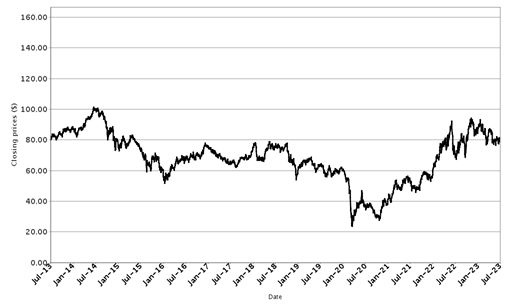
HISTORIC PERFORMANCE IS NOT AN INDICATION OF FUTURE PERFORMANCE.
Source: Bloomberg L.P. We have not independently verified the accuracy or completeness of the information obtained from Bloomberg Financial Markets.
15
|
Supplemental Plan of Distribution (Conflicts of Interest)
|
We have agreed to indemnify UBS and RBCCM against liabilities under the Securities Act of 1933, as amended, or to contribute payments that UBS and RBCCM may be required to make relating to these
liabilities as described in the prospectus supplement and the prospectus. We have agreed that UBS may sell all or a part of the Securities that it will purchase from us to investors or to its affiliates at the price indicated on the cover page of
this pricing supplement.
UBS may allow a concession not in excess of the underwriting discount set forth on the cover page of this pricing supplement to its affiliates for distribution of the Securities.
Subject to regulatory constraints and market conditions, RBCCM intends to offer to purchase the Securities in the secondary market, but it is not required to do so.
We or our affiliates may enter into swap agreements or related hedge transactions with one of our other affiliates or unaffiliated counterparties in connection with the sale of the Securities and
RBCCM and/or an affiliate may earn additional income as a result of payments pursuant to the swap or related hedge transactions. See “Use of Proceeds and Hedging” in the accompanying product prospectus supplement UBS-EQUITY-1.
The value of the Securities shown on your account statement may be based on RBCCM’s estimate of the value of the Securities if RBCCM or another of our affiliates were to make a market in the
Securities (which it is not obligated to do). That estimate will be based upon the price that RBCCM may pay for the Securities in light of then prevailing market conditions, our creditworthiness and transaction costs. For a period of approximately
eight months after the issue date, the value of the Securities that may be shown on your account statement may be higher than RBCCM’s estimated value of the Securities at that time. This is because the estimated value of the Securities will not
include the underwriting discount or our hedging costs and profits; however, the value of the Securities shown on your account statement during that period may be a higher amount, reflecting the addition of the underwriting discount and our
estimated costs and profits from hedging the Securities. Any such excess is expected to decrease over time until the end of this period. After this period, if RBCCM repurchases your Securities, it expects to do so at prices that reflect their
estimated value. This period may be reduced at RBCCM’s discretion based on a variety of factors, including but not limited to, the amount of the Securities that we repurchase and our negotiated arrangements from time to time with UBS.
For additional information as to the relationship between us and RBCCM, please see the section “Plan of Distribution—Conflicts of Interest” in the prospectus dated September 14, 2021.
|
Structuring the Securities
|
The Securities are our debt securities, the return on which is linked to the performance of the Underlying. As is the case for all of our debt securities, including our structured
notes, the economic terms of the Securities reflect our actual or perceived creditworthiness at the time of pricing. In addition, because structured notes result in increased operational, funding and liability management costs to us, we typically
borrow the funds under these Securities at a rate that is more favorable to us than the rate that we might pay for a conventional fixed or floating rate debt security of comparable maturity. Using this relatively lower implied borrowing rate rather
than a secondary market rate is a factor that resulted in a higher initial estimated value of the Securities at the time their terms were set than if a secondary market rate was used. Unlike the estimated value that is set forth on the cover page
of this pricing supplement, any value of the Securities determined for purposes of a secondary market transaction may be based on a different borrowing rate, which may result in a lower value for the Securities than if our initial internal
borrowing rate were used.
In order to satisfy our payment obligations under the Securities, we may choose to enter into certain hedging arrangements (which may include call options, put options or other
derivatives) on the issue date with RBCCM or one of our other subsidiaries. The terms of these hedging arrangements take into account a number of factors, including our creditworthiness, interest rate movements, the volatility of the Underlying,
and the tenor of the Securities. The economic terms of the Securities and their initial estimated value depend in part on the terms of these hedging arrangements.
The lower implied borrowing rate is a factor that reduced the economic terms of the Securities to you. The initial offering price of the Securities also reflects the underwriting discount and our
estimated hedging costs. These factors resulted in the initial estimated value for the Securities on the Trade Date being less than their public offering price. See “Key Risks—The Initial Estimated Value of the Securities Is Less than the Price to
the Public” above.
16
|
Terms Incorporated in Master Note
|
The terms appearing above under the caption “Final Terms of the Securities” and the provisions in the accompanying product prospectus supplement UBS-EQUITY-1 dated October 6, 2021
under the caption “General Terms of the Securities,” are incorporated into the master note issued to DTC, the registered holder of the Securities.
|
Validity of the Securities
|
In the opinion of Norton Rose Fulbright Canada LLP, the issue and sale of the Securities has been duly authorized by all necessary corporate action of the Bank in conformity with the
Indenture, and when the Securities have been duly executed, authenticated and issued in accordance with the Indenture and delivered against payment therefor, the Securities will be validly issued and, to the extent validity of the Securities is a
matter governed by the laws of the Province of Ontario or Québec, or the laws of Canada applicable therein, will be valid obligations of the Bank, subject to equitable remedies which may only be granted at the discretion of a court of competent
authority, subject to applicable bankruptcy, to rights to indemnity and contribution under the Securities or the Indenture which may be limited by applicable law, to insolvency and other laws of general application affecting creditors’ rights, to
limitations under applicable limitations statutes, and to limitations as to the currency in which judgments in Canada may be rendered, as prescribed by the Currency Act (Canada). This opinion is given as of the date hereof and is limited to the
laws of the Provinces of Ontario and Québec and the federal laws of Canada applicable thereto. In addition, this opinion is subject to customary assumptions about the Trustee’s authorization, execution and delivery of the Indenture and the
genuineness of signatures and certain factual matters, all as stated in the letter of such counsel dated September 14, 2021, which has been filed as Exhibit 5.3 to Royal Bank’s Form 6-K filed with the SEC dated September 14, 2021.
In the opinion of Ashurst LLP, when the Securities have been duly completed in accordance with the Indenture and issued and sold as contemplated by the prospectus supplement and the prospectus, the
Securities will be valid, binding and enforceable obligations of the Bank, entitled to the benefits of the Indenture, subject to applicable bankruptcy, insolvency, fraudulent transfer, reorganization, moratorium and similar laws of general
applicability relating to or affecting creditors' rights and subject to general principles of equity, public policy considerations and the discretion of the court before which any suit or proceeding may be brought. This opinion is given as of the
date hereof and is limited to the laws of the State of New York. This opinion is subject to customary assumptions about the Trustee’s authorization, execution and delivery of the Indenture and the genuineness of signatures and to such counsel’s
reliance on the Bank and other sources as to certain factual matters, all as stated in the legal opinion dated September 14, 2021, which has been filed as Exhibit 5.4 to the Bank’s Form 6-K dated September 14, 2021.
17