 BNY
Mellon Core Plus Fund
BNY
Mellon Core Plus Fund
BNY
Mellon Core Plus Fund
Summary Prospectus | August 29, 2025
Class A DCPAX
Class C DCPCX
Class I DCPIX
Class Y DCPYX
Before you invest, you may want to review the fund's prospectus, which contains more information about the fund and its risks. You can find the fund's prospectus and other information about the fund, including the statement of additional information and most recent reports to shareholders, online at www.bny.com/investments/literaturecenter. You can also get this information at no cost by calling 1-800-373-9387 (inside the U.S. only) or by sending an e-mail request to info@bny.com. The fund's prospectus and statement of additional information, dated August 29, 2025 (each as revised or supplemented), are incorporated by reference into this summary prospectus.
The fund seeks high total return consistent with preservation of capital.
This table describes the fees and expenses that you may pay if you buy, hold and sell shares of the fund. You may pay other fees, such as brokerage commissions and other fees to financial intermediaries, which are not reflected in the table and examples below. You may qualify for sales charge discounts if you and your family invest, or agree to invest in the future, at least $50,000 in the fund or shares of other funds in the BNY Mellon Family of Funds that are subject to a sales charge. More information about sales charges, including these and other discounts and waivers, is available from your financial professional and in the Shareholder Guide section beginning on page 17 of the prospectus, in the Appendix on page A-1 of the prospectus and in the How to Buy Shares section and the Additional Information About How to Buy Shares section beginning on page II-1 and page III-1, respectively, of the fund's Statement of Additional Information.
Shareholder Fees (fees paid directly from your investment) | ||||
Class A | Class C | Class I | Class Y | |
Maximum sales charge (load) imposed on purchases (as a percentage of offering price) | 4.50 | none | none | none |
Maximum deferred sales charge (load) (as a percentage of lower of purchase or sale price) | none* | 1.00 | none | none |
Annual Fund Operating Expenses (expenses that you pay each year as a percentage of the value of your investment) | |||||
Class A | Class C | Class I | Class Y | ||
Management fees | .35 | .35 | .35 | .35 | |
Distribution (12b-1) fees | none | .75 | none | none | |
Other expenses: | |||||
Shareholder services fees | .25 | .25 | none | none | |
Miscellaneous other expenses | .11 | .14 | .11 | .04 | |
Total other expenses | .36 | .39 | .11 | .04 | |
Total annual fund operating expenses | .71 | 1.49 | .46 | .39 | |
Fee waiver and/or expense reimbursement** | (.01) | (.04) | (.01) | - | |
Total
annual fund operating expenses | .70 | 1.45 | .45 | .39 | |
* Class A shares bought without an initial sales charge as part of an investment of $250,000 or more may be charged a deferred sales charge of 1.00% if redeemed within one year.
** The fund's investment adviser, BNY Mellon Investment Adviser, Inc., has contractually agreed, until August 29, 2026, to waive receipt of its fees and/or assume the direct expenses of the fund so that the direct expenses of none of the fund's share classes (excluding Rule 12b-1 fees, shareholder services fees, taxes, interest expense, brokerage commissions, commitment fees on borrowings and extraordinary expenses) exceed .45%. On or after August 29, 2026, BNY Mellon Investment Adviser, Inc. may terminate this expense limitation agreement at any time.
|
Example
The Example is intended to help you compare the cost of investing in the fund with the cost of investing in other mutual funds. The Example assumes that you invest $10,000 in the fund for the time periods indicated. The Example also assumes that your investment has a 5% return each year and that the fund's operating expenses remain the same. The one-year example and the first year of the three-, five- and ten-years examples are based on net operating expenses, which reflect the expense limitation agreement by BNY Mellon Investment Adviser, Inc. Although your actual costs may be higher or lower, based on these assumptions your costs would be:
1 Year | 3 Years | 5 Years | 10 Years | |
Class A (with or without redemption at end of period) | $518 | $666 | $826 | $1,292 |
Class C (with redemption at end of period) | $248 | $467 | $809 | $1,776 |
Class C (without redemption at end of period) | $148 | $467 | $809 | $1,776 |
Class I (with or without redemption at end of period) | $46 | $147 | $257 | $578 |
Class Y (with or without redemption at end of period) | $40 | $125 | $219 | $493 |
Portfolio Turnover
The fund pays transaction costs, such as commissions, when it buys and sells securities (or "turns over" its portfolio). A higher portfolio turnover may indicate higher transaction costs and may result in higher taxes when fund shares are held in a taxable account. These costs, which are not reflected in annual fund operating expenses or in the Example, affect the fund's performance. During the most recent fiscal year, the fund's portfolio turnover rate was 111.76% of the average value of its portfolio.
To pursue its goal, the fund normally invests in a diversified portfolio of fixed-income securities of U.S. and foreign issuers. The fixed-income securities in which the fund may invest include: (i) securities issued or guaranteed by the U.S. government, its agencies or government sponsored enterprises (U.S. government securities); (ii) corporate debt securities, including bonds, notes, debentures, convertible securities, preferred stock and corporate commercial paper; issued by U.S. and non-U.S. corporations and other entities, such as master limited partnerships; (iii) mortgage-related securities; (iv) asset-backed securities; (v) inflation indexed bonds issued by governments or corporations; (vi) structured notes (i.e., specially designed debt instruments whose return is determined by reference to an index or security); (vii) loan participations and assignments; (viii) delayed funding loans and revolving credit facilities; (ix) bank certificates of deposit, fixed time deposits and bankers' acceptances; (x) repurchase agreements and reverse repurchase agreements; (xi) debt securities issued by states or local governments or their agencies, authorities or other government sponsored enterprises (municipal securities); (xii) obligations of foreign governments or their subdivisions, agencies or government sponsored enterprises; and (xiii) obligations of international agencies or supranational entities. These securities may have all types of interest rate payment and reset terms, including fixed rate, adjustable rate, floating rate, zero coupon, contingent, deferred, payment in kind and auction rate features.
The fund normally invests primarily in fixed-income securities rated, at the time of purchase, investment grade (i.e., Baa3/BBB- or higher) or the unrated equivalent as determined by Insight North America LLC, the fund's sub-adviser. The fund, however, may invest up to 25% of its net assets in fixed-income securities rated, at the time of purchase, below investment grade ("high yield" or "junk" bonds) or the unrated equivalent as determined by the fund's sub-adviser.
Typically, the fund's portfolio can be expected to have an average effective duration ranging between three and eight years. The fund's sub-adviser may lengthen or shorten the fund's portfolio duration outside this range depending on its evaluation of market conditions. Duration is an indication of an investment's "interest rate risk," or how sensitive a bond or the fund's portfolio may be to changes in interest rates. Generally, the longer a bond's duration, the more likely it is to react to interest rate fluctuations and the greater its long-term risk/return potential.
In constructing the fund's portfolio, the sub-adviser relies primarily on proprietary, internally-generated credit research. This credit research focuses on both industry/sector analysis and detailed individual security selection. The fund's sub-adviser seeks to identify investment opportunities for the fund based on its evaluation of the relative value of sectors and securities and the credit risk of individual issuers. The sub-adviser uses fundamental credit analysis to estimate the relative value and attractiveness of various sectors and securities and to exploit pricing inefficiencies in fixed-income markets. The sub-adviser analyzes individual issuer credit risk based on factors such as management depth and experience, competitive advantage, market and product position and overall financial strength. The sub-adviser may supplement its internal research with external, third-party credit research and related credit tools.
BNY Mellon Core Plus Fund Summary | 2 |
The fund may use derivative instruments as a substitute for investing directly in an underlying asset, to increase returns, to manage interest rate risk, to manage the effective duration or maturity of the fund's portfolio, or as part of a hedging strategy. The derivative instruments in which the fund may invest typically include options, futures and options on futures (including those relating to securities, foreign currencies, indices and interest rates), forward contracts (including foreign currency forward contracts), swaps (including total return, currency, interest rate and credit default swaps), and other derivative instruments (including structured notes).
The fund may sell securities when the sub-adviser anticipates market declines or credit downgrades. In addition, the fund may sell securities when the sub-adviser identifies new investment opportunities.
An investment in the fund is not a bank deposit. It is not insured or guaranteed by the Federal Deposit Insurance Corporation (FDIC) or any other government agency. It is not a complete investment program. The fund's share price fluctuates, sometimes dramatically, which means you could lose money.
· Fixed-income market risk: The market value of a fixed-income security may decline due to general market conditions that are not specifically related to a particular company, such as real or perceived adverse economic conditions, changes in the outlook for corporate earnings, changes in interest or currency rates or adverse investor sentiment generally. The fixed-income securities market can be susceptible to increases in volatility and decreases in liquidity. Liquidity can decline unpredictably in response to overall economic conditions or credit tightening. Increases in volatility and decreases in liquidity may be caused by a rise in interest rates (or the expectation of a rise in interest rates). An unexpected increase in fund redemption requests, including requests from shareholders who may own a significant percentage of the fund's shares, which may be triggered by market turmoil or an increase in interest rates, could cause the fund to sell its holdings at a loss or at undesirable prices and adversely affect the fund's share price and increase the fund's liquidity risk, fund expenses and/or taxable distributions. Federal Reserve policy in response to market conditions, including with respect to interest rates, may adversely affect the value, volatility and liquidity of dividend and interest paying securities. Policy and legislative changes worldwide are affecting many aspects of financial regulation. The impact of these changes on the markets and the practical implications for market participants may not be fully known for some time.
· Interest rate risk: Prices of bonds and other fixed rate fixed-income securities tend to move inversely with changes in interest rates. Typically, a rise in rates will adversely affect fixed-income securities and, accordingly, will cause the value of the fund's investments in these securities to decline. A wide variety of market factors can cause interest rates to rise, including central bank monetary policy, rising inflation and changes in general economic conditions. It is difficult to predict the pace at which central banks or monetary authorities may increase (or decrease) interest rates or the timing, frequency, or magnitude of such changes. During periods of very low interest rates, which occur from time to time due to market forces or actions of governments and/or their central banks, including the Board of Governors of the Federal Reserve System in the U.S., the fund may be subject to a greater risk of principal decline from rising interest rates. When interest rates fall, the fund's investments in new securities may be at lower yields and may reduce the fund's income. Changing interest rates may have unpredictable effects on markets, may result in heightened market volatility and may detract from fund performance. The magnitude of these fluctuations in the market price of fixed-income securities is generally greater for securities with longer effective maturities and durations because such instruments do not mature, reset interest rates or become callable for longer periods of time. Unlike investment grade bonds, however, the prices of high yield ("junk") bonds may fluctuate unpredictably and not necessarily inversely with changes in interest rates. Interest rate changes may have different effects on the values of mortgage-related securities because of prepayment and extension risks. In addition, the rates on floating rate instruments adjust periodically with changes in market interest rates. Although these instruments are generally less sensitive to interest rate changes than fixed rate instruments, the value of floating rate loans and other floating rate securities may decline if their interest rates do not rise as quickly, or as much, as general interest rates.
· Credit risk: Failure of an issuer of a security to make timely interest or principal payments when due, or a decline or perception of a decline in the credit quality of the security, can cause the security's price to fall. The lower a security's credit rating, the greater the chance that the issuer of the security will default or fail to meet its payment obligations.
· High yield securities risk: High yield ("junk") securities involve greater credit risk, including the risk of default, than investment grade securities, and are considered predominantly speculative with respect to the issuer's ability to make principal and interest payments. These securities are especially sensitive to adverse changes in general economic conditions, to changes in the financial condition of their issuers and to price fluctuation in response to changes in interest rates. During periods of economic downturn or rising interest rates, issuers of below investment grade securities may experience financial stress that could adversely affect their ability to make payments of principal and interest and increase the possibility of default.
BNY Mellon Core Plus Fund Summary | 3 |
· Issuer risk: A security's market value may decline for a number of reasons which directly relate to the issuer, such as management performance, financial leverage and reduced demand for the issuer's products or services, or factors that affect the issuer's industry, such as labor shortages or increased production costs and competitive conditions within an industry.
· Management risk: The investment process used by the fund's sub-adviser could fail to achieve the fund's investment goal and cause your fund investment to lose value.
· Market risk: The value of the securities in which the fund invests may be affected by political, regulatory, economic and social developments, and developments that impact specific economic sectors, industries or segments of the market. In addition, turbulence in financial markets and reduced liquidity in equity, credit and/or fixed-income markets may negatively affect many issuers, which could adversely affect the fund. Global economies and financial markets are becoming increasingly interconnected, and conditions and events in one country, region or financial market may adversely impact issuers in a different country, region or financial market. These risks may be magnified if certain events or developments adversely interrupt the global supply chain; in these and other circumstances, such risks might affect companies world-wide. Local, regional or global events such as war, military conflicts, acts of terrorism, natural disasters, the spread of infectious illness or other public health issues, recessions, elevated levels of government debt, changes in trade regulation or economic sanctions, internal unrest and discord, or other events could have a significant impact on the fund and its investments.
· Liquidity risk: When there is little or no active trading market for specific types of securities, it can become more difficult to sell the securities in a timely manner at or near their perceived value. In such a market, the value of such securities and the fund's share price may fall dramatically. Investments that are illiquid or that trade in lower volumes may be more difficult to value. The market for below investment grade securities may be less liquid and therefore these securities may be harder to value or sell at an acceptable price, especially during times of market volatility or decline. Investments in foreign securities tend to have greater exposure to liquidity risk than domestic securities.
· Foreign investment risk: To the extent the fund invests in foreign securities, the fund's performance will be influenced by political, social and economic factors affecting investments in foreign issuers. Special risks associated with investments in foreign issuers include exposure to currency fluctuations, less liquidity, less developed or less efficient trading markets, lack of comprehensive company information, political and economic instability and differing auditing and legal standards.
· Foreign government obligations and securities of supranational entities risk: Investing in foreign government obligations, debt obligations of supranational entities and the sovereign debt of foreign countries creates exposure to the direct or indirect consequences of political, social or economic changes in the countries that issue the securities or in which the issuers are located. A governmental obligor may default on its obligations. Some sovereign obligors have been among the world's largest debtors to commercial banks, other governments, international financial organizations and other financial institutions. These obligors, in the past, have experienced substantial difficulties in servicing their external debt obligations, which led to defaults on certain obligations and the restructuring of certain indebtedness.
· Government securities risk: Not all obligations of the U.S. government, its agencies and instrumentalities are backed by the full faith and credit of the U.S. Treasury. Some obligations are backed only by the credit of the issuing agency or instrumentality, and in some cases there may be some risk of default by the issuer. Any guarantee by the U.S. government or its agencies or instrumentalities of a security held by the fund does not apply to the market value of such security or to shares of the fund itself.
· Derivatives risk: A small investment in derivatives could have a potentially large impact on the fund's performance. The use of derivatives involves risks different from, or possibly greater than, the risks associated with investing directly in the underlying assets, and the fund's use of derivatives may result in losses to the fund. Derivatives in which the fund may invest can be highly volatile, illiquid and difficult to value, and there is the risk that changes in the value of a derivative held by the fund will not correlate with the underlying assets or the fund's other investments in the manner intended. Certain derivatives have the potential for unlimited loss, regardless of the size of the initial investment, and involve greater risks than the underlying assets because, in addition to general market risks, they are subject to liquidity risk, credit and counterparty risk (failure of the counterparty to the derivatives transaction to honor its obligation) and pricing risk (risk that the derivative cannot or will not be accurately valued).
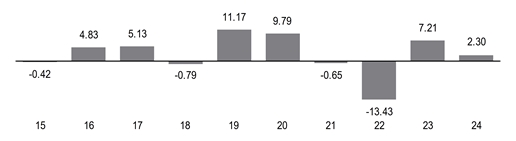
The following bar chart and table provide some indication of the risks of investing in the fund. The fund commenced operations after all of the assets of another investment company advised by the fund's sub-adviser, Insight Investment Grade Bond Fund (the "predecessor fund"), were transferred to the fund in exchange for Class Y shares of the fund in a tax-free reorganization on February 2, 2018. The bar chart shows the changes in the performance of the fund's Class Y shares from year to year based on the performance of the predecessor fund's Institutional Class shares for periods prior to February 2, 2018 and the performance of the fund's Class Y shares thereafter. Sales charges, if any, are not reflected in the bar chart and, if those charges were included, returns would have been less than those shown. The table compares the average annual total returns of the fund's shares (based
BNY Mellon Core Plus Fund Summary | 4 |
on the performance of the predecessor fund's Institutional Class shares for periods prior to February 2, 2018 and the performance of the respective class of the fund's shares thereafter) to those of a broad measure of market performance. The fund's past performance (before and after taxes) is not necessarily an indication of how the fund will perform in the future. Performance for each share class will vary due to differences in expenses. More recent performance information may be available at www.bny.com/investments.
| During the periods shown in the chart: |
The year-to-date total return of the fund's Class Y shares as of June 30, 2025 was 4.04%.
*Represents the performance of the predecessor fund's Institutional Class shares for periods prior to February 2, 2018 and the performance of the fund's Class Y Shares thereafter.
After-tax performance is shown only for Class Y shares (based on the performance of the predecessor fund's Institutional Class shares for periods prior to February 2, 2018 and the performance of the fund's Class Y shares thereafter). After-tax performance of the fund's other share classes will vary. After-tax returns are calculated using the historical highest individual federal marginal income tax rates, and do not reflect the impact of state and local taxes. Actual after-tax returns depend on the investor's tax situation and may differ from those shown, and the after-tax returns shown are not relevant to investors who hold their shares through U.S. tax-deferred arrangements such as 401(k) plans or individual retirement accounts. Returns after taxes on distributions and sale of fund shares may be higher than returns before taxes or returns after taxes on distributions due to an assumed tax benefit from losses on a sale of the fund's shares at the end of the period.
Performance for the fund's Class A, C, I and Y shares represents the performance of the predecessor fund's Institutional Class shares for periods prior to February 2, 2018. Such performance figures have not been adjusted to reflect applicable class fees and expenses of Class A, C, I and Y shares; if such fees and expenses had been reflected, the performance shown for Class A and C shares would have been lower. Each share class is invested in the same portfolio of securities, and the annual returns would have differed only to the extent that the classes have different expenses.
Average Annual Total Returns (as of 12/31/24) | |||
Class | 1 Year | 5 Years | 10 Years |
Class Y returns before taxes | 2.30% | 0.70% | 2.29% |
Class Y returns after taxes on distributions | 0.46% | -0.74% | 0.89% |
Class Y returns after taxes on distributions and sale of fund shares | 1.35% | -0.06% | 1.15% |
Class A returns before taxes | -2.53% | -0.51% | 1.62% |
Class C returns before taxes | 0.24% | -0.37% | 1.56% |
Class I returns before taxes | 2.24% | 0.66% | 2.26% |
Bloomberg U.S. Aggregate
Bond Index | 1.25% | -0.33% | 1.351% |
The fund's investment adviser is BNY Mellon Investment Adviser, Inc. (BNYIA). BNYIA has engaged its affiliate, Insight North America LLC (INA), to serve as the fund's sub-adviser.
James DiChiaro, Scott Zaleski, CFA and Brendan Murphy, CFA are the fund's primary portfolio managers, positions they have held since August 2019, November 2023 and February 2024, respectively. Mr. DiChiaro is a senior portfolio manager at INA. Mr. Zaleski is Head of US Multi-Sector Fixed Income at INA. Mr. Murphy is Head of Fixed Income, North America, at INA.
In general, for each share class, other than Class Y, the fund's minimum initial investment is $1,000 and the minimum subsequent investment is $100. For Class Y shares, the minimum initial investment generally is $1,000,000, with no minimum subsequent
BNY Mellon Core Plus Fund Summary | 5 |
investment. You may sell (redeem) your shares on any business day by calling 1-800-373-9387 (inside the U.S. only) or by visiting www.bny.com/investments. If you invested in the fund through a third party, such as a bank, broker-dealer or financial adviser, or through a Retirement Plan (as defined below), you may mail your request to sell shares to BNY Institutional Services, P.O. Box 534442, Pittsburgh, Pennsylvania 15253-4442. If you invested directly through the fund, you may mail your request to sell shares to BNY Shareholder Services, P.O. Box 534434, Pittsburgh, Pennsylvania 15253-4434. If you are an Institutional Direct accountholder, please contact your BNY relationship manager for instructions.
Retirement Plans include qualified or non-qualified employee benefit plans, such as 401(k), 403(b)(7), Keogh, pension, profit-sharing and other deferred compensation plans, whether established by corporations, partnerships, sole proprietorships, non-profit entities, trade or labor unions, or state and local governments, but do not include IRAs (including, without limitation, traditional IRAs, Roth IRAs, Coverdell Education Savings Accounts, IRA "Rollover Accounts" or IRAs set up under Simplified Employee Pension Plans (SEP-IRAs), Salary Reduction Simplified Employee Pension Plans (SARSEPs) or Savings Incentive Match Plans for Employees (SIMPLE IRAs)).
The fund's distributions are taxable as ordinary income or capital gains, except when your investment is through an IRA, Retirement Plan or other U.S. tax-advantaged investment plan (in which case you may be taxed upon withdrawal of your investment from such account).
If you purchase shares through a broker-dealer or other financial intermediary (such as a bank), the fund's distributor and its related companies may pay the intermediary for the sale of fund shares and related services. To the extent that the intermediary may receive lesser or no payments in connection with the sale of other investments, the payments from the fund's distributor and its related companies may create a potential conflict of interest by influencing the broker-dealer or other intermediary and your financial representative to recommend the fund over the other investments. This potential conflict of interest may be addressed by policies, procedures or practices adopted by the financial intermediary. As there may be many different policies, procedures or practices adopted by different intermediaries to address the manner in which compensation is earned through the sale of investments or the provision of related services, the compensation rates and other payment arrangements that may apply to a financial intermediary and its representatives may vary by intermediary. Ask your financial representative or visit your financial intermediary's website for more information.
This prospectus does not constitute an offer or solicitation in any state or jurisdiction in which, or to any person to whom, such offering or solicitation may not lawfully be made.
BNY Mellon Core Plus Fund Summary | 6 |