
AMENDMENT NO. 1 TO FORM 1-A
DOC.COM INC.
3,000,000 SHARES OF CLASS A COMMON STOCK
$8 PER CLASS A SHARE
No Minimum Investment or Offering Amount
This is a Tier 2 offering pursuant to Regulation A of Doc.com Inc., a Delaware corporation (the “Company”). The Company is offering up to 3,000,000 shares of its Class A Common Stock (“Common Stock”), at an offering price of $8 per share (the “Offered Shares”). This Offering will terminate twelve months from the day the Offering is qualified, subject to extension for up to ninety (90) days or the date on which the maximum offering amount is sold (such earlier date, the “Termination Date”). There is no minimum purchase requirement.
Nasdaq Listing Application. The Company has applied for listing of its Class A Common Stock on The Nasdaq Stock Market LLC (“Nasdaq”). This offering is not contingent upon approval of listing on Nasdaq, and there can be no assurance that the Company’s application will be approved. If approved, the Company intends to list its Class A Common Stock on Nasdaq under the listing standard set forth in Nasdaq Listing Rule 5505 (the “Nasdaq Capital Market” listing requirements). The Company believes it currently meets the quantitative listing standards under Rule 5505, including the minimum bid price, minimum stockholders’ equity, and public float requirements; however, the Company’s ability to satisfy these requirements at the time of listing is subject to market conditions and other factors beyond its control, and there can be no assurance that the Company will meet all applicable Nasdaq listing requirements at the time of listing or thereafter.
Obligations Triggered by Nasdaq Listing. Investors should be aware that a Nasdaq listing, if achieved, will trigger certain material obligations, including: (i) approximately $49,248,249 in deferred purchase price payments owed to the former shareholders of TMB Financial (as defined below), with the first $10,000,000 payment due within 60 days after listing; (ii) approximately $252,739 in deferred purchase price payments owed to Aaron Trager in connection with the 405 Ontario/Flat Iron Pharmacy (both as defined below) acquisition, payable within 60 calendar days after listing; and (iii) the issuance of warrants to Silver Rock Group to purchase a number of shares of Class A Common Stock equal to 4% of total outstanding shares on a fully diluted basis immediately after listing, exercisable for five years at the lower of $2.00 per share or 110% of the listing price. See “Risk Factors - We have significant outstanding acquisition obligations that could impair our financial condition” and “Risk Factors - Outstanding and committed warrants and the Silver Rock committed equity facility may result in significant dilution to investors.”
These securities are speculative securities. Investment in the Company’s common stock involves significant risks. You should purchase these securities only if you can afford a complete loss of your investment. See the “Risk Factors” section beginning on page 6 of this Offering Circular.
Subscriptions are irrevocable and the purchase price is non-refundable. All proceeds received by us from subscribers for the Offered Shares will be available for our use upon acceptance of subscriptions by us. We may dispose of the proceeds in accordance with the “Use of Proceeds” section of this Offering Circular.
Sales of these shares will commence only after qualification of the Offering Statement of which this Offering Circular forms a part (the “Offering Statement”) and upon acceptance of subscriptions by us. This will be a continuous Offering pursuant to Rule 251(d)(3)(i)(F) of the Securities and Exchange Commission. This Offering will be conducted on a “best-efforts” basis. No person will receive any commission or any other remuneration in connection with this Offering. No finder, platform, marketing agent, or compensated solicitor will be used in connection with this Offering.
This Offering Circular shall not constitute an offer to sell or the solicitation of an offer to buy, nor shall there be any sales of these securities in any state or jurisdiction in which such offer, solicitation or sale would be unlawful, prior to registration or qualification under the laws of any such state.
Doc.com Inc., has three classes of common shares: Class A common shares, Class B common shares, and Class C common shares. We refer to the Class A common shares and the Class B common shares collectively as our ‘‘common shares.’’ As of the date this Offering Circular was filed, there are no Class C common shares issued or outstanding. Each Class A common share has one vote on all matters submitted to a vote of stockholders. Each Class B common share has twenty votes on all matters submitted to a vote of stockholders. Our Chief Executive Officer, Charles Nader, owns 15,000,000 Class B shares and 145,000,003 Class A Shares together giving him 92.50% voting control of the company.
We are using the S-1 (Part I) disclosure format in this Offering Circular.
Per Share | Total Maximum | |||||||
| Public Offering Price | $ | 8 | $ | 24,000,000 | ||||
| Underwriting/Sales Commissions | $ | — | $ | — | ||||
| Proceeds to Company | $ | 8 | $ | 24,000,000 | ||||
Our Board of Directors (the “Board”) used its business judgment in setting a value of $8 per share to us as consideration for the stock to be issued under the Offering. The sales price per share bears no relationship to our book value or any other measure of our current value or worth.
THE UNITED STATES SECURITIES AND EXCHANGE COMMISSION DOES NOT PASS UPON THE MERITS OF OR GIVE ITS APPROVAL TO ANY SECURITIES OFFERED OR THE TERMS OF THE OFFERING, NOR DOES IT PASS UPON THE ACCURACY OR COMPLETENESS OF ANY OFFERING CIRCULAR OR OTHER SOLICITATION MATERIALS. THESE SECURITIES ARE OFFERED PURSUANT TO AN EXEMPTION FROM REGISTRATION WITH THE COMMISSION; HOWEVER, THE COMMISSION HAS NOT MADE AN INDEPENDENT DETERMINATION THAT THE SECURITIES OFFERED ARE EXEMPT FROM REGISTRATION.
We are scaling AI powered and blockchain secured telehealth services for consumers. We also sell over-the-counter products and prescription drugs and plan to sell epidemiological analytics, ads and healthcare device services as well as technology services for hospitalization and clinics.
TABLE OF CONTENTS
We are offering to sell, and seeking offers to buy, our securities only in jurisdictions where such offers and sales are permitted. You should rely only on the information contained in this Offering Circular. We have not authorized anyone to provide you with any information other than the information contained in this Offering Circular. The information contained in this Offering Circular is accurate only as of its date, regardless of the time of its delivery or of any sale or delivery of our securities. Neither the delivery of this Offering Circular nor any sale or delivery of our securities shall, under any circumstances, imply that there has been no change in our affairs since the date of this Offering Circular. This Offering Circular will be updated and made available for delivery to the extent required by the federal securities laws.
In this Offering Circular, unless the context indicates otherwise, references to “Doc.com” “we,” the “Company,” “our” and “us” refer to the business and operations of Doc.com Inc.
This Offering Circular is part of an Offering Statement on Form 1-A, as amended, that we filed with the SEC, using a continuous offering process. Periodically, as we have material developments, we will provide an Offering Circular supplement that may add, update or change information contained in this Offering Circular. Any statement that we make in this Offering Circular will be modified or superseded by any inconsistent statement made by us in a subsequent Offering Circular supplement. The Offering Statement that we filed with the SEC includes exhibits that provide more detailed descriptions of the matters discussed in this Offering Circular. You should read this Offering Circular and the related exhibits filed with the SEC and any Offering Circular supplement. See the section of this Offering Circular entitled “Where You Can Find More Information” for more details.
| 2 |
STATE LAW EXEMPTION AND PURCHASE RESTRICTIONS
Our Class A Common Stock is being offered and sold only to “qualified purchasers” (as defined in Rule 251(d)(2)(i)(C) of Regulation A). As a Tier 2 offering pursuant to Regulation A, this offering will be exempt from state “Blue Sky” review, subject to meeting certain state filing requirements and complying with certain anti-fraud provisions. Our Class A Common Stock will be offered and sold only to “qualified purchasers” until such time that our Class A Common Stock is listed on a national securities exchange. “Qualified purchasers” include: (i) “accredited investors” under Rule 501(a) of Regulation D under the Securities Act of 1933 (“Regulation D”) and (ii) all other investors so long as their investment in our Common Stock does not represent more than 10% of the greater of their annual income or net worth (for natural persons), or 10% of the greater of annual revenue or net assets at fiscal year-end (for non-natural persons). We reserve the right to reject any investor’s subscription in whole or in part for any reason, including if we determine in our sole and absolute discretion that such investor is not a “qualified purchaser” for purposes of Regulation A.
To determine whether a potential investor is an “accredited investor” for purposes of satisfying one of the tests in the “qualified purchaser” definition, the investor must satisfy one or more of the categories set forth in Rule 501(a) of Regulation D. For natural persons, these categories include, among others: (i) individual net worth, or joint net worth with the person’s spouse or spousal equivalent, exceeding $1,000,000 at the time of purchase (excluding the value of the primary residence); (ii) individual income exceeding $200,000 in each of the two most recent years, or joint income with a spouse or spousal equivalent exceeding $300,000 in each of those years, with a reasonable expectation of the same income level in the current year; or (iii) holding in good standing a Series 7, Series 65, or Series 82 professional license. For entities, the categories include banks, broker-dealers, insurance companies, registered investment companies, business development companies, organizations with total assets exceeding $5,000,000, family offices with assets under management exceeding $5,000,000, and certain other entities described in Rule 501(a). See “Plan of Distribution—Investment Limitations” for the complete list of Accredited Investor categories.
If the investor is not a natural person, different standards apply. See Rule 501(a) of Regulation D for more details.
For purposes of determining whether a potential investor is a “qualified purchaser,” annual income and net worth should be calculated as provided in the “accredited investor” definition under Rule 501 of Regulation D. In particular, net worth in all cases should be calculated excluding the value of an investor’s primary residence.
| 3 |
CAUTIONARY STATEMENT REGARDING FORWARD-LOOKING STATEMENTS
Some of the statements under “Risk Factors,” “Management’s Discussion and Analysis of Financial Condition and Results of Operations,” “Business” and elsewhere in this Offering Circular constitute forward-looking statements. Forward-looking statements relate to expectations, beliefs, projections, future plans and strategies, anticipated events or trends and similar matters that are not historical facts. In some cases, you can identify forward- looking statements by terms such as “anticipate,” “believe,” “could,” “estimate,” “expect,” “intend,” “may,” “plan,” “potential,” “should,” “will” and “would” or the negatives of these terms or other comparable terminology.
You should not place undue reliance on forward looking statements. The cautionary statements set forth in this Offering Circular, including in “Risk Factors” and elsewhere, identify important factors which you should consider in evaluating our forward-looking statements. These factors include, among other things:
| 1. | The speculative nature of our business; | |
| 2. | Concerns about our ability to continue as a “going concern”; | |
| 3. | Our ability to effectively execute our business plan; | |
| 4. | Our ability to manage our expansion, growth and operating expenses; | |
| 5. | Our ability to finance our businesses; | |
| 6. | Our ability to promote our businesses; and | |
| 7. | Our ability to compete and succeed in highly competitive and evolving businesses. |
Although the forward-looking statements in this Offering Circular are based on our beliefs, assumptions and expectations, taking into account all information currently available to us, we cannot guarantee future transactions, results, performance, achievements or outcomes. No assurance can be made to any investor by anyone that the expectations reflected in our forward-looking statements will be attained, or that deviations from them will not be material and adverse. We undertake no obligation, other than as may be required by law, to amend this Offering Circular or otherwise make public statements updating our forward-looking statements.
| 4 |
| Securities offered: | A maximum of 3,000,000 shares of Class A common stock. | |
| Number of Class A common shares outstanding before the offering: | 187,037,269 shares | |
| Number of Class A common shares to be outstanding after the offering: | 190,037,269 shares, if all Offered Shares are sold | |
| Price per share: | $8.00 | |
| Use of Proceeds: | If we sell all of the shares being offered, our net proceeds (before estimated offering expenses) will be $24,000,000. We will use these net proceeds for sales & marketing, platform & software development, CapEx, M&A obligations and general corporate purposes. | |
| Risk factors: | Investing in our common stock involves a high degree of risk, including: Immediate and substantial dilution; and No market for our common stock. See “Risk Factors”. |
As of the date of this Offering Circular, we had 15,000,000 outstanding shares of Class B common stock. The shares of the Class B common stock are not being offered by means of this Offering Circular.
| 5 |
An investment in our Class A common stock involves a number of very significant risks. You should carefully consider the following known material risks and uncertainties in addition to other information in this Offering Circular in evaluating our company and its business before purchasing Class A shares of our company’s common stock. You could lose all or part of your investment due to any of these risks.
Risk factors related to our business.
Our business could be adversely affected by ongoing legal challenges to our business model or by new state actions restricting our ability to provide the full range of our services in certain states.
Our ability to conduct business in each state is dependent upon the state’s treatment of telemedicine (and of remote healthcare delivery in general, such as the permissibility of, and requirements for, physician cross-coverage practice) under such state’s laws, rules and policies governing the practice of medicine, which are subject to changing political, regulatory and other influences. Cross-coverage regulation refers to the state rules under which one doctor is permitted to treat the regular patients of another doctor remotely. Some state medical boards have established new rules or interpreted existing rules in a manner that limits or restricts our ability to conduct our business as currently conducted. Some of these actions could result in litigation and the suspension of our operations in certain states.
We will be dependent on our relationships with affiliated professional entities, which we do not own, to provide physician services, and our business would be adversely affected if those relationships were disrupted.
In all 50 states and the District of Columbia, we are prevented from employing physicians, directing the clinical practice of physicians, or holding an ownership interest in an entity that employs physicians. As a result, we will be dependent on independent service providers, which are owned and staffed by doctors, to render the services needed by our clients.
We depend on our senior management team, and the loss of one or more of our executive officers or key employees or an inability to attract and retain highly skilled employees could adversely affect our business.
Our success depends largely upon the continued services of our key executive officers. We rely on our leadership team in the areas of research and development, marketing, services and general and administrative functions. From time to time, there may be changes in our executive management team resulting from the hiring or departure of executives, which could disrupt our business. The replacement of one or more of our executive officers or other key employees would likely involve significant time and costs and may significantly delay or prevent the achievement of our business objectives.
To continue to execute our growth strategy, we also must attract and retain highly skilled personnel. Competition is intense for qualified professionals. We may not be successful in continuing to attract and retain qualified personnel. We have, from time to time in the past, experienced, and we expect to continue to experience in the future, difficulty in hiring and retaining highly skilled personnel with appropriate qualifications. The pool of qualified personnel with experience working in the healthcare market is limited overall. In addition, many of the companies with which we compete for experienced personnel have greater resources than we do.
In addition, in making employment decisions, particularly in high-technology industries, job candidates often consider the value of the stock options or other equity instruments they are to receive in connection with their employment. Volatility in the price of our stock may, therefore, adversely affect our ability to attract or retain highly skilled personnel. Further, the requirement to expense stock options and other equity instruments may discourage us from granting the size or type of stock option or equity awards that job candidates require to join our company. Failure to attract new personnel or failure to retain and motivate our current personnel, could have a material adverse effect on our business, financial condition and results of operation.
| 6 |
Our software may not operate properly, which could damage our reputation, give rise to claims against us or divert application of our resources from other purposes, any of which could harm our business, financial condition and results of operations.
Our platform provides users and providers with the ability to, among other things, register for our services; complete, view and edit medical history; request a visit (either scheduled or on demand) and conduct a visit (via video or phone) purchase necessary prescription medication provided by independent healthcare providers or over the counter products and have it delivered to them. Proprietary software development is time-consuming, expensive and complex, and may involve unforeseen difficulties. We may encounter technical obstacles, and it is possible that we may discover additional problems that prevent our proprietary applications from operating properly. We will be implementing software with respect to a number of new applications and services. If our software does not function reliably or fails to achieve client expectations in terms of performance, we may experience reduced customer adoption, increased costs, damage to our reputation, and potential legal or regulatory challenges. Moreover, data services are complex and those we plan to offer and may in the future develop or contain, undetected defects or errors. Material performance problems, defects or errors in our new software and applications and services may arise in the future and may result from the interface of our software with systems and data that we did not develop and the function of which is outside of our control or undetected in our testing. These defects and errors, and any failure by us to identify and address them, could result in loss of revenue or market share, diversion of development resources, harm to our reputation and increased service and maintenance costs. Correction of defects or errors could prove to be impossible or impracticable. The costs incurred in correcting any defects or errors may be substantial and could have a material adverse effect on our business, financial condition and results of operations.
Cybersecurity risks and cyber incidents could have a material adverse effect on our business, operations, financial condition, or results of operations. Therefore, cybersecurity is a significant risk factor for our company and our investors.
We rely on our app, information technology systems, and networks to process, transmit, and store electronic information, and to manage or support a variety of our business processes and activities. We also use information technology systems and networks to communicate with our employees, customers, suppliers, and other third parties. In addition, we collect and store sensitive data, including intellectual property, proprietary business information, personal information of our employees and customers, and financial information, in our data centres and on our networks. The secure operation of our application and the processing and maintenance of this information are critical to our business operations and strategy.
Despite our implementation of security measures, our information technology systems and networks are vulnerable to damage, unauthorized access, theft, misuse, or other cyberattacks. These events could result from a variety of sources, including third parties such as hackers, cybercriminals, nation-state actors, activists, or insiders, as well as natural disasters, power outages, or human error. A cyberattack could compromise the confidentiality, integrity, or availability of our app, or the information or our customers, suppliers, or other third parties. A cyberattack could also disrupt or degrade our operations, damage our reputation, expose us to litigation or regulatory actions, or result in a loss of competitive advantage, customers, or revenues.
We have not experienced any material cyber incidents in the past, such as unauthorized access to our app, denial-of-service attacks, phishing attempts, or malware infections. Although we haven’t had any incidents that had a material adverse effect on our business, operations, financial condition, or results, we cannot assure you that we will not suffer severe or frequent cyber incidents in the future, or that we will be able to prevent, detect, or mitigate them in a timely manner. We continually monitor and seek to improve our information technology systems and apps, as well as our cybersecurity policies and practices, to protect against cyber threats. However, the techniques used by cyber attackers change frequently and may not be recognized until launched. As a result, we may not be able to anticipate, prevent, or adequately respond to all cyberattacks, and our security measures may not be sufficient to prevent unauthorized access to or use of our information or systems.
We have established a cybersecurity risk management program, which is overseen by our management. Cybersecurity risk management program includes policies, procedures, and controls designed to identify, assess, and mitigate cybersecurity risks, as well as to respond to and recover from cyber incidents. We also provide training and awareness programs to our employees and contractors on cybersecurity best practices and their responsibilities. Furthermore, we have implemented a cybersecurity strategy that aligns with industry standards and frameworks, such as the National Institute of Standards and Technology (NIST) Cybersecurity Framework and the Center for Internet Security (CIS) Critical Security Controls. Our cybersecurity strategy focuses on four key areas: protecting our most critical assets and data, enhancing our detection and response capabilities, strengthening our resilience and recovery plans, and fostering a culture of cybersecurity across our organization.
| 7 |
Cybersecurity risks and cyber incidents could have a material adverse effect on our business, operations, financial condition, or results.
We may be unable to successfully execute on our growth initiatives, business strategies or operating plans.
We are planning to execute a number of growth initiatives, strategies and operating plans designed to enhance our business. The anticipated benefits from these efforts are based on several assumptions that may prove to be inaccurate. Moreover, we may not be able to successfully complete these growth initiatives, strategies and operating plans and realize all of the benefits, including growth targets and cost savings, that we expect to achieve, or it may be more costly to do so than we anticipate. A variety of risks could cause us not to realize some or all of the expected benefits. These risks include, among others, delays in the anticipated timing of activities related to such growth initiatives, strategies and operating plans, increased difficulty and cost in implementing these efforts, including difficulties in complying with new regulatory requirements and the incurrence of other unexpected costs associated with operating a new business. Moreover, our continued implementation of these programs may disrupt our operations and performance. As a result, we cannot assure you that we will realize these benefits. If, for any reason, the benefits we realize are less than our estimates or the implementation of these growth initiatives, strategies and operating plans adversely affects our operations or costs more or takes longer to effectuate than we expect, or if our assumptions prove inaccurate, our business, financial condition and results of operations may be materially adversely affected.
Our use and disclosure of personally identifiable information, including health information, is subject to federal and state privacy and security regulations, and our failure to comply with those regulations or to adequately secure the information we hold could result in significant liability or reputational harm and, in turn, result in a material adverse effect on our client base and revenue.
Numerous state and federal laws and regulations govern the collection, dissemination, use, privacy, confidentiality, security, availability and integrity of personally identifiable information, or PII, including protected health information, or PHI. These laws and regulations include the Health Information Portability and Accountability Act of 1996, as amended by the Health Information Technology for Economic and Clinical Health Act, or HITECH, and their implementing regulations (referred to collectively as HIPAA). HIPAA establishes a set of basic national privacy and security standards for the protection of PHI by health plans, healthcare clearinghouses and certain healthcare providers, referred to as covered entities, and the business associates with whom such covered entities contract for services, which includes us.
HIPAA requires healthcare providers to develop and maintain policies and procedures with respect to PHI, including the adoption of administrative, physical and technical safeguards to protect such information. HIPAA also implemented the use of standard transaction code sets and standard identifiers that covered entities must use when submitting or receiving certain electronic healthcare transactions, including activities associated with the billing and collection of healthcare claims.
If we fail to develop widespread brand awareness cost-effectively, our business may suffer.
We believe that developing and maintaining widespread awareness of our brand in a cost-effective manner is critical to achieving widespread adoption of our services and attracting new clients. Our brand promotion activities may not generate client awareness or increase revenue, and even if they do, any increase in revenue may not offset the expenses we incur in building our brand. If we fail to successfully promote and maintain our brand, or incur substantial expenses in doing so, we may fail to attract or retain clients necessary to realize a sufficient return on our brand-building efforts or to achieve the widespread brand awareness that is critical for broad client adoption of our solution.
Our marketing efforts depend significantly on our ability to receive positive references from potential clients.
Our marketing efforts depend significantly on our ability to call upon clients to provide positive references to new, potential clients. The loss or dissatisfaction of any client could substantially harm our brand and reputation, inhibit widespread adoption of our services and impair our ability to attract new clients and maintain existing clients. Any of these consequences could have a material adverse effect on our business, financial condition and results of operations.
| 8 |
We conduct business in a heavily regulated industry, and if we fail to comply with these laws and government regulations, we could incur penalties or be required to make significant changes to our operations or experience adverse publicity, which could have a material adverse effect on our business, financial condition, and results of operations.
The healthcare industry is heavily regulated and closely scrutinized by federal, state and local governments. Comprehensive statutes and regulations govern the manner in which we provide and bill for services and collect reimbursement from governmental programs and private payers, our contractual relationships with our providers, vendors and clients, our marketing activities and other aspects of our operations. Of particular importance are:
a. the federal physician self-referral law, commonly referred to as the Stark Law, that, subject to limited exceptions, prohibits physicians from referring Medicare or Medicaid patients to an entity for the provision of certain “designated health services” if the physician or a member of such physician’s immediate family has a direct or indirect financial relationship (including an ownership interest or a compensation arrangement) with the entity, and prohibits the entity from billing Medicare or Medicaid for such designated health services;
b. the federal Anti-Kickback Statute that prohibits the knowing and willful offer, payment, solicitation or receipt of any bribe, kickback, rebate or other remuneration for referring an individual, in return for ordering, leasing, purchasing or recommending or arranging for or to induce the referral of an individual or the ordering, purchasing or leasing of items or services covered, in whole or in part, by any federal healthcare program, such as Medicare and Medicaid. A person or entity does not need to have actual knowledge of the statute or specific intent to violate it to have committed a violation. In addition, the government may assert that a claim including items or services resulting from a violation of the federal Anti-Kickback Statute constitutes a false or fraudulent claim for purposes of the False Claims Act;
c. the criminal healthcare fraud provisions of HIPAA and related rules that prohibit knowingly and willfully executing a scheme or artifice to defraud any healthcare benefit program or falsifying, concealing or covering up a material fact or making any material false, fictitious or fraudulent statement in connection with the delivery of or payment for healthcare benefits, items or services. Similar to the federal Anti-Kickback Statute, a person or entity does not need to have actual knowledge of the statute or specific intent to violate it to have committed a violation;
d. similar state law provisions pertaining to anti-kickback, self-referral and false claims issues, some of which may apply to items or services reimbursed by any third-party payor, including commercial insurers;
e. state laws that prohibit general business corporations, such as us, from practicing medicine, controlling physicians’ medical decisions or engaging in some practices such as splitting fees with physicians; and
f. laws that regulate debt collection practices as applied to our debt collection practices.
Because of the breadth of these laws and the narrowness of the statutory exceptions and safe harbors available, it is possible that some of our business activities could be subject to challenge under one or more of such laws. Achieving and sustaining compliance with these laws may prove costly. Failure to comply with these laws and other laws may result in civil and criminal penalties such as fines, damages, overpayment, recoupment, loss of enrollment status and exclusion from the Medicare and Medicaid programs. The risk of our being found in violation of these laws and regulations is increased by the fact that many of them have not been fully interpreted by the regulatory authorities or the courts, and their provisions are sometimes open to a variety of interpretations. Our failure to accurately anticipate the application of these laws and regulations to our business or any other failure to comply with regulatory requirements could create liability for us and negatively affect our business. Any action against us for violation of these laws or regulations, even if we successfully defend against it, could cause us to incur significant legal expenses, divert our management’s attention from the operation of our business and result in adverse publicity.
The laws, regulations and standards governing the provision of healthcare services may change significantly in the future. We cannot assure you that any new or changed healthcare laws, regulations or standards will not materially adversely affect our business. We cannot assure you that a review of our business by judicial, law enforcement, regulatory or accreditation authorities will not result in a determination that could adversely affect our operations.
| 9 |
We face intense competition from established telehealth providers and other technology-enabled healthcare companies. These competitors have greater brand recognition, financial resources, and market penetration, which may limit our ability to gain market share.
The telehealth market is relatively new and unproven, and it is uncertain whether it will achieve and sustain high levels of demand, consumer acceptance and market adoption. Our success will depend to a substantial extent on the willingness of the public to use, and to increase the frequency and extent of their utilization of our services, as well as on our ability to demonstrate the value of telehealth to employers, health plans, government agencies and other purchasers of healthcare for beneficiaries. If our clients do not perceive the benefits of our services, or if our services do not drive member engagement, then our market may not develop at all, or it may develop more slowly than we expect. Similarly, individual and healthcare industry concerns regarding patient confidentiality and privacy in the context of telehealth could limit market acceptance of our services. If any of these events occur, it could have a material adverse effect on our business, financial condition or results of operations.
Our growth depends in part on the success of our strategic relationships with third parties.
In order to grow our business, we anticipate that we will continue to depend on our relationships with third parties, including service providers and technology and content providers. Identifying partners and negotiating and documenting relationships with them requires significant time and resources. Our competitors may be effective in providing incentives to third parties to favor their products or services, or to prevent or reduce the use of our products and services, which could result in a decrease in the number of our potential clients. If we are unsuccessful in establishing or maintaining our relationships with third parties, our ability to compete in the marketplace or to grow our revenue could be impaired, and our results of operations may suffer. Even if we are successful, we cannot assure you that these relationships will result in increased client use of our services or increased revenue.
Our business and growth strategy depend on our ability to secure and maintain and expand a network of qualified Providers. If we are unable to do so, our future growth would be limited and our business, financial condition and results of operations would be harmed.
Our success is dependent upon our ability to secure and maintain a network of licensed healthcare professionals who provide services through our platform (“Providers”). If we are unable to recruit and retain board-certified physicians and other healthcare professionals, it would have a material adverse effect on our business and ability to grow and would adversely affect our results of operations. In any particular market, Providers could demand higher payments or take other actions that could result in higher medical costs, less attractive service for our clients or difficulty meeting regulatory or accreditation requirements. Our ability to develop and maintain satisfactory relationships with Providers also may be negatively impacted by other factors not associated with us, such as changes in Medicare and/or Medicaid reimbursement levels and other pressures on healthcare providers and consolidation activity among hospitals, physician groups and healthcare providers. The failure to maintain or to secure new cost-effective Provider contracts may result in a loss of or inability to grow our client base, higher costs, healthcare provider network disruptions, less attractive service for our clients and/or difficulty in meeting regulatory or accreditation requirements, any of which could have a material adverse effect on our business, financial condition and results of operations.
Rapid technological change in our industry presents us with significant risks and challenges.
The telehealth market is characterized by rapid technological change, changing consumer requirements, short product life cycles and evolving industry standards. Our success will depend on our ability to enhance our services with next-generation technologies and to develop or acquire and market new services to access new consumer populations. There is no guarantee that we will possess the resources, either financial or personnel, for the research, design and development of new applications or services, or that we will be able to utilize these resources successfully and avoid technological or market obsolescence. Further, there can be no assurance that technological advances by one or more of our competitors or future competitors will not result in our present or future applications and services becoming uncompetitive or obsolete.
| 10 |
We have only a limited operating history, have incurred losses since our inception, which we expect will continue into the future, and we need capital to operate.
We were incorporated on March 31, 2021 and have had limited operations to date. We have not realized any revenues to date other than revenues from our subsidiaries. Based upon our proposed plans, we expect to incur operating losses in future periods because there are substantial costs and expenses associated with development, advertising, and promoting our business. We may fail to generate revenue in the future. If we cannot attract a significant number of customers, we will not be able to generate any significant revenues or income. Failure to generate revenues will cause us to cease business since we will not have the funds to pay our ongoing expenses. We intend to use the net proceeds from this offering to develop our business operations. To implement our business plan, we require funding of over $25 million during the next twelve months. After twelve months, we may need additional financing.
We are an “emerging growth company”, and we cannot be certain if the reduced disclosure requirements applicable to emerging growth companies will make our common stock less attractive to investors.
We are an “emerging growth company,” as defined in the Jumpstart our Business Start-ups Act of 2012, and we may take advantage of certain exemptions from various reporting requirements that are applicable to other public companies, including, but not limited to, not being required to comply with the auditor attestation requirements of Section 404(b) of the Sarbanes-Oxley Act, reduced disclosure obligations regarding executive compensation in our periodic reports and proxy statements, and exemptions from the requirements of holding a non-binding advisory vote on executive compensation and shareholder approval of any golden parachute payments not previously approved. We cannot predict if investors will find our common stock less attractive because we will rely on these exemptions. If some investors find our common stock less attractive as a result, there may be a less active trading market for our common stock, should a market ever develop, and our stock price may be more volatile.
Risk factors related to our common stock.
We are selling our Class A shares without an underwriter and may be unable to sell any Class A shares.
Our offering is self-underwritten, and we are not going to engage the services of an underwriter to sell the Class A shares. We intend to sell our Class A shares through our officers and directors, who will receive no compensation. Our officers and directors will offer the Class A shares to friends, family members, business associates and others; however, there is no guarantee that they will be able to sell any of the Class A shares. Unless they are successful in selling all of the Class A shares and we receive the proceeds from this offering, we may have to seek alternative financing to implement our business plan.
There is no minimum amount we are required to raise in this offering.
This offering is being made on a best-efforts basis, and there is no minimum amount we are required to raise in this offering. Funds raised in this offering will not be held in trust or in any escrow account, and all funds raised, regardless of the amount, will be available to us. In the event we do not raise $10,000,000 to implement our planned operations, your entire investment could be lost.
Our current management holds significant control over our common stock, and they may be able to control our company indefinitely.
Our management has significant control over our voting stock, which may make it difficult to complete some corporate transactions without their support and may prevent a change in control. As a result of this substantial ownership in our common stock, they will have considerable influence over the outcome of all matters submitted to our stockholders for approval, including the election of directors. In addition, this ownership could discourage the acquisition of our common stock by potential investors and could have an anti-takeover effect, possibly depressing the trading price of our common stock.
| 11 |
The dual class structure of our common stock has the effect of concentrating voting control with our CEO, which will limit or preclude your ability to influence corporate matters. This concentration may permit related-party transactions, equity issuances, or strategic actions adverse to Class A holders.
Our Class A common stock, which is the stock we are offering in this offering, has one vote per share, and our class B common stock has twenty votes per share. Following this offering, our directors, executive officers, and their affiliates will hold approximately 89.87% of the voting power of our capital stock. This concentrated control will limit or preclude your ability to influence corporate matters in the foreseeable future.
There is presently no public market for the Class A shares being offered by means of this Offering Circular.
Due to the lack of a public market for our common stock, you may have difficulty selling any Class A shares you purchase in this offering.
State securities laws may limit secondary trading, which may restrict the states in which and the conditions under which you can sell the Class A shares offered by this Offering Circular.
Secondary trading in common stock sold in this offering will not be possible in any state until the common stock is qualified for sale under the applicable securities laws of the state or there is confirmation that an exemption, such as listing in certain recognized securities manuals, is available for secondary trading in the state. If we fail to register or qualify, or to obtain or verify an exemption for the secondary trading of, the common stock in any particular state, the common stock could not be offered or sold to, or purchased by, a resident of that state. In the event that a significant number of states refuse to permit secondary trading in our common stock, the liquidity for the common stock could be significantly impacted, thus causing you to realize a loss on your investment. We do not intend to seek registration or qualification of our Class A shares, which are the subject of this offering, in any state or territory of the United States.
We may, in the future, issue additional shares of our common stock, which would reduce investors’ percentage ownership and may dilute our share value.
Our Certificate of Incorporation authorizes the issuance of 800,000,000 Class A shares of common shares, 50,000,000 Class B common shares, 75,000,000 Class C common shares and 75,000,000 preferred shares. As of the date of this Offering Circular, we had 187,037,269 outstanding Class A shares and 15,000,000 outstanding Class B shares. Accordingly, we may issue additional shares of our common stock as well as shares of preferred stock. The future issuance of common and preferred stock may result in substantial dilution in the percentage of our common stock held by our existing shareholders. We may value any common or preferred stock issued in the future on an arbitrary basis. The issuance of common or preferred stock for future services or acquisitions, or other corporate actions, may have the effect of diluting the value of the Class A shares held by our investors and may have an adverse effect on any trading market for our common stock.
Outstanding and committed warrants and the Silver Rock committed equity facility may result in significant dilution to investors. We have incurred substantial costs in connection with the Silver Rock facility that may never be recovered.
We have issued or committed to issue warrants and other equity instruments that could result in significant dilution to investors in this offering. As described more fully below, the aggregate dilutive impact of these instruments is material and investors should carefully consider the following before investing.
Silver Rock Warrants
In connection with a Share Purchase Agreement dated December 17, 2023, as amended, with Silver Rock Group, a company formed under the laws of the British Virgin Islands (“Silver Rock”) and (the “Share Purchase Agreement”), we are required to issue warrants to Silver Rock on the date of our public listing (the “Silver Rock Warrants”). The Silver Rock Warrants will entitle Silver Rock to purchase a number of shares of Class A Common Stock equal to 4% of total outstanding shares on a fully diluted basis immediately after the public listing. The Silver Rock Warrants will be exercisable for five years at the lower of $2.00 per share or 110% of the listing price immediately after the public listing. Because the exercise price is set at the lower of a fixed price or a formula tied to the listing price, the Silver Rock Warrants may be deeply in the money at issuance, increasing the likelihood of exercise and the resulting dilution to investors. Based on 187,037,269 shares of Class A Common Stock outstanding as of September 30, 2025 (and not giving effect to shares issuable for subscriptions received, shares issuable for services, or the additional shares offered hereby), the Silver Rock Warrants would represent the right to acquire approximately 7,793,000 shares of Class A Common Stock. The actual number of shares issuable upon exercise may be substantially higher if additional shares are outstanding on the date of public listing.
| 12 |
Silver Rock Committed Equity Facility
Pursuant to the Share Purchase Agreement, Silver Rock has also committed to purchase up to $300,000,000 of our Class A Common Stock over a 36-month period beginning on the date of our public listing. We have the right to issue Draw Down Notices (as defined in the Share Purchase Agreement) in tranches of up to $5,000,000, with the number of shares to be issued under each Draw Down Notice calculated based on a per-share price equal to the lowest trading price of our Class A Common Stock during the 10 trading days immediately preceding the Draw Down Notice. Investors should be aware of the following material risks associated with this facility:
| ● | The facility is contingent on our public listing. Our ability to draw on the facility requires that we first become publicly listed. There can be no assurance that we will achieve a public listing, and if we do not, the entire facility will be unavailable. | |
| ● | Draw-down pricing will cause dilution below market price. The per-share price for shares issued under each Draw Down Notice is based on the lowest trading price during the 10 trading days preceding the notice. This pricing mechanism means that we will issue shares to Silver Rock at a discount to prevailing market prices, resulting in dilution to existing stockholders that may be disproportionate to the capital received. If our stock price declines, the number of shares required to be issued for each $5,000,000 tranche increases, amplifying the dilutive effect. For example, if the lowest trading price during the applicable 10-day period were $4.00, a $5,000,000 draw would require the issuance of 1,250,000 shares; at $2.00, the same draw would require 2,500,000 shares, and at $1.00, the same draw would require 5,000,000 shares. | |
| ● | The facility does not guarantee that we will receive meaningful capital. While the facility has a stated commitment of up to $300,000,000, draw-downs are subject to certain conditions, including that we must have shares available for issuance and must comply with applicable securities laws. There can be no assurance that market conditions will permit us to draw on the facility at prices that are favorable or that we will receive a material portion of the stated $300,000,000 commitment. Downward pressure on our stock price, whether caused by draw-downs or other factors, could limit the practical utility of the facility. | |
| ● | Substantial commitment costs have already been incurred. On November 5, 2024, we issued 3,466,518 shares of Class A Common Stock to Silver Rock as a commitment fee, with a recorded fair value of $13,866,072 recognized as deferred issuance costs on our balance sheet. If we never complete a public listing or never draw on the facility, we may be required to write off all or a substantial portion of this deferred issuance cost, resulting in a material non-cash charge to earnings. Even if we do draw on the facility, there can be no assurance that the capital received will be sufficient to justify the commitment fee incurred. Investors should note that the commitment fee shares have already been issued and are outstanding, and the dilutive effect of these shares has already occurred regardless of whether the facility is ever utilized. | |
| ● | Silver Rock’s selling of commitment fee and warrant shares may create downward pressure on our stock price. Under the Share Purchase Agreement, if we do not issue a Draw Down Notice within three months following the public listing, Silver Rock may begin selling shares of Class A Common Stock received as commitment fee shares or upon exercise of the Silver Rock Warrants, subject to a daily volume limitation of 5% of the average daily trading volume of the preceding five trading days. Even with these volume restrictions, sustained selling activity by Silver Rock could create downward pressure on the trading price of our Class A Common Stock. | |
| ● | Draw-downs are subject to significant conditions that may limit availability. Silver Rock’s obligation to purchase shares under each Draw Down Notice is conditioned on, among other things, the effectiveness of a registration statement covering the resale of the shares, the availability of a current prospectus, the continued listing or trading of our Class A Common Stock, the absence of any stop orders, and the delivery of legal opinions and comfort letters. If any of these conditions is not satisfied, Silver Rock is not obligated to purchase shares, and we may be unable to access the facility even when capital is needed. |
| 13 |
| ● | We may owe Silver Rock a fee equal to 4% of the total consideration in certain change-of-control transactions. Under the Share Purchase Agreement, if we do not complete a public offering or reverse merger but instead consummate a private transaction resulting in a change of control (including a merger, acquisition, sale, share exchange, or similar transaction), we are required to pay Silver Rock a fee equal to 4% of the total consideration received by us, our stockholders, and management in such transaction, in lieu of the Silver Rock Warrants. This obligation could reduce the net proceeds available to stockholders in connection with such a transaction and could potentially discourage or complicate certain strategic alternatives available to us. | |
| ● | The Share Purchase Agreement restricts our ability to pursue alternative equity financing. During the 36-month investment period, the Share Purchase Agreement prohibits us from entering into any agreement the principal purpose of which is to secure an equity line similar to the Silver Rock facility. We are also required to provide Silver Rock with prompt notice of any issuance of Common Stock or convertible securities at below-market prices, at-the-market offerings, or anti-dilution adjustments. These restrictions could limit our flexibility to raise capital on terms that may be more favorable than those available under the Silver Rock facility. |
Performance-Based Warrants
On February 26, 2025, we entered into performance-based warrant agreements with Enrique Ramirez and Noel Trainer. The exercise of these warrants, if vesting conditions are met, would result in additional dilution to investors.
Shares Issuable for Services and Signing Bonuses
As of September 30, 2025, we had committed to issue 2,623,417 shares of Class A Common Stock to officers and advisors for services and signing bonuses, subject to Board approval. These shares, once issued, will have a dilutive effect on investors’ ownership interests.
Investors in this offering should expect that their percentage ownership of us will be significantly diluted as a result of the exercise of outstanding warrants, the issuance of shares for services and subscriptions, draw-downs under the Silver Rock facility, and other future equity issuances. See “Dilution” and “Description of Securities” for additional information.
We have significant outstanding acquisition obligations that could impair our financial condition.
We have significant outstanding deferred purchase price obligations in connection with our acquisitions. As of September 30, 2025, we owed approximately $49,248,249 to the former shareholders of TMB Financial in connection with the TMB Financial/Knotion acquisition, and approximately $252,739 to Aaron Trager in connection with the 405 Ontario (as defined below)/Flat Iron Pharmacy LLC (“Flat Iron Pharmacy” as further described below) acquisition. These payment obligations are tied in part to our listing on Nasdaq. Our failure to pay these amounts when due could result in the former shareholders terminating the acquisition agreements and reclaiming all or a portion of the acquired businesses and assets. The loss of these acquired businesses would have a material adverse effect on our operations, financial condition, and prospects.
Our international operations expose us to currency exchange risk and cross-border compliance requirements.
Through the acquisition of TMB Financial and Knotion (both as defined below), we have operations in Mexico. The functional currency of TMB Financial and Knotion is the Mexican Peso. Fluctuations in currency exchange rates between the Mexican Peso, Canadian dollar, and U.S. dollar may adversely affect our financial results. Additionally, our international operations subject us to the laws, regulations, and political conditions of jurisdictions outside the United States, including local employment, tax, data protection, and healthcare regulations. Compliance with these requirements may be costly and may limit our operational flexibility.
| 14 |
Our potential future use of DocCoin and other digital assets involves significant risks and uncertainties.
We are developing and currently plan in the future to introduce DocCoin as the native digital asset powering our healthcare ecosystem. The offering and use of digital assets involves significant risks, including, but not limited to:
| (i) | Regulatory uncertainty: Digital assets, including DocCoin, are subject to evolving and uncertain regulatory frameworks at federal, state, and international levels. The SEC, CFTC, FinCEN, state regulators, and foreign authorities, or any of these organizations, may claim that DocCoin is a security, derivative, or other regulated asset, which could require registration, limit our ability to offer DocCoin, or subject us to enforcement inquiries, investigations, actions, litigation and penalties. We could also be subject to private litigation asserting claims relating to the legal classification of DocCoin or other digital assets that we might offer or own. Changes in laws or regulations, or interpretations thereof, could materially adversely affect our ability to operate our business. | |
| (ii) | Price volatility: The price of digital assets, including DocCoin, can be highly volatile. Fluctuations in the price or perceived value of DocCoin could adversely affect user engagement, create accounting challenges, and expose the Company to claims from users or purchasers who experience losses. | |
| (iii) | Limited liquidity: There is no guarantee that DocCoin will be listed or remain listed on any cryptocurrency exchange or other exchange or trading platform or that an active trading market will develop or be sustained. Users and purchasers may be unable to convert DocCoin to cash or other assets. | |
| (iv) | Technology and security risks: Digital assets rely on blockchain technology, which may be subject to hacking, cyber-attacks, software bugs, consensus failures, or other technological vulnerabilities that could result in loss of DocCoin or user funds. | |
| (v) | Tax uncertainty: The tax treatment of digital assets is uncertain and evolving, and users may face unexpected tax liabilities in connection with earning, holding, or disposing of DocCoin. | |
| (vi) | Weak consumer protection: Users of DocCoin may have limited legal recourse in the event of fraud, theft, or operational failures, as digital asset transactions are generally irreversible and may not be covered by traditional consumer protection laws. | |
| (vii) | Unknown business value. There is no assurance that our planned DocCoin program will launch, will achieve commercial success or will contribute meaningfully to our business. Its value as part of the Company’s business plan is speculative. |
We do not intend to pay any cash dividends on our common stock.
We intend to retain any future earnings to finance the development and expansion of our business. We do not anticipate paying any cash dividends on our common stock in the foreseeable future. Unless we pay dividends, our stockholders will not be able to receive a return on their Class A shares unless they sell their shares at a price in excess of the price paid for the shares. There is no assurance that stockholders will be able to sell Class A shares when desired.
The price of the Class A shares being offered by means of this Offering Circular has been determined arbitrarily by us.
The price of the shares we are offering does not bear any relationship to our assets, book value, earnings, or other established criteria for valuing a privately held company. In determining the number of Class A shares to be offered and the offering price, we took into consideration our cash on hand and the amount of money we would need to implement our business plan. Accordingly, the offering price should not be considered an indication of the actual value of the Class A Shares.
Our public offering of 3,000,000 Class A shares is being made on a self-underwritten basis. There is no minimum number of shares that must be sold in this offering. The offering price per share is $8. The following table sets forth the anticipated use of proceeds assuming the sale of 25%, 50%, 75% and 100%, respectively, of the Offered Shares. There is no assurance that we will raise the full $24,000,000 as anticipated. The foregoing is subject to change based on circumstances which may exist at a later date. The proceeds from this offering will not be used to compensate the company’s officers or directors of the issuer or any of its subsidiaries in this offering.
25% of Class A shares sold | 50% of Class A shares sold | 75% of Class A shares sold | 100% of Class A shares sold | |||||||||||||
| Gross proceeds from this offering | $ | 6,000,000 | $ | 12,000,000 | $ | 18,000,000 | $ | 24,000,000 | ||||||||
| Sales & Marketing | (1,680,000 | ) | (3,360,000 | ) | (4,460,000 | ) | (6,600,000 | ) | ||||||||
| Operations & Support | (600,000 | ) | (1,200,000 | ) | (1,800,000 | ) | (2,400,000 | ) | ||||||||
| Platform & Software Development | (300,000 | ) | (600,000 | ) | (900,000 | ) | (1,200,000 | ) | ||||||||
| Inventory | (420,000 | ) | (840,000 | ) | (840,000 | ) | (3,800,000 | ) | ||||||||
| M&A Obligations | (3,000,000 | ) | (6,000,000 | ) | (10,000,000 | ) | (10,000,000 | ) | ||||||||
| Total | – | – | – | – | ||||||||||||
Sales & Marketing (28%) including customer acquisition costs/digital ads/influencers, Operation & Support (10%) including customer service/clinician network/order processing, Tech/platform development (5%) incl Research & Development/Platform Engineering; and a buildup of Inventory to anticipate demand, M&A obligation of Deferred Purchase Price of up to $10,000,000 within 30 days from offering and at the close of each subsequent quarter until obligation is met, and general working capital purposes.
Expenditures for the 12 months following the completion of this offering are categorized by significant area of activity.
The expected use of net proceeds from this offering represents our intentions based upon our current plans and business conditions, which could change in the future as our plans and business conditions evolve and change. The amounts and timing of our actual expenditures, specifically with respect to general corporate purposes, may vary significantly depending on numerous factors. The precise amounts that we will devote to each of the foregoing items, and the timing of expenditures, will vary depending on numerous factors. As a result, our management will retain broad discretion over the allocation of the net proceeds from this offering.
In the event we do not sell all of the shares being offered, we may seek additional financing from other sources in order to support the intended use of proceeds indicated above. If we secure additional equity funding, investors in this offering would be diluted. In all events, there can be no assurance that additional financing would be available to us when wanted or needed and, if available, on terms acceptable to us.
| 15 |
If you invest in our Class A Common Stock in this offering, your ownership interest will be immediately and substantially diluted. Dilution represents the difference between the public offering price per share and the net tangible book value per share of our Class A Common Stock immediately after this offering. Net tangible book value per share is determined by dividing our net tangible book value (total assets less intangible assets, goodwill, and total liabilities) by the number of shares of Class A Common Stock outstanding.
Historical Net Tangible Book Value
As of September 30, 2025, our net tangible book value was approximately $(70,950,532), or approximately $(0.38) per share, based on 187,037,269 shares of Class A Common Stock outstanding on that date. Net tangible book value per share represents the amount of total assets less intangible assets and goodwill, less total liabilities, divided by the number of shares of Class A Common Stock outstanding.
Why Dilution Per Share Exceeds the Offering Price
As shown in the table below, the dilution per share to new investors at every offering scenario ($8.25 to $8.35 per share) exceeds the $8.00 public offering price. This occurs because we have a negative net tangible book value. In other words, our total liabilities and intangible assets exceed our total tangible assets. As a result, the net tangible book value per share is negative both before and after this offering.
When the net tangible book value per share is negative, the dilution to new investors is calculated as the difference between the offering price ($8.00) and the post-offering net tangible book value per share, which remains negative (e.g., $(0.25) at 100%). The arithmetic result is:
Dilution = $8.00 − ($(0.25)) = $8.00 + $0.25 = $8.25 per share
In practical terms, this means that for every $8.00 invested by a new stockholder, the net tangible book value attributable to that share is negative $(0.25). The new investor’s entire $8.00 investment, plus an additional $0.25 per share, is effectively absorbed by our existing negative net tangible book value which is a deficit driven primarily by our substantial liabilities, including approximately $49.2 million in deferred acquisition obligations to the former shareholders of TMB Financial.
While the offering proceeds improve our net tangible book value per share (from $(0.38) to $(0.25) at 100% of the offering), the improvement is modest relative to the depth of the existing deficit. The offering proceeds of up to $24,000,000 (before deducting offering expenses) are insufficient to eliminate the negative net tangible book value, and accordingly the post-offering net tangible book value per share remains negative at every offering level.
Dilution Table
The following table illustrates the dilution per share to new investors at various levels of this offering, based upon the net tangible book value as of September 30, 2025:
Based upon percentage of shares sold.
| 100% | 75% | 50% | 25% | |||||||||||||
| Public offering price | $ | 8.00 | $ | 8.00 | $ | 8.00 | $ | 8.00 | ||||||||
| Net tangible book value per share as of September 30, 2025 | $ | (0.38 | ) | $ | (0.38 | ) | $ | (0.38 | ) | $ | (0.38 | ) | ||||
| Net tangible book value per share after this offering | $ | (0.25 | ) | $ | (0.28 | ) | $ | (0.31 | ) | $ | (0.35 | ) | ||||
| Increase in net tangible book value per share attributable to investors in this offering | $ | 0.13 | $ | 0.10 | $ | 0.07 | $ | 0.03 | ||||||||
| Dilution per share to new investors | $ | 8.25 | $ | 8.28 | $ | 8.31 | $ | 8.35 |
| 16 |
Additional Sources of Potential Dilution
The dilution figures presented above do not reflect additional dilution that may result from:
| ● | the exercise of Silver Rock Warrants (estimated at approximately 7,793,000 shares of Class A Common Stock, based on 4% of fully diluted shares as of September 30, 2025), exercisable at the lower of $2.00 per share or 110% of the listing price; | |
| ● | draw-downs under the Silver Rock committed equity facility (up to $300,000,000 in aggregate), under which shares will be issued at the lowest trading price during the 10 trading days preceding each draw-down notice; | |
| ● | the exercise of performance-based warrants issued to Enrique Ramirez and Noel Trainor; | |
| ● | the issuance of up to 2,623,417 shares of Class A Common Stock for services and signing bonuses, subject to Board approval; | |
| ● | the conversion of 15,000,000 shares of Class B Common Stock into Class A Common Stock; or | |
| ● | any future issuances of Class A Common Stock, Class C Common Stock, or Preferred Stock. |
To the extent any of the foregoing events occur, new investors will experience additional dilution beyond the amounts presented above. See “Risk Factors - Outstanding and committed warrants may result in significant dilution to investors” and “Description of Securities” for additional information.
MANAGEMENT’S DISCUSSION AND ANALYSIS OF FINANCIAL CONDITION AND RESULTS OF OPERATIONS
Doc.com Inc. was incorporated in Delaware on March 31, 2021. Our principal address is 4 World Trade Center, 150 Greenwich Street, Ste. 2939, New York, NY 10007 USA.
We are scaling AI powered and blockchain secured telehealth services for consumers following the launch of our platform in November 2025. The platform is now actively treating patients in West Virginia and is expanding services to the rest of the United States in the coming months. We also will sell over-the-counter products and prescription drugs through an integrated online pharmacy with 50-state distribution capabilities, and we plan to offer epidemiological analytics based on clients’ use of our services.
To date, our activities have included raising capital, organizational matters, strategic acquisitions to enhance technological and operational infrastructure, launching our website and mobile applications, developing our core technologies, and executing our business plan. Notable acquisitions include Knotion, an award winning SaaS technology company to support app development; Flat Iron Pharmacy to enable prescription medication distribution and strengthen supply chain capabilities; TMB Financial, the holding company for Knotion; and 405 Ontario, which includes RX Angle and Flat Iron Pharmacy. These acquisitions, completed via share exchange agreements with cash and stock considerations, have positioned us for efficient scaling. We continue to advance our acquisition pipeline to further bolster the infrastructure required for global growth. As of September 30, 2025, we had generated revenue of $13,174,729 and reported a net loss of $19,069,195 for the nine months ended on that date. We maintain access to a $300 million committed equity facility to support ongoing operations and expansion.
Doc.com is a digital healthcare company that provides initial no-cost consultations to patients with doctors, psychologists, and veterinarians, followed by service fees for extended consultations, and sells over-the-counter products and prescription medications to patients. The platform also displays educational content and advertisements during waiting periods. Artificial intelligence is integrated to speed up consultation times, improve healthcare outcomes by suggesting diagnostic improvements to healthcare professionals, and provide analytics on telehealth consultations. Additional developments include beta testing of user and provider applications (now live post-launch), HIPAA-compliant servers with advanced cybersecurity protocols, and blockchain technology for secure healthcare data management. We have entered into collaborations, including an AI-optimized electronic health record and administrative system for the Red Cross in Mexico and a low-cost drug development initiative with the National Autonomous University of Mexico (UNAM) for cancer and cirrhosis patients. Expected revenue streams include sales of over-the-counter products, billing insurance companies through third-party billers for insured patients, charging service fees for extended consultations, and displaying advertisements during wait times. Future plans include subscription packages for consultations, medical device developments, and bulk purchasing of branded products, potentially requiring dedicated storage facilities. The initial target market remains patients in the United States with smartphones who need prescription drugs or over-the-counter healthcare products, with marketing efforts encompassing digital and traditional advertising, public relations, online directories, and celebrity ambassadors to drive user acquisition.
| 17 |
Results of Operations
Revenue
For the nine months ended September 30, 2025, we had total sales of $13,174,729, which consisted of $11,716,734 relating to education software operating segment, and $1,457,995 relating to pharmacy operating segment, compared to sales of $1,211,334 relating to education software operating segment for the nine months ended September 30, 2024. The results for the nine months ended September 30, 2024 include the operations of the subsidiaries, TMB Financial and Knotion, from the acquisition date of August 8, 2024.
Operating expenses
For the nine months ended September 30, 2025, we had total operating expenses of $25,936,577, compared to total operating expenses of $3,654,393 for the nine months ended September 30, 2024. The increase of $22,282,184 was primarily due to an increase of $20,439,531 in general and administrative expenses, $436,888 in advertising and marketing expenses, $345,851 in amortization and depreciation and $684,109 in foreign exchange loss. The increase in general and administrative expenses of $20,439,531 was primarily due to the increase in stock-based compensation related to the signing bonus shares issuable subject to board approval to executive officers and the increase in salaries and wages, contractor expenses, and other general and administrative expenses related to the acquisition of subsidiaries during 2025 as compared to 2024. The results for the nine months ended September 30, 2024 only include the operations of the subsidiaries, TMB Financial and Knotion, from the acquisition date of August 8, 2024.
Other income and expenses
For the nine months ended September 30, 2025, we had total other expenses of $1,026,165, compared to total other expenses of $372,581 for the nine months ended September 30, 2024. The increase of $653,584 was primarily due to an increase of $1,297,214 in interest expense, partially offset by an increase in other income of $613,145 during 2025 as compared to 2024. The results for the nine months ended September 30, 2024 include the operations of the subsidiaries, TMB Financial and Knotion, only from the acquisition date of August 8, 2024.
Liquidity and Capital Resources
Since our inception, our strategy has been to seek private investment through friends and family. We anticipate obtaining additional equity financing to support our growth strategy. During the year ended December 31, 2023, we raised $715,504 from the issuance of convertible notes and $20,660 for subscriptions to 2,066,000 shares of Class A Common Stock at $0.01 per share. During the year ended December 31, 2024, we raised $1,190,803 from subscriptions received for 297,701 shares of Class A Common Stock at $4 per share and $458,440 from the issuance of 2,983,609 shares of Class A Common Stock. During the nine months ended September 30, 2025, we received proceeds of $7,285,525 related to the total $10,000,000 commitment for the issuance of 2,500,000 Units consisting of 1 Class A Common Stock and 1 share purchase warrant per Unit, with each share purchase warrant entitling the holder to acquire 1 additional share of Class A Common Stock at a $8 per share for a period of 5 years from issuance.
We also issued stocks valued at discounted prices as compensation. These stocks were issued to employees, advisors, and service providers who continued to help us through the product development phase. During the year ended December 31, 2023, we issued 41,806,169 shares of Class A Common Stock to our President and CEO, 8,143,958 shares of Class A Common Stock to our various consultants, 4,000,000 shares of Class A Common Stock to our Director of Marketing, Public Relations, and Communications, and 113,077 shares of Class A Common Stock pursuant to Board Advisory Agreements. During the year ended December 31, 2024, we issued 4,000,000 shares of Class A Common Stock to our Chief Marketing Officer and Director, and 8,621,873 shares of Class A Common Stock pursuant to Board Advisory Agreements. During the nine months ended September 30, 2025, we issued 125,000 shares of Class A Common Stock pursuant to Board Advisory Agreements and 16,875 shares of Class A Common Stock for advertising and marketing expense. Further, 3,250 shares of Class A Common Stock were issued to Reg S Shareholders.
| 18 |
As of September 30, 2025, we had issued a total of 187,037,269 Class A Common Stock. In addition, we had 2,117,832 Class A Common Stock issuable for subscriptions received and an additional 2,623,417 Class A Common Stock issuable for services and signing bonuses. The number of authorized shares in Class A Common Stock is 800 million. In addition, a total of 15 million Class B Common Stock have been issued to its Founder from a total of 50 million authorized. Class B Common Shares are restricted from trading unless converted to Class A Common Stock.
Our liquidity is dependent on our ability to raise additional capital and generate cash flow from operations. We are currently focused on raising additional capital through the sale of shares through an ongoing offering exempt from SEC registration and have successfully raised capital through private investments, including from Axen Capital, to support platform expansion and operational scaling. Axen Capital is a Mexico-based financial services and investment group founded in 2017.
In connection with a prior investment, the Company entered into a Securities Purchase Agreement dated September 12, 2024, pursuant to which Axen Capital committed to invest an aggregate of $10,000,000 in the Company. Under the terms of such agreement, the Company issued to Axen Capital 2,500,000 shares of its Class A Common Stock at a purchase price of $4.00 per share. In addition, the Company issued to Axen Capital warrants to purchase up to 1,500,000 additional shares of Class A Common Stock at an exercise price of $8.00 per share. The warrants are exercisable for a period of five (5) years from the date of issuance. The Company has received the full $10,000,000 investment commitment from Axen Capital under this agreement.
In a subsequent transaction during 2026, the Company entered into an additional subscription agreement with Axen Capital pursuant to which Axen Capital purchased shares of Class A Common Stock at a price of $8.00 per share. As of the date hereof, the Company has received $1,500,000 in connection with such subscription, representing the issuance of 187,500 shares of Class A Common Stock.
The securities issued to Axen Capital in both transactions were issued in offshore transactions in reliance on Regulation S under the Securities Act of 1933, as amended, and were not registered under the Securities Act. Accordingly, such securities were subject to restrictions on transfer under applicable securities laws upon issuance.
The Securities Purchase Agreement and the subsequent subscription agreement contain customary representations and warranties, covenants, and indemnification provisions. These transactions do not include any material governance rights, board representation, or anti-dilution protections in favor of the investor.
The issuance of shares and warrants pursuant to these investments has resulted in dilution to existing stockholders, and the exercise of the warrants may result in additional dilution in the future.
Plan of Operations
Over the next 12 months, the Company may pursue certain operational and strategic initiatives, which are expected to include activities related to marketing and sales, ongoing technological development,including continued enhancements to its artificial intelligence platform, and efforts to attract and retain key personnel. The scope, timing, and extent of these initiatives remain subject to change based on business needs, market conditions, and other factors. Based on current expectations, the Company anticipates net cash usage in the range of approximately $30 million to $45 million per quarter due to our acquisition pipeline; however, actual cash usage may differ materially.
Milestones and quarterly spending:
Q1 2026 (January - March): Expand Doc.com telehealth services to Florida in both iOS and Android technologies, achieving regulatory compliance and provider network integration for each market. Concurrently, activate full-scale sales of prescription and over-the-counter pharmaceuticals through our vertically integrated pharmacy, leveraging the Flat Iron Pharmacy acquisition to enable seamless 50-state fulfillment and initial revenue generation from integrated e-commerce transactions.
Q2 2026 (April - June): Expand Doc.com telehealth services to an additional fifteen U.S. states, achieving regulatory compliance and provider network integration in each market. Prepare for international expansion into Latin America, commencing with Mexico through localization of the platform (including Spanish-language support and compliance with local healthcare regulations), pilot testing of services in partnership with the Red Cross and establishment of cross-border supply chain logistics to support pharmaceutical distribution.
Q3 2026 (July - September): Continue with the expansion in U.S. territory, reaching twenty five states, as well as integrate advanced blockchain-related features into our user and provider applications, enhancing data management with secure, decentralized patient record storage, tamper-proof audit trails for consultations, and improved interoperability for epidemiological analytics, while maintaining HIPAA-compliant cybersecurity protocols.
Q4 2026 (October - December): Achieve nationwide coverage in the United States by extending Doc.com services to the remaining states, alongside scaling operations into additional Spanish-speaking countries in Latin America (e.g., Colombia and Argentina). Simultaneously, advance the acquisition pipeline by closing on 2-3 targeted deals to acquire complementary technologies or regional providers, further bolstering global infrastructure for telehealth and pharmaceutical delivery.
| 19 |
Overview
We were incorporated in Delaware on March 31, 2021, as Doc.com Inc. We are a digital healthcare technology company focused on telehealth services, healthcare-related software platforms, and healthcare product distribution.
Since our inception, our activities initially consisted primarily of organizational matters, capital raising, and development of our technology platform. Subsequent to our formation, we expanded our operations through strategic acquisitions and the launch of healthcare services in the US, beginning in West Virginia. Our core telehealth business has historically generated limited or no revenue and continues to be in an early stage of commercialization.
As of the date of this Offering Circular, Doc.com Inc. is organized as a Delaware corporation with the following wholly owned subsidiaries:
| 1. | TMB Financial, S.A. DE C.V. (“TMB Financial”) – A Mexican holding company organized under the laws of Mexico. TMB Financial serves as the parent entity for our education software operations in Latin America. |
| a. | Wholly Owned Subsidiary: Knotion, S.A. DE C.V. (“Knotion”)– A Mexican corporation operating a Software-as-a-Service (“SaaS”) education technology platform. Knotion develops and operates digital education and content platforms with over 80,000 active users. We leverage Knotion’s technology, data capabilities, and software development resources to support content delivery, education, and platform enhancements. |
| 2. | Doc Pharmacy LLC – A Wyoming limited liability company established to operate as a digital pharmacy. |
| 3. | 2345405 Ontario Inc. (“405 Ontario”)– An Ontario Business Corporation organized under the laws of the Province of Ontario, Canada (OBCA), serving as the Canadian holding entity within our pharmacy structure. 405 Ontario serves as the employing entity for certain Canada-based personnel, helping maintain a clear separation between Canadian employment functions and U.S. pharmacy operations. |
| a. | Wholly Owned Subsidiary: RX Angle, Inc. (“RX Angle”) – A Wyoming C corporation serving as a holding company for our pharmacy operations. | |
| ○ | Wholly Owned Subsidiary: Flat Iron Pharmacy LLC (“Flat Iron Pharmacy”)– A West Virginia limited liability company operating as a U.S.-licensed physical pharmacy with disregarded entity tax status. Flat Iron Pharmacy enables prescription medication distribution and provides 50-state fulfillment capabilities. |
All subsidiaries are 100% owned by their respective parent entities. Our functional currency, and that of RX Angle and Flat Iron Pharmacy, is the U.S. dollar. The functional currency of TMB Financial and Knotion is the Mexican peso. The functional currency of 2345405 Ontario Inc. is the Canadian dollar.
Platform and Services
Doc.com operates an AI powered and blockchain secured digital telehealth platform designed to connect patients with licensed healthcare professionals, including physicians, psychologists, and veterinarians. The platform facilitates telehealth consultations and supports the sale of over-the-counter healthcare products and prescription drugs through an online marketplace.
We offer an initial consultation at no cost to the patient. Consultations exceeding the initial free consultation are subject to service fees charged directly by us. Healthcare providers using the platform operate as independent providers and bill patients separately through their own practices or through patients’ insurance, where applicable.
Doc.com has launched healthcare services initially in the state of West Virginia, where it supports telehealth consultations and healthcare-related product distribution with immediate plans to expand to more states, subject to applicable regulatory requirements.
| 20 |
SaaS and Education Technology Operations
We have also expanded our business through the acquisition of Knotion, a leading award winning SaaS and education technology company based in Mexico with over 80,000 active users. The acquisition was completed through TMB Financial, a parent entity within our corporate structure.
Knotion develops and operates digital education and content platforms. We leverage Knotion’s technology, data capabilities, and software development resources to support content delivery, education, and potential platform enhancements.
Artificial Intelligence (AI) and Data Analytics
We utilize and continue to develop artificial intelligence and data analytics tools intended to support platform operations, improve workflow efficiency, and provide aggregated insights related to telehealth consultations and user engagement. These tools are designed to assist licensed healthcare professionals and operational teams and are not intended to replace professional medical judgment.
Blockchain Technology
We intend to use blockchain technology to trace and manage patient healthcare data. In connection therewith, we are developing DocCoin to function as the native digital asset powering aspects of the Doc.com healthcare ecosystem. The current plan is that, within the Doc.com platform, users will earn and spend DocCoin, which will function strictly as a consumptive utility token used to access healthcare services, purchase pharmaceutical products, activate premium tiers, and record verifiable medical data on a blockchain. Built on the Stacks blockchain (a bitcoin layer 2 protocol) and secured by Bitcoin’s immutable finality, DocCoin will enable a seamless bridge, we believe, between real-world healthcare services and decentralized blockchain infrastructure. Users will retain full control of their wallets, ensuring that Doc.com never holds or custodies user funds. DocCoin is under development. It is not currently operational. Its launch is uncertain. The emission, sale, ownership and use of DocCoin and other digital assets are subject to numerous risks and uncertainties.
Revenue Model
We expect our revenue to be derived from multiple sources, including:
| 1. | Service fees charged to patients for telehealth consultations exceeding the initial free consultation period | |
| 2. | Prescription fulfillment and pharmacy-related revenues generated through Flat Iron Pharmacy, the company’s vertically integrated pharmacy, and other contract pharmacies, where applicable. | |
| 3. | Sales of over-the-counter healthcare products through digital and physical distribution channels | |
| 4. | Advertising, sponsored content, and educational materials delivered through our platforms | |
| 5. | Epidemiological analytics sales to healthcare institutions | |
| 6. | Medical device services. | |
| 7. | Blockchain enabled business models | |
| 8. | Hospitalization and clinic technology services | |
| 9. | Pricing structures for platform time, product sales, and advertising are subject to change and may vary by jurisdiction. |
User Experience and Workflow
Users access our services through our website and/or mobile applications. Users provide required personal information and may be connected to licensed healthcare professionals for telehealth consultations. Prescriptions, when issued, are transmitted directly by healthcare professionals to the patient’s selected pharmacy, which may include Flat Iron Pharmacy, where permitted.
Technology Platform
We have developed or purchased multiple integrated software applications, including:
| 1. | Patient-side Application - Telehealth consultations, product purchases, order tracking, and healthcare history | |
| 2. | Vendor-side Application - Marketplace inventory management and sales analytics | |
| 3. | Healthcare Professional-side Application - Telehealth access, credential submission, profile management, and consultation records | |
| 4. | Financial ERP Software - To connect, report and function transparently |
| 21 |
These applications are actively being integrated and updated as part of our ongoing operations.
We rely on our information technology systems to operate our digital platforms and manage sensitive information. We utilize HIPAA-compliant environments and cybersecurity practices customary in the healthcare technology industry. Despite these measures, we remain subject to cybersecurity and data privacy risks.
Marketing
We utilize digital marketing, online advertising, influencer and social media marketing and public relations efforts to promote our services. Marketing strategies may evolve based on market conditions, regulatory considerations, and available capital.
Competition
We operate in highly competitive markets, including telehealth, pharmacy services, and digital healthcare technology. Many competitors have greater resources, established customer bases, and broader regulatory experience. See risk factors for more.
Offices
Our principal address is 4 World Trade Center, 150 Greenwich Street, Ste. 2939, New York, NY 10007.
Our telephone number is +1 (424) 266-8277.
Government Regulation
We and our subsidiaries are subject to extensive regulation in the jurisdictions in which we operate, including healthcare, pharmacy, data protection, and telehealth regulations. Compliance requires significant resources and may limit operational flexibility. See risk factors for more.
Patents, trademarks and copyrights
We do not own, either legally or beneficially, any patents or copyrights. We filed for the Doc.com trademark, and it is currently pending.
Industry Background
According to Fortune 500 Business Insights, Global Telehealth Marketing Report of 2025, the global telehealth market is experiencing significant growth, projected to expand at a compound annual growth rate (CAGR) of 22.9% from 2025 to 2030, with a valuation estimated at USD 161.64 billion in 2024. The surge in demand for remote healthcare services, particularly in response to the COVID-19 pandemic, underscores the pivotal role of virtual consultations and remote monitoring. Doc.com stands at the forefront of this transformative landscape, pioneering innovation through its AI-driven approach to healthcare delivery.
Doc.com’s model revolutionizes healthcare accessibility by offering free basic healthcare services, democratizing access to essential medical assistance. Leveraging AI, Doc.com optimizes services for consumers, enhancing diagnostic accuracy, facilitating analytics-driven insights, and streamlining operational efficiency. Through the integration of advanced AI functionalities, such as deep learning and machine learning, Doc.com personalizes healthcare experiences, ensuring tailored solutions for individual patient needs.
The company’s commitment to innovation extends beyond diagnosis and analytics to encompass comprehensive healthcare solutions. Doc.com’s AI-powered platform facilitates remote consultations, empowering patients to receive timely and informed medical guidance from anywhere. Furthermore, Doc.com’s emphasis on cost-effective and efficient healthcare solutions aligns with the evolving needs of consumers, driving the adoption of telehealth services on a global scale.
In addition to its consumer-centric approach, Doc.com distinguishes itself through strategic collaborations and partnerships, fostering a dynamic ecosystem of healthcare innovation. By harnessing the collective expertise of industry stakeholders, Doc.com is poised to continue leading the charge towards a more accessible, efficient, and personalized healthcare landscape, underpinned by the transformative potential of AI.
| 22 |
Strategic Acquisitions for Capability Enhancement
Doc.com is strategically pursuing acquisitions to broaden our service offerings, deepen our vertical expertise, and expand our onshore and nearshore footprint. The company is planning future acquisitions that have strong synergy with our operations. Any potential acquisitions are subject to, among other things, identification of suitable targets, negotiation of definitive agreements, financing, regulatory approvals and integration risks, and there can be no assurance that any acquisition will be completed or will achieve the anticipated business goals and benefits.
We have identified potential targets and are planning to integrate them seamlessly into our core business operations if and after they are acquired, thus enhancing our capabilities in AI, telehealth and other next-generation technologies. As of the date of this Offering Circular, we have not entered into any definitive agreement with respect to any pending acquisition, and there can be no assurance that any such acquisition will occur. We have analyzed whether financial statements of potential acquisition targets are required to be included in the Offering Statement pursuant to Rule 8-04 of Regulation S-X and have determined that no such financial statements are required because we have signed no definitive acquisition agreement and no such acquisition is probable at this date. Looking ahead, we plan to judiciously pursue “tuck-in” transactions that will further augment our capabilities, particularly in AI and healthcare, establish deeper relationships with new and existing customers, and optimize our cross-selling opportunities.
Legal Proceedings
We may, from time to time, be involved in legal proceedings and claims arising in the ordinary course of business. However, we are currently not a party to any legal proceedings that would individually or collectively have a material adverse effect on our business. While we strive to proactively manage any potential legal issues, we acknowledge that litigation, regardless of the outcome, can impose challenges on our organization. These challenges include legal defense, diversion of management time and resources, and other associated factors.
AI Integration
AI enhances our telehealth service by analyzing information, enabling remote patient monitoring, and assisting with diagnostics. Our physician capabilities are augmented and more precise, reducing burnout, and improving the patient experience. We train our AI models in real time providing unique insights and making our services more efficient and cost effective to scale globally.
Our Regulatory Environment
Overview
The telehealth regulatory environment in the United States is a multifaceted landscape that impacts healthcare delivery, reimbursement, and patient access. Here are some key points about telehealth regulations:
Federal and State Regulation:
Telehealth services are regulated at both the federal and state levels. Coverage and reimbursement policies vary among different payers and plans, including Medicare, Medicaid, and private insurers. State telehealth parity laws define rules for telehealth services within each state.
Licensure Requirements:
Offering telehealth services across state lines requires understanding each state’s unique rules. Licensure requirements, standards of care, privacy regulations, and reimbursement policies differ from state to state.
AMA Advocacy:
The American Medical Association (AMA) actively influences telemedicine law in favor of physicians.
The AMA advocates for policies that prioritize physician and patient needs in telehealth delivery.
| 23 |
Recent Developments:
COVID-19 accelerated telehealth adoption, leading to permanent telehealth flexibilities. HIPAA waivers for telemedicine and e-prescribing of controlled substances have been implemented.
CERTAIN RELATIONSHIPS AND RELATED PARTY TRANSACTIONS
The following is a summary of transactions and currently proposed transactions, in which the Company was or is a participant, the amount involved exceeded or exceeds the lesser of $120,000 or one percent of the average of the Company’s total assets at year-end for the last two completed fiscal years, and in which any related person had or has a direct or indirect material interest. A “related person” includes any director, executive officer, nominee for director, beneficial owner of more than 5% of our common stock, and any immediate family member of the foregoing.
Family Relationships Among Officers and Directors
Several members of our senior management team are related to one another. Noel Trainor (Chief Operating Officer) and Noemi Trainor (Chief Innovation Officer) are married to each other. Ignacio Valencia (Chief Business Development Officer) is a sibling of Noemi Trainor. Rocio Nader (Chief Legal Director) is a sibling of Charles Nader, our Chief Executive Officer and Chairman of the Board. Together, these individuals hold significant operational and legal roles within the Company. Investors should be aware that these family relationships may give rise to conflicts of interest, and the Company cannot guarantee that all decisions involving these individuals will be made free from the influence of such relationships. The Company does not currently have a formal conflicts of interest policy applicable to family relationships among officers.
Executive Compensation and Equity Awards
The Company has entered into employment agreements with its executive officers, the material terms of which are described in the “Executive Compensation” section of this Offering Circular and Note 18 to the financial statements. These agreements include base salaries, performance bonuses, share signing bonuses (subject to Board approval), and grants of stock options and restricted stock units (RSUs) pursuant to the Company’s Equity Plan (subject to Board approval).
2026 Equity Incentive Plan
The 2026 Equity Incentive Plan (the “Plan”) is designed to promote our long-term success and the creation of stockholder value by (a) attracting and retaining employees, directors, and consultants with exceptional qualifications, (b) motivating service providers to achieve critical long-range corporate objectives, and (c) aligning the interests of service providers with those of our stockholders through equity ownership and equity-based incentives.
Administration. The Plan is administered by the Board or one or more committees of the Board to which the Board has delegated authority (the Board or any such committee, the “Administrator”). The Administrator has full authority to select participants, determine the type, number, terms, and conditions of awards, interpret the Plan and award agreements, and make all other determinations necessary for Plan administration.
Share Reserve. The aggregate number of shares of Class A Common Stock that may be issued pursuant to awards under the Plan shall not exceed 20,000,000 shares, subject to adjustment for stock splits, dividends, recapitalizations, or similar transactions. Shares subject to awards that are forfeited, cancelled, expire, terminate, or are settled in cash shall again become available for issuance under the Plan.
Eligible Participants. Awards may be granted to employees, non-employee directors, and consultants of the Company and its affiliates.
Types of Awards. The Plan provides for the grant of:
Incentive Stock Options (“ISOs”) and Nonstatutory Stock Options (“NSOs”)
Stock Appreciation Rights (“SARs”)
Restricted Stock
Restricted Stock Units (“RSUs”)
Performance Stock Units (“PSUs”)
Other stock-based awards
| 24 |
Exercise Price. The exercise price of options and SARs shall not be less than 100% of the fair market value of a share of Common Stock on the date of grant. For ISOs granted to employees who own more than 10% of the total combined voting power of all classes of stock of the Company, the exercise price shall not be less than 110% of fair market value.
Term. The term of an option shall not exceed ten (10) years from the date of grant (five years for ISOs granted to 10% stockholders).
Director Limits. The aggregate grant date fair value of awards granted to any non-employee director during any one fiscal year shall not exceed $750,000, with a higher initial-year cap of $1,000,000 for the fiscal year of initial election or appointment.
No Automatic Acceleration. The Plan does not provide for automatic acceleration of vesting upon a change in control unless expressly provided in an individual award agreement.
Clawback. All awards, amounts paid under the Plan, and shares issued under the Plan are subject to recovery under the Company’s Clawback Policy adopted pursuant to SEC Rule 10D-1 and Nasdaq Listing Rule 5608.
Repricing Prohibition. Except in connection with certain adjustments, the Administrator shall not, without prior stockholder approval, reduce the exercise price of any outstanding option or SAR, cancel any outstanding option or SAR in exchange for cash or other awards with a lower exercise price, or take any other action that would be treated as a repricing under applicable stock exchange rules.
Stockholder Approval. The Plan shall be submitted to the Company’s stockholders for approval within twelve (12) months following its adoption by the Board to the extent required under Nasdaq Listing Rule 5635 or other applicable law.
As of the date of this Offering Circular, the signing bonuses in shares and the grants of stock options and RSUs have not yet been approved or issued by the Board. Charles Nader, the Company’s Chief Executive Officer, President, and Chairman of the Board, received total salary compensation of $309,472 for the nine months ended September 30, 2025. Mr. Nader owns 145,000,003 shares of Class A Common Stock and 15,000,000 shares of Class B Common Stock, the latter carrying 20 votes per share. As a result, Mr. Nader controls approximately 92.5% of the total voting power of the Company prior to this offering and approximately 89.87% following the completion of this offering (assuming all Offered Shares are sold). This concentration of voting control means that Mr. Nader is able to control the outcome of all matters submitted to a stockholder vote, including the election of directors, without the consent of other stockholders.
Amounts Due to Officers and Directors
In the normal course of operations, the Company shares certain administrative resources with entities related by common management and directorship. As of September 30, 2025, the Company had outstanding amounts due to related parties of $120,033, comprised of $59,200 owed to Charles Nader (Chief Executive Officer and Director) and $60,833 owed to Jamie Freed (Chief Marketing Officer and Director). These amounts are non-interest bearing, unsecured, and due on demand. As of December 31, 2024, the total amount due to related parties was $107,533.
Acquisition of 405 Ontario / Flat Iron Pharmacy.
On October 7, 2024, the Company acquired 100% of the issued and outstanding shares of 2345405 Ontario, Inc. (sometimes referred to as “405 Ontario”) and its wholly owned subsidiaries, RX Angle, Inc. and Flat Iron Pharmacy, from Aaron Trager, the sole equity holder of 405 Ontario. 405 Ontario is a business corporation organized under the laws of the Province of Ontario, Canada, and serves as the Canadian holding company within Doc.com’s pharmacy structure. The Company owns 100% of Rx Angle Inc., a Wyoming corporation, which in turn owns 100% of Flat Iron Pharmacy LLC, the U.S.-licensed operating pharmacy. As part of Doc.com’s acquisition structure, 2345405 Ontario Inc. serves as the employer of certain Canada-based personnel and helps maintain a clear separation between Canadian employment functions and U.S. pharmacy operations. The aggregate purchase price was $1,600,000, consisting of $1,475,000 in cash (payable within 60 calendar days after the Company’s listing on Nasdaq) and 31,250 shares of Class A Common Stock valued at $125,000 at closing. As of September 30, 2025, the Company had paid $1,249,618 of the cash consideration and the remaining balance owed to Mr. Trager was $252,739. On July 17, 2025, Mr. Trager joined the Company as Head of Pharmacy. As a result, Mr. Trager is both a former counterparty in a material acquisition transaction and a current officer of the Company. The remaining cash consideration owed to Mr. Trager under the acquisition agreement continues to be outstanding as of the date of this Offering Circular. Investors should be aware that Mr. Trager’s dual status as a former seller and current employee of the Company may give rise to conflicts of interest.
| 25 |
Convertible Note Receivable
On November 14, 2024, the Company acquired a $10,000 convertible note issued by a related party entity in which Charles Nader, the Company’s Chief Executive Officer, holds a significant ownership interest. The note was non-interest bearing and convertible into common shares of the related party entity at a conversion price of $0.75 per share. On November 14, 2025, the note was converted into 13,333 common shares of the related party entity. The Company recorded the note at amortized cost on its consolidated balance sheets.
Share Purchase Agreement — Silver Rock Group
On December 17, 2023, as subsequently amended, the Company entered the Share Purchase Agreement, pursuant to which Silver Rock committed to purchase up to $300,000,000 of the Company’s Class A Common Stock over a 36-month investment period beginning on the date the Company becomes publicly listed (the “Investment Period”). While Silver Rock is not a “related party” as defined above, this arrangement is material to investors and is included here for completeness.
Draw Down Mechanics. The Company has the right, at its sole discretion, to issue draw down notices to Silver Rock in tranches of up to $5,000,000 per notice. The number of shares to be issued under each draw down notice is calculated based on a per-share price equal to the lowest trading price of the Company’s Class A Common Stock during the 10 trading days immediately preceding the draw down notice. Each draw down is subject to a 10-consecutive-trading-day pricing period, during which only one draw down may be outstanding at any time. The draw down amount may not exceed 200% of the average daily trading volume for the 10 trading days immediately preceding the draw down exercise date. Silver Rock’s obligation to purchase shares under each draw down is conditioned on, among other things, (i) the effectiveness of a registration statement covering the resale of the shares, (ii) the availability of a current prospectus, (iii) the continued listing of the Company’s Class A Common Stock, (iv) the absence of stop orders, and (v) the delivery by the Company of legal opinions, comfort letters, and compliance certificates.
Commitment Fee. On November 5, 2024, the Company issued 3,466,518 shares of Class A Common Stock to Silver Rock as a commitment fee equal to 2% of the total outstanding shares of the Company on the date of the agreement, with a recorded fair value of $13,866,072 recognized as deferred issuance costs on the balance sheet.
Warrants. Upon the date of public listing, the Company is required to issue warrants to Silver Rock granting the right to purchase additional shares of Class A Common Stock for a period of five years at an exercise price per share equal to the lower of $2.00 or 110% of the listing price immediately after the public listing, in a quantity equal to 4% of total outstanding shares on a fully diluted basis immediately after the public listing.
Private Transaction Fee. In the event the Company does not complete a public offering or reverse merger but instead consummates a private transaction resulting in a change of control (including a merger, acquisition, sale, share exchange, or similar private business combination), the Company is required to pay Silver Rock a fee equal to 4% of the total consideration received by the Company, its stockholders, and management in such transaction, in lieu of the warrants described above.
| 26 |
Beneficial Ownership Limitation. The Share Purchase Agreement provides that at no time may the Company issue, and Silver Rock shall not be obligated to purchase, shares that would result in Silver Rock beneficially owning more than 4.99% of the Company’s outstanding Common Stock. Silver Rock may waive this limitation upon providing the Company with 61 days’ prior written notice.
Selling Restrictions. During the Investment Period, Silver Rock is prohibited from short selling, establishing put equivalent positions, borrowing shares, or otherwise hedging its position in the Company’s Common Stock. Silver Rock is also restricted from selling shares received as commitment fee shares or upon exercise of the warrants in excess of 5% of the average daily trading volume of the preceding five trading days during any draw down pricing period. In the event Silver Rock intends to execute a block trade involving more than 50% of the average daily trading volume, it must notify the Company at least five trading days in advance. If the Company does not issue a draw down notice within three months following the public listing, Silver Rock may sell its commitment fee and warrant shares, subject to the foregoing daily volume limitations.
Restrictions on Alternative Equity Financing. During the Investment Period, the Company may not enter into any agreement the principal purpose of which is to secure an equity line similar to the Silver Rock facility. The Company must provide Silver Rock with prompt notice of any issuance of Common Stock or convertible securities at below-market prices, at-the-market offerings, or anti-dilution adjustments.
Non-Public Information. During the Investment Period, neither the Company nor any of its directors, officers, or agents may disclose material non-public information about the Company to Silver Rock.
Indemnification. The Company has agreed to indemnify Silver Rock against losses arising from untrue statements or omissions of material fact in the registration statement, as well as breaches of the Company’s representations, warranties, and covenants under the Share Purchase Agreement. Silver Rock has agreed to indemnify the Company against losses arising from information furnished by Silver Rock for inclusion in the registration statement.
Termination. The Share Purchase Agreement terminates automatically on the earliest of (i) 36 months from the public listing date, (ii) 36 months from the effective date of the agreement (as may be extended for the duration of the Investment Period if the public listing occurs within such period), and (iii) the date Silver Rock has purchased the aggregate limit. Either party may terminate the agreement upon 30 days’ written notice in the event of an uncured breach. The commitment fee shares, warrant, and registration rights agreement survive termination.
The Share Purchase Agreement, including any amendments thereto, is filed as Exhibits 6.1 and 6.2 to this Offering Circular.
TMB Financial Acquisition Outstanding Obligation
As described in Note 4 to the financial statements, on August 8, 2024, the Company entered into a Cash and Share Exchange Agreement to acquire 100% of TMB Financial and its subsidiary, Knotion, for an aggregate purchase price of $100,000,000. As of September 30, 2025, the Company had paid $751,751 of the cash consideration and the remaining balance owed to the former shareholders of TMB Financial was $49,248,249. The payment schedule is tied in part to the Company’s listing on Nasdaq, and the Company’s failure to pay when due could result in the former shareholders terminating the agreement and reclaiming all or a portion of TMB Financial and Knotion shares transferred to the Company. While the former TMB Financial shareholders are not currently “related parties,” this obligation is material to the Company’s financial condition and prospects and is included here for investors’ awareness.
| 27 |
The Company has adopted a comprehensive suite of corporate governance policies designed to ensure compliance with the Delaware General Corporation Law (“DGCL”), the Securities Exchange Act of 1934, the Sarbanes-Oxley Act of 2002 (“SOX”), the Dodd-Frank Wall Street Reform and Consumer Protection Act, and applicable Nasdaq Listing Rules. The following summarizes the Company’s corporate governance framework.
Board of Directors Structure and Authority
Under DGCL §141(a), the business and affairs of the Company shall be managed by or under the direction of the Board. The Board retains ultimate authority over material corporate decisions and governance policies. The Board has the requisite corporate power and authority to approve and authorize the transactions contemplated by this Offering Circular and to oversee the Company’s strategic direction, risk management, and compliance with applicable laws, rules, and regulations.
As of the date of this Offering Circular, the Board consists of (i) executive directors, including Charles Nader (Chairman, Chief Executive Officer, and President), Jamie Freed (Chief Marketing Officer and Director), and Itzel Ocampo, MD (Chief Science Officer and Director); and (ii) three independent directors, namely Sergio del Valle (Chair of the Audit Committee), Jose Pablo Chico (Member of the Audit Committee), and Fernando Braun (Member of the Audit Committee).
Corporate Governance Manual
The Company has adopted a Corporate Governance Manual that formalizes its governance architecture in alignment with the DGCL, Exchange Act, SOX, Dodd-Frank, and Nasdaq Listing Rule 5600 Series. The Manual establishes binding governance standards designed to strengthen fiduciary oversight, ensure transparency and accountability, protect stockholders, support SEC reporting compliance, and institutionalize internal controls consistent with Exchange Act §13(b)(2)(B).
Delegation of Authority Policy
The Company has adopted a Delegation of Authority Policy that defines who has authority to bind the Company contractually or financially. No individual may bind the Company unless expressly authorized under this Policy, and titles alone do not confer authority. Implied authority is expressly disclaimed. Under this Policy, the following approval matrix applies:
Department Heads may approve only if the contract is within approved budget, does not involve regulatory, intellectual property, equity, or healthcare risk, and legal review is not otherwise required.
Contracts in this category require written Legal review, written CFO approval, and CEO approval if they are operationally or strategically significant and must be approved by the Board consistent with DGCL §152 and Nasdaq Listing Rule 5635.
Any attempt to divide agreements to avoid approval thresholds constitutes a policy violation and may be treated as misconduct. Violations may result in internal investigation, disciplinary action, termination, reporting to the Audit Committee, and clawback (if applicable).
Corporate Contract Review and Approval Policy
The Company has adopted a Corporate Contract Review and Approval Policy establishing mandatory review and approval requirements for any agreement, commitment, transaction, or arrangement that may create legal, financial, operational, regulatory, or reputational risk to the Company. This Policy applies regardless of whether the agreement is written, electronic, or oral. Any agreement exceeding USD $10,000 in aggregate value must (i) be reviewed by the Legal Department, (ii) receive written approval from Legal prior to execution, and (iii) receive written approval from the appropriate authorized executive (CEO and/or CFO, as applicable).
| 28 |
Agreements may not be artificially divided, structured in phases, or segmented into multiple smaller contracts for the purpose of avoiding the $10,000 threshold. Additionally, certain categories require Legal review regardless of monetary value, including equity or equity-linked arrangements, IP licensing or transfer, data sharing agreements, healthcare regulatory matters, telemedicine or professional services agreements, NDAs involving strategic counterparties, international transactions, government-related agreements, and any agreement containing indemnification, exclusivity, or limitation of liability provisions.
Audit Committee
The Company has established an Audit Committee comprised entirely of independent directors, meeting the independence standards required under Nasdaq Rule 5605. Pursuant to SOX §301, the Audit Committee has established procedures for handling complaints regarding accounting or auditing matters. The Audit Committee shall oversee financial reporting, whistleblower complaints, internal controls, and independent auditors.
Related Party Transactions Policy
The Company has adopted a Related Party Transactions Policy to ensure transparency and fairness when the Company engages in transactions involving insiders. This Policy establishes a formal governance framework for the identification, review, approval, ratification, disclosure, and ongoing monitoring of transactions between the Company and its Related Parties. The objectives of this Policy are to prevent conflicts of interest, ensure transactions are conducted on arm’s-length terms, protect minority stockholders, ensure full compliance with SEC disclosure obligations, satisfy Nasdaq corporate governance requirements, and mitigate litigation, enforcement, and reputational risk.
This Policy is designed to comply with Regulation S-K Item 404(a) (requiring disclosure of transactions over $120,000 involving related parties in SEC filings), Sarbanes-Oxley Act Section 402 (prohibiting personal loans to executive officers and directors), Nasdaq Rule 5630 (requiring review and oversight of related-party transactions), and applicable fiduciary duties under the DGCL.
For purposes of this Policy, a “Related Party” includes any director or director nominee, any executive officer (Section 16 officer), any beneficial owner of more than 5% of the Company’s voting securities, any immediate family member of the foregoing, and any entity in which the foregoing persons have a material ownership interest or control.
Directors and officers must disclose direct financial interests, indirect beneficial interests, family member interests, and control over counterparties. All directors and executive officers shall complete an annual Related Party Disclosure Questionnaire. Failure to disclose may constitute a breach of fiduciary duty and grounds for disciplinary action.
All Related Party Transactions must be reviewed and approved in advance by the Audit Committee, composed solely of independent directors, or a special independent committee designated by the Board. No Related Party may participate in deliberations or voting.
Disinterested directors must determine that the transaction is on arm’s-length terms, it is comparable to market standards, the business rationale is sound, it is fair to the Company and stockholders, and the transaction serves stockholder interests. Independent third-party valuations or fairness opinions may be required.
The Company shall not extend personal loans to directors or executive officers (SOX §402), enter transactions lacking legitimate business purpose, approve transactions that materially impair independence of directors, or approve arrangements designed to circumvent disclosure obligations.
All transactions with related parties shall occur in the normal course of operations and be recorded at the exchange amount agreed to by the Company and the related party. Except as disclosed in this Offering Circular, there are no loans, leases, agreements, contracts, royalty agreements, management contracts, or other continuing transactions exceeding $120,000 between the Company and any person covered by Item 404(a) of Regulation S-K.
| 29 |
Code of Business Conduct and Ethics
The Company has adopted a Code of Business Conduct and Ethics (the “Ethics Code”) establishing mandatory ethical standards across the enterprise, as required under SOX §406 and Nasdaq Rule 5610. The Ethics Code applies to all directors, executive officers, employees (full-time, part-time, temporary), and contractors and consultants acting on behalf of the Company.
All covered persons must adhere to principles of integrity (acting honestly and in good faith), accountability (taking responsibility for decisions and actions), transparency (ensuring accurate recordkeeping and truthful communications), compliance (following all applicable laws, regulations, and Company policies), and respect (maintaining a professional, inclusive, and safe workplace environment).
Employees must comply with U.S. federal and state laws, applicable international laws, securities and exchange regulations, federal securities laws, anti-corruption laws (including the Foreign Corrupt Practices Act, which prohibits bribery of foreign officials), healthcare and telemedicine laws (including HIPAA privacy obligations where applicable), and sanctions and anti-money laundering laws. Failure to comply may expose the Company and individuals to civil or criminal liability.
Under Exchange Act §13(b)(2), the Company must maintain accurate financial records and internal controls. All books, records, and accounts must accurately reflect transactions, be maintained in reasonable detail, and comply with GAAP (as applicable). Employees may not falsify records, circumvent accounting controls, or conceal material transactions.
A conflict of interest arises when personal interests interfere, or appear to interfere, with the interests of the Company. Examples include personal financial interest in a vendor, supplier, or competitor; outside employment that interferes with Company duties; use of Company property or information for personal benefit; and family members employed by or contracting with the Company without disclosure. All actual or potential conflicts must be disclosed promptly to the Chief Legal Officer or Board Members (for executive officers and directors).
Covered persons must not take for themselves business opportunities discovered through Company resources, position, or information; compete with the Company; or use Company property or information for personal gain.
Employees have an affirmative duty to report suspected violations of law, violations of the Ethics Code, and fraud, misconduct, or unethical behavior. Reports may be made to the Chief Legal Officer, Chief Financial Officer, or Board of Directors. Failure to report may be grounds for discipline.
Retaliation against individuals who report concerns in good faith is strictly prohibited.
Violations of the Ethics Code may result in written warning, suspension, termination, clawback of compensation (where applicable), and referral to law enforcement.
Whistleblower Policy
The Company has adopted a Whistleblower Policy that encourages reporting of misconduct without fear of retaliation, as required under SOX §301 and the Dodd-Frank Act. Reports may be made directly to the Chief Legal Officer or directly to the Board of Directors/Audit Committee. Concerns related to financial misstatements, disclosure inaccuracies, fraud, and internal control over financial reporting breakdowns must be reported through the Company’s Whistleblower Policy and Audit Committee reporting channel. Retaliation is strictly prohibited and may result in termination. The Dodd-Frank Act provides financial incentives and anti-retaliation protections for whistleblowers.
Insider Trading Policy
The Company has adopted an Insider Trading Policy to prevent unlawful trading based on material non-public information (“MNPI”) and to comply with applicable rules of the SEC and Nasdaq. This Policy applies to directors, officers (including Section 16 officers), employees (U.S. and international), contractors and consultants with access to MNPI, family members and household members, and controlled entities (trusts, LLCs, holding companies). Insider trading is prohibited under Section 10(b) of the Securities Exchange Act of 1934 and Rule 10b-5 promulgated thereunder.
| 30 |
Information is “material” if a reasonable investor would consider it important in making an investment decision. Examples include financial results or projections, Nasdaq listing developments, M&A transactions, equity issuances, SEC filings (prior to public release), significant regulatory investigations, major partnerships, cybersecurity incidents, and key executive departures. Information is “nonpublic” until widely disseminated via press release, Form 8-K, 10-Q, 10-K, or equivalent, and at least one full trading day has passed.
Covered persons may not trade Company securities while in possession of MNPI, tip others, recommend trades based on MNPI, trade in derivative instruments (unless expressly permitted), engage in short sales, trade in put/call options, hedge Company equity, pledge Company securities as collateral (unless pre-approved), or engage in margin trading involving Company securities.
Trading is permitted only beginning two full trading days after earnings release until 15 days before the end of each fiscal quarter. Trading is prohibited during quarterly earnings preparation, pending major transactions, SEC investigation, Nasdaq listing review, and any special blackout declared by Legal.
Mandatory pre-clearance applies to directors, executive officers, finance team, legal team, and any person designated as “Restricted Insider.” All trades require written approval from the Chief Legal Officer, valid for 3 trading days.
The Company permits adoption of Rule 10b5-1 plans subject to mandatory cooling-off periods, no MNPI at adoption, CLO approval, no overlapping plans, and compliance with 2023 SEC amendments.
Violations may result in immediate disciplinary action (up to and including termination), forfeiture, cancellation, and/or clawback of compensation (including equity awards, cash bonuses, incentive compensation, performance-based compensation, and profits realized from the prohibited transaction), denial or suspension of indemnification and advancement rights, referral to regulatory or law enforcement authorities (including the SEC and DOJ), and civil and criminal liability (including fines, disgorgement of profits, injunctions, officer or director bars, and imprisonment). Criminal fines may reach up to $5 million for individuals and $25 million for corporations. Civil penalties may be up to three times profit gained or loss avoided.
Clawback Policy
The Company has adopted a Clawback Policy compliant with Section 10D of the Securities Exchange Act of 1934, SEC Rule 10D-1, and Nasdaq Listing Rule 5608 to promote accountability in executive compensation. This Policy provides for the recovery of certain Incentive-Based Compensation in the event the Company is required to prepare an accounting restatement due to material noncompliance with any financial reporting requirement under securities laws (an “Accounting Restatement”). The Policy shall be administered by the Compensation Committee of the Board of Directors.
This Policy applies to any current or former “Executive Officer,” defined consistently with Rule 10D-1 and Nasdaq rules, including the President, Principal Financial Officer, Principal Accounting Officer, any Vice President in charge of a principal business unit, and any other officer performing policy-making functions.
“Incentive-Based Compensation” means any compensation granted, earned, or vested based wholly or in part upon the attainment of a financial reporting measure (i.e., any measure that is determined and presented in accordance with the accounting principles used in preparing the Company’s financial statements, and any measure derived wholly or in part from such measure) (a “Financial Reporting Measure”), including cash bonuses tied to revenue, EBITDA, or similar metrics, performance-based RSUs, performance stock options, and equity awards tied to stock price or TSR. It does not include time-based RSUs or purely discretionary bonuses not tied to financial metrics.
Recovery Recovery of Incentive-Based Compensation is required if the Company is required to prepare an Accounting Restatement, including both restatements that require filing amended periodic reports (“Big R” restatements) and restatements that correct errors in previously issued financial statements that are not material to such statements but would result in a material misstatement if left uncorrected (“Little r” restatements). Recovery is required regardless of misconduct.
| 31 |
The Company shall recover erroneously awarded compensation received during the three completed fiscal years immediately preceding the date the Company is required to prepare the restatement.
The Company shall recover the amount of Incentive-Based Compensation received that exceeds the amount that would have been received based on the restated financial results.
The Company may recover compensation by requiring repayment in cash, canceling vested or unvested equity awards, offsetting future compensation, forfeiting shares, or any other lawful method.
The Company shall not indemnify any Executive Officer for amounts recovered under this Policy. The Company shall not pay or reimburse any insurance premiums covering potential clawback obligations.
Notwithstanding the above, the Company may recover any compensation (whether incentive-based or not) from any executive or employee if there is fraud, gross negligence, or willful misconduct; violation of securities laws; breach of fiduciary duty; material violation of Company policies; or conduct causing reputational harm.
The Company has adopted a Disclosure Controls and Procedures Policy to establish a formal framework to ensure that information required to be disclosed in reports filed or submitted under the Exchange Act is recorded, processed, summarized, and reported within required time periods; accumulated and communicated to management, including the CEO and CFO, as appropriate; and accurate, complete, consistent, and compliant with applicable SEC rules and regulations. This Policy is adopted in accordance with Exchange Act Rules 13a-15 and 15d-15, Sections 302, 404, and 906 of SOX, SEC certification requirements for periodic reports, and applicable Nasdaq governance expectations.
The Company maintains a Disclosure Committee composed of the CEO, CFO, Chief Legal Officer, Controller or Head of Accounting, Head of Investor Relations (if applicable), and other members as designated. The Disclosure Committee is responsible for reviewing draft SEC filings (10-K, 10-Q, 8-K, S-1, Reg A filings, etc.), evaluating materiality of information, ensuring consistency of disclosures across filings and public communications, reviewing risk factor updates, and confirming adequacy of disclosure controls.
Pursuant to SOX Section 302, the CEO and CFO must certify accuracy of reports, certify that disclosure controls are designed and effective, disclose any material weaknesses, and disclose fraud involving management or internal control over financial reporting. Under SOX Section 906, they must certify that periodic reports fully comply with Exchange Act requirements.
Prior to each Form 10-K or 10-Q filing, department heads shall sign sub-certifications confirming accuracy of data submitted, disclosure of all known material events, and no knowledge of fraud or material omissions.
Control deficiencies shall be evaluated as control deficiency, significant deficiency, or material weakness. If a material weakness is identified, the Disclosure Committee shall document a remediation plan, assign a timeline and responsible party, and include disclosure in the periodic filing.
The Company maintains a trigger matrix covering events such as entry into material agreements, termination of material agreements, equity issuances, changes in directors/officers, material impairments, restatements, Nasdaq notifications, and bankruptcy or receivership events. Departments must notify Legal within 24 hours of any potential 8-K trigger.
All documentation supporting SEC filings must be retained in accordance with SOX Section 802, the Company Record Retention Policy, and applicable SEC rules, with a minimum retention period of 7 years.
Annual training shall be provided to officers, the finance team, legal team, and Disclosure Committee members, covering SEC reporting obligations, materiality standards, insider trading interaction, forward-looking statements, and safe harbor provisions.
Failure to comply with this Policy may result in disciplinary action up to termination, reporting to regulators, clawback implications, and personal liability under SOX Sections 302 and 906.
| 32 |
Compensation Committee
The Company has established a Compensation Committee that satisfies Nasdaq independence requirements. The Compensation Committee oversees executive compensation, equity grants, incentive design, and clawback compliance.
Indemnification of Directors and Officers
The Delaware General Corporation Law provides that the Company may indemnify its current or former officers, directors, employees, and agents against expenses actually and necessarily incurred by them in connection with the defense of any legal proceeding, except as to matters in which such persons shall be determined to not have acted in good faith and in a manner they reasonably believed to be in, or not opposed to, the Company’s best interest.
Administration and Interpretation
The Company’s Chief Legal Officer (CLO) serves as the Policy Administrator for the Corporate Governance Manual. The CLO has exclusive authority to interpret the Manual, and such interpretations are binding unless overruled by the Board. Questions regarding corporate governance policies shall be directed to the Chief Legal Officer at legal@doc.com.
Our directors and officers currently serving our Company are as follows:
| Name | Age | Positions | ||
| Charles Nader | 42 | President, CEO, Director, Chairman of the Board | ||
| Jamie Freed | 48 | Chief Marketing Officer | ||
| Alejandro Ulloa | 52 | Chief Financial Officer | ||
| Noel Trainor | 62 | Chief Operating Officer | ||
| Hernan Ramirez | 49 | Chief Technology Officer | ||
| Noemi Trainor | 58 | Chief Innovation Officer | ||
| Aaron Trager | 46 | Head of Pharmacy | ||
| Ignacio Valencia | 56 | Chief Business Development Officer | ||
| Neil Kleinman | 56 | Head of Banking | ||
| Itzel Ocampo MD | 37 | Chief Science Officer & Director | ||
| Lesly Kernisant MD | 51 | Medical Director US | ||
| Daniel Fraser | 38 | Blockchain Deployment Director | ||
| Rocio Nader | 30 | Chief Legal Director | ||
| Independent Board Members: | ||||
| Sergio del Valle | 55 | Chair of Audit Committee | ||
| Jose Pablo Chico | 42 | Member of Audit Committee | ||
| Fernando Braun | 41 | Member of Audit Committee |
Set forth below is a brief description of the background and business experience of our officers and directors for the past five years.
Charles Nader, President, Chief Executive Officer, and Chairman of the Board
Charles Nader has been our President and Chief Executive Officer and Chairman since March 2021 and is responsible for setting the overall direction and product strategy for the company. He leads the design philosophy of Doc’s services and development of its core technology and infrastructure. Charles studied Medicine at Anahuac University before starting the company in New York City. In 2015 Mr. Nader was accepted into the Technology enabled blitzscaling program at Stanford University where he went to study the methodology of scaling technology companies worldwide. From 2016 to 2023 Mr. Nader spent time studying the healthcare industry worldwide, speaking to government officials in several countries as well as private industry to develop the Doc.com platform and create a form of affordable basic healthcare. Mr. Nader received an honorary doctorate degree from the World Leaders Organization and has focused his time in designing and advocating for a sustainable and scalable business model that provides basic healthcare for all which is the underlying mission of Doc.com’s business model. He founded Doc.com with the objective of addressing a significant global challenge—access to healthcare—and has focused on leveraging technology-driven innovation to expand access to universal basic healthcare services for humanity, including through the provision of free introductory consultations, subject to program terms.
| 33 |
Jamie Freed, Chief Marketing Officer and Director
Freed founded and leads Freed Management, where he manages and represents artists across film, music, sports, and digital platforms. He has structured deals for talents including Johnny Depp, Leonardo DiCaprio, Angelina Jolie, Eminem, Robin Williams, and Selena Gomez, whom he discovered. Freed served as the strategic partner and manager to Paris Hilton, overseeing Paris Hilton Entertainment Worldwide. Under his leadership, Hilton’s brand expanded to a $4 billion enterprise, including over 60 branded retail stores and products ranging from fragrances to footwear, properties, and motorcycles. His work includes advising companies and handling brand strategies, collaborations, and campaigns in the entertainment and technology sectors.
Alejandro Ulloa, Chief Financial Officer
Alejandro has nearly 30 years of experience in financial, operational, and strategic transformation. He has experience in value creation through financial discipline, capital efficiency, and organizational design in high-growth and restructuring environments. Alejandro has led organizations through change and built high-performance cultures. His experience spans public and private companies, including global consumer brands, diversified conglomerates, and financial institutions. He has held executive roles including CFO of a publicly traded company and a privately held company. Alejandro has led multidisciplinary teams across multiple geographies and business models, with experience in capital markets, M&A execution, corporate structure optimization, and enterprise-wide transformation initiatives. He holds an MBA from Yale University, a diploma in Real Estate from Harvard University, and a BA in Economics from ITAM.
Noel Trainor, Chief Operations Officer
Noel has over 30 years of experience in education and health initiatives. He has led a team of more than 400 professionals. Noel co-founded Knotion and Varmond, which provide solutions in education and health and have impacted over one million people worldwide. He advises on the OECD’s Education 2030 Action Framework. He has been recognized as an entrepreneur by Endeavor and as an EdTech leader by Holon IQ. Noel served as Local President of the Mexican Red Cross Council for 11 years and received the Generalísimo Morelos Award. Noel holds an Honorary Doctorate (Honoris Causa) from CNDHC-UNAM.
Hernan Ramirez, Chief Technology Officer
Hernan has over 20 years of experience in developing technology solutions for international companies. He has been recognized by AWS, Apple, and Google for his work in architecture, performance, and innovation. Hernan has developed solutions for the education and healthcare sectors utilizing AI, machine learning, security protocols, modern frameworks, and scalable architectures. He has led cross-functional teams to build secure, cloud-based infrastructures that enhance operational efficiency. His initiatives have enabled education and publishing firms, including Santillana and Knotion, to expand and implement solutions across Latin America.
Hernan holds a Master’s degree in Technology and Innovation.
Noemi Trainor, Chief Innovation Officer
Noemi Trainor, our Chief Innovation Officer since 2025, co-founded Knotion, an educational institution operating in Latin America that provides K-12 learning programs. Under her leadership, Knotion has served over one million learners and developed more than 1,700 interactive digital books.
Ms. Trainor serves as an advisor to the OECD Education 2030 Framework. She was a TEDx speaker in 2022 and was named one of Holon IQ’s 200 Top EdTech Leaders. She is an Endeavor entrepreneur, an Apple Distinguished Educator, and was recognized as one of Mexico’s Top 100 Women Entrepreneurs. Ms. Trainor holds an Honorary Doctorate (Honoris Causa) from CNDHC-UNAM.
| 34 |
Aaron Trager, Head of Pharmacy
Aaron Trager serves as Head of Pharmacy at Doc.com. Prior to joining Doc.com in 2024, he spent over a decade buying, growing, leading, and brokering pharmacies and medical clinics. He founded and served as CEO of a healthcare company that was acquired by Doc.com in 2024. Earlier in his career, he ran a company with fifty orthotic and rehabilitation clinics that was acquired by Centric Health. Previously, he practiced law at Shearman & Sterling in New York, where he represented clients including victims of the Madoff Ponzi scheme and medical device inventors, and handled matters related to the financial crisis. He is a member of the American Society for Pharmacy Law.
Ignacio Valencia, Chief Business Development Officer
Ignacio has experience in forming and developing high-performance teams and cultures within Fortune 100 corporations. He has forged strategic partnerships with global organizations, spearheaded turnarounds, and implemented performance solutions that drive growth. Ignacio has business acumen, analytical, problem-solving, and strategic planning skills. He has served as VP, GM, CRO, and CCO. He has managed teams across B2B and B2C environments in the industrial, education, and consumer product sectors. Ignacio is an alumnus of ITESM with a specialization in Business Development. He has completed programs at Harvard University in Top Management, Kellogg Graduate School of Management in Leadership and Profitable Marketing, and the University of California, Berkeley in Team Building.
Neil Kleinman, Head of Banking
Neil serves as Head of Banking at Doc.com. He has over 30 years of experience in banking, finance, and operations.
Neil has held leadership roles as Vice President of Finance, CEO, and CFO for multiple reporting companies, where he managed accounting and finance operations, collaborated with PCAOB auditors, and ensured governance compliance. He was most recently Head of Debt Capital Markets at a Wall Street-based brokerage firm. Neil has guided companies through capital markets at various growth phases whether privately-held or publicly listed.. He has originated and underwritten over $2.25 billion in senior secured loan and equity commitments in industries such as technology, healthcare, and consumer products. His tenure at Bloomberg provided insights into global financial markets. Neil has spearheaded corporate development for emerging technologies, including HIPAA-compliant cloud infrastructure and SaaS solutions. As Head of Banking, he oversees Doc.com’s financing strategy, reporting, and operational coordination across its telehealth, pharmacy, and insurance divisions.
Itzel Ocampo, MD, Chief Science Officer and Director
Dr Itzel has over a decade of experience in e-health and clinical practice. She has developed electronic health record systems and integrated epidemiological data into AI-driven solutions. She has experience in clinical modeling using OpenEHR technology, which is used by the NHS in the UK. She serves as Chief of the Surgery Department and as a clinical professor at two medical schools. She holds a certification in Artificial Intelligence in Healthcare from the Massachusetts Institute of Technology (MIT).
Lesly Kernisant, MD, Medical Director US
Dr. Kernisant is a board-certified physician with over 20 years of experience in patient care. Throughout his career, he has treated over half a million patients. He serves as Medical Director in the U.S., where he leads a national telemedicine network and directs a team of healthcare professionals. Under his leadership, the network provides care to patients across the country.
Daniel Fraser, Blockchain Deployment Director
Daniel Fraser serves as Blockchain Deployment Director at Doc.com, where he leads the vision, technical architecture, and deployment of decentralized technologies to enhance transparency, security, and operational efficiency. He has over 20 years of experience in the UK Oil & Gas sector, where he managed asset integrity of offshore installations and deployed technologies and digital solutions in high-stakes environments. Daniel provided strategic oversight of operations with international firms, including Total Energies. He has invested in Bitcoin for over a decade and has studied blockchain technology. Daniel holds a Master’s degree in Mechanical Engineering and a Diploma in Business Studies. He is a Chartered Engineer through the Institution of Mechanical Engineers (IMechE).
| 35 |
Rocio Nader, Chief Legal Director
Rocio Nader is a legal and compliance professional with international experience in financial services, regulatory compliance, corporate governance, and risk management. She previously served as a compliance officer at American Express, specializing in anti-money laundering (AML), financial crime prevention, and regulatory frameworks. She has advised technology and healthcare companies on cross-border compliance, telemedicine regulation, and corporate operations, and has experience in both corporate compliance and financial crime litigation. She holds a Bachelor of Laws (LL.B.) and a Master of Laws (LL.M.) from the Universidad Anáhuac and Universidad Latinoamericana.
Sergio del Valle, Independent Board Member and Chair of the Audit Committee
Sergio del Valle serves as an Independent Board Member and Chair of the Audit Committee at Doc.com. He has experience in private equity, investment banking, and corporate governance. Sergio held leadership roles at Wamex Private Equity, where he directed investments and chaired audit committees for portfolio companies. He has worked at Deutsche Bank and Grupo Televisa, where he drove capital market and M&A initiatives. Sergio holds a degree in Industrial Engineering from Universidad Panamericana and has completed executive training from IPADE Business School.
Jose Pablo Chico, Independent Board Member and Member of the Audit Committee
Jose Pablo Chico has over 10 years of experience at Lava Tap S.A. de C.V., a company in Mexico’s cleaning and maintenance industry. He has industry expertise and a client-first approach, with an emphasis on communication and personalized service. Mr. Chico has provided strategic oversight and guided decision-making processes. He is an investor in a skincare company and participates in community initiatives. These qualifications support his role as a member of the Audit Committee.
Fernando Braun, Independent Board Member and Member of the Audit Committee
Fernando Braun has served as CEO and Co-Founder of 2250 since 2019. He has over 15 years of leadership experience in various industries. At 2250, he developed skincare solutions using artificial intelligence. Previously, he served as Chief Sales Officer and Managing Director at Cultura Colectiva, where he led sales strategies and expanded business opportunities. Earlier in his career, he held revenue and sales leadership positions at Orange Communications, Grupo Mundo Ejecutivo, and Auge. Fernando holds a Bachelor of Science in Economics from Universidad Iberoamericana and has completed studies at Universidad de Monterrey. He has certifications from Y Combinator’s Startup School and the QUAY Acceleration Program.
| 36 |
Summary compensation table
The table below summarizes all compensation awarded to, earned by, or paid to our officers.
| Name and Principal Position | Nine Months ended September 30, | Salary ($) | Bonus ($) | Stock-based Compensation ($) | Total Compensation ($) | |||||||||||||||
| Charles Nader Chief Executive Officer | 2025 | 309,472 | – | – | 309,472 | |||||||||||||||
| 2024 | 8,800 | – | – | 8,800 | ||||||||||||||||
| Jamie Freed Chief Marketing Officer | 2025 | – | – | – | – | |||||||||||||||
| 2024 | – | – | 30,000 | 30,000 | ||||||||||||||||
| Alejandro Ulloa Chief Financial Officer | 2025 | 119,469 | – | 800,000 | 919,469 | |||||||||||||||
| Noel Trainor Chief Operating Officer | 2025 | 173,553 | – | 2,000,000 | 2,173,553 | |||||||||||||||
| Hernan Ramirez Chief Technology Officer | 2025 | 144,535 | – | 2,000,000 | 2,144,535 | |||||||||||||||
| Noemi Trainor Chief Innovation Officer | 2025 | 173,553 | – | 2,000,000 | 2,173,553 | |||||||||||||||
| Aaron Trager Head of Pharmacy | 2025 | 72,899 | 31,233 | 432,000 | 536,132 | |||||||||||||||
| Ignacio Valencia Chief Business Development Officer | 2025 | 241,048 | – | 2,000,000 | 2,241,048 | |||||||||||||||
| Neil Kleinman Head of Banking | 2025 | 48,750 | – | – | 48,750 | |||||||||||||||
| Itzel Ocampo Chief Science Officer | 2025 | 91,768 | – | – | 91,768 | |||||||||||||||
| Lesly Kernisant Medical Directors US | 2025 | – | – | – | – | |||||||||||||||
| Daniel Fraser Blockchain Deployment Director | 2025 | 50,000 | – | – | 50,000 | |||||||||||||||
| Rocio Nader Chief Legal Director | 2025 | 9,010 | – | – | 9,010 | |||||||||||||||
Employment agreements
The Company has entered into employment agreements with each of its executive officers. The material terms of these agreements are summarized below:
Base Salary. Annual base salaries for executive officers range from $100,000 to $280,000, as set forth in the executive compensation table above. Base salaries are subject to annual review and adjustment by the Board or the Compensation Committee.
Annual Bonus. Each executive officer is eligible for an annual cash bonus with a target of 50% of base salary, based on individual and company performance criteria established by the Board or the Compensation Committee. Payment of annual bonuses is subject to approval by the Board.
Signing Bonuses. Certain executive officers are entitled to one-time signing bonuses payable in shares of Class A Common Stock or RSUs, subject to Board approval. As of the date of this Offering Circular, these signing bonuses have not yet been approved or issued.
| 37 |
Equity Compensation. Executive officers are eligible to receive stock options and RSU awards pursuant to the Company’s Plan, subject to Board approval. As of the date of this Offering Circular, these equity awards have not yet been approved or granted.
Term. Employment agreements are generally at-will and do not have a specified term, except that certain agreements provide that employment commences on a specified effective date.
Termination Provisions. The Company may terminate executive officers’ employment at any time, with or without cause, subject to applicable law. In the event of termination without cause, executive officers may be entitled to severance benefits as determined by the Board, although no specific severance amounts are guaranteed by the employment agreements.
Change-of-Control Provisions. The employment agreements do not contain automatic vesting or severance acceleration provisions upon a change in control. Any acceleration of equity awards upon a change in control would be governed by the terms of the applicable award agreement under the Plan.
Non-Competition and Non-Solicitation. The employment agreements contain various relevant non-compete and non-solicit provisions.
Confidentiality. Executive officers are subject to confidentiality obligations with respect to the Company’s proprietary information and trade secrets.
The employment agreements for each executive officer are filed as exhibits to the Offering Statement of which this Offering Circular forms a part.
The Company has identified certain legacy provisions contained in previously executed employment agreements, including provisions relating to equity awards, transferability, vesting acceleration mechanics, and exercise price determinations, that may not be fully aligned with the Company’s current Equity Incentive Plan, Nasdaq listing standards, Section 409A of the Internal Revenue Code, and applicable SEC rules.
The Company intends to amend or restate such agreements, as necessary, to ensure full compliance with applicable securities laws, stock exchange requirements, and tax regulations. Any such amendments will be subject to Board approval and, where required, stockholder approval.
Director Compensation
The table below summarizes all compensation awarded to, earned by, or paid to our directors.
| Name and Principal Position | Nine Months ended September 30, | Salary ($) | Bonus ($) | Stock-based Compensation ($) | Total Compensation ($) | |||||||||||||||
| Charles Nader Director | 2025 | – | – | – | – | |||||||||||||||
| 2024 | – | – | – | – | ||||||||||||||||
| Jamie Freed Director | 2025 | – | – | – | – | |||||||||||||||
| 2024 | – | – | – | – | ||||||||||||||||
| Itzel Ocampo Director | 2025 | – | – | – | – | |||||||||||||||
| Sergio del Valle Independent Director, Audit Committee | 2025 | – | – | $ | 15,000 | $ | 15,000 | |||||||||||||
| Jose Pablo Chico Independent Director, Audit Committee | 2025 | – | – | $ | 15,000 | $ | 15,000 | |||||||||||||
| Fernando Braun, Independent Director, Audit Committee | 2025 | – | – | $ | 15,000 | $ | 15,000 | |||||||||||||
| 38 |
The following table sets forth as of the date of this Offering Circular, certain information regarding beneficial ownership of our common stock by:
| 1. | Each executive officer | |
| 2. | Each person known to us to beneficially own 5% or more of our common stock; | |
| 3. | Each director; and | |
| 4. | All of our executive officers and directors as a group. |
Class A & B Common Stock:
| Name of Beneficial Owner | Amount and Nature of Beneficial Control | Percent of class Before Offering | Percent of class After Offering | Percent of voting power of class pre-Offering | Percent of voting power of class post-Offering | |||||||||||||||
| (1) | (2) | (3) | (4) | (5) | (6) | |||||||||||||||
| Directors and Officers: | ||||||||||||||||||||
| Charles Nader, | ||||||||||||||||||||
| Chairman, Director, Chief Executive Officer | ||||||||||||||||||||
| Class A shares | 145,000,003 | 75.46 | % | 74.30 | % | 29.46 | % | 29.28 | % | |||||||||||
| Charles Nader, | ||||||||||||||||||||
| Chairman, Director, Chief Executive Officer | ||||||||||||||||||||
| Class B shares (20X vote) | 15,000,000 | 100.00 | % | 100.00 | % | 60.96 | % | 60.59 | % | |||||||||||
| Charles Nader total voting power | 92.50 | % | 89.87 | % | ||||||||||||||||
| Jamie Freed, Director, Chief Marketing Officer | ||||||||||||||||||||
| Class A shares | 8,000,000 | 4.16 | % | 4.10 | % | 1.63 | % | 1.62 | % | |||||||||||
| Noel Trainor, Chief Operating Officer | ||||||||||||||||||||
| Class A shares issuable | 500,000 | 0.26 | % | 0.26 | % | 0.10 | % | 0.10 | % | |||||||||||
| Hernan Ramirez, Chief Technology Officer | ||||||||||||||||||||
| Class A shares issuable | 500,000 | 0.26 | % | 0.26 | % | 0.10 | % | 0.10 | % | |||||||||||
| Noemi Trainor, Chief Innovation Officer | ||||||||||||||||||||
| Class A shares issuable | 500,000 | 0.26 | % | 0.26 | % | 0.10 | % | 0.10 | % | |||||||||||
| Ignacio Valencia, Chief Business Development Officer | ||||||||||||||||||||
| Class A shares issuable | 500,000 | 0.26 | % | 0.26 | % | 0.10 | % | 0.10 | % | |||||||||||
| Alejandro Ulloa, Chief Financial Officer | ||||||||||||||||||||
| Class A shares issuable | 200,000 | 0.10 | % | 0.10 | % | 0.04 | % | 0.04 | % | |||||||||||
| Aaron Trager, Head of Pharmacy | ||||||||||||||||||||
| Class A shares issuable | 108,000 | 0.06 | % | 0.06 | % | 0.02 | % | 0.02 | % | |||||||||||
Class A Common Stock
Voting Rights. The holders of the Class A common stock are entitled to one vote for each share held on record on all matters submitted to a vote of the shareholders.
Dividends. Subject to preferences that may be applicable to any then-outstanding preferred stock (in the event we create preferred stock), holders of our Class A common stock are entitled to receive ratably those dividends, if any, as may be declared from time to time by the board of directors out of legally available funds.
Liquidation Rights. In the event of our liquidation, dissolution or winding up, holders of our Class A common stock will be entitled to share ratably in the net assets legally available for distribution to shareholders after the payment of all of our debts and other liabilities and the satisfaction of any liquidation preference granted to the holders of any then- outstanding shares of preferred stock that may be created in the future.
Other Rights. Holders of our Class A common stock have no preemptive, conversion or subscription rights and there are no redemption or sinking fund provisions applicable to the Class A common stock.
| 39 |
Class B Common Stock
Voting Rights. The holders of the Class B common stock are entitled to twenty votes for each share held on record on all matters submitted to a vote of the shareholders. As of the date of this Offering Circular, there are 15,000,000 shares of Class B Common Stock outstanding, all of which are held by Charles Nader, the Company’s Chief Executive Officer.
Conversion. Each share of Class B Common Stock is convertible into one share of Class A Common Stock at the election of the holder at any time. There are no automatic conversion triggers applicable to the Class B Common Stock, and shares of Class B Common Stock do not automatically convert upon transfer. Class B Common Stock is restricted from trading unless converted to Class A Common Stock.
Dividends and Liquidation
Dividends and Liquidation. Holders of Class B Common Stock share ratably with holders of Class A Common Stock in any dividends declared and in any distribution of net assets upon liquidation, dissolution, or winding up, in each case subject to the rights of holders of any then-outstanding shares of Preferred Stock.
Other Rights
Other Rights. Holders of Class B Common Stock have no preemptive, subscription, or redemption rights, and there are no sinking fund provisions applicable to the Class B Common Stock.
Class C Common Stock
The Certificate of Incorporation authorizes 75,000,000 shares of Class C Common Stock, par value $0.000001 per share. As of the date of this Offering Circular, no shares of Class C Common Stock have been issued or are outstanding.
Voting Rights
Voting Rights. Shares of Class C Common Stock have no voting power. Holders of Class C Common Stock are not entitled to vote on any matter submitted to a vote of stockholders, including the election of directors, except as may be required by applicable law.
Dividends and Liquidation
Dividends and Liquidation. Holders of Class C Common Stock share ratably with holders of Class A and Class B Common Stock in any dividends declared and in any distribution of net assets upon liquidation, dissolution, or winding up, in each case subject to the rights of holders of any then-outstanding shares of Preferred Stock.
Other Rights
Other Rights. The Board of Directors has not designated any specific rights, preferences, or restrictions for the Class C Common Stock beyond those set forth in the Certificate of Incorporation. The Company reserves the right to issue shares of Class C Common Stock in the future for any lawful corporate purpose, including but not limited to acquisitions, equity compensation, or capital raising transactions, in each case without stockholder approval. Because shares of Class C Common Stock carry no voting rights, the issuance of such shares would dilute the economic interests of existing stockholders without affecting the relative voting power of existing holders of Class A and Class B Common Stock.
Preferred Stock
The Certificate of Incorporation authorizes the issuance of up to 75,000,000 shares of Preferred Stock, par value $0.000001 per share. As of the date of this Offering Circular, no shares of Preferred Stock have been issued or are outstanding, and the Board of Directors has not designated or authorized the rights and privileges of any series of Preferred Stock.
The Board of Directors is authorized, without further stockholder approval, to issue shares of Preferred Stock in one or more series and to fix the designations, powers, preferences, and relative, participating, optional, or other rights of any such series, including the following:
| ● | dividend rights and rates; | |
| ● | conversion rights; | |
| ● | voting rights; | |
| ● | rights and terms of redemption (including sinking fund provisions); | |
| ● | the liquidation preference; and | |
| ● | the number of shares constituting the series. |
| 40 |
The issuance of Preferred Stock could adversely affect the voting power, economic interests, and other rights of holders of Class A Common Stock. The issuance of Preferred Stock with voting, conversion, or other rights could also have the effect of discouraging, delaying, or preventing a change of control of the Company. The Company has no current plans to issue any shares of Preferred Stock.
Warrants
As of the date of this Offering Circular, the Company has the following outstanding or committed warrant obligations:
Silver Rock Warrants
In connection with the Share Purchase Agreement, the Company is required to issue warrants to Silver Rock on the date of the Company’s public listing (the “Silver Rock Warrants”). The Silver Rock Warrants will entitle Silver Rock to purchase a number of shares of Class A Common Stock equal to 4% of the total outstanding shares of the Company on a fully diluted basis immediately following the public listing. The Silver Rock Warrants will be exercisable for a period of five years from the date of issuance at an exercise price per share equal to the lower of (i) $2.00 per share or (ii) 110% of the listing price immediately after the public listing. The Silver Rock Warrants have not been issued as of the date of this Offering Circular because the Company has not yet completed a public listing. In the event the Company does not complete a public offering or reverse merger but instead consummates a private transaction resulting in a change of control, the Company is required to pay Silver Rock a fee equal to 4% of the total consideration received by the Company, its stockholders, and management in such transaction, in lieu of the Silver Rock Warrants. See “Certain Relationships and Related Party Transactions - Share Purchase Agreement - Silver Rock Group” for a description of the Share Purchase Agreement.
Performance-Based Warrants
On February 26, 2025, the Company entered into performance-based warrant agreements with Enrique Ramirez and Noel Trainer. The material terms of these warrants, including the number of shares issuable, exercise price, vesting conditions, and expiration, are as follows.
There are a total of 24,000,000 performance-based warrants, each of which is exercisable for one share of the Company’s class A common stock, subject to the terms and conditions set forth in the warrant agreement. Of this amount, eighty percent (80%), equivalent to 19,200,000 warrants, are allocated to Enrique Ramirez Magaña, and twenty percent (20%), equivalent to 4,800,000 warrants, are allocated to Noel Thomas Trainor Padilla.
The warrants vest and become exercisable only upon satisfaction of the Share Price Milestones, as outlined below:
Share Price Milestone (30-Day VWAP) Warrants Issued
| $ | 11.00 per share | 4,000,000 | ||||
| $ | 12.50 per share | 4,000,000 | ||||
| $ | 14.00 per share | 4,000,000 | ||||
| $ | 16.00 per share | 4,000,000 | ||||
| $ | 20.00 per share | 4,000,000 | ||||
| $ | 24.00 per share | 4,000,000 |
The Company shall verify achievement of each Share Price Milestone based on the volume-weighted average price (VWAP) of the Company’s common stock over thirty consecutive trading days, confirmed by the Company’s Board.
Each warrant shall be exercisable at a price of $0.10 per share, payable in cash at the warrant holder’s election. The warrants shall expire ten years from the effective date of the warrant agreement. Any unexercised warrants shall be automatically canceled and forfeited upon expiration.
The exercise of some or all of these warrants would result in the issuance of additional shares of Class A Common Stock and corresponding dilution to the ownership interests of investors in this offering. See “Risk Factors - Outstanding and committed warrants may result in significant dilution to investors.”
| 41 |
Anti-Takeover Effects of Our Certificate of Incorporation, Bylaws, and Delaware Law
Certain provisions of the DGCL and our Certificate of Incorporation and Bylaws could have the effect of discouraging, delaying, or preventing a merger, acquisition, tender offer, or other change of control transaction that a stockholder might consider favorable. These include:
Dual-Class Voting Structure
Our dual-class common stock structure, under which the Class B Common Stock carries 20 votes per share compared to one vote per share for Class A Common Stock, concentrates voting control in the hands of Charles Nader, who holds all 15,000,000 outstanding shares of Class B Common Stock. As a result of his Class A Common Stock holdings and his Class B Common Stock holding, Mr. Nader controls approximately 92.5% of the total voting power of the Company prior to this offering and will be able to control the outcome of all matters submitted to a stockholder vote, including the election and removal of directors, without the approval of any other stockholder. This concentrated control may discourage potential acquirers from making unsolicited offers to acquire the Company.
Blank Check Preferred Stock
The authority of the Board of Directors to issue Preferred Stock in one or more series and to determine the terms thereof, without stockholder approval, could be used to create additional voting, conversion, or other rights that could impede a change of control or that could dilute the interests of a potential acquirer.
Section 203 of the DGCL
As a Delaware corporation, the Company is subject to Section 203 of the DGCL, which, subject to certain exceptions, prohibits a Delaware corporation from engaging in a “business combination” with an “interested stockholder” (generally defined as a person who, together with its affiliates, beneficially owns 15% or more of the corporation’s outstanding voting stock) for a period of three years after the date the person became an interested stockholder, unless: (i) before the person became an interested stockholder, the board of directors approved either the business combination or the transaction that resulted in the person becoming an interested stockholder; (ii) upon completion of the transaction that resulted in the person becoming an interested stockholder, the interested stockholder owned at least 85% of the voting stock; or (iii) the business combination is approved by the board of directors and authorized at a stockholder meeting by the affirmative vote of at least 66⅔% of the outstanding voting stock not owned by the interested stockholder.
Transfer Agent and Registrar
The transfer agent and registrar for our Class A Common Stock is Vstock Transfer, LLC, with an address at 18 Lafayette Place, Woodmere, NY 11598.
We are offering up to 3,000,000 shares of our common stock, at an offering price of $8.00 per share (the “Offered Shares”). This Offering will terminate twelve months from the day the Offering is qualified, subject to extension for up to ninety (90) days or the date on which the maximum offering amount is sold (such earlier date, the “Termination Date”). There is no minimum purchase requirement for an investor and there is no minimum aggregate offering amount meaning the offering will proceed regardless of the total amount raised.
Subscriptions are irrevocable and the purchase price is non-refundable. All proceeds received by us from subscribers for the Offered Shares will be available for our use upon acceptance of subscriptions by us. There is no minimum offering amount and no escrow; funds will not be held in trust or escrow and will be available to us immediately upon subscription acceptance. In the event a subscription is rejected, we will refund the subscription amount to the investor within a reasonable time. Investors should be aware that this structure means we may raise very little capital and still deploy proceeds immediately.
| 42 |
Sales of these shares will commence only after qualification of the Offering Statement of which this Offering Circular forms a part and upon acceptance of subscriptions by us. This will be a continuous Offering pursuant to SEC Rule 251(d)(3)(i)(F).
This Offering will be conducted on a “best-efforts” basis. The Class A shares will be offered by our officers and directors. Our officers and directors will not register as broker-dealers pursuant to Section 15 of the Exchange Act, but rather will rely upon the “safe harbor” provisions of Rule 3a4-1 of the Securities and Exchange Commission.
In reliance on Rule 3a4-1, our officers and directors who offer the shares: (i) are not subject to any statutory disqualification as defined in Section 3(a)(39) of the Exchange Act; (ii) will not be compensated in connection with their participation by the payment of commissions or other remuneration based either directly or indirectly on transactions in securities; (iii) are not and will not be, at the time of their participation, an associated person of a broker-dealer; and (iv) primarily perform, and will primarily perform at the end of the Offering, substantial duties on behalf of the Company other than in connection with transactions in securities. Further, our officers and directors: (A) will restrict their participation to any one or more of the activities described in Rule 3a4-1(a)(4)(ii); and (B) will participate in selling an offering of securities no more than once every 12 months other than in reliance on Rule 3a4-1(a)(4)(i) or (iii). No finder, platform, marketing agent, or compensated solicitor will be used in connection with this Offering.
Pricing of the Offering
As of the date of this Offering Circular there was no public market for our common stock. The public offering price was arbitrarily determined by us. The principal factors considered in determining the public offering price include:
| 1. | the information set forth in this Offering Circular and otherwise available; | |
| 2. | our history and prospects and the history of and prospects for the industry in which we compete; | |
| 3. | our past and present financial performance; | |
| 4. | our prospects for future earnings and the present state of our development; | |
| 5. | the general condition of the securities markets at the time of this Offering; and | |
| 6. | other factors deemed relevant by us. |
How to Subscribe
You will be required to complete a subscription agreement in order to invest. The subscription agreement includes a representation by the investor to the effect that, if you are not an “accredited investor” as defined under securities law, you are investing an amount that does not exceed the greater of 10% of your annual income or 10% of your net worth (excluding your principal residence).
If you decide to subscribe for the common stock in this offering, you should complete the following steps:
| 1. | Go to the subscription link, click on the “Invest Now” button; | |
| 2. | Complete the online investment form; | |
| 3. | Deliver funds directly by check, wire, debit card, or electronic funds transfer via ACH to the specified account; | |
| 4. | Once funds or documentation are received an automated AML verification will be performed to verify the identity and status of the investor; | |
| 5. | Once AML is verified, investors will electronically receive, review, execute and deliver to us a Subscription Agreement. |
Any potential investor will have ample time to review the Subscription Agreement, along with their counsel, prior to making any final investment decision. In the interest of allowing interested investors as much time as possible to complete the paperwork associated with a subscription, we have not set a maximum period of time to decide whether to accept or reject a subscription.
If a subscription is rejected, all funds will be returned to subscribers within thirty days of such rejection without deduction or interest. Upon acceptance by us of a subscription, a confirmation of such acceptance will be sent to the subscriber.
| 43 |
Investment Limitations
Generally, no sale may be made to you in this Offering if the aggregate purchase price you pay is more than 10% of the greater of your annual income or net worth. Different rules apply to accredited investors and non-natural persons. Before making any representation that your investment does not exceed applicable thresholds, we encourage you to review Rule 251(d)(2)(i)(C) of Regulation A (and not as defined in Section 2(a)(51) of the Investment Company Act of 1940). For general information on investing, we encourage you to refer to www.investor.gov.
Because this is a Tier 2, Regulation A Offering, most investors must comply with the 10% limitation on investment in the Offering. The only investors in this Offering exempt from this limitation are “accredited investors” as defined under Rule 501(a) of Regulation D under the Securities Act (each, an “Accredited Investor”). If you meet one of the following tests you should qualify as an Accredited Investor:
| 1. | You are a natural person whose individual net worth, or joint net worth with your spouse or spousal equivalent, exceeds $1,000,000 at the time you purchase Offered Shares, excluding the value of your primary residence (calculated in accordance with Rule 501(a)(5)); | |
| 2. | You are a natural person who has had individual income in excess of $200,000 in each of the two most recent years, or joint income with your spouse or spousal equivalent in excess of $300,000 in each of those years, and you have a reasonable expectation of reaching the same income level in the current year; | |
| 3. | You are a natural person holding in good standing one or more of the following professional certifications, designations, or credentials: the General Securities Representative license (Series 7), the Private Securities Offerings Representative license (Series 82), or the Licensed Investment Adviser Representative license (Series 65), each as administered by the Financial Industry Regulatory Authority (“FINRA”); | |
| 4. | You are a “knowledgeable employee,” as defined in Rule 3c-5(a)(4) under the Investment Company Act of 1940, of a private fund that is the issuer of the securities being offered or sold; | |
| 5. | You are a bank as defined in Section 3(a)(2) of the Securities Act, or a savings and loan association or other institution as defined in Section 3(a)(5)(A) of the Securities Act, whether acting in its individual or fiduciary capacity; a broker or dealer registered pursuant to Section 15 of the Securities Exchange Act of 1934; an insurance company as defined in Section 2(a)(13) of the Securities Act; an investment company registered under the Investment Company Act of 1940; a business development company as defined in Section 2(a)(48) of the Investment Company Act of 1940; a Small Business Investment Company licensed by the U.S. Small Business Administration under Section 301(c) or (d) of the Small Business Investment Act of 1958; a Rural Business Investment Company as defined in Section 384A of the Consolidated Farm and Rural Development Act; an investment adviser registered pursuant to Section 203 of the Investment Advisers Act of 1940 or registered pursuant to the laws of a state, or an investment adviser relying on the exemption from registering with the SEC under Section 203(l) or (m) of the Investment Advisers Act of 1940; or a plan established and maintained by a state, its political subdivisions, or any agency or instrumentality of a state or its political subdivisions for the benefit of its employees, if such plan has total assets in excess of $5,000,000; | |
| 6. | You are an employee benefit plan within the meaning of the Employee Retirement Income Security Act of 1974, if the investment decision is made by a plan fiduciary, as defined in Section 3(21) of such Act, which is either a bank, savings and loan association, insurance company, or registered investment adviser, or if the employee benefit plan has total assets in excess of $5,000,000 or, if a self-directed plan, with investment decisions made solely by persons that are Accredited Investors; | |
| 7. | You are a private business development company as defined in Section 202(a)(22) of the Investment Advisers Act of 1940; | |
| 8. | You are an organization described in Section 501(c)(3) of the Internal Revenue Code, a corporation, a Massachusetts or similar business trust, a partnership, or a limited liability company, not formed for the specific purpose of acquiring the Offered Shares, with total assets in excess of $5,000,000; | |
| 9. | You are a director, executive officer, or general partner of the issuer, or a director, executive officer, or general partner of a general partner of the issuer; |
| 44 |
| 10. | You are a trust with total assets in excess of $5,000,000, not formed for the specific purpose of acquiring the Offered Shares, whose purchase is directed by a sophisticated person as described in Rule 506(b)(2)(ii) of Regulation D; | |
| 11. | You are an entity in which all of the equity owners are Accredited Investors; | |
| 12. | You are a “family office,” as defined in Rule 202(a)(11)(G)-1 under the Investment Advisers Act of 1940, with assets under management in excess of $5,000,000, that is not formed for the specific purpose of acquiring the Offered Shares, and whose prospective investment is directed by a person who has such knowledge and experience in financial and business matters that such family office is capable of evaluating the merits and risks of the prospective investment; or | |
| 13. | You are a “family client,” as defined in Rule 202(a)(11)(G)-1 under the Investment Advisers Act of 1940, of a family office meeting the requirements in paragraph (12) above and whose prospective investment in the issuer is directed by such family office pursuant to paragraph (12) above. |
For purposes of calculating net worth, the value of your primary residence must be excluded. Any indebtedness secured by your primary residence up to the estimated fair market value of the residence at the time of the sale of the Offered Shares is not treated as a liability. Indebtedness secured by the residence in excess of its fair market value at the time of sale must be treated as a liability. Indebtedness secured by the residence that is incurred within 60 days before the sale of the Offered Shares (other than indebtedness incurred to acquire the residence) must be treated as a liability.
SHARES ELIGIBLE FOR FUTURE SALE
We have considered the integration framework under Rule 152 of the Securities Act and have determined that this Regulation A offering should not be integrated with our prior private placements. During 2024 and 2025, we conducted offerings under Regulation D and Regulation S, including sales at $4 per share with warrants to certain investors. These prior offerings are separate from this Regulation A offering based on the different exemptions relied upon, different offering terms, and the passage of time between offerings. The material terms of prior offerings are summarized in “Recent Sales of Unregistered Securities” and are cross-referenced in “Dilution” and the financial statements.
All of our outstanding shares not sold in this Offering will be “restricted securities” as defined under Rule 144. Restricted securities may be sold in the public market only if registered or if they qualify for an exemption from registration under Rule 144 promulgated under the Securities Act, which rule is summarized below. The shares of Class A Common Stock sold in this Offering are not “restricted securities” and may be resold by non-affiliates without restriction. However, resales by affiliates remain subject to Rule 144 and other limitations as described below.
Rule 144
In general, a person who has beneficially owned restricted shares of our Common Stock for at least one year, in the event we are a reporting company under Regulation A, or at least six months, in the event we have been a reporting company under the Exchange Act for at least 90 days, would be entitled to sell such securities, provided that such person is not deemed to be an affiliate of ours at the time of sale or to have been an affiliate of ours at any time during the three months preceding the sale. A person who is an affiliate of ours at such time would be subject to additional restrictions, by which such person would be entitled to sell within any three-month period only a number of shares that does not exceed the greater of the following:
| 1. | 1% of the number of shares of our Common Stock then outstanding; or | |
| 2. | The average weekly trading volume of our Common Stock during the four calendar weeks preceding the filing by such person with the SEC of a notice on Form 144 with respect to the sale provided that, in each case, we have been subject to the periodic reporting requirements of the Exchange Act for at least 90 days before the sale. Persons relying on Rule 144 to transact in our Common Stock must also comply with the manner of sale, notice and other provisions of Rule 144, to the extent applicable. |
| 45 |
U.S. FEDERAL INCOME TAX CONSIDERATIONS
The following is a summary of certain U.S. federal income tax considerations relating to the acquisition, ownership and disposition of shares of our Class A Common Stock acquired pursuant to this offering. This summary is based upon provisions of the Internal Revenue Code of 1986, as amended (the “Code”), Treasury regulations, rulings and judicial decisions as of the date of this Offering Circular. These authorities may change, possibly retroactively, resulting in U.S. federal income tax consequences different from those summarized below. This summary does not address all aspects of U.S. federal income taxation and does not deal with foreign, state, local or other tax considerations that may be relevant to holders of our Class A Common Stock in light of their particular circumstances. In addition, this summary does not represent a detailed description of the U.S. federal income tax consequences applicable to holders who are subject to special treatment under the U.S. federal income tax laws, including, without limitation:
| ● | banks, insurance companies, or other financial institutions; | |
| ● | tax-exempt organizations or tax-qualified retirement plans; | |
| ● | regulated investment companies, real estate investment trusts, or grantor trusts; | |
| ● | broker-dealers or traders in securities; | |
| ● | U.S. expatriates and former citizens or long-term residents of the United States; | |
| ● | persons who hold our Class A Common Stock as a position in a hedging transaction, “straddle,” “conversion transaction” or other risk reduction transaction; | |
| ● | persons who hold our Class A Common Stock as “qualified small business stock” under Section 1202 of the Code; | |
| ● | persons deemed to sell our Class A Common Stock under the constructive sale provisions of the Code; | |
| ● | persons who acquired our Class A Common Stock through the exercise or cancellation of employee stock options or otherwise as compensation for their services; and | |
| ● | partnerships (or entities or arrangements treated as partnerships for U.S. federal income tax purposes) and investors therein. |
If a partnership (including any entity or arrangement treated as a partnership for U.S. federal income tax purposes) holds our Class A Common Stock, the tax treatment of a partner in the partnership will depend upon the status of the partner, the activities of the partnership and certain determinations made at the partner level. Accordingly, partnerships that hold our Class A Common Stock and the partners in such partnerships should consult their tax advisors regarding the U.S. federal income tax consequences to them.
This summary assumes that the shares of our Class A Common Stock will be held as “capital assets” (generally, property held for investment) under the Code. This summary is for general information purposes only, and is not tax advice. Each prospective investor should consult such investor’s own tax advisor regarding the particular U.S. federal, state, local and foreign tax consequences of purchasing, holding and disposing of our Class A Common Stock, including the consequences of any proposed change in applicable laws.
Tax Consequences to U.S. Holders
As used herein, a “U.S. Holder” means a beneficial owner of our Class A Common Stock that is, for U.S. federal income tax purposes: (i) an individual citizen or resident of the United States; (ii) a corporation (or any other entity treated as a corporation for U.S. federal income tax purposes) created or organized in or under the laws of the United States, any state thereof or the District of Columbia; (iii) an estate the income of which is subject to U.S. federal income taxation regardless of its source; or (iv) a trust if (a) its administration is subject to the primary supervision of a court within the United States and one or more U.S. persons have the authority to control all of its substantial decisions, or (b) it has a valid election in effect under applicable U.S. Treasury regulations to be treated as a U.S. person.
| 46 |
Distributions
We have not paid, and do not anticipate paying, any cash dividends on our Class A Common Stock in the foreseeable future. However, if we do make distributions of cash or property on our Class A Common Stock, such distributions will constitute dividends for U.S. federal income tax purposes to the extent paid from our current or accumulated earnings and profits, as determined under U.S. federal income tax principles. Distributions in excess of our current and accumulated earnings and profits will constitute a return of capital that will be applied against and reduce (but not below zero) the U.S. Holder’s adjusted tax basis in our Class A Common Stock. Any remaining excess will be treated as gain realized on the sale or other disposition of the Class A Common Stock and will be treated as described below under “—Sale or Other Taxable Disposition of Class A Common Stock.”
Dividends received by a non-corporate U.S. Holder may be “qualified dividend income” taxable at reduced long-term capital gains rates, provided that the U.S. Holder holds the shares of our Class A Common Stock for more than 60 days during the 121-day period beginning 60 days before the ex-dividend date and meets other holding period requirements. Dividends received by corporate U.S. Holders may be eligible for the dividends-received deduction, subject to applicable limitations.
Sale or Other Taxable Disposition of Class A Common Stock
A U.S. Holder will recognize gain or loss on the sale, taxable exchange or other taxable disposition of our Class A Common Stock. Any such gain or loss will be capital gain or loss, and will be long-term capital gain or loss if the U.S. Holder’s holding period for the Class A Common Stock so disposed of exceeds one year. The amount of gain or loss recognized will generally be equal to the difference between (i) the sum of the amount of cash and the fair market value of any property received in such disposition and (ii) the U.S. Holder’s adjusted tax basis in its Class A Common Stock so disposed of. A U.S. Holder’s adjusted tax basis in its Class A Common Stock will generally equal the U.S. Holder’s acquisition cost for such stock less any prior distributions treated as a return of capital. Long-term capital gains recognized by non-corporate U.S. Holders are generally eligible for reduced rates of tax. The deductibility of capital losses is subject to limitations.
Net Investment Income Tax
Certain U.S. Holders that are individuals, estates or trusts and whose income exceeds certain thresholds are subject to a 3.8% tax on net investment income, which may include all or a portion of their dividend income and net gains from the disposition of shares of our Class A Common Stock. U.S. Holders should consult their tax advisors regarding the applicability of this tax to their particular circumstances.
Information Reporting and Backup Withholding
In general, information reporting requirements may apply to dividends paid to a U.S. Holder and to the proceeds of the sale or other disposition of our Class A Common Stock, unless the U.S. Holder is an exempt recipient. Backup withholding (currently at a rate of 24%) may apply to such payments if the U.S. Holder fails to provide a taxpayer identification number, a certification of exempt status or has been notified by the Internal Revenue Service (the “IRS”) that it is subject to backup withholding (and such notification has not been withdrawn).
Backup withholding is not an additional tax. Any amounts withheld under the backup withholding rules will be allowed as a refund or a credit against a U.S. Holder’s U.S. federal income tax liability provided the required information is timely furnished to the IRS.
THE PRECEDING DISCUSSION OF U.S. FEDERAL TAX CONSIDERATIONS IS FOR GENERAL INFORMATION PURPOSES ONLY. IT IS NOT TAX ADVICE. EACH PROSPECTIVE INVESTOR SHOULD CONSULT ITS OWN TAX ADVISOR REGARDING THE PARTICULAR U.S. FEDERAL, STATE AND LOCAL AND NON-U.S. TAX CONSEQUENCES OF PURCHASING, HOLDING AND DISPOSING OF SHARES OF OUR CLASS A COMMON STOCK, INCLUDING THE CONSEQUENCES OF ANY PROPOSED CHANGE IN APPLICABLE LAWS.
| 47 |
Certain legal matters with respect to the shares of common stock offered hereby will be passed upon for the Company by Foley & Lardner LLP.
The Delaware General Corporation Law provides that the Company may indemnify its current or former officers, directors, employees, agents, against expenses actually and necessarily incurred by them, in connection with the defense of any legal proceeding, except as to matters in which such persons shall be determined to not have acted in good faith and in a manner they reasonably believed to be in, or not opposed to, the Company’s best interest.
Insofar as indemnification by us for liabilities arising under the Securities Act may be permitted to our directors, officers, or persons controlling us pursuant to provisions of our certificate of incorporation and bylaws, or otherwise, we have been advised that, in the opinion of the SEC, such indemnification is against public policy as expressed in the Securities Act and is therefore unenforceable. In the event that a claim for indemnification against such liabilities (other than our payment of expenses incurred or paid by a director, officer, or controlling person in the successful defense of any action, suit, or proceeding) is asserted by such director, officer, or controlling person in connection with the securities being offered, we will, unless in the opinion of our counsel the matter has been settled by controlling precedent, submit to a court of appropriate jurisdiction the question of whether such indemnification by us is against public policy as expressed in the Securities Act and will be governed by the final adjudication of such issue.
No disqualifying events described in Rule 262 of Regulation A (the “Disqualification Events”) are applicable to the Company, its predecessors, affiliates, directors, officers, general partners, managing members, promoters, underwriters, or any beneficial owner of 20% or more of the Company’s outstanding voting securities, calculated on the basis of voting power, or any compensated solicitor. The Company has made a reasonable inquiry to determine whether any covered persons are subject to Disqualification Events. The Company conducted third-party background checks and obtained officer and director questionnaires covering the applicable look-back periods under Rule 262(a)(1) through (a)(8) under the Securities Act. The Company is not aware of any events that would require disclosure under Rule 262(b) of Regulation A. The Company will also conduct a reasonable inquiry before permitting any new director, executive officer, or other covered person to participate in the offering and will not permit any person who is subject to a disqualifying event to participate in the offering.
WHERE YOU CAN FIND MORE INFORMATION
We have filed with the SEC, and have amended, a Regulation A Offering Statement on Form 1-A under the Securities Act with respect to the shares of Class A Common Stock offered hereby. This Offering Circular, which constitutes Part II of the Offering Statement, does not contain all of the information set forth in the Offering Statement or the exhibits and schedules filed therewith. For further information about us and the Class A Common Stock offered hereby, we refer you to the Offering Statement and the exhibits and schedules filed therewith. Statements contained in this Offering Circular regarding the contents of any contract or other document that is filed as an exhibit to the Offering Statement are not necessarily complete, and each such statement is qualified in all respects by reference to the full text of such contract or other document filed as an exhibit to the Offering Statement.
| 48 |
Ongoing Reporting Obligations Under Regulation A
Following the qualification of the Offering Statement, the Company will be subject to the reporting requirements of Regulation A under the Securities Act. As a Tier 2 issuer, the Company will be required to file the following reports with the SEC:
Annual Reports on Form 1-K. The Company will be required to file an annual report on Form 1-K with the SEC within 120 calendar days after the end of each fiscal year. The annual report will include, among other things, audited financial statements for the two most recently completed fiscal years (or such shorter period that the Company has been in existence) prepared in accordance with U.S. generally accepted accounting principles, and a management’s discussion and analysis of financial condition and results of operations.
Semiannual Reports on Form 1-SA. The Company will be required to file a semiannual report on Form 1-SA with the SEC within 90 calendar days after the end of the first six months of each fiscal year. The semiannual report will include unaudited interim financial statements and an updated management’s discussion and analysis.
Current Reports on Form 1-U. The Company will be required to file a current report on Form 1-U with the SEC to disclose certain specified events, including: (i) fundamental changes to the nature of the Company’s business; (ii) a change in the Company’s certifying accountant; (iii) a change in control of the Company; (iv) the departure of the Company’s principal executive officer, principal financial officer, or principal accounting officer; (v) any material unresolved disputes with the Company’s certifying accountant; and (vi) certain other events enumerated in Rule 257(b)(4) of Regulation A. Current reports must be filed promptly after the occurrence of the reportable event.
Special Financial Reports on Form 1-K. If the date of qualification of the Offering Statement is more than 120 days after the end of the Company’s most recent fiscal year, the Company will be required to file a special financial report on Form 1-K within 120 calendar days after the qualification date, containing updated financial statements as specified in Rule 257(b)(3) of Regulation A.
Exit Reports on Form 1-Z. The Company’s obligation to file annual and semiannual reports will continue for as long as the Company is required to do so under Rule 257(b) of Regulation A. The Company may suspend its reporting obligations by filing an exit report on Form 1-Z with the SEC if: (i) the Company has filed all reports due under Regulation A for the three most recently completed fiscal years (or such shorter period that the Company has been subject to Regulation A reporting); (ii) the Company has no more than 300 holders of record of each class of securities that was offered pursuant to Regulation A; and (iii) no Regulation A offering of the Company’s securities is currently being conducted.
Availability of Reports
All reports filed by the Company pursuant to Regulation A, and the Offering Statement of which this Offering Circular forms a part, are publicly available on the SEC’s Electronic Data Gathering, Analysis, and Retrieval system (“EDGAR”) at www.sec.gov. The Company also intends to make its Regulation A filings available on its website at www.doc.com. Information contained on, or accessible through, the Company’s website does not constitute part of this Offering Circular and should not be relied upon in connection with making an investment decision.
Investors and prospective investors may also review and copy any documents the Company files with the SEC by visiting the SEC’s Public Reference Room at 100 F Street, N.E., Washington, D.C. 20549. Investors may obtain information on the operation of the Public Reference Room by calling the SEC at 1-800-SEC-0330.
As a Regulation A reporting company, the Company will not be subject to the full reporting requirements of the Securities Exchange Act of 1934, as amended (the “Exchange Act”), including the requirements of Sections 13 or 15(d) thereof, unless and until the Company becomes subject to such requirements by reason of listing on a national securities exchange, exceeding the asset and holder thresholds in Section 12(g) of the Exchange Act, or otherwise. The Regulation A reporting obligations described above are more limited in scope than Exchange Act reporting and do not include, among other things, requirements to file quarterly reports on Form 10-Q, current reports on Form 8-K, proxy statements, or reports required by Section 16 of the Exchange Act regarding changes in beneficial ownership by officers, directors, and 10% stockholders. Investors should be aware that less information will be publicly available about the Company than would be the case if the Company were subject to full Exchange Act reporting.
| 49 |
DOC.COM INC.
3,000,000 CLASS A SHARES OF COMMON STOCK
$8.00 PER SHARE
We have not authorized any dealer, salesperson or other person to give you written information other than this Offering Circular or to make representations as to matters not stated in this Offering Circular. You must not rely on unauthorized information. This Offering Circular is not an offer to sell these securities or a solicitation of your offer to buy the securities in any jurisdiction where that would not be permitted or legal. Neither the delivery of this Offering Circular nor any sales made hereunder after the date of this Offering Circular shall create an implication that the information contained herein nor the affairs of the Company have not changed since the date hereof.
THE DATE OF THIS OFFERING CIRCULAR IS March [ ], 2026
| 50 |
DOC.COM INC.
September 30, 2025
(Expressed in U.S. dollars)
| F-1 |
Doc.Com Inc
Condensed Consolidated Interim Balance Sheets
(Expressed in U.S. dollars)
September 30, 2025 | December 31, 2024 | |||||||
| (Unaudited) | (Audited) | |||||||
| Assets | ||||||||
| Current assets: | ||||||||
| Cash and cash equivalents (Note 8) | $ | 2,199,291 | $ | 2,396,429 | ||||
| Amounts receivable, net | 3,621,814 | 2,332,913 | ||||||
| Prepaid expenses (Note 9) | 849,457 | 737,210 | ||||||
| Advance | 2,090,000 | – | ||||||
| Inventory | 127,366 | 75,000 | ||||||
| Convertible note receivable – related party (Note 18) | 10,000 | 10,000 | ||||||
| Other current assets | – | 65,141 | ||||||
| Total current assets | 8,897,928 | 5,616,693 | ||||||
| Property and equipment, net (Note 11) | 352,171 | 338,616 | ||||||
| Finance lease assets, net (Note 13) | 2,518,665 | 1,764,035 | ||||||
| Operating lease assets, net (Note 13) | 268,247 | 285,716 | ||||||
| Intangible assets, net (Note 12) | 23,049,803 | 24,271,834 | ||||||
| Investments in private companies (Note 10) | 1,837,728 | 1,614,875 | ||||||
| Goodwill (Notes 4 and 12) | 67,663,318 | 67,663,318 | ||||||
| Deposits | 48,800 | 40,000 | ||||||
| Deferred issuance costs (Notes 17 and 19) | 13,866,072 | 13,866,072 | ||||||
| Total assets | $ | 118,502,732 | $ | 115,461,159 | ||||
| Liabilities | ||||||||
| Current liabilities | ||||||||
| Accounts payable and accrued liabilities | $ | 1,785,990 | $ | 1,919,172 | ||||
| Deferred revenue | 14,163,575 | 8,835,254 | ||||||
| Due to related parties (Note 18) | 120,033 | 107,533 | ||||||
| Due to former shareholders of TMB Financial S.A. DE C.V. (Note 4) | 49,248,249 | 50,000,000 | ||||||
| Due to former equity holder of 405 Ontario (Notes 4 and 18) | 252,739 | 1,502,357 | ||||||
| Promissory note (Note 16) | – | 98,249 | ||||||
| Short-term bank loans | 6,001,380 | 4,314,780 | ||||||
| Current portion of accrued interest payable (Note 15) | – | 237,598 | ||||||
| Current portion of secured convertible notes payable (Note 15) | – | 715,504 | ||||||
| Current portion of finance lease liabilities (Note 13) | 1,394,782 | 680,825 | ||||||
| Current portion of operating lease liabilities (Note 13) | 86,469 | 67,946 | ||||||
| Total current liabilities | 73,053,217 | 68,479,218 | ||||||
| Finance lease liabilities, non-current portion (Note 13) | 1,384,941 | 1,200,093 | ||||||
| Operating lease liabilities, non-current portion (Note 13) | 181,778 | 217,770 | ||||||
| Long-term debt | 10,254,135 | 10,812,796 | ||||||
| Total liabilities | $ | 84,874,071 | $ | 80,709,877 | ||||
| Commitments and contingencies | – | – | ||||||
| Shareholders’ equity | ||||||||
| Preferred stock, (75,000,000 shares authorized, $.000001 par value, 0 issued as of September 30, 2025 and December 31, 2024) | – | – | ||||||
| Common stock, Class A (800,000,000 shares authorized, $.000001 par value,187,037,269 and 185,619,130 issued as of September 30, 2025 and December 31, 2024, respectively) | 187 | 185 | ||||||
| Common stock, Class B (50,000,000 shares authorized, $.000001 par value,15,000,000 issued as of September 30, 2025 and December 31, 2024) | 15 | 15 | ||||||
| Common stock, Class C (75,000,000 shares authorized, $.000001 par value,0 issued as of September 30, 2025 and December 31, 2024) | – | – | ||||||
| Shares to be issued | 10,457,594 | 73,596 | ||||||
| Subscriptions received | 8,471,328 | 1,190,803 | ||||||
| Additional paid in capital | 43,968,411 | 42,430,890 | ||||||
| Accumulated deficit | (28,771,971 | ) | (9,702,776 | ) | ||||
| Accumulated other comprehensive (loss) income | (496,903 | ) | 758,569 | |||||
| Total shareholders’ equity | 33,628,661 | 34,751,282 | ||||||
| Total liabilities and shareholders’ equity | $ | 118,502,732 | $ | 115,461,159 | ||||
Nature of operations (Note 1) and going concern (Note 2)
Commitments and contingencies (Note 19)
Subsequent events (Note 21)
The accompanying notes form an integral part of these unaudited condensed consolidated interim financial statements
| F-2 |
Doc.Com Inc.
Condensed Consolidated Interim Statements of Operations and Other Comprehensive Loss
(Expressed in U.S. dollars)
(Unaudited)
| For the Three Months Ended September 30, 2025 | For the Three Months Ended September 30, 2024 | For the Nine Months Ended September 30, 2025 | For the Nine Months Ended September 30, 2024 | |||||||||||||
| Sales | $ | 3,248,537 | $ | 1,211,334 | $ | 13,174,729 | $ | 1,211,334 | ||||||||
| Cost of sales (Notes 12 and 13) | (1,159,164 | ) | (632,829 | ) | (5,281,182 | ) | (632,829 | ) | ||||||||
| Gross profit | 2,089,373 | 578,505 | 7,893,547 | 578,505 | ||||||||||||
| Operating expenses: | ||||||||||||||||
| Advertising and marketing | 177,820 | 28,371 | 482,399 | 45,511 | ||||||||||||
| Amortization and depreciation (Notes 11 and 12) | 174,024 | 171,131 | 516,982 | 171,131 | ||||||||||||
| Foreign exchange loss | 362,306 | 11,566 | 695,675 | 11,566 | ||||||||||||
| General and administrative (Note 6) | 6,998,598 | 3,018,178 | 23,561,293 | 3,121,762 | ||||||||||||
| Legal and professional fees (Note 7) | 287,875 | 213,598 | 567,176 | 293,423 | ||||||||||||
| Research and development | – | 8,000 | 113,052 | 11,000 | ||||||||||||
| Total operating expenses | 8,000,623 | 3,450,844 | 25,936,577 | 3,654,393 | ||||||||||||
| Operating loss | (5,911,250 | ) | (2,872,339 | ) | (18,043,030 | ) | (3,075,888 | ) | ||||||||
| Other income and expenses | ||||||||||||||||
| Interest expense (Notes 13 and 15) | (585,911 | ) | (438,702 | ) | (1,735,916 | ) | (438,702 | ) | ||||||||
| Interest income | 46,060 | 71,352 | 52,236 | – | ||||||||||||
| Gain on debt extinguishment | – | 20,000 | – | 20,000 | ||||||||||||
| Unrealized loss on promissory note (Note 16) | – | – | (1,751 | ) | – | |||||||||||
| Other income | 52,247 | 46,121 | 659,266 | 46,121 | ||||||||||||
| Total other expenses | (487,604 | ) | (301,229 | ) | (1,026,165 | ) | (372,581 | ) | ||||||||
| Net loss | $ | (6,398,854 | ) | $ | (3,173,568 | ) | $ | (19,069,195 | ) | $ | (3,448,469 | ) | ||||
| Foreign currency translation | (487,214 | ) | 209,812 | (1,255,472 | ) | 209,812 | ||||||||||
| Comprehensive loss | $ | (6,886,068 | ) | $ | (2,963,756 | ) | $ | (20,324,667 | ) | $ | (3,238,657 | ) | ||||
| Loss per share: | ||||||||||||||||
| Basic | $ | (0.03 | ) | $ | (0.02 | ) | $ | (0.10 | ) | $ | (0.02 | ) | ||||
| Diluted | $ | (0.03 | ) | $ | (0.02 | ) | $ | (0.10 | ) | $ | (0.02 | ) | ||||
| Shares used in computing loss per share: | ||||||||||||||||
| Basic | 187,008,736 | 173,279,929 | 186,887,296 | 169,435,899 | ||||||||||||
| Diluted | 187,008,736 | 173,279,929 | 186,887,296 | 169,435,899 | ||||||||||||
The accompanying notes form an integral part of these unaudited condensed consolidated interim financial statements
| F-3 |
Doc.Com Inc.
Condensed Consolidated Interim Statements of Shareholders’ Equity (Deficit)
(Expressed in U.S. dollars)
(Unaudited)
| Class A common stock | Class B common stock | Shares | Additional | Accumulated other | ||||||||||||||||||||||||||||||||||||
Number of shares | Amount | Number of shares | Amount | to be issued | Subscriptions received | paid in capital | Accumulated deficit | comprehensive income | Total | |||||||||||||||||||||||||||||||
| Balance, December 31, 2023 (Audited) | 159,955,880 | $ | 160 | 15,000,000 | $ | 15 | $ | 4,360 | $ | – | $ | 1,550,975 | $ | (2,495,526 | ) | $ | – | $ | (940,016 | ) | ||||||||||||||||||||
| Issuance of common stock for services | 8,579,873 | 8 | – | – | – | – | 85,790 | – | – | 85,798 | ||||||||||||||||||||||||||||||
| Issuance of common stock for cash | 2,778,300 | 3 | – | – | (4,360 | ) | (25,072 | ) | 76,857 | – | – | 47,428 | ||||||||||||||||||||||||||||
| Share cancellation | (15,000 | ) | – | – | – | – | – | (150 | ) | – | – | (150 | ) | |||||||||||||||||||||||||||
| Net loss for the period | – | – | – | – | – | – | – | (160,058 | ) | – | (160,058 | ) | ||||||||||||||||||||||||||||
| Balance, March 31, 2024 | 171,299,053 | $ | 171 | 15,000,000 | $ | 15 | $ | – | $ | (25,072 | ) | $ | 1,713,472 | $ | (2,655,584 | ) | $ | – | $ | (966,998 | ) | |||||||||||||||||||
| Issuance of common stock for services | 42,000 | – | – | – | – | – | 420 | – | – | 420 | ||||||||||||||||||||||||||||||
| Issuance of common stock for cash | 61,834 | – | – | – | 50,220 | 25,072 | 61,857 | – | – | 137,149 | ||||||||||||||||||||||||||||||
| Net loss for the period | – | – | – | – | – | – | – | (114,843 | ) | – | (114,843 | ) | ||||||||||||||||||||||||||||
| Balance, June 30, 2024 | 171,402,887 | $ | 171 | 15,000,000 | $ | 15 | $ | 50,220 | $ | – | $ | 1,775,749 | $ | (2,770,427 | ) | $ | – | $ | (944,272 | ) | ||||||||||||||||||||
| Issuance of common stock for services | 4,000,000 | 4 | – | – | – | – | 39,996 | – | – | 40,000 | ||||||||||||||||||||||||||||||
| Issuance of common stock for cash | 109,975 | – | – | – | (38,063 | ) | – | 84,348 | – | – | 46,285 | |||||||||||||||||||||||||||||
| Issuance of common stock for share exchange agreement | 6,250,000 | 6 | – | – | – | – | 24,999,994 | – | – | 25,000,000 | ||||||||||||||||||||||||||||||
| Comprehensive loss for the period | – | – | – | – | – | – | – | (3,173,568 | ) | 209,812 | (2,963,756 | ) | ||||||||||||||||||||||||||||
| Balance, September 30, 2024 | 181,762,862 | $ | 181 | 15,000,000 | $ | 15 | $ | 12,157 | $ | – | $ | 26,900,087 | $ | (5,943,995 | ) | $ | 209,812 | $ | 21,178,257 | |||||||||||||||||||||
The accompanying notes form an integral part of these unaudited condensed consolidated interim financial statements
| F-4 |
Doc.Com Inc.
Condensed Consolidated Interim Statements of Shareholders’ Equity (Deficit)
(Expressed in U.S. dollars)
(Unaudited)
| Class A common stock | Class B common stock | Shares | Additional | Accumulated other | ||||||||||||||||||||||||||||||||||||
Number of shares | Amount | Number of shares | Amount | to be issued | Subscriptions received | paid in capital | Accumulated deficit | comprehensive income (loss) | Total | |||||||||||||||||||||||||||||||
| Balance, December 31, 2024 (Audited) | 185,619,130 | $ | 185 | 15,000,000 | $ | 15 | $ | 73,596 | $ | 1,190,803 | $ | 42,430,890 | $ | (9,702,776 | ) | $ | 758,569 | $ | 34,751,282 | |||||||||||||||||||||
| Issuance of common stock for services | 1,250 | – | – | – | – | (5,000 | ) | 5,000 | – | – | – | |||||||||||||||||||||||||||||
| Issuance of common stock for cash | 2,000 | – | – | – | – | – | 8,000 | – | – | 8,000 | ||||||||||||||||||||||||||||||
| Units to be issued | – | – | – | – | – | 5,558,427 | – | – | – | 5,558,427 | ||||||||||||||||||||||||||||||
| Shares to be issued | – | – | – | – | 9,026,872 | – | – | – | – | 9,026,872 | ||||||||||||||||||||||||||||||
| Convertible debt conversion | 1,273,014 | 1 | – | – | – | – | 957,022 | – | – | 957,023 | ||||||||||||||||||||||||||||||
| Comprehensive loss for the period | – | – | – | – | – | – | – | (12,896,144 | ) | 121,784 | (12,774,360 | ) | ||||||||||||||||||||||||||||
| Balance, March 31, 2025 | 186,895,394 | $ | 186 | 15,000,000 | $ | 15 | $ | 9,100,468 | $ | 6,744,230 | $ | 43,400,912 | $ | (22,598,920 | ) | $ | 880,353 | $ | 37,527,244 | |||||||||||||||||||||
| Issuance of common stock for services | 16,875 | – | – | – | (52,500 | ) | – | 67,500 | – | – | 15,000 | |||||||||||||||||||||||||||||
| Units to be issued | – | – | – | – | – | 744,098 | – | – | – | 744,098 | ||||||||||||||||||||||||||||||
| Shares to be issued | – | – | – | – | 560,708 | – | – | – | – | 560,708 | ||||||||||||||||||||||||||||||
| Comprehensive loss for the period | – | – | – | – | – | – | – | 225,803 | (890,042 | ) | (664,239 | ) | ||||||||||||||||||||||||||||
| Balance, June 30, 2025 | 186,912,269 | $ | 186 | 15,000,000 | $ | 15 | $ | 9,608,676 | $ | 7,488,328 | $ | 43,468,412 | $ | (22,373,117 | ) | $ | (9,689 | ) | $ | 38,182,811 | ||||||||||||||||||||
| Issuance of common stock for services | 125,000 | 1 | – | – | (102,283 | ) | – | 499,999 | – | – | 397,717 | |||||||||||||||||||||||||||||
| Units to be issued | – | – | – | – | – | 983,000 | – | – | – | 983,000 | ||||||||||||||||||||||||||||||
| Shares to be issued | – | – | – | – | 951,201 | – | – | – | – | 951,201 | ||||||||||||||||||||||||||||||
| Comprehensive loss for the period | – | – | – | – | – | – | – | (6,398,854 | ) | (487,214 | ) | (6,886,068 | ) | |||||||||||||||||||||||||||
| Balance, September 30, 2025 | 187,037,269 | $ | 187 | 15,000,000 | $ | 15 | $ | 10,457,594 | $ | 8,471,328 | $ | 43,968,411 | $ | (28,771,971 | ) | $ | (496,903 | ) | $ | 33,628,661 | ||||||||||||||||||||
The accompanying notes form an integral part of these unaudited condensed consolidated interim financial statements
| F-5 |
Doc.Com Inc.
Condensed Consolidated Interim Statements of Cash Flows
(Expressed in U.S. dollars)
(Unaudited)
For
the Nine | For
the Nine | |||||||
| Cash provided by (used in): | ||||||||
| Operating activities | ||||||||
| Net loss for the period | $ | (19,069,195 | ) | $ | (3,448,469 | ) | ||
| Adjustment to net loss for the period for non-cash items | ||||||||
| Amortization and depreciation | 516,982 | 171,131 | ||||||
| Amortization and depreciation in cost of sales | 3,037,172 | 632,829 | ||||||
| Accrued interest | – | 107,424 | ||||||
| Bad debt | – | 1,313,150 | ||||||
| Stock-based compensation | 10,560,799 | 126,068 | ||||||
| Unrealized loss on promissory note | 1,751 | – | ||||||
| Changes in non-cash working capital balance: | ||||||||
| Increase in accounts receivable | (1,288,901 | ) | (1,817,907 | ) | ||||
| Increase in advance | (2,090,000 | ) | – | |||||
| Decrease (increase) in prepaid expenses | 278,452 | (9,109 | ) | |||||
| Increase in deposits | (8,800 | ) | – | |||||
| Increase in inventory | (52,366 | ) | – | |||||
| Decrease (increase) in other current assets | 65,141 | (79,000 | ) | |||||
| Decrease in accounts payable and accrued liabilities | (129,261 | ) | (45,902 | ) | ||||
| Increase in deferred revenue | 5,328,321 | 7,339,078 | ||||||
| Net cash (used in) provided by operating activities | (2,849,905 | ) | 4,289,293 | |||||
| Investing activities | ||||||||
| Acquisitions of Knotion and TMB Financial, net of cash acquired | – | 1,711,702 | ||||||
| Payments to former shareholders of TMB Financial S.A. DE C.V. | (751,751 | ) | – | |||||
| Payments to former equity holder of 405 Ontario | (1,249,618 | ) | – | |||||
| Purchases of property, plant and equipment | (103,764 | ) | – | |||||
| Capitalization of intangible assets | (1,256,965 | ) | – | |||||
| Purchase of related party convertible note | – | (10,000 | ) | |||||
| Net cash (used in) provided by investing activities | (3,362,098 | ) | 1,701,702 | |||||
| Financing activities | ||||||||
| Advance from related parties, net | 12,500 | 26,700 | ||||||
| Payments of long-term debt, net | (558,661 | ) | (2,297,003 | ) | ||||
| Payments of short-term bank loans, net | – | (524,070 | ) | |||||
| Proceeds from the issuance of common stock | 8,000 | 230,862 | ||||||
| Proceeds from subscriptions received | 7,285,525 | – | ||||||
| Proceeds from bank credit loans | 1,091,160 | – | ||||||
| Principal payments on finance lease obligation | (1,103,702 | ) | (155,672 | ) | ||||
| Repayment of promissory note | (100,000 | ) | – | |||||
| Net cash provided by (used in) financing activities | 6,634,822 | (2,719,183 | ) | |||||
| Effect of exchange rate on cash | (619,957 | ) | (982,593 | ) | ||||
| Increase in cash and cash equivalents | 422,819 | 3,271,8122 | ||||||
| Cash and cash equivalents, beginning of period | 2,396,429 | 664 | ||||||
| Cash and cash equivalents, end of period | $ | 2,199,291 | $ | 2,289,883 | ||||
| Supplemental cash flow disclosures: | ||||||||
| Interest paid | $ | 1,948,557 | $ | 989,911 | ||||
| Income tax paid | – | – | ||||||
The accompanying notes form an integral part of these unaudited condensed consolidated interim financial statements
| F-6 |
Doc.Com Inc.
Notes to the Unaudited Condensed Consolidated Interim Financial Statements
September 30, 2025
(Expressed in U.S. dollars)
NOTE 1 - NATURE OF OPERATIONS
Doc.com Inc. is a Delaware-incorporated digital healthcare technology company founded on March 31, 2021, headquartered in New York City. The company operates at the intersection of telehealth services, healthcare software platforms, and healthcare product distribution, leveraging advanced technologies including artificial intelligence and blockchain.
CORE BUSINESS MODEL
Doc.com provides an integrated AI powered and blockchain secured digital healthcare ecosystem connecting patients with licensed healthcare professionals through a telehealth platform. The company’s distinctive approach offers initial consultations at no cost to patients, democratizing access to essential medical care. Revenue is generated through multiple streams including consultation fees, prescription fulfillment via the company’s vertically integrated Flatiron Pharmacy LLC, over-the-counter product sales, advertising, and subscription services.
TECHNOLOGY INFRASTRUCTURE
The company has developed a comprehensive technology stack comprising Patient-facing application for telehealth consultations, product purchases, and health record management, Vendor marketplace platform for inventory and sales analytics, Healthcare professional portal for credential management and consultation delivery, Financial ERP systems for transparent operations and reporting, AI and data analytics tools to optimize workflow efficiency and provide clinical insights, Blockchain-enabled solutions for enhanced data security and traceability.
All systems operate within HIPAA-compliant environments utilizing healthcare industry-standard cybersecurity practices.
STRATEGIC EXPANSION
Doc.com has expanded beyond core telehealth services through the strategic acquisition of Knotion, S.A. DE C.V., an award-winning education technology company based in Mexico. This acquisition enhances the company’s software development capabilities, data analytics resources, and content delivery infrastructure. The company initially launched services in West Virginia and plans to expand throughout the United States and internationally, subject to regulatory compliance.
MARKET POSITION AND COMPETITIVE ADVANTAGE
Operating in the rapidly growing telehealth market accelerated by COVID-19, Doc.com differentiates itself through:
| ● | Free initial consultations removing financial barriers to healthcare access |
| ● | AI-driven diagnostic support and personalized healthcare experiences |
| ● | Vertical integration including proprietary pharmacy operations |
| ● | Blockchain technology for enhanced security and data integrity |
| ● | Strategic partnerships fostering a collaborative healthcare innovation ecosystem |
The company competes in highly competitive markets against well-established entities with greater resources but positions itself as an innovation leader through its technology-first, accessibility-focused approach.
GROWTH STRATEGY
Doc.com continues to pursue strategic acquisitions to enhance capabilities in AI, telehealth, logistics, blockchain, and other emerging technologies. The company seeks opportunities with strong operational synergies, though acquisitions remain subject to target identification, financing, regulatory approvals, and successful integration.
| F-7 |
NOTE 2 – GOING CONCERN
These financial statements have been prepared in accordance with generally accepted accounting principles applicable to a going concern, which assumes that the Company will be able to meet its obligations and continue its operations for its next fiscal year. Realization values may be substantially different from carrying values as shown and these financial statements do not give effect to adjustments that would be necessary to the carrying values and classification of assets and liabilities should the Company be unable to continue as a going concern.
As of September 30, 2025, the Company had not yet achieved profitable operations and expects to incur further losses in the development of its business. As reflected in the accompanying financial statements, the Company had an accumulated deficit of $28,771,971 and working capital deficit of $64,155,289 at September 30, 2025. This factor among others raises substantial doubt about the Company’s ability to continue as a going concern. The Company’s ability to continue as a going concern is dependent upon its ability to generate future profitable operations and/or to obtain the necessary financing to meet its obligations and repay its liabilities arising from normal business operations when they come due. Management plans to finance its operations through the sale of equity and/or from related party advances. However, there is no assurance of additional funding being available.
NOTE 3 – SUMMARY OF SIGNIFICANT ACCOUNTING POLICIES
Basis of Presentation
These condensed consolidated interim financial statements are unaudited and have been prepared in accordance with the rules of the Securities and Exchange Commission for interim statements. Certain information and footnote disclosures required by United States Generally Accepted Accounting Principles (“U.S. GAAP”) have been condensed or omitted as permitted by such rules, although the Company believes that the disclosures included are adequate to make the information presented not misleading. The condensed consolidated interim financial statements included herein are expressed in United States dollars. In the opinion of management, all adjustments (all of which are of a normal recurring nature) and disclosures necessary for a fair presentation of these condensed consolidated interim financial statements have been included. The Company’s fiscal year end is December 31.
On February 28, 2023, the Company’s shareholders approved a 3.5 for 1 forward stock split of all classes of preferred and common stock, and the conversion of 15,000,000 shares of Class A Common Stock to 15,000,000 shares of Class B Common Stock. All preferred stock, common stock and per share data in these financial statements and footnotes have been retrospectively updated, as required.
Principles of Consolidation
The condensed consolidated interim financial statements include the accounts for the Company and its subsidiaries. The accounts of the subsidiaries are prepared for the same reporting period as the Company, using consistent accounting policies. All significant inter-company balances and transactions, unrealized gains or losses on transactions between the entities have been eliminated upon consolidation. Certain prior period amounts have been reclassified to conform to the current period presentation. There was no effect on net loss or shareholders’ equity as previously reported as a result of reclassifications.
| Subsidiaries | Location | Ownership interest | Functional currency | |||||
| TMB Financial, S.A. DE C.V. | Mexico | 100 | % | Mexican peso | ||||
| Knotion, S.A. DE C.V. | Mexico | 100 | % | Mexican peso | ||||
| 2345405 Ontario, Inc. | Canada | 100 | % | Canadian dollar | ||||
| RX Angle, Inc. | USA | 100 | % | U.S. dollar | ||||
| Flat Iron Pharmacy, LLC | USA | 100 | % | U.S. dollar | ||||
Subsidiaries are all entities over which the Company, either directly or indirectly, has the power to govern the financial and operating policies generally accompanying a shareholding of more than one half of the voting rights. Where the group does not directly hold more than one half of the voting rights, significant judgment is used to determine whether control exists. These significant judgments include assessing whether the group can control the operating policies through the group’s ability to appoint most directors to the board. The existence and effect of potential voting rights that are currently exercisable or convertible are considered when assessing whether the group controls another entity. Subsidiaries are fully consolidated from the date on which control is transferred to the group until the date on which control ceases.
Use of Estimates
The preparation of the condensed consolidated interim financial statements in conformity with GAAP requires management to make estimates and assumptions that affect the amounts reported in the financial statements and the footnotes thereto. Actual results could differ from those estimates. It is reasonably possible that changes in estimates will occur in the near term. All amounts are rounded to the nearest whole dollar upon presentation so certain sums or differences may reflect a rounding difference in some instances.
Examples of reported amounts that rely on significant estimates include revenue recognition, allowance for credit losses, assets acquired and liabilities assumed in business combinations, capitalization of software development costs, certain amounts relating to the accounting for income taxes, including valuation allowance, stock-based compensation expense, operating lease right-of-use assets and operating lease liabilities, and pension obligations. Significant estimates are also used in determining the recoverability and fair value of property and equipment, operating lease right-of-use assets, goodwill and intangible assets.
Foreign Currency Translation
The condensed consolidated interim financial statements are presented in U.S. dollars. The functional currency of the Company and its wholly owned subsidiaries, RX Angle, Inc. and Flat Iron Pharmacy are the U.S. dollar. The functional currency of TMB Financial, S.A. DE C.V. and Knotion, S.A. DE C.V. are the Mexican Peso. The functional currency of 2345405 Ontario, Inc. is the Canadian dollar. Translation of functional currencies to reporting currencies for assets and liabilities is done using the exchange rates at each balance sheet date; revenue and expenses are translated at average rates prevailing during the reporting period or at the date of the transaction; shareholders’ equity is translated at historical rates. Adjustments resulting from translating the consolidated interim financial statements into the U.S. dollar are recorded as a separate component of accumulated other comprehensive loss in the statement of changes in stockholders’ equity (deficit).
Risks and Uncertainties
The Company has a limited operating history. The Company’s business and operations are sensitive to general business and economic conditions in the United States. A host of factors beyond the Company’s control could cause fluctuations in these conditions. Adverse conditions may include: recession, downturn or otherwise, local competition or changes in consumer taste. These adverse conditions could affect the Company’s financial condition and the results of its operations. As of September 30, 2025, the Company is operating as a going concern. See Note 2 for additional information.
| F-8 |
Cash and Cash Equivalents
The Company considers short-term, highly liquid investment with original maturities of three months or less at the time of purchase to be cash equivalents. Cash consists of funds held in the Company’s checking account. As of September 30, 2025 and December 31, 2024, the Company had $2,199,291 and $2,396,429 cash and cash equivalents, respectively.
Property, Equipment and Leased Assets
Property and equipment are recorded at cost. Expenditures for renewals and improvements that significantly add to the productive capacity or extend the useful life of an asset are capitalized. Expenditures for maintenance and repairs are expensed as incurred. When property and equipment are retired or sold, the cost and related accumulated depreciation are eliminated from the balance sheet accounts and the resultant gain or loss is reflected in income.
Depreciation of the company’s property and equipment are calculated using the following terms and methods:
| Computer equipment | Straight-line | 3.33 years | ||
| Investments in schools | Straight-line | 10 years | ||
| Furniture and office equipment | Straight-line | 10 years | ||
| Other property and equipment | Straight-line | 5-10 years | ||
| Building | Straight-line | 39 years | ||
| Computer equipment (under lease) | Straight-line | Lesser of the lease term or estimated useful life | ||
| Vehicles (under lease) | Straight-line | Lesser of the lease term or estimated useful life |
The Company reviews the carrying value of property and equipment for impairment whenever events and circumstances indicate that the carrying value of an asset may not be recoverable from the estimated future cash flows expected to result from its use and eventual disposition. In cases where undiscounted expected future cash flows are less than the carrying value, an impairment loss is recognized equal to an amount by which the carrying value exceeds the fair value of assets.
Intangibles
The Company has applied the provisions of ASC 350, Intangibles - goodwill and other, in accounting for its intangible assets. Intangible assets subject to amortization are amortized on a straight-line method over the useful life of the respective intangibles. The following useful lives are used in the calculation of amortization:
| Digital platform | Straight-line | 6.67 years | ||
| Customer relationships | Straight-line | 4.89 years | ||
| Medical license | n/a | Indefinite-life |
The Company periodically evaluates the reasonableness of the useful lives of these assets. Once these assets are fully amortized, they are removed from the accounts. These assets are reviewed for impairment or obsolescence when events or changes in circumstances indicate that the carrying amount may not be recoverable. If impaired, intangible assets are written down to fair value based on discounted cash flows or other valuation techniques.
Goodwill
Goodwill represents the excess of the purchase price over the fair value of the net identifiable assets acquired in a business combination. The Company conducts an annual assessment of its goodwill for impairment. If the carrying value of its goodwill exceeds its fair value, then impairment has been incurred; accordingly, a charge to the Company’s operations results will be recognized during the period. Impairment losses on goodwill are not reversed. Fair value is generally determined using a discounted expected future cash flow analysis.
Business Combinations
A business combination is a transaction or other event in which control over one or more businesses is obtained. A business is an integrated set of activities and assets that is capable of being conducted and managed for the purpose of providing a return in the form of dividends, lower costs or other economic benefits. A business consists of inputs and processes applied to those inputs that have the ability to create outputs that provide a return to the Company. A business need not include all of the inputs and processes that were used by the acquiree to produce outputs if the business can be integrated with the inputs and processes of the Company to continue to produce outputs. The Company considers several factors to determine whether the set of activities and assets is a business.
Business acquisitions are accounted for using the acquisition method whereby acquired assets and liabilities are recorded at fair value as of the date of acquisition with the excess of the purchase consideration over such fair value being recorded as goodwill. If the fair value of the net assets acquired exceeds the purchase consideration, the difference is recognized immediately as a gain in the consolidated statement of operations. Acquisition related costs are expensed during the period in which they are incurred, except for the cost of debt or equity instruments issued in relation to the acquisition which is included in the carrying amount of the related instrument. If the assets acquired are not a business, the transaction is accounted for as an asset acquisition.
| F-9 |
Leases
The Company accounts for its leases under ASC 842, Leases. Under this guidance, arrangements meeting the definition of a lease are classified as operating or financing leases, and are recorded on the consolidated balance sheet as both a right of use asset and a lease liability, calculated by discounting fixed lease payments over the lease term at the rate implicit in the lease or the Company’s incremental borrowing rate. Lease liabilities are increased by interest and reduced by payments each period, and the right of use asset is amortized over the lease term. For operating leases, interest on the lease liability and the amortization of the right of use asset results in straight-line rent expense over the lease term. Variable lease expenses are recorded when incurred.
In calculating the right of use asset and lease liability, the Company elects to combine lease and non-lease components. The Company excludes short-term leases having initial terms of 12 months or less as an accounting policy election, and recognizes rent expense on a straight-line basis over the lease term.
Inventory
Inventory primarily consists of over-the-counter medications, prescription drugs, health and beauty products, supplies, and general merchandise for resale located within the pharmacy store front. Inventories are stated at the lower of cost or net realizable value. The Company evaluates the carrying value of inventory on a regular basis. Inventory is written down for estimated obsolescence or excess quantities based on assumptions about future demand and market conditions. Write-downs are recorded as a component of cost of goods sold in the period in which the loss occurs.
Fair Value Measurements
The Company follows guidance for accounting for fair value measurements of financial assets and financial liabilities and for fair value measurements of nonfinancial items that are recognized or disclosed at fair value in the consolidated financial statements on a recurring basis. Additionally, the Company adopted guidance for fair value measurement related to nonfinancial items that are recognized and disclosed at fair value in the consolidated financial statements on a nonrecurring basis. The guidance establishes a fair value hierarchy that prioritizes the inputs to valuation techniques used to measure fair value. The hierarchy gives the highest priority to unadjusted quoted prices in active markets for identical assets or liabilities (Level 1 measurements) and the lowest priority to measurements involving significant unobservable inputs (Level 3 measurements).
The three levels of the fair value hierarchy are as follows:
| ● | Level 1 inputs are quoted prices (unadjusted) in active markets for identical assets or liabilities that the Company has the ability to access at the measurement date. | |
| ● | Level 2 inputs are inputs other than quoted prices included within Level 1 that are observable for the asset or liability, either directly or indirectly. | |
| ● | Level 3 inputs are unobservable inputs for the asset or liability. The carrying amounts of financial assets such as cash approximate their fair values because of the short maturity of these instruments. |
Earnings (Loss) Per Share
Earnings (loss) per share and diluted earnings (loss) per share, which are the same as the date of issued financial statements, are based on shares issued and retrospectively adjusted for the forward stock split. The diluted earnings per common share calculation for the period ended September 30, 2025 and 2024 excluded the effect of nil and 1,214,261 potential shares of common stock, respectively, because the assumed conversion of the Company’s convertible notes were anti-dilutive.
| F-10 |
Income Taxes
Income taxes are provided for the tax effects of transactions reporting in the financial statements and consist of taxes currently due plus deferred taxes related primarily to differences between the basis of receivables, inventory, property and equipment, intangible assets, and accrued expenses for financial and income tax reporting. The deferred tax assets and liabilities represent the future tax return consequences of those differences, which will either be taxable or deductible when the assets and liabilities are recovered or settled. Deferred tax assets are reduced by a valuation allowance when, in the opinion of management, it is more likely than not that some portion or all of the deferred tax assets will not be realized.
For the current period, the Company is taxed as a C corporation. The Company evaluates its tax positions that have been taken or are expected to be taken on income tax returns to determine if an accrual is necessary for uncertain tax positions. As of September 30, 2025, the unrecognized tax benefits accrual was zero.
Revenue Recognition
The Company applies the principles of ASC 606, Revenue from Contracts with supplies and customers (“ASC 606”). Under ASC 606, revenue is recognized when a customer obtains control of promised goods or services, in an amount that reflects the consideration which the entity expects to receive in exchange for those goods or services.
To determine revenue recognition for arrangements that an entity determines are within the scope of ASC 606, the Company performs the following steps:
| (i) | identify the contract(s) with a customer, | |
| (ii) | identify the performance obligations in the contract, | |
| (iii) | determine the transaction price, | |
| (iv) | allocate the transaction price to the performance obligations in the contract and | |
| (v) | recognize revenue when (or as) the entity satisfies a performance obligation. |
At contract inception, once the contract is determined to be within the scope of ASC 606, the Company assesses the goods or services promised within each contract and determines those that are performance obligations and assesses whether each promised good or service is distinct. The Company then recognizes as revenue the amount of the transaction price that is allocated to the respective performance obligation when (or as) the performance obligation is satisfied.
The Company and its subsidiaries have the following revenue streams which are recognized over a period of time:
Knotion Educational Model (SaaS)
Knotion’s main revenue stream is comprised of the licensing of its all-in-one educational solution, which provides schools with a comprehensive learning ecosystem through a licensed access to the company’s digital platform software. The Company delivers SaaS that provide customers with access to SaaS related support and updates during the term of the arrangement. The Company receives payments both upfront and over time as services are performed. Revenues are recognized over the contract term as the customer simultaneously receives and consumes the benefits of the license subscription service, as the service is made available by the Company.
Goods
From time to time, Knotion sells goods that are complimentary to the equipment provided under the Knotion Education Model contracts, such as iPad cases, to schools and students directly. Knotion also provides the sale of goods through contracted partners at a discount to the customer, with Knotion receiving a sale commission on any goods sold through this arrangement. Revenue for the sale of goods, and any related sales commotion, are recognized at the point in time that the customer receives the goods.
Pharmacy
The Company recognizes pharmacy revenue at the time it sells merchandise, provides services or dispenses prescription drugs to the customer. The Company estimates revenue based on expected reimbursements from third-party payors (e.g., pharmacy benefit managers, insurance companies and governmental agencies) for dispensing prescription drugs. The estimates are based on all available information including historical experience and are updated to estimates of actual reimbursement amounts.
| F-11 |
Deferred Revenue
Deferred revenue primarily consists of amounts that have been billed to or received from customers in advance of revenue recognition. The Company recognizes deferred revenue as revenues when the services are performed, and the corresponding revenue recognition criteria are met. Deferred revenue is reduced as services are provided and the revenue recognition criteria are met. Deferred revenue that is expected to be recognized as revenues during the succeeding twelve-month period are recorded in current liabilities as deferred revenue – current, and the remaining portion is recorded in long-term liabilities as deferred revenue – long-term. In general, the Company does not have deferred revenue that exceeds the twelve-month period as revenue under the SaaS revenue stream is received on an annual or monthly basis according to each school year.
Cost of Sales
Knotion Educational Model and Goods
Cost of sales primarily consists of the costs of branded products sold, depreciation of right-of-use assets, depreciation of property and equipment provided for use of the schools under their contracts, and amortization of the digital platform intangible asset.
Pharmacy
Cost of sales includes the purchase price of goods, freight costs, cash discounts, vendor allowances and supplier rebates. Cost of sales is derived based upon wholesaler invoices.
Advertising and Marketing Expenses
The Company expenses advertising and marketing costs as they are incurred. The amounts charged during the nine months ended September 30, 2025 and 2024 were $482,399 and $45,511, respectively.
Organizational Costs
In accordance with ASC 720, Other Expenses, organizational costs, including accounting fees, legal fee, and costs of incorporation, are expensed as incurred.
Software Development Costs and Amortization
The Company applies the principles of ASC 985-20, Software-Costs of Software to be Sold, Leased, or Marketed (“ASC 985-20”) which applies to costs that are incurred when developing software that will be sold, leased, or otherwise marketed as a separate product or as part of a product or process. ASC 985-20 requires that software development costs be charged to research and development expenses until technological feasibility is established. With the Company’s current technology, the technological feasibility of the underlying software is not established until substantially all product development and testing is complete, which generally includes the development of a working model.
The Company routinely evaluates both the technological feasibility and the estimate of development costs, payroll expense and data subscription expenses utilized in this calculation.
Once technological feasibility is established, software development costs that directly relate to the project should be capitalized until the product is available for general release. Prior to a product’s release, if and when the Company believes capitalized costs are not recoverable, the costs capitalized to date will be expensed as part of research and development costs. Upon the product’s release, the company amortizes the capitalized costs over a period of 5-7 years.
Research and Development
The Company follows ASC 730, Research and Development, and expenses all research and development costs as incurred for which there is no alternative future use.
| F-12 |
Concentration of Credit Risk
The Company maintains its cash with a major financial institution located in the United States of America in the name of the Manager, which it believes to be creditworthy. The Federal Deposit Insurance Corporation insures balances up to $250,000. At times, the Company may maintain balances in excess of the federally insured limits.
The Company’s subsidiaries maintain cash with major financial institutions located in Mexico, which are insured by Instituto para la Proteccion de Ahorro Bancario, which insures balances up to 3,000,000 Mexican Pesos.
Recent Accounting Pronouncements
In August 2020, the FASB issued ASU 2020-06, Debt - Debt with Conversion and Other Options (Subtopic 470-20) and Derivatives and Hedging - Contracts in Entity’s Own Equity (Subtopic 815-40) (“ASU 2020-06”). The new guidance is intended to simplify the accounting for certain convertible instruments with characteristics of both liability and equity. The guidance eliminates the current models that require separation of beneficial conversion and cash conversion features from convertible instruments and simplifies the derivative scope exception guidance pertaining to equity classification of contracts in an entity’s own equity. The new standard also introduces additional disclosures for convertible debt and freestanding instruments that are indexed to and settled in an entity’s own equity. ASU 2020-06 amends the diluted earnings per share guidance, including the requirement to use the if-converted method for all convertible instruments. ASU 2020-06 is effective for fiscal years beginning after December 15, 2023, and should be applied on a full or modified retrospective basis, with early adoption permitted beginning on January 1, 2021. The Company adopted ASU 2020-06 effective January 1, 2022. The adoption of ASU 2020-06 did not have an impact on the Company’s financial statements.
There have been no other material changes in or additions to the recently issued accounting standards as previously reported in Note 3 to our Financial Statements for the year ended December 31, 2024 that affect or may affect our current financial statements.
The FASB issues ASUs to amend the authoritative literature in ASC. There have been a number of ASUs to date, including those above, that amend the original text of ASC. Management believes that those issued to date either (i) provide supplemental guidance, (ii) are technical corrections, (iii) are not applicable to us or (iv) are not expected to have a significant impact on our balance sheet.
NOTE 4 – Cash and Share Exchange Agreement
TMB Financial / Knotion
On August 8, 2024, the Company entered into a Cash and Share Exchange Agreement (the “Agreement”) with the shareholders of TMB Financial, an investment company that holds 99.99% of Knotion, S.A. DE C.V. (“Knotion”), a leading education technology company which operates a SaaS platform for digital learning. Pursuant to the Agreement, the Company acquired 100% of the issued and outstanding common shares of TMB Financial for consideration of $100,000,000 (“Purchase Price”), which will be paid by way of a $10,000,000 cash payment no later than 60 days after the listing of the Company’s shares on the Nasdaq stock market (the “Listing”), $40,000,000 in cash paid in $10,000,000 quarterly installments immediately following the first payment, and $50,000,000 paid through the issuance of 6,250,000 Class A commons stock of the Company (the “Transaction”). At any time, TMB Financial shareholders, at their sole and absolute discretion, may instruct the Company to cancel 3,125,000 Class A common stock and provide $25,000,000 in cash in three additional quarterly installments immediately following the last quarterly payment above. At any time after the Listing, TMB Financial shareholders, at their sole and absolute discretion, may request the Company to pay any of the remaining cash payments through the issuance of Class A Common Stock at a price of $8 per share. If the Company fails to pay the Purchase Price when due, TMB Financial shareholders will have the option to: (i) terminate the agreement, get back ownership of all TMB Financial and Knotion shares transferred to the Company, and return any cash or shares received as part of the Purchase Price; or (ii) terminate the agreement, leave the Company the ownership of an amount of TMB Financial and Knotion shares that is proportional to the amount actually paid by the Company on account of Purchase Price on a fully diluted basis, considering a valuation of $100,000,000.
The Company obtained control of TMB Financial and Knotion on August 8, 2024, which is the date that TMB Financial transferred and assigned full ownership of all its issued and outstanding shares to the Company. The Company issued 6,250,000 Class A common stock to TMB Financial shareholders on September 10, 2024.
| F-13 |
The Company’s acquisition of TMB Financial and Knotion was accounted for as a business combination following ASC 805. The acquisition date was determined to be August 8, 2024, being the date the Company obtained control of TMB and Knotion. The Company has allocated the consideration paid in the acquisition of TMB Financial and Knotion based upon the fair value of the identifiable assets acquired and liabilities assumed on the acquisition date. The Company measured the fair value of the Purchase Price at $75,000,000 based on the cash payments of $50,000,000 and the fair value of 6,250,000 Class A commons stock issued of $25,000,000. The Company determined the fair value of the 6,250,000 Class A commons stock issued at $4 per share based on the most recent equity financing received from investors of the Company prior to the acquisition. The Company estimated the fair values of the assets acquired and liabilities taken at the acquisition date in accordance with ASC 820, Fair Value Measurement. Goodwill is recognized if the consideration transferred exceeds the acquired assets less liabilities assumed.
The following represents the allocation of the consideration paid to the fair value of the net assets acquired:
| Fair value of consideration paid: | ||||
| Cash consideration | $ | 50,000,000 | ||
| 6,250,000 Class A common stock issued | 25,000,000 | |||
| Total consideration paid | $ | 75,000,000 | ||
| Fair value of TMB Financial and Knotion’s assets acquired and liabilities assumed: | ||||
| Cash and cash equivalents | $ | 1,711,702 | ||
| Amounts receivable | 2,093,650 | |||
| Other current assets | 23,666 | |||
| Investments in private companies | 1,765,274 | |||
| Right-of-use assets – finance | 2,226,751 | |||
| Right-of-use assets – operating | 235,878 | |||
| Property and equipment – computer equipment | 67,160 | |||
| Property and equipment – furniture and office equipment | 43,235 | |||
| Property and equipment – investment in schools | 258,183 | |||
| Intangible asset – digital platform | 23,119,947 | |||
| Intangible asset – customer relationships | 2,603,538 | |||
| Goodwill | 67,145,704 | |||
| Total assets acquired | $ | 101,294,688 | ||
| Accounts payable and accrued liabilities | $ | (1,109,126 | ) | |
| Short-term bank loans | (6,271,264 | ) | ||
| Lease liabilities – finance | (2,226,751 | ) | ||
| Lease liabilities – operating | (235,878 | ) | ||
| Long-term debt | (13,789,799 | ) | ||
| Deferred revenue | (2,661,870 | ) | ||
| Total liabilities assumed | $ | (26,294,688 | ) | |
| Net assets acquired | $ | 75,000,000 | ||
The goodwill arising from the acquisition of $67,145,704 is mainly attributable to the excess of the consideration paid over the fair value of the net assets acquired that cannot be recognized separately as identifiable assets under U.S. GAAP, and comprise the expected but unidentifiable business growth as a result of the synergy resulting from the acquisition in the strategic shift towards healthcare technology while maintaining core education technology operations.
The Company reviews the carrying value of goodwill for impairment on an annual basis, or more frequently if there are any impairment indicators. During the nine months ended September 30, 2025, the company did not test for impairment as there were no impairment indicators identified.
The results of operations of TMB Financial and Knotion have been included in the consolidated financial statements since the acquisition date of August 8, 2024, with a net loss of $3,448,469 during the nine months ended September 30, 2024. During the nine months ended September 30, 2025, the Company paid $751,751 of the cash consideration, leaving an outstanding balance of $49,248,249 owing to the former shareholders of TMB Financial as of September 30, 2025.
| F-14 |
405 Ontario / RX Angle / Flat Iron Pharmacy
On October 7, 2024, Doc.com Inc. (the “Company”) entered into a Share Exchange Agreement with 2345405 Ontario, Inc. (“405 Ontario”) and 405 Ontario’s equity holder (“Aaron Trager”), whereby the Company will acquire 100% of the issued and outstanding shares of 405 Ontario, thereby acquiring 405 Ontario and its wholly-owned subsidiary, RX Angle, Inc. (“RX Angle”) and its wholly owned subsidiary, Flat Iron Pharmacy. The equity holder (Aaron Trager) is the sole stockholder of 405 Ontario. Flat Iron Pharmacy is a disregarded LLC, and thus its operations are consolidated into and accounted for under RX Angle.
As consideration for the acquisition of 405 Ontario, RX Angle, and Flat Iron Pharmacy, the Company agreed to pay a Purchase Price of $1,475,000 USD cash payment (“Cash Payment”) within 60 calendar days after the listing of the Company’s shares on the Nasdaq (the “Listing”), $250,000 USD which shall be paid through the issuance of 31,250 common shares upon closing at a value of $8 per share. The Cash Payment includes $150,000 of working capital which will be left in the business accounts, and $75,000 of inventory.
The Company also agreed to exclude certain assets from the agreement, transferring ownership of the assets from 405 Ontario to the equity holder (“Excluded Assets”). The Excluded Assets include all cash in the business, less the $150,000 which shall remain in the company for working capital, insurance policies and proceeds of such policies, investments in third party companies, any asset held in a brokerage account, and any payables less receivables received up to the close of business on November 27, 2024. Any amounts due to the equity holder or related parties to the equity holder, from the equity holder taking income on his personal return for which the cash has not yet been received, shall be payable to the equity holder after the closing of the Share Exchange Agreement.
The Company obtained control of 405 Ontario, RX Angle, and Flat Iron Pharmacy on October 7, 2024, which is the date that the equity holder transferred and assigned full ownership of all the issued and outstanding shares of 405 Ontario to the Company. The Company issued 31,250 Class A commons stock to 405 Ontario on October 7, 2024, which will be subsequently transferred to the equity holder.
The Company’s acquisition of 405 Ontario, RX Angle, and Flat Iron Pharmacy was accounted for as a business combination following ASC 805. The acquisition date was determined to be October 7, 2024, being the date the Company obtained control of 405 Ontario, RX Angle, and Flat Iron Pharmacy. The Company has allocated the consideration paid in the acquisition of 405 Ontario, RX Angle, and Flat Iron Pharmacy based upon the fair value of the identifiable assets acquired and liabilities assumed on the acquisition date. The Company measured the fair value of the Purchase Price at $1,600,000 based on the cash payments of $1,475,000 and the fair value of 31,250 Class A commons stock issued of $125,000. The Company determined the fair value of the 31,250 Class A commons stock issued at $4 per share based on the most recent equity financing received from investors of the Company prior to the acquisition. The Company estimated the fair values of the assets acquired and liabilities taken at the acquisition date in accordance with ASC 820, Fair Value Measurement. Goodwill is recognized if the consideration transferred exceeds the acquired assets less liabilities assumed.
| F-15 |
The following represents the allocation of the consideration paid to the fair value of the net assets acquired:
| Fair value of consideration paid: | ||||
| Cash consideration | $ | 1,475,000 | ||
| 31,250 Class A common stock issued | 125,000 | |||
| Total consideration paid | $ | 1,600,000 | ||
| Fair value of 405 Ontario, RX Angle, and Flat Iron Pharmacy’s assets acquired and liabilities assumed: | ||||
| Cash and cash equivalents | $ | 110,604 | ||
| Amounts receivable | 142,995 | |||
| Inventory | 75,000 | |||
| Property and equipment – computer equipment | 410 | |||
| Property and equipment – other property and equipment | 21,828 | |||
| Intangible assets – medical license | 942,664 | |||
| Goodwill | 517,614 | |||
| Total assets acquired | $ | 1,811,115 | ||
| Accounts payable and accrued liabilities | $ | (150,561 | ) | |
| Due to related parties | (60,554 | ) | ||
| Total liabilities assumed | $ | (211,115 | ) | |
| Net assets acquired | $ | 1,600,000 | ||
The goodwill arising from the acquisition of $517,614 is mainly attributable to the excess of the consideration paid over the fair value of the net assets acquired that cannot be recognized separately as identifiable assets under U.S. GAAP, and comprise the expected but unidentifiable business growth as a result of the synergy resulting from the acquisition in growing the customer base of the pharmacy through the company’s telehealth services.
The Company reviews the carrying value of goodwill for impairment on an annual basis, or more frequently if there are any impairment indicators. During the nine months ended September 30, 2025, the company did not test for impairment as there were no impairment indicators identified.
The results of operations of 405 Ontario, RX Angle, and Flat Iron Pharmacy have been included in the consolidated financial statements since the acquisition date of October 7, 2024, and are not included in the comparative amounts reflecting the nine months ended September 30, 2024. As of September 30, 2025, the Company owed $ 252,739 of cash consideration to the former equity holder of 405 Ontario.
On July 17, 2025, the former equity holder of 405 Ontario joined the Company as Head of Pharmacy.
NOTE 5 – REVENUE AND DEFERRED REVENUE
Revenue
The following table summarizes revenue by type of services for the periods presented:
Nine
Months | Nine
Months | |||||||
| Knotion Educational Model (Saas) | $ | 11,493,904 | $ | 4,228,852 | ||||
| Goods | 164,117 | – | ||||||
| Other | 58,713 | – | ||||||
| Pharmacy* | 1,457,995 | – | ||||||
| $ | 13,174,729 | $ | 4,228,852 | |||||
*Pharmacy operating segment was acquired after September 30, 2024.
| F-16 |
Deferred Revenue
Details of the Company’s deferred revenue for the periods presented are as follows:
| Balance at December 31, 2024 | $ | 8,835,254 | ||
| Revenue recognized in the current period from amounts in the prior balance | (9,460,368 | ) | ||
| New deferrals, net of amounts recognized in the current period | 14,163,028 | |||
| Effects of foreign currency | 625,661 | |||
| Balance at September 30, 2025 | $ | 14,163,575 |
NOTE 6 – GENERAL AND ADMINISTRATIVE EXPENSES
General and administrative expenses consist of the following:
Nine
Months | Nine
Months | |||||||
| Bad debt | $ | – | $ | 1,313,150 | ||||
| Contractors | 1,336,125 | 89,217 | ||||||
| Office and other | 5,462,783 | 145,027 | ||||||
| Officer and director compensation | 10,742,290 | 48,600 | ||||||
| Operating lease costs | 85,332 | 9,016 | ||||||
| Salaries and wages | 3,491,919 | 775,476 | ||||||
| Software licenses | 2,388,684 | 602,617 | ||||||
| Travel | 54,160 | 138,659 | ||||||
| $ | 23,561,293 | $ | 3,121,762 | |||||
NOTE 7 – LEGAL AND PROFESSIONAL FEES
Legal and professional fees consist of the following:
Nine
Months | Nine
Months | |||||||
| Accounting | $ | 135,334 | $ | 29,238 | ||||
| Consulting | 391,4545 | 207,070 | ||||||
| Legal | 40,387 | 57,115 | ||||||
| $ | 567,176 | $ | 293,423 | |||||
NOTE 8 – CASH AND CASH EQUIVALENTS
Cash and cash equivalents consist of the following:
| September
30, 2025 |
December
31, 2024 |
|||||||
| Cash | $ | 956,512 | $ | 623,592 | ||||
| Short term investments | 1,242,779 | 1,772,837 | ||||||
| $ | 2,199,291 | $ | 2,396,429 | |||||
NOTE 9 – PREPAID EXPENSES
Prepaid expenses consist of the following:
| September 30, 2025 | December 31, 2024 | |||||||
| Software license | $ | 445,085 | $ | 704,853 | ||||
| Insurance | 46,414 | 8,262 | ||||||
| Board advisory service | 357,958 | 7,018 | ||||||
| Consulting | – | 15,000 | ||||||
| Other | – | 2,077 | ||||||
| $ | 849,457 | $ | 737,210 | |||||
| F-17 |
NOTE 10 – INVESTMENTS IN PRIVATE COMPANIES
Investments in private companies consist of the following:
| September 30, 2025 | December 31, 2024 | |||||||
| Staff de Respaldo Integral, S.A. DE C.V | $ | 1,829,544 | $ | 1,607,684 | ||||
| Knotion Group, S.A. DE C.V | 5,456 | 4,794 | ||||||
| Knotion Marks, S.A. DE C.V | 2,728 | 2,397 | ||||||
| $ | 1,837,728 | $ | 1,614,875 | |||||
Investments in Private Companies Acquired in a Business Combination – Fair Value Measurement
In connection with a business combination completed during the period, the Company recognized identifiable investments in private companies recorded at its respective acquisition-date fair value.
The fair values of these investments were determined using valuation techniques. The valuation required significant management judgment and the use of estimates and assumptions, including replacement cost estimates. The Company engaged an independent third-party valuation specialist to assist in determining these fair values. These measurements involve significant unobservable inputs and are classified as Level 3 within the fair value hierarchy.
NOTE 11 – PROPERTY AND EQUIPMENT
Property and equipment are stated at cost. Depreciation is computed using the straight-line method, over the estimated useful lives of the related assets. Estimated useful lives are as follows:
At September 30, 2025, property and equipment consisted of:
| Computer equipment | Investments in schools | Furniture and office equipment | Building and property | Total | ||||||||||||||||
| Cost | ||||||||||||||||||||
| December 31, 2024 | $ | 78,066 | $ | 237,955 | $ | 44,500 | $ | 21,907 | $ | 382,428 | ||||||||||
| Additions | 22,649 | 66,368 | 5,537 | 9,210 | 103,764 | |||||||||||||||
| Foreign exchange | 13,342 | 32,838 | 7,067 | – | 53,247 | |||||||||||||||
| September 30, 2025 | $ | 114,057 | $ | 337,161 | $ | 57,104 | $ | 31,117 | $ | 539,439 | ||||||||||
| Accumulated depreciation | ||||||||||||||||||||
| December 31, 2024 | $ | 1,232 | $ | 40,438 | $ | 111 | $ | 2,031 | $ | 43,812 | ||||||||||
| Depreciation | 29,656 | 74,645 | 13,371 | 1,122 | 118,794 | |||||||||||||||
| Foreign exchange | 3,012 | 19,869 | 1,781 | – | 24,663 | |||||||||||||||
| September 30, 2025 | $ | 33,900 | $ | 134,952 | $ | 15,263 | $ | 3,153 | $ | 187,268 | ||||||||||
| Net book value | ||||||||||||||||||||
| December 31, 2024 | $ | 76,834 | $ | 197,517 | $ | 44,389 | $ | 19,876 | $ | 338,616 | ||||||||||
| September 30, 2025 | $ | 80,157 | $ | 202,209 | $ | 41,841 | $ | 27,964 | $ | 352,171 | ||||||||||
| F-18 |
NOTE 12 – INTANGIBLE ASSETS, GOODWILL AND IMPAIRMENT
Intangible Assets
The Company has applied the provisions of ASC 350, Intangibles - Goodwill and Other, in accounting for its intangible assets. Intangible assets subject to amortization are amortized on a straight-line method on the basis over the useful life of the respective intangibles. The following useful lives are used in the calculation of amortization:
Digital platform – 6.67 years from capitalization.
Customer relationships – 4.89 years from capitalization.
Intangible assets at September 30, 2025 and December 31, 2024 consisted of the following:
| Digital Platform | Customer Relationships | Medical License | Total | |||||||||||||
| Cost | ||||||||||||||||
| December 31, 2024 | $ | 22,144,566 | $ | 2,603,538 | $ | 942,664 | $ | 25,690,768 | ||||||||
| Foreign exchange | 1,445,267 | – | – | 1,445,267 | ||||||||||||
| September 30, 2025 | $ | 23,589,833 | $ | 2,603,538 | $ | 942,664 | $ | 27,136,035 | ||||||||
| Accumulated amortization | ||||||||||||||||
| December 31, 2024 | $ | 1,207,442 | $ | 211,492 | – | $ | 1,418,934 | |||||||||
| Amortization | 2,150,552 | 398,188 | – | 2,548,740 | ||||||||||||
| Foreign exchange | 118,558 | – | – | 118,558 | ||||||||||||
| September 30, 2025 | $ | 3,476,552 | $ | 609,680 | – | $ | 4,086,232 | |||||||||
| Net book value | ||||||||||||||||
| December 31, 2024 | $ | 20,937,124 | $ | 2,392,046 | $ | 942,664 | $ | 24,271,834 | ||||||||
| September 30, 2025 | $ | 20,113,281 | $ | 1,993,858 | $ | 942,664 | $ | 23,049,803 | ||||||||
Future amortization expense is estimated to be as follows for each of the three following years and thereafter ending December 31:
| Digital Platform | Customer Relationships | Total | ||||||||||
| 2025 | $ | 866,998 | $ | 133,094 | $ | 1,000,092 | ||||||
| 2026 | 3,467,992 | 532,376 | 4,000,368 | |||||||||
| 2027 | 3,467,992 | 532,376 | 4,000,368 | |||||||||
| Thereafter | 12,310,299 | 796,012 | 13,106,311 | |||||||||
| $ | 20,113,281 | $ | 1,993,858 | $ | 22,107,139 | |||||||
During the nine months ended September 30, 2025, the Company included Digital Platform amortization of $2,150,552 in cost of sales (2024 - $459,908).
Intangible Assets Acquired in a Business Combination – Fair Value Measurement
In connection with a business combination completed during the period, the Company recognized identifiable intangible assets consisting of a digital platform, customer relationships, and a medical license, each recorded at its respective acquisition-date fair value.
The fair values of these intangible assets were determined using valuation techniques. The valuation required significant management judgment and the use of estimates and assumptions, including projected revenues, customer attrition rates, discount rates, and estimated economic lives. The Company engaged an independent third-party valuation specialist to assist in determining these fair values. These measurements involve significant unobservable inputs and are classified as Level 3 within the fair value hierarchy.
| F-19 |
Intangible assets with finite useful lives are amortized on a straight-line basis over their estimated useful lives. The medical license has been classified as an indefinite-lived intangible asset and, accordingly, is not amortized but is tested for impairment at least annually, or more frequently if events or changes in circumstances indicate potential impairment.
Goodwill
The table below summarizes the changes in the carrying amount of goodwill:
| Goodwill | ||||
| Balance, December 31, 2024 | $ | 67,663,318 | ||
| Impairments | – | |||
| Balance, September 30, 2025 | $ | 67,663,318 | ||
| Gross carrying amount | 67,663,318 | |||
| Accumulated impairment | – | |||
| Balance at September 30, 2025 | $ | 67,663,318 | ||
Impairment of Goodwill and Intangible Assets
ASC 350 requires that goodwill and other intangibles with indefinite lives be tested for impairment annually or on an interim basis if events or circumstances indicate that the fair value of an asset has decreased below its carrying value. In addition, ASC 350 requires that goodwill be tested for impairment at the reporting unit level (operating segment or one level below an operating segment) on an annual basis and between annual tests when circumstances indicate that the recoverability of the carrying amount of goodwill may be in doubt. Application of the goodwill impairment test requires judgment, including the identification of reporting units; assigning assets and liabilities to reporting units, assigning goodwill to reporting units, and determining the fair value. Significant judgments required to estimate the fair value of reporting units include estimating future cash flows, determining appropriate discount rates and other assumptions. Changes in these estimates and assumptions or the occurrence of one or more confirming events in future periods could cause the actual results or outcomes to materially differ from such estimates and could also affect the determination of fair value and/or goodwill impairment at future reporting dates.
The Company assesses the carrying value of goodwill, indefinite-lived intangible assets and intangible assets with definite lives, such as the Digital platform, for potential impairment annually as of December 31, or more frequently if events or changes in circumstances indicate such assets might be impaired.
When assessing goodwill for impairment the Company elects to first perform a qualitative assessment for a reporting unit to determine if the quantitative impairment test is necessary. If we do not perform a qualitative assessment, or if the qualitative assessment indicates it is more likely than not that the fair value of the reporting units is less than its carrying amount, the Company performs a quantitative test. The Company recognizes an impairment charge for the amount by which the carrying amount exceeds the reporting unit’s fair value; however, the loss recognized would not exceed the total amount of goodwill allocated to that reporting unit. The Company estimates fair value using the income approach, to estimate the future undiscounted cash flows (excluding interest charges) from the use and ultimate disposition of the assets. During the nine months ended September 30, 2025, the Company had not identified circumstances which would call for evaluation of goodwill impairment.
| F-20 |
NOTE 13 – LEASES
The Company accounts for leases under ASC 842, Leases, which establishes a right-of-use (“ROU”) model that requires a lessee to record an ROU asset and a lease liability, measured on a discounted basis, on the balance sheet for all leases with terms longer than 12 months. The Company also elected to keep all leases with an initial term of 12 months or less off the balance sheet.
The Company did not have any leases until the acquisition of TMB Financial and Knotion during the year ended December 31, 2024. The acquisition resulted in the addition of $2,226,751 of finance lease assets and liabilities and $235,878 of operating lease assets and liabilities.
ROU assets represent the Company’s right to use an underlying asset for the lease term and lease liabilities represent the Company’s obligation to make lease payments arising from the lease calculated by discounting fixed lease payments over the lease term at the rate implicit in the lease or the Company’s incremental borrowing rate. Lease liabilities are increased by interest and reduced by payments each period, and the ROU asset is amortized over the lease term. For operating leases, interest on the lease liability and the amortization of the ROU asset result in straight-line rent expense over the lease term. For finance leases, interest on the lease liability and the amortization of the ROU asset results in front-loaded expense over the lease term. ROU assets and liabilities are recognized at the commencement date of the lease based on the present value of lease payments over the lease term. Certain leases also include options to purchase the leased asset. The depreciable life of these assets are limited by the expected lease term, unless there is a transfer of title purchase option reasonably certain of exercise.
At September 30, 2025, the weighted average remaining lease term was 1.87 years for finance leases and 2.72 for operating leases. The weighted average discount rate associated with finance and operating leases was 15%.
The components of lease expenses were as follows:
| Finance lease cost: | ||||
| Depreciation of right-of-use assets included in cost of sales | $ | 886,620 | ||
| Interest on lease liabilities | 272,339 | |||
| Total finance lease cost | $ | 1,159,959 | ||
| Operating lease cost: | ||||
| Depreciation of right-of-use assets | $ | 53,536 | ||
| Interest on lease liabilities | 31,796 | |||
| Total operating lease cost | $ | 85,332 | ||
The following table provides supplemental cash flow and other information related to leases for nine months ended September 30, 2025:
| Finance lease payments | $ | 1,103,702 | ||
| Operating lease payments | 90,691 |
Supplemental balance sheet information related to leases as of September 30, 2025 are as below:
| Financing lease net carrying value at December 31, 2024 | $ | 1,764,035 | ||
| Additions | 1,453,497 | |||
| Accumulated depreciation | (1,278,420 | ) | ||
| Foreign exchange | 579,553 | |||
| Net carrying value at September 30, 2025 | $ | 2,518,665 |
| Operating lease net carrying value at December 31, 2024 | $ | 235,878 | ||
| Accumulated depreciation | (85,332 | ) | ||
| Foreign exchange | 117,701 | |||
| Net carrying value at September 30, 2025 | $ | 268,247 |
| F-21 |
Future minimum lease payments related to lease obligations are as follows:
| Finance Leases | Operating Leases | Total | ||||||||||
| 2025 | $ | 392,158 | $ | 30,230 | $ | 422,388 | ||||||
| 2026 | 1,624,294 | 120,921 | 1,745,215 | |||||||||
| 2027 | 948,574 | 115,354 | 1,063,928 | |||||||||
| Thereafter | 312,440 | 63,116 | 375,556 | |||||||||
| – | – | – | ||||||||||
| Total minimum lease payments | 3,277,466 | 329,621 | 3,607,087 | |||||||||
| – | – | – | ||||||||||
| Less: amount of lease payments representing effects of discounting | (497,743 | ) | (61,374 | ) | (559,117 | ) | ||||||
| Present value of future minimum lease payments | $ | 2,779,723 | $ | 268,247 | $ | 3,047,970 | ||||||
| Less: current obligations under leases | $ | (1,394,782 | ) | $ | (86,469 | ) | $ | (1,481,251 | ) | |||
| Lease liabilities, net of current portion | $ | 1,384,941 | $ | 181,778 | $ | 1,566,719 | ||||||
NOTE 14 – SOFTWARE DEVELOPMENT COSTS
In accordance with ASC 985-20 (Note 3), until technical feasibility is reached, the Company expenses all of its software development costs (“SDCs”). Once technical feasibility is reached, the Company will capitalize SDCs as incurred. Once the product is released, the Company will amortize the capitalized SDCs over their estimated useful life. The useful life of the internally developed software is estimated to be a period of 7 years. Doc.com has not met technological feasibility yet, and all costs have been expensed as research and development. Knotion has reached technological feasibility with its digital platform relating to the Knotion All-in-One Solution SaaS (Note 12).
The Company monitors the carrying value of the SDCs for impairment. As of September 30, 2025 the Company has not recognized impairment on the digital platform.
NOTE 15 – CONVERTIBLE NOTES
As at September 30, 2025, the Company has issued 33 convertible notes with a total face value of $715,504. The notes bear interest at 20% per annum and are due on demand after the maturity dates. The notes are convertible into shares Class A Common Stock at any time prior to the maturity dates at the specified conversion price per share. The Company may elect to pay the notes using shares of Common Stock only if the shares issued can be resold by the Holder without restriction either pursuant to Rule 144, or under an effective registration statement of the Company.
| F-22 |
The following table provide a summary of the Company’s convertible notes:
| Original issue date | Maturity date | Conversion price per share | Annual interest rate | Balance at September 30, 2025 | Balance at December 31, 2024 | |||||||||||||
| 3/16/2023 | 3/16/2025 | $ | 0.75 | 20 | % | $ | – | $ | 1,500 | |||||||||
| 3/17/2023 | 3/17/2025 | 0.75 | 20 | % | – | 24,200 | ||||||||||||
| 3/17/2023 | 3/17/2025 | 0.75 | 20 | % | – | 14,600 | ||||||||||||
| 3/17/2023 | 3/17/2025 | 0.75 | 20 | % | – | 300 | ||||||||||||
| 3/24/2023 | 3/24/2025 | 0.75 | 20 | % | – | 100 | ||||||||||||
| 3/26/2023 | 3/26/2025 | 0.75 | 20 | % | – | 21,500 | ||||||||||||
| 3/26/2023 | 3/26/2025 | 0.75 | 20 | % | – | 10,000 | ||||||||||||
| 3/27/2023 | 3/27/2025 | 0.75 | 20 | % | – | 1,067 | ||||||||||||
| 3/27/2023 | 3/27/2025 | 0.75 | 20 | % | – | 20,000 | ||||||||||||
| 3/27/2023 | 3/27/2025 | 0.75 | 20 | % | – | 10,000 | ||||||||||||
| 3/29/2023 | 3/29/2025 | 0.75 | 20 | % | – | 1,000 | ||||||||||||
| 3/31/2023 | 3/31/2025 | 0.75 | 20 | % | – | 15,987 | ||||||||||||
| 3/31/2023 | 3/31/2025 | 0.75 | 20 | % | – | 1,500 | ||||||||||||
| 4/3/2023 | 4/3/2025 | 0.75 | 20 | % | – | 5,000 | ||||||||||||
| 4/28/2023 | 4/30/2025 | 0.75 | 20 | % | – | 200,000 | ||||||||||||
| 5/4/2023 | 4/30/2025 | 0.75 | 20 | % | – | 2,500 | ||||||||||||
| 5/10/2023 | 4/30/2025 | 0.75 | 20 | % | – | 200,000 | ||||||||||||
| 5/18/2023 | 4/30/2025 | 0.75 | 20 | % | – | 5,000 | ||||||||||||
| 5/19/2023 | 4/30/2025 | 0.75 | 20 | % | – | 1,000 | ||||||||||||
| 5/22/2023 | 4/30/2025 | 0.75 | 20 | % | – | 7,000 | ||||||||||||
| 6/1/2023 | 4/30/2025 | 0.75 | 20 | % | – | 7,000 | ||||||||||||
| 6/2/2023 | 4/30/2025 | 0.75 | 20 | % | – | 500 | ||||||||||||
| 6/15/2023 | 4/30/2025 | 0.75 | 20 | % | – | 100,000 | ||||||||||||
| 7/25/2023 | 4/30/2025 | 0.75 | 20 | % | – | 10,000 | ||||||||||||
| 8/4/2023 | 4/30/2025 | 0.75 | 20 | % | – | 5,000 | ||||||||||||
| 9/19/2023 | 4/30/2025 | 0.75 | 20 | % | – | 7,500 | ||||||||||||
| 9/19/2023 | 4/30/2025 | 0.75 | 20 | % | – | 30,000 | ||||||||||||
| 9/22/2023 | 4/30/2025 | 0.75 | 20 | % | – | 2,500 | ||||||||||||
| 9/22/2023 | 4/30/2025 | 0.75 | 20 | % | – | 5,000 | ||||||||||||
| 11/29/2023 | 11/30/2025 | 4.00 | 20 | % | – | 400 | ||||||||||||
| 11/30/2023 | 11/30/2025 | 4.00 | 20 | % | – | 100 | ||||||||||||
| 12/14/2023 | 11/30/2025 | 4.00 | 20 | % | – | 250 | ||||||||||||
| 12/22/2023 | 12/20/2025 | 1.00 | 20 | % | – | 5,000 | ||||||||||||
| $ | – | $ | 715,504 | |||||||||||||||
On January 10, 2025, the Company converted the convertible debentures into 1,273,014 shares of common stock.
As at September 30, 2025, the Company has recorded accrued interest of $nil (December 31, 2024 - $237,598) on the consolidated balance sheets.
NOTE 16 – PROMISSORY NOTE
On November 12, 2024, the Company entered into a promissory note with a non-related third party (“Lender”) for a principal amount of $70,000, which is due upon maturity on February 12, 2025 at a maturity amount of $100,000, representing the principal and accrued interest. Upon entering into the promissory note, the Company issued the Lender 300,000 shares of Class A Common Stock (“Initial Shares”) as a financing fee and recorded a promissory note cost expense of $1,200,000 on the statement of operations relating to the fair value of the 300,000 shares. In the event of non-payment on maturity, the Company shall grant the Lender an additional 100,000 shares of common stock, plus another 100,000 shares of common stock for each subsequent 30-day period the note remains unpaid. The Company elected to apply the fair value option for the promissory note under the guidance in ASC 825-10.
The Company repaid the full outstanding amount of the promissory note on February 12, 2025. As at September 30, 2025, the fair value of the promissory note outstanding was $nil. During the nine months ended September 30, 2025, the company recognized an unrealized loss on promissory note of $1,751 on the statement of operations.
| F-23 |
NOTE 17 – SHAREHOLDERS’ EQUITY
Stock Split
On February 28, 2023 the Company effected a 3.5 for 1 forward stock split of the Company’s shares of Preferred Stock, Class A Common Stock, Class B Common Stock, and Class C Common Stock. All preferred stock, common stock and per share data in these financial statements and footnotes have been retrospectively adjusted to account for this forward stock split.
Common Stock
The Company has 3 classes of Common Stock; Class A, Class B and Class C.
The Company has authorized 800,000,000 shares of Class A Common Stock (par value $.000001). The Company has 187,037,269 and 185,619,130 Class A Common Stock outstanding as of September 30, 2025 and December 31, 2024, respectively. Each Class A Common Stock is entitled to 1 vote per share.
The Company has authorized 50,000,000 shares of Class B Common Stock (par value $.000001). The Company has 15,000,000 Class B Common Stock outstanding as of September 30, 2025 and December 31, 2024. Each Class B Common Stock is entitled to 20 votes per share.
The Company has authorized 75,000,000 Class C Common Stock (par value $.000001). The Company has not issued any Class C Common Stock as of September 30, 2025 and December 31, 2024. Shares of Class C Common Stock have no voting power.
During the nine months ended September 30, 2024:
The Company cancelled 15,000 shares of Class A Common Stock previously issued to the former CFO of the Company and reversed officer’s compensation of $150 on the statement of operations.
The Company issued 8,579,873 shares of Class A Common Stock with a fair value of $85,798 pursuant to Board Advisory Agreements. As of September 30, 2024, the Company recorded contractors expense of $65,373 as general and administrative expense on the statement of operations. The remaining $20,425 will be expensed over the terms of the Board Advisory Agreements.
The Company issued 2,901,597 shares of Class A Common Stock at $0.01 under Regulation A for proceeds of $29,014 of which $4,360 was received during the year ended December 31, 2023.
The Company issued 48,512 shares of Class A Common Stock at $4 under Regulation D and S for proceeds of $194,048 of which $25,072 was received during the three months ended March 31, 2024, and $16,093 was received during the three months ended June 30, 2024. As at September 30, 2024, the Company had received $12,157 for subscriptions of Class A Common Stock at $4 under Regulation D and S. Subsequent to September 30, 2024, the Company issued 3,039 shares of Class A Common Stock for subscriptions received.
During the nine months ended September 30, 2025:
The Company converted convertible debentures consisting of $715,504 principal and $241,519 accrued interest into 1,273,014 shares of Class A Common Stock.
The Company issued 125,000 shares of Class A Common Stock with a fair value of $500,000 pursuant to a Board Advisory Agreement. As of September 30, 2025, the Company recorded contractors expense of $397,717 as general and administrative expense on the statement of operations. The remaining $102,283 will be expensed over the terms of the Board Advisory Agreement.
The Company issued 16,875 shares of Class A Common Stock with a fair value of $67,500 pursuant to a marketing agreement of which 13,125 shares were included in shares issuable as at December 31, 2024. As of September 30, 2025, the Company recorded $67,500 advertising and marketing expense on the statement of operations.
The Company issued 3,250 shares of Class A Common Stock at $4 under Regulation S for proceeds of $13,000 of which $5,000 was received during the year ended December 31, 2024.
| F-24 |
As at September 30, 2025, the Company had received $8,471,328 for subscriptions of 2,117,832 units at $4 per unit with each unit consisting of one common share of Class A Common Stock and one warrant. Each warrant is exercisable at $8 per share and expires five years from the date of issuance.
As at September 30, 2025, the Company had 2,308,000 shares issuable with a fair value of $9,232,000 for officers, 304,167 shares issuable with a fair value of $1,180,594 for board advisory services, and 11,250 shares issuable with a fair value of $45,000 for independent directors .
Preferred Stock
The Company has 75,000,000 shares of Preferred Stock authorized, as of the date of these statements. As at September 30, 2025, there are no shares of Preferred Stock issued or outstanding. The Company’s board of directors have not yet authorized the rights and privileges of the Preferred Stock.
NOTE 18 – RELATED PARTY TRANSACTIONS AND BALANCES
All transactions with related parties have occurred in the normal course of operations and are recorded at the exchange amount which is the amount agreed to by the Company and the related party.
| a) | Key management compensation and related party transactions |
The Company has identified its directors and certain senior officers as its key management personnel. The compensation costs for key management personnel were as follows:
Nine
Months | Nine
Months | |||||||
| Management fees | $ | 1,465,290 | $ | 18,750 | ||||
| Stock-based compensation | 9,232,000 | 29,850 | ||||||
| $ | 10,697,290 | $ | 48,600 | |||||
The Company entered into the following agreements with its executive officers:
| Name and Position | Agreement Effective Date | Annual Salary | Signing Bonus - Cash | Signing Bonus - Shares*** | Signing Bonus -Restricted Stock Units (RSUs)**** | Stock Options and RSU Awards ***** | ||||||||||||||||
| Noel Trainor, Chief Operating Officer | January 1, 2025 | $ | 280,000 | * | – | 500,000 | – | 4,000,000 | ||||||||||||||
| Hernan Ramirez, Chief Technology Officer | January 1, 2025 | $ | 280,000 | * | – | 500,000 | – | 2,000,000 | ||||||||||||||
| Noemi Trainor, Chief Innovation Officer | January 1, 2025 | $ | 280,000 | * | – | 500,000 | – | 4,000,000 | ||||||||||||||
| Ignacio Valencia, Chief Business Development Officer | January 1, 2025 | $ | 280,000 | * | – | 500,000 | – | 2,000,000 | ||||||||||||||
| Neil Kleinman, Head of Banking | January 14, 2025 | $ | 150,000 | ** | – | – | 5,000 | 400,000 | ||||||||||||||
| Alejandro Ulloa, Chief Financial Officer | June 23, 2025 | $ | 280,000 | * | – | 200,000 | – | 2,000,000 | ||||||||||||||
| Itzel Ocampo, MD, Chief Science Officer | June 23, 2025 | $ | 280,000 | * | – | – | 200,000 | 2,000,000 | ||||||||||||||
| Daniel Fraser, Blockchain Deployment Director | July 1, 2025 | $ | 200,000 | * | – | – | 15,000 | – | ||||||||||||||
| Aaron Trager, Head of Pharmacy | July 17, 2025 | $ | 200,000 | * | $ | 31,233 | 108,000 | – | 1,656,250 | |||||||||||||
| Rocio Nader, Chief Legal Director | September 1, 2025 | $ | 100,000 | * | – | – | – | 1,000,000 | ||||||||||||||
Lesly Kernisant, Medical Director US | Effective date of the Company listing on a national securities exchange | $ | 200,000 | ** | – | – | 50,000 | 1,250,000 | ||||||||||||||
*In addition to the annual salary, the officers are eligible for an annual cash bonus with a target of 50% of base salary, based on performance and subject to the approval from the Board of Directors.
| F-25 |
**In addition to the annual salary, the officers are eligible to receive a bonus in an amount determined by the compensation committee and paid in either stock, stock options and/or cash.
*** The officers are eligible to receive a one-time signup bonus in shares. As of February 02, 2026, the Company has not yet issued the shares.
**** Subject to prior approval of the Board of Directors, the officers are eligible to receive a one-time signing bonus in RSUs in accordance with the Company’s Equity Plan. The RSUs shall be settled upon the occurrence of a public offering, direct listing, or other public market listing of the Company (including, without limitation, a listing on Nasdaq or any other recognized national securities exchange), as determined by the Board of Directors in its sole discretion. As of February XX, 2026, the Company has not approved the grant of the RSUs.
***** Subject to prior approval of the Board of Directors, the officers are eligible to receive stock options and RSU awards in accordance with the Company’s Equity Plan. As of February 02, 2026, the Company has not approved the grant of the stock options and RSUs.
The Company has also entered into an equity award agreement with Jamie Freed, Chief Marketing Officer and Director, under which he was granted 8,000,000 RSUs. The RSUs vest in equal quarterly installments over a three-year period commencing on the effective date of the Company’s listing on a national securities exchange, subject to his continued service with the Company.
| b) | Amounts due to related parties |
In the normal course of operations, the company shares certain administrative resources with companies related by common management and directors. The administrative resources and services, which were provided in the normal course of operations, were measured at the exchange. All amounts payable and receivable are non-interest bearing, unsecured and due on demand. The following table summarizes the amounts due from related parties:
| September 30, 2025 | December 31, 2024 | |||||||
| Chief Executive Officer and Director | $ | 59,200 | $ | 46,700 | ||||
| Chief of Marketing Officer and Director | 60,833 | 60,833 | ||||||
| $ | 120,033 | $ | 107,533 | |||||
| c) | Due to former equity holder of 405 Ontario |
On July 17, 2025, the former equity holder of 405 Ontario joined the Company as Head of Pharmacy. The following table summarizes the amounts due to the former equity holder of 405 Ontario and Head of Pharmacy:
| September 30, 2025 | December 31, 2024 | |||||||
| Former equity holder of 405 Ontario and Head of Pharmacy | $ | 252,739 | $ | 1,502,357 | ||||
| d) | Convertible note receivable from related party |
On November 14, 2024, the Company acquired a $10,000 convertible note issued by a related party entity in which the Company’s Chief Executive Officer holds a significant ownership interest. The convertible note is non-interest bearing and is convertible into common shares at a conversion price of $0.75 per common share at the election of the related party entity. The convertible note was recorded at amortized cost on the consolidated balance sheets. On November 14, 2025, the convertible note was converted into 13,333 common shares.
| F-26 |
NOTE 19 – COMMITMENTS AND CONTINGENCIES
Share Purchase Agreement
On December 17, 2023, and as subsequently amended, the Company entered into a Share Purchase Agreement with Silver Rock Group (“Silver Rock”) whereby Silver Rock committed to purchase up to $300,000,000 of the Company’s Class A Common Stock (the “Draw Down Amount”) over a 36-month period beginning on the date the Company becomes publicly listed (“Public Listing”). The agreement provides the Company with the right, at its sole discretion, to issue Draw Down Notices in tranches of up to $5,000,000 with the number of shares to be issued under each notice calculated based on a per-share price equal to the lowest trading price of the Company’s Class A Common Stock during the 10 trading days immediately preceding the Draw Down Notice.
On November 5, 2024, the Company issued 3,466,518 shares of Class A Common Stock to Silver Rock as a commitment fee in connection with the Share Purchase Agreement, being equal to 2% of the total outstanding shares of the Company on the date of the agreement. The Company recorded a deferred issuance cost of $13,866,072 on the consolidated balance sheets relating to the fair value of the 3,466,518 shares.
In addition, on the date of Public Listing, the Company shall issue share purchase warrants to Silver Rock granting the right to purchase additional common shares of the Company for a period of 5 years at an exercise price per share equal to the lower of $2 per share or 110% of the listing price immediately after the Public Listing. The number of warrants issued shall be equal to 4% of the total outstanding shares immediately after the completion of the Public Listing, calculated on a fully diluted basis.
Legal Settlement
During 2024, the President of the Company was named as the sole party in a legal dispute concerning the Company’s website domain name. The dispute involved a frivolous claim brought by a third party, who sought to take control of the Company’s website domain. Although the Company was not directly named in the proceedings, it was materially affected by the dispute, as it was unable to access or use its primary website domain until a legal judgment was rendered. To resolve the matter and restore access to its domain, the Company elected to assist in settling the dispute. As part of the resolution, the Company made a settlement payment of $70,000 which is recorded as legal and professional fees in the statement of operations. Management believes the settlement was in the best interest of the Company to mitigate business disruption and restore normal operations of its website domain. No further liability is expected in connection with this matter.
Technology Development Agreement with Universidad Nacional Autónoma de México
On March 1, 2024, the Company entered into a Technology Development Agreement (the “Agreement”) with the Universidad Nacional Autónoma de México (“UNAM”) to develop a pharmaceutical drug for treatment of liver cancer. The Company agreed to contribute 2,769,000 Mexican Pesos plus the Value Added Tax of 443,040 Mexican Pesos for the development of the drug. The Company paid the contribution in full during February 2025. The Company will obtain the rights to the pharmaceutical drug post clinical trials. As of February 02, 2026, the pharmaceutical development has seen satisfactory results with one of the formulations, and the institute is currently conducting further tests to confirm these findings. Once the results are confirmed, the formulation will be tested in experimental models of cirrhosis and hepatocellular carcinoma.
| F-27 |
NOTE 20 – SEGMENT DISCLOSURE
The Company has three operating segments which includes:
| a) | Digital Healthcare: Doc.com Inc. | |
| b) | Education Software: TMB Financial, S.A. DE C.V. and Knotion, S.A. DE C.V. | |
| c) | Pharmacy: 2345405 Ontario, Inc., RX Angle, Inc. and Flat Iron Pharmacy, LLC |
Factors used to identify the Company’s reportable segments include the organizational structure of the Company and the financial information available for evaluation by the chief operating decision-maker in making decisions about how to allocate resources and assess performance. The Company’s operating segments have been broken out based on similar economic and other qualitative criteria. The Company operates the Digital Healthcare and Pharmacy reporting segments in the United States and Education Software reporting segment in Mexico.
Financial statement information by operating segment for the nine months ended September 30, 2025 is presented below:
Digital Healthcare $ | Education Software $ | Pharmacy $ | Total $ | |||||||||||||
| Sales | – | 11,716,734 | 1,457,995 | 13,174,729 | ||||||||||||
| Gross profit | – | 7,631,856 | 261,691 | 7,893,547 | ||||||||||||
| Operating expenses | (1,194,747 | ) | (23,998,197 | ) | (743,633 | ) | (25,936,577 | ) | ||||||||
| Net loss | (2,513,402 | ) | (16,126,012 | ) | (429,781 | ) | (19,069,195 | ) | ||||||||
| Amortization and depreciation in cost of sales | – | (3,037,172 | ) | – | (3,037,172 | ) | ||||||||||
| Amortization and depreciation | – | (515,784 | ) | (1,198 | ) | (516,982 | ) | |||||||||
| Total assets | 84,372,286 | 33,082,625 | 1,047,821 | 118,502,732 | ||||||||||||
Financial statement information by operating segment for the nine months ended September 30, 2024 is presented below:
Digital Healthcare $ | Education Software $ | Pharmacy* $ | Total $ | |||||||||||||
| Sales | – | 1,211,3342 | – | 1,211,3342 | ||||||||||||
| Gross profit | – | 578,5053 | – | 578,505 | ||||||||||||
| Operating expenses | (50,300 | ) | (3,604,093 | ) | – | (3,654,393 | ) | |||||||||
| Net loss | (429,514 | ) | (3,018,955 | ) | – | (3,448,469 | ) | |||||||||
| Amortization and depreciation in cost of sales | – | (632,829 | ) | – | (632,829 | ) | ||||||||||
| Amortization and depreciation | – | (171,131 | ) | – | (171,131 | ) | ||||||||||
| Total assets | 67,243,312 | 34,505,004 | – | 101,748,316 | ||||||||||||
*Pharmacy operating segment was acquired after September 30, 2024.
NOTE 21 – SUBSEQUENT EVENTS
Securities Offering
During 2024, the Company entered into a Share Purchase Agreement with a non-related third party whereby the Company agreed to issue 2,500,000 shares of Class A Common Stock under Regulation S at price per share of $4.00 along with 2,500,000 share purchase warrants, for total proceeds of $10,000,000. Each share purchase warrant will entitle the holder to purchase one additional share of Class A Common Stock at a price of $8.00 per share for a period of 5 years from the date of the Share Purchase Agreement. Subsequent to September 30, 2025, the Company received additional proceeds of $1,528,672. As of February 02, 2026, the Company has received $10,000,000 proceeds, and the shares and warrants have not been issued.
Management’s Evaluation
Management has evaluated subsequent events through February 02, 2026, the date the financial statements were available to be issued and no other material events require disclosure.
| F-28 |
DOC.COM INC.
December 31, 2024
(Expressed in U.S. dollars)
| G-1 |
Report of Independent Registered Public Accounting Firm
To the Shareholders and Board of Directors of Doc.com Inc. and its subsidiaries
Opinion on the Consolidated Financial Statements
We have audited the accompanying consolidated balance sheet of Doc.com Inc. and its subsidiaries (collectively, the “Company”) as of December 31, 2024, the related consolidated statement of operations and other comprehensive income (loss), shareholders’ equity (deficit), and cash flows for the year ended December 31, 2024, and the related notes (collectively referred to as the “consolidated financial statements”). In our opinion, the consolidated financial statements present fairly, in all material respects, the financial position of the Company as of December 31, 2024, and the results of its operations and its cash flows for the year then ended, in conformity with accounting principles generally accepted in the United States of America.
Substantial Doubt about the Company’s Ability to Continue as a Going Concern
The accompanying financial statements have been prepared assuming that the Company will continue as a going concern. As discussed in Note 2 to the consolidated financial statements, the company has an accumulated deficit of $ 9,702,776 and working capital deficit of $ 62,862,525 as of December 31, 2024. These conditions raise substantial doubt about the Company’s ability to continue as a going concern. Management’s plans in regard to these matters are also described in Note 2. The consolidated financial statements do not include any adjustments that might result from the outcome of this uncertainty.
Basis for Opinion
These consolidated financial statements are the responsibility of the Company’s management. Our responsibility is to express an opinion on the Company’s consolidated financial statements based on our audit. We are a public accounting firm registered with the Public Company Accounting Oversight Board (United States) (“PCAOB”) and are required to be independent with respect to the Company in accordance with the U.S. federal securities laws and the applicable rules and regulations of the Securities and Exchange Commission and the PCAOB.
We conducted our audit in accordance with the standards of the PCAOB. Those standards require that we plan and perform the audit to obtain reasonable assurance about whether the consolidated financial statements are free of material misstatement, whether due to error or fraud. The Company is not required to have, nor were we engaged to perform, an audit of its internal control over financial reporting. As part of our audit, we are required to obtain an understanding of internal control over financial reporting but not for the purpose of expressing an opinion on the effectiveness of the Company’s internal control over financial reporting. Accordingly, we express no such opinion.
Our audit included performing procedures to assess the risks of material misstatement of the consolidated financial statements, whether due to error or fraud, and performing procedures that respond to those risks. Such procedures included examining, on a test basis, evidence regarding the amounts and disclosures in the consolidated financial statements. Our audit also included evaluating the accounting principles used and significant estimates made by management, as well as evaluating the overall presentation of the consolidated financial statements. We believe that our audit provides a reasonable basis for our opinion.

| G-2 |
Critical Audit Matter
The critical audit matter communicated below is a matter arising from the current period audit of the consolidated financial statements that were communicated or required to be communicated to the audit committee and that: (1) relates to accounts or disclosures that are material to the consolidated financial statements and (2) involved our especially challenging, subjective, or complex judgments. The communication of critical audit matter does not alter in any way our opinion on the consolidated financial statements, taken as a whole, and we are not, by communicating the critical audit matter below, providing separate opinion on the critical audit matter or on the accounts or disclosures to which they relate.
Intangible Asset
As disclosed in Note 12 to the consolidated financial statements, the Company recognized intangible assets in connection with a business combination, primarily consisting of a digital platform and customer relationships, with fair values as on the date of acquisition amounting to $23,119,947 and $2,603,538 respectively. The recognition and valuation of these intangible assets involved significant estimates and assumptions, and subject to a high degree of estimation uncertainty and significant auditor’s judgment.
The principal considerations for our determination that performing procedures relating to the Management’s assessment of valuation of such Intangible Asset is a critical audit matter include : (i) the significant judgment by management in developing fair value estimate for valuation of the intangible asset; and (ii) a high degree of auditor judgment, subjectivity, and effort in performing procedures and evaluating management’s significant assumptions related to valuation of Intangible Asset (iii) involved the use of professionals with specialized skill and knowledge.
Addressing the matter involved performing procedures and evaluating audit evidence in connection with forming our overall opinion on the consolidated financial statements. These procedures included: (i) understanding the management’s assessment for recognition and valuation of such intangible assets; (ii) discussed management’s assumptions for recognition and valuation of such intangible assets; and (iii) evaluating the reasonableness of the significant judgments and assumptions made by Management’s specialist for recognition and valuation of such intangible assets.
Mercurius & Associates LLP
New Delhi, India
Date: January 19, 2026
We have served as the Company’s auditor since 2025.
| G-3 |
REPORT OF INDEPENDENT REGISTERED PUBLIC ACCOUNTING FIRM
To the Board of Directors and Shareholders of Doc.com Inc.
Opinion on the Financial Statements
We have audited the accompanying balance sheets of Doc.com Inc. (“the Company”) as of December 31, 2023, and the related statements of operations, statement of shareholders’ deficit, and cash flows for the year ended December 31, 2023, and the related notes (collectively referred to as the financial statements). In our opinion, the financial statements present fairly, in all material respects, the financial position of the Company as of December 31, 2023, and the results of its operations and its cash flows for the year ended December 31, 2023, in conformity with accounting principles generally accepted in the United States of America.
Going Concern
The accompanying financial statements have been prepared assuming that the Company will continue as a going concern. As discussed in Note 2 to the financial statements, the Company has an accumulated deficit, net losses, and negative working capital. These factors, among others, raise substantial doubt about the Company’s ability to continue as a going concern. Management’s plans in regard to these matters are also described in Note 2. The financial statements do not include any adjustments that might result from the outcome of this uncertainty.
Basis for Opinion
These financial statements are the responsibility of the Company’s management. Our responsibility is to express an opinion on the Company’s financial statements based on our audit. We are a public accounting firm registered with the Public Company Accounting Oversight Board (United States) (PCAOB) and are required to be independent with respect to the Company in accordance with the U.S. federal securities laws and the applicable rules and regulations of the Securities and Exchange Commission and the PCAOB.
We conducted our audit in accordance with the standards of the PCAOB. Those standards require that we plan and perform the audit to obtain reasonable assurance about whether the financial statements are free of material misstatement, whether due to error or fraud. The Company is not required to have, nor were we engaged to perform, an audit of its internal control over financial reporting. As part of our audit, we are required to obtain an understanding of internal control over financial reporting, but not for the purpose of expressing an opinion on the effectiveness of the Company’s internal control over financial reporting. Accordingly, we express no such opinion.
Our audit included performing procedures to assess the risks of material misstatement of the financial statements, whether due to error or fraud, and performing procedures that respond to those risks. Such procedures included examining, on a test basis, evidence regarding the amounts and disclosures in the financial statements. Our audit also included evaluating the accounting principles used and significant estimates made by management, as well as evaluating the overall presentation of the financial statements. We believe that our audit provide a reasonable basis for our opinion.
Critical Audit Matters
Critical audit matters are matters arising from the current period audit of the financial statements that were communicated or required to be communicated to the audit committee and that (1) relate to accounts or disclosures that are material to the financial statements and (2) involved our especially challenging, subjective, or complex judgments. We determined that there were no critical audit matters.
Fruci & Associates II, PLLC – PCAOB ID #05525
We have served as the Company’s auditor since 2023.
Spokane, Washington
September 13, 2024
| G-4 |
Consolidated Balance Sheets
(Expressed in U.S. dollars)
| December 31, 2024 | December 31, 2023 | |||||||
| Assets | ||||||||
| Current assets: | ||||||||
| Cash and cash equivalents (Note 8) | $ | 2,396,429 | $ | 664 | ||||
| Amounts receivable, net | 2,332,913 | – | ||||||
| Prepaid expenses (Note 9) | 737,210 | 25,000 | ||||||
| Inventory | 75,000 | – | ||||||
| Convertible note receivable – related party (Note 19) | 10,000 | – | ||||||
| Other current assets | 65,141 | – | ||||||
| Total current assets | 5,616,693 | 25,664 | ||||||
| Property and equipment, net (Note 11) | 338,616 | – | ||||||
| Finance lease assets, net (Note 13) | 1,764,035 | – | ||||||
| Operating lease assets, net (Note 13) | 285,716 | – | ||||||
| Intangible assets, net (Note 12) | 24,271,834 | – | ||||||
| Investments in private companies | 1,614,875 | – | ||||||
| Goodwill (Notes 4 and 12) | 67,663,318 | – | ||||||
| Deposits | 40,000 | 40,000 | ||||||
| Deferred issuance costs (Notes 18 and 20) | 13,866,072 | – | ||||||
| Total assets | $ | 115,461,159 | $ | 65,664 | ||||
| Liabilities | ||||||||
| Current liabilities | ||||||||
| Accounts payable and accrued liabilities | $ | 1,919,172 | $ | 119,409 | ||||
| Deferred revenue | 8,835,254 | – | ||||||
| Due to related party (Note 19) | 107,533 | 80,833 | ||||||
| Due to former shareholders of TMB Financial S.A. DE C.V. (Note 4) | 50,000,000 | – | ||||||
| Due to former equity holder of 405 Ontario (Note 4) | 1,502,357 | – | ||||||
| Promissory note (Note 17) | 98,249 | – | ||||||
| Short-term bank loans | 4,314,780 | – | ||||||
| Current portion of accrued interest payable (Note 16) | 237,598 | – | ||||||
| Current portion of secured convertible notes payable (Note 16) | 715,504 | – | ||||||
| Current portion of finance lease liabilities (Note 13) | 680,825 | – | ||||||
| Current portion of operating lease liabilities (Note 13) | 67,946 | – | ||||||
| Total current liabilities | 68,479,218 | 200,242 | ||||||
| Accrued interest payable, net of current portion (Note 16) | – | 89,934 | ||||||
| Finance lease liabilities, non-current portion (Note 13) | 1,200,093 | – | ||||||
| Operating lease liabilities, non-current portion (Note 13) | 217,770 | – | ||||||
| Long-term debt | 10,812,796 | – | ||||||
| Secured convertible notes payable, net of current portion (Note 16) | – | 715,504 | ||||||
| Total liabilities | $ | 80,709,877 | $ | 1,005,680 | ||||
| Commitments and contingencies | – | – | ||||||
| Shareholders’ equity (deficit) | ||||||||
| Preferred stock, (75,000,000 shares authorized, $.000001 par value, 0 issued as of December 31, 2024 and 2023) | – | – | ||||||
| Common stock, Class A (800,000,000 shares authorized, $.000001 par value, 185,619,130 and 159,955,880 issued as of December 31, 2024 and 2023, respectively) | 185 | 160 | ||||||
| Common stock, Class B (50,000,000 shares authorized, $.000001 par value, 15,000,000 issued as of December 31, 2024 and 2023) | 15 | 15 | ||||||
| Common stock, Class C (75,000,000 shares authorized, $.000001 par value, 0 issued as of December 31, 2024 and 2023) | – | – | ||||||
| Shares to be issued | 73,596 | – | ||||||
| Subscriptions received | 1,190,803 | 4,360 | ||||||
| Additional paid in capital | 42,430,890 | 1,550,975 | ||||||
| Accumulated deficit | (9,702,776 | ) | (2,495,526 | ) | ||||
| Accumulated other comprehensive income | 758,569 | – | ||||||
| Total shareholders’ equity (deficit) | 34,751,282 | (940,016 | ) | |||||
| Total liabilities and shareholders’ equity (deficit) | $ | 115,461,159 | $ | 65,664 | ||||
Nature of operations (Note 1) and going concern (Note 2)
Commitments and contingencies (Note 20)
Subsequent events (Note 22)
The accompanying notes form an integral part of these consolidated financial statements
| G-5 |
Consolidated Statements of Operations and Other Comprehensive Income (Loss)
(Expressed in U.S. dollars)
For Year December 31, | For Year December 31, | |||||||
| Sales | $ | 6,820,552 | $ | – | ||||
| Cost of sales (Notes 12 and 13) | (2,031,405 | ) | – | |||||
| Gross profit | 4,789,147 | – | ||||||
| Operating expenses: | ||||||||
| Advertising and marketing (Note 18) | 143,021 | 82,500 | ||||||
| Amortization and depreciation (Notes 11 and 12) | 292,344 | – | ||||||
| Foreign exchange loss | 114,333 | – | ||||||
| General and administrative (Note 6) | 8,584,572 | 1,051,217 | ||||||
| Legal and professional fees (Note 7) | 544,859 | 218,278 | ||||||
| Research and development | 42,350 | 82,513 | ||||||
| Total operating expenses | 9,721,479 | 1,434,508 | ||||||
| Operating loss | (4,932,332 | ) | (1,434,508 | ) | ||||
| Other income and expenses | ||||||||
| Interest expense (Notes 13 and 16) | (1,230,015 | ) | (89,935 | ) | ||||
| Interest income | 166 | – | ||||||
| Gain on debt extinguishment | 20,000 | 109,545 | ||||||
| Unrealized loss on promissory note (Note 17) | (28,249 | ) | – | |||||
| Promissory note cost (Note 17) | (1,200,000 | ) | – | |||||
| Other income | 163,180 | – | ||||||
| Total other income and (expenses) | (2,274,918 | ) | 19,610 | |||||
| Net loss | $ | (7,207,250 | ) | $ | (1,414,898 | ) | ||
| Foreign currency translation | 758,569 | – | ||||||
| Comprehensive loss | $ | (6,448,681 | ) | $ | (1,414,898 | ) | ||
| Loss per share: | ||||||||
| Basic | $ | (0.04 | ) | $ | (0.01 | ) | ||
| Diluted | $ | (0.04 | ) | $ | (0.01 | ) | ||
| Shares used in computing loss per share: | ||||||||
| Basic | 173,118,995 | 134,743,726 | ||||||
| Diluted | 173,118,995 | 134,743,726 | ||||||
The accompanying notes form an integral part of these consolidated financial statements
| G-6 |
Consolidated Statements of Shareholders’ Equity (Deficit)
(Expressed in U.S. dollars)
Class A common stock | Class B common stock | Shares | Additional | Accumulated other | ||||||||||||||||||||||||||||||||||||
Number of shares | Amount | Number of shares | Amount | to be issued | Subscriptions received | paid in capital | Accumulated deficit | comprehensive income | Total | |||||||||||||||||||||||||||||||
| Balance, December 31, 2022 | 119,179,504 | $ | 119 | – | $ | – | $ | – | $ | – | $ | 840,549 | $ | (1,080,628 | ) | $ | – | $ | (239,960 | ) | ||||||||||||||||||||
| Conversion of common stock | (15,000,000 | ) | (15 | ) | 15,000,000 | 15 | – | – | – | – | – | – | ||||||||||||||||||||||||||||
| Issuance of common stock for services | 54,131,055 | 54 | – | – | – | – | 681,105 | – | – | 681,159 | ||||||||||||||||||||||||||||||
| Issuance of common stock for cash | 1,630,000 | 2 | – | – | – | – | 16,298 | – | – | 16,300 | ||||||||||||||||||||||||||||||
| Issuance of common stock for debt extinguishment | 15,321 | – | – | – | – | – | 13,023 | – | – | 13,023 | ||||||||||||||||||||||||||||||
| Shares to be issued | – | – | – | – | – | 4,360 | – | – | – | 4,360 | ||||||||||||||||||||||||||||||
| Net loss for the period | – | – | – | – | – | – | – | (1,414,898 | ) | – | (1,414,898 | ) | ||||||||||||||||||||||||||||
| Balance, December 31, 2023 | 159,955,880 | $ | 160 | 15,000,000 | $ | 15 | $ | – | $ | 4,360 | $ | 1,550,975 | $ | (2,495,526 | ) | $ | – | $ | (940,016 | ) | ||||||||||||||||||||
| Issuance of common stock for services | 12,646,873 | 12 | – | – | – | – | 226,206 | – | – | 226,218 | ||||||||||||||||||||||||||||||
| Issuance of common stock for cash | 2,983,609 | 3 | – | – | – | (4,360 | ) | 462,797 | – | – | 458,440 | |||||||||||||||||||||||||||||
| Issuance of common stock for share exchange agreement | 6,281,250 | 6 | – | – | – | – | 25,124,994 | – | – | 25,125,000 | ||||||||||||||||||||||||||||||
| Issuance of common stock for promissory note costs | 300,000 | 1 | – | – | – | – | 1,199,999 | – | – | 1,200,000 | ||||||||||||||||||||||||||||||
| Issuance of common stock for commitment fee | 3,466,518 | 3 | – | – | – | – | 13,866,069 | – | – | 13,866,072 | ||||||||||||||||||||||||||||||
| Share cancellation | (15,000 | ) | – | – | – | – | – | (150 | ) | – | – | (150 | ) | |||||||||||||||||||||||||||
| Subscriptions received | – | – | – | – | – | 1,190,803 | – | – | – | 1,190,803 | ||||||||||||||||||||||||||||||
| Shares to be issued for services | – | – | – | – | 73,596 | – | – | – | – | 73,596 | ||||||||||||||||||||||||||||||
| Comprehensive loss for the period | – | – | – | – | – | – | – | (7,207,250 | ) | 758,569 | (6,448,681 | ) | ||||||||||||||||||||||||||||
| Balance, December 31, 2024 | 185,619,130 | $ | 185 | 15,000,000 | $ | 15 | $ | 73,596 | $ | 1,190,803 | $ | 42,430,890 | $ | (9,702,776 | ) | $ | 758,569 | $ | 34,751,282 | |||||||||||||||||||||
The accompanying notes form an integral part of these consolidated financial statements
| G-7 |
Consolidated Statements of Cash Flows
(Expressed in U.S. dollars)
For
Year | For
Year | |||||||
| Cash provided by (used in): | ||||||||
| Operating activities | ||||||||
| Net loss for the period | $ | (7,207,250 | ) | $ | (1,414,898 | ) | ||
| Adjustment to net loss for the period for non-cash items | ||||||||
| Amortization and depreciation | 292,344 | – | ||||||
| Amortization and depreciation in cost of sales | 1,617,517 | – | ||||||
| Accrued interest | 147,664 | 89,934 | ||||||
| Bad debt | 1,364,522 | – | ||||||
| Gain on extinguishment of debt | (20,000 | ) | (109,545 | ) | ||||
| Promissory note cost | 1,200,000 | – | ||||||
| Stock-based compensation | 292,646 | 681,159 | ||||||
| Unrealized loss on promissory note | 28,249 | – | ||||||
| Changes in non-cash working capital balance: | ||||||||
| Decrease in salaries advance | – | 49,303 | ||||||
| Increase in accounts receivable | (1,460,790 | ) | – | |||||
| Increase in prepaid expenses | (691,526 | ) | (25,000 | ) | ||||
| Increase in deposits | – | (40,000 | ) | |||||
| Increase in other current assets | (65,141 | ) | – | |||||
| (Decrease) increase in accounts payable and accrued liabilities | (301,448 | ) | 33,150 | |||||
| Increase in deferred revenue | 6,173,384 | – | ||||||
| Net cash provided by (used in) operating activities | 1,370,171 | (735,897 | ) | |||||
| Investing activities | ||||||||
| Acquisitions of Knotion and TMB Financial, net of cash acquired | 1,711,702 | – | ||||||
| Acquisitions of RX Angle and 405 Ontario, net of cash acquired | 110,604 | – | ||||||
| Purchases of property, plant and equipment | (22,849 | ) | – | |||||
| Net cash provided by investing activities | 1,799,457 | – | ||||||
| Financing activities | ||||||||
| Advance from related parties, net | 26,700 | |||||||
| Payments to former equity holder of 405 Ontario, net | (33,197 | ) | ||||||
| Payments of long-term debt, net | (2,977,003 | ) | – | |||||
| Payments of short-term bank loans, net | (524,070 | ) | – | |||||
| Principal payments on finance lease obligation | (372,594 | ) | – | |||||
| Proceeds from the issuance of common stock | 458,440 | 16,300 | ||||||
| Proceeds from subscriptions received | 1,190,803 | 4,360 | ||||||
| Proceeds from convertible notes payable | – | 715,504 | ||||||
| Proceeds from promissory note | 70,000 | – | ||||||
| Net cash (used in) provided by financing activities | (2,160,921 | ) | 736,164 | |||||
| Effect of exchange rate on cash and cash equivalents | 1,387,058 | – | ||||||
| Increase in cash | 1,008,707 | 267 | ||||||
| Cash and cash equivalents, beginning of period | 664 | 397 | ||||||
| Cash and cash equivalents, end of period | $ | 2,396,429 | $ | 664 | ||||
| Supplemental cash flow disclosures: | ||||||||
| Interest paid | $ | 1,089,924 | – | |||||
| Income tax paid | – | – | ||||||
The accompanying notes form an integral part of these consolidated financial statements
| G-8 |
Notes to the Consolidated Financial Statements
December 31, 2024
(Expressed in U.S. dollars)
NOTE 1 - NATURE OF OPERATIONS
Doc.com Inc. (“Doc.com”) was incorporated in Delaware on March 31, 2021 (the “Company”). The Company is developing telehealth services for consumers and corporate clients and governments. The Company also plans to sell over-the-counter products and epidemiological analytics.
Doc.com is a digital healthcare company that provides initial no cost consultations to patients with doctors, psychologists and veterinarians and sells over the counter products to patients as well as display educational content and advertisements during waiting periods. Artificial intelligence will be used to speed up consultation times and improve healthcare outcomes by suggesting improvements in diagnosis to healthcare professionals and offering statistics on telehealth consultations. Expected revenue streams are through the sale of over-the-counter products, billing insurance companies for those patients who have insurance by billing through a billing partner and charging a service fee and displaying ads to patients during the waiting period to speak to a healthcare professional. Our initial target market is patients in the United States who have smartphones and need prescription drugs or over-the-counter healthcare products.
On August 8, 2024, the Company acquired 100% of TMB Financial, S.A. DE C.V. and its wholly owned subsidiary Knotion, S.A. DE C.V., an award-winning Software-as-a-Service (“SaaS”) company in the education sector. On October 7, 2024, the Company acquired 100% of 2345405 Ontario, Inc. and its wholly-owned subsidiary, RX Angle, Inc. and its wholly owned subsidiary, Flat Iron Pharmacy, which together operate a pharmacy. Refer to Note 4 for further information on the acquisitions.
NOTE 2 – GOING CONCERN
These financial statements have been prepared in accordance with generally accepted accounting principles applicable to a going concern, which assumes that the Company will be able to meet its obligations and continue its operations for its next fiscal year. Realization values may be substantially different from carrying values as shown and these financial statements do not give effect to adjustments that would be necessary to the carrying values and classification of assets and liabilities should the Company be unable to continue as a going concern.
At December 31, 2024, the Company had not yet achieved profitable operations and expects to incur further losses in the development of its business. As reflected in the accompanying financial statements, the Company had an accumulated deficit of $9,702,776 and working capital deficit of $62,862,525 at December 31, 2024. This factor among others raises substantial doubt about the Company’s ability to continue as a going concern. The Company’s ability to continue as a going concern is dependent upon its ability to generate future profitable operations and/or to obtain the necessary financing to meet its obligations and repay its liabilities arising from normal business operations when they come due. Management plans to finance its operations through the sale of equity and/or from related party advances. However, there is no assurance of additional funding being available.
NOTE 3 – SUMMARY OF SIGNIFICANT ACCOUNTING POLICIES
Basis of Presentation
These consolidated financial statements and related notes are presented in accordance with accounting principles generally accepted in the United States, and are expressed in U.S. dollars. The Company’s fiscal year end is December 31.
On February 28, 2023, the Company’s shareholders approved a 3.5 for 1 forward stock split of all classes of preferred and common stock, and the conversion of 15,000,000 shares of Class A Common Stock to 15,000,000 shares of Class B Common Stock. All preferred stock, common stock and per share data in these financial statements and footnotes have been retrospectively updated, as required.
| G-9 |
Principles of Consolidation
The consolidated financial statements include the accounts for the Company and its subsidiaries. The accounts of the subsidiaries are prepared for the same reporting period as the Company, using consistent accounting policies. All significant inter-company balances and transactions, unrealized gains or losses on transactions between the entities have been eliminated upon consolidation. Certain prior period amounts have been reclassified to conform to the current period presentation. There was no effect on net loss or shareholders’ equity as previously reported as a result of reclassifications.
| Subsidiaries | Location | Ownership interest | Functional currency | |||
| TMB Financial, S.A. DE C.V. | Mexico | 100% | Mexican peso | |||
| Knotion, S.A. DE C.V. | Mexico | 100% | Mexican peso | |||
| 2345405 Ontario, Inc. | Canada | 100% | Canadian dollar | |||
| RX Angle, Inc. | USA | 100% | U.S. dollar | |||
| Flat Iron Pharmacy, LLC | USA | 100% | U.S. dollar |
Subsidiaries are all entities over which the Company, either directly or indirectly, has the power to govern the financial and operating policies generally accompanying a shareholding of more than one half of the voting rights. Where the group does not directly hold more than one half of the voting rights, significant judgment is used to determine whether control exists. These significant judgments include assessing whether the group can control the operating policies through the group’s ability to appoint most directors to the board. The existence and effect of potential voting rights that are currently exercisable or convertible are considered when assessing whether the group controls another entity. Subsidiaries are fully consolidated from the date on which control is transferred to the group until the date on which control ceases.
Use of Estimates
The preparation of the consolidated financial statements in conformity with GAAP requires management to make estimates and assumptions that affect the amounts reported in the financial statements and the footnotes thereto. Actual results could differ from those estimates. It is reasonably possible that changes in estimates will occur in the near term. All amounts are rounded to the nearest whole dollar upon presentation so certain sums or differences may reflect a rounding difference in some instances.
Examples of reported amounts that rely on significant estimates include revenue recognition, allowance for credit losses, assets acquired and liabilities assumed in business combinations, capitalization of software development costs, certain amounts relating to the accounting for income taxes, including valuation allowance, stock-based compensation expense, operating lease right-of-use assets and operating lease liabilities, and pension obligations. Significant estimates are also used in determining the recoverability and fair value of property and equipment, operating lease right-of-use assets, goodwill and intangible assets.
Foreign Currency Translation
The consolidated financial statements are presented in U.S. dollars. The functional currency of the Company and its wholly owned subsidiaries, RX Angle, Inc. and Flat Iron Pharmacy, are the U.S. dollar. The functional currency of TMB Financial, S.A. DE C.V. and Knotion, S.A. DE C.V. are the Mexican Peso. The functional currency of 2345405 Ontario, Inc. is the Canadian dollar. Translation of functional currencies to reporting currencies for assets and liabilities is done using the exchange rates at each balance sheet date; revenue and expenses are translated at average rates prevailing during the reporting period or at the date of the transaction; shareholders’ equity is translated at historical rates. Adjustments resulting from translating the consolidated financial statements into the U.S. dollar are recorded as a separate component of accumulated other comprehensive loss in the statement of changes in stockholders’ equity (deficit).
Risks and Uncertainties
The Company has a limited operating history. The Company’s business and operations are sensitive to general business and economic conditions in the United States. A host of factors beyond the Company’s control could cause fluctuations in these conditions. Adverse conditions may include: recession, downturn or otherwise, local competition or changes in consumer taste. These adverse conditions could affect the Company’s financial condition and the results of its operations. As of December 31, 2024, the Company is operating as a going concern. See Note 2 for additional information.
| G-10 |
Cash and Cash Equivalents
The Company considers short-term, highly liquid investment with original maturities of three months or less at the time of purchase to be cash equivalents. Cash consists of funds held in the Company’s checking account. As of December 31, 2024 and 2023, the Company had $2,396,429 and $664 cash and cash equivalents, respectively.
Property, Equipment and Leased Assets
Property and equipment are recorded at cost. Expenditures for renewals and improvements that significantly add to the productive capacity or extend the useful life of an asset are capitalized. Expenditures for maintenance and repairs are expensed as incurred. When property and equipment are retired or sold, the cost and related accumulated depreciation are eliminated from the balance sheet accounts and the resultant gain or loss is reflected in income.
Depreciation of the company’s property and equipment are calculated using the following terms and methods:
| Computer equipment | Straight-line | 3.33 years | ||
| Investments in schools | Straight-line | 3-4 years | ||
| Furniture and office equipment | Straight-line | 10 years | ||
| Other property and equipment | Straight-line | 5-10 years | ||
| Building | Straight-line | 39 years | ||
| Computer equipment (under lease) | Straight-line | Lesser of the lease term or estimated useful life | ||
| Vehicles (under lease) | Straight-line | Lesser of the lease term or estimated useful life |
The Company reviews the carrying value of property and equipment for impairment whenever events and circumstances indicate that the carrying value of an asset may not be recoverable from the estimated future cash flows expected to result from its use and eventual disposition. In cases where undiscounted expected future cash flows are less than the carrying value, an impairment loss is recognized equal to an amount by which the carrying value exceeds the fair value of assets.
Intangibles
The Company has applied the provisions of ASC 350, Intangibles - goodwill and other, in accounting for its intangible assets. Intangible assets subject to amortization are amortized on a straight-line method over the useful life of the respective intangibles. The following useful lives are used in the calculation of amortization:
| Digital platform | Straight-line | 6.67 years | ||
| Customer relationships | Straight-line | 4.89 years | ||
| Medical license | n/a | Indefinite-life |
The Company periodically evaluates the reasonableness of the useful lives of these assets. Once these assets are fully amortized, they are removed from the accounts. These assets are reviewed for impairment or obsolescence when events or changes in circumstances indicate that the carrying amount may not be recoverable. If impaired, intangible assets are written down to fair value based on discounted cash flows or other valuation techniques.
Goodwill
Goodwill represents the excess of the purchase price over the fair value of the net identifiable assets acquired in a business combination. The Company conducts an annual assessment of its goodwill for impairment. If the carrying value of its goodwill exceeds its fair value, then impairment has been incurred; accordingly, a charge to the Company’s operations results will be recognized during the period. Impairment losses on goodwill are not reversed. Fair value is generally determined using a discounted expected future cash flow analysis.
Business Combinations
A business combination is a transaction or other event in which control over one or more businesses is obtained. A business is an integrated set of activities and assets that is capable of being conducted and managed for the purpose of providing a return in the form of dividends, lower costs or other economic benefits. A business consists of inputs and processes applied to those inputs that have the ability to create outputs that provide a return to the Company. A business need not include all of the inputs and processes that were used by the acquiree to produce outputs if the business can be integrated with the inputs and processes of the Company to continue to produce outputs. The Company considers several factors to determine whether the set of activities and assets is a business.
| G-11 |
Business acquisitions are accounted for using the acquisition method whereby acquired assets and liabilities are recorded at fair value as of the date of acquisition with the excess of the purchase consideration over such fair value being recorded as goodwill. If the fair value of the net assets acquired exceeds the purchase consideration, the difference is recognized immediately as a gain in the consolidated statement of operations. Acquisition related costs are expensed during the period in which they are incurred, except for the cost of debt or equity instruments issued in relation to the acquisition which is included in the carrying amount of the related instrument. If the assets acquired are not a business, the transaction is accounted for as an asset acquisition.
Leases
The Company accounts for its leases under ASC 842, Leases. Under this guidance, arrangements meeting the definition of a lease are classified as operating or financing leases, and are recorded on the consolidated balance sheet as both a right of use asset and a lease liability, calculated by discounting fixed lease payments over the lease term at the rate implicit in the lease or the Company’s incremental borrowing rate. Lease liabilities are increased by interest and reduced by payments each period, and the right of use asset is amortized over the lease term. For operating leases, interest on the lease liability and the amortization of the right of use asset results in straight-line rent expense over the lease term. Variable lease expenses are recorded when incurred.
In calculating the right of use asset and lease liability, the Company elects to combine lease and non-lease components. The Company excludes short-term leases having initial terms of 12 months or less as an accounting policy election, and recognizes rent expense on a straight-line basis over the lease term.
Inventory
Inventory primarily consists of over-the-counter medications, prescription drugs, health and beauty products, supplies, and general merchandise for resale located within the pharmacy store front. Inventories are stated at the lower of cost or net realizable value. The Company evaluates the carrying value of inventory on a regular basis. Inventory is written down for estimated obsolescence or excess quantities based on assumptions about future demand and market conditions. Write-downs are recorded as a component of cost of goods sold in the period in which the loss occurs.
Fair Value Measurements
The Company follows guidance for accounting for fair value measurements of financial assets and financial liabilities and for fair value measurements of nonfinancial items that are recognized or disclosed at fair value in the consolidated financial statements on a recurring basis. Additionally, the Company adopted guidance for fair value measurement related to nonfinancial items that are recognized and disclosed at fair value in the consolidated financial statements on a nonrecurring basis. The guidance establishes a fair value hierarchy that prioritizes the inputs to valuation techniques used to measure fair value. The hierarchy gives the highest priority to unadjusted quoted prices in active markets for identical assets or liabilities (Level 1 measurements) and the lowest priority to measurements involving significant unobservable inputs (Level 3 measurements).
The three levels of the fair value hierarchy are as follows:
| ● | Level 1 inputs are quoted prices (unadjusted) in active markets for identical assets or liabilities that the Company has the ability to access at the measurement date. | |
| ● | Level 2 inputs are inputs other than quoted prices included within Level 1 that are observable for the asset or liability, either directly or indirectly. | |
| ● | Level 3 inputs are unobservable inputs for the asset or liability. The carrying amounts of financial assets such as cash approximate their fair values because of the short maturity of these instruments. |
Earnings (Loss) Per Share
Earnings (loss) per share and diluted earnings (loss) per share, which are the same as the date of issued financial statements, are based on shares issued and retrospectively adjusted for the forward stock split. The diluted earnings per common share calculation for the period ended December 31, 2024 and 2023 excluded the effect of 1,273,014 and 1,071,400 potential shares of common stock, respectively, because the assumed conversion of the Company’s convertible notes were anti-dilutive.
| G-12 |
Income Taxes
Income taxes are provided for the tax effects of transactions reporting in the financial statements and consist of taxes currently due plus deferred taxes related primarily to differences between the basis of receivables, inventory, property and equipment, intangible assets, and accrued expenses for financial and income tax reporting. The deferred tax assets and liabilities represent the future tax return consequences of those differences, which will either be taxable or deductible when the assets and liabilities are recovered or settled. Deferred tax assets are reduced by a valuation allowance when, in the opinion of management, it is more likely than not that some portion or all of the deferred tax assets will not be realized.
For current period, the Company is taxed as a C corporation. The Company evaluates its tax positions that have been taken or are expected to be taken on income tax returns to determine if an accrual is necessary for uncertain tax positions. As of December 31, 2024, the unrecognized tax benefits accrual was zero.
Revenue Recognition
The Company applies the principles of ASC 606, Revenue from Contracts with supplies and customers (“ASC 606”). Under ASC 606, revenue is recognized when a customer obtains control of promised goods or services, in an amount that reflects the consideration which the entity expects to receive in exchange for those goods or services.
To determine revenue recognition for arrangements that an entity determines are within the scope of ASC 606, the Company performs the following steps:
| (i) | identify the contract(s) with a customer, |
| (ii) | identify the performance obligations in the contract, |
| (iii) | determine the transaction price, |
| (iv) | allocate the transaction price to the performance obligations in the contract and |
| (v) | recognize revenue when (or as) the entity satisfies a performance obligation. |
At contract inception, once the contract is determined to be within the scope of ASC 606, the Company assesses the goods or services promised within each contract and determines those that are performance obligations and assesses whether each promised good or service is distinct. The Company then recognizes as revenue the amount of the transaction price that is allocated to the respective performance obligation when (or as) the performance obligation is satisfied.
The Company and its subsidiaries have the following revenue streams which are recognized over a period of time:
Knotion Educational Model (SaaS)
Knotion’s main revenue stream is comprised of the licensing of its all-in-one educational solution, which provides schools with a comprehensive learning ecosystem through a licensed access to the company’s digital platform software. The Company delivers SaaS that provide customers with access to SaaS related support and updates during the term of the arrangement. The Company receives payments both upfront and over time as services are performed. Revenues are recognized over the contract term as the customer simultaneously receives and consumes the benefits of the license subscription service, as the service is made available by the Company.
Goods
From time to time, Knotion sells goods that are complimentary to the equipment provided under the Knotion Education Model contracts, such as iPad cases, to schools and students directly. Knotion also provides the sale of goods through contracted partners at a discount to the customer, with Knotion receiving a sale commission on any goods sold through this arrangement. Revenue for the sale of goods, and any related sales commotion, are recognized at the point in time that the customer receives the goods.
Pharmacy
The Company recognizes pharmacy revenue at the time it sells merchandise, provides services or dispenses prescription drugs to the customer. The Company estimates revenue based on expected reimbursements from third-party payors (e.g., pharmacy benefit managers, insurance companies and governmental agencies) for dispensing prescription drugs. The estimates are based on all available information including historical experience and are updated to estimates of actual reimbursement amounts.
| G-13 |
Deferred Revenue
Deferred revenue primarily consists of amounts that have been billed to or received from customers in advance of revenue recognition. The Company recognizes deferred revenue as revenues when the services are performed, and the corresponding revenue recognition criteria are met. Deferred revenue is reduced as services are provided and the revenue recognition criteria are met. Deferred revenue that is expected to be recognized as revenues during the succeeding twelve-month period are recorded in current liabilities as deferred revenue – current, and the remaining portion is recorded in long-term liabilities as deferred revenue – long-term. In general, the Company does not have deferred revenue that exceeds the twelve-month period as revenue under the SaaS revenue stream is received on an annual or monthly basis according to each school year.
Cost of Sales
Knotion Educational Model and Goods
Cost of sales primarily consists of the costs of branded products sold, depreciation of right-of-use assets, depreciation of property and equipment provided for use of the schools under their contracts, and amortization of the digital platform intangible asset.
Pharmacy
Cost of sales includes the purchase price of goods, freight costs, cash discounts, vendor allowances and supplier rebates. Cost of sales is derived based upon wholesaler invoices.
Advertising and Marketing Expenses
The Company expenses advertising and marketing costs as they are incurred. The amounts charged in 2024 and 2023 were $143,021 and $82,500, respectively.
Organizational Costs
In accordance with ASC 720, Other Expenses, organizational costs, including accounting fees, legal fee, and costs of incorporation, are expensed as incurred.
Software Development Costs and Amortization
The Company applies the principles of ASC 985-20, Software-Costs of Software to be Sold, Leased, or Marketed (“ASC 985-20”) which applies to costs that are incurred when developing software that will be sold, leased, or otherwise marketed as a separate product or as part of a product or process. ASC 985-20 requires that software development costs be charged to research and development expenses until technological feasibility is established. With the Company’s current technology, the technological feasibility of the underlying software is not established until substantially all product development and testing is complete, which generally includes the development of a working model.
The Company routinely evaluates both the technological feasibility and the estimate of development costs, payroll expense and data subscription expenses utilized in this calculation.
Once technological feasibility is established, software development costs that directly relate to the project should be capitalized until the product is available for general release. Prior to a product’s release, if and when the Company believes capitalized costs are not recoverable, the costs capitalized to date will be expensed as part of research and development costs. Upon the product’s release, the company amortizes the capitalized costs over a period of 5-7 years.
Research and Development
The Company follows ASC 730, Research and Development, and expenses all research and development costs as incurred for which there is no alternative future use.
Concentration of Credit Risk
The Company maintains its cash with a major financial institution located in the United States of America in the name of the Manager, which it believes to be creditworthy. The Federal Deposit Insurance Corporation insures balances up to $250,000. At times, the Company may maintain balances in excess of the federally insured limits.
| G-14 |
The Company’s subsidiaries maintain cash with major financial institutions located in Mexico, which are insured by Instituto para la Proteccion de Ahorro Bancario, which insures balances up to 3,000,000 Mexican Pesos.
Recent Accounting Pronouncements
In August 2020, the FASB issued ASU 2020-06, Debt - Debt with Conversion and Other Options (Subtopic 470-20) and Derivatives and Hedging - Contracts in Entity’s Own Equity (Subtopic 815-40) (“ASU 2020-06”). The new guidance is intended to simplify the accounting for certain convertible instruments with characteristics of both liability and equity. The guidance eliminates the current models that require separation of beneficial conversion and cash conversion features from convertible instruments and simplifies the derivative scope exception guidance pertaining to equity classification of contracts in an entity’s own equity. The new standard also introduces additional disclosures for convertible debt and freestanding instruments that are indexed to and settled in an entity’s own equity. ASU 2020-06 amends the diluted earnings per share guidance, including the requirement to use the if-converted method for all convertible instruments. ASU 2020-06 is effective for fiscal years beginning after December 15, 2023, and should be applied on a full or modified retrospective basis, with early adoption permitted beginning on January 1, 2021. The Company adopted ASU 2020-06 effective January 1, 2022. The adoption of ASU 2020-06 did not have an impact on the Company’s financial statements.
There have been no other material changes in or additions to the recently issued accounting standards as previously reported in Note 2 to our Financial Statements for the year ended December 31, 2023 that affect or may affect our current financial statements.
The FASB issues ASUs to amend the authoritative literature in ASC. There have been a number of ASUs to date, including those above, that amend the original text of ASC. Management believes that those issued to date either (i) provide supplemental guidance, (ii) are technical corrections, (iii) are not applicable to us or (iv) are not expected to have a significant impact on our balance sheet.
NOTE 4 – CASH AND SHARE EXCHANGE AGREEMENTS
TMB Financial / Knotion
On August 8, 2024, the Company entered into a Cash and Share Exchange Agreement (the “Agreement”) with the shareholders of TMB Financial, S.A. DE C.V. (“TMB Financial”), an investment company that holds 99.99% of Knotion, S.A. DE C.V. (“Knotion”), a leading education technology company which operates a SaaS platform for digital learning. Pursuant to the Agreement, the Company acquired 100% of the issued and outstanding common shares of TMB Financial for consideration of $100,000,000 (“Purchase Price”), which will be paid by way of a $10,000,000 cash payment no later than 60 days after the listing of the Company’s shares on the Nasdaq stock market (the “Listing”), $40,000,000 in cash paid in $10,000,000 quarterly installments immediately following the first payment, and $50,000,000 paid through the issuance of 6,250,000 Class A commons stock of the Company (the “Transaction”). At any time, TMB Financial shareholders, at their sole and absolute discretion, may instruct the Company to cancel 3,125,000 Class A common stock and provide $25,000,000 in cash in three additional quarterly installments immediately following the last quarterly payment above. At any time after the Listing, TMB Financial shareholders, at their sole and absolute discretion, may request the Company to pay any of the remaining cash payments through the issuance of Class A Common Stock at a price of $8 per share. If the Company fails to pay the Purchase Price when due, TMB shareholders will have the option to: (i) terminate the agreement, get back ownership of all TMB Financial and Knotion shares transferred to the Company, and return any cash or shares received as part of the Purchase Price; or (ii) terminate the agreement, leave the Company the ownership of an amount of TMB Financial and Knotion shares that is proportional to the amount actually paid by the Company on account of Purchase Price on a fully diluted basis, considering a valuation of $100,000,000.
The Company obtained control of TMB Financial and Knotion on August 8, 2024, which is the date that TMB Financial transferred and assigned full ownership of all its issued and outstanding shares to the Company. The Company issued 6,250,000 Class A commons stock to TMB Financial shareholders on September 10, 2024.
| G-15 |
The Company’s acquisition of TMB Financial and Knotion was accounted for as a business combination following ASC 805. The acquisition date was determined to be August 8, 2024, being the date the Company obtained control of TMB Financial and Knotion. The Company has allocated the consideration paid in the acquisition of TMB Financial and Knotion based upon the fair value of the identifiable assets acquired and liabilities assumed on the acquisition date. The Company measured the fair value of the Purchase Price at $75,000,000 based on the cash payments of $50,000,000 and the fair value of 6,250,000 Class A commons stock issued of $25,000,000. The Company determined the fair value of the 6,250,000 Class A commons stock issued at $4 per share based on the most recent equity financing received from investors of the Company prior to the acquisition. The Company estimated the fair values of the assets acquired and liabilities taken at the acquisition date in accordance with ASC 820, Fair Value Measurement. Goodwill is recognized if the consideration transferred exceeds the acquired assets less liabilities assumed.
The following represents the allocation of the consideration paid to the fair value of the net assets acquired:
| Fair value of consideration paid: | ||||
| Cash consideration | $ | 50,000,000 | ||
| 6,250,000 Class A common stock issued | 25,000,000 | |||
| Total consideration paid | $ | 75,000,000 | ||
| Fair value of TMB Financial and Knotion’s assets acquired and liabilities assumed: | ||||
| Cash and cash equivalents | $ | 1,711,702 | ||
| Amounts receivable | 2,093,650 | |||
| Other current assets | 23,666 | |||
| Investments in private companies | 1,765,274 | |||
| Right-of-use assets – finance | 2,226,751 | |||
| Right-of-use assets – operating | 235,878 | |||
| Property and equipment – computer equipment | 67,160 | |||
| Property and equipment – furniture and office equipment | 43,235 | |||
| Property and equipment – investment in schools | 258,183 | |||
| Intangible asset – digital platform | 23,119,947 | |||
| Intangible asset – customer relationships | 2,603,538 | |||
| Goodwill | 67,145,704 | |||
| Total assets acquired | $ | 101,294,688 | ||
| Accounts payable and accrued liabilities | $ | (1,109,126 | ) | |
| Short-term bank loans | (6,271,264 | ) | ||
| Lease liabilities – finance | (2,226,751 | ) | ||
| Lease liabilities – operating | (235,878 | ) | ||
| Long-term debt | (13,789,799 | ) | ||
| Deferred revenue | (2,661,870 | ) | ||
| Total liabilities assumed | $ | (26,294,688 | ) | |
| Net assets acquired | $ | 75,000,000 | ||
The goodwill arising from the acquisition of $67,145,704 is mainly attributable to the excess of the consideration paid over the fair value of the net assets acquired that cannot be recognized separately as identifiable assets under U.S. GAAP, and comprise the expected but unidentifiable business growth as a result of the synergy resulting from the acquisition in the strategic shift towards healthcare technology while maintaining core education technology operations.
The Company reviews the carrying value of goodwill for impairment on an annual basis, or more frequently if there are any impairment indicators. On December 31, 2024, the Company used the income approach to estimate the value of the goodwill based on projections of future cash flows and determined that the fair value of the reporting unit exceeds the carrying value, and that no impairment was necessary.
The results of operations of TMB Financial and Knotion have been included in the consolidated financial statements since the acquisition date of August 8, 2024, with a net loss of $4,279,367 during the year ended December 31, 2024. As of December 31, 2024, the Company owed $50,000,000 cash consideration to the former shareholders of TMB Financial.
| G-16 |
405 Ontario / RX Angle / Flat Iron Pharmacy
On October 7, 2024, Doc.com Inc. (the “Company”) entered into a Share Exchange Agreement with 2345405 Ontario, Inc. (“405 Ontario”) and 405 Ontario’s equity holder (“Aaron Trager”), whereby the Company will acquire 100% of the issued and outstanding shares of 405 Ontario, thereby acquiring 405 Ontario and its wholly-owned subsidiary, RX Angle, Inc. (“RX Angle”) and its wholly owned subsidiary, Flat Iron Pharmacy. The equity holder (Aaron Trager) is the sole stockholder of 405 Ontario. Flat Iron Pharmacy is a disregarded LLC, and thus its operations are consolidated into and accounted for under RX Angle.
As consideration for the acquisition of 405 Ontario, RX Angle, and Flat Iron Pharmacy, the Company agreed to pay a Purchase Price of $1,475,000 USD cash payment (“Cash Payment”) within 60 calendar days after the listing of the Company’s shares on the Nasdaq (the “Listing”), $250,000 USD which shall be paid through the issuance of 31,250 common shares upon closing at a value of $8 per share. The Cash Payment includes $150,000 of working capital which will be left in the business accounts, and $75,000 of inventory.
The Company also agreed to exclude certain assets from the agreement, transferring ownership of the assets from 405 Ontario to the equity holder (“Excluded Assets”). The Excluded Assets include all cash in the business, less the $150,000 which shall remain in the company for working capital, insurance policies and proceeds of such policies, investments in third party companies, any asset held in a brokerage account, and any payables less receivables received up to the close of business on November 27, 2024. Any amounts due to the equity holder or related parties to the equity holder, from the equity holder taking income on his personal return for which the cash has not yet been received, shall be payable to the equity holder after the closing of the Share Exchange Agreement.
The Company obtained control of 405 Ontario, RX Angle, and Flat Iron Pharmacy on October 7, 2024, which is the date that the equity holder transferred and assigned full ownership of all the issued and outstanding shares of 405 Ontario to the Company. The Company issued 31,250 Class A commons stock to 405 Ontario on October 7, 2024, which will be subsequently transferred to the equity holder.
The Company’s acquisition of 405 Ontario, RX Angle, and Flat Iron Pharmacy was accounted for as a business combination following ASC 805. The acquisition date was determined to be October 7, 2024, being the date the Company obtained control of 405 Ontario, RX Angle, and Flat Iron Pharmacy. The Company has allocated the consideration paid in the acquisition of 405 Ontario, RX Angle, and Flat Iron Pharmacy based upon the fair value of the identifiable assets acquired and liabilities assumed on the acquisition date. The Company measured the fair value of the Purchase Price at $1,600,000 based on the cash payments of $1,475,000 and the fair value of 31,250 Class A commons stock issued of $125,000. The Company determined the fair value of the 31,250 Class A commons stock issued at $4 per share based on the most recent equity financing received from investors of the Company prior to the acquisition. The Company estimated the fair values of the assets acquired and liabilities taken at the acquisition date in accordance with ASC 820, Fair Value Measurement. Goodwill is recognized if the consideration transferred exceeds the acquired assets less liabilities assumed.
| G-17 |
The following represents the allocation of the consideration paid to the fair value of the net assets acquired:
| Fair value of consideration paid: | ||||
| Cash consideration | $ | 1,475,000 | ||
| 31,250 Class A common stock issued | 125,000 | |||
| Total consideration paid | $ | 1,600,000 | ||
| Fair value of 405 Ontario, RX Angle, and Flat Iron Pharmacy’s assets acquired and liabilities assumed: | ||||
| Cash and cash equivalents | $ | 110,604 | ||
| Amounts receivable | 142,995 | |||
| Inventory | 75,000 | |||
| Property and equipment – computer equipment | 410 | |||
| Property and equipment – other property and equipment | 21,828 | |||
| Intangible assets – medical license | 942,664 | |||
| Goodwill | 517,614 | |||
| Total assets acquired | $ | 1,811,115 | ||
| Accounts payable and accrued liabilities | $ | (150,561 | ) | |
| Due to related parties | (60,554 | ) | ||
| Total liabilities assumed | $ | (211,115 | ) | |
| Net assets acquired | $ | 1,600,000 | ||
The goodwill arising from the acquisition of $517,614 is mainly attributable to the excess of the consideration paid over the fair value of the net assets acquired that cannot be recognized separately as identifiable assets under U.S. GAAP, and comprise the expected but unidentifiable business growth as a result of the synergy resulting from the acquisition in growing the customer base of the pharmacy through the company’s telehealth services.
The Company reviews the carrying value of goodwill for impairment on an annual basis, or more frequently if there are any impairment indicators. On December 31, 2024, the Company used the income approach to estimate the value of the goodwill based on projections of future cash flows and determined that the fair value of the reporting unit exceeds the carrying value, and that no impairment was necessary.
The results of operations of 405 Ontario, RX Angle, and Flat Iron Pharmacy have been included in the consolidated financial statements since the acquisition date of October 7, 2024, with a net income of $25,166 during the year ended December 31, 2024. As of December 31, 2024, the Company owed $1,502,357 of cash consideration to the former equity holder of 405 Ontario.
NOTE 5 – REVENUE AND DEFERRED REVENUE
Revenue
The following table summarizes revenue by type of services for the periods presented:
| December 31, 2024 | December 31, 2023 | |||||||
| Knotion Educational Model (Saas) | $ | 6,280,115 | $ | – | ||||
| Goods | 21,098 | – | ||||||
| Other | 33,959 | – | ||||||
| Pharmacy | 485,380 | – | ||||||
| $ | 6,820,552 | $ | – | |||||
| G-18 |
Deferred Revenue
Details of the Company’s deferred revenue for the periods presented are as follows:
| Balance at December 31, 2022 and 2023 | $ | – | ||
| Acquired deferred revenue | 2,661,870 | |||
| Revenue recognized in the current period from amounts in the prior balance | (1,017,988 | ) | ||
| New deferrals, net of amounts recognized in the current period | 7,367,533 | |||
| Effects of foreign currency | (176,161 | ) | ||
| Balance at December 31, 2024 | $ | 8,835,254 |
NOTE 6 – GENERAL AND ADMINISTRATIVE EXPENSES
General and administrative expenses consist of the following:
| December 31, 2024 | December 31, 2023 | |||||||
| Bad debt | $ | 1,364,522 | $ | – | ||||
| Contractors | 228,982 | 321,412 | ||||||
| Office and other | 1,406,934 | 10,601 | ||||||
| Officer compensation | 101,130 | 718,929 | ||||||
| Operating lease costs | 31,641 | – | ||||||
| Salaries and wages | 3,321,255 | 275 | ||||||
| Software licenses | 1,595,698 | – | ||||||
| Travel | 534,410 | – | ||||||
| $ | 8,584,572 | $ | 1,051,217 | |||||
NOTE 7 – LEGAL AND PROFESSIONAL FEES
Legal and professional fees consist of the following:
| December 31, 2024 | December 31, 2023 | |||||||
| Accounting | $ | 91,927 | $ | 18,057 | ||||
| Consulting | 253,795 | 2,432 | ||||||
| Legal | 199,137 | 197,789 | ||||||
| $ | 544,859 | $ | 218,278 | |||||
NOTE 8 – CASH AND CASH EQUIVALENTS
Cash and cash equivalents consist of the following:
| December 31, 2024 | December 31, 2023 | |||||||
| Cash | $ | 623,592 | $ | 664 | ||||
| Short term investments | 1,772,837 | – | ||||||
| $ | 2,396,429 | $ | 664 | |||||
NOTE 9 – PREPAID EXPENSES
Prepaid expenses consist of the following:
| December 31, 2024 | December 31, 2023 | |||||||
| Software license | $ | 704,853 | $ | – | ||||
| Insurance | 8,262 | – | ||||||
| Board advisory service | 7,018 | – | ||||||
| Consulting | 15,000 | 15,000 | ||||||
| Other | 2,077 | 10,000 | ||||||
| $ | 737,210 | $ | 25,000 | |||||
| G-19 |
NOTE 10 – INVESTMENTS IN PRIVATE COMPANIES
Investments in private companies consist of the following:
| December 31, 2024 | December 31, 2023 | |||||||
| Staff de Respaldo Integral, S.A. DE C.V | $ | 1,607,684 | $ | – | ||||
| Knotion Group, S.A. DE C.V | 4,794 | – | ||||||
| Knotion Marks, S.A. DE C.V | 2,397 | – | ||||||
| $ | 1,614,875 | $ | – | |||||
Investments in Private Companies Acquired in a Business Combination – Fair Value Measurement
In connection with a business combination completed during the period, the Company recognized identifiable investments in private companies recorded at its respective acquisition-date fair value.
The fair values of these investments were determined using valuation techniques. The valuation required significant management judgment and the use of estimates and assumptions, including replacement cost estimates. The Company engaged an independent third-party valuation specialist to assist in determining these fair values. These measurements involve significant unobservable inputs and are classified as Level 3 within the fair value hierarchy.
NOTE 11 – PROPERTY AND EQUIPMENT
Property and equipment are stated at cost. Depreciation is computed using the straight-line method, over the estimated useful lives of the related assets. Estimated useful lives are as follows:
At December 31, 2024, property and equipment consisted of:
| Computer equipment | Investments in schools | Furniture and office equipment | Building and property | Total | ||||||||||||||||
| Cost | ||||||||||||||||||||
| December 31, 2023 | $ | – | $ | – | $ | – | $ | – | $ | – | ||||||||||
| Acquired | 67,683 | 258,183 | 43,235 | 21,907 | 391,008 | |||||||||||||||
| Additions | 16,132 | 1,769 | 4,948 | – | 22,849 | |||||||||||||||
| Foreign exchange | (5,749 | ) | (21,997 | ) | (3,683 | ) | – | (31,429 | ) | |||||||||||
| December 31, 2024 | $ | 78,066 | $ | 237,955 | $ | 44,500 | $ | 21,907 | $ | 382,428 | ||||||||||
| Accumulated depreciation | ||||||||||||||||||||
| December 31, 2023 | $ | – | $ | – | $ | – | $ | – | $ | – | ||||||||||
| Acquired | 105 | – | – | 79 | 184 | |||||||||||||||
| Depreciation | 21,179 | 50,539 | 7,182 | 1,952 | 80,852 | |||||||||||||||
| Foreign exchange | (20,052 | ) | (10,101 | ) | (7,071 | ) | – | (37,224 | ) | |||||||||||
| December 31, 2024 | $ | 1,232 | $ | 40,438 | $ | 111 | $ | 2,031 | $ | 43,812 | ||||||||||
| Net book value | ||||||||||||||||||||
| December 31, 2023 | $ | – | $ | – | $ | – | $ | – | $ | – | ||||||||||
| December 31, 2024 | $ | 76,834 | $ | 197,517 | $ | 44,389 | $ | 19,876 | $ | 338,616 | ||||||||||
| G-20 |
NOTE 12 – INTANGIBLE ASSETS, GOODWILL AND IMPAIRMENT
Intangible Assets
The Company has applied the provisions of ASC 350, Intangibles – Goodwill and Other, in accounting for its intangible assets. Intangible assets subject to amortization are amortized on a straight-line method on the basis over the useful life of the respective intangibles. The following useful lives are used in the calculation of amortization:
Digital platform – 6.67 years from capitalization.
Customer relationships – 4.89 years from capitalization.
Intangible assets at December 31, 2024 and 2023 consisted of the following:
| Digital Platform | Customer Relationships | Medical License | Total | |||||||||||||
| Cost | ||||||||||||||||
| December 31, 2023 | $ | – | $ | – | $ | – | $ | – | ||||||||
| Acquired | 23,119,947 | 2,603,538 | 942,664 | 26,666,149 | ||||||||||||
| Foreign exchange | (975,381 | ) | – | – | (975,381 | ) | ||||||||||
| December 31, 2024 | $ | 22,144,566 | $ | 2,603,538 | $ | 942,664 | $ | 25,690,768 | ||||||||
| Accumulated amortization | ||||||||||||||||
| December 31, 2023 | $ | – | $ | – | $ | – | $ | – | ||||||||
| Amortization | 1,232,456 | 211,492 | – | 1,443,948 | ||||||||||||
| Foreign exchange | (25,014 | ) | – | – | (25,014 | ) | ||||||||||
| December 31, 2024 | $ | 1,207,442 | $ | 211,492 | $ | – | $ | 1,418,934 | ||||||||
| Net book value | ||||||||||||||||
| December 31, 2023 | $ | – | $ | – | $ | – | $ | – | ||||||||
| December 31, 2024 | $ | 20,937,124 | $ | 2,392,046 | $ | 942,664 | $ | 24,271,834 | ||||||||
Future amortization expense is estimated to be as follows for each of the three following years and thereafter ending December 31:
| Digital Platform | Customer Relationships | Total | ||||||||||
| 2025 | $ | 3,467,992 | $ | 532,376 | $ | 4,000,368 | ||||||
| 2026 | 3,467,992 | 532,376 | 4,000,368 | |||||||||
| 2027 | 3,467,992 | 532,376 | 4,000,368 | |||||||||
| Thereafter | 10,533,148 | 794,918 | 11,328,066 | |||||||||
| $ | 20,937,124 | $ | 2,392,046 | $ | 23,329,170 | |||||||
During the year ended December 31, 2024, the Company included Digital Platform amortization of $1,232,456 in cost of sales (2023 - $nil).
Intangible Assets Acquired in a Business Combination – Fair Value Measurement
In connection with a business combination completed during the period, the Company recognized identifiable intangible assets consisting of a digital platform, customer relationships, and a medical license, each recorded at its respective acquisition-date fair value.
The fair values of these intangible assets were determined using valuation techniques. The valuation required significant management judgment and the use of estimates and assumptions, including projected revenues, customer attrition rates, discount rates, and estimated economic lives. The Company engaged an independent third-party valuation specialist to assist in determining these fair values. These measurements involve significant unobservable inputs and are classified as Level 3 within the fair value hierarchy.
| G-21 |
Intangible assets with finite useful lives are amortized on a straight-line basis over their estimated useful lives. The medical license has been classified as an indefinite-lived intangible asset and, accordingly, is not amortized but is tested for impairment at least annually, or more frequently if events or changes in circumstances indicate potential impairment.
Goodwill
The table below summarizes the changes in the carrying amount of goodwill:
| Goodwill | ||||
| Balance, December 31, 2023 | $ | – | ||
| Acquired – TMB Financial/Knotion (Note 4) | 67,145,704 | |||
| Acquired – 405 Ontario/RX Angle/Flat Iron Pharmacy (Note 4) | 517,614 | |||
| Impairments | – | |||
| Balance, December 31, 2024 | $ | 67,663,318 | ||
| Gross carrying amount | 67,663,318 | |||
| Accumulated impairment | – | |||
| Balance at December 31, 2024 | $ | 67,663,318 | ||
Impairment of Goodwill and Intangible Assets
ASC 350 requires that goodwill and other intangibles with indefinite lives be tested for impairment annually or on an interim basis if events or circumstances indicate that the fair value of an asset has decreased below its carrying value. In addition, ASC 350 requires that goodwill be tested for impairment at the reporting unit level (operating segment or one level below an operating segment) on an annual basis and between annual tests when circumstances indicate that the recoverability of the carrying amount of goodwill may be in doubt. Application of the goodwill impairment test requires judgment, including the identification of reporting units; assigning assets and liabilities to reporting units, assigning goodwill to reporting units, and determining the fair value. Significant judgments required to estimate the fair value of reporting units include estimating future cash flows, determining appropriate discount rates and other assumptions. Changes in these estimates and assumptions or the occurrence of one or more confirming events in future periods could cause the actual results or outcomes to materially differ from such estimates and could also affect the determination of fair value and/or goodwill impairment at future reporting dates.
The Company assesses the carrying value of goodwill, indefinite-lived intangible assets and intangible assets with definite lives, such as the Digital platform, for potential impairment annually as of December 31, or more frequently if events or changes in circumstances indicate such assets might be impaired.
When assessing goodwill for impairment the Company elects to first perform a qualitative assessment for a reporting unit to determine if the quantitative impairment test is necessary. If we do not perform a qualitative assessment, or if the qualitative assessment indicates it is more likely than not that the fair value of the reporting units, is less than its carrying amount, the Company performs a quantitative test. The Company recognizes an impairment charge for the amount by which the carrying amount exceeds the reporting unit’s fair value; however, the loss recognized would not exceed the total amount of goodwill allocated to that reporting unit. The Company estimates fair value using the income approach, to estimate the future undiscounted cash flows (excluding interest charges) from the use and ultimate disposition of the assets. During the year ended December 31, 2024, the Company determined that no impairment was required as the fair value of the reporting units exceeded the carrying value.
| G-22 |
NOTE 13 – LEASES
The Company accounts for leases under ASC 842, Leases, which establishes a right-of-use (“ROU”) model that requires a lessee to record an ROU asset and a lease liability, measured on a discounted basis, on the balance sheet for all leases with terms longer than 12 months. The Company also elected to keep all leases with an initial term of 12 months or less off the balance sheet.
The Company did not have any leases until the acquisition of TMB Financial and Knotion during the year ended December 31, 2024. The acquisition resulted in the addition of $2,226,751 of finance lease assets and liabilities and $235,878 of operating lease assets and liabilities.
ROU assets represent the Company’s right to use an underlying asset for the lease term and lease liabilities represent the Company’s obligation to make lease payments arising from the lease calculated by discounting fixed lease payments over the lease term at the rate implicit in the lease or the Company’s incremental borrowing rate. Lease liabilities are increased by interest and reduced by payments each period, and the ROU asset is amortized over the lease term. For operating leases, interest on the lease liability and the amortization of the ROU asset result in straight-line rent expense over the lease term. For finance leases, interest on the lease liability and the amortization of the ROU asset results in front-loaded expense over the lease term. ROU assets and liabilities are recognized at the commencement date of the lease based on the present value of lease payments over the lease term. Certain leases also include options to purchase the leased asset. The depreciable life of these assets are limited by the expected lease term, unless there is a transfer of title purchase option reasonably certain of exercise.
At December 31, 2024, the weighted average remaining lease term was 2.02 years for finance leases and 3.45 for operating leases. The weighted average discount rate associated with finance and operating leases was 15%.
The components of lease expenses were as follows:
| Finance lease cost: | ||||
| Depreciation of right-of-use assets included in cost of sales | $ | 385,061 | ||
| Interest on lease liabilities | 130,032 | |||
| Total finance lease cost | $ | 515,093 | ||
| Operating lease cost: | ||||
| Depreciation of right-of-use assets | $ | 18,605 | ||
| Interest on lease liabilities | 13,036 | |||
| Total operating lease cost | $ | 31,641 | ||
The following table provides supplemental cash flow and other information related to leases for year ended December 31, 2024:
| Finance lease payments | $ | 372,594 | ||
| Operating lease payments | 30,067 |
Supplemental balance sheet information related to lease assets as of December 31, 2024 are as below:
| Finance lease assets acquired | $ | 2,226,751 | ||
| Additions | 92,911 | |||
| Accumulated depreciation | (385,061 | ) | ||
| Foreign exchange | (170,566 | ) | ||
| Net carrying value at December 31, 2024 | $ | 1,764,035 | ||
| Operating lease assets acquired | $ | 235,878 | ||
| Additions | 87,614 | |||
| Accumulated depreciation | (18,605 | ) | ||
| Foreign exchange | (19,171 | ) | ||
| Net carrying value at December 31, 2024 | $ | 285,716 |
| G-23 |
Future minimum lease payments related to lease obligations are as follows:
| Finance Leases | Operating Leases | Total | ||||||||||
| 2025 | $ | 917,416 | $ | 106,257 | $ | 1,023,673 | ||||||
| 2026 | 966,328 | 106,257 | 1,072,585 | |||||||||
| 2027 | 372,549 | 101,366 | 473,915 | |||||||||
| Thereafter | – | 55,463 | 55,463 | |||||||||
| Total minimum lease payments | 2,256,293 | 369,343 | 2,625,636 | |||||||||
| Less: amount of lease payments representing effects of discounting | (375,375 | ) | (83,627 | ) | (459,002 | ) | ||||||
| Present value of future minimum lease payments | $ | 1,880,918 | $ | 285,716 | $ | 2,166,634 | ||||||
| Less: current obligations under leases | $ | (680,825 | ) | $ | (67,946 | ) | $ | (748,771 | ) | |||
| Lease liabilities, net of current portion | $ | 1,200,093 | $ | 217,770 | $ | 1,417,863 | ||||||
NOTE 14 – SOFTWARE DEVELOPMENT COSTS
In accordance with ASC 985-20 (Note 3), until technical feasibility is reached, the Company expenses all of its software development costs (“SDCs”). Once technical feasibility is reached, the Company will capitalize SDCs as incurred. Once the product is released, the Company will amortize the capitalized SDCs over their estimated useful life. The useful life of the internally developed software is estimated to be a period of 6.67 years. Doc.com has not met technological feasibility yet, and all costs have been expensed as research and development. Knotion has reached technological feasibility with its digital platform relating to the Knotion All-in-One Solution SaaS (Note 12).
The Company monitors the carrying value of the SDCs for impairment. As of December 31, 2024 the Company has not recognized impairment on the digital platform.
NOTE 15 – INCOME TAX PROVISION
The Company accounts for income taxes as set forth in ASC 740, Income Taxes. Deferred taxes are determined based on the temporary differences between the consolidated financial statement and tax basis of assets and liabilities using tax rates expected to be in effect during the years in which the basis differences reverse. A valuation allowance is recorded when it is unlikely that the deferred tax assets will be realized.
The Company assesses its income tax positions and records tax benefits for all years subject to examination based upon its evaluation of the facts, circumstances and information available at the reporting date. In accordance with ASC 740-10, for those tax positions where there is a greater than 50% likelihood that a tax benefit will be sustained, our policy is to record the largest amount of tax benefit that is more likely than not to be realized upon ultimate settlement with a taxing authority that has full knowledge of all relevant information. For those income tax positions where there is less than 50% likelihood that a tax benefit will be sustained, no tax benefit will be recognized in the consolidated financial statements. The Company has determined that there are no material uncertain tax positions.
The Company accounts for income taxes with the recognition of estimated income taxes payable or refundable on income tax returns for the current period and for the estimated future tax effect attributable to temporary differences and carryforwards. Measurement of deferred income items is based on enacted tax laws including tax rates, with the measurement of deferred income tax assets being reduced by available tax benefits not expected to be realized in the immediate future.
The Company is taxed as a corporation. The Company estimates it will have a net operating loss carryforward of $7,446,273 as of December 31, 2024 (2023 - $1,731,669). The Company pays federal and Delaware income taxes at a combined effective rate of approximately 29.70% and has used this effective rate to derive a net deferred tax asset of $2,211,543 as of December 31, 2024 (2023 - $514,306), resulting from its net operating loss carryforward. Due to uncertainty as to the Company’s ability to generate sufficient taxable income in the future to utilize the net operating loss carryforwards, the Company has recorded a full valuation allowance to reduce the net deferred tax asset to zero, there was no net operating loss recorded for the year ended December 31, 2024 and 2023, on the face of the financial statements. The 2024 and 2023 tax returns have not yet been filed as of the issuance of these financial statements. All tax periods since inception remain open to examination by the taxing jurisdictions to which the Company is subject.
| G-24 |
NOTE 16 – CONVERTIBLE NOTES
As at December 31, 2024, the Company has issued 33 convertible notes with a total face value of $715,504. The notes bear interest at 20% per annum and are due on demand after the maturity dates. The notes are convertible into shares Class A Common Stock at any time prior to the maturity dates at the specified conversion price per share. The Company may elect to pay the notes using shares of Common Stock only if the shares issued can be resold by the Holder without restriction either pursuant to Rule 144, or under an effective registration statement of the Company.
The following table provide a summary of the Company’s convertible notes:
| Original issue date | Maturity date | Conversion price per share | Annual interest rate | Balance at December 31, 2024 | Balance at December 31, 2023 | |||||||||||||
| 3/16/2023 | 3/16/2025 | $ | 0.75 | 20 | % | $ | 1,500 | $ | 1,500 | |||||||||
| 3/17/2023 | 3/17/2025 | 0.75 | 20 | % | 24,200 | 24,200 | ||||||||||||
| 3/17/2023 | 3/17/2025 | 0.75 | 20 | % | 14,600 | 14,600 | ||||||||||||
| 3/17/2023 | 3/17/2025 | 0.75 | 20 | % | 300 | 300 | ||||||||||||
| 3/24/2023 | 3/24/2025 | 0.75 | 20 | % | 100 | 100 | ||||||||||||
| 3/26/2023 | 3/26/2025 | 0.75 | 20 | % | 21,500 | 21,500 | ||||||||||||
| 3/26/2023 | 3/26/2025 | 0.75 | 20 | % | 10,000 | 10,000 | ||||||||||||
| 3/27/2023 | 3/27/2025 | 0.75 | 20 | % | 1,067 | 1,067 | ||||||||||||
| 3/27/2023 | 3/27/2025 | 0.75 | 20 | % | 20,000 | 20,000 | ||||||||||||
| 3/27/2023 | 3/27/2025 | 0.75 | 20 | % | 10,000 | 10,000 | ||||||||||||
| 3/29/2023 | 3/29/2025 | 0.75 | 20 | % | 1,000 | 1,000 | ||||||||||||
| 3/31/2023 | 3/31/2025 | 0.75 | 20 | % | 15,987 | 15,987 | ||||||||||||
| 3/31/2023 | 3/31/2025 | 0.75 | 20 | % | 1,500 | 1,500 | ||||||||||||
| 4/3/2023 | 4/3/2025 | 0.75 | 20 | % | 5,000 | 5,000 | ||||||||||||
| 4/28/2023 | 4/30/2025 | 0.75 | 20 | % | 200,000 | 200,000 | ||||||||||||
| 5/4/2023 | 4/30/2025 | 0.75 | 20 | % | 2,500 | 2,500 | ||||||||||||
| 5/10/2023 | 4/30/2025 | 0.75 | 20 | % | 200,000 | 200,000 | ||||||||||||
| 5/18/2023 | 4/30/2025 | 0.75 | 20 | % | 5,000 | 5,000 | ||||||||||||
| 5/19/2023 | 4/30/2025 | 0.75 | 20 | % | 1,000 | 1,000 | ||||||||||||
| 5/22/2023 | 4/30/2025 | 0.75 | 20 | % | 7,000 | 7,000 | ||||||||||||
| 6/1/2023 | 4/30/2025 | 0.75 | 20 | % | 7,000 | 7,000 | ||||||||||||
| 6/2/2023 | 4/30/2025 | 0.75 | 20 | % | 500 | 500 | ||||||||||||
| 6/15/2023 | 4/30/2025 | 0.75 | 20 | % | 100,000 | 100,000 | ||||||||||||
| 7/25/2023 | 4/30/2025 | 0.75 | 20 | % | 10,000 | 10,000 | ||||||||||||
| 8/4/2023 | 4/30/2025 | 0.75 | 20 | % | 5,000 | 5,000 | ||||||||||||
| 9/19/2023 | 4/30/2025 | 0.75 | 20 | % | 7,500 | 7,500 | ||||||||||||
| 9/19/2023 | 4/30/2025 | 0.75 | 20 | % | 30,000 | 30,000 | ||||||||||||
| 9/22/2023 | 4/30/2025 | 0.75 | 20 | % | 2,500 | 2,500 | ||||||||||||
| 9/22/2023 | 4/30/2025 | 0.75 | 20 | % | 5,000 | 5,000 | ||||||||||||
| 11/29/2023 | 11/30/2025 | 4.00 | 20 | % | 400 | 400 | ||||||||||||
| 11/30/2023 | 11/30/2025 | 4.00 | 20 | % | 100 | 100 | ||||||||||||
| 12/14/2023 | 11/30/2025 | 4.00 | 20 | % | 250 | 250 | ||||||||||||
| 12/22/2023 | 12/20/2025 | 1.00 | 20 | % | 5,000 | 5,000 | ||||||||||||
| $ | 715,504 | $ | 715,504 | |||||||||||||||
As at December 31, 2024, the Company has recorded accrued interest of $237,598 (2023 - $89,934) on the consolidated balance sheets.
| G-25 |
NOTE 17 – PROMISSORY NOTE
On November 12, 2024, the Company entered into a promissory note with a non-related third party (“Lender”) for a principal amount of $70,000, which is due upon maturity on February 12, 2025 at a maturity amount of $100,000, representing the principal and accrued interest. Upon entering into the promissory note, the Company issued the Lender 300,000 shares of Class A Common Stock (the “Initial Shares”) as a financing fee and recorded a promissory note cost expense of $1,200,000 on the statement of operations relating to the fair value of the 300,000 shares (Note 18). In the event of non-payment on maturity, the Company shall grant the Lender an additional 100,000 shares of common stock, plus another 100,000 shares of common stock for each subsequent 30-day period the note remains unpaid. The Company elected to apply the fair value option for the promissory note under the guidance in ASC 825-10.
As at December 31, 2024, the fair value of the promissory note outstanding was $98,249. During the year ended December 31, 2024, the company recognized an unrealized loss on promissory note of $28,249 on the statement of operations.
The Company repaid the full outstanding amount of the promissory note on February 12, 2025.
NOTE 18 – SHAREHOLDERS’ EQUITY
Stock Split
On February 28, 2023 the Company effected a 3.5 for 1 forward stock split of the Company’s shares of Preferred Stock, Class A Common Stock, Class B Common Stock, and Class C Common Stock. All preferred stock, common stock and per share data in these financial statements and footnotes have been retrospectively adjusted to account for this forward stock split.
Common Stock
The Company has 3 classes of Common Stock; Class A, Class B and Class C.
The Company has authorized 800,000,000 shares of Class A Common Stock (par value $.000001). The Company has 185,619,130, and 159,955,880 Class A Common Stock outstanding as of December 31, 2024 and 2023, respectively. Each Class A Common Stock is entitled to 1 vote per share.
The Company has authorized 50,000,000 shares of Class B Common Stock (par value $.000001). The Company has 15,000,000 Class B Common Stock outstanding as of December 31, 2024 and 2023. Each Class B Common Stock is entitled to 20 votes per share.
The Company has authorized 75,000,000 Class C Common Stock (par value $.000001). The Company has not issued any Class C Common Stock as of December 31, 2024 and 2023. Shares of Class C Common Stock have no voting power.
During the year ended December 31, 2023:
The Company converted 15,000,000 shares of Class A Common Stock held by the President and CEO of the Company to 15,000,000 shares of Class B Common Stock.
The Company issued 165,927 shares of Class A Common Stock pursuant to Board Advisory Agreements and recorded contractors expense of $141,508 on the statement of operations.
The Company issued 15,321 shares of Class A Common Stock to settle accounts payable of $122,568, resulting in a gain on settlement of $109,545.
The Company issued 41,806,169 shares of Class A Common Stock to the President and CEO of the Company and recorded officer’s compensation of $418,020 on the statement of operations.
The Company issued 4,000,000 shares of Class A Common Stock to the Director of Marketing, Public Relations, and Communications of the Company and recorded officer’s compensation of $39,996 on the statement of operations.
The Company issued 15,000 shares of Class A Common Stock to the former CFO of the Company and recorded officer’s compensation of $150 on the statement of operations. The 15,000 shares were cancelled on March 7, 2024.
| G-26 |
The Company issued 8,143,959 shares of Class A Common Stock to the various consultants of the Company and recorded contractors expense of $81,431 as general and administrative expense on the statement of operations.
The Company issued 1,630,000 shares of Class A Common Stock at $0.01 under Regulation A for proceeds of $16,300.
As at December 31, 2023, the Company had received $4,360 for subscriptions of 436,000 shares of Class A Common Stock that were issued during the year ended December 31, 2024.
During the year ended December 31, 2024:
The Company cancelled 15,000 shares of Class A Common Stock previously issued to the former CFO of the Company and reversed officer’s compensation of $150 on the statement of operations.
The Company issued 8,621,873 shares of Class A Common Stock with a fair value of $86,218 pursuant to Board Advisory Agreements. As of December 31, 2024, the Company recorded contractors expense of $79,200 as general and administrative expense on the statement of operations. The remaining $7,018 will be expensed over the terms of the Board Advisory Agreements.
The Company issued 4,000,000 shares of Class A Common Stock to the Director of Marketing and recorded officer’s compensation of $40,000 as general and administrative expense on the statement of operations.
The Company issued 25,000 shares of Class A Common Stock to a consultant of the Company and recorded contractors expense of $100,000 as general and administrative expense on the statement of operations.
The Company issued 2,875,097 shares of Class A Common Stock at $0.01 under Regulation A for proceeds of $28,749 of which $4,360 was received during the year ended December 31, 2023.
The Company issued 108,512 shares of Class A Common Stock at $4 under Regulation D and S for proceeds of $434,048.
The Company issued 300,000 shares of Class A Common Stock with a fair value of $1,200,000 as a financing fee relating to a promissory note (Note 17) and recorded a promissory note cost expense of $1,200,000 on the statement of operations.
The Company issued 3,466,518 shares of Class A Common Stock with a fair value of $13,866,072 as a deferred issuance cost relating to a Share Purchase Agreement (Note 20).
The Company issued 6,281,250 shares of Class A Common Stock with a fair value of $25,125,000 pursuant to various Cash and Share Exchange Agreements (Note 4).
As at December 31, 2024, the Company had received $5,000 for subscriptions of 1,250 shares of Class A Common Stock that were issued subsequent to the year ended December 31, 2024.
As at December 31, 2024, the Company had received $1,185,803 for subscriptions of 296,450 units at $4 per unit with each unit consisting of one common share of Class A Common Stock and one warrant. Each warrant is exercisable at $8 per share and expires five years from the date of issuance.
As at December 31, 2024, the Company had 13,125 shares issuable for marketing services and 137,500 for board advisory services. The Company recorded advertising and marketing expenses of $52,500 and contractors expense of $21,096 as general and administrative expense on the statement of operations.
Preferred Stock
The Company has 75,000,000 shares of Preferred Stock authorized, as of the date of these statements. As at December 31, 2024, there are no shares of Preferred Stock issued or outstanding. The Company’s board of directors have not yet authorized the rights and privileges of the Preferred Stock.
| G-27 |
NOTE 19 – RELATED PARTY TRANSACTIONS AND BALANCES
All transactions with related parties have occurred in the normal course of operations and are recorded at the exchange amount which is the amount agreed to by the Company and the related party.
| a) | Key management compensation and related party transactions |
The Company has identified its directors and certain senior officers as its key management personnel. The compensation costs for key management personnel were as follows:
Year Ended December 31, | Year Ended December 31, | |||||||
| Management fees | $ | 61,280 | $ | 260,763 | ||||
| Stock-based compensation | 39,850 | 458,166 | ||||||
| $ | 101,130 | $ | 718,929 | |||||
| b) | Amounts due to related parties |
In the normal course of operations, the company shares certain administrative resources with companies related by common management and directors. The administrative resources and services, which were provided in the normal course of operations, were measured at the exchange. All amounts payable and receivable are non-interest bearing, unsecured and due on demand. The following table summarizes the amounts due from related parties:
| December 31, 2024 | December 31, 2023 | |||||||
| Chief Executive Officer and Director | $ | 46,700 | $ | – | ||||
| Chief Marketing Officer and Director | 60,833 | 80,833 | ||||||
| $ | 107,533 | $ | 80,833 | |||||
| c) | Convertible note receivable from related party |
On November 14, 2024, the Company acquired a $10,000 convertible note issued by a related party entity in which the Company’s Chief Executive Officer holds a significant ownership interest. The convertible note is non-interest bearing and is convertible into common shares at a conversion price of $0.75 per common share at the election of the related party entity. The convertible note was recorded at amortized cost on the consolidated balance sheets. On November 14, 2025, the convertible note was converted into 13,333 common shares.
NOTE 20 – COMMITMENTS AND CONTINGENCIES
Share Purchase Agreement
On December 17, 2023, and as subsequently amended, the Company entered into a Share Purchase Agreement with Silver Rock Group (“Silver Rock”) whereby Silver Rock committed to purchase up to $300,000,000 of the Company’s Class A Common Stock (the “Draw Down Amount”) over a 36-month period beginning on the date the Company becomes publicly listed (“Public Listing”). The agreement provides the Company with the right, at its sole discretion, to issue Draw Down Notices in tranches of up to $5,000,000 with the number of shares to be issued under each notice calculated based on a per-share price equal to the lowest trading price of the Company’s Class A Common Stock during the 10 trading days immediately preceding the Draw Down Notice.
On November 5, 2024, the Company issued 3,466,518 shares of Class A Common Stock to Silver Rock (Note 18) as a commitment fee in connection with the Share Purchase Agreement, being equal to 2% of the total outstanding shares of the Company on the date of the agreement. The Company recorded a deferred issuance cost of $13,866,072 on the consolidated balance sheets relating to the fair value of the 3,466,518 shares.
In addition, on the date of Public Listing, the Company shall issue share purchase warrants to Silver Rock granting the right to purchase additional common shares of the Company for a period of 5 years at an exercise price per share equal to the lower of $2 per share or 110% of the listing price immediately after the Public Listing. The number of warrants issued shall be equal to 4% of the total outstanding shares immediately after the completion of the Public Listing, calculated on a fully diluted basis.
| G-28 |
Legal Settlement
During 2024, the President of the Company was named as the sole party in a legal dispute concerning the Company’s website domain name. The dispute involved a frivolous claim brought by a third party, who sought to take control of the Company’s website domain. Although the Company was not directly named in the proceedings, it was materially affected by the dispute, as it was unable to access or use its primary website domain until a legal judgment was rendered. To resolve the matter and restore access to its domain, the Company elected to assist in settling the dispute. As part of the resolution, the Company made a settlement payment of $70,000 which is recorded as legal and professional fees in the statement of operations. Management believes the settlement was in the best interest of the Company to mitigate business disruption and restore normal operations of its website domain. No further liability is expected in connection with this matter.
Technology Development Agreement with Universidad Nacional Autónoma de México
On March 1, 2024, the Company entered into a Technology Development Agreement (the “Agreement”) with the Universidad Nacional Autónoma de México (“UNAM”) to develop a pharmaceutical drug for treatment of liver cancer. The Company agreed to contribute 2,769,000 Mexican Pesos plus the Value Added Tax of 443,040 Mexican Pesos for the development of the drug. The Company paid the contribution in full during February 2025. The Company will obtain the rights to the pharmaceutical drug post clinical trials. As of January 15, 2026, the pharmaceutical development has seen satisfactory results with one of the formulations, and the institute is currently conducting further tests to confirm these findings. Once the results are confirmed, the formulation will be tested in experimental models of cirrhosis and hepatocellular carcinoma.
NOTE 21 – SEGMENT DISCLOSURE
The Company has three operating segments which includes:
| a) | Digital Healthcare: Doc.com Inc. | |
| b) | Education Software: TMB Financial, S.A. DE C.V. and Knotion, S.A. DE C.V. | |
| c) | Pharmacy: 2345405 Ontario, Inc., RX Angle, Inc. and Flat Iron Pharmacy, LLC |
Factors used to identify the Company’s reportable segments include the organizational structure of the Company and the financial information available for evaluation by the chief operating decision-maker in making decisions about how to allocate resources and assess performance. The Company’s operating segments have been broken out based on similar economic and other qualitative criteria. The Company operates the Digital Healthcare and Pharmacy reporting segments in the United States and Education Software reporting segment in Mexico.
Financial statement information by operating segment for the year ended December 31, 2024 is presented below:
Digital Healthcare $ | Education Software $ | Pharmacy $ | Total $ | |||||||||||||
| Sales | – | 6,335,172 | 485,380 | 6,820,552 | ||||||||||||
| Gross profit | – | 4,717,627 | 71,520 | 4,789,147 | ||||||||||||
| Operating expenses | (867,661 | ) | (8,792,675 | ) | (61,143 | ) | (9,721,479 | ) | ||||||||
| Net (loss) income | (2,953,049 | ) | (4,279,367 | ) | 25,166 | (7,207,250 | ) | |||||||||
| Amortation and depreciation in cost of sales | – | (1,617,517 | ) | (1,617,517 | ) | (1,617,517 | ) | |||||||||
| Amortization and depreciation | – | (290,367 | ) | (1,977 | ) | (292,344 | ) | |||||||||
| Total assets | 82,213,909 | 32,352,732 | 894,518 | 115,461,160 | ||||||||||||
Financial statement information by operating segment for the year ended December 31, 2023 is presented below:
Digital Healthcare $ | Education Software $ | Pharmacy $ | Total $ | |||||||||||||
| Sales | – | – | – | – | ||||||||||||
| Gross profit | – | – | – | – | ||||||||||||
| Operating expenses | (1,434,508 | ) | – | – | (1,434,508 | ) | ||||||||||
| Net loss | (1,414,898 | ) | – | – | (1,414,898 | ) | ||||||||||
| Amortation and depreciation in cost of sales | – | – | – | – | ||||||||||||
| Amortization and depreciation | – | – | – | – | ||||||||||||
| Total assets | 65,664 | – | – | 65,664 | ||||||||||||
| G-29 |
NOTE 22 – SUBSEQUENT EVENTS
Securities Offering
Subsequent to December 31, 2024 the Company issued a total of 1,053,063 shares of Class A Common Stock under Regulation D and 219,946 shares of Class A Common Stock under Regulation S as a result of Convertibles Notes being converted.
Subsequent to December 31, 2024 the Company issued a total of 3,250 shares of Class A Common Stock under Regulation S at price per share of $4.00 for total proceeds of $1,514 and for subscriptions received of $11,486.
During 2024, the Company entered into a Share Purchase Agreement with a non-related third party whereby the Company agreed to issue 2,500,000 shares of Class A Common Stock under Regulation S at price per share of $4.00 along with 2,500,000 share purchase warrants, for total proceeds of $10,000,000. Each share purchase warrant will entitle the holder to purchase one additional share of Class A Common Stock at a price of $8.00 per share for a period of 5 years from the date of the Share Purchase Agreement. As of January 15, 2026, the Company has received $10,000,000 proceeds, and the shares were issued.
Executive Officers and Directors
| ● | On January 14, 2025, the Company designated Neil Kleinman as CFO. | |
| ● | On February 26, 2025, the Company signed performance-based warrant agreement with Enrique Ramirez and Noel Trainer. | |
| ● | On July 17, 2025, the Company hired Alejandro Ulloa as CFO, and Neil Kleinman transitioned to another role. | |
| ● | On July 17, 2025, the Company hired Daniel Fraser as Blockchain development director and Aaron Trager as Head of Pharmacy. | |
| ● | On August 14, 2025, Mr. Travis Lubinsky was appointed to the Advisory Board. |
Auditor Change
On June 30, 2025, the Audit Committee of the Board of Directors approved the engagement of Mercurius and Associates LLP (“Mercurius”) as the Company’s independent registered public accounting firm to audit the Company’s financial statements, effective immediately. Mercurius replaced the Company’s prior independent registered public accounting firm, Fruci & Associates II, PLLC (“Fruci”), which was dismissed on June 30, 2025.
During the fiscal years ended December 31, 2024 and December 31, 2023, and the subsequent interim period through June 30, 2025, (i) Fruci’s reports on the Company’s financial statements did not contain an adverse opinion or a disclaimer of opinion, and were not qualified or modified as to uncertainty, audit scope, or accounting principles, except that Fruci’s reports for the years ended December 31, 2024 and December 31, 2023 included an explanatory paragraph regarding the Company’s ability to continue as a going concern; (ii) there were no disagreements between the Company and Fruci on any matter of accounting principles or practices, financial statement disclosure, or auditing scope or procedure, which disagreements, if not resolved to Fruci’s satisfaction, would have caused Fruci to make reference to the subject matter of the disagreement in connection with its reports; and (iii) there were no “reportable events” as that term is defined in Item 304(a)(1)(v) of Regulation S-K. The Company provided Fruci with a copy of the foregoing disclosure and requested that Fruci furnish the Company with a letter addressed to the SEC stating whether it agrees with the above statements. A copy of Fruci’s letter concurring with the above statements is filed as Exhibit 9.2 to the Offering Statement.
During the fiscal years ended December 31, 2024 and December 31, 2023, and the subsequent interim period through June 30, 2025, neither the Company nor anyone acting on its behalf consulted with Mercurius regarding (i) the application of accounting principles to a specified transaction, either completed or proposed, or the type of audit opinion that might be rendered on the Company’s financial statements, and no written report or oral advice was provided to the Company that Mercurius concluded was an important factor considered by the Company in reaching a decision as to any accounting, auditing or financial reporting issue; or (ii) any matter that was either the subject of a disagreement (as defined in Item 304(a)(1)(iv) of Regulation S-K) or a reportable event (as described in Item 304(a)(1)(v) of Regulation S-K).
Management’s Evaluation
Management has evaluated subsequent events through January 15, 2026, the date the financial statements were available to be issued and no other material events require disclosure.
| G-30 |
PART III – EXHIBITS
Exhibit Index
*Previously filed
**Filed herewith
| III-1 |
Signature
Pursuant to the requirements of Regulation A and Rule 257(b) of the Securities Act, the issuer has duly caused this report to be signed on its behalf by the undersigned, thereunto duly authorized, on April 01, 2026.
| Doc.com, Inc. | ||
| By | /s/ Charles Nader | |
| Charles
Nader, Chief Executive Officer & President | ||
Pursuant to the requirements of Regulation A, this report has been signed below by the following person on behalf of the issuer and in the capacities and on the date indicated.
| Name | Title | Date | ||
| /s/ Charles Nader | Chief Executive Officer & President | April 01, 2026 | ||
| Charles Nader | ||||
| /s/ Alejandro Ulloa | Chief Financial Officer | April 01, 2026 | ||
| Alejandro Ulloa | ||||
| /s/ Jamie Freed | Director | April 01, 2026 | ||
| Jamie Freed | ||||
| /s/ Itzel Ocampo | Director | April 01, 2026 | ||
| Itzel Ocampo | ||||
| /s/ Sergio del Valle | Director | April 01, 2026 | ||
| Sergio del Valle | ||||
| /s/ Jose Pablo Chico | Director | April 01, 2026 | ||
| Jose Pablo Chico | ||||
| /s/ Fernando Braun | Director | April 01, 2026 | ||
| Fernando Braun |
| III-2 |
Exhibit 1.1
Subscription Agreement
THE SECURITIES ARE BEING OFFERED PURSUANT TO SECTION 3(b)(2) OF THE SECURITIES ACT OF 1933 AND REGULATION A, TIER 2. AN OFFERING STATEMENT ON FORM 1-A RELATING TO THESE SECURITIES HAS BEEN FILED WITH THE U.S. SECURITIES AND EXCHANGE COMMISSION AND WAS QUALIFIED. THE OFFERING IS MADE ONLY BY MEANS OF THE QUALIFIED OFFERING CIRCULAR INCLUDED IN SUCH OFFERING STATEMENT.
INVESTMENT IN THE SECURITIES INVOLVES A HIGH DEGREE OF RISK. PROSPECTIVE INVESTORS SHOULD CAREFULLY REVIEW THE RISK FACTORS IN THE QUALIFIED OFFERING CIRCULAR BEFORE INVESTING.
QUALIFICATION OF THE OFFERING STATEMENT DOES NOT CONSTITUTE AN APPROVAL BY THE SEC, NOR DOES THE SEC PASS UPON THE MERITS OF, OR GIVE ITS APPROVAL TO, THE SECURITIES OFFERED OR THE TERMS OF THE OFFERING. ANY REPRESENTATION TO THE CONTRARY IS A CRIMINAL OFFENSE.
DOC.COM
INC.
4 World Trade Center
150 Greenwich Street, Ste. 2939
New York, NY 10007
Ladies and Gentlemen:
The undersigned understands that Doc.com Inc., a corporation organized under the laws of Delaware (the “Company”), is offering an aggregate of 3,000,000 shares of its common stock, par value $0.000001 per share, at an offering price of $8 per share (the “Securities”) in a Tier 2 offering under Regulation A, for maximum gross proceeds of $24,000,000. This offering is made pursuant to the Company’s offering statement on Form 1-A, including the qualified offering circular, dated [DATE], as supplemented from time to time (the “Offering Circular”). The undersigned further understands that sales will be made only after the SEC has qualified the Form 1-A and in compliance with Regulation A and applicable securities laws; purchasers may include accredited and non-accredited investors subject to applicable Tier 2 limits.
1. Subscription. Subject to the terms and conditions hereof and the provisions of the Offering Circular, the undersigned hereby irrevocably subscribes for the Securities set forth in Appendix A hereto for the aggregate purchase price set forth in Appendix A, which is payable as described in Section 4 hereof. The undersigned acknowledges that transfers of the Securities are subject to the terms of this Subscription Agreement and applicable law. The undersigned acknowledges that, if the undersigned is not an accredited investor, the aggregate purchase price for the Securities (together with any other securities of the same class purchased by the undersigned in this offering) may not exceed 10% of the greater of the undersigned’s annual income or net worth (for natural persons) or annual revenue or net assets (for entities), as provided in Section 6(d)(ii) hereof and Rule 251(d)(2)(i)(C) under the Securities Act.
2. Acceptance of Subscription and Issuance of Securities. It is understood and agreed that the Company shall have the sole right, in its discretion, to accept or reject this subscription, in whole or in part, and that the same shall be deemed accepted only when countersigned by a duly authorized officer of the Company and recorded by the transfer agent following a closing pursuant to Section 3. Subscriptions need not be accepted in the order received, and the Securities may be allocated among subscribers. Notwithstanding anything to the contrary, the Company shall have no obligation to issue any of the Securities to any person in a jurisdiction where such issuance would be unlawful under applicable laws; for Tier 2 offerings, state registration or qualification is preempted under Section 18(b)(4)(D) of the Securities Act, though state notice filings and fees may apply.
3. The closing of the purchase and sale of the Securities (each, a “Closing”) may occur on a rolling basis at such times and places (including by electronic exchange of documents) as the Company may designate by notice to the undersigned, as described in the Offering Circular. This offering will terminate on the earliest of (i) the date on which all Securities have been sold, (ii) the date set forth in the Offering Circular as the termination date, or (iii) the date on which the Company elects to terminate the offering in its sole discretion.
4. Payment for the Securities shall be made by the undersigned by ACH, wire transfer of immediately available funds, credit/debit card, or other means approved by the Company or its platform provider, as described in the Offering Circular. If the offering is subject to any contingency (including any minimum raise), investor funds will be transmitted to and maintained by the escrow agent named in the Offering Circular and handled in accordance with Exchange Act Rule 15c2-4. Upon the Company’s acceptance at a Closing, ownership will be recorded in book-entry form by the Company’s transfer agent; no physical certificates will be delivered. Any certificates or account statements will include any legends required by applicable law.
5. Representations and Warranties of the Company. As of the Closing, the Company represents and warrants that:
(a) The Company has been duly incorporated and is validly existing under the laws of Delaware, with full power and authority to conduct its business as it is currently being conducted and to own its assets; and has secured any authorizations, approvals, permits and orders required by law for the conduct by the Company of its business as it is currently being conducted.
(b) The Securities have been duly authorized and, when issued, delivered and paid for in the manner set forth in this Subscription Agreement, will be validly issued, fully paid and nonassessable, and will conform in all material respects to the description thereof set forth in the Offering Circular.
6. Representations and Warranties of the Undersigned. The undersigned hereby represents and warrants to and covenants with the Company that:
(a) General.
(i) The undersigned has all requisite authority (and in the case of an individual, the capacity) to purchase the Securities, enter into this Subscription Agreement and to perform all the obligations required to be performed by the undersigned hereunder, and such purchase will not contravene any law, rule, or regulation binding on the undersigned or any investment guideline or restriction applicable to the undersigned.
(ii) The undersigned is a resident of the state set forth on the signature page hereto and is not acquiring the Securities as a nominee or agent or otherwise for any other person.
(iii) The undersigned will comply with all applicable laws and regulations in effect in any jurisdiction in which the undersigned purchases or sells Securities and obtain any consent, approval or permission required for such purchases or sales under the laws and regulations of any jurisdiction to which the undersigned is subject or in which the undersigned makes such purchases or sales, and the Company shall have no responsibility therefor.
| 2 |
(b) Information Concerning the Company.
(i) The undersigned has received a copy of the Offering Circular. The undersigned has not been furnished any offering literature other than the Offering Circular, and the undersigned has relied only on the information contained therein.
(ii) The undersigned understands and accepts that the purchase of the Securities involves various risks, including the risks outlined in the Offering Circular and in this Subscription Agreement. The undersigned represents that it is able to bear any loss associated with an investment in the Securities.
(iii) The undersigned confirms that it is not relying on any communication (written or oral) of the Company or any of its affiliates, as investment or tax advice or as a recommendation to purchase the Securities. It is understood that information and explanations related to the terms and conditions of the Securities provided in the Offering Circular or otherwise by the Company or any of its affiliates shall not be considered investment or tax advice or a recommendation to purchase the Securities, and that neither the Company nor any of its affiliates is acting or has acted as an advisor to the undersigned in deciding to invest in the Securities. The undersigned acknowledges that neither the Company nor any of its affiliates has made any representation regarding the proper characterization of the Securities for purposes of determining the undersigned’s authority to invest in the Securities.
(iv) The undersigned has reviewed the Offering Circular, including the risk factors and financial statements contained therein, and has had the opportunity to ask questions and receive answers from the Company regarding the terms and conditions of the offering and the business, properties, prospects, and financial condition of the Company.
(v) The undersigned understands that, unless the undersigned notifies the Company in writing to the contrary at or before the Closing, each of the undersigned’s representations and warranties contained in this Subscription Agreement will be deemed to have been reaffirmed and confirmed as of the Closing, taking into account all information received by the undersigned.
(vi) The undersigned acknowledges that the Company has the right in its sole and absolute discretion to abandon or modify the offering at any time prior to completion. This Subscription Agreement shall thereafter have no force or effect, and the Company shall return the previously paid subscription price of the Securities, without interest thereon, to the undersigned.
(vii) Ongoing Reporting. The undersigned acknowledges that, so long as required by Rule 257 under Regulation A, the Company intends to file annual reports on Form 1-K, semiannual reports on Form 1-SA, and current reports on Form 1-U, which will be publicly available on EDGAR.
(viii) Healthcare Regulatory and Data Acknowledgment. The undersigned acknowledges that the Company’s operations may be subject to healthcare and data-privacy laws and regulations (including those administered by the FDA and FTC and applicable state authorities); that regulatory pathways, reimbursement, and enforcement priorities may change; and that no patient protected health information will be disclosed in connection with this investment and the Company maintains a strict separation between operational PHI and investor PII.
| 3 |
(c) Non-Reliance.
(i) The undersigned represents that it is not relying on (and will not at any time rely on) any communication (written or oral) of the Company, as investment advice or as a recommendation to purchase the Securities, it being understood that information and explanations related to the terms and conditions of the Securities and the other transaction documents that are described in the Offering Circular shall not be considered investment advice or a recommendation to purchase the Securities.
(ii) The undersigned confirms that the Company has not (A) given any guarantee or representation as to the potential success, return, effect or benefit (either legal, regulatory, tax, financial, accounting or otherwise) of an investment in the Securities or (B) made any representation to the undersigned regarding the legality of an investment in the Securities under applicable legal investment or similar laws or regulations. In deciding to purchase the Securities, the undersigned is not relying on the advice or recommendations of the Company and the undersigned has made its own independent decision that the investment in the Securities is suitable and appropriate for the undersigned.
(d) Status of Undersigned.
(i) The undersigned has reviewed the Offering Circular, including the risk factors contained therein, and has had the opportunity to consult with its own legal, tax, accounting, and financial advisors before making its investment decision. The undersigned understands the speculative nature and risks of the investment and is able to bear the economic risk of the investment, including the possible loss of the entire investment.
(ii) The undersigned is either (A) an “accredited investor” as defined in Rule 501(a) under the Securities Act or (B) not an accredited investor and the aggregate purchase price for the Securities (together with any other securities of the same class purchased in this offering) does not exceed 10% of the greater of (x) the undersigned’s annual income or net worth (if a natural person) or (y) the undersigned’s annual revenue or net assets for its most recently completed fiscal year (if an entity). The Company may rely on the undersigned’s representations in this Section 6 unless it knows at the time of sale that they are untrue. The undersigned has completed any purchaser information requested via the subscription portal, including applicable certifications regarding the foregoing purchase limits.
(e) Sanctions/AML. The undersigned represents that it is not a Sanctioned Person, is not owned 50% or more by Sanctioned Persons, is not located in a comprehensively sanctioned jurisdiction, and that funds for the investment are not the proceeds of unlawful activity. The undersigned will comply with applicable U.S. sanctions and anti-money laundering laws.
(i) The undersigned is acquiring the Securities solely for the undersigned’s own beneficial account. The undersigned understands that the Securities are being offered pursuant to Section 3(b)(2) of the Securities Act and Regulation A, Tier 2, and are not ‘restricted securities’ as defined in Rule 144 under the Securities Act. The undersigned acknowledges that any resale of the Securities must be made in compliance with applicable federal and state securities laws and that a public trading market for the Securities may not exist or develop.
| 4 |
(ii) The undersigned agrees that any transfer of the Securities will comply with applicable securities laws and the Company’s governing documents, and the Company may require customary legal opinions or certifications reasonably necessary to establish compliance.
7. Conditions to Obligations of the Undersigned and the Company. The obligations of the undersigned to purchase and pay for the Securities specified in Appendix A and of the Company to sell those Securities, are subject to the satisfaction at or prior to the Closing of the following conditions precedent: the representations and warranties of the Company contained in Section 5 hereof and of the undersigned contained in Section 6 hereof shall be true and correct as of the Closing in all respects with the same effect as though such representations and warranties had been made on and as of the Closing.
8. Obligations Irrevocable. The obligations of the undersigned shall be irrevocable, except that the undersigned may withdraw its subscription commitment within 48 hours after tendering payment of the purchase price, in accordance with Rule 251(d)(2)(i)(F) under the Securities Act, and except as otherwise provided by applicable law.
9. Legend.
“THE SECURITIES EVIDENCED HEREBY WERE ISSUED IN A TRANSACTION EXEMPT FROM REGISTRATION UNDER SECTION 3(b)(2) OF THE SECURITIES ACT OF 1933 AND REGULATION A, TIER 2. THEY ARE NOT ‘RESTRICTED SECURITIES’ UNDER FEDERAL LAW; HOWEVER, ANY RESALE MUST COMPLY WITH APPLICABLE SECURITIES LAWS AND MAY BE LIMITED BY THE ABSENCE OF A PUBLIC MARKET.”
10. Waiver, Amendment. Neither this Subscription Agreement nor any provisions hereof shall be modified, changed, discharged or terminated except by an instrument in writing, signed by the party against whom any waiver, change, discharge or termination is sought.
11. Assignability. Neither this Subscription Agreement nor any right, remedy, obligation or liability arising hereunder or by reason hereof shall be assignable by either the Company or the undersigned without the prior written consent of the other party, and any attempted assignment without such prior written consent shall be void.
12. Waiver of Jury Trial. THE UNDERSIGNED IRREVOCABLY WAIVES ANY AND ALL RIGHT TO TRIAL BY JURY WITH RESPECT TO ANY LEGAL PROCEEDING ARISING OUT OF THE TRANSACTIONS CONTEMPLATED BY THIS SUBSCRIPTION AGREEMENT.
13. Submission to Jurisdiction. With respect to any suit, action, or proceeding relating to any offers, purchases, or sales of the Securities by the undersigned (“Proceedings”), the undersigned irrevocably submits to the exclusive jurisdiction of the state and federal courts located in Delaware, unless none of such courts has lawful jurisdiction over such Proceedings. Nothing in this Subscription Agreement waives compliance with or limits any rights under U.S. federal securities laws.
| 5 |
14. Governing Law. This Subscription Agreement shall be governed by and construed in accordance with the laws of the State of Delaware, without regard to conflicts-of-law principles, and subject to applicable U.S. federal securities laws.
15. Section and Other Headings. The section and other headings contained in this Subscription Agreement are for reference purposes only and shall not affect the meaning or interpretation of this Subscription Agreement.
16. Counterparts. This Subscription Agreement may be executed in any number of counterparts (including by electronic signature) and delivered electronically. The parties consent to transact and deliver disclosures, notices, and records electronically consistent with the Electronic Signatures in Global and National Commerce Act, 15 U.S.C. § 7001 et seq.
17. Notices. All notices and other communications provided for herein may be delivered by email, through the Company’s investor portal, by nationally recognized overnight courier, or by certified mail (return receipt requested), to the addresses designated below (or such other address as a party designates by notice). Electronic delivery will be effective upon transmission (or, for portal postings, upon posting with notice). Notwithstanding the foregoing, the Company may change its notice address set forth above by providing written notice to Purchasers through EDGAR filings, the Company’s investor portal, or other reasonable means, and such change shall be effective without requiring any amendment to this Subscription Agreement.
| If to the Company: | 4 World Trade Center 150 Greenwich Street, Ste. 2939 New
York, NY 10007 |
| If to the Purchaser: | To Purchaser’s address as provided with the execution of this Subscription Agreement. |
18. Binding Effect. The provisions of this Subscription Agreement shall be binding upon and accrue to the benefit of the parties hereto and their respective heirs, legal representatives, successors, and assigns.
19. Survival. All representations, warranties and covenants contained in this Subscription Agreement shall survive (i) the acceptance of the subscription by the Company and the Closing, (ii) changes in the transactions, documents and instruments described in the Offering Circular which are not material or which are to the benefit of the undersigned, and (iii) the death or disability of the undersigned.
20. Notification of Changes. The undersigned hereby covenants and agrees to notify the Company upon the occurrence of any event prior to the closing of the purchase of the Securities pursuant to this Subscription Agreement which would cause any representation, warranty, or covenant of the undersigned contained in this Subscription Agreement to be false or incorrect.
21. Severability. If any term or provision of this Subscription Agreement is invalid, illegal, or unenforceable in any jurisdiction, such invalidity, illegality, or unenforceability shall not affect any other term or provision of this Subscription Agreement or invalidate or render unenforceable such term or provision in any other jurisdiction.
[signature page follows]
| 6 |
IN WITNESS WHEREOF, the undersigned has executed this Subscription Agreement this ______ OF ___________, 202__.
| PURCHASER (if an individual): | PURCHASER (if an entity): | |||
| Name: | Legal Name of Entity | |||
| By: | ||||
| Name: | ||||
| Title: | ||||
State/Country of Domicile or Formation: ______________________________________
Aggregate Subscription Amount: US$ _________________________________________
The offer to purchase Securities as set forth above is confirmed and accepted by the Company as to _______________ shares of common stock.
| DOC.COM INC. | ||
| By: | ||
| Name: | ||
| Title: | ||
| 7 |
APPENDIX A
Consideration to be Delivered
| Securities to Be Acquired | Aggregate Purchase Price to be Paid |
_________ shares of common stock |
US$ ___________ |
| 8 |
COVER SHEET WITH SUBSCRIPTION INSTRUCTIONS
Enclosed herewith are the documents necessary to subscribe for _____________ shares of common stock (the “Securities”) of Doc.com Inc., a Delaware corporation (the “Company”). The Securities are being offered pursuant to the Company’s qualified offering circular included in its Form 1-A offering statement, as supplemented from time to time (the “Offering Circular”). Set forth herein are instructions for the execution of the enclosed documents.
A. Instructions.
Each person considering subscribing for Securities should review the following instructions:
| ● | Subscription Agreement: The Subscription Agreement must be completed, executed, and delivered to the Company (i) electronically via the Company’s subscription portal at [URL] or (ii) in paper form in two copies to the Company’s address set forth below. If your subscription is accepted, the Company will countersign and return a copy (or electronic confirmation) to you for your records. | |
| ● | Offering Circular Access: By subscribing, you acknowledge that the Offering Circular (and any supplements) is available on EDGAR and that delivery may be made by hyperlink or notice with an EDGAR locator. | |
| ● | Purchaser Eligibility: Check one—[ ] Accredited Investor; [ ] Not Accredited and the aggregate purchase price does not exceed 10% of (for natural persons) the greater of annual income or net worth, or (for entities) the greater of annual revenue or net assets for the most recently completed fiscal year. | |
| ● | Payment: Payment of US$ __________ for the Securities subscribed for shall be made by ACH, wire, credit/debit card, or other method permitted by the Company’s subscription portal. If the offering includes a contingency (e.g., a minimum offering amount), investor funds will be transmitted to and maintained by the escrow agent named in the Offering Circular and handled in accordance with Exchange Act Rule 15c2-4. | |
| ● | Acceptance or Rejection of Subscription: The Company shall have the right to accept or reject any subscription, in whole or in part. An acknowledgment of the Company’s acceptance of your subscription for the Securities subscribed for will be returned to you promptly after acceptance. |
B. Communications.
All documents and checks should be forwarded to:
[CONTACT INFORMATION]
Attn: [NAME]
| 9 |
Exhibit 2.4
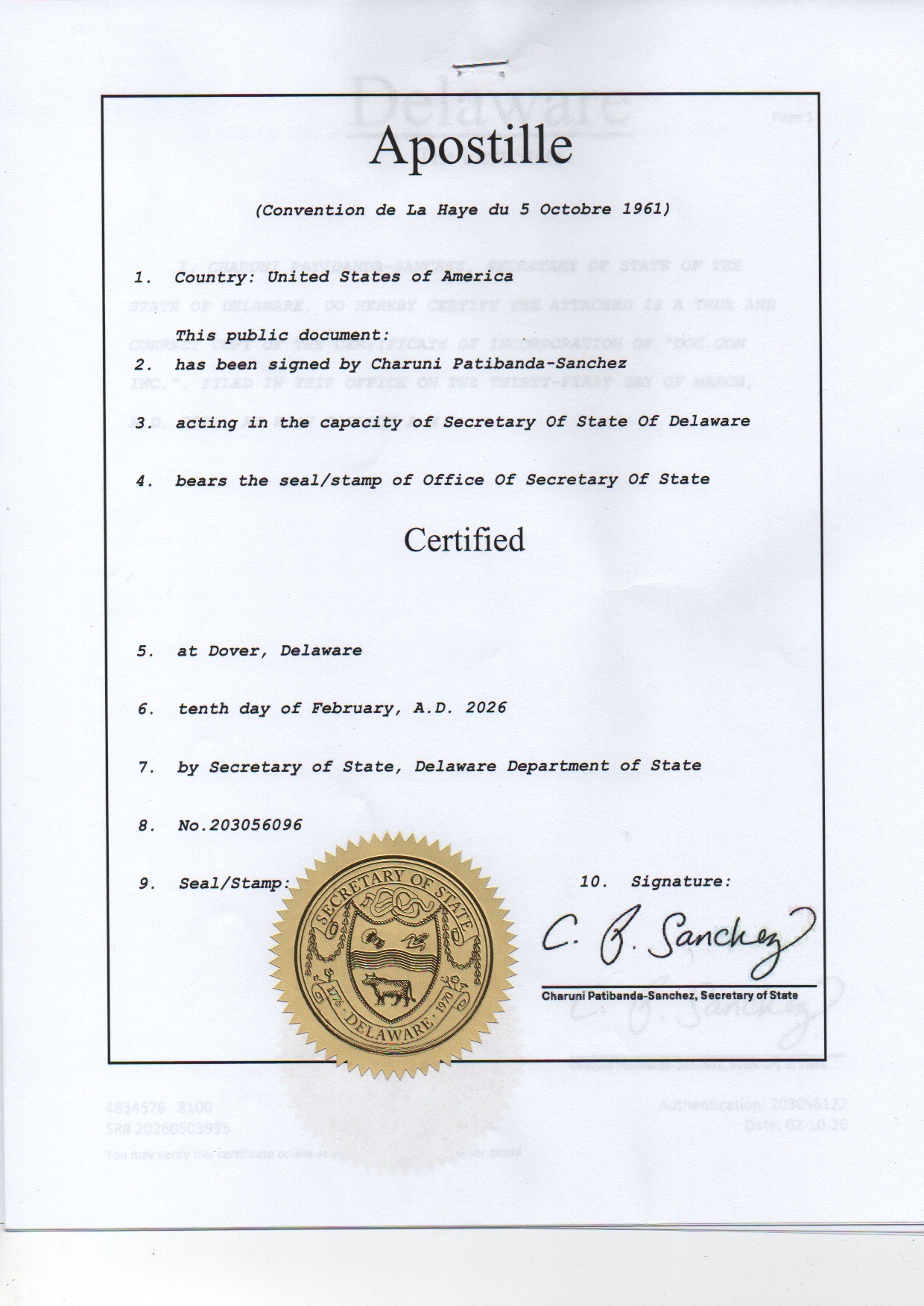
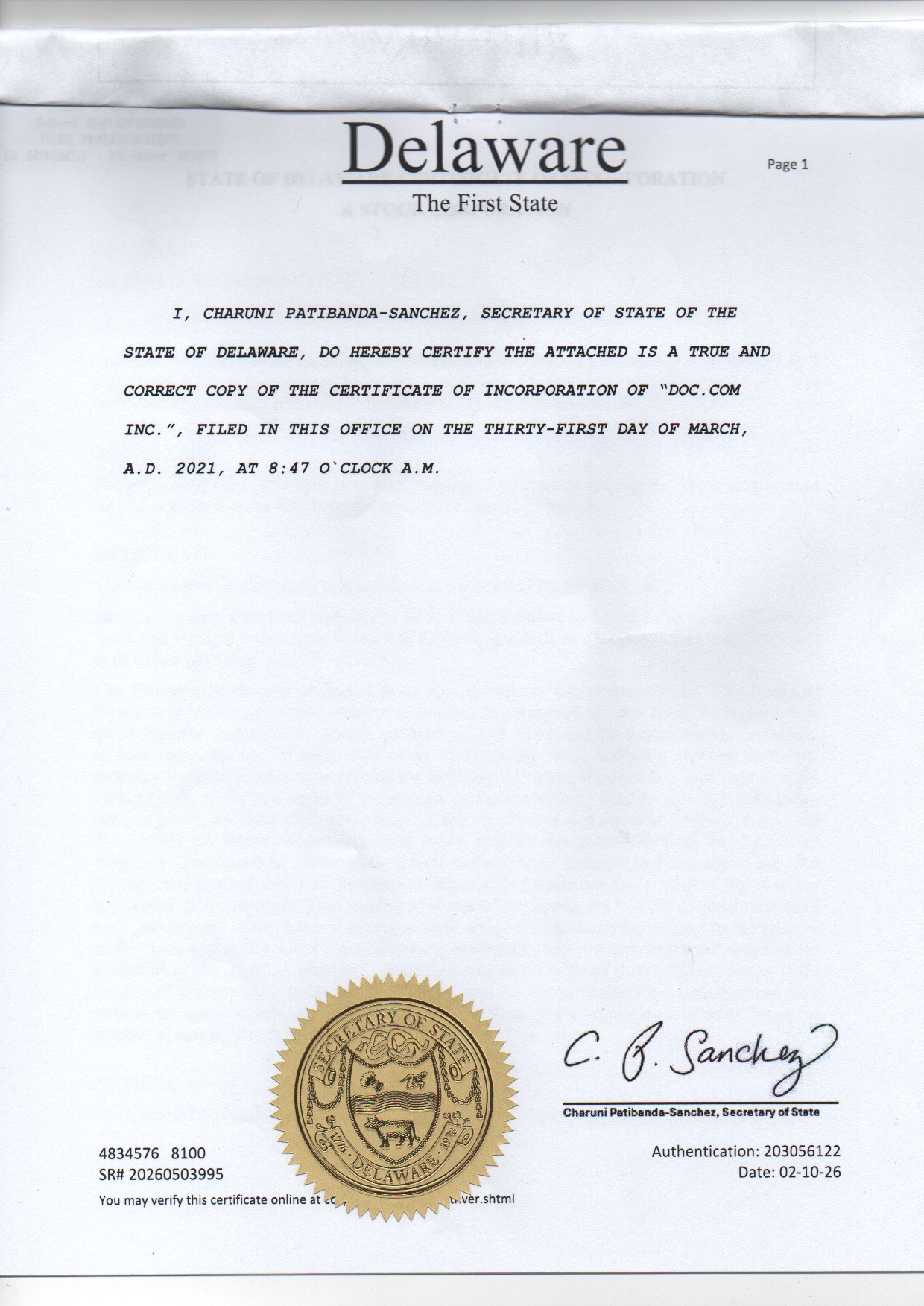

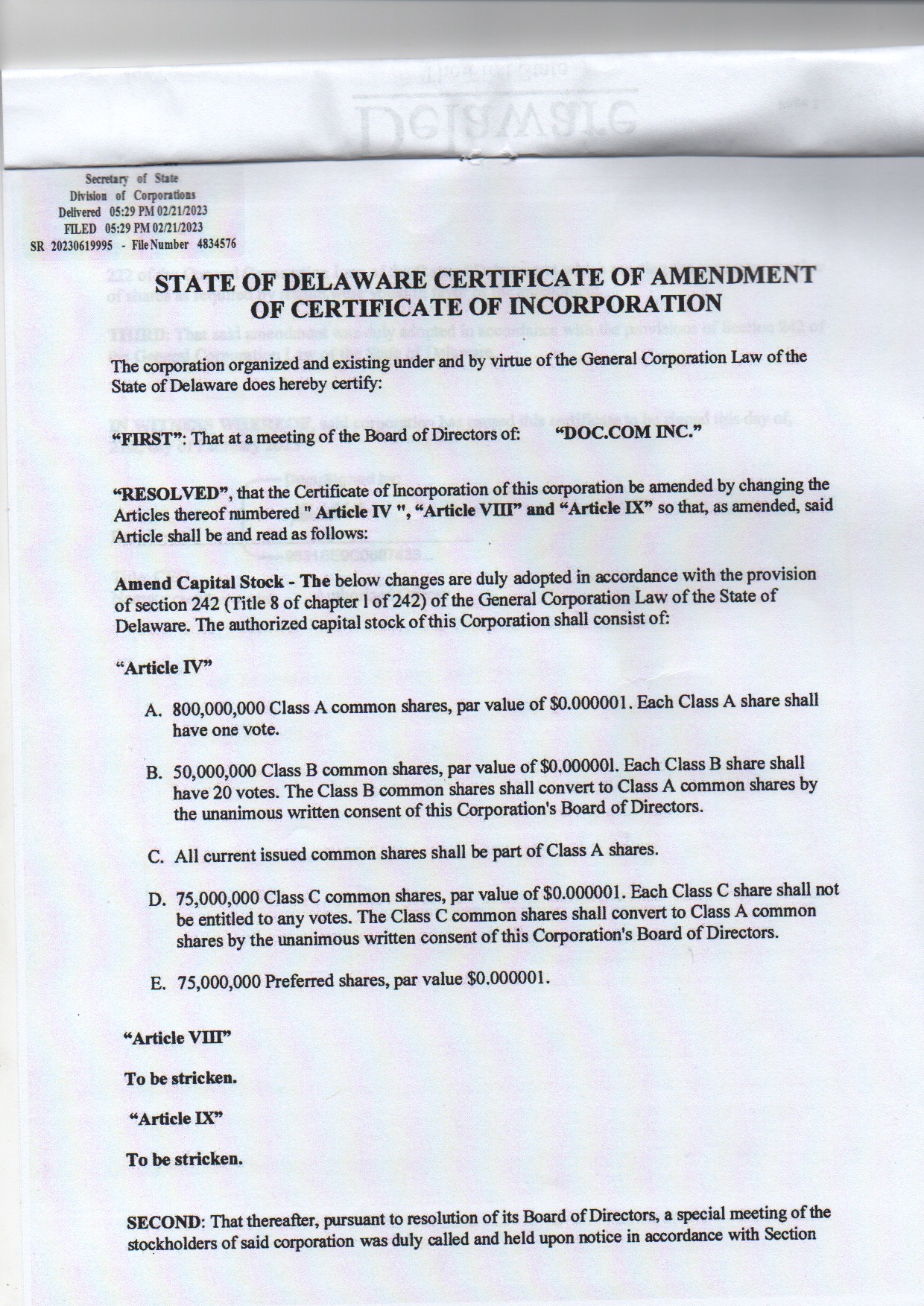
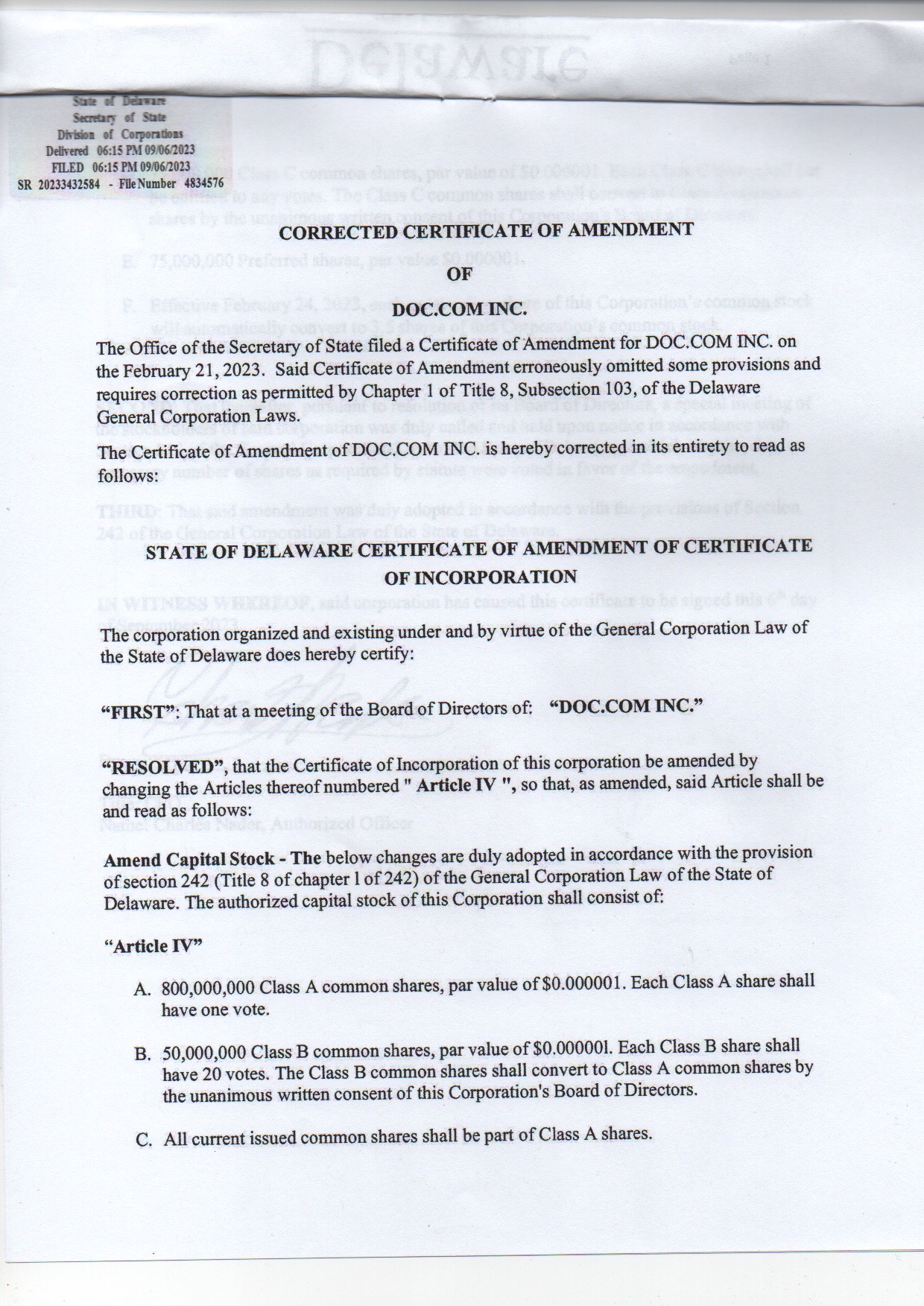
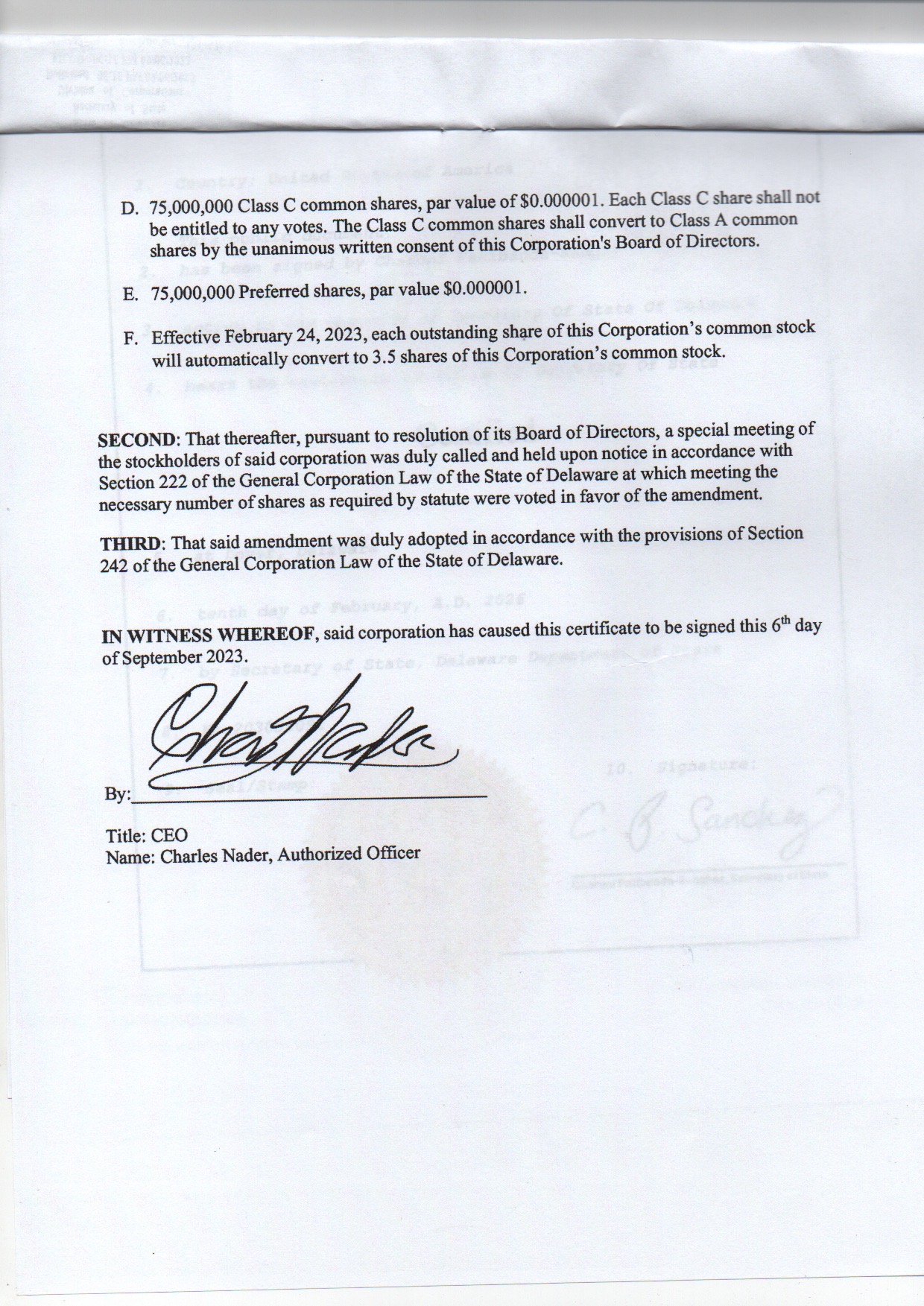
Exhibit 2.5
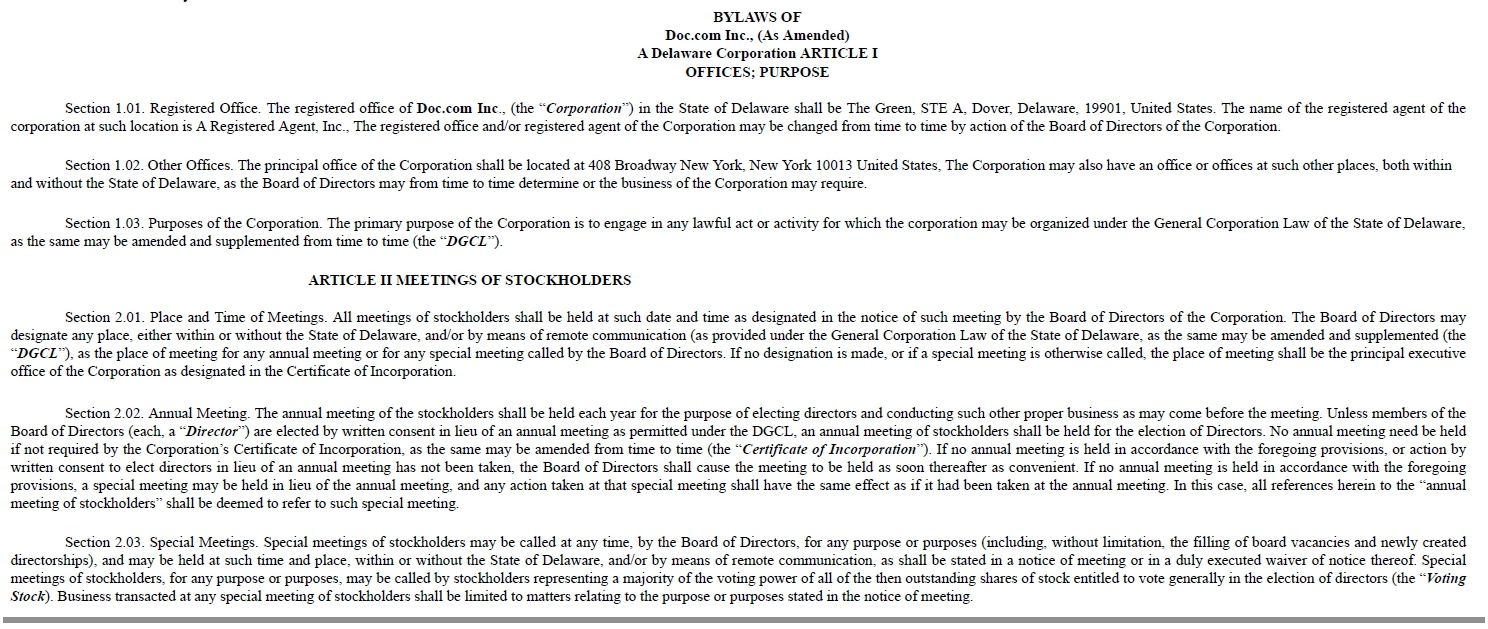
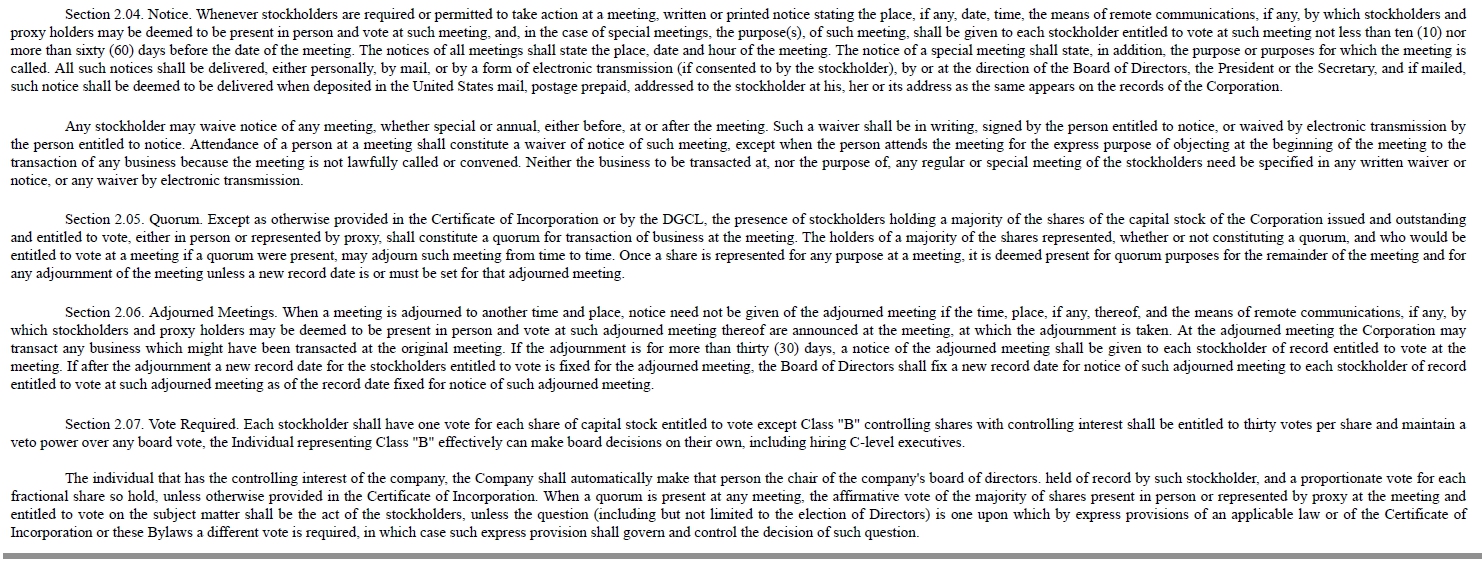
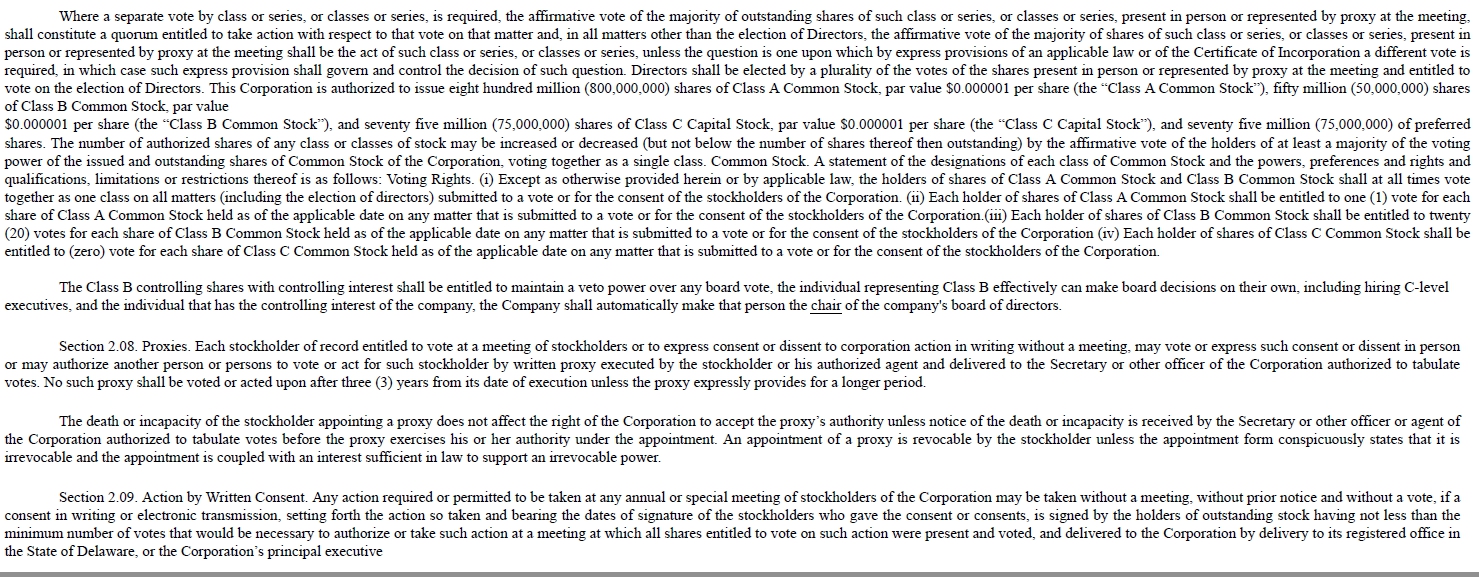
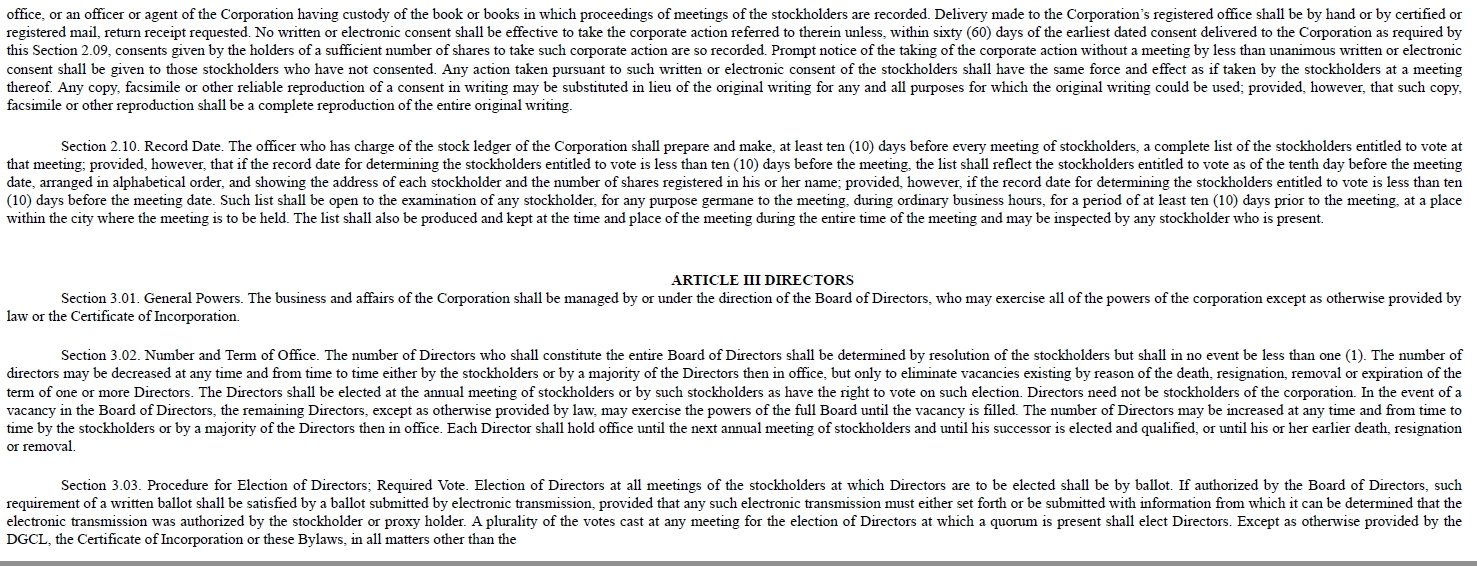
Exhibit 6.25
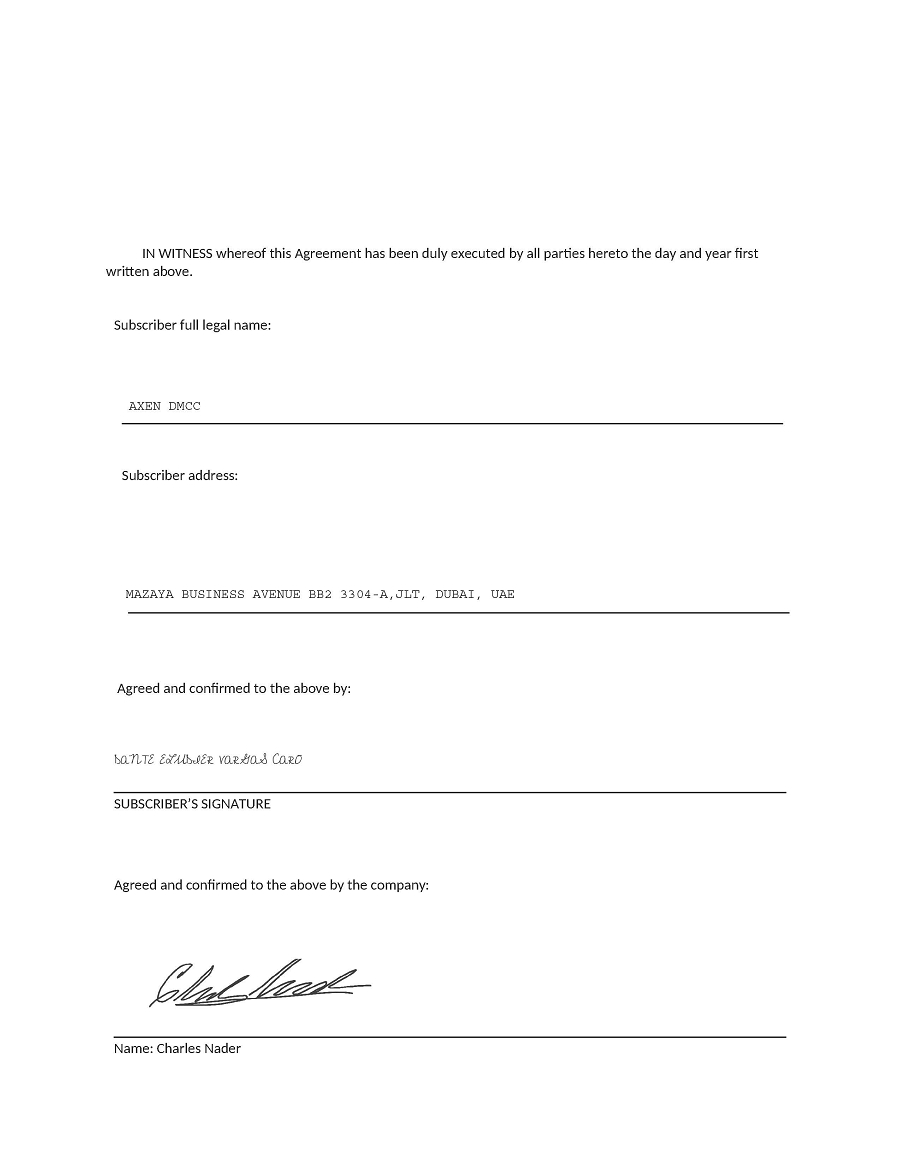

Exhibit 6.26
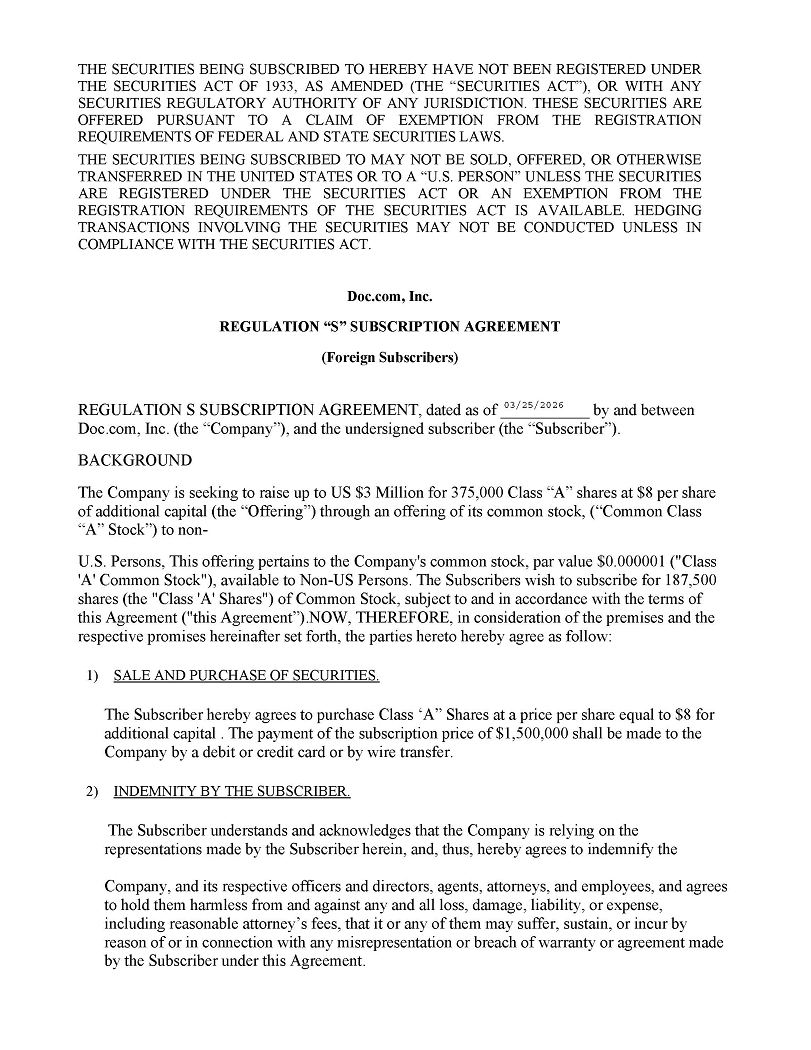
Exhibit 9.1
Exhibit 11.1
Exhibit 11.2
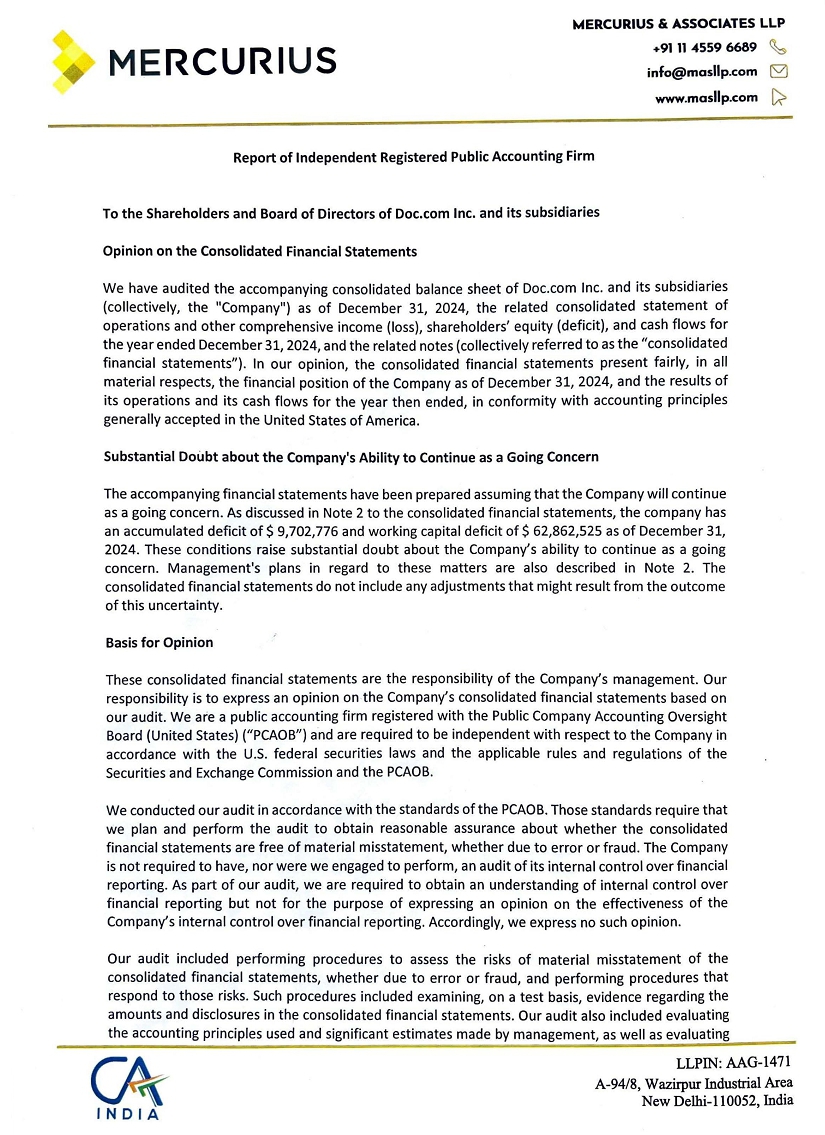
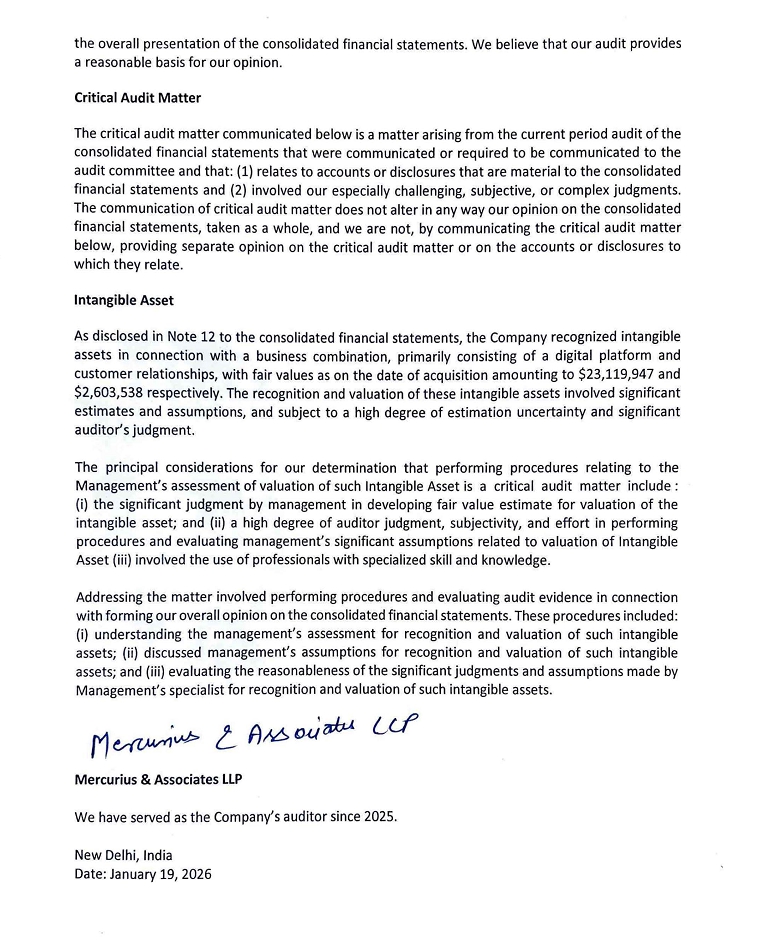
Exhibit 11.3
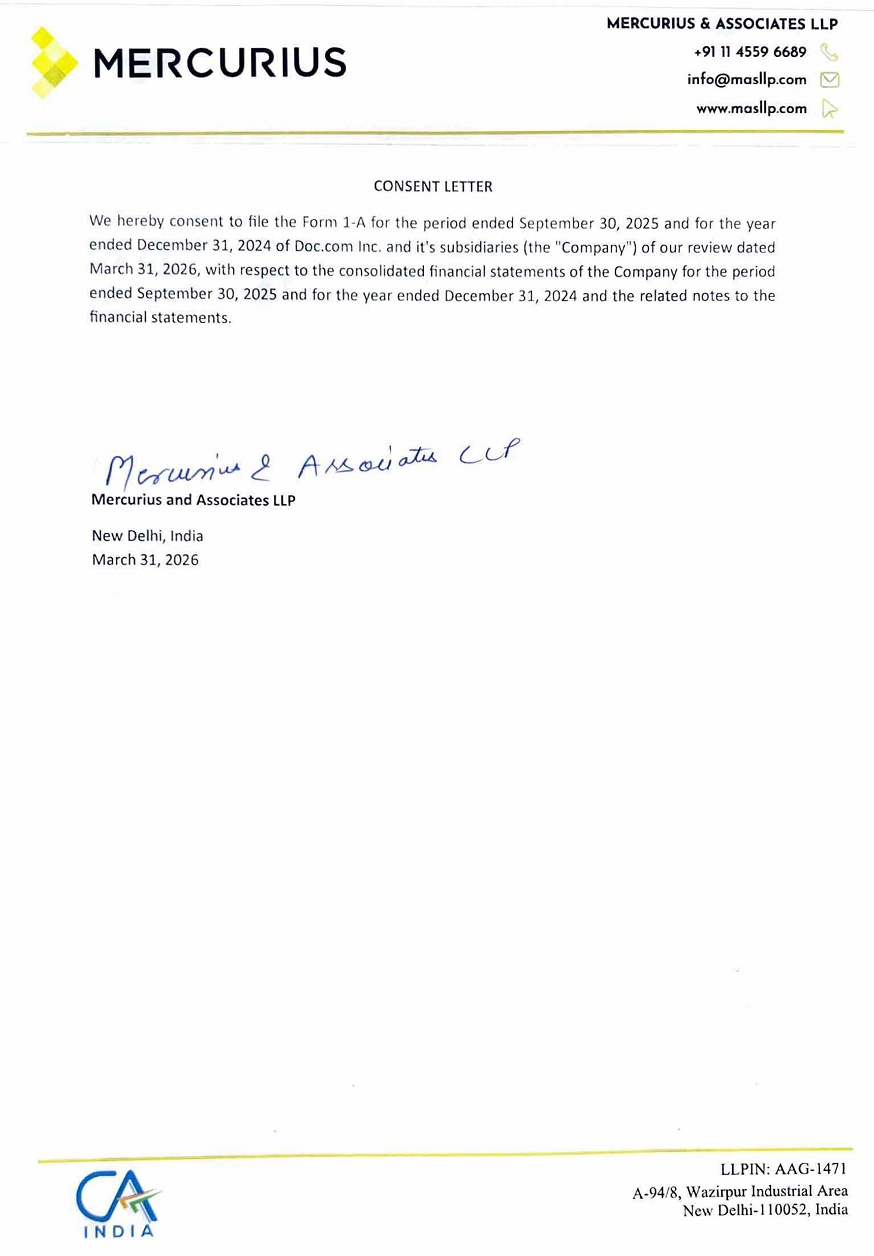
Exhibit 12.1
 |
ATTORNEYS AT LAW 100
North Tampa Street, Suite 2700 Tampa, FL 33601-3391 813.229.2300 TEL 813.221.4210 FAX www.foley.com
CLIENT/MATTER NUMBER 098929-0105 |
March 31, 2026
Doc.com Inc.
150 Greenwich Street, Suite 2939
New York, NY 10007
Ladies and Gentlemen:
We are acting as counsel to Doc.com Inc., a Delaware corporation (the “Company”), in connection with the Company’s issuance and sale of up to 3,000,000 shares of the Company’s Class A Common Stock, par value $0.000001 per share, at an offering price of $8.00 per share (the “Shares”), in each case pursuant to (i) an Offering Statement on Form 1-A (No. 024-12717) filed by the Company with the Securities and Exchange Commission (the “Commission”) on March 2, 2026, and amended by Amendment No. 1 filed by the Company with the Commission on or about the date hereof (as so amended, the “Offering Statement”), and (ii) one or more Subscription Agreements, each substantially in the form of Exhibit No. 1.1 to the Offering Statement (the “Subscription Agreement”).
As counsel to the Company in connection with the proposed offering of the Shares, we have examined: (i) the Offering Statement, (ii) the form of Subscription Agreement, (iii) the Company’s Certificate of Incorporation and Bylaws, each as amended to date and filed as exhibits to the Offering Statement, and (iv) the proceedings and actions taken by the Board of Directors of the Company to authorize and approve the transactions contemplated by the Offering Statement and by the execution and delivery of Subscription Agreements. We have also considered such matters of law and of fact, including the examination of originals or copies, certified or otherwise identified to our satisfaction, of such records and documents of the Company, certificates of officers, directors and representatives of the Company, certificates of public officials, and such other documents as we have deemed appropriate as a basis for the opinion rendered below. In our examination of the all these documents, we have assumed the genuineness of all signatures, the authenticity of all documents, records, certificates, and instruments filed by the Company with the Commission or submitted to us as originals, and the conformity with the originals of all documents, records, certificates, and instruments submitted to us as copies.
Our opinion rendered below is limited to the General Corporation Law of the State of Delaware, and we express no opinion as to the laws of any other jurisdiction.
Based upon, subject to and limited by the foregoing, we are of the opinion that, upon issuance of the Shares pursuant to the terms of one or more Subscription Agreements after notice of qualification under Regulation A of the Offering Statement (as the same may theretofore be amended) has been delivered to the Company by the Commission, and receipt by the Company of the consideration for the Shares pursuant to the terms of one or more Subscription Agreements, the Shares purported to be sold thereunder will be validly issued, fully paid, and nonassessable.
This opinion rendered above is given as of the date hereof. We assume no obligation to supplement that opinion if any applicable law changes after the date hereof or if we become aware of any fact that might change that opinion after the date hereof. This opinion letter is limited to the matters set forth herein. No other opinion may be inferred beyond the matters expressly stated herein.
We consent to the filing of this opinion letter as Exhibit 12.1 to the Offering Statement in accordance with the requirements of Item 17(12) of Part III of SEC Form 1-A, to the incorporation by reference of this opinion letter into the Offering Statement and to the references to our firm therein.
| Very truly yours, | |
| /s/ Foley & Lardner LLP |
AUSTIN
| BOSTON | BRUSSELS | CHICAGO | DALLAS | DENVER | DETROIT | HOUSTON | JACKSONVILLE | LOS ANGELES
MADISON | MEXICO CITY | MIAMI |
MILWAUKEE | NASHVILLE | NEW YORK | ORLANDO | RALEIGH | SACRAMENTO | SALT LAKE CITY
SAN DIEGO | SAN FRANCISCO | SILICON VALLEY | TALLAHASSEE | TAMPA | TOKYO | WASHINGTON, D.C.