
| Underlying supplement no. 19-I To the prospectus dated April 13, 2023 and the prospectus supplement dated April 13, 2023 |
Registration Statement Nos. 333-270004 and 333-270004-01 Dated April 13, 2023 Rule 424(b)(2) |
JPMorgan Chase & Co.
Notes Linked to the J.P. Morgan Tactical Blend Index
JPMorgan Chase Financial Company LLC
Notes, Fully and Unconditionally Guaranteed by JPMorgan Chase & Co., Linked to the J.P. Morgan Tactical Blend Index
This document (the “Underlying Supplement”) contains information about the J.P. Morgan Tactical Blend Index (the “Index”), which information has been provided by J.P. Morgan Securities LLC (“JPMS”, JPMS together with its affiliates and individually referred to herein as “J.P. Morgan”) solely in its capacity as the sponsor of the Index (in such capacity, the “Index Sponsor”) and the calculation agent of the Index (in such capacity, the “Index Calculation Agent”). The Index, its constituents and certain relevant “Risk Factors” are described in further detail within this Underlying Supplement and are qualified in their entirety by the index rules formulated by JPMS (the “Rules”), which are appended hereto. The Index is the intellectual property of JPMS, and JPMS reserves all rights with respect to its ownership of the Index. The Index is reported by Bloomberg L.P. under the ticker symbol “JPUSTACB Index.” Please read the information under the section titled “Important Information” below before reading any other material in this Underlying Supplement.
The Index attempts to provide a dynamic rules-based allocation to the excess return performance of an Equity Constituent (as defined herein) and one of two Defensive Constituents (each as defined herein), less a daily Index adjustment of 0.85% per annum.
The issuer of the notes, as specified in the relevant terms supplement, is referred to in this underlying supplement as the “Issuer.” The Issuer will be either JPMorgan Chase & Co. or JPMorgan Chase Financial Company LLC. For notes issued by JPMorgan Chase Financial Company LLC, JPMorgan Chase & Co., in its capacity as guarantor of those notes, is referred to in this product supplement as the “Guarantor.”
This underlying supplement describes the Index, the relationship between JPMorgan Chase & Co., JPMorgan Chase Financial Company LLC and the sponsor of the Index and terms that will apply generally to notes linked in whole or in part to an Index and provides other information. This underlying supplement supplements the terms described in the accompanying product supplement, the prospectus supplement and the prospectus. A separate term sheet or pricing supplement, as the case may be, will describe terms that apply to specific issuances of the notes. These term sheets and pricing supplements are referred to generally in this underlying supplement as terms supplements. If the terms described in the relevant terms supplement are inconsistent with those described in this underlying supplement, any other accompanying underlying supplement, the accompanying product supplement, the prospectus supplement or the prospectus, the terms described in the relevant terms supplement will control. In addition, if this underlying supplement and the accompanying product supplement or another accompanying underlying supplement contain information relating to the Index, the information contained in the document with the most recent date will control.
Investing in the notes involves a number of risks. See “Risk Factors” beginning on page S-2 of the prospectus supplement, “Risk Factors” in the accompanying product supplement and “Risk Factors” beginning on page US-4 of this underlying supplement.
Neither the Securities and Exchange Commission nor any state securities commission has approved or disapproved of the notes or passed upon the accuracy or the adequacy of the relevant terms supplement, this underlying supplement, any other accompanying underlying supplement, the accompanying product supplement, the prospectus supplement or the prospectus. Any representation to the contrary is a criminal offense.
The notes are not bank deposits, are not insured by the Federal Deposit Insurance Corporation or any other governmental agency and are not obligations of, or guaranteed by, a bank.
April 13, 2023
TABLE OF CONTENTS
Page
The Issuer and the Guarantor (if applicable) have not authorized anyone to provide any information other than that contained or incorporated by reference in the relevant terms supplement, this underlying supplement, any other accompanying underlying supplement, the accompanying product supplement, the prospectus supplement or the prospectus with respect to the notes offered by the relevant terms supplement and with respect to the Issuer and the Guarantor (if applicable). The Issuer and the Guarantor (if applicable) take no responsibility for, and can provide no assurance as to the reliability of, any other information that others may give you. The relevant terms supplement, together with this underlying supplement, any other accompanying underlying supplement, the accompanying product supplement, the prospectus supplement and the prospectus, will contain the terms of the notes and will supersede all other prior or contemporaneous oral statements as well as any other written materials, including preliminary or indicative pricing terms, correspondence, trade ideas, structures for implementation, sample structures, fact sheets, brochures or other educational materials of the Issuer. The information in each of the relevant terms supplement, this underlying supplement, any other accompanying underlying supplement, the accompanying product supplement, the prospectus supplement and the prospectus may be accurate only as of the date of that document.
The notes are not appropriate for all investors and involve a number of risks and important legal and tax consequences that should be discussed with your professional advisers. You should be aware that the regulations of Financial Industry Regulatory Authority, Inc., or FINRA, and the laws of certain jurisdictions (including regulations and laws that require brokers to ensure that investments are suitable for their customers) may limit the availability of the notes. The relevant terms supplement, this underlying supplement, any other accompanying underlying supplement, the accompanying product supplement, the prospectus supplement and the prospectus do not constitute an offer to sell or a solicitation of an offer to buy the notes under any circumstances in which that offer or solicitation is unlawful.
The notes are not commodity futures contracts or swaps and are not regulated under the Commodity Exchange Act of 1936, as amended (the “Commodity Exchange Act”). The notes are offered pursuant to an exemption from regulation under the Commodity Exchange Act, commonly known as the hybrid instrument exemption, that is available to securities that have one or more payments indexed to the value, level or rate of one or more commodities, as set out in section 2(f) of that statute. Accordingly, you are not afforded any protection provided by the Commodity Exchange Act or any regulation promulgated by the Commodity Futures Trading Commission.
In this underlying supplement, “we,” “us” and “our” refer to the Issuer, unless the context requires otherwise, and “JPMorgan Financial” refers to JPMorgan Chase Financial Company LLC. To the extent applicable, each index described in this underlying supplement is deemed to be one of the “Indices” referred to in the accompanying product supplement.
The J.P. Morgan Tactical Blend Index (the “Index”) was developed and is maintained and calculated by J.P. Morgan Securities LLC (“JPMS”). The description of the Index and methodology included in this document (the “Underlying Supplement”) is based on rules formulated by JPMS (the “Rules”). The Rules, and not this description, will govern the calculation and constitution of the Index and other decisions and actions related to its maintenance. The Rules in effect as of the date of this Underlying Supplement are attached as Annex A to this Underlying Supplement. The Index is the intellectual property of JPMS, and JPMS reserves all rights with respect to its ownership of the Index. The Index is reported by Bloomberg L.P. under the ticker symbol “JPUSTACB Index.”
The Index attempts to provide a dynamic rules-based allocation to the excess return performance of the J.P. Morgan U.S. Low Volatility Index (Total Return) (the “Equity Constituent”) and one of the following two “Defensive Constituents”: (1) the J.P. Morgan Core Bond Index (the “Bond Constituent”) and (2) the Invesco DB US Dollar Index Bullish Fund (the “Currency Constituent”), less a daily Index adjustment of 0.85% per annum (the “Index Adjustment”). The selected Defensive Constituent is determined based on a momentum signal; and changes from one Defensive Constituent to the other are implemented over a period of up to 5 days, subject to changes in the signal during the period. The Index targets a volatility level of 5.0% (the “Target Volatility”), subject to a maximum total weight of 150% (the “Maximum Total Weight”); however, because the methodology used to calculate the realized volatility of the Index is based on the highest volatility over three separate look-back intervals (5 days, 63 days and 756 days), the actual realized volatility of the Index on an annualized basis is expected to be lower than its target volatility of 5.0%. The Equity Constituent, the Bond Constituent and the Currency Constituent are individually referred to herein as a “Portfolio Constituent”.
| · | The Equity Constituent. The Equity Constituent is an index that applies a rules-based methodology to seek to track the total return of a portfolio of stocks selected from the components of the Solactive United States 1000 Index, with stocks with the highest realized volatility excluded, with weightings selected to seek sector diversification and with a weighting preference for stocks with lower realized volatility. There is, however, no assurance that the Index will exhibit lower volatility or provide higher risk-weighted returns than the Solactive United States 1000 Index or any other index or strategy. For additional information about the Equity Constituent, see “Background on the J.P. Morgan U.S. Low Volatility Index (Total Return)” below. |
| · | The Defensive Constituents. The Index Calculation Agent selects a Defensive Constituent for inclusion in the Index (the “Selected Defensive Constituent”) based on the price momentum of the Bond Constituent: |
| · | The Bond Constituent is an index that applies a rules-based methodology to evaluate recent market conditions and allocate exposure dynamically across up to ten (10) exchange-traded funds (“ETFs”) that each track a U.S. dollar fixed income sector. For additional information about the Bond Constituent, see “Background on the J.P. Morgan Core Bond Index” below. |
| · | The Currency Constituent is an ETF that generally seeks to track changes in the level of the Deutsche Bank Long USD Currency Portfolio Index–Excess ReturnTM (the “DB Dollar Index”) by establishing long positions in ICE U.S. Dollar Index (“USDX®”) futures contracts designed to replicate the performance of taking a long position in the U.S. dollar against a basket of six (6) currencies composed of the Euro, Japanese Yen, British Pound, Canadian Dollar, Swedish Krona and Swiss Franc. The DB Dollar Index is intended to provide a general indication of the international value of the U.S. dollar relative to this basket of currencies and is composed solely of long positions in the USDX® futures contracts. All else being equal, the Currency Constituent increases when the U.S. dollar appreciates and decreases in value when the trade-weighted basket of currencies strengthen against the U.S. dollar. For additional information about the Currency Constituent, see “Background on the Invesco DB US Dollar Index Bullish Fund” below. |
US-1
The Index provides a balanced exposure to the Portfolio Constituents and rebalances from time to time based on the price momentum of the Bond Constituent and the realized volatility of the underlying notional portfolio.
Determining the Selected Defensive Constituent. The price momentum of the Bond Constituent on a given Index Business Day is calculated by comparing the closing level of the Bond Constituent on such day against the closing level on the Index Business Days that is sixty (60) days prior to such day (the “60-Day Price Momentum Signal”). If the Bond Constituent exhibits a positive 60-Day Price Momentum Signal on any given Index Business Day and on each of the two (2) Index Business Days preceding such day, then the Bond Constituent will be identified as the Selected Defensive Constituent for such day. However, if the Bond Constituent exhibits a negative or neutral 60-Day Price Momentum Signal on any given Index Business Day and on each of the two (2) Index Business Days preceding such day, then the Currency Constituent will be identified as the Selected Defensive Constituent for such day. In either scenario, if the 60-Day Price Momentum Signal on such day is not repeated on both of the two (2) preceding Index Business Days, then the Selected Defensive Constituent will be whichever one was last selected. Whenever the Selected Defensive Constituent changes from the Bond Constituent to the Currency Constituent (and vice versa) (each, a “Defensive Constituent Switch Day”), the Index will rebalance its exposure to the Portfolio Constituents starting on the immediately following Index Business Day and ending on the Index Business Day after the earlier of (y) the next Defensive Constituent Switch Day and (z) the Index Business Day for which the volatility budget of each Defensive Constituent as of such day is equal to the preliminary volatility budget of such Defensive Constituent calculated as of the Defensive Constituent Switch Day, up to a maximum of five (5) days. In addition, the Index will rebalance its exposure to the Portfolio Constituents on any other Index Business Day where the volatility of the notional portfolio underlying the Index is less than four point five percent (4.5%) or greater than five point five percent (5.5%), calculated as of the immediately preceding Index Business Day.
Considerations Relating to the Volatility of the Portfolio Constituents. Under normal market conditions, the Equity Constituent’s realized volatility has tended to be relatively more variable than the realized volatility of the Defensive Constituents. Consequently, the Index methodology may be more likely to allocate exposure to the Selected Defensive Constituent during periods of relatively higher market volatility and to shift exposure from the Selected Defensive Constituent to the Equity Constituent under market conditions exhibiting relatively lower market volatility. In addition, because the Index methodology calculates realized volatility over periods ranging from 5 days to three years and allocates a greater proportion to the Selected Defensive Constituent during periods of greater equity market volatility, the Index has tended to exhibit an annualized realized volatility that is lower than the Target Volatility of 5.0%.
In general, equity markets have historically been more likely to outperform fixed-income and U.S. dollar currency markets during periods of relatively lower market volatility and to underperform fixed-income and U.S. dollar currency markets during periods of relatively higher market volatility. However, there can be no assurance that the Index allocation strategy will achieve its intended results or that the Index will outperform any alternative index or strategy that might reference the Portfolio Constituents. Past performance should not be considered indicative of future performance.
The Index seeks to allocate risk between the Equity Constituent and the Selected Defensive Constituent such that the risk associated with each of the Equity Constituent and the Selected Defensive Constituent is approximately equal by measuring the volatility of each Portfolio Constituent and setting the weight of such Portfolio Constituent in inverse proportion to its volatility. Therefore, all else being equal, a lower realized volatility for a Portfolio Constituent will generally result in a higher weight for that Portfolio Constituent, while a higher realized volatility will generally result in a lower weight. Under normal market conditions, because the Bond Constituent generally attempts to allocate to a portfolio with a realized volatility less than or equal to 5.0%, and the historical realized volatility of the Currency Constituent has generally ranged from 6.0% to 9.0%, the Equity Constituent’s realized volatility has tended to be significantly higher than those of the Defensive Constituents. Furthermore, because the methodology used to calculate the realized volatility of the Index is based on the highest volatility over three separate look-back intervals (5 days, 63 days and 756 days), the actual realized volatility of the Index on an annualized basis is more likely to be lower than the Target Volatility of 5.0% than it is likely to be higher, which has the effect of further lowering the weight of the Equity Constituent. Past performance should not be considered indicative of future performance. Consequently, the Index may have significant exposure for an extended period of time to the Selected
US-2
Defensive Constituent, and that exposure may be greater, perhaps significantly greater, than its exposure to the Equity Constituent. However, the returns of the Selected Defensive Constituent may be significantly lower than the returns of the Equity Constituent, and possibly even negative while the returns of the Equity Constituent are positive, which will adversely affect the level of the Index.
Furthermore, under circumstances where the Equity Constituent’s realized volatility is significantly higher than that of the Selected Defensive Constituent, the performance of the Index is expected to be influenced to a greater extent by the performance of the Equity Constituent than by the performance of the Bond Constituent, unless the weight of the Selected Defensive Constituent is significantly greater than the weight of the Equity Constituent. Consequently, even in cases where the allocation to the Selected Defensive Constituent is greater than the allocation to the Equity Constituent, the Index may be influenced to a greater extent by the performance of the Equity Constituent than by the performance of the Selected Defensive Constituent because, under some conditions, the greater allocation to the Selected Defensive Constituent will not be sufficiently large to offset the greater realized volatility of the Equity Constituent.
Calculating the level of the Index. On any given day, the closing level of the Index (the “Index Level”) reflects the weighted excess return performance of the Portfolio Constituents (i.e., the total return performance less the notional financing cost) less the daily deduction of 0.85% per annum. The Index Level was set equal to 100.00 on November 24, 2006, the base date of the Index. The Index Calculation Agent began calculating the Index on a live basis on March 30, 2023.
The Index provides “excess return” exposure to the Portfolio Constituents because of the daily deduction of a notional financing cost, which is calculated by reference to the Effective Federal Funds Rate, from the performance of the Portfolio Constituents. The Effective Federal Funds Rate is a measure of the interest rate at which depository institutions lend balances at the Federal Reserve to other depository institutions overnight, calculated as the volume-weighted median of overnight federal funds transactions reported by U.S. banks and U.S. branches and agencies of non-U.S. banks, and is quoted on the basis of an assumed year of 360 days.
JPMS is currently the sponsor of the Index (in such capacity, the “Index Sponsor”) and the calculation agent of the Index (in such capacity, the “Index Calculation Agent”).
See “The J.P. Morgan Tactical Blend Index” in this Underlying Supplement for additional information about the Index.
The Index is described as a notional or synthetic portfolio because there is no actual portfolio of assets to which any person is entitled or in which any person has any ownership interest. The Index merely identifies certain reference assets, the performance of which will be used as a reference point for calculating the Index Level. The Index is subject to an eighty-five basis point (0.85%) per annum daily deduction that will reduce its performance.
No assurance can be given that the investment strategy used to construct the Index will achieve its intended results or that the Index will be successful or will outperform any alternative index or strategy that might reference the Portfolio Constituents (as defined herein). Furthermore, no assurance can be given that the realized volatility of the Index will approximate its Target Volatility. The actual realized volatility of the Index may be greater or less than the Target Volatility.
If the aggregate weight of the Portfolio Constituents in the Index is less than 100%, the Index will not be fully invested, and any uninvested portion will earn no return. The daily deduction of 0.85% per annum is fully applied in calculating the Index Level, even when the Index is not fully invested.
The Index is described as a “notional” or “synthetic” portfolio of assets because there is no actual portfolio of assets to which any person is entitled or in which any person has any ownership interest. The Index merely references certain assets, the performance of which will be used as a reference point for calculating the Index Level.
US-3
Capitalized terms used in this section without definition are as defined in “Summary” above.
Risks Relating to the Index
JPMS, as the Index Sponsor and the Index Calculation Agent, may adjust the Index in a way that affects its level, and JPMS has no obligation to consider any person’s interests.
JPMS, an affiliate of JPMorgan Chase & Co., currently acts as the Index Sponsor and the Index Calculation Agent and is responsible for calculating and maintaining the Index and developing the guidelines and policies governing its composition and calculation. In performing these duties, JPMS may have interests adverse to the interests of investors in an investment or instrument referencing the Index, particularly where JPMS, as the Index Sponsor and the Index Calculation Agent, is entitled to exercise discretion. The Rules may be amended at any time by the Index Sponsor, in its sole discretion. The Rules also permit the use of discretion by the Index Sponsor and the Index Calculation Agent in relation to the Index in specific instances, including, but not limited to, the determination of whether to replace a Portfolio Constituent with a substitute or successor upon the occurrence of certain events affecting that Portfolio Constituent, the selection of any substitute or successor and the determination of the levels to be used in the event of market disruptions that affect the ability of the Index Calculation Agent to calculate and publish the levels of the Index and the interpretation of the Rules. Although JPMS, acting as the Index Sponsor and the Index Calculation Agent, will make all determinations and take all action in relation to the Index acting in good faith and in a commercially reasonable manner, it should be noted that JPMS may have interests adverse to the interests of investors in an investment or instrument referencing the Index and the policies and judgments for which JPMS is responsible could have an impact, positive or negative, on the level of the Index and therefore on the value of any investment or instrument linked to the Index.
Although judgments, policies and determinations concerning the Index are made by JPMS, JPMorgan Chase & Co., as the ultimate parent company of JPMS, ultimately controls JPMS. JPMS has no obligation to consider any person’s interests in taking any actions that might affect the value of any investment or instrument linked to the Index. Furthermore, the inclusion of any Portfolio Constituent in the Index is not an investment recommendation by JPMS of that Portfolio Constituent or any of the securities underlying that Portfolio Constituent. See “The J.P. Morgan Tactical Blend Index.”
The Index is subject to a 0.85% per annum daily deduction and the deduction of a notional financing cost.
One way in which the Index may differ from a typical index is that its level will be subject to a 0.85% per annum daily deduction and the deduction from the performance of each Portfolio Constituent of a notional financing cost calculated by reference to the Effective Federal Funds Rate. The Index Adjustment and the notional financing cost will be deducted daily. As a result of the deduction of the Index Adjustment and the notional financing cost, the level of the Index will trail the value of a hypothetical identically constituted notional portfolio from which no such Index Adjustment or cost is deducted.
The Effective Federal Funds Rate is a measure of the interest rate at which depository institutions lend balances at the Federal Reserve to other depository institutions overnight, calculated as the volume-weighted median of overnight federal funds transactions reported by U.S. banks and U.S. branches and agencies of non-U.S. banks, and is quoted on the basis of an assumed year of 360 days. The Effective Federal Funds Rate will be affected by many factors, including, among others described under “— Risks Relating to the Notional Financing Cost” below, the monetary policy of the Federal Reserve. The Effective Federal Funds Rate has fluctuated significantly over time. For example, on July 3, 2000, the Effective Federal Funds Rate was 7.03%, on May 12, 2022, the Effective Federal Funds Rate was 0.83% and on March 23, 2023, the Effective Federal Funds Rate was 4.58%. The Federal Reserve raised its federal funds target rate over periods in the past and may do so again in the future. Any increase in the Effective Federal Funds Rate, whether due to the Federal Reserve decisions to raise interest rates (specifically, its
US-4
federal funds target rate) or otherwise, will increase the adverse effect of the notional financing cost on performance of the Index.
The deduction of the Index Adjustment and the notional financing cost will place a significant drag on the performance of the Index, potentially offsetting positive returns of the Portfolio Constituents, exacerbating negative returns of the Portfolio Constituents and causing the level of the Index to decline steadily if the total returns of the Portfolio Constituents are relatively flat. In particular, under market conditions where the yield curve is relatively flat (meaning that there is little difference between longer-term and shorter-term interest rates), the notional financing cost alone may be expected to largely or entirely offset the yields on the securities held by the ETFs included in the Bond Constituent (each, a “Bond Constituent ETF”) and/or the yield on the Currency Constituent. The Index will not appreciate unless the total returns of the Portfolio Constituents are sufficient to offset the negative effects of the Index Adjustment and the notional financing cost, and then only to the extent that the total returns of the Portfolio Constituents are greater than the deducted amounts. As a result of these deductions, the level of the Index may decline even if the total returns of the Portfolio Constituents are positive.
The Index may not be successful or outperform any alternative strategy that might be employed in respect of the Portfolio Constituents.
The Index follows a notional rules-based proprietary strategy that operates on the basis of pre-determined rules. Under this strategy, the Index seeks to maintain an annualized realized volatility approximately equal to the Target Volatility of 5.0% by rebalancing its exposures to the Portfolio Constituents from time to time based on the realized portfolio volatility and the price momentum of the Bond Constituent. By seeking to maintain an annualized realized volatility approximately equal to the Target Volatility, the Index may underperform an alternative strategy that seeks to maintain a higher annualized realized volatility or an alternative strategy that does not seek to maintain a level volatility.
No assurance can be given that the investment strategy on which the Index is based will be successful or that the Index will outperform any alternative strategy that might be employed in respect of the Portfolio Constituents.
The Index may not approximate the Target Volatility.
No assurance can be given that the Index will maintain an annualized realized volatility that approximates the Target Volatility. The actual realized volatility of the Index may be greater or less than the Target Volatility. The Index seeks to maintain an annualized realized volatility approximately equal to the Target Volatility of 5.0% by rebalancing its exposures to the Portfolio Constituents from time to time based on the realized portfolio volatility. However, there is no guarantee that trends exhibited by the realized portfolio volatility will continue in the future. The volatility of a notional portfolio on any day may change quickly and unexpectedly. In addition, because the methodology used to calculate the realized volatility of the Index is based on the highest volatility over three separate look-back intervals (5 days, 63 days and 756 days), the actual realized volatility of the Index on an annualized basis is more likely to be lower than the Target Volatility of 5.0% than it is likely to be higher, which may adversely affect the level of the Index.
The Index should not be compared to any other index or strategy sponsored by any affiliates of JPMorgan Chase & Co. (each, a “J.P. Morgan Index”) and cannot necessarily be considered a revised, enhanced or modified version of any other J.P. Morgan Index.
The Index follows a notional rules-based proprietary strategy that may have objectives, features and/or constituents that are similar to those of other J.P. Morgan Indices. No assurance can be given that these similarities will form a basis for comparison between the Index and any other J.P. Morgan Index, and no assurance can be given that the Index would be more successful than or outperform any other J.P. Morgan Index. The Index operates independently and does not necessarily revise, enhance, modify or seek to outperform any other J.P. Morgan Index.
US-5
The Index may be significantly uninvested.
The weighting methodology of the Index may result in an aggregate weight of less than 100% on any day. If the Index tracks a notional portfolio with an aggregate weight that is less than 100%, the Index will not be fully invested, and any uninvested portion will earn no return. The Index may be significantly uninvested on any given day, and will realize only a portion of any gains due to appreciation of the Portfolio Constituents on any such day. The daily deduction of the Index Adjustment is fully applied in calculating the Index Level, even when the Index is not fully invested.
A significant portion of the Index’s exposure may be allocated to the Selected Defensive Constituent.
Under normal market conditions, the Equity Constituent has tended to exhibit a realized volatility that is higher than the Target Volatility and that is higher than the realized volatility of each of the Defensive Constituents in general over time. As a result, the Index will generally need to reduce its exposure to the Equity Constituent in order to approximate the Target Volatility. Furthermore, because the methodology used to calculate the realized volatility of the Index is based on the highest volatility over three separate look-back intervals (5 days, 63 days and 756 days), the actual realized volatility of the Index on an annualized basis is more likely to be lower than the Target Volatility of 5.0% than it is likely to be higher, which has the effect of further lowering the weight of the Equity Constituent. Therefore, the Index may have significant exposure for an extended period of time to the Selected Defensive Constituent, and that exposure may be greater, perhaps significantly greater, than its exposure to the Equity Constituent. However, the returns of the Selected Defensive Constituent may be significantly lower than the returns of the Equity Constituent, and possibly even negative while the returns of the Equity Constituent are positive, which will adversely affect the level of the Index.
The Index may be more heavily influenced by the performance of the Equity Constituent than the performance of the Selected Defensive Constituent in general over time.
Under normal market conditions, the Equity Constituent’s realized volatility has been relatively more variable and has tended to be significantly higher than those of the Defensive Constituents. Under these circumstances, the Index is generally expected to be more heavily weighted towards the Selected Defensive Constituent. Furthermore, because the methodology used to calculate the realized volatility of the Index is based on the highest volatility over three separate look-back intervals (5 days, 63 days and 756 days), the actual realized volatility of the Index on an annualized basis is more likely to be lower than the Target Volatility of 5.0% than it is likely to be higher, which has the effect of further lowering the weight of the Equity Constituent. However, under circumstances where the Equity Constituent’s realized volatility is significantly higher than that of the Selected Defensive Constituent, the performance of the Index is expected to be influenced to a greater extent by the performance of the Equity Constituent than by the performance of the Selected Defensive Constituent, even if the weight of the Selected Defensive Constituent is significantly greater than the weight of the Equity Constituent.
Consequently, even in cases where the allocation to the Selected Defensive Constituent is greater than the allocation to the Equity Constituent, the Index may be influenced to a greater extent by the performance of the Equity Constituent than by the performance of the Selected Defensive Constituent because, under some conditions, the greater allocation to the Selected Defensive Constituent will not be sufficiently large to offset the greater realized volatility of the Equity Constituent.
Accordingly, the level of the Index may decline if the value of the Equity Constituent declines, even if the value of the Selected Defensive Constituent increases at the same time. See also “— Changes in the values of the Portfolio Constituents may offset each other” below.
Correlation of performances between the Portfolio Constituents may reduce the performance of the Index.
Performances of the Portfolio Constituents may become highly correlated from time to time, including, but not limited to, a period in which there is a substantial decline in the level or the price of the Portfolio Constituents. High correlation during periods of negative returns among Portfolio Constituents could have an adverse effect on the performance of the Index.
US-6
Changes in the values of the Portfolio Constituents may offset each other.
Price movements among the Portfolio Constituents may not correlate with each other. At a time when the value of one Portfolio Constituent increases, the value of the other Portfolio Constituents may not increase as much or may decline. Therefore, in calculating the level of the Index, increases in the value of one Portfolio Constituent may be moderated, or more than offset, by lesser increases or declines in the value of the other Portfolio Constituent, which will adversely affect the level of the Index.
Hypothetical back-tested data relating to the Index do not represent actual historical data and are subject to inherent limitations.
Hypothetical back-tested performance measures of the Index are purely theoretical and do not represent the actual historical performance of the Index and have not been verified by an independent third party. Hypothetical back-tested performance measures have inherent limitations. Alternative modelling techniques might produce significantly different results and may prove to be more appropriate. The use of alternative “proxy” performance information in the calculation of hypothetical back-tested weights and levels may have resulted in different, perhaps significantly different, weights and higher levels than would have resulted from the use of actual performance information of the Portfolio Constituents. Past performance, and especially hypothetical back-tested performance, is not indicative of future results. This type of information has inherent limitations and investors in an investment or instrument linked to this Index should carefully consider these limitations before placing reliance on such information. Hypothetical back-tested performance is derived by means of the retroactive application of a back-tested model that has been designed with the benefit of hindsight. See also “The J.P. Morgan Tactical Blend Index — Additional Information about Hypothetical Back-tested Performance Data” below.
If the value of a Portfolio Constituent changes, the level of the Index may not change in the same manner.
Changes in the value of any Portfolio Constituent may not result in a comparable change in the level of the Index or the market value of any investment or instrument linked to the Index.
The Index comprises notional assets and liabilities.
The exposure of the Index to its Portfolio Constituents is purely notional and will exist solely in the records maintained by or on behalf of the Index Calculation Agent. There is no actual portfolio of assets to which any person is entitled or in which any person has any ownership interest. Consequently, there will be no claim against any of the reference assets that compose the Index.
The Index has a very limited operating history and may perform in unanticipated ways.
The Index was established on March 30, 2023 and therefore has a very limited operating history. Past performance should not be considered indicative of future performance.
The Index is subject to market risks.
The performance of the Index is dependent in part on the performance of its Portfolio Constituents. As a consequence, any investment or instrument linked to the Index is exposed to the performance of the Portfolio Constituents. Geopolitical and other events (e.g., wars, terrorism or natural disasters) may disrupt securities and currency markets and adversely affect global economies and markets, thereby adversely affecting the performance of the Portfolio Constituents and the Index.
The investment strategy used to construct the Index involves rebalancing from time to time.
The Index is subject to rebalancing from time to time based on the realized portfolio volatility and the price momentum of the Bond Constituent. For this purpose, the price momentum of the Bond Constituent on a given Index Business Day is calculated based on the 60-Day Price Momentum Signal. If the Bond Constituent exhibits a positive 60-Day Price Momentum Signal on any given Index Business Day and on each of the two (2) Index Business Days preceding such day, then the Bond Constituent will be identified as the Selected Defensive Constituent for such day. However, if the Bond Constituent exhibits a negative
US-7
or neutral 60-Day Price Momentum Signal on any given Index Business Day and on each of the two (2) Index Business Days preceding such day, then the Currency Constituent will be identified as the Selected Defensive Constituent for such day. In either scenario, if the 60-Day Price Momentum Signal on such day is not repeated on both of the two (2) preceding Index Business Days, then the Selected Defensive Constituent will be whichever one was last selected. Following each Defensive Constituent Switch Day, the Index will rebalance its exposure to the Portfolio Constituents starting on the immediately following Index Business Day and ending on the Index Business Day after the earlier of (y) the next Defensive Constituent Switch Day and (z) the Index Business Day for which the volatility budget of each Defensive Constituent as of such day is equal to the preliminary volatility budget of such Defensive Constituent calculated as of the Defensive Constituent Switch Day, up to a maximum of five (5) days. In addition, the Index will rebalance its exposure to the Portfolio Constituents on any other Index Business Day where the volatility of the notional portfolio underlying the Index is less than four point five percent (4.5%) or greater than five point five percent (5.5%), calculated as of the immediately preceding Index Business Day. By contrast, a notional portfolio that does not rebalance from time to time in this manner could see greater compounded gains over time through exposure to a consistently and rapidly appreciating portfolio consisting of the relevant Portfolio Constituents. Therefore, the return on any investment or instrument linked to the Index may be less than the return on an alternative investment in the relevant Portfolio Constituents that is not subject to rebalancing. No assurance can be given that the investment strategy used to construct the Index will outperform any alternative investment in the Portfolio Constituents of the Index.
The Index determines the Selected Defensive Constituent based on the momentum of the Bond Constituent.
The Index determines the Selected Defensive Constituent based on the momentum of the Bond Constituent. If the Bond Constituent exhibits a positive 60-Day Price Momentum Signal, and this continue for the following two (2) days, then the Selected Defensive Constituent as of the last day will be the Bond Constituent. However, if the Bond Constituent exhibits a negative or neutral 60-Day Price Momentum Signal, and this continue for the following two (2) days, then the Selected Defensive Constituent as of the last day will be the Currency Constituent. In either scenario, if the 60-Day Price Momentum Signal on such last day is not repeated on the preceding two (2) days, then the Selected Defensive Constituent will be whichever one was last selected. The momentum strategy generally seeks to benefit from positive trends in the returns of the Bond Constituent, and allocate to the Currency Constituent when the momentum signal for the Bond Constituent is not positive. As such, the allocation to the Bond Constituent is based in part on the recent performance of the Bond Constituent ETFs. However, there is no guarantee that recent performance trends will continue in the future. Moreover, in circumstances where the Bond Constituent exhibits a negative or neutral 60-Day Price Momentum Signal, there is no assurance that the Currency Constituent will outperform the Bond Constituent.
In addition, due to the momentum investment strategy to determine the Selected Defensive Constituent, the Index may fail to realize gains that could occur as a result of obtaining exposures to financial instruments that have experienced negative returns, but which subsequently experience a recovery or a sudden spike in positive returns. As a result, if market conditions do not represent a continuation of prior observed trends, the level of the Index, which is rebalanced based on prior trends, may decline.
There are risks associated with the momentum investment strategy underlying the rebalancing methodology of the Index.
The rebalancing methodology of the Index reflects a momentum investment strategy and seeks to provide exposure to positive price momentum of the Bond Constituent through its rebalancing process. Momentum investing generally seeks to capitalize on positive trends in the returns of financial instruments. If the Bond Constituent exhibits a positive 60-Day Price Momentum Signal, and this continue for the following two (2) days, then the Bond Constituent will be included in the Index as the Selected Defensive Constituent. However, if the Bond Constituent exhibits a negative or neutral 60-Day Price Momentum Signal, and this continue for the following two (2) days, then the Index will generally rebalance to switch its exposure from the Bond Constituent to the Currency Constituent as the Selected Defensive Constituent. In non-trending, sideways markets, the Index will maintain the Selected Defensive Constituent last selected
US-8
and may be subject to “whipsaws.” A whipsaw occurs when the market reverses and does the opposite of what is indicated by the trend indicator, resulting in a trading loss during the particular period.
Furthermore, due to the “long-only” construction of the Index, the weight of each Portfolio Constituent will not fall below zero at any time even if the Selected Defensive Constituent has displayed a negative recent performance period. Moreover, once a selected portfolio has been identified and implemented, the Index will track the performance of the Selected Defensive Constituent until the next re-weighting, even when the values of that Selected Defensive Constituent is trending downwards or when the Selected Defensive Constituent is otherwise performing significantly worse than its recent performance, or than the other Defensive Constituent.
A Portfolio Constituent may be replaced by a substitute index or ETF upon the occurrence of certain extraordinary events.
As described under “The J.P. Morgan Tactical Blend Index — Succession and Extraordinary Events” below, following the occurrence of certain extraordinary events with respect to a Portfolio Constituent, the affected Portfolio Constituent may be replaced by a substitute index or ETF. These extraordinary events generally include events that could materially interfere with the ability of market participants to transact in positions with respect to the Index (including positions with respect to any Portfolio Constituent or the reference index of any Portfolio Constituent). See “The J.P. Morgan Tactical Blend Index — Extraordinary Events” below for a summary of events that could trigger an extraordinary event.
The changing of a Portfolio Constituent may affect the performance of the Index, and therefore, the return on any investment or instrument linked to the Index, as the replacement Portfolio Constituent may perform significantly better or worse than the original Portfolio Constituent. For example, the substitute or successor Portfolio Constituent may have higher fees or worse performance than the original Portfolio Constituent. Moreover, the policies of the sponsor of the substitute index or ETF concerning the methodology and calculation of the substitute index or ETF, including decisions regarding additions, deletions or substitutions of the assets underlying the substitute index or ETF, could affect the level or price of the substitute index or ETF and therefore the performance of the Index. The performance of the Index could also be affected if the sponsor of a substitute index or the sponsor of the reference index of a substitute ETF discontinues or suspends calculation or dissemination of the relevant index, in which case it may become difficult to determine the performance of the Index. The sponsor of the substitute index or ETF will have no obligation to consider any person’s interests in calculating or revising such substitute index or ETF.
The Index seeks to allocate notional exposure between the Equity Constituent and the Selected Defensive Constituent so that the risk associated with each constituent is roughly equal. However, the Index methodology may not be successful at achieving “risk-parity” among the Portfolio Constituents.
The Index is subject to rebalancing from time to time in part based on the realized portfolio volatility and seeks to weight the notional exposure to the Equity Constituent and the Selected Defensive Constituent such that the risk associated with each of the Equity Constituent and the Selected Defensive Constituent is approximately equal. This is accomplished by measuring the realized volatility of each of the Equity Constituent and the Selected Defensive Constituent and setting the weight of the Equity Constituent and the Selected Defensive Constituent in inverse proportion to its respective volatility. Therefore, all else being equal, a lower realized volatility for a Portfolio Constituent will generally result in a higher weight for that Portfolio Constituent, while a higher realized volatility will generally result in a lower weight. However, there can be no assurance that historical trends in volatility will continue in the future. Thus, the realized volatility of the Portfolio Constituents in the future could differ significantly from their historical volatility. Furthermore, because the Index adjusts its notional exposure to the Portfolio Constituents only on Rebalancing Days (as defined below), the Index will not be able to adjust its notional exposure to the Portfolio Constituents to account for any change in volatility until a subsequent Rebalancing Day. As a result, the Index may not successfully weight the notional exposure to the Portfolio Constituents such that the risks associated with the Equity Constituent and the Selected Defensive Constituent are approximately equal. In this circumstance, the Index may not be able to maintain “risk-parity” between the Equity Constituent and the
US-9
Selected Defensive Constituent between Rebalancing Days, which may adversely affect the level of the Index and the return on any instrument linked to the performance of the Index.
The Portfolio Constituents will likely be unequally weighted in the Index.
In seeking to achieve roughly equal risk allocation between the Equity Constituent and the Selected Defensive Constituent, the Equity Constituent and the Selected Defensive Constituent will likely be unequally weighted. All else being equal, the performance of the Portfolio Constituent with the higher weighting will influence the performance of the Index to a greater degree than the performance of the Portfolio Constituent with lower weighting. If the Portfolio Constituent with the higher weighting perform poorly, its poor performance could negate or diminish the effect on the performance of the Index of any positive performance by the lower-weighted Portfolio Constituent.
Risks Relating to the Equity Constituent
JPMS, the sponsor, constituent stock determination agent and disruption determination agent of the Equity Constituent, and Solactive AG (“Solactive”), the calculation agent of the Equity Constituent, may adjust the Equity Constituent in a way that affects its level, and JPMS and Solactive have no obligation to consider any person’s interests.
JPMS currently acts as the sponsor, constituent stock determination agent and disruption determination agent of the Equity Constituent and is responsible for maintaining the Equity Constituent and developing the guidelines and policies governing its composition and calculation. Solactive currently acts as the calculation agent of the Equity Constituent and is responsible for calculating the Equity Constituent and determining any adjustments upon the occurrence of corporation actions or other corporate events. In performing these duties, JPMS and Solactive may have interests adverse to the interests of investors in an investment or instrument linked to the Index, which may affect the performance of the Index, particularly where JPMS, as the sponsor, constituent stock determination agent and disruption determination agent of the Equity Constituent, and Solactive, as the calculation agent of the Equity Constituent, are entitled to exercise discretion. The rules governing the Equity Constituent may be amended at any time by its sponsor, in its sole discretion. The rules also permit the use of discretion by the sponsor, calculation agent, constituent stock determination agent and disruption determination agent of the Equity Constituent in relation to the Equity Constituent in specific instances, including, but not limited to, the determination of whether to make an adjustment upon the occurrence of a corporation action or other corporate event and any adjustment to be made; whether to replace the Base Reference Index (as defined under “Background on the J.P. Morgan U.S. Low Volatility Index (Total Return)” below) with a substitute or successor upon the occurrence of certain events affecting the Base Reference Index and the selection of any substitute or successor; whether a market disruption has occurred; and the interpretation of the rules governing the Equity Constituent. Although JPMS, acting as the sponsor, constituent stock determination agent and disruption determination agent of the Equity Constituent, and Solactive, acting as the calculation agent of the Equity Constituent, will make all determinations and take all action in relation to the Equity Constituent acting in good faith, it should be noted that JPMS and Solactive may have interests adverse to the interests of investors in an investment or instrument linked to the Index and the policies and judgments for which JPMS or Solactive is responsible could have an impact, positive or negative, on the level of the Index.
JPMS has no obligation to consider any person’s interests in taking any actions that might affect the performance of the Index. Furthermore, the inclusion of any component in the Equity Constituent is not an investment recommendation by JPMS of that component. See “Background on the J.P. Morgan U.S. Low Volatility Index (Total Return).”
There is no assurance that the strategy employed by the Equity Constituent will be successful.
The Equity Constituent is an index that applies a rules-based methodology to seeks to track the total return of a portfolio of stocks selected from the components of the Base Reference Index, with stocks with the highest realized volatility excluded, with weightings selected to seek sector diversification and with a weighting preference for stocks with lower realized volatility. There is, however, no assurance that the Equity Constituent will exhibit lower volatility or provide higher risk-weighted returns than the Base Reference Index or any other index or strategy. It is possible that the stock selection and weighting
US-10
methodology of the Equity Constituent will adversely affect its return. Stocks that have exhibited low realized volatility may in the future exhibit higher realized volatility, and no assurance can be provided that stocks that have exhibited relatively lower realized volatility may underperform stocks that have exhibited relatively higher realized volatility. In addition, there can be no assurance that the Equity Constituent will be diversified at all or consistent with the needs of any investor in an investment or instrument linked to the Index.
The Equity Constituent should not be compared to any other index or strategy sponsored by any of JPMorgan Chase & Co.’s affiliates and cannot necessarily be considered a revised, enhanced or modified version of any other J.P. Morgan Index.
The Equity Constituent follows a notional rules-based proprietary strategy that may have objectives, features and/or constituents that are similar to those of other J.P. Morgan Indices. No assurance can be given that these similarities will form a basis for comparison between the Equity Constituent and any other J.P. Morgan Index, and no assurance can be given that the Equity Constituent would be more successful than or outperform any other J.P. Morgan Index. The Equity Constituent operates independently and does not necessarily revise, enhance, modify or seek to outperform any other J.P. Morgan Index.
Hypothetical back-tested data relating to the Equity Constituent do not represent actual historical data and are subject to inherent limitations.
Hypothetical back-tested performance measures of the Equity Constituent are purely theoretical and do not represent the actual historical performance of the Equity Constituent. Hypothetical back-tested performance measures have inherent limitations. Alternative modelling techniques might produce significantly different results and may prove to be more appropriate. Past performance, and especially hypothetical back-tested performance, is not indicative of future results. This type of information has inherent limitations and investors in an investment or instrument linked to this Index should carefully consider these limitations before placing reliance on such information. Hypothetical back-tested performance is derived by means of the retroactive application of a back-tested model that has been designed with the benefit of hindsight.
If the values of the components of the Equity Constituent included in the Equity Constituent change, the level of the Equity Constituent and the performance of the Index may not change in the same manner.
Changes in the values of the components of the Equity Constituent included in the Equity Constituent may not result in a comparable change in the level of the Equity Constituent or the performance of the Index.
The Equity Constituent comprises notional assets and liabilities.
The exposures to the components of the Equity Constituent are purely notional and will exist solely in the records maintained by or on behalf of the index calculation agent of the Equity Constituent. There is no actual portfolio of assets to which any person is entitled or in which any person has any ownership interest. Consequently, any investor in an investment or instrument linked to this Index will not have any claim against any of the reference assets that compose the Equity Constituent.
The Equity Constituent has a limited operating history and may perform in unanticipated ways.
The Equity Constituent was established on February 24, 2023 and therefore has a limited operating history. Past performance should not be considered indicative of future performance.
The Equity Constituent methodology may be modified upon the occurrence of certain extraordinary events.
As described under “Background on the J.P. Morgan U.S. Low Volatility Index (Total Return) — Extraordinary Events” below, certain extraordinary events may affect the ability of the sponsor, calculation agent, constituent determination agent and disruption determination agent of the Equity Constituent to reference data sources including the optimization software, the Base Reference Index and other sources
US-11
referenced by the Equity Constituent. As described in the rules governing the Equity Constituent, upon the occurrence of any of those extraordinary events, if practicable, a successor or replacement may be identified and the rules governing the Equity Constituent will be amended accordingly, provided that the sponsor of the Equity Constituent may, in its discretion, at any time and without notice, terminate the calculation or publication of the Equity Constituent, including, without limitation, subsequent to the occurrence of an extraordinary event. The sponsor of the Equity Constituent is under no obligation to continue the calculation and publication of the Equity Constituent.
The Equity Constituent is subject to market risks.
The performance of the Equity Constituent is dependent on the total return performance of the its component securities. As a consequence, any investment or instrument linked to the Index is exposed to the total return performance of the components of the Equity Constituent.
Risks Relating to the Bond Constituent
JPMS, the sponsor and calculation agent of the Bond Constituent, may adjust the Bond Constituent in a way that affects its level, and JPMS has no obligation to consider any person’s interests.
JPMS currently acts as the sponsor and calculation agent of the Bond Constituent and is responsible for calculating and maintaining the Bond Constituent and developing the guidelines and policies governing its composition and calculation. In performing these duties, JPMS may have interests adverse to the interests of investors in an investment or instrument linked to the Index, which may affect the performance of the Index, particularly where JPMS, as the sponsor and calculation agent of the Bond Constituent, is entitled to exercise discretion. The rules governing the Bond Constituent may be amended at any time by the calculation agent of the Bond Constituent, in its sole discretion. The rules also permit the use of discretion by the sponsor and the determination of whether to replace a Bond Constituent ETF with a substitute or successor upon the occurrence of certain events affecting that Bond Constituent ETF, the selection of any substitute or successor and calculation agent of the Bond Constituent in relation to the Bond Constituent in specific instances, including, but not limited to, the determination of the levels to be used in the event of market disruptions that affect the ability of the calculation agent of the Bond Constituent to calculate and publish the levels of the Bond Constituent and the interpretation of the rules governing the Bond Constituent. Although JPMS, acting as the sponsor and calculation agent of the Bond Constituent, will make all determinations and take all action in relation to the Bond Constituent acting in good faith, it should be noted that JPMS may have interests adverse to the interests of investors in an investment or instrument linked to the Index and the policies and judgments for which JPMS is responsible could have an impact, positive or negative, on the level of the Index.
JPMS has no obligation to consider any person’s interests in taking any actions that might affect the performance of the Index. Furthermore, the inclusion of any Bond Constituent ETF in the Bond Constituent is not an investment recommendation by JPMS of that Bond Constituent ETF or any of the securities or other assets held by that Bond Constituent ETF. See “Background on the J.P. Morgan Core Bond Index.”
The securities of JPMorgan Chase & Co., the ultimate parent company of JPMS, are currently held by the Vanguard Short-Term Corporate Bond ETF, the Vanguard Intermediate-Term Corporate Bond ETF and the Vanguard Long-Term Corporate Bond ETF, but, to JPMorgan Chase & Co.’s knowledge, the securities of JPMorgan Chase & Co. are not currently held by any other Bond Constituent ETF.
JPMS will have no ability to control the actions of the issuers of those securities, including actions that could affect the value of the securities held by any Bond Constituent ETF. None of JPMorgan Chase & Co. and those issuers will have any obligation to consider any person’s interests as an investor in an investment or instrument linked to the Index in taking any actions that might affect the performance of the Index. In the event that the securities of JPMorgan Chase & Co. are held by any Bond Constituent ETF, JPMorgan Chase & Co. will have no obligation to consider any person’s interests as an investor in an investment or instrument linked to the Index in taking any action that might affect the performance of the Index.
US-12
JPMorgan Chase & Co. is affiliated with the sponsor of the reference index of one of the Bond Constituent ETFs.
An affiliate of JPMorgan Chase & Co. developed and maintains and calculates the J.P. Morgan Emerging Markets Bond Index Global CORE, which is the reference index of the iShares® J.P. Morgan USD Emerging Markets Bond ETF, one of the Bond Constituent ETFs. Accordingly, conflicts of interest exist between JPMorgan Chase & Co’s affiliate and any investor in an investment or instrument linked to the Index. JPMorgan Chase & Co.’s affiliate will have no obligation to consider any person’s interests as an investor in an investment or instrument linked to the Index in taking any actions that might affect the performance of the Index.
In addition, the J.P. Morgan Emerging Markets Bond Index Global CORE makes use of certain weights, prices, values, levels or dates that are determined by PricingDirect Inc. (“PricingDirect”). PricingDirect is JPMorgan Chase & Co.’s wholly owned subsidiary and provides valuation and other metrics data for fixed-income securities and derivatives. PricingDirect determines these prices through a proprietary evaluation process that takes into account market-based evaluations (such as market intelligence for traded, quoted securities). In addition, under some circumstances, the pricing information provided by PricingDirect on the bonds held by the J.P. Morgan Emerging Markets Bond Index Global CORE may be derived solely from price quotations or internal valuations made by one or more of JPMorgan Chase & Co.’s affiliates. Accordingly, conflicts of interest exist between PricingDirect and any investor in an investment or instrument linked to this Index. PricingDirect will have no obligation to consider any person’s interests as an investor in an investment or instrument linked to the Index in taking any actions that might affect the performance of the Index.
The Bond Constituent may not be successful or outperform any alternative strategy that might be employed in respect of the Bond Constituent ETFs.
The Bond Constituent follows a notional rules-based proprietary strategy that operates on the basis of pre-determined rules. No assurance can be given that the investment strategy on which the Bond Constituent is based will be successful or that the Bond Constituent will outperform any alternative strategy that might be employed in respect of the Bond Constituent ETFs.
There are risks associated with the Bond Constituent’s momentum investment strategy.
The Bond Constituent construction reflects a momentum investment strategy. Momentum investing generally seeks to capitalize on positive trends in the returns of financial instruments. As such, the weights of the Bond Constituent ETFs in the Bond Constituent are based in part on the recent performance of the Bond Constituent ETFs. However, there is no guarantee that recent performance trends will continue in the future. In addition, the caps and floors on the Bond Constituent ETF weights applied at the individual and sector levels will results in lower weights for the Bond Constituent ETFs with the best recent performance than would be the case if those caps and floors were not applied. Moreover, the minimum individual or aggregate assigned weights applicable to many of the Bond Constituent ETFs will result in allocations to those Bond Constituent ETFs, even in cases where the recent performance of those Bond Constituent ETFs is significantly worse than the recent performance of the remaining Bond Constituent ETFs.
Furthermore, due to the “long-only” construction of the Bond Constituent, the weight of each Bond Constituent ETF will not fall below zero at any time even if the relevant Bond Constituent ETF has displayed a negative recent performance period. The Bond Constituent will maintain 100% long exposure to the Bond Constituent ETFs at all times, even when most or all Bond Constituent ETFs are displaying negative performance. Moreover, once a selected portfolio has been identified and implemented, the Bond Constituent will track the performance of the relevant Bond Constituent ETFs until the next re-weighting, even when the values of those Bond Constituent ETFs are trending downwards or when those Bond Constituent ETFs are otherwise performing significantly worse than their recent performance, or than the remaining Bond Constituent ETFs.
In addition, due to the Bond Constituent’s momentum investment strategy, the Bond Constituent may fail to realize gains that could occur as a result of obtaining exposures to financial instruments that have
US-13
experienced negative returns, but which subsequently experience a recovery or a sudden spike in positive returns. As a result, if market conditions do not represent a continuation of prior observed trends, the level of the Bond Constituent, which is rebalanced based on prior trends, may decline.
The Bond Constituent may perform poorly during periods characterized by short-term volatility.
The Bond Constituent’s strategy is based on momentum investing. In non-trending, sideways markets, momentum investment strategies are subject to “whipsaws.” A whipsaw occurs when the market reverses and does the opposite of what is indicated by the trend indicator, resulting in a trading loss during the particular period. Consequently, the Bond Constituent may perform poorly in non-trending, “choppy” markets characterized by short-term volatility.
The Bond Constituent may not approximate its initial volatility threshold of 5%.
No assurance can be given that the Bond Constituent will maintain an annualized realized volatility that approximates its initial volatility threshold of 5%. The actual realized volatility of the Bond Constituent will depend on the performance of the Bond Constituent ETFs included in the selected portfolio(s) from time to time, and, at any time or for extended periods, may be greater than 5%, perhaps significantly, or less than 5%. Furthermore, the volatility threshold is subject to upward adjustment and, thus, the realized volatility threshold used to determine any selected portfolio may be greater than 5%, perhaps significantly. While the assigned weights of the notional portfolio(s) tracked by the Bond Constituent are based in part on the recent historical volatility of the relevant notional portfolio, there is no guarantee that trends existing in the relevant measurement periods will continue in the future. The volatility of the notional portfolio on any day may change quickly and unexpectedly. Accordingly, the actual realized annualized volatility of the Bond Constituent on a daily basis may be greater than or less than the volatility threshold used to select to the relevant selected portfolio(s), which may adversely affect the level of the Bond Constituent and the level of the Index.
The Bond Constituent should not be compared to any other index or strategy sponsored by any of JPMorgan Chase & Co.’s affiliates and cannot necessarily be considered a revised, enhanced or modified version of any other J.P. Morgan Index.
The Bond Constituent follows a notional rules-based proprietary strategy that may have objectives, features and/or constituents that are similar to those of other J.P. Morgan Indices. No assurance can be given that these similarities will form a basis for comparison between the Bond Constituent and any other J.P. Morgan Index, and no assurance can be given that the Bond Constituent would be more successful than or outperform any other J.P. Morgan Index. The Bond Constituent operates independently and does not necessarily revise, enhance, modify or seek to outperform any other J.P. Morgan Index.
Correlation of performances among the Bond Constituent ETFs may reduce the performance of the Index.
Performances of the Bond Constituent ETFs may become highly correlated from time to time, including, but not limited to, a period in which there is a substantial decline in a particular sector or asset type represented by the Bond Constituent ETFs and which has a higher weighting in the Bond Constituent relative to any of the other sectors or asset types, as determined by the Bond Constituent’s strategy. High correlation during periods of negative returns among Bond Constituent ETFs representing any one sector or asset type and which Bond Constituent ETFs have a substantial percentage weighting in the Bond Constituent could have an adverse effect on the performance of the Index.
Changes in the values of the Bond Constituent ETFs may offset each other.
The Bond Constituent ETFs collectively represent a diverse range of sectors of the U.S. dollar fixed-income market, and price movements between the Bond Constituent ETFs representing different sectors of the U.S. dollar fixed-income market may not correlate with each other. At a time when the value of a Bond Constituent ETF representing a particular sector of the U.S. dollar fixed-income market increases, the value of other Bond Constituent ETFs representing a different sector may not increase as much or may decline. Therefore, in calculating the level of the Bond Constituent, increases in the values of some of the
US-14
Bond Constituent ETFs may be moderated, or more than offset, by lesser increases or declines in the values of other Bond Constituent ETFs.
If the values of the Bond Constituent ETFs included in the Bond Constituent change, the level of the Bond Constituent and the performance of the Index may not change in the same manner.
Changes in the values of the Bond Constituent ETFs included in the Bond Constituent may not result in a comparable change in the level of the Bond Constituent or the performance of the Index.
The Bond Constituent comprises notional assets and liabilities.
The exposures to the Bond Constituent ETFs are purely notional and will exist solely in the records maintained by or on behalf of the index calculation agent of the Bond Constituent. There is no actual portfolio of assets to which any person is entitled or in which any person has any ownership interest. Consequently, any investor in an investment or instrument linked to this Index will not have any claim against any of the reference assets that compose the Bond Constituent.
The Bond Constituent has a limited operating history and may perform in unanticipated ways.
The Bond Constituent was established on August 28, 2020 and therefore has a limited operating history. Past performance should not be considered indicative of future performance.
The Bond Constituent is subject to market risks.
The performance of the Bond Constituent is dependent on the total return performance of the 10 Bond Constituent ETFs. As a consequence, any investment or instrument linked to the Index is exposed to the total return performance of the Bond Constituent ETFs.
The investment strategy used to construct the Bond Constituent involves monthly rebalancing and weighting constraints that are applied to the Bond Constituent ETFs.
The Bond Constituent ETFs are subject to rebalancing at least once a month and weighting constraints by asset type and on subsets of assets based on historical volatility. By contrast, a notional portfolio that does not rebalance at least once a month and is not subject to any weighting constraints could see greater compounded gains over time through exposure to a consistently and rapidly appreciating portfolio consisting of the Bond Constituent ETFs. Therefore, the return on an investment or instrument linked to the Index may be less than the return on an alternative investment in the Bond Constituent ETFs that is not subject to rebalancing at least once a month or weighting constraints. No assurance can be given that the investment strategy used to construct the Bond Constituent will outperform any alternative investment in the Bond Constituent ETFs.
The Bond Constituent ETFs composing the Bond Constituent may be replaced by a substitute upon the occurrence of certain extraordinary events.
As described under “Background on the J.P. Morgan Core Bond Index — Succession and Extraordinary Events” below, following the occurrence of certain extraordinary events with respect to a Bond Constituent ETF, the affected Bond Constituent ETF may be replaced by a substitute ETF or the calculation agent of the Bond Constituent may cease calculation and publication of the Bond Constituent on a date determined by the calculation agent of the Bond Constituent. These extraordinary events generally include events that could materially interfere with the ability of market participants to transact in, or events that could materially change the underlying economic exposure of, positions with respect to the Bond Constituent, any Bond Constituent ETF or any reference index, where that material interference or change is not acceptable to the calculation agent of the Bond Constituent. See “Background on the J.P. Morgan Core Bond Index — Succession and Extraordinary Events” below for a summary of events that could trigger an extraordinary event.
Investors in an investment or instrument linked to this Index should realize that the changing of a Bond Constituent ETF may affect the performance of the Bond Constituent, and therefore, the performance of the Index, as the replacement Bond Constituent ETF may perform significantly better or worse than the
US-15
original Bond Constituent ETF. For example, the substitute or successor Bond Constituent ETF may have higher fees or worse performance than the original Bond Constituent ETF. Moreover, the policies of the sponsor of the substitute index or ETF concerning the methodology and calculation of the substitute index or ETF, including decisions regarding additions, deletions or substitutions of the assets underlying the substitute index or ETF, could affect the level or price of the substitute index or ETF and therefore the performance of the Index. The performance of the Index could also be affected if the sponsor of a substitute index or the sponsor of the reference index of a substitute ETF discontinues or suspends calculation or dissemination of the relevant index, in which case it may become difficult to determine the level of the Index. The sponsor of the substitute index or ETF will have no obligation to consider any person’s interests in calculating or revising such substitute index or ETF.
Risks Relating to the Currency Constituent
The Currency Constituent may not provide a diversification benefit to the Index and may adversely affect the level of the Index.
Exposure to currencies by means of the Currency Constituent has the potential to diversify an investor portfolio consisting of stocks and bonds, to the extent there is low or negative correlation between the currency exposure and other assets held in those portfolios. For example, the principle of interest rate parity (IRP) suggests that a country’s currency will rise relative to another when its real interest rate rises in such a manner that hedged currency returns remain the same. However, the performance of the Currency Constituent will not necessarily be positive during unfavorable periods for the stock or bond markets. If the price of the Currency Constituent changes in a manner that correlates with the declining stock or bond markets or otherwise does not increase, the Currency Constituent, if identified as the Selected Defensive Constituent, may not provide any offsetting exposure or diversification. In such a scenario, the Currency Constituent may not offset any negative performance of the Equity Constituent and may adversely affect the level of the Index.
There is no assurance that the strategy employed by the Currency Constituent will be successful.
The Currency Constituent is an ETF that seeks to track the DB Dollar Index by establishing long positions in the USDX® futures contracts underlying the DB Dollar Index. It is possible that the price of the Currency Constituent may not fully replicate the changes in the levels of the DB Dollar Index due to disruptions in the markets for the relevant currencies, the USDX® futures contracts or other circumstances. Invesco Capital Management LLC, in its capacity as the managing owner, may determine to invest in other futures contracts if at any time it is impractical or inefficient to gain full or partial exposure to the currencies linked to the DB Dollar Index through the USDX® futures contracts.
In addition, the Currency Constituent may not be able to replicate the changes in levels of the DB Dollar Index because the total return generated by the Currency Constituent is reduced by expenses and transaction costs, including those incurred in connection with its trading activities, and increased by, as applicable, income from its holdings of U.S. treasury securities, money market funds and treasury-bill ETFs.
If the values of the USDX® futures contracts included in the Currency Constituent change, the price of the Currency Constituent and the performance of the Index may not change in the same manner.
Changes in the values of the USDX® futures contracts included in the Currency Constituent may not result in a comparable change in the price of the Currency Constituent or the performance of the Index.
The Index is subject to significant risks associated with futures contracts.
The Currency Constituent establishes long positions in certain futures contracts with a view to track changes in the level of the DB Dollar Index over time. Futures contract prices have a high degree of volatility and are subject to rapid and substantial changes. The price of a futures contract depends not only on the price of the underlying asset referenced by the futures contract, but also on a range of other factors, including but not limited to changing supply and demand relationships, national debt levels and trade deficits (including changes in balances of payments and trade), domestic and foreign inflation rates and investors’ expectations concerning inflation rates, domestic and foreign interest rates and investors’ expectations concerning interest rates, currency exchange rates, global or regional political, economic or financial events
US-16
and situations, governmental and regulatory policies (including monetary policies of governments), trade restrictions, currency devaluations and revaluations, the policies of the exchanges on which the futures contracts trade and expectations among market participants that a currency’s value soon will change. In addition, the futures markets are subject to temporary distortions or other disruptions due to various factors, including lack of liquidity in the markets, participation of speculators (including investment and trading activities of mutual funds, hedge funds and currency funds) and other government regulation and intervention. These factors and others can cause the prices of futures contracts to be volatile and could adversely affect the price of the Currency Constituent and the level of Index.
Exposure to fewer representative currencies may result in greater volatility of the Currency Constituent.
The Currency Constituent establishes long positions in the USDX® futures contracts with a view to track changes in the level of the DB Index, which seeks to provide a general indication of the international value of the U.S. dollar relative to a basket of currencies composed of the Euro, Japanese Yen, British Pound, Canadian Dollar, Swedish Krona and Swiss Franc. Other currency indexes may contain a larger number of currencies than the DB Dollar Index. Accordingly, increased volatility in a single component currency is expected to have a greater impact on the DB Dollar Index’s overall volatility than would likely be the case with increased volatility in a single currency within a more diversified index. Because the Currency Constituent tracks the performance of the DB Dollar Index, the Currency Constituent will be exposed to the relatively greater impact of volatility in a single component currency than if an alternative currency index or ETF with more diversified currency exposure were selected as the currency constituent for the Index.
The NYSE Arca may halt trading in the underlying shares of the Currency Constituent which would cause it to be terminated.
Shares of the Currency Constituent are listed for trading on the NYSE Arca, Inc. (the “NYSE Arca”). Trading in such shares may be halted due to market conditions or in light of certain procedures and safeguards under NYSE Arca rules. In addition, trading is subject to trading halts caused by extraordinary market volatility pursuant to “circuit breaker” rules that require trading to be halted for a specified period based on a specified market decline. If the Currency Constituent were no longer to meet the requirements necessary to maintain the listing of its underlying shares, such shares would be delisted. In such a scenario, the Currency Constituent would be terminated.
Substantial sales of component currencies by the official sector could adversely affect the price of the Currency Constituent.
The official sector consists of central banks, other governmental agencies and multi-lateral institutions that buy, sell and hold certain component currencies of the Currency Constituent as part of their reserve assets. The official sector holds a significant amount of such currencies that can be mobilized in the open market. In the event that future economic, political or social conditions require members of the official sector to sell significant amounts of their currency holdings, such an increase in supply may outstrip demand for component currencies of the Currency Constituent and depress their prices. Such a decline in prices may materially and adversely affect the market value of USDX® futures contracts, which would negatively impact the price of the Currency Constituent and the Index to the extent the Currency Constituent is the Selected Defensive Constituent during such period.
Margin requirements and risk limits for futures contracts may limit the Currency Constituent’s ability to achieve sufficient exposure and prevent the Currency Constituent from achieving its investment objective.
“Initial” or “original” margin is the minimum amount of funds that must be deposited by a futures trader with his commodity broker in order to initiate futures trading or to maintain an open position in futures contracts. “Maintenance” margin is the amount (generally less than initial margin) to which a trader’s account may decline before he must deliver additional margin. A margin deposit is like a cash performance bond. It helps assure the futures trader’s performance of the futures contract that the trader purchases or sells. Futures contracts are customarily bought and sold on margin that represents a very small percentage (ranging upward from less than 2%) of the purchase price of the underlying commodity being traded.
US-17
Because of such low margins, price fluctuations occurring in the futures markets may create profits and losses that are greater, in relation to the amount invested, than are customary in other forms of investments. The minimum amount of margin required in connection with a particular futures contract is set from time to time by the exchange on which such contract is traded, and may be modified from time to time by the exchange during the term of the contract. With respect to the trading of the managing owner of the Currency Constituent, only the managing owner, and not the Currency Constituent or its shareholders personally, will be subject to margin calls.
Brokerage firms carrying accounts for traders in futures contracts may not accept lower, and generally require higher, amounts of margin as a matter of policy in order to afford further protection for themselves.
A futures commission merchant (“FCM”) may compute margin requirements multiple times per day and must do so at least once per day. When the Currency Constituent has an open futures contract position, it is subject to daily variation margin calls by an FCM that could be substantial in the event of adverse price movements. Because futures contracts require only a small initial investment in the form of a deposit or initial margin, they involve a high degree of leverage. A Currency Constituent with open positions is subject to maintenance or variation margin on its open positions. When the market value of a particular open futures contract position changes to a point where the margin on deposit does not satisfy maintenance margin requirements, a margin call is made by the FCM. If the margin call is not met within a reasonable time, the FCM may close out the Currency Constituent’s position, which may result in reduced returns to the Currency Constituent’s investors or impair the Currency Constituent from achieving its investment objective. If the Currency Constituent has insufficient cash to meet daily variation margin requirements, it may need to sell assets at a time when doing so is disadvantageous. Futures markets are highly volatile in general, and may become more volatile during periods of market or economic volatility, and the use of or exposure to futures contracts may increase volatility of the Currency Constituent’s net asset value.
In addition, an FCM may impose margin requirements in addition to those imposed by the clearinghouse. Margin requirements are subject to change on any given day, and may be raised in the future on a single day or on multiple or successive days by either or both of the clearinghouse and the FCM. High margin requirements could prevent the Currency Constituent from obtaining sufficient exposure to futures contracts and may adversely affect the Currency Constituent’s ability to achieve its investment objective. An FCM’s failure to return required margin to the Currency Constituent on a timely basis may cause the Currency Constituent to delay redemption settlement dates or restrict, postpone, or limit the right of redemption.
Futures contracts are subject to liquidity risk. An FCM may impose risk limits on the Currency Constituent, which restrict the amount of exposure to futures contracts that the Currency Constituent can obtain through the FCM. If the risk limits imposed by an FCM do not provide sufficient exposure, the Currency Constituent may not be able to achieve its investment objective.
Regulatory changes or actions may alter the operations and profitability of the Currency Constituent.
The regulation of commodity interest transactions and markets, including under the Dodd-Frank Wall Street Reform and Consumer Protection Act (the “Dodd-Frank Act”), is a rapidly changing area of law and is subject to ongoing modification by governmental and judicial action. In particular, the Dodd-Frank Act has expanded the regulation of markets, market participants and financial instruments. The regulatory regime under the Dodd-Frank Act has imposed additional compliance and legal burdens on participants in the markets for futures and other commodity interests. For example, under the Dodd-Frank Act new capital and risk requirements have been imposed on market intermediaries. Those requirements may cause the cost of trading to increase for market participants, like the Currency Constituent, that must interact with those intermediaries to carry out their trading activities. These increased costs can detract from the performance of the Currency Constituent.
US-18
Risks Relating to ETFs
There are risks associated with ETFs.
The Currency Constituent itself is an ETF whereas the Bond Constituent allocates exposure to certain ETFs. An ETF may have a limited operating history. Although the shares of an ETF may be listed for trading on a securities exchange and a number of similar products have been traded on securities exchanges for varying periods of time, there is no assurance that an active trading market will continue for the shares of any ETF or that there will be liquidity in the trading market.
In addition, ETFs are subject to management risk, which is the risk that the applicable investment adviser’s investment strategy, the implementation of which is subject to a number of constraints, may not produce the intended results. These constraints could affect the market prices of the shares of an ETF and, consequently, could adversely affect the performance of the Index. See the description of the relevant ETF in this Underlying Supplement for additional information.
The policies of the investment adviser for an ETF, and the sponsor of its reference index, if any, could affect the performance of the Index.
The policies of the investment adviser for any ETF concerning the calculation of the ETF’s net asset value, additions, deletions or substitutions of securities underlying the ETF and the manner in which changes affecting the reference index, if any, of the ETF are reflected in the ETF could affect the market price of shares of the ETF and, therefore, affect the performance of the Index. Any payments on an investment or instrument linked to the Index could also be affected if the investment adviser changes these policies, for example, by changing the manner in which it calculates the ETF’s net asset value or by changing the advisory management fee or making other changes that increase the expenses of the ETF, or if the investment adviser discontinues or suspends calculation or publication of the ETF’s net asset value, in which case it may become difficult to determine the performance of the Index.
In addition, the sponsor of the reference index, if any, of an ETF is responsible for the design and maintenance of that reference index. The policies of the sponsor concerning the calculation of that reference index, including decisions regarding the addition, deletion or substitution of the securities included in that reference index, could affect the value of the reference index and, consequently, could affect the market prices of the relevant ETF and, therefore, the performance of the Index.
The performance and market value of an ETF that is designed to track a reference index, particularly during periods of market volatility, may not correlate with the performance of its reference index as well as the net asset value per share of that ETF.
Each ETF that is designed to track a reference index uses a representative sampling strategy or a replication or indexing strategy to attempt to track the performance of its reference index. Pursuant to a representative sampling strategy, an ETF invests in a representative sample of securities that collectively has an investment profile similar to its reference index; however, an ETF may not hold all or substantially all of the securities included in its reference index. Even if an ETF uses a replication or indexing strategy, that ETF may not hold all of the securities included in its reference index. In certain cases, an ETF may invest a significant portion of its portfolio in cash or money market instruments. While an ETF will principally hold the securities included in its reference index, its investment adviser generally may invest a portion of the ETF’s assets in securities or other assets not included in the reference index and in other assets, including potentially shares of money market funds affiliated with or advised by the investment adviser. Consequently, the performance of an ETF is generally linked in part to assets other than the securities included in its reference index.
In addition, the performance of an ETF will reflect additional transaction costs and fees that are not included in the calculation of its reference index. Also, the component securities of an ETF may be unavailable in the secondary market. Corporate actions with respect to any securities (such as mergers and spin-offs) also may impact the variance between an ETF and its reference index. Finally, because the shares of an ETF are traded on a securities exchange and are subject to market supply and investor demand, the market value of one share of an ETF may differ from the net asset value per share of that ETF.
US-19
During periods of market volatility, the securities held by an ETF may be unavailable in the secondary market, market participants may be unable to calculate accurately the net asset value per share of an ETF and the liquidity of an ETF may be adversely affected. This kind of market volatility may also disrupt the ability of market participants to create and redeem shares of an ETF. Further, market volatility may adversely affect, sometimes materially, the prices at which market participants are willing to buy and sell shares of an ETF. As a result, under these circumstances, the market value of shares of an ETF may vary substantially from the net asset value per share of that ETF.
For all of the foregoing reasons, the performance of an ETF that is designed to track a reference index may not correlate with the performance of its reference index as well as the net asset value per share of that ETF, which could materially and adversely affect the performance of the Index in the secondary market and/or reduce any payments on any investment or instrument linked to the Index. Consequently, the return on any investment or instrument linked to the Index will not be the same as investing (or taking a short position) directly in any ETF or any relevant reference index or in the securities held by any ETF or included in any relevant reference index, and will not be the same as investing in a financial product linked to the performance of any relevant reference index.
There are significant risks associated with fixed-income securities, including interest rate-related risks.
The Bond Constituent ETFs attempt to track the performance of indices composed of fixed-income securities. Investing in or otherwise obtaining exposure to those Bond Constituent ETFs differs significantly from investing directly in bonds to be held to maturity, as the values of those Bond Constituent ETFs change, at times significantly, during each trading day based upon the current market prices of their underlying bonds. The market prices of these bonds are volatile and significantly influenced by a number of factors, particularly the duration of the underlying bonds, the yields on these bonds as compared to current market interest rates and the actual or perceived credit quality of the issuer of these bonds.
The bond prices used to calculate the levels of the reference index of the iShares® iBoxx $ High Yield Corporate Bond ETF are determined, in part, by reference to the bid and ask quotations provided by contributing banks, including JPMorgan Chase & Co. or its affiliates. In addition, an affiliate of JPMorgan Chase & Co. developed and maintains and calculates the J.P. Morgan Emerging Markets Bond Index Global CORE, which is the reference index of the iShares® J.P. Morgan USD Emerging Markets Bond ETF, one of the Bond Constituent ETFs. The J.P. Morgan Emerging Markets Bond Index Global CORE makes use of certain weights, prices, values, levels or dates that are determined by PricingDirect. PricingDirect is JPMorgan Chase & Co.’s wholly owned subsidiary and provides valuation and other metrics data for fixed income securities and derivatives. PricingDirect determines these prices through a proprietary evaluation process that takes into account market-based evaluations (such as market intelligence for traded, quoted securities). In addition, under some circumstances, the pricing information provided by PricingDirect on the bonds underlying the J.P. Morgan Emerging Markets Bond Index Global CORE may be derived solely from price quotations or internal valuations made by one or more of JPMS’ affiliates.
In general, fixed-income instruments are significantly affected by changes in current market interest rates. As interest rates rise, the prices of fixed-income instruments are likely to decrease. Instruments with longer durations tend to be more sensitive to interest rate changes, usually making them more volatile than securities with shorter durations. As a result, rising interest rates may cause the value of the long-dated bonds underlying the relevant Bond Constituent ETFs to decline, possibly significantly, which would adversely affect the performance of the Index.
Interest rates are subject to volatility due to a variety of factors, including:
| · | sentiment regarding underlying strength or weakness in the local economies of the issuers of the securities underlying the relevant Bond Constituent ETFs and global economies; |
| · | expectations regarding the level of price inflation; |
| · | sentiment regarding credit quality in the markets of the issuers of the securities underlying the relevant Bond Constituent ETFs and global credit markets; |
| · | central bank policies regarding interest rates; and |
US-20
| · | the performance of capital markets that include the issuers of the securities underlying the relevant Bond Constituent ETFs and foreign capital markets. |
Prices of many fixed-income securities have recently been trading near historic high prices. If the prices of fixed-income securities revert to their historic means or otherwise fall as a result of a general increase in interest rates, Federal Reserve policies or actions, or perceptions of reduced credit quality or otherwise, the value of the bonds underlying Bond Constituent ETFs that provide exposure to these fixed-income securities will decline, which could have a negative impact on the performance of the Index.
The Federal Reserve has also recently intervened in financial markets in order to mitigate recent declines of liquidity in the Treasury market in recent years. Declines of liquidity in the Treasury market have been associated with corresponding declines of liquidity in fixed-income markets, including corporate debt for which declines in liquidity supply could lead to reductions in corporate debt issuances and higher risk premiums for corporate bonds. While recent liquidity declines have largely been reversed and the Federal Reserve has taken steps to stabilize liquidity in the U.S. Treasury market, liquidity may still decline again and affect the value of certain Bond Constituent ETFs, possibly significantly, which would adversely affect the performance of the Index.
In addition, inflation-protected bonds typically have lower yields than conventional fixed-rate bonds because of their inflation adjustment feature. For the iShares® TIPS Bond ETF, which tracks inflation-protected bonds, if inflation is low, the benefit received from the inflation-protected feature of the underlying bonds may not sufficiently compensate an investor in an investment or instrument linked to this Index for their reduced yield.
There are significant risks associated with fixed-income securities, including credit risk.
The Bond Constituent ETFs attempt to track the performance of indices composed of fixed-income securities. The prices of the bonds held by those Bond Constituent ETFs are significantly influenced by the creditworthiness of the issuers of those bonds. The bonds held by those Bond Constituent ETFs may have their credit ratings downgraded, including, in the case of the investment-grade bonds, a downgrade from investment grade to non-investment grade status, or their credit spreads may widen significantly. Following a ratings downgrade or the widening of credit spreads, some or all of the bonds held by those Bond Constituent ETFs may suffer significant and rapid price declines. These events may affect only a few or a large number of the bonds held by those Bond Constituent ETFs. For example, during the most recent credit crisis in the United States, credit spreads widened significantly as the market demanded very high yields on corporate bonds, and as a result, the prices of the bonds in the United States dropped significantly. The Federal Reserve also recently intervened to provide liquidity to the market for corporate bonds, but there is no guarantee these stabilization efforts will continue or that such stabilization efforts will not cease in the future. There can be no assurance that some or all of the factors that contributed to that credit crisis will not depress the price, perhaps significantly, of the bonds held by those Bond Constituent ETFs, which would adversely affect the performance of the Index.
Further, the Bond Constituent ETFs that provide exposure to the high-yield corporate market are subject to high-yield securities risk. Securities that are rated below investment grade (commonly known as “junk bonds,” including those bonds rated at BB+ or lower by S&P or Fitch or Ba1 or lower by Moody’s) may be more volatile than higher-rated securities of similar maturity. High-yield securities may also be subject to greater levels of credit or default risk than higher-rated securities. The value of high-yield securities can be adversely affected by overall economic conditions, such as an economic downturn or a period of rising interest rates, and high-yield securities may be less liquid and more difficult to sell at an advantageous time or price or to value than higher-rated securities. In particular, high-yield securities are often issued by smaller, less creditworthy companies or by highly leveraged (indebted) firms, which are generally less able than more financially stable firms to make scheduled payments of interest and principal.
The markets and economies of the local governments of the issuers of the bonds held by the Bond Constituent ETFs.
The values of the Bond Constituent ETFs may be influenced by unpredictable changes, or expectations of changes, in the local markets for the bonds held by those Bond Constituent ETFs. Changes in the local
US-21
governments of the issuers of the bonds held by those Bond Constituent ETFs that may influence the level of the Index include:
| · | economic performance, including any financial or economic crises and changes in the gross domestic product, the principal sectors, inflation, employment and labor, and prevailing prices and wages; |
| · | the monetary system, including the monetary policy, the exchange rate policy, the economic and tax policies, banking regulation, credit allocation and exchange controls; |
| · | the external sector, including the amount and types of foreign trade, the geographic distribution of trade, the balance of payments, and reserves and exchange rates; |
| · | public finance, including the budget process, any entry into or termination of any economic or monetary agreement or union, the prevailing accounting methodology, the measures of fiscal balance, revenues and expenditures, and any government enterprise or privatization program; and |
| · | public debt, including external debt, debt service and the debt record. |
These factors interrelate in complex ways, and the effect of one factor on the market value of the bonds held by the Bond Constituent ETFs may offset or enhance the effect of another factor. Changes in the values of the Bond Constituent ETFs may adversely affect the performance of the Index.
The Index may be affected by changes in the perceived creditworthiness of the governments that issue the bonds held by several of the Bond Constituent ETFs.
Several of the Bond Constituent ETFs hold government bonds. The prices of government bond are significantly influenced by the creditworthiness of the government that issues those bonds. U.S. rating agencies have downgraded the credit ratings and/or assigned negative outlooks to many governments worldwide and may continue to do so in the future. Any perceived decline in the creditworthiness of the governments that issue bonds held by Bond Constituent ETFs, as a result of a credit rating downgrade or otherwise, may cause the yield on those bonds to increase and the prices of those bonds to fall, perhaps significantly, and may cause increased volatility in local or global credit markets. In addition, any perceived improvement in the creditworthiness of the governments that issue bonds held by Bond Constituent ETFs may result in an increase in the risk tolerance of market participants, which may cause the yield on those bonds to increase and the prices of those bonds to fall, which may adversely impact the prices of the relevant Bond Constituent ETFs and could have a negative impact on the level of the Index.
There are risks associated with non-U.S. securities markets, including emerging markets.
Some or all of the securities held by several of the Bond Constituent ETFs have been issued by non-U.S. companies. There are risks associated with the securities markets in those countries where the relevant non-U.S. securities are traded, including risks of volatility in those markets, governmental intervention in those markets and cross shareholdings in companies in certain countries. Also, there is generally less publicly available information about companies in some of these jurisdictions than about U.S. companies that are subject to the reporting requirements of the SEC, and generally non-U.S. companies are subject to accounting, auditing and financial reporting standards and requirements and securities trading rules different from those applicable to U.S. reporting companies. Moreover, some or all of the securities held by several of the Bond Constituent ETFs have been issued by emerging-markets countries. An investment or instrument linked to the Index, which is linked in part to the economic stability and development of such countries, involves risks associated with investments in, or the securities markets in, those countries.
The prices of securities in non-U.S. markets may be affected by political, economic, financial and social factors in those markets, including changes in a country’s government, economic and fiscal policies, currency exchange laws or other laws or restrictions. Moreover, the economies of these countries may differ favorably or unfavorably from the economy of the United States in such respects as growth of gross national product, rate of inflation, capital reinvestment, resources and self-sufficiency. These countries may be subjected to different and, in some cases, more adverse economic environments.
US-22
The economies of emerging market countries in particular face several concerns, including relatively unstable governments that may present the risks of nationalization of businesses, restrictions on foreign ownership and prohibitions on the repatriation of assets, and which may have less protection of property rights than more developed countries. These economies may also be based on only a few industries, be highly vulnerable to changes in local and global trade conditions and may suffer from extreme and volatile debt burdens or inflation rates. In addition, local securities markets may trade a small number of securities and may be unable to respond effectively to increases in trading volume, potentially making prompt liquidation of holdings difficult or impossible at times.
Some or all of these factors may influence the value of the relevant Bond Constituent ETFs, and therefore, the Index. The impact of any of the factors set forth above may enhance or offset some or all of any change resulting from another factor or factors. The value of any Bond Constituent ETF may, decrease, which may adversely affect the performance of the Index.
There are significant risks associated with mortgage-backed securities.
The iShares® MBS ETF invests in mortgage-backed securities issued or guaranteed by U.S. government agencies or government-sponsored entities. Mortgage-backed securities are subject to prepayment risk, which is the risk that during periods of falling interest rates, an issuer of mortgages and other fixed-income securities may be able to repay principal prior to the security’s maturity causing the iShares® MBS ETF to have to reinvest in securities with a lower yield or higher risk of default, resulting in a decline in the iShares® MBS ETF’s income or return potential. The iShares® MBS ETF may also have to reinvest in securities with a lower yield upon a default on underlying mortgages that triggers an acceleration of securities held by the iShares® MBS ETF. Mortgage-backed securities are also subject to extension risk, which is the risk that when interest rates rise, certain mortgage-backed securities will be paid off substantially more slowly than originally anticipated and the value of those securities may fall sharply, resulting in a decline in income and potentially in the value of the investment. Because of prepayment and extension risk, mortgage-backed securities react differently to changes in interest rates than other bonds. Small movements in interest rates (both increases and decreases) may quickly and significantly reduce the value of certain mortgage-backed securities.
Mortgage-backed securities issued or guaranteed by U.S. government agencies or government-sponsored entities (other than Ginnie Mae) are generally backed only by the general creditworthiness and reputation of the U.S. government agency or government-sponsored entity and are not guaranteed by the U.S. Department of the Treasury or backed by the full faith and credit of the U.S. government. If a U.S. government agency or government-sponsored entity that is the issuer or guarantor of securities held by the iShares® MBS ETF is unable to meet its obligations or ceases to exist and no plan is made for repayment of those securities, the performance of the iShares® MBS ETF will be adversely impacted, which may adversely affect the performance of the Index. In addition, government-sponsored entities that issue or guarantee mortgage-backed securities may be privatized in the future, which may adversely affect the performance of the Index.
There can be no assurance that publicly available information provided about any ETF is accurate or complete.
All disclosures contained in this Underlying Supplement regarding any ETF have been derived from publicly available documents and other publicly available information, without independent verification. JPMS has not participated, and will not participate, in the preparation of those documents, and JPMS has not made, and will not make, any due diligence inquiry with respect to any ETF in connection with an investment or instrument linked to the Index. JPMS does not make any representation that those publicly available documents or any other publicly available information regarding any ETF is accurate or complete, and JPMS is not responsible for public disclosure of information by any ETF, whether contained in filings with the SEC or otherwise. JPMS also cannot give any assurance that all events occurring prior to the date of this Underlying Supplement (including events that would affect the accuracy or completeness of the publicly available documents of any ETF) that would affect the value of any ETF will have been publicly disclosed. Subsequent disclosure of any of these events or the disclosure of, or failure to disclose, material future events concerning any ETF could affect the market value of any investment or instrument linked to the Index. Any prospective purchaser of an investment or instrument linked to the Index should undertake
US-23
an independent investigation of any ETF as in its judgment is appropriate to make an informed decision with respect to that investment or instrument.
Risks Relating to the Notional Financing Cost
The interest rates referenced in determining the notional financing cost will be affected by a number of factors.
The notional financing cost is currently determined by reference to the Effective Federal Funds Rate, including, but not limited to:
| · | changes in, or perceptions about, future rates: increased interest rate volatility is historically associated with an increased spread between long- and short-term interest rates and, conversely, decreased volatility is historically associated with tighter spreads; |
| · | general economic conditions: the economic, financial, political, regulatory and judicial events that affect financial markets generally will affect the Effective Federal Funds Rate; |
| · | prevailing interest rates: the Effective Federal Funds Rate subject to daily fluctuations depending on the levels of prevailing interest rates in the market generally; in addition, lower overall interest rates are historically associated with an increased spread between long and short-term interest rates and, conversely, higher overall interest rates are historically associated with tighter spreads; and |
| · | policy of the Federal Reserve Board or central banks or other countries regarding interest rates: an easing of monetary policy is historically associated with an increased spread between long and short-term interest rates and, conversely, a tightening of monetary policy is historically associated with tighter spreads. |
These and other factors may have an impact on the performance of the Effective Federal Funds Rate.
The interest rate referenced in determining the notional financing cost and the manner in which it is calculated may change in the future.
There can be no assurance that the method by which the Effective Federal Funds Rate is calculated will not change. Such changes in the method of calculation could reduce or increase the level of the relevant interest rate.
The interest rates referenced in determining the notional financing cost may be volatile.
The Effective Federal Funds Rate is subject to volatility due to a variety of factors affecting interest rates generally, including:
| · | sentiment regarding underlying strength in the U.S. and global economies; |
| · | expectation regarding the level of price inflation; |
| · | sentiment regarding credit quality in U.S. and global credit markets; |
| · | central bank policy regarding interest rates; and |
| · | performance of capital markets. |
Regulatory developments may result in changes to the rules or methodology used to determine the Effective Federal Funds Rate, which may adversely affect any payment on any investment or instrument linked to the Index.
The methodologies used to determine the value of certain “benchmarks” are the subject of recent national, international and other regulatory guidance, proposals for reform and investigations. These reforms or changes made in response to these investigations may cause those benchmarks to perform differently than in the past and may have other consequences that cannot be predicted. In addition, market participants may elect not to continue to participate in the administration of certain benchmarks if these reforms and investigations increase the costs and risks associated with those activities, which could cause
US-24
changes in the rules or methodologies used in certain benchmarks or lead to the disappearance of certain benchmarks. Any of these changes could adversely affect the performance of the Index.
US-25
The J.P. Morgan Tactical Blend Index
Terms defined within this “The J.P. Morgan Tactical Blend Index” section are defined only with respect to this “The J.P. Morgan Tactical Blend Index” section.
The J.P. Morgan Tactical Blend Index (the “Index”) was developed and is maintained and calculated by J.P. Morgan Securities LLC (“JPMS”). The description of the Index and methodology included in this Underlying Supplement is based on rules formulated by JPMS (the “Rules”). The Rules, and not this description, will govern the calculation and constitution of the Index and other decisions and actions related to its maintenance. The Rules in effect as of the date of this Underlying Supplement are attached as Annex A to this Underlying Supplement. The Index is the intellectual property of JPMS, and JPMS reserves all rights with respect to its ownership of the Index. The Index is reported by Bloomberg L.P. under the ticker symbol “JPUSTACB Index.”
The Index attempts to provide a dynamic rules-based allocation to the excess return performance of the J.P. Morgan U.S. Low Volatility Index (Total Return) (the “Equity Constituent”) and one of the following two “Defensive Constituents”: (1) the J.P. Morgan Core Bond Index (the “Bond Constituent”) and (2) the Invesco DB US Dollar Index Bullish Fund (the “Currency Constituent”), less a daily Index adjustment of 0.85% per annum (the “Index Adjustment”). The selected Defensive Constituent is determined based on a momentum signal; and changes from one Defensive Constituent to the other are implemented over a period of up to 5 days, subject to changes in the signal during the period. The Index targets a volatility level of 5.0% (the “Target Volatility”), subject to a maximum total weight of 150% (the “Maximum Total Weight”); however, because the methodology used to calculate the realized volatility of the Index is based on the highest volatility over three separate look-back intervals (5 days, 63 days and 756 days), the actual realized volatility of the Index on an annualized basis is expected to be lower than its target volatility of 5.0%. The Equity Constituent, the Bond Constituent and the Currency Constituent are individually referred to herein as a “Portfolio Constituent”.
| · | The Equity Constituent. The Equity Constituent is an index that applies a rules-based methodology to seek to track the total return of a portfolio of stocks selected from the components of the Solactive United States 1000 Index, with stocks with the highest realized volatility excluded, with weightings selected to seek sector diversification and with a weighting preference for stocks with lower realized volatility. There is, however, no assurance that the Index will exhibit lower volatility or provide higher risk-weighted returns than the Solactive United States 1000 Index or any other index or strategy. For additional information about the Equity Constituent, see “Background on the J.P. Morgan U.S. Low Volatility Index (Total Return)” below. |
| · | The Defensive Constituents. The Index Calculation Agent selects a Defensive Constituent for inclusion in the Index (the “Selected Defensive Constituent”) based on the price momentum of the Bond Constituent: |
| · | The Bond Constituent is an index that applies a rules-based methodology to evaluate recent market conditions and allocate exposure dynamically across up to ten (10) exchange-traded funds (“ETFs”) that each track a U.S. dollar fixed income sector. For additional information about the Bond Constituent, see “Background on the J.P. Morgan Core Bond Index” below. |
| · | The Currency Constituent is an ETF that generally seeks to track changes in the level of the Deutsche Bank Long USD Currency Portfolio Index–Excess ReturnTM (the “DB Dollar Index”) by establishing long positions in ICE U.S. Dollar Index (“USDX®”) futures contracts designed to replicate the performance of taking a long position in the U.S. dollar against a basket of six (6) currencies composed of the Euro, Japanese Yen, British Pound, Canadian Dollar, Swedish Krona and Swiss Franc. The DB Dollar Index is intended to provide a general indication of the international value of the U.S. dollar relative to this basket of currencies and is composed solely of long positions in the USDX® futures contracts. All else being equal, the Currency Constituent increases when the U.S. dollar appreciates and decreases in value when the trade-weighted |
US-26
basket of currencies strengthen against the U.S. dollar. For additional information about the Currency Constituent, see “Background on the Invesco DB US Dollar Index Bullish Fund” below.
The Index provides a balanced exposure to the Portfolio Constituents and rebalances from time to time based on the realized volatility of the underlying notional portfolio and the price momentum of the Bond Constituent. For this purpose, the price momentum of the Bond Constituent on a given Index Business Day is calculated by comparing the closing level of the Bond Constituent on such day against the closing level on the Index Business Days that is sixty (60) days prior to such day (the “60-Day Price Momentum Signal”). If the Bond Constituent exhibits a positive 60-Day Price Momentum Signal on any given Index Business Day and on each of the two (2) Index Business Days preceding such day, then the Bond Constituent will be identified as the Selected Defensive Constituent for such day. However, if the Bond Constituent exhibits a negative or neutral 60-Day Price Momentum Signal on any given Index Business Day and on each of the two (2) Index Business Days preceding such day, then the Currency Constituent will be identified as the Selected Defensive Constituent for such day. In either scenario, if the 60-Day Price Momentum Signal on such day is not repeated on both of the two (2) preceding Index Business Days, then the Selected Defensive Constituent will be whichever one was last selected. Whenever the Selected Defensive Constituent changes from the Bond Constituent to the Currency Constituent (and vice versa) (each, a “Defensive Constituent Switch Day”), the Index will rebalance its exposure to the Portfolio Constituents starting on the immediately following Index Business Day and ending on the Index Business Day after the earlier of (y) the next Defensive Constituent Switch Day and (z) the Index Business Day for which the volatility budget of each Defensive Constituent as of such day is equal to the preliminary volatility budget of such Defensive Constituent calculated as of the Defensive Constituent Switch Day, up to a maximum of five (5) days. In addition, the Index will rebalance its exposure to the Portfolio Constituents on any other Index Business Day where the volatility of the notional portfolio underlying the Index is less than four point five percent (4.5%) or greater than five point five percent (5.5%), calculated as of the immediately preceding Index Business Day.
Considerations Relating to the Volatility of the Portfolio Constituents. Under normal market conditions, the Equity Constituent’s realized volatility has tended to be relatively more variable than the realized volatility of the Defensive Constituents. Consequently, the Index methodology may be more likely to allocate exposure to the Selected Defensive Constituent during periods of relatively higher market volatility and to shift exposure from the Selected Defensive Constituent to the Equity Constituent under market conditions exhibiting relatively lower market volatility. In addition, because the Index methodology calculates realized volatility over periods ranging from 5 days to three years and allocates a greater proportion to the Selected Defensive Constituent during periods of greater equity market volatility, the Index has tended to exhibit an annualized realized volatility that is lower than the Target Volatility of 5.0%.
In general, equity markets have historically been more likely to outperform fixed-income and U.S. dollar currency markets during periods of relatively lower market volatility and to underperform fixed-income and U.S. dollar currency markets during periods of relatively higher market volatility. However, there can be no assurance that the Index allocation strategy will achieve its intended results or that the Index will outperform any alternative index or strategy that might reference the Portfolio Constituents. Past performance should not be considered indicative of future performance.
The Index seeks to allocate risk between the Equity Constituent and the Selected Defensive Constituent such that the risk associated with each of the Equity Constituent and the Selected Defensive Constituent is approximately equal by measuring the volatility of each Portfolio Constituent and setting the weight of such Portfolio Constituent in inverse proportion to its volatility. Therefore, all else being equal, a lower realized volatility for a Portfolio Constituent will generally result in a higher weight for that Portfolio Constituent, while a higher realized volatility will generally result in a lower weight. Under normal market conditions, because the Bond Constituent generally attempts to allocate to a portfolio with a realized volatility less than or equal to 5.0%, and the historical realized volatility of the Currency Constituent has generally ranged from 6.0% to 9.0%, the Equity Constituent’s realized volatility has tended to be significantly higher than those of the Defensive Constituents. Furthermore, because the methodology used to calculate the realized volatility of the Index is based on the highest volatility over three separate look-back intervals (5 days, 63 days and 756 days), the actual realized volatility of the Index on an annualized basis is more likely to be lower than the Target Volatility of 5.0% than it is likely to be higher, which has the effect of further lowering the weight
US-27
of the Equity Constituent. Past performance should not be considered indicative of future performance. Consequently, the Index may have significant exposure for an extended period of time to the Selected Defensive Constituent, and that exposure may be greater, perhaps significantly greater, than its exposure to the Equity Constituent. However, the returns of the Selected Defensive Constituent may be significantly lower than the returns of the Equity Constituent, and possibly even negative while the returns of the Equity Constituent are positive, which will adversely affect the level of the Index.
Furthermore, under circumstances where the Equity Constituent’s realized volatility is significantly higher than that of the Selected Defensive Constituent, the performance of the Index is expected to be influenced to a greater extent by the performance of the Equity Constituent than by the performance of the Bond Constituent, unless the weight of the Selected Defensive Constituent is significantly greater than the weight of the Equity Constituent. Consequently, even in cases where the allocation to the Selected Defensive Constituent is greater than the allocation to the Equity Constituent, the Index may be influenced to a greater extent by the performance of the Equity Constituent than by the performance of the Selected Defensive Constituent because, under some conditions, the greater allocation to the Selected Defensive Constituent will not be sufficiently large to offset the greater realized volatility of the Equity Constituent.
Calculating the level of the Index. On any given day, the closing level of the Index (the “Index Level”) reflects the weighted excess return performance of the Portfolio Constituents (i.e., the total return performance less the notional financing cost) less the daily deduction of 0.85% per annum. The Index Level was set equal to 100.00 on November 24, 2006, the base date of the Index. The Index Calculation Agent began calculating the Index on a live basis on March 30, 2023.
The Index provides “excess return” exposure to the Portfolio Constituents because of the daily deduction of a notional financing cost, which is calculated by reference to the Effective Federal Funds Rate, from the performance of the Portfolio Constituents. The Effective Federal Funds Rate is a measure of the interest rate at which depository institutions lend balances at the Federal Reserve to other depository institutions overnight, calculated as the volume-weighted median of overnight federal funds transactions reported by U.S. banks and U.S. branches and agencies of non-U.S. banks, and is quoted on the basis of an assumed year of 360 days.
No assurance can be given that the investment strategy used to construct the Index will achieve its intended results or that the Index will be successful or will outperform any alternative index or strategy that might reference the Portfolio Constituents. Furthermore, no assurance can be given that the realized volatility of the Index will approximate the Target Volatility. The actual realized volatility of the Index may be greater or less than the Target Volatility.
If the aggregate weight of the Portfolio Constituents in the Index is less than 100%, the Index will not be fully invested, and any uninvested portion will earn no return. The daily deduction of 0.85% per annum is fully applied in calculating the Index Level, even when the Index is not fully invested.
The Index is described as a “notional” or “synthetic” portfolio of assets because there is no actual portfolio of assets to which any person is entitled or in which any person has any ownership interest. The Index merely references certain assets, the performance of which will be used as a reference point for calculating the Index Level.
Determining the Composition of the Index
Identifying the Selected Defensive Constituent
The Index is composed of the Equity Constituent and the Selected Defensive Constituent. On each Index Business Day, the Index Calculation Agent monitors the price momentum of the Bond Constituent to determine which of the two (2) Defensive Constituents will be selected for inclusion in the Index. For this purpose, the price momentum of the Bond Constituent is calculated by comparing the closing level of the Bond Constituent on that Index Business Day against the closing level on the Index Business Day that is the sixty (60) days preceding such Index Business Day. If the 60-Day Price Momentum Signal is positive, then the Bond Constituent will be preliminarily selected for inclusion as the Defensive Constituent (the “Preliminary Defensive Constituent”). However, if the 60-Day Price Momentum Signal is not positive,
US-28
then the Currency Constituent will be the Preliminary Defensive Constituent. If the Preliminary Defensive Constituent is the same for each of the two (2) Index Business Days preceding such Index Business Day, then it will be the Selected Defensive Constituent for such Index Business Day. However, if the Preliminary Defensive Constituent is different from either or both of the two (2) Index Business Days preceding such Index Business Day, then the Selected Defensive Constituent for such Index Business Day will be whichever one was selected for the immediately preceding Index Business Day. For example, if the Selected Defensive Constituent is the Currency Constituent for a given Index Business Day, and the 60-Day Price Momentum Signal of the Bond Constituent is positive for two (2) consecutive Index Business Days but not on the third Index Business Day, then the Selected Defensive Constituent will remain the Currency Constituent and will not switch to the Bond Constituent. Conversely, if the Selected Defensive Constituent is the Currency Constituent, and the 60-Day Price Momentum Signal of the Bond Constituent is positive for three (3) consecutive Index Business Days, then the Selected Defensive Constituent will switch to the Bond Constituent until the momentum signal indicates a subsequent change to the Selected Defensive Constituent.
Determining the Weights of the Basket Constituents
On a given Index Business Day, the Index Calculation Agent applies a multi-step process to derive the weight of each Portfolio Constituent for that day from its volatility budget on that day, primarily by taking into account the realized volatilities of the Portfolio Constituents and applying a Target Volatility of 5.0% and a Maximum Total Weight of 150%.
The Index seeks to employ a “risk-parity” approach designed to allocate risk evenly among the Portfolio Constituents. This is accomplished by measuring the volatility of each Portfolio Constituent and setting the weight of such Portfolio Constituent in inverse proportion to its volatility. Therefore, all else being equal, a higher volatility budget for a Portfolio Constituent will generally result in a higher weight for that Portfolio Constituent, while a lower volatility budget will generally result in a lower weight. In addition, all else being equal, a lower realized volatility for a Portfolio Constituent will generally result in a higher weight for that Portfolio Constituent, while a higher realized volatility will generally result in a lower weight.
Step 1: Determining the realized volatility of the Portfolio Constituents. On a given Index Business Day, the Index Calculation Agent will calculate the realized volatility of the Portfolio Constituents based on the highest of three volatility measures: a short-term volatility measure (5 days), an intermediate-term volatility measure (63 days) and a long-term volatility measure (756 days). Each volatility measure reflects an exponentially weighted moving average, meaning that greater weight is assigned to more recent performance and less weight is assigned to less recent performance; however, the short-term volatility measure assigns greater weight to more recent performance than does the intermediate-term volatility measure, and the intermediate-term volatility measure assigns greater weight to more recent performance than does the long-term volatility measure. For example, 50% of the realized value for the short-term volatility measure is determined based on the most recent 5 daily returns, and 75% of the realized value for the short-term volatility measure is determined based on the most recent 10 daily returns. In contrast, 50% of the realized value for the intermediate-term volatility measure is determined based on the most recent 63 daily returns, and 75% of the realized value for the intermediate-term volatility measure is determined based on the most recent 126 daily returns, whereas 50% of the realized value for the long-term volatility measure is determined based on the most recent 756 daily returns, and 75% of the realized value for the long-term volatility measure is determined based on the most recent 1512 daily returns.
The charts below further illustrate the effect of the exponential weighting described above for the short-term volatility measure, intermediate-term volatility measure and long-term volatility measure for recent daily returns. For each daily return shown, the charts indicate the percentage weight that will be given to that daily return in calculating the relevant exponentially weighted average. As the charts illustrate, the most recent daily returns have a significantly greater weight than less recent daily returns in determining the relevant exponentially weighted average. See the Rules for additional information about how the Index Calculation Agent calculates the annualized realized volatility of each Portfolio Constituent.
US-29
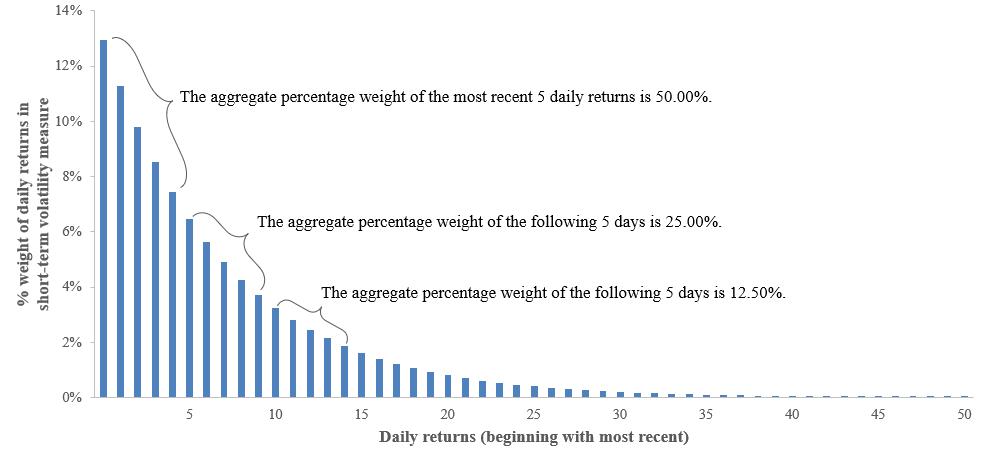
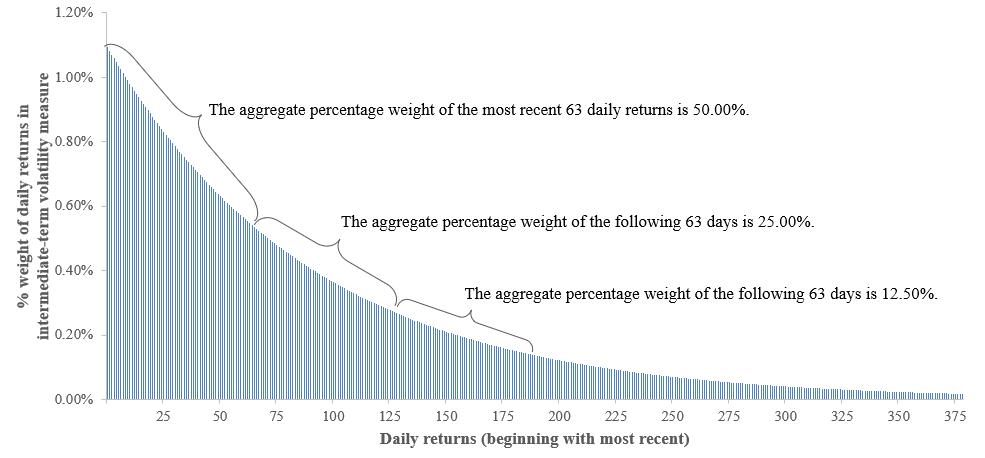
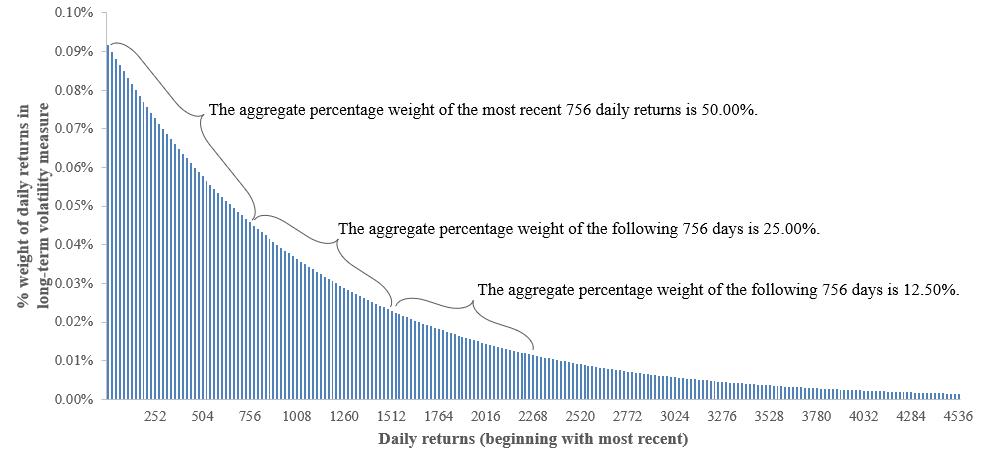
US-30
Step 2: Determining the preliminary weights of the Portfolio Constituents. The Index Calculation Agent will calculate the preliminary weight of each Portfolio Constituent by dividing the volatility budget of that Portfolio Constituent as of a given Index Business Day by the realized volatility of that Portfolio Constituent as of the immediately preceding Index Business Day, and then by dividing by the sum of the ratios of the volatility budgets of all Portfolio Constituents as of such Index Business Day to the realized volatilities of the corresponding Portfolio Constituents as of the immediately preceding Index Business Day. All else being equal, a higher volatility budget for a Portfolio Constituent will result in a higher preliminary weight for that Portfolio Constituent, while a lower volatility budget will result in a lower preliminary weight. In addition, all else being equal, a lower realized volatility for a Portfolio Constituent will result in a higher preliminary weight for that Portfolio Constituent, while a higher realized volatility will result in a lower preliminary weight.
For purposes of determining the preliminary weights of the Portfolio Constituents, the volatility budget of a Portfolio Constituent is calculated based on their respective preliminary volatility budgets. For each Defensive Constituent Switch Day, the preliminary volatility budget is 100% for the Selected Defensive Constituent and 0% for the other Defensive Constituent. See the Rules for additional information about how the Index Calculation Agent calculates the volatility budget of each Portfolio Constituent.
Step 3: Determining the actual weights of the Portfolio Constituents. On a given Index Business Day, the Index Calculation Agent will calculate the actual weight of each Portfolio Constituent by adjusting the preliminary weight of that Portfolio Constituent to take into account the Target Volatility and the Maximum Total Weight. The preliminary weight of each Portfolio Constituent will be multiplied by the ratio of the Target Volatility to the historical volatility of a hypothetical portfolio composed of the Portfolio Constituents with weights equal to the preliminary weights of the Portfolio Constituents on such Index Business Day (the “Preliminary Portfolio”), subject to the Maximum Total Weight of 150%.
For purposes of determining the actual weights of the Portfolio Constituents, the historical volatility of the Preliminary Portfolio for an Index Business Day is calculated based on the weight and historical volatility of each Portfolio Constituent, as well as the degree of historical correlation among those Portfolio Constituents. Correlation is a measure of the degree to which the returns of two assets are similar to each other over a given period in terms of timing and direction. A portfolio with a lower degree of correlation among its constituents will have a lower volatility than a portfolio with a higher degree of correlation among its constituents, assuming that the volatilities and weights of the individual constituents are the same. The diversification of a portfolio also increases as the degree of correlation between its constituents decreases. This is because the returns of constituents with a lower degree of correlation will offset each other to a greater extent than the returns of constituents with a higher degree of correlation, resulting, all else being equal, in less variability in portfolio returns for a portfolio composed of constituents with a lower degree. of correlation and more variability in portfolio returns for a portfolio composed of constituents with a higher degree of correlation. Unless all of its constituents are perfectly correlated, the historical volatility of a portfolio will be lower than the weighted average of the historical volatilities of its constituents. Accordingly, after taking into account the correlation between the Equity Constituent and the Selected Defensive Constituent, the historical volatility of the Preliminary Portfolio would likely be less than the Target Volatility. In addition, the Preliminary Weights do not take into account the Maximum Total Weight. See the Rules for additional information about how the Index Calculation Agent calculates the annualized historical volatility of the Preliminary Portfolio.
Rebalancing of the Index
Subject to the occurrence of a holiday or Disrupted Day, following each Index Business Day where the Selected Defensive Constituent changes from the Bond Constituent to the Currency Constituent (and vice versa), the Index will rebalance its exposure to the Portfolio Constituents starting on the immediately following Index Business Day and ending on the Index Business Day after the earlier of (y) the next Defensive Constituent Switch Day and (z) the Index Business Day for which the volatility budget of each Defensive Constituent as of such day is equal to the preliminary volatility budget of such Defensive Constituent calculated as of the Defensive Constituent Switch Day, up to a maximum of five (5) days. In addition, the Index will rebalance its exposure to the Portfolio Constituents on any other Index Business Day where the volatility of the notional portfolio underlying the Index is less than four point five percent (4.5%) or greater than five point five percent (5.5%), calculated as of the immediately preceding Index
US-31
Business Day. Each Index Business Day on which the Index is rebalanced pursuant to the preceding methodology is referred to herein as a “Rebalancing Day”.
The rebalancing of the Index is effected by “unitizing” (i.e., converting into a fixed number of units or shares to trade) the weights of each Portfolio Constituent as of the immediately preceding Index Business Day. Once the actual weights of the Portfolio Constituents have been determined, the Index Calculation Agent determines the number of units of each Portfolio Constituent corresponding to that Portfolio Constituent’s actual weight on such Index Business Day based on the price equal to the closing level of such Portfolio Constituent and the Index Level, each calculated as of the immediately preceding Index Business Day.
Calculation of the Index Level
The Index Calculation Agent will calculate the Index Level with respect to each Index Business Day and will publish the Index Level to an accuracy of two decimal places. The Index Level on each Index Business Day reflects the weighted excess return performance of the Portfolio Constituents since the immediately preceding Index Business Day less the daily deduction of 0.85% per annum. As a result of the daily deduction, the level of the Index will trail the value of a hypothetical identically constituted notional portfolio from which no such deduction is made.
The excess return performance of a Portfolio Constituent reflects the total return performance, if any, of that Portfolio Constituent from the immediately preceding Index Business Day (which will reflect the notional reinvestment of distributions or accrued interest, if any, on the underlying components of that Portfolio Constituent), less a notional financing cost calculated by reference to the Effective Federal Funds Rate. The Effective Federal Funds Rate is a measure of the interest rate at which depository institutions lend balances at the Federal Reserve to other depository institutions overnight, calculated as the volume-weighted median of overnight federal funds transactions reported by U.S. banks and U.S. branches and agencies of non-U.S. banks, and is quoted on the basis of an assumed year of 360 days.
For purposes of publication only, the Index Calculation Agent will round all Index Levels to two decimal places before publishing, disseminating or otherwise making those Index Levels. The Index Calculation Agent may calculate the Index Level to a greater degree of accuracy or specificity and may use any rounding convention it considers appropriate for any data used or calculations performed (which may include using data with a higher level of specificity than that which is published on any particular data source) to determine the Index Level.
“Index Business Day” is defined in the Rules and means generally a day on which the New York Stock Exchange is scheduled to open for trading for its regular trading session that is also a Dealing Day for all Portfolio Constituents on which a Market Disruption Event is not occurring.
“Dealing Day” is defined in the Rules and means generally a day on which the primary listing exchange for the Currency Constituent is scheduled to open for trading for its regular trading session, as well as a day on which the level for a Portfolio Constituent is scheduled to be published by the relevant sponsor of such Portfolio Constituent.
See the Rules for additional information about the calculation of the Index Level.
Index Market Disruption Events
The calculation and publication of the Index Level will be affected by the occurrence of certain market disruptions relating to the Portfolio Constituents. These events are set out in full in the Rules and include, without limitation, suspensions or disruptions of trading or data unavailability relating to the Portfolio Constituents, their components or related futures or option contracts that the Index Calculation Agent determines in its sole discretion could materially interfere with the ability of market participants to transact in positions with respect to the Index (including positions with respect to any Portfolio Constituent or the reference index of any Portfolio Constituent).
The Index Level will generally not be calculated or published if a market disruption affecting a Portfolio Constituent has occurred or is continuing. However, if that market disruption continues for a sustained
US-32
period, the Index Calculation Agent may nevertheless rebalance the Index using good faith estimates, and those estimates may be subject to later correction. See the Rules for additional information about market disruptions and their effects on the Index.
Succession and Extraordinary Events
Upon the occurrence of certain succession events set out in the Rules that affect a Portfolio Constituent, the Index Calculation Agent will replace the affected Portfolio Constituent with a successor to that Portfolio Constituent.
In addition, upon the occurrence of certain events set out in the Rules that are referred to as extraordinary events, and if the Index Calculation Agent determines in its sole discretion that the applicable event materially interferes with the ability of market participants to transact in positions with respect to the Index (including positions with respect to any Portfolio Constituent or the reference index of any Portfolio Constituent), then the Index Calculation Agent will, acting in good faith and a commercially reasonable manner, replace the affected Portfolio Constituent with a substitute index or ETF that the Index Calculation Agent determines, in its sole discretion, possesses substantially similar characteristics or provides substantially similar exposure as compared to the original Portfolio Constituent. If no such substitute is available, the Index Calculation Agent will replace the affected Portfolio Constituent with a substitute that the Index Calculation Agent determines to be an appropriate substitute, considering the context of the Index and the Maximum Total Weight. If neither a substantially similar nor an appropriate substitute ETF or index is available, then the Index Calculation Agent will, in its sole discretion, determine its good faith estimate of the closing level of such Portfolio Constituent and remove such Portfolio Constituent from the Index. In any such case, the Index Calculation Agent will, in good faith, make related adjustments to the Rules that it determines to be appropriate.
The extraordinary events are set out in full in the Rules and include, without limitation, (a) the permanent cancellation of a Portfolio Constituent, if no successor exists, (b) the occurrence of a market disruption affecting a Portfolio Constituent that continues for a sustained period, (c) the termination or impairment of any relevant license or other right relied upon by the Index Calculation Agent in administering the Index and (d) the occurrence of certain changes in law.
The Index Sponsor may, in its discretion, at any time and without notice, terminate the calculation or publication of the Index, including, without limitation, subsequent to the occurrence of an extraordinary event. The Index Sponsor is under no obligation to continue the calculation and publication of the Index.
Interest Rate Extraordinary Events
If the Effective Federal Funds Rate (the “Interest Rate”) is not calculated and announced by the relevant sponsor, but is calculated and announced by a successor sponsor acceptable to the Index Calculation Agent, or if the Interest Rate is replaced by a successor rate that, in the determination of the Index Calculation Agent, is the same or substantially similar to the Interest Rate, then the Interest Rate will be deemed to be the successor Interest Rate, with effect from a date determined by the Index Calculation Agent.
If the Interest Rate materially changes, is cancelled, is not published for a sustained period or is found no longer to be a representative measure of market interest rates, then the Index Calculation Agent may, in its sole discretion, cease calculation or publication of the Index on a date determined by the Index Calculation Agent or determine to select a replacement Interest Rate that possesses substantially similarly characteristics to the Interest Rate being replaced or, if the Index Calculation Agent determines that there is no replacement interest rate that possesses substantially similar characteristics to the Interest Rate, then the Index Calculation Agent may select a replacement Interest Rate that it determines will be an appropriate replacement Interest Rate. In connection with any such replacement, the Index Calculation Agent may make adjustments to the Rules that it determines are appropriate to account for such changes. Such adjustments to the Rules could include, without limitation, the addition of a spread adjustment to such successor Interest Rate or replacement Interest Rate. The inclusion of a spread adjustment could adversely affect the Index.
US-33
The Index Sponsor may, in its discretion, at any time and without notice, terminate the calculation or publication of the Index, including, without limitation, subsequent to the occurrence of an event described above affecting an Interest Rate. The Index Sponsor is under no obligation to continue the calculation and publication of the Index.
Corrections
If the closing level of any Portfolio Constituent or the Interest Rate is publicly corrected after its initial dissemination or if the Index Calculation Agent identifies an error or omission in respect of the Index, and if the Index Calculation Agent determines that the correction, error or omission is material, then the Index Calculation Agent may make an adjustment or correction to the Index Level.
The Index Sponsor and the Index Calculation Agent
JPMS is currently the sponsor of the Index (together with any successor sponsor or assign, the “Index Sponsor”). The Index Sponsor may appoint a successor sponsor or assign, delegate or transfer any or all of its rights, obligations or responsibilities in its capacity as Index Sponsor in connection with the Index to one or more entities (including an unrelated third party) that the Index Sponsor determines is appropriate.
The Index Sponsor is also responsible for the appointment of the calculation agent of the Index (the “Index Calculation Agent”), which may be the Index Sponsor, an unrelated third party or an affiliate or subsidiary of the Index Sponsor. JPMS is currently the Index Calculation Agent. The Index Sponsor may at any time and for any reason (i) appoint a successor Index Calculation Agent if the Index Sponsor is at that time the Index Calculation Agent or (ii) terminate the appointment of the Index Calculation Agent and appoint an alternative entity as a replacement Index Calculation Agent if the Index Sponsor is not at that time the Index Calculation Agent. The Index Calculation Agent (unless the Index Calculation Agent is the same entity as the Index Sponsor) must obtain written permission from the Index Sponsor prior to any delegation or transfer of the Index Calculation Agent’s responsibilities or obligations in connection with the Index. The Index Calculation Agent is responsible for making calculations and determinations as described above and in the Rules.
Index Sponsor and Index Calculation Agent Determinations
The Index Calculation Agent will act in good faith and in a commercially reasonable manner in making determinations, interpretations and calculations pursuant to the Rules. Subject to the prior agreement of the Index Sponsor, the Index Calculation Agent’s determinations, and all calculations related to the Index and the Index Calculation Agent’s interpretations of the Rules, will be final.
None of the Index Sponsor, the Index Calculation Agent, or any of their respective affiliates or subsidiaries or any of their respective directors, officers, employees, representatives, delegates or agents (each, a “Relevant Person”) will have any responsibility to any person (whether as a result of negligence or otherwise) for any determinations, interpretations or calculations made or anything done (or omitted to be determined or done) in connection with the Index or any use to which any person may put the Index or the Index Levels.
Subject to the prior agreement of the Index Sponsor, the Index Calculation Agent may make certain determinations, adjustments, amendments and interpretations related to the Index. All such determinations, adjustments, amendments and interpretations (in each case, subject to such prior agreement on the part of the Index Sponsor) of the Index Calculation Agent related to the Index and all calculations performed by the Index Calculation Agent related to the Index will be final, conclusive and binding and no person will be entitled to make any claim against the Index Sponsor, the Index Calculation Agent, or any of the Relevant Persons in respect thereof. Once a determination, adjustment, amendment or interpretation is made or action is taken by the Index Calculation Agent (in each case, as agreed in advance by the Index Sponsor) in relation to the Index, or a calculation is performed by the Index Calculation Agent in relation to the Index, none of the Index Sponsor, the Index Calculation Agent or any Relevant Person will be under any obligation to revise any such determination, adjustment, amendment, interpretation or calculation made or anything done (or omitted to be determined, adjusted, amended, interpreted, calculated or done) for any reason.
US-34
The Index Calculation Agent’s exercise of discretion or failure to exercise discretion in relation to the Index may have a detrimental effect on the Index Level and the volatility of the Index. The Index Sponsor or the Index Calculation Agent may make certain determinations or calculations based on information obtained from publicly available sources without independently verifying such information.
Amendment of the Rules; Termination of the Index
The Rules may be supplemented, amended or restated from time to time in the sole discretion of JPMS in its capacity as the Index Sponsor. The Rules will be made available (in a manner determined by the Index Sponsor from time to time) following any supplementation, amendment or restatement. Although the Rules are intended to be comprehensive and accurate, ambiguities may arise and errors or omissions may have been made. In these circumstances, the Index Sponsor will resolve these ambiguities and, if necessary, amend the Rules to reflect their resolution. In the case of any inaccuracy, the Index Sponsor may amend the Rules to address errors or omissions.
Following any amendment, the Index Sponsor will make available (as soon as practicable) the amended version of the Rules and will include the effective date of such amendment in the new version of the Rules. However, the Index Sponsor is under no obligation to inform any person about any amendments to the Index (except as required by law or regulation).
The Index Sponsor may at any time, for any reason and without notice, terminate or cease the calculation or publication of the Index.
Additional Information about Hypothetical Back-tested Performance Data
For time periods prior to the launch of each of the Bond Constituent’s underlying ETFs, and prior to that underlying ETF’s satisfaction of a minimum liquidity standard, any hypothetical back-tested performance of the Index set forth in any terms supplement will reflect alternative performance derived from the reference index tracked by that underlying ETF as of the live date of the Bond Constituent (except in the case of each of the iShares® 7-10 Year Treasury Bond ETF and the iShares® 20+ Year Treasury Bond ETF, where each proxy was the reference index tracked by the relevant underlying ETF prior to April 1, 2016), after deducting hypothetical fund expenses equal to that underlying ETF’s expense ratio as of the Bond Constituent’s live date, rather than actual performance of that underlying ETF for that period. Similarly, for time periods prior to the launch of the Currency Constituent, and prior to its satisfaction of a minimum liquidity standard, any hypothetical back-tested performance of the Index set forth in any terms supplement will reflect alternative performance derived from the reference index tracked by the Currency Constituent as of the live date of the Index, after deducting hypothetical fund expenses equal to the Currency Constituent’s expense ratio as of the Index’s live date, rather than actual performance of the Currency Constituent for that period. See the following table for more information.
| Constituent | Proxy | Expenses Subtracted from Proxy’s Returns |
Last Date Proxy Used |
| iShares® 1-3 Year Treasury Bond ETF | n/a | n/a | n/a |
| iShares® 7-10 Year Treasury Bond ETF | n/a | n/a | n/a |
| iShares® 20+ Year Treasury Bond ETF | n/a | n/a | n/a |
US-35
| Constituent | Proxy | Expenses Subtracted from Proxy’s Returns |
Last Date Proxy Used |
| Vanguard Short-Term Corporate Bond ETF | Bloomberg Barclays US Corporate 1-5 years Total Return Index | 0.05% | 9/14/2010 |
| Vanguard Intermediate-Term Corporate Bond ETF | Bloomberg Barclays US Credit Corp 5-10Y Total Return Index | 0.05% | 6/6/2011 |
| Vanguard Long-Term Corporate Bond ETF | Bloomberg Barclays US Long Corporate Bond Index | 0.05% | 3/16/2012 |
| iShares® MBS ETF | Bloomberg Barclays US Mortgage Backed Securities (MBS) Index | 0.06% | 9/11/2008 |
| iShares® TIPS Bond ETF | Bloomberg Barclays US Treasury Inflation Protected Securities (TIPS) Index (Series-L) | 0.19% | 5/27/2004 |
| iShares® J.P. Morgan USD Emerging Markets Bond ETF | J.P. Morgan EMBISM Global Core Index | 0.39% | 11/17/2009 |
| iShares® iBoxx $ High Yield Corporate Bond ETF | Markit iBoxx® USD Liquid High Yield Index | 0.49% | 5/23/2008 |
| Invesco DB US Dollar Index Bullish Fund | Deutsche Bank US Dollar Index Long Future Index | 0.79% | 6/9/2008 |
US-36
Background on the J.P. Morgan U.S. Low Volatility Index (Total Return)
Terms defined within this “Background on the J.P. Morgan U.S. Low Volatility Index (Total Return)” section are defined only with respect to this “Background on the J.P. Morgan U.S. Low Volatility Index (Total Return)” section.
The J.P. Morgan U.S. Low Volatility Index (Total Return) (the “Index”) was developed and is maintained by J.P. Morgan Securities LLC (“JPMS”). The description of the Index and methodology included in this underlying supplement is based on rules formulated by JPMS (the “Rules”). The Rules, and not this description, will govern the calculation and constitution of the Index and other decisions and actions related to its maintenance. The Rules in effect as of the date of this underlying supplement are attached as Annex B to this underlying supplement. The Index is the intellectual property of JPMS and its affiliates, and JPMS and its affiliates reserve all rights with respect to their ownership of the Index. The Index is reported by Bloomberg L.P. under the ticker symbol “JPUSEQLV Index.”
The Index is an index that applies a rules-based methodology to seeks to track the total return of a portfolio of stocks selected from the components of the Solactive United States 1000 Index (the “Base Reference Index”), with stocks with the highest realized volatility excluded, with weightings selected to seek sector diversification and with a weighting preference for stocks with lower realized volatility. There is, however, no assurance that the Index will exhibit lower volatility or provide higher risk-weighted returns than the Base Reference Index or any other index or strategy.
The Base Reference Index is a free float-adjusted market capitalization-weighted index that is designed to track the performance of the largest 1,000 companies from the U.S. stock market. For additional information about the Base Reference Index, see “Background on the Solactive United States 1000 Index” below.
On any given day, the closing level of the Index (the “Index Level”) reflects the weighted performance of the Index constituents (with an adjustment for dividends). The Index Level was set equal to 100.00 on June 16, 2006, the base date of the Index. On December 16, 2022 (the “Calculation Agent Succession Date”), Solactive AG (“Solactive”) replaced JPMS as the Index Calculation Agent (as defined below). The Index Calculation Agent began calculating the Index on a live basis on February 24, 2023.
No assurance can be given that the investment strategy used to construct the Index will achieve its intended results or that the Index will be successful or will outperform any alternative index or strategy that might reference the Index constituents.
The Index is described as a “notional” or “synthetic” portfolio of assets because there is no actual portfolio of assets to which any person is entitled or in which any person has any ownership interest. The Index merely references certain assets, the performance of which will be used as a reference point for calculating the Index Level.
Composition of the Index and Index Rebalancing
Except under the circumstances described below, the Index is rebalanced quarterly on the first Calculation Day that occurs on or after the third Friday of each March, June, September and December (each, a “Rebalancing Date”) to reflect the composition and weighting of the Index determined in respect of the third immediately preceding Calculation Day (the “Rebalance Selection Date”) in accordance with the methodology described below and in the Rules.
In respect of a Rebalance Selection Date, the Constituent Stock Determination Agent will review whether, with respect to each of the Universe Stocks (as defined below), the inputs and related information necessary to make all of the relevant determinations (“Evaluation Data”) are available. If Evaluation Data is not available on a Rebalance Selection Date with respect to 500 or more Universe Stocks, the Constituent Stock Determination Agent will instead use Evaluation Data as of the most recent date prior to that Rebalance Selection Date on which Evaluation Data is available with respect to 500 or more Universe Stocks.
US-37
A “Calculation Day” means any day in respect of which the New York Stock Exchange is scheduled to be open for trading during its regular trading session, whether scheduled for a full-day regular trading session or a shortened-day regular trading session.
Identifying the Eligible Sectors. The eligible sectors for the Index, in respect of a Rebalance Selection Date, are each of the following economic sectors under The Refinitiv Business Classification (TRBC) (each, a “TRBC Sector”), as available to the Constituent Stock Determination Agent at approximately 11:00 a.m., New York time on the Calculation Day that immediately follows that Rebalance Selection Date (the “Data Reference Time”), that contains at least 10 Universe Stocks (each, an “Eligible Sector”): energy; basic materials; industrials; consumer cyclicals; consumer non-cyclicals; financials; healthcare; technology; utilities; real estate; institutions, associations & organizations; government activity; and academic & educational services.
Identifying the Universe Stocks and the Eligible Stocks. The stock universe for the Index, in respect of a Rebalance Selection Date, includes each of the constituents of the Base Reference Index, as available to the Constituent Stock Determination Agent at approximately the Data Reference Time (each, a “Universe Stock”), that satisfies the following criteria:
| · | that constituent is represented in Thomson Reuters Datastream as accessed via QA Direct at approximately the Data Reference Time; |
| · | the issuer of that constituent is classified within a TRBC Sector, as determined by the Constituent Stock Determination Agent using information available at approximately the Data Reference Time; |
| · | that constituent trades on its principal exchange or quotation system in U.S. dollars, as determined by the Constituent Stock Determination Agent; and |
| · | that constituent has a Dollar Notional Trading Estimate (as defined in the Rules), a Dollar Market Capitalization Estimate (as defined in the Rules) and a 2 Year Volatility Factor Score (as defined in the Rules and described below) in respect of that Rebalance Selection Date. |
See the Rules for additional information about the data sources referenced in determining the composition of the Index.
A Universe Stock in respect of a Rebalance Selection Date will be eligible to be included in the Index in respect of that Rebalance Selection Date (each, an “Eligible Stock”) if (a) its 2 Year Volatility Factor Score is not above the 80th percentile for its associated Eligible Sector, (b) it is not issued by J.P. Morgan Chase & Co., Visa Inc., MasterCard Inc., any successors of those entities or any other affiliate of the Index Sponsor and (c) its issuer is not subject to any applicable law, regulation, order or rule that would directly or indirectly prohibit or restrict holding, purchasing or selling securities of that Universe Stock or derivatives on, or other exposures to, that Universe Stock, as further described in the Rules. In addition, each Universe Stock that is an Index constituent with a positive weight on the Rebalance Date immediately preceding that Rebalance Selection Date will also be an Eligible Stock in respect of that Rebalance Selection Date. The 2 Year Volatility Factor Score of each Universe Stock is the annualized realized volatility of that Universe Stock over the immediately preceding two years calculated as set forth in the Rules.
Determining the Preliminary Sector Weights. In respect of each Rebalance Selection Date, the Constituent Stock Determination Agent (as defined below) will attempt to determine preliminary weights of the Eligible Sectors within the Index in respect of that Rebalance Selection Date using an optimization model (the “Preliminary Sector Weights”). Subject to constraints described below, the optimization model seeks to minimize both (a) the square root of the weighted average of the 3 Year Modified Sector Covariance (as defined in the Rules) of each Eligible Sector relative to itself and each other Eligible Sector, determined as set forth in the Rules, and (b) and the sector turnover constant of 0.001 times the sum of the difference between the Preliminary Sector Weight of each Eligible Sector and its current weight in the Index. The 3 Year Modified Sector Covariance of each Eligible Sector relative to another Eligible Sector is determined in part based on the annualized realized volatilities of those Eligible Sectors, where the annualized realized volatility of an Eligible Sector is determined by reference to the weekly performance of
US-38
only those Universe Stocks associated with that Eligible Sector that have a 2 Year Volatility Factor Score equal to or below the median of the 2 Year Volatility Factor Scores of the Universe Stocks associated with that Eligible Sector. By seeking to minimize the 3 Year Modified Sector Covariances of the Eligible Sectors, the Index is seeking to increase its diversification among the Eligible Sectors. In addition, by seeking to minimize the aggregate differences between the Preliminary Sector Weights of the Eligible Sectors and their current weights in the Index, the Index is seeking to reduce turnover in the Index over time.
The constraints of this optimization are as follows: (a) the sum of the Preliminary Sector Weights of the Eligible Sectors must be 100% and (b) the Preliminary Sector Weight of each Eligible Constituent Stock must be greater than or equal to 5% and less than or equal to 20%.
If the optimization model fails to produce Preliminary Sector Weights for the Eligible Sectors, then no changes will be made to the composition of the Index in connection with that Rebalance Selection Date and no rebalancing will occur on the associated Rebalancing Date. If the optimization model fails to produce Preliminary Sector Weights for the Eligible Sectors for two consecutive Rebalance Selection Dates due to a temporary technical failure, such as, without limitation, a failure arising from corrupted software or a computing facility outage, then the Index Sponsor may amend the Rules or cancel the Index.
Determining the Target Sector Weights. In respect of each Rebalance Selection Date, the Constituent Stock Determination Agent will attempt to determine the target weights of the Eligible Sectors within the Index in respect of that Rebalance Selection Date by applying a capping mechanism to the Preliminary Sector Weights. The cap applied to the Preliminary Sector Weight of each Eligible Sector (the “Maximum Sector Weight”) will equal the sum of, for each Universe Stock associated with that Eligible Sector, the lesser of (a) the Stock Maximum Weight of that Universe Stock and (b) a maximum weight cap of 0.65% (the “Maximum Weight Cap”). The “Stock Maximum Weight” of each Universe Stock is a measure of the liquidity of that Universe Stock and is equal to 400% of the Dollar Notional Trading Estimate for that Universe Stock divided by 10% of the Universe Dollar Market Capitalization Estimate (as defined in the Rules). The Dollar Notional Trading Estimate for a Universe Stock is calculated as the median over the last 30 calendar days of the close price of that Universe Stock on the relevant calendar day times the volume of that Universe Stock traded on that calendar day. The Universe Dollar Market Capitalization Estimate represents an estimate of the aggregate market capitalization of the Universe Stocks.
In respect of each Rebalance Selection Date, the “Target Sector Weight” is determined as follows:
| · | if the Preliminary Sector Weight of each Eligible Sector is less than or equal to its Maximum Sector Weight, the Target Sector Weight of each Eligible Sector will be equal to its Preliminary Sector Weight; or |
| · | if the Preliminary Sector Weight of any Eligible Sector is greater than its Maximum Sector Weight, the Target Sector Weight of each such Eligible Sector will be set equal to its Maximum Sector Weight and the excess weight from those Eligible Sectors will be allocated pro rata among all remaining Eligible Sectors, with this capping and reallocating methodology being applied repeatedly, if necessary, until the Target Sector Weight of each Eligible Sector is less than or equal to its Maximum Sector Weight, subject to a maximum of 10 such iterations. |
Determining the Preliminary Weights. In respect of each Rebalance Selection Date, the Constituent Stock Determination Agent will attempt to determine the target weights of the Eligible Stocks within the Index in respect of that Rebalance Selection Date as described below by allocating the weight of each Eligible Sector among some or all of the Eligible Stocks associated with that Eligible Sector, with a preference toward Eligible Stocks with lower 2 Year Volatility Factor Scores.
First, the Constituent Stock Determination Agent will determine the “Capped Stock Weight” in respect of that Rebalance Selection Date for each Eligible Stock as follows:
| · | if the current weight of that Eligible Stock (which will be zero if that Eligible Stock is not currently included in the Index) is less than or equal to the Maximum Weight Cap of 0.65%, the Capped Stock Weight of that Eligible Stock will be equal to the current weight of that Eligible Stock; or |
US-39
| · | if the current weight of that Eligible Stock is greater than the Maximum Weight Cap, the Capped Stock Weight of that Eligible Stock will be equal to the Maximum Weight Cap, provided that, if the current weight of that Eligible Stock is greater than the Maximum Weight Cap by more than the Stock Delta Weight of that Eligible Stock on that Rebalance Selection Date, the Capped Stock Weight of that Eligible Stock will be equal to its current weight minus its Stock Delta Weight. |
The “Stock Delta Weight” of each Universe Stock is a measure of the liquidity of that Universe Stock and is equal to the Dollar Notional Trading Estimate for that Universe Stock divided by 10% of the Universe Dollar Market Capitalization Estimate. The Stock Delta Weight of an Eligible Stock is used in some cases by the Index as a limit on the size of adjustments to exposure to that Eligible Stock in connection with an Index rebalancing.
The Constituent Stock Determination Agent will then determine the sum of the Capped Stock Weights of the Eligible Stocks associated with each Eligible Sector and will compare that sum to the Target Weight of the relevant Eligible Sector to determine the “Target Weights” of the Eligible Stocks in that Eligible Sector as follows:
| · | if the sum of the Capped Stock Weights of the Eligible Stocks associated with that Eligible Sector is greater than the Target Sector Weight of that Eligible Sector, the Target Weights of the Eligible Stocks associated with that Eligible Sector will be reduced from their Capped Stock Weights, beginning with the most volatile Eligible Stocks associated with that Eligible Sector (as measured by their 2 Year Volatility Factor Scores), until the sum of the Target Weights of the Eligible Stocks in that Eligible Sector equals the Target Sector Weight of that Eligible Sector or the weights of all Eligible Stocks associated with that Eligible Sector have been reduced as described above; or |
| · | if the sum of the Capped Stock Weights of the Eligible Stocks associated with that Eligible Sector is less than the Target Sector Weight of that Eligible Sector, the Target Weights of the Eligible Stocks associated with that Eligible Sector will be increased from their Capped Stock Weights, beginning with the least volatile Eligible Stocks associated with that Eligible Sector (as measured by their 2 Year Volatility Factor Scores), until the sum of the Target Weights of the Eligible Stocks in that Eligible Sector equals the Target Sector Weight of that Eligible Sector or the weights of all Eligible Stocks associated with that Eligible Sector have been increased as described above. |
Notwithstanding the foregoing, the amount of any increase or decrease from the Capped Stock Weight of an Eligible Stock may be limited by the Stock Delta Weight of that Eligible Stock as set forth in the Rules. In addition, the Target Weight of an Eligible Stock will not be less than zero and will not be greater than its Stock Maximum Weight. Furthermore, if the current weight of an Eligible Stock is less than the maximum stock weight, the Target Weight of that Eligible Stock will not be greater than the maximum stock weight. See the Rules for additional information about the calculation of the Target Weights of the Eligible Stocks.
The “Preliminary Weight” of each Eligible Stock will be its Target Weight, provided that, if the Target Weight of any Eligible Stock is less than 0.001%, the Target Weight of that Eligible Stock will be allocated pro rata to the other Eligible Stocks and the Preliminary Weight of that Eligible Stock will be 0%. Once the Preliminary Weights are determined, the Constituent Stock Determination Agent provides a list of the Eligible Constituent Stocks with Preliminary Weights above 0% (the “Preliminary Constituent Stocks”), along with their Preliminary Weights, to the Index Calculation Agent.
Identifying the Constituent Stocks. In respect of each Rebalancing Date, the Index Calculation Agent determines the “Constituent Stocks” as consisting of each Preliminary Constituent Stock that has not been delisted from its primary exchange or quotation system or suspended from trading on its primary exchange or quotation system (other than a limitation of trading in shares of that Preliminary Constituent Stock by reason of movements in price exceeding limits permitted by the relevant exchange or quotation system) from and including the immediately preceding Rebalance Selection Date to and including that Rebalancing Date. The “Constituent Weight” of each Constituent Stock is equal to its Preliminary Weight,
US-40
as increased, if applicable, on a pro rata basis to account for the Preliminary Weight of any Preliminary Constituent Stock that is not a Constituent Stock.
Rebalancing the Index. Except under the circumstances described above, the Index will be rebalanced on each Rebalancing Date to reflect the Constituent Stocks and the Constituent Weights determined in respect of the associated Rebalance Selection Date. In the event that one or more Constituent Stocks is affected by a market disruption on a Rebalancing Date, the Index may postpone or cancel its entry into, or postpone its exit from, its synthetic position in any such Constituent Stock. See “— Index Market Disruption Events” below.
Notwithstanding the foregoing, for purposes of determining the composition of the Index, the current weights of the Constituent Stocks on the Calculation Agent Succession Date were set equal to their respective weights as specified in the Rules in connection with Solactive replacing JPMS as the Index Calculation Agent.
Calculation of the Index Level
Except as described under “— Index Market Disruption Events” below, the Index Calculation Agent will calculate and publish the Index Level in respect of each Calculation Day as soon as reasonably practicable on or after that day. All Index Levels will be rounded to two decimal places for purposes of publication only before being published. The Index Calculation Agent may vary its rounding convention in its sole discretion, provided that it will not publish the Index Level with fewer than two decimal places. Notwithstanding anything to the contrary, the Index Calculation Agent may calculate and maintain the Index Level to greater accuracy for the determination of upcoming Index Levels or other calculations.
The Index Level was set equal to 100.00 on June 16, 2006, the base date of the Index. The calculation of the Index Level for each subsequent Calculation Day takes into account the Index Level in respect of the immediately preceding Calculation Day and the weighted performance of the Constituent Stocks (with adjustment for any dividends) since the immediately preceding Calculation Day, subject to adjustments as described under “— Index Market Disruption Events,” “— Index Calculation Agent Adjustments Due to Corporate Actions and Corporate Events,” “— Extraordinary Events” and “— Dividends” below. See the Index Rules for additional information about the calculation of the Index Level. Notwithstanding the foregoing, on the Calculation Agent Succession Date, the Index Level was set equal to approximately 582.63 (as set forth in the Rules) in connection with Solactive replacing JPMS as the Index Calculation Agent.
If the Index Level on any Calculation Day is less than or equal to zero, the Index Level for that Calculation Day and each subsequent Calculation Day will be zero and the Index Calculation Agent will no longer calculate the Index Level as described above.
Index Market Disruption Events
The calculation and publication of the Index Level and the rebalancing of the Index will be affected by the occurrence of certain market disruptions relating to the Constituent Stocks. These events are set out in full in the Rules and include, without limitation, suspensions or disruptions of trading or data unavailability relating to the Constituent Stocks or related futures or option contracts that the Disruption Determination Agent determines in its sole discretion could materially interfere with the ability of market participants to transact in positions with respect to the Index, the Constituent Stocks or related futures or option contracts.
If a market disruption affecting a Constituent Stock has occurred or is continuing on a Rebalancing Date, that Rebalancing Date will not be postponed, but the calculation and publication of the Index Level for that Rebalancing Date and each subsequent Calculation Day will be postponed until the prices of all Constituent Stocks have been determined. If any Constituent Stock exiting the Index on that Rebalancing Date is affected by a market disruption, that Constituent Stock will be removed from the Index at a price equal to its closing price on the next following Scheduled Trading Day for that Constituent Stock on which that Constituent Stock is no longer affected by a market disruption, provided that, if that market disruption persists for ten Calculation Days, that Constituent Stock will be removed at a price determined by the Disruption Determination Agent in good faith. If any Constituent Stock entering the Index on that Rebalancing Date is affected by a market disruption, that Constituent Stock will be added at a price equal
US-41
to its closing price on the next following Scheduled Trading Day for that Constituent Stock on which that Constituent Stock is no longer affected by a market disruption, provided that, if that market disruption persists for ten Calculation Days, that Constituent Stock will not be added to the Index. Any Constituent Stock exiting or entering the Index on a Rebalancing Date that is not affected by a market disruption will be removed from or added to the Index, as applicable, at a price equal to its closing price on that Rebalancing Date.
Except as described above with respect to market disruptions affecting a Rebalancing Date and subsequent Calculation Days, the Index Level will generally be calculated and published on each Calculation Day, even if one or more Constituent Stocks is affected by a market disruption. Under these circumstances, the Index Level will be calculated using the last non-disrupted closing prices for any Constituent Stocks affected by a market disruption. However, if more than 20% of the weight of the Index is affected by a market disruption, the publication of the Index Level will be postponed until less than 20% of the weight of the Index is affected by a market disruption or until the next Rebalancing Date, whichever is earlier.
“Scheduled Trading Day” is defined in the Rules and generally means, in respect of a Constituent Stock, any day on which the principal exchange or quotation system on which that Constituent Stock is listed and each exchange or quotation system where trading has a material effect on the overall market for futures or options contracts relating to that Constituent Stock are scheduled to be open for trading during their respective regular trading sessions.
See the Rules for additional information about market disruptions and their effects on the Index.
Index Calculation Agent Adjustments Due to Corporate Actions and Corporate Events
It is expected that the Index Calculation Agent will from time to time make adjustments to the composition of the Index (1) in respect of Corporate Actions that impact a Constituent Stock, (2) in respect of Corporate Events that impact the issuer of a Constituent Stock and (3) in respect of other circumstances or events (collectively, “Constituent Stock Events”). The Index Calculation Agent will make adjustments to the composition of the Index in respect of a Constituent Stock affected by a Constituent Stock Event that are consistent with the adjustments made by the calculation agent of the Solactive United States 1000 Index (the “Identified Reference Index”) in respect of that Constituent Stock and that Constituent Stock Event for purposes of maintaining the Identified Reference Index (or, if that Constituent Stock is not included in the Identified Reference Index, consistent with the adjustment that would be made if that Constituent Stock had been included in the Identified Reference Index).
A “Corporate Action” is an event that impacts shares or shareholders with a prescribed ex-date and includes, without limitation, distributions, capital increases, capital repayments, rights issues, entitlement offers, stock conversions, share splits (sub-division), reverse share splits (consolidation) and scrip issues (capitalization or bonus issue).
A “Corporate Event” is an event that impacts a company or its shares or shareholders and that may impact an index (depending on its rules), including without limitation, a de-listing, liquidation, bankruptcy, insolvency, winding-up, nationalization, consolidation, amalgamation, merger, binding share exchange, acquisition, takeover offer, exchange offer, tender offer or similar event.
Because the Index is a price return index, it is expected that no adjustment or change will be made to the Index to account for the declaration or payment of a distribution in the form of an ordinary or extraordinary cash dividend.
Extraordinary Events
Certain extraordinary events may affect the ability of the Index Sponsor, the Index Calculation Agent, the Constituent Stock Determination Agent and the Disruption Determination Agent to reference data sources including the optimization software, the Base Reference Index and the Identified Reference Index. As described in the Rules, upon the occurrence of any of those extraordinary events, if practicable, a successor or replacement may be identified and the Rules will be amended accordingly, provided that the Index Sponsor may, in its discretion, at any time and without notice, terminate the calculation or publication
US-42
of the Index, including, without limitation, subsequent to the occurrence of an extraordinary event. The Index Sponsor is under no obligation to continue the calculation and publication of the Index.
Dividends
If an issuer of a Constituent Stock fails to pay the full amount of any declared dividend by the scheduled payment date for that Constituent Stock, then the Index Sponsor may if practicable and if it considers such failure material make the corresponding adjustment(s), if any, to any one or more of the Index Level, the closing price of the affected Constituent Stock and any other variable or term of the Rules that the Index Sponsor determines appropriate to account for the failure of the issuer of the Constituent Stock to pay the full amount of the declared dividend. Under these circumstances, Index Sponsor will determine the effective date of any such adjustment.
Corrections
If any publicly available financial or other information used in any calculation or determination is subsequently corrected or if the Index Sponsor, the Index Calculation Agent, the Constituent Stock Determination Agent or the Disruption Determination Agent identifies an error or omission in any of the calculations or determinations in respect of the Index, and if the Index Sponsor determines that the correction, error or omission is material, then an adjustment or correction may be made to the Index Level.
The Index Sponsor and the Index Calculation Agent
JPMS is currently the sponsor of the Index (together with any successor sponsor or assign, the “Index Sponsor”). The Index Sponsor may appoint a successor sponsor or assign, delegate or transfer any or all of its rights, obligations or responsibilities in its capacity as Index Sponsor in connection with the Index to one or more entities (including an unrelated third party) that the Index Sponsor determines is appropriate.
The Index Sponsor is also responsible for the appointment of the calculation agent of the Index (the “Index Calculation Agent”), the determination agent of the Constituent Stocks (the “Constituent Stock Determination Agent”) and the determination agent of disruption events (the “Disruption Determination Agent”), each of which may be the Index Sponsor, an unrelated third party or an affiliate or subsidiary of the Index Sponsor. Solactive AG is currently the Index Calculation Agent, and JPMS is currently the Constituent Stock Determination Agent and the Disruption Determination Agent. JPMS was the Index Calculation Agent from the base date of the Index to and including the Calculation Agent Succession Date. The Index Sponsor may at any time or for any reason terminate the appointment of any of the Index Calculation Agent, the Constituent Stock Determination Agent or the Disruption Determination Agent and appoint an alternative entity (or entities) as that entity’s replacement. Each of the Index Calculation Agent, the Constituent Stock Determination Agent and the Disruption Determination Agent (unless that entity is the same entity as the Index Sponsor) must obtain written permission from the Index Sponsor prior to any delegation or transfer of that entity’s responsibilities or obligations in connection with the Index.
The Index Sponsor, the Index Calculation Agent, the Constituent Stock Determination Agent and the Disruption Determination Agent are responsible for making calculations and determinations as described above and in the Rules.
Index Sponsor, Index Calculation Agent, Constituent Stock Determination Agent and Disruption Determination Agent Determinations
Each of the Index Sponsor, the Index Calculation Agent, the Constituent Stock Determination Agent and the Disruption Determination Agent will act in good faith and in a commercially reasonable manner in making determinations, interpretations and calculations pursuant to the Rules. All determinations, interpretations and calculations of the Index Sponsor, the Index Calculation Agent, the Constituent Stock Determination Agent or the Disruption Determination Agent relating to the Rules will be final, subject to the “Corrections” section above. No person shall be entitled to make any claim against the Index Sponsor, the Index Calculation Agent, the Constituent Stock Determination Agent, the Disruption Determination Agent or any Relevant Person in respect of any determinations, interpretations or calculations of the Index Sponsor, the Index Calculation Agent, the Constituent Stock Determination Agent or the Disruption Determination Agent.
US-43
None of the Index Sponsor, the Index Calculation Agent, the Constituent Stock Determination Agent, the Disruption Determination Agent and any of their respective affiliates and subsidiaries and any of their respective directors, officers, employees, representatives, delegates and agents (each, a “Relevant Person”) will be under any obligation to revise any determination, interpretation or calculation made or action taken for any reason in connection with the Rules or the Index or have any responsibility to any person (whether as a result of negligence or otherwise) for any determinations, interpretations or calculations made or anything done (or omitted to be determined or done) in connection with the Index or any use to which any person may put the Index or the Index Levels.
An action (or failure to act) on the part of the Index Sponsor, the Index Calculation Agent, the Constituent Stock Determination Agent or the Disruption Determination Agent in relation to the Index may have a detrimental effect on the Index Level or the volatility of the Index. The Index Sponsor, the Index Calculation Agent, the Constituent Stock Determination Agent or the Disruption Determination Agent may make certain determinations or calculations based on information obtained from publicly available sources without independently verifying that information.
Amendment of the Rules; Termination of the Index
Economic, market, regulatory, legal, financial or other circumstances may arise that may necessitate or make desirable an amendment of the Rules. Notwithstanding the foregoing, the Index Sponsor may amend the Index Rules as it deems appropriate. These amendments may include (without limitation), correcting or curing any errors, omissions or contradictory provisions; modifications to the methodology described in the Rules that are necessary or desirable in order for the calculation of the Index to continue notwithstanding any change to any economic, market, regulatory, legal, financial or other circumstances; or modifications of a formal, minor or technical nature.
Following any amendment, the Index Sponsor will make available (as soon as practicable) the amended version of the Rules and will include the effective date of that amendment in the new version of the Rules. However, the Index Sponsor is under no obligation to inform any person about any amendments to the Index (except as required by law or regulation).
The Index Sponsor may, in its sole discretion, at any time and without notice, terminate the calculation and publication of the Index.
US-44
Background on the J.P. Morgan Core Bond Index
Terms defined within this “Background on the J.P. Morgan Core Bond Index” section are defined only with respect to this “Background on the J.P. Morgan Core Bond Index” section.
The J.P. Morgan Core Bond Index (the “Index”) was developed and is maintained and calculated by J.P. Morgan Securities LLC (“JPMS”). The description of the Index and methodology included in this Underlying Supplement is based on rules formulated by JPMS (the “Rules”). The Rules, and not this description, will govern the calculation and constitution of the Index and other decisions and actions related to its maintenance. The Rules in effect as of the date of this Underlying Supplement are attached as Annex C to this Underlying Supplement. The Index is the intellectual property of JPMS, and JPMS reserves all rights with respect to its ownership of the Index. The Index is reported by Bloomberg L.P. under the ticker symbol “JPUSCORE Index.”
The Index seeks to provide a dynamic asset allocation to the U.S. dollar fixed-income sector based on a momentum investment strategy. The Index tracks the return of a notional dynamic portfolio consisting of up to 10 U.S. dollar fixed-income exchange-traded funds (each a “Constituent,” and collectively, the “Constituents”), in each case with distributions, if any, notionally reinvested.
The Index selects and rebalances into a new notional portfolio composed of the Constituents at least once each month using a methodology that is designed to:
| · | maintain a diversified allocation within the U.S. dollar fixed income sector at all times; and |
| · | allocate dynamically based on recent performance. |
Maintaining a diversified allocation within the U.S. dollar fixed income sector. A diversified portfolio’s return is the weighted average of its constituents’ returns, but its volatility is less than the weighted average of its constituents’ volatilities, because different assets don’t always move in the same direction — in this sense, a diversified portfolio can be said to deliver average returns with below-average volatility. In order to ensure diversification, the Index constitutes its selected portfolio from a universe of 10 Constituents, and imposes caps and floors on the Constituent weights at the individual and sector levels. Each Constituent’s assigned weight must also be an increment of 5%, and the assigned weights must sum to 100%. The following table sets forth the current Constituents, the exchange ticker for each Constituent, the minimum and maximum assigned weight for each Constituent and the minimum and maximum aggregate assigned weight for each sector. For additional information about the Constituents, see “Background on the iShares® ETFs” and “Background on the Vanguard ETFs” below.
| Constituent | Ticker | Individual Assigned Weight Constraints |
Aggregate Assigned Weight Constraints | |
| 1 | iShares® 1-3 Year Treasury Bond ETF | SHY |
Minimum: 0% Maximum: 30% |
Minimum: 20% Maximum: 60% |
| 2 | iShares® 7-10 Year Treasury Bond ETF | IEF | ||
| 3 | iShares® 20+ Year Treasury Bond ETF | TLT | ||
| 4 | Vanguard Short-Term Corporate Bond ETF | VCSH |
Minimum: 0% Maximum: 20% |
Minimum: 10% Maximum: 40% |
| 5 | Vanguard Intermediate-Term Corporate Bond ETF | VCIT | ||
| 6 | Vanguard Long-Term Corporate Bond ETF | VCLT | ||
| 7 | iShares® MBS ETF | MBB |
Minimum: 10% Maximum: 40% |
N/A |
US-45
| Constituent | Ticker | Individual Assigned Weight Constraints |
Aggregate Assigned Weight Constraints | |
| 8 | iShares® TIPS Bond ETF | TIP |
Minimum: 0% Maximum: 20% |
Minimum: 0% Maximum: 20% |
| 9 | iShares® J.P. Morgan USD Emerging Markets Bond ETF | EMB | ||
| 10 | iShares® iBoxx $ High Yield Corporate Bond ETF | HYG |
Allocating dynamically based on recent performance. Academic research has shown that, historically, asset classes exhibiting strong recent returns have been more likely to continue to exhibit positive returns. The Index attempts to take advantage of this dynamic by identifying a selected portfolio that reflects the strongest recent returns from among the possible portfolios that meet the weight constraints set forth above and the volatility threshold described below.
Identifying a selected portfolio. At least once each month, the Index identifies every notional portfolio that meets the individual Constituent and sector weight constraints set forth above with weights in increments of 5% and a total weight of 100% and that has a recent historical volatility at or below a volatility threshold of 5%. The Index then selects and rebalances into the notional portfolio from that set with the strongest recent performance. If no such notional portfolio exists, then the volatility threshold is increased by 1% (e.g., from 5% to 6%), and the procedure described in this paragraph is repeated, including the increase to the volatility threshold, until a notional portfolio has been selected.
Calculating the level of the Index. On any given day, the closing level of the Index (the “Index Level”) reflects the weighted performance of the Constituents, in each case with distributions, if any, notionally reinvested. The Index Level was set equal to 100.00 on May 3, 2004, the base date of the Index. The Index Calculation Agent (as defined below) began calculating the Index on a live basis on August 28, 2020.
No assurance can be given that the investment strategy used to construct the Index will be successful or that the Index will outperform any alternative portfolio or strategy that might be constructed from the Constituents. There is no guarantee that past performance trends referenced in identifying a selected portfolio will continue during the subsequent period when the Index provides exposure to that selected portfolio. In addition, no assurance can be given that the actual realized volatility of the Index will approximate 5%. The actual realized volatility of the Index will depend on the performance of the Constituents included in the selected portfolio(s) from time to time, and, at any time or for extended periods, may be greater than 5%, perhaps significantly, or less than 5%. Furthermore, the volatility threshold is subject to upward adjustment and, thus, the realized volatility threshold used to determine any selected portfolio may be greater than 5%, perhaps significantly.
The Index is described as a “notional” or “synthetic” portfolio of assets because there is no actual portfolio of assets to which any person is entitled or in which any person has any ownership interest. The Index merely references certain assets, the performance of which will be used as a reference point for calculating the Index Level.
Identifying the Selected Portfolio
On each selection date, the Index Calculation Agent identifies a single portfolio composed of the Constituents (the “Selected Portfolio”) from among the set of hypothetical portfolios that meet the weight constraints, based on an evaluation of the historical performance and volatility of each of those hypothetical portfolios. Selection dates occur monthly on the last Index Trading Day of each calendar month. In addition, if on any Index Trading Day the volatility of the most recent Selected Portfolio is more than twice the volatility of that Selected Portfolio as of the selection date of that Selected Portfolio, then that Index Trading Day will also be a selection date. For this purpose, the volatility of a Selected Portfolio is the highest of the
US-46
annualized realized volatilities of that Selected Portfolio over the immediately preceding one-month, three-month and six-month periods.
“Index Trading Day” is defined in the Rules as “Trading Day” and means generally an Index Business Day for which all of the Constituents tracked by the Index are not subject to any market disruption or on which the Index rebalances a portion of its exposure from one Selected Portfolio to the next.
“Index Business Day” is defined in the Rules and means generally a day on which each of the New York Stock Exchange and the primary listing exchange for each Constituent is scheduled to open for trading for its regular trading session.
Step 1: Identify All Eligible Portfolios
On each selection date, the Index Calculation Agent identifies all possible portfolios composed of Constituents that satisfy the following weight constraints (each, an “Eligible Portfolio”):
| (i) | the sum of the assigned weights for all the Constituents is equal to 100% (i.e., the Index is always fully invested without leverage); |
| (ii) | the assigned weight for each Constituent is a non-negative integral multiple of 5% (e.g., 0%, 5%, 10%, 15%, etc.); |
| (iii) | the assigned weight for each Constituent is (a) greater than or equal to any minimum individual assigned weight for that Constituent and (b) less than or equal to any maximum individual assigned weight for that Constituent, in each case, as set forth in the table above; and |
| (iv) | the sum of the assigned weights for the Constituents in any sector is (a) greater than or equal to any minimum aggregate assigned weight for that sector and (b) less than or equal to any maximum aggregate assigned weight for that sector, in each case, as set forth in the table above. |
Step 2: Select the Eligible Portfolio with the Highest Performance, Subject to a Volatility Threshold
On each selection date, the Index Calculation Agent selects the Eligible Portfolio with the highest performance that has a volatility less than or equal to a volatility threshold of 5% as the Selected Portfolio; provided that, if there is more than one Eligible Portfolio with the same highest performance, the Eligible Portfolio that has the lowest volatility will be selected. If none of the Eligible Portfolios has a volatility equal to or less than 5%, the Index Calculation Agent will increase the volatility threshold by 1% and will repeat the procedure described in this paragraph, including the increase to the volatility threshold, until a portfolio has been selected.
For purposes of determining a Selected Portfolio:
| (i) | the performance of an Eligible Portfolio is the average of the total return performances of that Eligible Portfolio (with dividends on any Constituent notional reinvested in that Constituent) over the immediately preceding one-month, three-month and six-month periods; and |
| (ii) | the volatility of an Eligible Portfolio is the highest of the annualized realized volatilities of that Eligible Portfolio over the immediately preceding one-month, three-month and six-month periods. |
See the Rules for additional information about how the Index Calculation Agent calculates the returns and annualized realized volatility of each Eligible Portfolio.
Rebalancing of the Index
In connection with each rebalancing, the Index exits its notional position in the Selected Portfolio associated with the prior selection date and enters a notional position in the Selected Portfolio associated with the current selection date. This rebalancing of the Index is effected in equal increments over five rebalancing days, occurring over the five consecutive Index Business Days following each selection date
US-47
(the “Rebalancing Period”). Rebalancing days are subject to postponement or adjustment if a market disruption affecting an incoming or outgoing Constituent has occurred or is continuing, as described under “Index Market Disruption Events” below.
Calculation and Publication of the Index Level
The Index Calculation Agent will calculate the Index Level with respect to each Index Trading Day and will publish the Index Level to an accuracy of two decimal places. The Index Level on each Index Trading Day reflects the weighted total return performance of the Constituents tracked by the Index on that Index Trading Day. The total return performance of a Constituent reflects the price performance of that Constituent and the notional reinvestment of any dividends or other distributions on that Constituent on the first Index Trading Day occurring on or after the relevant ex-date.
The Index Calculation Agent will make anti-dilution adjustments to a Constituent only upon a share split or reverse share split, an issuance of additional shares of that Constituent that is given ratably to all or substantially all holders of shares of that Constituent or a distribution of securities of that Constituent as a result of the triggering of any provision of the corporate charter of that Constituent.
While the Index Calculation Agent will publish the Index Level with respect each Index Trading Day to an accuracy of two decimal places, the Index Calculation Agent may calculate the Index to a greater degree of accuracy or specificity and may use any rounding convention it considers appropriate for any data used or calculations performed (which may include using data with a higher level of specificity than that which is published on any particular data source) to determine the Index Level.
See the Rules for additional information about the calculation of the Index Level.
Index Market Disruption Events
The calculation and publication of the Index Level and the rebalancing of the Index will be affected by the occurrence of certain market disruptions relating to the Constituents. These events are set out in full in the Rules and include, without limitation, suspensions or disruptions of trading or data unavailability relating to the Constituents, their reference indices or components or related futures or option contracts that the Index Calculation Agent determines in its sole discretion could materially interfere with the ability of market participants to transact in positions with respect to the Index, the Constituents, their reference indices or components or related futures or option contracts.
If a market disruption affecting an incoming or outgoing Constituent has occurred or is continuing on a scheduled rebalancing day, that rebalancing day will generally be postponed until no such market disruption is occurring. However, if that market disruption continues for a sustained period, the Index Calculation Agent may nevertheless rebalance the Index using good faith estimates, and those estimates may be subject to later correction. The Index Level will not be calculated and published on any day on which a Constituent included in a relevant Selected Portfolio is affected by a market disruption, except for a rebalancing day on which the Index Calculation Agent rebalances the Index notwithstanding the occurrence of a market disruption.
The five rebalancing days in each Rebalancing Period will occur on five separate calendar days, notwithstanding the postponement of one or more days due to a market disruption. If a rebalancing day is postponed, any subsequent rebalancing days in the same rebalancing period will also be postponed so as to prevent multiple rebalancing days from occurring on the same day.
See the Rules for additional information about market disruptions and their effects on the Index.
Succession and Extraordinary Events
Upon the occurrence of certain events set out in the Rules that related to successor Constituents or that are referred to as extraordinary events, and if Index Calculation Agent determines that the applicable event materially interferes with the ability of market participants to transact in positions with respect to the Index, then the Index Calculation Agent will replace the affected Constituent with a successor to that Constituent or with a substitute that the Index Calculation Agent determines, in its sole discretion,
US-48
possesses substantially similar characteristics or provides substantially similar exposure as compared to the original Constituents. If no such substitute is available, the Index Calculation Agent will replace the affected Constituent with a substitute that the Index Calculation Agent determines to be an appropriate substitute, considering the context of the Index and the weight constraints or, if no such substitute is available, the Index Calculation Agent may freeze the closing price of that Constituent at a level it determines until the conclusion of the next Rebalancing Period, and then remove that Constituent from the Index. In any such case, the Index Calculation Agent will, in good faith, make related adjustments to the Rules that it determines to be appropriate.
The extraordinary events are set out in full in the Rules and include, without limitation, (a) the de-listing, termination, liquidation, bankruptcy, insolvency, dissolution or winding-up of a Constituent, (b) nationalization or expropriation of a Constituent or its securities or all or substantially all of its assets, (c) the occurrence of a market disruption affecting a Constituent that continues for a sustained period, (d) the termination or impairment of any relevant license or other right relied upon by the Index Calculation Agent in administering the Index, (e) the occurrence of certain changes in law and (f) certain other events affecting the trading, value, redeemability, liquidity, market capitalization or listing of a Constituent or affecting data relating to a Constituent.
The Index Sponsor may, in its discretion, at any time and without notice, terminate the calculation or publication of the Index, including, without limitation, subsequent to the occurrence of an extraordinary event. The Index Sponsor is under no obligation to continue the calculation and publication of the Index.
Corrections
If the closing price of any Constituent is publicly corrected after its initial dissemination or if the Index Calculation Agent identifies an error or omission in respect of the Index, and if the Index Calculation Agent determines that the correction, error or omission is material, then the Index Calculation Agent may make an adjustment or correction to the Index Level.
The Index Sponsor and the Index Calculation Agent
JPMS is currently the sponsor of the Index (together with any successor sponsor or assign, the “Index Sponsor”). The Index Sponsor may appoint a successor sponsor or assign, delegate or transfer any or all of its rights, obligations or responsibilities in its capacity as Index Sponsor in connection with the Index to one or more entities (including an unrelated third party) that the Index Sponsor determines is appropriate.
The Index Sponsor is also responsible for the appointment of the calculation agent of the Index (the “Index Calculation Agent”), which may be the Index Sponsor, an unrelated third party or an affiliate or subsidiary of the Index Sponsor. JPMS is currently the Index Calculation Agent. The Index Sponsor may at any time and for any reason (i) appoint a successor Index Calculation Agent if the Index Sponsor is at that time the Index Calculation Agent or (ii) terminate the appointment of the Index Calculation Agent and appoint an alternative entity as a replacement Index Calculation Agent if the Index Sponsor is not at that time the Index Calculation Agent. The Index Calculation Agent (unless the Index Calculation Agent is the same entity as the Index Sponsor) must obtain written permission from the Index Sponsor prior to any delegation or transfer of the Index Calculation Agent’s responsibilities or obligations in connection with the Index. The Index Calculation Agent is responsible for making calculations and determinations as described above and in the Rules.
Index Sponsor and Index Calculation Agent Determinations
The Index Calculation Agent will act in good faith and in a commercially reasonable manner in making determinations, interpretations and calculations pursuant to the Rules. Subject to the prior agreement of the Index Sponsor, the Index Calculation Agent’s determinations, and all calculations related to the Index and the Index Calculation Agent’s interpretations of the Rules, will be final.
None of the Index Sponsor, the Index Calculation Agent and any of their respective affiliates and subsidiaries and any of their respective directors, officers, employees, representatives, delegates and agents (each, a “Relevant Person”) will have any responsibility to any person (whether as a result of negligence or otherwise) for any determinations, interpretations or calculations made or anything done (or
US-49
omitted to be determined or done) in connection with the Index or any use to which any person may put the Index or the Index Levels.
Subject to the prior agreement of the Index Sponsor, the Index Calculation Agent may make certain determinations, adjustments, amendments and interpretations related to the Index. All such determinations, adjustments, amendments and interpretations (in each case, subject to such prior agreement on the part of the Index Sponsor) of the Index Calculation Agent related to the Index and all calculations performed by the Index Calculation Agent related to the Index will be final, conclusive and binding and no person will be entitled to make any claim against the Index Sponsor, the Index Calculation Agent, or any of the Relevant Persons in respect thereof. Once a determination, adjustment, amendment or interpretation is made or action is taken by the Index Calculation Agent (in each case, as agreed in advance by the Index Sponsor) in relation to the Index, or a calculation is performed by the Index Calculation Agent in relation to the Index, none of the Index Sponsor, the Index Calculation Agent or any Relevant Person will be under any obligation to revise any such determination, adjustment, amendment, interpretation or calculation made or anything done (or omitted to be determined, adjusted, amended, interpreted, calculated or done) for any reason.
The Index Calculation Agent’s exercise of discretion or failure to exercise discretion in relation to the Index may have a detrimental effect on the Index Level and the volatility of the Index. The Index Sponsor or the Index Calculation Agent may make certain determinations or calculations based on information obtained from publicly available sources without independently verifying such information.
Amendment of the Rules; Termination of the Index
The Rules may be supplemented, amended or restated from time to time in the sole discretion of the Index Sponsor. The Rules will be made available (in a manner determined by the Index Sponsor from time to time) following any supplementation, amendment or restatement. Following any amendment, the Index Sponsor will make available (as soon as practicable) the amended version of the Rules and will include the effective date of such amendment in the new version of the Rules. However, the Index Sponsor is under no obligation to inform any person about any amendments to the Index (except as required by law or regulation).
Although the Rules are intended to be comprehensive and accurate, ambiguities may arise and errors or omissions may have been made. In those circumstances, the Index Sponsor will resolve those ambiguities and, if necessary, amend the Rules to reflect their resolution. In the case of any inaccuracy, the Index Sponsor may amend the Rules to address errors or omissions. The Index Sponsor is under no obligation to inform any person of any amendments to the Index (except as may be required by law).
The Index Sponsor may, in its discretion, at any time and without notice, terminate the calculation or publication of the Index, including, without limitation, subsequent to the occurrence of one of the events described under “Succession and Extraordinary Events” above. The Index Calculation Agent may, at any time and without notice, change the frequency of publication of the Index Level, the means or place of publication of the Index Level or cease the calculation, publication or dissemination of the Index Level.
Additional Information About Hypothetical Back-tested Performance Data
For time periods prior to the launch of each of the Constituents, and prior to that Constituent’s satisfaction of a minimum liquidity standard, any hypothetical back-tested performance of the Index set forth in any terms supplement will reflect alternative performance derived from the reference index tracked by that Constituent as of the live date of the Index, after deducting hypothetical fund expenses equal to that Constituent’s expense ratio as of the live date of the Index, rather than actual performance of that Constituent for that period. See the following table for more information.
US-50
| Constituent | Proxy | Expenses Subtracted from Proxy’s Returns |
Last Date Proxy Used |
| iShares® 1-3 Year Treasury Bond ETF | n/a | n/a | n/a |
| iShares® 7-10 Year Treasury Bond ETF | n/a | n/a | n/a |
| iShares® 20+ Year Treasury Bond ETF | n/a | n/a | n/a |
| Vanguard Short-Term Corporate Bond ETF | Bloomberg Barclays US Corporate 1-5 years Total Return Index | 0.05% | 9/14/2010 |
| Vanguard Intermediate-Term Corporate Bond ETF | Bloomberg Barclays US Credit Corp 5-10Y Total Return Index | 0.05% | 6/6/2011 |
| Vanguard Long-Term Corporate Bond ETF | Bloomberg Barclays US Long Corporate Bond Index | 0.05% | 3/16/2012 |
| iShares® MBS ETF | Bloomberg Barclays US Mortgage Backed Securities (MBS) Index | 0.06% | 9/11/2008 |
| iShares® TIPS Bond ETF | Bloomberg Barclays US Treasury Inflation Protected Securities (TIPS) Index (Series-L) | 0.19% | 5/27/2004 |
| iShares® J.P. Morgan USD Emerging Markets Bond ETF | J.P. Morgan EMBISM Global Core Index | 0.39% | 11/17/2009 |
| iShares® iBoxx $ High Yield Corporate Bond ETF | Markit iBoxx® USD Liquid High Yield Index | 0.49% | 5/23/2008 |
US-51
Background on the Invesco DB US Dollar Index Bullish Fund
Terms defined within this “Background on the Invesco DB US Dollar Index Bullish Fund” section are defined only with respect to this “Background on the Invesco DB US Dollar Index Bullish Fund” section.
The Invesco DB US Dollar Index Bullish Fund (the “Fund”) establishes long positions in ICE U.S. Dollar Index (“USDX®”) futures contracts, with a view to tracking the changes, whether positive or negative, in the level of the Deutsche Bank Long USD Currency Portfolio Index–Excess ReturnTM (the “Index”), over time. The Index is composed solely of long positions in the USDX® futures contracts, which are traded on the ICE Futures U.S. exchange under the symbol “DX” and calculated on an excess return, or unfunded, basis. The USDX® futures contracts are designed to replicate the performance of taking a long position in the U.S. dollar against a basket of currencies composed of the Euro, Japanese Yen, British Pound, Canadian Dollar, Swedish Krona and Swiss Franc. The Index is thus intended to provide a general indication of the international value of the U.S. dollar relative to such basket of currencies.
The performance of the Fund is also intended to reflect the excess, if any, of the sum of the Fund’s interest income from its holdings of U.S. treasury securities, dividends from its holdings in money market mutual funds (affiliated or otherwise) and dividends or distributions of capital gains from its holdings of and treasury-bill ETFs over the expenses of the Fund. The Fund invests in U.S. treasury securities, money market mutual funds and treasury-bill ETFs (affiliated or otherwise), if any, for margin and/or cash management purposes.
The Fund was formed as a Delaware statutory trust on August 3, 2006 and commenced trading on the American Stock Exchange (which became the NYSE Alternext US LLC) on February 20, 2007 and, since November 25, 2008, has been listed on the NYSE Arca, Inc. The term of the Fund is perpetual (unless terminated earlier in certain circumstances) and has an unlimited number of shares authorized for issuance.
Invesco Capital Management LLC, a Delaware limited liability company, serves as managing owner (in such capacity, the “Managing Owner”) of the Fund, and serves as the commodity pool operator and commodity trading advisor. The Managing Owner pays Deutsche Investment Management Americas Inc., the sponsor of the Fund, a licensing fee and an index services fee for performing its duties. Wilmington Trust Company is the sole trustee of the Invesco DB US Dollar Index Trust, and Bank of New York Mellon is the administrator, custodian and transfer agent of the Fund.
Information provided to or filed with the SEC by the Fund pursuant to the Securities Act of 1933, as amended, and the Securities Exchange Act of 1934, as amended, can be located by reference to SEC file numbers 333-257258-01 and 001-33314, respectively, through the SEC’s website at http://www.sec.gov. The underlying shares of the Fund trade on the NYSE Arca under the ticker symbol “UUP.”
JPMS has derived all information regarding the Fund from publicly available information and has not independently verified any information regarding the Fund. JPMS make no representation as to the performance of the Fund.
US-52
Background on the Solactive United States 1000 Index
All information contained in this Underlying Supplement regarding the Solactive United States 1000 Index (the “Solactive U.S. 1000 Index”), including, without limitation, its make-up, method of calculation and changes in its components, has been derived from publicly available information, without independent verification. This information reflects the policies of, and is subject to change by, Solactive AG (“Solactive”). The Solactive U.S. 1000 Index is calculated, maintained and published by Solactive. Solactive has no obligation to continue to publish, and may discontinue publication of, the Solactive U.S. 1000 Index.
The Solactive U.S. 1000 Index is reported by Bloomberg L.P. under the ticker symbol “SUSA1KP.”
The Solactive U.S. 1000 Index is a free float-adjusted market capitalization-weighted index that is designed to track the performance of the largest 1,000 companies from the U.S. stock market.
Composition of the Solactive U.S. 1000 Index
The Solactive U.S. 1000 Index is constructed using a process that involves: (i) defining the index universe; (ii) determining the market investable index universe; (iii) determining market capitalization size segments and (iv) applying index rebalancing rules.
Index Universe
The Solactive U.S. 1000 Index universe is composed of all financial instruments that:
| · | Are traded on the following eligible stock exchanges: BATS Exchange, Investors Exchange, Nasdaq Stock Exchange, New York Stock Exchange, NYSE American, NYSE Arca; and |
| · | meet the following tradability requirements: |
| · | New components require an average daily value traded of at least US$10,000 over the preceding 1-month and 6-month period. Current components require an average daily value traded of at least US$7,500 over the same period. |
| · | New components require a volume of at least 10,000 shares over the preceding 1-month period and 60,000 shares over the preceding 6-month period. Current components require a volume of at least 7,500 shares and 45,000 shares over the same respective periods. |
| · | New components require a free float percentage of at least 10%. Current components require a free float percentage of at least 7.5%. |
| · | Components must have less than 10 non-trading days over the preceding 3-month period. |
The tradability requirements of companies with a listing date that lies within the 3-month period prior to the Selection Day (as defined below) are modified as follows:
| · | New components must have a trading history of at least 20 trading days. |
| · | New components must have no non-trading days. |
Investable Index Universe
In order to become eligible for the Solactive U.S. 1000 Index, a company needs to fulfill the following additional criteria:
| · | Nationality: Eligible securities must be assigned to the United States. If both the country of primary listing and the country of domicile is the United States, then the security is assigned to the United States. If the country of primary listing does not equal the country of domicile, then |
US-53
the country of incorporation and the country of risk (i.e., the country in which the company would be influenced the most by potential changes in the business environment) are additionally considered to determine the country assignment.
| · | Eligible securities: Only common stocks, REITs and tracking stocks are eligible for index inclusion. |
| · | Market capitalization: |
| · | Companies in the index universe that fulfill the nationality and eligible securities criteria are sorted by total market capitalization in descending order, considering all of their share classes combined, if multiple. Each company is assigned a rank based on the position in the sorted list (e.g., the company with the highest total market capitalization is assigned rank 1). |
| · | All companies ranked in the top 850 are selected as components of the Solactive U.S. 1000 Index. |
| · | Current components with a rank from 851 to 1,200 are added to the Solactive U.S. 1000 Index until the total number of companies in the Solactive U.S. 1000 Index reaches 1,000. |
| · | If the total number of companies is still below 1,000 after the previous steps, the highest-ranking companies are added to the Solactive U.S. 1000 Index until 1,000 companies are reached. In case fewer than 1,000 companies are eligible, all eligible companies are selected, and the Solactive U.S. 1000 Index consists of less than 1,000 companies. |
| · | In case a company has multiple share lines, Solactive determines a primary share line per company. The primary share line is added to the Solactive U.S. 1000 Index. To avoid frequent changes between share lines of a company, Solactive applies a liquidity buffer rule: |
| · | If the company is currently in the Solactive U.S. 1000 Index: the primary share line currently included in the Solactive U.S. 1000 Index will remain the primary share line if its average daily value traded over the preceding 1-month and 6-month periods is at least 75% of any other share line of the company. |
| · | If the company is currently not in the Solactive U.S. 1000 Index: the share line with the highest average daily value traded over the preceding 1-month and 6-month periods is set to be the primary share line. |
All other share lines of a company are compared to the 20% (or 15% if the share line is already an existing component) percentile of the index universe regarding the liquidity parameters of (i) average daily value traded over the preceding 1-month and 6-months periods and (ii) volume of shares traded over the preceding 1-month and 6-months periods. If a share line exceeds all liquidity thresholds, it is added to the Solactive U.S. 1000 Index.
Rebalance
Solactive revises the composition of the Solactive U.S. 1000 Index in accordance with the above criteria on each “Selection Day,” which is 20 weekdays before the scheduled Rebalance Day. A “Rebalance Day” is the first Wednesday in March, June, September, and December. If that Wednesday is not a day in which the New York Stock Exchange or the Nasdaq Stock Exchange are open for general business, then the Rebalance Day will be the immediately following day.
The Solactive U.S. 1000 Index is not rebalanced extraordinarily.
US-54
Calculation of the Solactive U.S. 1000 Index
The Solactive U.S. 1000 Index is weighted by free float market capitalization. The components’ free float is the share class-specific fraction of the total number of shares of such share class issued that are available for trading by market participants and not locked-in by long term holders, as sourced from data vendors. On each Selection Day each index component is assigned a weight according to free float market capitalization, calculated as the multiplication of the shares outstanding in free float (as sourced from data vendors) with the closing price of the share class as of the respective Selection Day.
For the calculation of the index level, the sum of the market capitalization of the components is divided by the divisor.

The divisor is a mathematical factor defined at the inception of the Index. The divisor is adjusted by certain corporate actions and index rebalances. Dividends paid by any component are applied across the entire basket by changing the divisor.
Corporate Events
As part of the Solactive U.S. 1000 Index maintenance, Solactive will consider various events — also referred to as corporate actions — which result in an adjustment to the Solactive U.S. 1000 Index between two regular Rebalance Days, including, but not limited to, special dividends, stock dividends, share splits, spin-offs, mergers and acquisitions, delistings and others. These events have a material impact on the price, weighting or overall integrity of index components. Corporate actions will be implemented from the cum-day to the ex-day of the corporate action, so that the adjustment to the Solactive U.S. 1000 Index coincides with the occurrence of the price effect of the respective corporate action.
While Solactive aims at creating and maintaining its methodology for treatment of corporate actions as generic and transparent as possible and in line with regulatory requirements, it retains the right to deviate from these standard procedures in case of any unusual or complex corporate action or if such a deviation is made to preserve the comparability and representativeness of the Solactive U.S. 1000 Index over time.
License Agreement
The financial instrument is not sponsored, promoted, sold or supported in any other manner by Solactive nor does Solactive offer any express or implicit guarantee or assurance either with regard to the results of using the Solactive U.S. 1000 Index and/or Solactive U.S. 1000 Index trade mark or the index level at any time or in any other respect. The Solactive U.S. 1000 Index is calculated and published by Solactive. Solactive uses its best efforts to ensure that the Solactive U.S. 1000 Index is calculated correctly. Irrespective of its obligations towards the sponsor of any index that references the Solactive U.S. 1000 Index, Solactive has no obligation to point out errors in the Solactive U.S. 1000 Index to third parties including but not limited to investors and/or financial intermediaries of the financial instrument. Neither publication of the Solactive U.S. 1000 Index by Solactive nor the licensing of the Solactive U.S. 1000 Index or Solactive U.S. 1000 Index trade mark for the purpose of use in connection with the financial instrument constitutes a recommendation by Solactive to invest capital in said financial instrument nor does it in any way represent an assurance or opinion of Solactive with regard to any investment in this financial instrument.
US-55
Background on the iShares® ETFs
All information contained in this Underlying Supplement regarding the exchange-traded funds described in this “Background on the iShares® ETFs” section (each, an “iShares ETF” and collectively, the “iShares ETFs”) has been derived from publicly available information, without independent verification. This information reflects the policies of, and is subject to change by, the fund manager of each iShares ETF and BlackRock Fund Advisors (“BFA”). The iShares ETFs are investment portfolios of iShares® Trust and are maintained and managed by their respective fund managers. BFA is currently the investment adviser to the iShares ETFs.
BFA uses a representative sampling indexing strategy to manage each iShares ETF. “Representative sampling” is an indexing strategy that involves investing in a representative sample of securities that collectively has an investment profile similar to that of an applicable reference index. The securities selected are expected to have, in the aggregate, investment characteristics (based on factors such as market capitalization and industry weightings), fundamental characteristics (such as return variability and yield), liquidity measures similar to those of an applicable reference index and, with respect to the iShares ETFs that primarily hold bonds, bond-related characteristics (such as duration, maturity and credit ratings). An iShares ETF may or may not hold all of the securities in its reference index.
Each iShares ETF’s reference index is a financial calculation, based on a grouping of financial instruments, and is not an investment product, while each iShares ETF is an actual investment portfolio. The performance of each iShares ETF and its reference index may vary for a number of reasons, including transaction costs, non-U.S. currency valuations, asset valuations, corporate actions (such as mergers and spin-offs), timing variances and differences between that iShares ETF’s portfolio and its reference index resulting from that iShares ETF’s use of representative sampling or from legal restrictions (such as diversification requirements) that apply to that iShares ETF but not to its reference index. “Tracking error” is the divergence of the performance (return) of an iShares ETF’s portfolio from that of its reference index. Because each iShares ETF uses a representative sampling indexing strategy, it can be expected to have a larger tracking error than if it used a replication indexing strategy. “Replication” is an indexing strategy in which a fund invests in substantially all of the securities in its reference index in approximately the same proportions as in the reference index. From time to time, the index provider may make changes to the methodology or other adjustments to the reference index of an iShares ETF. Unless otherwise determined by BFA, any such change or adjustment will be reflected in the calculation of that iShares ETF’s reference index performance on a going-forward basis after the effective date of such change or adjustment. Therefore, the iShares ETF’s reference index performance shown for periods prior to the effective date of any such change or adjustment will generally not be recalculated or restated to reflect such change or adjustment.
iShares® Trust is a registered investment company that consists of numerous separate investment portfolios, including the iShares ETFs. Information provided to or filed with the SEC by iShares® Trust pursuant to the Securities Act of 1933, as amended, and the Investment Company Act of 1940, as amended, can be located by reference to SEC file numbers 333-92935 and 811-09729 through the SEC’s website at http://www.sec.gov.
The iShares® 1-3 Year Treasury Bond ETF
The iShares® 1-3 Year Treasury Bond ETF seeks to track the investment results, before fees and expenses, of an index composed of U.S. Treasury bonds with remaining maturities between one and three years, which is currently the ICE U.S. Treasury 1-3 Year Bond Index. The ICE U.S. Treasury 1-3 Year Bond Index measures the performance of public obligations of the U.S. Treasury that have a remaining maturity of greater than or equal to one year and less than three years. The iShares® 1-3 Year Treasury Bond ETF trades on The NASDAQ Stock Market under the ticker symbol “SHY.”
The iShares® 7-10 Year Treasury Bond ETF
The iShares® 7-10 Year Treasury Bond ETF seeks to track the investment results, before fees and expenses, of an index composed of U.S. Treasury bonds with remaining maturities between seven and ten years, which is currently the ICE U.S. Treasury 7-10 Year Bond Index. The ICE U.S. Treasury 7-10 Year
US-56
Bond Index measures the performance of public obligations of the U.S. Treasury that have a remaining maturity of greater than or equal to seven years and less than ten years. The iShares® 7-10 Year Treasury Bond ETF trades on The NASDAQ Stock Market under the ticker symbol “IEF.”
The iShares® 20+ Year Treasury Bond ETF
The iShares® 20+ Year Treasury Bond ETF seeks to track the investment results, before fees and expenses, of an index composed of U.S. Treasury bonds with remaining maturities greater than twenty years, which is currently the ICE U.S. Treasury 20+ Year Bond Index. The ICE U.S. Treasury 20+ Year Bond Index measures the performance of public obligations of the U.S. Treasury that have a remaining maturity greater than or equal to twenty years. The iShares® 20+ Year Treasury Bond ETF trades on The NASDAQ Stock Market under the ticker symbol “TLT.”
The iShares® MBS ETF
The iShares® MBS ETF seeks to track the investment results, before fees and expenses, of an index composed of investment-grade mortgage-backed pass-through securities issued and/or guaranteed by U.S. government agencies, which is currently the Bloomberg Barclays US Mortgage Backed Securities (MBS) Index. The Bloomberg Barclays US Mortgage Backed Securities (MBS) Index measures the performance of investment-grade (as determined by Bloomberg Index Services Limited) mortgage-backed pass-through securities (“MBS”) issued or guaranteed by U.S. government agencies. The Bloomberg Barclays US Mortgage Backed Securities (MBS) Index includes fixed-rate MBS issued by the Government National Mortgage Association (“GNMA” or “Ginnie Mae”), Federal National Mortgage Association (“Fannie Mae”) and Federal Home Loan Mortgage Corporation (“Freddie Mac”) that have 30-, 20-, 15-year maturities. The iShares® MBS ETF trades on The NASDAQ Stock Market under the ticker symbol “MBB.”
The iShares® TIPS Bond ETF
The iShares® TIPS Bond ETF seeks to track the investment results, before fees and expenses, of an index composed of inflation-protected U.S. Treasury bonds, which is currently the Bloomberg Barclays US Treasury Inflation Protected Securities (TIPS) Index (Series-L). The Bloomberg Barclays US Treasury Inflation Protected Securities (TIPS) Index (Series-L) measures the performance of the inflation-protected public obligations of the U.S. Treasury, commonly known as “TIPS.” The iShares® TIPS Bond ETF trades on NYSE Arca, Inc. under the ticker symbol “TIP.”
The iShares® J.P. Morgan USD Emerging Markets Bond ETF
The iShares® J.P. Morgan USD Emerging Markets Bond ETF seeks to track the investment results, before fees and expenses, of an index composed of U.S. dollar-denominated, emerging market bonds, which is currently the J.P. Morgan EMBI® Global Core Index. The J.P. Morgan EMBI® Global Core Index is a broad, diverse U.S. dollar-denominated emerging markets debt benchmark that tracks the total return of actively traded external debt instruments in emerging market countries. The iShares® J.P. Morgan USD Emerging Markets Bond ETF trades on The NASDAQ Stock Market under the ticker symbol “EMB.”
The iShares® iBoxx $ High Yield Corporate Bond ETF
The iShares® iBoxx $ High Yield Corporate Bond ETF seeks to track the investment results, before fees and expenses, of an index composed of U.S. dollar-denominated, high-yield corporate bonds, which is currently the Markit iBoxx® USD Liquid High Yield Index. The Markit iBoxx® USD Liquid High Yield Index is a rules-based index consisting of U.S. dollar-denominated, high-yield (as determined by Markit Indices Limited) corporate bonds for sale in the United States. The iShares® iBoxx $ High Yield Corporate Bond ETF trades on NYSE Arca, Inc. under the ticker symbol “HYG.”
US-57
Background on the Vanguard ETFs
All information contained in this Underlying Supplement regarding the exchange-traded funds described in this “Background on the Vanguard ETFs” section (each, a “Vanguard ETF” and collectively, the “Vanguard ETFs”) has been derived from publicly available information, without independent verification. This information reflects the policies of, and is subject to change by, the fund manager of each Vanguard ETF (“Vanguard”). The Vanguard ETFs are investment portfolios of Vanguard Scottsdale Funds and are maintained and managed by their respective fund managers. Vanguard is currently the investment adviser to the Vanguard ETFs.
Each Vanguard ETF employs an indexing investment approach designed to track the performance of its reference index. Each Vanguard ETF uses the sampling method of indexing, meaning that it holds a range of securities that, in the aggregate, fully approximates its reference index in terms of key risk factors and other characteristics. Each Vanguard ETF attempts to mirror the performance of its reference index, for better or worse. However, each Vanguard ETF is subject to index sampling risk, which is the chance that the securities selected for that Vanguard ETF, in the aggregate, will not provide investment performance matching that of its reference index. For example, each Vanguard ETF has operating expenses and transaction costs. Market indices do not, and therefore they will usually have a slight performance advantage over funds that track them. The ability of each Vanguard ETF to match its performance to that of its reference index can also be impacted by, among other things, the timing and size of cash flows and the size of the fund. Market disruptions and regulatory restrictions could also have an adverse effect on a Vanguard ETF’s ability to adjust its exposure to the required levels in order to track its reference index.
Vanguard Scottsdale Funds is a registered investment company that consists of numerous separate investment portfolios, including the Vanguard ETFs. Information provided to or filed with the SEC by Vanguard pursuant to the Securities Act of 1933, as amended, and the Investment Company Act of 1940, as amended, can be located by reference to SEC file numbers 333-11763 and 811-07803, respectively, through the SEC’s website at http://www.sec.gov.
The Vanguard Short-Term Corporate Bond ETF
The Vanguard Short-Term Corporate Bond ETF seeks to track the performance of a market-weighted corporate bond index with a short-term dollar-weighted average maturity, which is currently the Bloomberg Barclays U.S. 1-5 Year Corporate Bond Index. The Bloomberg Barclays U.S. 1-5 Year Corporate Bond Index includes U.S. dollar-denominated, investment-grade, fixed-rate, taxable securities issued by industrial, utility and financial companies with maturities between one and five years. The Vanguard Short-Term Corporate Bond ETF trades on The NASDAQ Stock Market under the ticker symbol “VCSH.”
The Vanguard Intermediate-Term Corporate Bond ETF
The Vanguard Intermediate-Term Corporate Bond ETF seeks to track the performance of a market-weighted corporate bond index with an intermediate-term dollar-weighted average maturity, which is currently the Bloomberg Barclays U.S. 5-10 Year Corporate Bond Index. The Bloomberg Barclays U.S. 5-10 Year Corporate Bond Index includes U.S. dollar-denominated, investment-grade, fixed-rate, taxable securities issued by industrial, utility and financial companies with maturities between five and ten years. The Vanguard Intermediate-Term Corporate Bond ETF trades on The NASDAQ Stock Market under the ticker symbol “VCIT.”
The Vanguard Long-Term Corporate Bond ETF
The Vanguard Long-Term Corporate Bond ETF seeks to track the performance of a market-weighted corporate bond index with a long-term dollar-weighted average maturity, which is currently the Bloomberg Barclays U.S. 10+ Year Corporate Bond Index. The Bloomberg Barclays U.S. 10+ Year Corporate Bond Index includes U.S. dollar-denominated, investment-grade, fixed-rate, taxable securities issued by industrial, utility and financial companies with maturities greater than 10 years. The Vanguard Long-Term Corporate Bond ETF trades on The NASDAQ Stock Market under the ticker symbol “VCLT”.
US-58
Supplemental Terms of the Notes
The following supplemental terms of the notes supplement, and to the extent they are inconsistent, supersede, the description of the general terms of the notes set forth in the accompanying product supplement. Except as noted below, capitalized terms used in this section without definition are as defined in “The J.P. Morgan Tactical Blend Index” above.
Postponement of a Determination Date
Notes linked solely to the Index
Notwithstanding any contrary provision in the accompanying product supplement, for notes linked solely to the Index, the following provisions will apply. If a Determination Date (as defined in the accompanying product supplement) is a Disrupted Day (as defined in the accompanying product supplement), the applicable Determination Date will be postponed to the immediately succeeding scheduled trading day that is not a Disrupted Day.
In no event, however, will any Determination Date be postponed to a date that is after the applicable Final Disrupted Determination Date (as defined in the accompanying product supplement). If a Determination Date is or has been postponed to the applicable Final Disrupted Determination Date and that day is a Disrupted Day, the calculation agent will determine the closing level of the Index for that Determination Date on that Final Disrupted Determination Date in accordance with the formula for and method of calculating the closing level of the Index last in effect prior to the commencement of the market disruption event (or prior to the non-trading day), using, for any Portfolio Constituent (including any successor Portfolio Constituent), the official closing level or the official closing price, as applicable, of that Portfolio Constituent (or, if a market disruption event or a non-trading day that affected that Portfolio Constituent has occurred, the closing level or the closing price, as applicable, of that Portfolio Constituent determined by the calculation agent in accordance with the formula for and method of calculating the closing level or the closing price, as applicable, of that Portfolio Constituent last in effect prior to the commencement of the market disruption event (or prior to the non-trading day), using the calculation agent’s good faith estimate of the closing price or other trading price or level of the instruments comprising that Portfolio Constituent that would have prevailed but for that suspension or limitation or non-trading day) on the scheduled trading day immediately preceding that Final Disrupted Determination Date.
Notes linked to the Index and other reference assets
If the notes are linked to the Index and other reference assets, the provisions relating to postponement of a Determination Date as set forth in the accompanying product supplement will apply, except that if a Determination Date is or has been postponed to the applicable Final Disrupted Determination Date and, on that day, the closing level of the Index has not been established in accordance with the postponement provisions of the accompanying product supplement that apply prior to the applicable Final Disrupted Determination Date, the closing level of the Index for that Determination Date will be determined by the calculation agent on the applicable Final Disrupted Determination Date in accordance with the formula for and method of calculating the closing level of the Index last in effect prior to the commencement of the market disruption event (or prior to the non-trading day), using, for any Portfolio Constituent (including any successor Portfolio Constituent), the official closing level or the official closing price, as applicable, of that Portfolio Constituent (or, if a market disruption event or a non-trading day that affected that Portfolio Constituent has occurred, the closing level or the closing price, as applicable, of that Portfolio Constituent determined by the calculation agent in accordance with the formula for and method of calculating the closing level or the closing price, as applicable, of that Portfolio Constituent last in effect prior to the commencement of the market disruption event (or prior to the non-trading day), using the calculation agent’s good faith estimate of the closing price or other trading price or level of the instruments comprising that Portfolio Constituent that would have prevailed but for that suspension or limitation or non-trading day) on the scheduled trading day immediately preceding that Final Disrupted Determination Date.
US-59
Additional Defined Terms
Notwithstanding any contrary definition in the accompanying product supplement, a “scheduled trading day” is, unless otherwise specified in the relevant terms supplement, a day, as determined by the calculation agent, on which the Index or any relevant successor index is scheduled to be published in accordance with the rules or methodology that governs the Index or relevant Successor Index, as applicable.
Notwithstanding any contrary definition in the accompanying product supplement, a “trading day” is, unless otherwise specified in the relevant terms supplement, a day, as determined by the calculation agent, on which the Index or any relevant successor index is published.
Market Disruption Events
Notwithstanding any contrary provision in the accompanying product supplement, the following provisions will apply to notes linked in whole or in part to the Index. With respect to the Index or any relevant successor index (as defined in the accompanying product supplement), a “market disruption event,” unless otherwise specified in the relevant terms supplement, means:
| (1) | (a) with respect to the Equity Constituent, the occurrence or existence of a suspension, absence or material limitation of trading of equity securities then constituting 20% or more of the level of the Equity Constituent (or a successor index) on the relevant exchanges for those securities for more than two hours of trading during, or during the one-hour period preceding the close of, the principal trading session on that relevant exchange, (b) with respect to the Bond Constituent, the occurrence or existence of a suspension, absence or material limitation of trading of securities then constituting 10% or more of the level of the Bond Constituent (or a successor index) in the market generally for those securities during the principal trading hours of those securities and (c) with respect to the Currency Constituent, the occurrence or existence of a suspension, absence or material limitation of trading of the futures contracts of the Currency Constituent (or a successor fund) on the relevant exchange for the futures contracts of the Currency Constituent (or that successor fund) for more than two hours of trading during, or during the one-half hour period preceding the close of, the principal trading session on that relevant exchange; |
| (2) | (a) with respect to the Equity Constituent, a breakdown or failure in the price and trade reporting systems of any relevant exchange as a result of which the reported trading prices for equity securities then constituting 20% or more of the level of the Equity Constituent (or a successor index) during the one-hour period preceding the close of the principal trading session on that relevant exchange are materially inaccurate and (b) with respect to the Bond Constituent, a breakdown or failure in the price and trade reporting systems of the relevant market that results in a failure to determine the price of the securities then constituting 10% or more of the level of the Bond Constituent (or a successor index) during the principal trading hours of those securities and (c) with respect to the Currency Constituent, a breakdown or failure in the price and trade reporting systems of the relevant exchange for the futures contracts of the Currency Constituent, (or a successor fund) as a result of which the reported trading prices for the futures contracts of the Currency Constituent, (or that successor fund) during the last one-half hour preceding the close of the principal trading session on that relevant exchange are materially inaccurate; |
| (3) | (a) with respect to the Equity Constituent, the occurrence or existence of a suspension, absence or material limitation of trading on the primary exchange or market for trading in futures or options contracts related to the Equity Constituent (or a successor index), if available, for more than two hours of trading during, or during the one-hour period preceding the close of, the principal trading session on that exchange or market, (b) with respect to the Bond Constituent, the closure (including the early closure) of the relevant market in securities then constituting 10% or more of the level of the Bond Constituent (or a successor index), and (c) with respect to the Currency Constituent, if applicable, the occurrence or existence of a suspension, absence or material limitation of trading of futures contracts then constituting 20% or more of the level of the reference index on the relevant exchanges for those futures contracts for more than two hours of trading during, or during the one-half hour period preceding the close of, the principal trading session on that relevant exchange; or |
US-60
| (4) | with respect to the Equity Constituent, a decision to permanently discontinue trading in the futures or options contracts related to the underlying shares, |
| (5) | with respect to the Currency Constituent, the occurrence or existence of a suspension, absence or material limitation of trading on the primary exchange or market for trading in futures or options contracts related to the reference index, if any, or underlying the futures contracts of the Currency Constituent (or a successor fund), if available, for more than two hours of trading during, or during the one-half hour period preceding the close of, the principal trading session on that exchange or market, |
in each case as determined by the calculation agent in its sole discretion; and
| · | a determination by the calculation agent in its sole discretion that the applicable event described above materially interfered with our ability or the ability of any of our affiliates to adjust or unwind all or a material portion of any hedge with respect to the notes. |
“Relevant exchange” means the exchange or quotation system on which the relevant futures contract series are listed for trading (taking into account permanent or temporary successors or replacements).
Discontinuation of the Index; Alteration of Method of Calculation
The provisions relating to the discontinuation of an index as set forth in the accompanying product supplement will apply, except that, if the calculation agent is to determine the closing level of the Index or any successor index for any Determination Date or other relevant date because no successor index is available at that time, or the calculation agent has previously selected a successor index and publication of that successor index is discontinued prior to, and that discontinuation is continuing on, that Determination Date or other relevant date, then the closing level of the Index will be computed by the calculation agent in accordance with the rules governing the Index or successor index, as applicable, last in effect prior to that discontinuation.
US-61
| Annex A: | The Index (The J.P. Morgan Tactical Blend Index) | A-1 |
| Annex B: | The Equity Constituent (The J.P. Morgan U.S. Low Volatility Index (Total Return)) | B-1 |
| Annex C: | The Bond Constituent (The J.P. Morgan Core Bond Index) | C-1 |
US-62
ANNEX A: THE INDEX (THE J.P. MORGAN TACTICAL BLEND INDEX)
A-1
J.P. Morgan Tactical Blend Index
Index Rules

March 30, 2023
© All Rights Reserved
- 1 -
Contents
| 1. Introduction | 3 | |
| 2. Index Sponsor and Index Calculation Agent | 3 | |
| 2.1 | Identity and responsibilities | 3 |
| 2.2 | Index Sponsor determinations and Index Calculation Agent determinations | 4 |
| 3. Amendments | 4 | |
| 4. General Notes on the Index | 4 | |
| 5. Publication of the Index Level | 6 | |
| 6. The Basket Constituents; Closing TR Levels | 7 | |
| 7. Determining the Realized Volatility and Realized Correlation for each Basket Constituent | 8 | |
| 7.1 | Calculating the Short-Term, the Intermediate-Term and the Long-Term Variances and Covariances | 8 |
| 7.2 | Calculating the Realized Volatility of the Basket Constituents | 10 |
| 7.3 | Calculating the Realized Correlations of the Basket Constituents | 11 |
| 8. Determining the Weights for the Basket Constituents in the Portfolio | 11 | |
| 8.1 | Identifying the Preliminary Defensive Constituent | 11 |
| 8.2 | Identifying the Selected Defensive Constituent | 11 |
| 8.3 | Determining a Selection Date | 12 |
| 8.4 | Calculating the Volatility Budgets for each Basket Constituent | 12 |
| 8.5 | Calculating the Preliminary Weights for each Basket Constituent | 13 |
| 8.6 | Determining the Preliminary Portfolio Volatility | 14 |
| 8.7 | Determining the Weight to be assigned to each Basket Constituent | 14 |
| 9. Rebalancing and Units | 15 | |
| 9.1 | Calculating the Preliminary Units for each Basket Constituent in respect of the relevant Portfolio | 15 |
| 9.2 | Calculating the Portfolio Volatility | 15 |
| 9.3 | Calculating the Daily Units for each Basket Constituent | 17 |
| 10. Calculation of the Index Level | 17 | |
| 11. Market Disruption | 18 | |
| 11.1 | Weight determination and calculation of Index Levels | 18 |
| 11.2 | Definitions related to market disruption | 19 |
| 12. Extraordinary Events and Anti-Dilution Events | 20 | |
| 12.1 | Successors to a Constituent | 20 |
| 12.2 | Substitutes for a Constituent | 21 |
| 12.3 | Definitions related to Extraordinary Events | 22 |
| 12.4 | Anti-dilution adjustments for an ETF Constituent | 25 |
| 13. Interest Rate Extraordinary Events | 25 | |
| 14. Corrections | 26 | |
| Definitions | 27 | |
- 2 -
J.P. Morgan Tactical Blend Index
Index Rules
1. Introduction
This document comprises the rules (as may be supplemented, amended or restated from time to time, the “Index Rules”) of the J.P. Morgan Tactical Blend Index (the “Index”), a notional, rules-based proprietary index.
ALL PERSONS READING THIS DOCUMENT SHOULD REFER TO THE NOTICES, DISCLAIMERS AND CONFLICTS OF INTEREST SECTIONS BELOW AND CONSIDER THE INFORMATION CONTAINED IN THIS DOCUMENT IN LIGHT OF SUCH NOTICES, DISCLAIMERS AND CONFLICTS OF INTEREST.
NOTHING IN THE INDEX RULES CONSTITUTES AN OFFER TO BUY OR SELL ANY FINANCIAL PRODUCT, PARTICIPATE IN ANY TRANSACTION OR ADOPT ANY INVESTMENT STRATEGY. THE INDEX RULES DO NOT CONSTITUTE INVESTMENT, LEGAL, TAX, REGULATORY OR ACCOUNTING ADVICE.
This document is published by the Index Sponsor, J.P. Morgan Securities LLC of 383 Madison Avenue, 5th Floor, New York, New York 10179, United States, in its capacity as such. Further information relating to: (i) the internal governance framework; and (ii) the identity and role of third parties that are non-affiliates of JPMorgan, in respect of this Index is available on request to the Index Sponsor.
2. Index Sponsor and Index Calculation Agent
| 2.1 | Identity and responsibilities |
As of the Live Date (as defined in “Definitions”), J.P. Morgan Securities LLC (“JPMS”) is the sponsor of the Index (the “Index Sponsor”, which term shall include any successor or assign of the Index Sponsor). The Index Sponsor may appoint a successor sponsor or assign, delegate or transfer any or all of its rights, obligations or responsibilities in its capacity as Index Sponsor in connection with the Index to one or more entities (including an unrelated third party) that the Index Sponsor determines appropriate. The Index Calculation Agent (unless the Index Calculation Agent is the same entity as the Index Sponsor) must obtain written permission from the Index Sponsor prior to any delegation or transfer of the Index Calculation Agent’s responsibilities or obligations in connection with the Index.
The initial Index Sponsor is responsible for, among other things, the creation and design of the Index and the documentation of the Index Rules. The Index Sponsor is responsible for the appointment of the calculation agent of the Index (the “Index Calculation Agent”), which may be the Index Sponsor, an unrelated third party or an affiliate or subsidiary of the Index Sponsor. The Index Calculation Agent will (unless the Index Calculation Agent is the same entity as the Index Sponsor) be an agent of the Index Sponsor. As of the Live Date, the Index Sponsor has appointed JPMS to be the initial Index Calculation Agent.
The Index Sponsor may at any time and for any reason (i) appoint a successor Index Calculation Agent, if the Index Sponsor is at that time the Index Calculation Agent or (ii) terminate the appointment of the Index Calculation Agent and appoint an alternative entity as a replacement Index Calculation Agent, if the Index Sponsor is not at that time the Index Calculation Agent.
The Index Calculation Agent is responsible for (i) calculating the Index Level in respect of each Trading Day (each as defined herein) in accordance with the Index Rules and (ii) determining (among other things and subject to the prior agreement of the Index Sponsor or at the direction of the Index Sponsor) if a Market Disruption Event, Extraordinary Event or Interest Rate Extraordinary Event (each as defined herein) has occurred or whether an anti-dilution adjustment shall be made in respect of any Constituent (as defined herein), whether any input necessary to perform any calculations under the Index Rules is not published or otherwise made available by the relevant data provider, sponsor of a Constituent or Reference Index (as defined herein), other input sponsor or exchange to the Index Calculation Agent, and any related consequences or adjustments in accordance with the Index Rules.
- 3 -
The Index Calculation Agent shall act in good faith and in a commercially reasonable manner in making determinations, interpretations and calculations pursuant to the Index Rules. Subject to the prior agreement of the Index Sponsor, the Index Calculation Agent’s determinations, and all calculations related to the Index and the Index Calculation Agent’s interpretations of the Index Rules, shall be final.
None of the Index Sponsor, the Index Calculation Agent, or any of their respective affiliates or subsidiaries or any of their respective directors, officers, employees, representatives, delegates or agents (each, a “Relevant Person”) shall have any responsibility to any person (whether as a result of negligence or otherwise) for any determinations, interpretations or calculations made or anything done (or omitted to be determined or done) in connection with the Index or any use to which any person may put the Index or the Index Levels.
The Index Sponsor may, in its discretion, at any time and without notice, terminate the calculation or publication of the Index, including, without limitation, subsequent to the occurrence of one of the events described in Section 12 (Extraordinary Events and Anti-Dilution Events).
| 2.2 | Index Sponsor determinations and Index Calculation Agent determinations |
The Index Calculation Agent’s exercise of discretion or failure to exercise discretion in relation to the Index may have a detrimental effect on the Index Level and the volatility of the Index. The Index Sponsor or the Index Calculation Agent may make certain determinations or calculations based on information obtained from publicly available sources without independently verifying such information.
Subject to the prior agreement of the Index Sponsor, the Index Calculation Agent may make certain determinations, adjustments, amendments and interpretations related to the Index. All such determinations, adjustments, amendments and interpretations (in each case, subject to such prior agreement on the part of the Index Sponsor) of the Index Calculation Agent related to the Index and all calculations performed by the Index Calculation Agent related to the Index shall be final, conclusive and binding and no person shall be entitled to make any claim against the Index Sponsor, the Index Calculation Agent, or any of the Relevant Persons in respect thereof. Once a determination, adjustment, amendment or interpretation is made or action is taken by the Index Calculation Agent (in each case, as agreed in advance by the Index Sponsor) in relation to the Index, or a calculation is performed by the Index Calculation Agent in relation to the Index, none of the Index Sponsor, the Index Calculation Agent or any Relevant Person shall be under any obligation to revise any such determination, adjustment, amendment, interpretation or calculation made or anything done (or omitted to be determined, adjusted, amended, interpreted, calculated or done) for any reason.
3. Amendments
The Index Rules may be supplemented, amended or restated from time to time in the sole discretion of the Index Sponsor. The Index Rules will be made available (in a manner determined by the Index Sponsor from time to time) following such supplementation, amendment or restatement. Following any amendment, the Index Sponsor will make available (as soon as practicable) the amended version of the Index Rules and will include the effective date of such amendment in the new version of the Index Rules. However, the Index Sponsor is under no obligation to inform any person about any amendments to the Index (except as required by law or regulation).
Although the Index Rules are intended to be comprehensive and accurate, ambiguities may arise and errors or omissions may have been made. In such circumstances, the Index Sponsor will resolve such ambiguities and, if necessary, amend the Index Rules to reflect such resolution. In the case of any inaccuracy, the Index Sponsor may amend the Index Rules to address errors or omissions. The Index Sponsor is under no obligation to inform any person of any amendments to the Index (except as may be required by law).
4. General Notes on the Index
These general notes on the Index set forth in this Section 4 are qualified in their entirety by the remainder of the Index Rules.
- 4 -
Objective. The Index attempts to provide a dynamic rules-based allocation to the excess return performance of the J.P. Morgan U.S. Low Volatility Index (Total Return) and one of the following two defensive constituents: (1) the J.P. Morgan Core Bond Index and (2) the Invesco DB US Dollar Index Bullish Fund, less a daily Index adjustment of 0.85% per annum. The Index targets a volatility level of 5.0% (the “Volatility Target”), subject to a maximum total weight of 150% (the “Maximum Total Weight”); however, because the methodology used to calculate the realized volatility of the Index is based on the highest volatility over three separate look-back intervals (5 days, 63 days and 756 days), the actual realized volatility of the Index on an annualized basis is expected to be lower than its target volatility of 5.0%.
| · | The Equity Constituent. The Equity Constituent is an index that applies a rules-based methodology to seek to track the total return of a portfolio of stocks selected from the components of the Solactive United States 1000 Index, with stocks with the highest realized volatility excluded, with weightings selected to seek sector diversification and with a weighting preference for stocks with lower realized volatility. |
| · | The Defensive Constituents. The Index Calculation Agent selects a Defensive Constituent for inclusion in the Index (the “Selected Defensive Constituent”) based on the price momentum of the Bond Constituent: |
| · | The Bond Constituent is an index that applies a rules-based methodology to evaluate recent market conditions and allocate exposure dynamically across up to ten (10) exchange-traded funds (“ETFs”) that each track a U.S. dollar fixed income sector. |
| · | The Currency Constituent is an ETF that generally seeks to track changes in the level of the Deutsche Bank Long USD Currency Portfolio Index–Excess ReturnTM (the “DB Dollar Index”) by establishing long positions in ICE U.S. Dollar Index (“USDX®”) futures contracts designed to replicate the performance of taking a long position in the U.S. dollar against a basket of six (6) currencies composed of the Euro, Japanese Yen, British Pound, Canadian Dollar, Swedish Krona and Swiss Franc. The DB Dollar Index is intended to provide a general indication of the international value of the U.S. dollar relative to this basket of currencies and is composed solely of long positions in the USDX® futures contracts. All else being equal, the Currency Constituent increases when the U.S. dollar appreciates and decreases in value when the trade-weighted basket of currencies strengthen against the U.S. dollar. |
The Index provides a balanced exposure to the Portfolio Constituents and rebalances from time to time based on the realized volatility of the underlying notional portfolio and the price momentum of the Bond Constituent. For this purpose, the price momentum of the Bond Constituent on a given Index Business Day is calculated by comparing the closing level of the Bond Constituent on such day against the closing level on the Index Business Days that is sixty (60) Index Business Days prior to such day (the “Bond Price Momentum Signal”). If the Bond Constituent exhibits a positive Bond Price Momentum Signal on any given Index Business Day and on each of the two (2) Index Business Days preceding such day, then the Bond Constituent will be identified as the Selected Defensive Constituent for such day. However, if the Bond Constituent exhibits a negative or neutral Bond Price Momentum Signal on any given Index Business Day and on each of the two (2) Index Business Days preceding such day, then the Currency Constituent will be identified as the Selected Defensive Constituent for such day. In either scenario, if the Bond Price Momentum Signal on such day is not repeated on both of the two (2) preceding Index Business Days, then the Selected Defensive Constituent will be whichever one was last selected. Whenever the Selected Defensive Constituent changes from the Bond Constituent to the Currency Constituent (and vice versa) (each, a “Selection Date”), the Index will rebalance its exposure to the Portfolio Constituents starting on the immediately following Index Business Day and ending on the Index Business Day after the earlier of (y) the next Selection Date and (z) the Index Business Day for which the volatility budget of each Defensive Constituent as of such day is equal to the preliminary volatility budget of such Defensive Constituent calculated as of the Selection Date, up to a maximum of five (5) days. In addition, the Index will rebalance its exposure to the Portfolio Constituents on any other Index Business Day where the volatility of the
- 5 -
notional portfolio underlying the Index is less than four point five percent (4.5%) or greater than five point five percent (5.5%), calculated as of the immediately preceding Index Business Day.
On any given day, the closing level of the Index (the “Index Level”) reflects the weighted excess return performance of the Portfolio Constituents (i.e., the total return performance less the notional financing cost) less the daily deduction of 0.85% per annum. The Index Level was set equal to 100.00 on November 24, 2006, the base date of the Index. The Index Calculation Agent began calculating the Index on a live basis on March 30, 2023.
The Index provides “excess return” exposure to the Portfolio Constituents because of the daily deduction of a notional financing cost, which is calculated by reference to the Effective Federal Funds Rate, from the performance of the Portfolio Constituents. The Effective Federal Funds Rate is a measure of the interest rate at which depository institutions lend balances at the Federal Reserve to other depository institutions overnight, calculated as the volume-weighted median of overnight federal funds transactions reported by U.S. banks and U.S. branches and agencies of non-U.S. banks, and is quoted on the basis of an assumed year of 360 days.
No assurance can be given that the investment strategy used to construct the Index will achieve its intended results or that the Index will be successful or will outperform any alternative index or strategy that might reference the Portfolio Constituents. Furthermore, no assurance can be given that the realized volatility of the Index will approximate the Target Volatility. The actual realized volatility of the Index may be greater or less than the Target Volatility.
If the aggregate weight of the Portfolio Constituents in the Index is less than 100%, the Index will not be fully invested, and any uninvested portion will earn no return. The daily deduction of 0.85% per annum is fully applied in calculating the Index Level, even when the Index is not fully invested.
The Index is described as a “notional” or “synthetic” portfolio of assets because there is no actual portfolio of assets to which any person is entitled or in which any person has any ownership interest. The Index merely references certain assets, the performance of which will be used as a reference point for calculating the Index Level.
5. Publication of the Index Level
The level of the Index (the “Index Level”) will be calculated by the Index Calculation Agent in respect of each Index Business Day (as defined in “Definitions”) in U.S. dollars in accordance with the methodology set out in Section 10 (Calculation of the Index Level) below. The Index Agent will publish the Index Level in respect of each Index Business Day.
The Index Level in respect of each Index Business Day may be obtained by reference to Bloomberg ticker “JPUSTACB Index”, or from a successor or alternate source as may be identified by the Index Sponsor from time to time.
For purposes of publication only, the Index Calculation Agent will round all Index Levels to two (2) decimal places before publishing, disseminating or otherwise making such levels. The Index Calculation Agent may calculate the Index to a greater degree of accuracy or specificity and may use any rounding convention it considers appropriate for any data used or calculations performed (which may include using data with a higher level of specificity than that which is published on any particular data source) to determine the Index Level.
None of the Index Sponsor, the Index Calculation Agent and any other Relevant Person will be liable to any person for publishing, disseminating or making available or for omitting to publish, disseminate or make available the Index Level at any particular time or on any particular venue or in any particular manner or in accordance with any particular methodology or practice.
The Index Calculation Agent has been calculating the Index Level and publishing it in accordance with these Index Rules since the Live Date (as defined in “Definitions”).
- 6 -
6. The Basket Constituents; Closing TR Levels
The Index tracks the excess return of a notional, dynamic basket composed of three (3) constituents (each, a “Basket Constituent”), consisting of:
| 1. | One “Equity Constituent”, being an index tracking the performance of a rebalancing basket of U.S.-listed equities: J.P. Morgan U.S. Low Volatility Index (Total Return) (ticker: JPUSEQLV) |
| 2. | Two (2) Defensive Constituents: |
| i. | An index tracking the performance of fixed income exchange traded funds (or “ETFs”) (the “Bond Constituent”): J.P. Morgan Core Bond Index (ticker: JPUSCORE) |
| ii. | An ETF tracking the performance of the U.S. dollar against a basket of currencies (the “Currency Constituent”): Invesco DB US Dollar Index Bullish Fund (ticker: UUP) |
For each Index Business Day, the Index Calculation Agent shall calculate the Closing TR Level of each Basket Constituent.
“Closing TR Level” means, subject to the provisions of Section 11 (Market Disruption) and Section 12 (Extraordinary Events and Anti-Dilution Events), with respect to a Basket Constituent and an Index Business Day t, the Closing Level (as defined in “Definitions”) of such Basket Constituent, assuming that distributions thereon are notionally reinvested, which will be determined as follows:

Where:
 means the Closing TR Level of the relevant Basket Constituent as of the Index Business Day immediately preceding Index Business Day t.
 means the Closing Level of the relevant Basket Constituent as of Index Business Day t.
 means the Closing Level of the relevant Basket Constituent as of the Index Business Day immediately preceding Index Business Day t.
 | means, in respect of one of an Index Constituent (as defined in “Definitions”) and an Index Business Day t, zero (0), and in respect of an ETF Constituent (as defined in “Definitions”) and an Index Business Day t: |
| (a) | If none of the days from but excluding the Index Business Index immediately prior to such Index Business Index t to and including such Index Business Day t is an Ex-Distribution Date (as defined below in this Section 6) for the relevant ETF Constituent, zero. |
| (b) | If any day from but excluding the Index Business Day immediately prior to such Index Business Day t to and including such Index Business Day t is an Ex-Distribution Date for the relevant Equity Constituent, the Gross Distribution Amount (as defined below in this Section 6) in respect of such ETF Constituent for such Ex-Distribution Date. |
 means, in respect of each Index Business Day t, the number of calendar days from but excluding the Index Business Day immediately preceding
Index Business Day t to and including Index Business Day t.
means, in respect of each Index Business Day t, the number of calendar days from but excluding the Index Business Day immediately preceding
Index Business Day t to and including Index Business Day t.
- 7 -
Ex-Distribution Date means, with respect to a distribution for an ETF Constituent, the first Index Business Day on which transactions in the securities of such ETF Constituent trade on the relevant Primary Listing Exchange without the right to receive that distribution.
Gross Distribution Amount means, in respect of an ETF Constituent and an Ex-Distribution Date for such ETF Constituent, one hundred percent (100%) of the amount of any distribution per share or security of the ETF Constituent that a shareholder or security-holder in that ETF Constituent on that Ex-Distribution Date would no longer have the right to receive due to the occurrence of such Ex-Distribution Date, as determined by the Index Calculation Agent in its sole discretion as the sum of (x) the amount of any cash distribution made and (y) the fair market value of any distribution of shares of capital stock, evidences of indebtedness or other assets or property of such ETF Constituent or its issuer (other than share dividends or distributions for which an adjustment is made pursuant to Section 12.4 (Anti-dilution adjustments for an ETF Constituent)). If a portion of such distribution consists of property traded on the Ex-Distribution Date on a U.S. national securities exchange, the fair market value of such portion will equal the closing price of such distributed property on such Ex-Distribution Date.
7. Determining the Realized Volatility and Realized Correlation for each Basket Constituent
For each Index Business Day t, the Index Calculation Agent will calculate the annualized observed volatility and observed correlation of each Basket Constituent (the “Realized Volatility” and the “Realized Correlation”) in accordance with the methodology described in this section.
| 7.1 | Calculating the Short-Term, the Intermediate-Term and the Long-Term Variances and Covariances |
For each Index Business Day t, the Index Calculation Agent will calculate the variance of each Basket Constituent and the covariances of the Basket Constituents by means of three measures. The short-term variance (the “Short-Term Variance”) and short-term covariance (the “Short-Term Covariance”) are calculated based on a short-term exponential decay (the “Short-Term Decay Factor”). The intermediate-term variance (the “Intermediate-Term Variance”) and intermediate-term covariance (the “Intermediate-Term Covariance”) are calculated based on an intermediate-term exponential decay (the “Intermediate-Term Decay Factor”). The long-term variance (the “Long-Term Variance”) and long-term covariance (the “Long-Term Covariance”) are calculated based on a long-term exponential decay (the “Long-Term Decay Factor”).
The Short-Term Decay Factor, Intermediate-Term Decay Factor and the Long-Term Decay Factor are each calculated in accordance with the following formulas:


where:
 | means the Short-Term Decay Factor. | |
 | means the Intermediate-Term Decay Factor. | |
 | means the Long-Term Decay Factor. |
With respect to the Index Business Day immediately preceding the Base Date, the Short-Term Variance, Intermediate-Term Variance and Long-Term Variance of each Basket Constituent are set forth in Table 1 below:
- 8 -
Table 1
| Basket Constituent | Short-Term Variance | Intermediate-Term Variance |
Long-Term Variance |
| Equity | 0.008968% | 0.008201% | 0.019813% |
| Bond | 0.000285% | 0.000439% | 0.000744% |
| Currency | 0.004362% | 0.003419% | 0.004174% |
With respect to the Index Business Day immediately preceding the Base Date, the Short-Term Covariances, Intermediate-Term Covariances and Long-Term Covariances of the Basket Constituents are set forth in Table 2 below:
Table 2
| Basket Constituent Pair |
Short-Term Covariance |
Intermediate-Term Covariance |
Long-Term Covariance |
| Equity-Bond | -0.000086% | -0.000136% | -0.001044% |
| Equity-Currency | -0.003694% | -0.002077% | -0.002020% |
| Bond-Currency | -0.000412% | -0.000195% | -0.000235% |
In respect of each following Index Business Day t, the Index Calculation Agent will determine the Short-Term Variance, Intermediate-Term Variance and the Long-Term Variance of each Basket Constituent i and the Short-Term Covariances, Intermediate-Term Covariances and the Long-Term Covariances of the Basket Constituents in respect of such Index Business Day t in accordance with the following formulas:






where:
 | means the Short-Term Variance of Basket Constituent i calculated as of Index Business Day t. |
- 9 -
 | means the Short-Term Variance of Basket Constituent i calculated as of the Index Business Day immediately prior to Index Business Day t. | |
 | means the Intermediate-Term Variance of Basket Constituent i calculated as of Index Business Day t. | |
 | means the Intermediate-Term Variance of Basket Constituent i calculated as of the Index Business Day immediately prior to Index Business Day t. | |
 | means the Long-Term Variance of Basket Constituent i calculated as of Index Business Day t. | |
 | means the Long-Term Variance of Basket Constituent i calculated as of the Index Business Day immediately prior to Index Business Day t. | |
 | means the Short-Term Covariance of Basket Constituent i and Basket Constituent j calculated as of Index Business Day t. | |
 | means the Short-Term Covariance of Basket Constituent i and Basket Constituent j calculated as of the Index Business Day immediately prior to Index Business Day t. | |
 | means the Intermediate-Term Covariance of Basket Constituent i and Basket Constituent j calculated as of Index Business Day t. | |
 | means the Intermediate-Term Covariance of Basket Constituent i and Basket Constituent j calculated as of the Index Business Day immediately prior to Index Business Day t. | |
 | means the Long-Term Covariance of Basket Constituent i and Basket Constituent j calculated as of Index Business Day t. | |
 | means the Long-Term Covariance of Basket Constituent i and Basket Constituent j calculated as of the Index Business Day immediately prior to Index Business Day t. | |
| means the Short-Term Decay Factor. | |
| means the Intermediate-Term Decay Factor. | |
| means the Long-Term Decay Factor. | |
 | means, for a Basket Constituent i, the Closing TR Level of such Basket Constituent i as of Index Business Day t. | |
 | means, for a Basket Constituent i, the Closing TR Level of such Basket Constituent i as of the Index Business Day immediately prior to Index Business Day t. | |
 | means the natural logarithm function |
| 7.2 | Calculating the Realized Volatility of the Basket Constituents |
For each Index Business Day t, the Index Calculation Agent shall calculate the realized volatility of each Basket Constituent in accordance with the following formula:

| where: |
 | means the Realized Volatility of a Basket Constituent i as of Index Business Day t. |
| where: |
| means the Short-Term Variance of Basket Constituent i calculated as of Index Business Day t. | |
 | means the Intermediate-Term Variance of Basket Constituent i calculated as of Index Business Day t. | |
| means the Long-Term Variance of Basket Constituent i calculated as of Index Business Day t. |
- 10 -
| 7.3 | Calculating the Realized Correlations of the Basket Constituents |
For each Index Business Day t, the Index Calculation Agent shall calculate the realized correlation of the Basket Constituents in accordance with the following formula:

| where: |
 | means the Realized Correlation of Basket Constituent i and Basket Constituent j as of Index Business Day t. |
| means the Short-Term Variance of Basket Constituent i calculated as of Index Business Day t. | |
| means the Intermediate-Term Variance of Basket Constituent i calculated as of Index Business Day t. | |
| means the Long-Term Variance of Basket Constituent i calculated as of Index Business Day t. | |
| means the Short-Term Covariance of Basket Constituent i and Basket Constituent j calculated as of Index Business Day t. | |
| means the Intermediate-Term Covariance of Basket Constituent i and Basket Constituent j calculated as of Index Business Day t. | |
| means the Long-Term Covariance of Basket Constituent i and Basket Constituent j calculated as of Index Business Day t. |
8. Determining the Weights for the Basket Constituents in the Portfolio
On each Index Business Day, the Index Calculation Agent will select one (1) of either the Bond Constituent or the Currency Constituent (the “Selected Defensive Constituent”) in accordance with the methodology described in Section 8.2 (Identifying the Selected Defensive Constituent) below, and determine the Weights to be assigned to such Selected Defensive Constituent and the Equity Constituent in accordance with the methodology described in Section 8.7 (Determining the Weights to be assigned to each Basket Constituent in the relevant Portfolio).
| 8.1 | Identifying the Preliminary Defensive Constituent |
With respect to an Index Business Day t the Index Calculation Agent will identify the Preliminary Defensive Constituent as follows:
| a). | If the Closing Level of the Bond Constituent as of Index Business Day t is greater than the Closing Level of the Bond Constituent as of the Index Business Day that is sixty (60) days preceding Index Business Day t, then the Preliminary Defensive Constituent in respect of such Index Business Day t shall be the Bond Constituent. |
| b). | Otherwise, the Preliminary Defensive Constituent in respect of such Index Business Day t shall be the Currency Constituent. |
| 8.2 | Identifying the Selected Defensive Constituent |
With respect to an Index Business Day t, the Index Calculation Agent will identify the Selected Defensive Constituent as follows:
| a) | If the Preliminary Defensive Constituent is the same in respect of each Index Business Day from and including the day that is two (2) Index Business Days preceding Index Business Day t, to and including |
- 11 -
Index Business Day t, then the Selected Defensive Constituent shall be the Preliminary Defensive Constituent for such Index Business Day t.
| b) | Otherwise, the Selected Defensive Constituent for such Index Business Day t shall be the Selected Defensive Constituent for the Index Business Day immediately preceding Index Business Day t. |
| 8.3 | Determining a Selection Date |
For each Index Business Day, a “Selection Date” will be determined in accordance with the following:
| (i) | If the Selected Defensive Constituent in respect of Index Business Day t is not the same as the Selected Defensive Constituent in respect of the Index Business Day immediately preceding Index Business Day t, then such Index Business Day shall be a Selection Date. |
| (ii) | Otherwise, such Index Business Day shall not be a Selection Date. |
For each Selection Date, the Selection Rebalancing Period shall be the period composed of consecutive Index Business Days (each a “Selection Rebalancing Day”) starting with the Index Business Day immediately following the Selection Date and ending with the Index Business Day after such Index Business Day that is the earlier of:
| a) | The Index Business Day that is the immediately following Selection Date. |
| b) | The Index Business Day for which the Volatility Budget of each Defensive Constituent calculated as of such Index Business Day is equal to the Preliminary Volatility Budget of such Defensive Constituent calculated as of the Selection Date in respect of such Selection Rebalancing Period k. |
| 8.4 | Calculating the Volatility Budgets for each Basket Constituent |
In respect of each Index Business Day t, the Volatility Budget for the Equity Constituent shall be one hundred percent (100%).
In respect of the Base Date, the Volatility Budget for the Bond Constituent shall be hundred percent (100%) and the Volatility Budget for the Currency Constituent shall be zero (0%)
The Index Calculation Agent will calculate the Preliminary Volatility Budget for the Defensive Constituents in accordance with the rest of this section 8.4 as follows:
| a) | In respect of each Selection Date, the Preliminary Volatility Budget for the Selected Defensive Constituent in respect of such Selection Date shall be hundred percent (100%). The Preliminary Volatility Budget for the Defensive Constituent that is not the Selected Defensive Constituent in respect of such Selection Date shall be zero (0%) |
| b) | For each Index Business Day t from but excluding the last Selection Rebalancing Day in Selection Rebalancing Period k to but excluding the first (1st) Selection Rebalancing Day in the immediately following Selection Rebalancing Period, the Volatility Budget of each Defensive Constituent will be equal to the Preliminary Volatility Budget of such Defensive Constituent calculated as of the Selection Date in respect of such Selection Rebalancing Period k. |
| c) | For each Index Business Day t from and including the first (1st) Selection Rebalancing Day in Selection Rebalancing Period k to and including the last Selection Rebalancing Day in Selection Rebalancing Period k, the Volatility Budget of the Selected Defensive Constituent will be calculated in accordance with the following formula: |

- 12 -
where:
 means the Volatility Budget of Constituent i as of Index Business Day t.
 means the Preliminary Volatility Budget of Constituent i as of Selection Date k associated with Rebalancing Period k.
 means the Volatility Budget of Constituent i as of the last Selection Rebalancing Day in the Selection Rebalancing Period immediately
preceding Selection Rebalancing Period k.
means the Volatility Budget of Constituent i as of the last Selection Rebalancing Day in the Selection Rebalancing Period immediately
preceding Selection Rebalancing Period k.
 |
means the number of Selection Rebalancing Days that have occurred in Selection Rebalancing Period k prior to and including such Selection Rebalancing Day t, such that: |

where:
| (i) | For the first (1st) Selection
Rebalancing Day in Selection Rebalancing Period k,  . . |
| (ii) | For the second (2nd) Selection
Rebalancing Day in Selection Rebalancing Period k,  . . |
| (iii) | For the third (3rd) Selection Rebalancing Day in Selection Rebalancing Period k,  . . |
| (iv) | For the fourth (4th) Selection Rebalancing Day in Selection Rebalancing Period k,  . . |
| (v) | For the fifth (5th) Selection
Rebalancing Day in Selection Rebalancing Period k,  . . |
 |
means the number of Selection Rebalancing Days that have occurred in the Selection Rebalancing Period immediately preceding Selection Rebalancing Period k. |
| 8.5 | Calculating the Preliminary Weights for each Basket Constituent |
For an Index Business Day t, the Index Calculation Agent shall determine the preliminary weight of each Basket Constituent i (the “Preliminary Weight”) as follows:

Where:
 |
means the Preliminary Weight of Basket Constituent i as of Index Business Day t. |
 |
means the applicable Volatility Budget (as defined in “Definitions”, and as calculated in accordance with Section 8.4 (Determining the Volatility Budgets for each Basket Constituent) of a Basket Constituent i as of Index Business Day t. |
 |
means the applicable Volatility Budget (as defined in “Definitions”, and as calculated in accordance with Section 8.4 (Determining the Volatility Budgets for each Basket Constituent) of a Basket Constituent j as of Index Business Day t. |
 |
means the Realized Volatility of Basket Constituent i as of the Index Business Day immediately preceding Index Business Day t calculated in accordance with Section 7.3 (Calculating the Realized Volatility of the Basket Constituents). |
- 13 -
 |
means the Realized Volatility of Basket Constituent j as of the Index Business Day immediately preceding Index Business Day t calculated in accordance with Section 7.3 (Calculating the Realized Volatility of the Basket Constituents). |
| 8.6 | Determining the Preliminary Portfolio Volatility |
For an Index Business Day t, the Index Calculation Agent shall determine the preliminary portfolio volatility (the “Preliminary Portfolio Volatility”) as follows:

where:
 |
means the Preliminary Portfolio Volatility of the Portfolio as of Index Business Day t. |
 |
means the Realized Volatility of the Equity Constituent as of the Index Business Day immediately preceding Index Business Day t. |
 |
means the Realized Volatility of the Bond Constituent as of the Index Business Day immediately preceding Index Business Day t. |
 |
means the Realized Volatility of the Currency Constituent as of the Index Business Day immediately preceding Index Business Day t. |
 means the Preliminary Weight of the Equity Constituent determined as of Index Business Day t.
 means the Preliminary Weight of the Bond Constituent determined as of Index Business Day t.
 means the Preliminary Weight of the Currency Constituent determined as of Index Business Day t.
 means the Realized Correlation of the Equity Constituent and the Bond Constituent as of the Index Business Day immediately preceding Index
Business Day t.
means the Realized Correlation of the Equity Constituent and the Bond Constituent as of the Index Business Day immediately preceding Index
Business Day t.
 means the Realized Correlation of the Equity Constituent and the Currency Constituent as of the Index Business Day immediately preceding
Index Business Day t.
means the Realized Correlation of the Equity Constituent and the Currency Constituent as of the Index Business Day immediately preceding
Index Business Day t.
 means the Realized Correlation of the Bond Constituent and the Currency Constituent as of the Index Business Day immediately preceding
Index Business Day t.
means the Realized Correlation of the Bond Constituent and the Currency Constituent as of the Index Business Day immediately preceding
Index Business Day t.
| 8.7 | Determining the Weight to be assigned to each Basket Constituent |
With respect to Index Business Day t, the Index Calculation Agent will calculate the Weights for each Basket Constituents within the Portfolio in accordance with the following:
- 14 -

where:
 means the Weight of Constituent i in the Portfolio as of Index Business Day t.
 means the Preliminary Weight of Constituent i in the Portfolio as of Index Business Day t.
 means the Volatility Target of five percent (5%).
means, for an Index Business Day
t, the Preliminary Portfolio Volatility in respect of such Index Business Day
t.
 means one hundred fifty percent (150%).
9. Rebalancing and Units
Subject to the occurrence of a holiday or Disrupted Day, the Index will generally rebalance its exposure to each Basket Constituent on each Index Business Day by identifying, on such Index Business Day, the “unitized” (i.e., converted into a fixed number of units or shares to trade) weights of each Basket Constituent, and rebalancing the Index’s exposure to each Basket Constituent from the unitized exposures as of the immediately preceding Index Business Day to such units. The unitized exposure of the Index to each Basket Constituent in respect of each Index Business Day shall be the “Daily Units”.
| 9.1 | Calculating the Preliminary Units for each Basket Constituent in respect of the relevant Portfolio |
In respect of each Index Business Day, the Index Calculation Agent shall determine the “Preliminary Units” of each Basket Constituent as follows:

where:
 means the Preliminary Units for a Basket Constituent i in respect of Index
Business Day t.
means the Preliminary Units for a Basket Constituent i in respect of Index
Business Day t.
 |
means the Weight of a Basket Constituent i in respect of the Index Business Day t calculated in accordance with Section 8.7 (Determining the Weight to be assigned to each Basket Constituent). |
 means
the Closing TR Level of a Basket Constituent i in respect of the Index Business Day
immediately preceding Index Business Day t.
means
the Closing TR Level of a Basket Constituent i in respect of the Index Business Day
immediately preceding Index Business Day t.
 means
the Index Level in respect of the Index Business Day
immediately preceding Index Business Day t.
means
the Index Level in respect of the Index Business Day
immediately preceding Index Business Day t.
| 9.2 | Calculating the Portfolio Volatility |
In respect of each Index Business Day, the Index Calculation Agent shall determine the Volatility of the Portfolio (“Portfolio Volatility”) in accordance with the following formula:
- 15 -

where:
 |
means the Portfolio Volatility as of Index Business Day t. |
 |
means the Realized Volatility of the Equity Constituent as of Index Business Day t. |
 |
means the Realized Volatility of the Bond Constituent as of Index Business Day t. |
 |
means the Realized Volatility of the Currency Constituent as of Index Business Day t. |
 means
the Realized Correlation of the Equity Constituent and the Bond Constituent as of Index Business Day t.
means
the Realized Correlation of the Equity Constituent and the Bond Constituent as of Index Business Day t.
 means
the Realized Correlation of the Equity Constituent and the Currency Constituent as of Index Business Day t.
means
the Realized Correlation of the Equity Constituent and the Currency Constituent as of Index Business Day t.
 means
the Realized Correlation of the Bond Constituent and the Currency Constituent as of Index Business Day t.
means
the Realized Correlation of the Bond Constituent and the Currency Constituent as of Index Business Day t.
 means the Daily Weight of the Equity Constituent determined as of Index Business Day t.
 means the
  Weight of the Bond Constituent determined as of Index Business
Day t.
Weight of the Bond Constituent determined as of Index Business
Day t.
 means the Weight of the Currency Constituent determined as of Index
Business Day t.
means the Weight of the Currency Constituent determined as of Index
Business Day t.
Where “Daily Weight”, in respect of an Index Business Day t and a Basket Constituent i, is calculated in accordance with the following formula:

where:
 means
the Daily Units as defined in Section 9.3 (Calculating the Daily Units for each Basket Constituent) for a Basket Constituent
i in respect of Index Business Day
t.
means
the Daily Units as defined in Section 9.3 (Calculating the Daily Units for each Basket Constituent) for a Basket Constituent
i in respect of Index Business Day
t.
 means the Daily Weight of a Basket Constituent i in respect of Index
Business Day t.
means the Daily Weight of a Basket Constituent i in respect of Index
Business Day t.
 means
the Closing TR Level of a Basket Constituent i in respect of Index Business Day t.
means
the Closing TR Level of a Basket Constituent i in respect of Index Business Day t.
 means
the Index Level in respect of Index Business Day t.
means
the Index Level in respect of Index Business Day t.
- 16 -
| 9.3 | Calculating the Daily Units for each Basket Constituent |
As of the Base Date, the Daily Units of each Basket Constituent was set equal to the Preliminary Units for such Basket Constituent calculated in respect of the Base Date. Thereafter, the Index Calculation Agent shall calculate the Daily Units of each Basket Constituent i in respect of each Index Business Day t as follows:
| a) | If such Index Business Day is a Rebalancing Day, then the Daily Units of Basket Constituent i will be the Preliminary Units of such Basket Constituent calculated in respect of such Index Business Day t. |
| b) | Otherwise, the Daily Units of Basket Constituent i will be the Daily Units of such Basket Constituent i calculated in respect of the Index Business Day immediately preceding Index Business Day t. |
Where, a Rebalancing Day, in respect of each Index Business Day is determined as follows:
| a) | If such Index Business Day is a Selection Rebalancing Day, then such Index Business Day shall be a Rebalancing Day. |
| b) | If the Portfolio Volatility calculated in respect of the Index Business Day immediately preceding such Index Business Day t is less than four point five percent (4.5%) or greater than five point five percent (5.5%), then such Index Business Day shall be a Rebalancing Day. |
| c) | Otherwise, such Index Business Day shall not be a Rebalancing Day. |
10. Calculation of the Index Level
As of the Base Date, the Index Level was set equal to one hundred (100.00). Thereafter, the Index Level will be calculated by the Index Calculation Agent in U.S. dollars in respect of each Index Business Day as follows:


where:
 |
means the Index Level for Index Business Day t. |
 |
means the Index Level for the Index Business Day immediately preceding Index Business Day t. |
 |
means eighty-five basis points (0.85%) per annum. |
 |
means the number of calendar days from but excluding the Index Business Day immediately preceding Index Business Day t to and including Index Business Day t. |
 |
means the Daily Units for Basket Constituent i in respect of the Index Business Day immediately preceding Index Business Day t |
 |
means the Daily Units for the Equity Constituent in respect of the Index Business Day immediately preceding Index Business Day t |
 |
means the Daily Units for the Bond Constituent in respect of the Index Business Day immediately preceding Index Business Day t |
- 17 -
 |
means the Daily Units for the Currency Constituent in respect of the Index Business Day immediately preceding Index Business Day t |
 |
means the Closing TR Level of Basket Constituent i as of Index Business Day t. |
 |
means the Closing TR Level of Basket Constituent i as of the Index Business Day immediately preceding Index Business Day t. |
 |
means the Closing TR Level of the Equity Constituent as of the Index Business Day immediately preceding Index Business Day t. |
 |
means the Closing TR Level of the Bond Constituent as of the Index Business Day immediately preceding Index Business Day t. |
 |
means the Closing TR Level of the Currency Constituent as of the Index Business Day immediately preceding Index Business Day t. |
 |
means, in respect of Index Business Day t: |
| (i) | If such Index Business Day t falls on or prior to June 9, 2008, zero (0). |
| (ii) | If such Index Business Day t falls after June 9, 2008, one (1). |
 means the level of the Interest Rate published by the Interest Rate Publisher (as defined below) in respect of the Index Business
Day immediately preceding Index Business Day t, provided that, if such Interest Rate Publisher does not publish a level in respect
of such Index Business Day,
means the level of the Interest Rate published by the Interest Rate Publisher (as defined below) in respect of the Index Business
Day immediately preceding Index Business Day t, provided that, if such Interest Rate Publisher does not publish a level in respect
of such Index Business Day,  shall be the level of the Interest
Rate in respect of the immediately preceding calendar day in respect of which the Interest Rate Publisher did publish a level.
shall be the level of the Interest
Rate in respect of the immediately preceding calendar day in respect of which the Interest Rate Publisher did publish a level.
“Interest Rate” means the Effective Federal Funds Rate (Bloomberg ticker “FEDL01 Index”) as administered and published by the Interest Rate Publisher.
“Interest Rate Publisher” means the Federal Reserve Bank of New York (or its authorized successor, or if no such authorized successor is announced, an alternate source or provider as may be identified by the Index Calculation Agent).
11. Market Disruption
| 11.1 | Weight determination and calculation of Index Levels |
If each of six (6) consecutive Index Business Days (as defined in “Definitions”) is a Disrupted Day (as defined in the following Section 11.2 (Definitions related to market disruption), the Index Calculation Agent will calculate its good faith estimate of the Final Weights of the Portfolio Constituents and the corresponding Index Level as of such sixth Index Business Day (the “Disruption Determination Date”) (notwithstanding the fact that such sixth Index Business Day may be a Disrupted Day for a Portfolio Constituent), using its good faith estimate of the Closing Level and Gross Dividend Amounts (where applicable) for the relevant Portfolio Constituent. Any such estimated levels may be subject to correction on the first succeeding Index Business Day that is not a Disrupted Day in respect of the relevant Portfolio Constituent.
Such Disruption Determination Date shall be an Index Calculation Day for the purposes of the Index Rules, notwithstanding the fact that it is a Disrupted Day for a Portfolio Constituent.
- 18 -
| 11.2 | Definitions related to market disruption |
| (a) | “Disrupted Day” means, in respect of a Basket Constituent, a Dealing Day on which a Market Disruption Event occurs or is continuing in respect of such Basket Constituent. |
| (b) | A “Market Disruption Event” occurs if the Index Calculation Agent determines in its sole discretion that on any Dealing Day there has been, subject to the provisions of paragraph (c), below: |
| (i) | in respect of an Index Constituent, a failure by the relevant sponsor or its agent to calculate and publish the Closing Level for such index on such Dealing Day; or |
| (ii) | in respect of any Reference Index of any ETF Constituent included in the relevant Portfolio or Portfolios, a failure by the relevant sponsor or its agent to calculate and publish the Closing Level for such index on such Dealing Day, or any event that, in the determination of the Index Calculation Agent, disrupts or impairs the ability of market participants to effect transactions in or obtain levels or market values for (a) the relevant Reference Index, (b) any securities or components that in the aggregate comprise 20 percent (20%) or more of the level of the relevant Reference Index, (c) any futures or options contracts or other financial contracts relating to the relevant Reference Index, or (d) any futures or options contracts or other financial contracts relating to securities or components that in the aggregate comprise 20 percent (20%) or more of the level of the relevant Reference Index; or |
| (iii) | the occurrence or existence of a suspension, absence or material limitation of trading of the securities of an ETF Constituent on the relevant Primary Listing Exchange for such securities for more than two hours of trading during, or during the last one-half (½) hour period preceding the close of, the principal trading session on such relevant Primary Listing Exchange; or |
| (iv) | a breakdown or failure in the price and trade reporting systems of the relevant Primary Listing Exchange for the securities of an ETF Constituent as a result of which the reported trading prices for such securities are materially inaccurate for more than two hours of trading during, or during the last one-half hour period preceding the close of, the principal trading session on such relevant Primary Listing Exchange; or |
| (v) | if applicable, the occurrence or existence of a suspension, absence or material limitation of trading on the Primary Listing Exchange or market for trading in futures or options contracts related to the securities of an ETF Constituent or on any Related Exchange (as defined in “Definitions”) for such ETF Constituent for more than two hours of trading during, or during the last one-half hour period preceding the close of, the principal trading session on the applicable exchange or market; or |
| (vi) | as applicable, if any of the following is calculated or announced in the ordinary course, but is not calculated or is not announced by or on behalf of the relevant sponsor of the ETF Constituent or the relevant calculation agent or information provider that the relevant sponsor of such ETF Constituent designates: the intraday net asset value or the intraday indicative value of such ETF Constituent, the intraday indicative value of a Reference Index of such ETF Constituent, or any intraday value or level that indicates or affects the approximate intrinsic economic value of such ETF Constituent or the amount of any payment in respect of such ETF Constituent; or |
| (vii) | as applicable, if any of the following is calculated or announced in the ordinary course, but is not calculated or is not announced by or on behalf of the relevant sponsor of an ETF Constituent or the relevant calculation agent or information provider that the relevant sponsor of such ETF Constituent designates: the closing net asset value or the closing |
- 19 -
indicative value of an ETF Constituent, the closing indicative value of the Reference Index of such ETF Constituent, or any closing value or level or other value or level that indicates or affects the approximate intrinsic economic value of such ETF Constituent or the amount of any payment in respect of such ETF Constituent; or
| (viii) | the relevant sponsor of an ETF Constituent suspends creations, issuances or redemptions of securities of such ETF Constituent; and |
the Index Calculation Agent determines in its sole discretion that the applicable event described above could materially interfere with the ability of market participants to transact in positions with respect to the Index (including, without limitation, positions with respect to any Basket Constituent or the Reference Index of any ETF Constituent).
| (c) | For the purpose of determining whether a Market Disruption Event has occurred: |
| (i) | at any time with respect to a Reference Index and a Dealing Day, if trading in a security or component included in the applicable Reference Index is materially suspended or materially limited at that time, then the relevant percentage contribution of that security or component to the level of the applicable Reference Index will be based on a comparison of (x) the portion of the level of the applicable Reference Index attributable to that security or component relative to (y) the overall level of the applicable Reference Index, in each case immediately before that suspension or limitation; |
| (ii) | a limitation on the hours or number of days of trading will not constitute a Market Disruption Event if it results from an announced change in the regular business hours of the relevant Primary Listing Exchange or the exchange or market for trading in futures or options contracts related to the relevant securities; |
| (iii) | limitations pursuant to the rules of any relevant Primary Listing Exchange similar to New York Stock Exchange Rule 80B (or any applicable rule or regulation enacted or promulgated by any other self-regulatory organization or any government agency of scope similar to New York Stock Exchange Rule 80B as determined by the Index Calculation Agent) on trading during significant market fluctuations will constitute a suspension, absence or material limitation of trading; |
| (iv) | a suspension of trading in futures or options contracts on the Reference Index or securities of an ETF Constituent by the exchange or market for trading in such contracts or securities of such ETF Constituent by reason of (a) a price change exceeding limits set by such exchange or market, (b) an imbalance of orders relating to such contracts or securities of such ETF Constituent or (c) a disparity in bid and ask quotes relating to such contracts or securities of such ETF Constituent, will constitute a suspension, absence or material limitation of trading in futures or options contracts related to such equity index or the securities of such Basket Constituent; and |
| (v) | a suspension, absence or material limitation of trading on any relevant Primary Listing Exchange or, if applicable, on the exchange or market on which futures or options contracts related to the Reference Index or the securities of an ETF Constituent are traded will not include any time when such exchange or market is itself closed for trading under ordinary circumstances. |
12. Extraordinary Events and Anti-Dilution Events
| 12.1 | Successors to a Constituent |
| a) | For an ETF Constituent, (x) if any of the following is calculated or announced in the ordinary course, but is not calculated or is not announced by or on behalf of the relevant sponsor or issuer for the Constituent or the relevant calculation agent or information provider that such sponsor or issuer |
- 20 -
designates: its intraday or closing net asset value or another value or level that indicates or affects the approximate intrinsic economic value of the Constituent or the amount of any payment in respect of the Constituent, (y) yet such value or level is calculated and announced by or on behalf of a successor sponsor or issuer acceptable to the Index Calculation Agent or a calculation agent or information agent (in either case, that such successor sponsor or issuer designates) acceptable to the Index Calculation Agent;
| b) | for an ETF Constituent, (x) If a Constituent is replaced by a successor Constituent, (y) yet (1) the Reference Index of such successor Constituent is either the same as that of the replaced Constituent or is an index using, in the determination of the Index Calculation Agent, the same or a substantially similar formula for and method of calculation as used in the calculation of the replaced Constituent’s Reference Index or (2) such successor Constituent is otherwise acceptable to the Index Calculation Agent; |
| c) | for an Index Constituent or for the Reference Index of an ETF Constituent, (x) if the relevant index is replaced by a successor index, (y) yet such successor index uses, in the determination of the Index Calculation Agent, the same or a substantially similar formula for and method of calculation as used in the calculation of the relevant index or such successor index is otherwise acceptable to the Index Calculation Agent; |
| d) | for an Index Constituent or for the Reference Index of an ETF Constituent, (x) if the relevant index sponsor makes a material change in the formula for or the method of calculating that index or in any other way materially modifies that index (other than a modification prescribed in that formula or method to maintain that index in routine circumstances), (y) yet such change or modification is acceptable to the Index Calculation Agent, |
then, in each case, that Constituent, that Reference Index or the relevant sponsor, issuer, calculation agent or information provider will thereafter be deemed to be the successor Constituent, successor Reference Index or the successor sponsor, issuer, calculation agent or information provider described in the relevant clause above, with effect from a date determined by the Index Calculation Agent, which may make such adjustments to the Index Rules as it determines in good faith are appropriate to account for such change (including, without limitation, adjustments to market disruption provisions in respect of an index that includes securities or components that are bonds or loans).
For the avoidance of doubt, the Index Calculation Agent shall not accept a particular successor Constituent if the Index Calculation Agent determines, in its sole discretion, that doing so would immediately result in the occurrence of an Extraordinary Event. Upon the acceptance of a successor Constituent, such successor shall take the place of the relevant Constituent. For the avoidance of doubt, the prior performance of such successor Constituent shall be used in the identification of the Selected Portfolio for future Selection Dates if the relevant prior Performance of such successor is available; provided that, if some portion of the relevant prior performance of such successor is not available, the prior performance of the replaced Constituent shall be used (in place of such portion of the relevant prior performance of such successor that is not available) in the identification of the Selected Portfolio for future Selection Dates with such adjustments as the Index Calculation Agent determines in good faith are appropriate to account for the use of prior performance of both such successor and such replaced Constituent.
| 12.2 | Substitutes for a Constituent |
If an Extraordinary Event occurs in respect of a Constituent, the Index Calculation Agent, acting in good faith and a commercially reasonable manner, shall select as a substitute for such Constituent:
| (a) | an exchange-traded fund that has a Reference Index; or |
| (b) | an index, |
- 21 -
(such substitute ETF or index being referred to herein as a “substitute ETF” or “substitute index,” respectively) that, in any case, the Index Calculation Agent determines, in its sole discretion, possesses substantially similar characteristics or provides a substantially similar exposure (as considered prior to the occurrence of such Extraordinary Event) as compared to the Constituent that is being replaced, provided that, if the Index Calculation Agent determines that no such substitute (that the Index Calculation Agent determines, in its sole discretion, possesses substantially similar characteristics or provides a substantially similar exposure) is available, the Index Calculation Agent shall instead select an appropriate substitute by considering the context of the Index and its Weight Constraints; provided further that, if the Index Calculation Agent determines, in its sole discretion, that neither a substantially similar nor an appropriate substitute ETF or index is available, then the Index Calculation Agent will, in its sole discretion, (x) determine its good faith estimate of the closing level of such Constituent as of a date on or prior to the occurrence of such Extraordinary Event and (y) remove such Constituent from the Index.
In any such case, the Index Calculation Agent shall, in good faith, make such adjustments that it determines to be appropriate to any variable, calculation methodology, valuation terms or any other rule in relation to the Index to account for such substitution. The Index Sponsor may, in its discretion, at any time and without notice, terminate the calculation or publication of the Index, including, without limitation, subsequent to the occurrence of an Extraordinary Event.
The Index Calculation Agent shall not select a particular substitute ETF or index if the Index Calculation Agent determines, in its sole discretion, that doing so would immediately result in the occurrence of an Extraordinary Event. Upon the selection of a substitute ETF or index, such substitute shall take the place of the relevant Constituent. For the avoidance of doubt, the prior performance of such substitute ETF or index shall be used in the identification of the Selected Portfolio for future Selection Dates if the relevant prior performance of such substitute is available; provided that, if some portion of the relevant prior performance of such substitute is not available, the prior performance of the replaced ETF or index shall be used (in place of such portion of the relevant prior performance of such substitute that is not available) in the identification of the Selected Portfolio for future Selection Dates with such adjustments as the Index Calculation Agent determines in good faith are appropriate to account for the use of prior Performance of both such substitute and such replaced ETF or index.
| 12.3 | Definitions related to Extraordinary Events |
An “Extraordinary Event” occurs if the Index Calculation Agent determines in its sole discretion that (i) on any Dealing Day in respect of a Constituent one or more of the following events has occurred and (ii) the applicable event or events described below materially interferes with the ability of market participants to transact in positions with respect to the Index (including, without limitation, positions with respect to any Constituent or the Reference Index of any Constituent):
| (i) | for an ETF Constituent for which the securities of the relevant exchange-traded fund are issued by a trust (such issuer trust, the “Trust Issuer”), the trust agreement or any similar governing document of the Trust Issuer is terminated, or the Trust Issuer becomes, for any reason, subject to voluntary or involuntary termination, liquidation, bankruptcy, insolvency, dissolution or winding-up or any other analogous proceeding; |
| (ii) | for an ETF Constituent, the issuer becomes, for any reason, subject to voluntary or involuntary termination, liquidation, bankruptcy, insolvency, dissolution or winding-up or any other analogous proceeding; |
| (iii) | for an ETF Constituent, all the securities of the Constituent or all or substantially all of the assets of the Constituent are nationalized, expropriated or otherwise required to be transferred to any governmental agency, authority, entity or instrumentality thereof; |
| (iv) | for any Constituent, the sponsor of the Constituent permanently cancels the Constituent, and no successor exists, or the Constituent’s level is not calculated and is not announced by or on behalf of the relevant sponsor of the Constituent for ten (10) consecutive Dealing Days for such Constituent or for |
- 22 -
a period of indeterminate duration that the Index Calculation Agent determines is reasonably likely to include ten (10) consecutive Dealing Days for such Constituent, and is not calculated and announced by or on behalf of a successor sponsor acceptable to the Index Calculation Agent;
| (v) | for an Index Constituent, a failure by the relevant sponsor to calculate the and publish the Closing Level for such Index Constituent for five (5) consecutive Dealing Days; |
| (vi) | for a relevant Constituent, the event specified in clause (x) of subsection (a), (b), (c), or (d) of Section 12.1 (Successors to a Constituent) above occurs, but the relevant event specified in clause (y) of such subsection of such Section 12.1 does not occur; |
| (vii) | for an ETF Constituent, such Constituent is de-listed from the relevant Primary Listing Exchange for such Constituent and is not concurrently listed on a U.S. securities exchange acceptable to the Index Calculation Agent; |
| (viii) | in respect of an ETF Constituent, an ETF Material Event (as defined below in this Section 12.3) occurs in respect of such Constituent; |
| (ix) | in respect of a Constituent, a Market Disruption Event occurs for ten (10) consecutive Dealing Days and the Index Calculation Agent determines that such Market Disruption Event is reasonably likely to continue for a period of an indeterminate duration; |
| (x) | in respect of a Constituent, (x) a suspension or limitation on trading in respect of a Relevant Underlying (as defined below) is announced or imposed for ten (10) consecutive Dealing Days for such Constituent or for a period of indeterminate duration that the Index Calculation Agent determines is reasonably likely to include ten (10) consecutive Dealing Days for such Constituent or (y) any other event occurs or condition exists that causes trading to cease in respect of a Relevant Underlying for ten (10) consecutive Dealing Days for such Constituent; |
| (xi) | if, at any time, any relevant license or other right or ability of the Index Calculation Agent or the Index Sponsor (or any of their affiliates) to use any Constituent, underlying reference input or relevant data or information or to refer to the level or price or other information in respect of any Constituent, underlying reference input or relevant data or information (or other component or input of the Index or other matter that could affect the Index) terminates, becomes impaired, ceases or cannot be obtained or will cease to be available on commercially reasonable terms or the Index Calculation Agent’s right or ability to use (i) any Constituent for the purposes of the Index or (ii) the Index in connection with the grant or receipt of any other inbound or outbound licensing or sub-licensing rights is otherwise impaired, ceases or cannot be obtained or will cease to be available on commercially reasonable terms (for any reason); or |
| (xii) | the occurrence or continuation of a Change in Law (as defined below in this Section 12.3). |
An “ETF Material Event” occurs in respect of an ETF Constituent when one or more of the following events occurs, and the Index Calculation Agent determines in its sole discretion that such event or combination of events is material (although, for the avoidance of doubt, the Index Calculation Agent has no obligation to monitor actively whether or not any of the following events has occurred):
| (a) | there is an amendment, variation or modification to the constitutional documents or offering documents of the ETF Constituent, that the Index Calculation Agent determines has or is reasonably likely to have an adverse impact on the ability of market participants to trade in securities of the ETF Constituent; |
| (b) | there is an amendment, variation or modification to the terms of the ETF Constituent or the obligations of the issuer in respect of the ETF Constituent, in any case and by any means, that the Index Calculation |
- 23 -
Agent determines has or is reasonably likely to have an adverse impact on the value, redeemability or liquidity of the securities of the ETF Constituent;
| (c) | an ETF Regulatory Action occurs in respect of the ETF Constituent; “ETF Regulatory Action” means (i) any cancellation, suspension or revocation of the registration or approval of the ETF Constituent or the securities of the ETF Constituent by any governmental, legal or regulatory entity with authority over the ETF Constituent or the securities of the ETF Constituent, (ii) any change in the legal, tax, accounting, or regulatory treatments of the ETF Constituent, any sponsor, issuer or adviser of the ETF Constituent or the securities of the ETF Constituent that the Index Calculation Agent determines has or is reasonably likely to have an adverse impact on the holders of the securities of the ETF Constituent or on the value of the securities of the ETF Constituent, (iii) the ETF Constituent or any sponsor, issuer or adviser of the ETF Constituent becoming subject to any investigation, proceeding or litigation by any relevant governmental, legal or regulatory authority involving any activities relating to or resulting from the operation of the ETF Constituent (including, without limitation, any future, announced or implemented material change to any one or more exemptive orders, no action letters or interpretative guidance of the U.S. Securities and Exchange Commission (the “SEC”), including guidance issued by the SEC’s staff, relating to the ETF Constituent or to exchange-traded funds generally that affects holders of the securities of the ETF Constituent, whether occurring through action of the SEC or otherwise, including as a result of a court order or executive order) that the Index Calculation Agent determines has or is reasonably likely to have a material adverse effect on the value, redeemability or liquidity of the securities of the ETF Constituent, or the operation of the ETF Constituent in accordance with the terms of the ETF Constituent or the ETF Constituent’s offering documents or (iv) the issuance by the SEC of an order to suspend redemption obligations of the ETF Constituent, to freeze assets of the ETF Constituent or to take any other action that the Index Calculation Agent determines is reasonably likely to have a material effect on the value, redeemability or liquidity of the ETF Constituent; |
| (d) | the Average Daily Trading Volume (as defined in “Definitions”) of any ETF Constituent declines below (x) an amount equal to 20 percent (20%) of its Average Daily Trading Volume as of March 30, 2023 or (y) twenty-five million U.S. dollars ($25,000,000); |
| (e) | the Market Capitalization (as defined in “Definitions”) of any ETF Constituent declines below (x) an amount equal to 20 percent (20%) of its Market Capitalization as of March 30, 2023 or (y) two point five billion U.S. dollars ($2,500,000,000); |
| (f) | the relevant Primary Listing Exchange for the ETF Constituent announces that such ETF Constituent will be de-listed from such exchange; |
| (g) | if any of the following is calculated or announced in the ordinary course, but, for a period of five (5) consecutive Dealing Days, is not calculated or is not announced by or on behalf of the relevant sponsor or issuer of the ETF Constituent or the relevant calculation agent or information provider that the relevant sponsor or issuer of the ETF Constituent designates: the intraday net asset value of the ETF Constituent, the intraday indicative value of a Reference Index of the ETF Constituent, or any intraday value or level that indicates or affects the approximate intrinsic economic value of the ETF Constituent or the amount of any payment in respect of the ETF Constituent; |
| (h) | if any of the following is calculated or announced in the ordinary course, but, for a period of five (5) consecutive Dealing Days, is not calculated or is not announced by or on behalf of the relevant sponsor or issuer of the ETF Constituent or the relevant calculation agent or information provider that the relevant sponsor or issuer of the ETF Constituent designates: the closing net asset value of the ETF Constituent, the closing indicative value of a Reference Index of the ETF Constituent, or any closing value or level or other value or level that indicates or affects the approximate intrinsic economic value of the ETF Constituent or the amount of any payment in respect of the ETF Constituent; |
- 24 -
| (i) | if any of the following is calculated or announced in the ordinary course, but, for a period of five (5) consecutive Dealing Days, the Closing Level of the ETF Constituent reflects a premium greater than five percent (5%) or a discount greater than five percent (5%) as compared to the closing net asset value of the ETF Constituent, the closing indicative value of a Reference Index of the ETF Constituent, or any closing value or level or other value or level that indicates or affects the approximate intrinsic economic value of the ETF Constituent or the amount of any payment in respect of the ETF Constituent; |
| (j) | the relevant sponsor of the Reference Index of the ETF Constituent fails to calculate and publish the Closing Level for such index for five (5) consecutive Dealing Days; or |
| (k) | the relevant sponsor of the ETF Constituent suspends new issuances, creations or redemptions of securities of such ETF Constituent for five (5) consecutive Dealing Days or announces a suspension of unlimited duration of such creations or redemptions. |
A “Change in Law” occurs when, due to either:
| (a) | the adoption of, or any change in, any applicable law, regulation or rule (including, without limitation, (x) any tax law or (y) adoption or promulgation of new regulations authorized or mandated by existing statute); or |
| (b) | the promulgation of, or any change in, the announcement or statement of a formal or informal interpretation by any court, tribunal or regulatory authority with competent jurisdiction of any applicable law, rule, regulation or order (including, without limitation, as implemented by the U.S. Commodity Futures Trading Commission, the U.S. Securities and Exchange Commission or any exchange or trading facility), and |
the Index Calculation Agent determines in good faith that (x) it is contrary to such law, rule, regulation or order for any market participants that are brokers or financial intermediaries (individually or collectively) to hold, acquire or dispose of (in whole or in part) a position in or a transaction referencing or relating to (1) an ETF Constituent, (2) a component of an ETF Constituent that is an index or (3) a component of a Reference Index of an ETF Constituent (each such underlying described in any of the immediately preceding clauses (1), (2) and (3), being a “Relevant Underlying”) or (y) holding a position in or a transaction referencing or relating to a Relevant Underlying is (or, but for the consequent disposal or termination thereof, would otherwise be) in excess of any allowable position limit(s) applicable to any market participants that are brokers or financial intermediaries (individually or collectively) under any such law, rule or regulation in relation to a Relevant Underlying, including in any case traded on any exchange(s), market or other trading facility.
| 12.4 | Anti-dilution adjustments for an ETF Constituent |
With respect to each ETF Constituent (or the relevant successor or substitute ETF Constituent), the Index Calculation Agent will make anti-dilution adjustments to the Closing Level of such ETF Constituent only (a) if the securities of such ETF Constituent are subject to a split or reverse split, once such split has become effective, or (b) if such ETF Constituent is subject to (i) an issuance of additional securities of such ETF Constituent that is given ratably to all or substantially all holders of securities of such ETF Constituent or (ii) a distribution of securities of such ETF Constituent as a result of the triggering of any provision of the corporate charter of such ETF Constituent or its issuer, as applicable, once the dividend or distribution has become effective and the securities of such ETF Constituent are trading ex-distribution. The Index Calculation Agent will be solely responsible for the determination and calculation of any such anti-dilution adjustments and any related determinations and calculations, and its determinations and calculations with respect thereto will be conclusive in the absence of manifest error.
13. Interest Rate Extraordinary Events
If the Interest Rate is (a) not calculated and announced by the relevant sponsor, but is calculated and announced by a successor sponsor acceptable to the Index Calculation Agent, or (b) replaced by a successor rate that, in the determination of the Index Calculation Agent, is the same or substantially similar to that relevant rate, then
- 25 -
the Interest Rate will be deemed to be the Interest Rate so calculated and announced by that successor sponsor or that successor rate, as the case may be, with effect from a date determined by the Index Calculation Agent.
If on or prior to any Index Business Day, an Interest Rate Extraordinary Event (as defined below in this Section 13) occurs, then the Index Calculation Agent shall do one of the following, as determined by the Index Calculation Agent in its sole discretion: (i) continue to use the original Interest Rate in determining the Index Level (but only if the Interest Rate has not been cancelled); (ii) cease calculation or publication of the Index on such date as is determined by the Index Calculation Agent or (iii) select a replacement Interest Rate that it determines possesses substantially similar characteristics to the Interest Rate that is being replaced, with effect from a date determined by the Index Calculation Agent, provided that, if the Index Calculation Agent determines that there is no replacement Interest Rate that possesses substantially similar characteristics to the original Interest Rate, then the Index Calculation Agent may select a replacement Interest Rate that it determines will be an appropriate replacement rate.
In connection with any of the changes described above, the Index Calculation Agent may make such adjustments to the Index Rules that it determines are appropriate to account for such change. Such adjustments to the Index Rules may include, without limitation, the addition of a spread adjustment to such successor rate or replacement rate, giving due consideration to any industry-accepted spread adjustment or method for calculating or determining such spread adjustment for such successor rate or replacement rate.
An “Interest Rate Extraordinary Event” occurs when one or more of the following events occurs, as determined by the Index Calculation Agent in its sole discretion (although, for the avoidance of doubt, the Index Calculation Agent has no obligation to monitor actively whether or not any of the following events has occurred): (a) the Interest Rate Publisher makes a material change in the formula for or the method of calculating an Interest Rate or in any other way materially modifies an Interest Rate (other than a modification prescribed in the formula or method for determining the Interest Rate in the event of routine events), (b) the Interest Rate is not published for ten (10) consecutive scheduled publication days for such Interest Rate, (c) the regulatory supervisor for the Interest Rate Publisher makes a public statement or publishes information announcing that the Interest Rate is no longer representative or (d) the Interest Rate is cancelled.
14. Corrections
If (i) the Closing Level of any Basket Constituent or the Interest Rate as of any date which is published or otherwise made available in respect of the relevant Basket Constituent or Interest Rate is subsequently corrected and such correction is published or otherwise made available in respect of such Basket Constituent or Interest Rate; or (ii) the Index Calculation Agent identifies an error or omission in any of its calculations, determinations or interpretations in respect of the Index, then the Index Calculation Agent may, if practicable and if the Index Calculation Agent determines in good faith that such correction, error or omission (as the case may be) is material, adjust or correct the relevant calculation, determination or interpretation or the Index Level as of any Index Business Day to take into account any such correction, error or omission (as the case may be).
- 26 -
Definitions
Terms not otherwise defined herein, shall have the following meanings:
| “Average Daily Trading Volume” |
means, with respect to an ETF Constituent and an Index Business Day, the product of (a) the ratio of (i) the total volume of trading in the securities of such Basket Constituent from but excluding the calendar day that is six months prior to such Index Business Day, to and including such Index Business Day, as reported to the consolidated tape, divided by (ii) the total number of Index Business Days from but excluding the calendar day six (6) months prior to such Index Business Day, to and including such Index Business Day, times (b) the Closing Level of such Basket Constituent on such Index Business Day. The Average Daily Trading Volume for each ETF Constituent as of March 29, 2023 is provided in Schedule 1. |
| “Base Date” | means November 24, 2006. |
| “Basket Constituent” | has the meaning given to such term in Section 4 (General Notes on the Index). |
| “Bond Constituent” | has the meaning given to such term in Section 6 (The Basket Constituents; Closing TR Levels). |
“Bond Price Momentum Signal” has the meaning given to such term in Section 4 (General Notes on the Index).
| “Change in Law” | has the meaning given to such term in Section 12.3 (Definitions related to Extraordinary Events). |
| “Closing Level” | means, subject, as applicable, to the provisions of Section 11 (Market Disruption), in respect of (i) an ETF Constituent and an Index Business Day, the official closing price for such ETF Constituent on the Primary Listing Exchange for such ETF Constituent, as of the closing time of the regular trading session of such Primary Listing Exchange on such Dealing Day, (ii) an Index Constituent, the official closing level of such Index Constituent published or otherwise made available to the Index Calculation Agent by the relevant sponsor of such Index Constituent as of the regularly scheduled publication time for such Index Constituent in respect of such Index Business Day. |
| “Closing Time” | means, for an Index Business Day, the scheduled closing time of the regular trading session for NYSE Arca. |
| “Closing TR Level” | has the meaning, in respect of a Basket Constituent and a Dealing Day, given to such term in Section 6 (The Basket Constituents; Closing TR Levels). |
| “Currency Constituent” | has the meaning given to such term in Section 6 (The Basket Constituents; Closing TR Levels). |
| “Daily Units” | has the meaning given to such term in Section 9.3 (Calculating the Daily Units for each Basket Constituent). |
| “Daily Weights” | has the meaning given to such term in Section 9.2 (Calculating the Portfolio Volatility). |
| “Dealing Day” | means, for (i) an ETF Constituent, a day on which the Primary Listing Exchange for such ETF Constituent is scheduled to be open for trading for its regular trading session and (ii) an Index Constituent, a day on which the level for such Index Constituent is scheduled to be published by the relevant sponsor of such Index Constituent. |
- 27 -
| “Defensive Constituent” | has the meaning given to such term in Section 6 (The Basket Constituents; Closing TR Levels). |
| “Disrupted Day” | has the meaning given to such term in Section 11.2 (Definitions related to market disruption). |
| “Equity Constituent” | has the meaning given to such term in Section 6 (The Basket Constituents; Closing TR Levels). |
| “ETF Constituent” | means a Basket Constituent that is an exchange-traded fund. |
| “ETF Material Event” | has the meaning given to such term in Section 12.3 (Definitions related to Extraordinary Events). |
| “ETF Regulatory Action” | has the meaning given to such term in Section 12.3 (Definitions related to Extraordinary Events). |
| “Exchange Act” | means the United States Securities Exchange Act of 1934, as amended. |
| “Ex-Distribution Date” | has the meaning given to such term in Section 6 (The Basket Constituents; Closing TR Levels). |
| “Extraordinary Event” | has the meaning given to such term in Section 12.3 (Definitions related to Extraordinary Events). |
| “Gross Distribution | |
| Amount” | has the meaning given to such term in Section 6 (The Basket Constituents; Closing TR Levels). |
| “Index” | means the J.P. Morgan Tactical Blend Index, as provided in Section 1 (Introduction). |
| “Index Adjustment” | has the meaning given to such term in Section 4 (General Notes on the Index). |
| “Index Business Day” | means a day (i) on which the New York Stock Exchange is scheduled to open for trading for its regular trading session and (ii) that is a Dealing Day for all of the Basket Constituents and (iii) that is not a Disrupted Day for all of the Basket Constituents. |
| “Index Calculation | |
| Agent” | has the meaning given to such term in Section 2.1 (Index Sponsor and Index Calculation Agent; Identity and responsibilities). |
| “Index Constituent” | means a Basket Constituent that is an index. |
| “Index Level” | has the meaning given to such term in Section 5 (Publication of the Index Level). |
| “Index Rules” | means, as provided in Section 1 (Introduction), the rules of the J.P. Morgan Tactical Blend Index as set out in this document, as the same may be supplemented, amended or restated from time to time. |
| “Index Sponsor” | has the meaning given to such term in Section 2.1 (Index Sponsor and Index Calculation Agent; Identity and responsibilities). |
| “Interest Rate” | has the meaning given to such term in Section 10 (Calculation of the Index Level). |
- 28 -
| “Interest Extraordinary Event” | has the meaning given to such term in Section 13 (Interest Rate Extraordinary Events). |
| “Interest Rate Publisher” | has the meaning given to such term in Section 10 (Calculation of the Index Level). |
| “Intermediate-Term Covariance” | has the meaning given to such term in Section 7.1 (Calculating the Short-Term, the Intermediate-Term and the Long-Term Variances and Covariances). |
| “Intermediate -Term Decay Factor” | has the meaning given to such term in Section 7.1 (Calculating the Short-Term, the Intermediate-Term and the Long-Term Variances and Covariances). |
| “Intermediate-Term Variance” | has the meaning given to such term in Section 7.1 (Calculating the Short-Term, the Intermediate-Term and the Long-Term Variances and Covariances). |
| “Live Date” | means March 30, 2023. |
| “Long-Term Covariance” | has the meaning given to such term in Section 7.1 (Calculating the Short-Term, the Intermediate-Term and the Long-Term Variances and Covariances). |
| “Long-Term Decay Factor” | has the meaning given to such term in Section 7.1 (Calculating the Short-Term, the Intermediate-Term and the Long-Term Variances and Covariances). |
| “Long-Term Variance” | has the meaning given to such term in Section 7.1 (Calculating the Short-Term, the Intermediate-Term and the Long-Term Variances and Covariances). |
| “Market Capitalization” | means, with respect to an ETF Constituent and a Dealing Day, the product of (a) the shares outstanding of such Basket Constituent in respect of such Dealing Day, as reported to the Primary Listing Exchange, times (b) the Closing Level of such ETF Constituent in respect of such Dealing Day. The Market Capitalization for each ETF Constituent March 30, 2023 is provided in Schedule 1. |
| “Market Disruption Event” | has the meaning given to such term in Section 11.2 (Definitions related to market disruption). |
| “Maximum Total Weight” | has the meaning given to such term in Section 8.7 (Determining the Weight to be assigned each Basket Constituent). |
| “Preliminary Defensive Constituent” | has the meaning given to such term in Section 8.1 (Identifying the Preliminary Defensive Constituent). |
| “Preliminary Portfolio Volatility” | has the meaning given to such term in Section 8.6 (Calculating the Preliminary Portfolio Volatility). |
| “Preliminary Units” | has the meaning given to such term in Section 9.1 (Calculating the Preliminary Units for each Basket Constituent). |
| “Preliminary Volatility Budget” | has the meaning given to such term in Section 8.4 (Calculating the Volatility Budgets for each Basket Constituent). |
| “Preliminary Weight” | has the meaning given to such term in Section 8.5 (Calculating the Preliminary Weights for each Basket Constituent). |
- 29 -
| “Primary Listing Exchange” | with respect to an ETF Constituent and a given date, the U.S. securities exchange registered under the Exchange Act, on which the shares or other interests of such ETF Constituent have their primary listing as of such date. |
| “Portfolio Volatility” | has the meaning given to such term in Section 9.2 (Calculating the Portfolio Volatility). |
| “Realized Correlation” | has the meaning given to such term in Section 7 (Determining the Realized Volatility and Realized Correlation for each Basket Constituent). |
| “Realized Volatility” | has the meaning given to such term in Section 7 (Determining the Realized Volatility and Realized Correlation for each Basket Constituent). |
| “Rebalancing Day” | has the meaning given to such term in Section 9.3 (Calculating the Daily Units for each Basket Constituent). |
| “Reference Index” | means with respect to an ETF Constituent, the index, if applicable, whose performance such ETF Constituent attempts to track. The Reference Index for each an ETF Constituent, as of March 30, 2023, is provided in Schedule 1. |
| “Related Exchange” | means, in respect of any ETF Constituent, each exchange or quotation system (as determined by the Index Calculation Agent) where trading has a material effect (as determined by the Index Calculation Agent) on the overall market for futures or options contracts relating to the ETF Constituent. |
| “Relevant Person” | has the meaning given to such term in Section 2.1 (Index Sponsor and Index Calculation Agent; Identity and Responsibilities). |
| “Relevant Underlying” | has the meaning given to such term in Section 12.3 (Definitions related to Extraordinary Events). |
| “SEC” | has the meaning given to such term in Section 12.3 (Definitions related to Extraordinary Events). |
| “Selected Defensive Constituent” | has the meaning given to such term in Section 8.2 (Identifying the Selected Defensive Constituent). |
| “Selection Date” | has the meaning given to such term in Section 8.3 (Determining a Selection Date). |
| “Selection Rebalancing Day” | has the meaning given to such term in Section 8.3 (Determining a Selection Date). |
| “Selection Rebalancing Period” | has the meaning given to such term in Section 8.3 (Determining a Selection Date). |
| “Short-Term Covariance” | has the meaning given to such term in Section 7.1 (Calculating the Short-Term, the Intermediate-Term and the Long-Term Variances and Covariances). |
| “Short-Term Decay Factor” | has the meaning given to such term in Section 7.1 (Calculating the Short-Term, the Intermediate-Term and the Long-Term Variances and Covariances). |
| “Short-Term Variance” | has the meaning given to such term in Section 7.1 (Calculating the Short-Term, the Intermediate-Term and the Long-Term Variances and Covariances). |
- 30 -
| “Trust Issuer” | has the meaning given to such term in Section 12.3 (Definitions related to Extraordinary Events). |
| “Volatility Budget” | has the meaning given to such term in Section 8.4 (Calculating the Volatility Budgets for each Basket Constituent). |
| “Volatility Target” | means five percent (5%). |
| “Weight” | has the meaning given to such term in Section 8 (Determining the Weights for the Basket Constituents in the Portfolio). |
- 31 -
Schedule 1:
ETF Constituent Name, Ticker, Reference Index, Average Daily Trading Volume and Market Capitalization as of March 29, 2023
| i | ETF Constituent Name | Ticker | Reference Index | Average Daily Trading Volume* |
Market Capitalization* |
| 1 | Invesco DB US Dollar Index Bullish Fund | UUP | Deutsche Bank US Dollar Index (USDX) Long Future Index | 113 | 1,133 |
* In millions of U.S.$, to the nearest U.S.$1 million.
- 32 -
Notices, Disclaimers and Conflicts of Interest
The Index Rules have been prepared solely for informational purposes and nothing in the Index Rules constitutes (i) an offer to buy or sell any securities, participate in any transaction or adopt any investment linked to the Index or (ii) legal, tax, regulatory, financial or accounting advice. The Index Rules may change at any time without prior notice.
Neither the Index Calculation Agent nor any of its affiliates or subsidiaries or their respective directors, officers, employees, representatives, delegates or agents (each a “Relevant Person”) make any representation or warranty, whatsoever, express or implied, as to the results that may be obtained through the use of this document or the Index. Each Relevant Person hereby expressly disclaims, to the fullest extent permitted by law, all warranties of accuracy, completeness, merchantability, or fitness for a particular purpose with respect to any information contained in this document and no Relevant Person shall have any liability (direct or indirect, special, punitive, consequential or otherwise) to any person even if notified of the possibility of any such damages.
The Index Calculation Agent is under no obligation to continue the calculation, publication and dissemination of the Index or the Index Level.
During the course of their normal business, the Index Calculation Agent or any of the other Relevant Persons may (i) enter into or promote, offer or sell transactions or investments (structured or otherwise) linked to the Index or any of the Basket Constituents or (ii) act as an investment manager, investment advisor, administrator, custodian, prime broker or other service provider to any Basket Constituent. In addition, any Relevant Person may have, or may have had, interests or positions, or may buy, sell or otherwise trade positions in or relating to the Index or any of the Basket Constituents, or may invest or engage in transactions with other persons, or on behalf of such persons relating to any of these items. Such activity may or may not have an impact on the Index Level but all persons reading this document should be aware that a conflict of interest could arise where anyone is acting in more than one capacity, and such conflict may have an impact, positive or negative, on the Index Level. Neither the Index Calculation Agent nor any other Relevant Person has any duty to consider the circumstances of any person when participating in such transactions or to conduct themselves in a manner that is favorable to anyone with exposure to the Index.
The Index Rules have been developed with the possibility of the Index Calculation Agent or any of the other Relevant Persons entering into or promoting, offering or selling transactions or investments (structured or otherwise) linked to the Index and hedging such transactions or investments in any manner that they see fit. Accordingly it should be assumed that the Index Rules have and will be analyzed from this point of view.
As mentioned above, the Index is described as a notional basket because there is no actual portfolio of assets to which any person is entitled or in which any person has any ownership interest. The Index merely identifies certain reference assets, the performance of which will be used as a reference point for calculating the Index Level.
Notwithstanding anything to the contrary herein, nothing in these Index Rules should be construed to be investment advice or a recommendation to purchase a specific instrument or make a specific investment. Nothing in these Index Rules or any other communication between you and J.P. Morgan Chase & Co. (together with its affiliates, “J.P. Morgan”) should be deemed to or be construed as creating a “fiduciary relationship”. J.P. Morgan and its subsidiaries, officers, directors, employees and agents, are not your fiduciary. You should make your own investment decision based on your own judgment and on your own examination of the specific product that you are purchasing or investment that you are entering into, and you should consult your own legal, regulatory, investment, tax, accounting and other professional advisers as you deem necessary in connection with any purchase of a financial product or undertaking any investment.
The Index is the exclusive property of the Index Sponsor and the Index Sponsor retains all proprietary rights in the Index.
The Index is protected by copyright and trade secret rights and is and will always remain the sole property of J.P. Morgan, all rights, title and full ownership in and to the Index are expressly reserved to and will remain with J.P. Morgan, the Index was developed, compiled, prepared and arranged by J.P. Morgan through
- 33 -
the expenditure of substantial time, effort and money and constitutes valuable intellectual property and trade secrets of J.P. Morgan and all proprietary and intellectual property rights of any nature, including patents, copyrights, trademarks and trade secrets regarding the Index and the Index Rules, and any and all copies, modifications, enhancements and derivative works thereof are owned by and will remain the property of J.P. Morgan.
Third parties shall not use the Index Sponsor’s intellectual property without the prior written consent of the Index Sponsor (including in situations where a third party performs certain functions in relation to the Index) and may not (directly or indirectly) (a) share, reproduce, distribute or otherwise disseminate the Index, Index Rules or any related data in any form without the express prior written consent of J.P. Morgan (b) alter, remove or conceal any copyright, trademark or other proprietary notice or disclaimer regarding the Index, (c) modify, copy, translate, distribute, recompile, decompile, disassemble or reverse engineer the Index; (d) make or distribute any other form of or any derivative work from, the Index or (e) grant any rights in, permit or provide access to the Index or the Index Rules in a manner that could infringe the intellectual property rights of J.P. Morgan or any third party or violate any applicable laws, tariffs, rules or regulations.
Any third party who enters into a transaction or investment or purchases a product that references the Index is thereby deemed to acknowledge that (i) THE INDEX, INDEX RULES AND RELATED DATA ARE PROVIDED “AS IS” WITH ALL FAULTS, (ii) ALL WARRANTIES AND REPRESENTATIONS OF ANY KIND WITH REGARD TO THE INDEX ARE DISCLAIMED BY J.P. MORGAN, INCLUDING ANY IMPLIED WARRANTIES OF MERCHANTABILITY, QUALITY, ACCURACY, FITNESS FOR A PARTICULAR PURPOSE OR AGAINST INFRINGEMENT AND WARRANTIES AS TO ANY RESULTS TO BE OBTAINED BY OR FROM THE USE OF THE INDEX, (iii) J.P. MORGAN DOES NOT GUARANTEE THE AVAILABILITY, SEQUENCE, TIMELINESS, ACCURACY OR COMPLETENESS OF THE INDEX, (iv) J.P. MORGAN MAY DISCONTINUE CALCULATION OF THE INDEX AT ANY TIME WITHOUT PRIOR NOTICE AND, (v) TO THE FULLEST EXTENT PERMITTED BY APPLICABLE LAW, J.P. MORGAN WILL NOT BE LIABLE (IN CONTRACT, TORT OR OTHERWISE) FOR ANY ORDINARY, DIRECT, INDIRECT, CONSEQUENTIAL, SPECIAL, PUNITIVE OR EXEMPLARY DAMAGES IN CONNECTION WITH ANY USE OF THE INDEX, THE INDEX RULES OR ANY ASSOCIATED DATA, EVEN IF J.P. MORGAN HAS BEEN APPRISED OF THE LIKELIHOOD OF SUCH DAMAGES OCCURRING, and agrees to release, indemnify, defend and hold J.P. Morgan harmless from and against any claim, liability, loss, injury, damage, cost, or expense of any kind (including reasonable attorney’s fees), as incurred, relating to or arising out of such third party’s use of the Index, the Index Rules or any associated data.
No one may reproduce or disseminate the information contained in this document or the Index Level of the Index without the prior written consent of the Index Sponsor. This document is not intended for distribution to, or use by any person in, a jurisdiction where such distribution is prohibited by law or regulation.
Copyright JPMorgan Chase & Co. 2023. All rights reserved. J.P. Morgan is the marketing name for JPMorgan Chase & Co. and its subsidiaries and affiliates worldwide. J.P. Morgan Securities LLC is a member of FINRA and SIPC. The Index Sponsor owns all intellectual property rights in: (i) the development of and methodology for producing the Index, (ii) the Index Levels and (iii) these Index Rules. Third parties shall not use the Index Sponsor’s intellectual property without the prior written consent of the Index Sponsor (including in situations where a third party performs certain functions in relation to the Index).
- 34 -
ANNEX B: THE EQUITY CONSTITUENT
(THE J.P. MORGAN U.S. LOW VOLATILITY INDEX (TOTAL RETURN))
B-1
J.P. Morgan U.S. Low Volatility Index
(Total Return)
Index Rules

February 24, 2023
© All Rights Reserved
| Notices, Disclaimers and Conflicts |
- 1 -
|
Each capitalized term used in this section but not otherwise defined has the meaning set forth in other parts of the Index Rules. None of the Index Sponsor, the Constituent Stock Determination Agent, the Disruption Determination Agent or the Index Calculation Agent endorses or makes any representation or warranty, express or implied, in connection with any security, transaction, fund, structured deposit or other financial product or investment (each, a “Product”) that references the J.P. Morgan U.S. Low Volatility Index (Total Return) (the “Index”) including as to the advisability of purchasing or entering into a Product or the results to be obtained by any party using the Index in connection with a Product. Furthermore, none of the Index Sponsor, the Constituent Stock Determination Agent, the Disruption Determination Agent or the Index Calculation Agent has any obligation or liability in connection with the administration, marketing or trading of any Product and is not obliged to enter into or promote any Product. Without limiting the generality of the foregoing, no representation or warranty is made regarding the Index composition as it relates to the Target Factor with respect to the Index. There is no generally accepted definition or benchmark relating to the Target Factor. Alternative proxies for filtering and alternative methods for ranking stocks with a view to capturing stocks corresponding to the Target Factor exist and can be constructed and such alternatives may lead to results that outperform the Index or may capture the Target Factor in a preferential manner for the purposes of a particular Transaction Counterparty. The Index Rules include a feature that normalizes the Target Factor by industry sector which will affect the relative overall ranking of each stock. In light of the foregoing, any prospective Transaction Counterparty must undertake its own investigation regarding the Index Rules to its own satisfaction under its view of the Target Factor, and with the understanding that there are alternative proxies for such Target Factor. The Index is the exclusive property of the Index Sponsor and no one may reproduce, distribute or disseminate this document or any information contained in this document (the “Index Rules”, such Index Rules being subject to the Adjustment Provisions) or any Index Level without the prior written consent of the Index Sponsor. This document is not intended for distribution to, or use by, any person in a jurisdiction in which such distribution or use is prohibited by law or regulation. None of the Index Sponsor, the Constituent Stock Determination Agent, the Disruption Determination Agent or the Index Calculation Agent has any liability whatsoever in such capacity to any person who uses the Index or any Index Level in any circumstances. The Index Sponsor may terminate the calculation and publication of the Index or the Index Level at any time without notice. The Index Sponsor may delegate or transfer to a third party some or all of the functions of the Index Sponsor, the Constituent Stock Determination Agent, the Disruption Determination Agent or the Index Calculation Agent in relation to the Index. None of the Index Sponsor, the Constituent Stock Determination Agent, the Disruption Determination Agent or the Index Calculation Agent is under any obligation to continue the calculation, publication or dissemination of the Index or the Index Level. Except as provided in the following paragraph, none of the Index Sponsor, the Constituent Stock Determination Agent, the Disruption Determination Agent or the Index Calculation Agent gives any representation, warranty or undertaking, of any type (whether express or implied, statutory or otherwise) in relation to the Index, as to (i) the condition, satisfactory quality, performance or fitness for purpose of the Index, (ii) the results to be achieved by an investment in any Product, (iii) any data included in or omitted from the Index, (iv) the use of the Index in connection with a Product, (v) the level of the Index at any time on any day, (vi) the veracity, currency, completeness or accuracy of the information on which the Index is based (and without limitation, none of the Index Sponsor, the Constituent Stock Determination Agent, the Disruption Determination Agent or the Index Calculation Agent accepts any liability to any investor in a Product for any errors or omissions in that information or the results of any interruption to it and none of the Index Sponsor, the Constituent Stock Determination Agent, the Disruption Determination Agent or the Index Calculation Agent shall be under any obligation to advise any person of any such error, omission or interruption), or (vii) any other matter. To the extent any such representation, warranty or undertaking could be deemed to have been given by any of the Index Sponsor, the Constituent Stock Determination Agent, the |
- 2 -
Disruption Determination Agent or the Index Calculation Agent, it is excluded save to the extent that such exclusion is prohibited by law. To the fullest extent permitted by law, none of the Index Sponsor, the Constituent Stock Determination Agent, the Disruption Determination Agent and the Index Calculation Agent shall have any liability or responsibility to any person or entity (including, without limitation, any investor in any Product) for any losses, damages, costs, charges, expenses or other liabilities howsoever arising, including, without limitation, liability for any special, punitive, indirect or consequential damages (including loss of business, loss of profit, loss of time and loss of goodwill), even if notified of the possibility of the same, arising in connection with the design, compilation, calculation, maintenance or sponsoring of the Index or the Index Level or in connection with any Product. Each of the Index Sponsor, the Constituent Stock Determination Agent, the Disruption Determination Agent and the Index Calculation Agent, and each of their respective affiliates, directors, officers, employees and agents, may make certain determinations or calculations based on information obtained from publicly available or licensed or subscription sources without independently verifying such information, and none of them accepts any responsibility or liability in respect of such determinations, calculations or information. Each of the Index Sponsor, the Constituent Stock Determination Agent, the Disruption Determination Agent and the Index Calculation Agent, and each of their respective affiliates, directors, officers, employees and agents, does not assume any obligation or duty to any party in connection with the Index or the Index Level and does not assume any relationship of agency, of trust or of a fiduciary nature with any party. Potential conflicts of interest may arise in connection with or exist between or among the structure and operation of the Index and the conduct of business activities of the Index Sponsor, the Constituent Stock Determination Agent, the Disruption Determination Agent, the Index Calculation Agent and one or more Affiliates of the Index Sponsor or Index Calculation Agent (each, a “Relevant Person”). Any information or communication that the Index Sponsor, the Constituent Stock Determination Agent, the Index Calculation Agent or the Relevant Persons may provide is not intended to be investment advice or impartial investment advice. In connection with each of their businesses, one or more of the Index Sponsor, the Constituent Stock Determination Agent, the Disruption Determination Agent, the Index Calculation Agent and any Relevant Person may enter into or promote, offer or sell transactions or investments (structured or otherwise) that reference the Index, the Index Level or any Constituent Stock of the Index. In addition, the Index Sponsor, the Constituent Stock Determination Agent, the Disruption Determination Agent, the Index Calculation Agent and the Relevant Persons may have, or may have had, interests or positions, or may buy, sell or otherwise trade positions in or relating to the Index, the Index Level, or any Constituent Stock of the Index, or may invest or engage in transactions with other persons, or on behalf of such persons, relating to any of these. Such activity could give rise to a conflict of interest, and such conflict may have an impact, positive or negative, on the level of the Index. The Index Sponsor, the Constituent Stock Determination Agent, the Disruption Determination Agent, the Index Calculation Agent and the Relevant Persons do not have any duty (a) to consider the circumstances of any person when participating in such transactions or (b) to conduct themselves in a manner that is favorable to anyone with exposure to the Index. The foregoing notices, disclaimers and conflicts disclosure is not intended to be exhaustive. Anyone reading the Index Rules should seek such advice as that person considers necessary from that person’s professional, legal, tax or other advisers or otherwise, without reliance on the Index Sponsor, Constituent Stock Determination Agent, Disruption Determination Agent, Index Calculation Agent or the Relevant Persons to satisfy that person that such person fully understands the Index Rules and the risks associated with the Index. The Index Rules have been developed with the possibility of one or more entities, with the written permission of the Index Sponsor, entering into or promoting, offering or selling Products (structured or otherwise) linked to the Index and hedging such Products in any manner that such entity sees fit. THIS DOCUMENT IS IMPORTANT. YOU SHOULD NOT INVEST IN A PRODUCT UNLESS YOU |
- 3 -
|
HAVE ENSURED THAT YOU FULLY UNDERSTAND THE NATURE OF SUCH AN INVESTMENT AND THE RISKS INVOLVED AND ARE SATISFIED THAT THE INVESTMENT IS SUITED TO YOUR CIRCUMSTANCES AND OBJECTIVES. IF YOU ARE IN ANY DOUBT ABOUT THIS, YOU SHOULD TAKE ADVICE FROM AN APPROPRIATELY QUALIFIED ADVISER. UNLESS YOU ARE A HIGHLY SOPHISTICATED INVESTOR WHO REGULARLY TRANSACTS IN PRODUCTS LINKED TO AN INDEX OF THIS TYPE, YOU ARE STRONGLY ADVISED TO TAKE SUCH ADVICE IN ANY EVENT. Copyright JPMorgan Chase Bank, N.A. 2023. All rights reserved. J.P. Morgan is the marketing name for J.P. Morgan Chase & Co. and its subsidiaries and affiliates worldwide. J.P. Morgan Securities LLC, is authorized by the Prudential Regulation Authority and regulated by the Financial Conduct Authority and the Prudential Regulation Authority and is a member of the London Stock Exchange. The Index Sponsor owns all intellectual property rights in the development of and methodology for producing the Index; the Index Levels; and the Index Rules. Such intellectual property rights must not be used without the prior written consent of the Index Sponsor (including in situations in which a third party performs certain functions in relation to the Index). |
- 4 -
1. This Document
This document comprises the rules and methodology (the “Index Rules”) of the J.P. Morgan U.S. Low Volatility Index (Total Return) (the “Index”). The provisions and variables set forth in these Index Rules are applicable to the Index.
2. Overview of the Index
The following introduction is intended merely to describe in general terms the methodology reflected in the Index. It is not intended to be complete, and the remainder of these Index Rules will govern the subject matter encompassed therein, including the constitution and calculation of the Index.
The Index is a rules-based investment strategy that is intended to track, in accordance with the methodology set out herein, the total return of a basket of U.S.-listed stocks (the “Constituent Stocks”). The Index calculation accounts for dividends paid on the Constituent Stocks in the basket and assumes that such dividends are reinvested in all of the Constituent Stocks comprising the basket.
Categories of Stocks and Eligible Sectors: The constituent stocks of the index will be initially drawn from the Base Reference Stocks, which are the stocks included in the Base Reference Index that correspond to one of the Eligible Sectors and which trade in U.S. dollars on their primary stock exchanges. The Base Reference Stocks are filtered to the Universe Stocks, which are the Base Reference Stocks for which sufficient evaluation data is available to make specified calculations under the Index Rules. The Universe Stocks are filtered to the Eligible Stocks, which are each Universe Stock that (1) is classified within an Eligible Sector; and (2) either (x) is currently a constituent of the Index, or (y) has a 2 Year Volatility Factor Score that is not above the 80th percentile for its associated Eligible Sector; and excluding specified Ineligible Stocks. The Eligible Sectors potentially constitute the complete set of TRBC economic category classifications. Each TRBC sector will be an Eligible Sector if at least ten Universe Stocks are associated with that sector.
Determining the Constituent Stocks and Constituent Weights: The Index is rebalanced (i.e., reconstituted) quarterly on each Rebalancing Date under an algorithmic selection and weighting process undertaken on the associated Rebalance Selection Date, subject to the occurrence of a Selection Disruption Event (which would have the effect of suspending rebalancing and continuing the Index as previously constituted). The Constituent Stock Determination Agent, in respect of each Rebalance Selection Date, will determine the Constituent Stocks that will compose the Index for the following quarter and calculate the Constituent Weights under an overall three step process, each of which involves a series of sub-steps.
First, the Constituent Stock Determination Agent will determine and compile certain stock-specific and sector-specific data. In particular, it will determine:
| · | For each Base Reference Stock: |
| o | A liquidity measure, referred to as the Dollar Notional Trading Estimate; |
| o | A market capitalization measure; and |
| o | A two-year stock price volatility measure referred to as the 2 Year Volatility Factor Score. |
| · | For the Universe Stocks: |
| o | A measure of aggregate market capitalization referred to as the Universe Dollar Market Capitalization Estimate; |
| o | A maximum weight measure for each Universe Stock, referred to as Stock Maximum Weight, derived by dividing the product of the Maximum Liquidity Constant of 4.0 times the Dollar Notional Trading Estimate for that stock by the product of the Index Notional Constant of 0.10% times the Universe Dollar Market Capitalization Estimate; |
| o | A Stock Delta Weight for each Universe Stock derived by dividing a stock’s Dollar Notional Trading Estimate by the product of the Index Notional Constant of 0.10% times the Universe Dollar Market Capitalization Estimate |
| · | For each Eligible Sector, the Percentile Factor Score, a measure of the 80th percentile of the two-year stock price volatility scores of the Universe Stocks contained in such Eligible Sector |
- 5 -
| · | For each current constituent of the Index, its Current Weight, meaning its then current weight within the Index, if any. |
The above data is calculated and compiled pursuant to the terms of Section 4.
Second, the Constituent Stock Determination Agent will calculate the following metrics for each Eligible Sector, taking into account only the Universe Stocks within each Eligible Sector for this purpose. Specifically:
| · | the Median Volatility Factor Score for each Eligible Sector, based on the median of the 2 Year Volatility Factor Scores for the Universe Stocks associated with such Eligible Sector. |
| · | The Weekly Sector Return, being the one-week total return of each Eligible Sector, based on the total return performances of the Universe Stocks associated with each Eligible Sector, limiting the considered Universe Stocks to those Universe Stocks associated with the Eligible Sector having a 2 Year Volatility Factor Score that is equal to or less than the Median Volatility Factor Score for that Eligible Sector and for which total return data is available. |
| · | the 3 Year Sector Volatility, based on the three-year volatility of the calculated Weekly Sector Returns of the Universe Stocks associated with each Eligible Sector. |
| · | for each Eligible Sector, its 3 Year Sector Correlation with each other Eligible Sector, based on the correlation for each Eligible Sector pair, of their respective 3 Year Sector Volatilities and Weekly Sector Returns. |
| · | for each Eligible Sector, its 3 Year Modified Sector Covariance with each other Eligible Sector, based on the covariance for each Eligible Sector pair, of their respective 3 Year Sector Volatilities, taking into account the pair’s 3 Year Sector Correlation. |
Using these metrics, the Optimizer Software is applied to seek to generate an output portfolio of Preliminary Sector Weights for each Eligible Sector under Optimization Constraints intended to minimize the Eligible Sectors’ 3 Year Modified Sector Covariance while minimizing portfolio turnover (i.e., the change in the composition of the Index effected by each rebalancing).
The output portfolio must meet the following optimization constraints:
| · | The sum of the weights of the Eligible Sectors must equal 100% |
| · | The weight of each Eligible Sector is bounded by a lower bound of 5% and an upper bound of 20% |
The Eligible Sector weights established under this optimization process are referred to as the respective “Preliminary Sector Weights” for each of the Eligible Sectors.
A Maximum Sector Weight is then derived for each Eligible Sector based on the sum for each Universe Stock associated with that Eligible Sector of the lesser of (i) its Stock Maximum Weight (derived in Section 4 as described above) and (ii) the Maximum Weight Cap of 0.65%.
Then, a Target Sector Weight is derived for each Eligible Sector. If it is the case that, for every Eligible Sector, its Preliminary Sector Weight is less than or equal to its Maximum Sector Weight, then the Eligible Sectors’ respective Target Sector Weights will be equal to their respective Preliminary Sector Weights.
Otherwise, for each Eligible Sector, if its Preliminary Sector Weight is greater than its Maximum Sector Weight, it is referred to as a “Capped Sector”. The Constituent Stock Determination Agent will determine the Target Sector Weight for each Capped Sector by distributing the excess weight of the Capped Sectors (above their respective Maximum Sectors Weights) to the uncapped Eligible Sector on a pro rata basis. The resulting respective Eligible Sector weights are referred to as the “Target Sector Weights”.
If, the Constituent Stock Determination Agent is unable to determine an output portfolio using the Optimizer Software under the portfolio constraints, then the Index will not be rebalanced.
- 6 -
The above Eligible Sector calculations described for the second step are undertaken pursuant to the terms of Section 5.
Third, the Constituent Stock Determination Agent will perform calculations with respect to the Eligible Sectors and Eligible Stocks.
For each Eligible Stock, a Current Reference Weight is set as its Current Weight if included in the Index as of the last Rebalancing Date, and as zero, if not.
For each Eligible Stock, a Capped Stock Weight is determined. If an Eligible Stock’s Current Weight is greater than the Maximum Weight Cap, the Capped Stock Weight will be the greater of (1) its Current Reference Weight less its Stock Delta Weight, and (2) the Maximum Weight Cap of 0.65%. If an Eligible Stock’s Current Weight is not greater than the Maximum Weight Cap, then its Capped Stock Weight will be equal to its Current Reference Weight.
Then, for each Eligible Sector, the sum of the Capped Stocked Weights of the Eligible Stocks within such Eligible Sector is calculated (the “Sector Weight”). The Sector Weight for each Eligible Sector is compared with the respective Target Sector Weight for the Eligible Sector. If the Eligible Sector’s Sector Weight exceeds the Target Sector Weight, the weights of the Eligible Stocks within that Eligible Sector that have been attributed the highest 2 Year Volatility Factor Scores are removed until the Eligible Sector’s weight equals the Target Sector Weight. If the Eligible Sector’s Sector Weight is less than the Target Sector Weight, the weights of the Eligible Stocks within that Eligible Sector that have been attributed the lowest 2 Year Volatility Factor Scores are reweighted to add weight, subject to the Maximum Weight Cap of 0.65%.
Stocks weighted below the Small Weight Threshold Percentage are then removed and their weights reallocated on a pro rata basis to the remaining stocks in order that the sum of the aggregate weights equals 100%. The reallocation of such eliminated small weights could cause individual stocks weights to exceed the nominal 0.65% Maximum Weight Cap.
The above Eligible Sector and Eligible Stock calculations described for the third step are undertaken pursuant to the terms of Section 6, and the resulting set of stocks and weights are referred to as the Target Stocks and Target Weights.
Finalizing the Set of Constituent Stocks and Determining the Constituent Weights: The Constituent Stock Determination Agent will provide the Index Calculation Agent with information regarding the Target Stocks and their respective Target Weights. These will become the Constituent Stocks and Constituent Weights in respect of, but excluding, the pending Rebalancing Date immediately following such Rebalance Selection Date, to and including the next Rebalancing Date.
The Constituent Stocks are expected to have different performances during the period from and including one Rebalancing Date to and including the next Rebalancing Date. Due to these different performances, the percentage contribution of each Constituent Stock to the Index Level between Rebalancing Dates may differ from the weight of such Constituent Stock when initially included in the Index.
The Index will be calculated, and an Index Level will be published in respect of each Calculation Day (each, a “Calculation Day (t)”) using the methodology and the rules set forth in Section 8, subject to the occurrence of Extraordinary Events and Market Disruption Events.
The Index is a “total return” index, and therefore the level of the Index takes into account dividends paid on the Constituent Stocks in the Index.
The Constituent Stock Determination Agent or the Index Calculation Agent (as applicable) in performing their respective roles will use the methodology set forth in the Index Rules.
The Index Level will never be less than zero.
Certain terms used in these Index Rules are defined in Section 16.
- 7 -
3. Information Concerning Index Inputs
3.1 Certain basic information related to the J.P. Morgan U.S. Low Volatility Index (Total Return)
| Name of the Index | J.P. Morgan U.S. Low Volatility Index (Total Return) |
| Index Bloomberg Ticker | JPUSEQLV <Index> |
| Index Currency | U.S. Dollars (USD) |
| Index Base Level | 100.00 |
| Index Base Date | 16 June 2006 |
| Calculation Agent Succession Date | 16 December 2022 |
| CASD Index Level | 582.631474930696 |
| Index Live Date | February 24, 2023 |
| Index Sponsor | J.P. Morgan Securities LLC, or any successor or assignee. See Section 10.1. |
| Index Calculation Agent |
In respect of each day after the Calculation Agent Succession Date, Solactive AG, or any replacement provider determined in accordance with Section 10.1. In respect of the period commencing on and including the Index Base Date and ending on and including the Calculation Agent Succession Date, the Index Calculation Agent is deemed to be J.P. Morgan Securities LLC. |
| Constituent Stock Determination Agent | J.P. Morgan Securities LLC, or any replacement provider determined in accordance with Section 10.1. |
| Disruption Determination Agent | J.P. Morgan Securities LLC, or any replacement provider determined in accordance with Section 10.1. |
| Source Data Threshold Number | 500 Universe Stocks |
| Base Reference Index | Solactive United States 1000 Index (Bloomberg Ticker: SUSA1KP Index), or any successor index determined in accordance with Section 14.5 |
| Base Reference Index Sponsor | Solactive AG, or any successor index sponsor determined in accordance with Section 14.5 |
| Identified Reference Index | Solactive United States 1000 Index (Bloomberg Ticker: SUSA1KP Index), or any successor index determined in accordance with Section 14.6 |
- 8 -
| Identified Reference Index Sponsor | Solactive AG, or any successor index sponsor determined in accordance with Section 14.6 |
| Share Data Provider | Thomson Reuters Datastream, which is accessed via QA Direct, or any replacement provider determined in accordance with Section 14.1 |
| Calculation Day | Means any day in respect of which the New York Stock Exchange is scheduled to be open for trading during its regular trading session (and such regular trading session may be a full day or scheduled shortened day) |
| Rebalance Selection Date | Means, with respect to a Rebalancing Date, the Calculation Day that falls on the day that is three Calculation Days prior to such Rebalancing Date |
| Rebalancing Date | Means the third Friday of each March, June, September, and December, provided that if such third Friday is not a Calculation Day, then the first immediately following Calculation Day. |
| Data Reference Time | Means, with respect to a Rebalance Selection Date, 11:00 a.m., New York Time, on the first Calculation Day to occur after such Rebalance Selection Date |
| TRBC Sector |
Each of the TRBC Sectors identified in the list below. A TRBC Sector is an economic sector classification, as determined by The Refinitiv Business Classification (TRBC), administered by Refinitiv (London Stock Exchange Group), as reported by the Share Data Provider in respect of a stock at approximately the Data Reference Time. As of the Index Live Date, the number of TRBC Sectors is 13 (thirteen), as listed below: (1) Energy (2) Basic Materials (3) Industrials (4) Consumer Cyclicals (5) Consumer Non-Cyclicals (6) Financials (7) Healthcare (8) Technology (9) Utilities (10) Real Estate (11) Institutions, Associations & Organizations (12) Government Activity (13) Academic & Educational Services
|
| Eligible Sector | Means, in respect of a Rebalance Selection Date, each TRBC Sector that includes not less than ten (10) Universe Stocks with respect to |
- 9 -
| which the Associated Sector is such TRBC Sector as of such Rebalance Selection Date | |
| Optimizer Software |
Means MOSEK, a third-party software for convex optimization (the “MOSEK”), version 9.1.13, or any successor or updated version as determined by the Constituent Stock Determination Agent from time to time. The Constituent Stock Determination Agent uses the Python Fusion API of MOSEK for the application within the Index. Further details regarding MOSEK are published under the following website: www.mosek.com |
|
Ineligible Stocks
|
(i) Any stock the issuer of which is J.P. Morgan Chase & Co., VISA INC. or Mastercard International, or any successor to any such entity, or any affiliate of the Index Sponsor; and (ii) Any stock, the issuer of which (A) is subject to (or, holding a position in any financial asset, transaction or interest in or relating to such issuer is subject to, or but for the consequent disposal or termination thereof would otherwise be subject to) any applicable law, regulation, order or rule (including, for the avoidance of doubt and without limitation, any tax law) that, as formally or informally interpreted, applied, exercised or operated by any court, tribunal or regulatory authority (or any representative thereof) with competent jurisdiction (including, without limitation, the Office of Foreign Assets Control, the U.S. Commodity and Futures Trading Commission, the U.S. Securities and Exchange Commission or any exchange or trading facility), would prohibit or restrict (as of any date that falls on or after the date of consideration of such stock) any market participants that are brokers or financial intermediaries (individually or collectively) to directly or indirectly hold, acquire or dispose of (in whole or in part) securities of the issuer of such stock, or derivative exposures to securities of the issuer of such stock, or any financial asset, transaction or interest in or relating to the issuer of such stock. |
| Maximum Weight Cap | 0.65% |
| Small Weight Threshold Percentage | 0.001% |
| Sector Turnover Constant | 0.001 |
| Index Notional Constant | 0.10% |
| Maximum Liquidity Constant | 4 |
| Base Reference Stock | Means, in respect of a Rebalance Selection Date (t), each stock included in the Base Reference Index, as included in the data set available to the Constituent Stock Determination Agent from the Base Reference Data Provider at approximately the Data Reference Time, that meets each of the following criteria: |
- 10 -
|
(i) is represented in the data set available from the Share Data Provider at the Data Reference Time; and (ii) the issuer of which is classified within a TRBC Sector, as determined by the Constituent Stock Determination Agent using information provided by the Share Data Provider at approximately the Data Reference Time; and (iii) the Associated Currency with respect to which is the Index Currency. | |
| Universe Stock |
Means, in respect of a Rebalance Selection Date (t), each Base Reference Stock, that meets each of the following criteria: (i) has a value for Dollar Notional Trading Estimate in respect of Rebalance Selection Date (t), as determined pursuant to Section 4.1 (ii) has a value for Dollar Market Capitalization Estimate in respect of Rebalance Selection Date (t), as determined pursuant to Section 4.2 (iii) has a value for 2 Year Volatility Factor Score in respect of Rebalance Selection Date (t), as determined pursuant to Section 4.3 |
| Data identifiers include successors | References in the Index Rules to screen names, tickers and other data identifiers are deemed to include successors to such screen names, tickers and other data identifiers where provided by the same data provider and used to identify the same data subject matter. |
3.2 Mathematical functions and constants
Certain mathematical symbols and functions are used in the Index Rules. Unless otherwise specified, the following symbols and functions will have the following meanings:
 |
means the sum of the numbers or the outputs of the formulas enclosed in parentheses or brackets |
 |
means the highest value among the numbers or the outputs of the formulas enclosed in parentheses or brackets |
 |
means the lowest value among the numbers or the outputs of the formulas enclosed in parentheses or brackets |
 |
means the median among the numbers or the outputs of the formulas enclosed in parentheses |
 |
means the x percentile among the numbers or the outputs of the formulas enclosed in parentheses |
 |
means the natural logarithm of the number or the output of the formula enclosed in parentheses |
- 11 -
4. Determination of Liquidity, Market Capitalization and Volatility for the Base Reference Stocks; Determination of Aggregate Market Capitalization, Maximum Weight and Stock Delta Weight for the Universe Stocks; Determination of Percentile Factor Values for each Eligible Sector and Determination of Current Weight of each Constituent
4.1 Calculation of Dollar Notional Trading Estimate for each Base Reference Stock
In respect of each Rebalance Selection Date (t) for each Base Reference Stock (b), the Constituent Stock Determination Agent shall determine the dollar notional trading estimate (the “Dollar Notional Trading Estimate” or “DNTE”) as follows:

Where:
 |
means each calendar day that occurs in the period commencing on but excluding the calendar day that is 30 calendar days prior to the Rebalance Selection Date (t) and ending on and including such Rebalance Selection Date (t) for which both the price and volume in respect of Base Reference Stock (b) are available from the Share Data Provider |
 |
means, in respect of a calendar day d, the trading volume in respect of Base Reference Stock (b) on such calendar day d, as available from the Share Data Provider at approximately the Data Reference Time with respect to Rebalance Selection Date (t) using the identifier criteria “Volume” |
 |
means, in respect of a calendar day d, the official closing price in respect of Base Reference Stock (b) on its primary exchange on such calendar day d, as available from the Share Data Provider at approximately the Data Reference Time with respect to Rebalance Selection Date (t) using the identifier criteria “Close” |
In respect of Base Reference stock (b), if either price or volume data is not available from the Share Data provider for any calendar day within the period specified in “d” above, the Dollar Notional Trading Estimate for such stock (b) will be a “Missing Value”.
4.2 Calculation of Dollar Market Capitalization Estimate for each Base Reference Stock
In respect of each Rebalance Selection Date (t) for each Base Reference Stock (b), the Constituent Stock Determination Agent shall determine the dollar market capitalization estimate (the “Dollar Market Capitalization Estimate” or “DMCE”) as follows:

Where:
 |
means, in respect of Base Reference Stock (b) and Rebalance Selection Date (t), the latest outstanding shares as available from the Share Data Provider at approximately the Data Reference Time using the identifier criteria “NumShrs” |
 |
means, in respect of a Rebalance Selection Date (t), the official closing price in respect of Base Reference Stock (b) on its primary exchange on such Rebalance Selection Date (t), as available from the Share Data Provider at approximately the Data Reference Time with respect to Rebalance Selection Date (t) using the identifier criteria “Close” |
In respect of Base Reference stock (b), if either of shares or price data is not available from the Share Data Provider, Dollar Market Capitalization Estimate for such stock (b) would be a “Missing Value”.
4.3 Calculation of 2 Year Volatility Factor Score for each Base Reference Stock
In respect of each Rebalance Selection Date (t) for each Base Reference Stock (b), the Constituent Stock Determination Agent shall determine the 2 year low volatility factor score (the “2 Year Volatility Factor Score” or “2YVFS”) as follows:
- 12 -

Where:
 |
means an integer representing a calendar day in respect of which a total return price is available for Base Reference Stock (b), as provided by the Share Data Provider at approximately the Data Reference Time |
| D | means in respect of Base Reference Stock (b) and Rebalance Selection Date (t), the sum of (1) the number of calendar days in the 730 calendar day period ending on and including such Rebalance Selection Date (t) in respect of which a total return price is available for Stock (b), as provided by the Share Data Provider at approximately the Data Reference Time and (2) negative one (-1) |
 |
means the total return price in respect of Base Reference Stock (b) and calendar Day (j), as available from the Share Data Provider at approximately the Data Reference Time |
 |
means the total return price in respect of Base Reference Stock (b) and Calendar Day (j-1), as available from the Share Data Provider at approximately the Data Reference Time |
In respect of Base Reference stock (i), if D is less than 60, 2 Year Volatility Score for such stock (i) would be a “Missing Value”.
4.4 Calculation of Universe Dollar Market Capitalization Estimate
In respect of each Rebalance Selection Date (t), the Constituent Stock Determination Agent shall determine the universe dollar market capitalization estimate (the “Universe Dollar Market Capitalization Estimate” or “UDMCE”) as follows:
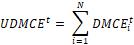
Where:
 |
means the Dollar Market Capitalization Estimate in respect of Universe Stock (i) and Rebalance Selection Date (t) as determined pursuant to Section 4.2 |
 |
means the Number of Universe Stocks in respect of Rebalance Selection Date (t) |
4.5 Calculation of Stock Maximum Weight for each Universe Stock
In respect of each Rebalance Selection Date (t) for each Universe Stock (i), the Constituent Stock Determination Agent shall determine the stock maximum weight (the “Stock Maximum Weight” or “SMW”) as follows:

Where:
 |
means the Maximum Liquidity Constant as specified in Section 3.1 |
 |
means the Index Notional Constant as specified in Section 3.1 |
 |
means the Dollar Notional Trading Estimate in respect of Universe Stock (i) and Rebalance Selection Date (t) as determined pursuant to Section 4.1 |
 |
means the Universe Dollar Market Capitalization Estimate in respect of Rebalance Selection Date (t) as determined pursuant to Section 4.4 |
- 13 -
4.6 Calculation of Stock Delta Weight for each Universe Stock
In respect of each Rebalance Selection Date (t) for each Universe Stock (i), the Constituent Stock Determination Agent shall determine the stock delta weight (the “Stock Delta Weight” or “SDW”) as follows:

Where:
|
means the Index Notional Constant as specified in Section 3.1 |
|
means the Dollar Notional Trading Estimate in respect of Universe Stock (i) and Rebalance Selection Date (t) as determined pursuant to Section 4.1 |
|
means the Universe Dollar Market Capitalization Estimate in respect of Rebalance Selection Date (t) as determined pursuant to Section 4.4 |
4.7 Calculation of Percentile Factor Score for each Eligible Sector
In respect of each Rebalance Selection Date (t) for each Eligible Sector (m), the Constituent Stock Determination Agent shall determine “Percentile Factor Score” or “PFS” as follows:

Where:
 |
means in respect of Rebalance Selection Date (t) and Eligible Sector (m), set of 2 Year Volatility Factor Score ( ) for all Universe Stocks that are associated with such Eligible Sector (m) ) for all Universe Stocks that are associated with such Eligible Sector (m) |
|
means in respect of Universe Stock (i) and Rebalance Selection Date (t), the 2 Year Volatility Factor Score determined in Section 4.3 |
4.8 Calculation of Current Weight
In respect of each Rebalance Selection Date (t), the Index Calculation Agent shall determine the “Current Weight” or “CW” in respect of each stock that is a constituent of the Index (the “Current Portfolio Stocks”) in respect of the Rebalancing Date immediately preceding Rebalance Selection Date (t) (referred to as Rebalancing Date (k)), subject to any adjustments pursuant to these Index Rules due to the occurrence of an Extraordinary Event, as follows:
| · | If Rebalance Selection Date (t) is prior to the Index Base Date, the CW of each Current Portfolio Stock will be zero. |
| · | If Rebalance Selection Date (t) is (i) after the Index Base Date and (ii) not the Rebalance Selection Date Associated with the Calculation Agent Succession Date: |
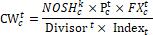
| · | If Rebalance Selection Date (t) is the Rebalance Selection Date associated with the Calculation Agent Succession Date, the CASD Weight as set forth for such Current Portfolio Stock on Annex A |
Where:
 |
means the Index Level in respect of Rebalance Selection Day (t) as determined pursuant to Section 8 |
 |
means the Divisor in respect of Rebalance Selection Day (t) as determined pursuant to Section 8 |
- 14 -
 |
means the Number of Shares in respect of constituent stock (c) and Rebalancing Date (k) as determined pursuant to Section 8, subject to any adjustments to Constituents pursuant to these Index Rules due to the occurrence of an Extraordinary Event |
 |
means the Closing Price for stock (c) in respect of Rebalance Selection Date (t) |
 |
means the FX Rate of Constituent (c) in respect of Rebalance Selection Date (t) |
4.9
Evaluation Data and Selection Disruption Events
In respect of a Rebalance Selection Date (t), the Constituent Stock Determination Agent will review whether, with respect to each of the Universe Stocks, the inputs and related information necessary to make all of the determinations relevant to this (the “Evaluation Data”) are available. If Evaluation Data is not available on such date with respect to a number Universe stocks equal to or greater than the Source Data Threshold Number (as defined in Section 3.1) (due to the occurrence of a Data Disruption Event or otherwise), the Constituent Stock Determination Agent will instead use Evaluation Data as of the most recent date prior to such Rebalance Selection Date (t) on which Evaluation Data is available with respect to a number of Universe Stocks that is equal to or greater than the Source Data Threshold Number. In any event, the Constituent Stock Determination Agent’s review will be based solely on those stocks for which Evaluation Data is available on the single date on which Evaluation Data is available for a number of stocks equal to or greater than the Source Data Threshold Number.
If the Constituent Stock Determination Agent determines that, after application of the paragraph above, there are fewer Universe Stocks for which Evaluation Data is available than the Source Data Threshold Number, a selection disruption event (a “Selection Disruption Event”) will have occurred, and the provisions of Section 13.3 shall apply.
5.
Determining the Target Sector Weights
5.1 Calculation of Median Volatility Factor Score for each Eligible Sector
In respect of each Rebalance Selection Date (t), and for each Eligible Sector (m), the Constituent Stock Determination Agent shall determine the median 2 Year Volatility Factor Score (the “Median Volatility Factor Score” or “MVFS”) of all of the Universe Stocks the Associated Sector for which is such Eligible Sector, expressed as follows:

Where:
|
means in respect of Rebalance Selection Date (t) and Eligible Sector (m), the set of the 2 Year Volatility Factor Scores () for all Universe Stocks for which the Associated Sector is such Eligible Sector (m) |
|
means in respect of Universe Stock (i) and Rebalance Selection Date (t), the 2 Year Volatility Factor Score as determined pursuant to Section 4.3 |
5.2 Calculation of Weekly Sector Return for each Eligible Sector
In respect of Rebalance Selection Date (t) and Calculation Day (k) for each Eligible Sector (m), the Constituent Stock Determination Agent shall determine the weekly sector return (the “Weekly Sector Return” or “WSR”) as follows:
If
 :
:

Otherwise,

- 15 -
Where:
 |
means the Effective Exposure of stock (i) in respect of Eligible Sector (m) and Rebalance Selection Date (t), which is a quantity defined as: |
| · | 1 (one) if all of the following criteria are satisfied |
| o | the Associated Sector of stock (i) is Eligible Sector (m) |
| o | 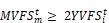 |
| o |  and
and  are available from the Share Data Provider for stock (i)
 |
| · | Otherwise, 0 (zero) |
 |
means in respect of Sector (m) and Rebalance Selection Date (t), the Median Volatility Factor Score as determined pursuant to Section 5.1 |
|
means in respect of Universe Stock (i) and Rebalance Selection Date (t), the 2 Year Volatility Factor Score as determined pursuant to Section 4.3 |
|
means the number of Universe Stocks in respect of Rebalance Selection Date (t) |
|
means the total return price in respect of Universe Stock (i) and Calculation Day (k), as available from the Share Data Provider at approximately the Data Reference Time |
|
means the total return price in respect of Universe Stock (i) and Calculation Day (k-5), as available from the Share Data Provider at approximately the Data Reference Time |
5.3 Calculation of 3 Year Sector Volatility for each Eligible Sector
In respect of each Rebalance Selection Date (t) for each Eligible Sector (m), the Constituent Stock Determination Agent shall determine the 3 year sector volatility (the “3 Year Sector Volatility” or “3YSVol”) as follows:

Where:
 |
means an integer representing a Calculation Day |
| N | means, the number of Calculation Days in the 1,095 calendar day period ending on and including Rebalance Selection Date (t) |
 |
means the Weekly Sector Return for such Eligible Sector (m) in respect of Rebalance Selection Date (t) and Calculation Day (k), as determined pursuant to Section 5.2 |
5.4 Calculation of 3 Year Sector Correlation
In respect of each Rebalance Selection Date (t), Eligible Sector (m) and Eligible Sector (n), the Constituent Stock Determination Agent shall determine the 3 year sector correlation (the “3 Year Sector Correlation” or “3YSCorr”) as follows:

Where:
 |
means in respect of Eligible Sector (m) and Rebalance Selection Date (t), the 3 Year Sector Volatility as determined pursuant to Section 5.3 |
- 16 -
 |
means in respect of Eligible Sector (n) and Rebalance Selection Date (t), the 3 Year Sector Volatility as determined pursuant to Section 5.3 |
 |
means the Weekly Sector Return in respect of Rebalance Selection Date (t) and Calculation Day (k) for Eligible Sector (m), as determined pursuant to Section 5.2 |
 |
means the Weekly Sector Return in respect of Rebalance Selection Date (t) and Calculation Day (k) for Eligible Sector (n), as determined pursuant to Section 5.2 |
| N | means the number of Calculation Days in the 1,095 calendar day period ending on and including Rebalance Selection Date (t) |
5.5 Calculation of 3 Year Modified Sector Covariance
In respect of each Rebalance Selection Date (t), the Constituent Stock Determination Agent shall determine the 3 year modified sector covariance (the “3 Year Modified Sector Covariance” or “3YCovar”) in respect of Eligible Sector (m) and Eligible Sector (n) as follows:
If Eligible Sector (m) = Eligible Sector (n),
 =
=

Otherwise,
=

Where:
|
means in respect of Eligible Sector (m) and Rebalance Selection Date (t), the 3 Year Sector Volatility as determined pursuant to Section 5.3 |
 |
means in respect of Eligible Sector (n) and Rebalance Selection Date (t), the 3 Year Sector Volatility as determined pursuant to Section 5.3 |
 |
means in respect of Eligible Sector (m) and (n) and Rebalance Selection Date (t), the 3 Year Sector Correlation as determined pursuant to Section 5.4 |
 |
means the number of Eligible Sectors |
|
means each integer from 1 to K |
 |
means each integer from 1 to K |
5.6 Calculation of the Preliminary Sector Weight for each Eligible Sector
In respect of Rebalance Selection Date (t), the Constituent Stock Determination Agent shall determine the preliminary sector weights (the “Preliminary Sector Weights”) using the Optimization Constraints as follows:
The Output Portfolio, shall be the result of minimizing the objective function specified in Section (a) (the “Objective Function”) subject to the optimization constraints specified in Section (b) (the “Optimization Constraints”), using the Optimizer Software.
If, in respect of Rebalance Selection Date (t), the Constituent Stock Determination Agent is unable to determine an Output Portfolio using the Optimizer Software, owing to a temporary technical failure such as, without limitation, a corruption of relevant software libraries or a temporary failure in the computing facilities (a “Temporary Optimizer Software Failure”), then: (i) the Constituent Stocks comprised in the Index prior to the occurrence of such Temporary Optimizer Software Failure shall not be rebalanced and re-weighted on the Rebalancing Date immediately following the Rebalance Selection Date (t) and (ii) the Constituent Stocks of the Index shall remain the same as immediately prior to the scheduled Rebalancing Date, subject to any adjustments to Constituent Stocks pursuant to these Index Rules (although the percentage contribution of each Constituent Stock to the Index Level may differ from the weight applicable on the previous Rebalancing Date). If a Temporary Optimizer Software Failure occurs for two consecutive Rebalance Selection Dates, then the provisions set out in Section 14.8 related to the cancellation of the Index shall apply.
| (a) | Objective Function |
- 17 -
In respect of Rebalance Selection Date (t), the Constituent Stock Determination Agent shall determine the Objective Function in accordance with the following formula:

| (b) | Optimization Constraints |
The Optimization Constraints shall be determined in accordance with the following formula:
| (1) | The sum of the Eligible Sector weights should be equal to 100% |

| (2) | The weight of each Eligible Sector must be greater than or equal to a lower bound and less than or equal to an upper bound |

Where:
 |
means in respect of Eligible Sector (m) and (n) and Rebalance Selection Date (t), the 3 Year Modified Sector Covariance as determined pursuant to Section 5.5 |
|
means the number of Current Portfolio Stocks that are also Universe Stocks in respect of Rebalance Selection Date (t) |
 |
means each integer from 1 to N |
|
means the number of Eligible Sectors |
 |
means each integer from 1 to K |
 |
means a quantity defined as: |
| · | 0 (zero) if Rebalance Selection Date (t) is prior to Index Base Date |
| · | Otherwise, Sector Turnover Constant as specified in Section 3.1 |
 |
means the Sector Exposure of Current Portfolio Stock (i) in respect of Eligible Sector (m) and Rebalance Selection Date (t), which is a quantity defined as: |
| · | 1 (one) if the Associated Sector of Current Portfolio Stock (i) is Eligible Sector (j) |
| · | 0 (zero) if the Associated Sector of Current Portfolio Stock (i) is not Eligible Sector (j) |
 |
means the Current Weight with respect to Current Portfolio Stock (i) and Rebalance Selection Date (t) that is also a Universe Stock as determined pursuant to Section 4.8 |
 |
means the Output Weight in respect of Eligible Sector (m) and Rebalance Selection Date (t) |
 |
means the Output Weight in respect of Eligible Sector (n) and Rebalance Selection Date (t) |
| (c) | Optimizer Failure Event |
The Optimizer Software, which is used to generate the Output Portfolio under the optimization constraints set forth above, will return a primal status. If the primal status equals ’Optimal’, then the Output Portfolio shall have satisfied the “Acceptance Condition”, and the Constituent Stock Determination Agent shall use such Output Portfolio (the “Preliminary Sector Weights” or PSW) for the purposes of Section 5.8.
- 18 -
If an Output Portfolio satisfying the Acceptance Condition has not been obtained, then an optimizer failure event (an “Optimizer Failure Event”) shall be deemed to have occurred and: (i) the Constituent Stocks comprised in the Index shall not be rebalanced and re-weighted on the Scheduled Rebalancing Date immediately following Rebalance Selection Date (t) and (ii) the Constituent Stocks of the Index shall remain the same as immediately prior to the Scheduled Rebalancing Date, subject to any adjustment to a Constituent Stock pursuant to these Index Rules (although the percentage contribution of each Constituent Stock to the Index Level may differ from the weight applicable on the previous Rebalancing Date).
5.7 Calculation of Maximum Sector Weight for each Eligible Sector
In respect of each Rebalance Selection Date (t) for each Eligible Sector (m), the Constituent Stock Determination Agent shall determine the maximum sector weight (the “Maximum Sector Weight” or “MSW”) as follows:

Where:
|
means the Sector Exposure of Universe Stock (i) in respect of Eligible Sector (m) and Rebalance Selection Date (t), which is a quantity defined as: |
| · | 1 (one) if the Associated Sector of Universe Stock (i) is Eligible Sector (m) |
| · | 0 (zero) if the Associated Sector of Universe Stock (i) is not Eligible Sector (m) |
 |
means, the Stock Maximum Weight in respect of Universe Stock (i) and Rebalancing Date (t) as determined pursuant to Section 4.5 |
|
means the number of Universe Stocks in respect of Rebalance Selection Date (t) |
 |
means Maximum Weight Cap as specified in Section 3.1 |
5.8 Calculation of Target Sector Weights
In respect of Rebalance Selection Date (t) for each Eligible Sector (m), the Constituent Stock Determination Agent shall determine the target sector weight (the “Target Sector Weight”) as follows:
If, for each Eligible Sector, its Preliminary Sector Weight (as determined in Sector 5.6) is less than or equal to its Maximum Sector Weight, then the Target Sector Weights for all of the Eligible Sectors shall be equal to their respective Preliminary Sector Weights:

Otherwise, with respect to each Eligible Sector (m), if the Preliminary Sector Weight for such Eligible Sector (m) is greater than the Maximum Sector Weight for such Eligible Sector (m) (if such condition is met, a “Capped Sector”), the Constituent Stock Determination Agent will determine its Target Sector Weight in accordance with an iterative process intended to set the weight of each Capped Sector (m) to the Maximum Sector Weight by distributing any excess weight on a pro rata basis among other sectors whose Preliminary Sector Weight is less than the Maximum Sector Weight (the “Uncapped Sectors”). The iterative process is repeated until Target Sector Weight is less than or equal to Maximum Sector Weight for each Sector (m); or a maximum of 10 iterations have been reached.
The iterative process is conducted in accordance with the following steps with value of p equal to 1 (one) at the inception of this process incrementing by 1 each time the steps below are completed:
| (1) | Determine the Interim Sector Weight for each Eligible Sector (m) as follows: |
If p=1:

Otherwise:

- 19 -
| (2) | Determine the Aggregate Residual Weight for iteration (p) as follows: |

| (3) | With respect to each iteration (p), the Adjusted Sector Weight for each Eligible Sector (m) is determined by distributing Aggregate Residual Weight pro rata among the Eligible Sectors for which the Interim Sector Weight with respect to the iteration (p) is less than the Maximum Sector Weight as follows: |
| If |  |

Otherwise

Where:
|
means the Number of Sectors |
|
means each integer from 1 to K |
 |
means in respect of Rebalance Selection Date (t) and Eligible Sector (m), the Maximum Sector Weight as determined pursuant to Section 5.7 |
 |
means the sum of the  of all the Eligible Sectors for which is less than of all the Eligible Sectors for which is less than |
During this iterative process,
if in any step (p) where p is less than or equal to 10, Adjusted Sector Weight ( for each sector is less than Maximum Sector Weight
  ,
then such Adjusted Sector Weights will be the Target Sector Weights (
,
then such Adjusted Sector Weights will be the Target Sector Weights ( )
in respect of Rebalance Selection Date (t). If the iterative process exceeds 10 iterations (p greater than 10), the iterative process
is considered complete and Adjusted Sector Weight as of last iteration will be the Target Sector Weights ()
in respect of Rebalance Selection Date (t).
)
in respect of Rebalance Selection Date (t). If the iterative process exceeds 10 iterations (p greater than 10), the iterative process
is considered complete and Adjusted Sector Weight as of last iteration will be the Target Sector Weights ()
in respect of Rebalance Selection Date (t).
The weights for each Eligible Sector determined under this Section 5.8 are the respective “Target Sector Weights” for each Eligible Sector.
6. Determination of Target Stock Weights
| 6.1 | Determination of the List of Eligible Stocks |
In respect of Rebalance Selection Date (t), the Constituent Stock Determination Agent shall determine the set of Eligible Stocks (each an “Eligible Stock”), which will be the set of each Universe Stock the Associated Sector for which is any Eligible Sector and that satisfies the criteria of either clause (1) or clause (2), where
| (1) | Each Universe Stock that: |
| (a) | Is not an Ineligible Stock, as specified in Section 3.1; and |
| (b) | For which  ;
and ;
and |
| (2) | Each Universe Stock that is a Current Portfolio Stock as of the Rebalancing Date immediately preceding Rebalance Selection Date (t) |
Where (for purposes of clause (1)):
- 20 -
 |
means in respect of Rebalance Selection Date (t) and the Associated Sector of such Universe Stock (i), the Percentile Factor Score as determined pursuant to Section 4.7 |
|
means in respect of Universe Stock (i) and Rebalance Selection Date (t), the 2 Year Volatility Factor Score as determined pursuant to Section 4.3 |
| 6.2 | Determination of Current Reference Weight for each Eligible Stock |
In respect of Rebalance Selection Date (t) for each Eligible Stock (i), the "Current Reference Weight” or “CRW” determined in accordance with the following formula
If Eligible Stock (i) is a constituent of Current Portfolio Stocks in respect of the Rebalancing Date immediately preceding Rebalance Selection Date,

Otherwise,

Where:
|
means in respect of Eligible Stock (i) and Rebalance Selection Date (t), the Current Weight as determined pursuant to Section 4.8 |
| 6.3 | Determination of Capped Stock Weight for each Eligible Stock |
In respect of Rebalance Selection Date (t) for each Eligible Stock (i), the Capped Stock Weight is determined in accordance with the following formula
If  ,
,

Otherwise,

Where:
 |
means in respect of Eligible Stock (i) and Rebalance Selection Date (t), the Stock Delta Weight as determined pursuant to Section 4.6 |
 |
means in respect of Eligible Stock (i) and Rebalance Selection Date (t), the Current Reference Weight as determined pursuant to Section 6.2 |
|
means the Maximum Weight Cap as specified in Section 3.1 |
| 6.4 | Determination of Target Stocks and Target Weights |
In respect of Rebalance Selection Date (t), the Constituent Stock Determination Agent will determine the set of Target Stocks and their respective Target Weights on an Eligible Sector basis as follows:
If for Eligible Sector (m), its Sector Weight, determined in accordance with the below formula, is less than or equal to its Target Sector Weight (as determined under Section 5.8):
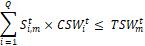
then the Constituent Stock Determination Agent will determine the Target Weight for each Eligible Stock for which the Associated Sector is such Eligible Sector (m) in accordance with the following iterative process starting with value of p equal to zero (0) at the inception of this process incrementing by 1 each time the steps below are completed:
When p = 0, Adjusted Weight for each of the Eligible Stock (i) belonging to Group(m,t) is determined as follows
- 21 -

When p is any subsequent value, the Constituent
Stock Determination Agent will determine the stock with lowest pth rank of 2 Year Volatility Factor Score ( )
in Group(m,t) and compute the Adjusted Weight for such stock (i) as follows:
)
in Group(m,t) and compute the Adjusted Weight for such stock (i) as follows:

During this iterative process, if at any step (p) either of the following criteria is satisfied, the Adjusted Weight with respect to iteration (p) will be the Target Weight for all of the Eligible Stocks associated with such Sector (m):
| · |  |
| · | p =  |
Otherwise, the Constituent Stock Determination Agent will determine the Target Weight in accordance with the following iterative process starting with value of p equal to zero (0) at the inception of this process incrementing by 1 each time the steps below are completed:
When p = 0, Adjusted Weight for each Eligible Stock (i) belonging to Group(m,t) is determined as follows
When p is any subsequent value, the Constituent
Stock Determination Agent will determine the stock with highest pth rank of 2 Year Volatility Factor Score ()
in Group(m,t) and compute the Adjusted Weight for such stock (i) as follows:

During this iterative process, if at any step (p) if the following criteria is satisfied, the Adjusted Weight with respect to iteration
(p) will be the Target Weight for all the Eligible Stocks associated with such Sector (m):
| · | If |
| · | p = |
If two or more Eligible Stocks in Group(m,t) have the same 2 Year Volatility Factor Score, then the Constituent Stock Determination Agent shall rank all such Eligible Stocks by their respective Dollar Market Capitalization Estimates (as determined in Section 4.2), such that the Eligible Stock with highest Dollar Market Capitalization Estimate would be ranked first (i.e., deemed as having the lowest Volatility Factor Score among such Eligible Stocks).
Where:
 | means, the Target Sector Weight in respect of Eligible Sector (m) and Rebalance Selection Date (t) as determined pursuant to Section 5.8 |
| means, the Stock Maximum Weight in respect of Eligible Stock (i) and Rebalance Selection Date (t) as determined pursuant to Section 4.5 |
 | means, the Stock Delta Weight in respect of Eligible Stock (i) and Rebalance Selection Date (t) as determined pursuant to Section 4.6 |
 | means the number of Eligible Stocks in respect of Rebalance Selection Date (t) |
 | means the number of Eligible Stocks associated with Eligible Sector (m) in respect of Rebalance Selection Date (t) |
- 22 -
 | means, a quantity defined as: |
| · | 4 (four) if Rebalance Selection Date (t) is prior to Index Base Date |
| · | Otherwise 1 (one) |
|
means the Sector Exposure of Eligible Stock (i) in respect of Eligible Sector (m) and Rebalance Selection Date (t), which is a quantity defined as: |
| · | 1 (one) if the Associated Sector of Eligible Stock (i) is Eligible Sector (m) |
| · | 0 (zero) if the Associated Sector of Eligible Stock (i) is not Eligible Sector (m) |
 |
means in respect of Eligible Stock (i) and Rebalance Selection Date (t), the Capped Stock Weight as determined pursuant to Section 6.3 |
| Group(m,t) | means in respect of Rebalance Selection Date (t) the set of Eligible Stocks associated with an Eligible Sector (m) |
|
means in respect of an Eligible Stock (i) and Rebalance Selection Date (t), the Current Reference Weight of such Eligible Stock, as determined pursuant to Section 6.2 |
|
means the Maximum Weight Cap as specified in Section 3.1 |
After the calculations called for by this Section 6.4 are performed, the resulting Eligible Stocks are referred to as the “Target Stocks” and the respective weights assigned thereto are referred to as the Target Stocks’ respective “Target Weights”.
| 6.5 | Filtering small weights and providing the Preliminary Constituent Stocks and Weights |
In respect of each Rebalance Selection Date (t), the Constituent Stock Determination Agent shall remove from the Target Portfolio all Stocks associated with a weight whose value is less than the Small Weight Threshold Percentage (such removed stocks, the “Removed Small Weight Stocks”), and the remaining Stocks within the Target Portfolio shall compose the “Filtered Target Portfolio”. The set of stocks within the Filtered Target Portfolio shall be deemed to be the “Preliminary Constituent Stocks”. The weights associated with such Preliminary Constituent Stocks shall be deemed to be the “Preliminary Constituent Weights”; provided that the weights associated with any Removed Small Weight Stocks shall first be reallocated on a pro rata basis to such Preliminary Constituent Stocks such that sum of the Preliminary Constituent Weights is 100%. The Constituent Stock Determination Agent, in respect of each Rebalance Selection Date (t) and subject to the occurrence of a Temporary Optimizer Software Failure, shall provide the Index Calculation Agent with the list of the Preliminary Constituent Stocks and the Preliminary Constituent Weights. The Index Calculation Agent shall use the list of the Preliminary Constituent Stocks and the Preliminary Constituent Weights for the calculation set forth in Section 7.
For the avoidance of doubt, in the event of the occurrence of a Temporary Optimizer Software Failure that prevents the Constituent Stock Determination Agent from making any of the determinations and calculations called for by Sections 5 and 6, the Index will not be rebalanced and the Constituent Stocks comprised in the Index prior to the occurrence of such Temporary Optimizer Software Failure shall not be rebalanced and re-weighted on the Rebalancing Date immediately following the Rebalance Selection Date (t) and (ii) the Constituent Stocks of the Index shall remain the same as immediately prior to the scheduled Rebalancing Date, subject to any adjustments to Constituent Stocks pursuant to these Index Rules (although the percentage contribution of each Constituent Stock to the Index Level may differ from the weight applicable on the previous Rebalancing Date). If a Temporary Optimizer Software Failure occurs for two consecutive Rebalance Selection Dates, then the provisions set out in Section 14.8 related to the cancellation of the Index shall apply.
- 23 -
7. Determining the Constituent Stocks and Constituent Weights, Rebalancing the Index
The Index Calculation Agent, in respect of each Rebalancing Date (k), using the information provided by the Constituent Stock Determination Agent pursuant to Section 6, will determine (1) whether, from and including the immediately preceding Rebalance Selection Date associated with such Rebalancing Date to and including such Rebalancing Date (the “Determination Period”), a Preliminary Constituent Stock has been delisted from the relevant Exchange (each, a “Delisted Constituent”) and (2) whether a suspension in trading of a Preliminary Constituent Stock on the relevant Exchange has occurred on such Rebalancing Date or is continuing on such Rebalancing Date that is not a limitation of trading in such instruments by reason of movements in price exceeding limits permitted by the relevant Exchange (each, a “Suspended Constituent”).
The Index Calculation Agent shall remove from the list of the Preliminary Constituents each of the Delisted Constituents, if any, and each of the Suspended Constituents, if any, and shall adjust the list of the Preliminary Constituents to account for such removal. The remaining constituents on the list of adjusted Preliminary Constituents that are not affected by the occurrence of a delisting event during the Determination Period and that are not affected by the occurrence or continuation of a suspension event shall be deemed to be the “Constituents” or the “Constituent Stocks” in respect of such Rebalancing Date (k). The Preliminary Constituent Weights in respect of the Constituents shall be deemed to be the “Constituent Weights” in respect of such Rebalancing Date (k); provided that the weights associated with any Delisted Constituent or Suspended Constituent shall first be reallocated on a pro rata basis to such Constituents. The number of Constituents shall be deemed to be the “Number of Constituents” in respect of such Rebalancing Date (k).
8. Determining the Index Level
8.1 Calculation of Index Level in respect of a Calculation Day (t)
Subject to the Adjustment Provisions, the Index Calculation Agent will calculate the Index Level for each Calculation Day (t) as follows:
| (I) | In respect of the Index Base Date: |

| (II) | On each Calculation Day (t) after the Index Base Date, other than the Calculation Agent Succession Date: |

Where:
|
means the Index Level in respect of Calculation Day (t). |
 |
means the Index Base Level specified in Section 3.1. |
Rebalancing Date (k) means, in respect of a Calculation Day (t):
| · | if Calculation Day (t) is the Index Base Date, the Index Base Date |
| · | if Calculation Day (t) falls after the Index Base Date, the immediately preceding Rebalancing Date. |
 |
means the Number of Constituents in respect of Rebalancing Date (k) as determined pursuant to Section 7. |
 |
means the number of shares (the “Number of Shares” or “NOSH”) in respect of Constituent (i) and Rebalancing Date (k), which is a number calculated in accordance with the following formula: |
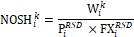
Where:
- 24 -
Rebalance Selection Date (RSD) means, in respect of Rebalancing Date (k), the immediately preceding Rebalance Selection Date associated with such Rebalancing Date (k).
 |
means, in respect of Constituent (i) and Rebalancing Date (k), the Constituent Weight, as determined pursuant to Section 7. | |
 |
means the Closing Price of Constituent (i) in respect of Rebalance Selection Date (RSD). | |
 means
the FX Rate of the Associated Currency in respect of Constituent (i) in respect of Rebalance Selection Date (RSD).
means
the FX Rate of the Associated Currency in respect of Constituent (i) in respect of Rebalance Selection Date (RSD).
 | means, in respect of Calculation Day (t), the Closing Price of the “ith” Constituent, “Constituent (i)”, in respect of Calculation Day (t). |
 | means the FX Rate of the Associated Currency in respect of Constituent (i) in respect of Calculation Day (t). |
 | means the divisor of the Basket comprising the Index Level in respect of Calculation Day (t), which is an amount calculated in accordance with the following formulas: |
(a) If Calculation Day (t) is the Index Base Date:

(b) If Calculation Day (t) is not the Index Base Date:

Where:
| Calculation |
| Day (t-1) | means, in respect of Calculation Day (t), the Calculation Day immediately preceding such Calculation Day (t). |
 |
means the Closing Price of Constituent Stock (i) in respect of Calculation Day (t-1). |
 |
means the FX Rate of the Associated Currency in respect of Constituent Stock (i) in respect of Calculation Day (t-1). |
 |
means the FX Rate of the currency with respect to the Gross Dividend Amount for the Associated Currency in respect of Constituent Stock (i) in respect of Calculation Day (t-1). |
 |
means the Index Level in respect of Calculation Day (t-1). |
|
means the Number of Shares in respect of Constituent Stock (i) as derived pursuant to the Index Level calculation at the beginning of this Section 8. |
 |
means, in respect of Constituent Stock (i), the Gross Dividend Amount of such Constituent Stock (i) for the period from, but excluding, Calculation Day (t-1) to, and including, Calculation Day (t). |
| (III) | In respect of the Calculation Agent Succession Date, the CASD Index Level. |
- 25 -
If on a Calculation Day (t) the Index Level
is equal to zero (0), then for all subsequent Calculation Days the Index Level shall be equal to zero (0), and in such case the formula
above shall not be used to calculate the Index Level for any subsequent Calculation Day.
- 26 -
9. Certain General Terms relating to the Index
9.1 Publication and availability of the Index Rules
The Index Rules are published by J.P. Morgan Securities LLC, of 383 Madison Avenue, New York, New York 10179, in its capacity as the Index Sponsor.
Copies of the Index Rules may be obtained by holders or potential holders of Products linked to the Index free of charge on request from the Index Sponsor at its principal office in New York against such proof of status and upon such terms as the Index Sponsor may in its reasonable discretion require.
9.2 Amendments; Termination
Economic, market, regulatory, legal, financial or other circumstances may arise that may necessitate or make desirable an amendment of the Index Rules.
Notwithstanding the foregoing, the Index Sponsor may amend the Index Rules as it deems appropriate. Such amendments may include (without limitation):
| · | correcting or curing any errors, omissions or contradictory provisions; or |
| · | modifications to the methodology described in the Index Rules (including, without limitation, a change in the frequency of calculation of the Index Level) that are necessary or desirable in order for the calculation of the Index to continue notwithstanding any change to any economic, market, regulatory, legal, financial or other circumstances as of the Index Live Date; or |
| · | modifications of a formal, minor or technical nature. |
The Index Sponsor will notify the Index Calculation Agent, the Constituent Stock Determination Agent and the Disruption Determination Agent (in each case, if a different entity than the Index Sponsor) before making an amendment pursuant to this Section 9.2. The Index Sponsor may, but is not obliged to, take into account the views of the Index Calculation Agent or the Constituent Stock Determination Agent regarding any proposed amendment.
Following any amendment, the Index Sponsor will make available (as soon as practicable) the amended version of the Index Rules and will include the effective date of such amendment in the new version of the Index Rules. However, the Index Sponsor is under no obligation to inform any person about any amendments to the Index (except as required by law or regulation, further information in respect of which is available here: https://www.jpmorganindices.com).
The Index Sponsor may, in its sole discretion, at any time and without notice, terminate the calculation and publication of the Index.
9.3 No advice or offer of securities
The Index Rules do not constitute investment, tax, legal, accounting, regulatory or other advice, including within the meaning of Article 53 of the Financial Services and Markets Act 2000 (Regulated Activities) Order 2001 or investment advice within the meaning of Article 4(4) of the Markets in Financial Instruments Directive 2004/39/EC or otherwise.
The Index Rules neither constitute an offer to purchase or sell securities nor constitute specific advice in whatever form (investment, tax, legal, accounting or regulatory) in respect of any Product that may be linked to the Index.
9.4 The Index is synthetic
The Index references a “notional” or synthetic exposure to the Constituent Stocks and there is no actual portfolio of assets to which any person is entitled or in which any person has any ownership interest. The Index merely references certain synthetic exposures the performance of which are used as reference points for calculating Index Levels.
9.5 Data Identifiers Include Successors
References in the Index Rules to screen names, tickers and other data sources and identifiers are deemed
- 27 -
to include successors to such screen names, tickers and other data sources and identifiers, where provided by the same data provider or successor and used to identify the same data subject matter.
10. Index Sponsor, Index Calculation Agent, Constituent Stock Determination Agent and Disruption Determination Agent
10.1 Identity of Index Sponsor, Index Calculation Agent, Constituent Stock Determination Agent and Disruption Determination Agent
The sponsor of the Index specified in Section 3 (the “Index Sponsor”, which term includes any successor or assignee in such capacity) may delegate or transfer any of its obligations or responsibilities in connection with the Index to one or more entities that it determines are appropriate.
The Index Sponsor is responsible for, among other things, the creation and design of the Index, the documentation of the Index Rules, and the appointment of (i) the calculation agent of the Index (the “Index Calculation Agent”), which may be the Index Sponsor, an unrelated third party or an affiliate or subsidiary of the Index Sponsor, (ii) the determination agent of the Constituent Stocks (the “Constituent Stock Determination Agent”), which may be the Index Sponsor, an unrelated third party or an affiliate or subsidiary of the Index Sponsor and (iii) the determination agent of disruption events (the “Disruption Determination Agent”), which may be the Index Sponsor, an unrelated third party or an affiliate or subsidiary of the Index Sponsor. The Index Sponsor is also responsible for determining whether an Extraordinary Event has occurred and the related adjustments set out in Section 14 of these Index Rules.
Each of the Index Sponsor, the Index Calculation Agent, the Constituent Stock Determination Agent and the Disruption Determination Agent, each as of the Index Live Date, is specified in Section 3. In the case of an Index Calculation Agent, a Constituent Stock Determination Agent or a Disruption Determination Agent that is not at such time an affiliate of the Index Sponsor, such entity must obtain written permission from the Index Sponsor prior to any delegation or transfer of such entity’s responsibilities or obligations in connection with the Index.
The Index Sponsor may at any time or for any reason terminate the appointment of any of the Index Calculation Agent, the Constituent Stock Determination Agent or the Disruption Determination Agent and appoint an alternative entity (or entities) as such entity’s replacement.
The Index Calculation Agent is responsible for:
(i) determining the Constituent Stocks and the Constituent Weights in respect of each Rebalancing Date, in accordance with Section 8 of the Index Rules; and
(iii) calculating the Index Level in respect of each Calculation Day in accordance with Section 9 of the Index Rules; and
(iv) determining any adjustment upon the occurrence of certain events set out in Section 14 of the Index Rules.
The Disruption Determination Agent is responsible for determining whether a Market Disruption Event has occurred and for making related determinations pursuant to the provisions set out in Sections 13.1 and 13.2 of the Index Rules and informing the Index Calculation Agent of any such determinations.
If the Index Sponsor determines that a relevant event has occurred, and if the Index Calculation Agent, Constituent Stock Determination Agent or the Disruption Determination Agent fails to make that determination, then the Index Sponsor may instruct one or more of the Index Calculation Agent, the Constituent Stock Determination Agent and the Disruption Determination Agent to consider such event and whether there should be related consequences and adjustments in accordance with the Index Rules to take account of such event.
The Constituent Stock Determination Agent is responsible for determining the Universe Stocks, the Constituent Stocks and the Constituent Weights in accordance with the Index Rules, and for making related determinations pursuant to the provisions set out in Section 12.3 of the Index Rules.
The Index Sponsor may delegate or transfer any of its obligations or responsibilities in connection with the Index to one or more entities as it determines appropriate.
- 28 -
The Index is a rules-based Index and none of the Index Sponsor, the Index Calculation Agent, the Constituent Stock Determination Agent and the Disruption Determination Agent will exercise any discretion or independent judgment in the implementation of the methodology of the selection, weighting and ongoing rebalancing of the Index apart from limited circumstances that are expressly contemplated in these Index Rules.
10.2 Index Sponsor, Index Calculation Agent, Constituent Stock Determination Agent and Disruption Determination Agent standards
Each of the Index Sponsor, Index Calculation Agent, Constituent Stock Determination Agent and Disruption Determination Agent shall act in good faith and in a commercially reasonable manner in respect of determinations, interpretations and calculations made by it pursuant to the Index Rules.
10.3 Index Sponsor, Index Calculation Agent, Constituent Stock Determination Agent and Disruption Determination Agent determinations
An action (or failure to act) on the part of the Index Sponsor, the Index Calculation Agent, the Constituent Stock Determination Agent or the Disruption Determination Agent in relation to the Index may have a detrimental effect on the Index Level or the volatility of the Index.
The Index Sponsor, the Index Calculation Agent, the Constituent Stock Determination Agent or the Disruption Determination Agent may make certain determinations or calculations based on information obtained from publicly available sources without independently verifying such information and accepts no responsibility or liability for any consequent loss or damage.
All determinations, interpretations and calculations of the Index Sponsor, the Index Calculation Agent, the Constituent Stock Determination Agent or the Disruption Determination Agent relating to the Index Rules shall be final, conclusive and binding, provided that if the Index Sponsor identifies an error or omission in any of the determinations, interpretations or calculations in respect of the Index then made by the Index Sponsor, the Index Calculation Agent, the Constituent Stock Determination Agent or the Disruption Determination Agent, the Index Sponsor may, if the Index Sponsor determines that such error, omission or correction (as the case may be) is material and that it is practicable, adjust or correct the relevant determination, interpretation or calculation to take into account such correction as soon as it is reasonably practicable to do so. No person shall be entitled to make any claim against the Index Sponsor, the Index Calculation Agent, the Constituent Stock Determination Agent, the Disruption Determination Agent or any Relevant Person in respect of any such determinations, interpretations or calculations of the Index Sponsor, the Index Calculation Agent, the Constituent Stock Determination Agent or the Disruption Determination Agent. None of the Index Sponsor, the Index Calculation Agent, the Constituent Stock Determination Agent, the Disruption Determination Agent or any Relevant Person shall:
| (a) | be under any obligation to revise any determination, interpretation or calculation made or action taken for any reason in connection with the Index Rules or the Index; or |
| (b) | have any responsibility to any person for any determination, interpretation or calculation made or anything done (or omitted to be done) (whether as a result of negligence or otherwise) in respect of the Index Rules or the Index or in respect of the publication of the Index Level (or failure to publish such level) or any use to which any person may put the Index or the Index Levels. |
- 29 -
11. Index Levels
11.1 Index Base Level and Index Base Date
The Index Base Level and Index Base Date are specified in Section 3.1.
11.2 Publication of Index Levels
Subject to the Adjustment Provisions, and the disruption provisions set out in Section 12, the Index Calculation Agent will publish the Index Level of the Index in respect of each Calculation Day as soon as reasonably practicable on or after such Calculation Day. The Index Level or any subsequent correction to the Index Level will be published on Bloomberg on the Index Bloomberg Ticker page (as specified in Section 3) or by means of such other information source as the Index Sponsor may determine in its reasonable discretion. Notwithstanding anything to the contrary, the Index Sponsor may cease calculation and publication of the Index Level at any time in its sole discretion and nothing in this document shall be construed as an agreement by the Index Sponsor to continue to calculate the Index Level if the Index Sponsor has elected to cease publication.
All Index Levels are rounded to two decimal places for purposes of publication only before being published. The Index Calculation Agent may vary its rounding convention in its sole discretion, provided that it will not publish the Index Level with fewer than two decimal places. Notwithstanding anything to the contrary, the Index Calculation Agent may calculate and maintain the Index Level to greater accuracy for the determination of upcoming Index Levels or other calculations.
11.3 Index Live Date
Subject to the Adjustment Provisions, the Index Calculation Agent has been calculating the Index Level and publishing it in respect of each Calculation Day in accordance with the methodology set out in these Index Rules from the Index Live Date specified in Section 3.
- 30 -
12. Corrections in respect of the Index
If any publicly available financial or other information (including, but not limited to, the Closing Price of a Constituent Stock or any other level, price or rate related to a Constituent Stock or any variable, input or other matter used for any calculation or determination relevant to the Index Level for any Calculation Day) published or otherwise made available by the relevant recognized financial or other information source selected by the Index Sponsor, the Index Calculation Agent, the Constituent Stock Determination Agent or the Disruption Determination Agent and used in any calculation or determination is subsequently corrected, or the Index Sponsor, the Index Calculation Agent, the Constituent Stock Determination Agent or the Disruption Determination Agent identifies an error or omission in any of its calculations or determinations in respect of the Index or the Index Sponsor identifies an error or omission in any of the Index Calculation Agent’s, the Constituent Stock Determination Agent’s or the Disruption Determination Agent’s calculations or determinations in respect of the Index, the Index Sponsor may or the Index Calculation Agent, the Constituent Stock Determination Agent or the Disruption Determination Agent may only with the prior consent of the Index Sponsor, in any case if the Index Sponsor determines that such error, omission or correction (as the case may be) is material and that it is practicable, adjust or correct the relevant calculation or determination to take into account such correction as soon as it is reasonably practicable to do so.
- 31 -
13. Disruption Provisions
13.1 Consequences of Market Disruption Event on a Calculation Day that is not a Rebalancing Date and is not a Disruption Resolution Calculation Day
If a Calculation Day (i) that is not a Rebalancing Date and (ii) that is not a Disruption Resolution Calculation Day, is a Disrupted Day (a “Disrupted Calculation Day”) in respect of any Constituent Stock (for the purposes of this Section 13.1, a “Disrupted Constituent”), then:
| (a) | if the Disruption Determination Agent determines that the relevant weightings of the Disrupted Constituents comprise less than 20 percent of the level of the Index, then the Disruption Determination Agent shall notify the Index Calculation Agent of such determination, and the Index Calculation Agent shall calculate the Index Level for such Calculation Day, using (i) in respect of each of the Constituent Stocks that are not Disrupted Constituents, the Closing Price of such Constituent Stock in respect of such Disrupted Calculation Day, and (ii) in respect of each of the Disrupted Constituents, the official closing price of such Disrupted Constituent for the Scheduled Trading Day for such Disrupted Constituent immediately preceding such Disrupted Calculation Day that was not a Disrupted Day for such Disrupted Constituent; or |
| (b) | if the Disruption Determination Agent determines that the relevant weightings of the Disrupted Constituents comprise 20 percent or more of the level of the Index, then the Disruption Determination Agent shall notify the Index Calculation Agent of such determination, and the Index Calculation Agent will suspend the publication of the Index Level until the earlier of (i) the first following Calculation Day that is either (x) not a Disrupted Day for any Constituent Stock or (y) a Disrupted Day in respect of which the relevant weightings of the Disrupted Constituents comprise less than 20 percent of the level of the Index, in which case the provisions set out in Section 12.1(a) shall apply, and (ii) the Rebalancing Date immediately following such Disrupted Calculation Day, in which case the provisions of Section 12.2 will apply. |
13.2 Consequences of Market Disruption Event on a Rebalancing Date or on a Disruption Resolution Calculation Day
If the Disruption Determination Agent has determined that a Rebalancing Date is a Disrupted Day in respect of any Incoming Constituent or any Outgoing Constituent (for the purposes of this Section 13.2, each a “Disrupted Constituent”) then the Disruption Determination Agent shall notify the Index Calculation Agent of such determination and:
| (a) | the relevant Rebalancing Date shall remain the Rebalancing Date, as originally scheduled for each Incoming Constituent and each Outgoing Constituent that is not a Disrupted Constituent (for the purposes of this Section 13.2(a), a “Non-Disrupted Constituent”) and the Closing Price for each such Non-Disrupted Constituent for such Rebalancing Date will be used in the calculation of the Index Level pursuant to Section 7 for such Rebalancing Date; and |
| (b) | for each Disrupted Constituent that is an Outgoing Constituent and for which a suspension in trading in shares on the relevant Exchange, that is not a limitation of trading in such shares by reason of movements in price exceeding limits permitted by the relevant Exchange, (a) has not occurred on the relevant Rebalancing Date and (b) is not continuing on the relevant Rebalancing Date, the Index Calculation Agent shall use the Closing Price for such Disrupted Constituent as of the First Following Non-Disrupted Day, unless any such Disrupted Constituent remains a Disrupted Constituent for each of the Calculation Days immediately following the Rebalancing Date to and including the Disruption Determination Date, in which case, the Disruption Determination Agent shall determine its good faith estimate of the Closing Price of such Disrupted Constituent for such Rebalancing Date (notwithstanding that such Disrupted Constituent remains a Disrupted Constituent) acting in good faith using such information or methods as it determines, in its reasonable discretion, are appropriate, in which case, the Disruption Determination Agent shall notify the Index Sponsor and the Index Calculation Agent of its determination of a good faith estimate, and the Disrupted Constituent shall be removed from the Index, and the Index Sponsor |
- 32 -
| shall adjust the Index and the Index Rules as appropriate to account for such removal as soon as practicable; and |
| (c) | for each Disrupted Constituent that is an Outgoing Constituent and for which a suspension in trading in shares on the relevant Exchange has occurred on the relevant Rebalancing Date or is continuing on the relevant Rebalancing Date that is not a limitation of trading in such shares by reason of movements in price exceeding limits permitted by the relevant Exchange: |
| 1) | such Disrupted Constituent shall be kept as a Constituent Stock of the Index until the Disruption Resolved Day. The Constituent Weight of such Disrupted Constituent shall be deemed to be equal to its weight in the Index on the Rebalancing Day, and the Constituent Weights of all other Incoming Constituents shall be reweighted on a pro-rata basis. |
| 2) | on the Disruption Resolved Day, such Disrupted Constituent shall be removed from the Index, using the Closing Price for such Disrupted Constituent if the Disruption Resolved Day is not a Disrupted Day, or otherwise the Disruption Determination Agent shall determine its good faith estimate of the Closing Price of such Disrupted Constituent for such Disruption Resolved Day (notwithstanding that such Disrupted Constituent remains a Disrupted Constituent) acting in good faith using such information or methods as it determines, in its reasonable discretion, are appropriate, in which case, the Disruption Determination Agent shall notify the Index Sponsor and the Index Calculation Agent of its determination of a good faith estimate. |
| (d) | for each Disrupted Constituent that is an Incoming Constituent, the Index Calculation Agent shall use the Closing Price for such Disrupted Constituent as of the First Following Non-Disrupted Day as the Closing Price of the Disrupted Constituent for such Rebalancing Date, unless such Disrupted Constituent remains a Disrupted Constituent for each of the Calculation Days immediately following the Rebalancing Date to and including the Disruption Determination Date, in which case, the Disruption Determination Agent (i) shall not include such Disrupted Constituent as a Constituent Stock of the Index and (ii) shall adjust the Index and the Index Rules as appropriate to account for not including such Disrupted Constituent as soon as practicable following such determination not to include the Disrupted Constituent and notify the Index Calculation Agent of any such determination; and |
| (e) | The Index Calculation Agent shall calculate the Index Level in respect of any Disruption Resolution Calculation Day on the last day on which a valuation is determined in accordance with the provisions set out in paragraphs (b), (c) and (d) above. The Index Calculation Agent shall not publish the Index Level in respect of such Disruption Resolution Calculation Day unless (a) the Disrupted Constituents are all Outgoing Constituents for which a suspension in trading in shares on the relevant Exchange has occurred on the relevant Rebalancing Date or is continuing on the relevant Rebalancing Date that is not a limitation of trading in such shares by reason of movements in price exceeding limits permitted by the relevant Exchange and (b) the Disruption Determination Agent determines that the relevant weightings of the Disrupted Constituents comprise less than 20 percent of the level of the Index, in which case the Index Calculation Agent shall publish the Index Level in respect of such Disruption Resolution Calculation Day. |
“First Following Non-Disrupted Day” means, in respect of a Disrupted Constituent, the first Scheduled Trading Day for such Disrupted Constituent that is following the relevant Rebalancing Date and that is not a Disrupted Day for such Disrupted Constituent.
“Disruption Determination Date” means, in respect of a Disrupted Constituent that remains a Disrupted Constituent for each of the Calculation Days immediately following the relevant Rebalancing Date to and including the tenth Calculation Day following the relevant Rebalancing Date, such tenth Calculation Day.
“Disruption Resolved Day” means, in respect of a Disrupted Constituent, the earliest date to occur of: (i) the First Following Non-Disrupted Day and (ii) the Disruption Determination Date, if any.
“Disruption Resolution Calculation Day” means each Calculation Day from and including the relevant Rebalancing Date to and including the last Disruption Resolved Day for any Disrupted Constituent.
- 33 -
13.3 Consequences of a Selection Disruption Event in respect of a Rebalance Selection Date
If, in respect of a Rebalance Selection Date (t) with respect to which the Constituent Stock Determination Agent determines that a Selection Disruption Event has occurred (the “Selection Disrupted Date”), then (i) the Constituent Stocks composing the Index shall not be rebalanced and re-weighted on the Rebalancing Date immediately following such Rebalance Selection Date, and (ii) the Constituent Stocks of the Index shall remain the same as the Constituent Stocks that composed the Index prior to such Rebalance Selection Date, subject to any adjustment to a Constituent Stock pursuant to these Index Rules (although the percentage contribution of each Constituent Stock to the Index Level may differ from the weight applicable on the previous Rebalancing Date).
14. Extraordinary Events
14.1 Data Access Event
(a) Cancellation of relevant licence or other right. If, at any time, any relevant license or other right (each, a “Data Right”) granted to the Index Sponsor, the Index Calculation Agent, the Constituent Stock Determination Agent or the Disruption Determination Agent (or any of their Affiliates) (together the “Relevant Parties”) to use or refer to the level of or other information for any Constituent Stock or any licenses or other rights used in any of the determinations or calculations set out in these Index Rules (including but not limited to in respect of or from the Base Reference Index Sponsor, the Identified Reference Index Sponsor or the Share Data Provider) (“Affected Information”) is terminated, or is otherwise disputed, impaired, replaced by the third party data provider or ceases (for any reason) (a “Data Right Interruption”), then the Index Sponsor may: (i) (a) find a replacement data source or provider or select an alternative source of information having characteristics substantially similar to information available from the relevant source of the Affected Information used by the Relevant Parties in the context of any determination or calculation set out in these Index Rules, (b) determine a date on which such replacement is effective, and (c) adjust the Index Rules as it determines to be appropriate to account for such replacement or (ii) cease publication of the Index on such date as is determined by the Index Sponsor.
(b) Discontinuation of data source. If, at any time, the provider of any data used in the constitution or calculation of the Index, including without limitation, the Share Data Provider or the Base Reference Index Sponsor, the Identified Reference Index Sponsor, or the Base Reference Index Sponsor, ceases to exist or ceases to publish or supply to the Relevant Parties any such data (for any reason) (a “Data Discontinuation”), then the Index Sponsor may: (i) (a) find a replacement data source or provider or select an alternative source of information having characteristics substantially similar to information available from the Share Data Provider, the Base Reference Index Sponsor, the Identified Reference Index Sponsor, the Base Reference Index Sponsor or any other data provider used by the Relevant Parties in the context of any determination or calculation set out in these Index Rules, (b) determine a date on which such replacement is effective, and (c) adjust the Index Rules as it determines to be appropriate to account for such replacement or (ii) cancel the Index pursuant to Section 14.8 on or as of such date as determined by the Index Sponsor.
14.2 Change in Law
Without prejudice to the ability of the Index Sponsor to amend the Index Rules, the Index Sponsor may, in respect of the Index, exclude any Constituent Stock (an “Affected Constituent”) affected by the occurrence of a Change in Law, and if it excludes an Affected Constituent, then the Index Sponsor may adjust the Index Rules as it determines to be appropriate to account for such exclusion on such date(s) selected by the Index Sponsor.
14.3 Dividend
If an issuer of a Constituent Stock fails to pay the full amount of any Declared Dividend by the scheduled payment date for the Constituent Stock (an “Affected Stock”) then the Index Sponsor may, if practicable and if it considers such failure material make the corresponding adjustment(s), if any, to any one or more of (i) the Index Level, (ii) the Closing Price of the Affected Stock and (iii) any other variable or term of the Index Rules that the Index Sponsor determines appropriate to account for the failure of the issuer of the Constituent Stock to pay the full amount of the Declared Dividend and determine the effective date(s) of such adjustment(s).
- 34 -
14.4 Successor currency or change to an underlying currency
If, at any time, any Associated Currency or other currency used in connection with these Index Rules is lawfully eliminated, converted, redenominated or exchanged for any successor currency, then such currency shall be deemed replaced by such successor currency.
To the extent that any such elimination, conversion, redenomination or exchange results in two or more currencies that were formerly associated with the original currency, the Index Sponsor may modify these Index Rules to account for such elimination, conversion, redenomination or exchange. For example, the Index Sponsor may select one of the applicable currencies to be a successor currency or amend the formulas for calculating the Index to account for the new exchange rate, if any.
14.5 Base Reference Index
If the level of the Base Reference Index: is (a) not calculated and is not announced by the Base Reference Index Sponsor, but is calculated and announced by a successor sponsor acceptable to the Index Sponsor, or (b) replaced by a successor index using, in the determination of the Index Sponsor, the same or a substantially similar formula for and method of calculation as used in the calculation of the Base Reference Index, then the Base Reference Index will be deemed to be the successor index so calculated and announced by that successor sponsor described in clause (a) above or that successor index described in clause (b) above, as the case may be, with effect from the date of such relevant event, and the Index Sponsor may make such adjustments to the Index Rules as it determines are appropriate to account for such change.
If on or prior to any Calculation Day, (a) the Base Reference Index Sponsor makes a material change in the formula for or the method of calculating the Base Reference Index or in any other way materially modifies the Base Reference Index (other than a modification prescribed in that formula or method to maintain the Base Reference Index in the event of routine occurrences), (b) the Base Reference Index Sponsor cancels the Base Reference Index or (c) there are ten (10) consecutive Calculation Days on which the Base Reference Index Sponsor fails to publish a level for the Base Reference Index, then the Index Sponsor shall select a replacement index for the Base Reference Index with the same or a substantially similar formula for and method of calculation as used in calculation of the Base Reference Index, provided that if the Index Sponsor determines that it cannot select such a replacement index, then the Index Sponsor (i) may make such adjustment(s) that it determines to be appropriate to any variable, calculation methodology, valuation terms or any other rule in relation to the Index to account for such event, which may include, without limitation, selecting a replacement index for the Base Reference Index that does not have the same or a substantially similar formula for and method of calculation as used in calculation of the Base Reference Index or (ii) may terminate the Index.
14.6 Identified Reference Index
If the level of the Identified Reference Index: is (a) not calculated and is not announced by the Identified Reference Index Sponsor, but is calculated and announced by a successor sponsor acceptable to the Index Sponsor, or (b) replaced by a successor index using, in the determination of the Index Sponsor, the same or a substantially similar formula for and method of calculation as used in the calculation of the Identified Reference Index, then the Identified Reference Index will be deemed to be the successor index so calculated and announced by that successor sponsor described in clause (a) above or that successor index described in clause (b) above, as the case may be, with effect from the date of such relevant event, and the Index Sponsor may make such adjustments to the Index Rules as it determines are appropriate to account for such change.
If on or prior to any Calculation Day, (a) the Identified Reference Index Sponsor makes a material change in the formula for or the method of calculating the Identified Reference Index or in any other way materially modifies the Identified Reference Index (other than a modification prescribed in that formula or method to maintain the Identified Reference Index in the event of routine occurrences), (b) the Identified Reference Index Sponsor cancels the Identified Reference Index or (c) there are ten (10) consecutive Calculation Days on which the Identified Reference Index Sponsor fails to publish a level for the Identified Reference Index, then the Index Sponsor shall select a replacement index for the Identified Reference Index with the same or a substantially similar formula for and method of calculation as used in calculation of the Identified Reference Index, provided that if the Index Sponsor determines that it cannot select such a replacement index, then the Index Sponsor (i) may make such adjustment(s) that it determines to be appropriate to any
- 35 -
variable, calculation methodology, valuation terms or any other rule in relation to the Index to account for such event, which may include, without limitation, selecting a replacement index for the Identified Reference Index that does not have the same or a substantially similar formula for and method of calculation as used in calculation of the Identified Reference Index or (ii) may terminate the Index.
14.7 Index Calculation Agent Adjustments Due to Corporate Actions, Corporate Events and Changes to the Composition of the Identified Reference Index
With respect to any determination (each, an “Actual Identified Reference Index Adjustment Determination”) in respect of the Identified Reference Index as to whether or not (1) any change to the composition of the Identified Reference Index will be made or (2) any adjustment will be made, in any case by the Identified Reference Index Sponsor or the Identified Reference Index Calculation Agent pursuant to the established methodology, procedures and guidelines for the Identified Reference Index, the Index Calculation Agent shall consider each such Actual Identified Reference Index Adjustment Determination. Each Actual Identified Reference Index Adjustment Determination will be a determination to make or not make an adjustment and to make or not make a change (such adjustment, omission of an adjustment, change and omission of a change, each being considered an “Actual Identified Reference Index Adjustment Outcome”). An Actual Identified Reference Index Adjustment Outcome includes an adjustment or change that (x) is already effective or has already been implemented in the Identified Reference Index or (y) will be effective or implemented in the Identified Reference Index in the future. An Actual Identified Reference Index Adjustment Outcome includes the omission of an adjustment or change that results from an Actual Identified Reference Index Adjustment Determination.
If any Constituent Stock of the Index is not at any time also a current component of an Identified Reference Index, the Index Calculation Agent shall make a determination (each, a “Simulated Identified Reference Index Adjustment Determination”) in respect of an Identified Reference Index as to whether or not if such Constituent Stock were also a current component of an Identified Reference Index (1) any change to the composition of the Identified Reference Index would be made or (2) any adjustment would be made, in any case by the Identified Reference Index Sponsor or the Identified Reference Index Calculation Agent pursuant to the established methodology, procedures and guidelines for the Identified Reference Index, and the Index Calculation Agent shall consider each such Simulated Identified Reference Index Adjustment Determination. Each Simulated Identified Reference Index Adjustment Determination will be a determination to make or not make an adjustment and to make or not make a change (such adjustment, omission of an adjustment, change and omission of a change, each being considered a “Simulated Identified Reference Index Adjustment Outcome”). A Simulated Identified Reference Index Adjustment Outcome includes an adjustment or change that (x) would already be effective or would have already been implemented in the Identified Reference Index or (y) would be effective or implemented in the Identified Reference Index in the future. A Simulated Identified Reference Index Adjustment Outcome includes the omission of an adjustment or change that results from a Simulated Identified Reference Index Adjustment Determination.
In respect of each such Actual Identified Reference Index Adjustment Outcome and each Simulated Identified Reference Index Adjustment Outcome, the Index Calculation Agent shall make a consistent adjustment to the Index hereunder (each, a “Consistent Adjustment Outcome”), taking into account the similarities and differences between the methodology and composition of the Identified Reference Index and the methodology and composition of the Index. In respect of an Actual Identified Reference Index Adjustment Outcome that did involve an adjustment or a change or a Simulated Identified Reference Index Adjustment Outcome that would involve an adjustment or a change, the Index Calculation Agent may determine that the appropriate Consistent Adjustment Outcome is to make no adjustment or change, due to the differences between the methodology and composition of the Identified Reference Index and the methodology and composition of the Index. In respect of an Actual Identified Reference Index Adjustment Outcome that did not involve an adjustment or a change or a Simulated Identified Reference Index Adjustment Outcome that would not involve an adjustment or a change, the Index Calculation Agent may determine that the appropriate Consistent Adjustment Outcome is to make an adjustment or change, due to the differences between the methodology and composition of the Identified Reference Index and the methodology and composition of the Index.
- 36 -
The Index Calculation Agent shall determine the timing and manner of making effective any such Consistent Adjustment Outcome, taking into account the methodology and composition of the Index. In addition, the Index Calculation Agent may, with the prior consent of the Index Sponsor, make adjustments to these Index Rules to the extent necessary to account for such Consistent Adjustment Outcome.
The Index Calculation Agent will be solely responsible for the determination and calculation of any such Consistent Adjustment or the determination that no adjustment should be made, and any related determinations and calculations.
It is expected that the Identified Reference Index Calculation Agent will make Actual Identified Reference Index Adjustment Determinations and will determine Actual Identified Reference Index Adjustment Outcomes for the Identified Reference Index and will make Simulated Identified Reference Index Adjustment Determinations and will determine Simulated Identified Reference Index Adjustment Outcomes for the Identified Reference Index from time to time (1) in respect of Corporate Actions that impact a Constituent Stock, (2) in respect of Corporate Events that impact a Constituent Company and (3) in respect of other circumstances or events (collectively, “Constituent Stock Events”). In respect of a particular Constituent Stock Event, it is expected that the Consistent Adjustment Outcome in respect of an Actual Identified Reference Index Adjustment Outcome or Simulated Base Index Adjustment Outcome will be similar to the adjustment or change (or lack of an adjustment or change) that the index calculation agent or the Identified Reference Index Sponsor would choose to make to the Identified Reference Index.
A “Corporate Action” is an event that impacts shares or shareholders, with a prescribed ex-date, and includes, without limitation, distributions, capital increases, capital repayments, rights issues, entitlement offers, stock conversions, share splits (sub-division), reverse share splits (consolidation) and scrip issues (capitalization or bonus).
A “Corporate Event” is an event that impacts a company or its shares or shareholders and that may impact an index (depending on its rules), including without limitation, a de-listing, liquidation, bankruptcy, insolvency, winding-up, nationalization, consolidation, amalgamation, merger, binding share exchange, acquisition, takeover offer, exchange offer, tender offer or similar event.
14.8 Index Cancellation
If the Index Sponsor determines that no adjustment, exclusion or substitution that the Index Calculation Agent or it could make following an Extraordinary Event (including any Data Access Event) or any other event described in these Index Rules will produce a commercially reasonable result in respect of the Index, then the Index Sponsor may request that (i) the Constituent Stock Determination Agent cease performing its role as Constituent Stock Determination Agent, (ii) the Disruption Determination Agent cease performing its role as Disruption Determination Agent and (iii) Index Calculation Agent cease calculating and publishing the Index from a date determined by the Index Sponsor. Notwithstanding this section, none of the Index Sponsor, the Index Calculation Agent, the Constituent Stock Determination Agent or the Disruption Determination Agent is under any obligation to continue the calculation, publication and dissemination of the Index.
- 37 -
15. Hypothetical Back-Tested Levels
Any Index Level prior to the Index Live Date is a hypothetical, back-tested level. Such levels should not be taken as an indication of future performance, and no assurance can be given as to the levels or performance of the Index on a future date. Back-tested results are achieved by means of a retroactive application of a back-tested model designed with the benefit of hindsight. The Index Sponsor or the Index Calculation Agent, in calculating hypothetical back-tested index levels, may have applied the disruption provisions and any other provisions (including but not limited to the Extraordinary Events) specified in these Index Rules differently than it otherwise would have applied such provisions in a “live” calculation scenario. Additionally, the precision and rounding of the levels of the Index or a Constituent Stock (or other calculated values) may differ from the methodology applied on a going-forward basis. In calculating the hypothetical back-tested levels, the Index Sponsor or the Index Calculation Agent may have made certain assumptions in respect of the timing surrounding the publication of certain indicators, Closing Prices and Index Levels. These assumptions may have a material impact on the hypothetical back-tested levels occurring on or before the Index Live Date. No representation is made that any Product that references the Index will or is likely to achieve returns similar to any hypothetical back-tested returns. Alternative modelling techniques or assumptions might provide different results. Finally, hypothetical back-tested past performance is neither an indicator nor a guarantee of future performance or returns. Actual results and performance may vary compared to such hypothetical back-tested levels.
- 38 -
16. Definitions of Terms
In respect of the Index, the terms defined below have the following meaning in the Index Rules.
| “2 Year Volatility Factor Score” | has the meaning given to it in Section 4.3. |
| “3 Year Modified Sector Covariance” has the meaning given to it in Section 5.5. | |
| “3 Year Sector Volatility” | has the meaning given to it in Section 5.3. |
| “3 Year Sector Correlation” | has the meaning given to it in Section 5.4. |
| “Actual Identified Reference | |
| Index Adjustment Determination” | has the meaning given to it in Section 14.7. |
| “Actual Identified Reference | |
| Index Adjustment Outcome” | has the meaning given to it in Section 14.7. |
| “Adjustment Provisions” | means in relation to these Index Rules or any Universe Stock or Constituent Stock (as applicable), all relevant provisions of these Index Rules that provide for any adjustment, delay, modification, cancellation or determination in relation to the Index, any Universe Stock or Constituent Stock (as applicable), the valuation procedure for a Constituent Stock or the Index Rules (including, without limitation, as set out in Sections 9, 10, 13 and 14). |
| “Affected Constituent” | has the meaning given to it in Section 14.2. |
| “Affected Information” | has the meaning given to it in Section 14.1. |
| “Affected Stock” | has the meaning given to it in Section 14.3. |
| “Affiliate” | means in relation to any entity (the “First Entity”), any entity controlled, directly or indirectly, by the First Entity, any entity that controls, directly or indirectly, the First Entity or any entity directly or indirectly under common control with the First Entity. For these purposes “control” means ownership of a majority of the voting power of an entity. |
| “Associated Currency” | means, in respect of a stock, the currency in respect of which such stock trades on the Exchange with respect to such stock, as determined by the Constituent Stock Determination Agent or the Index Calculation Agent (as applicable). |
| “Associated Sector” | means, with respect to any stock, the TRBC Sector identified with respect to such stock. |
| “Base Reference Data Provider” | has the meaning given to it in Section 3.1. |
| “Base Reference Index” | has the meaning given to it in Section 3.1. |
| “Base Reference Index Sponsor” | has the meaning given to it in Section 3.1. |
| “Calculation Agent Succession Date” has the meaning given to it in Section 3.1. | |
| “Calculation Day” | has the meaning given to it in Section 3.1. |
| “Calculation Day (t)” | means the Calculation Day in respect of which a calculation or determination is being made. |
| “Capped Stock Weight” | has the meaning given to it in Section 6.3. |
| “CASD Index Level” | has the meaning given to it in Section 3.1. |
- 39 -
| “Change in Law” | The Index Sponsor determines that: |
| due to (i) the adoption of, or any change in, any applicable law, regulation, order or rule (including, for the avoidance of doubt and without limitation, (x) any tax law or (y) adoption or promulgation of new regulations authorized or mandated by existing statute) or (ii) due to the promulgation of, or any change in, the announcement or statement of the formal or informal interpretation, application, exercise or operation by any court, tribunal or regulatory authority (or any representative thereof) with competent jurisdiction of any applicable law, regulation, order or rule (including, without limitation, rules or regulations promulgated or implemented by the U.S. Commodity and Futures Trading Commission, the U.S. Securities and Exchange Commission or any exchange or trading facility), (x) it is or would be contrary to such law, regulation, order or rule for any market participants that are brokers or financial intermediaries (individually or collectively) to hold, acquire or dispose of (in whole or in part) any financial asset, transaction or interest in or relating to the Index or a Constituent Stock or a Universe Stock (as applicable) or (y) holding a position in any financial asset, transaction or interest in or relating to the Index or a Constituent Stock or a Universe Stock (as applicable) is (or, but for the consequent disposal or termination thereof, would otherwise be) in excess of any allowable position limit(s) applicable to any market participants that are brokers or financial intermediaries (individually or collectively) under any such law, regulation, order or rule. | |
| “Closing Price” | means, subject to the provisions set out in Section 13 (Disruption Provisions), in respect of a Constituent Stock and a Calculation Day, the official closing price expressed in the relevant currency unit for such Constituent Stock for such Calculation Day, or if such Calculation Day is a Disrupted Day in respect of such Constituent Stock or is a day on which the Exchange in respect of such Constituent Stock is not scheduled to be open for trading during its regular trading session, the official closing price expressed in the relevant currency unit for such Constituent Stock in respect of the Scheduled Trading Day for such Constituent Stock immediately preceding such Calculation Day that is not a Disrupted Day. |
| “Consistent Adjustment Outcome” | has the meaning given to it in Section 14.7. |
| “Constituent Company” | means, in respect of a Constituent Stock, the issuer of such Constituent Stock. |
| “Constituent Stock” | means, in respect of a Calculation Day, each stock included in the Index, as determined pursuant to Section 7, which has not been removed from the Index by the Index Calculation Agent pursuant to Section 14.2 due to a Change In Law or 14.7 due to the occurrence of a Corporate Action or Corporate Event. |
| “Constituent Stock Determination | has the meaning given to it in Section 3.1. |
| Agent” | |
| “Constituent Stock Event” | has the meaning given to it in Section 14.7. |
| “Constituent Weight” | has the meaning given to it in Section 7. |
| “Corporate Action” | has the meaning given to it in Section 14.7. |
| “Corporate Event” | has the meaning given to it in Section 14.7. |
| “Current Reference Weight” | has the meaning given to it in Section 6.2. |
- 40 -
| “Current Weight” | has the meaning given to it in Section 4.8. |
| “Data Access Event” | means the occurrence of a Data Right Interruption or a Data Discontinuation. |
| “Data Discontinuation” | has the meaning given to it in Section 14.1. |
| “Data Disruption Event” | means, with respect to any stock and any data with respect thereto required in order for the Constituent Stock Determination Agent to timely make any calculation or determination under these Rules, (i) any event or circumstance which renders such data wholly or partially unavailable to the Constituent Stock Determination Agent due to (A) any failure of a Data Source or the Base Reference Index Sponsor to transmit data to the Constituent Stock Determination Agent (including, without limitation, any failure to transmit such data in an accessible format); or (B) due to any failure on the part of a third-party data transmission system to timely transmit data or to transmit data in a useable format; or (ii) any inability on the part of the Constituent Stock Determination Agent, wholly or partially, to receive, interpret or process data due to an internal or external technological system, hardware or software failure or malfunction |
| “Data Reference Time” | has the meaning given to it in Section 3. |
| “Data Right Interruption” | has the meaning given to it in Section 14.1. |
| “Data Source” | means the Share Data Provider and any data source selected by the Constituent Stock Determination Agent to provide data regarding the composition of the Base Reference Index and details regarding the constituents thereof. |
| “Declared Dividend” | means, in respect of a Calculation Day (t) and a Constituent Stock (i), 100 percent of the cash dividend per share of the Constituent Stock for the related Ex-Dividend Date as declared by the issuer of the Constituent Stock to a non-domestic institutional investor (i.e., an institutional investor located outside of the jurisdiction of organization of the issuer of the Constituent Stock) in shares of that Constituent Stock as determined by the Index Calculation Agent or the Index Sponsor (as applicable) by reference to published dividends rates (as published by the relevant or recognized information providers such as Bloomberg or Datastream). |
| "Delisted Constituent” | has the meaning given to it in Section 7. |
| “Determination Period” | has the meaning given to it in Section 7. |
| “Disrupted Calculation Day” | has the meaning given to it in Section 13.1. |
| “Disrupted Constituent” | has the meaning given to it in Section 13.1 or Section 13.2 (as the case may be). |
| “Disrupted Day” | means in respect of a Constituent Stock, any Scheduled Trading Day or Calculation Day (as the case may be) on which a relevant Exchange or any Related Exchange fails to open for trading during its regular trading session or on which a Market Disruption Event has occurred. |
| “Disruption Determination Agent” | has the meaning given to it in Section 10.1 and is identified in Section 3.1. |
| “Disruption Determination Date” | has the meaning given to it in Section 13.2. |
| “Disruption Resolution Calculation Day” has the meaning given to it in Section 13.2. | |
- 41 -
| “Disruption Resolved Day” | has the meaning given to it in Section 13.2. |
| “Divisor” | has the meaning given to it in Section 8. |
| “Dollar Market Capitalization Estimate” has the meaning given to it in Section 4.2 | |
| “Dollar Notional Trading Estimate” | |
| or “DNTE” | has the meaning given to it in Section 4.1 |
| “Early Closure” | means the closure on any Exchange Business Day of any relevant Exchange(s) or any Related Exchange(s) prior to its Scheduled Closing Time unless such earlier closing time is announced by such Exchange(s) or such Related Exchange(s), as the case may be, at least one hour prior to the earlier of (a) the actual closing time for the regular trading session on such Exchange(s) or such Related Exchange(s) on such Exchange Business Day and (b) the submission deadline for orders to be entered into the Exchange or Related Exchange system for execution at the Scheduled Closing Time on such Exchange Business Day. |
| “Eligible Sector” | has the meaning given to it in Section 3.1. |
| “Eligible Stock” | has the meaning given to it in Section 6.1. |
| “Evaluation Data” | has the meaning given to it in Section 4.9. |
| “Exchange” | means in respect of a Universe Stock or a Constituent Stock (as applicable), the principal exchange or quotation system on which such stock is listed (or any successor to such exchange or quotation system or any substitute exchange or quotation system to which trading in such stock has temporarily relocated, provided that the Disruption Determination Agent or the Index Calculation Agent (as applicable) has determined that there is comparable liquidity for such stock on such temporary substitute exchange or quotation system as on the original Exchange), as determined by the Disruption Determination Agent or the Index Calculation Agent (as applicable). |
| “Exchange Business Day” | means, in respect of a Constituent Stock, any Scheduled Trading Day on which the relevant Exchange and the relevant Related Exchange, if any, in respect of such Constituent Stock are open for trading during their respective regular trading session(s), notwithstanding any such relevant Exchange or relevant Related Exchange closing prior to their Scheduled Closing Time. |
| “Exchange Disruption” | means any event (other than an Early Closure) that disrupts or impairs (as determined by the Disruption Determination Agent) the ability of market participants in general (i) to effect transactions in, or obtain market values for the Constituent Stock on an Exchange or (ii) to effect transactions in, or obtain market values for, futures or options contracts relating to the Constituent Stock on any relevant Related Exchange. |
| “Ex-Dividend Date” | means, in respect of a Declared Dividend for a Constituent Stock, the first day on which the relevant Constituent Stock commences trading ex-dividend on the Exchange in respect of the dividend as determined by the Index Calculation Agent or the Index Sponsor (as applicable). |
| “Extraordinary Event” | means any event described in Section 14 (Extraordinary Events). |
| “First Following Non-Disrupted Day” has the meaning given to it in Section 13.2. | |
| “FX Data Source” | means the WM Company, which is accessed via Bloomberg by reference to page WMCO (or any successor to such page or service) |
- 42 -
| in respect of FX Rate determinations made by the Index Calculation Agent. | |
| “FX Rate” | means, in respect of a Constituent Stock and a calendar day (t), (a) the most recent closing spot rate corresponding to the number of units of the Index Currency for which one unit of the relevant Associated Currency may be exchanged in respect of a calendar day that falls on or before calendar day (t) (the “First Rate”) as determined by the Index Calculation Agent by reference to the FX Data Source, or (b) one (1) divided by the most recent closing spot rate corresponding to the number of units of the relevant Associated Currency for which one unit of the Index Currency may be exchanged in respect of a calendar day that falls on or before calendar day (t) (the “Second Rate”) as determined by the Index Calculation Agent by reference to the FX Data Source, if the Second Rate is more recent than the First Rate. |
| “Gross Dividend Amount” | means, in respect of a Constituent Stock (i), the Declared Dividend. |
| “Incoming Constituent” | means, in respect of a Rebalancing Date, a stock that has been selected pursuant to Section 6.5 to be included in the Index with effect from but excluding such Rebalancing Date. |
| “Identified Reference Index” | has the meaning given to it in Section 3.1. |
| “Identified Reference Index Sponsor” has the meaning given to it in Section 3.1. | |
| “Index” | has the meaning given to it in Section 1. |
| “Index Base Date” | has the meaning given to it in Section 3.1. |
| “Index Base Level” | has the meaning given to it in Section 3.1. |
| “Index Calculation Agent” | has the meaning given in Section 10.1 and is identified in Section 3. |
| “Index Currency” | has the meaning given to it in Section 3.1. |
| “Index Level” | means the level of the Index as determined and calculated in accordance with Section 8. |
| “Index Live Date” | has the meaning given to it in Section 3.1. |
| “Index Rules” | has the meaning given to it in Section 1. |
| “Index Sponsor” | has the meaning given to it in Section 10.1 and is identified in Section 3.1. |
| “Market Disruption Event” | means, in relation to a Constituent Stock, the occurrence or existence of (i) a Trading Disruption, (ii) an Exchange Disruption, in the case of clause (i) or clause (ii) at any time during the one hour period that ends at the Scheduled Closing Time for such Constituent Stock, or (iii) an Early Closure, which in the case of clause (i), clause (ii) or clause (iii) the Disruption Determination Agent determines is material. |
| “Maximum Sector Weight” | has the meaning given to it in Section 5.7. |
| “Maximum Weight Cap” | has the meaning given to it in Section 3.1. |
| “Median Volatility Factor Score” | has the meaning given to it in Section 5.1. |
| “Non-Disrupted Constituent” | has the meaning given to it in Section 13.2. |
| “Number of Shares” or “NOSH” | has the meaning given to it in Section 8. |
| “Objective Function” | has the meaning given to it in Section 5.6. |
| “Output Portfolio” | has the meaning given to it in Section 5.6. |
- 43 -
| “Output Weight” | has the meaning given to it in Section 5.6. |
| “Optimizer Failure Event” | has the meaning given to it in Section 5.6. |
| “Optimization Constraints” | has the meaning given to it in Section 5.6. |
| “Optimizer Software” | has the meaning given to it in Section 3. |
| “Outgoing Constituent” | means, in respect of a Rebalancing Date, a stock that was a Constituent Stock immediately before such Rebalancing Date. |
| “Output Weight” | has the meaning given to it in Section 5.6. |
| “Percentile Factor Score” or “PFS” | has the meaning given to it in Section 4.8 |
| “Preliminary Constituent Stock” | has the meaning given to it in Section 6.5. |
| “Preliminary Sector Weight” | has the meaning given to it in Section 5.6. |
| “Product” | has the meaning given to it under the heading “Notices, Disclaimers and Conflicts”. |
| “Rebalance Selection Date” | has the meaning given to it in Section 3.1. |
| “Rebalance Selection Date (t)” | means each Rebalance Selection Date that is indexed to a Calculation Day “t”. |
| “Rebalancing Date” | has the meaning given to it in Section 3.1. |
| “Related Exchange” | means, in relation to a Universe Stock or a Constituent Stock, each exchange or quotation system where trading has a material effect (as determined by the Constituent Stock Determination Agent or the Index Calculation Agent, as applicable) on the overall market for futures or options contracts relating to such Universe Stock or Constituent Stock. |
| “Relevant Parties” | has the meaning given to it in Section 14.1. |
| “Relevant Person” | has the meaning given to it in the Section entitled “Notices, Disclaimers and Conflicts”. |
| “Scheduled Closing Time” | means, in respect of an Exchange or Related Exchange and a Scheduled Trading Day, the scheduled weekday closing time of such Exchange or Related Exchange on such Scheduled Trading Day, without regard to after hours or any other trading outside of the regular trading session hours. |
| “Scheduled Trading Day” | means, in respect of a Constituent Stock, any day on which the relevant Exchange and the relevant Related Exchange in respect of such Constituent Stock are scheduled to be open for trading during their respective regular trading session(s). |
| “Selection Disruption Event” | has the meaning given to it in Section 4.10. |
| “Share Data Provider” | has the meaning given to it in Section 3.1. |
| “Simulated Identified Reference | |
| Index Adjustment Determination” | has the meaning given to it in Section 14.7. |
| “Simulated Identified Reference | |
| Index Adjustment Outcome” | has the meaning given to it in Section 14.7. |
| “Small Weight Threshold Percentage” has the meaning given to it in Section 3.1. | |
| “Source Data Threshold Number” | has the meaning given to it in Section 3.1. |
| “Stock Delta Weight” | has the meaning given to it in Section 4.6. |
| “Stock Maximum Weight” | has the meaning given to it in Section 4.5. |
- 44 -
| “Target Sector Weight” | has the meaning given to it in Section 5.8. |
| “Target Stock” | has the meaning given to it in Section 6.4. |
| “Target Weight” | has the meaning given to it in Section 6.4. |
| “Temporary Optimizer Software Failure” has the meaning given to it in Section 5.6. | |
| “Trading Disruption” | means any suspension of or limitation imposed on trading by the relevant Exchange or Related Exchange or otherwise and whether by reason of movements in price exceeding limits permitted by the relevant Exchange or Related Exchange or otherwise: (a) relating to the Constituent Stock on the Exchange; or (b) in futures or options contracts relating to the relevant Constituent Stock on any relevant Related Exchange. |
| “TRBC Sector” | has the meaning provided in Section 3.1. |
| “Universe Dollar Market | |
| Capitalization Estimate” | has the meaning provided in Section 4.4. |
| “Universe Stock” | has the meaning provided in Section 3.1. |
| “Weekly Sector Return” or “WSR” | has the meaning provided in Section 5.2. |
17. Versions of the Index Rules and Index Adjustments
Any amendment or adjustment to the Index Rules for the Index and the effective date of any such amendment or adjustment may but does not have to be reflected in a revised version of the Index Rules. Copies of the latest issue of the Index Rules or details of relevant adjustments (where not reflected in a revised version of the Index Rules) are available as specified in Section 9.1.
| Version | Date | Amendment |
| 1.0 | February 24, 2023 | Not Applicable (First Release) |
18. Disclaimers
Solactive AG
The Index (and any financial instrument referencing the Index) is not sponsored, promoted, sold or supported in any other manner by Solactive AG, nor does Solactive AG offer any express or implicit guarantee or assurance either with regard to the results of using the Index and/or Index trade mark or the Index Level at any time or in any other respect. The Index is calculated and published by Solactive AG. Solactive AG uses its best efforts to ensure that the Index is calculated correctly. Irrespective of its obligations towards the issuer of any financial instrument, Solactive AG has no obligation to point out errors in the Index to third parties including but not limited to investors and/or financial intermediaries of any financial instrument. Neither publication of the Index by Solactive AG nor the licensing of the Index or Index trade mark for the purpose of use in connection with a financial instrument referencing the Index constitutes a recommendation by Solactive AG to invest capital in said financial instrument nor does it in any way represent an assurance or opinion of Solactive AG with regard to any investment in a financial instrument referencing the Index.
- 45 -
Annex A
Current Portfolio Stocks and Current Weights as of the Calculation Agent Succession Date for
Purposes of Section 4.8
| Bloomberg Ticker |
Bloomberg Company Name | Sedol | Current Weight |
| A UN | Agilent Technologies Inc | 2520153 | 0.7425867012129150% |
| ABBV UN | AbbVie Inc | B92SR70 | 0.7482108624309710% |
| ABC UN | AmerisourceBergen Corp | 2795393 | 0.7362789475516140% |
| ABT UN | Abbott Laboratories | 2002305 | 0.6627944458837740% |
| ACGL UW | Arch Capital Group Ltd | 2740542 | 0.1591119395031920% |
| ADM UN | Archer-Daniels-Midland Co | 2047317 | 0.6681012753730740% |
| ADP UW | Automatic Data Processing Inc | 2065308 | 0.7016020974728970% |
| AEE UN | Ameren Corp | 2050832 | 0.6139787533946950% |
| AEP UW | American Electric Power Co Inc | 2026242 | 0.6069474263331230% |
| AGNC UW | AGNC Investment Corp | BYYHJL8 | 0.5538293447812350% |
| AGR UN | Avangrid Inc | BYP0CD9 | 0.3140192775651660% |
| AIRC UN | Apartment Income REIT Corp | BN6QGL5 | 0.1614285419330560% |
| AJG UN | Arthur J Gallagher & Co | 2359506 | 0.3901303494947290% |
| ALL UN | Allstate Corp/The | 2019952 | 0.2139340502867370% |
| AMBP UN | Ardagh Metal Packaging SA | BMWT6B1 | 0.0117978960955800% |
| AMCR UN | Amcor PLC | BJ1F307 | 0.1336464260091990% |
| AMGN UW | Amgen Inc | 2023607 | 0.7548538921145670% |
| AMH UN | American Homes 4 Rent | BCF5RR9 | 0.5106232657372070% |
| AMT UN | American Tower Corp | B7FBFL2 | 0.4247061693581160% |
| APD UN | Air Products and Chemicals Inc | 2011602 | 0.7988743879810920% |
| APH UN | Amphenol Corp | 2145084 | 0.6381486646459870% |
| ARE UN | Alexandria Real Estate Equities Inc | 2009210 | 0.3920568070171580% |
| ASH UN | Ashland Inc | BYND5N1 | 0.0938187865720055% |
| ATO UN | Atmos Energy Corp | 2315359 | 0.6401598772478130% |
| ATR UN | AptarGroup Inc | 2045247 | 0.1967119803547000% |
| AVY UN | Avery Dennison Corp | 2066408 | 0.2959754983333670% |
| AWK UN | American Water Works Co Inc | B2R3PV1 | 0.6455402418622270% |
| AZO UN | AutoZone Inc | 2065955 | 0.6972675563631900% |
| BAH UN | Booz Allen Hamilton Holding Corp | B5367T7 | 0.2500565041137610% |
| BALL UN | Ball Corp | 2073022 | 0.3750507290044650% |
| BAX UN | Baxter International Inc | 2085102 | 0.5753117993241080% |
| BDX UN | Becton Dickinson and Co | 2087807 | 0.6222930641149350% |
| BEPC UN | Brookfield Renewable Corp | BMW8YT2 | 0.1099181858210860% |
| BF/B UN | Brown-Forman Corp | 2146838 | 0.4585625424732860% |
| BFAM UN | Bright Horizons Family Solutions Inc | B7MJWP2 | 0.1553018409292600% |
| BIO UN | Bio-Rad Laboratories Inc | 2098508 | 0.2711103667050650% |
| BKI UN | Black Knight Inc | BDG75V1 | 0.2401326879867260% |
| BMY UN | Bristol-Myers Squibb Co | 2126335 | 0.6848483766691190% |
- 46 -
| BR UN | Broadridge Financial Solutions Inc | B1VP7R6 | 0.2966862377649350% |
| BRK/B UN | Berkshire Hathaway Inc | 2073390 | 0.7059161838317140% |
| BRO UN | Brown & Brown Inc | 2692687 | 0.5425364567764170% |
| BSX UN | Boston Scientific Corp | 2113434 | 0.7038375892656240% |
| CAG UN | Conagra Brands Inc | 2215460 | 0.5258956672403640% |
| CAH UN | Cardinal Health Inc | 2175672 | 0.3765882365168180% |
| CBOE UF | Cboe Global Markets Inc | B5834C5 | 0.3043547175935850% |
| CBSH UW | Commerce Bancshares Inc/MO | 2213204 | 0.1741000584085340% |
| CCI UN | Crown Castle Inc | BTGQCX1 | 0.4303164983549430% |
| CCK UN | Crown Holdings Inc | 2427986 | 0.0739050317564595% |
| CHD UN | Church & Dwight Co Inc | 2195841 | 0.6543597700672330% |
| CHE UN | Chemed Corp | 2190084 | 0.2912932624665600% |
| CHRW UW | CH Robinson Worldwide Inc | 2116228 | 0.4531773564832440% |
| CHTR UW | Charter Communications Inc | BZ6VT82 | 0.3248161122903330% |
| CINF UW | Cincinnati Financial Corp | 2196888 | 0.0797605784618394% |
| CL UN | Colgate-Palmolive Co | 2209106 | 0.6566644183213760% |
| CLX UN | Clorox Co/The | 2204026 | 0.5142213359436910% |
| CMS UN | CMS Energy Corp | 2219224 | 0.5931125384171710% |
| CNP UN | CenterPoint Energy Inc | 2440637 | 0.6009822865235170% |
| COO UN | Cooper Cos Inc/The | 2222631 | 0.6789166128705800% |
| COP UN | ConocoPhillips | 2685717 | 0.6026289649557770% |
| COST UW | Costco Wholesale Corp | 2701271 | 0.6017403274586060% |
| CPB UN | Campbell Soup Co | 2162845 | 0.7336233908974980% |
| CPRT UW | Copart Inc | 2208073 | 0.5464672148275600% |
| CTRA UN | Coterra Energy Inc | 2162340 | 0.4741696851122910% |
| CUBE UN | CubeSmart | B6SW913 | 0.1457776202505890% |
| CVS UN | CVS Health Corp | 2577609 | 0.6336138869819780% |
| CVX UN | Chevron Corp | 2838555 | 0.6605721981616830% |
| D UN | Dominion Energy Inc | 2542049 | 0.4587333225109650% |
| DG UN | Dollar General Corp | B5B1S13 | 0.5267405746564450% |
| DGX UN | Quest Diagnostics Inc | 2702791 | 0.7480129307073510% |
| DHR UN | Danaher Corp | 2250870 | 0.6175959668468480% |
| DIS UN | Walt Disney Co/The | 2270726 | 0.2822705762897860% |
| DOX UW | Amdocs Ltd | 2256908 | 0.3415847426530620% |
| DTE UN | DTE Energy Co | 2280220 | 0.5697620982404470% |
| DTM UN | DT Midstream Inc | BN7L880 | 0.0705621094113096% |
| DUK UN | Duke Energy Corp | B7VD3F2 | 0.5993886789661470% |
| EA UW | Electronic Arts Inc | 2310194 | 0.5029813027489210% |
| ECL UN | Ecolab Inc | 2304227 | 0.3727813447380010% |
| ED UN | Consolidated Edison Inc | 2216850 | 0.6270070178283350% |
| EHC UN | Encompass Health Corp | BYX2YJ7 | 0.0576745828110926% |
| EIX UN | Edison International | 2829515 | 0.6195774871441030% |
- 47 -
| EL UN | Estee Lauder Cos Inc/The | 2320524 | 0.4465998313684340% |
| ELS UN | Equity LifeStyle Properties Inc | 2563125 | 0.0954886525727610% |
| EQIX UW | Equinix Inc | BVLZX12 | 0.0333151757814673% |
| ERIE UW | Erie Indemnity Co | 2311711 | 0.0320145594956313% |
| ES UN | Eversource Energy | BVVN4Q8 | 0.6030884447603430% |
| ETR UN | Entergy Corp | 2317087 | 0.6324000444459500% |
| EVRG UW | Evergy Inc | BFMXGR0 | 0.5781572474009950% |
| EXC UW | Exelon Corp | 2670519 | 0.5956470388349250% |
| EXPD UW | Expeditors International of Washington Inc | 2325507 | 0.5988078475019120% |
| EXR UN | Extra Space Storage Inc | B02HWR9 | 0.3318857114771150% |
| FAST UW | Fastenal Co | 2332262 | 0.3037791579088630% |
| FE UN | FirstEnergy Corp | 2100920 | 0.6044951626449470% |
| FISV UW | Fiserv Inc | 2342034 | 0.4717557110808380% |
| FLO UN | Flowers Foods Inc | 2744243 | 0.3463819269662450% |
| FR UN | First Industrial Realty Trust Inc | 2360757 | 0.0935067305272593% |
| GD UN | General Dynamics Corp | 2365161 | 0.4157630397780250% |
| GILD UW | Gilead Sciences Inc | 2369174 | 0.8574806251046030% |
| GIS UN | General Mills Inc | 2367026 | 0.7357418427625870% |
| GL UN | Globe Life Inc | BK6YKG1 | 0.5302607228133180% |
| GOOG UW | Alphabet Inc | BYY88Y7 | 0.3846445852000190% |
| GPC UN | Genuine Parts Co | 2367480 | 0.2640364167215310% |
| GPK UN | Graphic Packaging Holding Co | B2Q8249 | 0.2701135696291510% |
| HD UN | Home Depot Inc/The | 2434209 | 0.5313999630080360% |
| HLI UN | Houlihan Lokey Inc | BYQ3PM7 | 0.0340769051260812% |
| HON UW | Honeywell International Inc | 2020459 | 0.5588083179309990% |
| HRL UN | Hormel Foods Corp | 2437264 | 0.6356556271828790% |
| HSIC UW | Henry Schein Inc | 2416962 | 0.5924554154687570% |
| HSY UN | Hershey Co/The | 2422806 | 0.6668770845201810% |
| IBM UN | International Business Machines Corp | 2005973 | 0.3425616701944170% |
| IDA UN | IDACORP Inc | 2296937 | 0.2326496768065740% |
| IEX UN | IDEX Corp | 2456612 | 0.2888738611627640% |
| IFF UN | International Flavors & Fragrances Inc | 2464165 | 0.3776677325019970% |
| INGR UN | Ingredion Inc | B7K24P7 | 0.4996513279502010% |
| ITW UN | Illinois Tool Works Inc | 2457552 | 0.1835149441158260% |
| JKHY UW | Jack Henry & Associates Inc | 2469193 | 0.5232038590471500% |
| JNJ UN | Johnson & Johnson | 2475833 | 0.6986893006617800% |
| K UN | Kellogg Co | 2486813 | 0.6542033384634110% |
| KDP UW | Keurig Dr Pepper Inc | BD3W133 | 0.6281457593306400% |
| KHC UW | Kraft Heinz Co/The | BYRY499 | 0.2641769585082410% |
| KMB UN | Kimberly-Clark Corp | 2491839 | 0.7049600264569870% |
| KMI UN | Kinder Morgan Inc | B3NQ4P8 | 0.6303651554568690% |
- 48 -
| KO UN | Coca-Cola Co/The | 2206657 | 0.6655936306312790% |
| KR UN | Kroger Co/The | 2497406 | 0.4507453972301570% |
| LANC UW | Lancaster Colony Corp | 2503206 | 0.1271613719344430% |
| LH UN | Laboratory Corp of America Holdings | 2586122 | 0.6364146783937730% |
| LIN UN | Linde PLC | BZ12WP8 | 0.6862742414913980% |
| LLY UN | Eli Lilly & Co | 2516152 | 0.7306979478984160% |
| LMT UN | Lockheed Martin Corp | 2522096 | 0.6315567469177030% |
| LNG UA | Cheniere Energy Inc | 2654364 | 0.6271958270269540% |
| LNT UW | Alliant Energy Corp | 2973821 | 0.5777770118908020% |
| LW UN | Lamb Weston Holdings Inc | BDQZFJ3 | 0.3656586010665050% |
| MASI UW | Masimo Corp | B1YWR63 | 0.3313633705369960% |
| MCD UN | McDonald's Corp | 2550707 | 0.6783183555159750% |
| MCK UN | McKesson Corp | 2378534 | 0.6709258508678750% |
| MDLZ UW | Mondelez International Inc | B8CKK03 | 0.7100712066678010% |
| MDT UN | Medtronic PLC | BTN1Y11 | 0.5580875832719060% |
| MDU UN | MDU Resources Group Inc | 2547323 | 0.1863329558762410% |
| MKC UN | McCormick & Co Inc/MD | 2550161 | 0.4523982952369470% |
| MKL UN | Markel Corp | 2566436 | 0.4002162324825510% |
| MMC UN | Marsh & McLennan Cos Inc | 2567741 | 0.5845135334329540% |
| MMM UN | 3M Co | 2595708 | 0.2639495535836020% |
| MO UN | Altria Group Inc | 2692632 | 0.3778261427834990% |
| MORN UW | Morningstar Inc | B081VR8 | 0.1580576013723730% |
| MRK UN | Merck & Co Inc | 2778844 | 0.8085327250008600% |
| MSFT UW | Microsoft Corp | 2588173 | 0.5023851647109190% |
| MUSA UN | Murphy USA Inc | BCZWJ63 | 0.1787947309175910% |
| NEE UN | NextEra Energy Inc | 2328915 | 0.6168762317220510% |
| NFG UN | National Fuel Gas Co | 2626103 | 0.0770015794416231% |
| NI UN | NiSource Inc | 2645409 | 0.5908986061002160% |
| NOC UN | Northrop Grumman Corp | 2648806 | 0.6851506910948430% |
| NRG UN | NRG Energy Inc | 2212922 | 0.3006153166836030% |
| OGE UN | OGE Energy Corp | 2657802 | 0.4467208357424990% |
| OMC UN | Omnicom Group Inc | 2279303 | 0.3946100203975020% |
| PAYX UW | Paychex Inc | 2674458 | 0.2458395963353000% |
| PCAR UW | PACCAR Inc | 2665861 | 0.7195562325413920% |
| PCG UN | PG&E Corp | 2689560 | 0.7071087476420610% |
| PEG UN | Public Service Enterprise Group Inc | 2707677 | 0.5751536561066410% |
| PEP UW | PepsiCo Inc | 2681511 | 0.6908224508622270% |
| PFE UN | Pfizer Inc | 2684703 | 0.7226668811841820% |
| PG UN | Procter & Gamble Co/The | 2704407 | 0.6929798471348130% |
| PINC UW | Premier Inc | BDZDRC5 | 0.1434523160982400% |
| PKI UN | PerkinElmer Inc | 2305844 | 0.5059426125046340% |
| PM UN | Philip Morris International Inc | B2PKRQ3 | 0.4700261161628350% |
- 49 -
| PNW UN | Pinnacle West Capital Corp | 2048804 | 0.5657080591427560% |
| POST UN | Post Holdings Inc | B6T0518 | 0.1502790350716010% |
| PPG UN | PPG Industries Inc | 2698470 | 0.4723547734218680% |
| PPL UN | PPL Corp | 2680905 | 0.6272698318111200% |
| PSA UN | Public Storage | 2852533 | 0.5376321158818850% |
| PSX UN | Phillips 66 | B78C4Y8 | 0.4022672321686160% |
| RE UN | Everest Re Group Ltd | 2556868 | 0.4535168666153940% |
| RNR UN | RenaissanceRe Holdings Ltd | 2728429 | 0.3595906659818680% |
| RPM UN | RPM International Inc | 2756174 | 0.4381417158653370% |
| RSG UN | Republic Services Inc | 2262530 | 0.5863775700351720% |
| SBAC UW | SBA Communications Corp | BZ6TS23 | 0.4879191884274380% |
| SCI UN | Service Corp International/US | 2797560 | 0.6284819297106240% |
| SHW UN | Sherwin-Williams Co/The | 2804211 | 0.6682744509469490% |
| SJM UN | J M Smucker Co/The | 2951452 | 0.6967804890741300% |
| SMG UN | Scotts Miracle-Gro Co/The | 2781518 | 0.0540099942029901% |
| SNPS UW | Synopsys Inc | 2867719 | 0.6260698257700690% |
| SO UN | Southern Co/The | 2829601 | 0.5725385184323290% |
| SON UN | Sonoco Products Co | 2821395 | 0.2476191049498990% |
| SRE UN | Sempra Energy | 2138158 | 0.6062628552999160% |
| STE UN | STERIS PLC | BFY8C75 | 0.6098942519725950% |
| STZ UN | Constellation Brands Inc | 2170473 | 0.2748484396777360% |
| SYK UN | Stryker Corp | 2853688 | 0.7072371941016490% |
| T UN | AT&T Inc | 2831811 | 0.5823751375032740% |
| TAP UN | Molson Coors Beverage Co | B067BM3 | 0.2285906296120830% |
| TECH UW | Bio-Techne Corp | BSHZ3Q0 | 0.4300085078685370% |
| TFSL UW | TFS Financial Corp | B1W8J67 | 0.0394273753398817% |
| TMO UN | Thermo Fisher Scientific Inc | 2886907 | 0.6419681416942180% |
| TRV UN | Travelers Cos Inc/The | 2769503 | 0.2432907396393530% |
| TTC UN | Toro Co/The | 2897040 | 0.3794124968214990% |
| TYL UN | Tyler Technologies Inc | 2909644 | 0.0743785866829529% |
| UGI UN | UGI Corp | 2910118 | 0.3094860198023460% |
| UNH UN | UnitedHealth Group Inc | 2917766 | 0.6586694338664240% |
| UPS UN | United Parcel Service Inc | 2517382 | 0.5522586883005120% |
| USFD UN | US Foods Holding Corp | BYVFC94 | 0.2130523746854480% |
| VRSK UW | Verisk Analytics Inc | B4P9W92 | 0.5145661593303130% |
| VZ UN | Verizon Communications Inc | 2090571 | 0.4792043693587820% |
| WAT UN | Waters Corp | 2937689 | 0.6350497190721250% |
| WEC UN | WEC Energy Group Inc | BYY8XK8 | 0.5997731585106940% |
| WM UN | Waste Management Inc | 2937667 | 0.6125953266841910% |
| WMB UN | Williams Cos Inc/The | 2967181 | 0.6481622999162650% |
| WMT UN | Walmart Inc | 2936921 | 0.6398196130959140% |
| WPC UN | WP Carey Inc | B826YT8 | 0.1762132620213750% |
- 50 -
| WRB UN | W R Berkley Corp | 2093644 | 0.5087157798996420% |
| WSO UN | Watsco Inc | 2943039 | 0.2076865179129630% |
| WST UN | West Pharmaceutical Services Inc | 2950482 | 0.3772661060019360% |
| WTRG UN | Essential Utilities Inc | BLCF3J9 | 0.4650334319806270% |
| XEL UW | Xcel Energy Inc | 2614807 | 0.5998266794580190% |
| XOM UN | Exxon Mobil Corp | 2326618 | 0.6611628592529310% |
| YUM UN | Yum! Brands Inc | 2098876 | 0.6994858485650310% |
| ZBH UN | Zimmer Biomet Holdings Inc | 2783815 | 0.1999862601630750% |
| ZTS UN | Zoetis Inc | B95WG16 | 0.6054603716278370% |
- 51 -
(THE J.P. MORGAN CORE BOND INDEX)
C-1
J.P. Morgan Core Bond Index
Index Rules
August 28, 2020
© All Rights Reserved
- 1 -
Contents
| 1. Introduction | - 3 - |
| 2. Index Sponsor and Index Calculation Agent | - 3 - |
| 2.1 Identity and responsibilities | - 3 - |
| 2.2 Index Sponsor determinations and Index Calculation Agent determinations | - 4 - |
| 3. Amendments | - 4 - |
| 4. General Notes on the Index | - 5 - |
| 5. Publication of the Index Level | - 6 - |
| 6. The Constituents; Closing TR Levels | - 7 - |
| 7. Selection Dates | - 8 - |
| 7.1 Calculating the Realized Volatility of the Selected Portfolio | - 8 - |
| 7.2 Determining a Selection Date | - 9 - |
| 8. Determining the Selected Weights for the Constituents in the Selected Portfolio | - 10 - |
| 8.1 Identifying the Selected Portfolio | - 10 - |
| 8.2 Determining the Selected Weight to be assigned to each Constituent in the relevant Selected Portfolio | - 12 - |
| 9. Rebalancing and Units | - 12 - |
| 9.1 Calculating the Selected Units for each Constituent in respect of the relevant Selected Portfolio | - 12 - |
| 9.2 Calculating the Daily Units for each Constituent | - 13 - |
| 9.3 Calculating the Divisor | - 14 - |
| 10. Calculation of the Index Level | - 14 - |
| 11. Market Disruption | - 14 - |
| 11.1 Market disruption on a Selection Date | - 15 - |
| 11.2 Market disruption on a Rebalancing Date | - 15 - |
| 11.3 Calculation of the Index Level in respect of a Final Disruption Determination Date | - 15 - |
| 11.4 Definitions related to market disruption | - 16 - |
| 12. Extraordinary Events and Anti-Dilution Events | - 17 - |
| 12.1 Successors to a Constituent | - 17 - |
| 12.2 Substitutes for a Constituent | - 18 - |
| 12.3 Definitions related to Extraordinary Events | - 19 - |
| 12.4 Anti-dilution adjustments | - 22 - |
| 13. Corrections | - 22 - |
| Definitions | - 23 - |
- 2 -
J.P. Morgan Core Bond Index
Index Rules
| 1. | Introduction |
This document comprises the rules (as may be supplemented, amended or restated from time to time, the “Index Rules”) of the J.P. Morgan Core Bond Index (the “Index”), a notional, rules-based proprietary index.
ALL PERSONS READING THIS DOCUMENT SHOULD REFER TO THE NOTICES, DISCLAIMERS AND CONFLICTS OF INTEREST SECTIONS BELOW AND CONSIDER THE INFORMATION CONTAINED IN THIS DOCUMENT IN LIGHT OF SUCH NOTICES, DISCLAIMERS AND CONFLICTS OF INTEREST.
NOTHING IN THE INDEX RULES CONSTITUTES AN OFFER TO BUY OR SELL ANY FINANCIAL PRODUCT, PARTICIPATE IN ANY TRANSACTION OR ADOPT ANY INVESTMENT STRATEGY. THE INDEX RULES DO NOT CONSTITUTE INVESTMENT, LEGAL, TAX, REGULATORY OR ACCOUNTING ADVICE.
This document is published by the Index Sponsor, J.P. Morgan Securities LLC of 383 Madison Avenue, 5th Floor, New York, New York 10179, United States, in its capacity as such. Further information relating to: (i) the internal governance framework; and (ii) the identity and role of third parties that are non-affiliates of JPMorgan, in respect of this Index is available on request to the Index Sponsor.
| 2. | Index Sponsor and Index Calculation Agent |
| 2.1 | Identity and responsibilities |
As of the Live Date (as defined in “Definitions”), J.P. Morgan Securities LLC (“JPMS”) is the sponsor of the Index (the “Index Sponsor”, which term shall include any successor or assign of the Index Sponsor). The Index Sponsor may appoint a successor sponsor or assign, delegate or transfer any or all of its rights, obligations or responsibilities in its capacity as Index Sponsor in connection with the Index to one or more entities (including an unrelated third party) that the Index Sponsor determines appropriate. The Index Calculation Agent (unless the Index Calculation Agent is the same entity as the Index Sponsor) must obtain written permission from the Index Sponsor prior to any delegation or transfer of the Index Calculation Agent’s responsibilities or obligations in connection with the Index.
The initial Index Sponsor is responsible for, among other things, the creation and design of the Index and the documentation of the Index Rules. The Index Sponsor is responsible for the appointment of the calculation agent of the Index (the “Index Calculation Agent”), which may be the Index Sponsor, an unrelated third party or an affiliate or subsidiary of the Index Sponsor. The Index Calculation Agent will (unless the Index Calculation Agent is the same entity as the Index Sponsor) be an agent of the Index Sponsor. As of the Live Date, the Index Sponsor has appointed JPMS to be the initial Index Calculation Agent.
The Index Sponsor may at any time and for any reason (i) appoint a successor Index Calculation Agent, if the Index Sponsor is at that time the Index Calculation Agent or (ii) terminate the appointment of the Index Calculation Agent and appoint an alternative entity as a replacement Index Calculation Agent, if the Index Sponsor is not at that time the Index Calculation Agent.
The Index Calculation Agent is responsible for (i) calculating the Index Level in respect of each Trading Day (each as defined herein) in accordance with the Index Rules and (ii) determining (among other things and subject to the prior agreement of the Index Sponsor or at the direction of the Index Sponsor) if a Market Disruption Event or Extraordinary Event (each as defined herein) has occurred or whether an anti-dilution adjustment shall be made in respect of any Constituent (as defined herein), whether any input necessary to perform any calculations under the Index Rules is not published or otherwise made available by the
- 3 -
relevant data provider, sponsor of a Constituent or Reference Index (as defined herein), other input sponsor or exchange to the Index Calculation Agent, and any related consequences or adjustments in accordance with the Index Rules.
The Index Calculation Agent shall act in good faith and in a commercially reasonable manner in making determinations, interpretations and calculations pursuant to the Index Rules. Subject to the prior agreement of the Index Sponsor, the Index Calculation Agent’s determinations, and all calculations related to the Index and the Index Calculation Agent’s interpretations of the Index Rules, shall be final.
None of the Index Sponsor, the Index Calculation Agent, or any of their respective affiliates or subsidiaries or any of their respective directors, officers, employees, representatives, delegates or agents (each, a “Relevant Person”) shall have any responsibility to any person (whether as a result of negligence or otherwise) for any determinations, interpretations or calculations made or anything done (or omitted to be determined or done) in connection with the Index or any use to which any person may put the Index or the Index Levels.
The Index Sponsor may, in its discretion, at any time and without notice, terminate the calculation or publication of the Index, including, without limitation, subsequent to the occurrence of one of the events described in Section 12 (Extraordinary Events and Anti-Dilution Events).
| 2.2 | Index Sponsor determinations and Index Calculation Agent determinations |
The Index Calculation Agent’s exercise of discretion or failure to exercise discretion in relation to the Index may have a detrimental effect on the Index Level and the volatility of the Index. The Index Sponsor or the Index Calculation Agent may make certain determinations or calculations based on information obtained from publicly available sources without independently verifying such information.
Subject to the prior agreement of the Index Sponsor, the Index Calculation Agent may make certain determinations, adjustments, amendments and interpretations related to the Index. All such determinations, adjustments, amendments and interpretations (in each case, subject to such prior agreement on the part of the Index Sponsor) of the Index Calculation Agent related to the Index and all calculations performed by the Index Calculation Agent related to the Index shall be final, conclusive and binding and no person shall be entitled to make any claim against the Index Sponsor, the Index Calculation Agent, or any of the Relevant Persons in respect thereof. Once a determination, adjustment, amendment or interpretation is made or action is taken by the Index Calculation Agent (in each case, as agreed in advance by the Index Sponsor) in relation to the Index, or a calculation is performed by the Index Calculation Agent in relation to the Index, none of the Index Sponsor, the Index Calculation Agent or any Relevant Person shall be under any obligation to revise any such determination, adjustment, amendment, interpretation or calculation made or anything done (or omitted to be determined, adjusted, amended, interpreted, calculated or done) for any reason.
| 3. | Amendments |
The Index Rules may be supplemented, amended or restated from time to time in the sole discretion of the Index Sponsor. The Index Rules will be made available (in a manner determined by the Index Sponsor from time to time) following such supplementation, amendment or restatement. Following any amendment, the Index Sponsor will make available (as soon as practicable) the amended version of the Index Rules and will include the effective date of such amendment in the new version of the Index Rules. However, the Index Sponsor is under no obligation to inform any person about any amendments to the Index (except as required by law or regulation).
Although the Index Rules are intended to be comprehensive and accurate, ambiguities may arise and errors or omissions may have been made. In such circumstances, the Index Sponsor will resolve such ambiguities and, if necessary, amend the Index Rules to reflect such resolution. In the case of any inaccuracy, the Index Sponsor may amend the Index Rules to address errors or omissions. The Index Sponsor is under no obligation to inform any person of any amendments to the Index (except as may be required by law).
- 4 -
| 4. | General Notes on the Index |
These general notes on the Index set forth in this Section 4 are qualified in their entirety by the remainder of the Index Rules.
Objective. The Index is designed to track the total return of a notional portfolio of U.S. dollar fixed income exchange-traded funds selected from a pre-set universe and rebalanced to weights determined pursuant to these Index Rules, which implement a momentum-driven allocation strategy, subject to a historical volatility constraint and portfolio concentration limits.
The Index tracks the return of a notional, dynamic basket. The basket will consist of a single Selected Portfolio (as defined in Section 8.1 (Identifying the Selected Portfolio)) selected on the relevant Selection Date (as defined in Section 7 (Selection Dates)), except during the associated Rebalancing Period (as defined in Section 9 (Rebalancing and Units)), which consists, subject to postponement upon the occurrence of a Market Disruption Event (as defined in Section 11.4 (Definitions related to market disruption)), of the five (5) consecutive Index Business Days (as defined in “Definitions”) immediately following any such Selection Date. During the Rebalancing Period, the basket will instead consist of both the exiting Selected Portfolio (in a declining proportion) and the entering Selected Portfolio (in an increasing proportion). The last Trading Day of each month shall be a Selection Date; furthermore, if on any Trading Day the Realized Volatility (as defined with respect to a Selected Portfolio in Section 7 (Selection Dates)) of the current Selected Portfolio is greater than two (2) times the Realized Volatility of such Selected Portfolio on its relevant Selection Date, then such Trading Day shall also be a Selection Date in respect of which a new Selected Portfolio will be identified.
Each Selected Portfolio is made up of up to ten (10) exchange-traded funds (or such successors or substitutes as may be applicable pursuant to Section 12 (Extraordinary Events and Anti-Dilution Events), each, a “Constituent”) with distributions (if any) notionally reinvested. The Constituents represent a broad range of sectors of the U.S. dollar fixed income market, comprising debt obligations of both U.S. and non-U.S. obligors. The Constituents are each listed on a U.S. securities exchange.
A new Selected Portfolio is constituted, as provided in Section 8 (Determining the Selected Weights for the Constituents in the Selected Portfolio), by identifying the portfolio that would have achieved the best hypothetical total return over the average of three look-back periods (approximately one (1), three (3) and six (6) months, respectively), subject to a volatility constraint and to various portfolio concentration limits. On each Selection Date, the Index Calculation Agent will determine the Selected Weight (as defined in Section 8) to be assigned to each Constituent in the Selected Portfolio. Each Selected Portfolio is identified from among the universe of all possible Eligible Portfolios, which are the portfolios that satisfy the Weight Constraints (each as defined in Section 8.1 (Identifying the Selected Portfolio)), as provided in Section 8.
The Weight Constraints apply to each Constituent, to groups of Constituents, and to all of the Constituents in aggregate:
| · | the minimum Selected Weight for each Constituent is zero (0%) or ten percent (10%) (i.e., the Index is long-only), |
| · | the maximum Selected Weight is specified for each Constituent as twenty percent (20%), thirty percent (30%) or forty percent (40%) |
| · | the Selected Weight for each Constituent must be a percentage divisible by five percent (5%) (i.e., the Selected Weights are determined in 5% increments), |
| · | the total Selected Weight for specified groups of broadly similar Constituents is floored at either ten percent (10%) or twenty percent (20%), |
| · | the total Selected Weight for specified groups of broadly similar Constituents is capped at twenty percent (20%), forty percent (40%) or sixty percent (60%), and |
| · | the total Selected Weight for all of the Constituents must be one hundred percent (100%) (i.e., the Index is always fully invested without leverage). |
The Index Calculation Agent will identify the Eligible Portfolios and calculate the Performance (as defined in Section 8.1) and the Realized Volatility (as defined with respect to Eligible Portfolios in Section 8.1) of
- 5 -
each Eligible Portfolio. The Index Calculation Agent will then identify the Eligible Portfolio with the highest Performance that had Realized Volatility equal to or less than the Realized Volatility Constraint (as defined in “Definitions”) of five percent (5%) (provided that, if there is more than one (1) Eligible Portfolio that has the same highest Performance, the Index Calculation Agent will identify the Eligible Portfolio that has the lowest annualized Realized Volatility from among such Eligible Portfolios).
If none of the Eligible Portfolios had Realized Volatility equal to or less than the Realized Volatility Constraint, the Index Calculation Agent shall increase the Realized Volatility Constraint by one percent (1%) and repeat the calculations described above until an Eligible Portfolio meeting the adjusted Realized Volatility Constraint is identified. The Realized Volatility Constraint may continue to be increased in one percent (1%) increments to the extent necessary for there to be at least one (1) Eligible Portfolio that satisfies the adjusted Realized Volatility Constraint. As a result, the Realized Volatility Constraint is not capped and could deviate substantially from five percent (5%) in the event that the Constituents experience high volatility.
The relative weights of the Constituents within each Selected Portfolio will change from the Selected Weights as the total return performances of the Constituents vary over the period in which the Selected Portfolio is included in the Index.
The Index will rebalance to the new Selected Portfolio during a five (5)-day Rebalancing Period. The Index Calculation Agent will “unitize” the Selected Weights on the first Rebalancing Day of the Rebalancing Period, then give effect to these Selected Units exposures over the Rebalancing Period as described in Section 9.
The Rebalancing Selection Dates and Rebalancing Dates (as defined in Section 9) are subject to Market Disruption provisions, as provided in Section 11 (Market Disruption). The Closing TR Levels (i.e., 'total return' levels) (as defined in Section 6 (The Constituents; Closing TR Levels)) of the Constituents used to calculate historical performance are subject to market disruption provisions, including those set forth in Section 11.
The Constituents are subject to the provisions of Section 12 (Extraordinary Events and Anti-Dilution Events).
No assurance can be given that the investment strategy used to construct the Index will be successful or that the Index will outperform any alternative basket or strategy that might be constructed from the Constituents. Furthermore, no assurance can be given that the volatility experienced by the Index will be less than or equal to the Realized Volatility Constraint. The actual volatility of the Index will depend on the performance of the Selected Portfolios. The Index may thus experience volatility that is greater or less than the Realized Volatility Constraint. The Realized Volatility Constraint is itself subject to upward adjustment when constructing any particular Selected Portfolio, and thus the Realized Volatility Constraint used to constitute any Selected Portfolio may itself exceed five percent (5%).
The Index is described as a notional basket of assets because there is no actual portfolio of assets to which any person is entitled or in which any person has any ownership interest. The Index merely references certain assets, the performance of which will be used as a reference point for calculating the Index Level.
| 5. | Publication of the Index Level |
The level of the Index (the “Index Level”) will be calculated by the Index Calculation Agent in respect of each Trading Day (as defined in “Definitions”) in U.S. dollars in accordance with the methodology set out in Section 10 (Calculation of the Index Level) below. The Index Calculation Agent will publish the Index Level in respect of each Trading Day. The Index Level in respect of each Trading Day may be obtained by reference to Bloomberg ticker “JPUSCORE Index” or from a successor or alternate source as may be identified by the Index Calculation Agent from time to time.
- 6 -
By operation of the definition of Trading Day, the level of Index Level will be published on each Index Business Day that is not a Disrupted Day (as defined in Section 11.4 (Definitions related to market disruption)) for any Constituent with a non-zero Selected Weight with respect to the relevant Selected Portfolio, and on each Effective Rebalancing Date (as defined in “Definitions”), regardless of whether any market disruption causes a Disrupted Day.
The Index Calculation Agent may, at any time and without notice, change the frequency of publication of the Index Level, the means or place of publication of the Index Level or cease the calculation, publication or dissemination of the Index Level. The published level will be initially to an accuracy of two decimal places; however, the Index Calculation Agent may calculate the Index to a greater degree of accuracy or specificity and may use any rounding convention it considers appropriate for any data used or calculations performed (which may include using data with a higher level of specificity than that which is published on any particular data source) to determine the Index Level.
6. The Constituents; Closing TR Levels
The Index tracks the total return of a notional, dynamic basket composed by selecting from among ten (10) Constituents with distributions notionally reinvested. Each of the Constituents is an exchange-traded fund.
Each Constituent is set out in Table 1 below. For ease of identification, Table 1 contains, for each Constituent, its current ticker symbol (provided solely for ease of identification) as well as its current Primary Listing Exchange as of the Live Date (each as defined in "Definitions") for each Constituent.
Table 1
| i | Constituents | Ticker | Current Primary Listing Exchange for each Constituent on August 28, 2020 |
| 1 | iShares 1-3 Year Treasury Bond ETF | SHY | NASDAQ Global Market |
| 2 | iShares 7-10 Year Treasury Bond ETF | IEF | NASDAQ Global Market |
| 3 | iShares 20+ Year Treasury Bond ETF | TLT | NASDAQ Global Market |
| 4 | Vanguard Short-Term Corporate Bond ETF | VCSH | NASDAQ Global Market |
| 5 | Vanguard Intermediate-Term Corporate Bond ETF | VCIT | NASDAQ Global Market |
| 6 | Vanguard Long-Term Corporate Bond ETF | VCLT | NASDAQ Global Market |
| 7 | iShares MBS ETF | MBB | NASDAQ Global Market |
| 8 | iShares TIPS Bond ETF | TIP | NYSE Arca |
| 9 | iShares J.P. Morgan USD Emerging Markets Bond ETF | EMB | NASDAQ Global Market |
| 10 | iShares iBoxx $ High Yield Corporate Bond ETF | HYG | NYSE Arca |
For each Trading Day, the Index Calculation Agent shall calculate the Closing TR Level of each Constituent.
"Closing TR Level" means, subject to the provisions of Section 11 (Market Disruption) and Section 12 (Extraordinary Events and Anti-Dilution Events), with respect to a Constituent and a Trading Day t, the Closing Level (as defined in “Definitions”) of such Constituent with distributions reinvested, which will be determined as follows:
- 7 -

Where:
means the Closing TR Level of the relevant Constituent as of the Trading Day immediately preceding Trading Day t.
means the Closing Level of the relevant Constituent as of Trading Day t.
means the Closing Level of the relevant Constituent as of the Trading Day immediately preceding Trading Day t.
| means, in respect of a Constituent and a Trading Day t: |
| (a) | If none of the days from but excluding the Trading Day immediately prior to such Trading Day t to and including such Trading Day t is an Ex-Distribution Date (as defined below) for the relevant Constituent, zero. |
| (b) | If any day from but excluding the Trading Day immediately prior to such Trading Day t to and including such Trading Day t is an Ex-Distribution Date for the relevant Constituent, the Gross Distribution Amount (as defined below) in respect of such Constituent for such Ex-Distribution Date. |
Ex-Distribution Date means, with respect to a distribution for a Constituent, the first Trading Day on which transactions in the securities of such Constituent trade on the relevant Primary Listing Exchange without the right to receive that distribution.
Gross Distribution Amount means, in respect of a Constituent and an Ex-Distribution Date for such Constituent, one hundred percent (100%) of the amount of any distribution per share or security of the Constituent that a shareholder or security-holder in that Constituent on that Ex-Distribution Date would no longer have the right to receive due to the occurrence of such Ex-Distribution Date, as determined by the Index Calculation Agent in its sole discretion as the sum of (x) the amount of any cash distribution made and (y) the fair market value of any distribution of shares of capital stock, evidences of indebtedness or other assets or property of such Constituent or its issuer (other than share dividends or distributions for which an adjustment is made pursuant to Section 12.4 (Anti-dilution adjustments)). If a portion of such distribution consists of property traded on the Ex-Distribution Date on a U.S. national securities exchange, the fair market value of such portion will equal the closing price of such distributed property on such Ex-Distribution Date.
| 7. | Selection Dates |
The Index Calculation Agent will determine the weight (the “Selected Weight”) to be assigned to each Constituent on each Selection Date, which shall be determined in accordance with the methodology described in Section 7.2 (Determining a Selection Date).
| 7.1 | Calculating the Realized Volatility of the Selected Portfolio |
For each Trading Day, the Index Calculation Agent shall calculate the annualized observed volatility of the most recently Selected Portfolio (the “Realized Volatility”) in accordance with the following formula:

| where: |
 means the Realized Volatility of the Selected Portfolio as Trading Day t.
- 8 -
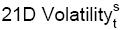 means the annualized observed volatility of the Selected Portfolio over the twenty-one (21) Trading Days prior to and including
Trading Day t, calculated in accordance with the following formula:
means the annualized observed volatility of the Selected Portfolio over the twenty-one (21) Trading Days prior to and including
Trading Day t, calculated in accordance with the following formula:

 means the annualized observed volatility of the Selected Portfolio over the sixty-three (63) Trading Days prior to and including Trading
Day t, calculated in accordance with the following formula:
means the annualized observed volatility of the Selected Portfolio over the sixty-three (63) Trading Days prior to and including Trading
Day t, calculated in accordance with the following formula:

 means the annualized observed volatility of the Selected Portfolio over the one hundred and twenty-six (126) Trading Days prior to and
including Trading Day t, calculated in accordance with the following formula:
means the annualized observed volatility of the Selected Portfolio over the one hundred and twenty-six (126) Trading Days prior to and
including Trading Day t, calculated in accordance with the following formula:

 means the weighted sum of the natural logarithms of daily returns of each Constituent for Trading Day d, calculated in accordance with
the following formula:
means the weighted sum of the natural logarithms of daily returns of each Constituent for Trading Day d, calculated in accordance with
the following formula:

 means the Closing TR Level of Constituent i as of Trading Day d.
 means the Closing TR Level of Constituent i as of the Trading Day immediately preceding Trading Day d.
 means the Selected Weight of Constituent i within the Selected Portfolio.
| 7.2 | Determining a Selection Date |
For each Trading Day, a “Selection Date” will be determined in accordance with the following:
| (i) | If such Trading Day is the last Trading Day of the calendar month, then such Trading Day shall be a Selection Date. |
| (ii) | If such Trading Day is not the last Trading Day of the calendar month, and |
| (a) | If the Realized Volatility of the most recently Selected Portfolio is more than two (2) times the Realized Volatility of such Selected Portfolio for such Selected Portfolio’s applicable Selection Date, then such Trading Day shall be a Selection Date. |
| (b) | If the Realized Volatility of the most recently Selected Portfolio is less than or equal to two (2) times the Realized Volatility of such Selected Portfolio for such Selected Portfolio’s applicable Selection Date, then such Trading Day shall not be a Selection Date. |
- 9 -
| 8. | Determining the Selected Weights for the Constituents in the Selected Portfolio |
On each Selection Date, the Index Calculation Agent will determine the weight (the “Selected Weight”) to be assigned to each Constituent in the Selected Portfolio, whether zero (0) or a positive number, for the relevant Selected Portfolio determined as of such Selection Date, in accordance with the methodology described in Section 8.1 (Identifying the Selected Portfolio) below.
| 8.1 | Identifying the Selected Portfolio |
With respect to a Selection Date, the Index Calculation Agent will:
| (a) | Identify all hypothetical portfolios of Constituents (the “Eligible Portfolios” and each individually an “Eligible Portfolio”) that satisfy the weight constraints below (the “Weight Constraints”): |
| (i) | The Selected Weight assigned to each Constituent numbered one (1) through three (3) in Table 1 in Section 6 (The Constituents; Closing TR Levels) above shall be equal to one (1) of: zero percent (0%), five percent (5%), ten percent (10%), fifteen percent (15%), twenty percent (20%), twenty-five percent (25%) or thirty percent (30%). |
| (ii) | The Selected Weight assigned to each Constituent numbered four (4) through six (6) and eight (8) through ten (10) in Table 1 in Section 6 (The Constituents; Closing TR Levels) above shall be equal to one (1) of: zero percent (0%), five percent (5%), ten percent (10%), fifteen percent (15%) or twenty percent (20%). |
| (iii) | The Selected Weight assigned to the Constituent numbered seven (7) in Table 1 in Section 6 (The Constituents; Closing TR Levels) above shall be equal to one (1) of: ten percent (10%), fifteen percent (15%), twenty percent (20%), twenty-five percent (25%), thirty percent (30%), thirty-five percent (35%) or forty percent (40%). |
| (iv) | The sum of the Selected Weights assigned to all the Constituents shall be equal to one hundred percent (100%). |
| (v) | The sum of the Selected Weights assigned to the Constituents numbered one (1) through three (3) in Table 1 in Section 6 above shall be greater than or equal to twenty percent (20%). |
| (vi) | The sum of the Selected Weights assigned to the Constituents numbered one (1) through three (3) in Table 1 in Section 6 above shall be less than or equal to sixty percent (60%). |
| (vii) | The sum of the Selected Weights assigned to the Constituents numbered four (4) through six (6) in Table 1 in Section 6 above shall be greater than or equal to ten percent (10%). |
| (viii) | The sum of the Selected Weights assigned to the Constituents numbered four (4) through six (6) in Table 1 in Section 6 above shall be less than or equal to forty percent (40%). |
| (ix) | The sum of the Selected Weights assigned to the Constituents numbered eight (8) through ten (10) in Table 1 in Section 6 above shall be less than or equal to twenty percent (20%). |
| (b) | Calculate the performance of each Eligible Portfolio (the “Performance”) in accordance with the following formula: |

- 10 -
| where: |
 means
the Performance of Eligible Portfolio j as of Selection Date k;
means
the Performance of Eligible Portfolio j as of Selection Date k;
 means the Closing TR Level of Constituent i as of Selection Date k.
 means the Closing TR Level of Constituent i as of the Trading Day that is twenty-one (21) Trading Days prior to Selection Date k.
 means the Closing TR Level of Constituent i as of the Trading Day that is sixty-three (63) Trading Days prior to Selection Date k.
 means the Closing TR Level of Constituent i as of the Trading Day that is one hundred and twenty-six (126) Trading Days prior to Selection
Date k.
means the Closing TR Level of Constituent i as of the Trading Day that is one hundred and twenty-six (126) Trading Days prior to Selection
Date k.
 means the weight of Constituent i within Eligible Portfolio j.
| (c) | Calculate the annualized observed volatility of each Eligible Portfolio (the “Realized Volatility”) in accordance with the following formula: |

| where: |
 means the Realized Volatility of Eligible Portfolio j as of Selection Date k.
 means
the annualized observed volatility of Eligible Portfolio j over the twenty-one (21) Trading Days prior to and including Selection Date
k, calculated in accordance with the following formula:
means
the annualized observed volatility of Eligible Portfolio j over the twenty-one (21) Trading Days prior to and including Selection Date
k, calculated in accordance with the following formula:

 means
the annualized observed volatility of Eligible Portfolio j over the sixty-three (63) Trading Days prior to and including Selection Date
k, calculated in accordance with the following formula:
means
the annualized observed volatility of Eligible Portfolio j over the sixty-three (63) Trading Days prior to and including Selection Date
k, calculated in accordance with the following formula:

 means
the annualized observed volatility of Eligible Portfolio j over the two hundred and fifty-two (252) Trading Days prior to and including
Selection Date k, calculated in accordance with the following formula:
means
the annualized observed volatility of Eligible Portfolio j over the two hundred and fifty-two (252) Trading Days prior to and including
Selection Date k, calculated in accordance with the following formula:

 means the weighted sum of the natural logarithms of daily returns of each Constituent for Trading Day t, calculated in accordance with
the following formula:
means the weighted sum of the natural logarithms of daily returns of each Constituent for Trading Day t, calculated in accordance with
the following formula:
- 11 -

 means the Closing TR Level of Constituent i as of Trading Day t.
 means the Closing TR Level of Constituent i as of the Trading Day immediately preceding Trading Day t.
means the weight of Constituent i within Eligible Portfolio j.
| (d) | Identify the Eligible Portfolio with the highest Performance that has Realized Volatility equal to or less than the Realized Volatility Constraint; provided that, if there is more than one such Eligible Portfolio with the same highest Performance, the Eligible Portfolio that has the lowest annualized Realized Volatility shall be selected. The single Eligible Portfolio that satisfies these criteria is referred to herein as the “Selected Portfolio” with respect to the relevant Selection Date. |
| (e) | If none of the Eligible Portfolios has Realized Volatility equal to or less than the Realized Volatility Constraint, the Index Calculation Agent shall increase the Realized Volatility Constraint by one percent (1%) and repeat the step set forth in Section 8.1(d) above until a Selected Portfolio is selected. This step, of increasing the Realized Volatility Constraint, may be repeated until a Selected Portfolio is selected. |
| 8.2 | Determining the Selected Weight to be assigned to each Constituent in the relevant Selected Portfolio |
The Selected Weight to be assigned to each Constituent within a Selected Portfolio will be determined by the Index Calculation Agent as the weight assigned to such Constituent in the Selected Portfolio identified with respect to the relevant Selection Date in accordance with Section 8.1 above.
| 9. | Rebalancing and Units |
Unless a Market Disruption Event (as defined in Section 11.4 (Definitions related to market disruption)) has occurred and is continuing the Index will be rebalanced over the "Rebalancing Period", which is the period composed of the first five (5) consecutive Index Business Days immediately following a Selection Date (each a "Rebalancing Date"), subject to postponement pursuant to Section 11.2 (Market disruption on a Rebalancing Date). Such rebalancing will transition the Index to the next Selected Portfolio selected on the most recent Selection Date, by identifying, on the first Effective Rebalancing Date of such Rebalancing Period, the “unitized” (i.e., converted into a fixed number of units or shares to trade) weights of each Constituent in the relevant Selected Portfolio (the “Selected Units”), and rebalancing the Index exposure from the unitized exposures as of the immediately preceding Selection Date to such Selected Units.
The unitized exposure of the Index to each Constituent in respect of each Trading Day shall be the “Daily Units”, and the Index Calculation Agent shall calculate an index divisor (the “Divisor”) in respect of each Trading Day to ensure the effective weights within the Index sum to one hundred percent (100%) as of the Closing Time on each Trading Day (i.e., the Index is always fully invested without leverage).
| 9.1 | Calculating the Selected Units for each Constituent in respect of the relevant Selected Portfolio |
In respect of the first (1st) Rebalancing Date of each Rebalancing Period, the Index Calculation Agent shall calculate the Selected Units of each Constituent in the relevant Selected Portfolio in accordance with the following formula:

| where: |
- 12 -
 means the Selected Units of Constituent i in the Selected Portfolio selected as of Selection Date k.
 means the Selected Weight of Constituent i in the Selected Portfolio selected as of Selection Date k.
 means the Index Level for the first (1st) Effective Rebalancing Date associated with Selection Date k.
 means the Closing TR Level of Constituent i as of the first (1st) Effective Rebalancing Date associated with Selection Date
k.
means the Closing TR Level of Constituent i as of the first (1st) Effective Rebalancing Date associated with Selection Date
k.
| 9.2 | Calculating the Daily Units for each Constituent |
As of the Base Date, the Daily Units of each Constituent was set equal to the Selected Units calculated in respect of the Base Date. Thereafter, the Index Calculation Agent shall calculate the Daily Units of each Constituent i in respect of each Trading Day as follows:
| (a) | For each Trading Day t from and including the last Effective Rebalancing Date in Rebalancing Period k to but excluding the first (1st) Effective Rebalancing Date in the immediately following Rebalancing Period, the Daily Units of Constituent i will be equal to the Selected Units of Constituent i in the Selected Portfolio selected as of Selection Date k associated with Rebalancing Period k. |
| (b) | Subject to the provisions of Section 11.2 (Market disruption on a Rebalancing Date), for each Trading Day t from and including the first (1st) Effective Rebalancing Date in Rebalancing Period k to but excluding the last Effective Rebalancing Date in Rebalancing Period k, the Daily Units of Constituent i will be calculated in accordance with the following formula: |

where:
 means the Daily Units of Constituent i as of Trading Day t.
 means the Daily Units of Constituent i as of Selection Date k associated with Rebalancing Period k.
 means the Divisor as of Selection Date k associated with Rebalancing Period k.
means the Selected Units of Constituent i in the Selected Portfolio selected as of Selection Date k.
 | means the number of Effective Rebalancing Dates that have occurred in Rebalancing Period k prior to and including Trading Day t, such that: |
| (i) | If Trading Day t is the first
(1st) Effective Rebalancing Date in Rebalancing Period k,  . . |
| (ii) | If Trading Day t is the second
(2nd) Effective Rebalancing Date in Rebalancing Period k,  . . |
| (iii) | If Trading Day t is the third
(3rd) Effective Rebalancing Date in Rebalancing Period k,  . . |
- 13 -
| (iv) | If Trading Day t is the fourth
(4th) Effective Rebalancing Date in Rebalancing Period k,  . . |
| (v) | If Trading Day t is the fifth
(5th) Effective Rebalancing Date in Rebalancing Period k,  . . |
| 9.3 | Calculating the Divisor |
The Index Calculation Agent shall calculate the Divisor in respect of each Trading Day as follows:

where:
 means
the Divisor for the Trading Day t.
means
the Divisor for the Trading Day t.
means the Daily Units of Constituent i as of Trading Day t.
 means the Closing TR Level of Constituent i as of Trading Day t.
 means
the Index Level for the Trading Day t.
means
the Index Level for the Trading Day t.
10. Calculation of the Index Level
As of the Base Date, the Index Level was set equal to one hundred (100.00). Thereafter, subject to the provisions of Section 11.3 (Calculation of the Index Level in respect of a Final Disruption Determination Date), the Index Level will be calculated by the Index Calculation Agent in U.S. dollars in respect of each Trading Day as follows:

where:
means
the Index Level for the Trading Day t.
 means the Daily Units of Constituent i as of the Trading Day immediately preceding Trading Day t.
means the Closing TR Level of Constituent i as of Trading Day t.
 means the Divisor for the Trading Day immediately preceding Trading Day t.
11. Market Disruption
The Index is generally constructed so that the Index Calculation Agent will typically not calculate or publish the Index Level on a Disrupted Day for any Constituent whose Closing Level would affect the level of the Index; and so that the Index shall not rebalance on a Disrupted Day for any Constituent whose Closing Level would affect the rebalancing of the Index. However, the occurrence of a Disrupted Day for any Constituent shall not affect the timing of the Selection Date.
If any originally scheduled Rebalancing Date is a Disrupted Day for any Constituent whose Closing Level would affect the rebalancing of the Index, then such Rebalancing Date and all following Rebalancing Dates in the relevant Rebalancing Period shall be postponed. This shall not cause any Rebalancing Date to be skipped, or cause more than one (1) Rebalancing Date to effectively occur on the same date. Instead, the
- 14 -
rebalancing originally scheduled to occur on each Rebalancing Date on or after such affected Rebalancing Date shall also be postponed for up to five (5) Index Business Days.
Consequently, the effective Rebalancing Dates for the relevant Rebalancing Period will occur in the originally scheduled order and on different Index Business Days. As a result, a Rebalancing Period will effectively be extended, but will nevertheless occur over five (5) potentially non-consecutive days.
| 11.1 | Market disruption on a Selection Date |
If a Selection Date is a Disrupted Day (as defined in Section 11.4 below) for any Constituent, then the relevant Selection Date shall remain the originally scheduled Selection Date and the Closing TR Level for each such affected Constituent in respect of such Disrupted Day shall be deemed to be the Closing TR Level for each such affected Constituent as of the immediately preceding day that was both (x) a Dealing Day (as defined in “Definitions”) for such affected Constituent and (y) not a Disrupted Day for such affected Constituent.
| 11.2 | Market disruption on a Rebalancing Date |
The rebalancing originally scheduled to occur on a Rebalancing Date shall be postponed (such postponed Rebalancing Date, an “Affected Rebalancing Date”) if any Rebalancing Date occurring on or before such Rebalancing Date in the relevant Rebalancing Period is a Disrupted Day for any Constituent that is either (i) included in the relevant Selected Portfolio or (ii) has non-zero Daily Units as of the Trading Day immediately preceding such Rebalancing Date.
In the event that a Rebalancing Date is an Affected Rebalancing Date, such Affected Rebalancing Date will be postponed to the date (the “Postponed Rebalancing Date”) that is the first day to occur of:
| (i) | the first following Index Business Day that is neither (x) a Disrupted Day for any Constituent that is either (i) included in the relevant Selected Portfolio or (ii) has non-zero Daily Units as of the Trading Day immediately preceding such Rebalancing Date, nor (y) the Postponed Rebalancing Date for any Affected Rebalancing Date that was originally scheduled to occur prior to the date on which such Affected Rebalancing Date was originally scheduled to occur; and |
| (ii) | the fifth (5th) Index Business Day following the date on which such Affected Rebalancing Date was originally scheduled to occur. |
| 11.3 | Calculation of the Index Level in respect of a Final Disruption Determination Date |
If a Postponed Rebalancing Date is a Disrupted Day for any Constituent that is either (i) included in the relevant Selected Portfolio or (ii) has non-zero Daily Units as of the Trading Day immediately preceding such Rebalancing Date, then such Postponed Rebalancing Date shall be a “Final Disruption Determination Date”.
On each Final Disruption Determination Date, the Index Calculation Agent will calculate its good faith estimate of the Index Level as of such Final Disruption Determination Date (notwithstanding the fact that such Final Disruption Determination Date is a Disrupted Day for at least one Constituent included in a Selected Portfolio) using its good faith estimate of the Closing TR Level for any Constituent, if such Final Disruption Determination Date is a Disrupted Day for such Constituent. Any such estimated levels may be subject to correction on any of (x) the first succeeding Index Business Day that is not a Final Disruption Determination Date for the Index, (y) the first succeeding Index Business Day that is not a Disrupted Day in respect of any Constituent and (z) the first succeeding Index Business Day that is not a Disrupted Day for a Constituent with respect to which such an estimated level was determined pursuant to this Section 11.3.
For the avoidance of doubt, on each Final Disruption Determination Date, the Index Calculation Agent will re-weight the portion of the Index to be rebalanced on such day in accordance with Section 10 (Calculation of the Index Level) using its good faith estimates determined pursuant to this Section 11.3. Such Final
- 15 -
Disruption Determination Date shall be a Trading Day for the purposes of the Index Rules, notwithstanding the fact that it is a Disrupted Day for at least one (1) Constituent.
| 11.4 | Definitions related to market disruption |
| (a) | “Disrupted Day” means, in respect of a Constituent, a Dealing Day on which a Market Disruption Event occurs or is continuing in respect of such Constituent. |
| (b) | A “Market Disruption Event” occurs if the Index Calculation Agent determines in its sole discretion that on any Dealing Day there has been, subject to the provisions of paragraph (c), below: |
| (i) | in respect of any Reference Index (as defined in “Definitions”) of any Constituent included in the relevant Selected Portfolio or Selected Portfolios, a failure by the relevant sponsor or its agent to calculate and publish the Closing Level for such index on such Dealing Day, or any event that, in the determination of the Index Calculation Agent, disrupts or impairs the ability of market participants to effect transactions in or obtain levels or market values for (a) the relevant Reference Index, (b) any securities or components that in the aggregate comprise 20 percent (20%) or more of the level of the relevant Reference Index, (c) any futures or options contracts or other financial contracts relating to the relevant Reference Index, or (d) any futures or options contracts or other financial contracts relating to securities or components that in the aggregate comprise 20 percent (20%) or more of the level of the relevant Reference Index; or |
| (ii) | the occurrence or existence of a suspension, absence or material limitation of trading of the securities of a Constituent on the relevant Primary Listing Exchange for such securities for more than two hours of trading during, or during the last one-half (½) hour period preceding the close of, the principal trading session on such relevant Primary Listing Exchange; or |
| (iii) | a breakdown or failure in the price and trade reporting systems of the relevant Primary Listing Exchange for the securities of a Constituent as a result of which the reported trading prices for such securities are materially inaccurate for more than two hours of trading during, or during the last one-half hour period preceding the close of, the principal trading session on such relevant Primary Listing Exchange; or |
| (iv) | if applicable, the occurrence or existence of a suspension, absence or material limitation of trading on the Primary Listing Exchange or market for trading in futures or options contracts related to the securities of a Constituent or on any Related Exchange (as defined in “Definitions”) for such Constituent for more than two hours of trading during, or during the last one-half hour period preceding the close of, the principal trading session on the applicable exchange or market; or |
| (v) | as applicable, if any of the following is calculated or announced in the ordinary course, but is not calculated or is not announced by or on behalf of the relevant sponsor of the Constituent or the relevant calculation agent or information provider that the relevant sponsor of such Constituent designates: the intraday net asset value or the intraday indicative value of such Constituent, the intraday indicative value of a Reference Index of such Constituent, or any intraday value or level that indicates or affects the approximate intrinsic economic value of such Constituent or the amount of any payment in respect of such Constituent; or |
| (vi) | as applicable, if any of the following is calculated or announced in the ordinary course, but is not calculated or is not announced by or on behalf of the relevant sponsor of a Constituent or the relevant calculation agent or information provider that the relevant sponsor of such Constituent designates: the closing net asset value or the closing indicative value of a Constituent, the closing indicative value of the Reference Index of |
- 16 -
such Constituent, or any closing value or level or other value or level that indicates or affects the approximate intrinsic economic value of such Constituent or the amount of any payment in respect of such Constituent; or
| (vii) | the relevant sponsor of a Constituent suspends creations, issuances or redemptions of securities of such Constituent; and |
the Index Calculation Agent determines in its sole discretion that the applicable event described above could materially interfere with the ability of market participants to transact in positions with respect to the Index (including, without limitation, positions with respect to any Constituent or the Reference Index of any Constituent).
| (c) | For the purpose of determining whether a Market Disruption Event has occurred: |
| (i) | at any time with respect to a Reference Index and a Dealing Day, if trading in a security or component included in the applicable Reference Index is materially suspended or materially limited at that time, then the relevant percentage contribution of that security or component to the level of the applicable Reference Index will be based on a comparison of (x) the portion of the level of the applicable Reference Index attributable to that security or component relative to (y) the overall level of the applicable Reference Index, in each case immediately before that suspension or limitation; |
| (ii) | a limitation on the hours or number of days of trading will not constitute a Market Disruption Event if it results from an announced change in the regular business hours of the relevant Primary Listing Exchange or the exchange or market for trading in futures or options contracts related to the relevant securities; |
| (iii) | limitations pursuant to the rules of any relevant Primary Listing Exchange similar to New York Stock Exchange Rule 80B (or any applicable rule or regulation enacted or promulgated by any other self-regulatory organization or any government agency of scope similar to New York Stock Exchange Rule 80B as determined by the Index Calculation Agent) on trading during significant market fluctuations will constitute a suspension, absence or material limitation of trading; |
| (iv) | a suspension of trading in futures or options contracts on the Reference Index or securities of a Constituent by the exchange or market for trading in such contracts or securities of such Constituent by reason of (a) a price change exceeding limits set by such exchange or market, (b) an imbalance of orders relating to such contracts or securities of such Constituent or (c) a disparity in bid and ask quotes relating to such contracts or securities of such Constituent, will constitute a suspension, absence or material limitation of trading in futures or options contracts related to such equity index or the securities of such Constituent; and |
| (v) | a suspension, absence or material limitation of trading on any relevant Primary Listing Exchange or, if applicable, on the exchange or market on which futures or options contracts related to the Reference Index or the securities of a Constituent are traded will not include any time when such exchange or market is itself closed for trading under ordinary circumstances. |
12. Extraordinary Events and Anti-Dilution Events
| 12.1 | Successors to a Constituent |
| (a) | (x) If any of the following is calculated or announced in the ordinary course, but is not calculated or is not announced by or on behalf of the relevant sponsor or issuer for the Constituent or the relevant calculation agent or information provider that such sponsor or issuer designates: its intraday or |
- 17 -
closing net asset value or another value or level that indicates or affects the approximate intrinsic economic value of the Constituent or the amount of any payment in respect of the Constituent, (y) yet such value or level is calculated and announced by or on behalf of a successor sponsor or issuer acceptable to the Index Calculation Agent or a calculation agent or information agent (in either case, that such successor sponsor or issuer designates) acceptable to the Index Calculation Agent;
| (b) | (x) If a Constituent is replaced by a successor Constituent, (y) yet (1) the Reference Index of such successor Constituent is either the same as that of the replaced Constituent or is an index using, in the determination of the Index Calculation Agent, the same or a substantially similar formula for and method of calculation as used in the calculation of the replaced Constituent’s Reference Index or (2) such successor Constituent is otherwise acceptable to the Index Calculation Agent; |
then, in each case, that Constituent, that Reference Index or the relevant sponsor, issuer, calculation agent or information provider will thereafter be deemed to be the successor Constituent, successor Reference Index or the successor sponsor, issuer, calculation agent or information provider described in the relevant clause above, with effect from a date determined by the Index Calculation Agent, which may make such adjustments to the Index Rules as it determines in good faith are appropriate to account for such change (including, without limitation, adjustments to market disruption provisions in respect of an index that includes securities or components that are bonds or loans).
For the avoidance of doubt, the Index Calculation Agent shall not accept a particular successor Constituent if the Index Calculation Agent determines, in its sole discretion, that doing so would immediately result in the occurrence of an Extraordinary Event. Upon the acceptance of a successor Constituent, such successor shall take the place of the relevant Constituent. For the avoidance of doubt, the prior performance of such successor Constituent shall be used in the identification of the Selected Portfolio for future Selection Dates if the relevant prior Performance of such successor is available; provided that, if some portion of the relevant prior performance of such successor is not available, the prior performance of the replaced Constituent shall be used (in place of such portion of the relevant prior performance of such successor that is not available) in the identification of the Selected Portfolio for future Selection Dates with such adjustments as the Index Calculation Agent determines in good faith are appropriate to account for the use of prior performance of both such successor and such replaced Constituent.
| 12.2 | Substitutes for a Constituent |
If an Extraordinary Event occurs in respect of a Constituent, the Index Calculation Agent, acting in good faith and a commercially reasonable manner, shall select as a substitute for such Constituent an ETF that has a Reference Index (such substitute ETF being referred to herein as a “substitute ETF”) that, in any case, the Index Calculation Agent determines, in its sole discretion, possesses substantially similar characteristics or provides a substantially similar exposure (as considered prior to the occurrence of such Extraordinary Event) as compared to the Constituent that is being replaced, provided that, if the Index Calculation Agent determines that no such substitute (that the Index Calculation Agent determines, in its sole discretion, possesses substantially similar characteristics or provides a substantially similar exposure) is available, the Index Calculation Agent shall instead select an appropriate substitute by considering the context of the Index and its Weight Constraints; provided further that, if the Index Calculation Agent determines, in its sole discretion, that neither a substantially similar nor an appropriate substitute ETF is available, then the Index Calculation Agent will, in its sole discretion, (x) determine its good faith estimate of the closing price of such Constituent as of a date on or prior to the occurrence of such Extraordinary Event and use such estimate of the closing price (without modification over time) in respect of such Constituent in subsequent calculations of the Index Level until the final Effective Rebalancing Date in the immediately following Rebalancing Period, and (y) remove such Constituent from the Index.
In any such case, the Index Calculation Agent shall, in good faith, make such adjustments that it determines to be appropriate to any variable, calculation methodology, valuation terms or any other rule in relation to the Index to account for such substitution. The Index Sponsor may, in its discretion, at any time and without notice, terminate the calculation or publication of the Index, including, without limitation, subsequent to the occurrence of an Extraordinary Event.
- 18 -
The Index Calculation Agent shall not select a particular substitute ETF if the Index Calculation Agent determines, in its sole discretion, that doing so would immediately result in the occurrence of an Extraordinary Event. Upon the selection of a substitute ETF, such substitute shall take the place of the relevant Constituent. For the avoidance of doubt, the prior performance of such substitute ETF shall be used in the identification of the Selected Portfolio for future Selection Dates if the relevant prior performance of such substitute is available; provided that, if some portion of the relevant prior performance of such substitute is not available, the prior performance of the replaced ETF shall be used (in place of such portion of the relevant prior performance of such substitute that is not available) in the identification of the Selected Portfolio for future Selection Dates with such adjustments as the Index Calculation Agent determines in good faith are appropriate to account for the use of prior Performance of both such substitute and such replaced ETF.
| 12.3 | Definitions related to Extraordinary Events |
An “Extraordinary Event” occurs if the Index Calculation Agent determines in its sole discretion that (i) on any Dealing Day in respect of a Constituent one or more of the following events has occurred and (ii) the applicable event or events described below materially interferes with the ability of market participants to transact in positions with respect to the Index (including, without limitation, positions with respect to any Constituent or the Reference Index of any Constituent):
| (i) | for any Constituent for which the securities of the relevant exchange-traded fund are issued by a trust (such issuer trust, the “Trust Issuer”), the trust agreement or any similar governing document of the Trust Issuer is terminated, or the Trust Issuer becomes, for any reason, subject to voluntary or involuntary termination, liquidation, bankruptcy, insolvency, dissolution or winding-up or any other analogous proceeding; |
| (ii) | for any Constituent, the issuer becomes, for any reason, subject to voluntary or involuntary termination, liquidation, bankruptcy, insolvency, dissolution or winding-up or any other analogous proceeding; |
| (iii) | for any Constituent, all the securities of the Constituent or all or substantially all of the assets of the Constituent are nationalized, expropriated or otherwise required to be transferred to any governmental agency, authority, entity or instrumentality thereof; |
| (iv) | for any Constituent, the sponsor of the Constituent permanently cancels the Constituent, and no successor exists, or the Constituent’s level, net asset value or indicative value is not calculated and is not announced by or on behalf of the relevant sponsor or issuer of the Constituent, and is not calculated and announced by or on behalf of a successor sponsor or issuer acceptable to the Index Calculation Agent; |
| (v) | for a Constituent, the event specified in clause (x) of subsection (a) or (b) of Section 12.1 above occurs, but the relevant event specified in clause (y) of such subsection of Section 12.1 above does not occur; |
| (vi) | for any Constituent, such Constituent is de-listed from the relevant Primary Listing Exchange for such Constituent and is not concurrently listed on a U.S. securities exchange acceptable to the Index Calculation Agent; |
| (vii) | in respect of any Constituent, an ETF Material Event (as defined below in this Section 12.3) occurs in respect of such Constituent; |
| (viii) | in respect of a Constituent, a Market Disruption Event occurs for ten (10) consecutive Dealing Days and the Index Calculation Agent determines that such Market Disruption Event is reasonably likely to continue for a period of an indeterminate duration; |
- 19 -
| (ix) | in respect of a Constituent, (x) a suspension or limitation on trading in respect of a Relevant Underlying (as defined below) is announced or imposed for ten (10) consecutive Dealing Days for such Constituent or for a period of indeterminate duration that the Index Calculation Agent determines is reasonably likely to include ten (10) consecutive Dealing Days for such Constituent or (y) any other event occurs or condition exists that causes trading to cease in respect of a Relevant Underlying for ten (10) consecutive Dealing Days for such Constituent; |
| (x) | if, at any time, any relevant license or other right or ability of the Index Calculation Agent or the Index Sponsor (or any of their affiliates) to use any Constituent, underlying reference input or relevant data or information or to refer to the level or price or other information in respect of any Constituent, underlying reference input or relevant data or information (or other component or input of the Index or other matter that could affect the Index) terminates, becomes impaired, ceases or cannot be obtained or will cease to be available on commercially reasonable terms or the Index Calculation Agent’s right or ability to use (i) any Constituent for the purposes of the Index or (ii) the Index in connection with the grant or receipt of any other inbound or outbound licensing or sub-licensing rights is otherwise impaired, ceases or cannot be obtained or will cease to be available on commercially reasonable terms (for any reason); or |
| (xi) | the occurrence or continuation of a Change in Law (as defined below in this Section 12.3). |
An “ETF Material Event” occurs in respect of a Constituent when one or more of the following events occurs, and the Index Calculation Agent determines in its sole discretion that such event or combination of events is material (although, for the avoidance of doubt, the Index Calculation Agent has no obligation to monitor actively whether or not any of the following events has occurred):
| (a) | there is an amendment, variation or modification to the constitutional documents or offering documents of the Constituent, that the Index Calculation Agent determines has or is reasonably likely to have an adverse impact on the ability of market participants to trade in securities of the Constituent; |
| (b) | there is an amendment, variation or modification to the terms of the Constituent or the obligations of the issuer in respect of the Constituent, in any case and by any means, that the Index Calculation Agent determines has or is reasonably likely to have an adverse impact on the value, redeemability or liquidity of the securities of the Constituent; |
| (c) | an ETF Regulatory Action occurs in respect of the Constituent; “ETF Regulatory Action” means (i) any cancellation, suspension or revocation of the registration or approval of the Constituent or the securities of the Constituent by any governmental, legal or regulatory entity with authority over the Constituent or the securities of the Constituent, (ii) any change in the legal, tax, accounting, or regulatory treatments of the Constituent, any sponsor, issuer or adviser of the Constituent or the securities of the Constituent that the Index Calculation Agent determines has or is reasonably likely to have an adverse impact on the holders of the securities of the Constituent or on the value of the securities of the Constituent, (iii) the Constituent or any sponsor, issuer or adviser of the Constituent becoming subject to any investigation, proceeding or litigation by any relevant governmental, legal or regulatory authority involving any activities relating to or resulting from the operation of the Constituent (including, without limitation, any future, announced or implemented material change to any one or more exemptive orders, no action letters or interpretative guidance of the U.S. Securities and Exchange Commission (the “SEC”), including guidance issued by the SEC’s staff, relating to the Constituent or to exchange-traded funds generally that affects holders of the securities of the Constituent, whether occurring through action of the SEC or otherwise, including as a result of a court order or executive order) that the Index Calculation Agent determines has or is reasonably likely to have a material adverse effect on the value, redeemability or liquidity of the securities of the Constituent, or the operation of the Constituent in accordance with the terms of the Constituent or the Constituent’s offering documents or (iv) the issuance by the SEC of an order to suspend redemption obligations of the Constituent, to freeze assets of the Constituent or to take |
- 20 -
any other action that the Index Calculation Agent determines is reasonably likely to have a material effect on the value, redeemability or liquidity of the Constituent;
| (d) | the Average Daily Trading Volume (as defined in "Definitions") of any Constituent declines below (x) an amount equal to 20 percent (20%) of its Average Daily Trading Volume as of August 27, 2020 or (y) twenty-five million U.S. dollars ($25,000,000); |
| (e) | the Market Capitalization (as defined in “Definitions”) of any Constituent declines below (x) an amount equal to 20 percent (20%) of its Market Capitalization as of August 27, 2020 or (y) two point five billion U.S. dollars ($2,500,000,000); |
| (f) | the relevant Primary Listing Exchange for the Constituent announces that such Constituent will be de-listed from such exchange; |
| (g) | if any of the following is calculated or announced in the ordinary course, but, for a period of five (5) consecutive Dealing Days, is not calculated or is not announced by or on behalf of the relevant sponsor or issuer of the Constituent or the relevant calculation agent or information provider that the relevant sponsor or issuer of the Constituent designates: the intraday net asset value of the Constituent, the intraday indicative value of a Reference Index of the Constituent, or any intraday value or level that indicates or affects the approximate intrinsic economic value of the Constituent or the amount of any payment in respect of the Constituent; |
| (h) | if any of the following is calculated or announced in the ordinary course, but, for a period of five (5) consecutive Dealing Days, is not calculated or is not announced by or on behalf of the relevant sponsor or issuer of the Constituent or the relevant calculation agent or information provider that the relevant sponsor or issuer of the Constituent designates: the closing net asset value of the Constituent, the closing indicative value of a Reference Index of the Constituent, or any closing value or level or other value or level that indicates or affects the approximate intrinsic economic value of the Constituent or the amount of any payment in respect of the Constituent; |
| (i) | if any of the following is calculated or announced in the ordinary course, but, for a period of five (5) consecutive Dealing Days, the Closing Level of the Constituent reflects a premium greater than five percent (5%) or a discount greater than five percent (5%) as compared to the closing net asset value of the Constituent, the closing indicative value of a Reference Index of the Constituent, or any closing value or level or other value or level that indicates or affects the approximate intrinsic economic value of the Constituent or the amount of any payment in respect of the Constituent; |
| (j) | the relevant sponsor of the Reference Index of the Constituent fails to calculate and publish the Closing Level for such index for five (5) consecutive Dealing Days; or |
| (k) | the relevant sponsor of the Constituent suspends new issuances, creations or redemptions of securities of such Constituent for five (5) consecutive Dealing Days or announces a suspension of unlimited duration of such creations or redemptions. |
A “Change in Law” occurs when, due to either:
| (a) | the adoption of, or any change in, any applicable law, regulation or rule (including, without limitation, (x) any tax law or (y) adoption or promulgation of new regulations authorized or mandated by existing statute); or |
| (b) | the promulgation of, or any change in, the announcement or statement of a formal or informal interpretation by any court, tribunal or regulatory authority with competent jurisdiction of any applicable law, rule, regulation or order (including, without limitation, as implemented by the U.S. Commodity Futures Trading Commission, the U.S. Securities and Exchange Commission or any exchange or trading facility), and |
the Index Calculation Agent determines in good faith that (x) it is contrary to such law, rule, regulation or order for any market participants that are brokers or financial intermediaries (individually or collectively) to hold, acquire or dispose of (in whole or in part) a position in or a transaction referencing or relating to (1) a
- 21 -
Constituent, (2) a component of a Constituent that is an index or (3) a component of a Reference Index of a Constituent (each such underlying described in any of the immediately preceding clauses (1), (2) and (3), being a “Relevant Underlying”) or (y) holding a position in or a transaction referencing or relating to a Relevant Underlying is (or, but for the consequent disposal or termination thereof, would otherwise be) in excess of any allowable position limit(s) applicable to any market participants that are brokers or financial intermediaries (individually or collectively) under any such law, rule or regulation in relation to a Relevant Underlying, including in any case traded on any exchange(s), market or other trading facility.
| 12.4 | Anti-dilution adjustments |
With respect to each Constituent (or the relevant successor or substitute Constituent), the Index Calculation Agent will make anti-dilution adjustments to the Closing Level of such Constituent only (a) if the securities of such Constituent are subject to a split or reverse split, once such split has become effective, or (b) if such Constituent is subject to (i) an issuance of additional securities of such Constituent that is given ratably to all or substantially all holders of securities of such Constituent or (ii) a distribution of securities of such Constituent as a result of the triggering of any provision of the corporate charter of such Constituent or its issuer, as applicable, once the dividend or distribution has become effective and the securities of such Constituent are trading ex-distribution. The Index Calculation Agent will be solely responsible for the determination and calculation of any such anti-dilution adjustments and any related determinations and calculations, and its determinations and calculations with respect thereto will be conclusive in the absence of manifest error.
13. Corrections
If (i) the Closing Level of any Constituent as of any date which is published or otherwise made available in respect of the relevant Constituent is subsequently corrected and such correction is published or otherwise made available in respect of such Constituent; or (ii) the Index Calculation Agent identifies an error or omission in any of its calculations, determinations or interpretations in respect of the Index, then the Index Calculation Agent may, if practicable and if the Index Calculation Agent determines in good faith that such correction, error or omission (as the case may be) is material, adjust or correct the relevant calculation, determination or interpretation or the Index Level as of any Index Business Day to take into account any such correction, error or omission (as the case may be).
- 22 -
Definitions
Terms not otherwise defined herein, shall have the following meanings:
| “Affected Rebalancing Date” | has the meaning given to such term in Section 11.2 (Market disruption on a Rebalancing Date). |
| “Average Daily Trading Volume” | means, with respect to a Constituent and an Index Business Day, the product of (a) the ratio of (i) the total volume of trading in the securities of such Constituent from but excluding the calendar day that is six months prior to such Index Business Day, to and including such Index Business Day, as reported to the consolidated tape, divided by (ii) the total number of Index Business Days from but excluding the calendar day six (6) months prior to such Index Business Day, to and including such Index Business Day, times (b) the Closing Level of such Constituent on such Index Business Day. The Average Daily Trading Volume for each Constituent as of August 27, 2020 is provided in Schedule 1. |
| “Base Date” | means June 1, 2004. |
| “Change in Law” | has the meaning given to such term in Section 12.3 (Definitions related to Extraordinary Events). |
| “Closing Level” | means, subject to the provisions of Section 11 (Market Disruption) and Section 12 (Extraordinary Events and Anti-Dilution Events), in respect of a Constituent and a Dealing Day, the official closing price for such Constituent on the Primary Listing Exchange for such Constituent, as of the closing time of the regular trading session of such Primary Listing Exchange on such Dealing Day. |
| “Closing Time” | means, for an Index Business Day, the scheduled closing time of the regular trading session for NYSE Arca. |
| “Closing TR Level” | has the meaning, in respect of a Constituent and a Dealing Day, given to such term in Section 6 (The Constituents; Closing TR Levels). |
| “Constituent” | has the meaning given to such term in Section 4 (General Notes on the Index). |
| “Dealing Day” | means, for each Constituent, a day on which the Primary Listing Exchange for such Constituent is scheduled to be open for trading for its regular trading session. |
| “Disrupted Day” | has the meaning given to such term in Section 11.4 (Definitions related to market disruption). |
| “Effective Rebalancing Date” | means, with respect to any Rebalancing Date, (i) if such Rebalancing Date occurs on the date originally scheduled (and is not postponed pursuant to Section 11.2 (Market disruption on a Rebalancing Date)), such originally scheduled date or (ii) if such Rebalancing Date is postponed pursuant to Section 11.2, the Postponed Rebalancing Date in respect of such Rebalancing Date. |
| “Eligible Portfolio” | has the meaning given to such term in Section 8.1 (Identifying the Selected Portfolio). |
| “ETF Material Event” | has the meaning given to such term in Section 12.3 (Definitions related to Extraordinary Events). |
- 23 -
| “ETF Regulatory Action” | has the meaning given to such term in Section 12.3 (Definitions related to Extraordinary Events). |
| "Exchange Act" | means the United States Securities Exchange Act of 1934, as amended. |
| “Ex-Distribution Date” | has the meaning given to such term in Section 6 (The Constituents; Closing TR Levels). |
| “Extraordinary Event” | has the meaning given to such term in Section 12.3 (Definitions related to Extraordinary Events). |
| “Final Disruption | |
| Determination Date” | has the meaning given to such term in Section 11.3 (Calculation of the Index Level in respect of a Final Disruption Determination Date). |
| “Gross Distribution | |
| Amount” | has the meaning given to such term in Section 6 (The Constituents; Closing TR Levels). |
| “Index” | means the J.P. Morgan Core Bond Index, as provided in Section 1 (Introduction). |
| “Index Business Day” | means a day (i) on which the New York Stock Exchange is scheduled to open for trading for its regular trading session and (ii) that is a Dealing Day for all of the Constituents. |
| “Index Calculation Agent” | has the meaning given to such term in Section 2.1 (Index Sponsor and Index Calculation Agent; Identity and responsibilities). |
| “Index Level” | has the meaning given to such term in Section 5 (Publication of the Index Level). |
| “Index Rules” | means, as provided in Section 1 (Introduction), the rules of the J.P. Morgan Core Bond Index as set out in this document, as the same may be supplemented, amended or restated from time to time. |
| “Index Sponsor” | has the meaning given to such term in Section 2.1 (Index Sponsor and Index Calculation Agent; Identity and responsibilities). |
| “JPMS” | has the meaning provided in Section 2.1 (Index Sponsor and Index Calculation Agent; Identity and responsibilities). |
| “Live Date” | means March 30, 2023. |
| “Market Capitalization” | means, with respect to a Constituent and a Dealing Day, the product of (a) the shares outstanding of such Constituent in respect of such Dealing Day, as reported to the Primary Listing Exchange, times (b) the Closing Level of such Constituent in respect of such Dealing Day. The Market Capitalization for each Constituent on August 27, 2020 is provided in Schedule 1. |
| “Market Disruption Event” | has the meaning given to such term in Section 11.4 (Definitions related to market disruption). |
| “Performance” | has the meaning given to such term in Section 8.1 (Identifying the Selected Portfolio). |
- 24 -
| “Postponed Rebalancing Date” | has the meaning given to such term in Section 11.2 (Market disruption on a Rebalancing Date). |
| "Primary | |
| Listing Exchange" | with respect to a Constituent and a date, the U.S. securities exchange registered under the Exchange Act, on which the shares or other interests of such Constituent have their primary listing as of such date. |
| “Realized Volatility” | has the meaning given to such term in Section 8.1 (Identifying the Selected Portfolio). |
| “Realized Volatility | |
| Constraint” | means five percent (5%); provided that, such percentage is subject to increase for any Rebalancing Selection Date in accordance with the terms of Section 8.1(e). |
| “Rebalancing Date” | has the meaning given to such term in Section 9 (Rebalancing and Units) and is subject to the provisions of Section 11.2 (Market disruption on a Rebalancing Date). |
| “Rebalancing Period” | has the meaning given to such term in Section 9 (Rebalancing and Units) and is subject to the provisions of Section 11.2 (Market disruption on a Rebalancing Date). |
| “Reference Index” | means with respect to a Constituent, the index, if applicable, whose performance such Constituent attempts to track. The Reference Index for each Constituent, as of August 27, 2020 is provided in Schedule 1. |
| “Related Exchange” | means, in respect of any Constituent, each exchange or quotation system (as determined by the Index Calculation Agent) where trading has a material effect (as determined by the Index Calculation Agent) on the overall market for futures or options contracts relating to the Constituent. |
| “Relevant Person” | has the meaning given to such term in Section 2.1 (Index Sponsor and Index Calculation Agent; Identity and Responsibilities). |
| “Relevant Underlying” | has the meaning given to such term in Section 12.3 (Definitions related to Extraordinary Events). |
| “SEC” | has the meaning given to such term in Section 12.3 (Definitions related to Extraordinary Events). |
| “Selected Portfolio” | has the meaning given to such term in Section 8.1 (Identifying the Selected Portfolio). |
| “Selection Date” | has the meaning given to such term in Section 7.2 (Determining a Selection Date). |
| “Starting Selection | |
| Date” | has the meaning given to such term in Section 7 (Selection Dates). |
| “Trading Day” | means a day that is: |
| (i) an Index Business Day that (x) occurs during the period from but excluding the final Effective Rebalancing Date in a given Rebalancing Period to but excluding the first (1st) Effective Rebalancing Date in the immediately following Rebalancing Period and (y) is not a Disrupted Day for any |
- 25 -
| Constituent with a non-zero Daily Units as of the immediately preceding Trading Day, or | |
| (ii) an Index Business Day that is an Effective Rebalancing Date. |
| “Trust Issuer” | has the meaning given to such term in Section 12.3 (Definitions related to Extraordinary Events). |
| “Selected Weight” | has the meaning given to such term in Section 8 (Determining the Selected Weights for the Constituents in the Selected Portfolio). |
| “Weight Constraints” | has the meaning given to such term in Section 8.1 (Identifying the Selected Portfolio). |
- 26 -
Schedule 1:
Constituent Name, Ticker, Reference Index, Average Daily Trading Volume and Market Capitalization as of August 27, 2020
| i | Constituent Name | Ticker | Reference Index | Average Daily Trading Volume* |
Market Capitalization* |
| 1 | iShares 1-3 Year Treasury Bond ETF | SHY | ICE U.S. Treasury 1-3 Year Bond Index | 438 | 21,331 |
| 2 | iShares 7-10 Year Treasury Bond ETF | IEF | ICE U.S. Treasury 7-10 Year Bond Index | 609 | 19,607 |
| 3 | iShares 20+ Year Treasury Bond ETF | TLT | ICE U.S. Treasury 20+ Year Bond Index | 2,063 | 18,107 |
| 4 | Vanguard Short-Term Corporate Bond ETF | VCSH | Bloomberg Barclays U.S. 1-5 Year Corporate Bond Index | 330 | 31,584 |
| 5 | Vanguard Intermediate-Term Corporate Bond ETF | VCIT | Bloomberg Barclays U.S. 5-10 Year Corporate Bond Index | 386 | 38,615 |
| 6 | Vanguard Long-Term Corporate Bond ETF | VCLT | Bloomberg Barclays U.S. 10+ Year Corporate Bond Index | 95 | 5,092 |
| 7 | iShares MBS ETF | MBB | Bloomberg Barclays US Mortgage Backed Securities (MBS) Index | 201 | 22,368 |
| 8 | iShares TIPS Bond ETF | TIP | before fees and expenses, of an index composed of inflation-protected U.S. Treasury bonds, which is currently the Bloomberg Barclays US Treasury Inflation Protected Securities (TIPS) Index (Series-L) | 313 | 23,488 |
| 9 | iShares J.P. Morgan USD Emerging Markets Bond ETF | EMB | J.P. Morgan EMBI® Global Core Index | 496 | 16,206 |
| 10 | iShares iBoxx $ High Yield Corporate Bond ETF | HYG | Markit iBoxx® USD Liquid High Yield Index | 2,828 | 31,352 |
* In millions of U.S.$, to the nearest U.S.$1 million.
- 27 -
Notices, Disclaimers and Conflicts of Interest
The Index Rules have been prepared solely for informational purposes and nothing in the Index Rules constitutes (i) an offer to buy or sell any securities, participate in any transaction or adopt any investment linked to the Index or (ii) legal, tax, regulatory, financial or accounting advice. The Index Rules may change at any time without prior notice.
Neither the Index Calculation Agent nor any of its affiliates or subsidiaries or their respective directors, officers, employees, representatives, delegates or agents (each a “Relevant Person”) make any representation or warranty, whatsoever, express or implied, as to the results that may be obtained through the use of this document or the Index. Each Relevant Person hereby expressly disclaims, to the fullest extent permitted by law, all warranties of accuracy, completeness, merchantability, or fitness for a particular purpose with respect to any information contained in this document and no Relevant Person shall have any liability (direct or indirect, special, punitive, consequential or otherwise) to any person even if notified of the possibility of any such damages.
The Index Calculation Agent is under no obligation to continue the calculation, publication and dissemination of the Index or the Index Level.
During the course of their normal business, the Index Calculation Agent or any of the other Relevant Persons may (i) enter into or promote, offer or sell transactions or investments (structured or otherwise) linked to the Index or any of the Constituents or (ii) act as an investment manager, investment advisor, administrator, custodian, prime broker or other service provider to any Constituent. In addition, any Relevant Person may have, or may have had, interests or positions, or may buy, sell or otherwise trade positions in or relating to the Index or any of the Constituents, or may invest or engage in transactions with other persons, or on behalf of such persons relating to any of these items. Such activity may or may not have an impact on the Index Level but all persons reading this document should be aware that a conflict of interest could arise where anyone is acting in more than one capacity, and such conflict may have an impact, positive or negative, on the Index Level. Neither the Index Calculation Agent nor any other Relevant Person has any duty to consider the circumstances of any person when participating in such transactions or to conduct themselves in a manner that is favorable to anyone with exposure to the Index.
The Index Rules have been developed with the possibility of the Index Calculation Agent or any of the other Relevant Persons entering into or promoting, offering or selling transactions or investments (structured or otherwise) linked to the Index and hedging such transactions or investments in any manner that they see fit. Accordingly it should be assumed that the Index Rules have and will be analyzed from this point of view.
As mentioned above, the Index is described as a notional basket because there is no actual portfolio of assets to which any person is entitled or in which any person has any ownership interest. The Index merely identifies certain reference assets, the performance of which will be used as a reference point for calculating the Index Level.
Notwithstanding anything to the contrary herein, nothing in these Index Rules should be construed to be investment advice or a recommendation to purchase a specific instrument or make a specific investment. Nothing in these Index Rules or any other communication between you and J.P. Morgan Chase & Co. (together with its affiliates, “J.P. Morgan”) should be deemed to or be construed as creating a “fiduciary relationship”. J.P. Morgan and its subsidiaries, officers, directors, employees and agents, are not your fiduciary. You should make your own investment decision based on your own judgment and on your own examination of the specific product that you are purchasing or investment that you are entering into, and you should consult your own legal, regulatory, investment, tax, accounting and other professional advisers as you deem necessary in connection with any purchase of a financial product or undertaking any investment.
The Index is the exclusive property of the Index Sponsor and the Index Sponsor retains all proprietary rights in the Index.
The Index is protected by copyright and trade secret rights and is and will always remain the sole property of J.P. Morgan, all rights, title and full ownership in and to the Index are expressly reserved to and will
- 28 -
remain with J.P. Morgan, the Index was developed, compiled, prepared and arranged by J.P. Morgan through the expenditure of substantial time, effort and money and constitutes valuable intellectual property and trade secrets of J.P. Morgan and all proprietary and intellectual property rights of any nature, including patents, copyrights, trademarks and trade secrets regarding the Index and the Index Rules, and any and all copies, modifications, enhancements and derivative works thereof are owned by and will remain the property of J.P. Morgan.
Third parties shall not use the Index Sponsor’s intellectual property without the prior written consent of the Index Sponsor (including in situations where a third party performs certain functions in relation to the Index) and may not (directly or indirectly) (a) share, reproduce, distribute or otherwise disseminate the Index, Index Rules or any related data in any form without the express prior written consent of J.P. Morgan (b) alter, remove or conceal any copyright, trademark or other proprietary notice or disclaimer regarding the Index, (c) modify, copy, translate, distribute, recompile, decompile, disassemble or reverse engineer the Index; (d) make or distribute any other form of or any derivative work from, the Index or (e) grant any rights in, permit or provide access to the Index or the Index Rules in a manner that could infringe the intellectual property rights of J.P. Morgan or any third party or violate any applicable laws, tariffs, rules or regulations.
Any third party who enters into a transaction or investment or purchases a product that references the Index is thereby deemed to acknowledge that (i) THE INDEX, INDEX RULES AND RELATED DATA ARE PROVIDED “AS IS” WITH ALL FAULTS, (ii) ALL WARRANTIES AND REPRESENTATIONS OF ANY KIND WITH REGARD TO THE INDEX ARE DISCLAIMED BY J.P. MORGAN, INCLUDING ANY IMPLIED WARRANTIES OF MERCHANTABILITY, QUALITY, ACCURACY, FITNESS FOR A PARTICULAR PURPOSE OR AGAINST INFRINGEMENT AND WARRANTIES AS TO ANY RESULTS TO BE OBTAINED BY OR FROM THE USE OF THE INDEX, (iii) J.P. MORGAN DOES NOT GUARANTEE THE AVAILABILITY, SEQUENCE, TIMELINESS, ACCURACY OR COMPLETENESS OF THE INDEX, (iv) J.P. MORGAN MAY DISCONTINUE CALCULATION OF THE INDEX AT ANY TIME WITHOUT PRIOR NOTICE AND, (v) TO THE FULLEST EXTENT PERMITTED BY APPLICABLE LAW, J.P. MORGAN WILL NOT BE LIABLE (IN CONTRACT, TORT OR OTHERWISE) FOR ANY ORDINARY, DIRECT, INDIRECT, CONSEQUENTIAL, SPECIAL, PUNITIVE OR EXEMPLARY DAMAGES IN CONNECTION WITH ANY USE OF THE INDEX, THE INDEX RULES OR ANY ASSOCIATED DATA, EVEN IF J.P. MORGAN HAS BEEN APPRISED OF THE LIKELIHOOD OF SUCH DAMAGES OCCURRING, and agrees to release, indemnify, defend and hold J.P. Morgan harmless from and against any claim, liability, loss, injury, damage, cost, or expense of any kind (including reasonable attorney’s fees), as incurred, relating to or arising out of such third party’s use of the Index, the Index Rules or any associated data.
No one may reproduce or disseminate the information contained in this document or the Index Level of the Index without the prior written consent of the Index Sponsor. This document is not intended for distribution to, or use by any person in, a jurisdiction where such distribution is prohibited by law or regulation.
Copyright JPMorgan Chase & Co. 2020. All rights reserved. J.P. Morgan is the marketing name for JPMorgan Chase & Co. and its subsidiaries and affiliates worldwide. J.P. Morgan Securities LLC is a member of FINRA and SIPC. The Index Sponsor owns all intellectual property rights in: (i) the development of and methodology for producing the Index, (ii) the Index Levels and (iii) these Index Rules. Third parties shall not use the Index Sponsor’s intellectual property without the prior written consent of the Index Sponsor (including in situations where a third party performs certain functions in relation to the Index).
- 29 -